
A Micro-Computer Based Data Acquisition System. for the Cone Penetration Test. M. B. Jaksa. W. S. Kaggwa
|
|
|
- Lydia Paul
- 10 years ago
- Views:
Transcription
1 A Micro-Computer Based Data Acquisition System for the Cone Penetration Test by M. B. Jaksa W. S. Kaggwa Department of Civil and Environmental Engineering University of Adelaide Research Report No. R 116 May, 1994

2 ABSTRACT A data acquisition system has been developed at the University of Adelaide for the electric cone penetration test. The system utilises a portable, IBM compatible, personal micro-computer for data storage and post-processing, and a microprocessor interface for data acquisition, analogue-to-digital conversion, signal amplification and multiplexing, pre-processing, data display and temporary storage. Various components of the data collection system are discussed including both hardware and software and benefits, limitations and accuracy of a microcomputer based data acquisition system are examined. ACKNOWLEDGMENTS The authors wish to acknowledge the considerable assistance of Mr. B. Lucas, for the design and construction of the microprocessor interface and associated electronics; Messrs. L. Collins, R. Kellman, and C. Haese for the construction of the depth box; Messrs. W. Eidam and G. Atkins for their assistance during the calibration phase; Mr. T. Sawosko for his suggestions and support during field trials, and; Dr. J. N. Kay for the original design of the test rig. Finally, the authors wish to thank Dr. A. R. Simpson for reviewing this report. i

3 CONTENTS ABSTRACT...i ACKNOWLEDGMENTS...i CONTENTS...ii 1. INTRODUCTION THE CONE PENETRATION TEST EXISTING DATA ACQUISITION SYSTEMS DESIGN CRITERIA FOR DATA ACQUISITION SYSTEM THE DATA ACQUISITION SYSTEM Hardware Electric Cone Penetrometer Depth Box Alarm Button Microprocessor Interface Micro-Computer Software CPTRead CPTest CPTView CPTPlot CPTPrint CALIBRATION AND ACCURACY OF SYSTEM Resolution of Measured Data Depth Box Calibration Microprocessor Interface Sampling Rate Random Measurement Errors FIELD PERFORMANCE Falling Off Noise Spikes Limitations of Data Acquisition System SUMMARY REFERENCES...29 ii

4 1. INTRODUCTION Unlike conventional soil testing systems, a micro-computer based system is able to collect greater quantities of data and has the facility for automatic calculation and analysis, as well as preparing the data in the form of graphical plots and tabulation ready for report presentation. Such a system was recently developed at the University of Adelaide for the electric cone penetration test. The development of the data acquisition system was prompted largely by research which investigates the spatial variability of soils and requires a large amount of accurate and closelyspaced data (Jaksa et al, 1993). Readers should note that this Research Report supersedes Jaksa (1990). 2. THE CONE PENETRATION TEST The electric cone penetration test, as distinct from the mechanical cone penetration test, and commonly referred to by the shorter name of cone penetration test (CPT), essentially involves pushing a steel cone and rods, of standard dimensions, into the ground and monitoring the resistance to penetration mobilised in the soil. Since it was first developed in Holland in 1965, the CPT has continued to gain wide acceptance in many countries throughout the world. De Ruiter (1981) attributes its increased worldwide use to three main factors: 1. The electric cone penetrometer provides more precise measurements, and improvements in the equipment allow deeper penetrations, particularly in dense materials. 2. The need for penetration testing as an in situ technique in offshore foundation investigations in view of the difficulties in achieving adequate sample quality in marine environments. 3. The addition of other simultaneous measurements to the standard friction penetrometer, such as pore water pressure and soil temperature. The CPT has proved to be a valuable in situ test for the determination of many soil parameters, such as internal angle of friction, φ, of sands; relative density, RD; and undrained shear strength of clays, c u. The test is also a useful indicator of soil profiles and strength variation with depth. The subsurface soils can be approximately identified by the use of the friction ratio, F R, which is defined as 1

5 the ratio of the sleeve friction, f s divided by q c expressed as a percentage, in conjunction with soil classification charts such as those presented by Schmertmann (1978) and Robertson and Campanella (1983). In addition, the CPT has the lowest in situ test variability, along with the dilatometer test, of any of the in situ tests in current use (Orchant et al, 1988). The authors reported that the coefficient of variation 1 for the CPT is in the range 5-15%, this value accounting for equipment, procedure and random variabilities. Wu and El-Jandali (1985) also found that the CPT has very low random testing errors. 3. EXISTING DATA ACQUISITION SYSTEMS As mentioned above, the electric cone penetrometer was first developed in Holland in At that time, measurements of cone tip resistance, q c, and sleeve friction, f s, were recorded using analogue instruments. De Ruiter (1971) detailed one of the first data acquisition systems as consisting of a Wheatstone bridge instrument which recorded load variations directly as a continuous graph. Depth of the cone penetrometer was measured by a magnetic reduction coupling installed between the loading frame, which is connected to the push rods, and the transport mechanism of the chart recorder. In this way, the chart paper advanced 10 mm for every metre of cone penetration. Analogue systems, such as the one described by de Ruiter (1971), have several limitations. These include: Scaling is Required to Determine Numerical Values - Since data are stored solely on the chart plots, should data manipulation and calculation be required, as is the case with the evaluation of the friction ratio and the undrained shear strength of the soil, this is only possible once the data have been scaled from the plots and re-input into a computer or calculator. This results in: inefficiencies, both from a time and economic perspective, and; inaccuracies from the scaling process itself. Stiction and Overshoot - Pen-based chart recorders are affected by stiction - the friction developed between the pen and the paper resulting in delayed response of the chart recorder; and overshoot - the amount of over- or undermeasurement as a result of the pen assembly having a finite inertia. These effects combine to reduce the accuracy of the q c and f s plots. 1 defined as the standard deviation divided by the mean, and expressed as a percentage. 2

6 Limitations of Thermal Paper - While thermal paper chart recorders can overcome the effects of stiction and overshoot, the quality of their output deteriorates with exposure to ultra-violet light. As a result, care needs to be taken when operating these chart recorders in bright field situations. In addition, the quality of thermal paper diminishes with time resulting in a loss of resolution in the q c and f s plots. In order to overcome these limitations modern CPT data acquisition systems are based on digital computers. Jamiolkowski et al (1985) suggest that the potential of the CPT has been greatly improved by recent advances in data acquisition systems. De Ruiter (1981, 1982) described a system, used by Fugro Consultants Int. Pty. Ltd. in Holland, designed to produce precise data with a high degree of resolution, which is shown in Figure 1. De Ruiter (1981, 1982) stated that the most important part of the data acquisition system is the signal conditioner to which all major elements are connected. The conditioner unit supplies the excitation voltages for the penetrometer and amplifies the output signal to useable and calibrated levels. In addition, it receives pulses from a rotary encoder which measures depth of the cone penetrometer. These pulses, 1,000 per metre, are used to control chart displacement and to trigger a digital data-logger. The system uses an analogue chart recorder, in addition to the digital acquisition system, to verify equipment operation and to allow on-site evaluation of the CPT. Currently, there are a limited number of data acquisition systems that are commercially available for the CPT. However, those that can be purchased are generally: Difficult to modify - Often the design and details of the elements of the data acquisition system are not supplied, consequently the individual components are difficult to modify to suit requirements that may arise in research. In addition, maintenance of the system is made more difficult because of the unavailability of these design specifications. Errors and limitations of the system and individual components are uncertain - Since the design details are generally not supplied with the system, any errors, limitations, or uncertainties associated with the elements of the system are difficult to identify and to quantify. 3

7 Figure 1. Fugro Consultants International Pty. Ltd. data acquisition system (After de Ruiter, 1982) Spacing of measured data may not suit spatial variability research - Studies focussing on spatial variability require large amounts of relatively closelyspaced data. Many of the data acquisition systems commercially available record data at spacings not ideal for this research. Expensive - Their cost is generally prohibitive to research projects with limited budgets. 4

8 Due to the limitations of commercially available data acquisition systems for the CPT, it was decided to design and develop a system at the University of Adelaide primarily suited to the investigation of spatial variability of soils. In addition, the Department of Civil and Environmental Engineering at the University of Adelaide uses the CPT for consulting projects, and, as a result, the data acquisition system should also meet the criteria necessary for this type of work. 4. DESIGN CRITERIA FOR A DATA ACQUISITION SYSTEM A number of standards have been established for the CPT that are relevant to this research. These include: ISOPT-1 (De Beer et al, 1988); ASTM D3441 (American Society for Testing and Materials, 1986), and; AS 1289.F5.1 (Standards Association of Australia, 1977). Minimum requirements for the accuracy of CPT measurements, have been specified by these standards, as well as other aspects of the CPT. They have, however, not given exclusive specifications regarding all aspects of the CPT, and where relevant, other literature has been examined. Summarised below are standards that the data acquisition system and associated CPT equipment should meet. Depth measurements - De Ruiter (1981) stated that depth measurements obtained by the Fugro Consultants Pty. Ltd. depth encoder has an accuracy of 50 mm in 20 metres, that is, 0.25%. Measurements of q c and f s - ISOPT-1 (De Beer et al, 1988) specify that the precision of measurements of q c and f s shall be the greater of 5% of the measured value and 1% of the maximum value of the measured resistance in the layer under consideration. Closely-spaced data - Measurements of q c, f s, and depth should be recorded at spacings close enough to enable accurate assessments of spatial variability to be carried out (Jamiolkowski et al, (1985) suggest at least 20 mm). Data storage - The CPT measurements shall be stored on computer disk to enable reliable and efficient processing of data. Direct accessibility of data during testing - ISOPT-1 (De Beer et al, 1988) recommend that data should not be stored directly on a tape without the facility to view the data throughout the test. 5

9 Sampling rate of data - Jamiolkowski et al (1985) recommend that the data should be sampled within a range of sec, whilst Lunne et al (1986) suggest a 1 sec sample interval is normally adequate. Robust equipment - The data acquisition system and associated equipment shall be robust enough to withstand the rigours of field testing in a variety of weather conditions. In designing the University of Adelaide data acquisition system each of the criteria listed above were specified, and in order to obtain ample data for spatial variability analyses, a measurement spacing of 5 mm was targeted. The following section details the data acquisition system developed for this purpose. 5. THE DATA ACQUISITION SYSTEM A flowchart of the University of Adelaide data acquisition system for the cone penetration test is shown in Figure 2. The system can be subdivided into the two basic elements of hardware and software, each of which are discussed below. 5.1 Hardware The hardware of the data acquisition system consists of five components. These include the electric cone penetrometer; the depth box; the alarm button; the microprocessor interface, and; the micro-computer. The function of each of these elements is discussed below Electric Cone Penetrometer The electrical cone penetrometer, as shown in Figure 3, consists of two separate strain gauge load cells connected to the tip and sleeve of the cone. The load cells contain a number of electrical resistance strain gauges which are arranged in such a manner that automatic compensation is made for bending stresses and only axial stress is measured (de Ruiter, 1971). The load cells are used to simultaneously and continuously monitor the cone tip resistance and sleeve friction. Analogue signals from the load cells are transmitted to the surface by means of an electrical cable which passes through the central core of the penetrometer rods. In this way, both q c and f s are continuously recorded resulting in greater resolution compared to, either discrete in situ tests performed at specific depths or, individual samples tested in the laboratory. 6

10 Figure 2. Flowchart of the University of Adelaide cone penetration test data acquisition system. 7

11 Figure 3. Schematic diagram of the electric cone penetrometer. (After Holtz and Kovacs, 1981) 8

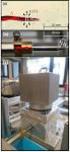
12 5.1.2 Depth Box In order to measure accurately the depth of the electric cone penetrometer, a device termed the depth box, has been developed. This instrument was designed to meet the criteria detailed in Section 4. The depth box, which is seated on the ground, consists of a thin metallic cable, one end of which is attached to the hydraulic ram which drives the cone penetrometer into the ground, and the other end is wound around a metal drum, as shown in Figure 4. (a) (b) Figure 4. Depth box: (a) internal details, (b) attached to drilling rig. A shaft encoder is connected to the shaft of the drum and, as a result, a pulse is transmitted every one-five-hundredth of a revolution of the drum. Since the metal drum has an external diameter of 100 mm, each pulse corresponds to mm of travel of the cable, and hence depth of the cone penetrometer. A light torsional 9

13 spring is also attached to the metal drum so that as the cable is retracted into the depth box; which corresponds to the cone penetrometer being driven into the ground; it is automatically rewound onto the drum. By counting the number of pulses, and the phase of each pulse, it is possible to accurately determine the depth of the cone penetrometer and whether it is being driven into the soil, or whether it is being removed from it Alarm Button Connected to the depth box is the alarm button which is located adjacent to the drilling rig operator and its primary function is to transmit a signal to the microprocessor interface, discussed below, to commence sampling. That is, once the cone penetration test is ready to commence, or continue, the operator presses the button thereby communicating to the microprocessor interface to begin reading its inputs. A warning alarm sounds when the drilling head has been raised by more than 200 mm, indicating that sampling has ceased. This situation occurs when additional drilling rods are connected to the cone penetrometer in order to continue the CPT sounding, or the sounding has been completed and the cone penetrometer is being withdrawn from the ground. The alarm continues to sound, informing the operator that data acquisition will not continue until the button is depressed Microprocessor Interface The microprocessor interface, shown schematically in Figure 5, consists of the following components: Microprocessor unit (MPU); 8 kb (kilobytes) x 8 bit EPROM (erasable programmable read only memory) chip; 8 kb x 8 bit RAM (random access memory); Operational amplifiers; RS232 interface; Liquid crystal displays (LCD). The microprocessor interface performs a variety of tasks. These include the following: 10

14 + 2.5 V 12 V power from vehicle battery Cone tip resistance LCD 0-15 MPa Microprocessor Unit Board Sleeve friction LCD kpa Microprocessor Unit (80C552) Multiplexer D/A Converter (10 bit) 8 kbytes x 8 bit EPROM + 5 V A/D Converter (10 bit) CPU I/O Port RS232 Port 8 kbytes x 8 bit RAM Shaft Encoder RS232 Interface Alarm Button to micro-computer Figure 5. Schematic diagram of the microprocessor interface. Multiplexing - The MPU reads two input channels; cone tip resistance, and sleeve friction. Software stored on the EPROM controls when the MPU reads each of these two channels. This software is discussed in Depth measurements, that is, pulses from the depth box's shaft encoder, are interrupt driven, that is, the MPU immediately processes these measurements as soon as an interrupt signal is received. I/O Port Data Transmission - The depth box and alarm button are read via the I/O (input/output) port. Signal Conditioning and Amplification - The q c and f s analogue signals arrive from the electrical cone penetrometer at microvolt level, and are scaled by the operational amplifiers to 0 to 1V, so that q c is in the range 0 to 15 MPa and f s is in the range of 0 to 500 kpa. This scaling is attained by setting an appropriate gain on each of the two operational amplifiers. In addition, the microprocessor interface is fitted with a cone amplification switch, which, when activated, multiplies the cone measurements by a factor of five. This facility is useful 11

15 when taking measurements in soft soils, as it increases the resolution of the q c measurements by 5 times. Because of the range of q c measurements, the cone amplification switch can be used only for values of q c less than or equal to 3 MPa. Analogue to Digital (A/D) Conversion - So that the analogue information can be transferred to the micro-computer, data are converted to digital format. This is performed by a 10 bit A/D converter located on the MPU chip. As a result, q c and f s have a resolution of 2 10, or 1024 bits. Data Storage and Transfer - Data are temporarily stored in RAM and transferred to the micro-computer via the RS232 serial data bus every 5 mm travel of the cone penetrometer. Data are transferred to the micro-computer in the following format: D 2 c 3 C S M X depth measurements (number of pulses from the shaft encoder); q c measurements; q c measurements when the cone amplification switch has been activated, that is, 5 times the actual value; f s measurements; maximum depth reached before the cone penetrometer was raised; when the cone has been raised more than 200 mm Micro-Computer Measurements of q c, f s, and depth which are amplified, conditioned, stored, and transmitted by the microprocessor interface are scaled, displayed and saved onto floppy disk on an IBM compatible micro-computer. An AMSTRAD PPC640 portable personal computer was chosen for this task. It is a relatively inexpensive unit, with a cost below $1,000, and supports the following features: IBM PC-XT compatible with an 8 MHz clock; 640 kb of Random Access Memory (RAM); 2 x 3.5", 720 kb floppy disk drives; Liquid Crystal Display Monitor with built-in with facility for external CGA monitor; 2 refers to a 2 byte number, that is, in the range 0 and 65,535 (examples are shown in 5.2.2). 3 refers to a four digit number in the range 0 and 1,

16 Compact and fully portable with facility for mains, 12V and battery power supplies; Modem. A number of these features make this computer attractive for field data acquisition of CPT measurements. These include: portability and relative robustness; IBM compatibility; low initial, operation and maintenance costs; its facility to be powered by either 12V supply or dry cell batteries; and its ability to store the measured data onto floppy disks. 5.2 Software A suite of five computer programs has been written primarily to optimise the time taken to process and present the recorded information. Each of the programs, except for CPTRead, were written in Turbo Pascal 4 Version 6.0 because of its speed and graphics capabilities. The programs are detailed below CPTRead CPTRead, is permanently stored on the EPROM chip of the microprocessor interface. This software, written in assembly language, reads the cone tip resistance and sleeve friction load cells, as well as the depth box and alarm button, and temporarily stores these data in the microprocessor interface s RAM, and at various stages, transfers the data to the micro-computer. A simplified flowchart of the CPTRead software is shown in Figure 6. In addition, CPTRead has an in-built filtering algorithm for reducing the effects of electrical noise. This aspect of CPTRead is detailed in CPTest The program CPTest is the interface between the operator of the CPT and the data acquisition system. Every 5 mm of travel of the cone penetrometer the microprocessor interface reads the cone and sleeve load cells and sends depth, cone tip resistance and sleeve friction data to the RS232 port of the microcomputer. An example of these data is shown below. 4 Turbo Pascal is a registered trademark of Borland International, P.O. Box , Scotts Valley, CA, USA,

17 Initialise variables MaxDepth = 0 Send "X" character InitialDepth = MaxDepth Wait for Alarm Button to be pressed Calculate the next reading depth. (NextReadDepth = InitialDepth + 5 mm) Read CurrentDepth No Yes Has the cone gone up 200 mm or more? No Is the cone going down? (Is CurrentDepth > MaxDepth)? Yes MaxDepth = CurrentDepth Is CurrentDepth NextReadDepth? No Yes Read and store cone tip resistance and sleeve friction InitialDepth = CurrentDepth Figure 6. Flowchart of the microprocessor interface software, CPTRead. D2438 c0167 S0271 CPTest continually scans the RS232 port of the micro-computer for data being transferred from the microprocessor interface. Data are read one character at a time and then reassembled to form a series of three, string variables. Referring to 14

18 the example above, the first string would be "D2438"; the second "c0167"; and the third "S0271". The first letter of each string identifies the type of measurement. For example, a "D" character refers to a depth measurement; a "c" character refers to a cone tip resistance measurement; and so on, as indicated in Table 1 below. In order to obtain the scaled values of depth, q c, and f s, the digital values are multiplied by conversion factors as shown in Table 1, which were calculated using the relationships shown in Table 2. Both Tables 1 and 2 are discussed in greater detail in 6.1. TABLE 1. DATA CONVERSION FACTORS First Measurement Conversion Unit Range Character Factor D or M Depth mm 0 to 41,176 mm c q c MPa 0 to 15 MPa C q c x MPa 0 to 3 MPa S f s kpa 0 to 500 kpa TABLE 2. RELATIONSHIPS USED TO CALCULATE DATA CONVERSION FACTORS Measurement Relationship Depth 1 pulse 5 = πd π. 100 = = π mm q c 15 1 mpb 6 = 1024 MPa f s mpb = kpa 1024 Once the data have been read and converted to string variables, the data are then scaled and stored in an array. Again referring to the example shown above, the first string being a depth measurement, and hence the number of pulses read from the depth box's shaft encoder, is multiplied by the depth conversion factor of , as shown in Table 1, to obtain the depth of cone travel since the alarm button was last pressed. In this example the depth read is 2438 pulses, or 1,532 mm 7. This depth 5 1 pulse refers to a signal output by the depth box s shaft encoder. 6 1 mpb refers to 1 microprocessor bit. Eg. c0001 = 15 / 1024 MPa x = 1,532 mm. 15

19 reading of 1,532, is then added to the variable MaxDepth, the depth of the cone penetrometer below the ground surface prior to the addition of further drilling rods, in order to obtain the depth of the cone penetrometer. For the purpose of illustration, let us assume that MaxDepth = 3,538 mm. The depth of the cone penetrometer is then 3, ,532 = 5,070 mm. This value of total depth is then stored in the micro-computer s RAM in an array variable called Depth[i]; i being the integer number of measurements read since the alarm button was last pressed. Again for illustration purposes, let us assume that this reading is the 302 nd since the CPT continued. As a result, Depth[302] would be given the value 5,070. Succeeding data are controlled in the same fashion. The second string, "c0167", a cone tip resistance reading is multiplied by the cone conversion factor of to obtain a q c measurement of 2.45 MPa. This value is then stored in the array variable qc[i]. In this example qc[302] would be given the value Similarly, the third reading of "S0271", a sleeve friction measurement is multiplied by the sleeve conversion factor of to obtain an f s measurement of kpa. This value is then stored in the array variable fs[i]. Again, in this example fs[302] would be given the value As data are being read, they are simultaneously shown graphically on the microcomputer s display, an example of which is shown in Figure 7. In this way, data can be visually monitored and interrogated in order to assess whether the test is being performed correctly and whether it is giving sensible results. This is in accordance with ISOPT-1 (De Beer et al, 1988) as described in Section 3. Once the cone penetrometer has been raised more than 200 mm, the microprocessor interface sends an "X" character to the micro-computer. Upon receiving this signal, which implies that sampling has temporarily ceased due to the addition of further drilling rods, CPTest again reads the depth box to determine the depth of the cone penetrometer and assigns this depth to the variable MaxDepth. It is necessary for CPTest to read the depth box at this maximum depth since the depth of the cone penetrometer tip may not be at an interval of 5 mm. As a consequence, the depth of the penetrometer tip can more accurately be monitored. In addition, CPTest saves all data previously stored in the array variables Depth[i], qc[i], and fs[i] in the micro-computer s RAM, to a file on a 3.5" floppy disk for later post-processing. Data in the file are arranged in three columns: Depth of cone tip below ground surface (mm); q c (MPa); f s (kpa), and are saved in ASCII format, each column being separated by a tab (ASCII #9) character. 16
![This value of total depth is then stored in the micro-computer s RAM in an array variable called Depth[i]; i being the integer number of measurements read since the alarm button was last pressed.](/docs-images/43/8734510/images/page_19.jpg "Again for illustration purposes, let us assume that this reading is the 302 nd since the CPT continued. As a result, Depth[302] would be given the value 5,070.")
20 Figure 7. An example of the CPTest screen CPTView The program CPTView was developed to allow the user to inspect visually the cone penetration test data on the screen both in the field and at a later date. Cone tip resistance, sleeve friction and friction ratio are simultaneously plotted on the screen, an example of which is shown in Figure 8. In addition, CPTView provides the following facilities: The entire CPT sounding can be plotted on a single screen; A range of depths can be plotted on a single screen, for example 2.5 metres to 5.0 metres; The entire recorded depth can be plotted and stepped in windows of userspecified depth; The numerical values of q c, f s, and F R can be displayed for inspection CPTPlot The program CPTPlot was developed to enable the user to prepare report quality plots and tables of the CPT data stored on disk. Figure 9 shows an example of a 17

21 graphical plot and Figure 10 an example of the recorded CPT data printed in tabular format, each of which has been produced by the CPTPlot program. CPTPlot creates a PostScript file (filename.ps) which enables the plot or table to be output to a laser printer which supports the PostScript language, such as the Apple Laser-Writer. Figure 8. An example of a screen plot produced by CPTView. In addition, CPTPlot shifts the sleeve friction data back by 75 mm. This is necessary because the cone tip and the friction sleeve are physically separated by a distance of 75 mm. As discussed previously, the microprocessor interface simultaneously reads values of q c and f s at the depth of the cone penetrometer tip. As a result, the actual depth corresponding to the f s measurements is 75 mm less than that indicated by the depth box. Hence, friction ratio, F R, calculations, based on data that has not been corrected for this shift, will give misleading results (Schmertmann, 1978). 18
22 Figure 9. An example of a graphical plot produced by CPTPlot. 19
23 Figure 10. An example of a data table produced by CPTPlot. 20
24 As discussed previously in 5.2.2, measurements of q c and f s are read at depth intervals of 5 mm. However, while the recorded depths are separated by 5 mm, they need not be divisible by 5. This is due to the fact that MaxDepth, the maximum depth of the cone penetrometer tip prior to the addition of further drilling rods, may not be at a depth divisible by 5. For example, MaxDepth may be 797 mm, and, when the CPT is continued, the next depth at which readings are taken will be mm, or 802 mm; a depth not divisible by 5. When the f s measurements are shifted by 75 mm, there may not be a value of q c corresponding to this depth, ie 727 mm. As a result, two columns of depths would need to be provided: one for values of q c ; and the other for the shifted values of f s. So that only one column of depth measurements need be maintained, CPTPlot first rationalises the depths to values divisible by 5. For example, a depth of 797 mm would be rationalised to 795 mm. The rationalisation algorithm obeys the following rules: 1. If the last digit is a 0, 1, or 2 then the last digit becomes a 0. Eg. 200, 201 and 202 become 200 mm. 2. If the last digit is a 3, 4, 5, 6, or 7 then the last digit becomes a 5. Eg. 203, 204, 205, 206, and 207 become 205 mm. 3. If the last digit is an 8, or 9 then the depth is increased by 1, or 2, respectively. Eg. 208, and 209 become 210 mm. The rationalisation process assumes that each measurement of q c and f s is constant within its soil element of 5 mm in height. Such an assumption is appropriate for elements of soil with such small dimensions. Once rationalisation of depths has been performed the sleeve friction values can then be easily shifted back by 75 mm. Occasionally, the distance between two successive depth measurements is 6 mm instead of 5 mm. The reason for this is explained in 6.2 below. As a result, rationalisation causes some depths to have no associated q c or f s measurements. For example, two successive depths may be 207 mm and 213 mm, that is, separated by 6 mm. Upon rationalisation, the 207 mm depth becomes 205 mm, and the 213 mm depth becomes 215 mm. Hence, the 210 mm depth has no associated q c or f s measurements. When this occurs, CPTPlot, assigns this missing depth of 210 mm with values of q c and f s equal to , implying that there are missing data associated with this depth. When plotting takes place, CPTPlot (and CPTView) ignores these missing data and draws a straight line from the next depth above and below this missing depth. 21
25 Rationalised plots of data spaced at 5 mm intervals are indistinguishable from unrationalised plots. Figure 9 shows an example of a plot performed on rationalised data, and Figure 11 shows the same data but plotted without depth rationalisation. As can be seen clearly from these figures, these missing data have negligible effect on the plots obtained by CPTPlot. Note the effect of rationalisation and sleeve friction shift on the plot of friction ratio versus depth. Omission of the shift can greatly affect the calculation of F R yielding misleading results as indicated by Schmertmann (1978). In addition, the rationalisation process simplifies spatial variability analyses as well as reducing their calculation times. In addition to those discussed above, CPTPlot provides the following features: One, two, or five metres of data, or the entire data set, can be plotted on a single page; Either of the following formats can be plotted: the cone tip resistance, sleeve friction and friction ratio or; the cone tip resistance, friction ratio and undrained shear strength CPTPrint CPTPrint is a utility program which enables files created by CPTPlot to be printed by an Apple LaserWriter, or other PostScript printing device. So that the University of Adelaide crest can be printed at the top left-hand corner of each plot, CPTPrint either copies or concatenates - depending on whether the user has a stand-alone PC 8 connected to the printer, or a networked PC - the plot file with the university crest file (crest.ps). In this way, plot files can be stored more efficiently without duplicating the crest in each plot file. A typical 5 m plot file is approximately 80 kb 9 in size, whereas crest.ps is about 17 kb in size. 6. CALIBRATION AND ACCURACY OF SYSTEM Micro-computer based data acquisition systems, by themselves, do not increase the accuracy of the recorded data. The accuracy is derived from the design and quality 8 Personal Computer 9 kilobytes 22
26 Figure 11. An unrationalised graphical plot produced by CPTPlot. 23
27 of the individual elements and electrical components as well as the quality and resolution of the microprocessor interface and associated software. This section details the procedures and the results of calibration tests undertaken to quantify the resolution, accuracy, and errors associated with the University of Adelaide data acquisition system for the CPT, and compares these to the criteria specified earlier. The electric cone penetrometer has been calibrated previously and measurements of q c and f s have been found to conform with the specifications detailed in Section Resolution of Measured Data The accuracy of the CPT data is governed by the resolution of the microprocessor interface and the depth box. Since the acquisition system stores and transfers data digitally, the recorded values of depth, cone tip resistance, and sleeve friction, have a finite resolution. The resolution of depth measurements is dictated by the specifications of the shaft encoder, that is, 500 pulses per revolution of the encoder. Since the depth box drum has a diameter of 100 mm, the resolution of depth measurements is π 5, or mm, as indicated previously in Tables 1 and 2. The resolution of q c and f s measurements is governed by the number of bits that the A/D converter of the MPU can accommodate. The University of Adelaide microprocessor interface contains an MPU with a 10 bit A/D converter, as shown in Figure 5. Hence, since the MPU can accommodate 2 10, or 1024 values, and the range of q c and f s measurements is 15 MPa and 500 kpa respectively, the resolution of cone tip resistance measurements is , or kpa, and the resolution of sleeve friction measurements is , or kpa, as shown in Tables 1 and Depth Box Calibration The depth box, and the resulting measurement of depth, was calibrated by comparing the results output by the microprocessor interface to those given by a 500 mm long vernier and an 8 metre long steel tape. The results of the calibration are shown in Figure 12. The results of the calibration indicate that the accuracy of the depth box is 0.8%, or an error of 160 mm in 20 metres. This error, though 3 times higher than that specified by de Ruiter (1981), still represents a relatively high degree of accuracy. 24
28 Measured Values Equality Actual Depth (mm) Figure 12. Depth box calibration curve. This error can, in part, be attributed to the diameter of the metal drum of the depth box. As discussed in 5.2.2, the microprocessor interface reads both the cone tip load cell and the sleeve friction load cell at depth intervals of 5 mm. However, every 38 th measurement, the distance between two successive depth readings is 6 mm instead of 5 mm. This is because of rounding of the depth conversion factor, indicated in Table 3.1. The microprocessor interface reads the q c and f s load cells every 8 pulses of the shaft encoder. However, a penetration of 5 mm actually corresponds to pulses, not eight. Every 38 readings, or 190 mm, this error accumulates to add 1 mm to the depth, that is, an inaccuracy of 0.53%. 6.3 Microprocessor Interface Sampling Rate The microprocessor interface has a sample interval of approximately 0.1 sec. As mentioned in Section 4, Jamiolkowski et al (1985) recommend that CPT data be sampled within the range of sec, whereas Lunne et al (1986) suggest a 1 sec sample interval is generally adequate. Depth measurements, that is, pulses from the depth box's shaft encoder, are interrupt driven, that is, the MPU immediately processes these measurements as soon as an interrupt signal is received. As a 25
29 result, depth measurements can be recorded at a maximum sample time of 75 µs, the sample and conversion rate of the microprocessor. At the standard penetration rate of 20 mm/s, the shaft encoder transmits approximately 32 pulses per second, which is equivalent to one pulse every 31 ms. As a result, a sample rate of 75 µs, which is approximately 2,500 times greater than the rate of pulse transmission, is therefore more than adequate to measure depth, q c, and f s. 6.4 Random Measurement Errors Random measurement errors, such as electrical noise, although generally small, are always present in this type of system in one form or another. In order to minimise random measurement errors, a filtering algorithm was built into the program CPTRead. This algorithm effectively uses a four level stack. Measured data are placed at the bottom of the stack and each previous measurement is rolled up to the next level on the stack, the uppermost value being rolled off the stack. An average of the four values on the stack is calculated each time new data are measured. In this way a rolling average of the data is recorded. Davison and Hills (1983) suggest a similar method for reducing the fluctuation in readings due to electrical noise, described as 12% trimmed means. This method stores 24 readings which are ranked, the top and bottom four are discarded, and the result stored in memory being the average of the remaining 16. Calibration tests, performed on the electric cone penetrometer, indicated that the rolling average method is an effective and adequate means of minimising the effect of electrical and random noise. 7. FIELD PERFORMANCE Tests to assess the field performance of the University of Adelaide data acquisition system showed that it is relatively robust and performs well in a variety of weather conditions. The tests, however, highlighted two problems with the equipment and associated software: falling off, and; noise spikes. These are shown in Figure 13 and are treated in-turn, below. 7.1 Falling Off Assessment of the data measured during preliminary cone penetration tests indicated that at every addition of a drill rod the measured values of q c and f s dropped to zero or a value well below that recorded immediately above it. This phenomenon, known as falling off, as shown in Figure 13, is indicated only at the 26
30 Figure 13. An example of q c and f s falling-off at rod changes and noise spikes. 27
31 addition of further drill rods and at no other point in the CPT sounding. The cause of falling off is likely to be due to a number of factors, which include: Soil rebound - Since much of the soil surrounding the electric cone penetrometer remains in an elastic condition (Baligh, 1986; Teh and Houlsby, 1991) when load is removed from the drill rod stem, to enable further rods to be added, the surrounding soil rebounds thereby lifting the penetrometer slightly and reducing the measurements of q c and f s to values approaching zero. Response of electrical components - The time taken for the cone tip resistance and sleeve friction load cells to respond to large changes may be such that the response recorded is principally that of the equipment and not the soil. The effect of falling off has been removed by modifications to the control program CPTest. Measurements of q c and f s are recorded at intervals of 5 mm from the initiation and continuation of the CPT, as discussed previously, however, when the data are saved to the data file on the floppy disk, CPTest does not save the first 2 readings. This removes the falling off effect in q c and f s measurements, but adds to the number of missing depths in the data file, as discussed in Noise Spikes An uncertainty associated with the measurement of q c and f s, discovered during the development of the data acquisition system, was the random presence of noise spikes. These were identified as sudden increases in q c and f s values that are not associated with any geotechnical phenomena. Figure 13 shows examples of noise spikes obtained during cone penetration testing. These spikes were found to be related to earthing within the CPT cable, and rectified by connecting the shielding, that surrounds the cable and individual wires, to ground. 7.3 Limitations of Data Acquisition System A computer based data acquisition system has two drawbacks. Firstly, minor undetected defects such as gradual breakdown of the electrical instruments, amplifiers and electrical components give rise to data inaccuracy and an increased measurement error (defined as the difference between the actual parameter and that measured) with time. This error can be minimised, however, by regular calibration. ISOPT-1 (De Beer et al, 1988) recommends that calibration be carried out at least every three months. 28
32 Secondly, total failure of the system can occur due to failures of the microcomputer or microprocessor interface which usually occur due to external power supply failure. The University of Adelaide system is less likely to suffer from power supply failure since the external power source is derived from the vehicle s 12V battery - the power required to drive the various electrical elements of the data acquisition system being insignificant in comparison to that stored in the battery itself. 8. SUMMARY This report has described the development of a micro-computer based data acquisition system for the CPT. It has been shown that the system satisfies each of the criteria specified in Section 4. As a result, the data acquisition system is a robust and reliable means of measuring, recording, and storing closely-spaced and accurate CPT data. Significant benefits can be obtained by the use of a computer-based data acquisition system over the conventional analogue data logging. These include (Atkinson, 1987): Greater quantities of data can be recorded due to the relatively high sampling rate of the microprocessor interface; Automatic calculation and analysis; Automatic plotting and tabulation of data; Increase in time and manpower efficiency. 9. REFERENCES American Society for Testing and Materials (1986). Standard Method for Deep, Quasi-Static, Cone and Friction-Cone Penetration Tests of Soil (D3441). Annual Book of Standards, Vol , ASTM, Philadelphia, pp Atkinson, J. H. (1987). Personal Computer Control of Laboratory Testing. Soil Mechanics Workshop, Uni. of Queensland, August, Session 7. Baligh, M. M. (1986). Undrained Deep Penetration, I: Shear Stresses. Géotechnique, Vol. 36, No. 4, pp
33 Davison, L. R. and Hills, J. M. (1983). A Data Acquisition System for Soil Mechanics. Ground Engineering, January, pp De Beer, E. E., Goelen, E., Heynen, W. J. and Joustra, K. (1988). Cone Penetration Test (CPT): International Reference Test Procedure. In Penetration Testing, Proc. of the First Int. Symposium on Penetration Testing, De Ruiter (ed.), Orlando, Florida, A. A. Balkema, Rotterdam, pp De Ruiter, J. (1971). Electric Penetrometer for Site Investigations. J. Soil Mechanics & Foundations Div, ASCE, Vol. 97, SM2, pp De Ruiter, J. (1981). Current Penetrometer Practice. In Cone Penetration Testing and Experience, Geotech. Engg. Div., ASCE, St. Louis, Missouri, pp De Ruiter, J. (1982). The Static Cone Penetration Test - State of the Art Report. Proc. of Second European Symposium on Penetration Testing, Vol. 2, Amsterdam, pp Holtz, R. D. and Kovacs, W. D. (1981). Engineering, Prentice Hall, New Jersey, 733 p. An Introduction to Geotechnical Jaksa, M. B. (1990). A Data Acquisition System for the Cone Penetration Test. Seminar on Computing in Geomechanics, Aust. Geomech Soc., S.A. Div., Sept., 1990, pp Jaksa, M. B., Kaggwa, W. S. and Brooker, P. I. (1993). Geostatistical Modelling of the Undrained Shear Strength of a Stiff, Overconsolidated, Clay. Proc. of Conference of Probabilistic Methods in Geotechnical Engineering, Canberra, pp Jamiolkowski, M., Ladd, C. C., Germaine, J. and Lancellotta, R. (1985). New Developments in Field and Laboratory Testing of Soils. Proc. 11th Int. Conf. on Soil Mech. and Foundation Engg., Vol. 1, San Fransisco, pp Lunne, T., Eidsmoen, T., Gillespie, D. and Howland, J. D. (1986). Laboratory and Field Evaluation of Cone Penetrometers. In Use of Insitu Tests in Geotechnical Engineering, ASCE, GSP No. 6, Blacksburg, Va., pp Orchant, C. J., Kulhawy, F. H., Trautmann, C. H. (1988). Critical Evaluation of In-Situ Test Methods and their Variability. Report EL-5507, Vol. 2, Electric Power Research Institute, Palo Alto, Oct
34 Robertson, P. K. and Campanella, R. G. (1983). Interpretation of Cone Penetration Test - Part 1 (Sand). Can. Geotech. J., Vol. 20, No. 4, pp Schmertmann, J. H. (1978). Guidelines for Cone Penetration Test - Performance and Design. Report No. FHWA-TS , U.S. Dept. Transportation, Federal Highway Administration, Washington, 145 p. Standards Association of Australia (1977). Engineering Purposes, AS 1289.F5.1, Sydney. Methods for Testing Soils for Teh, C. I. and Houlsby, G. T. (1991). An Analytical Study of the Cone Penetration Test in Clay. Géotechnique, 41, No. 1, pp Wu, T. H. and El-Jandali, A. (1985). Use of Time Series in Geotechnical Data Analysis, Geotech. Testing Journal, GTJODJ, Vol. 8, No. 4, pp
An Improved Technique for Evaluating the CPT Friction Ratio. M. B. Jaksa, W. S. Kaggwa and P. I. Brooker
 An Improved Technique for Evaluating the CPT Friction Ratio by M. B. Jaksa, W. S. Kaggwa and P. I. Brooker Department of Civil and Environmental Engineering University of Adelaide Research Report No. R
Numerical Simulation of CPT Tip Resistance in Layered Soil
 Numerical Simulation of CPT Tip Resistance in Layered Soil M.M. Ahmadi, Assistant Professor, [email protected] Dept. of Civil Engineering, Sharif University of Technology, Tehran, Iran Abstract The paper
Cone Penetration Test (CPT)
 Cone Penetration Test (CPT) The cone penetration test, or CPT in short, is a soil testing method which will provide a great deal of high quality information. In the Cone Penetration Test (CPT), a cone
Soil behaviour type from the CPT: an update
 Soil behaviour type from the CPT: an update P.K. Robertson Gregg Drilling & Testing Inc., Signal Hill, California, USA ABSTRACT: An initial application of CPT results is to evaluate soil type and soil
NUMERICAL MODELLING OF PIEZOCONE PENETRATION IN CLAY
 NUMERICAL MODELLING OF PIEZOCONE PENETRATION IN CLAY Ilaria Giusti University of Pisa [email protected] Andrew J. Whittle Massachusetts Institute of Technology [email protected] Abstract This paper
CHAPTER 1 INTRODUCTION
 CHAPTER 1 INTRODUCTION 1.1 Introduction The design and construction of foundations require a good knowledge of the mechanical behaviour of soils and of their spatial variability. Such information can be
HAULBOWLINE, CORK STATIC CONE PENETRATION TESTS FACTUAL REPORT
 HAULBOWLINE, CORK STATIC CONE PENETRATION TESTS FACTUAL REPORT CONE PENETRATION TESTS Cone resistance Local friction Porewater pressure Dissipations REPORT NO: RRM CONTRACT NO: GLOVER SITE INVESTIGATIONS
International Journal of Scientific & Engineering Research, Volume 4, Issue 9, September-2013 409 ISSN 2229-5518
 International Journal of Scientific & Engineering Research, Volume 4, Issue 9, September-2013 409 Estimation of Undrained Shear Strength of Soil using Cone Penetration Test By Nwobasi, Paul Awo Department
By D. P. StewarP and M. F. Randolph z
 T-BAR PENETRATION TESTING IN SOFT CLAY By D. P. StewarP and M. F. Randolph z ABSTRACT: A t-bar penetration test for soft clay that can be performed with existing cone penetration test (CPT) equipment is
INSITU TESTS! Shear Vanes! Shear Vanes! Shear Vane Test! Sensitive Soils! Insitu testing is used for two reasons:!
 In-situ Testing! Insitu Testing! Insitu testing is used for two reasons:! To allow the determination of shear strength or penetration resistance or permeability of soils that would be difficult or impossible
PREDICTING THE HYDRAULIC CONDUCTIVITY OF MAKASSAR MARINE CLAY USING FIELD PENETRATION TEST (CPTU) RESULTS
 Proceedings of the Sixth International Conference on Asian and Pacific Coasts (APAC 2011) December 14 16, 2011, Hong Kong, China PREDICTING THE HYDRAULIC CONDUCTIVITY OF MAKASSAR MARINE CLAY USING FIELD
CPTic_CSM8. A spreadsheet tool for identifying soil types and layering from CPTU data using the I c method. USER S MANUAL. J. A.
 CPTic_CSM8 A spreadsheet tool for identifying soil types and layering from CPTU data using the I c method. USER S MANUAL J. A. Knappett (2012) This user s manual and its associated spreadsheet ( CPTic_CSM8.xls
Penetration rate effects on cone resistance measured in a calibration chamber
 Penetration rate effects on cone resistance measured in a calibration chamber K. Kim Professional Service Industries, Inc, Houston, TX, USA M. Prezzi & R. Salgado Purdue University, West Lafayette, IN,
Soil Classification Through Penetration Tests
 Pak. J. Engg. & Appl. Sci. Vol. 9, Jul., 2011 (p. 76-86) Soil Classification Through Penetration Tests A. H. Khan, A. Akbar, K. Farooq, N. M. Khan, M. Aziz and H. Mujtaba Department of Civil Engineering,
Multiple parameters with one Cone Penetration Test. by Mark Woollard
 Multiple parameters with one Cone Penetration Test by Mark Woollard Subjects introduction MW introduction APB introduction CPT portfolio APB onshore CPT equipment near shore CPT equipment offshore CPT
Standard Test Method for Mechanical Cone Penetration Tests of Soil 1
 Designation: D 3441 98 AMERICAN SOCIETY FOR TESTING AND MATERIALS 100 Barr Harbor Dr., West Conshohocken, PA 19428 Reprinted from the Annual Book of ASTM Standards. Copyright ASTM Standard Test Method
Toe Bearing Capacity of Piles from Cone Penetration Test (CPT) Data
 Toe Bearing Capacity of Piles from Cone Penetration Test (CPT) Data Abolfazl Eslami University of Ottawa, Civil Engineering Department PREPRINT International Symposium on Cone Penetrometer Testing, CPT
Cone penetration testing, CPTu
 1 Cone penetration testing, CPTu Preface Our company is Environmental Mechanics AB or short Envi. A Swedish company developing, producing and marketing systems for cone penetration testing (also known
TECHNICAL REPORT ON SCALA DYNAMIC CONE PENETROMETER IRREGULARITY
 TECHNICAL REPORT ON SCALA DYNAMIC CONE PENETROMETER IRREGULARITY CETANZ Technical Report TR 1 Author(s) SJ Anderson, Geotechnics Ltd Report Date First Issue May 2010 Report Revision Date September 2011
STANDARD OPERATING PROCEDURE
 STANDARD OPERATING PROCEDURE DATA ACQUISITION USING THE C1 MEMOCONE SYSTEM REVISION DATE: OKT 21, 2011 Prepared by Per Ljunggren TABLE OF CONTENTS STANDARD OPERATING PROCEDURE...3 DATA ACQUISITION USING
Measurement of Soil Parameters by Using Penetrometer Needle Apparatus
 Vol.3, Issue.1, Jan-Feb. 2013 pp-284-290 ISSN: 2249-6645 Measurement of Soil Parameters by Using Penetrometer Needle Apparatus Mahmoud M. Abu zeid, 1 Amr M. Radwan, 2 Emad A. Osman, 3 Ahmed M.Abu-bakr,
A Ground Improvement Update from TerraSystems
 TERRANOTES A Ground Improvement Update from TerraSystems SOIL MODULUS AFTER GROUND IMPROVEMENT Evaluation of ground improvement is accomplished using a variety of methods, from simple elevation surveys
Cone Penetration Testing (CPT) Michael Bailey, P.G. U.S. Army Corps of Engineers, Savannah District
 Cone Penetration Testing (CPT) Michael Bailey, P.G. U.S. Army Corps of Engineers, Savannah District Recommended publications ASTM D 5778-07 Standard Test Method for Electronic Friction Cone and Piezocone
USE OF CONE PENETRATION TEST IN PILE DESIGN
 PERIODICA POLYTECHNICA SER. CIV. ENG. VOL. 47, NO. 2, PP. 189 197 (23) USE OF CONE PENETRATION TEST IN PILE DESIGN András MAHLER Department of Geotechnics Budapest University of Technology and Economics
Site Investigation. Some unsung heroes of Civil Engineering. buried right under your feet. 4. Need good knowledge of the soil conditions
 This is an attempt to create a stand alone self learning module on site investigation. Fasten your seat belts. Sit back, relax and enjoy. 1 2 Site Investigation Some unsung heroes of Civil Engineering
Numerical Analysis of Texas Cone Penetration Test
 International Journal of Applied Science and Technology Vol. 2 No. 3; March 2012 Numerical Analysis of Texas Cone Penetration Test Nutan Palla Project Engineer, Tolunay-Wong Engineers, Inc. 10710 S Sam
CONE PENETRATION TESTING AND SITE EXPLORATION IN EVALUATING THE LIQUEFACTION RESISTANCE OF SANDS AND SILTY SANDS ABSTRACT
 CONE PENETRATION TESTING AND SITE EXPLORATION IN EVALUATING THE LIQUEFACTION RESISTANCE OF SANDS AND SILTY SANDS E. J. Newman 1, T. D. Stark 2, and S. M. Olson 3 ABSTRACT Refined relationships between
Lymon C. Reese & Associates LCR&A Consulting Services Tests of Piles Under Axial Load
 Lymon C. Reese & Associates LCR&A Consulting Services Tests of Piles Under Axial Load Nature of Services The company has a long history of performance of tests of piles and pile groups under a variety
Measuring Temperature withthermistors a Tutorial David Potter
 NATIONAL INSTRUMENTS The Software is the Instrument Application Note 065 Measuring Temperature withthermistors a Tutorial David Potter Introduction Thermistors are thermally sensitive resistors used in
Using Combination of SPT, DMT and CPT to Estimate Geotechnical Model for a Special Project in Turkey
 Using Combination of SPT, DMT and CPT to Estimate Geotechnical Model for a Special Project in Turkey Figen Orhun Onal GE, M.Sc., Site Works Manager, Zemin Etud ve Tasarım A.Ş., Istanbul, [email protected]
Precision Miniature Load Cell. Models 8431, 8432 with Overload Protection
 w Technical Product Information Precision Miniature Load Cell with Overload Protection 1. Introduction The load cells in the model 8431 and 8432 series are primarily designed for the measurement of force
Geotechnical Measurements and Explorations Prof. Nihar Ranjan Patra Department of Civil Engineering Indian Institute of Technology, Kanpur
 Geotechnical Measurements and Explorations Prof. Nihar Ranjan Patra Department of Civil Engineering Indian Institute of Technology, Kanpur Lecture No. # 13 (Refer Slide Time: 00:18) So last class, it was
Dynamic Load Testing of Helical Piles
 Dynamic Load Testing of Helical Piles ANNUAL KANSAS CITY SPECIALTY SEMINAR 2014 JANUARY 10, 2014 Jorge Beim JWB Consulting LLC Pile Dynamics, Inc. Main Topics Brief description of the Dynamic Load Test
product manual HS-4210 HS-4210_MAN_09.08 Digital Static Cone Penetrometer
 HS-4210_MAN_09.08 product manual HS-4210 Digital Static Cone Penetrometer Introduction This Manual covers the measurement of bearing capacity using the Humboldt Digital Static Cone Penetrometer (DSCP).
METHOD OF STATEMENT FOR STATIC LOADING TEST
 Compression Test, METHOD OF STATEMENT FOR STATIC LOADING TEST Tension Test and Lateral Test According to the American Standards ASTM D1143 07, ASTM D3689 07, ASTM D3966 07 and Euro Codes EC7 Table of Contents
DIGITAL-TO-ANALOGUE AND ANALOGUE-TO-DIGITAL CONVERSION
 DIGITAL-TO-ANALOGUE AND ANALOGUE-TO-DIGITAL CONVERSION Introduction The outputs from sensors and communications receivers are analogue signals that have continuously varying amplitudes. In many systems
Management Challenge. Managing Hardware Assets. Central Processing Unit. What is a Computer System?
 Management Challenge Managing Hardware Assets What computer processing and storage capability does our organization need to handle its information and business transactions? What arrangement of computers
How to design an insulin pump
 How to design an insulin pump Learn about the purpose of an insulin pump, its overall workings, and the requirements needed for its design as well as implementation. By Asha Ganesan Applications Engineer
c. Borehole Shear Test (BST): BST is performed according to the instructions published by Handy Geotechnical Instruments, Inc.
 Design Manual Chapter 6 - Geotechnical 6B - Subsurface Exploration Program 6B-2 Testing A. General Information Several testing methods can be used to measure soil engineering properties. The advantages,
Subminiature Load Cell Model 8417
 w Technical Product Information Subminiature Load Cell 1. Introduction... 2 2. Preparing for use... 2 2.1 Unpacking... 2 2.2 Using the instrument for the first time... 2 2.3 Grounding and potential connection...
ASSESSMENT OF SHEAR WAVE VELOCITY FROM INDIRECT INSITU TESTS
 Proceedings of Indian Geotechnical Conference IGC-2014 December 18-20, 2014, Kakinada, India ASSESSMENT OF SHEAR WAVE VELOCITY FROM INDIRECT INSITU TESTS Kant, L., M. Tech Student, Department of Earthquake
SPECIFICATION FOR DYNAMIC CONSOLIDATION / DYNAMIC REPLACEMENT
 SPECIFICATION FOR DYNAMIC CONSOLIDATION / DYNAMIC REPLACEMENT 1.0 SOIL IMPROVEMENT 1.1 General Soil Investigation Information are provided in Part B1 annex as a guide to the Contractor for his consideration
Design of an Insulin Pump. Purpose of an Insulin Pump:
 Design of an Insulin Pump Purpose of an Insulin Pump: Insulin is a hormone central to regulating carbohydrate and fat metabolism in the body. It is secreted regularly within the body and aids in converting
ON THE INTERPRETATION OF SEISMIC CONE PENETRATION TEST (SCPT) RESULTS
 Studia Geotechnica et Mechanica, Vol. XXXV, No. 4, 213 DOI: 1.2478/sgem-213-33 ON THE INTERPRETATION OF SEISMIC CONE PENETRATION TEST (SCPT) RESULTS IRENA BAGIŃSKA Wrocław University of Technology, Faculty
Cone Penetration Testing in Geotechnical Practice. Tom Lunne Peter K. Robertson John J.M. Powell
 Cone Penetration Testing in Geotechnical Practice Tom Lunne Peter K. Robertson John J.M. Powell BLACKIE ACADEMIC & PROFESSIONAL An Imprint of Chapman & Hall London Weinheim New York Tokyo Melbourne Madras
When to Use Immediate Settlement in Settle 3D
 When to Use Immediate Settlement in Settle 3D Most engineers agree that settlement is made up of three components: immediate, primary consolidation and secondary consolidation (or creep). Most engineers
Procon Engineering. Technical Document PELR 1002. TERMS and DEFINITIONS
 Procon Engineering Technical Document PELR 1002 TERMS and DEFINITIONS The following terms are widely used in the weighing industry. Informal comment on terms is in italics and is not part of the formal
GUIDELINE FOR HAND HELD SHEAR VANE TEST
 GUIDELINE FOR HAND HELD SHEAR VANE TEST NZ GEOTECHNICAL SOCIETY INC August 2001 CONTENTS Page 1.0 Introduction 2 2.0 Background 2 3.0 Recommended Practice 3 4.0 Undrained Shear Strength 3 5.0 Particular
Figure 2.31. CPT Equipment
 Soil tests (1) In-situ test In order to sound the strength of the soils in Las Colinas Mountain, portable cone penetration tests (Japan Geotechnical Society, 1995) were performed at three points C1-C3
Fellenius, B. H., and Eslami, A.
 Page SOIL PROFILE INTERPRETED FROM CPTu DATA Fellenius, B. H., and Eslami, A. Fellenius, B. H., and Eslami, A., 2000. Soil profile interpreted from CPTu data. Year 2000 Geotechnics Geotechnical Engineering
INSTRUMENTATION AND CONTROL TUTORIAL 3 SIGNAL PROCESSORS AND RECEIVERS
 INSTRUMENTATION AND CONTROL TUTORIAL 3 SIGNAL PROCESSORS AND RECEIVERS This tutorial provides an overview of signal processing and conditioning for use in instrumentation and automatic control systems.
NOTES on the CONE PENETROMETER TEST
 GE 441 Advanced Engineering Geology & Geotechnics Spring 2004 Introduction NOTES on the CONE PENETROMETER TEST The standardized cone-penetrometer test (CPT) involves pushing a 1.41-inch diameter 55 o to
COMPUTER HARDWARE. Input- Output and Communication Memory Systems
 COMPUTER HARDWARE Input- Output and Communication Memory Systems Computer I/O I/O devices commonly found in Computer systems Keyboards Displays Printers Magnetic Drives Compact disk read only memory (CD-ROM)
Improvement in physical properties for ground treated with rapid impact compaction
 International Journal of the Physical Sciences Vol. 6(22), pp. 5133-5140, 2 October 2011 Available online at http://www.academicjournals.org/ijps ISSN 1992-1950 2011 Academic Journals Full Length Research
How To Design A Foundation
 The Islamic university - Gaza Faculty of Engineering Civil Engineering Department CHAPTER (2) SITE INVESTIGATION Instructor : Dr. Jehad Hamad Definition The process of determining the layers of natural
SUGGESTION ABOUT DETERMINATION OF THE BEARING CAPACITY OF PILES ON THE BASIS OF CPT SOUNDING TESTS
 SUGGESTION ABOUT DETERMINATION OF THE BEARING CAPACITY OF PILES ON THE BASIS OF CPT SOUNDING TESTS JóZSEF PUSZTAI About the authors Pusztai József Budapest University of Technology and Economics, Department
Computer Creep System
 WinCCS II Computer Creep System The Advanced, Versatile, Fully- Automated System for Operating All of Your Creep Test Frames Increased Productivity and Accuracy Through Automation: WinCCS II, the New Creep
Eurocode 7 - Geotechnical design - Part 2 Ground investigation and testing
 Brussels, 18-20 February 2008 Dissemination of information workshop 1 Eurocode 7 - Geotechnical design - Part 2 Ground investigation and testing Dr.-Ing. Bernd Schuppener, Federal Waterways Engineering
KWANG SING ENGINEERING PTE LTD
 KWANG SING ENGINEERING PTE LTD 1. INTRODUCTION This report represents the soil investigation works at Aljunied Road / Geylang East Central. The objective of the soil investigation is to obtain soil parameters
Ingeniería y Georiesgos Ingeniería Geotécnica Car 19 a Nº 84-14 of 204 ; TEL : 6916043 E-mail: [email protected]
 The plot below presents the cross correlation coeficient between the raw qc and fs values (as measured on the field). X axes presents the lag distance (one lag is the distance between two sucessive CPT
INDIRECT METHODS SOUNDING OR PENETRATION TESTS. Dr. K. M. Kouzer, Associate Professor in Civil Engineering, GEC Kozhikode
 INDIRECT METHODS SOUNDING OR PENETRATION TESTS STANDARD PENETRATION TEST (SPT) Reference can be made to IS 2131 1981 for details on SPT. It is a field edtest to estimate e the penetration e resistance
NG360 Inclinometer with digital RS485 communications port and 360 degree measuring range
 Inclinometer with digital RS485 communications port and 360 degree measuring range Features integrated 16bit microprocessor RS485 bus output signal no measuring range limitation 0.01 degree resolution
In-situ Load Testing to Evaluate New Repair Techniques
 In-situ Load Testing to Evaluate New Repair Techniques W.J. Gold 1 and A. Nanni 2 1 Assistant Research Engineer, Univ. of Missouri Rolla, Dept. of Civil Engineering 2 V&M Jones Professor, Univ. of Missouri
EVALUATING THE IMPROVEMENT FROM IMPACT ROLLING ON SAND
 EVALUATING THE IMPROVEMENT FROM IMPACT ROLLING ON SAND D.L. Avalle, Broons Hire (SA) Pty Ltd, Australia J.P. Carter, The University of Sydney, Australia Abstract Impact rolling, utilising a non-circular
NortechCommander Software Operating Manual MAN-00004 R6
 NortechCommander Software Operating Manual MAN-00004 R6 If the equipment described herein bears the symbol, the said equipment complies with the applicable European Union Directive and Standards mentioned
HYDROGRAPHIC ECHOSOUNDER FOR SOUNDING INLAND WATERS ANDRZEJ JEDEL, LECH KILIAN, JACEK MARSZAL, ZAWISZA OSTROWSKI, ZBIGNIEW WOJAN, KRZYSZTOF ZACHARIASZ
 HYDROGRAPHIC ECHOSOUNDER FOR SOUNDING INLAND WATERS ANDRZEJ JEDEL, LECH KILIAN, JACEK MARSZAL, ZAWISZA OSTROWSKI, ZBIGNIEW WOJAN, KRZYSZTOF ZACHARIASZ Gdańsk University of Technology, Faculty of Electronics,
Program COLANY Stone Columns Settlement Analysis. User Manual
 User Manual 1 CONTENTS SYNOPSIS 3 1. INTRODUCTION 4 2. PROBLEM DEFINITION 4 2.1 Material Properties 2.2 Dimensions 2.3 Units 6 7 7 3. EXAMPLE PROBLEM 8 3.1 Description 3.2 Hand Calculation 8 8 4. COLANY
Computers. Hardware. The Central Processing Unit (CPU) CMPT 125: Lecture 1: Understanding the Computer
 Computers CMPT 125: Lecture 1: Understanding the Computer Tamara Smyth, [email protected] School of Computing Science, Simon Fraser University January 3, 2009 A computer performs 2 basic functions: 1.
THE COMPOSITE DISC - A NEW JOINT FOR HIGH POWER DRIVESHAFTS
 THE COMPOSITE DISC - A NEW JOINT FOR HIGH POWER DRIVESHAFTS Dr Andrew Pollard Principal Engineer GKN Technology UK INTRODUCTION There is a wide choice of flexible couplings for power transmission applications,
How To Prepare A Geotechnical Study For A Trunk Sewer Project In Lincoln, Nebraska
 APPENDIX B Geotechnical Engineering Report GEOTECHNICAL ENGINEERING REPORT Preliminary Geotechnical Study Upper Southeast Salt Creek Sanitary Trunk Sewer Lincoln Wastewater System Lincoln, Nebraska PREPARED
Chapter 8 Memory Units
 Chapter 8 Memory Units Contents: I. Introduction Basic units of Measurement II. RAM,ROM,PROM,EPROM Storage versus Memory III. Auxiliary Storage Devices-Magnetic Tape, Hard Disk, Floppy Disk IV.Optical
MOBILE SYSTEM FOR DIAGNOSIS OF HIGH VOLTAGE CABLES (132KV/220KV) VLF-200 HVCD
 MOBILE SYSTEM FOR DIAGNOSIS OF HIGH VOLTAGE CABLES (132KV/220KV) VLF-200 HVCD VERY LOW FREQUENCY (VLF) - PARTIAL DISCHARGES AND TANGENT DELTA HV/EHV POWER CABLES DIAGNOSTIC AND ON-SITE FIELD TESTING WITH
Step 11 Static Load Testing
 Step 11 Static Load Testing Test loading is the most definitive method of determining load capacity of a pile. Testing a pile to failure provides valuable information to the design engineer and is recommended
Accurate Measurement of the Mains Electricity Frequency
 Accurate Measurement of the Mains Electricity Frequency Dogan Ibrahim Near East University, Faculty of Engineering, Lefkosa, TRNC [email protected] Abstract The frequency of the mains electricity supply
Laterally Loaded Piles
 Laterally Loaded Piles 1 Soil Response Modelled by p-y Curves In order to properly analyze a laterally loaded pile foundation in soil/rock, a nonlinear relationship needs to be applied that provides soil
Ultrasonic Load Monitoring
 Ultrasonic Load Monitoring Who We Are One Company, Total Support, Complete Solutions Over many years, Hydratight has provided world-class bolted joint solutions and continues to set international standards
Assessment of stress history in glacial soils on the basis of cone penetration tests
 Assessment of stress history in glacial soils on the basis of cone penetration tests ALOJZY SZYMANSKI 1, ANNA DROZDZ & MAREK BAJDA 1 Warsaw Agricultural University. (e-mail: [email protected])
Conquering New Frontiers in Underwater Cone Penetration Testing
 Conquering New Frontiers in Underwater Cone Penetration Testing Karin van den Berg, Axel Walta & Titus de Wolff A.P. van den Berg, Heerenveen, The Netherlands ABSTRACT: The future poses a challenge with
SUPPLEMENTAL TECHNICAL SPECIFICATIONS BI-DIRECTIONAL STATIC LOAD TESTING OF DRILLED SHAFTS
 July 14, 2015 1.0 GENERAL BI-DIRECTIONAL STATIC LOAD TESTING OF DRILLED SHAFTS This work shall consist of furnishing all materials, equipment, labor, and incidentals necessary for conducting bi-directional
JNIOR. Overview. Get Connected. Get Results. JNIOR Model 310. JNIOR Model 312. JNIOR Model 314. JNIOR Model 410
 The INTEG is an Ethernet I/O (digital, analog) device that monitors and controls a small set of process signals. functions as both basic I/O for integration with another application or system AND as a
CSCA0102 IT & Business Applications. Foundation in Business Information Technology School of Engineering & Computing Sciences FTMS College Global
 CSCA0102 IT & Business Applications Foundation in Business Information Technology School of Engineering & Computing Sciences FTMS College Global Chapter 2 Data Storage Concepts System Unit The system unit
ABB i-bus EIB / KNX Analogue Input AE/S 4.2
 Product Manual ABB i-bus EIB / KNX Analogue Input AE/S 4.2 Intelligent Installation Systems This manual describes the functionality of Analogue Input AE/S 4.2. Subject to changes and errors excepted. Exclusion
Field tests using an instrumented model pipe pile in sand
 Field tests using an instrumented model pipe pile in sand D. Igoe University College Dublin K. Gavin University College Dublin B. O Kelly Trinity College Dublin Reference: Igoe D., Gavin K., and O'Kelly
Manual Analysis Software AFD 1201
 AFD 1200 - AcoustiTube Manual Analysis Software AFD 1201 Measurement of Transmission loss acc. to Song and Bolton 1 Table of Contents Introduction - Analysis Software AFD 1201... 3 AFD 1200 - AcoustiTube
Firmware version: 1.10 Issue: 7 AUTODIALER GD30.2. Instruction Manual
 Firmware version: 1.10 Issue: 7 AUTODIALER GD30.2 Instruction Manual Firmware version: 2.0.1 Issue: 0.6 Version of the GPRS transmitters configurator: 1.3.6.3 Date of issue: 07.03.2012 TABLE OF CONTENTS
Computer Logic (2.2.3)
 Computer Logic (2.2.3) Distinction between analogue and discrete processes and quantities. Conversion of analogue quantities to digital form. Using sampling techniques, use of 2-state electronic devices
Equivalent CPT Method for Calculating Shallow Foundation Settlements in the Piedmont Residual Soils Based on the DMT Constrained Modulus Approach.
 Equivalent CPT Method for Calculating Shallow Foundation Settlements in the Piedmont Residual Soils Based on the DMT Constrained Modulus Approach. Paul W. Mayne, PhD, P.E., Professor, Geosystems Engineering
Chapter 3: Computer Hardware Components: CPU, Memory, and I/O
 Chapter 3: Computer Hardware Components: CPU, Memory, and I/O What is the typical configuration of a computer sold today? The Computer Continuum 1-1 Computer Hardware Components In this chapter: How did
CPT interpretation in marine soils less than 5m depth examples from the North Sea
 CPT interpretation in marine soils less than 5m depth examples from the North Sea R. Mitchell SEtech (Geotechnical Engineers) Limited, Great Yarmouth, England S. Wootton & R. Comrie SEtech (Geotechnical
GUIDELINES FOR GEOTECHNICAL INVESTIGATION OF BRIDGE STRUCTURES. Materials Engineering Report No. 2009-8M (Supersedes Report No.
 GUIDELINES FOR GEOTECHNICAL INVESTIGATION OF BRIDGE STRUCTURES Materials Engineering Report No. 2009-8M (Supersedes Report No. 21) F CHOWDHURY GEOMECHANICS AND STRUCTURAL MATERIALS ENGINEER S REHMAN GEOTECHNICAL
THE THERMAL FLOW METER, A GAS METER FOR ENERGY MEASUREMENT
 THE THERMAL FLOW METER, A GAS METER FOR ENERGY MEASUREMENT Kazuto Otakane, Tokyo Gas Co., Ltd Katsuhito Sakai, Tokyo Gas Co., Ltd Minoru Seto, Tokyo Gas Co., Ltd 1. INTRODUCTION Tokyo Gas s new gas meter,
Computer Performance. Topic 3. Contents. Prerequisite knowledge Before studying this topic you should be able to:
 55 Topic 3 Computer Performance Contents 3.1 Introduction...................................... 56 3.2 Measuring performance............................... 56 3.2.1 Clock Speed.................................
DS1621 Digital Thermometer and Thermostat
 Digital Thermometer and Thermostat www.dalsemi.com FEATURES Temperature measurements require no external components Measures temperatures from 55 C to +125 C in 0.5 C increments. Fahrenheit equivalent
A study on the Effect of Distorted Sampler Shoe on Standard Penetration Test Result in Cohesionless soil
 ISSN: 319-53 (An ISO 39: 00 Certified Organization) A study on the Effect of Distorted Sampler Shoe on Standard Penetration Test Result in Cohesionless soil Utpal Kumar Das Associate Professor, Department
MICROPROCESSOR AND MICROCOMPUTER BASICS
 Introduction MICROPROCESSOR AND MICROCOMPUTER BASICS At present there are many types and sizes of computers available. These computers are designed and constructed based on digital and Integrated Circuit
PPM Users Manual Signature Software 01-12-00
 PPM Users Manual Signature Software 0-2-00 PPM User Manual /8/02 Software Versions: 0.0.27 Contents. Introduction 2 2. Parameters 3 2. Overload Limit...4 2.2 Relative Upper Limit...4 2.3 Relative Lower
Portable adapter for barcode scanners
 Microprocessors and Microsystems 23 (1999) 217 223 Portable adapter for barcode scanners I.Y. Soon a, *, C.K. Yeo b, Y.H. Sng a a School of Electrical and Electronics Engineering, Nanyang Technological
The software solution to complete your flow monitoring program
 The software solution to complete your flow monitoring program Flowlink 5.1 software is the central point of your flow data management program. With this software you can: Configure Isco equipment on-site
Pavements should be well drained both during and upon completion of construction. Water should not be allowed to pond on or near pavement surfaces.
 Project No. 208-8719 January, 2009 Ref: 2-8719BR Anthony Hudson - Broadscale Geotechnical Investigation - Proposed Commercial Development - 52 Old Pacific Highway, Pimpama Page 32 iii) Pavements should
WDC 14-056 - Whakatane Central Business District Geotechnical Investigation
 WDC 14-056 - Whakatane Central Business District Geotechnical Investigation Data Delivery Report Simon Henderson 11/4/2014 Site investigation relating to the ground investigation of the Whakatane central