
Retirement Eligibility. Annuity Benefits. Survivor Benefits. Credit for Service. Voluntary Contributions. Retirement Application Process
|
|
|
- Hester Bradford
- 10 years ago
- Views:
Transcription
1 Civil Service Retirement Benefits Retirement Eligibility Annuity Benefits Survivor Benefits Credit for Service Voluntary Contributions Retirement Application Process CSRS Offset Benefits
2

3 Civil Service Retirement Benefits Contents Retirement Eligibility Eligibility Requirements... Types of Retirement... Annuity Computations Average Salary... Annuity Formulas... Annuity Factor Charts and Worksheets... Unused Sick Leave... Leave Without Pay... Maximum Annuity... Part-Time Service... Reductions in Basic Annuity... Survivor Benefits. Survivor Elections At Retirement... Termination of Benefits... Post-Retirement Marriage... Insurable Interest Survivor Benefits... Lump Sum Benefits... Credit for Service Non-deduction Service... Refunded Service... Military Service... Voluntary Contributions... Preparing for Retirement Documentation of Service... Annuity Commencing Dates... Lump Sum Annual Leave Payment... The Application Process... Cost of Living Adjustments (COLA)... Alternative Form of Annuity (Lump Sum)... Federal Taxes on Civil Service Annuities... CSRS Offset Benefits... Flexible Spending Accounts... OPM Address / Phone Numbers... Internet Highlights , J.P.McGehrin & Associates, Inc. All rights reserved. No part of this publication may be reproduced without the prior permission of J.P. McGehrin and Associates, Inc.

4

5 Retirement Eligibility Basic Eligibility Requirements: 1. 5 years of creditable civilian service 2. Subject to the retirement system for 1 out of the 2 years immediately preceding the separation on which the retirement is based (except disability). Age and Service Requirements Age Years of Service 1. Optional Early Optional 50* 20 (VERA) Any* Discontinued 50* 20 Service (DSR) Any* Disability Any 5 5. Deferred Law Enforcement / Firefighters * Age Reduction: Annuity is reduced 2% for each year retiree is under age 55, 1/6 of 1% for each full month under age 55.

6 Types of Retirement Optional Retirement (Full Immediate Benefits) You may voluntarily retire and receive full unreduced retirement benefits at any time after meeting one of the following age and service combinations. Age Service Early Optional Retirement (VERA) (Voluntary Separation) If you are offered an early optional retirement, you may voluntarily retire if you meet the age and service requirements shown below. Agencies may be granted permission to offer early retirements by OPM if the agency is undergoing a major reduction in workforce, reorganization or transfer of function. Agencies such as the Department of Defense that have been granted agency-specific VERA are not required to seek OPM approval for their use of this option. Your annuity benefit will be reduced by 2% for each year (1/6 of 1% per month) that you are under age 55 on date of retirement. Age Service Any age 25 Discontinued Service Retirement (DSR) (Involuntary Separation) If you are involuntarily separated from your position and are not given a reasonable offer of another position, you receive an immediate annuity if you have met the age and service requirements shown below. Your annuity benefit will be reduced by 2% for each year (1/6 % per month) that your are under age 55 on date of retirement. Age Service Any age 25

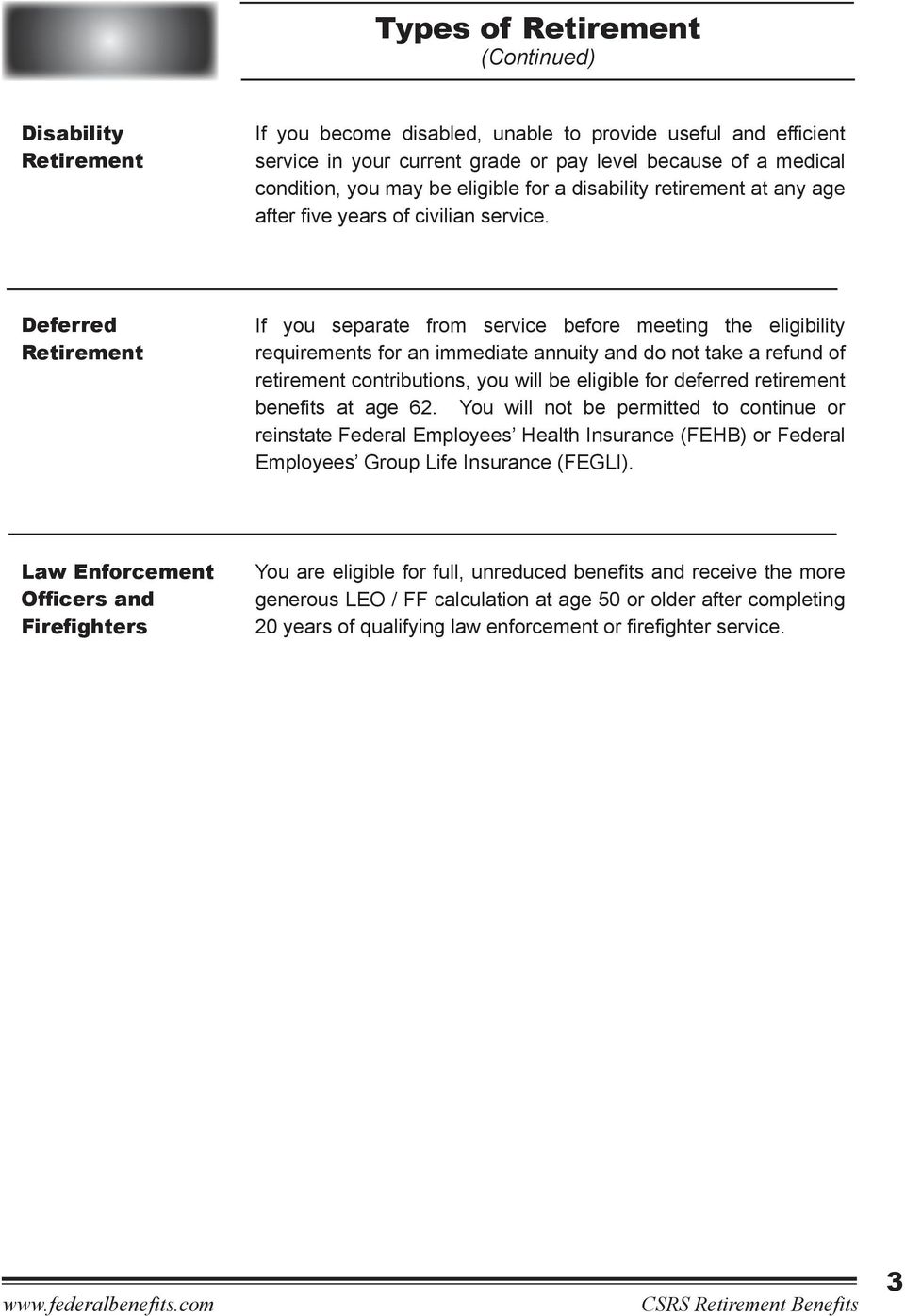
7 Types of Retirement (Continued) Disability Retirement If you become disabled, unable to provide useful and efficient service in your current grade or pay level because of a medical condition, you may be eligible for a disability retirement at any age after five years of civilian service. Deferred Retirement If you separate from service before meeting the eligibility requirements for an immediate annuity and do not take a refund of retirement contributions, you will be eligible for deferred retirement benefits at age 62. You will not be permitted to continue or reinstate Federal Employees Health Insurance (FEHB) or Federal Employees Group Life Insurance (FEGLI). Law Enforcement Officers and Firefighters You are eligible for full, unreduced benefits and receive the more generous LEO / FF calculation at age 50 or older after completing 20 years of qualifying law enforcement or firefighter service.
8 Type of Retirement Age/Service Requirements Full Immediate Benefits Early Optional Retirement (VERA) Any Age- 25 Discontinued Service Retirement (DSR) Any Age - 25 Deferred Retirement 62-5 Law Enforcement Officers and Firefighters CSRS Retirement Eligibility Year-Age-Service Basic Annuity (% of Average Salary) Comments Agency must offer early retirement opportunity Age Reduction (2% / year under age 55) Involuntary Separation No Reasonable Offer Age Reduction ( 2% / year under age 55) No FEHB / No FEGLI Requires 20 years of Qualifying LEO / FF service

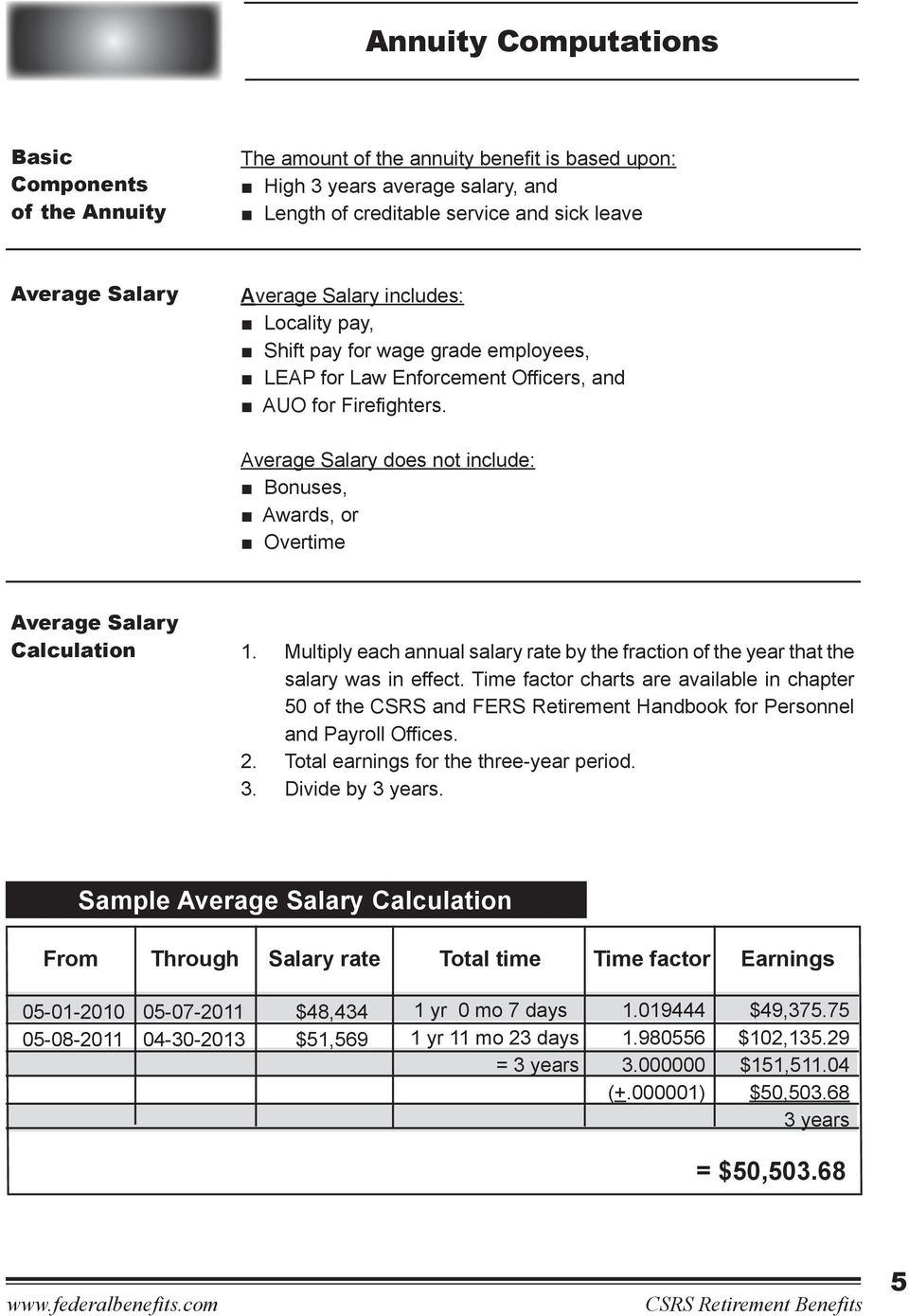
9 Annuity Computations Basic Components of the Annuity The amount of the annuity benefit is based upon: High 3 years average salary, and Length of creditable service and sick leave Average Salary Average Salary includes: Locality pay, Shift pay for wage grade employees, LEAP for Law Enforcement Officers, and AUO for Firefighters. Average Salary does not include: Bonuses, Awards, or Overtime Average Salary Calculation 1. Multiply each annual salary rate by the fraction of the year that the salary was in effect. Time factor charts are available in chapter 50 of the CSRS and FERS Retirement Handbook for Personnel and Payroll Offices. 2. Total earnings for the three-year period. 3. Divide by 3 years. Sample Average Salary Calculation From Through Salary rate Total time Time factor Earnings $48,434 $51,569 1 yr 0 mo 7 days 1 yr 11 mo 23 days = 3 years ( ) $49, $102, $151, $50, years = $50,
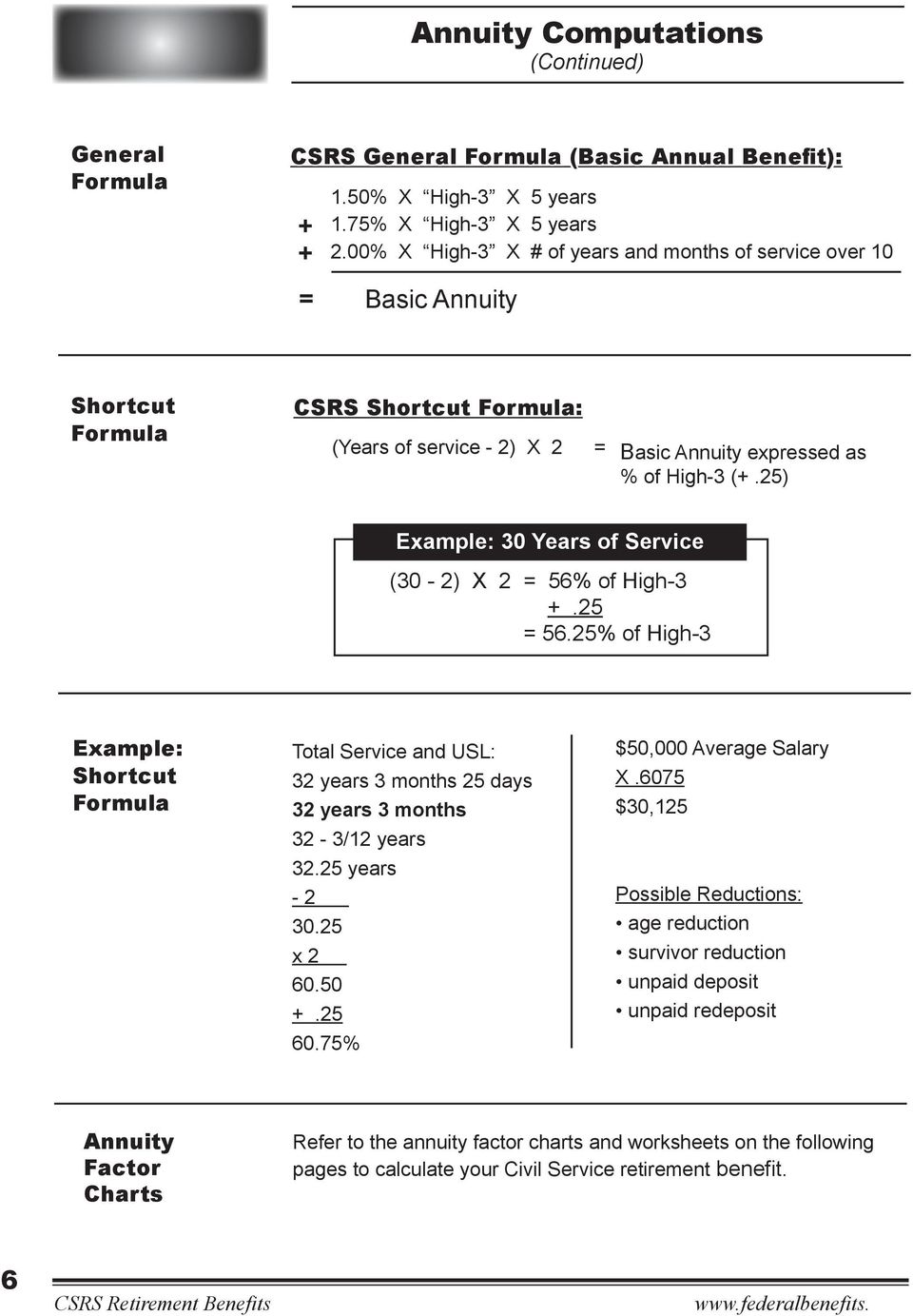
10 Annuity Computations (Continued) General Formula CSRS General Formula (Basic Annual Benefit): % X High-3 X 5 years 1.75% X High-3 X 5 years 2.00% X High-3 X # of years and months of service over 10 = Basic Annuity Shortcut Formula CSRS Shortcut Formula: (Years of service - 2) X 2 = Basic Annuity expressed as % of High-3 (+.25) Example: 30 Years of Service (30-2) X 2 = 56% of High = 56.25% of High-3 Example: Shortcut Formula Total Service and USL: 32 years 3 months 25 days 32 years 3 months 32-3/12 years years x % $50,000 Average Salary X.6075 $30,125 Possible Reductions: age reduction survivor reduction unpaid deposit unpaid redeposit Annuity Factor Charts Refer to the annuity factor charts and worksheets on the following pages to calculate your Civil Service retirement benefit.
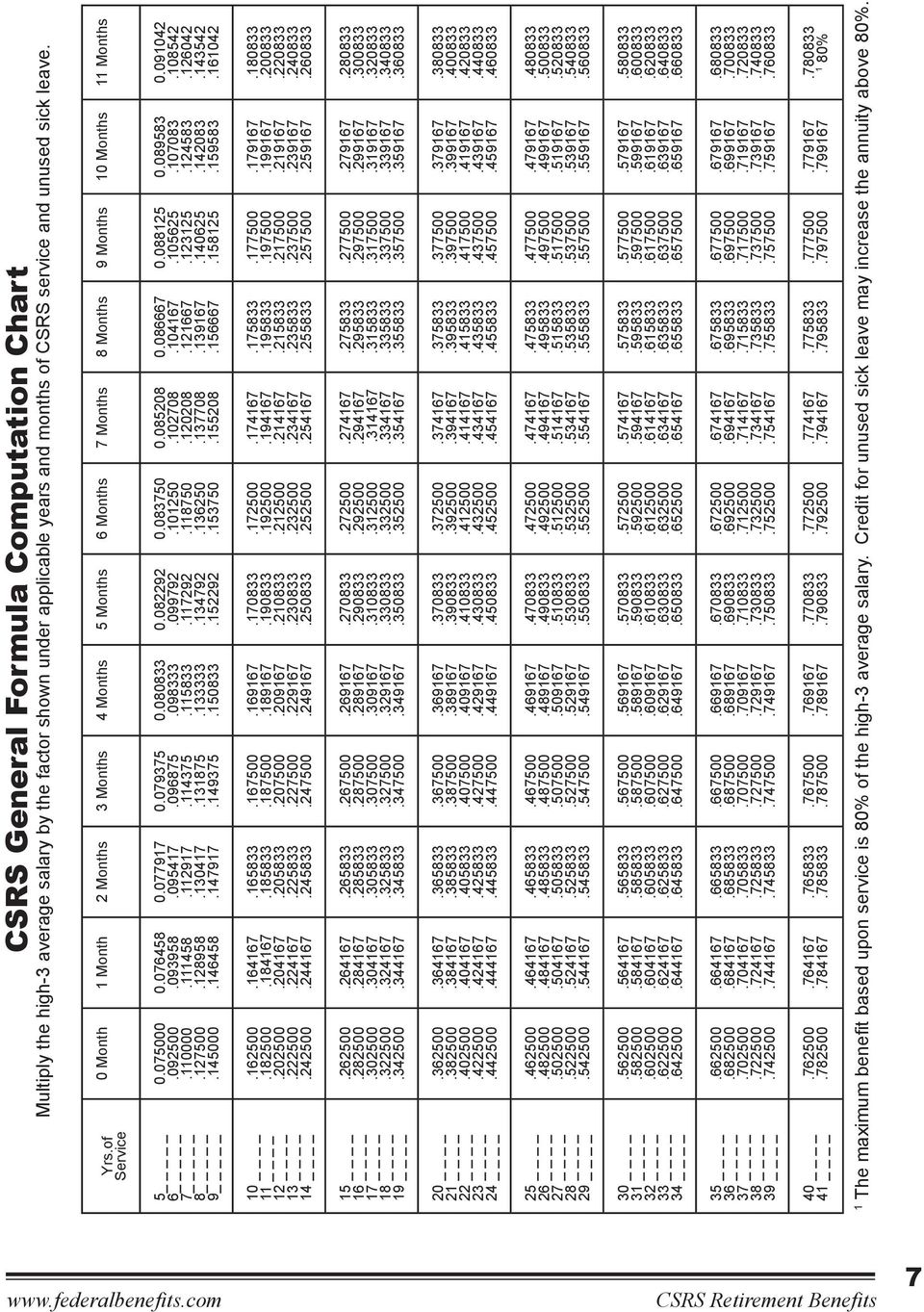
11 CSRS General Formula Computation Chart Multiply the high-3 average salary by the factor shown under applicable years and months of CSRS service and unused sick leave. Yrs.of Service 0 Month 1 Month 2 Months 3 Months 4 Months 5 Months 6 Months 7 Months 8 Months 9 Months 10 Months 11 Months 5 _ 6 _ 7 _ 8 _ 9 _ % 1 The maximum benefit based upon service is 80% of the high-3 average salary. Credit for unused sick leave may increase the annuity above 80%.
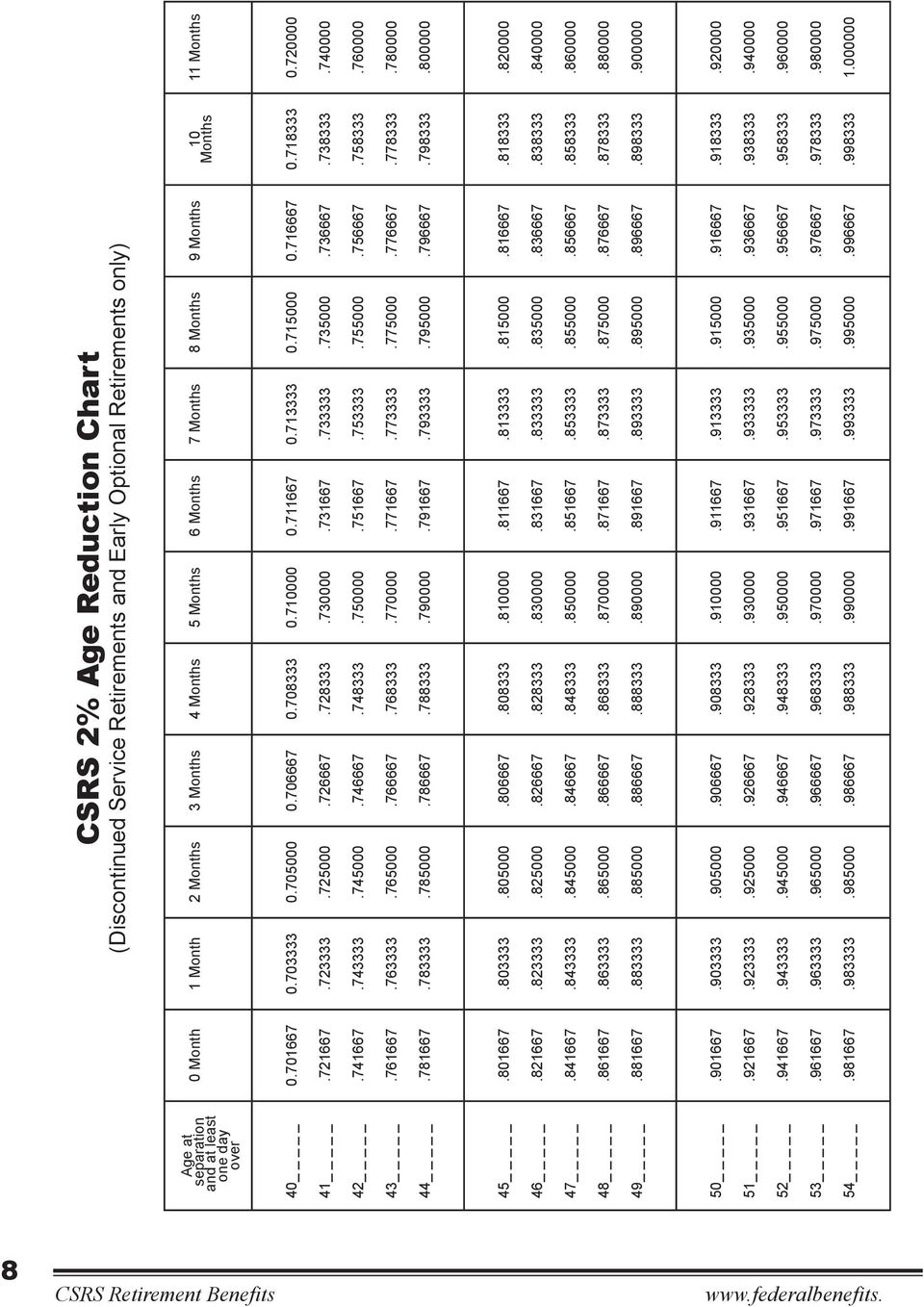
12 Age at separation and at least one day over 40 _ 41 _ 42 _ 43 _ 44 _ 45 _ 46 _ 47 _ 48 _ 49 _ 50 _ 51 _ 52 _ 53 _ 54 _ CSRS 2% Age Reduction Chart (Discontinued Service Retirements and Early Optional Retirements only) 0 Month 1 Month 2 Months 3 Months 4 Months 5 Months 6 Months 7 Months 8 Months 9 Months 10 Months Months
13 CSRS Benefit Calculations 1 Enter Hi-3 Average Salary $ Multiply by CSRS retirement factor years months of CSRS service and USL Basic Annual CSRS Benefit * Reduction for Age (if under age 55) Early Optional Retirement or DSR Multiply by 2 % reduction factor CSRS Annual Benefit Reduced for Age Reduction for Unpaid Deposits Non-deduction service before 10/1/82 Subtract 10% of deposit plus interest due at retirement CSRS Annual Benefit (without Survivor Benefit) Survivor Reduction: Survivor Base elected = (Maximum = line 7) Amount up to $ 3600 = X.025 = Amount over $ 3600 = X.10 = Total Reduction = CSRS Annual Benefit w/ survivor reduction CSRS Monthly Benefit Divide by 12 and round to lower dollar. Reduction for Unpaid Redeposit (Pre 3/1/91 Refund) Divide Redeposit plus interest by actuarial factor = Equals monthly reduction in benefit CSRS Monthly Benefit Survivor Benefit: Enter Survivor Base (Maximum = line 7) Multiply survivor base by 55% CSRS Annual Survivor Benefit CSRS Monthly Survivor Benefit Divide by 12 and round to lower dollar X $ X $ - $ - $ $ - $ $ X.55 $ $ *Assumes full-time service.

14 CSRS Example CSRS Example: (VERA or DSR) Retirement Date: 10/2/013 Date of Birth: 4/20/59 Age: 54 years, 5 months, 12 days Average Salary: $48,000 SCD: USL: Total: 7/16/82 Service: 30 years, 2 months, 17 days 1127 hours 6 months, 15 days 30 years, 9 months, 2 days 10

15 CSRS Benefit Calculations 1 Enter Hi-3 Average Salary $ 48, Multiply by CSRS retirement factor 30 years 9 months of CSRS service and USL Basic Annual CSRS Benefit * Reduction for Age (if under age 55) Early Optional Ret or DSR Multiply by 2 % reduction factor CSRS Annual Benefit Reduced for Age Reduction for Unpaid Deposits Non-deduction service before 10/1/82 Subtract 10% of deposit plus interest due at retirement CSRS Annual Benefit (without Survivor Benefit) Survivor Reduction Survivor Base elected = 27, ( Maximum = line 7) Amount up to $ 3600 = 3, X.025 = Amount over $ 3600 = 23, X.10 = 2, Total Reduction = 2, CSRS Annual Benefit with survivor reduction CSRS Monthly Benefit Divide by 12 and round to lower dollar. Reduction for Unpaid Redeposit (Pre 3/1/91 Refund) Divide redeposit plus interest by actuarial factor = monthly reduction in benefit CSRS Monthly Benefit Survivor Benefit: Enter Survivor Base (Maximum = line 7) Multiply survivor base by 55% CSRS Annual Survivor Benefit CSRS Monthly Survivor Benefit Divide by 12 and round to lower dollar X $ 27, X.9900 $ 27, N/A $ 27, , $ 24, $ 2, N/A $ 2, $ 27, X.55 $ 15, $ 1, *Assumes full-time service. 11

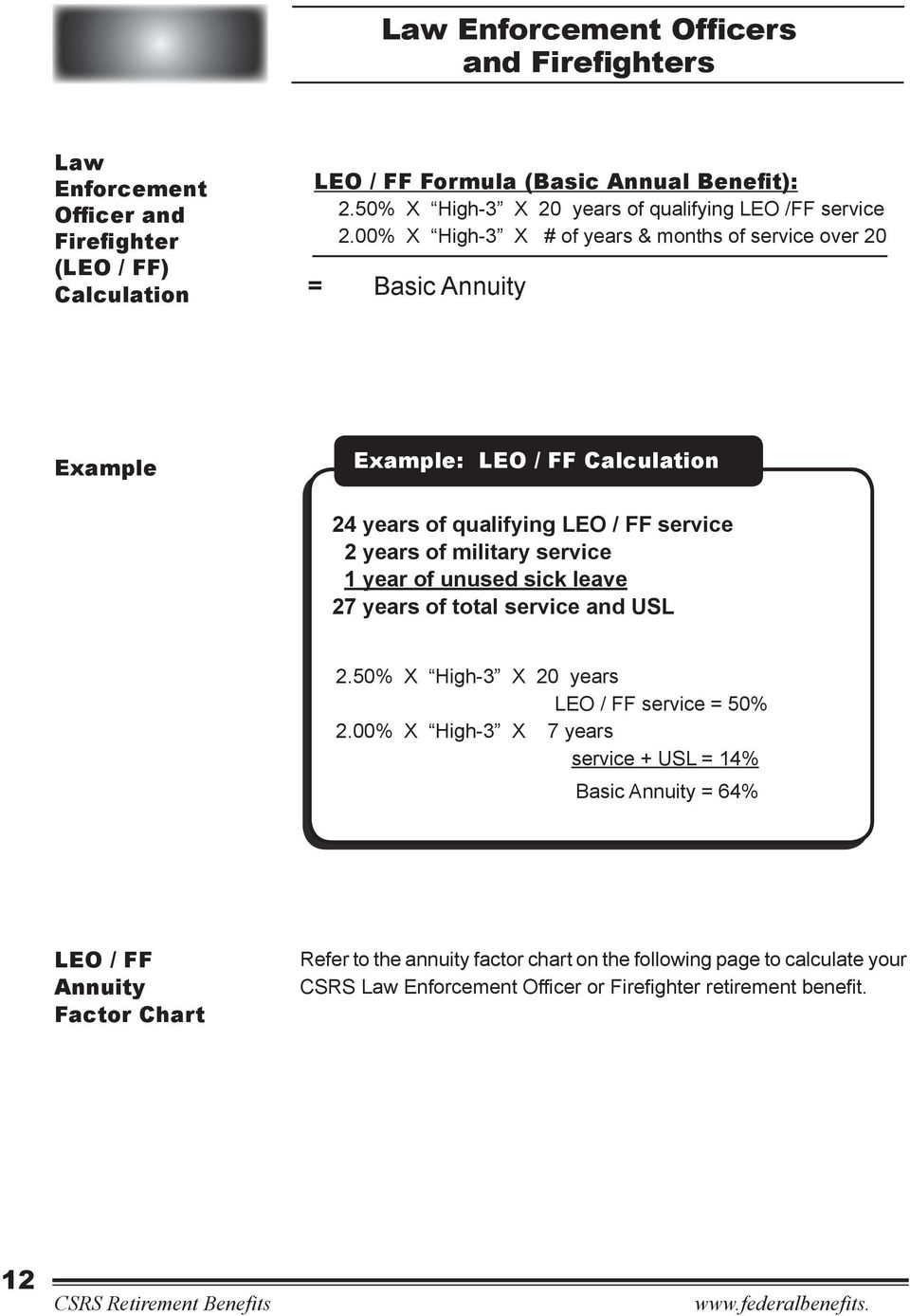
16 Law Enforcement Officers and Firefighters Law Enforcement Officer and Firefighter (LEO / FF) Calculation LEO / FF Formula (Basic Annual Benefit): 2.50% X High-3 X 20 years of qualifying LEO /FF service 2.00% X High-3 X # of years & months of service over 20 = Basic Annuity Example Example: LEO / FF Calculation 24 years of qualifying LEO / FF service 2 years of military service 1 year of unused sick leave 27 years of total service and USL 2.50% X High-3 X 20 years LEO / FF service = 50% 2.00% X High-3 X 7 years service + USL = 14% Basic Annuity = 64% LEO / FF Annuity Factor Chart Refer to the annuity factor chart on the following page to calculate your CSRS Law Enforcement Officer or Firefighter retirement benefit. 12
17 CSRS 2.5% Percent Annuity Factor Chart for Law Enforcement Officers and Firefighters Multiply the high-3 average salary by the factor shown under applicable years and months of CSRS service and unused sick leave. The maximum benefit based upon service is 80% of the high-3 average salary. Credit for unused sick leave may increase the annuity above 80%. 13

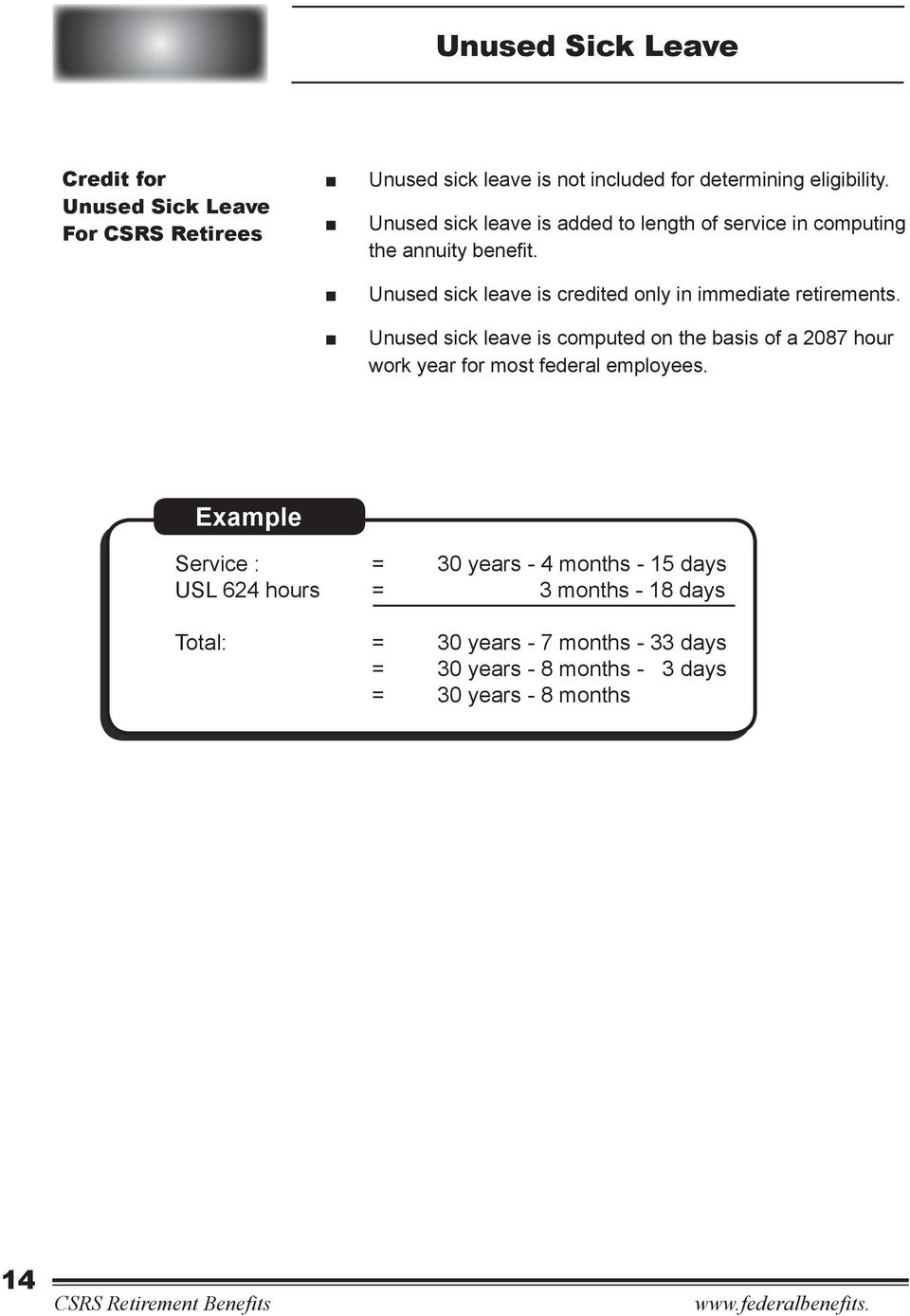
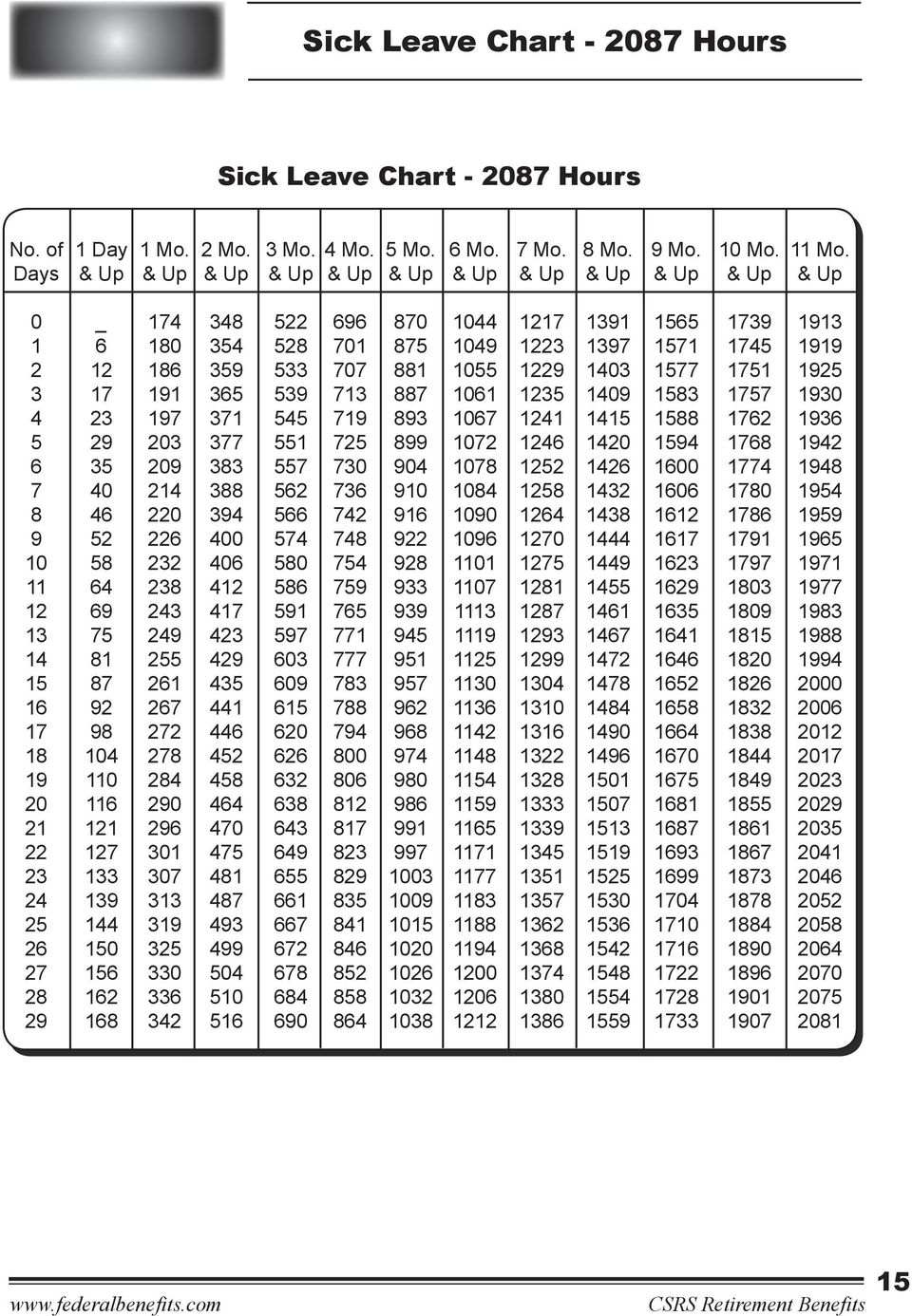
18 Unused Sick Leave Credit for Unused Sick Leave For CSRS Retirees Unused sick leave is not included for determining eligibility. Unused sick leave is added to length of service in computing the annuity benefit. Unused sick leave is credited only in immediate retirements. Unused sick leave is computed on the basis of a 2087 hour work year for most federal employees. Example Service : = 30 years - 4 months - 15 days USL 624 hours = 3 months - 18 days Total: = 30 years - 7 months - 33 days = 30 years - 8 months - 3 days = 30 years - 8 months 14
19 15 Sick Leave Chart Hours No. of Days Day & Up _ Mo. & Up Mo. & Up Mo. & Up Mo. & Up Mo. & Up Mo. & Up Mo. & Up Mo. & Up Mo. & Up Mo. & Up Mo. & Up Sick Leave Chart Hours
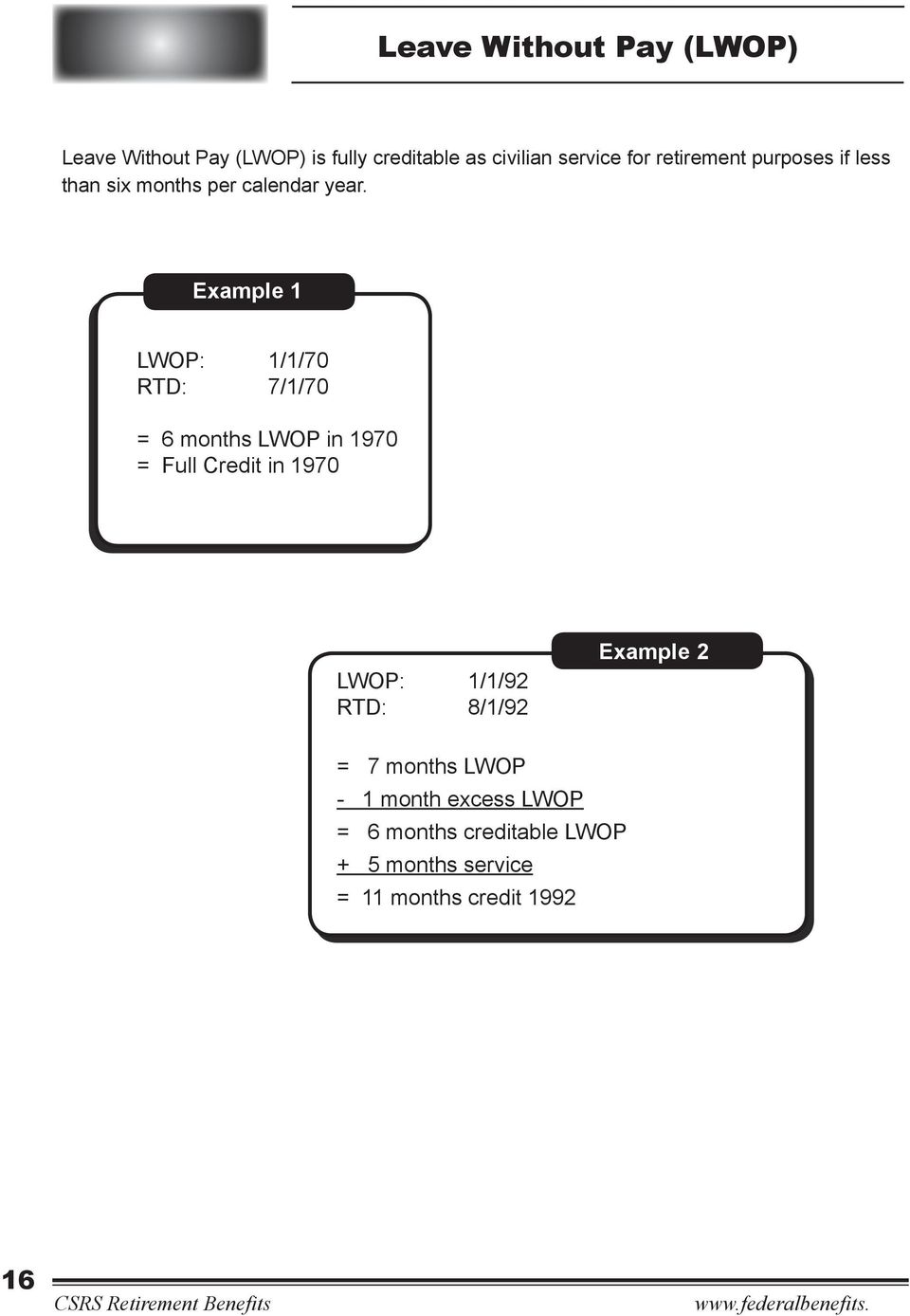
20 Leave Without Pay (LWOP) Leave Without Pay (LWOP) is fully creditable as civilian service for retirement purposes if less than six months per calendar year. Example 1 LWOP: 1/1/70 RTD: 7/1/70 = 6 months LWOP in 1970 = Full Credit in 1970 LWOP: 1/1/92 RTD: 8/1/92 Example 2 = 7 months LWOP - 1 month excess LWOP = 6 months creditable LWOP + 5 months service = 11 months credit
21 Maximum Annuity The maximum annuity benefit is 80% of the High-3 based on service. 41 years and 11 months of service earns the maximum annuity of 80%. (35 years under the Law Enforcement or Firefighter calculation earns the 80% maximum.) Unused sick leave is credited in addition to the 80% maximum. Excess CSRS contributions are refunded to the annuitant, less any deposits or redeposits required for prior service periods. Example 45 years of service = 80% 2 years of USL = +4% = 84% of high-3 average salary Retiring December 2013: High-3 average salary = December December 2013 Maximum annuity: 41 years 11 months Maximum service date: November
22 Part -Time Service Part-time Service is service with a pre-arranged, regularly scheduled tour of duty which is less than full-time. Computation of CSRS Annuity involving part-time service on or after 4/7/86: Full credit is granted for part-time service in determining eligibility for retirement. The retirement benefit is reduced for part-time service after 4/6/86 by a ratio of the number of part-time hours to the number of hours the employee would have worked had the employee worked full-time. Two computations must be performed in computing the annuity of an employee whose service includes part-time employment on or after 4/7/86. Computation #1: (Pre-4/7/86 annuity) Deemed full-time salary rates for the high-3 years average salary and full-time credit for service through 4/6/86 plus credit for unused sick leave are used in computing the annuity under the General Formula. Prior to October 28, 2009, actual salary rates (part-time or full-time) were used in the pre- 4/7//86 calculation, regardless of the tours of duty worked during that time. The National Defense Authorization Act of 2010 requires that full-time deemed salary rates be used in the pre-4/7/86 calculation. Computation #2: (Post 4/6/86 annuity) Deemed full-time salary rates for service on or after 4/7/86 are used in computing the high- 3 average salary. This average salary is then multiplied by the appropriate % in the CSRS General Formula (1.5%, 1.75% or 2%) and full-time service factors. This figure is then multiplied by the ratio of post-4/6/86 hours worked (according to tour of duty) to the number of hours the employee would have worked had all post-4/6/86 service been full time. The results of the two computations are added together to obtain the basic annuity. 18
23 Reductions in Basic Annuity CSRS Reduction for Age Annuity is reduced 2% for each year retiree is under age 55, 1/6 percent for each full month under age 55. Age Reduction Example (VERA / DSR) þ Correct Age Reduction $50,000 average salary 25 years = 46.25% ave.sal. Age: 49 years 11 months 13 days (10% age reduction) ý Incorrect Age Reduction $50,000 average salary 25 years = 46.25% ave.sal. 10 % age reduction Calculate Basic Annuity: Apply Age Reduction: $50,000 X.4625 $23,125/year $23,125 - $2,313 $20,812/year Calculate Reduced Annuity: 46.25% of average salary % age reduction 36.25% of average salary $50,000 X.3625 = $18,125/year Reduction for Unpaid Deposit Non-deduction service prior to 10/1/82 : Annuity is reduced by 10% of any unpaid deposit. Reduction to Provide Survivor Benefit CSRS Survivor Reduction = 2-1/2% of 1st $3600 of the survivor base plus 10% of the remainder of the survivor base. Reduction for Unpaid Redeposit (For refunds for service which ended before 10/1/90). Annuity is actuarially reduced for unpaid redeposit. 19
24 Survivor Benefits Regular Survivor Benefits Spouse Former Spouse Insurable Interest Survivor Benefits Spouse Former Spouse Insurable Interest Survivor (Financially dependent) Children s Survivor Benefits Children who are unmarried and Under age 18; Under age 22 if a full-time student; at any age if the child became disabled before age 18 Lump Sum Benefit Remaining retirement contributions, if any. Spouse Equity Act A qualifying court order may require OPM to apportion an annuity benefit between a retiree and a former spouse and / or provide survivor benefits to a former spouse upon the death of a retiree. For detailed information on court-awarded benefits for former spouses, please view the module on Court Orders. You may also refer to the CSRS and FERS Retirement Handbook for Personnel and Payroll Offices, Chapter 5, Court Orders, available on the OPM Web site, (Use the search engine. Search CSRS and FERS Retirement Handbook.) 20
25 Regular Survivor Benefits A retiring employee may elect to provide Regular Survivor Benefits for a spouse and/ or former spouse at time of retirement. In cases of divorce occurring after 5/7/85, the retiree may be required by court order, to provide regular survivor benefits to a former spouse. Amount of Election = Survivor Base The amount of money that the retiring employee elects to be used to determine the survivor benefit and the cost to the retiree to provide this benefit is called the survivor base. Full Survivor Benefits Partial Survivor Benefit Split Survivor Benefits No Survivor Benefit Survivor Receives The retiring employee may elect that All of his/her basic annuity be used as the survivor base. This is the maximum that can be used as the survivor base. The retiring employee may elect any dollar amount less than all of his/her basic annuity to be used as the survivor base. Notarized consent of current spouse is required. The retiring employee may elect that the current spouse and/or one or more former spouses each receive a survivor benefit provided that the total survivor base does not exceed the retiree s basic annuity. Notarized consent of current spouse is required. The retiree may elect to provide No Survivor Benefit Notarized consent of current spouse is required. In the event of the annuitant s death, the survivor receives 55% of the elected base, increased by any cost of living adjustments which have occurred since the date of the annuitant s retirement. Survivor Reduction Formula Cost to the Annuitant The retiree s annuity benefit is reduced to provide a regular survivor benefit according the following Survivor Reduction formula: Survivor Reduction + = 2-1/2% of first $3,600 base 10% of the remainder of base Annual reduction to provide survivor benefit 21
26 Example 1 Full Survivor Benefit $40,000 annuity Base: $40,000 Cost: 2-1/2 % of $3,600 = $ 90 10% of $36,400 = $3,640 TOTAL = $3,730 Survivor Receives 55% of Base 55% of $40,000 = $22,000 per year = $1,833 per month $40,000 per year ($3,333 per month) - $3,730 $36,270 per year ($3,022 per month) Example 2 Partial Survivor Benefit Base = $3,600 Base: $3,600 Cost: 2-1/2 % of $3,600 = $90 Survivor Receives: 55% of Base 55% of $3,600 = $1,980 per year = $ 165 per month $40,000 per year ($3,333 per month) - $90 $39,910 per year ($3,325 per month) Example 3 Select Dollar Base Base X.55 = Survivor Rate Base = Survivor Rate.55 $6, = $10,910 Base Cost: 2-1/2 % of $3,600 = $ % of $7,310 = $ 731 = $ 821 Survivor Receives: 55% of Base 55% of $10,910 = $6,000 per year = $ 500 per month $40,000 per year ($3,333 per month) -$ 821 $39,179 per year ($3,264 per month) 22
27 Federal Health Insurance For Surviving Spouse Health Benefits for the Surviving Spouse A surviving spouse will not be permitted to continue Federal Health Benefits upon the death of a retiree unless a survivor annuity is payable. Survivor Election Changes After Retirement Within 30 days after the date of the first regular monthly annuity payment, a retiree may name a new survivor or change the survivor election by filing a new election in writing. Within 18 months after the commencing date of the annuity, a retiree may elect a survivor annuity or increase the amount of the survivor annuity for a spouse by submitting the request for change in writing to OPM. A deposit representing the difference between the reduction for the new survivor election and the original survivor election, plus a charge of $ per thousand dollar change in survivor base, plus interest, is required. 23
28 Termination of Entitlement To Survivor Benefits Entitlement to survivor benefits terminates on the following events: Current Spouse Future Entitlement A current spouse future entitlement to survivor benefits is terminated by divorce or death. The reduction in the annuitant s rate to provide the survivor protection is removed and the annuitant s benefit is restored to the full rate, prospectively. Widows/Widowers Receipt of Benefit A widow s/widower s receipt of regular survivor benefits is terminated upon death or remarriage prior to age 55. Benefits are restored if that marriage later ends. Exception for remarriages occurring after January 1, 1995: If the widow or widower was married to the individual on whose service the survivor annuity is based for at least 30 years, remarries before age 55, the survivor annuity will not to be terminated. Former Spouse Future Entitlement A former spouse future entitlement to regular survivor benefits is terminated upon death or remarriage prior to age 55. The annuitant s benefit is restored to the full rate, prospectively. Entitlement is not restored to the former spouse if that marriage later ends. Former Spouse Receipt of Benefit A former spouse receipt of survivor benefits is terminated upon death or remarriage prior to age 55. Benefits are NOT restored if that marriage later ends. 24
29 Post Retirement Marriage A retiree who marries after retirement may elect regular survivor benefits for his/her postretirement spouse. The survivor election is optional. Spousal consent is not required. The election must be made within 2 years of the date of the marriage or within 2 years of the date of the former spouse s loss of entitlement to the regular survivor benefit. Elections Available Survivor elections available after retirement for new spouses are: 1) full survivor annuity; 2) partial survivor annuity; 3) no survivor annuity. Retroactive Survivor Reduction is Based Upon Actuarial Reduction An annuitant who retires on or after May 7, 1985 and elects to provide survivor benefits for a spouse whom he/she married after retirement will have his/her annuity reduced by the total amount by which his/her annuity would have been reduced if that election had been made at the time of retirement, plus 6 percent annual interest, divided by an actuarial factor, plus the continuing reduction in the annuity to provide survivor benefit. Any period of time during which the retiree s annuity was being reduced fully to provide a survivor benefit will not be included in the calculation of the reduction. Actuarial Reduction Monthly Reduction The monthly reduction for this retroactive survivor election is equal to: Retroactive reduction in annuity, plus 6% interest Actuarial Factor + The continuing reduction for survivor benefit 25
30 Insurable Interest Survivor Benefit Any retiring employee (regardless of marital status), in good health, may elect an insurable interest survivor benefit for any person who is financially dependent upon the retiree. Survivors The insurable interest survivor may be a spouse, a former spouse or anyone who is financially dependent upon the retiree. Amount of the Election The insurable interest benefit is based upon the retiree s full annuity. The retiree may not elect any other survivor base. Cost to the Annuitant The cost of an insurable interest benefit is based on the age difference between the retiree and the insurable interest survivor. Age of Insurable Interest Survivor in Relation to Age of Retiree Older or less than 5 years younger 5 but less than 10 years younger 10 but less than 15 years younger 15 but less than 20 years younger 20 but less than 25 years younger 25 but less than 30 years younger 30 or more years younger Reduction in Basic Annuity 10% 15% 20% 25% 30% 35% 40% Insurable Interest Survivor Receives In the event of the annuitant s death, the insurable interest survivor receives 55% of the retiree s commencing annuity after the reduction to provide the insurable interest survivor benefit, plus COLAs. Termination of Entitlement to the Insurable Interest Benefit The insurable interest survivor benefit will be terminated upon death of the insurable interest survivor, or on conversion of the benefit to a regular survivor annuity. If entitlement to insurable interest benefit terminates while the retiree is living, the retiree s annuity benefit will be restored to the full rate, prospectively. 26
31 Lump Sum Benefit Amount of the Lump Sum Benefit The balance of an employee s or annuitant s retirement contributions is payable as a lump sum benefit only if there is no spouse, former spouse, children or insurable interest survivor eligible for survivor benefits Order of Precedence The lump sum is payable under the following Order of Precedence: 1. Designated Beneficiary 2. Spouse 3. Child/Children in equal shares 4. Parents 5. Executor or administrator of estate 6. Next of Kin Designation of Beneficiary An SF 2808, Designation of Beneficiary, Civil Service Retirement System, can be completed by an employee, a former employee or a retiree to designate a beneficiary or beneficiaries of any lump sum amount payable upon his/her death. The designations described above should not be confused with designation forms used for other types of benefits, such as: Other Types of Designations SF 2823, Designation of Beneficiary, Federal Employees Group Life Insurance Program; SF 1152, Designation of Beneficiary, Unpaid Compensation of Deceased Civilian Employee; or TSP 3, Designation of Beneficiary, Federal Retirement Thrift Savings Plan. 27
32 Credit For Service Non-deduction Service Temporary Service Deposits Refunded Service Refunds / Redeposits New Redeposit Option (Actuarial Reduction) Military Service Creditable Military Service Documentation of Service Military Retirement Post-56 Military Deposits 28
33 Non-deduction / Deposit Service Non-deduction Service Deposit Contribution Rates Non-deduction service is service during which no Civil Service Retirement contributions were withheld from salary. The deposit is equal to the amount of money the employee would have contributed to the Civil Service Retirement System had he/she been covered by the CSR Act, plus interest : 6.5% 2000: 7.4% : 7% : 7.5% 1999: 7.25% 2003-present: 7% Non-deduction service performed before 10/1/82: 3% Interest If the non-deduction service was performed prior to 10/1/82: Interest is charged at the rate of 3% compounded annually. No interest is charged during periods of separation beginning before 10/1/56. If the deposit is NOT paid: Full credit is granted for the service for eligibility and computation purposes. The annual retirement benefit is reduced by 10% of the unpaid deposit. If a deposit IS paid: Full credit is granted for the service with no reduction in the annuity. Example 1: Non-deduction Service Performed Prior to 10/1/82 Alice, Age 55 $50,000 Average Salary : Temp Appt. (earned $14,285) : CSRS $1,000 Deposit + 3 % interest $2,600 Deposit Due Reduction in annuity: 10% of $2,600 = $260 per year = $22 per month 29
34 Non-deduction / Deposit Service (Continued) Non-deduction service performed on or after 10/1/82: Variable Interest If the non-deduction service was performed on or after 10/1/82: Interest is charged at the rate of 3% per year through 12/31/84 and at a variable interest rate beginning 1/1/85. If the deposit is NOT paid: Credit is granted for eligibility only. No credit is granted for the nondeduction service in the annuity computation. If the deposit IS paid: Full credit is granted for the service with no reduction in the annuity Variable Interest Rates 13.0% % 9.0% 8.375% 9.125% 8.75% 8.625% 8.125% 7.125% 6.250% 7.00% 6.875% 6.875% 6.75% Note: Variable interest accrues on December 31 of each year. 5.75% 5.875% 6.375% 5.5% 5.0% 3.875% 4.375% 4.125% 4.875% 4.375% 3.875% 3.125% 2.75% 2.25% 1.625% Example 2: Non-deduction Service Performed on or After 10/1/82 Betty, Age 55 $50,000 Average Salary CSRS Oct Oct. 1984: Temp Appt. (earned $15,000) : CSRS Offset $1,050 Deposit + variable interest $6,000 Deposit due Reduction in annuity: No credit for 1 year of service = 2% of average salary = 2% of $50,000 = $1,000 per year = $83 per month 30
35 Non-deduction / Deposit Service (Continued) Procedures for Payment of Deposit Personnel Office Estimates Agency Personnel Office can provide estimates of deposit due and annuity reductions. Employees May Submit Application to Make Deposit to OPM If more than 6 months from retirement date, an employee may obtain an Application to Make Deposit / Redeposit (SF 2803) from Personnel or Federal Forms. Employee completes the front and returns SF 2803 to Personnel. Agency Personnel office will complete form and forward to OPM. OPM will notify the employee of the amounts due. If both deposits and redeposits are involved, the employee should notify OPM that payment should be directed to deposits for non-deduction service before payment to redeposits. Employees May Submit Application to Make Deposit to OPM with Retirement Application If employee is within 6 months of retirement, send Application to Make Deposit / Redeposit (SF 2803) or a letter requesting information on amount of deposit due to OPM along with the retirement application. OPM will inform retiree of amount due, annuity rates with and without payment and procedures for payment. OPM Notifies Retiring Employees of Deposits for non-deduction service performed after September 30, 1982 OPM will send notification of any outstanding deposits for non-deduction service performed after September 30, 1982, describe the reduction in annuity and payment procedures prior to final processing of the annuity claim. 31
36 Refunded Service / Redeposit Service Refunded Service Refunded Service is Federal civilian service during which Civil Service Retirement contributions were withheld but later refunded to the employee. Redeposit Redeposit is repayment of the refund plus interest. Impact on Annuity The impact on the annuity depends upon the date that the refunded service ended. Actuarial Reduction (Refunded Service which ended before 3/1/91) If the refunded service ended before 3/1/1991 and the redeposit is not paid: Credit is granted for the service in calculating the annuity benefit. The annuity is actuarially reduced. Loss of Service (Refunded Service which ended on or after 3/1/91) If the refunded service ended on or after 3/1/1991 and the redeposit is not paid: Full credit is granted for the service in determining eligibility for retirement. No credit is granted for the refunded service in the computation of the annuity benefit. Interest The interest charged on redeposits depends upon the date that the application for refund was received by the employing agency or by the Office of Personnel Management before or after 10/1/82. Refund Prior to 10/1/82: 3% Interest Refund on or after 10/1/82: Variable Interest 32
37 Refunded Service / Redeposit Service (Continued) Refunded Service Ended Before 3/1/91: Actuarial Reduction Credit is granted for the service in calculating the annuity benefit. The annuity is actuarially reduced, using the actuarial factors below. Monthly reduction = Redeposit due at retirement Actuarial factor Actuarial Factors (Annuities commencing on or after 10/1/2011) Age at Retirement Monthly Reduction Factor Refunded Service Ended on or After 3/1/91: If the Redeposit is not paid: Full credit is granted for the service in determining eligibility for retirement. No credit is granted for the refunded service in the computation of the annuity benefit. 33
38 Refund Prior to 10/1/82 Refund Prior to 10/1/82: 3% Interest If the application for refund was received by the agency or OPM prior to 10/1/82: Interest is charged at the rate of 3% compounded annually. No interest is charged during periods of separation beginning before 10/1/56. Example: Refund Prior to 10/1/82 (3% Interest) Albert, Age 55 $50,000 Average Salary CSRS $1,000 Refund + 3% interest CSRS $2,500 Redeposit due Reduction in annuity: $2, = $11 per month If the Redeposit is paid: Full credit is granted for the service for eligibility and computation purposes. 34
39 Refund on or After 10/1/82 Refund on or after 10/1/82 - Variable Interest If the application for refund was first received by the agency or OPM on or after 10/1/82: Interest is charged at the rate of 3% per year through 12/31/84 and at a variable interest rate beginning 1/1/ Variable Interest Rates 13.0% % 9.0% 8.375% 9.125% 8.75% 8.625% 8.125% 7.125% 6.250% 7.00% 6.875% 6.875% 6.75% Note: Variable interest accrues on December 31 of each year. 5.75% 5.875% 6.375% 5.5% 5.0% 3.875% 4.375% 4.125% 4.875% 4.375% 3.875% 3.125% 2.75% 2.25% 1.625% Example: Refund on or after 10/1/82: Variable Interest (Refunded service ended before 3/1/91) Barry, Age 55 $50,000 Average Salary CSRS $14,000 Refund + variable interest CSRS 69,000 Redeposit due Reduction in annuity: $69, = $299 per month If the Redeposit is paid: Full credit is granted for the service for eligibility and computation purposes. 35
40 Refunded Service Ended on or After 3/1/91 Refunded Service Ended on or After 3/1/91: If the Redeposit is not paid: Full credit is granted for the service in determining eligibility for retirement. No credit is granted for the refunded service in the computation of the annuity benefit. Example: Refunded service ended on or after 3/1/91 Charlie, Age 55 $50,000 Average Salary CSRS $18,000 Refund + variable interest $44,000 Redeposit due CSRS If the Redeposit is NOT paid: No credit is granted for in the computation of the annuity. Annuity is based upon 17 years ( ) = 30.25% of the high-3 average salary % of $50,000 = $15,125 per year. If the Redeposit IS paid: Full credit is granted for the service in the computation of the annuity. Annuity is based upon 33 years of service = 62.25% of the high-3 average salary % of $50,000 = $31,125 per year. Payment of $44,000 redeposit increases annuity $16,000 per year. 36
41 Procedures for Payment Notify Personnel Office of Outstanding Refunds Personnel Office can provide estimates of redeposit due and annuity reductions. OPM Notifies Retiring Employees of Redeposits OPM will automatically send notification of any outstanding redeposits, describe the reduction in annuity and payment procedures along with the first annuity statement. Employees May Submit Application to Make Redeposit to OPM Prior to Retirement If more than 6 months from retirement date, an employee may obtain an Application to make Deposit / Redeposit, SF 2803, from Personnel. This form is also available on gov. Go to Find Forms on the right hand side of the home page.. Employee completes the front and returns SF 2803 to Personnel. Agency Personnel office will complete form and forward to OPM. OPM will provide billing statement to employee. 37
42 Type of Service Retirement Credit Pre 10/1/82 Non-deduction Service Post 9/30/82 Non-deduction Service Pre 10/1/82 CSRS Refund Post 9/30/82 Pre 3/1/91 CSRS Refund Post 2/28/91 Refund CSRS Credit for Civilian Service List Dates of Service and Amount of Refund Calculation of Deposit/Redeposit Impact on Annuity if Payment is Not Made 7% (or 6.5%) of earnings plus 3% interest $ Annuity is reduced by 10% of unpaid deposit -$ /yr = -$ /mo 7% of earning plus variable interest. $ No credit for service in the annuity calculation Refund plus 3% interest. $ Annuity is actuarially reduced. - $ /month Refund plus variable interest. $ Annuity is actuarially reduced. - $ /month Refund plus variable interest. $ No credit for service in the annuity calculation. -$ /yr.= -$ /mo Procedures for Payment SF 2803 OPM SF 2803 OPM OPM will notify retirees or SF 2803 OPM OPM will notify retirees or SF 2803 OPM SF 2803 OPM 38
43 Military Service Creditable Military Service Documentation of Military Service Reference Active, honorable military service may be creditable towards CSRS retirement benefits. Creditable service may include: Service in military academies, Active duty in reserves, Reservists annual 15-day training camps or cruises (during nonfederal service) Service by NROTC students when ordered to active duty or training duty (including summer cruises) as members of the Naval or Marine Corps Reserve, Service by AROTC students after October 13, 1964 when ordered to active duty or training duty as members of the Army Reserves, Service in the National Guard if Under a call by the President, or pursuant orders issued under section 233(d) of Armed Forces Reserve Act of 1952; or pursuant to orders issued under title 10 of the ASCOT. (Agency must contact the State Adjutant General s Office for a determination of credit.) To document military service, contact your personnel office for Standard Form 180. Complete and mail to appropriate address on back of form. This form can also be downloaded from the National Archives Website: Chapter 22 of the CSRS and FERS Retirement Handbook lists the types of military service which are creditable. This Handbook is available via OPM Web site Search: CSRS and FERS Retirement Handbook. Military Retired Pay Career Military Retirement or Non-combat Disability Retirement The receipt of career military retirement or non-combat disability retirement bars the crediting of military service for CSRS retirement purposes. The employee may waive military retired pay to receive credit toward CSRS retirement. Request alternate retirement estimates based upon civilian service only and civilian and military service combined and payment of the post-56 deposit. Reserve Retirement or Combat-connected Disability Retirement Retirement credit is allowed if the retired pay is based on combat-connected disability retirement, or based on age and service in the Reserves (Chapter 67, Title 10, U.S.Code), without waiver of military retired pay. 39
44 Post-56 Military Service Credit Credit for Post-56 Military Service For Persons First Employed Under CSRS BEFORE 10/1/82 Post-56 Deposit is Paid Post-56 Deposit is NOT Paid If a deposit for post-56 military service is paid prior to retirement, post-56 military service (if otherwise creditable service) can be credited for Civil Service annuity purposes, regardless of Social Security entitlement. If a deposit for post-56 military service is not paid prior to retirement, no credit will be given for the post-56 military service in the Civil Service annuity computation IF and WHEN the annuitant becomes eligible for non-disability benefits from the Social Security Administration at age 62, or date of retirement, whichever is later. If the annuitant is eligible for Social Security benefits at retirement, no credit is granted for post-56 military service in the annuity computation. If the annuitant is not entitled to Social Security benefits at retirement, full credit is granted for post-56 military service in the annuity computation at retirement. If the annuitant later turns age 62 and becomes eligible for Social Security benefits, the annuity will be recomputed to eliminate credit for the post- 56 military service. Note: Post-56 military service will be included in determining eligibility for retirement, title, regardless of deposit and eligibility for Social Security benefits. Credit for Post-56 Military Service For Persons First Employed Under CSRS on or AFTER 10/1/82 Post-56 Deposit is NOT Paid If a deposit for post-56 military service is not made prior to retirement, post-56 military service cannot be credited for retirement eligibility or computation, regardless of entitlement to Social Security benefits. 40
45 Examples: Post-56 Military Service Credit Example 1: Joe did NOT pay his Post-56 Deposit + is eligible for SS * Age: 62 Military Service: Post-56 Deposit: Did NOT pay deposit Social Security: Eligible for Social Security. RESULT: No credit for post-56 military service is granted in CSRS annuity. If deposit were paid prior to retirement - Full credit is granted for military service for CSRS, regardless of entitlement to Social Security. Example 2: Joe did NOT pay his Post-56 Deposit + is NOT eligible for SS * Age: 62 Military Service: Post-56 Deposit: Did NOT pay deposit Social Security Not eligible for Social Security at age 62. RESULT: Full credit is granted for military service in the CSRS annuity, regardless of deposit If Joe later becomes eligible for Social Security (after retirement after age 62), he will continue to receive credit for military service in the CSRS annuity. Example 3: Jim did NOT pay his Post-56 Deposit * Age: Retires at age 55 Military Service: Post-56 Deposit: Did NOT pay deposit RESULT: Full credit is granted for military service at age 55. If Jim becomes eligible for Social Security at age 62, the annuity is recomputed to eliminate credit for the post-56 military service. Example 4: Jim PAID his Post-56 Deposit * Age: Retires at age 55 Military Service: Post-56 Deposit: PAID deposit RESULT: Full credit is granted for military service, regardless of entitlement to Social Security. * All examples first employed in CSRS prior 10/1/
46 CSRS Post-56 Military Deposits (Continued) Deposit Post-56 deposit = 7% of base pay earned during post-56 military service. Interest is charged at a variable rate set by the Department of the Treasury. Due to a temporary increase in civilian employee retirement deductions in 1999 and 2000, the military deposit for service in 1999 is 7.25% and the deposit for service in 2000 is 7.4%. Request year-by-year earnings for these years in your request for estimated base pay earnings. Interest The deposit is interest free until 10/1/85 or two years of first employment under the Civil Service Retirement System, if later. Interest accrues on the anniversary of the interest free period. No interest is charged if the deposit is paid in full by 9/30/86, or within 3 years of first employment under CSRS, whichever is later. Variable Interest Rates % % 9.0% 8.375% 9.125% 8.75% 8.625% 8.125% 7.125% 6.250% % 6.875% 6.875% 6.75% 5.75% 5.875% 6.375% 5.5% 5.0% 3.875% % 4.125% 4.875% 4.375% 3.875% 3.125% 2.75% 2.25% 1.625% Military Deposit While on LWOP Deposit is required only for periods not covered by civilian pay and retirement deductions. Employee must include documentation of their civilian pay with the application to pay the military deposit. Alternative Method for Calculating the Deposit: For employees on LWOP-US who return to civilian service after exercising their restoration rights, the amount of the deposit, before interest, cannot exceed the amount of civilian retirement deductions that would have been deducted for the employee s civilian pay had the employee not performed the military service. See Benefits Administration Letter , dated June 25, 2003, for a detailed discussion of this alternative method for calculating the deposit. ( Search BAL ) 42
47 Procedures for Payment Procedures for Payment of the Post-1956 Deposit: 1) Request Estimated Base Pay Earnings Obtain Request for Estimated Base Pay Earnings (RI 20-97) from your Personnel Office. This form is also available on - Find Forms : Retirement Information Forms. Send Request for Estimated Base Pay Earnings to the appropriate military pay center along with verification of military service. Addresses for military pay centers are provided in the link in the top paragraph of RI Open Miitary Earnings in the menu bar. Go to Estimated Earnings. Response will be sent directly to you in approximately 3 weeks. 2) Submit Earnings Estimate to Personnel Submit estimated earnings to your personnel office. Personnel will calculate the deposit due, plus interest. 3) Pay Deposit Before Retirement You may pay this deposit by check or by payroll deduction. All deposits must be made to the employing office prior to retirement. Fully paid deposits are not refundable. Example: Charles, Age 55 Average Salary = $50,000 Charles did not pay the military deposit of $ 6, years of military service years of civilian service = 35 years of total service = 66.25% of average salary = $33,125 per year = $2,760 per month If eligible for Social Security at age 62, the annuity is recomputed to eliminate credit for the four years of military service. 31 years of service = 58.25% of the average salary = $29,125 per year = $2427, per month = loss of $4,000 per year 43
48 Voluntary Contributions Program Voluntary contributions (VC) are optional payments to the Retirement fund made in addition to the regular CSRS contributions withheld from salary. Voluntary Contributions may be used to purchase additional annuity or as a savings / investment plan. Program Overview Employee Phase: After-tax Contributions. Employees may make after-tax contributions to a VC account. Tax-deferred Variable Interest. VC accounts earn tax-deferred, variable interest. Variable interest rates are determined annually by the Department of the Treasury. Retiree Phase: Refunds: Refunds may be paid directly to retiree or transferred to an IRA. Interest may also be transferred to the retiree s TSP account. Purchase Additional Annuity. The amount of additional annuity is based upon the account balance, the age of the retiree on date of separation and survivor election. 44
49 Employee Contributions to Voluntary Contribution Account Eligibility All employees covered by CSRS (including CSRS offset) may make voluntary contributions unless: 1. the employee received a refund of his/her retirement contributions and has not made a redeposit, or 2. the employee owes a deposit for civilian service during which no CSRS retirement contributions were withheld from salary, or 3. the employee previously received a refund of voluntary contributions and has not had a break in service of three days or more since the refund. Application to Make Voluntary Contributions To open a voluntary contributions account, submit a Standard Form 2804, Application to Make Voluntary Contributions to OPM. SF 2804 may be obtained in your personnel office. After the application is approved, OPM will assign an account number and send instructions for making deposits. Deposits Voluntary contributions may be made directly to OPM in $25.00 multiples (i.e. $25, $50, $ 75, etc.). Limitations Total voluntary contributions cannot exceed 10 percent of the total basic pay received during civilian Federal service. Interest Interest is paid on the voluntary contributions account at a variable interest rate set by the Department of Treasury. The 2013 variable interest rate is 1.625%. Tax-deferred The interest earned on the voluntary contributions account is taxdeferred. Employee Refund An employee may withdraw all voluntary contributions, plus interest, at any time, but will not be permitted to open another Voluntary Contributions account. 45
50 VC Annuity Purchase A retiring employee may elect to purchase additional annuity with the VC account or receive a lump sum refund of the VC account, plus interest. Purchase of Additional Annuity Voluntary contributions earn an additional lifetime annual retirement benefit in the amount of $ 7.00, plus an additional $.20 for each full year that the employee is over age 55 on date of retirement, for each $ 100 in the voluntary contributions account. Additional annuity earned from the voluntary contributions is taxed in the same manner as regular annuity payments. The retiring employee may also elect to provide a survivor annuity based upon the Voluntary Contribution account. The retiree s VC annuity is reduced based upon the age difference between the retiree and the selected survivor annuitant. If a survivor annuity is not elected at retirement, the balance of the VC account is paid as a lump sum upon the death of the retiree. Cost of Living Adjustments are not applied to the additional voluntary contributions annuity. Example: Additional Annuity $10,000 in Voluntary Contributions account Age 56 = $ 7.20 per year per $100 in VC account $720 per year = $ 60 per month No COLA May elect survivor annuity 46
51 Refund Upon Retirement A retiring employee may withdraw all voluntary contributions, plus interest, at any time before receiving additional annuity based on those contributions. Refunds Taxes A retiring employee may withdraw all voluntary contributions, plus interest, at any time before receiving additional annuity based on those contributions. Employees must apply for the refund of voluntary contributions. Note: Interest is paid on the VC account up to the date of separation. To avoid loss of interest, employees should submit the application for refund of VC account directly to OPM at least 60 days prior to retirement. The principle and the interest portion of refunded voluntary contributions can be rolled over to another eligible retirement plan, including an Individual Retirement Plan (IRA). However, if any portion of the interest is paid directly to the former employee, it will be subject to 20 percent income tax withholding. OPM will give the payee the opportunity to direct the payment, or portion of the payment, directly to the trustee of the IRA or other qualified retirement plan and avoid the 20 percent tax withholding. If not rolled over, any accrued interest on refunded voluntary contributions is taxable in the year in which the refund is received. The interest portion of a refund of a voluntary contributions account which is not rolled over to an IRA is also subject to an additional 10 % tax if the individual receives a refund prior to age 59 and ½ except upon separation from service at age 55 or older or payment on account of disability as defined by IRS (See IRS Pub. 575). Rollover Options The interest portion (taxable portion) of the VC refund may be: Paid directly to the retiree, Paid to an IRA, Roth IRA or Eligible Employer Plan Paid to the retiree s TSP account The contributions portion (after tax portion) of the VC refund may be: Paid to the retiree, or Paid to an IRA, Roth IRA or Eligible Employee Plan Additional Information Additional information on the Voluntary Contributions program is available in chapter 31 of the CSRS and FERS Retirement Handbook (opm.gov - Search CSRS and FERS Retirement Handbook). Please note: The information on transfers to IRA s provided in this chapter is outdated. Updated information on rollover options is provided on the Voluntary Contributions Election form RI (opm.gov - Find Forms). 47
52 Preparing for Retirement Documentation of Service Gross Annuity Estimates Review your own records. Review your Service Computation Date (SCD) Request and/or provide verification of undocumented service. Contact your Personnel Office to request an estimate of your annuity benefit. In many cases, one estimate is sufficient. You may manually compute your benefit using the General Formula and compare. NOTE: You may want alternate estimates if you: Are contemplating waiving your Military Retirement to receive credit for your military service in your CSRS benefit. Have received a refund of CSRS contributions and have not made a redeposit. Performed non-deduction service and have not made a deposit. Performed post-56 military service, have not made a deposit and will be entitled to Social Security benefits. Are undecided on your survivor election. Net Annuity Estimates Estimate your net annuity by subtracting the following from your gross monthly annuity estimate. Health benefits premiums FEGLI Life Insurance premiums and the cost for Postretirement Life Insurance Reduction Election. FEHB and FEGLI costs are provided on your annuity estimate. Federal and State income tax 48
53 Actions Necessary Waiving Military Retired Pay Send request to waive MRP to appropriate Military Finance Center at least 60 days prior to your retirement. Ask your Personnel Office to provide you with a sample letter. Send a copy of your request for waiver to OPM along with your retirement application. Paying Redeposit for Refunded Service No action is necessary. OPM will notify you of the amount due and your options for payment or electing an actuarially reduced annuity benefit with credit for payment and the annuity rates with and without credit for the refunded service. You will be given 30 days to make your election. You may pay this redeposit at any time during your career. Contact your Personnel Specialist for guidance. Paying Deposit for Non-Deduction Service Submit SF 2803, Application to Make Deposit or Redeposit along with your retirement application. OPM will notify you of the amount due and the annuity rates with an without payment prior to the final adjudication of your annuity. You will be given 30 days to pay the deposit in full. You may pay this deposit at any time during your career. Contact your Personnel Specialist for guidance. Paying a post-56 Military Deposit Post-56 military deposits must be made to your employing agency prior to the final processing of your retirement by OPM. Your agency may process the military deposit and forward it to OPM before OPM finalizes your retirement case. OPM will not accept post-56 military service deposits after retirement. You may pay this redeposit at any time during your career. Contact your Personnel Specialist for guidance. 49
54 Annuity Commencing Dates CSRS Annuity Commencing Date - Voluntary Retirements Optional (Voluntary) retirements commence on the first of the month following the month of separation or on the day following the last day of pay if you retire on the 1st, 2nd or 3rd day of the month. This means that the annuity commences on the 1st, 2nd, 3rd or 4th day of the month. Thus, you should plan your retirement for the last day of the month (or near the last day) or for the 1st, 2nd or 3rd of a month to avoid a gap in pay. Annuity Commencing Dates (Voluntary Retirements) Retire Annuity Commences The Check Date May 31 June 1 July 1 June 1 June 2 July 1 June 2 June 3 July 1 June 3 June 4 July 1 June 4 July 1 August 1 Disability and Discontinued Service Retirements Disability retirements and Discontinued Service (Involuntary) retirements commence the earlier of the day after separation or the day after last day of pay, and all eligibility requirements have been met. 50
55 Lump Sum Annual Leave Payment A lump sum payment for all accrued annual leave will be paid shortly after retirement by your employing agency. Under 5 U.S.C. 5551(a), the lump-sum payment is computed on the basis of the employee s rights at separation under all applicable laws and regulations existing at the time which would have affected his pay had he remained in the service for the period covered by the leave. If the employee is separated prior to a statutory pay increase but the period of projected leave extends beyond the effective date of the increase, the lump sum payment shall be adjusted to reflect the increased rate for any leave from the effective date of the pay increase. 51
56 Submitting Your Retirement Application Check with your Personnel Office for specific guidelines on how much notice your agency requires for preparing your retirement package. Select Retirement Date Retirement Application and Attachments Select your retirement date and confirm eligibility. Notify your Personnel Office of your plans to retire approximately 90 days prior to retirement. Obtain all necessary retirement application forms from your Personnel Office, which will include but is not limited to: Federal Forms Application for Immediate Retirement Election of Post-Retirement Basic Life Insurance Carefully, Read all information and instructions provided in the retirement package. Forms and Documents to be Attached to Your Retirement File Your Personnel Office will include the appropriate documents, such as: Designation of Beneficiary (if on file) Military discharge (if applicable) Records of post-56 military deposit Application to Make Deposit or Redeposit (if on file) Agency annuity estimates Life Insurance Elections 52
57 Submitting Your Retirement Application (Continued) Review Completed Application You will be asked to review the Agency Summary of Certified Service for completeness and accuracy. Review the entire retirement package for accuracy. File is sent to OPM The entire retirement package, along with your payroll records will be submitted to OPM for adjudication of your annuity. CSA # is issued When OPM s Retirement Operations Center in Boyers, Pennsylvania, receives the retirement file, they will send an acknowledgment letter and provide a Civil Service Annuity number (CSA number). Always refer to your CSA # when corresponding with OPM. Interim Payments Begin OPM reviews the retirement file for eligibility and authorizes recurring interim annuity payments ( special payments ) to provide the retiree with income until the retirement claim process is completed. Interim payments are generally about 75 percent of the regular monthly payments. An adjustment check is sent when the case is completed. Final Processing OPM provides retirees an Annuity Statement and other informational material concerning the individual s retirement benefit after the claim process is completed. 53
58 Cost of Living Adjustments ( COLA ) Effective Date Full Cost of Living Adjustment Prorated Cost of Living Adjustment in Year of Retirement Civil Service Cost of Living Adjustments begin the first year of retirement, effective December 1 and are reflected in the January 1 annuity payment. The full Cost of Living Adjustment is equal to the increase in the consumer price index. Partial Cost of Living Adjustments, prorated by the number of months prior to the COLA that the annuity commenced, are payable on annuities commencing 11 or fewer months prior to the COLA. A partial month is counted as a whole month in prorating. Example: The full 2012 Cost of Living Adjustment was 1.7%. A retiree whose annuity commenced on November 4, 2012 received 1/12 of the December 1, 2012 COLA. 1/12 of 1.7%, or 0.14% COLA was reflected in the January 1, 2013 annuity check. CSRS COLAs December 2011 December 1, 2010 December 1, 2009 December 1, 2008 December 1, 2007 December 1, 2006 December 1, 2005 December 1, 2004 December 1, 2003 December 1, 2002 December 1, 2001 December 1, % No COLA No COLA 5.8% 2.3% 3.3% 4.1% 2.7% 2.1% 1.4% 2.6% 3.5% December 2009 December 1, 1998 December 1, 1997 December 1, 1996 December 1, 1995 December 1, 1994* December 1, 1993* December 1, 1992* December 1, 1991 December 1, 1990 December 1, 1989 December 1, % 1.3% 2.9% 2.1% 2.9% 2.6% 2.8% 2.6% 3.0% 3.7% 5.4% 4.7% * Payment of COLA was delayed until March of the following year. 54
59 Alternative Annuity ( Lump Sum ) The Alternative Form of Annuity (Lump Sum Option) was eliminated in 1994 with one exception: Employees who separate on a non-disability retirement with a life-threatening medical condition remain eligible to elect the Lump Sum Alternative Form of Annuity option. An Alternative Form of Annuity (Lump Sum Option) is an option which provides an actuarially reduced annuity benefit plus a lump sum payment of an amount equal to all of the money that the employee has in the retirement fund on the date that he/she retires. Annuitants who are suffering from a life threatening affliction and retire on a non-disability retirement will receive the entire lump sum payment shortly after the alternative annuity election. Please see Chapter 53 of the CSRS and FERS Retirement Handbook or your personnel office for additional information if you become eligible to elect the Alternative Form of Annuity based on the exception listed above. Effect of Alternative Annuity on Survivor Benefit The survivor annuity is NOT reduced for alternative annuity election. The survivor annuity is based on the full annuity, prior to reduction for alternative annuity election. The survivor annuity may actually be higher in the case of an alternative annuity election, because all redeposits and deposits are deemed paid prior to the full annuity computation. 55
60 Federal Taxes on Civil Service Annuities Federal annuities commencing after 11/18/96 are subject to Federal Income taxation using the Simplified General Rule. Under this rule, each monthly annuity payment is made up of two parts: the tax-free part, which is a return of the contributions, and the taxable balance. The following discussion applies to annuities starting after Simplified General Rule In November 1988, IRS released the Simplified General Rule, also known as the Safe Harbor Method, for computing the tax-free and taxable portions of annuity payments. All employees retiring after November 18, 1996 must use the Simplified General Rule to calculate the tax free part of each annuity payment. Tax-Free Part of Annuity The tax-free part of the annuity is a specific dollar amount based on the commencing annuity rate. The tax-free part remains the same each year and does not increase with Cost of Living Adjustments. The cumulative tax-free annuity cannot exceed the total contributions. OPM Form 1099 R The taxable amount of your CSRS or FERS annuity is calculated using the Simplified General Rule and reported to you on Form 1099R. 56
61 Annuity Tax Calculations Calculation of Tax-Free Annuity Using the Simplified General Rule, the taxfree part of each annuity payment is equal to the investment in the contract (contributions in CSRS Fund), divided by a number based on your age provided below. (These factors may be used if you are not providing a survivor annuity.) If you are: 55 and under and over 160 Tax-Free Part of Annuity Payment = Divide cost by: Contributions in the Fund Number based on Age Example: 55 year old CSRS retiree / no survivor benefit CSRS Retiree, Age 55 $40,000 in Retirement Fund $40, = $111 per month tax free = $1,332 per year tax free 57
62 Annuity Tax Calculations (Continued) Calculation of Tax- Free Annuity with Survivor Benefits The Taxpayer Relief Act of 1997 created a new table for figuring the tax free amount if a survivor annuity has been provided. The table is based on the combined ages of the annuitant and the survivor annuitant and is effective with annuity start dates beginning after December 31, Combined age of annuitants Not more than to to to and over Divide cost by: Example: 55 year old CSRS retiree with survivor benefit CSRS Retiree, age 55 / Spouse, age 55 Combined ages = 110 $40,000 in CSRS Retirement Fund $40, = $98 per month tax free = $1,176 per year tax free 58
63 Income Tax Withholdings Exclusion Limit The total amount of annual income that you (or the survivor annuitant) can exclude over the years as a return of your cost may not exceed your total cost (contributions). Annuity payments you or your survivors receive after the total cost of the plan has been recovered are fully taxable. Deduction of Unrecovered Cost If the cost of your annuity has not been fully recovered at your (or the survivor annuitant s) death, a deduction is allowed for the unrecovered cost. The deduction is claimed on your (or your survivor s) final tax return as a miscellaneous itemized deduction (not subject to the 2%-of-adjustedgross-income limit). Federal Income Tax Withholding Federal income tax is withheld from your annuity as though you are married claiming three withholding allowances. You may submit a W-4 Federal Income Tax Withholding form to OPM along with your retirement application, or when OPM receives your application, they will send you an election form W-4P-A, to change your election. You may increase or decrease the amount of the monthly withholding or cancel tax withholding completely. You may also change Federal income tax withholding by calling State Tax Withholding If you wish to have State tax withheld from your annuity, contact OPM on to see if your State participates in the withholding program administered by OPM and to specify the monthly withholding amount. IRS Publications To obtain IRS publications: Call TAX-FORM, or: Access IRS Web site Request or download: IRS Pub. 721, Tax Guide to U.S. Civil Service Retirement Benefits (Simplified General Rule) 59
64 CSRS Offset Benefits Definition A Civil Service employee with at least five years of creditable civilian service who separates and returns to Federal service after 1983 after a break in service or a break in retirement coverage of one year or more returns as a Civil Service Offset employee. (Upon return from a break in service of 4 days or more, the employee also has a 6-month opportunity to transfer to the FERS system.) Civil Service Offset coverage also applies to employees hired before January 1, 1984, who acquired CSRS coverage for the first time after that date, and had at least 5 years of creditable service by January 1, Contribution Most CSRS Offset employees contribute 7% of salary toward retirement. Of this 7%, 6.2% is the Social Security tax, and the remaining.8% is contributed to the CSR Fund. If the salary exceeds the Social Security maximum taxable amount, the full 7% is contributed to the Civil Service Retirement Fund. Annuity Computation A CSRS Offset employee s annuity is computed using the CSRS General Formula, but the annuity payment is reduced (offset) when the retiree becomes eligible for Social Security benefits. The amount of the offset is the amount of Social Security benefit attributable to the employee s CSRS offset service. Reduction ( Offset ) The amount of the reduction, or offset, is the lesser of: 1. the difference between the total Social Security benefit payable to the employee for all Federal and non-federal employment and the amount of Social Security benefit payable when the Offset service is excluded (Non-WEP formula); or 2. the total Social Security benefit payable for all Federal and non-federal service (WEP Formula) multiplied by the number of years of Offset service divided by 40 (i.e. 8/40). 60
65 CSRS Offset Example # 1 CSRS Offset Example 1: Jack Service History: 9 years private SS 20 years CSRS Break in service > 1 year under SS 10 years CSRS Offset ($64,000 average salary) Age 58: CSRS = 30 years = 56.25% = $3,000 per month + COLA Age 62: CSRS = $3,200 per month Age 62: SS based upon 20 years = $900 per month SS based upon: 9 years before govt. service 1 year SS during break in service 10 years during offset years Reduction (Offset) in CSRS is LESSER of: 1) Total SS (20 years) $ Private SS (10 years) $300 = = Offset SS $600 2) Total SS (20 years) $500 (WEP) x Years Offset/40 = 10/40 = Offset SS $125 Age 58: CSRS = $3,000 + COLA Age 62: CSRS = $3,200 CSRS Offset: CSRS $3,200 - Offset - $125 = CSRS $3,075 + SS (WEP) +$500 = Total $3,575 Age 62: If not offset: CSRS $3,200 + SS +$135 (WEP) = Total $3,
66 CSRS Offset Example # 2 CSRS Offset Example 2: Karen Service History: 3 years private SS 15 years CSRS 4 years - Break in service = private SS 15 years CSRS Offset ($50,000 average salary) Age 55: CSRS = 30 years + 1 USL = 31 yrs. = 58.25% = $2,400 per month + COLA Age 62: CSRS = $2,800 Age 62: SS based upon 22 years = $915 per month SS based upon: 3 years before govt. service 4 years SS during break in service 15 years during offset years Reduction (Offset) in CSRS is LESSER of: 1) Total SS (22 years) $ Private SS (7 years) $0 = = Offset SS $915 2) Total SS (22 years) $600 (WEP) x Years Offset/40 = 15/40 = Offset SS $225 Age 55: CSRS = $2,400 + COLA Age 62: CSRS = $2,800 CSRS Offset: CSRS $2,800 - Offset - $225 = CSRS $2,575 + SS (WEP) +$600 = Total $3,175 Age 62: If not offset: CSRS $2,800 + SS 0 = Total $2,
67 CSRS Offset Example # 3 CSRS Offset Example 3: Larry Service History: 13 years private SS 8 years CSRS 14 years break in service = private SS 9 years CSRS Offset ($110,000 average salary) Age 62: CSRS = 17 years = 30.25% = $2,800 per month Age 62: SS based upon 36 years = $1,800 per month SS based upon: 13 years before govt. service 14 years during break in service 9 years during offset years Reduction (Offset) in CSRS is LESSER of: Total SS (36 years) $1, Private SS (27 years) $1,600 = = Offset SS $200 Total SS (36 years) $1,800 x Years Offset/40 = 9/40 = Offset SS $405 CSRS Offset CSRS $2,800 - Offset - $200 = CSRS $2,600 + SS +$1,800 = Total $4,400 Age 62: If not offset CSRS $2,800 + SS +$1,480 (WEP Benefit) Total $4,
68 CSRS Offset Provisions Offset Begins at Age 62 Social Security Earnings Limitation The Offset (reduction) will begin at age 62, or at earliest entitlement to Social Security, even if the retiree chooses not to apply for Social Security benefits until a later date. The CSRS annuity will be reduced based upon entitlement to Social Security, even if actual payments have been reduced to zero by the Social Security Earnings Limitation. Windfall Benefits Elimination Provision Government Pension Offset CSRS Offset does not exempt you from the Windfall Benefits Elimination Provision (WEP). The additional years of substantial Social Security Earnings may increase the benefit formula and thus lessen the impact of WEP. CSRS Offset employees are exempt from Government Pension Offset. Social Security spousal of former spouse benefits or Social Security Survivor benefits to which you may be entitled based upon spouse s work history will not be reduced by your CSRS retirement benefit. Social Security spousal benefits and survivor benefits will be reduced by the amount of your earned Social Security benefit as required by the Social Security Dual Entitlement Provision. CSRS Offset Survivor Benefits Social Security Benefit Estimates The CSRS Offset survivor benefit will be reduced in the same manner as the CSRS retirement benefit if the surviving spouse is eligible for Social Security survivor benefits. If the surviving spouse is not eligible fore Social Security survivor benefits because of Dual Entitlement or Government Pension Offset, there will be no reduction. You may estimate the amount of your Social Security benefit with and without the years of Offset service using the on-line calculator available on the Social Security web site. A record of earnings subject to Social Security is provided in the Earnings Statement and Benefit Estimate that is mailed to you annually. You may request an Earnings Statement by mailing SSA Form 7004 to Social Security Administration. You may request that an Earnings Statement be mailed to you on the Social Security web site
69 Flexible Spending Accounts The Federal Flexible Benefits Plan ( FedFlex ) enables eligible employees to pay for benefits with pre-tax dollars. Health Care Flexible Spending Accounts (HCFSA) Dependent Care Flexible Spending Accounts (DCFSA) Use or Lose Grace Period Open Seasons Benefits Elections & Information Employees may use pre-tax allotments to pay for certain health care expenses that are not covered under the FEHB plan - deductibles, copayments and services not generally covered such as dental care, and orthodontics. The maximum amount that an employee may set aside in 2013 for HCFSA is $2,500. The minimum amount is $250. Employees may use pre-tax allotments to pay for eligible dependent care expenses.the maximum amount that an employee may set aside in any tax year for DCFSA is $5,000. The minimum amount is $250. If an employee has not incurred enough eligible expenses during the Benefits Period (January 1 through December 31) to equal the annual amount contributed to the FSA(s), he/she will lose the balance remaining in the FSA account(s) when the Benefits Period ends. FSAFEDS has adopted the 2-1/2 month Grace Period which extends the Benefit Period from December 31 to March 15 of the following year. Par tic pants had additional time to incur expenses and avoid forfeiting funds. Open seasons to enroll in FSA FEDS coincide with FEHB open seasons and encompass January 1 through December 31 as the plan year. Participation is not automatic; employees must make an election each and every year. The benefit elections are irrevocable one the plan year has begun, unless the employee experiences a qualifying change in status event. There are two ways to enroll during the open season: Web based enrollment at Toll-free number FSAFEDS ( ). Additional information on FSAs is available on OPM s web site at
70 Flexible Spending Accounts Paperless Reimbursement The following FEHB Plans forward claims to FSAFEDS for services rendered to Paperless reimbursement enrollees or their eligible dependents. You must enroll in paperless re-imbursement each year during the Open Season. Plan Name APWU Aetna Blue Cross / Blue Shield Compass Rose Hth (ABP) Foreign Svc Benefit Plan GEHA Humana Mail Handlers M.D.IPA NALC SAMBA UnitedHealthcare FEP Blue Vision VSP Aetna Dental (FEDVIP) GEHA Dental (FEDVIP) Services/ Claims Covered Medical, Rx, Dental Medical, Rx, Dental, Vision Medical, Rx, Dental, Vision Medical, Rx, Dental, Vision Medical, Rx, Dental Medical, Rx, Dental, Vision Medical, Rx, Vision Medical, Rx, Dental, Vision Medical, Rx, Dental, Vision\\ Medical, Rx Medical, Rx, Dental, Vision Medical, Rx, Dental, Vision Vision Vision Dental Dental Services/ Claims NOT Forwarded Vision Denied Rx Routine Vision, Denied Rx Denied Rx Vision, Denied Rx Denied Rx Dental, Denied Rx Denied Rx Primary Care Physician, Lab, Radiology, Denied Rx Dental See FSAFEDS.com for details on services and claims covered by paperless reimbursement. 66
71 Telephone Numbers and Addresses Request General Retirement Information Refunds, Deposits & Redeposits Change of Address Questions regarding retirement, health benefits, life insurance coverage, and pay issues on current employees. Retirement Information Branch Toll free-1-88 US OPM RET ( ) (202) Request 1.To report change of address OPM Address OPM Attn: Change of Address P.O. Box 440 Boyers, PA To request or inquire about Federal and State income tax 3. To inquire about or change health benefits coverage 4. To report death of an annuitant 5. To report failure to receive the latest monthly annuity check (write NON-RECEIPT OF CHECK on envelope) 6. To ask any question about your annuity statement 7. To change or request information about designated beneficiary (for FEGLI or CSRS contributions) OPM Tax - Retirement P.O. Box 989 Washington, D.C OPM Health Insurance-Retirement P.O. Box (If during open season: P.O. Box 809) Washington, D.C OPM Retirement Operations Center Attn: Death Claims Section P.O. Box 45 Boyers, PA (or call ) OPM Attn: Check Loss P.O. Box 7815 Washington, D.C OPM Retirement Operations Center P.O. Box 45 Boyers, PA To inquire about any matter not listed above. 67
72 Additional Resources and Internet Highlights Please contact your personnel office or refer to the following internet sites for additional information. Retirement Benefits: CSRS and FERS Retirement Handbook for Personnel and Payroll Offices Use search engine - top of home page. See also Browse By Audience: Retirees and Families Insurance: Federal Employees Group Life Insurance Federal Employees Health Insurance Long-Term Care Insurance Thrift Savings Plan: Publications (Civilian Forms and Publications) Calculators Social Security Benefits: Resources: Your Social Security Statement Publications 68
73 Special Section State Tax Treatment Federal Alaska Florida Nevada States With No Personal Income Taxes 1 New Hampshire: Taxes interest/dividend income at 5% if it exceeds $2,400 (single) or $4,800 (couple). $1,200 exemption for residents age 65+. New Hampshire 1 South Dakota Tennessee 2 Texas washington Wyoming 2 Tennessee: Taxes certain interest/dividend income at 6% if it exceeds $1,250 (single) or $2,500 (couple). States Exempting Total Amount of Civil Service Annuities Alabama Hawaii Illinois kansas Kentucky 1 1 KeNTuCKy: amount attributable to service prior to January 1, 1998, is exempt. See below for taxation of annuities attributable to service on or after January 1, MiCHigan: Full exemption only applicable to taxpayers born before See below for taxation of federal (and other) pension income for taxpayers born 1946 and later. Louisiana Massachusetts Michigan 2 Mississippi New York North Carolina 3 Oregon 4 Pennsylvania Tennessee 3 NorTH Carolina: Annuities not taxed if the individual had five years of government service as of August 12, If otherwise, see below. 4 Oregon: Annuities of those who retired before October 1, 1991, are not taxed. Those who retired after October 1, 1991, are taxed only on that portion of the annuity attributable to government service after October 1, Other Exemptions NoTE: AGI=Adjusted Gross Income Csrs=Civil Service Retirement System Fers=Federal Employees Retirement System HH=Head of Household ira=individual Retirement Account MFJ=Married Filing Jointly MFS=Married Filing Separately QW=Qualified Widow(er) rr=railroad Retirement ss=social Security Alabama: SS is exempt. Income from defined-benefit pension plans is exempt. Arizona: $2,500 exclusion for federal, military, and Arizona state and local pension income. SS and RR are exempt. Additional personal exemption for all residents age 65+. Arkansas: Exempts up to $6,000 in federal civil service, military, instate and out-of-state state or local government, and private pension income. IRA distributions can be included as part of the exemption if the taxpayer is age 59-1/2+. SS and Tier 1 and Tier 2 RR benefits are exempt. Additional $23 exemption for residents age 65+. California: SS and RR are exempt. Additional $104 personal exemption for residents age 65+. Residents age 65+ with AGI below $66,391 who qualified as HH in 2010 or 2011 by providing a household for a qualifying individual who died during 2010 or 2011 may claim a tax credit of 2% of their income, up to a maximum of $1,251. All private and public pensions are taxed. Colorado: $20,000 pension/ annuity exemption for all taxpayers between the ages of 55 and 64. $24,000 pension/annuity exemption for all taxpayers age 65+. Connecticut: SS is exempt if federal AGI is $50,000 or less (if single 36 A P R
74 Tax Year Annuities or MFS), or $60,000 or less (if MFJ, HH or QW with dependent child). Exempts 50% of federally taxable military retirement pay. Delaware: Taxpayers age 60+ may exclude $12,500 of investment and qualified pension income (including out-of-state and federal government pensions), and qualify for an additional tax credit of $110. Taxpayers under age 60 may exclude $2,000. Taxpayers age 65+ (or blind) are entitled to an additional standard deduction of $2,500 (if not itemizing). Single or MFS taxpayers age 60+ as of December 31, 2011, or totally disabled, may exclude $2,000 if earned income is less than $2,500, and AGI is $10,000 or less. If MFJ and both spouses are age 60+ as of December 31, 2011, or totally disabled, may exclude $4,000 if earned income is less than $5,000, and AGI is $20,000 or less. SS and RR are exempt. District of Columbia: Taxpayers age 62+ may exclude $3,000 of military, federal and DC government pensions. For taxpayers age 62+, DC or federal government survivor benefits are exempt from DC tax. SS and Tier 1 RR are exempt. Georgia: Taxpayers who are age years, or permanently and totally disabled regardless of age, may exclude $35,000 of retirement income. For taxpayers age 65+, the retirement income tax exclusion is $65,000 in 2012, and will be $100,000 in 2013, $150,000 in 2014, $200,000 in 2015 and unlimited thereafter. Retirement income includes income from pensions and annuities, interest income, dividend income, net income from rental property, capital gains income and income from royalties. Up to $4,000 of the maximum allowable exclusion may be earned income. SS is exempt. Photo illustrations by Jim Richards This roundup of state tax treatment of federal annuities and other tax information was compiled by the NARFE Legislative Department. It is presented for informational purposes only and does not constitute professional tax advice. Please consult a tax professional for advice in preparing tax returns. The information also is available on the NARFE website, Hawaii: SS and Tier 1 RR benefits are exempt. Additional personal exemption of $1,040 per person age 65+. IdAHo: SS and RR are exempt. Retirement benefits deduction available for CSRS annuitants who established CSRS eligibility prior to 1984, who are age 65+, or 62+ and disabled, in the amount of $30,156 (if single) or $45,234 (MFJ) minus SS and RR received. Persons using MFS status are not eligible for the retirement benefits deduction. Add $1,150 to standard deduction if age 65+ and MFS, MFJ or QW; add $1,450 if age 65+ and single or HH. Illinois: SS and RR and income from any qualified employee benefit plan are exempt. Indiana: SS and RR benefits are exempt. Taxpayers age 60+ may exclude up to $5,000 of military retirement income. Taxpayers age 62+ may deduct up to $2,000 of a federal civil service annuity minus the total amount of any SS or RR benefits. Additional personal exemption of $1,000 or $1,500 if federal AGI is less than $40,000 for residents age 65+. May deduct from income premiums paid for long-term care insurance through the Indiana Partnership. Iowa: Taxpayers age 55+ may exclude up to $6,000 (if single) or $12,000 (if MFJ) of pension or annuity income, self-employed retirement plan income, deferred compensation, IRA benefits or other retirement plan benefit income (not including SS). 67% of federally taxable SS benefits are excluded. RR benefits are exempt but used to calculate amount of federally taxable SS benefits. Additional $20 personal exemption credit for those age 65+. kansas: RR, military, in-state/local pensions are exempt. SS is exempt if federal AGI is $75,000 or less; otherwise, only federally taxable benefits taxed. Additional $850 deduction for those age 65+. Kentucky: Federal civil service and military retirement annuities attributable to service prior to January 1, 1998, are excluded. Annuities attributable to service after January 1, 1998, are included as pension income, of which taxpayers may exclude up to $41,110. SS and RR benefits are exempt. Louisiana: SS is exempt. Federal annuities are exempt. In addition, persons age 65+ may exclude up to $6,000 of annual retirement income from their taxable income. Taxpayers MFJ and both age 65+ can each exclude up to $6,000 of annual retirement income. If only one spouse has retirement income, the total exclusion is limited to $6,000. maine: SS and RR are exempt. May deduct $6,000 of eligible pension income, including federal civil service annuity income, from federal AGI. Except for military income, the $6,000 deduction must be reduced for SS and RR benefits. Additional standard deductions: for individuals, $1,450 if age 65+; for MFS, MFJ or QW, $1,150 per spouse or person who is age 65+. Longterm care premiums are deductible. maryland: SS and RR are exempt. If age 65+, may exclude up to $27,100 in pension income, reduced by SS or RR benefits. Additional $1,000 exemption for residents age 65+. Additional $5,000 exemption for military retirement income received by an individual of any age or the surviving spouse or ex-spouse of the individual, if the individual was a member of an active or reserve component of the U.S. military, w w w. n A R f e. o r g 37
75 an active duty member of the commissioned corps of the Public Health Service, the National Oceanic and Atmospheric Administration, the Coast and Geodetic Survey, or a member of the Maryland National Guard. massachusetts: SS is exempt. Additional exemption of $700 for individuals age 65+. MiCHiGAn: For taxpayers born before 1946, SS, RR, military retirement annuity, and all state and federal pension income is exempt. Private pension income is exempt up to $47,842 (individual filers) or $91,684 (MFJ), reduced by the amount of any public pension deduction claimed. Also may deduct interest, dividends and capital gains up to $10,545 (individual filers) or $21,091 (MFJ). For taxpayers born in , before the taxpayer reaches age 67, public and private pension income is exempt only up to $20,000 (single) or $40,000 (MFJ), and no deduction is allowed for interest, dividends and capital gains. After reaching age 67, taxpayers born in will be allowed a $20,000 (single) or $40,000 (MFJ) subtraction against all income, but are ineligible for this income subtraction if claiming a military or Tier 2 RR pension exclusion. For taxpayers born in 1953 or later, SS, RR and military pensions are exempt. But there will be no public or private pension exemption or interest, dividends and capital gains exemption before the individual reaches age 67. Once 67, those taxpayers may elect either to exempt up to $20,000 (single) or $40,000 (MFJ) without any exemption for SS, RR or military retirement and no personal exemptions, or they may elect to exempt SS, military and RR and claim personal exemptions. Full details are available at www. michigan.gov/documents/taxes/tax_ Change_Summaries_-_Retirement _Exemptions_359799_7.pdf 38 a p r Minnesota: RR is exempt. SS is taxed as taxed on federal return. Mississippi: Qualified retirement income (including civil service annuities and SS) is exempt. Additional exemption of $1,500 for residents age 65+. Missouri: Taxpayers with AGI under $85,000 (single, HH, MFS, QW) or $100,000 (MFJ) may exempt the greater of $6,000 or 100% of any federal, state or local pension income, up to a maximum of $35,234 per taxpayer. Taxpayers with AGI under $25,000 (single, HH, QW) or $32,000 (MFJ) or $16,000 (MFS) may exempt $6,000 of private pension income. Taxpayers with AGI over these limits must reduce their private pension exemption dollar for dollar as income exceeds the limit. Taxpayers age 62+ or disabled with an AGI under $85,000 (single, HH, MFS, QW) or $100,000 (MFJ) may exempt 100% of the taxable amount of SS or SS disability benefits, but must reduce the exemption dollar for dollar as income exceeds the limit. Additional exemption (45%) for military pension income. Montana: Taxpayers with AGI under $31,920 may exclude $3,830 of pension income; for AGI above $31,920, the pension income exclusion is reduced $2 for every $1 of AGI above $31,920. RR benefits are exempt. Additional exemption of $2,240 if age 65+. Taxpayers age 65+ may exempt $800 of interest income reported as federal AGI or $1,600 if MFJ. Nebraska: Tier I and II RR benefits are exempt. New Jersey: Taxpayers age 62+ may exclude up to $10,000 (MFS), $15,000 (single) or $20,000 (MFJ) of pensions, annuities and IRA withdrawals, provided gross income is not over $100,000. In addition, taxpayers age 62+ with earned income (from wages, net business profits, distributive share of partnership income and net pro-rata share of S corporation income) of $3,000 or less, and with gross income not over $100,000, may exclude other nonpension retirement income up to the maximum exclusion amount. SS and RR benefits are exempt, reported as pension income. If ineligible for SS or RR, entitled to deduct an additional $3,000 (single, MFS) or $6,000 (MFJ, HH, QW). Military pensions are exempt. Additional $1,000 personal exemption for residents age 65+. If taxpayers can recover all civil service retirement contributions in the first three years, can use the three-year rule, in which annuities are not taxed until total employee contributions have been recovered. If not, must use the general rule method, in which a portion of annuity is excluded from taxation. New mexico: Taxpayers age 65+ or blind may qualify for additional exemption of $8,000 if federal AGI is less than $15,000 (MFS), $18,000 (single) or $30,000 (MFJ, HH, QW). The exemption reduces as income increases, with no exemption if income is over $25,500 (MFS), $28,500 (single) or $51,000 (MFJ). RR is exempt. If age 100+, exempt from state income tax but only if centenarian cannot be claimed as a dependent by someone else. New york: State and federal pensions exempt completely. An additional pension and annuity income exclusion of up to $20,000 is available to persons age 59-1/2+ as of January 1, SS and RR are exempt. NortH Carolina: Pursuant to the North Carolina Supreme Court s decision in Bailey v. State of North Carolina, the state may not tax certain retirement benefits received by federal civil service and military retirees or retirees of the state of North Carolina and its local governments, if the retiree has five or more years of creditable service as of August 12, If retirees in those categories did not have five years of service as of August 12, 1989,
76 Tax Year they may deduct the amount included in federal taxable income or $4,000, whichever is less. This deduction also applies to retirement benefits paid to former teachers and state employees of other states and their political subdivisions regardless of the five-year service date. If MFJ and both spouses received federal, state or local government retirement benefits, each may deduct up to a maximum of $4,000. If an individual s federal taxable income includes retirement benefits from a private retirement plan, a deduction of up to $2,000 may be available. If an individual received both government and private retirement benefits, the maximum deduction is the total amount included in federal taxable income or $4,000, whichever is less. NortH dakota: RR is exempt. May exclude 30% of net long-term capital gains and qualified dividends. ohio: SS and RR are exempt. General retirement income credit available in an amount starting at $25, if qualifying retirement income is at least $500, and maxing out at $200, if qualifying retirement income is $8,000 or more. Residents age 65+ are entitled to a $50 tax credit per return. Military pension income is exempt. Taxpayers who served in the military and receive a federal civil service retirement pension are eligible for a limited deduction if any portion of their federal retirement pay is based on credit for their military service. These retirees can deduct the percentage (in terms of years of service) of the amount of their federal retirement pay that is attributable to their military service. OklAHoma: Each individual may exclude 100% of retirement benefits received from federal CSRS, including survivor benefits, paid in lieu of Social Security to the extent that these benefits are included in the federal AGI. Note: Retirement benefits paid under FERS do not qualify for this exclusion. However, for retirement benefits containing both a FERS and a CSRS component, the CSRS component will qualify for the exclusion. Individuals may exclude their FERS retirement benefits or Oklahoma state employment retirement benefits up to $10,000. Individuals may exclude the greater of 75% of their military retirement benefits or $10,000. SS is exempt. Oregon: Taxpayers age 62+ may qualify for retirement income credit (see worksheet regarding line 34) or elderly tax credit (40% of federal credit), but may not claim both. SS and RR benefits are exempt. Additional standard deduction if age 65+ of $1,200 (single, HH), $1,000 each spouse age 65+ (MFJ, MFS and QW). Pennsylvania: Retirement income is not taxed after age 59-1/2. rhode Island: RR is exempt. SoutH Carolina: If below age 65, may deduct $3,000 of qualified retirement income. If age 65+, may deduct $10,000 of qualified retirement income. All individuals age 65+ are entitled to a $15,000 deduction from income, reduced by any deduction claimed for qualified retirement income. SS and RR are exempt. Tennessee: Tax applies only to certain interest and dividend income, not wages and salary or pension income. Any person age 65+ is taxexempt if total annual income, from any and all sources, is $26,200 or less, or $37,000 or less for joint filers. UtAH: Taxpayers age 65+ may be entitled to a retirement credit of up to $450 ($900 MFJ), which is phased out at income levels of $16,000 (MFS), $25,000 (single) and $32,000 (MFJ). Taxpayers under age 65, born before January 1, 1953, and with eligible retirement income may qualify for a credit up to 6% of eligible retirement income with a cap of $288, which is phased out starting at income levels of $16,000 (MFS), $25,000 (single) and $32,000 (MFJ). Vermont: RR is exempt. Virginia: Taxpayers age 65+ whose birthdate is on or before January 1, 1939, may claim an age deduction of $12,000 (available for each person or spouse if MFJ). If birthdate is on or between January 2, 1939, and January 1, 1948, the $12,000 age deduction is reduced by $1 for every $1 that adjusted federal AGI exceeds $50,000 (single) or $75,000 (MFJ, MFS). SS and Tier I RR benefits are exempt. Additional personal exemption of $800 if age 65+ or blind. Long-term care premiums are eligible for deduction. West virginia: $2,000 of military, federal civil service and state pensions are exempt. Taxpayers age 65+ or surviving spouses may exclude the first $8,000 each of any income. Additional modification for military pension income for the first $20,000. RR is exempt. Wisconsin: Federal civil service retirement payments are exempt from state income tax if: 1) individual retired from the system before January 1, 1964; 2) individual was a member of the system as of December 31, 1963, retiring at a later date and the payments received are from an account established before 1964; or 3) individual is receiving payments from the system as a beneficiary (survivor) of an individual who met condition 1 or 2. If age 65+, may exempt up to $5,000 of retirement income if federal AGI is less than $15,000 or $30,000 (MFJ). Additional personal exemption of $250 if age 65+. SS and RR benefits are exempt. Military retirement pay and retirement pay related to service with the Coast Guard, the commissioned corps of the National Oceanic and Atmospheric Administration or the commissioned corps of the Public Health Service are exempt. w w w. n A R f e. o r g 39
FERS Retirement Benefits. Insurance Programs. Thrift Savings Plan. Social Security Benefits. CSRS / FERS Transfer Retirement Benefits
 Retirement Planning for FERS and FERS Transfer Employees FERS Retirement Benefits Insurance Programs Thrift Savings Plan Social Security Benefits CSRS / FERS Transfer Retirement Benefits Financial Planning
CIVIL SERVICE RETIREMENT SYSTEM
 CIVIL SERVICE RETIREMENT SYSTEM CSRS ELIGIBILITY TYPES OF RETIREMENT: AGE YEARS OF SERVICE OPTIONAL 55 30** 60 20 62 5 DISABILITY ANY 5 DEFERRED 62 5 EARLY OPTIONAL 50 20* (Agencies must have approval
. -,". ... -. 1 -.. Understanding Your Retirement Benefits. Making the Right Decisions. r ;.-.. r... - - - Civil Service Retirement System (CSRS) --.
 ..-;r...!!!!!!!!!!!!!!!!!!!!!!!!!!!!!!!!!!!!!!!!!!!!!!!!!!!!!!!!!!!!!!!!!!!!!!!!!!!!!!!!!!!!!!!!!!!!!!!!!!!!!!!!!!!!!!!!!!!!!!!!!!!!!!!!!!!!!!!!!!!!!!!!!!!!!!!!!!!!!!!!!!!!!!!!!!!!!!!!!!!!!!!!!!!!!!!!!!!!!!!!!!!!!!!!!!!!!!!!!!!!!!!!!!!!!!!!!!!!!!!!!!!!!!!!!!!!!!!!!!!!!!!!!!i
CSRS Spouse Benefits - Death of an Employee FERS i Chapter 70
 CSRS Spouse Benefits - Death of an Employee FERS i Table of Contents Subchapter 70A CSRS Part 70A1 General Information Section 70A1.1-1 Overview... 1 A. Introduction... 1 B. Topics Covered... 1 C. Organization
U.S. ARMY NAF EMPLOYEE RETIREMENT PLAN
 U.S. ARMY NAF EMPLOYEE RETIREMENT PLAN March 2014 INTRODUCTION This booklet is published by the U.S. Army NAF Employee Benefits Office. It is intended to provide you with useful information about the U.S.
CSRS Alternative Annuity Elections FERS Chapter 53
 CSRS Alternative Annuity Elections FERS i Table of Contents Subchapter 53A CSRS... 1 Part 53A1 General Information... 1 Section 53A1.1-1 Overview... 1 A. Introduction... 1 B. Topics Covered... 1 C. Organization
Use this update notice to find out about changes, which were published in the Postal Bulletin, that have occurred since the last printed version.
 Update Notice Handbook EL-502, CSRS Retirement Guide February 2005 Handbook EL-502, CSRS Retirement Guide, was last printed in February 2005. To inform you of changes since that time, we periodically update
Retirement Facts 1. Civil Service Retirement System
 CSRS Civil Service Retirement System Retirement Facts 1 Civil Service Retirement System United States Office of Personnel Management Retirement and Insurance Service March 1995 edition is usable RI 83-1
CSRS Computation of Annuity FERS Under the General Formula Chapter 50
 CSRS Computation of Annuity FERS i Table of Contents Subchapter 50A CSRS Part 50A General Information Section 50A1.1-1 Overview... 1 A. Introduction... 1 B. Topics Covered... 1 C. Organization of Subchapter...
7/15/2015. Injured Workers Retirement Options. Objectives. Retirement System Overview
 Injured Workers Retirement Options NICOLE KELSCH WORKERS COMPENSATION PROGRAM MANAGER NORTH FLORIDA/SOUTH GEORGIA VETERANS HEALTH SYSTEM Objectives Identify retirement options to determine eligibility
Federal Employees Retirement System. FERS Facts 1. Information for Separating FERS Employees Who Are Not Eligible for an Immediate Annuity
 FERS Federal Employees Retirement System FERS Facts 1 Information for Separating FERS Employees Who Are Not Eligible for an Immediate Annuity United States Office of Personnel Management Retirement and
3 FAM 6180 COMPUTATION OF BENEFITS UNDER FSRDS, FSRDS OFFSET AND FSPS
 3 FAM 6180 COMPUTATION OF BENEFITS UNDER FSRDS, FSRDS OFFSET AND FSPS (Office of Origin: HR/RET) 3 FAM 6181 HIGH-THREE AVERAGE SALARY An annuity under the Foreign Service Retirement and Disability System
Civil Service Retirement System. Retirement Facts 5. Survivor Benefits Under the Civil Service Retirement System
 CSRS Civil Service Retirement System Retirement Facts 5 Survivor Benefits Under the Civil Service Retirement System United States Office of Personnel Management Retirement and Insurance Service The September
Retirement Facts 5. Survivor Benefits Under the Civil Service Retirement System
 Retirement Facts 5 Survivor Benefits Under the Civil Service Retirement System This is a non-technical summary of the laws and regulations on the subject. It should not be relied upon as a sole source
Retirement Facts 10. Voluntary Contributions Under the Civil Service Retirement System
 Retirement Facts 10 Voluntary Under the Civil Service Retirement System This is a non-technical summary of the laws and regulations on the subject. It should not be relied upon as a sole source of information.
Applying for Immediate Retirement Under the Federal Employees Retirement System
 Applying for Immediate Retirement Under the Federal Employees Retirement System Do not use this pamphlet, or form SF 3107, FERS Application for Immediate Retirement, if you are applying for a deferred
TSA HRAccess -- Survivor Benefits for Employee Death-in-Service
 The table below provides an overview of the benefits that may be payable or available to beneficiaries when a TSA employee dies. The table is an outline and should be read in conjunction with applicable
FERS. Federal Employees Retirement System System. (An Overview of Your Benefits) (An Overview of Your Benefits) Insurance. Office of.
 FERS Federal Employees Retirement System System (An Overview of Your Benefits) (An Overview of Your Benefits) United States Office of Personnel Management Previous edition is usable. Retirement and Insurance
Applying for Immediate Retirement Under the. Federal Employees. Retirement System
 FERS Federal Employees Retirement System Applying for Immediate Retirement Under the Federal Employees Retirement System This pamphlet is for you if you are currently a Federal employee covered by the
Civil Service Retirement System. Retirement Facts 10. Voluntary Contributions Under the Civil Service Retirement System
 CSRS Civil Service Retirement System Retirement Facts 10 Voluntary Contributions Under the Civil Service Retirement System United States Office of Personnel Management Retirement and Insurance Service
FERS Facts 1. Information for Separating FERS Employees Who Are Not Eligible for an Immediate Annuity
 FERS Facts 1 Information for Separating FERS Employees Who Are Not Eligible for an Immediate Annuity This is a non-technical summary of the laws and regulations on the subject. It should not be relied
Understanding Your Retirement Benefits. Making the Right Decisions
 I I 1. Understanding Your Retirement Benefits Making the Right Decisions Federal Employees Retirement System (FERS) TABLE OF CONTENTS TOPICS PAGE Introduction and Legal Basis and Retirement And Disability
EMPLOYEE HANDOUT MILITARY SERVICE AND RETIREMENT
 MILITARY SERVICE AND RETIREMENT Persons First Employed Under the Civil Service Retirement System BEFORE 10-1-82 If You Will Be: Your Choices: Effect on Your Annuity: Eligible for Social Security benefits
2014 Retirement Planning Checklists
 2014 Retirement Planning Checklists www.feddesk.com FREE Federal & Military Guides Since 2002 2014 Retirement Planning Checklists Published by Feddesk.com FREE Federal and Military Guides Since 2002 www.feddesk.com
Court-Ordered Benefits for Former Spouses
 Court-Ordered Benefits for Former Spouses Civil Service Retirement System Federal Employees Retirement System Federal Employees Group Life Insurance Federal Employees Health Benefits RI 84-1 Revised July
District of Columbia Judges. Retirement Plan
 District of Columbia Judges Retirement Plan Summary Plan Description 2008 JUDGES_COV_10-5-08.indd 1 10/6/08 7:27:13 AM Summary Plan Description 2008 This booklet is a Summary Plan Description of the benefits
CSRS Planning and Applying for Retirement FERS i Chapter 40
 CSRS Planning and Applying for Retirement FERS i Table of Contents Subchapter 40A CSRS and FERS Part 40A1 General Information Section 40A1.1-1 Overview... 1 A. Introduction... 1 B. Topics Covered... 2
Applying for Death Benefits Under the Federal Employees Retirement System
 Applying for Death Benefits Under the Federal Employees Retirement System United States Office of Personnel Management Retirement & Insurance Service Theodore Roosevelt Building 1900 E Street, NW Washington,
Retirement Facts 7. Computing Retirement Benefits Under the Civil Service Retirement System
 Retirement Facts 7 Computing Retirement Benefits Under the Civil Service Retirement System This is a non-technical summary of the laws and regulations on the subject. It should not be relied upon as a
Civil Service Retirement System. Retirement Facts 7. Computing Retirement Benefits Under the Civil Service Retirement System
 CSRS Civil Service Retirement System Retirement Facts 7 Computing Retirement Benefits Under the Civil Service Retirement System United States Office of Personnel Management Retirement and Insurance Service
Federal Payments That May be Available to Federal Employees and Their Families When Employees are Injured or Die on the Job
 Federal Payments That May be Available to Federal Employees and Their Families When Employees are Injured or Die on the Job Retirement & Insurance Service Theodore Roosevelt Building 1900 E Street, NW
Work-Related Injuries and Fatalities What You and Your Family Need to Know About Your Benefits
 Work-Related Injuries and Fatalities What You and Your Family Need to Know About Your Benefits RI 84-2 Revised December 2008 Previous editions are not usable. Additional retirement information and all
District of Columbia Teachers Retirement Plan Summary Plan Description 2007
 District of Columbia Teachers Retirement Plan Summary Plan Description 2007 This booklet is a Summary Plan Description of the benefits provided to you under the District of Columbia Teachers Retirement
Court-ordered Benefits for Former Spouses Under CSRS, FERS, FEHB, and FEGLI
 Court-ordered Benefits for Former Spouses Under CSRS, FERS, FEHB, and FEGLI The information in this publication is a non-technical summary of the relevant laws and regulations dealing with the subject.
District of Columbia Teachers Retirement Plan
 District of Columbia Teachers Retirement Plan SUMMARY PLAN DESCRIPTION 2012 District of Columbia Teachers Retirement Plan Summary Plan Description This booklet is a Summary Plan Description (SPD) of the
Important Notice. Lump Sum Benefits Chapter 75
 CSRS FERS Lump Sum Benefits Important Notice On June 26, 2013, the Supreme Court ruled that Section 3 of the Defense of Marriage Act (DOMA) is unconstitutional. As a result of the Supreme Court s decision,
FREQUENTLY ASKED QUESTIONS REDEPOSIT SERVICE
 FREQUENTLY ASKED QUESTIONS REDEPOSIT SERVICE What Is Redeposit Service? As employees, we contribute to either the Civil Service Retirement System (CSRS) or the Federal Employees Retirement System (FERS)
CSRS Creditable Military Service FERS Chapter 22
 CSRS Creditable Military Service FERS i Table of Contents Subchapter 22A CSRS Part 22A1 General Information Section 22A1.1-1 Overview... 1 A. Introduction... 1 B. Topics Covered... 1 C. Organization of
for Work-Related Injuries and Disease Chapter 102 Table of Contents SUBCHAPTER 102A CSRS AND FERS... 1
 CSRS Relationship Between Retirement Annuity and Compensation FERS i Table of Contents SUBCHAPTER 102A CSRS AND FERS... 1 Part 102A1 General Information... 1 Section 100A1.1-1 Overview... 1 A. Introduction...
Frequently Asked Questions Regarding Deposit Service
 Frequently Asked Questions Regarding Deposit Service What Is Deposit Service? Although you may be covered under the Civil Service Retirement System (CSRS) or the Federal Employees' Retirement System (FERS)
Retirement Facts 12. Information About Reemployment for CSRS Annuitants
 Retirement Facts 12 Information About Reemployment for CSRS Annuitants This is a non-technical summary of the laws and regulations on the subject. It should not be relied upon as a sole source of information.
Survivor Benefits for Families of Civilian Federal Employees and Retirees
 Order Code RS21029 Updated April 17, 2008 Survivor Benefits for Families of Civilian Federal Employees and Retirees Summary Patrick Purcell Specialist in Social Legislation Domestic Social Policy Division
Your Pension Benefits from The City of Atlanta and The Atlanta Board of Education
 Rev. 12/05 Your Pension Benefits from The City of Atlanta and The Atlanta Board of Education Summary Plan Description for the General Employees Pension Plan Police Officer s Pension Plan Firefighter s
Planning for Retirement
 Planning for Retirement We at the Army Benefits Center Civilian (ABC-C) understand that retirement is a very important topic and the information contained in this document should not negate your need to
IRS Federal Income Tax Publications provided by efile.com
 IRS Federal Income Tax Publications provided by efile.com This publication should serve as a relevant source for up to date tax answers to your tax questions. Unlike most tax forms, many tax publications
Civil Service Retirement System. Retirement Facts 12. Information About Reemployment for Civil Service Retirement System Annuitants
 CSRS Civil Service Retirement System Retirement Facts 12 Information About Reemployment for Civil Service Retirement System Annuitants United States Office of Personnel Management Retirement and Insurance
Thrift Savings Plan. Plan Overview. Investment Options. Contribution Limits. Withdrawal Options
 Plan Overview Investment Options Contribution Limits Withdrawal Options (TSP) Contents Investment Options... Life Cycle Funds... TSP Contributions - Tax Treatment... Agency Contributions... Over 50 Catch-up
Information for Annuitants Civil Service Retirement System (CSRS)
 Information for Annuitants Civil Service Retirement System (CSRS) This pamphlet answers the questions most frequently asked by Civil Service Retirement System annuitants. Table of Contents Page How to
THE FEDERAL CIVIL SERVICE RETIREMENT SYSTEM
 THE FEDERAL IVIL SERVIE RETIREMENT SYSTEM Prepared for Louisiana ooperative Extension Service Employees ONTENTS SETION I: Your Retirement System Introduction... 3 Eligibility Requirements for Retirement...
2015 Federal Employee s Benefits & Survivor Guide
 Civil Service Retirement System & Civil Service Retirement System Offset 2015 Federal Employee s Benefits & Survivor Guide Benefits & Payroll Liaison Branch Bldg. 31/Rm. B3C23 301 496 4556 TABLE OF CONTENTS
Summary of Bene its BENEFITS 9/10
 Summary of Bene its BENEFITS 9/10 Information and data throughout this booklet regarding federal benefits are based on information found at www.opm.gov Civil Service Retirement System (CSRS) CSRS Retirement
Federal Employees Retirement System. Information for. Disability Annuitants
 FERS Federal Employees Retirement System Information for Disability Annuitants This pamphlet provides information for disability retirees under the Federal Employees Retirement System. For a detailed description
CSRS Cost-of-Living Adjustments FERS Chapter 2
 CSRS Cost-of-Living Adjustments FERS i Table of Contents Subchapter 2A CSRS Part 2A1 General Information Section 2A1.1-1 Overview... 1 A. Introduction... 1 B. Topics Covered... 1 C. Organization of Subchapter...
ADS Chapter 494 Civil Service Retirement
 Civil Service Retirement Document Quality Check Date: 05/22/2013 Partial Revision Date: 02/10/2012 Responsible Office: OHR/ELR File Name: 494_052213 Functional Series 400 Human Resources Civil Service
AAFES Retirement Plan
 for Eligible Civilian Employees of the Army & Air Force Exchange Service i A027000 (March 2008) The information contained in this booklet explains and illustrates your Retirement Plan. The terms and conditions
Summary of Benefits Checklist Upon the Death of a Federal Employee FEDERAL EMPLOYEES' GROUP LIFE INSURANCE (FEGLI)
 ATTACHMENT 2 Summary of Benefits Checklist Upon the Death of a Federal Employee The benefits based on the death of a Federal employee applicable to your claim are checked below. Only the items checked
Q UESTIONS ANSWERS CIVIL SERVICE RETIREMENT SYSTEM
 Q UESTIONS ANSWERS O N T H E CIVIL SERVICE RETIREMENT SYSTEM 1999 Dear NALC Member: As a letter carrier either about to retire or already retired, you may have questions regarding the Civil Service Retirement
Retirement Planning. For. New Employees
 Retirement Planning For New Employees TEL NPS Participant Guide Prepared by Mather Training Center Revised March 2005 How to Interact with the Instructor We encourage you to ask questions and share your
INTRODUCTION TO FEDERAL GOVERNMENT BENEFITS
 INTRODUCTION TO FEDERAL GOVERNMENT BENEFITS By: Edward J. Barrett Overview According to the Office of Personnel Management (OPM), there are 1,831,719 federal employees in the United States, and the average
Retirement and Survivor Annuities for Former Spouses of Federal Employees
 Order Code RS22856 April 3, 2008 Summary Retirement and Survivor Annuities for Former Spouses of Federal Employees Patrick Purcell Specialist in Income Security Domestic Social Policy Division A former
Summary of Benefits FOR FEDERAL EMPLOYEES BENEFITS 3/12
 Summary of Benefits FOR FEDERAL EMPLOYEES BENEFITS 3/12 Information and data throughout this booklet regarding Federal benefits are based on information found at www.opm.gov. TABLE OF CONTENTS Table of
2015 Work-Related Injuries & Fatalities
 2015 Work-Related Injuries & Fatalities www.feddesk.com FREE Federal & Military Guides Since 2002 2015 Work-Related Injuries & Fatalities Published by Feddesk.com FREE Federal and Military Guides Since
TSP Annuities. Thrift Savings Plan. March 2006. Federal Retirement Thrift Investment Board
 Announcement Effective April 1, 2006, a new annuity contract was put into place for TSP annuities. Because the annuity and interest adjustment factors have changed, the old tables previously contained
This pamphlet answers questions most frequently asked by Civil Service Retirement System survivor annuitants and their families.
 CSRS Civil Service Retirement System This pamphlet answers questions most frequently asked by Civil Service Retirement System survivor annuitants and their families. O P M United States Office of Personnel
STATE EMPLOYEES RETIREMENT SYSTEM - DEFINED BENEFIT PLANS -
 STATE EMPLOYEES RETIREMENT SYSTEM - DEFINED BENEFIT PLANS - PROCEDURES AND GUIDELINES FOR DETERMINING QUALIFIED STATUS OF A DOMESTIC RELATIONS ORDER I. INTRODUCTION The State Employees Retirement System
Retirement Facts 14. Law Enforcement and Firefighter CSRS Retirement
 Retirement Facts 14 Law Enforcement and Firefighter CSRS Retirement The information in this publication is a non-technical summary of the relevant laws and regulations dealing with the subject. It should
A BASIC GUIDE TO UNDERSTANDING BACKDOOR ROTH CONVERSIONS AND THE VOLUNTARY CONTRIBUTION PROGRAM. January 18, 2016
 BASICS A BASIC GUIDE TO UNDERSTANDING BACKDOOR ROTH CONVERSIONS AND THE VOLUNTARY CONTRIBUTION PROGRAM I. HISTORY OF IRAs January 18, 2016 First introduced now known as Traditional (7) Change in 1997 to
VII. ERRONEOUS FERS COVERAGE EMPLOYEE BELONGS IN SOCIAL SECURITY: ELECTION BETWEEN FERS AND SOCIAL SECURITY
 VII. ERRONEOUS FERS COVERAGE EMPLOYEE BELONGS IN SOCIAL SECURITY: ELECTION BETWEEN FERS AND SOCIAL SECURITY This section is divided into subsections. The titles to the subsections are also the names of
ANNUITY AND REFUNDS HANDBOOK FOR TIER 1 PARTICIPANTS
 ANNUITY AND REFUNDS HANDBOOK FOR TIER 1 PARTICIPANTS "INQUIRE BEFORE YOU RETIRE" Our experienced counselors are here to help you navigate through the benefits in order to make an informed decision that
How To Get A Pension From The Pension Fund
 Member s Guide to: DROP Deferred Retirement Option Plan www.op-f.org PLAN DEFERRED RETIREMENT DROP The Deferred Retirement Option Plan (DROP) is an optional benefit that allows eligible police officers
DEPARTMENT OF HEALTH AND HUMAN SERVICES Public Health Service CONTENTS. Section Subject Page. E. Spouse or Former Spouse As an SBP Beneficiary...
 MANUAL: Personnel Chapter Series CC--Commissioned Corps Personnel Manual Part 2--Commissioned Corps Personnel Administration DEPARTMENT OF HEALTH AND HUMAN SERVICES Public Health Service Chapter CC29.5--Officers'
Thrift Savings Plan. TSP Annuities. July 2004. Federal Retirement Thrift Investment Board
 TSP Annuities Thrift Savings Plan July 2004 Federal Retirement Thrift Investment Board Table of Contents Thrift Savings Plan Annuities Introduction..................................................................
Table of Contents. Change of Address for W-2 and Subsequent Mailings Regarding Your Employment and Benefits 3
 Table of Contents Change of Address for W-2 and Subsequent Mailings Regarding Your Employment and Benefits 3 Property of the U.S. House of Representatives 3 Accrued Leave For Separated Employees 4 Annual
TRADITIONAL PLAN MEMBER GUIDE S U R S STATE UNIVERSITIES RETIREMENT SYSTEM
 TRADITIONAL PLAN MEMBER GUIDE S U R S STATE UNIVERSITIES RETIREMENT SYSTEM SURS MISSION STATEMENT To secure and deliver the retirement benefits promised to our members. This booklet is intended to serve
5 - Member Benefits / Health Insurance Continuation
 Illinois Municipal Retirement Fund Member Benefits / Health Insurance Continuation / SECTION 5 5 - Member Benefits / Health Insurance Continuation BENEFITS... 143 5.00 INTRODUCTION... 143 5.10 SEPARATION
Federal Retirement Benefits Checklist for Employee
 Federal Retirement Benefits Checklist for Employee Five Years before Retirement Attend a pre-retirement seminar at your agency, if available. Request a listing of all your verified civilian and military
Federal Employee s Retirement System (FERS) Retirement Seminar
 Federal Employee s Retirement System (FERS) Retirement Seminar Learning Objectives Eligibility for Retirement Creditable Service Calculating Your Annuity Disability Retirement Cost of Living Adjustments
Life Events and Your Retirement and Insurance Benefits
 Life Events and Your Retirement and Insurance Benefits (For Employees) United States Retirement and Theodore Roosevelt Building Office of Insurance 1900 E Street, NW Personnel Service Washington, DC 20415-0001
TABLE OF CONTENTS. 1. Introduction 3. 2. Eligibility for Participation 3. 3. Retirement Options 3. 4. Alternate Form of Annuity 4
 FOR EMPLOYEES OF THE UNITED STATES AIR FORCE NONAPPROPRIATED FUND INSTRUMENTALITIES - 2002 TABLE OF CONTENTS Section Page 1. Introduction 3 2. Eligibility for Participation 3 3. Retirement Options 3 4.
CSRS Relationship Between Retirement Annuity and Compensation FERS i for Work-Related Injuries and Diseases Chapter 102
 CSRS Relationship Between Retirement Annuity and Compensation FERS i Table of Contents Subchapter 102A CSRS and FERS Part 102A1 General Information Section 102A1.1-1 Overview... 1 A. Introduction... 1
Your Retirement Plan
 Your Retirement Plan Coordinated Plan For ERS Tier 3 and 4 Members (Articles 14 and 15) New York State Office of the State Comptroller Thomas P. DiNapoli New York State and Local Employees Retirement System
råáîéêëáíó=çñ=p~å=aáéöç=aéñáåéç=`çåíêáäìíáçå=oéíáêéãéåí=mä~å== cáå~ä=aáëíêáäìíáçå=cçêã =
 råáîéêëáíó=çñ=p~å=aáéöç=aéñáåéç=`çåíêáäìíáçå=oéíáêéãéåí=mä~å== cáå~ä=aáëíêáäìíáçå=cçêã = = = = = = = = = = = = = = = = = = = = = = = = = = = = = = = = = = = = = = = = = pçåá~ä=péåìêáíó=kìãäéê== i~ëí=k~ãé=
Metropolitan Edison Company Bargaining Unit Retirement Plan
 Metropolitan Edison Company Bargaining Unit Retirement Plan January 2007 Metropolitan Edison Company Bargaining Unit Retirement Plan This Summary Plan Description is created for the use of eligible participants
Federal Employees Retirement System Act of 1986
 Federal Employees Retirement System Act of 1986 by Wilmer L. Kerns* In June, President Reagan signed the Federal Employees Retirement System Act of 1986 (Public Law 99-335), which establishes the Federal
Prepared by: Benefits and Entitlements Team, September 16, 1997 Updated January 8, 2003 DISABILITY RETIREMENT. A Guide for Human Resources Specialists
 FAS REFERENCE GUIDE Fax-Back #215 216 Prepared by: Benefits and Entitlements Team, September 16, 1997 Updated January 8, 2003 For Additional Information: (703) 696-6301 or DSN 426-6301 Fax: (703) 696-4705
your retirement plan For ERS Tier 5 Members (Article 15)
 your retirement plan For ERS Tier 5 Members (Article 15) New York State Office of the State Comptroller Thomas P. DiNapoli New York State and Local Employees Retirement System A Message from Comptroller
Federal Employees Group Life Insurance Program
 FEGLI Federal Employees Group Life Insurance Federal Employees Group Life Insurance Program Office of Personnel Management Retirement & Insurance Service RI 76-12 Previous editions are not usable Revised
YOUR ROLLOVER OPTIONS GENERAL INFORMATION ABOUT ROLLOVERS
 SPECIAL TAX NOTICE REGARDING PAYMENTS FROM QUALIFIED PLANS YOUR ROLLOVER OPTIONS You are receiving this notice because all or a portion of a payment you are receiving from your Employer s plan (the "Plan")
WHAT TO DO IF I DIE! The important papers you need to know about are summarized below
 TO MY SURVIVOR(S) WHAT TO DO IF I DIE! Before you do anything else, draw out whatever money we have in the savings and checking accounts to have something to live on so the bank doesn't freeze the assets
TABLE OF CONTENTS. Introduction... 1. Membership... 1. Defined Benefit Portion of the Hybrid... 2. Retirement Benefits for Public Safety Officer...
 TABLE OF CONTENTS Introduction... 1 Membership... 1 Defined Benefit Portion of the Hybrid... 2 Retirement Benefits... 4 Retirement Benefits for Public Safety Officer... 5 Cost-of-Living Adjustments after
Request for Distribution from Individual Retirement Annuity, 403(b) Tax-Sheltered Annuity or Pension Plan
 Request for Distribution from Individual Retirement Annuity, 403(b) Tax-Sheltered Annuity or Pension Plan Standard Insurance Company Individual Annuities 800.247.6888 Tel 800.378.4570 Fax 1100 SW Sixth
Distribution Request Form
 The 3121 Premier Plan Eligible Full-Time, Part-Time, Seasonal, and Temporary Employees Social Security Alternative Retirement Plan Employer (please print or type): Distribution Request Form Name of Participant:
AFPlanServ 403(b) Plan Exchange Authorization Form
 AFPlanServ 403(b) Plan Exchange Authorization Form Participant Instructions The AFPlanServ 403(b) Plan Exchange Authorization Form must be submitted to AFPlanServ to approve an exchange of assets within
Dear SUSAN SMITH PERSONAL STATISTICS YOUR FEDERAL SURVIVOR BENEFITS
 YOUR FEDERAL SURVIVOR BENEFITS Dear SUSAN SMITH Name: PERSONAL STATISTICS This Explanation of Benefits was prepared as of July 18, 2004 SUSAN SMITH As the survivor of a former Federal employee, you are
IN THIS SECTION SEE PAGE. Diageo: Your 2015 Employee Benefits 139
 Diageo: Your 2015 Employee Benefits 139 Cash Balance Pension Plan The Diageo North America, Inc. Cash Balance Pension Plan is a Company-funded defined benefit plan that provides you with retirement income
AFPlanServ 403(b) Hardship Distribution Authorization Form
 AFPlanServ 403(b) Hardship Distribution Authorization Form Participant Instructions If your Plan allows loans, you must apply for a loan first. If you are not eligible for a loan from your provider, your
Attainment of age 50 when age plus contributory service equals 70 (excluding military service)
 RETIREMENT BENEFITS: Contributions MPFRS is funded by employee and employer contributions. An active employee currently contributes 8.5% of his or her gross monthly salary, and the employer currently contributes