
Paediatric Intensive Care Unit Nursing Procedure: Care of Arterial Lines.
|
|
|
- Jocelin Jewel Powers
- 10 years ago
- Views:
Transcription
1 Paediatric Intensive Care Unit Nursing Procedure: Care of Arterial Lines. Definition: Arterial Line Placement of an indwelling arterial catheter for the purpose of continuous monitoring of intra arterial blood pressure and frequent sampling of arterial blood. Introduction Arterial cannula insertion is often indicated in patients in PICU during short periods of acute/critical illness. They may be sited using percutaneous puncture. (Ref 2) Sites recommended for arterial lines: Radial Artery, Femoral Artery, Axillary Artery, Dorsalis Pedis, Umbilical Artery (may be used in newborn but is not covered within this document). Equipment Components of pressure monitoring system are: Indwelling cannula, Arterial line set, Flush system attached to syringe pump or pressure bag, Transducer, Monitor. All nursing staff involved in caring for a patient with an indwelling arterial cannula must be trained and competent to manage them. This includes: Understanding associated risks, Accessing lines, Maintaining patency, Recognising and managing potential difficulties.

2 Cannulation Arterial cannulation should only be taken by a suitably qualified, competent practitioner. The different sites include: Radial Artery, this is the preferred site because the collateral blood supply is good, it is easily palpated and there is a reduced risk of infection compared to femoral access. Femoral Axillary. Umbilical arteries may be used in the newborn (not included in this guideline) The Brachial artery is not recommended if other sites are available, as this is an end artery. Calibration The transducer must be calibrated: Following insertion of arterial cannula, this ensures the haemodynamic measurements are accurate. At the beginning of every shift, so the nurse can personally insure accuracy of measurement. When the child position has changed, i.e., bed height moved or bed sat up, as this can alter the measurement. For calibration, the transducer must be level with the right atrium. This is identified as the 4 th intercostal space and follows the chest wall to mid Axillary line. This ensures accurate measurement of the intra arterial pressures. To calibrate the transducer: Level the transducer with the atrium using a sprit level. Turn transducer tap off to patient and open to air Press invasive pressures on the monitor and then press zero. The monitor will confirm when process is complete. Close port that had been opened to air Open transducer tap to patient. The trace should be labelled on the monitor as Art so a clear trace can be seen and identified. The alarms should be set within acceptable limits for age/condition. The consultant often asks for a set limit of MABP if child has a large fluid requirement or requiring Inotropes.

3 Preparing transducer sets/lines. Assembly of the appropriate monitoring system must be carried out by a suitable trained practitioner. We currently use two systems on the unit, one for under 10 kg and one over 10 kg. Both use Edwards s lifesciences pressure monitoring set. Under 10kgs. A syringe driver is used with a pre made up syringe of 0.5 units per ml of 0.45% sodium chloride. The spike set from the transducer set is replaced with a 200 cm lectro cath, and the distal line replaced with 15 cm lectro cath. Over 10 kgs The full pressure monitoring set us used, and 500 ml bag of 0.9% sodium chloride, and a pressure bag. When priming the line use a clean, non touch technique. Ensure all air is thoroughly removed from the line, all connections are secured, primed and airtight and all ports have been primed Always ensure the system is labelled clearly and correctly, at transducer, sampling port, and at cannula site. Maintaining patency. The prescribed fluid (as for weight) needs to be delivered under pressure to maintain patency of cannula, minimise blood loss, prevent potential for backflow into the system, and to reduce the risk of clotting and loss of access. Under 10kgs Use pre made syringes as prescribed and run at 1 ml/hr continuous via syringe driver kgs Run prescribed fluid via the pressure bag, at 1.5 mls/hr. This will read as a pressure of 150mmhg on the pressure bag. There are a variety of mechanisms on the market for reading this pressure either in a push down valve or a dial. 40kg + Run prescribed fluid via the pressure bag at 3 mls/hr. Following blood sampling, always flush the line with 0.9% sodium chloride, using the minimal amount required to clear the line of blood. (This reduces the administration of unknown quantities of fluid. N.B. Transducer sets must be changed every 72 hours, Or more often if indicated, to reduce the risk of infection.

4 Pressure Monitoring. Analysis of an arterial wave form provides valuable information aswell as the systolic, diastolic and mean blood pressure. To ensure the continuous, accurate blood pressure monitoring, the nurse should ensure The monitor is set to display arterial blood pressure trace and numerical values. If altered waveform is observed, take the appriopate action to resolve the problem. It is recommended to have the ART setup as S/D/M Continuous observation of pressure trace Appropriate alarm limits have been set That there is clear documentation of blood pressure, frequency dictated by patient s condition. Hourly documentation of fluid delivered via flush system. Arterial blood pressure recording may be compared to non invasive blood pressure when required, this can help establish base line observations in the case of arterial line failure, ensure accuracy of information obtained. Sampling Only staff that have received the appropriate training and have been assessed as competent should undertake blood sampling for an arterial line. Be aware and stop sampling if 1. Resistance is felt (sign of blockage/fibrin sheath) 2. The child reports pain 3. Swelling is observed around the entry site 4. Leakage of fluid onto dressing 5. Redness or blanching around arterial site or along artery. These could be a sign of line dislodgement, thrombosis, extravation/infiltration, infection or phlebitis. Family Explain to the family/carers and child that a blood sample is needed, the reason why, what the procedure entails and when the results are likely to be available. Is to help reduce anxiety and consent be given. Equipment Blood sample bottles and investigation requests. Alcohol impregnated wipes

5 Syringes required for blood samples (usually 5/10ml) depending how much blood is required Ampoule of 0.9% sodium chloride 2 x 2ml syringes Blood gas syringe Protective sheet/paper towel Non sterile gloves Aprons Visors if appropriate. N.B wash hands in accordance with the infection control policy. Procedure 1. Put on clean apron 2. Wash hands 3. Gather equipment needed and open packaging 4. Place opened equipment in opened packaging onto disposable tray 5. Repeat hand wash and put on non sterile gloves 6. Place protective sheet/paper towel under sampling port (the protect child and surrounding area from potential blood spillage). 7. Press silence alarm on monitor. 8. Clean sample port with alcohol impregnated wipe and allow to dry naturally. 9. Place 2 ml syringe into access port nearest the patient. (to reduce the amount of blood needed to be pulled off for a non diluted sample) 10. Turn 3 way tap to flush 11. Aspirate 2ml 5mls of blood 12. Turn 3 way tap ¼ to stop blood flowing back 13. Remove filled syringe, and place in blood gas syringe. 14. Reopen 3 way tap 15. Aspirate 1 ml of blood into blood gas syringe. 16. Close 3 way tap, remove blood gas syringe, cap and replace with 5 10 ml syringe for collection of blood samples. 17. Reopen and aspirate amount required for test (so not to blood is aspirated and wasted). 18. Close 3 way tap, remove blood sample, place diluted blood syringe from first sample into port. 19. Open 3 way tap, Slowly replace diluted blood (to reduce arterial spasm) 20. Close tap, remove empty syringe, place syringe with 0.9% sodium chloride 21. Reopen tape and slowly flush fluid until all blood is removed from the line. 22. Switch monitor back on 23. Observe the trace, check parameters ( to check patency of line and accurate monitoring purposes 24. Place blood in appropriate bottles as requested 25. Dispose equipment in line with local policy 26. Wash hands 27. Record blood sample and results in the child s records

6 Nursing care Observation The cannula must be secured with a sterile clean dressing, exposed and continuously observed. The patient must NOT be left unattended. This is to ensure that the site can be observed, minimise risk of accidental dislodgement, blood loss, infection and site related complications, and to maintain patient safety. Circulation of the cannulated limb should be continuously monitored for signs of the following. Cyanosis Decreased pulse Blanched colour Cool skin/extremities Sluggish capillary refill time Bleeding Any concerns or abnormalities should be reported to medical staff and the nurse in charge. These signs could indicate decreased blood flow distal to the cannula entry site, arterial spasm and clot formation. The cannula MUST be removed if there is a sustained blanching to the limb, to help ensure the circulation to the limb is maintained. Signs of cannula displacement include Swelling Bleeding Poor arterial waveform Fluid leakage Blanching Pain and discomfort. Signs of infection include Pain Swelling Redness Pus Pyrexia If any of these signs are observered, they should be reported to the medical team and nurse in charge, to ensure the infection is recognised and treated early.

7 Should the cannula be accidentally removed, a pressure dressing should be applied to the area until bleeding is stopped and a sterile dressing applied. Site Care The cannula must be anchored with sutures or steristrips and secured with a sterile clear dressing, such as tegaderm i.v. This to ensure that the site is easily observed and reduced risk of infection and accidental dislodgement. When doing dressing changes ensure that you have a second person available to avoid accidental dislodgement and extra hand with complicated removal of dressing without accidental removal. Change dressing when It is ineffective at securing the cannula Is not keeping site clean and dry The cannula is obviously kinked Bleeding, leaking has occurred To change an arterial line dressing Use an aseptic non touch technique and standard universal precautions. Carefully remove old dressing holding the cannula in place at all times Inspect site for complications Clean site with normal saline if indicated holding cannula at all times Apply new clear dressing (ensure stability of cannula) Depose of all equipment in line with waste policy Record procedure in nursing notes Trouble shooting Trouble shooting of an arterial line should be supervised and/or undertaken by a suitably trained and competent practitioner. Any suspect changes to the patient s condition should be reported to the medical staff and senior nursing team. Dampened trace There can be a few causes for a dampened trace; if dampened trace is shown on monitor the following actions should be taken. Assess child cardiovascular status, including pulse check, ECG waveform and non invasive blood pressure, as the child may have no cardiac output or a low blood pressure. Check arterial line site, all connections and flush flow rate, to exclude back flow of blood. Check that appropriate scales is in use on monitor Check arterial line for clots, air or inadequate filling, change if necessary. Check that the blood can be easily aspirated and flushed at access port. Do not forcefully flush the catheter if resistance is high. There may be an

8 occlusion from a blood clot and this may cause trauma to vessel or release clot. Redress the cannula site and check for kinks or poor positioning of the cannula Reposition the child or the cannulated limb. Abnormal readings Abnormal high or low readings must be investigated as changes in arterial waveform frequently reflect pathological processes Assess child s cardiovascular status, including pulse, ECG waveform and non invasive blood pressure to ensure it is a monitoring problem and not a change in the child condition Ensure transducer is level with the right atrium Ensure appropriate low compliance giving set is used Recalibrate transducer as may have drifted Bleeding puncture site If bleeding occurs at the puncture site Apply firm pressure for minutes to stop bleeding. Ensure the catheter is securely strapped or sutured Ensure cannulated limb is immobilized Check circulation on the extremities to ensure adequate circulation Circulation compromised If circulation is compromised distal to the puncture site: Observe circulation to the extremity, i.e. decreased pulse, blanched colour, cyanosis and cool skin, it may be due to an artery spasm. Maintain continuous flush Ensure the affected limb is kept warm to promote vasodilatation The cannula must be removed if there is a sustained blanching to the limb, distal to the cannula. No wave form If there is no waveform visible on the monitor: check the system is set up and attached correctly check appropriate arterial scale is used on the monitor check the monitor display settings are correct try an alternative transducer lead and module to establish if equipment is faulty Contact ICU technicians to arrange repair if necessary. If the cannula is not recording and not aspirating it should be removed and not left in situ

9 Electrical interference If electrical interference is experienced: check transducer and cable for crack try an alternative lead and module Contact the ICU technicians or biomedical engineering to arrange repair if necessary. Removal of arterial cannula The arterial line should be removed when: limb circulation is compromised the cannula is misplaced/ not functioning It is no longer needed for monitoring and frequent blood sampling. There are signs of infection Check the clotting levels before removal to prevent bleeding from the site. Some patients may require clotting factors before removal, such as fresh frozen plasma. Informing the child and parents is good practice with any procedure, explain the reason why and what it entails. Universal precautions and a non touch technique must be adopted when removing an arterial line, i.e. gloves, apron and visor if indicated. Equipment required Clean tray Non sterile gloves Sterile gauze Surgical tape Sterile plaster Stitch cutter (if required) Procedure Put on clean apron Wash hands Open all equipment onto clean tray Wash hands and put on non sterile gloves Loosen dressing Cut suture (if present) and withdraw the line from the artery without applying pressure ( as will cause pain if pressure is applied during removal) Using the sterile gauze, immediately apply pressure for up to 5 minutes or until bleeding has stopped, to reduce the risk of haematoma Apply sterile plaster or pressure dressing over the site Dispose of all equipment according to the waste policy Wash hands Observe site regularly for bleeding Record procedure in Childs notes.

10 The aim of this document is to: To maintain patients safety Ensure procedures are performed correctly Reduce the risk of infection To minimise the risk of complications. Accuracy of measurement To ensure adequate circulation is maintained To recognise and manage associated risks To avoid accidental dislodgment To meet the code of professional conduct Emma Brundret : August 2012

Section Two: Arterial Pressure Monitoring
 Section Two: Arterial Pressure Monitoring Indications An arterial line is indicated for blood pressure monitoring for the patient with any medical or surgical condition that compromises cardiac output,
Policies & Procedures. ID Number: 1118
 Policies & Procedures Title: INTRAVENOUS AND/OR PERIPHERAL SALINE LOCK INSERTION AND MAINTENANCE ID Number: 1118 Authorization [X] SHR Nursing Practice Committee Source: Nursing Date Revised: September
Arterial pressure monitoring Direct arterial pressure monitoring permits continuous measurement of systolic, diastolic, and mean pressures and allows
 Arterial pressure monitoring Direct arterial pressure monitoring permits continuous measurement of systolic, diastolic, and mean pressures and allows arterial blood sampling. Because direct measurement
NORTH WALES CRITICAL CARE NETWORK
 North Wales Critical Care Network Critical Care Nurses Forum ARTERIAL LINE GUIDELINES Version 2 1 Contents Contents Page Chief of Staff for Anaesthetics Critical Care & Pain Management CPG 3 Approval Introduction
PERIPHERALLY INSERTED CENTRAL CATHETERS (PICC) Fong So Kwan APN, Haematology unit Medical Department, QMH
 PERIPHERALLY INSERTED CENTRAL CATHETERS (PICC) Fong So Kwan APN, Haematology unit Medical Department, QMH 1 What is a PICC catheter? Primary vascular access device since their introduction in the mid-1970s,
Measuring central venous pressure
 Elaine Cole Senior lecturer ED/Trauma, City University Barts and the London NHS Trust 1 Learning outcomes That the clinician can: Describe the sites of central venous catheterisation Understand why central
Flushing and Dressing a Peripherally Inserted Central Catheter (PICC Line): a Guide for Nurses
 Flushing and Dressing a Peripherally Inserted Central Catheter (PICC Line): a Guide for Nurses Information for Nurses Introduction This information is for community nursing staffs who have been asked to
INTERDISCIPLINARY CLINICAL MANUAL Policy and Procedure
 INTERDISCIPLINARY CLINICAL MANUAL Policy and Procedure TITLE: Arterial Catheter Blood Sampling/Blood NUMBER: CC 80-005 Pressure Monitoring/Catheter Removal Effective Date: October 2014 Page 1 of 11 Applies
PICC & Midline Catheters Patient Information Guide
 PICC & Midline Catheters Patient Information Guide medcompnet.com 1 table of contents Introduction 4 What is a PICC or Midline Catheter? 4 How is the PICC or Midline Catheter Inserted? 6 Catheter Care
Care of your peripherally inserted central catheter
 Care of your peripherally inserted central catheter A guide for patients and their carers We care, we discover, we teach Contents What is a PICC?.... 1 How is it put in?.... 1 What are the benefits of
A4.7 Management of a totally occluded central catheter and persistent withdrawal occlusion (PWO)
 A4.7 Management of a totally occluded central catheter and persistent withdrawal occlusion (PWO) Types of Catheter Related Thrombotic A catheter-related thrombus may be intraluminal (inside the catheter)
Caring for a Tenckhoff Catheter
 Caring for a Tenckhoff Catheter UHN A Patient s Guide What is a Pleural Effusion? There is a small space between the outside of your lung and the chest wall (ribs). This space is called the pleural space.
Promoting safer use of injectable medicines
 Promoting safer use of injectable medicines A template standard operating procedure for: prescribing, preparing and administering injectable medicines in clinical areas Introduction The use of injectable
All About Your Peripherally Inserted Central Catheter (PICC)
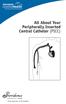 All About Your Peripherally Inserted Central Catheter (PICC) General Information Intravenous (IV) therapy is the delivery of fluid directly into a vein. An intravenous catheter is a hollow tube that is
Location: Clinical Practice Manual
 Subject: Area: Classification: Relevant to: Bladder Management Clinical Practice All Clinical Staff Implementation Date: March 2001 Review Date: March 2004 Responsible for Review: Approved by: Distribution:
Medications or therapeutic solutions may be injected directly into the bloodstream
 Intravenous Therapy Medications or therapeutic solutions may be injected directly into the bloodstream for immediate circulation and use by the body. State practice acts designate which health care professionals
Ward 29 guide to the safe preparation and administration of intravenous (IV) antibiotics at home
 Ward 29 guide to the safe preparation and administration of intravenous (IV) antibiotics at home Contents Page Important contact numbers 1 General information on preparing and administering IV antibiotics
Guy s, King s and St Thomas Cancer Centre The Cancer Outpatient Clinic Central venous catheter: Peripherally inserted central catheter
 Guy s, King s and St Thomas Cancer Centre The Cancer Outpatient Clinic Central venous catheter: Peripherally inserted central catheter This information leaflet aims to help answer some of the questions
Clinical Guideline for: Aseptic Technique
 Clinical Guideline for: Technique Summary This guideline provides the principles of, Non Touch, and Clean Techniques to be implemented in the hospital environment. Key Points The essential elements of
Percutaneous Nephrostomy. Care of your Nephrostomy. Department of Urology
 Percutaneous Nephrostomy Care of your Nephrostomy Department of Urology You may encounter some problems at home but these are usually easily overcome. Listed below are some questions patients commonly
RATIFIED BY NNPDG SEPTEMBER 2006 FOR REVIEW 2009
 NOTTINGHAM UNIVERSITY HOSPTIALS/RUSHCLIFFE PCT NURSING PRACTICE GUIDELINES GUIDELINES FOR CARE OF A PATIENT WITH A WOUND DRAINAGE SYSTEM CONTENTS PAGE Introduction and Types of Drains 1 Procedure for Applying
PICCs and Midline Catheters
 Patient Education PICCs and Midline Catheters Patient s guide to PICC (peripherally inserted central catheter) and midline catheters What are PICCs and midline catheters used for? Any medicine given over
Information for patients and nurses
 Information for patients and nurses Rocket IPC Pleural Catheter Indwelling Catheter Rocket Indwelling Pleural Catheter (IPC) Contents Contact Information...03 What s in the Rocket Dressing Pack and Bottle
SARASOTA MEMORIAL HOSPITAL NURSING PROCEDURE
 SARASOTA MEMORIAL HOSPITAL NURSING PROCEDURE TITLE: ISSUED FOR: (crc13-nursing) (crc.013-respiratory) Nursing, Special Care Areas Respiratory Care Services Perioperative Services DATE: REVIEWED: PAGES:
I-140 Venipuncture for Blood Specimen Collection
 I-140 Venipuncture for Blood Specimen Collection Purpose Obtain a blood specimen by venipuncture for laboratory analysis using aseptic technique. Applies To Registered Nurses Licensed Practical/Vocational
Cytotoxic and Biotherapies Credentialing Programme Module 6
 Cytotoxic and Biotherapies Credentialing Programme Module 6 1. Safe Handling and Administration of Cytotoxic and Biotherapies 2. Waste and Spill Management At the completion of this module the RN will
HICKMAN Catheter Care with a Needleless Connector
 HICKMAN Catheter Care with a Needleless Connector Table of Contents Part 1 Learning about the HICKMAN Catheter... 2 Part 2 Caring for Your Hickman Catheter... 3 A. Preventing Infection... 3 B. Bathing...
Patient Information Guide Morpheus CT Peripherally Inserted Central Catheter
 Patient Information Guide Morpheus CT Peripherally Inserted Central Catheter IC 192 Rev C A measure of flexibility and strength. Table of Contents 1. Introduction 2. What is the Morpheus CT PICC? 3. What
Within the Scope of Practice/Role of APRN RN _ X_LPN CNA
 Wyoming State Board of Nursing 130 Hobbs Avenue, Suite B Cheyenne, WY 82002 Phone (307) 777-7601 Fax (307) 777-3519 E-Mail: [email protected] Home Page: https://nursing-online.state.wy.us/ OPINION:
Policy and Procedure Flushing and / or Blood withdrawal Aspiration Procedure For PICC Line and Midline Catheters
 Policy and Procedure Flushing and / or Blood withdrawal Aspiration Procedure For PICC Line and Midline Catheters Purpose: Blood Withdrawal: To obtain blood samples for laboratory evaluation, eliminating
Understanding your Peripherally Inserted Central Catheter (PICC) Patient Information
 Understanding your Peripherally Inserted Central Catheter (PICC) Patient Information The Purpose of this Information Sheet This information sheet has been written by patients, members of the public and
Status: Standard Procedure: specifies the procedures to be followed, only in exceptional circumstances should these not be followed
 Page 1 of 6 Status: Standard Procedure: specifies the procedures to be followed, only in exceptional circumstances should these not be followed Title: Standard Procedure for the Irrigating (flushing) of
ACI UROLOGY NETWORK - NURSING BLADDER IRRIGATION GUIDELINES
 ACI UROLOGY NETWORK - NURSING BLADDER IRRIGATION GUIDELINES The following pages provide examples of clinical guidelines to enable clinicians to develop their own resource material relevant to their hospital
PATIENT GUIDE. Care and Maintenance Drainage Frequency: Max. Drainage Volume: Dressing Option: Clinician s Signature: Every drainage Weekly
 PATIENT GUIDE Care and Maintenance Drainage Frequency: Max. Drainage Volume: Dressing Option: Every drainage Weekly Clinician s Signature: ACCESS SYSTEMS Pleural Space Insertion Site Cuff Exit Site Catheter
REMOVAL OF A PICC. Possible Cause Nursing Actions Prevention
 REMOVAL OF A PICC PICC lines are removed following a physician order, when therapy is completed or complications such as line sepsis, thrombosis or phlebitis, require removal. The removal of a PICC line
Policies & Procedures. Care of
 Policies & Procedures Title: SUPRAPUBIC CATHETER Care of Changing Removal Authorization: [x] SHR Nursing Practice Committee I.D. Number: 1021 Source: Nursing Date Revised: November 2014 Date Effective:
X-Plain Subclavian Inserted Central Catheter (SICC Line) Reference Summary
 X-Plain Subclavian Inserted Central Catheter (SICC Line) Reference Summary Introduction A Subclavian Inserted Central Catheter, or subclavian line, is a long thin hollow tube inserted in a vein under the
Administration of Medications & Fluids via a Peripheral Intravenous Cannula
 Administration of Medications & Fluids via a Peripheral Intravenous Cannula Clinical S.O.P. No.: 22.0 Compiled by: Approved by: Review date: November 2016 Administration of Medications & Fluids via S.O.P.
Managing Your Non-Tunneled (Percutaneous) Catheter: PICC, SICC, and JCC. What is a PICC catheter?
 Managing Your Non-Tunneled The staff of the Procedure, Vascular Access, Conscious Sedation Service has written this information to explain your new PICC (peripherally inserted central catheter), SICC (subclavian
URINARY CATHETER INSERTION - STRAIGHT OR INDWELLING CATHETER
 URINARY CATHETER INSERTION - STRAIGHT OR INDWELLING CATHETER PURPOSE To obtain a sterile urine specimen. To facilitate emptying bladder. To relieve bladder distention. To irrigate bladder. To measure residual
Policies & Procedures. I.D. Number: 1073
 Policies & Procedures Title:: CENTRAL VENOUS CATHETERS INSERTION ASSISTING I.D. Number: 1073 Authorization [] Pharmacy Nursing Committee [] MAC Motion #: [x] SHR Nursing Practice Committee Source: Nursing
Section 6: Your Hemodialysis Catheter
 Section 6: Your Hemodialysis Catheter What you should know about your dialysis catheter How to change your catheter TEGO connectors Starting dialysis using a catheter End of dialysis using a catheter Changing
Policies and Procedures. Related to. IABP Therapy
 Policies and Procedures Related to IABP Therapy Courtesy of Datascope Corp. Clinical Support Services The following policies and procedures are intended to serve as guidelines for developing hospital policy.
PATIENT GUIDE. Care and Maintenance Drainage Frequency: Max. Drainage Volume: Dressing Option: Clinician s Signature: Every drainage Weekly
 PATIENT GUIDE Care and Maintenance Drainage Frequency: Max. Drainage Volume: Dressing Option: Every drainage Weekly Clinician s Signature: ACCESS SYSTEMS Pleural Space Insertion Site Cuff Exit Site Catheter
PROCEDURE FOR SUBCUTANEOUS INSERTION, REMOVAL, MEDICATION ADMINISTRATION AND FLUID ADMINISTRATION FOR COMMUNITY PALLIATIVE CARE PATIENTS
 PROCEDURE FOR SUBCUTANEOUS INSERTION, REMOVAL, MEDICATION ADMINISTRATION AND FLUID ADMINISTRATION FOR COMMUNITY PALLIATIVE CARE PATIENTS Approved: February 2010 Date for review: February 2010 1 PROCEDURE
Care of your central venous catheter A guide for patients and their carers. We care, we discover, we teach
 Care of your central venous catheter A guide for patients and their carers We care, we discover, we teach This booklet contains information about central venous catheters (CVC). These are sometimes called
Your Guide to Peritoneal Dialysis Module 3: Doing Peritoneal Dialysis at Home
 Your Guide to Peritoneal Dialysis Module 3: 6.0959 in Preparing to do PD One of the most important things about PD is to keep the dialysis area and anything that comes in contact with the PD equipment
Care for your child s Central Venous Catheter (CVC)
 Care for your child s Central Venous Catheter (CVC) This booklet is intended for general informational purposes only. You should consult your doctor for medical advice. Please call the clinic or your home
TREATMENT 1. Control bleeding by applying pressure over wound with Gauze Pads (Surgical Supply-4). 2. Contact Surgeon for laceration repair options.
 Page 1 of 8 pages NOTE Contact Surgeon before giving any medication marked with an asterisk. In an emergency or during Loss of Signal, begin appropriate treatment; then call Surgeon as soon as possible.
Community Nurse Referral Letter (Hickman Line Care)
 Community Nurse Referral Letter (Hickman Line Care) Name of nurse making the referral: Name Signature.. Date Ward.Tel 0845 1555 000 Ext. Dear Community Nurse The following patient requires care for a Hickman
Biliary Drain. What is a biliary drain?
 Biliary Drain What is a biliary drain? A biliary drain is a tube to drain bile from your liver. It is put in by a doctor called an Interventional Radiologist. The tube or catheter is placed through your
Aspira* Peritoneal Drainage Catheter
 Aspira* Peritoneal Drainage Catheter Instructions For Use Access Systems Product Description: The Aspira* Peritoneal Drainage Catheter is a tunneled, long-term catheter used to drain accumulated fluid
PATIENT GUIDE. Understand and care for your peripherally inserted central venous catheter (PICC). MEDICAL
 PATIENT GUIDE Understand and care for your peripherally inserted central venous catheter (PICC). MEDICAL Introduction The following information is presented as a guideline for your reference. The best
Aspira* Pleural Drainage Catheter
 Aspira* Pleural Drainage Catheter Instructions For Use Access Systems Product Description: The Aspira* Pleural Drainage Catheter is a tunneled, long-term catheter used to drain accumulated fluid from the
V: Infusion Therapy. Alberta Licensed Practical Nurses Competency Profile 217
 V: Infusion Therapy Alberta Licensed Practical Nurses Competency Profile 217 Competency: V-1 Knowledge of Intravenous Therapy V-1-1 V-1-2 V-1-3 V-1-4 V-1-5 Demonstrate knowledge and ability to apply critical
Central venous catheters. Care of the site 88 CVP measurement 90 Removal of CVC (non-tunnelled) 93 Care of long-term CVCs 95
 4 Central venous catheters Care of the site 88 CVP measurement 90 Removal of CVC (non-tunnelled) 93 Care of long-term CVCs 95 CARE OF THE SITE Preparation Patient Equipment/Environment Nurse Explain the
Emergency Insertion of Temporary Trans-venous Pacing Catheter in ICU
 TARGET AUDIENCE Junior Medical Staff Critical Care Trained ICU Nurses PURPOSE This document is intended as a basic guide to managing patients who require insertion of Temporary Trans-venous Cardiac Pacing
To maintain a port of entry to venous flow when all available peripheral ports have failed.
 I. Purpose: To maintain a port of entry to venous flow when all available peripheral ports have failed. II. General Comments: Since its development, these catheters have been used with increasing frequency
PROCEDURE FOR CATHETER AFTERCARE
 PROCEDURE FOR CATHETER AFTERCARE First Issued May 2010 Issue Version Two Purpose of Issue/Description of Change To promote safe and effective emptying of urinary drainage bags, closed drainage systems
Fact Sheet. Caring for and Changing your Supra-Pubic Catheter (SPC) Queensland Spinal Cord Injuries Service
 and Caring for and Changing your Supra-Pubic Catheter (SPC) What is a Suprapubic Catheter? A supra-pubic catheter is a tube that goes into your bladder through your abdominal wall which continuously drains
Lifecath Midline. A Nurses Guide to Lifecath Midline
 Lifecath Midline A Nurses Guide to Lifecath Midline [email protected] www.vygon.co.uk Lifecath Midline A Nurses Guide to Lifecath Midline This booklet provides guidance in the care and maintenance of Midline
CARING FOR YOUR URINARY CATHETER GRAMPIANS REGIONAL CONTINENCE SERVICE. Author: GRCS Date: 20/06/09 Catalogue No: 712438
 CARING FOR YOUR URINARY CATHETER GRAMPIANS REGIONAL CONTINENCE SERVICE Author: GRCS Date: 20/06/09 Catalogue No: 712438 What is a urinary catheter? A urinary catheter is a hollow tube which drains urine
NORTH CAROLINA BOARD OF NURSING NURSE AIDE II TRAINING MODULE
 PART A: PREPARING FOR ADMINISTRATION OF IV FLUIDS All four parts of this module, including skills checklists must be successfully completed in order to complete this training module. This activity is a
ATI Skills Modules Checklist for Urinary Catheter Care
 For faculty use only Educator s name Score Date ATI Skills Modules Checklist for Urinary Catheter Care Student s name Date Verify order Patient record Assess for procedure need Identify, gather, and prepare
Hemodynamic Monitoring: Principles to Practice M. L. Cheatham, MD, FACS, FCCM
 SUMMARY HEMODYNAMIC MONITORING: FROM PRINCIPLES TO PRACTICE Michael L. Cheatham, MD, FACS, FCCM Director, Surgical Intensive Care Units Orlando Regional Medical Center Orlando, Florida Fluid-filled catheters
Peripherally Inserted Central Catheter (PICC) for Outpatient
 Peripherally Inserted Central Catheter (PICC) for Outpatient Introduction A Peripherally Inserted Central Catheter, or PICC line, is a thin, long, soft plastic tube inserted into a vein of the arm. It
Care of the Catheterised Patient and Urinalysis
 Care of the Catheterised Patient and Urinalysis Male Pelvic Anatomy Female Pelvic Anatomy What does a urinary catheter do? Urinary Catheters Urinary Catheters Urinary Catheters Why do patients have catheters?
A. ADMINISTERING SUBCUTANEOUS MEDICATIONS INTERMITTENTLY/CONTINUOUSLY B. (SUBCUTANEOUS INFUSION) HYDRODERMOCLYSIS
 SUBCUTANEOUS THERAPY A. ADMINISTERING SUBCUTANEOUS MEDICATIONS INTERMITTENTLY/CONTINUOUSLY B. (SUBCUTANEOUS INFUSION) HYDRODERMOCLYSIS PARTS I. Purposes II. General Information III. Responsibilities IV.
Atrium Pneumostat Chest Drain Valve. Discharge Instructions
 Atrium Pneumostat Chest Drain Valve Discharge Instructions Your Physician Name: Contact Number for Emergencies: Introduction Your physician has decided to change your chest drainage system to a smaller
GUIDELINE FOR CARE OF A PATIENT WITH A NEPHROSTOMY TUBE
 GUIDELINE FOR CARE OF A PATIENT WITH A NEPHROSTOMY TUBE Reference Date approved Nov 2012 Approving Body Matrons Forum Supporting Policy/ Working in New Ways (WINW) Package Implementation date Supersedes
Procedure for Inotrope Administration in the home
 Procedure for Inotrope Administration in the home Purpose This purpose of this procedure is to define the care used when administering inotropic agents intravenously in the home This includes: A. Practice
Changing Your Central Line Catheter Cap
 Changing Your Central Line Catheter Cap The catheter cap on each lumen of your central line needs to be changed once a week. A lumen is a small tube within your catheter. These same steps can be used for
Good practice for the preparation of injectable medicines in clinical areas
 Further reading Dougherty L and Lister S (Eds). The Royal Marsden Hospital Manual of Clinical Nursing Procedures (th edition), Blackwell Publishing, Oxford, 00. NMC standards for medicines management (008).
PERIPHERAL INTRAVENOUS CATHETER MANAGEMENT Adult & Paed
 Auckland District BOARD Clinical Practice Health Board (Section 1) Manual Overview This Document This document covers recommended best practices relating to the selection, insertion, care and management
VUMC Guidelines for Management of Indwelling Urinary Catheters. UC Access/ Maintenance
 VUMC Guidelines for Management of Indwelling Urinary Catheters UC Insertion Preparation & Procedure Indications for insertion and continued use of indwelling urinary catheters include: Urinary retention
Caring for Your PleurX Pleural Catheter
 Caring for Your PleurX Pleural Catheter A PleurX Pleural Catheter has been placed in your chest through a small incision in your skin into the pleural space (see picture below). This allows you to drain
X-Plain Foley Catheter Male Reference Summary
 X-Plain Foley Catheter Male Reference Summary Introduction A Foley catheter is a tube that is put through the urinary opening and into your bladder to drain urine. Your doctor may have placed or may ask
POSSIBLE NURSING DIAGNOSIS: Pain Potential for Infection / Infection Fluid volume deficit
 1 Procedure for Subcutaneous Over-the-needle Cannula Insertion, Removal, Medication Administration, and Fluid Administration for the Individual in the Home PURPOSE: To provide medication via the subcutaneous
CLINICAL PROCEDURE FOR THE SAFE REMOVAL OF FEMORAL ARTERIAL SHEATHS USING A DIGITAL APPROACH 1. Aim/Purpose of this Guideline
 CLINICAL PROCEDURE FOR THE SAFE REMOVAL OF FEMORAL ARTERIAL SHEATHS USING A DIGITAL APPROACH 1. Aim/Purpose of this Guideline 1.1. To aide registered nurses in the safe removal of arterial femoral sheaths
Male Urethral Catheterisation Education Package
 Male Urethral Catheterisation Education Package TABLE OF CONTENTS 1. Accountability 2. Introduction 3. Types of Catheters 4. Guidelines for catheter selection 5. Patient Preparation 6. Equipment 7. Procedure
NIH Clinical Center Patient Education Materials Giving a subcutaneous injection
 NIH Clinical Center Patient Education Materials What is a subcutaenous injection? A subcutaneous injection is given in the fatty layer of tissue just under the skin. A subcutaneous injection into the fatty
Objectives At the completion of this module, unlicensed assistive personnel (UAP) should be able to:
 Objectives At the completion of this module, unlicensed assistive personnel (UAP) should be able to: 1. administer medications by subcutaneous injections. 2. document medication administration in the client
Going Home with a Urinary Catheter
 Going Home with a Urinary Catheter Doctor: Phone Number: About Your Catheter A urinary catheter is a small tube that goes through your urethra and into your bladder. This tube then drains the urine made
MISSISSIPPI BOARD OF NURSING IV THERAPY COURSE FOR THE EXPANDED ROLE LICENSED PRACTICAL NURSE COURSE OUTLINE
 THEORY MINIMUM 40 HOURS COURSE OUTLINE UNIT TOPIC HOURS* I LEGAL ASPECTS AND PRACTICE OF IV THERAPY 1 II REVIEW OF ANATOMY AND PHYSIOLOGY 6 III FLUID AND ELECTROLYTE BALANCE 10 IV EQUIPMENT AND PROCEDURES
Appendix L: Accessing/Deaccessing Implanted Central Venous Access Port
 Effective Date: 03/01/2008 Page 1 of 5 Recommendations for Use Insertion Considerations Implanted Port Dressing Access/ Reaccess An implanted port is strongly recommended for patients in whom more than
CLINICAL GUIDELINE FOR CHANGING A CATHETER EXIT SITE DRESSING (I.E. MIDLINE/ CVC/ PICC/ HICKMAN) Summary. Start
 CLINICAL GUIDELINE FOR CHANGING A CATHETER EXIT SITE DRESSING (I.E. MIDLINE/ CVC/ PICC/ HICKMAN) Summary. Start 1. Assemble all your equipment before you start. 2. Explain and discuss the procedure with
How to Care for your Child s Indwelling Subcutaneous Catheter
 The Emily Center How to Care for your Child s Indwelling Subcutaneous Catheter Procedure/Treatment/Home Care Si usted desea esta información en español, por favor pídasela a su enfermero o doctor. #1054
Male Urinary Catheterisation & Catheter Care
 Male Urinary Catheterisation & Catheter Care Mark Jones, Martin Steggall & Marsh Gelbart City University, London. Good practice Consent gain informed consent. Who can catheterise any Registered Nurse who
VENEPUNCTURE. Eileen Whitehead 2010 East Lancashire HC NHS Trust
 Eileen Whitehead 2010 East Lancashire HC NHS Trust 1 Definition The term venepuncture describes the procedure of inserting a needle into a vein, usually for the purpose of withdrawing blood for haematological,
Caring for a Hemovac Drain
 Caring for a Hemovac Drain 269 12. Raise side rail. Lower bed height and adjust head of bed to a comfortable position. 13. Remove additional PPE, if used. Perform hand hygiene. These promote patient safety.
Bard Access Systems, Inc. How to Care For Your. Nursing Guide
 Bard Access Systems, Inc. How to Care For Your Nursing Guide Table of Contents Introduction 1 Product Description Placement PowerPICC SOLO* Catheter Valve Function Indications for Use Catheter Irrigation
COALINGA STATE HOSPITAL. Effective Date: August 31, 2006
 COALINGA STATE HOSPITAL NURSING POLICY AND PROCEDURE MANUAL SECTION Emergency Procedures POLICY NUMBER: 715 Effective Date: August 31, 2006 SUBJECT: EMERGENCY CARE OF HEMORRHAGE 1. PURPOSE: The management
376 OBTAIN VENOUS BLOOD SAMPLES
 Unit overview Elements of competence 376a 376b Obtain venous blood from individuals Label and prepare blood for transportation About this unit For this unit you need to use venepuncture/phlebotomy techniques
After care following insertion of a suprapubic catheter
 Other formats After care following insertion of a suprapubic catheter If you need this information in another format such as audio tape or computer disk, Braille, large print, high contrast, British Sign
Peripheral Venous Cannula (PVC) Insertion and Management Guidelines
 Peripheral Venous Cannula (PVC) Insertion and Management Guidelines This procedural document supersedes: PAT/T 45 v.1 - Policy for the Insertion and Management of Peripheral Venous Cannula (PVC). Did you
NHS FORTH VALLEY Chest Drain Insertion by Seldinger Method (Pigtail drains)
 NHS FORTH VALLEY Chest Drain Insertion by Seldinger Method (Pigtail drains) Date of First Issue 12/12/2012 Approved 12/12/2012 Current Issue Date 12/12/2012 Review Date 12/12/2014 Version 1 EQIA Yes 14/12/2012
Care of Your Hickman Catheter
 Care of Your Hickman Catheter Johns Hopkins Kimmel Cancer Center, Revised 7/11 Contents What is a Hickman Catheter? Page 3 Does the Catheter Limit My Activities? Page 4 How Do I Care for My Catheter? Page
Home Care for Your Nephrostomy Catheter
 Home Care for Your Nephrostomy Catheter This handout covers information about caring for your nephrostomy catheter right after placement and caring for it long term. If you have any questions, please call
How to safely collect blood samples from persons suspected to be infected with highly infectious blood-borne pathogens (e.g.
 How to safely collect blood samples from persons suspected to be infected with highly infectious blood-borne pathogens (e.g. Ebola) Step 1: Before entering patient room, assemble all equipment (1 st part)
Community Nurse Referral Letter (PICC Care)
 Community Nurse Referral Letter (PICC Care) Name of nurse making the referral: Name Signature.. Date Ward.Tel 0845 1555 000 Ext. Dear Community Nurse The following patient requires care for a PICC (Peripherally