
Male Urethral Catheterisation Education Package
|
|
|
- Linette Powers
- 10 years ago
- Views:
Transcription
1 Male Urethral Catheterisation Education Package TABLE OF CONTENTS 1. Accountability 2. Introduction 3. Types of Catheters 4. Guidelines for catheter selection 5. Patient Preparation 6. Equipment 7. Procedure 8. Competencies for male urethral catheterisation 9. Record of supervised practice 10. Catheters Information for Patients 11. Urinary catheter care record 12. Urinary catheter care bundle 13. References Date of publication: September 2015 Ref. RUH URO/023 Royal United Hospitals Bath NHS Foundation Trust Produced by Caroline Kelly, Urology Nurse Specialist Updated May 2015
2 ACCOUNTABILITY It is essential that you can demonstrate an understanding of the following RUH NHS Trust Policies using The Royal Marsden Hospital Manual of Clinical Nursing Procedures Eighth Edition (2011): Procedure for male catheterisation Catheter Specimen of Urine (CSU collection) Setting up a dressing trolley and aseptic technique (ANTT). Disposal of clinical waste-see Infection Control Policy Infection risks associated with male catheterisation Procedure for requesting and sending laboratory specimens. It is essential that you can demonstrate an awareness of the legal, ethical and professional responsibilities before commencing male catheterisation. Accountability statement RUH NHS Trust Nursing Policies and Practice manual. Code of Professional Conduct NMC (2008) Registered Nurses Only Scope of Professional Practice NMC (2008) Registered nurses only Consent Department of Health Guide to Consent for Examination or Treatment (2001) DOH Saving Lives: High Impact Intervention No5: Urinary Catheter Care Bundle (2006) Catheter Care. RCN Guidance for Nurses (2008) RUH NHS Trust Infection Control policies and procedures Mental Capacity Act (2005)

3 INTRODUCTION By definition, a urethral catheter is a flexible hollow tube inserted into the bladder via the urethra to drain urine or instill fluids as part of medical treatment. It may be intermittent, for periodic insertion or retaining for continuous drainage. Catheterisation should form part of a holistic assessment based on the patient s diagnosis and nursing needs. The decision to catheterise a patient is made by the nurse/doctor and the patient. This includes for the purpose of obtaining specimens of urine, to assess residual volume and maintaining an accurate fluid balance etc. Catheterisation should only be carried out by registered nurses and authorised non-registered staff who have been assessed as competent in the procedure. Indications for urethral catheterisation: Drainage: Prostatic hyperplasia Acute or chronic retention Hypotonic bladder Pre and post pelvic surgery Measure urine output To empty bladder during labour Investigations: To obtain an uncontaminated urine specimen In urodynamic (bladder studies) investigations X-ray investigation Instillation: To irrigate the bladder Chemotherapy/Immunotherapy Management of intractable incontinence (last resort) Where it is viewed as better for the patient to have a catheter, such as end of life care, disability, unfit for surgery.
4 TYPES OF CATHETERS There is a wide range of catheters to choose from, appropriate selection ensures complications are minimized. They should be used in line with manufacturers guidelines. Catheter selection should be determined by: Assessment of why the catheter is needed Assessment of length of time the catheter is insitu (will help determine material of choice) Diameter size and length to facilitate adequate drainage and promote patient comfort Catheter tip design (Urology Department only). Materials: Short term catheters usually last up to four weeks (28 days) but it is important to check before insertion. They can be made of PVC, latex, PTFE (Polytetrafluroethylene), teflon or silver coated hydrogel (used to minimise UTIs) Long term catheters can remain insitu for up to twelve weeks and can be made of 100% silicone or latex coated with hydrogel. It is important to check patient s allergies prior to insertion. Length: FEMALE: 24-26cm MALE: 40-45cm Diameter: Catheter sizes or charriere (Ch) refer to the diameter of the catheter and range from size 8 (paediatric) to 26CH. 1Ch =1/3mm diameter Selection of the correct catheter size should reflect patient comfort and allow adequate drainage. In male catheterisation size 12 or 14 should be the first choice however if urine contains clots, debris or sediment a larger diameter catheter is indicated. Most catheters come with a pre-filled syringe of 10mls of sterile water. Substances such as air, non-sterile water and normal saline should NOT be used to fill the balloon. Any catheter larger than an 18Ch should not be inserted by anyone outside of the Urology Team.
5 PATIENT PREPARATION Informed Consent Informed consent must always be obtained before starting treatment or any physical examination. Catheterisation is an invasive procedure which can cause embarrassment, physical and psychological discomfort and impact on the patient s self image. It is the responsibility of the health care professional to inform the patient of the reasons and necessity of the procedure and obtain their permission. This should then be documented in the patient records. It is important to have knowledge of the Mental Capacity Act EQUIPMENT Catheterisation is an Aseptic Non-Touch Technique (ANTT). Equipment required: 1. Sterile catheterisation pack containing gallipot, receiver, swabs and disposable towel 2. Apron 3. Disposable pad (inco sheet) 4. Sterile gloves (2 pairs) 5. Selection of appropriate catheters 6. Sterile anaesthetic lubricating gel % Sodium chloride solution 8. Sterile water for inflation of balloon (if not provided with catheter) 9. Syringe and needle 10. Leg bag/ night bag or flip flow tap 11. Catheter stand if required
6 THE USE OF INSTILLAGEL Non-registered staff can administer Instillagel into the urethra for the use of male and female catheterisation. Using Instillagel is an integral part of the urethral catheterisation insertion to anaesthetise the urethra, whilst providing broad-spectrum anti-microbial coverage as well as giving essential lubrication. The anaesthetic effect begins after 3-5 minutes A pre-filled disposable syringe of 6ml for a female and 11 ml for a male should be used prior and in preparation of the catheterisation. A 2 nd pre-filled disposable syringe can be used to enhance the gels actions and effects. A male must have at least one of the 11ml pre-filled syringes. Catheterisation should only be carried out by registered nurses and authorised non-registered staff that have been assessed as competent in the procedure and successfully completed the workbooks. There is no policy or legal position regarding female practitioners catheterising male patients or male practitioners catheterising female patients. Patients should always be offered a chaperone or be invited to request the presence of a chaperone. As with all procedures the wishes of the patient are paramount, informed consent should always be given and documented prior to the procedure.
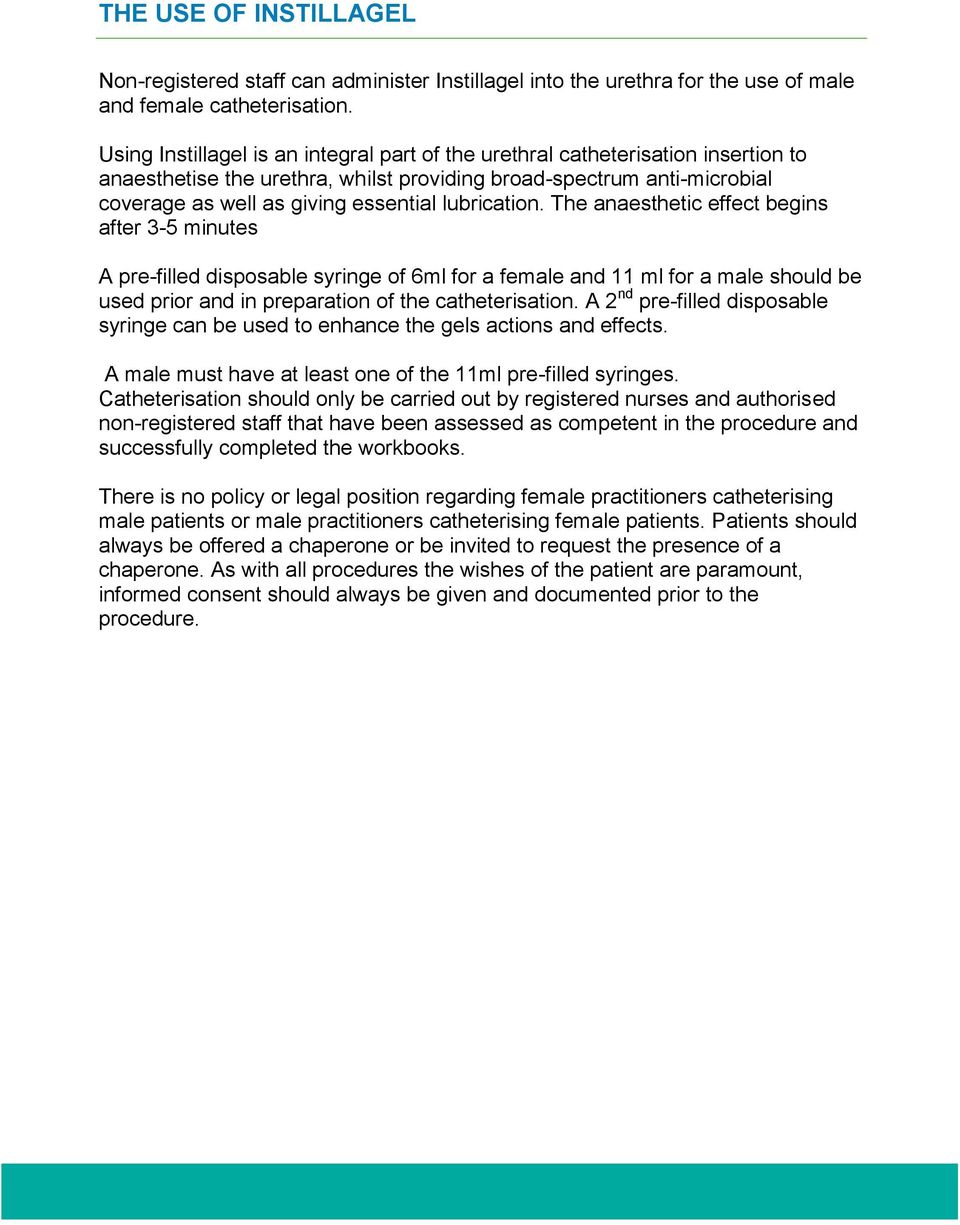
7 PROCEDURE ACTION Explain Procedure and gain verbal consent Undertake procedure ideally in a clinical treatment room if not appropriate use screen/ curtains by the patients bedside Assist the patient to get into supine (led flat facing up) with legs extended Wash hands using soap and water Put on disposable plastic apron Clean and prepare trolley Using Aseptic technique, open the required additional equipment and place on sterile field ready for use. Expose the patient s genital area by removing required amount of clothing, but ensure not to over expose the individual. Clean hands using soap and water or alcoholic hand rub. Apply sterile gloves and place a sterile sheet over the patient s thighs. Take hold of the penis and gently pull the foreskin back (if present) to reveal the Glans Penis and using a suitable cleaning solution gently wipe around the Glans and the meatus. Check patients allergy status Holding the penis proud gently insert the nozzle of the lubricating local anaesthetic gel and slowly instil 11 mls in the urethra. Wait for 3-5 minutes for the gel to work. Replace gloves with new sterile pair and apply new sterile field around penile area RATIONALE To ensure patient understands procedure and gives valid consent To promote privacy and dignity To ensure easy accessibility to the area To reduce infection risk To reduce cross infection risk from uniform To ensure top shelf acts as clean working surface To minimise the risk of cross infection To maintain privacy and dignity. To minimise cross infection. To maintain a sterile working area and maintain a degree of dignity. To ensure adequate decontamination of the area and to minimise the risk of introducing bacteria to the urinary tract. Ensure patient has no allergies to the anaesthetic lubricating gel. Having the penis in this position straightens the urethra and reduces urethral trauma, minimises discomfort. In preparation for catheterisation
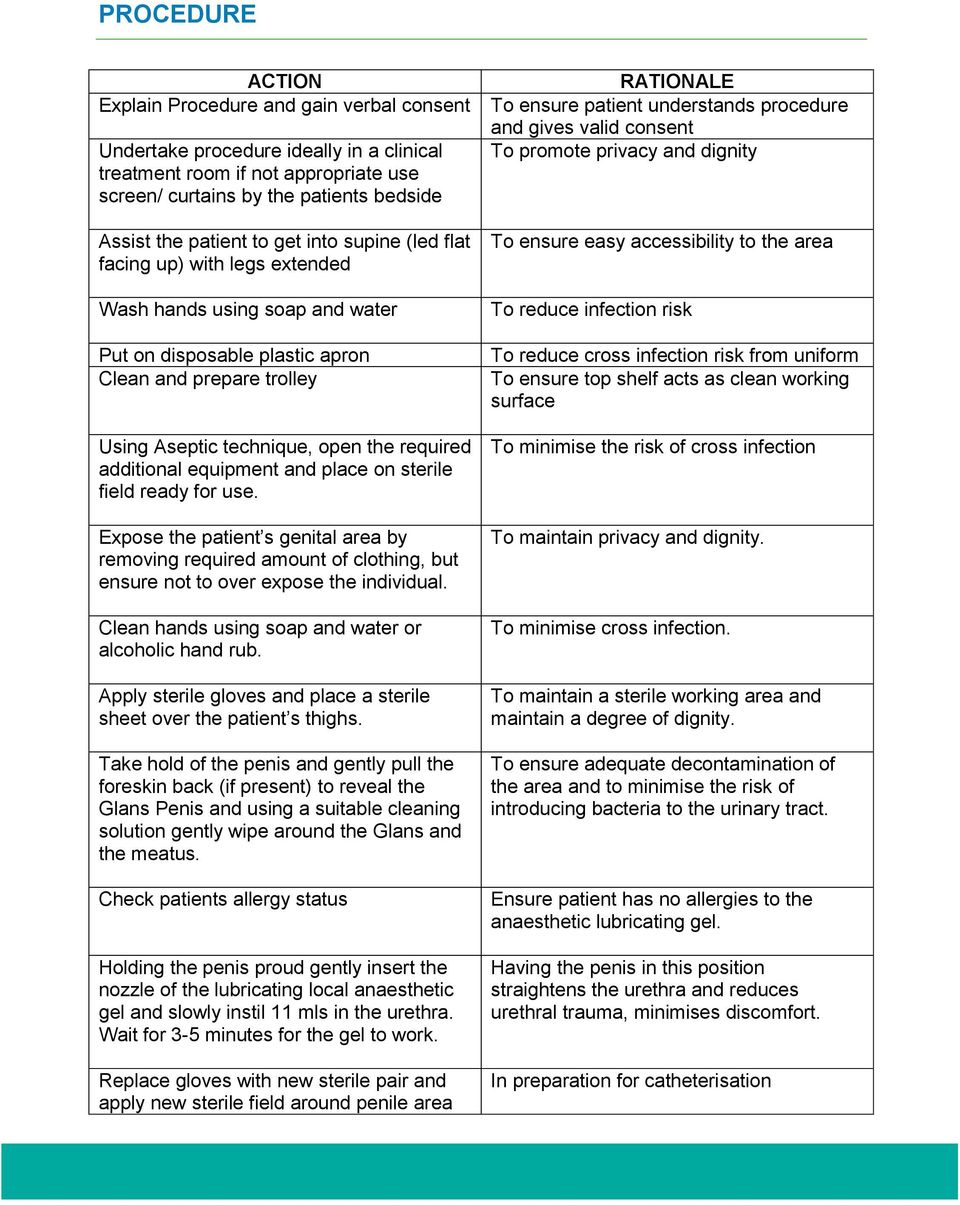
8 Place receiver (Sterile pot) onto sterile field and gently insert the catheter 2-3cm at a time. If preferred you can attach the catheter bag or tap at this point. Advance the catheter to the bifurcation (where the catheter balloon valve is located). If no urine drains apply gentle pressure to the symphysis pubis. Slowly inflate the balloon according to the manufacturer s instructions once the catheter is draining. Withdraw the catheter slightly and attach the appropriate drainage system if not already done. Secure the catheter with support straps, ensuring the catheter does not become taut/ stretched when the patient mobilises or when the penis becomes erect. Ensure that the foreskin is repositioned (if present) Assist the patient into a comfortable position ensuring that the patient and bed are dry Measure the amount of urine drained and document in notes Dispose of equipment as per RUH policy To prevent contamination of the catheter and minimise patient discomfort and trauma. Advancing the catheter ensures that it is correctly inserted in the bladder. Sometimes the anaesthetising gel can block the catheter for a few seconds and gently pressing can encourage the urine flow. If the balloon is inflated in the urethra it can cause damage, pain and trauma. Withdrawing the catheter once the balloon is inflated ensures the balloon sits at the base of the bladder which encourages optimal drainage. To maintain patient comfort and to reduce the risk or urethral trauma and bladder neck damage. Retraction and constriction of the foreskin behind the glans penis may result in paraphimosis. If the area is left wet or moist, secondary infection. This is called the residual urine and is essential for future assessment. It is also necessary to monitor renal function and fluid balance however if this is a routine catheter change then residual is not necessary. To prevent environmental contamination.
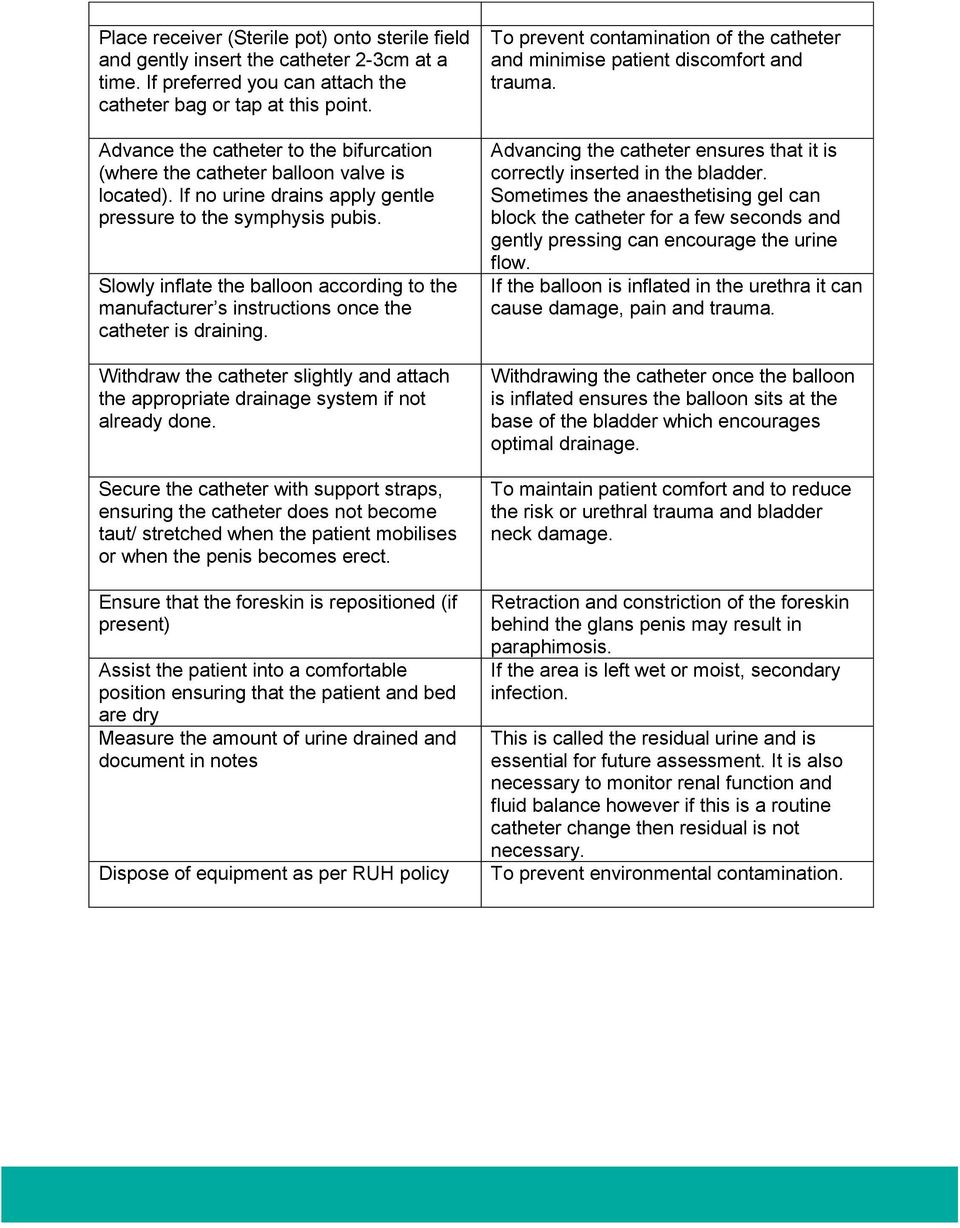
9 RECORD INFORMATION IN MEDICAL NOTES (and catheter care plan) Reason for catheterisation Consent Use of local anaesthetic (as per patient group direction) Date and time of insertion Residual volume of urine in bladder Catheter batch and expiry date (including sticker found on catheter packaging) Balloon size Any complications or interventions Planned catheter change date (if necessary) Name and signature of nurse completing procedure.
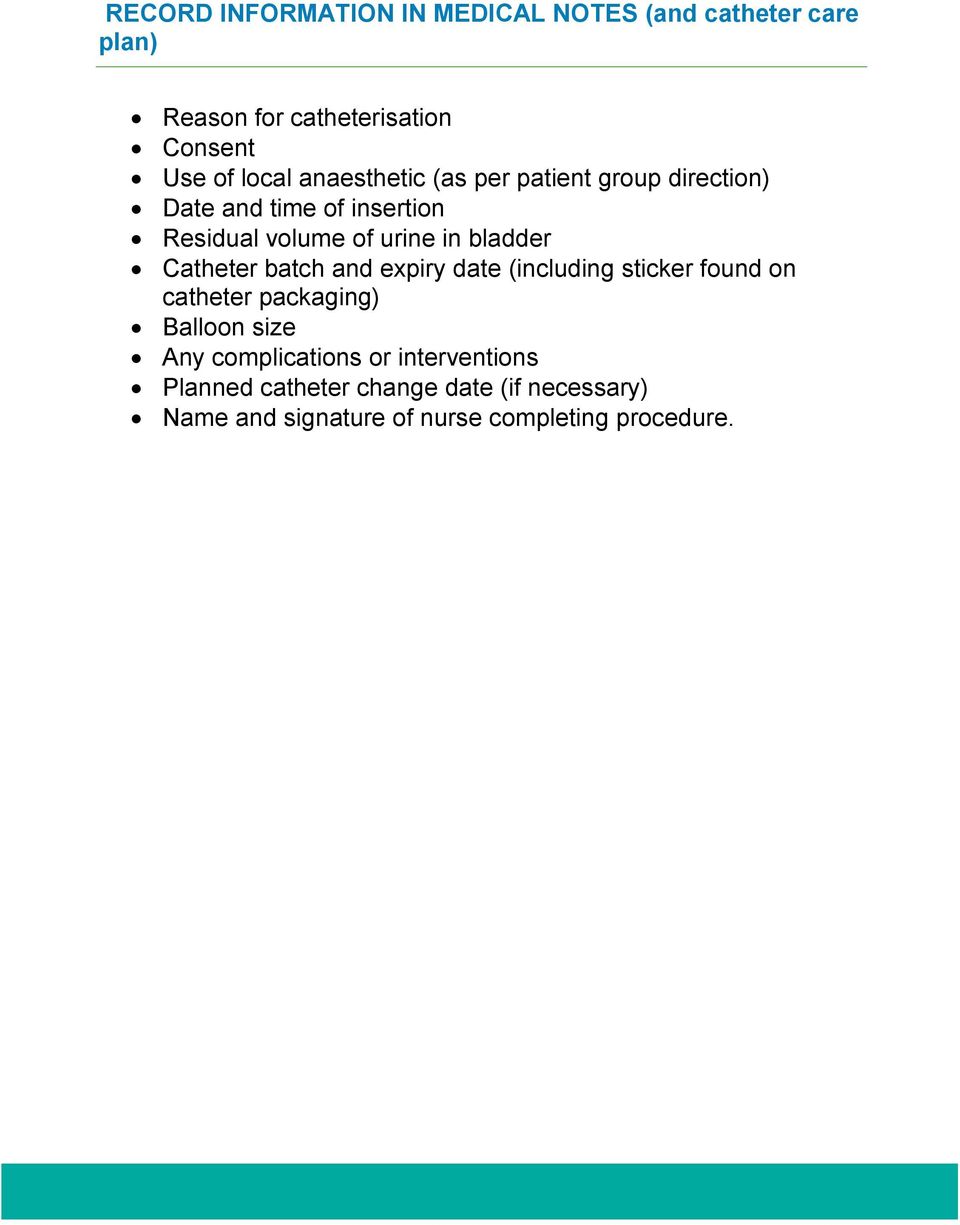
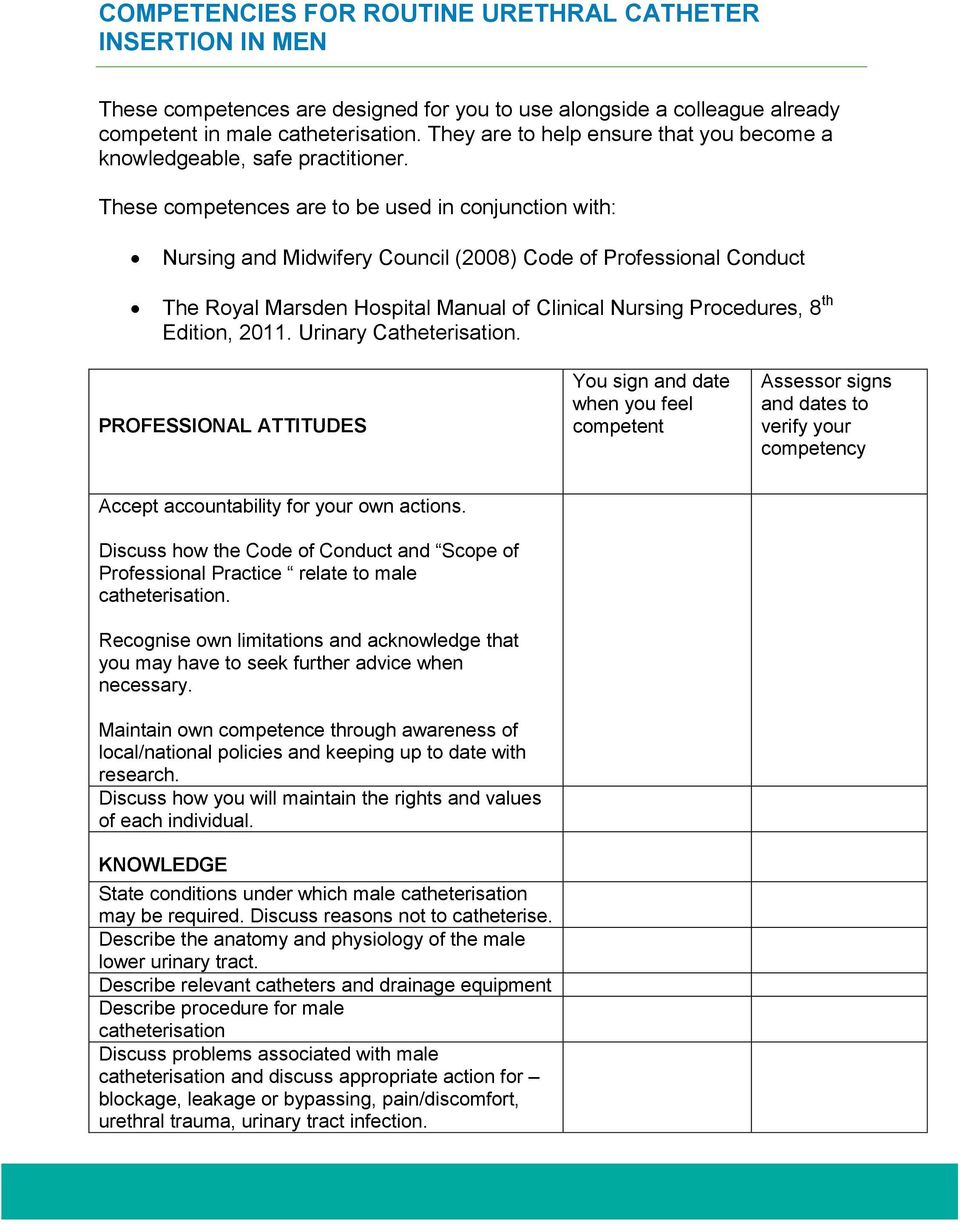
10 COMPETENCIES FOR ROUTINE URETHRAL CATHETER INSERTION IN MEN These competences are designed for you to use alongside a colleague already competent in male catheterisation. They are to help ensure that you become a knowledgeable, safe practitioner. These competences are to be used in conjunction with: Nursing and Midwifery Council (2008) Code of Professional Conduct The Royal Marsden Hospital Manual of Clinical Nursing Procedures, 8 th Edition, Urinary Catheterisation. PROFESSIONAL ATTITUDES You sign and date when you feel competent Assessor signs and dates to verify your competency Accept accountability for your own actions. Discuss how the Code of Conduct and Scope of Professional Practice relate to male catheterisation. Recognise own limitations and acknowledge that you may have to seek further advice when necessary. Maintain own competence through awareness of local/national policies and keeping up to date with research. Discuss how you will maintain the rights and values of each individual. KNOWLEDGE State conditions under which male catheterisation may be required. Discuss reasons not to catheterise. Describe the anatomy and physiology of the male lower urinary tract. Describe relevant catheters and drainage equipment Describe procedure for male catheterisation Discuss problems associated with male catheterisation and discuss appropriate action for blockage, leakage or bypassing, pain/discomfort, urethral trauma, urinary tract infection.
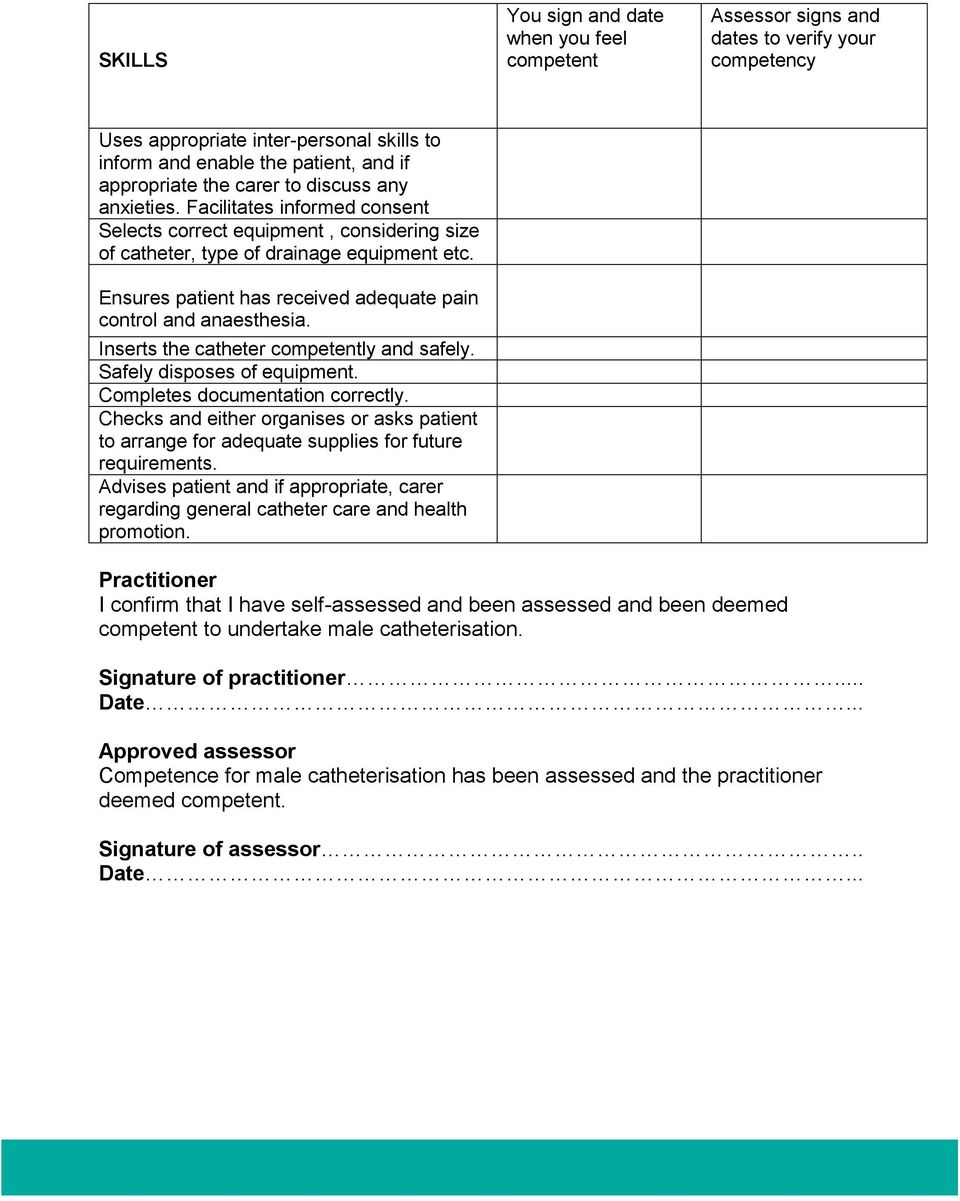
11 SKILLS You sign and date when you feel competent Assessor signs and dates to verify your competency Uses appropriate inter-personal skills to inform and enable the patient, and if appropriate the carer to discuss any anxieties. Facilitates informed consent Selects correct equipment, considering size of catheter, type of drainage equipment etc. Ensures patient has received adequate pain control and anaesthesia. Inserts the catheter competently and safely. Safely disposes of equipment. Completes documentation correctly. Checks and either organises or asks patient to arrange for adequate supplies for future requirements. Advises patient and if appropriate, carer regarding general catheter care and health promotion. Practitioner I confirm that I have self-assessed and been assessed and been deemed competent to undertake male catheterisation. Signature of practitioner... Date... Approved assessor Competence for male catheterisation has been assessed and the practitioner deemed competent. Signature of assessor.. Date...
12 RECORD OF SUPERVISED PRACTICE OF MALE CATHETERISATION Practice to be carried out after completion of learning pack, and until nurse feels competent. There must be a minimum of 3 supervised catheterisations Name of nurse: Date Hospital number of patient Assessor s name Comments, nurse or assessor

Male Urinary Catheterisation & Catheter Care
 Male Urinary Catheterisation & Catheter Care Mark Jones, Martin Steggall & Marsh Gelbart City University, London. Good practice Consent gain informed consent. Who can catheterise any Registered Nurse who
Location: Clinical Practice Manual
 Subject: Area: Classification: Relevant to: Bladder Management Clinical Practice All Clinical Staff Implementation Date: March 2001 Review Date: March 2004 Responsible for Review: Approved by: Distribution:
Male Catheterisation
 1 Prepare your equipment, put what you need on to the trolley, choose catheter appropriate for urethral size and check the volume of water needed to inflate the balloon. All this information is written
PROCEDURE FOR URINARY CATHETERISATION
 PROCEDURE FOR URINARY CATHETERISATION First Issued Issue Version One Purpose of Issue/Description of Change Planned Review Date To promote safe and effective urinary catheterisation for patients in a community
CATHETERISATION. East Lancashire Hospitals NHS Trust Eileen Whitehead 2010
 CATHETERISATION East Lancashire Hospitals NHS Trust Eileen Whitehead 2010 1 Indications for catheterisation: A person is unable to void naturally due to injury or a disease process Diagnostic or therapeutic
URINARY CATHETER INSERTION - STRAIGHT OR INDWELLING CATHETER
 URINARY CATHETER INSERTION - STRAIGHT OR INDWELLING CATHETER PURPOSE To obtain a sterile urine specimen. To facilitate emptying bladder. To relieve bladder distention. To irrigate bladder. To measure residual
Fact Sheet. Caring for and Changing your Supra-Pubic Catheter (SPC) Queensland Spinal Cord Injuries Service
 and Caring for and Changing your Supra-Pubic Catheter (SPC) What is a Suprapubic Catheter? A supra-pubic catheter is a tube that goes into your bladder through your abdominal wall which continuously drains
Catheterisation Insertion and Management Protocol (Whole Healthcare Economy)
 Catheterisation Insertion and Management Protocol (Whole Healthcare Economy) NHFT policy ICP 013 Version: June11 v2 Ratified by: Trust Policy Board Date ratified: 21 st June 2011 Implementation date: 1
2. Does the patient have one of the following appropriate indications for placing indwelling urinary catheters?
 A. Decision to Insert a Urinary Catheter: 1. Before placing an indwelling catheter, please consider if these alternatives would be more appropriate: Bladder scanner: to assess and confirm urinary retention,
Foley Catheter Placement
 Foley Catheter Placement Indications for a Foley Catheter Retention of urine leading to urinary hesitancy, straining to urinate, decrease in size and force of the urinary stream, interruption of urinary
PATIENT URINARY CATHETER PASSPORT
 n PATIENT URINARY CATHETER PASSPORT A guide on how to look after your Catheter NHS Hertfordshire Patient Experience Team Charter House Parkway Welwyn Garden City Hertfordshire AL8 6JL Telephone: 01707
Guidelines for the Insertion, Ongoing Care and Removal of Indwelling Urethral Catheters
 Derby Hospitals NHS Foundation Trust Guidelines for the Insertion, Ongoing Care and Removal of Indwelling Urethral Catheters Aim Reference No: CG-T/2011/140 These evidence based guidelines seek to provide
Status: Standard Procedure: specifies the procedures to be followed, only in exceptional circumstances should these not be followed
 Page 1 of 6 Status: Standard Procedure: specifies the procedures to be followed, only in exceptional circumstances should these not be followed Title: Standard Procedure for the Irrigating (flushing) of
online version Understanding Indwelling Urinary Catheters and Drainage Systems Useful information When to call for help
 When to call for help This will depend on the individual situation, but usually help should be sought if any of the following occurs: 1. The catheter does not start to drain, despite trying the problem
trust clinical guideline
 CG25 VERSION 1.0 1/20 Guideline ID CG25 Version 1.0 Title Approved by Urinary Catheterisation Clinical Effectiveness Group Date Issued 01/10/2014 Review Date 31/09/2017 Directorate Authorised Staff Medical
Infection Prevention & Control Team. Your urinary catheter & how to care for it 0151 430 2452 / 0151 430 1384. Patient Information Leaflet
 Contact details Infection prevention team - 0151 430 2452 This leaflet can be made available in alternative languages/formats on request. Infection Prevention & Control Team 0151 430 2452 / 0151 430 1384
Care of the Catheterised Patient and Urinalysis
 Care of the Catheterised Patient and Urinalysis Male Pelvic Anatomy Female Pelvic Anatomy What does a urinary catheter do? Urinary Catheters Urinary Catheters Urinary Catheters Why do patients have catheters?
Looking after your urinary catheter at home. An information guide
 TO PROVIDE THE VERY BEST CARE FOR EACH PATIENT ON EVERY OCCASION Looking after your urinary catheter at home An information guide Looking after your urinary catheter at home This leaflet is provided for
PREVENTION OF CATHETER ASSOCIATED URINARY TRACT INFECTIONS. (CAUTIs)
 PREVENTION OF CATHETER ASSOCIATED URINARY TRACT INFECTIONS (CAUTIs) CAUTIs A UTI where an indwelling urinary catheter was in place for >2 calendar days on the date of event. OR If an indwelling urinary
ATI Skills Modules Checklist for Urinary Catheter Care
 For faculty use only Educator s name Score Date ATI Skills Modules Checklist for Urinary Catheter Care Student s name Date Verify order Patient record Assess for procedure need Identify, gather, and prepare
SECTION 12.1 URINARY CATHETERS
 SECTION 12.1 URINARY CATHETERS Introduction Summary of Recommendations taken from Guidelines for the Prevention of Catheter-associated Urinary Tract Infection, Published on behalf of SARI by HSE Health
PROCEDURE FOR CATHETER AFTERCARE
 PROCEDURE FOR CATHETER AFTERCARE First Issued May 2010 Issue Version Two Purpose of Issue/Description of Change To promote safe and effective emptying of urinary drainage bags, closed drainage systems
Managing your bladder with a suprapubic catheter at home
 Managing your bladder with a suprapubic catheter at home Gateshead Primary Care Trust South Tyneside Primary Care Trust Sunderland Teaching Primary Care Trust What is a suprapubic catheter? A suprapubic
Indwelling urinary catheter. Information for patients and carers. RDaSH. Doncaster Community Integrated Services
 Indwelling urinary catheter Information for patients and carers RDaSH Doncaster Community Integrated Services What is a catheter? A catheter is a hollow flexible tube designed to drain urine from the bladder.
Urinary Catheter Policy for Community Health Services, Inpatient Facilities and Primary Care
 1 Urinary Catheter Policy for Community Health Services, Inpatient Facilities and Primary Care The document describes the processes and procedures for insertion and management of urinary catheters for
Clinical Guideline for: Aseptic Technique
 Clinical Guideline for: Technique Summary This guideline provides the principles of, Non Touch, and Clean Techniques to be implemented in the hospital environment. Key Points The essential elements of
How to Change a Foley Catheter Step-by-step instructions for the caregiver
 Patient Education How to Change a Foley Catheter Step-by-step instructions for the caregiver This handout gives stepby-step instructions for changing a Foley catheter, a tube in the bladder to drain urine.
Long-term urinary catheters: prevention and control of healthcare-associated infections in primary and community care
 Long-term urinary catheters: prevention and control of healthcare-associated infections in primary and community care A NICE pathway brings together all NICE guidance, quality standards and materials to
ACI UROLOGY NETWORK - NURSING BLADDER IRRIGATION GUIDELINES
 ACI UROLOGY NETWORK - NURSING BLADDER IRRIGATION GUIDELINES The following pages provide examples of clinical guidelines to enable clinicians to develop their own resource material relevant to their hospital
PICU Urinary Catheter Insertion & Care Guideline & Bundles Dr Vinayak Rai & Dr Simon Robinson March 2014
 PICU Urinary Catheter & Care Guideline September 2014 Introduction PICU Urinary Catheter Insertion & Care Guideline & Bundles Dr Vinayak Rai & Dr Simon Robinson March 2014 Background: Urinary catheterisation
URINARY CATHETER CARE
 URINARY CATHETER CARE INTRODUCTION Urinary catheter care is a very important skill, and it is a skill that many certified nursing assistants (CNAs) must know. Competence at providing urinary catheter care
Going home with a urinary cathether
 Going home with a urinary cathether A patient s guide 1 Your doctor has advised that you require a urinary catheter so that urine can be drained from your bladder. This leaflet provides advice to help
PROCEDURE FOR CLEAN INTERMITTENT CATHETERIZATION MALE
 PROCEDURE FOR CLEAN INTERMITTENT CATHETERIZATION MALE 1. Wash hands. PROCEDURE POINTS TO REMEMBER 2. Assemble equipment. Water-soluble lubricant, such as K-Y Jelly, Lubrifax, Surgel Catheter, plastic or
Bladder Catheterization
 Approved by: Bladder Catheterization Gail Cameron Senior Director, Operations, Maternal, Neonatal & Child Health Programs Dr. Ensenat Medical Director, Neonatology Neonatal Nursery Policy & Procedures
PROCEDURE FOR ADMINISTERING CATHETER MAINTENANCE SOLUTION AND RESOLVING CATHETER PROBLEMS
 PROCEDURE FOR ADMINISTERING CATHETER MAINTENANCE SOLUTION AND RESOLVING CATHETER First Issued Issue Version Purpose of Issue/Description of Change Planned Review Date One Outlines the process for staff
POLICY FOR CATHETER MANAGEMENT
 POLICY FOR CATHETER MANAGEMENT 1 Document Control Sheet Name of document: Version: 6 Status: Owner: File location / Filename: Policy for catheter management Infection Prevention & Control Team Date of
Patient Information:
 Patient Information: Care of an indwelling Urinary Catheter What is a Urinary Catheter? A catheter is a hollow, flexible tube designed to drain urine from the bladder. Following insertion into the bladder,
Policies & Procedures. Care of
 Policies & Procedures Title: SUPRAPUBIC CATHETER Care of Changing Removal Authorization: [x] SHR Nursing Practice Committee I.D. Number: 1021 Source: Nursing Date Revised: November 2014 Date Effective:
A Guide to Help You Manage Your Catheter and Drainage Bags
 A Guide to Help You Manage Your Catheter and Drainage Bags A catheter can make a difference to your health and quality of life. We understand that it can be a big adjustment for you. This information will
Looking after your urinary catheter at home
 Looking after your urinary catheter at home Information for patients and carers Useful contacts to keep: Name and title of community nurse Single point of access (SPA) for community nursing 24 hour service
Catheter Care. What you need to know. Jacinta Stewart Continence Nurse
 Catheter Care What you need to know Jacinta Stewart Continence Nurse Indications for Long Term Catheter Use Long term urinary catheters should only be used with clients who cannot satisfactorily be managed
Self Catheterization Guide
 Self Catheterization Guide An introduction to intermittent self-catheterization Medical professionals have recommended that you selfcatheterize in order to completely empty your bladder. This prevents
Having a supra pubic urinary catheter
 Having a supra pubic urinary catheter Delivering the best in care UHB is a no smoking Trust To see all of our current patient information leaflets please visit www.uhb.nhs.uk/patient-information-leaflets.htm
NHS Professionals. CG8 Guidelines for Continence and Catheter Care. Introduction
 NHS Professionals CG8 Guidelines for Continence and Catheter Care Introduction Continence has been defined as control of bladder and bowel function and continence care is the name given to the total care
CLINICAL GUIDELINES Urinary Catheterisation Guidelines
 Reference Date approved Approving Body CLINICAL GUIDELINES Urinary Catheterisation Guidelines Matron s Forum Supporting Policy/ Working in Male Urethral Catheterisation New Ways (WINW) Package Implementation
SELF-CATHETERISATION A Guide for Male Patients PATIENT EDUCATION
 SELF-CATHETERISATION A Guide for Male Patients PATIENT EDUCATION ADHB Urology Department; Reviewed JULY 2005 Ubix code NPEB2 1 This booklet has been designed to help you learn how to perform self-catheterisation.
SAMPLE Policy and Procedure Insertion, Removal and Care of an Indwelling Foley Catheter
 SAMPLE Policy and Procedure Insertion, Removal and Care of an Indwelling Foley Catheter Approved by: Policy and Procedure Committee Effective: x/xx Revised: x/xx Description: This policy provides the procedure
Intermittent Self Catheterisation for Women
 ISCW Intermittent Self Catheterisation for Women National Service, Locally Based www.fittleworth.com Opening hours: 8am - 8pm Monday to Friday 9am - 1pm on Saturday Freephone National 0800 378 846 Scotland
III-701 Urinary Catheterization/Bladder Irrigation Original Date: 3/1/1977 Last Review Date: 10/28/2004
 III-701 Urinary Catheterization/Bladder Irrigation Original Date: 3/1/1977 Last Review Date: 10/28/2004 Purpose A. Allow for precise measurement of urine output. B. Collect a sterile urine specimen. C.
Looking after your bladder
 Looking after your bladder A guide for women after spinal cord injury Spinal Cord Injury Rehabilitation Program This booklet has been written by the health care providers who provide care to people who
X-Plain Foley Catheter Male Reference Summary
 X-Plain Foley Catheter Male Reference Summary Introduction A Foley catheter is a tube that is put through the urinary opening and into your bladder to drain urine. Your doctor may have placed or may ask
CARING FOR YOUR URINARY CATHETER GRAMPIANS REGIONAL CONTINENCE SERVICE. Author: GRCS Date: 20/06/09 Catalogue No: 712438
 CARING FOR YOUR URINARY CATHETER GRAMPIANS REGIONAL CONTINENCE SERVICE Author: GRCS Date: 20/06/09 Catalogue No: 712438 What is a urinary catheter? A urinary catheter is a hollow tube which drains urine
Percutaneous Nephrostomy. Care of your Nephrostomy. Department of Urology
 Percutaneous Nephrostomy Care of your Nephrostomy Department of Urology You may encounter some problems at home but these are usually easily overcome. Listed below are some questions patients commonly
Having a urinary catheter information for men
 Having a urinary catheter information for men This leaflet explains what a catheter is, why you need it and how you should look after it. If you have any further questions, please contact your district
Management of urinary catheters
 Information for patients and relatives This leaflet is available in other formats including large print, audio tape, CD and braille, and in languages other than English, upon request. Corp/326.2 (2012)
Canterbury Continence Forum Health Professionals Working in Partnership CATHETER CARE GUIDELINES 2013
 Canterbury Continence Forum Health Professionals Working in Partnership CATHETER CARE GUIDELINES 2013 Contents ACKNOWLEDGEMENTS... 3 THE CONTINENCE REFERRERS AND PROVIDERS FORUM... 3 CATHETER CARE GUIDELINES...
SFHCHS8 Insert and secure urethral catheters and monitor and respond to the effects of urethral catheterisation
 Insert and secure urethral catheters and monitor and respond to the effects of urethral catheterisation Overview This standard covers the insertion of urethral catheters, including recatheterisation, following
BARD MEDICAL DIVISION UROLOGICAL DRAINAGE. Foley Catheter Care & Maintenance. Patient Education Guide
 BARD MEDICAL DIVISION Foley Catheter Care & Maintenance Patient Education Guide WHAT IS A FOLEY CATHETER? Because of your medical problem, your body is having trouble completely emptying your bladder of
Clean Intermittent Catheterization (CIC) For Males
 The Emily Center Clean Intermittent Catheterization (CIC) For Males Procedure/Treatment/Home Care Si usted desea esta información en español, por favor pídasela a su enfermero o doctor. #200 male patient
A Child s guide to Clean Intermittent Catheterization. Boys
 A Child s guide to Clean Intermittent Catheterization Boys Introduction Probably you have just heard that you have to learn to catheterize your bladder. Most children are worried, frightened or scared
Coloplast Product Guide Ostomy, Continence, Wound & Skin Care. Effective March 2010
 Coloplast Guide Ostomy, Continence, Wound & Skin Care Effective March 2010 SpeediCath TM Intermittent Catheters The only ready-to-use hydrophilic catheter. Clinical research indicated that twice as many
A PRINTED copy of this guideline may not be the most recent version. The OFFICIAL version is located on IHNET at the Policies & Procedures Home Page
 A PRINTED copy of this guideline may not be the most recent version. The OFFICIAL version is located on IHNET at the Policies & Procedures Home Page IX0200: Prevention & Control of Catheter Associated
Achieving Independence
 Bard: Intermittent Self-Catheterization A Guide to Self-Catheterization Achieving Independence Introduction This brochure is provided by Bard, a leading provider of urology products since 1907. The best
After care following insertion of a suprapubic catheter
 Other formats After care following insertion of a suprapubic catheter If you need this information in another format such as audio tape or computer disk, Braille, large print, high contrast, British Sign
Intermittent Self Catheterization for Males
 Intermittent Self Catheterization for Males CEAC 0371 January 2016 Intermittent Self Catheterization This involves inserting a catheter (small tube) into your bladder at regular intervals to help empty
Living life to the full with an indwelling catheter
 Living life to the full with an indwelling catheter www.fittleworth.com Opening hours: 8am 8pm Monday to Friday 9am 1pm on Saturday Freephone National 0800 378 846 Scotland 0800 783 7148 Living with and
ACI Urology Network - Nursing. Catheterisation Male and SPC
 ACI Urology Network - Nursing Catheterisation Male and SPC Clinical Guideline, Competencies, Troubleshooting and Patient Information Date: March 2013 Version: Release Status: Release Date: Author: Owner:
Instruction Guide to Sterile Self-Catheterization for Women Using the Cure Catheter Closed System
 Cure Medical donates 10% of net income to medical research in pursuit of a cure for spinal cord injuries and central nervous system disorders. For information on scientific advancements, visit www.curemedical.com.
Going Home with a Urinary Catheter
 Going Home with a Urinary Catheter Doctor: Phone Number: About Your Catheter A urinary catheter is a small tube that goes through your urethra and into your bladder. This tube then drains the urine made
RATIFIED BY NNPDG SEPTEMBER 2006 FOR REVIEW 2009
 NOTTINGHAM UNIVERSITY HOSPTIALS/RUSHCLIFFE PCT NURSING PRACTICE GUIDELINES GUIDELINES FOR CARE OF A PATIENT WITH A WOUND DRAINAGE SYSTEM CONTENTS PAGE Introduction and Types of Drains 1 Procedure for Applying
GUIDELINE FOR CARE OF A PATIENT WITH A NEPHROSTOMY TUBE
 GUIDELINE FOR CARE OF A PATIENT WITH A NEPHROSTOMY TUBE Reference Date approved Nov 2012 Approving Body Matrons Forum Supporting Policy/ Working in New Ways (WINW) Package Implementation date Supersedes
HOW TO CARE FOR YOUR CATHETER (FEMALE)
 HOW TO CARE FOR YOUR CATHETER (FEMALE) Information Leaflet Your Health. Our Priority. Page 2 of 6 What is a catheter? A catheter is a narrow flexible soft tube inserted into the bladder for the purpose
Intermittent Self Dilatation (ISD) for Men
 Welcome to Fittleworth Intermittent Self Dilatation (ISD) for Men Simply... a secure home delivery service Freephone Freephone National: National: 0800 378 0800 846 378 846 Freephone Freephone Scotland:
Bard. Guide for Patients. Comprehensive Care Managing Urinary Catheters and Drainage Systems. Useful information. Useful organisations
 Useful information Your catheter and bags may be obtained on prescription from your doctor To register to Prescription Xpress Free Home Delivery service simply contact the Prescription Xpress Support Team
Clean Intermittent Catheterization (CIC) for Bladder Emptying
 Child and Family Information Material Clean Intermittent Catheterization (CIC) for Bladder Emptying FAQ What is Clean Intermittent Catheterization (CIC) of the urethra? Intermittent catheterization means
INTERDISCIPLINARY CLINICAL MANUAL Practice Guideline
 INTERDISCIPLINARY CLINICAL MANUAL Practice Guideline TITLE: Insertion of a curved tip Urinary Catheter (Coude/Tiemann) NUMBER: CC 50-013 Effective Date: August 2015 Page 1 of 5 Applies To: All Preamble:
Self-Catheterization after Bladder Surgery For Women
 Self-Catheterization after Bladder Surgery For Women This handout has been prepared to help you learn about self-catheterization after bladder surgery. Step-by-step instructions are given. Please write
Clean Intermittent Catheterization (CIC) For Females What it is:
 The Emily Center Clean Intermittent Catherterization (CIC) for Females Procedure/Treatment/Home Care Si usted desea esta información en español, por favor pídasela a su enfermero o doctor. #200 female
Urinary Indwelling Catheter. The Urinary System
 Patient Education CARE AND TREATMENT Urinary Indwelling Catheter This information will help you care for a urinary indwelling catheter at home. It will answer many of your questions. Please ask your doctor
Kaiser Oakland Urology
 Kaiser Oakland Urology The Main Purpose of Bladder Catheterization Complete Bladder Emptying! Help maintain a healthy bladder Help maintain healthy kidneys Reduce the chances of significant urinary tract
VUMC Guidelines for Management of Indwelling Urinary Catheters. UC Access/ Maintenance
 VUMC Guidelines for Management of Indwelling Urinary Catheters UC Insertion Preparation & Procedure Indications for insertion and continued use of indwelling urinary catheters include: Urinary retention
Catheter-Associated Urinary Tract Infections Lauren Tew, Bard Ltd, UK A Webber Training Teleclass Catheter-Associated Urinary Tract Infection
 Catheter-Associated Urinary Tract Infection Lauren Tew Infection Control Nurse and Clinical Consultant Hosted by Debbie King [email protected] www.webbertraining.com Tew L, Pomfret I & King D (2005)
RCHT Adult Urinary Catheterisation Policy
 RCHT Adult Urinary Catheterisation Policy v4.2 16 th May 2015 Table of Contents 1. Introduction... 3 2. Purpose of this Policy/Procedure... 3 3. Scope... 3 4. Definitions / Glossary... 3 5. Ownership and
University College Hospital
 University College Hospital Caring for your urinary catheter Urology Directorate for men 2 3 If you require a large print, audio or translated version of this leaflet, please contact us on 0845 155 5000
Appropriate Urinary Catheter Use and Management
 Appropriate Urinary Catheter Use and Management Nursing Education Material Mohamad Fakih, MD, MPH 1 This presentation This presentation targets all nurses with patient care responsibilities including the
Flushing and Dressing a Peripherally Inserted Central Catheter (PICC Line): a Guide for Nurses
 Flushing and Dressing a Peripherally Inserted Central Catheter (PICC Line): a Guide for Nurses Information for Nurses Introduction This information is for community nursing staffs who have been asked to
Red rubber all-purpose urethral. Catheters. Bard Clean-Cath Intermittent catheter: 802408-22 8-22 Fr. 100/case
 BARDIA Urethral Catheters Red rubber all-purpose urethral catheters: Radiopaque red rubber catheter with a round, hollow tip Can be used as a Robinson or a Nelaton catheter Two opposing drainage eyes 16
Intermittent Clean Catheterization for Women
 2014 Intermittent Clean Catheterization for Women Intermittent Clean Catheterization for Women What is intermittent catheterization? Intermittent catheterization is a way to drain urine (pee) from your
Urinary tract and perineum
 9 Urinary tract and perineum Key Points 9.1 9.1 THE URINARY BLADDER URINARY RETENTION Acute retention of urine is an indication for emergency drainage of the bladder The common causes of acute retention
Care of a Foley Catheter
 Care of a Foley Catheter A Foley catheter is a tube that is put into the bladder to drain urine out of the body. A Foley catheter can stay in the bladder for hours or weeks. Having the catheter put in
Aseptic Technique Policy and Procedure
 Aseptic Technique Policy and Procedure Authorising Officer Tom Cahill, Deputy Chief Executive Signature of Authorising Officer: Version: V2 Ratified By: Risk Management and Patient Safety Group Date Ratified:
Spinal Cord and Bladder Management Male: Intermittent Catheter
 Spinal Cord and Bladder Management Male: Intermittent Catheter The 5 parts of the urinary system work together to get rid of waste and make urine. Urine is made in your kidneys and travels down 2 thin
Catheter Care How to Care for a Urinary Catheter
 Catheter Care How to Care for a Urinary Catheter Ensure patient/client is provided with any available product specific instructions along with this booklet. About Your Catheter Your urinary catheter allows
Discussions about having a Supra pubic catheter
 Discussions about having a Supra pubic catheter What is a supra pubic catheter? A supra pubic catheter is used to drain urine from the bladder by inserting a catheter (narrow hollow drainage tube) directly
Information for men considering a male sling procedure
 Information for men considering a male sling procedure Delivering the best in care UHB is a no smoking Trust To see all of our current patient information leaflets please visit www.uhb.nhs.uk/patient-information-leaflets.htm
Section 6: Your Hemodialysis Catheter
 Section 6: Your Hemodialysis Catheter What you should know about your dialysis catheter How to change your catheter TEGO connectors Starting dialysis using a catheter End of dialysis using a catheter Changing
CATHETER CARE GUIDELINES.
 CATHETER CARE GUIDELINES. The Australian and New Zealand Urological Nurses Society Inc. (ANZUNS) is a group of dedicated Urology Nurses, committed to the delivery of best practice. ANZUNS recommendations
Achieving Independence. A Guide to Self-Catheterization with the Bard Touchless Plus Intermittent Catheter System
 Bard: Intermittent Self-Catheterization A Guide to Self-Catheterization with the Bard Touchless Plus Intermittent Catheter System Achieving Independence Introducing the Bard Touchless Plus Catheter One
PATIENT CARE MANUAL PROCEDURE
 PATIENT CARE MANUAL PROCEDURE NUMBER VII-E-5 PAGE 1 OF 7 APPROVED BY: CATEGORY: Tri-site Nursing Policy and Procedures Review Committee Body Systems; Genitourinary 1.0 GOALS To influence patient care providers