
Unaccredited Point-of-Care Laboratory Testing Guideline for Physicians
|
|
|
- Aldous Waters
- 10 years ago
- Views:
Transcription
1 Unaccredited Point-of-Care Laboratory Testing Guideline for Physicians Prepared by the Advisory Committee on Laboratory Medicine College of Physicians & Surgeons of Alberta Serving the Public by guiding the medical profession

2 You may download, print or make a copy of this material for your noncommercial personal use. Any other reproduction in whole or in part requires written permission from the College of Physicians & Surgeons of Alberta (CPSA) and the material must be credited to the CPSA. Approval Date: November 21, 2007 Originating Committee: Advisory Committee on Laboratory Medicine

3 Introduction: This guideline was prepared for non-laboratory physicians who employ or rely on point-of-care laboratory testing (POCT) for their patients. This includes the use of POCT by physicians in clinical practice, in occupational medicine and in medico-legal examinations. POCT is laboratory testing performed at or near the site of the patient by personnel who may not be laboratory technologists and which may or may not be under the auspices of an accredited diagnostic laboratory. Much POCT involves the use of test-kits with or without hand-held devices to read samples of whole blood, saliva or urine. The College accredits and endorses the use of POCT when it is supervised by an accredited laboratory. When physicians use unaccredited POCT, they must understand its limitations. The small number of tests traditionally performed by physicians in their offices for their own patients are not generally of concern. Therefore, the College is NOT concerned about the accreditation status of the following: Urinalysis (Basic routine examination, including simple chemistry and examination of centrifuged sediment). Microscopic examination of smears, hair and nails for bacteria, ectoparasites, fungi or worms. Wet mount and/or hanging drop for Trichomonas. Pregnancy tests using standard kits. However, newer POCT testing from which more critical decisions are made should be subject to quality standards and should be accredited. These include, but are not limited to: Hemoglobin measurement Drug testing Coagulation testing (e.g. D-Dimer and INR) Cardiac marker identification/quantitation Training and experience are often required to achieve accurate and reliable results from POCT. That expertise starts at the choice of appropriate test procedure/kit and extends through sample collection, management of equipment and supplies, performance of the test, and interpretation of the results in each patient s context. Although the use of unaccredited POCT for screening purposes may seem to lessen the risk for patients, errors will still adversely affect detection of disease or management of those patients. A physician must never use unaccredited POCT on anyone who is not his or her own patient. Laboratory testing offered to others than one s own patient constitutes the operation of a diagnostic laboratory, which invokes College requirements for the accreditation of a diagnostic laboratory. Unaccredited Point-of-Care Laboratory Testing Guideline for Physicians 1 CPSA: November 21, 2007

4 Steps and Guidelines: 1. Before selecting the tests and instrumentation for each POCT, ask: What is the purpose of the test? What is the accuracy, precision and reliability of the test? What are the quality control procedures? How simple is the device to use? Who will be performing the test? How much training is required and how will they be trained? How will results be recorded / reported? 2. Procedures should be written which address the following: principle of operation; purpose of the test; specimen collection, identification and handling; preparation of reagents and other materials; quality control procedures; stepwise instructions; reporting and documentation of results; special alerts to out-of-control and critical result values; limitations of the procedure; remedial action when out-of-control; reference interval ("normal values"); reagent, test unit(s), and material storage; action if test system is inoperable; and criteria for referral of specimens to an accredited laboratory. 3. Training of personnel should be documented 4. Safety issues to be considered include: personal protective equipment (e.g. gloves, gowns/coats) Hepatitis B vaccination for workers evaluation and follow-up of workers after accidental exposure to blood and body fluids a safety training program for employees who routinely work with blood or other infectious materials special waste disposal considerations cleaning requirements for contaminated surfaces and supplies Unaccredited Point-of-Care Laboratory Testing Guideline for Physicians 2 CPSA: November 21, 2007

5 5. Specimen Collection is as important as the analysis because if done improperly, it could invalidate the remainder of the process. Issues to consider include: Collection of the appropriate specimen must be in accordance with the manufacturer s instructions Volume, handling, and storage of samples must conform to requirements specified by the manufacturer of the test reagent and instrument. Patient/Client Preparation considerations/requirements (e.g. fasting, lack of interfering drugs) should be documented. A protocol should be developed to ensure that each specimen is associated with a patient/client name and patient/client identification number (ID#). 6. Quality Control procedures should be designed for use by the least trained of the potential users of the device. Control materials should be used to monitor the integrity of the test system by comparing the analyzer s results with an expected value. Quality control and/or calibration must be performed as specified by the manufacturer. 7. Result Reporting/Record Keeping For reporting patient results, the following questions should be considered: Are control results acceptable? (If not, then patient results must not be reported.) Have the procedures for specimen preparation, reagent preparation, and instrument maintenance outlined in the written procedure and operators manual been followed? The physician who requests a test has the responsibility to ensure there is follow up on the results. POCT results must be recorded in a permanent record (which may be the patient s chart), and a mechanism established to ensure this is done. This record should clearly state that this is a POCT result. The length of time that records are retained must be in compliance with CPSA guidelines 8. Evaluation of Proficiency An external program for evaluating the accuracy of the POC testing system (equipment, reagents, and operators) is highly recommended. External proficiency testing survey programs provide blinded specimens containing the analyte(s) being tested. Participants receive performance evaluation against the user s peers for a given test analyte for a given test method/system. Users should refer to the CPSA proficiency testing guidelines for further information regarding proficiency testing. Unaccredited Point-of-Care Laboratory Testing Guideline for Physicians 3 CPSA: November 21, 2007

6 9. Interpretation of Results Pre-analytical, biological, and analytical errors and variations should be taken into account for correct interpretation of a test result. Examples of pre-analytical errors include: incorrect collection site preparation (e.g., wrong disinfecting reagent); incorrect specimen handling and preparation; incorrect specimen and wrong patient/client identification; incorrect specimen collection procedure; inappropriate specimen collected (e.g., venous vs. capillary); and inappropriate pretest requirements (e.g., fasting requirements). Examples of biological variation include: gender age patient/client diet (fasting/non-fasting) interference by medication. Examples of analytical errors and variations include: instrument variation/device errors; specimens inappropriately sampled; inappropriate reference interval for specific test method; and operator errors. References: 1. Point-of-Care In Vitro Diagnostic (IVD) Testing; Approved Guideline Second Edition; POCT4- A2; CLSI; Price, C.P.; St. John, A; Point-of-Care Testing for Managers and Policymakers From Rapid Testing to Better Outcomes; AACC Press; International Standard ISO 22870(E). Point-of-Care testing (POCT) Requirements for Quality and Competence. Switzerland: International Organization for Standardization, Physician s Office Laboratory Guidelines Third Edition; (Vol. 15, No. 5); POL1-T3;CLSI; Physician s Office Laboratory Procedure Manual; (Vol. 15, No. 6); POL2-T3; CLSI; 1995 Unaccredited Point-of-Care Laboratory Testing Guideline for Physicians 4 CPSA: November 21, 2007

ADMINISTRATIVE MANUAL Policy and Procedure
 ADMINISTRATIVE MANUAL Policy and Procedure TITLE: Point of Care Testing NUMBER: CH 30-111 (Laboratory Diagnostic Bedside Testing) Effective Date: January 2014 Page 1 of 6 Applies To: Holders of Administrative
SAMPLE. Effects of Different Sample Types on Glucose Measurements
 1st Edition POCT06 Effects of Different Sample Types on Glucose Measurements This report provides information to assist the clinical and point-ofcare staff in result and measurement procedure comparisons
Preparation "Clinical Laboratory Technologist and Technician Overview"
 Clinical Laboratory Technologist and Technician Overview The Field - Preparation - Day in the Life - Earnings - Employment - Career Path Forecast - Professional Organizations The Field Clinical laboratory
Contents. Abstract...i. Committee Membership... iii. Foreword... vii. 1 Scope...1
 ISBN 1-56238-584-4 Volume 25 Number 27 ISSN 0273-3099 Interference Testing in Clinical Chemistry; Approved Guideline Second Edition Robert J. McEnroe, PhD Mary F. Burritt, PhD Donald M. Powers, PhD Douglas
Content Sheet 5-1: Overview of Sample Management
 Content Sheet 5-1: Overview of Management Role in quality management system management is a part of process control, one of the essentials of a quality management system. The quality of the work a laboratory
ILLINOIS DEPARTMENT OF CENTRAL MANAGEMENT SERVICES CLASS SPECIFICATION CLINICAL LABORATORY TECHNICIAN SERIES
 ILLINOIS DEPARTMENT OF CENTRAL MANAGEMENT SERVICES CLASS SPECIFICATION CLINICAL LABORATORY TECHNICIAN SERIES CLASS TITLE POSITION CODE CLINICAL LABORATORY TECHNICIAN I 08215 CLINICAL LABORATORY TECHNICIAN
Quality Requirements of a Point of Care Testing Service
 Quality Requirements of a Point of Care Testing Service Adil I. Khan MSc, PhD Assistant Professor of Pathology Director of Point of Care Testing & Clinical Chemistry Laboratory, Temple University Episcopal
SMF Awareness Seminar 2014
 SMF Awareness Seminar 2014 Clinical Evaluation for In Vitro Diagnostic Medical Devices Dr Jiang Naxin Health Sciences Authority Medical Device Branch 1 In vitro diagnostic product means Definition of IVD
JOINT COMMISSION INTERNATIONAL ACCREDITATION STANDARDS FOR. 2nd Edition
 JOINT COMMISSION INTERNATIONAL ACCREDITATION STANDARDS FOR CliniCAl laboratories 2nd Edition Effective 1 April 2010 International Patient Safety Goals (IPSG) Goals The following is a list of all goals.
MEDICAL LABORATORY TECHNICIAN COMPETENCY PROFILE
 Description of Work: Positions in this banded class support or perform laboratory tests that are used in the diagnosis and treatment of patients and animals. Duties performed include: receiving or procuring
Urinalysis Compliance Tools. POCC Webinar January 19, 2011 Dr. Susan Selgren
 Urinalysis Compliance Tools POCC Webinar January 19, 2011 Dr. Susan Selgren Learning Objectives Be able to review and improve upon a laboratory plan for compliance including: Competency Documentation Proficiency
Samsung POINT OF CARE Systems - Cardiac/Acute Care Biomarkers LABGEO IB Clinical Chemistry Analytes LABGEO PT
 Samsung POINT OF CARE Systems - Cardiac/Acute Care Biomarkers LABGEO IB Clinical Chemistry Analytes LABGEO PT Alexander Belenky, PhD Director -Product Development Samsung - Nexus-Dx Edward Brennan, PhD
Quality Control of the Future: Risk Management and Individual Quality Control Plans (IQCPs)
 Quality Control of the Future: Risk Management and Individual Quality Control Plans (IQCPs) James H. Nichols, PhD, DABCC, FACB Professor of Pathology, Microbiology, and Immunology Medical Director, Clinical
ST. VINCENT'S. MEDICAL CENTER St. Vincent's Healthcare
 ST. VINCENT'S MEDICAL CENTER St. Vincent's Healthcare Medical Technology St. Vincent s Schools of Medical Science Throughout Northeast Florida and Southern Georgia, St. Vincent s HealthCare is well known
LABORATORY SUPERVISOR JOB CODE: 2701 DATE: 11/8/95
 LABORATORY SUPERVISOR JOB TITLE: Laboratory Supervisor GRADE: 19 JOB CODE: 2701 DATE: 11/8/95 GENERAL FUNCTION: Plans, manages and supervises the activities of a centralized laboratory and performs standard
Medical Laboratory Technology Program. Student Learning Outcomes & Course Descriptions with Learning Objectives
 Medical Laboratory Technology Program Student Learning Outcomes & Course Descriptions with Learning Objectives Medical Laboratory Technology Student Learning Outcomes All Colorado Mesa University associate
Development and Validation of In Vitro Diagnostic Tests. YC Lee, Ph.D. CEO
 Development and Validation of In Vitro Diagnostic Tests YC Lee, Ph.D. CEO 1 Validation of In Vitro Diagnostic Tests Validated d Diagnostic Test should: Provides test results that identify if positive i
Content Sheet 10-1: Overview of External Quality Assessment (EQA)
 Content Sheet 10-1: Overview of External Quality Assessment (EQA) Role in quality management system Assessment is a critical aspect of laboratory quality management, and it can be conducted in several
Managing POCT: Trying to Control Testing in an Out-of-Control Environment. William Clarke, PhD, MBA, DABCC Johns Hopkins School of Medicine 3/24/11
 Managing POCT: Trying to Control Testing in an Out-of-Control Environment William Clarke, PhD, MBA, DABCC Johns Hopkins School of Medicine 3/24/11 Learning Objectives Participants should be able to: Discuss
Code of practice for clinical biochemists/chemical pathologists. and clinical biochemistry services. March 2011
 Code of practice for clinical biochemists/chemical pathologists and clinical biochemistry services March 2011 Unique document number Document name Version number 2 Produced by G027 Date active March 2011
Provision of Intravenous EDTA Chelation as a Complementary and Alternative Medicine
 Provision of Intravenous EDTA Chelation as a Complementary and Alternative Medicine Guideline Updated: August 2010 Replaced: November 1998 To serve the public and guide the medical profession EDTA Chelation
Oregon Tech OHSU Clinical Laboratory Science
 Oregon Tech OHSU Clinical Laboratory Science Applicant Information Legal Name: Last First Middle Other names that may appear on your academic records: DOB Preferred First Name: Gender (optional) Male Female
SAMPLE. Accuracy in Patient and Sample Identification; Approved Guideline. This guideline describes the essential elements of systems and processes
 March 2010 Accuracy in Patient and Sample Identification; Approved Guideline This guideline describes the essential elements of systems and processes required to ensure accurate patient identification.
Gap Analysis of ISO 15189:2012 and ISO 15189:2007 in the field of Medical Testing
 Gap Analysis May 2013 Issued: May 2013 Gap Analysis of and in the field of Medical Testing Copyright National Association of Testing Authorities, Australia 2013 This publication is protected by copyright
USING CLSI GUIDELINES TO PERFORM METHOD EVALUATION STUDIES IN YOUR LABORATORY
 USING CLSI GUIDELINES TO PERFORM METHOD EVALUATION STUDIES IN YOUR LABORATORY Breakout Session 3B Tuesday, May 1 8:30 10 am James Blackwood, MS, CLSI David D. Koch, PhD, FACB, DABCC, Pathology & Laboratory
Florida Nursing Assistant Academy #2926 COURSE SYLLABUS
 HSW01 Healthcare Support Workers 90 Hours Knowledge of the health care delivery system and health occupations, oral and written communications skills, professional ethics and legal responsibilities, understanding
Everything you want to know about ISO 15189:2012 Medical Laboratories Requirements for Quality and Competence
 Everything you want to know about ISO 15189:2012 Medical Laboratories Requirements for Quality and Competence Michael A Noble MD FRCPC CMPT and POLQM University of British Columbia Vancouver BC Canada
Bloodborne Pathogens (BBPs) Louisiana Delta Community College
 Bloodborne Pathogens (BBPs) Louisiana Delta Community College 1 Bloodborne Pathogens Rules & Regulations Office of Risk Management (ORM) requires development of a bloodborne pathogens plan low risk employees
General. What is a laboratory test? What is a waived test?
 General What is a laboratory test? What is a waived test? Laboratory tests are medical procedures that involve testing samples of blood, urine, or other tissues or substances from the body. Information
MANITOBA PATIENT SERVICE CENTRE STANDARDS
 MANITOBA PATIENT SERVICE CENTRE STANDARDS February 2015 INTRODUCTION These Standards are derived from Z316.7-12 and are approved by the Council of the College of Physicians and Surgeons of Manitoba. These
EN ISO 22870 accreditation for blood gases
 EN ISO 22870 accreditation for blood gases Michel Vaubourdolle SFBC Accreditation WG chairman EFLM ISO/A WG chairman Head of Department of Laboratory Medicine* and Pathology University Hospitals Paris-East,
How To Become A Medical Assistant
 LĀNA I WOMEN'S CENTER LĀNA I DBA COMMUNITY LĀNA I COMMUNITY HEALTH CENTER HEALTH CENTER P. O. Box 630142 Lāna i City, HI 96763-0142 P. O. Box 630142 Lāna i City, HI 96763-0142 Phone: 808-565-9196 Fax:
Abstract... i. Committee Membership... iii. Foreword... vii. 1 Scope... 1. 2 Introduction... 1. 3 Standard Precautions... 1. 4 Definitions...
 Vol. 27 No. 26 Replaces H3-A5 Vol. 23 No. 32 Procedures for the Collection of Diagnostic Blood Specimens by Venipuncture; Approved Standard Sixth Edition This document provides procedures for the collection
Validation and Calibration. Definitions and Terminology
 Validation and Calibration Definitions and Terminology ACCEPTANCE CRITERIA: The specifications and acceptance/rejection criteria, such as acceptable quality level and unacceptable quality level, with an
LAP Audioconference How to Prepare and Comply with Your Quality Management Plan* February 18, 2009
 LAP Audioconference How to Prepare and Comply with Your Quality Management Plan* February 18, 2009 Paul Bachner, MD, FCAP Professor & Chair Department of Pathology & Laboratory Medicine University of Kentucky
Laboratory Equipment Training to Improve Quality of Laboratory Services and Patient Care
 Laboratory Equipment Training to Improve Quality of Laboratory Services and Patient Care Success Story I-TECH Ethiopia February 2015 This project was made possible by the International Training and Education
2.0 Rationale, Purpose and Scope... 5. 4.0 Definitions... 6. 5.0 General Principles... 7
 Table of Contents Principles of IVD Medical Devices Classification 1.0 Introduction... 4 2.0 Rationale, Purpose and Scope... 5 2.1 Rationale... 5 2.2 Purpose... 5 2.3 Scope... 5 3.0 References... 5 4.0
Institute of Biomedical Science. Point of Care Testing (Near-Patient Testing) Guidance on the Involvement of the Clinical Laboratory
 Institute of Biomedical Science Point of Care Testing (Near-Patient Testing) Guidance on the Involvement of the Clinical Laboratory IBMS Professional Guidance www.ibms.org/publications IBMS Professional
The Role of the Laboratory in Clinical Trials. Basma Elgamal, M.D. Professor of Clinical Pathology National Cancer Institute, Cairo University
 The Role of the Laboratory in Clinical Trials Basma Elgamal, M.D. Professor of Clinical Pathology National Cancer Institute, Cairo University Laboratory role in CT Laboratory can play within a clinical
PROPOSED DOCUMENT. Global Harmonization Task Force. Title: Principles of In Vitro Diagnostic (IVD) Medical Devices Classification
 SG1(PD)/N045R12 PROPOSED DOCUMENT Global Harmonization Task Force Title: Principles of In Vitro Diagnostic (IVD) Medical Devices Classification Authoring Group: Study Group 1 of the Global Harmonization
Quality Assurance Guidelines for Testing Using Rapid HIV Antibody Tests Waived Under the Clinical Laboratory Improvement Amendments of 1988
 Quality Assurance Guidelines for Testing Using Rapid HIV Antibody Tests Waived Under the Clinical Laboratory Improvement Amendments of 1988 U.S. Department of Health and Human Services Centers for Disease
Factors Influencing LC/MS/MS Moving into Clinical and Research Laboratories
 Factors Influencing LC/MS/MS Moving into Clinical and Research Laboratories Matthew Clabaugh, Market Development AACC Workshop St. Louis, MO September 17,18 2013 Factors Influencing LCMSMS Moving into
Blood Borne Pathogen Exposure Control Plan Checklist
 1. Principle Investigator or Supervisor: 2. PI Signature: 3. Date: 4. Department / Building / Lab Number: 5. Campus Phone: 6. Mobile Phone: 7. Laboratory Room Numbers where human material is used and /
Medical and Clinical Laboratory Technologists
 SOC 29-2011: Perform complex medical laboratory tests for diagnosis, treatment, and prevention of disease. May train or supervise staff. Introduction Clinical laboratory scientists, formerly known as medical
Inform II. Quick Reference Guide. for Healthcare Professionals BLOOD GLUCOSE MONITORING SYSTEM
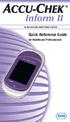 Inform II BLOOD GLUCOSE MONITORING SYSTEM Quick Reference Guide for Healthcare Professionals 2 Table of Contents Important... 4 General Information... 6 ACCU-CHEK Inform II Meter...10 How to Perform Patient
General Information. Our Background Automated Phone Services Holiday Coverage Licenses & Accreditations
 General Information Our Background Automated Phone Services Holiday Coverage Licenses & Accreditations Our Background Foundation Laboratory is an advanced, accredited and certified clinical diagnostic
Medical/Clinical Assistant CIP 51.0801 Task Grid
 1 Secondary Task List 100 PHARMACOLOGY 101 Measure drug dosages using droppers, medicine cups, syringes, and other specialized devices. 102 Utilize correct technique to administer medications using the
SAMPLE. Verification of Comparability of Patient Results Within One Health Care System; Approved Guideline (Interim Revision)
 August 2012 Verification of Comparability of Patient Results Within One Health Care System; Approved Guideline (Interim Revision) This document provides guidance on how to verify comparability of quantitative
Accreditation Program Guide. Diagnostic Laboratory Facilities: 4-Year Accreditation
 Diagnostic Laboratory Facilities: 4-Year Accreditation V11 June 2015 TABLE OF CONTENTS 1.0 PURPOSE OF ACCREDITATION... 3 2.0 COLLEGE OF PHYSICIANS AND SURGEONS OF ALBERTA (CPSA) ACCREDITATION PROGRAM...
Checklist. Standard for Medical Laboratory
 Checklist Standard for Medical Laboratory Name of hospital..name of Laboratory..... Name. Position / Title...... DD/MM/YY.Revision... 1. Organization and Management 1. Laboratory shall have the organizational
2010 Laboratory Accreditation Program Audioconference. Accreditation Requirements for Waived Vs. Non-waived Tests
 2010 Laboratory Accreditation Program Audioconference Accreditation Requirements for Waived Vs. Non-waived Tests Objectives: After participating in this audioconference you will be able to: Define the
Unit/Standard Number. Proficiency Level Achieved: (X) Indicates Competency Achieved to Industry Proficiency Level
 1 Secondary Task List 100 INTRODUCTION TO HEALTHCARE 101 Identify the roles and educational/credentialing requirements of various health care practitioners. 102 Describe the 's job description, personal
CHAPTER 13. Quality Control/Quality Assurance
 CHAPTER 13 Quality Control/Quality Assurance Quality Control/Quality Assurance (QC/QA) can be defined as the set of planned and systematic activities focused on providing confidence that quality requirements
Medical Laboratory Technician AAS Program
 Medical Laboratory Technician AAS Program New Program Proposal State Submission Steve Buchholz, Dean of Accreditation and Advancement July 2015 TABLE OF CONTENTS Executive Summary... 2 Identification and
FINAL DOCUMENT. Global Harmonization Task Force. Title: Label and Instructions for Use for Medical Devices
 GHTF/SG1/N70:2011 FINAL DOCUMENT Global Harmonization Task Force Title: Label and Instructions for Use for Medical Devices Authoring Group: Study Group 1 of the Global Harmonization Task Force Endorsed
College of American Pathologists Accreditation for Public Health Laboratories
 College of American Pathologists Accreditation for Public Health Laboratories Romesh Gautom, PhD Director, Washington State Public Health Laboratory Garry McKee, PhD, MPH Director, Oklahoma State Public
In vitro diagnostic reagent, calibrator and control material stability
 In vitro diagnostic reagent, calibrator and control material stability Pauline Armstrong Randox Laboratories, Ltd. Crumlin The stability of in vitro medical diagnostic devices whether they are reagents,
Contents. Abstract... i. Committee Membership... iii. Foreword... vii. 1 Scope... 1. 2 Introduction... 1. 3 Standard Precautions...
 Vol. 28 No. 20 Replaces H47-A Vol. 16 No. 3 One-Stage Prothrombin Time (PT) Test and Activated Partial Thromboplastin Time (APTT) Test; Approved Guideline Second Edition This document provides guidelines
FDA Public Hearing on Clinical Accuracy Requirements for Point of Care Blood Glucose Meters (BGMs)
 FDA Public Hearing on Clinical Accuracy Requirements for Point of Care Blood Glucose Meters (BGMs) Barriers to Overcoming Interferences and Limitations Alan T. Cariski, MD, JD, and Mike Flis, AdvaMed BGM
Presented by Rosemarie Bell 24 April 2014
 Global Good Manufacturing Practice A Comparability Study to Link Good Manufacturing Practice Standards for World Wide Compliance Within the Cellular Therapy Industry Presented by Rosemarie Bell 24 April
Point of Care Testing and Informatics: How to Prepare for the POCT Explosion
 Point of Care Testing and Informatics: How to Prepare for the POCT Explosion Pathology Informatics Summit 2014 David McClintock, MD May 14, 2014 Disclosures No conflicts of interest with any content presented
Health Care Workers in the Community
 Waste Management for Health Care Workers in the Community Adapted from Waste Management for Health Care Workers in the Community with the permission of Capital Health, Regional Public Health. Distributed
2009 LAP Audioconference Series. How to Prepare and Comply with Your Quality Management Plan
 2009 LAP Audioconference Series How to Prepare and Comply with Your Quality Management Objectives: As a result of participating in this session, you will be able to: Explain the reasons why the QM is important
MEDICAL DEVICE GUIDANCE
 May 2014 MEDICAL DEVICE GUIDANCE GN-23: Guidance on Labelling for Medical Devices PREFACE This document is intended to provide general guidance. Although we have tried to ensure that the information contained
Edith Cowan University Faculty of Health, Engineering and Science Work Health and Safety Committee
 PROCEDURES Title: PROCEDURES - HANDLING INFECTIOUS MATERIALS AND INFECTION CONTROL Descriptors: 1) 2) 3) 4) Category: OS&H Purpose Organisational Scope Policy Statement Definitions Principles Content References
Content Sheet 3-1: Equipment Management Overview
 Content Sheet 3-1: Equipment Management Overview Role in quality management system Equipment management is one of the essential elements of a quality management system. Proper management of the equipment
Using and Maintaining Documents and Records. Finding the information when you need it
 Using and Maintaining Documents and Records Finding the information when you need it Problem Scenario You are the laboratory supervisor in a moderate-sized hospital. A physician calls you and says that
Biomedical Engineering Technologist II. Total Points Rating 5 4 3 5 5 4 4 5 4 Points 233 67 19 24 150 87 83 107 43 813
 Job Class Profile: Biomedical Engineering Technologist II Pay Level: CG-36 Pay Band: 790-813 Accountability & Decision Making Development and Leadership Environmental Working Conditions Factor Knowledge
Thank you for expressing an interest in the Medical Laboratory Technology Program at Northeast Mississippi Community College.
 Division of Health Sciences 101 Cunningham Blvd Booneville, Mississippi 3889 Phone (66) 70 736/(800) 555 154 Fax (66) 70 715 Dear Student, Thank you for expressing an interest in the Medical Laboratory
Laboratory Director Responsibilities
 Clinical Laboratory Improvement Amendments (CLIA) Laboratory Director Responsibilities What Are My Responsibilities As A Laboratory Director NOTE: Congress passed the Clinical Laboratory Improvement Amendments
Guidance Document Infectious Substances
 Guidance Document Infectious Substances Note: 1. The following Guidance Document was developed by the ICAO DGP. The original ICAO document reflects references to the ICAO Technical Instructions these have
Accu-Chek Inform II system. Professional glucose testing for the wireless age
 Accu-Chek Inform II system Professional glucose testing for the wireless age The Accu-Chek Inform II system Real time control The Accu-Chek Inform II System overview Quality Advanced chemistry with multiple
XL-I 2011: Understanding and Explaining the CAP POCT Checklist: A Tool for Laboratorians to Use With POCT Staff
 Case Study, Presentation John Tran is a medical technologist who has worked in an automated laboratory but is newly hired as a hospital point-of-care coordinator (POCC) for the Rapidly Growing Health System
Bloodborne Pathogens Program Revised July, 5 2012
 Bloodborne Pathogens Program Revised July, 5 2012 Page 1 of 16 Table of Contents 1.0 INTRODUCTION...3 1.1 Purpose...3 1.2 Policy.3 2.0 EXPOSURE CONTROL METHODS 4 2.1 Universal Precautions.4 2.2 Engineering
LANE COUNTY B065 (Medical Assistant 1) Established: 4/13/05 B060 (Medical Assistant 2) Updated: 4/13/05 (Previous title: Medical Assistant)
 B065 (Medical Assistant 1) Established: 4/13/05 B060 (Medical Assistant 2) Updated: 4/13/05 (Previous title: Medical Assistant) MEDICAL ASSISTANT 1 MEDICAL ASSISTANT 2 DEFINITION To perform delegated routine
COPY. Revision History: Changes were made to reflect the current practice of only including the most recent changes in the revision history.
 Revision History COPY The top row of this table shows the most recent changes to this controlled document. For previous revision history information, archived versions of this document are maintained by
URINE COLLECTION, PREPARATION AND HANDLING
 URINE III-38 URINE COLLECTION, PREPARATION AND HANDLING I. SPECIMEN COLLECTION A. Introduction Laboratory tests requiring urine specimens involve a wide variety of procedures. A basic urinalysis is almost
Health Care Job Information Sheet #13. Laboratory
 Health Care Job Information Sheet #13 Laboratory A. Occupations 1) Medical Laboratory Technologist 2) Medical Laboratory Technician/Assistant 3) Cytotechnologist 4) Genetics Technologist 5) Other positions
Medical Assisting I. Perform general office procedures to accreditation and certification standards recognized by the American Medical Association
 Medical Assisting I. Perform general office procedures to accreditation and certification standards recognized by the Each number refers to a single candidate (1-10). Place check ( ) in respective column
APPENDIX A GUIDANCE DOCUMENT
 APPENDIX A GUIDANCE DOCUMENT Infectious Substances International Civil Aviation Organization Technical Instructions for the Safe Transport of Dangerous Goods by Air, 2005-2006 Note: This guidance document
Table of Contents. Preface... 1. 1 CPSA Position... 2. 1.1 How EMRs and Alberta Netcare are Changing Practice... 2. 2 Evolving Standards of Care...
 March 2015 Table of Contents Preface... 1 1 CPSA Position... 2 1.1 How EMRs and Alberta Netcare are Changing Practice... 2 2 Evolving Standards of Care... 4 2.1 The Medical Record... 4 2.2 Shared Medical
ROLE DESCRIPTIONS BY COMPETENCY LEVEL
 Description of Work: Positions in this class provide patient evaluation and care in area of assignment. Duties include but are not limited to development and presentation of educational programs, assessment,
The Medical Microbiology Milestone Project
 The Medical Microbiology Milestone Project A Joint Initiative of The Accreditation Council for Graduate Medical Education and The American Board of Pathology July 2015 The Medical Microbiology Milestone
MODULE 2D ENVIRONMENTAL MICROBIOLOGICAL LABORATORY ACCREDITATION PROGRAM (EMLAP) ADDITIONAL REQUIREMENTS
 MODULE 2D ENVIRONMENTAL MICROBIOLOGICAL LABORATORY ACCREDITATION PROGRAM (EMLAP) ADDITIONAL REQUIREMENTS 2D.1 SCOPE The AIHA- Laboratory Accreditation Programs (AIHA-LAP), LLC s Environmental Microbiological
CAP Point of Care Checklist Frequently Asked Questions Roger D. Klein, MD Sheldon Campbell, MD, PhD Peter J. Howanitz, MD
 CAP Point of Care Checklist Frequently Asked Questions Roger D. Klein, MD Sheldon Campbell, MD, PhD Peter J. Howanitz, MD TABLE OF CONTENTS Introduction Applicability General Topics Proficiency Testing
Application for Clinical Privileges Allied Health Professional Specialty: Family Nurse Practitioner (FNP)
 Application for Clinical Privileges Allied Health Professional Specialty: Family Nurse Practitioner (FNP) Qualifications To be eligible to apply for core clinical privileges as a Family Nurse Practitioner
A Safe Patient. Commonwealth Nurses Federation. Jill ILIFFE Executive Secretary. Commonwealth Nurses Federation
 A Safe Patient Jill ILIFFE Executive Secretary Commonwealth Nurses Federation INFECTION CONTROL Every patient encounter should be viewed as potentially infectious Standard Precautions 1. Hand hygiene 2.
Managing Bloodborne Pathogens Exposures
 Managing Bloodborne Pathogens Exposures House Staff Orientation 2015 Phillip F. Bressoud, MD, FACP Associate Professor of Medicine and Executive Director Campus Health Services University of Louisville
NCI-Frederick Safety and Environmental Compliance Manual 03/2013
 C-6. Medical Surveillance I. Purpose The purpose of the medical surveillance of employees at the NCI-Frederick is to preserve health and prevent work related disease. The medical surveillance program will
Standard Operating Procedure for Blood Borne Infectious Disease Control Measures at Calvin College
 Standard Operating Procedure for Blood Borne Infectious Disease Control Measures at Calvin College Clean up should be done by non-student employees and trained personnel only Cleaning Up BODY FLUIDS from
INTRODUCTION TO CLINICAL PRACTICE AND CLINICAL SKILLS 2nd Year MEDICAL YEAR 2009/2010
 INTRODUCTION TO CLINICAL PRACTICE AND CLINICAL SKILLS 2nd Year MEDICAL YEAR 2009/2010 POINT OF CARE TESTING This session is designed to teach you the principals of point of care testing. This is common
MEDICAL ASSISTANT 1 - Bilingual MEDICAL ASSISTANT 2 - Bilingual
 MEDICAL ASSISTANT 1 - Bilingual MEDICAL ASSISTANT 2 - Bilingual LANE COUNTY B065B (Medical Assistant 1 - Bilingual) Established: 7/24/06 Updated: 09/14/06 B060B (Medical Assistant 2 - Bilingual) Updated:
Medical Clinical Assistant
 Medical Clinical Assistant Pennsylvania CIP 51.0801 This document describes the correlation between curriculum, supplied by Applied Educational Systems, and the Medical Clinical Assistant standard, published
XV.Quality Assurance in the Blood Bank
 XV.Quality Assurance in the Blood Bank A. Overview 1. Goals 2. Terms B. Record Keeping a. Safe transfusion b. Careful adherence to SOPs by trained personnel c. Develop comprehensive guidelines to be in
Contact. Laboratory for Clinical Trials Laboratoire des Essays Cliniques Laboratorio de Ensayos Clinicos
 Contact LKF - Laboratorium für Klinische Forschung GmbH Lise-Meitner-Straße 25-29 D-24223 Raisdorf, Germany Phone: +49(0)43 07-82 76 0 Fax: +49(0)43 07-82 76 79 Internet: www.lkf-kiel.de E-mail: [email protected]
2.3. The management in each HCF shall be responsible for ensuring good waste management practices in their premises.
 1. PURPOSE Health-care activities lead to production of medical waste that may lead to adverse health effects. Most of this waste is not more dangerous than regular household waste. However, some types
NABL accreditation is a formal recognition of the technical competence of a medical testing laboratory
 NABL accreditation is a formal recognition of the technical competence of a medical testing laboratory Third party assessment NABL has Mutual Recognition Arrangement with APLAC and ILAC NABL accredited
Chapter. Guaiac Screening CHAPTER 4: GUAIAC TESTING SCREENING FOR OCCULT BLOOD. Page 1 of 5 Guaiac 3-5-02.doc 6/24/2005
 Chapter 4 Guaiac Screening CHAPTER 4: GUAIAC TESTING SCREENING FOR OCCULT BLOOD Page 1 of 5 Guaiac 3-5-02.doc 6/24/2005 Procedure: Guaiac Testing Screening for Fecal Occult Blood POLICY: The stool occult
CLINICAL PRIVILEGES- NURSE MIDWIFE
 Name: Page 1 Initial Appointment Reappointment Department Specialty Area All new applicants must meet the following requirements as approved by the governing body effective: Applicant: Check off the Requested