
Backup MyPC. User Guide
|
|
|
- Alfred Newman
- 10 years ago
- Views:
Transcription
1 Backup MyPC User Guide December 2003

2 FOR WINDOWS XP SP1 ONLY! Restoring All of Your Files with Windows XP SP1 and Backup MyPC Some versions of Windows XP Service Pack 1 do not support automated Disaster Recovery. If this is a problem for your system, you will be notified when you attempt to create a Disaster Recovery Set using the Recovery Wizard. This Addendum explains how to restore your Windows XP computer when automated Disaster Recovery is not available. This Addendum explains how to restore your Windows XP computer when automated Disaster Recovery is not available. When you are finished, your computer will be restored to the state it was in at the time of your last backup. Before getting started, you will need: A Windows XP installation CD or the Windows XP recovery CD provided with your computer. A copy of Windows XP Service Pack 1. The Service Pack can be downloaded from Microsoft's Web site. Copies on CD can also be purchased from Microsoft or created from the Network Installation File located on the Microsoft SP1 download page. If possible, create or obtain a copy of Service Pack 1 before you have a problem with your computer. Keep this copy with your backup media. Media containing your backup files. The Backup MyPC application. : If you purchased Backup MyPC as a downloadable file over the Internet and no longer have access to the application file, you may need to contact your reseller to obtain another copy. To restore all of your files: 1. Replace any damaged hard drives with comparable drives. 2. Reinstall Windows XP. 3. Reinstall Windows XP Service Pack Install Backup MyPC. Your installation method will depend on how you obtained the software. If you purchased Backup MyPC from a store, use the installation CD. If your computer manufacturer preinstalled Backup MyPC, a copy of the software may have been included on your operating system recovery CD. 5. Use Backup MyPC to restore your data and applications. More detailed information about Restoring All of Your Files with Windows XP SP1 and Backup MyPC is available on the Stomp Discussion Board at ii
3 Introduction Backup MyPC provides reliable data protection for computers in the consumer, SOHO (small office, home office) and corporate environments. The rapid growth of personal and business-critical data has prompted the need for a trusted backup solution that ensures the safety of valuable data while eliminating many of the inconveniences frequently associated with backup software. Backup MyPC s intuitive design and proven technology is the preferred Windows backup solution for securing data on individual workstations. Backup MyPC uses the familiar Windows Explorer interface for making easy file and folder selections. Customized backup settings and file selections are saved as backup jobs, and can be easily modified to suit your needs. Backup MyPC also offers the following features: Unattended backups ensure data is backed up regularly, and at your convenience Supports popular tape devices, CD-R and CD-RW, Zip, Jaz, magneto optical, DVD, PD/CD and SuperDisk Automatic backup device detection Find File function performs a media search for specific files you want to restore Hardware and software compression maximizes media efficiency Report files are automatically generated to list any errors that may have occurred during an operation Integrated Disaster Recovery restores files, software programs, and operating system after a hard disk failure Product Overview Backup MyPC was developed with the understanding that most users want to spend as little time as possible performing time-consuming backup and restore operations. At the same time, more advanced users may prefer to have greater control over what to back up, how to back up and when to run the backup job. To accommodate users with various data iii

4 Product Overview requirements and experience levels, Backup MyPC provides several approaches for performing backup and restore functions allowing you to choose the method that suits your needs: Using the Backup and Restore Functions Method One-Button Backup and One-Button Restore Backup Wizard and Restore Wizard Backup Window and Restore Window Objective Using the One-Button Backup and One-Button Restore features, users can perform the most comprehensive data protection operations with limited user input. Safeguarding your data with slightly more control than the One-Button option, the Backup Wizard and the Restore Wizard guide users through backup and restore jobs with clearly-defined instructions. Taking advantage of this full-featured application, the Backup Window and the Restore Window offer the user the widest range of options for managing their backup and restore jobs. By scheduling unattended backups, you can ensure that data is being protected regularly, and at your convenience. For complete and efficient data protection, a full system backup should be performed as soon as possible. This backup set will contain all of the files on a user s system. Once a full backup is complete, Backup MyPC can automatically back up only those files that are new or have changed since the last full backup. Media containing your backup sets can then be used to recover the contents of an entire hard drive, or restore a specific file version to its previous state. If you are having trouble finding a particular file in a backup set, use the Find File feature available from the Restore Window to locate and restore it. In the event of data loss due to a major system or hard drive failure, Backup MyPC s Disaster Recovery is an advanced feature that enables users to perform a complete system recovery without having to re-install Windows or any other software programs. The integrated Disaster Recovery process boots the computer from a customized set of backup media (Disaster Recovery Set), restores the operating system, and recovers the user s data to the state it was in when the Disaster Recovery Set was created. iv User Guide

5 Product Overview Using This Manual This manual is designed to provide you with complete instructions on how to use Backup MyPC to protect valuable data. Within this manual, you will find step-by-step instructions for using Backup MyPC on Windows 9x/Me, Windows NT 4.0 Workstation, Windows 2000 Professional, and Windows XP operating systems. Each chapter begins with a topic index to help guide you to the information you need. Manual Index Chapter 1 Chapter 2 Chapter 3 Chapter 4 Chapter 5 Chapter 6 Chapter 7 Chapter 8 Chapter 9 Chapter 10 Getting Started provides basic information for installing, using and navigating within Backup MyPC. Using Backup provides in-depth instructions for backing up the data on your local drives to a backup location. With Backup MyPC, data located on networked drives can also be backed up. Using Restore explains how to restore data from a backup location to your local or networked drives. Using Disaster Recovery outlines the precautionary steps that must be taken to ensure that you are prepared in the event of a hard drive failure, and lists the steps to take should such a disaster occur. Using Compare lists steps for comparing the data on your backup media to the data on the hard drive ensuring a proper restore of your files. Protecting Data On A Network provides information on backing up and restoring the data on networked computers. Tools describes how to use the tools that Backup MyPC provides to help you handle your media, the catalog, and reports. Using Media provides information on the use of various media types for use with Backup MyPC. Troubleshooting Tips offers solutions to common configuration and compatibility issues. Technical Support lists preliminary steps you can take to facilitate the resolution of any problems you may be experiencing with this product. Introduction v

6 Product Overview Additional Resources For additional assistance on the use of this product, the following components are also available: On-Line Help Backup MyPC includes an extensive on-line help system that can be accessed by pressing F1 on your keyboard, or by selecting Help Topics from the Help menu. Context-sensitive help is also available from most windows and dialog boxes by clicking the question mark in the window s upper right-hand corner, and clicking the button or option you would like more information about. Read Me File The Read Me file for Backup MyPC contains useful, late-breaking information about the program and lists any hardware or software conflicts. Read through this document before using Backup MyPC, by clicking the Windows Start menu, then going to Programs, Backup MyPC, and selecting Read Me. The exact location of the backup MyPC program group may vary from system to system. Important News Regarding Compression The file compression system used by Backup MyPC has changed. As a result, this is the last version of Backup MyPC that will be able to restore backup sets created with the older compression system. To insure the maximum level of protection for your data, we recommend that you create a full backup of all your data using this version of Backup MyPC. We also recommend that you save a copy of this version of Backup MyPC along with your old backup sets in case it is needed to restore older files. To protect against incompatibility, this version of Backup MyPC will not allow you to append data to a backup media created with a previous version of Backup MyPC. vi ii User Guide

7 Contents Introduction iii Product Overview iii Using This Manual v Additional Resources vi On-line Help vi Read Me File vi Chapter 1. Getting Started Whatís New in this Version? Accessibility Navigation and Keyboard Shortcuts Navigation Keyboard Shortcuts Installing Backup MyPC System Requirements For Windows 9x and Windows Millennium For Windows 2000 Professional and Windows NT For Windows XP * Home and Professional Installing Directly from a CD-ROM Starting Backup MyPC Running Backup MyPC for the First Time Creating an Automatic Data Protection Job Disaster Recovery Set Creation Startup Window * See page ii for XP SP1 users only. vii

8 Using Backup MyPC Menus Toolbar Selection Panes Help Context-Sensitive Help Help Menu Exiting Backup MyPC Chapter 2. Using Backup Quick Start Automatic Data Protection One-Button Backup Default Backup Job Settings Backup Jobs Using the Backup Wizard The Backup Window Backup Jobs List What to Back Up Backup Selection Panes Where to Back Up Backing Up to File How to Back Up Backing Up Files with the Backup Window Busy Files Windows XP Snapshot Support Backing up the Windows Registry Backing up the System State The Backup Set Using Backup Jobs viii User Guide
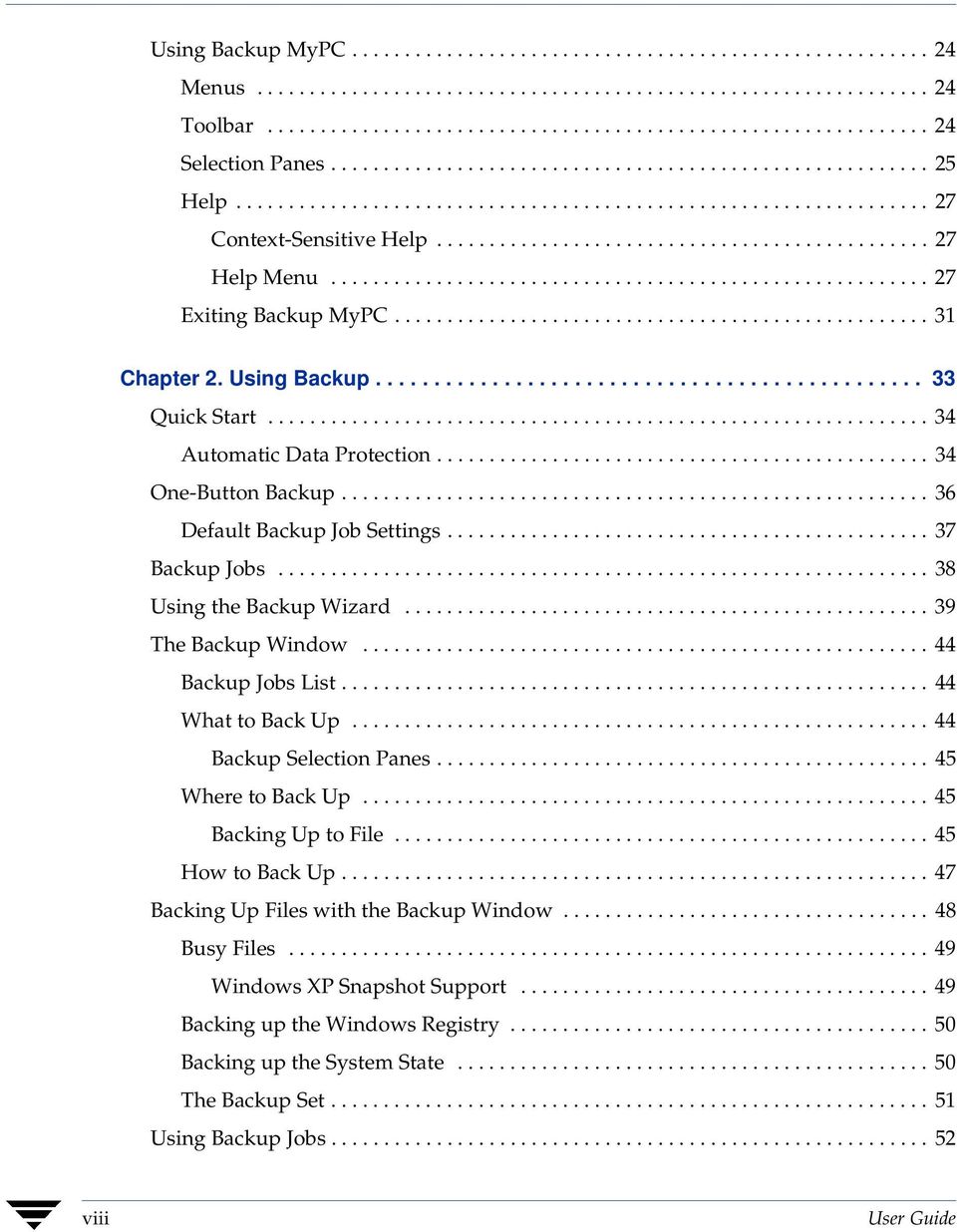
9 Backup Progress Window Canceling Your Backup Viewing Your Backup Report Archive bit Backup Options General Tab Password Tab Type Tab Backup types Exclude Tab The Exclude tab and File backups Report Tab Unattended Backup Advanced Tab Scheduling a Backup Job Power Management Properties Setting Frequencies for the Scheduled Job Changing When a Scheduled Backup Job Runs Editing a Scheduled Backup Job Removing a Scheduled Backup Job Chapter 3. Using Restore One-Button Restore Restore Default Settings Restoring All Your Files For Windows 9x and Millennium Edition For Windows NT For Windows 2000 and Windows XP (See page ii for XP SP1 users.) Using the Restore Wizard The Restore Window Contents ix
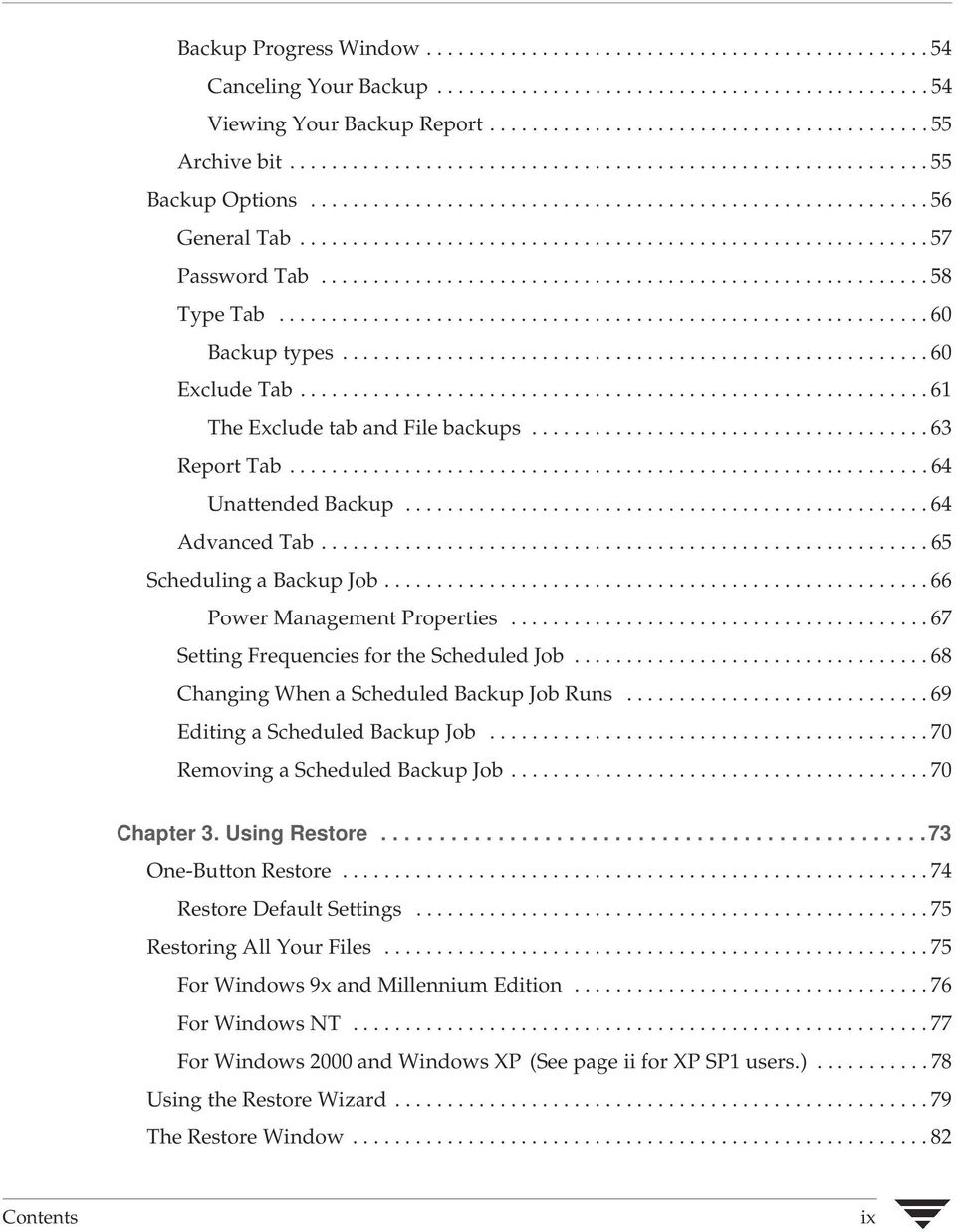
10 Restore From Find Files What to Restore Catalog File Views Restore Selection Panes Where to Restore How to Restore Restore Options General Tab Report Tab Unattended restore Advanced Tab Restoring Files with the Restore Window Restore Progress Window Restoring the Windows Registry Restoring the System State Multiple File Versions Chapter 4. Using Disaster Recovery Creating the Disaster Recovery Set Partitioning Your Drive(s) Windows 9x and Millennium Edition Disaster Recovery Set Windows XP Home Edition Disaster Recovery Set Installation CD, Recovery CD, or disk image? Windows XP Professional Disaster Recovery Set Windows XP Professional CD Windows 2000 Disaster Recovery Set Windows 2000 Professional CD Windows NT Disaster Recovery Set x User Guide
11 Booting from your Backup Device Testing for Compatibility Performing a Disaster Recovery Disaster Recovery for Windows 9x and Millennium Edition Disaster Recovery for Windows XP Home Edition Disaster Recovery for Windows XP Professional Disaster Recovery for Windows 2000 and NT Chapter 5. Using Compare The Compare Window Compare From Compare File What to Compare File Views Compare Selection Panes Where to Compare Comparing Files with the Compare Window Compare Progress Window Compare Options Advanced Tab Chapter 6. Protecting Data On A Network Remote System Backup and Restore File System Considerations Performance Hardware RAID Software RAID Remote Backups Using the File Option Chapter 7. Tools Media Tools Contents xi
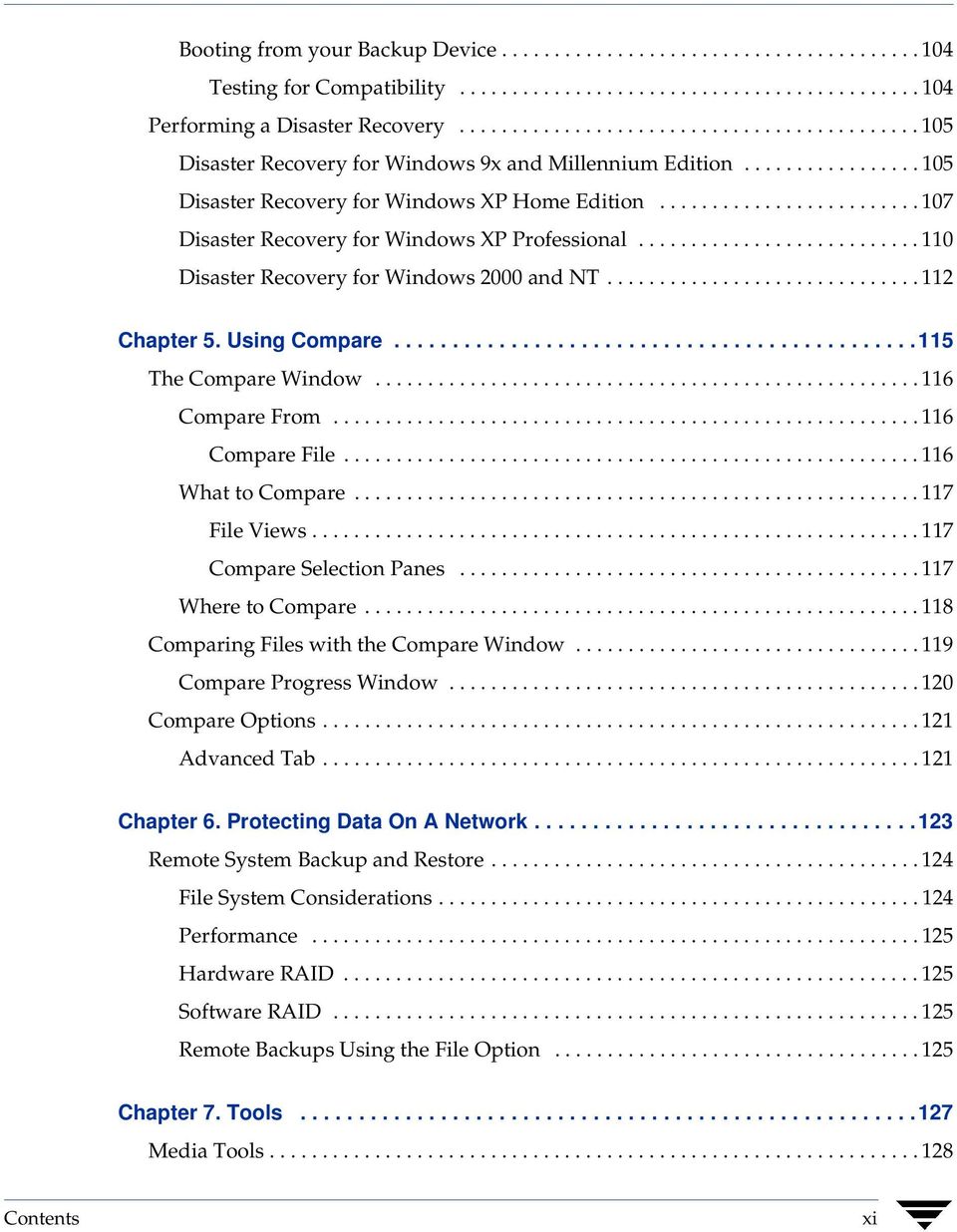
12 Identify Initialize Erase Retension Rename Security Erase Format TapeAlert Report Tools Import Catalog Catalog Clean Up Preferences General Chapter 8. Using Media Media Maintenance and Care Naming Media Appending Media Chapter 9. Troubleshooting Tips Backup Size Limitations Backup Device Configuration Backup Device Not Recognized by Backup MyPC SCSI Backup Devices IDE Backup Devices USB Backup Devices Parallel Port Backup Devices Hardware and Software Conflicts Conflicts With Other Device Drivers Possible Problems with IDE Chipsets Other Conflicts xii User Guide

13 Common Error Messages Parallel Port Tape Backup Error ASPI Manager Not Found or ASPI Manager Not Responding Device Driver Error DMA Conflict During Backup or Compare Media Not Formatted or Unreadable Media Formatter Error File Errors Insufficient Memory Errors Internal Errors Backup Performance Considerations Compress Data Verify Data Backing Up Large Backup Sets Memory Management SCSI and IDE Backup devices Frequently Asked Questions Chapter 10. Technical Support Preparing for Technical Support Index Contents xiii

14 xiv User Guide

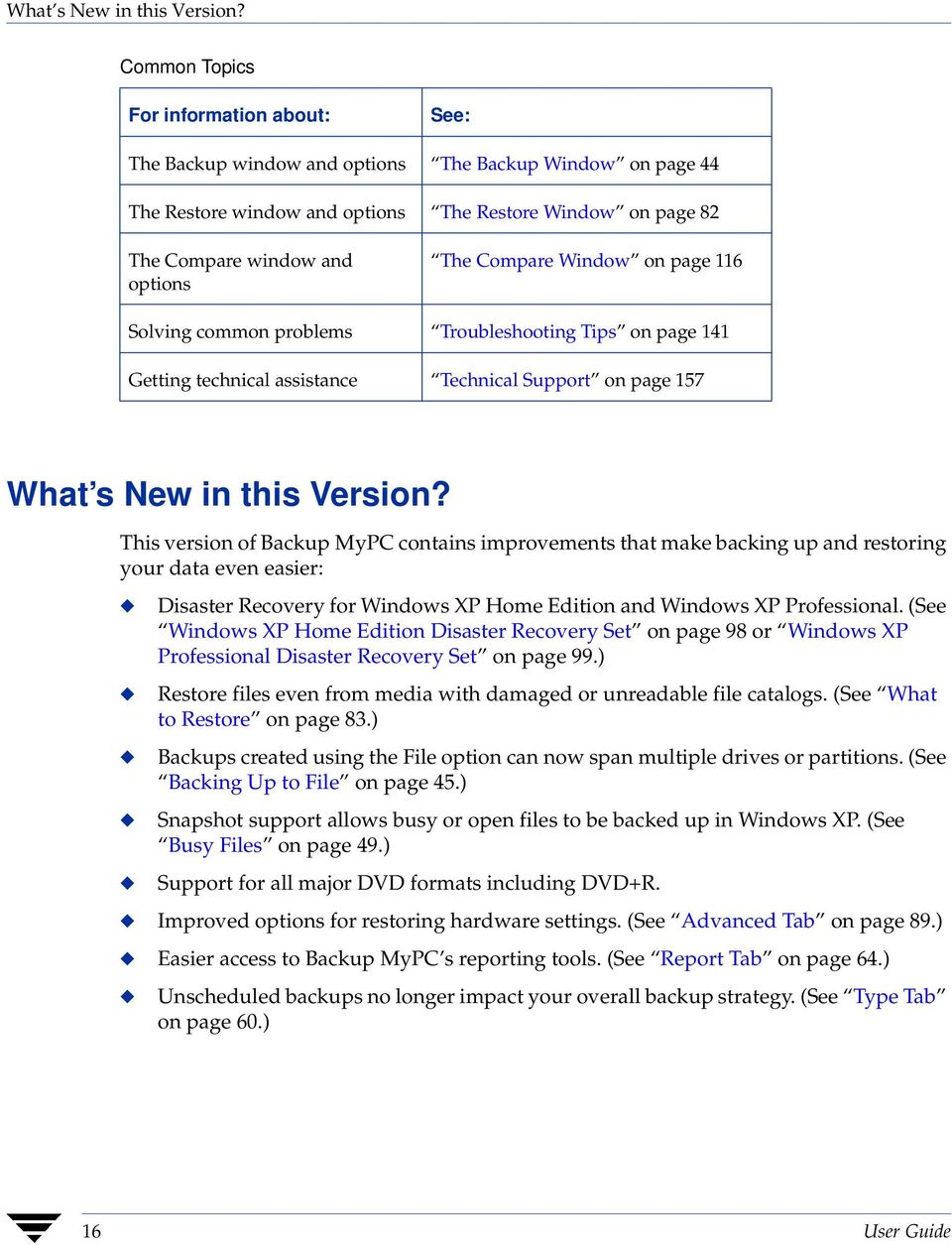
15 Getting Started 1 Backup MyPC is a powerful backup solution for Windows designed to protect your valuable data. This User Guide provides detailed information and procedures for installing, using, and navigating within Backup MyPC. Other valuable information is available through Backup MyPC's on-line Help. The following table contains a list of common topics to help get you started: Common Topics For information about: New features available in this version. Installing and configuring Backup MyPC Using Automatic Data Protection Backing up and restoring your files quickly Creating the Disaster Recovery Set Using Disaster Recovery Restoring all your files without Disaster Recovery diskette(s) Using Backup MyPC s Wizards to create backup and restore jobs See: What s New in this Version? on page 16 Installing Backup MyPC on page 19 Automatic Data Protection on page 34 One-Button Backup on page 36 and One-Button Restore on page 74 Creating the Disaster Recovery Set on page 95 Performing a Disaster Recovery on page 105 Restoring All Your Files on page 75 Using the Backup Wizard on page 39 and Using the Restore Wizard on page 79 15

16 What s New in this Version? Common Topics For information about: See: The Backup window and options The Backup Window on page 44 The Restore window and options The Restore Window on page 82 The Compare window and options The Compare Window on page 116 Solving common problems Troubleshooting Tips on page 141 Getting technical assistance Technical Support on page 157 What s New in this Version? This version of Backup MyPC contains improvements that make backing up and restoring your data even easier: Disaster Recovery for Windows XP Home Edition and Windows XP Professional. (See Windows XP Home Edition Disaster Recovery Set on page 98 or Windows XP Professional Disaster Recovery Set on page 99.) Restore files even from media with damaged or unreadable file catalogs. (See What to Restore on page 83.) Backups created using the File option can now span multiple drives or partitions. (See Backing Up to File on page 45.) Snapshot support allows busy or open files to be backed up in Windows XP. (See Busy Files on page 49.) Support for all major DVD formats including DVD+R. Improved options for restoring hardware settings. (See Advanced Tab on page 89.) Easier access to Backup MyPC s reporting tools. (See Report Tab on page 64.) Unscheduled backups no longer impact your overall backup strategy. (See Type Tab on page 60.) 16 User Guide
17 Accessibility Accessibility Backup MyPC has been designed with a commitment to accessibility. It is compatible with Microsoft's accessibility utilities and many third-party assistance products. Keyboard shortcuts are available for all major operations and menu items. In addition, all help screens and documentation have been provided in HTML or PDF formats that can be read by standard text readers. Some graphic elements used in this program are not handled correctly by all screen readers. Setting your screen reader to ignore graphics may improve performance. Navigation and Keyboard Shortcuts Program functions and menu items can be accessed from the keyboard without using a mouse. Backup MyPC follows standard Microsoft navigation techniques and keyboard shortcuts. Navigation Screen navigation from the keyboard is typically achieved using the Tab key to move from function to function, the arrow keys to select options within a function, and the Enter key to activate your selection. The current active area of the screen is enclosed with a rectangle formed by dotted lines. Pressing the Tab key moves the rectangle to the next active area. Tip Holding down the Shift key and pressing the Tab key reverses the tabbing order, making it easy to return to the last active area of the screen. Keyboard Shortcuts Operations available from the program menus can also be accessed from the keyboard. Routine functions such as opening a file, saving a file, and printing a file can be performed using standard Microsoft keyboard shortcuts. For instance, Control+S saves your work in most programs. There are many more menu items that are unique to Backup MyPC. These can be reached using the standard system of accelerator or hot keys. Chapter 1, Getting Started 17

18 Accessibility To open a menu from the keyboard: 1. Begin by noting that every menu item has a single letter underlined. The underlined letter is the key to accessing most menu items. If the underlines are not visible, press the Alt key. 2. Hold down the Alt key and press the letter on the keyboard that is underlined in the menu item you wish to access. To open the File menu, for instance, you would press Alt+F. 3. The menu is now open. It may have many options and perhaps several submenus. The name of each option or submenu will have one underlined letter. Press the corresponding letter on the keyboard to access the desired menu item. 4. When the desired menu item is reached, press Enter. If the menu closes before you have a chance to make your final selection, you will have to repeat the process from the beginning. Tip Not all menu items in all programs have accelerator key access. You can also choose secondary menu items by opening the main menu and pressing the Up or Down arrow key until the desired item is highlighted. Press Enter to activate your choice, or the Right arrow key to open the next submenu. 18 User Guide

19 Installing Backup MyPC The following table lists some of the keyboard shortcuts frequently used with Backup MyPC: Frequently used keyboard shortcuts To do this... Press these keys... Open Help Duplicate a mouse click Duplicate a right-click of the mouse Open the Start menu Open Windows Explorer F1 Use the Tab and arrow keys to reach the desired function or menu item then press Enter. Use the Tab and arrow keys to reach the desired program function or menu item then press Shift + F10. Windows logo key Windows logo key + E Installing Backup MyPC This section provides system requirements and installation instructions. System Requirements Make sure your computer meets the following requirements before you begin the installation: For Windows 9x and Windows Millennium Hard drive with at least 50 MB of free space for installation 32 MB RAM, or more 133 MHz processor, or faster Chapter 1, Getting Started 19

20 Installing Backup MyPC For Windows 2000 Professional and Windows NT 4.0 Hard drive with at least 50 MB of free space for installation 64 MB RAM, or more 133 MHz processor, or faster For Windows XP* Home and Professional Hard drive with at least 50 MB of free space for installation 128 MB RAM, or more (256MB or more for double-byte language systems) 233 MHz processor, or faster This product is not intended for use on an NT, XP or Windows 2000 server. Installing Directly from a CD-ROM To install Backup MyPC directly from your CD-ROM: 1. Insert the CD-ROM disc into your CD-ROM drive. The CD Browser appears. 2. Follow the instructions on your screen to install the program. Or, 1. If the CD Browser does not appear, select Run from the Start menu. 2. Type (Your CD-ROM drive letter):\setup.exe and press OK. The CD Browser appears. 3. Follow the instructions on your screen to install the program. If you are upgrading from a previous version of this program, the backupcatalog placed on your hard drive automatically converts to the current format during installation. The time required for the conversion may be significant depending on the size of your old catalog and the speed of your system. * See page ii for XP SP1 users. 20 User Guide

21 Starting Backup MyPC Starting Backup MyPC When you install Backup MyPC, the program and its folder are added to the Windows Start menu. Running Backup MyPC for the First Time The first time you run Backup MyPC, a series of windows appear on application startup to help you perform the most important tasks: scheduling a backup, creating a Disaster Recovery Set and navigating within the application. Information on all of these tasks is mentioned in this section. Creating an Automatic Data Protection Job Performing regularly-scheduled backup jobs is the best way to ensure the continuous protection of your data. Follow these simple instructions to schedule your first backup job using Automatic Data Protection. For more information, see Automatic Data Protection on page 34. If you do not wish to schedule a backup at this time, click Cancel. The Automatic Data Protection feature is always available from the main program screen s Tools menu. Disaster Recovery Set Creation After the Automatic Data Protection screen(s), a new dialog appears allowing you to create a Disaster Recovery Set (DR Set). Chapter 1, Getting Started 21
22 Starting Backup MyPC Perform this task now, since you will not be able to easily recover from a hard disk failure until a DR Set has been created. The Disaster Recovery Set consists of a complete system backup and special bootable media (floppy disks or a CD) that will be used to restore your files, applications and operating system in the event of a hard disk failure. For more information, see Creating the Disaster Recovery Set on page 95. To create a Disaster Recovery (DR) Set at a later time, click Skip. You can create the DR Set at any time by selecting Recovery Wizard... from the Tools menu on the main program screen. Startup Window You will then be presented with the Startup Window, which offers shortcuts to many of the commonly-used features in Backup MyPC. To perform any of the tasks on the Startup Window: Click beside the task you would like Backup MyPC to perform, then click OK. Or, Click Cancel to proceed to the main application. 22 User Guide
23 Starting Backup MyPC Viewing this dialog on application startup is optional. To prevent this dialog from appearing every time you launch the application, remove the check mark beside the Show this screen on application startup option, then click OK. The main program screen will now appear whenever the program is launched (see Preferences on page 135). Chapter 1, Getting Started 23
24 Using Backup MyPC Using Backup MyPC This section provides an overview of the various tools and features that Backup MyPC offers. Menus The title bar contains six menu items: Job, Edit, View, Tools, Report, and Help. You can access these menus and the submenu items at any time. The Backup, Restore, and Compare tabs appear at the top of the main application window. Click these tabs to move between program functions. Toolbar Use Backup MyPC s toolbar to select program features with a single mouse click. Hold the cursor over a button for a short description of its function. Toolbar buttons (listed from left to right) perform the following functions: Toolbar Buttons Click: To do this: Create a new untitled backup job. Open a saved backup job. Save the current backup job for future use. Select one or more highlighted drives, folders, or files, and place check marks next to them. 24 User Guide
25 Using Backup MyPC Toolbar Buttons Click: To do this: Deselect one or more highlighted drives, folders, or files, and remove the check marks next to them. Open the Restore File Version dialog box to choose the specific version of a file you want restored. Open the File Find dialog box to find a file to restore. You can search by name, location, or date modified. Open the Backup Wizard, which leads you step-by-step through the selection of files, settings, and options for your backup. Open the Restore Wizard, which leads you step-by-step through the selection of files, settings, and options for your restore. Open the Job Options dialog box, where you can select options for the current backup job. Display your files as small icons in vertical rows (List View). Display your files in a vertical list with file size, type, and modified date (Detail View). Display a short description of menu items, windows, buttons, and boxes when the item is clicked. Selection Panes Drives and files are selected the same way in Backup MyPC as they are in Windows Explorer. Selection panes are used to select and deselect drives, folders, and files for backup and restore. The two sections of the selection panes are: All Folders Pane On the left. Displays a list of your computer s drives and folders. Chapter 1, Getting Started 25
26 Using Backup MyPC Contents Pane On the right. When a folder is highlighted in the All Folders Pane, the files and folders in that folder appear in the Contents Pane. Click the Expand/Collapse button to expand or collapse a folder. A plus sign (+) means the listing can be expanded to display additional folders. A minus sign ( ) means the listing can be collapsed so that folders beneath it are not displayed. Folders without buttons contain no subfolders. Click a selection check box to select or deselect files and folders. An empty check box means the drive, folder, or file has not been selected for backup or restore. A large, blue check mark means one or more items in a folder have been selected for backup or restore. A smaller, green check mark means that some, but not all, of a drive or folder has been selected. A red X means that the file s type has been excluded. See Exclude Tab on page 61 for more information. 26 User Guide
27 Using Backup MyPC A check mark next to a drive or folder may remain blue even after some or all of the individual files within that drive or folder have been de-selected by the user. Those files will not be backed up or restored unless they are re-selected. Help The Backup MyPC on-line help system provides in-depth information about the program and its functions. The Help System is separated into the main functions of the program: Backup, Restore, Disaster Recovery, and Compare. You will also find helpful information on tools, troubleshooting and easy-to-follow steps for setting your options. Context-Sensitive Help Context-sensitive help provides you with information about the current window, dialog box, or program message. To get context-sensitive help for the current operation, press F1 on your keyboard. You can also get context-sensitive Help for items on a dialog box. Click on the Toolbar, and then click the item you want information about. Help Menu The Help menu provides help for each program function and assistance with backup and restore concepts and skills. Among the items available from the Help menu are: Help Topics, Using Help, and About Backup MyPC. The menu may also include Web links for technical support, product registration, and product updates. Chapter 1, Getting Started 27
28 Using Backup MyPC Help Topics Help Topics opens the Help window, which contains four tabs directly above the left-hand pane. The Contents tab displays a list of topics in the Help system arranged by category. A book represents a help category containing subtopics. Double-click the book to open it, or use the Expand (+) button beside the book icon. An open book displays a list of topics and books. A page represents a help topic. Click once to open the help window for that topic. 28 User Guide
29 Using Backup MyPC The Index tab lists keywords alphabetically. Type the first few letters of a keyword and the first matching item is highlighted. The Search tab provides a full-text search utility for any word or phrase in Help. You must set up the search file the first time you use the Search tab. Then type a word or phrase and select a topic from the list. Chapter 1, Getting Started 29
30 Using Backup MyPC The Favorites tab provides a way to bookmark frequently used help topics. To add a Favorite, navigate to the desired help topic, click the Favorites tab, and then click the Add button. Using Help The Using Help menu item provides help for the help system. It explains how to use Help effectively and how to customize your Help system. About Backup MyPC About Backup MyPC displays your software s version number and licensing information. Technical Support on the Web This option takes you to the Backup MyPC technical support Web site where you can obtain additional product information, answers to frequently asked questions, and technical support. Product Registration via the Web This option allows you to quickly register your copy of Backup MyPC. Registration will help ensure you receive timely information about software updates, new releases, and other product information. This menu item may not be available on all versions of Backup MyPC. 30 User Guide
31 Using Backup MyPC Exiting Backup MyPC On the Job menu, click Exit. Or, Click the Close button. You are asked if you want to save any changes to your current backup job. Click Yes to save your backup job or click No to discard the changes. The application closes. Chapter 1, Getting Started 31
32 Using Backup MyPC 32 User Guide
33 Using Backup 2 This chapter explains how to use Backup MyPC to back up files from your computer to a backup location. You can protect your data by creating backup jobs, which save your options and file selections. Your first backup should be of your entire computer during the creation of a Disaster Recovery Set. (See Creating the Disaster Recovery Set on page 95 for more information.) Subsequent backups can be made with the simple One-Button Backup process (see One-Button Backup on page 36). You can also use the Backup Wizard or the Backup window to create a backup job. Selections and options are described in later sections of this chapter. By creating several jobs, you can customize your backups and protect your data quickly and, if you wish, automatically. See Scheduling a Backup Job on page 66 for information on creating scheduled backup jobs. The following topics are included in this chapter: Topics in This Chapter Section: Quick Start on page 34 One-Button Backup on page 36 Backup Jobs on page 38 Using the Backup Wizard on page 39 The Backup Window on page 44 Description: Explains how to create scheduled backups using Automatic Data Protection. Describes how to quickly and easily back up your files. Provides information on how backup jobs are created and modified. Explains how to back up your files using the Backup MyPC wizards. Describes the Backup Window and the options that are available. 33
34 Quick Start Topics in This Chapter Section: Backing Up Files with the Backup Window on page 48 Using Backup Jobs on page 52 Backup Options on page 56 Scheduling a Backup Job on page 66 Description: Gives step-by-step instructions on backing up your files using the Backup Window. Explains how to create, save and make changes to your backup jobs. Provides an overview of the backup options that are available through the Backup Options Dialog Box. Explains how to create and modify scheduled backup jobs. Quick Start This section shows how to back up your files easily and quickly using Automatic Data Protection. Before you start, be sure your backup devices have been detected and configured by Windows. Most backup devices are automatically detected and configured the first time you run Backup MyPC. Your backup device will be listed in the Where to Back Up box. If your device is not detected, see Backup Device Configuration on page 143 for troubleshooting information. Automatic Data Protection Automatic Data Protection ensures your data is backed up on a regular basis. When you first start the application, you are prompted with the option of initiating Automatic Data Protection. Any job created with Automatic Data Protection can later be edited with Backup MyPC. Power Management Properties If you set your Advanced Power Management settings to turn off the hard disks after a set period of time, Backup MyPC may not be able to re-start your computer to run a scheduled backup job. (See Power Management Properties on page 67 for more information.) If you are running Microsoft System Agent or Internet Explorer (4.x or higher) Task Scheduler on your machine, these schedulers will automatically be used to run your scheduled backup jobs. If neither System Agent nor Task Scheduler is installed on your machine, Backup MyPC provides a scheduler for you. (See Scheduling a Backup Job on page 66). 34 User Guide
35 Quick Start To use Automatic Data Protection: 1. From the Tools menu, select Automatic Data Protection. The Automatic Data Protection dialog appears. 2. Select a time and day of the week for the backup job to run in the areas provided. Or, select Day or Weekday from the drop-down list box. If you choose a day of the week, the New and changed files option is available. If you choose Day or Weekday, the New and changed files option is not available. 3. Click Next. 4. Select a device in the Where to back up drop-down list box. See Where to Back Up on page 45 for more information. If you are running Windows NT, Windows 2000 Professional, or Windows XP Professional, you will be prompted to type password information in order to schedule a backup at this time. Type your Windows user name and password in the areas provided. Chapter 2, Using Backup 35
36 One-Button Backup 5. Click Finish. One-Button Backup One-Button Backup launches a backup of all local hard disks, including the Windows Registry. On Windows 2000 and XP systems, the Windows Registry and other critical system files are included when you back up the System State data. For information on selecting this option, see Backing up the System State on page 50. To use One-Button Backup: 1. If Backup MyPC is running on your computer, you will need to close the program before running One-Button Backup. 2. Click the Start menu, select Programs > Backup MyPC, and then click One-Button Backup. The exact location of the Backup MyPC program group may vary from system to system. The One-Button Backup dialog appears. 3. Select a device or File in the drop-down list box. If you select File, a text box and browse button appear. The file option enables you to back up your data to a custom location, such as a hard disk, a network drive, a floppy diskette, or removable media. See Where to Back Up on page 45 for more information. The File option is not supported on all versions of Backup MyPC. 36 User Guide
37 One-Button Backup 4. Click Start. If your backup job exceeds the space available on a single piece of media, Backup MyPC will prompt you to insert another blank media when the current one has been filled. The backup will run as either a full or differential backup with default settings depending on the following criteria. An All Selected Files backup is performed if: Ten differential backups have been performed since the last All Selected Files backup, regardless of dates. More than seven days have passed since the last backup. A differential backup is performed if: No more than seven days have passed since the last All Selected Files backup. For more information on full and differential backup types, see Type Tab on page 60. Default Backup Job Settings Your backup job will run with the following default settings: What to back up Full Backup All Selected Files Differential Backup New and changed files See What to Back Up on page 44. Where to back up Backup Device. See Where to Back Up on page 45. How to back up Full Backup Verify, Compress, Prompt Differential Backup Verify, Compress, Prompt See How to Back Up on page 47. Chapter 2, Using Backup 37
38 Backup Jobs Backup Jobs Backup MyPC uses backup jobs to save and reuse file and option selections. You create a backup job by selecting drives and files for backup, choosing program settings and options, and saving your selections with a new job name. A backup job includes all selections made at the time it is saved: Drives, folders, and files to back up Backup type Backup device Options selected or default selections Backup jobs can be opened, saved, and deleted using the Job menu. In the Backup window, you can open a backup job with the Backup Job list. To change a backup job, simply make new file or option selections and save your changes. To save your changes under a different name, choose Save As from the Job menu and enter a new name, or type the new name in the Job Name field. If you attempt to save a new job using an existing name, the program asks you whether or not to overwrite the existing job. If you choose overwrite, the new job replaces the existing job. You can use the Backup Wizard (see Using the Backup Wizard on page 39) or the Backup window (see The Backup Window on page 44) to create new backup jobs or you can modify and rename existing jobs. By saving your backup jobs, you can run them as often as you like without making your selections again. Caution A backup job can span no more than 32 pieces of media. If the backup has not finished when this limit is reached, the job will be aborted and you will have to start over. See Backup Size Limitations on page 142 for more information. The Backup Job box lists your saved backup jobs. Type a new name in the box to save the job under a different name. You must make file selections before saving your backup job. 38 User Guide
39 Using the Backup Wizard Using the Backup Wizard The Backup Wizard is a series of dialog boxes that guide you through the steps required to create a new backup job. The Backup Wizard is used to create new backup jobs. It cannot be used to modify an existing job. Using the Wizard is easy. All you need to do is make selections by clicking the appropriate options. After you ve made your selections, click the Next button and the Wizard displays the next step. To create a job using the Backup Wizard: 1. Select Backup Wizard... from the Tools menu. The What to Back Up window of the Backup Wizard is displayed. 2. Select the drives and files you want to back up. To back up all files, folders, and local drives on your computer, click Back up My Computer. Click Next to continue. The Backup Type Wizard window appears. (Proceed directly to Step 5 below.) Or, To back up only some of the files, folders, or drives on your computer, click Back up selected files, folders and drives. Chapter 2, Using Backup 39
40 Using the Backup Wizard The Backup Wizard Selection Panes appear. 3. Select the specific drives, folders, and files you want to back up. For more information on selecting files, see Selection Panes on page Click Next to continue. 5. Select a backup type. Click All Selected Files to back up all selected files, then click Next. Or, Click New and Changed Files to back up only files that are new or have changed since the last All Selected Files backup and click Next. New and Changed Files will use a differential backup type. For more information on backup types, see Type Tab on page User Guide
41 Using the Backup Wizard 6. Select a destination for the backup from the Where to back up list. See Where to Back Up on page Click Next to continue. The How to Back Up window appears. 8. Select your backup options. 9. Click Next to continue. Chapter 2, Using Backup 41
42 Using the Backup Wizard The When to Back Up window appears. 10. Click Now to begin this backup immediately, or click Later to schedule this backup for a later time. If you select Later, Microsoft System Agent, Task Scheduler, or Backup MyPC Scheduler must be running. To back up later, specify the frequency, then set the time, date, and/or days of the week to run this backup job. For more information on scheduling your backup job, see Scheduling a Backup Job on page Click Next to continue. The Name the Backup Job window appears. 12. Type a name for this backup job. 13. Review the backup job s summary. To change an option, use the Back and Next buttons. 42 User Guide
43 Using the Backup Wizard 14. Click Start to begin this backup job. The Backup Progress window appears. For more information, see Backup Progress Window on page 54. If your backup job exceeds the space available on a single hard drive, drive partition or piece of media, Backup MyPC will prompt you to select another drive, drive partition, or blank media when the current one has been filled. Chapter 2, Using Backup 43
44 The Backup Window The Backup Window This section first describes the Backup window. For step-by-step instructions on creating backup jobs, see Backing Up Files with the Backup Window on page 48. The Backup window gives you quick access to all the backup job options, and includes four main sections: Backup Job Select your Backup Job from the drop-down list. What to back up Select your drives and files to back up from the selection pane. Choose the backup type. Where to back up Select a device to back up to, or select File to back up your files to your hard drive, a network drive, a floppy diskette, or removable media. How to back up Lists your option settings, and displays the Options... button. The File option is not supported on all versions of Backup MyPC. Backup Jobs List The Backup Job list box contains all available backup jobs. If you are creating a new backup job, Untitled appears as the default name. To save a new backup job, click Save from the Job menu. What to Back Up Select your backup type and files in the What to back up section. 44 User Guide
45 The Backup Window Two backup types are displayed in the Backup window under What to back up: All selected files, and New and changed files. All selected files Backs up all selected files. New and changed files Backs up all the selected files that have changed since the last All Selected Files backup. If you choose New and changed files, the default setting is differential backup. Use the Options... button to change your backup type. See Type Tab on page 60 for more information and a complete description of each type. Backup Selection Panes Backup MyPC uses the same drive and file selection methods as Windows. Drives and folders are selected in the All Folders Pane, and individual files and folders are selected in the Contents Pane. Select drives and files to back up by clicking the check box next to the item. For more information, see Selection Panes on page 25. Where to Back Up The drop-down list box in the Where to back up section contains the names of all your backup devices. One of your backup devices is automatically selected as your backup location. To change your backup location, select another device in the drop-down list box, or select File to back up your files to your hard drive, a network drive, a floppy diskette, or removable media. The File option is not supported on all versions of Backup MyPC. Backing Up to File The File option enables you to back up your data as a file in some custom location, such as a hard disk, a network drive, floppy diskette, or removable media. This is accomplished without the need for any special formatting of your media. 1. Select File in the drop-down list box in the Backup window. A text box and browse button appear below the drop-down list box. The Always Append option is not available when backing up to file. Chapter 2, Using Backup 45
46 The Backup Window 2. Type a folder and filename in the text box. If you type a filename without an extension, Backup MyPC adds a sequence number and a.qic extension to your file. Or, Click Browse, select a folder and a file within that folder, then click OK. The path appears in the text box. We recommend typing a filename for your File Backup. For example, if you type C:\SAVE in the text box, Backup MyPC will create a backup file called SAVE QIC on your local drive. The path for your backup file would be C:\SAVE QIC. If you do not type a filename, Backup MyPC will use the filename MyBackup QIC. The following table explains the advantages and possible disadvantages to using the File option to back up your data. Refer to this table to determine if the File option suits your backup needs: Advantages and Disadvantages of the File Option Advantages: Disadvantages: Allows you to back up to a file on drive partitions, networked drives, UNC shares, even floppy disks and removable discs. File backups are not supported by Disaster Recovery. No special formatting is required, which means the backup media is not limited to a single purpose. File backups can consume large amounts of hard drive space. Backing up to a drive at a remote location offers security in the event of a computer failure at your local site. Backing up to a rotating set of tapes or discs may, in some cases, provide a more portable and secure backup strategy. Backups will continue onto a second drive or media of your choice if the first one reaches capacity. The 2 GB and 4 GB file size limitations of FAT formatted drives no longer limit the size of your backup file. 46 User Guide
47 The Backup Window How to Back Up The Backup Job Options dialog box lets you set your backup options, password protect your backup set, and change your backup type. Current option settings are listed above the Options button. For information about backup options, see Backup Options on page 56. Chapter 2, Using Backup 47
48 Backing Up Files with the Backup Window Backing Up Files with the Backup Window To back up your files using the Backup window: 1. Select New from the Job menu. The Backup window appears. 2. Select what to back up. All selected files is the default setting. To change your backup type, click New and changed files. See Type Tab on page 60 for more information. 3. Select the files to back up. Click the check boxes next to the drives and files you want to back up. A check mark indicates the drive, file, or folder is selected for backup. A red X indicates that the file s type is excluded. See Selection Panes on page 25 for more information. 4. Select where to back up. To change your backup destination, make your selection in the drop-down list. See Where to Back Up on page Select how to back up. The default settings are Verify, Compress, Prompt. To change your backup options, click Options... The Backup Options dialog box lets you set each of your options. See Backup Options on page Select Save As... from the Job menu to save the settings and file selections for your backup job. The name you give it will appear in the Backup Job list. 48 User Guide
49 Backing Up Files with the Backup Window 7. Click Schedule... to run your job at a later time. See Scheduling a Backup Job on page 66. Or, Click Start to run your backup job now. See Backup Progress Window on page 54. A check mark next to a folder may remain blue even after some or all of the individual files within the folder have been de-selected by the user. Those files will not be backed up or restored unless they are re-selected. Busy Files Before a backup job begins, make sure to close any open files or applications. Doing so will greatly reduce the number of busy files encountered during a backup. Busy files typically cannot be backed up, but will be listed in your Backup Report (see Report Tab on page 64). Windows XP Snapshot Support Backup MyPC supports enhancements in Windows XP that greatly reduce the number of files that cannot be backed up because they are in use. Backup MyPC does this by taking a snapshot of your busy and open files. It will even record a snapshot of your open database and word processing files, and any file in use and locked at the time of the backup. The program s success in backing up and later restoring these files will depend, in part, on whether the applications used to create your files were designed to take advantage of the snapshot feature in Windows XP. You will also need at least 100 MB of free disk space for each volume you back up. In some cases you may wish to turn off snapshot support. This is accomplished by using the check box available on the Advanced tab of the Backup Options window. The Snapshot option is only available on systems running Windows XP with at least one drive formatted using the NT File System (NTFS). Chapter 2, Using Backup 49
50 Backing Up Files with the Backup Window Backing up the Windows Registry The Windows 9x, Millennium Edition and Windows NT Workstation 4.0 operating systems contain components that comprise the Windows Registry. The operating system references the Windows Registry during operation for information such as hardware configuration, user profiles, properties for installed applications and system settings. The Registry is automatically selected for backup when the drive containing your Windows System files is selected. Under most circumstances, this will be drive letter C:\. For example, when a One-Button Backup job is run, Backup MyPC will automatically back up all files on all local drives, including the Windows Registry. A new backup containing the Windows Registry should be performed if your hardware configuration or system settings have changed since your last backup. To back up the Windows Registry from the Backup Window: From the Backup window s All Folders Pane, place a check mark beside the Windows Registry icon (see Selection Panes on page 25 for more information on the All Folders Pane). Or, Click Options..., select the Advanced tab, then place a check mark beside the Back up Windows Registry option. Click Apply, then click OK or another options tab. For more information on the Advanced tab, see Advanced Tab on page 65. Backing up the System State For computers running Windows 2000 and XP, the System State data is a collection of critical system files and components that can be backed up and restored to your computer. By default, the System State data is automatically selected for backup when the directory containing your Windows System files is selected. Under most circumstances, this will be found in drive letter C:\. System State data located on remote computers cannot be backed up. The following is a list of the System State data components that are automatically backed up when you back up the System State data: The boot files The COM+ class registration database The registry Event logs 50 User Guide
51 Backing Up Files with the Backup Window System files Because of dependencies among the System State components, these components, or files, cannot be individually backed up and restored. When you select to back up the System State data, all of the above components are backed up. A new backup containing the System State should be performed if your hardware configuration or system settings have changed since your last backup. To back up the System State: From the Backup Window s All Folders Pane, place a check mark beside the System State icon (see Selection Panes on page 25 for more information on the All Folders Pane). Or, Click Options..., select the Advanced tab, then place a check mark beside the Back up the System State option. Click Apply, then click OK or another options tab. For more information on the Advanced tab, see Advanced Tab on page 65. If you do not have permissions to the files included in the System State, the System State icon will not be available for backup or restore. You must be an administrator or a backup operator to back up System State data. The Backup Set After you perform a backup job, your files are stored on the media in a special format called a backup set. If your backup uses two or more media, one backup set is stored on each piece of media. Information about each backup set is stored in the catalog. For information about catalogs, see Import Catalog on page 132. Chapter 2, Using Backup 51
52 Using Backup Jobs Using Backup Jobs To open a backup job: 1. Click the Backup tab in the main application window. 2. Highlight a job name in the Backup Job combo box. The backup job settings appear. Or, Choose Open from the Job menu. The Open Backup Job dialog box appears. 3. Select a Backup Job from the list. Or, Type a job name (description) in the Job to open text box. 4. Click Open. To change settings in an existing backup job: 1. Open the backup job you want to modify and make your changes. 2. Choose Save As from the Job menu. 52 User Guide
53 Using Backup Jobs The Save Backup Job As dialog box appears. It is identical to the Open Job dialog box. 3. Type a name into the Job Name text box. You may type a name of up to 130 characters (including spaces). 4. Click Save. To delete a backup job: 1. Choose Delete... from the Job menu. The Delete Backup Job dialog box appears. It is identical to the Open Job dialog box. 2. Select a Backup Job, or type a job name (description) in the Job to delete text box. 3. Click Delete. You are asked to confirm your action. Click Yes to continue. To run your backup job: Click Start. If your backup job is new or modified, the program prompts you to save the backup. The new job overwrites an older backup job, if one exists. If your backup job exceeds the space available on a single piece of media, Backup MyPC will prompt you to insert another blank media when the current one has been filled. Chapter 2, Using Backup 53
54 Using Backup Jobs Backup Progress Window The Backup Progress window appears when you start your backup. It continually updates information about your backup job. The name of the backup job in progress is displayed in the window title bar. The top section displays the backup device, media name, and the current status of the backup job. The center section displays a progress bar showing the percentage of the backup job completed and the estimated time remaining, along with time elapsed since job start. The time displayed next to the progress bar estimates the time it will require to back up the file currently being read, and does not estimate the total amount of backup time for all selected files. The bottom section displays the name of the file currently being processed, the estimated number and size of files to be backed up and already processed, and the compression ratio. When the backup is complete, the OK and Report... buttons replace the Cancel button. Click Report... for a summary of your backup or click OK to continue. Canceling Your Backup You can cancel the backup at any time by clicking Cancel or pressing Esc; however, you should be aware of the following, before canceling a backup already in progress: Canceling your backup may take several minutes, depending on the size of the backup set. 54 User Guide
55 Using Backup Jobs If you cancel a backup, some backup devices will not be able to recover the space already used by the backup on the media. To use this space, you will have to erase or overwrite the entire media. Canceling a backup may damage the catalog files. Viewing Your Backup Report When the backup completes, the Cancel button changes to OK, and a Report button is displayed below it. Click Report to view a summary of your backup or click OK to continue. You can also use the Report menu to view your backup report at a later time. Tip The report file will list the last five operations Backup MyPC performed. 4. Save your new job by selecting Save from the File menu. The Save Backup Job As dialog box appears. 5. Give the job a name and click Save. 6. Save your new job by selecting Save from the File menu. The Save Backup Job As dialog box appears. 7. Give the job a name and click Save. Archive bit When a file is created or modified, the operating system keeps track of its filename, size, and other characteristics, called attributes. One of these attributes is the archive bit, also called the archive flag. Your backup software uses the archive bit to determine whether or not a file needs to be backed up. The archive bit works like the flag on a mailbox. When the flag is up (on), the program knows that the file needs to be backed up. After the file has been backed up, the program can lower the flag to turn the file's archive bit off. Chapter 2, Using Backup 55
56 Backup Options Backup Options To open the Backup Job Options dialog box: Click Options... in the How to backup section. The Backup Job Options dialog box appears, containing the following tabs: General Tab on page 57 Password Tab on page 58 Type Tab on page 60 Exclude Tab on page 61 Report Tab on page 64 Advanced Tab on page 65 To display an option group: Click on a tab. The option group appears. To select an option or change an option setting: Click on the check box or button next to the option. To save your current settings and change option groups: 1. Click Apply. 2. Click the next option group s tab. To save your option settings and return to the Backup window: Click OK. Your backup options are saved and you return to the Backup window. 56 User Guide
57 Backup Options General Tab Use the General tab to set the Verify data and Compression options and to tell Backup MyPC how to handle media that already contain backups. Verify Data by performing a file-by-file compare after the backup has been completed. If you back up with the Verify Data option on, Backup MyPC will verify the data by reading it back from the backup media after writing it and comparing it to data on the disk. Because Verify Data takes twice as long, you may choose to turn this option off. However, it is strongly recommended that you use Verify Data to help ensure the reliability of your backups. When backing up to media Never compress the data Turns data compression off (does not control hardware compression). Compress data to save time during backup Compresses your data as much as possible with a minimum reduction in speed. Maximize compression to save space on media Compresses your data as much as possible without regard to speed. This may cause your backup to take longer; however, the resulting backup set will use less space. Compression uses a shorthand to reduce file sizes, so that data can be written in less space. Software compression will be disabled if you are using a backup device with hardware compression. If your data has already been compressed, select Never compress the data. Compressing data that has already been compressed causes the data to occupy more media space. Chapter 2, Using Backup 57
58 Backup Options If the media already contains backups Append this backup to my media Your data is placed after the last backup set on the media. Overwrite the media with this backup Overwrite works differently depending on your backup location. If you are using a backup device, Overwrite replaces all files on the media with the files selected for backup. To avoid overwriting all files on the media, choose Append. Caution All files on the media are erased before the new backup set(s) are written. If you are using the File Option for your backup, Overwrite does not erase all files on your hard drive, network drive, floppy diskette, or removable media. Overwrite only replaces a file with the same name as a file selected for backup. For example, if the name of your backup file is save.qic and there is a file on your floppy diskette that is also named save.qic, only that file will be overwritten. Any other files on the floppy are not overwritten. The File option is not supported on all versions of Backup MyPC. Let me choose this option during the backup The name of the media in the drive is displayed when the backup job begins, and you are prompted to choose Overwrite or Append. If the media is blank Use this media name You can name the media if it is blank by typing a name in the text box. Click Apply, then click OK or another options tab. Password Tab Use the Password tab to provide data security by password-protecting your backup. Your password is required to compare or restore files in the backup set. Your password may consist of up to 8 characters. Passwords are case-sensitive. For example, my pass is not the same as My Pass. Caution Make careful note of your password. Without it, you will not be able to access or recover data in your password-protected backup set. 58 User Guide
59 Backup Options To create a password: 1. Click Protect this backup with a password. 2. Type your password in the Password text box. 3. Retype your password in the Confirm password text box. 4. Click Apply. 5. Click OK or select another options tab. Chapter 2, Using Backup 59
60 Backup Options Type Tab Use the Type tab to choose a backup type. Backup types All selected files Two options are available for backing up all the files you have selected: Full Backup Backs up all the selected files and marks each file as backed up. Full Copy Backs up all the selected files but does not mark each file as backed up. This option allows you to copy files without changing the archive bit, which your backup software uses to determine whether or not a file needs to be backed up. (See Archive bit on page 55.) New and changed files only If you choose New and changed files, two additional backup types are displayed: Differential backup type Backs up all the selected files that have changed since the most recent All Selected Files backup. Recommended if you frequently restore files to your system. Incremental backup type Backs up all selected files that have changed since the most recent All Selected Files or Incremental backup. Recommended if you do not frequently restore files to your system. 60 User Guide
61 Backup Options For a comparison between the two backup types, see the table below: Differential vs. Incremental backups Differential backups Faster restores You only need to restore the most recent Full Backup and Differential backup(s). Incremental backups Slower restores You must restore the Full Backup media set, plus each Incremental backup media. Slower backups A comparison of all the files on your system must be run to determine which files have changed, or have been added since the last Full backup. Faster backups You only need to back up those files that have changed, or have been added since the last Incremental backup. Uses more media Differential backups will copy all the files that have changed since your last All Selected Files backup, even if they haven t changed since your last differential backup. Uses less media Incremental backups only copy files that have changed since the most recent All Selected Files or incremental backup. Exclude Tab Use the Exclude tab to exclude certain file types from your Backup Job. File exclusions are made based on registered types or custom types. Excluded file types are marked in the selection panes with a red X. Chapter 2, Using Backup 61
62 Backup Options To exclude files by registered type: 1. Click the Exclude tab in the Backup Job Options dialog box. The Exclude tab appears. 2. Click Add... The Exclude files from backup dialog box appears. 3. Click Registered type. 4. Select the file type you want to exclude in the Registered types list. 5. Click OK. Your exclusion appears in the Do not back up these file types list box. To exclude additional registered file types, repeat steps 2 through User Guide
63 Backup Options To exclude files by custom type: 1. Click the Exclude tab in the Backup Job Options dialog box. The Exclude tab appears. 2. Click Add... The Add Exclude dialog box appears. 3. Click Custom type. 4. Type a three letter file extension in the Custom type text box. For example, type bat to exclude all your batch files. 5. Click OK. Your exclusion appears in the Do not back up these file types list box. To exclude additional file types, repeat steps 2 through 5. To remove a file type from the Do not back up these file types list: 1. Select the file type you want to remove from the list. 2. Click Remove. The Exclude tab and File backups When you choose the File backup option, your backup set consists of one or more files. Backup MyPC automatically excludes these files from your backup job. They appear on the Exclude tab as a single entry titled Backup Files. You cannot remove this entry using the Remove button. To see the list of excluded files in your File backup set: 1. Make sure you ve selected File from the Where to back up drop-down list on the Backup Window. Then select the Exclude tab from the Backup Job Options dialog box. 2. Click Backup Files in the Exclude tab s Do not back up these file types window to select it. 3. Click the Show Files button. A list of files in the current File backup set appears in a new window, and the Show Files button becomes a Hide Files button. Chapter 2, Using Backup 63
64 Backup Options Report Tab Use the Report tab to specify the items you want to include in your backup report and to set your unattended backup option. List all files that were backed up Includes a list of the files that were selected and successfully backed up. List files that were not backed up Includes a list of the files that were selected, but not successfully backed up. List errors reported while backing up files Includes a list of any errors encountered while performing a backup of files. List warnings reported while backing up files Includes a list of any warnings encountered while performing a backup of files. List unattended messages and prompts Includes a list of any messages and prompts encountered while performing an unattended backup. Show report summary Includes a report summary of the results of the backup job. Unattended Backup Check Unattended backup to run unattended backup jobs. This option enables the program to bypass most prompts during a backup operation. Unattended backup is the default setting. To view the results of your scheduled backups, choose View from the Report menu. The Jobs Report will indicate the backup was completed or will display any errors that may have occurred during backup or verify. 64 User Guide
65 Backup Options If the media in your drive is full or unformatted, unattended backups will not be successful unless you select Overwrite the media with this backup. This Backup Job Option is available in the General options group and automatically replaces all data on the current media during scheduled backups. (See Format on page 130 for more information about formatting tape.) Advanced Tab Use the Advanced tab to specify the following options: Back up Windows Registry Backs up the Windows Registry. The Registry is automatically selected for backup when your local drive is selected. See Backing up the Windows Registry on page 50 for more information. Busy File Backup Enables busy and open files to be backed up using the snapshot feature available with Windows XP. Busy File Backup is turned on by default. See Busy Files on page 49 for more information. On systems running Windows 2000 Professional and Windows XP, the Back up the System State option will be available under the Advanced Tab. See Backing up the System State on page 50 for more information. To set the Advanced Options: 1. Click the Advanced tab in the Backup Job Options dialog box. The Advanced tab appears. 2. Check the options you want. Chapter 2, Using Backup 65
66 Scheduling a Backup Job 3. Click OK. Scheduling a Backup Job Backup MyPC provides a simple, yet flexible way to schedule your backup jobs. The scheduling process is simplified by a series of dialog boxes that guide you through the process of scheduling your backup job. If you are running Microsoft System Agent or Internet Explorer (4.x or higher) Task Scheduler on your machine, these schedulers will automatically be used to run your scheduled backup jobs. If neither System Agent nor Task Scheduler is installed on your machine, Backup MyPC provides a scheduler for you. After the initial program installation, a prompt appears asking if you would like to start the Backup MyPC Scheduler. Click Yes to start the scheduler. If No is selected at this time, the prompt will re-appear when you attempt to schedule a backup job. When scheduling a backup job in Windows NT, Windows 2000 Professional, or Windows XP, Backup MyPC uses only your Windows username and password, not your network information. Therefore, please type your Windows username and password in the field: Run job as if (it) were started by. To schedule a backup job: 1. Click Schedule on the Backup window. The Schedule Job dialog box appears. 2. Select Once, Daily, Weekly, or Monthly. 66 User Guide
67 Scheduling a Backup Job The program displays option settings that correspond to your selection. For example, if you select Weekly, the program prompts you to choose a time and the day of the week for your backup job. See Setting Frequencies for the Scheduled Job on page 68 for additional information. 3. Choose your settings. 4. Click OK, then click Yes to confirm the operation or No to cancel. Power Management Properties Windows offers a variety of power-saving options. Some of these options can interfere with scheduled backup tasks. Keep the following guidelines in mind when using the options available in the Windows Power Management control panel: Backup tasks will not run if your computer is turned off at the time the backup is scheduled to start. Backup tasks will not run if your computer is in Hibernate mode at the time the backup is scheduled to start. (Hibernate mode is not available on all operating systems.) You can run a scheduled backup job while your computer is in System Standby mode. To run a scheduled backup job while your computer is in Standby mode: 1. Determine that your computer has System Standby mode by clicking Shut Down from the Windows Start menu, but do not shut the system down. If a System Standby or Stand by option appears in the Shut Down Windows dialog, Standby mode is available. Click Cancel. 2. Open the Task Scheduler by double-clicking the icon in the Windows taskbar. 3. Double-click the name of the scheduled backup task from the Scheduled Tasks list. 4. Select the Settings tab. 5. Under Power Management, place a check mark in the checkbox labeled Wake the computer to run this task. 6. Click OK. Your computer will now be able to perform the scheduled backup task if your system is in Standby mode at the time the job is scheduled to start. Chapter 2, Using Backup 67
68 Scheduling a Backup Job Caution Backup MyPC will not be able to run a scheduled backup job if the Backup MyPC application is running at the time your job is scheduled to run. Setting Frequencies for the Scheduled Job When you schedule a backup job, the settings that appear depend on the frequency you choose: Once Set the time and the date. Daily Set the time. Weekly Set the time and the day of the week. Monthly Set the time and the day of the month. 68 User Guide
69 Scheduling a Backup Job If you schedule a monthly backup for the 31st day of the month, your backup will be skipped during months with fewer than 31 days. Backups scheduled on the 29th or 30th day of the month will also be skipped during some months. Changing When a Scheduled Backup Job Runs Backup MyPC allows you to modify a scheduled backup job by changing the settings in the Backup window, or Schedule button. When you are done modifying a particular backup job, click Save from the Job menu, and the modified backup job will run at the next scheduled time. To change your backup job schedule from Backup MyPC: 1. From the Backup window, select the job you wish to change in the Backup Job drop-down list box. 2. Click the Schedule button and select the new settings for your scheduled backup job. 3. Click OK. These changes will be updated in the Microsoft System Agent, Microsoft Internet Explorer (4.x or greater) Task Scheduler, or the Backup MyPC Scheduler, depending on which is installed. The Backup MyPC Scheduler will not run if the Microsoft System Agent or Internet Explorer 4.x Task Scheduler is installed on your system. To change a scheduled backup job with the Microsoft System Agent: 1. Double-click the calendar icon on the taskbar to open the Microsoft System Agent. The Microsoft System Agent appears. 2. Highlight the scheduled backup job you want to change, then select Change Schedule... from the Program menu. 3. Make your changes, then click OK. Refer to your Windows documentation for instructions on using the Microsoft System Agent. Chapter 2, Using Backup 69
70 Scheduling a Backup Job To change a scheduled backup job with Task Scheduler: 1. Double-click the calendar icon on the taskbar to open Task Scheduler. Task Scheduler appears. 2. Highlight the scheduled backup job you want to change, then select Properties from the File menu. 3. Make your changes, click Apply, then click OK. Refer to your Windows documentation for instructions on using Task Scheduler. If you modify Advanced settings in Task Scheduler or System Agent, you will not be able to edit the job from Backup MyPC. Editing a Scheduled Backup Job To edit a scheduled backup job: 1. From the Backup window, select the job you wish to edit in the Backup Job drop-down list box. 2. Click the Options button and select the new settings for your backup job from the Options tabs. 3. Click Apply, then click OK or select another Options tab. 4. From the Job menu, click Save. These changes will be updated in the Microsoft System Agent, Microsoft Internet Explorer 4.x Task Scheduler, or the Backup MyPC Scheduler, depending on which is installed. Removing a Scheduled Backup Job You can use the Backup MyPC Scheduler or your installed scheduler to remove a scheduled backup job. For more information on the Backup MyPC Scheduler, refer to the Backup MyPC Scheduler Help by running the Backup MyPC Scheduler and choosing from the Help menu. 70 User Guide
71 Scheduling a Backup Job To remove a scheduled backup job from Backup MyPC: 1. Select Delete... from the Job menu. 2. Highlight the item you wish to remove, or type the job name in the text box, then click Delete. 3. Click Yes to confirm the operation or No to cancel. To remove a scheduled backup job from the Microsoft System Agent: 1. Double-click the calendar icon on the taskbar to open the Microsoft System Agent. The Microsoft System Agent appears. 2. Highlight the scheduled backup job you wish to remove, then select Remove from the Program menu. 3. Click Yes to confirm the operation, or No to cancel. To remove a scheduled backup job from Task Scheduler: 1. Double-click the calendar icon on the taskbar to open the Task Scheduler. Task Scheduler appears. 2. Highlight the scheduled backup job you wish to remove, then select Delete from the File menu. 3. Click Yes to confirm the operation or No to cancel. Removing a scheduled backup job using the Microsoft Internet Explorer 4.x Task Scheduler or Microsoft System Agent will prevent the scheduled backup from running, but will not delete the backup job in Backup MyPC. Chapter 2, Using Backup 71
72 Scheduling a Backup Job 72 User Guide
73 Using Restore 3 This chapter explains how to use Backup MyPC to restore files to your hard disk. Restore reads the selected backup sets and restores your files to a specified location (usually their original location). You can restore one file, several selected files, or all files from a backup set. You can also select individual versions of a file, specify the destination for the restored files, and set options. Keep in mind that you can only restore files that have been backed up. Having recent backups of all your files allows you to restore the most recent, working versions of your data. Whether you are restoring your entire system, a single file, or a particular version of a file, Backup MyPC makes it simple to set up the restore process using either the Restore Wizard or the Restore window. The following topics are included in this chapter: Topics in This Chapter Section: One-Button Restore on page 74 Restoring All Your Files on page 75 Using the Restore Wizard on page 79 The Restore Window on page 82 Restore Options on page 87 Restoring Files with the Restore Window on page 91 Description: Describes how to quickly and easily restore your files. Provides information on restoring all the files on your computer in the event of a hard disk failure. Explains how to restore your files using the Backup MyPC Restore Wizard. Describes the Restore Window and the options that are available. Provides an overview of the restore options available through the Restore Options Dialog Box. Gives step-by-step instructions on restoring your files using the Restore Window. 73
74 One-Button Restore One-Button Restore One-Button Restore launches a series of dialogs which help you perform a restore in just a few steps. To run One-Button Restore: 1. If Backup MyPC is running on your computer, you will need to close the program before running One-Button Restore. 2. Click the Start menu, select Programs, Backup MyPC, and then click One-Button Restore. The exact location of the Backup MyPC program group may vary from system to system. The One-Button Restore dialog box appears. 3. Select a device or File in the drop-down list box. The File option is not supported on all versions of Backup MyPC. 4. Click Next to continue. 74 User Guide
75 Restoring All Your Files 5. Check the drives, folders, and files you want to restore. 6. Click Start to begin restoring your files. If your backup job spanned more than one media, insert the first media of the backup set. Backup MyPC will then prompt you to insert each additional piece of media. Restore Default Settings Your restore will run with the following default settings: What to Restore Folder view. See What to Restore on page 83. Where to restore Original Location. See Where to Restore on page 85. How to restore Do not replace. See How to Restore on page 86. Restoring All Your Files This section explains how to quickly and easily restore all your files in the event of a hard disk failure. This procedure can also be used to transfer all your files to a new computer. Before you can restore your files after a hard disk failure, you must first prepare your hard disk and reinstall Windows. For instructions on restoring all your files, refer to the section below that applies to your operating system. For Windows 9x and Millennium Edition on page 76 For Windows NT on page 77 For Windows 2000 and Windows XP on page 78 Chapter 3, Using Restore 75
76 Restoring All Your Files For Windows 9x and Millennium Edition 1. Install and configure Backup MyPC. See Installing Backup MyPC on page Collect the media containing your most recent All Selected Files and your New and Changed Files backups. Your backup strategy will determine which backup sets you ll need to restore. If you performed: All Selected Files only restore only your most recent backup set. All Selected Files and Differential New and Changed Files restore your All Selected Files backup first, then restore the most recent Differential backup set. All Selected Files and Incremental New and Changed Files restore your All Selected Files backup first, then restore each of the Incremental backups sets in order, starting with the oldest. 3. Restore the All Selected Files backup set. Make the following option selections on the Restore window: Restore from Select the device you will be restoring your data from. What to Restore Click Device view, then select each local drive. Where to Restore Choose Original Locations. How to Restore Choose Always replace. Caution Hardware settings contained in the Windows Registry will not be restored unless you select the Restore Hardware Settings check box from the Advanced Tab, located in the Restore Window s Options dialog box. These settings should not be restored if your computer s hardware has changed since your last backup of the Windows Registry. See Advanced Tab on page 89 for more information. 4. Click Start. 5. If you backed up the Windows Registry, a prompt will appear asking if you would like to restore the Registry. See Backing up the Windows Registry on page 50 for information on this option. Click Yes to restore the Windows Registry. Click Yes to confirm. The Registry will be restored along with all selected local drives. 6. When the restore is complete, you are prompted to reboot your computer. Click Yes to reboot (recommended). 76 User Guide
77 Restoring All Your Files 7. Restore any New and Changed Files backup sets using steps 3-5. For Windows NT 1. Install and configure Backup MyPC. See Installing Backup MyPC on page Collect the media containing your most recent All Selected Files and your New and Changed Files backups. The backup sets you ll need to restore depends on your backup strategy. If you performed: All Selected Files only restore only your most recent backup set. All Selected Files and Differential New and Changed Files restore your All Selected Files backup first, then restore the most recent Differential backup set. All Selected Files and Incremental New and Changed Files restore your All Selected Files backup first, then restore each of the Incremental backups sets in order, starting with the oldest. 3. Restore the All Selected Files backup set. Make the following option selections on the Restore window: Restore from Select the device you will be restoring your data from. What to Restore Click Device view, then select each local drive. Where to Restore Choose Original Locations. How to Restore Choose Always replace. Caution Hardware settings contained in the Windows Registry will not be restored unless you select the Restore Hardware Settings check box from the Advanced Tab, located in the Restore Window s Options dialog box. These settings should not be restored if your computer s hardware has changed since your last backup of the Windows Registry. See Advanced Tab on page 89 for more information. 4. Click Start. 5. When the restore is complete, you are prompted to reboot your computer. Click Yes to reboot (recommended). 6. Restore any New and Changed Files backup sets using steps 3 and 4. Chapter 3, Using Restore 77
78 Restoring All Your Files For Windows 2000 and Windows XP 1. Install and configure Backup MyPC. See Installing Backup MyPC on page Collect the media containing your most recent All Selected Files and your New and Changed Files backups. The backup sets you will need to restore will depend on your backup strategy. If you performed: All Selected Files only restore only your most recent backup set. All Selected Files and Differential New and Changed Files restore your All Selected Files backup first, then restore the most recent Differential backup set. All Selected Files and Incremental New and Changed Files restore your All Selected Files backup first, then restore each of the Incremental backups sets in order, starting with the oldest. 3. Restore the All Selected Files backup set. Make the following option selections on the Restore window: Restore from Select the device you will be restoring your data from. What to Restore Click Device view, then select each local drive. Where to Restore Choose Original Locations. How to Restore Choose Always replace. Caution Hardware settings contained in the System State will not be restored unless you select the Restore Hardware Settings check box from the Advanced Tab, located in the Restore Window s Options dialog box. These settings should not be restored if your computer s hardware has changed since your last backup of the System State. See Advanced Tab on page 89 for more information. 4. Click Start. 5. When the restore is complete, you are prompted to reboot your computer. Click Yes to reboot (recommended). 6. Restore any New and Changed Files backup sets using steps 3 and User Guide
79 Using the Restore Wizard Using the Restore Wizard The Restore Wizard guides you through the steps required to run a restore, using a series of windows to let you choose the options used to create your restore job. After choosing an option, click Next to continue. To create your restore job using the Restore Wizard: 1. Select Restore Wizard from the Tools menu. The Restore From window appears. 2. Choose the backup device, or File to restore from, then click Next. The File option is not supported on all versions of Backup MyPC. The View files to restore window appears. 3. You may select your files from the catalog stored on your hard disk or from the media in your drive. Chapter 3, Using Restore 79
80 Using the Restore Wizard See File Views on page 84 for more information. 4. Click Next to continue. The Restore selection pane window appears. 5. Click the check boxes next to the items you want to restore. For more information on file selection, see Selection Panes on page Click Next to continue. The Where to Restore window appears. 7. Choose a destination for your restored files. 8. If you choose to restore to another location, type a path into the text box or click the Browse button ( ). 9. Files are restored in their original folder structure unless you check Restore all files to a single folder. See Where to Restore on page User Guide
81 Using the Restore Wizard 10. Click Next to continue. The How to Restore window appears. 11. Select an option. See How to Restore on page Click Start. The Media Required box appears. Follow the instructions on the screen, then click OK. The Restore Progress window appears. See Restore Progress Window on page 92. If your backup job spanned more than one media, insert the first media of the backup set. Backup MyPC will then prompt you to insert each additional piece of media. Chapter 3, Using Restore 81
82 The Restore Window The Restore Window This section first describes the Restore window. For step-by-step instructions on restoring your files, see Restoring Files with the Restore Window on page 91. The Restore window gives you quick access to all the restore options. The Restore window is composed of four sections. Restore from Select the backup device to restore from, or select File if you backed up your files to a hard drive, network drive, a floppy drive, or removable media. Find Files Locate the files you want to restore. What to restore Select the files you want to restore. Where to restore Select the location to restore your files to. How to restore Select your overwrite option. The File option is not supported on all versions of Backup MyPC. Restore From The Restore from box lists all available backup devices to restore from. To change the device you want to restore from, select another device in the drop-down list box. If you used the File selection and backed your files up to a hard drive, a network drive, a floppy diskette, or removable media, select File in the drop-down list box. 82 User Guide
83 The Restore Window The File option is not supported on all versions of Backup MyPC. Find Files The Find Files option enables you to locate file(s) for restore. You can search by filename, location, and date modified. Backup MyPC lists all the backed up files that match your criteria. You may terminate the Find Files operation at any time by clicking the Close button. To search for files with the Find Files option: 1. From the Restore tab, select the device that you used to back up your file(s). 2. Click the Find Files button on the Toolbar, or select Find Files from the Edit menu. The Find Files window appears. 3. Enter a file name and path (if no path is entered, Backup MyPC searches all paths). 4. To search by date, click the Date Modified tab and enter a date or date range. 5. To start searching, click Find Now. Backup MyPC searches the catalog that corresponds to the selected device and displays a list of all files that match the search criteria. 6. When the search is completed, the file name and path will appear in the window. Set options, if necessary, by clicking the Options button and choosing from the Restore Options tabs. Set your options, then click Start. 7. The Media Required box appears. Follow the instructions on the screen, then click OK. What to Restore Select a file view and files to restore in the What to restore section. Chapter 3, Using Restore 83
84 The Restore Window Catalog Each time you make a backup, Backup MyPC creates a backup catalog. This catalog contains information about the files and folders that were backed up and the Backup Job used. Backup MyPC uses the information in the backup catalog to restore or compare backed-up files. If you are restoring files to a new hard disk, a catalog can be created directly from your backup set. After viewing the backup catalog, you may find items you no longer need to restore or compare. To remove these items from the backup catalog, use the Catalog Clean Up tool located on the Tools menu. See Catalog Clean Up on page 134 for more information. If you get a message indicating the catalog is empty, select Device view on the Restore window. File Views Backup MyPC provides three different view options to help you select the files you need to restore. Folder view This view displays the catalog information that Backup MyPC stores on the hard disk, using the familiar Windows Explorer file tree system. Folder view displays cataloged files filtered by the selected backup device. After each backup, Backup MyPC will add a list of what was backed up into the catalog database. Use this view when you want to see all the files that were backed up and included in the catalog on your hard drive. Media view This view displays the catalog on the hard drive sorted by media. Media view displays cataloged files for all devices. Use this view when your backup spans more than one media, or if you have multiple backups (i.e. Incremental) and you wish to see the files for a particular backup job. This view is useful if you wish to restore files from a specific backup set, or wish to search for and restore a file based on the date it was backed up. Device view This view displays the contents of the media currently in the drive. Device view displays all logged files for the selected device. Use this view when you want to see the contents of a single piece of media, or after a system failure when the catalog is no longer located on the computer. It is also needed when the media was not originally backed up on the system that the restore is targeting. 84 User Guide
85 The Restore Window More about Device View - Once a catalog is built in Device View it is temporary and will be lost when Backup MyPC is exited. To permanently save the newly created catalog, select Tools, Catalog Import. The data will be saved and can be subsequently viewed in Folder View or Media View. - Occasionally the file directory on your backup media can become damaged or unreadable. If that occurs, Backup MyPC will attempt to rebuild the catalog from other sources of information on your media. - Backup MyPC has been improved for tape users. While running Device View, it s no longer necessary to insert every tape in a multi-tape backup set before a temporary catalog of your files can be created. The catalog is now created as you go one tape at a time. Restore Selection Panes Backup MyPC uses the same drive and file selection methods as the Windows Explorer. Drives and folders are selected in the All Folders pane, and individual files and folders are selected in the Contents pane. Select drives and files to restore by clicking the check box next to the item. For more information, see Selection Panes on page 25. Where to Restore You ll usually want to restore files to the same place from which you backed them up. However, if you want to restore your files to a different location, use the Where to restore box. The following selections are available: Original Location All files and folders are restored to the same path from which they were backed up. This is the default setting. Alternate Location All files and folders are restored using the original tree as backed up, but the root of the tree is set to the specified path. Single Directory All files and folders are restored to a single folder, specified in the path text box. To restore your files to an alternate location: 1. Select Alternate Location from the Where to restore list. 2. Type a path into the text box. Or, Chapter 3, Using Restore 85
86 The Restore Window Click the Browse button ( appears in the text box. ), select a folder in the list, then click OK. The folder To restore your files to a single folder: 1. Select Single Directory from the Where to Restore drop-down list box. 2. Type a folder (directory) name into the text box. Or, Click the Browse button ( ), select a folder from the list, then click OK. The folder appears in the text box. How to Restore Restore options lets you choose how to treat files in your backup set with the same name as those on your hard drive. To set your restore options: 1. Click Options in the Restore window. The Restore Options dialog box appears. 2. Choose a Restore option. For information about restore options, see Restore Options on page User Guide
87 Restore Options Restore Options To open the Restore Job Options dialog box: Click Options in the Restore window. The Restore Options dialog box appears, containing the following tabs: General Tab on page 88 Report Tab on page 88 Advanced Tab on page 89 To display an option group: Click on a tab. The option group appears. To select an option or change an option setting: Click on the check box or button next to the option. To save your current settings and change option groups: 1. Click Apply. 2. Click the next option group s tab. To save your option settings and return to the Restore window: Click OK. Your restore options are saved and you return to the Restore window. Chapter 3, Using Restore 87
88 Restore Options General Tab Use the General tab to specify how you would like Backup MyPC to restore files that already exist on your computer. Do not replace Never replace the files on the hard disk, even if the backed-up file is a more recent version than the file on the hard disk. Replace older files Replace only older files with the most recent file versions. Always replace Always replaces the files on the disk. Caution Always Replace will always overwrite the files on your hard disk with the backed up files. Report Tab Use the Report tab to specify the items you want to include in your restore report and to set your unattended restore option. 88 User Guide
89 Restore Options List all files that were restored Includes a list of the files that were selected and successfully restored. List files that were not restored Includes a list of the files that were selected, but not successfully restored. List errors reported while restoring files Includes a list of any errors encountered while restoring files. List warnings reported while restoring files Includes a list of any warnings encountered while restoring files. List unattended messages and prompts Includes a list of any messages and prompts encountered while performing an unattended restore. Show report summary Includes a report summary of the results of the restore. Unattended restore Check Unattended restore to run unattended restore jobs. This option enables the program to bypass most prompts during a restore operation. Unattended restore is the default setting. Advanced Tab The Restore Options Advanced Tab will offer one or more of the following options, depending on your operating system: Restore NTFS File Permissions Restores user s permissions to files and directories. Restore Hardware Settings Restores user s hardware settings. This option should only be selected if your computer s hardware has not changed since your Windows Registry or System State files were backed up. Chapter 3, Using Restore 89
90 Restore Options To set the Advanced Options: 1. Click the Advanced tab in the Restore Options dialog box. The Advanced tab appears. 2. Check the option you want. 3. Click OK. 90 User Guide
91 Restoring Files with the Restore Window Restoring Files with the Restore Window To restore files using the Restore window: 1. Click Blank Restore Job in the Startup window, or click the Restore tab from the Main or Program window. The Restore window appears. 2. Select the backup device containing the files you wish to restore. If you backed your files up to a hard disk, network drive, a floppy diskette, or removable media, select File. 3. To choose your files from your backup device instead of from the catalog on your hard disk, select Device view. See File Views on page Place a check mark in the box next to the drive and files you want to restore. 5. To change your restore location, select another location in the Where to restore box. See Where to Restore on page To change your restore options, click Options. Change the settings for the restore job under the options tabs, click Apply, then click OK. See How to Restore on page On the Restore window, click Start. 8. The Media Required box appears, follow the instructions on your screen, then click OK. Some files may not be fully restored until you have restarted your computer. Chapter 3, Using Restore 91
92 Restoring Files with the Restore Window Restore Progress Window The Restore Progress window appears when you click OK, and provides information about your restore job. It is divided into three sections. The top section lists the selected backup device and the name of your media. It also displays the current status of your restore job. The center section displays a progress bar and the time elapsed since the start of restore. The bottom section lists the name of the file currently being restored, and the estimated number and size of the files restored. You can cancel the restore job at any time by clicking the Cancel button or pressing Esc. When the restore job is complete, the Cancel button changes to OK and a Report button is displayed below it. Click Report for a summary of your restore or click OK to continue. Restoring the Windows Registry The Windows 9x, Millennium Edition and Windows NT Workstation 4.0 operating systems contain components that comprise the Windows Registry. The operating system references the Windows Registry during operation for information such as hardware configuration, user profiles, properties for installed applications and system settings. The Registry is automatically selected to be restored when the drive containing your Windows System files is selected. Under most circumstances, this will be drive letter C:\. For example, when a One-Button Backup job is run, Backup MyPC will automatically back up all files on all local drives, including the Windows Registry. Caution Hardware settings contained in the Windows Registry will not be restored unless you select the Restore Hardware Settings check box from the Advanced Tab, located in the Restore Window s Options dialog box. These 92 User Guide
93 Restoring Files with the Restore Window settings should not be restored if your computer s hardware has changed since your last backup of the System State. See Advanced Tab on page 89 for more information. To restore the Windows Registry from the Restore Window: 1. From the Restore window s All Folders Pane, place a check mark beside the Windows Registry icon (see Selection Panes on page 25 for more information on the All Folders Pane). 2. Click Start. The registry will be restored along with all selected local drives. 3. When the restore is complete, you are prompted to reboot your computer. Click Yes to reboot (recommended). 4. Restore any New and Changed Files backup sets. When the restore is complete, you are prompted to reboot your computer. Click Yes to reboot (recommended). Restoring the System State For computers running Windows 2000 Professional and Windows XP, the System State data is a collection of critical system files and components that can be backed up and restored to your computer. By default, the System State data is automatically selected for restore when the drive containing your Windows System files is selected. Under most circumstances, this will be drive letter C:\. Caution Hardware settings contained in the System State will not be restored unless you select the Restore Hardware Settings check box from the Advanced Tab, located in the Restore Window s Options dialog box. These settings should not be restored if your computer s hardware has changed since your last backup of the System State. See Advanced Tab on page 89 for more information. To restore the System State: From the Restore window, place a check mark beside the System State icon. System State data located on remote computers cannot be restored. Chapter 3, Using Restore 93
94 Restoring Files with the Restore Window Multiple File Versions If you back up the same set of files more than once, you will be able to restore any version of the files you backed up. By default, Backup MyPC restores the most recent file version. To restore an older version, choose Version from the Edit menu or toolbar and use the File Version dialog box, which lists each available version s size and date/time modified. You can also open the File Version dialog if you right-click a file in the Restore selection pane, and then click Version. A check mark next to a drive may remain blue even after some or all of the individual files or folders within the drive have been de-selected by the user. Those files will not be restored unless they are re-selected. A check mark next to a folder may remain blue even after some or all of the individual files within the folder have been de-selected by the user. Those files will not be restored unless they are re-selected. 94 User Guide
95 Using Disaster Recovery 4 The Disaster Recovery (DR) process enables you to recover your data, applications, and operating system after a hard drive failure. It is important that you create a Disaster Recovery Set as soon as possible. Should a disaster occur, the information in the Disaster Recovery Set will enable you to return your system to the state it was in at the time you created your Disaster Recovery Set. The following topics are included in this chapter: Topics in This Chapter Section: Creating the Disaster Recovery Set on page 95 Performing a Disaster Recovery on page 105 Description: Provides an overview of the Disaster Recovery Set creation. Describes how to recover your system in the event of a hard drive failure. Not all versions of Backup MyPC support Disaster Recovery. Creating the Disaster Recovery Set The first step in securing the data on your system is creating the Disaster Recovery (DR) Set. The DR Set will contain the information necessary to recover your system. A new DR Set should be created whenever new hardware or software has been added to your system, or if many changes have been made to your files since the last DR Set was created. The Recovery Wizard will guide you through the steps required to create the DR Set with easy-to-follow instructions for protecting your valuable data. The Wizard will also give you the opportunity to read and print instructions for performing a Disaster Recovery. You may not be able to easily access these instructions later if there s a problem with your computer. We encourage you to print the instructions and store them with your Disaster Recovery Set. 95
96 Creating the Disaster Recovery Set Once the DR Set has been created, it will allow you to recover your system should your hard drive fail, even if your Windows operating system will not start. If you have upgraded your operating system using an upgrade CD from Microsoft, you will need the original Windows installation CD and your upgrade CD to complete a Disaster Recovery. We strongly recommend that you create a new Disaster Recovery Set any time you upgrade your operating system. Partitioning Your Drive(s) In the event that you must perform a recovery, Disaster Recovery will require that your drive partitions are equal to, or greater than, the settings for the drive partitions before the drive failure. It may be helpful to make a record of your current partition settings on paper and keep an updated record of these settings with each DR Set. What is a partition? A partition is a logical section of your hard disk. One physical hard disk may be partitioned into two or more logical hard-drives. To make a record of your partition settings: 1. Click on the My Computer icon located on your desktop or in the Start menu. The My Computer Window appears. 2. Select Details from the View menu. A list of drive types will appear under the Type heading, to the right of your drive letter. 3. Under the Name heading, right-click on the drive letter listed as a Local Disk, then select Properties. The selected drive s Properties dialog box appears. 4. Write down the information displayed in the Type dialog. 5. Write down the information displayed in the Capacity dialog. 6. Repeat steps 3-5 for each Local Disk on your computer. Windows 9x and Millennium Edition Disaster Recovery Set To create your Disaster Recovery Set, you will need the following: One or more blank, formatted 1.44MB diskettes 96 User Guide
97 Creating the Disaster Recovery Set Windows 9x or Windows Me installation CD Media for your backup device It is recommended that you label your media when prompted in the Wizards, and store your DR Set in a safe place. To create your Windows 9x/Me Disaster Recovery Set: 1. Select Recovery Wizard... from the Tools menu. The Recovery Wizard appears. 2. Follow the instructions on the Wizard screens to create your Disaster Recovery Set. If you are using a SCSI device for Disaster Recovery, you may be prompted for a DOS ASPI driver. The driver should be located on the media that accompanied your SCSI controller. If the controller card is not recognized by Backup MyPC, it will be necessary to manually locate and configure the driver. See your hardware documentation for more details. After you have created the Disaster Recovery Set, you will be asked if you would like to test the DR Set. Testing the DR Set is very similar to performing an actual recovery; however, be sure to stop before recovering your data. This test is to verify that your drive is responding properly. To test the Windows 9x/Me Disaster Recovery Set: 1. Insert the Windows Startup Disk (diskette or media #1 of the DR Set) into the appropriate drive on your computer and restart the computer. Or, If you selected to boot your computer from your backup device, and did not create floppy diskettes, insert Disaster Recovery Media #1 into your drive and restart your computer. A DOS screen appears. 2. If a Windows Startup Disk #2 was created (not all systems require the creation of a second diskette), insert that diskette into your machine s 3.5 boot floppy drive, then press any key. The Disaster Recovery screen appears. 3. Press F5. Your system files will be copied from the diskette or media to your hard drive. Chapter 4, Using Disaster Recovery 97
98 Creating the Disaster Recovery Set 4. If it s not already in your drive, insert Disaster Recovery Media #1 of your DR Set into your device when prompted, then press Enter. Disaster Recovery scans the media to verify that the drive and the DR Set are responding properly. When Disaster Recovery is done scanning the media, you should receive a message indicating that the test was successful. 5. Press F10 to exit. Caution Do not continue past this step. The test is complete. Please remove any media from your drives and restart your computer. If you see any error messages during this process, then there is a problem communicating with the backup device. Most likely, the problem is a missing DOS driver that is required for your backup device, or incorrect command line parameters for the driver. Consult the documentation for your backup device for information on configuring it for use in DOS. Windows XP Home Edition Disaster Recovery Set To create your Windows XP Home Edition Disaster Recovery Set, you will need the following: Four (4) blank, formatted 1.44MB diskettes Windows XP Home Edition installation CD or the alternate recovery method provided with your computer. This could be a recovery CD or an image of the operating system stored on your hard drive. Consult you computer s documentation for details. Media for your backup device It is recommended that you label your media when prompted in the Wizards, and store your DR Set in a safe place. To create your Windows XP Home Edition Disaster Recovery Set: 1. Select Recovery Wizard... from the Tools menu. The Recovery Wizard appears 2. Follow the instructions on the Wizard screens to create your Disaster Recovery Set. 98 User Guide
99 Creating the Disaster Recovery Set Installation CD, Recovery CD, or disk image? When performing a Disaster Recovery with Windows XP Home Edition, it s important to know whether you are using an installation CD, a recovery CD, or a disc image. The following table explains some of the differences. For more information, see Disaster Recovery for Windows XP Home Edition on page 107. The difference between an installation CD, a recovery CD, and an operating system image Installation CDs Recovery CDs Operating system images A Windows XP Home Edition installation disc is provided with the retail version of Windows XP Home Edition. Microsoft sells two versions of its installation CD. One version installs the operating system on an empty hard drive, and one upgrades earlier versions of Windows. Some computer makers also ship an installation or reinstallation disc with their systems. You may have received a recovery disc if you purchased your computer with Windows XP Home Edition already installed. The disc can be used to restore your computer to the state it was in when it was shipped. If you have a recovery disc, you will use it during Disaster Recovery. Some manufacturers put an image of the Windows XP Home Edition operating system in a special area of your hard drive known as the Service Partition. This image can be used to restore your operating system during a Disaster Recovery as long as your hard drive remains functional or your new hard drive contains a similar image. For better protection, we recommend you obtain a Recovery CD from your computer maker. Windows XP does not support testing the Disaster Recovery Set. Windows XP Professional Disaster Recovery Set To create your Windows XP Professional Disaster Recovery Set, you will need the following: Four (4) blank, formatted 1.44MB diskettes Windows XP Professional installation CD Media for your backup device It is recommended that you label your media when prompted in the Wizards, and store your DR Set in a safe place. Chapter 4, Using Disaster Recovery 99
100 Creating the Disaster Recovery Set To create your Windows XP Professional Disaster Recovery Set: 1. Select Recovery Wizard... from the Tools menu. The Recovery Wizard appears 2. Follow the instructions on the Wizard screens to create your Disaster Recovery Set. Windows XP Professional CD Due to a licensing agreement with Microsoft, some computer manufacturers may not provide full, retail versions of the Windows XP Professional CD with their systems. Backup MyPC requires this CD in order to create the Disaster Recovery Set, which restores the operating system in the event of a hard drive failure. If you did not receive the Windows XP Professional CD, you will not be able to perform a Disaster Recovery. See Restoring All Your Files on page 75 for information on how you can still protect your valuable data. Windows XP does not support testing the Disaster Recovery Set. Windows 2000 Disaster Recovery Set To create your Disaster Recovery Set, you will need the following: Six (6) blank, formatted 1.44MB diskettes Windows 2000 installation CD Media for your backup device It is recommended that you label your media when prompted in the Wizards, and store your DR Set in a safe place. Windows 2000 Professional CD Due to a licensing agreement with Microsoft, some computer manufacturers do not provide full, retail versions of the Windows 2000 Professional CD with their systems. Backup MyPC requires this CD in order to create the Disaster Recovery Set, which restores the operating system in the event of a hard drive failure. If you did not receive the Windows 2000 Professional CD, you will not be able to perform a Disaster Recovery. See Restoring All Your Files on page 75 for information on how you can still protect your valuable data. 100 User Guide
101 Creating the Disaster Recovery Set To create your Windows 2000 Disaster Recovery Set: 1. Select Recovery Wizard... from the Tools menu. The Recovery Wizard appears 2. Follow the instructions on the Wizard screens to create your Disaster Recovery Set. Windows 2000 does not support testing the Disaster Recovery Set. Windows NT Disaster Recovery Set The creation of a Windows NT Disaster Recovery Set will vary depending on when your operating system was purchased and whether it was obtained directly from Microsoft. Most users fall into one of three categories: 1. You already have the three Windows NT Setup Disks. Backup MyPC will give you the option of creating new Setup Disks when you create your Disaster Recovery Set. 2. You have a Windows NT installation CD that contains images of the Setup Disks. Backup MyPC will use those images to create Setup Disks as part of your Disaster Recovery Set. 3. You don t have Setup Disks and your installation CD or Recovery CD does not have images of the Setup Disks. This may be the result of a licensing agreement between Microsoft and the manufacturer of your computer. If you fall in this category, you will not be able to perform a Disaster Recovery. See Restoring All Your Files on page 75 for information on how you can still protect your valuable data. To create your Disaster Recovery Set, you will need the following: Windows NT Setup Disks plus five (5) blank, formatted 1.44MB diskettes Windows NT installation CD Media for your backup device It is recommended that you label your media when prompted in the Wizards, and store your DR Set in a safe place. Chapter 4, Using Disaster Recovery 101
102 Creating the Disaster Recovery Set To create a Disaster Recovery Set if you already have Windows NT Setup Disks: 1. Start Backup MyPC. 2. Select Recovery Wizard... from the Tools menu. The Recovery Wizard appears. Click Next. 3. You will be asked to choose a backup device from the drop-down menu, if you have more than one installed on your computer. Choose a backup device and click Next. 4. A list of supplies needed to create your Disaster Recovery Set appears. Gather the supplies and click Next. 5. Backup MyPC will then prompt you for the directory of i386. If it s not already selected, browse for the directory, then click Next. You will then be prompted for the location of Windows NT 4.0 Files. This procedure is not necessary, since you should already have Setup Boot Disks. 6. Click Exit. The Recovery Wizard will now guide you through the rest of the Disaster Recovery Set creation. To create a Disaster Recovery Set using disk images on the Windows NT Installation CD: 1. Start Backup MyPC. 2. Select Recovery Wizard... from the Tools menu. The Recovery Wizard appears. Click Next. 3. You will be asked to choose a backup device from the drop-down menu, if you have more than one installed on your computer. Choose a backup device and click Next. 4. A list of supplies needed to create your Disaster Recovery Set appears. Collect the items listed, then click Next. 5. Backup MyPC will then prompt you for the directory of i386. If it s not already selected, browse for the directory, then click Next. You will then be prompted for the location of Windows NT 4.0 files. 6. Click Continue. 102 User Guide
103 Creating the Disaster Recovery Set The Recovery Wizard will now guide you through the remaining steps to create your Windows NT Setup Disks. 7. When Windows Setup has completed the Setup Boot Disk creation, remove the Windows NT Workstation Setup Boot Disk from your floppy drive, and follow the steps for creating the rest of your Disaster Recovery Set. Chapter 4, Using Disaster Recovery 103
104 Creating the Disaster Recovery Set Booting from your Backup Device If you are running Windows 9x or Millennium Edition, you may be able to use your CD or DVD backup media to boot your computer during a Disaster Recovery. Selecting this option while creating a Disaster Recovery Set saves time by eliminating the need to create floppy diskettes for the DR Set. If your CD or DVD drive supports this feature, this option will be available in the Recovery Wizard from the Tools menu. Some systems do not support booting from your backup device, in which case you must select the floppy diskette creation option. To determine if your system BIOS supports this feature, run a compatibility test or contact your system manufacturer. Testing for Compatibility To ensure that your Windows 9x or Millennium Edition system supports booting from your CD or DVD backup media, you will need to create a Disaster Recovery Set and run a compatibility test. This test will determine if your BIOS supports booting from your backup device. To run a compatibility test: 1. Create a Disaster Recovery Set using the Recovery Wizard available from the Tools menu. Remember to select the option that allows you to boot your computer from your backup device. 2. When the Recovery Wizard is complete, insert Disaster Recovery Media #1 into your backup device, and restart your computer. A Disaster Recovery screen should appear. 3. Follow the instructions on the screen to exit, remove the media from your drive and restart your computer. If a DR screen does not appear, your system started up from the hard disk and therefore does not support this feature. If your system does not support booting from your CD or DVD backup device, you must create a new Disaster Recovery Set and select the floppy diskette creation option in the Recovery Wizard. 104 User Guide
105 Performing a Disaster Recovery Performing a Disaster Recovery In the event of data loss due to a major system or hard drive failure, Backup MyPC s Disaster Recovery is an advanced feature that enables users to perform a complete system recovery without having to re-install Windows or any other software programs. The integrated Disaster Recovery process boots the computer from a customized set of backup media (Disaster Recovery Set), restores the operating system, and recovers the user's data to the state it was in when the Disaster Recovery Set was created. Before performing a Disaster Recovery you may wish to consider other options. For example, if the problem appears to be a Windows system problem, such as a corrupt registry, try to recover by following the steps outlined in your Microsoft Windows User's Manual before using Disaster Recovery. You also have the option to re-install Windows, re-install your backup software, then selectively restore the rest of the files you need (see Restoring All Your Files on page 75). This last option may be the best choice if your hardware configuration has changed since you created your Disaster Recovery Set. Disaster Recovery for Windows 9x and Millennium Edition The Disaster Recovery process for Windows 9x and Millennium Edition takes place in DOS. A series of screens will appear in DOS and prompt you to insert the media from your Disaster Recovery Set. What is DOS? DOS is a simple operating system that resides on your Windows 95/98 Startup Disk. To perform a Disaster Recovery: 1. Replace any damaged hard drives with comparable drives. To recover all of your information, Disaster Recovery must have at least as much hard disk space as existed before the drive failure. 2. Insert the Windows Startup Disk (diskette #1 of the DR Set) into your machine s 3.5 boot floppy drive and restart your computer. Or, If you selected to boot your computer from your backup device, and did not create floppy diskettes, insert Disaster Recovery Media #1 into your drive and restart your computer. A DOS screen appears. Chapter 4, Using Disaster Recovery 105
106 Performing a Disaster Recovery 3. If a Windows Startup Disk #2 was created, (not all systems require the creation of a second diskette) insert that diskette into your machine s 3.5 boot floppy drive, then press any key. The Disaster Recovery screen appears. 4. If necessary, you can prepare your hard disk at this time using the following tools, by pressing Enter: - DDIFF Displays any differences between your current and original hard drive configurations - *FDISK Re-partitions your hard disk - *FORMAT Formats one or more partitioned drives - *SYS Installs the system boot files onto the hard disk *For instructions on the use of these utilities, please refer to your operating system user manual or contact your operating system s manufacturer. After using the FDISK utility, repeat steps 2-4 before continuing with the recovery. When you are done preparing your hard disk, at the prompt, type (Your boot drive letter):\recover, and press Enter. 5. To continue with Disaster Recovery, press F5. 6. Your system files will be copied from the diskette to your hard drive. 7. If it s not already in your drive, insert media #1 of your DR Set into your device when prompted, then press Enter. If your Disaster Recovery Set consists of more than one piece of media, you will be prompted to insert each media in the order it was created. You will then be prompted to select a drive, or volume to recover. If you have only one drive, it will be automatically selected for recovery and this prompt will not appear. 8. Select the volume that you wish to recover by highlighting the volume using the Up and Down arrow keys, then pressing Enter. You will then be asked to confirm your selections before recovering your information. 9. Press Enter to confirm your selections. If media #1 of your DR Set is not in your drive, you will be prompted to insert it at this time. 106 User Guide
107 Performing a Disaster Recovery Disaster Recovery will begin recovering the Windows File System. 10. Once the volume has been recovered, a summary of the process will be displayed. To exit this screen, press Enter. If there is more than one volume to be recovered, you may select it at this time. After recovering the volume(s), you may wish to view the REPORT.TXT file which contains a text summary of the files that could not be recovered. If you wish to view this file, you must first exit the program by pressing the ESC key twice, then typing EDIT REPORT.TXT. After reading the text, press ALT+F, then press X to exit the editor. Your recovery is complete. Remove any media from your machine and restart your computer. It may be necessary to restart your computer more than once if any hardware in your system has changed since your DR Set was created. Disaster Recovery for Windows XP Home Edition The steps to perform a Disaster Recovery with Windows XP Home Edition vary depending on your backup device and the method you use to restore your operating system. Select the option below that best describes your situation. Option 1: You have a Windows XP Home Edition installation CD. Option 1: I have a Windows XP Home Edition installation CD. (Please see page 108 for a set of customized instructions.) Option 2: You have a Windows XP Home Edition recovery CD or another method to restore your operating system, and used a CD or DVD recorder to create your Disaster Recovery Set. Option 2: I have a Windows XP Home Edition recovery CD or another method to restore my operating system, and I used a CD or DVD recorder to create my Disaster Recovery Set. (Please see page 109 for a set of customized instructions.) Option 3: You have a Windows XP Home Edition recovery CD or another method to restore your operating system, and used a backup device other than a CD or DVD recorder to create your Disaster Recovery Set. Option 3: I have a Windows XP Home Edition recovery CD or another method to restore my operating system, and I used a backup device other than a CD or DVD recorder to create my Disaster Recovery Set. (Please see page 110 for a set of customized instructions.) Chapter 4, Using Disaster Recovery 107
108 Performing a Disaster Recovery Option 1: You have a Windows XP Home Edition installation CD. 1. Replace any damaged hard drives with comparable drives. 2. Gather your Disaster Recovery Set. This includes your Windows XP Home Edition installation CD, the four Disaster Recovery diskettes you created, and media containing your backed up data files. 3. Insert your Windows XP Home Edition installation CD into your CD drive. Make sure the floppy drive is empty. 4. Start your computer. 5. Your computer starts in text mode. A message on the screen may ask you to press any key to boot your computer from the CD drive. You want the computer to boot from the CD, so press any key to continue. 6. Immediately after your computer begins booting from the CD, insert Disaster Recovery Boot Disk #1 into the floppy disk drive. 7. You will be given the opportunity to partition your hard drive. Only the boot drive and the Windows installation drive need to be partitioned at this time. You will be able to partition and format other drives at a later time through Disk Management in the Disaster Recovery Process. To partition your drive, follow the on-screen instructions. Press Enter once your drives have been prepared. 8. If your partition needs to be formatted, you will be asked to choose a file system. Your choice should match the file system you are replacing. Press Enter to format your partition. If the formatting option does not appear, you may have waited too long to insert Disaster Recovery Boot Disk #1. Restart your computer and try again. 9. The Windows installer begins installing Windows XP Home Edition on your computer. 10. As the installation proceeds, the installer informs you that it needs to restart your computer. Eject Disaster Recovery Boot Disk #1 before restarting. 11. The Windows installer now guides you through the remaining steps necessary to replace your operating system. When the installation is complete, you will be prompted to insert each of your Disaster Recovery diskettes. 108 User Guide
109 Performing a Disaster Recovery After inserting the last of your diskettes, the Backup MyPC Disaster Recovery Wizard appears. 12. Follow the Wizard instructions to restore your application and data files. During Disaster Recovery you will have the option to restore the hardware settings in place when your Disaster Recovery Set was created. You should only restore these settings if the hardware configuration of your computer has not changed since you created your DR Set. Option 2: You have a Windows XP Home Edition recovery CD or another method to restore your operating system, and used a CD or DVD recorder to create your Disaster Recovery Set. 1. Replace any damaged hard drives with comparable drives. 2. Gather your Disaster Recovery Set. This should include your Windows XP Home Edition recovery CD or disk image and media containing your backed up data files. The four Disaster Recovery diskettes you created will not be needed. 3. Restore your Windows XP Home Edition operating system following the instructions provided by your computer manufacturer. 4. Insert Disaster Recovery Media #1 into your CD or DVD drive. 5. A dialog box appears. Click OK to continue Disaster Recovery. All the necessary files are copied to your hard drive, and the Backup MyPC Disaster Recovery Wizard appears. 6. Follow the instructions on the Wizard screens to complete your Disaster Recovery. If the Disaster Recovery Wizard detects that your new hard drive is formatted differently than the drive used to create your Disaster Recovery Set, you will be given the opportunity to reformat your new drive. Make sure the new drive has all the same partitions with the same drive letters and formatting as the drive you are replacing. Each partition should be at least as big as it was on the original drive. Chapter 4, Using Disaster Recovery 109
110 Performing a Disaster Recovery Option 3: You have a Windows XP Home Edition recovery CD or another method to restore your operating system, and used a backup device other than a CD or DVD recorder to create your Disaster Recovery Set. 1. Replace any damaged hard drives with comparable drives. 2. Gather your Disaster Recovery Set. This should include your Windows XP Home Edition installation CD, the four Disaster Recovery diskettes you created, and media containing your backed up data files. 3. Restore your Windows XP Home Edition operating system following the instructions provided by your computer manufacturer. 4. Insert Disaster Recovery Boot Disk #1 into your floppy drive. 5. Click the Windows Start button. 6. Select Run. 7. Type A:\Recover and press Enter. Your computer will begin copying files from the diskette to your hard drive. 8. Insert the remaining three diskettes when prompted to do so. The Backup MyPC Disaster Recovery Wizard will appear. 9. Follow the instructions on the Wizard screens to complete your Disaster Recovery. If the Disaster Recovery Wizard detects that your new hard drive is formatted differently than the drive used to create your Disaster Recovery Set, you will be given the opportunity to reformat your new drive. Make sure the new drive has all the same partitions ó with the same drive letters and formatting ó as the drive you are replacing. Each partition should be at least as big as it was on the original drive. Disaster Recovery for Windows XP* Professional Disaster Recovery for Windows XP Professional relies on Microsoftís Automated System Recovery program. Only IDE and SCSI backup devices are currently compatible with Automated System Recovery. * See page ii for XP SP1 users only. 110 User Guide
111 Performing a Disaster Recovery To perform a Disaster Recovery: 1. Replace any damaged hard drives with comparable drives. 2. Insert the Windows XP Professional installation CD and restart your computer. The computer should automatically use the CD as a boot disc and restart in text screen mode. 3. Press F2 when prompted to begin Automated System Recovery. 4. Insert the first of your Disaster Recovery disks into your floppy drive. The disk will be labeled Windows Automated System Recovery Disk if you followed the on-screen instructions when you created your Disaster Recovery Set. 5. Press any key to begin loading files from your Recovery Disk and to begin formatting your hard drive. Caution Once the Windows XP Setup program begins formatting your hard drive, the operation cannot be stopped. Only the boot drive and the Windows installation drive will be formatted at this time. After you hard disk is formatted, you will be prompted to insert Windows Automated System Recovery Disk #2. 6. Insert Disk #2, and press Enter to load the first file from the disk. 7. You will be prompted to insert Windows Automated System Recovery Disk #2 a second time. Ignore this Microsoft prompt, and press Enter a second time to load the next file from your floppy disk. When the operation is finished, your computer automatically restarts. 8. Eject the floppy disk if you have not already done so. Windows XP Professional is installed from your installation CD. 9. After Windows is installed, you will be prompted to re-insert Windows Automated System Recovery Disk #2. Insert the disk and follow the on-screen instructions to continue the recovery process. 10. After all the files from the floppy disks have loaded, the Backup MyPC Disaster Recovery Wizard appears. Follow the on-screen instructions to restore data files from your backup media. Chapter 4, Using Disaster Recovery 111
112 Performing a Disaster Recovery 11. After you have restored all the files from your backup media, reboot the machine to complete your recovery. If your computer hardware has changed significantly since Windows XP Professional was first installed, you may have to contact Microsoft before you can reactivate your operating system. This is part of the copyright protection system built into Windows XP. Disaster Recovery for Windows 2000 and NT To perform a Disaster Recovery: 1. Replace any damaged hard drives with comparable drives. To recover all of your information, Disaster Recovery must have at least as much hard disk space as existed before the drive failure. 2. Insert the Disaster Recovery Boot Disk (diskette #1 of the DR Set) and restart your computer. You will be guided through a partial Windows installation. 3. Restart your computer when prompted. The Recovery Wizard should appear and guide you through the steps necessary to recover your system. 4. You will be given the opportunity to partition your hard drive. Only the boot drive and the Windows installation drive need to be partitioned at this time. You will be able to partition and format other drives at a later time through Disk Management in the Disaster Recovery Process. To partition your drive, follow the on-screen instructions. Press Enter once your drives have been prepared. 5. If your partition needs to be formatted, you will be asked to choose a file system. Your choice should match the file system you are replacing. Press Enter to format your partition. 6. After you have restored all the files from your backup volumes, reboot the machine to complete your recovery. 112 User Guide
113 Performing a Disaster Recovery During Disaster Recovery in Windows 2000 you will have the option to restore the hardware settings in place when your Disaster Recovery Set was created. You should only restore these settings if the hardware configuration of your computer has not changed since you created your DR Set. Chapter 4, Using Disaster Recovery 113
114 Performing a Disaster Recovery 114 User Guide
115 Using Compare 5 This chapter explains how to use the Compare window to read data from the backup set and compare it to the data on the hard disk. You can compare one file, selected files, or all files in the backup set. Compare is a separate function designed to provide maximum data security. After you have created a backup set, you can go to the Compare window and verify that the information contained on the backup media is identical to the data on the hard disk and that it can be restored. It is strongly recommended that you perform compares after your first few backups and after changing your system s configuration. This will confirm Backup MyPC is running properly on your computer. Performing a compare at any time in the future lets you see how the files in the backup set differ from the files currently on the hard disk. The following topics are included in this chapter: Topics in This Chapter Section: The Compare Window on page 116 Comparing Files with the Compare Window on page 119 Compare Progress Window on page 120 Description: Describes the Compare Window and the options that are available. Describes how to quickly and easily compare your files. Explains how to retrieve useful information regarding your Compare jobs. 115
116 The Compare Window The Compare Window The Compare window gives you quick access to all the compare options. It consists of three main sections: Compare from Select the backup device to compare from. What to compare Select the files you want to compare. Where to compare Select the location to compare your files to. Compare From The Compare from drop-down list box lists all available backup devices to compare from. To change the drive you want to compare from, select another drive in the drop-down list box. If you used the File selection and backed your files up to a hard drive, a network drive, a floppy diskette, or removable media, select File in the drop-down list box. The File option is not supported on all versions of Backup MyPC. Compare File The File option lets you to compare data that was backed up to a file in some custom location, such as a hard disk, a network drive, a floppy diskette, or removable media. 116 User Guide
117 The Compare Window To compare your data from a file: 1. Select File in the Compare from drop-down list box on the Compare window. A text box and browse button appear next to the drop-down list box. 2. Type a folder and file name in the text box. Or, Click the Browse button ( ), select a folder and a file within that folder, then click OK. The path appears in the text box. What to Compare Select the files to compare in the What to compare section. File Views Backup MyPC provides three different view options to help you select the files you want to compare. Folder view displays the catalog on the hard disk using the traditional file tree system. Folder view displays cataloged files filtered by the selected device. Media view displays the catalog on the hard drive sorted by media. Media view displays cataloged files for all devices. Device view displays the contents of the media currently in the drive. Device view displays all logged files for the selected device. Compare Selection Panes Backup MyPC uses the same drive and file selection methods as Windows Explorer. Drives and folders are selected in the All Folders pane, and individual files and folders are selected in the Contents pane. Select drives and files to compare by clicking the check box next to the item. For more information, see Selection Panes on page 25. Chapter 5, Using Compare 117
118 The Compare Window A check mark next to a drive may remain blue even after some or all of the individual files or folders within the drive have been de-selected by the user. Those files will not be compared unless they are re-selected. A check mark next to a folder may remain blue even after some or all of the individual files within the folder have been de-selected by the user. Those files will not be compared unless they are re-selected. Where to Compare You ll usually want to compare files to the same drive and directory as the one from which they were backed up. If their location has changed, however, the Where to compare box lets you specify where the original files are now located. To compare your options to an alternate location: 1. Select Alternate Location from the Where to compare drop-down list box. 2. Type a path in the text box. Or, Click the Browse button ( appears in the text box. ), select a folder in the list, then click OK. The folder To start comparing your files: Click Start. 118 User Guide
119 Comparing Files with the Compare Window Comparing Files with the Compare Window To compare your files: 1. Click the Compare tab in the Main Application window. The Compare window appears. 2. Select the backup device containing the backup set you wish to compare in the Compare from drop-down list box. 3. Select the files you wish to compare. See Selection Panes on page 25 for more information. 4. Select a location in the Where to Compare drop-down list box. 5. Click Start. 6. The Media Required list box appears. Follow the instructions on your screen, then click OK. Chapter 5, Using Compare 119
120 Comparing Files with the Compare Window Compare Progress Window The Compare Progress window appears when you click OK, and provides information about your compare. It is divided into three sections. The top section lists the selected backup device and the name of your media. It also displays the current status of your compare job. The center section displays a progress bar and the time elapsed. The bottom section lists the name of the file currently being compared, and the estimated number and size of the files compared. You can cancel the compare at any time by clicking the Cancel button. When the compare is complete, the OK and Report button replace the Cancel button. Click Report for a summary of your compare or click OK to continue. 120 User Guide
121 Compare Options Compare Options Depending on the version of your Windows operating system, Backup MyPC may include one or more Compare options. To open the Compare Options dialog box: Click Options in the How to compare section. The Advanced tab appears. Advanced Tab Use the Advanced tab to choose whether to compare the original file access permissions on the hard drive to those on the backup media. Comparing the files will ensure that the NTFS file permissions can be restored, if necessary. Window XP users also have the option to compare busy files to make sure they were backed up correctly. This option is only available on systems with at least one drive formatted using the NT File System (NTFS). For more information on backing up busy files, see Busy Files on page 49. To compare NTFS file permissions: 1. Place a check mark beside the Compare NTFS File Permissions option. 2. Click OK. To compare busy files: 1. Place a check mark beside the Enable busy files to be compared option. 2. Click OK. Chapter 5, Using Compare 121
122 Compare Options 122 User Guide
123 Protecting Data On A Network 6 This chapter provides information on how Backup MyPC can be used to back up and restore files maintained on networked computers. Topics in This Chapter Section: Remote System Backup and Restore on page 124 File System Considerations on page 124 Performance on page 125 Hardware RAID on page 125 Software RAID on page 125 Remote Backups Using the File Option on page 125 Description: Describes how to back up and restore data files across a home network. File attributes, alternative data streams, and security streams are preserved if the networked computers share the same file system. Suggestions for improving performance. Explains the limitations of using a backup device attached to a RAID. Explains the limitations of using a system with software RAID. Explains the limitations of using the file specification feature for backing up files to a remote or local hard disk. 123
124 Remote System Backup and Restore Remote System Backup and Restore Backup MyPC will back up and restore data from and to remote systems as long as the remote system is accessible through Windows Explorer. When using Backup MyPC on a network, there are several important considerations to keep in mind: Remote systems may include Windows 95/98, Windows Millennium, Windows NT Workstation, Windows 2000 Professional, Windows NT Server, Windows 2000 Advanced Server, Windows XP Home or Professional, and Novell Servers. Backup MyPC will only back up data from these types of remote systems. Backup MyPC will not back up the registry, system state, Active Directory, or Bindery and Trustee information. Network connections must be obtained through the appropriate Microsoft Operating System protocols and clients. For systems requiring administrative access, the appropriate access rights should be obtained prior to backing up or restoring data. Files may be backed up using a mapped drive or through a share utilizing the Universal Naming Convention of the system and Network Neighborhood (Windows 95, Windows 98 and NT Workstation 4.0) or My Network Places (Windows Me, Windows 2000, and Windows XP). Disaster Recovery is not supported for remote systems. Disaster Recovery is intended for the system that contains the backup software and backup device. File System Considerations When backing up data from a remote system, file attributes, security streams and alternate data streams are maintained as long as the same file system is being used as the data that is backed up. As an example, file security streams are maintained when backing up data from an NTFS NT Workstation system to another NTFS NT Workstation. Backing up an NTFS NT Workstation to a Windows 98 system will not maintain security information. The Microsoft Windows 98 client does not recognize NTFS security streams. Restoring data to a different file system may result in an unbootable system or data loss. Data should be restored to the same file system that it was backed up from. As an example, if a backup set contains data from a FAT32 Windows 98 system, it should be restored to a FAT32 Windows 98 system. 124 User Guide
125 Remote System Backup and Restore Performance Performance of a remote system backup depends on available system resources including virtual memory, swap file size, network access, network connections and the backup data set. Disable third party applications prior to backing up local and remote systems to avoid conflicts. Hardware RAID Some hardware manufacturers do not recommend connecting a backup device on a RAID controller. The RAID controller documentation should be reviewed to determine if backup devices should be connected directly to the controller. SCSI RAID controllers tend to be too fast for tape drives and will cause SCSI bus time-out issues during a backup or restore. It is recommended that tape drives be connected to a separate controller. Backup MyPC will back up systems with RAID controllers installed on the system and the backup device on a separate controller. Software RAID Backup MyPC will back up and restore a system with software RAID. However, when restoring data in a Disaster Recovery situation, the Operating System and software RAID must be re-installed prior to restoring the data to the system. Remote Backups Using the File Option The option to back up to a remote volume is available using the File option on the device drop-down list. If the backup file size exceeds the 2GB or 4GB limitations for FAT formatted hard disks, Backup MyPC will continue your backup onto a second, linked file after prompting you to provide a name for this second file. This spanning process will continue, creating as many linked files as necessary, until your entire backup job is finished. This means the size of your file backup is limited only by the capacity of your backup devices. Consult the Microsoft operating system documentation for NTFS file size limitations. The File option is not supported on all versions of Backup MyPC. Chapter 6, Protecting Data On A Network 125
126 Remote System Backup and Restore 126 User Guide
127 Tools 7 Backup MyPC offers several tools to help you handle your media, catalog, and reports. This chapter describes how to use Media Tools, Report Tools, Catalog Tools, and Preferences. The following topics are included in this chapter: Topics in This Chapter Section: Media Tools on page 128 TapeAlert on page 132 Report Tools on page 132 Import Catalog on page 132 Catalog Clean Up on page 134 Preferences on page 135 Description: Describes how to perform the various media-handling operations that are available. Gives information on how the TapeAlert feature can report errors with your backup tape. Describes how to view a log of the backup, restore or compare operation. Explains how to add backup sets to your backup catalog. Describes how to manage the backup sets in your catalog. Provides information on how to customize your Backup MyPC settings. 127
128 Media Tools Media Tools Most of the following Media Tools commands are located on the Tools menu. The Report tools are located on the Report menu. If you have more than one backup device configured, each device will be listed and will have its own set of tools. Different drive types use different tool sets. Identify This command displays the media name, its contents, and the remaining, uncompressed storage capacity of the media. To identify a media: 1. Select Media from the Tools menu, then select Identify. The Identify window appears. The device name and media name are displayed. 2. To view the backup sets on the media, click Device View in the Identify Progress window. 3. Select OK to close the Identify window. Initialize This command erases the header portion of the media, making all the data on the media inaccessible. Using this command is substantially faster than the Erase command, but somewhat less secure, since some data will remain on the media after initializing. To initialize a media: Caution Initializing a piece of media destroys all data on the media. 1. Select Media from the Tools menu, then select Initialize. If the media contains data, you are prompted to confirm the initialize. 2. Click Yes to confirm the operation or No to cancel. You may enter a new media name. 3. Click OK. 128 User Guide
129 Media Tools The Initialize Progress window appears. A delay of a few seconds to several minutes may result after canceling a format or initialize operation. Erase This command erases all files on some tape media, and positions the media to start writing or recording. The Erase command takes more time to complete, but is more secure than the Initialize command, since it erases all data on the media. Use this command if you are concerned about the security of the data on your media. Since the Erase command is not supported by all devices, you may need to use the Initialize command to prepare your media for use. To erase a piece of media: Caution Erasing destroys all data on the media. 1. Select Media from the Tools menu, then select Erase. If the media contains data, a message box appears asking you to confirm the erase. 2. Click Yes to confirm the operation or No to cancel. The Erase Progress window appears. Retension This command winds and rewinds a tape to remove any slack and evenly tension the tape by performing a fast forward and rewind. It is not applicable to other media, such as writable optical devices. To retension a tape: Select Media from the Tools menu, then select Retension. The Retension Progress window appears. Or, To have Backup MyPC automatically retension your tape before each backup, select Preferences from the Tools menu, and place a check mark next to the Retension the tape before each backup option. Chapter 7, Tools 129
130 Media Tools Rename Use this command to rename your tapes. If you rename a tape, be aware that backup sets with the old name will be removed from the catalog. If you want to restore or compare files that you backed up before you renamed the tape, you need to perform a Device View. Any backup sets that you create after you rename a tape will appear in the catalog. To rename a tape: 1. Select Media from the Tools menu, then select Rename. A dialog appears displaying the name for the inserted tape. 2. If you wish to rename your tape, type a name in the text box, then click OK. Security Erase This command erases the cartridge and overwrites the data with random data, so that it cannot be read. Security Erase can take several hours to complete, depending on the media type. To security erase a tape: 1. Select Media from the Tools menu, then select Security Erase. Your tape will spin for several seconds. If your tape contains one or more backup sets, a warning is displayed before the security erase begins. 2. Click OK to erase or Cancel to cancel the security erase operation. Format This command formats media. When media is formatted, all data on the media is lost. Formatting can take several hours to complete, depending on the media type. The Format option is not supported by all drive models or media types, such as CD-R. Many devices use the Initialize media tool instead of the Format media tool. To format tape media: Caution Formatting destroys all data on the media. 130 User Guide
131 Media Tools 1. Select Media from the Tools menu, then select Format. If the media contains data, a message box appears asking you to confirm the operation. 2. Click Yes to confirm the operation or No to cancel. 3. Enter a new media name, then click OK. If the drive supports multiple capacities, you are prompted to select either a high or low capacity format. A delay of a few seconds to several minutes may result after canceling a format or initialize operation. Chapter 7, Tools 131
132 TapeAlert TapeAlert The TapeAlert feature detects errors on TapeAlert-supported drives by constantly checking the drive for potential failures, and reporting these problems to you before they occur. When an error is detected, a dialog is displayed explaining the error, and offering instructions on how the problem can be resolved. Contact your drive manufacturer for more information, or to get support for this feature. TapeAlert is a feature provided by manufacturers of certain tape drives, and is not related to the manufacturer of Backup MyPC software. Report Tools Report tools give you access to the backup log or report, which provides backup information and error messages. The following commands are available by selecting the Report menu: View Launches pad with the log file loaded and displays the last five reports. Print Launches pad, prints the log file, and exits pad. Tip Click Report on the Progress window to view the report for the current backup, compare, or restore operation. Import Catalog When you back up files, Backup MyPC creates a catalog on your hard disk to help you keep track of the files you ve backed up. To add backup sets to your catalog, use the Import Catalog command from the Tools menu. This allows you to recatalog backup sets or media that have been deleted, or to add files from media that have been backed up on a different system. To import items into your backup catalog: 1. On the Restore or Compare window, select Import Catalog from the Tools menu. Device View is selected. 2. Select the backup set you wish to add to your catalog in the Select Backup Sets dialog box. 3. Click OK. The items in the backup set are added to your catalog. 132 User Guide
133 Import Catalog The media is searched and catalog information is added to your catalog. If the backup set is very large, this operation can take several minutes. Chapter 7, Tools 133
134 Catalog Clean Up Catalog Clean Up The Catalog Clean Up tool helps you manage your catalog. Use this tool to delete backup sets or media from the backup catalog. This command displays the Catalog Clean Up dialog box. See Catalog on page 84 for more information. If you remove backup sets or media from the catalog, you must perform a Device View to restore or compare them. To delete items from the backup catalog: 1. On the Restore or Compare window, select Catalog Clean Up from the Tools menu. The Catalog Clean Up dialog box appears. Select a media or a backup set in the Remove from catalog list box. 2. Click Remove. 3. Click Yes to confirm this operation or No to cancel. Tip If you want to compact the catalog so that it occupies less space, click Compact on the Catalog Clean Up dialog box. Catalog Clean Up operations can take a considerable amount of time to complete. 134 User Guide
135 Preferences Preferences The following commands are available by selecting Preferences from the Tools menu: General Show startup dialog when Backup MyPC is started The startup screen is displayed each time the program starts. Show the number and size of files before backing up, restoring and comparing data The estimated number and size of files selected are displayed. This option also enables Backup MyPC to display time estimates and file counts in the Progress windows. Retension the tape before each backup This command automatically winds and rewinds a tape to remove any slack and evenly tension the tape before each backup. Chapter 7, Tools 135
136 Preferences 136 User Guide
137 Using Media 8 This section provides useful information pertaining to media used to perform backup and restore operations. The following topics are included in this chapter: Topics in This Chapter Section: Media Maintenance and Care on page 138 Naming Media on page 139 Appending Media on page 139 Description: Describes how to take proper care of your media. Provides steps for formatting your media. Explains how to append data to your media. 137
138 Media Maintenance and Care Media Maintenance and Care It is extremely important to use caution when handling and storing backup media. Backup MyPC can not successfully restore all of the data on a piece of damaged or mistreated media. Protect your data by always storing media in a safe place, and by following these guidelines for proper media maintenance and care: Media Tips Media Type Description Floppy disks (1.44MB) Avoid contact with dust, heat, moisture, smoke, and magnetic fields. If possible, fill out the label before adhering it to the disk. If the label is already attached, write with a felt-tip pen. Do not pull open the slide that protects the magnetic media inside the disk s plastic housing. Never touch the magnetic media. Optical discs (CD-R, CD-RW, DVD, etc...) Removable cartridges (ZIP, JAZ, magneto optical, etc...) Keep discs free of grime, dust, and fingerprints. Handle discs by the edges and store them in a protective case. Do not write on your discs with a ball-point pen. Use a water-based felt-tipped pen. Store in a cool area, not in direct sunlight. Avoid contact with dust, heat, moisture, smoke and magnetic fields. Store disks in their protective case when not in use. Do not leave disks in the drive for an extended period of time. Remove disks before transporting the drive. A cartridge that is automatically ejected after being inserted, may have become demagnetized. Try inserting a second cartridge. If the second cartridge works properly the problem is probably with the first cartridge, not the drive. Tape devices Avoid contact with dust, temperature extremes, humidity, magnetic fields, and water. Don t touch the tape. Most manufacturers recommend that you clean the drive heads, typically after every eight hours of use. Follow instructions in the manual provided with your backup device. Tape cartridges that haven t been used for more than a month should be retensioned before they are used to ensure the tape winds evenly (see Retension on page 129). Do not store cartridges near copiers or printers where they can be contaminated by toner or paper dust. Tapes have a limited life expectancy, and should be replaced when displaying signs of poor condition. 138 User Guide
139 Naming Media Naming Media If your media is blank, you can enter a media name in the text box on the General tab of the Backup Job Options dialog box. Depending on your drive type, some of the commands listed below may or may not be available as an option in the Tools menu. Renaming tapes can be performed by using the Rename command from the Tools menu. that this option may not be available for your device. If the Rename option is not available, you may use either the Initialize or Format commands, depending on which command is available with your tape drive. You can rename your media using one of the following operations: Select Media from the Tools menu, then click Rename. You may also name your media during a format operation. To format your media, select Media from the Tools menu, then click Format. You can rename your media during an Initialize operation. To initialize your media, select Media from the Tools menu, then click Initialize. Caution The Initialize and Format commands will destroy all data on the media. Tip Your media name may consist of up to 22 characters including spaces. Appending Media When performing a backup, you have the option of appending data to media that already contain one or more backup sets. By appending to media, Backup MyPC places the data for your next backup after the last backup on the media. The append option is not available if you backed up to File. See Backing Up to File on page 45 for more information. To append to media: 1. Insert the media into your backup drive. 2. Select an existing backup job from the Backup Job drop-down list box, or create a new backup job (see Backing Up Files with the Backup Window on page 48). Chapter 8, Using Media 139
140 Appending Media 3. Click the Options button in the How to back up section. 4. The Backup Jobs Options dialog box appears, displaying the General tab. 5. In the section titled If the media already contains backups, choose Append this backup to my media. 6. Click OK to save your selections and return to the Backup window, or click Apply to continue customizing your backup settings. When this backup job runs, Backup MyPC will append the data to the media already containing backup set(s). If Backup MyPC determines that the appending backup job will exceed the remaining space on the media, a prompt will appear asking you to confirm your selection. If your media runs out of room during a backup, you will be prompted to insert a fresh piece of media. 140 User Guide
141 Troubleshooting Tips 9 This section provides troubleshooting tips to solve the most common issues encountered while using this product. The following topics are included in this chapter: Topics in This Chapter Section: Backup Size Limitations on page 142 Backup Device Configuration on page 143 Hardware and Software Conflicts on page 145 Common Error Messages on page 148 Backup Performance Considerations on page 152 Frequently Asked Questions on page 153 Description: Explains the size limitations for a single backup job. Provides helpful tips for properly configuring your backup device. Describes known conflicts that can occur between Backup MyPC and other devices and software. Describes common error messages encountered during use of this program. Explains steps you can take to maximize backup performance. Answers to common questions about using Backup MyPC. 141
142 Backup Size Limitations Backup Size Limitations A backup job can span no more than 32 pieces of media. This means the maximum size of a backup can be determined by the type of disc (CD-R, DVD, etc.) or cartridge (tape, Zip, Jaz, etc.) you use. If the backup has not finished when this limit is reached, the job will be aborted and you will have to start over. The following table offers some approximate limits on the size of a single backup job using several common types of media. These figures are for uncompressed backups. You have the option to increase these limits by compressing your backup job. For more information about compression, see General Tab on page 57. Backup Job Size Limitations Media Type Storage Capacity Maximum Backup Size Floppy disc 1.4 MB 44 MB Removable cartridge 100 MB 3..1 GB Removable cartridge 250 MB 7.8 GB Recordable CD 650 MB 20 GB Recordable CD 700 MB 22 GB Removable cartridge 1 GB 31 GB Recordable DVD 4.7 GB 150 GB If you believe a backup job may not fit on 32 pieces of media, you have several options: Switch to a type of media that holds more data. Divide your backup into two or more smaller jobs. Reduce the number of files you are attempting to back up. Select a higher compression setting for your backup job. Store your backup on a hard drive or network server as one or more large files. See Where to Back Up on page 45 for more information about the File Backup option. 142 User Guide
143 Backup Device Configuration Backup Device Configuration Backup MyPC supports plug-and-play operation.* However, if for some reason your backup device is not automatically detected, this section provides instructions on manually configuring your drive or controller. Chances are you won t need to manually configure either of them. See your device type below for specific steps. *For all Windows operating systems except Windows NT 4.0 Workstation. Backup Device Not Recognized by Backup MyPC The steps vary depending on the type of device you have: SCSI Backup Devices Check all of your connections to make sure the adapter and all the cables are well-seated and clipped down. Make sure the power cord is securely attached and plugged into a power source. Each SCSI device connected to your computer must have a unique ID number. The choices are whole numbers ranging from 0 to 7. Internal hard drives usually use 0. The SCSI controller card usually uses 7. There s usually a switch on the back of the device case that allows you to change the number. The diagnostic tools that came with your SCSI controller card can be used to help you hunt down conflicts. A blinking light on the drive may indicate a problem. Refer to the user manual for details. SCSI devices can be connected in a chain extending out from your computer. To work properly, the last device on the chain must be terminated. Check the device for a termination switch. Many older devices don t have a switch and require a special plug or terminator. Make sure your terminators are not plugged in backward. A painted dot on the terminator indicates pin 1. Pin 1 on the drive/adapter is usually difficult to spot and is indicated by one of the following: painted square around the pin a 1 painted next to the pin a square solder hole around the pin; others are round a wider circuit board wire External devices must be powered up for the terminator on them to be effective. Chapter 9, Troubleshooting Tips 143
144 Backup Device Configuration Download the latest firmware for the drive from the manufacturer. IDE Backup Devices Check your cable connections and power cord to make sure everything is securely attached. If two IDE devices are attached to a single ribbon cable, one must be designated as the master and one as the slave. This is done by adjusting a connector that fits over two small pins on the back of your backup device. Consult the setup manual that came with your device for information on changing the settings. USB Backup Devices Some USB devices come with proprietary software that must be installed before Backup MyPC can see the driver. Install the software and restart your computer. Parallel Port Backup Devices If your system cannot locate your Parallel Port device, you may have an IRQ (Interrupt Request Line) conflict. This section applies to Windows 9x only. To check for IRQ conflicts: 1. Right-click the My Computer icon and select Properties. 2. Click the Device Manager tab in the System Properties window. 3. Computer is highlighted and appears at the top of the list. Click Properties. 4. Make sure your printer port drive is the only device with an IRQ setting of 07. If another device has the same IRQ setting, change that device s IRQ setting to avoid conflicts. Your printer port may not appear in this list. If it does not appear, change your printer port IRQ setting using the steps in the next section. 5. Restart your computer and rerun Backup MyPC. 144 User Guide
145 Hardware and Software Conflicts To change your printer port IRQ setting to 07: 1. Right-click the My Computer icon and select Properties. 2. Click the Device Manager tab in the System Properties window. 3. Double-click Ports in the list box, select Printer Port (LPT1), then click Properties. 4. Click the Resources tab, then write down your current Input/Output Range settings. 5. Uncheck Automatic Settings and select Basic Configuration 1 in the Setting based on drop-down list box. Interrupt Request appears in the list box. 6. Highlight Interrupt Request and click Change Setting. 7. Select 07 for the new interrupt. 8. Click OK and verify that the Input/Output Range is at the setting you wrote down. 9. Click OK, then restart your computer. If the problem persists: Some drives may be incompatible with enhanced parallel ports (ECP/EPP). Check with your computer hardware vendor to confirm the kind of parallel port you have and to learn how to change the setting from ECP or EPP to a compatible setting, such as bi-directional. Hardware and Software Conflicts Backup MyPC works well with most hardware and software products. Occasionally there are conflicts. This section describes several issues and how to resolve them. Conflicts With Other Device Drivers This section applies to Windows 9x and ME only. Conflicts affecting the performance of Backup MyPC can occur when too many programs or Windows applications compete for the attention of your backup device. The problem can often be fixed by removing one or more unneeded programs. In some cases, the problem can be solved by renaming unused driver files. Chapter 9, Troubleshooting Tips 145
146 Hardware and Software Conflicts To change the file extension of Backup MyPC drivers that are not in use: 1. Open the Iosubsys folder, commonly located in your C:\Windows\System\Iosubsys directory. The contents of the Iosubsys folder appear in the right pane. 2. Search for the files listed in the table below, and change their file extensions to.old. For example, rename drvwppqt.vxd to drvwppqt.old 3. Restart your computer and run Backup MyPC. Drivers Not In Use If you are using this device: SCSI backup device Change these files: drvwppqt.vxd drvwq117.vxd scsi1hlp.vxd Possible Problems with IDE Chipsets On some PCs, the Windows operating system software is unable to properly recognize and configure the IDE chipset, which controls the IDE hard disk, CD-ROM, and IDE tape drive. Windows will force all accesses to IDE devices to occur sequentially, sometimes referred to as serialized access. Serialized access implies each IDE operation must complete before the next access can begin. Normally the delays caused by sequential operation are not apparent to the customer because hard drive and CD-ROM accesses complete quickly. However, when using an IDE tape backup device, certain tape operations, such as retension, will require longer periods of time to complete and will cause a noticeable delay in accessing other IDE devices while the tape operation completes. The backup software appears to be hung, but it's not. The system is just waiting for the IDE tape operation to complete. One way to reduce the delays when using an IDE tape backup device is to use a third party IDE controller card. Other Conflicts If you continue to experience problems while using Backup MyPC, some of the following tips may prevent conflicts between Backup MyPC and other programs: Turn off screen savers. 146 User Guide
147 Hardware and Software Conflicts Set the Power Management control panel so that it does not power down your hard disk when Backup MyPC is scheduled to run a backup or restore operation. Exit other programs to ensure Backup MyPC has the system resources available to run properly. Delete your Internet browser s cache. The cache is a collection of downloaded information from Web sites you have visited. Occasionally large caches can cause conflicts with Backup MyPC. See your browser s documentation for instructions on how to delete the cache. Chapter 9, Troubleshooting Tips 147
148 Common Error Messages Common Error Messages This section lists some common backup device errors. Parallel Port Tape Backup Error ASPI Manager Not Found or ASPI Manager Not Responding Device Driver Error DMA Conflict During Backup or Compare Media Not Formatted or Unreadable Media Formatter Error File Errors Insufficient Memory Errors Internal Errors Parallel Port Tape Backup Error While performing a backup using Windows 9x with a Parallel Port tape device, the following message occurs during verify: An error occurred while writing the final volume data (FSD). This has been diagnosed as a data transfer/streaming error. Changing the port delay may resolve this issue. How to change the Port Delay for the Parallel Port Tape Drive: 1. From the Desktop or Windows Start menu, right-click on the My Computer icon and select Properties. 2. Select the Device Manager tab. 3. Click the plus sign (+) next to the device type you wish to modify. 4. Double-click the device that needs to be modified. 5. Go to the Settings tab. Under Port Delay, ensure that it set to at least Restart Windows to ensure the changes have taken effect. 148 User Guide
149 Common Error Messages Setting the port delay to 100 may affect the performance of a backup. It is suggested that you increase the port delay to ensure suitable streaming to the media. The port delay settings can be changed in increments of 10 until the ideal setting is achieved. ASPI Manager Not Found or ASPI Manager Not Responding 1. Lower the rate at which data is transferred to the backup device from the SCSI BIOS to 5MB/sec. Refer to your hardware manual for complete instructions. 2. Ensure the SCSI backup device has a low SCSI ID (for example, a lower ID than a CD-ROM installed on the system). 3. Contact your hardware vendor for the latest BIOS or Firmware for your SCSI adapter card and/or backup device and get the latest Windows miniport driver for your SCSI controller. Device Driver Error Device driver errors will contain the following number format in the error dialog: XX-XX-XX-XX-XXXX To solve device driver errors: 1. Close any open applications. 2. Disable advanced power management or screen savers. 3. Update drive firmware. 4. Update controller driver (SCSI). 5. Replace media. 6. Check physical hardware configuration. DMA Conflict During Backup or Compare If you are using Windows 9x and the problem continues with a tape device, follow the steps below. Chapter 9, Troubleshooting Tips 149
150 Common Error Messages 1. Go to Device Manager and double-click the backup device item. 2. Select the backup device and click Properties. 3. Select the Settings tab and disable high speed burst mode, concurrent video update, and concurrent hard disk access. 4. Reduce the transfer rate to its lowest setting. If you still have a DMA conflict problem, use the lowest resolution setting available on your video card. If this fixes the problem, contact your video card or computer manufacturer for available driver updates for Windows. Media Not Formatted or Unreadable If you are using Windows 9x and receive a media not formatted or unreadable by drive error and are using an internal backup device, try these steps: 1. Right-click the My Computer icon and select Properties. 2. Click the Device Manager tab in the System Properties window. 3. Click the plus sign next to your backup device type to expand the tree, then double-click your backup device. 4. Click the Settings tab in the Properties window. 5. Uncheck the High speed burst transfers option and click OK. 6. Restart your computer. Media Formatter Error Media formatter errors will contain the following number format in the error dialog: XXXX-XXXX To solve media formatter errors: 1. Clean the drive (for information on cleaning the drive, see the hardware documentation). 2. Try another piece of media. 150 User Guide
151 Common Error Messages 3. Try restoring your data to another machine or drive. 4. Follow steps 1-6 in the section Device Driver Error on page 149. File Errors If a specified file cannot be accessed or opened, the problem may be caused by one of the following: The file was erased or moved after the hard drive was logged You do not have trustee rights to this file or directory The file is locked (in use) by another application or a network user Your hard drive may be malfunctioning If a file cannot be deleted, the file may have the read-only attribute set. You can remove this attribute using the DOS ATTRIB -R command. If a file cannot be created or written to, the file may already exist, or the hard drive may be full. A file cannot be created if an invalid filename is used. When some of these errors occur, the operation is terminated when you click OK. Locate the cause of the problem and correct it before restarting the current operation. If you cannot correct the problem and this error occurs more than once, see Technical Support on page 157. Insufficient Memory Errors The current operation cannot be completed because there is not enough memory available. To correct insufficient memory problems, close this program, then close any other programs in Windows before starting this program again. If memory is still insufficient, exit Windows, remove any terminate-and-stay-resident (TSR) programs, restart Windows, and try again. If these measures do not correct the problem, remove unnecessary device drivers from your CONFIG.SYS file and reboot your computer. Memory use depends on the type of backup device used, the number of logged hard drives, and the selection of such options as compression. Internal Errors This error message is designed for internal program evaluation only. It should not appear during normal program execution. If this message appears, please write down the information in the message box, then contact Technical Support. Chapter 9, Troubleshooting Tips 151
152 Backup Performance Considerations Backup Performance Considerations Various factors affect backup performance. Compress Data Compression may decrease the total backup time and the required storage space. To turn this option on, click Options on the Backup window, then click Compress data. If your data has already been compressed, select Never compress the data. Compressing data that has already been compressed causes the data to occupy more media space. Verify Data Checks the data by reading it back from the backup media, and comparing it to data in the buffer (memory). Running a backup with this option on is an important safeguard, but can cause your backup to take twice the amount of time to complete. Backing Up Large Backup Sets Large backup sets (tens or hundreds of thousands of files) require a large amount of memory to back up. Your backup software does not have any fixed limits on the number of folders or files that can be contained in a single backup. However, if backups are performed on a low memory machine, it may help to break up a very large backup into multiple backups. Also keep in mind that as the size of your backup grows, so does the catalog stored on your hard disk. Large catalog files can exceed 100 MB. Memory Management Your backup software was designed so that other applications can be used while a backup or restore is in progress. However, backups performed in the background will be slower and may require more media space. If speed is your primary concern, close all other applications. SCSI and IDE Backup devices Placing the backup device on a separate controller may improve performance, since the bus does not need to be shared between the disk that is being read and the media that is being written. 152 User Guide
153 Frequently Asked Questions Frequently Asked Questions The following table provides a list of common questions that may arise while using Backup MyPC. Frequently Asked Questions Questions What devices are supported in Backup MyPC? Can I use this product on an NT Server? What is the difference between a differential backup and an incremental backup? Why won t the Restore window display the files I want to restore? Can I back up to a compressed drive volume? Can I restore a specific version of a file? Answers Backup MyPC supports a wide range of devices, including popular CD-R and CD-RW drives, tape drives, and removable media such as Zip and Jaz. No, this product is not intended for use on an NT Server. Backup MyPC gives you two options when performing a backup using the New and Changed Files option: Differential backup copies files that have changed or been added since the last time the full Backup Job was run. If it becomes necessary to restore all those file, you only need your first and last backup to restore all the files in your backup job. Incremental backup copies everything that has been added or changed since your last incremental backup. These tend to be smaller, but you must keep each and every incremental backup and the original backup to restore all the files, folders and drives you selected in that backup job. This is probably because New and changed files was selected before running your backup job. Selecting New and changed files tells Backup MyPC to back up only those files that are new or have changed since your last All Selected Files backup. To be certain that all the files you select are backed up and available for restore, click All selected files from the Backup window before running the backup job. No. Backup MyPC does not support backups to compressed volumes. Yes. Backup MyPC s Restore window allows you to locate and restore any backed up version of a file. For instructions on restoring file versions, see Multiple File Versions on page 94. Chapter 9, Troubleshooting Tips 153
154 Frequently Asked Questions Frequently Asked Questions Questions Does Backup MyPC support backup devices connected to a RAID controller? How do I view the contents of my media? What s the difference between Disaster Recovery and Restore? I didn t create a Disaster Recovery Set the first time I ran Backup MyPC. Is it too late to do it now? How often should I create a new Disaster Recovery Set? Can I create a Disaster Recovery Set using my USB drive? Answers No, Backup MyPC will not support any backup devices connected to a RAID controller. It has been noted by hardware manufacturers that backup devices should not be connected to a RAID adapter. Backing up to a hard disk on a RAID, however, is supported. Select Media View from the Restore Window. You will be provided with a listing of all the backup sets contained in the catalog Backup MyPC has cataloged on your hard disk. Disaster Recovery re-installs your operating system, your applications, your data and all of your individualized settings from a customized set of media, called the Disaster Recovery Set. The Restore function can achieve the same results but requires more steps since the operating system and each application must be individually installed. No. A Disaster Recovery Set can be created at any time by selecting Recovery Wizard from the Tools menu. A new Disaster Recovery Set should be created when new hardware or software has been added to your system, or if many changes have been made to your files since the last DR Set was created. No. Disaster Recovery will not support USB devices because there are currently no USB DOS drivers. Backup MyPC requires USB DOS drivers during Disaster Recovery to communicate with a USB backup device. 154 User Guide
155 Frequently Asked Questions Frequently Asked Questions Questions I have Windows 2000 Professional installed, but my computer didn t come with the full, retail version of the Windows 2000 CDs. Can I still perform a Disaster Recovery? While creating a Disaster Recovery Set on Windows 2000, Backup MyPC asks for a product key, or ID number. Where do I find this information? I back up my files to a hard disk using the File option. Can I recover my files using Disaster Recovery? Backup MyPC reports that a driver file is missing. What should I do? I have backed up all the files on my computer. Can I safely restore them to another computer with a different Windows operating system? Answers Due to a licensing agreement with Microsoft, some computer manufacturers have a pre-installed version of Windows 2000 Professional and do not ship full, retail Windows 2000 CDs. Therefore, Disaster Recovery disk creation is not possible with these machines. To restore the entire system from backups, follow the manufacturer s procedure for reinstalling the system, apply any Service Packs that were installed at the time of backup, and reinstall Backup MyPC. Perform a Device View to regenerate your catalogs and restore normally. Backup MyPC requires your Windows 2000 Professional Operating System serial number. Type the identification number that appears on the back of your Windows 2000 CD case. No. You will need to recover the files on your disk using Restore. File backups are not supported by Disaster Recovery. Driver files are usually included in the software that accompanied your backup device, controller card, printer or other peripheral device. If not, drivers can usually be downloaded at no charge from the device manufacturer s Web site. You can safely restore your personal data. But we do not recommend using a Backup Job to restore software applications or system files to a computer with a different Windows operating system. Chapter 9, Troubleshooting Tips 155
156 Frequently Asked Questions 156 User Guide
157 Technical Support 10 Many problems can be solved with the on-line Help system or User s Guide. You can always press F1 to get help for the active window or dialog box. If you have a problem that cannot be solved using the on-line Help or User's Guide, collect the information described in Preparing for Technical Support, then contact technical support. A link to the Technical Support Web site is available from the product s Help menu. Preparing for Technical Support Before calling our Technical Support staff, we suggest you write down your exact problem. Include the following information: Name and version number of your program copy. The wording of any error messages from your backup software, DOS, Windows, or any other application involved in the problem. Your computer name and model. Names and models of any additional hardware (expanded memory boards, special video cards, tape drive controllers, etc.). Operating system and version number (including Windows). Can you consistently reproduce the problem you are having? Has this problem occurred previously? If it is new, did you change your system configuration recently? When calling, follow these guidelines: Call from a phone next to your computer and have your computer turned on. Please have your notes ready with the information described above. 157
158 158 User Guide
159 Index A B accessibility 17 accessing older files 94 advanced tab backup 65 restore 89 all folders pane 25 alternate location comparing to 118 restoring to 85 always replace option 88 append 58 appending to media 139 archive bit 55, 60 ASPI manager not found 149 automatic data protection 21 backing up to multiple media 37, 43 backing up to multiple media 53 backup 48 backing up the System State 50, 65 backing up the Windows registry 50 canceling your backup 54 configuring your device 34 creating with backup window 48 creating with backup wizard 39 creating with one-button backup 36 differential 153 excluding files 61 incremental 153 log 132 one-button backup iv over a network 123 progress window 54 selection panes 45 set 51 to a file 45 C types 60 window 44 backup catalog viewing 84 backup device not recognized 143 backup job options dialog box 57 backup jobs 38 changing settings 52 deleting 53 list 44 opening 52 options 56 running 53 saving 48 scheduling 66 size limits 142 backup report options 64 backup size limits 142 backup wizard iv booting from your backup device 104 busy file backup 65 busy files 49 comparing 121 canceling your backup 54 catalog 84 clean up 134 deleting items from 134 import 132 CD-R iii, 138 CD-RW iii, 138 click 17 closing program 31 collapsing a folder 26 compare busy files 121 creating with compare window
160 D from 116 from file 116 options 121 progress window 120 selection panes 117 window 116 comparing data from a file 117 compression 57, 142, 153 compute selection information 135 configuring your backup device 143 conflicts hardware and software 145 IRQ 144 power management 67 with other device drivers 145 contents pane 25 context-sensitive help 27 creating the Disaster Recovery Set Windows XP Home Edition 98 creating the disaster recovery set Windows , 155 Windows 9x/Me 96 Windows NT 101 Windows XP Professional 99 default settings backup 37 restore 75 delete backup job dialog box 53 device configuration 143 device drivers conflicts 145 error 149 missing files 155 device support iii device view 117 devices IDE 144, 152 parallel port 144 RAID 125, 153 SCSI 143, 152 USB 144, 153 differential backup type 60, 153 disability 17 disaster recovery 95 creating a disaster recovery set 21 creating the disaster recovery set 153 for file backups 155 E F G H for Windows , 155 for Windows 9x and Me 105 for Windows XP Home Edition 107 for Windows XP Professional 110 performing 105 testing for compatibility 104 disaster recovery set creating 95 for Windows for Windows 9x/Me 96 for Windows NT 101 for Windows XP Home Edition 98 for Windows XP Professional 99 when to make one 153 DMA conflict 149 do not replace option 88 DVD-RAM 138 DVD-RAM,SuperDisk iii erase media 129 error messages 148 exclude tab 61 exiting program 31 expand/collapse button 26 features accessibility 17 new 16 file backups 45 file errors 151 file version dialog box 94 file views 117 find files for restore 83 floppy disk care 138 folder view 117 formatting media 130 frequently asked questions 153 full backup 60 full copy 60 general tab 57 hard disk failure 75 partitioning 106 hardware RAID 125 hardware settings User Guide
161 help vi, 27 hibernate mode conflicts 67 how to back up 47 compare 115 restore 86 backup and restore 124 performance 125 restoring network files 123 new and changed files 44 new features 16 NTFS restoring file permissions 89 I J K L M N IDE chipsets possible problems 146 IDE devices 144 identify media 128 incremental backup type 60, 153 initialize media 128 installation 19 installation CD Windows Windows 9x 97 Windows NT 101 Windows XP 99 insufficient memory errors 151 internal errors 151 IRQ conflicts 144 Jaz disks iii, 138 job menu 38 keyboard shortcuts 17 let me choose option 58 magneto optical drives iii maximum backup size 142 media care 138 media formatting formatter error 150 not formatted or unreadable 150 media name 57, 139 media tools 128 media view 117, 153 memory errors 151 menus 24 naming media 139 networks backing up files on a network 123 O P R one-button backup iv, 36 one-button restore iv, 74 on-line help vi open backup job dialog box 52 optical disc care 138 options backup 56 compare 121 restore 86, 87 original location restoring to 85 overwrite 58 parallel port devices 144 parallel port tape error 148 partitioning your drive(s) 96 password protected backup set 58 password tab 58 performance 152 plug and play 143 power management conflicts 67 preferences 135 print report 132 RAID 125, 153 read me file vi registry 65 backing up 50 restoring 89, 92 remote backups using the file option 125 remote files 123 remote system backups 124 removable cartridges 138 renaming tape media 130 replace older files 88 report tab 64 report tools 132 Index 161
162 S T reporting 64, 88 restore creating with one-button restore 74 creating with restore window 91 creating with restore wizard 79 from 82 job options dialog box 87 multiple file versions 153 one-button restore iv options 87 report options 88 selection panes 85 window 82 restore wizard iv restoring all your files 75 hardware settings 89 network files 123 the registry 76, 89 retension tape 129, 135 right-click 19 save backup job as dialog box 53 scheduling a backup job 66 SCSI 152 SCSI backup configuring your device 143 security erase 130 selecting drives, folders, and files 25 selection check box 26 setup files see backup jobs snapshot 49 spanning 37, 43, 53 standby mode 67 startup screen 22, 135 system requirements 19 System State 65 backing up 50 restoring 93 tape care 138 tape controller not responding 149 U V W Z tape devices problems with slow operation 146 tape not formatted 150 TapeAlert 132 technical support vi, 157 testing for compatibility 104 toolbar 24 tools 127 transferring files to another computer 75 troubleshooting tips 141 type tab 60 unattended operation backup settings 64 restore settings 89 USB devices 144, 153 using backup jobs 52 using this manual v verify data 57 version, file 94 view report 132 what to back up 44 compare 117 restore 83 what s new in this version 16 where to back up 45 compare 118 restore 85 Windows NT servers 153 Windows registry backing up 50 restoring 92 wizard backup iv, 39 recovery 95 restore iv, 79 Zip disks iii, User Guide
4 Backing Up and Restoring System Software
 4 Backing Up and Restoring System Software In this Chapter... Planning a Backup Strategy, 4-3 Preparing for Disaster Recovery, 4-4 Creating Boot Recovery Diskettes, 4-5 Making a Full Backup Tape, 4-8 Restoring
VERITAS Backup Exec 9.1 for Windows Servers Quick Installation Guide
 VERITAS Backup Exec 9.1 for Windows Servers Quick Installation Guide N109548 Disclaimer The information contained in this publication is subject to change without notice. VERITAS Software Corporation makes
StrikeRisk v6.0 IEC/EN 62305-2 Risk Management Software Getting Started
 StrikeRisk v6.0 IEC/EN 62305-2 Risk Management Software Getting Started Contents StrikeRisk v6.0 Introduction 1/1 1 Installing StrikeRisk System requirements Installing StrikeRisk Installation troubleshooting
Backup Assistant. User Guide. NEC NEC Unified Solutions, Inc. March 2008 NDA-30282, Revision 6
 Backup Assistant User Guide NEC NEC Unified Solutions, Inc. March 2008 NDA-30282, Revision 6 Liability Disclaimer NEC Unified Solutions, Inc. reserves the right to change the specifications, functions,
Image Backup and Recovery Procedures
 Image Backup and Recovery Procedures Thank you for purchasing a Fujitsu computer. Fujitsu is committed to bringing you the best computing experience with your new system. It is very important that you
Installing Windows XP Professional
 CHAPTER 3 Installing Windows XP Professional After completing this chapter, you will be able to: Plan for an installation of Windows XP Professional. Use a CD to perform an attended installation of Windows
NovaBACKUP. User Manual. NovaStor / November 2011
 NovaBACKUP User Manual NovaStor / November 2011 2011 NovaStor, all rights reserved. All trademarks are the property of their respective owners. Features and specifications are subject to change without
VERITAS Backup Exec TM 10.0 for Windows Servers
 VERITAS Backup Exec TM 10.0 for Windows Servers Quick Installation Guide N134418 July 2004 Disclaimer The information contained in this publication is subject to change without notice. VERITAS Software
NDA-30141 ISSUE 1 STOCK # 200893. CallCenterWorX-Enterprise IMX MAT Quick Reference Guide MAY, 2000. NEC America, Inc.
 NDA-30141 ISSUE 1 STOCK # 200893 CallCenterWorX-Enterprise IMX MAT Quick Reference Guide MAY, 2000 NEC America, Inc. LIABILITY DISCLAIMER NEC America, Inc. reserves the right to change the specifications,
A+ Guide to Software: Managing, Maintaining, and Troubleshooting, 5e. Chapter 3 Installing Windows
 : Managing, Maintaining, and Troubleshooting, 5e Chapter 3 Installing Windows Objectives How to plan a Windows installation How to install Windows Vista How to install Windows XP How to install Windows
Simple Computer Backup
 Title: Simple Computer Backup (Win 7 and 8) Author: Nancy DeMarte Date Created: 11/10/13 Date(s) Revised: 1/20/15 Simple Computer Backup This tutorial includes these methods of backing up your PC files:
Attix5 Pro Server Edition
 Attix5 Pro Server Edition V7.0.2 User Manual for Mac OS X Your guide to protecting data with Attix5 Pro Server Edition. Copyright notice and proprietary information All rights reserved. Attix5, 2013 Trademarks
Updates Click to check for a newer version of the CD Press next and confirm the disc burner selection before pressing finish.
 Backup. If your computer refuses to boot or load Windows or if you are trying to restore an image to a partition the Reflect cannot lock (See here), and then you will have to start your PC using a rescue
Table of Contents. CHAPTER 1 About This Guide... 9. CHAPTER 2 Introduction... 11. CHAPTER 3 Database Backup and Restoration... 15
 Table of Contents CHAPTER 1 About This Guide......................... 9 The Installation Guides....................................... 10 CHAPTER 2 Introduction............................ 11 Required
Boot Camp Installation & Setup Guide
 Boot Camp Installation & Setup Guide Contents 4 Introduction 5 What You Need 6 Installation Overview 6 Step 1: Check for updates. 6 Step 2: Open Boot Camp Assistant. 6 Step 3: Install Windows. 6 Step 4:
Attix5 Pro Server Edition
 Attix5 Pro Server Edition V7.0.3 User Manual for Linux and Unix operating systems Your guide to protecting data with Attix5 Pro Server Edition. Copyright notice and proprietary information All rights reserved.
IBM Rapid Restore PC powered by Xpoint - v2.02 (build 6015a)
 IBM Rapid Restore PC powered by Xpoint - v2.02 (build 6015a) User s Reference Guide Internal IBM Use Only This document only applies to the software version listed above and information provided may not
1. System Requirements
 BounceBack Ultimate 14.2 User Guide This guide presents you with information on how to use BounceBack Ultimate 14.2. Contents 1. System Requirements 2. BounceBack Pre-Installation 3. How To Install The
Image Backup and Recovery Procedures
 Image Backup and Recovery Procedures Thank you for purchasing a Fujitsu computer. Fujitsu is committed to bringing you the best computing experience with your new system. It is very important that you
Attix5 Pro. Your guide to protecting data with Attix5 Pro Desktop & Laptop Edition. V6.0 User Manual for Mac OS X
 Attix5 Pro Your guide to protecting data with Attix5 Pro Desktop & Laptop Edition V6.0 User Manual for Mac OS X Copyright Notice and Proprietary Information All rights reserved. Attix5, 2011 Trademarks
How To Write Tvalue Amortization Software
 TimeValue Software Amortization Software Version 5 User s Guide s o f t w a r e User's Guide TimeValue Software Amortization Software Version 5 ii s o f t w a r e ii TValue Amortization Software, Version
NovaBACKUP Network User s Guide
 NovaBACKUP Network User s Guide NovaStor / January 2011 2011 NovaStor, all rights reserved. All trademarks are the property of their respective owners. Features and specifications are subject to change
Getting Started User s Guide
 Getting Started This short guide can help you to quickly start using Acronis True Image Home 2011. It describes just a few of the key features of Acronis True Image Home 2011. For detailed program information,
VERITAS NetBackup Microsoft Windows User s Guide
 VERITAS NetBackup Microsoft Windows User s Guide Release 3.2 Windows NT/95/98 May, 1999 P/N 100-001004 1994-1999 VERITAS Software Corporation. All rights reserved. Portions of this software are derived
Portions of this product were created using LEADTOOLS 1991-2009 LEAD Technologies, Inc. ALL RIGHTS RESERVED.
 Installation Guide Lenel OnGuard 2009 Installation Guide, product version 6.3. This guide is item number DOC-110, revision 1.038, May 2009 Copyright 1992-2009 Lenel Systems International, Inc. Information
Cloning Utility for VersaView Industrial Computers
 Technical Data Cloning Utility for VersaView Industrial Computers Overview The Cloning Utility lets you create a backup image of your computer s hard drive. If your system becomes unstable or corrupt,
Network Scanner Tool R3.1. User s Guide Version 3.0.04
 Network Scanner Tool R3.1 User s Guide Version 3.0.04 Copyright 2000-2004 by Sharp Corporation. All rights reserved. Reproduction, adaptation or translation without prior written permission is prohibited,
Boot Camp Installation & Setup Guide
 Boot Camp Installation & Setup Guide Contents 3 Introduction 4 Installation overview 4 Step 1: Check for updates 4 Step 2: Prepare your Mac for Windows 4 Step 3: Install Windows on your Mac 4 Step 4: Install
13 Managing Devices. Your computer is an assembly of many components from different manufacturers. LESSON OBJECTIVES
 LESSON 13 Managing Devices OBJECTIVES After completing this lesson, you will be able to: 1. Open System Properties. 2. Use Device Manager. 3. Understand hardware profiles. 4. Set performance options. Estimated
Parallels Desktop for Mac
 Parallels Software International, Inc. Parallels Desktop for Mac Quick Start Guide 3.0 (c) 2005-2007 Copyright 2006-2007 by Parallels Software International, Inc. All rights reserved. Parallels and Parallels
User Guide. Laplink Software, Inc. Laplink DiskImage 7 Professional. User Guide. UG-DiskImagePro-EN-7 (REV. 5/2013)
 1 Laplink DiskImage 7 Professional Laplink Software, Inc. Customer Service/Technical Support: Web: http://www.laplink.com/contact E-mail: [email protected] Laplink Software, Inc. 600 108th Ave.
Operating Instructions - Recovery, Backup and Troubleshooting Guide
 Personal Computer Operating Instructions - Recovery, Backup and Troubleshooting Guide Please create your recovery discs immediately after setup. Please read this manual carefully before using your product.
File Management Utility. T u t o r i a l
 File Management Utility T u t o r i a l Contents System Requirements... 2 Preparing Files for Transfer to GlobalMark... 2 Application Launch... 2 Printer Setup... 2 Communication Status... 4 Communication
Boot Camp Installation & Setup Guide
 Boot Camp Installation & Setup Guide Contents 3 Introduction 3 What You Need 4 Installation Overview 4 Step 1: Check for updates 4 Step 2: Prepare your Mac for Windows 4 Step 3: Install Windows 4 Step
Up-to-the-minute Data Protection
 User s Manual Undelete for Windows Up-to-the-minute Data Protection July 2007 This document describes the installation and operation of the Undelete file recovery solutions. It applies to the Server, Desktop
Symantec Backup Exec 12.5 for Windows Servers. Quick Installation Guide
 Symantec Backup Exec 12.5 for Windows Servers Quick Installation Guide 13897290 Installing Backup Exec This document includes the following topics: System requirements Before you install About the Backup
Symantec Backup Exec TM 11d for Windows Servers. Quick Installation Guide
 Symantec Backup Exec TM 11d for Windows Servers Quick Installation Guide September 2006 Symantec Legal Notice Copyright 2006 Symantec Corporation. All rights reserved. Symantec, Backup Exec, and the Symantec
Portions of this product were created using LEADTOOLS 1991-2010 LEAD Technologies, Inc. ALL RIGHTS RESERVED.
 Installation Guide Lenel OnGuard 2010 Installation Guide, product version 6.4. This guide is item number DOC-110, revision 1.045, May 2010 Copyright 1995-2010 Lenel Systems International, Inc. Information
Introduction to MS WINDOWS XP
 Introduction to MS WINDOWS XP Mouse Desktop Windows Applications File handling Introduction to MS Windows XP 2 Table of Contents What is Windows XP?... 3 Windows within Windows... 3 The Desktop... 3 The
Online Master of Science in Information Technology Degree Program User s Guide for Students
 Online Master of Science in Information Technology Degree Program User s Guide for Students Copyright 2006, Bisk Education, Inc., and Florida Tech. All rights reserved. i Online User s Guide for Students
Bosch ReadykeyPRO Unlimited Installation Guide, product version 6.5. This guide is item number DOC-110-2-029, revision 2.029, May 2012.
 Bosch ReadykeyPRO Unlimited Installation Guide, product version 6.5. This guide is item number DOC-110-2-029, revision 2.029, May 2012. Copyright 1995-2012 Lenel Systems International, Inc. Information
USER GUIDE. Gateway Computer
 USER GUIDE Gateway Computer Contents Chapter 1: Getting Help......................................................1 Thank you for purchasing our notebook!................................ 2 Gateway Web
Utilities. 2003... ComCash
 Utilities ComCash Utilities All rights reserved. No parts of this work may be reproduced in any form or by any means - graphic, electronic, or mechanical, including photocopying, recording, taping, or
Datacolor TOOLS. Datacolor TOOLS QCX. Datacolor TOOLS WORKSTATION
 Datacolor TOOLS Datacolor TOOLS QCX Datacolor TOOLS WORKSTATION Installation Instructions Datacolor TOOLS Installation Guide (June, 2009) All efforts have been made to ensure the accuracy of the information
Software Update, Backup, and Recovery
 Software Update, Backup, and Recovery User Guide Copyright 2007 Hewlett-Packard Development Company, L.P. Windows is a U.S. registered trademark of Microsoft Corporation. The information contained herein
Allworx OfficeSafe Operations Guide Release 6.0
 Allworx OfficeSafe Operations Guide Release 6.0 No part of this publication may be reproduced, stored in a retrieval system, or transmitted, in any form or by any means, electronic, mechanical, photocopy,
Getting Started with Vision 6
 Getting Started with Vision 6 Version 6.9 Notice Copyright 1981-2009 Netop Business Solutions A/S. All Rights Reserved. Portions used under license from third parties. Please send any comments to: Netop
BIGPOND ONLINE STORAGE USER GUIDE Issue 1.1.0-18 August 2005
 BIGPOND ONLINE STORAGE USER GUIDE Issue 1.1.0-18 August 2005 PLEASE NOTE: The contents of this publication, and any associated documentation provided to you, must not be disclosed to any third party without
3 Setting up Databases on a Microsoft SQL 7.0 Server
 3 Setting up Databases on a Microsoft SQL 7.0 Server Overview of the Installation Process To set up GoldMine properly, you must follow a sequence of steps to install GoldMine s program files, and the other
SmartSync Monitor Help
 1.0 (Build 15) 2 Table of Contents Foreword 0 Part I Welcome to SmartSync Monitor 3 Part II Getting Started 4 1 Copyright... 4 2 System... requirements and installation 4 3 Uninstalling... 5 6 Part III
How To Install Database Oasis On A Computer Or Computer (For Free)
 INSTALLATION INSTRUCTIONS Table of Contents Installation Instructions 1 Table of Contents 1 System Requirements 2 Installation 3 Selecting where to Install the Professional Server 3 Installing Prerequisites
Quickstart Tutorial. Bradford Technologies, Inc. 302 Piercy Road, San Jose, California 95138 800-622-8727 fax 408-360-8529 www.bradfordsoftware.
 Quickstart Tutorial A ClickFORMS Tutorial Page 2 Bradford Technologies. All Rights Reserved. No part of this document may be reproduced in any form or by any means without the written permission of Bradford
OFFICE KEYBOARD (MT1210 & MT1405) OFFICE FEATURES
 OFFICE KEYBOARD (MT1210 & MT1405) OFFICE FEATURES Thank you for purchasing OFFICE KEYBOARD. This User s manual contains all information that helps you to operate your keyboard. Please keep the software
VERITAS NetBackup 6.0 for Microsoft Exchange Server
 VERITAS NetBackup 6.0 for Microsoft Exchange Server System Administrator s Guide for Windows N152688 September 2005 Disclaimer The information contained in this publication is subject to change without
User Guide. Laplink Software, Inc. User Guide MN-LLE-EN-05 (REV. 2/2010) h t t p : / / w w w. l a p l i n k. c o m / h e l p
 1 Laplink Software, Inc. Customer Service/Technical Support: Web: http://www.laplink.com/help E-mail: [email protected] User Guide Laplink Software, Inc. 14335 NE 24th Street, Suite 201 Bellevue,
Nortel Networks Call Center Reporting Set Up and Operation Guide
 Nortel Networks Call Center Reporting Set Up and Operation Guide www.nortelnetworks.com 2001 Nortel Networks P0919439 Issue 07 (24) Table of contents How to use this guide... 5 Introduction...5 How this
FrontDesk Installation And Configuration
 Chapter 2 FrontDesk Installation And Configuration FrontDesk v4.1.25 FrontDesk Software Install Online Software Activation Installing State Related Databases Setting up a Workstation Internet Transfer
Vess A2000 Series. NVR Storage Appliance. Windows Recovery Instructions. Version 1.0. 2014 PROMISE Technology, Inc. All Rights Reserved.
 Vess A2000 Series NVR Storage Appliance Windows Recovery Instructions Version 1.0 2014 PROMISE Technology, Inc. All Rights Reserved. Contents Introduction 1 Different ways to backup the system disk 2 Before
Introduction 1-1 Installing FAS 500 Asset Accounting the First Time 2-1 Installing FAS 500 Asset Accounting: Upgrading from a Prior Version 3-1
 Contents 1. Introduction 1-1 Supported Operating Environments................ 1-1 System Requirements............................. 1-2 Security Requirements........................ 1-3 Installing Server
Outlook 2010. Mail, Calendar, Contacts, Notes & Tasks. User Guide
 User Guide Outlook 2010 Mail, Calendar, Contacts, Notes & Tasks IT Training (818) 677-1700 [email protected] www.csun.edu/it/training CSUN IT Training YouTube Channel http://www.youtube.com/user/csuninfotech
Exchange Server Backup and Restore
 WHITEPAPER BackupAssist Version 6 www.backupassist.com Cortex I.T. 2001-2007 2 Contents 1. Introduction... 3 1.1 Overview... 3 1.2 Requirements... 3 1.3 Requirements for remote backup of Exchange 2007...
ION EEM 3.8 Server Preparation
 PREREQUISITE GUIDE JUNE 21, 2006 ION EEM 3.8 Server Preparation This document details the server configuration required for an ION EEM installation. This document can and should be used by the your company
TM Online Storage: StorageSync
 TM Online Storage: StorageSync 1 Part A: Backup Your Profile 1: How to download and install StorageSync? Where to download StorageSync? You may download StorageSync from your e-storage account. Please
How To Use Senior Systems Cloud Services
 Senior Systems Cloud Services In this guide... Senior Systems Cloud Services 1 Cloud Services User Guide 2 Working In Your Cloud Environment 3 Cloud Profile Management Tool 6 How To Save Files 8 How To
GUARD1 PLUS SE Administrator's Manual
 GUARD1 PLUS SE Administrator's Manual Version 4.4 30700 Bainbridge Road Solon, Ohio 44139 Phone 216-595-0890 Fax 216-595-0991 [email protected] www.guard1.com i 2010 TimeKeeping Systems, Inc. GUARD1 PLUS
IBM Sterling Gentran:Director Connection. User Guide
 IBM Sterling Gentran:Director Connection User Guide Version 6.2 4108-540-USER04-0002 Copyright This edition applies to the 6.2 Version of IBM Sterling Gentran:Director Connection and to all subsequent
Version 4.61 or Later. Copyright 2013 Interactive Financial Solutions, Inc. All Rights Reserved. ProviderPro Network Administration Guide.
 Version 4.61 or Later Copyright 2013 Interactive Financial Solutions, Inc. All Rights Reserved. ProviderPro Network Administration Guide. This manual, as well as the software described in it, is furnished
vtcommander Installing and Starting vtcommander
 vtcommander vtcommander provides a local graphical user interface (GUI) to manage Hyper-V R2 server. It supports Hyper-V technology on full and core installations of Windows Server 2008 R2 as well as on
Results CRM 2012 User Manual
 Results CRM 2012 User Manual A Guide to Using Results CRM Standard, Results CRM Plus, & Results CRM Business Suite Table of Contents Installation Instructions... 1 Single User & Evaluation Installation
Your Assistant Collaboration Module
 MITEL Your Assistant Collaboration Module User Guide Notice This guide is released by Mitel Networks Corporation and provides information necessary to use the Mitel Your Assistant Collaboration Module.
Centran Version 4 Getting Started Guide KABA MAS. Table Of Contents
 Page 1 Centran Version 4 Getting Started Guide KABA MAS Kaba Mas Welcome Kaba Mas, part of the world-wide Kaba group, is the world's leading manufacturer and supplier of high security, electronic safe
Microsoft BackOffice Small Business Server 4.5 Installation Instructions for Compaq Prosignia and ProLiant Servers
 Integration Note October 2000 Prepared by OS Integration Engineering Compaq Computer Corporation Contents Introduction...3 Requirements...3 Minimum Requirements...4 Required Information...5 Additional
Xactimate v.27 Network Installation
 Xactimate v.27 Network Installation Requirements Like all networked software applications, Xactimate Version 27 must be installed on a workstation connected to a network that has been properly set up and
Finding and Opening Documents
 In this chapter Learn how to get around in the Open File dialog box. See how to navigate through drives and folders and display the files in other folders. Learn how to search for a file when you can t
BackupAssist v6 quickstart guide
 Using the new features in BackupAssist v6... 2 VSS application backup (Exchange, SQL, SharePoint)... 2 Backing up VSS applications... 2 Restoring VSS applications... 3 System State backup and restore...
Module One: Getting Started... 6. Opening Outlook... 6. Setting Up Outlook for the First Time... 7. Understanding the Interface...
 2 CONTENTS Module One: Getting Started... 6 Opening Outlook... 6 Setting Up Outlook for the First Time... 7 Understanding the Interface...12 Using Backstage View...14 Viewing Your Inbox...15 Closing Outlook...17
BackupAssist v6 quickstart guide
 New features in BackupAssist v6... 2 VSS application backup (Exchange, SQL, SharePoint)... 3 System State backup... 3 Restore files, applications, System State and mailboxes... 4 Fully cloud ready Internet
Loss of data can happen in many ways. One of the most common causes is hard drive failure. Hard drives can die without warning.
 Backing up Important Data Data Backup Procedures for Medford High School Faculty & Staff Backup Procedures for saving to: Zip Drives CD-ROM Drives Floppy Disks Data Travelers And how to use the Windows
VERITAS NetBackup 6.0
 VERITAS NetBackup 6.0 Backup, Archive, and Restore Getting Started Guide for UNIX, Windows, and Linux N15278C September 2005 Disclaimer The information contained in this publication is subject to change
HP MediaSmart Server Software Upgrade from v.2 to v.3
 HP MediaSmart Server Software Upgrade from v.2 to v.3 Table of Contents Table of Contents Upgrade Your Server Software to HP MediaSmart Server v.3 2 Before You Begin 3 What's New 3 Features That Will
Clickfree Software User Guide
 Clickfree Software User Guide Last Revised: Nov 2, 2011 Clickfree_backup_software_user_guide_v1.0 Clickfree and the Clickfree logo are trademarks or registered trademarks of Storage Appliance Corporation.
Figure 1: Restore Tab
 Apptix Online Backup by Mozy Restore How do I restore my data? There are five ways of restoring your data: 1) Performing a Restore Using the Restore Tab You can restore files from the Apptix Online Backup
Core Protection for Virtual Machines 1
 Core Protection for Virtual Machines 1 Comprehensive Threat Protection for Virtual Environments. Installation Guide e Endpoint Security Trend Micro Incorporated reserves the right to make changes to this
1.3 How to backup system with Microsoft Windows System Backup
 Windows System Backup Guide Backup/Restore Windows Systems Backup This chapter will describe in detail how to use Servosity Professional to backup your Microsoft Windows system and how you can restore
Yosemite Server Backup User s Guide
 Yosemite Server Backup User s Guide Part number: First edition: October 2010 Legal and notice information Copyright 2004, 2012 Barracuda Networks, Inc. Under copyright laws, the contents of this document
BillQuick Agent 2010 Getting Started Guide
 Time Billing and Project Management Software Built With Your Industry Knowledge BillQuick Agent 2010 Getting Started Guide BQE Software, Inc. 2601 Airport Drive Suite 380 Torrance CA 90505 Support: (310)
HP MediaSmart Server Software Upgrade from v.1 to v.3
 HP MediaSmart Server Software Upgrade from v.1 to v.3 Table of Contents Upgrade Your Server Software to HP MediaSmart Server v.3 2 Before You Begin 3 What's New... 3 Features That Will Change... 4 Prepare
How To Restore Your Data On A Backup By Mozy (Windows) On A Pc Or Macbook Or Macintosh (Windows 2) On Your Computer Or Mac) On An Pc Or Ipad (Windows 3) On Pc Or Pc Or Micro
 Online Backup by Mozy Restore Common Questions Document Revision Date: June 29, 2012 Online Backup by Mozy Common Questions 1 How do I restore my data? There are five ways of restoring your data: 1) Performing
Intelligent disaster recovery. Dell DL backup to Disk Appliance powered by Symantec
 Intelligent disaster recovery Dell DL backup to Disk Appliance powered by Symantec The PowerVault DL Backup to Disk Appliance Powered by Symantec Backup Exec offers the industry s only fully integrated
Installation Instructions Release Version 15.0 January 30 th, 2011
 Release Version 15.0 January 30 th, 2011 ARGUS Software: ARGUS Valuation - DCF The contents of this document are considered proprietary by ARGUS Software, the information enclosed and any portion thereof
Yosemite Server Backup User s Guide
 Yosemite Server Backup User s Guide Part number: First edition: October 2010 Legal and notice information Copyright 2004, 2012 Barracuda Networks, Inc. Under copyright laws, the contents of this document
12 NETWORK MANAGEMENT
 12 NETWORK MANAGEMENT PROJECTS Project 12.1 Project 12.2 Project 12.3 Project 12.4 Understanding Key Concepts Backing Up and Restoring Data Monitoring Computer Activity Configuring SNMP Support 276 Networking
Enterprise Vault Installing and Configuring
 Enterprise Vault Installing and Configuring Enterprise Vault 6.0 Legal Notice Copyright 2005 Symantec Corporation. All rights reserved. Symantec, the Symantec Logo, VERITAS, the VERITAS Logo, and Enterprise
Symantec File Share Encryption Quick Start Guide Version 10.3
 Symantec File Share Encryption Quick Start Guide Version 10.3 What is Symantec File Share Encryption? Symantec File Share Encryption is a software tool that provides multiple ways to protect and share
Pipeline Compliance System v7.6. Installation Guide
 Pipeline Compliance System v7.6 Installation Guide Information in this document is subject to change without notice. 1999-2014 American Innovations, Ltd. All rights reserved. American Innovations www.aiworldwide.com
File Management Using Microsoft Windows
 File Management Using Microsoft Windows lab 2 Objectives: Upon successful completion of Lab 2, you will be able to Define the terms file and folder Understand file and memory storage capacity concepts
NetWrix Server Configuration Monitor
 NetWrix Server Configuration Monitor Version 2.2 Quick Start Guide Contents NetWrix Server Configuration Monitor Quick Start Guide 1. INTRODUCTION... 3 1.1 KEY FEATURES... 3 1.2 LICENSING... 4 1.3 HOW
Online International Business Certificate Programs
 Online International Business Certificate Programs User s Guide for Students Copyright 2007, Bisk Education, Inc., and Thunderbird School of Global Management. All rights reserved. i Table of Contents
Partner. Sage Pastel. Accounting. Installation Guide
 Sage Pastel Accounting Partner Installation Guide Sage Pastel: +27 11 304 3000 Sage Pastel Intl: +27 11 304 3400 www.pastel.co.za www.sagepastel.com [email protected] [email protected] Sage Pastel Accounting