
SPDR» S&P 500» ETF Trust ( SPDR 500 Trust ) (A Unit Investment Trust)
|
|
|
- Claire Flowers
- 10 years ago
- Views:
Transcription
1 Prospectus SPDR» S&P 500» ETF Trust ( SPDR 500 Trust ) (A Unit Investment Trust) SPDR 500 Trust is an exchange traded fund designed to generally correspond to the price and yield performance of the S&P 500» Index. SPDR 500 Trust holds all of the S&P 500 Index stocks. Each Trust Unit represents an undivided ownership interest in the SPDR 500 Trust. The SPDR 500 Trust issues and redeems Units only in multiples of 50,000 Units in exchange for S&P 500 Index stocks and cash. Individual Trust Units trade on NYSE Arca, Inc., like any other equity security. Minimum trading unit: 1 Trust Unit. SPONSOR: PDR SERVICES LLC (Wholly Owned by NYSE Euronext) THE SECURITIES AND EXCHANGE COMMISSION HAS NOT APPROVED OR DISAPPROVED THESE SECURITIES NOR PASSED UPON THE ADEQUACY OF THIS PROSPECTUS. ANY REPRESENTATION TO THE CONTRARY IS A CRIM- INAL OFFENSE. Prospectus Dated January 25, 2012 COPYRIGHT 2012 PDR Services LLC
2 SPDR 500 TRUST TABLE OF CONTENTS TABLE OF CONTENTS cont d Page Page Summary... 1 License Agreement Essential Information as of Exchange Listing September 30, Federal Income Taxes Highlights... 3 Taxation of the Trust Risk Factors Tax Consequences to U.S. Report of Independent Registered Holders Public Accounting Firm Tax Consequences to Non-U.S. Statement of Assets and Holders Liabilities Benefit Plan Investor Statements of Operations Considerations Statements of Changes in Net Continuous Offering Of Units Assets Dividend Reinvestment Service Financial Highlights Expenses of the Trust Notes to Financial Statements Trustee Fee Scale Other Information Valuation Schedule of Investments Administration of the Trust The Trust Distributions to Beneficial Creation of Creation Units Owners Procedures for Creation of Creation Units Statements to Beneficial Owners; AnnualReports Placement of Creation Orders Rights of Beneficial Owners Using Clearing Process Amendments to the Placement of Creation Orders Trust Agreement Outside Clearing Process Termination of the Securities Depository; Book- Trust Agreement Entry-Only System Sponsor Redemption of Trust Units Trustee Procedures for Redemption of Depository Creation Units Legal Opinion Placement of Redemption Orders Using Clearing Process Independent Registered Public Accounting Firm and Financial Placement of Redemption Orders Statements Outside Clearing Process Code of Ethics The Portfolio Information and Comparisons Portfolio Securities Conform to thes&p500index Relating to Trust, Secondary Market Trading, Net Asset Size, Adjustments to the Portfolio Deposit Performance and Tax Treatment The S&P 500 Index Glossary Standard & Poor s», S&P», S&P 500», Standard & Poor s 500», 500», Standard & Poor s Depositary Receipts», SPDR» and SPDRs» are trademarks of Standard & Poor s Financial Services LLC, an affiliate of The McGraw-Hill Companies, Inc. State Street Global Markets, LLC is permitted to use these trademarks pursuant to a License Agreement with Standard & Poor s Financial Services LLC, and SPDR 500 Trust is permitted to use these trademarks pursuant to a sublicense from State Street Global Markets, LLC. SPDR 500 Trust is not, however, sponsored by or affiliated with Standard & Poor s Financial Services LLC or The McGraw-Hill Companies, Inc. i

3 Glossary: SUMMARY Essential Information as of September 30, 2011* All defined terms used in this Prospectus and page numbers on which their definitions appear are listed in the Glossary. Total Trust Assets: $81,366,802,568 Net Trust Assets: $80,865,259,938 Number of Trust Units: 714,832,116 Fractional Undivided Interest in the Trust Represented by each Unit: 1/714,832,116 Dividend Record Dates: Dividend Payment Dates: Trustee s Annual Fee: Estimated Ordinary Operating Expenses of the Trust: Quarterly, on the second (2nd) Business Day after the third (3rd) Friday in each of March, June, September and December. Quarterly, on the last Business Day of April, July, October and January. From 0.06% to 0.10%, based on the NAV of the Trust, as the same may be adjusted by certain amounts % (after a waiver of a portion of Trustee s annual fee).** NAV per Unit (based on the value of the Portfolio Securities, other net assets of the Trust and number of Units outstanding): $ Evaluation Time: Closing time of the regular trading session on the New York Stock Exchange LLC (ordinarily 4:00 p.m. New York time). 1
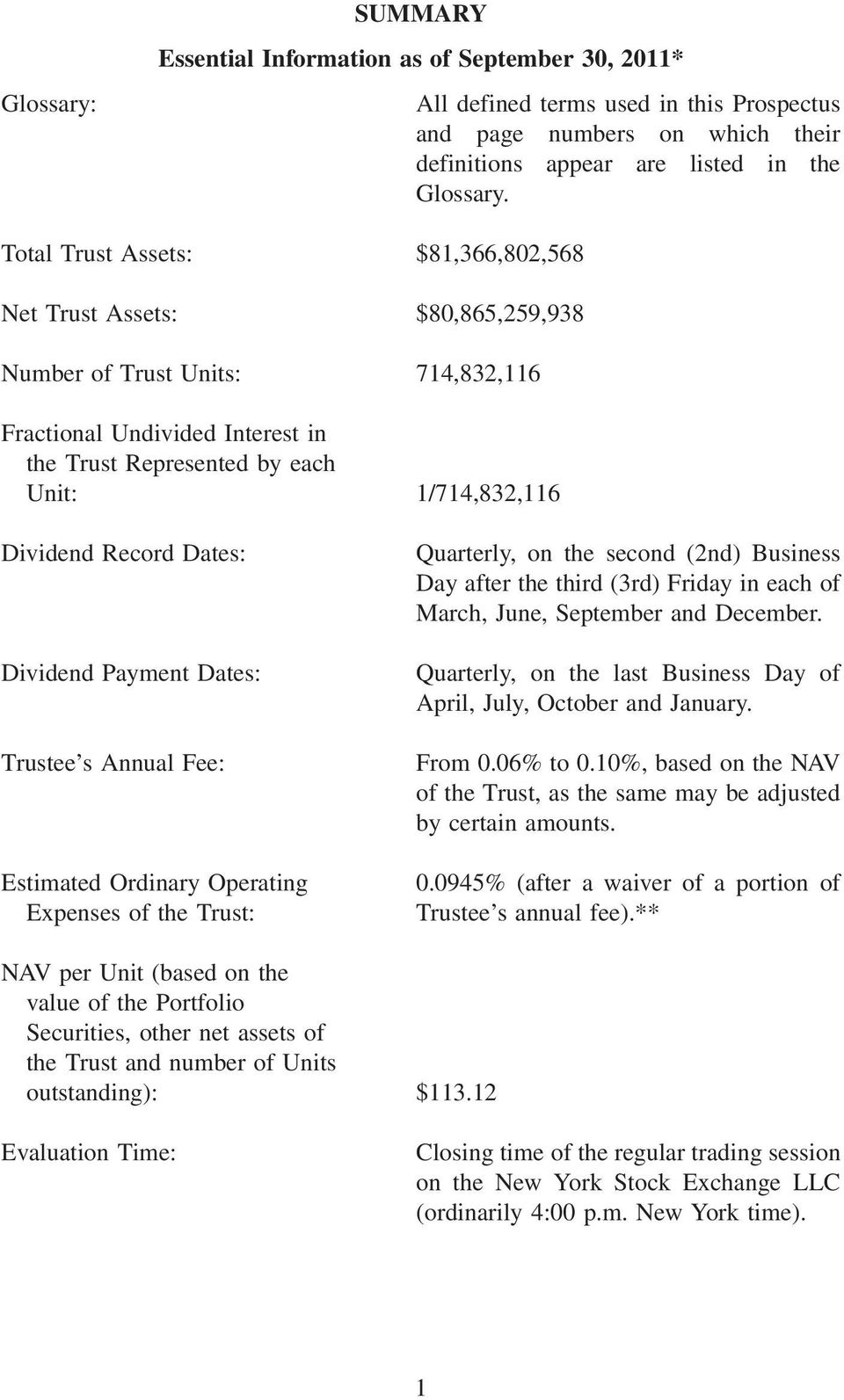
4 Licensor: Standard & Poor s Financial Services LLC, an affiliate of The McGraw-Hill Companies, Inc. Mandatory Termination Date: Discretionary Termination: The Trust is scheduled to terminate no later than January 22, 2118, but may terminate earlier under certain circumstances. The Trust may be terminated if at any time the value of the securities held by the Trust is less than $350,000,000, as adjusted for inflation. The Trust may also be terminated under other circumstances. Fiscal Year End: September 30 Market Symbol: CUSIP: Units trade on NYSE Arca, Inc. under the symbol SPY F103 * The Trust Agreement became effective, the initial deposit was made, and the Trust commenced operation on January 22, 1993 ( Initial Date of Deposit ). ** Ordinary operating expenses of the Trust are estimated to be % after consideration of the earnings credits and the contractual Trustee fee waiver in effect until February 1, As of the fiscal year ended September 30, 2011, gross ordinary operating expenses of the Trust were %. Future expense accruals will depend primarily on the level of the Trust s net assets and the level of Trust expenses. The Trustee has agreed to waive a portion of its fee until February 1, 2013, but may thereafter discontinue this voluntary waiver policy. The Trustee s fee waiver will be calculated after earnings credits are applied. The amount of the earnings credit will be equal to the then current Federal Funds Rate, as reported in nationally distributed publications, multiplied by each day s daily cash balance, if any, in the Trust s cash account, reduced by the amount of reserves, if any, for that account required by the Federal Reserve Board of Governors. See Expenses of the Trust Trustee Fee Scale for a description of the Trustee s fee. 2

5 Highlights Units are Ownership Interests in the SPDR 500 Trust SPDR S&P 500 ETF Trust (the Trust ) is a unit investment trust that issues securities called Trust Units or Units. The Trust is organized under New York law and is governed by an amended and restated trust agreement between State Street Bank and Trust Company (the Trustee ) and PDR Services LLC (the Sponsor ), dated as of January 1, 2004 and effective as of January 27, 2004, as amended (the Trust Agreement ). The Trust is an investment company registered under the Investment Company Act of Trust Units represent an undivided ownership interest in a portfolio of all of the common stocks ( Portfolio Securities or, collectively, Portfolio ) of the S&P 500 Index» ( S&P 500 Index ). Units Should Closely Track the Value of the Stocks Included in the S&P 500 Index The investment objective of the Trust is to provide investment results that, before expenses, generally correspond to the price and yield performance of the S&P 500 Index. Current information regarding the value of the S&P 500 Index is available from market information services. Standard & Poor s Financial Services LLC, an affiliate of The McGraw-Hill Companies, Inc. ( S&P ), obtains information for inclusion in, or for use in the calculation of, the S&P 500 Index from sources S&P considers reliable. None of S&P, the Sponsor, the Trust, the Trustee or NYSE Arca, Inc. or its affiliates accepts responsibility for or guarantees the accuracy and/or completeness of the S&P 500 Index or any data included in the S&P 500 Index. The Trust holds the Portfolio and cash and is not actively managed by traditional methods, which would typically involve effecting changes in the Portfolio on the basis of judgments made relating to economic, financial and market considerations. To maintain the correspondence between the composition and weightings of Portfolio Securities and component stocks of the S&P 500 Index ( Index Securities ), the Trustee adjusts the Portfolio from time to time to conform to periodic changes in the identity and/or relative weightings of Index Securities. The Trustee aggregates certain of these adjustments and makes changes to the Portfolio at least monthly, or more frequently in the case of significant changes to the S&P 500 Index. Any change in the identity or weighting of an Index Security will result in a corresponding adjustment to the prescribed Portfolio Deposit (as defined below in Highlights Creation Orders Must be Placed with the Distributor ) effective on any day that the New York Stock Exchange LLC (the NYSE ) is open for business ( Business Day ) following the day on which the change to the S&P 500 Index takes effect after the close of the market. The value of Trust Units fluctuates in relation to changes in the value of the Portfolio. The market price of each individual Unit may not be identical to the net asset value ( NAV ) of such Unit but, historically, these two valuations have 3
6 generally been close. See the table Frequency Distribution of Discounts and Premiums for the SPDR 500 Trust: Bid/Ask Price vs. Net Asset Value (NAV) as of 12/31/11 herein. Units are Listed and Trade on NYSE Arca, Inc. Units are listed for trading on NYSE Arca, Inc. (the Exchange or NYSE Arca ), and are bought and sold in the secondary market like ordinary shares of stock at any time during the trading day. Units are traded on the Exchange in 100 Unit round lots, but can be traded in odd lots of as little as one Unit. The Exchange may halt trading of Units under certain circumstances as summarized herein. See Exchange Listing. Before trading on the Exchange in the secondary market, Trust Units are created at NAV in Creation Units (as defined below in Highlights The Trust Issues and Redeems Units in Multiples of 50,000 Units Called Creation Units ), as summarized below and discussed more fully herein. See Creation of Creation Units. Brokerage Commissions on Units Secondary market purchases and sales of Units are subject to ordinary brokerage commissions and charges. The Trust Issues and Redeems Units in Multiples of 50,000 Units Called Creation Units The Trust issues and redeems Units only in specified large lots of 50,000 Units or multiples thereof, which are referred to as Creation Units. Fractional Creation Units may be created or redeemed only in limited circumstances.* Creation Units are issued by the Trust to anyone who, after placing a creation order with ALPS Distributors, Inc. (the Distributor ) as facilitated through the Trustee, deposits with the Trustee a specified portfolio of securities, substantially similar in composition and weighting to the Index Securities in the S&P 500 Index, and a cash payment, if any, generally equal to dividends on the securities (net of expenses) accumulated up to the time of deposit. If the Trustee determines that one or more Index Securities are likely to be unavailable, or available in insufficient quantity, for delivery upon creation of Creation Units, the Trustee may permit, in lieu thereof, the cash equivalent value of one or more of these Index Securities to be included in the Portfolio Deposit as a part of the Cash Component (as defined below in Highlights Creation Orders Must be Placed with the Distributor ). If a creator is restricted by regulation or otherwise from investing or engaging in a transaction in one or more Index Securities, the Trustee may permit, in lieu of the inclusion of such Index Securities in the stock portion of the Portfolio Deposit, the cash equivalent * See, however, the discussion of termination of the Trust in this Prospectus for a description of the circumstances in which Trust Units may be redeemed in less than a Creation Unit size aggregation of 50,000 Units. 4
7 value of such Index Securities to be included in the Portfolio Deposit based on the market value of such Index Securities as of the Evaluation Time on the date such creation order is deemed received by the Distributor as part of the Cash Component. Creation Units are redeemable in kind only and are not redeemable for cash. Upon receipt of one or more Creation Units, the Trust delivers to the redeeming holder a portfolio of Index Securities (based on NAV of the Trust), together with a Cash Redemption Payment (as defined below in Redemption of Trust Units Procedures for Redemption of Creation Units ) that, on any given Business Day, is an amount identical to the Cash Component of a Portfolio Deposit. If the Trustee determines that one or more Index Securities are likely to be unavailable or available in insufficient quantity for delivery by the Trust upon the redemption of Creation Units, the Trustee may deliver, in lieu thereof, the cash equivalent value of one or more of these Index Securities, based on their market value as of the Evaluation Time on the date the redemption order is deemed received by the Trustee, as part of the Cash Redemption Payment. Creation Orders Must be Placed with the Distributor All orders for Creation Units must be placed with the Distributor as facilitated through the Trustee. To be eligible to place these orders, an entity or person must be an Authorized Participant, which is either (a) a Participating Party, or a DTC Participant, and (b) in each case must have executed an agreement with the Distributor and the Trustee ( Participant Agreement ). The term Participating Party means a broker-dealer or other participant in the Clearing Process (as defined below) through the Continuous Net Settlement ( CNS ) System of the National Securities Clearing Corporation ( NSCC ), a clearing agency registered with the Securities and Exchange Commission ( SEC ), and the term DTC Participant means a participant in The Depository Trust Company ( DTC ). Payment for orders is made by deposits with the Trustee of a portfolio of securities, substantially similar in composition and weighting to Index Securities, and a cash payment in an amount equal to the Dividend Equivalent Payment (as defined below), plus or minus the Balancing Amount (as defined below in The Portfolio Adjustments to the Portfolio Deposit ). Dividend Equivalent Payment is an amount equal, on a per Creation Unit basis, to the dividends on the Portfolio (with ex-dividend dates within the accumulation period), net of expenses and accrued liabilities for such period (including, without limitation, (i) taxes or other governmental charges against the Trust not previously deducted, if any, (ii) accrued fees of the Trustee and (iii) other expenses of the Trust (including legal and auditing expenses) not previously deducted), calculated as if all of the Portfolio Securities had been held for the entire accumulation period for such distribution. The Dividend Equivalent Payment and the Balancing Amount collectively are referred to as the Cash Component and the deposit of a portfolio of securities and the Cash Component collectively are referred to as a Portfolio Deposit. Persons placing creation orders must deposit Portfolio Deposits either (i) through the CNS clearing process of NSCC (the Clearing 5

8 Process ) or (ii) with the Trustee outside the Clearing Process (i.e., through the facilities of DTC). The Distributor acts as underwriter of Trust Units on an agency basis. The Distributor maintains records of the orders placed with it and the confirmations of acceptance and furnishes confirmations of acceptance of the orders to those placing such orders. The Distributor also is responsible for delivering a prospectus to persons creating Trust Units. The Distributor also maintains a record of the delivery instructions in response to orders and may provide certain other administrative services. The Distributor is a corporation organized under the laws of the State of Colorado and is located at 1290 Broadway, Suite 1100, Denver, CO 80203, toll free number: The Distributor is a registered broker-dealer and a member of the Financial Industry Regulatory Authority ( FINRA ). The Sponsor pays the Distributor for its services a flat annual fee. The Sponsor will not seek reimbursement for such payment from the Trust without obtaining prior exemptive relief from the SEC. Expenses of the Trust The expenses of the Trust are accrued daily and reflected in the NAV of the Trust. After reflecting waivers (including earnings credits as a result of uninvested cash balances of the Trust), the Trust currently is accruing ordinary operating expenses at an annual rate of %. Shareholder Fees: (fees paid directly from your investment) None* Estimated Trust Annual Ordinary Operating Expenses: Current Trust Annual Ordinary Operating Expenses As a % of Trust Average Net Assets Trustee s Fee** % S&P License Fee % Marketing % Other Operating Expenses % Total: % Trustee Waiver** (0.0142)% Net Expenses After Waiver % Future expense accruals will depend primarily on the level of the Trust s net assets and the level of expenses. * Investors do not pay shareholder fees directly from their investment, but purchases and redemptions of Creation Units are subject to Transaction Fees (described below in Highlights ATransaction Fee is Payable for Each Creation and for Each Redemption of Creation Units ), and purchases and sales of Units in the secondary market are subject to ordinary brokerage commissions and charges (described above in Highlights Brokerage Commissions on Units ). 6

9 ** Until February 1, 2013, the Trustee has agreed to waive a portion of its fee to the extent operating expenses exceed % after taking into consideration the earnings credit with respect to uninvested cash balances of the Trust. The amount of the earnings credit will be equal to the then current Federal Funds Rate, as reported in nationally distributed publications, multiplied by each day s daily cash balance, if any, in the Trust s cash account, reduced by the amount of reserves, if any, for that account required by the Federal Reserve Board of Governors. Thereafter, the Trustee may discontinue this voluntary waiver policy. Therefore, there is no guarantee that the Trust s ordinary operating expenses will not exceed % of the Trust s daily NAV. Bar Chart and Table The bar chart below ( Bar Chart ) and the table on the next page entitled Average Annual Total Returns (for periods ending December 31, 2011) ( Table ) provide some indication of the risks of investing in the Trust by showing the variability of the Trust s returns based on net assets and comparing the Trust s performance to the performance of the S&P 500 Index. Past performance (both before and after tax) is not necessarily an indication of how the Trust will perform in the future. The after-tax returns presented in the Table are calculated using the highest historical individual federal marginal income tax rates and do not reflect the impact of state and local taxes. Your actual after-tax returns will depend on your specific tax situation and may differ from those shown below. After-tax returns are not relevant to investors who hold Units through tax-deferred arrangements, such as 401(k) plans or individual retirement accounts. The total returns in the Bar Chart, as well as the total and after-tax returns presented in the Table, have been calculated assuming that the reinvested price for the last income distribution made in each calendar year shown below (e.g. 12/16/11) was the NAV on the last Business Day of such year (e.g. 12/30/11), rather than the actual reinvestment price for such distribution which was the NAVon the last Business Day of January of the following calendar year (e.g. 1/31/12). Therefore, the actual performance calculation for any calendar year may be different than that shown below in the Bar Chart and Table. In addition, the total returns in the Bar Chart and the total and after-tax returns presented in the Table do not reflect Transaction Fees payable by those persons purchasing and redeeming Creation Units, nor do they reflect brokerage commissions incurred by those persons purchasing and selling Units in the secondary market (see footnotes (2) and (3) to the Table). 7

10 % 10.76% 4.80% 15.65% 5.42% 26.27% 14.89% 1.99% % % This Bar Chart shows the performance of the Trust for each full calendar year for the past 10 years ended December 31, During the period shown above (January 1, 2002 through December 31, 2011), the highest quarterly return for the Trust was 15.84% for the quarter ended June 30, 2009, and the lowest was % for the quarter ended December 31, Average Annual Total Returns (for periods ending December 31, 2011) Past One Year Past Five Years Past Ten Years SPDR 500 Trust Return Before Taxes (1)(2)(3) % -0.29% 2.84% Return After Taxes on Distributions (1)(2)(3) % -0.66% 2.48% Return After Taxes on Distributions and Sale or Redemption of Creation Units (1)(2)(3) % -0.32% 2.35% S&P 500 Index (4) % -0.25% 2.92% (1) Includes all applicable ordinary operating expenses set forth above in Highlights Expenses of the Trust. (2) Does not include the Transaction Fee, which is payable to the Trustee only by persons purchasing and redeeming Creation Units, as discussed below in Highlights A Transaction Fee is Payable for Each Creation and for Each Redemption of Creation Units. If these amounts were reflected, returns would be less than those shown. (3) Does not include brokerage commissions and charges that would be incurred by persons who make purchases and sales of Units in the secondary market, as discussed above in Highlights Brokerage Commissions on Units. If these amounts were reflected, returns would be less than those shown. (4) Does not reflect deductions for taxes, operating expenses, Transaction Fees, brokerage commissions, or fees of any kind. 8

11 SPDR 500 Trust GROWTH OF $10,000 INVESTMENT SINCE INCEPTION (1) $50,000 $40,000 $30,000 $20,000 $10,000 1/93 12/93 12/94 12/95 12/96 9/97 (2) 9/98 9/99 9/00 9/01 9/02 9/03 9/04 9/05 9/06 9/07 9/08 9/09 9/10 9/11 SPDR 500 Trust S&P 500 Index (1) Past performance is not necessarily an indication of how the Trust will perform in the future. (2) Effective as of September 30, 1997, the Trust s fiscal year end changed from December 31 to September 30. A Transaction Fee is Payable for Each Creation and for Each Redemption of Creation Units The transaction fee payable to the Trustee in connection with each creation and redemption of Creation Units made through the Clearing Process ( Transaction Fee ) is non-refundable, regardless of the NAV of the Trust. The Transaction Fee is the lesser of $3,000 or 0.10% (10 basis points) of the value of one Creation Unit at the time of creation ( 10 Basis Point Limit ) per Participating Party per day, regardless of the number of Creation Units created or redeemed on such day. The Transaction Fee is currently $3,000. For creations and redemptions outside the Clearing Process, an additional amount not to exceed three (3) times the Transaction Fee applicable for one Creation Unit is charged per Creation Unit per day. Under the current schedule, therefore, the total fee charged in connection with creation or redemption outside the Clearing Process would be $3,000 (the Transaction Fee for the creation or redemption of one Creation Unit) plus an additional amount up to $9,000 (3 times $3,000), for a total not to exceed $12,000. Creators and redeemers restricted from engaging in transactions in one or more Index Securities may pay the Trustee the Transaction Fee and may pay an additional amount per Creation Unit not to exceed three (3) times the Transaction Fee applicable for one Creation Unit. 9

12 Units are Held in Book Entry Form Only DTC or its nominee is the record or registered owner of all outstanding Units. Beneficial ownership of Units is shown on the records of DTC or its participants (owners of such beneficial interests are referred to herein as Beneficial Owners ). Individual certificates are not issued for Units. See Creation of Creation Units Securities Depository; Book-Entry-Only System. SPDR 500 Trust Makes Periodic Dividend Payments Unitholders receive on the last Business Day of April, July, October and January an amount corresponding to the amount of any cash dividends declared on the Portfolio Securities during the applicable period, net of fees and expenses associated with operation of the Trust, and taxes, if applicable. Because of such fees and expenses, the dividend yield for Units is ordinarily less than that of the S&P 500 Index. Investors should consult their tax advisors regarding tax consequences associated with Trust dividends, as well as those associated with Unit sales or redemptions. Quarterly distributions based on the amount of dividends payable with respect to Portfolio Securities and other income received by the Trust, net of fees and expenses, and taxes, if applicable, are made via DTC and its participants to Beneficial Owners on each Dividend Payment Date (as defined below in Administration of the Trust Distributions to Beneficial Owners ). Any capital gain income recognized by the Trust in any taxable year that is not previously distributed during the year ordinarily is to be distributed at least annually in January of the following taxable year. The Trust may make additional distributions shortly after the end of the year in order to satisfy certain distribution requirements imposed by the Internal Revenue Code of 1986, as amended (the Code ). Although all distributions are currently made quarterly, under certain limited circumstances the Trustee may vary the periodicity with which distributions are made. The amount of distributions may vary significantly from period to period. Those Beneficial Owners interested in reinvesting their quarterly distributions may do so through a dividend reinvestment service, if one is offered by their broker-dealer. Under limited certain circumstances, special dividend payments also may be made to the Beneficial Owners. See Administration of the Trust Distributions to Beneficial Owners. The Trust Intends to Qualify as a Regulated Investment Company For its taxable year ended September 30, 2011, the Trust believes that it qualified for tax treatment as a regulated investment company under Subchapter M of the Code (a RIC ). The Trust intends to continue to qualify as a RIC. As a RIC, the Trust will generally not be subject to U.S. federal income tax for any taxable year on income, including net capital gains, that it distributes to the holders of Units, provided that it distributes on a timely basis at least 90% of its investment company taxable income (generally, its taxable income other than net capital gain) for such 10

13 taxable year. In addition, provided that the Trust distributes during each calendar year substantially all of its ordinary income and capital gains, the Trust will not be subject to U.S. federal excise tax. The Trust intends to distribute annually its entire investment company taxable income and net capital gain. For U.S. federal income tax purposes, (a) distributions to an individual or other non-corporate investor during a taxable year of such investor beginning before January 1, 2013 will be treated as qualified dividend income, which is subject to tax at rates applicable to long-term capital gains, to the extent that such distributions are made out of qualified dividend income received by the Trust and (b) distributions to a corporate investor will qualify for the dividends-received deduction to the extent that such distributions are made out of qualifying dividends received by the Trust, provided, in each case, that the investor meets certain holding period and other requirements with respect to its Units. The Trust s regular quarterly distributions are based on the dividend performance of the Portfolio during such quarterly distribution period rather than the actual taxable income of the Trust. As a result, a portion of the distributions of the Trust may be treated as a return of capital or capital gain for U.S. federal income tax purposes or the Trust may be required to make additional distributions to maintain its status as a RIC or to avoid imposition of income or excise taxes on undistributed income. Termination of the Trust The Trust has a specified lifetime term. The Trust is scheduled to terminate on the first to occur of (a) January 22, 2118 or (b) the date 20 years after the death of the last survivor of eleven persons named in the Trust Agreement, the oldest of whom was born in 1990 and the youngest of whom was born in Upon termination, the Trust may be liquidated and pro rata shares of the assets of the Trust, net of certain fees and expenses, distributed to holders of Units. Restrictions on Purchases of Trust Units by Investment Companies Purchases of Trust Units by investment companies are subject to restrictions pursuant to Section 12(d)(1) of the Investment Company Act of The Trust has received an SEC order that permits registered investment companies to invest in Units beyond these limits, subject to certain conditions and terms. One such condition is that registered investment companies relying on the order must enter into a written agreement with the Trust. Registered investment companies wishing to learn more about the order and the agreement should telephone The Trust itself is also subject to the restrictions of Section 12(d)(1). This means that, absent an exemption or SEC relief, (a) the Trust cannot invest in any registered investment company, to the extent that the Trust would own more than 3% of that registered investment company s outstanding shares, (b) the Trust cannot invest more than 5% of its total assets in the securities of any one registered investment company, and (c) the Trust cannot invest more than 10% of its total assets in the securities of registered investment companies in the aggregate. 11
14 Risk Factors Investors can lose money by investing in Units. Prospective investors should carefully consider the risk factors described below together with all of the other information included in this Prospectus before deciding to invest in Units. Investment in the Trust involves the risks inherent in an investment in any equity security. An investment in the Trust is subject to the risks of any investment in a broadly based portfolio of common stocks, including the risk that the general level of stock prices may decline, thereby adversely affecting the value of such investment. The value of Portfolio Securities may fluctuate in accordance with changes in the financial condition of the issuers of Portfolio Securities, the value of common stocks generally and other factors. The identity and weighting of Index Securities and the Portfolio Securities change from time to time. The financial condition of issuers of Portfolio Securities may become impaired or the general condition of the stock market may deteriorate, either of which may cause a decrease in the value of the Portfolio and thus in the value of Units. Common stocks are susceptible to general stock market fluctuations and to volatile increases and decreases in value as market confidence in and perceptions of their issuers change. These investor perceptions are based on various and unpredictable factors including expectations regarding government, economic, monetary and fiscal policies, inflation and interest rates, economic expansion or contraction, and global or regional political, economic and banking crises. Holders of common stocks of any given issuer incur more risk than holders of preferred stocks and debt obligations of the issuer because the rights of common stockholders, as owners of the issuer, generally are subordinate to the rights of creditors of, or holders of debt obligations or preferred stocks issued by, such issuer. Further, unlike debt securities that typically have a stated principal amount payable at maturity, or preferred stocks that typically have a liquidation preference and may have stated optional or mandatory redemption provisions, common stocks have neither a fixed principal amount nor a maturity. Common stock values are subject to market fluctuations as long as the common stock remains outstanding. The value of the Portfolio will fluctuate over the entire life of the Trust. There can be no assurance that the issuers of Portfolio Securities will pay dividends. Distributions generally depend upon the declaration of dividends by the issuers of Portfolio Securities and the declaration of such dividends generally depends upon various factors, including the financial condition of the issuers and general economic conditions. The Trust is not actively managed. The Trust is not actively managed by traditional methods, and therefore the adverse financial condition of an issuer will not result in its elimination from the Portfolio unless such issuer is removed from the S&P 500 Index. 12

15 A liquid trading market for certain Portfolio Securities may not exist. Although most of the Portfolio Securities are listed on a national securities exchange, the principal trading market for some may be in the over-the-counter market. The existence of a liquid trading market for certain Portfolio Securities may depend on whether dealers will make a market in such stocks. There can be no assurance that a market will be made or maintained for any Portfolio Securities, or that any such market will be or remain liquid. The price at which Portfolio Securities may be sold and the value of the Portfolio will be adversely affected if trading markets for Portfolio Securities are limited or absent. The Trust may not exactly replicate the performance of the S&P 500 Index. The Trust may not be able to replicate exactly the performance of the S&P 500 Index because the total return generated by the Portfolio is reduced by Trust expenses and transaction costs incurred in adjusting the actual balance of the Portfolio. In addition, it is possible that the Trust may not always fully replicate the performance of the S&P 500 Index due to the unavailability of certain Index Securities in the secondary market or due to other extraordinary circumstances. Investment in the Trust may have adverse tax consequences. Investors in the Trust should consider the U.S. federal, state, local and other tax consequences of the acquisition, ownership and disposition of Units. For a discussion of certain U.S. federal income tax consequences of the acquisition, ownership and disposition of Units, see Federal Income Taxes. NAV may not always correspond to market price. The NAVof Units in Creation Unit size aggregations and, proportionately, the NAV per Unit, change as fluctuations occur in the market value of Portfolio Securities. Investors should be aware that the aggregate public trading market price of 50,000 Units may be different from the NAV of a Creation Unit (i.e., 50,000 Units may trade at a premium over, or at a discount to, the NAV of a Creation Unit) and similarly the public trading market price per Unit may be different from the NAV of a Creation Unit on a per Unit basis. This price difference may be due, in large part, to the fact that supply and demand forces at work in the secondary trading market for Units is closely related to, but not identical to, the same forces influencing the prices of Index Securities trading individually or in the aggregate at any point in time. Investors also should note that the size of the Trust in terms of total assets held may change substantially over time and from time to time as Creation Units are created and redeemed. The Exchange may halt trading in Trust Units. Units are listed for trading on NYSE Arca under the market symbol SPY. Trading in Trust Units may be halted under certain circumstances as summarized herein. See Exchange Listing. Also, there can be no assurance that the requirements of the Exchange necessary to maintain the listing of Trust Units will continue to be met or will remain unchanged. The Trust will be terminated if Trust Units are delisted from the Exchange. 13
16 An investment in Trust Units is not the same as a direct investment in the Index Securities or other equity securities. Trust Units are subject to risks other than those inherent in an investment in the Index Securities or other equity securities, in that the selection of the stocks included in the Portfolio, the expenses associated with the Trust, or other factors distinguishing an ownership interest in a trust from the direct ownership of a portfolio of stocks may affect trading in Trust Units differently from trading in the Index Securities or other equity securities. The regular settlement period for Creation Units may be reduced. Except as otherwise specifically noted, the time frames for delivery of stocks, cash, or Trust Units in connection with creation and redemption activity within the Clearing Process are based on NSCC s current regular way settlement period of three (3) days during which NSCC is open for business (each such day, an NSCC Business Day ). NSCC may, in the future, reduce such regular way settlement period, in which case there may be a corresponding reduction in settlement periods applicable to Unit creations and redemptions. Clearing and settlement of Creation Units may be delayed or fail. The Trustee delivers a portfolio of stocks for each Creation Unit delivered for redemption substantially identical in weighting and composition to the stock portion of a Portfolio Deposit as in effect on the date the request for redemption is deemed received by the Trustee. If the redemption is processed through the Clearing Process, the stocks that are not delivered are covered by NSCC s guarantee of the completion of such delivery. Any stocks not received on settlement date are marked-to-market until delivery is completed. The Trust, to the extent it has not already done so, remains obligated to deliver the stocks to NSCC, and the market risk of any increase in the value of the stocks until delivery is made by the Trust to NSCC could adversely affect the NAVof the Trust. Investors should note that the stocks to be delivered to a redeemer submitting a redemption request outside of the Clearing Process that are not delivered to such redeemer are not covered by NSCC s guarantee of completion of delivery. Buying or selling Trust Units incurs costs. Purchases and sales of exchange traded securities involve both brokerage and spread costs. Investors buying or selling Trust Units will incur a commission, fee or other charges imposed by the broker executing the transaction. In addition, investors will also bear the cost of the spread, which is the difference between the bid (the price at which securities professionals will buy Trust Units) and the ask or offer (the price at which securities professionals are willing to sell Trust Units). Frequent trading in Trust Units by an investor may involve brokerage and spread costs that may have a significant negative effect upon the investor s overall investment results. This may be especially true for investors who make frequent periodic investments in small amounts of Trust Units over a lengthy time period. 14

17 REPORT OF INDEPENDENT REGISTERED PUBLIC ACCOUNTING FIRM To the Trustee and Unitholders of SPDR S&P 500 ETF Trust In our opinion, the accompanying statement of assets and liabilities, including the schedule of investments, and the related statements of operations and of changes in net assets and the financial highlights present fairly, in all material respects, the financial position of SPDR S&P 500 ETF Trust (the Trust ) at September 30, 2011, the results of its operations, the changes in its net assets and the financial highlights for the periods indicated, in conformity with accounting principles generally accepted in the United States of America. These financial statements and financial highlights (hereafter referred to as financial statements ) are the responsibility of the Trustee; our responsibility is to express an opinion on these financial statements based on our audits. We conducted our audits of these financial statements in accordance with the standards of the Public Company Accounting Oversight Board (United States). Those standards require that we plan and perform the audit to obtain reasonable assurance about whether the financial statements are free of material misstatement. An audit includes examining, on a test basis, evidence supporting the amounts and disclosures in the financial statements, assessing the accounting principles used and significant estimates made by management, and evaluating the overall financial statement presentation. We believe that our audits, which included confirmation of securities at September 30, 2011 by correspondence with the custodian and brokers, provide a reasonable basis for our opinion. PricewaterhouseCoopers LLP Boston, Massachusetts November 22,

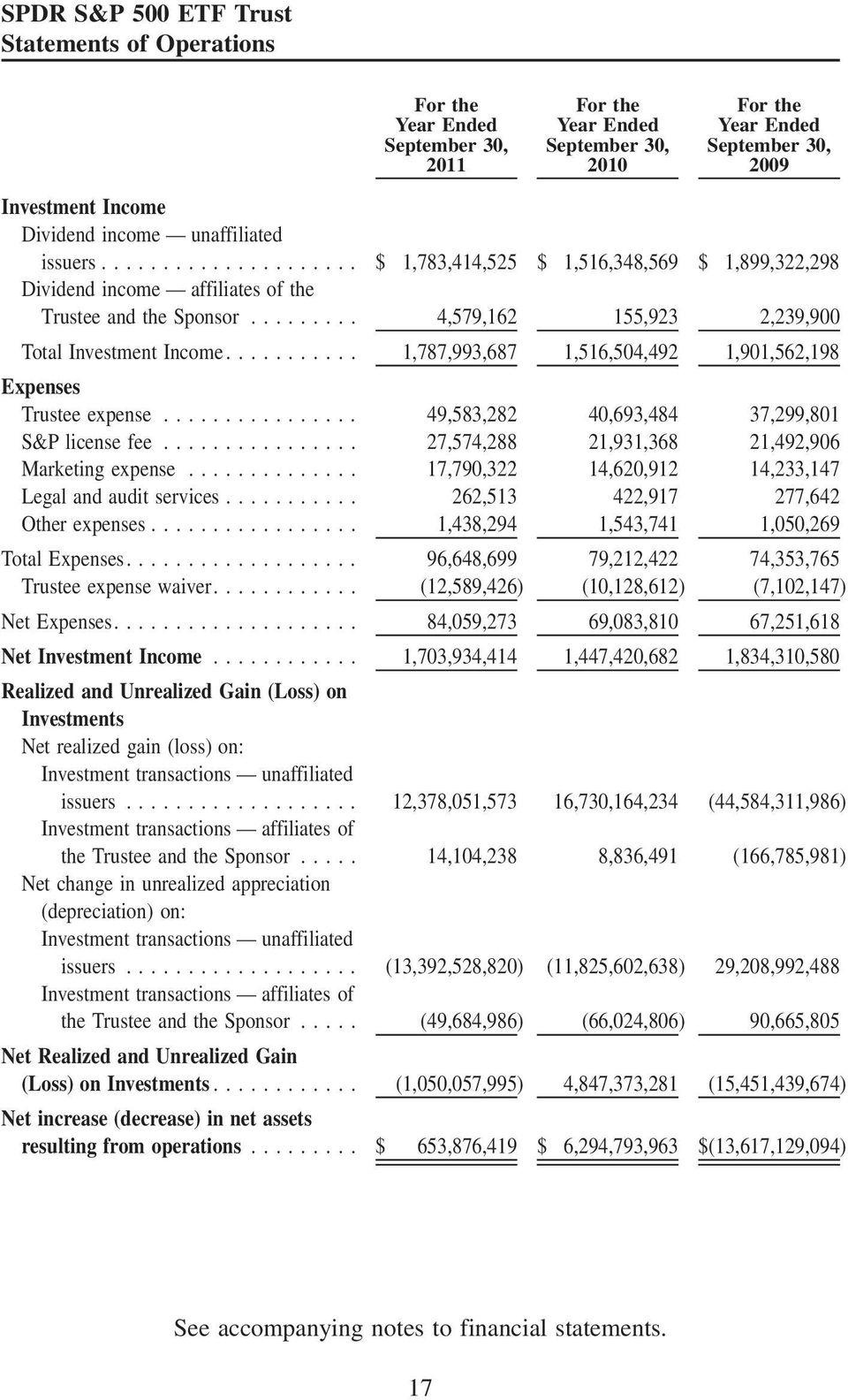
18 SPDR S&P 500 ETF Trust Statement of Assets and Liabilities September 30, 2011 Assets Investments in unaffiliated issuers, at value... $ 80,617,733,878 Investments in affiliates of the Trustee and the Sponsor, at value ,280,732 Total investments... 80,792,014,610 Cash ,018,173 Dividends receivable unaffiliated issuers ,058,216 Dividends receivable affiliated issuers ,569 Total Assets... 81,366,802,568 Liabilities Payable for units of fractional undivided interest ( Units ) redeemed in-kind ,765 Income distribution payable ,856,841 Accrued Trustee expense.... 2,913,321 Accrued expenses and other liabilities... 20,541,703 Total Liabilities ,542,630 Net Assets... $ 80,865,259,938 Net Assets Consist of: Paid in Capital (Note 4)... $103,984,676,328 Distribution in excess of net investment income... (478,294,653) Accumulated net realized loss on investments... (6,997,530,493) Net unrealized depreciation on investments... (15,643,591,244) Net Assets... $ 80,865,259,938 Net asset value per Unit... $ Units outstanding, unlimited Units authorized, $0.00 par value ,832,116 Cost of Investments: Unaffiliated issuers... $ 96,180,584,128 Affiliates of the Trustee and the Sponsor ,021,726 Total Cost of Investments... $ 96,435,605,854 See accompanying notes to financial statements. 16
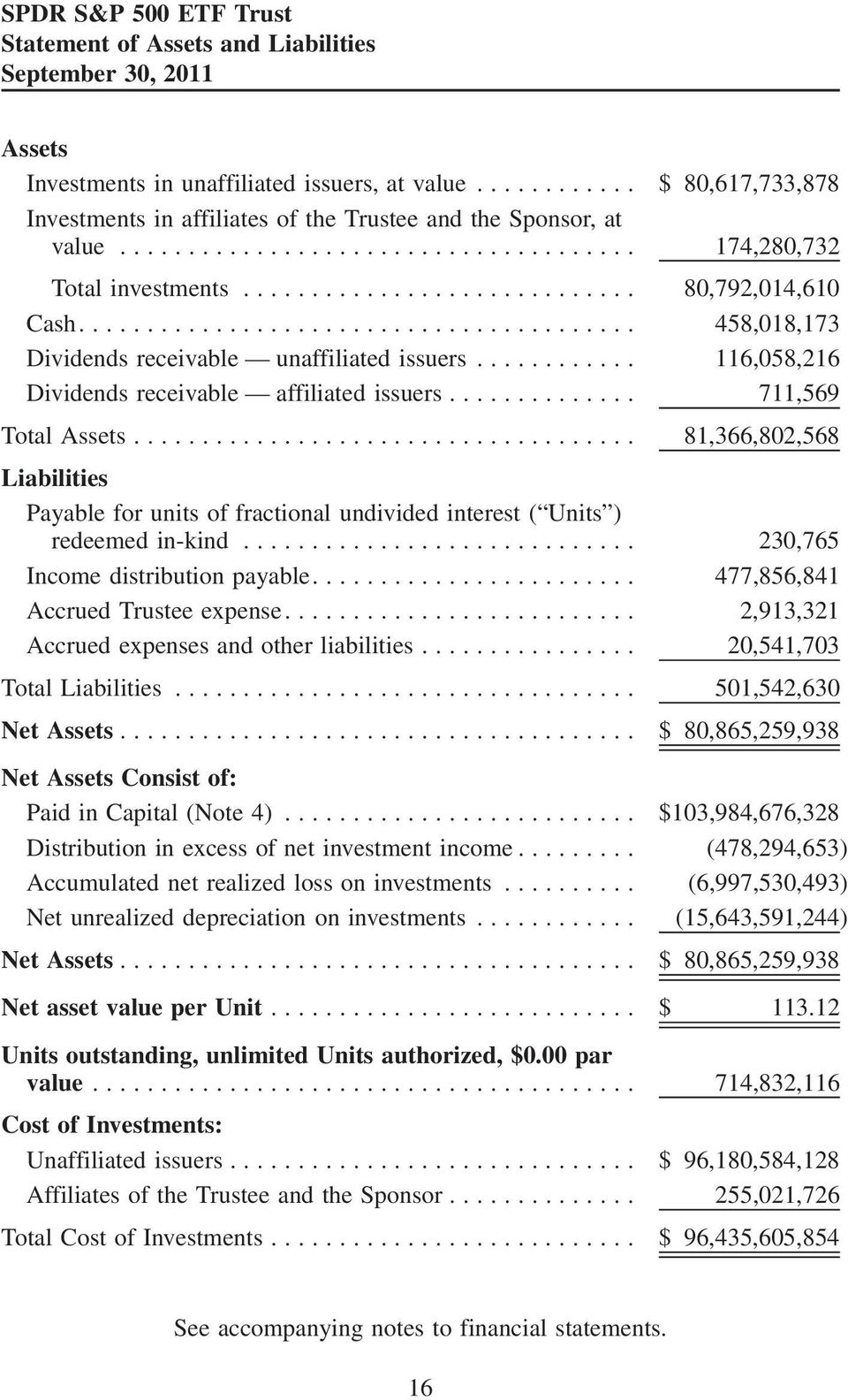
19 SPDR S&P 500 ETF Trust Statements of Operations For the Year Ended September 30, 2011 For the Year Ended September 30, 2010 For the Year Ended September 30, 2009 Investment Income Dividend income unaffiliated issuers..... $ 1,783,414,525 $ 1,516,348,569 $ 1,899,322,298 Dividend income affiliates of the Trustee and the Sponsor... 4,579, ,923 2,239,900 Total Investment Income ,787,993,687 1,516,504,492 1,901,562,198 Expenses Trustee expense ,583,282 40,693,484 37,299,801 S&P license fee ,574,288 21,931,368 21,492,906 Marketing expense... 17,790,322 14,620,912 14,233,147 Legal and audit services , , ,642 Other expenses ,438,294 1,543,741 1,050,269 Total Expenses ,648,699 79,212,422 74,353,765 Trustee expense waiver (12,589,426) (10,128,612) (7,102,147) Net Expenses ,059,273 69,083,810 67,251,618 Net Investment Income... 1,703,934,414 1,447,420,682 1,834,310,580 Realized and Unrealized Gain (Loss) on Investments Net realized gain (loss) on: Investment transactions unaffiliated issuers... 12,378,051,573 16,730,164,234 (44,584,311,986) Investment transactions affiliates of the Trustee and the Sponsor ,104,238 8,836,491 (166,785,981) Net change in unrealized appreciation (depreciation) on: Investment transactions unaffiliated issuers... (13,392,528,820) (11,825,602,638) 29,208,992,488 Investment transactions affiliates of the Trustee and the Sponsor.... (49,684,986) (66,024,806) 90,665,805 Net Realized and Unrealized Gain (Loss) on Investments... (1,050,057,995) 4,847,373,281 (15,451,439,674) Net increase (decrease) in net assets resulting from operations... $ 653,876,419 $ 6,294,793,963 $(13,617,129,094) See accompanying notes to financial statements. 17
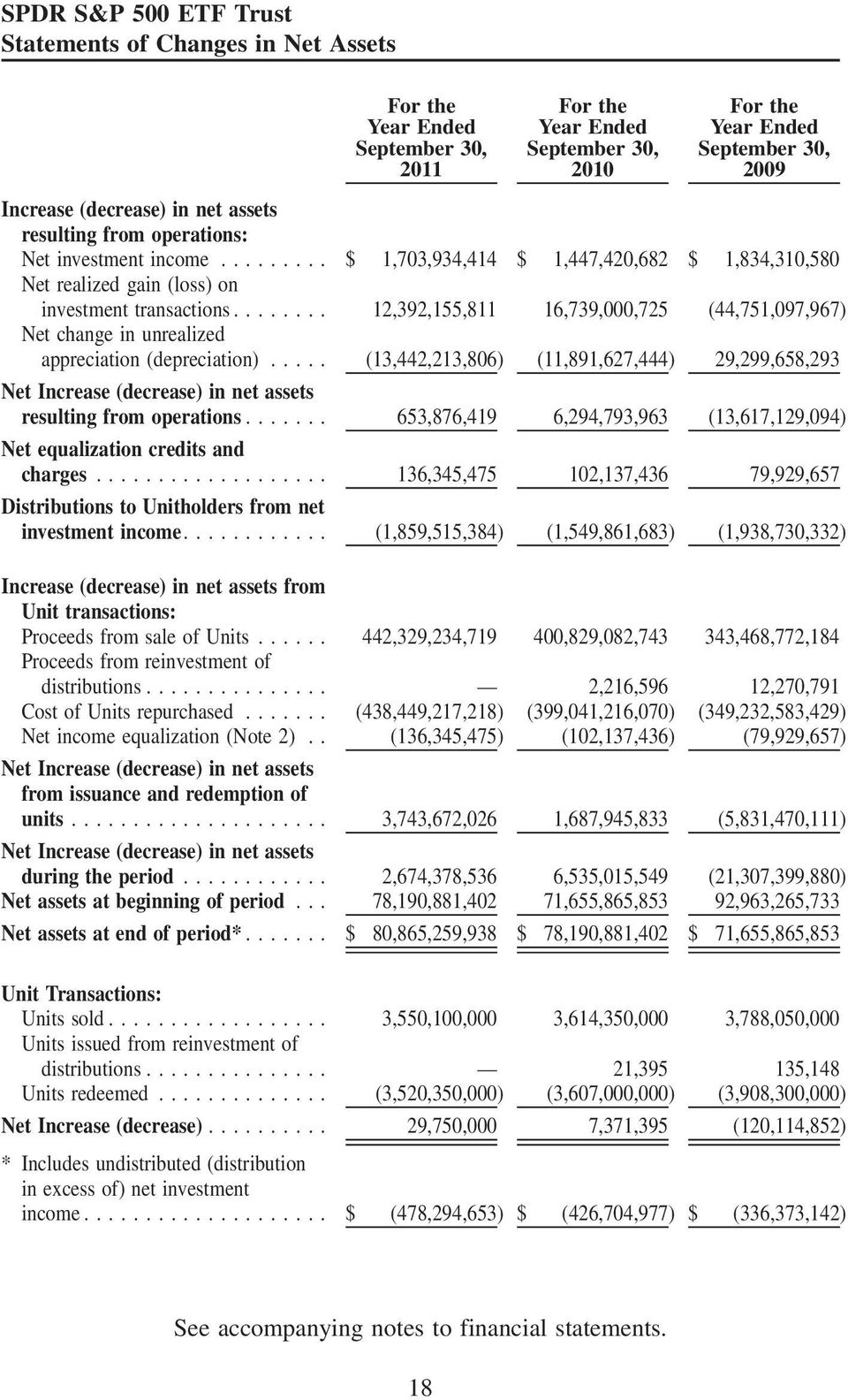
20 SPDR S&P 500 ETF Trust Statements of Changes in Net Assets For the Year Ended September 30, 2011 For the Year Ended September 30, 2010 For the Year Ended September 30, 2009 Increase (decrease) in net assets resulting from operations: Net investment income... $ 1,703,934,414 $ 1,447,420,682 $ 1,834,310,580 Net realized gain (loss) on investment transactions ,392,155,811 16,739,000,725 (44,751,097,967) Net change in unrealized appreciation (depreciation)... (13,442,213,806) (11,891,627,444) 29,299,658,293 Net Increase (decrease) in net assets resulting from operations ,876,419 6,294,793,963 (13,617,129,094) Net equalization credits and charges ,345, ,137,436 79,929,657 Distributions to Unitholders from net investment income.... (1,859,515,384) (1,549,861,683) (1,938,730,332) Increase (decrease) in net assets from Unit transactions: Proceeds from sale of Units ,329,234, ,829,082, ,468,772,184 Proceeds from reinvestment of distributions... 2,216,596 12,270,791 Cost of Units repurchased..... (438,449,217,218) (399,041,216,070) (349,232,583,429) Net income equalization (Note 2).. (136,345,475) (102,137,436) (79,929,657) Net Increase (decrease) in net assets from issuance and redemption of units... 3,743,672,026 1,687,945,833 (5,831,470,111) Net Increase (decrease) in net assets during the period... 2,674,378,536 6,535,015,549 (21,307,399,880) Net assets at beginning of period... 78,190,881,402 71,655,865,853 92,963,265,733 Net assets at end of period*... $ 80,865,259,938 $ 78,190,881,402 $ 71,655,865,853 Unit Transactions: Units sold ,550,100,000 3,614,350,000 3,788,050,000 Units issued from reinvestment of distributions... 21, ,148 Units redeemed... (3,520,350,000) (3,607,000,000) (3,908,300,000) Net Increase (decrease)... 29,750,000 7,371,395 (120,114,852) * Includes undistributed (distribution in excess of) net investment income... $ (478,294,653) $ (426,704,977) $ (336,373,142) See accompanying notes to financial statements. 18
21 SPDR S&P 500 ETF Trust Financial Highlights Selected data for a Unit outstanding throughout each period For the Year Ended September 30, 2011 For the Year Ended September 30, 2010 For the Year Ended September 30, 2009 For the Year Ended September 30, 2008 For the Year Ended September 30, 2007 Net asset value, beginning of year... $ $ $ $ $ Investment Operations: Net investment income(1) Net realized and unrealized gain (loss) on investments... (1.16) 8.24 (10.90) (36.28) Total from investment operations (8.58) (33.56) Net equalization credits and charges(1) Less distributions from: Net investment income... (2.46) (2.20) (2.31) (2.78) (2.72) Net asset value, end of year.. $ $ $ $ $ Total investment return(2) % 10.08% (6.90)% (21.84)% 16.31% Ratios and supplemental data Ratio to average net assets: Net investment income % 1.98% 2.58% 1.99% 1.86% Total expenses(3) % 0.09% 0.09% 0.09% 0.08% Total expenses excluding Trustee earnings credit % 0.11% 0.10% 0.11% 0.11% Total expenses excluding Trustee earnings credit and feewaivers % 0.11% 0.10% 0.11% 0.12% Portfolio turnover rate(4) % 5.38% 6.68% 4.56% 2.95% Net assets, end of year (000 s).. $80,865,260 $78,190,881 $71,655,866 $92,963,266 $78,638,467 (1) Per Unit numbers have been calculated using the average shares method, which more appropriately presents per unit data for the year. (2) Total return is calculated assuming a purchase of a Unit at net asset value per Unit on the first day and a sale at net asset value per Unit on the last day of each period reported. Distributions are assumed, for the purposes of this calculation, to be reinvested at the net asset value per Unit on the respective payment dates of the Trust. Broker commission charges are not included in this calculation. (3) Net of expenses waived by the Trustee. (4) Portfolio turnover rate does not include securities received or delivered from processing creations or redemptions of Units. See accompanying notes to financial statements. 19
22 SPDR S&P 500 ETF Trust Notes to Financial Statements September 30, 2011 Note 1 Organization SPDR S&P 500 ETF Trust (the Trust ), is a unit investment trust created under the laws of the State of New York and registered under the Investment Company Act of 1940, as amended. The Trust was created to provide investors with the opportunity to purchase a security representing a proportionate undivided interest in a portfolio of securities consisting of substantially all of the component common stocks, in substantially the same weighting, which comprise the Standard & Poor s 500 Index (the S&P 500 Index ). Each unit of fractional undivided interest in the Trust is referred to as a Unit. The Trust commenced operations on January 22, 1993 upon the initial issuance of 150,000 Units (equivalent to three Creation Units see Note 4) in exchange for a portfolio of securities assembled to reflect the intended portfolio composition of the Trust. Under the Amended and Restated Standard Terms and Conditions of the Trust, as amended ( Trust Agreement ), PDR Services, LLC, as Sponsor of the Trust ( Sponsor ), and State Street Bank and Trust Company, as Trustee of the Trust ( Trustee ), are indemnified against certain liabilities arising out of the performance of their duties to the Trust. Additionally, in the normal course of business, the Trust enters into contracts that contain general indemnification clauses. The Trust s maximum exposure under these arrangements is unknown as this would involve future claims that may be made against the Trust that have not yet occurred. However, based on experience, the Trust expects the risk of material loss to be remote. On February 15, 2011, NYSE Euronext (the parent of the Sponsor) and Deutsche Börse AG announced that they have entered into a business combination agreement which was subsequently approved by their shareholders. This transaction is subject to approval by the relevant regulatory authorities in the U.S. and Europe, and other closing conditions. Note 2 Significant Accounting Policies The following is a summary of significant accounting policies followed by the Trust in the preparation of its financial statements: The preparation of financial statements in accordance with U.S. generally accepted accounting principles requires management to make estimates and assumptions that affect the reported amounts and disclosures in the financial statements. Actual results could differ from those estimates. These financial statements are presented in United States dollars. 20
23 SPDR S&P 500 ETF Trust Notes to Financial Statements September 30, 2011 Note 2 Significant Accounting Policies (continued) Security Valuation The value of the Trust s portfolio securities is based on the market price of the securities, which generally means a valuation obtained from an exchange or other market (or based on a price quotation or other equivalent indication of value supplied by an exchange or other market) or a valuation obtained from an independent pricing service. If a security s market price is not readily available or does not otherwise accurately reflect the fair value of the security, the security will be valued by another method that the Trustee believes will better reflect fair value in accordance with the Trust s valuation policies and procedures. The Trustee has established a Pricing and Investment Committee (the Committee ) for the purpose of valuing securities for which market quotations are not readily available or do not otherwise accurately reflect the fair value of the security. The Committee, subject to oversight by the Trustee, may use fair value pricing in a variety of circumstances, including but not limited to, situations when trading in a security has been suspended or halted. Accordingly, the Trust s net asset value may reflect certain portfolio securities fair values rather than their market prices. Fair value pricing involves subjective judgments and it is possible that the fair value determination for a security is materially different than the value that could be received on the sale of the security. The Trust continues to follow the authoritative guidance for fair value measurements and the fair value option for financial assets and financial liabilities. The guidance for the fair value option for financial assets and financial liabilities provides the Trust the irrevocable option to measure many financial assets and liabilities at fair value with changes in fair value recognized in earnings. The guidance also establishes a hierarchy for inputs used in measuring fair value that maximizes the use of observable inputs and minimizes the use of unobservable inputs by requiring that the most observable inputs be used when available. The guidance establishes three levels of inputs that may be used to measure fair value: Level 1 quoted prices in active markets for identical investments Level 2 other significant observable inputs (including, but not limited to, quoted prices for similar investments, interest rates, prepayment speeds, credit risk, etc.) Level 3 significant unobservable inputs (including the Trust s own assumptions in determining the fair value of investments) Investments that use Level 2 or Level 3 inputs may include, but are not limited to: (i) an unlisted security related to corporate actions; (ii) a restricted security (e.g., 21
24 SPDR S&P 500 ETF Trust Notes to Financial Statements September 30, 2011 Note 2 Significant Accounting Policies (continued) one that may not be publicly sold without registration under the Securities Act of 1933, as amended); (iii) a security whose trading has been suspended or which has been de-listed from its primary trading exchange; (iv) a security that is thinly traded; (v) a security in default or bankruptcy proceedings for which there is no current market quotation; (vi) a security affected by currency controls or restrictions; and (vii) a security affected by a significant event (e.g., an event that occurs after the close of the markets on which the security is traded but before the time as of which the Trust s net assets are computed and that may materially affect the value of the Trust s investments). Examples of events that may be significant events are government actions, natural disasters, armed conflicts, acts of terrorism, and significant market fluctuations. Fair value pricing could result in a difference between the prices used to calculate the Trust s net asset value and the prices used by the S&P 500 Index, which, in turn, could result in a difference between the Trust s performance and the performance of the S&P 500 Index. The inputs or methodology used for valuation are not necessarily an indication of the risk associated with investing in those investments. The type of inputs used to value each security is identified in the Schedule of Investments, which also includes a breakdown of the Trust s investment by industry. Subsequent Events Events or transactions occurring after the year end through the date the financial statements were issued have been evaluated by management in the preparation of the financial statements and no items were noted requiring additional disclosure or adjustment. Investment Risk The Trust s investments are exposed to risks, such as market risk. Due to the level of risk associated with certain investments it is at least reasonably possible that changes in the values of investment securities will occur in the near term and that such changes could materially affect the amounts reported in the financial statements. An investment in the Trust involves risks similar to those of investing in any fund of equity securities, such as market fluctuations caused by such factors as economic and political developments, changes in interest rates and perceived trends in stock prices. The value of a Unit will decline, more or less, in correlation with any decline in value of the S&P 500 Index. The values of equity securities could decline generally or could underperform other investments. The Trust would not sell an 22
25 SPDR S&P 500 ETF Trust Notes to Financial Statements September 30, 2011 Note 2 Significant Accounting Policies (continued) equity security because the security s issuer was in financial trouble unless that security were removed from the S&P 500 Index. Investment Transactions Investment transactions are recorded on the trade date. Realized gains and losses from the sale or disposition of securities are recorded on the identified cost basis. Dividend income is recorded on the ex-dividend date. Distributions to Unitholders The Trust declares and distributes dividends from net investment income to its holders of Units ( Unitholders ) quarterly. The Trust declares and distributes net realized capital gains, if any, at least annually. Broker-dealers, at their own discretion, may offer a dividend reinvestment service under which additional Units may be purchased in the secondary market at current market prices. Investors should consult their broker-dealer for further information regarding any dividend reinvestment service offered by such broker-dealer. Equalization The Trust follows the accounting practice known as Equalization by which a portion of the proceeds from sales and costs of reacquiring the Trust s Units, equivalent on a per Unit basis to the amount of distributable net investment income on the date of the transaction, is credited or charged to undistributed net investment income. As a result, undistributed net investment income per Unit is unaffected by sales or reacquisitions of the Trust s Units. U.S. Federal Income Tax For U.S. federal income tax purposes, the Trust has qualified as a regulated investment company under Subchapter M of the Internal Revenue Code of 1986, as amended (a RIC ) and intends to continue to qualify as a RIC. As a RIC, the Trust will generally not be subject to U.S. federal income tax for any taxable year on income, including net capital gains, that it distributes to the Unitholders, provided that it distributes on a timely basis at least 90% of its investment company taxable income (generally, its taxable income other than net capital gain) for such taxable year. In addition, provided that the Trust distributes during each calendar year substantially all of its ordinary income and capital gains, the Trust will not be subject to U.S. federal excise tax. 23
26 SPDR S&P 500 ETF Trust Notes to Financial Statements September 30, 2011 Note 2 Significant Accounting Policies (continued) The Trust has reviewed the tax positions for the open tax years as of September 30, 2011 and has determined that no provision for income tax is required in the Trust s financial statements. The Trust s federal tax returns for the prior three fiscal years remain subject to examination by the Trust s major tax jurisdictions, which include the United States of America and the State of New York. The Trust recognized interest and penalties, if any, related to tax liabilities as income tax expense in the Statements of Operations. There was none for the year ending September 30, On December 22, 2010, the Regulated Investment Company Modernization Act of 2010 (the Act ) was enacted. The Act modernizes several of the federal income and excise tax provisions related to RICs, and, with certain exceptions, is effective for taxable years beginning after December 22, Among the changes made are changes to the capital loss carryforward rules allowing for capital losses to be carried forward indefinitely. Rules in effect previously limit the carryforward period to eight years. Capital loss carryforwards generated in taxable years beginning after effective date of the Act must be fully used before capital loss carryforwards generated in taxable years prior to effective date of the Act; therefore, under certain circumstances, capital loss carryforwards available as of the report date, if any, may expire unused. During the year ended September 30, 2011, the Trust reclassified $12,641,134,512 of non-taxable security gains realized from the in-kind redemption of Creation Units (Note 4) as an increase to paid in capital in the Statement of Assets and Liabilities. At September 30, 2011, the cost of investments for federal income tax purposes was $96,445,880,545, accordingly, gross unrealized appreciation was $419,652,769 and gross unrealized depreciation was $16,073,518,704, resulting in net unrealized depreciation of $15,653,865,935. At September 30, 2011, the Trust had capital loss carryforwards which may be used to offset any net realized gains, expiring September 30: $ 445,024, ,379, ,174,140, ,056,971, ,820, ,553,965, ,539,023 24
27 SPDR S&P 500 ETF Trust Notes to Financial Statements September 30, 2011 Note 2 Significant Accounting Policies (continued) During the tax year ended September 30, 2011, the Trust utilized capital loss carryforwards of $8,340,898 and had $1,522,493,122 of capital loss carryforwards expire. The tax character of distributions paid during the year ended September 30, 2011 was $1,859,515,384 of ordinary income. The tax character of distributions paid during the year ended September 30, 2010 was $1,549,861,683 of ordinary income. The tax character of distributions paid during the year ended September 30, 2009 was $1,938,730,332 of ordinary income. As of September 30, 2011, the components of distributable earnings (excluding unrealized appreciation/(depreciation)) on the tax basis were undistributed ordinary income of $0, undistributed long term capital gain of $0 and unrealized depreciation of $15,653,865,935. Under current tax laws, capital losses realized after October 31, may be deferred and treated as occuring on the first day of the following fiscal year. The Trust incurred losses of $270,413,504 during the period November 1, 2010 through September 30, 2011 that are deferred for tax purposes until fiscal year Note 3 Transactions with the Trustee and Sponsor In accordance with the Trust Agreement, the Trustee maintains the Trust s accounting records, acts as custodian and transfer agent to the Trust, and provides administrative services, including filing of certain regulatory reports. The Trustee is also responsible for determining the composition of the portfolio of securities which must be delivered and/or received in exchange for the issuance and/or redemption of Creation Units of the Trust, and for adjusting the composition of the Trust s portfolio from time to time to conform to changes in the composition and/or weighting structure of the S&P 500 Index. For these services, the Trustee received a fee at the following annual rates for the year ended September 30, 2011: Net asset value of the Trust Fee as a percentage of net asset value of the Trust $0 - $499,999,999 10/100 of 1% per annum plus or minus the Adjustment Amount $500,000,000 - $2,499,999,999 8/100 of 1% per annum plus or minus the Adjustment Amount $2,500,000,000 - and above 6/100 of 1% per annum plus or minus the Adjustment Amount The Adjustment Amount is the sum of (a) the excess or deficiency of transaction fees received by the Trustee, less the expenses incurred in processing orders for creation and redemption of Units and (b) the amounts earned by the Trustee with 25
28 SPDR S&P 500 ETF Trust Notes to Financial Statements September 30, 2011 Note 3 Transactions with the Trustee and Sponsor (continued) respect to the cash held by the Trustee for the benefit of the Trust. During the year ended September 30, 2011, the Adjustment Amount reduced the Trustee s fee by $4,554,633. The Adjustment Amount included an excess of net transaction fees from processing orders of $4,185,027 and a Trustee earnings credit of $369,606. The Trustee voluntarily agreed to waive a portion of its fee, as needed, for one year through February 1, 2012, so that the total operating expenses would not exceed 9.45/100 of 1% (0.0945%) per annum of the daily net asset value. The total amount of such waivers by the Trustee for the years ended September 30, 2009, September 30, 2010 and September 30, 2011 was $7,102,147, $10,128,612 and $12,589,426, respectively. The Trustee has not entered into an agreement with the Trust to recapture waived fees in subsequent periods and the Trustee may discontinue the voluntary waiver. Standard and Poor s Financial Services LLC ( S&P ), an affiliate of The McGraw Hill Companies, Inc. and State Street Global Markets, LLC ( SSGM ) have entered into a License Agreement. The License Agreement grants SSGM, an affiliate of the Trustee, a license to use the S&P 500 Index as a basis for determining the composition of the portfolio and to use certain trade names and trademarks of S&P in connection with the portfolio. The Trustee, on behalf of the Trust, NYSE Arca, Inc. ( NYSE Arca ) and the Sponsor have each received a sublicense from SSGM and S&P for the use of the S&P 500 Index and such trade names and trademarks in connection with their rights and duties with respect to the Trust. The License Agreement may be amended without the consent of any of the owners of beneficial interests of Units. Currently, the License Agreement is scheduled to terminate on December 31, 2017, but its term may be extended without the consent of any of the owners of beneficial interests of Units. Pursuant to such arrangements and in accordance with the Trust agreement, the Trust reimburses the Sponsor for payment of fees under the License Agreement to S&P equal to 0.03% of the daily size of the Trust (based on Unit closing price and outstanding Units) plus an annual fee of $600,000. The Sponsor has entered into an agreement with SSGM (the Marketing Agent ) pursuant to which the Marketing Agent has agreed to market and promote the Trust. The Marketing Agent is reimbursed by the Sponsor for the expenses it incurs for providing such services out of amounts that the Trust reimburses the Sponsor. Expenses incurred by the Marketing Agent include but are not limited to: printing and distribution of marketing materials describing the Trust, associated legal, consulting, advertising and marketing costs and other out-of-pocket expenses. 26
29 SPDR S&P 500 ETF Trust Notes to Financial Statements September 30, 2011 Note 3 Transactions with the Trustee and Sponsor (continued) Investments in Affiliates of the Trustee and the Sponsor The Trust has invested in companies that may be considered affiliates of the Trustee (State Street Corp.) and Sponsor (NYSE Euronext). Such investments were made according to the representative portion of the S&P 500 Index. The market value of these investments at September 30, 2011 is listed in the Schedule of Investments. Note 4 Unitholder Transactions Units are issued and redeemed by the Trust only in Creation Unit size aggregations of 50,000 Units. Such transactions are only permitted on an in-kind basis, with a separate cash payment which is equivalent to the undistributed net investment income per Unit (income equalization) and a balancing cash component to equate the transaction to the net asset value per unit of the Trust on the transaction date. A transaction fee of $3,000 is charged in connection with each creation or redemption of Creation Units through the clearing process per participating party per day, regardless of the number of Creation Units created or redeemed. In the case of redemptions outside the clearing process, the transaction fee plus an additional amount not to exceed three (3) times the transaction fee applicable for one Creation Unit per Creation Unit redeemed, and such amount is deducted from the amount delivered to the redeemer. Transaction fees are received by the Trustee and used to defray the expense of processing orders. Note 5 Investment Transactions For the year ended September 30, 2011, the Trust had in-kind contributions, inkind redemptions, purchases and sales of investment securities of $186,478,194,301, $182,738,725,663, $3,518,063,862, and $3,273,247,942, respectively. Net realized gain (loss) on investment transactions in the Statement of Operations includes net gains resulting from in-kind transactions of $12,679,722,
30 SPDR S&P 500 ETF Trust Other Information September 30, 2011 (Unaudited) For Federal income tax purposes, the percentage of Trust distributions which qualify for the corporate dividends paid deduction for the fiscal year ended September 30, 2011 is 99.79%. For the fiscal year ended September 30, 2011 certain dividends paid by the Trust may be designated as qualified dividend income and subject to a maximum tax rate of 15%, as provided for by the Jobs and Growth Tax Relief Reconciliation Act of Complete information will be reported in conjunction with your 2011 Form 1099-DIV. FREQUENCY DISTRIBUTION OF DISCOUNTS AND PREMIUMS Bid/Ask Price(1) vs Net Asset Value AS OF SEPTEMBER 30, BASIS POINTS Bid/Ask Price Above NAV BASIS POINTS 200 BASIS POINTS BASIS POINTS Bid/Ask Price Below NAV BASIS POINTS 200 BASIS POINTS Comparison of Total Returns Based on NAV and Bid/Ask Price(1) The table below is provided to compare the Trust s total pre-tax return at NAV with the total pre-tax returns based on bid/ask price and the performance of the S&P 500 Index. Past performance is not necessarily an indication of how the Trust will perform in the future. Cummulative Total Return 1 Year 5 Year 10 Year SPDR S&P 500 ETF Trust Return Based on NAV % 5.96% 30.99% Return Based on Bid/Ask Price % 5.95% 30.89% S&P 500 Index % 5.76% 32.00% Average Annual Total Return 1 Year 5 Year 10 Year SPDR S&P 500 ETF Trust Return Based on NAV % 1.22% 2.74% Return Based on Bid/Ask Price % 1.22% 2.73% S&P 500 Index % 1.18% 2.82% (1) The Bid/Ask Price is the midpoint of the NYSE Arca Bid/Ask price at the time the Trust s NAV is calculated. From April 3, 2001 to November 28, 2008, the Bid/Ask was the Bid/Ask price on the NYSE Amex (formerly the American Stock Exchange), ordinarily 4:00 p.m. 28
31 SPDR S&P 500 ETF Trust Schedule of Investments September 30, 2011 Common Stocks Shares Value Common Stocks Shares Value 3M Co ,557,447 $ 398,969,120 Abbott Laboratories ,221, ,006,999 Abercrombie & Fitch Co. (Class A) ,217 42,120,399 Accenture PLC (Class A) ,078, ,541,017 ACE Ltd ,638, ,901,584 Adobe Systems, Inc.(a) ,873,939 93,633,106 Advanced Micro Devices, Inc.(a) ,517,015 22,946,436 Aetna, Inc ,925, ,329,457 AFLAC, Inc ,657, ,842,417 Agilent Technologies, Inc.(a)... 2,721,983 85,061,969 Air Products & Chemicals, Inc... 1,657, ,552,880 Airgas, Inc ,449 34,874,375 AK Steel Holding Corp ,686 5,628,886 Akamai Technologies, Inc.(a)... 1,465,756 29,139,229 Alcoa, Inc ,319,508 79,617,692 Allegheny Technologies, Inc ,726 30,654,575 Allergan, Inc ,415, ,984,689 Alpha Natural Resources, Inc.(a) ,774,830 31,396,743 Altera Corp ,519,973 79,454,749 Altria Group, Inc ,251, ,691,374 Amazon.com, Inc.(a) ,848, ,929,425 Ameren Corp ,877,188 55,883,887 American Electric Power Co., Inc ,768, ,262,820 American Express Co ,146, ,785,528 American International Group, Inc.(a) ,407,340 74,791,113 American Tower Corp. (Class A)(a) ,105, ,082,733 Ameriprise Financial, Inc ,852,001 72,894,759 AmerisourceBergen Corp ,112,173 78,720,688 Amgen, Inc ,248, ,317,494 Amphenol Corp. (Class A) ,332,809 54,338,623 Anadarko Petroleum Corp ,891, ,336,629 Analog Devices, Inc ,347,202 73,350,063 Aon Corp ,585, ,539,290 Apache Corp ,998, ,630,613 Apartment Investment & Management Co. (Class A) ,413 20,669,216 Apollo Group, Inc. (Class A)(a).. 952,587 37,731,971 Apple, Inc.(a) ,272,235 2,772,030,537 Applied Materials, Inc ,297, ,581,795 Archer-Daniels-Midland Co.... 5,334, ,354,800 Assurant, Inc ,988 27,028,570 AT&T, Inc ,483,977 1,325,723,024 Autodesk, Inc.(a) ,813,398 50,376,196 Automatic Data Processing, Inc ,840, ,069,909 AutoNation, Inc.(a) ,550 12,539,989 Autozone, Inc.(a) ,994 73,411,785 AvalonBay Communities, Inc ,691 84,247,709 Avery Dennison Corp ,423 20,726,689 Avon Products, Inc ,362,058 65,896,337 Baker Hughes, Inc ,399, ,900,702 Ball Corp ,314,021 40,760,931 Bank of America Corp ,566, ,944,446 Baxter International, Inc ,461, ,451,319 BB&T Corp ,446, ,181,545 Becton, Dickinson & Co ,711, ,460,858 Bed Bath & Beyond, Inc.(a).... 1,919, ,988,951 Bemis Co., Inc ,117 24,154, Berkshire Hathaway, Inc. (Class B)(a) ,794,844 $ 979,985,718 Best Buy Co., Inc ,368,399 55,183,697 Big Lots, Inc.(a) ,154 17,907,984 Biogen Idec, Inc.(a) ,889, ,039,621 BlackRock, Inc , ,193,178 BMC Software, Inc.(a) ,383,475 53,346,796 Boston Properties, Inc ,138, ,460,576 Boston Scientific Corp.(a) ,911,477 70,396,829 Bristol-Myers Squibb Co ,343, ,710,181 Broadcom Corp. (Class A)(a)... 3,782, ,920,191 Brown-Forman Corp. (Class B).. 806,229 56,548,902 C.H. Robinson Worldwide, Inc... 1,276,845 87,425,577 C.R. Bard, Inc ,859 58,814,537 CA, Inc ,968,836 57,625,107 Cablevision Systems Corp ,809,972 28,470,860 Cabot Oil & Gas Corp ,888 50,449,716 Cameron International Corp.(a).. 1,917,087 79,635,794 Campbell Soup Co ,430,523 46,306,030 Capital One Financial Corp ,590, ,301,066 Cardinal Health, Inc ,703, ,201,975 CareFusion Corp.(a) ,745,666 41,808,701 CarMax, Inc.(a) ,759,376 41,961,118 Carnival Corp ,644, ,419,411 Caterpillar, Inc ,072, ,562,556 CBRE Group, Inc.(a) ,567,251 34,555,198 CBS Corp. (Class B) ,230, ,598,018 Celgene Corp.(a) ,598, ,848,656 CenterPoint Energy, Inc ,326,958 65,274,916 CenturyLink, Inc ,808, ,246,325 Cephalon, Inc.(a) ,070 48,909,849 Cerner Corp.(a) ,131,211 77,510,578 CF Industries Holdings, Inc ,437 68,782,151 Chesapeake Energy Corp ,148, ,543,638 Chevron Corp ,722,977 1,454,689,832 Chipotle Mexican Grill, Inc.(a).. 243,129 73,655,931 Chubb Corp ,242, ,547,072 CIGNA Corp ,116,165 88,751,960 Cincinnati Financial Corp ,276,997 33,623,331 Cintas Corp ,349 24,801,161 Cisco Systems, Inc ,182, ,896,817 Citigroup, Inc ,908, ,914,540 Citrix Systems, Inc.(a) ,470,406 80,181,239 Cliffs Natural Resources, Inc.... 1,128,781 57,759,724 Clorox Co ,044,659 69,292,231 CME Group, Inc , ,322,547 CMS Energy Corp ,975,003 39,085,309 Coach, Inc ,267, ,513,796 Coca-Cola Enterprises, Inc ,542,535 63,258,271 Cognizant Technology Solutions Corp. (Class A)(a) ,382, ,393,346 Colgate-Palmolive Co ,824, ,138,126 Comcast Corp. (Class A) ,564, ,692,261 Comerica, Inc ,573,836 36,151,013 Computer Sciences Corp ,210,682 32,506,812 Compuware Corp.(a) ,719,930 13,174,664 ConAgra Foods, Inc ,193,797 77,353,763 ConocoPhillips ,760, ,361,319 CONSOL Energy, Inc ,769,490 60,038,796 Consolidated Edison, Inc ,288, ,477,155 Constellation Brands, Inc. (Class A)(a) ,399,234 25,186,212 Constellation Energy Group, Inc ,565,083 59,567,059 See accompanying notes to financial statements.
32 SPDR S&P 500 ETF Trust Schedule of Investments (continued) September 30, 2011 Common Stocks Shares Value Common Stocks Shares Value Corning, Inc ,278,007 $ 151,756,167 Costco Wholesale Corp ,416, ,583,838 Coventry Health Care, Inc.(a)... 1,163,243 33,513,031 Covidien PLC ,877, ,987,827 CSX Corp ,626, ,063,532 Cummins, Inc ,534, ,339,444 CVS Caremark Corp ,549, ,240,994 D.R. Horton, Inc ,183,799 19,741,543 Danaher Corp ,478, ,841,417 Darden Restaurants, Inc ,067,325 45,628,144 DaVita, Inc.(a) ,746 46,861,242 Dean Foods Co.(a) ,431,060 12,693,502 Deere & Co ,246, ,652,333 Dell, Inc.(a) ,133, ,687,228 Denbury Resources, Inc.(a).... 3,106,480 35,724,520 DENTSPLY International, Inc... 1,100,839 33,784,749 Devon Energy Corp ,267, ,132,182 DeVry, Inc ,944 17,886,570 Diamond Offshore Drilling, Inc ,801 29,822,407 DIRECTV (Class A)(a) ,783, ,333,736 Discover Financial Services.... 4,267,691 97,900,832 Discovery Communications, Inc. (Class A)(a) ,146,891 80,766,039 Dominion Resources, Inc ,464, ,686,730 Dover Corp ,461,495 68,105,667 Dr. Pepper Snapple Group, Inc... 1,731,528 67,148,656 DTE Energy Co ,324,484 64,926,206 Duke Energy Corp ,413, ,163,826 Dun & Bradstreet Corp ,386 23,670,006 E*TRADE Financial Corp.(a)... 1,971,785 17,962,961 E. I. du Pont de Nemours & Co ,323, ,709,983 Eastman Chemical Co ,829 38,022,431 Eaton Corp ,668,677 94,738,033 ebay, Inc.(a) ,007, ,627,223 Ecolab, Inc ,818,939 88,927,928 Edison International ,548,149 97,466,699 Edwards Lifesciences Corp.(a) ,984 63,794,460 El Paso Corp ,014, ,127,971 Electronic Arts, Inc.(a) ,599,655 53,162,945 Eli Lilly & Co ,970, ,661,843 EMC Corp.(a) ,215, ,364,332 Emerson Electric Co ,841, ,318,520 Entergy Corp ,391,953 92,272,564 EOG Resources, Inc ,099, ,062,843 EQT Corp ,168,848 62,369,729 Equifax, Inc ,256 29,549,009 Equity Residential ,304, ,524,404 Exelon Corp ,181, ,785,505 Expedia, Inc ,569,252 40,408,239 Expeditors International of Washington, Inc ,657,733 67,221,073 Express Scripts, Inc.(a) ,813, ,379,086 Exxon Mobil Corp ,143,335 2,770,350,421 F5 Networks, Inc.(a) ,907 44,896,992 Family Dollar Stores, Inc ,070 48,727,440 Fastenal Co ,309,724 76,867,615 Federated Investors, Inc. (Class B) ,307 12,749,692 FedEx Corp ,468, ,085,135 Fidelity National Information Services, Inc ,936,399 47,093,224 Fifth Third Bancorp ,187,062 72,589,326 First Horizon National Corp.... 2,049,009 $ 12,212,094 First Solar, Inc.(a) ,587 29,240,124 FirstEnergy Corp ,270, ,883,140 Fiserv, Inc.(a) ,123,505 57,040,349 FLIR Systems, Inc ,242,115 31,114,981 Flowserve Corp ,505 32,301,370 Fluor Corp ,366,084 63,591,210 FMC Corp ,221 38,952,364 FMC Technologies, Inc.(a) ,882,010 70,763,576 Ford Motor Co.(a) ,707, ,273,807 Forest Laboratories, Inc.(a).... 2,149,867 66,194,405 Fortune Brands, Inc.(a) ,201,682 64,986,963 Franklin Resources, Inc ,143, ,343,586 Freeport-McMoRan Copper & Gold, Inc ,408, ,594,184 Frontier Communications Corp... 7,787,729 47,583,024 GameStop Corp. (Class A)(a)... 1,103,594 25,493,021 Gannett Co., Inc ,872,975 17,849,452 General Dynamics Corp ,834, ,279,281 General Electric Co ,221,679 1,268,298,388 General Mills, Inc ,080, ,454,760 Genuine Parts Co ,233,408 62,657,126 Genworth Financial, Inc. (Class A)(a) ,836,479 22,021,389 Gilead Sciences, Inc.(a) ,049, ,708,145 Goodrich Corp , ,854,519 Google, Inc. (Class A)(a) ,977,285 1,017,075,858 H&R Block, Inc ,394,259 31,867,587 H.J. Heinz Co ,517, ,066,691 Halliburton Co ,222, ,421,880 Harley-Davidson, Inc ,844,292 63,314,544 Harman International Industries, Inc ,862 15,572,156 Harris Corp ,970 32,221,285 Hartford Financial Services Group, Inc ,482,794 56,212,295 Hasbro, Inc ,036 30,719,794 HCP, Inc ,175, ,322,196 Health Care REIT, Inc ,387,682 64,943,518 Helmerich & Payne, Inc ,921 33,978,993 Hess Corp ,364, ,056,359 Hewlett-Packard Co ,227, ,298,305 Honeywell International, Inc.... 6,155, ,288,971 Hormel Foods Corp ,085,584 29,332,480 Hospira, Inc.(a) ,312,241 48,552,917 Host Hotels & Resorts, Inc ,552,623 60,745,696 Hudson City Bancorp, Inc ,125,400 23,349,764 Humana, Inc ,318,810 95,917,051 Huntington Bancshares, Inc ,765,749 32,475,595 Illinois Tool Works, Inc ,854, ,361,178 Ingersoll-Rand PLC ,590,780 72,775,010 Integrys Energy Group, Inc ,588 29,443,689 Intel Corp ,202, ,839,300 IntercontinentalExchange, Inc.(a) ,331 67,802,124 International Business Machines Corp ,368,345 1,639,741,425 International Flavors & Fragrances, Inc ,173 35,259,666 International Game Technology.. 2,336,867 33,954,678 International Paper Co ,419,741 79,508,978 Intuit, Inc.(a) ,400, ,881,618 Intuitive Surgical, Inc.(a) , ,636,156 Invesco, Ltd ,536,685 54,853,984 See accompanying notes to financial statements. 30
33 SPDR S&P 500 ETF Trust Schedule of Investments (continued) September 30, 2011 Common Stocks Shares Value Common Stocks Shares Value Iron Mountain, Inc ,566,936 $ 49,546,516 ITT Corp ,437,812 60,388,104 J.C. Penney Co., Inc ,089,473 29,176,087 Jabil Circuit, Inc ,429,391 25,428,866 Jacobs Engineering Group, Inc.(a) ,813 31,799,612 Janus Capital Group, Inc ,439,537 8,637,222 JDS Uniphase Corp.(a) ,775,139 17,698,136 Johnson & Johnson ,514,540 1,370,691,343 Johnson Controls, Inc ,306, ,919,484 Joy Global, Inc ,496 51,182,540 JPMorgan Chase & Co ,577, ,979,541 Juniper Networks, Inc.(a) ,175,548 72,069,958 Kellogg Co ,958, ,160,115 KeyCorp ,449,787 44,177,237 Kimberly-Clark Corp ,073, ,214,227 Kimco Realty Corp ,180,856 47,808,266 KLA-Tencor Corp ,309,341 50,121,573 Kohl s Corp ,200, ,038,658 Kraft Foods, Inc. (Class A) ,869, ,743,317 L-3 Communications Holdings, Inc ,448 51,524,833 Laboratory Corp. of America Holdings(a) ,944 62,128,873 Legg Mason, Inc ,021,408 26,260,400 Leggett & Platt, Inc ,117,520 22,115,721 Lennar Corp. (Class A) ,246,122 16,872,492 Leucadia National Corp ,544,391 35,026,788 Lexmark International, Inc. (Class A)(a) ,337 16,686,619 Life Technologies Corp.(a) ,402,282 53,889,697 Limited Brands, Inc ,942,289 74,797,549 Lincoln National Corp ,452,235 38,328,433 Linear Technology Corp ,777,241 49,140,714 Lockheed Martin Corp ,156, ,626,659 Loews Corp ,435,870 84,159,308 Lorillard, Inc ,084, ,009,538 Lowe s Cos., Inc ,877, ,023,946 LSI Corp.(a) ,493,686 23,277,293 M & T Bank Corp ,540 68,609,646 Macy s, Inc ,337,897 87,853,449 Marathon Oil Corp ,569, ,186,444 Marathon Petroleum Corp ,784,599 75,351,249 Marriott International, Inc. (Class A) ,224,497 60,595,298 Marsh & McLennan Cos., Inc... 4,284, ,718,247 Masco Corp ,808,639 19,997,510 MasterCard, Inc. (Class A) , ,584,075 Mattel, Inc ,715,744 70,310,612 McCormick & Co., Inc ,041,707 48,085,195 McDonald s Corp ,093, ,746,580 McKesson Corp ,931, ,395,187 Mead Johnson Nutrition Co.... 1,595, ,850,753 MeadWestvaco Corp ,317,527 32,358,463 Medco Health Solutions, Inc.(a).. 3,020, ,614,646 Medtronic, Inc ,283, ,332,936 MEMC Electronic Materials, Inc.(a) ,782,547 9,340,546 Merck & Co., Inc ,140, ,641,610 MetLife, Inc ,266, ,535,814 MetroPCS Communications, Inc.(a) ,314,992 20,163,580 Microchip Technology, Inc ,495,516 46,525,503 Micron Technology, Inc.(a).... 7,948,673 40,061,312 Microsoft Corp ,490,665 $ 1,455,832,652 Molex, Inc ,087,711 22,156,673 Molson Coors Brewing Co. (Class B) ,239,511 49,097,031 Monsanto Co ,191, ,669,428 Monster Worldwide, Inc.(a).... 1,022,000 7,337,960 Moody s Corp ,552,099 47,261,415 Morgan Stanley ,620, ,875,157 Motorola Mobility Holdings, Inc.(a) ,038,461 77,013,057 Motorola Solutions, Inc ,353,163 98,597,530 Murphy Oil Corp ,511,203 66,734,724 Mylan, Inc.(a) ,343,656 56,842,152 Nabors Industries, Ltd.(a) ,236,835 27,423,597 National-Oilwell Varco, Inc ,309, ,496,763 NetApp, Inc.(a) ,879,497 97,730,128 Netflix, Inc.(a) ,408 47,120,729 Newell Rubbermaid, Inc ,274,548 26,998,885 Newfield Exploration Co.(a).... 1,034,266 41,050,018 Newmont Mining Corp ,861, ,869,669 News Corp. (Class A) ,873, ,510,208 NextEra Energy, Inc ,300, ,283,232 Nicor, Inc ,867 19,631,254 NIKE, Inc. (Class B) ,966, ,659,087 NiSource, Inc ,179,956 46,607,459 Noble Corp.(a) ,974,929 57,964,166 Noble Energy, Inc ,380,304 97,725,523 Nordstrom, Inc ,284,175 58,661,114 Norfolk Southern Corp ,727, ,460,241 Northeast Utilities ,381,795 46,497,402 Northern Trust Corp ,886,893 66,003,517 Northrop Grumman Corp ,167, ,058,730 Novellus Systems, Inc.(a) ,122 14,887,286 NRG Energy, Inc.(a) ,889,223 40,070,420 Nucor Corp ,474,280 78,286,219 NVIDIA Corp.(a) ,696,779 58,709,738 NYSE Euronext(c) ,043,815 47,498,261 O Reilly Automotive, Inc.(a).... 1,080,437 71,989,517 Occidental Petroleum Corp ,381, ,249,222 Omnicom Group, Inc ,198,878 81,006,666 Oneok, Inc ,170 53,635,707 Oracle Corp ,992, ,734,135 Owens-Illinois, Inc.(a) ,281,571 19,377,354 PACCAR, Inc ,858,464 96,673,252 Pall Corp ,468 38,264,643 Parker-Hannifin Corp ,213,939 76,635,969 Patterson Cos., Inc ,155 21,505,568 Paychex, Inc ,522,065 66,506,854 Peabody Energy Corp ,117,453 71,739,308 People s United Financial, Inc... 2,945,250 33,575,850 Pepco Holdings, Inc ,755,633 33,216,576 PepsiCo, Inc ,426, ,172,062 PerkinElmer, Inc ,528 17,068,623 Pfizer, Inc ,209,434 1,082,182,793 PG&E Corp ,159, ,692,703 Philip Morris International, Inc... 13,780, ,622,412 Pinnacle West Capital Corp ,049 36,586,984 Pioneer Natural Resources Co ,429 60,010,455 Pitney Bowes, Inc ,593,186 29,951,897 Plum Creek Timber Co., Inc.... 1,266,579 43,962,957 PNC Financial Services Group, Inc ,116, ,358,040 PPG Industries, Inc ,239,543 87,586,108 PPL Corp ,514, ,832,899 See accompanying notes to financial statements. 31
34 SPDR S&P 500 ETF Trust Schedule of Investments (continued) September 30, 2011 Common Stocks Shares Value Common Stocks Shares Value Praxair, Inc ,378,216 $ 222,315,632 Precision Castparts Corp ,125, ,940,848 priceline.com, Inc.(a) , ,510,036 Principal Financial Group, Inc... 2,511,353 56,932,373 Progress Energy, Inc ,303, ,138,158 ProLogis, Inc ,552,585 86,150,186 Prudential Financial, Inc ,816, ,857,872 Public Service Enterprise Group, Inc ,962, ,214,176 Public Storage, Inc ,112, ,885,894 Pulte Group, Inc.(a) ,643,249 10,440,834 QEP Resources, Inc ,376,855 37,271,465 QUALCOMM, Inc ,192, ,549,233 Quanta Services, Inc.(a) ,687,590 31,709,816 Quest Diagnostics, Inc ,230,428 60,733,926 R.R. Donnelley & Sons Co ,460,759 20,625,917 Ralph Lauren Corp ,841 65,348,178 Range Resources Corp ,254,503 73,338,245 Raytheon Co ,785, ,858,711 Red Hat, Inc.(a) ,511,984 63,896,444 Regions Financial Corp ,836,413 32,755,255 Republic Services, Inc ,520,506 70,725,398 Reynolds American, Inc ,637,261 98,844,542 Robert Half International, Inc... 1,146,501 24,328,751 Rockwell Automation, Inc ,128,626 63,203,056 Rockwell Collins, Inc ,205,032 63,577,488 Roper Industries, Inc ,554 51,445,036 Ross Stores, Inc ,035 72,161,484 Rowan Co., Inc.(a) ,071 30,101,573 Ryder System, Inc ,617 15,064,654 Safeway, Inc ,772,682 46,109,702 SAIC, Inc.(a) ,182,582 25,776,293 Salesforce.com, Inc.(a) ,070, ,365,196 SanDisk Corp.(a) ,864,267 75,223,173 Sara Lee Corp ,583,967 74,947,860 SCANA Corp ,283 36,173,747 Schlumberger, Ltd ,584, ,208,840 Scripps Networks Interactive (Class A) ,072 28,920,936 Sealed Air Corp ,250,545 20,884,102 Sears Holdings Corp.(a) ,823 17,360,859 Sempra Energy ,872,383 96,427,724 Sherwin-Williams Co ,420 51,460,654 Sigma-Aldrich Corp ,409 59,034,722 Simon Property Group, Inc ,294, ,372,206 SLM Corp ,129,297 51,409,748 Snap-on, Inc ,890 20,241,516 Southern Co ,737, ,456,647 Southwest Airlines Co ,195,353 49,810,638 Southwestern Energy Co.(a).... 2,720,862 90,686,330 Spectra Energy Corp ,083, ,706,473 Sprint Nextel Corp.(a) ,403,144 71,145,558 St. Jude Medical, Inc ,571,855 93,075,432 Stanley Black & Decker, Inc.... 1,314,812 64,557,269 Staples, Inc ,577,884 74,185,857 Starbucks Corp ,862, ,619,934 Starwood Hotels & Resorts Worldwide, Inc ,525,885 59,234,856 State Street Corp.(b) ,942, ,782,471 Stericycle, Inc.(a) ,552 54,207,677 Stryker Corp ,610, ,019,386 Sunoco, Inc ,510 26,250,275 SunTrust Banks, Inc ,199,219 75,375,981 SUPERVALU, Inc ,661,291 11,064,198 Symantec Corp.(a) ,908,744 $ 96,312,527 Sysco Corp ,658, ,645,515 T. Rowe Price Group, Inc ,031,828 97,060,424 Target Corp ,294, ,657,090 TECO Energy, Inc ,681,886 28,810,707 Tellabs, Inc ,842,733 12,195,325 Tenet Healthcare Corp.(a) ,803,378 15,707,951 Teradata Corp.(a) ,324,771 70,914,992 Teradyne, Inc.(a) ,454,972 16,019,242 Tesoro Corp.(a) ,112,006 21,650,757 Texas Instruments, Inc ,082, ,036,606 Textron, Inc ,152,752 37,974,545 The AES Corp.(a) ,136,696 50,134,153 The Allstate Corp ,090,360 96,900,628 The Bank of New York Mellon Corp ,714, ,591,681 The Boeing Co ,819, ,154,464 The Charles Schwab Corp ,474,594 95,508,674 The Coca-Cola Co ,010,823 1,216,811,202 The Dow Chemical Co ,276, ,353,222 The Estee Lauder Cos., Inc. (Class A) ,816 78,337,117 The Gap, Inc ,703,277 43,901,218 The Goldman Sachs Group, Inc ,965, ,970,928 The Goodyear Tire & Rubber Co.(a) ,903,715 19,208,484 The Hershey Co ,199,155 71,037,942 The Home Depot, Inc ,268, ,274,930 The Interpublic Group of Cos., Inc ,827,911 27,560,959 The JM Smucker Co ,495 66,220,201 The Kroger Co ,744, ,197,016 The McGraw-Hill Cos., Inc ,383,466 97,722,106 The Mosaic Co ,149, ,279,232 The NASDAQ OMX Group, Inc.(a) ,662 22,923,919 The Procter & Gamble Co ,552,554 1,361,690,362 The Progressive Corp ,010,009 88,977,760 The Travelers Cos., Inc ,275, ,638,895 The Walt Disney Co ,556, ,017,435 The Washington Post Co. (Class B) ,369 13,199,452 The Western Union Co ,954,343 75,751,904 The Williams Cos., Inc ,600, ,966,069 Thermo Fisher Scientific, Inc.(a) ,997, ,797,097 Tiffany & Co ,896 60,752,855 Time Warner Cable, Inc ,547, ,667,994 Time Warner, Inc ,190, ,470,004 Titanium Metals Corp ,556 10,599,189 TJX Cos., Inc ,988, ,767,047 Torchmark Corp ,831 28,683,889 Total System Services, Inc ,272,793 21,548,385 Tyco International Ltd ,668, ,472,222 Tyson Foods, Inc. (Class A).... 2,335,605 40,546,103 U.S. Bancorp ,068, ,717,739 Union Pacific Corp ,836, ,324,097 United Parcel Service, Inc. (Class B) ,693, ,836,821 United States Steel Corp ,125,588 24,774,192 United Technologies Corp ,128, ,533,468 UnitedHealth Group, Inc ,441, ,315,892 Unum Group ,409,676 50,506,809 See accompanying notes to financial statements. 32
35 SPDR S&P 500 ETF Trust Schedule of Investments (continued) September 30, 2011 Common Stocks Shares Value Common Stocks Shares Value Urban Outfitters, Inc.(a) ,615 $ 21,753,407 V.F. Corp ,520 83,182,870 Valero Energy Corp ,459,853 79,296,186 Varian Medical Systems, Inc.(a).. 917,967 47,881,159 Ventas, Inc ,250, ,157,509 VeriSign, Inc ,319,737 37,757,676 Verizon Communications, Inc... 22,223, ,842,869 Viacom, Inc. (Class B) ,506, ,574,333 Visa, Inc. (Class A) ,012, ,956,986 Vornado Realty Trust ,457, ,738,950 Vulcan Materials Co ,006,467 27,738,231 W.W. Grainger, Inc ,498 71,554,591 Wal-Mart Stores, Inc ,798, ,130,421 Walgreen Co ,102, ,589,812 Waste Management, Inc ,714, ,942,785 Waters Corp.(a) ,738 54,031,062 Watson Pharmaceuticals, Inc.(a).. 992,714 67,752,731 WellPoint, Inc ,828, ,649,376 Wells Fargo & Co ,448, ,742,596 Western Digital Corp.(a) ,814,769 46,675,859 Weyerhaeuser Co ,208,415 65,440,853 Whirlpool Corp ,845 29,788,534 Whole Foods Market, Inc ,241,643 81,091,704 Windstream Corp ,004,248 46,689,532 Wisconsin Energy Corp ,832,234 57,330,602 Wyndham Worldwide Corp ,287,116 $ 36,695,677 Wynn Resorts, Ltd ,292 72,418,923 Xcel Energy, Inc ,786,911 93,498,833 Xerox Corp ,938,186 76,239,156 Xilinx, Inc ,077,224 56,999,027 XL Group PLC ,577,413 48,455,364 Yahoo!, Inc.(a) ,894, ,210,949 Yum! Brands, Inc ,641, ,843,264 Zimmer Holdings, Inc.(a) ,504,197 80,474,540 Zions Bancorporation ,442,987 20,302,827 Total Common Stocks(d) (Cost $96,435,605,854)..... $80,792,014,610 (a) Non-income producing security. (b) Affiliate of the Trustee. See the table below for more information. (c) Affiliate of the Sponsor. (d) The values of the securities of the Trust are determined based on Level 1 inputs. (Note 2) REIT = Real Estate Investment Trust Investments in Affiliates of the Trustee and the Sponsor SPDR S&P 500 ETF Trust has invested in companies that may be considered affiliates of the Trustee (State Street Corp.) and Sponsor (NYSE Euronext). Amounts related to these investments at September 30, 2011, and for the year then ended are (Note 3): Number of Shares Held at 9/30/10 Cost at 9/30/10 Value at Purchased Sold Number of Shares Held at 9/30/10 Cost Shares Proceeds Shares 9/30/11 Value at 9/30/11 Dividend Income Realized Gain State Street Corp ,790,256 $173,797,049 $142,741,041 $345,038,987 8,294,767 $339,307,886 8,142,782 3,942,241 $126,782,471 $2,135,138 $ 3,948,658 NYSE Euronext ,971,626 58,879,912 56,329, ,735,634 4,287, ,226,208 4,215,714 2,043,815 47,498,261 2,444,024 10,155,580 See accompanying notes to financial statements. 33
36 SPDR S&P 500 ETF Trust Schedule of Investments (continued) September 30, 2011 INDUSTRY BREAKDOWN AS OF SEPTEMBER 30, 2011* Industry Percent of Net Assets** Oil, Gas & Consumable Fuels % Pharmaceuticals Computers & Peripherals IT Services Software Insurance Media Diversified Telecommunication Services Diversified Financial Services Beverages Aerospace & Defense Commercial Banks Industrial Conglomerates Food & Staples Retailing Household Products Semiconductors & Semiconductor Equipment Electric Utilities Health Care Providers & Services Chemicals Communications Equipment Food Products Hotels, Restaurants & Leisure Health Care Equipment & Supplies Specialty Retail Capital Markets Energy Equipment & Services Tobacco Internet Software & Services Machinery Real Estate Investment Trusts (REITs) Multi-Utilities Biotechnology Internet & Catalog Retail Air Freight & Logistics Metals & Mining Consumer Finance Road & Rail Industry Percent of Net Assets** Multiline Retail % Textiles, Apparel & Luxury Goods Commercial Services & Supplies Life Sciences Tools & Services Electrical Equipment Automobiles Electronic Equipment, Instruments & Components Wireless Telecommunication Services Household Durables Auto Components Independent Power Producers & Energy Traders Personal Products Trading Companies & Distributors Construction & Engineering Paper & Forest Products Containers & Packaging Leisure Equipment & Products Diversified Consumer Services Health Care Technology Professional Services Gas Utilities Office Electronics Distributors Thrifts & Mortgage Finance Airlines Real Estate Management & Development Construction Materials Building Products Other Assets & Liabilities Total % * SPDR S&P 500 ETF Trust s industry breakdown is expressed as a percentage of Total Net Assets and may change over time. ** Each security is valued based on Level 1 inputs. (Note 2) See accompanying notes to financial statements. 34
37 THE TRUST The Trust, a registered investment company, is an exchange traded fund or ETF. The Trust continuously issues and redeems in-kind its shares, known as Trust Units or Units, only in large lot sizes, known as Creation Units, at their once-daily NAV. Units are listed individually for trading on the Exchange at prices established throughout the trading day, like any other listed equity security trading on the Exchange in the secondary market. CREATION OF CREATION UNITS Before trading on the Exchange in the secondary market, Trust Units are created at NAV in Creation Units. This occurs when Portfolio Deposits are made through the Clearing Process or outside the Clearing Process by an Authorized Participant. The Distributor will reject any order that is not submitted in proper form. A creation order is deemed received by the Distributor on the date on which it is placed ( Transmittal Date ) if (a) such order is received by the Trustee not later than the Closing Time (as defined below in Creation of Creation Units Procedures for Creation of Creation Units ) on such Transmittal Date and (b) all other procedures set forth in the Participant Agreement are properly followed. The Transaction Fee is charged at the time of creation of a Creation Unit, and an additional amount not to exceed three (3) times the Transaction Fee applicable for one Creation Unit is charged for creations outside the Clearing Process, in part due to the increased expense associated with settlement. The Trustee, at the direction of the Sponsor, may increase,* reduce or waive the Transaction Fee (and/or the additional amounts charged in connection with creations and/or redemptions outside the Clearing Process) for certain lot-size creations and/or redemptions of Creation Units. The Sponsor has the right to vary the lot-size of Creation Units subject to such an increase, a reduction or waiver. The existence of any such variation shall be disclosed in the then current Prospectus. The Trustee makes available to NSCC** before the commencement of trading on each Business Day a list of the names and required number of shares of each of the Index Securities in the current Portfolio Deposit as well as the amount of the Dividend Equivalent Payment for the previous Business Day. The identity and * Any such increase is subject to the 10 Basis Point Limit discussed above under Highlights A Transaction Fee is Payable for Each Creation and for Each Redemption of Creation Units. ** As of December 31, 2011, the Depository Trust and Clearing Corporation ( DTCC ) owned 100% of the issued and outstanding shares of common stock of NSCC. Also as of such date, NYSE Euronext, the parent company of the Sponsor, and its affiliates, collectively owned not more than 0.4% of the issued and outstanding shares of common stock of DTCC ( DTCC Shares ), and the Trustee owned 6.22% of DTCC Shares. 35
38 weightings of the Index Securities to be delivered as part of a Portfolio Deposit are determined daily and reflect the relative weighting of the current S&P 500 Index. The value of such Index Securities, together with the Cash Component, is equal to the NAVof the Trust on a per Creation Unit basis at the close of business on the day of the creation request. The identity of each Index Security required for a Portfolio Deposit, as in effect on September 30, 2011, is set forth in the above Schedule of Investments. The Sponsor makes available (a) on each Business Day, the Dividend Equivalent Payment, on a per Unit basis, effective through and including the previous Business Day and (b) every 15 seconds throughout the day at the Exchange, a number representing, on a per Unit basis, the sum of the Dividend Equivalent Payment effective through and including the previous Business Day, plus the current value of the securities portion of a Portfolio Deposit as in effect on such day (which value occasionally may include a cash-in-lieu amount to compensate for the omission of a particular Index Security from such Portfolio Deposit). Such information is calculated based upon the best information available to the Sponsor and may be calculated by other persons designated to do so by the Sponsor. The inability of the Sponsor to provide such information will not by itself result in a halt in the trading of Units on the Exchange. Upon receipt of one or more Portfolio Deposits, following acceptance by the Distributor of an order to create Units, the Trustee (a) delivers one or more Creation Units to DTC, (b) removes the Unit position from its account at DTC and allocates it to the account of the DTC Participant acting on behalf of the investor(s) creating Creation Unit(s), (c) increases the aggregate value of the Portfolio, and (d) decreases the fractional undivided interest in the Trust represented by each Unit. Under certain circumstances, (a) a portion of the stock portion of a Portfolio Deposit may consist of contracts to purchase certain Index Securities or (b) a portion of the Cash Component may consist of cash in an amount required to enable the Trustee to purchase such Index Securities. If there is a failure to deliver Index Securities that are the subject of such contracts to purchase, the Trustee will acquire such Index Securities in a timely manner. To the extent the price of any such Index Security increases or decreases between the time of creation and the time of its purchase and delivery, Units will represent fewer or more shares of such Index Security. Therefore, price fluctuations during the period from the time the cash is received by the Trustee to the time the requisite Index Securities are purchased and delivered will affect the value of all Units. Procedures For Creation of Creation Units All creation orders must be placed in Creation Units and must be received by the Trustee by no later than the closing time of the regular trading session on the NYSE ( Closing Time ) (ordinarily 4:00 p.m. New York time) in each case on the date such order is placed, in order for creation to be effected based on the NAV of the Trust as determined on such date. Orders must be transmitted by telephone, through the Internet or by other transmission method(s) acceptable to the Distributor and the 36
39 Trustee, pursuant to procedures set forth in the Participant Agreement and/or described in this Prospectus. In addition, orders submitted through the Internet must also comply with the terms and provisions of the State Street Fund Connect Buy-Side User Agreement and other applicable agreements and documents, including but not limited to the applicable Fund Connect User Guide or successor documents. Severe economic or market disruptions or changes, or telephone or other communication failure, may impede the ability to reach the Distributor, the Trustee, a Participating Party or a DTC Participant. Units may be created in advance of receipt by the Trustee of all or a portion of the Portfolio Deposit. In these circumstances, the initial deposit will have a value greater than the NAV of the Units on the date the order is placed in proper form, because in addition to available Index Securities, cash collateral must be deposited with the Trustee in an amount equal to the sum of (a) the Cash Component, plus (b) 115% of the market value of the undelivered Index Securities ( Additional Cash Deposit ). The Trustee holds such Additional Cash Deposit as collateral in an account separate and apart from the Trust. An order will be deemed received on the Business Day on which it is placed so long as (a) the order is placed in proper form before the Closing Time on such Business Day and (b) federal funds in the appropriate amount are deposited with the Trustee by 11:00 a.m. New York time on the next Business Day. If the order is not placed in proper form by the Closing Time or federal funds in the appropriate amount are not received by 11:00 a.m. New York time on the next Business Day, the order may be deemed to be rejected and the investor shall be liable to the Trust for any losses resulting therefrom. An additional amount of cash must be deposited with the Trustee, pending delivery of the missing Index Securities, to the extent necessary to maintain the Additional Cash Deposit with the Trustee in an amount at least equal to 115% of the daily mark-to-market value of the missing Index Securities. If the missing Index Securities are not received by 1:00 p.m. New York time on the third (3rd) Business Day following the day on which the purchase order is deemed received and if a mark-to-market payment is not made within one (1) Business Day following notification by the Distributor that such payment is required, the Trustee may use the Additional Cash Deposit to purchase the missing Index Securities. The Trustee will return any unused portion of the Additional Cash Deposit only once all of the missing Index Securities of the Portfolio Deposit have been properly received or purchased by the Trustee and deposited into the Trust. In addition, a Transaction Fee will be imposed in an amount not to exceed that charged for creations outside the Clearing Process as disclosed under the heading Highlights A Transaction Fee is Payable for Each Creation and for Each Redemption of Creation Units. The delivery of Creation Units created as described above will occur no later than the third (3rd) Business Day following the day on which the purchase order is deemed received. The Participant Agreement for any Participating Party intending to follow these procedures contains terms and conditions permitting the Trustee to buy the missing portion(s) of a Portfolio Deposit at any time and will 37
40 subject the Participating Party to liability for any shortfall between the cost to the Trust of purchasing such stocks and the value of such collateral. The Participating Party is liable to the Trust for the costs incurred by the Trust in connection with any such purchases. The Trust will have no liability for any such shortfall. All questions as to the number of shares of each Index Security, the amount of the Cash Component and the validity, form, eligibility (including time of receipt) and acceptance for deposit of any Index Securities to be delivered are resolved by the Trustee. The Trustee may reject a creation order if (a) the depositor or a group of depositors, upon obtaining the Units ordered, would own 80% or more of the current outstanding Units; (b) the Portfolio Deposit is not in proper form; (c) acceptance of the Portfolio Deposit would have certain adverse tax consequences; (d) the acceptance of the Portfolio Deposit would, in the opinion of counsel, be unlawful; (e) the acceptance of the Portfolio Deposit would otherwise have an adverse effect on the Trust or the rights of Beneficial Owners; or (f) circumstances outside the control of the Trustee make it for all practical purposes impossible to process creations of Units. The Trustee and the Sponsor are under no duty to give notification of any defects or irregularities in the delivery of Portfolio Deposits or any component thereof and neither of them will incur any liability for the failure to give any such notification. Placement of Creation Orders Using Clearing Process Creation Units created through the Clearing Process must be delivered through a Participating Party that has executed a Participant Agreement. The Participant Agreement authorizes the Trustee to transmit to the Participating Party such trade instructions as are necessary to effect the creation order. Pursuant to the trade instructions from the Trustee to NSCC, the Participating Party agrees to transfer the requisite Index Securities (or contracts to purchase such Index Securities that are expected to be delivered through the Clearing Process in a regular way manner by the third NSCC Business Day) and the Cash Component to the Trustee, together with such additional information as may be required by the Trustee. Placement of Creation Orders Outside Clearing Process Creation Units created outside the Clearing Process must be delivered through a DTC Participant that has executed a Participant Agreement and has stated in its order that it is not using the Clearing Process and that creation will instead be effected through a transfer of stocks and cash. The requisite number of Index Securities must be delivered through DTC to the account of the Trustee by no later than 11:00 a.m. of the next Business Day immediately following the Transmittal Date. The Trustee, through the Federal Reserve Bank wire transfer system, must receive the Cash Component no later than 2:00 p.m. on the next Business Day immediately following the Transmittal Date. If the Trustee does not receive both the requisite Index Securities and the Cash Component in a timely fashion, the order will be cancelled. Upon written notice to the Distributor, the cancelled order may be resubmitted the following Business Day using a Portfolio Deposit as newly constituted to reflect the 38
41 current NAVof the Trust. The delivery of Units so created will occur no later than the third (3rd) Business Day following the day on which the creation order is deemed received by the Distributor. Securities Depository; Book-Entry-Only System DTC acts as securities depository for the Trust Units. Units are represented by one or more global securities, registered in the name of Cede & Co., as nominee for DTC and deposited with, or on behalf of, DTC. DTC is a limited-purpose trust company organized under the laws of the State of New York, a member of the Federal Reserve System, a clearing corporation within the meaning of the New York Uniform Commercial Code, and a clearing agency registered pursuant to the provisions of Section 17A of the Securities Exchange Act of DTC* was created to hold securities of its participants ( DTC Participants ) and to facilitate the clearance and settlement of securities transactions among the DTC Participants through electronic book-entry changes in their accounts, thereby eliminating the need for physical movement of securities certificates. DTC Participants include securities brokers and dealers, banks, trust companies, clearing corporations, and certain other organizations. Access to DTC system also is available to others, such as banks, brokers, dealers and trust companies that clear through or maintain a custodial relationship with a DTC Participant, either directly or indirectly ( Indirect Participants ). Upon the settlement date of any creation, transfer or redemption of Units, DTC credits or debits, on its book-entry registration and transfer system, the amount of Units so created, transferred or redeemed to the accounts of the appropriate DTC Participants. The accounts to be credited and charged are designated by the Trustee to NSCC, in the case of a creation or redemption through the Clearing Process, or by the Trustee and the DTC Participant, in the case of a creation or redemption outside of the Clearing Process. Beneficial ownership of Units is limited to DTC Participants, Indirect Participants and persons holding interests through DTC Participants and Indirect Participants. Ownership of beneficial interests in Units is shown on, and the transfer of ownership is effected only through, records maintained by DTC (with respect to DTC Participants) and on the records of DTC Participants (with respect to Indirect Participants and Beneficial Owners that are not DTC Participants). Beneficial Owners are expected to receive from or through the DTC Participant a written confirmation relating to their purchase of Units. The laws of some jurisdictions may require that certain purchasers of securities take physical delivery of such securities in definitive form. Such laws may impair the ability of certain investors to acquire beneficial interests in Units. * As of December 31, 2011, DTCC owned 100% of the issued and outstanding shares of the common stock of DTC. 39
42 As long as Cede & Co., as nominee of DTC, is the registered owner of Units, references to the registered or record owner of Units shall mean Cede & Co. and shall not mean the Beneficial Owners of Units. Beneficial Owners of Units are not entitled to have Units registered in their names, will not receive or be entitled to receive physical delivery of certificates in definitive form and will not be considered the record or registered holders thereof under the Trust Agreement. Accordingly, each Beneficial Owner must rely on the procedures of DTC, the DTC Participant and any Indirect Participant through which such Beneficial Owner holds its interests, to exercise any rights under the Trust Agreement. The Trustee recognizes DTC or its nominee as the owner of all Units for all purposes except as expressly set forth in the Trust Agreement. Pursuant to the agreement between the Trustee and DTC ( Depository Agreement ), DTC is required to make available to the Trustee upon request and for a fee to be charged to the Trust a listing of the Unit holdings of each DTC Participant. The Trustee inquires of each such DTC Participant as to the number of Beneficial Owners holding Units, directly or indirectly, through the DTC Participant. The Trustee provides each such DTC Participant with copies of any notice, statement or other communication, in the form, number and at the place as the DTC Participant may reasonably request, in order that the notice, statement or communication may be transmitted by the DTC Participant, directly or indirectly, to the Beneficial Owners. In addition, the Trust pays to each such DTC Participant a fair and reasonable amount as reimbursement for the expense attendant to such transmittal, all subject to applicable statutory and regulatory requirements. The foregoing interaction between the Trustee and DTC Participants may be direct or indirect (i.e., through a third party.) Distributions are made to DTC or its nominee. DTC or its nominee, upon receipt of any payment of distributions in respect of Units, is required immediately to credit DTC Participants accounts with payments in amounts proportionate to their respective beneficial interests in Units, as shown on the records of DTC or its nominee. Payments by DTC Participants to Indirect Participants and Beneficial Owners of Units held through such DTC Participants will be governed by standing instructions and customary practices, as is now the case with securities held for the accounts of customers in bearer form or registered in a street name, and will be the responsibility of such DTC Participants. Neither the Trustee nor the Sponsor has or will have any responsibility or liability for any aspects of the records relating to or notices to Beneficial Owners, or payments made on account of beneficial ownership interests in Units, or for maintaining, supervising or reviewing any records relating to such beneficial ownership interests or for any other aspect of the relationship between DTC and the DTC Participants or the relationship between such DTC Participants and the Indirect Participants and Beneficial Owners owning through such DTC Participants. DTC may discontinue providing its service with respect to Units at any time by giving notice to the Trustee and the Sponsor, provided that it discharges its responsibilities with respect thereto in accordance with applicable law. Under such 40
43 circumstances, the Trustee and the Sponsor shall take action either to find a replacement for DTC to perform its functions at a comparable cost or, if such a replacement is unavailable, to terminate the Trust. REDEMPTION OF TRUST UNITS Trust Units are redeemable only in Creation Units. Creation Units are redeemable in kind only and are not redeemable for cash except as described under Highlights Termination of the Trust. Procedures For Redemption of Creation Units Redemption orders must be placed with a Participating Party (for redemptions through the Clearing Process) or DTC Participant (for redemptions outside the Clearing Process), as applicable, in the form required by such Participating Party or DTC Participant. A particular broker may not have executed a Participant Agreement, and redemption orders may have to be placed by the broker through a Participating Party or a DTC Participant who has executed a Participant Agreement. At any given time, there may be only a limited number of broker-dealers that have executed a Participant Agreement. Redeemers should afford sufficient time to permit (a) proper submission of the order by a Participating Party or DTC Participant to the Trustee and (b) the receipt by the Trustee of the Units to be redeemed and any Excess Cash Amounts (as defined below) in a timely manner. Orders for redemption effected outside the Clearing Process are likely to require transmittal by the DTC Participant earlier on the Transmittal Date than orders effected using the Clearing Process. These deadlines vary by institution. Persons redeeming outside the Clearing Process are required to transfer Units through DTC and Excess Cash Amounts, if any, through the Federal Reserve Bank wire transfer system in a timely manner. Requests for redemption may be made on any Business Day to the Trustee (not to the Distributor). In the case of redemptions made through the Clearing Process, the Transaction Fee is deducted from the amount delivered to the redeemer. In the case of redemptions outside the Clearing Process, the Transaction Fee plus an additional amount not to exceed three (3) times the Transaction Fee applicable for one Creation Unit per Creation Unit redeemed, and such amount is deducted from the amount delivered to the redeemer. The Trustee transfers to the redeeming Beneficial Owner via DTC and the relevant DTC Participant(s) a portfolio of stocks for each Creation Unit delivered, generally identical in weighting and composition to the stock portion of a Portfolio Deposit as in effect (a) on the date a request for redemption is deemed received by the Trustee or (b) in the case of the termination of the Trust, on the date that notice of the termination of the Trust is given. The Trustee also transfers via the relevant DTC Participant(s) to the redeeming Beneficial Owner a Cash Redemption Payment, which on any given Business Day is an amount identical to the amount of the Cash Component and is equal to a proportional amount of the following: dividends on the 41
44 Portfolio Securities for the period through the date of redemption, net of expenses and liabilities for such period including, without limitation, (i) taxes or other governmental charges against the Trust not previously deducted, if any, (ii) accrued fees of the Trustee and (iii) other expenses of the Trust (including legal and auditing expenses) not previously deducted, as if the Portfolio Securities had been held for the entire accumulation period for such distribution, plus or minus the Balancing Amount. The redeeming Beneficial Owner must deliver to the Trustee any amount by which the amount payable to the Trust by such Beneficial Owner exceeds the amount of the Cash Redemption Payment ( Excess Cash Amounts ). For redemptions through the Clearing Process, the Trustee effects a transfer of the Cash Redemption Payment and stocks to the redeeming Beneficial Owner by the third (3rd) NSCC Business Day following the date on which request for redemption is deemed received. For redemptions outside the Clearing Process, the Trustee transfers the Cash Redemption Payment and the stocks to the redeeming Beneficial Owner by the third (3rd) Business Day following the date on which the request for redemption is deemed received. The Trustee will cancel all Units delivered upon redemption. If the Trustee determines that an Index Security is likely to be unavailable or available in insufficient quantity for delivery by the Trust upon redemption, the Trustee may elect to deliver the cash equivalent value of any such Index Securities, based on its market value as of the Evaluation Time on the date such redemption is deemed received by the Trustee as a part of the Cash Redemption Payment in lieu thereof. If a redeemer is restricted by regulation or otherwise from investing or engaging in a transaction in one or more Index Securities, the Trustee may elect to deliver the cash equivalent value based on the market value of any such Index Securities as of the Evaluation Time on the date of the redemption as a part of the Cash Redemption Payment in lieu thereof. In such case, the investor will pay the Trustee the standard Transaction Fee, and may pay an additional amount equal to the actual amounts incurred in connection with such transaction(s) but in any case not to exceed three (3) times the Transaction Fee applicable for one Creation Unit. The Trustee, upon the request of a redeeming investor, may elect to redeem Creation Units in whole or in part by providing such redeemer with a portfolio of stocks differing in exact composition from Index Securities but not differing in NAV from the then-current Portfolio Deposit. Such a redemption is likely to be made only if it were determined that it would be appropriate in order to maintain the Trust s correspondence to the composition and weighting of the S&P 500 Index. The Trustee may sell Portfolio Securities to obtain sufficient cash proceeds to deliver to the redeeming Beneficial Owner. To the extent cash proceeds are received by the Trustee in excess of the required amount, such cash proceeds shall be held by the Trustee and applied in accordance with the guidelines applicable to Misweighting (as defined below under The Portfolio Portfolio Securities Conform to the S&P 500 Index). 42
45 All redemption orders must be transmitted to the Trustee by telephone, through the Internet or by other transmission methods acceptable to the Trustee, pursuant to procedures set forth in the Participant Agreement and/or described in this Prospectus, so as to be received by the Trustee not later than the Closing Time on the Transmittal Date. In addition, orders submitted through the Internet must also comply with the terms and provisions of the State Street Fund Connect Buy-Side User Agreement and other applicable agreements and documents, including but not limited to the applicable Fund Connect User Guide or successor documents. Severe economic or market disruption or changes, or telephone or other communication failure, may impede the ability to reach the Trustee, a Participating Party, or a DTC Participant. The calculation of the value of the stocks and the Cash Redemption Payment to be delivered to the redeeming Beneficial Owner is made by the Trustee according to the procedures set forth under Valuation and is computed as of the Evaluation Time on the Business Day on which a redemption order is deemed received by the Trustee. Therefore, if a redemption order in proper form is submitted to the Trustee by a DTC Participant not later than the Closing Time on the Transmittal Date, and the requisite Units are delivered to the Trustee prior to DTC Cut-Off Time (as defined below in Redemption of Trust Units Placement of Redemption Orders Outside the Clearing Process ) on such Transmittal Date, then the value of the stocks and the Cash Redemption Payment to be delivered to the Beneficial Owner will be determined by the Trustee as of the Evaluation Time on such Transmittal Date. If, however, a redemption order is submitted not later than the Closing Time on a Transmittal Date but either (a) the requisite Units are not delivered by DTC Cut-Off Time on the next Business Day immediately following such Transmittal Date or (b) the redemption order is not submitted in proper form, then the redemption order is not deemed received as of such Transmittal Date. In such case, the value of the stocks and the Cash Redemption Payment to be delivered to the Beneficial Owner will be computed as of the Evaluation Time on the Business Day that such order is deemed received by the Trustee (i.e., the Business Day on which the Units are delivered through DTC to the Trustee by DTC Cut-Off Time on such Business Day pursuant to a properly submitted redemption order). The Trustee may suspend the right of redemption, or postpone the date of payment of the NAV for more than five (5) Business Days following the date on which the request for redemption is deemed received by the Trustee, (a) for any period during which the NYSE is closed, (b) for any period during which an emergency exists as a result of which disposal or evaluation of the Portfolio Securities is not reasonably practicable, or (c) for such other period as the SEC may by order permit for the protection of Beneficial Owners. Neither the Sponsor nor the Trustee is liable to any person or in any way for any loss or damages that may result from any such suspension or postponement. 43
46 Placement of Redemption Orders Using Clearing Process A redemption order made through the Clearing Process will be deemed received on the Transmittal Date so long as (a) the order is received by the Trustee not later than the Closing Time on such Transmittal Date and (b) all other procedures set forth in the Participant Agreement are properly followed. The order is effected based on the NAV of the Trust as determined as of the Evaluation Time on the Transmittal Date. A redemption order made through the Clearing Process and received by the Trustee after the Closing Time will be deemed received on the next Business Day immediately following the Transmittal Date. The Participant Agreement authorizes the Trustee to transmit to NSCC on behalf of a Participating Party such trade instructions as are necessary to effect the Participating Party s redemption order. Pursuant to such trade instructions from the Trustee to NSCC, the Trustee will transfer (a) the requisite stocks (or contracts to purchase such stocks which are expected to be delivered in a regular way manner) by the third (3rd) NSCC Business Day following the date on which the request for redemption is deemed received, and (b) the Cash Redemption Payment. Placement of Redemption Orders Outside Clearing Process A DTC Participant who wishes to place an order for redemption of Units to be effected outside the Clearing Process need not be a Participating Party, but its order must state that the DTC Participant is not using the Clearing Process and that redemption will instead be effected through transfer of Units directly through DTC. An order will be deemed received by the Trustee on the Transmittal Date if (a) such order is received by the Trustee not later than the Closing Time on such Transmittal Date, (b) such order is preceded or accompanied by the requisite number of Units specified in such order, which delivery must be made through DTC to the Trustee no later than 11:00 a.m. on the next Business Day immediately following such Transmittal Date ( DTC Cut-Off Time ) and (c) all other procedures set forth in the Participant Agreement are properly followed. Any Excess Cash Amounts owed by the Beneficial Owner must be delivered no later than 2:00 p.m. on the next Business Day immediately following the Transmittal Date. The Trustee initiates procedures to transfer the requisite stocks (or contracts to purchase such stocks) that are expected to be delivered within three (3) Business Days and the Cash Redemption Payment to the redeeming Beneficial Owner by the third (3rd) Business Day following the Transmittal Date. THE PORTFOLIO Because the objective of the Trust is to provide investment results that, before expenses, generally correspond to the price and yield performance of the S&P 500 Index, the Portfolio at any time will consist of as many of the Index Securities as is practicable. It is anticipated that cash or cash items (other than dividends held for distribution) normally would not be a substantial part of the Trust s net assets. 44
47 Although the Trust may at any time fail to own certain Index Securities, the Trust generally will be substantially invested in Index Securities, which should result in a close correspondence between the performance of the S&P 500 Index and the performance of the Trust. Portfolio Securities Conform to the S&P 500 Index The S&P 500 Index is a float-adjusted capitalization weighted index of 500 securities calculated under the auspices of the S&P Index Committee of S&P. At any moment in time, the value of the S&P 500 Index equals the aggregate market value of the available float shares outstanding in each of the component 500 Index Securities, evaluated at their respective last sale prices on their respective listing exchange, divided by a scaling factor ( divisor ) which yields a resulting index value in the reported magnitude. Periodically (typically, several times per quarter), S&P may determine that total shares outstanding have changed in one or more component Index Securities due to secondary offerings, repurchases, conversions or other corporate actions. S&P may also determine that the available float shares of one or more of the Index Securities has changed due to corporate actions, purchases or sales of securities by holders or other events. S&P may periodically (ordinarily, several times per quarter) replace one or more Index Securities due to mergers, acquisitions, bankruptcies, or other market conditions, or if the issuers of such Index Securities fail to meet the criteria for inclusion in the S&P 500 Index. In 2011, there were 20 company changes to the S&P 500 Index. Ordinarily, whenever there is a change in shares outstanding or a change in an Index Security of the S&P 500 Index, S&P adjusts the divisor to ensure that there is no discontinuity in the value of the S&P 500 Index. The Trustee aggregates certain adjustments and makes conforming changes to the Portfolio at least monthly. The Trustee directs its stock transactions only to brokers or dealers, which may include affiliates of the Trustee, from whom it expects to obtain the most favorable prices for execution of orders. Adjustments are made more frequently in the case of significant changes to the S&P 500 Index. Specifically, the Trustee is required to adjust the composition of the Portfolio whenever there is a change in the identity of any Index Security (i.e., a substitution of one security for another) within three (3) Business Days before or after the day on which the change is scheduled to take effect. If the transaction costs incurred by the Trust in adjusting the Portfolio would exceed the expected variation between the composition of the Portfolio and the S&P 500 Index ( Misweighting ), it may not be efficient identically to replicate the share composition of the S&P 500 Index. Minor Misweighting generally is permitted within the guidelines set forth below. The Trustee is required to adjust the composition of the Portfolio at any time that the weighting of any stock in the Portfolio varies in excess of one hundred and fifty percent (150%) of a specified percentage, which percentage varies from 0.08% to 0.02%, depending on the NAVof 45
48 the Trust (in each case, Misweighting Amount ), from the weighting of the Index Security in the S&P 500 Index. The Trust is not managed and therefore the adverse financial condition of an issuer does not require the sale of stocks from the Portfolio. The Trustee on a nondiscretionary basis adjusts the composition of the Portfolio to conform to changes in the composition and/or weighting structure of Index Securities in the S&P 500 Index. To the extent that the method of determining the S&P 500 Index is changed by S&P in a manner that would affect the adjustments provided for herein, the Trustee and the Sponsor have the right to amend the Trust Agreement, without the consent of DTC or Beneficial Owners, to conform the adjustments to such changes and to maintain the objective of tracking the S&P 500 Index. The Trustee examines each stock in the Portfolio on each Business Day, comparing its weighting to the weighting of the corresponding Index Security, based on prices at the close of the market on the preceding Business Day (a Weighting Analysis ). If there is a Misweighting in any stock in the Portfolio in excess of one hundred and fifty percent (150%) of the applicable Misweighting Amount, the Trustee calculates an adjustment to the Portfolio in order to bring the Misweighting within the Misweighting Amount, based on prices at the close of the market on the day on which such Misweighting occurs. Also, on a monthly basis, the Trustee performs a Weighting Analysis for each stock in the Portfolio, and in any case where there exists a Misweighting exceeding one hundred percent (100%) of the applicable Misweighting Amount, the Trustee calculates an adjustment to the Portfolio in order to bring the Misweighting within the applicable Misweighting Amount, based on prices at the close of the market on the day on which such Misweighting occurs. In the case of any adjustment to the Portfolio because of a Misweighting, the purchase or sale of stock necessitated by the adjustment is made within three (3) Business Days of the day on which such Misweighting is determined. In addition to the foregoing adjustments, the Trustee may make additional periodic adjustments to Portfolio Securities that may be misweighted by an amount within the applicable Misweighting Amount. The foregoing guidelines with respect to Misweighting also apply to any Index Security that (a) is likely to be unavailable for delivery or available in insufficient quantity for delivery or (b) cannot be delivered to the Trustee due to restrictions prohibiting a creator from engaging in a transaction involving such Index Security. Upon receipt of an order for a Creation Unit that involves such an Index Security, the Trustee determines whether the substitution of cash for the stock would cause a Misweighting in the Portfolio. If a Misweighting results, the Trustee will purchase the required number of shares of the Index Security on the opening of the market on the following Business Day. If a Misweighting does not result and the Trustee does not hold cash in excess of the permitted amounts, the Trustee may hold the cash or, if such excess would result, make the required adjustments to the Portfolio. As a result of the purchase and sale of stock in accordance with these requirements, or the creation of Creation Units, the Trust may hold some amount of residual 46
49 cash (other than cash held temporarily due to timing differences between the sale and purchase of stock or cash delivered in lieu of Index Securities or undistributed income or undistributed capital gains). This amount may not exceed for more than two (2) consecutive Business Days 0.5% of the value of the Portfolio. If the Trustee has made all required adjustments and is left with cash in excess of 0.5% of the value of the Portfolio, the Trustee will use such cash to purchase additional Index Securities that are underweighted in the Portfolio as compared to their relative weightings in the S&P 500 Index, such that the Misweighting of such Index Securities will not be in excess of the applicable Misweighting Amount. All portfolio adjustments are made as described herein unless such adjustments would cause the Trust to lose its status as a regulated investment company under Subchapter M of the Code. Additionally, the Trustee is required to adjust the composition of the Portfolio at any time to insure the continued qualification of the Trust as a regulated investment company. The Trustee relies on industry sources for information as to the composition and weightings of Index Securities. If the Trustee becomes incapable of obtaining or processing such information or NSCC is unable to receive such information from the Trustee on any Business Day, the Trustee shall use the composition and weightings of Index Securities for the most recently effective Portfolio Deposit for the purposes of all adjustments and determinations (including, without limitation, determination of the stock portion of the Portfolio Deposit) until the earlier of (a) such time as current information with respect to Index Securities is available or (b) three (3) consecutive Business Days have elapsed. If such current information is not available and three (3) consecutive Business Days have elapsed, the composition and weightings of Portfolio Securities (as opposed to Index Securities) shall be used for the purposes of all adjustments and determinations (including, without limitation, determination of the stock portion of the Portfolio Deposit) until current information with respect to Index Securities is available. If the Trust is terminated, the Trustee shall use the composition and weightings of Portfolio Securities as of such notice date for the determination of all redemptions or other purposes. From time to time S&P may adjust the composition of the S&P 500 Index because of a merger or acquisition involving one or more Index Securities. In such cases, the Trust, as shareholder of an issuer that is the object of such merger or acquisition activity, may receive various offers from would-be acquirors of the issuer. The Trustee is not permitted to accept any such offers until such time as it has been determined that the stocks of the issuer will be removed from the S&P 500 Index. As stocks of an issuer are often removed from the S&P 500 Index only after the consummation of a merger or acquisition of such issuer, in selling the securities of such issuer the Trust may receive, to the extent that market prices do not provide a more attractive alternative, whatever consideration is being offered to the shareholders of such issuer that have not tendered their shares prior to such time. Any cash received in such transactions is reinvested in Index Securities in accordance with the 47
50 criteria set forth above. Any stocks received as a part of the consideration that are not Index Securities are sold as soon as practicable and the cash proceeds of such sale are reinvested in accordance with the criteria set forth above. Adjustments to the Portfolio Deposit On each Business Day (each such day, an Adjustment Day ), the number of shares and identity of each Index Security required for a Portfolio Deposit are adjusted in accordance with the following procedure. At the close of the market the Trustee calculates the NAV of the Trust. The NAV is divided by the number of outstanding Units multiplied by 50,000 Units in one Creation Unit, resulting in the NAV per Creation Unit ( NAVAmount ). The Trustee then calculates the number of shares (without rounding) of each of the component stocks of the S&P 500 Index in a Portfolio Deposit for the following Business Day ( Request Day ), such that (a) the market value at the close of the market on the Adjustment Day of the stocks to be included in the Portfolio Deposit on Request Day, together with the Dividend Equivalent Payment effective for requests to create or redeem on the Adjustment Day, equals the NAVAmount and (b) the identity and weighting of each of the stocks in a Portfolio Deposit mirrors proportionately the identity and weightings of the stocks in the S&P 500 Index, each as in effect on Request Day. For each stock, the number resulting from such calculation is rounded to the nearest whole share, with a fraction of 0.50 being rounded up. The identities and weightings of the stocks so calculated constitute the stock portion of the Portfolio Deposit effective on Request Day and thereafter until the next subsequent Adjustment Day, as well as Portfolio Securities to be delivered by the Trustee in the event of request for redemption on the Request Day and thereafter until the following Adjustment Day. In addition to the foregoing adjustments, if a corporate action such as a stock split, stock dividend or reverse split occurs with respect to any Index Security that does not result in an adjustment to the S&P 500 Index divisor, the Portfolio Deposit shall be adjusted to take into account the corporate action in each case rounded to the nearest whole share. On the Request Day and on each day that a request for the creation or redemption is deemed received, the Trustee calculates the market value of the stock portion of the Portfolio Deposit as in effect on the Request Day as of the close of the market and adds to that amount the Dividend Equivalent Payment effective for requests to create or redeem on Request Day (such market value and Dividend Equivalent Payment are collectively referred to herein as Portfolio Deposit Amount ). The Trustee then calculates the NAV Amount, based on the close of the market on the Request Day. The difference between the NAV Amount so calculated and the Portfolio Deposit Amount is the Balancing Amount. The Balancing Amount serves the function of compensating for any differences between the value of the Portfolio Deposit Amount and the NAV Amount at the close of trading on Request Day due to, for example, (a) differences in the market value of the securities in the Portfolio Deposit and the market value of the securities on Request Day and (b) any variances from the proper composition of the Portfolio Deposit. 48
51 On any Adjustment Day on which (a) no change in the identity and/or share weighting of any Index Security is scheduled to take effect that would cause the S&P 500 Index divisor to be adjusted after the close of the market on that Business Day,* and (b) no stock split, stock dividend or reverse stock split with respect to any Index Security has been declared to take effect on the corresponding Request Day, the Trustee may forego making any adjustment to the stock portion of the Portfolio Deposit and use the composition and weightings of Index Securities for the most recently effective Portfolio Deposit for the Request Day following such Adjustment Day. In addition, the Trustee may calculate the adjustment to the number of shares and identity of Index Securities in a Portfolio Deposit as described above except that such calculation would be employed two (2) Business Days rather than one (1) Business Day before the Request Day. The Dividend Equivalent Payment and the Balancing Amount in effect at the close of business on the Request Date are collectively referred to as the Cash Component or the Cash Redemption Payment. If the Balancing Amount is a positive number (i.e., if the NAV Amount exceeds the Portfolio Deposit Amount) then, with respect to creation, the Balancing Amount increases the Cash Component of the theneffective Portfolio Deposit transferred to the Trustee by the creator. With respect to redemptions, the Balancing Amount is added to the cash transferred to the redeemer by the Trustee. If the Balancing Amount is a negative number (i.e., if the NAV Amount is less than the Portfolio Deposit Amount) then, with respect to creation, this amount decreases the Cash Component of the then-effective Portfolio Deposit to be transferred to the Trustee by the creator or, if such cash portion is less than the Balancing Amount, the difference must be paid by the Trustee to the creator. With respect to redemptions, the Balancing Amount is deducted from the cash transferred to the redeemer or, if such cash is less than the Balancing Amount, the difference must be paid by the redeemer to the Trustee. If the Trustee has included the cash equivalent value of one or more Index Securities in the Portfolio Deposit because the Trustee has determined that such Index Securities are likely to be unavailable or available in insufficient quantity for delivery, or if a creator or redeemer is restricted from investing or engaging in transactions in one or more of such Index Securities, the Portfolio Deposit so constituted shall determine the Index Securities to be delivered in connection with the creation of Trust Units in Creation Unit size aggregations and upon the redemption of Trust Units until the time the stock portion of the Portfolio Deposit is subsequently adjusted. * S&P publicly announces changes in the identity and/or weighting of Index Securities in advance of the actual change. The announcements regarding changes in the index components are made after the close of trading on such day. 49
52 THE S&P 500 INDEX The S&P 500 Index is composed of five hundred (500) selected stocks, all of which are listed on national stock exchanges and spans over 24 separate industry groups. As of December 31, 2011, the five largest industry groups comprising the S&P 500 Index were: Energy 12.27%; Software & Services 9.40%; Capital Goods 8.18%; Pharmaceuticals, Biotechnology & Life Sciences 7.90% and Technology Hardware & Equipment 7.29%. Since 1968, the S&P 500 Index has been a component of the U.S. Commerce Department s list of Leading Indicators that track key sectors of the U.S. economy. Current information regarding the market value of the S&P 500 Index is available from market information services. The S&P 500 Index is determined, comprised and calculated without regard to the Trust. S&P is not responsible for and does not participate in the creation or sale of Trust Units or in the determination of the timing, pricing, or quantities and proportions of purchases or sales of Index Securities or Portfolio Securities. The information in this Prospectus concerning S&P and the S&P 500 Index has been obtained from sources that the Sponsor believes to be reliable, but the Sponsor takes no responsibility for the accuracy of such information. The following table shows the actual performance of the S&P 500 Index for the years 1960 through Stock prices fluctuated widely during this period and were higher at the end than at the beginning. The results shown should not be considered representative of the income yield or capital gain or loss that may be generated by the S&P 500 Index in the future. The results should not be considered representative of the performance of the Trust. Year Calendar Year-End Index Value* Calendar Year-End Index Value 1960=100 Change In Index for Calendar Year Calendar Year-End Yield** % 3.47%
53 Year Calendar Year-End Index Value* Calendar Year-End Index Value 1960=100 Change In Index for Calendar Year Calendar Year-End Yield** , , , , , , , , , , , , , , , , , , , , , , , , , , , , , * Source: S&P. Year-end index values shown do not reflect reinvestment of dividends nor costs, such as brokerage charges and transaction costs. ** Source: S&P. Yields are obtained by dividing the aggregate cash dividends by the aggregate market value of the stocks in the S&P 500 Index. 51
54 LICENSE AGREEMENT The License Agreement grants State Street Global Markets, LLC ( SSGM ), an affiliate of the Trustee, a license to use the S&P 500 Index as a basis for determining the composition of the Portfolio and to use certain trade names and trademarks of S&P in connection with the Portfolio. The Trustee (on behalf of the Trust), the Sponsor and the Exchange have each received a sublicense from SSGM for the use of the S&P 500 Index and certain trade names and trademarks in connection with their rights and duties with respect to the Trust. The License Agreement may be amended without the consent of any of the Beneficial Owners of Trust Units. Currently, the License Agreement is scheduled to terminate on December 31, 2017, but its term may be extended without the consent of any of the Beneficial Owners of Trust Units. None of the Trust, the Trustee, the Exchange, the Sponsor, SSGM, the Distributor, DTC, NSCC, any Authorized Participant, any Beneficial Owner of Trust Units or any other person is entitled to use any rights whatsoever under the foregoing licensing arrangements or to use the trademarks Standard & Poor s, S&P, S&P 500, Standard & Poor s 500 or 500 or to use the S&P 500 Index except as specifically described in the License Agreement or sublicenses or as may be specified in the Trust Agreement. The Trust is not sponsored, endorsed, sold or promoted by S&P and S&P makes no representation or warranty, express or implied, to the Trust, the Trustee, the Distributor, DTC or Beneficial Owners of Trust Units regarding the advisability of investing in securities generally or in the Trust particularly or the ability of the S&P 500 Index to track general stock market performance. S&P s only relationship to the Trust is the licensing of certain trademarks and trade names of S&P and of the S&P 500 Index which is determined, comprised and calculated by S&P without regard to the Trust or the Beneficial Owners of Trust Units. S&P has no obligation to take the needs of the Trust or the Beneficial Owners of Trust Units into consideration in determining, comprising or calculating the S&P 500 Index. S&P is not responsible for and has not participated in any determination or calculation made with respect to issuance or redemption of Units. S&P has no obligation or liability in connection with the administration, marketing or trading of Units. S&P DOES NOT GUARANTEE THE ACCURACY AND/OR THE COM- PLETENESS OF THE S&P 500 INDEX OR ANY DATA INCLUDED THEREIN. S&P MAKES NO WARRANTY, EXPRESS OR IMPLIED, AS TO RESULTS TO BE OBTAINED BY THE SPONSOR, THE TRUST, BENEFICIAL OWNERS OF TRUST UNITS OR ANY OTHER PERSON OR ENTITY FROM THE USE OF THE S&P 500 INDEX OR ANY DATA INCLUDED THEREIN IN CONNECTION WITH THE RIGHTS LICENSED UNDER THE LICENSE AGREEMENT, OR FOR ANY OTHER USE. S&P MAKES NO EXPRESS OR IMPLIED WARRAN- TIES, AND EXPRESSLY DISCLAIMS ALL WARRANTIES OF MERCHANT- ABILITY OR FITNESS FOR A PARTICULAR PURPOSE, WITH RESPECT TO THE S&P 500 INDEX OR ANY DATA INCLUDED THEREIN. WITHOUT 52
55 LIMITING ANY OF THE FOREGOING, IN NO EVENT SHALL S&P HAVE ANY LIABILITY FOR ANY SPECIAL, PUNITIVE, INDIRECT OR CONSEQUEN- TIAL DAMAGES (INCLUDING LOST PROFITS) EVEN IF NOTIFIED OF THE POSSIBILITY OF SUCH DAMAGES. EXCHANGE LISTING On October 1, 2008, NYSE Euronext acquired the American Stock Exchange LLC, which was renamed NYSE Alternext US and subsequently renamed NYSE Amex. As the listing and trading of all exchange traded funds on NYSE was being consolidated on a single trading venue, NYSE Arca, the Sponsor and the Trustee decided to move the listing for the Trust from NYSE Alternext US (now NYSE Amex) to NYSE Arca. Therefore, Trust Units have been listed on NYSE Arca since February 24, The Trust was not required to pay an initial listing fee to the Exchange. Transactions involving Trust Units in the public trading market are subject to customary brokerage charges and commissions. Trust Units also are listed and traded on the Singapore Exchange Securities Trading Limited and the Tokyo Stock Exchange. In the future, Trust Units may be listed and traded on other non-u.s. exchanges pursuant to similar arrangements. There can be no assurance that Units will always be listed on the Exchange. The Trust will be terminated if Trust Units are delisted. Trading in Units may be halted under certain circumstances as set forth in the Exchange rules and procedures. The Exchange will consider the suspension of trading in or removal from listing of Units if: (a) the Trust has more than 60 days remaining until termination and there are fewer than 50 record and/or beneficial holders of Units for 30 or more consecutive trading days; (b) the value of the S&P 500 Index is no longer calculated or available; or (c) such other event occurs or condition exists which, in the opinion of the Exchange, makes further dealings on the Exchange inadvisable. In addition, trading is subject to trading halts caused by extraordinary market volatility pursuant to Exchange circuit breaker rules that require trading to be halted for a specified period based on a specified market decline. The Exchange also must halt trading if required intraday valuation information is not disseminated for longer than one (1) Business Day. The Sponsor s aim in designing Trust Units was to provide investors with a security whose initial market value would approximate one-tenth (1/10th) the value of the S&P 500 Index. Of course, the market value of a Unit is affected by a variety of factors, including capital gains distributions made, and expenses incurred, by the Trust, and therefore, over time, a Unit may no longer approximate 1/10th the value of the S&P 500 Index. The market price of a Unit should reflect its share of the dividends accumulated on Portfolio Securities and may be affected by supply and demand, market volatility, sentiment and other factors. 53
56 FEDERAL INCOME TAXES The following is a description of the material U.S. federal income tax consequences of owning and disposing of Units. The discussion below provides general tax information relating to an investment in Units, but it does not purport to be a comprehensive description of all the U.S. federal income tax considerations that may be relevant to a particular person s decision to invest in Units. This discussion does not describe all of the tax consequences that may be relevant in light of a Beneficial Owner s particular circumstances, including alternative minimum tax consequences and tax consequences applicable to Beneficial Owners subject to special rules, such as: certain financial institutions; regulated investment companies; real estate investment trusts; dealers or traders in securities who use a mark-to-market method of tax accounting; persons holding Units as part of a hedging transaction, straddle, wash sale, conversion transaction or integrated transaction or persons entering into a constructive sale with respect to the Units; U.S. Holders (as defined below) whose functional currency for U.S. federal income tax purposes is not the U.S. dollar; entities classified as partnerships or other pass-through entities for U.S. federal income tax purposes; former U.S. citizens and certain expatriated entities; tax-exempt entities, including an individual retirement account or Roth IRA ; or insurance companies. If an entity that is classified as a partnership for U.S. federal income tax purposes holds Units, the U.S. federal income tax treatment of a partner will generally depend on the status of the partner and the activities of the partnership. Partnerships holding Units and partners in such partnerships should consult their tax advisors as to the particular U.S. federal income tax consequences of holding and disposing of the Units. The following discussion applies only to a Beneficial Owner of Units that (i) is treated as the beneficial owner of such Units for U.S. federal income tax purposes, (ii) holds such Units as capital assets and (iii) unless otherwise noted, is a U.S. Holder. A U.S. Holder is a person that, for U.S. federal income tax purposes, is a beneficial owner of Units and is (i) an individual who is a citizen or resident of the United States; (ii) a corporation, or other entity taxable as a corporation, created or organized 54
57 in or under the laws of the United States, any state therein or the District of Columbia; or (iii) an estate or trust the income of which is subject to U.S. federal income taxation regardless of its source. This discussion is based on the Code, administrative pronouncements, judicial decisions, and final, temporary and proposed Treasury regulations all as of the date hereof, any of which is subject to change, possibly with retroactive effect. Prospective purchasers of Units are urged to consult their tax advisors with regard to the application of the U.S. federal income tax laws to their particular situations, as well as any tax consequences arising under the laws of any state, local or foreign taxing jurisdiction. Taxation of the Trust The Trust believes that it qualified as a regulated investment company under Subchapter M of the Code (a RIC ) for its taxable year ended September 30, 2011, and it intends to qualify as a RIC in the current and future taxable years. Assuming that the Trust so qualifies and that it satisfies the distribution requirements described below, the Trust generally will not be subject to U.S. federal income tax on income distributed in a timely manner to the holders of its Units ( Unitholders ). To qualify as a RIC for any taxable year, the Trust must, among other things, satisfy both an income test and an asset diversification test for such taxable year. Specifically, (i) at least 90% of the Trust s gross income for such taxable year must consist of dividends; interest; payments with respect to certain securities loans; gains from the sale or other disposition of stock, securities or foreign currencies; other income (including, but not limited to, gains from options, futures or forward contracts) derived with respect to its business of investing in such stock, securities or currencies; and net income derived from interests in qualified publicly traded partnerships (such income, Qualifying RIC Income ) and (ii) the Trust s holdings must be diversified so that, at the end of each quarter of such taxable year, (a) at least 50% of the value of the Trust s total assets is represented by cash and cash items, securities of other RICs, U.S. government securities and other securities, with such other securities limited, in respect of any one issuer, to an amount not greater than 5% of the value of the Trust s total assets and not greater than 10% of the outstanding voting securities of such issuer and (b) not more than 25% of the value of the Trust s total assets is invested (x) in securities (other than U.S. government securities or securities of other RICs) of any one issuer or of two or more issuers that the Trust controls and that are engaged in the same, similar or related trades or businesses or (y) in the securities of one or more qualified publicly traded partnerships. A qualified publicly traded partnership is generally defined as an entity that is treated as a partnership for U.S. federal income tax purposes if (i) interests in such entity are traded on an established securities market or are readily tradable on a secondary market or the substantial equivalent thereof and (ii) less than 90% of such entity s gross income for the relevant taxable year consists of Qualifying RIC Income. The 55
58 Trust s share of income derived from a partnership other than a qualified publicly traded partnership will be treated as Qualifying RIC Income only to the extent that such income would have constituted Qualifying RIC Income if derived directly by the Trust. In order to be exempt from U.S. federal income tax on its distributed income, the Trust must distribute to its Unitholders on a timely basis at least 90% of its investment company taxable income and at least 90% of its net tax-exempt interest income for each taxable year. In general, a RIC s investment company taxable income for any taxable year is its taxable income, determined without regard to net capital gain (that is, the excess of net long-term capital gains over net short-term capital losses) and with certain other adjustments. Any taxable income, including any net capital gain, that the Trust does not distribute to its Unitholders in a timely manner will be subject to U.S. federal income tax at regular corporate rates. A RIC will be subject to a nondeductible 4% excise tax on certain amounts that it fails to distribute during each calendar year. In order to avoid this excise tax, a RIC must distribute during each calendar year an amount at least equal to the sum of (i) 98% of its ordinary taxable income for the calendar year, (ii) 98.2% of its capital gain net income for the one-year period ended on October 31 of the calendar year and (iii) any ordinary income and capital gains for previous years that were not distributed during those years. For purposes of determining whether the Trust has met this distribution requirement, (i) certain ordinary gains and losses that would otherwise be taken into account for the portion of the calendar year after October 31 will be treated as arising on January 1 of the following calendar year and (ii) the Trust will be deemed to have distributed any income or gains on which it has paid U.S. federal income tax. If the Trust failed to qualify as a RIC or failed to satisfy the 90% distribution requirement in any taxable year, the Trust would be subject to U.S. federal income tax at regular corporate rates on its taxable income, including its net capital gain, even if such income were distributed to its Unitholders, and all distributions out of earnings and profits would be taxable as dividend income. Such distributions generally would be eligible for the dividends-received deduction in the case of corporate U.S. Holders and, prior to January 1, 2013, would constitute qualified dividend income for individual U.S. Holders. See Federal Income Taxes Tax Consequences to U.S. Holders Distributions. In addition, the Trust could be required to recognize unrealized gains, pay taxes and make distributions (which could be subject to interest charges) before requalifying for taxation as a RIC. If the Trust fails to satisfy the income test or diversification test described above, however, it may be able to avoid losing its status as a RIC by timely curing such failure, paying a tax and/or providing notice of such failure to the U.S. Internal Revenue Service (the IRS ). In order to meet the distribution requirements necessary to be exempt from U.S. federal income tax on its distributed income, the Trust may be required to make distributions in excess of the yield performance of the Portfolio Securities. 56
59 Tax Consequences to U.S. Holders Distributions. Distributions of the Trust s ordinary income and net short-term capital gains will, except as described below with respect to distributions of qualified dividend income, generally be taxable to U.S. Holders as ordinary income to the extent such distributions are paid out of the Trust s current or accumulated earnings and profits, as determined for U.S. federal income tax purposes. Distributions (or deemed distributions, as described below), if any, of net capital gains will be taxable as long-term capital gains, regardless of the length of time the U.S. Holder has owned Units. A distribution of an amount in excess of the Trust s current and accumulated earnings and profits will be treated as a return of capital that will be applied against and reduce the U.S. Holder s basis in its Units. To the extent that the amount of any such distribution exceeds the U.S. Holder s basis in its Units, the excess will be treated as gain from a sale or exchange of the Units. The ultimate tax characterization of the distributions that the Trust makes during any taxable year cannot be determined until after the end of the taxable year. As a result, it is possible that the Trust will make total distributions during a taxable year in an amount that exceeds its current and accumulated earnings and profits. Return-of-capital distributions may result if, for example, the Trust makes distributions of cash amounts deposited in connection with Portfolio Deposits. Return-of-capital distributions may be more likely to occur in periods during which the number of outstanding Units fluctuates significantly. Distributions of qualified dividend income to an individual or other noncorporate U.S. Holder during a taxable year of such U.S. Holder beginning before January 1, 2013 will be treated as qualified dividend income and will therefore be taxed at rates applicable to long-term capital gains, provided that the U.S. Holder meets certain holding period and other requirements with respect to its Units and that the Trust meets certain holding period and other requirements with respect to the underlying shares of stock. It is unclear whether any legislation will be enacted that would extend this treatment to taxable years beginning on or after January 1, Qualified dividend income generally includes dividends from domestic corporations and dividends from foreign corporations that meet certain specified criteria. Dividends distributed by the Trust to a corporate U.S. Holders will qualify for the dividends-received deduction only to the extent that the dividends consist of distributions of qualifying dividends received by the Trust. In addition, any such dividends-received deduction will be disallowed or reduced if the corporate U.S. Holder fails to satisfy certain requirements, including a holding period requirement, with respect to its Units. The Trust intends to distribute its net capital gains at least annually. If, however, the Trust retains any net capital gains for reinvestment, it may elect to treat such net capital gains as having been distributed to its Unitholders. If the Trust makes such an election, each U.S. Holder will be required to report its share of such undistributed net capital gain as long-term capital gain and will be entitled to claim its share of the 57
60 U.S. federal income taxes paid by the Trust on such undistributed net capital gain as a credit against its own U.S. federal income tax liability, if any, and to claim a refund on a properly filed U.S. federal income tax return to the extent that the credit exceeds such tax liability. In addition, each U.S. Holder will be entitled to increase the adjusted tax basis of its Units by the difference between its share of such undistributed net capital gain and the related credit. There can be no assurance that the Trust will make this election if it retains all or a portion of its net capital gain for a taxable year. Because the taxability of a distribution depends upon the Trust s current and accumulated earnings and profits, a distribution received shortly after an acquisition of Units may be taxable, even though, as an economic matter, the distribution represents a return of the U.S. Holder s initial investment. Although dividends generally will be treated as distributed when paid, dividends declared in October, November or December, payable to Unitholders of record on a specified date in one of those months, and paid during the following January, will be treated as having been distributed by the Trust and received by the Unitholders on December 31, of the year in which declared. Sales and Redemptions of Units. In general, upon the sale or other disposition of Units, a U.S. Holder will recognize gain or loss in an amount equal to the difference, if any, between the amount realized on the sale or other disposition and the U.S. Holder s adjusted tax basis in the relevant Units. Such gain or loss generally will be long-term gain capital gain or loss if the U.S. Holder s holding period for the relevant Units is more than one year. Under current law, net capital gain (that is, the excess of net long-term capital gains over net short-term capital losses) recognized by non-corporate U.S. Holders are generally subject to U.S. federal income tax at lower rates than the rates applicable to ordinary income. Losses recognized by a U.S. Holder on the sale or other disposition of Units held for six months or less will be treated as long-term capital losses to the extent of any distribution of long-term capital gain received (or deemed received, as discussed above) with respect to such Units. In addition, no loss will be allowed on a sale or other disposition of Units if the U.S. Holder acquires, or enters into a contract or option to acquire, Units within 30 days before or after such sale or other disposition. In such a case, the basis of the Units acquired will be adjusted to reflect the disallowed loss. If a U.S. Holder receives an in-kind distribution in redemption of Units, the U.S. Holder will recognize gain or loss in an amount equal to the difference between the sum of the aggregate fair market value as of the redemption date of the stocks and cash received in the redemption and the U.S. Holder s adjusted tax basis in the relevant Units. The U.S. Holder will generally have an initial tax basis in the distributed stocks equal to their respective fair market values on the redemption date. The IRS may assert that any resulting loss may not be deducted on the ground that there has been no material change in the U.S. Holder s economic position. The 58
61 Trust will not recognize gain or loss for U.S. federal income tax purposes on an inkind distribution of stocks. Under U.S. Treasury regulations, if a U.S. Holder recognizes losses with respect to Units of $2 million or more for an individual U.S. Holder or $10 million or more for a corporate U.S. Holder, the U.S. Holder must file with the IRS a disclosure statement on IRS Form Direct shareholders of portfolio securities are in many cases exempted from this reporting requirement, but under current guidance, shareholders of a RIC are not exempted. The fact that a loss is reportable under these regulations does not affect the legal determination of whether the U.S. Holder s treatment of the loss is proper. Certain states may have similar disclosure requirements. Portfolio Deposits. Upon the transfer of a Portfolio Deposit to the Trust, a U.S. Holder will generally recognize gain or loss with respect to each stock included in the Portfolio Deposit in an amount equal to the difference, if any, between the amount realized with respect to such stock and the U.S. Holder s basis in the stock. The amount realized with respect to each stock included in a Portfolio Deposit is determined by allocating among all of the stocks included in the Portfolio Deposit an amount equal to the fair market value of the Creation Units received (determined as of the date of transfer of the Portfolio Deposit) plus the amount of any cash received from the Trust, reduced by the amount of any cash that the U.S. Holder pays to the Trust. This allocation is made among such stocks in accordance with their relative fair market values as of the date of transfer of the Portfolio Deposit. The IRS may assert that any loss resulting from the transfer of a Portfolio Deposit to the Trust may not be deducted on the ground that there has been no material change in the economic position of the U.S. Holder. The Trust will not recognize gain or loss for U.S. federal income tax purposes on the issuance of Creation Units in exchange for Portfolio Deposits. Backup Withholding and Information Returns. Payments on the Units and proceeds from a sale or other disposition of Units will generally be subject to information reporting. A U.S. Holder will be subject to backup withholding on all such amounts unless (i) the U.S. Holder is an exempt recipient or (ii) the U.S. Holder provides its correct taxpayer identification number (generally, on IRS Form W-9) and certifies that it is not subject to backup withholding. Backup withholding is not an additional tax. Any amounts withheld pursuant to the backup withholding rules will be allowed as a credit against the U.S. Holder s U.S. federal income tax liability and may entitle the U.S. Holder to a refund, provided that the required information is furnished to the IRS on a timely basis. Tax Consequences to Non-U.S. Holders A Non-U.S. Holder is a person that, for U.S. federal income tax purposes, is a beneficial owner of Units and is a nonresident alien individual, a foreign corporation, a foreign trust or a foreign estate. The discussion below does not apply to a 59
62 Non-U.S. Holder who is a nonresident alien individual and is present in the United States for 183 days or more during any taxable year or is an expatriate. Such Non-U.S. Holders should consult their tax advisors with respect to the particular tax consequences to them of an investment in the Trust. The U.S. federal income taxation of a Non-U.S. Holder depends on whether the income that the Non-U.S. Holder derives from the Trust is effectively connected with a trade or business that the Non-U.S. Holder conducts in the United States. If the income that a Non-U.S. Holder derives from the Trust is not effectively connected with a U.S. trade or business conducted by such Non-U.S. Holder, distributions of investment company taxable income to such Non-U.S. Holder will generally be subject to U.S. federal withholding tax at a rate of 30% (or lower rate under an applicable tax treaty). Provided that certain requirements are satisfied, however, this withholding tax will not be imposed on dividends paid by the Trust in its taxable years beginning before January 1, 2012 to the extent that the underlying income out of which the dividends are paid consists of U.S.-source interest income or short-term capital gains that would not have been subject to U.S. withholding tax if received directly by the Non-U.S. Holder ( interest-related dividends and shortterm capital gain dividends, respectively). It is unclear whether any legislation will be enacted that would extend this exemption from withholding to the Trust s taxable years beginning on or after January 1, A Non-U.S. Holder whose income from the Trust is not effectively connected with a U.S. trade or business will generally be exempt from U.S. federal income tax on capital gain dividends and any amounts retained by the Trust that are designated as undistributed capital gains. In addition, such a Non-U.S. Holder will generally be exempt from U.S. federal income tax on any gains realized upon the sale or exchange of Units. If the income from the Trust is effectively connected with a U.S. trade or business carried on by a Non-U.S. Holder, any distributions of investment company taxable income, any capital gain dividends, any amounts retained by the Trust that are designated as undistributed capital gains and any gains realized upon the sale or exchange of Units will be subject to U.S. federal income tax, on a net income basis, at the rates applicable to U.S. Holders. If the Non-U.S. Holder is a corporation, it may also be subject to the U.S. branch profits tax. Information returns will be filed with the IRS in connection with certain payments on the Units. A Non-U.S. Holder may be subject to backup withholding on net capital gain distributions that are otherwise exempt from withholding tax or on distributions that would otherwise be subject to withholding tax at a reduced treaty rate if such Non-U.S. Holder does not certify its non-u.s. status under penalties of perjury or otherwise establish an exemption. Backup withholding is not an additional tax. Any amounts withheld pursuant to the backup withholding rules will be allowed as a credit against the Non-U.S. Holder s U.S. federal income tax liability, if any, and may entitle the Non-U.S. Holder to a refund, provided that the required information is furnished to the IRS on a timely basis. 60
63 Recent legislation generally imposes withholding at a rate of 30% on payments to certain foreign entities (including financial intermediaries) of U.S.-source dividends and the gross proceeds of dispositions of property that can produce U.S.-source dividends, unless the relevant foreign entity satisfies various U.S. information reporting and due diligence requirements (generally relating to ownership by U.S. persons of interests in, or accounts with, those entities). Pursuant to published guidance from the IRS and the U.S. Treasury Department, this legislation will apply to payments of dividends made after December 31, 2013 and payments of gross proceeds made after December 31, Non-U.S. Holders should consult their tax advisors regarding the possible implications of this legislation on their investment in Units. In order to qualify for the exemption from U.S. withholding on interest-related dividends, to qualify for an exemption from U.S. backup withholding tax and to qualify for a reduced rate of U.S. withholding tax on Trust distributions pursuant to an income tax treaty, a Non-U.S. Holder must generally deliver to the Trust a properly executed IRS form (generally, Form W-8BEN). In order to claim a refund of any Trust-level taxes imposed on undistributed net capital gains, any withholding taxes or any backup withholding, a Non-U.S. Holder must obtain a U.S. taxpayer identification number and file a U.S. federal income tax return, even if the Non-U.S. Holder would not otherwise be required to obtain a U.S. taxpayer identification number or file a U.S. income tax return. BENEFIT PLAN INVESTOR CONSIDERATIONS In considering the advisability of an investment in Units, fiduciaries of pension, profit sharing or other tax-qualified retirement plans and funded welfare plans or entities whose underlying assets include plan assets within the meaning of the Employee Retirement Income Security Act of 1974, as amended ( ERISA ) (collectively, Plans ) subject to the fiduciary responsibility requirements of ERISA, should consider whether an investment in Units (a) is permitted by the documents and instruments governing the Plan, (b) is made solely in the interest of participants and beneficiaries of the Plans, (c) is consistent with the prudence and diversification requirements of ERISA, and that the acquisition and holding of Units does not result in a non-exempt prohibited transaction under Section 406 of ERISA or Section 4975 of the Code. Individual retirement account ( IRA ) investors and certain other investors not subject to ERISA, such as Keogh Plans, should consider that such arrangements may make only such investments as are authorized by the governing instruments and that IRAs, Keogh Plans and certain other types of arrangements are subject to the prohibited transaction rules of Section 4975 of the Code. Employee benefit plans that are government plans (as defined in Section 3(32) of ERISA), certain church plans (as defined in Section 3(33) of ERISA) and non-u.s. plans (as described in Section 4(b)(4) of ERISA) are not subject to the requirements of ERISA or Section 4975 of the Code. The fiduciaries of governmental plans should, however, 61
64 consider the impact of their respective state pension codes or other applicable law, which may include restrictions similar to ERISA and Section 4975 of the Code, on investments in Units and the considerations discussed above, to the extent such considerations apply. Each purchaser and transferee of a Unit who is subject to ERISA or Section 4975 of the Code or any similar laws will be deemed to have represented by its acquisition and holding of each Unit that its acquisition and holding of any Units does not give rise to a non-exempt prohibited transaction under ERISA, the Code or any similar law. As described in the preceding paragraph, ERISA imposes certain duties on Plan fiduciaries, and ERISA and/or Section 4975 of the Code prohibit certain transactions involving plan assets between Plans or IRAs and persons who have certain specified relationships to the Plan or IRA (that is, parties in interest as defined in ERISA or disqualified persons as defined in the Code). The fiduciary standards and prohibited transaction rules that apply to an investment in Units by a Plan will not apply to transactions involving the Trust s assets because the Trust is an investment company registered under the Investment Company Act of As such, the Trust s assets are not deemed to be plan assets under ERISA and U.S. Department of Labor regulations by virtue of Plan and/or IRA investments in Units. Each purchaser or transferee should consult legal counsel before purchasing the Units. Nothing herein shall be construed as a representation that an investment in the Units would meet any or all of the relevant legal requirements with respect to investments by, or is appropriate for, an employee benefit plan subject to ERISA or Section 4975 of the Code or a similar law. CONTINUOUS OFFERING OF UNITS Creation Units are offered continuously to the public by the Trust through the Distributor. Persons making Portfolio Deposits and creating Creation Units receive no fees, commissions or other form of compensation or inducement of any kind from the Sponsor or the Distributor, and no such person has any obligation or responsibility to the Sponsor or Distributor to effect any sale or resale of Units. Because new Units can be created and issued on an ongoing basis, at any point during the life of the Trust, a distribution, as such term is used in the Securities Act of 1933, may be occurring. Broker-dealers and other persons are cautioned that some of their activities may result in their being deemed participants in a distribution in a manner which could render them statutory underwriters and subject them to the prospectus-delivery and liability provisions of the Securities Act of For example, a broker-dealer firm or its client may be deemed a statutory underwriter if it takes Creation Units after placing a creation order with the Distributor, breaks them down into the constituent Units and sells the Units directly to its customers; or if it chooses to couple the creation of a supply of new Units with an active selling effort involving solicitation of secondary market demand for Units. A determination of whether one is an underwriter must take into account all the facts and circumstances 62
65 pertaining to the activities of the broker-dealer or its client in the particular case, and the examples mentioned above should not be considered a complete description of all the activities that could lead to categorization as an underwriter. Broker-dealer firms should also note that dealers who are not underwriters but are effecting transactions in Units, whether or not participating in the distribution of Units, generally are required to deliver a prospectus. This is because the prospectus delivery exemption in Section 4(3) of the Securities Act of 1933 is not available in respect of such transactions as a result of Section 24(d) of the Investment Company Act of As a result, broker-dealer firms should note that dealers who are not underwriters but are participating in a distribution (as contrasted with engaging in ordinary secondary market transactions), and thus dealing with the Units that are part of an overallotment within the meaning of Section 4(3)(C) of the Securities Act of 1933 will be unable to take advantage of the prospectus-delivery exemption provided by Section 4(3) of the Securities Act of For delivery of prospectuses to exchange members, the prospectus delivery mechanism of Rule 153 under the Securities Act of 1933 is only available with respect to transactions on a national exchange. The Sponsor intends to qualify Units in states selected by the Sponsor and through broker-dealers who are members of FINRA. Persons intending to create or redeem Creation Units in transactions not involving a broker-dealer registered in such person s state of domicile or residence should consult their legal advisor regarding applicable broker-dealer or securities regulatory requirements under the state securities laws prior to such creation or redemption. DIVIDEND REINVESTMENT SERVICE No dividend reinvestment service is provided by the Trust. Broker-dealers, at their own discretion, may offer a dividend reinvestment service under which additional Units are purchased in the secondary market at current market prices. Investors should consult their broker dealer for further information regarding any dividend reinvestment program offered by such broker dealer. Distributions in cash that are reinvested in additional Trust Units through a dividend reinvestment service, if offered by an investor s broker-dealer, will nevertheless be taxable dividends to the same extent as if such dividends had been received in cash. EXPENSES OF THE TRUST Ordinary operating expenses of the Trust are currently being accrued at an annual rate of %. Future accruals will depend primarily on the level of the Trust s net assets and the level of Trust expenses. The Trustee has agreed to waive a portion of its fee until February 1, Thereafter, the Trustee may discontinue this voluntary waiver policy. The Trustee s fee waiver will be calculated after earnings 63
66 credits are applied. The amount of the earnings credit will be equal to the then current Federal Funds Rate, as reported in nationally distributed publications, multiplied by each day s daily cash balance, if any, in the Trust s cash account, reduced by the amount of reserves, if any, for that account required by the Federal Reserve Board of Governors. Therefore, there is no guarantee that the Trust s ordinary operating expenses will not exceed % of the Trust s daily NAV. Until further notice, the Sponsor has undertaken that it will not permit the ordinary operating expenses of the Trust, as calculated by the Trustee, to exceed an amount that is % per annum of the daily NAV of the Trust. To the extent the ordinary operating expenses of the Trust do exceed such % amount, the Sponsor will reimburse the Trust for, or assume, the excess. The Sponsor retains the ability to be repaid by the Trust for expenses so reimbursed or assumed to the extent that subsequently during the fiscal year expenses fall below the % per annum level on any given day. For purposes of this undertaking, ordinary operating expenses of the Trust do not include taxes, brokerage commissions and any extraordinary nonrecurring expenses, including the cost of any litigation to which the Trust or the Trustee may be a party. The Sponsor may discontinue this undertaking or renew it for a specified period of time, or may choose to reimburse or assume certain Trust expenses in later periods to keep Trust expenses at a level it believes to be attractive to investors. In any event, on any day and during any period over the life of the Trust, total fees and expenses of the Trust may exceed % per annum. Subject to any applicable cap, the Sponsor may charge the Trust a special fee for certain services the Sponsor may provide to the Trust which would otherwise be provided by the Trustee in an amount not to exceed the actual cost of providing such services. The Sponsor or the Trustee from time to time may voluntarily assume some expenses or reimburse the Trust so that total expenses of the Trust are reduced. Neither the Sponsor nor the Trustee is obligated to do so and either one or both parties may discontinue any voluntary assumption of expenses or reimbursement at any time without notice. The following charges are or may be accrued and paid by the Trust: (a) the Trustee s fee; (b) fees payable to transfer agents for the provision of transfer agency services; (c) fees of the Trustee for extraordinary services performed under the Trust Agreement; (d) various governmental charges; (e) any taxes, fees and charges payable by the Trustee with respect to Units (whether in Creation Units or otherwise); (f) expenses and costs of any action taken by the Trustee or the Sponsor to protect the Trust and the rights and interests of Beneficial Owners of Units (whether in Creation Units or otherwise); (g) indemnification of the Trustee or the Sponsor for any losses, liabilities or expenses incurred by it in the administration of the Trust; (h) expenses incurred in contacting Beneficial Owners of Units during the life of the Trust and upon termination of the Trust; and (i) other out-of-pocket expenses of the Trust incurred pursuant to actions permitted or required under the Trust Agreement. 64
67 In addition, the following expenses are or may be charged to the Trust: (a) reimbursement to the Sponsor of amounts paid by it to S&P in respect of annual licensing fees pursuant to the License Agreement; (b) federal and state annual registration fees for the issuance of Units; and (c) expenses of the Sponsor relating to the printing and distribution of marketing materials describing Units and the Trust (including, but not limited to, associated legal, consulting, advertising, and marketing costs and other out-of-pocket expenses such as printing). Pursuant to the provisions of an exemptive order, the expenses set forth in this paragraph may be charged to the Trust by the Trustee in an amount equal to the actual costs incurred, but in no case shall such charges exceed 0.20% per annum of the daily NAV of the Trust. With respect to the marketing expenses described in item (c) above, the Sponsor has entered into an agreement with State Street Global Markets, LLC, an affiliate of the Trustee (the Marketing Agent ), pursuant to which the Marketing Agent has agreed to market and promote the Trust. The Marketing Agent is reimbursed by the Sponsor for the expenses it incurs for providing such services out of amounts that the Trust reimburses the Sponsor. If the income received by the Trust in the form of dividends and other distributions on Portfolio Securities is insufficient to cover Trust expenses, the Trustee may make advances to the Trust to cover such expenses. Otherwise, the Trustee may sell Portfolio Securities in an amount sufficient to pay such expenses. The Trustee may reimburse itself in the amount of any such advance, together with interest thereon at a percentage rate equal to the then current overnight federal funds rate, by deducting such amounts from (a) dividend payments or other income of the Trust when such payments or other income is received, (b) the amounts earned or benefits derived by the Trustee on cash held by the Trustee for the benefit of the Trust, and (c) the sale of Portfolio Securities. Notwithstanding the foregoing, if any advance remains outstanding for more than forty-five (45) Business Days, the Trustee may sell Portfolio Securities to reimburse itself for such advance and any accrued interest thereon. These advances will be secured by a lien on the assets of the Trust in favor of the Trustee. The expenses of the Trust are reflected in the NAV of the Trust. For services performed under the Trust Agreement, the Trustee is paid a fee at an annual rate of 0.06% to 0.10% of the NAVof the Trust, as shown below, depending on the NAV of the Trust, plus or minus the Adjustment Amount, as defined below. The compensation is computed on each Business Day based on the NAV of the Trust on such day, and the amount thereof is accrued daily and paid monthly. To the extent that the amount of the Trustee s compensation, before any adjustment in respect of the Adjustment Amount, is less than specified amounts, the Sponsor has agreed to pay the amount of any such shortfall. The Trustee also may waive all or a portion of such fee. 65
68 Trustee Fee Scale Net Asset Value of the Trust Fee as a Percentage of Net Asset Value of the Trust $0 $499,999, % per annum plus or minus the Adjustment Amount* $500,000,000 $2,499,999, % per annum plus or minus the Adjustment Amount* $2,500,000,000 and above % per annum plus or minus the Adjustment Amount* * The fee indicated applies to that portion of the NAV of the Trust that falls in the size category indicated. As of September 30, 2011, and as of December 31, 2011, the NAV of the Trust was $80,865,259,938 and $94,473,777,411, respectively. No representation is made as to the actual NAV of the Trust on any future date, as it is subject to change at any time due to fluctuations in the market value of the Portfolio Securities, or to creations or redemptions made in the future. The Adjustment Amount is calculated at the end of each quarter and applied against the Trustee s fee for the following quarter. Adjustment Amount is an amount which is intended, depending upon the circumstances, either to (a) reduce the Trustee s fee by the amount that the Transaction Fees paid on creation and redemption exceed the costs of those activities, and by the amount of excess earnings on cash held for the benefit of the Trust** or (b) increase the Trustee s fee by the amount that the Transaction Fee (plus additional amounts paid in connection with creations or redemptions outside the Clearing Process), paid on creations or redemptions, falls short of the actual costs of these activities. If in any quarter the Adjustment Amount exceeds the fee payable to the Trustee as set forth above, the Trustee uses such excess amount to reduce other Trust expenses, subject to certain federal tax limitations. To the extent that the amount of such excess exceeds the Trust s expenses for such quarter, any remaining excess is retained by the Trustee as part of its compensation. If in any quarter the costs of processing creations and redemptions exceed the amounts charged as a Transaction Fee (plus the additional amounts paid in connection with creations or redemptions outside the Clearing Process) net of the excess earnings, if any, on cash held for the benefit of the Trust, the Trustee will augment the Trustee s fee by the resulting Adjustment Amount. The net Adjustment Amount is usually a credit to the Trust. The amount of the earnings credit will be equal to the then current Federal Funds Rate, as reported in nationally distributed publications, multiplied by each day s daily cash balance in the Trust s cash account, reduced by the amount of reserves for that account required by the Federal Reserve Board of Governors. VALUATION The NAV of the Trust is computed as of the Evaluation Time, as shown under Summary Essential Information as of September 30, 2011 on each Business ** The excess earnings on cash amount is currently calculated, and applied, on a monthly basis. 66
69 Day. The NAV of the Trust on a per Unit basis is determined by subtracting all liabilities (including accrued expenses and dividends payable) from the total value of the Portfolio and other assets and dividing the result by the total number of outstanding Units. For the most recent NAV information, please go to The value of the Portfolio is determined by the Trustee in good faith in the following manner. If Portfolio Securities are listed on one or more national securities exchanges, such evaluation is generally based on the closing sale price on that day (unless the Trustee deems such price inappropriate as a basis for evaluation) on the exchange which is deemed to be the principal market therefor or, if there is no such appropriate closing sale price on such exchange, at the closing bid price (unless the Trustee deems such price inappropriate as a basis for evaluation). If the securities are not so listed or, if so listed and the principal market therefor is other than on such exchange or there is no such closing bid price available, such evaluation shall generally be made by the Trustee in good faith based on the closing price on the over-the-counter market (unless the Trustee deems such price inappropriate as a basis for evaluation) or if there is no such appropriate closing price, (a) on current bid prices, (b) if bid prices are not available, on the basis of current bid prices for comparable securities, (c) by the Trustee s appraising the value of the securities in good faith on the bid side of the market, or (d) by any combination thereof. Distributions to Beneficial Owners ADMINISTRATION OF THE TRUST The regular quarterly ex-dividend date for Units is the third (3rd) Friday in each of March, June, September and December, unless such day is not a Business Day, in which case the ex-dividend date is the immediately preceding Business Day ( Ex-Dividend Date ). Beneficial Owners reflected on the records of DTC and the DTC Participants on the second (2nd) Business Day following the Ex-Dividend Date ( Record Date ) are entitled to receive an amount representing dividends accumulated on Portfolio Securities through the quarterly dividend period which ends on the Business Day preceding such Ex-Dividend Date (including stocks with ex-dividend dates falling within such quarterly dividend period), net of fees and expenses, accrued daily for such period. For the purposes of all dividend distributions, dividends per Unit are calculated at least to the nearest 1/1000th of $0.01. The payment of dividends is made on the last Business Day in the calendar month following each Ex-Dividend Date ( Dividend Payment Date ). Dividend payments are made through DTC and the DTC Participants to Beneficial Owners then of record with funds received from the Trustee. Dividends payable to the Trust in respect of Portfolio Securities are credited by the Trustee to a non-interest bearing account as of the date on which the Trust receives such dividends. Other moneys received by the Trustee in respect of the 67
70 Portfolio, including but not limited to the Cash Component, the Cash Redemption Payment, all moneys realized by the Trustee from the sale of options, warrants or other similar rights received or distributed in respect of Portfolio Securities as dividends or distributions and capital gains resulting from the sale of Portfolio Securities are credited by the Trustee to a non-interest bearing account. All funds collected or received are held by the Trustee without interest until distributed in accordance with the provisions of the Trust Agreement. To the extent the amounts credited to the account generate interest income or an equivalent benefit to the Trustee, such interest income or benefit is used to reduce the Trustee s annual fee. Any additional distributions the Trust may need to make so as to continue to qualify as a RIC under the Code and to avoid U.S. federal excise tax would consist of (a) an increase in the distribution scheduled for January to include any amount by which the Trust s estimated investment company taxable income and net capital gains for a year exceeded the amount of Trust taxable income previously distributed with respect to such year or, if greater, the minimum amount required to avoid imposition of such excise tax, and (b) a distribution soon after actual annual investment company taxable income and net capital gain of the Trust have been computed, of the amount, if any, by which such actual income and gain exceeds the distributions already made. The NAV of the Trust is reduced in direct proportion to the amount of such additional distributions. The magnitude of the additional distributions, if any, depends upon a number of factors, including the level of redemption activity experienced by the Trust. Because substantially all proceeds from the sale of stocks in connection with adjustments to the Portfolio are used to purchase shares of Index Securities, the Trust may have no cash or insufficient cash with which to pay such additional distributions. In that case, the Trustee has to sell shares of Portfolio Securities sufficient to produce the cash required to make such additional distributions. In selecting the stocks to be sold to produce cash for such distributions, the Trustee chooses among the stocks that are over-weighted in the Portfolio relative to their weightings in the S&P 500 Index first and then from among all other stocks in such a manner to maintain the weightings of Portfolio Securities within the applicable Misweighting Amount. As specified in the Trust Agreement, the Trustee may declare special dividends if the Trustee deems such action necessary or advisable to preserve the status of the Trust as a RIC or to avoid imposition of income or excise taxes on undistributed income or deems such action otherwise advantageous to the Trust. The Trust Agreement also permits the Trustee to vary the frequency with which periodic distributions are made (e.g., from quarterly to monthly) if it is determined by the Sponsor and the Trustee that such a variance would be advisable to facilitate compliance with the rules and regulations applicable to RICs or would otherwise be advantageous to the Trust. In addition, the Trust Agreement permits the Trustee to change the regular ex-dividend date for Units to another date within the month or quarter if it is determined by the Sponsor and the Trustee that such a change would be advantageous to the Trust. Notice 68
71 of any such variance or change shall be provided to Beneficial Owners via DTC and the DTC Participants. As soon as practicable after notice of termination of the Trust, the Trustee will distribute via DTC and the DTC Participants to each Beneficial Owner redeeming Creation Units before the termination date specified in such notice a portion of Portfolio Securities and cash as described above. Otherwise, the Trustee will distribute to each Beneficial Owner (whether in Creation Unit size aggregations or otherwise), as soon as practicable after termination of the Trust, such Beneficial Owner s pro rata share of the NAV of the Trust. All distributions are made by the Trustee through DTC and the DTC Participants to Beneficial Owners as recorded on the book entry system of DTC and the DTC Participants. The settlement date for the creation of Units or the purchase of Units in the secondary market must occur on or before the Record Date in order for such creator or purchaser to receive a distribution on the next Dividend Payment Date. If the settlement date for such creation or a secondary market purchase occurs after the Record Date, the distribution will be made to the prior securityholder or Beneficial Owner as of such Record Date. Statements to Beneficial Owners; Annual Reports With each distribution, the Trustee furnishes for distribution to Beneficial Owners a statement setting forth the amount being distributed, expressed as a dollar amount per Unit. Promptly after the end of each fiscal year, the Trustee furnishes to the DTC Participants for distribution to each person who was a Beneficial Owner of Units at the end of such fiscal year, an annual report of the Trust containing financial statements audited by independent accountants of nationally recognized standing and such other information as may be required by applicable laws, rules and regulations. Rights of Beneficial Owners Beneficial Owners may sell Units in the secondary market, but must accumulate enough Units to constitute a full Creation Unit in order to redeem through the Trust. The death or incapacity of any Beneficial Owner does not operate to terminate the Trust nor entitle such Beneficial Owner s legal representatives or heirs to claim an accounting or to take any action or proceeding in any court for a partition or winding up of the Trust. Beneficial Owners shall not (a) have the right to vote concerning the Trust, except with respect to termination and as otherwise expressly set forth in the Trust Agreement, (b) in any manner control the operation and management of the Trust, or (c) be liable to any other person by reason of any action taken by the Sponsor 69
72 or the Trustee. The Trustee has the right to vote all of the voting stocks in the Trust. The Trustee votes the voting stocks of each issuer in the same proportionate relationship as all other shares of each such issuer are voted to the extent permissible and, if not permitted, abstains from voting. The Trustee shall not be liable to any person for any action or failure to take any action with respect to such voting matters. Amendments to the Trust Agreement The Trust Agreement may be amended from time to time by the Trustee and the Sponsor without the consent of any Beneficial Owners (a) to cure any ambiguity or to correct or supplement any provision that may be defective or inconsistent or to make such other provisions as will not adversely affect the interests of Beneficial Owners; (b) to change any provision as may be required by the SEC; (c) to add or change any provision as may be necessary or advisable for the continuing qualification of the Trust as a regulated investment company under the Code; (d) to add or change any provision as may be necessary or advisable if NSCC or DTC is unable or unwilling to continue to perform its functions; and (e) to add or change any provision to conform the adjustments to the Portfolio and the Portfolio Deposit to changes, if any, made by S&P in its method of determining the S&P 500 Index. The Trust Agreement may also be amended by the Sponsor and the Trustee with the consent of the Beneficial Owners of 51% of the outstanding Units to add provisions to, or change or eliminate any of the provisions of, the Trust Agreement or to modify the rights of Beneficial Owners, although the Trust Agreement may not be amended without the consent of the Beneficial Owners of all outstanding Units if such amendment would (a) permit the acquisition of any securities other than those acquired in accordance with the terms and conditions of the Trust Agreement; (b) reduce the interest of any Beneficial Owner in the Trust; or (c) reduce the percentage of Beneficial Owners required to consent to any such amendment. Promptly after the execution of an amendment, the Trustee receives from DTC, pursuant to the terms of the Depository Agreement, a list of all DTC Participants holding Units. The Trustee inquires of each such DTC Participant as to the number of Beneficial Owners for whom such DTC Participant holds Units, and provides each such DTC Participant with sufficient copies of a written notice of the substance of such amendment for transmittal by each such DTC Participant to Beneficial Owners. Termination of the Trust Agreement The Trust Agreement provides that the Sponsor has the discretionary right to direct the Trustee to terminate the Trust if at any time the NAVof the Trust is less than $350,000,000, as such dollar amount shall be adjusted for inflation in accordance with the CPI-U. This adjustment is to take effect at the end of the fourth year following the Initial Date of Deposit and at the end of each year thereafter and to be made so as to reflect the percentage increase in consumer prices as set forth in the CPI-U for the twelve month period ending in the last month of the preceding fiscal year. 70
73 The Trust may be terminated (a) by the agreement of the Beneficial Owners of % of outstanding Trust Units; (b) if DTC is unable or unwilling to continue to perform its functions as set forth under the Trust Agreement and a comparable replacement is unavailable; (c) if NSCC no longer provides clearance services with respect to Trust Units, or if the Trustee is no longer a participant in NSCC; (d) if S&P ceases publishing the S&P 500 Index; (e) if the License Agreement is terminated; or (f) if Trust Units are delisted from the Exchange. The Trust will also terminate by its terms on the Termination Date. The Trust will terminate if either the Sponsor or the Trustee resigns or is removed and a successor is not appointed. The dissolution of the Sponsor or its ceasing to exist as a legal entity for any cause whatsoever, however, will not cause the termination of the Trust Agreement or the Trust unless the Trustee deems termination to be in the best interests of Beneficial Owners. Prior written notice of the termination of the Trust must be given at least twenty (20) days before termination of the Trust to all Beneficial Owners. The notice must set forth the date on which the Trust will be terminated, the period during which the assets of the Trust will be liquidated, the date on which Beneficial Owners of Trust Units (whether in Creation Unit size aggregations or otherwise) will receive in cash the NAVof the Units held, and the date upon which the books of the Trust shall be closed. The notice shall further state that, as of the date thereof and thereafter, neither requests to create additional Creation Units nor Portfolio Deposits will be accepted, that no additional Units will be created for the purpose of reinvesting dividend distributions, and that, as of the date thereof and thereafter, the portfolio of stocks delivered upon redemption shall be identical in composition and weighting to Portfolio Securities as of such date rather than the stock portion of the Portfolio Deposit as in effect on the date request for redemption is deemed received. Beneficial Owners of Creation Units may, in advance of the Termination Date, redeem in kind directly from the Trust. Within a reasonable period after the Termination Date, the Trustee shall, subject to any applicable provisions of law, use its best efforts to sell all of the Portfolio Securities not already distributed to redeeming Beneficial Owners of Creation Units. The Trustee shall not be liable or responsible in any way for depreciation or loss incurred because of any such sale. The Trustee may suspend such sales upon the occurrence of unusual or unforeseen circumstances, including but not limited to a suspension in trading of a stock, the closing or restriction of trading on a stock exchange, the outbreak of hostilities, or the collapse of the economy. The Trustee shall deduct from the proceeds of sale its fees and all other expenses and transmit the remaining amount to DTC for distribution, together with a final statement setting forth the computation of the gross amount distributed. Trust Units not redeemed before termination of the Trust will be redeemed in cash at NAV based on the proceeds of the sale of Portfolio Securities, with no minimum aggregation of Trust Units required. 71
74 SPONSOR The Sponsor is a Delaware limited liability company incorporated on April 6, 1998 with offices c/o NYSE Euronext, 11 Wall Street, New York, New York The Sponsor s Internal Revenue Service Employer Identification Number is On October 1, 2008, the Sponsor became an indirect wholly-owned subsidiary of NYSE Euronext following the acquisition by NYSE Euronext of the American Stock Exchange LLC and all of its subsidiaries. NYSE Euronext is a control person of the Sponsor as such term is defined in the Securities Act of The Sponsor, at its own expense, may from time to time provide additional promotional incentives to brokers who sell Units to the public. In certain instances, these incentives may be provided only to those brokers who meet certain threshold requirements for participation in a given incentive program, such as selling a significant number of Units within a specified period. If at any time the Sponsor fails to undertake or perform or becomes incapable of undertaking or performing any of the duties which by the terms of the Trust Agreement are required to be undertaken or performed by it, and such failure is not cured within fifteen (15) Business Days following receipt of notice from the Trustee of such failure, resigns, or if the Sponsor is adjudged bankrupt or insolvent, or a receiver of the Sponsor or of its property is appointed, or a trustee or liquidator or any public officer takes charge or control of the Sponsor or of its property or affairs for the purpose of rehabilitation, conservation or liquidation, the Trustee may appoint a successor Sponsor, agree to act as Sponsor itself, or terminate the Trust Agreement and liquidate the Trust. Upon the Trustee s and a successor Sponsor s execution of an instrument of appointment and assumption, the successor Sponsor succeeds to all of the rights, powers, duties and obligations of the original Sponsor. The successor Sponsor shall not be under any liability under the Trust Agreement for occurrences or omissions prior to the execution of such instrument. Any successor Sponsor may be compensated at rates deemed by the Trustee to be reasonable, but not exceeding the amounts prescribed by the SEC. The Sponsor may resign by executing and delivering to the Trustee an instrument of resignation. Such resignation shall become effective upon the appointment of a successor Sponsor and the acceptance of appointment by the successor Sponsor, unless the Trustee either agrees to act as Sponsor or terminates the Trust Agreement and liquidates the Trust. The Trustee shall terminate the Trust Agreement and liquidate the Trust if, within sixty (60) days following the date on which a notice of resignation was delivered by the Sponsor, a successor Sponsor has not been appointed or the Trustee has not agreed to act as Sponsor. The Trust Agreement provides that the Sponsor is not liable to the Trustee, the Trust or to the Beneficial Owners of Units for taking or refraining from taking any action in good faith, or for errors in judgment, but is liable only for its own gross negligence, bad faith, willful misconduct or willful malfeasance in the performance of its duties or its reckless disregard of its obligations and duties under the 72
75 Trust Agreement. The Sponsor is not liable or responsible in any way for depreciation or loss incurred by the Trust because of the purchase or sale of any Portfolio Securities. The Trust Agreement further provides that the Sponsor and its directors, shareholders, officers, employees, subsidiaries and affiliates under common control with the Sponsor shall be indemnified from the assets of the Trust and held harmless against any loss, liability or expense incurred without gross negligence, bad faith, willful misconduct or willful malfeasance on the part of any such party arising out of or in connection with the performance of its duties or reckless disregard of its obligations and duties under the Trust Agreement, including the payment of the costs and expenses (including counsel fees) of defending against any claim or liability. TRUSTEE The Trustee is a bank and trust company organized under the laws of the Commonwealth of Massachusetts with its principal place of business at One Lincoln Street, Boston, Massachusetts The Trustee s Internal Revenue Service Employer Identification Number is The Trustee is subject to supervision and examination by the Federal Reserve as well as by the Massachusetts Commissioner of Banks, the Federal Deposit Insurance Corporation, and the regulatory authorities of those states and countries in which a branch of the Trustee is located. Information regarding Cash Redemption Payment amounts, number of outstanding Trust Units and Transaction Fees may be obtained from the Trustee toll-free at Complete copies of the Trust Agreement and a list of the parties that have executed a Participant Agreement may be obtained from the Trustee s principal office. The Trustee may resign and be discharged of the Trust created by the Trust Agreement by executing a notice of resignation in writing and filing such notice with the Sponsor and mailing a copy of the notice of resignation to all DTC Participants reflected on the records of DTC as owning Units for distribution to Beneficial Owners as provided above not less than sixty (60) days before the date such resignation is to take effect. Such resignation becomes effective upon the acceptance of the appointment as Trustee for the Trust by the successor Trustee. The Sponsor, upon receiving notice of such resignation, is obligated to use its best efforts promptly to appoint a successor Trustee in the manner and meeting the qualifications provided in the Trust Agreement. If no successor is appointed within sixty (60) days after the date such notice of resignation is given, the Trustee shall terminate the Trust Agreement and liquidate the Trust. If the Trustee becomes incapable of acting as such, or fails to undertake or perform or becomes incapable of undertaking or performing any of the duties which by the terms of the Trust Agreement are required to be undertaken or performed by it, 73
76 and such failure is not be cured within fifteen (15) Business Days following receipt of notice from the Sponsor of such failure, or is adjudged bankrupt or insolvent, or a receiver of the Trustee or its property is appointed, or a trustee or liquidator or any public officer takes charge or control of such Trustee or of its property or affairs for the purposes of rehabilitation, conservation or liquidation, then the Sponsor may remove the Trustee and appoint a successor Trustee as provided in the Trust Agreement. The Sponsor shall mail notice of such appointment of a successor Trustee via the DTC Participants to Beneficial Owners. Upon a successor Trustee s execution of a written acceptance and acknowledgement of an instrument accepting appointment as Trustee for the Trust, the successor Trustee becomes vested with all the rights, powers, duties and obligations of the original Trustee. A successor Trustee must be (a) a bank, trust company, corporation or national banking association organized and doing business under the laws of the United States or any state thereof; (b) authorized under such laws to exercise corporate trust powers; and (c) at all times have an aggregate capital, surplus and undivided profits of not less than $50,000,000. Beneficial Owners of 51% of the then outstanding Units may at any time remove the Trustee by written instrument(s) delivered to the Trustee and the Sponsor. The Sponsor shall thereupon use its best efforts to appoint a successor Trustee as described above and in the Trust Agreement. The Trust Agreement limits the Trustee s liabilities. It provides, among other things, that the Trustee is not liable for (a) any action taken in reasonable reliance on properly executed documents or for the disposition of monies or securities or for the evaluations required to be made thereunder, except by reason of its own gross negligence, bad faith, willful malfeasance, willful misconduct, or reckless disregard of its duties and obligations; (b) depreciation or loss incurred by reason of the sale by the Trustee of any Portfolio Securities; (c) any action the Trustee takes where the Sponsor fails to act; and (d) any taxes or other governmental charges imposed upon or in respect of Portfolio Securities or upon the interest thereon or upon it as Trustee or upon or in respect of the Trust which the Trustee may be required to pay under any present or future law of the United States of America or of any other taxing authority having jurisdiction. The Trustee and its directors, subsidiaries, shareholders, officers, employees, and affiliates under common control with the Trustee will be indemnified from the assets of the Trust and held harmless against any loss, liability or expense incurred without gross negligence, bad faith, willful misconduct, willful malfeasance on the part of such party or reckless disregard of its duties and obligations arising out of or in connection with its acceptance or administration of the Trust, including the costs and expenses (including counsel fees) of defending against any claim or liability. DEPOSITORY DTC is a limited purpose trust company and member of the Federal Reserve System. 74
77 LEGAL OPINION The legality of the Trust Units offered hereby has been passed upon by Davis Polk & Wardwell LLP, New York, New York. INDEPENDENT REGISTERED PUBLIC ACCOUNTING FIRM AND FINANCIAL STATEMENTS The financial statements as of September 30, 2011 included in this Prospectus have been so included in reliance upon the report of PricewaterhouseCoopers LLP, independent registered public accounting firm, 125 High Street, Boston, Massachusetts, given on the authority of said firm as experts in auditing and accounting. CODE OF ETHICS The Trust has adopted a code of ethics in compliance with Rule 17j-1 requirements under the Investment Company Act of The code is designed to prevent fraud, deception and misconduct against the Trust and to provide reasonable standards of conduct. The code is on file with the SEC and you may obtain a copy by visiting the SEC at the address listed on the back cover of this prospectus. The code is also available on the SEC s Internet site at A copy may be obtained, after paying a duplicating fee, by electronic request at [email protected], or by writing the SEC at the address listed on the back cover of this prospectus. INFORMATION AND COMPARISONS RELATING TO TRUST, SECONDARY MARKET TRADING, NET ASSET SIZE, PERFORMANCE AND TAX TREATMENT Information regarding various aspects of the Trust, including the net asset value thereof, as well as the secondary market trading, the performance and the tax treatment of Units, may be included from time to time in advertisements, sales literature and other communications and in reports to current or prospective Beneficial Owners. Any such performance-related information will reflect only past performance of Units, and no guarantees can be made of future results. Information may be provided to investors regarding the ability to engage in short sales of Trust Units. Selling short refers to the sale of securities which the seller does not own, but which the seller arranges to borrow before effecting the sale. Institutional investors may be advised that lending their Trust Units to short sellers may generate stock loan credits that may supplement the return they can earn from an investment in Units. These stock loan credits may provide a useful source of additional income for certain institutional investors who can arrange to lend 75
78 Trust Units. Potential short sellers may be advised that a short rebate (functionally equivalent to partial use of proceeds of the short sale) may reduce their cost of selling short. In addition, information may be provided to prospective or current investors comparing and contrasting the tax efficiencies of conventional mutual funds with Trust Units. Both conventional mutual funds and the Trust may be required to recognize capital gains incurred as a result of adjustments to the composition of the S&P 500 Index and therefore to their respective portfolios. From a tax perspective, however, a significant difference between a conventional mutual fund and the Trust is the process by which their shares are redeemed. In cases where a conventional mutual fund experiences redemptions in excess of subscriptions ( net redemptions ) and has insufficient cash available to fund such net redemptions, such mutual fund may have to sell stocks held in its portfolio to raise and pay cash to redeeming shareholders. A mutual fund will generally experience a taxable gain or loss when it sells such portfolio stocks in order to pay cash to redeeming fund shareholders. In contrast, the redemption mechanism for Trust Units typically does not involve selling the portfolio stocks. Instead, the Trust delivers the actual portfolio of stocks in an in-kind exchange to any person redeeming Trust Units shares in Creation Unit size aggregations. While this in-kind exchange is a taxable transaction to the redeeming Unitholder (usually a broker/dealer), it generally does not constitute a taxable transaction at the Trust level and, consequently, there is no realization of taxable gain or loss by the Trust with respect to such in-kind redemptions. In a period of market appreciation of the S&P 500 Index and, consequently, appreciation of the portfolio stocks held in the Trust, this in-kind redemption mechanism has the effect of eliminating the recognition and distribution of those net unrealized gains at the Trust level. Although the same result would apply to conventional mutual funds utilizing an in-kind redemption mechanism, the opportunities to redeem fund shares by delivering portfolio stocks in kind are limited in most mutual funds. Investors may be informed that, while no unequivocal statement can be made as to the net tax impact on a conventional mutual fund resulting from the purchases and sales of its portfolio stocks over a period of time, conventional funds that have accumulated substantial unrealized capital gains, if they experience net redemptions and do not have sufficient available cash, may be required to make taxable capital gains distributions that are generated by changes in such fund s portfolio. In contrast, the in-kind redemption mechanism of Trust Units may make them more tax-efficient investments under most circumstances than comparable conventional mutual fund shares. As discussed above, this in-kind redemption feature tends to lower the amount of annual net capital gains distributions to Unitholders as compared to their conventional mutual fund counterparts. Since Unitholders are generally required to pay income tax on capital gains distributions, the smaller the amount of such distributions, the smaller will be the Unitholders tax liability. To the extent that the Trust is not required to recognize capital gains, a Unitholder is able, in effect, to defer tax on such gains until he sells or otherwise disposes of his shares, or the Trust terminates. If 76
79 such Unitholder retains his shares until his death, under current law the tax basis of such shares would be adjusted to their then fair market value. One important difference between Trust Units and conventional mutual fund shares is that Trust Units are available for purchase or sale on an intraday basis on the Exchange. An investor who buys shares in a conventional mutual fund will buy or sell shares at a price at or related to the closing NAV per share, as determined by the fund. In contrast, Trust Units are not offered for purchase or redeemed for cash at a fixed relationship to closing NAV. The tables below illustrate the distribution relationship of Trust Units closing prices to NAV for the period 1/29/93 (the first trading date of the Trust) through 12/31/11, the distribution relationships of high, low and closing prices over the same period, and distribution of bid/ask spreads for These tables should help investors evaluate some of the advantages and disadvantages of Trust Units relative to funds sold and redeemed at prices related to closing NAV. Specifically, the tables illustrate in an approximate way the risks of buying or selling Trust Units at prices less favorable than closing NAV and, correspondingly, the opportunities to buy or sell at prices more favorable than closing NAV. The investor may wish to evaluate the opportunity to buy or sell on an intraday basis versus the assurance of a transaction at or related to closing NAV. To assist investors in making this comparison, the table immediately below illustrates the distribution of percentage ranges between the high and the low price each day and between each extreme daily value and the closing NAV for all trading days from 1/29/93 through 12/31/11. The investor may wish to compare these ranges with the average bid/ask spread on Trust Units and add any commissions charged by a broker. The trading ranges for this period will not necessarily be typical of trading ranges in future years and the bid/ask spread on Trust Units may vary materially over time and may be significantly greater at times in the future. There is some evidence, for example, that the bid/ask spread will widen in markets that are more volatile and narrow when markets are less volatile. Consequently, the investor should expect wider bid/ask spreads to be associated with wider daily spread ranges. 77
80 Daily Percentage Price Ranges: Average and Frequency Distribution for SPDR 500 Trust and S&P 500 Index: Highs and Lows vs. Close* (from 1/29/1993** through 12/31/2011) S&P 500 INDEX Daily % Price Range Intraday High Value Above Closing Value Intraday Low Value Below Closing Value Range Frequency % of Total Frequency % of Total Frequency % of Total % % % % % % % % % % % % % % % % % % % % % % % % % % % % % % % % H 3.5% % % % Total % % % SPDR 500 TRUST Average Daily Range: % Daily % Price Range Intraday High Value Above Closing Value Intraday Low Value Below Closing Value Range Frequency % of Total Frequency % of Total Frequency % of Total % % % % % % % % % % % % % % % % % % % % % % % % % % % % % % % % H 3.5% % % % Total % % % Average Daily Range: % * Source: Bloomberg ** The first day of trading. 78
81 Frequency Distribution of Discounts and Premiums for SPDR 500 Trust: Closing Price vs. Net Asset Value (NAV) as of 12/31/11 (1)(2) Range Calendar Quarter Ending 3/31/2011 Calendar Quarter Ending 6/30/2011 Calendar Quarter Ending 9/30/2011 Calendar Quarter Ending 12/31/2011 Calendar Year 2011 From 1/29/1993 through 12/31/ Days Basis Points % 0.0% 0.0% 0.0% 0.0% 0.0% 0.0% Days Basis Points % 0.0% 0.0% 0.0% 0.0% 0.0% 0.0% Days Basis Points % 0.0% 0.0% 0.0% 0.0% 0.0% 0.0% Days Basis Points % 0.0% 0.0% 0.0% 0.0% 0.0% 0.7% Days Basis Points % 0.0% 0.0% 0.0% 0.0% 0.0% 4.6% 0 25 Days Basis Points % 45.2% 46.0% 46.9% 52.4% 47.6% 42.7% Total Days Days at Premium % 45.2% 46.0% 46.9% 52.4% 47.6% 48.1% Closing Price Days Equal to NAV % 0.0% 0.0% 1.6% 1.6% 0.8% 1.2% Total Days Days at Discount % 54.8% 54.0% 51.6% 46.0% 51.6% 50.7% 0-25 Days Basis Points % 54.8% 54.0% 51.6% 46.0% 51.6% 43.1% Days Basis Points % 0.0% 0.0% 0.0% 0.0% 0.0% 6.0% Days Basis Points % 0.0% 0.0% 0.0% 0.0% 0.0% 1.4% Days Basis Points % 0.0% 0.0% 0.0% 0.0% 0.0% 0.1% Days Basis Points % 0.0% 0.0% 0.0% 0.0% 0.0% 0.0% G -200 Days Basis Points % 0.0% 0.0% 0.0% 0.0% 0.0% 0.0% Close was within 0.25% of NAV better than 87.1% of the time from 1/29/93 (the first day of trading) through 12/31/11. (1) Source: NYSE Euronext (2) From 1/29/93 to 11/28/2008 the closing price was the last price on NYSE Amex (formerly the American Stock Exchange) and from 12/1/08 to 12/31/11 the last price was the NYSE Arca last price. 79
82 Frequency Distribution of Discounts and Premiums for the SPDR 500 Trust: Bid/Ask Price vs. Net Asset Value (NAV) as of 12/31/11 (1)(2) Range Calendar Quarter Ending 3/31/2011 Calendar Quarter Ending 6/30/2011 Calendar Quarter Ending 9/30/2011 Calendar Quarter Ending 12/31/2011 Calendar Year 2011 From 1/29/1993 through 12/31/2011 H 200 Days Basis Points % 0.0% 0.0% 0.0% 0.0% 0.0% 0.0% Days Basis Points % 0.0% 0.0% 0.0% 0.0% 0.0% 0.0% Days Basis Points % 0.0% 0.0% 0.0% 0.0% 0.0% 0.0% Days Basis Points % 0.0% 0.0% 0.0% 0.0% 0.0% 0.4% Days Basis Points % 0.0% 0.0% 0.0% 0.0% 0.0% 2.8% 0 25 Days Basis Points % 38.7% 49.2% 51.6% 52.4% 48.0% 44.0% Total Days Days ,255 at Premium % 38.7% 49.2% 51.6% 52.4% 48.0% 47.3% Closing Price Days Equal to NAV % 0.0% 0.0% 0.0% 0.0% 0.0% 1.1% Total Days Days at Discount % 61.3% 50.8% 48.4% 47.6% 52.0% 51.6% 0-25 Days Basis Points % 61.3% 50.8% 48.4% 46.0% 51.6% 46.2% Days Basis Points % 0.0% 0.0% 0.0% 1.6% 0.4% 4.4% Days Basis Points % 0.0% 0.0% 0.0% 0.0% 0.0% 0.9% Days Basis Points % 0.0% 0.0% 0.0% 0.0% 0.0% 0.0% Days Basis Points % 0.0% 0.0% 0.0% 0.0% 0.0% 0.0% G 200 Days Basis Points % 0.0% 0.0% 0.0% 0.0% 0.0% 0.0% Close was within 0.25% of NAV better than 91% of the time from 1/29/93 (the first day of trading) through 12/31/11. (1) Source: NYSE Euronext (2) Since December 1, 2008, the Bid/Ask Price has been the NYSE Arca Bid/Ask Price at 4:00 p.m. From November 28, 2008 to April 3, 2001, the Bid/Ask Price was calculated based on the best bid and the best offer on NYSE Amex (formerly the American Stock Exchange) at 4:00 p.m. However, prior to April 3, 2001, the calculation of the Bid/Ask Price was based on the midpoint of the best bid and best offer at the close of trading on the American Stock Exchange, ordinarily 4:15 p.m. 80
83 Comparison of Total Returns Based on NAV and Bid/Ask Price (1) as of 12/31/11* The table below is provided to compare the Trust s total pre-tax returns at NAV with the total pre-tax returns based on bid/ask price and the performance of the S&P 500 Index. Past performance is not necessarily an indication of how the Trust will perform in the future. Cumulative Total Return 1 Year 5 Year 10 Year SPDR 500 Trust Return Based on NAV (2)(3)(4)(5) % -1.46% 32.30% Return Based on Bid/Ask Price (2)(3)(4)(5) % -1.48% 33.15% S&P 500 Index % -1.24% 33.35% Average Annual Total Return 1 Year 5 Year 10 Year SPDR 500 Trust Return Based on NAV (2)(3)(4)(5) % -0.29% 2.84% Return Based on Bid/Ask Price (2)(3)(4)(5) % -0.30% 2.90% S&P 500 Index % -0.25% 2.92% (1) Since December 1, 2008, the Bid/Ask Price has been the NYSE Arca Bid/Ask Price at 4:00 p.m. From November 28, 2008 to April 3, 2001, the Bid/Ask Price was calculated based on the best bid and the best offer on NYSE Amex (formerly the American Stock Exchange) at 4:00 p.m. (2) Total return figures have been calculated in the manner described above in Highlights Bar Chart and Table. (3) Includes all applicable ordinary operating expenses set forth above in Highlights Expenses of the Trust. (4) Does not include the Transaction Fee which is payable to the Trustee only by persons purchasing and redeeming Creation Units as discussed above in Highlights A Transaction Fee is Payable for Each Creation and for Each Redemption of Creation Units. If these amounts were reflected, returns would be less than those shown. (5) Does not include brokerage commissions and charges incurred only by persons who make purchases and sales of Units in the secondary market as discussed above in Highlights Brokerage Commissions on Units. If these amounts were reflected, returns would be less than those shown. * Source: NYSE Euronext and State Street Bank and Trust Company. 81
84 GLOSSARY Page 10 Basis Point Limit Additional Cash Deposit Adjustment Amount Adjustment Day Authorized Participant... 5 Balancing Amount Bar Chart... 7 Beneficial Owners Business Day... 3 Cash Component... 5 Cash Redemption Payment Clearing Process Closing Time CNS... 5 Code Committee Creation Units... 4 Depository Agreement Distributor... 4 Dividend Equivalent Payment.. 5 Dividend Payment Date DTC... 5 DTCC DTCC Shares DTC Cut-Off Time DTC Participant... 5 ERISA Evaluation Time... 1 Ex-Dividend Date Excess Cash Amounts Exchange... 4 FINRA Index Securities... 3 Indirect Participants Initial Date of Deposit... 2 IRA IRS License Agreement.... i Page Marketing Agent Misweighting Misweighting Amount NAV... 3 NAV Amount Non-U.S. Holder NSCC... 5 NSCC Business Day NYSE... 3 NYSE Alternext US NYSE Arca... 4 Participant Agreement... 5 Participating Party... 5 Plans Portfolio... 3 Portfolio Deposit... 5 Portfolio Deposit Amount Portfolio Securities... 3 Qualifying RIC Income Record Date Request Day RIC S&P S&P 500 Index SEC... 5 Sponsor... 3 SSGM Table... 7 Transaction Fee... 9 Transmittal Date Trust... 3 Trust Units... 3 Trust Agreement... 3 Trustee Unitholders Units... 3 U.S. Holder Weighting Analysis
85 SPDR S&P 500 ETF TRUST ( SPDR 500 TRUST ) SPONSOR: PDR SERVICES LLC This Prospectus does not include all of the information with respect to the SPDR 500 Trust set forth in its Registration Statement filed with the SEC in Washington, D.C. under the: Securities Act of 1933 (File No ) and Investment Company Act of 1940 (File No ). To obtain copies from the SEC at prescribed rates WRITE: Public Reference Section of the SEC 100 F Street, N.E., Washington, D.C CALL: SEC-0330 VISIT: No person is authorized to give any information or make any representation about the SPDR 500 Trust not contained in this Prospectus, and you should not rely on any other information. Read and keep both parts of this Prospectus for future reference. PDR Services LLC has filed a registration statement on Form S-6 and Form N-8B-2 with the SEC covering the Units. While this Prospectus is a part of the registration statement on Form S-6, it does not contain all the exhibits filed as part of the registration statement on Form S-6. You should consider reviewing the full text of those exhibits. Prospectus dated January 25, 2012
SPDR S&P 500 ETF Trust ( SPY or the Trust ) (A Unit Investment Trust)
 SPDR S&P 500 ETF Trust ( SPY or the Trust ) (A Unit Investment Trust) Principal U.S. Listing Exchange for SPDR S&P 500 ETF Trust: NYSE Arca, Inc. under the symbol SPY Prospectus Dated January 23, 2013
POWERSHARES QQQ TRUST SM, SERIES 1
 PROSPECTUS POWERSHARES QQQ TRUST SM, SERIES 1 A Unit Investment Trust The NASDAQ-100 Index : measures the average performance of a broadly diversified group of stocks listed on The NASDAQ Stock Market.
Equity Opportunity Trust Value Select Ten Series 2008A (A Unit Investment Trust)
 Equity Opportunity Trust Value Select Ten Series 2008A (A Unit Investment Trust) Designed for Total Return From: Current Dividend Income Capital Appreciation Portfolio of 10 Highest Dividend Yielding Dow
SPDR Wells Fargo Preferred Stock ETF
 SPDR Wells Fargo Preferred Stock ETF Summary Prospectus-October 31, 2015 PSK (NYSE Ticker) Before you invest in the SPDR Wells Fargo Preferred Stock ETF (the Fund ), you may want to review the Fund's prospectus
Your rights will expire on October 30, 2015 unless extended.
 DIVIDEND AND INCOME FUND 11 Hanover Square New York, NY 10005 September 28, 2015 Re: Rights Offering. Prompt action is requested. Dear Fellow Shareholder: Your rights will expire on October 30, 2015 unless
ALLOCATION STRATEGIES A, C, & I SHARES PROSPECTUS August 1, 2015
 ALLOCATION STRATEGIES A, C, & I SHARES PROSPECTUS August 1, 2015 Investment Adviser: RidgeWorth Investments A Shares C Shares I Shares Aggressive Growth Allocation Strategy SLAAX CLVLX CVMGX Conservative
Federated Max-Cap Index Fund
 Summary Prospectus December 31, 2015 Share Class C R Institutional Service Ticker MXCCX FMXKX FISPX FMXSX Federated Max-Cap Index Fund A Portfolio of Federated Index Trust Before you invest, you may want
BBIF Government Securities Fund BBIF Tax-Exempt Fund. Shareholders should retain this Supplement for future reference.
 BBIF Government Securities Fund BBIF Tax-Exempt Fund Supplement dated April 22, 2016 to the Prospectus, Summary Prospectuses and Statement of Additional Information of the Funds, dated January 4, 2016
Summary Prospectus September 28, 2015 PNC S&P 500 Index Fund Class A PIIAX Class C PPICX Class I PSXIX Class R4 PSPEX Class R5 PSFFX
 Summary Prospectus September 28, 2015 PNC S&P 500 Index Fund Class A PIIAX Class C PPICX Class I PSXIX Class R4 PSPEX Class R5 PSFFX Before you invest, you may want to review the Fund s Prospectus, which
SPDR S&P 400 Mid Cap Value ETF
 SPDR S&P 400 Mid Cap Value ETF Summary Prospectus-October 31, 2015 Before you invest in the SPDR S&P 400 Mid Cap Value ETF (the Fund ), you may want to review the Fund's prospectus and statement of additional
SPDR S&P Software & Services ETF
 SPDR S&P Software & Services ETF Summary Prospectus-October 31, 2015 XSW (NYSE Ticker) Before you invest in the SPDR S&P Software & Services ETF (the Fund ), you may want to review the Fund's prospectus
T. Rowe Price Target Retirement 2030 Fund Advisor Class
 T. Rowe Price Target Retirement 2030 Fund Advisor Class Supplement to Summary Prospectus Dated October 1, 2015 Effective February 1, 2016, the T. Rowe Price Mid-Cap Index Fund and the T. Rowe Price Small-Cap
EATON VANCE HEXAVEST GLOBAL EQUITY FUND Supplement to Summary Prospectus dated December 1, 2015
 EATON VANCE HEXAVEST GLOBAL EQUITY FUND Supplement to Summary Prospectus dated December 1, 2015 1. The following replaces Fees and Expenses of the Fund : Fees and Expenses of the Fund This table describes
ADVISORSHARES GARTMAN GOLD/YEN ETF (NYSE Arca Ticker: GYEN) SUMMARY PROSPECTUS November 1, 2015
 ADVISORSHARES GARTMAN GOLD/YEN ETF (NYSE Arca Ticker: GYEN) SUMMARY PROSPECTUS November 1, 2015 Before you invest in the AdvisorShares Fund, you may want to review the Fund s prospectus and statement of
PureFunds ISE Cyber Security ETF (the Fund ) June 18, 2015. Supplement to the Summary Prospectus dated November 7, 2014
 PureFunds ISE Cyber Security ETF (the Fund ) June 18, 2015 Supplement to the Summary Prospectus dated November 7, 2014 Effective immediately, Ernesto Tong, CFA, Managing Director of Penserra Capital Management,
EP Asia Small Companies Fund EP Latin America Fund EP China Fund Each a series of Investment Managers Series Trust
 EP Asia Small Companies Fund EP Latin America Fund EP China Fund Each a series of Investment Managers Series Trust Supplement dated June 30, 2015, to the Summary Prospectus dated March 5, 2015, and the
Class / Ticker Symbol Fund Name Class A Class C Class C1 Class I
 Mutual Funds Prospectus August 31, 2011 Nuveen Municipal Bond Funds Dependable, tax-free income because it s not what you earn, it s what you keep. Class / Ticker Symbol Fund Name Class A Class C Class
JPMORGAN CHASE & CO FORM FWP. (Free Writing Prospectus - Filing under Securities Act Rules 163/433) Filed 07/16/14
 JPMORGAN CHASE & CO FORM FWP (Free Writing Prospectus - Filing under Securities Act Rules 163/433) Filed 07/16/14 Address 270 PARK AVE 38TH FL NEW YORK, NY 10017 Telephone 2122706000 CIK 0000019617 Symbol
Redemption of Shares Class A Sales Charge Waivers beginning on page 37 of the Fund s Statement of Additional Information.
 USA Mutuals Takeover Targets Fund Trading Symbols: Institutional Class Shares (TOTIX) Investor Class Shares (TOTNX) Class A Shares (TOTAX) Class C Shares (TOTCX) Summary Prospectus July 29, 2015 Before
DESCRIPTION OF THE PLAN
 DESCRIPTION OF THE PLAN PURPOSE 1. What is the purpose of the Plan? The purpose of the Plan is to provide eligible record owners of common stock of the Company with a simple and convenient means of investing
SUMMARY PROSPECTUS. BlackRock Liquidity Funds Select Shares California Money Fund Select: BCBXX FEBRUARY 29, 2016
 FEBRUARY 29, 2016 SUMMARY PROSPECTUS BlackRock Liquidity Funds Select Shares California Money Fund Select: BCBXX Before you invest, you may want to review the Fund s prospectus, which contains more information
Federated Quality Bond Fund II
 Summary Prospectus April 30, 2015 Share Class Primary Federated Quality Bond Fund II A Portfolio of Federated Insurance Series Before you invest, you may want to review the Fund s Prospectus, which contains
ADVISORSHARES YIELDPRO ETF (NASDAQ Ticker: YPRO) SUMMARY PROSPECTUS November 1, 2015
 ADVISORSHARES YIELDPRO ETF (NASDAQ Ticker: YPRO) SUMMARY PROSPECTUS November 1, 2015 Before you invest in the AdvisorShares Fund, you may want to review the Fund s prospectus and statement of additional
BLACKROCK FUNDS SM BlackRock Emerging Markets Long/Short Equity Fund (the Fund )
 BLACKROCK FUNDS SM BlackRock Emerging Markets Long/Short Equity Fund (the Fund ) Supplement dated May 6, 2016 to the Fund s Summary Prospectus and Prospectus, each dated November 27, 2015 Effective immediately,
Catalyst/Princeton Floating Rate Income Fund Class A: CFRAX Class C: CFRCX Class I: CFRIX SUMMARY PROSPECTUS NOVEMBER 1, 2015
 Catalyst/Princeton Floating Rate Income Fund Class A: CFRAX Class C: CFRCX Class I: CFRIX SUMMARY PROSPECTUS NOVEMBER 1, 2015 Before you invest, you may want to review the Fund s complete prospectus, which
Wells Fargo Bank, N.A. Collective Investment Funds. annual report
 Wells Fargo Bank, N.A. Collective Investment Funds 2014 annual report Table of Contents Page Independent Auditors Report 1 Financial Statements: Statement of Operations 3 Statement of Changes in Net Assets
Closed-End Funds. A closed-end fund is a type of investment company. whose shares are listed on a stock exchange
 a guide to Closed-End Funds A closed-end fund is a type of investment company whose shares are listed on a stock exchange or are traded in the over-the-counter market. Contents What Is a Closed-End Fund?...2
Federated U.S. Treasury Cash Reserves
 Prospectus June 30, 2016 Share Class Ticker Institutional UTIXX Service TISXX The information contained herein relates to all classes of the Fund s Shares, as listed above, unless otherwise noted. Federated
RevenueShares ETF Trust
 RevenueShares ETF Trust SUMMARY PROSPECTUS NOVEMBER 3, 2015 RevenueShares ADR Fund This summary prospectus is designed to provide investors with key fund information in a clear and concise format. Before
J.P. MORGAN SPECIALTY FUNDS. JPMorgan U.S. Real Estate Fund (All Share Classes) (a series of JPMorgan Trust II)
 J.P. MORGAN SPECIALTY FUNDS JPMorgan U.S. Real Estate Fund (All Share Classes) (a series of JPMorgan Trust II) Supplement dated November 12, 2013 to the Prospectus and Summary Prospectus dated May 1, 2013,
Federated Municipal Obligations Fund
 Summary Prospectus June 2, 2015 Share Class Cash Series Ticker MFSXX Federated Municipal Obligations Fund A Portfolio of Money Market Obligations Trust Before you invest, you may want to review the Fund
Vanguard U.S. Stock ETFs Prospectus
 Vanguard U.S. Stock ETFs Prospectus April 27, 2016 Exchange-traded fund shares that are not individually redeemable and are listed on NYSE Arca Vanguard Total Stock Market Index Fund ETF Shares (VTI) Vanguard
Federated New York Municipal Income Fund
 Summary Prospectus October 31, 2015 Share Class A B Ticker NYIFX NYIBX Federated New York Municipal Income Fund A Portfolio of Federated Municipal Securities Income Trust Before you invest, you may want
RBC Money Market Funds Prospectus
 RBC Money Market Funds Prospectus November 25, 2015 Prime Money Market Fund RBC Institutional Class 1: RBC Institutional Class 2: RBC Select Class: RBC Reserve Class: RBC Investor Class: TPNXX TKIXX TKSXX
Daily Income Fund Retail Class Shares ( Retail Shares )
 Daily Income Fund Retail Class Shares ( Retail Shares ) Money Market Portfolio Ticker Symbol: DRTXX U.S. Treasury Portfolio No Ticker Symbol U.S. Government Portfolio Ticker Symbol: DREXX Municipal Portfolio
FREE MARKET U.S. EQUITY FUND FREE MARKET INTERNATIONAL EQUITY FUND FREE MARKET FIXED INCOME FUND of THE RBB FUND, INC. PROSPECTUS.
 FREE MARKET U.S. EQUITY FUND FREE MARKET INTERNATIONAL EQUITY FUND FREE MARKET FIXED INCOME FUND of THE RBB FUND, INC. PROSPECTUS December 31, 2014 Investment Adviser: MATSON MONEY, INC. 5955 Deerfield
Summary Prospectus August 28, 2015, as revised September 21, 2015
 EXCHANGE TRADED CONCEPTS TRUST ROBO Global TM Robotics and Automation Index ETF Summary Prospectus August 28, 2015, as revised September 21, 2015 Principal Listing Exchange for the Fund: NASDAQ Stock Market
INFORMATION CIRCULAR: ALPS ETF TRUST
 INFORMATION CIRCULAR: ALPS ETF TRUST TO: FROM: Head Traders, Technical Contacts, Compliance Officers, Heads of ETF Trading, Structured Products Traders Nasdaq / BX / PHLX Listing Qualifications Department
ADVISORSHARES TRUST. AdvisorShares Pacific Asset Enhanced Floating Rate ETF NYSE Arca Ticker: FLRT
 ADVISORSHARES TRUST AdvisorShares Pacific Asset Enhanced Floating Rate ETF NYSE Arca Ticker: FLRT Supplement dated February 26, 2016 to the Summary Prospectus, Prospectus, and Statement of Additional Information
Fund Name Class A Class B Class C Class I
 Mutual Funds Prospectus August 31, 2011 Nuveen Municipal Bond Funds Dependable, tax-free income because it s not what you earn, it s what you keep. Class / Ticker Symbol Fund Name Class A Class B Class
Half - Year Financial Report January June 2015
 Deutsche Bank Capital Finance Trust I (a statutory trust formed under the Delaware Statutory Trust Act with its principle place of business in New York/New York/U.S.A.) Half - Year Financial Report January
Brown Advisory Strategic Bond Fund Class/Ticker: Institutional Shares / (Not Available for Sale)
 Summary Prospectus October 30, 2015 Brown Advisory Strategic Bond Fund Class/Ticker: Institutional Shares / (Not Available for Sale) Before you invest, you may want to review the Fund s Prospectus, which
Dow Jones Target Date Funds
 Wells Fargo Advantage Funds July 1, 2015 Dow Jones Target Date Funds Prospectus Classes A, B, C Target Today Fund Class A STWRX, Class B WFOKX, Class C WFODX Target 2010 Fund Class A STNRX, Class B SPTBX,
Federated Government Cash Series
 Summary Prospectus July 31, 2014 Ticker CTGXX Federated Government Cash Series A Portfolio of Cash Trust Series, Inc. Before you invest, you may want to review the Fund s Prospectus, which contains more
Series of Shares B, B-6, E, F, F-6, O B, E, F, O O A, B
 No securities regulatory authority has expressed an opinion about these securities and it is an offence to claim otherwise. The Funds and their securities offered under this Annual Information Form are
Brown Advisory WMC Strategic European Equity Fund Class/Ticker: Institutional Shares / BAFHX Investor Shares / BIAHX Advisor Shares / BAHAX
 Summary Prospectus October 30, 2015 Brown Advisory WMC Strategic European Equity Fund Class/Ticker: Institutional Shares / BAFHX Investor Shares / BIAHX Advisor Shares / BAHAX Before you invest, you may
JPMORGAN VALUE OPPORTUNITIES FUND, INC. JPMORGAN TRUST II JPMorgan Large Cap Value Fund (All Share Classes)
 JPMORGAN VALUE OPPORTUNITIES FUND, INC. JPMORGAN TRUST II JPMorgan Large Cap Value Fund (All Share Classes) Supplement dated October 15, 2013 to the Summary Prospectuses dated November 1, 2012, as supplemented
Morgan Stanley Institutional Fund Trust
 INVESTMENT MANAGEMENT Morgan Stanley Institutional Fund Trust U.S. Equity Portfolios U.S. Mid Cap Value Portfolio U.S. Small Cap Value Portfolio Value Portfolio Prospectus Share Class and Ticker Symbol
PureFunds TM ISE Big Data ETF Trading Symbol: BDAT Listed on NYSE Arca. Summary Prospectus January 31, 2016. www.pureetfs.com
 PureFunds TM ISE Big Data ETF Trading Symbol: BDAT Listed on NYSE Arca Summary Prospectus January 31, 2016 www.pureetfs.com Before you invest, you may want to review the PureFunds TM ISE Big Data ETF s
AdvisorShares-Madrona Forward Domestic; Madrona Forward International; and Madrona Forward Global Bond ETF s
 Date: June 22, 2011 BZX Information Circular 11-078 BYX Information Circular 11-078 Re: AdvisorShares-Madrona Forward Domestic; Madrona Forward International; and Madrona Forward Global Bond ETF s Pursuant
Nuveen NWQ Global Equity Income Fund
 Nuveen NWQ Global Equity Income Fund Summary Prospectus October 30, 2015, as supplemented June 1, 2016 Ticker: Class A NQGAX, Class C NQGCX, Class I NQGIX This summary prospectus is designed to provide
SUPPLEMENT TO CALVERT VP NATURAL RESOURCES PORTFOLIO. Calvert Variable Products Portfolios Prospectus (Calvert VP Index Portfolios) dated May 1, 2016
 SUPPLEMENT TO CALVERT VP NATURAL RESOURCES PORTFOLIO Calvert Variable Products Portfolios Prospectus (Calvert VP Index Portfolios) dated May 1, 2016 Calvert VP Natural Resources Portfolio Summary Prospectus
Nuveen Tactical Market Opportunities Fund
 Nuveen Tactical Market Opportunities Fund Summary Prospectus January 29, 2016 Ticker: Class A NTMAX, Class C NTMCX, Class I FGTYX This summary prospectus is designed to provide investors with key Fund
Catalyst Insider Buying Fund CLASS A: INSAX CLASS C: INSCX CLASS I: INSIX SUMMARY PROSPECTUS NOVEMBER 1, 2014
 Catalyst Insider Buying Fund CLASS A: INSAX CLASS C: INSCX CLASS I: INSIX SUMMARY PROSPECTUS NOVEMBER 1, 2014 Before you invest, you may want to review the Fund s complete prospectus, which contains more
SUMMARY PROSPECTUS. TCW High Yield Bond Fund FEBRUARY 29 I SHARE: TGHYX N SHARE: TGHNX
 TCW High Yield Bond Fund I SHARE: TGHYX N SHARE: TGHNX 20 6 FEBRUARY 29 SUMMARY PROSPECTUS Before you invest, you may want to review the Fund s Prospectus which contain more information about the Fund
Important Notice Regarding Change in Investment Policy PROSHARES TRUST. ProShares Inflation Expectations ETF
 Important Notice Regarding Change in Investment Policy PROSHARES TRUST ProShares Inflation Expectations ETF Supplement dated May 5, 2016 to the Fund s Summary Prospectus, Statutory Prospectus and Statement
Daily Income Fund Retail Class Shares ( Retail Shares )
 Daily Income Fund Retail Class Shares ( Retail Shares ) Money Market Portfolio Ticker Symbol: DRTXX U.S. Treasury Portfolio No Ticker Symbol U.S. Government Portfolio Ticker Symbol: DREXX Municipal Portfolio
A GUIDE TO MUTUAL FUND INVESTING
 Many investors turn to mutual funds to meet their long-term financial goals. They offer the benefits of diversification and professional management and are seen as an easy and efficient way to invest.
RB-15-167 November 24, 2015 Page 2 of 6
 Regulatory Bulletin RB-15-167 To: Subject: ETP HOLDERS DEUTSCHE X-TRACKERS RUSSELL 1000 ENHANCED BETA ETF DEUTSCHE X-TRACKERS FTSE DEVELOPED EX US ENHANCED BETA ETF Compliance and supervisory personnel
Head Traders, Technical Contacts, Compliance Officers, Heads of ETF Trading, Structured Products Traders. Exchange-Traded Fund Symbol CUSIP #
 Information Circular: Reality Shares ETF Trust To: From: Head Traders, Technical Contacts, Compliance Officers, Heads of ETF Trading, Structured Products Traders NASDAQ / BX / PHLX Listing Qualifications
Nuveen Intelligent Risk Conservative Allocation Fund will be liquidated after the close of business on June 24, 2016.
 NUVEEN INTELLIGENT RISK CONSERVATIVE ALLOCATION FUND SUPPLEMENT DATED APRIL 18, 2016 TO THE SUMMARY PROSPECTUS DATED DECEMBER 31, 2015 Nuveen Intelligent Risk Conservative Allocation Fund will be liquidated
TD Ameritrade Trust Company Collective Investment Funds for Employee Benefit Plans Inceptus Funds. Financial Reports May 31, 2015
 TD Ameritrade Trust Company Collective Investment s for Employee Benefit Plans s Financial Reports May 31, 2015 Contents Independent Auditor s Report 1-2 Financial Statements Statements of Financial Condition
Structured Investments
 Term Sheet To prospectus dated November 21, 2008, prospectus supplement dated November 21, 2008 and product supplement no. 165-A-III dated October 18, 2010 Term sheet to Product Supplement No. 165-A-III
Institutional Money Market Fund
 Institutional Money Market Fund July 29, 2015 Prospectus Enclosed Institutional Money Market Fund Prospectus July 29, 2015 As with other mutual funds, the Securities and Exchange Commission has not approved
Vanguard S&P ETFs Prospectus
 Vanguard S&P ETFs Prospectus December 14, 2015 Exchange-traded fund shares that are not individually redeemable and are listed on NYSE Arca Vanguard S&P 500 Value Index Fund ETF Shares (VOOV) Vanguard
BRANDES. Brandes Core Plus Fixed Income Fund Class A BCPAX Class E BCPEX Class I BCPIX. Brandes Credit Focus Yield Fund Class A BCFAX Class I BCFIX
 BRANDES Brandes Core Plus Fixed Income Fund Class A BCPAX Class E BCPEX Class I BCPIX Brandes Credit Focus Yield Fund Class A BCFAX Class I BCFIX Prospectus January 30, 2015 The U.S. Securities and Exchange
STRUCTURED INVESTMENTS Opportunities in U.S. Equities
 STRUCTURED INVESTMENTS Opportunities in U.S. Equities Trigger PLUS Based on the Value of the S&P 500 Index due November 27, 2023 November 2013 Preliminary Terms No. 1,134 Registration Statement No. 333-178081
Evergreen INSTITUTIONAL MONEY MARKET FUNDS. Prospectus July 1, 2009
 Evergreen INSTITUTIONAL MONEY MARKET FUNDS Prospectus July 1, 2009 Evergreen Institutional 100% Treasury Money Market Fund Evergreen Institutional Money Market Fund Evergreen Institutional Municipal Money
UBS RMA Money Market Portfolio U.S. Government Portfolio Tax-Free Fund California Municipal Money Fund New York Municipal Money Fund
 Money Market Funds Prospectus and SAI Supplement UBS RMA Money Market Portfolio U.S. Government Portfolio Tax-Free Fund California Municipal Money Fund New York Municipal Money Fund Supplement to the Prospectus
JPMORGAN CHASE & CO FORM 424B2. (Prospectus filed pursuant to Rule 424(b)(2)) Filed 06/14/16
 JPMORGAN CHASE & CO FORM 424B2 (Prospectus filed pursuant to Rule 424(b)(2)) Filed 06/14/16 Address 270 PARK AVE 38TH FL NEW YORK, NY 10017 Telephone 2122706000 CIK 0000019617 Symbol JPM Fiscal Year 12/31
Retirement Balanced Fund
 SUMMARY PROSPECTUS TRRIX October 1, 2015 T. Rowe Price Retirement Balanced Fund A fund designed for retired investors seeking capital growth and income through investments in a combination of T. Rowe Price
GOLDMAN SACHS TRUST GOLDMAN SACHS VARIABLE INSURANCE TRUST
 GOLDMAN SACHS TRUST GOLDMAN SACHS VARIABLE INSURANCE TRUST Goldman Sachs Financial Square Funds Goldman Sachs Financial Square Prime Obligations Fund Goldman Sachs Financial Square Money Market Fund Goldman
Federated Mid-Cap Index Fund
 Summary Prospectus December 31, 2015 Share Class Institutional Service Ticker FMCRX FMDCX Federated Mid-Cap Index Fund A Portfolio of Federated Index Trust Before you invest, you may want to review the
Understanding mutual fund share classes, fees and certain risk considerations
 Disclosure Understanding mutual fund share classes, fees and certain risk considerations Highlights Mutual funds may offer different share classes most commonly in retail brokerage accounts, Class A, B
The Goldman Sachs Group, Inc.
 Prospectus Supplement to the Prospectus dated October 3, 2005. The Goldman Sachs Group, Inc. 32,000,000 Depositary Shares Each Representing 1/1,000 th Interest in a Share of 6.20% Non-Cumulative Preferred
Exchange Listed Funds Trust. Prospectus. August 28, 2015
 Exchange Listed Funds Trust Prospectus August 28, 2015 Horizons S&P 500 Covered Call ETF Ticker Symbol: HSPX Horizons S&P Energy Select Sector Covered Call ETF Ticker Symbol: HENG Principal Listing Exchange
Lazard Retirement Series Prospectus April 29, 2016
 Lazard Retirement Series Prospectus April 29, 2016 Equity Lazard Retirement US Small-Mid Cap Equity Portfolio Service Shares and Investor Shares The Securities and Exchange Commission has not approved
Summary Prospectus October 28, 2014
 OPPENHEIMER Gold & Special Minerals Fund NYSE Ticker Symbols Class A OPGSX Class B OGMBX Class C OGMCX Class R OGMNX Class Y OGMYX Class I OGMIX Summary Prospectus October 28, 2014 Before you invest, you
Janus Investment Fund
 January 28, 2013 Class A Shares Ticker Class C Shares Ticker Class S Shares Ticker Class I Shares Ticker Class N Shares Ticker Class R Shares Ticker Class T Shares Ticker Global & International Janus Asia
TD Ameritrade Trust Company Collective Investment Funds for Employee Benefit Plans Managed Retirement Funds. Financial Reports May 31, 2015
 TD Ameritrade Trust Company Collective Investment s for Employee Benefit Plans s Financial Reports May 31, 2015 Contents Independent Auditor s Report 1-2 Financial Statements Statements of Financial Condition
The Options Clearing Corporation
 PROSPECTUS M The Options Clearing Corporation PUT AND CALL OPTIONS This prospectus pertains to put and call security options ( Options ) issued by The Options Clearing Corporation ( OCC ). Certain types
RevenueShares ETF Trust
 RevenueShares ETF Trust SUMMARY PROSPECTUS NOVEMBER 3, 2015 RevenueShares Mid Cap Fund This summary prospectus is designed to provide investors with key fund information in a clear and concise format.
Balanced Fund RPBAX. T. Rowe Price SUMMARY PROSPECTUS
 SUMMARY PROSPECTUS RPBAX May 1, 2016 T. Rowe Price Balanced Fund A fund seeking capital growth and current income through a portfolio of approximately 65% stocks and 35% fixed income securities. Before
Managed Account Series BlackRock U.S. Mortgage Portfolio (the Fund )
 Minimum Initial Investment Minimum Additional Investment Managed Account Series BlackRock U.S. Mortgage Portfolio (the Fund ) Supplement dated August 28, 2015 to the Summary Prospectus of the Fund This
6 Year Coupon Digital Barrier Notes Linked to the S&P 500 Index and Russell 2000 Index Product Terms
 Filed pursuant to Rule 433 Registration Statement Nos. 333-202913 and 333-180300-03 FINANCIAL PRODUCTS FACT SHEET (T609) Offering Period: September 1, 2015 September 17, 2015 6 Year Coupon Digital Barrier
PIMCO Foreign Bond Fund (U.S. Dollar- Hedged)
 Your Global Investment Authority PIMCO Foreign Bond Fund (U.S. Dollar- Hedged) SUMMARY PROSPECTUS July 31, 2015 (as supplemented December 1, 2015) Share Class: Inst P Admin D A C R Ticker: PFORX PFBPX
The following securities commenced trading pursuant to unlisted trading privileges on NYSE Arca on April 29, 2015: Exchange-Traded Fund
 Regulatory Bulletin RB-15-51 To: Subject: ETP HOLDERS RECON CAPITAL FTSE 100 ETF Compliance and supervisory personnel should note that, among other things, this Information Bulletin discusses the need
OAKTREE HIGH YIELD BOND FUND
 OAKTREE HIGH YIELD BOND FUND Institutional Class OHYIX Advisor Class OHYDX Before you invest, you may want to review the Fund s prospectus, which contains more information about the Fund and its risks.
EAGLE CAPITAL APPRECIATION FUND EAGLE SERIES TRUST Eagle Investment Grade Bond Fund
 EAGLE CAPITAL APPRECIATION FUND EAGLE SERIES TRUST Eagle Investment Grade Bond Fund SUPPLEMENT DATED JUNE 26, 2015, TO THE PROSPECTUS AND SUMMARY PROSPECTUS DATED MARCH 1, 2015, AS SUPPLEMENTED APRIL 9,
Fund Name Class A Class B Class C Class I. Nuveen Arizona Municipal Bond Fund FAZTX FAZBX FAZCX NMARX
 Mutual Funds Prospectus September 30, 2011 Nuveen Municipal Bond Funds Dependable, tax-free income because it s not what you earn, it s what you keep. Class / Ticker Symbol Fund Name Class A Class B Class