
Molecular-Orbital Theory
|
|
|
- Ferdinand Rose
- 10 years ago
- Views:
Transcription
1 Molecular-Orbital Theory 1 Introduction Orbitals in molecules are not necessarily localized on atoms or between atoms as suggested in the valence bond theory. Molecular orbitals can also be formed the LCAO where more than two atomic orbitals are used. (Technically, we can use all of the atomic orbitals in the LCAO.) Linear combinations of orbitals result in the interference of waves. Both constructive and destructive interference may result. Within a diatomic molecule, N atomic orbitals on atom 1 and N atomic orbitals on atom 2 result in 2N molecular orbitals. **In a practical sense, only those atomic orbitals that have similar energies and the appropriate symmetry can combine to form molecular orbitals.** These molecular orbitals are classified as bonding orbitals, antibonding orbitals or nonbonding orbitals. Types of Molecular Orbitals Bonding Orbitals For the linear combination of only two atomic orbitals, the bonding orbital is constructed from adding the wavefunctions together. ψ MO =ψ AO( A) +ψ AO ( B) Thus, the probability density of the bonding orbital can be written as 2 ( A) 2 ( B) 2 2 ( A) ( B) ψ =ψ +ψ + ψ ψ MO AO AO AO AO 2 2 = A + B + 2AB The 2AB term is the constructive interference of the overlap of the atomic orbitals. - The interference results in an increase of electron density between the nuclei. - Thus, the nuclei have greater attraction to each other, via their mutual attraction to the increased electron density. 1s 1s 1sσ 2p x 2p x 2pπ

2 Aside: S= ABdτ is called overlap integral. 2 Antibonding Orbitals For the linear combination of only two atomic orbitals, the antibonding orbital is constructed from subtracting the wavefunctions together. ( A) ( B) ψ =ψ ψ MO AO AO Thus, the probability density of the bonding orbital can be written as 2 ( A) 2 ( B) 2 2 ( A) ( B) ψ =ψ +ψ ψ ψ MO AO AO AO AO = A B 2AB The -2AB term is the destructive interference of the overlap of the atomic orbitals. - The interference results in a decrease of electron density between the nuclei and increase of electron density away from the nuclei. - Thus, the nuclei are drawn away from each other. 1s 1s 1sσ 2p x 2p x 2pπ The energy increase of the antibonding orbital is slightly higher than the energy decrease 1 of the bonding orbital. E ± 1± S Example: Let 1 S = E + 1+ S = 1 = 5 = E 1 S = 1 = 3 =

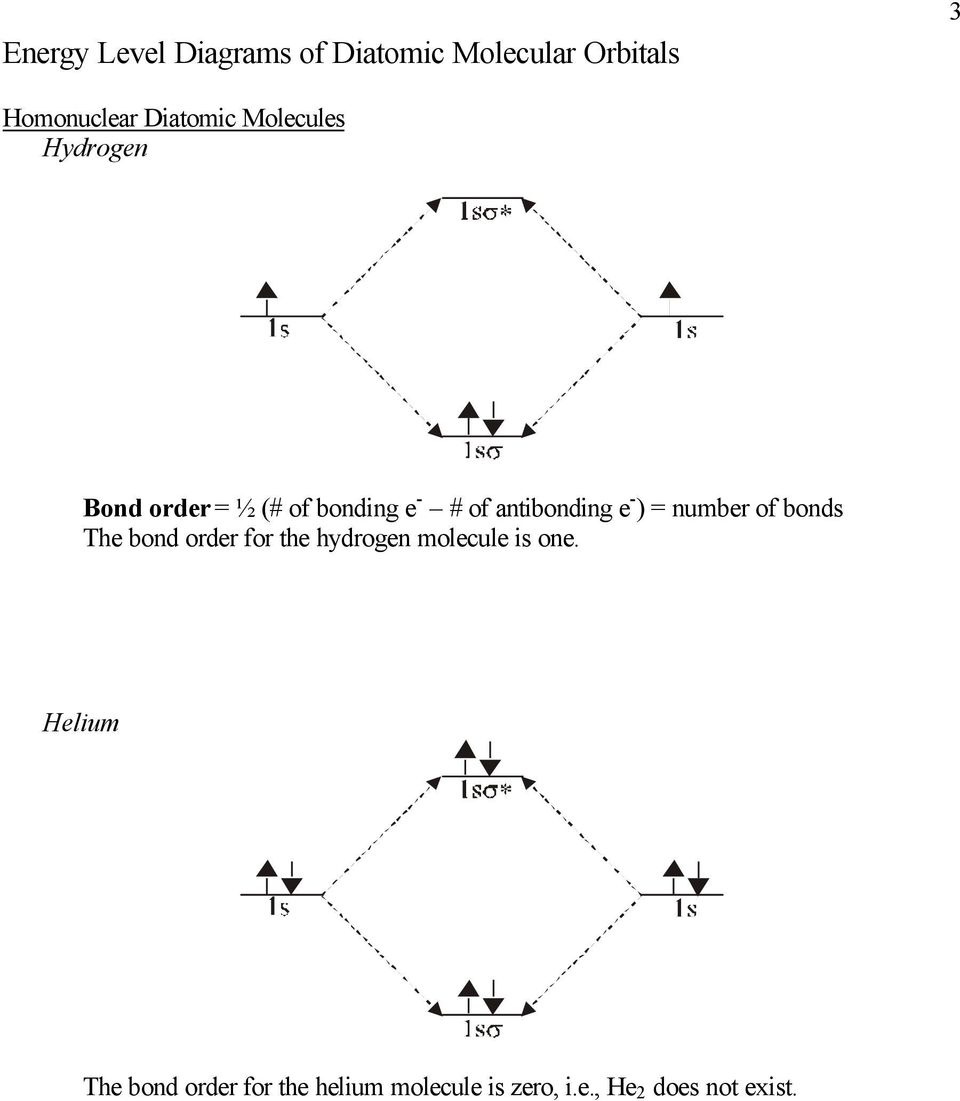
3 Energy Level Diagrams of Diatomic Molecular Orbitals 3 Homonuclear Diatomic Molecules Hydrogen Bond order = ½ (# of bonding e - # of antibonding e - ) = number of bonds The bond order for the hydrogen molecule is one. Helium The bond order for the helium molecule is zero, i.e., He 2 does not exist.
4 Lithium 4 Dilithium exists! (Though not as crystal!) The bond order for the lithium molecule is one, i.e., 2 bonds 1 antibond = 1 bond.

5 Beryllium 5 Diberyllium does not exist. The bond order for the beryllium molecule is zero, - i.e., 2 bonds 2 antibonds = 0 bond.

6 Molecular Orbital Diagrams for Second Row Diatomic Molecules B 2 through C 2 6 Notes: For B through N, 2s and 2p are close enough in energy for hybridization to change the order of the molecular orbital energies. B 2 bond is π bond?!? Also, B 2 is paramagnetic. - Molecular electronic structure also follows Hund s rules. C 2 bonding is 2 π bonds. C 2 is diamagnetic. Note carbide ion, C 2 2- has triple bond. N 2 has triple bond. N 2 is diamagnetic. Q: Which is more stable, N 2 + or N 2 -? A: Antibond stronger than bond; therefore N 2 + is predicted to be more stable.

7 7 N 2 through Ne 2 Notes: O 2 bond is 1 σ and 1 π bond. Also, O 2 is paramagnetic. F 2 bonding is σ bond. F 2 is diamagnetic. Bond order of Ne 2 is zero. Ne atoms are not bound. - Dimer does exist as van der Waals state. - Ne 2 + can exist. Q: According to MO theory, Ne 2 2+ should be stable ion. Why haven t we heard of it until now? A: I don t know. Hypothesis: Neon is even more electronegative than fluorine.

8 Heteronuclear Diatomic Molecules 8 Energy of atomic orbitals is affected by effective nuclear charge. More electronegative atom will draw electron density to itself in a bonding orbital. Consider carbon monoxide as an example. C O C O σ σ C O C O π π Note: Most electropositive atom has most anti-bonding density.

9 Term Symbols of Molecular States 9 Molecular Angular Momentum of Diatomic Molecules Orbital Angular Momentum The electron in a non-sigma bond experiences a cylindrically symmetric potential energy in contrast to an electron in an atomic non-s orbital that has a spherically symmetric potential energy. The electron in a non-sigma bond has an angular momentum, L. However, because the electric field from the nuclei and the other electrons is not spherically symmetric, the angular is not well characterized. However, for an electron in a non-sigma bond, the projection of the angular momentum upon the internuclear axis, M L, is well characterized. - To distinguish from the atomic M L, the molecular M L is given a new symbol, Λ. Thus, the electronic state of a diatomic molecule is partially characterized by Λ. Λ 0 ±1 ±2 ±3 symbol Σ Π Φ Each electron contributes to the total orbital angular momentum thus Λ=Λ+Λ Each Λ state is doubly degenerate except the Σ state that has one state. In other words, E Λ = EΛ A non-sigma bond electron has two directions to precess about the internuclear axis. Spin Angular Momentum The spin precesses about the internuclear axis since the magnetic moment of the electron tries to align itself with the magnetic field created by the nuclei orbiting about the electron. - This phenomenon could be referred to as molecular spin-orbit coupling. The projection of the spin, S, on the internuclear axis is M S. - To distinguish from the atomic M S, the molecular M S is given a new symbol, Σ. - Note source of confusion: Σ can refer to a specific orbital angular momentum state or it can refer to the general total spin angular momentum. Each electron contributes to the total spin angular momentum thus Σ=Σ+Σ + Multiplicity = 2Σ The rules for multiplicity are the same as for atomic structure. - filled orbital Σ= 0 multiplicity = 1 singlet - half-filled orbital Σ= 12 multiplicity = 2 doublet - two half-filled orbitals Σ= 1 multiplicity = 3 triplet

10 Introduction to Symmetry 10 Parity g gerade symmetric for inversion through center u ungerade antisymmetric for inversion through center Reflection + - reflection through plane containing internuclear axis is symmetric - reflection through plane containing internuclear axis is antisymmetric Consider the symmetries of the sigma and pi bonding and antibonding orbitals. Parity g u u g Reflection + + When two or more electrons are in a molecular state, the total symmetry of the state is determined by multiplying the symmetries of the electrons together. Multiplication rules for of parity and reflection symmetries Parity g g= g g u= u g= u u u= g Reflection ( + ) ( + ) = ( + ) ( + ) ( ) = ( ) ( + ) = ( ) ( ) ( ) = ( + ) Writing Term Symbols Information available in a molecular term symbol orbital angular momentum multiplicity 2 Π + g reflection symmetry parity

11 Writing an electron configuration as a term symbol. 11 Use B 2 as an example. The electron configuration for B 2 can be written as (1sσ 2 )(1sσ* 2 )(2sσ 2 )(2sσ* 2 )(2pπ 2 ) As in the atomic case, closed subshells do not contribute to the total angular momentum. Two cases for electrons in the 2pπ orbitals. each electron is in different orbitals Λ=Λ+Λ 1 2 = 1+ ( 1) = 0 Σ state electron spins can be parallel or antiparallel Σ=Σ+Σ 1 2 = = 1 or Σ=Σ+Σ 1 2 = 12 12= 0 thus, possible terms are 3 Σ or 1 Σ + g + g both electrons in the same orbital Λ=Λ+Λ 1 2 = 1+ 1= 2 state electron spins can be antiparallel only (can t violate Pauli exclusion principle) Σ=Σ+Σ 1 2 = 12 12= 0 thus, possible terms are 1 + g Using Hund s rules as with the atomic term symbols, the term with the highest multiplicity is the lowest energy. Thus the ground state term of B 2 is 3 + Σ Use C 2 as another example. The ground state electron configuration for C 2 can be written as (1sσ 2 )(1sσ* 2 )(2sσ 2 )(2sσ* 2 )(2pπ 4 ). Thus the term for the ground state is 1 Σ. However, consider excited state 3 + Σ u. What is the electronic configuration for lowest possible excited state? How can we assign the molecular orbitals for the various electrons? The Σ state implies that Λ = 0. At this point, let us consider that a single electron has been excited to a π* orbital. Λ= 0 Λ+Λ 1 2 = 0 Λ 1 = 1 Λ 2 = 1 Note that the above could be true if the electron is excited to a higher π orbital as well. multiplicity = 3 implies that Σ= 1 Σ 1 =Σ 2 = 12 + g g

12 The one electron remaining in the π orbital has an ungerade parity and negative reflection symmetry. Thus, the electron in the unknown orbital must be gerade parity and negative reflection symmetry. 12 = = ( ) (?) = ( + ) (?) = ( ) u? u? g Since the π* orbital has gerade parity and negative reflection symmetry, it is possible that the 3 Σ implies the electron configuration (1sσ 2 )(1sσ* 2 )(2sσ 2 )(2sσ* 2 )(2pπ 3 )(2pπ* 1 ). + u However, ambiguity exists in the term symbol. The electron configuration, (1sσ 2 )(1sσ* 2 )(2sσ 2 )(2sσ* 2 )(2pπ 3 )(3pπ* 1 ), would also result in a term of 3 + Σ u. To unambiguously assign electronic structure, more information is needed. The term symbols of molecular states are very convenient when studying electronic spectroscopy. The selection rules of electronic spectroscopy are dependent on the symmetry changes of the states. Thus having the term symbols will allow us to quickly identify between which states transitions can occur.

13 Molecular Orbitals of Polyatomic Molecules 13 The molecular orbitals of polyatomic molecules can be constructed from adding and subtracting appropriate combinations of atomic orbitals. The atomic orbitals must have a proper spatial symmetry in order for a net bond overlap to occur. A Little Trick Symmetry Adapted LCAO Consider the construction of molecular orbitals for a polyatomic molecule like linear H 3. It is more difficult to consider linear combinations of three orbitals rather than two orbitals. Therefore, we will be clever and consider only combinations of two orbitals at a time. H 3 Linear Triatomic Hydrogen For H 3, we will create bonding and antibonding orbitals from the atomic orbitals of hydrogens 1 and 3. Then we will combine the molecular orbitals of hydrogens 1 and 3 with the atomic orbital of hydrogen 2 to make a complete set of molecular orbitals. First add and subtract the 1s orbitals of hydrogens 1 and s 1s 1sσ - 1s 1s 1sσ Note that since hydrogens 1 and 3 are far apart, very little overlap occurs. An energy level diagram demonstrates that the energy changes at this point are minimal. Now let us take each molecular orbital above and add the 1s orbital of hydrogen 2 to each.

14 14 Orbital 1 Note that orbital 1 bonds all three hydrogen nuclei. No Interaction There is no interaction between the 1sσ* and 1s since the amount of positive overlap equal the amount of negative overlap. Thus no new orbital is formed. Now take the molecular orbitals from hydrogens 1 and 3 and subtract the 1s orbital of hydrogen 2 from each. Orbital 3 Note that orbital 3 is antibonding between all three hydrogen nuclei. No Interaction Again the interaction between the 1sσ* and 1s is zero.

15 If we have formed two molecular orbitals from three atomic orbitals so far, where is the third orbital? The third orbital has the shape of the 1sσ* orbital. 15 Orbital 2 We note that orbital 2 does not draw nuclei together as a bonding orbital would do nor does it draw nuclei apart as an antibonding orbital would do. Thus, orbital 2 is named a nonbonding orbital. The energy level diagram for these molecular orbitals is Thus linear H 3 has a bonding orbital (orbital 1), a nonbonding orbital (orbital 2) and an antibonding orbital (orbital 3). H 2 O Water To find the molecular orbitals for water we will take a similar tack as we did with H 3. First we will construct σ, and σ* orbitals from the hydrogen 1s orbitals. Now let us consider the interaction of these orbitals with the five orbitals of oxygen, 1s, 2s, 2p x, 2p y and 2p z. First we can consider that the 1s orbital of oxygen is much lower in energy than hydrogen 1s orbitals. Therefore, as a first approximation, we will consider that there is no interaction with the 1s orbital of oxygen. The 1s orbital of oxygen is a nonbonding orbital or a perhaps better described as a nonbonding core orbital.

16 Next, consider the interaction with the 2s orbital. The energy of the 2s oxygen orbital is still below the energy of the 1s hydrogen orbital; but, it is close enough for an interaction to occur. The shapes of the orbitals are similar to the H 3 orbitals but the water orbitals are bent. 16 No Interaction The 1sσ* orbital may be a nonbonding orbital or it may interact with another orbital. Now consider the interaction with 2p orbitals. First we need to define a coordinate system. Z Y H H O X Now consider the interaction between the hydrogen orbitals and the 2p y orbital. Looking down from z direction.

17 Note that any constructive interference that occurs is balanced by the destructive interference that occurs. Thus, the effective interaction is zero. The lack of interaction occurs whether we consider the hydrogen orbitals in the 1sσ or the 1sσ* configuration. Therefore, the 2p y orbital is a nonbonding orbital. 17 Now consider the interaction with the 2p z orbital. Let us add the 2p z orbital to the hydrogen molecular orbitals. No Interaction We still don t know if the 1sσ* orbital will be a nonbonding orbital or whether it will interact with another orbital. Also, note that we could subtract the 2p z orbital from the 1sσ orbital to yield a strictly antibonding orbital. Finally, consider the interaction with the 2p x orbital. No Interaction Note that we could subtract the 2p x orbital to yield a strictly antibonding orbital. Finally we answer the question about the 1sσ* orbital. It will interact with the 2p x orbital to form a bonding and antibonding orbital.

18 Hückel Model 18 Previous discussion has been a simplified view of MO theory. Procedures exist to take all of the atomic orbitals and mix them together to form molecular orbitals. Examining the procedure is beyond what we would like to consider here. However, we get a taste of the procedure by examining what is known as the Hückel model. The Hückel model is applicable to the pi system of conjugated molecules. 1. Construct wavefunction from a sum of p orbitals perpendicular to the molecular plane. ψ= cφ + cφ + cφ + 1 p1 2 p2 3 p3 2. Assume that all overlap integrals are zero. 3. Assume H11 = H22 = H 33 = =α S= φ φ =δ = 0 pi pj ij H = φ H φ =α ii p i p i 4. Assume that H12 = H23 = H 34 = =β for adjacent p orbitals H = φ H φ =β ij pi pj 5. Assume that H13 = H14 = H 24 = = 0 for nonadjacent p orbitals 6. Then construct a secular determinant. Consider cyclobutadiene as an example. α E β 0 β c α E β 0 β 1 c 2 β α E β 0 β α E β 0 = 0 = 0 0 β α E β c 3 0 β α E β β 0 β α E c β 0 β α E 4 7. Make solution of secular determinant easier by performing the substitution, α E x = β x x 1 0 = x x

19 8. Find the solutions of the secular determinant. 4 2 x 4x = 0 x = 0,0,2, 2 E =ααα+,, 2, β α 2β Find the eigenvectors of the secular determinant to find the molecular orbitals =α β v ( ) For E = ψ= φ p + φ 1 p + φ 2 p + φ 3 p ψ= 1 1 φp φ 1 p3 2 2 ψ= 1 1 φp φ 2 p4 2 2 v= ψ= φp φ 1 p + φ 2 p φ 3 p For E =α v= ( ) For E =α v= ( ) For E 2 =α+ β ( )

LCAO-MO Correlation Diagrams
 LCAO-MO Correlation Diagrams (Linear Combination of Atomic Orbitals to yield Molecular Orbitals) For (Second Row) Homonuclear Diatomic Molecules (X 2 ) - the following LCAO-MO s are generated: LCAO MO
Lesson 3. Chemical Bonding. Molecular Orbital Theory
 Lesson 3 Chemical Bonding Molecular Orbital Theory 1 Why Do Bonds Form? An energy diagram shows that a bond forms between two atoms if the overall energy of the system is lowered when the two atoms approach
Chapter 9. Chemical reactivity of molecules depends on the nature of the bonds between the atoms as well on its 3D structure
 Chapter 9 Molecular Geometry & Bonding Theories I) Molecular Geometry (Shapes) Chemical reactivity of molecules depends on the nature of the bonds between the atoms as well on its 3D structure Molecular
Name: Class: Date: 3) The bond angles marked a, b, and c in the molecule below are about,, and, respectively.
 Name: Class: Date: Unit 9 Practice Multiple Choice Identify the choice that best completes the statement or answers the question. 1) The basis of the VSEPR model of molecular bonding is. A) regions of
Hybrid Molecular Orbitals
 Hybrid Molecular Orbitals Last time you learned how to construct molecule orbital diagrams for simple molecules based on the symmetry of the atomic orbitals. Molecular orbitals extend over the entire molecule
Molecular Orbital Theory
 Molecular Orbital Theory To date, we have looked at three different theories of molecular boning. They are the VSEPR Theory (with Lewis Dot Structures), the Valence Bond Theory (with hybridization) and
Chapter 9 - Covalent Bonding: Orbitals
 Chapter 9 - Covalent Bonding: Orbitals 9.1 Hybridization and the Localized Electron Model A. Hybridization 1. The mixing of two or more atomic orbitals of similar energies on the same atom to produce new
CHAPTER 9 ATOMIC STRUCTURE AND THE PERIODIC LAW
 CHAPTER 9 ATOMIC STRUCTURE AND THE PERIODIC LAW Quantum mechanics can account for the periodic structure of the elements, by any measure a major conceptual accomplishment for any theory. Although accurate
SHAPES OF MOLECULES (VSEPR MODEL)
 1 SAPES MLEULES (VSEPR MDEL) Valence Shell Electron-Pair Repulsion model - Electron pairs surrounding atom spread out as to minimize repulsion. - Electron pairs can be bonding pairs (including multiple
Section 5 Molecular Electronic Spectroscopy (lecture 9 ish)
 Section 5 Molecular Electronic Spectroscopy (lecture 9 ish) Previously: Quantum theory of atoms / molecules Quantum Mechanics Vl Valence Molecular Electronic Spectroscopy Classification of electronic states
Chemistry Workbook 2: Problems For Exam 2
 Chem 1A Dr. White Updated /5/1 1 Chemistry Workbook 2: Problems For Exam 2 Section 2-1: Covalent Bonding 1. On a potential energy diagram, the most stable state has the highest/lowest potential energy.
1.15 Bonding in Methane and Orbital Hybridization
 1.15 Bonding in Methane and Orbital Hybridization Structure of Methane tetrahedral bond angles = 109.5 bond distances = 110 pm but structure seems inconsistent with electron configuration of carbon Electron
Molecular Geometry and VSEPR We gratefully acknowledge Portland Community College for the use of this experiment.
 Molecular and VSEPR We gratefully acknowledge Portland ommunity ollege for the use of this experiment. Objectives To construct molecular models for covalently bonded atoms in molecules and polyatomic ions
Proton Nuclear Magnetic Resonance Spectroscopy
 Proton Nuclear Magnetic Resonance Spectroscopy Introduction: The NMR Spectrum serves as a great resource in determining the structure of an organic compound by revealing the hydrogen and carbon skeleton.
CHAPTER 5: MOLECULAR ORBITALS
 Chapter 5 Molecular Orbitals 5 CHAPTER 5: MOLECULAR ORBITALS 5. There are three possible bonding interactions: p z d z p y d yz p x d xz 5. a. Li has a bond order of. (two electrons in a bonding orbital;
CHEM 101/105 BONDING (continued) Lect-16
 CHEM 0/05 BONDING (continued) Lect6 A Second covalent bonding theory, MOLECULAR ORBITAL THEORY accounts for covalent bonding by... before looking at MO, return for a moment to the individual unbonded atom
CHEM 340 CHEMICAL BONDING - in General Lect-07 IONIC COVALENT METAL COVALENT NETWORK
 CHEM 340 CHEMICAL BONDING in General Lect07 BONDING between atoms classified as belonging to one of the following types: IONIC COVALENT METAL COVALENT NETWORK or each bond type, the valence shell electrons
Chapter 10 Molecular Geometry and Chemical Bonding Theory
 Chem 1: Chapter 10 Page 1 Chapter 10 Molecular Geometry and Chemical Bonding Theory I) VSEPR Model Valence-Shell Electron-Pair Repulsion Model A) Model predicts Predicts electron arrangement and molecular
Chapter 8 Basic Concepts of the Chemical Bonding
 Chapter 8 Basic Concepts of the Chemical Bonding 1. There are paired and unpaired electrons in the Lewis symbol for a phosphorus atom. (a). 4, 2 (b). 2, 4 (c). 4, 3 (d). 2, 3 Explanation: Read the question
Section 3: Crystal Binding
 Physics 97 Interatomic forces Section 3: rystal Binding Solids are stable structures, and therefore there exist interactions holding atoms in a crystal together. For example a crystal of sodium chloride
9.7 MOLECULAR ORBITALS
 368 CHAPTER 9 Molecular Geometry and Bonding Theories John Barbaro, Orbital Bartending, J. Chem. Educ., Vol. 71, 1994, 1012. An analogy for orbital hybridization is suggested in this short article. Robert
3) Of the following, radiation has the shortest wavelength. A) X-ray B) radio C) microwave D) ultraviolet E) infrared Answer: A
 1) Which one of the following is correct? A) ν + λ = c B) ν λ = c C) ν = cλ D) λ = c ν E) νλ = c Answer: E 2) The wavelength of light emitted from a traffic light having a frequency of 5.75 1014 Hz is.
Molecular Orbitals. Chapter 5
 Chapter 5 Molecular rbitals Molecular orbital theory uses group theory to describe the bonding in molecules ; it complements and extends the introductory bonding models in Chapter 3. In molecular orbital
Visualizing Molecular Orbitals: A MacSpartan Pro Experience
 Introduction Name(s) Visualizing Molecular Orbitals: A MacSpartan Pro Experience In class we have discussed Lewis structures, resonance, VSEPR, hybridization and molecular orbitals. These concepts are
Laboratory 11: Molecular Compounds and Lewis Structures
 Introduction Laboratory 11: Molecular Compounds and Lewis Structures Molecular compounds are formed by sharing electrons between non-metal atoms. A useful theory for understanding the formation of molecular
Bonding Models. Bonding Models (Lewis) Bonding Models (Lewis) Resonance Structures. Section 2 (Chapter 3, M&T) Chemical Bonding
 Bonding Models Section (Chapter, M&T) Chemical Bonding We will look at three models of bonding: Lewis model Valence Bond model M theory Bonding Models (Lewis) Bonding Models (Lewis) Lewis model of bonding
Application Note AN4
 TAKING INVENTIVE STEPS IN INFRARED. MINIATURE INFRARED GAS SENSORS GOLD SERIES UK Patent App. No. 2372099A USA Patent App. No. 09/783,711 World Patents Pending INFRARED SPECTROSCOPY Application Note AN4
Chemistry 111 Laboratory Experiment 4: Visualizing Molecular Orbitals with MacSpartan Pro (This experiment will be conducted in OR341)
 Chemistry 111 Laboratory Experiment 4: Visualizing Molecular Orbitals with MacSpartan Pro (This experiment will be conducted in OR341) Introduction In class we have discussed Lewis structures, resonance,
Chapter 10 Electronic Wavefunctions Must Also Possess Proper Symmetry. These Include Angular Momentum and Point Group Symmetries
 Chapter 10 Electronic Wavefunctions Must Also Possess Proper Symmetry. These Include Angular Momentum and Point Group Symmetries I. Angular Momentum Symmetry and Strategies for Angular Momentum Coupling
AP Chemistry A. Allan Chapter 8 Notes - Bonding: General Concepts
 AP Chemistry A. Allan Chapter 8 Notes - Bonding: General Concepts 8.1 Types of Chemical Bonds A. Ionic Bonding 1. Electrons are transferred 2. Metals react with nonmetals 3. Ions paired have lower energy
Theme 3: Bonding and Molecular Structure. (Chapter 8)
 Theme 3: Bonding and Molecular Structure. (Chapter 8) End of Chapter questions: 5, 7, 9, 12, 15, 18, 23, 27, 28, 32, 33, 39, 43, 46, 67, 77 Chemical reaction valence electrons of atoms rearranged (lost,
Elements in the periodic table are indicated by SYMBOLS. To the left of the symbol we find the atomic mass (A) at the upper corner, and the atomic num
 . ATOMIC STRUCTURE FUNDAMENTALS LEARNING OBJECTIVES To review the basics concepts of atomic structure that have direct relevance to the fundamental concepts of organic chemistry. This material is essential
Chapter 1 Structure and Bonding. Modified by Dr. Daniela Radu
 John E. McMurry www.cengage.com/chemistry/mcmurry Chapter 1 Structure and Bonding Modified by Dr. Daniela Radu What is Organic Chemistry? Living things are made of organic chemicals Proteins that make
LEWIS DIAGRAMS. by DR. STEPHEN THOMPSON MR. JOE STALEY
 by DR. STEPHEN THOMPSON MR. JOE STALEY The contents of this module were developed under grant award # P116B-001338 from the Fund for the Improvement of Postsecondary Education (FIPSE), United States Department
Part I: Principal Energy Levels and Sublevels
 Part I: Principal Energy Levels and Sublevels As you already know, all atoms are made of subatomic particles, including protons, neutrons, and electrons. Positive protons and neutral neutrons are found
Proton Nuclear Magnetic Resonance ( 1 H-NMR) Spectroscopy
 Proton Nuclear Magnetic Resonance ( 1 H-NMR) Spectroscopy Theory behind NMR: In the late 1940 s, physical chemists originally developed NMR spectroscopy to study different properties of atomic nuclei,
PROTON NUCLEAR MAGNETIC RESONANCE SPECTROSCOPY (H-NMR)
 PROTON NUCLEAR MAGNETIC RESONANCE SPECTROSCOPY (H-NMR) WHAT IS H-NMR SPECTROSCOPY? References: Bruice 14.1, 14.2 Introduction NMR or nuclear magnetic resonance spectroscopy is a technique used to determine
Covalent Bonding & Molecular Orbital Theory
 Covalent Bonding & Molecular Orbital Theory Chemistry 754 Solid State Chemistry Dr. Patrick Woodward Lecture #16 References - MO Theory Molecular orbital theory is covered in many places including most
Chapter 7. Comparing Ionic and Covalent Bonds. Ionic Bonds. Types of Bonds. Quick Review of Bond Types. Covalent Bonds
 Comparing Ionic and Covalent Bonds Chapter 7 Covalent Bonds and Molecular Structure Intermolecular forces (much weaker than bonds) must be broken Ionic bonds must be broken 1 Ionic Bonds Covalent Bonds
Name: Worksheet: Electron Configurations. I Heart Chemistry!
 1. Which electron configuration represents an atom in an excited state? 1s 2 2s 2 2p 6 3p 1 1s 2 2s 2 2p 6 3s 2 3p 2 1s 2 2s 2 2p 6 3s 2 3p 1 1s 2 2s 2 2p 6 3s 2 Worksheet: Electron Configurations Name:
Atoms and Elements. Outline Atoms Orbitals and Energy Levels Periodic Properties Homework
 Atoms and the Periodic Table The very hot early universe was a plasma with cationic nuclei separated from negatively charged electrons. Plasmas exist today where the energy of the particles is very high,
Valence Bond Theory: Hybridization
 Exercise 13 Page 1 Illinois Central College CEMISTRY 130 Laboratory Section: Valence Bond Theory: ybridization Name: Objectives To illustrate the distribution of electrons and rearrangement of orbitals
Molecular Models & Lewis Dot Structures
 Molecular Models & Lewis Dot Structures Objectives: 1. Draw Lewis structures for atoms, ions and simple molecules. 2. Use Lewis structures as a guide to construct three-dimensional models of small molecules.
NMR SPECTROSCOPY. Basic Principles, Concepts, and Applications in Chemistry. Harald Günther University of Siegen, Siegen, Germany.
 NMR SPECTROSCOPY Basic Principles, Concepts, and Applications in Chemistry Harald Günther University of Siegen, Siegen, Germany Second Edition Translated by Harald Günther JOHN WILEY & SONS Chichester
Question 4.2: Write Lewis dot symbols for atoms of the following elements: Mg, Na, B, O, N, Br.
 Question 4.1: Explain the formation of a chemical bond. A chemical bond is defined as an attractive force that holds the constituents (atoms, ions etc.) together in a chemical species. Various theories
CHEM 101 Exam 4. Page 1
 CEM 101 Exam 4 Form 1 (White) November 30, 2001 Page 1 Section This exam consists of 8 pages. When the exam begins make sure you have one of each. Print your name at the top of each page now. Show your
Molecular Symmetry 1
 Molecular Symmetry 1 I. WHAT IS SYMMETRY AND WHY IT IS IMPORTANT? Some object are more symmetrical than others. A sphere is more symmetrical than a cube because it looks the same after rotation through
Nuclear Magnetic Resonance
 Nuclear Magnetic Resonance NMR is probably the most useful and powerful technique for identifying and characterizing organic compounds. Felix Bloch and Edward Mills Purcell were awarded the 1952 Nobel
Crystalline solids. A solid crystal consists of different atoms arranged in a periodic structure.
 Crystalline solids A solid crystal consists of different atoms arranged in a periodic structure. Crystals can be formed via various bonding mechanisms: Ionic bonding Covalent bonding Metallic bonding Van
Section 11.3 Atomic Orbitals Objectives
 Objectives 1. To learn about the shapes of the s, p and d orbitals 2. To review the energy levels and orbitals of the wave mechanical model of the atom 3. To learn about electron spin A. Electron Location
EXPERIMENT 17 : Lewis Dot Structure / VSEPR Theory
 EXPERIMENT 17 : Lewis Dot Structure / VSEPR Theory Materials: Molecular Model Kit INTRODUCTION Although it has recently become possible to image molecules and even atoms using a high-resolution microscope,
DO PHYSICS ONLINE FROM QUANTA TO QUARKS QUANTUM (WAVE) MECHANICS
 DO PHYSICS ONLINE FROM QUANTA TO QUARKS QUANTUM (WAVE) MECHANICS Quantum Mechanics or wave mechanics is the best mathematical theory used today to describe and predict the behaviour of particles and waves.
A REVIEW OF GENERAL CHEMISTRY: ELECTRONS, BONDS AND MOLECULAR PROPERTIES
 A REVIEW OF GENERAL CEMISTRY: ELECTRONS, BONDS AND MOLECULAR PROPERTIES A STUDENT SOULD BE ABLE TO: 1. Draw Lewis (electron dot and line) structural formulas for simple compounds and ions from molecular
Chapter10 Tro. 4. Based on the Lewis structure, the number of electron domains in the valence shell of the CO molecule is A) 1 B) 2 C) 3 D) 4 E) 5
 Chapter10 Tro 1. All of the geometries listed below are examples of the five basic geometries for molecules with more than 3 atoms except A) planar triangular B) octahedral C) tetrahedral D) trihedral
Chapter 6 Assessment. Name: Class: Date: ID: A. Multiple Choice Identify the choice that best completes the statement or answers the question.
 Name: Class: Date: ID: A Chapter 6 Assessment Multiple Choice Identify the choice that best completes the statement or answers the question. 1. When an atom loses an electron, it forms a(n) a. anion. c.
IONISATION ENERGY CONTENTS
 IONISATION ENERGY IONISATION ENERGY CONTENTS What is Ionisation Energy? Definition of t Ionisation Energy What affects Ionisation Energy? General variation across periods Variation down groups Variation
Covalent Bonding and Molecular Geometry
 Name Section # Date of Experiment Covalent Bonding and Molecular Geometry When atoms combine to form molecules (this also includes complex ions) by forming covalent bonds, the relative positions of the
Question: Do all electrons in the same level have the same energy?
 Question: Do all electrons in the same level have the same energy? From the Shells Activity, one important conclusion we reached based on the first ionization energy experimental data is that electrons
UV-Vis Vis spectroscopy. Electronic absorption spectroscopy
 UV-Vis Vis spectroscopy Electronic absorption spectroscopy Absortpion spectroscopy Provide information about presence and absence of unsaturated functional groups Useful adjunct to IR Determination of
Bonding & Molecular Shape Ron Robertson
 Bonding & Molecular Shape Ron Robertson r2 n:\files\courses\1110-20\2010 possible slides for web\00bondingtrans.doc The Nature of Bonding Types 1. Ionic 2. Covalent 3. Metallic 4. Coordinate covalent Driving
Atomic Structure Ron Robertson
 Atomic Structure Ron Robertson r2 n:\files\courses\1110-20\2010 possible slides for web\atomicstructuretrans.doc I. What is Light? Debate in 1600's: Since waves or particles can transfer energy, what is
Mulliken suggested to split the shared density 50:50. Then the electrons associated with the atom k are given by:
 1 17. Population Analysis Population analysis is the study of charge distribution within molecules. The intention is to accurately model partial charge magnitude and location within a molecule. This can
Student Exploration: Electron Configuration
 Name: Date: Student Exploration: Electron Configuration Vocabulary: atomic number, atomic radius, Aufbau principle, chemical family, diagonal rule, electron configuration, Hund s rule, orbital, Pauli exclusion
2, 8, 20, 28, 50, 82, 126.
 Chapter 5 Nuclear Shell Model 5.1 Magic Numbers The binding energies predicted by the Liquid Drop Model underestimate the actual binding energies of magic nuclei for which either the number of neutrons
For example: (Example is from page 50 of the Thinkbook)
 SOLVING COMBINED SPECTROSCOPY PROBLEMS: Lecture Supplement: page 50-53 in Thinkbook CFQ s and PP s: page 216 241 in Thinkbook Introduction: The structure of an unknown molecule can be determined using
CHAPTER 6 REVIEW. Chemical Bonding. Answer the following questions in the space provided.
 Name Date lass APTER 6 REVIEW hemical Bonding SETIN 1 SRT ANSWER Answer the following questions in the space provided. 1. a A chemical bond between atoms results from the attraction between the valence
CHAPTER 6 Chemical Bonding
 CHAPTER 6 Chemical Bonding SECTION 1 Introduction to Chemical Bonding OBJECTIVES 1. Define Chemical bond. 2. Explain why most atoms form chemical bonds. 3. Describe ionic and covalent bonding.. 4. Explain
CHEM 1211K Test IV. MULTIPLE CHOICE (3 points each)
 CEM 1211K Test IV MULTIPLE COICE (3 points each) 1) ow many single covalent bonds must a silicon atom form to have a complete octet in its valence shell? A) 4 B) 3 C) 1 D) 2 E) 0 2) What is the maximum
Nuclear Magnetic Resonance notes
 Reminder: These notes are meant to supplement, not replace, the laboratory manual. Nuclear Magnetic Resonance notes Nuclear Magnetic Resonance (NMR) is a spectrometric technique which provides information
Chapter 2 The Chemical Context of Life
 Chapter 2 The Chemical Context of Life Multiple-Choice Questions 1) About 25 of the 92 natural elements are known to be essential to life. Which four of these 25 elements make up approximately 96% of living
Electron Arrangements
 Section 3.4 Electron Arrangements Objectives Express the arrangement of electrons in atoms using electron configurations and Lewis valence electron dot structures New Vocabulary Heisenberg uncertainty
Molecular Geometry and Chemical Bonding Theory
 Chapter 10 Molecular Geometry and Chemical Bonding Theory Concept Check 10.1 An atom in a molecule is surrounded by four pairs of electrons, one lone pair and three bonding pairs. Describe how the four
EXPERIMENT 9 Dot Structures and Geometries of Molecules
 EXPERIMENT 9 Dot Structures and Geometries of Molecules INTRODUCTION Lewis dot structures are our first tier in drawing molecules and representing bonds between the atoms. The method was first published
Organic Chemistry Tenth Edition
 Organic Chemistry Tenth Edition T. W. Graham Solomons Craig B. Fryhle Welcome to CHM 22 Organic Chemisty II Chapters 2 (IR), 9, 3-20. Chapter 2 and Chapter 9 Spectroscopy (interaction of molecule with
CHEMISTRY BONDING REVIEW
 Answer the following questions. CHEMISTRY BONDING REVIEW 1. What are the three kinds of bonds which can form between atoms? The three types of Bonds are Covalent, Ionic and Metallic. Name Date Block 2.
2. Spin Chemistry and the Vector Model
 2. Spin Chemistry and the Vector Model The story of magnetic resonance spectroscopy and intersystem crossing is essentially a choreography of the twisting motion which causes reorientation or rephasing
7.14 Linear triatomic: A-----B-----C. Bond angles = 180 degrees. Trigonal planar: Bond angles = 120 degrees. B < B A B = 120
 APTER SEVEN Molecular Geometry 7.13 Molecular geometry may be defined as the three-dimensional arrangement of atoms in a molecule. The study of molecular geometry is important in that a molecule s geometry
AP CHEMISTRY 2009 SCORING GUIDELINES
 AP CHEMISTRY 2009 SCORING GUIDELINES Question 6 (8 points) Answer the following questions related to sulfur and one of its compounds. (a) Consider the two chemical species S and S 2. (i) Write the electron
Questions on Chapter 8 Basic Concepts of Chemical Bonding
 Questions on Chapter 8 Basic Concepts of Chemical Bonding Circle the Correct Answer: 1) Which ion below has a noble gas electron configuration? A) Li 2+ B) Be 2+ C) B2+ D) C2+ E) N 2-2) Of the ions below,
Atomic Structure: Chapter Problems
 Atomic Structure: Chapter Problems Bohr Model Class Work 1. Describe the nuclear model of the atom. 2. Explain the problems with the nuclear model of the atom. 3. According to Niels Bohr, what does n stand
Solving Spectroscopy Problems
 Solving Spectroscopy Problems The following is a detailed summary on how to solve spectroscopy problems, key terms are highlighted in bold and the definitions are from the illustrated glossary on Dr. Hardinger
Symmetric Stretch: allows molecule to move through space
 BACKGROUND INFORMATION Infrared Spectroscopy Before introducing the subject of IR spectroscopy, we must first review some aspects of the electromagnetic spectrum. The electromagnetic spectrum is composed
Health Science Chemistry I CHEM-1180 Experiment No. 15 Molecular Models (Revised 05/22/2015)
 (Revised 05/22/2015) Introduction In the early 1900s, the chemist G. N. Lewis proposed that bonds between atoms consist of two electrons apiece and that most atoms are able to accommodate eight electrons
Group Theory and Molecular Symmetry
 Group Theory and Molecular Symmetry Molecular Symmetry Symmetry Elements and perations Identity element E - Apply E to object and nothing happens. bject is unmoed. Rotation axis C n - Rotation of object
Exercises Topic 2: Molecules
 hemistry for Biomedical Engineering. Exercises Topic 2 Authors: ors: Juan Baselga & María González Exercises Topic 2: Molecules 1. Using hybridization concepts and VSEPR model describe the molecular geometry
Symmetry and group theory
 Symmetry and group theory or How to Describe the Shape of a Molecule with two or three letters Natural symmetry in plants Symmetry in animals 1 Symmetry in the human body The platonic solids Symmetry in
Benzene and Aromatic Compounds
 Benzene and Aromatic Compounds Benzene (C 6 H 6 ) is the simplest aromatic hydrocarbon (or arene). Benzene has four degrees of unsaturation, making it a highly unsaturated hydrocarbon. Whereas unsaturated
5. Structure, Geometry, and Polarity of Molecules
 5. Structure, Geometry, and Polarity of Molecules What you will accomplish in this experiment This experiment will give you an opportunity to draw Lewis structures of covalent compounds, then use those
TIME OF COMPLETION NAME SOLUTION DEPARTMENT OF NATURAL SCIENCES. PHYS 3650, Exam 2 Section 1 Version 1 October 31, 2005 Total Weight: 100 points
 TIME OF COMPLETION NAME SOLUTION DEPARTMENT OF NATURAL SCIENCES PHYS 3650, Exam 2 Section 1 Version 1 October 31, 2005 Total Weight: 100 points 1. Check your examination for completeness prior to starting.
AP* Atomic Structure & Periodicity Free Response Questions KEY page 1
 AP* Atomic Structure & Periodicity ree Response Questions KEY page 1 1980 a) points 1s s p 6 3s 3p 6 4s 3d 10 4p 3 b) points for the two electrons in the 4s: 4, 0, 0, +1/ and 4, 0, 0, - 1/ for the three
Eðlisfræði 2, vor 2007
 [ Assignment View ] [ Pri Eðlisfræði 2, vor 2007 28. Sources of Magnetic Field Assignment is due at 2:00am on Wednesday, March 7, 2007 Credit for problems submitted late will decrease to 0% after the deadline
IONISATION ENERGY CONTENTS
 IONISATION ENERGY IONISATION ENERGY CONTENTS What is Ionisation Energy? Definition of t Ionisation Energy What affects Ionisation Energy? General variation across periods Variation down groups Variation
CH101/105, GENERAL CHEMISTRY LABORATORY
 CH101/105, GENERAL CHEMITRY LABORATORY LABORATORY LECTURE 5 EXPERIMENT 5: LEWI TRUCTURE AND MOLECULAR HAPE Lecture topics I. LEWI TRUCTURE a) calculation of the valence electron numbers; b) choosing the
Chapter 1 Benzene Blues 27
 hapter 1 Benzene Blues 27 The ybridization Model of Atoms in Molecules An important question facing chemists about 80 years ago, was, ow does one go from recently invented atomic orbitals to rationalizing
2.1-2 28-30 & 1 & 5 & 1950, 3 & 1971), & II
 Lecture 13 Molecular Spectroscopy 1. Long Wavelength Signatures 2. Introduction to Molecular Structure 3. Molecular Levels and Spectra 4. Emission and Absorption References Astro texts: Tielens, Secs 2.1-2
The Lewis structure is a model that gives a description of where the atoms, charges, bonds, and lone pairs of electrons, may be found.
 CEM110 Week 12 Notes (Chemical Bonding) Page 1 of 8 To help understand molecules (or radicals or ions), VSEPR shapes, and properties (such as polarity and bond length), we will draw the Lewis (or electron
Prof.M.Perucca CORSO DI APPROFONDIMENTO DI FISICA ATOMICA: (III-INCONTRO) RISONANZA MAGNETICA NUCLEARE
 Prof.M.Perucca CORSO DI APPROFONDIMENTO DI FISICA ATOMICA: (III-INCONTRO) RISONANZA MAGNETICA NUCLEARE SUMMARY (I/II) Angular momentum and the spinning gyroscope stationary state equation Magnetic dipole
Bonds. Bond Length. Forces that hold groups of atoms together and make them function as a unit. Bond Energy. Chapter 8. Bonding: General Concepts
 Bonds hapter 8 Bonding: General oncepts Forces that hold groups of atoms together and make them function as a unit. Bond Energy Bond Length It is the energy required to break a bond. The distance where
Physics 9e/Cutnell. correlated to the. College Board AP Physics 1 Course Objectives
 Physics 9e/Cutnell correlated to the College Board AP Physics 1 Course Objectives Big Idea 1: Objects and systems have properties such as mass and charge. Systems may have internal structure. Enduring