
RELAPSE PREVENTION WORKBOOK
|
|
|
- Jean Suzan Williamson
- 10 years ago
- Views:
Transcription
1 RELAPSE PREVENTION WORKBOOK Bradley A. Hedges, Ph.D., LPCC Psychologist Mid-Ohio Psychological Services, Inc. 624 East Main Street Lancaster, Ohio (740) /30/2012 Copyright 1999 Limited permission is granted for the free distribution of this workbook to treatment programs operating in institutions of the Ohio Department of Rehabilitation and Correction. Other distribution of this workbook without the author s written permission is strictly prohibited.

2 INDEX Introduction Definitions The Relapse Process Workbook Overview Section A--Identification of Deviancy Section A Worksheet Section A (Addictive Behavior) Worksheet Section B--Modifying Behavior Theme Feelings Theme Thoughts Rituals High Risk Situations Cost/Benefit Matrix Section C--Maintaining Adaptive Behavior Developing A Support Network Ongoing Monitoring Appendix A--The Relapse Syndrome Appendix B--The Addictive System Ordering Information

3 RELAPSE PREVENTION WORKBOOK Revised 12/01/2011 Introduction Relapse prevention is both the goal of all treatment as well as a specific intervention modality. This workbook is designed to help you in your program of recovery by guiding you through the development of a first draft of a relapse prevention plan. Relapse prevention was originally developed as a method of enhancing maintenance of change by clients who have been in treatment for compulsive behavioral disorders. Relapse prevention was designed to strengthen self management by providing clients with methods for identifying problematic situations, analyzing those situations, and developing strategies to avoid, or cope more effectively with these dangerous circumstances. Relapse prevention can theoretically be understood from two perspectives, The Relapse Syndrome, and The Relapse Process. The Relapse Syndrome presents a cluster of predictable and clinically significant behaviors that predictably lead to relapse. Appendix A of this workbook provides a brief overview of the Relapse Syndrome and provides likely solutions to the targeted behaviors. Although this syndrome is well researched and well known, it is difficult to implement a specific plan of recovery which addresses an individual=s needs. This workbook will focus on the Relapse Process which will be explained below. The overall goal of relapse prevention is to increase your awareness and range of choices concerning your behavior, to develop specific coping skills and self-management abilities, and to create a general sense of manageability to your life. To achieve these goals, you will be asked to take a thorough look at your offense and other problematic behavior, explore further your personal characteristics, and develop specific plans for alternative behavior. Your relapse prevention plan should become an evolving recovery maintenance plan that you update on a continual basis. It is not a document that you complete once and file away. In fact, the final written document is not nearly as important as the process you experience in completing the plan. This is a process that you will need to continue to practice throughout your lifetime if you are to maintain abstinence from your abusive behavior. Definitions: Relapse--A relapse can be defined as a return to behavior which has been previously stopped. For the alcoholic, a relapse means drinking alcohol again. For the cocaine addict, a relapse is the use of cocaine again. For the sexual offender, a relapse is a return to the abusive sexual behavior. Relapse prevention helps you identify the process of relapse and helps you to develop coping skills to implement before your relapse process progresses to the point of a full relapse.

4 Page 2 Lapse--A lapse can be thought of as a failure to implement an appropriate coping skill when you have experienced a feeling, thought, or ritual associated with your addiction. A lapse is very different from a relapse in that you have not returned to the abusive use of the substance/behavior--you have just gotten closer to abusing. If you do not utilize healthy coping skills when faced with a lapse, you are much more likely to relapse. The further along in the relapse process you go, the more difficult it is to implement coping skills and thus avoid a full relapse. Linkages--In the past, you probably associated your abusive behavior with a set of life experiences including people, places, feelings, thoughts, and rituals. Some of these experiences were directly connected to your addiction. For example, if you smoke cigarettes, you can probably identify several experiences such as finishing dinner, getting up in the morning, taking a break with your friends at work, or talking on the phone as directly related to increased cravings for cigarettes. These experiences which are closely connected to your addiction are called direct linkages. Unfortunately, many other experiences are less easily identified as being connected to your addiction but result in just as powerful of a craving/desire to return to your addiction. These experiences are referred to as remote linkages. High Risk Situations--We can plan for direct linkages by identifying the connection between the linkage event and the addiction. We can then either avoid the linkage event or substitute a healthier behavior for the addictive behavior. For example, in the case of people who are addicted to cigarettes, we can suck on a sucker after dinner or we can take our work breaks in another location rather than going outside with our friends who are smoking. When we put ourselves in contact with a direct linkage we are in what is generally referred to as a high risk situation. Avoiding high risk situations is the basis for the old AA saying, Dry faces, dry places. Although it is important to avoid contact with high risk situations throughout your recovery, it is absolutely essential to avoid high risk situations early in your recovery. Avoiding high risk situations generally requires a change in lifestyle which takes you away from the environment where you use to carry out your addiction. This is often a painful process which leaves us feeling alienated from our friends and families. But as most recovering addicts can attest, this is an essential part of recovery. The Relapse Process Although avoiding high risk situations is an important part of recovery, few addicts return to their addiction purely due to being in a high risk situation. Unfortunately, most addicts return to their addiction due to remote linkages. And as you might guess, remote linkages are much more difficult to identify than direct linkages. Remote linkages are best understood as a combination of feelings, thoughts, and ritualized behaviors that are subtly connected to your addiction. In order to identify your remote linkages, you must look carefully at your pattern of abusive behavior and you must be very honest with yourself about what you were experiencing when you were participating in your addiction. You must be willing to look at the experience that you were trying to avoid when

5 Page 3 you were active in your addiction. To develop appropriate coping skills means to learn to deal with these experiences without the use of your addictive behavior. The following flowchart describes the Relapse Process. We begin by being safe in our environment. We then encounter some change in our personal reality. Some linking event occurs and we respond by experiencing a feeling. If we cope with this feeling well, we return to safety. If we do not cope with the feeling appropriately, we lapse. When we lapse, our thought process is effected. If we cope well with these thoughts, we are generally able to return to safety. If we do not deal well with these thoughts we lapse and end up in a high risk situation or enter into a pattern of ritualized behavior associated with our addiction. If we cope well with the high risk situation/ritual, we return to safety. If we do not cope well, we relapse and return to our abusive behavior--experiencing an acute relapse.

6 Page 4 THE RELAPSE PROCESS Safety Linkage (direct/remote) Feelings Cope Yes No Thoughts Cope Yes No Ritual/ High Risk Situation Cope Yes No Acute Relapse

7 Page 5 Workbook Overview The following workbook is designed to help you establish a plan for relapse prevention. By identifying your feelings, thoughts, ritualized behavior, and high risk situations you will be able to identify many of your remote linkages relating to your abusive behavior. You will then be asked to develop several coping skills for each of these linking conditions. Finally, you will be asked to begin implementing these coping skills in your day to day life. Throughout the development of this relapse prevention plan, you will need to be painfully honest with yourself if the plan is to be effective. You will need to be honest with yourself about what you were experiencing when you were actively participating in your addiction and you will need to be honest with yourself about the changes you are willing to make as part of your recovery program. You will also need to seek the assistance of the people who are closest to you in order to provide you feedback concerning your behavior. Finally, you will need to become willing to make the changes that you identify in your plan. As with all components of recovery, relapse prevention only works as much are you are willing to work with it. This workbook is broken down into three sections. In the first section (Section A) you will be asked to look very closely at your history of abusive behavior. For many, this will be the most difficult part of completing this workbook because of the level of honesty that is required to do it completely. Much of the material that you will be asked to write about in Section A will not be easy to remember. If, after sincerely trying to remember, and after asking the people who you were around at the time of the deviant behavior for information, you cannot remember feelings or events, attempt to identify what would logically have happened. It is important for you to respond to every item thoroughly and honestly in order to gain insight into your history of abusive behavior. In the second section of this workbook (Section B) you will be asked to develop specific coping skills to utilize for maintaining freedom from your abusive behavior. This will require you to utilize the information that you wrote about in Section A. In Section B, you will identify Theme Feelings and Theme Thoughts that have historically gotten you into trouble. You will also identify high risk situations and ritualized behaviors that have gotten you into trouble. Finally, you will be asked to develop coping skills for each of these potentially problematic situations. In the third and final section of this workbook (Section C) you will be asked to develop some specific strategies and monitoring techniques to ensure the application of the skills you identified in Section B. All the planning in the world does not make any difference if you do not implement the plan. Ensuring the implementation of the plan is the goal of Section C. Although it may seem that you are repeating yourself often in completing several of the worksheets (especially in Section A), it is the very nature of repetition which allows/facilitates the habituation of a new way of thinking about our lives. This is the ultimate goal of relapse prevention-- the development of a new way of thinking. Relapse prevention attempts to help you develop the cognitive skills necessary for internal monitoring of your behavior and developing independently new behavior.

8 Page 6 SECTION A Identification of Deviancy Relapse prevention requires you to look at the pattern of behavior that has historically led to your abusive behavior. You will now be asked to look at behavior that has historically led to unmanageability in your life. Unmanageability results from your behavior when you experience negative consequences: when your social, relational, financial, work, or home life is negatively affected by your behavior. You will now be asked to identify events that represent unmanageability in your life. As you do so, please be aware of the limits of confidentiality as they relate to the program that you are participating in. 1) List everything that you have ever gotten into trouble with the law for. Give dates, a brief description of the event, and how the behavior led to unmanageability in your life.

9 Page 7 2) List everything that you should have gotten into trouble with the law for. Give dates, a brief description of the event, and how the behavior led to unmanageability in your life. Please be aware of the potential ramifications of writing down this material. 3) List all of your behaviors that have hurt you physically. Be specific as to how the behavior hurt you physically.

10 Page 8 4) List all of your behaviors that have hurt your relationships. Identify which relationships were hurt and how this behavior hurt the relationship. Identify specific dates and times that you participated in this behavior. 5) List all of your behaviors that have interfered with your work/financially. Identify how the behavior affected your work and what the consequence of the behavior was on your work. Identify specific dates and times that you participated in this behavior. Identify how much the behavior cost you.

11 Page 9 6) List all of the behaviors that I have engaged in that other people have identified as a problem, but that I have not identified as problematic. 7) List the specific behaviors that you feel you are addicted to. You should have identified at least ten behaviors in questions 1-7 above that have led to your unmanageability. These behaviors did not just occur in a vacuum--devoid of outside influence or internalized response. There were things that happened before and after you carried out these behaviors. You are now asked to complete at least ten Section A Worksheets which will help you to identify more clearly the thoughts and feelings associated with the disruptive behavior identified above. Please note that you will be asked to complete a specialized worksheet for the items listed on question 7--addictive behavior.

12 Page 10 Relapse Prevention Worksheet Section A revised 1/12/98 Name: Date: Note: This worksheet is to be filled out as part of the Relapse Prevention Workbook in conjunction with your therapy group. You should fill out one of these sheets for each behavior that you have been in trouble for, that you should have been in trouble for, that has caused problems with relationships, that has caused problems with your work, or that has caused problems financially. You will use a different form for your addictive behaviors. In all you will probably need to fill out at least ten of these forms (minimum). You should fill them out in pencil so that you can make corrections after they have been looked at by your counselor. The behavior that will be addressed on this form is (check one): Something that I did get in trouble for. Something that I should have gotten into trouble for. Something that messed up my financial situation. Something that messed up my relationships. Something that messed up my work 1) In one sentence, write what the behavior is that you will be talking about on this worksheet. In at least one more sentence, give the date and situation involved in the behavior. Name this behavior in one or two words (for example--fighting, GSI, stealing, etc.). Now, fill in the space ( ) in each of the following questions with this word.

13 Page 11 2) Describe in one paragraph what was going on in your life when this ( ) took place. Describe the life situation that you were experiencing when you participated in this behavior--who were you living with, where were you working, who were you involved with, etc. In particular, describe any major changes that were occurring in your life at the time. Also describe anything about your living arrangements that might be considered out of the ordinary. 3) List five feelings that you had just before you did this ( ). For each feeling, define in one sentence what this feeling means to you. How did this feeling relate to the behavior? Why were you feeling this way?

14 Page 12 4) Things don t simply happen. We must generally participate in a series of actions before something happens. List five steps/activities that you did that led up to the ( ). You must be specific and describe what you mean by each activity using one sentence. Describe how each activity contributed to (enhanced or facilitated) your eventual behavior ) List five feelings that you had just after you did this ( ). For each feeling, define in one sentence what this feeling means to you. How did this feeling relate to the behavior? Why were you feeling this way?

15 Page 13 6) Typically, we do not just act. We usually make a series of decisions that enable us to participate in a behavior. For example, we do not just eat. We must first recognize that we are hungry, decide what we want to eat, decide how to get what we want to eat, decide to get what we want to eat, and finally decide to eat it. Abusive behavior works the same way. Below, identify 10 specific decisions that you had to make before you could participate in the ( ). A decision is defined as a cognitive process that results in action. You may find it helpful to start the statement with the phrase, I decided to I decided to 2. I decided to 3. I decided to 4. I decided to 5. I decided to 6. I decided to 7. I decided to 8. I decided to 9. I decided to 10. I decided to

16 Page 14 7) A rationalization is something that you tell yourself to justify or somehow make OK your decision. Rationalizations do not involve action. They just explain away our actions. Identify what you told yourself about your decisions that allowed you to make them. What did you tell yourself about the ( ) that made it OK for you to do it? You may find it helpful to start the statement with the phrase I told myself that I told myself that 2. I told myself that 3. I told myself that 4. I told myself that 5. I told myself that 6. I told myself that 7. I told myself that 8. I told myself that 9. I told myself that 10. I told myself that

17 Page 15 Relapse Prevention Worksheet Section A revised 1/12/98 Name: Date: Note: This worksheet is to be filled out as part of the Relapse Prevention Workbook in conjunction with your therapy group. You should fill out one of these sheets for each behavior that you have been in trouble for, that you should have been in trouble for, that has caused problems with relationships, that has caused problems with your work, or that has caused problems financially. You will use a different form for your addictive behaviors. In all you will probably need to fill out at least ten of these forms (minimum). You should fill them out in pencil so that you can make corrections after they have been looked at by your counselor. The behavior that will be addressed on this form is (check one): Something that I did get in trouble for. Something that I should have gotten into trouble for. Something that messed up my financial situation. Something that messed up my relationships. Something that messed up my work 1) In one sentence, write what the behavior is that you will be talking about on this worksheet. In at least one more sentence, give the date and situation involved in the behavior. Name this behavior in one or two words (for example--fighting, GSI, stealing, etc.). Now, fill in the space ( ) in each of the following questions with this word.

18 Page 16 2) Describe in one paragraph what was going on in your life when this ( ) took place. Describe the life situation that you were experiencing when you participated in this behavior--who were you living with, where were you working, who were you involved with, etc. In particular, describe any major changes that were occurring in your life at the time. Also describe anything about your living arrangements that might be considered out of the ordinary. 3) List five feelings that you had just before you did this ( ). For each feeling, define in one sentence what this feeling means to you. How did this feeling relate to the behavior? Why were you feeling this way?

19 Page 17 4) Things don t simply happen. We must generally participate in a series of actions before something happens. List five steps/activities that you did that led up to the ( ). You must be specific and describe what you mean by each activity using one sentence. Describe how each activity contributed to (enhanced or facilitated) your eventual behavior ) List five feelings that you had just after you did this ( ). For each feeling, define in one sentence what this feeling means to you. How did this feeling relate to the behavior? Why were you feeling this way?
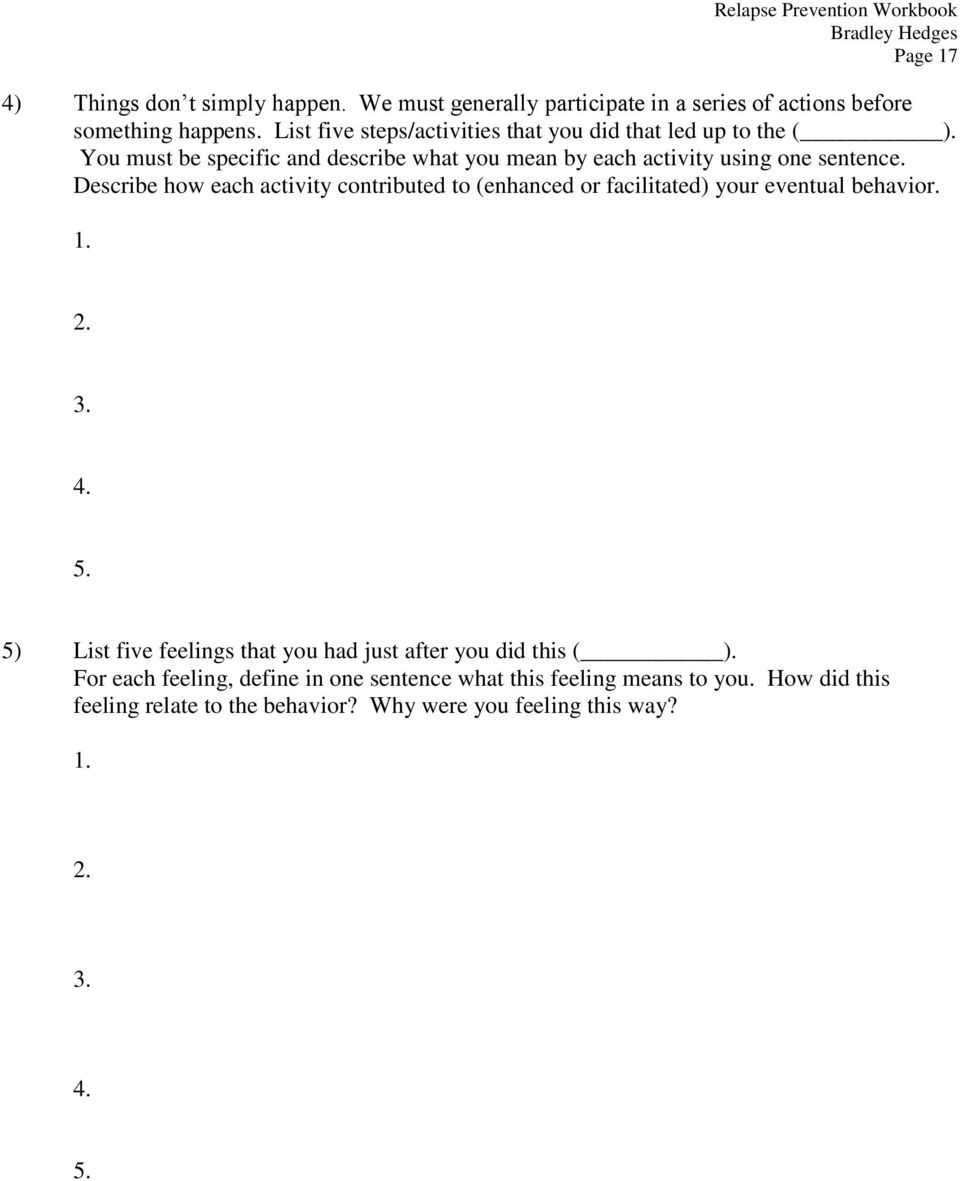
20 Page 18 6) Typically, we do not just act. We usually make a series of decisions that enable us to participate in a behavior. For example, we do not just eat. We must first recognize that we are hungry, decide what we want to eat, decide how to get what we want to eat, decide to get what we want to eat, and finally decide to eat it. Abusive behavior works the same way. Below, identify 10 specific decisions that you had to make before you could participate in the ( ). A decision is defined as a cognitive process that results in action. You may find it helpful to start the statement with the phrase, I decided to I decided to 2. I decided to 3. I decided to 4. I decided to 5. I decided to 6. I decided to 7. I decided to 8. I decided to 9. I decided to 10. I decided to

21 Page 19 7) A rationalization is something that you tell yourself to justify or somehow make OK your decision. Rationalizations do not involve action. They just explain away our actions. Identify what you told yourself about your decisions that allowed you to make them. What did you tell yourself about the ( ) that made it OK for you to do it? You may find it helpful to start the statement with the phrase I told myself that I told myself that 2. I told myself that 3. I told myself that 4. I told myself that 5. I told myself that 6. I told myself that 7. I told myself that 8. I told myself that 9. I told myself that 10. I told myself that
22 Page 20 Relapse Prevention Worksheet Section A revised 1/12/98 Name: Date: Note: This worksheet is to be filled out as part of the Relapse Prevention Workbook in conjunction with your therapy group. You should fill out one of these sheets for each behavior that you have been in trouble for, that you should have been in trouble for, that has caused problems with relationships, that has caused problems with your work, or that has caused problems financially. You will use a different form for your addictive behaviors. In all you will probably need to fill out at least ten of these forms (minimum). You should fill them out in pencil so that you can make corrections after they have been looked at by your counselor. The behavior that will be addressed on this form is (check one): Something that I did get in trouble for. Something that I should have gotten into trouble for. Something that messed up my financial situation. Something that messed up my relationships. Something that messed up my work 1) In one sentence, write what the behavior is that you will be talking about on this worksheet. In at least one more sentence, give the date and situation involved in the behavior. Name this behavior in one or two words (for example--fighting, GSI, stealing, etc.). Now, fill in the space ( ) in each of the following questions with this word.
23 Page 21 2) Describe in one paragraph what was going on in your life when this ( ) took place. Describe the life situation that you were experiencing when you participated in this behavior--who were you living with, where were you working, who were you involved with, etc. In particular, describe any major changes that were occurring in your life at the time. Also describe anything about your living arrangements that might be considered out of the ordinary. 3) List five feelings that you had just before you did this ( ). For each feeling, define in one sentence what this feeling means to you. How did this feeling relate to the behavior? Why were you feeling this way?
24 Page 22 4) Things don t simply happen. We must generally participate in a series of actions before something happens. List five steps/activities that you did that led up to the ( ). You must be specific and describe what you mean by each activity using one sentence. Describe how each activity contributed to (enhanced or facilitated) your eventual behavior ) List five feelings that you had just after you did this ( ). For each feeling, define in one sentence what this feeling means to you. How did this feeling relate to the behavior? Why were you feeling this way?
25 Page 23 6) Typically, we do not just act. We usually make a series of decisions that enable us to participate in a behavior. For example, we do not just eat. We must first recognize that we are hungry, decide what we want to eat, decide how to get what we want to eat, decide to get what we want to eat, and finally decide to eat it. Abusive behavior works the same way. Below, identify 10 specific decisions that you had to make before you could participate in the ( ). A decision is defined as a cognitive process that results in action. You may find it helpful to start the statement with the phrase, I decided to I decided to 2. I decided to 3. I decided to 4. I decided to 5. I decided to 6. I decided to 7. I decided to 8. I decided to 9. I decided to 10. I decided to
26 Page 24 7) A rationalization is something that you tell yourself to justify or somehow make OK your decision. Rationalizations do not involve action. They just explain away our actions. Identify what you told yourself about your decisions that allowed you to make them. What did you tell yourself about the ( ) that made it OK for you to do it? You may find it helpful to start the statement with the phrase I told myself that I told myself that 2. I told myself that 3. I told myself that 4. I told myself that 5. I told myself that 6. I told myself that 7. I told myself that 8. I told myself that 9. I told myself that 10. I told myself that
27 Page 25 Relapse Prevention Worksheet Section A revised 1/12/98 Name: Date: Note: This worksheet is to be filled out as part of the Relapse Prevention Workbook in conjunction with your therapy group. You should fill out one of these sheets for each behavior that you have been in trouble for, that you should have been in trouble for, that has caused problems with relationships, that has caused problems with your work, or that has caused problems financially. You will use a different form for your addictive behaviors. In all you will probably need to fill out at least ten of these forms (minimum). You should fill them out in pencil so that you can make corrections after they have been looked at by your counselor. The behavior that will be addressed on this form is (check one): Something that I did get in trouble for. Something that I should have gotten into trouble for. Something that messed up my financial situation. Something that messed up my relationships. Something that messed up my work 1) In one sentence, write what the behavior is that you will be talking about on this worksheet. In at least one more sentence, give the date and situation involved in the behavior. Name this behavior in one or two words (for example--fighting, GSI, stealing, etc.). Now, fill in the space ( ) in each of the following questions with this word.
28 Page 26 2) Describe in one paragraph what was going on in your life when this ( ) took place. Describe the life situation that you were experiencing when you participated in this behavior--who were you living with, where were you working, who were you involved with, etc. In particular, describe any major changes that were occurring in your life at the time. Also describe anything about your living arrangements that might be considered out of the ordinary. 3) List five feelings that you had just before you did this ( ). For each feeling, define in one sentence what this feeling means to you. How did this feeling relate to the behavior? Why were you feeling this way?
29 Page 27 4) Things don t simply happen. We must generally participate in a series of actions before something happens. List five steps/activities that you did that led up to the ( ). You must be specific and describe what you mean by each activity using one sentence. Describe how each activity contributed to (enhanced or facilitated) your eventual behavior ) List five feelings that you had just after you did this ( ). For each feeling, define in one sentence what this feeling means to you. How did this feeling relate to the behavior? Why were you feeling this way?
30 Page 28 6) Typically, we do not just act. We usually make a series of decisions that enable us to participate in a behavior. For example, we do not just eat. We must first recognize that we are hungry, decide what we want to eat, decide how to get what we want to eat, decide to get what we want to eat, and finally decide to eat it. Abusive behavior works the same way. Below, identify 10 specific decisions that you had to make before you could participate in the ( ). A decision is defined as a cognitive process that results in action. You may find it helpful to start the statement with the phrase, I decided to I decided to 2. I decided to 3. I decided to 4. I decided to 5. I decided to 6. I decided to 7. I decided to 8. I decided to 9. I decided to 10. I decided to
31 Page 29 7) A rationalization is something that you tell yourself to justify or somehow make OK your decision. Rationalizations do not involve action. They just explain away our actions. Identify what you told yourself about your decisions that allowed you to make them. What did you tell yourself about the ( ) that made it OK for you to do it? You may find it helpful to start the statement with the phrase I told myself that I told myself that 2. I told myself that 3. I told myself that 4. I told myself that 5. I told myself that 6. I told myself that 7. I told myself that 8. I told myself that 9. I told myself that 10. I told myself that
32 Page 30 Relapse Prevention Worksheet Section A revised 1/12/98 Name: Date: Note: This worksheet is to be filled out as part of the Relapse Prevention Workbook in conjunction with your therapy group. You should fill out one of these sheets for each behavior that you have been in trouble for, that you should have been in trouble for, that has caused problems with relationships, that has caused problems with your work, or that has caused problems financially. You will use a different form for your addictive behaviors. In all you will probably need to fill out at least ten of these forms (minimum). You should fill them out in pencil so that you can make corrections after they have been looked at by your counselor. The behavior that will be addressed on this form is (check one): Something that I did get in trouble for. Something that I should have gotten into trouble for. Something that messed up my financial situation. Something that messed up my relationships. Something that messed up my work 1) In one sentence, write what the behavior is that you will be talking about on this worksheet. In at least one more sentence, give the date and situation involved in the behavior. Name this behavior in one or two words (for example--fighting, GSI, stealing, etc.). Now, fill in the space ( ) in each of the following questions with this word.
33 Page 31 2) Describe in one paragraph what was going on in your life when this ( ) took place. Describe the life situation that you were experiencing when you participated in this behavior--who were you living with, where were you working, who were you involved with, etc. In particular, describe any major changes that were occurring in your life at the time. Also describe anything about your living arrangements that might be considered out of the ordinary. 3) List five feelings that you had just before you did this ( ). For each feeling, define in one sentence what this feeling means to you. How did this feeling relate to the behavior? Why were you feeling this way?
34 Page 32 4) Things don t simply happen. We must generally participate in a series of actions before something happens. List five steps/activities that you did that led up to the ( ). You must be specific and describe what you mean by each activity using one sentence. Describe how each activity contributed to (enhanced or facilitated) your eventual behavior ) List five feelings that you had just after you did this ( ). For each feeling, define in one sentence what this feeling means to you. How did this feeling relate to the behavior? Why were you feeling this way?
35 Page 33 6) Typically, we do not just act. We usually make a series of decisions that enable us to participate in a behavior. For example, we do not just eat. We must first recognize that we are hungry, decide what we want to eat, decide how to get what we want to eat, decide to get what we want to eat, and finally decide to eat it. Abusive behavior works the same way. Below, identify 10 specific decisions that you had to make before you could participate in the ( ). A decision is defined as a cognitive process that results in action. You may find it helpful to start the statement with the phrase, I decided to I decided to 2. I decided to 3. I decided to 4. I decided to 5. I decided to 6. I decided to 7. I decided to 8. I decided to 9. I decided to 10. I decided to
36 Page 34 7) A rationalization is something that you tell yourself to justify or somehow make OK your decision. Rationalizations do not involve action. They just explain away our actions. Identify what you told yourself about your decisions that allowed you to make them. What did you tell yourself about the ( ) that made it OK for you to do it? You may find it helpful to start the statement with the phrase I told myself that I told myself that 2. I told myself that 3. I told myself that 4. I told myself that 5. I told myself that 6. I told myself that 7. I told myself that 8. I told myself that 9. I told myself that 10. I told myself that
37 Page 35 Relapse Prevention Worksheet Section A revised 1/12/98 Name: Date: Note: This worksheet is to be filled out as part of the Relapse Prevention Workbook in conjunction with your therapy group. You should fill out one of these sheets for each behavior that you have been in trouble for, that you should have been in trouble for, that has caused problems with relationships, that has caused problems with your work, or that has caused problems financially. You will use a different form for your addictive behaviors. In all you will probably need to fill out at least ten of these forms (minimum). You should fill them out in pencil so that you can make corrections after they have been looked at by your counselor. The behavior that will be addressed on this form is (check one): Something that I did get in trouble for. Something that I should have gotten into trouble for. Something that messed up my financial situation. Something that messed up my relationships. Something that messed up my work 1) In one sentence, write what the behavior is that you will be talking about on this worksheet. In at least one more sentence, give the date and situation involved in the behavior. Name this behavior in one or two words (for example--fighting, GSI, stealing, etc.). Now, fill in the space ( ) in each of the following questions with this word.
38 Page 36 2) Describe in one paragraph what was going on in your life when this ( ) took place. Describe the life situation that you were experiencing when you participated in this behavior--who were you living with, where were you working, who were you involved with, etc. In particular, describe any major changes that were occurring in your life at the time. Also describe anything about your living arrangements that might be considered out of the ordinary. 3) List five feelings that you had just before you did this ( ). For each feeling, define in one sentence what this feeling means to you. How did this feeling relate to the behavior? Why were you feeling this way?
39 Page 37 4) Things don t simply happen. We must generally participate in a series of actions before something happens. List five steps/activities that you did that led up to the ( ). You must be specific and describe what you mean by each activity using one sentence. Describe how each activity contributed to (enhanced or facilitated) your eventual behavior ) List five feelings that you had just after you did this ( ). For each feeling, define in one sentence what this feeling means to you. How did this feeling relate to the behavior? Why were you feeling this way?
40 Page 38 6) Typically, we do not just act. We usually make a series of decisions that enable us to participate in a behavior. For example, we do not just eat. We must first recognize that we are hungry, decide what we want to eat, decide how to get what we want to eat, decide to get what we want to eat, and finally decide to eat it. Abusive behavior works the same way. Below, identify 10 specific decisions that you had to make before you could participate in the ( ). A decision is defined as a cognitive process that results in action. You may find it helpful to start the statement with the phrase, I decided to I decided to 2. I decided to 3. I decided to 4. I decided to 5. I decided to 6. I decided to 7. I decided to 8. I decided to 9. I decided to 10. I decided to
41 Page 39 7) A rationalization is something that you tell yourself to justify or somehow make OK your decision. Rationalizations do not involve action. They just explain away our actions. Identify what you told yourself about your decisions that allowed you to make them. What did you tell yourself about the ( ) that made it OK for you to do it? You may find it helpful to start the statement with the phrase I told myself that I told myself that 2. I told myself that 3. I told myself that 4. I told myself that 5. I told myself that 6. I told myself that 7. I told myself that 8. I told myself that 9. I told myself that 10. I told myself that
42 Page 40 Relapse Prevention Worksheet Section A revised 1/12/98 Name: Date: Note: This worksheet is to be filled out as part of the Relapse Prevention Workbook in conjunction with your therapy group. You should fill out one of these sheets for each behavior that you have been in trouble for, that you should have been in trouble for, that has caused problems with relationships, that has caused problems with your work, or that has caused problems financially. You will use a different form for your addictive behaviors. In all you will probably need to fill out at least ten of these forms (minimum). You should fill them out in pencil so that you can make corrections after they have been looked at by your counselor. The behavior that will be addressed on this form is (check one): Something that I did get in trouble for. Something that I should have gotten into trouble for. Something that messed up my financial situation. Something that messed up my relationships. Something that messed up my work 1) In one sentence, write what the behavior is that you will be talking about on this worksheet. In at least one more sentence, give the date and situation involved in the behavior. Name this behavior in one or two words (for example--fighting, GSI, stealing, etc.). Now, fill in the space ( ) in each of the following questions with this word.
43 Page 41 2) Describe in one paragraph what was going on in your life when this ( ) took place. Describe the life situation that you were experiencing when you participated in this behavior--who were you living with, where were you working, who were you involved with, etc. In particular, describe any major changes that were occurring in your life at the time. Also describe anything about your living arrangements that might be considered out of the ordinary. 3) List five feelings that you had just before you did this ( ). For each feeling, define in one sentence what this feeling means to you. How did this feeling relate to the behavior? Why were you feeling this way?
44 Page 42 4) Things don t simply happen. We must generally participate in a series of actions before something happens. List five steps/activities that you did that led up to the ( ). You must be specific and describe what you mean by each activity using one sentence. Describe how each activity contributed to (enhanced or facilitated) your eventual behavior ) List five feelings that you had just after you did this ( ). For each feeling, define in one sentence what this feeling means to you. How did this feeling relate to the behavior? Why were you feeling this way?
45 Page 43 6) Typically, we do not just act. We usually make a series of decisions that enable us to participate in a behavior. For example, we do not just eat. We must first recognize that we are hungry, decide what we want to eat, decide how to get what we want to eat, decide to get what we want to eat, and finally decide to eat it. Abusive behavior works the same way. Below, identify 10 specific decisions that you had to make before you could participate in the ( ). A decision is defined as a cognitive process that results in action. You may find it helpful to start the statement with the phrase, I decided to I decided to 2. I decided to 3. I decided to 4. I decided to 5. I decided to 6. I decided to 7. I decided to 8. I decided to 9. I decided to 10. I decided to
46 Page 44 4) A rationalization is something that you tell yourself to justify or somehow make OK your decision. Rationalizations do not involve action. They just explain away our actions. Identify what you told yourself about your decisions that allowed you to make them. What did you tell yourself about the ( ) that made it OK for you to do it? You may find it helpful to start the statement with the phrase I told myself that I told myself that 2. I told myself that 3. I told myself that 4. I told myself that 5. I told myself that 6. I told myself that 7. I told myself that 8. I told myself that 9. I told myself that 10. I told myself that
47 Page 45 Relapse Prevention Worksheet Section A revised 1/12/98 Name: Date: Note: This worksheet is to be filled out as part of the Relapse Prevention Workbook in conjunction with your therapy group. You should fill out one of these sheets for each behavior that you have been in trouble for, that you should have been in trouble for, that has caused problems with relationships, that has caused problems with your work, or that has caused problems financially. You will use a different form for your addictive behaviors. In all you will probably need to fill out at least ten of these forms (minimum). You should fill them out in pencil so that you can make corrections after they have been looked at by your counselor. The behavior that will be addressed on this form is (check one): Something that I did get in trouble for. Something that I should have gotten into trouble for. Something that messed up my financial situation. Something that messed up my relationships. Something that messed up my work 1) In one sentence, write what the behavior is that you will be talking about on this worksheet. In at least one more sentence, give the date and situation involved in the behavior. Name this behavior in one or two words (for example--fighting, GSI, stealing, etc.). Now, fill in the space ( ) in each of the following questions with this word.
48 Page 46 2) Describe in one paragraph what was going on in your life when this ( ) took place. Describe the life situation that you were experiencing when you participated in this behavior--who were you living with, where were you working, who were you involved with, etc. In particular, describe any major changes that were occurring in your life at the time. Also describe anything about your living arrangements that might be considered out of the ordinary. 3) List five feelings that you had just before you did this ( ). For each feeling, define in one sentence what this feeling means to you. How did this feeling relate to the behavior? Why were you feeling this way?
49 Page 47 4) Things don t simply happen. We must generally participate in a series of actions before something happens. List five steps/activities that you did that led up to the ( ). You must be specific and describe what you mean by each activity using one sentence. Describe how each activity contributed to (enhanced or facilitated) your eventual behavior ) List five feelings that you had just after you did this ( ). For each feeling, define in one sentence what this feeling means to you. How did this feeling relate to the behavior? Why were you feeling this way?
50 Page 48 6) Typically, we do not just act. We usually make a series of decisions that enable us to participate in a behavior. For example, we do not just eat. We must first recognize that we are hungry, decide what we want to eat, decide how to get what we want to eat, decide to get what we want to eat, and finally decide to eat it. Abusive behavior works the same way. Below, identify 10 specific decisions that you had to make before you could participate in the ( ). A decision is defined as a cognitive process that results in action. You may find it helpful to start the statement with the phrase, I decided to I decided to 2. I decided to 3. I decided to 4. I decided to 5. I decided to 6. I decided to 7. I decided to 8. I decided to 9. I decided to 10. I decided to
51 Page 49 7) A rationalization is something that you tell yourself to justify or somehow make OK your decision. Rationalizations do not involve action. They just explain away our actions. Identify what you told yourself about your decisions that allowed you to make them. What did you tell yourself about the ( ) that made it OK for you to do it? You may find it helpful to start the statement with the phrase I told myself that I told myself that 2. I told myself that 3. I told myself that 4. I told myself that 5. I told myself that 6. I told myself that 7. I told myself that 8. I told myself that 9. I told myself that 10. I told myself that
52 Page 50 Relapse Prevention Worksheet Section A revised 1/12/98 Name: Date: Note: This worksheet is to be filled out as part of the Relapse Prevention Workbook in conjunction with your therapy group. You should fill out one of these sheets for each behavior that you have been in trouble for, that you should have been in trouble for, that has caused problems with relationships, that has caused problems with your work, or that has caused problems financially. You will use a different form for your addictive behaviors. In all you will probably need to fill out at least ten of these forms (minimum). You should fill them out in pencil so that you can make corrections after they have been looked at by your counselor. The behavior that will be addressed on this form is (check one): Something that I did get in trouble for. Something that I should have gotten into trouble for. Something that messed up my financial situation. Something that messed up my relationships. Something that messed up my work 1) In one sentence, write what the behavior is that you will be talking about on this worksheet. In at least one more sentence, give the date and situation involved in the behavior. Name this behavior in one or two words (for example--fighting, GSI, stealing, etc.). Now, fill in the space ( ) in each of the following questions with this word.
53 Page 51 2) Describe in one paragraph what was going on in your life when this ( ) took place. Describe the life situation that you were experiencing when you participated in this behavior--who were you living with, where were you working, who were you involved with, etc. In particular, describe any major changes that were occurring in your life at the time. Also describe anything about your living arrangements that might be considered out of the ordinary. 3) List five feelings that you had just before you did this ( ). For each feeling, define in one sentence what this feeling means to you. How did this feeling relate to the behavior? Why were you feeling this way?
54 Page 52 4) Things don t simply happen. We must generally participate in a series of actions before something happens. List five steps/activities that you did that led up to the ( ). You must be specific and describe what you mean by each activity using one sentence. Describe how each activity contributed to (enhanced or facilitated) your eventual behavior ) List five feelings that you had just after you did this ( ). For each feeling, define in one sentence what this feeling means to you. How did this feeling relate to the behavior? Why were you feeling this way?
55 Page 53 6) Typically, we do not just act. We usually make a series of decisions that enable us to participate in a behavior. For example, we do not just eat. We must first recognize that we are hungry, decide what we want to eat, decide how to get what we want to eat, decide to get what we want to eat, and finally decide to eat it. Abusive behavior works the same way. Below, identify 10 specific decisions that you had to make before you could participate in the ( ). A decision is defined as a cognitive process that results in action. You may find it helpful to start the statement with the phrase, I decided to I decided to 2. I decided to 3. I decided to 4. I decided to 5. I decided to 6. I decided to 7. I decided to 8. I decided to 9. I decided to 10. I decided to
56 Page 54 7) A rationalization is something that you tell yourself to justify or somehow make OK your decision. Rationalizations do not involve action. They just explain away our actions. Identify what you told yourself about your decisions that allowed you to make them. What did you tell yourself about the ( ) that made it OK for you to do it? You may find it helpful to start the statement with the phrase I told myself that I told myself that 2. I told myself that 3. I told myself that 4. I told myself that 5. I told myself that 6. I told myself that 7. I told myself that 8. I told myself that 9. I told myself that 10. I told myself that
57 Page 55 Relapse Prevention Worksheet Section A revised 1/12/98 Name: Date: Note: This worksheet is to be filled out as part of the Relapse Prevention Workbook in conjunction with your therapy group. You should fill out one of these sheets for each behavior that you have been in trouble for, that you should have been in trouble for, that has caused problems with relationships, that has caused problems with your work, or that has caused problems financially. You will use a different form for your addictive behaviors. In all you will probably need to fill out at least ten of these forms (minimum). You should fill them out in pencil so that you can make corrections after they have been looked at by your counselor. The behavior that will be addressed on this form is (check one): Something that I did get in trouble for. Something that I should have gotten into trouble for. Something that messed up my financial situation. Something that messed up my relationships. Something that messed up my work 1) In one sentence, write what the behavior is that you will be talking about on this worksheet. In at least one more sentence, give the date and situation involved in the behavior. Name this behavior in one or two words (for example--fighting, GSI, stealing, etc.). Now, fill in the space ( ) in each of the following questions with this word.
58 Page 56 2) Describe in one paragraph what was going on in your life when this ( ) took place. Describe the life situation that you were experiencing when you participated in this behavior--who were you living with, where were you working, who were you involved with, etc. In particular, describe any major changes that were occurring in your life at the time. Also describe anything about your living arrangements that might be considered out of the ordinary. 3) List five feelings that you had just before you did this ( ). For each feeling, define in one sentence what this feeling means to you. How did this feeling relate to the behavior? Why were you feeling this way?
59 Page 57 4) Things don t simply happen. We must generally participate in a series of actions before something happens. List five steps/activities that you did that led up to the ( ). You must be specific and describe what you mean by each activity using one sentence. Describe how each activity contributed to (enhanced or facilitated) your eventual behavior ) List five feelings that you had just after you did this ( ). For each feeling, define in one sentence what this feeling means to you. How did this feeling relate to the behavior? Why were you feeling this way?
60 Page 58 6) Typically, we do not just act. We usually make a series of decisions that enable us to participate in a behavior. For example, we do not just eat. We must first recognize that we are hungry, decide what we want to eat, decide how to get what we want to eat, decide to get what we want to eat, and finally decide to eat it. Abusive behavior works the same way. Below, identify 10 specific decisions that you had to make before you could participate in the ( ). A decision is defined as a cognitive process that results in action. You may find it helpful to start the statement with the phrase, I decided to I decided to 2. I decided to 3. I decided to 4. I decided to 5. I decided to 6. I decided to 7. I decided to 8. I decided to 9. I decided to 10. I decided to
61 Page 59 7) A rationalization is something that you tell yourself to justify or somehow make OK your decision. Rationalizations do not involve action. They just explain away our actions. Identify what you told yourself about your decisions that allowed you to make them. What did you tell yourself about the ( ) that made it OK for you to do it? You may find it helpful to start the statement with the phrase I told myself that I told myself that 2. I told myself that 3. I told myself that 4. I told myself that 5. I told myself that 6. I told myself that 7. I told myself that 8. I told myself that 9. I told myself that 10. I told myself that
62 Page 60 Relapse Prevention Worksheet Section A (Addictive Behavior) revised 1/12/98 Name: Date: Note: This worksheet is to be filled out as part of the Relapse Prevention Workbook in conjunction with your therapy group. You should fill out one of these sheets for each addictive behavior that you have identified. You should fill them out in pencil so that you can make corrections after they have been looked at by your counselor. 1) In one sentence, write what the addictive behavior is that you will be talking about on this worksheet. In at least one more sentence, describe your addiction. Name this addiction in one or two words (for example--alcohol, Cocaine, sex, etc.). Now, fill in the space ( ) in each of the following questions with this word. 2) Describe in one paragraph what was going on in your life when this addiction was in its greatest control of your life. Describe the life situation that you were experiencing when you participated in this behavior--who were you living with, where were you working, who were you involved with, etc. In particular, describe any major changes that were occurring in your life at the time. Also describe anything about your living arrangements that might be considered out of the ordinary.
63 Page 61 3) Describe your addiction using the addiction cycle: (see appendix B of this workbook to help you understand the meaning of the terms used in this section) a) List three core beliefs that you have about ( ). A core belief should be thought of as a general life statement that allows you to carry out your addiction b) Identify three ways that you specifically applied your core beliefs to your addiction (impaired thoughts) c) Describe in a short paragraph how you expressed your preoccupation within your addiction.
64 Page 62 d) Identify at least five steps (ritualization) that you usually did that led up to your addictive acting out of your ( ) addiction e) Describe in a brief paragraph what you did when you acted out on your addiction. That is, what did you do when you actually carried out your addiction.
65 Page 63 f) Describe in a brief paragraph how you experienced shame after you carried out your addiction. Shame can be thought of as a negative self statement about your personal worth. g) Describe in a brief paragraph how you experienced guilt after you carried out your addiction. Guilt can be thought of as a negative experience put upon you in relationship to others and is usually experienced as a result of the consequences you experience for your behavior. h) List at least five ways your life became unmanageable because of your ( ) addiction
66 Page 64 4) List five feelings that you had just before you did this ( ). For each feeling, define in one sentence what this feeling means to you. How did this feeling relate to the behavior? Why were you feeling this way? ) List five feelings that you had just after you did this ( ). For each feeling, define in one sentence what this feeling means to you. How did this feeling relate to the behavior? Why were you feeling this way?
67 Page 65 6) Typically, we do not just act. We usually make a series of decisions that enable us to participate in a behavior. For example, we do not just eat. We must first recognize that we are hungry, decide what we want to eat, decide how to get what we want to eat, decide to get what we want to eat, and finally decide to eat it. Abusive behavior works the same way. Below, identify 10 specific decisions that you had to make before you could participate in the ( ). A decision is defined as a cognitive process that results in action. You may find it helpful to start the statement with the phrase, I decided to... ). 1. I decided to 2. I decided to 3. I decided to 4. I decided to 5. I decided to 6. I decided to 7. I decided to 8. I decided to 9. I decided to 10. I decided to
68 Page A rationalization is something that you tell yourself to justify or somehow make OK your decision. Rationalizations do not involve action. They just explain away our actions. Identify what you told yourself about your decisions that allowed you to make them. What did you tell yourself about the addiction that made it OK for you to do it? You may find it helpful to start the statement with the phrase I told myself that I told myself that 2. I told myself that 3. I told myself that 4. I told myself that 5. I told myself that 6. I told myself that 7. I told myself that 8. I told myself that 9. I told myself that 10. I told myself that
69 Page 67 Relapse Prevention Worksheet Section A (Addictive Behavior) revised 1/12/98 Name: Date: Note: This worksheet is to be filled out as part of the Relapse Prevention Workbook in conjunction with your therapy group. You should fill out one of these sheets for each addictive behavior that you have identified. You should fill them out in pencil so that you can make corrections after they have been looked at by your counselor. 1) In one sentence, write what the addictive behavior is that you will be talking about on this worksheet. In at least one more sentence, describe your addiction. Name this addiction in one or two words (for example--alcohol, Cocaine, sex, etc.). Now, fill in the space ( ) in each of the following questions with this word. 2) Describe in one paragraph what was going on in your life when this addiction was in its greatest control of your life. Describe the life situation that you were experiencing when you participated in this behavior--who were you living with, where were you working, who were you involved with, etc. In particular, describe any major changes that were occurring in your life at the time. Also describe anything about your living arrangements that might be considered out of the ordinary.
70 Page 68 3) Describe your addiction using the addiction cycle: (see appendix B of this workbook to help you understand the meaning of the terms used in this section) a) List three core beliefs that you have about ( ). A core belief should be thought of as a general life statement that allows you to carry out your addiction b) Identify three ways that you specifically applied your core beliefs to your addiction (impaired thoughts) c) Describe in a short paragraph how you expressed your preoccupation within your addiction.
71 Page 69 d) Identify at least five steps (ritualization) that you usually did that led up to your addictive acting out of your ( ) addiction e) Describe in a brief paragraph what you did when you acted out on your addiction. That is, what did you do when you actually carried out your addiction.
72 Page 70 f) Describe in a brief paragraph how you experienced shame after you carried out your addiction. Shame can be thought of as a negative self statement about your personal worth. g) Describe in a brief paragraph how you experienced guilt after you carried out your addiction. Guilt can be thought of as a negative experience put upon you in relationship to others and is usually experienced as a result of the consequences you experience for your behavior. h) List at least five ways your life became unmanageable because of your ( ) addiction
73 Page 71 4) List five feelings that you had just before you did this ( ). For each feeling, define in one sentence what this feeling means to you. How did this feeling relate to the behavior? Why were you feeling this way? ) List five feelings that you had just after you did this ( ). For each feeling, define in one sentence what this feeling means to you. How did this feeling relate to the behavior? Why were you feeling this way?
74 Page 72 6) Typically, we do not just act. We usually make a series of decisions that enable us to participate in a behavior. For example, we do not just eat. We must first recognize that we are hungry, decide what we want to eat, decide how to get what we want to eat, decide to get what we want to eat, and finally decide to eat it. Abusive behavior works the same way. Below, identify 10 specific decisions that you had to make before you could participate in the ( ). A decision is defined as a cognitive process that results in action. You may find it helpful to start the statement with the phrase, I decided to I decided to 2. I decided to 3. I decided to 4. I decided to 5. I decided to 6. I decided to 7. I decided to 8. I decided to 9. I decided to 10. I decided to
75 Page A rationalization is something that you tell yourself to justify or somehow make OK your decision. Rationalizations do not involve action. They just explain away our actions. Identify what you told yourself about your decisions that allowed you to make them. What did you tell yourself about the addiction that made it OK for you to do it? You may find it helpful to start the statement with the phrase I told myself that I told myself that 2. I told myself that 3. I told myself that 4. I told myself that 5. I told myself that 6. I told myself that 7. I told myself that 8. I told myself that 9. I told myself that 10. I told myself that
76 Page 74 Section B Modifying Behavior Once you have identified your past abusive behavior and the feeling/thoughts/behaviors associated with the abusive behavior, you become empowered to change the behavior. As much as you might want to, you cannot simply stop the behavior through will power alone. If it were that simple, you would not need to be in a program of recovery. You must be able to replace deviant feelings/thoughts/behaviors with healthier ones through the establishment of healthy coping mechanisms. Therapy has focused on altering your core beliefs, however, you will find situations (linkages) that will resurrect your old behavior on occasion. When your old behavior begins to emerge, you must be prepared to alter it before your behavior results in a relapse. The following questions will help you to identify when you are in a lapse situation and help you to be prepared to cope with lapses using adaptive responses. Before you can prevent a lapse situation, you must become aware that you are approaching one. That is, you must know the symptoms of a lapse situation. You must then be prepared to implement appropriate coping skills to prevent the lapse from occurring. In the following pages you will be asked to identify collectively the feelings, thoughts, and behaviors that have historically caused you the greatest amount of difficulty in the past and then you will be asked to develop specific coping skills to aid you in dealing with these dangerous precursors to your abusive behavior.
77 Page THEME FEELINGS We will begin by looking at your feelings. You will need to use the material gathered in Section A of this workbook to complete this section. A) Review the feelings generated in Section A of this workbook (including the feelings that you had before you carried out your abusive behavior and the feelings that you had after you carried out the abusive behavior). List all of these feelings below.
78 Page 76 B) Identify ten "theme feelings" that are consistent with most of your abusive behavior. Do this by counting how many times each feeling appears. If two feelings are very similar and mean about the same thing to you, then include them in a single cluster. Define what you mean by each of the feeling words listed below. 1. Feeling: 2. Feeling: 3. Feeling: 4. Feeling: 5. Feeling: 6. Feeling: 7. Feeling: 8. Feeling: 9. Feeling: 10. Feeling:
79 Page 77 C) For each of the feelings listed on the previous page, describe how you and those people who are close to you will know when you are experiencing each of these feelings. How do you express these feelings behaviorally? Be certain to clarify how others will be able to differentiate one feeling from another. 1. Feeling: 2. Feeling: 3. Feeling: 4. Feeling: 5. Feeling: 6. Feeling: 7. Feeling: 8. Feeling: 9. Feeling: 10. Feeling:
80 Page 78 D) For each "theme feeling" listed on the previous pages, identify at least three adaptive ways of releasing or coping with the feeling. Be specific in describing how you can carry out these coping mechanisms. Each coping mechanism should include some level of accountability, should be doable and should somehow interfere with the abusive behavior. 1. Feeling: a. b. c. 2. Feeling: a. b. c. 3. Feeling: a. b. c.
81 Page Feeling: a. b. c. 5. Feeling: a. b. c. 6. Feeling: a. b. c.
82 Page Feeling: a. b. c. 8. Feeling: a. b. c. 9. Feeling: a. b. c.
83 Page Feeling: a. b. c.
84 Page THEME THOUGHTS If we do not cope well with our feelings, our pathological thoughts tend to creep into our lives. In Section A of this workbook you were asked to identify decisions and rationalizations that you made prior to carrying out your abusive behavior. In this section, you will be asked to look at these thoughts and to develop coping skills for them so that you do not proceed in the relapse process. A) Drawing from the rationalizations and decisions identified in Section A, identify ten pathological "theme thoughts". Do this in the same way that you identified the theme feelings. You will probably find it easiest and most useful to focus primarily on the rationalizations that you made
85 Page 83 B) For each "theme thought" listed on the previous page, identify at least three adaptive selftalk statements/coping responses that will reduce the risk of your lapsing. That is, what can you tell yourself about each of the "theme thoughts" that will challenge or get rid of your "stinking thinking"? 1. Name of thought: a. b. c. 2. Name of thought: a. b. c. 3. Name of thought: a. b. c.
86 Page Name of thought: a. b. c. 5. Name of thought: a. b. c. 6. Name of thought: a. b. c.
87 Page Name of thought: a. b. c. 8. Name of thought: a. b. c. 9. Name of thought: a. b. c.
88 Page Name of thought: a. b. c.
89 Page RITUALS Once we have given ourselves permission to participate in abusive behavior through our dysfunctional thought processes, we often perform rituals that facilitate and/or enhance the abusive behavior. A) Review the steps that you identified in Section A of this workbook and identify at least five ritualistic behaviors that you participated in. Be specific in describing each of these rituals. Identify at least five steps to each of the rituals. 1. Name of ritual: a. b. c. d. e. 2. Name of ritual: a. b. c. d. e.
90 Page Name of ritual: a. b. c. d. e. 4. Name of ritual: a. b. c. d. e.
91 Page Name of ritual: a. b. c. d. e. B) Identify how each of these rituals facilitated (made it easier)/enhanced (made it better) the abusive behavior. That is, how did this ritual help with your abusive behavior? 1. Name of ritual: Facilitated Enhanced 2. Name of ritual: Facilitated Enhanced
92 Page Name of ritual: Facilitated Enhanced 4. Name of ritual: Facilitated Enhanced 5. Name of ritual: Facilitated Enhanced
93 Page 91 C) Develop at least three adaptive responses for altering each of the ritual behaviors. Be specific as to how you can carry out the adaptive responses. As with the coping responses you generated for your Theme feelings, each coping mechanism should include some level of accountability, should be doable and should somehow interfere with the abusive behavior. 1. Name of ritual: a. b. c. 2. Name of ritual: a. b. c.
94 Page Name of ritual: a. b. c. 4. Name of ritual: a. b. c. 5. Name of ritual: a. b. c.
95 Page HIGH RISK SITUATIONS A high risk situation is defined as a situation which is directly linked to your abusive behavior that is likely to contribute to a relapse. A) List ten high risk situations you are likely to encounter once you go to your permanent home. Describe how each of these high risk situations is linked to your abusive behavior
96 Page 94 B) For each of the high risk situations listed above, identify what is likely to keep you from simply leaving the situations. How might the nature of the high risk situation keep you from using appropriate coping skills? 1. Name of High Risk Situation: 2. Name of High Risk Situation: 3. Name of High Risk Situation: 4. Name of High Risk Situation: 5. Name of High Risk Situation: 6. Name of High Risk Situation: 7. Name of High Risk Situation: 8. Name of High Risk Situation: 9. Name of High Risk Situation: 10. Name of High Risk Situation:
97 Page 95 C) For each of the high risk situations listed above, identify three adaptive ways for coping with the situation that will keep you from relapsing. Do not include leave the situation as this is assumed to be an appropriate thing to do in each case. Identify what resources you will need to leave the situation. What can you do to keep the situation from escalating into a full relapse? 1. Name of High Risk Situation: a. b. c. 2. Name of High Risk Situation: a. b. c.
98 3. Name of High Risk Situation: a. Relapse Prevention Workbook Page 96 b. c. 4. Name of High Risk Situation: a. b. c. 5. Name of High Risk Situation: a. b. c.
99 6. Name of High Risk Situation: a. Relapse Prevention Workbook Page 97 b. c. 7. Name of High Risk Situation: a. b. c. 8. Name of High Risk Situation: a. b. c.
100 9. Name of High Risk Situation: a. Relapse Prevention Workbook Page 98 b. c. 10. Name of High Risk Situation: a. b. c. C) For each of the High Risk Situations listed above, construct a cost/benefit matrix. The easiest way to keep from returning to old behavior is to "over learn" the new behavior. That is, if we practice a behavior until it becomes automatic, we will have to think about other behaviors before we do them. If we make healthy behavior our automatic behavior, we will need to think about participating in our old behaviors before we can do them. It is during this thinking process that we can catch ourselves before lapsing. During this thinking process, we always perform a cost/benefit analysis to determine what behavior we should participate in (although we are often unaware of the thought process).
101 Page 99 In developing a decision matrix, we are actually exploring the "response strength" between a stimulus (an event or internal experience) and a behavioral/emotional response. In the past when you encountered a high risk situation (stimulus), you responded with deviant acting out behavior. After participating in programming, it is assumed that you no longer see the old stimulus/response connection the way you use to. When we develop the decision matrix, we will be exploring the way you use to see the stimulus/response connection of your old behavior, the way you now see the stimulus/response connection of you old behavior, and the stimulus/response connection of your new, adaptive behavior. Additionally, all experiences have a cost and a benefit. That is, all experiences have positive attributes and negative attributes. In your past, the deviant acting out behaviors had things that you did not like (costs--like waking up with a hangover) and things you did like (benefits--like getting high). We hope you do not see these costs and benefits the same way you did in the past! As a result, you should have a new set of costs and benefits for your past behavior. Your new behavior also has costs and benefits that may or may not be related to the old costs and benefits. On the attached form fill in the appropriate boxes as follows: 1) At the top of the form spell out in detail the high risk situation that you will be discussing in this matrix. Define the old response pattern to this situation and define your new response pattern 2) Cost of old response pattern as seen in the past. Imagine your self as you were in the past and explore the negative attributes of being in this position. That is, what was bad or what did you have to give up to be in this position? List at least three of these costs. 3) Benefit of old response pattern as seen in the past. Imagine yourself as you were in the past and explore the positive attributes of being in this position. That is, what did you get out of being in this situation? List at least three of these benefits. 4) Cost of old response as viewed today. Given how you view the world today, look back at how you used to deal with this situation and identify at least three negative things associated with this. 5) Benefit of old response as viewed today. Given how you view the world today, look back at how you use to deal with this situation and identify at least three positive things associated with this. 6) Cost of new response. Given that you have developed a new response pattern when you are faced with this situation, what price will you be paying if you carry it out. List at least three of these costs.
102 Page 100 7) Benefit of new response. Given that you have developed a new response pattern when you are faced with this situation, what is the benefit? List at least three of these benefits. 8) Assign the relative value of each of these costs and benefits. That is, assign a number between 1 and 10 to each of these costs and benefits indicating how important each of these are (1 being very unimportant and 10 being very important). 9) For each response subtract the cost from the benefit. This is the response strength of that response to the stimulus. The response strength determines which decision you are most likely to make.
103 Page 101 Describe the High Risk Situation: COST/BENEFIT MATRIX BENEFIT Value COST Value Net Value Old Response As Viewed In The Past: List the benefits and costs of the high risk situation as you saw them back then. Now, on a scale of 1 to 10, 10 being a lot, rate/value each benefit and each cost and note in the value in the box next to the cost/benefit. Old Response As Viewed Today: Now that you have changed and learned lessons from those high risk situations, how do you view the same cost/benefits today? What additional cost/benefits do you see now to the high risk situation? How have the values changed? What new behavior or situation will you replace the old high risk situation with? Note the benefits and costs of the new response. Write the new behavior here: Total Total Total Total Total Total
104 Page 102 Describe the High Risk Situation: COST/BENEFIT MATRIX BENEFIT Value COST Value Net Value Old Response As Viewed In The Past: List the benefits and costs of the high risk situation as you saw them back then. Now, on a scale of 1 to 10, 10 being a lot, rate/value each benefit and each cost and note in the value in the box next to the cost/benefit. Old Response As Viewed Today: Now that you have changed and learned lessons from those high risk situations, how do you view the same cost/benefits today? What additional cost/benefits do you see now to the high risk situation? How have the values changed? What new behavior or situation will you replace the old high risk situation with? Note the benefits and costs of the new response. Write the new behavior here: Total Total Total Total Total Total
105 Page 103 Describe the High Risk Situation: COST/BENEFIT MATRIX BENEFIT Value COST Value Net Value Old Response As Viewed In The Past: List the benefits and costs of the high risk situation as you saw them back then. Now, on a scale of 1 to 10, 10 being a lot, rate/value each benefit and each cost and note in the value in the box next to the cost/benefit. Old Response As Viewed Today: Now that you have changed and learned lessons from those high risk situations, how do you view the same cost/benefits today? What additional cost/benefits do you see now to the high risk situation? How have the values changed? What new behavior or situation will you replace the old high risk situation with? Note the benefits and costs of the new response. Write the new behavior here: Total Total Total Total Total Total
106 Page 104 Describe the High Risk Situation: COST/BENEFIT MATRIX BENEFIT Value COST Value Net Value Old Response As Viewed In The Past: List the benefits and costs of the high risk situation as you saw them back then. Now, on a scale of 1 to 10, 10 being a lot, rate/value each benefit and each cost and note in the value in the box next to the cost/benefit. Old Response As Viewed Today: Now that you have changed and learned lessons from those high risk situations, how do you view the same cost/benefits today? What additional cost/benefits do you see now to the high risk situation? How have the values changed? What new behavior or situation will you replace the old high risk situation with? Note the benefits and costs of the new response. Write the new behavior here: Total Total Total Total Total Total
107 Page 105 Describe the High Risk Situation: COST/BENEFIT MATRIX BENEFIT Value COST Value Net Value Old Response As Viewed In The Past: List the benefits and costs of the high risk situation as you saw them back then. Now, on a scale of 1 to 10, 10 being a lot, rate/value each benefit and each cost and note in the value in the box next to the cost/benefit. Old Response As Viewed Today: Now that you have changed and learned lessons from those high risk situations, how do you view the same cost/benefits today? What additional cost/benefits do you see now to the high risk situation? How have the values changed? What new behavior or situation will you replace the old high risk situation with? Note the benefits and costs of the new response. Write the new behavior here: Total Total Total Total Total Total
108 Page 106 Describe the High Risk Situation: COST/BENEFIT MATRIX BENEFIT Value COST Value Net Value Old Response As Viewed In The Past: List the benefits and costs of the high risk situation as you saw them back then. Now, on a scale of 1 to 10, 10 being a lot, rate/value each benefit and each cost and note in the value in the box next to the cost/benefit. Old Response As Viewed Today: Now that you have changed and learned lessons from those high risk situations, how do you view the same cost/benefits today? What additional cost/benefits do you see now to the high risk situation? How have the values changed? What new behavior or situation will you replace the old high risk situation with? Note the benefits and costs of the new response. Write the new behavior here: Total Total Total Total Total Total
109 Page 107 Describe the High Risk Situation: COST/BENEFIT MATRIX BENEFIT Value COST Value Net Value Old Response As Viewed In The Past: List the benefits and costs of the high risk situation as you saw them back then. Now, on a scale of 1 to 10, 10 being a lot, rate/value each benefit and each cost and note in the value in the box next to the cost/benefit. Old Response As Viewed Today: Now that you have changed and learned lessons from those high risk situations, how do you view the same cost/benefits today? What additional cost/benefits do you see now to the high risk situation? How have the values changed? What new behavior or situation will you replace the old high risk situation with? Note the benefits and costs of the new response. Write the new behavior here: Total Total Total Total Total Total
110 Page 108 Describe the High Risk Situation: COST/BENEFIT MATRIX BENEFIT Value COST Value Net Value Old Response As Viewed In The Past: List the benefits and costs of the high risk situation as you saw them back then. Now, on a scale of 1 to 10, 10 being a lot, rate/value each benefit and each cost and note in the value in the box next to the cost/benefit. Old Response As Viewed Today: Now that you have changed and learned lessons from those high risk situations, how do you view the same cost/benefits today? What additional cost/benefits do you see now to the high risk situation? How have the values changed? What new behavior or situation will you replace the old high risk situation with? Note the benefits and costs of the new response. Write the new behavior here: Total Total Total Total Total Total
111 Page 109 Describe the High Risk Situation: COST/BENEFIT MATRIX BENEFIT Value COST Value Net Value Old Response As Viewed In The Past: List the benefits and costs of the high risk situation as you saw them back then. Now, on a scale of 1 to 10, 10 being a lot, rate/value each benefit and each cost and note in the value in the box next to the cost/benefit. Old Response As Viewed Today: Now that you have changed and learned lessons from those high risk situations, how do you view the same cost/benefits today? What additional cost/benefits do you see now to the high risk situation? How have the values changed? What new behavior or situation will you replace the old high risk situation with? Note the benefits and costs of the new response. Write the new behavior here: Total Total Total Total Total Total
112 Page 110 Describe the High Risk Situation: COST/BENEFIT MATRIX BENEFIT Value COST Value Net Value Old Response As Viewed In The Past: List the benefits and costs of the high risk situation as you saw them back then. Now, on a scale of 1 to 10, 10 being a lot, rate/value each benefit and each cost and note in the value in the box next to the cost/benefit. Old Response As Viewed Today: Now that you have changed and learned lessons from those high risk situations, how do you view the same cost/benefits today? What additional cost/benefits do you see now to the high risk situation? How have the values changed? What new behavior or situation will you replace the old high risk situation with? Note the benefits and costs of the new response. Write the new behavior here: Total Total Total Total Total Total
113 Page 111 Section C Maintaining Adaptive Behavior In Section A we focused on identifying dysfunctional behavior and in Section B we focused on identifying healthy new behavior. In this section, you will attempt to develop methods for maintaining the healthy new behavior. Whenever we gain new behavior that is more efficient and/or more adaptive, we become excited and try to use it as often as we can. When these new behaviors do not seem to be working too well, we usually go back to the behavior that we know best. For the person with a clearly defined behavioral pattern, this usually means a lapse. In this section we will focus on two methods of preventing this return to familiar (dysfunctional) behavior- -the utilization of support people and ongoing monitoring of our behavior. In this section of the workbook you will be looking at how you can utilize the people in your life to implement the plan that you have developed. If you will recall, the second step of the 12 Steps states, We came to believe that a Power greater than ourselves could restore us to sanity. Relapse prevention requires you to identify how this Power manifests itself in the people around you and to integrate those people into your recovery plan. 1. DEVELOPING A SUPPORT NETWORK A) Identify ten people that you are likely to encounter on a daily basis when you return to your permanent residence
114 Page 112 B) An enabler is identified as someone that enables you to continue to participate in your abusive behavior. Often, these individuals do not realize that they are enabling your behavior--they often are trying to help you or are doing what they think you want them to do. Regardless of their motivation, they contribute to your abusive behavior. Everyone you encounter can participate in enabling behavior. For each of the people you identified in Question A, identify how each individual may participate in enabling behavior with you and how can you avoid the impact of their enabling behavior without avoiding unnecessarily your contact with the people. 1. Person s name: How they enable-- How you can avoid impact of enabling-- 2. Person s name: How they enable-- How you can avoid impact of enabling-- 3. Person s name: How they enable-- How you can avoid impact of enabling-- 4. Person s name: How they enable-- How you can avoid impact of enabling--
115 Page Person s name: How they enable-- How you can avoid impact of enabling-- 6. Person s name: How they enable-- How you can avoid impact of enabling-- 7. Person s name: How they enable-- How you can avoid impact of enabling-- 8. Person s name: How they enable-- How you can avoid impact of enabling-- 9. Person s name: How they enable-- How you can avoid impact of enabling Person s name: How they enable-- How you can avoid impact of enabling--
116 Page 114 C) Although everyone you encounter can potentially enable you to continue to participate in your abusive behavior, they can also help you avoid further abusive behavior. That is, they can be an important part of your recovery--supporting your attempt to maintain sobriety. For each of the people identified in Question A, identify how they can most effectively support you in your recovery. 1. Person s name: 2. Person s name: 3. Person s name: 4. Person s name: 5. Person s name: 6. Person s name: 7. Person s name: 8. Person s name: 9. Person s name: 10. Person s name:
117 Page 115 D) As with all of the work that you have done on this relapse prevention plan, it is not enough to simply gain insight into your behavior, you must also make steps toward altering your behavior. To this end, for each of the people identified in Question A, identify how you will communicate to them how they might enable you and how they can support you. This can be done through direct conversation, phone, letter, etc. Also identify when you will communicate with them and under what circumstances it would be best to communicate this information with them. 1. Person s name: 2. Person s name: 3. Person s name: 4. Person s name: 5. Person s name: 6. Person s name: 7. Person s name: 8. Person s name: 9. Person s name: 10. Person s name:
118 Page ONGOING MONITORING As you well know by now, planning for your recovery is important--but meaningless unless you actually implement this plan. This section of the workbook is designed to help you carry out your plan in an intentional fashion. A. In the past week, identify ten times that you have utilized coping skills to manage your feelings. Identify whether the coping skills worked and, if not, why they did not work. 1. Situation/Feeling Coping skill attempted-- How did it work? Why? 2. Situation/Feeling Coping skill attempted-- How did it work? Why? 3. Situation/Feeling Coping skill attempted-- How did it work? Why?
119 Page Situation/Feeling Coping skill attempted-- How did it work? Why? 5. Situation/Feeling Coping skill attempted-- How did it work? Why? 6. Situation/Feeling Coping skill attempted-- How did it work? Why? 7. Situation/Feeling Coping skill attempted-- How did it work? Why?
120 Page Situation/Feeling Coping skill attempted-- How did it work? Why? 9. Situation/Feeling Coping skill attempted-- How did it work? Why? 10. Situation/Feeling Coping skill attempted-- How did it work? Why? B. Identify five times that you entered into you dysfunctional thought processes in the last week and indicate how you attempted to utilize your coping skills to address the thought process. Identify whether the coping skills worked and, if not, why they did not work. 1. Situation/Thought Coping skill attempted-- How did it work? Why?
121 Page Situation/Thought Coping skill attempted-- How did it work? Why? 3. Situation/Thought Coping skill attempted-- How did it work? Why? 4. Situation/Thought Coping skill attempted-- How did it work? Why? 5. Situation/Thought Coping skill attempted-- How did it work? Why?
122 Page 120 C. Identify two high risk situations you experienced in the last week and how you attempted to utilize your coping skills to deal with high risk situations. Identify whether the coping skills worked and, if not, why they did not work. 1. High Risk Situation Coping skill attempted-- How did it work? Why? 2. High Risk Situation Coping skill attempted-- How did it work? Why? D. Describe ten times that you have utilized you social support system in the past week to aid you in your program of recovery
123 Page
124 Page 122 APPENDIX A THE RELAPSE SYNDROME When we attempt to stop an addictive behavior, we often try to just stop the behavior. Unfortunately, this does not usually work. Relapse generally follows a predictable and readily identifiable pattern. If you are able to identify this pattern for your own behavior, you will be better prepared to prevent relapse. This pattern usually takes the following steps: 1. Return of denial. Problem: As the addict progresses in his program, he is likely to begin to feel that he has his problem under control. When asked how he is doing he is likely to say "fine, no problems" when, in fact, we all have problems that need to be dealt with regularly. This return of denial is often supported by those persons who strongly want you to be "cured". Solution: 1) Teach support people about recovery and relapse. Encourage them to probe you about problems. 2) Write down your problems on a daily basis and share this list with someone. 2. Avoidance of defensive behavior. Problem: As the addict begins to deny the potential for relapse, he drops his defensive behavior. He often will focus more energy on fixing others than on working on himself. He will begin placing himself in "at risk" situations and will stop doing his relapse prevention exercises. Solution: 1) Surround yourself with support people who will encourage you to continue working on your relapse prevention program. 2) Maintain a "negative image" reminder of the price you paid for your addictive behavior. 3) Develop and review a cost/benefit analysis of your coping behavior.
125 Page Crisis building. Problem: As a result of avoiding defensive behavior, problems begin to pile up and it becomes more and more difficult to see options. The addict develops tunnel vision and loses the ability to perform constructive planning. Plans that were developed earlier often begin to fall apart. Solution: 1) Remind yourself to take one day at a time. 2) Return to coping behavior. 3) Accept your personal limits. 4) Review the concepts of RET (RET states that it is your thoughts about an event and not the event that is "bad" or "good"). 4. Immobilization. Problem: When a crisis builds up, the addict becomes crushed and trapped by the problems. The addict becomes totally incapable of initiating action and is trapped by his own lies and problems. Often, the addict develops an unrealistic optimism wishing that things would "just go away". A sense that nothing can be solved may develop. Solution: 1) Use the Serenity Prayer. 2) Use the support people that you have developed. 3) Review the concept of lapse as opposed to relapse (accept the reality that you may make some small mistakes but this does not mean that you have failed). 5. Confusion and overreaction. Problem: While the problems continue to grow and the addict feels stuck, he often becomes confused and angry. During this phase of the relapse syndrome, the addict may become irritable with those around him, develop a general sense of tension, and view others as out to get him.
126 Page Depression. Solution: 1) Identify the source of the feelings. 2) Accept responsibility for problems. 3) Review RET concepts. 4) Possible professional intervention. Problem: As the anger begins to build, the addict begins to develop a sense of hopelessness and begins to turn the anger inward in the form of depression. Symptoms may include irregular eating habits, lack of desire to take action, irregular sleeping habits, loss of daily structure, and suicidal ideation. Solution: - Professional intervention. 7. Behavioral loss of control. Problem: During this phase, the addict becomes unable to control or regulate personal behavior and a daily schedule. There is heavy denial and no full awareness of being out of control. Life becomes chaotic and many problems are created in all areas of life and recovery as indicated by irregular support meeting attendance, open rejection of help, and feelings of powerlessness and helplessness. Solution: - Professional intervention. 8. Recognition of loss of control. Problem: The addict's denial breaks and suddenly he recognizes how severe the problems are and panics. As a result of this panic, the addict may begin self-pity, return to deviant fantasies, consciously lie, and lose self-confidence. Solution: 1) Professional intervention. 2) Return to self-help programs (ie. SLAA, AA, etc.).
127 Page Option reduction. Problem: During this phase the addict feels trapped by the pain and inability to manage life. Only three options seem possible--insanity, suicide, or relapse. The addict believes that nobody can help. Common symptoms include: unreasonable resentment, discontinuance of all treatment, and overwhelming loneliness, frustration, anger, and tension. Solution: 1) Forced treatment. 2) Revocation. 10. Acute relapse episode. Problem: Return to the abusive behavior. Adapted from: The Relapse Syndrome, Herald House--Independence Press
128 Page 126 APPENDIX B THE ADDICTIVE SYSTEM Core Belief's--the accumulation of all life's experiences from the beginning of your life until the present as they relate to the addiction. Impaired Thinking--distorted view of self, others, and life. This impaired thinking develops in response to/and based on Core Belief's. The specific application of the core belief in a specific situation. Addiction Cycle--an ongoing process that feeds on the Impaired Thinking and contributes to the Unmanageability. Preoccupation--compulsive fantasizing or intense focus on the addictive behavior. This often includes intrusive thoughts. Ritualization--routines or rituals that enhance the preoccupation and facilitate the acting out behavior. Behavioral Acting Out--acting out the addictive behavior. Shame--the part of the despair cycle that includes feeling hopeless about self. Negative statements about self. Guilt--the part of the despair cycle that includes feeling bad about specific actions. Realization of consequences. Unmanageability--the result of the addictive cycle that usually results in the impairment of one or more area's of the individual's life, (ie., social, occupational, marital, or spiritual). Adapted From: Carnes, P. (1983). Out of the shadows: Understanding sexual addiction. Minneapolis, MN: CompCare.
129 Page 127 ORDERING INFORMATION If you would like to print out and use this workbook, please contact its author,, Ph.D. at to receive permission to do so.
Substance Abuse. Client Handbook Series January 2015
 Substance Abuse Client Handbook Series January 2015 Developed by Carleton University, Criminal Justice Decision Making Laboratory & Ontario Ministry of Community Safety and Correctional Services Ralph
GDC Session #6 Self-Help Groups
 GDC Session #6 Self-Help Groups Objectives of Session 1. Identify barriers to and benefits of participating in self-help groups (AA, NA, CA). 2. Provide information about the structure, format, and tools
ADDICTIONS. BEHAVIOURAL Internet Shopping Work Sex Gambling Food. SUBSTANCE - RELATED Alcohol Drugs Medicine Tobacco
 ADDICTIONS BEHAVIOURAL Internet Shopping Work Sex Gambling Food SUBSTANCE - RELATED Alcohol Drugs Medicine Tobacco Addiction is a chronic, relapsing disease affecting the brains's reward, motivation and
City Vision College (Course 414): Help for Alcoholics
 City Vision College (Course 414): Help for Alcoholics Chapter 4: The Tools of Recovery (pages 65 85) 1. According to your text, how many million Americans currently abuse or are dependent on alcohol? How
How To Treat An Addiction With Cognitive Behavioral Therapy
 Cognitive Behavioral Therapy Part 1 An Overview Cognitive Behavioral Therapy (CBT) is a general classification of psycho therapy, based on social learning theory, which emphasizes how our thinking interacts
RECOVERY ALTERNATIVES
 RECOVERY ALTERNATIVES Contact us at: 1-800-805-0499 http://www.recoveryalternatives.com INTERVENTION PREPARATION WORKSHEET To help guide you through the process of preparing for the intervention, a series
Step 1 "WE ADMITTED WE WERE POWERLESS OVER ALCOHOL AND THAT OUR LIVES HAD BECOME UNMANAGEABLE."
 THE TWELVE STEPS OF ALCOHOLIC ANONYMOUS (AA) Step 1 "WE ADMITTED WE WERE POWERLESS OVER ALCOHOL AND THAT OUR LIVES HAD BECOME UNMANAGEABLE." Step 2"WE CAME TO BELIEVE THAT A POWER GREATER THAN OURSELVES
TheRecoveryBook.com. Answers to All Your Questions About Addiction and Alcoholism and Finding Health and Happiness in Sobriety
 Quick Start Guide The Recovery Book: Answers to All Your Questions About Addiction and Alcoholism and Finding Health and Happiness in Sobriety How To Use The Recovery Book Newcomers, start here: Are you
Addiction and the Brain's Pleasure Pathway: Beyond Willpower
 Addiction and the Brain's Pleasure Pathway: Beyond Willpower The human brain is an extraordinarily complex and fine-tuned communications network containing billions of specialized cells (neurons) that
AN OVERVIEW OF TREATMENT MODELS
 AN OVERVIEW OF TREATMENT MODELS The 12-step Programs: Self-led groups that focus on the individual s achievement of sobriety. These groups are independent, self-supported, and are not aligned with any
OVERVIEW OF COGNITIVE BEHAVIORAL THERAPY. 1 Overview of Cognitive Behavioral Therapy
 OVERVIEW OF COGNITIVE BEHAVIORAL THERAPY 1 Overview of Cognitive Behavioral Therapy TABLE OF CONTENTS Introduction 3 What is Cognitive-Behavioral Therapy? 4 CBT is an Effective Therapy 7 Addictions Treated
Introduction to Substance Abuse. Matthew D. Bennett, Psy.D. Rick McNeese, Ph.D. First Step Recovery, Inc.
 Introduction to Substance Abuse Matthew D. Bennett, Psy.D. Rick McNeese, Ph.D. First Step Recovery, Inc. Matthew D. Bennett, Psy.D. Rick McNeese, Ph.D. First Step Recovery, Inc. Lincoln, NE The psychology
Drug Abuse and Addiction
 Drug Abuse and Addiction Introduction A drug is a chemical substance that can change how your body and mind work. People may abuse drugs to get high or change how they feel. Addiction is when a drug user
Change Cycle. Contact us at [email protected]
 Change Cycle Change often involves a process. The Bible describes five significant stages of change that are important to understand. They include Rebellion, Realization, Remorse, Repentance, and Restoration.
PART 822 CHEMICAL DEPENDENCE OUTPATIENT SERVICES INDIVIDUAL TREATMENT PLAN
 INDIVIDUAL TREATMENT PLAN PATIENT NAME: John Doe PATIENT ID # 9078 ADMISSION 6-28-11 AXIS AXIS I: 303.9, 304.3 II: 799.9 Deferred I: III: Nicotine use I: IV: Legal Issues; family issues Axis I co-occurring
Orientation and Welcome Seven Recovery Tasks
 Orientation and Welcome Seven Recovery Tasks 1 2 Orientation and Welcome Dear Recovering Friend, Welcome to this program, to this process, of recovery, growth and development. The material which follows
Essentials about Substance Use, Abuse, Addictions, Divorce, and Divorce Attorneys
 Essentials about Substance Use, Abuse, Addictions, Divorce, and Divorce Attorneys Use, Abuse and Addiction Social use once in a while, take it or leave it, truly no big deal Abuse: Beginning to become
GDC Session #3 The Process of Recovery: Part II
 GDC Session #3 The Process of Recovery: Part II Objectives of Session 1. Identify emotional and physical symptoms of withdrawal from cocaine and other substances. 2. Identify stages of recovery from cocaine
MODULE 3: FUNCTIONAL ANALYSIS AND TREATMENT PLANNING
 MODULE 3: FUNCTIONAL ANALYSIS AND TREATMENT PLANNING Module 3: Functional Analysis and Treatment Planning Table Of Contents TABLE OF CONTENTS II MODULE 3: FUNCTIONAL ANALYSIS AND TREATMENT PLANNING 1 BACKGROUND......
The Region s Premier Provider of Behavioral Health and. Addiction Recovery Services
 Addiction Recovery Services The Region s Premier Provider of Behavioral Health and Addiction Recovery Services How Many People Experience Behavioral Health Issues? You d be surprised at how many. Anyone
Drug & Alcohol Star. Not for use. Want to use this Star? Visit www.outcomesstar.org.uk/support
 User Guide Drug & Alcohol Star TM The Outcomes Star for drug and alcohol recovery drug use 0 0 0 alcohol use physical health meaningful use of time Contact [email protected] Developed by Sara
Give Your Baby a Healthy Start
 The dangers of smoking, drinking, and taking drugs Give Your Baby a Healthy Start Tips for Pregnant Women and New Mothers What you do today can stay with your baby forever Your baby needs your love and
Healthy Lifestyle, Tobacco Free and Recovery Lesson for Group or Individual Sessions
 Healthy Lifestyle, Tobacco Free and Recovery Lesson for Group or Individual Sessions This lesson is part of an overall curriculum based program developed by the New York State Office of Alcoholism and
California Society of Addiction Medicine (CSAM) Consumer Q&As
 C o n s u m e r Q & A 1 California Society of Addiction Medicine (CSAM) Consumer Q&As Q: Is addiction a disease? A: Addiction is a chronic disorder, like heart disease or diabetes. A chronic disorder is
opiates alcohol 27 opiates and alcohol 30 April 2016 drug addiction signs 42 Ranked #1 123 Drug Rehab Centers in New Jersey 100 Top 10 380
 opiates alcohol 27 opiates and alcohol 30 April 2016 drug addiction signs 42 ed #1 123 Drug Rehab Centers in New Jersey 100 Top 10 380 effects of alcohol in the brain 100 Top 30 698 heroin addiction 100
Eating Disorders. The Region s Premier Provider of Behavioral Health and Addiction Recovery Services
 Eating Disorders The Region s Premier Provider of Behavioral Health and Addiction Recovery Services What You Should Know About Eating Disorders Eating disorders affect children, adolescents and adults
PREVIEW PLEASE DO NOT COPY THIS DOCUMENT THANK YOU
 Form: Personal injury automobile accident case checklist PERSONAL INJURY AUTOMOBILE ACCIDENT CASE CHECKLIST Did you witness the accident? Yes No When? Where? How far were you from the accident? Describe
California WIC Program Presents. Substance Use: Alcohol & Drug Abuse Trainee Workbook
 California WIC Program Presents Substance Use: Alcohol & Drug Abuse Trainee Workbook June 2013 Notes 2 Agenda 1. Welcome, Introductions, Agenda and Objectives 2. Warm-Up Activity 3. Stages of Addiction
CATC Exam Practice Questions: 2015
 CATC Exam Practice Questions: 2015 These practice questions are included within the Certified Addictions Treatment Counselor (CATC) Examination Candidate Handbook, presented by California Association for
What is your addiction? Please describe it:
 Addiction can be thought of as repeating a behavior over and over even though it is causing problems for you in different areas of your life (negative consequences). When someone has an addiction, such
12 Step Worksheet Questions
 12 Step Worksheet Questions STEP 1 We admitted we were powerless over alcohol that our lives had become unmanageable. The first time I took a drink I knew it wasn't for me. Every time I drank I got drunk
I am a principal and the Professional Training Coordinator at ACORN Food Dependency Recovery Service, a treatment and training program based in
 I am a principal and the Professional Training Coordinator at ACORN Food Dependency Recovery Service, a treatment and training program based in Sarasota, Florida. I have written and published several books,
Get Help Now. Call us 1-877-855-3470
 Get Help Now. Call us 1-877-855-3470 1 The Purpose of an Intervention The principle behind an intervention is that those with an addiction may never choose to seek treatment on their own accord. The goal
PhD. IN (Psychological and Educational Counseling)
 PhD. IN (Psychological and Educational Counseling) I. GENERAL RULES CONDITIONS: Plan Number 2012 1. This plan conforms to the regulations of the general frame of the programs of graduate studies. 2. Areas
MANAGING DEPRESSIVE SYMPTOMS IN SUBSTANCE ABUSE CLIENTS DURING EARLY RECOVERY
 MANAGING DEPRESSIVE SYMPTOMS IN SUBSTANCE ABUSE CLIENTS DURING EARLY RECOVERY Presented by: William L. Mock, Ph.D., LISW,LICDC, SAP Professional Training Associates Inc North Ridgeville, Ohio 1 (216) 299-9506
The Ohio State University. Addiction Counseling 3 credit hours
 L. Rae Page 1 The Ohio State University Addiction Counseling 3 credit hours Lexie Rae, PC/CR 418 PAES Building (513) 543-9207 Email: [email protected] or [email protected] Office hours: by appointment
Phoenix House. Outpatient Treatment Services for Adults in Los Angeles and Orange Counties
 Phoenix House Outpatient Treatment Services for Adults in Los Angeles and Orange Counties Phoenix House s outpatient programs offer comprehensive and professional clinical services that include intervention,
Handbook for DWI Court Participants
 Handbook for DWI Court Participants Important names and numbers: My Attorney: Phone # My Probation Officer: Name: Phone # My Treatment Program: Phone # Drop Line # Your Assigned color is Visit the web
Questions to Ask Each Rehab Facility. Includes Notes and Recommendations
 Questions to Ask Each Rehab Facility Includes Notes and Recommendations Finding the right rehab can be grueling. Admissions personnel are there to convince you that their program is the best. It is your
A Free Resource for Friends, Family and You
 Copyright Recovery Connection 9/3/2011 How to Choose the Right Drug & Alcohol Addiction Treatment Program A Free Resource for Friends, Family and You Welcome. We are glad you decided to look through this
Overcoming Food Abuse. Session #1. Admitting Food Addiction
 Overcoming Food Abuse Session #1 Admitting Food Addiction Introductory statements: 1. You are safe with me: I am one of you 2. You are loved by me: I accept you as you are 3. You will hear truth from me:
4 PARTS. Prewriting Rough Draft Peer Edit Work Sheet Final Draft
 PROCESS PAPER 1 4 PARTS Prewriting Rough Draft Peer Edit Work Sheet Final Draft PERSONAL NARRATIVE Tell me about a time that you helped someone. OR Tell me about a time that someone helped you. PREWRITING
Why Do I Need to Stay Abstinent
 Chapter 12 Why Do I Need to Stay Abstinent From ALL Alcohol and Other Drugs? T After some time in recovery I decided that my problem was drugs and not alcohol and I started to drink socially. It wasn t
Learning from our Mistakes: The Evolution of a University Harm Reduction Support Group. Geri Miller, Ph.D. Diana Quealey-Berge, Ph.D.
 1 Running Head: HARM REDUCTION SUPPORT GROUP Learning from our Mistakes: The Evolution of a University Harm Reduction Support Group Geri Miller, Ph.D. Diana Quealey-Berge, Ph.D. Dale Kirkley, M.A. Lisa
Q: Rehabilitation Nursing
 Q: Rehabilitation Nursing Alberta Licensed Practical Nurses Competency Profile 163 Priority: One Competency: Q-1 Apply the Rehabilitation Process Q-1-1 Q-1-2 Q-1-3 Q-1-4 Q-1-5 Q-1-6 Demonstrate knowledge
How To Choose A Drug Rehab Program
 Common Drug Rehab Concerns Does drug rehab work? How do I find the right treatment program for my loved one s needs? Does my loved one need to detox prior to entering rehab? Can my loved one leave rehab
TABLE OF CONTENT. How to Take the First Step Is Inpatient Rehab the Right Choice? Get the Help Needed Today
 TABLE OF CONTENT 3 The Need for Inpatient Rehab 3 Success with Inpatient Treatment 4 Numbers Rarely Lie 4 An Overview of Inpatient Substance Abuse Treatment 7 Participating in the Program 9 Get the Most
Addiction: The Family Disease Symptoms, Behaviors, Feelings
 Addiction: The Family Disease Symptoms, Behaviors, Feelings Reference: Claudia Black, Ph.D.,MSW Family Strategies Definition of Family Disease Addiction affects the entire family. In an addictive family
SUBSTANCE ABUSE PSYCHO-EDUCATION AND TREATMENT. The Alcohol and Drug Education Program (ASAM Level 0.5)
 SUBSTANCE ABUSE PSYCHO-EDUCATION AND TREATMENT Addiction as a major health problem which demands effective treatments of substance use disorders. Group therapy works well because it engages therapeutic
Bradford Regional Medical Center. Internet Addiction Treatment and Recovery Program. A Patient and Family Guide
 Bradford Regional Medical Center Internet Addiction Treatment and Recovery Program A Patient and Family Guide Overview The Internet Addiction Treatment and Recovery Program provide specialized and expert
BOOKLET 4. A Guide To Remaining Smoke Free FOR PERSONAL USE ONLY. DO NOT DUPLICATE. What If You Have A Cigarette?
 BOOKLET 4 TM A Guide To Remaining Smoke What If You Have A Cigarette? Contents Can t I Have Just One Cigarette? 2 Be Prepared for a Slip 3 Watch out for the Effects of a Slip 4 Keep a Slip from Turning
New Beginnings: Managing the Emotional Impact of Diabetes Module 1
 New Beginnings: Managing the Emotional Impact of Diabetes Module 1 ALEXIS (AW): Welcome to New Beginnings: Managing the Emotional Impact of Diabetes. MICHELLE (MOG): And I m Dr. Michelle Owens-Gary. AW:
Recovery for Family Members
 Recovery for Family Members The first, and most important, thing to remember is that people with substance use disorders can get well and so can their families. You've survived together through major crises.
Helping the Addict or Alcoholic Begin the Journey to Recovery through Intervention:
 Solutions that end addiction. Helping the Addict or Alcoholic Begin the Journey to Recovery through Intervention: It can be challenging to help a loved one struggling with alcoholism or drug addiction.
It s helpful to watch the video Who is Slick on the slickrecovery.com website before completing this form.
 Recovery Worksheet The Voice of Addiction Worksheet How has my drug or alcohol use hurt key areas in my life? It s helpful to watch the video Who is on the slickrecovery.com website before completing this
Cocaine. Like heroin, cocaine is a drug that is illegal in some areas of the world. Cocaine is a commonly abused drug.
 Cocaine Introduction Cocaine is a powerful drug that stimulates the brain. People who use it can form a strong addiction. Addiction is when a drug user can t stop taking a drug, even when he or she wants
[live] As young members, most of us didn t come to. World Service Office PO Box 9999 Van Nuys, CA 91409 USA
![[live] As young members, most of us didn t come to. World Service Office PO Box 9999 Van Nuys, CA 91409 USA](/thumbs/18/823613.jpg "[live] As young members, most of us didn t come to. World Service Office PO Box 9999 Van Nuys, CA 91409 USA") [ ] [live] Copyright 1983, 2008 by Narcotics Anonymous World Services, Inc. All rights reserved. World Service Office PO Box 9999 Van Nuys, CA 91409 USA TEL (818) 773-9999 FAX (818) 700-0700 WEB www.na.org
[ ] [live] Copyright 1983, 2008 by Narcotics Anonymous World Services, Inc. All rights reserved. World Service Office PO Box 9999 Van Nuys, CA 91409 USA TEL (818) 773-9999 FAX (818) 700-0700 WEB www.na.org
Addictions: Why Don t They Just Quit?
 Counseling Center of New Smyrna Beach 265 N. Causeway New Smyrna Beach FL 32169 Ph: 386-423-9161 Fax: 386-423-3094 Addictions: Why Don t They Just Quit? By Shane Porter One of the most frustrating issues
Examples for Consumers Total Run Time: 22:13
 Examples for Consumers Total Run Time: 22:13 Dr. Susan Mosier As Secretary Sullivan said, I m Susan Mosier and I work with the Kansas Department of Health and Environment. And I m going to go through a
I am a principal and the Professional Training Coordinator at ACORN Food Dependency Recovery Service, a treatment and training program based in
 I am a principal and the Professional Training Coordinator at ACORN Food Dependency Recovery Service, a treatment and training program based in Sarasota, Florida. I have written and published several books,
Group Intended Participant Locations Cost Curriculum Length. Longmont & Boulder. Longmont & Boulder
 County Public Health ADDICTION RECOVERY CENTERS (ARC) www.countyarc.org We offer some of the best evidence-based outpatient treatment services for men, women, and teens in the State of Colorado. We offer
DrugFacts: Treatment Approaches for Drug Addiction
 DrugFacts: Treatment Approaches for Drug Addiction NOTE: This is a fact sheet covering research findings on effective treatment approaches for drug abuse and addiction. If you are seeking treatment, please
Understanding. Depression. The Road to Feeling Better Helping Yourself. Your Treatment Options A Note for Family Members
 TM Understanding Depression The Road to Feeling Better Helping Yourself Your Treatment Options A Note for Family Members Understanding Depression Depression is a biological illness. It affects more than
DAYS. Drug & Alcohol Youth Support
 DAYS 1 Drug & Alcohol Youth Support What is Cannabis? Cannabis is a mildly hallucinogenic drug that comes from the cannabis plant. The main active compound in cannabis is Tetrahydo-cannabinol (THC). Where
Copyright. Slide 2. Career in Counseling and Mental Health. Copyright Texas Education Agency, 2013. All rights reserved.
 1 Presentation Notes for Careers in Counseling and Mental Health Slide 1 Careers in Counseling and Mental Health 2 Slide 2 Copyright Copyright Texas Education Agency, 2013. These Materials are copyrighted
Inside the Relapse Toolkit by Claudia Black Note from Claudia Black One of the most tragic maritime disasters in history was the sinking of the
 Inside the Relapse Toolkit by Claudia Black Note from Claudia Black One of the most tragic maritime disasters in history was the sinking of the Titanic. Just before midnight on April 14, 1912 the Titanic
Treatment of Alcoholism
 Treatment of Alcoholism Why is it important Prevents further to body by getting people off alcohol. Can prevent death. Helps keep health insurance down. Provides assistance so alcoholics don t t have to
CATALOG OF GROUP ACTIVITIES
 CATALOG OF GROUP ACTIVITIES PRAIRIE RIDGE ADDICTION TREATMENTSERVICES 2008 1 Pathways to Responsible Living (formerly Strategies for Self-Improvement and Change - SSC) Facilitator: Dana Hrubetz Mondays
Counselors are standing by 24/7 waiting for your free call 1-800-861-1768 thewatershed.com
 Counselors are standing by 24/7 waiting for your free call 1-800-861-1768 thewatershed.com Believe Again in Life. In The future. In Yourself. At The Watershed, our passion is helping addicts and alcoholics
St. Croix County Drug Court Program. Participant Handbook
 St. Croix County Drug Court Program Participant Handbook Updated: May 2014 To The St. Croix County Drug Court Program. This Handbook is designed to answer your questions and provide overall information
WOMEN AND ADDICTION RECOVERY & HORMONAL SHIFTS
 WOMEN AND ADDICTION RECOVERY & HORMONAL SHIFTS HANLEY CENTER, INC. CENTER FOR WOMEN S RECOVERY Presented by: Jeannie Provost Program Manager 561-841-1000 [email protected] OBJECTIVES OBJECTIVES
Addiction Treatment Strategies
 Patient Registration Legal Name First Middle Last Birth Date Address Street City State Zip Phone(s) Home Cell Work Is it ok to contact your cell? Yes No SSN Email (Used for appointment reminder) Known
CITY OF ST. LOUIS JUVENILE DRUG COURT PARTICIPANT'S HANDBOOK
 CITY OF ST. LOUIS JUVENILE DRUG COURT PARTICIPANT'S HANDBOOK MISSION STATEMENT CITY OF ST. LOUIS JUVENILE DRUG COURT To provide an environment for court-supervised juveniles to become clean and sober and
ALCOHOL & SUBSTANCE ABUSE PROGRAMS
 ALCOHOL & SUBSTANCE ABUSE PROGRAMS ALCOHOL AND SUBSTANCE ABUSE INFORMATION You have a right to advice and counseling on drug and alcohol abuse without parental consent. Certain kinds of treatment require
INTRODUCTION TO THE 12-STEPS
 Group Eight INTRODUCTION TO THE 12-STEPS Skills to Be Taught Identifying What Is and Is Not Controllable Understanding When to Let Go and When to Take Action Identifying One s Personal Source of Strength
American Society of Addiction Medicine
 American Society of Addiction Medicine Public Policy Statement on Treatment for Alcohol and Other Drug Addiction 1 I. General Definitions of Addiction Treatment Addiction Treatment is the use of any planned,
We support the client to:
 1 of 7 4/6/2010 7:28 PM home > our alcohol drug rehab center > addiction rehabilitation programs We provide an education based program that teaches life and coping skills for relapse prevention. The entire
Chapter One REACHING YOUR GOALS. Skills to Be Learned. Improving Memory and Concentration. Setting Goals. Establishing Priorities.
 Chapter One REACHING YOUR GOALS Skills to Be Learned Improving Memory and Concentration Setting Goals Establishing Priorities Action Initiation 1 Setting and reaching goals is like starting out on a journey.
East Lancashire Community Rehabilitation Team (CRT) Service User Information
 East Lancashire Community Rehabilitation Team (CRT) Service User Information 2 This Information Pack has been designed to help you understand who the Community Rehabilitation Team are and how we may be
Sometimes people live in homes where a parent or other family member drinks too
 Alcohol and Drugs What If I'm Concerned About Someone Else's Drinking? Sometimes people live in homes where a parent or other family member drinks too much. This may make you angry, scared, and depressed.
Broadway Treatment Center. Drug & Alcohol Treatment Facility Huntington Beach, CA
 Drug & Alcohol Treatment Facility Huntington Beach, CA Welcome to s industry leading addiction treatment program. We want to thank you for taking the time to look through our materials and hope that we
Alcohol Addiction. Introduction. Overview and Facts. Symptoms
 Alcohol Addiction Alcohol Addiction Introduction Alcohol is a drug. It is classed as a depressant, meaning that it slows down vital functions -resulting in slurred speech, unsteady movement, disturbed
SELF-INJURY. Behaviour, Background and Treatment. Source (modified) http://www.selfinjury.com/sifacts.html\
 http://www.selfinjury.com/sifacts.html\") SELF-INJURY Behaviour, Background and Treatment Source (modified) http://www.selfinjury.com/sifacts.html\ Self Injurious behavior is defined as deliberate, repetitive, impulsive, non-lethal harming of
SELF-INJURY Behaviour, Background and Treatment Source (modified) http://www.selfinjury.com/sifacts.html\ Self Injurious behavior is defined as deliberate, repetitive, impulsive, non-lethal harming of
Traumatic Stress. and Substance Use Problems
 Traumatic Stress and Substance Use Problems The relation between substance use and trauma Research demonstrates a strong link between exposure to traumatic events and substance use problems. Many people
Boot Camp Substance Abuse Intervention Program
 Boot Camp Substance Abuse Intervention Program Mission Statement The mission of the Twelve Step Intervention Program is to provide a comprehensive substance abuse education and recovery program for adolescents
Naltrexone and Alcoholism Treatment Test
 Naltrexone and Alcoholism Treatment Test Following your reading of the course material found in TIP No. 28. Please read the following statements and indicate the correct answer on the answer sheet. A score
Frequently Asked Questions (FAQs) of Drug Abuse Treatment for Criminal Justice Populations
 Frequently Asked Questions (FAQs) of Drug Abuse Treatment for Criminal Justice Populations From The National Institute on Drug Abuse (NIDA) 2. Why should drug abuse treatment be provided to offenders?
seeking the certification education requirements as an Addiction Counselor through either the
 180-Hour Training Series: Addiction Counselor Program The Addiction Certification Program is designed to provide the coursework necessary for those Evidence-Based & Best Practices seeking the certification
Everything You Need to Know about Quitting Smoking. Relieving unpleasant and overwhelming feelings without cigarettes
 Everything You Need to Know about Quitting Smoking You must quit smoking at least six weeks before your scheduled surgery. Please provide a letter to your surgeon stating the day you have stopped smoking.
FAMILY THERAPY CAN HELP FOR PEOPLE IN RECOVERY FROM MENTAL ILLNESS OR ADDICTION
 FAMILY THERAPY CAN HELP FOR PEOPLE IN RECOVERY FROM MENTAL ILLNESS OR ADDICTION U.S. DEPARTMENT OF HEALTH AND HUMAN SERVICES Substance Abuse and Mental Health Services Administration Center for Substance
A History of Food Addiction Treatment
 A History of Food Addiction Treatment While food addicts in 12 Step fellowships receive all of their help free of charge, there are many food addicts who need more help than they can acquire in Overeaters
Young people and drugs
 Young people and drugs Many parents worry about whether their son or daughter is taking illegal drugs, how they can tell, and what to do about it. While there s a lot of concern about illegal drugs in
WHEN PROSTATE CANCER RETURNS: ADVANCED PROSTATE CANCER. How Will I Know If My Prostate Cancer Returns?
 WHEN PROSTATE CANCER RETURNS: ADVANCED PROSTATE CANCER (The following information is based on the general experiences of many prostate cancer patients. Your experience may be different.) How Will I Know
APPLICATION/ INFORMATION PACKAGE
 APPLICATION/ INFORMATION PACKAGE We are glad that you are considering coming to LIFE Recovery. For your safety and well-being, we would like you to understand what our expectations are once you are admitted