
How To Calculate Health Care In Croatia
|
|
|
- Corey Snow
- 5 years ago
- Views:
Transcription
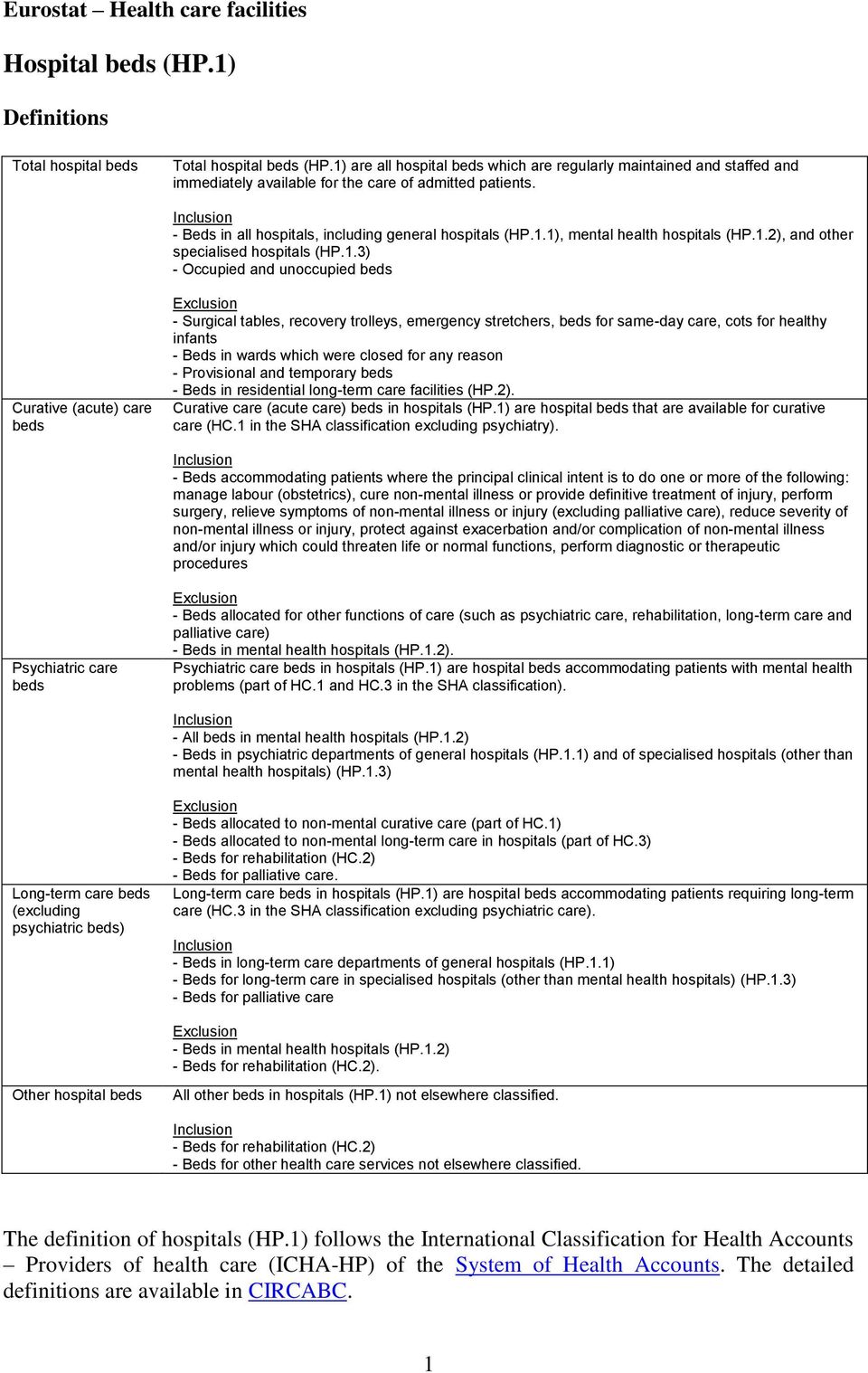
1 Eurostat Health care facilities Hospital beds (HP.1) Definitions Total hospital beds Total hospital beds (HP.1) are all hospital beds which are regularly maintained and staffed and immediately available for the care of admitted patients. Inclusion - Beds in all hospitals, including general hospitals (HP.1.1), mental health hospitals (HP.1.2), and other specialised hospitals (HP.1.3) - Occupied and unoccupied beds Curative (acute) care beds Exclusion - Surgical tables, recovery trolleys, emergency stretchers, beds for same-day care, cots for healthy infants - Beds in wards which were closed for any reason - Provisional and temporary beds - Beds in residential long-term care facilities (HP.2). Curative care (acute care) beds in hospitals (HP.1) are hospital beds that are available for curative care (HC.1 in the SHA classification excluding psychiatry). Inclusion - Beds accommodating patients where the principal clinical intent is to do one or more of the following: manage labour (obstetrics), cure non-mental illness or provide definitive treatment of injury, perform surgery, relieve symptoms of non-mental illness or injury (excluding palliative care), reduce severity of non-mental illness or injury, protect against exacerbation and/or complication of non-mental illness and/or injury which could threaten life or normal functions, perform diagnostic or therapeutic procedures Psychiatric care beds Exclusion - Beds allocated for other functions of care (such as psychiatric care, rehabilitation, long-term care and palliative care) - Beds in mental health hospitals (HP.1.2). Psychiatric care beds in hospitals (HP.1) are hospital beds accommodating patients with mental health problems (part of HC.1 and HC.3 in the SHA classification). Inclusion - All beds in mental health hospitals (HP.1.2) - Beds in psychiatric departments of general hospitals (HP.1.1) and of specialised hospitals (other than mental health hospitals) (HP.1.3) Long-term care beds (excluding psychiatric beds) Exclusion - Beds allocated to non-mental curative care (part of HC.1) - Beds allocated to non-mental long-term care in hospitals (part of HC.3) - Beds for rehabilitation (HC.2) - Beds for palliative care. Long-term care beds in hospitals (HP.1) are hospital beds accommodating patients requiring long-term care (HC.3 in the SHA classification excluding psychiatric care). Inclusion - Beds in long-term care departments of general hospitals (HP.1.1) - Beds for long-term care in specialised hospitals (other than mental health hospitals) (HP.1.3) - Beds for palliative care Exclusion - Beds in mental health hospitals (HP.1.2) - Beds for rehabilitation (HC.2). Other hospital beds All other beds in hospitals (HP.1) not elsewhere classified. Inclusion - Beds for rehabilitation (HC.2) - Beds for other health care services not elsewhere classified. The definition of hospitals (HP.1) follows the International Classification for Health Accounts Providers of health care (ICHA-HP) of the System of Health Accounts. The detailed definitions are available in CIRCABC. 1
2 Country specific notes Belgium, Bulgaria, Czech Republic, Denmark, Germany, Estonia, Ireland, Greece, Spain, France, Croatia, Italy, Cyprus, Latvia, Lithuania, Luxembourg, Hungary, Malta, Netherlands, Austria, Poland, Portugal, Romania, Slovenia, Slovakia, Finland, Sweden, United Kingdom, Iceland, Liechtenstein, Norway, Switzerland, former Yugoslav Republic of Macedonia, Albania, Serbia, Turkey Belgium Total hospital beds: Federal Service of Public Health, Food Chain Safety and Environment, DG1 Organisation and Planning, Datamanagement; Central Institution Database - Centraal Ziekenhuisbestand (CZB). Reference period: 1st of January. - Included in the calculation are all beds in acute care hospital, geriatric hospitals, specialised hospitals, psychiatric hospitals, psychiatric care centres and protected lodging initiatives. - The increase in 1996 reflects the rise in psychiatric care beds, due to the creation of beds in psychiatric care institutions and initiatives for a protected inhabitat. Break in time series: - Since 2006, beds in psychiatric care institutions and initiatives for a protected inhabitat are taken out. This explains the fall in psychiatric care beds in Curative (acute) care beds in hospitals: Federal Service of Public Health, Food Chain Safety and Environment, DG1 Organisation and Planning, Datamanagement; Central Institution Database - Centraal Ziekenhuisbestand (CZB). Reference period: 1st of January. - Bed indexes included are: (B) treatment department TBC (C) diagnosis and surgical treatment department (D) diagnosis and medical treatment department (E) paediatrics (H) single hospitalisation, (H*) mixed hospitalisation (L) contagious diseases (M) maternity (NIC) intensive neonatal care and (G) geriatrics in acute hospitals. - During the 80-ies, a reform of the health care sector took place, during which a number of hospital beds were reconverted into other kind of beds. Psychiatric care beds in hospitals: Federal Service of Public Health, Food Chain Safety and Environment, DG1 Organisation and Planning, Datamanagement; Central Institution Database - Centraal Ziekenhuisbestand (CZB). Reference period: 1st of January. - Beds indexes included in the calculation up to 2005 are: 2

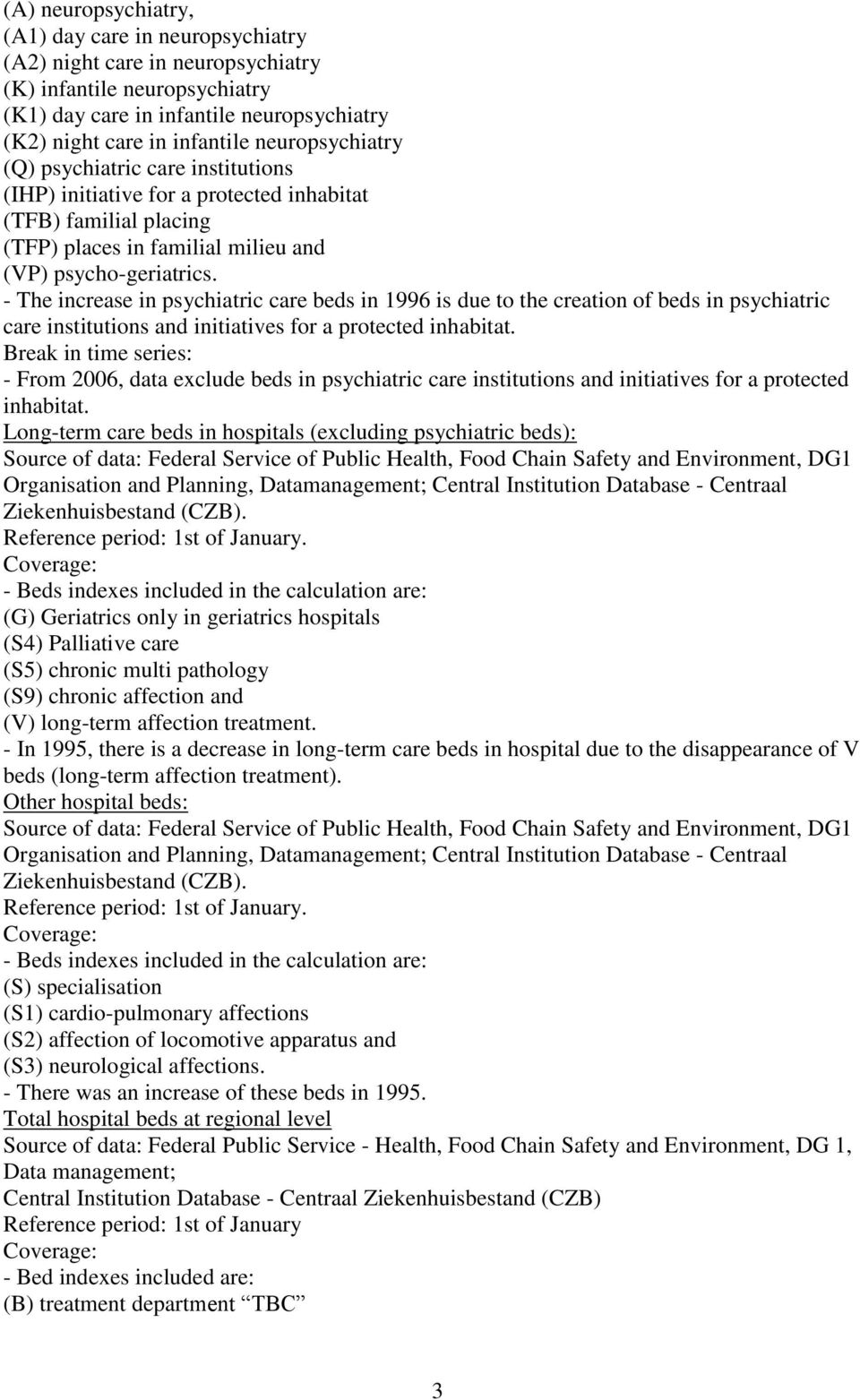
3 (A) neuropsychiatry, (A1) day care in neuropsychiatry (A2) night care in neuropsychiatry (K) infantile neuropsychiatry (K1) day care in infantile neuropsychiatry (K2) night care in infantile neuropsychiatry (Q) psychiatric care institutions (IHP) initiative for a protected inhabitat (TFB) familial placing (TFP) places in familial milieu and (VP) psycho-geriatrics. - The increase in psychiatric care beds in 1996 is due to the creation of beds in psychiatric care institutions and initiatives for a protected inhabitat. Break in time series: - From 2006, data exclude beds in psychiatric care institutions and initiatives for a protected inhabitat. Long-term care beds in hospitals (excluding psychiatric beds): Federal Service of Public Health, Food Chain Safety and Environment, DG1 Organisation and Planning, Datamanagement; Central Institution Database - Centraal Ziekenhuisbestand (CZB). Reference period: 1st of January. - Beds indexes included in the calculation are: (G) Geriatrics only in geriatrics hospitals (S4) Palliative care (S5) chronic multi pathology (S9) chronic affection and (V) long-term affection treatment. - In 1995, there is a decrease in long-term care beds in hospital due to the disappearance of V beds (long-term affection treatment). Other hospital beds: Federal Service of Public Health, Food Chain Safety and Environment, DG1 Organisation and Planning, Datamanagement; Central Institution Database - Centraal Ziekenhuisbestand (CZB). Reference period: 1st of January. - Beds indexes included in the calculation are: (S) specialisation (S1) cardio-pulmonary affections (S2) affection of locomotive apparatus and (S3) neurological affections. - There was an increase of these beds in Total hospital beds at regional level Federal Public Service - Health, Food Chain Safety and Environment, DG 1, Data management; Central Institution Database - Centraal Ziekenhuisbestand (CZB) Reference period: 1st of January - Bed indexes included are: (B) treatment department TBC 3
4 (C) diagnosis and surgical treatment department (D) diagnosis and medical treatment department (E) paediatrics (H) single hospitalisation (H*) mixed hospitalisation (L) contagious diseases (M) maternity (NIC) intensive neonatal care and (G) geriatrics in acute hospitals. Curative (acute) care beds at regional level Federal Public Service - Health, Food Chain Safety and Environment, DG 1, Data management; Central Institution Database - Centraal Ziekenhuisbestand (CZB) Reference period: 1st of January - Bed indexes included are: (B) treatment department TBC (C) diagnosis and surgical treatment department (D) diagnosis and medical treatment department (E) paediatrics (H) single hospitalisation (H*) mixed hospitalisation (L) contagious diseases (M) maternity (NIC) intensive neonatal care and (G) geriatrics in acute hospitals. Psychiatric care beds at regional level Federal Public Service - Health, Food Chain Safety and Environment, DG 1, Data management; Central Institution Database - Centraal Ziekenhuisbestand (CZB) Reference period: 1st of January - Beds indexes included in the calculation up to 2005 are: (A) neuropsychiatry (A1) day care in neuropsychiatry (A2) night care in neuropsychiatry (K) infant neuropsychiatry (K1) day care in infant neuropsychiatry (K2) night care in infant neuropsychiatry (Q) psychiatric care institutions (IHP) initiative for a protected housing (TFB) family placing (TFP) home placement (VP) psycho-geriatrics. Break in time series: - From 2006, data exclude beds in psychiatric care institutions and initiatives for a protected housing. Long-term care beds (excl. psychiatric beds) at regional level Federal Public Service - Health, Food Chain Safety and Environment, DG 1, Data management; 4

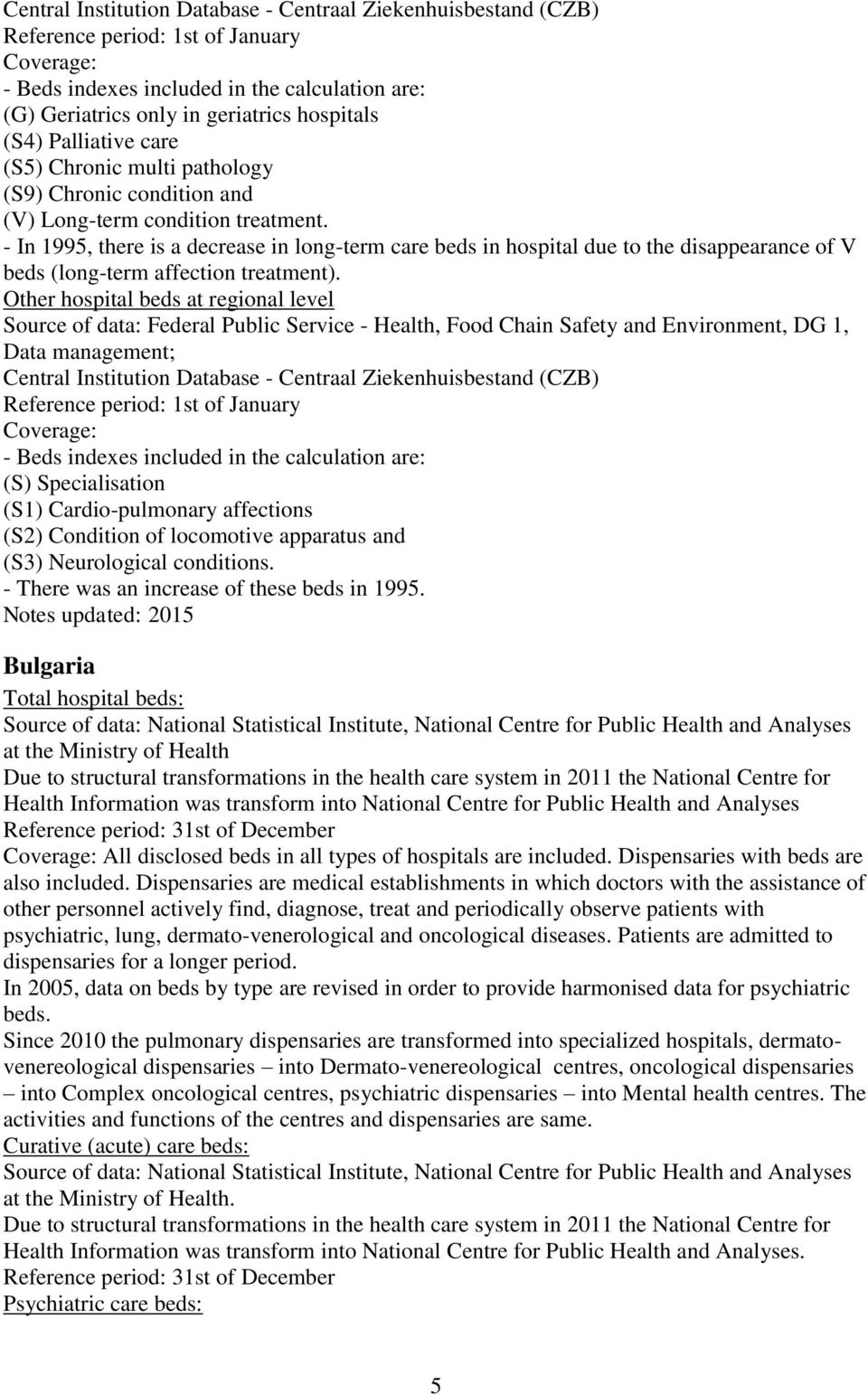
5 Central Institution Database - Centraal Ziekenhuisbestand (CZB) Reference period: 1st of January - Beds indexes included in the calculation are: (G) Geriatrics only in geriatrics hospitals (S4) Palliative care (S5) Chronic multi pathology (S9) Chronic condition and (V) Long-term condition treatment. - In 1995, there is a decrease in long-term care beds in hospital due to the disappearance of V beds (long-term affection treatment). Other hospital beds at regional level Federal Public Service - Health, Food Chain Safety and Environment, DG 1, Data management; Central Institution Database - Centraal Ziekenhuisbestand (CZB) Reference period: 1st of January - Beds indexes included in the calculation are: (S) Specialisation (S1) Cardio-pulmonary affections (S2) Condition of locomotive apparatus and (S3) Neurological conditions. - There was an increase of these beds in Bulgaria Total hospital beds: National Statistical Institute, National Centre for Public Health and Analyses at the Ministry of Health Due to structural transformations in the health care system in 2011 the National Centre for Health Information was transform into National Centre for Public Health and Analyses Reference period: 31st of December All disclosed beds in all types of hospitals are included. Dispensaries with beds are also included. Dispensaries are medical establishments in which doctors with the assistance of other personnel actively find, diagnose, treat and periodically observe patients with psychiatric, lung, dermato-venerological and oncological diseases. Patients are admitted to dispensaries for a longer period. In 2005, data on beds by type are revised in order to provide harmonised data for psychiatric beds. Since 2010 the pulmonary dispensaries are transformed into specialized hospitals, dermatovenereological dispensaries into Dermato-venereological centres, oncological dispensaries into Complex oncological centres, psychiatric dispensaries into Mental health centres. The activities and functions of the centres and dispensaries are same. Curative (acute) care beds: National Statistical Institute, National Centre for Public Health and Analyses at the Ministry of Health. Due to structural transformations in the health care system in 2011 the National Centre for Health Information was transform into National Centre for Public Health and Analyses. Reference period: 31st of December Psychiatric care beds: 5
6 National Statistical Institute, National Centre for Public Health and Analyses at the Ministry of Health. Due to structural transformations in the health care system in 2011 the National Centre for Health Information was transform into National Centre for Public Health and Analyses. Reference period: 31st of December Psychiatric care beds in HP.1 Hospitals include all psychiatric care beds in hospitals and in psychiatric dispensaries; : Data for psychiatric care beds are revised. The revision was done in order to provide the harmonised data and the psychiatric beds from specialised dispensaries are also included. Break in time series: 2005: Beds for long term psychiatric care at Mental health hospitals (HP 1.2) are excluded from Long term care beds and are included in Psychiatric care beds. Beds for physiotherapy and rehabilitation at Mental health hospitals (HP 1.2) are excluded from Other beds and are included in Psychiatric care beds. Since 2010 the psychiatric dispensaries are transformed into Mental health centres. The activities and functions of the centres and dispensaries are same. Long-term care beds (excl. psychiatric beds): National Statistical Institute, National Centre for Public Health and Analyses at the Ministry of Health. Due to structural transformations in the health care system in 2011 the National Centre for Health Information was transform into National Centre for Public Health and Analyses. Reference period: 31st of December beds for further treatment and continuous treatment are included; 2001 and 2002: data on long-term care beds are not available as a separate numbers and are included in the number of other beds in hospitals. Break in time series: 2005: Beds for long term psychiatric care at Mental health hospitals (HP 1.2) are excluded from Long term care beds and are included in Psychiatric care beds. Since 2010 the pulmonary dispensaries are transformed into specialized hospitals, dermatovenereological dispensaries into Dermato-venereological centres, oncological dispensaries into Complex oncological centres. The activities and functions of the centres and dispensaries are same. Other hospital beds: National Statistical Institute, National Centre for Public Health and Analyses at the Ministry of Health. Due to structural transformations in the health care system in 2011 the National Centre for Health Information was transform into National Centre for Public Health and Analyses. Reference period: 31st of December beds for physiotherapy and rehabilitation are included and 2002: data on long term care beds are also included. Break in time series: : Data on long-term care beds are not available as a separate numbers and are incl. in the number of other beds in hospitals for years 2001 and : Data on long-term care beds are excluded again from other hospitals beds, as proposed by the joint definition. Long term care beds have been included in other hospital beds for years 2001 and : Beds for physiotherapy and rehabilitation in pulmonary, dermato-venerological and oncological dispensaries are included in Other beds in Hospitals in order to provide harmonised data. Total hospital beds at regional level National Statistical Institute, National Centre for Public Health and Analyses 6

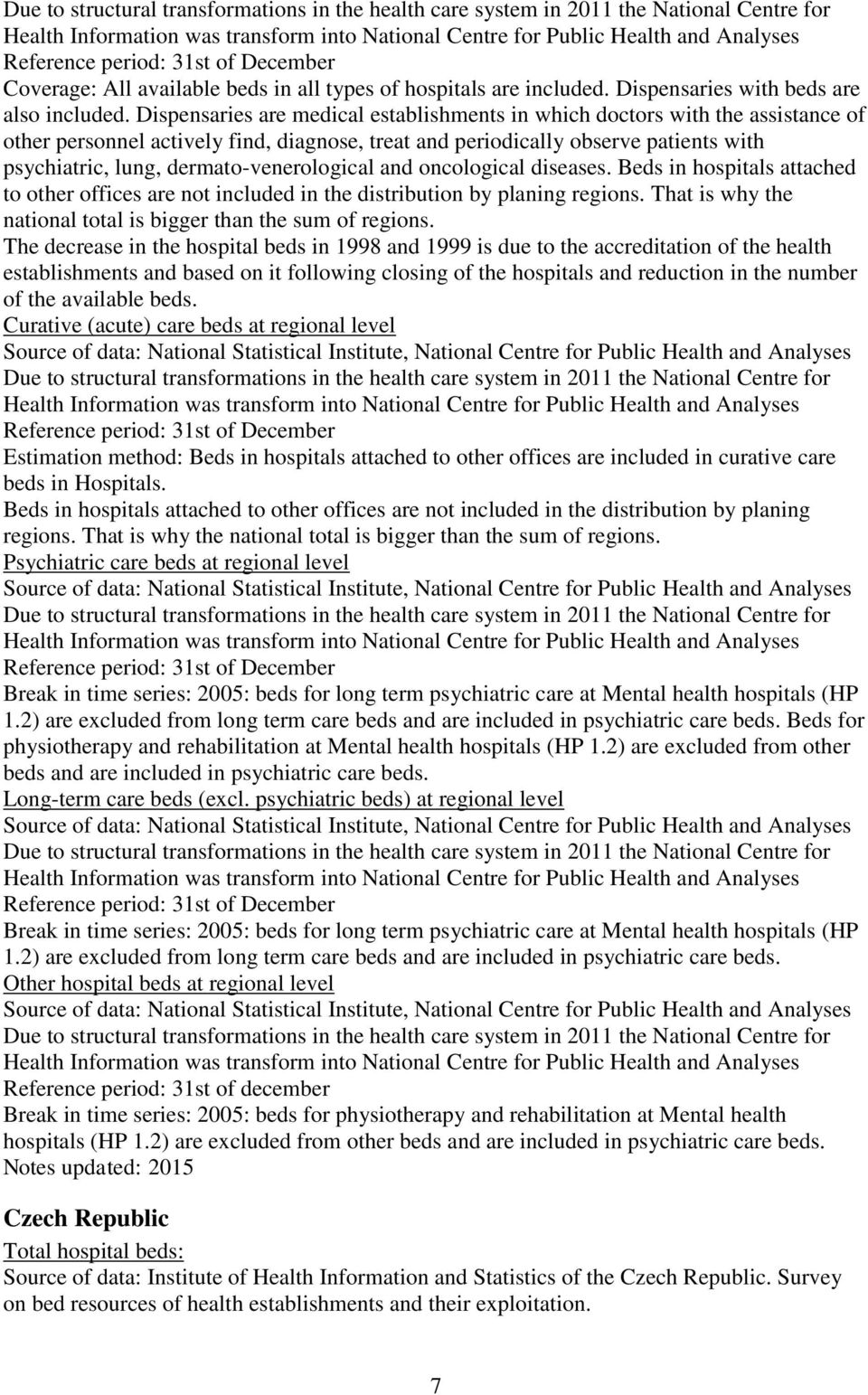
7 Due to structural transformations in the health care system in 2011 the National Centre for Health Information was transform into National Centre for Public Health and Analyses Reference period: 31st of December All available beds in all types of hospitals are included. Dispensaries with beds are also included. Dispensaries are medical establishments in which doctors with the assistance of other personnel actively find, diagnose, treat and periodically observe patients with psychiatric, lung, dermato-venerological and oncological diseases. Beds in hospitals attached to other offices are not included in the distribution by planing regions. That is why the national total is bigger than the sum of regions. The decrease in the hospital beds in 1998 and 1999 is due to the accreditation of the health establishments and based on it following closing of the hospitals and reduction in the number of the available beds. Curative (acute) care beds at regional level National Statistical Institute, National Centre for Public Health and Analyses Due to structural transformations in the health care system in 2011 the National Centre for Health Information was transform into National Centre for Public Health and Analyses Reference period: 31st of December Estimation method: Beds in hospitals attached to other offices are included in curative care beds in Hospitals. Beds in hospitals attached to other offices are not included in the distribution by planing regions. That is why the national total is bigger than the sum of regions. Psychiatric care beds at regional level National Statistical Institute, National Centre for Public Health and Analyses Due to structural transformations in the health care system in 2011 the National Centre for Health Information was transform into National Centre for Public Health and Analyses Reference period: 31st of December Break in time series: 2005: beds for long term psychiatric care at Mental health hospitals (HP 1.2) are excluded from long term care beds and are included in psychiatric care beds. Beds for physiotherapy and rehabilitation at Mental health hospitals (HP 1.2) are excluded from other beds and are included in psychiatric care beds. Long-term care beds (excl. psychiatric beds) at regional level National Statistical Institute, National Centre for Public Health and Analyses Due to structural transformations in the health care system in 2011 the National Centre for Health Information was transform into National Centre for Public Health and Analyses Reference period: 31st of December Break in time series: 2005: beds for long term psychiatric care at Mental health hospitals (HP 1.2) are excluded from long term care beds and are included in psychiatric care beds. Other hospital beds at regional level National Statistical Institute, National Centre for Public Health and Analyses Due to structural transformations in the health care system in 2011 the National Centre for Health Information was transform into National Centre for Public Health and Analyses Reference period: 31st of december Break in time series: 2005: beds for physiotherapy and rehabilitation at Mental health hospitals (HP 1.2) are excluded from other beds and are included in psychiatric care beds. Czech Republic Total hospital beds: Institute of Health Information and Statistics of the Czech Republic. Survey on bed resources of health establishments and their exploitation. 7
8 Reference period: end of the year. - Until 1999 data covers only establishments of the Health Sector. Since 2000, data covers all sectors. - Providers: Hospitals and Specialized therapeutic institutes (excluding Balneologic institutes, Convalescent homes for children, Institutes for long-term patients and Hospices). - Beds: All available beds excluding newborns' cots. Break in time series: Curative (acute) care beds in hospitals: Institute of Health Information and Statistics of the Czech Republic. Survey on bed resources of health establishments and their exploitation. Reference period: end of the year. - Until 1999 data covers only establishments of the Health Sector. Since 2000, data covers all sectors. - Curative care beds encompass beds in University and Acute care hospitals. Beds in departments and workplaces of aftercare and nursing care, beds in psychiatric departments (wards) and beds for healthy neonates are excluded. - The above bed counts do not include provisional beds, beds for accompanying persons and temporary beds (for less than 24 hours: day care beds, instrument beds such as dialysis beds, delivery beds). - When an entire ward is closed for a long period of time these beds are not counted. Break in time series: Psychiatric care beds in hospitals: Institute of Health Information and Statistics of the Czech Republic. Survey on bed resources of health establishments and their exploitation. Reference period: end of the year. - Untill 1999 data covers only establishments of the Health Sector. Since 2000, data covers all sectors. - Psychiatric care beds encompass beds in Psychiatric institutes and beds in psychiatric departments (wards) of University and Acute care hospitals. Break in time series: Long-term care beds in hospitals (excluding psychiatric beds): Institute of Health Information and Statistics of the Czech Republic. Survey on bed resources of health establishments and their exploitation. Reference period: end of the year. - Untill 1999 data covers only establishments of the Health Sector. Since 2000, data covers all sectors. - Long term care beds encompass beds in departments and workplaces of after-care and nursing care in University, Acute care hospitals and Hospitals of subsequent care (existing since 1995). Break in time series: Other hospital beds: Institute of Health Information and Statistics of the Czech Republic. Survey on bed resources of health establishments and their exploitation. Reference period: end of the year. 8

9 - Untill 1999 data covers only establishments of the Health Sector. Since 2000, data covers all sectors. - Other beds encompass beds in Institutes for TB & respiratory diseases, Rehabilitation institutes, other specialised therapeutic institutes and Other bed care health establishments. Break in time series: Total hospital beds at regional level Institute of Health Information and Statistics of the Czech Republic. Survey on bed resources of health establishments and their exploitation. Reference period: end of the year. - Till 1999 data covers only establishments of the Health Sector. Since 2000, data covers all sectors. - Providers: Hospitals and Specialized therapeutic institutes (excluding Balneologic institutes, Convalescent homes for children, Institutes for long-term patients and Hospices). - Beds: All available beds excluding newborns' cots. Break in the series: Curative (acute) care beds at regional level Institute of Health Information and Statistics of the Czech Republic. Survey on bed resources of health establishments and their exploitation. Reference period: end of the year. - Till 1999 data covers only establishments of the Health Sector. Since 2000, data covers all sectors. - Curative care beds encompass beds in University and Acute care hospitals. Beds in departments and workplaces of aftercare and nursing care, beds in psychiatric departments (wards) and beds for healthy neonates are excluded. Break in the series: Psychiatric care beds at regional level Institute of Health Information and Statistics of the Czech Republic. Survey on bed resources of health establishments and their exploitation. Reference period: end of the year. - Till 1999 data covers only establishments of the Health Sector. Since 2000, data covers all sectors. - Psychiatric care beds encompass beds in Psychiatric institutes and beds in psychiatric departments (wards) of University and Acute care hospitals. Break in the series: Long-term care beds (excl. psychiatric beds) at regional level Institute of Health Information and Statistics of the Czech Republic. Survey on bed resources of health establishments and their exploitation. Reference period: end of the year. - Till 1999 data covers only establishments of the Health Sector. Since 2000, data covers all sectors. - Long term care beds encompass beds in departments and workplaces of after-care and nursing care in University, Acute care hospitals and, hospitals with chronical beds. Break in the series: Other hospital beds at regional level Institute of Health Information and Statistics of the Czech Republic. Survey on bed resources of health establishments and their exploitation. 9

10 Reference period: end of the year. - Till 1999 data covers only establishments of the Health Sector. Since 2000, data covers all sectors. - Other beds encompass beds in Institutes for TB & respiratory diseases, Rehabilitation institutes, Other specialised therapeutic institutes and Other bed care health establishments. Break in the series: Denmark Total hospital beds: National Board of Health (2010: internal hospital beds database has been used). Curative (acute) care beds: National Board of Health (2010: internal hospital beds database has been used) Psychiatric care beds: - National Board of Health, The National Patient Register (the publication "Hospital statistics 2004"). - National Board of Health (2010: internal hospital beds database has been used). Reference period: Annual average. Break in the series: Before 1987, psychiatric residential home beds were included in the number of psychiatric care beds. From 1986 to 1987 the psychiatric care beds for elderly patient living in retirement homes were moved from the Danish Health System to being the responsibility of the Danish Social Services. This is the reason for the drop in the psychiatric care beds in Long-term care beds (excl. psychiatric beds): National Board of Health. Data includes only palliative care beds. Other hospital beds: National Board of Health. Data includes only palliative care beds. Total hospital beds at regional level Statens Serum Institut (2010: internal hospital beds database has been used) Reference period: annual average Curative (acute) care beds at regional level Statens Serum Institut (2010: internal hospital beds database has been used) Reference period: annual average Psychiatric care beds at regional level Statens Serum Institut (2010: internal hospital beds database has been used) Reference period: annual average Long-term care beds (excl. psychiatric beds) at regional level Statens Serum Institut (2010: internal hospital beds database has been used) Reference period: annual average Other hospital beds at regional level Statens Serum Institut (2010: internal hospital beds database has been used) Reference period: annual average 10

11 Germany Total hospital beds: Federal Statistical Office, Hospital statistics (basic data of General Hospitals & prevention and rehabilitation facilities); Statistisches Bundesamt, Fachserie 12, Reihe 6.1.1, table 1.1, ibid., Fachserie 12, Reihe 6.1.2, table 1.1; or Reference period: annual average. - Total hospital beds comprise beds in all types of hospitals (HP.1.1, 1.2 and 1.3) in all sectors (public, not-for-profit and private). - Included are beds in general hospitals, mental health hospitals and prevention and rehabilitation homes. - Beds in long-term-nursing care facilities are excluded. - Costs for healthy infants, recovery trolleys, emergency stretchers, surgical tables and beds for same-day care and palliative care are also not included. Curative (acute) care beds in hospitals: Federal Statistical Office, Hospital statistics (basic data of hospitals), Statistisches Bundesamt, Fachserie 12, Reihe 6.1.1, table 2.1.3; or Reference period: Annual average. - Curative (acute) care beds comprise beds in general hospitals (HP.1.1) in all sectors (public, not-for-profit and private). - Excluded are beds in psychiatric departments of general hospitals, beds in mental health hospitals, in prevention and rehabilitation facilities and beds in long-term nursing care facilities. - Cots for healthy infants, recovery trolleys, emergency stretchers, surgical tables and beds for same-day care and palliative care are also not included. Psychiatric care beds in hospitals: Federal Statistical Office, Hospital statistics (basic data of hospitals), Statistisches Bundesamt, Fachserie 12, Reihe 6.1.1, table 2.1.3; or Reference period: Annual average. - Psychiatric care beds in hospitals comprise beds in mental health hospitals (HP.1.2) and beds in psychiatric departments of general hospitals (HP.1.1) in all sectors (public, not-forprofit and private). - In Germany, mental health hospitals are defined as hospitals exclusively with psychiatric, psychotherapeutical or psychiatric, psychotherapeutical and neurological beds. - Excluded are beds for rehabilitation. Long-term care beds in hospitals (excluding psychiatric beds): Data not available. Other hospital beds: Federal Statistical Office, Hospital statistics (basic data of prevention or rehabilitation facilities); Statistisches Bundesamt, Fachserie 12, Reihe 6.1.2, table 2.1; or Reference period: Annual average. - Other hospital beds comprise beds in prevention and rehabilitation facilities (HP.1.3) in all sectors (public, not-for-profit and private). 11

12 - Excluded are beds in general hospitals, mental health hospitals and beds in long-term nursing care facilities. Total hospital beds at regional level Federal Statistical Office, Hospital statistics (basic data of hospitals & prevention or rehabilitation facilities); Statistisches Bundesamt, Fachserie 12, Reihe 6.1.1, table 1.1 and ibid., Fachserie 12, Reihe 6.1.2, table 1.1 and special calculations by the Federal Statistical Office; or Reference period: annual average - Total hospital beds comprise beds in all types of hospitals (HP1.1, 1.2 and 1.3) in all sectors (public, not-for-profit and private). - Included are beds in general hospitals, mental health hospitals and prevention and rehabilitation facilities. - Beds in long-term-nursing care facilities are excluded. - Cots for healthy infants, recovery trolleys, emergency stretchers, surgical tables and beds for same-day care and palliative care are also not included. Curative (acute) care beds at regional level Federal Statistical Office, Hospital statistics (basic data of hospitals); Statistisches Bundesamt, Fachserie 12, Reihe 6.1.1, table 2.1.3; or Reference period: annual average. - Curative (acute) care beds comprise beds in general hospitals (HP1.1) in all sectors (public, not-for-profit and private). - Excluded are beds in psychiatric departments of general hospitals, beds in mental health hospitals, in prevention and rehabilitation facilities and beds in long-term nursing care facilities. - Cots for healthy infants, recovery trolleys, emergency stretchers, surgical tables and beds for same-day care and palliative care are also not included. Psychiatric care beds at regional level Federal Statistical Office, Hospital statistics (basic data of hospitals); Statistisches Bundesamt, Fachserie 12, Reihe 6.1.1, table 2.1.3; or Reference period: annual average. - Psychiatric care beds in hospitals comprise beds in mental health hospitals (HP1.2) and beds in psychiatric departments of general hospitals (HP1.1) in all sectors (public, not-for-profit and private). - In German mental health hospitals mean hospitals exclusively with psychiatric, psychotherapeutical or psychiatric, psychotherapeutical and neurological beds. - Excluded are beds for rehabilitation. Long-term care beds (excl. psychiatric beds) at regional level Data not available. Other hospital beds at regional level Federal Statistical Office, Hospital statistics (basic data of prevention or rehabilitation facilities); Statistisches Bundesamt, Fachserie 12, Reihe 6.1.2, table 2.1 and special calculations by the Federal Statistical Office; or Reference period: annual average. 12

13 - Other hospital beds comprise beds in prevention and rehabilitation facilities (HP1.3) in all sectors (public, not-for-profit and private). - Excluded are beds in general hospitals, mental health hospitals and beds in long-term nursing care facilities. Estonia Total hospital beds: - Since 1st January 2008 National Institute for Health Development, Department of Health Statistics. - Data from routinely collected health care statistics submitted by health care providers (monthly statistical report "Hospital beds and hospitalisation"). Reference period: 31st of December. - All hospitals HP.1 (public and private sector) are included. - Cots for neonates, day beds, provisional and temporary beds, and beds in storerooms are also excluded from the hospital beds. - Beds in welfare institutions are excluded. - At the end of 2005 the number of beds was smaller. Several beds were closed because of financial shortages. - The decrease in the number of hospital beds after 1991 was the result of the first reorganisation wave of the health care system of the independent country. - In 2002, the Government of Estonia introduced the Hospital Master Plan that anticipates an optimum number of hospitals and hospital beds necessary to provide acute health care services taking into account the number of the population of Estonia and the population forecasts. Therefore, existing hospitals were reorganised, some became out-patient care providers, and some were closed or consolidated. This change can be called the second wave of the reorganisation of the Estonian health care system. - In Estonia, hospitals that provided only in-patient long-term care services (long-term care hospitals) were reorganised to the nursing care hospitals. This restructuration came into force according to Health Services Organisation Act at the beginning of 2013 ( Previous longterm care hospitals (HP.1) were classified amongst long-term nursing care facilities HP.2 according to the SHA2011 in Therefore, the total number of hospital beds decreased in The number of curative care beds, other beds (tuberculosis) and psychiatric beds were not influenced by this methodological change. Curative (acute) care beds: - Since 1st January 2008 National Institute for Health Development, Department of Health Statistics. - Data from routinely collected health care statistics, submitted by health care providers (monthly statistical report "Hospital beds and hospitalisation"). - All hospitals HP.1 (public and private sector) are included. - Cots for neonates, day beds, provisional and temporary beds, and beds in storerooms are also excluded from the hospital beds. - Beds in welfare institutions are excluded. - Beds for rehabilitation are included in curative (acute) care beds. 13

14 - Beds for psychiatric, tuberculosis and long-term care are excluded. - The decrease in the number of hospital beds after 1991 was the result of the first reorganisation wave of the health care system of the independent country. - In 2002, the Government of Estonia introduced the Hospital Master Plan that anticipates an optimum number of hospitals and hospital beds necessary to provide acute health care services taking into account the number of the population of Estonia and the population forecasts. Therefore, existing hospitals were reorganised, some became out-patient care providers, and some were closed or consolidated. This change can be called the second wave of the reorganisation of the Estonian health care system. - In Estonia, hospitals that provided only in-patient long-term care services (long-term care hospitals) were reorganised to the nursing care hospitals. This restructuration came into force according to Health Services Organisation Act at the beginning of 2013 (~ Previous long-term care hospitals (HP.1) were classified amongst long-term nursing care facilities HP.2 according to the SHA2011 in Therefore, the total number of hospitals decreased in 2013 as well as all other statistics provided for in-patient care (beds, discharges by hospital beds). The remark difference in methodology was added to the data for the year This change does not have an impact on the statistics of curative care, psychiatric care or other beds. Psychiatric care beds: - Since 1st January 2008 National Institute for Health Development, Department of Health Statistics. - Data from routinely collected health care statistics submitted by health care providers (monthly statistical report "Hospital beds and hospitalisation"). - All hospitals HP.1 (public and private sector) are included. - Cots for neonates, day beds, provisional and temporary beds, and beds in storerooms are also excluded from the hospital beds. - Beds in welfare institutions are excluded. - The decrease in the number of hospital beds after 1991 was the result of the first reorganisation wave of the health care system of the independent country. - In 2002, the Government of Estonia introduced the Hospital Master Plan that anticipates an optimum number of hospitals and hospital beds necessary to provide acute health care services taking into account the number of the population of Estonia and the population forecasts. Therefore, existing hospitals were reorganised, some became out-patient care providers, and some were closed or consolidated. This change can be called the second wave of the reorganisation of the Estonian health care system. - Data for are recalculated. (Small changes from reviewing the HP classification of institutions providing in-patient care according to the new SHA 2011.) Long-term care beds (excl. psychiatric beds): - Since 1st January 2008 National Institute for Health Development, Department of Health Statistics. - Data from routinely collected health care statistics submitted by health care providers (monthly statistical report "Hospital beds and hospitalisation"). - All hospitals HP.1 (public and private sector) are included. 14

15 - A large-scale legislative reform took place in the early 1990s. The Health Insurance Act of 1991 and the Health Services Organisation Act of 1994 provided the legal basis for reforms. In 1991 the provider licensing system was enhanced, which was an important precondition for decreasing hospital network capacity to enable more efficient use of resources and to ensure quality. In 1994, after a detailed review of all providers, substandard providers were closed and hospital bed structure changed as well. Break in time series: Note: - In Estonia, hospitals that provided only in-patient long-term care services (long-term care hospitals) were reorganised to the nursing care hospitals. This restructuration came into force according to Health Services Organisation Act at the beginning of 2013 ( Previous longterm care hospitals (HP.1) were classified amongst long-term nursing care facilities HP.2 according to the SHA2011 in Therefore, the total number of hospitals decreased in 2013 as well as all other statistics provided for in-patient care (beds, discharges by hospital beds). The remark difference in methodology was added to the data for the year This change does not have an impact on the statistics of curative care, psychiatric care or other beds. Other hospital beds: - Since 1st January 2008 National Institute for Health Development, Department of Health Statistics. - Data from routinely collected health care statistics submitted by health care providers (monthly statistical report "Hospital beds and hospitalisation"). - All hospitals HP.1 (public and private sector) are included. - Cots for neonates, day beds, provisional and temporary beds, and beds in storerooms are excluded from the hospital beds. - Beds in welfare institutions are excluded. - The data on beds for tuberculosis are provided among other types of beds. Rehabilitation beds are included in the acute (curative) care beds. ALOS for rehabilitation care beds is less than 18 days in Estonia. - The decrease in the number of hospital beds after 1991 was the result of the first reorganisation wave of health care system of the independent country. - In 2002, the Government of Estonia introduced the Hospital Master Plan that anticipates an optimum number of hospitals and hospital beds necessary to provide acute health care services taking into account the number of the population of Estonia and the population forecasts. Therefore, existing hospitals were reorganised, some became out-patient care providers, and some were closed or consolidated. This change can be called the second wave of the reorganisation of the Estonian health care system. - Other hospital beds include only beds for tuberculosis. Ireland Total hospital beds: - Curative care beds and Other hospital beds sources: - for 2006 onwards, source is Health Service Executive; 15
16 - for years prior to 2006, source is Department of Health and Children, Integrated Management Returns. - Psychiatric care beds source is Mental Health Commission Annual Report. - Long-term care beds source is Health Service Executive. - Total hospital beds is the sum of curative care, psychiatric care, long-term care and other beds. - See metadata for each bed type for details on coverage and details of break in series in Data from 2009 has been revised in 2015 due to ongoing developmental work on the System of Health Accounts, in particular the statistical categorisation of hospitals into the SHA HP classifications. This has had the effect of reducing the numbers of psychiatric beds reported. Curative (acute) care beds: - For 2006 onwards: Health Service Executive. - For years prior to 2006: Department of Health and Children. - Data refer to average available beds in publicly funded acute (HP1) hospitals only. - Geriatric and rehabilitation beds in public acute hospitals are excluded. - Psychiatric beds in acute hospitals are excluded. - Beds in private hospitals are not included. Break in time series: - Break in series occurs in Until 2008, curative care beds included geriatric beds in acute hospitals. - Up to and including 1996, figures refer to beds, excluding day beds, in publicly funded acute hospitals where the average length of stay is 18 days or less. From 1997 on, figures refer to beds in Health Service Executive network hospitals only. - Data for included beds in short-stay district hospitals. Psychiatric care beds: - For 2004 onwards: Mental Health Commission Annual Reports. - For data up to and including 2003: Department of Health and Children. - Since 2004, data refer to beds in approved centres, as defined by the Mental Health Act A centre which provides for the care and treatment of persons suffering from mental illness or mental disorder must be registered with the Mental Health Commission to become an approved centre. Data refer to psychiatric beds in acute hospitals and in all psychiatric hospitals in the main. A small number of beds in other in-patient facilities are also included. Break in time series: - Up to and including 1986, figures refer to beds in public psychiatric hospitals and beds in psychiatric units in acute hospitals. From 1987 on, beds in private psychiatric hospitals are also included. Data from 2009 has been revised in 2015 due to ongoing developmental work on the System of Health Accounts, in particular the statistical categorisation of hospitals into the SHA HP classifications. This has had the effect of reducing the numbers of psychiatric beds reported. Long-term care beds (excl. psychiatric beds): - From 2009: Health Service Executive. - Up to 2008: Department of Health and Children, Annual Survey of Long-Stay Units. 16
17 - Refers only to beds in the geriatric specialty in public HP1 (acute) hospitals. Private hospitals are not included. Break in time series: - Break in series occurs in Up to 2008, data refer to beds in public long-stay geriatric hospitals and district/community hospitals. Data come from the Annual Survey of Long-Stay Units. Approximately 80% of long-stay units respond to this survey each year. For facilities where no data was received, bed numbers were rolled forward from the previous year. Other hospital beds: - For 2006 onwards: Health Service Executive. - For data up to and including 2005: Department of Health and Children. - Refers to beds for rehabilitation in public HP1 hospitals only. Private hospitals are not included. Break in time series: - Break in series occurs in Up to 2009, other hospital beds refer to beds in non-acute hospitals not included elsewhere. - From 1987 to 1996, figures refer to beds in other hospitals where the length of stay is greater than 18 days. From 1997, figures refer to beds in hospitals not included in either HSE network hospitals or long-stay hospitals. Total hospital beds at regional level Curative care and other beds sources: - for 2006 onwards, source is Health Service Executive; - for years prior to 2006, source is Department of Health and Children, Integrated Management Returns. Psychiatric care beds source is Mental Health Commission Annual Report. Long-term care beds source is Health Service Executive. Total hospital beds is the sum of curative care, psychiatric care, long-term care and other beds. See metadata for each bed type for details on coverage and break in time series in Data from 2009 has been revised in 2015 due to ongoing developmental work on the System of Health Accounts, in particular the statistical categorisation of hospitals into the SHA HP classifications. This has had the effect of reducing the numbers of psychiatric beds reported. Curative (acute) care beds at regional level - for 2006 onwards: Health Service Executive; - for data up to and including 2005: Department of Health and Children. - Data refers to average available beds in publicly funded acute (HP1) hospitals only. - Geriatric and rehabilitation beds in public acute hospitals are excluded. - Psychiatric beds in acute hospitals are excluded. - Beds in private hospitals are not included. Break in time series: Break in series occurs in Up to 2008, curative care beds included geriatric beds in acute hospitals. - Up to and including 1996, figures refer to beds, excluding day beds, in publicly funded acute hospitals where the average length of stay is 18 days or less. From 1997, figures refer to beds in Health Service Executive network hospitals only. - Data for included beds in short-stay district hospitals. 17
18 Psychiatric care beds at regional level - for 2004 onwards: Mental Health Commission Annual Reports. - for data up to and including 2003: Department of Health and Children. - From 2004, refers to beds in approved centres, as defined by the Mental Health Act A centre which provides for the care and treatment of persons suffering from mental illness or mental disorder must be registered with the Mental Health Commission to become an approved centre. Data refer to psychiatric beds in acute hospitals and in all psychiatric hospitals in the main. A small number of beds in other in-patient facilities are also included. Data from 2009 has been revised in 2015 due to ongoing developmental work on the System of Health Accounts, in particular the statistical categorisation of hospitals into the SHA HP classifications. This has had the effect of reducing the numbers of psychiatric beds reported. Long-term care beds (excl. psychiatric beds) at regional level From 2009: Health Service Executive. Up to 2008: Department of Health and Children, Annual Survey of Long-Stay Units. Refers only to beds in the geriatric specialty in public HP1 (acute) hospitals. Private hospitals are not included. Break in time series: Break in series occurs in Up to Refers to beds in public long-stay geriatric hospitals and district/community hospitals. - Data comes from the Annual Survey of Long-Stay Units. Approximately 80% of long-stay units respond to this survey each year. For facilities where no data was received, bed numbers were rolled forward from the previous year. Other hospital beds at regional level - for 2006 onwards: Health Service Executive; - for data up to and including 2005: Department of Health and Children. - Refers to beds for rehabilitation in public HP1 hospitals only. Private hospitals are not included. Break in time series: Break in series occurs in Up to 2009, other hospital beds refer to beds in non-acute hospitals not included elsewhere. - From 1987 to 1996, figures refer to beds in other hospitals where the length of stay is greater than 18 days. From 1997, figures refer to beds in hospitals not included in either HSE network hospitals or long-stay hospitals. Greece Total hospital beds: Hellenic Statistical Authority (EL.STAT.), Hospital Census Reference period: Annual average. Curative (acute) care beds: Hellenic Statistical Authority (EL.STAT.), Hospital Census Reference period: Annual average. Psychiatric care beds: Hellenic Statistical Authority (EL.STAT.), Hospital Census Reference period: Annual average. Long-term care beds (excl. psychiatric beds): 18
19 Data not available Other hospital beds: Data not available Total hospital beds at regional level Hellenic Statistical Authority (EL.STAT.), Hospital census Reference period: annual average Curative (acute) care beds at regional level Hellenic Statistical Authority (EL.STAT.), Hospital census Reference period: annual average Psychiatric care beds at regional level Hellenic Statistical Authority (EL.STAT.), Hospital census Reference period: annual average Long-term care beds (excl. psychiatric beds) at regional level Hellenic Statistical Authority (EL.STAT.), Hospital census Reference period: annual average Other hospital beds at regional level Hellenic Statistical Authority (EL.STAT.), Hospital census Reference period: annual average Spain Total hospital beds - Before 1996: National Statistics Institute and Ministry of Health and Consumer Affairs. Statistics on Health Establishments Providing Inpatient Care. - From 1996 to 2009: Ministry of Health, Social Services and Equity from Statistics on Health Establishments Providing Inpatient Care (ESCRI). I.htm. - Since 2010: Ministry of Health, Social Services and Equity from Specialised Care Information System (Sistema de Información de Atención Especializada - SIAE). Reference period: Annual average. All public and private hospitals in Spain are included. Curative (acute) care beds in hospitals - Before 1996: National Statistics Institute and Ministry of Health and Consumer Affairs. Statistics on Health Establishments Providing Inpatient Care. - From 1996 to 2009: Ministry of Health, Social Services and Equity from Statistics on Health Establishments Providing Inpatient Care (ESCRI). I.htm. - Since 2010: Ministry of Health, Social Services and Equity from Specialised Care Information System (Sistema de Información de Atención Especializada - SIAE). Reference period: Annual average. All public and private hospitals in Spain are included. Psychiatric care beds in hospitals 19
20 - Before 1996: National Statistics Institute and Ministry of Health and Consumer Affairs. Statistics on Health Establishments Providing Inpatient Care. - From 1996 to 2009: Ministry of Health, Social Services and Equity from Statistics on Health Establishments Providing Inpatient Care (ESCRI). I.htm. - Since 2010: Ministry of Health, Social Services and Equity from Specialised Care Information System (Sistema de Información de Atención Especializada - SIAE). Reference period: Annual average. - All public and private hospitals in Spain are included. - Data refer to occupied beds in mental health hospitals and in psychiatric departments of general hospitals (HP.1.1) and of specialty hospitals (other than mental health and substance abuse). Substance abuse is treated in mental health hospitals and curative care hospitals. Long-term care beds in hospitals (excluding psychiatric beds) Source of data : - Before 1996: National Statistics Institute and Ministry of Health and Consumer Affairs. Statistics on Health Establishments Providing Inpatient Care. - From 1996 to 2009: Ministry of Health, Social Services and Equity from Statistics on Health Establishments Providing Inpatient Care (ESCRI). I.htm. - Since 2010: Ministry of Health, Social Services and Equity from Specialised Care Information System (Sistema de Información de Atención Especializada - SIAE). Reference period: Annual average. - All public and private hospitals in Spain are included. - Data refer to occupied beds in long-term care departments of general hospitals and beds for long-term care in specialty (other than mental health and substance abuse) hospitals. Other hospital beds - Before 1996: National Statistics Institute and Ministry of Health and Consumer Affairs. Statistics on Health Establishments Providing Inpatient Care. - From 1996 to 2009: Ministry of Health, Social Services and Equity from Statistics on Health Establishments Providing Inpatient Care (ESCRI). I.htm. - Since 2010: Ministry of Health, Social Services and Equity from Specialised Care Information System (Sistema de Información de Atención Especializada - SIAE). Reference period: Annual average. Total hospital beds at regional level Ministry of Health, Social Services and Equity, data from Statistics on Health Establishments Providing In-patient Care. - Since 2010: Ministry of Health, Social Services and Equity from Statistics of Centers of Special Attention (Sistema de Información de Atención Especializada - SIAE) Reference period: Annual average. 20
21 All public and private hospitals are included (the total number of hospitals is slightly lower than the total of hospitals included at the National Catalogue as some hospitals provide statistics grouped as a complex and also some of them do not provide data). Curative (acute) care beds at regional level Ministry of Health, Social Services and Equity, data from Statistics on Health Establishments Providing In-patient Care. - Since 2010: Ministry of Health, Social Services and Equity from Statistics of Centers of Special Attention (Sistema de Información de Atención Especializada - SIAE) Reference period: Annual average. All public and private hospitals are included (the total number of hospitals is slightly lower than the total of hospitals included at the National Catalogue as some hospitals provide statistics grouped as a complex and also some of them do not provide data). Psychiatric care beds at regional level Ministry of Health, Social Services and Equity, data from Statistics on Health Establishments Providing In-patient Care. - Since 2010: Ministry of Health, Social Services and Equity from Statistics of Centers of Special Attention (Sistema de Información de Atención Especializada - SIAE) Reference period: Annual average. All public and private hospitals are included (the total number of hospitals is slightly lower than the total of hospitals included at the National Catalogue as some hospitals provide statistics grouped as a complex and also some of them do not provide data). Long-term care beds (excl. psychiatric beds) at regional level Ministry of Health, Social Services and Equity, data from Statistics on Health Establishments Providing In-patient Care. - Since 2010: Ministry of Health, Social Services and Equity from Statistics of Centers of Special Attention (Sistema de Información de Atención Especializada - SIAE) Reference period: Annual average. All public and private hospitals are included (the total number of hospitals is slightly lower than the total of hospitals included at the National Catalogue as some hospitals provide statistics grouped as a complex and also some of them do not provide data). Other hospital beds at regional level Ministry of Health, Social Services and Equity, data from Statistics on Health Establishments Providing In-patient Care. - Since 2010: Ministry of Health, Social Services and Equity from Statistics of Centers of Special Attention (Sistema de Información de Atención Especializada - SIAE) Reference period: Annual average. All public and private hospitals are included (the total number of hospitals is slightly lower than the total of hospitals included at the National Catalogue as some hospitals provide statistics grouped as a complex and also some of them do not provide data). France Total hospital beds: Ministère de la Santé et des Sports - Direction de la Recherche, des Etudes, de l'evaluation et des Statistiques (DREES). Data are from the Statistique Annuelle des Etablissements de santé (SAE). 21
22 NB: This survey has been recasted in 2014 for the data concerning 2013 (review and update of the questionnaire, change of the unit surveyed [legal entity - geographical establishment], improvement of the consistency between the survey and an administrative source of data on the activity of hospitals). Though the principles of the survey remain the same, some concepts and some questions have changed: this can lead to break in series for year Data refer to metropolitan France and D.O.M. (overseas departments). - Data include army hospitals from 2002 onwards. - Data from 2013 it is geographical establishments for all sectors (public and private). That is why there is a break in series in the number of the total hospitals and the public hospitals. Curative (acute) care beds in hospitals: Ministère de la Santé et des Sports - Direction de la Recherche, des Etudes, de l'evaluation et des Statistiques (DREES). Data are from the Statistique Annuelle des Etablissements de santé (SAE). NB: This survey has been recasted in 2014 for the data concerning 2013 (review and update of the questionnaire, change of the unit surveyed [legal entity - geographical establishment], improvement of the consistency between the survey and an administrative source of data on the activity of hospitals). Though the principles of the survey remain the same, some concepts and some questions have changed: this can lead to break in series for year Data refer to metropolitan France and D.O.M. (overseas departments). - Data include army hospitals from 2002 onwards. - Data from 2013 it is geographical establishments for all sectors (public and private). That is why there is a break in series in the number of the total hospitals and the public hospitals. Psychiatric care beds in hospitals: Ministère de la Santé et des Sports - Direction de la Recherche, des Etudes, de l'evaluation et des Statistiques (DREES). Data are from the Statistique Annuelle des Etablissements de santé (SAE). NB: This survey has been recasted in 2014 for the data concerning 2013 (review and update of the questionnaire, change of the unit surveyed [legal entity - geographical establishment], improvement of the consistency between the survey and an administrative source of data on the activity of hospitals). Though the principles of the survey remain the same, some concepts and some questions have changed: this can lead to break in series for year Data refer to metropolitan France and D.O.M. (overseas departments). - Data include army hospitals from 2002 onwards. - Data from 2013 it is geographical establishments for all sectors (public and private). That is why there is a break in series in the number of the total hospitals and the public hospitals. Long-term care beds in hospitals (excluding psychiatric beds): Ministère de la Santé et des Sports - Direction de la Recherche, des Etudes, de l'evaluation et des Statistiques (DREES). Data are from the Statistique Annuelle des Etablissements de santé (SAE). NB: This survey has been recasted in 2014 for the data concerning 2013 (review and update of the questionnaire, change of the unit surveyed [legal entity - geographical establishment], improvement of the consistency between the survey and an administrative source of data on the activity of hospitals). Though the principles of the survey remain the same, some concepts and some questions have changed: this can lead to break in series for year
23 - Data refer to metropolitan France and D.O.M. (overseas departments). - Data include army hospitals from 2002 onwards. - Data from 2013 it is geographical establishments for all sectors (public and private). That is why there is a break in series in the number of the total hospitals and the public hospitals. Other hospital beds: Ministère de la Santé et des Sports - Direction de la Recherche, des Etudes, de l'evaluation et des Statistiques (DREES). Data are from the Statistique Annuelle des Etablissements de santé (SAE). NB: This survey has been recasted in 2014 for the data concerning 2013 (review and update of the questionnaire, change of the unit surveyed [legal entity - geographical establishment], improvement of the consistency between the survey and an administrative source of data on the activity of hospitals). Though the principles of the survey remain the same, some concepts and some questions have changed: this can lead to break in series for year Data refer to metropolitan France and D.O.M. (overseas departments). - Data include army hospitals from 2002 onwards. - Data from 2013 it is geographical establishments for all sectors (public and private). That is why there is a break in series in the number of the total hospitals and the public hospitals. Total hospital beds at regional level Ministère de la Santé et des Sports - Direction de la Recherche, des Etudes, de l'evaluation et des Statistiques (DREES). Data are from the "Statistique Annuelle des Etablissements de santé (SAE)". NB: This survey has been recasted in 2014 for the data concerning 2013 (review and update of the questionnaire, change of the unit surveyed [legal entity - geographical establishment], improvement of the consistency between the survey and an administrative source of data on the activity of hospitals). Though the principles of the survey remain the same, some concepts and some questions have changed: this can lead to break in series for year Data refer to metropolitan France and D.O.M. (overseas departments). From 2013, we count the number of geographical establishments for all sectors (public and private). That is why there is a break in series in the number of the total hospitals and the public hospitals. Curative (acute) care beds at regional level Ministère de la Santé et des Sports - Direction de la Recherche, des Etudes, de l'evaluation et des Statistiques (DREES). Data are from the "Statistique Annuelle des Etablissements de santé (SAE)". NB: This survey has been recasted in 2014 for the data concerning 2013 (review and update of the questionnaire, change of the unit surveyed [legal entity - geographical establishment], improvement of the consistency between the survey and an administrative source of data on the activity of hospitals). Though the principles of the survey remain the same, some concepts and some questions have changed: this can lead to break in series for year Data refer to metropolitan France and D.O.M. (overseas departments). 23
24 From 2013, we count the number of geographical establishments for all sectors (public and private). That is why there is a break in series in the number of the total hospitals and the public hospitals. Psychiatric care beds at regional level Ministère de la Santé et des Sports - Direction de la Recherche, des Etudes, de l'evaluation et des Statistiques (DREES). Data are from the "Statistique Annuelle des Etablissements de santé (SAE)". NB: This survey has been recasted in 2014 for the data concerning 2013 (review and update of the questionnaire, change of the unit surveyed [legal entity - geographical establishment], improvement of the consistency between the survey and an administrative source of data on the activity of hospitals). Though the principles of the survey remain the same, some concepts and some questions have changed: this can lead to break in series for year Data refer to metropolitan France and D.O.M. (overseas departments). From 2013, we count the number of geographical establishments for all sectors (public and private). That is why there is a break in series in the number of the total hospitals and the public hospitals. Long-term care beds (excl. psychiatric beds) at regional level Ministère de la Santé et des Sports - Direction de la Recherche, des Etudes, de l'evaluation et des Statistiques (DREES). Data are from the "Statistique Annuelle des Etablissements de santé (SAE)". NB: This survey has been recasted in 2014 for the data concerning 2013 (review and update of the questionnaire, change of the unit surveyed [legal entity - geographical establishment], improvement of the consistency between the survey and an administrative source of data on the activity of hospitals). Though the principles of the survey remain the same, some concepts and some questions have changed: this can lead to break in series for year Data refer to metropolitan France and D.O.M. (overseas departments). From 2013, we count the number of geographical establishments for all sectors (public and private). That is why there is a break in series in the number of the total hospitals and the public hospitals. Other hospital beds at regional level Ministère de la Santé et des Sports - Direction de la Recherche, des Etudes, de l'evaluation et des Statistiques (DREES). Data are from the "Statistique Annuelle des Etablissements de santé (SAE)". NB: This survey has been recasted in 2014 for the data concerning 2013 (review and update of the questionnaire, change of the unit surveyed [legal entity - geographical establishment], improvement of the consistency between the survey and an administrative source of data on the activity of hospitals). Though the principles of the survey remain the same, some concepts and some questions have changed: this can lead to break in series for year Data refer to metropolitan France and D.O.M. (overseas departments). From 2013, we count the number of geographical establishments for all sectors (public and private). That is why there is a break in series in the number of the total hospitals and the public hospitals. 24
25 Croatia Total hospital beds: Source: Croatian National Institute of Public Health, Hospital structure and function database Reference period: 31st December Starting from 2009 data do not include community care centres providing both in-patient and out-patient services primarily engaged in out-patient services. Data include number of hospital beds in all public and private hospitals in Croatia, except prison hospital. Curative (acute) care beds in hospitals: Source: Croatian National Institute of Public Health, Hospital structure and function database Reference period: 31st December Starting from 2009 data do not include community care centres providing both in-patient and out-patient services primarily engaged in out-patient services. Data include number of hospital beds in all public and private hospitals in Croatia, except prison hospital. Psychiatric care beds in hospitals: Source: Croatian National Institute of Public Health, Hospital structure and function database Reference period: 31st December Starting from 2009 data do not include community care centres providing both in-patient and out-patient services primarily engaged in out-patient services. Data include number of hospital beds in all public and private hospitals in Croatia, except prison hospital. Long-term care beds in hospitals (excluding psychiatric beds): Source: Croatian National Institute of Public Health, Hospital structure and function database Reference period: 31st December Starting from 2009 data do not include community care centres providing both in-patient and out-patient services primarily engaged in out-patient services. Data include number of hospital beds in all public and private hospitals in Croatia, except prison hospital. Other hospital beds: Source: Croatian National Institute of Public Health, Hospital structure and function database Reference period: 31st December Starting from 2009 data do not include community care centres providing both in-patient and out-patient services primarily engaged in out-patient services. Data include number of hospital beds in all public and private hospitals in Croatia, except prison hospital. Total hospital beds at regional level Source: Croatian National Institute of Public Health, Hospital structure and function database Reference period: 31st December Starting from 2009 data do not include community care centres providing both in-patient and out-patient services primarily engaged in out-patient services. Data include number of hospital beds in all public and private hospitals in Croatia, except prison hospital. Curative (acute) care beds at regional level Source: Croatian National Institute of Public Health, Hospital structure and function database Reference period: 31st December Starting from 2009 data do not include community care centres providing both in-patient and out-patient services primarily engaged in out-patient services. Data include number of hospital beds in all public and private hospitals in Croatia, except prison hospital. 25
26 Psychiatric care beds at regional level Source: Croatian National Institute of Public Health, Hospital structure and function database Reference period: 31st December Starting from 2009 data do not include community care centres providing both in-patient and out-patient services primarily engaged in out-patient services. Data include number of hospital beds in all public and private hospitals in Croatia, except prison hospital. Long-term care beds (excl. psychiatric beds) at regional level Source: Croatian National Institute of Public Health, Hospital structure and function database Reference period: 31st December Starting from 2009 data do not include community care centres providing both in-patient and out-patient services primarily engaged in out-patient services. Data include number of hospital beds in all public and private hospitals in Croatia, except prison hospital. Other hospital beds at regional level Source: Croatian National Institute of Public Health, Hospital structure and function database Reference period: 31st December Starting from 2009 data do not include community care centres providing both in-patient and out-patient services primarily engaged in out-patient services. Data include number of hospital beds in all public and private hospitals in Croatia, except prison hospital. Italy Total hospital beds: Ministry of Health - General Directorate of digitalization, health information system and statistics - Office of Statistics. tistichessn&menu=pubb. Reference period: Annual average. - All public, not for-profit and private hospitals are registered. - Since 2000, data refer to all hospitals, public and private, including private hospitals not accredited by the National Health Service except military hospitals. - Before 2000, data refer to all hospitals, public and private, excluding private hospitals not accredited by the National Health Service and military hospitals. Curative (acute) care beds in hospitals: Ministry of Health - General Directorate of digitalization, health information system and statistics - Office of Statistics. tistichessn&menu=pubb. Reference period: Annual average. - All public, not for-profit and private hospitals are registered. - Until 1999 data includes all in-patient beds except psychiatric care beds and long-term care beds. From 2000, data include all in-patient beds except rehabilitative care beds, psychiatric care beds and long-term care beds. Break in time series: Rehabilitative care beds are included in "curative care beds" until 1999, and in "other hospital beds" from 2000 onwards. Psychiatric care beds in hospitals: 26
27 Ministry of Health - General Directorate of digitalization, health information system and statistics - Office of Statistics. tistichessn&menu=pubb. Reference period: Annual average. - All public, not for-profit and private hospitals are registered. - Beds in psychiatric departments of general hospitals (HP.1.1). (There are no mental health and substance abuse hospitals in Italy). - Psychiatric care beds include beds for infant patients with mental health diseases. Long-term care beds in hospitals (excluding psychiatric beds): Ministry of Health - General Directorate of digitalization, health information system and statistics - Office of Statistics. tistichessn&menu=pubb. Reference period: Annual average. - All public, not for-profit and private hospitals are registered. - Beds in long-term care departments of general hospitals (HP.1.1). Other hospital beds: Ministry of Health - General Directorate of digitalization, health information system and statistics - Office of Statistics. tistichessn&menu=pubb. Reference period: Annual average. - All public, not for-profit and private hospitals are registered. - All other beds in hospitals (HP.1) not elsewhere classified. - Inclusion: beds for rehabilitation (HC.2). Total hospital beds at regional level Ministry of Health D.G. of Health Information System Office of Statistics. Reference period: annual average. - All public, not for-profit and private hospitals are registered. - Since 2000, data refer to all hospitals, public and private, including private hospitals not accredited by the National Health Service except military hospitals. - Before 2000, data refers to all hospitals, public and private, excluding private hospitals not accredited by the National Health Service and military hospitals. Curative (acute) care beds at regional level Ministry of Health D.G. of Health Information System Office of Statistics. Reference period: annual average. - All public, not for-profit and private hospitals are registered. - Until 1999 data includes all in-patient beds except psychiatric care beds and long-term care beds. From 2000 data include all in-patient beds except rehabilitative care beds, psychiatric care beds and long-term care beds. Psychiatric care beds at regional level Ministry of Health D.G. of Health Information System Office of Statistics. 27
28 Reference period: annual average. - All public, not for-profit and private hospitals are registered. - Beds in psychiatric departments of general hospitals (HP.1.1). (There are no mental health and substance abuse hospitals in Italy). - Psychiatric care beds include beds for infant patients with mental health diseases. Long-term care beds (excl. psychiatric beds) at regional level Ministry of Health D.G. of Health Information System Office of Statistics. Reference period: annual average. - All public, not for-profit and private hospitals are registered. - Beds in long-term care departments of general hospitals (HP.1.1). Other hospital beds at regional level Ministry of Health D.G. of Health Information System Office of Statistics. Reference period: annual average. - All public, not for-profit and private hospitals are registered. - All other beds in hospitals (HP.1) not elsewhere classified. - Inclusion: beds for rehabilitation (HC.2). Cyprus Total hospital beds: Statistical Service of Cyprus, Public sector administrative sources and Private Clinics Inspectors for the Private Sector. Validity of the source: For the years 1985, 1987, 1995 and 2000 figures were obtained from the Census of Doctors, Dentists and Clinics. Reference period: 31 st December. Data refer to General Hospitals, Rural Hospitals and one Special Hospital (psychiatric) of the public sector as well as the total number of beds of the private sector. Beds corresponding to Not-for-profit privately owned hospitals have not been counted at all. Curative (acute) care beds: Statistical Service of Cyprus, Public sector administrative sources and Private Clinics Inspectors for the Private Sector. Validity of the source: For the years 1985, 1987, 1995 and 2000 figures were obtained from the Census of Doctors, Dentists and Clinics. Reference period: 31 st December. Data refer to General and Rural Hospitals of the public sector only as well as the total number of beds of the private sector. Beds corresponding to Not-for-profit privately owned hospitals have not been counted at all. Psychiatric care beds: Statistical Service of Cyprus, Source: Public sector administrative sources Validity of the source: For the years 1985, 1987, 1995 and 2000 figures were obtained from the Census of Doctors, Dentists and Clinics. Reference period: 31 st December. 28
29 Psychiatric beds refer to public sector only: General hospitals and Athalassa special (long-term care) hospital. As regards the private sector, the beds used for psychiatric care are included in the curative care beds, since they are also used for curative care. Long-term care beds (excl. psychiatric beds): This category does not apply for Cyprus since the long-term care beds are included in curative care beds, due to the fact that the patients hospitalized for long-term periods do not occupy specific beds; usually they occupy curative beds in any department according to the diagnosis and the availability. Other hospital beds: This category does not apply for Cyprus. Latvia Total hospital beds: Centre for Disease Prevention and Control; Database of hospital beds' utilization. Reference period: Up to 1999: end of the year, from 2000: mid-year. Break in series: 2000: Change in reference period. Curative (acute) care beds: Centre for Disease Prevention and Control; Database of hospital beds' utilization. Reference period: up to 1999: end of the year, from 2000: mid-year Break in series: 2000: change in reference period. Psychiatric care beds: Centre for Disease Prevention and Control; Database of hospital beds' utilization. Reference period: up to 1999: end of the year, from 2000: mid-year Break in series: 2000: change in reference period. Long-term care beds (excl. psychiatric beds): Centre for Disease Prevention and Control; Database of hospital beds' utilization. Reference period: up to 1999: end of the year, from 2000: mid-year Break in series: 2000: change in reference period. Other hospital beds: Centre for Disease Prevention and Control; Database of hospital beds' utilization. Reference period: up to 1999: end of the year, from 2000: mid-year Break in series: 2000: change in reference period. Lithuania Total hospital beds: Health Information Centre of Institute of Hygiene, data of entire annual survey of health establishments. Report Health Statistics of Lithuania, available from Reference period: 31st December The number of hospital beds excludes nursing beds. Curative (acute) care beds: Health Information Centre of Institute of Hygiene, data of entire annual survey of health establishments. Report Health Statistics of Lithuania, available from Reference period: 31st December 29
30 The number of hospital beds excluding tuberculosis, rehabilitation, psychiatric and substance abuse, nursing beds. Psychiatric care beds: Health Information Centre of Institute of Hygiene, data of entire annual survey of health establishments. Report Health Statistics of Lithuania, available from Long-term care beds (excl. psychiatric beds): Health Information Centre of Institute of Hygiene, data of entire annual survey of health establishments. Report Health Statistics of Lithuania, available from The number of long term nursing care beds includes tuberculosis beds. Other hospital beds: Health Information Centre of Institute of Hygiene, data of entire annual survey of health establishments. Report Health Statistics of Lithuania, available from The number of other beds includes rehabilitation beds in general and rehabilitation hospitals. As the number of other hospital beds includes rehabilitation beds, significant changes in the number of rehabilitation beds in 1998 was due to reorganization of few sanatoriums into rehabilitation hospitals and establishing rehabilitation departments in number of general hospitals. In 2001 two rehabilitation hospitals became sanatoriums again, one hospital was closed. Reorganization took few years. During this period the number of rehabilitation beds fluctuated. In 2011 few sanatoriums were incorporated into hospitals and the number of rehabilitation beds has increased significantly. Break in series: 1998, Luxembourg Total hospital beds: National Health Insurance (CNS) - data included in the budget. Reference period: Annual average. It includes the total number of beds in general hospitals, psychiatric hospitals and drug rehabilitation in specialised hospitals (HP. 1.1 HP. 1.2 and HP. 1.3 of the ICHA-HP terminology) and is only available from Estimation method: It is currently difficult to distinguish the in-patient beds from beds for same-day care. Models for differentiating them are currently being studied. Their application should clarify the situation. Curative (acute) care beds: National Health Insurance (CNS) - data included in the budget. Reference period: Annual average. - Functional rehabilitation and readjustment beds are no longer included under this heading. - It is not currently possible to remove palliative care beds; they are therefore included. - Data include beds for curative care (HC.1) in general hospitals and specialised institutions (HP.1.1 and HP.1.3 from ICHA-HP terminology). These data have only been available since Psychiatric care beds: 30
31 National Health Insurance (CNS) - data included in the budget. Reference period: Annual average. - Includes psychiatric beds in general hospitals (HP.1.1), psychiatric hospitals and drug rehabilitation beds (HP.1.2). These data have only been available since In other specialised establishments, funded psychiatric beds do not exist. - It is important to note that the beds included in this selection are in specialised psychiatric institutions which mainly provide psychiatric rehabilitative care on a medium-term and longterm basis and have only a small number of beds for acute psychiatry (around 30 acute beds compared to 288, 227, 207 and 207 medium and long-stay beds from 2004 to 2007). Long-term care beds (excl. psychiatric beds): Direction de la Santé, Division de la Médecine Curative; Union des Caisses de Maladie - UCM - data included in the budget. Reference period: Annual average. Estimation method: - Following the introduction of the dependence insurance (assurance dépendance) in 1998, long-term care beds no longer depend on hospitals. - For the moment, it is not possible to identify palliative care beds. Other hospital beds: National Health Insurance (CNS) - data included in the budget. Reference period: Annual average. - Rehabilitation and functional readaptation beds, geriatric rehabilitation and convalescence beds are included. - The series concerning other beds has only been possible since The data presented refer to functional rehabilitation and readjustment beds and to geriatric rehabilitation beds in general hospitals (HP.1.1) and in specialised establishments which provide rehabilitative care (HP.1.3). Hungary Total hospital beds: From 1994 Hungarian National Health Insurance Fund (OEP), Department of Financing Informatics (GYOGYINFOK), Hospital bed and patient turnover account. Since 1994, this includes the number of hospital beds (all acute and all chronic care beds) run by hospitals under contract with Hungarian National Health Insurance Fund (OEP). Break in time series: - In 2007, the number of acute care beds in hospitals under contract with Hungarian National Health Insurance Fund (OEP) decreased significantly, and there was an increase in the number of chronic hospital beds. - Since 2007, the number of hospital beds in justice hospitals is included. Curative (acute) care beds: From 1994 Hungarian National Health Insurance Fund (OEP), Department of Financing Informatics (GYOGYINFOK), Hospital bed and patient turnover account. Since 1994, this includes the number of acute hospital beds (all acute non psychiatric care beds, excluding acute psychiatric care beds) run by hospitals under contract with Hungarian National Health Insurance Fund (OEP). 31
32 Break in time series: - In 2007, the number of acute care beds in hospitals contracted with Hungarian National Health Insurance Fund (OEP) decreased significantly, and there was an increase in the number of chronic hospital beds. - Since 2007, the number of hospital beds in justice hospitals is included. Psychiatric care beds: From 1994 Hungarian National Health Insurance Fund (OEP), Department of Financing Informatics (GYOGYINFOK), Hospital bed and patient turnover account. Since 1994, this includes the number of psychiatric care hospital beds run by hospitals under contract with Hungarian National Health Insurance Fund (OEP). Break in time series: 2001 and In 2007, the number of acute psychiatric beds in hospitals under contract with Hungarian National Health Insurance Fund (OEP) decreased significantly. - Since 2007, the number of hospital beds in justice hospitals is included. Long-term care beds (excl. psychiatric beds): From 1994 Hungarian National Health Insurance Fund (OEP), Department of Financing Informatics (GYOGYINFOK), Hospital bed and patient turnover account. Since 1994, this includes the number of follow-up, after care, chronic pulmonary care and long-term care beds in hospitals under contract with Hungarian National Health Insurance Fund (OEP). Break in time series: - In 2007, the number of chronic inpatient beds in hospitals under contract with Hungarian National Health Insurance Fund (OEP) increased significantly. - Since 2007, the number of hospital beds in justice hospitals is included. Other hospital beds: From 1994 Hungarian National Health Insurance Fund (OEP), Department of Financing Informatics (GYOGYINFOK), Hospital bed and patient turnover account. Since 1994, this includes the number of rehabilitation and chronic psychiatric beds in hospitals under contract with Hungarian National Health Insurance Fund (OEP). Break in time series: - In 2007, the number of chronic inpatient beds in hospitals under contract with Hungarian National Health Insurance Fund (OEP) increased significantly. Total hospital beds at regional level From 1994 Hungarian National Health Insurance Fund (OEP) Department of Financing Informatics (GYOGYINFOK), Hospital bed and patient turnover account. On December 31st, the number of beds accredited till On December 31st the number of hospital beds run by hospitals contracted with OEP since 2001 Break in the series: - In 1997, there was an 8% reduction in acute beds and an 11% reduction in long-term beds. 32
33 - In 2007, the number of acute care beds of hospitals contracted with OEP decreased significantly and there was an increase in the number of chronic hospital beds. - Since 2007 number of hospital beds of Justice hospitals are including. Curative (acute) care beds at regional level From 1994 Hungarian National Health Insurance Fund (OEP) Department of Financing Informatics (GYOGYINFOK), Hospital bed and patient turnover account. On December 31st, the number of beds accredited till On December 31st the number of hospital beds run by hospitals contracted with OEP since 2001 Break in the series: - In 1997, there was an 8% reduction in acute beds and an 11% reduction in long-term beds. - In 2007, the number of acute care beds of hospitals contracted with OEP decreased significantly. - Since 2007 number of hospital beds of Justice hospitals are including. Psychiatric care beds at regional level From 1994 Hungarian National Health Insurance Fund (OEP) Department of Financing Informatics (GYOGYINFOK), Hospital bed and patient turnover account. On December 31st, the number of acute and chronic psychiatric beds accredited till On December 31st, the number of acute psychiatric beds run since Break in the series: - Till 2000 the number of psychiatric care beds included acute and chronic psychiatric care beds - Since 2001 the number of psychiatric care beds includes only acute psychiatric care beds (and excludes chronic psychiatric care beds). - In 2007, the number of acute psychiatric beds contracted with OEP decreased significantly. - Since 2007 number of hospital beds of Justice hospitals are including. Long-term care beds (excl. psychiatric beds) at regional level Number of follow-up, after care, chronic pulmonary care and long-term care beds of hospitals being in contract with OEP since 1994, on 31 December. On December 31st, the number of long-term care beds accredited till On December 31st, the number of long-term care beds run since 2001 Break in the series: - In 1997, there was an 11% reduction of long-term beds. - The number of chronic inpatient beds of hospitals contracted with OEP increased significantly in Since 2007 number of hospital beds of Justice hospitals are including. - Since 2012 all chronic bed exception of rehabilitation beds. Other hospital beds at regional level Hungarian National Health Insurance Fund (OEP) Department of Financing Informatics (GYOGYINFOK), Hospital bed and patient turnover account. 33
34 On December 31st, the number of rehabilitation and chronic psychiatric beds accredited till On December 31st, the number of rehabilitation and chronic psychiatric beds run since Break in the series: - The number of chronic hospital beds of hospitals being in contract with OEP increased significantly in Since 2012 the rehabilitation beds only. Malta Total hospital beds: Joint collation by Department of Health Information & Research, Health Care Services Standards, Health Division within Ministry of Health, the Elderly and Community Care and Individual Institutions. Reference period: end of the year Strict criteria according to definitions were used in collation of available hospital beds from 2005 onwards. This will explain the shift in numbers from other years. Other hospital beds include rehabilitation beds and respite beds. Changes in numbers of available beds for 2007 are mainly due to restructuring and changes in numbers of available beds with the "migration" of the main State general Hospital in Malta (St. Luke's Hospital) to the new "Mater Dei Hospital". The old State main General Hospital in Malta was closed down. However, a number of beds (155 in all) were retained as long term beds and as rehabilitation beds in Karen Grech Hospital within the grounds of the old main general hospital. The changes in numbers of available beds for 2008 reflect an ongoing process of restructuring within the Health Division of the Ministry for Social Policy and relicensing of healthcare establishments. In 2001 the large increase in the number of hospital beds was due to the inclusion of the LTC beds in the state geriatric hospital at the time. There is a downward change in the total number of available beds for end 2009 due to relicensing of the main state Geriatric Hospital as a residential and nursing care facility (HP.2) in 2009.The total number of beds decreased in 2011 due to the termination of one privately owned hospital An increase in the number of hospital beds was due to the addition of 1 privately owned rehabilitation hospital and the addition of beds in a publicly owned rehabilitation hospital. Break in series: 2001, Curative (acute) care beds: Joint collation by Department of Health Information & Research, Health Care Services Standards, Health Division within Ministry for Health, the Elderly and Community Care, and individual institutions. Reference period: end of the year Strict criteria according to definitions were used in collation of available hospital beds from 2005 onwards. This will explain the shift in numbers from other years. Changes in numbers of available beds for 2007 are mainly due to restructuring and changes in numbers of available beds with the "migration" of the main State general Hospital in Malta (St. Luke's Hospital) to the new "Mater Dei Hospital". The old State main General Hospital in Malta was closed down. However, a number of beds (155 in all) were retained as long term beds and as 34
35 rehabilitation beds in Karen Grech Hospital within the grounds of the old main general hospital. The changes in numbers of available beds for 2008 reflect an ongoing process of restructuring within the Health Division of the Ministry for Social Policy and relicensing of healthcare establishments. The total number of curative beds decreased in 2011 due to the termination of one privately owned hospital Psychiatric care beds: Joint collation by Department of Health Information & Research, Health Care Services Standards, Health Division within Ministry of Health, the Elderly and Community Care and Individual Institutions. Reference period: end of the year Strict criteria according to definitions were used in collation of available hospital beds from 2005 onwards. This will explain the shift in numbers from other years. Changes in numbers of available beds for 2007 are mainly due to restructuring and changes in numbers of available beds with the "migration" of the main State general Hospital in Malta (St. Luke's Hospital) to the new "Mater Dei Hospital". The old State main General Hospital in Malta was closed down. However, a number of beds (155 in all) were retained as long term beds and as rehabilitation beds in Karen Grech Hospital within the grounds of the old main general hospital. Long-term care beds (excl. psychiatric beds): Joint collation by Department of Health Information & Research, Health Care Services Standards, Health Division within Ministry for Health, the Elderly and Community Care. Reference period: end of the year Strict criteria according to definitions were used in collation of available hospital beds from 2005 onwards. This will explain the shift in numbers from other years. Changes in numbers of available beds for 2007 are mainly due to restructuring and changes in numbers of available beds with the "migration" of the main State general Hospital in Malta (St. Luke's Hospital) to the new "Mater Dei Hospital". The old State main General Hospital in Malta was closed down. However, a number of beds (155 in all) were retained as long term beds and as rehabilitation beds in Karen Grech Hospital within the grounds of the old main general hospital. The main state geriatric hospital was relicensed as a residential and nursing care institution in 2009 and this accounts for the drastic reduction of long-term care beds in hospitals at end The number of long term beds increased in 2011 due to the increase of a palliative unit in one of the state hospitals Break in series: 2009 Other hospital beds: Joint collation by Department of Health Information & Research, Health Care Services Standards, Health Division within Ministry for Health, the elderly and Community Care, and Individual Institutions. Reference period: end of the year Strict criteria according to definitions were used in collation of available hospital beds from 2005 onwards. This will explain the shift in numbers from other years. Other hospital beds include rehabilitation beds and respite beds. 35
36 Changes in numbers of available beds for 2007 are mainly due to restructuring and changes in numbers of available beds with the "migration" of the main State general Hospital in Malta (St. Luke's Hospital) to the new "Mater Dei Hospital". The old State main General Hospital in Malta was closed down. However, a number of beds (155 in all) were retained as long term beds and as rehabilitation beds in Karen Grech Hospital within the grounds of the old main general hospital. The changes in numbers of available beds for 2008 reflect an ongoing process of restructuring within the Health Division of the Ministry for Social Policy and relicensing of healthcare establishments An increase in the number of hospital beds was due to the addition of 1 privately owned rehabilitation hospital and the addition of beds in a publicly owned rehabilitation hospital. Netherlands Total hospital beds: : Annual survey Statistics Netherlands : Prismant, annual survey onwards: Annual reports social account which the hospitals are required to deliver, plus data from the NZA (Dutch Health Authority). Reference period: : Annual average onwards: 1st January. Beds in general, university and specialised hospitals, as well as in mental hospitals; includes beds for same-day care. Beds in a few hospices for terminal care and in nursing homes are not included. - Until 2001: Excludes cots for healthy infants. - From 2002: Includes cots for healthy infants. Deviation from the definition: : Average number of licensed beds : Actual number of beds (average) onwards: Licensed beds. Includes beds for same day care and cots for healthy infants Break in time series: 1994, 1995, 2001, 2006 and 2010 due to changes in the data source and coverage. Curative (acute) care beds: : Annual survey Statistics Netherlands : Prismant, annual survey onwards: data from the NZA (Dutch Health Authority). Reference period: : Annual average onwards: 1st January. Beds in general and university hospitals; includes beds for same-day care. - Until 2001: excludes cots for healthy infants. - From 2002: includes cots for healthy infants. Deviation from the definition: : Average number of licensed beds : Actual number of beds (average) onwards: Licensed beds 36
37 Includes beds for same day care and cots for healthy infants Break in time series: 1994, 2001, 2006 and 2010 due to changes in the data source and coverage. Psychiatric care beds: : Annual survey Statistics Netherlands : Psychiatric care beds in general hospitals and university hospitals: Prismant; psychiatric care beds in psychiatric hospitals: annual survey Statistics Netherlands onwards: NZA (Dutch Health Authority). Reference period: : Annual average onwards: 1st January. - Until 2001: Beds in psychiatric hospitals and beds in psychiatric wards of general and university hospitals. - From 2002: Beds in psychiatric hospitals and beds in psychiatric wards of general and university hospitals; excludes beds in psychiatric hospitals of the Ministry of Justice. - Beds in sheltered dwellings (so called RIBW- en) are excluded and later: Not available Deviation from the definition: : Average number of licensed beds : Actual number of beds (average) onwards: Licensed beds. Break in time series: 1995, 2001 and 2006 due to changes in the data source and coverage. Long-term care beds (excl. psychiatric beds): There are no beds allocated to Long-term care in hospitals in the Netherlands. Other hospital beds: : Annual survey, Statistics Netherlands onwards: Prismant. Reference period: : Annual average onwards: 1st January. Estimation method: Data are estimated as the difference between Total hospital beds and the sum of Curative care beds and Psychiatric care beds. Break in time series: 1994, 2001 and 2006 due to changes in the data source and coverage. Total hospital beds at regional level : Annual survey Statistics Netherlands : Prismant, annual survey 2006-annual reports social account which the hospitals are obliged to deliver, plus data from the NZA (Dutch Health Authority). Reference period: : annual average : 1 January. Beds in general, university and specialized hospitals, as well as in mental hospitals; including beds for same-day care. Not included are beds in a few hospices for terminal care and in nursing homes. - until 2001: excluding cots for healthy infants. - from 2002: including cots for healthy infants. 37
38 Deviation from the definition: : Average number of licensed beds : Actual number of beds (average) 2006-: licensed beds Regional distribution: estimation based on part of the hospital beds. Break in time series: 1994, 1995, 2001 and 2006 due to changes in the data source and coverage. Curative (acute) care beds at regional level : Annual survey Statistics Netherlands : Prismant, annual survey 2006-annual reports social account which the hospitals are obliged to deliver, plus data from the NZA (Dutch Health Authority). Reference period: : annual average : 1 January. Beds in general and university hospitals; including beds for same-day care. - until 2001: excluding cots for healthy infants. - from 2002: including cots for healthy infants. Deviation from the definition: : Average number of licensed beds : Actual number of beds (average) 2006-: licensed beds Regional distribution: estimation based on part of the hospital beds. 2010: distribution based on the location of the largest hospital of institutions covering several hospitals. Break in time series: 1994, 2001, 2006 and 2010 due to changes in the data source and coverage. Psychiatric care beds at regional level : Annual survey Statistics Netherlands : Psychiatric care beds in general hospitals and university hospitals: Prismant; psychiatric care beds in psychiatric hospitals: annual survey Statistics Netherlands : NZA (Dutch Health Authority). Reference period: : annual average : 1 January. - Until 2001: Beds in psychiatric hospitals + beds in psychiatric wards of general and university hospitals. - From 2002: Beds in psychiatric hospitals + beds in psychiatric wards of general and university hospitals; and exclusive of beds in psychiatric hospitals of the Ministry of Justice. - Beds in sheltered dwellings (so called RIBW- en) are excluded Deviation from the definition: : Average number of licensed beds : Actual number of beds (average) 2006-: licensed beds Regional distribution: estimation based on part of the hospital beds. Break in time series: 1995, 2001 and 2006 due to changes in the data source and coverage. Long-term care beds (excl. psychiatric beds) at regional level 38
39 Beds available for long term care in hospitals do not exist. Other hospital beds at regional level : Annual survey Statistics Netherlands : Prismant, annual survey 2006-annual reports social account which the hospitals are obliged to deliver, plus data from the NZA (Dutch Health Authority). Reference period: : annual average : 1 January. Beds in rehabilitation centres and specialty hospitals; including beds for same-day care. Not included are beds in a few hospices for terminal care and in nursing homes. - until 2001: excluding cots for healthy infants. - from 2002: including cots for healthy infants. Deviation from the definition: : Average number of licensed beds : Actual number of beds (average) 2006-: licensed beds Regional distribution: estimation based on part of the hospital beds. Break in time series: 1994, 1995, 2001 and 2006 due to changes in the data source and coverage. Austria Total hospital beds Austrian Federal Ministry of Health, Hospital Statistics (annual average). Complete (HP.1). Deviation from the definition: Includes beds for same-day care (same-day care can be provided in units for same-day care as well as in any hospital bed, thus, these beds cannot be excluded). Curative (acute) care beds in hospitals Austrian Federal Ministry of Health, Hospital Statistics (annual average). Complete. Deviation from the definition: Non-psychiatric care beds in mental health hospitals (HP 1.2) and beds for same-day care are included. Note: In 2014, the data have been changed for the complete time series, because nonpsychiatric care beds in mental health hospitals (HP 1.2) have been reallocated into "Curative (acute) care beds". Psychiatric care beds in hospitals Austrian Federal Ministry of Health, Hospital Statistics (annual average). Complete. Deviation from the definition: Non-psychiatric beds in mental health hospitals (HP.1.2) are excluded; beds for psychiatric same-day care are included (360 beds approx. in 2012) and beds for alcohol and substance abuse are included. Note: In 2014, the data have been changed for the complete time series, because nonpsychiatric care beds in HP 1.2 have been excluded. Long-term care beds in hospitals (excluding psychiatric beds) 39
40 Austrian Federal Ministry of Health, Hospital Statistics (annual average). Complete (as far as long-term care facilities are approved as hospitals according to the Hospital Act; please note that long-term care is provided mostly in establishments other than hospitals). Note: In 2014, the data have been changed for the complete time series, because some longterm care facilities for the chronically ill have been reassigned from formerly HP 1.2 to HP 1.3. Other hospital beds Austrian Federal Ministry of Health, Hospital Statistics (annual average). Complete. - Data include beds for rehabilitation and convalescence. Note: In 2014, the data have been changed for the complete time series, because some beds for rehabilitation in HP 1.2 have been reallocated into "Other hospital beds". Total hospital beds at regional level Austrian Federal Ministry of Health), Hospital Statistics (annual average). Reference period: 31 December. complete. Deviation from the definition: Beds for same-day care are included. Break in time series: Due to database adjustments regarding OECD-SHA definitions the complete time series have been revised in reporting year Curative (acute) care beds at regional level Austrian Federal Ministry of Health, Hospital Statistics (annual average). Reference period: 31 December. complete. Deviation from the definition: beds in acute (short-term) hospitals (HP 1.1 und 1.3), excluding beds for palliative care and psychiatric care (however, including some psychiatric care beds and beds in mixed units for neurologic AND psychiatric care); excluding some nonpsychiatric care beds in HP 1.2; beds for same-day care are included. Break in time series: Due to ongoing database adjustments regarding OECD-SHA definitions the complete time series have been revised. Psychiatric care beds at regional level Austrian Federal Ministry of Health, Hospital Statistics (annual average). Reference period: 31 December. complete. Deviation from the definition: beds in HP 1.2 (also including some non-psychiatric care beds in these hospitals) and beds for psychiatric care in HP 1.1 and HP 1.3 (however, excluding some psychiatric care beds in mixed units for neurologic AND psychiatric care); beds for same-day care are included. Break in time series: Due to ongoing database adjustments regarding OECD-SHA definitions the complete time series have been revised. Long-term care beds (excl. psychiatric beds) at regional level Austrian Federal Ministry of Health, Hospital Statistics (annual average). Reference period: 31 December. complete (please note that long-term care is provided mostly in other establishments than hospitals). Deviation from the definition: none (including beds for palliative care). Break in time series: Due to ongoing database adjustments regarding OECD-SHA definitions the complete time series have been revised. 40
41 Other hospital beds at regional level Austrian Federal Ministry of Health, Hospital Statistics (annual average). Reference period: 31 December. complete. Deviation from the definition: none (beds in hospitals for rehabilitation and reconvalescence). Break in time series: Due to ongoing database adjustments regarding OECD-SHA definitions the complete time series have been revised Poland Total hospital beds The Ministry of Health, the Ministry of National Defense (until 2011), the Ministry of Interior and the Central Statistical Office. - From 2003 onwards, the total number of hospital beds comprise beds in all public and private hospitals (i.e. general, psychiatric, sanatorium hospitals and specialised hospitals). - Beds in palliative wards, rehabilitation sanatoria and sanatoria are also included. - Beds in long-term nursing care facilities (nursing homes) are excluded. - Beds in prison hospitals are excluded. Break in time series: - From 2008 onwards, due to the change in methodology of counting beds in general hospitals introduced by the Ministry of Health, beds and incubators for newborns (neonatology wards) are included in total number of beds of general hospitals. Curative (acute) care beds The Ministry of Health, the Ministry of National Defense (until 2011), the Ministry of Interior and the Central Statistical Office. - From 2003 onwards, acute care beds comprise beds in general and specialised hospitals, including data on hospitals of the Ministry of National Defence and the Ministry of the Interior and Administration which were not calculated before. Palliative and rehabilitation wards are excluded in Break in time series: - In time period , palliative and rehabilitation beds are included. - From 2008 onwards, palliative and rehabilitation beds are excluded and neonatology wards (beds and incubators for newborns) are included (in 2008 the Ministry of Health changed the methodology of counting beds in general hospitals). Psychiatric care beds The Ministry of Health, the Ministry of National Defense (until 2011), the Ministry of Interior. - From 2003 onwards, beds in psychiatric hospitals and psychiatric wards in general hospitals, including data on army hospitals (the Ministry of National Defence and the Ministry of the Interior). Long-term care beds (excl. psychiatric beds) The Ministry of Health, the Ministry of National Defense (until 2011), the Ministry of Interior and the Central Statistical Office. 41
42 - From long-term care beds in hospitals comprise beds in sanatorium hospitals and long-term care wards in hospitals, including data on army hospitals.( the Ministry of National Defence and the Ministry of Interior). Break in time series: for 2008 long-term care beds in hospitals comprise only long-term care wards (for chronically ill) in general hospitals. Health resort hospitals (i.e. sanatorium hospitals) were moved to other hospital beds because they have only rehabilitative beds (HC.2). Other hospital beds The Ministry of Health, the Ministry of National Defense (until 2011), the Ministry of Interior and the Central Statistical Office. - From 2003 onwards, other beds comprise beds for rehabilitation (HC.2) in sanatoria and rehabilitation sanatoria, including data from the Ministry of the Interior. Break in time series: - From 2008 onwards, rehabilitation wards of general hospitals and health resort hospitals (i.e. sanatorium hospitals) are included in this category. Total hospital beds at regional level The Central Statistical Office, the Ministry of Health, the Ministry of Interior and the Ministry of National Defence (until 2011) Reference period: 31st December Comprise beds in all public and private hospitals, (i.e. general, psychiatric, sanatorium hospitals and specialty hospitals). Beds in palliative wards, rehabilitation sanatoria and sanatoria are also included. Beds in long-term nursing care facilities (nursing homes) are excluded. In 2008 the Ministry of Health changed the methodology of counting beds in general hospitals. Beds and incubators for newborns (neonatology wards) were included in total number of beds of general hospitals. Curative (acute) care beds at regional level The Central Statistical Office, the Ministry of Health, the Ministry of Interior and the Ministry of National Defence (until 2011). Reference period: 31st December Curative care beds in HP.1 comprise beds in general and specialized hospitals excluding psychiatric and chronic diseases wards (LTC wards) and from 2008 onwards also neonatology wards In 2008 the Ministry of Health changed the methodology of counting beds in general hospitals and beds and incubators for newborns (neonatology wards) were included in total number of beds of general hospitals. Psychiatric care beds at regional level The Central Statistical Office, the Ministry of Health, the Ministry of Interior and the Ministry of National Defence (until 2011) Reference period: 31st December comprise beds in psychiatric hospitals and psychiatric wards in general hospitals Long-term care beds (excl. psychiatric beds) at regional level The Central Statistical Office, the Ministry of Health, the Ministry of Interior and the Ministry of National Defence (until 2011). Reference period: 31st December comprise beds in sanatorium hospitals and long term care wards in hospitals. Break in time series: 42
43 From 2008 onwards comprise only long-term care wards (for chronically ill) in general hospitals. Health resort hospitals (i.e. sanatorium hospitals) were moved to other hospital beds because they have only rehabilitative beds (HC.2). Other hospital beds at regional level The Central Statistical Office, the Ministry of Health, the Ministry of Interior and the Ministry of National Defence (until 2011) Reference period: 31st December - From 2003 onwards beds for rehabilitation (HC.2) in health resort sanatoria and rehabilitation sanatoria Break in time series: - From 2008 onwards, rehabilitation wards of general hospitals and health resort hospitals (i.e. sanatorium hospitals) are included in this category. Portugal Total hospital beds: Statistics Portugal Hospital Survey. Reference period: average between the quarters. - The Hospital Survey began in This survey covers the whole range of hospitals acting in Portugal: hospitals managed by the National Health Service (public hospitals, with universal access), non-public state hospitals (military and prison) and private hospitals. - From 1985 to 1998: practiced allotment (beds of the hospital general in-patient) plus intensive care beds (for this period, the intensive care beds were not considered as included in the practiced allotment). Emergency beds are included. - After 1999, inclusive: practiced allotment (including beds of infirmaries, beds of particular rooms, intensive care beds, as well as neonatal special/intensive care beds, intermediate care beds, blasted unit beds, and beds of other hospital units). Emergency beds are excluded. - In both series ( and 1999-) there are some hospital beds not included because they never were included in the practiced allotment (other beds, like beds of urgency services, beds of operated retrieval, beds of day hospital, beds for newborn babies, beds for dialysis...). Beds of particular rooms were not included in the practiced allotment, neither in total hospital beds, from 1985 to The item Total hospital beds includes long-term care beds in hospitals. Break in time series: The stronger decrease in hospital beds in 1999 is due to a break in series associated with the exclusion of emergency beds from then on. Curative (acute) care beds in hospitals: Statistics Portugal Hospital Survey. Reference period: average between the quarters. - The Hospital Survey began in This survey covers the whole range of hospitals acting in Portugal: hospitals managed by the National Health Service (public hospitals, with universal access), non-public state hospitals (military and prison) and private hospitals. - Data include total hospital beds, less the beds from the following hospitals: psychiatric and substance abuse hospitals, and alcoholics rehabilitation. Break in time series: The stronger decrease in hospital beds in 1999 is due to a break in series associated with the exclusion of emergency beds from then on. Psychiatric care beds in hospitals: 43
44 Statistics Portugal Hospital Survey. Reference period: average between the quarters. - The Hospital Survey began in This survey covers the whole range of hospitals acting in Portugal: hospitals managed by the National Health Service (public hospitals, with universal access), non-public state hospitals (military and prison) and private hospitals. - Data include beds from psychiatric and substance abuse hospitals. Break in time series: Long-term care beds in hospitals (excluding psychiatric beds): Data not available Other hospital beds: Statistics Portugal Hospital Survey. Reference period: average between the quarters. - The Hospital Survey began in This survey covers the whole range of hospitals acting in Portugal: hospitals managed by the National Health Service (public hospitals, with universal access), non-public state hospitals (military and prison) and private hospitals. - Data include beds from alcoholic rehabilitation hospitals. Total hospital beds at regional level Statistics Portugal Hospital Survey Reference period: average between the quarters. - From 1985 to 1998: practiced allotment (beds of the hospital general in-patient) more intensive care beds (for this period, the intensive care beds were not considered as included in the practiced allotment); - After 1999, inclusive: practiced allotment (including beds of infirmaries, beds of particular rooms, intensive care beds, as well as neonatal special/intensive care beds, intermediate care beds, blasted unit beds, and beds of other hospital units). - In both series ( and 1999-) there are some hospital beds not included because they never were included in the practiced allotment (other beds, like beds of urgency services, beds of operated retrieval, beds of day hospital, beds for newborn babies, beds for dialysis...). Beds of particular rooms were not included in the practiced allotment, neither in total hospital beds, from 1985 to Break in time series: The strong decrease in hospital beds in 1999 is due to a break in series associated with the exclusion of emergency beds from then on. Curative (acute) care beds at regional level Statistics Portugal Hospital Survey. Reference period: average between the quarters. - The Hospital Survey began in This survey covers the whole range of hospitals acting in Portugal: hospitals managed by the National Health Service (public hospitals, with universal access), non-public state hospitals (military and prison) and private hospitals. - Data include beds from all hospitals less the followings: psychiatrics, alcoholics rehabilitation, and substance abuse treatment hospitals. Break in time series: The strong decrease in hospital beds in 1999 is due to a break in series associated with the exclusion of emergency beds from then on. Psychiatric care beds at regional level Statistics Portugal Hospital Survey. Reference period: average between the quarters. 44
45 - The Hospital Survey began in This survey covers the whole range of hospitals acting in Portugal: hospitals managed by the National Health Service (public hospitals, with universal access), non-public state hospitals (military and prison) and private hospitals. - Date only include beds from psychiatric and substance abuse treatment hospitals. Break in time series: Long-term care beds (excl. psychiatric beds) at regional level Data not available. Other hospital beds at regional level Statistics Portugal Hospital Survey. Reference period: average between the quarters. - The Hospital Survey began in This survey covers the whole range of hospitals acting in Portugal: hospitals managed by the National Health Service (public hospitals, with universal access), non-public state hospitals (military and prison) and private hospitals. - Data include beds from alcoholics rehabilitation hospitals. Romania Total hospital beds: National Institute of Statistics and Ministry of Public Health. Reference period: data as of 31st December. From 1970 to 1998, data refer only to the public sector. The major differences that are at the number of beds are due to multiple changes in the sanitary network from Romania and the aim to have a more efficient sanitary activity. Starting with 1992 hospitals analysed their efficiency as related to, among others, the number of beds (according to the Ministry of Health policies) and it can be noticed that, as result, the number of beds decreased considerably. In addition, some of the hospital units located in other counties than the base hospitals were converted in independent units (hospitals). Therefore, in 1992, parallel with a significant decrease in the number of hospital beds, an increase in the number of hospitals can be observed. Break in the series: Curative (acute) care beds: National Institute of Statistics and Ministry of Public Health. Reference period: data as of 31st December. From 1970 to 1998, data refer only to the public sector, excluding beds from sanatoria and preventoria. The major differences that are at the number of beds are due to multiple changes in the sanitary network from Romania and the aim to have a more efficient sanitary activity. Starting with 1992 hospitals analysed their efficiency as related to, among others, the number of beds (according to the Ministry of Health policies) and it can be noticed that, as result, the number of beds decreased considerably. In addition, some of the hospital units located in other counties than the base hospitals were converted in independent units (hospitals). Therefore, in 1992, parallel with a significant decrease in the number of hospital beds, an increase in the number of hospitals can be observed. Break in the series: Psychiatric care beds: National Institute of Statistics and Ministry of Public Health. Reference period: data as of 31st December. 45
46 From 1970 to 1998, data refer only to the public sector. The major differences that are at the number of beds are due to multiple changes in the sanitary network from Romania and the aim to have a more efficient sanitary activity. Starting with 1992 hospitals analysed their efficiency as related to, among others, the number of beds (according to the Ministry of Health policies) and it can be noticed that, as result, the number of beds decreased considerably. In addition, some of the hospital units located in other counties than the base hospitals were converted in independent units (hospitals). Therefore, in 1992, parallel with a significant decrease in the number of hospital beds, an increase in the number of hospitals can be observed. Break in the series: Long-term care beds (excl. psychiatric beds): National Institute of Statistics and Ministry of Public Health. Reference period: data as of 31st December. From 1970 to 1998, data refer only to the public sector. The major differences that are at the number of beds (especially to those for long term care) are due to multiple changes in the sanitary network from Romania and the aim to have a more efficient sanitary activity. For the period , beds for rehabilitation are included. Break in the series: 1999, 2005 and Starting with 2010 in the statistical survey "Activity of medical units" have been collected data from residential units for disabled children, which led to an increasing the number of beds in residential long-term care units. Other hospital beds: National Institute of Statistics. Reference period: data as of 31st December. Beds in hospitals for neuro-psycho-motor rehabilitation, physics medical rehabilitation and balneology, paediatric rehabilitation, neurosis sanatoria sanatoria resorts are included. For the period the data on beds for rehabilitation were included in data on longterm beds Break in the series: Total hospital beds at regional level National Institute of Statistics and Ministry of Public Health. Reference period: data as of 31st December. The data for period between 1993 and 1998 refer only to public sector. The major differences that are at the number of beds are due to multiples changes in the sanitary network from Romania and the aim to have a more efficient sanitary activity. Break in the series: Curative (acute) care beds at regional level National Institute of Statistics and Ministry of Public Health. Reference period: data as of 31st December. The data for period between 1993 and 1998 refer only to public sector. The major differences that are at the number of beds are due to multiples changes in the sanitary network from Romania and the aim to have a more efficient sanitary activity. Break in the series: Psychiatric care beds at regional level National Institute of Statistics and Ministry of Public Health. Reference period: data as of 31st December. 46
47 The data for period between 1993 and 1998 refer only to public sector, excluding beds from sanatoria and preventoria. The major differences that are at the number of beds are due to multiples changes in the sanitary network from Romania and the aim to have a more efficient sanitary activity. Break in the series: Long-term care beds (excl. psychiatric beds) at regional level National Institute of Statistics and Ministry of Public Health. Reference period: data as of 31st December. The data for period between 1993 and 1998 refer only to public sector. The major differences that are at the number of beds (especially to those for long term care) are due to multiples changes in the sanitary network from Romania and the aim to have a more efficient sanitary activity. Other hospital beds at regional level National Institute of Statistics. Reference period: data as of 31st December. Beds in hospitals for neuro-psycho-motor rehabilitation, physics medical rehabilitation and balneology, paediatric rehabilitation, neurosis sanatoria sanatoria resorts are included. For the period the data on beds for rehabilitation were included in data on longterm beds Break in the series: Slovenia Total hospital beds: National Institute of Public Health, Slovenia, National Hospital Health Care Statistics Database. Reference: Annual average. Curative (acute) care beds: National Institute of Public Health, Slovenia, National Hospital Health Care Statistics Database. Reference: Annual average. Psychiatric care beds: National Institute of Public Health, Slovenia, National Hospital Health Care Statistics Database. Reference: Annual average. Long-term care beds (excl. psychiatric beds): National Institute of Public Health, Slovenia, National Hospital Health Care Statistics Database. Reference: Annual average. Other hospital beds: National Institute of Public Health, Slovenia, National Hospital Health Care Statistics Database. Reference: Annual average. Total hospital beds at regional level National Institute of Public Health, Slovenia, National Hospital Health Care Statistics Database. Reference: Annual average. Curative (acute) care beds at regional level 47
48 National Institute of Public Health, Slovenia, National Hospital Health Care Statistics Database. Reference: Annual average. Psychiatric care beds at regional level National Institute of Public Health, Slovenia, National Hospital Health Care Statistics Database. Reference: Annual average. Long-term care beds (excl. psychiatric beds) at regional level National Institute of Public Health, Slovenia, National Hospital Health Care Statistics Database. Reference: Annual average. Other hospital beds at regional level National Institute of Public Health, Slovenia, National Hospital Health Care Statistics Database. Reference: Annual average. Slovakia Total hospital beds: National Health Information Center. Annual report (MZ SR) on the bed fund of health facilities in SR. Beds in all hospital facilities excluding independent hospice, new-born beds (not new-born departments) and dialysis points. Curative (acute) care beds: National Health Information Center, regular statistical findings within the State Statistical Program. Annual report (MZ SR) 1-01 on bed fund of health facility in SR. Acute care beds equal the number of beds in hospitals minus the beds in psychiatric hospitals, departments for long-term treatment, psychiatric and gerontopsychiatry departments of hospitals, post-care beds and beds in institutes of complex post-care and rehabilitation and long-term nursing care beds,beds in hospital departments for drug addictions treatment and centres for drug addictions treatment. Break in time series: change of types of facilities resulting from legal changes in accordance with Act No 578/2004 on health care providers. Psychiatric care beds: National Health Information Center, regular statistical findings within the State Statistical Program. Annual report (MZ SR) 1-01 on the bed fund in health facilities in SR. Psychiatric care beds: number of beds in psychiatric hospitals and beds in psychiatric long term nursing care beds and beds in psychiatric and gerontopsychiatry departments of hospitals as well as beds in hospital departments for drug addiction treatment and centres for drug addictions treatment. Long-term care beds (excl. psychiatric beds): National Health Information Center, regular statistical findings within the State Statistical Program. Annual report (MZ SR) 1-01 on the bed fund in health facilities in SR. 48
49 Long-term care beds: the number of beds in special health institutes, beds in hospital departments for long-term treatment, post-care beds and beds in institutes of complex post-care and rehabilitation, and long term nursing care beds, including palliative care. Break in time series: change of types of facilities resulting from legal changes in accordance with Act No 578/2004 on health care providers. Other hospital beds: National Health Information Center, regular statistical findings within the State Statistical Program. Annual report (MZ SR) 1-01 on the bed fund in health facilities in SR. Other hospital beds equal the number of beds in specialised units including rehabilitative care, balneology, and physiatrics. Break in time series: change of types of facilities resulting from legal changes in accordance with Act No 578/2004 on health care providers. Total hospital beds at regional level National Health Information Center, regular statistical findings within the State Statistical Program; Annual report on bed fund of health facility in the Slovak Republic. Data for 2009, 2010, 2011, 2102, 2013 are from Annual report P (MZ SR) 1-01 on bed fund of health facility in the Slovak Republic. Reference period: 31st December beds in all hospital facilities excluding independent hospice, new-born beds (not new-born departments!) and dialysis points: (Number of total hospital beds = (number of acute care beds) + (number of psychiatric beds) + (number of LTC beds in hospitals) + (other hospital beds)). Curative (acute) care beds at regional level National Health Information Center, regular statistical findings within the State Statistical Program; Annual report on bed fund of health facility in the Slovak Republic. Data for 2009, 2010, 2011, 2012, 2013 are from Annual report P (MZ SR) 1-01 on bed fund of health facility in the Slovak Republic. Reference period: 31st December Acute care beds = (number of beds in hospitals) minus (beds in psychiatric hospitals, departments for long-term treatment, psychiatric and gerontopsychiatry departments of hospitals, post-care beds and beds in institutes of complex post-care and rehabilitation and long-term nursing care beds,beds in hospital departments for drug addictions treatment and centers for drug addictions treatment ) Break in series: Time series revised in accordance with final agreement on classification in Slovakia (change of types of facilities resulting from legal changes). Psychiatric care beds at regional level National Health Information Center, regular statistical findings within the State Statistical Program; Annual report on bed fund of health facility in the Slovak Republic. Data for 2009, 2010, 2011, 2012, 2013 are from Annual report P (MZ SR) 1-01 on bed fund of health facility in the Slovak Republic. Reference period: 31st December Psychiatric care beds = (number of beds in psychiatric hospitals + beds in psychiatric long term nursing care beds + beds in psychiatric and gerontopsychiatry departments of hospitals + beds in hospital departments for drug addictions treatment and centers for drug addictions treatment). Long-term care beds (excl. psychiatric beds) at regional level 49
50 National Health Information Center, regular statistical findings within the State Statistical Program; Annual report on bed fund of health facility in the Slovak Republic. Data for 2009, 2010, 2011,2012, 2013 are from Annual report P (MZ SR) 1-01 on bed fund of health facility in the Slovak Republic. Reference period: 31st December Long-term care beds = number of beds in special health institutes + beds in hospital departments for long-term treatment, post-care beds and beds in institutes of complex postcare and rehabilitation and long term nursing care beds, including palliative care. Break in series: Time series revised in accordance with final agreement on classification in Slovakia (change of types of facilities resulting from legal changes). Other hospital beds at regional level National Health Information Center, regular statistical findings within the State Statistical Program; Annual report on bed fund of health facility in the Slovak Republic. Data for 2009, 2010, 2011, 2012, 2013 are from Annual report P (MZ SR) 1-01 on bed fund of health facility in the Slovak Republic. Reference period: 31st December Other hospital beds = number of beds in specialized units: rehabilitative care, balneology, physiatrics. Finland Total hospital beds: National Institute for Health and Welfare (THL), Care Register for Institutional Health Care. Estimation method: Since 1994, calculated beddays/365 or 366. Break in time series: The series was recalculated from 2000 onwards to correspond to the SHA 2011 definitions. Curative (acute) care beds: National Institute for Health and Welfare (THL), Care Register for Institutional Health Care. Estimation method: Since 1994, calculated beddays/365 or 366. Break in time series: The series was recalculated from 2000 onwards to correspond to the SHA 2011 definitions. Psychiatric care beds: National Institute for Health and Welfare (THL), Care Register for Institutional Health Care. Estimation method: Since 1994, calculated beddays/365 or 366. Break in time series: The series was recalculated from 2000 onwards to correspond to the SHA 2011 definitions. Long-term care beds (excl. psychiatric beds): National Institute for Health and Welfare (THL), Care Register for Institutional Health Care. Estimation method: Since 1994, calculated beddays/365 or 366. Note: The trend has been decreasing during the years 2009 and 2010.There are some explanations behind the figures. On the one hand patients have moved into other care facilities. On the other hand, the requested figure is an estimation including somatic care periods over 90 days. As a consequence, the shortened care periods explain part of the decrease in long-term care beds. 50
51 Break in time series: The series was recalculated from 2000 onwards to correspond to the SHA 2011 definitions. Other hospital beds: National Institute for Health and Welfare (THL), Care Register for Institutional Health Care. Estimation method: Since 1994, calculated beddays/365 or 366. Break in time series: The series was recalculated from 2000 onwards to correspond to the SHA 2011 definitions. Total hospital beds at regional level National Institute for Health and Welfare (THL), Care Register for Institutional Health Care All hospitals. Curative (acute) care beds at regional level National Institute for Health and Welfare (THL), Care Register for Institutional Health Care All hospitals. Psychiatric care beds at regional level National Institute for Health and Welfare (THL), Care Register for Institutional Health Care All hospitals. Long-term care beds (excl. psychiatric beds) at regional level National Institute for Health and Welfare (THL), Care Register for Institutional Health Care All hospitals. Other hospital beds at regional level National Institute for Health and Welfare (THL), Care Register for Institutional Health Care All hospitals. Sweden Total hospital beds: Source of data - Before 2001: Federation of Swedish County Councils and The National Board of Health and Welfare, Basårsstatistik and Statistisk Årsbok för Landsting (several issues). - From 2001: Swedish Association of Local Authorities and Regions (earlier Federation of Swedish County Councils), Statistik om hälso- och sjukvård samt regional utveckling Verksamhet och ekonomi i landsting och regioner (several issues). Reference period: - Before 2001: 31st December. - From 2001: Annual average. As per 2001 the term average disposable beds is used. - The data do not include all private hospital beds. Only some are included, but not all private beds. - The figures from 1960 to 1991 include both public and private beds. After 1992 the figures do not include private beds which are privately financed. Only some private beds are included, but not all. There are about private beds which are not included after The private beds from are reported under the column Other hospital beds but it is not possible to know on which department they were used. 51
52 - In Sweden there was in 1992 a reform called the Ädelreform where about beds in hospitals for Long-term Care was transferred from the health care sector to the social sector in the municipalities and are now referred to as beds in nursing and residential care facilities. In 1994, additional care beds have been taken over by the Municipalities. Break in time series: 1992 and Curative (acute) care beds: - Before 2001: Federation of Swedish County Councils and The National Board of Health and Welfare, Basårsstatistik and Statistisk Årsbok för Landsting (several issues). - From 2001: Swedish Association of Local Authorities and Regions (earlier Federation of Swedish County Councils), Statistik om hälso- och sjukvård samt regional utveckling Verksamhet och ekonomi i landsting och regioner (several issues). Reference period: - Before 2001: 31st December. - From 2001: Annual average. As per 2001 the term average disposable beds is used. - Curative care beds: until 2000 short-term care. As per 2001 specialized somatic care, geriatric care is excluded. Not comparable with earlier years. As per 2001 some private care financed by the county/regional councils is included. Not comparable with earlier years. - Until 2000 note that even when an entire ward is closed for a long period of time these beds are counted. - Curative (acute) care beds: As per 1998 there are new definitions of beds in admission departments and intensive care wards. That means that beds in these departments are about 900 less than the year before. This influences the figures for total in-patient care beds and acute care beds. Break in time series: Psychiatric care beds: - Before 2001: Federation of Swedish County Councils and The National Board of Health and Welfare, Basårsstatistik and Statistisk Årsbok för Landsting (several issues). - From 2001: Swedish Association of Local Authorities and Regions (earlier Federation of Swedish County Councils), Statistik om hälso- och sjukvård samt regional utveckling Verksamhet och ekonomi i landsting och regioner (several issues). Reference period: - Before 2001: 31st December. - From 2001: annual average. As per 2001 the term average disposable beds is used. Because of the change of term for in-patient care beds the decrease of total inpatient beds (incl. beds for psychiatric care and long-term care) can be estimated at about 500 average disposable beds between 2000 and 2001). Break in time series: Long-term care beds (excl. psychiatric beds): - Before 2001: Federation of Swedish County Councils and The National Board of Health and Welfare, Basårsstatistik and Statistisk Årsbok för Landsting (several issues). - From 2001: Swedish Association of Local Authorities and Regions (earlier Federation of Swedish County Councils), Statistik om hälso- och sjukvård samt regional utveckling Verksamhet och ekonomi i landsting och regioner (several issues). Reference period: - Before 2001: 31st December. - From 2001: annual average. As per 2001 the term average disposable beds is used. 52
53 - Because of the change of term for in-patient care beds the decrease of total in-patient beds (incl. beds for psychiatric care and long-term care) can be estimated at about 500 average disposable beds between 2000 and 2001). - As per 2001 some beds not shown earlier are included. More care beds in private care are included in the later years, but some beds are still missing. As per 2001 the term average disposable beds is used. - Long term care beds: These are beds in geriatric hospital care. Note: The number of institutional care beds belonging to the Health Service has decreased in 1992 because of the 'Ädel-reform', where about beds have been transferred to the social sector (municipalities) and are now referred to as beds in nursing and residential care facilities. In 1994, additional care beds have been taken over by the Municipalities. Break in time series: 1992 and Other hospital beds: - Before 2001: Federation of Swedish County Councils and The National Board of Health and Welfare, Basårsstatistik and Statistisk Årsbok för Landsting (several issues). - From 2001: Swedish Association of Local Authorities and Regions (earlier Federation of Swedish County Councils), Statistik om hälso- och sjukvård samt regional utveckling. Verksamhet och ekonomi i landsting och regioner (several issues). Reference period: - Before 2001: 31st December. - From 2001: annual average. As per 2001 the term average disposable beds is used. Hospital beds in so called primary care in distant areas of Sweden are included. Figures from 1973 to 1991 include both public and private beds. After 1992 the figures do not include private beds which are privately financed. There are about private beds which are not included after The private beds from are reported under the column Other hospital beds but it is not possible to know on which department they were used. Break in time series: 1992 and Total hospital beds at regional level Swedish Association of Local Authorities and Regions (earlier Federation of Swedish County Councils), Statistik om hälso- och sjukvård samt regional utveckling Verksamhet och ekonomi i landsting och regioner (several issues) Reference period: Before 2001: 31st December From 2001: annual average 100 per cent Change of methods in data collection as per 2001 has caused changes in our figures. Beyond care beds run by the county/regional councils, care beds run by other producers than county/regional councils are shown. Break in time series: Curative (acute) care beds at regional level Swedish Association of Local Authorities and Regions (earlier Federation of Swedish County Councils), Statistik om hälso- och sjukvård samt regional utveckling Verksamhet och ekonomi i landsting och regioner (several issues) Reference period: Before 2001: 31st December From 2001: annual average Curative care beds. Until 2000 short-term care. As per 2001 specialized somatic care, geriatric care is excluded. Not comparable with earlier years. 53
54 Break in time series: Psychiatric care beds at regional level Swedish Association of Local Authorities and Regions (earlier Federation of Swedish County Councils), Statistik om hälso- och sjukvård samt regional utveckling Verksamhet och ekonomi i landsting och regioner (several issues) Reference period: Before 2001: 31st December From 2001: annual average Because of the change of term for in-patient care beds the decrease of total inpatient beds (incl. beds for psychiatric care and long-term care) can be estimated at about 500 average disposable beds between 2000 and 2001). Break in time series: Long-term care beds (excl. psychiatric beds) at regional level Swedish Association of Local Authorities and Regions (earlier Federation of Swedish County Councils), Statistik om hälso- och sjukvård samt regional utveckling Verksamhet och ekonomi i landsting och regioner (several issues) Reference period: Before 2001: 31st December From 2001: annual average Geriatrics. Break in time series: Other hospital beds at regional level Swedish Association of Local Authorities and Regions (earlier Federation of Swedish County Councils), Statistik om hälso- och sjukvård samt regional utveckling Verksamhet och ekonomi i landsting och regioner (several issues) Reference period: Before 2001: 31st December From 2001: annual average As per 2001 care beds in primary care. Not comparable with earlier years. Hospital beds in primary care in distant areas of Sweden Break in time series: United Kingdom Total hospital beds: - England - Department of Health, from KH03, England; - Northern Ireland - Hospital Activity Statistics from the Department of Health, Social Services and Public Safety, Korner Return Kh03a; - Wales - Health Statistics Wales, - Scotland - ISD Scotland, NHS National Service Scotland; Reference period: Annual average. - Does not include private sector. - Data are for financial years (1st April to 31st March). E.g. data for financial year 1st April st March 2009 are presented as Wales: The activity for the below codes are not included in the above figures: 9992 Accident & Emergency (Out-Patient only) 54
55 9993 High Dependency Care 9995 Intensive Therapy Units For Babies 9996 Special Care Baby Unit 9997 Bone Marrow Unit 9998 Intensive Care Deviation from the definition: Cots for healthy infants cannot be excluded from Northern Ireland figures. Break in time series: - England: The data from 2010 are lower because the methodology changed. From Quarter /11 the KH03 collection was changed to a quarterly collection. The classification for bed occupancy was changed from ward type to the consultant specialty of the responsible consultant. This followed consultation with the NHS, as concerns had been expressed that the ward classifications, which were set in the late 1980s, were no longer relevant. Curative (acute) care beds in hospitals: - England - Department of Health, from KH03, England; - Northern Ireland - Hospital Activity Statistics from Department of Health, Social Services and Public Safety, Korner Return Kh03a; - Wales - Health Statistics Wales, - Scotland - ISD Scotland, NHS National Service Scotland; Reference period: Annual average. - Does not include private sector. - Data are for financial years (1st April to 31st March). E.g. data for financial year 1st April st March 2009 are presented as Deviation from the definition: - England: It is not possible to separate long-term care beds and Other Hospital Beds from curative care beds. - In Wales it is not possible to separate curative geriatric beds from long-term geriatric beds. Therefore, for consistency purposes, curative care beds for the UK includes long-term care beds and Other Hospital Beds. Includes surgical acute and medical acute beds (except for rehabilitation and pallative care) and maternity beds. Also includes beds for 'other acute' specialties. - Scotland: Scotland data are provided according to the definition (i.e. the curative care data exclude mental health, long-term care and rehabilitation beds). As England and Wales cannot separate long-term care beds from curative care beds, to attain comparable figures for Scotland, the number of curative care beds would need to be added to the number of longterm care beds. - England: Rehabilitation beds are included with curative beds, as it is not possible to separate these. - Northern Ireland: Only those specialties within the Acute Programme of Care (PoC 1) as defined by Northern Ireland have been included in this category. These specialties are as follows: 100, 101, 110, 120, 130, 140, 141, 142, 143, 150, 160, 170, 171, 172, 180, 190, 191, 300, 301, 302, 303, 304, 305, 310, 311, 312, 313, 314, 315, 320, 330, 340, 350, 360, 361, 370, 371, 400, 401, 410, 420, 421, 431, 450, 460, 502, 620, 800, 810, 820, 822, 823, 824, 830, 832, 900, 901, 990, 991, 999. Break in time series: 55
56 - England: The data from 2010 are lower because the methodology changed. From Quarter /11 the KH03 collection was changed to a quarterly collection. The classification for bed occupancy was changed from ward type to the consultant specialty of the responsible consultant. This followed consultation with the NHS, as concerns had been expressed that the ward classifications, which were set in the late 1980s, were no longer relevant. Psychiatric care beds in hospitals: - England - Department of Health, from KH03, England; - Northern Ireland - Hospital Activity Statistics from Department of Health, Social Services and Public Safety, Korner Return Kh03a; - Wales - Health Statistics Wales, - Scotland - ISD Scotland, NHS National Service Scotland; Reference period: Annual average. - Does not include private sector. - Data are for financial years (1st April to 31st March). E.g. data for financial year 1st April st March 2009 are presented as Wales: Includes beds for mental illness and learning disabilities Break in time series: - England: The data from 2010 are lower because the methodology changed. From Quarter /11 the KH03 collection was changed to a quarterly collection. The classification for bed occupancy was changed from ward type to the consultant specialty of the responsible consultant. This followed consultation with the NHS, as concerns had been expressed that the ward classifications, which were set in the late 1980s, were no longer relevant. Long-term care beds in hospitals (excluding psychiatric beds): Data not available. (In England, it is not possible to separate Long-Term care beds from Curative care beds. In Wales it is not possible to separate Curative Geriatric beds from Long- Term Geriatric beds. As such for consistency purposes, Long-Term care beds for the UK are included with Curative care beds.) Other hospital beds: Data not available. (In England, it is not possible to separate other hospital beds from curative care beds. Therefore, for consistency purposes, other hospital beds for the UK are included with curative care beds.) Total hospital beds at regional level Data not available. Curative (acute) care beds at regional level Data not available. Psychiatric care beds at regional level Data not available. Long-term care beds (excl. psychiatric beds) at regional level Data not available. Other hospital beds at regional level Data not available. Iceland Total hospital beds 56
57 - Before 1989: Directorate of Health. - From 1989 to 2006: The Ministry of Health and Social Security (Reports on the activities of hospitals ). - From 2007: The Ministry of Welfare. Reference period: annual average. - Up to 2006: Beds in all hospitals. - From 2007: Beds in hospitals (health care facilities with 24-hour access to a hospital physician). Estimation method: Until 1988, the figures show registered beds but from 1989 beds are calculated from bed-days and 90% occupancy rate. Break in time series: 1989, Curative (acute) care beds - Before 1989: Directorate of Health. - From 1989 to 2006: The Ministry of Health and Social Security (Reports on the activities of hospitals ). - From 2007: The Ministry of Welfare. Reference period: annual average. - For : Beds in specialized hospitals (excluding psychiatry, rehabilitation, geriatrics and nursing wards) are included. Small, general hospitals are also included, but only discharges for bed-days under 90 days are counted. - From 2007: Curative care beds in hospitals (health care facilities with 24-hour access to a hospital physician). Estimation method: For : Beds are calculated from bed-days and a 90% occupancy rate. Break in time series: 1996, Psychiatric care beds - Up to 2006: The Ministry of Health and Social Security, Directorate of Health. - From 2007: The Ministry of Welfare. Reference period: annual average. Estimation method: : Registered beds in psychiatric wards until Beds calculated from bed-days and 90% occupancy rate Psychiatric care beds in hospitals (health care facilities with 24-hour access to a hospital physician). Break in time series: Including rehabilitative care beds in psychiatric departments. Long-term care beds (excl. psychiatric beds) : The Ministry of Health and Social Security (Reports on the activities of hospitals ) : Statistics Iceland onwards: The Ministry of Welfare. Reference period: and on: data in December each year. - Up to 1995: annual average. 57
58 and on: Geriatric care beds excluded as of 2000 as they are not considered as nursing care beds. (Number of beds in geriatric wards for information: 2000: 142; 2001: 148: 2002: 112; 2003: 128; 2004: 148; 2005: 167; 2006: 161; 2007:157; 2008:167) and on: Palliative care inclusive : Refers to available nursing beds in hospitals as well as beds in geriatric wards in hospitals : Beds in nursing care and geriatric care at hospitals (calculated from database on the activities of the hospitals). Estimation method: : In the database on the activities of the hospitals, beds are not registered but they are calculated from bed-days and a 90% occupational rate. Estimation method: : In the database on the activities of hospitals, beds are not registered. They are calculated from bed-days and a 90% occupational rate. Break in time series: : Beds in nursing care and geriatric care beds in hospitals based on data from the Ministry of Health and Social security on authorised beds and data collected by Statistics Iceland (revised February 2007). Break in series 1996 (change from calculated beds to counting of beds) : Beds in nursing wards/care in hospitals (palliative care included). Here, beds in geriatric wards are excluded as they are not considered as long-term care. Break in series 2000 due to this : due to change in the coverage. Other hospital beds The Ministry of Health and Social Security (Reports on the activities of hospitals ) onwards: The Ministry of Welfare. Reference period: Annual average onwards: Beds for rehabilitative care in hospitals (health care facilities with 24-hour access to a hospital physician) excluding rehabilitative care beds in psychiatric departments which are included with psychiatric care beds. Break in time series: : due to change in the coverage. Liechtenstein Total hospital beds: data report from hospitals. Break in time series: 2009 due to an outsource from the Hospital to a long term care facility. Curative (acute) care beds in hospitals: data report from hospitals. Break in time series: 2009 due to an outsource from the Hospital to a long term care facility. Psychiatric care beds in hospitals: data report from hospitals. Long-term care beds in hospitals (excluding psychiatric beds): data report from hospitals Break in time series: 2009 due to an outsource from the Hospital to a long term care facility Other hospital beds: data report from hospitals 58
59 Norway Total hospital beds: Statistics Norway. Specialist Health Services. Annual data collection. See Reference period: annual average. Break in time series: The hospitals were transferred from the municipalities to the central government in Curative (acute) care beds: Statistics Norway. Specialist Health Services. Annual data collection. - See Reference period: annual average. Break in time series: The hospitals were transferred from the municipalities to the central government in Psychiatric care beds: Statistics Norway. Specialist Health Services. Annual data collection. - See Reference period: annual average. Break in time series: The hospitals were transferred from the municipalities to the central government in Long-term care beds (excl. psychiatric beds): Data on beds in long-term care are included in beds in nursing and residential care facilities. Other hospital beds: Statistics Norway. Specialist Health Services. Annual data collection. - See Reference period: Annual average. Total hospital beds at regional level Specialist Health Services, Statistics Norway. Data collected annually through questionnaires. Reference period: annual average. All beds in HP1. Break in time series: Hospital beds in multidisciplinary specialist substance abuse treatment included from Rehabilitation institutions owned by hospitals and some private institutions and forwards: All private rehabilitation institutions are included. Note: For some institutions the variable Official Municipality Key is missing in the business register. Therefore it can be differences between the totals (national level) and the sum of regions. Curative (acute) care beds at regional level Specialist Health Services, Statistics Norway. Data collected annually through questionnaires. Reference period: annual average. Beds in general hospitals are included. Psychiatric care beds at regional level Specialist Health Services, Statistics Norway. Data collected annually through questionnaires. Reference period: annual average. Beds in psychiatric- and substance abuse treatment in are included. 59
60 Break in time series: Hospital beds in multidisciplinary specialist substance abuse treatment included from Long-term care beds (excl. psychiatric beds) at regional level Data not available. Other hospital beds at regional level Specialist Health Services, Statistics Norway. Data collected annually through questionnaires. Reference period: annual average. Rehabilitation beds in private institutions. Psychiatric and substance abuse treatment in are included. Break in time series: Rehabilitation institutions owned by hospitals and some private institutions and forwards: All private rehabilitation institutions are included. Switzerland Total hospital beds: FSO Federal Statistical Office, Neuchâtel, hospital statistics; yearly census. Estimation method: Until 2002 (included), extrapolation to correct for partial coverage of hospitals. Reference period: average during the calendar year. Curative (acute) care beds: FSO Federal Statistical Office, Neuchâtel, hospital statistics; yearly census. Estimation method: Until 2002 (included), extrapolation to correct for partial coverage of hospitals. Psychiatric care beds: FSO Federal Statistical Office, Neuchâtel, hospital statistics; yearly census. Estimation method: Until 2002 (included), extrapolation to correct for partial coverage of hospitals. Long-term care beds (excl. psychiatric beds): Data not available. Note: Differentiation is not possible, long-term beds are distributed in the other categories. Other hospital beds: FSO Federal Statistical Office, Neuchâtel, hospital statistic; yearly census. Estimation method: Until 2002 (included), extrapolation to correct for partial coverage of hospitals. Total hospital beds at regional level FSO Federal Statistical Office, Neuchâtel; Hospitals Statistics; yearly census. Deviation from the definition: Annual average number of beds in use. Estimation method: until 2002 (included), extrapolation to correct for partial coverage of hospitals. Curative (acute) care beds at regional level FSO Federal Statistical Office, Neuchâtel; Hospitals Statistics; yearly census. Deviation from the definition: Annual average number of beds in use. Estimation method: until 2002 (included), extrapolation to correct for partial coverage of hospitals. Psychiatric care beds at regional level FSO Federal Statistical Office, Neuchâtel; Hospitals Statistics; yearly census. Deviation from the definition: Annual average number of beds in use. 60
61 Estimation method: until 2002 (included), extrapolation to correct for partial coverage of hospitals. Long-term care beds (excl. psychiatric beds) at regional level Data not available. Other hospital beds at regional level FSO Federal Statistical Office, Neuchâtel; Hospitals Statistics; yearly census. Deviation from the definition: Annual average number of beds in use. Estimation method: until 2002 (included), extrapolation to correct for partial coverage of hospitals. Former Yugoslav Republic of Macedonia Total hospital beds: Institute for Public Health-Skopje. Report for hospitals ( ). Note: the number of beds is smaller because the reconstruction of hospital (Ohrid) Curative (acute) care beds in hospitals: Institute for Public Health-Skopje. Report for hospitals ( ) Reference period: 31st December includes all the beds in general hospitals, the beds in the Clinical centre Skopje (except for psychiatry), General City Hospital- Skopje (ObGyn and Surgery) and Special hospital for paediatric respiratory diseases. Psychiatric care beds in hospitals: Institute for Public Health-Skopje. Report for hospitals ( ) Reference period: 31st December Long-term care beds in hospitals (excluding psychiatric beds): Institute for Public Health-Skopje. Report for hospitals ( ). Note: the number of beds is smaller because the reconstruction of hospital Other hospital beds: Institute for Public Health-Skopje. Report for hospitals ( ) Reference period: 31st December Albania Total hospital beds Ministry of Health Public hospitals Curative (acute) care beds in hospitals Ministry of Health Public hospitals Psychiatric care beds in hospitals Ministry of Health Public hospitals Long-term care beds in hospitals (excluding psychiatric beds) No data. Other hospital beds No data. 61
62 Serbia Total hospital beds Institute of Public Health of Serbia, National hospital register. Reference period: 31 December. Data for Kosovo-Metohija province are not included in the coverage of data for the Republic of Serbia. Data from health institutions under other ministries (military services, prisons, social services) than the Ministry of Health are not included. Data from private health sector are not included. Curative (acute) care beds in hospitals Institute of Public Health of Serbia, National hospital register. Reference period: 31 December. Data for Kosovo-Metohija province are not included in the coverage of data for the Republic of Serbia. Data from health institutions under other ministries (military services, prisons, social services) than the Ministry of Health are not included. Data from private health sector are not included. Psychiatric care beds in hospitals Institute of Public Health of Serbia, National hospital register. Reference period: 31. December. Data for Kosovo-Metohija province are not included in the coverage of data for the Republic of Serbia. Data from health institutions under other ministries (military services, prisons, social services) than the Ministry of Health are not included. Data from private health sector are not included. Data includes beds from following departments: prolonged-care and treatment, geriatric departments and palliative care departments. Data collection on long term care beds started in 2006, and the coverage is not complete for the first 2 years of data collection. Break in time series: : Since 2008 coverage of long term care beds is complete. Long-term care beds in hospitals (excluding psychiatric beds) Institute of Public Health of Serbia, National hospital register. Reference period: 31 December. Data for Kosovo-Metohija province are not included in the coverage of data for the Republic of Serbia. Data from health institutions under other ministries (military services, prisons, social services) than the Ministry of Health are not included. Data from private health sector are not included. Other hospital beds Institute of Public Health of Serbia, National hospital register. Reference period: 31 December. Data for Kosovo-Metohija province are not included in the coverage of data for the Republic of Serbia. Data from health institutions under other ministries (military services, prisons, social services) than the Ministry of Health are not included. Data from private health sector are not included. Total hospital beds at regional level Institute of Public Health of Serbia, National hospital register. Data as of December
63 Data for Kosovo-Metohija province are not included in the coverage of data for the Republic of Serbia. Data from health institutions under other ministries (military services, prisons, social services) than the Ministry of Health are not included. Data from private health sector are not included. Curative (acute) care beds at regional level Institute of Public Health of Serbia, National hospital register. Data as of December Data for Kosovo-Metohija province are not included in the coverage of data for the Republic of Serbia. Data from health institutions under other ministries (military services, prisons, social services) than the Ministry of Health are not included. Data from private health sector are not included. Psychiatric care beds at regional level Institute of Public Health of Serbia, National hospital register. Data as of December Data for Kosovo-Metohija province are not included in the coverage of data for the Republic of Serbia. Data from health institutions under other ministries (military services, prisons, social services) than the Ministry of Health are not included. Data from private health sector are not included. Long-term care beds (excl. psychiatric beds) at regional level Institute of Public Health of Serbia, National hospital register. Data as of December Data for Kosovo-Metohija province are not included in the coverage of data for the Republic of Serbia. Data from health institutions under other ministries (military services, prisons, social services) than the Ministry of Health are not included. Data from private health sector are not included. Data includes beds from following departments: prolonged-care and treatment, geriatric departments and palliative care departments. Data collection on long term care beds started in 2006, and the coverage is not complete for the first 2 years of data collection. Deviation from the definition: Estimation method: Break in time series: : Since 2008 coverage of long term care beds is complete. Other hospital beds at regional level Institute of Public Health of Serbia, National hospital register. Data as of December Data for Kosovo-Metohija province are not included in the coverage of data for the Republic of Serbia. Data from health institutions under other ministries (military services, prisons, social services) than the Ministry of Health are not included. Data from private health sector are not included. Turkey Total hospital beds: General Directorate for Health Services, Ministry of Health. - Total number of beds in the MoH, universities, the private sector and others (except for the Ministry of National Defence hospital beds until 2011) are included. - In 2013, the data have been updated since Due to changes in Hospitals and Hospital Beds Regulations in 2008, the number of hospital beds was revised in order to fit in the definition. 63
64 Break in time series: MoND-affiliated facilities are included since Curative (acute) care beds in hospitals: General Directorate for Health Services, Ministry of Health. - Acute care beds are beds in all acute care hospitals in the MoH, universities, the private sector and others (except for the Ministry of National Defence hospital beds until 2011). - Acute care beds include all types of beds except psychiatric care beds and physical treatment and rehabilitation beds. Break in time series: MoND-affiliated facilities are included since Psychiatric care beds in hospitals: General Directorate for Health Services, Ministry of Health. - Psychiatric care beds are beds in all psychiatric hospitals in the MoH, universities, the private sector and others (except for the Ministry of National Defence hospital beds until 2011). - Psychiatric care beds in general hospitals are not included. - The decrease in the number of psychiatric care beds in 2007 is due to the temporary closure of beds for renovation in three psychiatric hospitals. Break in time series: MoND-affiliated facilities are included since Long-term care beds in hospitals (excluding psychiatric beds): There are no long-term care beds in Turkey that correspond to the description of long-term bed. Other hospital beds: General Directorate for Health Services, Ministry of Health. - Number of other hospital beds includes total number of beds in physical treatment and rehabilitation hospitals in the MoH, universities, the private sector and others (except for the Ministry of National Defence hospital beds until 2011). Break in time series: MoND-affiliated facilities are included since Total hospital beds at regional level General Directorate for Health Services, Ministry of Health. - Total number of beds in MoH, University, Private Sector, Others (except for the Ministry of National Defence hospital beds) are included. - According to the bed descriptions revised in 2008, the number of beds after 2000 was revised accordingly and covers only occupied (active) beds, - Data has been updated for specific years between 2002 and Due to the changes in Hospitals and Hospital Beds Regulations in 2008, number of hospital beds revised in order to fit in the definition. The break between 1999 and 2000 is due to the differences in the definition of hospital beds. Before 2000 the figures represent all of the beds that may not be active. Since 2000 the figures represent only active beds. Break in time series: - Hospital beds in the MoND-affiliated facilities are included since Curative (acute) care beds at regional level General Directorate for Health Services, Ministry of Health. Acute care beds are beds in all acute care hospitals in MoH, University, Private Sector, Others (except for the Ministry of National Defence hospital beds). Data has been updated for specific years between 2002 and Break in time series: 64
65 Curative (acute) care beds in the MoND-affiliated facilities are included since Psychiatric care beds at regional level General Directorate for Health Services, Ministry of Health. - Psychiatric care beds are beds in all psychiatric hospitals in MoH, University, Private Sector and Others (except for the Ministry of National Defence hospital beds. - Psychiatric care beds in General Hospital are not included. - Data has been updated for specific years 2002 and Break in time series: Psychiatric care beds in the MoND-affiliated facilities are included since Long-term care beds (excl. psychiatric beds) at regional level There are no long-term care beds in Turkey that correspond to the description of long-term bed. Other hospital beds at regional level General Directorate for Health Services, Ministry of Health. Number of other hospital beds includes total number of beds in physical treatment and rehabilitation hospitals in which MoH, University, Private Sector and Others (except for the Ministry of National Defense hospital beds). - Physical treatment and rehabilitation beds in General Hospital are not included. - Data has been updated for specific years 2002 and In 2002, TR61 Antalya Region 250 beds belong to Physical Treatment and Rehabilitation hospital established that year, the following year, the type of the hospital is changed to General Hospital. In 2003, TR71 Kırıkkale Region 50 beds belong to Physical Treatment and Rehabilitation hospital established that year, the following year, the type of the hospital is changed to General Hospital. Break in time series: Other hospital beds beds in the MoND-affiliated facilities are included since
Beds in residential long-term care facilities. Country specific notes. Belgium. Eurostat Health care facilities. Definitions
 Eurostat Health care facilities Beds in residential long-term care facilities Definitions Residential long-term care facilities Residential long-term care facilities (HP.2) comprise establishments primarily
THE ORGANISATION AND FINANCING OF HEALTH CARE SYSTEM IN LATVIA
 THE ORGANISATION AND FINANCING OF HEALTH CARE SYSTEM IN LATVIA Eriks Mikitis Ministry of Health of the Republic of Latvia Department of Health Care Director General facts, financial resources Ministry
1. Perception of the Bancruptcy System... 2. 2. Perception of In-court Reorganisation... 4
 Bankruptcy Systems and In-court Reorganisation of Firms, 2010 Content: 1. Perception of the Bancruptcy System... 2 2. Perception of In-court Reorganisation... 4 3. Perception of Creditor Committees, Fast
Physicians by speciality
 Eurostat Health care staff Physicians by speciality Definitions Physicians by categories Three main categories and eight sub-categories selected for the common module: Generalist medical practitioners
ERASMUS+ MASTER LOANS
 ERASMUS+ MASTER LOANS Erasmus+ Master Loan: opening up access to more affordable lending for cross-border studies The Erasmus+ programme makes it possible for students who want to take a full Masters level
ERASMUS+ MASTER LOANS
 Ref. Ares(2015)660570-17/02/2015 ERASMUS+ MASTER LOANS Erasmus+ Master Loan: opening up access to more affordable lending for cross-border studies The Erasmus+ programme makes it possible for students
Energy prices in the EU Household electricity prices in the EU rose by 2.9% in 2014 Gas prices up by 2.0% in the EU
 92/2015-27 May 2015 Energy prices in the EU Household electricity prices in the EU rose by 2.9% in 2014 Gas prices up by 2.0% in the EU In the European Union (EU), household electricity prices 1 rose by
Labour Force Survey 2014 Almost 10 million part-time workers in the EU would have preferred to work more Two-thirds were women
 75/2015-27 April 2015 Labour Force Survey 2014 Almost 10 million part-time workers in the EU would have preferred to work more Two-thirds were women Among the 44.1 million persons in the European Union
TPI: Traffic Psychology International on a common European curriculum for postgraduate education in traffic psychology
 TPI: Traffic Psychology International on a common European curriculum for postgraduate education in traffic psychology Sucha, M.*, Sramkova, L.** DeVol, D.* * TPI - Traffic Psychology International **
PNAE Paediatric Nursing Associations of Europe
 PNAE Paediatric Nursing Associations of Europe Paediatric Nurse Education across Europe 2010 Summary of key findings The Paediatric Nursing Associations of Europe first undertook a survey of paediatric
Paediatric Nurse Education across Europe 2010 Summary of key findings
 Paediatric Nurse Education across Europe 2010 Summary of key findings Austria There is a specific paediatric nursing education programme which can be accessed as direct entry (3 years of duration) or after
Waste. Copenhagen, 3 rd September 2014. Almut Reichel Project Manager Sustainable consumption and production & waste, European Environment Agency
 Waste Copenhagen, 3 rd September 2014 Almut Reichel Project Manager Sustainable consumption and production & waste, European Environment Agency Waste and material resources MAWP Strategic Area 1.9 Objective
Master's in midwifery: challenging the present, protecting the future? Valerie Fleming R.M., Ph.D.
 Master's in midwifery: challenging the present, protecting the future? Valerie Fleming R.M., Ph.D. Master s graduates Demonstrate knowledge and understanding that is founded upon and extends and/or enhances
Family benefits Information about health insurance country. Udbetaling Danmark Kongens Vænge 8 3400 Hillerød. A. Personal data
 Mail to Udbetaling Danmark Kongens Vænge 8 3400 Hillerød Family benefits Information about health insurance country A. Personal data Name Danish civil registration (CPR) number Address Telephone number
Nursing and caring professionals
 Eurostat Health care staff Nursing and caring professionals Groups of nursing and caring professionals Category Name/Description 1 Midwives 2 Professional nurses 1+2 Total number of qualified nurses and
Statistical Data on Women Entrepreneurs in Europe
 Statistical Data on Women Entrepreneurs in Europe September 2014 Enterprise and Industry EUROPEAN COMMISSION Directorate-General for Enterprise and Industry Directorate D SMEs and Entrepreneurship Unit
The structure of the European education systems 2012/13: schematic diagrams
 What is Eurydice The Eurydice Network provides information on and analyses of European education systems and policies. It consists of 38 national units based in all 34 countries participating in the EU's
Hospital discharges by diagnostic categories
 Eurostat Hospital patients Hospital discharges by diagnostic categories Hospital discharges by diagnostic categories A hospital discharge is the formal release of a patient from a hospital. Inclusion -
187/2014-5 December 2014. EU28, euro area and United States GDP growth rates % change over the previous quarter
 187/2014-5 December 2014 This News Release has been revised following an error in the data for Gross Fixed Capital Formation. This affects both the growth of GFCF and its contribution to GDP growth. All
DCA QUESTIONNAIRE V0.1-1 INTRODUCTION AND IDENTIFICATION OF THE DATA CENTRE
 DCA QUESTIONNAIRE V0.1-1 INTRODUCTION AND IDENTIFICATION OF THE DATA CENTRE Introduction - The EuroVO-DCA Census questionnaire The Euro-VO Data Centre Alliance (http://www.euro-vo.org/pub/dca/overview.html)
99/2015-9 June 2015. EU28, euro area and United States GDP growth rates % change over the previous quarter
 2005Q1 2005Q2 2005Q3 2005Q4 2006Q1 2006Q2 2006Q3 2006Q4 2007Q1 2007Q2 2007Q3 2007Q4 2008Q1 2008Q2 2008Q3 2008Q4 2009Q1 2009Q2 2009Q3 2009Q4 2010Q1 2010Q2 2010Q3 2010Q4 2011Q1 2011Q2 2011Q3 2011Q4 2012Q1
The Structure of the European Education Systems 2014/15:
 The Structure of the European Education Systems 2014/15: Schematic Diagrams November 2014 Eurydice Facts and Figures Education and Training at is Eurydice The Eurydice Network provides information on and
ERASMUS+ MASTER LOANS
 ERASMUS+ MASTER LOANS Erasmus+ Master Loan: opening up access to more affordable lending for cross-border studies The Erasmus+ programme makes it possible for students who want to take a full Master's-level
Residential Mental, Health & Substance Abuse Facility Lines Europe Report
 Brochure More information from http://www.researchandmarkets.com/reports/3107065/ Residential Mental, Health & Substance Abuse Facility Lines Europe Report Description: RESIDENTIAL MENTAL, HEALTH & SUBSTANCE
The structure of the European education systems. schematic diagrams. Eurydice Highlights. Education and Training
 What is Eurydice The Eurydice Network provides information on and analyses of European education systems and policies. It consists of 40 national units based in all 36 countries participating in the EU's
Size and Development of the Shadow Economy of 31 European and 5 other OECD Countries from 2003 to 2015: Different Developments
 January 20, 2015 ShadEcEurope31_January2015.doc Size and Development of the Shadow Economy of 31 European and 5 other OECD Countries from 2003 to 2015: Different Developments by Friedrich Schneider *)
(Only available if you have applied for a Decreasing Mortgage Cover Plan or a Level Protection Plan).
 Mortgage protection Free cover (Only available if you have applied for a Decreasing Mortgage Cover Plan or a Level Protection Plan). At Zurich, we understand the importance of financial protection when
13 th Economic Trends Survey of the Architects Council of Europe
 13 th Economic Trends Survey 13 th Economic Trends Survey of the Architects Council of Europe 13 th Economic Trends Survey Breakdown of responses COUNTRY ANSWERS France 1464 Belgium 399 Spain 365 Italy
41 T Korea, Rep. 52.3. 42 T Netherlands 51.4. 43 T Japan 51.1. 44 E Bulgaria 51.1. 45 T Argentina 50.8. 46 T Czech Republic 50.4. 47 T Greece 50.
 Overall Results Climate Change Performance Index 2012 Table 1 Rank Country Score** Partial Score Tendency Trend Level Policy 1* Rank Country Score** Partial Score Tendency Trend Level Policy 21 - Egypt***
Country specific notes on municipal waste data
 EUROPEAN COMMISSION EUROSTAT Directorate E: Sectoral and regional statistics Unit E-2: Environmental Statistics and Accounts; Sustainable Development Country specific notes on municipal waste data Last
Planned Healthcare in Europe for Lothian residents
 Planned Healthcare in Europe for Lothian residents Introduction This leaflet explains what funding you may be entitled to if you normally live in Lothian (Edinburgh, West Lothian, Midlothian and East Lothian
CASH BENEFITS IN RESPECT OF SICKNESS AND MATERNITY SUBJECT TO EU COORDINATION
 CASH BENEFITS IN RESPECT OF SICKNESS AND MATERNITY SUBJECT TO EU COORDINATION Z a k ł a d U b e z p i e c z e ń S p o ł e c z n y c h The scope and purpose of benefits coordination The EU coordination
in Scotland for holidaymakers from overseas
 in Scotland for holidaymakers from overseas In Scotland, most health care is provided by the National Health Service (NHS). If you are coming to Scotland on holiday or to visit friends or relatives, you
ENTERING THE EU BORDERS & VISAS THE SCHENGEN AREA OF FREE MOVEMENT. EU Schengen States. Non-Schengen EU States. Non-EU Schengen States.
 ENTERING THE EU BORDERS & VISAS THE SCHENGEN AREA OF FREE MOVEMENT An area without internal borders where EU citizens and non-eu nationals may move freely EU Schengen States Non-Schengen EU States IS Azores
COMMUNICATION FROM THE COMMISSION
 EUROPEAN COMMISSION Brussels, 17.9.2014 C(2014) 6767 final COMMUNICATION FROM THE COMMISSION Updating of data used to calculate lump sum and penalty payments to be proposed by the Commission to the Court
168/2014-4 November 2014. At risk of poverty or social exclusion 2 rate in the EU28, 2008-2013 (% of total population)
 168/2014-4 November 2014 At risk of poverty or social exclusion in the EU28 More than 120 million persons at risk of poverty or social exclusion in 2013 Almost 1 out of every 4 persons in the EU in this
Computing our Future Computer programming and coding in schools in Europe. Anja Balanskat, Senior Manager European Schoolnet
 Computing our Future Computer programming and coding in schools in Europe Anja Balanskat, Senior Manager European Schoolnet ABOUT THE SURVEY What do Ministries currently think about the topic? Curricula
EXECUTIVE SUMMARY. Measuring money laundering at continental level: The first steps towards a European ambition. January 2011 EUROPEAN COMMISSION
 MONEY LAUNDERING IN EUROPE Measuring money laundering at continental level: The first steps towards a European ambition EXECUTIVE SUMMARY January 2011 EUROPEAN COMMISSION DG HOME AFFAIRS FIGHT AGAINST
SWECARE FOUNDATION. Uniting the Swedish health care sector for increased international competitiveness
 SWECARE FOUNDATION Uniting the Swedish health care sector for increased international competitiveness SWEDEN IN BRIEF Population: approx. 9 800 000 (2015) GDP/capita: approx. EUR 43 300 (2015) Unemployment
Analysis of statistics 2015
 Analysis of statistics 215 January 216 ECHR Analysis of Statistics 215 Table of Contents Overview of the Court s statistics in 215... 4 A. Number of new applications... 4 B. Applications disposed of judicially
European Health Cover
 European Health Cover Connecting you to medical expertise wherever you are. European Health Cover European Health Cover Peace of mind We ll help connect you to the right medical expertise, wherever you
The Community Innovation Survey 2010 (CIS 2010)
 The Community Innovation Survey 2010 (CIS 2010) THE HARMONISED SURVEY QUESTIONNAIRE The Community Innovation Survey 2010 FINAL VERSION July 9, 2010 This survey collects information on your enterprise s
Business Cooperation Database Profile Extraction
 Business Cooperation Database Profile Extraction Produced the 23/05/2013 General Information Profile ID 20121221024 Summary Creation Date 21/12/2012 Last Update 15/01/2013 Expiration Date 15/01/2014 Intermediary
First estimate for 2014 Euro area international trade in goods surplus 194.8 bn 24.2 bn surplus for EU28
 30/2015-16 February 2015 First estimate for 2014 Euro area international trade in goods surplus 194.8 bn 24.2 bn surplus for EU28 The first estimate for the euro area 1 (EA18) trade in goods balance with
Application Form: Receptionist / PA to the Senior Leadership Team
 Application Form: Receptionist / PA to the Senior Leadership Team This application form is written in BLACK ink. Please answer the questions in dark blue and return electronically to Lesley Starkes, Finance
RULES FOR THE REIMBURSEMENT OF TRAVEL AND SUBSISTENCE EXPENSES FOR EXCHANGE OF OFFICIALS
 EUROPEAN COMMISSION CONSUMERS, HEALTH AND FOOD EXECUTIVE AGENCY Consumers and Food Safety Unit RULES FOR THE REIMBURSEMENT OF TRAVEL AND SUBSISTENCE EXPENSES FOR EXCHANGE OF OFFICIALS CONSUMER PROGRAMME
Measles and rubella monitoring
 SURVEILLANCE REPORT Measles and rubella monitoring February 213 Measles and rubella are targeted for elimination in Europe by 215. ECDC closely monitors progress towards interruption of endemic transmission
Health care in Scotland for UK passport holders living abroad
 Health care in Scotland for UK passport holders living abroad If you have a UK passport and you live abroad, this factsheet tells you how you can get health care from the NHS when you are in Scotland.
AMADEUS: Analyse MAjor Databases from EUropean Sources - A financial database of 4 million European companies, including Eastern Europe MODULE.
 AMADEUS http://amadeus.bvdep.com/ip AMADEUS: Analyse MAjor Databases from EUropean Sources - A financial database of 4 million European companies, including Eastern Europe MODULE. General AMADEUS contains
International Hints and Tips
 International Hints and Tips Content Q: What is the cut off time for processing International payments? A: International payments must be submitted and fully approved within the cut off time indicated
The Guardianship Service
 The Guardianship Service How can they help you? When you arrive in Belgium Are you under the age of 18 and have you arrived in Belgium without your father or mother? You are searching for support and accommodation
Pan-European opinion poll on occupational safety and health
 PRESS KIT Pan-European opinion poll on occupational safety and health Results across 36 European countries Press kit Conducted by Ipsos MORI Social Research Institute at the request of the European Agency
GfK PURCHASING POWER INTERNATIONAL
 GfK PURCHASING POWER INTERNATIONAL 1 Agenda 1. Europe 3 2. Americas 45 3. Asia & Near East 54 4. Afrika 66 5. Australia 68 6. Overview of countries and available levels 70 2 2 EUROPE 4 GfK
Funding and network opportunities for cluster internationalization
 BSR Innovation Express: Cluster- to- Cluster Conference Funding and network opportunities for cluster internationalization Jens Peter Vittrup Special Adviser Email: [email protected] Why international R&I cooperation?
TREATY MAKING - EXPRESSION OF CONSENT BY STATES TO BE BOUND BY A TREATY
 A 355043 COUNCIL OF EUROPE CONSEIL DE L'EUROPE TREATY MAKING - EXPRESSION OF CONSENT BY STATES TO BE BOUND BY A TREATY CONCLUSION DES TRAITÉS - EXPRESSION PAR LES ÉTATS DU CONSENTEMENT À ÊTRE LIÉS PAR
European Research Council
 ERC Starting Grant Outcome: Indicative statistics Reproduction is authorised provided the source ERC is acknowledged ERCEA/JH. ERC Starting Grant: call Submitted and selected proposals by domain Submitted
Credit transfer to Customer account with AS "Meridian Trade Bank" EUR, USD free of charge * - 4.1.2. Other countries currency information in the Bank
 Pricelist for individuals residents of Latvia SERVICES 4. TRANSFERS In the Bank PRICE LIST IN EUR Using «MultiNet» 4.1. 4.1.1. Credit transfer to Customer account with EUR, USD free of charge * 4.1.2.
Trends in the European Investment Fund Industry. in the Second Quarter of 2014. Results for the first half of 2014
 Quarterly Statistical Release September 2014, N 58 This release and other statistical releases are available on efama s website (www.efama.org) Trends in the European Investment Fund Industry in the Second
Visa Information 2012
 Visa Information This document is intended to provide you with information on obtaining the correct visa to enter Australia to attend the Global Eco Asia-Pacific Tourism Conference however it is a guideline
Our patent and trade mark attorneys are here to help you protect and profit from your ideas, making sure they re working every bit as hard as you do.
 Our patent and trade mark attorneys are here to help you protect and profit from your ideas, making sure they re working every bit as hard as you do. Our people work with everyone from multi-nationals
This document is a preview generated by EVS
 CEN WORKSHOP CWA 16926-7 August 2015 AGREEMENT ICS 35.240.40; 35.240.15; 35.200 English version Extensions for Financial Services (XFS) interface specification Release 3.30 - Part 7: Check Reader/Scanner
About us. As our customer you will be able to take advantage of the following benefits: One Provider. Flexible Billing. Our Portal.
 About us At RoamingExpert we specialise in mobile roaming tariffs which are tailored to the specific needs of the yachting industry. Our unique offering generates significant savings when compared to standard
Erasmus+ International Cooperation
 International Cooperation Work together with European higher education institutions ? The EU's programme to support education, training youth & sport Funding for programmes, projects & scholarships Fosters
Direct Life Insurance Carrier Lines Europe Report
 Brochure More information from http://www.researchandmarkets.com/reports/3106712/ Direct Life Insurance Carrier Lines Europe Report Description: DIRECT LIFE INSURANCE CARRIER LINES EUROPE REPORT The Direct
Friends Life Protection Account Key features of Income Protection Cover
 Protection Friends Life Protection Account Key features of Income Protection Cover Why is this document important? The Financial Services Authority is the independent financial services regulator. It requires
CCBE LAWYERS STATISTICS 2015 Total n of women lawyer members of the Bar Austria 31/12/2014 5.940 1.210 80
 Austria 31/12/2014 5.940 1.210 80 Belgium (OBFG) 01/12/2014 7.756 Pas de statistiques par sexe Belgium (OVB) 01/12/2014 10.418 (5.907 male s + 24 on B-list; 4.472 s + 15 on B-list). 4.472 s + 15 on B-list
Reporting practices for domestic and total debt securities
 Last updated: 4 September 2015 Reporting practices for domestic and total debt securities While the BIS debt securities statistics are in principle harmonised with the recommendations in the Handbook on
Technical & Trade Schools Europe Report
 Brochure More information from http://www.researchandmarkets.com/reports/3106479/ Technical & Trade Schools Europe Report Description: TECHNICAL & TRADE SCHOOLS EUROPE REPORT The Technical & Trade Schools
How To Understand The Transparent Directive 2
 Transparency Directive 2 Are you ready? Darren Fox 25 June 2015 Introduction Current state of play under TD1 Changes under TD2 Some tricky issues experienced under TD1 (and how TD2 might impact them) 2
Health & accident Insurance
 4. HEALTH & ACCIDENT INSURANCE Health & accident Insurance WHO NEEDS HEALTH & Accident INSURANCE? Health / accident insurance is mandatory in, thus students are required to take the health / accident insurance
The coordination of healthcare in Europe
 The coordination of healthcare in Europe Rights of insured persons and their family members under Regulations (EC) No 883/2004 and (EC) No 987/2009 Social Europe European Commission The coordination of
Friends Life Protection Account Key features of Mortgage Income Protection Cover
 Protection Friends Life Protection Account Key features of Mortgage Income Protection Cover Why is this document important? The Financial Services Authority is the independent financial services regulator.
Market Performance Report - For Business & Country
 Brochure More information from http://www.researchandmarkets.com/reports/3107242/ Credit Card Issuing Lines Europe Report Description: CREDIT CARD ISSUING LINES EUROPE REPORT The Credit Card Issuing Lines
Child Benefit if you are coming from abroad or going abroad
 Child Benefit if you are coming from abroad or going abroad Please keep these notes for future reference CH5 Notes Contents Introduction 3 Definitions 3 How to contact us for help 4 Coming to the United
Where science & ethics meet. The EFGCP Report on The Procedure for the Ethical Review of Protocols for Clinical Research Projects in Europe and Beyond
 Where science & ethics meet The EFGCP Report on The Procedure for the Ethical Review of Protocols for Clinical Research Projects in Europe and Beyond Question 21 What training programmes are available
EUF STATISTICS. 31 December 2013
 . ESTIMATES OF EU TURNOVER VOLUMES. Turnover volumes by product, allocation and notification (Estimates of EU s, Millions of ) Estimate of the EU % on Turnover Significance of the sample on total turnover
Asylum in the EU The number of asylum applicants in the EU jumped to more than 625 000 in 2014 20% were Syrians
 53/2015-20 March 2015 Asylum in the EU The number of asylum applicants in the EU jumped to more than 625 000 in 2014 20% were Syrians Over a year, the number of asylum applicants 1 registered in the European
MOBILISING THE POTENTIAL OF ACTIVE AGEING IN EUROPE Trends in Healthy Life Expectancy and Health Indicators Among Older People in 27 EU Countries
 Funded by the European Commission s Seventh Framework Programme FP7-SSH-2012-1/No 320333 The MOPACT Coordination Team The University of Sheffield Department of Sociological Studies Northumberland Road
ECDC SURVEILLANCE REPORT
 ECDC SURVEILLANCE REPORT Pandemic (H1N1) 2009 Weekly report: Individual case reports EU/EEA countries 31 July 2009 Summary The pandemic A(H1N1) 2009 is still spreading despite the fact that the regular
Technical & Trade School Lines Europe Report
 Brochure More information from http://www.researchandmarkets.com/reports/3106478/ Technical & Trade School Lines Europe Report Description: TECHNICAL & TRADE SCHOOL LINES EUROPE REPORT The Technical &
Overseas degree equivalency: methodology
 This document was produced by UK NARIC for the National College for Teaching and Leadership (NCTL) 1. Introduction The current allocation of bursaries for postgraduate teacher training places in England
Keeping European Consumers safe Rapid Alert System for dangerous non-food products 2014
 Keeping European Consumers safe Rapid Alert System for dangerous non-food products 2014 COMPLETE STATISTICS Justice and Consumers Directorate-General for Justice and Consumers Directorate Consumers Unit
UEFA Futsal EURO 2013/14 Preliminary & Main Rounds Draw Procedure
 UEFA Futsal EURO 2013/14 Preliminary & Main Rounds Draw Procedure UEFA Futsal EURO 2013/14 Preliminary & Main Round Draw Procedure Date: Tuesday, 4 December 2012 Time: Location: 14.00 hours CET UEFA Headquarters,
TOYOTA I_SITE More than fleet management
 EMPOWERING YOUR BUSINESS TOYOTA I_SITE More than fleet management www.toyota-forklifts.eu TOYOTA I_SITE More than fleet management Toyota I_Site is a unique combination of technology, information, expertise
SEPA. Changes in the Payment System Implementation of the European SEPA Regulations for Kuna and Euro Payments
 SEPA Changes in the Payment System Implementation of the European SEPA Regulations for Kuna and Euro Payments SEPA The Single Euro Payments Area (SEPA) stands for a European Union (EU) payments integration
INNOVATION IN THE PUBLIC SECTOR: ITS PERCEPTION IN AND IMPACT ON BUSINESS
 Flash Eurobarometer INNOVATION IN THE PUBLIC SECTOR: ITS PERCEPTION IN AND IMPACT ON BUSINESS REPORT Fieldwork: February-March 22 Publication: June 22 This survey has been requested by the European Commission,
Statistics on fatal injuries in the workplace in Great Britain 2015
 Health and Safety Executive Statistics on fatal injuries in the workplace in Great Britain 2015 Full-year details and technical notes Contents Summary 2 Background 3 Statistics for workplace fatal injuries
SURVEY ON THE TRAINING OF GENERAL CARE NURSES IN THE EUROPEAN UNION. The current minimum training requirements for general care nurses
 SURVEY ON THE TRAINING OF GENERAL CARE NURSES IN THE EUROPEAN UNION This survey serves as a background document for the discussion of the Commission's legislative proposal to modernize the minimum requirements
NEW PASSENGER CAR REGISTRATIONS BY ALTERNATIVE FUEL TYPE IN THE EUROPEAN UNION 1 Quarter 4 2015
 NEW PASSENGER CAR REGISTRATIONS BY ALTERNATIVE FUEL TYPE IN THE Quarter 4 2015 Alternative fuel vehicle (AFV) registrations: +20.0% in 2015; +21.1% in Q4 In the fourth quarter of 2015, total alternative
ERMInE Database. Presentation by Nils Flatabø SINTEF Energy Research. ERMInE Workshop 2 - Northern Europe Oslo, 1. November 2006
 ERMInE Database Presentation by Nils Flatabø SINTEF Energy Research ERMInE Workshop 2 - Northern Europe Oslo, 1. November 26 Overview Content of the Ermine Database Electronic Questionnaire RTD&D Data