
Deployment Guide. Websense Web Security Solutions. v7.5
|
|
|
- Kristian Welch
- 10 years ago
- Views:
Transcription
1 Deployment Guide Websense Web Security Solutions v7.5

2 , Websense, Inc. All rights reserved Sorrento Valley Rd., San Diego, CA 92121, USA Published 2010 Printed in the United States of America and Ireland The products and/or methods of use described in this document are covered by U.S. Patent Numbers 6,606,659 and 6,947,985 and other patents pending. This document may not, in whole or in part, be copied, photocopied, reproduced, translated, or reduced to any electronic medium or machinereadable form without prior consent in writing from Websense Inc. Every effort has been made to ensure the accuracy of this manual. However, Websense Inc., makes no warranties with respect to this documentation and disclaims any implied warranties of merchantability and fitness for a particular purpose. Websense Inc. shall not be liable for any error or for incidental or consequential damages in connection with the furnishing, performance, or use of this manual or the examples herein. The information in this documentation is subject to change without notice. Trademarks Websense is a registered trademark of Websense, Inc. in the United States and certain international markets. Websense has numerous other unregistered trademarks in the United States and internationally. All other trademarks are the property of their respective owners. Microsoft, Windows, Windows NT, Windows Server, Internet Explorer, and Active Directory are either registered trademarks or trademarks of Microsoft Corporation in the United States and/or other countries. Sun, Sun Java System, Sun ONE, and all Sun Java System based trademarks and logos are trademarks or registered trademarks of Sun Microsystems, Inc., in the United States and other countries. Mozilla and Firefox are registered trademarks of the Mozilla Foundation in the United States and/or other countries. Novell is a registered trademark, and edirectory is a trademark, of Novell, Inc., in the United States and other countries. Adobe, Acrobat, and Acrobat Reader are either registered trademarks or trademarks of Adobe Systems Incorporated in the United States and/or other countries. Pentium is a registered trademark of Intel Corporation. Red Hat is a registered trademark of Red Hat, Inc., in the United States and other countries. Linux is a trademark of Linus Torvalds, in the United States and other countries. Citrix, Citrix Presentation Server, and MetaFrame are trademarks or registered trademarks of Citrix Systems, Inc. and/or one or more of its subsidiaries, and may be registered in the United States Patent and Trademark Office and in other countries. Cisco, Cisco Systems, Cisco PIX Firewall, Cisco IOS, Cisco Routers, and Cisco Content Engine are registered trademarks or trademarks of Cisco Systems, Inc., in the United States and certain other countries. Check Point, OPSEC, FireWall-1, VPN-1, SmartDashboard, and SmartCenter are trademarks or registered trademarks of Check Point Software Technologies Ltd. or its affiliates. Inktomi, the Inktomi logo, and Inktomi Traffic Server are registered trademarks of Inktomi Corporation. This product includes software distributed by the Apache Software Foundation ( Copyright (c) The Apache Software Foundation. All rights reserved. Other product names mentioned in this manual may be trademarks or registered trademarks of their respective companies and are the sole property of their respective manufacturers.

3 Contents List of Figures Chapter 1 Introduction Websense Components Chapter 2 General Deployment Recommendations Operating system requirements Network considerations Component limits Multiple TRITON - Web Security instances Multiple Directory Agent instances Component ratios Required external resources Supported directory services Deploying transparent identification agents Combining transparent identification agents Maximizing system performance Stand-alone deployments Remote Filtering Server and Client Supported integrations Chapter 3 Deploying Network Agent Network Agent Network Agent location Single segment network Multiple segment network Hub configuration Switched networks with a single Network Agent Switched networks with multiple Network Agents Gateway configuration Using multiple NICs NAT and Network Agent deployment Chapter 4 Web Security Gateway Anywhere Deployments Web Security Gateway Anywhere Deployment Guide 3
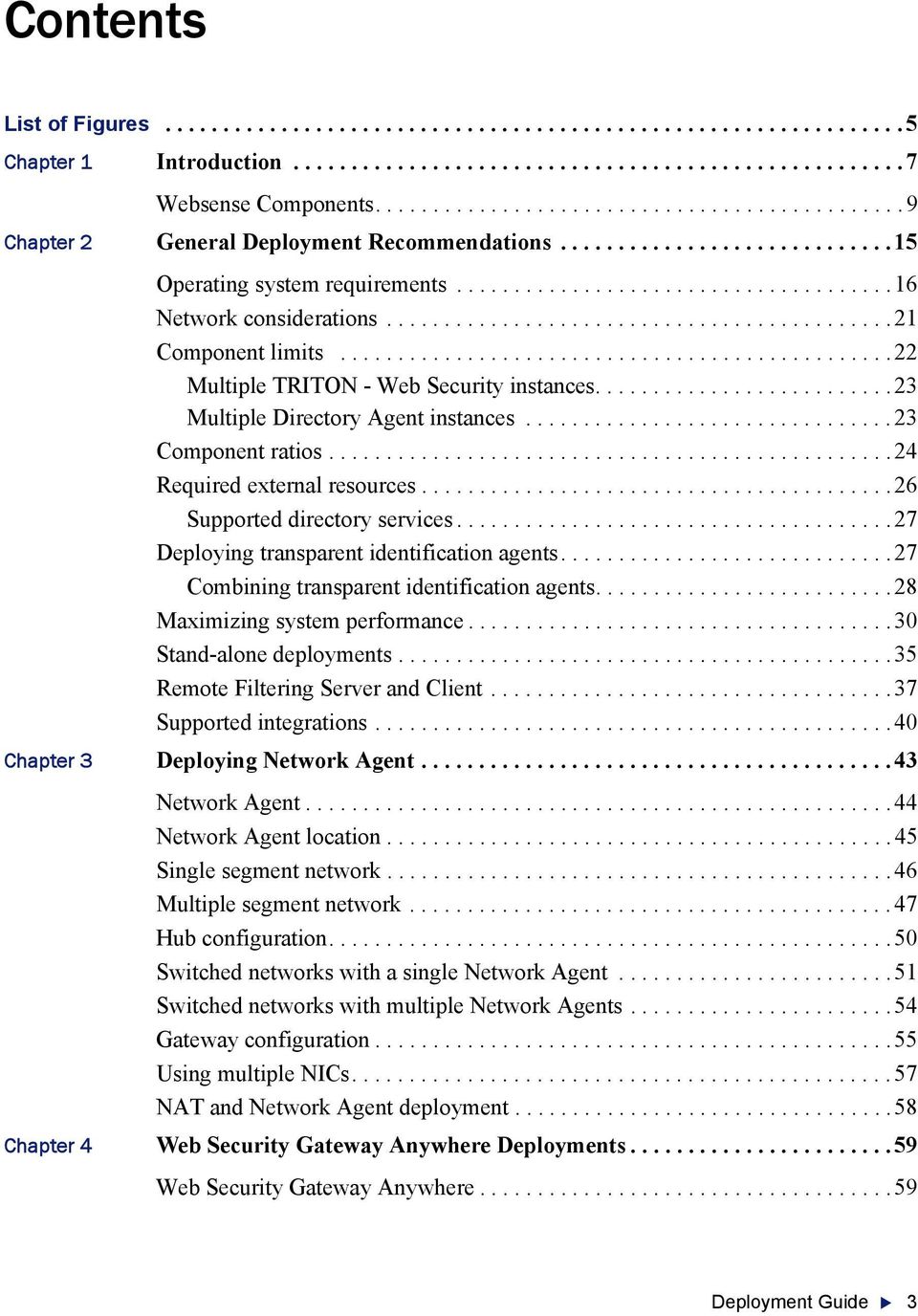
4 Appliance configuration Software configuration Websense Content Gateway requirements Data Security Management Server requirements Network diagram - appliance Network diagram - software Chapter 5 Integration Deployment Websense Content Gateway Microsoft ISA Server or Forefront TMG Cisco deployment Check Point Squid Web Proxy Cache deployment Citrix Universal integration Chapter 6 Distributed Enterprise Deployments Basic Network Topology Websense Web Security and Web Security Gateway Websense Web Security Gateway Anywhere Filtering Remote Sites Deployment models Sites in a region Expanding sites in a region National or worldwide offices Secure VPN connections Calculating TCP connections Calculating connections Optimizing network performance Internet Connection Speed Distance from the Websense filtering machine Hardware performance Index Websense Web Security Solutions

5 List of Figures Figure 1: Example of Remote Filtering Deployment...39 Figure 2: Websense software in a single-segment network...46 Figure 3: Websense software in a multiple-segment network...48 Figure 4: Multiple Network Agents in a multiple-segment network...49 Figure 5: Network Agent connected to a hub...50 Figure 6: Simple deployment in a switched environment...51 Figure 7: Multiple segments in a switched environment...52 Figure 8: Switched environment with a remote office connection...53 Figure 9: Multiple Network Agents in a switched environment...54 Figure 10: Network Agent installed on the gateway...55 Figure 11: Network Agent deployed with Websense Content Gateway...56 Figure 12: Dual NIC configuration...58 Figure 13: Websense Web Security Gateway Anywhere on appliance...65 Figure 14: Websense Web Security Gateway Anywhere as software...65 Figure 15: Integration with Websense Content Gateway...69 Figure 16: Filtering components installed with Microsoft ISA Server...71 Figure 17: Filtering components installed separately from Microsoft ISA Server/Forefront TMG72 Figure 18: Microsoft ISA Server/Forefront TMG array configuration...73 Figure 19: Common Windows Network Configuration for Cisco PIX Firewall or ASA.74 Figure 20: Common Windows network configuration for Cisco Content Engine...75 Figure 21: Common Windows network configuration for Cisco IOS Routers...76 Figure 22: Simple network configuration...77 Figure 23: Multi-segment network configuration...78 Figure 24: Filtering components installed with Squid Web Proxy Cache...80 Figure 25: Filtering components and Squid Web Proxy Cache on separate machines...81 Figure 26: Squid Web Proxy Cache array configuration # Figure 27: Squid Web Proxy Cache array configuration # Figure 28: Citrix integration...85 Figure 29: Common network configuration...86 Figure 30: Remote site topology in a decentralized network (Websense Web Security).88 Figure 31: Remote site topology in a decentralized network (Websense Web Security Gateway)89 Figure 32: Remote site topology in a decentralized network (Websense Web Security Gateway Anywhere)90 Figure 33: Filtering a remote-site client machine (Websense Web Security and Web Security Gateway)92 Deployment Guide 5

6 Figure 34: Filtering a remote-site client machine (Websense Web Security Gateway Anywhere)93 Figure 35: Multiple offices in a region...95 Figure 36: Multiple sites in a region...96 Figure 37: Single main site, multiple remote sites (Websense Web Security Gateway Anywhere)98 Figure 38: Multiple large sites (Websense Web Security Gateway Anywhere) Websense Web Security Solutions

7 1 Introduction Use this guide to plan your Websense software deployment before installation. The guide provides an overview of how Websense software can be deployed in a network, as well as operating system and hardware requirements. This guide applies to version 7.5 of Websense Web Security Gateway Anywhere, Web Security Gateway, Websense Web Security, and Websense Web Filter. The term Websense software is used to refer to all or any of these solutions. When information or instructions apply to particular solutions, they are referred to individually by name. Note The technical papers and other documents mentioned in this guide are available from the Documentation > Planning, Installation, and Upgrade folder in the Websense Knowledge Base ( Websense software consists of components that work together to monitor Internet requests, log activity, apply Internet usage filters, and report on activity. Websense software is highly-distributable, providing the flexibility to scale a deployment to suit your needs. Components can be installed together on one machine for smaller organizations; or they can be distributed across mutliple machines, and multiple sites, to create a high-performing deployment for larger organizations. The appropriate deployment is determined by network size and configuration, Internet request volume, hardware performance, and filtering needs. This manual provides system recommendations to optimize Websense component performance. Performance can also be improved by using more powerful machines for resource-intensive components. This chapter introduces Websense filtering, reporting, and interoperability components. See also: Chapter 2: General Deployment Recommendations operating system requirements for running Websense components, component limits, tips for maximizing performance, plus recommendations for deploying transparent identification agents, Remote Filtering, and Websense software as a stand-alone installation. Version requirements are also included for various integrations. Deployment Guide 7

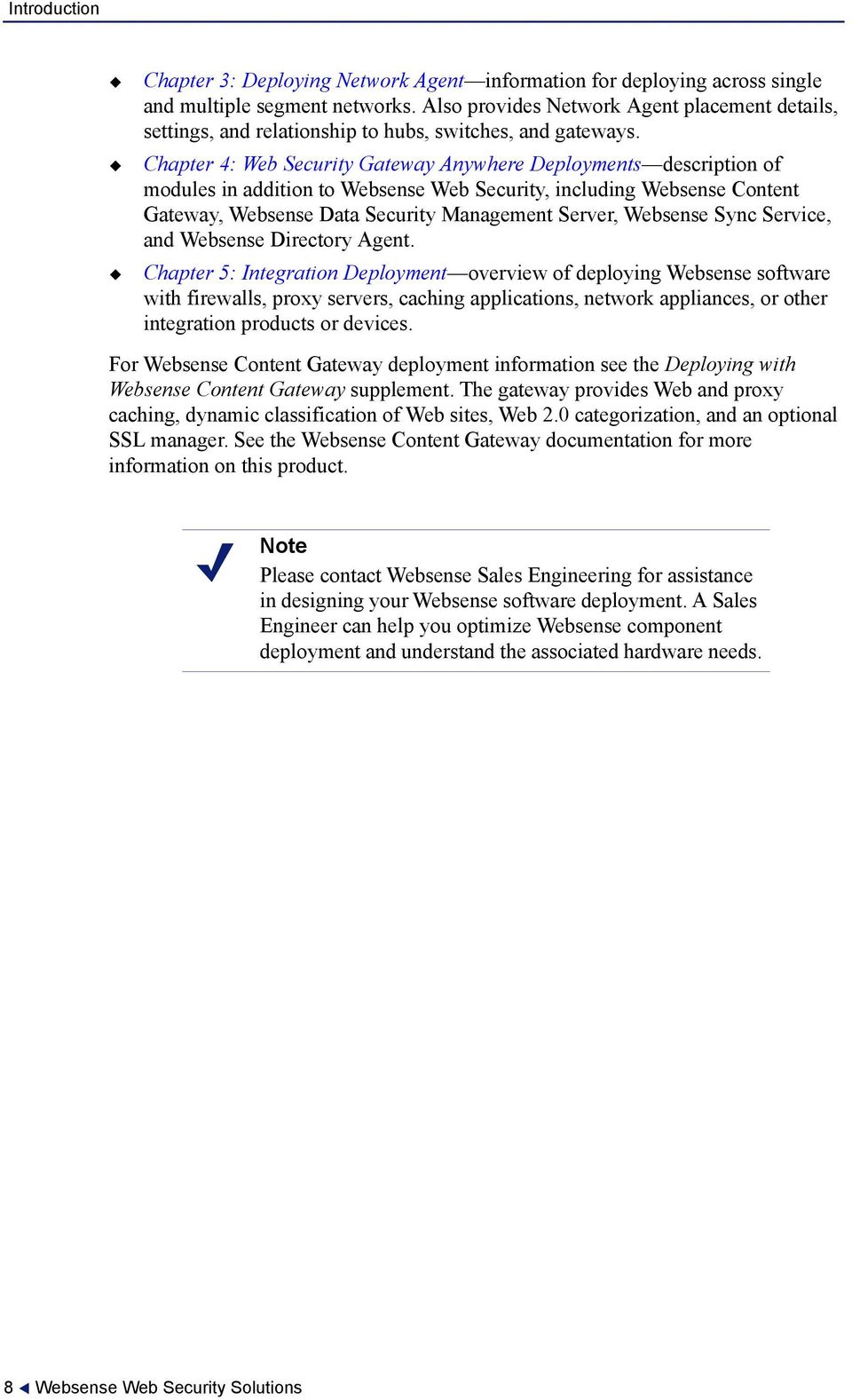
8 Introduction Chapter 3: Deploying Network Agent information for deploying across single and multiple segment networks. Also provides Network Agent placement details, settings, and relationship to hubs, switches, and gateways. Chapter 4: Web Security Gateway Anywhere Deployments description of modules in addition to Websense Web Security, including Websense Content Gateway, Websense Data Security Management Server, Websense Sync Service, and Websense Directory Agent. Chapter 5: Integration Deployment overview of deploying Websense software with firewalls, proxy servers, caching applications, network appliances, or other integration products or devices. For Websense Content Gateway deployment information see the Deploying with Websense Content Gateway supplement. The gateway provides Web and proxy caching, dynamic classification of Web sites, Web 2.0 categorization, and an optional SSL manager. See the Websense Content Gateway documentation for more information on this product. Note Please contact Websense Sales Engineering for assistance in designing your Websense software deployment. A Sales Engineer can help you optimize Websense component deployment and understand the associated hardware needs. 8 Websense Web Security Solutions
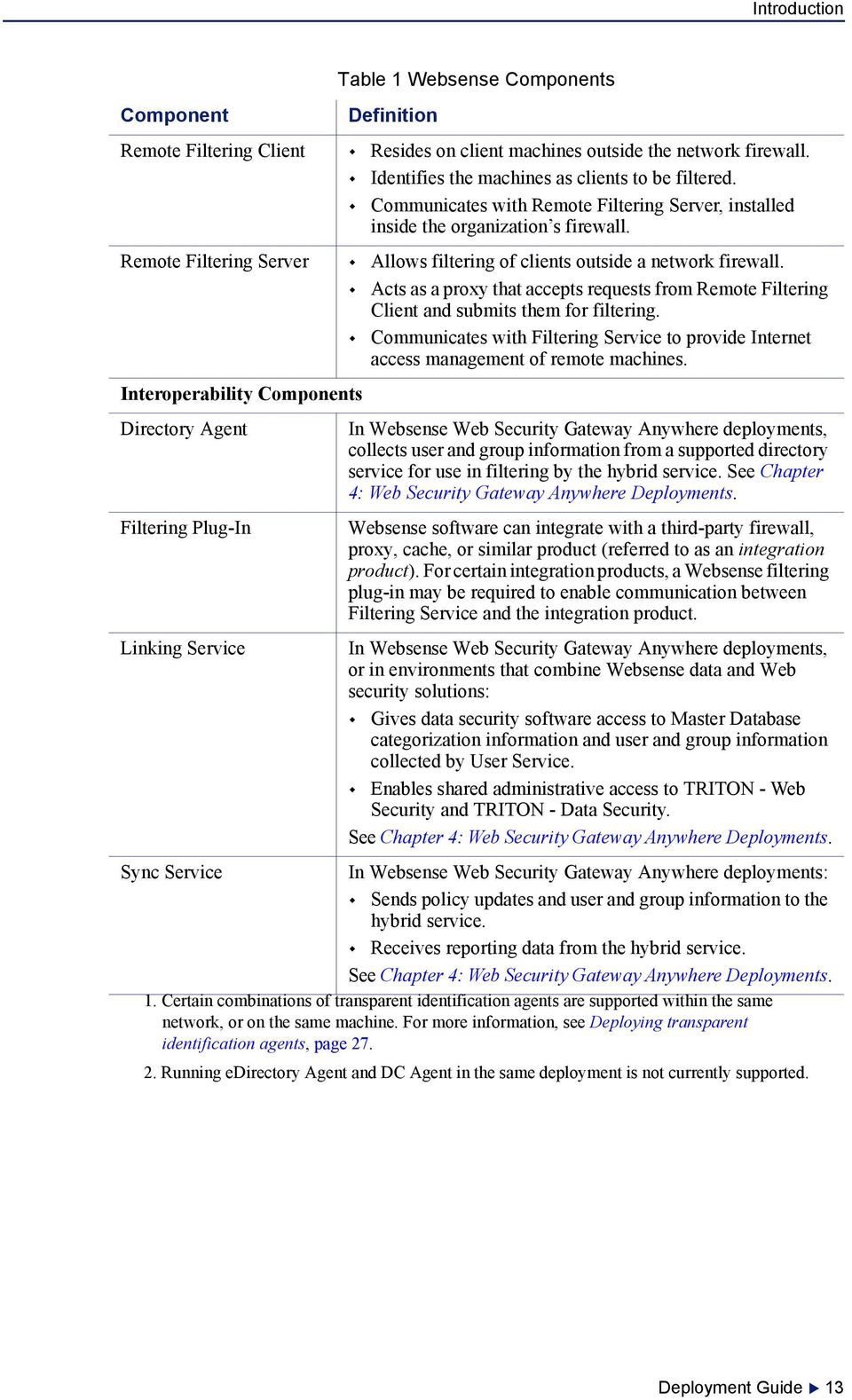
9 Introduction Websense Components Table 1 provides a brief description of the Websense components. This table groups the components into core (included in a standard deployment), reporting, optional, and interoperability (allowing communication and interaction between Web security components, data security components, and the hybrid service in a Websense Web Security Gateway Anywhere deployment). Review these descriptions to better understand the interaction between components. See Table 2, on page 16, and Table 3, on page 20, for information on the operating system versions needed to run these components. NOTE Certain integrations include Websense filtering plug-ins. These are discussed in Table 7, on page 40. Table 1 Websense Components Component Core Components Policy Database Policy Broker Definition Stores global Websense software settings (configured in TRITON - Web Security) and policy information (including clients, filters, and filter components). Policy Database is installed in the background with Policy Broker. Policy Database stores policy-related data; configuration data is stored separately, by Policy Server. In multiple Policy Server environments, a single Policy Database holds policy and general configuration data for multiple Policy Servers. Manages requests from Websense components for policy and general configuration information stored in the Policy Database. A deployment can have only one Policy Broker, which is bundled with Policy Database. Deployment Guide 9
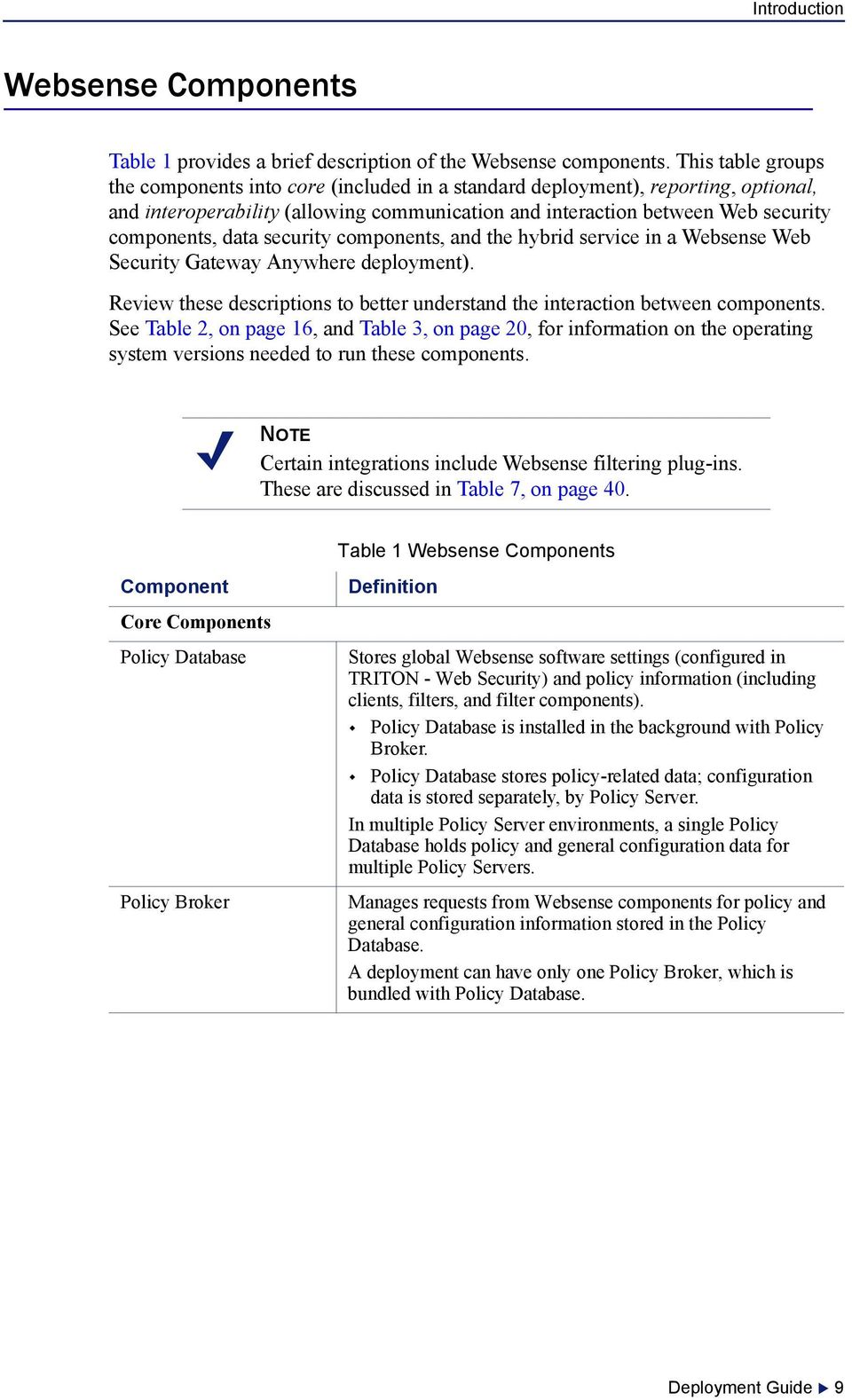
10 Introduction Component Table 1 Websense Components Definition Policy Server Identifies and tracks the location and status of other Websense components in a deployment. Logs event messages for Websense components. Stores configuration information specific to a single Policy Server instance. Communicates configuration data to Filtering Service for use in filtering Internet requests. Policy and most configuration settings are shared between Policy Servers that share a Policy Database. Policy Server is typically installed on the same machine as Filtering Service. Large or distributed environments can include multiple Policy Servers. Each Policy Server may communicate with up to 10 Filtering Services (see Filtering Services per Policy Server, page 25). Filtering Service Works with Network Agent or an integration product to provide Internet filtering. When a user requests a site, Filtering Service receives the request and determines which policy applies. Filtering Service must be running for Internet requests to be filtered and logged. Each Filtering Service instance downloads its own copy of the Websense Master Database. Filtering Service is typically installed on the same machine as Policy Server. Large or distributed environments may include multiple Filtering Service instances, up to 10 per Policy Server (see Filtering Services per Policy Server, page 25). Network Agent Works with Filtering Service to enable protocol management, bandwidth-based filtering, and reporting on bytes transferred. In a stand-alone deployment, enables HTTP and non-http filtering In an integrated deployment, enables filtering for protocols not managed by your integration product and provides enhanced logging information A deployment may have up to 4 Network Agents per Filtering Service (see Network Agents per Filtering Service, page 24). Master Database Includes millions of Web sites, sorted into more than 90 categories and subcategories Contains more than 100 protocol definitions for use in filtering protocols Download the Websense Master Database to activate Internet filtering, and make sure that the database is kept up-to-date. If the Master Database is more than 2 weeks old, no filtering can occur. A copy of the Master Database is downloaded by each Filtering Service instance. 10 Websense Web Security Solutions

11 Introduction Table 1 Websense Components Component TRITON - Web Security Usage Monitor User Service Control Service Reporting Components Log Database (requires a supported database engine) Definition Serves as the configuration and management interface to Websense Web Security software. A deployment can have only one instance of TRITON - Web Security per Policy Broker. (Additional, non-reporting instances are possible, but only in a specific configuration, see Multiple TRITON - Web Security instances, page 23.) Use TRITON - Web Security to define and customize Internet access policies, add or remove filtering clients, configure Websense software components, generate reports, and more. Enables alerting based on Internet usage. Usage Monitor tracks URL category and protocol access, and generates alert messages according to the alerting behavior you have configured. Alerts can be sent via or on-screen display, or an SNMP alert can be sent to an SNMP Trap Server. A deployment can have only one Usage Monitor per Policy Server. Communicates with an LDAP or NTLM-based directory service to apply filtering policies based on users, groups, domains, and organizational units. A deployment can have only one User Service per Policy Server. The directory service is not a Websense product or component. Tracks the installation, configuration, and removal of Websense components and services on a particular machine. Control Service is automatically installed upon installation of any Websense component. Stores Internet request data collected by Log Server for use by Websense reporting tools. The database is created when Log Server is installed. TRITON - Web Security communicates with Log Database to generate Investigative and Presentation Reports, and populate Today and History charts. Reporting components require either Microsoft SQL Server or MSDE. (MSDE can be installed from the Websense Web site.) Note that SQL Server Express is not supported, and that MSDE is not supported on Windows Deployment Guide 11

12 Introduction Table 1 Websense Components Component Log Server Definition Logs Internet request data, including: The request source The category or protocol associated with the request Whether the request was permitted or blocked Whether keyword blocking, file type blocking, quota allocations, bandwidth levels, or password protection were applied Log Server can log to only one Log Database at a time, and only one Log Server can be installed for each Policy Server. Environments with a high volume of Internet activity should place Log Server on a separate machine. Log Server processing can consume considerable system resources. Optional Components 1 Offers transparent user identification for users in a DC Agent Windows-based directory service. Polls domain controllers in the network to transparently identify users. Communicates with User Service to provide up-to-date user logon session information to Websense software for use in filtering. 1, 2 Works with Novell edirectory to transparently identify edirectory Agent users. Gathers user logon session information from Novell edirectory, which authenticates users logging on to the network. Associates each authenticated user with an IP address, and then works with User Service to supply the information to Filtering Service. 1 Logon Agent Provides unsurpassed accuracy in transparent user identification in Linux and Windows networks. Does not rely on a directory service or other intermediary when capturing user logon sessions. Detects user logon sessions as they occur. Logon Agent communicates with Logon Application on client machines to ensure that individual user logon sessions are captured and processed directly by Websense software. Logon Application RADIUS Agent 1 Works with Logon Agent. Runs from a logon script on a domain controller to capture logon sessions as users log on to, or log off of, Windows domains in the network. Logon Application, LogonApp.exe, runs as a process on client Windows machines. Upon log on, Logon Application identifies the user and sends the information to Logon Agent. Enables transparent identification of users who use a dial-up, Virtual Private Network (VPN), Digital Subscriber Line (DSL), or other remote connection to access the network. 12 Websense Web Security Solutions
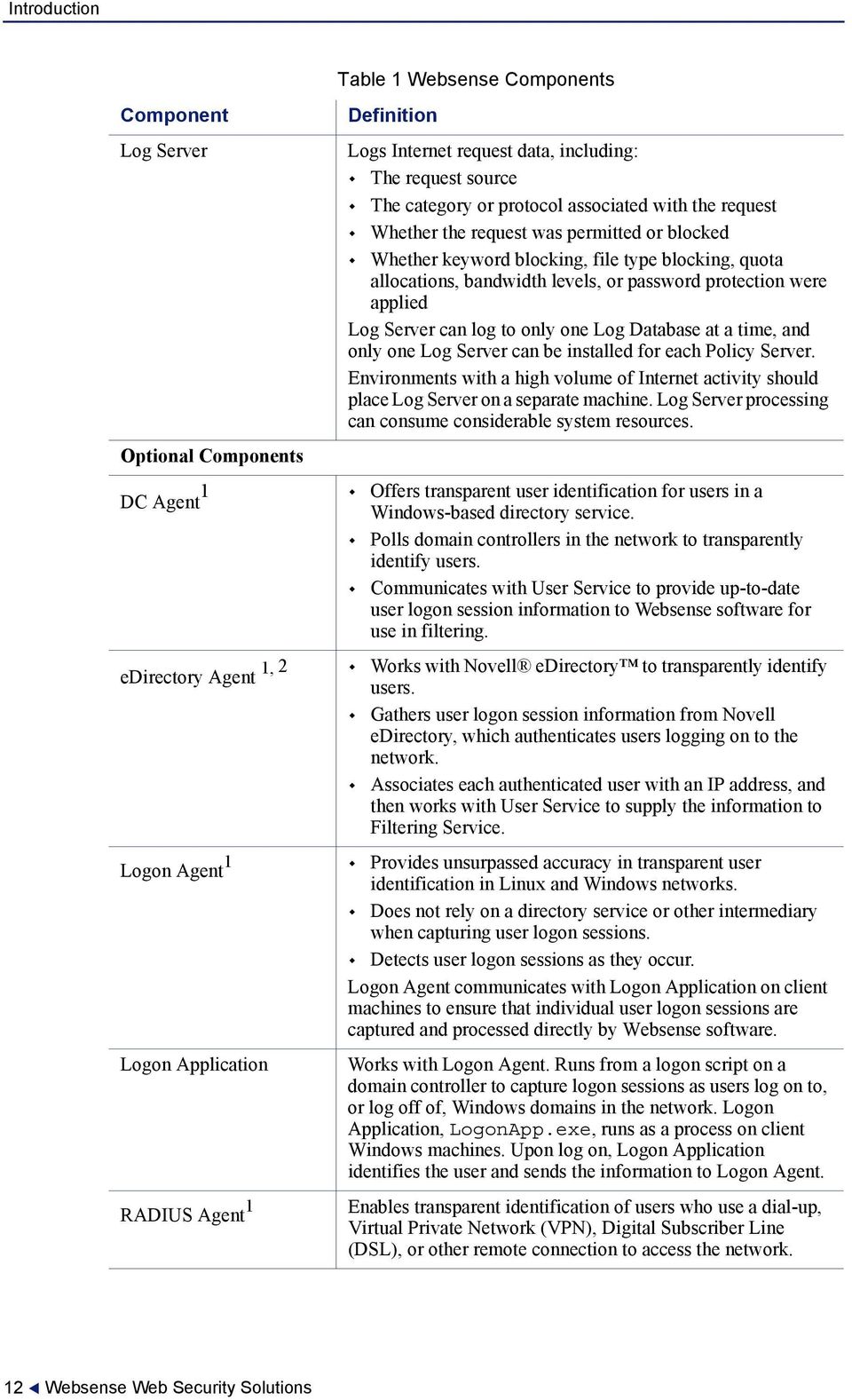
13 Introduction Component Table 1 Websense Components Definition Remote Filtering Client Resides on client machines outside the network firewall. Identifies the machines as clients to be filtered. Communicates with Remote Filtering Server, installed inside the organization s firewall. Remote Filtering Server Allows filtering of clients outside a network firewall. Acts as a proxy that accepts requests from Remote Filtering Client and submits them for filtering. Communicates with Filtering Service to provide Internet access management of remote machines. Interoperability Components Directory Agent In Websense Web Security Gateway Anywhere deployments, collects user and group information from a supported directory service for use in filtering by the hybrid service. See Chapter 4: Web Security Gateway Anywhere Deployments. Filtering Plug-In Websense software can integrate with a third-party firewall, proxy, cache, or similar product (referred to as an integration product). For certain integration products, a Websense filtering plug-in may be required to enable communication between Filtering Service and the integration product. Linking Service In Websense Web Security Gateway Anywhere deployments, or in environments that combine Websense data and Web security solutions: Gives data security software access to Master Database categorization information and user and group information collected by User Service. Enables shared administrative access to TRITON - Web Security and TRITON - Data Security. See Chapter 4: Web Security Gateway Anywhere Deployments. Sync Service In Websense Web Security Gateway Anywhere deployments: Sends policy updates and user and group information to the hybrid service. Receives reporting data from the hybrid service. See Chapter 4: Web Security Gateway Anywhere Deployments. 1. Certain combinations of transparent identification agents are supported within the same network, or on the same machine. For more information, see Deploying transparent identification agents, page Running edirectory Agent and DC Agent in the same deployment is not currently supported. Deployment Guide 13
14 Introduction 14 Websense Web Security Solutions

15 2 General Deployment Recommendations Before deploying Websense software, ensure that your hardware and network configuration meet the recommendations provided in this document. This chapter focuses on: Operating system requirements Component limits Component ratios Required external resources Deploying transparent identification agents Maximizing system performance Stand-alone deployments Remote Filtering Server and Client Supported integrations See Websense Components, page 9, for descriptions of Websense components. Note that Websense filtering is based on protocols (like HTTP and FTP), not on the operating system of the computer being filtered. Note Websense software supports only TCP/IP-based networks. If your network uses both TCP/IP- and non-ip-based network protocols, only users in the TCP/IP portion of the network are filtered. Deployment Guide 15
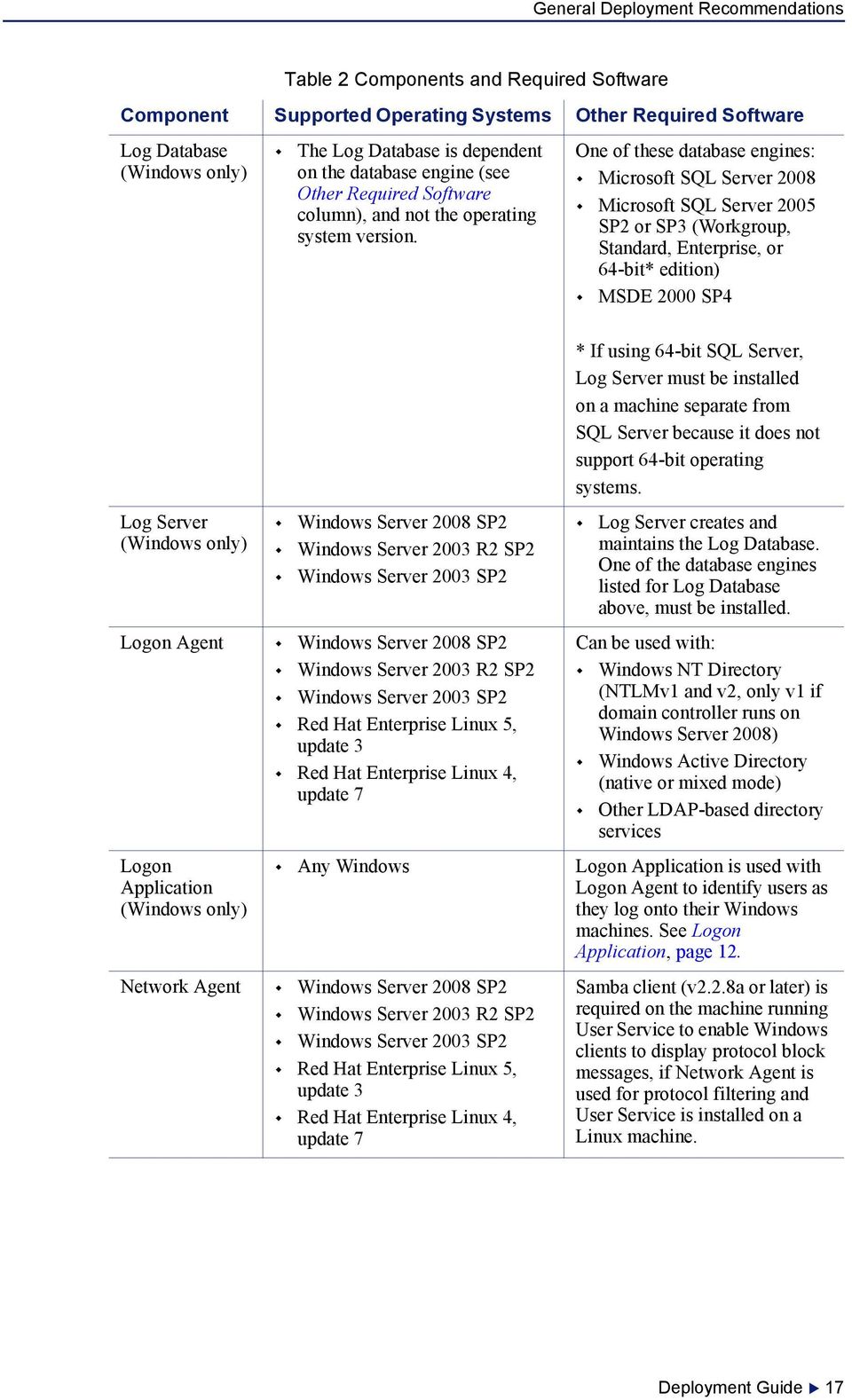
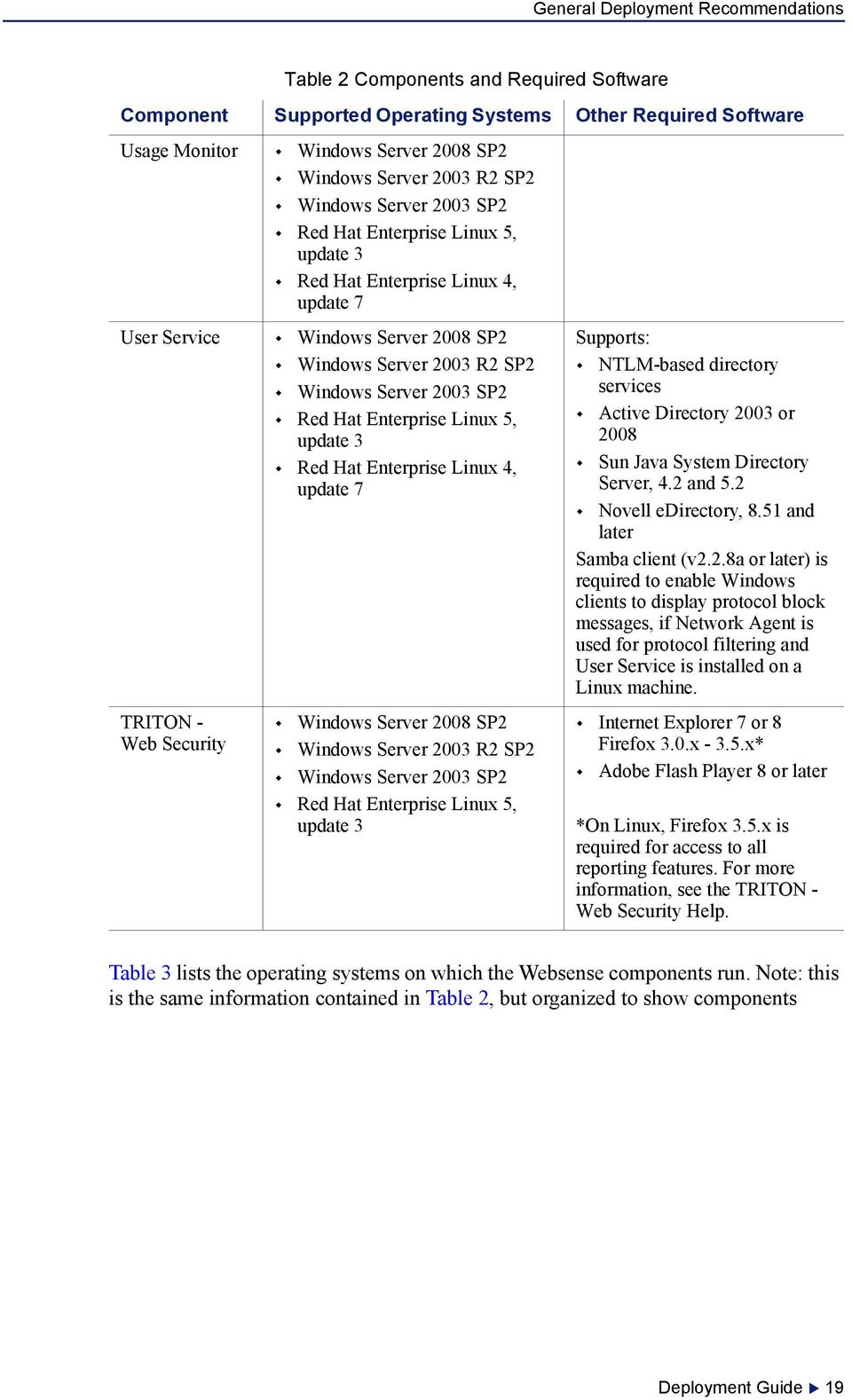
16 General Deployment Recommendations Operating system requirements The tables in this section list the operating systems supported by Websense components. They also list any applications required by Websense components. Table 2 lists each component and its supported operating systems, along with other software required to run the component. Table 3, on page 20, organizes the requirements by operating system. Table 7, on page 40, lists the supported integration versions. Table 2 Components and Required Software Component Supported Operating Systems Other Required Software Note: Unless otherwise stated, only 32-bit versions of operating systems are supported. DC Agent Windows Server 2008 SP2 Windows Server 2003 SP2 Windows Server 2003 R2 SP2 Directory Agent Windows Server 2008 SP2 Windows Server 2003 R2 SP2 Windows Server 2003 SP2 Red Hat Enterprise Linux 5, update 3 Red Hat Enterprise Linux 4, update 7 One of these directory services: Windows Active Directory Windows NT Directory One of these directory services: Windows Active Directory 2003 or 2008 Novell edirectory 8.51 or later edirectory Agent Windows Server 2008 SP2 Windows Server 2003 R2 SP2 Windows Server 2003 SP2 Red Hat Enterprise Linux 5, update 3 Red Hat Enterprise Linux 4, update 7 Novell edirectory 8.51 or later NMAS authentication is supported. Recommend Novell Client v4.83 or v4.9 (v4.81 and later are supported) Filtering Service Windows Server 2008 SP2 Windows Server 2003 R2 SP2 Windows Server 2003 SP2 Red Hat Enterprise Linux 5, update 3 Red Hat Enterprise Linux 4, update 7 If Network Agent is used for protocol filtering and User Service is installed on a Linux machine, Samba client (v2.2.8a or later) is required on the User Service machine to allow Windows clients to display protocol block messages. Linking Service (Windows only) Windows Server 2008 SP2 Windows Server 2003 R2 SP2 Windows Server 2003 SP2 16 Websense Web Security Solutions
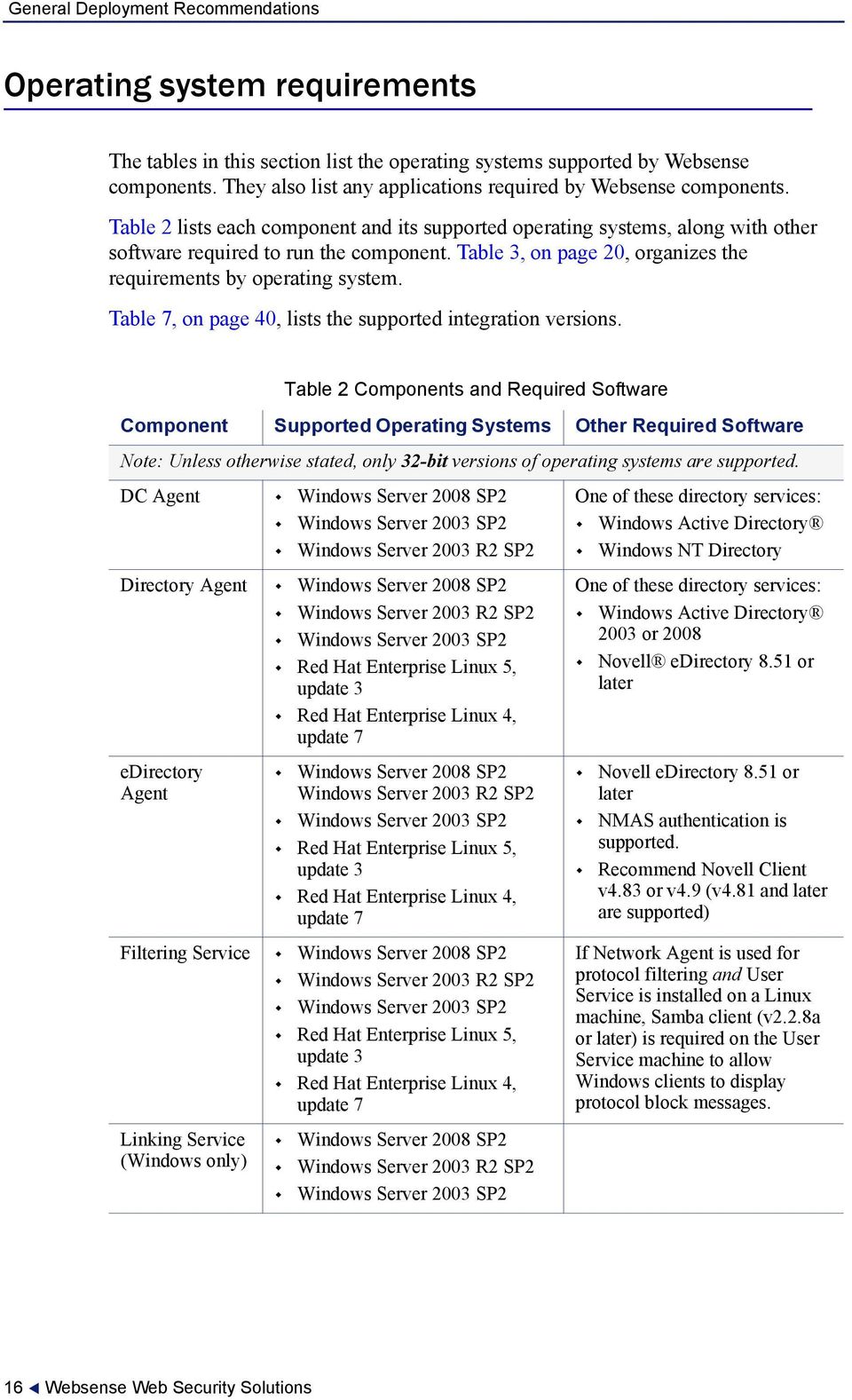
17 General Deployment Recommendations Table 2 Components and Required Software Component Supported Operating Systems Other Required Software Log Database (Windows only) The Log Database is dependent on the database engine (see Other Required Software column), and not the operating system version. One of these database engines: Microsoft SQL Server 2008 Microsoft SQL Server 2005 SP2 or SP3 (Workgroup, Standard, Enterprise, or 64-bit* edition) MSDE 2000 SP4 Log Server (Windows only) Windows Server 2008 SP2 Windows Server 2003 R2 SP2 Windows Server 2003 SP2 * If using 64-bit SQL Server, Log Server must be installed on a machine separate from SQL Server because it does not support 64-bit operating systems. Log Server creates and maintains the Log Database. One of the database engines listed for Log Database above, must be installed. Logon Agent Windows Server 2008 SP2 Windows Server 2003 R2 SP2 Windows Server 2003 SP2 Red Hat Enterprise Linux 5, update 3 Red Hat Enterprise Linux 4, update 7 Can be used with: Windows NT Directory (NTLMv1 and v2, only v1 if domain controller runs on Windows Server 2008) Windows Active Directory (native or mixed mode) Other LDAP-based directory services Logon Application (Windows only) Any Windows Logon Application is used with Logon Agent to identify users as they log onto their Windows machines. See Logon Application, page 12. Network Agent Windows Server 2008 SP2 Windows Server 2003 R2 SP2 Windows Server 2003 SP2 Red Hat Enterprise Linux 5, update 3 Red Hat Enterprise Linux 4, update 7 Samba client (v2.2.8a or later) is required on the machine running User Service to enable Windows clients to display protocol block messages, if Network Agent is used for protocol filtering and User Service is installed on a Linux machine. Deployment Guide 17
18 General Deployment Recommendations Table 2 Components and Required Software Component Supported Operating Systems Other Required Software Policy Broker Windows Server 2008 SP2 Windows Server 2003 R2 SP2 Windows Server 2003 SP2 Red Hat Enterprise Linux 5, update 3 Red Hat Enterprise Linux 4, update 7 Policy Server Windows Server 2008 SP2 Windows Server 2003 R2 SP2 Windows Server 2003 SP2 Red Hat Enterprise Linux 5, update 3 Red Hat Enterprise Linux 4, update 7 RADIUS Agent Windows Server 2008 SP2 Windows Server 2003 R2 SP2 Windows Server 2003 SP2 Red Hat Enterprise Linux 5, update 3 Red Hat Enterprise Linux 4, update 7 Most standard RADIUS servers are supported. The following servers have been tested: Microsoft IAS Merit AAA Livingston (Lucent) 2.x Cistron RADIUS server NMAS authentication Remote Filtering Client Remote Filtering Server Windows 7 Windows XP SP3 Windows Vista SP2 Windows Server 2008 SP2 Windows Server 2003 R2 SP2 Windows Server 2003 SP2 Red Hat Enterprise Linux 5, update 3 Red Hat Enterprise Linux 4, update 7 Sync Service Windows Server 2008 SP2 Windows Server 2003 R2 SP2 Windows Server 2003 SP2 Red Hat Enterprise Linux 5, update 3 Red Hat Enterprise Linux 4, update 7 18 Websense Web Security Solutions

19 General Deployment Recommendations Table 2 Components and Required Software Component Supported Operating Systems Other Required Software Usage Monitor Windows Server 2008 SP2 Windows Server 2003 R2 SP2 Windows Server 2003 SP2 Red Hat Enterprise Linux 5, update 3 Red Hat Enterprise Linux 4, update 7 User Service Windows Server 2008 SP2 Windows Server 2003 R2 SP2 Windows Server 2003 SP2 Red Hat Enterprise Linux 5, update 3 Red Hat Enterprise Linux 4, update 7 Supports: NTLM-based directory services Active Directory 2003 or 2008 Sun Java System Directory Server, 4.2 and 5.2 Novell edirectory, 8.51 and later Samba client (v2.2.8a or later) is required to enable Windows clients to display protocol block messages, if Network Agent is used for protocol filtering and User Service is installed on a Linux machine. TRITON - Web Security Windows Server 2008 SP2 Windows Server 2003 R2 SP2 Windows Server 2003 SP2 Red Hat Enterprise Linux 5, update 3 Internet Explorer 7 or 8 Firefox 3.0.x x* Adobe Flash Player 8 or later *On Linux, Firefox 3.5.x is required for access to all reporting features. For more information, see the TRITON - Web Security Help. Table 3 lists the operating systems on which the Websense components run. Note: this is the same information contained in Table 2, but organized to show components Deployment Guide 19
20 General Deployment Recommendations grouped by common operating systems. The same component may appear multiple times because it supports multiple operating systems. Table 3 Operating Systems Operating System Component Microsoft Windows (32-bit versions supported only) Windows Server 2008 SP2 Windows Server 2003 R2 SP2 Windows Server 2003 SP2 Windows 7 Windows XP SP3 Windows Vista SP2 All Websense components: Log Database (Microsoft SQL Server or MSDE database engine; note: MSDE is not supported on Windows Server 2008) DC Agent Directory Agent edirectory Agent Explorer Filtering Plug-in Filtering Service Linking Service Log Server Logon Agent Logon Application Network Agent Policy Server RADIUS Agent Remote Filtering Client Remote Filtering Server Sync Service Usage Monitor User Service TRITON - Web Security Remote Filtering Client Any Windows Logon Application 20 Websense Web Security Solutions

21 General Deployment Recommendations Table 3 Operating Systems Operating System Component Linux (32-bit versions supported only) Red Hat Enterprise Linux 5, update 3 Red Hat Enterprise Linux 4, update 7 Directory Agent edirectory Agent Filtering Plug-in Filtering Service Logon Agent Network Agent Policy Broker Policy Server RADIUS Agent Remote Filtering Server Sync Service Usage Monitor User Service TRITON - Web Security (supports only Red Hat Enterprise Linux 5, update 3) Network considerations To ensure effective filtering, Websense software must be installed so that: Filtering Service can receive HTTP requests from Websense Content Gateway; an integrated firewall, proxy server, caching application; or Network Agent. In a multi-segmented network, Filtering Service must be installed in a location where it can both receive and manage Internet requests from the integration product and communicate with Network Agent. Network Agent: Must be deployed where it can see all internal Internet traffic for the machines that it is assigned to monitor. Can be installed on a dedicated machine to increase overall throughput. Must have bidirectional visibility into Internet traffic to filter non-http requests (such as instant messaging, chat, streaming media, and other Internet applications and protocols). Multiple instances of Network Agent may be required in larger or distributed networks. Each Network Agent monitors a specific IP address range or network segment. Using multiple Network Agents ensures that all network traffic is monitored, and prevents server overload. The required number of Network Agents depends on network size and Internet request volume. For more information, see Chapter 3: Deploying Network Agent. Deployment Guide 21
22 General Deployment Recommendations As a network grows and the number of Internet requests increases, components can be deployed to additional, non-dedicated machines to improve processing performance on the dedicated machines. You can deploy multiple Filtering Service instances, connected to one Policy Server. This is useful for remote or isolated sub-networks. Because a maximum of 10 Filtering Service instances per Policy Server is recommended (see Filtering Services per Policy Server, page 25) multiple Policy Servers may be needed. Note Network Agent can be deployed with the filtering components or on a separate machine. Network Agent should not be deployed on the same machine as responsecritical components. For more information, see Chapter 3: Deploying Network Agent. IMPORTANT Do not install Websense components on a firewall machine. Component limits In the case of certain components, there can be only one instance of particular dependent components. When deploying Websense software, the following restrictions must be considered. NOTE Even when the number of dependent components is not limited to one, there are best practice component-todependent-component ratios. See Component ratios, page 24. Per entire deployment: One Policy Broker One Sync Service (Websense Web Security Gateway Anywhere deployments) Per Policy Broker: One TRITON - Web Security (only one instance for reporting, other administration-only instances may be deployed; see Multiple TRITON - Web Security instances below) 22 Websense Web Security Solutions
23 General Deployment Recommendations Per Policy Server: One Log Server One User Service One Usage Monitor One Directory Agent (Websense Web Security Gateway Anywhere deployments; see Multiple Directory Agent instances below for additional information) Per Filtering Service: One primary Remote Filtering Server Multiple TRITON - Web Security instances There can be only one instance of TRITON - Web Security that generates and schedules reports. Typically, only one instance is needed in a deployment. It is possible to install additional instances of TRITON - Web Security in a deployment. However, these must be used as configuration- and administration-only instances (referred to as administration-only instances). They cannot be used to generate reports. Each administration-only instance of TRITON - Web Security must be associated with a separate Policy Server instance that is not associated with a Log Server. Because the administration-only instances are not associated with a Log Server, they will not display Today and History charts. Also, reporting options will not be available. Only configuration and administration functions will be available. Multiple Directory Agent instances Typically, only one Directory Agent instance is required in a deployment. Multiple instances may be deployed if necessary. However, specific configuration of the additional Directory Agent instances is required. See the TRITON - Web Security Help for more information and configuration instructions. Important In a V-Series-Appliance-based deployment of Websense Web Security Gateway Anywhere, be aware that Directory Agent is already installed on the appliance. Additional instances of Directory Agent are not typically necessary. If you need to deploy additional instances, see the TRITON - Web Security Help for important configuration instructions. Deployment Guide 23
24 General Deployment Recommendations Component ratios This section includes best practice component deployment ratios. The optimal deployment may vary based on network configuration and Internet traffic volume. Larger systems (more than 2500 users) may require a more distributed deployment for load balancing and support of multiple languages. Multiple Network Agent instances may be required, for example, to detect outbound traffic on individual network segments. It may be appropriate to install multiple Filtering Service instances for load balancing. Some load balancing configurations allow the same user to be filtered by different Filtering Service instances, depending on the current load. For limits on transparent identification agents, see Deploying transparent identification agents, page 27. For more information about the interaction of Websense components, see the TRITON - Web Security Help. Network Agents per Filtering Service As a best practice, no more than 4 Network Agent instances should be deployed per Filtering Service. One Filtering Service instance may be able to handle more than four Network Agents, depending on the number of Internet requests, but if Filtering Service or Network Agent capacities are exceeded, filtering and logging inconsistencies may occur. Network Agent can typically monitor 50 Mbps of traffic per second, or about 800 requests per second. The number of users that Network Agent can monitor depends on the volume of Internet requests from each user, the configuration of the network, and the location of Network Agent in relation to the computers it is assigned to monitor. Network Agent functions best when it is close to those computers. Contact your Websense software provider for technical assistance with specific Network Agent sizing guidelines. 24 Websense Web Security Solutions
25 General Deployment Recommendations Filtering Services per Policy Server As a best practice, no more than 10 Filtering Service instances should be deployed per Policy Server. A Policy Server instance may be able to handle more, depending on the load. If the number of Filtering Service instances exceeds the Policy Server s capacity, however, responses to Internet requests may be slow. Multiple Filtering Service instances are useful to manage remote or isolated subnetworks. The appropriate number of Filtering Service instances for a Policy Server depends on: The number of users per Filtering Service The configuration of the Policy Server and Filtering Service machines The volume of Internet requests The quality of the network connection between the components If a ping command sent from one machine to another receives a response in fewer than 30 milliseconds (ms), the connection is considered high-quality. See Testing the connection, page 25 for more information. If Filtering Service and Policy Server become disconnected, all Internet requests are either blocked or permitted, depending on which option you have chosen in TRITON - Web Security. For more information, see the Getting Started topic in the TRITON - Web Security Help. Filtering Service machines running behind firewalls or remotely (at a great topological distance communicating through a series of routers) may need their own Policy Server instance. In a multiple Policy Server environment, a single Websense Policy Database holds the policy settings for all Policy Server instances. See the TRITON - Web Security Help for more information. Testing the connection Run a ping test to check the response time and connection between the Policy Server and Filtering Service machines. A response time of fewer than 30 milliseconds is recommended. 1. Open a command prompt (Windows) or terminal session (Linux) on the Policy Server machine. 2. Enter the following command: ping <IP address or hostname> Here, <IP address or hostname> identifies the Filtering Service machine. Deployment Guide 25
26 General Deployment Recommendations Interpreting your results When you run the ping command on a Windows machines, the results resemble the following: C:\>ping Pinging with 32 bytes of data: Reply from : bytes=32 time=14ms TTL=63 Reply from : bytes=32 time=15ms TTL=63 Reply from : bytes=32 time=14ms TTL=63 Reply from : bytes=32 time=15ms TTL=63 Ping statistics for : Packets: Sent = 4, Received = 4, Lost = 0 (0% loss), Approximate round trip times in milli-seconds: Minimum = 14ms, Maximum = 15ms, Average = 14ms In a Linux environment, the results look like this: [root@localhost root]# ping PING ( ) 56(84) bytes of data. 64 bytes from : icmp_seq=2 ttl=127 time=0.417 ms 64 bytes from : icmp_seq=3 ttl=127 time=0.465 ms 64 bytes from : icmp_seq=4 ttl=127 time=0.447 ms 64 bytes from : icmp_seq=1 ttl=127 time=0.854 ms Ensure that Maximum round trip time or the value of time=x.xxx ms is fewer than 30 ms. If the time is greater than 30 ms, move one of the components to a different network location and run the ping test again. If the result is still greater than 30 ms, locate and eliminate the source of the slow response. Required external resources Websense software relies on certain external resources and network characteristics to function properly in your network. TCP/IP: Websense software provides filtering in TCP/IP-based networks only. If your network uses both TCP/IP and non-tcp protocols, only those users in the TCP/IP portion of your network are filtered. DNS server: A DNS server is used to resolve requested URLs to an IP address. Websense software or your integration product requires efficient DNS performance. DNS servers should be fast enough to support Websense filtering without becoming overloaded. Directory services: If Websense software is configured to apply user- and groupbased policies, User Service queries the directory service for user information. Although these users and group relationships are cached by Websense software, directory service machines must have the resources to respond rapidly if Websense software requests user information. See Supported directory services, page Websense Web Security Solutions
27 General Deployment Recommendations Network efficiency: The ability to connect to resources such as the DNS server and directory services is critical to Websense software. Network latency must be minimized if Filtering Service is to perform efficiently. Excessive delays under high load circumstances can impact the performance of Filtering Service and may cause lapses in filtering. Supported directory services If your environment includes a directory service, you can configure Websense software to filter Internet requests based on policies assigned to users, groups, and domains (organizational units). Websense software can work with the following directory services: Windows NT Directory and Windows Active Directory (Mixed Mode) Windows Active Directory (Native Mode) Sun Java System Directory Server Novell edirectory For information on configuring Websense software to communicate with a supported directory service, see the TRITON - Web Security Help. Websense software does not need to run on the same operating system as the directory service. Deploying transparent identification agents If you are using Websense software as a stand-alone deployment, or if your integration product does not send user information to Websense software, use Websense transparent identification agents to identify users without prompting them for a user name and password. There are 4 optional transparent identification agents: DC Agent edirectory Agent Logon Agent RADIUS Agent Note DC Agent must have domain administrator privileges to retrieve user information from the domain controller. If you have deployed Websense software in a single network location, it is a best practice to have a single transparent identification agent instance. In deployments that cover multiple locations, you can install an agent instance in multiple domains. Deployment Guide 27
28 General Deployment Recommendations For example: One DC Agent instance can handle multiple trusted domains. Add additional instances based on: The load placed on DC Agent Whether a DC Agent instance can see all the domains on the network, including remote offices Load results from the number of user logon requests. With a large number of users (10,000+ users, 30+ domains), having multiple DC Agent instances allows for faster identification of users. If multiple Filtering Services are installed, each Filtering Service instance must be able to communicate with all DC Agent instances. One edirectory Agent is required for each edirectory Server. One Logon Agent is required for each Filtering Service instance. One RADIUS Agent instance is required for each RADIUS server. It is a best practice to install and run RADIUS Agent and the RADIUS server on separate machines. (The agent and server cannot have the same IP address, and must use different ports.) In some environments, a combination of transparent identification agents may be appropriate within the same network, or on the same machine. See Combining transparent identification agents, page 28. Refer to the Websense Web Security and Websense Web Filter Installation Guide for transparent identification agent installation instructions. See the TRITON - Web Security Help for detailed configuration information. More information is also available in the Transparent Identification of Users technical white paper. Combining transparent identification agents Websense software can work with multiple transparent identification agents. If your environment requires multiple agents, it is best to install them on separate machines. edirectory or RADIUS Agent can be installed on the same machine as Filtering Service, or on a separate server on the same network. Do not run edirectory Agent and DC Agent in the same deployment. Table 4 lists supported combinations of transparent identification agents. Combination Table 4 Deploying Multiple Transparent ID Agents Same machine? Same network? Configuration required Multiple DC Agents No Yes Ensure that all instances of DC Agent can communicate with Filtering Service, and that the individual DC Agents are not monitoring the same domain controllers. 28 Websense Web Security Solutions
29 General Deployment Recommendations Table 4 Deploying Multiple Transparent ID Agents Combination Multiple RADIUS Agents Multiple edirectory Agents Multiple Logon Agents DC Agent + RADIUS Agent DC Agent + edirectory Agent DC Agent + Logon Agent RADIUS Agent + Logon Agent edirectory Agent + Logon Agent RADIUS Agent + edirectory Agent DC Agent + Logon Agent + RADIUS Agent Same machine? Same network? Configuration required No Yes Configure each agent to communicate with Filtering Service. Multiple instances of the RADIUS Agent cannot be installed on the same machine. No Yes Configure each instance to communicate with Filtering Service. No Yes Configure each instance to communicate with Filtering Service. Yes Yes Configure each agent to use a unique port for communication with Filtering Service. No No Communication with both a Windows directory service and Novel edirectory is not supported in the same deployment. However, both agents can be installed, with only one agent active. Yes Yes Configure both agents to communicate with Filtering Service. By default, each agent uses a unique port, so port conflicts are not an issue unless these ports are changed. Yes Yes Configure all agents to communicate with Filtering Service. No No Communication with both Novell edirectory and a Windows- or LDAP-based directory service in the same deployment is not supported. However, both agents can be installed, with only one agent active. Yes Yes Configure all agents to communicate with Filtering Service. When adding agents to TRITON - Web Security, use an IP address to identify one, and a machine name to identify the other. See the Transparent Identification of Users white paper for details. Yes Yes This combination is rarely required. Configure each agent to use a unique port for communication with Filtering Service. Deployment Guide 29
30 General Deployment Recommendations Maximizing system performance Network Agent Adjust Websense components to improve filtering and logging response time, system throughput, and CPU performance. This section discusses some ways to optimize performance. Network Agent can be installed on the same machine as other Websense components, or on a separate machine. As the number of users grows, or if Network Agent does not block Internet requests as accurately as needed, place Network Agent on a different machine from Filtering Service and Policy Server. You can also add a second Network Agent and divide the network monitoring between the 2 agents. If Websense software is running in a high-load environment, or with a high capacity Internet connection, you can increase throughput and implement load balancing by installing multiple Network Agent instances. Install each agent on a different machine, and configure each agent to monitor a different portion of the network. Important Network Agent must have bidirectional visibility into the network or network segment that it monitors. If multiple Network Agents are installed, each agent must monitor a different network segment (IP address range). If a Network Agent machine connects to a switch, the monitor NIC must plug into a port that mirrors, monitors, or spans the traffic of all other ports. Multiple segment network, page 47, and Network Agent location, page 45, discuss locating Network Agent in more detail. HTTP reporting You can use Network Agent or an integration product to track HTTP requests and pass the information to Websense software, which uses the data to filter and log requests. Network Agent and some integration products also track bandwidth activity (bytes sent and received), and the duration of each permitted Internet request. This data is also passed to Websense software for logging. When both Network Agent and the integration partner provide logging data, the amount of processor time required by Filtering Service increases. If you are using both Network Agent and an integration product, you can avoid extra processing by configuring Websense software to use Network Agent to log HTTP 30 Websense Web Security Solutions
31 General Deployment Recommendations requests (enhanced logging). When this feature is enabled, Websense software does not log HTTP request data sent by the integration product. Only the log data provided by Network Agent is recorded. Consult the TRITON - Web Security Help for configuration instructions. Database Engine The Websense Log Database can be created and maintained by any of the following database engines: Microsoft SQL Server 2008 Microsoft SQL Server 2005 Microsoft Database Engine (MSDE) 2000 Note See the software requirements for Log Database in Table 2, on page 16 for specific SQL Server or MSDE version and service pack requirements. Log Server logs Internet activity information to only one Log Database at a time. Microsoft SQL Server Microsoft SQL Server works best for larger networks, or networks with a high volume of Internet activity, because of its capacity for storing large amounts of data over longer periods of time (several weeks or months). Deployment Guide 31
32 General Deployment Recommendations Under high load, Microsoft SQL Server operations are resource intensive, and can be a performance bottleneck for Websense software reporting. You can tune the database to improve performance, and maximize the hardware on which the database runs: If Log Server is installed on the database-engine machine, alleviate resource conflicts between Log Server and Microsoft SQL Server by increasing the CPU speed and/or the number of CPUs. Provide adequate disk space to accommodate the growth of the Log Database. Microsoft SQL Client Tools can be used to check database size. Use a disk array controller with multiple drives to increase I/O bandwidth. Increase the RAM on the Microsoft SQL Server machine to reduce timeconsuming disk I/O operations. Note Consult Microsoft documentation for detailed information about optimizing Microsoft SQL Server performance. MSDE Microsoft Database Engine (MSDE) is a free database engine best-suited to smaller networks, organizations with a low volume of Internet activity, or organizations planning to generate reports on only short periods of time (for example, daily or weekly archived reports, rather than historical reports over longer time periods). MSDE cannot be optimized. With MSDE, the maximum size of the Log Database is approximately 1.5 GB. When the existing database reaches this limit, it is saved (rolled over), and a new Log Database is created. Use the ODBC Data Source Administrator (accessed via Windows Control Panel) to see information about databases that have been saved. If the Log Database is rolling over frequently, consider upgrading to Microsoft SQL Server. Note Consult the Websense Web Security and Websense Web Filter Installation Guide for detailed information about selecting the appropriate database engine for the deployment. When using MSDE, make sure that the latest service packs have been applied. See the software requirements for Log Database in Table 2, on page 16 for specific MSDE version and service pack requirements. Microsoft SQL Server service packs can be applied to MSDE The service pack updates only those files relevant to MSDE. 32 Websense Web Security Solutions
33 General Deployment Recommendations Log Database disk space recommendations Log Database requirements vary, based on the size of the network and the volume of Internet activity. The following baseline assumptions are made to provide general recommendations: An average user requests 100 Web pages per day. The Log Database creates a record for each visit. Each log record is approximately 500 bytes. Each Web page request requires roughly 10 HTTP GETS (hits). If the Log Database is configured to write a record for each hit, the size of the database may increase by a factor of 10. During installation, you are provided options for minimizing the size of the Log Database. After installation, additional configuration options, including selective category logging, are available to help manage the size of the Log Database. A small Log Database means report generation is faster, but data consolidation may also negatively affect report accuracy. See the TRITON - Web Security Help for details. Logging visits (default settings) When you log visits, one log record is created for each Web page requested rather than each separate file included in the Web page request. This creates a smaller database and allows faster reporting. If the Log Database is configured to record visits (the default), you can calculate the disk space required for the database as follows: (# of Web pages) x (# of bytes) x (# of users) If an average user generates 50 KB per day (100 pages x 500 bytes), and is logged on for 20 work days per month, that user consumes 1 MB in the Log Database each month (20 days x 50 KB/day). Extrapolating to 500 users, the database would use 500 MB per month to record visits. In this case, the database would use 6 GB for one year s worth of data. Logging hits When you log hits, a separate log record is generated for each HTTP request to display any element of a Web page, including graphics and ads. This type of logging results in a larger and more detailed database than the logging visits option. If the Log Database is configured to record each hit, you can calculate the disk space required for the database as follows: [(avg. # of Web pages) x (avg. # of hits) x (# of bytes)] x (# of users) If an average user generates 250 KB per day (100 pages x 5 gets per page x 500 bytes), and is logged on for 20 work days per month, that user consumes 5 MB in the Log Database each month (20 days x 250 KB/day). Extrapolating to 500 users, the database would use 2.5 GB per month. Deployment Guide 33
34 General Deployment Recommendations In this example, the Log Database would requires 30 GB of disk space for one year s worth of data (500 users at 500 hits per day). Due to the large amount of disk space required, and due to the performance impact on reporting, it is a best practice to not keep live data from large networks for a year. When you break up the database into smaller pieces, you can generate reports much more quickly. Logging full URLs Enabling full URL logging creates a larger database than with logging hits, and also provides the most detailed reports. Log records include the domain name and the full path to specific pages requested. Use this option if you want reports of real-time scanning activity. If the Log Database is configured to log the full URLs, each URL recorded can be up to 1000 characters, or 1 KB, in length. When full URL logging is turned off, a log entry requires only 256 bytes per URL. If the Log Database is growing too quickly, you can turn off full logging to decrease the size of each entry and slow growth by a factor of 4. Configure URL logging options in TRITON - Web Security. See the TRITON - Web Security Help for details. Consolidation Consolidation helps to reduce the size of the database by combining Internet requests that share the same value for all of the following elements, within a certain interval of time (1 minute, by default): Domain name (for example: Category Keyword Action (for example: Category Blocked) User For example, the user visits and receives multiple pop-ups during the session. The visit is logged as a record. If consolidation is turned off (the default), and the user returns to the site later, a second visit is logged. If consolidation is turned on, additional visits to the site within a specified period are logged as a single record, with a hits (i.e., visits) count indicating the number of times the site was visited in that period. Protocol logging If your deployment includes Network Agent, you have the option to log non-http protocol traffic (for example, instant messaging or streaming media traffic) in addition to HTTP and HTTPS traffic. 34 Websense Web Security Solutions
35 General Deployment Recommendations The more protocols you choose to log, the greater the impact on the size of the Log Database. See the TRITON - Web Security Help for information about filtering and logging non-http protocols. Log Database strategy Using the hits and visits calculations provided under Logging hits, page 33, even without logging full URLs, storing data for 1 year could require (assuming 500 users): 30 GB for hits 6 GB for visits Generating reports against such large amounts of data can significantly slow report processing. Use database partitions to limit the scope of the data use to generate reports. A database rollover is triggered by a time or size limit. New data is collected in a new partition. Older data is preserved in other partitions. You configure which partition you want to use to generate reports. Adjust the partition or rollover limits to maximize reporting performance and ease the management of data. See the TRITON - Web Security Help for details. Stand-alone deployments When Websense Web Security or Websense Web Filter is deployed as a stand-alone product, Network Agent rather than a third-party integration product (i.e., firewall, proxy, or gateway product or device) monitors network traffic and enables filtering of all protocols, including HTTP, HTTPS, and FTP. In a stand-alone deployment, Network Agent: Detects all TCP/IP Internet requests (HTTP and non-http) Communicates with Filtering Service to see if each request should be blocked Calculates the number of bytes transferred Sends a request to Filtering Service to log Internet activity For more information, see the Websense Web Security and Websense Web Filter Installation Guide or the TRITON - Web Security Help. Stand-alone installations of Websense software run on the operating systems listed earlier in this chapter (see Table 2, on page 16, and Table 3, on page 20). Components may need to be distributed over multiple machines for load balancing and improved performance in larger networks. Deployment Guide 35
36 General Deployment Recommendations Table 5, on page 36, provides system recommendations for stand-alone deployments of Websense software, based on network size. System needs vary, depending on the volume of Internet traffic. The following baseline is used to create the recommendations: users = requests/second 500-2,500 users = requests/second 2,500-10,000 users = 500-2,250 requests/second If your network traffic exceeds these estimates, more powerful systems or greater distribution of components may be required. Important Do not install Websense components on a firewall machine. Firewall and Websense software function and performance may be affected. Each Network Agent machine must be positioned to see all Internet requests for the machines that it is assigned to monitor. edirectory Agent or RADIUS Agent can be installed on the same machine as Filtering Service, or on a separate machine in the same network, but not on the same machine as Log Server. Table 5 System Recommendations for Stand-Alone Deployment Network Size Filtering Components Reporting (Windows) users Windows or Linux Quad-Core Intel Xeon 5420 or better processor, 2.5 GHz or greater 4GB RAM 10 GB free disk space (Free space must equal at least 20% of total disk space.) Windows Quad-Core Intel Xeon 5420 or better processor, 2.5 GHz or greater 4 GB RAM 100 GB free disk space Microsoft SQL Server 2008 or 2005, or MSDE 2000* 500-2,500 users Windows or Linux Quad-Core Intel Xeon 5420 or better processor, 2.5 GHz or greater 4GB RAM 10 GB free disk space (Free space must equal at least 20% of total disk space.) Windows Quad-Core Intel Xeon 5420 or better processor, 2.5 GHz or greater 4 GB RAM 100 GB free disk space Microsoft SQL Server 2008 or 2005, or MSDE 2000* 36 Websense Web Security Solutions
37 General Deployment Recommendations Table 5 System Recommendations for Stand-Alone Deployment Network Size 2,500-10,000 users Filtering Components Windows or Linux Load balancing required Quad-Core Intel Xeon 5450 or better processor, 3.0 GHz or greater 4GB RAM 10 GB free disk space (Free space must equal at least 20% of total disk space.) See the Important note below. Reporting (Windows) Windows Quad-Core Intel Xeon 5420 or better processor, 2.5 GHz or greater 4 GB RAM 200 GB free disk space with a disk array (The Log Database requires a disk array to increase I/O reliability and performance.) High-speed disk access Microsoft SQL Server 2008 or 2005* * See the software requirements for Log Database in Table 2, on page 16 for SQL Server or MSDE service pack requirements. Important Two Network Agent instances, running on separate machines, are required for user networks. The machines should have: Quad-Core Intel Xeon 5420 or better processor, 2.5 GHz or greater At least 1 GB of RAM Multiple Filtering Service machines may also be needed. Machine requirements depend on the number of users being monitored and filtered. To run both filtering and reporting on the same machine in the two smaller network sizes, increase the RAM to 6 GB (if supported by your operating system), and consider using a faster processor and hard drive to compensate for the increased load. Remote Filtering Server and Client For all Websense Web Security solutions, you can monitor computers outside your network using remote filtering components. The Remote Filtering Client must be installed on each remote machine. Deployment Guide 37
38 General Deployment Recommendations The remote clients communicate with a Remote Filtering Server, which acts as a proxy to Filtering Service. This communication is authenticated and encrypted. NOTE If you have Websense Web Security Gateway Anywhere, you can also use the hybrid service to monitor users outside your network. This does not require software installation on remote machines. See Chapter 4: Web Security Gateway Anywhere Deployments. When installing remote filtering components: The Remote Filtering Server should be installed on a dedicated machine that can communicate with the Filtering Service machine. See Table 6, on page 38. Do not install Remote Filtering Server on the same machine as Filtering Service or Network Agent. Each Filtering Service instance can have only one primary Remote Filtering Server. As a best practice, the Remote Filtering Server should be installed inside the outermost firewall, in the DMZ outside the firewall protecting the rest of the corporate network. This is strongly recommended. See Table 2, on page 16, for operating system requirements for Remote Filtering Server. Table 6 Remote Filtering Server System Recommendations Network Size Hardware Recommendations clients Windows or Linux Quad-Core Intel Xeon 5420 or better processor, 2.5 GHz or greater 2GB RAM 20 GB free disk space 500+ clients Windows or Linux Quad-Core Intel Xeon 5450 or better processor, 3.2 GHz or greater 4GB RAM 20 GB free disk space 38 Websense Web Security Solutions
39 General Deployment Recommendations Remote Filtering Client system recommendations: 32-bit Windows only (see Table 2, Remote Filtering Client, page 18) Pentium 4 or greater Free disk space: 25 MB for installation; 15 MB to run the application 512 MB RAM Figure 1 provides an example of a Remote Filtering deployment. The illustration does not include all Websense components. For more information, see the Websense Remote Filtering Software technical paper. Figure 1 Example of Remote Filtering Deployment Deployment Guide 39
40 General Deployment Recommendations Supported integrations Websense software can be integrated with the following firewalls, routers, proxy servers, and caching applications (collectively referred to as integration products) to provide Internet filtering. Table 7 Supported Integrations Integration Version Supported Comments Cisco Cisco PIX Firewall Software v5.3 or greater Cisco Adaptive Security Appliances (ASA) Software v7.0 or greater Cisco Content Engine ACNS v5.4, v5.5, and v5.6 Cisco Routers with Cisco IOS Software Release 12.3 or greater Check Point FireWall-1 FP1 or greater FireWall-1 NG AI FireWall-1 NGX Check Point Edge Check Point UTM-1 Edge Contact Check Point for assistance in determining which FireWall-1 version is running. Citrix MetaFrame Presentation Server Presentation Server XenApp MetaFrame Presentation Server 3.0 Citrix Presentation Server 4.0 Citrix Presentation Server 4.5 Citrix XenApp 5.0 Requires Websense Plug-in: The Websense Citrix Integration Service supports Presentation Servers 3.0, 4.0, and 4.5 on the following versions of Windows only: Microsoft Windows 2000 Server (32-bit x86) Microsoft Windows Server 2003 (32-bit x86) The Websense Citrix Integration Service supports XenApp 5.0 on the following versions of Windows only: Microsoft Windows Server 2003 (32-bit x86) Microsoft Windows Server 2008 SP2 (32-bit x86) 40 Websense Web Security Solutions
41 General Deployment Recommendations Table 7 Supported Integrations Integration Version Supported Comments Microsoft Internet Security and Acceleration (ISA) Server Microsoft Forefront Threat Management Gateway (TMG) Squid Web Proxy Cache Integration products: Microsoft ISA Server 2004, Standard Edition and Enterprise Edition Microsoft ISA Server 2006, Standard Edition and Enterprise Edition Clients: Firewall SecureNAT Web proxy Integration product: Microsoft Forefront TMG 2010 Clients: Forefront TMG (formerly Firewall) SecureNAT Web proxy Squid STABLE v2.5 Squid STABLE v2.6 Requires Websense Plug-in: The Websense ISAPI Filter for Microsoft ISA Server supports the Windows versions supported by ISA Server 2004 and 2006, except Windows Server Requires Websense Plug-in: The Websense ISAPI Filter for Microsoft Forefront TMG supports Windows Server 2008 (x64) only. Requires Websense Plug-in: The Websense redirector for the Squid Web Proxy Cache is supported only on 32-bit Red Hat Linux release 4, update 7 and release 5, update 3. Deployment Guide 41
42 General Deployment Recommendations 42 Websense Web Security Solutions
43 3 Deploying Network Agent When your Websense software deployment includes Network Agent, the positioning of Network Agent and other Websense filter components depends on the composition of your network. For the most part, Ethernet networks are built of segments (very simple networks are an exception). A segment is a sort of neighborhood for a group of machines, which are connected to the rest of the network via a central connection point (router, bridge, switch, or smart hub). Most of these devices keep local traffic within a segment, while passing traffic intended for machines on other segments. This architecture reduces network congestion by keeping unnecessary traffic from passing to the whole network. A very simple network may require only a single Network Agent. A segmented network may require (or benefit from) a separate Network Agent instance for each segment. Network Agent functions best when it is closest to the computers that it is assigned to monitor. This chapter provides configuration information and sample deployment diagrams to help you position Network Agent in your deployment. It contains the following sections: Network Agent, page 44 Network Agent location, page 45 Single segment network, page 46 Multiple segment network, page 47 Hub configuration, page 50 Switched networks with a single Network Agent, page 51 Switched networks with multiple Network Agents, page 54 Gateway configuration, page 55 Using multiple NICs, page 57 NAT and Network Agent deployment, page 58 Deployment Guide 43
44 Deploying Network Agent Network Agent Network Agent manages Internet protocols (including HTTP, HTTPS, and FTP), by examining network packets and identifying the protocol. As with third-party integration products (like firewalls, routers, proxies, or network appliances), Network Agent can be configured to monitor HTTP requests and query Filtering Service to determine whether to allow or block a request, and then logs the results of the query. Network Agent can be configured to do the same for non-http requests as well. Network Agent must be installed on the internal side of the corporate firewall, in a location where it can see all Internet requests for the machines it is assigned to monitor. The agent then monitors HTTP and non-http requests from those machines, and the response that they receive. Network Agent only monitors and manages traffic that passes through the network device (switch or hub) to which it is attached. Multiple Network Agent instances may be needed, depending on the size, volume of Internet requests and the network configuration. The Network Agent machine can connect to the network via a switch or a hub. See Hub configuration, page 50, and Switched networks with a single Network Agent, page 51. Network Agent can be installed on the same machine as some integration products. See Gateway configuration, page 55. Warning Do not install Network Agent on a machine running a firewall or Remote Filtering Server. On a firewall, Network Agent s packet-capturing may conflict with the firewall software. On a Remote Filtering Server, machine resources may be too heavily taxed. Network Agent settings Configure Network Agent global (applying to all agent instances) and local (specific to a single agent instance) settings in TRITON - Web Security. These settings tell Network Agent which machines to monitor and which to ignore. Global settings: Specify which machines are part of your network. Identify any machines in your network that Network Agent should monitor for incoming requests (for example, internal Web servers). Specify bandwidth calculation and protocol logging behavior. 44 Websense Web Security Solutions
45 Deploying Network Agent Local settings: Specify which Filtering Service is associated with each Network Agent. Identify proxies and caches used by the machines that this Network Agent monitors. Determine which network interface card (NIC) the Network Agent instance uses to monitor requests and which it uses to send block pages. Configuration settings for the NIC used to monitor requests determine which segment of the network the agent instance monitors. Network Agent location Network Agent must be able to see all outgoing and incoming Internet traffic on the network segment that it is assigned to monitor. Multiple instances of Network Agent may be needed to monitor an entire network. Multiple Network Agents may be needed for larger or high-traffic organizations. A Network Agent instance can be placed in each internal network segment. Each instance should monitor its own segment without overlapping any other agent s segment. The Network Agent machine may be: Connected to a switch. Configure the device to use a mirror or span port, and connect Network Agent to this port, to allow the agent to see Internet requests from all monitored machines. (On most switches, you can change a port mode to spanning, mirroring, or monitoring mode. The term varies by manufacturer; the function is the same.) Note Not all switches support port spanning or mirroring. Contact the switch vendor to verify that spanning or mirroring is available, and for configuration instructions. It is a best practice to use a switch that supports bidirectional spanning. This allows Network Agent to use a single network interface card (NIC) to both monitor traffic and send block pages. If the switch does not support bidirectional spanning, the Network Agent machine must have at least 2 NICs: one for monitoring and one for blocking. See Using multiple NICs, page 57. On a dedicated machine, connected to an unmanaged, unswitched hub located between an external router and the network. To ensure that Network Agent is able to monitor the expected traffic, you must position the Network Agent machine appropriately and configure Network Agent Deployment Guide 45
46 Deploying Network Agent settings in TRITON - Web Security. See the TRITON - Web Security Help for instructions. The following sections illustrate possible single- and multiple-network Agent configurations. Single segment network A single segment network is a series of logically connected nodes (computers, printers, and so on) operating in the same portion of the network. In a single segment network, Filtering Service and Network Agent must be positioned to monitor Internet traffic across the entire network. Figure 2 shows the filtering components in a stand-alone deployment of Websense software, installed in a central location to see both HTTP and non-http traffic. Figure 2 Websense software in a single-segment network To learn more about installing Network Agent in a network: With a hub, see Hub configuration, page 50. With a switch, see Switched networks with a single Network Agent, page 51. With a gateway, see Gateway configuration, page Websense Web Security Solutions
47 Deploying Network Agent Multiple segment network Depending on the device used to connect network segments, some traffic may not be sent to all segments. A router, bridge, or smart hub serves as traffic control, preventing unneeded traffic from being sent to a segment. In this environment, the Websense filtering components must be deployed to see all network traffic. Filtering Service must be installed where it can receive and manage Internet requests from the integration product, if any, and communicate with Network Agent. Each Network Agent instance must be able to see all Internet requests on the segment or segments that it is configured to monitor. Deploying multiple Network Agents Multiple Network Agent instances may be needed in a multiple segment network to capture all Internet requests. A Network Agent can be installed on each segment to monitor the Internet requests from that segment. Note A limit of 4 Network Agents is suggested for each Filtering Service. It may be possible to use more agent instances, depending on system and network configuration and the volume of Internet requests. See Network Agents per Filtering Service, page 24. If multiple Network Agent instances are installed: Ensure that the instances are deployed such that they, together, monitor the entire network. Partial deployment results in incomplete filtering and loss of log data in network segments not watched by Network Agent. Network Agent instances must not be configured to monitor overlapping IP address ranges. An overlap can result in inaccurate logging and network bandwidth measurements, and improper bandwidth-based filtering. The network segment or IP address range monitored by each Network Agent is determined by the NIC settings for the agent configured in TRITON - Web Security. See the TRITON - Web Security Help for instructions. Avoid deploying Network Agent across different LANs. If you install Network Agent on a machine in the x.x network, and configure it to communicate with a Filtering Service machine in the x.x network, communication may be slow enough to prevent Network Agent from blocking an Internet request before the site is returned to the user. Deployment Guide 47
48 Deploying Network Agent For examples of central and distributed Network Agent placement, see: Hub configuration, page 50 Switched networks with a single Network Agent, page 51. Gateway configuration, page 55 Central Network Agent placement A network with multiple segments can be filtered from a single location. Install Filtering Service where it can receive Internet requests from both the integration product, if any, and each Network Agent. If the network contains multiple switches, Network Agent instances are inserted into the network at the last switch in the series. This switch must be connected to the gateway that goes out to the Internet. In Figure 3: One Network Agent instance is installed with Filtering Service on Machine A. This machine is connected to the network via a switch that is configured to mirror or span the traffic of network Segment 1. A second Network Agent is installed on Machine B, which is connected to the same switch as Machine A. Machine B is connected to a different port that is configured to mirror the traffic of Segments 2 and 3. Both Network Agents are positioned to see all traffic for the network segments they monitor, and to communicate with other Websense components. The switch is connected to the gateway, allowing the Network Agent instances to monitor network traffic for all network segments. Figure 3 Websense software in a multiple-segment network 48 Websense Web Security Solutions
49 Deploying Network Agent Distributed Network Agent placement The network diagram below shows a single Filtering Service with 3 Network Agents, one for each network segment. A deployment like this might be useful in organizations with satellite offices, for example. Filtering Service (Machine C) must be installed where it is able to receive and manage Internet requests from both the integration product (if any) and each of the Network Agent instances in all network segments. Each Network Agent (machines A, B and C) is connected to the network segment it monitors via the span or mirror port of a switch. See Deploying multiple Network Agents, page 47, for more information. In Figure 4, the switches are not connected in a series. However, each switch is connected to the router, which is connected to the gateway. Figure 4 Multiple Network Agents in a multiple-segment network Deployment Guide 49
50 Deploying Network Agent Hub configuration At the simplest level, a network hub provides a central connection point for the segments in a network and the devices in those segments. The port to which the Network Agent machine connects is dependent on the type of hub. Some hubs broadcast traffic to all of their ports, while others do not. Network Agent must be able to see the traffic for the network segments it is assigned to monitor. Figure 5 Network Agent connected to a hub 50 Websense Web Security Solutions
51 Deploying Network Agent Switched networks with a single Network Agent A switch is a bridge that routes traffic between network segments. It prevents all traffic from going to all segments, reducing network congestion. Since not all traffic going through a switch is visible to all devices on the network, the machine running Network Agent must be connected at a point where it can monitor all Internet traffic for the network. Connect the Network Agent machine to the port on the switch that mirrors, monitors, or spans the traffic on the gateway or firewall port. The span or mirror port sees all the traffic that leaves each network segment. Note Not all switches support bidirectional port spanning or mirroring. Contact the switch vendor to verify that spanning or mirroring is available, and for configuration instructions. If bidirectional communication is not available, at least 2 network interface cards (NICs) are needed to monitor traffic and communicate with other Websense components. If port spanning is not available, Network Agent cannot properly monitor the network. Figure 6 shows a network with a single switch. The Network Agent machine is attached to the port that mirrors all traffic from connected clients. Subsequent illustrations show multiple switch and multiple subnetwork configurations. Figure 6 Simple deployment in a switched environment Deployment Guide 51
52 Deploying Network Agent Figure 7 shows the use of additional switches to create 2 network segments. All Internet traffic from these network segments must pass through Switch #3, to which Network Agent is attached. In a multiple-switch environment, failure to enable port spanning or mirroring could result in missed filtering and inaccurate reports. Figure 7 Multiple segments in a switched environment 52 Websense Web Security Solutions
53 Deploying Network Agent Figure 8 also contains multiple network segments. A remote office is filtered by installing another instance of Network Agent and configuring it to communicate with the Filtering Service at the main office. Figure 8 Switched environment with a remote office connection To improve performance, Network Agent can be deployed on its own, dedicated machine. Network Agent can also be positioned closer to the clients, as shown in Figure 9, page 54. Deployment Guide 53
54 Deploying Network Agent Switched networks with multiple Network Agents A busy network may need multiple Network Agents to monitor different network segments or IP address ranges. Network Agent operates best when it is close to the computers it is assigned to monitor. Figure 9 shows a network in which multiple Network Agent instances monitor separate network segments. See Deploying multiple Network Agents, page 47, for more information. Figure 9 Multiple Network Agents in a switched environment 54 Websense Web Security Solutions
55 Deploying Network Agent Gateway configuration A gateway provides a connection between two networks. The networks do not need to use the same network communication protocol. The gateway can also connect a network to the Internet. Network Agent can be installed on the gateway machine, allowing Network Agent to manage and monitor all Internet traffic. The gateway can either be a third-party proxy server or a network appliance. Do not install Network Agent on a firewall. Important The gateway configuration shown here is best used in small to medium networks. In larger networks, performance can suffer as a result of resource competition between the gateway software and Network Agent. Figure 10 shows Network Agent monitoring the Internet traffic at the proxy gateway or caching appliance directly attached to the firewall. Figure 10 Network Agent installed on the gateway Deployment Guide 55
56 Deploying Network Agent Figure 11 shows Network Agent deployed in a network that includes Websense Content Gateway. Do not install Network Agent on the Websense Content Gateway machine. Figure 11 Network Agent deployed with Websense Content Gateway 56 Websense Web Security Solutions
57 Deploying Network Agent Using multiple NICs Network Agent is capable of using more than one network interface card (NIC). Best practices suggest a maximum of 5 NICs The NICs can be connected to ports on the same network device (switch or router), or to different network devices. If the machine running Network Agent has multiple NICs: Only one instance of Network Agent can be installed on the machine. The blocking or inject NIC (used to serve block pages) must have an IP address. Each NIC can be configured to monitor or block Internet requests, or both. Each NIC can be configured to monitor a different network segment. At least one NIC must be configured for blocking. When you configure separate network cards to monitor traffic and send block messages (shown in Figure 12, page 58): The monitoring and blocking NIC do not have to be assigned to the same network segment. The monitoring NIC must be able to see all Internet traffic in the network segment that it is assigned to monitor. Multiple monitoring NICs can use the same blocking NIC. The blocking NIC must be able to send block messages to all machines assigned to the monitoring NICs, even if the machines are on another network segment. A monitoring NIC can be set for stealth mode. For information on configuring stealth mode, see the Websense Web Security and Websense Web Filter Installation Guide. The blocking NIC must have an IP address (cannot be set to stealth mode). During installation, you specify which NIC is used by Websense software for communication and which NIC or NICs are used by Network Agent. For more information, see the Websense Web Security and Websense Web Filter Installation Guide. Deployment Guide 57
58 Deploying Network Agent For information on configuring multiple NICs, see the TRITON - Web Security Help. Figure 12 Dual NIC configuration NAT and Network Agent deployment If you use Network Address Translation (NAT) on internal routers, Network Agent may be unable to identify the source IP address of client machines. When Network Agent detects traffic after being passed through such a router, the agent sees the IP address of the router s external interface as the source of the request, rather than the IP address of the client machine. To address this issue, either disable NAT, or install Network Agent on a machine located between the NAT router and the monitored clients. 58 Websense Web Security Solutions
59 4 Web Security Gateway Anywhere Deployments Websense Web Security Gateway Anywhere is a Web security solution that consists of several modules in addition to Websense Web Security. These include: Websense Content Gateway Websense Data Security Management Server Websense Sync Service Websense Directory Agent This chapter discusses where to place these components in your network. It contains the following sections: Web Security Gateway Anywhere, page 59 Appliance configuration, page 60 Software configuration, page 62 Websense Content Gateway requirements, page 62 Data Security Management Server requirements, page 64 Network diagram - appliance, page 65 Network diagram - software, page 65 For instructions on installing and configuring Web Security Gateway Anywhere, refer to the Websense Web Security Gateway Anywhere Getting Started Guide. Web Security Gateway Anywhere Websense Web Security Gateway Anywhere is a Web security solution designed for distributed enterprises with one or more branch offices and multiple remote users. Web Security Gateway Anywhere offers an alternative to pure service- or appliancebased solutions. Rather than choosing between an in-the-cloud or on-premises Web filtering solution for your entire enterprise, you can deploy a blended solution that encompasses the best of both worlds, and you can manage it from a single user interface the TRITON Unified Security Center. You can decide which method to use for which users, but typically you use our robust on-premises Web filtering for your corporate office (business) or main campus Deployment Guide 59
60 Web Security Gateway Anywhere Deployments (education), and filter your regional offices or satellite locations through our hybrid service. In addition, Web Security Gateway Anywhere protects you from data loss over the Web, providing security for outbound content as well. You identify sensitive data and define whether you want to audit or block attempts to post it to HTTP, HTTPS, FTP, or FTP-over-HTTP channels. And finally, Web Security Gateway Anywhere provides flexible solutions for users who travel or work from a location outside of your network, such as a home office. You can install a Web filtering client on remote users machines, or you can monitor remote activity using our hybrid filtering service. Web Security Gateway Anywhere is available on the V-Series appliance or as software. Which version you purchase affects how you deploy your system. Appliance configuration If you purchase an appliance-based Web Security Gateway Anywhere solution, the following components are pre-loaded on the appliance: Websense Web Security core components, including: Policy Database Policy Broker Policy Server Filtering Service User Service Usage Monitor Control Service Directory Agent TRITON - Web Security (optional; can be run on separate Windows server) Investigative Reports Scheduler Manager Web Server Reporting Web Server Reports Information Service Websense Content Gateway Content Gateway Manager Content Cop Download Service Network Agent (optional) Larger enterprises might use 2 or more Websense appliances, with one designated as the policy source machine (the only machine to run Policy Broker and Policy Database, along with other components). All other appliances point to the policy 60 Websense Web Security Solutions
61 Web Security Gateway Anywhere Deployments source machine for policy updates. Alternatively, you can add a Windows or Linux server and designate it as the policy source. In all cases, Network Agent and Websense Content Gateway run as separate modules on each appliance, if they are enabled. Regardless of how many appliances you have, the following Websense Web Security components must be installed separately. Most are Windows-only components. Log Server Sync Service Linking Service (optional) Transparent identification agents DC Agent Logon Agent edirectory Agent RADIUS Agent Note that TRITON - Web Security can be installed on one or more machines in addition to the appliance. TRITON - Web Security on the appliance is enabled by default. For production use, Websense recommends running it off the appliance. (You configure which manager to use in the Appliance Manager.) In addition, the Websense Data Security Management Server must be installed on a Windows server. This includes: Policy Engine Crawler PreciseID Fingerprint Repository Forensics Repository The off-box Web and data security components can be installed on the same Windows machine using VMWare, if desired. (See the Websense Web Security Gateway Anywhere Getting Started Guide for more information.) Finally, you are required to have a Windows database server running Microsoft SQL Server. This is where the Log Database is built. It does not matter whether SQL Server is installed in a virtualization environment or not, or whether it s on the same hardware as the Web and data security components. Deployment Guide 61
62 Web Security Gateway Anywhere Deployments Software configuration If you purchase Web Security Gateway Anywhere as software, you are required to install the various components as described below: Websense Web Security filtering components on a Windows or Linux machine. TRITON - Web Security and Data Security Management Server on a Windows machine in 2 virtual machines. TRITON - Web Security can be installed on a Windows or Linux machine. Log Server, Sync Service, Directory Agent, and Linking Service on a Windows machine. It is a best practice to install Sync Service on the same machine as Log Server. Note that, while Log Server and Linking Service run on Windows only, Sync Service and Directory Agent can run on either Windows or Linux (these components could be installed on a separate Linux machine if you choose). Log Database on your Microsoft SQL Server database engine. Websense Content Gateway on a Linux machine (includes Content Gateway Manager). Optionally, you may install transparent identification agents as needed. Websense Content Gateway requirements Hardware CPU Quad-core running at 2.8 GHz or faster Memory 4 GB Disk space 2 disks: 100 GB for the operating system, Websense Content Gateway, and temporary data. 147 GB for caching If caching will not be used, the disk is not required. The caching disk: Must be a raw disk (not a mounted file system) Must be dedicated Must not be part of a software RAID For best performance, use a 10k RPM SAS disk on a controller that has at least 64MB of write-through cache. Network Interfaces 2 62 Websense Web Security Solutions
63 Web Security Gateway Anywhere Deployments To support transparent proxy deployments: Router or Layer 4 switch WCCP v1 routers support redirection of HTTP only. If your deployment requires additional protocols, such as HTTPS, your router must support WCCP v2. A Cisco router must run IOS 12.2 or later. The clients, the destination Web server, and Websense Content Gateway must reside on different subnets. You may use a Layer 4 switch rather than a router. To support WCCP, a Cisco switch requires the EMI or IP services image of the 12.2SE IOS release (or later). Websense Content Gateway must be Layer 2 adjacent to the switch. The switch must be able to rewrite the destination MAC address of frames traversing the switch. The switch must be able to match traffic based on the layer 4 protocol port (i.e., TCP port 80). Software Linux operating system: Red Hat Enterprise Linux 5, update 3 or later, base or Advanced Platform (32- bit only) Only kernels shipped with the above Linux versions are supported by Websense Content Gateway. Visit for kernel information. To display the kernel version installed on your system, enter the command: /bin/uname -r Important If SELinux is enabled, disable it before installing Websense Content Gateway. PAE (Physical Address Extension)-enabled kernel required By default, Red Hat Enterprise Linux 5, update 3 and later has PAE enabled. If you are running the non-pae kernel, reboot with the PAEenabled kernel before installing Websense Content Gateway. RPM compat-libstdc i386.rpm (or higher version of this package) To display a list of RPMs installed on your system with the string compatlibstdc in their name, enter the command: rpm -qa grep compat-libstdc GNU C library (glibc) version Note that Red Hat Enterprise Linux 5, update 3 ships with glibc version Be sure to update it to version Example command to update this library (running as root): yum update glibc. Deployment Guide 63
64 Web Security Gateway Anywhere Deployments Supported browsers: Websense Content Gateway is configured and maintained with a Web-based user interface called the Content Manager. Supported browsers include: Internet Explorer 7 or 8 Mozilla Firefox 3.0.x x Data Security Management Server requirements Hardware CPU Minimum Requirements 2 Dual-core Intel Xeon processors (2.0 GHz) or AMD equivalent Recommended Memory 2 GB 4 GB Hard drives 4-72 GB GB Disk space 144 GB 292 GB Hardware RAID NICs Quad-core Intel Xeon processors (2.0 GHz) or AMD equivalent Note: The Management Server can not have more than 8 cores. Software Windows 2003 R2 Standard Edition with the latest SP. For optimized performance of Websense Web Security Solutions, verify that the operating system s file cluster is set to 4096B. For more information, see the Websense knowledge-base article: File System Performance Optimization. Windows installation requirements: Set the partition to 1 NTFS Partition. For more information, see the Websense knowledge-base article: File System Performance Optimization. Regional Settings: should be set according to the primary location. If necessary, add supplemental language support and adjust the default language for non-unicode programs. Configure the network connection to have a static IP address. The Data Security Manager computer name must not include an underscore sign. Internet Explorer does not support such URLs. Short names cannot be enabled. Create a local administrator to be used as a service account. It s necessary to set the system time accurately on the server onto which you install the Data Security Server. 64 Websense Web Security Solutions
65 Web Security Gateway Anywhere Deployments Application Server ASP.NET Create a local administrator to be used as a service account. It s necessary to set the system time accurately on the server onto which you install the Data Security Server. In addition, the Data Security Management Server requires the following to support the Data Security Manager user interface: Adobe Flash Player v8 or beyond This is required for the Data Security Today and System Health dashboards. All the other functions of the manager interface can operate without Flash. If users do not already have Flash Player, they are prompted to install it when they log on, and a link is supplied. One of the following Web browsers: Internet Explorer 7 Internet Explorer 8 Firefox 3.0.x x If you have another browser or version, the user interface may behave in unexpected ways or report an error. Network diagram - appliance This is what a Web Security Gateway Anywhere deployment might look like when deployed on a V-Series appliance in a small network. Larger networks might have 2 Windows machines.this diagram depicts a sample deployment. Alternative deployments are possible. For example, the components on Windows Server 1 could be distributed across several machines. And some of those components could be installed on Linux machines. See General Deployment Recommendations, page 15 for supported operating systems and software requirements for each component. Figure 13 Websense Web Security Gateway Anywhere on appliance Network diagram - software This is what Web Security Gateway Anywhere deployment looks like when software is installed in a small to medium network. In larger networks, filtering components may be distributed across multiple machines.this is just an example of how the modules might fit together. You can arrange them in numerous ways to fit your needs. For example, Sync Service and Directory Agent (on Server 3) could be installed on a Linux machine. See General Deployment Recommendations, page 15 for supported operating systems and software requirements for each component. Figure 14 Websense Web Security Gateway Anywhere as software Deployment Guide 65
66 Web Security Gateway Anywhere Deployments 66 Websense Web Security Solutions
67 5 Integration Deployment This chapter addresses considerations for deploying Websense components with an integration product (such as a firewall, proxy, or caching application). It contains the following sections: Websense Content Gateway, page 68 Microsoft ISA Server or Forefront TMG, page 70 Cisco deployment, page 74 Check Point, page 77 Squid Web Proxy Cache deployment, page 79 Citrix, page 84 Universal integration, page 86 Most of the network diagrams included in this chapter show a typical small network installation (500 users or fewer). The diagrams show the recommended location of your integration product relative to Websense components. The diagrams are intended to provide a general overview, and do not show all Websense components. Larger networks require Websense components to be distributed across several dedicated machines. Note DC Agent is listed as the transparent identification agent in many of the diagrams in this chapter. Logon Agent can also be used. Deployment Guide 67
68 Integration Deployment Websense Content Gateway Websense Content Gateway is a central gateway for controlling Web content that offers: The advantages of a proxy cache, improving bandwidth usage and network performance by storing requested Web pages and, if the page is still considered fresh, serving the Web page to the requesting client. Real-time content categorization. This feature examines the content of uncategorized sites and sites that include rapidly changing content, and then returns a recommended category to Filtering Service. Websense Content Gateway can run in explicit or transparent proxy mode. In explicit proxy mode, client browsers must be configured to point to Content Gateway. In transparent proxy mode, the client request is intercepted and redirected to the proxy. Traffic is redirected through a router or a Layer 4 switch and the ARM (Adaptive Redirection Module) feature of Content Gateway. Websense Content Gateway can participate in flexible cache hierarchies, where Internet requests not fulfilled in one cache can be routed to other regional caches. Content Gateway also scales from a single node into multiple nodes to form a cluster, improving system performance and reliability. Websense Content Gateway is installed on a Linux machine, separate from other Websense components. See the Websense Content Gateway and Websense Web Security Gateway Installation Guide for more information. Figure 15 shows Websense Content Gateway and Websense Data Security deployed with Websense Web filtering components (including Policy Broker, Policy Server, Filtering Service, User Service, and a transparent identification agent). The Websense Data Security, Websense Content Gateway, and Websense filtering component machines access network traffic through a router. Network Agent is installed on a separate machine, attached to the span port on a switch. 68 Websense Web Security Solutions
69 Integration Deployment Figure 15 Integration with Websense Content Gateway Deployment Guide 69
70 Integration Deployment Microsoft ISA Server or Forefront TMG Note In this section, ISA/TMG refers to ISA Server and Forefront TMG collectively. When information differ for the two products, they are referred to specifically as ISA Server or Forefront TMG. When you integrate Websense software with Microsoft ISA/TMG, the Websense ISAPI Filter must be installed on the ISA/TMG machine. The Websense ISAPI Filter allows ISA/TMG to communicate with Filtering Service, and must be installed on every ISA/TMG machine that communicates with Websense software. You can install Policy Broker, Policy Server, Filtering Service, and User Service on the same machine as Microsoft ISA Server. IMPORTANT No Websense components, other than the ISAPI Filter and Control Service, can be installed on a Forefront TMG machine. Control Service is automatically installed when installing the plug-in. If your environment includes an array of ISA/TMG machines, install Websense software on a machine outside the array. See the Installation Guide Supplement for use with Microsoft ISA Server or Forefront TMG for instructions and more information. 70 Websense Web Security Solutions
71 Integration Deployment Single Microsoft ISA Server configuration Figure 16 shows all Websense components, including the Websense ISAPI Filter, running on the same machine as Microsoft ISA Server. Unless the Internet traffic volume is light, this configuration requires a powerful machine. Figure 16 Filtering components installed with Microsoft ISA Server NOTE This configuration Websense components on the same machine as ISA Server is not possible with Forefront TMG. Websense components cannot run on the same machine as Forefront TMG because they do not support 64-bit Windows Server 2008 (x64). Deployment Guide 71
72 Integration Deployment An alternative setup, Figure 17, places Websense filtering components on a Windows machine separate from the ISA/TMG machine. This configuration eases the load on the ISA/TMG machine. The ISAPI Filter must be installed on the ISA/TMG machine so that Internet activity information can be communicated to Filtering Service. The Filtering Service and ISA/TMG machines must be able to communicate over the network. Figure 17 Filtering components installed separately from Microsoft ISA Server/ Forefront TMG 72 Websense Web Security Solutions
73 Integration Deployment Array configuration Websense software is compatible with most array configurations, including Cache Array Routing Protocol (CARP) arrays. It is a best practice to install Websense software outside an array of ISA/TMG machines. Install the Websense ISAPI Filter on each member of the array. See Figure 18. NOTE With an array of Forefront TMG machines, all Websense components (other than the ISAPI Filter and Control Service) must be installed outside the array. Forefront TMG runs on 64-bit Windows Server 2008 (x64), which is not supported by Websense components other than the ISAPI Filter and Control Service. When Websense software is deployed in this configuration, all array members send Internet requests to Filtering Service outside the array. Figure 18 Microsoft ISA Server/Forefront TMG array configuration Deployment Guide 73
74 Integration Deployment Other configurations are possible. See your Microsoft ISA/TMG documentation for information about ISA/TMG configurations. Cisco deployment Cisco PIX/ASA A simple and common network topology places Websense filtering components on a single machine, or group of dedicated machines, communicating with a Cisco PIX Firewall or Cisco Adaptive Security Appliance (ASA) via TCP/IP. TRITON - Web Security and reporting components are installed on a separate machine. If you install Network Agent, it must be positioned to see all traffic on the internal network. See the Installation Guide Supplement for use with Cisco Integrated Products for configuration instructions. Figure 19 Common Windows Network Configuration for Cisco PIX Firewall or ASA 74 Websense Web Security Solutions
75 Integration Deployment Other configurations are possible. See your Cisco PIX Firewall or ASA documentation and the information in this section to determine the best configuration for your network. Cisco Content Engine In this common configuration, Websense filtering components are installed on a single machine, communicating with the Cisco Content Engine through TCP/IP. TRITON - Web Security and reporting components are installed on a separate machine. If you install Network Agent, it must be positioned to see all traffic on the internal network. Figure 20 Common Windows network configuration for Cisco Content Engine Other configurations are possible. See your Content Engine documentation and the information in this chapter to determine the best configuration for your network. Deployment Guide 75
76 Integration Deployment Cisco IOS Routers In this common configuration, Websense filtering components are installed on a single machine, communicating with the Cisco IOS Router. TRITON - Web Security and reporting components are installed on a separate machine. If you install Network Agent, it must be positioned to see all traffic on the internal network. The router has firewall functionality and can be used with or without an accompanying firewall. If the Cisco IOS Router is used with a separate firewall, ensure that all Internet traffic is configured to pass through the router and is not set to bypass the router and go directly to the firewall. Traffic filtered through the separate firewall cannot be filtered by the Websense software. Figure 21 Common Windows network configuration for Cisco IOS Routers Other configurations are possible. See your Cisco Router documentation and the information in this chapter to determine the best configuration for your network. 76 Websense Web Security Solutions
77 Integration Deployment Check Point Simple This section includes a general discussion of 2 common Check Point integration deployment options: simple deployment with unified components, and distributed deployment. See the Installation Guide Supplement for use with Check Point Integrated Products for configuration instructions. In the simplest and most common network topology, an organization has one firewall that resides on a dedicated server. All Websense filtering components are installed on a separate machine on the internal network. TRITON - Web Security and reporting components are installed on a separate machine. If you install Network Agent, it must be positioned to see all traffic on the internal network. HTTP requests are handled by the Check Point appliance, and non- HTTP traffic is managed by Network Agent, which is positioned to detect all outbound traffic. Figure 22 Simple network configuration Deployment Guide 77
78 Integration Deployment Distributed In Figure 23, Websense filtering software is installed on a single machine in a central location where it can manage both protocol and HTTP traffic. HTTP requests are handled by the Check Point appliance, and the non-http traffic is managed by Network Agent, which is positioned to detect all outbound traffic. Figure 23 Multi-segment network configuration 78 Websense Web Security Solutions
79 Integration Deployment To avoid performance and security issues, do not install Websense components on a machine running Check Point software. Network Agent will not function correctly if installed on the Check Point machine. Warning Websense, Inc., and Check Point do not recommend installing Websense software and Check Point on the same machine. Do not install Network Agent on the same machine as Check Point software. Squid Web Proxy Cache deployment Websense filtering components can be installed on the same machine as Squid Web Proxy Cache, on a separate machine, or on multiple machines. Squid Web Proxy Cache machines may be deployed in an array to share the load in a larger network. A Websense Squid redirector plug-in must be installed on each machine running Squid Web Proxy Cache. The diagrams in this section assume a Linux installation. Single Squid Web Proxy Cache configuration Figure 24 shows the Websense filtering components, the Websense redirector plug-in, and Squid Web Proxy Cache running on the same machine. You can also install a Deployment Guide 79
80 Integration Deployment Websense transparent identification agent on the same machine, or on a separate machine. Figure 24 Filtering components installed with Squid Web Proxy Cache 80 Websense Web Security Solutions
81 Integration Deployment An alternative deployment places all Websense filtering components on a separate machine from Squid Web Proxy Cache. This configuration eases the load on the Squid Web Proxy Cache machine. The Websense redirector plug-in must be installed on the Squid Web Proxy Cache machine to enable communication with Filtering Service. The Filtering Service and Squid Web Proxy machines must be able to communicate over the network Figure 25 Filtering components and Squid Web Proxy Cache on separate machines Deployment Guide 81
82 Integration Deployment Array configuration Websense software is compatible with most array configurations, including Cache Array Routing Protocol (CARP) arrays. If the Squid Web Proxy Cache machines in an array can run Websense software without a performance impact, install the main Websense filtering components on one of the array machines. Figure 26 shows the Websense filtering components running on a Squid Web Proxy Cache machine, with Websense reporting components on a separate machine. Figure 26 Squid Web Proxy Cache array configuration #1 82 Websense Web Security Solutions
83 Integration Deployment If installing the Websense filtering components on the Squid Web Proxy Cache machine is likely to have a performance impact, install Websense software on a separate machine outside the array, and then install the Websense redirector plug-in on each member of the array. See Figure 27. When Websense software is installed in this configuration, all array members send Internet requests to Filtering Service outside the array. Figure 27 Squid Web Proxy Cache array configuration #2 Other configurations are possible. See your Squid Web Proxy Cache documentation for information about array configurations. See the Installation Guide Supplement for use with Squid Web Proxy Cache for Websense software configuration instructions. Deployment Guide 83
84 Integration Deployment Citrix Websense software integrated with a Citrix server can monitor HTTP, FTP, and SSL requests from individual Citrix users. Network Agent can be used to filter other protocols, if needed. Note Citrix server refers to Citrix Presentation Server or XenApp. For the versions are supported by Websense software, see Supported integrations, page 40. Figure 28 shows a typical deployment used to filter both users who access the Internet through a Citrix server and users who access the Internet locally. The Websense filtering components are installed on a dedicated machine that can filter Citrix server clients (non-citrix clients are filtered by a separate integration product or Network Agent; see the Installation Guide supplement for use with Integrated Citrix Servers). The Websense Citrix Integration Service must be installed on each Citrix server to allow it to communicate with Filtering Service. No other Websense components can be installed on a Citrix server. Separate Network Agent instances are needed for the Citrix and non-citrix users. To simplify the diagram, not all individual Websense components are shown. 84 Websense Web Security Solutions
85 Integration Deployment Figure 28 Citrix integration Other integrations also can be used in the non-citrix portion of the network. See the Installation Guide Supplement for use with Integrated Citrix Servers for Websense software configuration instructions. Deployment Guide 85
86 Integration Deployment Universal integration If your firewall, proxy server, caching application, or network appliance is not one of the products listed in this chapter, you may still be able to integrate it with Websense software. Check the list of Websense Technology Partners at global/en/partners/tapartners/securityecosystem/ to see if Websense software can be integrated with the product. If your integration product is listed, that product has been specifically enhanced to integrate with Websense software. Typical configurations include networks with a single firewall, proxy server, or caching application, and networks with an array of firewalls, proxy servers, or caching appliances. A Websense transparent identification agent (DC Agent, Logon Agent, edirectory Agent, or RADIUS Agent) can be installed on the Filtering Service machine or on a separate machine. Figure 29 Common network configuration Other configurations are possible. See your integration product s documentation for other recommendations. See the Installation Guide Supplement for use with Universal Integrations for Websense software configuration instructions. 86 Websense Web Security Solutions
87 6 Distributed Enterprise Deployments Distributed enterprise networks have many remote locations, ranging from dozens to thousands of small sites. Typically, between 5 and 50 employees work at each remote site. Many of these sites have Internet access, but no dedicated IT staff. Some organizations use a decentralized network topology that provides each remote site with its own Internet connection. The challenge is to apply consistent, costeffective filtering of Internet requests across the entire organization. Distributed enterprises with remote Internet connectivity have a complex set of filtering considerations: Remote sites must have Internet access. Internet access is provided by independent Internet service providers, often using low to medium-bandwidth connections. Web page requests are sent directly to the Internet and are not first routed through a central corporate network. Internet access must be filtered to permit only appropriate content. Cost considerations prohibit deploying a dedicated filtering server at each site. Given the relative low speed of each office s Internet connection, a slightly slower response from the filtering product is acceptable. All remote sites can be filtered using the same policies. Websense Web Security and Websense Web Security Gateway are on-premises solutions in which Websense filtering components can be deployed regionally and communicate over the Internet to apply uniform filtering policies across all offices. NOTE The information in this supplement about Websense Web Security generally applies to Websense Web Filter as well. For the purposes of this supplement, Websense Web Security should be taken to refer to both solutions collectively, unless otherwise stated. Websense Web Security Gateway Anywhere is a hybrid solution, allowing a combination of on-premises and in-the-cloud filtering. Additionally, off-site users outside the network of any site (e.g., telecommuters or traveling employees) can be filtered through the hybrid service. Deploying in a Distributed Environment 87
88 Distributed Enterprise Deployments Basic Network Topology Websense Web Security and Web Security Gateway To reduce network infrastructure costs, each remote-site firewall in a decentralized network is connected directly to the Internet, rather than to a corporate WAN. A small office/home office (SOHO) firewall is connected to an ISDN, DSL/cable, or T1 connection. Except for corporate application data that may use a virtual private network (VPN) connection, each outbound Internet request from a remote site is sent through a local Internet service provider (ISP) to the Internet. Figure 31 shows the network topology of this type of remote site for Websense Web Security. Figure 30 Remote site topology in a decentralized network (Websense Web Security) 88 Websense Web Security Solutions
89 Distributed Enterprise Deployments Websense Web Security Gateway adds Websense Content Gateway to the deployment, as shown in Figure 31. Figure 31 Remote site topology in a decentralized network (Websense Web Security Gateway) Off-site users (i.e., remote users outside the corporate or remote-site network) can be filtered using Websense Remote Filtering. Note that the Remote Filtering Server must be deployed in the main site network (not depicted in the above illustrations) and Remote Filtering Client must be installed on each off-site machine. See the Websense Remote Filtering Software technical paper. Figure 30 and Figure 31 depict a high-level scheme only. Details about how Websense filtering components might be distributed across separate machines, Websense Content Gateway deployment, Network Agent placement, use of an integration product, and so forth are not addressed here. See the Deployment Guide for Websense Web Security Solutions and its Deploying in an Enterprise Network supplement. Deploying in a Distributed Environment 89
90 Distributed Enterprise Deployments Websense Web Security Gateway Anywhere In a basic Websense Web Security Gateway Anywhere deployment, the remote site and off-site users can be filtered through the hybrid service rather than by the filtering software at the main site. See Figure 32. Figure 32 Remote site topology in a decentralized network (Websense Web Security Gateway Anywhere) A V-Series-Appliance-based or software-based deployment of Websense Web Security Gateway Anywhere is installed at the main site. A V-Series-Appliance-based deployment consists of a Websense V-Series Appliance running core filtering components, plus additional servers running reporting and interoperability components (allowing communication between Web and data security components and also between on-premises components and the hybrid service). A software-based deployment consists of all the same components, distributed across a number of servers. See the Deployment Guide for Websense Web Security Solutions and the Websense Web Security Anywhere Getting Started Guide for details about the components deployed at the main site. No additional software is required at remote sites or on off-site machines to be filtered through the hybrid service (some configuration at the main site and deployment of a PAC file to client machines is required; see the TRITON - Web Security Help and the Websense Web Security Anywhere Getting Started Guide). 90 Websense Web Security Solutions
91 Distributed Enterprise Deployments Filtering Remote Sites Websense Web Security or Web Security Gateway In centralized organizations that route all outbound Internet requests through a single large Internet connection, the servers running Websense software are normally placed physically close to the firewall, proxy server, or network appliance. Remote sites in a distributed enterprise have a direct local connection to the Internet, and no centralized point of control. Rather than deploying Websense software at each remote-site firewall, Websense components can be deployed in a geographically central location. Since Websense software is accessible from the Internet, the Websense components should be protected by a firewall that allows URL lookup requests to pass through. Filtering is performed by the Websense components at the main site. Remote sites must be equipped with a firewall that can be integrated with Websense software (i.e., configured to check with Websense software to permit or block Web requests) or an instance of Websense Network Agent must be deployed at the remote site. Firewall is used here as a generic term to refer to a firewall, gateway, or proxy. Websense, Inc. has tested this configuration in cooperation with several of its integration partners. The same deployment methodology described here can be used with any network security product integrated with Websense software. A full list of supported integration products can be found at: Centralized filtering: Provides distributed enterprises with Websense filtering for each remote site. Eliminates the need for a separate Websense software installation at each location. Provides uniform filtering policies at each remote site. Eliminates the cost of additional hardware to provide filtering servers at each remote site. Allows the enterprise to centrally configure, administer, and maintain a limited number of Websense filtering machines. Deploying in a Distributed Environment 91
92 Distributed Enterprise Deployments Figure 33 shows a typical sequence of events in filtering a client machine at a remote site Figure 33 Filtering a remote-site client machine (Websense Web Security and Web Security Gateway) User requests a Web page. Local firewall checks the URL of the requested page with Websense Web Security/Web Security Gateway over the Internet. Websense Web Security/Web Security Gateway responds over the Internet, indicating whether the request should be permitted or blocked. Local firewall permits or blocks the request as directed. Note that Figure 33 is a simplified diagram showing the main conceptual sequence of events. Details of Websense component distribution and placement in the corporate network, network routing and internal firewall usage, segmentation of networks, and so forth are not addressed here. For Websense component deployment details, see the Deployment Guide for Websense Web Security Solutions and its Deploying in an Enterprise Network supplement. In the case of multiple remote sites, each remote site communicates with Websense components at the main site in the same manner shown in Figure 33. Off-site user machines are filtered by deploying Websense Remote Filtering Server at the main site. Websense Remote Filtering Client is installed on each off-site machine to be filtered. See the Websense Remote Filtering Software technical paper for details. 92 Websense Web Security Solutions
93 Distributed Enterprise Deployments Websense Web Security Gateway Anywhere In a Websense Web Security Gateway Anywhere deployment, remote sites can be filtered by the hybrid service rather than the Websense software or appliance at the main site. Network latency issues are addressed by the fact that a remote site and off-site users are filtered by the nearest Websense hybrid service cluster and not the main site. Without the hybrid service, geographically distant remote sites could experience slowing of the Web browsing experience that might be unacceptable to some end users. In such cases, without the hybrid service, additional Websense filtering components would have to be installed at the remote site or geographically close regional site (incurring additional hardware costs for servers to run Websense software locally). Figure 34 shows how remote-site filtering works in Web Security Gateway Anywhere. Remote site client machines are filtered by the hybrid service directly rather than instructing the local firewall to permit or block a request. A user s request for a Web page is directed to the hybrid service, which permits or blocks the request based on the applicable policy. Policy and user data Web page request Log data Figure 34 Filtering a remote-site client machine (Websense Web Security Gateway Anywhere) Policy settings are defined at the main site and uploaded automatically to the hybrid service at preset intervals. User information, for user- or group-based filtering, is also uploaded. Log data for reporting is downloaded from the hybrid service to the main site automatically and is incorporated into the Websense Log Database (at the main site). Hence, reports can cover users at all offices. Off-site users are filtered by the hybrid service as well. Alternatively, off-site users can be filtered using Websense Remote Filtering Server (deployed at the main site). In that case, Websense Remote Filtering Client must be installed on each off-site user s machine. See the Websense Remote Filtering Software technical paper for details. Deploying in a Distributed Environment 93
94 Distributed Enterprise Deployments Deployment models Deployment scenarios vary with different enterprise configurations. For example, an organization with 50 remote sites, all located in the same general region, deploys Websense software differently than a company with remote sites spread throughout the world. This section discusses 3 of the general deployment models available for distributed enterprises: Remote sites located within one region Remote sites located within one region, with a growing number of employees or sites (or both) Remote sites located nationally or globally 94 Websense Web Security Solutions
95 Distributed Enterprise Deployments Sites in a region The simplest Websense deployment for a distributed enterprise is a network with remote sites in a single region, such as San Diego County, California, U.S.A. Most organizations with sites like this can use a single Websense Web Security or Web Security Gateway deployment, centrally located within that region, to provide filtering for all clients. See Figure 35. Figure 35 Multiple offices in a region Each remote site would be filtered as shown in Figure 33, page 92. The site in which Websense software is deployed is represented as the main site, but need not be truly a main site in your organization. It is whichever one houses Websense software. Off-site users, not shown in Figure 35, can be filtered using Websense Remote Filtering Server (deployed at the main site). Websense Remote Filtering Client must be installed on each off-site user s machine. See the Websense Remote Filtering Software technical paper for details. Deploying in a Distributed Environment 95
96 Distributed Enterprise Deployments Expanding sites in a region Some organizations deploy Websense Web Security or Web Security Gateway within a given region and later decide to increase the number of remote sites in that area. To compensate for the additional sites and employees, the organization can: Improve the performance of the machines running Websense components. Increasing the RAM and CPU, and installing faster hard drives on the Websense machines allows Websense software to respond to an increased number of requests without additional latency. This type of upgrade can help with a moderate increase in head count, or the addition of a few more offices. Deploy additional machines to run Websense components. If a significant number of new users or sites is added, the deployment of additional instances of certain Websense components, such as Filtering Service and Network Agent, distributes the load and provides optimum performance for each remote site. See Figure 36. Figure 36 Multiple sites in a region Additional instances of Websense components can be deployed within the region as the number of offices continues to grow. 96 Websense Web Security Solutions
97 Distributed Enterprise Deployments Off-site users, not shown in Figure 36, can be filtered by Websense Remote Filtering Server (deployed at the main site). Websense Remote Filtering Client must be installed on each off-site user s machine. See the Websense Remote Filtering Software technical paper for details. National or worldwide offices Websense Web Security or Web Security Gateway Some organizations have hundreds of remote sites spread through a country or even around the world. In such cases, one or two Websense Web Security or Web Security Gateway installations are not enough because: Each remote site is geographically distant from the Websense components. Request lookups would have to travel further over the Internet to reach Websense software. This distance increases the total latency of the response and may lead to slower Internet access for end users. Large numbers of employees generate more Internet requests than recommended for one or two Websense machines, leading to delays in returning Web pages to requesting clients. These organizations should divide their sites into logical regions and deploy Websense software in each region. For example, a distributed enterprise might group their United States sites into a western region, a central region, and an eastern region. Websense software is deployed at a central site in each region. The logical division of sites into regions depends on the location and grouping of remote sites and the total number of employees at each site. For example, a company with a large number of remote sites in a concentrated area, such as New York City, may need to deploy multiple machines running Websense software within that area. Or an enterprise may only have three sites in California with 100 to 250 employees each. In this case, a single Websense software installation might be deployed for all three sites. This enterprise also can deploy Websense software locally at each site (rather than using a distributed approach), particularly if IT staff is present at each location.you may consider installing instances of Filtering Service, Network Agent, and possibly Policy Server and Websense Content Gateway to improve response time for filtering. Given the significant number of variables, large organizations should contact Websense Sales Engineering to plan a rollout strategy before deployment. Deploying in a Distributed Environment 97
98 Distributed Enterprise Deployments Websense Web Security Gateway Anywhere Websense Web Security Gateway Anywhere is particularly well-suited for organizations with sites distributed nationally or worldwide. Single main site An organization with one main site (e.g., headquarters office or main campus) and multiple, geographically dispersed remote or branch sites can deploy Websense software at the main site (with main-site users filtered by the on-premises components) and have all remote sites filtered through the hybrid service. See Figure 37. Figure 37 Single main site, multiple remote sites (Websense Web Security Gateway Anywhere) Off-site users, not shown in Figure 37, are filtered through the hybrid service. Alternatively, they could be filtered by Websense Remote Filtering Server (deployed at the main site). In that case, Websense Remote Filtering Client must be installed on each off-site user s machine. See the Websense Remote Filtering Software technical paper for details. 98 Websense Web Security Solutions
99 Distributed Enterprise Deployments Multiple large sites Organizations with multiple large sites (e.g. main headquarters and regional headquarters) can deploy on-premises filtering at the larger sites while filtering small, remote sites through the hybrid service. See Figure 38. Figure 38 Multiple large sites (Websense Web Security Gateway Anywhere) When there are multiple on-premises deployments of Websense Web Security Gateway Anywhere components, there are important things to note: There must be only one Policy Broker and one Sync Service in the entire deployment (at the main site). See the TRITON - Web Security Help and the Deployment Guide for Websense Web Security Solutions For unified configuration and policy-application, V-Series Appliances deployed at regional sites should be configured to use the appliance at the main site as the policy source. See the Getting Started Guide for Websense V-Series Appliance and the Websense Appliance Manager Help. All Log Server instances should be configured to send data to the main Log Database at the main site. See the TRITON - Web Security Help and the Deployment Guide for Websense Web Security Solutions Deploying in a Distributed Environment 99
100 Distributed Enterprise Deployments Off-site users, not shown in Figure 38, are filtered through the hybrid service. Alternatively, they could be filtered by Websense Remote Filtering Server (deployed at the main site or a regional site). In that case, Websense Remote Filtering Client must be installed on each off-site user s machine. See the Websense Remote Filtering Software technical paper for details. Secure VPN connections This information applies to Websense Web Security and Web Security Gateway. For URL lookup requests and replies, some firewalls allow administrators to set up a secure VPN connection between the remote-site firewalls and Websense software. Permitted requests then are fulfilled directly from the Internet, providing an optimum combination of speed and security. See the firewall documentation to determine if the firewall supports this capability. If a RADIUS server is being used with the VPN service, Websense RADIUS Agent can be used for transparent user identification. For information about deploying RADIUS Agent, see General Deployment Recommendations in the Deployment Guide for Websense Web Security Solutions. For more information about installing RADIUS Agent, see the Websense Web Security and Websense Web Filter Installation Guide. Calculating TCP connections The information in this section applies to Websense Web Security and Web Security Gateway. For a Websense Web Security Gateway Anywhere deployment, this section applies only to those cases where a remote site is filtered by on-premises components at a main site instead of by the hybrid service. In such cases, remote-site filtering operates just like it would in a Websense Web Security or Web Security Gateway deployment. The hybrid service is administered and maintained by Websense, Inc. Scaling of the hybrid service to fulfill requests from your remote sites is handled by Websense, Inc. In a distributed enterprise, Internet requests may be sent to multiple Websense Filtering Service instances from hundreds of remote-site firewalls that are configured for persistent TCP connections. In this type of deployment, the number of TCP connections available for a Filtering Service may be exceeded. By default, each Filtering Service is configured to accept a maximum of 500 connections. When the remote sites firewalls exceed the maximum allowed number of connections that can be accepted by Websense software, the firewalls either block all subsequent requests or permit all requests, depending upon how those firewalls are configured. This section provides instructions for calculating the number of connections required for a Websense deployment and the number of Filtering Service instances needed under different traffic loads. 100 Websense Web Security Solutions
101 Distributed Enterprise Deployments Calculating connections The number of TCP connections opened by different integration products varies widely. In a distributed environment of remote sites, 1-3 connections should be sufficient for each remote-site firewall, depending upon the load (number of requests per second) from each site. Contact the manufacturer of the integration product to determine how to limit TCP connections. If the integration product cannot be reconfigured to open fewer connections, additional Filtering Service instances may be needed to handle the extra connections requested by the remote sites firewalls. Note Switching connections from TCP to UDP in a distributed enterprise may solve a connection problem. Consult the integration product documentation to determine if the integration can be configured for UDP connections. To calculate the number of Websense connections required to filter Internet requests from remote sites, multiply: (number of integration machines) x (number of connections opened by each integration machine) To calculate the number of Filtering Service instances an enterprise needs to filter the traffic from remote sites, divide: (number of Websense connections required) / (number of connections each Filtering Service is configured to accept) System requirements for a high-performance machine running Filtering Service: Quad-Core Intel Xeon processor, 2.5 GHz or greater 2 GB RAM (including 1 MB of memory for each connection) Sizing information Websense Web filtering performance is dependent upon the machine s processor speed and available memory under a given load (requests per second). An increased load requires more CPU time and supports fewer connections. If fewer connections are supported, additional Filtering Service instances are required to filter the requests from the remote sites. The following tables display sizing information for remote sites with differing numbers of users. Estimates are based on the system requirements for a high performance machine as described in the previous section. The number of connections from the integration has been set at one for this example but may need to be higher as the load increases. Deploying in a Distributed Environment 101
102 Distributed Enterprise Deployments A remote location could have one or multiple firewalls, depending on the network configuration and user location. See the number of firewalls in the following tables. As the number of users increases, the required number of Filtering Service instances increases to meet the need to filter a greater number of Internet requests. Table Users per Firewall Number of users Connections from integration Connections allowed by Websense software Number of Filtering Service instances Table Users per Firewall Number of users Connections from integration Connections allowed by Websense software Number of Filtering Service instances Table Users per Firewall Number of users Connections from integration Connections allowed by Websense software Number of Filtering Service instances Filtering Service faces an increased demand as more users are added behind a firewall. Due to the increased traffic, each installation of Filtering Service is able to handle fewer connections, as seen in the table below. Table Users per Firewall Number of users Connections from integration Connections allowed by Websense software Number of Filtering Service instances 102 Websense Web Security Solutions
103 Distributed Enterprise Deployments Configuring Websense connections The number of connections that Filtering Service accepts can be increased. Note Contact Websense Technical Support for assistance with this procedure. 1. Stop the Websense Filtering Service. 2. Navigate to the Websense bin directory (C:\Program Files\Websense\bin or /opt/ Websense/bin, by default) and locate the eimserver.ini file. 3. Make a backup copy of the eimserver.ini file in another directory. 4. Open the eimserver.ini file with a text editor. 5. Add this line to the file: MaxWISPConnections=<number> Where <number> is a value between 501 and Save and close the file. 7. Restart Filtering Service. For instructions on stopping and starting Filtering Service, see the Websense Web Security and Websense Web Filter Installation Guide or the TRITON - Web Security Help. Optimizing network performance Websense software introduces minimal latency when deployed on a server physically close to a firewall, proxy server, or caching appliance. Websense has also tested the distributed deployment approach for Websense Web Security and Web Security Gateway discussed in this document to ensure a similarly low level of delay. Latency is the time a network packet needs to reach its destination. Even though outbound Web requests from remote sites must travel over the Internet to the Websense installation, in most situations end users at remote sites are not aware of the filtering process unless they are blocked from a Web site. Total latency depends on these factors: Speed (bandwidth) of the Internet connection at each remote site. Distance from the remote site to the machine running Websense filtering. Number of users and connections to the machine running Websense filtering. Speed of the Websense machine. In a Websense Web Security Gateway Anywhere deployment, latency due to filtering is minimized when remote sites are filtered by the hybrid service. Each remote site is filtered by the geographically closest hybrid service cluster. Deploying in a Distributed Environment 103
104 Distributed Enterprise Deployments Internet Connection Speed Overall filtering performance is dependent upon the speed of the Internet connection at each remote site, which is determined when the your organization sets up the site. A DSL, cable, or T1 line is appropriate for a site of 5-25 employees and is fast enough to provide responsive URL lookups through Websense software. A 56K dial-up modem is not recommended because of the additional time needed to retrieve Websense software responses. Important Match an appropriate class of firewall to the number of employees at each remote site. For example, a remote site with ten employees can use a SOHO-class firewall, while a remote site of 100 employees should use a firewall with greater capacity. Distance from the Websense filtering machine When remote sites are filtered by on-premises Websense software and not the hybrid service (i.e., Websense Web Security and Web Security Gateway; and Websense Web Security Gateway Anywhere deployments in which remote sites are not filtered through the hybrid service but, instead, are filtered through the on-premises deployment at a main site) the more points (hops) across the Internet a Websense filtering lookup request has to travel, the longer it takes the remote office to receive a reply and fulfill the end user s request. The number of hops required to reach the Websense filtering machine, and the time required for each hop, is generally tied to the geographic distance between the machine running Websense software and the source of the request. The closer the server is to a remote site, the faster the Websense filtering lookup and overall performance improves for the end user. It is a best practice to have the Websense filtering machine no more than 20 hops from each remote site. Similarly, the total trip for an ICMP (Internet Control Message Protocol) ping from each remote site to Websense filtering machine should take no more than 100 ms to provide satisfactory browsing speeds. Trip time for a ping and the number of hops can be determined through the use of the following commands. From a Windows command prompt: ping test network connection and discover the total trip time. tracert traces the route to the remote host. pathping combines the ping and tracert functions. From Linux: ping test network connection and discover the total trip time. traceroute prints the route traffic takes to the remote host. This command requires super-user or administration privileges and has many options. 104 Websense Web Security Solutions
105 Distributed Enterprise Deployments tracepath traces the route to the network host. This command has fewer options than traceroute, but can be used by all users. netstat prints the network connections, routing tables, and other network data depending on the options that are entered. For more information on these commands and their options, see the Linux man pages. Hardware performance When remote sites are filtered by on-premises Websense software and not the hybrid service, the number of requests per second coming in from remote sites can be quite high, as can the number of connections being opened to the Websense filtering machine. The machine must be capable of handling the anticipated traffic load without adding to the latency of the system. The speed of the SOHO (small office/home office) firewall is also an important consideration. A slower firewall requires additional time to contact Websense software, resulting in slower overall Web page responses. A faster firewall at each remote site processes the Websense software response in less time and provides faster overall performance. Deploying in a Distributed Environment 105
106 Distributed Enterprise Deployments 106 Websense Web Security Solutions
107 Index A Active Directory, 27 DC Agent support, 16 authentication directory services, 27 C caching responses, 105 calculating TCP connections, 100 CARP array deploying Websense software in, 73 centralized filtering, 91 Check Point deployment warning, 79 integration, 77 Check Point integration distributed, 78 simple, 77 Cisco integration, 74 Cisco ASA integration deployment, 74 Cisco Content Engine integration deployment, 75 Cisco PIX integration deployment, 74 Cisco Routers configuring for Websense software, 76 integration deployment, 76 Citrix integration, 84 combining Transparent Identification Agents, 28 components defined, 9 Directory Agent, 13 Filtering Plug-In, 13 Filtering Service, 10 Linking Service, 13 Master Database, 10 Network Agent, 10 network considerations, 21 OS requirements, 16, 20 Policy Broker, 9 Policy Database, 9 Policy Server, 10 relational limits, 22 software required, 16 suggested ratios, 24 Sync Service, 13 TRITON - Web Security, 11 Usage Monitor, 11 configuration Content Engine with Websense software, 75 IOS Routers with Websense software, 76 configuring TCP connections, 103 consolidation, Log Database, 34 Content Engine configuring with Websense software, 75 D Database Engine maximizing system performance, 31 Microsoft SQL Server, 31 MSDE, 32 DC Agent Active Directory, 16 combined deployment edirectory Agent, 29 Logon Agent, 29 RADIUS Agent, 29 RADIUS and Logon Agents, 29 defined, 12 multiple deployment, 28 NTLM support, 16 OS requirements, 16 software requirements, 16 deployment filtering components on the Squid machine, 80 Websense software a separate machine, 81 Deployment Guide 107
108 Index Directory Agent, 13 directory services Active Directory, 27 edirectory, 27 FIltering Service interaction, 26 Novell Directory Services, 27 NTLM, 27 Sun Java System Directory, 27 supported types, 27 disk space recommendations Log Database, 33 distributed enterprise best practices, 105, 105 caching responses, 105 centralized filtering, 91 defined, 87 deployment, 91 deployment models, 94 determining hops, 104 DOS commands, 104 Linux commands, 104 Solaris commands, 104 internet connection speed, 104 national or worldwide offices, 97 optimizing performance, 103 small office/home office (SOHO) impact, 105 SOHO firewall, 88 TCP connections, 100 VPN connections, 100 DNS server, 26 IP address resolution, 26 E edirectory, 16 edirectory Agent, 27 combined deployment DC Agent, 29 Logon Agent, 29 RADIUS Agent, 29 defined, 12 edirectory Server limit, 28 multiple deployment, 29 Novell requirements, 16 OS requirements, 16 software requirements, 16 F filtering centralized, 91 Filtering Plug-In, 13 Filtering Service, 10 location, 47 enterprise network, 21 Logon Agent limit, 28 multiple installations of, 24 OS requirements, 16 Remote Filtering Server limit, 22 software requirements, 16 suggested number per Policy Server, 25 testing connections, 25 G gateway configuration, 55 Global settings Network Agent, 44 H HTTP reporting, 30 maximizing system performance, 30 hub configuration Network Agent, 50 I integrations Check Point, 77 Cisco, 74 ASA, 74 Content Engine, 75 IOS Routers, 76 PIX, 74 Microsoft Forefront TMG, 70 Microsoft ISA, 70 Squid Web Proxy Cache, 79 Universal, 86 Websense Content Gateway, 68 integrations, supported versions, 40 internet connection speed distributed enterprise, 104 IP addresses avoid overlapping coverage, 47 DNS server resolution, 26 ISA Server 108 Websense Web Security Solutions
109 Index L array configuration, 82 Linking Service, 13 load balancing, 24 Local settings Network Agent, 45 location Filtering Service, 47 Network Agent, 45 Log Database consolidation, 34 defined, 11 disk space recommendations, 33 strategy, 35 Log Server limit, 22 logging full URLs, 34 logging hits, 33 logging visits, 33 protocol logging, size impact, 34 Windows OS requirements, 17 software requirements, 17 Log Server component limits, 22 defined, 12 Windows OS requirements, 17 software requirements, 17 logging full URLs, 34 logging hits, 33 Logging Visits, 33 Logon Agent combined deployment DC Agent, 29 edirectory Agent, 29 RADIUS Agent, 29 RADIUS and DC Agents, 29 defined, 12 Filtering Service limit, 28 multiple deployment, 29 OS requirements, 17 software requirements, 17 Logon Application defined, 12 OS requirements, 17 M Master Database, 10 maximizing system performance, 30 Database Engine, 31 HTTP Reporting, 30 Microsoft SQL Server, 31 MSDE, 32 Network Agent, 30 Microsoft Forefront TMG integration, 70 separate installation, 72 Microsoft ISA Server array configuration, 73 integration, 70 separate installation, 72 single configuration, 71 single machine install, 71 Microsoft SQL Server maximizing system performance, 31 MSDE defined, 32 maximizing system performance, 32 multiple NICs Network Agent, 57 multiple segments defined, Network Agent multiple segment networks, 47 N NAT (Network Address Translation), 58 national or worldwide offices, distributed enterprise, 97 Network Agent, 10 deploying, 43 Filtering Service suggestions, 24 firewall recommendation, 44 function, 44 functions, 44 gateway configuration, 55 Global Settings, 44 global settings, 44 HTTP reporting, 30 hub configuration, 50 Local Settings, 45 Local settings, 45 Deployment Guide 109
110 Index location, 45 maximizing system performance, 30 maximum number, 47 multiple, 47 multiple agents IP address range, 47 switched configuration, 54 multiple NICs, 57 monitoring and blocking, 57 multiple segments, 47 central placement, 48 distributed placement, 49 Network Address Translation (NAT), 58 network visibility, 30, 45 number of users, 24 OS requirements, 17 Remote Filtering recommendation, 44 settings, 44, 44 single segment network, 46 software requirements, 17 Stand-Alone Edition, 35 switched configuration, 51 visibility, 21, 30 Websense Content Gateway deployment, 56 network considerations components, 21 network efficiency, 27 network hops, 104 network visibility Network Agent, 30, 45 Novell Directory Service, 27 Novell requirements edirectory, 16 ntegrations Citrix, 84 NTLM DC Agent Support, 16 NTLM-based directories, 27 O operating systems component support, 20 requirements, 16, 16, 20 Stand-Alone System, 35 optimizing performance distributed enterprise, 103 P per second, users and requests, 36 Policy Broker, 9 Policy Database, 9 Policy Server, 10 component limits, 22 number of Filtering Services, 25 OS requirements, 18 testing connections, 25 protocol logging impact on Log Database, 34 R RADIUS Agent combined deployment, 29 DC Agent, 29 DC and Logon Agents, 29 edirectory Agent, 29 defined, 12 multiple deployment, 29 OS requirements, 18 RADIUS Servers supported, 18 server limits, 28 software requirements, 18 supported servers, 18 Real-Time Analyzer Policy Server limit, 22 regional offices VPN connections, 100 Remote Filtering, 37 Client defined, 13 OS requirements, 18 system recommendations, 39 Filtering Service limit, 22 Server deployment recommendations, 38 OS requirements, 18 system recommendations clients, 38 Remote Filtering Server defined, 13 requests per second and users, 36 requests per second averages, 36 requirements, operating system, Websense Web Security Solutions
111 Index S single segment network, 46 sizing information TCP connections, 101 small office/home office (SOHO), 105 software requirements, 16 SOHO (small office/home office) firewall, 88 Squid Web Proxy Cache integration, 79 single configuration, 79 Stand-Alone Edition, users, 36 2,500-10,000 users, ,500 users, 36 Network Agent, 35 operating systems, 35 Sun Java System Directory Server, 27 support RADIUS Servers, 18 TCP/IP, 15, 26 switched configuration Network Agent, 51 Sync Service, 13 system performance, maximizing see maximizing system performance system requirements, software, 16 T TCP connections calculating, 100 configuring, 103 sizing information, 101 TCP/IP support, 15 Transparent Identification Agents combining, 28 deploying, 27 TRITON - Web Security, 11 OS requirements, 19 software requirements, 19 U Universal integration, 86 Unix Log Server defined, 12 Usage Monitor, 11 OS requirements, 19 Policy Server limit, 22 user identification directory services, 27 User Service OS requirements, 19 Policy Server limit, 22 software requirements, 19 users and requests per second, 36 V visibility Network Agent, 21 VPN connections, 100 W Web Security Gateway Anywhere, 59 appliance deployment, 65 software deployment, 65 Websense components defined, 9 Websense Content Gateway integration, 68 Network Agent deployment, 56 Windows Active Directory, 27 NTLM-based directories, 27 wsga_dep_chap, 59 wsga_dep_wsga, 59 wsga_dep_wsga_appliance_config, 60 wsga_dep_wsga_ds_management_server_reqs, 64 wsga_dep_wsga_software_config, 62 wsga_dep_wsga_wcg_reqs, 62 X XID see Transparent Identification Agents Deployment Guide 111
112 Index 112 Websense Web Security Solutions
Deployment Guide. Websense Web Security Websense Web Filter. v7.1
 Deployment Guide Websense Web Security Websense Web Filter v7.1 1996 2009, Websense, Inc. All rights reserved. 10240 Sorrento Valley Rd., San Diego, CA 92121, USA Published 2009 Printed in the United States
Deployment Guide. Websense Web Security Websense Web Filter
 Deployment Guide Websense Web Security Websense Web Filter v7 1996 2008, Websense, Inc. All rights reserved. 10240 Sorrento Valley Rd., San Diego, CA 92121, USA Published 2008 Printed in the United States
DEPLOYMENT GUIDE. Websense Enterprise Websense Web Security Suite TM. v6.3.1
 DEPLOYMENT GUIDE Websense Enterprise Websense Web Security Suite TM v6.3.1 1996 2009, Websense, Inc. All rights reserved. 10240 Sorrento Valley Rd., San Diego, CA 92121, USA Published June 13, 2007 Printed
DEPLOYMENT GUIDE. Websense Enterprise Websense Web Security Suite TM. v6.3.3
 DEPLOYMENT GUIDE Websense Enterprise Websense Web Security Suite TM v6.3.3 1996 2009, Websense, Inc. All rights reserved. 10240 Sorrento Valley Rd., San Diego, CA 92121, USA Published April 17, 2009 Printed
Integrated Citrix Servers
 Installation Guide Supplement for use with Integrated Citrix Servers Websense Web Security Websense Web Filter v7.5 1996-2010, Websense, Inc. 10240 Sorrento Valley Rd., San Diego, CA 92121, USA All rights
Installation Guide. Squid Web Proxy Cache. Websense Enterprise Websense Web Security Suite. v6.3.2. for use with
 Installation Guide for use with Squid Web Proxy Cache Websense Enterprise Websense Web Security Suite v6.3.2 1996-2008, Websense, Inc. 10240 Sorrento Valley Rd., San Diego, CA 92121, USA All rights reserved.
Check Point FireWall-1
 Installation Guide for use with Check Point FireWall-1 Websense Enterprise Websense Web Security Suite v6.3.1 1996 2007, Websense, Inc. 10240 Sorrento Valley Rd., San Diego, CA 92121, USA All rights reserved.
Installation Guide Supplement
 Installation Guide Supplement for use with Microsoft ISA Server and Forefront TMG Websense Web Security Websense Web Filter v7.5 1996 2010, Websense Inc. All rights reserved. 10240 Sorrento Valley Rd.,
v.5.5.2 Installation Guide for Websense Enterprise v.5.5.2 Embedded on Cisco Content Engine with ACNS v.5.4
 v.5.5.2 Installation Guide for Websense Enterprise v.5.5.2 Embedded on Cisco Content Engine with ACNS v.5.4 Websense Enterprise Installation Guide 1996 2004, Websense, Inc. All rights reserved. 10240 Sorrento
Transparent Identification of Users
 Transparent Identification of Users Websense Web Security Solutions v7.5, v7.6 Transparent Identification of Users 1996 2011, Websense, Inc. All rights reserved. 10240 Sorrento Valley Rd., San Diego, CA
Installation Guide. Websense Web Security Websense Web Filter
 Installation Guide Websense Web Security Websense Web Filter v7 Websense Web Security and Websense Web Filter Installation Guide 1996 2008, Websense, Inc. 10240 Sorrento Valley Rd., San Diego, CA 92121,
Installation Guide. Websense Web Security Websense Web Filter. v7.1
 Installation Guide Websense Web Security Websense Web Filter v7.1 1996 2009, Websense, Inc. 10240 Sorrento Valley Rd., San Diego, CA 92121, USA All rights reserved. Published 2008 Printed in the United
Installation Guide. Websense Web Security Websense Web Filter. v7.5
 Installation Guide Websense Web Security Websense Web Filter v7.5 1996 2010, Websense, Inc. 10240 Sorrento Valley Rd., San Diego, CA 92121, USA All rights reserved. Published 2010 Printed in the United
Remote Filtering Software
 Remote Filtering Software Websense Web Security Websense Web Filter v7.5 1996 2010, Websense, Inc. All rights reserved. 10240 Sorrento Valley Rd., San Diego, CA 92121, USA Published 2010 The products and/or
v5.2 Installation Guide for Websense Enterprise v5.2 Embedded on Cisco Content Engine
 v5.2 Installation Guide for Websense Enterprise v5.2 Embedded on Cisco Content Engine Websense Enterprise Installation Guide 1996 2004, Websense, Inc. All rights reserved. 10240 Sorrento Valley Rd., San
TRITON - Web Security Help
 TRITON - Web Security Help Websense Web Security Websense Web Filter v7.5 1996 2015, Websense Inc. All rights reserved. 10240 Sorrento Valley Rd., San Diego, CA 92121, USA Published 2015 Printed in the
TRITON - Web Security Help
 TRITON - Web Security Help Websense Web Security Websense Web Filter v7.6 1996 2015, Websense Inc. All rights reserved. 10240 Sorrento Valley Rd., San Diego, CA 92121, USA Published 2015 Printed in the
Disaster Recovery. Websense Web Security Web Security Gateway. v7.6
 Disaster Recovery Websense Web Security Web Security Gateway v7.6 1996 2011, Websense, Inc. All rights reserved. 10240 Sorrento Valley Rd., San Diego, CA 92121, USA Published 2011 The products and/or methods
Remote Filtering Software
 Remote Filtering Software Websense Web Security Solutions v7.7-7.8 1996 2013, Websense, Inc. All rights reserved. 10240 Sorrento Valley Rd., San Diego, CA 92121, USA Published 2013 The products and/or
Getting Started. Websense V10000 Appliance. v1.1
 Getting Started Websense V10000 Appliance v1.1 1996 2009, Websense, Inc. 10240 Sorrento Valley Rd., San Diego, CA 92121, USA All rights reserved. Published 2009 Revision C Printed in the United States
Upgrading Websense Web Security Software
 Upgrading Websense Web Security Software Websense Web Security Websense Web Filter v7.5 1996 2010, Websense, Inc. 10240 Sorrento Valley Rd., San Diego, CA 92121, USA All rights reserved. Published 2010
Configuration Guide. Contents. Transitioning from SurfControl Web Filter
 Configuration Guide Transitioning from SurfControl Web Filter v7 Contents Introduction................................3 Prepare to install............................4 Install Websense filtering software..............6
v6.1 Websense Enterprise Reporting Administrator s Guide
 v6.1 Websense Enterprise Reporting Administrator s Guide Websense Enterprise Reporting Administrator s Guide 1996 2005, Websense, Inc. All rights reserved. 10240 Sorrento Valley Rd., San Diego, CA 92121,
Integrated Cisco Products
 Installation Guide Supplement for use with Integrated Cisco Products Websense Web Security Websense Web Filter v7.5 1996 2010, Websense Inc. All rights reserved. 10240 Sorrento Valley Rd., San Diego, CA
Remote Filtering. Websense Web Security Websense Web Filter. v7.1
 Remote Filtering Websense Web Security Websense Web Filter v7.1 1996 2009, Websense Inc. All rights reserved. 10240 Sorrento Valley Rd., San Diego, CA 92121, USA Published 2009 Printed in the United States
Enterprise Network Deployment, 10,000 25,000 Users
 Enterprise Network Deployment, 10,000 25,000 Users Websense software can be deployed in different configurations, depending on the size and characteristics of the network, and the organization s filtering
Very Large Enterprise Network Deployment, 25,000+ Users
 Very Large Enterprise Network Deployment, 25,000+ Users Websense software can be deployed in different configurations, depending on the size and characteristics of the network, and the organization s filtering
Getting Started. Websense V-Series Appliance V10000, V10000 G2, V10000 G3, and V5000 G2. v7.7.x
 Getting Started Websense V-Series Appliance V10000, V10000 G2, V10000 G3, and V5000 G2 v7.7.x 1996 2013, Websense, Inc. 10240 Sorrento Valley Rd., San Diego, CA 92121, USA All rights reserved. Published
Very Large Enterprise Network, Deployment, 25000+ Users
 Very Large Enterprise Network, Deployment, 25000+ Users Websense software can be deployed in different configurations, depending on the size and characteristics of the network, and the organization s filtering
EXPLORER AND REAL-TIME ANALYZER USER GUIDE
 EXPLORER AND REAL-TIME ANALYZER USER GUIDE Websense Enterprise Websense Web Security Suite TM -including Corporate Edition v6.3 1996 2006, Websense, Inc. All rights reserved. 10240 Sorrento Valley Rd.,
Deploying in a Distributed Environment
 Deploying in a Distributed Environment Distributed enterprise networks have many remote locations, ranging from dozens to thousands of small offices. Typically, between 5 and 50 employees work at each
User Service and Directory Agent: Configuration Best Practices and Troubleshooting
 User Service and Directory Agent: Configuration Best Practices and Troubleshooting Websense Support Webinar March 2011 web security data security email security Support Webinars 2009 Websense, Inc. All
Network Agent Quick Start
 Network Agent Quick Start Topic 50500 Network Agent Quick Start Updated 17-Sep-2013 Applies To: Web Filter, Web Security, Web Security Gateway, and Web Security Gateway Anywhere, v7.7 and 7.8 Websense
DameWare Server. Administrator Guide
 DameWare Server Administrator Guide About DameWare Contact Information Team Contact Information Sales 1.866.270.1449 General Support Technical Support Customer Service User Forums http://www.dameware.com/customers.aspx
Quick Start for Network Agent. 5-Step Quick Start. What is Network Agent?
 What is Network Agent? The Websense Network Agent software component uses sniffer technology to monitor all of the internet traffic on the network machines that you assign to it. Network Agent filters
Websense Appliance Manager Help
 Websense Appliance Manager Help Websense V-Series Appliance Models: V10000 G2, V5000 G2 v7.6.1 through v7.6.x 1996 2011, Websense Inc. All rights reserved. 10240 Sorrento Valley Rd., San Diego, CA 92121,
REQUIREMENTS AND INSTALLATION OF THE NEFSIS DEDICATED SERVER
 NEFSIS TRAINING SERIES Nefsis Dedicated Server version 5.1.0.XXX Requirements and Implementation Guide (Rev 4-10209) REQUIREMENTS AND INSTALLATION OF THE NEFSIS DEDICATED SERVER Nefsis Training Series
NEFSIS DEDICATED SERVER
 NEFSIS TRAINING SERIES Nefsis Dedicated Server version 5.2.0.XXX (DRAFT Document) Requirements and Implementation Guide (Rev5-113009) REQUIREMENTS AND INSTALLATION OF THE NEFSIS DEDICATED SERVER Nefsis
Deployment and Installation Center
 Deployment and Installation Center Websense TRITON Enterprise v7.8.x Deployment and Installation Center Websense TRITON Enterprise version 7.8 Copyright 1996-2014 Websense, Inc. All rights reserved. This
Websense Appliance Manager Help
 Websense Appliance Manager Help Websense V-Series Appliance Models: V10000, V10000 G2, V5000 G2 v7.7 1996 2012, Websense Inc. All rights reserved. 10240 Sorrento Valley Rd., San Diego, CA 92121, USA R150612770
How To Upgrade A Websense Log Server On A Windows 7.6 On A Powerbook (Windows) On A Thumbdrive Or Ipad (Windows 7.5) On An Ubuntu 7.3.2 (Windows 8) Or Windows
 Websense v7.6 Install or Upgrade Checklist Greetings from Websense Technical Support. Most Websense upgrades complete successfully, and from my years of troubleshooting, I have learned a number of steps
Configuration Guide. Websense Web Security Solutions Version 7.8.1
 Websense Web Security Solutions Version 7.8.1 To help you make the transition to Websense Web Security or Web Security Gateway, this guide covers the basic steps involved in setting up your new solution
Using RADIUS Agent for Transparent User Identification
 Using RADIUS Agent for Transparent User Identification Using RADIUS Agent Web Security Solutions Version 7.7, 7.8 Websense RADIUS Agent works together with the RADIUS server and RADIUS clients in your
Installation Guide. Websense TRITON Enterprise. v7.8.x
 Installation Guide Websense TRITON Enterprise v7.8.x 1996 2014, Websense, Inc. All rights reserved. 10240 Sorrento Valley Rd., San Diego, CA 92121, USA Published 2014 Printed in the United States and Ireland
Websense V-Series Console Help
 Websense V-Series Console Help Websense V-Series Appliance Web and Email SecurityModes Models: V10000 G2, V10000 G3, V5000 G2 v7.8.x 1996 2014, Websense Inc. All rights reserved. 10240 Sorrento Valley
Release Notes for Version 1.5.207
 Release Notes for Version 1.5.207 Created: March 9, 2015 Table of Contents What s New... 3 Fixes... 3 System Requirements... 3 Stonesoft Appliances... 3 Build Version... 4 Product Binary Checksums... 4
TRITON Unified Security Center Help
 TRITON Unified Security Center Help Websense TRITON Unified Security Center v7.7 2011-2012, Websense Inc. All rights reserved. 10240 Sorrento Valley Rd., San Diego, CA 92121, USA Published 2012 Printed
v7.8.1 Release Notes for Websense Web Security
 v7.8.1 Release Notes for Websense Web Security Topic 43010 Release Notes Web Security Solutions Updated 22-Oct-2013 Applies to: Websense Web Filter, Web Security, Web Security Gateway, and Web Security
Quick Start for Network Agent. 5-Step Quick Start. What is Network Agent?
 What is Network Agent? Websense Network Agent software monitors all internet traffic on the machines that you assign to it. Network Agent filters HTTP traffic and more than 70 other popular internet protocols,
Volume SYSLOG JUNCTION. User s Guide. User s Guide
 Volume 1 SYSLOG JUNCTION User s Guide User s Guide SYSLOG JUNCTION USER S GUIDE Introduction I n simple terms, Syslog junction is a log viewer with graphing capabilities. It can receive syslog messages
Web Filter. SurfControl Web Filter 5.0 Installation Guide. www.surfcontrol.com. The World s #1 Web & E-mail Filtering Company
 Web Filter SurfControl Web Filter 5.0 Installation Guide www.surfcontrol.com The World s #1 Web & E-mail Filtering Company NOTICES NOTICES Copyright 2005 SurfControl plc. All rights reserved. No part
Filtering remote users with Websense remote filtering software v7.6
 Filtering remote users with Websense remote filtering software v7.6 Websense Support Webinar April 2012 Websense 2012 Webinar Presenter Greg Didier Title: Support Specialist Accomplishments: 9 years supporting
Delphi 2015 SP1-AP1 System Requirements
 Delphi 2015 SP1-AP1 System Requirements Revision 1.2 Newmarket International Inc. July 24,2015 newmarketinc.com Copyright 2015 Newmarket International, Inc., an Amadeus company. All rights reserved. This
User Guidance. CimTrak Integrity & Compliance Suite 2.0.6.19
 CimTrak Integrity & Compliance Suite 2.0.6.19 Master Repository Management Console File System Agent Network Device Agent Command Line Utility Ping Utility Proxy Utility FTP Repository Interface User Guidance
Symantec Database Security and Audit 3100 Series Appliance. Getting Started Guide
 Symantec Database Security and Audit 3100 Series Appliance Getting Started Guide Symantec Database Security and Audit 3100 Series Getting Started Guide The software described in this book is furnished
Remote Access Clients for Windows
 Remote Access Clients for Windows E80.60 Release Notes 3 December 2014 Classification: [Protected] 2014 Check Point Software Technologies Ltd. All rights reserved. This product and related documentation
Guideline for setting up a functional VPN
 Guideline for setting up a functional VPN Why do I want a VPN? VPN by definition creates a private, trusted network across an untrusted medium. It allows you to connect offices and people from around the
Citrix MetaFrame Presentation Server 3.0 and Microsoft Windows Server 2003 Value Add Feature Guide
 Citrix MetaFrame Presentation Server 3.0 and Microsoft Windows Server 2003 Value Add Feature Guide Advanced Functionality Basic Functionality Feature MANAGEMENT Microsoft Management Console Enhanced Connection
XenClient Enterprise Synchronizer Installation Guide
 XenClient Enterprise Synchronizer Installation Guide Version 5.1.0 March 26, 2014 Table of Contents About this Guide...3 Hardware, Software and Browser Requirements...3 BIOS Settings...4 Adding Hyper-V
FireSIGHT User Agent Configuration Guide
 Version 2.2 August 20, 2015 THE SPECIFICATIONS AND INFORMATION REGARDING THE PRODUCTS IN THIS MANUAL ARE SUBJECT TO CHANGE WITHOUT NOTICE. ALL STATEMENTS, INFORMATION, AND RECOMMENDATIONS IN THIS MANUAL
IBM Proventia Management SiteProtector. Configuring Firewalls for SiteProtector Traffic Version 2.0, Service Pack 8.1
 IBM Proventia Management SiteProtector Configuring Firewalls for SiteProtector Traffic Version 2.0, Service Pack 8.1 Copyright Statement Copyright IBM Corporation 1994, 2010. IBM Global Services Route
Cisco Unified Workforce Optimization
 Cisco Unified Workforce Optimization Desktop Requirements Guide Version 10.5 First Published: June 18, 2014 Last Updated: March 6, 2015 THE SPECIFICATIONS AND INFORMATION REGARDING THE PRODUCTS IN THIS
Citrix XenApp Fundamentals Administrator s Guide
 Citrix XenApp Fundamentals Administrator s Guide Citrix XenApp Fundamentals 3.1.0 for Windows Server 2008 Copyright and Trademark Notice Information in this document is subject to change without notice.
CA Nimsoft Monitor. Probe Guide for IIS Server Monitoring. iis v1.5 series
 CA Nimsoft Monitor Probe Guide for IIS Server Monitoring iis v1.5 series Legal Notices Copyright 2013, CA. All rights reserved. Warranty The material contained in this document is provided "as is," and
Websense Support Webinar: Questions and Answers
 Websense Support Webinar: Questions and Answers Configuring Websense Web Security v7 with Your Directory Service Can updating to Native Mode from Active Directory (AD) Mixed Mode affect transparent user
Websense Email Security Transition Guide
 Websense Email Security Transition Guide Websense Email Security Gateway v7.6 2011, Websense Inc. All rights reserved. 10240 Sorrento Valley Rd., San Diego, CA 92121, USA R140611760 Published August 2011
M86 Web Filter USER GUIDE for M86 Mobile Security Client. Software Version: 5.0.00 Document Version: 02.01.12
 M86 Web Filter USER GUIDE for M86 Mobile Security Client Software Version: 5.0.00 Document Version: 02.01.12 M86 WEB FILTER USER GUIDE FOR M86 MOBILE SECURITY CLIENT 2012 M86 Security All rights reserved.
User Manual. Onsight Management Suite Version 5.1. Another Innovation by Librestream
 User Manual Onsight Management Suite Version 5.1 Another Innovation by Librestream Doc #: 400075-06 May 2012 Information in this document is subject to change without notice. Reproduction in any manner
Quick Install Guide. Lumension Endpoint Management and Security Suite 7.1
 Quick Install Guide Lumension Endpoint Management and Security Suite 7.1 Lumension Endpoint Management and Security Suite - 2 - Notices Version Information Lumension Endpoint Management and Security Suite
How To Manage Storage With Novell Storage Manager 3.X For Active Directory
 www.novell.com/documentation Installation Guide Novell Storage Manager 4.1 for Active Directory September 10, 2015 Legal Notices Condrey Corporation makes no representations or warranties with respect
ADS Integration Guide
 ADS Integration Guide Document version 9402-1.0-18/10/2006 Cyberoam ADS Integration Guide IMPORTANT NOTICE Elitecore has supplied this Information believing it to be accurate and reliable at the time of
Citrix XenApp 6 Fundamentals Edition for Windows Server 2008 R2 Administrator's Guide
 Citrix XenApp 6 Fundamentals Edition for Windows Server 2008 R2 Administrator's Guide Copyright and Trademark Notices Use of the product documented herein is subject to your prior acceptance of the End
z/os V1R11 Communications Server system management and monitoring
 IBM Software Group Enterprise Networking Solutions z/os V1R11 Communications Server z/os V1R11 Communications Server system management and monitoring z/os Communications Server Development, Raleigh, North
Ports Reference Guide for Cisco Virtualization Experience Media Engine for SUSE Linux Release 9.0
 Ports Reference Guide for Cisco Virtualization Experience Media Engine for SUSE Linux Release 9.0 Ports 2 Virtualization Experience Media Engine 2 Virtualization Experience Client Manager 3 Cisco Jabber
How To Connect To Bloomerg.Com With A Network Card From A Powerline To A Powerpoint Terminal On A Microsoft Powerbook (Powerline) On A Blackberry Or Ipnet (Powerbook) On An Ipnet Box On
 Transport and Security Specification 15 July 2015 Version: 5.9 Contents Overview 3 Standard network requirements 3 Source and Destination Ports 3 Configuring the Connection Wizard 4 Private Bloomberg Network
Netsweeper Whitepaper
 Netsweeper Inc. Corporate Headquarters 104 Dawson Road Suite 100 Guelph, ON, Canada N1H 1A7 CANADA T: +1 (519) 826 5222 F: +1 (519) 826 5228 Netsweeper Whitepaper Deploying Netsweeper Internet Content
Novell Access Manager SSL Virtual Private Network
 White Paper www.novell.com Novell Access Manager SSL Virtual Private Network Access Control Policy Enforcement Compliance Assurance 2 Contents Novell SSL VPN... 4 Product Overview... 4 Identity Server...
M86 Authenticator USER GUIDE. Software Version: 2.0.10 Document Version: 04.26.11
 M86 Authenticator USER GUIDE Software Version: 2.0.10 Document Version: 04.26.11 M86 AUTHENTICATOR USER GUIDE 2011 M86 Security All rights reserved. 828 W. Taft Ave., Orange, CA 92865, USA Version 1.01,
MailMarshal SMTP in a Load Balanced Array of Servers Technical White Paper September 29, 2003
 Contents Introduction... 1 Network Load Balancing... 2 Example Environment... 5 Microsoft Network Load Balancing (Configuration)... 6 Validating your NLB configuration... 13 MailMarshal Specific Configuration...
v6.2 Transparent Identification of Users in Websense Enterprise v6.2
 v6.2 Transparent Identification of Users in Websense Enterprise v6.2 Transparent Identification of Users in Websense Enterprise v6.2 1996 2006, Websense Inc. All rights reserved. 10240 Sorrento Valley
GFI Product Manual. Deployment Guide
 GFI Product Manual Deployment Guide http://www.gfi.com [email protected] The information and content in this document is provided for informational purposes only and is provided "as is" with no warranty of
v7.8.2 Release Notes for Websense Content Gateway
 v7.8.2 Release Notes for Websense Content Gateway Topic 60086 Web Security Gateway and Gateway Anywhere 12-Mar-2014 These Release Notes are an introduction to Websense Content Gateway version 7.8.2. New
Nimsoft Monitor. sysloggtw Guide. v1.4 series
 Nimsoft Monitor sysloggtw Guide v1.4 series Legal Notices Copyright 2012, CA. All rights reserved. Warranty The material contained in this document is provided "as is," and is subject to being changed,
Step-by-Step Guide for Creating and Testing Connection Manager Profiles in a Test Lab
 Step-by-Step Guide for Creating and Testing Connection Manager Profiles in a Test Lab Microsoft Corporation Published: May, 2005 Author: Microsoft Corporation Abstract This guide describes how to create
NetIQ Sentinel 7.0.1 Quick Start Guide
 NetIQ Sentinel 7.0.1 Quick Start Guide April 2012 Getting Started Use the following information to get Sentinel installed and running quickly. Meeting System Requirements on page 1 Installing Sentinel
IDENTIKEY Server Windows Installation Guide 3.2
 IDENTIKEY Server Windows Installation Guide 3.2 Disclaimer of Warranties and Limitations of Liabilities Disclaimer of Warranties and Limitations of Liabilities The Product is provided on an 'as is' basis,
Networking Best Practices Guide. Version 6.5
 Networking Best Practices Guide Version 6.5 Summer 2010 Copyright: 2010, CCH, a Wolters Kluwer business. All rights reserved. Material in this publication may not be reproduced or transmitted in any form
Installing Sage ACT! 2013 for New Users
 Installing Sage ACT! 2013 for New Users Installing Sage ACT! 2013 for New Users Copyright 2012 Sage Software, Inc. All Rights Reserved. Sage, the Sage logos, ACT!, and the Sage product and service names
Symantec LiveUpdate Administrator. Getting Started Guide
 Symantec LiveUpdate Administrator Getting Started Guide Symantec LiveUpdate Administrator Getting Started Guide The software described in this book is furnished under a license agreement and may be used
GTA SSO Auth. Single Sign-On Service. Tel: +1.407.380.0220 Fax. +1.407.380.6080 Email: [email protected] Web: www.gta.com
 GTA SSO Auth Single Sign-On Service SSOAuth200912-01 Global Technology Associates 3505 Lake Lynda Drive Suite 109 Orlando, FL 32817 Tel: +1.407.380.0220 Fax. +1.407.380.6080 Email: [email protected] Web: www.gta.com
Getting Started with ESXi Embedded
 ESXi 4.1 Embedded vcenter Server 4.1 This document supports the version of each product listed and supports all subsequent versions until the document is replaced by a new edition. To check for more recent
Configuration Information
 This chapter describes some basic Email Security Gateway configuration settings, some of which can be set in the first-time Configuration Wizard. Other topics covered include Email Security interface navigation,
Symantec Endpoint Protection 11.0 Architecture, Sizing, and Performance Recommendations
 Symantec Endpoint Protection 11.0 Architecture, Sizing, and Performance Recommendations Technical Product Management Team Endpoint Security Copyright 2007 All Rights Reserved Revision 6 Introduction This
GTA SSO Auth. Single Sign-On Service. Tel: +1.407.380.0220 Fax. +1.407.380.6080 Email: [email protected] Web: www.gta.com
 GTA SSO Auth Single Sign-On Service SSOAuth201208-01 Global Technology Associates 3505 Lake Lynda Drive Suite 109 Orlando, FL 32817 Tel: +1.407.380.0220 Fax. +1.407.380.6080 Email: [email protected] Web: www.gta.com
DIGIPASS Authentication for Check Point Security Gateways
 DIGIPASS Authentication for Check Point Security Gateways With IDENTIKEY Server 2009 Integration VASCO Data Security. Guideline All rights reserved. Page 1 of 38 Disclaimer Disclaimer of Warranties and
Ahsay Replication Server v5.5. Administrator s Guide. Ahsay TM Online Backup - Development Department
 Ahsay Replication Server v5.5 Administrator s Guide Ahsay TM Online Backup - Development Department October 9, 2009 Copyright Notice Ahsay Systems Corporation Limited 2008. All rights reserved. Author:
Installation and configuration guide
 Installation and Configuration Guide Installation and configuration guide Adding X-Username support to Forward and Reverse Proxy TMG Servers Published: December 2010 Applies to: Winfrasoft X-Username for