
The Cisco Powered Network Cloud: An Exciting Managed Services Opportunity
|
|
|
- Isaac Moody
- 10 years ago
- Views:
Transcription
1 . White Paper The Cisco Powered Network Cloud: An Exciting Managed Services Opportunity The cloud computing phenomenon is generating a lot of interest worldwide because of its potential to offer services on demand, at lower cost than current options, and with less complexity, greater scalability, and wider reach. The opportunities for providers of managed services to benefit from this model are significant and exciting. But confusion over cloud terminology, existing services versus vaporware, and evolving service models are widespread. Many potential customers are uncertain about whether to adopt these services and many service providers are unsure of how to best integrate and market the cloud architecture. This white paper provides a high-level overview of the terminology, concepts, and requirements for cloud computing services. It also highlights components of the intelligent Cisco IP Next-Generation Network (IP NGN) that are cloudready and can be the basis for new services. The Cisco IP NGN delivers the security, quality of service (QoS), high availability, interoperability, service mobility, and other features critical to the successful delivery of cloud computing services. Cloud Computing Overview Since the creation of the government-sector ARPANET led to the public domain Internet, a wide range of network connectivity options has evolved for both organizations and consumers. In the last few years, a growing movement has promoted the concept of cloud computing to make network, computing, and storage resources available on demand and as easily accessible as electricity. Cloud computing is envisioned as a way to democratize access to resources and services, letting users efficiently purchase as much as they need and can afford. In this sense, some have referred to cloud computing as the fourth utility after water, electricity, and telephone service. Grid computing the ability to access computing and storage from a pool of resources, such as multiple autonomous systems gained prominence beginning in the early 1990s, often for massive academic or scientific computational applications. Cloud computing is an evolution of the same concept; the linking of backend resources to provide web-based services, applications, and storage. Recently, cloud computing has spawned several subcategories, Figure 1, including: IT as a service (ITaaS) is a service model where an organization or individual contracts with a service provider to obtain network connectivity and either individual or bundled services (for example, network backup, disaster recovery, VPN, VoIP, hosting, video surveillance, and web conferencing) Software as a service (SaaS) enables service subscribers to access a software application from a software vendor through the web. The SaaS provider hosts and operates the application. Customers do not pay to own the software but instead only pay to use it through a web API. The term SaaS has replaced the older designation for these software vendors, application service providers (ASPs). Platform as a service (PaaS) makes raw computing power and disk space available from a platform of resources in the network cloud. A recent example is the Google App Engine, a developer tool that enables developers to create scalable web applications and run them on Google s infrastructure (including 500 MB of persistent storage and bandwidth and CPU to enable five million monthly page views) Cisco Systems, Inc. All rights reserved. This document is Cisco Public Information. Page 1 of 7
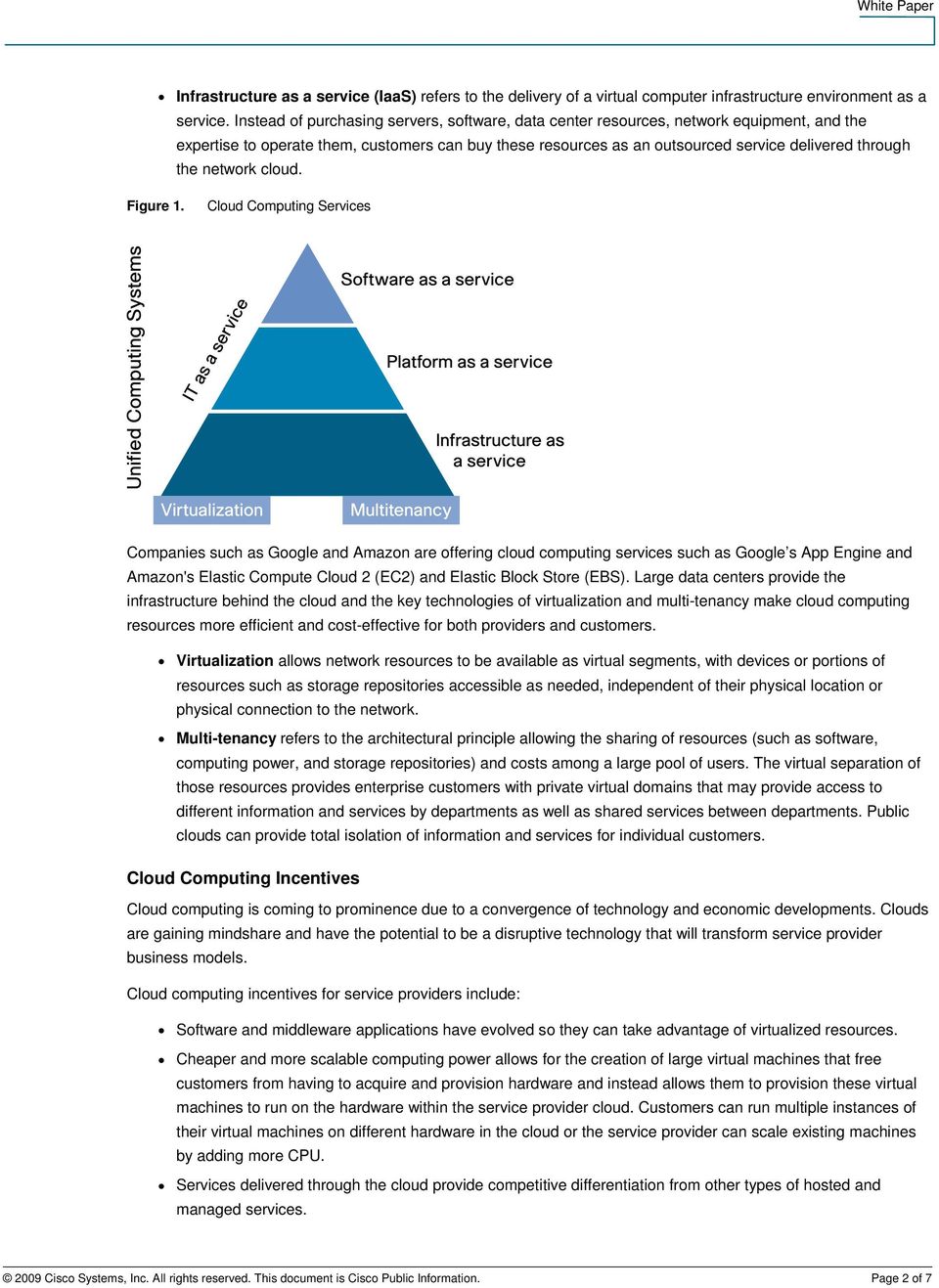
2 Infrastructure as a service (IaaS) refers to the delivery of a virtual computer infrastructure environment as a service. Instead of purchasing servers, software, data center resources, network equipment, and the expertise to operate them, customers can buy these resources as an outsourced service delivered through the network cloud. Figure 1. Cloud Computing Services Companies such as Google and Amazon are offering cloud computing services such as Google s App Engine and Amazon's Elastic Compute Cloud 2 (EC2) and Elastic Block Store (EBS). Large data centers provide the infrastructure behind the cloud and the key technologies of virtualization and multi-tenancy make cloud computing resources more efficient and cost-effective for both providers and customers. Virtualization allows network resources to be available as virtual segments, with devices or portions of resources such as storage repositories accessible as needed, independent of their physical location or physical connection to the network. Multi-tenancy refers to the architectural principle allowing the sharing of resources (such as software, computing power, and storage repositories) and costs among a large pool of users. The virtual separation of those resources provides enterprise customers with private virtual domains that may provide access to different information and services by departments as well as shared services between departments. Public clouds can provide total isolation of information and services for individual customers. Cloud Computing Incentives Cloud computing is coming to prominence due to a convergence of technology and economic developments. Clouds are gaining mindshare and have the potential to be a disruptive technology that will transform service provider business models. Cloud computing incentives for service providers include: Software and middleware applications have evolved so they can take advantage of virtualized resources. Cheaper and more scalable computing power allows for the creation of large virtual machines that free customers from having to acquire and provision hardware and instead allows them to provision these virtual machines to run on the hardware within the service provider cloud. Customers can run multiple instances of their virtual machines on different hardware in the cloud or the service provider can scale existing machines by adding more CPU. Services delivered through the cloud provide competitive differentiation from other types of hosted and managed services Cisco Systems, Inc. All rights reserved. This document is Cisco Public Information. Page 2 of 7
3 Cloud computing provides the platform for standardized managed services that can be sold into vertical market niches, including smaller customers. Cloud computing incentives for customers include: Depending upon the type of offering, reduced complexity related to the support of hardware and software components Lower total cost of ownership (TCO) with a pay-as-you-go model that gives customers the flexibility to start small and ramp up as required without an initial capital outlay Faster and easier acquisition of new services to speed time to market Standards, Middleware, Interoperability, and Instrumentation Despite the excitement over cloud computing and its associated services, there are still concerns over creating agreed-upon industry standards and also providing guaranteed service levels. A 2008 IDC survey of 244 IT executives found that 75 percent cited security as a significant challenge with cloud computing. Performance and availability were the next two concerns for 63 percent of respondents. Standards for security, application mobility between cloud platforms, service-level agreements (SLAs), and other features must be accepted by the cloud industry before customers will feel truly comfortable moving to the cloud model. These standards will enable customers to mix and match applications, platforms, and resources as needed. Main elements of cloud computing in need of standardization include: Cloud middleware, also referred to as Cloud OS, is the major system that manages and controls services, Figure 2. Google App Engine and Amazon EC2/S3 are examples of cloud middleware. Using cloud middleware, users should be able to create cloud instances, acquire resources, and perform general resource lifecycle management on demand. Figure 2. High-Level Cloud Middleware Architecture Example APIs for applications, acquisition of resources such as computing power and storage, and machine image management must be available to make applications suitable for network clouds. Currently, most cloud vendors maintain proprietary APIs that do not allow for the sharing of resources between different clouds. To date, the role of many network vendors has been relegated to providing basic plumbing. There is a market opportunity to more tightly integrate the underlying infrastructure using APIs Cisco Systems, Inc. All rights reserved. This document is Cisco Public Information. Page 3 of 7

4 Resource management is a key area requiring development in cloud computing architectures. Typically, network resources are statically provisioned but computing, storage, and application resources in clouds must be capable of being provisioned dynamically and on demand. Additionally, network resources must be capable of being provisioned separately from application resources. In a typical enterprise IT environment, there are many administrative domains in separate silos. Each domain may operate in isolation. But in a cloud environment (where cloud instances must be created on demand and dynamically with minimum turnaround time) the administrative boundaries become a major issue that can increase the provisioning time dramatically. The resource management process or workflow in the cloud must be fully automated across the administrative boundaries, with minimum turnaround time. Virtualization technology has been around for several years. Adoption within data centers and by service providers is increasing rapidly. Different proprietary virtualization technologies exist and this lack of standardization poses a barrier to an open standards cloud that is interoperable with other clouds and a broad array of computing and information resources. Interoperability between clouds will require the equivalent of a standardized cloud interoperability control plane that will enable sharing and exchange of cloud resources and communications between clouds that may be owned by multiple service providers. One example is a control plane incorporated into a cloud middleware layer or through Border Gateway Protocol (BGP) extensions. Using protocols such as Extensible Messaging and Presence Protocol (XMPP) over an agreed-upon interface between different service provider clouds enables multiple clouds to check naming and presence details and user policy permissions to provide interoperable services. Cloud 1, for example, could learn what services (such as SPARQL Protocol and RDF Query Language and OWL) are available on Cloud 2 and if these services match a particular user s requirements. Upon receiving a response, Cloud 1 could determine if a user s requirements are met and understand how to hand over the user to Cloud 2. Cloud 1 would also know how to request, provision, and call services in Cloud 2 for the user and how to pass on the user requirements such as billing tariff and SLA. So a mobile user accessing through a Microsoft Exchange server could be migrated to Cloud 2 without any disruption or changes to the original service agreement. Cross-layer dynamic policy control is required of applications that run in a cloud as they are in enterprises. When a user creates a cloud instance using a cloud computing service, the user should be able to associate relevant policies for resources within the cloud instance. Network resources must similarly be policy controlled in alignment with application policies. A simplified vision of the cloud computing architecture, Figure 3, includes this basic flow of information: 1. Client sends service requests 2. System management finds correct resources 3. Systems provisioning finds correct resources 4. Computing resources are found and service request is executed 5. Results of the service requests are sent to the clients 2009 Cisco Systems, Inc. All rights reserved. This document is Cisco Public Information. Page 4 of 7
5 Figure 3. Cloud Computing Workflow The End-User Perspective A February 2009 study by the Electrical Engineering and Computer Sciences Department at the University of California, Berkeley, Above the Clouds: A Berkeley View of Cloud Computing (a link to the paper is at the end of this white paper), looked at cloud computing from the end-user perspective. It focused on three features that will be significant draws for customers: The illusion of infinite computer resources available on demand that eliminate the need for customers to plan far ahead for provisioning No need for an up-front commitment by customers, allowing them to start small and increase their use of cloud services as needed The pay-as-you-go model that allows customers to buy just what they need, either on a short-term or ongoing basis The study also emphasized that companies with large batch-oriented computing tasks can get results more quickly and cost-effectively than ever before when using the broad resources of a managed cloud services provider for a short period of time. The on-demand nature of cloud computing is also a boon to companies, allowing them to quickly react to changing market conditions and opportunities. Another proof point for the cost-effectiveness of cloud computing is the estimate that large data centers can decrease the costs for electricity, network bandwidth, operations, software, and hardware by a factor of five. These savings can be shared among the service provider and customers and contribute to green computing trends. The U.C. Berkeley study also presented examples of applications that are well suited to cloud computing, including: Mobile, interactive applications that respond in real time to information provided by users or sensors or both must be highly available and rely on large data sets that are most conveniently hosted in large data centers. Services that combine two or more data sources or other services are a good example of interactive applications. The cloud environment is an excellent architecture for these applications, especially for mobile devices that are connected to the cloud nearly all the time. Parallel batch processing is uniquely suited to cloud computing because users can take advantage of the ability to utilize hundreds or thousands of computers for a short period of time to get the job done. Analytics is another computing-intensive activity that can be well served in the network cloud. The U.C. Berkeley study noted that a growing share of computing resources are being spent understanding customers, buying habits, and other factors through business analytics Cisco Systems, Inc. All rights reserved. This document is Cisco Public Information. Page 5 of 7

6 Computing-intensive desktop applications such as symbolic mathematics that involve a lot of computing per unit of data, image rendering, and 3D animation can be offloaded to the extensive resources of a cloud computing environment (in this case a private cloud) served by a large data center. Cloud Computing Service Opportunities Service providers have a major opportunity to provide cloud computing services to customers within organizations of all sizes. According to a 2008 study of cloud computing by Gartner, the cloud computing phenomenon will benefit medium-sized as well as large service providers as virtualization and automation technologies bring services on par for most needs. The costs for cloud computing will go down based on economies of scale, encouraging many businesses to adopt the service model. Gartner has reported on the growth of SaaS among small businesses due to the economies of scale (for example, smaller organizations now pay more per seat for services when deployed on-premises as compared to the cloud-based service). Medium-sized companies are expected to adopt SaaS and other cloud computing services in the next few years and by 2012 the cloud model will appeal to the largest enterprises with more than 100,000 users. Those companies will look at SaaS and other cloud computing options to provide segmented user access options, perhaps providing less demanding users with the cloud computing option while offering other users on-premises data center resources and network features. Much like triple-play service bundles offered to consumers, cloud computing bundles will be capable of bringing a wide array of services and applications to individuals and businesses, including: SaaS opportunities: Customer relationship management (CRM) and enterprise resource planning (ERP) applications, , web conferencing, digital content creation ITaaS opportunities: Storage, backup, unified threat management, security posture analysis, compliance IaaS and PaaS: Disk space, raw computing power for testing and development Cisco and Cloud Computing In general, cloud services must support virtual network resources, expose the resources through APIs, allow manipulation of the resources on demand through APIs, provide some level of application resource visibility within the network, and provide comprehensive and dynamic policy support across the ISO/OSI network layers. Cisco is to providing these capabilities in its data center products, as announced with Cisco Unified Computing Systems A Cisco technology-powered cloud must support stringent security, privacy, performance, and high-availability requirements for the SLAs for cloud computing. Computing, storage resources, and network resources must be capable of being acquired on demand. Network resources must be virtualized and exposed through APIs so that those resources can be acquired on demand in the process of cloud instance creation. As the cloud computing phenomenon grows, it will become more apparent that over-the-top providers of applications and other resources, such as Google and Amazon, lack the infrastructure needed to provide secure, carrier-class reliability end to end. The Cisco IP NGN, the premier Cisco architecture for service provider networks, has the transport intelligence at network, service, and application layers that will give service providers who deploy managed cloud computing services based on the Cisco IP NGN a competitive advantage, with best-in-class, carrierclass features. For example, a service provider can offer an on-demand SLA that encompasses delay, jitter, loss, VPN capabilities, and availability. Service-oriented metrics of an SLA could include resources and availability related to each managed service. Application-oriented metrics of an SLA could include application availability, response time, QoS requirements, transactions per second, and other metrics measured end-to-end. These metrics can all be measured and incorporated into SLA with the architecture and many technologies of the Cisco IP NGN, far surpassing the 2009 Cisco Systems, Inc. All rights reserved. This document is Cisco Public Information. Page 6 of 7
7 capabilities of over-the-top providers who rely on a best effort approach using internetworking infrastructures that they do not control. Summary The cloud computing phenomenon is gaining popularity because of its lower TCO, scalability, competitive differentiation, reduced complexity for customers, and faster and easier acquisition of services, even as its infrastructure and standards continue to evolve. Many types of services can be delivered through the network cloud to augment the infrastructure of service providers and end customers. Cisco is readying for the broader acceptance of cloud computing with an extremely intelligent and flexible network architecture for service providers the Cisco IP NGN. Together with world-class products and technologies, the Cisco IP NGN allows service providers to cost-effectively utilize their existing infrastructure in new and exciting ways to incorporate cloud assets, fashion new and innovative service bundles, and gain new revenue. For More Information Contact your Cisco account manager for more information on the Cisco IP NGN and evolving cloud computing architectures or visit: Cisco CIO Padmasree Warrior on Cloud Computing Services in a Cloud Computing Environment Economic Downturn Driving Cloud Computing Evolution Cisco IP Next-Generation Network Above the Clouds: A Berkeley View of Cloud Computing, Electrical Engineering and Computer Sciences Department, University of California, Berkeley, February Printed in USA C / Cisco Systems, Inc. All rights reserved. This document is Cisco Public Information. Page 7 of 7
Infrastructure as a Service: Accelerating Time to Profitable New Revenue Streams
 Infrastructure as a Service: Accelerating Time to Profitable New Revenue Streams Cisco Infrastructure as a Service Cisco has made a significant investment in understanding customer needs around data center
Accelerate Your Enterprise Private Cloud Initiative
 Cisco Cloud Comprehensive, enterprise cloud enablement services help you realize a secure, agile, and highly automated infrastructure-as-a-service (IaaS) environment for cost-effective, rapid IT service
Overview. The Cloud. Characteristics and usage of the cloud Realities and risks of the cloud
 Overview The purpose of this paper is to introduce the reader to the basics of cloud computing or the cloud with the aim of introducing the following aspects: Characteristics and usage of the cloud Realities
Cisco Unified Data Center: The Foundation for Private Cloud Infrastructure
 White Paper Cisco Unified Data Center: The Foundation for Private Cloud Infrastructure Providing Agile and Efficient Service Delivery for Sustainable Business Advantage What You Will Learn Enterprises
The Advantages of Cloud Services
 Cloud-Based Services: Assure Performance, Availability, and Security What You Will Learn Services available from the cloud offer cost and efficiency benefits to businesses, but until now many customers
Global Headquarters: 5 Speen Street Framingham, MA 01701 USA P.508.872.8200 F.508.935.4015 www.idc.com
 WHITE PAPER Monetizing the Cloud: XaaS Opportunities for Service Providers Sponsored by: EMC Brad Nisbet March 2011 Global Headquarters: 5 Speen Street Framingham, MA 01701 USA P.508.872.8200 F.508.935.4015
White Paper on CLOUD COMPUTING
 White Paper on CLOUD COMPUTING INDEX 1. Introduction 2. Features of Cloud Computing 3. Benefits of Cloud computing 4. Service models of Cloud Computing 5. Deployment models of Cloud Computing 6. Examples
Cloud Computing: Computing as a Service. Prof. Daivashala Deshmukh Maharashtra Institute of Technology, Aurangabad
 Cloud Computing: Computing as a Service Prof. Daivashala Deshmukh Maharashtra Institute of Technology, Aurangabad Abstract: Computing as a utility. is a dream that dates from the beginning from the computer
Cloud Computing Trends
 UT DALLAS Erik Jonsson School of Engineering & Computer Science Cloud Computing Trends What is cloud computing? Cloud computing refers to the apps and services delivered over the internet. Software delivered
The Cloud at Crawford. Evaluating the pros and cons of cloud computing and its use in claims management
 The Cloud at Crawford Evaluating the pros and cons of cloud computing and its use in claims management The Cloud at Crawford Wikipedia defines cloud computing as Internet-based computing, whereby shared
Processing invoices in the cloud or on premises pros and cons
 WHITE PAPER Purchase-to-pay by ReadSoft. Automated account payables processing software Author: Wille Dahl March 2012 Copyright ReadSoft - www.readsoft.com Processing invoices in the cloud or on premises
Data Centers and Cloud Computing. Data Centers
 Data Centers and Cloud Computing Intro. to Data centers Virtualization Basics Intro. to Cloud Computing 1 Data Centers Large server and storage farms 1000s of servers Many TBs or PBs of data Used by Enterprises
The Cloud is Not Enough Why Hybrid Infrastructure is Shaping the Future of Cloud Computing
 Your Platform of Choice The Cloud is Not Enough Why Hybrid Infrastructure is Shaping the Future of Cloud Computing Mark Cravotta EVP Sales and Service SingleHop LLC Talk About Confusing? Where do I start?
Realizing the Value Proposition of Cloud Computing
 Realizing the Value Proposition of Cloud Computing CIO s Enterprise IT Strategy for Cloud Jitendra Pal Thethi Abstract Cloud Computing is a model for provisioning and consuming IT capabilities on a need
Can Cloud Database PaaS Solutions Replace In-House Systems?
 Can Cloud Database PaaS Solutions Replace In-House Systems? Abstract: With the advent of Platform-as-a-Service as a viable alternative to traditional database solutions, there is a great deal of interest
DISTRIBUTED SYSTEMS AND CLOUD COMPUTING. A Comparative Study
 DISTRIBUTED SYSTEMS AND CLOUD COMPUTING A Comparative Study Geographically distributed resources, such as storage devices, data sources, and computing power, are interconnected as a single, unified resource
VALUE PROPOSITION FOR SERVICE PROVIDERS. Helping Service Providers accelerate adoption of the cloud
 VALUE PROPOSITION FOR SERVICE PROVIDERS Helping Service Providers accelerate adoption of the cloud Partnership with Service Providers Enabling Your Cloud Services in Complex Environments Today s challenge
CLOUD ERP AND ACCOUNTING: SELECTION AND PLANNING GUIDE
 CLOUD ERP AND ACCOUNTING: SELECTION AND PLANNING GUIDE Over the last three years, well over half of U.S. companies have elected to take advantage of one or more cloud-based solutions or services, but critical
cloud computing by Orange séminaire Aristote 17/12/2009
 cloud computing by Orange séminaire Aristote 17/12/2009 Orange and the cloud vision and strategy cloud computing - what is it about? cloud computing is a model for enabling convenient on-demand network
Reference Model for Cloud Applications CONSIDERATIONS FOR SW VENDORS BUILDING A SAAS SOLUTION
 October 2013 Daitan White Paper Reference Model for Cloud Applications CONSIDERATIONS FOR SW VENDORS BUILDING A SAAS SOLUTION Highly Reliable Software Development Services http://www.daitangroup.com Cloud
THE QUEST FOR A CLOUD INTEGRATION STRATEGY
 THE QUEST FOR A CLOUD INTEGRATION STRATEGY ENTERPRISE INTEGRATION Historically, enterprise-wide integration and its countless business benefits have only been available to large companies due to the high
Cloud Computing Architecture: A Survey
 Cloud Computing Architecture: A Survey Abstract Now a day s Cloud computing is a complex and very rapidly evolving and emerging area that affects IT infrastructure, network services, data management and
TOP 7 THINGS Every Executive Should Know About Cloud Computing EXECUTIVE BRIEF
 TOP 7 THINGS Every Executive Should Know About Cloud Computing EXECUTIVE BRIEF As interest in cloud computing increases, so does the confusion surrounding it. What is cloud computing? Can the technology
HP Converged Cloud Cloud Platform Overview. Shane Pearson Vice President, Portfolio & Product Management
 HP Converged Cloud Cloud Platform Overview Shane Pearson Vice President, Portfolio & Product Management Cloud is the biggest disruption since the Internet 1970-80s Mainframe 1990s Client/Server 2000s The
Sage ERP I White Paper. ERP and the Cloud: What You Need to Know
 I White Paper ERP and the Cloud: What You Need to Know Table of Contents Executive Summary... 3 Increased Interest in Cloud-Based ERP and SaaS Implementations... 3 What is Cloud/SaaS ERP?... 3 Why Interest
Data Centers and Cloud Computing. Data Centers. MGHPCC Data Center. Inside a Data Center
 Data Centers and Cloud Computing Intro. to Data centers Virtualization Basics Intro. to Cloud Computing Data Centers Large server and storage farms 1000s of servers Many TBs or PBs of data Used by Enterprises
Data Center Network Evolution: Increase the Value of IT in Your Organization
 White Paper Data Center Network Evolution: Increase the Value of IT in Your Organization What You Will Learn New operating demands and technology trends are changing the role of IT and introducing new
Cloud Computing for SCADA
 Cloud Computing for SCADA Moving all or part of SCADA applications to the cloud can cut costs significantly while dramatically increasing reliability and scalability. A White Paper from InduSoft Larry
Finding the right cloud solutions for your organization
 Finding the right cloud solutions for your organization Business white paper If you manage technology today, you know the story: everything is mobile, connected, interactive, immediate, and fluid. Expectations
Cisco Satellite Services Platform Delivering Managed Services over Satellite
 Solution Overview Cisco Satellite Services Platform Delivering Managed Services over Satellite With the increase in available bandwidth from the launch of high-throughput satellites, satellite service
CUMULUX WHICH CLOUD PLATFORM IS RIGHT FOR YOU? COMPARING CLOUD PLATFORMS. Review Business and Technology Series www.cumulux.com
 ` CUMULUX WHICH CLOUD PLATFORM IS RIGHT FOR YOU? COMPARING CLOUD PLATFORMS Review Business and Technology Series www.cumulux.com Table of Contents Cloud Computing Model...2 Impact on IT Management and
Cisco Secure Network Container: Multi-Tenant Cloud Computing
 Cisco Secure Network Container: Multi-Tenant Cloud Computing What You Will Learn Cloud services are forecast to grow dramatically in the next 5 years, providing a range of features and cost benefits for
How To Understand Cloud Computing
 Capacity Management for Cloud Computing Chris Molloy Distinguished Engineer Member, IBM Academy of Technology October 2009 1 Is a cloud like touching an elephant? 2 Gartner defines cloud computing as a
Data Centers and Cloud Computing. Data Centers
 Data Centers and Cloud Computing Slides courtesy of Tim Wood 1 Data Centers Large server and storage farms 1000s of servers Many TBs or PBs of data Used by Enterprises for server applications Internet
Tamanna Roy Rayat & Bahra Institute of Engineering & Technology, Punjab, India [email protected]
 IJCSIT, Volume 1, Issue 5 (October, 2014) e-issn: 1694-2329 p-issn: 1694-2345 A STUDY OF CLOUD COMPUTING MODELS AND ITS FUTURE Tamanna Roy Rayat & Bahra Institute of Engineering & Technology, Punjab, India
Object Storage: A Growing Opportunity for Service Providers. White Paper. Prepared for: 2012 Neovise, LLC. All Rights Reserved.
 Object Storage: A Growing Opportunity for Service Providers Prepared for: White Paper 2012 Neovise, LLC. All Rights Reserved. Introduction For service providers, the rise of cloud computing is both a threat
The cloud - ULTIMATE GAME CHANGER ===========================================
 The cloud - ULTIMATE GAME CHANGER =========================================== When it comes to emerging technologies, there is one word that has drawn more controversy than others: The Cloud. With cloud
VMware Hybrid Cloud. Accelerate Your Time to Value
 VMware Hybrid Cloud Accelerate Your Time to Value Fulfilling the Promise of Hybrid Cloud Computing Through 2020, the most common use of cloud services will be a hybrid model combining on-premises and external
Secure Cloud Computing through IT Auditing
 Secure Cloud Computing through IT Auditing 75 Navita Agarwal Department of CSIT Moradabad Institute of Technology, Moradabad, U.P., INDIA Email: [email protected] ABSTRACT In this paper we discuss the
Cloud Computing. Key Considerations for Adoption. Abstract. Ramkumar Dargha
 Cloud Computing Key Considerations for Adoption Ramkumar Dargha Abstract Cloud Computing technology and services have been witnessing quite a lot of attention for the past couple of years now. We believe
Next generation enterprise communications
 Next generation enterprise communications Peter Hall Principal Analyst July 2010 1 Agenda Top CIO/IT manager issues The role of managed services and outsourcing Evolution of players - the expanding role
Consumption IT. Michael Shepherd Business Development Manager. Cisco Public Sector May 1 st 2014
 Consumption IT Michael Shepherd Business Development Manager Cisco Public Sector May 1 st 2014 Short Bio Cloud BDM in Public Sector (SLED + FED) Cisco for 14 + years Focused on cloud for 4 + years Awareness,
IP Address Management: Smoothing the Way to Cloud-Based Services
 White Paper IP Address Management: Smoothing the Way to Cloud-Based Services What You Will Learn Cloud computing offers many operational advantages to service providers. An important element of successful
Enterprise Cloud Solutions
 IT(O) IT Outsourcing Options Enterprise Cloud Solutions CloudAgile Select Partner PDF v2.2 9/11/12 Cloud Computing with Latisys With the Latisys Cloud, your Enterprise can: Achieve unprecedented control,
Where in the Cloud are You? Session 17032 Thursday, March 5, 2015: 1:45 PM-2:45 PM Virginia (Sheraton Seattle)
 Where in the Cloud are You? Session 17032 Thursday, March 5, 2015: 1:45 PM-2:45 PM Virginia (Sheraton Seattle) Abstract The goal of this session is to understanding what is meant when we say Where in the
How To Understand Cloud Computing
 Overview of Cloud Computing (ENCS 691K Chapter 1) Roch Glitho, PhD Associate Professor and Canada Research Chair My URL - http://users.encs.concordia.ca/~glitho/ Overview of Cloud Computing Towards a definition
Future of Cloud Computing. Irena Bojanova, Ph.D. UMUC, NIST
 Future of Cloud Computing Irena Bojanova, Ph.D. UMUC, NIST No Longer On The Horizon Essential Characteristics On-demand Self-Service Broad Network Access Resource Pooling Rapid Elasticity Measured Service
CLOUD COMPUTING An Overview
 CLOUD COMPUTING An Overview Abstract Resource sharing in a pure plug and play model that dramatically simplifies infrastructure planning is the promise of cloud computing. The two key advantages of this
Kaseya White Paper Proactive Service Level Monitoring: A Must Have for Advanced MSPs
 Kaseya White Paper Proactive Service Level Monitoring: A Must Have for Advanced MSPs Providers of IT services, such as systems integrators, are expanding rapidly into the managed services arena, and becoming
<Insert Picture Here> Enterprise Cloud Computing: What, Why and How
 Enterprise Cloud Computing: What, Why and How Andrew Sutherland SVP, Middleware Business, EMEA he following is intended to outline our general product direction. It is intended for
Cloud Computing Paradigm Shift. Jan Šedivý
 Cloud Computing Paradigm Shift Jan Šedivý Business expectations Improving business processes Reducing enterprise costs Increasing the use of information/analytics Improving enterprise workforce effectiveness
High Performance Computing Cloud Computing. Dr. Rami YARED
 High Performance Computing Cloud Computing Dr. Rami YARED Outline High Performance Computing Parallel Computing Cloud Computing Definitions Advantages and drawbacks Cloud Computing vs Grid Computing Outline
How cloud computing can transform your business landscape
 How cloud computing can transform your business landscape Introduction It seems like everyone is talking about the cloud. Cloud computing and cloud services are the new buzz words for what s really a not
4/6/2009 CLOUD COMPUTING : PART I WHY IS CLOUD COMPUTING DISTINCT? INTRODUCTION: CONTINUE A PERSPECTIVE STUDY
 CLOUD COMPUTING : A PERSPECTIVE STUDY PART I BACKGROUND AND CONCEPTS Guannang Wang YingFeng Wang Qi Li INTRODUCTION: Coined in late of 2007 Currently emerges as a hot topic due to its abilities to offer
The Production Cloud
 The Production Cloud The cloud is not just for backup storage, development projects and other low-risk applications. In this document, we look at the characteristics of a public cloud environment that
Master the Might of the Hybrid Cloud
 Reach for the Sky Master the Might of the Hybrid Cloud WHITE PAPER As an IT decision maker at a global enterprise, you face unique challenges in managing a complex infrastructure with varied resources
What Is Microsoft Private Cloud Fast Track?
 What Is Microsoft Private Cloud Fast Track? MICROSOFT PRIVATE CLOUD FAST TRACK is a reference architecture for building private clouds that combines Microsoft software, consolidated guidance, and validated
Cloud Computing Terms:
 Cloud Computing Terms: Advertising-based pricing model: A pricing model whereby services are offered to customers at low or no cost, with the service provider being compensated by advertisers whose ads
Deploying a Geospatial Cloud
 Deploying a Geospatial Cloud Traditional Public Sector Computing Environment Traditional Computing Infrastructure Silos of dedicated hardware and software Single application per silo Expensive to size
CONVERGE APPLICATIONS, ANALYTICS, AND DATA WITH VCE AND PIVOTAL
 CONVERGE APPLICATIONS, ANALYTICS, AND DATA WITH VCE AND PIVOTAL Vision In today s volatile economy, an organization s ability to exploit IT to speed time-to-results, control cost and risk, and drive differentiation
USE OF CLOUD COMPUTING BY SMALL AND MEDIUM ENTERPRISES
 1 USE OF CLOUD COMPUTING BY SMALL AND MEDIUM ENTERPRISES Introduction Small and Medium Enterprises (SMEs) are the drivers of a nation s economy SMEs are leading the way for entering new global markets
Unified Communications as a service : Tata Communications with Skype for Business
 Unified Communications as a service : END-TO-END SKYPE FOR BUSINESS UNIFIED COMMUNICATIONS SOLUTION FOR GLOBAL ENTERPRISES SEAMLESS, CONSISTENT QoS GLOBALLY TABLE OF CONTENTS Executive summary 3 Getting
JISC. Technical Review of Using Cloud for Research. Guidance Notes to Cloud Infrastructure Service Providers. Introduction
 JISC Technical Review of Using Cloud for Research Guidance Notes to Cloud Infrastructure Service Providers May, 2010 Introduction Provisioning and maintenance of research computing facilities is a core
Hybrid Cloud Computing
 Dr. Marcel Schlatter, IBM Distinguished Engineer, Delivery Technology & Engineering, GTS 10 November 2010 Hybrid Computing Why is it becoming popular, Patterns, Trends, Impact Hybrid Definition and Scope
Introduction to Cloud Computing
 Introduction to Cloud Computing Cloud Computing I (intro) 15 319, spring 2010 2 nd Lecture, Jan 14 th Majd F. Sakr Lecture Motivation General overview on cloud computing What is cloud computing Services
MANAGEMENT AND ORCHESTRATION WORKFLOW AUTOMATION FOR VBLOCK INFRASTRUCTURE PLATFORMS
 VCE Word Template Table of Contents www.vce.com MANAGEMENT AND ORCHESTRATION WORKFLOW AUTOMATION FOR VBLOCK INFRASTRUCTURE PLATFORMS January 2012 VCE Authors: Changbin Gong: Lead Solution Architect Michael
Cloud computing: defined and demystified
 IBM Global Services April 2009 Cloud computing: defined and demystified Explore public, private and hybrid cloud approaches to help accelerate innovative business solutions Page 2 Contents 2 Executive
Cisco Integrated Video Surveillance Solution: Expand the Capabilities and Value of Physical Security Investments
 Cisco Integrated Video Surveillance Solution: Expand the Capabilities and Value of Physical Security Investments What You Will Learn In many enterprises, physical security departments are making a notable
IJRSET 2015 SPL Volume 2, Issue 11 Pages: 29-33
 CLOUD COMPUTING NEW TECHNOLOGIES 1 Gokul krishnan. 2 M, Pravin raj.k, 3 Ms. K.M. Poornima 1, 2 III MSC (software system), 3 Assistant professor M.C.A.,M.Phil. 1, 2, 3 Department of BCA&SS, 1, 2, 3 Sri
Cisco Unified Data Center
 Solution Overview Cisco Unified Data Center Simplified, Efficient, and Agile Infrastructure for the Data Center What You Will Learn The data center is critical to the way that IT generates and delivers
Commercial Software Licensing
 Commercial Software Licensing CHAPTER 12: Prepared by DoD ESI January 2013 Chapter Overview Most software licenses today are either perpetual or subscription. Perpetual licenses involve software possession
A Study of Infrastructure Clouds
 A Study of Infrastructure Clouds Pothamsetty Nagaraju 1, K.R.R.M.Rao 2 1 Pursuing M.Tech(CSE), Nalanda Institute of Engineering & Technology,Siddharth Nagar, Sattenapalli, Guntur., Affiliated to JNTUK,
empower your digital transformation with Private Cloud Solutions Khaled M Khondker
 empower your digital transformation with Private Cloud Solutions Khaled M Khondker 1 as an IT leader, you have the opportunity to play a significant role in the digital transformation of your company business
Data Centers and Cloud Computing
 Data Centers and Cloud Computing CS377 Guest Lecture Tian Guo 1 Data Centers and Cloud Computing Intro. to Data centers Virtualization Basics Intro. to Cloud Computing Case Study: Amazon EC2 2 Data Centers
Cloud Computing in Higher Education: A Guide to Evaluation and Adoption
 Cloud Computing in Higher Education: A Guide to Evaluation and Adoption Executive Summary Public cloud computing delivering infrastructure, services, and software on demand through the network offers attractive
Industrial Internet of Things Bears Fruit with Connected Services for Plant Assets and Fleet Migration
 Industrial Internet of Things Bears Fruit with Connected Services for Plant Assets and Fleet Migration Peter Reynolds Director of Consulting ARC Advisory Group [email protected] Twitter @PeterDReynolds
Managing the Real Cost of On-Demand Enterprise Cloud Services with Chargeback Models
 Managing the Real Cost of On-Demand Enterprise Cloud Services with Chargeback Models A Guide to Cloud Computing Costs, Server Costs, Pricing Plans, and Chargeback Implementation and Systems Introduction
Elastic Private Clouds
 White Paper Elastic Private Clouds Agile, Efficient and Under Your Control 1 Introduction Most businesses want to spend less time and money building and managing IT infrastructure to focus resources on
EMC IT S JOURNEY TO THE PRIVATE CLOUD: APPLICATIONS AND CLOUD EXPERIENCE
 White Paper EMC IT S JOURNEY TO THE PRIVATE CLOUD: APPLICATIONS AND CLOUD EXPERIENCE A series exploring how EMC IT is architecting for the future and our progress toward offering IT as a Service to the
Big Data & Its Bigger Possibilities In The Cloud
 Big Data & Its Bigger Possibilities In The Cloud Chhavi Gupta Software Engineer, EMC Corporation Sai Pattem Professional MBA Candidate 2013 August 15 th, 9:30 10:30 AM Session 13860 Room 200 (Hynes Convention
IBM 000-281 EXAM QUESTIONS & ANSWERS
 IBM 000-281 EXAM QUESTIONS & ANSWERS Number: 000-281 Passing Score: 800 Time Limit: 120 min File Version: 58.8 http://www.gratisexam.com/ IBM 000-281 EXAM QUESTIONS & ANSWERS Exam Name: Foundations of
Communications in the Cloud: Why It Makes Sense for Today s Business
 A UBM TECH WHITE PAPER MAY 2013 Communications in the Cloud: Why It Makes Sense for Today s Business Unified communications delivered in the cloud can help businesses of all sizes address many collaboration
VMware Building Many Bridges to the Cloud
 VMware Building Many Bridges to the Cloud Robin Ren, Cloud Applications and Services, VMware July 2010 2009 VMware Inc. All rights reserved Agenda Cloud Characteristics Benefits Challenges VMware and Cloud
Cloud computing and SAP
 Cloud computing and SAP Next Generation SAP Technologies Volume 1 of 2010 Table of contents Document history 1 Overview 2 SAP Landscape challenges 3 Infrastructure as a Service (IaaS) 4 Public, Private,
Unified Communications and the Cloud
 Unified Communications and the Cloud Abstract Much has been said of the term cloud computing and the role it will play in the communications ecosystem today. Undoubtedly it is one of the most overused
Cloud computing: the state of the art and challenges. Jānis Kampars Riga Technical University
 Cloud computing: the state of the art and challenges Jānis Kampars Riga Technical University Presentation structure Enabling technologies Cloud computing defined Dealing with load in cloud computing Service
MANUFACTURING IN THE CLOUD IMPROVED PRODUCTIVITY AND COST SAVINGS ARE ON THE HORIZON
 MANUFACTURING IN THE CLOUD IMPROVED PRODUCTIVITY AND COST SAVINGS ARE ON THE HORIZON White paper by Bala Adiseshan President & CEO inkumo, Inc. MANUFACTURING IN THE CLOUD: IMPROVED PRODUCTIVITY AND COST-
Cloud Computing: It s In Your Future. What You Need to Know about Logicalis and Cloud Computing
 Cloud Computing: It s In Your Future What You Need to Know about Logicalis and Cloud Computing Cloud computing is a transition that is changing the way you will buy, build, operate and consume information,
GETTING THE MOST FROM THE CLOUD. A White Paper presented by
 GETTING THE MOST FROM THE CLOUD A White Paper presented by Why Move to the Cloud? CLOUD COMPUTING the latest evolution of IT services delivery is a scenario under which common business applications are
Architectural Implications of Cloud Computing
 Architectural Implications of Cloud Computing Grace Lewis Research, Technology and Systems Solutions (RTSS) Program Lewis is a senior member of the technical staff at the SEI in the Research, Technology,