
Infrastructure-less networks
|
|
|
- Martha Maxwell
- 10 years ago
- Views:
Transcription
1 Infrastructure-less networks Csaba Simon Dept. of Telecommunications and Media Informatics Convergent Networks and Services (VITMM156) 1

2 Mobility management 2

3 Mobility Mobile station, mobile node (MN) Moves from its usual, default network to a different subnetwork Home Network -> Foreign Network If it keeps its old IP address IP packets can not be routed to the MN According to its IP address, the packets a routed to its Home NW. If it receives a new IP address It will be valid in the Foreign NW packets addressed to this new IP addr. will reach the MN The connections will be interrupted since they were setup based on the original IP address Several protocols have been proposed to handle this mobility issue source: cisco.com / Cisco Mobile Router Module 2-6 / CEE_NET

4 Mobility problem Where is ??? Connect to ? Gateway A Internet Host B Gateway C Mobile Node Mobile Node The Mobile Node represents the moving nodes A (home) router answers to node B : ICMP unreachable C (foreign) router cuts the Mobile Node from its network SEND A routing protocol does not allow the advertisment of the same IP addr from two different subnetworks X

5 IETF standards for IP mobility management Internet Engineering Steering Group (IESG) / June 1996 / open standard November 1996 Mobile IP IETF standard for IP level mobility management (Layer 3 mobility) RFC2002/ Mobile IP basic protocol RFC2003 an RFC tunneling RFC Mobile IP applicability RFC Mobile IP MIB Other RFCs RFC1701 GRE Generic Routing Encapsulation RFC Reverse Tunneling for Mobile IP 5

6 Mobile IP (MIP) The mobile node originally has a home address All of its communicating partners know this address In a foreign network the routing problem is temporarly solved by the care-of address Mobility binding A dedicated router (home agent - HA) keeps records about the actual care-of-address HA is responsible to reach the MN if it is not at home Advantages of Mobile IP All the legacy applications can be kept, they need not to be modified Network shifts (handovers) can be controlled by the home agents Transparent to all access (L2) technologies 6

7 Mobile IP Mobile Node Mobility Binding Table: MR CoA Home Agent Internet Mobile Node Host B Foreign Agent COA Mobile Node notifies its HA with a Registration Request [RRQ] message HA forwards the packets to the Mobile Node Using the Care of Address [CoA] CoA assigned in the foreign (visited) network
![31.2.1 Mobile Node notifies its HA with a Registration Request [RRQ] message HA forwards the](/docs-images/56/7864686/images/page_7.jpg "packets to the Mobile Node Using the Care of Address [CoA] CoA assigned in the foreign (visited)")
8 Devices in the Mobile IP (MIP) 1. Mobile Node (MN): clients running the MIP. 1. Have a home address 2. If they are located in a foreign network, they have a care-of-address CoA 2. Home Agent (HA): routers running the MIP. 1. Besides acting as routers, work as localization registries, as well 3. Foreign Agent (FA): routers running the MIP. 1. Help the registration of MNs in the foreign networks 2. They are optional, if they are not present, the MN has more tasks to do 4. Correspondent Node (CN): a node connected to the MN 1. A fixed node that communicates with the MN 2. It does not know wether the MN runs a MIP or not 8

9 Mobile IP operations What does a MN in the foreign networks? How does it find its FA and CoA? Mobility Agent Advertisements Agents advertise themselves How does the HA know where has its MN gone? Registration MN updates its state at its HA if it gets a new CoA How does the HA send the packets to the MN? Tunneling HA adds a new IP header (using the CoA as source address) to the original packet 9

10 Mobile IP Activities Example Mobility Binding Table: MN CoA Host A Home Agent Internet Host B Foreign Agent MN detects FA and registers its CoA HA updates the position of MN in its table Sets up a tunnel until FA Host A FA unpacks the packet received from HA over the tunnel forwards it to MN 10

11 NEMO 11

12 NEMO Many MNs move together Moving Network (MONE) Network in motion (NEMO) Let s manage their mobility together Moving Network Nodes (MNN) The nodes forming the NEMO MR (mobil router) default gateway Assures the connection between NEMO-members and outside world MRs usually have the largest battery-lifetime, the largest bandwidth, etc E.g., a dedicated router installed on a vehicle, connected to the power system of the vehicle The MNNs must register at the MR They belong to the subnetwork of the MR They are fixed into that network, do not change their relative position to the MR alternativley named Fixed Local Node (FLN) Advantages only one mobility management event at network-change 12

13 Efficiency of NEMO depend on the environment it is deployed (Potential) disadvantage: E.g., 100 MNs use cellular mobile internet access in a urban environment If the MNNs do not join the NEMO - They manage their mobility individually + Each of them will receive individually a BW specific to the technology If the MNNs join a single NEMO The bottleneck will be the MR s link capacity If it uses the same public access, in the worst case an MNN will receive only 1/100 th of the BW compared to the previous case (Potential) advantage: E.g., the same 100 MNs request for access on a plane Practically this means that the MN has no other access except an MR In this case at least the mobility management is optimized over the sparse wireless resource 13

14 Mobile IP Terminology HA Internet FA CN Mobile Router (MR) Here we have the MR alone as moving (mobile) node, there are no other MNs attached to it Home Agent (HA) Foreign Agent (FA) [1 Hop Away from MR] Care of Address (CoA) [Tunnel Endpoint] Correspondent Node (CN) Security Association (SA) [SPI/Key] ICMP Router Discovery Protocol (IRDP) [Advertisement] Registration Request (RRQ) MR 14
![Away from MR] Care of Address (CoA) [Tunnel Endpoint] Correspondent Node (CN) Security](/docs-images/56/7864686/images/page_14.jpg "Association (SA) [SPI/Key] ICMP Router Discovery Protocol (IRDP) [Advertisement] Registration")
15 Triangle routing Home Agent Correspondent Host Foreign Agent Mobile Router Packet is sent to the home network MR resides in the foreign network, it registers its CoA to the HA HA forwards the packet towards the MR, using the HA-FA tunnel The packets from MR are addressed directly to CN 15

16 NEMO dual tunnel In the case of NEMOs there is an additional problem apart of the triangle routing MNNs register to the MR Every packet originally sent to MNN arrives to the Home Network of the MR The MR will then forward it to the MNN We already use a tunnel: on the Home NW MR path If the NEMO moves to a foreign network Intervenes a new HA-FA 16

17 Mobile Network Routing Packet Flow Mobile Networks Node on MR Mobile Router Foreign Agent Mobile Networks appear to be here 17 Home Agent Internet Correspondent Node Edited slide from original by Lawrence Searcy, Cisco Systems

18 Mobile Network Routing Packet Flow Mobile Networks Node on MR Mobile Router HA-FA Tunnel Foreign Agent Mobile Network appears to be here 18 Home Agent Internet Correspondent Node

19 Mobile Network Routing Packet Flow Mobile Networks Nodes on MR HA-MR Tunnel Mobile Router FA WAN HA-FA Tunnel Foreign Agent Mobile Network appears to be here 19 Home Agent Internet Correspondent Node

20 Mobile Network Routing Packet Flow Mobile Networks Node on MR HA-MR Tunnel Mobile Router FA WAN HA-FA Tunnel Foreign Agent Mobile Network appears to be here 20 Home Agent Internet Correspondent Node

21 Mobile Network Routing Return Packet Flow Mobile Networks Node on MR HA-MR Tunnel Mobile Router FA WAN HA-FA Tunnel Foreign Agent Mobile Network appears to be here 21 Home Agent Internet Correspondent Node
22 Where are MobileIP-like solutions used in current telecom networks? 22
23 Similarities in the Mobile IP and GPRS GGSN HA IP Network GTP IP Network IPinIP/GRE/UDP SGSN FA MT MN 23
24 Mobile IP and GPRS BSC BTS AP Serving GPRS Support Node (SGSN) GPRS Backbone Network (IP-Based) GTP RADIUS Server Internet WLAN Hotspot Home Agent Gateway GPRS Support Node (GGSN) The functionality of the FA implemented in the GGSN and/or in the WLAN Access Router 24
25 Reverse Tunneling (bi-directional tunneling) 25
26 Reverse Tunneling Usually routers check only the destination address Firewalls take a look at the source address, as well detecting the spoofing attacks ingress filtering (based on the source address) if the packet is not coming from the subnet of the source address MIP often uses tunneling E.g., the MNN is not coming from a subnet compatible with the source address of the header 26
27 Mobile Network Routing datapath According to its access, the NEMO is here but the packet arrives from a different direction, thus the firewall considers it as an attack Home Agent Mobile Network Node on MR HA-MR Tunnel Mobile Router FA WAN HA-FA Tunnel Foreign Agent Internet 27 Correspondent Node
28 Reverse Tunneling Reverse tunneling avoids the ingress filtering problem We need a different tunnel to send the packet back on Reverse tunneling or bi-directional tunneling HA de-capsulates the packet and forwards it according to the usual routing process The address of the packet covers the topology The packet is coming from the subnet that corresponds to the source address 28
29 Mobile Network Routing Reverse Tunneling Roaming Interface Mobile Network Node on MR HA-MR Tunnel Mobile Router FA WAN HA-FA Tunnel Foreign Agent NEMO appears to be here 29 Home Agent Internet Correspondent Node Edited slide from original by Lawrence Searcy, Cisco Systems
30 Routing Optimizations (RO) 30
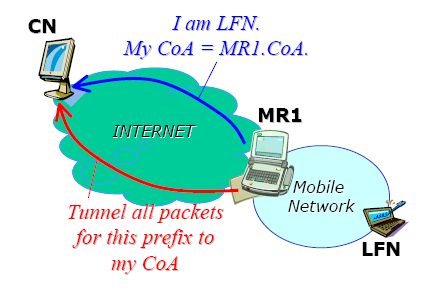
31 Routing optimization (RO) Between the MR and CN LFN local fixed node (in the NEMO, registered to the MR) Prefix-based Binding Update every packet addressed to the LFN registered to MR1 is forwarded to MR1 We eliminate the Home Agent (HA) of LFN from the path 31
32 Advantages of RO Nested NEMOs E.g., two Personal Area Networks - PANs (MR2, MR3) on a traing (MR1) Eliminating the tunneled path Avoid walking on the redundant HA1-HA2- HA3 path Solve the communication locally, within the MR1 32
33 Case study: NEMOs in the airline industry 33
34 Multi-Domained, Multi-Homed Mobile Networks To Join to the Mobile Platform Internet (MPI) mailing list, to: Terry Davis Boeing Will Ivancic NASA Glenn 34
35 How Do You Select and Implement the Routing Path? High Speed SatCom Network Globally Available Affected by Weather Higher Bandwidth High Latency High Cost Command and Control Entertainment Mobile Network Operations Low Speed SatCom Network Globally Available Low Bandwidth High Latency Very High Cost Redundant High Speed LOS Network Globally Available High Bandwidth Low Latency Lower Security Moderate Cost Low Rate VHF Reliable Low Latency Internet High Speed Terrestrial Not Available when Mobile High Bandwidth Low latency Lower Cost Destination Network (for Entertainment) How do you decide which path the data should take? How do you cause the network(s) to route the data via this path? Destination Network (for Command & Control) Destination Network (for Operations) 35
36 In-Air Communication Many networks work in parallel on a plane Different requirements Aircraft Control Domain Airline Information Services Domain Passenger Information and Entertainment Services Domain Several times the same function is served by parallel connections Connected to ten, or more ISPs (internet service provider) Autonomic (independent) connection/switch to/between the ISPs The contracts with the ISPs are managed by the airports 36
37 ISO Aeronautics Telecommunication Network (ATN) Island Routing Domain Confederation Another ATN Island Mobile RD Mobile RD ATN Backbone RDC ATN TRD ATN TRD Mobile RD ATN Island RDC ATN TRD ATN ERD 37 ATN ERD ERD End Routing Domain RD Routing Domain RDC Routing Domain Confederation TRD Transit Routing Domain OSI IDRP Routing Controlled topology to ensure rapid route prorogation Routing Protocols requires ownership/coordination of infrastructure Injecting routes Not deployed due to cost
38 Independent radio interfaces on a plane 38
39 Air Traffic Management LAN Operations LAN (Avionics) Communication and Display Sensor Controller (Optional Display) Mobile Network 1 Mobile Network 2 Mobile Network 3 Passenger Services Connection Multiplexing Mobile Router NEM0-1 NEMO-2 NEMO-3 SATCOM AERO-1 SATCOM AERO-HH VHF Voice/DATA HF Voice/DATA INMARSAT Swift 64 High-Rate Satellite WiFi Max GateLink Cellular Future Links 39

40 RO with two HAs VPN Primary Home Agent Endpoint X VPN Endpoint Secondary Home Agent Secondary Home Agent - Helps the process of RO on long, e.g. transatlantic routes 40 Use of VPN tunnels If they are not prepared to handle VPNs, RO is not working
41 End of case study 41
5.0 Network Architecture. 5.1 Internet vs. Intranet 5.2 NAT 5.3 Mobile Network
 5.0 Network Architecture 5.1 Internet vs. Intranet 5.2 NAT 5.3 Mobile Network 1 5.1The Internet Worldwide connectivity ISPs connect private and business users Private: mostly dial-up connections Business:
Mobile IP Part I: IPv4
 Mobile IP Part I: IPv4 Raj Jain Washington University in Saint Louis Saint Louis, MO 63130 [email protected] These slides are available on-line at: http://www.cse.wustl.edu/~jain/cse574-06/ 12-1 q Mobile
Mobility Management 嚴 力 行 高 雄 大 學 資 工 系
 Mobility Management 嚴 力 行 高 雄 大 學 資 工 系 Mobility Management in Cellular Systems Cellular System HLR PSTN MSC MSC VLR BSC BSC BSC cell BTS BTS BTS BTS MT BTS BTS BTS BTS HLR and VLR HLR (Home Location Register)
IP and Mobility. Requirements to a Mobile IP. Terminology in Mobile IP
 IP and Mobility Chapter 2 Technical Basics: Layer Methods for Medium Access: Layer 2 Chapter Wireless Networks: Bluetooth, WLAN, WirelessMAN, WirelessWAN Mobile Telecommunication Networks: GSM, GPRS, UMTS
Mobility on IPv6 Networks
 Mobility on IPv6 Networks Pedro M. Ruiz Project Manager Agora Systems S.A. Global IPv6 Summit Madrid 13-15 March 2002 Pedro M. Ruiz (c) Agora Systems S.A, 2002 1 Outline Motivation MIPv6 architecture MIPv6
Mobile Routing. When a host moves, its point of attachment in the network changes. This is called a handoff.
 Mobile Routing Basic Notions of Mobility When a host moves, its point of attachment in the changes. This is called a handoff. The point of attachment is a base station (BS) for cellular, or an access point
Static and Dynamic Network Configuration
 CHAPTER 6 This chapter describes: Static Networks Dynamic Networks Static Networks The mobile access router can be part of a static network or a dynamic network. A static network supports stub routers
6 Mobility Management
 Politecnico di Milano Facoltà di Ingegneria dell Informazione 6 Mobility Management Reti Mobili Distribuite Prof. Antonio Capone Introduction Mobility management allows a terminal to change its point of
EE6390. Fall 1999. Research Report. Mobile IP in General Packet Radio System
 EE6390 Introduction to Wireless Communications Systems Fall 1999 Research Report Mobile IP in General Packet Radio System Kelvin K. W. Wong Ramzi Hamati Date: Dec. 6, 1999 1.0 Abstract Tunneling is one
SERVICE DISCOVERY AND MOBILITY MANAGEMENT
 Objectives: 1) Understanding some popular service discovery protocols 2) Understanding mobility management in WLAN and cellular networks Readings: 1. Fundamentals of Mobile and Pervasive Computing (chapt7)
Cost Analysis of NEMO Protocol Entities
 Cost Analysis of NEMO Protocol Entities Md. Shohrab Hossain Mohammed Atiquzzaman School of Computer Science, University of Oklahoma, Norman, OK 73019. Email: {shohrab, atiq}@ou.edu William Ivancic NASA
Analysis of Mobile IP in Wireless LANs
 ENSC 835: COMMUNICATION NETWORKS FINAL PROJECT PRESENTATIONS Spring 2011 Analysis of Mobile IP in Wireless LANs www.sfu.ca/~bshahabi Babak Shahabi ([email protected]( [email protected]) 301102998 Shaoyun Yang
Tomás P. de Miguel DIT-UPM. dit UPM
 Tomás P. de Miguel DIT- 15 12 Internet Mobile Market Phone.com 15 12 in Millions 9 6 3 9 6 3 0 1996 1997 1998 1999 2000 2001 0 Wireless Internet E-mail subscribers 2 (January 2001) Mobility The ability
NETE-4635 Computer Network Analysis and Design. Designing a Network Topology. NETE4635 - Computer Network Analysis and Design Slide 1
 NETE-4635 Computer Network Analysis and Design Designing a Network Topology NETE4635 - Computer Network Analysis and Design Slide 1 Network Topology Design Themes Hierarchy Redundancy Modularity Well-defined
White Paper. Mobility and Mobile IP, Introduction. Abstract
 Doc Number: IPU-2001:0002, Rev C White Paper Mobility and Mobile IP, Introduction Abstract This white paper introduces networking with Mobile IP and related functionality. In particular the paper describes
MPLS VPN in Cellular Mobile IPv6 Architectures(04##017)
 MPLS VPN in Cellular Mobile IPv6 Architectures(04##017) Yao-Chung Chang, Han-Chieh Chao, K.M. Liu and T. G. Tsuei* Department of Electrical Engineering, National Dong Hwa University Hualien, Taiwan, Republic
PowerLink Bandwidth Aggregation Redundant WAN Link and VPN Fail-Over Solutions
 Bandwidth Aggregation Redundant WAN Link and VPN Fail-Over Solutions Find your network example: 1. Basic network with and 2 WAN lines - click here 2. Add a web server to the LAN - click here 3. Add a web,
This chapter covers the following topics: Characteristics of roaming Layer 2 roaming Layer 3 roaming and an introduction to Mobile IP
 This chapter covers the following topics: Characteristics of roaming Layer 2 roaming Layer 3 roaming and an introduction to Mobile IP C H A P T E R 5 Mobility This book covers the major components of 802.11
Mobile IP. Bheemarjuna Reddy Tamma IIT Hyderabad. Source: Slides of Charlie Perkins and Geert Heijenk on Mobile IP
 Mobile IP Bheemarjuna Reddy Tamma IIT Hyderabad Source: Slides of Charlie Perkins and Geert Heijenk on Mobile IP IP Refresher Mobile IP Basics 3 parts of Mobile IP: Outline Advertising Care-of Addresses
IP Mobility: Mobile Networks Configuration Guide, Cisco IOS Release 15M&T
 IP Mobility: Mobile Networks Configuration Guide, Cisco IOS Release 15M&T Americas Headquarters Cisco Systems, Inc. 170 West Tasman Drive San Jose, CA 95134-1706 USA http://www.cisco.com Tel: 408 526-4000
Home Agent placement and assignment in WLAN with Cellular Networks
 Home Agent placement and assignment in WLAN with Cellular Networks Selvakumar.R, Senior Lecturer, Department of Computer Science and Engineering V.M.K.V.Engineering College, Salem-636 308 Tamilnadu, India.
Top-Down Network Design
 Top-Down Network Design Chapter Five Designing a Network Topology Copyright 2010 Cisco Press & Priscilla Oppenheimer Topology A map of an internetwork that indicates network segments, interconnection points,
IPv6 associated protocols. Piers O Hanlon
 IPv6 associated protocols Piers O Hanlon Contributions Main authors Jean-Marc Barozet, Cisco, France Faycal Hadj, Cisco, France Patrick Grossetete, Cisco, France Gunter Van de Velde, Cisco, Belgium Bernard
Boosting mobility performance with Multi-Path TCP
 Boosting mobility performance with Multi-Path TCP Name SURNAME 1, Name SURNAME 2 1 Organisation, Address, City, Postcode, Country Tel: +countrycode localcode number, Fax: + countrycode localcode number,
Mobile Networking Concepts and Protocols CNT 5517
 Mobile Networking Concepts and Protocols CNT 5517 Some slides are adapted from Dr. Dave Johnson Notes Dr. Sumi Helal, Ph.D. Professor Computer & Information Science & Engineering Department University
Wireless Networks: Network Protocols/Mobile IP
 Wireless Networks: Network Protocols/Mobile IP Mo$va$on Data transfer Encapsula$on Security IPv6 Problems DHCP Adapted from J. Schiller, Mobile Communications 1 Mo$va$on for Mobile IP Rou$ng based on IP
Mobile Internet Protocol v6 MIPv6
 Mobile Internet Protocol v6 MIPv6 A brief introduction [email protected] 13-dec-2005 Holger Zuleger 1/15 > c Defined by MIPv6 RFC3775: Mobility Support in IPv6 (June 2004) RFC3776: Using IPsec to
Mobility Management for IP-based Mobile Networks
 Mobility Management for IP-based Mobile Networks H. Becker, N. Gerlich, M. Schopp Siemens Information & Communication Mobile Munich, Germany 1 Overview Introduction to IP-based Radio Access Networks Definition
MPLS VPN over mgre. Finding Feature Information. Prerequisites for MPLS VPN over mgre
 The feature overcomes the requirement that a carrier support multiprotocol label switching (MPLS) by allowing you to provide MPLS connectivity between networks that are connected by IP-only networks. This
IP-based Mobility Management for a Distributed Radio Access Network Architecture. [email protected]
 IP-based Mobility Management for a Distributed Radio Access Network Architecture [email protected] Outline - Definition IP-based Mobility Management for a Distributed RAN Architecture Page 2 Siemens
REDUCING PACKET OVERHEAD IN MOBILE IPV6
 REDUCING PACKET OVERHEAD IN MOBILE IPV6 ABSTRACT Hooshiar Zolfagharnasab 1 1 Department of Computer Engineering, University of Isfahan, Isfahan, Iran [email protected] [email protected] Common Mobile
Managed 4G LTE WAN: Provide Cost-Effective Wireless Broadband Service
 Solution Overview Managed 4G LTE WAN: Provide Cost-Effective Wireless Broadband Service What You Will Learn With the arrival of the fourth-generation (4G) or Long Term Evolution (LTE) cellular wireless
EXINDA NETWORKS. Deployment Topologies
 EXINDA NETWORKS Deployment Topologies September 2005 :: Award Winning Application Traffic Management Solutions :: :: www.exinda.com :: Exinda Networks :: [email protected] :: 2005 Exinda Networks Pty Ltd.
GPRS / 3G Services: VPN solutions supported
 GPRS / 3G Services: VPN solutions supported GPRS / 3G VPN soluti An O2 White Paper An O2 White Paper Contents Page No. 3 4-6 4 5 6 6 7-10 7-8 9 9 9 10 11-14 11-12 13 13 13 14 15 16 Chapter No. 1. Executive
Mobility Management for All-IP Core Network
 Mobility Management for All-IP Core Network Mobility Management All-IP Core Network Standardization Special Articles on SAE Standardization Technology Mobility Management for All-IP Core Network PMIPv6
Introduction to Mobile IPv6
 1 Introduction to Mobile IPv6 III IPv6 Global Summit Moscow Dr. Dimitrios Kalogeras [email protected] GRNET Outline Introduction Relevant Features of IPv6 Major Differences between MIPv4 and MIPv6 Mobile
G.Vijaya kumar et al, Int. J. Comp. Tech. Appl., Vol 2 (5), 1413-1418
 An Analytical Model to evaluate the Approaches of Mobility Management 1 G.Vijaya Kumar, *2 A.Lakshman Rao *1 M.Tech (CSE Student), Pragati Engineering College, Kakinada, India. [email protected]
CS 5480/6480: Computer Networks Spring 2012 Homework 4 Solutions Due by 1:25 PM on April 11 th 2012
 CS 5480/6480: Computer Networks Spring 2012 Homework 4 Solutions Due by 1:25 PM on April 11 th 2012 Important: The solutions to the homework problems from the course book have been provided by the authors.
Mobility Management Framework in Software Defined Networks
 , pp. 1-10 http://dx.doi.org/10.14257/ijseia.2014.8.8,01 Mobility Management Framework in Software Defined Networks Kyoung-Hee Lee Department of Computer Engineering, Pai Chai University, Korea [email protected]
Routing Security Server failure detection and recovery Protocol support Redundancy
 Cisco IOS SLB and Exchange Director Server Load Balancing for Cisco Mobile SEF The Cisco IOS SLB and Exchange Director software features provide a rich set of server load balancing (SLB) functions supporting
2. What is the maximum value of each octet in an IP address? A. 28 B. 255 C. 256 D. None of the above
 CCNA1 V3.0 Mod 10 (Ch 8) 1. How many bits are in an IP C. 64 2. What is the maximum value of each octet in an IP A. 28 55 C. 256 3. The network number plays what part in an IP A. It specifies the network
LISP A Multi-Homing and Mobility Solution for ATN using IPv6
 ACP-WG I / IP01 International Civil Aviation Organization 15 July 2014 INFORMATION PAPER AERONAUTICAL COMMUNICATIONS PANEL (ACP) SEVENTEENTH MEETING OF WORKING GROUP - I Montreal, Canada 15 16 July 2014
Linux Based Implementation and Performance Measurements of Dual Stack Mobile IPv6
 Linux Based Implementation and Performance Measurements of Dual Stack Mobile IPv6 CHAMAN SINGH 1 K.L.BANSAL 2 1 Assistant Professor 2 Associate Professor [email protected] [email protected]
WAN Traffic Management with PowerLink Pro100
 Whitepaper WAN Traffic Management with PowerLink Pro100 Overview In today s Internet marketplace, optimizing online presence is crucial for business success. Wan/ISP link failover and traffic management
SURVEY ON MOBILITY MANAGEMENT PROTOCOLS FOR IPv6
 SURVEY ON MOBILITY MANAGEMENT PROTOCOLS FOR IPv6 BASED NETWORK 1 Nitul Dutta, 2 Iti Saha Misra, 3 Kushal Pokhrel and 4 Md. Abu Safi 1 Department of Computer Science & Engineering, Sikkim Manipal Institute
GPRS and 3G Services: Connectivity Options
 GPRS and 3G Services: Connectivity Options An O2 White Paper Contents Page No. 3-4 5-7 5 6 7 7 8-10 8 10 11-12 11 12 13 14 15 15 15 16 17 Chapter No. 1. Executive Summary 2. Bearer Service 2.1. Overview
Telecommunication Services Engineering (TSE) Lab. Chapter III 4G Long Term Evolution (LTE) and Evolved Packet Core (EPC)
 Chapter III 4G Long Term Evolution (LTE) and Evolved Packet Core (EPC) http://users.encs.concordia.ca/~glitho/ Outline 1. LTE 2. EPC architectures (Basic and advanced) 3. Mobility management in EPC 4.
SHISA: The IPv6 Mobility Framework for BSD Operating Systems
 SHISA: The IPv6 Mobility Framework for BSD Operating Systems Keiichi Shima Internet Initiative Japan Inc. Ryuji Wakikawa, Koshiro Mitsuya, Keisuke Uehara Keio University Tsuyoshi Momose NEC Corporation
Birdstep Intelligent Mobile IP Client v2.0, Universal Edition. Seamless secure mobility across all networks. Copyright 2002 Birdstep Technology ASA
 White Paper Birdstep Intelligent Mobile IP Client v2.0, Universal Edition Seamless secure mobility across all networks Copyright 2002 Birdstep Technology ASA Haakon VII's gate 5B, N-0161 Oslo, Norway Tel:
Introducing Reliability and Load Balancing in Mobile IPv6 based Networks
 Introducing Reliability and Load Balancing in Mobile IPv6 based Networks Jahanzeb Faizan Southern Methodist University Dallas, TX, USA [email protected] Hesham El-Rewini Southern Methodist University
IPv6 mobility and ad hoc network mobility overview report
 Institut Eurecom 1 Department of Mobile Communications 2229, route des Crêtes B.P. 193 06904 Sophia Antipolis FRANCE Research Report RR-08-217 IPv6 mobility and ad hoc network mobility overview report
ICTTEN6172A Design and configure an IP- MPLS network with virtual private network tunnelling
 ICTTEN6172A Design and configure an IP- MPLS network with virtual private network tunnelling Release: 1 ICTTEN6172A Design and configure an IP-MPLS network with virtual private network tunnelling Modification
Cisco Which VPN Solution is Right for You?
 Table of Contents Which VPN Solution is Right for You?...1 Introduction...1 Before You Begin...1 Conventions...1 Prerequisites...1 Components Used...1 NAT...2 Generic Routing Encapsulation Tunneling...2
Configuring Network Address Translation (NAT)
 8 Configuring Network Address Translation (NAT) Contents Overview...................................................... 8-3 Translating Between an Inside and an Outside Network........... 8-3 Local and
Disaster Recovery Design Ehab Ashary University of Colorado at Colorado Springs
 Disaster Recovery Design Ehab Ashary University of Colorado at Colorado Springs As a head of the campus network department in the Deanship of Information Technology at King Abdulaziz University for more
CHAPTER 6 DESIGNING A NETWORK TOPOLOGY
 CHAPTER 6 DESIGNING A NETWORK TOPOLOGY Expected Outcomes Able to identify terminology that will help student discuss technical goals with customer. Able to introduce a checklist that can be used to determine
3G/Wi-Fi Seamless Offload
 Qualcomm Incorporated March 2010 Table of Contents [1] Introduction... 1 [2] The Role of WLAN... 2 [3] 3G/Wi-Fi Seamless Offload Pathway... 2 [4] Application-Based Switching... 3 [5] Wi-Fi Mobility...
An Active Network Based Hierarchical Mobile Internet Protocol Version 6 Framework
 An Active Network Based Hierarchical Mobile Internet Protocol Version 6 Framework Zutao Zhu Zhenjun Li YunYong Duan Department of Business Support Department of Computer Science Department of Business
Interconnecting IPv6 Domains Using Tunnels
 Interconnecting Domains Using Tunnels Version History Version Number Date Notes 1 30 July 2002 This document was created. 2 19 May 2003 Updated the related documents section. This document describes how
SSVVP SIP School VVoIP Professional Certification
 SSVVP SIP School VVoIP Professional Certification Exam Objectives The SSVVP exam is designed to test your skills and knowledge on the basics of Networking, Voice over IP and Video over IP. Everything that
Chapter 3: WLAN-GPRS Integration for Next-Generation Mobile Data Networks
 Chapter 3: WLAN-GPRS Integration for Next-Generation Mobile Data Networks IEEE Wireless Communication, Oct. 2002 Prof. Yuh-Shyan Chen Department of Computer Science and Information Engineering National
Smart Tips. Enabling WAN Load Balancing. Key Features. Network Diagram. Overview. Featured Products. WAN Failover. Enabling WAN Load Balancing Page 1
 Smart Tips Enabling WAN Load Balancing Overview Many small businesses today use broadband links such as DSL or Cable, favoring them over the traditional link such as T1/E1 or leased lines because of the
IP Flow Mobility: Smart Traffic Offload for Future Wireless Networks
 1 IP Flow Mobility: Smart Traffic Offload for Future Wireless Networks Antonio de la Oliva, Carlos J. Bernardos, Maria Calderon, Telemaco Melia and Juan Carlos Zuniga Universidad Carlos III de Madrid,
EXPLORER. TFT Filter CONFIGURATION
 EXPLORER TFT Filter Configuration Page 1 of 9 EXPLORER TFT Filter CONFIGURATION Thrane & Thrane Author: HenrikMøller Rev. PA4 Page 1 6/15/2006 EXPLORER TFT Filter Configuration Page 2 of 9 1 Table of Content
WAN Failover Scenarios Using Digi Wireless WAN Routers
 WAN Failover Scenarios Using Digi Wireless WAN Routers This document discusses several methods for using a Digi wireless WAN gateway to provide WAN failover for IP connections in conjunction with another
Chapter 4: Mobility Management
 Chapter 4: Mobility Management Jyh-Cheng Chen and Tao Zhang IP-Based Next-Generation Wireless s Published by John Wiley & Sons, Inc. January 2004 This material is protected under all Copyright Laws as
IPv6 and 4G. Christian Bonnet Michelle Wetterwald Institut Eurécom
 IPv6 and 4G Christian Bonnet Michelle Wetterwald Institut Eurécom Agenda Introduction Architecture Mobile Terminal Function Elements Mobility scenarios QoS Multicasting Conclusion Introduction : 4G Attributes
BT Internet Connect Global - Annex to the General Service Schedule
 1. Definitions The following definitions apply, in addition to those in the General Terms and Conditions and the General Services Schedule. ARP means Address Resolution Protocol. Border Gateway Protocol
2G Cellular Data Networks
 1 2 General Mobility Issues 2G Cellular Data Networks Registration and Authentication User Locate local service provider access point Obtain network access Service provider Locate mobile user within network
his document discusses implementation of dynamic mobile network routing (DMNR) in the EN-4000.
 EN-4000 Reference Manual Document 10 DMNR in the EN-4000 T his document discusses implementation of dynamic mobile network routing (DMNR) in the EN-4000. Encore Networks EN-4000 complies with all Verizon
Cisco AnyConnect Secure Mobility Solution Guide
 Cisco AnyConnect Secure Mobility Solution Guide This document contains the following information: Cisco AnyConnect Secure Mobility Overview, page 1 Understanding How AnyConnect Secure Mobility Works, page
IPv6 SECURITY. May 2011. The Government of the Hong Kong Special Administrative Region
 IPv6 SECURITY May 2011 The Government of the Hong Kong Special Administrative Region The contents of this document remain the property of, and may not be reproduced in whole or in part without the express
Chapter 6 Wireless and Mobile Networks
 Chapter 6 Wireless and Mobile Networks A note on the use of these ppt slides: We re making these slides freely available to all (faculty, students, readers). They re in PowerPoint form so you see the animations;
The 3GPP and 3GPP2 Movements Towards an All IP Mobile Network. 1 Introduction
 The 3GPP and 3GPP2 Movements Towards an All IP Mobile Network Girish Patel Wireless Solutions Nortel Networks Richardson, TX [email protected] Steven Dennett Personal Communications Sector Motorola
Global IP Network Mobility using Border Gateway Protocol (BGP)
 Global IP Network Mobility using Border Gateway Protocol (BGP) Andrew L. Dul Network Engineering Connexion by Boeing [email protected] March 2006 ABSTRACT Connexion by Boeing provides real-time,
LISP Functional Overview
 CHAPTER 2 This document assumes that the reader has prior knowledge of LISP and its network components. For detailed information on LISP components, their roles, operation and configuration, refer to http://www.cisco.com/go/lisp
Networking 4 Voice and Video over IP (VVoIP)
 Networking 4 Voice and Video over IP (VVoIP) Course Objectives This course will give delegates a good understanding of LANs, WANs and VVoIP (Voice and Video over IP). It is aimed at those who want to move
Network Mobility Support Scheme on PMIPv6 Networks
 Network Mobility Support Scheme on PMIPv6 Networks Hyo-Beom Lee 1, Youn-Hee Han 2 and Sung-Gi Min 1 1 Dept. of Computer Science and Engineering, Korea University, Seoul, South Korea. [email protected]
VLANs. Application Note
 VLANs Application Note Table of Contents Background... 3 Benefits... 3 Theory of Operation... 4 IEEE 802.1Q Packet... 4 Frame Size... 5 Supported VLAN Modes... 5 Bridged Mode... 5 Static SSID to Static
A Link Load Balancing Solution for Multi-Homed Networks
 A Link Load Balancing Solution for Multi-Homed Networks Overview An increasing number of enterprises are using the Internet for delivering mission-critical content and applications. By maintaining only