
MANUAL Advanced Diagnostics
|
|
|
- Alannah Stewart
- 10 years ago
- Views:
Transcription
1 PROCESS AUTOMATION MANUAL Advanced Diagnostics HD2-DM-A KT-MB-DMA KT-MB-GT2AD.FF KT-MB-GT2AD.FF.IO

2 With regard to the supply of products, the current issue of the following document is applicable: The General Terms of Delivery for Products and Services of the Electrical Industry, published by the Central Association of the Electrical Industry (Zentralverband Elektrotechnik und Elektroindustrie (ZVEI) e.v.) in its most recent version as well as the supplementary clause: "Expanded reservation of proprietorship"

3 1 Safety Validity Used Symbols Target Group, Personnel Reference to Further Documentation Delivery, Transport and Storage Marking Intended Use Mounting/Installation Operation, Maintenance, Repair Disposal General Description General System Layout and PCS Integration General Terms and Functions for Advanced Physical Layer Diagnostics Expert System Commissioning Wizard Diagnostic Gateway Mode (DGW Mode) Field Device Handling Product Description HD2-DM-A - Advanced Diagnostic Module Component Overview Technical Data LED Indication Mounting the Diagnostic Module KT-MB-DMA - Advanced Diagnostic Module, Kit for Stand-Alone Operation Component Overview Technical Data Mounting the Stand-Alone Kit and the Advanced Diagnostic Module

4 3.3 KT-MB-GT2AD.FF - Diagnostic Gateway, Kit with Motherboard Component Overview Technical Data LED Indication KT-MB-GT2AD.FF.IO - Diagnostic Gateway, Kit with I/O Motherboard Component Overview Technical Data Hardware Installation Power Hub and Advanced Diagnostic Module Installing the Diagnostic Bus Device Address Assignment Connecting the PCS Connection Kit for Stand-Alone Operation and Advanced Diagnostic Module Installing the Diagnostic Bus Connecting Stand-Alone Kits to Segments Device Address Assignment Connecting the PCS Connection Shielding and Grounding Volt-Free Contact Installation KT-MB-GT2AD.FF KT-MB-GT2AD.FF.IO FDS/OPC Integration Installation of Diagnostic Manager with PACTwareTM Licensing FDS Control Center FDS Configuration FDS Configuration Options
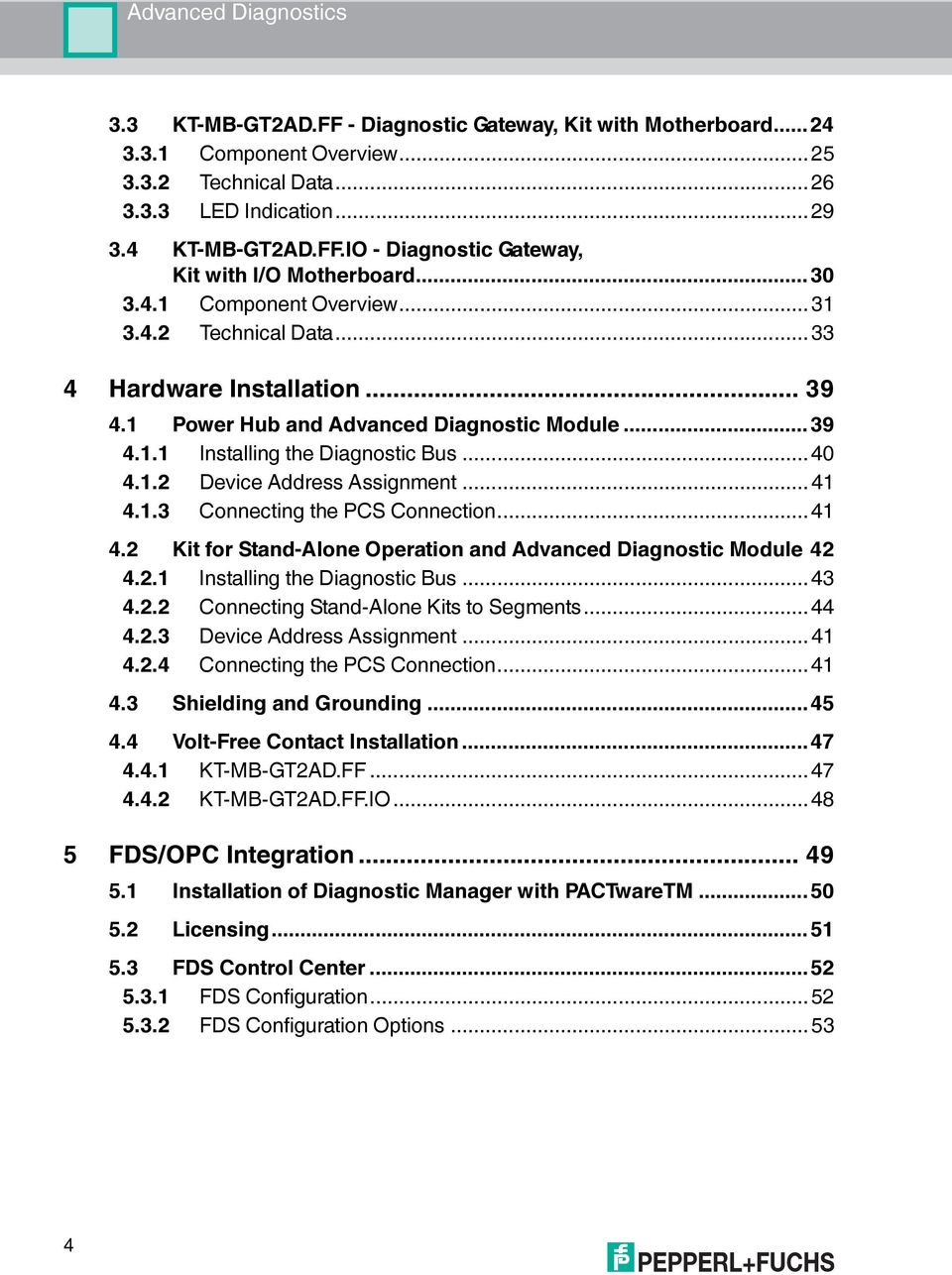
5 5.4 Project Setup Tags Used in ADM Projects Communication with the Diagnostic Gateway Manual Setup of a Diagnostic Project with PACTwareTM Assign Diagnostic Gateway Addresses Assign HD2-DM-A Addresses Scanning of a Diagnostic Installation for Project Setup Import of Diagnostic Project from File Import of Diagnostic Project from FDS Set Snapshot Archive Location Operation with Device Type Managers (DTM) Online Parameterization Overview Settings Commissioning Wizard System Commissioning Segment Commissioning Generate Report for HD2-DM-A.RO DIP Switch Settings Diagnostics Expert Diagnostics Current Alarms Diagnostics Tab Alarm History Diagnostics Tab Measured Value System & Segment Measurement Field Device Signal Level Field Device Measurement Fieldbus Statistics Snapshot Creation Snapshot Explorer Snapshot Toolbar Advanced Parameterization and Parameterization Field Device Handling
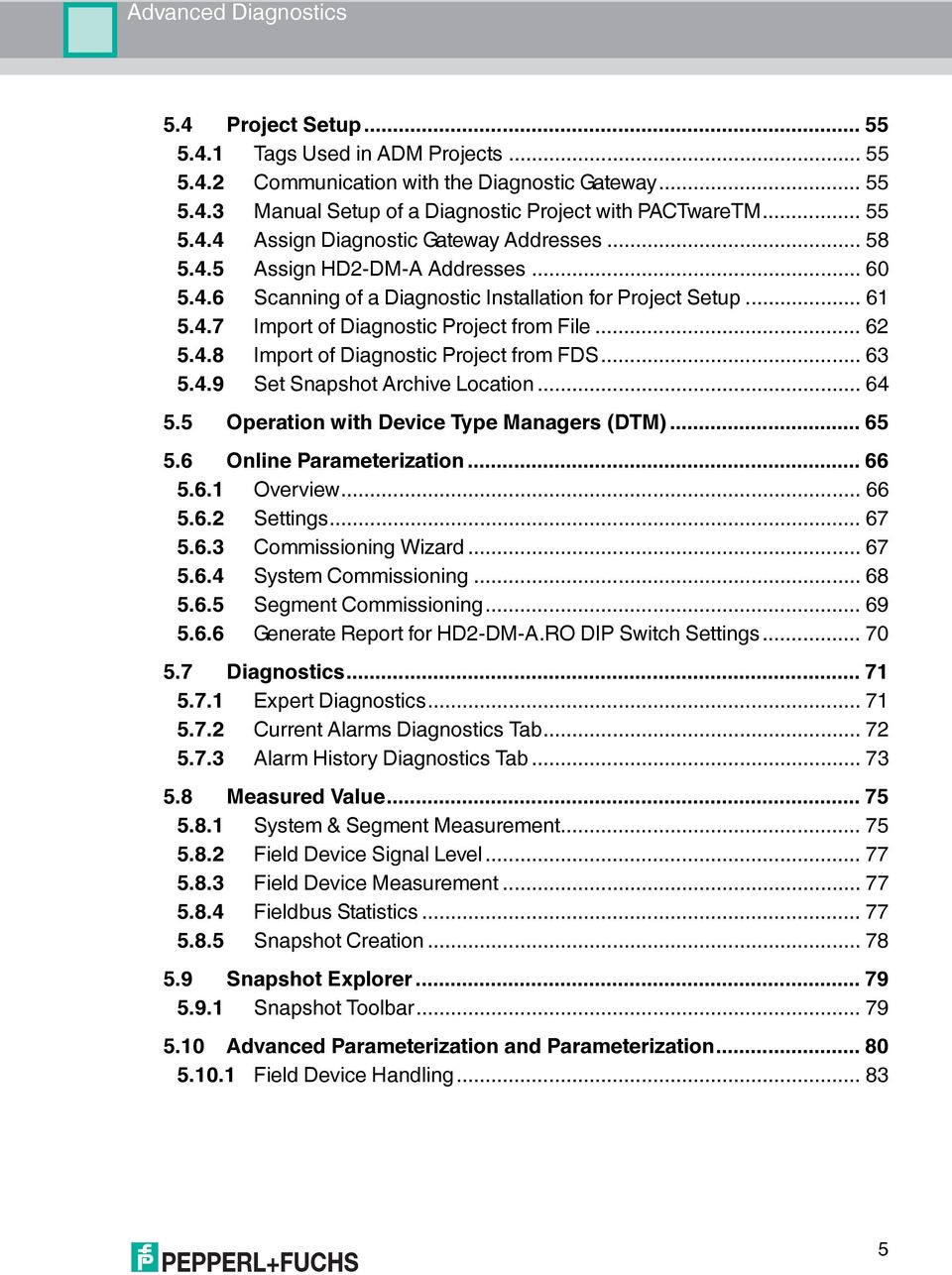
6 5.11 History Export Long-Term History Export History Excel Export Feature Fieldbus Oscilloscope Oscilloscope Recording Settings Start Oscilloscope Recording Trigger Description Toolbars and Shortcuts Firmware Update FDS Diagnostics FDS Reporting Wizard FOUNDATION Fieldbus Integration FF Device Structure Installation Alarm Integration Alarm Integration with Scheduled Function Block Data Field Diagnostics Transducer Block Alarms Operation with Device Descriptions (DD) Configuration Configuration Limitations Diagnostics Supported Methods Commissioning Wizard Installation of DGW-FF Device Type Managers with PACTwareTM Project Setup
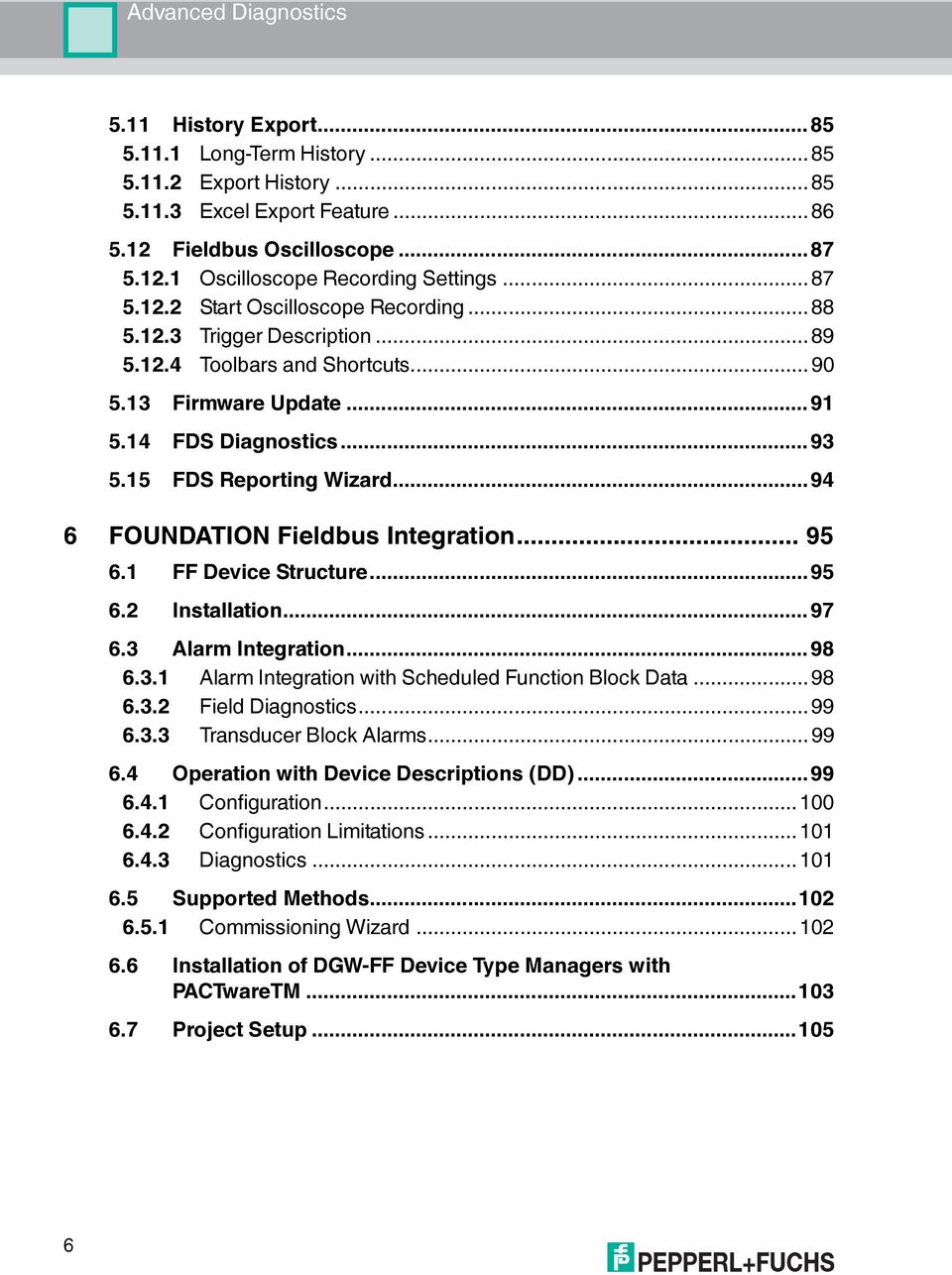
7 6.8 HD2-GT-2AD.FF.IO Device Type Manager (DTM) Online Parameterization and Parameterization Commissioning Wizard Diagnosis Measured Value Create a Snapshot History Export Snapshot Explorer Fieldbus Oscilloscope Tag Import Wizard Reporting Wizard Cabinet I/O Field Diagnostics Input Configuration Frequency/Binary Inputs Binary Inputs Temperature/Binary Inputs Board Humidity Board Temperature Output Configuration On/Off Controllers FF Channels for the I/O Transducer Block Cabinet Management Applications and I/O Blocks Configuring Typical Cabinet Management Applications Manually Appendix

8 8.1 Measured Values / Parameters Board Type Communication Active Current Unbalance Active Field Devices Communication Error Statistics History Recording Jitter Noise Polarity Power Supply Voltage Signal Level Trunk Surge Protector Alarm Device Coupler Alarms Voltage Measured Values by Motherboard Type HD2-GT-2AD.FF.IO FF Blocks ADM_TB Transducer Block Transducer Block IO_TB Multiple Discrete Input (MDI) Function Block Discrete Input (DI) Function Block Function Block MAI Function Block MDO Resource Block HD2-GT-2AD.FF.IO FF Channel List HD2-GT-2AD.FF.IO FF Field Diagnostic Conditions Expert System Phenomena IDs DGW-FF Troubleshooting Diagnostic Gateway: Configuration Tool and TCP/IP Settings Alarm Hysteresis and Reset Field Device Handling for PROFIBUS Online and Offline Data Sets HD2-GT-2AD.FF.IO Web Server

9 8.12 OPC Server Details OPC-DA Server Name Space OPC-AE Message Data

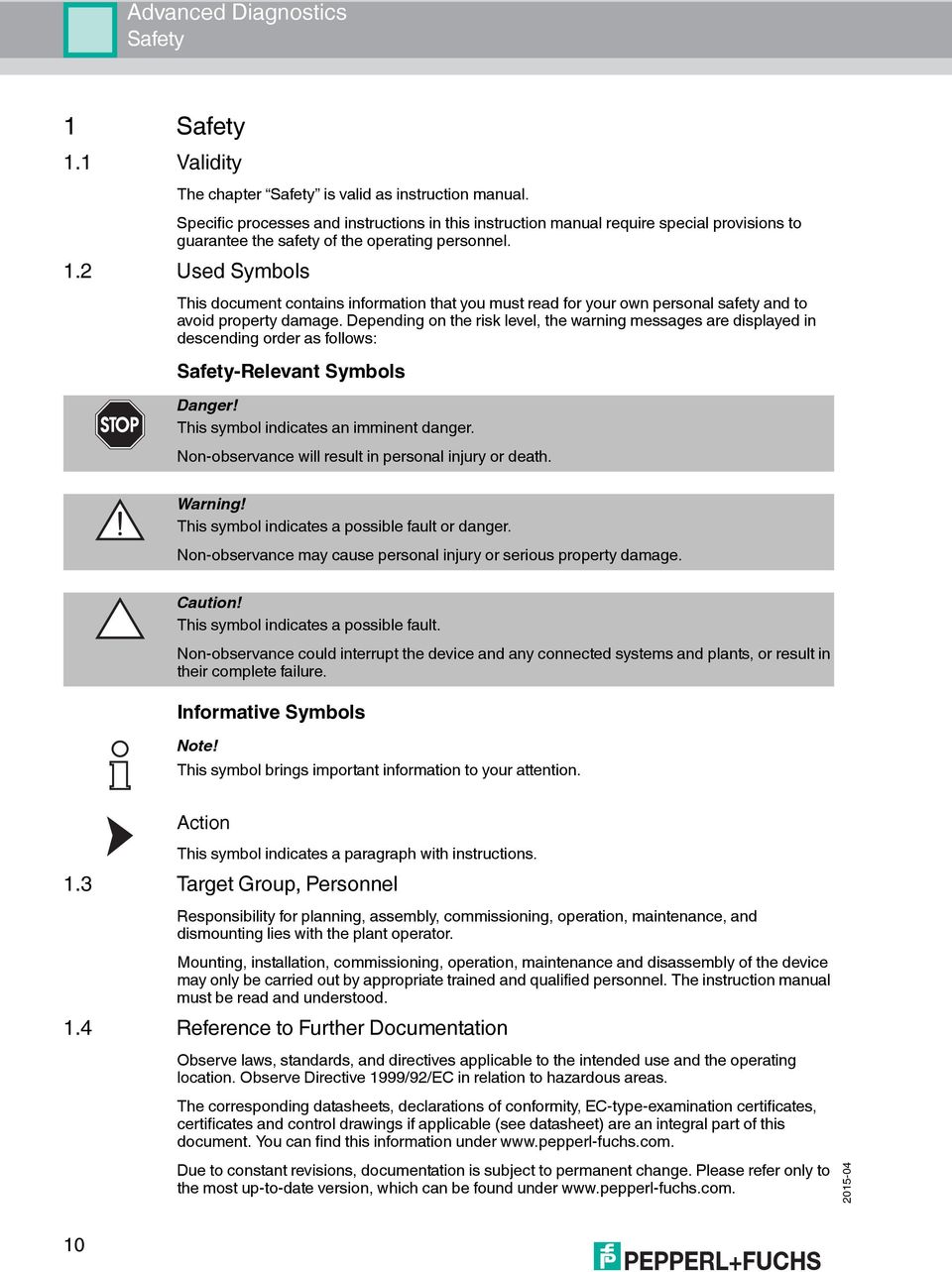
10 Safety 1 Safety 1.1 Validity The chapter Safety is valid as instruction manual. Specific processes and instructions in this instruction manual require special provisions to guarantee the safety of the operating personnel. 1.2 Used Symbols This document contains information that you must read for your own personal safety and to avoid property damage. Depending on the risk level, the warning messages are displayed in descending order as follows: Safety-Relevant Symbols Danger! This symbol indicates an imminent danger. Non-observance will result in personal injury or death. Warning! This symbol indicates a possible fault or danger. Non-observance may cause personal injury or serious property damage. Caution! This symbol indicates a possible fault. Non-observance could interrupt the device and any connected systems and plants, or result in their complete failure. Informative Symbols Note! This symbol brings important information to your attention. Action This symbol indicates a paragraph with instructions. 1.3 Target Group, Personnel Responsibility for planning, assembly, commissioning, operation, maintenance, and dismounting lies with the plant operator. Mounting, installation, commissioning, operation, maintenance and disassembly of the device may only be carried out by appropriate trained and qualified personnel. The instruction manual must be read and understood. 1.4 Reference to Further Documentation Observe laws, standards, and directives applicable to the intended use and the operating location. Observe Directive 1999/92/EC in relation to hazardous areas. The corresponding datasheets, declarations of conformity, EC-type-examination certificates, certificates and control drawings if applicable (see datasheet) are an integral part of this document. You can find this information under Due to constant revisions, documentation is subject to permanent change. Please refer only to the most up-to-date version, which can be found under 10
11 Safety 1.5 Delivery, Transport and Storage 1.6 Marking Check the packaging and contents for damage. Check if you have received every item and if the items received are the ones you ordered. Keep the original packaging. Always store and transport the device in the original packaging. Always store the device in a clean and dry environment. The permitted storage temperature (see data sheet) must be considered. HD2-DM-A Fieldbus Power Hub, Advanced Diagnostic Module Pepperl+Fuchs GmbH Lilienthalstraße 200, Mannheim, Germany Statement of conformity: TÜV 04 ATEX 2500 X Group, category, type of protection, temperature class: II 3 G Ex na IIC T4 Gc KT-MB-GT2AD.FF Advanced Diagnostic Gateway with Ethernet and FF-H1 Interface Pepperl+Fuchs GmbH Lilienthalstraße 200, Mannheim, Germany Statement of conformity: TÜV 14 ATEX X Group, category, type of protection, temperature class: II 3 G Ex na IIC T4 Gc KT-MB-GT2AD.FF.IO Advanced Diagnostic Gateway with Ethernet and FF-H1 Interface and I/O Pepperl+Fuchs GmbH Lilienthalstraße 200, Mannheim, Germany Statement of conformity: TÜV 14 ATEX X Group, category, type of protection, temperature class: Motherboard II 3 G Ex na nc IIC T4 Gc, Gateway II 3 G Ex na IIC T4 Gc 1.7 Intended Use The devices are designed to analyze signal and segment parameters for monitoring and measuring of specific system, segment and field device values. The device is only approved for appropriate and intended use. Ignoring these instructions will void any warranty and absolve the manufacturer from any liability. The device must only be operated in the specified ambient temperature range and at the specified relative humidity without condensation. Protection of the personnel and the plant is not ensured if the device is not being used according to its intended use. 11

12 Safety The device is not suitable for isolating signals in power installations unless this is noted separately in the corresponding datasheet. 1.8 Mounting/Installation Prior to mounting, installation, and commissioning of the device you should make yourself familiar with the device and carefully read the instruction manual. The device may be installed in Zone 2. The device has to be erected in such a way that corresponding to IEC , a degree of protection of at least IP54 according to IEC is achieved. The device has to be erected in such a way that a pollution degree 2 or less according to IEC is achieved if the device is connected to an intrinsically safe limited voltage according to IEC :2011. The statement of conformity and certificate of compliance of the Fieldbus Power Hub must be observed. It is especially important to pay attention to any special conditions for safe use that are indicated. Avoid electrostatic charges which could result in electrostatic discharges while installing or operating the device. If the device has already been operated in general electrical installations, the device may subsequently no longer be installed in electrical installations used in combination with hazardous areas. Observe the installation instructions according to IEC/EN Connection or disconnection of energized non-intrinsically safe circuits is only permitted in the absence of a hazardous atmosphere. 1.9 Operation, Maintenance, Repair 1.10 Disposal Only use operating elements in the absence of a potentially explosive atmosphere. Only plug and pull the energized module in the absence of a potentially explosive atmosphere. Connection or disconnection of energized non-intrinsically safe circuits is only permitted in the absence of a potentially explosive atmosphere. Observe IEC/EN for maintenance and inspection of associated apparatus. The devices must not be repaired, changed or manipulated. If there is a defect, the product must always be replaced with an original device. Disposing of device, packaging, and possibly contained batteries must be in compliance with the applicable laws and guidelines of the respective country. 12

13 General Description 2 General Description Overview Advanced physical layer diagnostics provides a set of monitoring tools for FOUNDATION Fieldbus H1 and PROFIBUS PA that simplify the work with the fieldbus physical layer. FieldConnex physical layer diagnostics offers the following features: The advanced diagnostic module (ADM): It provides comprehensive measurement capabilities for up to 4 segments and is integrated into the FieldConnex Power Hubs. The diagnostic gateway (DGW): It connects the ADMs to the process control system (PCS). Several integration options to the PCS are available. Software packages consisting of DTMs and auxiliary software provide use-case-driven and easy access to the functionality of the advanced physical layer diagnostics and alarm integration with the onsite PCS. An optional stand-alone kit can expand the advanced diagnostic features in areas where no FieldConnex Power Hubs are installed. Optional cabinet management I/O functionality for the diagnostic gateway. These features ensure the best possible quality of the fieldbus physical layer through efficient working procedures reducing the amount of effort necessary to commission, monitor and troubleshoot segments. Only a very basic understanding of fieldbus is required to operate the diagnostic tools as they provide comprehensive information and fieldbus expertise to the user. The advanced physical layer diagnostics offer support for one or all three of the following areas of application in process plants: 1. Commissioning After installation is complete and before loop check commences, the condition of the segment is checked. A physical layer in good condition is the basis for a successful loop check and plant startup. The ADM and diagnostic manager check the segment with a few mouse clicks and simple-to-use automated procedures. The diagnostic manager records comprehensive physical layer values in a baseline report and suggests limit values to be stored in the ADM. 2. Online-Monitoring The ADM compares actual values to the limits set during commissioning, keeping an "extra set of eyes" on the fieldbus. Warnings indicate early on that a fault has occurred or that the quality of the installation is degrading. Proactive corrective action is possible preventing unwanted plant shutdowns. 3. Troubleshooting Messages in plain language help the maintenance staff to find possible causes for a problem. Repair work is planned and performed only when necessary. This significantly reduces time to repair and time spent in the field. Additional tools for more detailed analysis complete the advanced physical layer diagnostics: Automated reports in electronic format Fieldbus oscilloscope Long-term history for monitoring changes Storage of configuration and historical data Export functions to other spreadsheets or data warehouse 13

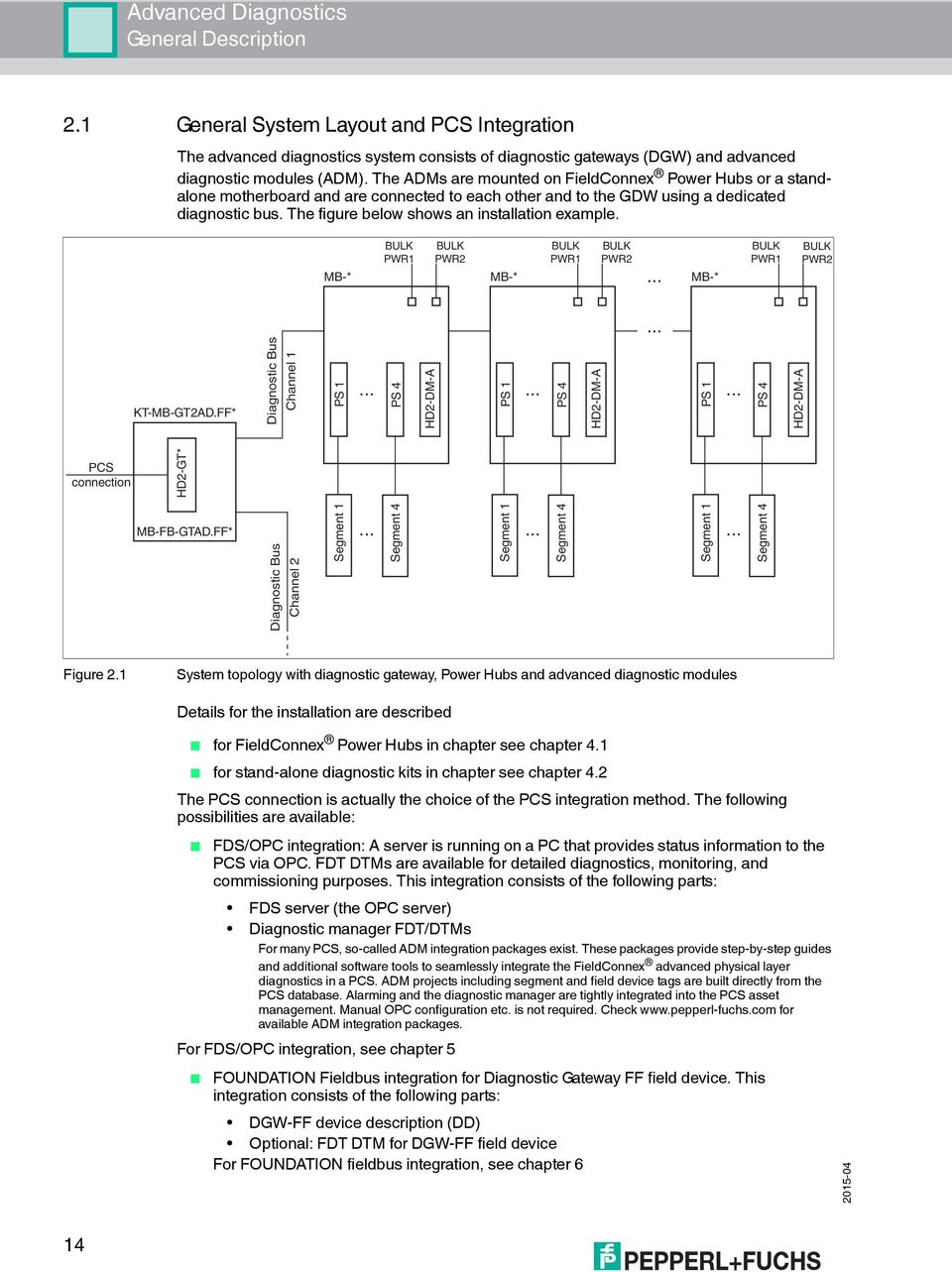
14 General Description 2.1 General System Layout and PCS Integration The advanced diagnostics system consists of diagnostic gateways (DGW) and advanced diagnostic modules (ADM). The ADMs are mounted on FieldConnex Power Hubs or a standalone motherboard and are connected to each other and to the GDW using a dedicated diagnostic bus. The figure below shows an installation example. MB-* BULK PWR1 BULK PWR2 MB-* BULK PWR1 BULK PWR2... MB-* BULK PWR1 BULK PWR2... KT-MB-GT2AD.FF* Diagnostic Bus Channel 1 PS 1... PS 4 HD2-DM-A PS 1... PS 4 HD2-DM-A PS 1... PS 4 HD2-DM-A PCS connection HD2-GT* MB-FB-GTAD.FF* Diagnostic Bus Channel 2 Segment 1... Segment 4 Segment 1... Segment 4 Segment 1... Segment 4 Figure 2.1 System topology with diagnostic gateway, Power Hubs and advanced diagnostic modules Details for the installation are described for FieldConnex Power Hubs in chapter see chapter 4.1 for stand-alone diagnostic kits in chapter see chapter 4.2 The PCS connection is actually the choice of the PCS integration method. The following possibilities are available: FDS/OPC integration: A server is running on a PC that provides status information to the PCS via OPC. FDT DTMs are available for detailed diagnostics, monitoring, and commissioning purposes. This integration consists of the following parts: FDS server (the OPC server) Diagnostic manager FDT/DTMs For many PCS, so-called ADM integration packages exist. These packages provide step-by-step guides and additional software tools to seamlessly integrate the FieldConnex advanced physical layer diagnostics in a PCS. ADM projects including segment and field device tags are built directly from the PCS database. Alarming and the diagnostic manager are tightly integrated into the PCS asset management. Manual OPC configuration etc. is not required. Check for available ADM integration packages. For FDS/OPC integration, see chapter 5 FOUNDATION Fieldbus integration for Diagnostic Gateway FF field device. This integration consists of the following parts: DGW-FF device description (DD) Optional: FDT DTM for DGW-FF field device For FOUNDATION fieldbus integration, see chapter 6 14
15 General Description PROFIBUS Power Hub integration for systems that use the transparent Pepperl+Fuchs Segment Couplers. This integration is described in detail in the PROFIBUS Power Hub manual. Simple integrations can be implemented using a volt-free contact. Typically, this integration will be used with one of the other solutions. Alarming during segment operation is done using the volt-free contact; commissioning and troubleshooting are done using one of the other integration methods. For more information, see chapter General Terms and Functions for Advanced Physical Layer Diagnostics Overview Each segment monitored by advanced physical layer diagnostics (APLD) has 1 of 3 states: Non-commissioned This is the initial state of segments in the ADM. All diagnostics in this state are based on the following: Limits defined by the fieldbus standard IEC/EN or Limits calculated from information on the segment topology, e.g., trunk cable length, type of device couplers used This mode is used to commission a segment and guarantee an error-free installation. Commissioned A segment is set to commissioned if an initial checkout was executed to verify an errorfree installation. In the commissioned mode, the segment is validated against limits defined during the commissioning procedure. These limits can be specified manually for each segment, but typically the commissioning wizard is used. For more information on the commissioning wizard, see chapter Disabled The segment is a spare segment and not used yet. The advanced physical layer diagnostics is disabled for this segment. The overall segment and each single diagnostic value is classified by the ADM in the following way: Not Commissioned Excellent: All values are within the specification limits with an excellent safety margin. Good: The value is within the specification limits but the safety margin is reduced. Values within IEC limits, but with small safety margins or values are not matching with expected values of the topology. Out of specification: The value exceeds the specification limits. At least one value violated an IEC limit. Commissioned No Error: The value is within the commissioned limits. Maintenance Required: The value is outside the commissioned limits (but still inside allowed range). At least one value changed since commissioning. 15
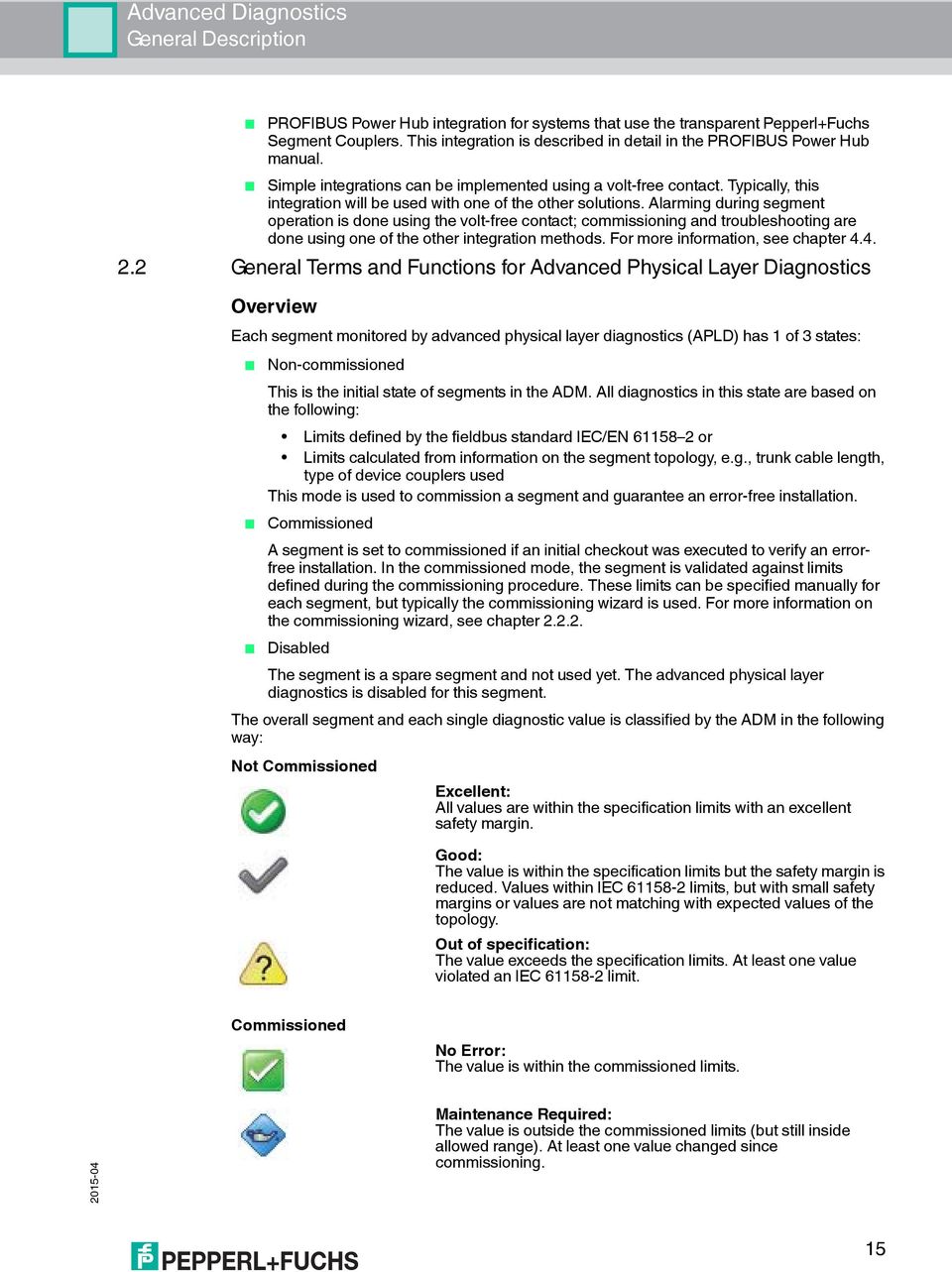
16 General Description Out of Specification: The value exceeds the specification limits. At least one value violated an IEC limit. Failure: Field devices that were active on the fieldbus during commissioning and are not active any more are marked as fail in the user interfaces. The overall segment is classified as out of specification. If any hardware failure of the ADM is detected or if the Diagnostic Gateway is not able to communicate with the ADM this is also shown as Fail Expert System FieldConnex advanced physical layer diagnostics includes an expert system. This expert system analyzes all measured values and provides detailed diagnostic messages about any found issue on the fieldbus, the root causes of the issue and actions necessary to solve them. This way, the user is relieved from the tedious and time-consuming analysis of all measurements of the ADM. The expert system takes the segment state (commissioned, noncommissioned) into account and provides optimized messages for the 2 different use cases Commissioning Wizard The commissioning wizard is a tool for a fast and easy system setup with advanced diagnostic modules (ADM). It is the recommended way to perform segment commissioning. The wizard guides you through segment commissioning and determines system and segment data of your fieldbus installation. The expert system analyzes this data and helps you to solve any issues found. A comprehensive report on the status of the segment at the time of is automatically generated. Based on this information, the commissioning wizard proposes limits for all system, segment, and field device alarm values. If necessary, you can edit the limit values or store them on the ADM. After the commissioning wizard is completed successfully, the ADM is switched to the "commissioned mode" and is ready for plant supervision Diagnostic Gateway Mode (DGW Mode) The diagnostic gateway (DGW) can be used for the OPC and DTM integration as well as for the Foundation Fieldbus integration. Only 1 of the 2 types of integration can be used at a time. The DGW mode must be set to "FDS" or "FF", depending on the selected integration solution. When a DGW is installed the first time, it automatically selects the DGW mode depending on whether an FF host or an FDS is connecting to the gateway. In order to change the integration later on, the DGW mode can be set manually, either via DTMs or via the DGW built-in web server Field Device Handling The ADM differentiates between "configured" and "unconfigured" field devices. Field devices are identified based on the device address. Configured field devices The ADM features a list of field devices that are labeled "configured field devices". All field devices (and the hosts) belonging to the segment are added to the configured field devices list. Field devices included in this list can have a tag, limits for their signal levels, as well as alarm settings for field-device-specific alarms. The commissioning wizard automatically includes all field devices that are active during the commissioning procedure in the configured field devices list. If field devices are active on the fieldbus and are not in the configured field devices list or devices in the list are inactive (i.e., not communicating), the ADM issues an alarm. Unconfigured field devices All devices that are active on the fieldbus, but are not in the configured field devices list are labeled "unconfigured field devices". All measured physical layer data (e.g., signal levels) is shown for this device, but no alarms etc. are associated with this device. 16

17 Moduladresse module address Bit ADRESSAUSWAHL / ADDRESS SELECTION Moduladresse Bit module address Hinweis: Die Moduladressen sind nur im Bereich von 1 bis 247 g ltig (bin r kodiert). Note: The module addresses are only valid in the range from 1 to 247 (binary coded). Advanced Diagnostics Product Description 3 Product Description 3.1 HD2-DM-A - Advanced Diagnostic Module General Overview The advanced diagnostic module (ADM) is a plug-in module for FieldConnex Power Hubs. Together with the diagnostic gateway and the diagnostic manager software solutions, it supports commissioning, online monitoring and troubleshooting of FOUNDATION Fieldbus or PROFIBUS PA segments in FieldConnex Power Hub installations. It measures the physical characteristics of the fieldbus installation and the fieldbus communication signals. This data is compared to configurable limits and evaluated by and expert system. The results of the examination are provided as alarm information and a detailed analysis of detected issues Component Overview mm (5") 106 mm (4.2") 18 mm (0.7") Figure 3.1 Overview HD2-DM-A 1 Plug connections to motherboard 2 LED green PRI Power 3 LED green SEC Power 4 LED Seg Address selection overview 6 DIP switch for device address Technical Data HD2-DM-A Supply Rated voltage V Rated current ma Power loss max. 2 W Fieldbus interface Number of segments 4 Fieldbus type FOUNDATION Fieldbus/PROFIBUS PA Rated voltage V Indicators/operating means 17
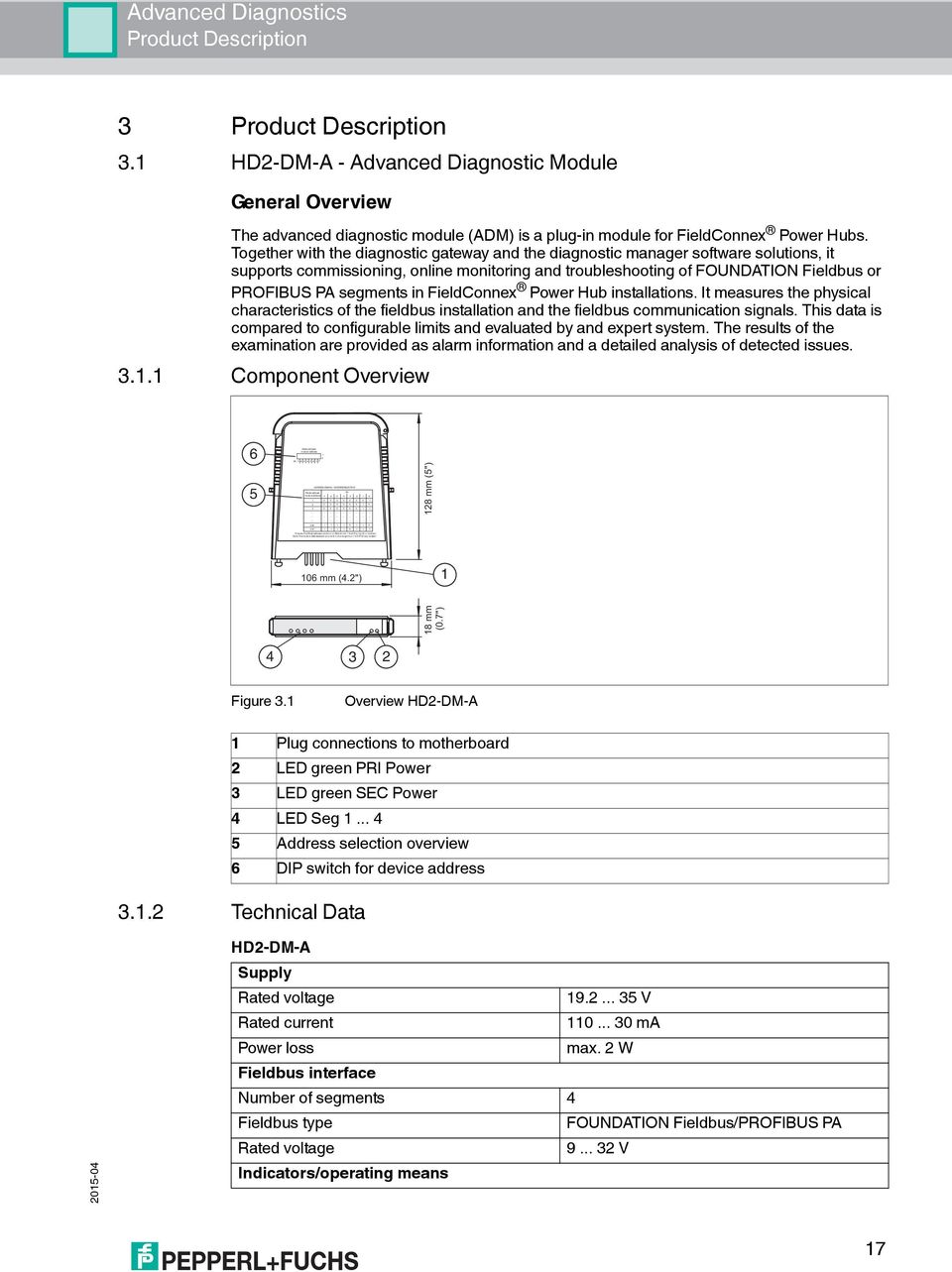
18 Product Description LED PRI PWR green: on, primary bulk power supply connected LED SEC PWR green: on, secondary bulk power supply connected LED Seg yellow: bus activity; red 2 Hz flashing: alarm; red: hardware error Fault signal VFC alarm 1 A, 50 V DC, normally closed DIP-switch diagnostic address , binary coded Interface Interface type diagnostic bus: RS 485 Electrical isolation Fieldbus segment/fieldbus segment functional insulation acc. to IEC 62103, rated insulation voltage 50 V eff Fieldbus segment/supply functional insulation acc. to IEC 62103, rated insulation voltage 50 V eff Directive conformity Electromagnetic compatibility Directive 2004/108/EC EN :2013 Standard conformity Electromagnetic compatibility NE 21:2011 Degree of protection IEC Shock resistance EN Vibration resistance EN Corrosion resistance acc. to ISA-S , severity level G3 Ambient conditions Ambient temperature C ( F) Storage temperature Relative humidity Shock resistance Vibration resistance C ( F) < 95 % non-condensing 15 g 11 ms 1 g, Hz Pollution Degree max. 2, according to IEC Corrosion resistance Mechanical specifications Connection type Core cross-section Housing material Housing width Housing height Housing depth Degree of protection Mass Mounting acc. to ISA-S , severity level G3 Motherboard specific Motherboard specific Polycarbonate 18 mm 106 mm 128 mm IP20 Mating cycles 100 Data for application in connection with Ex-areas approx. 100 g motherboard mounting 18
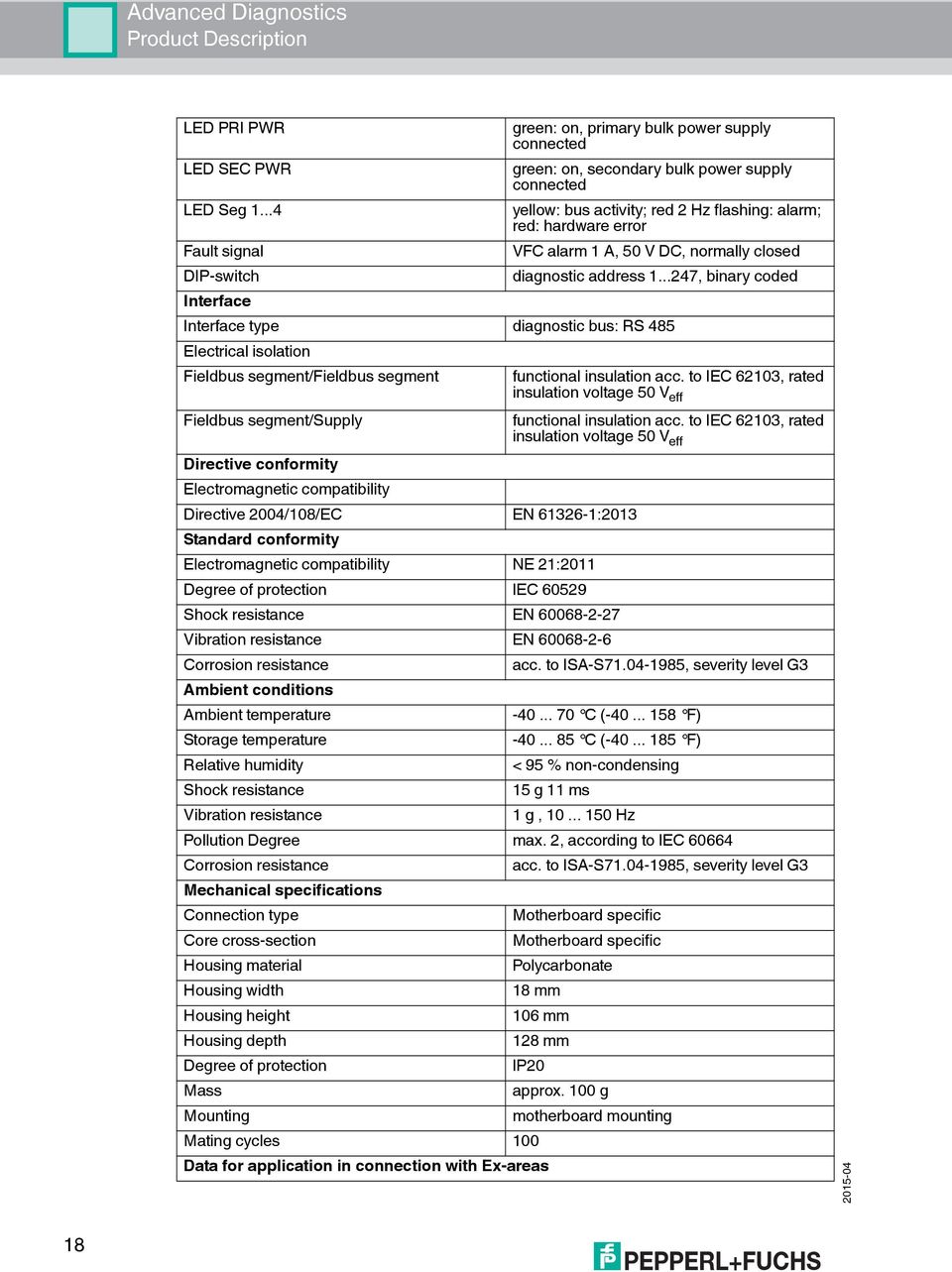
19 Product Description Statement of conformity Group, category, type of protection, temperature class Directive conformity Directive 94/9/EC LED Indication TÜV 04 ATEX 2500 X II 3 G Ex na IIC T4 Gc EN :2012, EN :2012, EN :2010 PRI PWR SEC PWR 1 2 International approvals FM approval CoC , CoC C Approved for Class I, Division 2, Groups A, B, C, D, T4 / Class I, Zone 2, AEx/Ex na IIC T4 IECEx approval IECEx TUN X Approved for Ex na IIC T4 Gc Certificates and approvals Marine approval DNV A Patents This product may be covered by the following patent: US7,698,103 General information Supplementary information Statement of Conformity, Declaration of Conformity, Attestation of Conformity and instructions have to be observed where applicable. For information see HD2- DM-A 6 5 Fieldbus Diagnostic Module Advanced Version Seg1 Seg2 Seg3 Seg4 3 4 Figure 3.2 LED indication 1 LED: Primary power connection 2 LED: Secondary power connection 3 LED: Status segment 1 4 LED: Status segment 2 5 LED: Status segment 3 6 LED: Status segment 4 19

20 Product Description LED Indication Fault Type Remedy PRI PWR or SEC PWR LEDs are off. 1 segment LED is flashing yellow (on/off with 2 Hz). 1 segment LED is flashing red (on/off with 2 Hz). All segment LEDs are flashing yellow (on/off with 2 Hz). All segment LEDs are flashing red (on/off with 2 Hz). Any (or all) segment LEDs are constantly lit red Mounting the Diagnostic Module Supply power failure, possible reasons: No primary and/or secondary supply power is available Supply power < 19.2 V Supply power > 35 V (32 V if at least 1 non-isolated power module is pluggedin or configured) A segment/field device maintenance required alarm is active. Any segment/field device alarm is active. A system maintenance required alarm is active. Any system alarm is active. A hardware fault inside HD2- DM-A is detected. Connect diagnostic PC and carry out a complete system diagnostics: Bulk power supply switched on and healthy? Verify that the wiring is secure: Tug on the wires/cable clamps Measure the DC voltage at the terminal block connector to the bulk power supply Connect diagnostic PC and carry out a complete system diagnostics: DC unbalance? Jitter level too high? Noise level too high? Bus segment badly terminated?... miswired (shield connections)?... short circuit overload? Power supply/conditioner modules healthy and correctly mounted? Connect diagnostic PC and carry out a complete system diagnostics: Bulk power supply voltage correct? Board type configuration correct? Board redundancy configuration correct? Warning! Hardware Damage If you plug the diagnostic module HD2-DM* into the wrong connection slot, the module or the motherboard may be damaged. The Power Hub motherboard features a special connection slot for diagnostic modules labeled "Diagnostic Module only". Use this slot only. - Mounting of HD2-DM* Modules on the Motherboard To install a new module on the motherboard, proceed as follows: 20

21 Product Description 1. Carefully center the polarisation holes and mate the two connectors, then gently press down the module. 2. Push down the red Quick Lok Bars on each side of the module to fix it to the panel. Figure 3.3 Mounting HD2-DM* The new module has been installed. Dismounting Modules from the Motherboard To dismount a module from the motherboard, proceed as follows: Pull up the red Quick Lok Bars on each side of the module and carefully lift off the entire module. The module has been removed from the motherboard. 3.2 KT-MB-DMA - Advanced Diagnostic Module, Kit for Stand-Alone Operation General Overview The stand-alone diagnostic kit consists of an HD2-DM-A plug-in module (see chapter 3.1) and a motherboard to connect the HD2-DM-A to up to 4 segments. It is specially designed to lead the advanced diagnostic features in areas where continuous monitoring of the physical layer is crucial and no FieldConnex Power Hubs are installed. 21
22 PRI PWR SEC PWR Advanced Diagnostics Product Description Component Overview mm (4.3") 220 mm (8.7") Fieldbus Diagnostic Module Extended Version Seg1 Seg2 Seg3 Seg mm (6.4") 9 50 mm (1.9") 2 Figure 3.4 Overview KT-MB-DMA 1 Advanced diagnostic module (ADM) 2 Mounting screws 3 SEG1 SEG2 Connections for segments s + s + s + SEG3 s + SEG4 4 Diagnostic bus + Alarm Diagnostic Bus + 5 PRI LED green: Primary power 6 SEC LED green: Secondary power 7 LEDs Seg Shield/ground connection clamp 9 PWR Connections for bulk power supply Technical Data The technical data below refers to the stand-alone motherboard. For technical data of the HD2- DM-A diagnostic module, see chapter KT-MB-DMA Supply Rated voltage V Rated current ma Power loss max. 2 W Fieldbus interface Number of segments 4 22
23 Product Description Fieldbus type Indicators/operating means LED PRI PWR LED SEC PWR LED Seg Fault signal DIP-switch Interface Mounting the Stand-Alone Kit and the Advanced Diagnostic Module For mounting the HD2-DM-A diagnostic module, see chapter FOUNDATION Fieldbus/PROFIBUS PA green: on, primary bulk power supply connected green: on, secondary bulk power supply connected yellow: bus activity; red 2 Hz flashing: alarm; red: hardware error VFC alarm 1 A, 50 V DC, normally closed diagnostic address , binary coded Interface type diagnostic bus: RS 485 Directive conformity Electromagnetic compatibility Directive 2004/108/EC EN :2006 Standard conformity Electromagnetic compatibility NE 21 Degree of protection IEC Shock resistance EN Vibration resistance EN Ambient conditions Ambient temperature Storage temperature Relative humidity Shock resistance Vibration resistance Mechanical specifications Connection type C ( F) C ( F) < 95 % non-condensing 15 g 11 ms 1 g, Hz screw terminals Core cross-section 2.5 mm 2 Housing material Housing width Housing height Housing depth Degree of protection Mass Mounting International approvals Polycarbonate 50 mm 220 mm 162 mm IP20 approx. 290 g DIN mounting rail FM approval CoC , CoC C Approved for Class I, Division 2, Groups A, B, C, D, T4 / Class I, Zone 2, AEx/Ex na IIC T4 23
24 Product Description Mounting Fieldbus Motherboards on the DIN Mounting Rail In order to mount a motherboard on a DIN mounting rail, proceed as follows: 1. Place the motherboard on the mounting rail. 2. Tighten the fastening screw to attach the motherboard on the DIN rail. 1 Motherboard DIN mounting rail 2 Fastening screw The motherboard has been mounted. 3.3 KT-MB-GT2AD.FF - Diagnostic Gateway, Kit with Motherboard General Overview The FieldConnex Diagnostic Gateway collects all data from the advanced diagnostic module (ADM) and provides interfaces to access the data from the diagnostic manager and PCS. Ethernet Allows access to the ADMs for the diagnostic manager and the FDS/OPC server. It is mainly used for the FDS/OPC integration, but can also be used with the FOUNDATION Fieldbus H1 interface to enhance the functionality of the diagnostic manager and to access the FOUNDATION Fieldbus device locally using a mobile computer. FOUNDATION Fieldbus H1 Provides the core diagnostic data of up to 16 HD2-DM-A ADMs as FOUNDATION Fieldbus H1 device. The Ethernet interface can be used in addition to the FF-H1 interface to enhance the functionality of the diagnostic manager and to access the FOUNDATION Fieldbus device locally using a mobile computer. 24
25 Product Description Common alarm output The common alarm output can be used to report the ADM alarms as a volt-free contact to a PCS input. The gateway is seamlessly integrated into the FieldConnex advanced physical layer solution and provides many features for a fast and easy installation and setup of the advanced physical layer diagnostics. Note! The diagnostic gateway FF-H1 connection must never be connected to device couplers like the Pepperl+Fuchs Segment Protectors or FieldBarriers. The diagnostic gateway must be connected directly to the trunk. For best performance, we recommend to use a separate FF-H1 diagnostic segment for diagnostic gateways. Scheduled FB data must be kept to a minimum for this segment Component Overview PWR 15 ERR LINK/ ACT HD2- GT- 2AD.FF Diagnostic Gateway CH 1 CH 2 COM ALM Channel 1 Output I: Alarm output diagnostic bus channel 1, volt-free contact, NC contact Alarm Out See chapter Channel 2 Alarm Out Output II: Alarm output diagnostic bus channel 2, volt-free contact, NC contact See chapter Serial, not used Serial 4 Common Output III: Common alarm, volt-free contact, NC contact See chapter Alarm Out 5 GND + Bulk power supply connection PWR 6 Ethernet, 8-pin RJ45 socket 7 Enable/disable simulation switch 25
26 Product Description 8 Grounding terminal 9 FF H1 FF-H1 s + 10 Diagnostic bus channel 2 11 LED: Common alarm output 12 LED: COM, not used 13 LED: Diagnostic bus channel 2 activity 14 LED: Diagnostic bus channel 1 activity 15 Diagnostic bus channel 1 16 LED: LINK/ACT 17 LED: Error 18 LED: Power supply 19 Mounting screw (located under diagnostic gateway) Cable and Connection Information Alarm output / serial / bulk power supply: Cross-section: 0.2 mm 2-4 mm 2 fix, 0.2 mm 2-2.5mm 2 flexible Wire stripping lenght: 8 mm Torque: 0.5 Nm Nm FF-H1 / Diagnostic Bus Channel 1+2: Cross-section: 0.2 mm 2-2.5mm 2 fix + flexible Wire stripping lenght: 7 mm Torque: 0.5 Nm Nm Technical Data Alarm + Alarm + KT-MB-GT2AD.FF Supply Rated voltage V DC SELV/PELV Rated current ma Power loss max. 2.5 W Fieldbus interface Fieldbus type FOUNDATION Fieldbus Physical layer profile profile type 114 ITK version 6 26
27 Product Description Implementation resource block 1x RS function block 4x MDI, 1x MDO, 1x MAI, 1x DI transducer block 16x ADM TB, 1x IO TB Firmware update Ethernet Polarity polarity-sensitive Rated voltage V SELV/PELV Rated current 0 ma Ethernet Interface Port 100 BASE-TX Protocol TCP/IP and UDP/IP Services ICMP, DHCP, AutoIP, HTTP Connection type RJ-45 socket, 8-pin Transfer rate 100 MBit/s Diagnostic Bus Number of Diagnostic Bus Channels 2 Number of Diagnostic Modules/Channel 31 Using Ethernet Interface, 8 Using Fieldbus Interface Termination integrated Cable length/channel 30 m Indicators/operating means LED ERR red: Hardware fault LED PWR green: Power on LINK/ACT yellow CH1, CH2 yellow: diagnostic bus activity Outputs Output I alarm output diagnostic bus channel 1, voltfree contact, NC contact Voltage 50 V DC Current max. 1 A Output II alarm output diagnostic bus channel 2, voltfree contact, NC contact Voltage 50 V DC Current max. 1 A Output III common alarm, volt-free contact, NC contact Voltage 50 V DC Current max. 1 A Electrical isolation All circuits/fe functional insulation acc. to IEC 62103, rated insulation voltage 50 V eff Output I, II/other circuits functional insulation acc. to IEC 62103, rated insulation voltage 250 V eff Ethernet/Supply functional insulation acc. to IEC 62103, rated insulation voltage 50 V eff Ethernet/other circuits functional insulation acc. to IEC 62103, rated insulation voltage 50 V eff 27
28 Product Description Fieldbus/other circuits functional insulation acc. to IEC 62103, rated insulation voltage 50 V eff Diagnostic Bus/other circuits functional insulation acc. to IEC 62103, rated insulation voltage 50 V eff Directive conformity Electromagnetic compatibility Directive 2004/108/EC EN :2013 Low voltage Directive 73/23/EEC EN Standard conformity Electrical isolation IEC Electromagnetic compatibility NE 21 Degree of protection IEC Fieldbus standard IEC Climatic conditions DIN IEC 721 Shock resistance EN Vibration resistance EN Ethernet IEEE Ambient conditions Ambient temperature C ( F) Storage temperature Relative humidity Shock resistance Vibration resistance C ( F) < 95 % non-condensing 15 g 11 ms 1 g, Hz Pollution Degree max. 2, according to IEC Corrosion resistance Mechanical specifications Housing material Housing width Housing height Housing depth Degree of protection Mass Mounting acc. to ISA-S , severity level G3 Polycarbonate see dimensions see dimensions see dimensions IP g Data for application in connection with Ex-areas Statement of conformity Group, category, type of protection, temperature class Directive conformity Directive 94/9/EC DIN rail mounting TÜV 14 ATEX X II 3 G Ex na IIC T4 Gc EN :2012, EN :2012, EN :2010 International approvals IECEx approval IECEx TUN X Approved for Ex na IIC T4 Gc 28
29 Product Description General information Supplementary information LED Indication 1 PWR 2 ERR LINK/ ACT 3 Statement of Conformity, Declaration of Conformity, Attestation of Conformity and instructions have to be observed where applicable. For information see HD2- GT - 2AD. FF.IO Diagnostic Gateway 4 CH 1 CH 2 COM ALM Power supply 2 Error 3 Link/Activity 4 Diagnostic bus channel 1 5 Diagnostic bus channel 2 6 COM, not used 7 Alarm LED Indication PWR LED lights up green ERR LED lights up red ERR LED flashes red LINK/ACT LED lights up yellow LINK/ACT LED flashes yellow Description The power supply is connected properly A hardware failure is detected An ADM conflict is detected (same address on both diagnostic bus channels) A link is established Ethernet activity 29
30 Product Description LED Indication CH1/CH2 LED lights up yellow CH1/CH2 LED flashes yellow ALM LED flashes red Description FF mode: ADMs are detected with an address between FDS/OPC mode: FDS is connected DTM communication to at least 1 device in the last 3 seconds At least 1 configured device is active FF mode: ADMs are detected with an address range outside FDS/OPC mode: FDS is not connected At least 1 device is active (while scanning the range of all valid MODBUS addresses) Common alarm output is active (open) 3.4 KT-MB-GT2AD.FF.IO - Diagnostic Gateway, Kit with I/O Motherboard General Overview The FieldConnex Diagnostic Gateway collects all data from the advanced diagnostic module (ADM) and provides interfaces to access the data from the diagnostic manager and PCS. Ethernet Allows access to the ADMs for the diagnostic manager and the FDS/OPC server. It is mainly used for the FDS/OPC integration, but can also be used with the FOUNDATION Fieldbus H1 interface to enhance the functionality of the diagnostic manager and to access the FOUNDATION Fieldbus device locally using a mobile computer. FOUNDATION Fieldbus H1 Provides the core diagnostic data of up to 16 HD2-DM-A ADMs as FOUNDATION Fieldbus H1 device. The Ethernet interface can be used in addition to the FF-H1 interface to enhance the functionality of the diagnostic manager and to access the FOUNDATION Fieldbus device locally using a mobile computer. Common alarm output The common alarm output can be used to report the ADM alarms as a volt-free contact to a PCS input. The gateway is seamlessly integrated into the FieldConnex advanced physical layer solution and provides many features for a fast and easy installation and setup of the advanced physical layer diagnostics. Compared to the KT-MB-GT2AD.FF diagnostic gateway the KT-MB-GT2AD.FF.IO uses a different motherboard with I/O functionality. This includes binary inputs, binary outputs, frequency inputs, temperature inputs and onboard sensors for temperature and humidity. These inputs and outputs are primarily designed for cabinet management applications like heater or cooling control and door open alarms. The cabinet management application is supported by additional control features like on/off controllers in the diagnostic gateway. 30
31 Product Description Note! The diagnostic gateway FF-H1 connection must never be connected to device couplers like the Pepperl+Fuchs Segment Protectors or FieldBarriers. The diagnostic gateway must be connected directly to the trunk. For best performance, we recommend to use a separate FF-H1 diagnostic segment for diagnostic gateways. Scheduled FB data must be kept to a minimum for this segment Component Overview PW R ER R LINK/ ACT HD2- GT - 2AD. FF.IO Diagnostic Gateway CH 1 CH 2 CO M AL M Bulk power supply PWR + 2 LED: Error 3 LED: Power supply 4 OUT1 Output I, selectable: Diagnostic bus CH 1, relay, NO contact 5 Output II, selectable: OUT2 Diagnostic bus CH 2, relay, NO contact 6 Ethernet, 8-pin RJ45 socket 7 Grounding terminal 8 I/O terminal block 9 FF H1 FF-H1 s + 10 LED: Common alarm output 31
32 Product Description 11 LED: COM, not used 12 LED: Diagnostic bus channel 2 activity 13 LED: Diagnostic bus channel 1 activity 14 LED: LINK/ACT 15 Enable/disable simulation switch 16 Mounting screw (located under diagnostic gateway) I/O Terminal Block 1 + Input I 19 + Output I 2 - Frequency Diagnostic input bus CH 1, Binary/ Output 1 NAMUR input Input II 21 GND Ground Frequency 4 - input 2 22 A (+) Input V Binary/ Diagnostic NAMUR input bus CH 1, 2 Binary/NAMU R input Input III 23 B (-) 6 - Binary/ NAMUR input 24 GND Ground Input IV 25 + Output II 8 - Binary/ Diagnostic NAMUR input 26 - bus CH 2, 4 Output Input VII 27 GND Ground Temperature 10 H input 1 28 A (+) Input VI Binary/ Diagnostic 11 L 29 B (-) NAMUR input bus CH 2, 7 Binary/NAMU R input GND Ground 13 GND Ground 31 + Serial, not used 32
33 Product Description 14 + Input VIII Temperature input 2 Binary/ NAMUR input 8 Cable and Connection Information Relay output 1+2 / bulk power supply: 32 - Serial, not used 15 H 33 GND Ground 16 L 34 A Output III B Common alarm output 1 Output 3 See chapter GND Ground 36 GND Ground Cross-section: 0.2 mm mm 2 fixed, 0.2 mm mm 2 flexible Wire stripping length: 8 mm Torque: 0.5 Nm Nm FF-H1: Cross-section: 0.2 mm mm 2 fixed and flexible Wire stripping length: 7 mm Torque: 0.5 Nm Nm I/O terminal block: Cross-section: 0.14 mm mm 2 fixed and flexible Wire stripping length: 6 mm Torque: 0.5 Nm Nm All grounding terminals are connected to the shield/screen grounding clamp of the motherboard. The grounding terminals can be used to connect a shield of the I/O or diagnostic bus cables to ground. Input V and Input VI Each diagnostic bus is built of 2 communication lines (+, -) and 2 alarm lines (A, B). If the volt free contact from the ADM (see chapter 4.4) is not used the volt free contact inputs can be used as additional binary/namur inputs. Input VII and Input VIII The temperature inputs support PT100 with 4 wire connection only. The PT100s are connected in the following way: + H L Technical Data KT-MB-GT2AD.FF.IO Supply Rated voltage Rated current Power loss Fieldbus interface V DC SELV/PELV ma max. 4.2 W 33
34 Product Description Fieldbus type FOUNDATION Fieldbus Physical layer profile profile type 114 ITK version 6 Implementation resource block 1x RS function block 4x MDI, 1x MDO, 1x MAI, 1x DI transducer block 16x ADM TB, 1x IO TB Firmware update Ethernet Polarity polarity-sensitive Rated voltage V SELV/PELV Rated current 0 ma Ethernet Interface Rated voltage max. 35 V SELV/PELV Port 100 BASE-TX Protocol TCP/IP and UDP/IP Services ICMP, DHCP, AutoIP, HTTP Connection type RJ-45 socket, 8-pin Transfer rate 100 MBit/s Diagnostic Bus Connection only for the connection to protected circuits Rated voltage max. 35 V Number of Diagnostic Bus Channels 2 Number of Diagnostic Modules/Channel Termination Cable length/channel Indicators/operating means LED ERR LED PWR Fault signal LINK/ACT CH1, CH2 Inputs Input I, II 31 Using Ethernet Interface, 8 Using Fieldbus Interface integrated 30 m red: Hardware fault green: Power on buzzer on yellow yellow: diagnostic bus activity Input type selectable: Frequency input, NAMUR/mechanical contact Frequency Input frequency 0.3 Hz to 1 khz Connection only passive load Rated voltage max. 35 V Pulse duration min. 50 µs Accuracy ± 1 % Cable length Line fault detection NAMUR max. 30 m lead breakage, short-circuit 34
35 Product Description Input III, IV NAMUR sensor according to DIN EN or mechanical contact Sensor type NAMUR sensor according to DIN EN Connection only passive load Rated voltage max. 35 V Switching frequency 10 Hz Cable length max. 30 m Line fault detection lead breakage, short circuit Input III, IV Input type NAMUR/mechanical contact NAMUR Sensor type NAMUR sensor according to DIN EN Connection only passive load Rated voltage max. 35 V Switching frequency 10 Hz Cable length max. 30 m Line fault detection lead breakage, short circuit Input V Input type selectable: diagnostic bus CH 1 alarm input, NAMUR/mechanical contact Alarm Input Connection only passive load Rated voltage max. 35 V Cable length max. 30 m Line fault detection lead breakage, short-circuit NAMUR Sensor type NAMUR sensor according to DIN EN Connection only passive load Rated voltage max. 35 V Switching frequency 10 Hz Cable length max. 30 m Line fault detection lead breakage, short circuit Input VI Input type selectable: diagnostic bus CH 2 alarm input, NAMUR/mechanical contact Alarm Input Connection only passive load Rated voltage max. 35 V Cable length max. 30 m Line fault detection lead breakage, short-circuit NAMUR Sensor type NAMUR sensor according to DIN EN Connection only passive load Rated voltage max. 35 V 35
36 Product Description Switching frequency Cable length Line fault detection Input VII, VIII 10 Hz max. 30 m lead breakage, short circuit Input type selectable: Pt100 4-wire temperature input, NAMUR/mechanical contact Temperature Connection only passive load Rated voltage max. 35 V Measurement range C ( F) Accuracy Measuring current Lead resistance Cable length Line fault detection NAMUR Humidity Measurement range Accuracy 1 K 1 ma 4.2 per lead max. 30 m lead breakage, short-circuit as input III, IV % RH 2 % RH Resolution 0.04 % Outputs Output I Output type Contact loading Mechanical life Response time Switching frequency Output II Output type relay, NO contact selectable: diagnostic bus CH 1, relay, NO contact 250 V AC/ 6 A resistive load 1 x 10 5 switching cycles turn-on time 7 ms, turn-off time 3 ms 6 min -1 full load, 1200 min -1 without load selectable: diagnostic bus CH 2, relay, NO contact 250 V AC/ 6 A resistive load Contact loading Mechanical life 1 x 10 5 switching cycles Response time turn-on time 7 ms, turn-off time 3 ms Switching frequency 6 min -1 full load, 1200 min -1 without load Output III Output type selectable: common alarm, volt-free contact, NC contact Connection only for the connection to protected circuits Voltage 50 V DC Current max. 1 A Output IV Output type common alarm, buzzer Electrical isolation 36
37 Product Description All circuits/fe functional insulation acc. to IEC 62103, rated insulation voltage 50 V eff Output I, II/other circuits functional insulation acc. to IEC 62103, rated insulation voltage 250 V eff Ethernet/Supply functional insulation acc. to IEC 62103, rated insulation voltage 50 V eff Ethernet/other circuits functional insulation acc. to IEC 62103, rated insulation voltage 50 V eff Fieldbus/other circuits functional insulation acc. to IEC 62103, rated insulation voltage 50 V eff Diagnostic Bus/other circuits functional insulation acc. to IEC 62103, rated insulation voltage 50 V eff Directive conformity Electromagnetic compatibility Directive 2004/108/EC EN :2013 Low voltage Directive 73/23/EEC EN Standard conformity Electrical isolation IEC Electromagnetic compatibility NE 21 Degree of protection IEC Fieldbus standard IEC Climatic conditions DIN IEC 721 Shock resistance EN Vibration resistance EN Ethernet IEEE Ambient conditions Ambient temperature C ( F) Storage temperature Relative humidity Shock resistance Vibration resistance Protection against electrical shock C ( F) < 95 % non-condensing 5 g 11 ms 1 g, Hz overvoltage category II Pollution Degree max. 2, according to IEC Corrosion resistance Mechanical specifications Housing material Housing width Housing height Housing depth Degree of protection Mass Mounting acc. to ISA-S , severity level G3 Polycarbonate see dimensions see dimensions see dimensions IP g Data for application in connection with Ex-areas DIN rail mounting 37
38 Product Description FOUNDATION Fieldbus Connection Voltage U i Statement of conformity Group, category, type of protection, temperature class Directive conformity Directive 94/9/EC For connection to circuits with safe limited voltage according to IEC :2011, type of protection ic max. 35 V TÜV 14 ATEX X Motherboard II 3 G Ex na nc IIC T4 Gc, Gateway II 3 G Ex na IIC T4 Gc EN :2012, EN :2012, EN :2010 International approvals IECEx approval IECEx TUN X Approved for Motherboard Ex na nc IIC T4 Gc, Gateway Ex na IIC T4 Gc General information Supplementary information Statement of Conformity, Declaration of Conformity, Attestation of Conformity and instructions have to be observed where applicable. For information see 38
39 Hardware Installation 4 Hardware Installation 4.1 Power Hub and Advanced Diagnostic Module For an advanced diagnostics for FieldConnex Power Hubs installation ADMs are mounted on the Power Hubs and are connected to each other and to the diagnostic gateway (DGW) via a dedicated diagnostic bus. The figure below shows an installation example. MB-* BULK PWR1 BULK PWR2 MB-* BULK PWR1 BULK PWR2... MB-* BULK PWR1 BULK PWR2... KT-MB-GT2AD.FF* Diagnostic Bus Channel 1... Figure 4.1 System topology with diagnostic gateway, Power Hubs and advanced diagnostic modules The DGW provides 2 diagnostic bus channels. Depending on the PCS connection used you can connect either of the following: FDS/OPC: 31 Power Hub motherboards (for each channel) / 62 Power Hub motherboards (for both channels) FOUNDATION Fieldbus: 8 Power Hub motherboards (for each channel) / 16 Power Hub motherboards (for both channels) For the FDS/OPC integration, up to 125 DGWs or ADMs (whichever maximum is reached first) are supported for a single FDS server installation. For the FOUNDATION Fieldbus integration, this limit does not apply because every DGW is a single FF-H1 field device without any connection to the other gateways. PS 1 PS 4 HD2-DM-A PS 1... PS 4 HD2-DM-A PS 1... PS 4 HD2-DM-A PCS connection HD2-GT* MB-FB-GTAD.FF* Diagnostic Bus Channel 2 Segment 1... Segment 4 Segment 1... Segment 4 Segment 1... Segment 4 Note! For best performance, use the same number of Power Hub motherboards on each diagnostic bus channel. 39
40 Hardware Installation Required Hardware Components Hardware component KT-MB-GT2AD.FF or KT-MB-GT2AD.FF.IO MB* HD2-DM-A Description Kit comprising the following hardware components: HD2-GT-2AD.FF.IO: Diagnostic gateway MB-FB-GT.AD.FF / MB-FB-GT.AD.FF.IO: Motherboard for diagnostic gateway / I/O motherboard for diagnostic gateway Depending on the number of segments and the redundancy concept, several motherboards are available. For more information see Advanced diagnostic module Installing the Diagnostic Bus The max. length of the diagnostic bus channel is 30 m. Installing the Diagnostic Bus 1. To connect the diagnostic gateway to the FieldConnex Power Hub, use a 4-line wire. 2. To connect the Power Hubs to each other, use a 4-wire cable or the optional ACC-MB-HDC link cable. 3. Use shielded wires for the diagnostic bus in EMC-sensitive areas. Connect the cable shield to the screen/ground connection clamp of the gateway motherboard. 4. The principal way of connecting the FieldConnex Power Hubs to each other and to the Diagnostic Gateway is shown in the figure below. The actual installation depends on the used FieldConnex Power Hub. Details are shown in the manual of the used FieldConnex Power Hub. 5. The terminals used at the Diagnostic Gateway depends on the used Kit. KT-MB-GT2AD.FF:see chapter KT-MB-GT2AD.FF.IO: see chapter
41 Hardware Installation LAST MOTHERBOARD LINK This is used to maintain loop continuity at the last motherboard Alarm + - Channel 2 ACC-MB-HDC link cable Diagnostic Gateway Ethernet Channel 1 Diagnostic Modules Diagnostic Bus Line Figure 4.2 Cabinet installation example with Diagnostic Gateway Note! Every HD2-DM-A module that is connected to the same KT-MB-GT2AD.FF* must have a unique device address. See chapter Device Address Assignment Before mounting the module on the motherboard, a device address must be assigned to the HD2-DM-A module. The address depends on your PCS infrastructure, see chapter 5 or see chapter 6. This assignment is performed using the DIP switch on the device. The DIP switch consists of 8 switches positioned next to each other. They can be used to assign addresses from in binary form. Assigning the Device Address In order to assign an address to the HD2-DM-A, proceed as follows: Place each of the 8 switches of the DIP switch at the left side of the module in the correct position to generate a unique address. For more information on how to generate a binary address, see the label on the module. The device address is assigned Connecting the PCS Connection Depending on the used integration method, the following connections are required: FDS/OPC integration An Ethernet RJ45 connector is located on the top of the diagnostic gateway. See chapter 3.3, see chapter 3.4. FF/H1 integration FF-H1 connection is provided on the diagnostic gateway motherboard. See chapter 3.3, see chapter 3.4. For some features, an additional Ethernet connection can be necessary, see chapter
42 Hardware Installation Note! The diagnostic gateway FF-H1 connection must never be connected to device couplers like the Pepperl+Fuchs Segment Protectors or FieldBarriers. The diagnostic gateway must be connected directly to the trunk. For best performance, we recommend to use a separate FF-H1 diagnostic segment for diagnostic gateways. Scheduled FB data must be kept to a minimum for this segment. 4.2 Kit for Stand-Alone Operation and Advanced Diagnostic Module The KT-MB-DM kit for stand-alone operation enables the installation of the FieldConnex advanced physical layer diagnostics for non-fieldconnex Power Hub-based installations. The advanced diagnostic module HD2-DM-A is installed on a motherboard enabling the connection to 4 FOUNDATION Fieldbus H1 or PROFIBUS PA segments. The motherboards are connected to each other and to the diagnostic gateway (DGW) using a dedicated diagnostic bus.the figure below shows an installation example. BULK PWR BULK PWR BULK PWR KT-MB-DMA KT-MB-DMA KT-MB-DMA... Diagnostic Bus Channel 1 HD2-DM-A MB-FB-DM HD2-DM-A MB-FB-DM HD2-DM-A MB-FB-DM KT-MB-GT2AD.FF* Segment 1 Segment 1 Segment 1 PCS connection HD2-GT* Segment 4 Figure 4.3 System topology with diagnostic gateway and kits for stand-alone operation The DGW provides 2 diagnostic bus channels. Depending on the selected integration solution used, you can connect either of the following: FDS/OPC Integration: 62 stand-alone kits (for both channels) / 31 stand-alone kits (for each channel) FOUNDATION Fieldbus: 16 stand-alone kits (both channels) /8 stand-alone kits (for each channel) Segment 4... Segment 4 MB-FB-GTAD.FF* Diagnostic Bus Channel 2 Power Supply FF-H1 Host Note! For best performance, use the same number of Power Hub motherboards on each diagnoctic bus channel. 42
43 PRI PWR SEC PWR Version Seg1 Seg2 Seg3 Seg4 PRI PWR SEC PWR Version Seg1 Seg2 Seg3 Seg4 PRI PWR SEC PWR Version Seg1 Seg2 Seg3 Seg4 Advanced Diagnostics Hardware Installation For the FDS/OPC integration, up to 125 DGW or ADMs (whichever maximum is reached first) are supported for a single FDS server installation. For the FOUNDATION Fieldbus integration, this limit does not apply because every DGW is a single FF-H1 field device without any connection to the other gateways. Required Hardware Components Hardware Component KT-MB-GT2AD.FF or KT-MB-GT2AD.FF.IO KT-MB-DMA Installing the Diagnostic Bus The maximum length of the diagnoastic bus channel is 30 m. Installing the Diagnostic Bus Description Kit comprising the following hardware components: HD2-GT-2AD.FF.IO: Diagnostic gateway MB-FB-GT.AD.FF / MB-FB-GT.AD.FF.IO: Motherboard for diagnostic gateway / I/O motherboard for diagnostic gateway Kit comprising the following hardware components: HD2-DM-A: Advanced diagnostic module 1. In order to connect the diagnostic gateway to the FieldConnex Power Hub, use a 4-line wire. 2. In order to connect the Power Hubs with each other, use a 4-wire cable or the optional ACC- MB-HDC link cable. 3. Use shielded wires for the diagnostic bus in EMC-sensitive areas. Connect the cable shield to the grounding terminal of the gateway motherboard. 4. The principal way of connecting stand-alone kits to each other and to the diagnostic gateway is shown in the figure below. 5. The terminals used at the diagnostic gateway depends on the kit used. KT-MB-GT2AD.FF:see chapter KT-MB-GT2AD.FF.IO: see chapter MB-FB-DM: Stand-alone motherboard for advanced diagnostic module Channel 2 ACC-MB-HDC link cable Diagnostic Gateway Ethernet Fieldbus Diagnostic Module Extended Fieldbus Diagnostic Module Extended + - Fieldbus Diagnostic Module Extended Alarm + - Channel 1 Diagnostic Modules Diagnostic Bus Line LAST MOTHERBOARD LINK This is used to maintain loop continuity at the last motherboard 43
44 Hardware Installation Note! Every HD2-DM-A module that is connected to the same KT-MB-GT2AD.FF* must have a unique device address. See chapter Connecting Stand-Alone Kits to Segments Connecting the Stand-Alone Diagnostic Motherboard to the Segment The stand-alone diagnostic motherboard supports connection of up to 4 segments. In order to connect a stand-alone diagnostic motherboard to a segment, proceed as follows: Wire the segment connections of the stand-alone diagnostic motherboard in parallel to the segment output lines (trunks) of your fieldbus power supplies. Connecting the Stand-Alone Diagnostic Motherboard to the Bulk Power Supply Connect the stand-alone diagnostic motherboard in parallel to the bulk power supply of the fieldbus power supplies. The stand-alone diagnostic motherboard is now supplied with power.the bulk power supply of the fieldbus power supplies is also monitored. 1 2 PRI PWR 5 SEC PWR Fieldbus Diagnostic Module Extended Version Seg1 Seg2 Seg3 Seg4 4 3 Figure 4.4 Trunk connection 1 Trunk line to segment 2 Trunk line to segment connection (parallel circuit) 3 Connection KT-MB-DMA bulk power supply 4 Connection fieldbus bulk power supply 5 Fieldbus power supply Device Address Assignment Before mounting the module on the motherboard, a device address must be assigned to the HD2-DM-A module. The address depends on your PCS infrastructure, see chapter 5 or see chapter 6. This assignment is performed using the DIP switch on the device. The DIP switch consists of 8 switches positioned next to each other. They can be used to assign addresses from in binary form. 44
45 Hardware Installation Assigning the Device Address In order to assign an address to the HD2-DM-A, proceed as follows: Place each of the 8 switches of the DIP switch at the left side of the module in the correct position to generate a unique address. For more information on how to generate a binary address, see the label on the module. The device address is assigned Connecting the PCS Connection Depending on the used integration method, the following connections are required: FDS/OPC integration An Ethernet RJ45 connector is located on the top of the diagnostic gateway. See chapter 3.3, see chapter 3.4. FF/H1 integration FF-H1 connection is provided on the diagnostic gateway motherboard. See chapter 3.3, see chapter 3.4. For some features, an additional Ethernet connection can be necessary, see chapter 6.2. Note! The diagnostic gateway FF-H1 connection must never be connected to device couplers like the Pepperl+Fuchs Segment Protectors or FieldBarriers. The diagnostic gateway must be connected directly to the trunk. For best performance, we recommend to use a separate FF-H1 diagnostic segment for diagnostic gateways. Scheduled FB data must be kept to a minimum for this segment. 4.3 Shielding and Grounding PWR ERR LINK/ ACT HD2- GT- 2AD.FF Diagnostic Gateway CH 1 CH 2 COM ALM Figure 4.5 KT-MB-GT2AD.FF grounding terminal 45
46 Hardware Installation PW R ER R LINK/ ACT HD2- GT - 2AD. FF.IO Diagnostic Gateway CH 1 CH 2 CO M AL M Figure 4.6 KT-MB-GT2AD.FF.IO grounding terminal All shield connections are internally connected to the "Shield/Screen GND" grounding terminal. Connect the "Shield/Screen GND" grounding terminal of the motherboard to an equal potential bonding system. Use a cable with a minimum cross core section of 4 mm². Caution! Risk of electric shock and property damage through inadequate grounding If you fail to connect all metal parts of the device to protective local earth correctly, this could result in potential equalization currents. These currents could hurt operating personnel or cause property damage. The grounding terminal is not a safety earth: Do not use the grounding terminal to ground exposed metal parts. Ground exposed metal parts of the device separately. Ensure that a correct grounding is guaranteed at all times. Connecting the Ground Connection Cable Note! Use a cable with a minimum cross core section of 4 mm². 46
47 Hardware Installation 1. Connect the ground cable to a cable lug. 2. Position the cable lug over the ground connection clamp with the cable pointing downwards. 3. Screw the cable lug to the ground connection clamp with 2 toothed lock washers inserted between screw, lug, and clamp as illustrated: Figure 4.7 Connecting the ground connection cable 1 Screw 2 Toothed lock washer 3 Cable lug 4 Ground connection clamp on motherboard 4. Tighten the screw with a torque of 1.5 Nm. The cable lug is properly attached and cannot come loose. 4.4 Volt-Free Contact Installation The FDS/OPC integration and the FOUNDATION Fieldbus integration provide the functionality to configure the advanced diagnostic modules, to analyze the measured fieldbus physical layer data and to send alarms to a PCS. For the alarm integration, a volt-free contact can also be used for both integration methods. The alarm contacts are normally closed contacts. The alarm contacts are closed, if no alarm is active and the contacts are opened if an alarm is active. The volt-free contact alarming is built into the ADM HD2-DM-A and also supported by the diagnostic gateway. The installation depends on the diagnostic gateway and the integration method used KT-MB-GT2AD.FF FDS/OPC Integration Each diagnostic bus carries its own volt-free contact lines. These lines are connected on the motherboard to the following terminals: Channel 1: Alarm output for diagnostic bus channel 1 Channel 2: Alarm output for diagnostic bus channel 2 The common alarm output terminals are not used. The 2 diagnostic bus channels can be connected separately to PCS inputs or can be wired in series. 47
48 Hardware Installation FOUNDATION Fieldbus Integration If the FOUNDATION Fieldbus integration is used the volt-free contacts can be used the same way as for the FDS/OPC integration. Beside this, the common alarm output can be configured to react to the FOUNDATION Fieldbus field diagnostic parameters. For more information, see chapter 7. Since the DGW-FF reads the alarm status of all connected ADMs using the 8 communication lines of the diagnostic bus and sets the FF field diagnostic according to the status of the ADMs, the common alarm output can reflect the alarm status of the connected ADMs KT-MB-GT2AD.FF.IO FDS/OPC Integration The diagnostic gateway functionality allows configuring the outputs of the I/O motherboard according to the status of the field diagnostic parameters. This status can also be influenced by the binary inputs of the diagnostic bus alarm contacts. Typically, binary input 5 and binary input 6 are configured to create a field diagnostic alarm and the common alarm output to be activated if any field diagnostic alarm becomes active. FOUNDATION Fieldbu Integration If the FOUNDATION Fieldbus integration is used, the volt-free contacts can be used the same way as for the FDS/OPC integration. Since the DGW-FF reads the alarm status of all connected ADMs using the communication lines of the diagnostic bus and sets the FOUNDATION Fieldbus field diagnostic according to the status of the ADMs, it is not required to read the ADM status based on binary inputs. In this case, the binary input 5 and binary input 6 are not required to be connected to the I/O motherboard and can be used independently for other I/O purposes. Note! The volt-free contact lines of the diagnostic bus of the ADM modules can be connected directly to a PCS input. The lines are not required to be connected to the motherboard of the diagnostic gateway. If this is applicable for an installation, binary input 5 and binary input 6 can be used independently for other I/O purposes. 48
49 FDS/OPC Integration 5 FDS/OPC Integration The FDS/OPC integration uses the open standards OPC and FDT in order to integrate the FieldConnex advanced diagnostics into the PCS. It is based on a server component called FieldConnex diagnostic server (FDS). The FDS has the 2 following main tasks: The FDS includes an OPC server for OPC DA and AE. Alarms caused by physical layer issues are available to the PCS through this interface. The FDS provides access to the diagnostic gateways and ADMs for the diagnostic manager. The diagnostic manager is the advanced diagnostics user interface and includes special user interfaces for commissioning, monitoring and troubleshooting. The figure below shows the basic concept of this integration: PCS FDS DGW FDT Frame For many process control systems, so-called advanced diagnostic module (ADM) integration packages exist. These packages provide step-by-step guides and additional software tools to seamlessly integrate advanced diagnostics in a PCS. ADM projects including segment and field device tags are built directly from the PCS database. The alarm function and the diagnostic manager are tightly integrated in the PCS asset management. Manual OPC configuration etc. is not required. Check for available ADM integration packages. The diagnostic manager can be deployed in either of the following 2 ways: For smaller fieldbus installations, it is recommended to use the local application structure. The diagnostic manager and FDS are installed on the same PC. OPC Ethernet Diagnostic Bus I/O Board Ethernet DTM 49
50 FDS/OPC Integration For large fieldbus installations where supervision takes place from multiple computers throughout the plant, it is recommended to use the remote application structure. The diagnostic manager and FDS are installed on different PCs and communicate with each other using TCP/IP. Required software: FDT frame, e.g., PACTware TM or ADM integration package FieldConnex diagnostic manager (DTMs and FDS) Appropriate software license: DTM-FC.AD for < 100 segments DTM-FC.AD.1 > 100 segments 5.1 Installation of Diagnostic Manager with PACTware TM Installing the Diagnostic Manager with PACTware TM Make sure you downloaded the software bundle that includes the diagnostic manager and all its tools and accessories, including PACTware TM, the FieldConnex diagnostic server, and the diagnostic gateway configuration tool from To install the diagnostic manager, proceed as follows: 1. Extract the software bundle to a local directory. 2. Go to the directory that includes the extracted files and run autorun.exe to start the installation wizard. 3. Select the software components you want to install and choose Install selected application(s). We recommend that you install all components. 4. In order to install the Microsoft.NET framework, follow the instructions of the installation dialog. 5. In order to install PACTware TM, follow the instructions of the installation dialog. 6. In order to install the diagnostic manager, follow the instructions of the installation dialog. Note that during the installation of the diagnostic manager, the diagnostic server and the OPC server are installed automatically. 7. After the selected components have been installed, choose Quit to leave the installation wizard. The diagnostic manager and PACTware TM have now been installed. 8. Run PACTware TM. 9. Choose View > Device catalog. 10.Choose Update device catalog in the device catalog screen section. Figure 5.1 Update device catalog 11.Choose Yes to create a new PACTware TM device catalog. 12.Choose Extras > Options. 13.Set the Use memory-optimized project management check box. 14.Choose OK. 15.Choose File > Exit to quit PACTware TM. 50
51 FDS/OPC Integration 5.2 Licensing PACTware TM is ready for use. Caution! Network Connection Problems The diagnostic server cannot connect to the network. After the setup is complete, disable the Windows firewall for the diagnostic server. To activate the full-featured version, you need a license key. The license key is printed on the license certificate you have optionally received with the FieldConnex diagnostic manager software package. If you have downloaded the diagnostic manager from the Internet, a license key can be ordered through your local Pepperl+Fuchs representative. Note! Upgrade Information After upgrading from diagnostic manager version 1.x to version 2.x activate the new version with the upgrade license key. After the complete reinstallation of the diagnostic manager (e.g., installation on a new PC), enter both license keys from version 1.x and 2.x one after the other into the license activation tool. Activating the License Before entering the license key, make sure that the diagnostic manager is closed. 1. Choose Start > Programs > Pepperl+Fuchs > Activation Tool to start the Pepperl+Fuchs license activation tool. The license activation tool window appears. Figure 5.2 License activation tool 2. Enter your license key. 3. Choose Activate. 51
52 FDS/OPC Integration 4. After the activation has been confirmed, choose Finish. 5.3 FDS Control Center The FieldConnex diagnostic server (FDS) is part of the FieldConnex diagnostic manager setup and can be installed together with the DTMs for the local application structure as well as alone for the remote application structure. Beside providing access to the diagnostic hardware for the diagnostic manager DTMs it includes an OPC DA & AE server. This OPC server provides the alarm information of the advanced diagnostic system to a PCS. The FDS itself is built of 2 components: The FDS service is a Windows service providing the FDS and OPC functionality. The FDS control center is a Windows program for the configuration of the FDS service. This chapter describes the configuration of the FDS using the FDS control center. For more information on data available at the OPC interface, see chapter 8.12 The FDS control center can be minimized to the Windows notification section, where the current status of the FDS is shown: Icon Description Green status icon: FDS is running Red status icon: FDS is not running FDS Configuration Step-by-Step FDS Configuration By default, the FDS control center starts with Windows. If the FDS control center does not start automatically, proceed as follows: 1. Choose Start > Programs > Pepperl+Fuchs > FDS Control Center. The FDS control center appears. 2. Choose Settings. 3. Set the Start control center automatically check box to make sure that the FDS control center starts automatically with Windows. 4. If the remote application structure is used, set the Adjust firewall to allow remote access check box, to disable Windows firewall for the FieldConnex diagnostic server. 5. You can change the SOAP communication port number. The default port is Choose OK. 7. Some settings take effect only after the FDS is restarted. Choose Stop FDS from the control center toolbar. Figure 5.3 FDS Control Center toolbar The FDS status icon in the taskbar turns red. 52
53 FDS/OPC Integration 8. After the server has stopped, choose Start FDS to restart the server with the updated settings. The FDS status icon in the taskbar turns green and the FDS is running with the updated settings. 9. Choose Hide to minimize the FDS control center into the task bar. Caution! Network Connection Problems The diagnostic server is not connected to the network. Ensure that the Adjust firewall to allow remote access check box is set to "Disable Windows firewall" for the diagnostic server FDS Configuration Options Changing FDS Settings In order to change the FDS startup behavior, proceed as follows: 1. Right-click on the FDS icon in the task bar. 2. Choose FDS Control Center. The FDS Control Center window appears. 3. Click the Stop FDS button. 4. Click Settings Change the settings. For further information see table below. 6. Click OK. 7. Restart FDS. 53
54 FDS/OPC Integration The following settings can be made: Control center settings Description Start the control center automatically Every time the PC starts, the control center server starts, too. Minimize the control center on startup The control center starts without the frontend application. The running application is visualized by an icon in the task bar. Startup type Start manually: The FDS control center has to be started manually every time. SOAP communication port Start with Windows: The FDS control center starts automatically when Windows is running (no user login required) Start with control center: Every time the FDS control center starts, the FDS server starts, too. Port number for SOAP communication by default:
55 FDS/OPC Integration Control center settings MODBUS read timeout Adjust firewall to allow remote access Read host name via OPC Description Adjustment option for communication. Change only if a change was advised by Pepperl+Fuchs. Edit the firewall settings for the FDS server. Enter the host name. The host name is used by OPC clients to find the FDS. 5.4 Project Setup A diagnostics project can be set up in either of the following ways: Manual setup: Enables you to build the diagnostic topology before the diagnostic bus is installed or if the diagnostic bus is currently inactive. See chapter Scanning: Enables you to import the topology from a diagnostic bus that is already installed and active. See chapter Import from a file: see chapter The "Import from file" option is typically used for the ADM integration package available for the major process control systems. See "Application Notes for the ADM Integration Packages" for details. Import from FDS: Reads back the project currently set at the FDS server. See chapter Tags Used in ADM Projects An advanced diagnostic module (ADM) system uses tags for the diagnostic gateways, the ADMs, and the segments. Note that tags may only contain the following characters: , a...z, A...Z, or the following special characters: $ ( ) - _. Other characters or blank spaces are not allowed. Tags of the same level must be unique, i.e., any 2 FDS ports or 2 diagnostic devices beneath the same FDS port must not be tagged identically Communication with the Diagnostic Gateway In order to communicate with the diagnostic gateways (DGW), an IP address must be assigned to the device. The IP address can be set in either of the following ways: Set the IP address using DHCP (default setting) Set the IP address to a fixed IP address In addition to the IP address, a tag can be assigned to each diagnostic gateway. Setting a tag allows a simple identification of the diagnostic gateway while creating a diagnostic project. The IP address setting and the tag can be modified using the diagnostic gateway configuration tool. For more information on the diagnostic gateway configuration tool, see chapter 8.7. It also supports communication to the diagnostic gateway if the web server cannot be used because of wrong IP address settings. The next chapters introduce options to scan for available diagnostic gateways in several situations. As long as the FDS is located in the same subnet as the diagnostic gateways, the gateways are detected automatically. If the diagnostic gateways are in a different IP subnet, the address of at least one diagnostic gateway in the other subnet must be entered manually. After that, all other diagnostic gateways in the remote subnet can also be scanned Manual Setup of a Diagnostic Project with PACTware TM Manually Modeling the Diagnostic Topology Before you start, ensure that the FieldConnex diagnostic server (FDS) is running, the latest diagnostic manager is installed, and that the PACTware TM device catalog is up-to-date. 1. Start PACTware TM. 55
56 FDS/OPC Integration 2. Choose File > New to create a new project. 3. Choose View > Device Catalog to open the device catalog. 4. Open the PEPPERL+FUCHS GmbH device folder. Figure 5.4 Structure in the PACTware TM device catalog 5. Select the Driver folder. Figure 5.5 Device overview of the Driver folder 6. Drag the FieldConnex Diagnostic Server entry from the device catalog section on the HOST PC entry in the project section. 7. Select the Gateway folder in the device catalog section. 8. Drag the FDS Port entry from the device catalog section on the FieldConnex Diagnostic Server entry in the project section. 9. Select the Device folder in the device catalog. 10.Drag the HD2-DM-A entry from the device catalog section on the FDS Port entry in the project section. 11.Right-click the FieldConnex Diagnostic Server in your project section and select Parameter. The FDS Parameter tab opens. 56
57 FDS/OPC Integration Figure 5.6 FieldConnex Diagnostic Server (FDS) parameter tab 12.If PACTware TM and FDS are running on the same system, select Local for the FDS Location. If the FDS is running on a different system, for example in a remote application structure, select Remote for the FDS location and enter the IP address or DNS name of the remote PC. Enter the IP port of the FDS. Note that you can define the IP port for the FDS in the FDS control center. See chapter 5.3 Figure 5.7 Settings when the FDS is running on the same PC Now the diagnostic project looks similar to this example: 57
58 FDS/OPC Integration Figure 5.8 Diagnostic project 13.Choose Apply to confirm changed settings. Note! For fast creation of projects with a huge number of advanced diagnostic modules (ADM): Build one FDS port with 62 diagnostic modules. if supported by the FDT software, you can use copy & paste to duplicate the new port in the project. Note! Note that the maximum number of diagnostic modules per FDS port is Assign Diagnostic Gateway Addresses Assigning Diagnostic Gateway Addresses (Option 1) 1. Right-click the FieldConnex Diagnostic Server in the project section and choose Parameter. 2. Select the FDS Topology tab. Figure 5.9 FDS Topology tab 3. Select the??? port in the topology structure. Figure 5.10 Unassigned Port 4. Enter port tag and IP address. 58
59 FDS/OPC Integration Figure 5.11 Port Properties 5. Choose Apply to confirm changed settings. IP address and tag of the Diagnostic Gateway are assigned to the port. Assigning Diagnostic Gateway Addresses (Option 2) 1. Right-click the FieldConnex Diagnostic Server in the project area and choose Connect. 2. Right-click the FieldConnex Diagnostic Server in the project area and choose Parameter. 3. Select the FDS Topology tab. Figure 5.12 FDS Topology tab 4. Select the Unassigned Diagnostic Gateways entry in the topology structure. Figure 5.13 Unassigned Diagnostic Gateway 5. Choose Update in the Unassigned Diagnostic Gateways area. All Diagnostic Gateways located within the subnet are shown in the table. Figure 5.14 All Gateways 59
60 FDS/OPC Integration 6. If the Diagnostic Gateway is located in a different subnet, enter its IP address in the Remote subnet IP address field and choose Add. Then choose Update to find all Diagnostic Gateways in the subnet. Figure 5.15 Scanned gateways 7. To identify a gateway in the cabinet, select the gateway from the list and choose Locate selected gateway(s). Gateways LEDs are flashing in the cabinet. 8. Drag the Diagnostic Gateway from the Unassigned Diagnostic Gateways area on an unassigned??? port in the topology structure. IP address and tag of the Diagnostic Gateway are automatically assigned to the port. Figure 5.16 Assigned gateway 9. Choose Apply to confirm changed settings Assign HD2-DM-A Addresses Registering the Device Address of Diagnostic Modules Each advanced diagnostic module (ADM) has a device address that is assigned directly on the device. See chapter In order to register the device address of each ADM, proceed as follows: 1. Right-click the FieldConnex Diagnostic Server in the project section and choose Parameter. 2. Select the FDS Topology tab. 3. Select the ADM you want to configure in the topology structure. 4. Select the device address for the selected ADM in the Address of the ADM drop-down list. Figure 5.17 Device address settings 60
61 FDS/OPC Integration 5. Choose Apply to confirm changed settings Scanning of a Diagnostic Installation for Project Setup Importing the Topology Before you start, ensure that the FieldConnex diagnostic server (FDS) is running, the latest diagnostic manager is installed, and that the PACTware TM device catalog is up-to-date. 1. Start PACTware TM. 2. Choose File > New to create a new project. 3. Choose View > Device Catalog to open the device catalog. 4. Open the PEPPERL+FUCHS GmbH device folder. Figure 5.18 Structure in the PACTware TM device catalog 5. Select the Driver folder. Figure 5.19 Device overview of the Driver folder 6. Drag the FieldConnex Diagnostic Server entry from the device catalog section on the HOST PC entry in the project section. 7. Right-click the FieldConnex Diagnostic Server in the project section and choose Connect. 8. Right-click the FieldConnex Diagnostic Server in the project section and choose Additional functions > Topology Scan and Import. 9. Select Scan Diagnostic Gateways. Figure 5.20 Topology Scan or Import Source 10.Choose Next. 61
62 FDS/OPC Integration 11.If the diagnostic gateway is located in a different subnet, enter its IP address in the Remote subnet IP address field and choose Add. Then choose Update to find all diagnostic gateways in the subnet. To identify a gateway in the cabinet, select the gateway from the list and choose Locate selected gateway(s). Figure 5.21 Scanned gateways 12.Select the gateways to include in the project from the list of available gateways. 13.If required, you can set scan limits for the address range of the diagnostic devices in the Lower Scan Limit and Upper Scan Limit fields. Only HD2-DM-A addresses within the set limit will be scanned. This option can speed up the scanning process if only a few HD2-DM- A modules within a small adress range are used in a project. 14.Choose Next. The topology scan function scans for diagnostic modules within the restricted address range and builds up the diagnostic topology automatically Import of Diagnostic Project from File The "Import from file" option is typically used for the advanced diagnostic module (ADM) integration package available for the major process control systems (PCS). See the application notes for the ADM integration packages for details. Importing the Configuration from File Before you start, ensure that the FieldConnex diagnostic server (FDS) is running, the latest diagnostic manager is installed, and that the PACTware TM device catalog is up-to-date. 1. Start PACTware TM. 2. Open a PACTware TM diagnostic project. 3. Choose View > Device Catalog to open the device catalog. 4. Open the PEPPERL+FUCHS GmbH device folder. Figure 5.22 Structure in the PACTware TM device catalog 5. Select the Driver folder. Figure 5.23 Device overview of the Driver folder 62
63 FDS/OPC Integration 6. Drag the FieldConnex Diagnostic Server entry from the device catalog section on the HOST PC entry in the project section. 7. Right-click the FieldConnex Diagnostic Server in the project section and choose Connect. 8. Right-click the FieldConnex Diagnostic Server in the project section and choose Additional functions > Topology Scan and Import. 9. Select Read from File. Figure 5.24 Topology scan or import source - Read from File 10.Choose Browse and select the file that contains the configuration you intend to import. 11.Choose Next. The wizard displays the configuration and the changes that will be made in your active project. 12.Choose Next to confirm the changed settings and follow the instructions of the wizard Import of Diagnostic Project from FDS The diagnostic manager provides an import function that enables you to import existing configurations and topologies from the FieldConnex diagnostic server (FDS). Furthermore, the wizard enables you to compare and update the current project with the data of an existing FDS configuration. Importing the Configuration from FDS Before you start, ensure that the FieldConnex diagnostic server (FDS) is running, the latest diagnostic manager is installed, and that the PACTware TM device catalog is up-to-date. 1. Start PACTware TM. 2. Open a PACTware TM diagnostic project. 3. Choose View > Device Catalog to open the device catalog. 4. Open the PEPPERL+FUCHS GmbH device folder. Figure 5.25 Structure in the PACTware TM device catalog 5. Select the Driver folder. 63
64 FDS/OPC Integration Figure 5.26 Device overview of the Driver folder 6. Drag the FieldConnex Diagnostic Server entry from the device catalog section on the HOST PC entry in the project section. 7. Right-click the FieldConnex Diagnostic Server in the project section and choose Connect. 8. Right-click the FieldConnex Diagnostic Server in the project section and choose Additional functions > Topology Scan and Import. 9. Select Read from FDS. Figure 5.27 Topology scan or import source - Read from FDS 10.Choose Next. The wizard displays the configuration and the changes that will be made in your active project. 11.Choose Next to confirm the changed settings and follow the instructions of the wizard Set Snapshot Archive Location By default, snapshots are stored in the diagnostic manager project file. For large fieldbus installations with many diagnostic devices, this project file increases rapidly. This can make file handling complicated. Caution! Large Project Files Large project files may cause the software to slow down. We recommend that you store snapshot data in an external file if the expected number of snapshots exceeds Caution! Data Loss Once the snapshot data has been stored in an external file, it cannot be stored in the project file again without losing the externally stored snapshots. To prevent data loss, establish a backup solution for the external snapshots. 64
65 FDS/OPC Integration Setting the Snapshot Archive Location Note! Ensure that the directory where the snapshots will be saved already exists. To change the snapshot archive location, proceed as follows: 1. Right-click the FieldConnex Diagnostic Server in the project section and choose Parameter. 2. Select Manual Configuration (HD2-DM-A only) in the snapshot file location section. Figure 5.28 Snapshot location 3. Enter the directory for the snapshot data in the Snapshot File Path field. 4. Choose Apply to confirm changed settings. The snapshot data will be stored in the Snapshot.mdb file, which is automatically created in the dedicated snapshot directory. 5.5 Operation with Device Type Managers (DTM) The FDT/DTM based diagnostic manager is the graphic interface for the user of advanced diagnostic modules (ADM). The ADM contains all configuration settings, diagnostic information, and device functionalities. Before reading this chapter on the functionality of the diagnostic manager DTMs, see chapter 2 and see chapter Note! Some functions and features are available only if the latest firmware version is installed on the HD2-DM-A module. A firmware supporting all features is integrated with this DTM and can be installed on any HD2-DM-A hardware. See chapter 7.11 Main Functions of the Diagnostic Manager Online parameterization See chapter 5.6 Commissioning wizard See chapter Diagnostics See chapter 5.7 This is the main interface. It provides a short overview of the system and segments settings. Furthermore, it contains the Related Tasks box, which enables you to access key features like segment commissioning, diagnostics, etc. The commissioning wizard is a tool for fast and easy system setup with ADM. It guides you through the entire setup process with system and segment calculation. The diagnostics function displays all alarms that have occurred at a glance. 65
66 FDS/OPC Integration Measured value See chapter 5.8 Snapshot explorer See chapter 5.9 Parameterization See chapter 5.10 Advanced parameterization See chapter 5.10 History export See chapter 5.11 Fieldbus oscilloscope See chapter 5.12 Firmware update See chapter 5.13 This function enables fast validation of a new or reworked fieldbus installation. It displays a qualitative rating of the relevant segment and field device data. In order to save the results as a report, this function enables you to create a snapshot of the measured values. The snapshot explorer simplifies administration and enables printing of existing snapshots and reports. This is an offline interface, which means that you can change these settings without having a direct connection to the diagnostic device. This interface enables you to define the power supply, the alarm settings, and the field devices per segment. This interface enables detailed access to all possible settings of the HD2-DM-A. It is for advanced parameterization and can be used to adjust the HD2- DM-A to some more seldom use cases not covered by the automatic tools like the commissioning wizard. Allows exporting the history data automatically record by the HD2-DM-A. The fieldbus oscilloscope is the perfect tool for in-depth analysis of the fieldbus signal. The firmware update function enables you to update the firmware of a selected advanced diagnostic module (ADM). 5.6 Online Parameterization Overview The online parameterization interface is the main user interface of the diagnostic manager. It enables access to the most common functions and to the current segment data. Opening the Online Parameterization Window To open the online parameterization window, proceed as follows: 1. Right-click an Advanced Diagnostic Module in the project section. 2. Choose Parameter > Online Parameterization. The online parameterization window appears Figure 5.29 Online parameterization window 1 General diagnostic module information 2 Quick start section 66
67 FDS/OPC Integration Settings 3 System and segment status information 4 Function tabs The Settings tab enable you to adjust segment settings, for example the fieldbus type and the recording intervals for the long-term history storage. The history function enables you to collect and export data in well defined time intervals. See chapter Furthermore, the Settings tab displays the serial number of the diagnostic device and the firmware version that is installed on the device. Figure 5.30 Online parameterization settings window Commissioning Wizard The commissioning wizard is a tool for fast and easy system setup with advanced diagnostic modules (ADM). It guides the user through thw system and segment setup and determines the system and segment data of your fieldbus installation. Based on this information, the commissioning wizard proposes limit values for all system, segment, and field device alarm values. If necessary, you can edit the limit values or store them on the ADM. After the commissioning wizard has been completed successfully, the ADM is ready for plant supervision. Opening the Commissioning Wizard In order to open the commissioning wizard, proceed as follows: 1. Right-click the Advanced Diagnostic Module in the project section. 67
68 FDS/OPC Integration 2. Choose Additional Functions > Commissioning Wizard. The commissioning wizard window appears. Figure 5.31 Commissioning wizard window System Commissioning Performing System Commissioning with the Commissioning Wizard In order to perform system commissioning, proceed as follows: 1. Open the commissioning wizard. See chapter Select your fieldbus type from the Fieldbus Type drop-down list. 3. Choose System Commissioning. The system displays the current motherboard and power supply data. 4. Choose Next. The system takes a snapshot and displays the current system data with the automatically calculated maintenance and limits alarms. 5. If necessary, you can modify these values before storing them on the advanced diagnostic module. Note that the out-of-specification alarm for the primary and secondary power supply will be enabled automatically by default. 6. Choose Next. System warning and alarm limit values are now stored on the diagnostic device. 68
69 FDS/OPC Integration Figure 5.32 System commissioning succeeded 7. Choose Restart to confirm changed settings and to return to the commissioning wizard start page Segment Commissioning Performing Segment Commissioning with the Commissioning Wizard To perform segment commissioning, proceed as follows: 1. Open the commissioning wizard. See chapter Perform system commissioning. See chapter In the segment commissioning section of the commissioning wizard start page choose the Segment you want to commission. The topology settings window appears. 4. Choose Next. The field device tags window appears. 5. Choose Next. Current segment measurements and field device signal level tabs are shown. 6. Choose Next. The system takes a snapshot and generates a printable report that is stored in the snapshot explorer. See chapter 5.9. In case the expert system detects any issues while recording the snapshot, ensure to ignore these if you intend to proceed with the commissioning. Not ignoring them will cancel the commissioning procedure and generate a report of the failed commissioning. Before the report is generated, you can add a comment to the report and select an option to include characteristic oscilloscope recording fragments for each field device to the report. 7. Choose Next. The physical layer measurement report appears. 8. Choose Next. Current system data with automatically calculated limits are shown. 9. Choose Next. System warning and alarm limit values are now stored on the diagnostic device. 69
70 FDS/OPC Integration Figure 5.33 Segment commissioning succeeded 10.Choose Restart to confirm changed settings and to return to the commissioning wizard start page. 11.Repeat segment commissioning for the remaining segments Generate Report for HD2-DM-A.RO DIP Switch Settings Once commissioning of all 4 segments is complete, the commissioning wizard supports generation of a report with the correct DIP switch settings for the HD2-DM-A.RO module. Generating a HD2-DM-A.RO Settings Report In order to generate a settings report for the HD2-DM-A.RO module, proceed as follows: 1. Open the commissioning wizard. See chapter Perform system commissioning. See chapter Perform segment commissioning. See chapter In the HD2-DM-A.RO settings section of the commissioning wizard start page, choose Generate RO Report. The system generates a report that can be printed and saved. 70
71 FDS/OPC Integration Figure 5.34 Snapshot explorer - HD2-DM-A.RO settings report 5.7 Diagnostics The diagnostics function is for troubleshooting after an alarm of the advanced diagnostic module (ADM) appeared in the process control system (PCS). It displays the currently active expert messages, as well as all active alarms and a history of the last 500 alarms detected by the ADM Expert Diagnostics The expert diagnostics tab shows all expert messages of the selected segment, including a description of the detected phenomenon, a list of possible causes for the phenomenon and actions suggested to fix the issue. Opening the Expert Diagnostics Tab To open the expert diagnostics tab, proceed as follows: 1. Right-click the Advanced Diagnostic Module in the project section. 2. Choose Diagnosis. The expert diagnostics window appears. 71
72 FDS/OPC Integration 1 2 Figure 5.35 Expert diagnostics window 1 Overall segment quality 2 Summary diagnostic messages Current Alarms Diagnostics Tab On the current alarms tab all active advanced diagnostic module (ADM) alarms are displayed. This tab shows all the active alarms from which the expert messages that are displayed on the expert diagnostics tab are derived Figure 5.36 Current alarms tab 1 Alarm summary 2 Segment and field device alarm 3 Possible cause and troubleshooting information 72
73 FDS/OPC Integration Alarm History Diagnostics Tab An alarm history is recorded automatically by the advanced diagnostic module (ADM) for the last 500 active alarm events. The alarm history tab shows the history including a timestamp when the event occurred Figure 5.37 Alarm history tab 1 Filter function, filter settings, history export and clear history 2 Alarm history 3 Possible cause and troubleshooting information Alarm Icon Description Each alarm in the alarm history column is shown with date, time, address, and type. The alarm icon indicates whether the alarm is still active or whether it is inactive, i.e., the alarm situation is already over. See the example below. 1 2 Figure 5.38 Alarm icons: Active and inactive alarms 1 Active alarm 2 Inactive alarm Filter Settings The system displays all alarm messages by default. The filter enables you to create different views of the alarm history and to narrow down the history list. 73
74 FDS/OPC Integration The system includes different types of filters: Common filters that enable you to activate/deactive all filters or display active alarms only. Filters for system-specific alarms. Filters for segment-specific alarms. Filter for field-device-specific alarms. Note that if you set a field device alarm, you can reduce the view onto specific field devices by using the address filter drop-down list. Filter On/Off Use the Filter On/Off button to activate or deactivate the filtered view. Figure 5.39 Alarm history toolbar and filter settings 74
75 FDS/OPC Integration Exporting the Alarm History Note! The system always saves the complete history, independent of the filter settings. 1. Select a segment from the Device Navigation list. 2. Choose Export on the alarm history tab. 3. Enter the file name, type, and directory in the Export Alarm History section. 4. Choose Save to export the alarm history file. 5.8 Measured Value System & Segment Measurement The system & segment measurement function allows for fast validation of a new or reworked fieldbus installation. It provides a brief overview of the segment health and enables you to perform a detailed analysis. You can also go to other functions right out of the Related Tasks section. Opening the System and Segment Measurement In order to open the system and segment measurement window, proceed as follows: 1. Right-click the Diagnostic Module in the project section. 2. Choose Measured value. The system & segment measurements window appears Figure 5.40 System & segment measurements overview 75
76 FDS/OPC Integration 1 Function tabs 2 Segment overall quality 3 System and motherboard overall quality values 4 Segment measurements 5 Related tasks The analog meaurement values are shown using a graph shown in the figure below. The values are classified accoring to Excellent, Good, and Out of Specification for the uncomissioned mode and No Error, Maintenance Required and Out of Specification for the Comissioned mode, see chapter Figure 5.41 Signal level 1 Current value 2 Range for excellent value (green) 3 Range for good value (blue) 4 Range for exceeded value (yellow) 5 Maximum value occurred during operation 6 Minimum value occurred during operation Magnifying Glass Click on the magnifying glass to see current field device data. Figure 5.42 Magnifying glass 76
77 FDS/OPC Integration Field Device Signal Level The field device signal level tab provides a graphical overview of the different devices and their signal level. Figure 5.43 Field device signal level tab Field Device Measurement The field device measurements tab features a table that offers a live view of the essential physical layer values. Figure 5.44 Field device measurements tab Fieldbus Statistics The fieldbus statistics tab provides a statistical overview of the communication frames received, errors, and other fieldbus values. Figure 5.45 Fieldbus statistics tab 77
78 FDS/OPC Integration Snapshot Creation A snapshot provides a detailed overview of the current segment settings and the communication quality. For data exchange, a snapshot including the current minimum and maximum noise, jitter, and signal level values of each device and the rated segment values can be printed or exported as an image, text, or PDF document. Creating a Snapshot In order to create a snapshot, proceed as follows: 1. Right-click the Advanced Diagnostic Module in the project section. 2. Choose Measured value. The system & segment measurements window appears. Figure 5.46 Create snapshot button 3. Choose Create Snapshot or Create Snapshot including Oscilloscope Recordings.The second option adds characteristic oscilloscope recording fragments for each field device to the report. Once all snapshot data is collected, the Save Snapshot Report window appears. Figure 5.47 Save snapshot report window 4. Enter a description for the snapshot. 5. Choose Save to save the snapshot. The snapshot explorer window appears. See chapter
79 FDS/OPC Integration 5.9 Snapshot Explorer The snapshot explorer simplifies administration and enables the printout of existing snapshots and reports. These reports can be printed or exported as an image, text, PDF document, or diagnostic module snapshot (DMS) file. See chapter Note! DMS is a file format for data exchange created by Pepperl+Fuchs. 2 different templates can be selected: A clearly arranged default template and a compact template that contains the same information using less space. You can export the report to Microsoft Excel. This spreadsheet enables you to generate diagrams and perform individual calculations based on the report data. Opening the Snapshot Explorer In order to open the snapshot explorer, proceed as follows: 1. Right-click the Advanced Diagnostic Module in the project section. 2. Choose Additional Functions > Snapshot Explorer. The snapshot explorer window appears Figure 5.48 Snapshot screen overview 1 Toolbar 2 Snapshot collection 3 Report preview 4 Segment navigation panel Snapshot Toolbar Button Name Result Open Open a saved report. Copy to (Export) Copy all to (Export all) Delete Copy the selected report to another location. File types: pdf, rtf, txt, dms Copy all reports to another location. File type: dms Delete the selected report. Delete all Delete all reports. 79
80 FDS/OPC Integration Button Name Result Print Print the selected report. Excel Settings Zoom in Zoom out Export the selected report in Excel. Choose: Paper size (A4 or letter) Report type (compact template or detailed template) Enlarge the report. Reduce the report. Zoom 100% View of the report of 100%. Fit to height Fit to width First page Previous page Next page Last page Fit the view of the report on the height. Fit the view of the report on the width. Go to the first page of the report. Go to the previous page of the report. Go to the next page of the report. Go to the last page of the report Advanced Parameterization and Parameterization The diagnostic manager offers 2 user interfaces for detailed parameterization: Offline parameterization Online parameterization These 2 interfaces allow tuning the behavior of all aspects of the advanced physical layer diagnostics. For typical operation, they are not required because measurement, commissioning wizard, and diagnostics offer a more advanced usage of the advanced physical layer diagnostics. The main difference between the 2 user interfaces is their relationship to the advanced diagnostic module (ADM): Parameterization is an offline user interface. All data is stored in the FDT project. The data is not sent to the device until a download is executed. Use this user interface to view data loaded into the FDT project by an upload, e.g., for backup reasons. Advanced parameterization is an online interface. All changes are directly written to the device. The data is not stored automatically in the FDT project. In order to save the data to the FDT project, upload the data first. Opening the Advanced Parameterization In order to open the advanced parameterization window, proceed as follows: 1. Right-click the Advanced Diagnostic Module in the project section. 2. Choose Additional Functions > Advanced Parameterization. The advanced parameterization window appears. 80
81 FDS/OPC Integration Figure 5.49 Advanced parameterization start window 1 General diagnostic module information 2 Function tabs 3 Segment/field devices selectable via tree. The preceding icon shows diagnostic state of field device. 4 Field device handling see chapter Opening the Parameterization To open the parameterization window, proceed as follows: 1. Right-click the Advanced Diagnostic Module in the project section and choose Disconnect. 2. Right-click the Advanced Diagnostic Module in the project section and choose Parameter > Parameterization. The parameterization window appears. 81
82 FDS/OPC Integration Figure 5.50 Parameterization start window 1 General diagnostic module information 2 Function tabs 3 Segment/field devices are selectable via tree. The preceding icon shows diagnostic state of field device. 4 Field device handling see chapter Components Overview Components Diagnostic module Segment Tabs and Settings System configuration General Motherboard configuration Motherboard bulk supply input voltage Segment configuration Segment (enable segment) Segment configuration General Fieldbus power supply module properties Measurement alarm settings Segment topology settings Topology Settings Field devices General Field device General Configured field devices Device information Settings 82
83 FDS/OPC Integration Note! For more information on the parameters, see chapter Field Device Handling The advanced diagnostic module (ADM) classifies the field devices as configured field devices and unconfigured field devices. See also see chapter The advanced parameterization allows for either of the following configured device list actions: Add unconfigured field devices Add new configured field devices Remove configured field devices that are no longer required Adding an Unconfigured Field Device In order to add an unconfigured field device, proceed as follows: 1. Right-click the Advanced Diagnostic Module in the project section and choose Additional Functions > Advanced Parameterization. The advanced parameterization window appears. 2. Select the segment in the Device Navigation section. The segment window appears. 3. Select the Field Devices tab. 4. Mark the field devices you intend to add in the Unconfigured Field Devices section. 5. Choose Add selected Field Device. Figure 5.51 Unconfigured field devices section The new field device is located in the configured field devices list. 6. Choose Apply. Adding a New Field Device In order to add a new field device, proceed as follows: 1. Right-click the Advanced Diagnostic Module in the project section and choose Additional Functions > Advanced Parameterization. The advanced parameterization window appears. 2. Select the segment in the Device Navigation section. The segment window appears. 83
84 FDS/OPC Integration 3. Select the Field Devices tab. 4. Choose Add new Field Device in the configured field devices section. Figure 5.52 Configured field devices section The new field device is located in the configured field devices list. 5. Choose Apply. Removing a Field Device In order to remove a field device, proceed as follows: 1. Right-click the Advanced Diagnostic Module in the project section and choose Additional Functions > Advanced Parameterization. The advanced parameterization window appears. 2. Select the segment in the Device Navigation section. The segment window appears. 3. Select the Field Devices tab. 4. Mark the field device you want to remove in the Configured Field Devices section. 5. Choose Remove selected Field Device. The selected field device is removed from the configured field devices list. 6. Choose Apply. Remove all Inactive Field Devices To remove all inactive field devices, proceed as follows: 1. Right-click the Advanced Diagnostic Module in the project section and choose Additional Functions > Advanced Parameterization. The advanced parameterization window appears. 2. Select the segment in the Device Navigation section. The segment window appears. 3. Select the Field Devices tab. 4. Choose Remove all inactive Field Devices in the configured field devices section. All inactive field devices are removed from the configured field devices list. 5. Choose Apply. 84
85 FDS/OPC Integration 5.11 History Export Long-Term History The long-term history function enables you to collect and store data in well-defined recording intervals. The minimum and maximum values of each measured value within the recording interval are stored as 1 data set. Recording intervals can range from 4 hours up to 7 days. Note! The data storage is limited to 100 data sets. New data sets will overwrite existing ones, i.e., data set 101 overwrites data set 1. Depending on the defined recording interval, the long-term history can range from 17 days (4 h * 100 = 400 h = approx. 17 days) up to approx. 2 years. Defining the Recording Interval In order to define the recording interval for the long-term history, proceed as follows: 1. Right-click the Advanced Diagnostic Module in the project section. 2. Choose Parameter > Online Parameterization. 3. Select the required recording interval from the Long-term History drop-down list in the device settings section. Figure 5.53 Long-term history drop-down list with different intervals 4. Choose Apply to confirm changed settings Export History The export function enables you to convert the long-term history data into a commonly used document format, in order to use this data for your own calculations. The long-term history can be exported as Microsoft Excel document, comma-separated values (CSV file), or binary history file (HIS). Exporting the History Data In order to export the long-term history data, proceed as follows: 1. Right-click the Advanced Diagnostic Module in the project section. 2. Choose Additional Functions > History Export. 3. Select the segment and choose Start. 4. Select the required file format in the Export Type section and enter a file name in the Filename field. 85
86 FDS/OPC Integration Figure 5.54 Export type and export settings 5. Choose Next. 6. After the export is complete, you can close the export function or choose Restart to export the long-term history for another segment Excel Export Feature The diagnostic manager provides feature for exporting history data to Microsoft Excel that enables fast and easy data exchange and reformatting of your physical layer data. The physical layer data is exported into a special template. This template is designed to provide a detailed overview of all relevant parameters and enables you to create diagrams with one click. Figure 5.55 History data overview in Excel 86
87 FDS/OPC Integration 5.12 Fieldbus Oscilloscope Oscilloscope Recording Settings The built-in oscilloscope enables in-depth analysis of the fieldbus signal level during a defined time period, for example, if a specific telegram type was detected or if communication issues occurred. Opening the Fieldbus Oscilloscope In order to open the fieldbus oscilloscope, proceed as follows: 1. Right-click the Advanced Diagnostic Module in the project section. 2. Choose Additional Functions > Fieldbus Oscilloscope. The fieldbus oscilloscope window appears Figure 5.56 Record settings overview 1 Record toolbar 2 Start/cancel signal recording (depending in the system, a reaction delay of up to 5 s is possible) 3 Recording length default value = ms/sample rate = 2 MS/s 4 Recent recordings tab 5 Trigger events 6 Trigger options 87
88 FDS/OPC Integration Recent Recordings All oscilloscope recordings taken during one session are shown in the recent recordings section. Note! If you close the oscilloscope dialog, all unsaved recordings are lost Start Oscilloscope Recording Starting the Recording In order to start the oscilloscope recording, proceed as follows: 1. Right-click the Advanced Diagnostic Module in the project section. 2. Choose Additional Functions > Fieldbus Oscilloscope. The fieldbus oscilloscope window appears. 3. You can select various trigger events in the Trigger Events section. See chapter Choose Start Recording. The oscilloscope window appears Figure 5.57 Oscilloscope screen overview 1 Record toolbar 2 Overview screen 3 Information and users note 88
89 FDS/OPC Integration 4 Zoom in view 5 Oscilloscope toolbar Trigger Description To make sure that the triggered frame is valid, every trigger event occurs at the end of the frame. Trigger Events for FOUNDATION Fieldbus Name Pass Token to address ProbeNode to address Token usage from address Missing Token usage from address (next valid bus address is triggered) Probe Response from address Missing Probe Node Response from address Claim LAS from address Transfer LAS to address Maintenance Required by address (available since diagnostic manager version 1.3) Out of Specification by address (available since diagnostic manager version 1.3) Result Trigger if the specified addresses sents frames after receiving a pass token. Trigger if a probe node is sent to the specified address, but no probe node response is detected as the next frame. Trigger if the specified addresses sents frames after receiving a pass token. Trigger if a pass token is sent to the specified address, but is not used from this dress afterwards. Trigger if a probe node frame to the specified address is detected. Trigger if a probe node is sent to the specified address, but no probe node response is detected as the next frame. Trigger if a Claim LAS frame is detected from the specified address. Trigger if a Transfer LAS frame to a specified address is detected. Triggers when one of the parameters noise, jitter or signal level gets into state maintenance required. Note: Amplitude, recording length, and pretrigger time are set automatically independent from the settings here. Triggers when one of the parameters noise, jitter or signal level gets into state out of specification. Note: Amplitude, recording length, and pretrigger time are set automatically independent from the settings here. Trigger Events for PROFIBUS PA Name Request from address Response from address Missing Response from address (next valid bus address is triggered) Pass Token to address Missing Pass Token response from address Result Trigger if any request frame is detected from the specified address. Trigger if any response frame is detected from the specified address. Trigger if the slave at the specified address does not response on a request. Trigger if a pass token frame to the specified address is detected. Trigger if a master at the specified address does not react on a Pass Token frame. 89
90 FDS/OPC Integration Name Maintenance required by address (available since diagnostic manager version 1.3) Out of Specification by address (available since diagnostic manager version 1.3) Result Triggers when one of the parameters noise, jitter or signal level gets into state maintenance required. Note: Amplitude, recording length, and pretrigger time are set automatically independent from the settings here. Triggers when one of the parameters noise, jitter or signal level gets into state out of specification. Note: Amplitude, recording length, and pretrigger time are set automatically independent from the settings here. Note! The CRC values of the advanced diagnostic module and the host system can differ, depending on the fault tolerances. Other Trigger Events Name CRC error Framing error Signal level Result Trigger if a fieldbus frame with a CRC error is detected. Trigger if a frame is invalid (e.g., SOF detected but EOF missing). Trigger if a voltage higher than the specified value is detected. Tiggers for signals, noise, etc Toolbars and Shortcuts Note! If you close the oscilloscope dialog, all unsaved recordings are lost. Recording Toolbar Button Name Result Cancel Recording Cancel the current oscilloscope record. Open Open a saved oscilloscope record. Save Save oscilloscope record as XML-file. Export as Image Save the current view of the oscilloscope graph as image. File types: png, jpeg, gif, bmp Page Setup The page setup object contains all page setup attributes: Paper size, left margin, bottom margin and so on. Print Print the current view of the oscilloscope graph. 90
91 FDS/OPC Integration Oscilloscope Toolbar Button Name Result Move Grap and move the graph. Press and hold the left mouse button. Horizontal marker Measure the voltage difference. Press left mouse button to set the first marker and press the right mouse button to set the last marker. Vertical marker Measure the time difference. Press the left mouse button to set the upper marker and press the right mouse button to set the lower marker. Rectangular marker Measure time and voltage difference. Press and hold the left mouse button to set the rectangular marker. Marker measurement Measure the time and voltage at one point. Zoom in Enlarge the view of the graph. Scale 1:1 Zoom out Analysis See 1:1 graph size. Reduce the view of the graph. On/Off different view of the graph. Different Layers: 1 Bit Level, 1 Sections, 2 Short, 2 full Oscilloscope Shortcuts Button Shortcut Result All tools 5.13 Firmware Update Drag while left mouse button is pressed Move the waveform to the left/right. Doubleclick left mouse button Sets the maximum cursor to the maximum value of the currently visible part of the waveform. Doubleclick right mouse button Doubleclick on telegram in overview section Sets the minimum cursor to the minimum value of the currently visible part of the waveform. Shows the completely clicked frame. All tools CTRL + mouse wheel Increases/decreases the zoom factor. The firmware update function enables you to benefit from the latest software developments. 91
92 FDS/OPC Integration Firmware Update Warning! Connection Loss In some situations, the advanced diagnostic module (ADM) disconnects during the update process. Do not try to reconnect manually. The ADM reconnects automatically after a short time. Before you perform a firmware update, ensure that all diagnostic manager windows are closed and that the ADM is connected and online. 1. Right-click the Advanced Diagnostic Module in the project section and choose Additional Functions > Firmware Update. The firmware update window appears. Figure 5.58 Firmware update tab 2. Choose Check Device in the device data section. The firmware file section displays the product description and the current firmware version of the selected device. 3. Select the firmware source in the Firmware File section. 4. Choose Next. 5. After the firmware has been updated successfully, choose Close. Figure 5.59 Firmware update successful 92
93 FDS/OPC Integration 5.14 FDS Diagnostics The FSD DTM offers a diagnostics view. This diagnostics gives an overview of all currently active alarms for the segments connected to the FDS, as well as the last time an alarm was active for a segment. Wth the Open button you can directly open the segment diagnostics view for the respective segment. It is also possible to filter the displayed segments to show only currently active alarms or to show segments with an active alarm during several periods of time. This is especially helpful if volt-free contact integration is used and you intend to check which segment generated the alarm. 93
94 FDS/OPC Integration 5.15 FDS Reporting Wizard The FDS reporting wizard allows creating reports of all segments connected to an FDS. Currently, one report type is supported: Surge protector status If you use FieldConnex surge protectors with diagnostics, this report gives you an overview of all currently detected issues related to the surge protectors. It can be used to check the surge protectors after a surge incident. Checking the Surge Protector Status 1. Start the reporting wizard. 2. Select the report type. 3. Optionally enter a comment to include into the report. 4. Click Next. The report is being generated. 94
95 FOUNDATION Fieldbus Integration 6 FOUNDATION Fieldbus Integration The FOUNDATION Fieldbus integration is based on an FF-H1 field device inside the diagnostic gateway. This devices map the data of up to 16 HD2-DM-A modules to FOUNDATION Fieldbus data structure. Both the measurement data and the expert system evaluations of the data are available inside the data structures of transducer blocks. Advanced diagnostic modules (ADM) alarms are sent to a process control system (PCS) using block alarms, field diagnostic alarms, or scheduled function block data. Beside the DD for integration into the PCS, also a DTM is available providing a more comfortable access to the advanced physical layer diagnostic functionality and additional functions. The FF-H1 field device supports up to 16 HD2-DM-A ADMs, with each providing 4 segments. This results in 64 segments supported by one diagnostic gateway in FF-H1 mode. Each segment supports up to 18 FF-H1 field devices including the host(s). Before reading this chapter, see chapter FF Device Structure The device consists of the following function blocks: 1 resource block 16 ADM_TB transducer: Each block corresponds to 1 ADM with 4 segments 1 IO_TB transducer: The I/O functionality of the device is described in a separate chapter. See chapter 7 4 multiple discrete input (MDI) function blocks 1 discrete input (DI) function block 1 multiple analog input (MAI) function block only usable for IO_TB 1 multiple discrete output (MDO) function block only usable for IO_TB The following image shows a simplified device structure that only takes ADM_TB transducer blocks and the associated function blocks into account. For more information on the IO_TB and its corresponding function blocks, see chapter 7. 95
96 FOUNDATION Fieldbus Integration Function blocks DI MDI MDI RESB CH 201 CH 1, 11 Field DIAG Summary Status CH 2, 3, 12, 13 FF Stack Transducer Blocks ADM TB 1 ADM TB 2 ADM TB 15 ADM TB 16 M DIAG Bus 1 DIAG Bus 2 H1 Device identification: Manufacturer ID: 502B46 (Pepperl+Fuchs) Device type: 0005 (HD2-GT-2AD.FF.IO) Default PD tag: P+F DGW-FF plus 8-times underscore plus 14-digit serial number Default node address: 248 ADM Mapping and Address Assignment The diagnostic gateway FF-H1 field device contains 16 transducer blocks for ADMs. Each of these transducer blocks includes the 4 segments supported by an HD2-DM-A. The ADMs are mapped to the transducer blocks based on their address. The address is set using a DIP switch located on the module. See chapter ADM Address/Transducer Block Number Default Tag OD Index 1 ADM_TB_1 serial number ADM_TB_2 serial number ADM_TB_3 serial number ADM_TB_4 serial number ADM_TB_5 serial number ADM_TB_6 serial number ADM_TB_7 serial number
97 FOUNDATION Fieldbus Integration ADM Address/Transducer Block Number Default Tag OD Index 8 ADM_TB_8 serial number ADM_TB_9 serial number ADM_TB_10 serial number ADM_TB_11 serial number ADM_TB_12 serial number ADM_TB_13 serial number ADM_TB_14 serial number ADM_TB_15 serial number ADM_TB_16 serial number Installation Note! The devices can be connected to any of the 2 diagnostic bus channels. For best performance connect the same number of HD2-DM-A to each diagnostic bus channel. Typically, the FF-H1 field device built into the diagnostic gateway is connected to the host of a PCS, using FF-H1 as every other FF-H1 field device. For more information on the installation and the related terminals, see chapter 4. Note! It is recommended to connect all DGW-FF devices in your application to a specific FF segment(s) diagnostics to clearly separate the diagnostics from the actual process functionality. It is recommeded that the diagnostic segments provide a high amount of free communication time to allow an efficient use of the advanced diagnostic data. Beside the main connection using FF-H1 there are 2 more options if the DTM is used: FF-H1 for basic communication and Ethernet for advanced communication FF-H1-over-Ethernet connection FF-H1 for Basic Communication and Ethernet for Advanced Communication The FieldConnex advanced physical layer diagnostics features "history report" and "fieldbus oscilloscope" require large amounts of data transferred to the DTM. Since FF-H1 is not suitable for transferring this amount of data, the DTM uses TCP/IP communication. There is no configuration required to support this functionality. If you connect Ethernet to the diagnostic gateway in addition to FF-H1, the DGW-FF DTM autmatically detects and uses Ethernet for the history and oscilloscope data. All other data is communicated using FF-H1. If a firewall is used between the PC running the DGW-FF DTM and the diagnostic gateway, the TCP/IP ports and must be allowed for communication. 97
98 FOUNDATION Fieldbus Integration FF-H1-over-Ethernet Connection During commissioning of a plant, the host may not be available yet, but comissioning of the physical layer is already being executed. For these use cases, a PC (e.g., laptop) can be connected to the diagnostic gateway using Ethernet. Alternatively, Ethernet communication can be used since the communication performance is much higher. The DGW-FF DTM can be connected to a special communication DTM included in the same installation package. This commuication DTM transfers the FF-H1 communication over Ethernet and allows the DGW-FF DTM to provide the same functionality as via FF-H1. Typically, a stand-alone FDT frame like PACTware TM is used for this setup. For more information, see chapter 6.7. After the comissioning, you can upload the configuration data to your PCS with FF-H1. Comissioning reports can be transferred to a DTM inside the PCS by exporting and importing reports. 6.3 Alarm Integration Advanced diagnostic module (ADM) alarms are sent to a process control system (PCS) with block alarms, field diagnostic alarms, or scheduled function block data Alarm Integration with Scheduled Function Block Data The status of ADMs can be transferred in different ways using scheduled communication: Summary status: This is a summary of the status for all ADMs connected to the DGW-FF. ADM status: A single status value for each of the ADMs (4 segments). Field diagnostic value: The currently worst active status of field diagnostic is transferred as an enumeration using a discrete input (DI) function block. Each of these 3 methods can transfer binary information (alarm - no alarm) or an enumeration showing more details (no error, maintenance required, out of specification, etc.) Summary Status for all ADMs (DI Function Block) Add DGW-FF discrete input (DI) function block to your schedule. Channels: Binary Status all ADMs (Channel 1): Value is 0 (no error) or 1 (other status). "1" means any segment or system on an ADM_TB in AUTO mode has a status other than "no error", "excellent", "good" or "segment disabled". Enum Status all ADMs (Channel 11): Worst status for all systems and segments of ADM_TBs in AUTO mode. The value uses the following encoding: Value 00h 01h 02h 10h 11h 12h 20h 21h 22h Description No error (segment commissioned) Maintenance required (segment commissioned) Out of specification (segment commissioned) Excellent (segment non-commissioned) Good (segment non-commissioned) Out of specification (segment noncommissioned) Fail (ADM hardware error) Configuration error (of an ADM transducer block) No ADM connected 98
99 FOUNDATION Fieldbus Integration ADM Status (MDI Function Blocks) Add 1 or 2 DGW-FF multiple discrete input (MDI) function blocks to your schedule. If you use ADMs, 1 MDI is sufficient. If you use ADMs, 2 MDI function blocks are required. Channels: Binary Status ADM x-y (Channel 2, 3): Value is 0 (no error) or 1 (other status). "1" means any segment or system on the related ADM has a status other than "no error", "excellent", "good" or "segment disabled". Enum Status ADM x-y (Channel 12, 13): Worst status for all systems and segments of ADM_TBs in AUTO mode. The encoding is the same as for the enum status of all ADMs listed above. Channel 2 and 12 correspond to ADM_TB , channel 3 and 13 correspond to ADM_TB Field Diagnostic Value (DI Function Block) Add DGW-FF discrete input (DI) function block to your schedule. Channel: Field Diagnostics (Channel 201): The current worst active status of field diagnostics is transferred as an enumeration using a DI. The data the field diagnostic status is built from can be configured at the resource block and may also include other diagnostic information in addition to the ADM information. The value uses the following encoding: Value 00h 30h 01h 02h 20h Description No error Check function Maintenance required Out of specification Fail Field Diagnostics The FF-H1 field device built in the DGW-FF supports field diagnostics according to FF-912. This also includes alarm information from the ADMs. For more information, see chapter Transducer Block Alarms The ADM transducer blocks support block alarms. If the status of any segment shows an error, i.e., if the XD status is not "Good", "Excellent" or "No error", a block alarm with a BLOCK_ERR value of the other is activated. 6.4 Operation with Device Descriptions (DD) The DGW-FF supports the following Device Description Languages (DDL): DD4, and EDDL (Electronic Device Description Language, also DD5). DD4 only supports a reduced set of features compared to EDDL. Therefore, it is recommended to use EDDL if your process control system (PCS) supports this option. The differences are explained in the following chapters. For more information on all parameters supported by the FF-H1 field device, see chapter 8.2. EDDL (DD5) contains 2 sets of menus for the use cases configuration and diagnostics. The configuration menu contains all parameters necessary to configure the maintenance limits. The diagnostics menu provides an overview of the actual measured values and diagnostic information. 99
100 FOUNDATION Fieldbus Integration Configuration It is recommended to use the commissioning wizard for configuration of the segment, since this is the fastest and safest way of adjusting the maintenance limits. However, it is also possible to configure a segment manually; all necessary settings are available as FF parameters. For systems that do not support all EDDL (DD5) features, a list of parameters of the ADM_TB is available. See chapter System Block tag: Block tag of the ADM_TB. History period: Time difference between non-volatile storage of segment measurement entry. These entries can only be read using the history export function. See chapter 5.11 Identify diagnostic module: Causes LEDs of diagnostic module to flash. ADM firmware update: Updates the advanced diagnostic module (ADM) to the firmware built into the HD2 GT 2AD.FF.IO device. Only 1 ADM can be updated at a time. Check the expert diagnostic messages in the diagnostic segment user interfaces for the update status. Segment Segment tag: Tag of the segment. Should be set to the same tag as the physical segment for reference. Segment mode: Select the segment mode. For more information on the segment mode, see chapter 2. Disabled: Segment is not used. Non-commissioned: Segment operates in non-commissioned mode. Commissioned: Segment operates in commissioned mode. Power supply supervision: Enables or disables supervision of power supplies. When checked, an alarm is generated when a power supply module is not inserted or not working correctly. This setting is effective in commissioned mode only. Trunk surge protector alarm: When enabled, trunk surge protector alarms are monitored. This setting is effective in commissioned mode only. Segment X commissioning button-method: Starts commissioning wizard. See chapter Segment X commissioning (simple-mode-) method: Starts a simple commissioning method. This approach is useful for hosts that do not support the necessary EDDL features for the full-blown commissioning wizard. Segment X tag import (simple-mode-) method: Starts a simple tag import method. This approach ist useful for hosts that do not support the necessary EDDL features for the fullblown commissioning wizard. Topology Topology information is used in non-commissioned mode to refine diagnostics. The quality of the expert system messages is improved if the topology of the segment is known. Configuration grid The configuration grid provides the possibility to change the maintenance-required limits of several segment parameters and to enable or disable monitoring of out-of-specification limits. All settings on this page are effective in commissioned mode only. A value of 0 disables supervision of the limits. Voltage: Segment voltage limits Current: Segment current consumption Unbalance: Segment unbalance against positive or negative pole Noise: Segment noise level 100
101 FOUNDATION Fieldbus Integration Jitter: Maximum field device jitter value on the segment Minimum signal: Lowest field device signal level on the segment Maximum signal level: Highest field device signal level on the segment Field Devices This page allows the configuration of limits and information about the field devices attached to the segment. All devices detected on the fieldbus that are not available in this list are unconfigured field devices. Address: When address is 0, the entry is not used. Tag: Field device tag. It is recommended to use the tag import wizard, included in the commissioning wizard, see chapter for automatic tag reading from field devices. Signal level maintenance required limits: When limit is set to 0, the limit is not supervised. Signal level out of specification limits: Can be enabled and disabled. When limit is set to 0, the limit is not supervised. Coupler Alarms maintenance required or out of specification: When device couplers with diagnostics are used, the alarms can be enabled and disabled Configuration Limitations The configuration parameters have the following limitations that result in a configuration block error: Maximum segment voltage > (minimum segment voltage V) Maximum segment current > (minimum segment current + 40 ma) Maximum segment unbalance > (minimum segment unbalance + 40%) Address of all configured nodes must be unique Note! In case of a configuration block error, check the expert system messages for information on which error is causing the problem Diagnostics The diagnostic user interfaces show the currently measured values of system and segment, as well as the expert system messages for simplified diagnostics and remedy of potential problems. System Block tag: Tag of the ADM_TB. Serial number: Serial number of connected HD2-DM-A module. Software revision: Software revision of connected HD2-DM-A module. Motherboard type: Motherboard the module is mounted on. Bulk power supply: Currently measured value and out-of-specification limits. ADM diagnostics: Overview of system and all segment states. Identify diagnostic module method: When clicked, the LEDs of the connected ADM start flashing. System alarms: Bulk power supply diagnostics, high/low out-of-specification for the primary and secondary power supply. 101
102 FOUNDATION Fieldbus Integration Segment Overview Segment tag: Tag of the segment Segment mode: Current segment mode (disabled, non-commissioned, commissioned) Segment status: Overall segment diagnostics quality Active diagnostics: Expert system messages about the current status of the segment. The message describes the phenomenon detected on the fieldbus. Every expert system message has a unique number assigned. For more information on the causes of any detected phenomenon as well as actions to solve the found issues, see chapter 8.5. Statistics Communication active: Indicates whether communication is detected on the segment Number of field devices: The total number of active field devices on the segment Error rate in actual history period: Percentage of broken telegrams in current history period Error rate in last history period: Percentage of broken telegrams in last history period. History period length is configurable on system configuration page. List of current segment measurements Voltage: Segment voltage Current: Segment current consumption Unbalance: Segment unbalance to positive or negative pole Noise: Segment noise Jitter: Maximum field device jitter Minimum signal level: Minimum field device signal level Maximum signal level: Maximum field device signal level Diagnosis Segment alarms: List of segment alarms (valid when segment is running in commissioned mode) Segment quality: List of segment quality analysis (valid when segment is in noncommissioned mode) Field Devices The list configured field devices shows the current measured values of all configured field devices.you can see the current signal and jitter levels and the device status. The Unconfigured field devices list shows all currently active unconfigured field devices and their measurement data. 6.5 Supported Methods Commissioning Wizard Note! It is strongly recommended to perform a commissioning run for each segment once all the installation work is completed. The EDDL user interface provides a wizard to execute commissioning on a system. It consists of the following steps: 1. Welcome page 2. Topology information: Using the topology information that can be entered here, the expert 102
103 FOUNDATION Fieldbus Integration system can refine its diagnostics of the current segment measurement information. This is useful in step Field device tagging: In this step, tags for the field devices can be assigned in either of the following 2 ways: Entering tags manually in a grid. Using a tag import wizard: The tag import wizard can import the tags of most devices on the segment automatically. This method is used most often except for the host itself. In order to use this wizard, it is necessary to disconnect the host from and reconnect the host to the affected segment. Follow the instructions of the wizard. 4. Show actual segment diagnostics based on topology information provided in step 2. This is the last possibility make any corrections on the segment before the actual commissioning run. Ensure that all problems on the segment are fixed before proceeding with next step of the wizard. 5. The actual commissioning is running automatically and takes several seconds to collect enough measurement data. The commissioning wizard configures the alarm limits automatically based on the measured data. 6. Presentation of commissioning result. You can review and edit the adjustments of the maintenance limits that the commissioning algorithm set automatically. The segment is now running in commissioned mode. Segment Commissioning (Simple Mode) Method also supported by DD4. Only step 5 of the commissioning wizard is executed. Segment Tag Import (Simple Mode) Method also supported by DD4. This method can import the tags of most devices on the segment automatically. This method is used most often except for the host itself. In order to use this wizard, it is necessary to disconnect the host from and reconnect the host to the affected segment. Follow the instructions of the wizard. Identify Diagnostic Module (Flash LEDs) Method also supported by DD4. This method causes the HD2-DM-A module to have all LEDs flashing for identification purpose. ADM Firmware Update The DGW-FF has a ADM firmware built in. This method can be used to update an ADM to a firmware compatible with the DGW-FF. 6.6 Installation of DGW-FF Device Type Managers with PACTware TM Installing DGW-FF Device Type Managers with PACTware TM Ensure you downloaded the software bundle that includes the DGW-FF device type manager (DTM) and all its tools and accessories, e.g., PACTware TM, and the diagnostic gateway configuration tool from In order to install the FieldConnex DGW-FF DTMs, proceed as follows: 1. Extract the software bundle to a local directory. 2. Go to the directory that includes the extracted files and run autorun.exe to start the installation wizard. 3. Select the software components you want to install and choose Install selected application(s). We recommend that you install all components. 4. In order to install the Microsoft.NET framework, follow the instructions of the installation dialog. 103
104 FOUNDATION Fieldbus Integration 5. In order to install PACTware TM, follow the instructions of the installation dialog. 6. In order to install the FieldConnex DGW-FF DTMs, follow the instructions of the installation dialog. 7. After the selected components have been installed, choose Quit to leave the installation wizard. The DGW-FF DTMs and PACTware TM are now installed. 8. Run the FieldConnex diagnostic gateway DTM. 9. Choose View > Device catalog. 10.Choose Update device catalog in the device catalog screen section. Figure 6.1 Update device catalog 11.Choose Yes to create a new PACTware TM device catalog. 12.Choose OK. 13.Choose File > Exit to quit PACTware TM. PACTware TM is ready for use. Licensing In order to activate the full-featured version, a license key is needed. The license key is printed on the license certificate you have optionally received with the FieldConnex diagnostic manager software package. If you have downloaded the FieldConnex diagnostic manager from the internet, a license key can be ordered through your local Pepperl+Fuchs representative. Note! Upgrade Information After upgrading from diagnostic manager version 1.x to version 2.x, activate the new version with the upgrade license key. After complete reinstallation of the diagnostic manager, e.g., the installation on a new PC, enter both license keys from version 1.x and 2.x, one after the other, into the license activation tool. License Activation Before entering the license key, enmake that the diagnostic manager is closed. 1. Choose Start > Programs > Pepperl+Fuchs > Activation Tool to start the Pepperl+Fuchs license activation tool. The license activation tool window appears. 104
105 FOUNDATION Fieldbus Integration Figure 6.2 License activation tool 2. Enter your license key. 3. Choose Activate. 4. After the activation has been confirmed, choose Finish. 6.7 Project Setup The DGW-FF DTM for the HD2-GT-2AD.FF.IO can be used in 2 different project structures: Use the FF-H1 Communication DTM The HD2-GT-2AD.FF.IO DTM can be connected to any FF-H1 communication DTM and FF-H1 communication channel of your PCS. The communication to the device takes place using FF- H1. Refer to the documentation of your field device tool (FDT) frame on how to connect the HD2-GT-2AD.FF.IO DTM to an FF-H1 communication channel. Use the HD2-GT-2AD.FF.IO Communication DTM During commissioning of a plant, the host may not be available yet, but the physical layer must already be commissioned. For such use cases, a PC, e.g., a laptop, can be connected to the diagnostic gateway via Ethernet. Alternatively, Ethernet communication with a much higher communication performance can be used. The DGW-FF DTM can be connected to a special communication DTM included in the same installation package. This communication DTM transfers the FOUNDATION Fieldbus H1 communication over Ethernet and allows the DGW- FF DTM to provide the same functionality as via FOUNDATION Fieldbus H1. Typically, a stand-alone FDT frame, e.g., PACTware TM is used for this setup. 6.8 HD2-GT-2AD.FF.IO Device Type Manager (DTM) The DTM provides the following functions: 105
106 FOUNDATION Fieldbus Integration Online parameterization See chapter Commissioning wizard See chapter Diagnostics See chapter Measured values See chapter Snapshot explorer See chapter Parameterization See chapter History export See chapter Fieldbus oscilloscope See chapter Tag import wizard See chapter Reporting wizard See chapter This interface enables detailed access to all possible settings of the HD2-DM-A. It is for advanced parameterization and can be used to adjust the HD2-DM-A to some more seldom use cases not covered by the automatic tools like the commissioning wizard. The commissioning wizard is a tool for fast and easy system setup with ADM. It guides you through the entire setup process with system and segment calculation. The diagnostics function displays all alarms that have occurred at a glance. This function enables fast validation of a new or reworked fieldbus installation. It displays a qualitative rating of the relevant segment and field device data. In order to save the results as a report, this function enables you to create a snapshot of the measured values. The snapshot explorer simplifies administration and enables printing of existing snapshots and reports. This is an offline interface, which means that you can change these settings without having a direct connection to the diagnostic device. This interface enable you to define the power supply, the alarm settings, and the field devices per segment. Allows exporting the history data automatically record by the HD2 DM A. The fieldbus oscilloscope is the perfect tool for in-depth analysis of the fieldbus signal. This wizard provides the option to import segment and device tags from the PCS to the DGW-FF. Generates overview Reports for all segments connected to the diagnostic gateway Online Parameterization and Parameterization The online parameterization and parameterization provide detailed access to all settings of the FF diagnostic gateway. It is typically used for detailed tuning of the ADM functionality, configuration of the I/O functionality and access to the resource and function blocks. For easy and fast configuration of the ADM functionality, it is recommended to use more advanced tools such as the commissioning wizard. On the initial page, the online parameterization shows an overview of all function blocks. 106
107 FOUNDATION Fieldbus Integration The overview also shows if the actual mode of a block is not equal to the normal mode. All unused blocks, e.g., unused function blocks, or ADM transducer blocks with no ADM connected, are usually set to out of specification (OOS) in order to exclude them from any summary diagnostics. For the ADM transducer blocks, this can be done automatically: Excluding All Unused ADM Transducer Blocks from Summary Diagnostics In order to configure the modes of all ADM transducer blocks automatically, click on Execute at the "Configure ADM Modes automatically" command. All blocks where a corresponding ADM is connected are set to normal and target mode "AUTO". All other blocks are set to normal and target mode "OOS". If any other block of the device is selected in the navigation tree, all available configuration settings are shown on the right-hand side. For more information on parameters, see chapter Commissioning Wizard The commissioning wizard is the recommended way to perform segment commissioning. The wizard guides you through all necessary steps to set tags of field devices and debug the segment. A report containing all segment measurements is generated to document the segment state at the time of commissioning run. Commissioning Segments 1. Start the commissioning wizard. An overview is shown with information on which segments are not commissioned yet: 107
108 FOUNDATION Fieldbus Integration 2. In order to start commissioning, select a segment. The segment topology window appears: 3. Enter segment topology settings to refine the diagnostics of the segment you intend to commission. 108
109 FOUNDATION Fieldbus Integration 4. Click Next. The field device tags window appears: 5. Enter field device tags manually or click Import Field Device Tags. By using the tag import wizard, most of the field device tags are imported automatically. See chapter If you use the field device tag import wizard, follow the steps of the wizard: 109
110 FOUNDATION Fieldbus Integration 7. Click Next. The diagnostic data overview window appears. It provides a basic diagnostics of the segment measurements based on the topology information provided in the topology settings window: 8. Eliminate possible problems by using the information given in the segment diagnostics table. 110
111 FOUNDATION Fieldbus Integration 9. To start the commissioning, click Next. The commissioning wizard records physical layer data to create a snapshot of the current segment state. This may take a few seconds. After recording the result is displayed: 10.Enter a report description. You may also select the option to include characteristic oscilloscope recording fragments for each field device into the report. The actual snapshot report is shown. The report is stored in the DTM persistence and can be reviewed or printed any time later in the snapshot explorer. 111
112 FOUNDATION Fieldbus Integration 11.Click Next. The advanced diagnostic module's configuration window appears. Based on the snapshot report, maintenance required limits for all measured values are calculated. 112
113 FOUNDATION Fieldbus Integration 12.Review or optimize the calculated values, if required. 13.To store the calculated limits in the device, click Next. The limits are stored. The commissioning is complete. 113
114 FOUNDATION Fieldbus Integration Diagnosis The diagnosis window provides information on all currently active alarms of the diagnostic gateway. For the function blocks, resource block, and the IO transducer block, all available diagnostic functions are shown. The ADM transducer blocks additionally include the diagnostic messages of the expert system. 114
115 FOUNDATION Fieldbus Integration Measured Value The measured value window provides easy access to the measurement data of the diagnostic gateway. The function blocks and the IO transducer blocks show the current I/O data. The ADM transducer blocks include a more advanced view of the physical layer data of the connected FF-H1 segments. System & Segment Measurements The System and Segment Measurements tab provides a graphical representation of the currently measured values. The analog measurement values are shown using a graph shown in the figure below. In the non commissioned mode the values are classified as Excellent, Good, or Out of Specification. In the commissioned mode, the values are classified as No Error, Maintenance Required, or Out of Specification. See chapter
116 FOUNDATION Fieldbus Integration Figure 6.3 Signal level 1 Current value 2 Range for excellent value (green) 3 Range for good value (blue) 4 Range for exceeded value (yellow) 5 Maximum value occurred during operation 6 Minimum value occurred during operation Magnifying Glass Click on the magnifying glass to see current field device data. Figure 6.4 Magnifying glass Showing specific field device measurements In order to show specific field device measurements, click the corresponding magnifying glass in the last column. 116
117 FOUNDATION Fieldbus Integration Figure 6.5 Sytem & Segment Measurements tab in non-commissioned mode 117
118 FOUNDATION Fieldbus Integration Figure 6.6 Sytem & Segment Measurements tab in commissioned mode Field Device Signal Level The field device signal level tab shows a graphical overview of the measured field device signal levels. For a detailed description of the bar colors, see the system & segment measurements tab description. In commissioned mode, the bar for unconfigured field devices is completely blue. This is the case because no alarm limits exist for this device. 118
119 FOUNDATION Fieldbus Integration Create a Snapshot A snapshot provides a detailed overview of the current segment settings and the communication quality. For data exchange, a snapshot containing the current min/max noise, jitter and signal level values of each device and the rated segment values can be printed or exported as an image, text, or PDF document. Creating a Snapshot In order to create a snapshot, proceed as follows: 1. Right-click the Advanced Diagnostic Module in the project section. 2. Choose Measured value. The system & segment measurements window appears. 119
120 FOUNDATION Fieldbus Integration 3. Choose Create Snapshot or Create Snapshot including Oscilloscope Recordings.. The second option includes characteristic oscilloscope recording fragments for each field device into the report. Once all snapshot data is collected, the Save Snapshot Report window appears. Figure 6.7 Save snapshot report window 4. Enter a description for the snapshot. 5. Choose Save to save the snapshot. The snapshot explorer window appears. See chapter History Export Note! In order to export history data, an Ethernet connection to the DGW-FF is required. Long-Term History The long-term History function enables you to collect and store data in well-defined recording intervals. The minimum and maximum value of each measured value within the recording interval are stored as one data set. Recording intervals can range from 4 hours up to 7 days. Note! The data storage is limited to 100 data sets. New data sets will overwrite existing ones, which means that data set 101 overwrites data set 1. Depending on the defined recording interval, the long-term history can range from 17 days (4 h * 100 = 400 h = approx. 17 days) up to approx. 2 years. Defining a Recording Interval In order to define the recording interval for the long-term history, proceed as follows: 1. Open online parameterization. 2. Select an ADM transducer block. 3. Set block mode to "OOS" if required. 4. Move to the configuration tab and adjust the history period. 5. Choose Apply to confirm the changes. 6. Restore the block mode. 120
121 FOUNDATION Fieldbus Integration Export History The export history function enables you to convert the long-term history data into a commonly used document format, in order to use this data for your own calculations. The long-term history can be exported as Microsoft Excel document, comma-separated values (CSV file), or binary history file (HIS). Exporting the History In order to export the long-term history data, proceed as follows: 1. Select "Segment to Export the History data for". 2. Select the segment and choose Start. 3. Select the required file format in the Export Type section and enter a file name in the Filename field. Figure 6.8 Export type and export settings Excel Export Feature The diagnostic manager provides feature for exporting history data to Microsoft Excel that enables fast and easy data exchange and reformatting of your physical layer data. The physical layer data is exported into a special template. This template is designed to provide a detailed overview of all relevant parameters and enables you to create diagrams with one click. 121
122 FOUNDATION Fieldbus Integration Figure 6.9 History data overview in Excel Snapshot Explorer The snapshot explorer simplifies administration and enables printing existing snapshots and reports. These reports can be printed or exported as an image, text, PDF document, or diagnostic module snapshot file (DMS) file. Note! DMS is a file format for data exchange created by Pepperl+Fuchs. 2 different templates can be selected: A clearly arranged default template and a compact template that contains the same information using less space. You can launch the report using Microsoft Excel. This spreadsheet enables you to generate diagrams and perform individual calculations based on the report data. Opening the Snapshot Explorer In order to open the snapshot explorer, proceed as follows: 1. Right-click the Advanced Diagnostic Module in the project section. 2. Choose Additional Functions > Snapshot Explorer. The snapshot explorer window appears. 122
123 FOUNDATION Fieldbus Integration 1. Toolbar 2. Snapshot collection 3. Report preview 4. Segment navigation panel Snapshot Toolbar Button Name Result Open Open a saved report. Copy to (Export) Copy all to (Export all) Delete Delete all Print Excel Copy the selected report to another location. File types: pdf, rtf, txt, dms Copy all reports to another location. File type: dms Delete the selected report. Delete all reports. Print the selected report. Export the selected report in Excel. Settings Zoom in Choose: Paper size (A4 or letter) Report type (compact template or detailed template) Enlarge the report. 123
124 FOUNDATION Fieldbus Integration Button Name Result Zoom out Reduce the report. Zoom 100% View of the report of 100%. Fit to height Fit to width First page Previous page Next page Last page Fit the view of the report on the height. Fit the view of the report on the width. Go to the first page of the report. Go to the previous page of the report. Go to the next page of the report. Go to the last page of the report Fieldbus Oscilloscope For further information on the fieldbus oscilloscope functionality, see chapter Tag Import Wizard The tag import wizard can be used to import segment and device tags from process control systems (PCS) to the DGW-FF. The basic concept described in this chapter is the same independent of the PCS used. How to import data from the supported PCS and some PCS-specific behavior is described at the end of this chapter. Supported process control systems are: Emerson DeltaV Honeywell Experion PKS Yokogawa PRM Importing Tags in General 1. Launch the tag import wizard. 2. In order to create a new topology, choose Create a new topology. The wizard clears all tags saved on the DGW-FF. 3. In order to update tags already loaded, choose Update existing project topology. The wizard assigns imported tags to the currently existing tags based on the segment tag. 124
125 FOUNDATION Fieldbus Integration 4. Select the PCS file to be imported and click Next. The segment selection list shows all segments found in the imported PCS file. 5. Select the segments that are attached to the DGW-FF and click Next. The software assigns the segments to the ADMs automatically. The default handling depends on the individual PCS. 6. In order to change the default assignment, edit the ADM addresses. 125
126 FOUNDATION Fieldbus Integration 7. Click Next. The software sets the ADM_TB block tags and the segment tags according to the imported data. The software also creates a configured field device for each imported field device tag and assigns the device tag to this device. Export Tags from Emerson DeltaV Exporting Tags from Emerson DeltaV 1. Open the Emerson DeltaV Explorer. 2. Right-click on control network and choose Export. 126
127 FOUNDATION Fieldbus Integration 3. Enter the file name and save the file. During import, the tags are assigned to the ADM transducer blocks in the following way: FF-H1 cards are assigned from the lowest to the highest card number to the transducer blocks. Since a DeltaV H1 card has 2 segments, and an ADM has 4 segments, the cards are assigned using the following algorithm: Check if 4 continuously addressed Emerson cards with the addresses , , (and so on) contain non-redundant cards. If the block contains at least 1 non-redundant card, the card addresses 1 + 2, 3 + 4, (and so on) are combined at an ADM. If redundant cards are in this block, the ADM segments reserved for the redundant card remain unused. If the block only contains redundant cards, the cards with the addresses , , (and so on) are mapped to 1 ADM. This is possible because in a redundant system, even address numbers are not used. Export Tags from Honeywell Experion Exporting Tag from Honeywell Experion 1. On Experion Server, open configuration studio and select Control Strategy > Configure process control strategies to open the control builder. 2. Right-click on a root in the project assignment window. Choose Export. 3. Select at least all FIM4, FIM8, Fieldbus Devices and Templates for Fieldbus Devices. Choose a directory to export to, and click Export.. Typically, it is the best way to select all and export. FIMs are assigned from the lowest to the highest device index to the ADM transducer blocks. Any FIM8 allocates to consecutive ADM transducer blocks. 127
128 FOUNDATION Fieldbus Integration Export Tags from Yokogawa Plant Resource Manager Exporting Tags from Yokogawa Plant Resource Manager 1. Start the plant resource manager (Start > All Programs > YOKOGAWA PRM > Plant Resource Manager). 2. Choose File > Export > Maintenance Info. 128
129 FOUNDATION Fieldbus Integration The Export Maintenance Info window appears. 3. Select Browse. The Device Selection window appears. 4. Select all FOUNDATION Fieldbus devices and click OK. 129
130 FOUNDATION Fieldbus Integration The export maintenance info window appears. 5. Activate Device and click OK. The export starts. 6. After the export has finished, click Close. ALF111 devices are assigned to ADM transducer blocks from low to high device path Reporting Wizard The FDS reporting wizard allows creating reports on all segments connected to an diagnostic gateway. Currently, one report type is supported: Surge protector status 130
131 FOUNDATION Fieldbus Integration If you use FieldConnex surge protectors with diagnostics, this report provides an overview of all current issues that are related to surge protectors. It can be used to check the surge protectors after a surge incidence. Checking the Surge Protector Status 1. Start the reporting wizard. 2. Select the report type. 3. Optionally enter a comment to include into the report. 4. Click Next. The report is being generated. 131
132 Cabinet I/O 7 Cabinet I/O Besides ADM access functionality, the diagnostic gateway KT-MB-GT2AD.FF.IO provides I/O functions mainly for cabinet management applications. The following inputs and outputs are available: Inputs: 2 binary inputs that can also be used as frequency inputs. 4 binary inputs (NAMUR sensors) 2 temperature inputs for use with PT100 sensors that can also be used as binary inputs. 1 temperature sensor integrated on the motherboard. 1 humidity sensor integrated on the motherboard. Outputs: 2 relay outputs. 1 common alarm output, a volt-free contact for alarm loops; off=closed, on=open. 1 buzzer. Integrated on/off controllers allow local control functionality inside the diagnostic gateway, e.g., for thermostat controls. This functionality is provided for the FF integration, as well as for the FDS/OPC integration. The main difference between these 2 types of is the possibility to interact with FF function blocks where the FDS/OPC integration does only support local control. Access to the I/O functionality is provided in the following way: FF Integration The I/O functionality is provided as an FF transducer block. Several channels for the function blocks allow to access the input and outputs. See chapter 7.5 FDS/OPC Integration The FDS port DTM provides an online and offline parameterization user interface for this functionality. This port behaves like an FF transducer block, i.e., the block must be set to "OOS" before any parameter can be changed and must be switch back to auto for operation. Handling of the resource block mode is not required. The I/O functionality is not integrated with the OPC server. The local control functionality can be used as described in this chapter and alarms to a PCS can be sent using the common alarm output. The common alarm output of the I/O functionality is also provided on the KT-MB-GT2AD.FF and can be used for a volt-free contact integration of the ADM functionality in FF integration mode. See chapter Field Diagnostics The inputs of the IO_TB can be integrated with field diagnostics in either of the following ways: Map a binary input to field diagnostics: When the corresponding bit in FD binary * map is set, a binary input value of "1" triggers the field diagnostics condition. Compare analog inputs values against limits: All analog inputs have Hi and Lo Maintenance Required and Out Of Specification limit settings. Whenever the input value is outside the selected limits, the field diagnostics condition is triggered. Input lead break/short circuit detection is mapped to field diagnostics. Whenever a lead break/short circuit condition is detected, the corresponding field diagnostics condition is triggered. 132
133 Cabinet I/O Condition Description Default Mapping IO Out of Specification IO Maintenance Required IO Fail For more information on field diagnostics conditions, see chapter 8.4 You finde more details on the configuration options for field diagnostics in the following sections. 7.2 Input Configuration Any Bit in IO_TB.FD_OOS_ACTIVE is set when IO_TB has the target mode "AUTO" Any Bit in IO_TB.FD_MR_ACTIVE is set when IO_TB has the target mode "AUTO" Any Bit in IO_TB BINARY_ERRORS or ANALOG_ERRORS is set when IO_TB has the target mode "AUTO" Offspec Maintenance Required Most device inputs are multifunctional inputs that can be used for different types of I/O signals. Note! Analog Limit Values You can configure Hi and Lo Maintenance Required and Out of Specification limits for analog input values. If you do not want to use these limits, you can disable this functionality by entering the following information in the configuration: For "low": <<< For "high": >>> This combination of characters means +- infinite and disables the functionality. Fail Frequency/Binary Inputs Lead breakage and short circuit detection can be enabled and disabled. Use as frequency input: Use input as frequency input instead of binary input. The following settings are only used in binary mode: Invert: Invert binary input value. Use fault state: If an error is detected, the input status remains "GOOD" instead of becoming "BAD". Depending on the setting of "Fault state to value", the input value remains on the last "GOOD" value or changes to the fault state value. Fault state to value: If enabled, the input value changes to the value of the "Fault state" bit when an error is detected instead of remaining on the last "GOOD" value. Fault state: Fault state value used with "Fault state to value". Field Diag Out Of Specification: If this option is set, a logical 1 at the binary input triggers an IO_TB Out-of-Specification condition. Field Diag Maintenance Required: If this option is set, a logical 1 at the binary input triggers an IO_TB Maintenance-Required condition. The following settings are only used in frequency mode: High Out of Specification: If the currently measured frequency value is higher than the High-Out-of-Specification limit, the field diagnostics IO_TB Out-of-Specification condition is triggered. 133
134 Cabinet I/O Binary Inputs High Maintenance Required: If the currently measured frequency value is higher than the High-Maintenance Required limit, the field diagnostics IO_TB Maintenance Required condition is triggered. Low Maintenance Required: Like High Maintenance Required, but for measured frequency lower than the Low Maintenance Required value. Low Maintenance Required: Like High Maintenance Required, but for measured frequency lower than the Low Maintenance Required value. Hysteresis: In order to avoid the flickering of diagnostics, a hysteresis value can be configured. Lead breakage and short circuit detection can be enabled and disabled. Invert: Invert binary input value. Use fault state: If an error is detected, the input status remains "GOOD" instead of becoming "BAD". Depending on the setting of "Fault state to value", the input value remains on the last "GOOD" value or changes to the fault state value. Fault state to value: If enabled, the input value changes to the value of the "Fault state" bit when an error is detected instead of remaining on the last "GOOD" value. Fault state: Fault state value, used with "Fault state to value". Field Diag Out Of Specification: If this option is set, a logical 1 at the binary input triggers an IO_TB-Out-of-Specification condition. Field Diag Maintenance Required: If this option is set, a logical 1 at the binary input triggers an IO_TB-Maintenance-Required condition Temperature/Binary Inputs Lead breakage and short circuit detection can be enabled and disabled. Use as binary input: Use input as binary input instead of temperature input. The following settings are only used in binary mode: Invert: Invert binary input value. Use fault state: If an error is detected, the input status remains "GOOD" instead of becoming "BAD". Depending on the setting of "Fault state to value", the input value remains on the last "GOOD" value or changes to the fault state value. Fault state to value: If enabled, the input value changes to the value of the "Fault state" bit when an error is detected instead of remaining on the last "GOOD" value. Fault state: Fault state value, used with "Fault state to value". Field Diag Out Of Specification: If this option is set, a logical 1 at the binary input triggers an IO_TB-Out-of-Specification condition. Field Diag Maintenance Required: If this option is set, a logical 1 at the binary input triggers an IO_TB-Maintenance-Required condition. The following settings are only used in temperature mode: High Out of Specification: If the currently measured temperature value is higher than High-Out-of-Specification limit, the field diagnostics IO_TB-Out-of-Specification condition is triggered. High Maintenance Required: If the currently measured temperature value is higher than High-Maintenance-Required limit, the field diagnostics IO_TB-Maintenance-Required condition is triggered. Low Maintenance Required: Like High Maintenance Required, but for measured temperature lower than Low-Maintenance-Required value. 134
135 Cabinet I/O Board Humidity Board Temperature Low Out of Specification: Like High Out of Specification, but for measured temperature lower than Low-Out-of-Specification value. Hysteresis: In order to avoid flickering of diagnostics, a hysteresis value can be configured. Unit: Select the unit for temperature measurement. High Out of Specification: If the currently measured humidity value is higher than the High-Out-of-Specification limit, the field diagnostics IO_TB-Out-Of-Specification condition is triggered. High Maintenance Required: If the currently measured humidity value is higher than High- Maintenance-Required limit, the field diagnostics IO_TB-Maintenance-Required condition is triggered. Low Maintenance Required: Like High Maintenance Required, but for measured humidity lower than the Low-Maintenance-Required value. Low Out of Specification: Like High Out of Specification, but for measured humidity lower than the Low-Out-of-Specification value. Hysteresis: In order to avoid flickering of diagnostics, a hysteresis value can be configured. High Out of Specification: If the currently measured temperature value is higher than High-Out-of-Specification limit, the field diagnostics IO_TB-Out-of-Specification condition is triggered. High Maintenance Required: If the currently measured temperature value is higher than High-Maintenance-Required limit, the field diagnostics IO_TB-Maintenance-Required condition is triggered. Low Maintenance Required: Like High Maintenance Required, but for measured temperature lower than the Low-Maintenance-Required value. Low Out of Specification: Like High Out of Specification, but for measured temperature lower than the Low-Out-of-Specification value. Hysteresis: In order to avoid flickering of diagnostics, a hysteresis value can be configured. Unit: Select the unit for temperature measurement. 7.3 Output Configuration The outputs use the following I/O logic: Relay Output 1, Relay Output 2 Buzzer Common Alarm Output 0 = relay open 1 = relay closed 0 = Buzzer Off 1 = Buzzer On 0 = Contact closed 1 = Contact Open The relay output 1, relay output 2, common alarm output, and the buzzer can be configured the following way: Invert: The output as described in the table above. 135
136 Cabinet I/O Output source: This configures the value used to control the output. The following options exist: Not connected: The output is not used FF channel: The output is directly controller using a FF Function Block. This Option is only available for the FF Integration Binary input *: The output is directly controlled by a binary input. Any of the binary inputs can be used. For example, you can turn on a relay if a binary input is activated. On/Off controller *: The output of 1 of the 4 On/Off controllers is used. Each On/Off controller can be assigned to any output. Field diagnostics: If a specified field diagnostic value is set (or reset), the output is activated. This can be used to activate an output if any Maintenance-Required condition (or worse) is active for the device. Since all inputs and the ADM conditions can be mapped to field diagnostics, the common alarm output can summarize all cabinet or ADM issues detected. The table below shows how to use this behavior. Field Diagnostics Functions FD Check function If for any check function Maintenance Required, Out of Specification, or Failure condition is active at the field diagnostics, the output is activated. FD Check function (inverted) If for any check function Maintenance Required, Out of Specification, or Failure condition is active at the field diagnostics, the output is deactivated. FD Maintenance Required If for any check function Maintenance Required, Out of Specification, or Failure condition is active at the field diagnostics, the output is activated. FD Maintenance Required (inverted) If for any check function Maintenance Required, Out of Specification, or Failure condition is active at the field diagnostics, the output is deactivated. FD Out of Specification If for any check function Out of Specification or Failure condition is active at the field diagnostics, the output is activated. FD Out of Specification (inverted) If for any check function Out of Specification or Failure condition is active at the field diagnostics, the output is de activated. FD Failure If for any check function Failure condition is active at the field diagnostics, the output is activated. FD Failure (inverted) If for any check function Failure condition is active at the field diagnostics, the output is deactivated. The buzzer on the motherboard provides an additional configuration option: Frequency: Specifies the buzzing interval for the buzzer. Available options are: 0.5 Hz, 1 Hz, 1.5 Hz, 2 Hz and "Permanently on". If activatd, the buzzer modulatea its output with the frequency selected. 136
137 Cabinet I/O 7.4 On/Off Controllers The On/Off controllers can be used to control the binary outputs based on analog input values, such as temperature. Thus, On/Off controller can be used to replace a thermostat for heating or cooling control. The following configuration options are available: Input: A selector for an analog input value. Available options are: Temperature input 1 Temperature input 2 Temperature input 2 - temperature input 1 (temperature difference) Motherboard temperature Motherboard humidity Frequency input 1 Frequency input 2 Invert: Inverts the output value. On Level: If the input value exceeds this value, the output is set to "1". Off Level: If the input value falls below this value, the output is set to "0". The initial value of the output is "0". Note! Default Values The default values for the on level and off level inputs are <<< for low infinity and >>> for high infinite. Note! Temperature Difference When using the temperature difference input, the same temperature unit must be configured for the temperature inputs 1 and FF Channels for the I/O Transducer Block The following FF channels can be used to map I/O data to function blocks: 101: Input value of binary inputs (multiple discrete input (MDI) function blocks) 102: 1-4 Values result value of on/off controllers 1-4 (MDI function blocks) 103: Value of temperature, humidity and frequency inputs (multiple analog input (MAI) function block) 104: Output values for relay outputs, common alarm output, and buzzer. Note that the source of the outputs must be set to "FF channel" (multiple discrete output (MDO) function block) 105: Value of binary inputs as bits of a U8 value (multiple discrete input (MDI) and discrete input (DI) function blocks) 201: Field diagnostics status value (DI function block), see chapter 6.3 For more information on FF channels, see chapter Cabinet Management Applications and I/O Blocks This chapter describes typical cabinet management applications and how to configure their I/O transducer blocks. If the DTM is used, this can be done in a comfortable way. The tab I/O blocks allows to select preconfigured applications. These blocks can be adjusted by selecting the inputs and outputs used. Otherwise, most of the configuration takes place automatically. 137
138 Cabinet I/O Configuring Typical Cabinet Management Applications Manually Using Cooling Control 1. Select an unused relay output and connect a cooling device (e.g., fan) to it. 2. Select an unused on/off controller and configure it as follows: Options: Not inverted On level: Temperature level at which the output is supposed to be switched ON. Off level: Temperature level at which the output is supposed to be switched OFF. Input selection: Select the temperature input to be used as reference temperature. 3. Configure the output source of the selected relay output to the selected on/off controller. 4. Configure measurement unit of selected temperature input. Using Heater Control 1. Select an unused relay output and connect a heater device to it. 2. Select an unused on/off controller and configure it as follows: Options: Invert On level: Temperature level at which the output is supposed to be switched OFF (Note: Inverted output!) Off level: Temperature level at which the output is supposed to be switched ON (Note: Inverted output!) Input selection: Select the temperature input to be used as reference temperature. 3. Configure the output source of the selected relay output to the selected on/off controller. 4. Configure measurement unit of selected temperature input. 138
139 Cabinet I/O Using Frequency Diagnostics (Fan Speed Control) 1. Select an unused frequency input and configure it as follows: Frequency input: Enable, i.e., set input to frequency mode. Option: Enable or disable NAMUR leadbreakage and short circuit detection as required. 2. Configure the High-/Low- Out-of-Specification and Maintenance-Required limits. 3. Configure the field diagnostics alarms in the resource block. Monitoring Ambient Conditions (Humidity/Temperature) In order to enable the field diagnostics alarms for ambient conditions, configure the required High-/Low- Out-of-Specification and Maintenance-Required limits of the board sensors. Using Binary Input Diagnostics (Cabinet Door Monitoring, Bulk Power Supply Failure Monitoring) 1. Select an unused binary input and configure it as follows: Options: Enable or disable NAMUR leadbreakage and short circuit detection as required. Binary options: Enable Invert if required. 2. Check the corresponding flag in "FD Binary OOS Map" or "FD Binary MR Map". When the input is "1", the selected field diagnostics condition is triggered. 3. Configure the field diagnostics alarms in the resource block. Mapping of Field Diagnostics to Common Alarm Output (Volt-Free Contact) Note! The common alarm output is a volt-free contact that is designed to be used as an alarm contact. The normal state ("OFF") is CLOSED. Note that the ALM LED of the device is connected to the common alarm output. When the output is closed, the LED flashes. Select the required field diagnostics condition as an output source for the common alarm output. Two mapping examples help to illustrate how it works: FD Out of Specification: If field diagnostics reports an Out-of-Specification alarm or worse (Failure alarm), the output is OPEN. FD Check: If field diagnostics reports a check-function alarm or worse (Failure, Out-of- Specification, Maintenance-Required alarms), the output is OPEN. 139
140 Appendix 8 Appendix 8.1 Measured Values / Parameters Board Type Board Type Detection The type of the board on which the HD2-DM-A is installed is detected. Board Redundancy Detection Detects whether the HD2-DM-A is installed on a redundant board or not Communication Active Current Unbalance Communication activity is detected if any valid frames (Preamble, SOF, EOF) are detected. Loss of communication is detected if no valid signal is recognized for at least 4 seconds. The current supplied to the segment is measured. Type Values Precision +/- 5% Measuring range A (depends on the motherboard) The parameter detects unbalance between signal wire and ground (shield). This measurement signals an earth unbalance, if any segment belonging to the same isolation group has a DC earth unbalance, e.g., a short circuit from one signal line to shield. Type Values Precision 1% Measuring range -100% (short against - wire) to +100% (short against + wire) Definition Unbalance is the result of a capacitive or resistive connection between the fieldbus signal wires and ground (cable shield). Possible Causes Miswiring/incorrect installation see Figure 8.1 on page 141: In the installation scenario illustrated below, several devices are installed incorrectly. On each of the independent segments one device has been wired with the negative data line tied to the shield while the shield is tied to earth ground. Device influence: In order to increase EMC stability, some facilities modify their fieldbus devices with asymmetric capacitive connections between shield and their + or - fieldbus line. If such fieldbus devices are connected to the plant, they influence the balance of the specific field device or the entire segment. Wire damage: A wire damaged through external influences can also cause unbalance if there is a short circuit between a fieldbus line and the cable shield. 140
141 Appendix Signal DC Power Supply Power Conditioner Figure 8.1 Fault wiring DC unbalance An undetected unbalance may cause communication issues, as well as a lack of EMC stability Active Field Devices The number and addresses of the currently active field devices are analyzed. Any difference to the time of commissioning are evaluated and reported Communication Error Statistics Parameters for segment and field-device-specific error counters, e.g., CRC errors, framing errors, the number of FF-H1 tokens the device missed. etc. The number of missed H1 tokens is only updated if the DTM is opened and the segment is selected History Recording Jitter Segment and field-device-specific physical layer values are stored with a timestamp of up to 2 years in the advanced diagnostic module for trend analyses. Definition Jitter is the deviation from the ideal timing of an event. In this case, it is deviation from the ideal zero crossing point of the transmitted signal curve during the nominal bit duration, measured with respect to the previous zero crossing (reference event). Power Conditioner Note! A single pole-to-shield fault is not absolutely critical, but if a second pole-to-shield-fault happens at the same time, corruption of the communication signal and high crosstalk levels can occur between the 2 affected segments. 141
142 Appendix V 1 bit time C D C L A B t 0.5 bit time 0.5 bit time Figure 8.2 Bit cell jitter A B C D Reference event; first zero crossing point Actual zero crossing point Bit cell jitter, deviation from the ideal timing Ideal zero crossing point Segment or Field Device Jitter This parameter monitors the current maximum jitter of all active devices connected to the segment. The H1 jitter level is a value derived from the device jitter values. Due to noise levels caused by additional affects the diagnostic device indicates a first warning at 75% (2.4 s) of the maximum allowable jitter level. This is an empiric value that can be modified according to your requirements. If the jitter level exceeds 3.2 s, a final warning is issued. Type Precision Measuring range Values 0.1 s 0 s... 8 s The segment jitter is the maximum value of all device jitter values. A high jitter level may cause communication problems and a lack of operational reliability. The transmitted bit cell jitter cannot exceed 10% of 1 bit time. E.g., at kbits/s the duration of 1 bit time is 32 s. Thus, the maximum bit cell jitter cannot exceed 3.2 s. Your system can run at a higher jitter level, but at the expense of a reduced level of immunity against EMC influences. Jitter can have the following causes: Crosstalk Electromagnetic interferences (EMI) Simultaneous switching outputs Device dependency Bad wiring practice 142
143 Appendix Noise Definition Noise is an undesired disturbance within the signal frequency band. Noise appears with different characteristics. A high noise level causes communication problems and a lack of operational reliability. The segment noise is the maximum noise of all field device noise or the noise measured if no field device is communicating. The field device noise is measured just before a field device is transmitting. This does not mean that this device is causing any noise but this way it can be derived whether the noise value is only high for a single field device. Often, this means that noise is caused by the device that has been transmitting right before the device that shows the increased noise. Noise measurement per device is not supported by the HD2 GT 2AD.FF.IO FF-H1 field device. Noise can have the following causes: Bad wiring practice Bad shielding/grounding practice Supply voltage noise pulses passed onto the bus by a non-regulated power supply An AC power supply injects noise into the bus A regulated FOUNDATION Fieldbus power supply injects switching noise into the bus U B A t Figure 8.3 Communication noise A B Noise level Signal level Type Precision Measuring range Values 10 mv V, 100 Hz 140 khz Polarity This parameter detects the polarity of the communication signal for every field device Power Supply Voltage This parameter indicates the voltage level of the primary and secondary bulk power. 143
144 Appendix Signal Level Type Value Precision +/- 5% Measuring range V The current peak to peak signal level of all field devices is measured and shown for each field device, as well as the current maximum and minimum value for the segment. Type Precision Conforming standards value Values +/- 10 mv 150 mv mv Trunk Surge Protector Alarm Diagnostics detect and report the end of effective life signals from FieldConnex trunk surge protectors Device Coupler Alarms Voltage Diagnostics detect and report Maintenance Required and Out of Specification alarms from FieldConnex device couplers. This includes the diagnostics of the device coupler itself, as well as alarms from surge protectors and enclosure leakage sensors attached to the spurs and reported by the device coupler. H1 Segment Voltage The voltage at the segment input of the advanced diagnostic module is measured. Type Values Precision +/- 5 % Measuring range V Measured Values by Motherboard Type Values MB* - Motherboard MB-FB-DMA DART Bulk power supply x x x Board type detection x x x Board redundancy detection x x Power supply module type and x x failure detection Voltage x x Current x Communication active x x x Segment/field device noise x x x Segment/field device jitter x x x Active field devices x x x Unbalance x x Communication errors statistic x x x 144
145 Appendix Values MB* - Motherboard MB-FB-DMA DART Field device polarity x x x Signal level x x x Trunk surge protector alarm x Device coupler alarm x x 8.2 HD2-GT-2AD.FF.IO FF Blocks The column "Char." shows which characteristics or conditions are applicable to this parameter. OOS (Out of Service): The parameter can be written only if the target mode of the block is "Out of Service". S (Static): During each writing process to a parameter of this type, the parameter ST_REV is increased by 1. W (Writeable): The parameter can be modified by the user. Since all parameters can be read, this is not marked in a special way ADM_TB Transducer Block Parameters Parameter Char. Description ST_REV S During each writing process to a parameter marked by "S" the parameter ST_REV is increased by 1. TAG_DESC S, W An additional description to the tag of the field device. STRATEGY S, W The strategy field can be used to identify comprising blocks. This data is not controlled or used by the block. ALERT_KEY S, W Identification number of the plant unit. This information can be used by the control computer, e.g., to sort alarms. Valid values are MODE_BLK S, W Displays the current, permitted standard mode and the target mode of the block. The target mode can be set to the values "Auto" or "Out of Service". Default: Auto BLOCK_ERR Out of Service: The actual block mode is OOS. Block configuration error: Check all segment expert system messages for information on configuration error cause. Other: The status of any ADM segment is not "good", "no error", "excellent" or "segment disabled". UPDATE_EVT This parameter is used to signal to the PCS that a parameter marked with "S" was overwritten, provided the PCS supports alarm messages. BLOCK_ALM This parameter is used to signal to the PCS diagnostic messages displayed in BLOCK_ERR, provided the PCS supports alarm messages. XD_STATUS Record SYSTEM_STATUS: Status of the ADM system (bulk power supply voltage). SEGMENT_*_STATUS: Summary value of segment quality. 145
146 Appendix Parameter Char. Description SYSTEM Record, S, W, OOS SYSTEM_DYN AMIC Record HISTORY_PERIOD: History period of the ADM. Controls the number of times the ADM writes a history entry to its non-volatile memory. History can be read via DTM function "History export". FLASH_LEDS: Causes the ADM device to have all LEDs flashing for identification purpose. ADM_SERIAL_NUMBER: Serial number of the attached ADM. ADM_SofTWARE_REVISION: Software version of attached ADM. ADM_PROTOCOL_REVISION: Internal usage ADM_EXPERT_REVISION: Internal usage BOARD_TYPE: Motherboard type the ADM is mounted on. U_PWR_HI_HI_OOS: Bulk power supply High-Out-of-Specification limit. U_PWR_LO_LO_OOS: Bulk power supply Low-Out-of-Specification limit. U_PWR_PRI: Actual measured value of primary bulk power supply voltage. U_PWR_SEC: Actual measured value of secondary bulk power supply voltage (not available on some motherboards). SYSTEM_ALARMS: List of active system alarms: Primary power supply high Out of Specification Primary power supply low Out of Specification Secondary power supply high Out of Specification Secondary power supply low Out of Specification All segment parameters exist 4x, once for each ADM segment. X = EXPERT_SYS TEM_(X) Record, W RESET_INACTIVE: Clears inactive messages OVERALL_STATUS: Overall segment diagnostic quality. Possible values: are No Error (commissioned) Maintenance Required (commissioned) Out of Specification (commissioned) Excellent (non-commissioned) Good (non-commissioned) Out of Specification (non-commissioned) Fail (ADM hardware error) Configuration Error (see expert messages for information) No corresponding ADM connected Segment is disabled 146
147 Appendix Parameter Char. Description SEGMENT_(X )_STATIC Record, W, S, OOS 5x expert diagnostic messages consisting of "Active" flag and the actual message. N = ACTIVE_(N): Following expert message is active (the error is currently present) or inactive (the error is gone now). EXPERT_MSG_(N): Expert message. For detailed explanation, see chapter 8.5. H1_TAG: Segment tag H1_MODE: Segment mode Disabled Non commissioned (default) Commissioned PS_MODULE_SUPERVISION: Enables diagnostics of power supply modules. If enabled, segment power supply errors are reported (module missing, module failure). Supervise power supply A. Supervise power supply B (on redundant boards). H1_U_HI_HI_OOS: Enable or disable segment voltage High-Out-of-Specification limit. H1_U_HI_MR: Segment voltage high maintenance required limit. 0: Disabled V: Enabled H1_U_LO_MR: Segment voltage Low-Maintenance-Required limit. 0: Disabled V: Enabled H1_U_LO_LO_OOS: Enable or disable segment voltage Low-Out-of-Specification limit. H1_I_HI_MR: Segment current High-Maintenance-Required limit. 0: Disabled ma: Enabled H1_I_LO_MR: Segment current Low-Maintenance-Required limit. 0: Disabled ma: Enabled H1_UNBALANCE_HI_HI_OOS: Enable or disable segment unbalance High-Out-of- Specification limit. H1_UNBALANCE_HI_MR: Segment unbalance High-Maintenance-Required limit. 0: Disabled -100% %: Enabled 147
148 Appendix Parameter Char. Description H1_UNBALANCE_LO_MR: Segment unbalance Low-Maintenance-Required limit. 0: Disabled -100% %: Enabled H1_UNBALANCE_LO_LO_OOS: Enable or disable segment unbalance Low-Out-of- Specification limit. H1_SIGNAL_LEVEL_HI_HI_OOS: Enable or disable segment maximum signal level High-Out-of- Specification limit. H1_SIGNAL_LEVEL_HI_MR: Segment maximum signal level High-Maintenance-Required limit. 0 mv: Disabled 100 mv mv: Enabled H1_SIGNAL_LEVEL_LO_MR: Segment minimum signal level Low-Maintenance-Required limit. 0 mv: Disabled 100 mv mv: Enabled H1_SIGNAL_LEVEL_LO_LO_OOS: Enable or disable segment minimum signal level Low-Out-of- Specification limit. H1_NOISE_HI_HI_OOS: Enable or disable segment noise level High-Out-of- Specification limit. H1_NOISE_HI_MR: Segment noise level low maintenance required limit: 0 mv: Disabled 25 mv mv: Enabled H1_JITTER_HI_HI_OOS: Enable or disable segment jitter level High-Out-of- Specification limit. H1_JITTER_HI_MR: Segment jitter High-Maintenance-Required limit: 0 µs: Disabled µs: Enabled H1_TRUNK_ALARM: Enable or disable trunk surge protector alarm. IGNORE_TOPOLOGY_SETTINGS: Ignore or use the following topology settings. POWERSUPPLY_TYPE: Segment power supply type. COUPLER_TYPE: Device coupler type used on segment. COUPLER_COUNT: Number of device couplers on segment. TRUNK_LENGTH: Segment trunk length. TRUNK_CABLE_TYPE: Segment trunk cable type. 148
149 Appendix Parameter Char. Description SEGMENT_(X )_DYNAMIC Record TOPO_OPTIONS: Topology options: Enable or disable monitoring of surge protector status. H1_COMMUNICATION_ACTIVE: Communication is detected on segment. H1_NUM_ACTIVE_DEVICES: Number of detected field devices. H1_U: Segment voltage H1_I: Segment current (not available on some motherboards). H1_UNBALANCE: Segment unbalance (not available on some motherboards). H1_SIGNAL_LEVEL_MAX: Maximum field device signal level. H1_SIGNAL_LEVEL_MIN: Minimum field device signal level. H1_NOISE: Segment noise H1_JITTER: Maximum field device jitter. 149
150 Appendix Parameter Char. Description H1_SEGMENT_ALARMS: List of segment errors in commissioned mode: Power supply A Out of Specification Power supply B Out of Specification Segment voltage high Out of Specification Segment voltage high Maintenance Required Segment voltage low Maintenance Required Segment voltage low Out of Specification Segment current high Maintenance Required Segment current low Maintenance Required Unbalance high Out of Specification Unbalance high Maintenance Required Unbalance low Maintenance Required Unbalance low Out of Specification Signal level high Out of Specification Signal level high Maintenance Required Signal level low Maintenance Required Signal level low Out of Specification Noise high Out of Specification Noise high Maintenance Required Jitter high Out of Specification Jitter high Maintenance Required Inactive configured device Unconfigured active/field devices Trunk surge protector alarm 150
151 Appendix Parameter Char. Description H1_SEGMENT_NONCOM_STATUS: List of segment errors in non-commissioned mode: Power supply A error Power supply B error Segment voltage high Out of Specification Segment voltage high Good Segment voltage low Good Segment voltage low Out of Specification Segment current high Good Unbalance high Out of Specification Unbalance high Good Unbalance low Good Unbalance low Out of Specification Signal level high Out of Specification Signal level high Good Signal level low Good Signal level low Out of Specification Noise high Out of Specification Noise high Good Jitter high Out of Specification Jitter high Good Trunk surge protector alarm H1_ERROR_RATE_ACT: Error rate in actual history period number of errors per frames received. H1_ERROR_RATE_LAST: Error rate in previous history period number of errors per frames received Configuration data of nodes. The record is used 6 times (Z=1..6),18 nodes are configurable (Y=1-18) SEGMENT_(X Record, W, S, DEVICE_(Y)_ADDRESS: )_DEV_STAT OOS Field device address: IC_DATA_(Z 0: Entry is not used (default) ) Z= : Entry is used 1_3 4_6 7_9 10_12 13_15 16_18 DEVICE_(Y)_TAG: Field device tag DEVICE_(Y)_SIGNAL_LEVEL_HI_HI_OOS: Enable or disable segment maximum signal level High-Out-of- Specification limit 151
152 Appendix Parameter Char. Description DEVICE_(Y)_SIGNAL_LEVEL_HI_MR: Segment maximum signal level High-Maintenance-Required limit 0 mv: Disabled 100 mv mv: Enabled DEVICE_(Y)_SIGNAL_LEVEL_LO_MR: Segment maximum signal level Low-Maintenance-Required limit 0 mv: Disabled 100 mv mv: Enabled DEVICE_(Y)_SIGNAL_LEVEL_LO_LO_OOS: Enable or disable segment maximum signal level Low-Out-of- Specification limit DEVICE_(Y)_COUPLER_ERROR: Enable or disable device coupler OOS and MR diagnostics Actual measurement data of active configured nodes on bus. Y = SEGMENT_(X Record DEVICE_(Y)_ADDRESS: )_DEVICE_D Field device address: YNAMIC_DAT 0: Node not available on segment A_1_9 Other: Node is active DEVICE_(Y)_STATUS: Field device status information Device is inactive SEGMENT_(X )_DEV_DYNA MIC_DATA_1 0_18 Record Inverse polarity Active Device coupler status Good Device coupler status Maintenance Required Device coupler status Out of Specification Signal level high Out of Specification Signal level high Maintenance Required Signal level low Maintenance Required Signal level low Out of Specification Device is LAS DEVICE_(Y)_SIGNAL_LEVEL: Measured signal level DEVICE_(Y)_JITTER_LEVEL: Measured jitter level Same as SEGMENT_(X)_DEVICE_DYNAMIC_DATA_1_9 but nodes Actual measurement data of active unconfigured nodes on bus. Y = SEGMENT_(X )_UNCONF_D Record UNCF_DEVICE_(Y)_ADDRESS: Field device address: EV_DATA_1_ 0: Node not available on segment 9 Other: Node is active 152
153 Appendix Parameter Char. Description SEGMENT_(X Record )_UNCONF_D EVICE_DATA _10_18 COMMISSION ING_WIZARD Record, W Methods UNCF_DEVICE_(Y)_STATUS: Field device status information Device is inactive Inverse polarity Device is active Device coupler status Good Device coupler status Out of Specification Signal level high Out of Specification Signal level high Good Signal level low Good Signal level low Out of Specification Device is LAS UNCF_DEVICE_(Y)_SIGNAL_LEVEL: Measured signal level UNCF_DEVICE_(Y)_JITTER_LEVEL: Measured jitter level Same as SEGMENT_(X)_UNCONF_DEVICE_DATA_1_9, but nodes COMMISSIONING_CMD: For internal use COMMISSIONING_PROGRESS: For internal use COMMISSIONING_STATUS: For internal use TAGIMPORT_STATE: For internal use TAGIMPORT_PROGRESS: For internal use Identify ADM: Causes the ADM to have all LEDs flashing for identification purpose. Commissioning wizard: Graphical wizard to perform commissioning of the segment. See chapter Commissioning wizard (simple): Simple wizard to commission a segment in systems that do not support EDDL features that wizards use. Tag import (simple): Simple tag import function for systems that do not support EDDL features that wizards use. Firmware update: Updates the ADM to the firmware built into HD2-GT-2AD.FF.IO device. Only 1 ADM can be updated at a time, check the expert diagnostic messages in the diagnostics segment interfaces for the update status. 153
154 Appendix Transducer Block IO_TB Parameters Parameter Char. Description ST_REV S During each writing process to a parameter marked with "S", the parameter ST_REV is increased by 1. TAG_DESC S, W An additional description of the tag of the field device. STRATEGY S, W The strategy field can be used to identify comprising blocks. This data is not controlled or used by the block. ALERT_KEY S, W Identification number of the plant unit. This information can be used by the control computer, e.g., to sort alarms. Valid values are MODE_BLK S, W Displays the current, permitted standard mode and the target mode of the block. The target mode can be set to the values "Auto" or "Out of Service". Default: Auto BLOCK_ERR Out of service: When actual block mode is OOS UPDATE_EVT BLOCK_ALM XD_ERROR BINARY_ERR ORS ANALOG_ERR ORS FD_MR_ACTI VE Block configuration error: - Turn_On value of an on/off controller is lower than Turn_Off value - Maintenance Required or Out of Specification limits of temperature, humidity, or frequency inputs not consistent - On/off controller has input temperature difference and different units are selected for temperature input 1 and 2 Other: If XD_ERROR is not zero Sensor failure detected: If any bit in BINARY_ERRORS or ANALOG_ERRORS is set This parameter is used to signal to the PCS that a parameter marked with "S" was overwritten provided the PCS supports alarm messages. This parameter is used to signal to the PCS diagnostic messages displayed in BLOCK_ERR, provided that the PCS supports alarm messages. Summary Field diagnostics status of the block: Out of specification Maintenance required Leadbreakage or short circuit detection diagnostic information of binary inputs. Failure information of analog inputs Temperature input 1 and 2 Board temperature input Board humidity input Frequency input 1 and 2 Field diagnostics Maintenance Required error active for either of the following: Binary input Temperature input 1 and 2 Board temperature input Board humidity input Frequency input 1 and 2 154
155 Appendix Parameter Char. Description FD_OOS_ACT IVE BINARY_INP UT_X (1-8) TEMP_INPUT _X (1-2) TEMP_INPUT _INT HUMIDITY_I NPUT_INT FREQ_INPUT _X (1-2) RELAY_OUTP UT_X (1-2) BUZZER_OUT PUT COMMON_ALA RM_OUTPUT ON_OFF_CON T_X (1-4) FD_BINARY_ OOS_MAP FD_BINARY_ MR_MAP See FD_MR_ACTIVE, but for Out-of-Specification status Binary input X value and status Temperature input X value and status Board temperature value and status Board humidity value and status Frequency input X value and status Output value and status of relay output: 0: Relay is off (open) 1: Relay is on (closed) Output value and status of buzzer: 0: Buzzer is off 1: Buzzer is active Output value and status of common alarm output. This is a failure output, so on means open : 1. 0: Common alarm output is closed 2. 1: Common alarm output is open Output value and status of on/off controller W, S, OOS When activated, a value of "1" of the corresponding binary input triggers a field diagnostics IO_TB-Out-of-Specification condition. W, S, OOS When activated, a value of "1" of the corresponding binary input triggers a field diagnostics IO_TB-Maintenance- Required condition. 155
156 Appendix Parameter Char. Description BINARY_INP UT_1_SETTI NGS/ BINARY_INP UT_2_SETTI NGS BINARY_INP UT_3_SETTI NGS/ BINARY_INP UT_4_SETTI NGS/ BINARY_INP UT_5_SETTI NGS/ BINARY_INP UT_6_SETTI NGS/ Record, W, S, OOS Record, W, S, OOS TAG Tag of the input OPTIONS Enable or disable lead breakage detection Enable or disable short circuit detection Use input as frequency input instead of binary input Invert (binary mode only) Use Fault state (binary mode only) Fault state to value (binary mode only) Fault state (binary mode only) HI_HI_OOS Field diagnostics High-Out-of-Specification frequency limit (frequency mode) HI_MR Field diagnostics High-Maintenance-Required frequency limit (frequency mode) LO_MR Field diagnostics Low-Maintenance-Required frequency limit (frequency mode) LO_LO_OOS Field diagnostics Low-Out-of-Specification frequency limit (frequency mode) HYSTERESIS Diagnostics hysteresis in order to avoid alarm flickering (frequency mode). TAG Tag of the input. OPTIONS Enable or disable lead breakage detection. Enable or disable short circuit detection.. Invert (binary mode only) Use Fault state (binary mode only). Fault state to value (binary mode only). Fault state (binary mode only). 156
157 Appendix Parameter Char. Description TEMP_INPUT _1_SETTING S/ TEMP_INPUT _2_SETTING S TEMP_INT_S ETTINGS Record, W, S, OOS Record, W, S, OOS TAG Tag of the input. OPTIONS Enable or disable lead breakage detection (binary mode only) Enable or disable short circuit detection (binary mode only) Use input as binary Input Invert (binary mode only) Use Fault state (binary mode only) Fault state to value (binary mode only) Fault state (binary mode only) UNIT Temperature unit. Supported units: C, F, R, K HI_HI_OOS Field diagnostics Hich-Out-of-Specification temperature limit (temperature mode) HI_MR Field diagnostics High-Maintenance-Required temperature limit (temperature mode) LO_MR Field diagnostics Low-Maintenance-Required temperature limit (temperature mode) LO_LO_OOS Field diagnostics Low-Out-of-Specification temperature limit (temperature mode) HYSTERESIS Diagnostic hysteresis in order to avoid alarm flickering (temperature mode). UNIT Temperature unit. Supported units: C, F, R, K HI_HI_OOS Field diagnostics High-Out-of-Specification temperature limit HI_MR Field diagnostics High-Maintenance-Required temperature limit LO_MR Field diagnostics Low-Maintenance-Required temperature limit LO_LO_OOS Field diagnostics Low-Out-of-Specification temperature limit HYSTERESIS Diagnostic hysteresis to avoid alarm flickering 157
158 Appendix Parameter Char. Description HUMIDITY_I NPUT_INT_S ETTINGS BUZZER_SET TINGS RELAY_OUTP UT_1_SETTI NGS/ RELAY_OUTP UT_1_SETTI NGS COMMON_ALA RM_OUTPUT_ SETTINGS Record, W, S, OOS Record, W, S, OOS Record, W, S, OOS HI_HI_OOS Field diagnostics High-Out-of-Specification humidity limit HI_MR Field diagnostics High-Maintenance-Required humidity limit LO_MR Field diagnostics Low-Maintenance-Required humidity limit LO_LO_OOS Field diagnostics Low-Out-of-Specification humidity limit HYSTERESIS Diagnostic hysteresis in order to avoid alarm flickering Frequency Buzzer interval: 0.5 Hz 1.0 Hz (default) 1.5 Hz 2.0 Hz Permanently on OPTIONS Invert input value (0: On; 1: Off) TAG Tag of the output. OPTIONS Invert output value (0: On; 1: Off) W, S, OOS Invert output value (0: Open; 1: Closed) 158
159 Appendix Parameter Char. Description OUTPUT_SOU RCE Record, W, S, OOS RELAY_OUTPUT_1 Not connected: The value of the output is the same as defined if the IO_TB is in OOS mode FF channel: The output value is provided through an FF channel BINARY_INPUT_1-8: Binary input ON_OFF_CONT_1-4: On/off controller Field diagnostics Fail: The output is set to 1 if a field diagnostics Fail alarm is active Field diagnostics Fail Inverted: Same as FD Fail but output value is inverted Field diagnostics Out of Spec: The output is set to 1 if a field diagnostics Fail or Out of Specification alarm is active Field diagnostics Out of Spec Inverted: Same as FD Out of Specification but output value is inverted Field diagnostics MR: : The output is set to 1 if a Field diagnostics Fail, Out of Specification, or Maintenance Required alarm is active Field diagnostics MR Inverted: Same as FD MR, but output value is inverted Field diagnostics Check: The output is set to 1 if a field diagnostics Fail, Out of Specification, Maintenance Required, or Check function alarm is active Field diagnostics Check Inverted: Same as FD Check, but output value is inverted RELAY_OUTPUT_2 See RELAY_OUTPUT_1 BUZZER_OUTPUT See RELAY_OUTPUT_1 COMMON_ALARM_OUTPUT See RELAY_OUTPUT_1 159
160 Appendix Parameter Char. Description ON_OFF_SET TINGS_1/ ON_OFF_SET TINGS_2/ ON_OFF_SET TINGS_3/ ON_OFF_SET TINGS_4 SERIAL_USA GE IO_BOARD_I NFO Record, W, S, OOS Record INPUT Selects the input value for the on/off controller Temperature input 1 Temperature input 2 Temperature difference (Temperature input 2 temperature input 1) Multiple Discrete Input (MDI) Function Block Motherboard temperature Motherboard humidity Frequency input 1 Frequency input 2 ON_LEVEL If input value > ON_LEVEL, then output value = 1 OFF_LEVEL If input value < OFF_LEVEL, then output value = 0 OPTIONS Invert: Inverts controller output. For internal usage BOARD_TYPE Indicates the board type where the diagnostic gateway is mounted on: MB-FB-GT-AD.FF ("Passive board") MB-FB-GT-AD.FF.IO ("I/O board") BOARD_SW_REVISION Software revision of the I/O motherboard (only when mounted on MB-FB-GT-AD.FF.IO) Parameters Parameter Char. Description ST_REV S During each writing process to a parameter marked with "S", the parameter ST_REV is increased by 1. TAG_DESC S, W An additional description to the tag of the field device. STRATEGY S, W The strategy field can be used to identify comprising blocks. This data is not controlled or used by the block. ALERT_KEY S, W Identification number of the plant unit. This information can be used by the control computer, e.g., to sort alarms. Valid values are MODE_BLK S, W Displays the current, permitted standard mode and the target mode of the block. The target mode can be set to the values "Auto" or "Out of Service". Default: Auto BLOCK_ERR Displays diagnostic messages of the block. CHANNEL S, W The channel parameter is used to logically associate transducer and function block information. During block configuration, the value of the channel number may be configured in input and output function blocks. See chapter
161 Appendix Parameter Char. Description OUT_D1 OUT_D2 OUT_D8 UPDATE_EVT BLOCK_ALM W, OOS, MAN W, OOS, MAN Discrete Input (DI) Function Block Output value and status. Manual mode permits manual (operator/engineer) substitution of the value of OUT_D, for tests or other purposes. See OUT_D1 This parameter is used to signal to the PCS that a parameter marked with "S" was overwritten, provided the PCSs upports alarm messages. This parameter is used to signal to the PCS diagnostic messages displayed in BLOCK_ERR, provided that the PCS supports alarm messages. Parameters Parameter Char. Description ST_REV During each writing process to a parameter marked with "S", the parameter ST_REV is increased by 1. TAG_DESC W, S Via this parameter, a tag (measuring point designation) can be assigned to the valve interface in the plant or process. STRATEGY W, S The strategy field can be used to identify comprising blocks. This data is not controlled or used by the block. ALERT_KEY W, S Identification number of the plant unit. This information can be used by the control PC, e.g., to sort alarms. Valid values are MODE_BLK W, S Displays the current, allowed, normal mode and the target mode of the block. The target mode can be set to the values "Auto", "Man" or "Out of Service". BLOCK_ERR Displays diagnostic messages of the block. PV_D Channel value with optional inversion (IO_OPTS) and filterting applied to it (PV_FTIME). OUT_D W, Man The actual output value. When the block is in AUTO mode, this is equal to PV_D. If the block is in manual mode, the parameter is writeable. SIMULATE_D W, S, OOS Using this structure, the simulation can be activated or deactivated. If the simulation is activated, this parameter determines FIELD_VAL_D. The simulation can only be activated with the associated switch 1 ON. XD_STATE W, S Used by some PCS to assign texts to the numerical values of FIELD_VAL_D. GRANT_DENY W Depending on the PCS in use, the parameter regulates the access rights between PCS and local operator stations for some control systems. IO_OPTS W, S, OOS Option which enables the user to adapt the block algorithm to the task of the block. This option is: Invert. PV_D is calculated as follows: A Boolean negation of FIELD_Val_D is carried out i.e., PV_D becomes 1 if FIELD_VAL_D is 0. If FIELD_VAL_D is greater than 0, then PV_D becomes
162 Appendix Parameter Char. Description STATUS_OPTS W, S, OOS Option that enables the user to adapt the block status processing to the task of the block. This option is: Propagate Fault Forward. If this option is used, the function block does not trigger an alarm itself if the status of PV_D becomes "Bad. Instead, the status, including substatus, is passed on via OUT_D. CHANNEL W, S, OOS The number of the logical hardware channel that is connected to this I/O block. This information defines the transducer to be used going to or from the physical world. See chapter 8.3 PV_FTIME W, S Time constant of a single exponential filter for the PV in seconds. FIELD_VAL_D Raw value of the field device discrete input, with a status reflecting the transducer condition. UPDATE_EVT This parameter is used to signal to the PCS that a parameter marked with "S" was overwritten, provided the PCS supports alarm messages. BLOCK_ALM This parameter is used to signal diagnostic messages that are displayed in BLOCK_ERR to the PCS, provided the PCS supports alarm messages. ALARM_SUM The current status of the alarm messages of the block. ACK_OPTION S, W Determines if alarms of the function block have to be confirmed or not. DISC_PRI S, W Priority of discrete alarm DISC LIM S, W Discrete input state, in which an alarm should be generated. DISC_ALM S, W The current state of the discrete alarm, along with a timestamp and datestamp Function Block MAI Parameters Parameter Chars. Description ST_REV S During each writing process to a parameter marked with "S", the parameter ST_REV is increased by 1. TAG_DESC S, W Use this parameter to assign a tag to the valve interface (measuring point designation) in the plant or process. STRATEGY S, W The strategy field can be used to identify comprising blocks. This data is not controlled or used by the block. ALERT_KEY S, W Identification number of the plant unit. This information can be used by the control computer, e.g., to sort alarms. Valid values are MODE_BLK S, W Displays the current, allowed normal mode and the target mode of the block. The target mode can be set to the values "Auto" or "Out of Service". Default: Auto BLOCK_ERR Displays diagnostic messages of the block. 162
163 Appendix Parameter Chars. Description CHANNEL S, W The channel parameter is used to logically associated transducer and function block information. During block configuration, the value of the channel number may be configured in input and output function blocks. See chapter 8.3 OUT_D1 Output value and status. Manual mode permits the operator or engineer to manually substitute the value of OUT_D, for test or other purposes. OUT_D2 OUT_D8 See OUT_D1 UPDATE_EVT BLOCK_ALM Function Block MDO Parameters Parameter Chars. Description This parameter is used to signal to the PCS that a parameter marked with "S" was overwritten if the PCS supports alarm messages. This parameter is used to signal to the PCS diagnostic messages displayed in BLOCK_ERR, if the PCS supports alarm messages. ST_REV S During each writing process to a parameter marked with "S", the parameter ST_REV is increased by 1. TAG_DESC S, W Use this parameter to assign a tag to the valve interface (measuring point designation) in the plant or process. STRATEGY S, W The strategy field can be used to identify comprising blocks. This data is not controlled or used by the block. ALERT_KEY S, W Identification number of the plant unit. This information can be used by the control computer, e.g., to sort alarms. Valid values are MODE_BLK S, W Displays the current permitted standard mode and the target mode of the block. The target mode can be set to the values "Auto" or "Out of Service". Default: Auto BLOCK_ERR Displays diagnostic messages of the block. CHANNEL S, W The channel parameter is used to logically associate transducer and function block information. During block configuration, the value of the channel number can be configured in input and output function blocks. See chapter 8.3 IN_D1 Input value and status. IN_D2 - IN_D8 See IN_D1 MO_OPTS S, W Options that the user can select to alter multiple output block processing. FSTATE_TIME S, W The delay time in seconds. Time from the detection of a condition initiating a fault state action in an output block until the actual initiation of the output action of the block output provided that the condition exists continuously during this time interval as sampled by the output block. 163
164 Appendix Parameter Chars. Description FSTATE_VAL_D1 S, W The preset discrete value to be used if failure occurs in IN_D1. This value is ignored if the Fault state to value 1 in the MO_OPTS parameter is false. FSTATE_VAL_D2 - FSTATE_VAL_D8 UPDATE_EVT BLOCK_ALM Resource Block S, W See FSTATE_VAL_D1 This parameter is used to signal to the PCS that a parameter marked with "S" was overwritten provided that the PCS supports alarm messages. This parameter is used to signal to the PCS diagnostic messages displayed in BLOCK_ERR provided that the PCS supports alarm messages. Parameters Parameter Chars. Description ST_REV During each writing process to a parameter marked with "S", the parameter ST_REV is increased by 1. TAG_DESC W, S Use this parameter to assign a tag to the valve interface (measuring point designation) in the plant or process. STRATEGY W, S The strategy field can be used to identify comprising blocks. This data is not controlled or used by the block. ALERT_KEY W, S Identification number of the plant unit. This information can be used by the control computer, e.g., to sort alarms. Valid values are MODE_BLK W, S Displays the current, allowed normal mode and the target mode of the block. The target mode can be set to the values "Auto" or "Out of Service". BLOCK_ERR Displays diagnostic messages of the block. RS_STATE Current status of the device. TEST_RW Test parameter used to test the device. DD_RESOUR CE FF standard parameter, not used. MANUFAC_I D DEV_TYPE DEV_REV DD_REV GRANT_DEN Y HARD_TYPE S W Identification number of the device manufacturer. The parameter is used by the PCS to assign the device description (DD) to the device. Device type. The parameter is used by the control system to assign the device description to the device. Version number of the device. The parameter is used by the PCS to assign the device description to the device. Version number of device description. The parameter is used by the PCS to assign the device description to the device. Regulates the access rights between PCS and local operator stations for some control systems. Hardware type. RESTART W Allows to carry out a new manual start. The following different types of restarts are possible: Restart resource Restart with defaults (default settings) Restart processor 164
165 Appendix Parameter Chars. Description FEATURES FEATURE_S EL CYCLE_TYP E Displays the options supported by the device. The options are: Reports: Alert reports Soft write lock: If enabled, the WRITE_LOCK parameter (if set) prevents any external change to the static or nonvolatile database in the function block application of the resource. Unicode strings: Unicode string Multi-bit alarm: If multi-bit alarms are enabled block alarms are considered to be multi-bit alarms, and they are NOT treated as simple alarms. Fault state: If enabled, The FAULT_STATE parameter (if set) cause all output function blocks in the resource to go immediately to the condition chosen by the fault state type I/O option. W, S The options used are selected here. See FEATURES. The parameter provides the different block implementation methods for this device. CYCLE_SEL W, S The parameter is used to display the block implementation method. MIN_CYCLE_ T MEMORY_SI ZE NV_CYCLE_ T FREE_SPAC E FREE_TIME SHED_RCAS W, S SHED_ROUT W, S FAULT_STAT E SET_FSTATE W, S CLR_FSTATE W, S MAX_NOTIF Y This parameter sets the shortest macro-cycle that can be used by this device. FF standard parameter. Not used. FF standard parameter. Not used. FF standard parameter. Not used. FF standard parameter. Not used. The parameter defines the period of time until a communication failure is recognized in the "RCas" mode. The parameter defines the period of time until a communication failure is recognized in the "ROUT" mode. The parameter indicates whether the device global safety status was set. See SET_FSTATE and CLR_FSTATE. The parameter is used to set the device global safety status. The parameter is used to reset the device global safety status. The parameter defines the maximum number of unacknowledged alarm messages that can be managed by the device. LIM_NOTIFY W, S The parameter defines the maximum number of unacknowledged alarm messages that are admitted. CONFIRM_TI ME WRITE_LOC K UPDATE_EV T W, S The parameter sets the period of time during which an alarm is repeated unless acknowledged. The parameter indicates the position of the read-only switch. This parameter is used to signal to the DSCS that a parameter identified with "S" was overwritten provided that the PCS supports alarm messages. 165
166 Appendix Parameter Chars. Description BLOCK_ALM ALARM_SUM ACK_OPTIO N WRITE_PRI WRITE_ALM ITK_VER SERIAL_NU M SW_REV FD_VER FD_FAIL_AC TIVE FD_OFFSPE C_ACTIVE FD_MAINT_A CTIVE FD_CHECK_ ACTIVE FD_FAIL_MA P FD_OFFSPE C_MAP FD_MAINT_ MAP FD_CHECK_ MAP FD_FAIL_MA SK FD_OFFSPE C_MASK FD_MAINT_ MASK FD_CHECK_ MASK FD_FAIL_AL M This parameter is used to signal to the PCS diagnostic messages displayed in BLOCK_ERR provided that the PCS supports alarm messages. The current status of the alarm messages of the block. W, S The parameter determines whether the alarms of the resource block must be acknowledged. The parameter determines the priority of the alarm messages that are released when setting and resetting the read-only switch. The parameter determines if an alarm message is released when setting and resetting the read-only switch. The parameter assigns a version number to the interoperability test that was used to test the device. The parameter assigns a serial number to the device. The parameter sets a version status of software used by the device. A parameter equal to the value of the major version of the field diagnostics specification according to which this device was designed. This parameter reflects the error conditions that are detected as active as selected for this category. Since this parameter is a bit string, multiple conditions can be issued. See FD_FAIL_ACTIVE See FD_FAIL_ACTIVE See FD_FAIL_ACTIVE S, W, OOS This parameter maps conditions to be detected as active for this alarm category. Thus, the same condition may be active in all, some, or none of the 4 alarm categories. S, W, OOS See FD_FAIL_MAP S, W, OOS See FD_FAIL_MAP S, W, OOS See FD_FAIL_MAP S, W, OOS This parameter allows the user to suppress any single or multiple conditions that are active in this category from being transmitted to the host through the alarm parameter. 1 bit = 1 masks, i.e., inhibits the transmission of a condition 1 bit = 0 unmasks, i.e., allows transmission of a condition S, W, OOS See FD_FAIL_MASK S, W, OOS See FD_FAIL_MASK S, W, OOS See FD_FAIL_MASK This parameter is primarily used to transmit a change in the associated active conditions that are not masked, for this alarm category to a host system. 166
167 Appendix Parameter Chars. Description FD_OFFSPE C_ALM FD_MAINT_A LM FD_CHECK_ ALM FD_FAIL_PRI S, W, OOS FD_OFFSPE C_PRI FD_MAINT_P RI FD_CHECK_ PRI FD_SIMULAT E FD_RECOM MEN_ACT SERIAL NUMBER SW_REV IP_ADDRESS See FD_FAIL_ALM See FD_FAIL_ALM See FD_FAIL_ALM This parameter allows the user to specify the priority of this alarm category. S, W, OOS See FD_FAIL_PRI S, W, OOS See FD_FAIL_PRI S, W, OOS See FD_FAIL_PRI S, W, OOS This parameter allows the conditions to be manually supplied when simulation is enabled. When simulation is disabled, both the simulated diagnostic value and the diagnostic value track the actual conditions. The simulation jumper is required for simulation to be enabled. While simulation is enabled, the recommended action shows that simulation is active. This parameter is a device-enumerated summarization of the most severe condition or conditions detected. Pepperl+Fuchs serial number of the gateway. Software revision of the gateway. IP address of the device (when an Ethernet connection is present). DGW_MODE W, S DGW-FF mode. The device can operate in 2 modes: 0x01: FDS Connect via FDS is allowed, ADMs are controlled by FDS, the ADM_TB block is not operational ADM_XD_ST ATUS FB_INFO TB_INFO SEGMENT_ MODE_INFO SNAPSHOT_ MIN_1 SNAPSHOT_ MIN_2 SNAPSHOT_ MIN_3 SNAPSHOT_ MIN_4 SNAPSHOT_ MAX_1 SNAPSHOT_ MAX_2 0x02: FF No connect via FDS is allowed, ADMs are controlled via ADM_TB blocks For internal usage For internal usage For internal usage For internal usage For internal usage For internal usage For internal usage For internal usage For internal usage For internal usage 167
168 Appendix Parameter Chars. Description SNAPSHOT_ MAX_3 SNAPSHOT_ MAX_4 For internal usage For internal usage 8.3 HD2-GT-2AD.FF.IO FF Channel List Channel Number Data Type Allowed for FB Content 1 DS-66 DI Value: Summary status all ADMs mapped as follows: XD_STATUS value Result No Error 0 Maintenance Required 1 Out of Specification 1 Excellent 0 Good 0 Fail 1 Configuration Error 1 No ADM Connected 1 Segment Disabled 0 All ADM_TB with a target mode of AUTO are taken into account. Status: Bad (Out of Service) if all ADM_TBs are in Outof-Service mode Good (NC) in all other cases 2 8 x DS-66 MDI Value: Status of ADMs with address mapped to "0" and "1" like channel 1. Status: Bad (Out of Service) if corresponding ADM_TBs is in Out-of-Service mode Good (NC) in all other cases 3 8 x DS-66 MDI Same as channel 2, but for ADMs DS-66 DI Value: Summary status all ADMs encoded as follows: XD_STATUS value Value No Error 0x00 Maintenance Required 0x01 Out of Specification (commissioned 0x02 mode) Excellent 0x10 Good 0x11 Out of Specification (noncommissioned 0x12 mode) Fail 0x20 Configuration Error 0x21 No ADM Connected 0x22 168
169 Appendix Channel Number Data Type Allowed for FB Content Segment Disabled 8.4 HD2-GT-2AD.FF.IO FF Field Diagnostic Conditions 0x23 All ADM_TB with a target mode of AUTO are taken into account. Status: Bad (Out of Service) if all ADM_TBs are in Outof-Service mode Good (NC) in all other cases 12 8 x DS-66 MDI Value: Status of ADMs with Address encoded like channel 11 Status: Bad (Out of Service) if corresponding ADM_TBs is in Out-of-Service mode Good (NC) in all other cases 13 8 x DS-66 MDI Same as channel 12 but for ADMs x DS-66 MDI Input value and status of binary inputs x DS-66 MDI : Value and status of on/off controller : Value 0, status "Bad" x DS-65 MAI 1: Value and status of temperature input 1 2: Value and status of temperature input 2 3: Value and status of board temperature 4: Value and status of board humidity 5: Value and status of frequency input 1 6: Value and status of frequency input 2 7, 8: Value 0, status "Bad" x DS-65 MDO 1: Relay output 1 (output source of relay output 1 must be set to "FF channel") 2: Relay output 2 (output source of relay output 2 must be set to "FF channel") 3: Buzzer (output source of buzzer must be set to "FF channel") 4: Common alarm output (output source of common alarm output must be set to "FF channel") : Ignored 105 1x DS-66 DI, MDI Status of BINARY_INPUT_1... BINARY_INPUT_8 as bits of the U8. If channel is used for MDI only OUT_1 is used! 201 1x DS-66 DI Field diagnostic of resource block Bit Name Description Default Mapping 0 Check Function Actual block mode does not match normal mode and normal mode is unequal to OOS. Check function 1 ADM Maintenance Required 2 ADM Out of Specification Any ADM system or segment where the corresponding ADM_TB with target mode "AUTO" has a status of "Maintenance Required". Any ADM system or segment where the corresponding ADM_TB with target mode "AUTO" has a status of "Out of Specification". Maintenance Required Offspec 169
170 Appendix Bit Name Description Default Mapping 3 ADM Non Comissioned 8.5 Expert System Phenomena IDs Any ADM where the corresponding ADM_TB with target mode "AUTO" has non-commissioned segments. 4 ADM Fail Any ADM system or segment where the corresponding ADM_TB with target mode "AUTO" has a status of "Fail". 5 ADM Not Connected 6 IO Out of Specification 7 IO Maintenance Required Any ADM_TB with target mode "AUTO" where no corresponding ADM can be found on any diagnostic bus. Any bit in IO_TB.FD_OOS_ACTIVE is set when IO_TB has a target mode of "AUTO". Any bit in IO_TB.FD_MR_ACTIVE is set when IO_TB has a target mode of "AUTO". 8 IO Fail Any bit in IO_TB BINARY_ERRORS or ANALOG_ERRORS is set when IO_TB has a target mode of "AUTO". 9 Block Configuration error Not used Any transducer block with target mode "AUTO" of the device shows a block configuration error. ID Phenomenon Cause(s) Action(s) 101 Signal level is too high, only host is active and segment is powered. 102 Signal level of one or more field device(s) is too high. 103 Signal level of one or more field device(s) is too low for the given topology. Trunk break between power supply and first device coupler. Not enough terminators. Trunk break between device couplers. Topology error: Installed topology does not match configured topology. Too many terminators. Check function Fail Fail Offspec Maintenance Required Fail Maintenance Required Check trunk, power supply terminals and first device coupler. Check if a terminator is installed on both ends of the trunk. Check trunk and device coupler terminals. Check if the topology information set inside the DTM is correct and matches the installation. Check that a terminator is installed on both ends of the trunk (but no more than both these ends). Terminal failure: Corrosion. Check if the resistance of any terminal is too high. Cable resistance too high. Check if the correct cable is installed and the cable can be used for the topology. Topology error: Installed topology does not match configured topology. Check if the topology information set inside the DTM is correct and matches the installation. 170
171 Appendix ID Phenomenon Cause(s) Action(s) 104 Segment voltage is measured as zero. Segment is unpowered. 105 The segment is powered and communication is active, but no field devices are detected. 106 Segment powered and OK, but no communication detected. 107 Segment voltage is out of range for the given topology. 108 Noise is Out of Specification for the segment. 109 Jitter is Out of Specification for the segment. 110 Jitter of one field device is Out of Specification, jitter of other devices is OK. Power supply module failed. Trunk short circuit. ADM is not or wrongly connected to the segment. Bulk power supply failed. power supply module removed. Terminal failure: Loose connection. Wiring between bulk power supply and board failed. Wrong fieldbus type selected. Host/LAS/Master communication fault. Trunk break host side. Wrong fieldbus power supply installed or wrong topology configured. Noise injection on the fieldbus. Replace power supply module for this segment. Check trunk; if no spur short circuit protection is installed, check spurs also. Check wiring connection between ADM and segment. Check bulk power supply. Check if power supply module is installed. Check all terminals for correct connection. Check if bulk power supply is correctly wired to the power supply. Correct fieldbus type to FOUNDATION Fieldbus or PROFIBUS PA at the settings page or commissioning wizard start page. Check Host/LAS/Master. Check if the host is installed and correctly connected to the segment. Replace fieldbus power supply or correct topology settings. Check fieldbus cable for correct shielding and earthing. Check if any external noise sources are installed close to the fieldbus. Shield wiring/earthing fault. Check if the segment is properly shielded and the shield is properly connected to ground according to your installation rules. Fieldbus impedance fault. Check if the fieldbus topology is valid. If you have a high noise value, reduce the noise. Wrong cable type, cable impedance not correct. Field device error: Jitter of a field device is too high. Check if the correct cable is installed and the cable can be used for the topology. Replace field device. 171
172 Appendix ID Phenomenon Cause(s) Action(s) 111 Unbalance is Out of Specification to the positive pole. 112 Unbalance is Out of Specification to the negative pole. 113 Noise of one field device is Out of Specification, value is not Out of Specification for the other field devices. 115 Signal level of one field device is lower than the topology allows, signal level for the others is OK. 116 Signal level of one field device is higher than the topology allows, signal level for the others is OK. Short circuit/leakage between field bus + line and shield. Water ingress. Short circuit/leakage between fieldbus - line and shield. Water ingress. Noise injection on the fieldbus. Check if there is any invalid connection between the bus + line and shield/earth. Check housings of field devices and junction boxes for water ingress. Check if there is any invalid connection between the bus - line and shield/earth. Check housings of field devices and junction boxes for water ingress. Check fieldbus cable for correct shielding and earthing. Check if any external noise sources are installed close to the fieldbus. Shield wiring/earthing fault. Check if the segment is properly shielded and the shield is properly connected to ground according to your installation rules. Field device error: Signal Replace field device. level too low. Measurement executed at spur. The ADM is connected to a spur of a device coupler. Measurement at this position may result in high signal level measurements for the field device attached to this spur. 117 Segment voltage is too low. Terminal failure: Corrosion. Check if the resistance of any terminal is too high. 120 Signal level is too high, only host is active and segment is powered. Topology error: Topology not working. Cable resistance too high. Topology error: Installed topology does not match configured topology. Trunk break between power supply and first device coupler. Check if the topology is valid according to the topology rules for fieldbus. Check if the correct cable is installed and the cable can be used for the topology. Check if the topology information set inside the DTM is correct and matches the installation. Check trunk, power supply terminals and first device coupler. 172
173 Appendix ID Phenomenon Cause(s) Action(s) 121 Signal level of one or more field device(s) is too high. 122 Signal level of one or more field device(s) is too low for the given topology. 123 Voltage of bulk power supply (primary or secondary) is Out of Specification. 124 No bulk power supply (primary or secondary) connected. 125 Type of fieldbus power supply A differs from B. 126 Fieldbus power conditioner is only supported on universal motherboard. 127 Fieldbus power supply failure detected. 128 Segment power supply module (A or B) failure detected, no redundancy available. Not enough terminators. Trunk break between device couplers. Topology error: Installed topology does not match configured topology. Too many terminators. Check if a terminator is installed on both ends of the trunk. Check trunk and device coupler terminals. Check if the topology information set inside the DTM is correct and matches the installation. Check that a terminator is installed on both ends of the trunk but no more than both these ends). Terminal failure: Corrosion. Check if the resistance of any terminal is too high. Cable resistance too high. Check if the correct cable is installed and the cable can be used for the topology. Topology error: Installed topology does not match configured topology. Bulk power supply voltage error. Check bulk power supply (bulk power supply (primary or secondary)). Wiring between bulk power supply and board failed. Terminal failure: Loose connection. Power supply mismatch. Non isolated power supply HD2-FBCL not supported on this motherboard. Trunk short circuit. power supply module failed. Segment power supply module (A or B) failed, redundant power supply module powers the segment. Check if the topology information set inside the DTM is correct and matches the installation. Check and correct voltage of bulk power supply. Bulk power supply failed (primary or secondary). Check if bulk power supply is correctly wired to the power supply. Check all terminals for correct connection. 2 different types of fieldbus power supplies are installed for the same segment. This is not allowed. Use only one type of fieldbus power supply for this segment. Replace power supply module or motherboard. Check trunk; if no spur short circuit protection is installed, check spurs also. Replace power supply module for this segment. Replace segment power supply module (A or B). 173
174 Appendix ID Phenomenon Cause(s) Action(s) 129 Both fieldbus power supplies report failure, segment is unpowered. 130 Both fieldbus power supplies report failure, segment is powered. 131 Unbalance is Out of Specification to the positive pole. 132 Unbalance is Out of Specification to the negative pole. 133 Segment voltage is out of range for the given topology. 134 Noise of one field device is Out of Specification, value is not Out of Specification for the other field devices. 135 Jitter of one field device is Out of Specification, jitter of other devices is OK. 136 Signal level of one field device is lower than the topology allows, signal level for the others is OK. 137 Segment powered and OK but no communication detected. 138 Segment power supply module (A or B) not installed. 140 Noise is Out of Specification for the segment. Trunk short circuit. Power supplies failed for the segment. Power supplies failed for the segment. Short circuit/leakage between field bus + line and shield. Water ingress. Short circuit/leakage between fieldbus - line and shield. Water ingress. Wrong fieldbus power supply installed or wrong topology configured. Field device injects noise. Field device error: Jitter of a field device is too high. Field device error: Signal level too low. Host/LAS/Master communication fault. Trunk break host side. Segment power supply module (A or B) missing. Check trunk; if no spur short circuit protection is installed, check spurs also. Check and replace fieldbus power supplies. Check and replace fieldbus power supplies. Check if there is any invalid connection between the bus + line and shield/earth. Check housings of field devices and junction boxes for water ingress. Check if there is any invalid connection between the bus - line and shield/earth. Check housings of field devices and junction boxes for water ingress. Replace fieldbus power supply or correct topology settings. Check field devices with the fieldbus oscilloscope. The fieldbus device showing a high noise value is not necessarily the one injecting the noise. Replace field device. Replace field device. Check Host/LAS/Master. Check if the host is installed and correctly connected to the segment. Install segment power supply module (A or B) on the motherboard. Shield wiring/earthing fault. Check if the segment is properly shielded and the shield is properly connected to ground according to your installation rules. Noise injection on the fieldbus. Check fieldbus cable for correct shielding and earthing. Check if any external noise sources are installed close to the fieldbus. 174
175 Appendix ID Phenomenon Cause(s) Action(s) 141 Jitter is Out of Specification for the segment. 142 Current too high for the fieldbus power supply. 144 Signal level is too high, only host is active and segment is powered. 145 Signal level of one or more field device(s) is too high and field devices are missing compared to the last execution of the commissioning wizard. 146 Signal level of one or more field device(s) is too high. 149 Segment voltage is measured as zero. Segment is unpowered. 150 The segment is powered and communication is active, but no field devices are detected. Fieldbus impedance fault. Wrong cable type, cable impedance not correct. Power supply overload, segment current too high. Trunk break between power supply and first device coupler. Trunk break between device couplers. Not enough terminators. Trunk short circuit. Power supply module failed. Bulk power supply failed. Wiring between bulk power supply and board failed. Terminal failure: Loose connection. Power supply module removed. ADM is not or wrongly connected to the segment. Wrong fieldbus type selected. Check if the fieldbus topology is valid. If you have a high noise value, reduce the noise. Check if the correct cable is installed and the cable can be used for the topology. Check if too many devices are attached to the fieldbus or if there is any invalid resistive connection between bus + and bus -. Check trunk, power supply terminals, and first device coupler. Check trunk and device coupler terminals. Check if a terminator is installed on both ends of the trunk. Check trunk; if no spur short circuit protection is installed, check spurs also. Replace power supply module for this segment. Check bulk power supply. Check if bulk power supply is correctly wired to the power supply. Check all terminals for correct connection. Check if power supply module is installed. Check wiring connection between ADM and segment. Correct fieldbus type to FOUNDATION Fieldbus or PROFIBUS PA at the settings page or commissioning wizard start page. 175
176 Appendix ID Phenomenon Cause(s) Action(s) 152 Noise is MR/OOS for the segment. 153 Jitter of one field device is MR/OOS, Jitter of other devices is OK 154 Unbalance is OOS/MR to the positive pole. 155 Unbalance is OOS/MR to the negative pole. 156 Noise of one field device is MR/OOS, value is not MR/OOS for the other field devices. 157 Signal level of one field device is MR/OOS (too low), signal level for the others is OK 158 One field device missing compared to commissioning. 159 Signal level too low: MR/OOS. Noise injection on the fieldbus. Check fieldbus cable for correct shielding and earthing. Check if any external noise sources are installed close to the fieldbus. Shield wiring/earthing fault. Check if the segment is properly shielded and the shield is properly connected to ground according to your installation rules. Field device error: Jitter of Replace field device. a field device is too high. Short circuit/leakage between field bus + line and shield. Water ingress Short circuit/leakage between fieldbus - line and shield. Water ingress. Field device injects noise. Field device error: Signal level too low. Spur short circuit. Spur break. Field device failed. Field device unintentionally removed from the fieldbus. Field device intentionally removed from segment. Too many terminators. Check if there is any invalid connection between the bus + line and shield/earth. Check housings of field devices and junction boxes for water ingress.. Check if there is any invalid connection between the bus - line and shield/earth. Check housings of field devices and junction boxes for water ingress. Check field devices with the fieldbus oscilloscope. The fieldbus device showing a high noise value is not necessarily the one injecting the noise. Replace field device. Check spur of the missing field device. Check the spur cable and terminals of the missing field device. Check and replace field device. Reinstall field device or execute commissioning wizard again. Execute commissioning wizard again. Check that a terminator is installed on both ends of the trunk but no more than both these ends). Terminal failure: Corrosion. Check if the resistance of any terminal is too high. 176
177 Appendix ID Phenomenon Cause(s) Action(s) 161 Segment powered and OK but no communication detected. 162 Additional field devices at the fieldbus compared to commi.ssioning 163 Field devices missing compared to commissioning. Host/LAS/Master communication fault. Trunk break host side. Additional field devices installed. Device coupler failed. Field device intentionally removed from segment. 164 Segment voltage is MR. Power supply overload, segment current too high. 165 Jitter is MR/OOS for the segment. 166 Signal level of one field device is MR/OOS (too high), signal level for the others is OK. 167 Segment voltage is too low and MR. 169 Segment voltage is Out of Specification. Fieldbus power supply failed. Power supply replaced by wrong model. Fieldbus impedance fault. Measurement executed at spur. Check Host/LAS/Master. Check if the host is installed and correctly connected to the segment. Remove additional devices or execute commissioning wizard again. Check trunk between device couplers and device coupler terminals. Execute commissioning wizard again. Check if too many devices are attached to the fieldbus or if there is any invalid resistive connection between bus + and bus -. Check and replace fieldbus power supply. Check if correct power supply module is installed. Check if the fieldbus topology is valid. If you have a high noise value, reduce the noise. The ADM is connected to a spur of a device coupler. Measurement at this position may result in high signal level measurements for the field device attached to this spur. Terminal failure: Corrosion. Check if the resistance of any terminal is too high. Power supply replaced by wrong model. Fieldbus power supply failed. Check if correct power supply module is installed. Check and replace fieldbus power supply. 177
178 Appendix ID Phenomenon Cause(s) Action(s) 171 Segment voltage is measured as zero. Segment is unpowered. 172 Segment voltage is measured as zero. Segment is unpowered Segment voltage is Out of Specification. 174 Segment voltage is Out of Specification (too low). Trunk short circuit. Power supply module failed. Trunk break between power supply and first device coupler. Trunk break between device couplers. Wiring between bulk power supply and board failed. Bulk power supply failed. Terminal failure: Loose connection. ADM is not or wrongly connected to the segment. Trunk short circuit. Power supply module failed. Wiring between bulk power supply and board failed. Bulk power supply failed. Trunk break between power supply and first device coupler. Trunk break between device couplers. Terminal failure: Loose connection. ADM is not or wrongly connected to the segment. Fieldbus power supply failed. Fieldbus power supply failed. Check trunk; if no spur short circuit protection is installed, check spurs also. Replace power supply module for this segment. Check trunk, power supply terminals, and first device coupler. Check trunk and device coupler terminals. Check if bulk power supply is correctly wired to the power supply. Check bulk power supply. Check all terminals for correct connection. Check wiring connection between ADM and segment. Check trunk; if no spur short circuit protection is installed, check spurs also. Replace power supply module for this segment. Check if bulk power supply is correctly wired to the power supply. Check bulk power supply. Check trunk, power supply terminals and first device coupler. Check trunk and device coupler terminals. Check all terminals for correct connection. Check wiring connection between ADM and segment. Check and replace fieldbus power supply Check and replace fieldbus power supply. Terminal failure: Corrosion. Check if the resistance of any terminal is too high. Topology error: Topology not working. Check if the topology is valid according to the topology rules for fieldbus. 178
179 Appendix ID Phenomenon Cause(s) Action(s) 175 Segment voltage is Out of Specification. 177 The segment is powered and communication is active, but no field devices are detected. 178 Segment voltage is measured as zero. Segment is unpowered. 179 Segment voltage is Out of Specification. 182 Both fieldbus power supplies report failure. 183 No fieldbus power supply installed. 184 Segment voltage is measured as zero. Segment is unpowered. 185 Segment voltage is Out of Specification. 188 Signal level is too high, only host is active and segment is powered. 189 Signal level of one or more field device(s) is too high and less field devices are detected compared to commissioning. 190 Signal level of one or more field device(s) is too high. Terminal failure: Corrosion. Check if the resistance of any terminal is too high. Fieldbus power supply failed. Power supply replaced by wrong model. Topology error: Topology not working. Wrong fieldbus type selected. Power supplies failed for the segment. Power supply module defect, voltage is OOS. Trunk short circuit. Power supplies failed for the segment. No power supply module installed. Trunk short circuit. Power supply module failed. Power supply module removed. Terminal failure: Loose connection. ADM is not or wrongly connected to the segment. Power supply module defect, voltage is OOS. Trunk break between power supply and first device coupler. Trunk break between device couplers. Not enough terminators. Check and replace fieldbus power supply. Check if correct power supply module is installed. Check if the topology is valid according to the topology rules for fieldbus. Correct fieldbus type to FOUNDATION Fieldbus or PROFIBUS PA at the settings page or commissioning wizard start page. Check and replace fieldbus power supplies. Replace power supply module. Check trunk; if no spur short circuit protection is installed, check spurs also. Check and replace fieldbus power supplies. Install a power supply module for this segment. Check trunk; if no spur short circuit protection is installed, check spurs also. Replace power supply module for this segment. Check if power supply module is installed. Check all terminals for correct connection. Check wiring connection between ADM and segment. Replace power supply module. Check trunk, power supply terminals and first device coupler. Check trunk and device coupler terminals. Check if a terminator is installed on both ends of the trunk. 179
180 Appendix ID Phenomenon Cause(s) Action(s) 191 Signal level too low: OOS/MR. 192 Signal level of one field device is MR/OOS (too low), signal level for the others is OK. 193 No communication detected. 194 The segment is powered and communication is active, but no field devices are detected. 195 Segment voltage is Out of Specification (too low). 196 Segment voltage is Out of Specification (too high). 197 Segment voltage differs from the last commissioning wizard execution. 198 Segment voltage is measured as zero. Segment is unpowered. 202 Both fieldbus power supplies report failure, segment is unpowered. 203 No fieldbus power supply installed. 204 Segment power supply module (A or B) is different than during commissioning. 205 Segment power supply module (A or B) is missing. 206 Both fieldbus power supplies report failure, segment is powered. 207 Segment power supply module (A or B) failure detected, no redundancy available. Too many terminators. Check that a terminator is installed on both ends of the trunk (but no more than both these ends). Terminal failure: Corrosion. Check if the resistance of any terminal is too high. Field device error: Signal Replace field device. level too low. Host/LAS/Master communication fault. Trunk break host side. Wrong fieldbus type selected. Power supplies failed for the segment Power supply module defect, voltage is OOS. Power supply replaced by wrong model. Power supplies failed for the segment. Trunk short circuit. Power supplies failed for the segment. No power supply module installed. Power supply replaced by wrong model. Segment power supply module (A or B) missing Power supplies failed for the segment. Trunk short circuit. power supply module failed. Check Host/LAS/Master. Check if the host is installed and correctly connected to the segment. Correct fieldbus type to FOUNDATION Fieldbus or PROFIBUS PA at the settings page or commissioning wizard start page. Check and replace fieldbus power supplies. Replace power supply module. Check if correct power supply module is installed. Check and replace fieldbus power supplies. Check trunk; if no spur short circuit protection is installed, check spurs also. Check and replace fieldbus power supplies. Install a power supply module for this segment. Check if correct power supply module is installed. Install segment power supply module (A or B) on the motherboard Check and replace fieldbus power supplies. Check trunk; if no spur short circuit protection is installed, check spurs also. Replace power supply module for this segment. 180
181 Appendix ID Phenomenon Cause(s) Action(s) 208 Segment power supply module (A or B) failure detected. 209 Both fieldbus power supplies report failure. 212 Segment voltage is measured as zero. Segment is unpowered. 213 Segment voltage is Out of Specification. 215 Noise is MR/OOS for the segment. 216 Noise of one field device is MR/OOS, value is not MR/OOS for the other field devices. 217 Jitter is MR/OOS for the segment. 218 Jitter of one field device is OOS/MR, jitter of other devices is OK. 219 Unbalance is MR/OOS to the positive pole. Segment power supply module (A or B) failed, redundant power supply module powers the segment. Trunk short circuit. Power supplies failed for the segment. Trunk short circuit. power supply module failed. power supply module removed. Terminal failure: Loose connection. ADM is not or wrongly connected to the segment. Power supplies failed for the segment. Noise injection on the fieldbus. Replace segment power supply module (A or B). Check trunk; if no spur short circuit protection is installed, check spurs also. Check and replace fieldbus power supplies. Check trunk; if no spur short circuit protection is installed, check spurs also. Replace power supply module for this segment. Check if power supply module is installed. Check all terminals for correct connection Check wiring connection between ADM and segment. Check and replace fieldbus power supplies. Check fieldbus cable for correct shielding and earthing. Check if any external noise sources are installed close to the fieldbus. Shield wiring/earthing fault. Check if the segment is properly shielded and the shield is properly connected to ground according to your installation rules. Field device injects noise. Check field devices with the fieldbus oscilloscope. The fieldbus device showing a high noise value is not necessarily the one injecting the noise. Fieldbus impedance fault Check if the fieldbus topology is valid. If you have a high noise value, reduce the noise Field device error: Jitter of Replace field device. a field device is too high. Short circuit/leakage between fieldbus + line and shield. Water ingress. Check if there is any invalid connection between the bus + line and shield/earth. Check housings of field devices and junction boxes for water ingress. 181
182 Appendix ID Phenomenon Cause(s) Action(s) 220 Unbalance is OOS/MR to the negative pole. 227 Segment current increased since the last commissioning wizard execution and exceeds the specification of the power supply. 228 Segment current increased since the last commissioning wizard execution. 230 Segment current decreased since the last commissioning wizard execution. 231 One field device missing compared to commissioning. 232 More field devices at the fieldbus than during commissioning. 234 Field devices missing compared to commissioning. 235 Status of the bulk power supply (primary or secondary) Voltage is MR/OOS. Short circuit or leakage between fieldbus and shield. Water ingress. Power supply overload: Segment current too high. Error: Current too high. Error: Current too low. Spur short circuit. Spur break. Field device failed. Field device unintentionally removed from the fieldbus. Field device intentionally removed from segment. Additional field devices installed. Device coupler failed. Field device intentionally removed from segment. Bulk power supply voltage error. Check if there is any invalid connection between the bus + line and shield/earth. Check housings of field devices and junction boxes for water ingress. Check if too many devices are attached to the fieldbus or if there is any invalid resistive connection between bus + and bus -. Current consumption of the segment increases. This indicates an upcoming failure of an active component. Check field devices and device couplers. Current consumption of the segment decreases. This indicates an upcoming failure of an active component. Check field devices and device couplers. Check spur of the missing field device. Check the spur cable and terminals of the missing field device. Check and replace field device. Reinstall field device or execute commissioning wizard again. Execute commissioning wizard again. Remove additional devices or execute commissioning wizard again. Check trunk between device couplers and device coupler terminals. Execute commissioning wizard again. Check and correct voltage of bulk power supply. 182
183 Appendix ID Phenomenon Cause(s) Action(s) 236 Voltage of the bulk power supply (primary or secondary) is measured as zero. Wiring between bulk power supply and board failed. Check bulk power supply (primary or secondary) Terminal failure: Loose connection. 238 Status is Excellent No issues are detected for this segment. 239 Status is Good, no diagnostic messages. No issues are detected for this segment. 240 No Error No issues are detected for this segment. 241 No license available, expert system not supported. 242 Minimum signal level of the segment is MR/OOS. 243 Maximum signal level of the segment is MR/OOS. 244 Current motherboard type different from expected one. 245 Fieldbus power supply A different from fieldbus power supply B or one slot empty. 246 One or more devices were detected but could not be measured during snapshot creation. 247 One or more devices were detected but could not be measured during snapshot creation. The expert system requires a license. Too many terminators. Field device error: Signal level too low. Check if bulk power supply is correctly wired to the power supply. Bulk power supply (primary or secondary) failed. Check all terminals for correct connection. No action required No action required No action required. Contact Pepperl+Fuchs to order the required license. Check that a terminator is installed on both ends of the trunk (but not more than these 2). Replace field device. Terminal failure: Corrosion. Check if the resistance of any terminal is too high. Not enough terminators. Check if a terminator is installed on both ends of the trunk. Trunk break between device couplers. Motherboard type has changed since the last execution of the commissioning wizard. Power supply mismatch. Defective device, device removed or added during snapshot creation, communication failure because of other detected phenomena. Defective device, device removed or added during snapshot creation, communication failure because of other detected phenomena. Check the trunk and the device coupler terminals. Check if the installed motherboard is the required one and execute the commissioning wizard or replace the motherboard. 2 different types of fieldbus power supplies are installed for the same segment. This is not allowed. Use only one type of fieldbus power supply for this segment. Check the report for affected field devices. Check the report for affected field devices. 183
184 Appendix ID Phenomenon Cause(s) Action(s) 248 One or more devices were detected but could not be measured during snapshot creation. 249 One or more devices were detected but could not be measured during snapshot creation. Defective device, device removed or added during snapshot creation, communication failure because of other detected phenomena. Defective device, device removed or added during snapshot creation, communication failure because of other detected phenomena. 250 No ADM connected. No ADM with the address used for this transducer block is connected to the diagnostic bus. 251 ADM firmware too old. The firmware of the ADM is outdated for use with the diagnostic gateway. 252 ADM firmware is being updated. 253 Configuration error: Voltage limits. 254 Configuration error: Current limits. 255 Configuration error: Signal level limits. 256 Configuration error: Unbalance limits. 257 Configuration error: Jitter limits. 258 Configuration error: Noise limits. 259 Configuration error: Duplicate configured node addresses. 260 Configuration error: Node signal level limits. Firmware update for ADM is executed. Segment voltage limits are set to invalid values (e.g., low limit larger than high limit). Segment current limits are set to invalid values (e.g., low limit larger than high limit). Segment signal level limits are set to invalid values (e.g., low limit larger than high limit). Segment unbalance limits are set to invalid values (e.g., low limit larger than high limit). Segment jitter limits are set to invalid values (e.g., value out of range). Segment noise limits are set to invalid values (e.g., value out of range). 2 field devices with the same address are configured for this segment. The signal level limits of at least one field device are set to invalid values (e.g., low limit larger than high limit). 261 Segment is disabled. The diagnostic function for this segment is disabled. Check the report for affected field devices. Check the report for affected field devices. Check if all required ADMs are connected and the addresses are set correctly. Update firmware to version 1.4 or newer. Wait until firmware update has been completed. Correct segment voltage limits. Correct segment current limits. Correct segment signal level limits. Correct segment unbalance limits. Correct segment jitter limits. Correct segment noise limits. Remove the duplicated entry from the configured field devices. Check and correct signal level limits for the configured field devices. Check if this segment is unused or if it the diagnostic function should be enabled. 184
185 Appendix ID Phenomenon Cause(s) Action(s) 263 diagnostic gateway is in FDS mode. ADMs are not handled. 264 Address collision on diagnostic bus channels. 265 Too many field devices on fieldbus. 266 A device coupler Out-of- Specification alarm is detected for 1 field device. 267 A device coupler Out-of- Specification alarm is detected for field devices. Check coupler LED s for the concrete alarm cause. The diagnostic gateway can be used in FF or in FDS mode. You are currently accessing the diagnostic gateway using FF but it is configured for operation with an FDS. ADMs with the same address are used on both diagnostic buses of the ADM. More devices on bus than the diagnostic gateway can handle. An enclosure leakage sensor or a Surge protector connected to a spur is sending an alarm. The coupler LED flashes 3 times in a row. A physical layer diagnostic value measured by the device coupler exceeded its defined value. The coupler LED flashes 2 times in a row. Spur short circuit. An enclosure leakage sensor or a Surge protector connected to a spur is sending an alarm. The coupler LED flashes 3 times in a row. An enclosure leakage sensor at a device coupler is sending an alarm. The coupler LED flashes 3 times in a row. The spur of the missing devices or an empty spur shows bad current changes. The maximum power rating of the device coupler is exceeded. An empty spur has a short circuit or is showing bad current changes. A physical layer diagnostic value measured by the device coupler exceeded its defined value. The coupler LED flashes 2 times in a row. Check the intended integration and set the diagnostic gateway mode parameter inside the resource block as intended. Change the address to only have unique addresses. Reduce the number of field device including the host to eighteen or below. Check at which field device address the alarm is active for and check any enclosure leakage sensor and surge protectors connected to the spur of this field device. Check the device coupler manual for details. Check spur of the missing field device. Check at which field device address the alarm is active for and check any enclosure leakage sensor and surge protectors connected to the spur of this field device. Check the enclosure leakage sensor of the coupler the devices with an active coupler alarm are connected to. Check cable connections and field devices of the affected spur. Reduce power consumption of the devices connected to the device coupler. Check empty spurs of the device coupler the devices with an active coupler alarm are connected to. Check the device coupler manual for details. 185
186 Appendix ID Phenomenon Cause(s) Action(s) 268 A device coupler Maintenance-Required alarm is detected. 269 A device coupler Out-of- Specification alarm is detected for 1 field device. 270 A device coupler Out-of- Specification alarm is detected for several field devices and less field devices are detected compared to commissioning. 271 Coupler alarm of more than 1 device is Out of Specification and no devices are missing. 272 A device coupler Maintenance-Required alarm is detected. A physical layer diagnostic value measured by the device coupler exceeded its defined value. The coupler LED flashes 1 time in a row. An enclosure leakage sensor or a surge protector connected to a spur is sending an alarm. The coupler LED flashes 3 times in a row. A physical layer diagnostic value measured by the device coupler exceeded its defined value. The coupler LED flashes 2 times in a row. Spur short circuit. The spur of the missing devices or an empty spur is showing bad current changes. The maximum power rating of the device coupler is exceeded. An enclosure leakage sensor at a device coupler is sending an alarm. The coupler LED flashes 3 times in a row. An enclosure leakage sensor or a surge protector connected to a spur is sending an alarm. The coupler LED flashes 3 times in a row. A physical layer diagnostic value measured by the device coupler exceeded its defined value. The coupler LED flashes 2 times in a row. An empty spur has a short circuit or is showing bad current changes. A physical layer diagnostic value measured by the device coupler exceeded its defined value. The coupler LED flashes 1 time in a row. Check the device coupler manual for details. Check at which field device address the alarm is active for and check any enclosure leakage sensor and surge protectors connected to the spur of this field device. Check the device coupler manual for details. Check spur of the missing field device. Check cable connections and field devices of the affected spur. Reduce power consumption of the devices connected to the device coupler. Check the enclosure leakage sensor of the coupler the devices with an active coupler alarm are connected to. Check at which field device address the alarm is active for and check any enclosure leakage sensor and surge protectors connected to the spur of this field device. Check the device coupler manual for details. Check empty spurs of the device coupler the devices with an active coupler alarm are connected to. Check the device coupler manual for details. 186
187 Appendix ID Phenomenon Cause(s) Action(s) 273 A surge protector connected to the trunk is sending an alarm. 274 A surge protector connected to the trunk is sending an alarm. 276 A device coupler Maintenance-Required alarm is detected. 277 A device coupler Out-of- Specification alarm is detected for 1 field device. A surge protector connected to the trunk detected its end of life. A surge protector connected to the trunk detected its end of life. A physical layer diagnostic value measured by the device coupler exceeded its defined value. The coupler LED flashes 1 time in a row. An enclosure leakage sensor or a surge protector connected to a spur is sending an alarm. The coupler LED flashes 3 times in a row. A physical layer diagnostic value measured by the device coupler exceeded its defined value. The coupler LED flashes 2 times in a row. Check LEDs of the surge protectors connected to the trunk and replace the surge protectors reporting the end of life. Check LEDs of the surge protectors connected to the trunk and replace the surge protectors reporting the end of life. Check the device coupler manual for details. Check at which field device address the alarm is active for and check any enclosure leakage sensor and surge protectors connected to the spur of this field device. Check the device coupler manual for details. 187
188 Appendix ID Phenomenon Cause(s) Action(s) 278 A device coupler Out-of- Specification alarm is detected for field devices. Check coupler LED s for the concrete alarm cause. 279 A device coupler Maintenance-Required alarm is detected. 280 A device coupler Out-of- Specification alarm is detected for 1 field device. Spur short circuit. An enclosure leakage sensor or a surge protector connected to a spur is sending an alarm. The coupler LED flashes 3 times in a row. An enclosure leakage sensor at a device coupler is sending an alarm. The coupler LED flashes 3 times in a row. The spur of the missing devices or an empty spur shows bad current changes. An empty spur has a short circuit or is showing bad current changes. The maximum power rating of the device coupler is exceeded. A physical layer diagnostic value measured by the device coupler exceeded its defined value. The coupler LED flashes 2 times in a row. A physical layer diagnostic value measured by the device coupler exceeded its defined value. The coupler LED flashes 1 time in a row. An enclosure leakage sensor or a Surge protector connected to a spur is sending an alarm. The coupler LED flashes 3 times in a row. A physical layer diagnostic value measured by the device coupler exceeded its defined value. The coupler LED flashes 2 times in a row. Check spur of the missing field device. Check at which field device address the alarm is active for and check any enclosure leakage sensor and surge protectors connected to the spur of this field device. Check the enclosure leakage sensor of the coupler the devices with an active coupler alarm are connected to. Check cable connections and field devices of the affected spur. Check empty spurs of the device coupler the devices with an active coupler alarm are connected to. Reduce power consumption of the devices connected to the device coupler. Check the device coupler manual for details. Check the device coupler manual for details. Check at which field device address the alarm is active for and check any enclosure leakage sensor and surge protectors connected to the spur of this field device. Check the device coupler manual for details. 188
189 Appendix ID Phenomenon Cause(s) Action(s) 281 A device coupler Out-of- Specification alarm is detected for several field devices and less field devices are detected compared to commissioning. 282 Coupler alarm of more than 1 device is Out of Specification and no devices are missing. 283 An unclassified error was detected for the segment. 284 An unclassified error was detected for the segment. 8.6 DGW-FF Troubleshooting Spur short circuit. The spur of the missing devices or an empty spur shows bad current changes. The maximum power rating of the device coupler is exceeded. An enclosure leakage sensor or a surge protector connected to a spur is sending an alarm. The coupler LED flashes 3 times in a row. An enclosure leakage sensor of a device coupler is sending an alarm. The coupler LED flashes 3 times in a row. An empty spur has a short circuit or shows bad current changes. A physical layer diagnostic value measured by the device coupler exceeded its defined value. The coupler LED flashes 2 times in a row. An error without a cause was detected. An error without a cause was detected. Check spur of the missing field device. Check cable connections and field devices of the affected spur. Reduce power consumption of the devices connected to the device coupler. Check at which field device address the alarm is active for and check any enclosure leakage sensor and surge protectors connected to the spur of this field device. Check the enclosure leakage sensor of the coupler the devices with an active coupler alarm are connected to. Check empty spurs of the device coupler the devices with an active coupler alarm are connected to. Check the device coupler manual for details. Check detailed measurements. Check detailed measurements. LEDs Phenomenon Cause Action Green PWR is OFF No power supply Check power supply and wiring Red ERR is ON Hardware failure detected Send device to manufacturer Red ERR flashes ADM address conflict Check for ADMs that have the same addresses, one connected to CH1 other to CH2 Yellow Link/Act Ethernet communication is active No error flashes Yellow CH1 is OFF (FF Mode) No ADMs detected on channel Check wiring (if there should be ADMs on connected to the channel) Yellow CH1 flashes (FF Mode) ADM outside address range detected Check address setting of ADMs, only address are supported in FF mode 189
190 Appendix Phenomenon Cause Action Yellow CH1 is ON (FF Mode) Yellow CH1 flashes (FDS Mode) Yellow CH1 is ON (FDS Mode) Red ALM flashes ADM_TB IO_TB Function Blocks One or more ADMs detected One or more ADMs detected DTM communication active or one or more configured devices are active Common alarm output is active (open) No error No error No error Phenomenon Cause Action Block error: Configuration error Block error: Other Depends on configuration of common alarm output in IO_TB One or more parameters of the Check the expert system block do not meet their constraints messages of all 4 segments. They contain information on the error cause. Status of any ADM segment is not Excellent, Good or No Error. See XD_STATUS parameter. Phenomenon Cause Action Block error: Configuration error Block error: Other One or more parameters of the block do not meet their constraints XD_ERROR is Maintenance Required or Out of Specification Phenomenon Cause Action Check the affected segment diagnostics (expert system). Check on/off controller turn on/off limits (turn-on value must be greater than turn-off value) Check Maintenance Required and Out of Specification limits of all analog inputs (temperature, humidity, frequency). On/off controller has input temperature difference and different units are selected for temperature 1 & 2 Check FD_OOS_ACTIVE or FD_MR_ACTIVE for the input causing the problem. Any block error Various See BLOCK_ERROR_DESC_1 parameter for information on the error. 8.7 Diagnostic Gateway: Configuration Tool and TCP/IP Settings The diagnostic gateway configuration tool (DGCT) is used to configure the basic TCP/IP network settings of the diagnostic gateway and to update the firmware of the device. This software can access the diagnostic gateway, even if the TCP/IP settings are not compatible to the currently used network, as long as the PC running the software is located in the same subnet at the diagnostic gateway. 190
191 Appendix The following settings are the default network settings for the diagnostic gateway: Network address per DHCP or AutoIP Tag left blank Installing the Diagnostic Gateway Configuration Tool (DGCT) 1. Go to the directory that includes the extracted files of the software bundle and run Tools > Diagnostic Gateway Configuration Tool > DGCTSetup.exe to start the installation wizard. 2. Follow the instructions of the installation dialog. 3. Once the GDCT is installed, choose Finish to leave the installation wizard. The GDCT has now been installed and is ready for use. After startup, the GDCT scans the subnet automatically. If your PC is connected to one or more diagnostic gateways, the GDCTdisplays the following information for all available devices: Serial number: Displays the serial number of the device Tag: Displays the device name for identification in the diagnostic manager FDS Lock from: Indicates whether the FDS is currently in use (locked) by another diagnostic gateway Figure 8.4 Diagnostic gateway configuration tool overview Identifying a Specific Diagnostic Gateway In order to identify a specific diagnostic gateway, select the device in the list and click Locate Device. All LEDs of the corresponding DGW are flashing. Changing Diagnostic Gateway Network Settings In order to change the device tag, network settings, or to identify the MAC address of the device, proceed as follows: 1. Open the Diagnostic Gateway Configuration Tool. 2. Choose Edit Configuration. Figure 8.5 Edit Configuration The following window for editing the gateway configuration appears. 191
192 Appendix Figure 8.6 Gateway configuration window 3. Enter the device tag in the Tag field. 4. You can choose between automatic and manual network configuration. If you intend to enter a special configuration, select Manual network configuration and enter the network details in the IP Address, Subnet Mask, and Default Gateway fields. 5. Choose OK to confirm changed settings. Connecting Diagnostic Gateways from Different Subnets If a diagnostic gateway is located in a different subnet, e.g., in a remote application structure, the automatic network scan cannot locate this gateway. In this case, at least one diagnostic gateway from the different subnet must be connected manually via its IP address. In order connect a diagnostic gateway from a different subnet, proceed as follows: 1. Open the Diagnostic Gateway Configuration Tool. 2. Choose Connect to Subnet. Figure 8.7 Connect to Subnet 192
193 Appendix 3. Enter the IP address of a diagnostic gateway from a different subnet in the Connect to Subnet box. Figure 8.8 Connect to Subnet - Enter the IP-Address 4. Choose Connect. Updating the Diagnostic Gateway Firmware Note! Do not remove power from the diagnostic gateway as long as the firmware update procedure did not complete. 1. Start the diagnostic gateway configuration tool. 2. Select the diagnostic gateway you want to update. 3. Click Firmware Update Select a binary firmware file provided by Pepperl+Fuchs for update and click Open. 5. Click Next. The firmware is being installed. 8.8 Alarm Hysteresis and Reset The hysteresis range prevents an activated alarm from being turned on and off repeatedly, if a measured value oscillates around the limit value. When the measured value exceeds the alarm value level, the corresponding maintenance or Out-of-Specification alarm is activated. This alarm stops only if the measured value falls below the alarm value including the hysteresis range or if someone resets the alarm manually. 193
194 Appendix Alarm status ON OFF Value t Figure 8.9 Hysteresis and alarm status Type The Maintenance-Required and Out-of-Specification limits for the I/O functionality of the KT- MB-GT2AD.FF.IO also generate a configurable hysteresis. If the FDS/OPC integration is used, alarms can be reset if the alarm is outside the alarm range, but the alarm is still active because of the hysteresis. Open the advanced parameterization and use the Reset buttons located in the configuration section of the alarm to clear the alarm in this case. 8.9 Field Device Handling for PROFIBUS PROFIBUS devices can have 2 different status: In data exchange Value Voltage 0.8 V Current 20 ma Unbalance 10% Signal level 50 mv Noise 25 mv Jitter 0.5 us Not in data exchange If at least one PROFIBUS device is in data exchange, the measurement takes place only for for PROFIBUS masters and devices that are in data exchange. All other devices are disabled for the measurement. To analyze PROFIBUS devices that are not in data exchange, you can use the oscilloscope function. See chapter 5.12 If multiple segments are linked together via a repeater, like in a PROFIBUS PA segment coupler SK2 application monitoring is done for all field devices connected to the same logical segment. In order to prevent the analysis of field devices not connected to the physical segment that the ADM is connected to, you can add all devices of the segment to the configured field devices list and activate "Address Filter Active". If the filter is activated, only field devices in the configured list are monitored. All other field devices are ignored High Limit Hysteresis 194
195 Appendix Figure 8.10 PROFIBUS address filter active checkbox 8.10 Online and Offline Data Sets Each DTM provides two different types of user interfaces: Online data set Offline data set An online interface shows the current values stored in the device, an offline interface shows the values currently stored in the dataset of the DTM inside the FDT project. If an ADM is replaced with a new ADM, this online data will be lost. In order to prevent such data loss, the data from the online data set can be uploaded to the offline data set and downloaded to the device again later. Diagnostic Manager Online Data Set Offline Data Set Direct Connection Upload Download Online Data Set Diagnostic Device Figure 8.11 Online and Offline Data Set 8.11 HD2-GT-2AD.FF.IO Web Server The diagnostic gateway features a built-inn web server. You can access this web server by entering the IP address or DNS name of the diagnostic gateway into a web browser. The web server provides the following features: Status Overview of all all connected ADMs and their diagnostic states. 195
196 Appendix Configuration Modify network settings of the DGW. Warning: If you change the IP settings to an invalid value, you cannot access the web server again. In this case, use the diagnostic gateway configuration tool to correct the values. Change the diagnostic gateway mode to FDS or FF. Unlock the diagnostic gateway if it is locked from an FDS. Locate the device. The device flashes all LEDs of the diagnostic gateway. Check the firmware revision and the MAC address. Update the firmware of the diagnostic gateway. Subnet Scan The subnet scan window shows a list of all diagnostic gateways in the same TCP/IP subnet and the status of their connected ADMs. The IP address of the listed diagnostic gateway is a link. Click on the link to open the corresponding website. Cabinet Management The cabinet management window shows the current measured data for the cabinet management I/Os and the associated configuration. 196
197 Appendix 8.12 OPC Server Details OPC-DA Server Name Space OPC servers provide a method that enables different software packages to access data from process control devices. OPC-DA and OPC-AE server are installed together with the diagnostic manager by default. This OPC server communicates with the FDS and provides data for access from several OPC clients. The name space of the OPC-DA server is structured as follows: 197
198 Appendix Figure 8.12 OPC-DA name space structure Note! Failures that occurred on system level are also shown on the segment level. OPC-DA Server Names and Meanings Name FDSOPCService.DA FDS Port DMA 001 (1-4) Action Cause MessageID State StateString SummarizedState Meaning Name of the OPC service (PROG_ID) Tag of the FDS server TAG of the FDS port Tag of the diagnostic module and the appropriate segment Instructions for troubleshooting Cause of fault Unique ID of failure message (see chapter ) Describes the current status of the node by the following values: 0: No Error 1: Maintenance Required 2: Out of Specification 3: Hardware Error 4: Communication Error String of the corresponding state Provides the highest prior state-data-value and the prior state-data-quality for the actual and all subordinate nodes (priorities see below) 198
199 Appendix Value Definitions and Priorities State Value Meaning 0 No Error 1 Maintenance Required 2 Out of Specification 3 Hardware Error 4 Communication Error State Data Quality BAD, Comm_FAILURE BAD, NON_SPECIFIC BAD, OUT_OF_SERVICE UNCERTAIN, NON_SPECIFIC GOOD Meaning A communication error between the OPC server and the FDS server has occurred. FDS server has not polled the diagnostic module yet (temporary state). A segment is disabled. Occurs if the diagnostic module is connected via the FDS to a Pepperl+Fuchs fieldbus gateway that also processes alarms. This is an invalid operating state. None of the above applies. SummarizedState Priority HIGH LOW IGNORED Meaning BAD, Comm_FAILURE BAD, NON_SPECIFIC UNCERTAIN, NON_SPECIFIC GOOD BAD, OUT_OF_SERVICE OPC-AE Message Data OPC-AE Message Names and Meaning Name Source of the message Type EventCategory Severity Message Meaning Chain of tags separated by dots: FDS.PORT.HD2-DM-A.SEGMENT CONDITION_BASED_EVENT Pepperl+Fuchs ADM diagnostic condition Weight of the alarm occurred Short description of the message occurred Overview of the Message Content Alarm Status Message ID Severity Message Value GOOD Status returned to normal Maintenance required Bulk power supply exceeds limits set during commissioning Physical layer exceeds limits set during commissioning 199
200 Appendix Alarm Status Message ID Severity Message Value Out of specification Bulk power supply exceeds specified limits or wrong motherboard used Physical layer exceeds limits of the fieldbus specification Hardware error ADM internal HW error Communication error ADM did not answer Port could not be opened SK3 existing Pending - - Pending Segment disabled OPC-AE Message Format <Alarm Status> <Message ID> <Message Value> Example: Maintenance Required 1004 Bulk power supply exceeds limits set during commissioning. 200
201 PROCESS AUTOMATION PROTECTING YOUR PROCESS Worldwide Headquarters Pepperl+Fuchs GmbH Mannheim Germany Tel For the Pepperl+Fuchs representative closest to you check Subject to modifications Copyright PEPPERL+FUCHS Printed in Germany / DOCT-0919l 04/2015
R4D0-FB-IA* FieldBarrier. Features. Assembly. Function. Connection IN + - S OUT ... ... Spur 2. Spur 1. Zone 1. Zone 0
 FieldBarrier Features Assembly 8... 12 outputs Ex ia IIC, FISCO and Entity Advanced fault isolation and diagnostics at the spur FieldBarrier in Zone 1/Div. 2 Instruments in Zone 0...1/Div. 1 For FOUNDATION
PROFIBUS Links & Coupler
 Data Sheet DS/NDL-EN Rev. A PROFIBUS Links & Coupler Measurement made easy PROFIBUS DP/PA Segment coupler Segment coupler (compact) Motherboard for Gateways (simplex) Motherboard for Gateways (redundant)
Segment Protector for Cabinet Installation R2-SP-IC* Features. Assembly. Function. Connection. Trunk, Ex na non-arcing. Spur.
 egment Protector for Cabinet nstallation Features Assembly 4... 12 outputs Ex ic (FCO or Entity) or non-incendive (Div 2) Advanced fault isolation at the spur egment Protector in Zone 2/Div. 2 nstruments
SAFETY MANUAL SIL Switch Amplifier
 PROCESS AUTOMATION SAFETY MANUAL SIL Switch Amplifier KCD2-SR-(Ex)*(.LB)(.SP), HiC282* ISO9001 2 With regard to the supply of products, the current issue of the following document is applicable: The General
SYSTEM DESCRIPTION Termination Boards
 PROCESS AUTOMATION SYSTEM DESCRIPTION Termination Boards Non-IS Termination Boards for Yokogawa CENTUM C3 and ProSafe RS ISO9001 With regard to the supply of products, the current issue of the following
JNIOR. Overview. Get Connected. Get Results. JNIOR Model 310. JNIOR Model 312. JNIOR Model 314. JNIOR Model 410
 The INTEG is an Ethernet I/O (digital, analog) device that monitors and controls a small set of process signals. functions as both basic I/O for integration with another application or system AND as a
xepi 2 Installation Guide Diagnostic Unit and Configuration Interface Doc. Version 4.0 English
 xepi 2 Diagnostic Unit and Configuration Interface Doc. Version 4.0 Installation Guide English Dear Customer, This "Installation Guide" will help you to install the hardware. If you have any further questions,
Software Release Notes - FieldConnex Diagnostic Manager
 Software Release Notes - FieldConnex Diagnostic Manager Software Name: FieldConnex Diagnostic Manager Version: 2.1.1.1971 Release Date: 2012-11-16 The software package comprises the FieldConnex Diagnostic
Digital input modules
 8 172 TX-I/O Digital input modules TXM1.8D TXM1.16D Two fully compatible versions: TXM1.8D: 8 inputs, each with a three-color LED (green, yellow or red) TXM1.16D: As TXM1.8X, but 16 inputs, each with a
Set for PROFINET IO in IP20 TI-BL20-EN-PN-4
 Cable max. 50 m between interface and read/write head Connection of up to 4 read/write heads via BL ident extension cables Mixed operation of HF and UHF read/ write heads Connectors /S2500 Type code Ident
Operating instructions. AS-i Profibus gateway AC1411 / AC1412 7390884/00 04/2014
 Operating instructions AS-i Profibus gateway AC1411 / AC1412 7390884/00 04/2014 Contents 1 Preliminary note 4 1.1 Notes on this document 4 1.2 Symbols used 4 2 Safety instructions 4 2.1 General 4 2.2 Installation
Programmable set for Ethernet Modbus/TCP in IP20 TI-BL20-PG-EN-8
 CoDeSys-programmable acc. to IEC 61131-3 Cable max. 50 m between interface and read/write head 10/100 Mbps LEDs for display of supply voltage, group and bus errors as well as status and diagnostics Connection
S-series Mass Connection Solutions
 DeltaV Distributed Control System Product Data Sheet March 2015 S-series Mass Connection Solutions Fast, easy and error-free cabinet wiring Modular design, improves reliability Lowers overall termination
TM7BDM8B expansion block - TM7 - IP67-8 DI/DO - 24V DC - 0.5 A - M8 connector
 Product datasheet Characteristics TM7BDM8B expansion block - TM7 - IP67-8 DI/DO - 24V DC - 0.5 A - M8 connector Main Range of product Product or component type Range compatibility Enclosure material Bus
PROCESS AUTOMATION MANUAL OVERSPEED/UNDERSPEED MONITOR KF**-DWB-(EX)1.D ISO9001
 PROCESS AUTOMATION MANUAL OVERSPEED/UNDERSPEED MONITOR KF**-DWB-(EX)1.D ISO9001 With regard to the supply of products, the current issue of the following document is applicable: The general terms of delivery
PROCESS AUTOMATION. System Manual CREST. Fieldbus Power Hub
 PROCESS AUTOMATION System Manual Fieldbus Power Hub A family of advanced high performance simplex or redundant balanced Fieldbus Power Supplies and Power Conditioners: SAFE AREA ZONE 2 / Div. 2 Compliant
Daker DK 1, 2, 3 kva. Manuel d installation Installation manual. Part. LE05334AC-07/13-01 GF
 Daker DK 1, 2, 3 kva Manuel d installation Installation manual Part. LE05334AC-07/13-01 GF Daker DK 1, 2, 3 kva Index 1 Introduction 24 2 Conditions of use 24 3 LCD Panel 25 4 Installation 28 5 UPS communicator
HSP GmbH Zum Handwerkerhof 2 90530 Wendelstein Tel. 09129 / 2852-0 Fax: 09129 / 2852-11 Web: www.hsshsp.de EMAIL: [email protected] NTG-3000.
 NTG-3000 Transducer Data Sheet Document Version 2.8 Page 1 of 10 Versions / Revisions: Document Creation Author Description version date 2.0 2012-07-25 P. Compensis First official version 2.1 2012-08-24
Inductive sensor NI10-M18-Y1X-H1141
 ATEX category II 1 G, Ex zone 0 ATEX category II 1 D, Ex zone 20 SIL2 as per IEC 61508 Threaded barrel, M18 x 1 Chrome-plated brass DC 2-wire, nom. 8.2 VDC Output acc. to DIN EN 60947-5-6 (NA- MUR) M12
SAFETY MANUAL SIL RELAY MODULE
 PROCESS AUTOMATION SAFETY MANUAL SIL RELAY MODULE KFD0-RSH-1.4S.PS2 ISO9001 3 With regard to the supply of products, the current issue of the following document is applicable: The General Terms of Delivery
MAKING MODERN LIVING POSSIBLE. AK-SC255 On-Site Installation Guide DANFOSS ELECTRONIC CONTROLS & SENSORS
 MAKING MODERN LIVING POSSIBLE AK-SC255 On-Site Installation Guide DANFOSS ELECTRONIC CONTROLS & SENSORS How to Use This Guide Read this Guide completely as you install and start up your new AK-SC 255 controller.
4 non-safe digital I/O channels 2 IO-Link Master V1.1 slots. Figure 1. Figure 2. Type code. TBPN-L1-FDIO1-2IOL Ident no. 6814053.
 PROFINET slave Integrated Ethernet switch 100 Mbps supported 2 x M12, 4-pin, D-coded, Ethernet fieldbus connection Glass-fiber reinforced housing Shock and vibration tested Potted module electronics Protection
Magnetic field sensor for pneumatic cylinders BIM-INT-Y1X-H1141
 ATEX category II 1 G, Ex zone 0 ATEX category II 1 D, Ex zone 20 SIL2 as per IEC 61508 Rectangular, height 6mm Plastic, PA12 Magnetic-inductive sensor DC 2-wire, nom. 8.2 VDC Output acc. to DIN EN 60947-5-6
Electronic timer CT-AHD.12 OFF-delayed with 1 c/o (SPDT) contact
 Data sheet Electronic timer CT-AHD.12 OFF-delayed with 1 c/o (SPDT) contact The CT-AHD.12 is an electronic time relay with OFF-delay. It is from the CT-D range. With their MDRC profile and a width of only
Intelligent Fieldbus Keeps your Process Running
 Process Automation Intelligent Fieldbus Keeps your Process Running Automation Is Our World. A Perfect Application Solution Is Our Goal. Contents A willingness to take entrepreneurial risks, a pioneering
Type testing 07.09.2006
 I G R Interessengemeinschaft Regelwerke Technik Editor: R&M Prozesstechnik GmbH MSR- und Analysentechnik, D 710 M. Dietz 069 / 305-26 63 Kompetenzcenter EMR Test report no. IGR 110615 Type testing 07.09.2006
SIMATIC NET. CP 243-2 AS-Interface Master B C. Preface Contents. Technical Description and Installation Instructions Interface to the User Program
 Preface Contents SIMATIC NET CP 243-2 AS-Interface Master Manual Technical Description and Installation Instructions Interface to the User Program 2 in the S7-200 CPU Access to the Data of the AS-i Slaves
is then retained absolutely without interruption.
 Page 1 of 11 DC UPS uninterruptible power supplies - DC UPS module 15 A Compact design, only 50 mm wide Absolutely interruption-free buffering of power failures through immediate electronic connection
Programmable set for Ethernet Modbus/TCP in IP67 TI-BL67-PG-EN-2
 Type code Ident no. 1545065 Number of channels 2 Dimensions (W x L x H) 108 x 145 x 77.5 mm CoDeSys-programmable acc. to IEC 61131-3 Cable max. 50 m between interface and read/write head 10/100 Mbps Male
PROCESS AUTOMATION MANUAL. Universal Temperature Converter. KFD2-UT2-(Ex)*(-1) ISO9001
 PROCESS AUTOMATION MANUAL Universal Temperature Converter KFD2-UT2-(Ex)*(-1) ISO9001 With regard to the supply of products, the current issue of the following document is applicable: The General Terms
LS1024B / LS2024B/ LS3024B. Solar Charge Controller USER MANUAL
 EPSOLAR LS1024B / LS2024B/ LS3024B Solar Charge Controller USER MANUAL Thank you very much for selecting our product! This manual offers important information and suggestions with respect to installation,
Telephone- and leased line modem for industrial applications TD-36
 Telephone- and leased line modem for industrial applications TD-36 Modem for industrial PSTN- and leased line applications The TD-36 is an analogue V.34 PSTN modem as well as an industrial 2-wire leased
5-port / 8-port 10/100BaseTX Industrial Ethernet Switch User Manual
 5-port / 8-port 10/100BaseTX Industrial Ethernet Switch User Manual Content Overview... 1 Introduction... 1 Features... 3 Packing List... 4 Safety Precaution... 4 Hardware Description... 5 Front Panel...
Foxboro Evo Process Automation System
 Foxboro Evo Process Automation System Product Specifications PSS 31H-2Z32 FBM232 Field Device System Integrator Module, 10/100 Mbps Ethernet, Single The FBM232 Field Device System Integrator (FDSI) module
ZC-24DO CANopen I/O Module: 24 Digital Outputs
 Z-PC Line EN ZC-24DO CANopen I/O Module: 24 Digital Outputs Installation Manual Contents: - General Specifications - Technical Specifications - Installation Rules - Electrical connections - DIP-switches
ABB Drives. User s Manual HTL Encoder Interface FEN-31
 ABB Drives User s Manual HTL Encoder Interface FEN-31 HTL Encoder Interface FEN-31 User s Manual 3AUA0000031044 Rev B EN EFFECTIVE: 2010-04-06 2010 ABB Oy. All Rights Reserved. 5 Safety instructions
Automation System TROVIS 6400 TROVIS 6493 Compact Controller
 Automation System TROVIS 6400 TROVIS 6493 Compact Controller For panel mounting (front frame 48 x 96 mm/1.89 x 3.78 inch) Application Digital controller to automate industrial and process plants for general
Rack mounted telephone- and leased line modem for industrial applications
 Rack mounted telephone- and leased line modem for industrial applications TR-6 Rack modem for industrial PSTNand /-wire leased line applications The TR-6 is an analogue V. 9 -rack PSTN modem as well as
Set for Profibus DPV1 in IP20 TI-BL20-DPV1-8
 Type code Ident no. 1545007 Number of channels 8 Dimensions (W x L x H) 110.3 x 128.9 x 74.4 mm Cable max. 50 m between interface and read/write head 2 decimal rotary coding switches for the adjustment
RISH CON - Hz. Salient Features : Application : Product Features: FREQUENCY TRANSDUCER
 Application : The RISH CON - Hz transducer is used for frequency measurement. The output signal is proportional to measured frequency and is either load independent DC Current or load independent DC Voltage.
Square D Clipsal DIN-Rail Four-Channel Auxiliary Input Unit
 Square D Clipsal DIN-Rail Four-Channel Auxiliary Input Unit SLCLE5504AUX for Use with Wired C-Bus Networks Instruction Bulletin Retain for future use. Square D Clipsal DIN-Rail Four-Channel Auxiliary Input
Product Manual. ABB i-bus KNX IP Interface IPS/S 2.1. Intelligent Installation Systems ABB
 Product Manual ABB i-bus KNX IP Interface IPS/S 2.1 Intelligent Installation Systems ABB This manual describes the function of the IP Interface IPS/S 2.1 with the application program IP Interface. Subject
Redundancy Module QUINT-DIODE/40
 Redundancy Module QUT DIODE provides: 00% decoupling of power supplies connected in parallel Can be installed in potentially explosive areas Load currents up to 60 A supported Easy assembly by snapping
Compact multiprotocol I/O module for Ethernet 8 digital PNP inputs and 8 digital PNP outputs 2 A TBEN-L1-8DIP-8DOP
 EtherNet/IP, Modbus TCP, or PROFINET slave Integrated Ethernet switch Supports 10 Mbps/100 Mbps 2 x M12, 4-pin, D-coded, Ethernet fieldbus connection 7/8" males, 5-pin, for power supply Separated power
Waveguide Access Point WGA631. Product Guide
 Waveguide Access Point Product Guide Waveguide Access Point Contents 1. Description............................ 3 2. Application............................ 3 3. Technical data... 4 4. Physical interfaces......................
MINI MCR-SL-R-UI(-SP)
 Resistance/potiposition transducer INTERFACE Data Sheet 0807_en_05 Description PHOENIX CONTACT - 0/008 Features The slim MINI MCR-SL-R-UI... potiposition transducer has a width of only 6. mm and converts
Temperature monitoring relays CM-TCS Monitoring relays for monitoring temperatures with a PT100 sensor (2- or 3-wire connection)
 Data sheet Temperature monitoring relays CM-TCS Monitoring relays for monitoring temperatures with a PT100 sensor (2- or 3-wire connection) The temperature monitoring relays CM-TCS monitor overtemperature,
LevelOne IFE-0500 4-Port PoE + 1-Port TP Industrial Fast Ethernet Switch User Manual
 LevelOne IFE-0500 4-Port PoE + 1-Port TP Industrial Fast Ethernet Switch User Manual Ver. 1.0.0-0711 1 FCC Warning This Equipment has been tested and found to comply with the limits for a Class-A digital
AC-115 Compact Networked Single Door Controller. Installation and User Manual
 AC-115 Compact Networked Single Controller Installation and User Manual December 2007 Table of Contents Table of Contents 1. Introduction...5 1.1 Key Features... 6 1.2 Technical Specifications... 7 2.
Technical Data. Dimensions
 0102 Model Number Features 15 mm quasi flush Usable up to SIL2 acc. to IEC 61508 Accessories BF 30 Mounting flange, 30 mm V1-G-N-2M-PUR Female cordset, M12, 2-pin, NAMUR, PUR cable V1-W-N-2M-PUR Female
NI 9423. NI C Series Overview DATASHEET. 8-Channel Sinking Digital Input Module
 DATASHEET NI 9423 8-Channel Sinking Digital Input Module 8-channel, 100 µs digital input 24 V logic, sinking digital input Compatible with NI CompactDAQ counters 250 Vrms, CAT II isolation 10-position
PCS0100en 02.2008. Persy Control Services B.V. Netherlands
 P-Bus Gateway PBGW2.128 Universal gateway between the P-bus protocol and open standard protocols. The variety of available electrical interfaces on the gateway offers a wide range of possibilities for
S-series SQ Controller
 DeltaV Distributed Control System Product Data Sheet December 2015 S-series SQ Controller Scalable controllers Quick assembly Easy-to-use Field proven architecture Designed for Electonic Marshalling Advanced
Adjustment functions for both span and shift have been incorporated
 SENSORS FOR SERIES LED Type Wafer Alignment Sensor FX-0-F FT-F9 FD-F7 EX-F70/F60 M SH-7 FD-L4 M-DW The use of a safe LED light beam now allows for high precision detection with a resolution of 0!m (.8
DRM75A 230V 20/100A DIN rail single phase two wire energy meter
 DRM75A 230V 20/100A DIN rail single phase two wire energy meter 1.1 Safety instruction 1.2 Foreword 1.3 Performance criteria 1.4 Specifications 1.5 Basic errors 1.6 Description 1.7 Dimensions 1.8 Installation
Quick Connect. quick - simple - efficient. www.g-mw.de
 Quick Connect quick - simple - efficient www.g-mw.de Phone: +49 9103 7129-0 Fax: +49 9103 7129-207 Innovative connection technology to plug three single-phase current transformers to multifunctional power
HARTING econ 3000 Introduction and features
 HARTING Introduction and features HARTING es, unmanaged, for installation in control cabinets General Description Features The Fast es of the product family HARTING are suitable for industrial applications
Modular I/O System Analog and Digital Interface Modules
 OPERATING INSTRUCTIONS Modular I/O System Analog and Digital Interface Modules Installation Operation Maintenance Document Information Document ID Title: Operating Instructions Modular I/O System Part
Application/Connection Examples
 This Quick Start Guide is designed to familiarize the user with the connection and configuration of the DTS-305 DIN rail mounted single / 3 phase power & energy meter with RS-485 or TCP communications.
MILLENIUM INSTALLATION MANUAL NTR 735 A. Simple Automation Control Module (MAS)
 MILLENIUM Table of contents 1. INTRODUCTION 1 2. HARDWARE DESCRIPTION 2 3. INSTALLATION 5 4. CONNECTION 6 5. USER SAFETY AND PROTECTION OF EQUIPMENT 8 1. Introduction The MILLENIUM series has been designed
connecdim Gateway G1 Ethernet TCP/IP to DALI
 Gateway G1 Ethernet TCP/IP to LI Independent lighting control for up to 256 LI gears on 4 LI lines Can be expanded by connecting multiple gateways on the same network Cloud based web interface for configuration
Product and Applications Description. Application Programs. Example of Operation. GAMMA instabus Technical Product-Information.
 Product and Applications Description The power supply units N 125/x2 can supply DC 24 V power from an additional pair of terminals (yellowwhite). This DC 24 V output voltage can be used to power e.g. an
ABB Drives. User s Manual. Pulse Encoder Interface Module RTAC-01
 ABB Drives User s Manual Pulse Encoder Interface Module RTAC-0 Pulse Encoder Interface Module RTAC-0 User s Manual 3AFE 64486853 REV A EN EFFECTIVE:.5.00 00 ABB Oy. All Rights Reserved. Safety instructions
Technical Data. General specifications Switching element function Rated operating distance s n 15 mm
 0102 Model Number Features Comfort series 15 mm flush Accessories MHW 01 Modular mounting bracket MH 04-2057B Mounting aid for VariKont and +U1+ Technical Data General specifications Switching element
Three-phase monitoring relay CM-PFE
 Data sheet Three-phase monitoring relay CM-PFE The CM-PFE is a three-phase monitoring relay that monitors the phase parameter phase sequence and phase failure in three-phase mains. 2CDC 251 005 S0012 Characteristics
Addendum to the Operating Instructions
 Drive Technology \ Drive Automation \ System Integration \ Services Addendum to the Operating Instructions MOVIMOT with AS-Interface and AC Motor DT/DV Unit Replacement MOVIMOT MM..C -> MM..D with MLK3A
33.6W Power over Ethernet Waterproof Adapter PoE Plus Single Port Injector for Outdoor Application
 33.6W Power over Ethernet Waterproof Adapter PoE Plus Single Port Injector for Outdoor Application Features Compliant with the IEEE802.3at Standard -40 to +60 C Temperature Range Diagnostic LEDs Full Protection
SAFETY MANUAL SIL SWITCH AMPLIFIER
 PROCESS AUTOMATION SAFETY MANUAL SIL SWITCH AMPLIFIER KF**-SR2-(Ex)*(.LB), KFD2-SR2-(Ex)2.2S ISO9001 2 With regard to the supply of products, the current issue of the following document is applicable:
How To Use A Power Supply Unit (Upu)
 BRAVER UPS (Uninterruptible Power System) User s Manual Safety CAUTION! This UPS utilizes voltages that may be hazardous. Do not attempt to disassemble the unit. The unit contains no user replaceable parts.
PROCESS AUTOMATION REMOTE I/O SYSTEMS RPI REMOTE PROCESS INTERFACE IN THE SAFE AREA OR IN ZONE 2
 PROCESS AUTOMATION REMOTE I/O SYSTEMS RPI REMOTE PROCESS INTERFACE IN THE SAFE AREA OR IN ZONE 2 PEPPERL+FUCHS IN PROCESS AUTOMATION PEPPERL+FUCHS COMPANY OVERVIEW BUSINESS OVERVIEW Pepperl+Fuchs offers
NEW. EVEN MORE data acquisition and test stand automation
 NEW EVEN MORE data acquisition and test stand automation the new class of data The plug&play complete package User benefits Expert Series is the latest generation of data acquisition Complete hardware
Floodlight Range Installation Guide
 SPARTAN Floodlight Range Installation Guide CML13ATEX3007 IEC Ex CML14.0001 This installation guide provides instructions for installing the Infra-Red and White-Light SPARTAN SPX series of explosion protected
Outdoor 33.6W Dual Port Passive Power-over-Ethernet Midspan For External Security Cameras and Wireless Access Points
 Outdoor 33.6W Dual Port Passive Power-over-Ethernet Midspan For External Security Cameras and Wireless Access Points Features SELV Compliant No Detection Passive Injector Gigabit Compatible Full Protection
PROCESS AUTOMATION MANUAL R2-SP-N*
 PROCE AUTOMATION MANUAL R2-P-N* egment Protectors R2-P-N* With regard to the supply of products, the current issue of the following document is applicable: The General Terms of Delivery for Products and
ADM1TE 5/30A DIN rail single phase two wire energy meter
 ADMTE 5/30A DIN rail single phase two wire energy meter. Safety instruction.2 Foreword.3 Performance criteria.4 Specifications.5 Basic errors.6 Description.7 Dimensions.8 Installation.9 Operating.0 Troubleshooting.
PHOENIX CONTACT - 2012-12-14. Features
 Electronic monitoring relay for phase sequence, phase failure, and asymmetry monitoring Data sheet 101748_en_03 1 Description PHOEIX COTACT - 2012-12-14 Features Increasingly higher demands are being placed
Electronic timer CT-VBS.17+18 OFF-delayed without auxiliary voltage, for DC contactors Data sheet
 Characteristics Single-function OFF-delay timer for DC contactors, without auxiliary voltage Width.5 mm CDC 5 6 F3 Approvals A culus E CCC CT-VBS a Circuit diagram b Marker label Marks a CE b C-Tick Order
WD-AMX Water Detection Controllers
 Page 1 of 5 WD-AMX Water Detection Controllers Features: Benefit: LED Status of leak status VFC output Audible alarm Auto or manual reset alarm output Uses an isolated AC signal which prevents oxidation
Isolating Barriers for our sensors A5S1 in Ex-areas Series D461
 D46 Isolating Barriers for our sensors A5S1 in Ex-areas Series KEY FEATURES ATEX / IECEx certified, also approval for UL / CSA and EAC (Russia, Kazakhstan and Belarus Customs Union) Protection grade Ex
USER MANUAL. PingBrother EPIW104 managed passive poe switch & IP watchdog
 USER MANUAL PingBrother EPIW104 managed passive poe switch & IP watchdog CONTENT Content... 2 Chapter 1... 3 1.1 Preface... 3 1.2 CE mark warning... 3 1.3 FCC warning... 4 Chapter 2... 5 2.1 Physical description...
BNI IOL-709-000-K006 BNI IOL-710-000-K006. IO-Link Sensor-Hub analog User s Guide
 BNI IOL-709-000-K006 BNI IOL-710-000-K006 IO-Link Sensor-Hub analog User s Guide Inhalt 1 Notes to the user 2 1.1 About this guide 2 1.2 Structure of the guide 2 1.3 Typographical conventions 2 Enumerations
OPTICAL HEADEND PLATFORM OTOHP-NMS NETWORK MONITORING MODULE INSTRUCTION MANUAL
 OPTICAL HEADEND PLATFORM OTOHP-NMS NETWORK MONITORING MODULE INSTRUCTION MANUAL Phone: (209) 586-1022 (800) 545-1022 Fax: (209) 586-1026 OTOHP-NMS Rev. X1 E-Mail: [email protected] www.olsontech.com
Vibration Monitoring System Adash 3600
 " User's guide Application: Vibration Monitoring System Adash 3600! Vibration diagnostics, monitoring and protective on-line system! On-line vibration monitoring system of engines, fans, pumps, gearboxes,
Voltage monitoring relays CM-ESS.M For single-phase AC/DC voltages
 Data sheet Voltage monitoring relays CM-ESS.M For single-phase AC/DC voltages The CM-ESS.M is an electronic voltage monitoring relay that provides reliable monitoring of voltages as well as detection of
TX OPEN RS232/485 module
 s 8 185 8185P01 TX-I/O ; DESIGO OPEN TX OPEN RS/485 module for integrating third-party systems and devices to DESIGO (V4 or higher) TXI1.OPEN Platform to integrate third-party systems and devices to the
Features. Display. Measurements. Intelligent. Accuracy. Models. Installation DEIF A/S. Multi-instrument 4921210109D
 7000/7000C/7020 Multi-instrument 4921210109D Features Measurements All 3-phase AC measurements True RMS Replaces analogue meters Demand on each phase current Accuracy U, I and F class 0.5 Other values
MCR1900 Media Converter 19-Slot Chassis
 MCR1900 Media Converter 19-Slot Chassis Installation Guide Part #5500304-11 Copyright Statement This document must not be reproduced in any way whatsoever, either printed or electronically, without the
EPGM1 HARDWIRED ZONE & PGM OUTPUT EXPANSION MODULE
 EPGM1 HARDWIRED ZONE & PGM OUTPUT EXPANSION MODULE User manual v1.5 Compatible with: ESIM264 v7.09.02 and up. ESIM364 all versions. Main features: Hardwired zone expansion adding 16 additional zones per
AC 800M. EtherNet/IP DeviceNet Linking Device LD 800DN. Power and productivity for a better world TM SP1134
 AC 800M EtherNet/IP DeviceNet Linking Device LD 800DN SP1134 Power and productivity for a better world TM AC 800M EtherNet/IP DeviceNet Linking Device LD 800DN NOTICE This document contains information
HCR3.2/.. Chipcard reader HOTEL SOLUTION
 s 6 332 HOTEL SOLUTION Chipcard reader HCR3.2/.. Chipcard reader for hotel room access control Reads access code on chipcard Transfers access code to room controller Built-in optical display of messages
SAFETY MANUAL SIL SMART Transmitter Power Supply
 PROCESS AUTOMATION SAFETY MANUAL SIL SMART Transmitter Power Supply KFD2-STC4-(Ex)*, KFD2-STV4-(Ex)*, KFD2-CR4-(Ex)* ISO9001 2 3 With regard to the supply of products, the current issue of the following
I STAR COMPUTER CO., LTD
 I STAR COMPUTER CO., LTD Mini Redundant Power Supply 300W+300W for IPC-Computer Model No. TC-300R8 Table of content 1. Introduction...1 2. Specification 2.1 Input Voltage...1 2.2 DC Output...1 2.3 PS-ON
Operating Instructions Electronics module VEGADIF 65
 Operating Instructions Electronics module VEGADIF 65 Document ID: 36132 Differential pressure Contents Contents 1 About this document 1.1 Function.................................. 3 1.2 Target group..............................
HARTING mcon 1000 Introduction and features
 Introduction and features HARTING mcon 1000 es, managed, for mounting onto top-hat mounting rail in control cabinets General Description Features Supporting Ethernet (10 Mbit/s), Fast Ethernet (100 Mbit/s)
SIMATIC S7-300. Getting Started for First Time Users. Order No.: 6ZB5310-0NC02-0BA0 04/2007 A5E01094750-01
 SIMATIC S7-300 Getting Started for First Time Users Order No.: 6ZB5310-0NC02-0BA0 04/2007 A5E01094750-01 Safety Guidelines This manual contains notices you have to observe in order to ensure your personal
Zlinx Wireless I/O. Peer-to-Peer and Modbus I/O B&B ELECTRONICS PRODUCT INFORMATION
 Modular, Customizable Wire Replacement 128 / 256 Bit AES Encryption Software Selectable RF Transmit Power Software Selectable Over-the-air Data Rate Modbus ASCII /RTU Compatible Wide Operating Temperature
Documentation for. KL2602 and KL2622. Two-channel Relay Output Terminals for 230 V AC / 30 V DC. Version: 1.4 Date: 2013-03-20
 Documentation for KL2602 and KL2622 Two-channel Relay Output Terminals for 230 V AC / 30 V DC Version: 1.4 Date: 2013-03-20 Table of contents Table of contents 1 Foreword 1 1.1 Notes on the documentation
MOUNTING AND OPERATING INSTRUCTIONS
 MOUNTING AND OPERATING INSTRUCTIONS CF 51/55 1. Delivery CF 51/55-1 calculator with battery (optionally with mains power supply) - 1 wall mounting bracket - package with material for sealing, screws, wall
Brake module AX5021. Documentation. Please read this document carefully before installing and commissioning the brake module!
 Documentation Brake module AX5021 Please read this document carefully before installing and commissioning the brake module! Version : 1.2 : 2012.03.05 Date Article-no. : TDmlAX-5021-0000-0200 Page 2/8
Energy Communication Unit (ECU)
 Altenergy Power System Energy Communication Unit (ECU) Installation and User Manual (For ECU-3 V3.7) Version:3.0 ALTENERGY POWER SYSTEM INC. All rights reserved TABLE OF CONTENTS 1.0 Introduction... 2