
BGP Multihoming Techniques
|
|
|
- Meredith Glenn
- 10 years ago
- Views:
Transcription
1 BGP Multihoming Techniques Philip Smith Seoul, South Korea August

2 Presentation Slides Available on ftp://ftp-eng.cisco.com/pfs/seminars/ 2

3 Preliminaries Presentation has many configuration examples Uses Cisco IOS CLI Aimed at Service Providers Techniques can be used by many enterprises too Feel free to ask questions 3

4 BGP Multihoming Techniques Why Multihome? Definition & Options Preparing the Network Connecting to the same ISP Connecting to different ISPs Service Provider Multihoming Using Communities Case Study 4

5 Why Multihome? It s all about redundancy, diversity and reliability 5

6 Why Multihome? Redundancy One connection to internet means the network is dependent on: Local router (configuration, software, hardware) WAN media (physical failure, carrier failure) Upstream Service Provider (configuration, software, hardware) 6

7 Why Multihome? Reliability Business critical applications demand continuous availability Lack of redundancy implies lack of reliability implies loss of revenue 7

8 Why Multihome? Supplier Diversity Many businesses demand supplier diversity as a matter of course Internet connection from two or more suppliers With two or more diverse WAN paths With two or more exit points With two or more international connections Two of everything 8

9 Why Multihome? Not really a reason, but oft quoted Leverage: Playing one ISP off against the other for: Service Quality Service Offerings Availability 9

10 Why Multihome? Summary: Multihoming is easy to demand as requirement of any operation But what does it really mean: In real life? For the network? For the Internet? And how do we do it? 10

11 BGP Multihoming Techniques Why Multihome? Definition & Options Preparing the Network Connecting to the same ISP Connecting to different ISPs Service Provider Multihoming Using Communities Case Study 11

12 Multihoming Definition & Options What does it mean and how do we do it? 12

13 Multihoming Definition More than one link external to the local network two or more links to the same ISP two or more links to different ISPs Usually two external facing routers one router gives link and provider redundancy only 13

14 AS Numbers An Autonomous System Number is required by BGP Obtained from upstream ISP or Regional Registry (RIR) APNIC, ARIN, LACNIC, RIPE NCC Necessary when you have links to more than one ISP or an exchange point 16 bit integer, ranging from 1 to Zero and are reserved through are called Private ASNs 14

15 Private-AS Application Applications An ISP with customers multihomed on their backbone (RFC2270) A corporate network with several regions but connections to the Internet only in the core -or- -or- Within a BGP Confederation / / / B /24 A C /

16 Private-AS removal Private ASNs MUST be removed from all prefixes announced to the public Internet Include configuration to remove private ASNs in the ebgp template As with RFC1918 address space, private ASNs are intended for internal use They should not be leaked to the public Internet Cisco IOS neighbor x.x.x.x remove-private-as 16

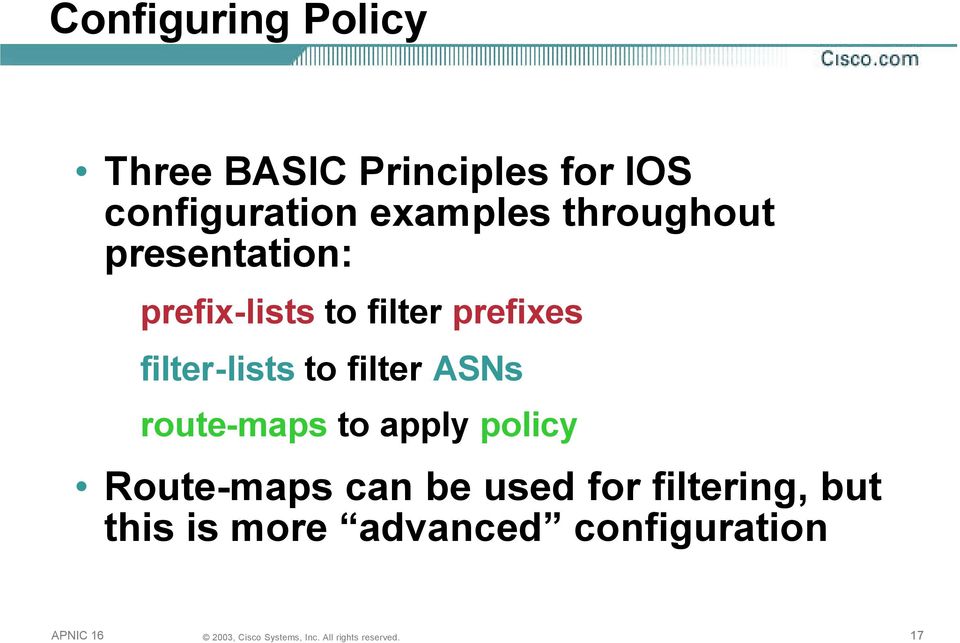
17 Configuring Policy Three BASIC Principles for IOS configuration examples throughout presentation: prefix-lists to filter prefixes filter-lists to filter ASNs route-maps to apply policy Route-maps can be used for filtering, but this is more advanced configuration 17
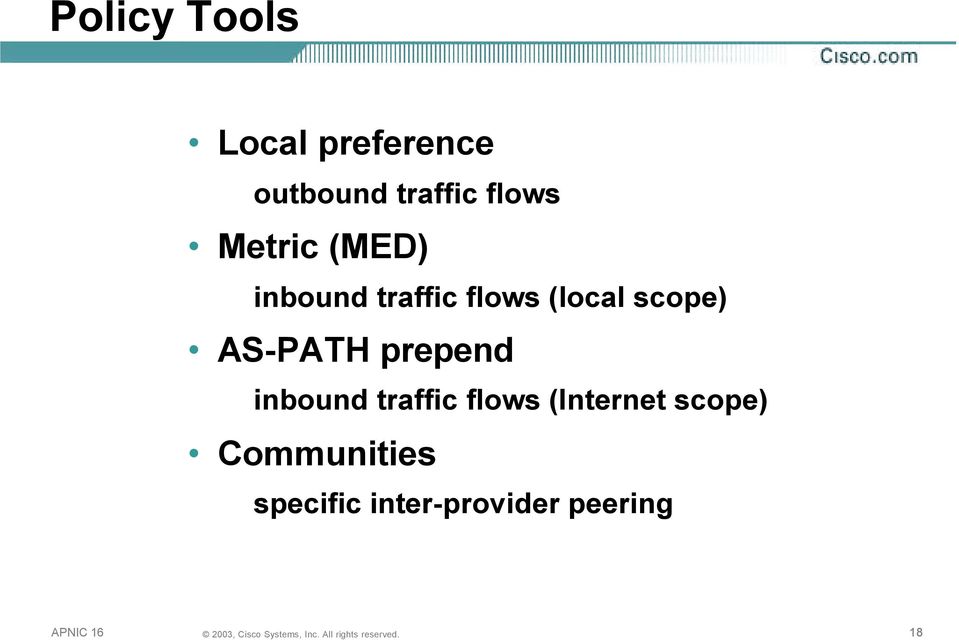
18 Policy Tools Local preference outbound traffic flows Metric (MED) inbound traffic flows (local scope) AS-PATH prepend inbound traffic flows (Internet scope) Communities specific inter-provider peering 18
19 Originating Prefixes: Assumptions MUST announce assigned address block to Internet MAY also announce subprefixes reachability is not guaranteed Current RIR minimum allocation is /20 Several ISPs filter RIR blocks on this boundary Several ISPs filter the rest of address space according to the IANA assignments This activity is called Net Police by some 19

20 Originating Prefixes RIRs publish their minimum allocation sizes: APNIC: ARIN: LACNIC: RIPE NCC: ww1.arin.net/statistics/index.html#cidr unknown IANA publishes the address space it has assigned to end-sites and allocated to the RIRs: Several ISPs use this published information to filter prefixes on: What should be routed (from IANA) The minimum allocation size from the RIRs 20

21 Net Police prefix list issues meant to punish ISPs who pollute the routing table with specifics rather than announcing aggregates impacts legitimate multihoming especially at the Internet s edge impacts regions where domestic backbone is unavailable or costs $$$ compared with international bandwidth hard to maintain requires updating when RIRs start allocating from new address blocks don t do it unless consequences understood and you are prepared to keep the list current 21
22 Multihoming Scenarios Stub network Multi-homed stub network Multi-homed network Load-balancing 22
23 Stub Network AS100 AS101 No need for BGP Point static default to upstream ISP Router will load share on the two parallel circuits Upstream ISP advertises stub network Policy confined within upstream ISP s policy 23
24 Multi-homed Stub Network AS100 AS65530 Use BGP (not IGP or static) to loadshare Use private AS (ASN > 64511) Upstream ISP advertises stub network Policy confined within upstream ISP s policy 24
25 Multi-Homed Network AS300 Global Internet AS200 AS100 Many situations possible multiple sessions to same ISP secondary for backup only load-share between primary and secondary selectively use different ISPs 25
26 Multiple Sessions to an ISP Example One Use ebgp multihop ebgp to loopback addresses ebgp prefixes learned with loopback address as next hop Cisco IOS router bgp65534! neighbor remote-as 200 neighbor ebgp-multihop 2 ip route serial 1/0 ip route serial 1/1 ip route serial 1/2 AS AS
27 Multiple Sessions to an ISP Example One Try and avoid use of ebgp-multihop unless: It s absolutely necessary or Loadsharing across multiple links Many ISPs discourage its use, for example: We will run ebgp multihop, but do not support it as a standard offering because customers generally have a hard time managing it due to: routing loops failure to realise that BGP session stability problems are usually due connectivity problems between their CPE and their BGP speaker 27
28 Multiple Sessions to an ISP Example Two BGP multi-path Three BGP sessions required AS 200 limit of 6 parallel paths in Cisco IOS Cisco IOS Configuration router bgp 201 neighbor remote-as 200 neighbor remote-as 200 neighbor remote-as 200 maximum-paths 3 AS
29 Multiple Sessions to an ISP Simplest scheme is to use defaults Learn/advertise prefixes for better control Planning and some work required to achieve loadsharing No magic solution AS200 C D A B AS
30 BGP Multihoming Techniques Why Multihome? Definition & Options Preparing the Network Connecting to the same ISP Connecting to different ISPs Service Provider Multihoming Using Communities Case Study 30
31 Preparing the Network Initial Assumptions The network is not running any BGP at the moment single statically routed connection to upstream ISP The network is not running any IGP at all Static default and routes through the network to do routing If multihoming to two different ISPs, AS number has been applied for and received 31
32 Preparing the Network First Step: IGP Decide on IGP: OSPF or ISIS Assign loopback interfaces and /32 addresses to each router which will run the IGP Loopback is OSPF and BGP router id Used for ibgp and route origination Deploy IGP (e.g. OSPF) IGP can be deployed with NO IMPACT on the existing static routing OSPF distance is 110, static distance is 1 Smallest distance wins 32
33 Preparing the Network Second Step: ibgp Second step is to configure the local network to use ibgp ibgp can run on A D B C all routers, or a subset of routers, or just on the upstream edge F E AS200 ibgp must run on all routers which are in the transit path between external connections 33
34 Preparing the Network Second Step: ibgp (Transit Path) ibgp must run on all routers which are in the transit path between external connections Routers C, E and F are not in the transit path Static routes or IGP will suffice A F B D E AS200 C Router D is in the transit path Will need to be in ibgp mesh, otherwise routing loops will result 34
35 Preparing the Network Layers Typical SP networks have three layers: Core the backbone, usually the transit path Distribution the middle, PoP aggregation layer Aggregation the edge, the devices connecting customers 35
36 Preparing the Network Aggregation Layer ibgp is optional Many ISPs run ibgp here, either partial routing (more common) or full routing (less common) Full routing is not needed unless customers want full table Partial routing is cheaper/easier, might usually consist of internal prefixes and, optionally, external prefixes to aid external load balancing Communities and peer-groups make this administratively easy Many aggregation devices can t run ibgp Static routes from distribution devices for address pools IGP for best exit 36
37 Preparing the Network Distribution Layer Usually runs ibgp Partial or full routing (as with aggregation layer) But does not have to run ibgp IGP is then used to carry customer prefixes (does not scale) IGP is used to determine nearest exit Networks which plan to grow large should deploy ibgp from day one Migration at a later date is extra work No extra overhead in deploying ibgp, indeed IGP benefits 37
38 Preparing the Network Core Layer Core of network is usually the transit path ibgp necessary between core devices Full routes or partial routes: Transit ISPs carry full routes in core Edge ISPs carry partial routes only Core layer includes AS border routers 38
39 Preparing the Network ibgp Implementation Decide on: Best ibgp policy (full vs partial route mix) ibgp scaling technique (communities, route-reflectors, peer-groups) Then deploy ibgp: Step 1: Introduce ibgp (making sure that ibgp distance is greater than IGP distance) Step 2: Install customer prefixes into ibgp Step 3: Make ibgp distance less than IGP Check! Does the network still work? Step 4: Withdraw customer prefixes from the IGP Step 5: Deployment of ebgp follows 39
40 Preparing the Network Configuration Before BGP interface serial 0/0 ip address ! interface serial 0/1 ip address ! router ospf 100 redistribute connected subnets! Point-to-point link redistribute static subnets! Customer networks! ip route serial 0/0 ip route serial 0/1 40
41 Preparing the Network Configuration Steps 1 & 2 interface serial 0/0 ip address ! interface serial 0/1 ip address ! router ospf 100 redistribute connected subnets! point-to-point links redistribute static subnets! customer nets into OSPF! router bgp 100 neighbor remote-as 100 neighbor description ibgp with Router2... network mask network mask distance bgp ! ip route serial 0/0 ip route serial 0/1 41
42 Preparing the Network Configuration Steps 3 & 4 interface serial 0/0 ip address ! interface serial 0/1 ip address ! router ospf 100 redistribute connected subnets! point-to-point links! router bgp 100 neighbor remote-as 100 neighbor description ibgp with Router2... network mask network mask distance bgp ! ip route serial 0/0 ip route serial 0/1 42
43 Preparing the Network Configuration Summary Customer networks are now in ibgp ibgp deployed over the backbone Full or Partial or Upstream Edge only BGP distance is greater than any IGP Now ready to deploy ebgp 43
44 BGP Multihoming Techniques Why Multihome? Definition & Options Preparing the Network Connecting to the same ISP Connecting to different ISPs Service Provider Multihoming Using Communities Case Study 44
45 Multihoming to the same ISP 45
46 Multihoming to the same ISP Use BGP for this type of multihoming use a private AS (ASN > 64511) There is no need or justification for a public ASN Making the nets of the end-site visible gives no useful information to the Internet upstream ISP proxy aggregates in other words, announces only your address block to the Internet from their AS (as would be done if you had one statically routed connection) 46
47 Two links to the same ISP One link primary, the other link backup only 47
48 Two links to the same ISP (one as backup only) Applies when end-site has bought a large primary WAN link to their upstream a small secondary WAN link as the backup For example, primary path might be a T1, backup might be 56kbps 48
49 Two links to the same ISP (one as backup only) primary C A AS 100 AS E D backup B Border router E in AS100 removes private AS and any customer subprefixes from Internet announcement 49
50 Two links to the same ISP (one as backup only) Announce /19 aggregate on each link primary link: Outbound announce /19 unaltered Inbound receive default route backup link: Outbound announce /19 with increased metric Inbound received default, and reduce local preference When one link fails, the announcement of the /19 aggregate via the other link ensures continued connectivity 50
51 Two links to the same ISP (one as backup only) Router A Configuration router bgp network mask neighbor remote-as 100 neighbor description RouterC neighbor prefix-list aggregate out neighbor prefix-list default in! ip prefix-list aggregate permit /19 ip prefix-list default permit /0! 51
52 Two links to the same ISP (one as backup only) Router B Configuration router bgp network mask neighbor remote-as 100 neighbor description RouterD neighbor prefix-list aggregate out neighbor route-map routerd-out out neighbor prefix-list default in neighbor route-map routerd-in in!..next slide 52
53 Two links to the same ISP (one as backup only) ip prefix-list aggregate permit /19 ip prefix-list default permit /0! route-map routerd-out permit 10 match ip address prefix-list aggregate set metric 10 route-map routerd-out permit 20! route-map routerd-in permit 10 set local-preference 90! 53
54 Two links to the same ISP (one as backup only) Router C Configuration (main link) router bgp 100 neighbor remote-as neighbor default-originate neighbor prefix-list Customer in neighbor prefix-list default out! ip prefix-list Customer permit /19 ip prefix-list default permit /0 54
55 Two links to the same ISP (one as backup only) Router D Configuration (backup link) router bgp 100 neighbor remote-as neighbor default-originate neighbor prefix-list Customer in neighbor prefix-list default out! ip prefix-list Customer permit /19 ip prefix-list default permit /0 55
56 Two links to the same ISP (one as backup only) Router E Configuration router bgp 100! neighbor remote-as 110 neighbor remove-private-as neighbor prefix-list Customer out ip prefix-list Customer permit /19 Router E removes the private AS and customer s subprefixes from external announcements Private AS still visible inside AS100 56
57 Two links to the same ISP With Loadsharing 57
58 Loadsharing to the same ISP More common case End sites tend not to buy circuits and leave them idle, only used for backup as in previous example This example assumes equal capacity circuits Unequal capacity circuits requires more refinement see later 58
59 Loadsharing to the same ISP Link one C A AS 100 AS E D Link two B Border router E in AS100 removes private AS and any customer subprefixes from Internet announcement 59
60 Loadsharing to the same ISP Announce /19 aggregate on each link Split /19 and announce as two /20s, one on each link basic inbound loadsharing assumes equal circuit capacity and even spread of traffic across address block Vary the split until perfect loadsharing achieved Accept the default from upstream basic outbound loadsharing by nearest exit okay in first approx as most ISP and end-site traffic is inbound 60
61 Loadsharing to the same ISP Router A Configuration router bgp network mask network mask neighbor remote-as 100 neighbor prefix-list routerc out neighbor prefix-list default in! ip prefix-list default permit /0 ip prefix-list routerc permit /20 ip prefix-list routerc permit /19! ip route null0 ip route null0 Router B configuration is similar but with the other /20 61
62 Loadsharing to the same ISP Router C Configuration router bgp 100! neighbor remote-as neighbor default-originate neighbor prefix-list Customer in neighbor prefix-list default out ip prefix-list Customer permit /19 le 20 ip prefix-list default permit /0 Router C only allows in /19 and /20 prefixes from customer block Router D configuration is identical 62
63 Loadsharing to the same ISP Loadsharing configuration is only on customer router Upstream ISP has to remove customer subprefixes from external announcements remove private AS from external announcements Could also use BGP communities 63
64 Two links to the same ISP Multiple Dualhomed Customers (RFC2270) 64
65 Multiple Dualhomed Customers (RFC2270) Unusual for an ISP just to have one dualhomed customer Valid/valuable service offering for an ISP with multiple PoPs Better for ISP than having customer multihome with another provider! Look at scaling the configuration Simplifying the configuration Using templates, peer-groups, etc Every customer has the same configuration (basically) 65
66 Multiple Dualhomed Customers (RFC2270) AS 100 C A1 B1 AS E D A2 AS B2 Border router E in AS100 removes private AS and any customer subprefixes from Internet announcement A3 B3 AS
67 Multiple Dualhomed Customers Customer announcements as per previous example Use the same private AS for each customer documented in RFC2270 address space is not overlapping each customer hears default only Router An and Bn configuration same as Router A and B previously 67
68 Multiple Dualhomed Customers Router A1 Configuration router bgp network mask network mask neighbor remote-as 100 neighbor prefix-list routerc out neighbor prefix-list default in! ip prefix-list default permit /0 ip prefix-list routerc permit /20 ip prefix-list routerc permit /19! ip route null0 ip route null0 Router B1 configuration is similar but for the other /20 68
69 Multiple Dualhomed Customers Router C Configuration router bgp 100 neighbor bgp-customers peer-group neighbor bgp-customers remote-as neighbor bgp-customers default-originate neighbor bgp-customers prefix-list default out neighbor peer-group bgp-customers neighbor description Customer One neighbor prefix-list Customer1 in neighbor peer-group bgp-customers neighbor description Customer Two neighbor prefix-list Customer2 in 69
70 Multiple Dualhomed Customers! neighbor peer-group bgp-customers neighbor description Customer Three neighbor prefix-list Customer3 in ip prefix-list Customer1 permit /19 le 20 ip prefix-list Customer2 permit /19 le 20 ip prefix-list Customer3 permit /19 le 20 ip prefix-list default permit /0 Router C only allows in /19 and /20 prefixes from customer block Router D configuration is almost identical 70
71 Multiple Dualhomed Customers Router E Configuration assumes customer address space is not part of upstream s address block router bgp 100! neighbor remote-as 110 neighbor remove-private-as neighbor prefix-list Customers out ip prefix-list Customers permit /19 ip prefix-list Customers permit /19 ip prefix-list Customers permit /19 Private AS still visible inside AS100 71
72 Multiple Dualhomed Customers If customers prefixes come from ISP s address block do NOT announce them to the Internet announce ISP aggregate only Router E configuration: router bgp 100! neighbor remote-as 110 neighbor prefix-list my-aggregate out ip prefix-list my-aggregate permit /13 72
73 BGP Multihoming Techniques Why Multihome? Definition & Options Preparing the Network Connecting to the same ISP Connecting to different ISPs Service Provider Multihoming Using Communities Case Study 73
74 Multihoming to different ISPs 74
75 Two links to different ISPs Use a Public AS Or use private AS if agreed with the other ISP But some people don t like the inconsistent-as which results from use of a private-as Address space comes from both upstreams or Regional Internet Registry Configuration concepts very similar 75
76 Inconsistent-AS? Viewing the prefixes originated by AS65534 in the Internet shows they appear to be originated by both AS210 and AS200 This is NOT bad Nor is it illegal IOS command is show ip bgp inconsistent-as AS 210 AS AS 200 Internet 76
77 Two links to different ISPs One link primary, the other link backup only 77
78 Two links to different ISPs (one as backup only) Announce /19 aggregate on each link primary link makes standard announcement backup link lengthens the AS PATH by using AS PATH prepend When one link fails, the announcement of the /19 aggregate via the other link ensures continued connectivity 78
79 Two links to different ISPs (one as backup only) Internet AS 100 AS 120 C D Announce /19 block A B Announce /19 block with longer AS PATH AS
80 Two links to different ISPs (one as backup only) Router A Configuration router bgp 130 network mask neighbor remote-as 100 neighbor prefix-list aggregate out neighbor prefix-list default in! ip prefix-list aggregate permit /19 ip prefix-list default permit /0 80
81 Two links to different ISPs (one as backup only) Router B Configuration router bgp 130 network mask neighbor remote-as 120 neighbor prefix-list aggregate out neighbor route-map routerd-out out neighbor prefix-list default in neighbor route-map routerd-in in! ip prefix-list aggregate permit /19 ip prefix-list default permit /0! route-map routerd-out permit 10 set as-path prepend ! route-map routerd-in permit 10 set local-preference 80 81
82 Two links to different ISPs (one as backup only) Not a common situation as most sites tend to prefer using whatever capacity they have But it shows the basic concepts of using local-prefs and AS-path prepends for engineering traffic in the chosen direction 82
83 Two links to different ISPs With Loadsharing 83
84 Two links to different ISPs (with loadsharing) Announce /19 aggregate on each link Split /19 and announce as two /20s, one on each link basic inbound loadsharing When one link fails, the announcement of the /19 aggregate via the other ISP ensures continued connectivity 84
85 Two links to different ISPs (with loadsharing) Internet AS 100 AS 120 C D Announce first /20 and /19 block A B Announce second /20 and /19 block AS
86 Two links to different ISPs (with loadsharing) Router A Configuration router bgp 130 network mask network mask neighbor remote-as 100 neighbor prefix-list firstblock out neighbor prefix-list default in! ip prefix-list default permit /0! ip prefix-list firstblock permit /20 ip prefix-list firstblock permit /19 86
87 Two links to different ISPs (with loadsharing) Router B Configuration router bgp 130 network mask network mask neighbor remote-as 120 neighbor prefix-list secondblock out neighbor prefix-list default in! ip prefix-list default permit /0! ip prefix-list secondblock permit /20 ip prefix-list secondblock permit /19 87
88 Two links to different ISPs (with loadsharing) Loadsharing in this case is very basic But shows the first steps in designing a load sharing solution Start with a simple concept And build on it! 88
89 Two links to different ISPs More Controlled Loadsharing 89
90 Loadsharing with different ISPs Announce /19 aggregate on each link On first link, announce /19 as normal On second link, announce /19 with longer AS PATH, and announce one /20 subprefix controls loadsharing between upstreams and the Internet Vary the subprefix size and AS PATH length until perfect loadsharing achieved Still require redundancy! 90
91 Loadsharing with different ISPs Internet AS 100 AS 120 C D Announce /19 block A B Announce /20 subprefix, and /19 block with longer AS path AS
92 Loadsharing with different ISPs Router A Configuration router bgp 130 network mask neighbor remote-as 100 neighbor prefix-list default in neighbor prefix-list aggregate out! ip prefix-list aggregate permit /19 92
93 Loadsharing with different ISPs Router B Configuration router bgp 130 network mask network mask neighbor remote-as 120 neighbor prefix-list default in neighbor prefix-list subblocks out neighbor route-map routerd out! route-map routerd permit 10 match ip address prefix-list aggregate set as-path prepend route-map routerd permit 20! ip prefix-list subblocks permit /19 le 20 ip prefix-list aggregate permit /19 93
94 Loadsharing with different ISPs This example is more commonplace Shows how ISPs and end-sites subdivide address space frugally, as well as use the AS-PATH prepend concept to optimise the load sharing between different ISPs Notice that the /19 aggregate block is ALWAYS announced 94
95 BGP Multihoming Techniques Why Multihome? Definition & Options Preparing the Network Connecting to the same ISP Connecting to different ISPs Service Provider Multihoming Using Communities Case Study 95
96 Service Provider Multihoming 96
97 Service Provider Multihoming Previous examples dealt with loadsharing inbound traffic Of primary concern at Internet edge What about outbound traffic? Transit ISPs strive to balance traffic flows in both directions Balance link utilisation Try and keep most traffic flows symmetric 97
98 Service Provider Multihoming Balancing outbound traffic requires inbound routing information Common solution is full routing table Rarely necessary Why use the routing mallet to try solve loadsharing problems? Keep It Simple is often easier (and $$$ cheaper) than carrying N-copies of the full routing table 98
99 Service Provider Multihoming MYTHS!! Common MYTHS 1: You need the full routing table to multihome People who sell router memory would like you to believe this Only true if you are a transit provider Full routing table can be a significant hindrance to multihoming 2: You need a BIG router to multihome Router size is related to data rates, not running BGP In reality, to multihome, your router needs to: Have two interfaces, Be able to talk BGP to at least two peers, Be able to handle BGP attributes, Handle at least one prefix 3: BGP is complex In the wrong hands, yes it can be! Keep it Simple! 99
100 Service Provider Multihoming Examples One upstream, one local peer One upstream, local exchange point Two upstreams, one local peer Tier-1 and regional upstreams, with local peers Disconnected Backbone IDC Multihoming All examples require BGP and a public ASN 100
101 Service Provider Multihoming One Upstream, One local peer 101
102 One Upstream, One Local Peer Very common situation in many regions of the Internet Connect to upstream transit provider to see the Internet Connect to the local competition so that local traffic stays local Saves spending valuable $ on upstream transit costs for local traffic 102
103 One Upstream, One Local Peer Upstream ISP AS130 Local Peer AS120 A C AS
104 One Upstream, One Local Peer Announce /19 aggregate on each link Accept default route only from upstream Either /0 or a network which can be used as default Accept all routes from local peer 104
105 One Upstream, One Local Peer Router A Configuration router bgp 110 network mask neighbor remote-as 120 neighbor prefix-list my-block out neighbor prefix-list AS120-peer in! ip prefix-list AS120-peer permit /19 ip prefix-list AS120-peer permit /20 ip prefix-list my-block permit /19! ip route null0 105
106 One Upstream, One Local Peer Router A Alternative Configuration router bgp 110 network mask neighbor remote-as 120 neighbor prefix-list my-block out neighbor filter-list 10 in! ip as-path access-list 10 permit ^(120_)+$! ip prefix-list my-block permit /19! ip route null0 106
107 One Upstream, One Local Peer Router C Configuration router bgp 110 network mask neighbor remote-as 130 neighbor prefix-list default in neighbor prefix-list my-block out! ip prefix-list my-block permit /19 ip prefix-list default permit /0! ip route null0 107
108 One Upstream, One Local Peer Two configurations possible for Router A Filter-lists assume peer knows what they are doing Prefix-list higher maintenance, but safer Some ISPs use both Local traffic goes to and from local peer, everything else goes to upstream 108
109 Service Provider Multihoming One Upstream, Local Exchange Point 109
110 One Upstream, Local Exchange Point Very common situation in many regions of the Internet Connect to upstream transit provider to see the Internet Connect to the local Internet Exchange Point so that local traffic stays local Saves spending valuable $ on upstream transit costs for local traffic 110
111 One Upstream, Local Exchange Point IXP Upstream ISP AS130 C A AS
112 One Upstream, Local Exchange Point Announce /19 aggregate to every neighbouring AS Accept default route only from upstream Either /0 or a network which can be used as default Accept all routes from IXP peers 112
113 One Upstream, Local Exchange Point Router A Configuration interface fastethernet 0/0 description Exchange Point LAN ip address mask ip verify unicast reverse-path no ip directed-broadcast no ip proxy-arp no ip redirects! router bgp 110 network mask neighbor ixp-peers peer-group neighbor ixp-peers soft-reconfiguration in neighbor ixp-peers prefix-list my-block out..next slide 113
114 One Upstream, Local Exchange Point neighbor remote-as 100 neighbor peer-group ixp-peers neighbor prefix-list peer100 in neighbor remote-as 101 neighbor peer-group ixp-peers neighbor prefix-list peer101 in neighbor remote-as 102 neighbor peer-group ixp-peers neighbor prefix-list peer102 in neighbor remote-as 103 neighbor peer-group ixp-peers neighbor prefix-list peer103 in..next slide 114
115 One Upstream, Local Exchange Point ip route null0! ip prefix-list my-block permit /19 ip prefix-list peer100 permit /19 ip prefix-list peer101 permit /19 ip prefix-list peer102 permit /19 ip prefix-list peer103 permit /19! 115
116 One Upstream, Local Exchange Point Router C Configuration router bgp 110 network mask neighbor remote-as 130 neighbor prefix-list default in neighbor prefix-list my-block out! ip prefix-list my-block permit /19 ip prefix-list default permit /0! ip route null0 116
117 One Upstream, Local Exchange Point Note Router A configuration Prefix-list higher maintenance, but safer urpf on the FastEthernet interface IXP traffic goes to and from local IXP, everything else goes to upstream 117
118 Service Provider Multihoming Two Upstreams, One local peer 118
119 Two Upstreams, One Local Peer Connect to both upstream transit providers to see the Internet Provides external redundancy and diversity the reason to multihome Connect to the local peer so that local traffic stays local Saves spending valuable $ on upstream transit costs for local traffic 119
120 Two Upstreams, One Local Peer Upstream ISP AS130 Upstream ISP Local Peer AS120 A C AS 110 D AS
121 Two Upstreams, One Local Peer Announce /19 aggregate on each link Accept default route only from upstreams Either /0 or a network which can be used as default Accept all routes from local peer 121
122 Two Upstreams, One Local Peer Router A Same routing configuration as in example with one upstream and one local peer Same hardware configuration 122
123 Two Upstreams, One Local Peer Router C Configuration router bgp 110 network mask neighbor remote-as 130 neighbor prefix-list default in neighbor prefix-list my-block out! ip prefix-list my-block permit /19 ip prefix-list default permit /0! ip route null0 123
124 Two Upstreams, One Local Peer Router D Configuration router bgp 110 network mask neighbor remote-as 140 neighbor prefix-list default in neighbor prefix-list my-block out! ip prefix-list my-block permit /19 ip prefix-list default permit /0! ip route null0 124
125 Two Upstreams, One Local Peer This is the simple configuration for Router C and D Traffic out to the two upstreams will take nearest exit Inexpensive routers required This is not useful in practice especially for international links Loadsharing needs to be better 125
126 Two Upstreams, One Local Peer Better configuration options: Accept full routing from both upstreams Expensive & unnecessary! Accept default from one upstream and some routes from the other upstream The way to go! 126
127 Two Upstreams, One Local Peer Full Routes Router C Configuration router bgp 110 network mask neighbor remote-as 130 neighbor prefix-list rfc1918-deny in neighbor prefix-list my-block out neighbor route-map AS130-loadshare in! ip prefix-list my-block permit /19! See earlier presentation for RFC1918 list..next slide 127
128 Two Upstreams, One Local Peer Full Routes ip route null0! ip as-path access-list 10 permit ^(130_)+$ ip as-path access-list 10 permit ^(130_)+_[0-9]+$! route-map AS130-loadshare permit 10 match ip as-path 10 set local-preference 120 route-map AS130-loadshare permit 20 set local-preference 80! 128
129 Two Upstreams, One Local Peer Full Routes Router D Configuration router bgp 110 network mask neighbor remote-as 140 neighbor prefix-list rfc1918-deny in neighbor prefix-list my-block out! ip prefix-list my-block permit /19! See earlier in presentation for RFC1918 list 129
130 Two Upstreams, One Local Peer Full Routes Router C configuration: Accept full routes from AS130 Tag prefixes originated by AS130 and AS130 s neighbouring ASes with local preference 120 Traffic to those ASes will go over AS130 link Remaining prefixes tagged with local preference of 80 Traffic to other all other ASes will go over the link to AS140 Router D configuration same as Router C without the route-map 130
131 Two Upstreams, One Local Peer Full Routes Full routes from upstreams Expensive needs lots of memory and CPU Need to play preference games Previous example is only an example real life will need improved fine-tuning! Previous example doesn t consider inbound traffic see earlier in presentation for examples 131
132 Two Upstreams, One Local Peer Partial Routes Router C Configuration router bgp 110 network mask neighbor remote-as 130 neighbor prefix-list rfc1918-nodef-deny in neighbor prefix-list my-block out neighbor filter-list 10 in neighbor route-map tag-default-low in!..next slide 132
133 Two Upstreams, One Local Peer Partial Routes ip prefix-list my-block permit /19 ip prefix-list default permit /0! ip route null0! ip as-path access-list 10 permit ^(130_)+$ ip as-path access-list 10 permit ^(130_)+_[0-9]+$! route-map tag-default-low permit 10 match ip address prefix-list default set local-preference 80 route-map tag-default-low permit 20! 133
134 Two Upstreams, One Local Peer Partial Routes Router D Configuration router bgp 110 network mask neighbor remote-as 140 neighbor prefix-list default in neighbor prefix-list my-block out! ip prefix-list my-block permit /19 ip prefix-list default permit /0! ip route null0 134
135 Two Upstreams, One Local Peer Partial Routes Router C configuration: Accept full routes from AS130 (or get them to send less) Filter ASNs so only AS130 and AS130 s neighbouring ASes are accepted Allow default, and set it to local preference 80 Traffic to those ASes will go over AS130 link Traffic to other all other ASes will go over the link to AS140 If AS140 link fails, backup via AS130 and vice-versa 135
136 Two Upstreams, One Local Peer Partial Routes Partial routes from upstreams Not expensive only carry the routes necessary for loadsharing Need to filter on AS paths Previous example is only an example real life will need improved fine-tuning! Previous example doesn t consider inbound traffic see earlier in presentation for examples 136
137 Two Upstreams, One Local Peer When upstreams cannot or will not announce default route Because of operational policy against using default-originate on BGP peering Solution is to use IGP to propagate default from the edge/peering routers 137
138 Two Upstreams, One Local Peer Partial Routes Router C Configuration router ospf 110 default-information originate metric 30 passive-interface Serial 0/0! router bgp 110 network mask neighbor remote-as 130 neighbor prefix-list rfc1918-deny in neighbor prefix-list my-block out neighbor filter-list 10 in!..next slide 138
139 Two Upstreams, One Local Peer Partial Routes ip prefix-list my-block permit /19! See earlier for RFC1918 list! ip route null0 ip route serial 0/0 254! ip as-path access-list 10 permit ^(130_)+$ ip as-path access-list 10 permit ^(130_)+_[0-9]+$! 139
140 Two Upstreams, One Local Peer Partial Routes Router D Configuration router ospf 110 default-information originate metric 10 passive-interface Serial 0/0! router bgp 110 network mask neighbor remote-as 140 neighbor prefix-list deny-all in neighbor prefix-list my-block out!..next slide 140
141 Two Upstreams, One Local Peer Partial Routes ip prefix-list deny-all deny /0 le 32 ip prefix-list my-block permit /19! See earlier in presentation for RFC1918 list! ip route null0 ip route serial 0/0 254! 141
142 Two Upstreams, One Local Peer Partial Routes Partial routes from upstreams Use OSPF to determine outbound path Router D default has metric 10 primary outbound path Router C default has metric 30 backup outbound path Serial interface goes down, static default is removed from routing table, OSPF default withdrawn 142
143 Service Provider Multihoming Two Tier-1 upstreams, two regional upstreams, and local peers 143
144 Tier-1 & Regional Upstreams, Local Peers This is a complex example, bringing together all the concepts learned so far Connect to both upstream transit providers to see the Internet Provides external redundancy and diversity the reason to multihome Connect to regional upstreams Hopefully a less expensive and lower latency view of the regional internet than is available through upstream transit provider Connect to private peers for local peering purposes Connect to the local Internet Exchange Point so that local traffic stays local Saves spending valuable $ on upstream transit costs for local traffic 144
145 Tier-1 & Regional Upstreams, Local Peers Upstream ISP Regional Upstream AS150 Local Peer AS120 Local Peers IXP A B F AS130 C D AS 110 E Upstream ISP AS140 Regional Upstream AS
146 Tier-1 & Regional Upstreams, Local Peers Announce /19 aggregate on each link Accept partial/default routes from upstreams For default, use /0 or a network which can be used as default Accept all routes from local peer Accept all partial routes from regional upstreams This is more complex, but a very typical scenario 146
147 Tier-1 & Regional Upstreams, Local Peers Detail Router A local private peer Accept all (local) routes Local traffic stays local Use prefix and/or AS-path filters Use local preference (if needed) Router F local IXP peering Accept all (local) routes Local traffic stays local Use prefix and/or AS-path filters 147
148 Tier-1 & Regional Upstreams, Local Peers Detail Router B regional upstream They provide transit to Internet, but longer AS path than Tier-1s Accept all regional routes from them e.g. ^150_[0-9]+$ Ask them to send default, or send a network you can use as default Set local pref on default to 60 Will provide backup to Internet only when direct Tier-1 links go down 148
149 Tier-1 & Regional Upstreams, Local Peers Detail Router E regional upstream They provide transit to Internet, but longer AS path than Tier-1s Accept all regional routes from them e.g. ^160_[0-9]+$ Ask them to send default, or send a network you can use as default Set local pref on default to 70 Will provide backup to Internet only when direct Tier-1 links go down 149
150 Tier-1 & Regional Upstreams, Local Peers Detail Router C first Tier-1 Accept all their customer and AS neighbour routes from them e.g. ^130_[0-9]+$ Ask them to send default, or send a network you can use as default Set local pref on default to 80 Will provide backup to Internet only when link to second Tier-1 goes down 150
151 Tier-1 & Regional Upstreams, Local Peers Detail Router D second Tier-1 Ask them to send default, or send a network you can use as default This has local preference 100 by default All traffic without any more specific path will go out this way 151
152 Tier-1 & Regional Upstreams, Local Peers Summary Local traffic goes to local peer and IXP Regional traffic goes to two regional upstreams Everything else is shared between the two Tier-1s To modify loadsharing tweak what is heard from the two regionals and the first Tier-1 Best way is through modifying the AS-path filter 152
153 Tier-1 & Regional Upstreams, Local Peers What about outbound announcement strategy? This is to determine incoming traffic flows /19 aggregate must be announced to everyone! /20 or /21 more specifics can be used to improve or modify loadsharing See earlier for hints and ideas 153
154 Tier-1 & Regional Upstreams, Local Peers What about unequal circuit capacity? AS-path filters are very useful What if upstream will only give me full routing table or nothing AS-path and prefix filters are very useful 154
155 Service Provider Multihoming Disconnected Backbone 155
156 Disconnected Backbone ISP runs large network Network has no backbone, only large PoPs in each location Each PoP multihomes to upstreams Common in some countries where backbone circuits are hard to obtain This is to show how it could be done Not impossible, nothing illegal 156
157 Disconnected Backbone City One IXP D City Two IXP Upstream C Upstream AS120 City Three IXP AS110 B City Four A IXP 157
158 Disconnected Backbone Works with one AS number Not four no BGP loop detection problem Each city operates as separate network Uses defaults and selected leaked prefixes for loadsharing Peers at local exchange point 158
159 Disconnected Backbone Router A Configuration router bgp 100 network mask neighbor remote-as 120 neighbor description AS120 Serial 0/0 neighbor prefix-list default in neighbor prefix-list my-block out neighbor remote-as 110 neighbor description AS110 Serial 1/0 neighbor prefix-list rfc1918-sua in neighbor prefix-list my-block out neighbor filter-list 10 in! continued on next page 159
160 Disconnected Backbone ip prefix-list my-block permit /21 ip prefix-list default permit /0! ip as-path access-list 10 permit ^(110_)+$ ip as-path access-list 10 permit ^(110_)+_[0-9]+$! etc to achieve outbound loadsharing! ip route Serial 1/0 250 ip route null0! 160
161 Disconnected Backbone Peer with AS120 Receive just default route Announce /22 address Peer with AS110 Receive full routing table filter with AS-path filter Announce /22 address Point backup static default distance 252 in case AS120 goes down 161
162 Disconnected Backbone Default ensures that disconnected parts of AS100 are reachable Static route backs up AS120 default No BGP loop detection relying on default route Do not announce /19 aggregate No advantage in announcing /19 and could lead to problems 162
163 IDC Multihoming 163
164 IDC Multihoming IDCs typically are not registry members so don t get their own address block Situation also true for small ISPs and Enterprise Networks Smaller address blocks being announced Address space comes from both upstreams Should be apportioned according to size of circuit to upstream Outbound traffic paths matter 164
165 Two Upstreams, Two Local Peers IDC Upstream ISP Local Peer AS150 Local Peer AS120 A B C AS 110 AS130 D Upstream ISP AS140 IDC core Assigned /24 from AS130 and /23 from AS140. Circuit to AS130 is 2Mbps, circuit to AS140 is 4Mbps 165
166 IDC Multihoming Router A and B configuration In: Should accept all routes from AS120 and AS150 Out: Should announce all address space to AS120 and AS150 Straightforward 166
167 IDC Multihoming Router C configuration In: Accept partial routes from AS130 e.g. ^130_[0-9]+$ In: Ask for a route to use as default set local preference on default to 80 Out: Send /24, and send /23 with AS-PATH prepend of one AS 167
168 IDC Multihoming Router D configuration In: Ask for a route to use as default Leave local preference of default at 100 Out: Send /23, and send /24 with AS-PATH prepend of one AS 168
169 IDC Multihoming Fine Tuning For local fine tuning, increase circuit capacity Local circuits usually are cheap Otherwise For longer distance fine tuning In: Modify as-path filter on Router C Out: Modify as-path prepend on Routers C and D Outbound traffic flow is usual critical for an IDC so inbound policies need to be carefully thought out 169
170 IDC Multihoming Other Details Redundancy Circuits are terminated on separate routers Apply thought to address space use Request from both upstreams Utilise address space evenly across IDC Don t start with /23 then move to /24 use both blocks at the same time in the same proportion Helps with loadsharing yes, really! 170
171 IDC Multihoming Other Details What about failover? /24 and /23 from upstreams blocks announced to the Internet routing table all the time No obvious alternative at the moment Conditional advertisement can help in steady state, but subprefixes still need to be announced in failover condition 171
172 BGP Multihoming Techniques Why Multihome? Definition & Options Preparing the Network Connecting to the same ISP Connecting to different ISPs Service Provider Multihoming Using Communities Case Study 172
173 Communities How they are used in practice 173
174 Using Communities: RFC1998 Informational RFC Describes how to implement loadsharing and backup on multiple inter-as links BGP communities used to determine local preference in upstream s network Gives control to the customer Simplifies upstream s configuration simplifies network operation! 174
175 RFC1998 Community values defined to have particular meanings: ASx:100 set local pref 100 preferred route ASx:90 set local pref 90 backup route if dualhomed on ASx ASx:80 set local pref 80 main link is to another ISP with same AS path length ASx:70 set local pref 70 main link is to another ISP 175
176 RFC1998 Sample Customer Router Configuration router bgp 130 neighbor x.x.x.x remote-as 100 neighbor x.x.x.x description Backup ISP neighbor x.x.x.x route-map config-community out neighbor x.x.x.x send-community! ip as-path access-list 20 permit ^$ ip as-path access-list 20 deny.*! route-map config-community permit 10 match as-path 20 set community 100:90 176
177 RFC1998 Sample ISP Router Configuration! Homed to another ISP ip community-list 70 permit 100:70! Homed to another ISP with equal ASPATH length ip community-list 80 permit 100:80! Customer backup routes ip community-list 90 permit 100:90! route-map set-customer-local-pref permit 10 match community 70 set local-preference
178 RFC1998 Sample ISP Router Configuration route-map set-customer-local-pref permit 20 match community 80 set local-preference 80! route-map set-customer-local-pref permit 30 match community 90 set local-preference 90! route-map set-customer-local-pref permit 40 set local-preference
179 RFC1998 Supporting RFC1998 many ISPs do, more should check AS object in the Internet Routing Registry if you do, insert comment in AS object in the IRR 179
180 Two links to the same ISP One link primary, the other link backup only 180
181 Two links to the same ISP primary C A AS 100 AS E D backup B AS100 proxy aggregates for AS
182 Two links to the same ISP (one as backup only) Announce /19 aggregate on each link primary link makes standard announcement backup link sends community When one link fails, the announcement of the /19 aggregate via the other link ensures continued connectivity 182
183 Two links to the same ISP (one as backup only) Router A Configuration router bgp network mask neighbor remote-as 100 neighbor description RouterC neighbor prefix-list aggregate out neighbor prefix-list default in! ip prefix-list aggregate permit /19 ip prefix-list default permit /0! 183
184 Two links to the same ISP (one as backup only) Router B Configuration router bgp network mask neighbor remote-as 100 neighbor description RouterD neighbor send-community neighbor prefix-list aggregate out neighbor route-map routerd-out out neighbor prefix-list default in neighbor route-map routerd-in in!..next slide 184
185 Two links to the same ISP (one as backup only) ip prefix-list aggregate permit /19 ip prefix-list default permit /0! route-map routerd-out permit 10 match ip address prefix-list aggregate set community 100:90 route-map routerd-out permit 20! route-map routerd-in permit 10 set local-preference 90! 185
186 Two links to the same ISP (one as backup only) Router C Configuration (main link) router bgp 100 neighbor remote-as neighbor default-originate neighbor prefix-list Customer in neighbor prefix-list default out! ip prefix-list Customer permit /19 ip prefix-list default permit /0 186
187 Two links to the same ISP (one as backup only) Router D Configuration (backup link) router bgp 100 neighbor remote-as neighbor default-originate neighbor prefix-list Customer in neighbor route-map bgp-cust-in in neighbor prefix-list default out! ip prefix-list Customer permit /19 ip prefix-list default permit /0!..next slide 187
188 Two links to the same ISP (one as backup only) ip prefix-list Customer permit /19 ip prefix-list default permit /0! ip community-list 90 permit 100:90! <snip> route-map bgp-cust-in permit 30 match community 90 set local-preference 90 route-map bgp-cust-in permit 40 set local-preference
189 Two links to the same ISP (one as backup only) This is a simple example It looks more complicated than the same example presented earlier which used local preference and MEDs But the advantage is that this scales better With larger configurations, more customers, more options, it becomes easier to handle each and every requirement 189
190 Service Provider use of Communities Some working examples 190
191 Background RFC1998 is okay for simple multihomed customers assumes that upstreams are interconnected ISPs create many other communities to handle more complex situations Simplify ISP BGP configuration Give customer more policy control 191
192 Some ISP Examples Public policy is usually listed in the IRR Following examples are all in the IRR or referenced from the AS Object in the IRR Consider creating communities to give policy control to customers Reduces technical support burden Reduces the amount of router reconfiguration, and the chance of mistakes 192
193 Some ISP Examples Connect.com.au aut-num: AS2764 as-name: ASN-CONNECT-NET descr: connect.com.au pty ltd admin-c: CC89 tech-c: MP151 remarks: Community Definition remarks: remarks: 2764:1 Announce to "domestic" rate ASes only remarks: 2764:2 Don't announce outside local POP remarks: 2764:3 Lower local preference by 25 remarks: 2764:4 Lower local preference by 15 remarks: 2764:5 Lower local preference by 5 remarks: 2764:6 Announce to non customers with "no-export" remarks: 2764:7 Only announce route to customers remarks: 2764:8 Announce route over satellite link notify: [email protected] mnt-by: CONNECT-AU changed: [email protected] source: CCAIR 193
194 Some ISP Examples UUNET Europe aut-num: AS702 as-name: AS702 descr: UUNET - Commercial IP service provider in Europe remarks: remarks: UUNET uses the following communities with its customers: remarks: 702:80 Set Local Pref 80 within AS702 remarks: 702:120 Set Local Pref 120 within AS702 remarks: 702:20 Announce only to UUNET AS'es and UUNET customers remarks: 702:30 Keep within Europe, don't announce to other UUNET AS's remarks: 702:1 Prepend AS702 once at edges of UUNET to Peers remarks: 702:2 Prepend AS702 twice at edges of UUNET to Peers remarks: 702:3 Prepend AS702 thrice at edges of UUNET to Peers remarks: Details of UUNET's peering policy and how to get in touch with remarks: UUNET regarding peering policy matters can be found at: remarks: remarks: mnt-by: UUNET-MNT changed: [email protected] source: RIPE 194
195 Some ISP Examples BT Ignite aut-num: AS5400 as-name: CIPCORE descr: BT Ignite European Backbone remarks: The following BGP communities can be set by BT Ignite remarks: BGP customers to affect announcements to major peers. remarks: remarks: Community to Community to remarks: Not announce To peer: AS prepend 5400 remarks: remarks: 5400:1000 European peers 5400:2000 remarks: 5400:1001 Sprint (AS1239) 5400:2001 remarks: 5400:1003 Unisource (AS3300) 5400:2003 remarks: 5400:1005 UUnet (AS702) 5400:2005 remarks: 5400:1006 Carrier1 (AS8918) 5400:2006 remarks: 5400:1007 SupportNet (8582) 5400:2007 remarks: 5400:1008 AT&T (AS2686) 5400:2008 remarks: 5400:1009 Level 3 (AS9057) 5400:2009 remarks: 5400:1010 RIPE (AS3333) 5400:2010 <snip> remarks: 5400:1100 US peers 5400:2100 notify: [email protected] mnt-by: CIP-MNT source: RIPE And many many more! 195
196 Some ISP Examples Carrier1 aut-num: AS8918 descr: Carrier1 Autonomous System <snip> remarks: remarks: remarks: remarks: * remarks: Community Entry Point remarks: remarks: 8918:10 London remarks: 8918:15 Hamburg remarks: 8918:18 Chicago remarks: 8918:20 Amsterdam remarks: 8918:25 Milan remarks: 8918:28 Berlin remarks: 8918:30 Frankfurt remarks: 8918:35 Zurich Community Support Definitions: Communities that determine the geographic entry point of routes into the Carrier1 network: remarks: 8918:40 Geneva remarks: 8918:45 Stockholm <snip> notify: mnt-by: source: [email protected] CARRIER1-MNT RIPE And many many more! 196
197 Some ISP Examples Level 3 aut-num: AS3356 descr: Level 3 Communications <snip> remarks: remarks: customer traffic engineering communities - Suppression remarks: remarks: 64960:XXX - announce to AS XXX if 65000:0 remarks: 65000:0 - announce to customers but not to peers remarks: 65000:XXX - do not announce at peerings to AS XXX remarks: remarks: customer traffic engineering communities - Prepending remarks: remarks: 65001:0 - prepend once to all peers remarks: 65001:XXX - prepend once at peerings to AS XXX remarks: 65002:0 - prepend twice to all peers remarks: 65002:XXX - prepend twice at peerings to AS XXX remarks: 65003:0 - prepend 3x to all peers remarks: 65003:XXX - prepend 3x at peerings to AS XXX remarks: 65004:0 - prepend 4x to all peers remarks: 65004:XXX - prepend 4x at peerings to AS XXX <snip> mnt-by: LEVEL3-MNT source: RIPE And many many more! 197
198 BGP Multihoming Techniques Why Multihome? Definition & Options Preparing the Network Connecting to the same ISP Connecting to different ISPs Service Provider Multihoming Using Communities Case Study 198
199 Case Study First Visit 199
200 Case Study Requirements (1) ISP needs to multihome: To AS5400 in Europe To AS2516 in Japan /19 allocated by APNIC AS assigned by APNIC 1Mbps circuits to both upstreams 200
201 Case Study Requirements (2) ISP wants: Symmetric routing and equal link utilisation in and out (as close as possible) international circuits are expensive Has two Cisco 2600 border routers with 64Mbytes memory Cannot afford to upgrade memory or hardware on border routers or internal routers Philip, make it work, please 201
202 Case Study Upstream ISP AS5400 Upstream ISP AS2516 A AS ISP Core B Allocated /19 from APNIC Circuit to AS5400 is 1Mbps, circuit to AS2516 is 1Mbps 202
203 Case Study Both providers stated that routers with 128Mbytes memory required for AS17660 to multihome Those myths again Full routing table is rarely required or desired Solution: Accept default from one upstream Accept partial prefixes from the other 203
204 Case Study Inbound Loadsharing First cut: Went to a few US Looking Glasses Checked the AS path to AS5400 Checked the AS path to AS2516 AS2516 was one hop closer Sent AS-PATH prepend of one AS on AS2516 peering 204
205 Case Study Inbound Loadsharing Refinement Did not need any First cut worked, seeing on average 600kbps inbound on each circuit Does vary according to time of day, but this is as balanced as it can get, given customer profile 205
206 Case Study Outbound Loadsharing First cut: Requested default from AS2516 Requested full routes from AS5400 Then looked at my Routing Report Picked the top 5 ASNs and created a filter-list If 701, 1, 7018, 1239 or 7046 are in AS-PATH, prefixes are discarded Allowed prefixes originated by AS5400 and up to two AS hops away Resulted in prefixes being accepted in AS
207 Case Study Outbound Loadsharing Refinement prefixes quite a lot, seeing more outbound traffic on the AS5400 path Traffic was very asymmetric out through AS5400, in through AS2516 Added the next 3 ASNs from the Top 20 list 209, 2914 and 3549 Now seeing prefixes Traffic is now evenly loadshared outbound Around 200kbps on average Mostly symmetric 207
208 Case Study MRTG Graphs Router A to AS5400 Router B to AS
209 Case Study Configuration Router A router ospf 100 log-adjacency-changes passive-interface default no passive-interface Ethernet0/0 default-information originate metric 20! router bgp no synchronization no bgp fast-external-fallover bgp log-neighbor-changes bgp deterministic-med...next slide 209
210 Case Study Configuration Router A neighbor remote-as 5400 neighbor description ebgp multihop to AS5400 neighbor ebgp-multihop 5 neighbor update-source Loopback0 neighbor prefix-list in-filter in neighbor prefix-list out-filter out neighbor filter-list 1 in neighbor filter-list 3 out! prefix-list in-filter deny rfc1918etc in prefix-list out-filter permit /19! ip route serial 0/ next slide 210
211 Case Study Configuration Router A ip as-path access-list 1 deny _701_ ip as-path access-list 1 deny _1_ ip as-path access-list 1 deny _7018_ ip as-path access-list 1 deny _1239_ ip as-path access-list 1 deny _7046_ ip as-path access-list 1 deny _209_ ip as-path access-list 1 deny _2914_ ip as-path access-list 1 deny _3549_ ip as-path access-list 1 permit _5400$ ip as-path access-list 1 permit _5400_[0-9]+$ ip as-path access-list 1 permit _5400_[0-9]+_[0-9]+$ ip as-path access-list 1 deny.* ip as-path access-list 3 permit ^$! 211
212 Case Study Configuration Router B router ospf 100 log-adjacency-changes passive-interface default no passive-interface Ethernet0/0 default-information originate! router bgp no synchronization no auto-summary no bgp fast-external-fallover...next slide 212
213 Case Study Configuration Router B bgp log-neighbor-changes bgp deterministic-med neighbor remote-as 2516 neighbor description ebgp peering neighbor soft-reconfiguration inbound neighbor prefix-list default-route in neighbor prefix-list out-filter out neighbor route-map as2516-out out neighbor maximum-prefix 100 neighbor filter-list 2 in neighbor filter-list 3 out!...next slide 213
214 Case Study Configuration Router B! prefix-list default-route permit /0 prefix-list out-filter permit /19! ip as-path access-list 2 permit _2516$ ip as-path access-list 2 deny.* ip as-path access-list 3 permit ^$! route-map as2516-out permit 10 set as-path prepend 17660! 214
215 Configuration Summary Router A Hears full routing table throws away most of it AS5400 BGP options are all or nothing Static default pointing to serial interface if link goes down, OSPF default removed Router B Hears default from AS2516 If default disappears (BGP goes down or link goes down), OSPF default is removed 215
216 Case Study Summary Multihoming is not hard, really! Needs a bit of thought, a bit of planning Use this case study as an example strategy Does not require sophisticated equipment, big memory, fast CPUs 216
217 Case Study Second Visit 217
218 Case Study Current Status ISP currently multihomes: To AS5400 in the UK To AS2516 in Japan /19 allocated by APNIC AS assigned by APNIC 1Mbps circuits to both upstreams 218
219 Case Study Requirements ISP wants: To add a new satellite connection, a 640K link to AS22351 in Germany to support the AS5400 link to UK Still want symmetric routing and equal link utilisation in and out (as close as possible) international circuits are expensive Has upgraded to two Cisco 3725 border routers with plenty of memory Despite the working previous configuration with sparse routing table, wanted full prefixes Talked them out of that, and here is how 219
220 Case Study Upstream ISP AS5400 1Mbps Upstream ISP AS2516 Upstream ISP AS kbps A B AS Mbps ISP Core Allocated /19 from APNIC 220
221 Case Study Inbound Loadsharing First cut: Went to a few US Looking Glasses Checked the AS path to AS5400 Checked the AS path to AS2516 Checked the AS path to AS22351 AS2516 was one hop closer than the other two Sent AS-PATH prepend of one AS on AS2516 peering this is unchanged from two years ago 221
222 Case Study Inbound Loadsharing Refinement Needed some AS5400 seemed to be always preferred over AS22351 AS5400 now supports RFC1998 style communities for customer use see whois h whois.ripe.net AS5400 Sent AS5400 some communities to insert prepends towards specific peers Now saw some traffic on AS22351 link but not much Sent a /23 announcement out AS22351 link Now saw more traffic on AS22351 link 222
223 Case Study Inbound Loadsharing Results: Around 600kbps on the AS5400 link Around 750kbps on the AS2516 link Around 300kbps on the AS22351 link Inbound traffic fluctuates quite substantially based on time of day Status: Situation left pending monitoring by the ISP s NOC 223
224 Case Study Outbound Loadsharing First cut: Already receiving default from AS2516 Receiving full routes from AS5400 Requested full routes from AS22351 the only option Retained the AS5400 configuration Discard prefixes which had top 5 ASNs in the path AS22351 configuration uses similar ideas to AS5400 configuration But only accepted prefixes originated from AS22351 or their immediate peers 224
225 Case Study Outbound Loadsharing Results: Status: Around prefixes from AS5400 Around 2000 prefixes from AS22351 Around 200kbps on both the AS5400 and AS2516 links Around 50kbps on the AS22351 link Outbound traffic fluctuates quite substantially based on time of day Situation left pending monitoring by the ISP s NOC 225
226 Case Study MRTG Graphs Router A to AS5400 Router A to AS22351 Router B to AS
227 Case Study Configuration Router A router bgp17660 no synchronization no bgp fast-external-fallover bgp log-neighbor-changes bgp deterministic-med neighbor remote-as neighbor description ebgp peer to AS22351 neighbor send-community neighbor prefix-list in-filter in neighbor prefix-list out-filter-as22351 out neighbor route-map as22351-out out neighbor maximum-prefix warning-only neighbor filter-list 3 in neighbor filter-list 5 out...next slide 227
228 Case Study Configuration Router A neighbor remote-as 5400 neighbor description ebgp multihop to AS5400 neighbor ebgp-multihop 5 neighbor update-source Loopback0 neighbor send-community neighbor prefix-list in-filter in neighbor prefix-list out-filter out neighbor route-map as5400-out out neighbor filter-list 1 in neighbor filter-list 5 out! ip prefix-list in-filter deny rfc1918 prefixes etc ip prefix-list out-filter permit /19 ip prefix-list out-filter-as22351 permit /19 ip prefix-list out-filter-as22351 permit /23...next slide 228
229 Case Study Configuration Router A ip as-path access-list 1 deny _701_ ip as-path access-list 1 deny _1_ ip as-path access-list 1 deny _7018_ ip as-path access-list 1 deny _1239_ ip as-path access-list 1 deny _7046_ ip as-path access-list 1 permit _5400$ ip as-path access-list 1 permit _5400_[0-9]+$ ip as-path access-list 1 permit _5400_[0-9]+_[0-9]+$ ip as-path access-list 1 deny.* ip as-path access-list 3 permit _22351$ ip as-path access-list 3 permit _22351_[0-9]+$ ip as-path access-list 3 deny.* ip as-path access-list 5 permit ^$! route-map as5400-out permit 10 set community 5400: : : : :2128 route-map as22351-out permit
230 Case Study Configuration Router B router bgp no synchronization no auto-summary no bgp fast-external-fallover bgp log-neighbor-changes bgp deterministic-med neighbor remote-as 2516 neighbor description ebgp Peering with AS2516 neighbor send-community neighbor prefix-list default-route in neighbor prefix-list out-filter out neighbor route-map as2516-out out neighbor maximum-prefix 100 neighbor filter-list 2 in neighbor filter-list 5 out...next slide 230
231 Case Study Configuration Router B! prefix-list default-route permit /0 prefix-list out-filter permit /19! ip as-path access-list 2 permit _2516$ ip as-path access-list 2 deny.* ip as-path access-list 5 permit ^$! route-map as2516-out permit 10 set as-path prepend 17660! 231
232 Interesting Aside Prior to installation of the new 640kbps link, ISP was complaining that both 1Mbps links were saturated inbound Hence the requirement for the new 640kbps circuit Research using NetFlow, cflowd and FlowScan showed that Kazaa was to blame! Kazaa is a peer to peer file sharing utility Consumes all available bandwidth Found that many customers were using Kazaa for file sharing, saturating the links inbound 232
233 Interesting Aside Solution A time of day filter which blocked Kazaa during working hours, 8am to 8pm Inbound and outbound ACLs on border routers had tcp/1214 filters added access-list 100 deny tcp any any eq 1214 time-range OfficeHours access-list 101 deny tcp any any eq 1214 time-range OfficeHours! time-range OfficeHours periodic weekdays 8:00 to 20:00 The result: inbound traffic on external links dropped by 50% And complaints about the net being slow have reduced 233
234 Interesting Aside Typical FlowScan graph no longer showing the effects of Kazaa 234
235 Summary Multihoming solution with three links of different bandwidths works well Fluctuates significantly during the day time, maybe reflecting users browsing habits? NOC is monitoring the situation NOTE: Full routing table is not required 235
236 Summary 236
237 Summary Multihoming is not hard, really Keep It Simple & Stupid! Full routing table is rarely required A default is just as good If customers want 120k prefixes, charge them money for it 237
238 BGP Multihoming Techniques End of Tutorial 238
BGP Multihoming Techniques
 BGP Multihoming Techniques Philip Smith , Oakland 2001, Cisco Systems, Inc. All rights reserved. 1 Presentation Slides Available on NANOG Web site www.nanog.org/mtg-0110/smith.html Available
BGP Multihoming Techniques
 BGP Multihoming Techniques Philip Smith 26th July - 4th August 2006 Karachi 1 Presentation Slides Available on ftp://ftp-eng.cisco.com /pfs/seminars/sanog8-multihoming.pdf And on the SANOG8
Simple Multihoming. ISP/IXP Workshops
 Simple Multihoming ISP/IXP Workshops 1 Why Multihome? Redundancy One connection to internet means the network is dependent on: Local router (configuration, software, hardware) WAN media (physical failure,
BGP Multihoming Techniques
 BGP Multihoming Techniques Philip Smith SANOG 12 6th-14th August 2008 Kathmandu 1 Presentation Slides Available on ftp://ftp-eng.cisco.com /pfs/seminars/sanog12-multihoming.pdf And on the
BGP Multihoming Techniques
 BGP Multihoming Techniques Philip Smith PacNOG 2 Workshop Apia, Samoa 18-24 June 2006 PacNOG 2 Workshops 1 BGP Multihoming Techniques Why Multihome? Definition & Options Preparing the Network
Simple Multihoming. ISP Workshops. Last updated 30 th March 2015
 Simple Multihoming ISP Workshops Last updated 30 th March 2015 1 Why Multihome? p Redundancy n One connection to internet means the network is dependent on: p Local router (configuration, software, hardware)
BGP Multihoming Techniques. Philip Smith <[email protected]> APRICOT 2013 Singapore 19 th February 1 st March 2013
 BGP Multihoming Techniques Philip Smith APRICOT 2013 Singapore 19 th February 1 st March 2013 Presentation Slides p Will be available on n http://thyme.apnic.net/ftp/seminars/ APRICOT2013-Multihoming.pdf
BGP Multihoming. Why Multihome? Why Multihome? Why Multihome? Why Multihome? Why Multihome? Redundancy. Reliability
 Why Multihome? BGP Multihoming ISP/IXP Redundancy One connection to internet means the network is dependent on: Local router (configuration, software, hardware) WN media (physical failure, carrier failure)
BGP Multihoming Techniques
 BGP Multihoming Techniques Philip Smith NANOG 41 14th - 16th October 2007 Albuquerque, New Mexico 1 Presentation Slides Available on ftp://ftp-eng.cisco.com /pfs/seminars/nanog41-multihoming.pdf
Module 12 Multihoming to the Same ISP
 Module 12 Multihoming to the Same ISP Objective: To investigate various methods for multihoming onto the same upstream s backbone Prerequisites: Module 11 and Multihoming Presentation The following will
Transitioning to BGP. ISP Workshops. Last updated 24 April 2013
 Transitioning to BGP ISP Workshops Last updated 24 April 2013 1 Scaling the network How to get out of carrying all prefixes in IGP 2 Why use BGP rather than IGP? p IGP has Limitations: n The more routing
Advanced BGP Policy. Advanced Topics
 Advanced BGP Policy George Wu TCOM690 Advanced Topics Route redundancy Load balancing Routing Symmetry 1 Route Optimization Issues Redundancy provide multiple alternate paths usually multiple connections
BGP Multihoming: An Enterprise View BRKRST-2322. 2006, Cisco Systems, Inc. All rights reserved. Presentation_ID.scr
 GP Multihoming: n Enterprise View 2008 isco Systems, Inc. ll rights reserved. isco Public 2 1 GP Multihoming Techniques Multihoming asics Single Provider Multiple Providers Using Policy Provider 1 The
Using the Border Gateway Protocol for Interdomain Routing
 CHAPTER 12 Using the Border Gateway Protocol for Interdomain Routing The Border Gateway Protocol (BGP), defined in RFC 1771, provides loop-free interdomain routing between autonomous systems. (An autonomous
BGP-4 Case Studies. Nenad Krajnovic. e-mail: [email protected]
 BGP-4 Case Studies Nenad Krajnovic e-mail: [email protected] Today topics load balancing over multiple links multihoming to a single provider multihoming to different providers following defaults inside
Border Gateway Protocol Best Practices
 Border Gateway Protocol Best Practices By Clifton Funakura The Internet has grown into a worldwide network supporting a wide range of business applications. Many companies depend on the Internet for day-to-day
BGP Attributes and Path Selection
 BGP Attributes and Path Selection ISP Workshops Last updated 29 th March 2015 1 BGP Attributes BGP s policy tool kit 2 What Is an Attribute?... Next Hop AS Path MED...... p Part of a BGP Update p Describes
BGP for Internet Service Providers
 BGP for Internet Service Providers Philip Smith , Kathmandu,, Nepal January 2003 1 Presentation Slides Will be available on ftp://ftp-eng.cisco.com/pfs/seminars Feel free to ask questions
Multihomed BGP Configurations
 Multihomed BGP Configurations lvaro Retana Cisco IOS Deployment and Scalability 1 genda General Considerations Multihomed Networks Best Current Practices 2 The Basics General Considerations 3 General Considerations
APNIC elearning: BGP Basics. Contact: [email protected]. erou03_v1.0
 erou03_v1.0 APNIC elearning: BGP Basics Contact: [email protected] Overview What is BGP? BGP Features Path Vector Routing Protocol Peering and Transit BGP General Operation BGP Terminology BGP Attributes
BGP for Internet Service Providers
 BGP for Internet Service Providers Philip Smith , Toronto, Canada 1 Presentation Slides Will be available on www.cisco.com/public/cons/seminars/nanog25 Feel free to ask questions any time
APNIC elearning: BGP Attributes
 APNIC elearning: BGP Attributes Contact: [email protected] erou04_v1.0 Overview BGP Attributes Well-known and Optional Attributes AS Path AS Loop Detection ibgp and ebgp Next Hop Next Hop Best Practice
ISP Case Study. UUNET UK (1997) ISP/IXP Workshops. ISP/IXP Workshops. 1999, Cisco Systems, Inc.
 ISP Case Study UUNET UK (1997) ISP/IXP Workshops ISP/IXP Workshops 1999, Cisco Systems, Inc. 1 Acknowledgements Thanks are due to UUNET UK for allowing the use of their configuration information and network
BGP1 Multihoming and Traffic Engineering
 83950 Telecommunications Laboratory Course BGP1 BGP1 Multihoming and Traffic Engineering date & time student # name 1 2 bgp-tyo.tex,v 1.11 2005/04/18 14:09:14 ams Exp 1/17 Part I Home Assignment 1 General
BGP Terminology, Concepts, and Operation. Chapter 6 2007 2010, Cisco Systems, Inc. All rights reserved. Cisco Public
 BGP Terminology, Concepts, and Operation 1 IGP versus EGP Interior gateway protocol (IGP) A routing protocol operating within an Autonomous System (AS). RIP, OSPF, and EIGRP are IGPs. Exterior gateway
Introduction to Routing
 Introduction to Routing How traffic flows on the Internet Philip Smith [email protected] RIPE NCC Regional Meeting, Moscow, 16-18 18 June 2004 1 Abstract Presentation introduces some of the terminologies used,
BGP4 Case Studies/Tutorial
 BGP4 Case Studies/Tutorial Sam Halabi-cisco Systems The purpose of this paper is to introduce the reader to the latest in BGP4 terminology and design issues. It is targeted to the novice as well as the
Fireware How To Dynamic Routing
 Fireware How To Dynamic Routing How do I configure my Firebox to use BGP? Introduction A routing protocol is the language a router speaks with other routers to share information about the status of network
How To Set Up Bgg On A Network With A Network On A Pb Or Pb On A Pc Or Ipa On A Bg On Pc Or Pv On A Ipa (Netb) On A Router On A 2
 61200860L1-29.4E March 2012 Configuration Guide Configuring Border Gateway Protocol in AOS for Releases Prior to 18.03.00/R10.1.0 This guide only addresses BGP in AOS data products using AOS firmware prior
Chapter 49 Border Gateway Protocol version 4 (BGP-4)
 Chapter 49 Border Gateway Protocol version 4 (BGP-4) Introduction... 1-3 Overview of BGP-4... 1-3 BGP Operation... 1-5 BGP Attributes... 1-6 BGP Route Selection... 1-8 Classless Inter-domain Routing (CIDR)
Exterior Gateway Protocols (BGP)
 Exterior Gateway Protocols (BGP) Internet Structure Large ISP Large ISP Stub Dial-Up ISP Small ISP Stub Stub Stub Autonomous Systems (AS) Internet is not a single network! The Internet is a collection
Load balancing and traffic control in BGP
 DD2491 p2 2009/2010 Load balancing and traffic control in BGP Olof Hagsand KTH /CSC 1 Issues in load balancing Load balancing: spread traffic on several paths instead of a single. Why? Use resources better
How To Understand Bg
 Table of Contents BGP Case Studies...1 BGP4 Case Studies Section 1...3 Contents...3 Introduction...3 How Does BGP Work?...3 ebgp and ibgp...3 Enabling BGP Routing...4 Forming BGP Neighbors...4 BGP and
BGP Operations and Security. Training Course
 BGP Operations and Security Training Course Training Services RIPE NCC April 2016 Schedule 09:00-09:30 11:00-11:15 13:00-14:00 15:30-15:45 17:30 Coffee, Tea Break Lunch Break End BGP Operations and Security
Load balancing and traffic control in BGP
 DD2491 p2 2011 Load balancing and traffic control in BGP Olof Hagsand KTH CSC 1 Issues in load balancing Load balancing: spread traffic on several paths instead of a single. Why? Use resources better Can
ETHEL THE AARDVARK GOES BGP ROUTING
 Fable Of Contents ISP TECH TALK by Avi Freedman ETHEL THE AARDVARK GOES BGP ROUTING In this exciting column we'll actually walk through configuring a Cisco router for BGP. It's very important, however,
Border Gateway Protocol (BGP)
 Border Gateway Protocol (BGP) Petr Grygárek rek 1 Role of Autonomous Systems on the Internet 2 Autonomous systems Not possible to maintain complete Internet topology information on all routers big database,
BGP Techniques for Internet Service Providers
 BGP Techniques for Internet Service Providers Philip Smith MENOG 2 19-21 November 2007 Doha, Qatar 1 Presentation Slides Will be available on ftp://ftp-eng.cisco.com /pfs/seminars/menog2-bgp-techniques.pdf
no aggregate-address address mask [as-set] [summary-only] [suppress-map map-name] [advertise-map map-name] [attribute-map map-name]
![no aggregate-address address mask [as-set] [summary-only] [suppress-map map-name] [advertise-map map-name] [attribute-map map-name]](/thumbs/37/17757146.jpg "no aggregate-address address mask [as-set] [summary-only] [suppress-map map-name] [advertise-map map-name] [attribute-map map-name]") BGP Commands Use the commands in this chapter to configure and monitor Border Gateway Protocol (BGP). For BGP configuration information and examples, refer to the Configuring BGP chapter of the Network
BGP Commands Use the commands in this chapter to configure and monitor Border Gateway Protocol (BGP). For BGP configuration information and examples, refer to the Configuring BGP chapter of the Network
Configuring BGP. Cisco s BGP Implementation
 Configuring BGP This chapter describes how to configure Border Gateway Protocol (BGP). For a complete description of the BGP commands in this chapter, refer to the BGP s chapter of the Network Protocols
Address Scheme Planning for an ISP backbone Network
 Address Scheme Planning for an ISP backbone Network Philip Smith Consulting Engineering, Office of the CTO Version 0.1 (draft) LIST OF FIGURES 2 INTRODUCTION 3 BACKGROUND 3 BUSINESS MODEL 3 ADDRESS PLAN
Internet inter-as routing: BGP
 Internet inter-as routing: BGP BGP (Border Gateway Protocol): the de facto standard BGP provides each AS a means to: 1. Obtain subnet reachability information from neighboring ASs. 2. Propagate the reachability
BGP. 1. Internet Routing
 BGP 1. Internet Routing (C) Herbert Haas 2005/03/11 1 Internet Routing Interior Gateway Protocols (IGPs) not suitable for Inter-ISP routing Technical metrics only No policy features Inter-ISP routing is
Routing Protocol - BGP
 Routing Protocol - BGP BGP Enterprise Network BGP ISP AS 3000 AS 2000 BGP is using between Autonomous Systems BGP(cont.) RFC 1771(BGPv4) Support CIDR Transfer the AS information to reach destination Using
Introduction to BGP. Cisco ISP Workshops. 2003, Cisco Systems, Inc. All rights reserved.
 Introduction to BGP Cisco ISP Workshops 1 Border Gateway Protocol Routing Protocol used to exchange routing information between networks exterior gateway protocol RFC1771 work in progress to update draft-ietf-idr-bgp4-18.txt
Gateway of last resort is 192.208.10.5 to network 192.208.10.0
 RTB#sh ip bgp BGP table version is 14, local router ID is 203.250.15.10 Status codes: s suppressed, d damped, h history, * valid, > best, i - internal Origin codes: i - IGP, e - EGP,? - incomplete Network
Network Level Multihoming and BGP Challenges
 Network Level Multihoming and BGP Challenges Li Jia Helsinki University of Technology [email protected] Abstract Multihoming has been traditionally employed by enterprises and ISPs to improve network connectivity.
DD2491 p1 2008. Load balancing BGP. Johan Nicklasson KTHNOC/NADA
 DD2491 p1 2008 Load balancing BGP Johan Nicklasson KTHNOC/NADA Dual home When do you need to be dual homed? How should you be dual homed? Same provider. Different providers. What do you need to have in
Exam Name: BGP + MPLS Exam Exam Type Cisco Case Studies: 3 Exam Code: 642-691 Total Questions: 401
 Question: 1 Every time a flap occurs on a route, the route receives A. 750 per-flap penalty points which are user configurable B. 1500 per-flap penalty points which are user configurable C. 200 per-flap
Tutorial: Options for Blackhole and Discard Routing. Joseph M. Soricelli Wayne Gustavus NANOG 32, Reston, Virginia
 Tutorial: Options for Blackhole and Discard Routing Joseph M. Soricelli Wayne Gustavus NANOG 32, Reston, Virginia Caveats and Assumptions The views presented here are those of the authors and they do not
Chapter 6: Implementing a Border Gateway Protocol Solution for ISP Connectivity
 : Implementing a Border Gateway Protocol Solution for ISP Connectivity CCNP ROUTE: Implementing IP Routing ROUTE v6 1 Objectives Describe basic BGP terminology and operation, including EBGP and IBGP. Configure
Understanding Route Aggregation in BGP
 Understanding Route Aggregation in BGP Document ID: 5441 Contents Introduction Prerequisites Requirements Components Used Conventions Network Diagram Aggregate Without the as set Argument Aggregate with
IPv6 Addressing. ISP Training Workshops
 IPv6 Addressing ISP Training Workshops 1 Where to get IPv6 addresses p Your upstream ISP p Africa n AfriNIC http://www.afrinic.net p Asia and the Pacific n APNIC http://www.apnic.net p North America n
BSCI Module 6 BGP. Configuring Basic BGP. BSCI Module 6
 Configuring Basic BGP BSCI Module 6 BSCI Module 6 2006 Cisco Systems, Inc. All rights reserved. Cisco Public 1 BSCI Module 6 BGP An AS is a collection of networks under a single technical administration.
- Border Gateway Protocol -
 1 Border Gateway Protocol (BGP) - Border Gateway Protocol - BGP is a standardized exterior gateway protocol (EGP), as opposed to RIP, OSPF, and EIGRP which are interior gateway protocols (IGP s). BGP Version
How More Specifics increase your transit bill (and ways to avoid it)
 How More Specifics increase your transit bill (and ways to avoid it) Your Speaker Today... Fredy Künzler CTO & Founder kuenzler at init7.net www.init7.net www.blogg.ch www.bgp-and-beyond.com AS13030 Twitter:
Demystifying BGP: By Jeffrey Papen Thursday, May 15th, 2003
 Demystifying BGP: All across the Internet, the Border Gateway Protocol, or BGP, is used to direct network traffic from one site to another. Here's a look at how BGP works. By Jeffrey Papen Thursday, May
HP Networking BGP and MPLS technology training
 Course overview HP Networking BGP and MPLS technology training (HL046_00429577) The HP Networking BGP and MPLS technology training provides networking professionals the knowledge necessary for designing,
MPLS. Cisco MPLS. Cisco Router Challenge 227. MPLS Introduction. The most up-to-date version of this test is at: http://networksims.com/i01.
 MPLS Cisco MPLS MPLS Introduction The most up-to-date version of this test is at: http://networksims.com/i01.html Cisco Router Challenge 227 Outline This challenge involves basic frame-mode MPLS configuration.
Internet inter-as routing: BGP
 Internet inter-as routing: BGP BGP (Border Gateway Protocol): the de facto standard BGP provides each AS a means to: 1. Obtain subnet reachability information from neighboring ASs. 2. Propagate the reachability
Inter-domain Routing Basics. Border Gateway Protocol. Inter-domain Routing Basics. Inter-domain Routing Basics. Exterior routing protocols created to:
 Border Gateway Protocol Exterior routing protocols created to: control the expansion of routing tables provide a structured view of the Internet by segregating routing domains into separate administrations
Effective BGP Load Balancing Using "The Metric System" A real-world guide to BGP traffic engineering
 Effective BGP Load Balancing Using "The Metric System" A real-world guide to BGP traffic engineering NANOG45 January 26, 2009 Dani Roisman droisman ~ at ~ peakwebconsulting.com Introductions Slide 1 Why
A How-To Guide to BGP Multihoming
 Version 1.2 Lane Patterson A How-To Guide to BGP Multihoming Lane Patterson Equinix, Inc. How To Use This Paper This paper is geared toward readers who have a reasonable
Multihoming and Multi-path Routing. CS 7260 Nick Feamster January 29. 2007
 Multihoming and Multi-path Routing CS 7260 Nick Feamster January 29. 2007 Today s Topic IP-Based Multihoming What is it? What problem is it solving? (Why multihome?) How is it implemented today (in IP)?
BGP Link Bandwidth. Finding Feature Information. Prerequisites for BGP Link Bandwidth
 The Border Gateway Protocol (BGP) Link Bandwidth feature is used to advertise the bandwidth of an autonomous system exit link as an extended community. This feature is configured for links between directly
Bell Aliant. Business Internet Border Gateway Protocol Policy and Features Guidelines
 Bell Aliant Business Internet Border Gateway Protocol Policy and Features Guidelines Effective 05/30/2006, Updated 1/30/2015 BGP Policy and Features Guidelines 1 Bell Aliant BGP Features Bell Aliant offers
Effective BGP Load Balancing Using "The Metric System" A real-world guide to BGP traffic engineering
 Effective BGP Load Balancing Using "The Metric System" A real-world guide to BGP traffic engineering NANOG46 June 14, 2009 Dani Roisman droisman ~ at ~ peakwebconsulting ~ dot ~ com Introductions Slide
Internet Routing Protocols Lecture 04 BGP Continued
 Internet Routing Protocols Lecture 04 BGP Continued Advanced Systems Topics Lent Term, 008 Timothy G. Griffin Computer Lab Cambridge UK Two Types of BGP Sessions AS External Neighbor (EBGP) in a different
BGP Best Path Selection Algorithm
 BGP Best Path Selection Algorithm Document ID: 13753 Contents Introduction Prerequisites Requirements Components Used Conventions Why Routers Ignore Paths How the Best Path Algorithm Works Example: BGP
BGP Link Bandwidth. Finding Feature Information. Contents
 The BGP (Border Gateway Protocol) Link Bandwidth feature is used to advertise the bandwidth of an autonomous system exit link as an extended community. This feature is configured for links between directly
Task 20.1: Configure ASBR1 Serial 0/2 to prevent DoS attacks to ASBR1 from SP1.
 Task 20.1: Configure ASBR1 Serial 0/2 to prevent DoS attacks to ASBR1 from SP1. Task 20.2: Configure an access-list to block all networks addresses that is commonly used to hack SP networks. Task 20.3:
netkit lab bgp: prefix-filtering Università degli Studi Roma Tre Dipartimento di Informatica e Automazione Computer Networks Research Group
 Università degli Studi Roma Tre Dipartimento di Informatica e Automazione Computer Networks Research Group netkit lab bgp: prefix-filtering Version Author(s) E-mail Web Description 2.1 G. Di Battista,
ITRI CCL. IP Routing Primer. Paul C. Huang, Ph.D. ITRI / CCL / N300. CCL/N300; Paul Huang 1999/6/2 1
 IP Routing Primer Paul C. Huang, Ph.D. ITRI / / N300 /N300; Paul Huang 1999/6/2 1 Basic Addressing / Subnetting Class A 0 Network Host Host Host 127 networks / 16,777,216 hosts Class A natural mask 255.0.0.0
--BGP 4 White Paper Ver.1.0-- BGP-4 in Vanguard Routers
 BGP-4 in Vanguard Routers 1 Table of Contents Introduction to BGP... 6 BGP terminology... 6 AS (Autonomous system):... 6 AS connection:... 6 BGP Speaker:... 6 BGP Neighbor/Peer:... 7 BGP Session:... 7
Lecture 18: Border Gateway Protocol"
 Lecture 18: Border Gateway Protocol" CSE 123: Computer Networks Alex C. Snoeren HW 3 due Wednesday! Some figures courtesy Mike Freedman Lecture 18 Overview" Path-vector Routing Allows scalable, informed
Today s Agenda. Note: it takes years to really master BGP Many slides stolen from Prof. Zhi-Li Zhang at Minnesota and from Avi Freedman s slides
 Today s Agenda BGP Overview Note: it takes years to really master BGP Many slides stolen from Prof. Zhi-Li Zhang at Minnesota and from Avi Freedman s slides AS Relationship Inference There ll be some openresearch
Module 7. Routing and Congestion Control. Version 2 CSE IIT, Kharagpur
 Module 7 Routing and Congestion Control Lesson 4 Border Gateway Protocol (BGP) Specific Instructional Objectives On completion of this lesson, the students will be able to: Explain the operation of the
Beginning BGP. Peter J. Welcher. Introduction. When Do We Need BGP?
 Beginning BGP Peter J. Welcher Introduction At the time I'm writing this, it is time to register for Networkers / CCIE recertification. I just signed up for Denver. You'll probably be reading this around
Border Gateway Protocol BGP4 (2)
 Border Gateway Protocol BGP4 (2) Professor Richard Harris School of Engineering and Advanced Technology (SEAT) Presentation Outline Border Gateway Protocol - Continued Computer Networks - 1/2 Learning
Interdomain Routing. Outline
 Interdomain Routing David Andersen 15-744 Spring 2007 Carnegie Mellon University Outline What does the Internet look like? Relationships between providers Enforced by: Export filters and import ranking
BGP Best Practices for ISPs Prefix List, AS PATH filters, Bogon Filters, Anycast, Mailing Lists, INOC DBA
 BGP Best Practices for ISPs Prefix List, AS PATH filters, Bogon Filters, Anycast, Mailing Lists, INOC DBA. Gaurab Raj Upadhaya [email protected] Packet Clearing House What are Best Practices Established or
BGP Techniques for Internet Service Providers
 BGP Techniques for Internet Service Providers Philip Smith NANOG 50 3-6 October 2010 Atlanta, GA 1 Presentation Slides Will be available on ftp://ftp-eng.cisco.com /pfs/seminars/nanog50-bgp-techniques.pdf
IPv6 Address Planning
 eip604_v1.0 APNIC elearning: IPv6 Address Planning Contact: [email protected] Overview Where to Get IPv6 Addresses Addressing Plans ISP Infrastructure Addressing Plans Customer Example Address Plan Addressing
Example: Advertised Distance (AD) Example: Feasible Distance (FD) Example: Successor and Feasible Successor Example: Successor and Feasible Successor
 642-902 Route: Implementing Cisco IP Routing Course Introduction Course Introduction Module 01 - Planning Routing Services Lesson: Assessing Complex Enterprise Network Requirements Cisco Enterprise Architectures
Edge-1#show ip route 10.1.2.0. Routing entry for 10.1.2.0/24. Known via "bgp 65001", distance 200, metric 0. Tag 65300, type internal
 Edge-1#show ip route 10.1.2.0 Routing entry for 10.1.2.0/24 Known via "bgp 65001", distance 200, metric 0 Tag 65300, type internal Last update from 172.16.0.22 00:03:31 ago Routing Descriptor Blocks: *
The ISP Column. An Introduction to BGP the Protocol
 The ISP Column An occasional column on things Internet May 2006 Geoff Huston An Introduction to BGP the Protocol Routing in the Internet is divided into two parts fine-grained topological detail of connected
Unicast Reverse Path Forwarding
 Unicast Reverse Path Forwarding This feature module describes the Unicast Reverse Path Forwarding (RPF) feature, which helps to mitigate problems caused by malformed or forged IP source addresses passing
Deploying OSPF for ISPs. OSPF Design. Agenda. Service Providers. SP Architecture. SP Architecture. OSPF Design in SP Networks
 Agenda OSPF Design in SP Networks Deploying OSPF for ISPs Adding Networks in OSPF OSPF in IOS ISP/IXP 1 2 Service Providers OSPF Design As applicable to Service Provider Networks SP networks are divided
BGP Advanced Routing in SonicOS
 BGP Advanced Routing in SonicOS Document Scope This document provides an overview of SonicWALL s implmenetation of Border Gateway protocol (BGP), how BGP operates, and how to configure BGP for your network.
Understanding Virtual Router and Virtual Systems
 Understanding Virtual Router and Virtual Systems PAN- OS 6.0 Humair Ali Professional Services Content Table of Contents VIRTUAL ROUTER... 5 CONNECTED... 8 STATIC ROUTING... 9 OSPF... 11 BGP... 17 IMPORT
Inter-domain Routing. Outline. Border Gateway Protocol
 Inter-domain Routing Outline Border Gateway Protocol Internet Structure Original idea Backbone service provider Consumer ISP Large corporation Consumer ISP Small corporation Consumer ISP Consumer ISP Small
Application Note. Failover through BGP route health injection
 Application Note Document version: v1.2 Last update: 8th November 2013 Purpose This application note aims to describe how to build a high available platform using BGP routing protocol to choose the best
E6998-02: Internet Routing
 E6998-02: Internet Routing Lecture 13 Border Gateway Protocol, Part II John Ioannidis AT&T Labs Research [email protected] Copyright 2002 by John Ioannidis. All Rights Reserved. Announcements Lectures
Understanding Route Redistribution & Filtering
 Understanding Route Redistribution & Filtering When to Redistribute and Filter PAN-OS 5.0 Revision B 2013, Palo Alto Networks, Inc. www.paloaltonetworks.com Contents Overview... 3 Route Redistribution......