
A SUGGESTED HARMONIZATION OF DMAIC WITH PMBOK PROJECT LIFE CYCLES FOR PHARMACEUTICAL LEAN SIX SIGMA PROJECTS
|
|
|
- Brice Osborne
- 10 years ago
- Views:
Transcription
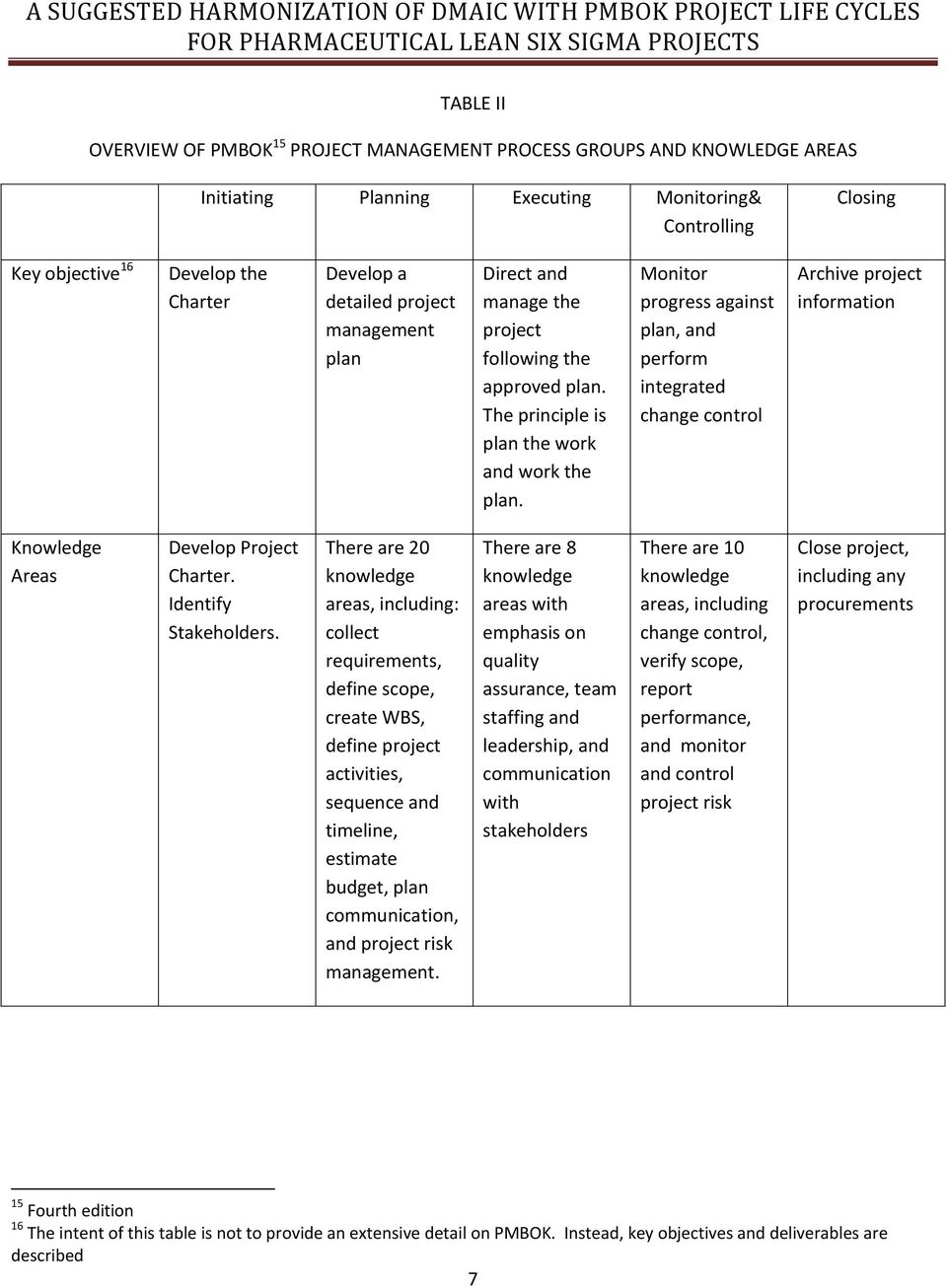
1 Abstract: With the increased emphasis within the pharmaceutical industry on business productivity through the dual application of Lean Six Sigma and disciplined project management methodologies, there is a need to provide a harmonized project life cycle roadmap for productivity project teams. This paper compares the Lean Six Sigma Define Measure Analyze Improve Control (DMAIC) project life cycle with that suggested by the Project Management Institute (PMI) in the form of a guide to Project Management Book Of Knowledge (PMBOK ) 1. The paper illustrates areas of commonality and suggests a possible harmonization in the form of DMAI 2 C 2. The objective is to assist productivity improvement project teams create a project roadmap that leverages the best of both methodologies. The reader is advised that while DMAIC and PMBOK methodologies are purposely generic so they can be applied to a wide range of projects beyond those of interest to the pharmaceutical industry, this paper is limited in its scope to projects aimed at business process productivity improvement typical to pharmaceutical product development and prior to manufacturing of an approved drug product. Introduction: Lean Six Sigma (LSS) and the PMBOK agree that a project has (i) a distinct life cycle with clearly defined start and end, and (ii) it follows a prescribed logical progression from start to end. However, each methodology prescribes a different set of phases to prescribe a project s life cycle. These phases are outlined in Tables I and II, which may be found at the end of the paper. The intent of this paper is to suggest an integration of the objectives of the different phases into a harmonized life cycle roadmap to assist productivity improvement project teams create a project roadmap that leverages the best of both methodologies. Before the methodologies are compared and harmonization is suggested, it is necessary to acknowledge that pharmaceutical R&D processes are unique. The evolution of a drug product requires the integration of diverse scientific and business disciplines, over a very long time line, and under a highly regulated environment. Recent economic pressures have pushed the pharmaceutical sector to leverage lower cost regions and, in doing so, further complicated the workflow by adding global touch points for knowledge and data transfer. It is this uniqueness that is often the principal difficulty in introducing LSS to a pharmaceutical R&D organization. However, as this paper will illustrate, harmonization of DMAIC and PMBOK principles will enable LSS practitioners within the pharma industry to more efficiently achieve project success. Discussion: Lean Six Sigma projects typically employ the Define Measure Analyze Improve Control (DMAIC) life cycle. These are described briefly in Table I. The PMBOK 2 employs the Initiating Planning Executing Monitoring&Controlling Closing life cycle. These are described briefly in Table II. It should be noted that Tables I and II are intended solely as a brief overview for readers who may not be versed in either topic. The tables are not meant to be a substitute for formal training and several outstanding text books available in the open literature. Since the intended audience for this paper is LSS practitioners, the proposal expands the classical DMAIC methodology by borrowing and integrating select PMBOK process groups and knowledge areas and suggesting a 1 PMBOK and PMP are registered trademarks of the Project Management Institute (PMI) 2 This paper relies on the Fourth edition of the PMBOK 1
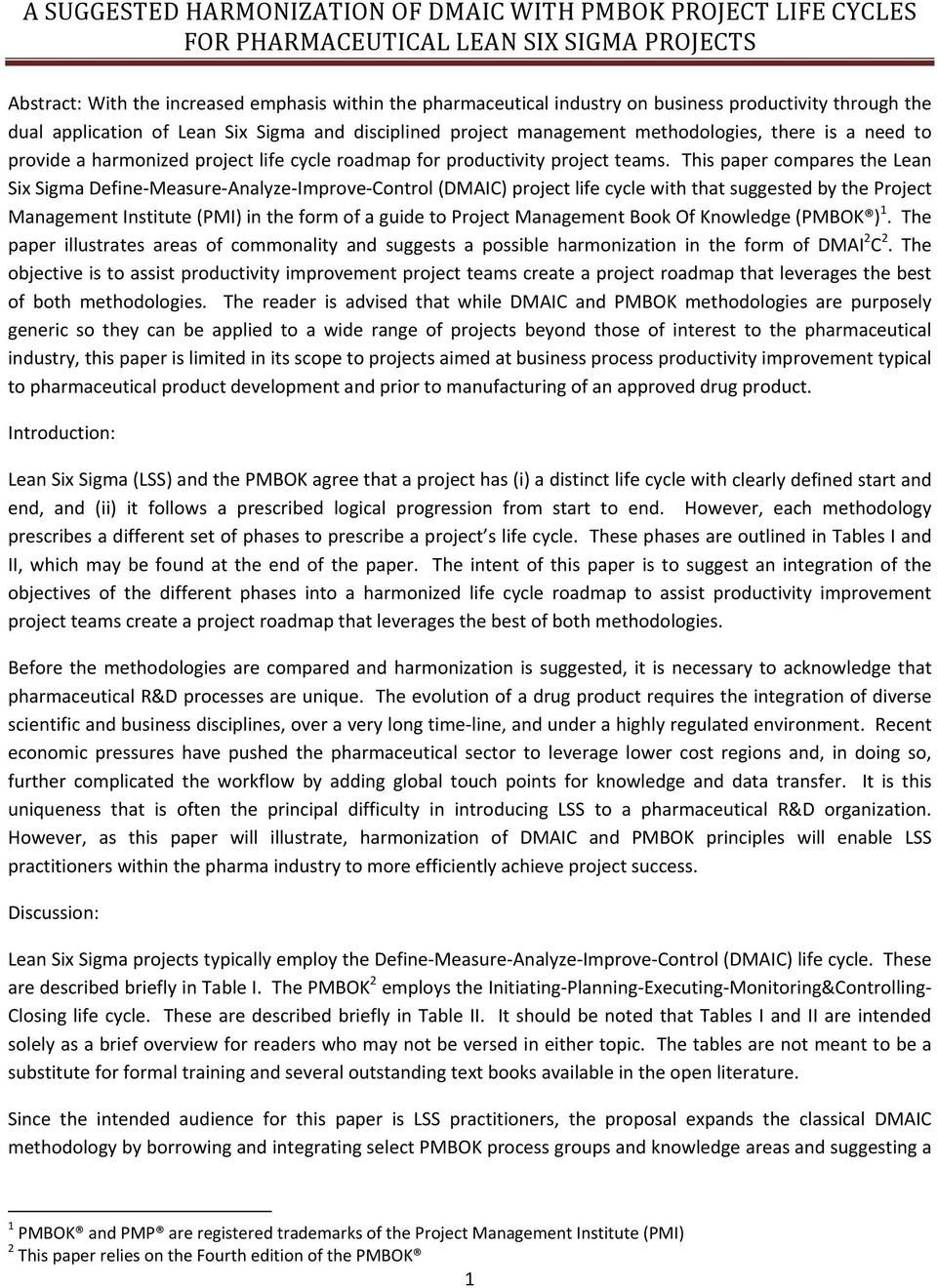
2 new life cycle: DMAI 2 C 2. The following matrix is an overlay of the resulting DMAI 2 C 2 with PMBOK. Each of the project life cycle phases are described below. PMBOK Project Life Cycle Suggested Lean Six Sigma Project Lifecycle Phases Define Measure Analyze Improve Implement Control Close Initiating X Planning X X Executing X X X X Monitoring & Controlling X X X X X X X Closing X Define is that phase of the LSS project during which the process that requires productivity improvement is defined in order to provide a scope/boundary for the project team. Since DMAIC evolved from discrete manufacturing, typically (but not always), the nature of the problem has been narrow and specific, such as the yield from a CNC machine or the throughput of a manufacturing cell 3. Analogous pharmaceutical product development examples may include unacceptable throughput from a syringe filler or unacceptable yield from a label machine used to manufacture clinical samples 4. However, when applying LSS to improve the productivity of an R&D business process, such as the effort around the planning of a clinical study or the effort around the process of authoring and submitting an IND application, the classical Define takes a whole new and broader meaning. Therefore, it is necessary to expand the classical Define phase to borrow selected knowledge areas associated with the Initiating and the Planning process groups which together offer some 22 knowledge areas (see Table II) 5. It is suggested that LSS practitioners initially approach the PMBOK knowledge areas as a checklist of items to consider while authoring the project Charter. As different areas are determined to be applicable to their project, the LSS practitioner may wish to take the time to familiarize him/herself with the knowledge areas leveraging the resources available on line from PMI and others. It should be noted that LSS and PMBOK agree in two very important respects. First, both require a project Charter without which a project should not proceed (although the template/content of the Charter differs between the two methodologies). Second, both require the project leader to identify and engage the project Stakeholders whose support is critical to project success. An area where the two differ is the scope of the project plan. The PMBOK methodology requires that a very detailed and thorough project plan be written and, in fact, this importance is demonstrated by a distinct Initiating phase. The LSS methodology requires a charter 3 A good reference book on this topic is The Goal by Eliyahu Goldratt. 4 This is another example of the uniqueness of pharmaceutical product development. Whereas R&D does not manufacture drug products, they are required to manufacture products that can be used in clinical trials and, therefore, such processes are of interest to productivity teams since they impact both direct and indirect costs. 5 We use the term selected in acknowledgement of the reality that pharmaceutical R&D processes range from finite processes through multi functional workflow processes that stretch the classical intent of DMAIC. This is where the judgment and experience of the project lead becomes important to selecting an appropriate subset of knowledge areas. 2
3 without providing much guidance regarding project planning. Therefore, It is suggested that, at a minimum, a LSS project charter include: The SIPOC of the process under study A delineation of what is and what is not in scope for the team A delineation of the relevant KPI s and their associated to be values relative to the baseline A listing of stakeholders and project team members A delineation of the project lead and the project sponsor A timeline for the project including key decision gates, and, when the project s duration is measured in months (rather than days to weeks), a timeframe for creating a suitable project plan Measure is that phase of the LSS project during which data describing the as is performance is collected. This is a critical element/characteristic of a LSS project. The principle here is that without data showing the existing capabilities (baseline), it is impractical for a project team to eventually demonstrate to management that the solution the team has come up with has in fact improved the situation. However, whereas it is common for discrete manufacturing processes to continuously measure output (e.g., throughput, yield, cost, etc), this is not true for most R&D business processes. Enterprise Resource Planning (ERP) systems are most often tailored to meet the needs of Finance and Purchasing and do not lend themselves to providing meaningful (actionable) business process productivity information to R&D managers. And, while there may be timesheet systems in place, the fact is that other than anecdotal statements, there are seldom historical data of the Key Performance Indicators (KPIs) of interest to R&D process managers responsible for achieving high productivity. Therefore, LSS productivity teams find that too often they need to plan, develop, and implement an appropriate data collection project just so they can establish a factual baseline against which future changes in process can be measured and compared. This is the reason why the matrix shows an overlap between Measure and both the Planning and the Executing phases of PMBOK. Since the Measure phase may require a staff to collect data and to create process maps, a more detailed planning of the activities in this phase may be warranted. Specifically, and as suggested by the PMBOK under Planning, details around team size, roles and responsibilities, timeline, and deliverables should be developed and discussed with the project sponsor to set expectations. In addition, and depending on the magnitude of the process under consideration and whether historical performance data is readily available, the Measure phase could be a mini project in its own right with a significant Executing component that requires application of PMBOK s Monitoring & Controlling knowledge areas. A cautionary note is in order here. As Table II illustrates, the PMBOK offers a lengthy (and evolving) list of knowledge areas (tasks) that the project team should perform during the Planning and the Executing phases. Here, once again, the experience and judgment of the LSS project leader (or the LSS PMO) is critical to selecting the appropriate subset of knowledge areas consistent with the scope/magnitude of the process under study. Not every LSS project requires the application of every PMBOK knowledge area. Therefore, as was suggested earlier, the LSS practitioner should review the PMBOK knowledge areas as a checklist of items to consider when first authoring the project Charter. As different knowledge areas are determined to be applicable to their 3

4 project, the LSS practitioner may wish to take the time to familiarize him/herself with the knowledge areas leveraging the resources available on line from PMI and others 6. Analyze is that phase of the LSS project during which the team analyses the data collected during Measure in order to understand as is performance and inform root cause analysis. The most critical aspect of this phase is to ensure that the team s focus is on root cause(s) and not symptoms. Too often, project teams are made up of scientists with their creative nature who use this phase to architect new solutions and to decide how best to employ a beloved 7 solution instead of spending their time on disciplined process mapping, value stream mapping, and root cause analysis. An effective practical approach to Analyze is the Kaizen event as long as the majority of the participants are process actors who actually perform the as is work 8. Improve is that phase of the LSS project during which the team formulates alternative solutions. Having completed the root cause analysis, the team s creative juices are directed at coming up with process changes to mitigate/eliminate the root causes. This is most often accomplished during the Kaizen event and it may require additional participants with skills in information systems, automation, and/or process re design. An integral component of this phase is a formal management stage gate to ensure that the process stakeholders are aligned with the proposed changes before these are implemented. The Communication knowledge area of PMBOK is critical to the success of this phase. Implement is the phase of the LSS project during which the team implements the approved process changes. Depending on the magnitude of the process undergoing change, Implement is often a project in its own right, typically requiring development and staffing of a work breakdown structure to develop processes, to design and implement systems and infrastructure changes, to create procedures and associated training, and to complete a rollout with minimal adverse impact to the productivity and quality of on going business. It is suggested that if the duration of the implementation phase is measured in months (rather than days weeks), a more detailed project plan be written and the knowledge areas of the PMBOK be consulted and selectively adopted and employed by the team. Sponsors should note that at the start of Implement (i.e., after the Improve Stage Gate), the sponsor may wish to replace the project lead, who has brought value to the team through his/her Lean Six Sigma skills and expertise, with a project management professional having PMBOK skills and expertise. Control This phase is unique to Lean/Six Sigma projects in several regards. First, it introduces the concept of process owner, which is not commonly/broadly used within Pharma R&D. Without an accountable process owner, the long term success of process changes are less likely to be recognized since no one is held 6 This is an area where an effective PMO will, over time, compile lessons learned and develop multiple templates that LSS project leads can use to get a jump start on which PMBOK knowledge areas apply to what types of LSS projects. 7 The term beloved is used to capture such euphemisms as technology, automation, outsourcing, etc. solutions that management determined are the correct approach. If this is the case, the M and A and I phases are not needed. 8 It cannot be overemphasized that the success of a LSS project seeking productivity gains is directly related to the Kaizen participants. Process actors, the individuals performing the tasks day in/day out, are preferred over low to mid level managers who lack an understanding/appreciation of the process pain points. 4

5 accountable for monitoring and sustaining the changes. Second, LSS introduces the control chart concept that is used most often by Six Sigma practitioners in the discrete manufacturing domain. While control charts can come in many forms, the basic tenet of providing the process owner with a dashboard by which to routinely gauge productivity trends 9 is as valid for R&D processes as it is for discrete manufacturing. The challenge is to determine what KPIs to track and what system to put in place to collect the necessary data without undue burden to the process actors. Finally, the Control phase normally marks the end of the LSS project in that at the end of this phase, the LSS project team is disbanded and the implemented process changes are rolled into routine operations. This is where the classical definition of DMAIC needs to expand to add the Closing phase from PMBOK. Close This phase is unique to PMBOK, but is very much applicable to LSS productivity projects. It is even more relevant now that many in the pharmaceutical industry are pursuing the concept of a learning organization. By leveraging the PMBOK knowledge areas associated with Closing, the organization (LSS PMO) can develop a meaningful and value add archive of data from completed productivity projects and, in doing so, improve the efficiency of planning and executing future productivity projects. Finally, the matrix shows that the Monitoring & Controlling process group of PMBOK touches every phase of DMAI 2 C 2. This is because DMAI 2 C 2 is the project, and the LSS project lead has to monitor and control every aspect of each of the D.M.A.I.I.C.C phases. Summary: With the increased emphasis within the pharmaceutical industry on business productivity through the dual application of Lean Six Sigma (LSS) and disciplined project management methodologies, this paper offers an expanded definition of the classical DMAIC by incorporating aspects of the PMI s PMBOK methodology and creating the DMAI 2 C 2. It is expected that the suggested harmonization in the form of DMAI 2 C 2 will assist productivity improvement project teams create a project roadmap that leverages the best of both LSS and PMBOK methodologies. Specifically, it is suggested that LSS practitioners approach the PMBOK knowledge areas as a checklist of items to consider when authoring the LSS project Charter. The reader is reminded that while the LSS DMAIC and the PMI s PMBOK methodologies are purposely generic so they can be applied to a wide range of projects beyond those of interest to the pharmaceutical industry, this paper is limited in its considerations to projects aimed at business process productivity improvement typical to pharmaceutical product development prior to manufacturing of an approved drug product. About the author Michael Herskovitz obtained his certification in Six Sigma Black Belt in 2007 and his certification as Project Management Professional in During the past 12 years, Michael directed business process simplification projects in discrete manufacturing and in Pharma R&D. 9 gains/losses over time 5
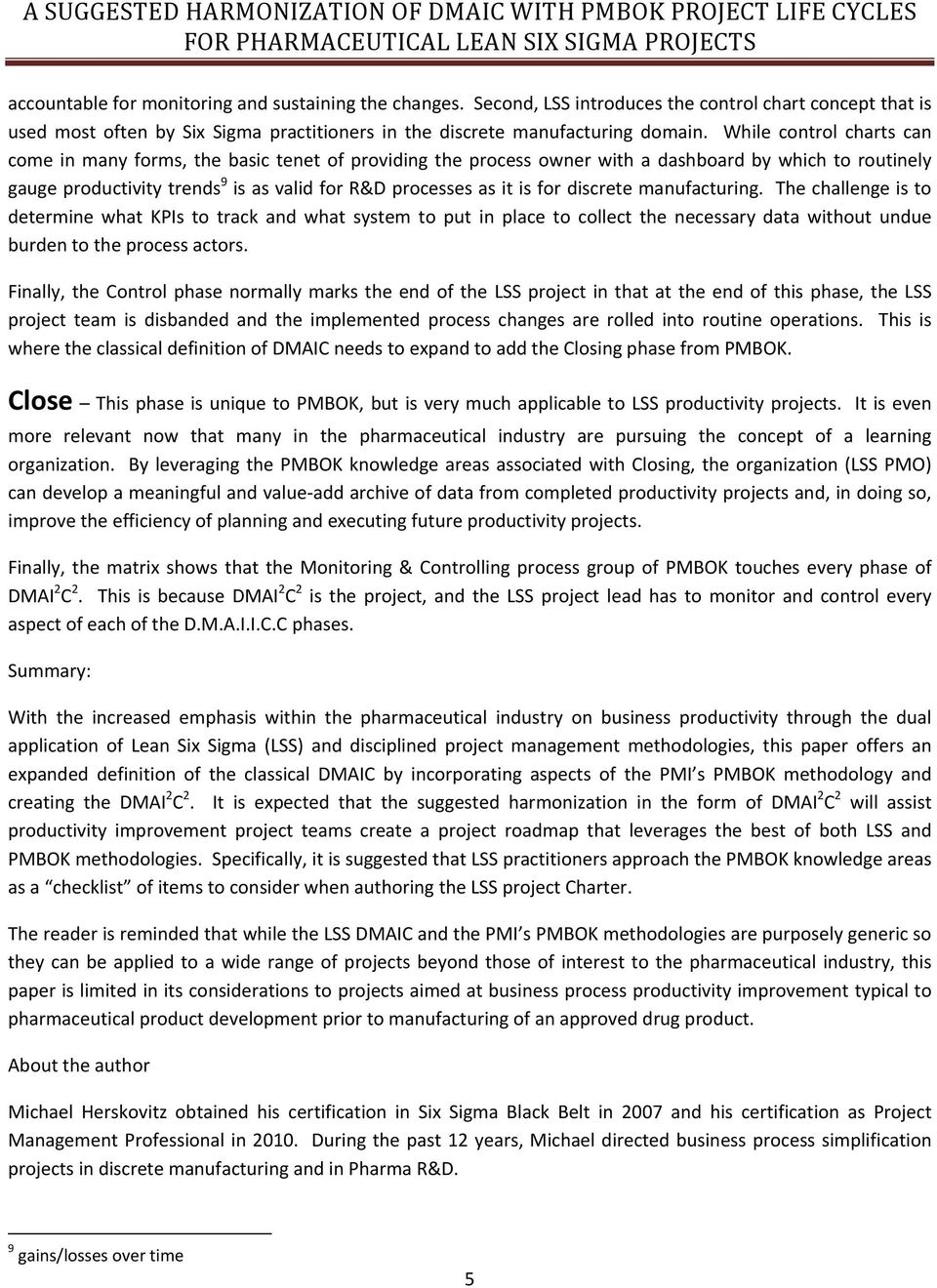
6 TABLE I Overview of Lean Six Sigma DMAIC Key objective 10 Key deliverable Define Measure Analyze Improve Control Collect data that Evaluate the describes the data that was performance or collected with productivity of emphasis on the as is identifying root process causes Establish the scope and purpose of the project Project charter 12 Process flow map, Value Stream Map, asis performance measures 13 A team consensus around root causes in priority order Based on the analysis, evaluate alternative changes to the as is process to mitigate the adverse root causes A Benefit Effort chart of proposed changes along with a suggested to be process flow 14. A project plan delineating the implementation of the approved changes. A pilot or other form of agreed upon validation that the changes will yield the desired effect. Establish a mechanism (dashboard) by which the process owner is able to monitor the process going forward to ensure the productivity are realized and the organization does not drift into past practices 11 Control dashboard. Formal transfer of the process from the Lean sigma team to the process owner. Closure of the project. 10 The intent of this table is not to provide an extensive detail on DMAIC. Instead, key objectives and deliverables are described 11 The classical intent of Control is to demonstrate that the changes made to a manufacturing process returned a process that was out of control (variations, quality, inconsistencies) back into control. For Lean, the need for a dashboard remains valid, although the mechanism and data may differ. 12 The template and content of a project charter are key to project success 13 In typical productivity improvement projects, the data of interest includes cycle time, lead time, first pass yield, throughput, level of effort, cost 14 Typically, the proposed changes are the outcome of a Kaizen event and are subject to formal Stage Gate review and approval. Only the approved changes are authorized for implementation 6
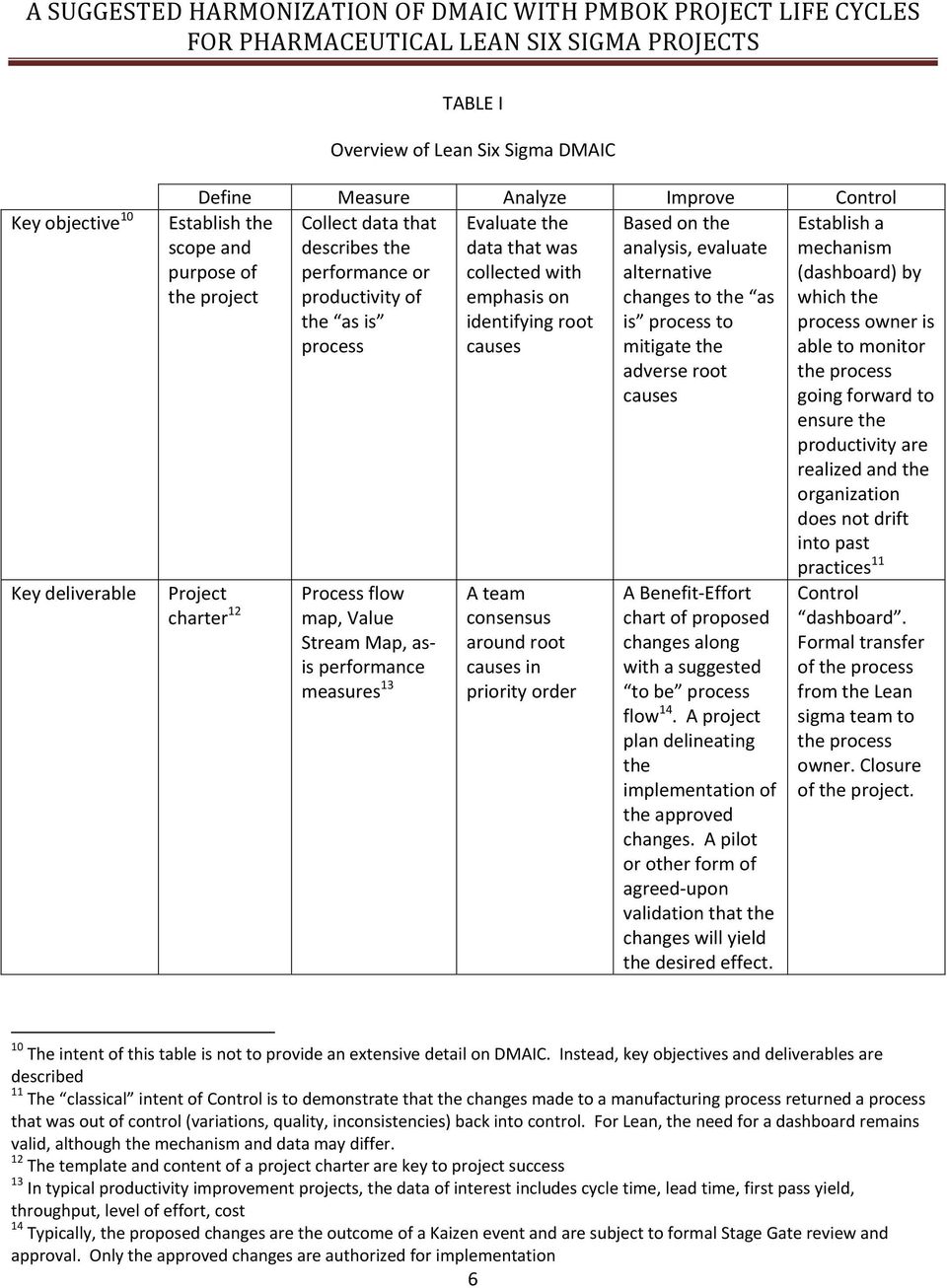
7 TABLE II OVERVIEW OF PMBOK 15 PROJECT MANAGEMENT PROCESS GROUPS AND KNOWLEDGE AREAS Initiating Planning Executing Monitoring& Controlling Closing Key objective 16 Develop the Charter Develop a detailed project management plan Direct and manage the project following the approved plan. The principle is plan the work and work the plan. Monitor progress against plan, and perform integrated change control Archive project information Knowledge Areas Develop Project Charter. Identify Stakeholders. There are 20 knowledge areas, including: collect requirements, define scope, create WBS, define project activities, sequence and timeline, estimate budget, plan communication, and project risk management. There are 8 knowledge areas with emphasis on quality assurance, team staffing and leadership, and communication with stakeholders There are 10 knowledge areas, including change control, verify scope, report performance, and monitor and control project risk Close project, including any procurements 15 Fourth edition 16 The intent of this table is not to provide an extensive detail on PMBOK. Instead, key objectives and deliverables are described 7
The Project Management Body of Knowledge, generally known as PMBOK, deals with nine fundamental subjects for the project management.
 Knowledge Areas The Project Management Body of Knowledge, generally known as PMBOK, deals with nine fundamental subjects for the project management. These are: Project Integration Management Project Scope
Applying the DMAIC Steps to Process Improvement Projects
 Applying the DMAIC Steps to Process Improvement Projects Define, Measure, Analyze, Improve, Control is the Roadmap to Improving Processes By Harry Rever, MBA, PMP, CSSMBB, CQM, CQC Project managers, in
PROJECT MANAGEMENT PLAN <PROJECT NAME>
 PROJECT MANAGEMENT PLAN TEMPLATE This Project Management Plan Template is free for you to copy and use on your project and within your organization. We hope that you find this template useful and welcome
SCOPE MANAGEMENT PLAN <PROJECT NAME>
 SCOPE MANAGEMENT PLAN TEMPLATE This Project Scope Management Plan Template is free for you to copy and use on your project and within your organization. We hope that you find this template useful and welcome
WHY DO I NEED A PROGRAM MANAGEMENT OFFICE (AND HOW DO I GET ONE)?
 WHY DO I NEED A PROGRAM MANAGEMENT OFFICE (AND HOW DO I GET ONE)? Due to the often complex and risky nature of projects, many organizations experience pressure for consistency in strategy, communication,
Project Management Standards: A Review of Certifications/Certificates
 Project Standards: A Review of Certifications/Certificates Standards for Project Supporting Certification and Certificates Certificate Certification The Project Body of Knowledge PMBOK Guide Projects in
Best Practices Statement Project Management. Best Practices for Managing State Information Technology Projects
 State of Arkansas Office of Information Technology 124 W. Capitol Ave. Suite 990 Little Rock, AR 72201 501.682.4300 Voice 501.682.4020 Fax http://www.cio.arkansas.gov/techarch Best Practices Statement
APPENDIX X1 - FIFTH EDITION CHANGES
 APPENDIX X1 FIFTH EDITION CHANGES The purpose of this appendix is to give a detailed explanation of the changes made to A Guide to the Project Management Body of Knowledge (PMBOK Guide) Fourth Edition
PMP Examination Tasks Puzzle game
 PMP Examination Tasks Puzzle game Here is a great game to play to test your knowledge of the tasks you will be tested on in the actual examination. What we have done is take each of the domain tasks in
The Power of Two: Combining Lean Six Sigma and BPM
 : Combining Lean Six Sigma and BPM Lance Gibbs and Tom Shea Lean Six Sigma (LSS) and Business Process Management (BPM) have much to contribute to each other. Unfortunately, most companies have not integrated
Minnesota Health Insurance Exchange (MNHIX)
 Minnesota Health Insurance Exchange (MNHIX) 1.2 Plan September 21st, 2012 Version: FINAL v.1.0 11/9/2012 2:58 PM Page 1 of 87 T A B L E O F C O N T E N T S 1 Introduction to the Plan... 12 2 Integration
The Key to a Successful KM Project
 Introduction An integrated PKM methodology enables organizations to maximize their investments by ensuring initiatives are on time and within budget, while sharing project challenges and successes that
PMI Certified: PMP - Project Management 5 Days
 www.etidaho.com (208) 327-0768 PMI Certified: PMP - Project Management 5 Days Course Description This PMP certification training class is designed for individuals who have on-the-job project management
Operational Excellence using Lean Six Sigma Amit Dasgupta
 Operational Excellence using Lean Six Sigma Amit Dasgupta Amit Dasgupta 1 Contents Introduction to Operational Excellence Deployment Practice Our Services Amit Dasgupta 2 Operational Excellence using Lean
Appeals Case Management System Project. Scope Management Plan. November 20, 2014
 Appeals Case Management System Project Version 1.0 Health and Human Services Agency, Office of Systems Integration Template Revision History REVISION HISTORY REVISION # DATE OF RELEASE OWNER SUMMARY OF
Partnering for Project Success: Project Manager and Business Analyst Collaboration
 Partnering for Project Success: Project Manager and Business Analyst Collaboration By Barbara Carkenord, CBAP, Chris Cartwright, PMP, Robin Grace, CBAP, Larry Goldsmith, PMP, Elizabeth Larson, PMP, CBAP,
Mindjet MindManager : A Vital Solution for Improved Project Management
 Timothy G. Bolwerk, PMP [email protected] Mindjet MindManager : A Vital Solution for Improved Project Management Project managers wrestle with mountains of information. Throughout the course of
PMLead. Project Management Professional. edition. Based on PMBOK Guide 4 th. www.pmlead.net
 PMLead Project Management Professional Based on PMBOK Guide 4 th edition www.pmlead.net SECTION II Chapter 3 Project Management Processes Chapter 3 Project Process Groups A process is a set of interrelated
Develop Project Charter. Develop Project Management Plan
 Develop Charter Develop Charter is the process of developing documentation that formally authorizes a project or a phase. The documentation includes initial requirements that satisfy stakeholder needs
Impact of PMBOK 5 th Edition
 PMP Exam Changes Impact of PMBOK 5 th Edition When the PMI exam will change Major Updates X1.1 Scope of Update Comments and feedbacks for prior version Overall review for accuracy Appropriate alignment
Application of Standard Project Management Processes in Fiber Optic Cable Plant Project Management. Introduction. Alfred Sankara, DigiBridge TelCo
 Application of Standard Project Management Processes in Fiber Optic Cable Plant Project Management Alfred Sankara, DigiBridge TelCo Introduction The Project Management Institute (PMI) is the world's leading
Project Management Office (PMO)
 Contents I. Overview of Project Management...4 1. Project Management Guide (PMG)...4 1.1 Introduction...4 1.2 Scope...6 1.3 Project Types...6 2. Document Overview, Tailoring, and Guidance...7 3. The Project
ITIL Service Lifecycles and the Project Manager
 1 ITIL Service Lifecycles and the Project Manager The intersection of IT Service and Project Delivery Presented to: Kansas City Mid-America PMI Chapter Mark Thomas January 17, 2011 1 Agenda 2 Introduction
A COMPARISON OF PRINCE2 AGAINST PMBOK
 Introduction This comparison takes each part of the PMBOK and gives an opinion on what match there is with elements of the PRINCE2 method. It can be used in any discussion of the respective merits of the
BODY OF KNOWLEDGE CERTIFIED SIX SIGMA YELLOW BELT
 BODY OF KNOWLEDGE CERTIFIED SIX SIGMA YELLOW BELT The topics in this Body of Knowledge include additional detail in the form of subtext explanations and the cognitive level at which test questions will
Project Management Professional (PMP) Examination Content Outline
 Project Management Professional (PMP) Examination Content Outline Project Management Institute Project Management Professional (PMP ) Examination Content Outline Revised August 2011 Published by: Project
Assessment of NCTD Program Management Framework for Positive Train Control Program
 Assessment of NCTD Program Management Framework for Positive Train Control Program Subtask 2: Analysis Gap Analysis Prepared for: Brad Hansen, M.S., PMP Director, PMO Capital Projects May 2013 0 icfi.com/transportation
ATTACHMENT 3 SPS PROJECT SENIOR PROGRAM MANAGER (SPM) DUTIES & RESPONSIBILITIES
 1. ROLE DEFINITIONS ATTACHMENT 3 SPS PROJECT SENIOR PROGRAM MANAGER (SPM) DUTIES & RESPONSIBILITIES The purpose of this section is to distinguish among the roles interacting with the SPM obtained through
PHASE 8: IMPLEMENTATION PHASE
 PHASE 8: IMPLEMENTATION PHASE The Implementation Phase has one key activity: deploying the new system in its target environment. Supporting actions include training end-users and preparing to turn the
MNLARS Project Audit Checklist
 Audit Checklist The following provides a detailed checklist to assist the audit team in reviewing the health of a project. Relevance (at this time) How relevant is this attribute to this project or audit?
The 10 Knowledge Areas & ITTOs
 This document is part of a series that explain the newly released PMBOK 5th edition. These documents provide simple explanation and summary of the book. However they do not replace the necessity of reading
PMP Project Management Professional Study Guide, Third Edition
 PMP Project Management Professional Study Guide, Third Edition Joseph Phillips McGraw-Hill is an independent entity from the Project Management Institute, Inc. and is not affiliated with the Project Management
Time Management. Herb Pollard III
 Time Management A Small Business Perspective Herb Pollard III Project Manager for Time Management - Pollard PMI Slide 1 Introduction: Time Management - Pollard PMI Slide 2 Project Phases and the Areas
The Business Case for Lean Six Sigma in Higher Education
 The Business Case for Lean Six Sigma in Higher Education by Norma Simons At the Time Summit on Higher Education in October 2012, Arne Duncan, the U.S. secretary of education, indicated that higher education
Using Lean Six Sigma to Accelerate
 Using Lean Six Sigma to Accelerate CMMI Implementation Briefers: Diane A. Glaser Michael D. Barnett US Army LCMC SEC CMMI Coordinator Communication Software ASQ SSGB Engineering Support Division MTC Technologies,
Assessing the Appropriate Level of Project, Program, and PMO Structure
 PMI Virtual Library 2011 Daniel D. Magruder Assessing the Appropriate Level of Project, Program, and PMO Structure By Daniel D. Magruder, PMP Executive Summary Does your organization have in-flight projects
Using Your PMO to Drive Successful Organizational Change Management
 Using Your PMO to Drive Successful Organizational Change Management Joe Saliunas, Booz Allen Hamilton 11 November 2012 1 Agenda Organizational change management overview Case studies PMBOK Guide processes
Project Management Professional (PMP) Examination Content Outline
 Project Management Professional (PMP) Examination Content Outline Project Management Institute Project Management Professional (PMP) Examination Content Outline June 2015 Published by: Project Management
ASHP Professional Development Section Advisory Group. Professional Development Opportunities for Informatics Pharmacists
 ASHP Professional Development Section Advisory Group Professional Development Opportunities for Informatics Pharmacists Introduction Many opportunities exist to help informatics pharmacists gain the knowledge
THE PROJECT MANAGEMENT KNOWLEDGE AREAS
 THE PROJECT MANAGEMENT KNOWLEDGE AREAS 4. Project Integration Management 5. Project Scope Management 6. Project Time Management 7. Project Cost Management 8. Project Quality Management 9. Project Human
Managing IT Projects. Chapter 2 The PMI Framework
 Managing IT Projects Chapter 2 The PMI Framework The PMI Framework The Project Management Institute,USA is an internationally acclaimed organization Devoted to Creation & sharing of knowledge in the area
Overview of: A Guide to the Project Management Body of Knowledge (PMBOK Guide) Fourth Edition
 Overview of A Guide to the Project Management Body of Knowledge (PMBOK Guide) Fourth Edition Overview of: A Guide to the Project Management Body of Knowledge (PMBOK Guide) Fourth Edition 1 Topics for Discussion
A Guide To The Project Management Body of Knowledge (PMBOK) Significant Changes from the 3 rd edition to the 4 th edition
 A Guide To The Project Body of Knowledge (PMBOK) Significant Changes from the 3 rd edition to the 4 th edition Major Changes The adoption of the verb-noun format for process names Amplification as to Enterprise
Program Management Professional (PgMP) Examination Content Outline
 Program Management Professional (PgMP) Examination Content Outline Project Management Institute Program Management Professional (PgMP ) Examination Content Outline April 2011 Published by: Project Management
The following is intended to outline our general product direction. It is intended for information purposes only, and may not be incorporated into
 The following is intended to outline our general product direction. It is intended for information purposes only, and may not be incorporated into any contract. It is not a commitment to deliver any material,
The ITS Project Management Framework
 The ITS Project Management Framework Information Technology Services Project Management Framework v1.0 1 Table of Contents Introduction 3 Why Create a Project Management Framework? 4 Projects versus Operational
IT Project Management Methodology. Project Risk Management Guide. Version 0.3
 NATIONAL INFORMATION TECHNOLOGY AUTHORITY - UGANDA IT Project Management Methodology Project Risk Management Guide Version 0.3 Project Risk Management Support Guide version 0.3 Page 1 Version Date Author
Leveraging RUP, OpenUP, and the PMBOK. Arthur English, GreenLine Systems
 Software Project Management Leveraging RUP, OpenUP, and the PMBOK Arthur English, GreenLine Systems GreenLine Systems Inc. 2003 2013 My Background 30+ years of IT project management experience with both
ITS Project Management Methodology
 ITS Project Management Methodology Information Technology Services Project Management Group 11/17/2014 Version 2.1 Author: ITS Project Management Group Document Control Change Record Date Author Version
Playing The Project Management Game
 Playing The Project Management Game Tools and Techniques to Win the Game Dean Athanassiades, PMP Nancy Stetson, PMP Version 2003-12-02 (c) Dean Athanassiades 2003 1 Presenters Dean Athanassiades, PMP Philips
The Association of Change Management Professionals
 The Association of Change Management Professionals Statement of Change Management Scope, Knowledge Areas, and Process Groups March 31, 2012 Introduction The Association of Change Management Professionals
Project Management Professional (PMP) Boot Camp
 Project Management Professional (PMP) Boot Camp According to the Project Management Institute, the world's leading association for the project management profession: "PMP Certification is the profession's
ORACLE PROJECT MANAGEMENT
 ORACLE PROJECT MANAGEMENT KEY FEATURES Oracle Project Management provides project managers the WORK MANAGEMENT Define the workplan and associated resources; publish and maintain versions View your schedule,
Project Management Professional (PMP)
 Project Management Professional (PMP) Duration: 5 days Course Objectives: PMI s Project Management Professional (PMP) credential is the most important industry-recognized certification for project managers.
January 2011 Six Sigma SIG Meeting
 Six Sigma and Project Management ASQ 502 Baltimore LSS SIG Geoffrey Withnell Dynamics Research Corp. January 2011 Six Sigma SIG Meeting I ll Ill give you a moment to digest this Some truthinpresenting
Contract Performance Framework
 Contract Performance Framework Version 4 September, 2014 1 Provincial CCAC Client Service Contract Performance Framework Introduction: Home care plays a critical role in achieving successful and sustainable
The Project Management Life Cycle By Jason Westland (A book review by R. Max Wideman)
 The Project Management Life Cycle By Jason Westland (A book review by R. Max Wideman) 11/17/07 Introduction Editor's Note: We liked so much of this book that we asked for the author's permission to quote
Six sigma project management
 Six sigma project management Bizagi Suite Six sigma project management 1 Table of Contents Six Sigma Project Management... 3 Process Elements... 9 Project Charter... 9 Define... 11 Measure...12 Analyze...12
PHASE 3: PLANNING PHASE
 PHASE 3: PLANNING PHASE The ning Phase focuses principally on required project planning work. Proper comprehensive project planning is essential to a successful IT project, and incomplete project planning
MGMT 4135 Project Management. Chapter-16. Project Oversight
 MGMT 4135 Project Management Chapter-16 Project Oversight Project Oversight: defined as a set of principles and processes to guide and improve the management of projects. Ensures projects meet the needs
Rolling Wave Planning: Manage Projects Without Going Under
 Rolling Wave Planning: Manage Projects Without Going Under Rolling Wave Planning: Manage Projects Without Going Under W. Charles Slaven MBA PMP CSSBB CPA (inactive) Director, Lean Deployment and Continuous
An Oracle White Paper March 2013. Project Management Office Starter Kit
 An Oracle White Paper March 2013 Project Management Office Starter Kit Executive Overview... 1 Introduction... 1 Plan Phase... 2 Create Statement of Purpose and Goals... 2 Define Scope and Target Maturity...
PHASE 3: PLANNING PHASE
 PHASE 3: PLANNING PHASE The Planning Phase focuses principally on required project planning work. Proper comprehensive project planning is essential to a successful IT project, and incomplete project planning
GE Capital. Driving change and continuous process improvement. how-to
 Driving change and continuous process improvement Process improvement or PI involves applying tools and techniques to help a company achieve its goals Characteristics Aligned around what customers value
PMP 2013 Exam Prep. Course Overview
 PMP 2013 Exam Prep Course Overview This course has been designed to prepare participants to take the Project Management Institute's Project Management Professional (PMP) Exam, 2013 edition and is based
TenStep Project Management Process Summary
 TenStep Project Management Process Summary Project management refers to the definition and planning, and then the subsequent management, control, and conclusion of a project. It is important to recognize
Project Management Planning
 Develop Project Tasks One of the most important parts of a project planning process is the definition of activities that will be undertaken as part of the project. Activity sequencing involves dividing
From Body of Knowledge to Embodied Knowledge: Leveraging the Project Management Professional (PMP) Certification
 From Body of Knowledge to Embodied Knowledge: Leveraging the Project Management Professional (PMP) Certification By Jennifer Tucker, PMP OKA (Otto Kroeger Associates), [email protected] Abstract. The
Lean and Six Sigma Healthcare Fad or Reality. Vince D Mello President
 Lean and Six Sigma Healthcare Fad or Reality Vince D Mello President TODAY S DISCUSSION About Lean Methodologies Application benefits and outcomes About Six Sigma Key learning's QUALITY FUNDAMENTALS Function
IT Project Management Methodology. Project Scope Management Support Guide
 NATIONAL INFORMATION TECHNOLOGY AUTHORITY - UGANDA IT Project Management Methodology Project Scope Management Support Guide Version 0.3 Version Date Author Change Description 0.1 23 rd Mar, 2013 Gerald
Department of Administration Portfolio Management System 1.3 June 30, 2010
 E 06/ 30/ 2010 EX AM PL 1. 3 06/ 28/ 2010 06/ 24/ 2010 06/ 23/ 2010 06/ 15/ 2010 06/ 18/ 2010 Portfolio System 1.3 June 30, 2010 Contents Section 1. Project Overview... 1 1.1 Project Description... 1 1.2
Computing Services Network Project Methodology
 Computing Services Network Project Prepared By: Todd Brindley, CSN Project Version # 1.0 Updated on 09/15/2008 Version 1.0 Page 1 MANAGEMENT PLANNING Project : Version Control Version Date Author Change
Project Management Guidebook
 METHOD 12 3 empowering managers to succeed Project Management Guidebook ISBN 0-473-10445-8 A bout this e-book This e-book was created by Method123 (see www.method123.com) to help provide you with a simple
Treasury Board of Canada Secretariat (TBS) IT Project Manager s Handbook. Version 1.1
 Treasury Board of Canada Secretariat (TBS) IT Project Manager s Handbook Version 1.1 December 12, 1997 Table of Contents Navigating the Handbook Content...1 Introduction...4 About the Handbook...9 Adaptability
Certified Six Sigma Yellow Belt
 Certified Six Sigma Yellow Belt Quality excellence to enhance your career and boost your organization s bottom line asq.org/cert The Global Voice of Quality TM Certification from ASQ is considered a mark
Dunja Hahn. Profile. Senior Consultant EDUCATION. 2010 Diploma in business administration (equivalent to Master)
 Profile Dunja Hahn Senior Consultant Email: [email protected] EDUCATION PROFESSIONAL TRAINING 2010 Diploma in business administration (equivalent to Master) 2008 Economic interpreter of the English
Best Practice Methodologies for the Project Management Office (PMO)
 WHITE PAPER: BEST PRACTICE METHODOLOGIES FOR THE PROJECT MANAGEMENT OFFICE (PMO) SERIES 3 OF 4 Best Practice Methodologies for the Project Management Office (PMO) SEPTEMBER 2007 Haydn Thomas, Julie Tilke
Six Sigma Can Help Project Managers Improve Results
 Six Sigma Can Help Project Managers Improve Results By Harry Rever If it was easy to improve business results, results would always improve. Obviously, this is not the case. Business leaders understand
Step by Step Project Planning
 Step by Step Project Planning Contents Introduction The Planning Process 1 Create a Project Plan...1 Create a Resource Plan...1 Create a Financial Plan...1 Create a Quality Plan...2 Create a Risk Plan...2
- ATTACHMENT - PROGRAM MANAGER DUTIES & RESPONSIBILITIES MARYLAND STATE POLICE W00B0400021
 - ATTACHMENT - PROGRAM MANAGER DUTIES & RESPONSIBILITIES MARYLAND STATE POLICE W00B0400021 About this document this is a detailed description of typical Project Manager (PM) duties, responsibilities, and
Course Overview Lean Six Sigma Green Belt
 Course Overview Lean Six Sigma Green Belt Summary and Objectives This Six Sigma Green Belt course is comprised of 11 separate sessions. Each session is a collection of related lessons and includes an interactive
Program Title: Advanced Project Management Knowledge, Skills & Software Program ID: #1039168 Program Cost: $4,690 Duration: 52.
 Program Title: Advanced Project Management Knowledge, Skills & Software Program ID: #1039168 Program Cost: $4,690 Duration: 52.5 hours Program Description The Advance Project Management Knowledge, Skills
APPLYING PROJECT MANAGEMENT TECHNIQUES TO QEHS
 APPLYING PROJECT MANAGEMENT TECHNIQUES TO QEHS Mary F. McDonald, CQA President/Principal Consultant Individual Solution Options/Quality Services (ISO/QS), Inc. Austin, TX 78739 Tel: (512) 282-0181 E-mail:
PROJECT COST MANAGEMENT
 7 PROJECT COST MANAGEMENT Project Cost Management includes the processes required to ensure that the project is completed within the approved budget. Figure 7 1 provides an overview of the following major
Research Project Management Key Concepts. Dr Robin Henderson [email protected]
 Research Project Management Key Concepts Dr Robin Henderson [email protected] Introduction The successful management of a research project depends upon the researchers ability to plan, coordinate
PROJECT MANAGEMENT PLAN Outline VERSION 0.0 STATUS: OUTLINE DATE:
 PROJECT MANAGEMENT PLAN Outline VERSION 0.0 STATUS: OUTLINE DATE: Project Name Project Management Plan Document Information Document Title Version Author Owner Project Management Plan Amendment History
Demonstrate and apply knowledge of project management in
 Demonstrate and apply knowledge of project management in mechanical engineering 22918 version 2 Page 1 of 5 Level 6 Credits 15 Purpose This unit standard is intended primarily for use in diploma courses
www.aryanengineering.com Email: [email protected]
 What is PMP Certification exam? www.aryanengineering.com PMP stands for Project Management Professional certification exam. PMP, is one of the most respected and globally recognized certification is offered
Project Management Guidelines
 Project Management Guidelines Overview Section 86-1506 (5) directs the NITC to adopt guidelines regarding project planning and management. The goal of project management is to achieve the objectives of
Minnesota Health Insurance Exchange Project (MNHIX) Deliverable Definition Document (DDD) For Project Management Plan Date: 07-31-2012
 Minnesota Health Insurance Exchange Project (MNHI) Deliverable Definition Document (DDD) For Project Plan Date: 07-31-2012 11/9/2012 1:18 PM Page 1 of 8 1. High Level Deliverable Description The Project
Define. Measure. Analyze. Improve. Control. Project Name/Description. DMAIC Step Work Done/Tools Used by Team My Role/Contribution
 Six Sigma Green Belt DMAIC Project Logbook Please fill out this document (use as many pages as necessary). Detail what your team and you did in each step of the DMAIC. If the Project is a Kaizen Event,
Dallas IIA Chapter / ISACA N. Texas Chapter. January 7, 2010
 Dallas IIA Chapter / ISACA N. Texas Chapter Auditing Tuesday, October Project 20, 2009 Management Controls January 7, 2010 Table of Contents Contents Page # Project Management Office Overview 3 Aligning
Analytics Strategy Information Architecture Data Management Analytics Value and Governance Realization
 1/22 As a part of Qlik Consulting, works with Customers to assist in shaping strategic elements related to analytics to ensure adoption and success throughout their analytics journey. Qlik Advisory 2/22
Section 6. Governance & Investment Roadmap. Executive Governance
 Section 6 Governance & Investment Roadmap Executive Governance Strong governance is critical to the success of a long-term, complex transformative initiative. The following section provides a high-level
- 5 days (30 PDUs)... 15. ITIL V3 Intermediate Capability - Planning, Protection and Optimization... 14
 Course List Business Analysis... 5 Advanced Business Analysis - 2 days (16 PD Hrs/CDUs)... 5 Basics of Business Analysis - 1 day... 5 Business Process Analysis - 2 days... 5 Business Analysis Certification
Project Management Certificate (IT Professionals)
 Project Management Certificate (IT Professionals) Whether your field is architecture or information technology, successful planning involves a carefully crafted set of steps to planned and measurable goals.
Interpreting the Management Process in IEEE/EIA 12207 with the Help of PMBOK
 Interpreting the Management Process in IEEE/EIA 12207 with the Help of PMBOK Lewis Gray, Ph.D., PMP Abelia Fairfax, Virginia USA www.abelia.com Copyright 2002 by Abelia Corporation. All rights reserved