
Junos Space. QoS Design User Guide. Release Published: Revision 1. Copyright 2011, Juniper Networks, Inc.
|
|
|
- Noah Rich
- 10 years ago
- Views:
Transcription
1 Junos Space QoS Design User Guide Release 11.2 Published: Revision 1
2 Juniper Networks, Inc North Mathilda Avenue Sunnyvale, California USA This product includes the Envoy SNMP Engine, developed by Epilogue Technology, an Integrated Systems Company. Copyright , Epilogue Technology Corporation. All rights reserved. This program and its documentation were developed at private expense, and no part of them is in the public domain. This product includes memory allocation software developed by Mark Moraes, copyright 1988, 1989, 1993, University of Toronto. This product includes FreeBSD software developed by the University of California, Berkeley, and its contributors. All of the documentation and software included in the 4.4BSD and 4.4BSD-Lite Releases is copyrighted by the Regents of the University of California. Copyright 1979, 1980, 1983, 1986, 1988, 1989, 1991, 1992, 1993, The Regents of the University of California. All rights reserved. GateD software copyright 1995, the Regents of the University. All rights reserved. Gate Daemon was originated and developed through release 3.0 by Cornell University and its collaborators. Gated is based on Kirton s EGP, UC Berkeley s routing daemon (routed), and DCN s HELLO routing protocol. Development of Gated has been supported in part by the National Science Foundation. Portions of the GateD software copyright 1988, Regents of the University of California. All rights reserved. Portions of the GateD software copyright 1991, D. L. S. Associates. This product includes software developed by Maker Communications, Inc., copyright 1996, 1997, Maker Communications, Inc. Juniper Networks, Junos, Steel-Belted Radius, NetScreen, and ScreenOS are registered trademarks of Juniper Networks, Inc. in the United States and other countries. The Juniper Networks Logo, the Junos logo, and JunosE are trademarks of Juniper Networks, Inc. All other trademarks, service marks, registered trademarks, or registered service marks are the property of their respective owners. Juniper Networks assumes no responsibility for any inaccuracies in this document. Juniper Networks reserves the right to change, modify, transfer, or otherwise revise this publication without notice. Products made or sold by Juniper Networks or components thereof might be covered by one or more of the following patents that are owned by or licensed to Juniper Networks: U.S. Patent Nos. 5,473,599, 5,905,725, 5,909,440, 6,192,051, 6,333,650, 6,359,479, 6,406,312, 6,429,706, 6,459,579, 6,493,347, 6,538,518, 6,538,899, 6,552,918, 6,567,902, 6,578,186, and 6,590,785. Junos Space QoS Design User Guide All rights reserved. Revision History June 2011 QoS Design User Guide, Release 11.2, Revision 1 The information in this document is current as of the date listed in the revision history. ii

3 END USER LICENSE AGREEMENT READ THIS END USER LICENSE AGREEMENT ( AGREEMENT ) BEFORE DOWNLOADING, INSTALLING, OR USING THE SOFTWARE. BY DOWNLOADING, INSTALLING, OR USING THE SOFTWARE OR OTHERWISE EXPRESSING YOUR AGREEMENT TO THE TERMS CONTAINED HEREIN, YOU (AS CUSTOMER OR IF YOU ARE NOT THE CUSTOMER, AS A REPRESENTATIVE/AGENT AUTHORIZED TO BIND THE CUSTOMER) CONSENT TO BE BOUND BY THIS AGREEMENT. IF YOU DO NOT OR CANNOT AGREE TO THE TERMS CONTAINED HEREIN, THEN (A) DO NOT DOWNLOAD, INSTALL, OR USE THE SOFTWARE, AND (B) YOU MAY CONTACT JUNIPER NETWORKS REGARDING LICENSE TERMS. 1. The Parties. The parties to this Agreement are (i) Juniper Networks, Inc. (if the Customer s principal office is located in the Americas) or Juniper Networks (Cayman) Limited (if the Customer s principal office is located outside the Americas) (such applicable entity being referred to herein as Juniper ), and (ii) the person or organization that originally purchased from Juniper or an authorized Juniper reseller the applicable license(s) for use of the Software ( Customer ) (collectively, the Parties ). 2. The Software. In this Agreement, Software means the program modules and features of the Juniper or Juniper-supplied software, for which Customer has paid the applicable license or support fees to Juniper or an authorized Juniper reseller, or which was embedded by Juniper in equipment which Customer purchased from Juniper or an authorized Juniper reseller. Software also includes updates, upgrades and new releases of such software. Embedded Software means Software which Juniper has embedded in or loaded onto the Juniper equipment and any updates, upgrades, additions or replacements which are subsequently embedded in or loaded onto the equipment. 3. License Grant. Subject to payment of the applicable fees and the limitations and restrictions set forth herein, Juniper grants to Customer a non-exclusive and non-transferable license, without right to sublicense, to use the Software, in executable form only, subject to the following use restrictions: a. Customer shall use Embedded Software solely as embedded in, and for execution on, Juniper equipment originally purchased by Customer from Juniper or an authorized Juniper reseller. b. Customer shall use the Software on a single hardware chassis having a single processing unit, or as many chassis or processing units for which Customer has paid the applicable license fees; provided, however, with respect to the Steel-Belted Radius or Odyssey Access Client software only, Customer shall use such Software on a single computer containing a single physical random access memory space and containing any number of processors. Use of the Steel-Belted Radius or IMS AAA software on multiple computers or virtual machines (e.g., Solaris zones) requires multiple licenses, regardless of whether such computers or virtualizations are physically contained on a single chassis. c. Product purchase documents, paper or electronic user documentation, and/or the particular licenses purchased by Customer may specify limits to Customer s use of the Software. Such limits may restrict use to a maximum number of seats, registered endpoints, concurrent users, sessions, calls, connections, subscribers, clusters, nodes, realms, devices, links, ports or transactions, or require the purchase of separate licenses to use particular features, functionalities, services, applications, operations, or capabilities, or provide throughput, performance, configuration, bandwidth, interface, processing, temporal, or geographical limits. In addition, such limits may restrict the use of the Software to managing certain kinds of networks or require the Software to be used only in conjunction with other specific Software. Customer s use of the Software shall be subject to all such limitations and purchase of all applicable licenses. d. For any trial copy of the Software, Customer s right to use the Software expires 30 days after download, installation or use of the Software. Customer may operate the Software after the 30-day trial period only if Customer pays for a license to do so. Customer may not extend or create an additional trial period by re-installing the Software after the 30-day trial period. e. The Global Enterprise Edition of the Steel-Belted Radius software may be used by Customer only to manage access to Customer s enterprise network. Specifically, service provider customers are expressly prohibited from using the Global Enterprise Edition of the Steel-Belted Radius software to support any commercial network access services. The foregoing license is not transferable or assignable by Customer. No license is granted herein to any user who did not originally purchase the applicable license(s) for the Software from Juniper or an authorized Juniper reseller. 4. Use Prohibitions. Notwithstanding the foregoing, the license provided herein does not permit the Customer to, and Customer agrees not to and shall not: (a) modify, unbundle, reverse engineer, or create derivative works based on the Software; (b) make unauthorized copies of the Software (except as necessary for backup purposes); (c) rent, sell, transfer, or grant any rights in and to any copy of the Software, in any form, to any third party; (d) remove any proprietary notices, labels, or marks on or in any copy of the Software or any product in which the Software is embedded; (e) distribute any copy of the Software to any third party, including as may be embedded in Juniper equipment sold in the secondhand market; (f) use any locked or key-restricted feature, function, service, application, operation, or capability without first purchasing the applicable license(s) and obtaining a valid key from Juniper, even if such feature, function, service, application, operation, or capability is enabled without a key; (g) distribute any key for the Software provided by Juniper to any third party; (h) use the iii

4 Software in any manner that extends or is broader than the uses purchased by Customer from Juniper or an authorized Juniper reseller; (i) use Embedded Software on non-juniper equipment; (j) use Embedded Software (or make it available for use) on Juniper equipment that the Customer did not originally purchase from Juniper or an authorized Juniper reseller; (k) disclose the results of testing or benchmarking of the Software to any third party without the prior written consent of Juniper; or (l) use the Software in any manner other than as expressly provided herein. 5. Audit. Customer shall maintain accurate records as necessary to verify compliance with this Agreement. Upon request by Juniper, Customer shall furnish such records to Juniper and certify its compliance with this Agreement. 6. Confidentiality. The Parties agree that aspects of the Software and associated documentation are the confidential property of Juniper. As such, Customer shall exercise all reasonable commercial efforts to maintain the Software and associated documentation in confidence, which at a minimum includes restricting access to the Software to Customer employees and contractors having a need to use the Software for Customer s internal business purposes. 7. Ownership. Juniper and Juniper s licensors, respectively, retain ownership of all right, title, and interest (including copyright) in and to the Software, associated documentation, and all copies of the Software. Nothing in this Agreement constitutes a transfer or conveyance of any right, title, or interest in the Software or associated documentation, or a sale of the Software, associated documentation, or copies of the Software. 8. Warranty, Limitation of Liability, Disclaimer of Warranty. The warranty applicable to the Software shall be as set forth in the warranty statement that accompanies the Software (the Warranty Statement ). Nothing in this Agreement shall give rise to any obligation to support the Software. Support services may be purchased separately. Any such support shall be governed by a separate, written support services agreement. TO THE MAXIMUM EXTENT PERMITTED BY LAW, JUNIPER SHALL NOT BE LIABLE FOR ANY LOST PROFITS, LOSS OF DATA, OR COSTS OR PROCUREMENT OF SUBSTITUTE GOODS OR SERVICES, OR FOR ANY SPECIAL, INDIRECT, OR CONSEQUENTIAL DAMAGES ARISING OUT OF THIS AGREEMENT, THE SOFTWARE, OR ANY JUNIPER OR JUNIPER-SUPPLIED SOFTWARE. IN NO EVENT SHALL JUNIPER BE LIABLE FOR DAMAGES ARISING FROM UNAUTHORIZED OR IMPROPER USE OF ANY JUNIPER OR JUNIPER-SUPPLIED SOFTWARE. EXCEPT AS EXPRESSLY PROVIDED IN THE WARRANTY STATEMENT TO THE EXTENT PERMITTED BY LAW, JUNIPER DISCLAIMS ANY AND ALL WARRANTIES IN AND TO THE SOFTWARE (WHETHER EXPRESS, IMPLIED, STATUTORY, OR OTHERWISE), INCLUDING ANY IMPLIED WARRANTY OF MERCHANTABILITY, FITNESS FOR A PARTICULAR PURPOSE, OR NONINFRINGEMENT. IN NO EVENT DOES JUNIPER WARRANT THAT THE SOFTWARE, OR ANY EQUIPMENT OR NETWORK RUNNING THE SOFTWARE, WILL OPERATE WITHOUT ERROR OR INTERRUPTION, OR WILL BE FREE OF VULNERABILITY TO INTRUSION OR ATTACK. In no event shall Juniper s or its suppliers or licensors liability to Customer, whether in contract, tort (including negligence), breach of warranty, or otherwise, exceed the price paid by Customer for the Software that gave rise to the claim, or if the Software is embedded in another Juniper product, the price paid by Customer for such other product. Customer acknowledges and agrees that Juniper has set its prices and entered into this Agreement in reliance upon the disclaimers of warranty and the limitations of liability set forth herein, that the same reflect an allocation of risk between the Parties (including the risk that a contract remedy may fail of its essential purpose and cause consequential loss), and that the same form an essential basis of the bargain between the Parties. 9. Termination. Any breach of this Agreement or failure by Customer to pay any applicable fees due shall result in automatic termination of the license granted herein. Upon such termination, Customer shall destroy or return to Juniper all copies of the Software and related documentation in Customer s possession or control. 10. Taxes. All license fees payable under this agreement are exclusive of tax. Customer shall be responsible for paying Taxes arising from the purchase of the license, or importation or use of the Software. If applicable, valid exemption documentation for each taxing jurisdiction shall be provided to Juniper prior to invoicing, and Customer shall promptly notify Juniper if their exemption is revoked or modified. All payments made by Customer shall be net of any applicable withholding tax. Customer will provide reasonable assistance to Juniper in connection with such withholding taxes by promptly: providing Juniper with valid tax receipts and other required documentation showing Customer s payment of any withholding taxes; completing appropriate applications that would reduce the amount of withholding tax to be paid; and notifying and assisting Juniper in any audit or tax proceeding related to transactions hereunder. Customer shall comply with all applicable tax laws and regulations, and Customer will promptly pay or reimburse Juniper for all costs and damages related to any liability incurred by Juniper as a result of Customer s non-compliance or delay with its responsibilities herein. Customer s obligations under this Section shall survive termination or expiration of this Agreement. 11. Export. Customer agrees to comply with all applicable export laws and restrictions and regulations of any United States and any applicable foreign agency or authority, and not to export or re-export the Software or any direct product thereof in violation of any such restrictions, laws or regulations, or without all necessary approvals. Customer shall be liable for any such violations. The version of the Software supplied to Customer may contain encryption or other capabilities restricting Customer s ability to export the Software without an export license. iv
5 12. Commercial Computer Software. The Software is commercial computer software and is provided with restricted rights. Use, duplication, or disclosure by the United States government is subject to restrictions set forth in this Agreement and as provided in DFARS through , FAR , FAR (b)(2), FAR , or FAR (ALT III) as applicable. 13. Interface Information. To the extent required by applicable law, and at Customer's written request, Juniper shall provide Customer with the interface information needed to achieve interoperability between the Software and another independently created program, on payment of applicable fee, if any. Customer shall observe strict obligations of confidentiality with respect to such information and shall use such information in compliance with any applicable terms and conditions upon which Juniper makes such information available. 14. Third Party Software. Any licensor of Juniper whose software is embedded in the Software and any supplier of Juniper whose products or technology are embedded in (or services are accessed by) the Software shall be a third party beneficiary with respect to this Agreement, and such licensor or vendor shall have the right to enforce this Agreement in its own name as if it were Juniper. In addition, certain third party software may be provided with the Software and is subject to the accompanying license(s), if any, of its respective owner(s). To the extent portions of the Software are distributed under and subject to open source licenses obligating Juniper to make the source code for such portions publicly available (such as the GNU General Public License ( GPL ) or the GNU Library General Public License ( LGPL )), Juniper will make such source code portions (including Juniper modifications, as appropriate) available upon request for a period of up to three years from the date of distribution. Such request can be made in writing to Juniper Networks, Inc., 1194 N. Mathilda Ave., Sunnyvale, CA 94089, ATTN: General Counsel. You may obtain a copy of the GPL at and a copy of the LGPL at Miscellaneous. This Agreement shall be governed by the laws of the State of California without reference to its conflicts of laws principles. The provisions of the U.N. Convention for the International Sale of Goods shall not apply to this Agreement. For any disputes arising under this Agreement, the Parties hereby consent to the personal and exclusive jurisdiction of, and venue in, the state and federal courts within Santa Clara County, California. This Agreement constitutes the entire and sole agreement between Juniper and the Customer with respect to the Software, and supersedes all prior and contemporaneous agreements relating to the Software, whether oral or written (including any inconsistent terms contained in a purchase order), except that the terms of a separate written agreement executed by an authorized Juniper representative and Customer shall govern to the extent such terms are inconsistent or conflict with terms contained herein. No modification to this Agreement nor any waiver of any rights hereunder shall be effective unless expressly assented to in writing by the party to be charged. If any portion of this Agreement is held invalid, the Parties agree that such invalidity shall not affect the validity of the remainder of this Agreement. This Agreement and associated documentation has been written in the English language, and the Parties agree that the English version will govern. (For Canada: Les parties aux présentés confirment leur volonté que cette convention de même que tous les documents y compris tout avis qui s'y rattaché, soient redigés en langue anglaise. (Translation: The parties confirm that this Agreement and all related documentation is and will be in the English language)). v

6 vi

7 Table of Contents About the Documentation xiii Junos Space Documentation and Release Notes xiii Documentation Conventions xiii Documentation Feedback xiv Requesting Technical Support xiv Self-Help Online Tools and Resources xv Opening a Case with JTAC xv Part 1 Overview Chapter 1 QoS Overview Quality of Service (QoS) Overview Deployment of QoS on MPLS VPN Services Service-Specific QoS Process Overview CoS Components Overview Chapter 2 Domain Discovery Domain Discovery Overview Prerequisites for Domain Discovery QoS Domain Discovery Process Domain Discovery Prestaging Rules N-PE Device Classification Rules NNI Classification Rules CoS Configuration Data Imported into a QoS Domain Chapter 3 Overview of QoS Profiles, Schedulers, and Drop Profiles QoS Profile Overview QoS Scheduler Types Availability of Policer Types in QoS Profiles QoS Scheduler Overview Support for TCM Policers and Hierarchical Queuing on EQ, IQ2E, and IQ2 PICs Drop Profiles Overview Part 2 Configuration Chapter 4 Managing Domains Discovering QoS Domains Deleting a QoS Domain vii
8 Junos Space QoS Design Chapter 5 Managing Drop Profiles Creating a Drop Profile Deleting a Drop Profile Chapter 6 Managing Schedulers Creating a Two-Level QoS Scheduler Creating a Three-Level QoS Scheduler Support for TCM Policers and Hierarchical Queuing on EQ, IQ2E, and IQ2 PICs Deleting a QoS Scheduler Chapter 7 Managing Profiles Creating a QoS Profile Specifying a Profile Type Allocating Bandwidth Classifying Traffic on UNI Ingress Interfaces Specifying the Policer Type and Loss Priority for UNI Ingress Interfaces Specifying the Policer Type and Loss Priority for UNI Egress Interfaces Specifying Rewrite Rules for UNI Egress Interfaces Specifying a Two Level Scheduler for UNI Egress Specifying a Three Level Scheduler for UNI Egress Deleting a QoS Profile Part 3 Administration Chapter 8 Viewing Domains and QoS Statistics Viewing QoS Domain Details Viewing Classes of Service Viewing Scheduler Maps Viewing Devices and Interfaces Viewing QoS Statistics Viewing the Discovered N-PE Devices By Domain Viewing the Discovered N-PE Devices By Profile Chapter 9 Viewing Drop Profiles Viewing Drop Profiles Chapter 10 Viewing Schedulers Viewing QoS Scheduler Details Viewing Details for a Two-Level Scheduler Viewing Details for a Three-Level Hierarchical Scheduler Chapter 11 Viewing Profiles Viewing QoS Profile Details Viewing Bandwidth Settings Viewing Ingress Configuration Settings Viewing Egress Policer and Rewrite Mappings Viewing Egress Scheduler Settings viii

9 Table of Contents Part 4 Index Index ix

10 Junos Space QoS Design x

11 List of Tables About the Documentation xiii Table 1: Notice Icons xiv Part 1 Overview Chapter 3 Overview of QoS Profiles, Schedulers, and Drop Profiles Table 2: Policer Types Determined by Loss Priorities in Rewrite Rules Table 3: TCM Policers and Hierarchical Queuing Support by PIC Family Part 2 Configuration Chapter 6 Managing Schedulers Table 4: Buffer Size by Router Type Table 5: TCM Policers and Hierarchical Queuing Support by PIC Family Chapter 7 Managing Profiles Table 6: Buffer Size by Router Type Part 3 Administration Chapter 8 Viewing Domains and QoS Statistics Table 7: Classes of Service Details for Ingress Classifier and Egress Rewrite Table 8: Scheduler Maps Details Table 9: Devices and Interfaces Details Chapter 11 Viewing Profiles Table 10: Ingress Classifier and Policer Details Table 11: Egress Policer and Rewrite Details Table 12: Egress Scheduler Details xi
12 Junos Space QoS Design xii

13 About the Documentation Junos Space Documentation and Release Notes on page xiii Documentation Conventions on page xiii Documentation Feedback on page xiv Requesting Technical Support on page xiv Junos Space Documentation and Release Notes For a list of related Junos Space documentation, see Documentation Conventions If the information in the latest release notes differs from the information in the documentation, follow the Junos Space Release Notes. To obtain the most current version of all Juniper Networks technical documentation, see the product documentation page on the Juniper Networks website at Juniper Networks supports a technical book program to publish books by Juniper Networks engineers and subject matter experts with book publishers around the world. These books go beyond the technical documentation to explore the nuances of network architecture, deployment, and administration using the Junos operating system (Junos OS) and Juniper Networks devices. In addition, the Juniper Networks Technical Library, published in conjunction with O'Reilly Media, explores improving network security, reliability, and availability using Junos OS configuration techniques. All the books are for sale at technical bookstores and book outlets around the world. The current list can be viewed at Table 1 on page xiv defines the notice icons used in this guide. xiii
14 Junos Space QoS Design Table 1: Notice Icons Icon Meaning Description Informational note Indicates important features or instructions. Caution Indicates a situation that might result in loss of data or hardware damage. Warning Alerts you to the risk of personal injury or death. Laser warning Alerts you to the risk of personal injury from a laser. Documentation Feedback We encourage you to provide feedback, comments, and suggestions so that we can improve the documentation. You can send your comments to [email protected], or fill out the documentation feedback form at If you are using , be sure to include the following information with your comments: Document or topic name URL or page number Software release version (if applicable) Requesting Technical Support Technical product support is available through the Juniper Networks Technical Assistance Center (JTAC). If you are a customer with an active J-Care or JNASC support contract, or are covered under warranty, and need post-sales technical support, you can access our tools and resources online or open a case with JTAC. JTAC policies For a complete understanding of our JTAC procedures and policies, review the JTAC User Guide located at Product warranties For product warranty information, visit JTAC hours of operation The JTAC centers have resources available 24 hours a day, 7 days a week, 365 days a year. xiv

15 About the Documentation Self-Help Online Tools and Resources For quick and easy problem resolution, Juniper Networks has designed an online self-service portal called the Customer Support Center (CSC) that provides you with the following features: Find CSC offerings: Search for known bugs: Find product documentation: Find solutions and answer questions using our Knowledge Base: Download the latest versions of software and review release notes: Search technical bulletins for relevant hardware and software notifications: Join and participate in the Juniper Networks Community Forum: Open a case online in the CSC Case Management tool: To verify service entitlement by product serial number, use our Serial Number Entitlement (SNE) Tool: Opening a Case with JTAC You can open a case with JTAC on the Web or by telephone. Use the Case Management tool in the CSC at Call JTAC ( toll-free in the USA, Canada, and Mexico). For international or direct-dial options in countries without toll-free numbers, see xv
16 Junos Space QoS Design xvi

17 PART 1 Overview QoS Overview on page 3 Domain Discovery on page 9 Overview of QoS Profiles, Schedulers, and Drop Profiles on page 15 1
18 Junos Space QoS Design 2

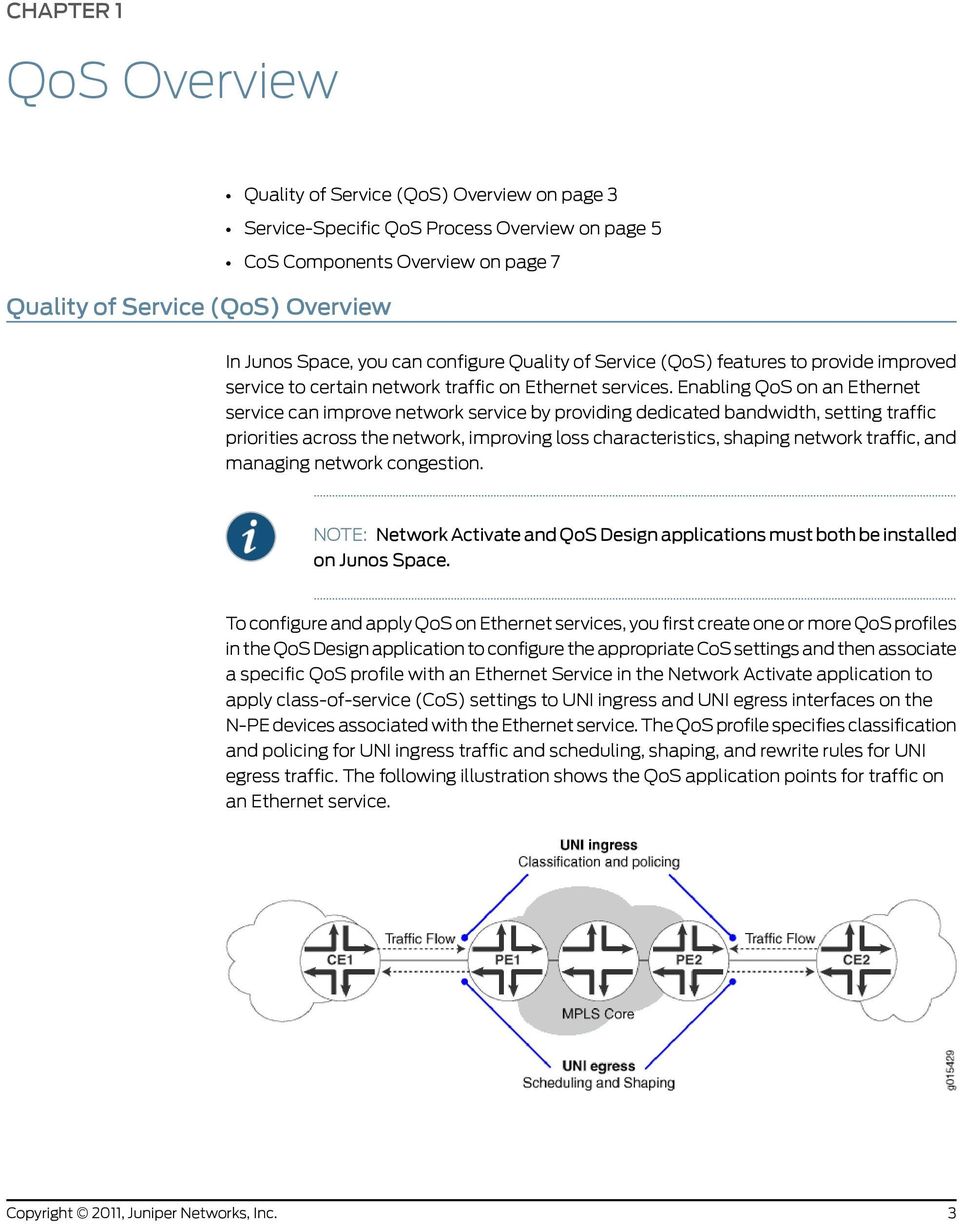
19 CHAPTER 1 QoS Overview Quality of Service (QoS) Overview Quality of Service (QoS) Overview on page 3 Service-Specific QoS Process Overview on page 5 CoS Components Overview on page 7 In Junos Space, you can configure Quality of Service (QoS) features to provide improved service to certain network traffic on Ethernet services. Enabling QoS on an Ethernet service can improve network service by providing dedicated bandwidth, setting traffic priorities across the network, improving loss characteristics, shaping network traffic, and managing network congestion. NOTE: Network Activate and QoS Design applications must both be installed on Junos Space. To configure and apply QoS on Ethernet services, you first create one or more QoS profiles in the QoS Design application to configure the appropriate CoS settings and then associate a specific QoS profile with an Ethernet Service in the Network Activate application to apply class-of-service (CoS) settings to UNI ingress and UNI egress interfaces on the N-PE devices associated with the Ethernet service. The QoS profile specifies classification and policing for UNI ingress traffic and scheduling, shaping, and rewrite rules for UNI egress traffic. The following illustration shows the QoS application points for traffic on an Ethernet service. 3
20 Junos Space QoS Design For information about the CoS components that provide the building blocks that you use to create QoS schedulers and QoS profiles in the QoS Design software, see CoS Components Overview on page 7. For complete information about Junos CoS configuration for Junos routers and switches, see the Class of Service Configuration Guide. Deployment of QoS on MPLS VPN Services You can deploy QoS on point-to-point and multipoint services that support the following interface types: port-to-port All traffic is transported across the network Q (dot1.q) Supports 802.1Q VLAN-tagged network traffic in a point-to-point or multipoint Ethernet service. Network traffic is constrained using VLAN IDs. Q-in-Q Supports double tagged traffic in a point-to-point or multipoint Ethernet service. NOTE: You cannot configure a QoS Profile that specifies a level three scheduler on port-to-port services. Related Documentation Domain Discovery Overview on page 10 QoS Scheduler Overview on page 18 QoS Profile Overview on page 15 Drop Profiles Overview on page 20 4

21 QoS Overview Service-Specific QoS Process Overview Configuring service-specific QoS is a multistep process in which you first discover a QoS domain and create a QoS scheduler and QoS profile in the QoS Design application to define a QoS configuration. You then use the Network Activate application to apply QoS to an Ethernet service to provide priority to certain traffic by managing network bandwidth, delay, jitter, and packet loss. Before you configure QoS, you must complete the following tasks in Junos Space: Discover devices in Junos Space You must discover devices in Junos Space to bring your network devices under Junos Space management. Network operators who are assigned the Device Manager role can perform this task. Prestage devices You can use Network Activate software to prestage devices and discover the network provider edge (N-PE) devices under Junos Space management and assign appropriate MPLS N-PE roles to these devices and assigns user-to-network interface (UNI) roles to the device interfaces. If devices are not prestaged in Network Activate software, QoS Design software automatically identifies the set of N-PE devices during domain discovery, based on rules that exist in the system. The Getting Started panel in the Junos Space user interface provides the steps involved in configuring QoS and applying a QoS profile to an Ethernet service. The following example shows the QoS Design assistant in the Getting Started panel: Steps in the sequence are often performed by users with different levels of privilege. The Junos Space software provides predefined administrator roles that provide the necessary privilege for each step in the sequence: The QoS Designer role allows an administrator to discover QoS domains, create drop 5
22 Junos Space QoS Design profiles, create QoS schedulers, and create QoS profiles. The Service Designer roles allows an administrator to create and publish a service definition. The Service Activator role allows an administrator to perform provisioning tasks including creating and managing service orders and services. For details about predefined administrator roles, see Predefined Administrator Roles in the Junos Space Network Application Platform User Guide. The following steps describe the process for configuring service-specific QoS: 1. Discover domains Discover QoS domains and partition the network. Each domain represents a group of N-PE devices that share the same CoS configuration with the same classes of service, policing, marking schemes, and queuing configurations. Each device added to the QoS domain during discovery has an N-PE role assignment. N-PE role assignments are either determined by Network Activate software during prestaging or are automatically identified by QoS Design software during QoS domain discovery. 2. Create Drop Profiles A drop profile is a mechanism of RED that defines parameters that allow packets to be dropped from the network. Drop profiles define the meanings of the loss priorities. You can create drop profiles and then include them in QoS schedulers. 3. Create a QoS scheduler You can create a two level or three level schedulers. After you create a scheduler you can associate it with a QoS profile. 4. Create a QoS profile A QoS profile defines the BA and MF classifiers, policers for ingress traffic, and rewrite rules for egress traffic on the N-PE devices in a domain. 5. Enable QoS in the service definition A Service Designer enables QoS in the service definition for a multipoint service. 6. Create a service order based on a service definition with QoS enabled A service provisioner applies a QoS profile to the service order. 7. Deploy the Service Order with QoS enabled A service provisioner deploys the service order to drive the provisioning of service specific QoS. Related Documentation Domain Discovery Overview on page 10 QoS Scheduler Overview on page 18 QoS Profile Overview on page 15 Drop Profiles Overview on page 20 Discovering QoS Domains on page 25 Creating a Drop Profile on page 29 Creating a Two-Level QoS Scheduler on page 31 Creating a Three-Level QoS Scheduler on page 35 Creating a QoS Profile on page 39 6
23 QoS Overview CoS Components Overview Junos Class of Service (CoS) provides the following components that represent the building blocks that you use to create QoS schedulers and QoS profiles in the QoS Design software. Each QoS profile that you create defines a service offering that you can apply to enable QoS on Ethernet services. Classifiers Packet classification refers to the examination of an incoming packet. This function associates the packet with a particular CoS servicing level. In the Junos OS, classifiers associate incoming packets with a forwarding class and loss priority and, based on the associated forwarding class, assign packets to output queues. Two general types of classifiers are supported: Behavior aggregate or CoS value traffic classifiers A behavior aggregate (BA) is a method of classification that operates on a packet as it enters the router. The CoS value in the packet header is examined, and this single field determines the CoS settings applied to the packet. BA classifiers allow you to set the forwarding class and loss priority of a packet based on the Differentiated Services code point (DSCP) value, DSCP IPv6 value, IP precedence value, MPLS EXP bits, and IEEE 802.1p value. The default classifier is based on the IP precedence value. Multifield traffic classifiers A multifield classifier is a second method for classifying traffic flows. Unlike a behavior aggregate, a multifield classifier can examine multiple fields in the packet. Examples of some fields that a multifield classifier can examine include the source and destination address of the packet as well as the source and destination port numbers of the packet. With multifield classifiers, you set the forwarding class and loss priority of a packet based on firewall filter rules. Forwarding classes The forwarding classes affect the forwarding, scheduling, and marking policies applied to packets as they transit a router. The forwarding class plus the loss priority define the per-hop behavior. Four categories of forwarding classes are supported: best effort, assured forwarding, expedited forwarding, and network control. For Juniper Networks M Series Multiservice Edge Routers, four forwarding classes are supported; you can configure up to one each of the four types of forwarding classes. For M120 and M320 Multiservice Edge Routers, MX Series Ethernet Services Routers, and T Series Core Routers, 16 forwarding classes are supported, so you can classify packets more granularly. For example, you can configure multiple classes of expedited forwarding (EF) traffic: EF, EF1, and EF2. Loss priorities Loss priorities allow you to set the priority of dropping a packet. Loss priority affects the scheduling of a packet without affecting the packet s relative ordering. You can use the packet loss priority (PLP) bit as part of a congestion control strategy. You can use the loss priority setting to identify packets that have experienced congestion. Typically you mark packets exceeding some service level with a high loss priority. You set loss priority by configuring a classifier or a policer. The loss priority is used later in the work flow to select one of the drop profiles used by RED. Transmission scheduling and rate control These parameters provide you with the following tools to manage traffic flows: 7
24 Junos Space QoS Design Queuing After a packet is sent to the outgoing interface on a router, it is queued for transmission on the physical media. The amount of time a packet is queued on the router is determined by the availability of the outgoing physical media as well as the amount of traffic using the interface. Schedulers An individual router interface has multiple queues assigned to store packets. The router determines which queue to service based on a particular method of scheduling. This process often involves a determination of which type of packet should be transmitted before another. Junos schedulers allow you to define the priority, bandwidth, delay buffer size, rate control status, and RED drop profiles to be applied to a particular queue for packet transmission. Policers for traffic classes Policers allow you to limit traffic of a certain class to a specified bandwidth and burst size. Packets exceeding the policer limits can be discarded, or can be assigned to a different forwarding class, a different loss priority, or both. You define policers with filters that can be associated with input or output interfaces. Rewrite Rules A rewrite rule sets the appropriate CoS bits in the outgoing packet, which allows the next downstream router to classify the packet into the appropriate service group. Rewriting, or marking, outbound packets is useful when the routing platform is at the border of a network and must alter the CoS values to meet the policies of the targeted peer. For more in-depth information about Junos CoS components, see the Class of Service Configuration Guide. Related Documentation Domain Discovery Overview on page 10 Discovering QoS Domains on page 25 Creating a Two-Level QoS Scheduler on page 31 Creating a Three-Level QoS Scheduler on page 35 Creating a QoS Profile on page 39 8
25 CHAPTER 2 Domain Discovery Domain Discovery Overview on page 10 9
26 Junos Space QoS Design Domain Discovery Overview Before you can create a QoS profile, you use the QoS Design application to discover QoS domains and partition the network. During the domain discovery process, the Qos Design software identifies the N-PE routers that share the same class-of-service (CoS) configurations on their uplink interfaces. Uplink interfaces are those interfaces used to transport traffic between the N-PE routers and the core network. The CoS configuration on the uplink interfaces includes the classifier, scheduler maps, and rewrite rules, which, in turn, provide the classes of service for the UNIs interfaces on which Ethernet services are delivered. NOTE: Network Activate and QoS Design applications must both be installed on Junos Space. For each group of N-PE routers for which the QoS treatment on the uplink interfaces is the same or similar, the QoS Design software creates a QoS domain that captures the common CoS configuration found on their uplink interfaces. Each QoS domain includes only those N-PE routers that share the exact rewrite rules and classifiers. If the scheduler maps are different, they are grouped in the domain as separate scheduler maps. Thus, a domain might contain a single rewrite rule and classifier but a group of distinct scheduler maps. However, if several interfaces share the same scheduler map, then only a single scheduler map is saved in the domain. Each QoS domain provides a base CoS configuration that you can use as a template for configuring a QoS profile. You can perform a single domain discovery operation to discover all the QoS domains on your network. NOTE: After you prestage QoS, you can select a QoS domain in the Junos Space user interface to view details about the associated N-PE routers and their shared CoS configurations. This topic includes the following sections: Prerequisites for Domain Discovery on page 11 QoS Domain Discovery Process on page 11 Domain Discovery Prestaging Rules on page 12 CoS Configuration Data Imported into a QoS Domain on page 13 10
27 Domain Discovery Prerequisites for Domain Discovery The following requirements must be met before you can prestage QoS: CoS is configured on the NNIs (uplink interfaces) for each N-PE router. Devices (including the N-PE routers) have already been discovered and imported into the Junos Space database. To discover the N-PE routers that you want to include in the QoS domain, in the Network Application Platform, select Devices > Discover Devices. For details about bringing devices under Junos Space management, see Discovering Devices in the Junos Space Network Application Platform User Guide. You can use Network Activate to assign the N-PE routers using the prestaging operations in the Network Activate application. In this case, QoS domain discovery uses only the set of devices identified as N-PE routers by the user during prestaging in Network Activate to discover any common CoS configuration. You can also perform domain discovery directly without needing to run any prestaging in Network Activate. QoS domain discovery uses rules to automatically identify the set of N-PE routers and the set of NNIs (uplink interfaces) when no user-assigned set of N-PEs can be obtained from Network Activate. QoS Domain Discovery Process QoS Design performs the following actions during the QoS prestaging process: 1. Discover N-PE routers In this stage, the QoS Design software searches the database for user-assigned N-PE routers, if Network Activate software has already performed prestaging to assign N-PE roles for routers. NOTE: When discovering routers for a domain, Qos Design software only evaluates routers that are not already assigned to a QoS domain. 2. Evaluate CoS Configuration The QoS Design software examines the classifier, scheduler map, and rewrite rule from the uplink interfaces of each N-PE router (or P router) facing towards the core to identify edge routers that share the same CoS configuration. 3. Group uplink interfaces into domains Each set of uplink (NNI) interfaces that share identical rewrite rules and classifiers are grouped into a domain. The classes-of-service for a QoS domain are either symmetric or asymmetric: Symmetric For each entry in the classifier, there is a matching value in the rewrite rule. The code points and loss priority for the ingress classifier exactly match the code points and loss priority values for the egress rewrite rule. 11
28 Junos Space QoS Design Asymmetric For each entry in the classifier, there is a mismatch value in the rewrite rule. For example, the rewrite rule might include a different number of code points or different loss priority values than are included in the classifier. 4. Create the QoS domain The QoS Design software generates a domain with a unique domain name for each set of N-PE routers that share the CoS configuration. NOTE: When you add devices to your network, you will need to discover those devices, run the role discovery operation in Network Activate (if it is installed), and then prestage QoS again. If a device has the same CoS configuration as an existing QoS domain, the router is added to the existing domain the QoS Design software does not create a new domain. NOTE: If an N-PE device has multiple uplink interfaces, each with a different CoS configuration, the device can appear in multiple QoS domains with each uplink interface in a separate domain. Domain Discovery Prestaging Rules Prestaging rules for domain discovery are predefined. These rules contain criteria for classifying the N-PE devices and NNI interfaces prior to domain discovery prestaging. If the Network Activate application is installed and devices have been prestaged, domain discovery queries Network Activate for the N-PE devices. If Network Activate is not installed or devices are not prestaged, QoS Design software determines the set of N-PE devices. The rules used by QoS Design software to determine the role assignment for devices and NNIs are described in the following sections: N-PE Device Classification Rules on page 12 NNI Classification Rules on page 13 N-PE Device Classification Rules The system recommends the N-PE role for devices that satisfy the following criteria: The comment field in the device configuration identifies the device as an N-PE device. The device role is set to N-PE unless EBGP is enabled for the device. Specifically, the device role is set to N-PE unless the device configuration has configuration/protocols/bgp/group/type set to external. IF EBGP is enabled, the device role is set to P. The device is assigned a loopback address. A device that has no loopback address cannot function as an N-PE device. 12
29 Domain Discovery Checks whether LDP is enabled on the loopback interface for the device. LDP must be enabled on the loopback interface if the device is to be a assigned the PE MPLS role. Checks whether L2 VPN signaling for BGP is enabled. Specifically, the rule checks whether the device configuration has configuration/protocols/bgp/family/l2vpn/signaling or configuration/protocols/bgp/group/l2vpn/signaling set. NNI Classification Rules To classify an interface as an NNI, it must satisfy the following criteria: The interface must have an IP address set. MPLS is running on the interface. The interface must be Gigabit Ethernet (ge), 10 Gigabit Ethernet (xe), Aggregated Ethernet (ae), ATM (at), or SONET (so) type. gigether-options/ieee-802.3ad is not set on the interface. CoS Configuration Data Imported into a QoS Domain To discover a domain, the Qos Design software evaluates the CoS configuration data that is imported from the XML configuration file for the N-PE routers during domain discovery. The following example, for illustrative purposes only, shows the equivalent show class-of-service commands that you would use to capture the CoS configuration data that QoS Design software evaluates in the XML configuration file to identify the N-PE routers that share the same CoS configuration: show class-of-service interfaces ge-1/0/0 scheduler-map show class-of-service interfaces ge-1/0/0 unit 0 rewrite-rule show class-of-service drop-profiles Aggressive-Drop show class-of-service forwarding-classes show class-of-service classifiers dscp Gold_BMW_USA_NORCAL_PA show class-of-service classifiers exp CORE_EXP_CLASSIFER_IN NOTE: The object names for the interfaces, drop-profiles, and classifiers shown in the above show class-of-service commands are only examples. QoS Design software imports the following MPLS classifier information: CoS provides a logical representation to differentiate the traffic for a particular service. Forwarding class specifies the forwarding class name. Loss Priority specifies the packet loss priority. EXP Marking controls congestion at the output stage. The delay-buffer bandwidth provides packet buffer space to absorb burst traffic up to the specified duration of delay. Once the specified delay buffer becomes full, packets with 100 percent drop probability are dropped from the head of the buffer. 13
30 Junos Space QoS Design NOTE: The MPLS classifier maps the EXP bit to forwarding classes and loss priorities. QoS Design software imports the following scheduler information: CoS provides a logical representation of the class of service to differentiate the traffic for a particular service. Transmit rate determines the actual traffic bandwidth from each forwarding class. The rate is specified in bits per second. each queue is allocated some portion of the bandwidth of the outgoing interface. The bandwidth can be a fixed value, such as 200 megabits per second (Mbps), a percentage of the total available bandwidth, or the rest of the available bandwidth. This property allows you to ensure that each queue receives the amount of bandwidth that is appropriate to its level of service. Q priority determines level of transmission priority, allowing the software to service higher-priority queues before lower priority queues. The priority can be low, medium-low, medium-high, high, and strict-high. Buffer Size controls congestion at the output stage. The delay-buffer bandwidth provides packet buffer space to absorb burst traffic up to the specified duration of delay. Once the specified delay buffer becomes full, packets with 100 percent drop probability are dropped from the head of the buffer. Excess Rate determines the percentage of excess bandwidth traffic to share. For complete information about Junos classifiers, schedulers, and rewrite rules see the Junos Software Class of Service Configuration Guide. Related Documentation Discovering QoS Domains on page 25 Creating a Two-Level QoS Scheduler on page 31 Creating a Three-Level QoS Scheduler on page 35 Creating a QoS Profile on page 39 14
31 CHAPTER 3 Overview of QoS Profiles, Schedulers, and Drop Profiles QoS Profile Overview QoS Profile Overview on page 15 QoS Scheduler Overview on page 18 Support for TCM Policers and Hierarchical Queuing on EQ, IQ2E, and IQ2 PICs on page 19 Drop Profiles Overview on page 20 A QoS profile is a configuration template that allows you to create service offerings that provide priority to certain traffic when you provision Layer 2 Ethernet Services. A QoS profile references a QoS domain to import classifiers, scheduler maps, and rewrite rules from the uplink interfaces. For UNI ingress, a QoS profile specifies the following building blocks: Classification classifies traffic for UNI ingress Select the classifier type (BA or MF) to determine which part of the incoming packet the classifier examines (DSCP bits, Dot1p bits, or IP-precedence bits). Select the classes of service. Each classifier assigns a packet to a forwarding class and loss priority. The QoS domain that you attach to QoS profile imports all classifiers from the uplink interface. Select the CoS bits (code points) and loss priority for each class of service Each classifier assigns a packet to a forwarding class and loss priority. The code points and loss priorities that you can select for each classifier reflect Junos supported values. The CoS bits and loss priorities for ingress classification are not imported from the QoS domain. Select the CoS bits (code points) and loss priority for each class of service 15
32 Junos Space QoS Design Each classifier assigns a packet to a forwarding class and loss priority. The code points and loss priorities that are available for each classifier reflect Junos supported values, these values are not imported from the QoS domain. Ingress Policing meters and remarks inbound traffic if traffic flow exceeds its service levels. Configure an ingress policer for each class of service. A policer type is only available if prerequisite loss priorities for that policer type are available from the rewrite rules imported by the QoS domain. For UNI egress, a QoS profile specifies the following building blocks: Egress Policing meters and remarks outbound traffic if traffic flow exceeds its service levels. Configure an egress policer for each class of service. A policer type is only available if prerequisite loss priorities for that policer type are available from the classifier imported by the QoS domain. Rewrite rules- assigns DSCP bits, Dot1p bits, or IP Precedence bits based on the packet s class of service and loss priority Rewrite rules are controlled by the EXP bits that are imported during QoS domain discovery. Scheduling defines how traffic is handled in the output queue. A two-level scheduler specifies queue properties for each class of service in the selected domain. A three-level scheduler defines port shaping and/or interface shaping only. QoS Scheduler Types A QoS profile specifies a two-level scheduler or a three-level scheduler. A two-level scheduler is a shared scheduler (or scheduler profile) that allows logical interfaces belonging to the same physical port to share one set of scheduling properties, which include the transmit rate, scheduler priority, buffer size. A two-level scheduler can also include a drop profile to reference WRED congestion control of the queue. With a three-level scheduler, scheduling is performed at the interface level and the scheduler defines two parameters the port oversubscription ratio and the interface oversubscription ratio. Because a three-level scheduler defines only port shaping and interface shaping, you must configure the scheduling and queuing properties in the Qos profile. When you configure a three-level scheduler, port shaping is calculated based on the value specified in the oversubscription field. The port shaping rate is the sum of the committed information rate (CIR) for each logical interface on the physical port, divided by the oversubscription ratio (R1),and multiplied by 100. R1 is a number between 1 and 100. port shaping rate = (CIR_out_1 + CIR_out_2...+ CIR_out_n) / R1 * 100 The interface shaping rate is calculated based on the value you specify in the oversubscription field. The interface shaping rate is the committed information rate for 16
33 Overview of QoS Profiles, Schedulers, and Drop Profiles the logical interface divided by the interface oversubscription ratio (R2), multiplied by 100. R2 is a number between 1 and 100. interface shaping rate = CIR_out_I / R2 * 100 Availability of Policer Types in QoS Profiles The loss priorities that are displayed in the Ingress Policing and Egress Policing screens are derived from the rewrite rules imported into the QoS Domain during QoS domain discovery. Because each policer type is associated with a specific set of loss priorities, a policer type is only available in a QoS profile if the prerequisite loss priorities for that policer type are available from the rewrite rules imported by the QoS domain. When you create a QoS profile, you must choose the ingress policer for each class of service.table 2 on page 17 shows the loss priorities associated with each policer type. Table 2: Policer Types Determined by Loss Priorities in Rewrite Rules Policer Rate limiting Marking Green (conforming) Loss Priorities low, medium-low, medium-high, high Yellow None Red low, medium-low, medium-high, high, discard Single-rate three-color blind Green (conforming) Yellow low medium-high, Red high, discard Two-rate three-color blind Green (conforming) Yellow low medium-high, Red high, discard Single-rate three-color aware low medium-low low, medium-high, high medium-low (packet < CIR), medium-low (packet < PIR), high ( discard) medium-high medium-high (packet < CIR), medium-high (packet < PIR, high (discard) high high 17
34 Junos Space QoS Design Table 2: Policer Types Determined by Loss Priorities in Rewrite Rules (continued) Two-rate three-color aware low medium-low low, medium-high, high medium-low (packet <CBS), medium-low (packet < EBS), high ( discard) medium-high medium-high (packet <CBS), medium-high (packet < EBS), high (discard) high high Related Documentation Domain Discovery Overview on page 10 QoS Scheduler Overview on page 18 Discovering QoS Domains on page 25 Creating a Two-Level QoS Scheduler on page 31 Creating a Three-Level QoS Scheduler on page 35 Creating a QoS Profile on page 39 QoS Scheduler Overview After you discover QoS domains, you can create QoS schedulers. A scheduler defines the output queue properties for each class of service in the domain that is associated with the scheduler. To create a scheduler, you specify a domain to import the base configurations for the classes of service. After you create a scheduler, you associate it with QoS profile. The scheduler also defines the level of hierarchical queuing for QoS profile.the QoS Design software supports two-level schedulers (with the scheduler map attached to the port and a policer applied on the logical interface) and three-level schedulers which support hierarchical port and logical interface queuing. A two level scheduler is a shared scheduler (or scheduler profile) that allows logical interfaces belonging to the same physical port to share one set of scheduling properties. A two-level scheduler defines all properties of the output queues, including queue priority, packet transmission rate, priority of excess bandwidth traffic, size of the memory buffer for storing packets, and the random early detection (RED) drop profiles. A three level scheduler allows shaping at the port level and interface level. When you configure a three-level scheduler, the scheduling properties are configured when you associate the scheduler with a QoS profile. The scheduling properties you define in the Qos profile for a three level scheduler include queue priority, packet transmission rate, priority of excess bandwidth traffic, the size of the memory buffer for storing packets, and random early detection (RED) drop profiles. Related Documentation Creating a Two-Level QoS Scheduler on page 31 Creating a Three-Level QoS Scheduler on page 35 18
35 Overview of QoS Profiles, Schedulers, and Drop Profiles Drop Profiles Overview on page 20 Support for TCM Policers and Hierarchical Queuing on EQ, IQ2E, and IQ2 PICs on page 19 Domain Discovery Overview on page 10 QoS Profile Overview on page 15 Support for TCM Policers and Hierarchical Queuing on EQ, IQ2E, and IQ2 PICs The PIC family of the UNI interface determines which TCM policers and the level of hierarchical queuing that the UNI interface supports. Table 3 on page 19 shows the PIC families that support tricolor marking (TCM) and hierachical queuing. NOTE: The following table reflects the ability to support policers and hierarchical at the PIC level but not on the system as a whole. Table 3: TCM Policers and Hierarchical Queuing Support by PIC Family Feature: IQ2 PICs (M Series devices) IQ2E PICs (M Series devices) EQ DPC (MX Series devices) Single-Rate TCM Yes (but not by default) Two-Rate TCM Yes (default) Hierarchical Port-level Queuing (Level 2) Yes Yes Yes Hierarchical Port/Logical Interface Queuing (Level 3) Yes Yes Yes NOTE: The QoS Design application does not support domain discovery for MX Series devices with DPCE-R-40GE PICs. The Single-Rate and Two-Rate TCM policers function as follows: Single-rate tricolor marking (TCM) This type of policer is defined in RFC 2697, A Single Rate Three Color Marker, as part of an assured forwarding (AF) per-hop-behavior (PHB) classification system for a Differentiated Services (DiffServ) environment. This type of policer meters traffic based on the configured committed information rate (CIR), committed burst size (CBS), and the excess burst size (EBS). Traffic is marked as belonging to one of three categories (green, yellow, or red) based on whether the packets arriving are below the CBS (green), exceed the CBS (yellow) but not the EBS, or exceed the EBS (red). Single-rate TCM is most useful when a service is structured according to packet length and not peak arrival rate. Two-rate TCM This type of policer is defined in RFC 2698, A Two Rate Three Color Marker, as part of an assured forwarding (AF) per-hop-behavior (PHB) classification 19
36 Junos Space QoS Design system for a Differentiated Services (DiffServ) environment. This type of policer meters traffic based on the configured CIR and peak information rate (PIR), along with their associated burst sizes, the CBS and peak burst size (PBS). Traffic is marked as belonging to one of three categories (green, yellow, or red) based on whether the packets arriving are below the CIR (green), exceed the CIR (yellow) but not the PIR, or exceed the PIR (red). Two-rate TCM is most useful when a service is structured according to arrival rates and not necessarily packet length. Related Documentation Domain Discovery Overview on page 10 Discovering QoS Domains on page 25 Creating a Two-Level QoS Scheduler on page 31 Creating a Three-Level QoS Scheduler on page 35 Creating a QoS Profile on page 39 Drop Profiles Overview A drop profile is a mechanism of RED that defines parameters that allow packets to be dropped from the network. Drop profiles define the meanings of the loss priorities. Two parameters control congestion at the output stage. The first parameter defines the delay-buffer bandwidth, which provides packet buffer space to absorb burst traffic up to the specified duration of delay. Once the specified delay buffer becomes full, packets with 100 percent drop probability are dropped from the head of the buffer. The second parameter defines the drop probabilities across the range of delay-buffer occupancy, supporting the random early detection (RED) process. When the number of packets queued is greater than the ability of the router to empty a queue, the queue requires a method for determining which packets to drop from the network. To address this condition, you can enable RED on individual queues by creating drop profiles and then including them in QoS schedulers. Depending on the drop probabilities, RED might drop many packets long before the buffer becomes full, or it might drop only a few packets even if the buffer is almost full. A drop profile provides two important values: the fill level (queue fullness) and the drop probability. The fill level represents a percentage of the memory used to store packets in relation to the total amount that has been allocated for that specific queue. Similarly, the drop probability is a percentage value that correlates to the likelihood that an individual packet is dropped from the network. A drop-profile map examines the loss priority setting of an outgoing packet: high, medium-high, medium-low, or low. Of course, low, medium-low, medium-high, and high are relative terms, which by themselves have no meaning. However, consider a low-drop drop profile which specifies the fill level/drop probability pairings 75/10 and 95/40 for the low loss priority. This defines the meaning of low PLP as a 10 percent drop probability when the fill level is 75 percent and a 40 percent drop probability when the fill level is 95 percent. 20
37 Overview of QoS Profiles, Schedulers, and Drop Profiles For more information about RED drop profiles, see the Class of Service Configuration Guide. Related Documentation Creating a Drop Profile on page 29 Viewing Drop Profiles on page 59 Creating a Two-Level QoS Scheduler on page 31 Creating a Three-Level QoS Scheduler on page 35 21
38 Junos Space QoS Design 22
39 PART 2 Configuration Managing Domains on page 25 Managing Drop Profiles on page 29 Managing Schedulers on page 31 Managing Profiles on page 39 23
40 Junos Space QoS Design 24
41 CHAPTER 4 Managing Domains Discovering QoS Domains Discovering QoS Domains on page 25 Deleting a QoS Domain on page 27 Before creating a QoS profile, you use the QoS Design application to discover domains to partition the network. Each domain is a group of N-PE devices with the same classes of service, policing, and queuing configurations. The CoS attributes on the uplink interfaces are identical for the N-PE devices in a QoS domain. NOTE: Network Activate and QoS Design applications must both be installed on Junos Space. NOTE: When discovering a domain, Qos Design software only evaluates N-PE devices that are not currently assigned to a QoS domain. When you add devices to your network, you will need to discover those devices in Junos Space. Then you can run the role discovery operation in the Network Activate application and then discover domains again in QOS Design, or you can perform domain discovery directly without needing to run any prestaging in Network Activate. QoS domain discovery uses rules to automatically identify the set of N-PE routers and the set of NNIs (uplink interfaces) when no user-assigned set of N-PEs can be obtained from Network Activate. When a device has the same CoS configuration as an existing domain, the QoS Design software adds the device to the existing domain but does not create a new domain. The domain discovery process requires the following QoS configuration conventions on the N-PE devices to perform domain discovery: The classification uses BA classifier and the rewrite rules rewrite EXP bits. For each forwarding class and loss priority pair in schedulers, rewrite rules and classification are defined. 25
42 Junos Space QoS Design NOTE: If the uplink interface does not follow the above conventions, the N_PE device is not included in the domain. To discover a domain, follow these steps: 1. In the QoS Design task ribbon, select Manage QoS Domains > Discover Domains. The Domain Discovery Status progress bar displays the progress of domain discovery in real-time, as shown in the following example: 2. Click on any bar in the domain chart to view information about the N-PE devices discovered for the domain. 3. For additional information about domain discovery results, you can view job status for domain discovery from the Jobs workspace. Job details are useful for troubleshooting a domain discovery operation. Each job details entry lists the device by IP address and hostname. The Status and Description fields in the job entry provide important information about the results of each discovery operation. 26
43 Managing Domains For each device processed during a domain discovery operation, the Status field displays one of the following results: ADDED_IN_DOMAIN The CoS configuration on the device matches the CoS configuration in the domain. FIRST_IN_DOMAIN The CoS configuration on the device is used to create the domain. NOT_IN_DOMAIN The CoS configuration on the device does not match the CoS configuration in the domain. PROCESSING The CoS configuration on the device is being processed. Related Documentation Domain Discovery Overview on page 10 Creating a Two-Level QoS Scheduler on page 31 Creating a Three-Level QoS Scheduler on page 35 Creating a QoS Profile on page 39 Deleting a QoS Domain on page 27 Deleting a QoS Domain You can delete a QoS domain so long as it is not in use by an existing QoS scheduler or have any QoS profiles definitions attached to it. 1. Navigate to QoS Design > Manage QoS Domains. 2. Select the domain you want to delete. 3. Open the Action Drawer. If the domain is not free and has any profiles defined or is being used by a scheduler, the Delete Domain action will not be an available choice. You must remove any dependent components before you can make the delete request. If the domain is eligible for deletion, Delete Domain will appear the list of available actions. 4. In the Action drawer, click Delete. Junos Space displays a confirmation window where you will be prompted to confirm the delete request. 27
44 Junos Space QoS Design 5. In the Delete Domain confirmation window, click Delete. Related Documentation Discovering QoS Domains on page 25 Deleting a QoS Scheduler on page 38 Deleting a QoS Profile on page 49 28
45 CHAPTER 5 Managing Drop Profiles Creating a Drop Profile Creating a Drop Profile on page 29 Deleting a Drop Profile on page 30 A QoS drop profile defines the fill level and drop probability for the loss priorities. For each QoS scheduler, you can configure multiple drop profiles, one for each loss priority (low, medium-low, medium-high, or high). To create a drop profile, follow these steps: 1. In the QoS Design task ribbon, select Manage Drop Profiles > Create Drop Profile. The Create Drop Profile screen appears. 2. In the Name field, enter a name for the drop profile. 3. In the Drop Profile Type enter a drop profile type (either segmented or interpolated) from the drop-down menu. For information about segmented and interpolated drop profiles, see the Class of Service Configuration Guide. 4. Click the Add icon. The Add Drop Profile dialog box appears. 5. In the Fill Level field specify a fill level value (0-100) for the drop profile. The fill level (queue fullness) represents a percentage of the memory used to store packets in relation to the total amount that has been allocated for that specific queue. 6. In the Drop Probability field specify a drop probability value (0-100) for the drop profile. The drop probability is a percentage value that correlates to the likelihood that an individual packet is dropped from the network. 7. Click the Add icon to add the fill level/drop probability pairing to the drop profile or click Add More to create another fill level/drop probability pairing for the drop profile. 29
46 Junos Space QoS Design 8. Optional: Click the Delete or Modify icon to delete or modify any fill level/drop probability pairing in the drop profile. 9. When you have finished adding fill level/drop probability pairings for the drop profile, click OK in the Create Drop Profile screen. The Drop Profile is complete. Related Documentation Viewing Drop Profiles on page 59 Creating a Two-Level QoS Scheduler on page 31 Creating a Three-Level QoS Scheduler on page 35 Drop Profiles Overview on page 20 Deleting a Drop Profile You can delete a drop profile so long as it is not currently being used by an active QoS scheduler. To delete a QoS drop profile: 1. In the QoS Design task ribbon, select Manage Drop Profile. 2. Select the drop profile that you want to delete. If the drop profile is in use by a scheduler, you must first remove any dependencies before you can delete the drop profile. 3. In the Action drawer, select Delete Drop Profile. Junos Space displays a confirmation window where you must confirm the delete request. 4. In the Delete Drop Profile confirmation window, click Delete. Related Documentation Viewing Drop Profiles on page 59 Creating a Drop Profile on page 29 Drop Profiles Overview on page 20 30
47 CHAPTER 6 Managing Schedulers Creating a Two-Level QoS Scheduler Creating a Two-Level QoS Scheduler on page 31 Creating a Three-Level QoS Scheduler on page 35 Support for TCM Policers and Hierarchical Queuing on EQ, IQ2E, and IQ2 PICs on page 36 Deleting a QoS Scheduler on page 38 A two-level scheduler allows logical interfaces that belong to the same physical port to share one set of scheduling resources. Before you can create a QoS profile, you create a two-level scheduler to define the properties of output queues, including loss priorities, and drop profiles. Before you can create a scheduler, you must discover QoS domains. To create a two-level scheduler, follow these steps: 1. In the QoS Design task ribbon, select Manage QoS Schedulers > Create QoS Scheduler. The Create QoS Scheduler screen appears, as shown in the following example. 2. In the Name field, enter a name for the scheduler. 3. In the Domain field, select a domain from which to import scheduler map configuration data. 31
48 Junos Space QoS Design The domain that you select provides the base CoS configurations for the classes of service. When you select a domain, the CoS table displays all the classes of service that are configured for the domain. 4. In the Scheduler Type box, select the scheduler type: To specify a shared scheduler, select the Two Level Scheduler radio button. 5. In the Enable column, select the checkbox for each class of service that you want to configure in the scheduler. 6. To specify scheduler settings and drop profiles, for each class of service in the scheduler, select the Edit icon or double click the row for the class of service that you want to configure. The following illustration shows the scheduler settings that you can configure. 7. Specify the queue priority, which in order of increasing priority are low, medium-low, medium-high, high, and strict-high. Priority scheduling determines the order in which an output interface transmits traffic from the queues, thus ensuring that queues containing the highest priority traffic have better access to the outgoing interface. 8. To configure transmission scheduling, specify the transmission rate type: rate Transmission rate in bits per second. percent Transmission rate as a percentage of transmission capacity. rate exact Enforce the exact transmission rate that you configure in the transmit-rate field. NOTE: Under sustained congestion, a rate-controlled queue that goes into negative credit fills up and eventually drops packets. percent exact Enforce the exact transmission percentage that you configure in the transmit-rate percent field. 32
49 Managing Schedulers remainder Use the remaining rate that is available. rate rate-limit Limit the transmission rate to the specified amount. If you configure a zero rate-limited transmit rate, all packets belonging to that queue are dropped. You can configure this option for all 8 queues of a logical interface (unit) and apply it to shaped or unshaped logical interfaces. percent rate-limit Limit the transmission rate to the specified amount. If you configure a zero rate-limited transmit rate, all packets belonging to that queue are dropped. You can configure this option for all 8 queues of a logical interface (unit) and apply it to shaped or unshaped logical interfaces. 9. Specify the transmission rate in mega bits per second (mbps) or as a percentage. NOTE: The maximum transmission rate is 160,000 mbps. 10. Specify the Excess priority to determine the priority of excess bandwidth traffic on a scheduler: low Excess traffic for this scheduler has low priority. medium-low Excess traffic for this scheduler has medium-low priority. medium -Excess traffic for this scheduler has medium-high priority. high Excess traffic for this scheduler has high priority. 11. Specify the Excess rate (0-100) as a percentage of the excess bandwidth to share. 12. Specify a Buffer type: percent exact To specify buffer size as an exact percentage of total buffer. percent To specify buffer size as a percentage of total buffer.the total buffer per queue is based on microseconds and differs by router type, as shown in Table remainder To specify the remaining buffer available. For example, if you assign 40 percent of the delay buffer to queue 0, allow queue 3 to keep the default allotment of 5 percent, and assign the remainder to queue 7, then queue 7 uses approximately 55 percent of the delay buffer. temporal To specify the buffer size (in microseconds ) as a temporal value. The queuing algorithm starts dropping packets when it queues more than a computed number of bytes. This maximum is computed by multiplying the logical interface speed by the configured temporal value. The queuing algorithm starts dropping packets when it queues more than a computed number of bytes. This maximum is computed by multiplying the logical interface speed by the configured temporal value. 33
50 Junos Space QoS Design Table 4: Buffer Size by Router Type 13. Specify a Buffer size in microseconds. Refer to the following table to determine appropriate buffer sizes by router type. Routers M320 and T Series router FPCs, Type 1 and Type 2 Temporal Value Ranges 1 through 80,000 microseconds M320 and T Series router FPCs, Type 3 1 through 50,000 microseconds M120 router FEBs, M320 router E3-FPCs, and MX Series router nonenhanced Queuing DPCs 1 through 100,000 microseconds M5, M7i, M10, and M10i router FPCs 1 through 100,000 microseconds Other M Series router FPCs 1 through 200,000 microseconds IQ PICs on all routers 1 through 100,000 microseconds With Large Buffer Sizes Enabled: IQ PICs on all routers 1 through 500,000 microseconds Gigabit Ethernet IQ VLANs: With shaping rate up to 10 Mbps 1 through 400,000 microseconds With shaping rate up to 20 Mbps 1 through 300,000 microseconds With shaping rate up to 30 Mbps 1 through 200,000 microseconds With shaping rate up to 40 Mbps 1 through 150,000 microseconds With shaping rate above 40 Mbps 1 through 100,000 microseconds 14. In the Drop Profiles box, select the check box for each loss priority that you wish to configure in the class of service. 15. Select the Drop Profile column, select drop profiles to associate with each loss priority. 16. Click OK to save the scheduler settings and drop profiles for the class of service. 17. Repeat steps 6 through 16 to specify scheduler settings and drop profiles for each class of service in the scheduler. 18. Click Create to create the scheduler. The scheduler is saved. You can now use the scheduler to configure a QoS profile that is based on the same QoS domain. Related Documentation Creating a Three-Level QoS Scheduler on page 35 Creating a QoS Profile on page 39 34
51 Managing Schedulers QoS Scheduler Overview on page 18 Support for TCM Policers and Hierarchical Queuing on EQ, IQ2E, and IQ2 PICs on page 19 Deleting a QoS Scheduler on page 38 Creating a Three-Level QoS Scheduler A three level scheduler allows shaping at the port level and interface level. When you configure a three-level scheduler, the scheduling properties are configured when you associate the scheduler with a QoS profile. You create the scheduler before you create the QoS profile. Before you can create a scheduler, you must discover QoS domains. To create a three-level scheduler, follow these steps: 1. In the QoS Design task ribbon, select Manage QoS Schedulers > Create QoS Scheduler. The Create QoS Scheduler screen appears. 2. In the Name field, enter a name for the scheduler. 3. In the Domain field, select a domain from which to import scheduler map configuration data. The domain that you select provides the base CoS configurations for the classes of service. When you select a domain, the CoS table displays all the classes of service that are configured for the domain. 4. In the Scheduler Type box, select the Three level scheduler radio button to specify scheduler in which the scheduler map is attached to the service VLAN. 5. Optional: Select the check box Port Shaping and specify an oversubscription ratio to configure shaping. Qos Design software calculates port shaping based on the value you specify in the over-subscription field. The port shaping rate is the sum of the committed information rate (CIR) for each logical interface on the physical port, divided by the port oversubscription ratio (R1),and multiplied by 100. R1 is a number between 1 and 100. port shaping rate = (CIR_out_1 + CIR_out_2...+ CIR_out_n) / R1 * 100 NOTE: The total bandwidth of the CIR for all logical interfaces on the physical port cannot exceed the bandwidth configured for the physical port. 6. Optional: Select the check box Interface Shaping and specify an oversubscription ratio to configure the shaping rate. 35
52 Junos Space QoS Design Qos Design software calculates the interface shaping rate based on the value you specify in the over-subscription field. The interface shaping rate is the committed information rate for the logical interface divided by the interface oversubscription ratio (R2), multiplied by 100. R2 is a number between 1 and 100. interface shaping rate = CIR_out_I / R2 * 100 NOTE: The total bandwidth of the CIR for all logical interfaces on the physical port cannot exceed the bandwidth configured for the physical port. The following example shows the configuration for a three-level scheduler with port shaping and interface shaping enabled. 7. Click Create to create the scheduler. You can now use the scheduler to configure a QoS profile. Related Documentation Creating a QoS Profile on page 39 Creating a Two-Level QoS Scheduler on page 31 QoS Scheduler Overview on page 18 Support for TCM Policers and Hierarchical Queuing on EQ, IQ2E, and IQ2 PICs on page 19 Deleting a QoS Scheduler on page 38 Support for TCM Policers and Hierarchical Queuing on EQ, IQ2E, and IQ2 PICs The PIC family of the UNI interface determines which TCM policers and the level of hierarchical queuing that the UNI interface supports. Table 3 on page 19 shows the PIC families that support tricolor marking (TCM) and hierachical queuing. NOTE: The following table reflects the ability to support policers and hierarchical at the PIC level but not on the system as a whole. 36
53 Managing Schedulers Table 5: TCM Policers and Hierarchical Queuing Support by PIC Family Feature: IQ2 PICs (M Series devices) IQ2E PICs (M Series devices) EQ DPC (MX Series devices) Single-Rate TCM Yes (but not by default) Two-Rate TCM Yes (default) Hierarchical Port-level Queuing (Level 2) Yes Yes Yes Hierarchical Port/Logical Interface Queuing (Level 3) Yes Yes Yes NOTE: The QoS Design application does not support domain discovery for MX Series devices with DPCE-R-40GE PICs. The Single-Rate and Two-Rate TCM policers function as follows: Single-rate tricolor marking (TCM) This type of policer is defined in RFC 2697, A Single Rate Three Color Marker, as part of an assured forwarding (AF) per-hop-behavior (PHB) classification system for a Differentiated Services (DiffServ) environment. This type of policer meters traffic based on the configured committed information rate (CIR), committed burst size (CBS), and the excess burst size (EBS). Traffic is marked as belonging to one of three categories (green, yellow, or red) based on whether the packets arriving are below the CBS (green), exceed the CBS (yellow) but not the EBS, or exceed the EBS (red). Single-rate TCM is most useful when a service is structured according to packet length and not peak arrival rate. Two-rate TCM This type of policer is defined in RFC 2698, A Two Rate Three Color Marker, as part of an assured forwarding (AF) per-hop-behavior (PHB) classification system for a Differentiated Services (DiffServ) environment. This type of policer meters traffic based on the configured CIR and peak information rate (PIR), along with their associated burst sizes, the CBS and peak burst size (PBS). Traffic is marked as belonging to one of three categories (green, yellow, or red) based on whether the packets arriving are below the CIR (green), exceed the CIR (yellow) but not the PIR, or exceed the PIR (red). Two-rate TCM is most useful when a service is structured according to arrival rates and not necessarily packet length. Related Documentation Domain Discovery Overview on page 10 Discovering QoS Domains on page 25 Creating a Two-Level QoS Scheduler on page 31 Creating a Three-Level QoS Scheduler on page 35 Creating a QoS Profile on page 39 37
54 Junos Space QoS Design Deleting a QoS Scheduler You can delete any QoS scheduler provided that the QoS scheduler is not currently configured in a QoS profile. To delete a QoS scheduler: 1. Navigate to QoS Design > Manage QoS Schedulers. 2. Select the scheduler that you want to delete. If the scheduler is configured in one or more QoS profiles, you must first remove those dependencies before you can delete the scheduler. 3. In the Action drawer, select Delete Scheduler. Junos Space displays a confirmation window where you must confirm the delete request. 4. In the confirmation window, select the scheduler name and click Delete. Related Documentation Deleting a QoS Profile on page 49 Creating a Two-Level QoS Scheduler on page 31 Creating a Three-Level QoS Scheduler on page 35 38
55 CHAPTER 7 Managing Profiles Creating a QoS Profile Creating a QoS Profile on page 39 Deleting a QoS Profile on page 49 You configure QoS profiles to classify and police ingress traffic and schedule and shape egress traffic on the N-PE devices that comprise a QoS domain. After you create a QoS profile, a service provisioner can apply it to an existing service order to drive the provisioning of service-specific QoS. This topic includes the following tasks: 1. Specifying a Profile Type on page Allocating Bandwidth on page Classifying Traffic on UNI Ingress Interfaces on page Specifying the Policer Type and Loss Priority for UNI Ingress Interfaces on page Specifying the Policer Type and Loss Priority for UNI Egress Interfaces on page Specifying Rewrite Rules for UNI Egress Interfaces on page Specifying a Two Level Scheduler for UNI Egress on page Specifying a Three Level Scheduler for UNI Egress on page 46 Specifying a Profile Type To specify the profile type for a QoS profile, follow these steps: 1. In the QoS Design task ribbon, select Manage QoS Profiles > Create QoS Profile. The Profile Type screen appears. 2. In the General Settings box: a. In the Name field, enter a name for the QoS Profile. b. In the Comments field, enter a brief description or other comment that you want to appear in the QoS Profile table. (Optional) 39
56 Junos Space QoS Design c. In the Profile type drop-down menu, select one of the following profile types. BA classifier & 2 level scheduler specifies a behavior aggregate classifier (to classify packets based on CoS bits in the packet header) and a two-level scheduler in which the properties of the scheduler map are applied to the port. BA classifier & 3 level scheduler specifies a behavior aggregate classifier (to classify packets based on CoS bits in the packet header) and a three-level scheduler in which the scheduler map is attached to the service VLAN. MF classifier & 2 level scheduler specifies a multifield classifier (to classify packets based on firewall filter rules) and a two level scheduler in which the properties of the scheduler map are applied to the port. MF classifier & 3 level scheduler specifies a multifield classifier (to classify packets based on firewall filter rules) and a three level scheduler in which the scheduler map is attached to the service VLAN. NOTE: M-Series devices support BA classifiers, which support filtering by class of service only. MX-Series devices support both BA and MF classifiers, but for MX-series devices, we strongly recommend that you use MF classifiers. 3. The Building Blocks box displays the basic configuration steps for the selected profile type. You can select or clear the check boxes to specify the building blocks you want to configure in the profile, as shown in the following example. 4. Click Next to save the Profile Type step information. The Bandwidth step appears. Allocating Bandwidth This part of the Create profile procedure selects the domain that you will use to provide the base CoS configuration data for the profile and allocates the bandwidth to be applied to policers. 40
57 Managing Profiles To select a domain for the profile and allocate bandwidth: 1. In the Domain drop-down menu, select the domain that you want to use to provide the base CoS configuration data for the QoS profile. When you specify a domain, the screen automatically refreshes and displays the Bandwidth Allocation box. 2. In the Bandwidth Allocation box, set the bandwidth to be applied to policers: a. Select the check box for each class service to allocate bandwidth for rate limiting and policing. b. For each selected class of service, enter a bandwidth value as a percentage of the total bandwidth. NOTE: The total bandwidth for all classes of service in the profile must equal 100 percent. A sample Bandwidth allocation screen follows. 3. In the Bandwidth Settings box: a. In the Default bandwidth (Mbps) field, enter a default bandwidth limit. The bandwidth you specify configures the bandwidth for the Ethernet service that the profile is assigned. b. To enable the service provisioner to override the default bandwidth value, select the Editable in Service Order check box. The Bandwidth range (Mbps) and Increment (Mbps) fields become active. c. In the Bandwidth range (Mbps) fields, enter the lowest and highest bandwidth values that the service provisioner is allowed to enter. d. In the Increment (Mbps) field, enter a value that defines which values in the range will be made available to the service provisioner. For example, a range of 10 through 50 with an increment of 10 makes the following values available to the service provisioner: 10, 20, 30, 40, and 50 Mbps. e. Click Next to save the Bandwidth step information. 41
58 Junos Space QoS Design The Classify step appears. Classifying Traffic on UNI Ingress Interfaces In most cases, you need to rewrite a given marker (IP precedence, DSCP, IEEE 802.1p) at the ingress node to accommodate BA and MF classification by core and egress devices. You can specify a code point type to map a CoS value to a class of service and loss priority. The class of service determines the output queue. A scheduler uses the loss priority in conjunction with the random early discard (RED) algorithm to control packet discard during periods of congestion. To classify incoming traffic on interfaces: 1. In the Code Point Type field, select one of the following code point types from the drop down menu: DSCP IP packet classification (Layer 3 headers) Dot1p (IEEE 802.1p) Packet classification (Layer 2 headers) IP-precedence IP packet classification (Layer 3 headers) NOTE: If you apply an IEEE 802.1p classifier to a logical interface, this classifier takes precedence and is not compatible with any other classifier type. 2. For a class of service, select a loss priority from drop-down menu in the loss priority field. 3. In the Code Points field for the class of service, double-click to select one or more code points from the drop-down menu to associate with a packet loss priority. The following illustration shows drop-down menu for the Code Point Type. 4. To save the selected code points for the class of service, click in the row but outside the Code Points field. 42
59 Managing Profiles NOTE: The code points and loss priority values displayed in the drop down menus are Junos supported values; they do not come from the QoS domain. For information about code point mappings, see the Class of Service Configuration Guide. 5. In the Loss Priority field for the class of service, double-click to select a loss priority from the drop-down menu. 6. To add an another code point and associated loss priority for the class of service, click Add in the Action field. A new row is created from which you can repeat step 2 through step 5 to configure another loss priority for a specific class of service. 7. Repeat Step 2 through Step 6 to configure the code points and loss priorities for each class of service. 8. Optional: To delete a class of service loss priority entry, click Delete in the Action field for the class of service loss priority row you want to remove. 9. Click Next to save the Classify step information. The UNI Ingress Policing step appears. Specifying the Policer Type and Loss Priority for UNI Ingress Interfaces For each class of service represented in the profile, configure the policer settings and loss priority for UNI ingress interfaces. Policing traffic allows you to control the maximum rate of traffic received on an interface and to partition a network into multiple priority levels or classes of service. Loss priority helps determine which packets are dropped from the network during periods of congestion. To configure UNI ingress policer settings for each class of service: 1. Click the Edit icon in the row for the class of service that you want to configure. The Ingress Policing screen expands to display policer settings, as shown in the following example. 2. In the Policer Type field, select a policer type from the drop down menu. 43
60 Junos Space QoS Design NOTE: The loss priorities that are displayed in the Ingress Policing screen are derived from the rewrite rules imported into the QoS Domain during QoS domain discovery. Because each policer type is associated with a specific set of loss priorities, a policer type is only available in the QoS profile if the prerequisite loss priorities for that policer type are available in the rewrite rules imported by the domain that the QoS profile references. 3. Configure loss priority values for the Traffic < CIR and Traffic > PIR fields in the Specify packet loss priority box. For Tricolor policers, the packet loss priority is fixed except for cases in which the incoming PLP is High, which you can change to Discard. 4. Click Update in the Ingress Policing screen to save the policer type and loss priority settings for the class of service. 5. Repeat Step 1 through Step 4 to configure the policer type and loss priority settings for each class of service in the profile. 6. Click Next to save the Ingress Policing step information. The Egress Policing step appears. Specifying the Policer Type and Loss Priority for UNI Egress Interfaces For each class of service shown in the QoS profile, configure the policer settings and loss priority for UNI egress interfaces. Policing traffic allows you to control the maximum rate of traffic sent on an interface and to partition a network into multiple priority levels or classes of service. Loss priority helps determine which packets are dropped from the network during periods of congestion. NOTE: The loss priorities that are displayed in the Egress Policing screen are derived from the classifiers imported into the QoS domain during QoS domain discovery. If the egress policer is disabled, the loss priority of the rewrite rules and schedulers are derived from the classifiers imported into the domain. Otherwise, the loss priority of the rewrite rules and schedulers are derived from the outgoing loss priority of the policers. To configure UNI egress policer settings for each class of service: 1. Click the Edit icon in the row for the class of service that you want to configure. The Egress Policing screen expands to display policer settings, as shown in the following example. 2. In the Policer Type field, select a policer type from the drop down menu. 3. Configure values for the fields in the Specify packet loss priority box. For Tricolor policers, the packet loss priority is fixed except for cases except when the incoming PLP is High, which you can change to Discard. 44
61 Managing Profiles 4. Click Update in the Policing screen to save the policer type and loss priority settings for the class of service. 5. Repeat Step 1 through Step 4 for each class of service in the profile. 6. Click Next to save the Policing step information for UNI egress. The Rewrite step appears. Specifying Rewrite Rules for UNI Egress Interfaces Rewrite rules set the value of the CoS bits within the packet s header. Each rewrite rule reads the current class of service and loss priority information associated with the packet, locates the selected CoS value from a table, and writes the CoS value into the packet header. To configure rewrite rules to alter CoS values in outgoing packets on outbound interfaces: 1. In the Code Point Type field, select one of the following code point types from the drop down menu: DSCP IP packet classification (Layer 3 headers) Dot1p (IEEE 802.1p) Packet classification (Layer 2 headers) IP-precedence IP packet classification (Layer 3 headers) 2. In the Code Points field for a class of service, select a code point value from the drop-down menu. The drop-down menu displays both the bit value and the corresponding CoS value alias for each code point, for example, (AF11). 3. In the Loss Priority field, select a loss priority from the drop-down menu to associate with the code point. 4. Repeat Step 2 through Step 3 for each class of service in the profile. 5. Click Next to save the Rewrite step information for UNI egress. The Scheduling step appears. Specifying a Two Level Scheduler for UNI Egress A two-level scheduler defines the properties of output queues. The properties include the amount of interface bandwidth that is assigned to a queue, the size of the memory buffer, the priority of the queue, and the random early detection (RED) drop profiles that are associated with the queue. To specify a scheduler for UNI egress traffic. 1. In the Scheduler field, select a two level scheduler from the drop down menu. The scheduler you select must reference the same QoS domain that the QoS profile references. 2. Click Finish to save the Scheduling step information. The profile configuration is complete. 45
62 Junos Space QoS Design You can now use the QoS profile to create a QoS-enabled Ethernet service in the Network Activate application. Specifying a Three Level Scheduler for UNI Egress A three level scheduler allows shaping at the port level and interface level. When you configure a three-level scheduler, you configure the scheduling properties in the QoS profile. The properties include the amount of interface bandwidth that is assigned to a queue, the size of the memory buffer, the priority of the queue, and the random early detection (RED) drop profiles that are associated with the queue. To specify a scheduler for UNI egress traffic. 1. In the Scheduler field, select a three level scheduler from the drop down menu. The scheduler you select must reference the same QoS domain that the QoS profile references. 2. To specify scheduler settings and drop profiles, for each class of service in the scheduler, select the Edit icon or double click the row for the class of service that you want to configure. The following illustration shows the scheduler settings that you can configure. 3. Specify the queue priority, which in order of increasing priority are low, medium-low, medium-high, high, and strict-high. Priority scheduling determines the order in which an output interface transmits traffic from the queues, thus ensuring that queues containing the highest priority traffic have better access to the outgoing interface. 4. To configure transmission scheduling, specify the transmission rate type: rate Transmission rate in bits per second. percent Transmission rate as a percentage of transmission capacity. rate exact Enforce the exact transmission rate that you configure in the transmit-rate field. NOTE: Under sustained congestion, a rate-controlled queue that goes into negative credit fills up and eventually drops packets. 46
63 Managing Profiles percent exact Enforce the exact transmission percentage that you configure in the transmit-rate percent field. remainder Use the remaining rate that is available. rate rate-limit Limit the transmission rate to the specified amount. If you configure a zero rate-limited transmit rate, all packets belonging to that queue are dropped. You can configure this option for all 8 queues of a logical interface (unit) and apply it to shaped or unshaped logical interfaces. percent rate-limit Limit the transmission rate to the specified amount. If you configure a zero rate-limited transmit rate, all packets belonging to that queue are dropped. You can configure this option for all 8 queues of a logical interface (unit) and apply it to shaped or unshaped logical interfaces. 5. Specify the transmission rate in mega bits per second (mbps) or as a percentage. NOTE: The maximum transmission rate is 160,000 mbps. 6. Specify the Excess priority to determine the priority of excess bandwidth traffic on a scheduler: low Excess traffic for this scheduler has low priority. medium-low Excess traffic for this scheduler has medium-low priority. medium -Excess traffic for this scheduler has medium-high priority. high Excess traffic for this scheduler has high priority. 7. Specify the Excess rate (0-100) as a percentage of the excess bandwidth to share. 8. Specify a Buffer type: percent exact To specify buffer size as an exact percentage of total buffer. percent To specify buffer size as a percentage of total buffer.the total buffer per queue is based on microseconds and differs by router type, as shown in Table remainder To specify the remaining buffer available. For example, if you assign 40 percent of the delay buffer to queue 0, allow queue 3 to keep the default allotment of 5 percent, and assign the remainder to queue 7, then queue 7 uses approximately 55 percent of the delay buffer. temporal To specify the buffer size (in microseconds ) as a temporal value. The queuing algorithm starts dropping packets when it queues more than a computed number of bytes. This maximum is computed by multiplying the logical interface speed by the configured temporal value. The queuing algorithm starts dropping 47
64 Junos Space QoS Design packets when it queues more than a computed number of bytes. This maximum is computed by multiplying the logical interface speed by the configured temporal value. 9. Specify a Buffer size in microseconds. Refer to the following table to determine appropriate buffer sizes by router type. Table 6: Buffer Size by Router Type Routers M320 and T Series router FPCs, Type 1 and Type 2 Temporal Value Ranges 1 through 80,000 microseconds M320 and T Series router FPCs, Type 3 1 through 50,000 microseconds M120 router FEBs, M320 router E3-FPCs, and MX Series router nonenhanced Queuing DPCs 1 through 100,000 microseconds M5, M7i, M10, and M10i router FPCs 1 through 100,000 microseconds Other M Series router FPCs 1 through 200,000 microseconds IQ PICs on all routers 1 through 100,000 microseconds With Large Buffer Sizes Enabled: IQ PICs on all routers 1 through 500,000 microseconds Gigabit Ethernet IQ VLANs: With shaping rate up to 10 Mbps 1 through 400,000 microseconds With shaping rate up to 20 Mbps 1 through 300,000 microseconds With shaping rate up to 30 Mbps 1 through 200,000 microseconds With shaping rate up to 40 Mbps 1 through 150,000 microseconds With shaping rate above 40 Mbps 1 through 100,000 microseconds 10. To view drop profiles associated with loss priorities double click in the row for the class of service. 11. Click OK to save the scheduler settings for the class of service. 12. Repeat steps 2 through 11 to specify scheduler settings and drop profiles for each class of service in the scheduler. 13. Click Finish to save the Scheduling step information. The profile configuration is complete. You can now use the QoS profile to create a QoS-enabled Ethernet service in the Network Activate application. 48
65 Managing Profiles Related Documentation QoS Profile Overview on page 15 Discovering QoS Domains on page 25 Creating a Two-Level QoS Scheduler on page 31 Creating a Three-Level QoS Scheduler on page 35 Deleting a QoS Profile on page 49 Deleting a QoS Profile You can delete a QoS profile only if it is not currently deployed on an Ethernet service. To delete a QoS profile: 1. Navigate to QoS Design > Manage QoS Profiles. 2. Select the profile you want to delete. 3. Open the Action drawer to see the list of actions you can perform on the profile you have selected. 4. Select Delete Profile. Junos Space displays a confirmation window where you must confirm the delete request. 5. In the Delete QoS profile confirmation window, click Delete. The deleted QoS profile is removed from the Junos Space database Related Documentation Creating a QoS Profile on page 39 Creating a Two-Level QoS Scheduler on page 31 Creating a Three-Level QoS Scheduler on page 35 49
66 Junos Space QoS Design 50
67 PART 3 Administration Viewing Domains and QoS Statistics on page 53 Viewing Drop Profiles on page 59 Viewing Schedulers on page 61 Viewing Profiles on page 65 51
68 Junos Space QoS Design 52
69 CHAPTER 8 Viewing Domains and QoS Statistics Viewing QoS Domain Details Viewing QoS Domain Details on page 53 Viewing QoS Statistics on page 56 After you discover a QoS domain, you can view information about the N-PE devices in the domain, the classes of service (ingress classification and egress rewrite) and scheduler maps (queue properties and packet loss priority (PLP)). The QoS domain details for PLP and queues are derived from the show class of service scheduler maps statement. This topic includes the following tasks: Viewing Classes of Service on page 53 Viewing Scheduler Maps on page 55 Viewing Devices and Interfaces on page 56 Viewing Classes of Service The Classes of Service view includes egress rewrite and ingress classifier information. Packet loss priority settings help to determine which packets are dropped from the network during periods of congestion. The classes-of-service for a QoS domain can be symmetric or asymmetric: Symmetric For each entry in the classifier, there is a matching value in the rewrite rule. The code points and loss priority for the ingress classifier exactly match the code points and loss priority values for the egress rewrite rule. Asymmetric For each entry in the classifier, there is a mismatch value in the rewrite rule. For example, the rewrite rule might include a different number of code points or different loss priority values than are included in the classifier. To view PLP details, follow these steps: 1. From the QoS Design task ribbon, select Manage QoS Domains. The Manage QoS Domains inventory page appears. 2. Double click on the domain icon in the inventory page. 53
70 Junos Space QoS Design The QoS Domain Details screen appears. 3. Select the Classes of Service tab. Table 7 on page 54 describes each field for Ingress Classifier and Egress Rewrite views. Table 7: Classes of Service Details for Ingress Classifier and Egress Rewrite Item CoS Description The logical representation of the class of service to differentiate the traffic for a particular service. Forwarding Class Affects the forwarding, scheduling, and marking policies applied to packets as they transit a router. The forwarding class plus the loss priority define the per-hop behavior. The transmission rate control determines the actual traffic bandwidth from each forwarding class. The rate is specified in bits per second. Each queue is allocated some portion of the bandwidth of the outgoing interface. The bandwidth can be a fixed value, such as 200 megabits per second (Mbps), a percentage of the total available bandwidth, or the rest of the available bandwidth. This property allows you to ensure that each queue receives the amount of bandwidth that is appropriate to its level of service. Loss Priority Sets the priority for dropping a packet. Loss priority affects the scheduling of a packet without affecting software to service higher-priority queues before lower priority queues. The priority can be low, low-high, medium-high, and high. DSCP Marking The DiffServ code point (DSCP) rewrite marker alters the first three bits on the type-of-service (ToS) byte while leaving the last three bits unchanged. Exp Marking The MPLS EXP value. At the penultimate egress provider edge (PE) router where the MPLS labels are removed, the CoS bits need to be provided by another value, such as DSCP code points. 4. To view the drop profile associated with a class of service, double click on the selected row. An example screen follows: 5. Click OK to exit the Packet Loss Priority view. 54
71 Viewing Domains and QoS Statistics Viewing Scheduler Maps The scheduler map view displays properties of the output queues include the interface bandwidth assigned to a queue, the size of the memory buffer allocated for storing packets, the priority of the queue, and the random early detection (RED) drop profiles associated with each queue information that is then applied to a particular queue for packet transmission. To view the Scheduler Map details, follow these steps: 1. From the QoS Design task ribbon, select Manage QoS Domains. The Manage QoS Domains inventory page appears. 2. Double click on the QoS domain icon in the Manage QoS Domains inventory page. The QoS Domain Details screen appears. 3. Select the Scheduler Maps tab to display queue configuration data. Table 8 on page 55 describes each field in the Scheduler Maps view. Table 8: Scheduler Maps Details Item CoS Description The logical representation of the class of service to differentiate the traffic for a particular service. Transmit Rate Determines the actual traffic bandwidth from each forwarding class. The rate is specified in bits per second. Each queue is allocated some portion of the bandwidth of the outgoing interface. The bandwidth can be a fixed value, such as 200 megabits per second (Mbps), a percentage of the total available bandwidth, or the rest of the available bandwidth. This property allows you to ensure that each queue receives the amount of bandwidth that is appropriate to its level of service. Q Priority Determines level of transmission priority, allowing the software to service higher-priority queues before lower priority queues. The priority can be low, medium-low, medium-high, high, and strict-high. Buffer Size Controls congestion at the output stage. The delay-buffer bandwidth provides packet buffer space to absorb burst traffic up to the specified duration of delay. Once the specified delay buffer becomes full, packets with 100 percent drop probability are dropped from the head of the buffer. Excess Rate Determines the percentage of excess bandwidth traffic to share. Excess Priority Determines the priority of excess bandwidth traffic on a scheduler. 4. Click OK to exit the Scheduler Maps view. 55
72 Junos Space QoS Design Viewing Devices and Interfaces To view device and interface information for N-PE devices in the domain, follow these steps: 1. From the QoS Design task ribbon, select Manage QoS Domains. The Manage QoS Domains inventory page appears. 2. Double click on the QoS domain icon in the Manage QoS Domains inventory page. The QoS Domain Details screen appears. The QoS Domain Details screen appears. 3. Select the Devices & Interfaces tab. The Devices & Interfaces page displays the uplink interface, scheduler map, platform, and Management IP address of each N-PE device in the domain. Table 9 on page 56 describes the fields in the Devices & Interfaces view. Table 9: Devices and Interfaces Details Field Uplink Interface Description The PE device configuration name and the uplink interface. Scheduler Map A link to scheduler map information that lists the CoS Name, transmit rate, Q priority, buffer size, excess rate, and excess priority. Double click on a class-of-service row to view loss priority and drop profile details. Platform Model number of the device. Management IP Management IP address of the PE device. 4. Click OK to exit the Devices & Interfaces view. Related Documentation Discovering QoS Domains on page 25 Creating a Two-Level QoS Scheduler on page 31 Creating a Three-Level QoS Scheduler on page 35 Creating a QoS Profile on page 39 Viewing QoS Statistics The QoS Design landing page displays real-time information about the managed N-PE devices discovered for a QoS domain and the profiles configured for each QoS domain. You can view domain operational statistics by the number of N-PE devices discovered per domain or by the number of profiles that are associated with a domain. The Junos Space software displays the bar charts named Number of Devices By Domain and Number of Profiles By Domain. 56
73 Viewing Domains and QoS Statistics In the Application Chooser user interface, select the QoS Design application icon. The following topics describe viewing statistics in the QoS Design landing page: Viewing the Discovered N-PE Devices By Domain on page 57 Viewing the Discovered N-PE Devices By Profile on page 57 Viewing the Discovered N-PE Devices By Domain 1. The Number of Devices By Domain graph shows vertical bars that represent QoS domains, one bar for each domain that you have defined. The vertical bars indicate the number of managed N-PE devices in each of the respective domains. The figure shows that there are two domains: One domain in the example includes two managed devices and the other includes one device. The number of Devices is shown on the Y axis of the graph. 2. To view information about the devices per domain, click on the bar that represents the domain. You will see the Manage QoS Domains task window with the icon that represents the domain. Continue to Viewing QoS Domain Details on page 53 for descriptions of the statistical information. 3. You can change emphasis in the graph by clicking on a bar to change color and fill. Viewing the Discovered N-PE Devices By Profile 1. Each vertical bar in the Number of Devices By Profile graph represents a QoS Domain. The number of Profiles defined is shown on the Y axis. The figure shows that there is one profile defined for one domain and seven profiles defined for the second domain. 2. To view information about the profiles per domain, click on the bar that represents the domain. You will see the Manage QoS Domains task window with the icon that represents the domain. Continue to Viewing QoS Profile Details on page 65 for descriptions of the statistical information. 3. You can change emphasis in the graph by clicking on a bar to change color and fill. Related Documentation Viewing QoS Profile Details on page 65 Domain Discovery Overview on page 10 57
74 Junos Space QoS Design 58
75 CHAPTER 9 Viewing Drop Profiles Viewing Drop Profiles Viewing Drop Profiles on page 59 You can view the drop profiles that have been created in the QoS Design software. A drop profile view displays the name of the drop profile and the fill level (queue fullness) and drop probability associated with the drop profile. The fill level represents a percentage of the memory used to store packets in relation to the total amount that has been allocated for that specific queue. The drop probability is a percentage value that correlates to the likelihood that an individual packet is dropped from the network. To view information for a drop profile: 1. In the QoS Design task ribbon, select Manage Drop Profiles. The Manage Drop Profile page appears. 2. To view details for a drop profile, double click in the drop profile thumbnail or table row. The Drop Profile Details screen displays the drop profile name and values for Fill Level and Drop Probability. 3. Click OK to exit the screen and return to the Manage Drop Profile page. Related Documentation Creating a Drop Profile on page 29 Drop Profiles Overview on page 20 Deleting a Drop Profile on page 30 59
76 Junos Space QoS Design 60
77 CHAPTER 10 Viewing Schedulers Viewing QoS Scheduler Details Viewing QoS Scheduler Details on page 61 You can view configuration details for two-level (port) schedulers and three-level (hierarchical) schedulers. Viewing Details for a Two-Level Scheduler on page 61 Viewing Details for a Three-Level Hierarchical Scheduler on page 63 Viewing Details for a Two-Level Scheduler To view QoS scheduler configuration details, follow these steps: 1. In the QoS Design task ribbon, select Manage QoS Schedulers. The Manage QoS Profiles page appears. 2. Double click in a two-level scheduler thumbnail or table row. The QoS Scheduler Details screen appears. The following example shows the Scheduler Details screen for a two-level scheduler: 61
78 Junos Space QoS Design For a two-level scheduler, the following information appears in the QoS Scheduler Details screen: Name Unique name assigned to the scheduler Domain Name of the domain to which the scheduler is assigned. Scheduler type Two Level Scheduler the scheduler map is attached to the port and the policer is applied on the logical interface. The following fields describe the queue properties that are associated with each class of service for a two-level scheduler: Class of Service The logical representation of the class of service that is assigned to a specific queue. Transmit Rate Determines the actual traffic bandwidth from each forwarding class. The rate is specified in bits per second. Each queue is allocated some portion of the bandwidth of the outgoing interface. Q Priority Priority scheduling determines the order in which an output interface transmits traffic from the queues, thus ensuring that queues containing the highest priority traffic have better access to the outgoing interface. Values in order of increasing priority are low, medium-low, medium-high, and high, and strict-high. Buffer Size Controls congestion at the output stage. The delay-buffer bandwidth provides packet buffer space to absorb burst traffic up to the specified duration of delay. Once the specified delay buffer becomes full, packets with 100 percent drop probability are dropped from the head of the buffer. Buffer size is specified as a percent, remainder, or temporal. Excess Rate Specifies the percentage of the excess bandwidth to share. Range is 0 through 100 percent. 3. To view loss priority and associated drop profile details for the policer, double click in the row for the class of service. An example screen follows. 62
79 Viewing Schedulers A description of the loss priority fields follow: Loss priority The loss priority to apply a drop profile. The drop profile map sets the drop profile for a specific PLP and protocol type. The inputs for the map are the PLP designation and the protocol type. The output is the drop profile. Drop Profile The name that you assign to a configured drop profile. NOTE: By default, if you configure no drop profiles, RED is still in effect and functions as the primary mechanism for managing congestion. Fill level A value from 0 to 100 percent that specifies how full the queue is. You configure the fill-level and drop-probability statements in pairs. The values you assign to each statement pair must increase relative to the previous pair s values. Drop Probability Probability that a packet is dropped, expressed as a percentage. A value of 0 means that a packet is never dropped, and a value of 100 means that all packets are dropped. 4. To close the loss priority details view, double click in a row for an adjacent class of service. 5. To exit the QoS Scheduler Details screen and return to the Manage QoS Profiles page, click OK. Viewing Details for a Three-Level Hierarchical Scheduler To view QoS scheduler configuration details, follow these steps: 1. In the QoS Design task ribbon, select Manage QoS Schedulers. The Manage QoS Profiles page appears. 2. Double click in a three-level scheduler thumbnail or table row. The QoS Scheduler Details screen appears. 63
80 Junos Space QoS Design The following example shows the Scheduler Details screen for a three-level scheduler: The following information appears in the QoS Scheduler Details screen: Name: A unique name assigned to the scheduler Domain Name of the domain to which the scheduler is assigned. Scheduler type: Three Level Scheduler A three-level scheduler in which the scheduler map is attached to the Service VLAN. A three-level scheduler supports hierarchical port/logical interface queuing. Port over-subscription If port shaping is enabled, displays the oversubscription ratio that a user specifies when creating the scheduler. Interface over-subscription If logical interface shaping is enabled, displays the oversubscription ratio that a user specifies when creating the scheduler. 3. To exit the QoS Scheduler Details screen and return to the Manage QoS Scheduler page, click OK. Related Documentation QoS Scheduler Overview on page 18 Creating a Two-Level QoS Scheduler on page 31 Creating a Three-Level QoS Scheduler on page 35 Drop Profiles Overview on page 20 Support for TCM Policers and Hierarchical Queuing on EQ, IQ2E, and IQ2 PICs on page 19 64
81 CHAPTER 11 Viewing Profiles Viewing QoS Profile Details Viewing QoS Profile Details on page 65 After you create one or more QoS profiles, you can view profile configuration details such as bandwidth allocation, classifier and policer settings for ingress traffic, and egress scheduler settings. Viewing Bandwidth Settings on page 65 Viewing Ingress Configuration Settings on page 66 Viewing Egress Policer and Rewrite Mappings on page 67 Viewing Egress Scheduler Settings on page 68 Viewing Bandwidth Settings To view general information and bandwidth settings for a profile, follow these steps: 1. In the QoS Design task ribbon, select Manage QoS Profiles. The Manage QoS Profiles page appears. 2. Double click in a profile thumbnail or table row. The top portion of the Profile Details screen displays bandwidth allocation by class of service and bandwidth settings. 3. Click OK to exit the screen and return to the Manage QoS Profiles page. 65
82 Junos Space QoS Design Viewing Ingress Configuration Settings To view the policer actions to be applied to ingress traffic based on the packet classification, follow these steps: 1. In the QoS Design task ribbon, select Manage QoS Profiles. The Manage QoS Profiles page appears. 2. Double click in a profile thumbnail or table row. 3. Select the Ingress tab to display the classifier and policer settings. Table 10: Ingress Classifier and Policer Details Table 10 on page 66 describes each field for the Ingress Classifier. Item Class of Service Description The logical representation of the class of service to differentiate the traffic for a particular service. Classifier details: Code Point Type Specifies the code point type as one of the following: DSCP IPv4 packet classification (Layer 3 headers) IP Precedence IP packet classification (Layer 3 headers) Dot1P Packet classification (Layer 2 headers) Code Points Bit values that map to standard CoS value aliases. For example, the alias for the DSCP code point is ef (expedited forwarding). Loss Priority The priority for dropping a packet. Loss priority affects the scheduling of a packet without affecting software to service higher-priority queues before lower priority queues. The priority can be low, low-high, medium-high, and high. Policer details: Type Specifies one of the following policer types: rate limiting color-blind single rate three color color-blind two rate three color color-aware single rate three color color-aware two rate three color Traffic < CIR Specifies (GREEN) conforming traffic that is below the CIR. 66
83 Viewing Profiles Table 10: Ingress Classifier and Policer Details (continued) CIR< Traffic Specifies (YELLOW) traffic above the CIR and CBS. Traffic > PIR Specifies (RED) traffic above the PIR and PBS. 4. Click OK to exit the screen and return to the Manage QoS Profiles page. Viewing Egress Policer and Rewrite Mappings The QoS Design software employs a rewrite rule to set the appropriate CoS bits in the outgoing packet (from the N-PE device to the customer edge). The rewrite rule only applies for 802.1P ingress traffic, in which case the EXP value and PLP value is mapped to an appropriate 802.1P codepoint value on egress. To view egress rewrite mappings for DOT1P traffic, follow these steps: 1. In the QoS Design task ribbon, select Manage QoS Profiles. The Manage QoS Profiles page appears. 2. Double click in a profile thumbnail or table row. 3. Select the Egress tab in the Profile Details screen. An example screen follows: Table 11: Egress Policer and Rewrite Details Table 11 on page 67 describes the fields for the Egress Policer and Rewrite. Item Class of Service Description The logical representation of the class of service to differentiate the traffic for a particular service. Policer details: Type Specifies one of the following policer types: rate limiting color-blind single rate three color color-blind two rate three color color-aware single rate three color color-aware two rate three color Loss Priority The priority for dropping a packet. Loss priority affects the scheduling of a packet without affecting software to service higher-priority queues before lower priority queues. The priority can be low, low-high, medium-high, and high. Traffic < CIR Specifies (GREEN) conforming traffic that is below the CIR. 67
84 Junos Space QoS Design Table 11: Egress Policer and Rewrite Details (continued) CIR< Traffic Specifies (YELLOW) traffic above the CIR and CBS. Traffic > PIR Specifies (RED) traffic above the PIR and PBS. Rewrite details: Loss Priority The priority for dropping a packet. Loss priority affects the scheduling of a packet without affecting software to service higher-priority queues before lower priority queues. The priority can be low, low-high, medium-high, and high. Code Point Type Specifies the code point type as one of the following: DSCP IPv4 packet classification (Layer 3 headers) IP Precedence IP packet classification (Layer 3 headers) Dot1P Packet classification (Layer 2 headers) Code Points Bit values that map to standard CoS value aliases. For example, the alias for the DSCP code point is ef (expedited forwarding). 4. Click OK to exit the screen and return to the Manage QoS Profiles page. Viewing Egress Scheduler Settings The Egress Scheduler shows the scheduling and, for three-level schedulers, shaping for output queues. NOTE: When the CIR is not equal to the PIR, the shaping rate for the port or logical interface is provided. To view scheduler configuration details for egress traffic, follow these steps: 1. In the QoS Design task ribbon, select Manage QoS Profiles. The Manage QoS Profiles page appears. 2. Double click in a profile thumbnail or table row. 3. Select the Egress Scheduler tab in the Profile Details screen. An example screen follows: Table 12: Egress Scheduler Details Table 12 on page 68 describes each field for the Egress scheduler. Item Description 68
85 Viewing Profiles Table 12: Egress Scheduler Details (continued) Class of Service The logical representation of the class of service to differentiate the traffic for a particular service. Scheduler The scheduler type. Transmit Rate Determines the actual traffic bandwidth from each forwarding class. The rate is specified in bits per second. Each queue is allocated some portion of the bandwidth of the outgoing interface. Q Priority Priority scheduling determines the order in which an output interface transmits traffic from the queues, thus ensuring that queues containing the highest priority traffic have better access to the outgoing interface. Values in order of increasing priority are low, medium-low, medium-high, and high, and strict-high. Buffer Size Controls congestion at the output stage. The delay-buffer bandwidth provides packet buffer space to absorb burst traffic up to the specified duration of delay. Once the specified delay buffer becomes full, packets with 100 percent drop probability are dropped from the head of the buffer. Buffer size is specified as a percent, remainder, or temporal. Excess Rate Specifies the percentage of the excess bandwidth to share. Range is 0 through 100 percent. 4. Click OK to exit the screen and return to the Manage QoS Profiles page. Related Documentation Domain Discovery Overview on page 10 Discovering QoS Domains on page 25 Creating a Two-Level QoS Scheduler on page 31 Creating a Three-Level QoS Scheduler on page 35 Creating a QoS Profile on page 39 69
86 Junos Space QoS Design 70
87 PART 4 Index Index on page 73 71
88 Junos Space QoS Design 72
89 Index C conventions notice icons...xiii text...xiii customer support...xiv contacting JTAC...xiv D documentation domain comments on...xiv QoS prestaging...12 viewing details...53 domain discovery CoS configuration data, imported...13 N-PE device classification rules, overview...12 NNI classification rules, overview...13 rules, overview...12 drop profile creating...29 qos profile naming...39 S scheduler interface shaping...35 port shaping...35 three level...35 three-level, configuring...35 two level...32 two-level, configuring...31 scheduler settings importing...13, 14 support, technical See technical support T technical support contacting JTAC...xiv text conventions defined...xiii M manuals comments on...xiv N N-PE classification rules...12 NNI classification rules...13 notice icons...xiii P prestaging rules overview...12 Q QoS prestaging domains...10 QoS domain prestaging process
90 Junos Space QoS Design 74
Secure Access. Network Connect and Windows Secure Access Manager (WSAM) Error Messages. Release. Published: 2010-06-03 Part Number:, Revision 1
 Secure Access Network Connect and Windows Secure Access Manager (WSAM) Error Messages Release Published: 2010-06-03 Part Number:, Revision 1 Juniper Networks, Inc. 1194 North Mathilda Avenue Sunnyvale,
Technology Overview. Class of Service Overview. Published: 2014-01-10. Copyright 2014, Juniper Networks, Inc.
 Technology Overview Class of Service Overview Published: 2014-01-10 Juniper Networks, Inc. 1194 North Mathilda Avenue Sunnyvale, California 94089 USA 408-745-2000 www.juniper.net Juniper Networks, Junos,
CITRIX SYSTEMS, INC. SOFTWARE LICENSE AGREEMENT
 CITRIX SYSTEMS, INC. SOFTWARE LICENSE AGREEMENT PLEASE READ THIS SOFTWARE LICENSE AGREEMENT CAREFULLY BEFORE DOWNLOADING, INSTALLING OR USING CITRIX OR CITRIX-SUPPLIED SOFTWARE. BY DOWNLOADING OR INSTALLING
APPENDIX D TO DIR CONTRACT NO. DIR-TSO-2641
 END USER LICENSE AGREEMENT (July 21, 2011 version) READ THIS END USER LICENSE AGREEMENT ("AGREEMENT") BEFORE DOWNLOADING, INSTALLING, OR USING THE SOFTWARE. JUNIPER IS WILLING TO LICENSE THE SOFTWARE TO
Implementation Consulting
 Implementation Consulting Service Description Document August 2009 Table of Contents 1. Introduction...2 2. Eligibility and Prerequisite...2 3. Service Features and Deliverables...2 4. Customer Responsibilities...3
Managing Service Design for PTP Timing
 Managing Service Design for PTP Timing Published: 2012-02-06 Juniper Networks, Inc. 1194 North Mathilda Avenue Sunnyvale, California 94089 USA 408-745-2000 www.juniper.net All rights reserved. Juniper
BROCADE COMMUNICATIONS SYSTEMS, INC. END USER SOFTWARE LICENSE AGREEMENT FOR BROCADE IP ANALYTICS PACK FOR VMWARE VREALIZE OPERATIONS
 BROCADE COMMUNICATIONS SYSTEMS, INC. END USER SOFTWARE LICENSE AGREEMENT FOR BROCADE IP ANALYTICS PACK FOR VMWARE VREALIZE OPERATIONS IMPORTANT: READ THIS CAREFULLY BEFORE INSTALLING, USING OR ELECTRONICALLY
THOMSON REUTERS (TAX & ACCOUNTING) INC. FOREIGN NATIONAL INFORMATION SYSTEM TERMS OF USE
 THOMSON REUTERS (TAX & ACCOUNTING) INC. FOREIGN NATIONAL INFORMATION SYSTEM TERMS OF USE 1. License and Permitted Use The Foreign National Information System (FNIS) is licensed, not sold. Subject to the
ZIMPERIUM, INC. END USER LICENSE TERMS
 ZIMPERIUM, INC. END USER LICENSE TERMS THIS DOCUMENT IS A LEGAL CONTRACT. PLEASE READ IT CAREFULLY. These End User License Terms ( Terms ) govern your access to and use of the zanti and zips client- side
ALL WEATHER, INC. SOFTWARE END USER LICENSE AGREEMENT
 ALL WEATHER, INC. SOFTWARE END USER LICENSE AGREEMENT THIS SOFTWARE END USER LICENSE AGREEMENT (THIS AGREEMENT ) IS DATED FOR REFERENCE PURPOSES ONLY AS OF MARCH 26, 2009, AND IS BY AND BETWEEN ALL WEATHER,
HYBRID SOLUTIONS INDEPENDENT SOFTWARE VENDOR AGREEMENT
 HYBRID SOLUTIONS INDEPENDENT SOFTWARE VENDOR AGREEMENT THE VERTEXFX TRADER API (THE SOFTWARE ) AND THE ACCOMPANYING DOCUMENTATION (THE RELATED MATERIALS ) (COLLECTIVELY, THE PRODUCT ) ARE PROTECTED BY
Junos Space. Junos Space Security Director Restful Web Services API Reference. Modified: 2016-06-10. Copyright 2016, Juniper Networks, Inc.
 Junos Space Junos Space Security Director Restful Web Services API Reference Modified: 2016-06-10 Juniper Networks, Inc. 1133 Innovation Way Sunnyvale, California 94089 USA 408-745-2000 www.juniper.net
Secure Virtual Workspace. Release 5.3R3. Juniper Networks Secure Access. Juniper Networks, Inc. www.juniper.net
 Juniper Networks Secure Access Secure Virtual Workspace Release 5.3R3 Juniper Networks, Inc. 1194 North Mathilda Avenue Sunnyvale, CA 94089 USA 408-745-2000 www.juniper.net Part Number: 53B050606 This
XANGATI END USER SOFTWARE LICENSE TERMS AND CONDITIONS
 XANGATI END USER SOFTWARE LICENSE TERMS AND CONDITIONS IMPORTANT: PLEASE READ BEFORE DOWNLOADING, INSTALLING OR USING THE XANGATI, INC. ("LICENSOR") SOFTWARE YOU HAVE LICENSED ("SOFTWARE"). BY EXECUTING
END USER LICENSE AGREEMENT ( EULA )
 END USER LICENSE AGREEMENT ( EULA ) PLEASE READ CAREFULLY THIS EULA IS A LEGAL AGREEMENT BETWEEN YOU, EITHER AS AN INDIVIDUAL, COMPANY OR OTHER LEGAL ENTITY (IN ANY CAPACITY REFERRED TO HEREIN AS END USER,
INTEL SOFTWARE LICENSE AGREEMENT (OEM / IHV / ISV Distribution & Single User)
 INTEL SOFTWARE LICENSE AGREEMENT (OEM / IHV / ISV Distribution & Single User) By clicking the Accept button, I signify that I have read and accept the terms below. IMPORTANT - READ BEFORE COPYING, INSTALLING
MDM Zinc 3.0 End User License Agreement (EULA)
 MDM Zinc 3.0 End User License Agreement (EULA) THIS AGREEMENT (or "EULA") IS A LEGAL AGREEMENT BETWEEN THE PERSON, COMPANY, OR ORGANIZATION THAT HAS LICENSED THIS SOFTWARE ("YOU" OR "CUSTOMER") AND MULTIDMEDIA
PLEASE READ THIS AGREEMENT CAREFULLY. BY INSTALLING, DOWNLOADING OR OTHERWISE USING THE SOFTWARE, YOU AGREE TO THE TERMS OF THIS AGREEMENT.
 Access Governance Suite 6 Lifecycle Manager 6 Compliance Manager 6 Software License Agreement PLEASE READ THIS AGREEMENT CAREFULLY. BY INSTALLING, DOWNLOADING OR OTHERWISE USING THE SOFTWARE, YOU AGREE
PointCentral Subscription Agreement v.9.2
 PointCentral Subscription Agreement v.9.2 READ THIS SUBSCRIPTION AGREEMENT ( AGREEMENT ) CAREFULLY BEFORE INSTALLING THIS SOFTWARE. THIS AGREEMENT, BETWEEN CALYX TECHNOLOGY, INC., DBA CALYX SOFTWARE (
Junos OS for EX Series Ethernet Switches
 Junos OS for EX Series Ethernet Switches Analyzers for EX9200 Switches Release 13.3 Published: 2014-08-07 Juniper Networks, Inc. 1194 North Mathilda Avenue Sunnyvale, California 94089 USA 408-745-2000
RockWare Click-Wrap Software License Agreement ( License )
 RockWare, Inc. ( RockWare ) 2221 East Street, Suite 101 Golden CO 80401 USA RockWare Click-Wrap Software License Agreement ( License ) IMPORTANT - READ ALL OF THE TERMS AND CONDITIONS IN THIS LICENSE CAREFULLY
Junos Pulse Secure Access Service
 Junos Pulse Secure Access Service License Management Guide Release 7.2 Published: 2012-06-27 Part Number:, Revision 1 Juniper Networks, Inc. 1194 North Mathilda Avenue Sunnyvale, California 94089 USA 408-745-2000
JUNIPER NETWORKS CERTIFICATION PROGRAM ( JNCP ) CANDIDATE AGREEMENT ver.0810
 JUNIPER NETWORKS CERTIFICATION PROGRAM ( JNCP ) CANDIDATE AGREEMENT ver.0810 READ THIS JNCP CANDIDATE AGREEMENT ( AGREEMENT ) BEFORE PROCEEDING WITH THE JNCP EXAM AND CERTIFCATION PROCESS. THIS IS A LEGAL
Mobile Banking and Mobile Deposit Terms & Conditions
 Mobile Banking and Mobile Deposit Terms & Conditions PLEASE CAREFULLY REVIEW THESE TERMS AND CONDITIONS BEFORE PROCEEDING: This Mobile Banking and Mobile Deposit Addendum ( Addendum ) to the Old National
SUBSCRIPTION SERVICES.
 SUSE Manager Server SUSE Manager Server with Database SUSE Software License Agreement PLEASE READ THIS AGREEMENT CAREFULLY. BY PURCHASING, INSTALLING AND/OR USING THE SOFTWARE (INCLUDING ITS COMPONENTS),
Junos Space. Service Now User Guide. Release 13.1. Published: 2013-06-29. Copyright 2013, Juniper Networks, Inc.
 Junos Space Service Now User Guide Release 13.1 Published: 2013-06-29 Juniper Networks, Inc. 1194 North Mathilda Avenue Sunnyvale, California 94089 USA 408-745-2000 www.juniper.net This product includes
SMARTDRAW SOFTWARE LICENSE AGREEMENT
 SMARTDRAW SOFTWARE LICENSE AGREEMENT PLEASE READ CAREFULLY: SMARTDRAW SOFTWARE, LLC ("SMARTDRAW") IS WILLING TO LICENSE THE SMARTDRAW SOFTWARE ONLY UPON THE CONDITION THAT YOU ACCEPT ALL OF THE TERMS CONTAINED
Juniper Secure Analytics
 Juniper Secure Analytics Virtual Appliance Installation Guide Release 2014.1 Published: 2014-12-04 Juniper Networks, Inc. 1194 North Mathilda Avenue Sunnyvale, California 94089 USA 408-745-2000 www.juniper.net
Junos Pulse. Administration Guide. Release 3.0. Published: 2012-04-30. Copyright 2012, Juniper Networks, Inc.
 Junos Pulse Administration Guide Release 3.0 Published: 2012-04-30 Juniper Networks, Inc. 1194 North Mathilda Avenue Sunnyvale, California 94089 408-745-2000 www.juniper.net This product includes the Envoy
END USER LICENSE AGREEMENT FOR SLICKEDIT(R) CORE SOFTWARE IMPORTANT
 END USER LICENSE AGREEMENT FOR SLICKEDIT(R) CORE SOFTWARE IMPORTANT THIS IS A LEGAL AGREEMENT BETWEEN YOU ("You" or "Your") AND SLICKEDIT INC. ("SlickEdit"). SLICKEDIT IS WILLING TO (1) LICENSE THE SLICKEDIT
Intrusion Detection and Prevention
 Intrusion Detection and Prevention Published: 2013-08-29 Juniper Networks, Inc. 1194 North Mathilda Avenue Sunnyvale, California 94089 USA 408-745-2000 www.juniper.net This product includes the Envoy SNMP
Juniper Secure Analytics
 Juniper Secure Analytics Big Data Management Guide Release 2014.2 Published: 2014-08-12 Juniper Networks, Inc. 1194 North Mathilda Avenue Sunnyvale, California 94089 USA 408-745-2000 www.juniper.net All
End-User Software License Agreement
 End-User Software License Agreement This End-User Software License Agreement (the Agreement ) is a license agreement between you (the Licensee ) and IMSWorkX, Inc. ( IMSWorkX ), a Delaware corporation
FILEMAKER PRO ADVANCED SOFTWARE LICENSE
 FILEMAKER PRO ADVANCED SOFTWARE LICENSE IMPORTANT -- READ CAREFULLY: BY INSTALLING, COPYING, DOWNLOADING, ACCESSING OR OTHERWISE USING THE SOFTWARE, YOU AGREE TO BE BOUND BY THE TERMS OF THIS LICENSE.
WSAM and Network Connect Error Messages. Release 6.5. Juniper Networks Secure Access. Juniper Networks, Inc. www.juniper.net
 Juniper Networks Secure Access WSAM and Network Connect Error Messages Release 6.5 Juniper Networks, Inc. 1194 North Mathilda Avenue Sunnyvale, CA 94089 USA 408-745-2000 www.juniper.net Part Number: 65A080309
Migration Guide. Release 9.6. JUNOS Software. for J Series Services Routers. Juniper Networks, Inc. www.juniper.net
 JUNOS Software Migration Guide for J Series Services Routers Release 9.6 Juniper Networks, Inc. 1194 North Mathilda Avenue Sunnyvale, CA 94089 USA 408-745-2000 www.juniper.net Revision 01 This product
FME SOFTWARE LICENSE AGREEMENT
 FME SOFTWARE LICENSE AGREEMENT IMPORTANT READ CAREFULLY: This FME Software License Agreement ("Agreement") is a legal agreement between You (either an individual or a single legal entity) and Safe Software
CORE TECHNOLOGIES CONSULTING, LLC SOFTWARE UNLIMITED ENTERPRISE LICENSE AGREEMENT
 CORE TECHNOLOGIES CONSULTING, LLC SOFTWARE UNLIMITED ENTERPRISE LICENSE AGREEMENT IMPORTANT-READ CAREFULLY: This license agreement is a legal agreement between you and Core Technologies Consulting, LLC,
C-DAC Medical Informatics Software Development Kit End User License Agreement
 C-DAC Medical Informatics Software Development Kit End User License Agreement BY DOWNLOADING AND INSTALLING, COPYING OR OTHERWISE USING THE CENTRE FOR DEVELOPMENT OF ADVANCED COMPUTING ( C-DAC ) MEDICAL
Partners in Care Welch Allyn Connex Software Development Kit License Agreement
 This Software Development Kit End User ( Agreement ) is between Welch Allyn, Inc. ( Welch Allyn ) and the Customer identified in the purchase order ( Customer or You ), and it governs the Software Development
WE RECOMMEND THAT YOU PRINT OUT AND KEEP A COPY OF THIS AGREEMENT FOR YOUR FUTURE REFERENCE.
 RAPID CONNECT SERVICES(sm) and SPECIFICATION LICENSE AGREEMENT THIS RAPID CONNECT SERVICES AND SPECIFICATION LICENSE AGREEMENT IS BETWEEN FIRST DATA MERCHANT SERVICES CORPORATION ( FDMS ) FDMS AND YOU,
SOLARWINDS, INC. ipmonitor 8.0 MANAGER END USER LICENSE AGREEMENT REDISTRIBUTION NOT PERMITTED
 SOLARWINDS, INC ipmonitor 8.0 MANAGER END USER LICENSE AGREEMENT REDISTRIBUTION NOT PERMITTED IMPORTANT -- READ CAREFULLY BEFORE USING THIS SOFTWARE: THIS IS A LEGAL AGREEMENT BETWEEN YOU (EITHER AN INDIVIDUAL
If you do not wish to agree to these terms, please click DO NOT ACCEPT and obtain a refund of the purchase price as follows:
 IMPORTANT: READ THIS AGREEMENT CAREFULLY. THIS IS A LEGAL AGREEMENT BETWEEN AVG TECHNOLOGIES CY, Ltd. ( AVG TECHNOLOGIES ) AND YOU (ACTING AS AN INDIVIDUAL OR, IF APPLICABLE, ON BEHALF OF THE INDIVIDUAL
C. System Requirements. Apple Software is supported only on Apple-branded hardware that meets specified system requirements as indicated by Apple.
 ENGLISH APPLE INC. SOFTWARE LICENSE AGREEMENT FOR APPLE STORE APPLICATION PLEASE READ THIS SOFTWARE LICENSE AGREEMENT ("LICENSE") CAREFULLY BEFORE USING THE APPLE SOFTWARE. BY USING THE APPLE SOFTWARE,
STRM Log Manager Administration Guide
 Security Threat Response Manager Release 2013.1 Juniper Networks, Inc. 1194 North Mathilda Avenue Sunnyvale, CA 94089 USA 408-745-2000 www.juniper.net Published: 2013-03-15 Copyright Notice Copyright 2013
End User License Agreement South Jersey CrashPlan: Managed Backup Solutions Last Updated 4/14/2011
 End User License Agreement South Jersey CrashPlan: Managed Backup Solutions Last Updated 4/14/2011 We appreciate your selection of South Jersey CrashPlan, the premier online/offsite backup service offered
Pervasive Software Inc. Pervasive PSQL v11 Insurance License Agreement
 Pervasive Software Inc. Pervasive PSQL v11 Insurance License Agreement IMPORTANT: DO NOT INSTALL THE ENCLOSED OR DOWNLOADED SOFTWARE UNTIL YOU HAVE READ THIS PERVASIVE PSQL LICENSE AGREEMENT ( AGREEMENT
Junos OS. Distributed Denial-of-Service Protection Feature Guide. Release 13.2. Published: 2013-07-25. Copyright 2013, Juniper Networks, Inc.
 Junos OS Distributed Denial-of-Service Protection Feature Guide Release 13.2 Published: 2013-07-25 Juniper Networks, Inc. 1194 North Mathilda Avenue Sunnyvale, California 94089 USA 408-745-2000 www.juniper.net
APP SOFTWARE LICENSE AGREEMENT
 APP SOFTWARE LICENSE AGREEMENT This App Software License Agreement (the Agreement ) is made by and between AvePoint, Inc., a Delaware company, with offices at Harborside Financial Center, Plaza 10, 3 Second
SOFTWARE LICENSE AGREEMENT
 SOFTWARE LICENSE AGREEMENT This Software License Agreement (this Agreement ) is entered into as of the installation date of the software by and between Nanotron Technologies GmbH, a German corporation
Load Balancing. Published: 2012-11-27. Copyright 2012, Juniper Networks, Inc.
 Load Balancing Published: 2012-11-27 Juniper Networks, Inc. 1194 North Mathilda Avenue Sunnyvale, California 94089 USA 408-745-2000 www.juniper.net This product includes the Envoy SNMP Engine, developed
ENHANCED HOST CONTROLLER INTERFACE SPECIFICATION FOR UNIVERSAL SERIAL BUS (USB) 2.0 - ADOPTERS AGREEMENT
 ENHANCED HOST CONTROLLER INTERFACE SPECIFICATION FOR UNIVERSAL SERIAL BUS (USB) 2.0 - ADOPTERS AGREEMENT This Enhanced Host Controller Interface Specification for Universal Serial Bus (USB) 2.0 - Adopters
TRIAL AGREEMENT FOR QUALIANCE
 TRIAL AGREEMENT FOR QUALIANCE PLEASE READ THE TERMS OF THIS TRIAL AGREEMENT (THIS AGREEMENT ) CAREFULLY BEFORE SUBMITTING YOUR TRIAL REGISTRATION REQUEST THIS AGREEMENT GOVERNS ACCESS TO AND USE BY THE
Quick Start Guide for Secure Access 2500, 4500 and 6500
 Juniper Networks Secure Access Quick Start Guide for Secure Access 2500, 4500 and 6500 Juniper Networks, Inc. 1194 North Mathilda Avenue Sunnyvale, CA 94089 USA 408-745-2000 www.juniper.net Part Number:
Juniper Secure Analytics
 Juniper Secure Analytics Big Data Management Guide Release 2014.1 Published: 2014-03-17 Juniper Networks, Inc. 1194 North Mathilda Avenue Sunnyvale, California 94089 USA 408-745-2000 www.juniper.net All
Specific Program Documentation ( License SPD )
 Specific Program Documentation ( License SPD ) 1. CA Europe sarl ( CA ) licenses to Customer the CA software program(s) listed below under the following terms and conditions. By using the CA Software,
Error Messages. Release 5.4. WSAM and Network Connect. Juniper Networks, Inc. www.juniper.net
 WSAM and Network Connect Error Messages Release 5.4 Juniper Networks, Inc. 1194 North Mathilda Avenue Sunnyvale, CA 94089 USA 408-745-2000 www.juniper.net This product includes the Envoy SNMP Engine, developed
ELECTRONIC ARTS SOFTWARE END USER LICENSE AGREEMENT
 ELECTRONIC ARTS SOFTWARE END USER LICENSE AGREEMENT This End User License Agreement ( License ) is an agreement between you and Electronic Arts Inc., its subsidiaries and affiliates ( EA ). This License
VIRTUAL OFFICE WEBSITE LICENSE AGREEMENT
 Florida Keys Multiple Listing Service, Inc. VIRTUAL OFFICE WEBSITE LICENSE AGREEMENT Florida Keys MLS, Inc. 92410 Overseas Hwy, Ste. 11 Tavernier FL 33070 305-852-92940 305-852-0716 (fax) www.flexmls.com
TALECH SAAS SERVICES ORDER FORM. Fax: E-Mail:
 TALECH SAAS SERVICES ORDER FORM Customer: Address: Contact: Phone: Fax: E-Mail: Service(s): talech insights based software as a service as further described in Exhibit A ( Insights Service ). talech may
ALPHA TEST LICENSE AGREEMENT
 ALPHA TEST LICENSE AGREEMENT IMPORTANT NOTICE! PLEASE READ THIS STATEMENT AND THE ALPHA TEST LICENSE AGREEMENT COMPLETELY BEFORE USING THIS ALPHA SOFTWARE. BY CLICKING ON THE BUTTON MARKED YES BELOW OR
Sun Microsystems, Inc. ("Sun") ENTITLEMENT for SOFTWARE. Licensee/Company: Entity receiving Software.
 Sun Microsystems, Inc. ("Sun") ENTITLEMENT for SOFTWARE Licensee/Company: Entity receiving Software. Effective Date: Date of delivery of the Software to You. Software: JavaFX 1.2 Software Development Kit
SOFTWARE LICENSE AGREEMENT (Web Version October 18, 2002)
 SOFTWARE LICENSE AGREEMENT (Web Version October 18, 2002) Whenever LICENSEE licenses software products ( Program(s) as further defined herein), a License Form shall be executed which shall refer to this
Overview Software Assurance is an annual subscription that includes: Technical Support, Maintenance and Software Upgrades.
 Software Maintenance & Support Agreement This agreement ( Support Agreement, Software Assurance, Agreement ) is for the purpose of defining the terms and conditions under which Technical Support, Maintenance
Junos OS. Firewall Filters Configuration Guide. Release 12.3. Published: 2012-12-10. Copyright 2012, Juniper Networks, Inc.
 Junos OS Firewall Filters Configuration Guide Release 12.3 Published: 2012-12-10 Juniper Networks, Inc. 1194 North Mathilda Avenue Sunnyvale, California 94089 USA 408-745-2000 www.juniper.net This product
EXHIBIT A SOFTWARE LICENSE TERMS AND CONDITIONS
 EXHIBIT A SOFTWARE LICENSE TERMS AND CONDITIONS These Software License Terms and Conditions ( Terms and Conditions ) govern the grant of a software license by ( Licensor ), a component of the University
PerfectForms End-User License Agreement
 PerfectForms End-User License Agreement 2011 PerfectForms Page 1 of 12 Contents 1. DEFINITIONS... 4 2. GRANT OF RIGHTS... 4 3. FEES... 5 4. CONFIGURATION... 5 5. INTELLECTUAL PROPERTY... 5 6. TERM AND
Specific Program Document ( License SPD )
 Specific Program Document ( License SPD ) 1. CA Europe s.a.r.l. ( CA ) licenses to Customer the CA software program(s) listed below under the following terms and conditions. By using the CA Software, Customer
SAMPLE SOFTWARE LICENSE AGREEMENT (Review Copy)
 SAMPLE SOFTWARE LICENSE AGREEMENT (Review Copy) THIS AGREEMENT is entered into as of XXXX ("Effective Date") by and between NIELSEN ENGINEERING & RESEARCH, INC. (NEAR), with offices at 605 Ellis Street,
1.1 Authorized User means an employee of Customer who has been issued a User ID in accordance with Section 3.2(a).
 RealPrence Cloud Video Meeting Services POLYCOM, INC., VIDEO-AS-A-SERVICE TERMS OF SERVICE This Video-as-a-Service Terms of Service (the Agreement ) govern the access to and use of the VaaS by each person
Autodesk Software Support and Maintenance Program
 Autodesk Software Support and Maintenance Program Autodesk Terms and Conditions Your existing software Support and Maintenance, will be subject to these terms and conditions set out below (the Agreement
jchartfx Plus End User License Agreement (EULA)
 jchartfx Plus End User License Agreement (EULA) READ CAREFULLY BEFORE INSTALLING THE SOFTWARE. By installing jchartfx Plus (hereinafter the Software or Software ), you are accepting the following License
MOBILE BANKING SERVICES INCLUDING TEXT MESSAGING AND REMOTE DEPOSIT SERVICE ENROLLMENT TERMS AND CONDITIONS ( END USER TERMS )
 MOBILE BANKING SERVICES INCLUDING TEXT MESSAGING AND REMOTE DEPOSIT SERVICE ENROLLMENT TERMS AND CONDITIONS ( END USER TERMS ) The Mobile Banking Services including Text Messaging and Remote Deposit Service
SRC Virtualization. Modified: 2015-06-19. Copyright 2015, Juniper Networks, Inc.
 SRC Virtualization Modified: 2015-06-19 Juniper Networks, Inc. 1133 Innovation Way Sunnyvale, California 94089 USA 408-745-2000 www.juniper.net All rights reserved. Juniper Networks, Junos, Steel-Belted
Mobile Banking Service Agreement (Addendum to your Primary Online Banking Service Agreement)
 Mobile Banking Service Agreement (Addendum to your Primary Online Banking Service Agreement) I. INTRODUCTION PARTIES AND DEFINITIONS This Mobile Banking Service Agreement (as amended from time to time,
Junos OS. MPLS Configuration Guide for Security Devices. Release 12.1. Published: 2012-03-07. Copyright 2012, Juniper Networks, Inc.
 Junos OS MPLS Configuration Guide for Security Devices Release 12.1 Published: 2012-03-07 Juniper Networks, Inc. 1194 North Mathilda Avenue Sunnyvale, California 94089 USA 408-745-2000 www.juniper.net
These TERMS AND CONDICTIONS (this Agreement ) are agreed to between InfluencersAtWork,
 TERMS AND CONDITIONS INFLUENCERS AT WORK These TERMS AND CONDICTIONS (this Agreement ) are agreed to between InfluencersAtWork, Ltd. ( InfluencerAtWork ) and you, or if you represent a company or other
Affiliate means a legal entity that is owned by or under common ownership with Stratus Technologies Ireland Limited.
 STRATUS TECHNOLOGIES IRELAND LIMITED ( STRATUS ) END-USER LICENSE AGREEMENT AND SOFTWARE SUPPORT TERMS AND CONDITIONS FOR STRATUS everrun SOFTWARE PRODUCTS Please read this end user license agreement ("EULA")
PLEASE READ THIS AGREEMENT CAREFULLY. BY INSTALLING, DOWNLOADING OR OTHERWISE USING THE SOFTWARE, YOU AGREE TO THE TERMS OF THIS AGREEMENT.
 Novell ZENworks Mobile Management Novell ZENworks Mobile Management Enterprise App Software License Agreement PLEASE READ THIS AGREEMENT CAREFULLY. BY INSTALLING, DOWNLOADING OR OTHERWISE USING THE SOFTWARE,
Junos OS. DDoS Protection Configuration Guide. Release 12.3. Published: 2012-12-11. Copyright 2012, Juniper Networks, Inc.
 Junos OS DDoS Protection Configuration Guide Release 12.3 Published: 2012-12-11 Juniper Networks, Inc. 1194 North Mathilda Avenue Sunnyvale, California 94089 USA 408-745-2000 www.juniper.net This product
Service Description: Cisco Prime Home Hosted Services. This document describes the Cisco Prime Home Hosted Services.
 Service Description: Cisco Prime Home Hosted Services This document describes the Cisco Prime Home Hosted Services. Related Documents: The following documents also posted at www.cisco.com/go/servicedescriptions/
DIcentral CORPORATION Online Subscriber Service Agreement
 DIcentral CORPORATION Online Subscriber Service Agreement DIcentral Corporation ( DIcentral ) is engaged in the business of developing business-tobusiness ecommerce software and provides electronic data
Junos OS. DDoS Protection Configuration Guide. Release 12.1. Published: 2012-02-29. Copyright 2012, Juniper Networks, Inc.
 Junos OS DDoS Protection Configuration Guide Release 12.1 Published: 2012-02-29 Juniper Networks, Inc. 1194 North Mathilda Avenue Sunnyvale, California 94089 USA 408-745-2000 www.juniper.net This product
COMPUTER SOFTWARE AS A SERVICE LICENSE AGREEMENT
 COMPUTER SOFTWARE AS A SERVICE LICENSE AGREEMENT This Agreement is binding on the individual and the company, or other organization or entity, on whose behalf such individual accepts this Agreement, that
SMARTDRAW SOFTWARE LICENSE AGREEMENT
 Revised 07-25-2016 SMARTDRAW SOFTWARE LICENSE AGREEMENT PLEASE READ CAREFULLY: SMARTDRAW SOFTWARE, LLC ("SMARTDRAW") IS WILLING TO LICENSE THE SMARTDRAW SOFTWARE ONLY UPON THE CONDITION THAT YOU ACCEPT
ecopy Business Automation Services Software License Agreement
 This ecopy Business Automation Services (this License ) is a legal agreement between you (either an individual or an entity) and Nuance Communications, Inc. It applies to ecopy Business Automation Services
Geomant Americas Inc. END USER SOFTWARE LICENSE AGREEMENT
 Geomant Americas Inc. END USER SOFTWARE LICENSE AGREEMENT 1.Definitions. The following terms are defined for the purposes of this Agreement as follows: (a) Client shall mean any Reseller provided client
Infineon Technologies North America Corp. Terms and Conditions of Sale
 Infineon Technologies North America Corp. Terms and Conditions of Sale 1. GENERAL 1.1 Contract Terms. These Terms and Conditions of Sale (the Agreement ) shall apply to any offer made by Infineon Technologies
SAAS SERVICES ORDER FORM
 SAAS SERVICES ORDER FORM Customer: Address: Contact: Phone: E-Mail: Services: CloudBerry Managed Backup Service allows you to offer managed online backup services under your own brand powered by the CloudBerry
Mobile Banking, Text Messaging and Remote Deposit Service
 Mobile Banking, Text Messaging and Remote Deposit Service Enrollment Terms and Conditions Effective as of October 9, 2012 ("END USER TERMS") This service is provided to you by BMO Harris Bank N.A. (("BMO
SOFTWARE LICENSE AGREEMENT
 SOFTWARE LICENSE AGREEMENT This Software License Agreement (the "Agreement") is made as of the day of, 2015 ( Effective Date ), by and between ("Company"), located at and ("Subscriber"), located at. Both