
Junos OS. Firewall Filters Configuration Guide. Release Published: Copyright 2012, Juniper Networks, Inc.
|
|
|
- Annabella Wilkins
- 10 years ago
- Views:
Transcription
1 Junos OS Firewall Filters Configuration Guide Release 12.3 Published:

2 Juniper Networks, Inc North Mathilda Avenue Sunnyvale, California USA This product includes the Envoy SNMP Engine, developed by Epilogue Technology, an Integrated Systems Company. Copyright , Epilogue Technology Corporation. All rights reserved. This program and its documentation were developed at private expense, and no part of them is in the public domain. This product includes memory allocation software developed by Mark Moraes, copyright 1988, 1989, 1993, University of Toronto. This product includes FreeBSD software developed by the University of California, Berkeley, and its contributors. All of the documentation and software included in the 4.4BSD and 4.4BSD-Lite Releases is copyrighted by the Regents of the University of California. Copyright 1979, 1980, 1983, 1986, 1988, 1989, 1991, 1992, 1993, The Regents of the University of California. All rights reserved. GateD software copyright 1995, the Regents of the University. All rights reserved. Gate Daemon was originated and developed through release 3.0 by Cornell University and its collaborators. Gated is based on Kirton s EGP, UC Berkeley s routing daemon (routed), and DCN s HELLO routing protocol. Development of Gated has been supported in part by the National Science Foundation. Portions of the GateD software copyright 1988, Regents of the University of California. All rights reserved. Portions of the GateD software copyright 1991, D. L. S. Associates. This product includes software developed by Maker Communications, Inc., copyright 1996, 1997, Maker Communications, Inc. Juniper Networks, Junos, Steel-Belted Radius, NetScreen, and ScreenOS are registered trademarks of Juniper Networks, Inc. in the United States and other countries. The Juniper Networks Logo, the Junos logo, and JunosE are trademarks of Juniper Networks, Inc. All other trademarks, service marks, registered trademarks, or registered service marks are the property of their respective owners. Juniper Networks assumes no responsibility for any inaccuracies in this document. Juniper Networks reserves the right to change, modify, transfer, or otherwise revise this publication without notice. Products made or sold by Juniper Networks or components thereof might be covered by one or more of the following patents that are owned by or licensed to Juniper Networks: U.S. Patent Nos. 5,473,599, 5,905,725, 5,909,440, 6,192,051, 6,333,650, 6,359,479, 6,406,312, 6,429,706, 6,459,579, 6,493,347, 6,538,518, 6,538,899, 6,552,918, 6,567,902, 6,578,186, and 6,590,785. Junos OS Firewall Filters Configuration Guide 12.3 All rights reserved. The information in this document is current as of the date on the title page. YEAR 2000 NOTICE Juniper Networks hardware and software products are Year 2000 compliant. Junos OS has no known time-related limitations through the year However, the NTP application is known to have some difficulty in the year END USER LICENSE AGREEMENT The Juniper Networks product that is the subject of this technical documentation consists of (or is intended for use with) Juniper Networks software. Use of such software is subject to the terms and conditions of the End User License Agreement ( EULA ) posted at By downloading, installing or using such software, you agree to the terms and conditions of that EULA. ii

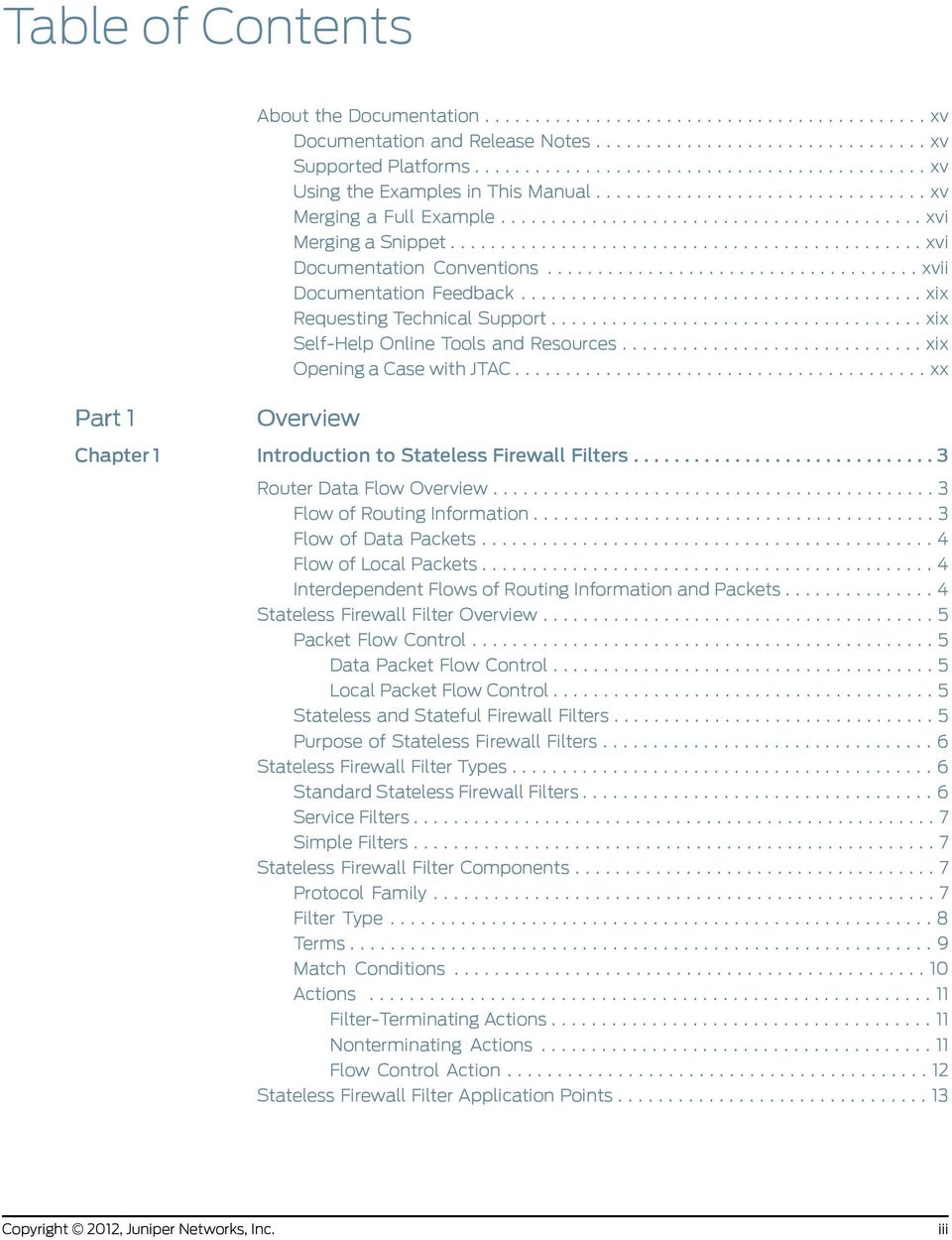
3 Table of Contents About the Documentation xv Documentation and Release Notes xv Supported Platforms xv Using the Examples in This Manual xv Merging a Full Example xvi Merging a Snippet xvi Documentation Conventions xvii Documentation Feedback xix Requesting Technical Support xix Self-Help Online Tools and Resources xix Opening a Case with JTAC xx Part 1 Overview Chapter 1 Introduction to Stateless Firewall Filters Router Data Flow Overview Flow of Routing Information Flow of Data Packets Flow of Local Packets Interdependent Flows of Routing Information and Packets Stateless Firewall Filter Overview Packet Flow Control Data Packet Flow Control Local Packet Flow Control Stateless and Stateful Firewall Filters Purpose of Stateless Firewall Filters Stateless Firewall Filter Types Standard Stateless Firewall Filters Service Filters Simple Filters Stateless Firewall Filter Components Protocol Family Filter Type Terms Match Conditions Actions Filter-Terminating Actions Nonterminating Actions Flow Control Action Stateless Firewall Filter Application Points iii
4 Firewall Filters Configuration Guide Chapter 2 Standard Firewall Filters Overview Standard Stateless Firewall Filter Overview How Standard Firewall Filters Evaluate Packets Firewall Filters That Contain a Single Term Firewall Filters That Contain Multiple Terms Firewall Filter Terms That Do Not Contain Any Match Conditions Firewall Filter Terms That Do Not Contain Any Actions Firewall Filter Default Action Guidelines for Configuring Standard Firewall Filters Statement Hierarchy for Configuring Standard Firewall Filters Standard Firewall Filter Protocol Families Standard Firewall Filter Names and Options Standard Firewall Filter Terms Standard Firewall Filter Match Conditions Standard Firewall Filter Actions Guidelines for Applying Standard Firewall Filters Applying Standard Firewall Filters Overview Applying a Firewall Filter to a Router s Physical Interfaces Applying a Firewall Filter to the Router s Loopback Interface Applying a Firewall Filter to Multiple Interfaces Statement Hierarchy for Applying Standard Firewall Filters Restrictions on Applying Standard Firewall Filters Number of Input and Output Filters Per Logical Interface MPLS and Layer 2 CCC Firewall Filters in Lists Layer 2 CCC Firewall Filters on MX Series Routers Protocol-Independent Firewall Filters on the Loopback Interface Understanding How to Use Standard Firewall Filters Using Standard Firewall Filters to Affect Local Packets Trusted Sources Flood Prevention Using Standard Firewall Filters to Affect Data Packets Chapter 3 Standard Firewall Filter Match Conditions Overview Firewall Filter Match Conditions Based on Numbers or Text Aliases Matching on a Single Numeric Value Matching on a Range of Numeric Values Matching on a Text Alias for a Numeric Value Matching on a List of Numeric Values or Text Aliases Firewall Filter Match Conditions Based on Bit-Field Values Match Conditions for Bit-Field Values Match Conditions for Common Bit-Field Values or Combinations Logical Operators for Bit-Field Values Matching on a Single Bit-Field Value or Text Alias Matching on Multiple Bit-Field Values or Text Aliases Matching on a Negated Bit-Field Value Matching on the Logical OR of Two Bit-Field Values Matching on the Logical AND of Two Bit-Field Values Grouping Bit-Field Match Conditions iv

5 Table of Contents Firewall Filter Match Conditions Based on Address Fields Implied Match on the 0/0 except Address for Firewall Filter Match Conditions Based on Address Fields Matching an Address Field to a Subnet Mask or Prefix IPv4 Subnet Mask Notation Prefix Notation Default Prefix Length for IPv4 Addresses Default Prefix Length for IPv6 Addresses Default Prefix Length for MAC Addresses Matching an Address Field to an Excluded Value Excluding IP Addresses in IPv4 or IPv6 Traffic Excluding IP Addresses in VPLS or Layer 2 Bridging Traffic Excluding MAC Addresses in VPLS or Layer 2 Bridging Traffic Excluding All Addresses Requires an Explicit Match on the 0/0 Address Matching Either IP Address Field to a Single Value Matching Either IP Address Field in IPv4 or IPv6 Traffic Matching Either IP Address Field in VPLS or Layer 2 Bridging Traffic Matching an Address Field to Noncontiguous Prefixes Matching an Address Field to a Prefix List Firewall Filter Match Conditions Based on Address Classes Source-Class Usage Destination-Class Usage Guidelines for Applying SCU or DCU Firewall Filters to Output Interfaces Chapter 4 Introduction to Standard Firewall Filters for Fragment Handling Firewall Filters That Handle Fragmented Packets Overview Chapter 5 Introduction to Standard Firewall Filters Configuration Stateless Firewall Filters That Reference Policers Overview Multiple Standard Firewall Filters Applied as a List Overview The Challenge: Simplify Large-Scale Firewall Filter Administration A Solution: Apply Lists of Firewall Filters Configuration of Multiple Filters for Filter Lists Application of Filter Lists to a Router Interface Interface-Specific Names for Filter Lists How Filter Lists Evaluate Packets Guidelines for Applying Multiple Standard Firewall Filters as a List Statement Hierarchy for Applying Lists of Multiple Firewall Filters Filter Input Lists and Output Lists for Router Interfaces Types of Filters Supported in Lists Restrictions on Applying Filter Lists for MPLS or Layer 2 CCC Traffic Multiple Standard Firewall Filters in a Nested Configuration Overview The Challenge: Simplify Large-Scale Firewall Filter Administration A Solution: Configure Nested References to Firewall Filters Configuration of Nested Firewall Filters Application of Nested Firewall Filters to a Router Interface Guidelines for Nesting References to Multiple Standard Firewall Filters Statement Hierarchy for Configuring Nested Firewall Filters Filter-Defining Terms and Filter-Referencing Terms v

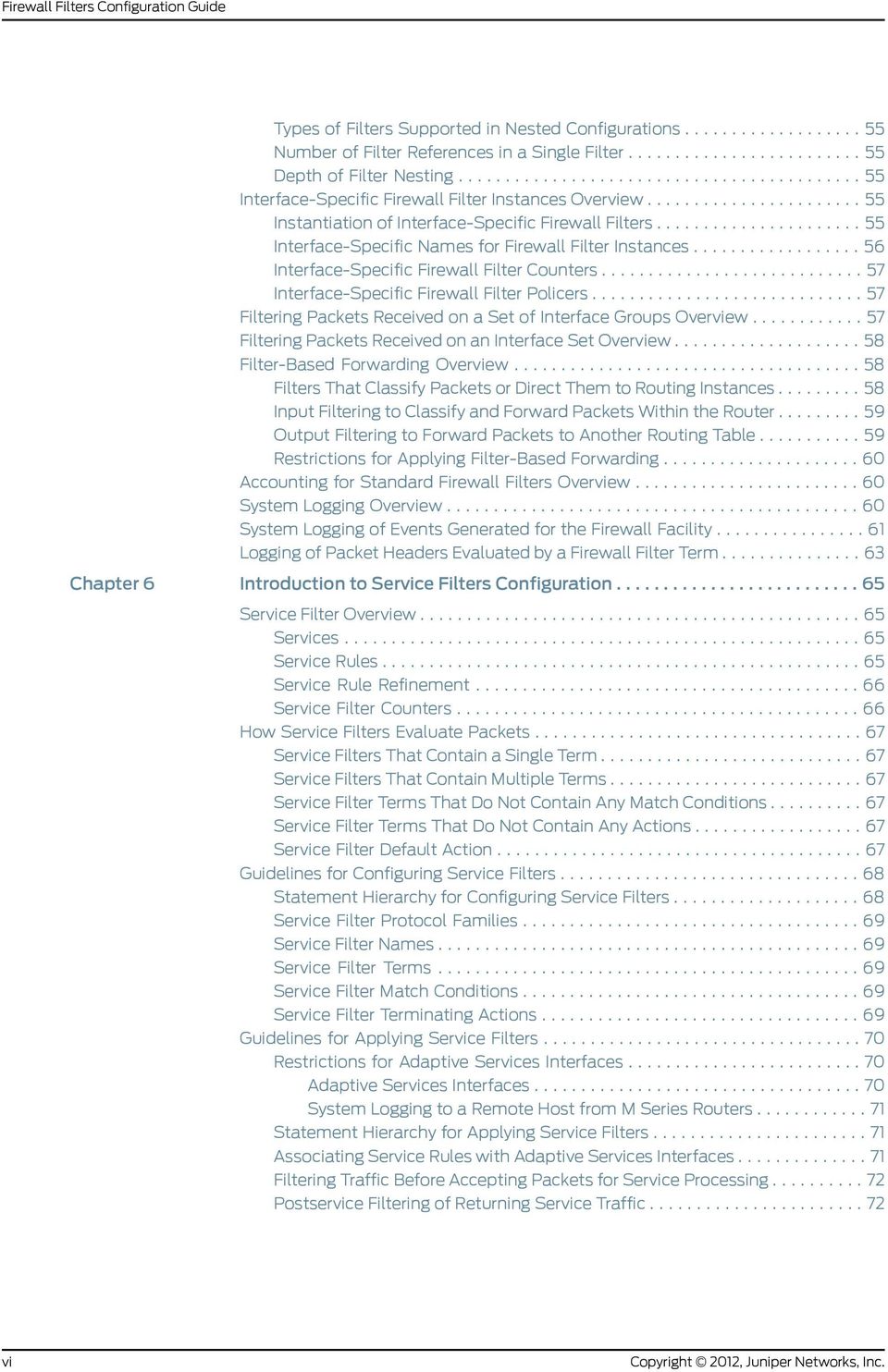
6 Firewall Filters Configuration Guide Types of Filters Supported in Nested Configurations Number of Filter References in a Single Filter Depth of Filter Nesting Interface-Specific Firewall Filter Instances Overview Instantiation of Interface-Specific Firewall Filters Interface-Specific Names for Firewall Filter Instances Interface-Specific Firewall Filter Counters Interface-Specific Firewall Filter Policers Filtering Packets Received on a Set of Interface Groups Overview Filtering Packets Received on an Interface Set Overview Filter-Based Forwarding Overview Filters That Classify Packets or Direct Them to Routing Instances Input Filtering to Classify and Forward Packets Within the Router Output Filtering to Forward Packets to Another Routing Table Restrictions for Applying Filter-Based Forwarding Accounting for Standard Firewall Filters Overview System Logging Overview System Logging of Events Generated for the Firewall Facility Logging of Packet Headers Evaluated by a Firewall Filter Term Chapter 6 Introduction to Service Filters Configuration Service Filter Overview Services Service Rules Service Rule Refinement Service Filter Counters How Service Filters Evaluate Packets Service Filters That Contain a Single Term Service Filters That Contain Multiple Terms Service Filter Terms That Do Not Contain Any Match Conditions Service Filter Terms That Do Not Contain Any Actions Service Filter Default Action Guidelines for Configuring Service Filters Statement Hierarchy for Configuring Service Filters Service Filter Protocol Families Service Filter Names Service Filter Terms Service Filter Match Conditions Service Filter Terminating Actions Guidelines for Applying Service Filters Restrictions for Adaptive Services Interfaces Adaptive Services Interfaces System Logging to a Remote Host from M Series Routers Statement Hierarchy for Applying Service Filters Associating Service Rules with Adaptive Services Interfaces Filtering Traffic Before Accepting Packets for Service Processing Postservice Filtering of Returning Service Traffic vi
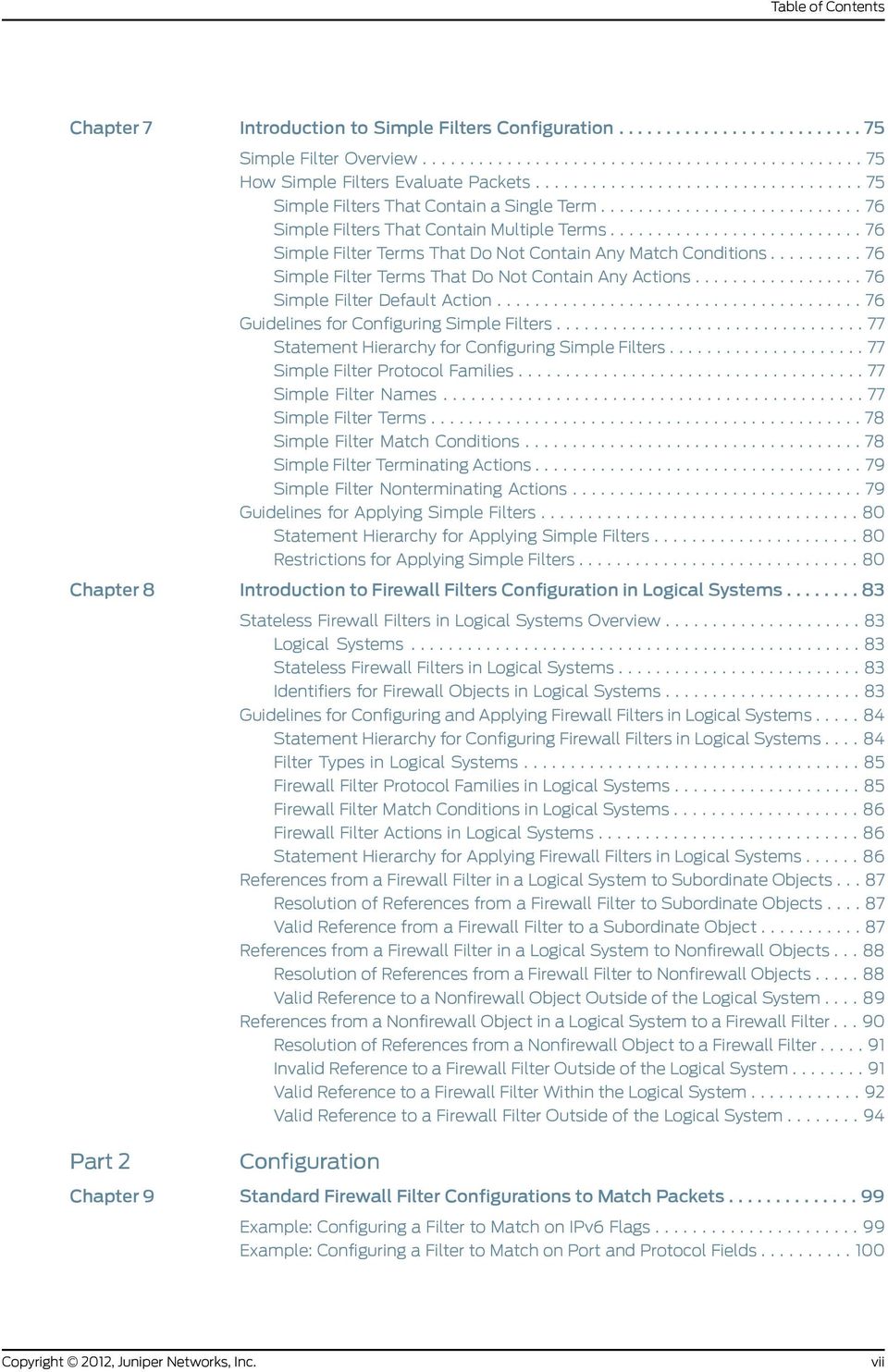
7 Table of Contents Chapter 7 Introduction to Simple Filters Configuration Simple Filter Overview How Simple Filters Evaluate Packets Simple Filters That Contain a Single Term Simple Filters That Contain Multiple Terms Simple Filter Terms That Do Not Contain Any Match Conditions Simple Filter Terms That Do Not Contain Any Actions Simple Filter Default Action Guidelines for Configuring Simple Filters Statement Hierarchy for Configuring Simple Filters Simple Filter Protocol Families Simple Filter Names Simple Filter Terms Simple Filter Match Conditions Simple Filter Terminating Actions Simple Filter Nonterminating Actions Guidelines for Applying Simple Filters Statement Hierarchy for Applying Simple Filters Restrictions for Applying Simple Filters Chapter 8 Introduction to Firewall Filters Configuration in Logical Systems Stateless Firewall Filters in Logical Systems Overview Logical Systems Stateless Firewall Filters in Logical Systems Identifiers for Firewall Objects in Logical Systems Guidelines for Configuring and Applying Firewall Filters in Logical Systems Statement Hierarchy for Configuring Firewall Filters in Logical Systems Filter Types in Logical Systems Firewall Filter Protocol Families in Logical Systems Firewall Filter Match Conditions in Logical Systems Firewall Filter Actions in Logical Systems Statement Hierarchy for Applying Firewall Filters in Logical Systems References from a Firewall Filter in a Logical System to Subordinate Objects Resolution of References from a Firewall Filter to Subordinate Objects Valid Reference from a Firewall Filter to a Subordinate Object References from a Firewall Filter in a Logical System to Nonfirewall Objects Resolution of References from a Firewall Filter to Nonfirewall Objects Valid Reference to a Nonfirewall Object Outside of the Logical System References from a Nonfirewall Object in a Logical System to a Firewall Filter Resolution of References from a Nonfirewall Object to a Firewall Filter Invalid Reference to a Firewall Filter Outside of the Logical System Valid Reference to a Firewall Filter Within the Logical System Valid Reference to a Firewall Filter Outside of the Logical System Part 2 Configuration Chapter 9 Standard Firewall Filter Configurations to Match Packets Example: Configuring a Filter to Match on IPv6 Flags Example: Configuring a Filter to Match on Port and Protocol Fields vii
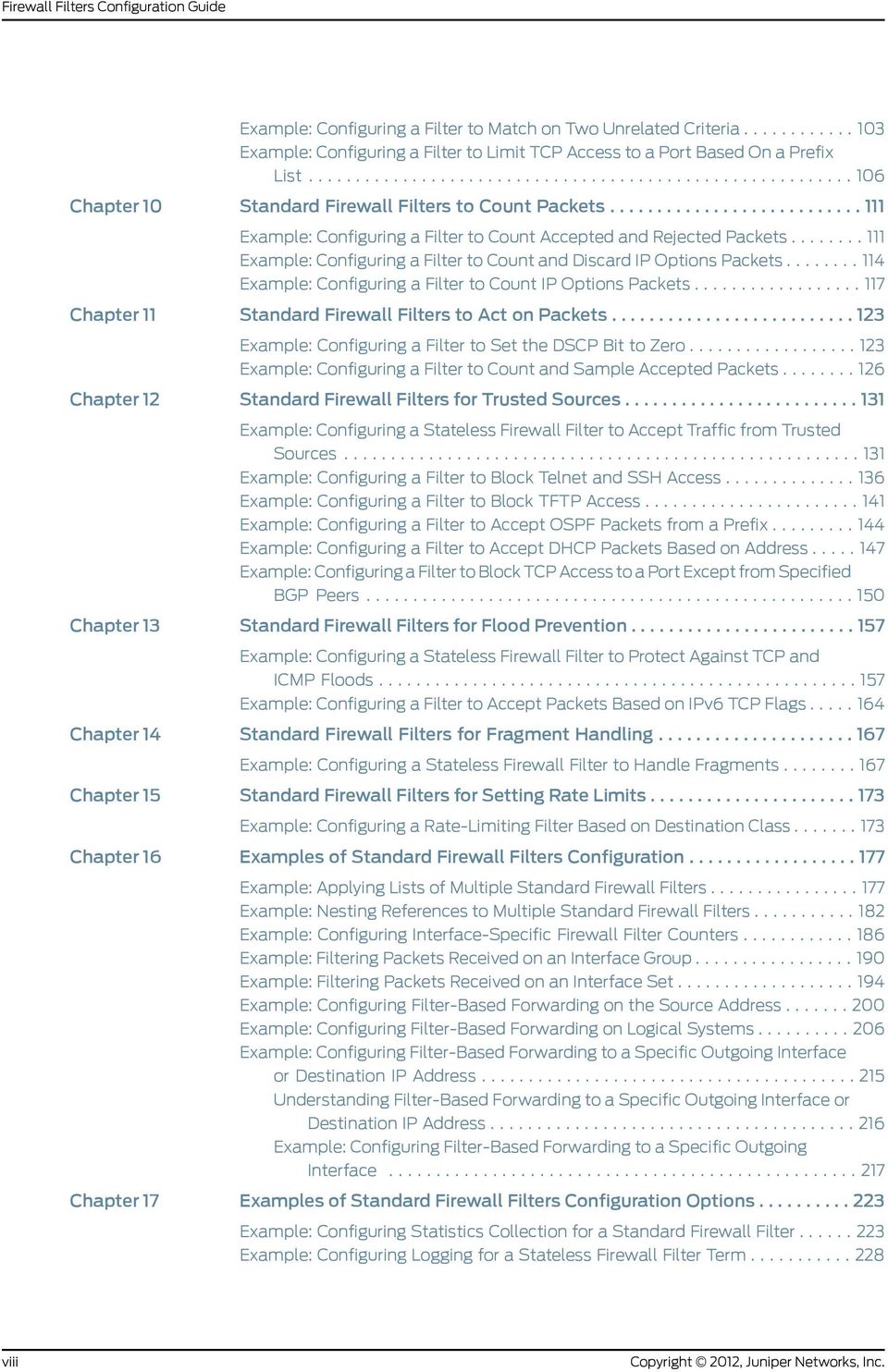
8 Firewall Filters Configuration Guide Example: Configuring a Filter to Match on Two Unrelated Criteria Example: Configuring a Filter to Limit TCP Access to a Port Based On a Prefix List Chapter 10 Standard Firewall Filters to Count Packets Example: Configuring a Filter to Count Accepted and Rejected Packets Example: Configuring a Filter to Count and Discard IP Options Packets Example: Configuring a Filter to Count IP Options Packets Chapter 11 Standard Firewall Filters to Act on Packets Example: Configuring a Filter to Set the DSCP Bit to Zero Example: Configuring a Filter to Count and Sample Accepted Packets Chapter 12 Standard Firewall Filters for Trusted Sources Example: Configuring a Stateless Firewall Filter to Accept Traffic from Trusted Sources Example: Configuring a Filter to Block Telnet and SSH Access Example: Configuring a Filter to Block TFTP Access Example: Configuring a Filter to Accept OSPF Packets from a Prefix Example: Configuring a Filter to Accept DHCP Packets Based on Address Example: Configuring a Filter to Block TCP Access to a Port Except from Specified BGP Peers Chapter 13 Standard Firewall Filters for Flood Prevention Example: Configuring a Stateless Firewall Filter to Protect Against TCP and ICMP Floods Example: Configuring a Filter to Accept Packets Based on IPv6 TCP Flags Chapter 14 Standard Firewall Filters for Fragment Handling Example: Configuring a Stateless Firewall Filter to Handle Fragments Chapter 15 Standard Firewall Filters for Setting Rate Limits Example: Configuring a Rate-Limiting Filter Based on Destination Class Chapter 16 Examples of Standard Firewall Filters Configuration Example: Applying Lists of Multiple Standard Firewall Filters Example: Nesting References to Multiple Standard Firewall Filters Example: Configuring Interface-Specific Firewall Filter Counters Example: Filtering Packets Received on an Interface Group Example: Filtering Packets Received on an Interface Set Example: Configuring Filter-Based Forwarding on the Source Address Example: Configuring Filter-Based Forwarding on Logical Systems Example: Configuring Filter-Based Forwarding to a Specific Outgoing Interface or Destination IP Address Understanding Filter-Based Forwarding to a Specific Outgoing Interface or Destination IP Address Example: Configuring Filter-Based Forwarding to a Specific Outgoing Interface Chapter 17 Examples of Standard Firewall Filters Configuration Options Example: Configuring Statistics Collection for a Standard Firewall Filter Example: Configuring Logging for a Stateless Firewall Filter Term viii
9 Table of Contents Chapter 18 Service Filters Configuration Example: Configuring and Applying Service Filters Chapter 19 Simple Filters Configuration Example: Configuring and Applying a Simple Filter Chapter 20 Firewall Filters Configuration in Logical Systems Example: Configuring a Stateless Firewall Filter to Protect a Logical System Against ICMP Floods Part 3 Administration Chapter 21 Firewall Filters Standards Supported Standards for Filtering Chapter 22 Firewall Filters Reference Using the CLI Editor in Configuration Mode Chapter 23 Standard Firewall Filter Match Conditions and Actions Standard Firewall Filter Match Conditions for Protocol-Independent Traffic Standard Firewall Filter Match Conditions for IPv4 Traffic Standard Firewall Filter Match Conditions for IPv6 Traffic Standard Firewall Filter Match Conditions for MPLS Traffic Standard Firewall Filter Match Conditions for MPLS-Tagged IPv4 or IPv6 Traffic Matching on IPv4 or IPv6 Packet Header Address or Port Fields in MPLS Flows IP Address Match Conditions for MPLS Traffic IP Port Match Conditions for MPLS Traffic Standard Firewall Filter Match Conditions for VPLS Traffic Standard Firewall Filter Match Conditions for Layer 2 CCC Traffic Standard Firewall Filter Match Conditions for Layer 2 Bridging Traffic Standard Firewall Filter Terminating Actions Standard Firewall Filter Nonterminating Actions Chapter 24 Standard Firewall Filter Match Conditions and Actions for ACX Series Routers Standard Firewall Filter Match Conditions and Actions on ACX Series Routers Overview Standard Firewall Filter Match Conditions for IPv4 Traffic on ACX Series Routers Standard Firewall Filter Match Conditions for MPLS Traffic on ACX Series Routers Standard Firewall Filter Terminating Actions on ACX Series Routers Standard Firewall Filter Nonterminating Actions on ACX Series Routers Chapter 25 Service Filter Match Conditions and Actions Service Filter Match Conditions for IPv4 or IPv6 Traffic Service Filter Terminating Actions Service Filter Nonterminating Actions ix

10 Firewall Filters Configuration Guide Chapter 26 Reference Information for Firewall Filters in Logical Systems Unsupported Firewall Filter Statements for Logical Systems Unsupported Actions for Firewall Filters in Logical Systems Chapter 27 Firewall Filters Statement Hierarchies Statement Hierarchy for Configuring Interface-Specific Firewall Filters Statement Hierarchy for Applying Interface-Specific Firewall Filters Statement Hierarchy for Assigning Interfaces to Interface Groups Statement Hierarchy for Configuring a Filter to Match on a Set of Interface Groups Statement Hierarchy for Applying Filters to an Interface Group Statement Hierarchy for Defining an Interface Set Statement Hierarchy for Configuring a Filter to Match on an Interface Set Statement Hierarchy for Configuring FBF for IPv4 or IPv6 Traffic Statement Hierarchy for Configuring FBF for IPv4 Traffic on ACX Series Routers Statement Hierarchy for Configuring FBF for MPLS-Tagged IPv4 Traffic Matching on IPv4 Address and TCP/UDP Port Fields Configuration Example Statement Hierarchy for Configuring Routing Instances for FBF Statement Hierarchy for Applying FBF Filters to Interfaces Statement Hierarchy for Configuring Firewall Filter Accounting Profiles Statement Hierarchy for Applying Firewall Filter Accounting Profiles Chapter 28 Summary of Firewall Filters Configuration Statements accounting-profile destination-address destination-port enhanced-mode family (Firewall) filter (Applying to a Logical Interface) filter (Configuring) firewall interface-set interface-specific (Firewall Filters) ip-version prefix-list protocol service-filter (Firewall) simple-filter source-address source-checking source-port term (Firewall Filter) Part 4 Index Index x

11 List of Figures Part 1 Overview Chapter 1 Introduction to Stateless Firewall Filters Figure 1: Flows of Routing Information and Packets Part 2 Configuration Chapter 12 Standard Firewall Filters for Trusted Sources Figure 2: Typical Network with BGP Peer Sessions Chapter 16 Examples of Standard Firewall Filters Configuration Figure 3: Logical Systems with Filter-Based Forwarding Figure 4: Filter-Based Forwarding to Specified Outgoing Interfaces Chapter 20 Firewall Filters Configuration in Logical Systems Figure 5: Logical System with a Stateless Firewall xi

12 Firewall Filters Configuration Guide xii

13 List of Tables About the Documentation xv Table 1: Notice Icons xvii Table 2: Text and Syntax Conventions xvii Part 1 Overview Chapter 1 Introduction to Stateless Firewall Filters Table 3: Firewall Filter Protocol Families Table 4: Filter Types Table 5: Stateless Firewall Filter Configuration and Application Summary Chapter 2 Standard Firewall Filters Overview Table 6: Standard Firewall Filter Match Conditions by Protocol Family Table 7: Standard Firewall Filter Action Categories Chapter 3 Standard Firewall Filter Match Conditions Overview Table 8: Binary and Bit-Field Match Conditions for Firewall Filters Table 9: Bit-Field Match Conditions for Common Combinations Table 10: Bit-Field Logical Operators Chapter 5 Introduction to Standard Firewall Filters Configuration Table 11: Syslog Message Destinations for the Firewall Facility Table 12: Packet-Header Logs for Stateless Firewall Filter Terms Chapter 7 Introduction to Simple Filters Configuration Table 13: Simple Filter Match Conditions Part 3 Administration Chapter 23 Standard Firewall Filter Match Conditions and Actions Table 14: Standard Firewall Filter Match Conditions for Protocol-Independent Traffic Table 15: Standard Firewall Filter Match Conditions for IPv4 Traffic Table 16: Standard Firewall Filter Match Conditions for IPv6 Traffic Table 17: Standard Firewall Filter Match Conditions for MPLS Traffic Table 18: IP Address-Specific Firewall Filter Match Conditions for MPLS Traffic Table 19: IP Port-Specific Firewall Filter Match Conditions for MPLS Traffic Table 20: Standard Firewall Filter Match Conditions for VPLS Traffic Table 21: Standard Firewall Filter Match Conditions for Layer 2 CCC Traffic Table 22: Standard Firewall Filter Match Conditions for Layer 2 Bridging (MX Series 3D Universal Edge Routers Only) xiii

14 Firewall Filters Configuration Guide Table 23: Terminating Actions for Standard Firewall Filters Table 24: Nonterminating Actions for Standard Firewall Filters Chapter 24 Standard Firewall Filter Match Conditions and Actions for ACX Series Routers Table 25: Standard Firewall Filter Match Conditions by Protocol Family for ACX Series Routers Table 26: Standard Firewall Filter Action Categories for ACX Series Routers Table 27: Standard Firewall Filter Match Conditions for IPv4 Traffic on ACX Series Routers Table 28: Standard Firewall Filter Match Conditions for MPLS Traffic on ACX Series Routers Table 29: Terminating Actions for Standard Firewall Filters on ACX Series Routers Table 30: Nonterminating Actions for Standard Firewall Filters on ACX Series Routers Chapter 25 Service Filter Match Conditions and Actions Table 31: Service Filter Match Conditions for IPv4 or IPv6 Traffic Table 32: Terminating Actions for Service Filters Table 33: Nonterminating Actions for Service Filters Chapter 26 Reference Information for Firewall Filters in Logical Systems Table 34: Unsupported Firewall Statements for Logical Systems Table 35: Unsupported Actions for Firewall Filters in Logical Systems xiv

15 About the Documentation Documentation and Release Notes Documentation and Release Notes on page xv Supported Platforms on page xv Using the Examples in This Manual on page xv Documentation Conventions on page xvii Documentation Feedback on page xix Requesting Technical Support on page xix Supported Platforms To obtain the most current version of all Juniper Networks technical documentation, see the product documentation page on the Juniper Networks website at If the information in the latest release notes differs from the information in the documentation, follow the product Release Notes. Juniper Networks Books publishes books by Juniper Networks engineers and subject matter experts. These books go beyond the technical documentation to explore the nuances of network architecture, deployment, and administration. The current list can be viewed at For the features described in this document, the following platforms are supported: M Series T Series MX Series PTX Series Using the Examples in This Manual If you want to use the examples in this manual, you can use the load merge or the load merge relative command. These commands cause the software to merge the incoming configuration into the current candidate configuration. The example does not become active until you commit the candidate configuration. xv

16 Firewall Filters Configuration Guide Merging a Full Example If the example configuration contains the top level of the hierarchy (or multiple hierarchies), the example is a full example. In this case, use the load merge command. If the example configuration does not start at the top level of the hierarchy, the example is a snippet. In this case, use the load merge relative command. These procedures are described in the following sections. To merge a full example, follow these steps: 1. From the HTML or PDF version of the manual, copy a configuration example into a text file, save the file with a name, and copy the file to a directory on your routing platform. For example, copy the following configuration to a file and name the file ex-script.conf. Copy the ex-script.conf file to the /var/tmp directory on your routing platform. system { scripts { commit { file ex-script.xsl; interfaces { fxp0 { disable; unit 0 { family inet { address /24; 2. Merge the contents of the file into your routing platform configuration by issuing the load merge configuration mode command: user@host# load merge /var/tmp/ex-script.conf load complete Merging a Snippet To merge a snippet, follow these steps: 1. From the HTML or PDF version of the manual, copy a configuration snippet into a text file, save the file with a name, and copy the file to a directory on your routing platform. For example, copy the following snippet to a file and name the file ex-script-snippet.conf. Copy the ex-script-snippet.conf file to the /var/tmp directory on your routing platform. commit { file ex-script-snippet.xsl; xvi

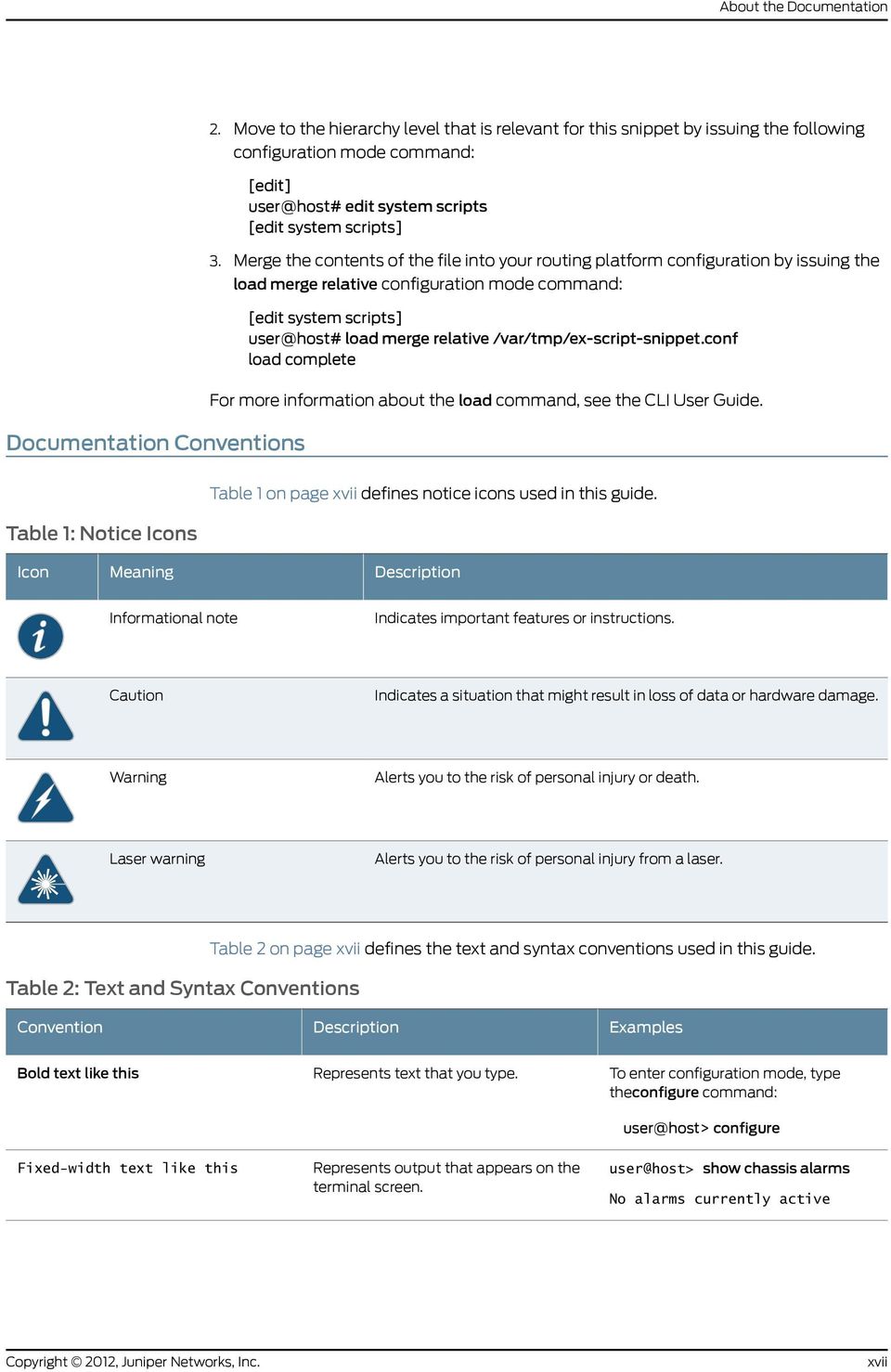
17 About the Documentation 2. Move to the hierarchy level that is relevant for this snippet by issuing the following configuration mode command: edit system scripts [edit system scripts] 3. Merge the contents of the file into your routing platform configuration by issuing the load merge relative configuration mode command: [edit system scripts] load merge relative /var/tmp/ex-script-snippet.conf load complete Documentation Conventions For more information about the load command, see the CLI User Guide. Table 1: Notice Icons Table 1 on page xvii defines notice icons used in this guide. Icon Meaning Description Informational note Indicates important features or instructions. Caution Indicates a situation that might result in loss of data or hardware damage. Warning Alerts you to the risk of personal injury or death. Laser warning Alerts you to the risk of personal injury from a laser. Table 2: Text and Syntax Conventions Table 2 on page xvii defines the text and syntax conventions used in this guide. Convention Description Examples Bold text like this Represents text that you type. To enter configuration mode, type theconfigure command: user@host> configure Fixed-width text like this Represents output that appears on the terminal screen. user@host> show chassis alarms No alarms currently active xvii
18 Firewall Filters Configuration Guide Table 2: Text and Syntax Conventions (continued) Convention Description Examples Italic text like this Introduces or emphasizes important new terms. Identifies book names. Identifies RFC and Internet draft titles. A policy term is a named structure that defines match conditions and actions. Junos OS System Basics Configuration Guide RFC 1997, BGP Communities Attribute Italic text like this Text like this Represents variables (options for which you substitute a value) in commands or configuration statements. Represents names of configuration statements, commands, files, and directories; configuration hierarchy levels; or labels on routing platform components. Configure the machine s domain name: root@# set system domain-name domain-name To configure a stub area, include the stub statement at the[edit protocols ospf area area-id] hierarchy level. The console port is labeled CONSOLE. < > (angle brackets) Enclose optional keywords or variables. stub <default-metric metric>; (pipe symbol) Indicates a choice between the mutually exclusive keywords or variables on either side of the symbol. The set of choices is often enclosed in parentheses for clarity. broadcast multicast (string1 string2 string3) # (pound sign) Indicates a comment specified on the same line as the configuration statement to which it applies. rsvp { # Required for dynamic MPLS only [ ] (square brackets) Enclose a variable for which you can substitute one or more values. community name members [ community-ids ] Indention and braces ( { ) ; (semicolon) Identify a level in the configuration hierarchy. Identifies a leaf statement at a configuration hierarchy level. routing-options { static { route default { nexthop address; retain; J-Web GUI Conventions Bold text like this Represents J-Web graphical user interface (GUI) items you click or select. In the Logical Interfaces box, select All Interfaces. To cancel the configuration, click Cancel. > (bold right angle bracket) Separates levels in a hierarchy of J-Web selections. In the configuration editor hierarchy, select Protocols>Ospf. xviii

19 About the Documentation Documentation Feedback We encourage you to provide feedback, comments, and suggestions so that we can improve the documentation. You can send your comments to or fill out the documentation feedback form at If you are using , be sure to include the following information with your comments: Document or topic name URL or page number Software release version (if applicable) Requesting Technical Support Technical product support is available through the Juniper Networks Technical Assistance Center (JTAC). If you are a customer with an active J-Care or JNASC support contract, or are covered under warranty, and need post-sales technical support, you can access our tools and resources online or open a case with JTAC. JTAC policies For a complete understanding of our JTAC procedures and policies, review the JTAC User Guide located at Product warranties For product warranty information, visit JTAC hours of operation The JTAC centers have resources available 24 hours a day, 7 days a week, 365 days a year. Self-Help Online Tools and Resources For quick and easy problem resolution, Juniper Networks has designed an online self-service portal called the Customer Support Center (CSC) that provides you with the following features: Find CSC offerings: Search for known bugs: Find product documentation: Find solutions and answer questions using our Knowledge Base: Download the latest versions of software and review release notes: Search technical bulletins for relevant hardware and software notifications: xix
20 Firewall Filters Configuration Guide Join and participate in the Juniper Networks Community Forum: Open a case online in the CSC Case Management tool: To verify service entitlement by product serial number, use our Serial Number Entitlement (SNE) Tool: Opening a Case with JTAC You can open a case with JTAC on the Web or by telephone. Use the Case Management tool in the CSC at Call JTAC ( toll-free in the USA, Canada, and Mexico). For international or direct-dial options in countries without toll-free numbers, see xx

21 PART 1 Overview Introduction to Stateless Firewall Filters on page 3 Standard Firewall Filters Overview on page 17 Standard Firewall Filter Match Conditions Overview on page 29 Introduction to Standard Firewall Filters for Fragment Handling on page 45 Introduction to Standard Firewall Filters Configuration on page 47 Introduction to Service Filters Configuration on page 65 Introduction to Simple Filters Configuration on page 75 Introduction to Firewall Filters Configuration in Logical Systems on page 83 1
22 Firewall Filters Configuration Guide 2
23 CHAPTER 1 Introduction to Stateless Firewall Filters Router Data Flow Overview Router Data Flow Overview on page 3 Stateless Firewall Filter Overview on page 5 Stateless Firewall Filter Types on page 6 Stateless Firewall Filter Components on page 7 Stateless Firewall Filter Application Points on page 13 The Junos OS provides a policy framework, which is a collection of Junos OS policies that enable you to control flows of routing information and packets within the router. Flow of Routing Information on page 3 Flow of Data Packets on page 4 Flow of Local Packets on page 4 Interdependent Flows of Routing Information and Packets on page 4 Flow of Routing Information Routing information is the information about routes learned by the routing protocols from a router s neighbors. This information is stored in routing tables. The routing protocols advertise active routes only from the routing tables. An active route is a route that is chosen from all routes in the routing table to reach a destination. To control which routes the routing protocols place in the routing tables and which routes the routing protocols advertise from the routing tables, you can configure routing policies, which are sets of rules that the policy framework uses to preempt default routing policies. The Routing Engine, which is the router s control plane, handles the flow of routing information between the routing protocols and the routing tables and between the routing tables and the forwarding table. The Routing Engine runs the Junos OS and routing policies and stores the active router configuration, the master routing table, and the master forwarding table, 3
24 Firewall Filters Configuration Guide Flow of Data Packets Data packets are chunks of data that transit the router as they are being forwarded from a source to a destination. When a router receives a data packet on an interface, it determines where to forward the packet by looking in the forwarding table for the best route to a destination. The router then forwards the data packet toward its destination through the appropriate interface. The Packet Forwarding Engine, which is the router s forwarding plane, handles the flow of data packets in and out of the router s physical interfaces. Although the Packet Forwarding Engine contains Layer 3 and Layer 4 header information, it does not contain the packet data itself (the packet's payload). Flow of Local Packets Local packets are chunks of data that are destined for or sent by the router. Local packets usually contain routing protocol data, data for IP services such as Telnet or SSH, and data for administrative protocols such as the Internet Control Message Protocol (ICMP). When the Routing Engine receives a local packet, it forwards the packet to the appropriate process or to the kernel, which are both part of the Routing Engine, or to the Packet Forwarding Engine. The Routing Engine handles the flow of local packets from the router s physical interfaces and to the Routing Engine. Interdependent Flows of Routing Information and Packets Figure 1 on page 4 illustrates the flow of data through a router. Although routing information flows and packet flows are very different from one another, they are also interdependent. Figure 1: Flows of Routing Information and Packets Routing policies determine which routes the Routing Engine places in the forwarding table. The forwarding table, in turn, has an integral role in determining the appropriate physical interface through which to forward a packet. Related Documentation Stateless Firewall Filter Overview on page 5 Packet Flow Within Routers Overview in the Junos OS Class of Service Configuration Guide 4
25 Chapter 1: Introduction to Stateless Firewall Filters Understanding BGP Path Selection in the Junos OS Routing Protocols Configuration Guide Understanding Route Preference Values in the Junos OS Routing Protocols Configuration Guide Understanding Routing Policies in the Routing Policy Configuration Guide Stateless Firewall Filter Overview This topic covers the following information: Packet Flow Control on page 5 Stateless and Stateful Firewall Filters on page 5 Purpose of Stateless Firewall Filters on page 6 Packet Flow Control To influence which packets are allowed to transit the system and to apply special actions to packets as necessary, you can configure stateless firewall filters. A stateless firewall specifies a sequence of one or more packet-filtering rules, called filter terms. A filter term specifies match conditions to use to determine a match and actions to take on a matched packet. A stateless firewall filter enables you to manipulate any packet of a particular protocol family, including fragmented packets, based on evaluation of Layer 3 and Layer 4 header fields. You typically apply a stateless firewall filter to one or more interfaces that have been configured with protocol family features. You can apply a stateless firewall filter to an ingress interface, an egress interface, or both. Data Packet Flow Control To control the flow of data packets transiting the device as the packets are being forwarded from a source to a destination, you can apply stateless firewall filters to the input or output of the router s physical interfaces. To enforce a specified bandwidth and maximum burst size for traffic sent or received on an interface, you can configure policers. Policers are a specialized type of stateless firewall filter and a primary component of the Junos OS class-of-service (CoS). Local Packet Flow Control To control the flow of local packets between the physical interfaces and the Routing Engine, you can apply stateless firewall filters to the input or output of the loopback interface. The loopback interface (lo0) is the interface to the Routing Engine and carries no data packets. Stateless and Stateful Firewall Filters A stateless firewall filter, also known as an access control list (ACL), does not statefully inspect traffic. Instead, it evaluates packet contents statically and does not keep track of the state of network connections. In contrast, a stateful firewall filter uses connection 5
26 Firewall Filters Configuration Guide state information derived from other applications and past communications in the data flow to make dynamic control decisions. The Junos OS Firewall Filters and Traffic Policers Configuration Guide describes stateless firewall filters supported on T Series, M Series, and MX Series routers. Purpose of Stateless Firewall Filters The basic purpose of a stateless firewall filter is to enhance security through the use of packet filtering. Packet filtering enables you to inspect the components of incoming or outgoing packets and then perform the actions you specify on packets that match the criteria you specify. The typical use of a stateless firewall filter is to protect the Routing Engine processes and resources from malicious or untrusted packets. Related Documentation Router Data Flow Overview on page 3 Stateless Firewall Filter Types on page 6 Traffic Policing Overview in the Junos OS Firewall Filters and Traffic Policers Configuration Guide Packet Flow Through the CoS Process Overview in the Junos OS Class of Service Configuration Guide Stateless Firewall Filter Types This topic covers the following information: Standard Stateless Firewall Filters on page 6 Service Filters on page 7 Simple Filters on page 7 Standard Stateless Firewall Filters The Junos OS standard stateless firewall filters support a rich set of packet-matching criteria that you can use to match on specific traffic and perform specific actions, such as forwarding or dropping packets that match the criteria you specify. You can configure firewall filters to protect the local router or to protect another device that is either directly or indirectly connected to the local router. For example, you can use the filters to restrict the local packets that pass from the router s physical interfaces to the Routing Engine. Such filters are useful in protecting the IP services that run on the Routing Engine, such as Telnet, SSH, and BGP, from denial-of-service attacks. NOTE: If you configured targeted broadcast for virtual routing and forwarding (VRF) by including the forward-and-send-to-re statement, any firewall filter that is configured on the Routing Engine loopback interface (lo0) cannot be applied to the targeted broadcast packets that are forwarded to the Routing Engine. This is because broadcast packets are forwarded as flood next hop traffic and not as local next hop traffic, and you can only apply a firewall filter to local next hop routes for traffic directed toward the Routing Engine. 6
27 Chapter 1: Introduction to Stateless Firewall Filters Service Filters A service filter defines packet-filtering (a set of match conditions and a set of actions) for IPv4 or IPv6 traffic. You can apply a service filter to the inbound or outbound traffic at an adaptive services interface to perform packet filtering on traffic before it is accepted for service processing. You can also apply a service filter to the traffic that is returning to the services interface after service processing to perform postservice processing. Service filters filter IPv4 and IPv6 traffic only and can be applied to logical interfaces on Adaptive Services PICs, MultiServices PICs, and MultiServices DPCs only. Service filters are not supported on J Series devices and Branch SRX devices. Simple Filters Simple filters are supported on Gigabit Ethernet intelligent queuing (IQ2) and Enhanced Queuing Dense Port Concentrator (EQ DPC) interfaces only. Unlike standard filters, simple filters support IPv4 traffic only and have a number of restrictions. For example, you cannot configure a terminating action for a simple filter. Simple filters always accept packets. Also, simple filters can be applied only as input filters. They are not supported on outbound traffic. Simple filters are recommended for metropolitan Ethernet applications. Related Documentation Stateless Firewall Filter Overview on page 5 Stateless Firewall Filter Components on page 7 Stateless Firewall Filter Components This topic covers the following information: Protocol Family on page 7 Filter Type on page 8 Terms on page 9 Match Conditions on page 10 Actions on page 11 Protocol Family Under the firewall statement, you can specify the protocol family for which you want to filter traffic. Table 3 on page 8 describes the firewall filter protocol families. 7
28 Firewall Filters Configuration Guide Table 3: Firewall Filter Protocol Families Type of Traffic to Be Filtered Protocol Family Configuration Statement Comments Protocol Independent family any All protocol families configured on a logical interface. Internet Protocol version 4 (IPv4) family inet The family inet statement is optional for IPv4. Internet Protocol version 6 (IPv6) family inet6 MPLS family mpls MPLS-tagged IPv4 family mpls Supports matching on IP addresses and ports, up to five MPLS stacked labels. MPLS-tagged IPv6 family mpls Supports matching on IP addresses and ports, up to five MPLS stacked labels. Virtual private LAN service (VPLS) family vpls Layer 2 Circuit Cross-Connection family ccc Layer 2 Bridging family bridge MX Series routers only. Filter Type Under the family family-name statement, you can specify the type and name of the filter you want to configure. Table 4 on page 9 describes the firewall filter types. 8
29 Chapter 1: Introduction to Stateless Firewall Filters Table 4: Filter Types Filter Type Filter Configuration Statement Description Stateless Firewall Filter filter filter-name Filters the following traffic types: Protocol independent IPv4 IPv6 MPLS MPLS-tagged IPv4 MPLS-tagged IPv6 VPLS Layer 2 CCC Layer 2 bridging (MX Series routers only) Service Filter service-filter service-filter-name Defines packet-filtering to be applied to ingress or egress before it is accepted for service processing or applied to returning service traffic after service processing has completed. Filters the following traffic types: IPv4 IPv6 Supported at logical interfaces configured on the following hardware only: Adaptive Services (AS) PICs on M Series and T Series routers Multiservices (MS) PICs on M Series and T Series routers Multiservices (MS) DPCs on MX Series routers Simple Filter simple-filter simple-filter-name Defines packet filtering to be applied to ingress traffic only. Filters the following traffic type: IPv4 Supported at logical interfaces configured on the following hardware only: Gigabit Ethernet Intelligent Queuing (IQ2) PICs installed on M120, M320, or T Series routers Enhanced Queuing Dense Port Concentrators (EQ DPCs) installed on MX Series routers Terms Under the filter, service-filter, or simple-filter statement, you must configure at least one firewall filter term. A term is a named structure in which match conditions and actions are defined. Within a firewall filter, you must configure a unique name for each term. 9
30 Firewall Filters Configuration Guide TIP: You cannot apply a different filter on each direction of traffic on the same interface. As a result, it is common to create firewall filters with multiple terms. All stateless firewall filters contain one or more terms, and each term consists of two components match conditions and actions. The match conditions define the values or fields that the packet must contain to be considered a match. If a packet is a match, the corresponding action is taken. By default, a packet that does not match a firewall filter is discarded. If a packet arrives on an interface for which no firewall filter is applied for the incoming traffic on that interface, the packet is accepted by default. NOTE: A firewall filter with a large number of terms can adversely affect both the configuration commit time and the performance of the Routing Engine. Additionally, you can configure a stateless firewall filter within the term of another filter. This method enables you to add common terms to multiple filters without having to modify all filter definitions. You can configure one filter with the desired common terms, and configure this filter as a term in other filters. Consequently, to make a change in these common terms, you need to modify only one filter that contains the common terms, instead of multiple filters. Match Conditions A firewall filter term must contain at least one packet-filtering criteria, called a match condition, to specify the field or value that a packet must contain in order to be considered a match for the firewall filter term. For a match to occur, the packet must match all the conditions in the term. If a packet matches a firewall filter term, the router takes the configured action on the packet. If a firewall filter term contains multiple match conditions, a packet must meet all match conditions to be considered a match for the firewall filter term. If a single match condition is configured with multiple values, such as a range of values, a packet must match only one of the values to be considered a match for the firewall filter term. The scope of match conditions you can specify in a firewall filter term depends on the protocol family under which the firewall filter is configured. You can define various match conditions, including the IP source address field, IP destination address field, TCP or UDP source port field, IP protocol field, Internet Control Message Protocol (ICMP) packet type, IP options, TCP flags, incoming logical or physical interface, and outgoing logical or physical interface. Each protocol family supports a different set of match conditions, and some match conditions are supported only on certain routing devices. For example, a number of match conditions for VPLS traffic are supported only on the MX Series 3D Universal Edge Routers. 10
31 Chapter 1: Introduction to Stateless Firewall Filters In the from statement in a firewall filter term, you specify characteristics that the packet must have for the action in the subsequent then statement to be performed. The characteristics are referred to as match conditions. The packet must match all conditions in the from statement for the action to be performed, which also means that the order of the conditions in the from statement is not important. If an individual match condition can specify a list of values (such as multiple source and destination addresses) or a range of numeric values, a match occurs if any of the values matches the packet. If a filter term does not specify match conditions, the term accepts all packets and the actions specified in the term s then statement are optional. NOTE: Some of the numeric range and bit-field match conditions allow you to specify a text synonym. For a complete list of synonyms: If you are using the J-Web interface, select the synonym from the appropriate list. If you are using the CLI, type a question mark (?) after the from statement. Actions The actions specified in a firewall filter term define the actions to take for any packet that matches the conditions specified in the term. Actions that are configured within a single term are all taken on traffic that matches the conditions configured. BEST PRACTICE: We strongly recommend that you explicitly configure one or more actions per firewall filter term. Any packet that matches all the conditions of the term is automatically accepted unless the term specifies other or additional actions. Firewall filter actions fall into the following categories: Filter-Terminating Actions A filter-terminating action halts all evaluation of a firewall filter for a specific packet. The router performs the specified action, and no additional terms are examined. Nonterminating Actions Nonterminating actions are used to perform other functions on a packet, such as incrementing a counter, logging information about the packet header, sampling the packet data, or sending information to a remote host using the system log functionality. 11
32 Firewall Filters Configuration Guide The presence of a nonterminating action, such as count, log, or syslog, without an explicit terminating action, such as accept, discard, or reject, results in a default terminating action of accept. If you do not want the firewall filter action to terminate, use the next term action after the nonterminating action. In this example, term 2 is never evaluated, because term 1 has the implicit default accept terminating action. [edit firewall filter test] term 1 { from { source-address { /0; then { log; <accept> #By default if not specified term 2 { then { reject; In this example, term 2 is evaluated, because term 1 has the explicit next term flow control action. [edit firewall filter test] term 1 { from { source-address { /0; then { log; next term; term 2 { then { reject; Flow Control Action For standard stateless firewall filters only, the action next term enables the router to perform configured actions on the packet and then evaluate the following term in the filter, rather than terminating the filter. A maximum of 1024 next term actions are supported per standard stateless firewall filter configuration. If you configure a standard filter that exceeds this limit, your candidate configuration results in a commit error. 12
33 Chapter 1: Introduction to Stateless Firewall Filters Related Documentation Stateless Firewall Filter Types on page 6 Inserting a New Identifier in a Junos Configuration in the CLI User Guide Stateless Firewall Filter Application Points After you define the firewall filter, you must apply it to an application point. These application points include logical interfaces, physical interfaces, routing interfaces, and routing instances. In most cases, you can apply a firewall filter as an input filter or an output filter, or both at the same time. Input filters take action on packets being received on the specified interface, whereas output filters take action on packets that are transmitted through the specified interface. You typically apply one filter with multiple terms to a single logical interface, to incoming traffic, outbound traffic, or both. However, there are times when you might want to chain together multiple firewall filters (with single or multiple terms) and apply them to an interface. You use an input list to apply multiple firewall filters to the incoming traffic on an interface. You use an output list to apply multiple firewall filters to the outbound traffic on an interface. You can include up to 16 filters in an input list or an output list. There is no limit to the number of filters and counters you can set, but there are some practical considerations. More counters require more terms, and a large number of terms can take a long time to process during a commit operation. However, filters with more than 4000 terms and counters have been implemented successfully. Table 5 on page 14 describes each point to which you can apply a firewall filter. For each application point, the table describes the types of firewall filters supported at that point, the router hierarchy level at which the filter can be applied, and any platform-specific limitations. 13
34 Firewall Filters Configuration Guide Table 5: Stateless Firewall Filter Configuration and Application Summary Filter Type Application Point Restrictions Stateless firewall filter Configure by including the filter filter-name statement the [edit firewall] hierarchy level: filter filter-name; NOTE: If you do not include the family statement, the firewall filter processes IPv4 traffic by default. Logical interface Apply at the [edit interfaces interface-name unit unit-number family inet] hierarchy level by including the input filter-name or output filter-name statements: filter { input filter-name; output filter-name; NOTE: A filter configured with the implicit inet protocol family cannot be included in an input filter list or an output filter list. NOTE: On T4000 Type 5 FPCs, a filter attached at the Layer 2 application point (that is, at the logical interface level) is unable to match with the forwarding class of a packet that is set by a Layer 3 classifier such as DSCP, DSCP V6, inet-precedence, and mpls-exp. Supported on the following routers: T Series routers M320 routers M7i routers with the enhanced CFEB (CFEB-e) M10i routers with the enhanced CFEB-e Also supported on the following Modular Port Concentrators (MPCs) on MX Series routers: 10-Gigabit Ethernet MPC 60-Gigabit Ethernet Queuing MPC 60-Gigabit Ethernet Enhanced Queuing MPC 100-Gigabit Ethernet MPC Stateless firewall filter Configure at the [edit firewall family family-name] hierarchy level by including the following statement: filter filter-name; The family-name can be any of the following protocol families: any bridge ccc inet inet6 mpls vpls Protocol family on a logical interface Apply at the [edit interfaces interface-name unit unit-number family family-name] hierarchy level by, including the input, input-list, output, or output-list statements: filter { input filter-name; input-list [ filter-names ]; output filter-name; output-list [ filter-names ]; The protocol family bridge is supported only on MX Series routers. Stateless firewall filter Routing Engine loopback interface 14
35 Chapter 1: Introduction to Stateless Firewall Filters Table 5: Stateless Firewall Filter Configuration and Application Summary (continued) Filter Type Application Point Restrictions Service filter Configure at the [edit firewall family (inet inet6)] hierarchy level by including the following statement: service-filter service-filter-name; Family inet or inet6 on a logical interface Apply at the [edit interfaces interface-name unit unit-number family (inet inet6)] hierarchy level by using the service-set statement to apply a service filter as an input or output filter to a service set: service { input { service-set service-set-name service-filter filter-name; output { service-set service-set-name service-filter filter-name; Configure a service set at the [edit services] hierarchy level by including the following statement: Supported only on Adaptive Services (AS) and Multiservices (MS) PICs. service-set service-set-name; Postservice filter Configure at the [edit firewall family (inet inet6)] hierarchy level by including the following statement: service-filter service-filter-name; Family inet or inet6 on a logical interface Apply at the [edit interfaces interface-name unit unit-number family (inet inet6)] hierarchy level by including the post-service-filter statement to apply a service filter as an input filter: service { input { post-service-filter filter-name; A postservice filter is applied to traffic returning to the services interface after service processing. The filter is applied only if a service set is configured and selected. Simple filter Configure at the [edit firewall family inet] hierarchy level by including the following statement: simple-filter filter-name Family inet on a logical interface Apply at the [edit interfaces interface-name unit unit-number family inet] hierarchy level by including the following statement: simple-filter simple-filter-name; Simple filters can only be applied as input filters. Supported on the following platforms only: Gigabit Ethernet intelligent queuing (IQ2) PICs on the M120, M320, and T Series routers. Enhanced Queuing Dense Port Concentrators (EQ DPC) on MX Series routers. 15
36 Firewall Filters Configuration Guide Table 5: Stateless Firewall Filter Configuration and Application Summary (continued) Filter Type Application Point Restrictions Reverse packet forwarding (RPF) check filter Configured at the [edit firewall family (inet inet6)] hierarchy level by including the following statement: filter filter-name; Family inet or inet6 on a logical interface Apply at the [edit interfaces interface-name unit unit-number family (inet inet6)] hierarchy level by including the following statement: rpf-check fail-filter filter-name to apply the stateless firewall filter as an RPF check filter. Supported on MX Series routers only. rpf-check { fail-filter filter-name; mode loose; Related Documentation Stateless Firewall Filter Components on page 7 Supported Standards for Filtering on page
37 CHAPTER 2 Standard Firewall Filters Overview Standard Stateless Firewall Filter Overview on page 17 How Standard Firewall Filters Evaluate Packets on page 18 Guidelines for Configuring Standard Firewall Filters on page 19 Guidelines for Applying Standard Firewall Filters on page 25 Understanding How to Use Standard Firewall Filters on page 27 Standard Stateless Firewall Filter Overview Firewall filters provide a means of protecting your router from excessive traffic transiting the router to a network destination or destined for the Routing Engine. Firewall filters that control local packets can also protect your router from external incidents. You can configure a firewall filter to do the following: Restrict traffic destined for the Routing Engine based on its source, protocol, and application. Limit the traffic rate of packets destined for the Routing Engine to protect against flood, or denial-of-service (DoS) attacks. Address special circumstances associated with fragmented packets destined for the Routing Engine. Because the device evaluates every packet against a firewall filter (including fragments), you must configure the filter to accommodate fragments that do not contain packet header information. Otherwise, the filter discards all but the first fragment of a fragmented packet. Related Documentation Stateless Firewall Filter Types on page 6 Guidelines for Configuring Standard Firewall Filters on page 19 Guidelines for Applying Standard Firewall Filters on page 25 Understanding How to Use Standard Firewall Filters on page 27 17
38 Firewall Filters Configuration Guide How Standard Firewall Filters Evaluate Packets This topic covers the following information: Firewall Filters That Contain a Single Term on page 18 Firewall Filters That Contain Multiple Terms on page 18 Firewall Filter Terms That Do Not Contain Any Match Conditions on page 19 Firewall Filter Terms That Do Not Contain Any Actions on page 19 Firewall Filter Default Action on page 19 Firewall Filters That Contain a Single Term For a standard stateless firewall filter that consists of a single term, the policy framework software evaluates a packet as follows: If the packet matches all the conditions, the actions are taken. If the packet matches all the conditions and no actions are specified, the packet is accepted. If the packet does not match all the conditions, it is discarded. NOTE: When the device compares the stateless firewall filter match conditions to a packet, it compares only the header fields specified in the match condition. There is no implied protocol match. For example, if you specify a match of destination-port ssh, the device checks for a value of 0x22 in the 2-byte field that is two bytes after the IP packet header. The protocol field of the packet is not checked. Firewall Filters That Contain Multiple Terms For a standard stateless firewall filter that consists of multiple terms, the policy framework software evaluates a packet against the terms in the filter sequentially, beginning with the first term in the filter, until either the packet matches all the conditions in one of the terms or there are no more terms in the filter. If the packet matches all the conditions in a term, the actions in that term are performed. Unlike service filters and simple filters, standard stateless firewall filters support the next term action, which is neither a terminating action nor a nonterminating action but a flow control action.: If the actions do not include the next term action, evaluation of the packet ends at this term of the filter, and any subsequent terms in the filter are not used. If the actions include the next term action, the evaluation continues to the next term. 18
39 Chapter 2: Standard Firewall Filters Overview If the packet does not match all the conditions in the term, evaluation of the packet proceeds to the next term in the filter. Evaluation of the packet continues until either the packet matches a term without next term action or until the end of the filter is reached. A maximum of 1024 next term actions are supported per standard stateless firewall filter configuration. If you configure a standard filter that exceeds this limit, your candidate configuration results in a commit error. Firewall Filter Terms That Do Not Contain Any Match Conditions For standard stateless filters with a single term and for standard stateless firewall filters with multiple terms, if a term does not specify any match conditions, the actions are taken on any packet evaluated. Firewall Filter Terms That Do Not Contain Any Actions Firewall Filter Default Action If a standard stateless firewall filter term does not contain any actions, and if the packet matches the conditions in the term, the packet is accepted. Each standard stateless firewall filter has an implicit discard action at the end of the filter, which is equivalent to including the following example term explicit_discard as the final term in the standard stateless firewall filter: term explicit_discard { then discard; By default, if a packet matches none of the terms in a standard stateless firewall filter, the packet is discarded. Related Documentation How Service Filters Evaluate Packets on page 67 How Simple Filters Evaluate Packets on page 75 Guidelines for Configuring Standard Firewall Filters on page 19 Understanding How to Use Standard Firewall Filters on page 27 Guidelines for Configuring Standard Firewall Filters This topic covers the following information: Statement Hierarchy for Configuring Standard Firewall Filters on page 20 Standard Firewall Filter Protocol Families on page 20 Standard Firewall Filter Names and Options on page 21 Standard Firewall Filter Terms on page 21 Standard Firewall Filter Match Conditions on page 22 Standard Firewall Filter Actions on page 23 19
40 Firewall Filters Configuration Guide Statement Hierarchy for Configuring Standard Firewall Filters To configure a standard firewall filter, you can include the following statements. For an IPv4 standard firewall filter, the family inet statement is optional. firewall { family family-name { filter filter-name { accounting-profile name; interface-specific; physical-interface-filter; term term-name { filter filter-name; term term-name { from { match-conditions; ip-version ipv4 { match-conditions; protocol (tcp udp) { match conditions; then { actions; You can include the firewall configuration at one of the following hierarchy levels: [edit logical-systems logical-system-name] NOTE: For stateless firewall filtering, you must allow the output tunnel traffic through the firewall filter applied to input traffic on the interface that is the next-hop interface toward the tunnel destination. The firewall filter affects only the packets exiting the router by way of the tunnel. Standard Firewall Filter Protocol Families A standard firewall filter configuration is specific to a particular protocol family. Under the firewall statement, include one of the following statements to specify the protocol family for which you want to filter traffic: family any To filter protocol-independent traffic. family inet To filter Internet Protocol version 4 (IPv4) traffic. 20
41 Chapter 2: Standard Firewall Filters Overview family inet6 To filter Internet Protocol version 6 (IPv6) traffic. family mpls To filter MPLS traffic. family vpls To filter virtual private LAN service (VPLS) traffic. family ccc To filter Layer 2 circuit cross-connection (CCC) traffic. family bridge To filter Layer 2 bridging traffic for MX Series 3D Universal Edge Routers only. The family family-name statement is required only to specify a protocol family other than IPv4. To configure an IPv4 firewall filter, you can configure the filter at the [edit firewall] hierarchy level without including the family inet statement, because the [edit firewall] and [edit firewall family inet] hierarchy levels are equivalent. Standard Firewall Filter Names and Options Under the family family-name statement, you can include filter filter-name statements to create and name standard firewall filters. The filter name can contain letters, numbers, and hyphens (-) and be up to 64 characters long. To include spaces in the name, enclose the entire name in quotation marks ( ). At the [edit firewall family family-name filter filter-name] hierarchy level, the following statements are optional: accounting-profile interface-specific physical-interface-filter Standard Firewall Filter Terms Under the filter filter-name statement, you can include term term-name statements to create and name filter terms. You must configure at least one term in a firewall filter. You must specify a unique name for each term within a firewall filter. The term name can contain letters, numbers, and hyphens (-) and can be up to 64 characters long. To include spaces in the name, enclose the entire name in quotation marks ( ). The order in which you specify terms within a firewall filter configuration is important. Firewall filter terms are evaluated in the order in which they are configured. By default, new terms are always added to the end of the existing filter. You can use the insert configuration mode command to reorder the terms of a firewall filter. At the [edit firewall family family-name filter filter-name term term-name] hierarchy level, the filter filter-name statement is not valid in the same term as from or then statements. When included at this hierarchy level, the filter filter-name statement is used to nest firewall filters. 21
42 Firewall Filters Configuration Guide Standard Firewall Filter Match Conditions Standard firewall filter match conditions are specific to the type of traffic being filtered. With the exception of MPLS-tagged IPv4 or IPv6 traffic, you specify the term s match conditions under the from statement. For MPLS-tagged IPv4 traffic, you specify the term s IPv4 address-specific match conditions under the ip-version ipv4 statement and the term s IPv4 port-specific match conditions under the protocol (tcp udp) statement. For MPLS-tagged IPv6 traffic, you specify the term s IPv6 address-specific match conditions under the ip-version ipv6 statement and the term s IPv6 port-specific match conditions under the protocol (tcp udp) statement. Table 6 on page 22 describes the types of traffic for which you can configure standard stateless firewall filters. Table 6: Standard Firewall Filter Match Conditions by Protocol Family Traffic Type Hierarchy Level at Which Match Conditions Are Specified Protocolindependent [edit firewall family any filter filter-name term term-name] For the complete list of match conditions, see Standard Firewall Filter Match Conditions for Protocol-Independent Traffic on page 257. IPv4 [edit firewall family inet filter filter-name term term-name] For the complete list of match conditions, see Standard Firewall Filter Match Conditions for IPv4 Traffic on page 258. IPv6 [edit firewall family inet6 filter filter-name term term-name] For the complete list of match conditions, see Standard Firewall Filter Match Conditions for IPv6 Traffic on page 267. MPLS [edit firewall family mpls filter filter-name term term-name] For the complete list of match conditions, see Standard Firewall Filter Match Conditions for MPLS Traffic on page 274. IPv4 addresses in MPLS flows [edit firewall family mpls filter filter-name term term-name ip-version ipv4 ] For the complete list of match conditions, see Standard Firewall Filter Match Conditions for MPLS-Tagged IPv4 or IPv6 Traffic on page 276. IPv4 ports in MPLS flows [edit firewall family mpls filter filter-name term term-name ip-version ipv4 protocol (tcp udp)] For the complete list of match conditions, see Standard Firewall Filter Match Conditions for MPLS-Tagged IPv4 or IPv6 Traffic on page 276. IPv6 addresses in MPLS flows [edit firewall family mpls filter filter-name term term-name ip-version ipv6 ] For the complete list of match conditions, see Standard Firewall Filter Match Conditions for MPLS-Tagged IPv4 or IPv6 Traffic on page
43 Chapter 2: Standard Firewall Filters Overview Table 6: Standard Firewall Filter Match Conditions by Protocol Family (continued) Traffic Type Hierarchy Level at Which Match Conditions Are Specified IPv6 ports in MPLS flows [edit firewall family mpls filter filter-name term term-name ip-version ipv6 protocol (tcp udp)] For the complete list of match conditions, see Standard Firewall Filter Match Conditions for MPLS-Tagged IPv4 or IPv6 Traffic on page 276. VPLS [edit firewall family vpls filter filter-name term term-name] For the complete list of match conditions, see Standard Firewall Filter Match Conditions for VPLS Traffic on page 278. Layer 2 CCC [edit firewall family ccc filter filter-name term term-name] For the complete list of match conditions, see Standard Firewall Filter Match Conditions for Layer 2 CCC Traffic on page 285. Layer 2 Bridging (MX Series routers only) [edit firewall family bridge filter filter-name term term-name] For the complete list of match conditions, see Standard Firewall Filter Match Conditions for Layer 2 Bridging Traffic on page 287. If you specify an IPv6 address in a match condition (the address, destination-address, or source-address match conditions), use the syntax for text representations described in RFC 2373, IP Version 6 Addressing Architecture. For more information about IPv6 addresses, see IPv6 Overview and IPv6 Standards in the Junos OS Routing Protocols Configuration Guide. Standard Firewall Filter Actions Under the then statement for a standard stateless firewall filter term, you can specify the actions to be taken on a packet that matches the term. Table 7 on page 24 summarizes the types of actions you can specify in a standard stateless firewall filter term. 23
44 Firewall Filters Configuration Guide Table 7: Standard Firewall Filter Action Categories Type of Action Description Comment Terminating Halts all evaluation of a firewall filter for a specific packet. The router performs the specified action, and no additional terms are used to examine the packet. See Standard Firewall Filter Terminating Actions on page 293. You can specify only one terminating action in a standard firewall filter. You can, however, specify one terminating action with one or more nonterminating actions in a single term. For example, within a term, you can specify accept with count and syslog. Nonterminating Performs other functions on a packet (such as incrementing a counter, logging information about the packet header, sampling the packet data, or sending information to a remote host using the system log functionality), but any additional terms are used to examine the packet. See Standard Firewall Filter Nonterminating Actions on page 294. Flow control For standard stateless firewall filters only, the next term action directs the router to perform configured actions on the packet and then, rather than terminate the filter, use the next term in the filter to evaluate the packet. If the next term action is included, the matching packet is evaluated against the next term in the firewall filter. Otherwise, the matching packet is not evaluated against subsequent terms in the firewall filter. You cannot configure the next term action with a terminating action in the same filter term. However, you can configure the next term action with another nonterminating action in the same filter term. A maximum of 1024 next term actions are supported per standard stateless firewall filter configuration. If you configure a standard filter that exceeds this limit, your candidate configuration results in a commit error. For example, when you configure a term with the nonterminating action count, the term s action changes from an implicit discard to an implicit accept. The next term action forces the continued evaluation of the firewall filter. Related Documentation Guidelines for Applying Standard Firewall Filters on page 25 Understanding How to Use Standard Firewall Filters on page 27 24
45 Chapter 2: Standard Firewall Filters Overview Guidelines for Applying Standard Firewall Filters This topic covers the following information: Applying Standard Firewall Filters Overview on page 25 Statement Hierarchy for Applying Standard Firewall Filters on page 25 Restrictions on Applying Standard Firewall Filters on page 26 Applying Standard Firewall Filters Overview You can apply a standard stateless firewall filter to a physical interface on the router or to the loopback interface on the router. You can apply a firewall filter to a single interface or to multiple interfaces on the router. Applying a Firewall Filter to a Router s Physical Interfaces When you apply a standard firewall filter to a physical interface on the router, the filter evaluates all data packet that pass through that interface. Applying a Firewall Filter to the Router s Loopback Interface The router s loopback interface, lo0, is the interface to the Routing Engine and carries no data packets. When you apply a standard firewall filter to the loopback interface, the filter evaluates the local packets received or transmitted by the Routing Engine. Applying a Firewall Filter to Multiple Interfaces You can use the same standard firewall filter one or more times. On M Series routers, except the M120 and M320 routers, if you apply a firewall filter to multiple interfaces, the filter acts on the sum of traffic entering or exiting those interfaces. On T Series, M120, M320, and MX Series routers, interfaces are distributed among multiple packet- forwarding components. On these routers, you can configure standard stateless firewall filters and service filters that, when applied to multiple interfaces, act on the individual traffic streams entering or exiting each interface, regardless of the sum of traffic on the multiple interfaces. For more information, see Interface-Specific Firewall Filter Instances Overview on page 55. Statement Hierarchy for Applying Standard Firewall Filters To apply a standard stateless firewall filter to a logical interface, configure the input filter-name, input-list filter-name, output filter-name, or output-list filter-name statements in the filter stanza for the logical interface protocol family. interfaces { interface-name { unit logical-unit-number { family family-name {... filter { 25
46 Firewall Filters Configuration Guide group group-number; input filter-name; input-list [ filter-names ]; output filter-name; output-list [ filter-names ]; You can include the interface configuration at one of the following hierarchy levels: [edit logical-systems logical-system-name] Restrictions on Applying Standard Firewall Filters Number of Input and Output Filters Per Logical Interface on page 26 MPLS and Layer 2 CCC Firewall Filters in Lists on page 26 Layer 2 CCC Firewall Filters on MX Series Routers on page 27 Protocol-Independent Firewall Filters on the Loopback Interface on page 27 Number of Input and Output Filters Per Logical Interface Input filters Although you can use the same filter multiple times, you can apply only one input filter or one input filter list to an interface. To specify a single firewall filter to be used to evaluate packets received on the interface, include the input filter-name statement in the filter stanza. To specify an ordered list of firewall filters to be used to evaluate packets received on the interface, include the input-list [ filter-names ] statement in the filter stanza. You can specify up to 16 firewall filters for the filter input list. Output filters Although you can use the same filter multiple times, you can apply only one output filter or one output filter list to an interface. To specify a single firewall filter to be used to evaluate packets transmitted on the interface, include the output filter-name statement in the filter stanza. To specify an ordered list of firewall filters to be used to evaluate packets transmitted on the interface, include the output-list [ filter-names ] statement in the filter stanza. You can specify up to 16 firewall filters in a filter output list. MPLS and Layer 2 CCC Firewall Filters in Lists The input-list filter-names and output-list filter-names statements for firewall filters for the ccc and mpls protocol families are supported on all interfaces with the exception of the following: Management interfaces and internal Ethernet interfaces (fxp or em0) 26
47 Chapter 2: Standard Firewall Filters Overview Loopback interfaces (lo0) USB modem interfaces (umd) Layer 2 CCC Firewall Filters on MX Series Routers On MX Series routers only, you cannot apply a Layer 2 CCC stateless firewall filter (a firewall filter configured at the [edit firewall filter family ccc] hierarchy level) as an output filter. On MX Series routers, firewall filters configured for the family ccc statement can be applied only as input filters. Protocol-Independent Firewall Filters on the Loopback Interface Protocol-independent firewall filters stateless firewall filters configured at the [edit firewall family any] hierarchy level are not supported on the router loopback interface (lo0). Related Documentation Guidelines for Configuring Standard Firewall Filters on page 19 Understanding How to Use Standard Firewall Filters on page 27 Understanding How to Use Standard Firewall Filters This topic covers the following information: Using Standard Firewall Filters to Affect Local Packets on page 27 Using Standard Firewall Filters to Affect Data Packets on page 28 Using Standard Firewall Filters to Affect Local Packets On a router, you can configure one physical loopback interface, lo0, and one or more addresses on the interface. The loopback interface is the interface to the Routing Engine, which runs and monitors all the control protocols. The loopback interface carries local packets only. Standard firewall filters applied to the loopback interface affect the local packets destined for or transmitted from the Routing Engine. NOTE: When you create an additional loopback interface, it is important to apply a filter to it so the Routing Engine is protected. We recommend that when you apply a filter to the loopback interface, you include the apply-groups statement. Doing so ensures that the filter is automatically inherited on every loopback interface, including lo0 and other loopback interfaces. Trusted Sources The typical use of a standard stateless firewall filter is to protect the Routing Engine processes and resources from malicious or untrusted packets. To protect the processes and resources owned by the Routing Engine, you can use a standard stateless firewall filter that specifies which protocols and services, or applications, are allowed to reach the Routing Engine. Applying this type of filter to the loopback interface ensures that the 27
48 Firewall Filters Configuration Guide local packets are from a trusted source and protects the processes running on the Routing Engine from an external attack. Flood Prevention You can create standard stateless firewall filters that limit certain TCP and ICMP traffic destined for the Routing Engine. A router without this kind of protection is vulnerable to TCP and ICMP flood attacks, which are also called denial-of-service (DoS) attacks. For example: A TCP flood attack of SYN packets initiating connection requests can overwhelm the device until it can no longer process legitimate connection requests, resulting in denial of service. An ICMP flood can overload the device with so many echo requests (ping requests) that it expends all its resources responding and can no longer process valid network traffic, also resulting in denial of service. Applying the appropriate firewall filters to the Routing Engine protects against these types of attacks. Using Standard Firewall Filters to Affect Data Packets Standard firewall filters that you apply to your router s transit interfaces evaluate only the user data packets that transit the router from one interface directly to another as they are being forwarded from a source to a destination. To protect the network as a whole from unauthorized access and other threats at specific interfaces, you can apply firewall filters router transit interfaces. Related Documentation How Standard Firewall Filters Evaluate Packets on page 18 Guidelines for Configuring Standard Firewall Filters on page 19 Guidelines for Applying Standard Firewall Filters on page 25 28
49 CHAPTER 3 Standard Firewall Filter Match Conditions Overview Firewall Filter Match Conditions Based on Numbers or Text Aliases on page 29 Firewall Filter Match Conditions Based on Bit-Field Values on page 30 Firewall Filter Match Conditions Based on Address Fields on page 35 Firewall Filter Match Conditions Based on Address Classes on page 43 Firewall Filter Match Conditions Based on Numbers or Text Aliases Matching on a Single Numeric Value This topic covers the following information: Matching on a Range of Numeric Values Matching on a Single Numeric Value on page 29 Matching on a Range of Numeric Values on page 29 Matching on a Text Alias for a Numeric Value on page 30 Matching on a List of Numeric Values or Text Aliases on page 30 You can specify a firewall filter match condition based on whether a particular packet field value is a specified numeric value. In the following example, a match occurs if the packet source port number is 25: [edit firewall family inet filter filter1 term term1 from] user@host# set source-port 25 You can specify a firewall filter match condition based on whether a particular packet field value falls within a specified range of numeric values. In the following example, a match occurs for source ports values from 1024 through 65,535, inclusive: [edit firewall family inet filter filter2 term term1 from] user@host# set source-port
50 Firewall Filters Configuration Guide Matching on a Text Alias for a Numeric Value You can specify a firewall filter match condition based on whether a particular packet field value is a numeric value that you specify by using a text string as an alias for the numeric value. In the following example, a match occurs if the packet source port number is 25. For the source-port and destination-port match conditions, the text aliassmtp corresponds to the numeric value 25. [edit firewall family inet filter filter3 term term1 from] user@host# set source-port smtp Matching on a List of Numeric Values or Text Aliases You can specify a firewall filter match condition based on whether a particular packet field value matches any one of multiple numeric values or text aliases that you specify within square brackets and delimited by spaces. In the following example, a match occurs if the packet source port number is any of the following values: 20 (which corresponds to the text aliases ftp-data), 25, or any value from 1024 through [edit firewall family inet filter filter3 term term1 from] user@host# set source-port [ smtp ftp-data ] Related Documentation Guidelines for Configuring Standard Firewall Filters on page 19 Firewall Filter Match Conditions Based on Bit-Field Values on page 30 Firewall Filter Match Conditions Based on Address Fields on page 35 Firewall Filter Match Conditions Based on Address Classes on page 43 Firewall Filter Match Conditions Based on Bit-Field Values Match Conditions for Bit-Field Values on page 30 Match Conditions for Common Bit-Field Values or Combinations on page 31 Logical Operators for Bit-Field Values on page 32 Matching on a Single Bit-Field Value or Text Alias on page 33 Matching on Multiple Bit-Field Values or Text Aliases on page 33 Matching on a Negated Bit-Field Value on page 34 Matching on the Logical OR of Two Bit-Field Values on page 34 Matching on the Logical AND of Two Bit-Field Values on page 34 Grouping Bit-Field Match Conditions on page 34 Match Conditions for Bit-Field Values Table 8 on page 31 lists the firewall filter match conditions that are based on whether certain bit fields in a packet are set or not set. The second and third columns list the types of traffic for which the match condition is supported. 30
51 Chapter 3: Standard Firewall Filter Match Conditions Overview Table 8: Binary and Bit-Field Match Conditions for Firewall Filters Bit-Field Match Condition Match Values Protocol Families for Standard Stateless Firewall Filters ProtocolFamilies for Service Filters fragment-flags flags Hexadecimal values or text aliases for the three-bit IP fragmentation flags field in the IP header. family inet family inet fragment-offset value Hexadecimal values or text aliases for the 13-bit fragment offset field in the IP header. family inet family inet tcp-flags value Hexadecimal values or text aliases for the low-order 6 bits of the 8-bit TCP flags field in the TCP header. family inet family inet6 family vpls family bridge family inet family inet6 The Junos OS does not automatically check the first fragment bit when matching TCP flags for IPv4 traffic. To check the first fragment bit for IPv4 traffic only, use the first-fragment match condition. Match Conditions for Common Bit-Field Values or Combinations Table 9 on page 32 describes firewall filter match conditions that are based on whether certain commonly used values or combinations of bit fields in a packet are set or not set. You can use text synonyms to specify some common bit-field matches. In the previous example, you can specify tcp-initial as the same match condition. NOTE: Some of the numeric range and bit-field match conditions allow you to specify a text synonym. For a complete list of synonyms: If you are using the J-Web interface, select the synonym from the appropriate list. If you are using the CLI, type a question mark (?) after the from statement. 31
52 Firewall Filters Configuration Guide Table 9: Bit-Field Match Conditions for Common Combinations Match Condition Description ProtocolFamilies for Standard Stateless Firewall Filters ProtocolFamilies for Service Filters first-fragment Text alias for the bit-field match condition fragment-offset 0, which indicates the first fragment of a fragmented packet. family inet family inet is-fragment Text alias for the bit-field match condition fragment-offset 0 except, which indicates a trailing fragment of a fragmented packet. family inet family inet tcp-established Alias for the bit-field match condition tcp-flags "(ack rst)", which indicates an established TCP session, but not the first packet of a TCP connection. family inet family inet6 tcp-initial Alias for the bit-field match condition tcp-flags "(!ack & syn)", which indicates the first packet of a TCP connection, but not an established TCP session. family inet family inet6 Logical Operators for Bit-Field Values Table 10 on page 32 lists the logical operators you can apply to single bit-field values when specifying stateless firewall filter match conditions. The operators are listed in order, from highest precedence to lowest precedence. Operations are left-associative, meaning that the operations are processed from left to right. Table 10: Bit-Field Logical Operators Precedence Order Bit-Field Logical Operator Description 1 (complex-match-condition) Grouping The complex match condition is evaluated before any operators outside the parentheses are applied. 2! match-condition Negation A match occurs if the match condition is false. 3 match-condition-1 & match-condition-2 or match-condition-1 + match-condition-2 Logical AND A match occurs if both match conditions are true. 32
53 Chapter 3: Standard Firewall Filter Match Conditions Overview Table 10: Bit-Field Logical Operators (continued) Precedence Order Bit-Field Logical Operator Description 4 match-condition-1 match-condition-2 or match-condition-1, match-condition-2 Logical OR A match occurs if either match condition is true. Matching on a Single Bit-Field Value or Text Alias For the fragment-flags and tcp-flags bit-match conditions, you can specify firewall filter match conditions based on whether a particular bit in the packet field is set or not set. Numeric value to specify a single bit You can specify a single bit-field match condition by using a numeric value that has one bit set. Depending on the match condition, you can specify a decimal value, a binary value, or a hexadecimal value. To specify a binary value, specify the number with the prefix b. To specify a hexadecimal value, specify the number with the prefix 0x. In the following example, a match occurs if the RST bit in the TCP flags field is set: [edit firewall family inet filter filter_tcp_rst_number term term1 from] user@host# set tcp-flags 0x04 Text alias to specify a single bit You generally specify a single bit-field match condition by using a text alias enclosed in double-quotation marks ( ). In the following example, a match occurs if the RST bit in the TCP flags field is set: [edit firewall family inet filter filter_tcp_rst_alias term term1 from] user@host# set tcp-flags rst Matching on Multiple Bit-Field Values or Text Aliases You can specify a firewall filter match condition based on whether a particular set of bits in a packet field are set. Numeric values to specify multiple set bits When you specify a numeric value whose binary representation has more than one set bit, the value is treated as a logical AND of the set bits. In the following example, the two match conditions are the same. A match occurs if either bit 0x01 or 0x02 is not set: [edit firewall family inet filter reset_or_not_initial_packet term term5 from] user@host# set tcp-flags!0x3 user@host# set tcp-flags!(0x01 & 0x02) Text aliases that specify common bit-field matches You can use text aliases to specify some common bit-field matches. You specify these matches as a single keyword. In the following example, the tcp-established condition, which is an alias for (ack rst), specifies that a match occurs on TCP packets other than the first packet of a connection: [edit firewall family inet filter reset_or_not_initial_packet term term6 from] 33
54 Firewall Filters Configuration Guide set tcp-established Matching on a Negated Bit-Field Value To negate a match, precede the value with an exclamation point. In the following example, a match occurs if the RST bit in the TCP flags field is not set: [edit firewall family inet filter filter_tcp_rst term term1 from] user@host# set tcp-flags!rst Matching on the Logical OR of Two Bit-Field Values You can use the logical OR operator ( or,) to specify that a match occurs if a bit field matches either of two bit-field values specified. In the following example, a match occurs if the packet is not the initial packet in a TCP session: [edit firewall family inet filter not_initial_packet term term3 from] user@host# set tcp-flags "!syn ack" In a TCP session, the SYN flag is set only in the initial packet sent, while the ACK flag is set in all packets sent after the initial packet. In a packet that is not the initial packet in a TCP session, either the SYN flag is not set or the ACK flag is set. Matching on the Logical AND of Two Bit-Field Values Grouping Bit-Field Match Conditions You can use the logical AND operator (& or +) to specify that a match occurs if a bit field matches both of two bit-field values specified. In the following example, a match occurs if the packet is the initial packet in a TCP session: [edit firewall family inet filter initial_packet term term2 from] user@host# set tcp-flags syn &!ack In a TCP session, the SYN flag is set only in the initial packet sent, while the ACK flag is set in all packets sent after the initial packet. In a packet that is an initial packet in a TCP session, the SYN flag is set and the ACK flag is not set. You can use the logical grouping notation to specify that the complex match condition inside the parentheses is evaluated before any operators outside the parentheses are applied. In the following example, a match occurs if the packet is a TCP reset or if the packet is not the initial packet in the TCP session: [edit firewall family inet filter reset_or_not_initial_packet term term4 from] user@host# set tcp-flags!(syn &!ack) rst In a TCP session, the SYN flag is set only in the initial packet sent, while the ACK flag is set in all packets sent after the initial packet. In a packet that is not the initial packet in a TCP session, the SYN flag is not set and the ACK field is set. Related Documentation Guidelines for Configuring Standard Firewall Filters on page 19 34
55 Chapter 3: Standard Firewall Filter Match Conditions Overview Firewall Filter Match Conditions Based on Numbers or Text Aliases on page 29 Firewall Filter Match Conditions Based on Address Fields on page 35 Firewall Filter Match Conditions Based on Address Classes on page 43 Firewall Filter Match Conditions Based on Address Fields You can configure firewall filter match conditions that evaluate packet address fields IPv4 source and destination addresses, IPv6 source and destination addresses, or media access control (MAC) source and destination addresses against specified addresses or prefix values. Implied Match on the 0/0 except Address for Firewall Filter Match Conditions Based on Address Fields on page 35 Matching an Address Field to a Subnet Mask or Prefix on page 35 Matching an Address Field to an Excluded Value on page 36 Matching Either IP Address Field to a Single Value on page 40 Matching an Address Field to Noncontiguous Prefixes on page 40 Matching an Address Field to a Prefix List on page 42 Implied Match on the 0/0 except Address for Firewall Filter Match Conditions Based on Address Fields Every firewall filter match condition based on a set of addresses or address prefixes is associated with an implicit match on the address /0 except (for IPv4 or VPLS traffic) or 0:0:0:0:0:0:0:0/0 except (for IPv6 traffic). As a result, any packet whose specified address field does not match any of the specified addresses or address prefixes fails to match the entire term. Matching an Address Field to a Subnet Mask or Prefix You can specify a single match condition to match a source address or destination address that falls within a specified address prefix. IPv4 Subnet Mask Notation For an IPv4 address, you can specify a subnet mask value rather than a prefix length. For example: [edit firewall family inet filter filter_on_dst_addr term term3 from] user@host# set address / Prefix Notation To specify the address prefix, use the notation prefix/prefix-length. In the following example, a match occurs if a destination address matches the prefix /8: [edit firewall family inet filter filter_on_dst_addr term term1 from] user@host# set destination-address /8 35
56 Firewall Filters Configuration Guide Default Prefix Length for IPv4 Addresses If you do not specify /prefix-length for an IPv4 address, the prefix length defaults to /32. The following example illustrates the default prefix value: [edit firewall family inet filter filter_on_dst_addr term term2 from] set destination-address 10 show destination-address { /32; Default Prefix Length for IPv6 Addresses If you do not specify /prefix-length for an IPv6 address, the prefix length defaults to /128. The following example illustrates the default prefix value: [edit firewall family inet6 filter filter_on_dst_addr term term1 from] user@host# set destination-address ::10 user@host# show destination-address { ::10/128; Default Prefix Length for MAC Addresses If you do not specify /prefix-length for a media access control (MAC) address of a VPLS, Layer 2 CCC, or Layer 2 bridging packet, the prefix length defaults to /48. The following example illustrates the default prefix value: [edit firewall family vpls filter filter_on_dst_mac_addr term term1 from] user@host# set destination-mac-address 01:00:0c:cc:cc:cd user@host# show destination-address { 01:00:0c:cc:cc:cd/48; Matching an Address Field to an Excluded Value For the address-field match conditions, you can include the except keyword to specify that a match occurs for an address field that does not match the specified address or prefix. Excluding IP Addresses in IPv4 or IPv6 Traffic For the following IPv4 and IPv6 match conditions, you can include the except keyword to specify that a match occurs for an IP address field that does not match the specified IP address or prefix: address address except A match occurs if either the source IP address or the destination IP address does not match the specified address or prefix. source-address address except A match occurs if the source IP address does not match the specified address or prefix. 36
57 Chapter 3: Standard Firewall Filter Match Conditions Overview destination-address address except A match occurs if the destination IP address does not match the specified address or prefix. In the following example, a match occurs for any IPv4 destination addresses that fall under the /8 prefix, except for addresses that fall under /16. All other addresses implicitly do not match this condition. [edit firewall family inet filter filter_on_dst_addr term term1 from] user@host# set /16 except user@host# set /8 user@host# show destination-address { /16 except; /8; In the following example, a match occurs for any IPv4 destination address that does not fall within the prefix /24: [edit firewall family inet filter filter_on_dst_addr term term24 from] user@host# set destination-address /0 user@host# set destination-address /24 except user@host# show destination-address { /0; /24 except; Excluding IP Addresses in VPLS or Layer 2 Bridging Traffic For the following VPLS and Layer 2 bridging match conditions on MX Series routers only, you can include the except keyword to specify that a match occurs for an IP address field that does not match the specified IP address or prefix: ip-address address except A match occurs if either the source IP address or the destination IP address does not match the specified address or prefix. source-ip-address address except A match occurs if the source IP address does not match the specified address or prefix. destination-ip-address address except A match occurs if the destination IP address does not match the specified address or prefix. 37
58 Firewall Filters Configuration Guide In the following example for filtering VPLS traffic on an MX Series router, a match occurs if the source IP address falls within the exception range of / and the destination IP address matches /8: firewall { family vpls { filter fvpls { term 1 { from { ip-address { /8; / except; then { count from-55/8; discard; Excluding MAC Addresses in VPLS or Layer 2 Bridging Traffic For the following VPLS or Layer 2 bridging traffic match conditions, you can include the except keyword to specify that a match occurs for a MAC address field that does not match the specified MAC address or prefix: source-mac-address address except A match occurs if the source MAC address does not match the specified address or prefix. destination-mac-address address except A match occurs if either the destination MAC address does not match the specified address or prefix. Excluding All Addresses Requires an Explicit Match on the 0/0 Address If you specify a firewall filter match condition that consists of one or more address-exception match conditions (address match conditions that use the except keyword) but no matchable address match conditions, packets that do not match any of the configured prefixes fails the overall match operation. To configure a firewall filter term of address-exception match conditions to match any address that is not in the prefix list, include an explicit match of 0/0 so that the term contain a matchable address. For the following example firewall filter for IPv4 traffic, the from-trusted-addresses term fails to discard matching traffic, and the INTRUDERS-COUNT counter is missing from the output of the show firewall operational mode command: user@host# show policy-options prefix-list TRUSTED-ADDRESSES { /24; /24; 38
59 Chapter 3: Standard Firewall Filter Match Conditions Overview [edit firewall family inet filter protect-re] show term from-trusted-addresses { from { source-prefix-list { TRUSTED-ADDRESSES except; protocol icmp; then { count INTRUDERS-COUNT; discard; term other-icmp { from { protocol icmp; then { count VALID-COUNT; accept; term all { then accept; user@host# run show firewall Filter: protect-re Counters: Name Bytes Packets VALID-COUNT Filter: default_bpdu_filter To cause a filter term of address-exception match conditions to match any address that is not in the prefix list, include an explicit match of 0/0 in the set of match conditions: [edit firewall family inet filter protect-re] user@host# show term from-trusted-addresses from { source-prefix-list { /0; TRUSTED-ADDRESSES except; protocol icmp; With the addition of the /0 source prefix address to the match condition, the from-trusted-addresses term discards matching traffic, and the INTRUDERS-COUNT counter displays in the output of the show firewall operational mode command: user@host# run show firewall Filter: protect-re Counters: Name Bytes Packets 39
60 Firewall Filters Configuration Guide VALID-COUNT INTRUDERS-COUNT Filter: default_bpdu_filter Matching Either IP Address Field to a Single Value For IPv4 and IPv6 traffic and for VPLS and Layer 2 bridging traffic on MX Series routers only, you can use a single match condition to match a single address or prefix value to either the source or destination IP address field. Matching Either IP Address Field in IPv4 or IPv6 Traffic For IPv4 or IPv6 traffic, you can use a single match condition to specify the same address or prefix value as the match for either the source or destination IP address field. Instead of creating separate filter terms that specify the same address for the source-address and destination-address match conditions, you use only the address match condition. A match occurs if either the source IP address or the destination IP address matches the specified address or prefix. If you use the except keyword with the address match condition, a match occurs if both the source IP address and the destination IP address match the specified value before the exception applies. In a firewall filter term that specifies either the source-address or the destination-address match condition, you cannot also specify the address match condition. Matching Either IP Address Field in VPLS or Layer 2 Bridging Traffic For VPLS or Layer 2 bridging traffic on MX Series routers only, you can use a single match condition to specify the same address or prefix value as the match for either the source or destination IP address field. Instead of creating separate filter terms that specify the same address for the source-ip-address and destination-ip-address match conditions, you use only the ip-address match condition. A match occurs if either the source IP address or the destination IP address matches the specified address or prefix. If you use the except keyword with the ip-address match condition, a match occurs if both the source IP address and the destination IP address match the specified value before the exception applies. In a firewall filter term that specifies either the source-ip-address or the destination-ip-address match condition, you cannot also specify the ip-address match condition. Matching an Address Field to Noncontiguous Prefixes For IPv4 traffic only, specify a single match condition to match the IP source or destination address field to any prefix specified. The prefixes do not need to be contiguous. That is, the prefixes under the source-address or destination-address match condition do not need to be adjacent or neighboring to one another. In the following example, a match occurs if a destination address matches either the /8 prefix or the /32 prefix: [edit firewall family inet filter filter_on_dst_addr term term5 from] 40
61 Chapter 3: Standard Firewall Filter Match Conditions Overview set destination-address /8 set destination-address /32 show destination-address { destination-address /8; destination-address /32; The order in which you specify the prefixes within the match condition is not significant. Packets are evaluated against all the prefixes in the match condition to determine whether a match occurs. If prefixes overlap, longest-match rules are used to determine whether a match occurs. A match condition of noncontiguous prefixes includes an implicit 0/0 except statement, which means that any prefix that does not match any prefix included in the match condition is explicitly considered not to match. Because the prefixes are order-independent and use longest-match rules, longer prefixes subsume shorter ones as long as they are the same type (whether you specify except or not). This is because anything that would match the longer prefix would also match the shorter one. Consider the following example: [edit firewall family inet filter filter_on_src_addr term term1 from] source-address { /10; /24 except; ; /26 except; ; /24; # ignored except; # ignored Within the source-address match condition, two addresses are ignored. The /16 value is ignored because it falls under the address /10, which is the same type. The except value is ignored because it is subsumed by the implicit /0 except match value. Suppose the following source IP address are evaluated by this firewall filter: Source IP address This address matches the /10 prefix, and thus the action in the then statement is taken. Source IP address This address matches the /24 prefix. Because this prefix is negated (that is, includes the except keyword), an explicit mismatch occurs. The next term in the filter is evaluated, if there is one. If there are no more terms, the packet is discarded. Source IP address This address does not match any of the prefixes included in the source-address condition. Instead, it matches the implicit /0 except at the end of the list of prefixes configured under the source-address match condition, and is considered to be a mismatch. The /24 statement is ignored because it falls under the address /10 both are the same type. 41
62 Firewall Filters Configuration Guide The except statement is ignored because it is subsumed by the implicit /0 except statement at the end of the list of prefixes configured under the source-address match condition. BEST PRACTICE: When a firewall filter term includes the from address address match condition and a subsequent term includes the from source-address address match condition for the same address, packets might be processed by the latter term before they are evaluated by any intervening terms. As a result, packets that should be rejected by the intervening terms might be accepted instead, or packets that should be accepted might be rejected instead. To prevent this from occurring, we recommend that you do the following. For every firewall filter term that contains the from address address match condition, replace that term with two separate terms: one that contains the from source-address address match condition, and another that contains the from destination-address address match condition. Matching an Address Field to a Prefix List You can define a list of IPv4 or IPv6 address prefixes for use in a routing policy statement or in a stateless firewall filter match condition that evaluates packet address fields. To define a list of IPv4 or IPv6 address prefixes, include the prefix-list prefix-list statement. prefix-list name { ip-addresses; apply-path path; You can include the statement at the following hierarchy levels: [edit policy-options] [edit logical-systems logical-system-name policy-options] After you have defined a prefix list, you can use it when specifying a firewall filter match condition based on an IPv4 or IPv6 address prefix. [edit firewall family family-name filter filter-name term term-name] from { source-prefix-list { prefix-lists; destination-prefix-list { prefix-lists; Related Documentation Guidelines for Configuring Standard Firewall Filters on page 19 Firewall Filter Match Conditions Based on Numbers or Text Aliases on page 29 42
63 Chapter 3: Standard Firewall Filter Match Conditions Overview Firewall Filter Match Conditions Based on Bit-Field Values on page 30 Firewall Filter Match Conditions Based on Address Classes on page 43 Firewall Filter Match Conditions Based on Address Classes For IPv4 and IPv6 traffic only, you can use class-based firewall filter conditions to match packet fields based on source class or destination class. Source-Class Usage on page 43 Destination-Class Usage on page 43 Guidelines for Applying SCU or DCU Firewall Filters to Output Interfaces on page 43 Source-Class Usage A source class is a set of source prefixes grouped together and given a class name. To configure a firewall filter term that matches an IP source address field to one or more source classes, use the source-class class-name match condition under the [edit firewall family (inet inet6) filter filter-name term term-name from] hierarchy level. Source-class usage (SCU) enables you to monitor the amount of traffic originating from a specific prefix. With this feature, usage can be tracked and customers can be billed for the traffic they receive. Destination-Class Usage A destination class is a set of destination prefixes grouped together and given a class name. To configure a firewall filter term that matches an IP destination address field to one or more destination classes, use the destination-class class-name match condition at the [edit firewall family (inet inet6) filter filter-name term term-name from] hierarchy level. Destination-class usage (DCU) enables you can track how much traffic is sent to a specific prefix in the core of the network originating from one of the specified interfaces. Note, however, that DCU limits your ability to keep track of traffic moving in the reverse direction. It can account for all traffic that arrives on a core interface and heads toward a specific customer, but it cannot count traffic that arrives on a core interface from a specific prefix. Guidelines for Applying SCU or DCU Firewall Filters to Output Interfaces When applying a SCU or DCU firewall filter to an interface, keep the following guidelines in mind: Output interfaces Class-based firewall filter match conditions work only for firewall filters that you apply to output interfaces. This is because the SCU and DCU are determined after route lookup occurs. 43
64 Firewall Filters Configuration Guide Input interfaces Although you can specify a source class and destination class for an input firewall filter, the counters are incremented only if the firewall filter is applied on the output interface. Output interfaces for tunnel traffic SCU and DCU are not supported on the interfaces you configure as the output interface for tunnel traffic for transit packets exiting the router through the tunnel. Related Documentation Guidelines for Configuring Standard Firewall Filters on page 19 Standard Firewall Filter Match Conditions for IPv4 Traffic on page 258 Standard Firewall Filter Match Conditions for IPv6 Traffic on page 267 Source Class Usage Firewall Filter Match Conditions Based on Numbers or Text Aliases on page 29 Firewall Filter Match Conditions Based on Bit-Field Values on page 30 Firewall Filter Match Conditions Based on Address Fields on page 35 44
65 CHAPTER 4 Introduction to Standard Firewall Filters for Fragment Handling Firewall Filters That Handle Fragmented Packets Overview on page 45 Firewall Filters That Handle Fragmented Packets Overview You can create stateless firewall filters that handle fragmented packets destined for the Routing Engine. By applying these policies to the Routing Engine, you protect against the use of IP fragmentation as a means to disguise TCP packets from a firewall filter. For example, consider an IP packet that is fragmented into the smallest allowable fragment size of 8 bytes (a 20-byte IP header plus an 8-byte payload). If this IP packet carries a TCP packet, the first fragment (fragment offset of 0) that arrives at the device contains only the TCP source and destination ports (first 4 bytes), and the sequence number (next 4 bytes). The TCP flags, which are contained in the next 8 bytes of the TCP header, arrive in the second fragment (fragment offset of 1). On all SRX Series and J Series devices, fragmented packets are not sampled correctly by the firewall filter. When file sampling, port-mirroring and CFLOW is applied on an interface in output direction, packets are sampled before fragmenting the packet and packet-capture captures packet after fragmentation. See RFC 1858, Security Considerations for IP Fragment Filtering. Related Documentation Understanding How to Use Standard Firewall Filters on page 27 Example: Configuring a Stateless Firewall Filter to Handle Fragments on page
66 Firewall Filters Configuration Guide 46
67 CHAPTER 5 Introduction to Standard Firewall Filters Configuration Stateless Firewall Filters That Reference Policers Overview on page 47 Multiple Standard Firewall Filters Applied as a List Overview on page 48 Guidelines for Applying Multiple Standard Firewall Filters as a List on page 51 Multiple Standard Firewall Filters in a Nested Configuration Overview on page 52 Guidelines for Nesting References to Multiple Standard Firewall Filters on page 54 Interface-Specific Firewall Filter Instances Overview on page 55 Filtering Packets Received on a Set of Interface Groups Overview on page 57 Filtering Packets Received on an Interface Set Overview on page 58 Filter-Based Forwarding Overview on page 58 Accounting for Standard Firewall Filters Overview on page 60 System Logging Overview on page 60 System Logging of Events Generated for the Firewall Facility on page 61 Logging of Packet Headers Evaluated by a Firewall Filter Term on page 63 Stateless Firewall Filters That Reference Policers Overview Policing, or rate limiting, is an important component of firewall filters that lets you limit the amount of traffic that passes into or out of an interface. A stateless firewall filter that references a policer can provide protection from denial-of-service (DOS) attacks. Traffic that exceeds the rate limits configured for the policer is either discarded or marked as lower priority than traffic that conforms to the configured rate limits. Packets can be marked for a lower priority by being set to a specific output queue, set to a specific packet loss priority (PLP) level, or both. When necessary, low-priority traffic can be discarded to prevent congestion. A policer specifies two types of rate limits on traffic: Bandwidth limit The average traffic rate permitted, specified as a number of bits per second. 47
68 Firewall Filters Configuration Guide Maximum burst size The packet size permitted for bursts of data that exceed the bandwidth limit. Policing uses an algorithm to enforce a limit on average bandwidth while allowing bursts up to a specified maximum value. You can use policing to define specific classes of traffic on an interface and apply a set of rate limits to each class. After you name and configure a policer, it is stored as a template. You can then apply the policer in an interface configuration or, to rate-limit packet-filtered traffic only, in a firewall filter configuration. For an IPv4 firewall filter term only, you can also specify a prefix-specific action as a nonterminating action that applies a policer to the matched packets. A prefix-specific action applies additional matching criteria on the filter-matched packets based on specified address prefix bits and then associates the matched packets with a counter and policer instance for that filter term or for all terms in the firewall filter. To apply a policer or a prefix action to packet-filtered traffic, you can use the following firewall filter nonterminating actions: policer policer-name three-color-policer (single-rate two-rate) policer-name prefix-action action-name Related Documentation Standard Firewall Filter Nonterminating Actions on page 294 Traffic Policing Overview Prefix-Specific Counting and Policing Overview Multiple Standard Firewall Filters Applied as a List Overview This topic covers the following information: The Challenge: Simplify Large-Scale Firewall Filter Administration on page 48 A Solution: Apply Lists of Firewall Filters on page 49 Configuration of Multiple Filters for Filter Lists on page 49 Application of Filter Lists to a Router Interface on page 50 Interface-Specific Names for Filter Lists on page 50 How Filter Lists Evaluate Packets on page 50 The Challenge: Simplify Large-Scale Firewall Filter Administration Typically, you apply a single stateless firewall filter to an interface in the input or output direction or both. However, this approach might not be practica, when you have a device configured with many interfaces. In large environments, you want the flexibility of being able to modify filtering terms common to multiple interfaces without having to reconfigure the filter of every affected interface. 48
69 Chapter 5: Introduction to Standard Firewall Filters Configuration In general, the solution is to apply an effectively chained structure of multiple stateless firewall filters to a single interface. You partition your filtering terms into multiple firewall filters that each perform a filtering task. You can then choose which filtering tasks you want to perform for a given interface and apply the filtering tasks to that interface. In this way, you only manage the configuration for a filtering task in a single firewall filter. The Junos OS policy framework provides two options for managing the application of multiple separate firewall filters to individual router interfaces. One option is to apply multiple filters as a single input list or output list. The other option is to reference a stateless firewall filter from within the term of another stateless firewall filter. A Solution: Apply Lists of Firewall Filters The most straightforward way to avoid configuring duplicate filtering terms common to multiple stateless firewall filters is to configure multiple firewall filters and then apply a customized list of filters to each interface. The Junos OS uses the filters in the order in which they appear in the list to evaluate packets that transit the interface. If you need to modify filtering terms shared across multiple interfaces, you only need to modify one firewall filter that contains those terms. NOTE: In contrast with the alternative approach (configuring nested firewall filters) applying firewall filter lists combines multiple firewall filters at each interface application point. Configuration of Multiple Filters for Filter Lists Configuring firewall filters to be applied in unique lists for each router interface involves separating shared packet-filtering rules from interface-specific packet-filtering rules as follows: Unique filters For each set of packet-filtering rules unique to a specific interface, configure a separate firewall filter that contains only the filtering terms for that interface. Shared filters For each set of packet-filtering rules common across two or more interfaces, consider configuring a separate firewall filter that contains the shared filtering terms. TIP: When planning for a large number firewall filters to be applied using filter lists, administrators often organize the shared filters by filtering criteria, by the services to which customers subscribe, or by the purposes of the interfaces. 49
70 Firewall Filters Configuration Guide Application of Filter Lists to a Router Interface Applying a list of firewall filters to an interface is a matter of selecting the filters that meet the packet-filtering requirements of that interface. For each interface, you can include an input-list or output-list statement (or both) within the filter stanza to specify the relevant filters in the order in which they are to be used: Include any filters that contain common filtering terms relevant to the interface. Include the filter that contain only the filtering terms unique to the interface. Interface-Specific Names for Filter Lists Because a filter list is configured under an interface, the resulting concatenated filter is interface-specific. NOTE: When a filter list is configured under an interface, the resulting concatenated filter is interface-specific, regardless whether the firewall filters in the filter list are configured as interface-specific or not. Furthermore, the instantiation of interface-specfic firewall filters not only create separate instances of any firewall filter counters, but also separate instances of any policer actions. Any policers applied through an action specified in the firewall filter configuration are applied separately to each interface in the interface group. The system-generated name of an interface-specific filter consists of the full interface name followed by either -i for an input filter list or -o for an output filter list. Input filter list name For example, if you use the input-list statement to apply a chain of filters to logical interface ge-1/3/0.0, the Junos OS uses the following name for the filter: ge-1/3/0.0-i Output filter list name For example, if you use the output-list statement to apply a chain of filters to logical interface fe-0/1/2.0, the Junos OS uses the following name for the filter: fe-0/1/2.0-o You can use the interface-specific name of a filter list when you enter a Junos OS operational mode command that specifies a stateless firewall filter name. How Filter Lists Evaluate Packets The policy framework software evaluates a packet against the filters in a list sequentially, beginning with the first filter in the list until either a terminating action occurs or the packet is implicitly discarded: If the packet matches a filter term that specifies a terminating action, any subsequent filters in the list are not used to evaluate the packet. Terminating actions include the 50
71 Chapter 5: Introduction to Standard Firewall Filters Configuration following: accept, discard, reject, logical-system logical-system-name, routing-instance routing-instance-name, and topology topology-name. If the packet matches a filter term that does not specify either a terminating action or the next term action, any nonterminating actions are taken and then the packet is implicitly accepted. The accept action is a terminating action, and therefore any subsequent filters in the list are not used to evaluate the packet. If the packet matches a term that includes the next term action, the matching packet is evaluated against the next term in the firewall filter; otherwise, the matching packet is not evaluated against subsequent terms in the firewall filter. For example, if a packet matches a standard firewall filter term that is configured with the count nonterminating action and the next term flow control action, the packet is counted and evaluation of the packet continues with the next term or firewall filter. Otherwise, if no packet match results in an implicit or explicit terminating action, the packet is implicitly discarded. Related Documentation How Standard Firewall Filters Evaluate Packets on page 18 Guidelines for Applying Multiple Standard Firewall Filters as a List on page 51 Example: Applying Lists of Multiple Standard Firewall Filters on page 177 Guidelines for Applying Multiple Standard Firewall Filters as a List This topic covers the following information: Statement Hierarchy for Applying Lists of Multiple Firewall Filters on page 51 Filter Input Lists and Output Lists for Router Interfaces on page 52 Types of Filters Supported in Lists on page 52 Restrictions on Applying Filter Lists for MPLS or Layer 2 CCC Traffic on page 52 Statement Hierarchy for Applying Lists of Multiple Firewall Filters To apply a single filter to the input or output direction of a router logical interface, you include the input filter-name or output filter-name statement under the filter stanza for a protocol family. To apply a list of multiple filters to the input or output direction of a router logical interface, include the input-list [ filter-names ] or output-list [ filter-names ] statement under the filter stanza for a protocol family: interfaces { interface-name { unit logical-unit-number { family family-name { filter {...filter-options... input-list [ filter-names ]; output-list [ filter-names ]; 51
72 Firewall Filters Configuration Guide You can include the interface configuration at one of the following hierarchy levels: [edit logical-systems logical-system-name] Filter Input Lists and Output Lists for Router Interfaces When applying a list of firewall filters as a list, the following limitations apply: You can specify up to 16 firewall filters for a filter input list. You can specify up to 16 firewall filters for a filter output list. Types of Filters Supported in Lists Lists of multiple firewall filters applied to a router interface support standard stateless firewall filters only. You cannot apply lists containing service filters or simple filters to a router interface. Restrictions on Applying Filter Lists for MPLS or Layer 2 CCC Traffic When applying stateless firewall filters that evaluate MPLS traffic (family mpls) or Layer 2 circuit cross-connection traffic (family ccc), you can use the input-list [ filter-names ] and output-list [ filter-names ] statements for all interfaces except the following: Management and internal Ethernet (fxp) interfaces Loopback (lo0) interfaces USB modem (umd) interfaces Related Documentation Multiple Standard Firewall Filters Applied as a List Overview on page 48 Example: Applying Lists of Multiple Standard Firewall Filters on page 177 Multiple Standard Firewall Filters in a Nested Configuration Overview This topic covers the following information: The Challenge: Simplify Large-Scale Firewall Filter Administration on page 53 A Solution: Configure Nested References to Firewall Filters on page 53 Configuration of Nested Firewall Filters on page 53 Application of Nested Firewall Filters to a Router Interface on page 54 52
73 Chapter 5: Introduction to Standard Firewall Filters Configuration The Challenge: Simplify Large-Scale Firewall Filter Administration Typically, you apply a single stateless firewall filter to an interface in the input or output direction or both. This approach might not be practical, however, when you have a router configured with many, even hundreds of interfaces. In an environment of this scale, you want the flexibility of being able to modify filtering terms common to multiple interfaces without having to reconfigure the filter of every affected interface. In general, the solution is to apply an effectively chained structure of multiple stateless firewall filters to a single interface. You partition your filtering terms into multiple firewall filters configured so that you can apply a unique filter to each router interface but also apply common filters to multiple router interfaces as required. The Junos OS policy framework provides two options for managing the application of multiple separate firewall filters to individual router interfaces. One option is to apply multiple filters as a single input list or output list. The other option is to reference a stateless firewall filter from within the term of another stateless firewall filter. A Solution: Configure Nested References to Firewall Filters The most structured way to avoid configuring duplicate filtering terms common to multiple stateless firewall filters is to configure multiple stateless firewall filters so that each filter includes the shared filtering terms by referencing a separate filter that contains the common filtering terms. The Junos OS uses the filter terms in the order in which they appear in the filter definition to evaluate packets that transit the interface. If you need to modify filtering terms shared across multiple interfaces, you only need to modify one firewall filter. NOTE: Similar to the alternative approach (applying a list of firewall filters), configuring a nested firewall filter combines multiple firewall filters into a new firewall filter definition. Configuration of Nested Firewall Filters Configuring a nested firewall filter for each router interface involves separating shared packet-filtering rules from interface-specific packet-filtering rules as follows: For each set of packet-filtering rules common across multiple interfaces, configure a separate firewall filter that contains the shared filtering terms. For each router interface, configure a separate firewall filter that contains: All the filtering terms unique to that interface. An additional filtering term that includes a filter reference to the firewall filter that contains the common filtering terms. 53
74 Firewall Filters Configuration Guide Application of Nested Firewall Filters to a Router Interface Applying nested firewall filters is no different from applying an unnested firewall filter. For each interface, you can include an input or output statement (or both) within the filter stanza to specify the appropriate nested firewall filter. Applying nested firewall filters to an interface, the shared filtering terms and the interface-specific firewall filters are applied through a single nested firewall filter that includes other filters through the filter statement within a separate filtering term. Related Documentation Guidelines for Nesting References to Multiple Standard Firewall Filters on page 54 Example: Nesting References to Multiple Standard Firewall Filters on page 182 Guidelines for Nesting References to Multiple Standard Firewall Filters This topic covers the following information: Statement Hierarchy for Configuring Nested Firewall Filters on page 54 Filter-Defining Terms and Filter-Referencing Terms on page 54 Types of Filters Supported in Nested Configurations on page 55 Number of Filter References in a Single Filter on page 55 Depth of Filter Nesting on page 55 Statement Hierarchy for Configuring Nested Firewall Filters To reference a filter from within a filter, include the filter filter-name statement as a separate filter term: firewall firewall-name { family family-name { filter filter-name { term term-name { filter filter-name; You can include the firewall configuration at one of the following hierarchy levels: [edit logical-systems logical-system-name] Filter-Defining Terms and Filter-Referencing Terms You cannot configure a firewall filter term that both references another firewall filter and defines a match condition or action. If a firewall filter term includes the filter statement, then it cannot also include the from or then statement. 54
75 Chapter 5: Introduction to Standard Firewall Filters Configuration For example, the firewall filter term term term1 in the configuration is not valid: firewall { family inet { filter filter_1 { term term1 { filter filter_2; from { source-address /32; then { accept; In order for term term1 to be a valid filter term, you must either remove the filter filter_2 statement or remove both the from and then stanzas. Types of Filters Supported in Nested Configurations Nested configurations of firewall filters support standard stateless firewall filters only. You cannot use service filters or simple filters in a nested firewall filter configuration. Number of Filter References in a Single Filter Depth of Filter Nesting The total number of filters referenced from within a filter cannot exceed 256. The Junos OS supports a single level of firewall filter nesting. If filter_1 references filter_2, you cannot configure a filter that references a filter that references filter_1. Related Documentation Multiple Standard Firewall Filters in a Nested Configuration Overview on page 52 Example: Nesting References to Multiple Standard Firewall Filters on page 182 Interface-Specific Firewall Filter Instances Overview This topic covers the following information: Instantiation of Interface-Specific Firewall Filters on page 55 Interface-Specific Names for Firewall Filter Instances on page 56 Interface-Specific Firewall Filter Counters on page 57 Interface-Specific Firewall Filter Policers on page 57 Instantiation of Interface-Specific Firewall Filters On T Series, M120, M320, and MX Series routers, you can enable the Junos OS to automatically create an interface-specific instance of a firewall filter for each interface 55
76 Firewall Filters Configuration Guide to which you apply the filter. If you enable interface-specific instantiation of a firewall filter and then apply that filter to multiple interfaces, any count actions or policer actions configured in the filter terms act on the traffic stream entering or exiting each individual interface, regardless of the sum of traffic on the multiple interfaces. You can enable this option per firewall filter by including the interface-specific statement in the filter configuration. NOTE: On T Series, M120, M320, and MX Series routers, interfaces are distributed among multiple packet-forwarding components. Interface-specific firewall filtering is not supported on M Series routers other than the M120 and M320 routers. If you apply a firewall filter to multiple interfaces on an M Series router other than the M120 or M320 routers, the filter acts on the sum of traffic entering or exiting those interfaces. Interface-specific firewall filtering is supported for standard stateless firewall filters and for service filters. Interface-specific instances are not supported for simple filters. Interface-Specific Names for Firewall Filter Instances When the Junos OS creates a separate instance of a firewall filter for a logical interface, the instance is associate with an interface-specific name. The system-generated name of a firewall filter instance consists of the name of the configured filter followed by a hyphen ( - ), the full interface name, and either -i for an input filter instance or -o for an output filter instance. Input filter instance name For example, if you apply the interface-specific firewall filter filter_s_tcp to the input at logical interface at-1/1/1.0, the Junos OS instantiates an interface-specific filter instance with the following system-generated name: filter_s_tcp-at-1/1/1.0-i Output filter instance name For example, if you apply the interface-specific firewall filter filter_s_tcp to the output at logical interface so-2/2/2.2, the Junos OS instantiates an interface-specific filter instance with the following system-generated name: count_s_tcp-so-2/2/2.2-o You can use the interface-specific name of a filter instance when you enter a Junos OS operational mode command that specifies a stateless firewall filter name. TIP: When you configure a firewall filter with interface-specific instances enabled, we recommend you limit the filter name to 52 bytes in length. This is because firewall filter names are restricted to 64 bytes in length. If a system-generated filter instance name exceeds this maximum length, the policy framework software might reject the instance name. 56
77 Chapter 5: Introduction to Standard Firewall Filters Configuration Interface-Specific Firewall Filter Counters Instantiation of interface-specific firewall filters causes the Packet Forwarding Engine to maintain any counters for the firewall filter separately for each interface. You specify interface-specific counters per firewall filter term by specifying the count counter-name non-terminating action. The system-generated name of an interface-specific firewall filter counter consists of the name of the configured counter followed by a hyphen ( - ), the full interface name, and either -i for an input filter instance or -o for an output filter instance. Interface-specific input filter counter name For example, suppose you configure the filter counter count_tcp for an interface-specific firewall filter. If the filter is applied to the input at logical interface at-1/1/1.0, the Junos OS creates the following system-generated counter name: count_tcp-at-1/1/1.0-i Interface-specific output filter counter name For example, suppose you configure the filter counter count_udp for an interface-specific firewall filter. If the filter is applied to the output at logical interface so-2/2/2.2, the Junos OS creates the following system-generated counter name: count_udp-so-2/2/2.2-o Interface-Specific Firewall Filter Policers Instantiation of interface-specific firewall filters not only creates separate instances of any firewall filter counters but also creates separate instances of any policer actions. Any policers applied through an action specified in the firewall filter configuration are applied separately to each interface in the interface group. You specify interface-specific policers per firewall filter term by specifying the policer policer-name non-terminating action. Related Documentation Statement Hierarchy for Configuring Interface-Specific Firewall Filters on page 325 Statement Hierarchy for Applying Interface-Specific Firewall Filters on page 326 Example: Configuring Interface-Specific Firewall Filter Counters on page 186 Filtering Packets Received on a Set of Interface Groups Overview You can configure a firewall filter term that matches packets tagged for a specified interface group or set of interface groups. An interface group consists of one or more logical interfaces with the same group number. Packets received on an interface in an interface group are tagged as being part of that group. For standard stateless firewall filters, you can filter packets received on an interface group for IPv4, IPv6, virtual private LAN service ( VPLS), Layer 2 circuit cross-connection (CCC), and Layer 2 bridging traffic. For service filters, you can filter packets received on an interface group for either IPv4 or IPv6 traffic. 57
78 Firewall Filters Configuration Guide NOTE: You can also configure a firewall filter term that matches on packets tagged for a specified interface set. For more information, see Filtering Packets Received on an Interface Set Overview on page 58. Related Documentation Statement Hierarchy for Assigning Interfaces to Interface Groups on page 327 Statement Hierarchy for Configuring a Filter to Match on a Set of Interface Groups on page 327 Example: Filtering Packets Received on an Interface Group on page 190 Filtering Packets Received on an Interface Set Overview You can configure a standard stateless firewall filter term that matches packets tagged for a specified interface set. An interface set groups two or more physical or logical interfaces into a single interface-set name. You can filter packets received on an interface set for protocol-independent, IPv4, IPv6, MPLS, VPLS, or bridging traffic. NOTE: You can also configure a standard stateless firewall filter term or a service filter term that matches on packets tagged for a specified interface group. For more information, see Filtering Packets Received on a Set of Interface Groups Overview on page 57. Related Documentation Statement Hierarchy for Defining an Interface Set on page 329 Statement Hierarchy for Configuring a Filter to Match on an Interface Set on page 329 Example: Configuring a Rate-Limiting Filter Based on Destination Class on page 173 Example: Filtering Packets Received on an Interface Set on page 194 Filter-Based Forwarding Overview Filters That Classify Packets or Direct Them to Routing Instances on page 58 Input Filtering to Classify and Forward Packets Within the Router on page 59 Output Filtering to Forward Packets to Another Routing Table on page 59 Restrictions for Applying Filter-Based Forwarding on page 60 Filters That Classify Packets or Direct Them to Routing Instances For IPv4 or IPv6 traffic only, you can use stateless firewall filters in conjunction with forwarding classes and routing instances to control how packets travel in a network. This is called filter-based forwarding (FBF). You can define a filtering term that matches incoming packets based on source address and then classifies matching packets to a specified forwarding class. This type of filtering 58
79 Chapter 5: Introduction to Standard Firewall Filters Configuration can be configured to grant certain types of traffic preferential treatment or to improve load balancing. To configure a stateless firewall filter to classify packets to a forwarding class, configure a term with the nonterminating action forwarding-class class-name. You can also define a filtering term that directs matching packets to a specified routing instance. This type of filtering can be configured to route specific types of traffic through a firewall or other security device before the traffic continues on its path. To configure a stateless firewall filter to direct traffic to a routing instance, configure a term with the terminating action routing-instance routing-instance-name <topology topology-name> to specify the routing instance to which matching packets will be forwarded. To forward traffic to the master routing instance, reference routing-instance default in the firewall configuration, as shown here: [edit firewall] family inet { filter test { term 1 { then { routing-instance default; NOTE: Do not reference routing-instance master. This does not work. Input Filtering to Classify and Forward Packets Within the Router You can configure filters to classify packets based on source address and specify the forwarding path the packets take within the router by configuring a filter on the ingress interface. For example, you can use this filter for applications to differentiate traffic from two clients that have a common access layer (for example, a Layer 2 switch) but are connected to different Internet service providers (ISPs). When the filter is applied, the router can differentiate the two traffic streams and direct each to the appropriate network. Depending on the media type the client is using, the filter can use the source IP address to forward the traffic to the corresponding network through a tunnel. You can also configure filters to classify packets based on IP protocol type or IP precedence bits. Output Filtering to Forward Packets to Another Routing Table You can also forward packets based on output filters by configuring a filter on the egress interfaces. In the case of port mirroring, it is useful for port-mirrored packets to be distributed to multiple monitoring PICs and collection PICs based on patterns in packet headers. FBF on the port-mirroring egress interface must be configured. Packets forwarded to the output filter have been through at least one route lookup when an FBF filter is configured on the egress interface. After the packet is classified at the 59
80 Firewall Filters Configuration Guide egress interface by the FBF filter, it is redirected to another routing table for further route lookup. Restrictions for Applying Filter-Based Forwarding An interface configured with filter-based forwarding does not support source-class usage (SCU) filter matching and unicast reverse-path forwarding (RPF) check filters. Related Documentation Example: Configuring Filter-Based Forwarding on the Source Address on page 200 Example: Configuring Filter-Based Forwarding on Logical Systems on page 206 Accounting for Standard Firewall Filters Overview Juniper Networks devices can collect various kinds of data about traffic passing through the device. You can set up one or more accounting profiles that specify some common characteristics of this data, including the following: Fields used in the accounting records. Number of files that the routing platform retains before discarding, and the number of bytes per file. Polling period that the system uses to record the data There are several types of accounting profiles: interface, firewall filter, source class and destination class usage, and Routing Engine. If you apply the same profile name to both a firewall filter and an interface, it causes an error. Related Documentation Statement Hierarchy for Configuring Firewall Filter Accounting Profiles on page 335 Statement Hierarchy for Applying Firewall Filter Accounting Profiles on page 336 Example: Configuring Statistics Collection for a Standard Firewall Filter on page 223 System Logging Overview The Junos OS generates system log messages (also called syslog messages) to record system events that occur on the device. Events consist of routine operations, failure and error conditions, and critical conditions that might require urgent resolution. This system logging utility is similar to the UNIX syslogd utility. Each Junos OS system log message belongs to a message category, called a facility, that reflects the hardware- or software-based source of the triggering event. A group of messages belonging to the same facility are either generated by the same software process or concern a similar hardware condition or user activity (such as authentication attempts). Each system log message is also preassigned a severity, which indicates how seriously the triggering event affects router functions. Together, the facility and severity of an event are known as the message priority. The content of a syslog message identifies the Junos OS process that generates the message and briefly describes the operation or error that occurred. 60
81 Chapter 5: Introduction to Standard Firewall Filters Configuration By default, syslog messages that have a severity of info or more serious are written to the main system log file messages in the /var/log directory of the local Routing Engine. To configure global settings and facility-specific settings that override these default values, you can include statements at the [edit system syslog] hierarchy level. For all syslog facilities or for a specified facility, you can configure the syslog message utility to redirect messages of a specified severity to a specified file instead of to the main system log file. You can also configure the syslog message utility to write syslog messages of a specified severity, for all syslog facilities or for a specified facility, to additional destinations. In addition to writing syslog messages to a log file, you can write syslog messages to the terminal sessions of any logged-in users, to the router console, or to a remote host or the other Routing Engine. At the global level for all system logging messages, regardless of facility, severity, or destination you can override the default values for file-archiving properties and the default timestamp format. Related Documentation System Logging of Events Generated for the Firewall Facility on page 61 Logging of Packet Headers Evaluated by a Firewall Filter Term on page 63 Example: Configuring Logging for a Stateless Firewall Filter Term on page 228 System Logging of Events Generated for the Firewall Facility System log messages generated for firewall filter actions belong to the firewall facility. Just as you can for any other Junos OS system logging facility, you can direct firewall facility syslog messages to one or more specific destinations: to a specified file, to the terminal session of one or more logged in users (or to all users), to the router console, or to a remote host or the other Routing Engine on the router. When you configure a syslog message destination for firewall facility syslog messages, you include a statement at the [edit system syslog] hierarchy level, and you specify the firewall facility name together with a severity level. Messages from the firewall that are rated at the specified level or more severe are logged to the destination. System log messages with the DFWD_ prefix are generated by the firewall process (dfwd), which manages compilation and downloading of Junos OS firewall filters. System log messages with the PFE_FW_ prefix are messages about firewall filters, generated by the Packet Forwarding Engine controller, which manages packet forwarding functions. For more information, see the Junos OS System Log Messages Reference. Table 11 on page 62 lists the system log destinations you can configure for the firewall facility. 61
82 Firewall Filters Configuration Guide Table 11: Syslog Message Destinations for the Firewall Facility Destination Description Configuration Statements File Configuring this option keeps the firewall syslog messages out of the main system log file. To include priority and facility with messages written to the file, include the explicit-priority statement. To override the default standard message format, which is based on a UNIX system log format, include the structured-data statement. system { syslog { file filename { firewall severity; allow-duplicates; # File option archive archive-optios; # File option explicit-priority; # File option structured-data; # File option allow-duplicates; # All destinations archive archive-options; # All files time-format (option); # Local destinations Terminal session Configuring this option causes a copy of the firewall syslog messages to be written to the specified terminal sessions. Specify one or more user names, or specify * for all logged in users. system { syslog { user (username *) { firewall severity; time-format (option); # Local destinations Router console Configuring this option causes a copy of the firewall syslog messages to be written to the router console. system { syslog { console { firewall severity; time-format (option); # Local destinations Remote host or the other Routing Engine Configuring this option causes a copy of the firewall syslog messages to be written to the specified remote host or to the other Routing Engine. To override the default alternative facility for forwarding firewall syslog messages to a remote machine (local3), include the facility-override firewall statement. To include priority and facility with messages written to the file, include the explicit-priority statement. system { syslog { host (hostname other-routing-engine) { firewall severity; allow-duplicates; # Host option archive archive-optios; # File option facility-override firewall; # Host option explicit-priority; # Host option allow-duplicates; # All destinations archive archive-options; # All files time-format (option); # Local destinations When the structured-data statement is included, other statements that specify the format for messages written to the file are ignored (the explicit-priority statement at the [edit system syslog file filename] hierarchy level and the time-format statement at the [edit system syslog] hierarchy level). 62
83 Chapter 5: Introduction to Standard Firewall Filters Configuration By default, the timestamp recorded in a standard-format system log message specifies the month, date, hour, minute, and second when the message was logged, as in the example: Sep 07 08:00:10 To include the year, the millisecond, or both in the timestamp for all system logging messages, regardless of the facility, include one of the following statement at the [edit system syslog] hierarchy level: time-format year; time-format millisecond; time-format year millisecond; The following example illustrates the format for a timestamp that includes both the millisecond (401) and the year (2010): Sep 07 08:00: Related Documentation System Logging Overview on page 60 Logging of Packet Headers Evaluated by a Firewall Filter Term on page 63 Example: Configuring Logging for a Stateless Firewall Filter Term on page 228 Junos OS System Logging Facilities and Message Severity Levels in the Junos OS System Basics Configuration Guide Junos OS System Log Configuration Hierarchy in the Junos OS System Basics Configuration Guide Junos OS Default System Log Settings in the Junos OS System Basics Configuration Guide Logging Messages in Structured-Data Format in the Junos OS System Basics Configuration Guide Including the Year or Millisecond in Timestamps in the Junos OS System Basics Configuration Guide Changing the Alternative Facility Name for Remote System Log Messages in the Junos OS System Basics Configuration Guide Junos OS System Log Alternate Facilities for Remote Logging in the Junos OS System Basics Configuration Guide Logging of Packet Headers Evaluated by a Firewall Filter Term Built in to the stateless firewall filtering software is the capability to log packet-header information for the packets evaluated by a stateless firewall filter term. You can write the packet header information to the system log file on the local Routing Engine or to a firewall filter buffer in the Packet Forwarding Engine. Logging of packet headers evaluated by firewall filters is supported for standard stateless firewall filters for IPv4 or IPv6 traffic only. Service filters and simple filters do not support logging of packet headers. 63
84 Firewall Filters Configuration Guide Table 12 on page 64 lists the packet-header logs you can configure for a firewall filter action. Table 12: Packet-Header Logs for Stateless Firewall Filter Terms Log Description Configuration Statements Syslog message destinations configured for the firewall facility Configure this option by using the syslog nonterminating action. NOTE: Packet header information is interspersed with event messages. To list log files, enter the show log operational mode command without command options. To display log file contents for a specific file in the /var/log directory on the local Routing Engine, enter the show log filename operational mode command or the file show /var/log/filename operational mode command. To clear log file contents, enter the clear log filename <all> operational mode command. If you include the all option, the specified log file is truncated, all archived versions of the log file are deleted. firewall { family { filter filter-name { from { match-conditions; then {... syslog; terminating-action; Buffer in the Packet Forwarding Engine Configure this option by using the log nonterminating action. NOTE: Restarting the router causes the contents of this buffer to be cleared. To display the local log entries for firewall filters, enter the show firewall log operational mode command. firewall { family { filter filter-name { from { match-conditions; then {... log; terminating-action; Related Documentation System Logging Overview on page 60 System Logging of Events Generated for the Firewall Facility on page 61 Example: Configuring Logging for a Stateless Firewall Filter Term on page
85 CHAPTER 6 Introduction to Service Filters Configuration Service Filter Overview Service Filter Overview on page 65 How Service Filters Evaluate Packets on page 67 Guidelines for Configuring Service Filters on page 68 Guidelines for Applying Service Filters on page 70 This topic covers the following information: Services on page 65 Service Rules on page 65 Service Rule Refinement on page 66 Service Filter Counters on page 66 Services The Adaptive Services Physical Interface Cards (PICs), Multiservices PICs, and Multiservices Dense Port Concentrators (DPCs) provide adaptive services interfaces. Adaptive services interfaces enable you to coordinate a special range of services on a single PIC or DPC by configuring a set of services and applications. NOTE: Service filters are not supported on T4000 routers, J Series devices and Branch SRX devices. Service Rules A service set is an optional definition you can apply to the traffic at an adaptive services interface. A service set enables you to configure combinations of directional rules and default settings that control the behavior of each service in the service set. 65
86 Firewall Filters Configuration Guide Service Rule Refinement Service Filter Counters When you apply a service set to the traffic at an adaptive services interface, you can optionally use service filters to refine the target of the set of services and also to process traffic. Service filters enable you to manipulate traffic by performing packet filtering to a defined set of services on an adaptive services interface before the traffic is delivered to its destination. You can apply a service filter to traffic before packets are accepted for input or output service processing or after packets return from input service processing. Like standard firewall filters, service filters support counting of matched packets. When you display counters for a service filter, however, the syntax for specifying the filter name includes the name of the service set to which the service filter is applied. To enable counting of the packets matched by a service filter term, specify the count counter-name nonterminating action in that term. To display counters for service filters, use the show firewall filter filter-name <counter counter-name> operational mode command, and specify the filter-name as follows: service-service-set-name:service-filter-name For example, suppose you configure a service filter named out_filter with a counter named out_counter and apply that service filter to a logical interface to direct certain packets for processing by the output services associated with the service set nat_set. In this scenario, the syntax for using the show firewall operational mode command to display the counter is as follows: user@host> show firewall filter service-nat_set:out_filter counter out_counter Related Documentation Stateless Firewall Filter Types on page 6 How Service Filters Evaluate Packets on page 67 Guidelines for Configuring Service Filters on page 68 Guidelines for Applying Service Filters on page 70 Example: Configuring and Applying Service Filters on page 233 Adaptive Services Overview in the Junos Services Interfaces Configuration Release 11.2 Configuring Service Sets to be Applied to Services Interfaces in the Junos Services Interfaces Configuration Release 11.2 Configuring Service Rules in the Junos Services Interfaces Configuration Release
87 Chapter 6: Introduction to Service Filters Configuration How Service Filters Evaluate Packets This topic covers the following information: Service Filters That Contain a Single Term on page 67 Service Filters That Contain Multiple Terms on page 67 Service Filter Terms That Do Not Contain Any Match Conditions on page 67 Service Filter Terms That Do Not Contain Any Actions on page 67 Service Filter Default Action on page 67 Service Filters That Contain a Single Term For a service filter that consists of a single term, the policy framework software evaluates a packet as follows: If the packet matches all the conditions, the actions are taken. If the packet matches all the conditions and no actions are specified, the packet is accepted. If the packet does not match all the conditions, it is discarded. Service Filters That Contain Multiple Terms For a service filter that consists of multiple terms, the policy framework software evaluates a packet against the terms in the filter sequentially, beginning with the first term in the filter, until either the packet matches all the conditions in one of the terms or there are no more terms in the filter. If the packet matches all the conditions in a term, the actions in that term are performed and evaluation of the packet ends at that term. Any subsequent terms in the filter are not used. If the packet does not match all the conditions in the term, evaluation of the packet proceeds to the next term in the filter. Service Filter Terms That Do Not Contain Any Match Conditions For service filters with a single term and for filters with multiple terms, if a term does not contain any match conditions, the actions are taken on any packet evaluated. Service Filter Terms That Do Not Contain Any Actions Service Filter Default Action If a term does not contain any actions, and if the packet matches the conditions in the term, the packet is accepted. Each service filter has an implicit skip action at the end of the filter, which is equivalent to including the following example term explicit_skip as the final term in the service filter: term explicit_skip { 67
88 Firewall Filters Configuration Guide then skip; By default, if a packet matches none of the terms in a service filter, the packet bypasses service processing. Related Documentation Service Filter Overview on page 65 Guidelines for Configuring Service Filters on page 68 Guidelines for Applying Service Filters on page 70 Example: Configuring and Applying Service Filters on page 233 Guidelines for Configuring Service Filters This topic covers the following information: Statement Hierarchy for Configuring Service Filters on page 68 Service Filter Protocol Families on page 69 Service Filter Names on page 69 Service Filter Terms on page 69 Service Filter Match Conditions on page 69 Service Filter Terminating Actions on page 69 Statement Hierarchy for Configuring Service Filters To configure a service filter, include the service-filter service-filter-name statement at the [edit firewall family (inet inet6)] hierarchy level: firewall { family (inet inet6) { service-filter service-filter-name { term term-name { from { match-conditions; then { actions; Individual statements supported under the service-filter service-filter-name statement are described separately in this topic and are illustrated in the example of configuring and applying a service filter. 68
89 Chapter 6: Introduction to Service Filters Configuration Service Filter Protocol Families You can configure service filters to filter IPv4 traffic (family inet) and IPv6 traffic (family inet6) only. No other protocol families are supported for service filters. Service Filter Names Under the family inet or family inet6 statement, you can include service-filter service-filter-name statements to create and name service filters. The filter name can contain letters, numbers, and hyphens (-) and be up to 64 characters long. To include spaces in the name, enclose the entire name in quotation marks ( ). Service Filter Terms Under the service-filter service-filter-name statement, you can include term term-name statements to create and name filter terms. You must configure at least one term in a firewall filter. You must specify a unique name for each term within a firewall filter. The term name can contain letters, numbers, and hyphens (-) and can be up to 64 characters long. To include spaces in the name, enclose the entire name in quotation marks ( ). The order in which you specify terms within a firewall filter configuration is important. Firewall filter terms are evaluated in the order in which they are configured. By default, new terms are always added to the end of the existing filter. You can use the insert configuration mode command to reorder the terms of a firewall filter. Service Filter Match Conditions Service filter terms support only a subset of the IPv4 and IPv6 match conditions that are supported for standard stateless firewall filters. If you specify an IPv6 address in a match condition (the address, destination-address, or source-address match conditions), use the syntax for text representations described in RFC 2373, IP Version 6 Addressing Architecture. For more information about IPv6 addresses, see IPv6 Overview and IPv6 Standards in the Junos OS Routing Protocols Configuration Guide. Service Filter Terminating Actions When configuring a service filter term, you must specify one of the following filter-terminating actions: service skip NOTE: These actions are unique to service filters. 69
90 Firewall Filters Configuration Guide Service filter terms support only a subset of the IPv4 and IPv6 nonterminating actions that are supported for standard stateless firewall filters: count counter-name log port-mirror sample Service filters do not support the next action. Related Documentation Service Filter Overview on page 65 How Service Filters Evaluate Packets on page 67 Guidelines for Applying Service Filters on page 70 Service Filter Match Conditions for IPv4 or IPv6 Traffic on page 311 Service Filter Terminating Actions on page 317 Service Filter Nonterminating Actions on page 318 Example: Configuring and Applying Service Filters on page 233 Guidelines for Applying Service Filters This topic covers the following information: Restrictions for Adaptive Services Interfaces on page 70 Statement Hierarchy for Applying Service Filters on page 71 Associating Service Rules with Adaptive Services Interfaces on page 71 Filtering Traffic Before Accepting Packets for Service Processing on page 72 Postservice Filtering of Returning Service Traffic on page 72 Restrictions for Adaptive Services Interfaces The following restrictions apply to adaptive services interfaces and service filters. Adaptive Services Interfaces You can apply a service filter to IPv4 or IPv6 traffic associated with a service set at an adaptive services interface only. Adaptive services interfaces are supported for the following hardware only: Adaptive Services (AS) PICs on M Series and T Series routers Multiservices (MS) PICs on M Series and T Series routers Multiservices (MS) DPCs on MX Series routers 70
91 Chapter 6: Introduction to Service Filters Configuration System Logging to a Remote Host from M Series Routers Logging of adaptive services interfaces messages to an external server by means of the fxp0 or em0 port is not supported on M Series routers. The architecture does not support system logging traffic out of a management interface. Instead, access to an external server is supported on a Packet Forwarding Engine interface. Statement Hierarchy for Applying Service Filters You can enable packet filtering of IPv4 or IPv6 traffic before a packet is accepted for input or output service processing. To do this, apply a service filter to the adaptive services interface input or output in conjunction with an interface service set. You can also enable packet filtering of IPv4 or IPv6 traffic that is returning to the Packet Forwarding Engine after input service processing completes. To do this, apply a post-service filter to the adaptive services interface input. The following configuration shows the hierarchy levels at which you can apply the service filters to adaptive services interfaces: interfaces { interface-name { unit unit-number { family (inet inet6) { service { input { service-set service-set-name service-filter service-filter-name; post-service-filter service-filter-name; output { service-set service-set-name service-filter service-filter-name; Associating Service Rules with Adaptive Services Interfaces To define and group the service rules be applied to an adaptive services interface, you define an interface service set by including the service-set service-set-name statement at the [edit services] hierarchy level. To apply an interface service set to the input and output of an adaptive services interface, you include the service-set service-set-name at the following hierarchy levels: [edit interfaces interface-name unit unit-number input] [edit interfaces interface-name unit unit-number output] 71
92 Firewall Filters Configuration Guide If you apply a service set to one direction of an adaptive services interface but do not apply a service set to the other direction, an error occurs when you commit the configuration. The adaptive services PIC performs different actions depending on whether the packet is sent to the PIC for input service or for output service. For example, you can configure a single service set to perform Network Address Translation (NAT) in one direction and destination NAT (dnat) in the other direction. Filtering Traffic Before Accepting Packets for Service Processing To filter IPv4 or IPv6 traffic before accepting packets for input or output service processing, include the service-set service-set-name service-filter service-filter-name at one of the following interfaces: [edit interfaces interface-name unit unit-number family (inet inet6) service input] [edit interfaces interface-name unit unit-number family (inet inet6) service output] For the service-set-name, specify a service set configured at the [edit services service-set] hierarchy level. The service set retains the input interface information even after services are applied, so that functions such as filter-class forwarding and destination class usage (DCU) that depend on input interface information continue to work. The following requirements apply to filtering inbound or outbound traffic before accepting packets for service processing: You configure the same service set on the input and output sides of the interface. If you include the service-set statement without an optional service-filter definition, the Junos OS assumes the match condition is true and selects the service set for processing automatically. The service filter is applied only if a service set is configured and selected. You can include more than one service set definition on each side of an interface. The following guidelines apply: If you include multiple service sets, the router software evaluates them in the order in which they appear in the configuration. The system executes the first service set for which it finds a match in the service filter and ignores the subsequent definitions. A maximum of six service sets can be applied to an interface. When you apply multiple service sets to an interface, you must also configure and apply a service filter to the interface. Postservice Filtering of Returning Service Traffic As an option to filtering of IPv4 or IPv6 input service traffic, you can apply a service filter to IPv4 or IPv6 traffic that is returning to the services interface after the service set is executed. To apply a service filter in this manner, include the post-service-filter 72
93 Chapter 6: Introduction to Service Filters Configuration service-filter-name statement at the [edit interfaces interface-name unit unit-number family (inet inet6) service input] hierarchy level. Related Documentation Service Filter Overview on page 65 How Service Filters Evaluate Packets on page 67 Guidelines for Configuring Service Filters on page 68 Example: Configuring and Applying Service Filters on page 233 Adaptive Services Overview in the Junos Services Interfaces Configuration Release 11.2 Configuring Service Sets to be Applied to Services Interfaces in the Junos Services Interfaces Configuration Release 11.2 Configuring Service Rules in the Junos Services Interfaces Configuration Release
94 Firewall Filters Configuration Guide 74
95 CHAPTER 7 Introduction to Simple Filters Configuration Simple Filter Overview Simple Filter Overview on page 75 How Simple Filters Evaluate Packets on page 75 Guidelines for Configuring Simple Filters on page 77 Guidelines for Applying Simple Filters on page 80 Simple filters are supported on Gigabit Ethernet intelligent queuing 2 (IQ2) and Enhanced Queuing Dense Port Concentrator (DPC) interfaces only. Simple filters are recommended for metropolitan Ethernet applications. Related Documentation How Simple Filters Evaluate Packets on page 75 Guidelines for Configuring Simple Filters on page 77 Guidelines for Applying Simple Filters on page 80 Example: Configuring and Applying a Simple Filter on page 239 How Simple Filters Evaluate Packets This topic covers the following information: Simple Filters That Contain a Single Term on page 76 Simple Filters That Contain Multiple Terms on page 76 Simple Filter Terms That Do Not Contain Any Match Conditions on page 76 Simple Filter Terms That Do Not Contain Any Actions on page 76 Simple Filter Default Action on page 76 75
96 Firewall Filters Configuration Guide Simple Filters That Contain a Single Term For a simple filter that consists of a single term, the policy framework software evaluates a packet as follows: If the packet matches all the conditions, the actions are taken. If the packet matches all the conditions and no actions are specified, the packet is accepted. If the packet does not match all the conditions, it is discarded. Simple Filters That Contain Multiple Terms For a simple filter that consists of multiple terms, the policy framework software evaluates a packet against the terms in the filter sequentially, beginning with the first term in the filter, until either the packet matches all the conditions in one of the terms or there are no more terms in the filter. If the packet matches all the conditions in a term, the actions in that term are performed and evaluation of the packet ends at that term. Any subsequent terms in the filter are not used. If the packet does not match all the conditions in the term, evaluation of the packet proceeds to the next term in the filter. Simple Filter Terms That Do Not Contain Any Match Conditions For simple filters with a single term and for filters with multiple terms, if a term does not contain any match conditions, the actions are taken on any packet evaluated. Simple Filter Terms That Do Not Contain Any Actions Simple Filter Default Action If a simple filter term does not contain any actions, and if the packet matches the conditions in the term, the packet is accepted. Each simple filter has an implicit discard action at the end of the filter, which is equivalent to including the following example term explicit_discard as the final term in the simple filter: term explicit_discard { then discard; By default, if a packet matches none of the terms in a simple filter, the packet is discarded. Related Documentation Simple Filter Overview on page 75 Guidelines for Configuring Simple Filters on page 77 Guidelines for Applying Simple Filters on page 80 Example: Configuring and Applying a Simple Filter on page
97 Chapter 7: Introduction to Simple Filters Configuration Guidelines for Configuring Simple Filters This topic covers the following information: Statement Hierarchy for Configuring Simple Filters on page 77 Simple Filter Protocol Families on page 77 Simple Filter Names on page 77 Simple Filter Terms on page 78 Simple Filter Match Conditions on page 78 Simple Filter Terminating Actions on page 79 Simple Filter Nonterminating Actions on page 79 Statement Hierarchy for Configuring Simple Filters Simple Filter Protocol Families Simple Filter Names To configure a simple filter, include the simple-filter simple-filter-name statement at the [edit firewall family inet] hierarchy level. firewall { family inet { simple-filter simple-filter-name { term term-name { from { match-conditions; then { actions; Individual statements supported under the simple-filter simple-filter-name statement are described separately in this topic and are illustrated in the example of configuring and applying a simple filter. You can configure simple filters to filter IPv4 traffic (family inet) only. No other protocol family is supported for simple filters. Under the family inet statement, you can include simple-filter simple-filter-name statements to create and name simple filters. The filter name can contain letters, numbers, and hyphens (-) and be up to 64 characters long. To include spaces in the name, enclose the entire name in quotation marks ( ). 77
98 Firewall Filters Configuration Guide Simple Filter Terms Under the simple-filter simple-filter-name statement, you can include term term-name statements to create and name filter terms. You must configure at least one term in a firewall filter. You must specify a unique name for each term within a firewall filter. The term name can contain letters, numbers, and hyphens (-) and can be up to 64 characters long. To include spaces in the name, enclose the entire name in quotation marks ( ). The order in which you specify terms within a firewall filter configuration is important. Firewall filter terms are evaluated in the order in which they are configured. By default, new terms are always added to the end of the existing filter. You can use the insert configuration mode command to reorder the terms of a firewall filter. Simple filters do not support the next term action. Simple Filter Match Conditions Simple filter terms support only a subset of the IPv4 match conditions that are supported for standard stateless firewall filters. Unlike standard stateless firewall filters, the following restrictions apply to simple filters: On MX Series routers with the Enhanced Queuing DPC, simple filters do not support the forwarding- class match condition. Simple filters support only one source-address and one destination-address prefix for each filter term. If you configure multiple prefixes, only the last one is used. Simple filters do not support multiple source addresses and destination addresses in a single term. If you configure multiple addresses, only the last one is used. Simple filters do not support negated match conditions, such as the protocol-except match condition or the exception keyword. Simple filters support a range of values for source-port and destination-port match conditions only. For example, you can configure source-port or destination-port Simple filters do not support noncontiguous mask values. Table 13: Simple Filter Match Conditions Table 13 on page 78 lists the simple filter match conditions. Match Condition Description destination-address destination-address Match IP destination address. 78
99 Chapter 7: Introduction to Simple Filters Configuration Table 13: Simple Filter Match Conditions (continued) Match Condition Description destination-port number TCP or UDP destination port field. If you configure this match condition, we recommend that you also configure the protocol match statement to determine which protocol is being used on the port. In place of the numeric value, you can specify one of the following text aliases (the port numbers are also listed): afs (1483), bgp (179), biff (512), bootpc (68), bootps (67), cmd (514), cvspserver (2401), dhcp (67), domain (53), eklogin (2105), ekshell (2106), exec (512), finger (79), ftp (21), ftp-data (20), http (80), https (443), ident (113), imap (143), kerberos-sec (88), klogin (543), kpasswd (761), krb-prop (754), krbupdate (760), kshell (544), ldap (389), login (513), mobileip-agent (434), mobilip-mn (435), msdp (639), netbios-dgm (138), netbios-ns (137), netbios-ssn (139), nfsd (2049), nntp (119), ntalk (518), ntp (123), pop3 (110), pptp (1723), printer (515), radacct (1813), radius (1812), rip (520), rkinit (2108), smtp (25), snmp (161), snmptrap (162), snpp (444), socks (1080), ssh (22), sunrpc (111), syslog (514), tacacs-ds (65), talk (517), telnet (23), tftp (69), timed (525), who (513), or xdmcp (177). forwarding-class class Match the forwarding class of the packet. Specify assured-forwarding, best-effort, expedited-forwarding, or network-control. For information about forwarding classes and router-internal output queues, see the Junos OS Class of Service Configuration Guide. protocol number IP protocol field. In place of the numeric value, you can specify one of the following text aliases (the field values are also listed): ah (51), dstopts (60), egp (8), esp (50), fragment (44), gre (47), hop-by-hop (0), icmp (1), icmp6 (58), icmpv6 (58), igmp (2), ipip (4), ipv6 (41), ospf (89), pim (103), rsvp (46), sctp (132), tcp (6), udp (17), or vrrp (112). source-address ip-source-address Match the IP source address. source-port number Match the UDP or TCP source port field. If you configure this match condition, we recommend that you also configure the protocol match statement to determine which protocol is being used on the port. In place of the numeric field, you can specify one of the text aliases listed for destination-port. Simple Filter Terminating Actions Simple filters do not support explicitly configurable terminating actions, such as accept, reject, and discard. Terms configured in a simple filter always accept packets. Simple filters do not support the next action. Simple Filter Nonterminating Actions Simple filters support only the following nonterminating actions: forwarding-class (forwarding-class assured-forwarding best-effort expedited-forwarding network-control) 79
100 Firewall Filters Configuration Guide NOTE: On the MX Series routers with the Enhanced Queuing DPC, the forwarding class is not supported as a from match condition. loss-priority (high low medium-high medium-low) Simple filters do not support actions that perform other functions on a packet (such as incrementing a counter, logging information about the packet header, sampling the packet data, or sending information to a remote host using the system log functionality). Related Documentation Simple Filter Overview on page 75 How Simple Filters Evaluate Packets on page 75 Guidelines for Applying Simple Filters on page 80 Example: Configuring and Applying a Simple Filter on page 239 Guidelines for Applying Simple Filters This topic covers the following information: Statement Hierarchy for Applying Simple Filters on page 80 Restrictions for Applying Simple Filters on page 80 Statement Hierarchy for Applying Simple Filters You can apply a simple filter to the IPv4 ingress traffic at a logical interface by including the simple-filter input simple-filter-name statement at the [edit interfaces interface-name unit unit-number family inet] hierarchy level. interfaces { interface-name { unit logical-unit-number { family inet { simple-filter { input filter-name; Restrictions for Applying Simple Filters You can apply a simple filter to the ingress IPv4 traffic at a logical interface configured on the following hardware only: Gigabit Ethernet intelligent queuing (IQ2) PICs installed on M120, M320, or T Series routers. Enhanced Queuing Dense Port Concentrators (EQ DPCs) installed on MX Series routers. 80
101 Chapter 7: Introduction to Simple Filters Configuration For more information about Ethernet IQ2 PICs and EQ DPCs and related features, see the Junos OS Class of Service Configuration Guide. For more information about configuring the MX Series routers, on which EQ DPCs are supported, see the Junos OS Layer 2 Configuration Guide. The following additional restrictions pertain to applying simple filters: Simple filters are not supported on Modular Port Concentrator (MPC) interfaces, including Enhanced Queuing MPC interfaces. Simple filters are not supported for interfaces in an aggregated-ethernet bundle. You can apply simple filters to family inet traffic only. No other protocol family is supported. You can apply simple filters to ingress traffic only. Egress traffic is not supported. You can apply only a single simple filter to a supported logical interface. Input lists are not supported. Related Documentation Simple Filter Overview on page 75 How Simple Filters Evaluate Packets on page 75 Guidelines for Configuring Simple Filters on page 77 Example: Configuring and Applying a Simple Filter on page
102 Firewall Filters Configuration Guide 82
103 CHAPTER 8 Introduction to Firewall Filters Configuration in Logical Systems Stateless Firewall Filters in Logical Systems Overview on page 83 Guidelines for Configuring and Applying Firewall Filters in Logical Systems on page 84 References from a Firewall Filter in a Logical System to Subordinate Objects on page 87 References from a Firewall Filter in a Logical System to Nonfirewall Objects on page 88 References from a Nonfirewall Object in a Logical System to a Firewall Filter on page 90 Stateless Firewall Filters in Logical Systems Overview This topic covers the following information: Logical Systems on page 83 Stateless Firewall Filters in Logical Systems on page 83 Identifiers for Firewall Objects in Logical Systems on page 83 Logical Systems With the Junos OS, you can partition a single physical router into multiple logical devices that perform independent routing tasks. Because logical systems perform a subset of the tasks once handled by the physical router, logical systems offer an effective way to maximize the use of a single router. Stateless Firewall Filters in Logical Systems You can configure a separate set of stateless firewall filters for each logical system on a router. To configure a filter in a logical system, you must define the filter in the firewall stanza at the [edit logical-systems logical-system-name] hierarchy level, and you must apply the filter to a logical interface that is also configured at the [edit logical-systems logical-system-name] hierarchy level. Identifiers for Firewall Objects in Logical Systems To identify firewall objects configured under logical systems, operational show commands and firewall-related SNMP MIB objects include a logical-system-name/ prefix in the object name. For example, firewall objects configured under the ls1 logical system include ls1/ as the prefix. 83
104 Firewall Filters Configuration Guide Related Documentation Stateless Firewall Filter Types on page 6 Guidelines for Configuring and Applying Firewall Filters in Logical Systems on page 84 Unsupported Firewall Filter Statements for Logical Systems on page 319 Unsupported Actions for Firewall Filters in Logical Systems on page 321 Example: Configuring a Stateless Firewall Filter to Protect a Logical System Against ICMP Floods on page 245 Introduction to Logical Systems in the Logical Systems Configuration Guide Logical Systems Operations and Restrictions in the Logical Systems Configuration Guide Guidelines for Configuring and Applying Firewall Filters in Logical Systems This topic covers the following information: Statement Hierarchy for Configuring Firewall Filters in Logical Systems on page 84 Filter Types in Logical Systems on page 85 Firewall Filter Protocol Families in Logical Systems on page 85 Firewall Filter Match Conditions in Logical Systems on page 86 Firewall Filter Actions in Logical Systems on page 86 Statement Hierarchy for Applying Firewall Filters in Logical Systems on page 86 Statement Hierarchy for Configuring Firewall Filters in Logical Systems To configure a firewall filter in a logical system, include the filter, service-filter, or simple-filter statement at the [edit logical-systems logical-system-name firewall family family-name] hierarchy level. logical systems { logical-system-name { firewall { family family-name { filter filter-name { interface-specific; physical-interface-filter; term term-name { filter filter-name; from { match-conditions; then { actions; service-filter filter-name { # For family inet or family inet6 only. term term-name { 84
105 Chapter 8: Introduction to Firewall Filters Configuration in Logical Systems Filter Types in Logical Systems from { match-conditions; then { actions; simple-filter filter-name { # For family inet only. term term-name { from { match-conditions; then { actions; There are no special restrictions on the types of stateless firewall filter types that you can configure in logical systems. In a logical system, you can use the same types of stateless firewall filters that are available on a physical router: Standard stateless firewall filters Service filters Simple filters Firewall Filter Protocol Families in Logical Systems There are no special restrictions on the protocol families supported with stateless firewall filters in logical systems. In a logical system, you can filter the same protocol families as you can on a physical router. Standard stateless firewall filters In logical systems, you can filter the following traffic types: protocol-independent, IPv4, IPv6, MPLS, MPLS-tagged IPv4 or IPv6, VPLS, Layer 2 circuit cross-connection, and Layer 2 bridging. Service filters In logical systems, you can filter IPv4 and IPv6 traffic. Simple filters In logical systems, you can filter IPv4 traffic only. 85
106 Firewall Filters Configuration Guide Firewall Filter Match Conditions in Logical Systems There are no special restrictions on the match conditions supported with stateless firewall filters in logical systems. Firewall Filter Actions in Logical Systems There are no special restrictions on the actions supported with stateless firewall filters in logical systems. Statement Hierarchy for Applying Firewall Filters in Logical Systems To apply a firewall filter in a logical system, include the filter filter-name, service-filter service-filter-name, or simple-filter simple-filter-name statement to a logical interface in the logical system. The following configuration shows the hierarchy levels at which you can apply the statements: logical-systems logical-system-name { interfaces { interface-name { unit logical-unit-number { family family-name { filter { group group-name; input filter-name; input-list [ filter-names ]; output filter-name; output-list [ filter-names ] rpf-check { # For family inet or family inet6 only. fail-filter filter-name; mode loose; service { # For family inet or family inet6 only. input { service-set service-set-name <service-filter service-filter-name>; post-service-filter service-filter-name; output { service-set service-set-name <service-filter service-filter-name>; simple-filter { # For family inet only. input simple-filter-name; 86
107 Chapter 8: Introduction to Firewall Filters Configuration in Logical Systems Related Documentation Stateless Firewall Filters in Logical Systems Overview on page 83 References from a Firewall Filter in a Logical System to Subordinate Objects on page 87 References from a Firewall Filter in a Logical System to Nonfirewall Objects on page 88 References from a Nonfirewall Object in a Logical System to a Firewall Filter on page 90 Example: Configuring a Stateless Firewall Filter to Protect a Logical System Against ICMP Floods on page 245 Unsupported Firewall Filter Statements for Logical Systems on page 319 Unsupported Actions for Firewall Filters in Logical Systems on page 321 References from a Firewall Filter in a Logical System to Subordinate Objects This topic covers the following information: Resolution of References from a Firewall Filter to Subordinate Objects on page 87 Valid Reference from a Firewall Filter to a Subordinate Object on page 87 Resolution of References from a Firewall Filter to Subordinate Objects If a firewall filter defined in a logical system references a subordinate object (for example, a policer or prefix list), that subordinate object must be defined within the firewall stanza of the same logical system. For example, if a firewall filter configuration references a policer, the firewall filter and the policer must be configured under the same [edit logical-systems logical-system-name firewall] hierarchy level. This rule applies even if the same policer is configured under the main firewall configuration or if the same policer is configured as part of a firewall in another logical system. Valid Reference from a Firewall Filter to a Subordinate Object In this example, the firewall filter filter1 references the policer pol1. Both filter1 and pol1 are defined under the same firewall object. This configuration is valid. If pol1 had been defined under another firewall object, the configuration would not be valid. logical systems { ls-a { firewall { policer pol1 { if-exceeding { bandwidth-limit 401k; burst-size-limit 50k; then discard; filter filter1 { term one { from { source-address /16; 87
108 Firewall Filters Configuration Guide then { reject host-unknown; term two { from { source-address /16; then policer pol1; Related Documentation Stateless Firewall Filters in Logical Systems Overview on page 83 Guidelines for Configuring and Applying Firewall Filters in Logical Systems on page 84 References from a Firewall Filter in a Logical System to Nonfirewall Objects on page 88 References from a Nonfirewall Object in a Logical System to a Firewall Filter on page 90 References from a Firewall Filter in a Logical System to Nonfirewall Objects This topic covers the following information: Resolution of References from a Firewall Filter to Nonfirewall Objects on page 88 Valid Reference to a Nonfirewall Object Outside of the Logical System on page 89 Resolution of References from a Firewall Filter to Nonfirewall Objects In many cases, a firewall configuration references objects outside the firewall configuration. As a general rule, the referenced object must be defined under the same logical system as the referencing object. However, there are cases when the configuration of the referenced object is not supported at the [edit logical-systems logical-system-name] hierarchy level. 88
109 Chapter 8: Introduction to Firewall Filters Configuration in Logical Systems Valid Reference to a Nonfirewall Object Outside of the Logical System This example configuration illustrates an exception to the general rule that the objects referenced by a firewall filter in a logical system must be defined under the same logical system as the referencing object. In the following scenario, the service filter inetsf1 is applied to IPv4 traffic associated with the service set fred at the logical interface fe-0/3/2.0, which is on an adaptive services interface. Service filter inetsf1 is defined in ls-b and references prefix list prefix1. Service set fred is defined at the main services hierarchy level, and the policy framework software searches the [edit services] hierarchy for the definition of the fred service set. Because service rules cannot be configured in logical systems. firewall filter configurations in the [edit logical-systems logical-system logical-system-name] hierarchy are allowed to reference service sets outside the logical system hierarchy. logical-systems { ls-b { interfaces { fe-0/3/2 { unit 0 { family inet { service { input { service-set fred service-filter inetsf1; policy-options { prefix-list prefix1 { /16; /16; /16; firewall { # Under logical-system ls-b. family inet { filter filter1 { term one { from { source-address { /16; then { reject host-unknown; term two { 89
110 Firewall Filters Configuration Guide from { source-address { /16; then policer pol1; service-filter inetsf1 { term term1 { from { source-prefix-list { prefix1; then count prefix1; policer pol1 { if-exceeding { bandwidth-limit 401k; burst-size-limit 50k; then discard; # End of logical systems configuration. services { # Main services hierarchy level. service-set fred { max-flows 100; interface-service { service-interface sp-1/2/0.0; Related Documentation Stateless Firewall Filters in Logical Systems Overview on page 83 Guidelines for Configuring and Applying Firewall Filters in Logical Systems on page 84 References from a Firewall Filter in a Logical System to Subordinate Objects on page 87 References from a Nonfirewall Object in a Logical System to a Firewall Filter on page 90 References from a Nonfirewall Object in a Logical System to a Firewall Filter This topic covers the following information: Resolution of References from a Nonfirewall Object to a Firewall Filter on page 91 Invalid Reference to a Firewall Filter Outside of the Logical System on page 91 Valid Reference to a Firewall Filter Within the Logical System on page 92 Valid Reference to a Firewall Filter Outside of the Logical System on page 94 90
111 Chapter 8: Introduction to Firewall Filters Configuration in Logical Systems Resolution of References from a Nonfirewall Object to a Firewall Filter If a nonfirewall filter object in a logical system references an object in a firewall filter configured in a logical system, the reference is resolved using the following logic: If the nonfirewall filter object is configured in a logical system that includes firewall filter configuration statements, the policy framework software searches the [edit logical-systems logical-system-name firewall] hierarchy level. Firewall filter configurations that belong to other logical systems or to the main [edit firewall] hierarchy level are not searched. If the nonfirewall filter object is configured in a logical system that does not include any firewall filter configuration statements, the policy framework software searches the firewall configurations defined at the [edit firewall] hierarchy level. Invalid Reference to a Firewall Filter Outside of the Logical System This example configuration illustrates an unresolvable reference from a nonfirewall object in a logical system to a firewall filter. In the following scenario, the stateless firewall filters filter1 and fred are applied to the logical interface fe-0/3/2.0 in the logical system ls-c. Filter filter1 is defined in ls-c. Filter fred is defined in the main firewall configuration. Because ls-c contains firewall filter statements (for filter1), the policy framework software resolves references to and from firewall filters by searching the [edit logical systems ls-c firewall] hierarchy level. Consequently, the reference from fe-0/3/2.0 in the logical system to fred in the main firewall configuration cannot be resolved. logical-systems { ls-c { interfaces { fe-0/3/2 { unit 0 { family inet { filter { input-list [ filter1 fred ]; firewall { # Under logical system ls-c. family inet { filter filter1 { term one { from { source-address /16; then { reject host-unknown; 91
112 Firewall Filters Configuration Guide term two { from { source-address /16; then policer pol1; policer pol1 { if-exceeding { bandwidth-limit 401k; burst-size-limit 50k; then discard; # End of logical systems firewall { # Under the main firewall hierarchy level family inet { filter fred { term one { from { source-address /16; then { log; reject host-unknown; # End of main firewall configurations. Valid Reference to a Firewall Filter Within the Logical System This example configuration illustrates resolvable references from a nonfirewall object in a logical system to two firewall filter. In the following scenario, the stateless firewall filters filter1 and fred are applied to the logical interface fe-0/3/2.0 in the logical system ls-c. Filter filter1 is defined in ls-c. Filter fred is defined in ls-c and also in the main firewall configuration. Because ls-c contains firewall filter statements, the policy framework software resolves references to and from firewall filters by searching the [edit logical systems ls-c firewall] hierarchy level. Consequently, the references from fe-0/3/2.0 in the logical system to filter1 and fred use the stateless firewall filters configured in ls-c. logical-systems { ls-c { interfaces { 92
113 Chapter 8: Introduction to Firewall Filters Configuration in Logical Systems fe-0/3/2 { unit 0 { family inet { filter { input-list [ filter1 fred ]; firewall { # Under logical system ls-c. family inet { filter filter1 { term one { from { source-address /16; then { reject host-unknown; term two { from { source-address /16; then policer pol1; filter fred { # This fred is in ls-c. term one { from { source-address /16; then { log; reject host-unknown; policer pol1 { if-exceeding { bandwidth-limit 401k; burst-size-limit 50k; then discard; # End of logical systems configurations. firewall { # Main firewall filter hierarchy level family inet { filter fred { term one { from { source-address /16; 93
114 Firewall Filters Configuration Guide then { log; reject host-unknown; # End of main firewall configurations. Valid Reference to a Firewall Filter Outside of the Logical System This example configuration illustrates resolvable references from a nonfirewall object in a logical system to two firewall filter. In the following scenario, the stateless firewall filters filter1 and fred are applied to the logical interface fe-0/3/2.0 in the logical system ls-c. Filter filter1 is defined in the main firewall configuration. Filter fred is defined in the main firewall configuration. Because ls-c does not contain any firewall filter statements, the policy framework software resolves references to and from firewall filters by searching the [edit firewall] hierarchy level. Consequently, the references from fe-0/3/2.0 in the logical system to filter1 and fred use the stateless firewall filters configured in the main firewall configuration. logical-systems { ls-c { interfaces { fe-0/3/2 { unit 0 { family inet { filter { input-list [ filter1 fred ]; # End of logical systems configurations. firewall { # Main firewall hierarchy level. family inet { filter filter1 { term one { from { source-address /16; then { reject host-unknown; term two { from { source-address /16; 94
115 Chapter 8: Introduction to Firewall Filters Configuration in Logical Systems then policer pol1; filter fred { term one { from { source-address /16; then { log; reject host-unknown; policer pol1 { if-exceeding { bandwidth-limit 701k; burst-size-limit 70k; then discard; # End of main firewall configurations. Related Documentation Stateless Firewall Filters in Logical Systems Overview on page 83 Guidelines for Configuring and Applying Firewall Filters in Logical Systems on page 84 References from a Firewall Filter in a Logical System to Subordinate Objects on page 87 References from a Firewall Filter in a Logical System to Nonfirewall Objects on page 88 95
116 Firewall Filters Configuration Guide 96
117 PART 2 Configuration Standard Firewall Filter Configurations to Match Packets on page 99 Standard Firewall Filters to Count Packets on page 111 Standard Firewall Filters to Act on Packets on page 123 Standard Firewall Filters for Trusted Sources on page 131 Standard Firewall Filters for Flood Prevention on page 157 Standard Firewall Filters for Fragment Handling on page 167 Standard Firewall Filters for Setting Rate Limits on page 173 Examples of Standard Firewall Filters Configuration on page 177 Examples of Standard Firewall Filters Configuration Options on page 223 Service Filters Configuration on page 233 Simple Filters Configuration on page 239 Firewall Filters Configuration in Logical Systems on page
118 Firewall Filters Configuration Guide 98
119 CHAPTER 9 Standard Firewall Filter Configurations to Match Packets Example: Configuring a Filter to Match on IPv6 Flags on page 99 Example: Configuring a Filter to Match on Port and Protocol Fields on page 100 Example: Configuring a Filter to Match on Two Unrelated Criteria on page 103 Example: Configuring a Filter to Limit TCP Access to a Port Based On a Prefix List on page 106 Example: Configuring a Filter to Match on IPv6 Flags This example shows how to configure a filter to match on IPv6 TCP flags. Requirements on page 99 Overview on page 99 Configuration on page 99 Verification on page 100 Requirements No special configuration beyond device initialization is required before configuring this example. Overview In this example, you configure a filter to match on IPv6 TCP flags. You can use this example to configure IPv6 TCP flags in the SRX100, SRX210, SRX240, SRX650, and J Series security devices and in M Series, MX Series, and T Series routing devices. Configuration Step-by-Step Procedure To configure a filter to match on IPv6 TCP flags: 1. Include the family statement at the firewall hierarchy level, specifying inet6 as the protocol family. user@host# edit firewall family inet6 99
120 Firewall Filters Configuration Guide 2. Create the stateless firewall filter. [edit firewall family inet6] edit filter tcpfilt 3. Define the first term for the filter. [edit firewall family inet6 filter tcpfilt] edit term 1 4. Define the source address match conditions for the term. [edit firewall family inet6 filter tcpfilt term 1] user@host# set from next-header tcp tcp-flags syn 5. Define the actions for the term. [edit firewall family inet6 filter tcpfilt term 1] user@host# set then count tcp_syn_pkt log accept 6. If you are done configuring the device, commit the configuration. [edit firewall family inet6 filter tcpfilt term 1] user@host top user@host# commit Verification To confirm that the configuration is working properly, enter the show firewall filter tcpfilt command. Example: Configuring a Filter to Match on Port and Protocol Fields This example shows how to configure a standard stateless firewall filter to match on destination port and protocol fields. Requirements on page 100 Overview on page 100 Configuration on page 101 Verification on page 103 Requirements No special configuration beyond device initialization is required before configuring this example. Overview In this example, you configure a stateless firewall filter that accepts all IPv4 packets except for TCP and UDP packets. TCP and UDP packets are accepted if destined for the SSH port or the Telnet port. All other packets are rejected. 100
121 Chapter 9: Standard Firewall Filter Configurations to Match Packets Configuration The following example requires you to navigate various levels in the configuration hierarchy. For information about navigating the CLI, see Using the CLI Editor in Configuration Mode on page 253. Configure the Stateless Firewall Filter on page 101 Apply the Stateless Firewall Filter to a Logical Interface on page 102 Confirm and Commit Your Candidate Configuration on page 102 CLI Quick Configuration To quickly configure this example, copy the following configuration commands into a text file, remove any line breaks, and then paste the commands into the CLI at the hierarchy level: set firewall family inet filter filter1 term term1 from protocol-except tcp set firewall family inet filter filter1 term term1 from protocol-except udp set firewall family inet filter filter1 term term1 then accept set firewall family inet filter filter1 term term2 from address /16 set firewall family inet filter filter1 term term2 then reject set firewall family inet filter filter1 term term3 from destination-port ssh set firewall family inet filter filter1 term term3 from destination-port telnet set firewall family inet filter filter1 term term3 then accept set firewall family inet filter filter1 term term4 then reject set interfaces ge-0/0/1 unit 0 family inet address /30 set interfaces ge-0/0/1 unit 0 family inet filter input filter1 Configure the Stateless Firewall Filter Step-by-Step Procedure To configure the stateless firewall filter filter1: 1. Create the IPv4 stateless firewall filter. user@host# edit firewall family inet filter filter1 2. Configure a term to accept all traffic except for TCP and UDP packets. [edit firewall family inet filter filter1] user@host# set term term1 from protocol-except tcp user@host# set term term1 from protocol-except udp user@host# set term term1 then accept 3. Configure a term to reject packets to or from the /16 prefix. [edit firewall family inet filter filter1] user@host# set term term2 from address /16 user@host# set term term2 then reject 4. Configure a term to accept packets destined for either the SSH port or the Telnet port. [edit firewall family inet filter filter1] user@host# set term term3 from destination-port ssh user@host# set term term3 from destination-port telnet user@host# set term term3 then accept 101
122 Firewall Filters Configuration Guide 5. Configure the last term to reject all packets. [edit firewall family inet filter filter1] set term term4 then reject Apply the Stateless Firewall Filter to a Logical Interface Step-by-Step Procedure To apply the stateless firewall filter to a logical interface: 1. Configure the logical interface to which you will apply the stateless firewall filter. user@host# edit interfaces ge-0/0/1 unit 0 family inet 2. Configure the interface address for the logical interface. [edit interfaces ge-0/0/1 unit 0 family inet] user@host# set address /30 3. Apply the stateless firewall filter to the logical interface. [edit interfaces ge-0/0/1 unit 0 family inet] user@host# set filter input filter1 Confirm and Commit Your Candidate Configuration Step-by-Step Procedure To confirm and then commit your candidate configuration: 1. Confirm the configuration of the stateless firewall filter by entering the show firewall configuration mode command. If the command output does not display the intended configuration, repeat the instructions in this example to correct the configuration. user@host# show firewall family inet { filter filter1 { term term1 { from { protocol-except [tcp udp]; then { accept; term term2 { from { address /16; then { reject; term term3 { from { destination-port [ssh telnet]; 102
123 Chapter 9: Standard Firewall Filter Configurations to Match Packets then { accept; term term4 { then { reject; 2. Confirm the configuration of the interface by entering the show interfaces configuration mode command. If the command output does not display the intended configuration, repeat the instructions in this example to correct the configuration. user@host# show interfaces ge-0/0/1 { unit 0 { family inet { filter { input filter1; address /30; 3. If you are done configuring the device, commit your candidate configuration. user@host# commit Verification To confirm that the configuration is working properly, enter the show firewall filter filter1 operational mode command. Related Documentation Understanding How to Use Standard Firewall Filters on page 27 Example: Configuring a Filter to Match on IPv6 Flags on page 99 Example: Configuring a Filter to Match on Two Unrelated Criteria on page 103 Example: Configuring a Filter to Match on Two Unrelated Criteria This example shows how to configure a standard stateless firewall filter to match on two unrelated criteria. Requirements on page 104 Overview on page
124 Firewall Filters Configuration Guide Configuration on page 104 Verification on page 106 Requirements No special configuration beyond device initialization is required before configuring this example. Overview In this example, you use a standard stateless firewall filter to match IPv4 packets that are either OSPF packets or packets that come from an address in the prefix /16, and send an administratively-prohibited ICMP message for all packets that do not match. Configuration The following example requires you to navigate various levels in the configuration hierarchy. For information about navigating the CLI, see Using the CLI Editor in Configuration Mode on page 253. To configure this example, perform the following tasks: Configuring the IPv4 Firewall Filter on page 104 Applying the IPv4 Firewall Filter to a Logical Interface on page 105 CLI Quick Configuration To quickly configure this example, copy the following configuration commands into a text file, remove any line breaks, and then paste the commands into the CLI at the hierarchy level. set firewall family inet filter ospf_or_131 term protocol_match from protocol ospf set firewall family inet filter ospf_or_131 term address-match from source-address /16 set interfaces ge-0/0/1 unit 0 family inet address /30 set interfaces ge-0/0/1 unit 0 family inet filter input ospf_or_131 Configuring the IPv4 Firewall Filter Step-by-Step Procedure To configure the IPv4 firewall filter: 1. Enable configuration of the IPv4 firewall filter. user@host# edit firewall family inet filter ospf_or_ Configure the first term to accept OSPF packets. [edit firewall family inet filter ospf_or_131] user@host# set term protocol_match from protocol ospf Packets that match the condition are accepted by default. Because another term follows this term, packets that do not match this condition are evaluated by the next term. 104
125 Chapter 9: Standard Firewall Filter Configurations to Match Packets 3. Configure the second term to accept packets from any IPv4 address in a particular prefix. [edit firewall family inet filter ospf_or_131] user@host# set term address_match from source-address /16 Packets that match this condition are accepted by default. Because this is the last term in the filter, packets that do not match this condition are discarded by default. Results Confirm the configuration of the stateless firewall filter by entering the show firewall configuration mode command. If the command output does not display the intended configuration, repeat the instructions in this procedure to correct the configuration. user@host# show firewall family inet { filter ospf_or_131 { term protocol_match { from { protocol ospf; term address_match { from { source-address { /16; Applying the IPv4 Firewall Filter to a Logical Interface Step-by-Step Procedure To apply the stateless firewall filter to a logical interface: 1. Enable configuration of a logical interface. user@host# edit interfaces ge-0/0/1 unit 0 family inet 2. Configure an IP address for the logical interface. [edit interfaces ge-0/0/1 unit 0 family inet] user@host# set address /30 3. Apply the IPv4 firewall filter to the logical interface. [edit interfaces ge-0/0/1 unit 0 family inet] user@host# set filter input ospf_or_131 Results Confirm the configuration of the interface by entering the show interfaces configuration mode command. If the command output does not display the intended configuration, repeat the instructions in this procedure to correct the configuration. 105
126 Firewall Filters Configuration Guide show interfaces ge-0/0/1 { unit 0 { family inet { filter { input ospf_or_131; address /30; If you are done configuring the device, enter commit from configuration mode. Verification To confirm that the configuration is working properly, enter the show firewall filter ospf_or_131 operational mode command. Related Documentation Understanding How to Use Standard Firewall Filters on page 27 Example: Configuring a Filter to Match on IPv6 Flags on page 99 Example: Configuring a Filter to Match on Port and Protocol Fields on page 100 Example: Configuring a Filter to Limit TCP Access to a Port Based On a Prefix List This example shows how to configure a standard stateless firewall filter that limits certain TCP and Internet Control Message Protocol (ICMP) traffic destined for the Routing Engine by specifying a list of prefix sources that contain allowed BGP peers. Requirements on page 106 Overview on page 106 Configuration on page 107 Verification on page 109 Requirements No special configuration beyond device initialization is required before configuring this example. Overview In this example, you create a stateless firewall filter that blocks all TCP connection attempts to port 179 from all requesters except BGP peers that have a specified prefix. A source prefix list, plist_bgp179, is created that specifies the list of source prefixes that contain allowed BGP peers. The stateless firewall filter filter_bgp179 matches all packets from the source prefix list plist_bgp179 to the destination port number
127 Chapter 9: Standard Firewall Filter Configurations to Match Packets Configuration The following example requires you to navigate various levels in the configuration hierarchy. For information about navigating the CLI, see Using the CLI Editor in Configuration Mode on page 253. Configure the Filter on page 107 Results on page 108 CLI Quick Configuration To quickly configure this example, copy the following commands, paste them into a text file, remove any line breaks, change any details necessary to match your network configuration, and then copy and paste the commands into the CLI at the hierarchy level. set policy-options prefix-list plist_bgp179 apply-path "protocols bgp group <*> neighbor <*>" set firewall family inet filter filter_bgp179 term 1 from source-address /0 set firewall family inet filter filter_bgp179 term 1 from source-prefix-list plist_bgp179 except set firewall family inet filter filter_bgp179 term 1 from destination-port bgp set firewall family inet filter filter_bgp179 term 1 then reject set firewall family inet filter filter_bgp179 term 2 then accept set interfaces lo0 unit 0 family inet filter input filter_bgp179 set interfaces lo0 unit 0 family inet address /32 Configure the Filter Step-by-Step Procedure The following example requires that you navigate various levels in the configuration hierarchy. For information about navigating the CLI, see Using the CLI Editor in Configuration Mode on page 253 in the CLI User Guide. To configure the filter: 1. Expand the prefix list bgp179 to include all prefixes pointed to by the BGP peer group defined by protocols bgp group <*> neighbor <*>. [edit policy-options prefix-list plist_bgp179] user@host# set apply-path "protocols bgp group <*> neighbor <*>" 2. Define the filter term that rejects TCP connection attempts to port 179 from all requesters except the specified BGP peers. [edit firewall family inet filter filter_bgp179] user@host# set term term1 from source-address /0 user@host# set term term1 from source-prefix-list bgp179 except user@host# set term term1 from destination-port bgp user@host# set term term1 then reject 3. Define the other filter term to accept all packets. [edit firewall family inet filter filter_bgp179] user@host# set term term2 then accept 4. Apply the firewall filter to the loopback interface. [edit interfaces lo0 unit 0 family inet] user@host# set filter input filter_bgp
128 Firewall Filters Configuration Guide set address /32 From configuration mode, confirm your configuration by entering the show firewall, show interfaces, and show policy-options commands. If the output does not display the intended configuration, repeat the instructions in this example to correct the configuration. show firewall family inet { filter filter_bgp179 { term 1 { from { source-address { /0; source-prefix-list { plist_bgp179 except; destination-port bgp; then { reject; term 2 { then { accept; user@host# show interfaces lo0 { unit 0 { family inet { filter { input filter_bgp179; address /32; user@host# show policy-options prefix-list plist_bgp179 { apply-path "protocols bgp group <*> neighbor <*>"; If you are done configuring the device, enter commit from configuration mode. Repeat the procedure, where appropriate, for every BGP-enabled device in the network, using the appropriate interface names and addresses for each BGP-enabled device. 108
129 Chapter 9: Standard Firewall Filter Configurations to Match Packets Verification Confirm that the configuration is working properly. Displaying the Firewall Filter Applied to the Loopback Interface Purpose Verify that the firewall filter filter_bgp179 is applied to the IPv4 input traffic at logical interface lo0.0. Action Use the show interfaces statistics operational mode command for logical interface lo0.0, and include the detail option. Under the Protocol inet section of the command output section, the Input Filters field displays the name of the stateless firewall filter applied to the logical interface in the input direction: show interfaces statistics lo0.0 detail Logical interface lo0.0 (Index 321) (SNMP ifindex 16) (Generation 130) Flags: SNMP-Traps Encapsulation: Unspecified Traffic statistics: Input bytes : 0 Output bytes : 0 Input packets: 0 Output packets: 0 Local statistics: Input bytes : 0 Output bytes : 0 Input packets: 0 Output packets: 0 Transit statistics: Input bytes : 0 0 bps Output bytes : 0 0 bps Input packets: 0 0 pps Output packets: 0 0 pps Protocol inet, MTU: Unlimited, Generation: 145, Route table: 0 Flags: Sendbcast-pkt-to-re Input Filters: filter_bgp179 Addresses, Flags: Primary Destination: Unspecified, Local: , Broadcast: Unspecified, Generation: 138 Related Documentation Understanding How to Use Standard Firewall Filters on page 27 Firewall Filter Match Conditions Based on Address Fields on page 35 Example: Configuring a Stateless Firewall Filter to Protect Against TCP and ICMP Floods on page 157 Example: Configuring a Filter to Accept Packets Based on IPv6 TCP Flags on page 164 prefix-list on page 347 in the Routing Policy Configuration Guide 109
130 Firewall Filters Configuration Guide 110
131 CHAPTER 10 Standard Firewall Filters to Count Packets Example: Configuring a Filter to Count Accepted and Rejected Packets on page 111 Example: Configuring a Filter to Count and Discard IP Options Packets on page 114 Example: Configuring a Filter to Count IP Options Packets on page 117 Example: Configuring a Filter to Count Accepted and Rejected Packets This example shows how to configure a firewall filter to count packets. Requirements on page 111 Overview on page 111 Configuration on page 111 Verification on page 114 Requirements No special configuration beyond device initialization is required before configuring this example. Overview In this example, you use a stateless firewall filter to reject all addresses except /24. Topology In the first term, the match condition address /24 except causes this address to be considered a mismatch, and this address is passed to the next term in the filter. The match condition address /0 matches all other packets, and these are counted, logged, and rejected. In the second term, all packets that passed though the first term (that is, packets whose address matches /24) are counted, logged, and accepted. Configuration The following example requires you to navigate various levels in the configuration hierarchy. For information about navigating the CLI, see Using the CLI Editor in Configuration Mode on page
132 Firewall Filters Configuration Guide To configure this example, perform the following tasks: Configure the Stateless Firewall Filter on page 112 Apply the Stateless Firewall Filter to a Logical Interface on page 112 Confirm and Commit Your Candidate Configuration on page 113 CLI Quick Configuration To quickly configure this example, copy the following configuration commands into a text file, remove any line breaks, and then paste the commands into the CLI at the hierarchy level. set firewall family inet filter fire1 term 1 from address /24 except set firewall family inet filter fire1 term 1 from address /0 set firewall family inet filter fire1 term 1 then count reject_pref1_1 set firewall family inet filter fire1 term 1 then log set firewall family inet filter fire1 term 1 then reject set firewall family inet filter fire1 term 2 then count reject_pref1_2 set firewall family inet filter fire1 term 2 then log set firewall family inet filter fire1 term 2 then accept set interfaces ge-0/0/1 unit 0 family inet filter input fire1 set interfaces ge-0/0/1 unit 0 family inet address /30 Configure the Stateless Firewall Filter Step-by-Step Procedure To configure the stateless firewall filter fire1: 1. Create the stateless firewall filter fire1. user@host# edit firewall family inet filter fire1 2. Configure the first term to reject all addresses except those to or from the /24 prefix and then count, log, and reject all other packets. [edit firewall family inet filter fire1] user@host# set term 1 from address /24 except user@host# set term 1 from address /0 user@host# set term 1 then count reject_pref1_1 user@host# set term 1 then log user@host# set term 1 then reject 3. Configure the next term to count, log, and accept packets in the /24 prefix. [edit firewall family inet filter fire1] user@host# set term 2 then count reject_pref1_2 user@host# set term 2 then log user@host# set term 2 then accept Apply the Stateless Firewall Filter to a Logical Interface Step-by-Step Procedure To apply the stateless firewall filter to a logical interface: 1. Configure the logical interface to which you will apply the stateless firewall filter. user@host# edit interfaces ge-0/0/1 unit 0 family inet 112
133 Chapter 10: Standard Firewall Filters to Count Packets 2. Configure the interface address for the logical interface. [edit interfaces ge-0/0/1 unit 0 family inet] user@host# set address /30 3. Apply the stateless firewall filter to the logical interface. [edit interfaces ge-0/0/1 unit 0 family inet] user@host# set filter input fire1 Confirm and Commit Your Candidate Configuration Step-by-Step Procedure To confirm and then commit your candidate configuration: 1. Confirm the configuration of the stateless firewall filter by entering the show firewall configuration mode command. If the command output does not display the intended configuration, repeat the instructions in this example to correct the configuration. user@host# show firewall family inet { filter fire1 { term 1 { from { address { /24 except; /0; then { count reject_pref1_1; log; reject; term 2 { then { count reject_pref1_2; log; accept; 2. Confirm the configuration of the interface by entering the show interfaces configuration mode command. If the command output does not display the intended configuration, repeat the instructions in this example to correct the configuration. user@host# show interfaces ge-0/0/1 { unit 0 { family inet { filter { input fire1; 113
134 Firewall Filters Configuration Guide address /30; 3. If you are done configuring the device, commit your candidate configuration. commit Verification To confirm that the configuration is working properly, enter the show firewall filter fire1 operational mode command. You can also display the log and individual counters separately by using the following forms of the command: show firewall counter reject_pref1_1 show firewall counter reject_pref1_2 show firewall log Related Documentation Understanding How to Use Standard Firewall Filters on page 27 Example: Configuring a Filter to Count IP Options Packets on page 117 Example: Configuring a Filter to Count and Discard IP Options Packets on page 114 Example: Configuring a Filter to Count and Discard IP Options Packets This example shows how to configure a standard stateless firewall to count packets. Requirements on page 114 Overview on page 114 Configuration on page 115 Verification on page 117 Requirements No special configuration beyond device initialization is required before configuring this example. Because the filter term matches on any IP option value, the filter term can use the count nonterminating action without the discard terminating action or (alternatively) without requiring an interface on a 10-Gigabit Ethernet Modular Port Concentrator (MPC), 60-Gigabit Ethernet MPC, 60-Gigabit Queuing Ethernet MPC, or 60-Gigabit Ethernet Enhanced Queuing MPC on an MX Series router. Overview In this example, you use a standard stateless firewall filter to count and discard packets that include any IP option value but accept all other packets. 114
135 Chapter 10: Standard Firewall Filters to Count Packets The IP option header field is an optional field in IPv4 headers only. The ip-options and ip-options-except match conditions are supported for standard stateless firewall filters and service filters only. Configuration The following example requires you to navigate various levels in the configuration hierarchy. For information about navigating the CLI, see Using the CLI Editor in Configuration Mode on page 253. To configure this example, perform the following tasks: Configure the Stateless Firewall Filter on page 115 Apply the Stateless Firewall Filter to a Logical Interface on page 115 Confirm and Commit Your Candidate Configuration on page 116 CLI Quick Configuration To quickly configure this example, copy the following configuration commands into a text file, remove any line breaks, and then paste the commands into the CLI at the hierarchy level. set firewall family inet filter block_ip_options term 10 from ip-options any set firewall family inet filter block_ip_options term 10 then count option_any set firewall family inet filter block_ip_options term 10 then discard set firewall family inet filter block_ip_options term 999 then accept set interfaces ge-0/0/1 unit 0 family inet filter input block_ip_options set interfaces ge-0/0/1 unit 0 family inet address /30 Configure the Stateless Firewall Filter Step-by-Step Procedure To configure the stateless firewall filter: 1. Create the stateless firewall filter block_ip_options. user@host# edit firewall family inet filter block_ip_options 2. Configure the first term to count and discard packets that include any IP options header fields. [edit firewall family inet filter block_ip_options] user@host# set term 10 from ip-options any user@host# set term 10 then count option_any user@host# set term 10 then discard 3. Configure the other term to accept all other packets. [edit firewall family inet filter block_ip_options] user@host# set term 999 then accept Apply the Stateless Firewall Filter to a Logical Interface Step-by-Step Procedure To apply the stateless firewall filter to a logical interface: 1. Configure the logical interface to which you will apply the stateless firewall filter. 115
136 Firewall Filters Configuration Guide edit interfaces ge-0/0/1 unit 0 family inet 2. Configure the interface address for the logical interface. [edit interfaces ge-0/0/1 unit 0 family inet] user@host# set address /30 3. Apply the stateless firewall filter to the logical interface. [edit interfaces ge-0/0/1 unit 0 family inet] user@host# set filter input block_ip_options Confirm and Commit Your Candidate Configuration Step-by-Step Procedure To confirm and then commit your candidate configuration: 1. Confirm the configuration of the stateless firewall filter by entering the show firewall configuration mode command. If the command output does not display the intended configuration, repeat the instructions in this example to correct the configuration. user@host# show firewall family inet { filter block_ip_options { term 10 { from { ip-options any; then { count option_any; discard; term 999 { then accept; 2. Confirm the configuration of the interface by entering the show interfaces configuration mode command. If the command output does not display the intended configuration, repeat the instructions in this example to correct the configuration. user@host# show interfaces ge-0/0/1 { unit 0 { family inet { filter { input block_ip_options; address /30; 116
137 Chapter 10: Standard Firewall Filters to Count Packets 3. If you are done configuring the device, commit your candidate configuration. commit Verification To confirm that the configuration is working properly, enter the show firewall filter block_ip_options operational mode command. To display the count of discarded packets separately, enter the show firewall count option_any form of the command. Related Documentation Understanding How to Use Standard Firewall Filters on page 27 Example: Configuring a Filter to Count Accepted and Rejected Packets on page 111 Example: Configuring a Filter to Count IP Options Packets on page 117 Example: Configuring a Filter to Count IP Options Packets This example shows how use a stateless firewall filter to count individual IP options packets: Requirements on page 117 Overview on page 117 Configuration on page 118 Verification on page 121 Requirements This example uses an interface on a 10-Gigabit Ethernet Modular Port Concentrator (MPC), 60-Gigabit Ethernet MPC, 60-Gigabit Queuing Ethernet MPC, or 60-Gigabit Ethernet Enhanced Queuing MPC on an MX Series router. This interface enables you to apply an IPv4 firewall filter (standard or service filter) that can use the count, log, and syslog nonterminating actions on packets that match a specific ip-option value without having to also use the discard terminating action. No special configuration beyond device initialization is required before configuring this example. Overview In this example, you use a stateless firewall filter to count IP options packets but not block any traffic. Also, the filter logs packets that have loose or strict source routing. The IP option header field is an optional field in IPv4 headers only. The ip-options and ip-options-except match conditions are supported for standard stateless firewall filters and service filters only. 117
138 Firewall Filters Configuration Guide Configuration The following example requires you to navigate various levels in the configuration hierarchy. For information about navigating the CLI, see Using the CLI Editor in Configuration Mode on page 253. To configure this example, perform the following tasks: Configure the Stateless Firewall Filter on page 118 Apply the Stateless Firewall Filter to a Logical Interface on page 119 Confirm and Commit Your Candidate Configuration on page 120 CLI Quick Configuration To quickly configure this example, copy the following configuration commands into a text file, remove any line breaks, and then paste the commands into the CLI at the hierarchy level. set firewall family inet filter ip_options_filter term match_strict_source from ip-options strict-source-route set firewall family inet filter ip_options_filter term match_strict_source then count strict_source_route set firewall family inet filter ip_options_filter term match_strict_source then log set firewall family inet filter ip_options_filter term match_strict_source then accept set firewall family inet filter ip_options_filter term match_loose_source from ip-options loose-source-route set firewall family inet filter ip_options_filter term match_loose_source then count loose_source_route set firewall family inet filter ip_options_filter term match_loose_source then log set firewall family inet filter ip_options_filter term match_loose_source then accept set firewall family inet filter ip_options_filter term match_record from ip-options record-route set firewall family inet filter ip_options_filter term match_record then count record_route set firewall family inet filter ip_options_filter term match_record then accept set firewall family inet filter ip_options_filter term match_timestamp from ip-options timestamp set firewall family inet filter ip_options_filter term match_timestamp then count timestamp set firewall family inet filter ip_options_filter term match_timestamp then accept set firewall family inet filter ip_options_filter term match_router_alert from ip-options router-alert set firewall family inet filter ip_options_filter term match_router_alert then count router_alert set firewall family inet filter ip_options_filter term match_router_alert then accept set firewall family inet filter ip_options_filter term match_all then accept set interfaces ge-0/0/1 unit 0 family inet address /30 set interfaces ge-0/0/1 unit 0 family inet filter input ip_options_filter Configure the Stateless Firewall Filter Step-by-Step Procedure To configure the stateless firewall filter ip_option_filter: 1. Create the stateless firewall filter ip_option_filter. user@host# edit firewall family inet filter ip_options_filter 118
139 Chapter 10: Standard Firewall Filters to Count Packets 2. Configure the first term to count, log, and accept packets with the strict_source_route IP optional header field. [edit firewall family inet filter ip_option_filter] set term match_strict_source from ip-options strict_source_route set term match_strict_source then count strict_source_route set term match_strict_source then log set term match_strict_source then accept 3. Configure the next term to count, log, and accept packets with the loose-source-route IP optional header field. [edit firewall family inet filter ip_option_filter] set term match_loose_source from ip-options loose-source-route set term match_loose_source then count loose_source_route set term match_loose_source then log set term match_loose_source then accept 4. Configure the next term to count and accept packets with the record-route IP optional header field. [edit firewall family inet filter ip_option_filter] set term match_record from ip-options record-route set term match_record then count record_route set term match_record then accept 5. Configure the next term to count and accept packets with the timestamp IP optional header field. [edit firewall family inet filter ip_option_filter] set term match_timestamp from ip-options timestamp set term match_timestamp then count timestamp set term match_timestamp then accept 6. Configure the next term to count and accept packets with the router-alert IP optional header field. [edit firewall family inet filter ip_option_filter] set term match_router_alert from ip-options router-alert set term match_router_alert then count router_alert set term match_router_alert then accept 7. Create the last term to accept any packet without incrementing any counters. [edit firewall family inet filter ip_option_filter] set term match_all then accept Apply the Stateless Firewall Filter to a Logical Interface Step-by-Step Procedure To apply the stateless firewall filter to a logical interface: 1. Configure the logical interface to which you will apply the stateless firewall filter. user@host# edit interfaces ge-0/0/1 unit 0 family inet 2. Configure the interface address for the logical interface. [edit interfaces ge-0/0/1 unit 0 family inet] 119
140 Firewall Filters Configuration Guide set address /30 3. Apply the stateless firewall filter to the logical interface. [edit interfaces ge-0/0/1 unit 0 family inet] user@host# set filter input ip_options_filter Confirm and Commit Your Candidate Configuration Step-by-Step Procedure To confirm and then commit your candidate configuration: 1. Confirm the configuration of the stateless firewall filter by entering the show firewall configuration mode command. If the command output does not display the intended configuration, repeat the instructions in this example to correct the configuration. user@host# show firewall family inet { filter ip_options_filter { term match_strict_source { from { ip-options strict-source-route; then { count strict_source_route; log; accept; term match_loose_source { from { ip-options loose-source-route; then { count loose_source_route; log; accept; term match_record { from { ip-options record-route; then { count record_route; accept; term match_timestamp { from { ip-options timestamp; then { count timestamp; accept; 120
141 Chapter 10: Standard Firewall Filters to Count Packets term match_router_alert { from { ip-options router-alert; then { count router_alert; accept; term match_all { then accept; 2. Confirm the configuration of the interface by entering the show interfaces configuration mode command. If the command output does not display the intended configuration, repeat the instructions in this example to correct the configuration. user@host# show interfaces ge-0/0/1 { unit 0 { family inet { filter { input ip_option_filter; address /30; 3. If you are done configuring the device, commit your candidate configuration. user@host# commit Verification To confirm that the configuration is working properly, enter the show firewall filter ip_option_filter operational mode command. You can also display the log and individual counters separately by using the following forms of the command: show firewall counter strict_source_route show firewall counter loose_source_route show firewall counter record_route show firewall counter timestamp show firewall counter router_alert show firewall log 121
142 Firewall Filters Configuration Guide Related Documentation Understanding How to Use Standard Firewall Filters on page 27 Example: Configuring a Filter to Count Accepted and Rejected Packets on page 111 Example: Configuring a Filter to Count and Discard IP Options Packets on page
143 CHAPTER 11 Standard Firewall Filters to Act on Packets Example: Configuring a Filter to Set the DSCP Bit to Zero on page 123 Example: Configuring a Filter to Count and Sample Accepted Packets on page 126 Example: Configuring a Filter to Set the DSCP Bit to Zero This example shows how to configure a standard stateless firewall filter based on the Differentiated Services code point (DSCP). Requirements on page 123 Overview on page 123 Configuration on page 123 Verification on page 126 Requirements No special configuration beyond device initialization is required before configuring this example. Overview In this example, you use a stateless firewall filter to match packets on DSCP bit patterns. If the DSCP is 2, the packet is classified to the best-effort forwarding class, and the DSCP is set to 0. If the DSCP is 3, the packet is classified to the best-effort forwarding class. Configuration The following example requires you to navigate various levels in the configuration hierarchy. For information about navigating the CLI, see Using the CLI Editor in Configuration Mode on page 253. To configure this example, perform the following tasks: Configure the Stateless Firewall Filter on page 124 Apply the Stateless Firewall Filter to a Logical Interface on page 124 Confirm and Commit Your Candidate Configuration on page
144 Firewall Filters Configuration Guide CLI Quick Configuration To quickly configure this example, copy the following configuration commands into a text file, remove any line breaks, and then paste the commands into the CLI at the hierarchy level. set firewall filter filter1 term 1 from dscp 2 set firewall filter filter1 term 1 then forwarding-class best-effort set firewall filter filter1 term 1 then dscp 0 set firewall filter filter1 term 2 from dscp 3 set firewall filter filter1 term 2 then forwarding-class best-effort set interfaces so-0/1/0 unit 0 family inet filter input filter1 Configure the Stateless Firewall Filter Step-by-Step Procedure To configure the stateless firewall filter filter1: 1. Create the stateless firewall filter. user@host# edit firewall filter filter1 2. Configure the first term to match a packet with a DSCP of 2, change the DSCP to 0, and classify the packet to the best-effort forwarding class. [edit firewall filter filter1] user@host# set term 1 from dscp 2 user@host# set term 1 then forwarding-class best-effort user@host# set term 1 then dscp 0 3. Configure the other term to match a packet with a DSCP of 3 and classify the packet to the best-effort forwarding class. [edit firewall filter filter1] user@host# set term 2 from dscp 3 user@host# set term 2 then forwarding-class best-effort Apply the Stateless Firewall Filter to a Logical Interface Step-by-Step Procedure To apply the stateless firewall filter to the logical interface corresponding to the VPN routing and forwarding (VRF) instance: 1. Configure the logical interface to which you will apply the stateless firewall filter. user@host# edit interfaces so-0/1/0 unit 0 family inet 2. Apply the stateless firewall filter to the logical interface. [ input filter1] user@host# set filter input filter1 124
145 Chapter 11: Standard Firewall Filters to Act on Packets Confirm and Commit Your Candidate Configuration Step-by-Step Procedure To confirm and then commit your candidate configuration: 1. Confirm the configuration of the stateless firewall filter by entering the show firewall configuration mode command. If the command output does not display the intended configuration, repeat the instructions in this example to correct the configuration. show firewall filter filter1 { term term1 { from { dscp 2; then { forwarding-class best-effort; dscp 0; term term2 { from { dscp 3; then { forwarding-class best-effort; 2. Confirm the configuration of the interface by entering the show interfaces configuration mode command. If the command output does not display the intended configuration, repeat the instructions in this example to correct the configuration. user@host# show interfaces so-0/1/0 { unit 0 { family inet { filter input filter1; 3. If you are done configuring the device, commit your candidate configuration. user@host# commit 125
146 Firewall Filters Configuration Guide Verification To confirm that the configuration is working properly, enter the following operational mode commands: show class-of-service Displays the entire class-of-service (CoS) configuration, including system-chosen defaults. show class-of-service classifier type dscp Displays only the classifiers of the DSCP for IPv4 type. Related Documentation Understanding How to Use Standard Firewall Filters on page 27 Example: Configuring a Filter to Count and Sample Accepted Packets on page 126 Example: Configuring a Filter to Count and Sample Accepted Packets This example shows how to configure a standard stateless firewall filter to count and sample accepted packets. Requirements on page 126 Overview on page 126 Configuration on page 126 Verification on page 128 Requirements No special configuration beyond device initialization is required before configuring this example. Before you begin, configure traffic sampling by including the sampling statement at the [edit forwarding-options] hierarchy level. Overview In this example, you use a standard stateless firewall filter to count and sample all packets received on a logical interface. NOTE: When you enable reverse path forwarding (RPF) on an interface with an input filter for firewall log and count, the input firewall filter does not log the packets rejected by RPF, although the rejected packets are counted. To log the rejected packets, use an RPF check fail filter. Configuration The following example requires you to navigate various levels in the configuration hierarchy. For information about navigating the CLI, see Using the CLI Editor in Configuration Mode on page
147 Chapter 11: Standard Firewall Filters to Act on Packets To configure this example, perform the following tasks: Configure the Stateless Firewall Filter on page 127 Apply the Stateless Firewall Filter to a Logical Interface on page 127 Confirm and Commit Your Candidate Configuration on page 128 CLI Quick Configuration To quickly configure this example, copy the following configuration commands into a text file, remove any line breaks, and then paste the commands into the CLI at the hierarchy level. set firewall family inet filter sam term all then count count_sam set firewall family inet filter sam term all then sample set interfaces at-2/0/0 unit 301 family inet address /30 set interfaces at-2/0/0 unit 301 family inet filter input sam Configure the Stateless Firewall Filter Step-by-Step Procedure To configure the stateless firewall filter sam: 1. Create the stateless firewall filter sam. user@host# edit firewall family inet filter sam 2. Configure the term to count and sample all packets. [edit firewall family inet filter sam] user@host# set term all then count count_sam user@host# set term all then sample Apply the Stateless Firewall Filter to a Logical Interface Step-by-Step Procedure To apply the stateless firewall filter to a logical interface: 1. Configure the logical interface to which you will apply the stateless firewall filter. user@host# edit interfaces ge-0/0/1 unit 0 family inet 2. Configure the interface address for the logical interface. [edit interfaces ge-0/0/1 unit 0 family inet] user@host# set address /30 3. Apply the stateless firewall filter to the logical interface. [edit interfaces ge-0/0/1 unit 0 family inet] user@host# set filter input sam NOTE: The Junos OS does not sample packets originating from the router. If you configure a filter and apply it to the output side of an interface, then only the transit packets going through that interface are sampled. Packets that are sent from the Routing Engine to the Packet Forwarding Engine are not sampled. 127
148 Firewall Filters Configuration Guide Confirm and Commit Your Candidate Configuration Step-by-Step Procedure To confirm and then commit your candidate configuration: 1. Confirm the configuration of the stateless firewall filter by entering the show firewall configuration mode command. If the command output does not display the intended configuration, repeat the instructions in this example to correct the configuration. show firewall family inet { filter sam { term all { then { count count_sam; sample; # default action is accept 2. Confirm the configuration of the interface by entering the show interfaces configuration mode command. If the command output does not display the intended configuration, repeat the instructions in this example to correct the configuration. user@host# show interfaces interfaces { at-2/0/0 { unit 301 { family inet { filter { input sam; address /30; 3. If you are done configuring the device, commit your candidate configuration. user@host# commit Verification Confirm that the configuration is working properly. Displaying the Packet Counter on page 129 Displaying the Firewall Filter Log Output on page 129 Displaying the Sampling Output on page
149 Chapter 11: Standard Firewall Filters to Act on Packets Displaying the Packet Counter Purpose Verify that the firewall filter is evaluating packets. Action show firewall filter sam Filter: Counters: Name Bytes Packets sam sam Displaying the Firewall Filter Log Output Purpose Display the packet header information for all packets evaluated by the firewall filter. Action show firewall log Time Filter A Interface Pro Source address Destination address 23:09:09 - A at-2/0/0.301 TCP :80 23:09:07 - A at-2/0/0.301 TCP :56 23:09:07 - A at-2/0/0.301 ICM : :02:27 - A at-2/0/0.301 TCP :56 23:02:25 - A at-2/0/0.301 TCP :80 23:01:22 - A at-2/0/0.301 ICM : :01:21 - A at-2/0/0.301 ICM : :01:20 - A at-2/0/0.301 ICM : :01:19 - A at-2/0/0.301 ICM :26873 Meaning This output file contains the following fields: Time Time at which the packet was received (not shown in the default). Filter Name of a filter that has been configured with the filter statement at the [edit firewall] hierarchy level. A hyphen (-) or the abbreviation pfe indicates that the packet was handled by the Packet Forwarding Engine. A space (no hyphen) indicates that the packet was handled by the Routing Engine. A Filter action: A Accept (or next term) D Discard R Reject Interface Interface on which the filter is configured. NOTE: We strongly recommend that you always explicitly configure an action in the then statement. Pro Packet s protocol name or number. Source address Source IP address in the packet. Destination address Destination IP address in the packet. 129
150 Firewall Filters Configuration Guide Displaying the Sampling Output Purpose Verify that the sampling output contains appropriate data. Action wtmp.0.gz Size: 15017, Last changed: Dec 19 13:15:54 wtmp.1.gz Size: 493, Last changed: Nov 19 13:47:29 wtmp.2.gz Size: 57, Last changed: Oct 20 15:24:34 Pipe through a command user@host> show log /var/tmp/sam # Apr 7 15:48:50 Time Dest Src Dest Src Proto TOS Pkt Intf IP TCP addr addr port port len num frag flags Apr 7 15:48: x x0 0x0 Apr 7 15:48: x x0 0x0 Apr 7 15:48: x x0 0x0 Related Documentation Understanding How to Use Standard Firewall Filters on page 27 Example: Configuring a Filter to Set the DSCP Bit to Zero on page
151 CHAPTER 12 Standard Firewall Filters for Trusted Sources Example: Configuring a Stateless Firewall Filter to Accept Traffic from Trusted Sources on page 131 Example: Configuring a Filter to Block Telnet and SSH Access on page 136 Example: Configuring a Filter to Block TFTP Access on page 141 Example: Configuring a Filter to Accept OSPF Packets from a Prefix on page 144 Example: Configuring a Filter to Accept DHCP Packets Based on Address on page 147 Example: Configuring a Filter to Block TCP Access to a Port Except from Specified BGP Peers on page 150 Example: Configuring a Stateless Firewall Filter to Accept Traffic from Trusted Sources This example shows how to create a stateless firewall filter that protects the Routing Engine from traffic originating from untrusted sources. Requirements on page 131 Overview on page 131 Configuration on page 132 Verification on page 134 Requirements No special configuration beyond device initialization is required before configuring stateless firewall filters. Overview In this example, you create a stateless firewall filter called protect-re that discards all traffic destined for the Routing Engine except SSH and BGP protocol packets from specified trusted sources. This example includes the following firewall filter terms: ssh-term Accepts TCP packets with a source address of /24 and a destination port that specifies SSH. 131
152 Firewall Filters Configuration Guide bgp-term Accepts TCP packets with a source address of /24 and a destination port that specifies BGP. discard-rest-term For all packets that are not accepted by ssh-term or bgp-term, creates a firewall filter log and system logging records, then discards all packets. NOTE: You can move terms within the firewall filter using the insert command. See insert in the CLI User Guide. Configuration CLI Quick Configuration To quickly configure this example, copy the following commands, paste them into a text file, remove any line breaks, change any details necessary to match your network configuration, and then copy and paste the commands into the CLI at the hierarchy level. set firewall family inet filter protect-re term ssh-term from source-address /24 set firewall family inet filter protect-re term ssh-term from protocol tcp set firewall family inet filter protect-re term ssh-term from destination-port ssh set firewall family inet filter protect-re term ssh-term then accept set firewall family inet filter protect-re term bgp-term from source-address /24 set firewall family inet filter protect-re term bgp-term from protocol tcp set firewall family inet filter protect-re term bgp-term from destination-port bgp set firewall family inet filter protect-re term bgp-term then accept set firewall family inet filter protect-re term discard-rest-term then log set firewall family inet filter protect-re term discard-rest-term then syslog set firewall family inet filter protect-re term discard-rest-term then discard set interfaces lo0 unit 0 family inet filter input protect-re Step-by-Step Procedure The following example requires you to navigate various levels in the configuration hierarchy. For instructions on how to do that, see Using the CLI Editor in Configuration Mode on page 253 in the CLI User Guide. To configure the stateless firewall filter: 1. Create the stateless firewall filter. user@host# edit firewall family inet filter protect-re 2. Create the first filter term. [edit firewall family inet filter protect-re] user@host# edit term ssh-term 3. Define the protocol, destination port, and source address match conditions for the term. [edit firewall family inet filter protect-re term ssh-term] user@host# set from protocol tcp destination-port ssh source-address /24 132
153 Chapter 12: Standard Firewall Filters for Trusted Sources 4. Define the actions for the term. [edit firewall family inet filter protect-re term ssh-term] set then accept 5. Create the second filter term. [edit firewall family inet filter protect-re] edit term bgp-term 6. Define the protocol, destination port, and source address match conditions for the term. [edit firewall family inet filter protect-re term bgp-term] set from protocol tcp destination-port bgp source-address /24 7. Define the action for the term. [edit firewall family inet filter protect-re term bgp-term] set then accept 8. Create the third filter term. [edit firewall family inet filter protect-re] edit term discard-rest-term 9. Define the action for the term. [edit firewall family inet filter protect-re term discard-rest] set then log syslog discard 10. Apply the filter to the input side of the Routing Engine interface. set interfaces lo0 unit 0 family inet filter input protect-re Results Confirm your configuration by entering the show firewall command and the show interfaces lo0 command from configuration mode. If the output does not display the intended configuration, repeat the instructions in this example to correct the configuration. user@host# show firewall family inet { filter protect-re { term ssh-term { from { source-address { /24; protocol tcp; destination-port ssh; then accept; term bgp-term { from { source-address { /24; 133
154 Firewall Filters Configuration Guide protocol tcp; destination-port bgp; then accept; term discard-rest-term { then { log; syslog; discard; user@host# show interfaces lo0 unit 0 { family inet { filter { input protect-re; address /32; If you are done configuring the device, enter commit from configuration mode. user@host# commit Verification To confirm that the configuration is working properly, perform these tasks: Displaying Stateless Firewall Filter Configurations on page 134 Verifying a Services, Protocols, and Trusted Sources Firewall Filter on page 134 Displaying Stateless Firewall Filter Logs on page 135 Displaying Stateless Firewall Filter Configurations Purpose Verify the configuration of the firewall filter. Action From configuration mode, enter the show firewall command and the show interfaces lo0 command. Meaning Verify that the output shows the intended configuration of the firewall filter. In addition, verify that the terms are listed in the order in which you want the packets to be tested. You can move terms within a firewall filter by using the insert CLI command. Verifying a Services, Protocols, and Trusted Sources Firewall Filter Purpose Verify that the actions of the firewall filter terms are taken. 134
155 Chapter 12: Standard Firewall Filters for Trusted Sources Action Send packets to the device that match the terms. In addition, verify that the filter actions are not taken for packets that do not match. Use the ssh host-name command from a host at an IP address that matches /24 to verify that you can log in to the device using only SSH from a host with this address prefix. Use the show route summary command to verify that the routing table on the device does not contain any entries with a protocol other than Direct, Local, BGP, or Static. Sample Output % ssh %ssh host user@host's password: --- JUNOS (JSERIES) #0: :27:50 UTC user@host> user@host> show route summary Router ID: inet.0: 34 destinations, 34 routes (33 active, 0 holddown, 1 hidden) Direct: 10 routes, 9 active Local: 9 routes, 9 active BGP: 10 routes, 10 active Static: 5 routes, 5 active... Meaning Verify the following information: You can successfully log in to the device using SSH. The show route summary command does not display a protocol other than Direct, Local, BGP, or Static. Displaying Stateless Firewall Filter Logs Purpose Verify that packets are being logged. If you included the log or syslog action in a term, verify that packets matching the term are recorded in the firewall log or your system logging facility. Action From operational mode, enter the show firewall log command. Sample Output user@host> show firewall log Log : Time Filter Action Interface Protocol Src Addr Dest Addr 15:11:02 pfe D ge-0/0/0.0 TCP :11:01 pfe D ge-0/0/0.0 TCP :11:01 pfe D ge-0/0/0.0 TCP :11:01 pfe D ge-0/0/0.0 TCP
156 Firewall Filters Configuration Guide Meaning Each record of the output contains information about the logged packet. Verify the following information: Under Time, the time of day the packet was filtered is shown. The Filter output is always pfe. Under Action, the configured action of the term matches the action taken on the packet A (accept), D (discard), R (reject). Under Interface, the inbound (ingress) interface on which the packet arrived is appropriate for the filter. Under Protocol, the protocol in the IP header of the packet is appropriate for the filter. Under Src Addr, the source address in the IP header of the packet is appropriate for the filter. Under Dest Addr, the destination address in the IP header of the packet is appropriate for the filter. Related Documentation Junos OS Feature Support Reference for SRX Series and J Series Devices show route summary in the Junos OS Operational Mode Commands show firewall in the Junos OS Operational Mode Commands show firewall log in the Junos OS Operational Mode Commands show interfaces (Loopback) in the Junos OS Operational Mode Commands Example: Configuring a Filter to Block Telnet and SSH Access Requirements on page 136 Overview on page 136 Configuration on page 137 Verification on page 139 Requirements You must have access to a remote host that has network connectivity with this router. Overview In this example, you create an IPv4 stateless firewall filter that logs and rejects Telnet or SSH access packets unless the packet is destined for or originates from the /24 subnet. To match packets destined for or originating from the address /24 subnet, you use the address /24 IPv4 match condition. To match packets destined for or originating from a TCP port, Telnet port, or SSH port, you use the protocol tcp, port telnet, and telnet ssh IPv4 match conditions. 136
157 Chapter 12: Standard Firewall Filters for Trusted Sources Configuration The following example requires you to navigate various levels in the configuration hierarchy. For information about navigating the CLI, see Using the CLI Editor in Configuration Mode on page 253. To configure this example, perform the following tasks: Configure the Stateless Firewall Filter on page 137 Apply the Firewall Filter to the Loopback Interface on page 138 Confirm and Commit Your Candidate Configuration on page 138 CLI Quick Configuration To quickly configure this example, copy the following configuration commands into a text file, remove any line breaks, and then paste the commands into the CLI at the hierarchy level. set firewall family inet filter local_acl term terminal_access from address /24 set firewall family inet filter local_acl term terminal_access from protocol tcp set firewall family inet filter local_acl term terminal_access from port ssh set firewall family inet filter local_acl term terminal_access from port telnet set firewall family inet filter local_acl term terminal_access then accept set firewall family inet filter local_acl term terminal_access_denied from protocol tcp set firewall family inet filter local_acl term terminal_access_denied from port ssh set firewall family inet filter local_acl term terminal_access_denied from port telnet set firewall family inet filter local_acl term terminal_access_denied then log set firewall family inet filter local_acl term terminal_access_denied then reject set firewall family inet filter local_acl term default-term then accept set interfaces lo0 unit 0 family inet filter input local_acl set interfaces lo0 unit 0 family inet address /32 Configure the Stateless Firewall Filter Step-by-Step Procedure To configure the stateless firewall filter that selectively blocks Telnet and SSH access: 1. Create the stateless firewall filter local_acl. user@myhost# edit firewall family inet filter local_acl 2. Define the filter term terminal_access. [edit firewall family inet filter local_acl] user@myhost# set term terminal_access from address /24 user@myhost# set term terminal_access from protocol tcp user@myhost# set term terminal_access from port ssh user@myhost# set term terminal_access from port telnet user@myhost# set term terminal_access then accept 3. Define the filter term terminal_access_denied. [edit firewall family inet filter local_acl] user@myhost# set term terminal_access_denied from protocol tcp user@myhost# set term terminal_access_denied from port ssh user@myhost# set term terminal_access_denied from port telnet user@myhost# set term terminal_access_denied then log 137
158 Firewall Filters Configuration Guide set term terminal_access_denied then reject set term default-term then accept Apply the Firewall Filter to the Loopback Interface Step-by-Step Procedure To apply the firewall filter to the loopback interface: set interfaces lo0 unit 0 family inet filter input local_acl user@myhost# set interfaces lo0 unit 0 family inet address /32 Confirm and Commit Your Candidate Configuration Step-by-Step Procedure To confirm and then commit your candidate configuration: 1. Confirm the configuration of the stateless firewall filter by entering the show firewall configuration mode command. If the command output does not display the intended configuration, repeat the instructions in this example to correct the configuration. user@myhost# show firewall family inet { filter local_acl { term terminal_access { from { address { /24; protocol tcp; port [ssh telnet]; then accept; term terminal_access_denied { from { protocol tcp; port [ssh telnet]; then { log; reject; term default-term { then accept; 2. Confirm the configuration of the interface by entering the show interfaces configuration mode command. If the command output does not display the intended configuration, repeat the instructions in this example to correct the configuration. user@myhost# show interfaces 138
159 Chapter 12: Standard Firewall Filters for Trusted Sources lo0 { unit 0 { family inet { filter { input local_acl; address /32; 3. If you are done configuring the device, commit your candidate configuration. user@myhost# commit Verification Confirm that the configuration is working properly. Verifying Accepted Packets on page 139 Verifying Logged and Rejected Packets on page 140 Verifying Accepted Packets Purpose Verify that the actions of the firewall filter terms are taken. 139
160 Firewall Filters Configuration Guide Action 1. Clear the firewall log on your router. clear firewall log 2. From a host at an IP address within the /24 subnet, use the ssh hostname command to verify that you can log in to the device using only SSH. This packet should be accepted, and the packet header information for this packet should not be logged in the firewall filter log buffer in the Packet Forwarding Engine. user@host-a> ssh myhost user@myhosts s password: --- JUNOS built :48:46 UTC % cli user@myhost> 3. From a host at an IP address within the /24 subnet, use the telnet hostname command to verify that you can log in to your router using only Telnet. This packet should be accepted, and the packet header information for this packet should not be logged in the firewall filter log buffer in the Packet Forwarding Engine. user@host-a> telnet myhost Trying Connected to myhost-fxp0.acme.net. Escape character is '^]'. host (ttyp0) login: user Password: --- JUNOS built :48:46 UTC % cli user@myhost> 4. Use the show firewall log command to verify that the routing table on the device does not contain any entries with a source address in the /24 subnet. user@myhost> show firewall log Verifying Logged and Rejected Packets Purpose Verify that the actions of the firewall filter terms are taken. 140
161 Chapter 12: Standard Firewall Filters for Trusted Sources Action 1. Clear the firewall log on your router. clear firewall log 2. From a host at an IP address outside of the /24 subnet, use the ssh hostname command to verify that you cannot log in to the device using only SSH. This packet should be rejected, and the packet header information for this packet should be logged in the firewall filter log buffer in the Packet Forwarding Engine. user@host-b ssh myhost ssh: connect to host sugar port 22: Connection refused --- JUNOS built :48:46 UTC % 3. From a host at an IP address outside of the /24 subnet, use the telnet hostname command to verify that you can log in to the device using only Telnet. This packet should be rejected, and the packet header information for this packet should be logged in the firewall filter log buffer in the PFE. user@host-b> telnet myhost Trying telnet: connect to address : Connection refused telnet: Unable to connect to remote host % 4. Use the show firewall log command to verify that the routing table on the device does not contain any entries with a source address in the /24 subnet. user@myhost> show firewall log Time Filter Action Interface Protocol Src Addr Dest Addr 18:41:25 local_acl R fxp0.0 TCP :41:25 local_acl R fxp0.0 TCP :41:25 local_acl R fxp0.0 TCP :43:06 local_acl R fxp0.0 TCP :43:06 local_acl R fxp0.0 TCP :43:06 local_acl R fxp0.0 TCP Related Documentation Logging of Packet Headers Evaluated by a Firewall Filter Term on page 63 Understanding How to Use Standard Firewall Filters on page 27 Example: Configuring a Stateless Firewall Filter to Accept Traffic from Trusted Sources on page 131 Example: Configuring a Filter to Block TFTP Access on page 141 Example: Configuring a Filter to Accept OSPF Packets from a Prefix on page 144 Example: Configuring a Filter to Accept DHCP Packets Based on Address on page 147 Example: Configuring a Filter to Block TFTP Access Requirements on page 142 Overview on page
162 Firewall Filters Configuration Guide Configuration on page 142 Verification on page 144 Requirements No special configuration beyond device initialization is required before configuring this example. Overview By default, to decrease vulnerability to denial-of-service (DoS) attacks, the Junos OS filters and discards Dynamic Host Configuration Protocol (DHCP) or Bootstrap Protocol (BOOTP) packets that have a source address of and a destination address of This default filter is known as a unicast RPF check. However, some vendors equipment automatically accepts these packets. To interoperate with other vendors' equipment, you can configure a filter that checks for both of these addresses and overrides the default RPF-check filter by accepting these packets. In this example, you block Trivial File Transfer Protocol (TFTP) access, logging any attempts to establish TFTP connections. Configuration The following example requires you to navigate various levels in the configuration hierarchy. For information about navigating the CLI, see Using the CLI Editor in Configuration Mode on page 253. To configure this example, perform the following tasks: Configure the Stateless Firewall Filter on page 142 Apply the Firewall Filter to the Loopback Interface on page 143 Confirm and Commit Your Candidate Configuration on page 143 CLI Quick Configuration To quickly configure this example, copy the following configuration commands into a text file, remove any line breaks, and then paste the commands into the CLI at the hierarchy level. set firewall family inet filter tftp_access_control term one from protocol udp set firewall family inet filter tftp_access_control term one from port tftp set firewall family inet filter tftp_access_control term one then log set firewall family inet filter tftp_access_control term one then discard set interfaces lo0 unit 0 family inet filter input tftp_access_control set interfaces lo0 unit 0 family inet address /32 Configure the Stateless Firewall Filter Step-by-Step Procedure To configure the stateless firewall filter that selectively blocks TFTP access: 1. Create the stateless firewall filter tftp_access_control. user@host# edit firewall family inet filter tftp_access_control 142
163 Chapter 12: Standard Firewall Filters for Trusted Sources 2. Specify a match on packets received on UDP port 69. [edit firewall family inet filter tftp_access_control] user@host# set term one from protocol udp user@host# set term one from port tftp 3. Specify that matched packets be logged to the buffer on the Packet Forwarding Engine and then discarded. [edit firewall family inet filter tftp_access_control] user@host# set term one then log user@host# set term one then discard Apply the Firewall Filter to the Loopback Interface Step-by-Step Procedure To apply the firewall filter to the loopback interface: user@host# set interfaces lo0 unit 0 family inet filter input tftp_access_control user@host# set interfaces lo0 unit 0 family inet address /32 Confirm and Commit Your Candidate Configuration Step-by-Step Procedure To confirm and then commit your candidate configuration: 1. Confirm the configuration of the stateless firewall filter by entering the show firewall configuration mode command. If the command output does not display the intended configuration, repeat the instructions in this example to correct the configuration. user@host# show firewall family inet { filter tftp_access_control { term one { from { protocol udp; port tftp; then { log; discard; 2. Confirm the configuration of the interface by entering the show interfaces configuration mode command. If the command output does not display the intended configuration, repeat the instructions in this example to correct the configuration. user@host# show interfaces lo0 { unit 0 { family inet { filter { 143
164 Firewall Filters Configuration Guide input tftp_access_control; address /32; 3. If you are done configuring the device, commit your candidate configuration. commit Verification Confirm that the configuration is operating properly: Verifying Logged and Discarded Packets on page 144 Verifying Logged and Discarded Packets Purpose Verify that the actions of the firewall filter terms are taken. Action To 1. Clear the firewall log on your router. clear firewall log 2. From another host, send a packet to UDP port 69 on this router. Related Documentation Understanding How to Use Standard Firewall Filters on page 27 Example: Configuring a Stateless Firewall Filter to Accept Traffic from Trusted Sources on page 131 Example: Configuring a Filter to Block Telnet and SSH Access on page 136 Example: Configuring a Filter to Accept OSPF Packets from a Prefix on page 144 Example: Configuring a Filter to Accept DHCP Packets Based on Address on page 147 Example: Configuring a Filter to Accept OSPF Packets from a Prefix This example shows how to configure a standard stateless firewall filter to accept packets from a trusted source. Requirements on page 145 Overview on page 145 Configuration on page 145 Verification on page
165 Chapter 12: Standard Firewall Filters for Trusted Sources Requirements No special configuration beyond device initialization is required before configuring this example. Overview In this example, you create a filter that accepts only OSPF packets from an address in the prefix /16, discarding all other packets with an administratively-prohibited ICMP message Configuration The following example requires you to navigate various levels in the configuration hierarchy. For information about navigating the CLI, see Using the CLI Editor in Configuration Mode on page 253. To configure this example, perform the following tasks: Configure the Stateless Firewall Filter on page 145 Apply the Firewall Filter to the Loopback Interface on page 146 Confirm and Commit Your Candidate Configuration on page 146 CLI Quick Configuration To quickly configure this example, copy the following configuration commands into a text file, remove any line breaks, and then paste the commands into the CLI at the hierarchy level. set firewall family inet filter ospf_filter term term1 from source-address /16 set firewall family inet filter ospf_filter term term1 from protocol ospf set firewall family inet filter ospf_filter term term1 then accept set firewall family inet filter ospf_filter term default-term then reject administratively-prohibited set interfaces ge-0/0/1 unit 0 family inet address /30 set interfaces ge-0/0/1 unit 0 family inet filter input ospf_filter Configure the Stateless Firewall Filter Step-by-Step Procedure To configure the stateless firewall filter ospf_filter: 1. Create the filter. user@host# edit firewall family inet filter ospf_filter 2. Configure the term that accepts packets. [edit firewall family inet filter ospf_filter] user@host# set term term1 from source-address /16 user@host# set term term1 from protocol ospf user@host# set term term1 then accept 3. Configure the term that rejects all other packets. [edit firewall family inet filter ospf_filter] user@host# set term default_term then reject administratively-prohibited 145
166 Firewall Filters Configuration Guide Apply the Firewall Filter to the Loopback Interface Step-by-Step Procedure To apply the firewall filter to the loopback interface: 1. Configure the interface. edit interfaces ge-0/0/1 unit 0 family inet 2. Configure the logical interface IP address. [edit interfaces ge-0/0/1 unit 0 family inet] user@host# set address /30 3. Apply the filter to the input. [edit interfaces ge-0/0/1 unit 0 family inet] user@host# set filter input ospf_filter Confirm and Commit Your Candidate Configuration Step-by-Step Procedure To confirm and then commit your candidate configuration: 1. Confirm the configuration of the stateless firewall filter by entering the show firewall configuration mode command. If the command output does not display the intended configuration, repeat the instructions in this example to correct the configuration. user@host# show firewall family inet { filter ospf_filter { term term1 { from { source-address { /16; protocol ospf; then { accept; term default_term { then { reject administratively-prohibited; # default reject action 2. Confirm the configuration of the interface by entering the show interfaces configuration mode command. If the command output does not display the intended configuration, repeat the instructions in this example to correct the configuration. user@host# show interfaces lo0 { 146
167 Chapter 12: Standard Firewall Filters for Trusted Sources unit 0 { family inet { filter { input ospf_filter; address /30; 3. If you are done configuring the device, commit your candidate configuration. user@host# commit Verification To confirm that the configuration is working properly, enter the show firewall filter ospf_filter operational mode command. Related Documentation Understanding How to Use Standard Firewall Filters on page 27 Example: Configuring a Stateless Firewall Filter to Accept Traffic from Trusted Sources on page 131 Example: Configuring a Filter to Block Telnet and SSH Access on page 136 Example: Configuring a Filter to Block TFTP Access on page 141 Example: Configuring a Filter to Accept DHCP Packets Based on Address on page 147 Example: Configuring a Filter to Accept DHCP Packets Based on Address This example shows how to configure a standard stateless firewall filter to accept packets from a trusted source. Requirements on page 147 Overview on page 147 Configuration on page 148 Verification on page 149 Requirements This example is supported on MX Series routers only. Overview In this example, you create a filter (rpf_dhcp) that accepts DHCP packets with a source address of and a destination address of
168 Firewall Filters Configuration Guide Configuration The following example requires you to navigate various levels in the configuration hierarchy. For information about navigating the CLI, see Using the CLI Editor in Configuration Mode on page 253. Configure the Stateless Firewall Filter on page 148 Apply the Firewall Filter to the Loopback Interface on page 148 Confirm and Commit Your Candidate Configuration on page 149 CLI Quick Configuration To quickly configure this example, copy the following configuration commands into a text file, remove any line breaks, and then paste the commands into the CLI at the hierarchy level. set firewall family inet filter rpf_dhcp term dhcp_term from source-address /32 set firewall family inet filter rpf_dhcp term dhcp_term from destination-address /32 set firewall family inet filter rpf_dhcp term dhcp_term then accept set interfaces ge-0/0/1 unit 0 family inet address /30 set interfaces ge-0/0/1 unit 0 family inet filter input sam Configure the Stateless Firewall Filter Step-by-Step Procedure To configure the stateless firewall filter: 1. Create the stateless firewall filter rpf_dhcp. user@host# edit firewall family inet filter rpf_dhcp 2. Configure the term to match packets with a source address of and a destination address of [edit firewall family inet filter rpf_dhcp] user@host# set term dhcp_term from source-address /32 user@host# set term dhcp_term from destination-address /32 3. Configure the term to accept packets that match the specified conditions. [edit firewall family inet filter rpf_dhcp] set term dhcp_term then accept Apply the Firewall Filter to the Loopback Interface Step-by-Step Procedure To apply the filter to the input at the loopback interface: 1. Apply the rpf_dhcp filter if packets are not arriving on an expected path. user@host# set interfaces lo0 unit 0 family inet rpf-check fail-filter rpf_dhcp 2. Configure an address for the loopback interface. user@host# set interfaces lo0 unit 0 family inet address /32 148
169 Chapter 12: Standard Firewall Filters for Trusted Sources Confirm and Commit Your Candidate Configuration Step-by-Step Procedure To confirm and then commit your candidate configuration: 1. Confirm the configuration of the stateless firewall filter by entering the show firewall configuration mode command. If the command output does not display the intended configuration, repeat the instructions in this example to correct the configuration. show firewall family inet { filter rpf_dhcp { term dhcp_term { from { source-address { /32; destination-address { /32; then accept; 2. Confirm the configuration of the interface by entering the show interfaces configuration mode command. If the command output does not display the intended configuration, repeat the instructions in this example to correct the configuration. user@host# show interfaces lo0 { unit 0 { family inet { filter { rpf-check { fail-filter rpf_dhcp; mode loose; address /32; 3. When you are done configuring the device, commit your candidate configuration. user@host# commit Verification To confirm that the configuration is working properly, enter the show firewall operational mode command. 149
170 Firewall Filters Configuration Guide Related Documentation Understanding How to Use Standard Firewall Filters on page 27 Example: Configuring a Stateless Firewall Filter to Accept Traffic from Trusted Sources on page 131 Example: Configuring a Filter to Block Telnet and SSH Access on page 136 Example: Configuring a Filter to Block TFTP Access on page 141 Example: Configuring a Filter to Accept OSPF Packets from a Prefix on page 144 Example: Configuring a Filter to Block TCP Access to a Port Except from Specified BGP Peers This example shows how to configure a standard stateless firewall filter that blocks all TCP connection attempts to port 179 from all requesters except from specified BGP peers. Requirements on page 150 Overview on page 150 Configuration on page 151 Verification on page 154 Requirements No special configuration beyond device initialization is required before you configure this example. Overview In this example, you create a stateless firewall filter that blocks all TCP connection attempts to port 179 from all requesters except the specified BGP peers. The stateless firewall filter filter_bgp179 matches all packets from the directly connected interfaces on Device A and Device B to the destination port number 179. Figure 2 on page 150 shows the topology used in this example. Device C attempts to make a TCP connection to Device E. Device E blocks the connection attempt. This example shows the configuration on Device E. Figure 2: Typical Network with BGP Peer Sessions 10.2 A AS 22 AS 17 E B C g
171 Chapter 12: Standard Firewall Filters for Trusted Sources Configuration CLI Quick Configuration Device C To quickly configure this example, copy the following commands, paste them into a text file, remove any line breaks, change any details necessary to match your network configuration, and then copy and paste the commands into the CLI at the hierarchy level. set interfaces ge-1/2/0 unit 10 description to-e set interfaces ge-1/2/0 unit 10 family inet address /30 set protocols bgp group external-peers type external set protocols bgp group external-peers peer-as 17 set protocols bgp group external-peers neighbor set routing-options autonomous-system 22 Device E set interfaces ge-1/2/0 unit 0 description to-a set interfaces ge-1/2/0 unit 0 family inet address /30 set interfaces ge-1/2/1 unit 5 description to-b set interfaces ge-1/2/1 unit 5 family inet address /30 set interfaces ge-1/0/0 unit 9 description to-c set interfaces ge-1/0/0 unit 9 family inet address /30 set interfaces lo0 unit 2 family inet filter input filter_bgp179 set interfaces lo0 unit 2 family inet address /32 set protocols bgp group external-peers type external set protocols bgp group external-peers peer-as 22 set protocols bgp group external-peers neighbor set protocols bgp group external-peers neighbor set protocols bgp group external-peers neighbor set routing-options autonomous-system 17 set firewall family inet filter filter_bgp179 term 1 from source-address /32 set firewall family inet filter filter_bgp179 term 1 from source-address /32 set firewall family inet filter filter_bgp179 term 1 from destination-port bgp set firewall family inet filter filter_bgp179 term 1 then accept set firewall family inet filter filter_bgp179 term 2 then reject Configuring Device E Step-by-Step Procedure The following example requires that you navigate various levels in the configuration hierarchy. For information about navigating the CLI, see Using the CLI Editor in Configuration Mode on page 253 in the CLI User Guide. To configure Device E with a stateless firewall filter that blocks all TCP connection attempts to port 179 from all requestors except specified BGP peers: 1. Configure the interfaces. user@e# set interfaces ge-1/2/0 unit 0 description to-a user@e# set interfaces ge-1/2/0 unit 0 family inet address /30 user@e# set interfaces ge-1/2/1 unit 5 description to-b user@e# set interfaces ge-1/2/1 unit 5 family inet address /30 user@e# set interfaces ge-1/0/0 unit 9 description to-c user@e# set interfaces ge-1/0/0 unit 9 family inet address /30 151
172 Firewall Filters Configuration Guide 2. Configure BGP. [edit protocols bgp group external-peers] set type external set peer-as 22 set neighbor set neighbor set neighbor Configure the autonomous system number. [edit routing-options] set autonomous-system Define the filter term that accepts TCP connection attempts to port 179 from the specified BGP peers. [edit firewall family inet filter filter_bgp179] set term 1 from source-address /32 user@e# set term 1 from source-address /32 user@e# set term 1 from destination-port bgp user@e# set term 1 then accept 5. Define the other filter term to reject packets from other sources. [edit firewall family inet filter filter_bgp179] user@e# set term 2 then reject 6. Apply the firewall filter to the loopback interface. [edit interfaces lo0 unit 2 family inet] user@e# set filter input filter_bgp179 user@e# set address /32 Results From configuration mode, confirm your configuration by entering the show firewall, show interfaces, show protocols, and show routing-options commands. If the output does not display the intended configuration, repeat the instructions in this example to correct the configuration. user@e# show firewall family inet { filter filter_bgp179 { term 1 { from { source-address { /32; /32; destination-port bgp; then accept; term 2 { then { reject; 152
173 Chapter 12: Standard Firewall Filters for Trusted Sources show interfaces lo0 { unit 2 { family inet { filter { input filter_bgp179; address /32; ge-1/2/0 { unit 0 { description to-a; family inet { address /30; ge-1/2/1 { unit 5 { description to-b; family inet { address /30; ge-1/0/0 { unit 9 { description to-c; family inet { address /30; user@e# show protocols bgp { group external-peers { type external; peer-as 22; neighbor ; neighbor ; neighbor ; user@e# show routing-options autonomous-system 17; If you are done configuring the device, enter commit from configuration mode. 153
174 Firewall Filters Configuration Guide Verification Confirm that the configuration is working properly. Verifying That the Filter Is Configured on page 154 Verifying the TCP Connections on page 154 Monitoring Traffic on the Interfaces on page 154 Verifying That the Filter Is Configured Purpose Make sure that the filter is listed in output of the show firewall filter command. Action show firewall filter filter_bgp179 Filter: filter_bgp179 Verifying the TCP Connections Purpose Verify the TCP connections. Action From operational mode, run the show system connections extensive command on Device C and Device E. The output on Device C shows the attempt to establish a TCP connection. The output on Device E shows that connections are established with Device A and Device B only. user@c> show system connections extensive match tcp SYN_SENT user@e> show system connections extensive match tcp ESTABLISHED tcp ESTABLISHED tcp ESTABLISHED tcp ESTABLISHED Monitoring Traffic on the Interfaces Purpose Use the monitor traffic command to compare the traffic on an interface that establishes a TCP connection with the traffic on an interface that does not establish a TCP connection. Action From operational mode, run the monitor traffic command on the Device E interface to Device B and on the Device E interface to Device C. The following sample output verifies that in the first example, acknowledgment (ack) messages are received. In the second example, ack messages are not received. user@e> monitor traffic size 1500 interface ge-1/2/1.5 19:02: Out IP bgp > : P : (19) ack win <nop,nop,timestamp >: BGP, length: 19 19:02: In IP > bgp:. ack 19 win <nop,nop,timestamp > 19:03: In IP > bgp: P 1:20(19) ack 19 win <nop,nop,timestamp >: BGP, length:
175 Chapter 12: Standard Firewall Filters for Trusted Sources 19:03: Out IP bgp > :. ack 20 win <nop,nop,timestamp > 19:03: Out IP bgp > : P 19:38(19) ack 20 win <nop,nop,timestamp >: BGP, length: 19 19:03: In IP > bgp:. ack 38 win <nop,nop,timestamp > user@e> monitor traffic size 1500 interface ge-1/0/0.9 18:54: Out IP > bgp: S : (0) win <mss 1460,nop,wscale 0,nop,nop,timestamp ,sackOK,eol> 18:54: Out IP > bgp: S : (0) win <mss 1460,nop,wscale 0,nop,nop,timestamp ,sackOK,eol> 18:54: Out IP > bgp: S : (0) win <mss 1460,nop,wscale 0,nop,nop,timestamp ,sackOK,eol> 18:54: Out IP > bgp: S : (0) win <mss 1460,sackOK,eol> 18:54: Out IP > bgp: S : (0) win <mss 1460,sackOK,eol> 18:54: Out IP > bgp: S : (0) win <mss 1460,sackOK,eol> Related Documentation Understanding How to Use Standard Firewall Filters on page 27 Example: Configuring a Stateless Firewall Filter to Protect Against TCP and ICMP Floods on page 157 Example: Configuring a Filter to Accept Packets Based on IPv6 TCP Flags on page
176 Firewall Filters Configuration Guide 156
177 CHAPTER 13 Standard Firewall Filters for Flood Prevention Example: Configuring a Stateless Firewall Filter to Protect Against TCP and ICMP Floods on page 157 Example: Configuring a Filter to Accept Packets Based on IPv6 TCP Flags on page 164 Example: Configuring a Stateless Firewall Filter to Protect Against TCP and ICMP Floods This example shows how to create a stateless firewall filter that protects against TCP and ICMP denial-of-service attacks. Requirements on page 157 Overview on page 157 Configuration on page 158 Verification on page 161 Requirements No special configuration beyond device initialization is required before configuring stateless firewall filters. Overview In this example, you create a stateless firewall filter called protect-re that polices TCP and ICMP packets. This example includes the following policers: tcp-connection-policer Limits the traffic rate of the TCP packets to 500,000 bps and the burst size to 15,000 bytes. Packets that exceed the traffic rate are discarded. icmp-policer Limits the traffic rate of the ICMP packets to 1,000,000 bps and the burst size to 15,000 bytes. Packets that exceed the traffic rate are discarded. When specifying limits, the bandwidth limit can be from 32,000 bps to 32,000,000,000 bps and the burst-size limit can be from 1,500 bytes through 100,000,000 bytes. Use the following abbreviations when specifying limits: k (1,000), m (1,000,000), and g (1,000,000,000). 157
178 Firewall Filters Configuration Guide Each policer is incorporated into the action of a filter term. This example includes the following terms: tcp-connection-term Polices certain TCP packets with a source address of /24 or /24. These addresses are defined in the trusted-addresses prefix list. Policed packets include connection request packets (SYN and ACK flag bits equal 1 and 0), connection release packets (FIN flag bit equals 1), and connection reset packets (RST flag bit equals 1). icmp-term Polices echo request packets, echo response packets, unreachable packets, and time-exceeded packets. All of these ICMP packets are counted in the icmp-counter counter. NOTE: You can move terms within the firewall filter by using the insert command. See insert in the CLI User Guide. If you want to include the terms created in this procedure in the protect-re firewall filter configured in Example: Configuring a Stateless Firewall Filter to Accept Traffic from Trusted Sources on page 131, perform the configuration tasks in this example first. Then configure the terms as described in Example: Configuring a Stateless Firewall Filter to Accept Traffic from Trusted Sources on page 131. This approach ensures that the rate-limiting terms are included as the first two terms in the firewall filter. NOTE: You can move terms within the firewall filter by using the insert command. See insert in the CLI User Guide. Configuration CLI Quick Configuration To quickly configure the stateless firewall filter, copy the following commands to a text file, remove any line breaks, and then paste the commands into the CLI. set firewall family inet filter protect-re term tcp-connection-term from source-prefix-list trusted-addresses set firewall family inet filter protect-re term tcp-connection-term from protocol tcp set firewall family inet filter protect-re term tcp-connection-term from tcp-flags "(syn &!ack) fin rst" set firewall family inet filter protect-re term tcp-connection-term then policer tcp-connection-policer set firewall family inet filter protect-re term tcp-connection-term then accept set firewall family inet filter protect-re term icmp-term from protocol icmp set firewall family inet filter protect-re term icmp-term from icmp-type echo-request set firewall family inet filter protect-re term icmp-term from icmp-type echo-reply set firewall family inet filter protect-re term icmp-term from icmp-type unreachable set firewall family inet filter protect-re term icmp-term from icmp-type time-exceeded set firewall family inet filter protect-re term icmp-term then policer icmp-policer set firewall family inet filter protect-re term icmp-term then count icmp-counter set firewall family inet filter protect-re term icmp-term then accept 158
179 Chapter 13: Standard Firewall Filters for Flood Prevention set firewall policer tcp-connection-policer filter-specific set firewall policer tcp-connection-policer if-exceeding bandwidth-limit 1m set firewall policer tcp-connection-policer if-exceeding burst-size-limit 15k set firewall policer tcp-connection-policer then discard set firewall policer icmp-policer filter-specific set firewall policer icmp-policer if-exceeding bandwidth-limit 1m set firewall policer icmp-policer if-exceeding burst-size-limit 15k set firewall policer icmp-policer then discard set policy-options prefix-list trusted-addresses /24 set policy-options prefix-list trusted-addresses /24 Step-by-Step Procedure The following example requires you to navigate various levels in the configuration hierarchy. For information about navigating the CLI, see Using the CLI Editor in Configuration Mode on page 253. To configure stateless firewall filter policers: 1. Define the first policer. edit firewall policer tcp-connection-policer 2. Define the action for the policer. [edit firewall policer tcp-connection-policer] set then discard 3. Define the rate limits for the policer. [edit firewall policer tcp-connection-policer] set filter-specific set if-exceeding burst-size-limit 15k bandwidth-limit 1m 4. Define the second policer. edit firewall policer icmp-policer 5. Define the action for the policer. [edit firewall policer icmp-policer] set then discard 6. Set the rate limits for the policer. [edit firewall policer icmp-policer] set filter-specific set if-exceeding burst-size-limit 15k bandwidth-limit 1m 7. Define the prefix list. set policy-options prefix-list trusted-addresses /24 set policy-options prefix-list trusted-addresses /24 8. Create the stateless firewall filter. edit firewall family inet filter protect-re 159
180 Firewall Filters Configuration Guide 9. Define the first term for the filter. [edit firewall family inet filter protect-re] edit term tcp-connection-term 10. Define the source address match condition for the term. [edit firewall family inet filter protect-re term tcp-connection-term] set from source-prefix-list trusted-addresses 11. Define protocol match conditions for the term. [edit firewall family inet filter protect-re term tcp-connection-term] set from protocol tcp tcp-flags "(syn &!ack) fin rst" 12. Define the actions for the term. [edit firewall family inet filter protect-re term tcp-connection-term] set then policer tcp-connection-policer accept 13. Define the second term. edit firewall family inet filter protect-re term icmp-term 14. Define the protocol for the term. [edit firewall family inet filter protect-re term icmp-term] set from protocol icmp 15. Define the match conditions for the term. [edit firewall family inet filter protect-re term icmp-term] set from icmp-type [echo-request echo-reply unreachable time-exceeded] 16. Define the action for the term. [edit firewall family inet filter protect-re term icmp-term] set then policer icmp-policer count icmp-counter accept Results Confirm your configuration by entering the show firewall command and the show policy-options command from configuration mode. If the output does not display the intended configuration, repeat the instructions in this example to correct the configuration. show firewall family inet { filter protect-re { term tcp-connection-term { from { source-prefix-list { trusted-addresses; protocol tcp; tcp-flags "(syn &!ack) fin rst"; then { policer tcp-connection-policer; accept; 160
181 Chapter 13: Standard Firewall Filters for Flood Prevention term icmp-term { from { protocol icmp; icmp-type [ echo-request echo-reply unreachable time-exceeded ]; then { policer icmp-policer; count icmp-counter; accept; policer tcp-connection-policer { filter-specific; if-exceeding { bandwidth-limit 1m; burst-size-limit 15k; then discard; policer icmp-policer { filter-specific; if-exceeding { bandwidth-limit 1m; burst-size-limit 15k; then discard; user@host# show policy-options prefix-list trusted-addresses { /24; /24; If you are done configuring the device, enter commit from configuration mode. Verification Confirm that the configuration is working properly. Displaying Stateless Firewall Filter Configurations on page 161 Verifying a TCP and ICMP Flood Firewall Filter on page 162 Displaying Firewall Filter Statistics on page 163 Displaying Stateless Firewall Filter Configurations Purpose Verify the configuration of the firewall filter. Action From configuration mode, enter the show firewall command. 161
182 Firewall Filters Configuration Guide Meaning Verify that the output shows the intended configuration of the firewall filter. In addition, verify that the terms are listed in the order in which you want the packets to be tested. You can move terms within a firewall filter by using the insert CLI command. Verifying a TCP and ICMP Flood Firewall Filter Purpose Verify that the actions of the firewall filter terms are taken. Action Send packets to the device that match the terms. In addition, verify that the filter actions are not taken for packets that do not match. Verify that the device can establish only TCP sessions with a host at an IP address that matches /24 or /24. For example, log in to the device with the telnet host-name command from another host with one of these address prefixes. Use the ping host-name command to verify that the device responds only to ICMP packets (such as ping requests) that do not exceed the policer traffic rates. Use the ping host-name size bytes command to exceed the policer traffic rates by sending ping requests with large data payloads. Sample Output user@host> telnet Trying Connected to host.acme.net. Escape character is '^]'. host (ttyp0) login: user Password: --- JUNOS built :38:12 UTC user@host> user@host> ping PING host-ge-000.acme.net ( ): 56 data bytes 64 bytes from : icmp_seq=0 ttl=253 time= ms 64 bytes from : icmp_seq=1 ttl=253 time= ms 64 bytes from : icmp_seq=2 ttl=253 time= ms... user@host> ping size PING host-ge-000.acme.net ( ): data bytes ^C --- host-ge-000.acme.net ping statistics packets transmitted, 0 packets received, 100% packet loss Meaning Verify the following information: You can successfully log in to the device using Telnet. The device sends responses to the ping host command. 162
183 Chapter 13: Standard Firewall Filters for Flood Prevention The device does not send responses to the ping host size command. Displaying Firewall Filter Statistics Purpose Verify that packets are being policed and counted. Action From operational mode, enter the show firewall filter filter-name command. Sample Output show firewall filter protect-re Filter: protect-re Counters: Name Bytes Packets icmp-counter Policers: Name Packets tcp-connection-policer icmp-policer 7391 Meaning Verify the following information: Next to Filter, the name of the firewall filter is correct. Under Counters: Under Name, the names of any counters configured in the firewall filter are correct. Under Bytes, the number of bytes that match the filter term containing the count counter-name action are shown. Under Packets, the number of packets that match the filter term containing the count counter-name action are shown. Under Policers: Under Name, the names of any policers configured in the firewall filter are correct. Under Packets, the number of packets that match the conditions specified for the policer are shown. Related Documentation Two-Color Policer Configuration Overview Junos OS Feature Support Reference for SRX Series and J Series Devices show firewall ping. telnet. 163
184 Firewall Filters Configuration Guide Example: Configuring a Filter to Accept Packets Based on IPv6 TCP Flags This example shows how to configure a standard stateless firewall filter to accept packets from a trusted source. Requirements on page 164 Overview on page 164 Configuration on page 164 Verification on page 166 Requirements No special configuration beyond device initialization is required before configuring this example. Overview In this example, you create a filter that accepts packets with specific IPv6 TCP flags. Configuration The following example requires you to navigate various levels in the configuration hierarchy. For information about navigating the CLI, see Using the CLI Editor in Configuration Mode on page 253. Configure the Stateless Firewall Filter on page 164 Apply the Firewall Filter to the Loopback Interface on page 165 Confirm and Commit Your Candidate Configuration on page 165 CLI Quick Configuration To quickly configure this example, copy the following commands into a text file, remove any line breaks, and then paste the commands into the CLI at the hierarchy level. set firewall family inet6 filter tcp_filter term 1 from next-header tcp set firewall family inet6 filter tcp_filter term 1 from tcp-flags syn set firewall family inet6 filter tcp_filter term 1 then count tcp_syn_pkt set firewall family inet6 filter tcp_filter term 1 then log set firewall family inet6 filter tcp_filter term 1 then accept set interfaces lo0 unit 0 family inet6 filter input tcp_filter set interfaces lo0 unit 0 family inet6 address :: /120 Configure the Stateless Firewall Filter Step-by-Step Procedure To configure the firewall filter 1. Create the IPv6 stateless firewall filter tcp_filter. user@host# edit firewall family inet6 filter tcp_filter 2. Specify that a packet matches if it is the initial packet in a TCP session and the next header after the IPv6 header is type TCP. [edit firewall family inet6 filter tcp_filter] 164
185 Chapter 13: Standard Firewall Filters for Flood Prevention set term 1 from next-header tcp user@host# set term 1 from tcp-flags syn 3. Specify that matched packets are counted, logged to the buffer on the Packet Forwarding Engine, and accepted. [edit firewall family inet6 filter tcp_filter] user@host# set term 1 then count tcp_syn_pkt user@host# set term 1 then log user@host# set term 1 then accept Apply the Firewall Filter to the Loopback Interface Step-by-Step Procedure To apply the firewall filter to the loopback interface: user@host# set interfaces lo0 unit 0 family inet6 filter input tcp_filter user@host# set interfaces lo0 unit 0 family inet6 address :: /120 Confirm and Commit Your Candidate Configuration Step-by-Step Procedure To confirm and then commit your candidate configuration: 1. Confirm the configuration of the stateless firewall filter by entering the show firewall configuration mode command. If the command output does not display the intended configuration, repeat the instructions in this example to correct the configuration. user@host# show firewall family inet6 { filter tcp_filter { term 1 { from { next-header tcp; tcp-flags syn; then { count tcp_syn_pkt; log; accept; 2. Confirm the configuration of the interface by entering the show interfaces configuration mode command. If the command output does not display the intended configuration, repeat the instructions in this example to correct the configuration. user@host# show interfaces lo0 { unit 0 { family inet6 { filter { input tcp_filter; 165
186 Firewall Filters Configuration Guide address :: /120; 3. When you are done configuring the device, commit your candidate configuration. commit Verification To confirm that the configuration is working properly, enter the show firewall operational mode command. Related Documentation Understanding How to Use Standard Firewall Filters on page 27 Example: Configuring a Stateless Firewall Filter to Protect Against TCP and ICMP Floods on page 157 Example: Configuring a Filter to Block TCP Access to a Port Except from Specified BGP Peers on page
187 CHAPTER 14 Standard Firewall Filters for Fragment Handling Example: Configuring a Stateless Firewall Filter to Handle Fragments on page 167 Example: Configuring a Stateless Firewall Filter to Handle Fragments This example shows how to create a stateless firewall filter that handles packet fragments. Requirements on page 167 Overview on page 167 Configuration on page 168 Verification on page 171 Requirements No special configuration beyond device initialization is required before configuring stateless firewall filters. Overview In this example, you create a stateless firewall filter called fragment-re that accepts fragmented packets originating from /24 and destined for the BGP port. This example includes the following firewall filter terms: not-from-prefix-term- Discards packets that are not from /24 to ensure that subsequent terms in the firewall filter are matched against packets from /24 only. small-offset-term Discards small (1 5) offset packets to ensure that subsequent terms in the firewall filter can be matched against all the headers in the packet. In addition, the term adds a record to the system logging destinations for the firewall facility. not-fragmented-term Accepts unfragmented TCP packets with a destination port that specifies the BGP protocol. A packet is considered unfragmented if the MF flag is not set and the fragment offset equals
188 Firewall Filters Configuration Guide first-fragment-term Accepts the first fragment of a fragmented TCP packet with a destination port that specifies the BGP protocol. fragment-term Accepts all fragments that were not discarded by small-offset-term. (packet fragments ). However, only those fragments that are part of a packet containing a first fragment accepted by first-fragment-term are reassembled by the destination device. Packet fragments offset can be from 1 through NOTE: You can move terms within the firewall filter by using the insert command. For more information, see insert in the CLI User Guide. Configuration CLI Quick Configuration To quickly configure this example, copy the following commands, paste them into a text file, remove any line breaks, change any details necessary to match your network configuration, and then copy and paste the commands into the CLI at the hierarchy level. set firewall family inet filter fragment-re term not-from-prefix-term from source-address /0 set firewall family inet filter fragment-re term not-from-prefix-term from source-address /24 except set firewall family inet filter fragment-re term not-from-prefix-term then discard set firewall family inet filter fragment-re term small-offset-term from fragment-offset 1-5 set firewall family inet filter fragment-re term small-offset-term then syslog set firewall family inet filter fragment-re term small-offset-term then discard set firewall family inet filter fragment-re term not-fragmented-term from fragment-offset 0 set firewall family inet filter fragment-re term not-fragmented-term from fragment-flags "!more-fragments" set firewall family inet filter fragment-re term not-fragmented-term from protocol tcp set firewall family inet filter fragment-re term not-fragmented-term from destination-port bgp set firewall family inet filter fragment-re term not-fragmented-term then accept set firewall family inet filter fragment-re term first-fragment-term from first-fragment set firewall family inet filter fragment-re term first-fragment-term from protocol tcp set firewall family inet filter fragment-re term first-fragment-term from destination-port bgp set firewall family inet filter fragment-re term first-fragment-term then accept set firewall family inet filter fragment-re term fragment-term from fragment-offset set firewall family inet filter fragment-re term fragment-term then accept 168
189 Chapter 14: Standard Firewall Filters for Fragment Handling Step-by-Step Procedure The following example requires you to navigate various levels in the configuration hierarchy. For instructions on how to do that, see Using the CLI Editor in Configuration Mode on page 253 in the CLI User Guide. To configure the stateless firewall filter: 1. Define the stateless firewall filter. edit firewall family inet filter fragment-re 2. Configure the first term for the filter. [edit firewall family inet filter fragment-re ] user@host# set term not-from-prefix-term from source-address /0 user@host# set term not-from-prefix-term from source-address /24 except user@host# set term not-from-prefix-term then discard 3. Define the second term for the filter. [edit firewall family inet filter fragment-re] user@host# edit term small-offset-term 4. Define the match conditions for the term. [edit firewall family inet filter fragment-re term small-offset-term] user@host# set from fragment-offset Define the action for the term. [edit firewall family inet filter fragment-re term small-offset-term] user@host# set then syslog discard 6. Define the third term for the filter. user@host# edit firewall family inet filter fragment-re term not-fragmented-term 7. Define the match conditions for the term. [edit firewall family inet filter fragment-re term not-fragmented-term] user@host# set from fragment-flags "!more-fragments" fragment-offset 0 protocol tcp destination-port bgp 8. Define the action for the term. [edit firewall family inet filter fragment-re term not-fragmented-term] user@host# set then accept 9. Define the fourth term for the filter. user@host# edit firewall family inet filter fragment-re term first-fragment-term 10. Define the match conditions for the term. [edit firewall family inet filter fragment-re term first-fragment-term] user@host# set from first-fragment protocol tcp destination-port bgp 169
190 Firewall Filters Configuration Guide 11. Define the action for the term. [edit firewall family inet filter fragment-re term first-fragment-term] set then accept 12. Define the last term for the filter. edit firewall family inet filter fragment-re term fragment-term 13. Define the match conditions for the term. [edit firewall family inet filter fragment-re term fragment-term] set from fragment-offset Define the action for the term. [edit firewall family inet filter fragment-re term fragment-term] user@host# set then accept Results Confirm your configuration by entering the show firewall command from configuration mode. If the output does not display the intended configuration, repeat the instructions in this example to correct the configuration. user@host# show firewall family inet { filter fragment-re { term not-from-prefix-term { from { source-address { /0; /24 except; then discard; term small-offset-term { from { fragment-offset 1-5; then { syslog; discard; term not-fragmented-term { from { fragment-offset 0; fragment-flags "!more-fragments"; protocol tcp; destination-port bgp; then accept; term first-fragment-term { from { first-fragment; 170
191 Chapter 14: Standard Firewall Filters for Fragment Handling protocol tcp; destination-port bgp; then accept; term fragment-term { from { fragment-offset ; then accept; If you are done configuring the device, enter commit from configuration mode. Verification To confirm that the configuration is working properly, perform these tasks: Displaying Stateless Firewall Filter Configurations on page 171 Verifying a Firewall Filter that Handles Fragments on page 171 Displaying Stateless Firewall Filter Configurations Purpose Verify the configuration of the firewall filter. You can analyze the flow of the filter terms by displaying the entire configuration. Action From configuration mode, enter the show firewall command. Meaning Verify that the output shows the intended configuration of the firewall filter. In addition, verify that the terms are listed in the order in which you want the packets to be tested. You can move terms within a firewall filter by using the insert CLI command. Verifying a Firewall Filter that Handles Fragments Purpose Verify that the actions of the firewall filter terms are taken. Action Send packets to the device that match the terms. Meaning Verify that packets from /24 with small fragment offsets are recorded in the device s system logging destinations for the firewall facility. Related Documentation show route summary in the Junos OS Operational Mode Commands. 171
192 Firewall Filters Configuration Guide 172
193 CHAPTER 15 Standard Firewall Filters for Setting Rate Limits Example: Configuring a Rate-Limiting Filter Based on Destination Class on page 173 Example: Configuring a Rate-Limiting Filter Based on Destination Class This example shows how to configure a rate-limiting stateless firewall filter. Requirements on page 173 Overview on page 173 Configuration on page 174 Verification on page 176 Requirements No special configuration beyond device initialization is required before configuring this example. Before you begin, configure the destination class class1. Overview In this example, you use a stateless firewall filter to set rate limits based on a destination class. To activate a policer from within a stateless firewall filter configuration: Create a template for the policer by including the policer policer-name statement. Reference the policer in a filter term that specifies the policer in the policer policer-name nonterminating action. You can also activate a policer by including the policer (input output) policer-template-name statement at a logical interface. 173
194 Firewall Filters Configuration Guide Configuration The following example requires you to navigate various levels in the configuration hierarchy. For information about navigating the CLI, see Using the CLI Editor in Configuration Mode on page 253. Configure the Stateless Firewall Filter on page 174 Apply the Stateless Firewall Filter to a Logical Interface on page 174 Confirm and Commit Your Candidate Configuration on page 175 CLI Quick Configuration To quickly configure this example, copy the following commands into a text file, remove any line breaks, and then paste the commands into the CLI at the hierarchy level. set firewall filter rl_dclass1 policer police_class1 if-exceeding bandwidth-limit 25 set firewall filter rl_dclass1 policer police_class1 if-exceeding burst-size-limit 1000 set firewall filter rl_dclass1 policer police_class1 then discard set firewall filter rl_dclass1 term term1 from destination-class class1 set firewall filter rl_dclass1 term term1 then policer police_class1 set interfaces ge-0/0/1 unit 0 family inet address /30 set interfaces ge-0/0/1 unit 0 family inet filter input ospf_or_131 Configure the Stateless Firewall Filter Step-by-Step Procedure To configure the stateless firewall filter rl_dclass1 with policer police_class1 for destination class class1: 1. Create the stateless firewall filter rl_dclass1. user@host# edit firewall filter rl_dclass1 2. Configure the policer template police_class1. [edit firewall filter rl_dclass1] user@host# set policer police_class1 if-exceeding bandwidth-limit 25 user@host# set policer police_class1 if-exceeding burst-size-limit 1000 user@host# set policer police_class1 then discard 3. Configure a filter term that uses policer police_class1 to rate-limit traffic for destination class class1. [edit firewall filter rl_dclass1] user@host# set term term1 from destination-class class1 user@host# set term term1 then policer police_class1 Apply the Stateless Firewall Filter to a Logical Interface Step-by-Step Procedure To apply the filter rl_dclass1 to a logical interface: 1. Configure the logical interface to which you will apply the stateless firewall filter. user@host# edit interfaces ge-0/0/1 unit 0 family inet 174
195 Chapter 15: Standard Firewall Filters for Setting Rate Limits 2. Configure the interface address for the logical interface. [edit interfaces ge-0/0/1 unit 0 family inet] user@host# set address /30 3. Apply the stateless firewall filter to the logical interface. [edit interfaces ge-0/0/1 unit 0 family inet] user@host# set filter input rl_dclass1 Confirm and Commit Your Candidate Configuration Step-by-Step Procedure To confirm and then commit your candidate configuration: 1. Confirm the configuration of the stateless firewall filter by entering the show firewall configuration mode command. If the command output does not display the intended configuration, repeat the instructions in this example to correct the configuration. user@host# show firewall filter rl_dclass1 { policer police_class1 { if-exceeding { bandwidth-limit 25; burst-size-limit 1000; then { discard; term term1 { from { destination-class class1; then { policer police_class1; 2. Confirm the configuration of the interface by entering the show interfaces configuration mode command. If the command output does not display the intended configuration, repeat the instructions in this example to correct the configuration. user@host# show interfaces ge-0/0/1 { unit 0 { family inet { filter { input rl_dclass1; address /30; 175
196 Firewall Filters Configuration Guide 3. If you are done configuring the device, commit your candidate configuration. commit Verification To confirm that the configuration is working properly, enter the show class-of-service ge-0/0/1 operational mode command. Related Documentation Understanding How to Use Standard Firewall Filters on page 27 Filtering Packets Received on an Interface Set Overview on page 58 Statement Hierarchy for Defining an Interface Set on page 329 Statement Hierarchy for Configuring a Filter to Match on an Interface Set on page 329 Example: Filtering Packets Received on an Interface Set on page
197 CHAPTER 16 Examples of Standard Firewall Filters Configuration Example: Applying Lists of Multiple Standard Firewall Filters on page 177 Example: Nesting References to Multiple Standard Firewall Filters on page 182 Example: Configuring Interface-Specific Firewall Filter Counters on page 186 Example: Filtering Packets Received on an Interface Group on page 190 Example: Filtering Packets Received on an Interface Set on page 194 Example: Configuring Filter-Based Forwarding on the Source Address on page 200 Example: Configuring Filter-Based Forwarding on Logical Systems on page 206 Example: Configuring Filter-Based Forwarding to a Specific Outgoing Interface or Destination IP Address on page 215 Example: Applying Lists of Multiple Standard Firewall Filters This example shows how to apply lists of multiple stateless firewall filters. Requirements on page 177 Overview on page 178 Configuration on page 178 Verification on page 181 Requirements Before you begin, be sure that you have: Installed your router and supported PIC, DPC, or MPC and performed the initial router configuration. Configured basic Ethernet in the topology. Configured a logical interface to run the IP version 4 (IPv4) protocol (family inet) and configured the logical interface with an interface address. This example uses logical interface ge-1/3/0.0 configured with the IP address /
198 Firewall Filters Configuration Guide NOTE: For completeness, the configuration section of this example includes setting an IP address for logical interface ge-1/3/0.0. Verified that traffic is flowing in the topology and that ingress and egress IPv4 traffic is flowing through logical interface ge-1/3/0.0. Verified that you have access to the remote host that is connected to this router s logical interface ge-1/3/0.0. Overview In this example, you configure three IPv4 stateless firewall filters and apply each filter directly to the same logical interface by using a list. Topology This example applies the following firewall filters as a list of input filters at logical interface ge-1/3/0.0. Each filter contains a single term that evaluates IPv4 packets and accepts packets based on the value of the destination port field in the TCP header: Filter filter_ftp matches on the FTP port number (21). Filter filter_ssh matches on the SSH port number (22). Filter filter_telnet matches on the Telnet port number (23). If an inbound packet does not match any of the filters in the input list, the packet is discarded. NOTE: The Junos OS uses filters in a list in the order in which the filter names appear in the list. In this simple example, the order is irrelevant because all of the filters specify the same action. Any of the filters can be applied to other interfaces, either alone (using the input or output statement) or in combination with other filters (using the input-list or output-list statement). The objective is to configure multiple minimalist firewall filters that you can reuse in interface-specific filter lists. Configuration The following example requires you to navigate various levels in the configuration hierarchy. For information about navigating the CLI, see Using the CLI Editor in Configuration Mode on page 253. Configure Multiple IPv4 Stateless Firewall Filters on page 179 Apply the Filters to a Logical Interface as an Input List and an Output List on page 180 Confirm and Commit Your Candidate Configuration on page
199 Chapter 16: Examples of Standard Firewall Filters Configuration CLI Quick Configuration To quickly configure this example, copy the following commands into a text file, remove any line breaks, and then paste the commands into the CLI at the hierarchy level. set firewall family inet filter filter_ftp term 0 from protocol tcp set firewall family inet filter filter_ftp term 0 from destination-port 21 set firewall family inet filter filter_ftp term 0 then count pkts_ftp set firewall family inet filter filter_ftp term 0 then accept set firewall family inet filter filter_ssh term 0 from protocol tcp set firewall family inet filter filter_ssh term 0 from destination-port 23 set firewall family inet filter filter_ssh term 0 then count pkts_ssh set firewall family inet filter filter_ssh term 0 then accept set firewall family inet filter filter_telnet term 0 from protocol tcp set firewall family inet filter filter_telnet term 0 from destination-port 22 set firewall family inet filter filter_telnet term 0 then count pkts_telnet set firewall family inet filter filter_telnet term 0 then accept set firewall family inet filter filter_discard term 1 then count pkts_discarded set firewall family inet filter filter_discard term 1 then discard set interfaces ge-1/3/0 unit 0 family inet address /30 set interfaces ge-1/3/0 unit 0 family inet filter input-list filter_ftp set interfaces ge-1/3/0 unit 0 family inet filter input-list filter_ssh set interfaces ge-1/3/0 unit 0 family inet filter input-list filter_telnet set interfaces ge-1/3/0 unit 0 family inet filter input-list filter_discard Configure Multiple IPv4 Stateless Firewall Filters Step-by-Step Procedure To configure the IPv4 stateless firewall filters: 1. Navigate the CLI to the hierarchy level at which you configure IPv4 firewall filters. user@host# edit firewall family inet 2. Configure the first firewall filter to count and accept packets for port 21. [edit firewall family inet] user@host# set filter filter_ftp term 0 from protocol tcp user@host# set filter filter_ftp term 0 from destination-port 21 user@host# set filter filter_ftp term 0 then count pkts_ftp user@host# set filter filter_ftp term 0 then accept 3. Configure the second firewall filter to count and accept packets for port 23. [edit firewall family inet] user@host# set filter filter_ssh term 0 from protocol tcp user@host# set filter filter_ssh term 0 from destination-port 23 user@host# set filter filter_ssh term 0 then count pkt_ssh user@host# set filter filter_ssh term 0 then accept 4. Configure the third firewall filter to count and accept packets from port 22. [edit firewall family inet] user@host# set filter filter_telnet term 0 from protocol tcp user@host# set filter filter_telnet term 0 from destination-port 22 user@host# set filter filter_telnet term 0 then count pkts_telnet user@host# set filter filter_telnet term 0 then accept 179
200 Firewall Filters Configuration Guide 5. Configure the last firewall filter to count the discarded packets. [edit firewall family inet] set filter filter_discard term 1 then count pkts_discarded user@host# set filter filter_discard term 1 then discard Apply the Filters to a Logical Interface as an Input List and an Output List Step-by-Step Procedure To apply the six IPv4 stateless firewall filters as a list of input filters and a list of output filters: 1. Navigate the CLI to the hierarchy level at which you apply IPv4 firewall filters to logical interface ge-1/3/0.0. user@host# edit interfaces ge-1/3/0 unit 0 family inet 2. Configure the IPv4 protocol family for the logical interface. [edit interfaces ge-1/3/0 unit 0 family inet] user@host# set address /30 3. Apply the filters as a list of input filters. [edit interfaces ge-1/3/0 unit 0 family inet] user@host# set filter input-list [ filter_ftp filter_ssh filter_telnet filter_discard ] Confirm and Commit Your Candidate Configuration Step-by-Step Procedure To confirm and then commit your candidate configuration: 1. Confirm the configuration of the stateless firewall filters by entering the show firewall configuration mode command. If the command output does not display the intended configuration, repeat the instructions in this example to correct the configuration. user@host# show firewall family inet { filter filter_ftp { term 0 { from { protocol tcp; destination-port 21; then { count pkts_ftp; accept; filter filter_ssh { term 0 { from { protocol tcp; destination-port 23; 180
201 Chapter 16: Examples of Standard Firewall Filters Configuration then { count pkts_ssh; accept; filter filter_telnet { term 0 { from { protocol tcp; destination-port 22; then { count pkts_telnet; accept; filter filter_discard { term 1 { then { count pkts_discarded; discard; 2. Confirm the configuration of the interface by entering the show interfaces configuration mode command. If the command output does not display the intended configuration, repeat the instructions in this example to correct the configuration. user@host# show interfaces ge-1/3/0 { unit 0 { family inet { filter { input-list [ filter_ftp filter_ssh filter_telnet filter_discard ]; address /30; 3. If you are done configuring the device, commit your candidate configuration. user@host# commit Verification Confirm that the configuration is working properly. Verifying That Inbound Packets Are Accepted Only If Destined for the FTP, SSH or Telnet Port on page
202 Firewall Filters Configuration Guide Verifying That Inbound Packets Are Accepted Only If Destined for the FTP, SSH or Telnet Port Purpose Verify that all three filters are active for the logical interface. Action To verify that input packets are accepted according to the three filters: 1. From the remote host that is connected to this router s logical interface ge-1/3/0.0, send a packet with destination port number 21 in the header. The packet should be accepted. 2. From the remote host that is connected to this router s logical interface ge-1/3/0.0, send a packet with destination port number 23 in the header. The packet should be accepted. 3. From the remote host that is connected to this router s logical interface ge-1/3/0.0, send a packet with destination port number 22 in the header. The packet should be accepted. 4. From the remote host that is connected to this router s logical interface ge-1/3/0.0, send a packet with a destination port number other than 21, 22, or 23. The packet should be discarded. 5. To display counter information for the list of filters applied to the input at ge-1/3/0.0-i enter the show firewall filter ge-1/3/0.0-i operational mode command. The command output displays the number of bytes and packets that match filter terms associated with the following counters: pkts_ftp-ge-1/3/0.0-i pkts_ssh-ge-1/3/0.0-i pkts_telnet-ge-1/3/0.0-i pkts_discard-ge-1/3/0.0-i Related Documentation Multiple Standard Firewall Filters Applied as a List Overview on page 48 Guidelines for Applying Multiple Standard Firewall Filters as a List on page 51 Example: Nesting References to Multiple Standard Firewall Filters This example shows how to configure nested references to multiple stateless firewall filters. Requirements on page 183 Overview on page 183 Configuration on page 183 Verification on page
203 Chapter 16: Examples of Standard Firewall Filters Configuration Requirements No special configuration beyond device initialization is required before configuring this example. Overview In this example, you configure a stateless firewall filter for a match condition and action combination that can be shared among multiple firewall filters. You then configure two firewall filters that reference the first firewall filter. Later, if the common filtering criteria needs to be changed, you would modify only the one shared firewall filter configuration. Topology The common_filter firewall filter discards packets that have a UDP source or destination port field number of 69. Both of the two additional firewall filters, filter1 and filter2, reference the common_filter. Configuration The following example requires you to navigate various levels in the configuration hierarchy. For information about navigating the CLI, see Using the CLI Editor in Configuration Mode on page 253. Configure the Nested Firewall Filters on page 183 Apply Both Nested Firewall Filters to Interfaces on page 184 Confirm and Commit Your Candidate Configuration on page 184 CLI Quick Configuration To quickly configure this example, copy the following commands into a text file, remove any line breaks, and then paste the commands into the CLI at the hierarchy level. set firewall family inet filter common_filter term common_term from protocol udp set firewall family inet filter common_filter term common_term from port tftp set firewall family inet filter common_filter term common_term then discard set firewall family inet filter filter1 term term1 filter common-filter set firewall family inet filter filter1 term term2 from address /16 set firewall family inet filter filter1 term term2 then reject set firewall family inet filter filter2 term term1 filter common-filter set firewall family inet filter filter2 term term2 from protocol udp set firewall family inet filter filter2 term term2 from port bootps set firewall family inet filter filter2 term term2 then accept set interfaces ge-0/0/0 unit 0 family inet address /24 set interfaces ge-0/0/0 unit 0 family inet filter input filter1 set interfaces ge-0/0/3 unit 0 family inet address /24 set interfaces ge-0/0/0 unit 0 family inet filter input filter2 Configure the Nested Firewall Filters Step-by-Step Procedure To configure two nested firewall filters that share a common filter: 1. Navigate the CLI to the hierarchy level at which you configure IPv4 firewall filters. user@host# edit firewall family inet 183
204 Firewall Filters Configuration Guide 2. Configure the common filter that will be referenced by multiple other filters. [edit firewall family inet] set filter common_filter term common_term from protocol udp set filter common_filter term common_term from port tftp set filter common_filter term common_term then discard 3. Configure a filter that references the common filter. [edit firewall family inet] user@host# set filter filter1 term term1 filter common-filter user@host# set filter filter1 term term2 from address /16 user@host# set filter filter1 term term2 then reject 4. Configure a second filter that references the common filter. [edit firewall family inet] user@host# set filter filter2 term term1 filter common-filter user@host# set filter filter2 term term2 from protocol udp user@host# set filter filter2 term term2 from port bootps user@host# set filter filter2 term term2 then accept Apply Both Nested Firewall Filters to Interfaces Step-by-Step Procedure To apply both nested firewall filters to logical interfaces: 1. Apply the first nested filter to a logical interface input. user@host# set interfaces ge-0/0/0 unit 0 family inet address /24 user@host# set interfaces ge-0/0/0 unit 0 family inet filter input filter1 2. Apply the second nested filter to a logical interface input. user@host# set interfaces ge-0/0/3 unit 0 family inet address /24 user@host# set interfaces ge-0/0/0 unit 0 family inet filter input filter2 Confirm and Commit Your Candidate Configuration Step-by-Step Procedure To confirm and then commit your candidate configuration: 1. Confirm the configuration of the stateless firewall filter by entering the show firewall configuration mode command. If the command output does not display the intended configuration, repeat the instructions in this example to correct the configuration. user@host# show firewall family inet { filter common_filter { term common_term { from { protocol udp; port tftp; then { discard; 184
205 Chapter 16: Examples of Standard Firewall Filters Configuration filter filter1 { term term1 { filter common-filter; term term2 { from { address /16; then { reject; filter filter2 { term term1 { filter common-filter; term term2 { from { protocol udp; port bootps; then { accept; 2. Confirm the configuration of the interface by entering the show interfaces configuration mode command. If the command output does not display the intended configuration, repeat the instructions in this example to correct the configuration. user@host# show interfaces ge-0/0/0 { unit 0 { family inet { filter { input filter1; address /24; ge-0/0/3 { unit 0 { family inet { filter { input filter2; address /24; 185
206 Firewall Filters Configuration Guide 3. If you are done configuring the device, commit your candidate configuration. commit Verification To confirm that the configuration is working properly, enter the show firewall filter filter1 and show firewall filter filter2 operational mode commands. Related Documentation Multiple Standard Firewall Filters in a Nested Configuration Overview on page 52 Guidelines for Nesting References to Multiple Standard Firewall Filters on page 54 Example: Configuring Interface-Specific Firewall Filter Counters This example shows how to configure and apply an interface-specific standard stateless firewall filter. Requirements on page 186 Overview on page 186 Configuration on page 187 Verification on page 189 Requirements Interface-specific stateless firewall filters are supported on T Series, M120, M320, and MX Series routers only. No special configuration beyond device initialization is required before configuring this example. Overview In this example, you create an interface-specific stateless firewall filter that counts and accepts packets with source or destination addresses in a specified prefix and the IP protocol type field set to a specific value. Topology You configure the interface-specific stateless firewall filter filter_s_tcp to count and accept packets with IP source or destination addresses in the /12 prefix and the IP protocol type field set to tcp (or the numeric value 6). The name of the firewall filter counter is count_s_tcp. You apply the firewall filter to multiple logical interfaces: at-1/1/1.0 input 186
207 Chapter 16: Examples of Standard Firewall Filters Configuration so-2/2/2.2 output Applying the filter to these two interfaces results in two instances of the filter: filter_s_tcp-at-1/1/1.0-i and filter_s_tcp-so-2/2/2.2-o, respectively. Configuration The following example requires you to navigate various levels in the configuration hierarchy. For information about navigating the CLI, see Using the CLI Editor in Configuration Mode on page 253. To configure this example, perform the following tasks: Configure the Interface-Specific Firewall Filter on page 187 Apply the Interface-Specific Firewall Filter to Multiple Interfaces on page 188 Confirm Your Candidate Configuration on page 188 Clear the Counters and Commit Your Candidate Configuration on page 189 CLI Quick Configuration To quickly configure this example, copy the following commands into a text file, remove any line breaks, and then paste the commands into the CLI at the hierarchy level. set firewall family inet filter filter_s_tcp interface-specific set firewall family inet filter filter_s_tcp term 1 from address /12 set firewall family inet filter filter_s_tcp term 1 from protocol tcp set firewall family inet filter filter_s_tcp term 1 then count count_s_tcp set firewall family inet filter filter_s_tcp term 1 then accept set interfaces at-1/1/1 unit 0 family inet filter input filter_s_tcp set interfaces so-2/2/2 unit 2 family inet filter filter_s_tcp Configure the Interface-Specific Firewall Filter Step-by-Step Procedure To configure the interface-specific firewall filter: 1. Create the IPv4 firewall filter filter_s_tcp. user@host# edit firewall family inet filter filter_s_tcp 2. Enable interface-specific instances of the filter. [edit firewall family inet filter filter_s_tcp] user@host# set interface-specific 3. Configure the match conditions for the term. [edit firewall family inet filter filter_s_tcp] user@host# set term 1 from address /12 user@host# set term 1 from protocol tcp 4. Configure the actions for the term. [edit firewall family inet filter filter_s_tcp] user@host# set term 1 then count count_s_tcp user@host# set term 1 then accept 187
208 Firewall Filters Configuration Guide Apply the Interface-Specific Firewall Filter to Multiple Interfaces Step-by-Step Procedure To apply the filter filter_s_tcp to logical interfaces at-1/1/1.0 and so-2/2/2.2: 1. Apply the interface-specific filter to packets received on logical interface at-1/1/1.0. set interfaces at-1/1/1 unit 0 family inet filter input filter_s_tcp 2. Apply the interface-specific filter to packets transmitted from logical interface so-2/2/2.2. user@host# set interfaces so-2/2/2 unit 2 family inet filter filter_s_tcp Confirm Your Candidate Configuration Step-by-Step Procedure To confirm your candidate configuration: 1. Confirm the configuration of the stateless firewall filter by entering the show firewall configuration mode command. If the command output does not display the intended configuration, repeat the instructions in this example to correct the configuration. user@host# show firewall family inet { filter filter_s_tcp { interface-specific; term 1 { from { address { /12; protocol tcp; then { count count_s_tcp; accept; 2. Confirm the configuration of the interfaces by entering the show interfaces configuration mode command. If the command output does not display the intended configuration, repeat the instructions in this example to correct the configuration. user@host# show interfaces at-1/1/1 { unit 0 family inet { filter { input filter_s_tcp; 188
209 Chapter 16: Examples of Standard Firewall Filters Configuration ] so-2/2/2 { unit 2 family inet { filter { output filter_s_tcp; Clear the Counters and Commit Your Candidate Configuration Step-by-Step Procedure To clear the counters and commit your candidate configuration: 1. From operational command mode, use the clear firewall all command to clear the statistics for all firewall filters. To clear only the counters used in this example, include the interface-specific filter instance names: user@host> clear firewall filter filter_s_tcp-at-1/1/1.0-i user@host> clear firewall filter filter_s_tcp-so-2/2/2.2-o 2. Commit your candidate configuration. user@host# commit Verification Confirm that the configuration is working properly. Verifying That the Filter Is Applied to Each of the Multiple Interfaces on page 189 Verifying That the Counters Are Collected Separately by Interface on page 190 Verifying That the Filter Is Applied to Each of the Multiple Interfaces Purpose Verify that the filter is applied to each of the multiple interfaces. Action Run the show interfaces command with the detail or extensive output level. 1. Verify that the filter is applied to the input for at-1/1/1.0: user@host> show interfaces at-1/1/1 detail Physical interface: at-1/1/1, Enabled, Physical link is Up Interface index: 300, SNMP ifindex: 194, Generation: Logical interface at-1/1/1.0 (Index 64) (SNMP ifindex 204) (Generation 5) Flags: Point-To-Point SNMP-Traps 0x4000 Encapsulation: ATM-SNAP 189
210 Firewall Filters Configuration Guide Protocol inet, MTU: 4470, Generation: 13, Route table: 0 Flags: Sendbcast-pkt-to-re Input Filters: filter_s_tcp-at-1/1/1.0-i,,,,, 2. Verify that the filter is applied to the output for so-2/2/2.2: user@host> show interfaces so-2/2/2 detail Physical interface: so-2/2/2, Enabled, Physical link is Up Interface index: 129, SNMP ifindex: 502, Generation: Logical interface so-2/2/2.2 (Index 70) (SNMP ifindex 536) (Generation 135) Flags: Point-To-Point SNMP-Traps 0x4000 Encapsulation: PPP... Protocol inet, MTU: 4470, Generation: 146, Route table: 0 Flags: Sendbcast-pkt-to-re Output Filters: filter_s_tcp-so-2/2/2.2-o,,,,, Verifying That the Counters Are Collected Separately by Interface Purpose Make sure that the count_s_tcp counters are collected separately for the two logical interfaces. Action Run the show firewall command. user@host> show firewall filter filter_s_tcp Filter: filter_s_tcp Counters: Name Bytes Packets count_s_tcp-at-1/1/1.0-i count_s_tcp-so-2/2/2.2-o Related Documentation Interface-Specific Firewall Filter Instances Overview on page 55 Statement Hierarchy for Configuring Interface-Specific Firewall Filters on page 325 Statement Hierarchy for Applying Interface-Specific Firewall Filters on page 326 Example: Filtering Packets Received on an Interface Group This example shows how to configure a standard stateless firewall filter to match packets tagged for a particular interface group. Requirements on page 190 Overview on page 191 Configuration on page 191 Verification on page 194 Requirements No special configuration beyond device initialization is required before configuring this example. 190
211 Chapter 16: Examples of Standard Firewall Filters Configuration Overview In this example, you configure two router interfaces to belong to the interface group. You also configure a stateless firewall filter that matches packets that have been tagged as received on that interface group, contain a source or destination address within a particular prefix, and contain a TCP source or destination port of a specific type and port number. The filter counts, logs, and rejects packets that match this criteria. The filter counts, logs, and rejects all other packets. By applying this firewall filter to only one of the two interfaces in the interface group, you can apply the filtering mechanism to all packets input to the two interfaces. Topology You configure the interface group number 1 to consist of the management port fxp0.0 and the loopback port lo0.0. You configure the firewall filter filter_if_group to accept only packets from interface group 1, received from or destined for IP addresses in the /32 prefix, and received from or destined for TCP port number 79. You apply the firewall filter filter_if_group to the router s loopback interface. Configuration The following example requires you to navigate various levels in the configuration hierarchy. For information about navigating the CLI, see Using the CLI Editor in Configuration Mode on page 253. Configure the Stateless Firewall Filter on page 192 Assign Interfaces to the Interface Group on page 192 Apply the Firewall Filter to the Loopback Interface on page 192 Confirm and Commit Your Candidate Configuration on page 193 CLI Quick Configuration To quickly configure this example, copy the following commands into a text file, remove any line breaks, and then paste the commands into the CLI at the hierarchy level. set firewall family inet filter filter_if_group term term1 from interface-group 1 set firewall family inet filter filter_if_group term term1 from address /32 set firewall family inet filter filter_if_group term term1 from protocol tcp set firewall family inet filter filter_if_group term term1 from port finger set firewall family inet filter filter_if_group term term1 then count if_group_counter1 set firewall family inet filter filter_if_group term term1 then log set firewall family inet filter filter_if_group term term1 then reject set firewall family inet filter filter_if_group term term2 then count if_group_counter2 set firewall family inet filter filter_if_group term term2 then log set firewall family inet filter filter_if_group term term2 then accept set interfaces fxp0 unit 0 family inet filter group 1 set interfaces fxp0 unit 0 family inet address /24 set interfaces lo0 unit 0 family inet filter group 1 set interfaces lo0 unit 0 family inet address /32 set interfaces lo0 unit 0 family inet address /32 set interfaces lo0 unit 0 family inet filter input filter_if_group 191
212 Firewall Filters Configuration Guide Configure the Stateless Firewall Filter Step-by-Step Procedure To configure the stateless firewall filter filter_if_group: 1. Create the stateless firewall filter filter_if_group. edit firewall family inet filter filter_if_group 2. Configure term term1 to match packets received on interface group 1, with the source or destination address field in the /32 prefix, and with the TCP source or destination port number 79. [edit firewall family inet filter filter_if_group] set term term1 from interface-group 1 user@host# set term term1 from address /32 user@host# set term term1 from protocol tcp user@host# set term term1 from port finger 3. Configure term term1 to count, log, and reject matching packets. [edit firewall family inet filter filter_if_group] user@host# set term term1 then count if_group_counter1 user@host# set term term1 then log user@host# set term term1 then reject 4. Configure the term term2 to count, log, and accept all other packets. [edit firewall family inet filter filter_if_group] user@host# set term term2 then count if_group_counter2 user@host# set term term2 then log user@host# set term term2 then accept Assign Interfaces to the Interface Group Step-by-Step Procedure To assign logical interfaces to the interface group number 1 referenced by the firewall filter match term term1: 1. Assign the management port to interface group number 1. user@host# set interfaces fxp0 unit 0 family inet filter group 1 user@host# set interfaces fxp0 unit 0 family inet address /24 2. Assign a second logical interface to interface group number 1. user@host# set interfaces lo0 unit 0 family inet filter group 1 user@host# set interfaces lo0 unit 0 family inet address /32 user@host# set interfaces lo0 unit 0 family inet address /32 Apply the Firewall Filter to the Loopback Interface Step-by-Step Procedure To apply the firewall filter to the router s loopback interface: user@host# set interfaces lo0 unit 0 family inet filter input filter_if_group 192
213 Chapter 16: Examples of Standard Firewall Filters Configuration Confirm and Commit Your Candidate Configuration Step-by-Step Procedure To confirm and then commit your candidate configuration: 1. Confirm the configuration of the stateless firewall filter by entering the show firewall configuration mode command. If the command output does not display the intended configuration, repeat the instructions in this example to correct the configuration. show firewall family inet { filter filter_if_group { term term1 { from { interface-group 1; address { /32; protocol tcp; port finger; then { count if_group_counter1; log; reject; term term2 { then { count if_group_counter2; log; accept; 2. Confirm the configuration of the interfaces by entering the show interfaces configuration mode command. If the command output does not display the intended configuration, repeat the instructions in this example to correct the configuration. user@host# show interfaces fxp0 { unit 0 { family inet { filter { group 1; address /24; lo0 { unit 0 { family inet { 193
214 Firewall Filters Configuration Guide filter { input filter_if_group; group 1; address /32; address /32; 3. If you are done configuring the device, commit your candidate configuration. user@host# commit Verification To display the firewall filter counters, enter the show firewall filter filter_if_group operational mode command: user@host> show firewall filter filter_if_group Filter: filter_if_group Counters: Name Bytes Packets if_group_counter1 0 0 if_group_counter To display the local log of packet headers for packets evaluated by the firewall filter, enter the show firewall log operational mode command. Related Documentation Filtering Packets Received on a Set of Interface Groups Overview on page 57 Statement Hierarchy for Assigning Interfaces to Interface Groups on page 327 Statement Hierarchy for Configuring a Filter to Match on a Set of Interface Groups on page 327 Example: Filtering Packets Received on an Interface Set This example shows how to configure a standard stateless firewall filter to match packets tagged for a particular interface set. Requirements on page 194 Overview on page 195 Configuration on page 195 Verification on page 200 Requirements No special configuration beyond device initialization is required before configuring this example. 194
215 Chapter 16: Examples of Standard Firewall Filters Configuration Overview In this example, you apply a stateless firewall filter to the input of the router loopback interface. The firewall filter includes a term that matches packets tagged for a particular interface set. Topology You create the firewall filter L2_filter to apply rate limits to the protocol-independent traffic received on the following interfaces: fe-0/0/0.0 fe-1/0/0.0 fe-1/1/0.0 First, for protocol-independent traffic received on fe-0/0/0.0, the firewall filter term t1 applies policer p1. For protocol-independent traffic received on any other Fast Ethernet interfaces, firewall filter term t2 applies policer p2. To define an interface set that consists of all Fast Ethernet interfaces, you include the interface-set interface-set-name interface-name statement at the [edit firewall] hierarchy level. To define a packet-matching criteria based on the interface on which a packet arrives to a specified interface set, you configure a term that uses the interface-set firewall filter match condition. Finally, for any other protocol-independent traffic, firewall filter term t3 applies policer p3. Configuration The following example requires you to navigate various levels in the configuration hierarchy. For information about navigating the CLI, see Using the CLI Editor in Configuration Mode on page 253. To configure this example, perform the following tasks: Configuring the Interfaces for Which the Stateless Firewall Filter Terms Take Rate-Limiting Actions on page 196 Configuring the Stateless Firewall Filter That Rate-Limits Protocol-Independent Traffic Based on the Interfaces on Which Packets Arrive on page 197 Applying the Stateless Firewall Filter to the Routing Engine Input Interface on page 199 CLI Quick Configuration To quickly configure this example, copy the following configuration commands into a text file, remove any line breaks, and then paste the commands into the CLI at the hierarchy level. set interfaces fe-0/0/0 unit 0 family inet address /30 set interfaces fe-1/0/0 unit 0 family inet address /30 set interfaces fe-1/1/0 unit 0 family inet address /30 set firewall policer p1 if-exceeding bandwidth-limit 5m set firewall policer p1 if-exceeding burst-size-limit 10m set firewall policer p1 then discard 195
216 Firewall Filters Configuration Guide set firewall policer p2 if-exceeding bandwidth-limit 40m set firewall policer p2 if-exceeding burst-size-limit 100m set firewall policer p2 then discard set firewall policer p3 if-exceeding bandwidth-limit 600m set firewall policer p3 if-exceeding burst-size-limit 1g set firewall policer p3 then discard set firewall interface-set ifset fe-* set firewall family any filter L2_filter term t1 from interface fe-0/0/0.0 set firewall family any filter L2_filter term t1 then count c1 set firewall family any filter L2_filter term t1 then policer p1 set firewall family any filter L2_filter term t2 from interface-set ifset set firewall family any filter L2_filter term t2 then count c2 set firewall family any filter L2_filter term t2 then policer p2 set firewall family any filter L2_filter term t3 then count c3 set firewall family any filter L2_filter term t3 then policer p3 set interfaces lo0 unit 0 family inet address /30 set interfaces lo0 unit 0 filter input L2_filter Configuring the Interfaces for Which the Stateless Firewall Filter Terms Take Rate-Limiting Actions Step-by-Step Procedure To configure the interfaces for which the stateless firewall filter terms take rate-limiting actions: 1. Configure the logical interface whose input traffic will be matched by the first term of the firewall filter. user@host# set interfaces fe-0/0/0 unit 0 family inet address /30 2. Configure the logical interfaces whose input traffic will be matched by the second term of the firewall filter. [edit ] user@host# set interfaces fe-1/0/0 unit 0 family inet address /30 user@host# set interfaces fe-1/1/0 unit 0 family inet address /30 3. If you are done configuring the device, commit the configuration. user@host# commit Results Confirm the configuration of the router transit interfaces by entering the show interfaces configuration mode command. If the command output does not display the intended configuration, repeat the instructions in this procedure to correct the configuration. user@host# show interfaces fe-0/0/0 { unit 0 { family inet { address /30; fe-1/0/0 { 196
217 Chapter 16: Examples of Standard Firewall Filters Configuration unit 0 { family inet { address /30; fe-1/1/0 { unit 0 { family inet { address /30; Configuring the Stateless Firewall Filter That Rate-Limits Protocol-Independent Traffic Based on the Interfaces on Which Packets Arrive Step-by-Step Procedure To configure the standard stateless firewall L2_filter that uses policers (p1, p2, and p3) to rate-limit protocol-independent traffic based on the interfaces on which the packets arrive: 1. Configure the firewall statements. user@host# edit firewall 2. Configure the policer p1 to discard traffic that exceeds a traffic rate of 5m bps or a burst size of 10m bytes. [edit firewall] user@host# set policer p1 if-exceeding bandwidth-limit 5m user@host# set policer p1 if-exceeding burst-size-limit 10m user@host# set policer p1 then discard 3. Configure the policer p2 to discard traffic that exceeds a traffic rate of 40m bps or a burst size of 100m bytes. [edit firewall] user@host# set policer p2 if-exceeding bandwidth-limit 40m user@host# set policer p2 if-exceeding burst-size-limit 100m user@host# set policer p2 then discard 4. Configure the policer p3 to discard traffic that exceeds a traffic rate of 600m bps or a burst size of 1g bytes. [edit firewall] user@host# set policer p3 if-exceeding bandwidth-limit 600m user@host# set policer p3 if-exceeding burst-size-limit 1g user@host# set policer p3 then discard 5. Define the interface set ifset to be the group of all Fast Ethernet interfaces on the router. [edit firewall] user@host# set interface-set ifset fe-* 197
218 Firewall Filters Configuration Guide 6. Create the stateless firewall filter L2_filter. [edit firewall] edit family any filter L2_filter 7. Configure filter term t1 to match IPv4, IPv6, or MPLS packets received on interface fe-0/0/0.0 and use policer p1 to rate-limit that traffic. [edit firewall family any filter L2_filter] set term t1 from interface fe-0/0/0.0 set term t1 then count c1 set term t1 then policer p1 8. Configure filter term t2 to match packets received on interface-set ifset and use policer p2 to rate-limit that traffic. [edit firewall family any filter L2_filter] set term t2 from interface-set ifset set term t2 then count c2 set term t2 then policer p2 9. Configure filter term t3 to use policer p3 to rate-limit all other traffic. [edit firewall family any filter L2_filter] set term t3 then count c3 set term t3 then policer p3 10. If you are done configuring the device, commit the configuration. commit Results Confirm the configuration of the stateless firewall filter and the policers referenced as firewall filter actions by entering the show firewall configuration mode command. If the command output does not display the intended configuration, repeat the instructions in this procedure to correct the configuration. show firewall family any { filter L2_filter { term t1 { from { interface fe-0/0/0.0; then { policer p1; count c1; term t2 { from { interface-set ifset; then { policer p2; count c2; 198
219 Chapter 16: Examples of Standard Firewall Filters Configuration term t3 { then { policer p3; count c3; policer p1 { if-exceeding { bandwidth-limit 5m; burst-size-limit 10m; then discard; policer p2 { if-exceeding { bandwidth-limit 40m; burst-size-limit 100m; then discard; policer p3 { if-exceeding { bandwidth-limit 600m; burst-size-limit 1g; then discard; interface-set ifset { fe-*; Applying the Stateless Firewall Filter to the Routing Engine Input Interface Step-by-Step Procedure To apply the stateless firewall filter to the Routing Engine input interface: 1. Apply the stateless firewall filter to the Routing Engine interface in the input direction. user@host# set interfaces lo0 unit 0 family inet address /30 user@host# set interfaces lo0 unit 0 filter input L2_filter 2. If you are done configuring the device, commit the configuration. user@host# commit Results Confirm the application of the firewall filter to the Routing Engine input interface by entering the show interfaces command again. If the command output does not display the intended configuration, repeat the instructions in this procedure to correct the configuration. user@host# show interfaces fe-0/0/0 { 199
220 Firewall Filters Configuration Guide... fe-1/0/0 {... fe-1/1/0 {... lo0 { unit 0 { filter { input L2_filter; family inet { address /30; Verification To confirm that the configuration is working properly, use the show firewall filter L2_filter operational mode command to monitor traffic statistics about the firewall filter and three counters. Related Documentation Understanding How to Use Standard Firewall Filters on page 27 Filtering Packets Received on an Interface Set Overview on page 58 Statement Hierarchy for Defining an Interface Set on page 329 Statement Hierarchy for Configuring a Filter to Match on an Interface Set on page 329 Example: Configuring Filter-Based Forwarding on the Source Address This example shows how to configure filter-based forwarding (FBF). Requirements on page 200 Overview on page 200 Configuration on page 201 Verification on page 204 Requirements No special configuration beyond device initialization is required before configuring this example. Overview In this example, the router receives IPv4 traffic from one application server that is destined for a different application server. The router matches this flow of data packets using a firewall filter based on the packet IP source address. Any matching packets are routed 200
221 Chapter 16: Examples of Standard Firewall Filters Configuration to a routing instance that first sends all traffic to a security device, then forwards the traffic to the designated destination address. Topology The source application server is at host IP address /24, and the destination application server is at host IP address /24. The router interface to the source application server is ge-0/0/0.0, and the router interface to the destination application server is ge-0/0/3.0. The routing instance ri_fbf routing table ri_fbf.inet0 is configured with the interface ge-0/0/1.0 to the security device and the interface ge-0/0/3.0 to the destination application server:. The firewall filter filter_fbf matches packets on the source IP address /32 and directs matching packets to the routing instance ri_fbf, Configuration The following example requires you to navigate various levels in the configuration hierarchy. For information about navigating the CLI, see Using the CLI Editor in Configuration Mode on page 253. To configure this example, perform the following tasks: Configure the Routing Instance on page 202 Configure the Stateless Firewall Filter on page 202 Configure the Interfaces to the Application Servers and Apply the Stateless Firewall Filter on page 202 Confirm and Commit Your Candidate Configuration on page 203 CLI Quick Configuration To quickly configure this example, copy the following configuration commands into a text file, remove any line breaks, and then paste the commands into the CLI at the hierarchy level. set interfaces ge-0/0/0 unit 0 family inet address /24 set interfaces ge-0/0/3 unit 0 family inet address /24 set routing-instances ri_fbf instance-type forwarding set routing-instances ri_fbf interface ge-0/0/1.0 set routing-instances ri_fbf interface ge-0/0/3.0 set routing-instances ri_fbf routing-options static route /24 next-hop set firewall family inet filter filter_fbf term t1 from protocol tcp set firewall family inet filter filter_fbf term t1 from source-address /32 set firewall family inet filter filter_fbf term t1 then routing-instance ri_fbf set interfaces ge-0/0/0 unit 0 family inet filter input filter_fbf 201
222 Firewall Filters Configuration Guide Configure the Routing Instance Step-by-Step Procedure To configure the routing instance: 1. Create the routing instance. The forwarding routing instance type supports filter-based forwarding, where interfaces are not associated with instances. For this instance type, there is no one-to-one mapping between an interface and a routing instance. All interfaces belong to the default instance inet.0. user@host# set routing-instances ri_fbf instance-type forwarding 2. Associate the interfaces with the routing instance. user@host# set routing-instances ri_fbf interface ge-0/0/1.0 user@host# set routing-instances ri_fbf interface ge-0/0/ Configure the routing information for the routing instance. user@host# set routing-instances ri_fbf routing-options static route /24 next-hop Configure the Stateless Firewall Filter Step-by-Step Procedure To configure the stateless firewall filter: 1. Create the firewall filter. user@host# set firewall family inet filter filter_fbf term t1 from protocol tcp 2. Set the firewall filter to match the correct source address. user@host# set firewall family inet filter filter_fbf term t1 from source-address /32 3. Set the firewall filter to forward packets to the routing instance. user@host# set firewall family inet filter filter_fbf term t1 then routing-instance ri_fbf Configure the Interfaces to the Application Servers and Apply the Stateless Firewall Filter Step-by-Step Procedure To configure the interfaces to the application servers and apply the stateless firewall filter to the interface to the source application server: 1. Configure the interface to the source application server. user@host# set interfaces ge-0/0/0 unit 0 family inet address /24 202
223 Chapter 16: Examples of Standard Firewall Filters Configuration 2. Configure the interface to the destination application server. set interfaces ge-0/0/3 unit 0 family inet address /24 3. Apply the stateless firewall filter to the input from the source application server. user@host# set interfaces ge-0/0/0 unit 0 family inet filter input filter_fbf Confirm and Commit Your Candidate Configuration Step-by-Step Procedure To confirm and then commit your candidate configuration: 1. Confirm the configuration of the routing instance by entering the show routing-instances configuration mode command. If the command output does not display the intended configuration, repeat the instructions in this example to correct the configuration. user@host# show routing-instances ri_fbf { instance-type forwarding; interface ge-0/0/1.0; interface ge-0/0/3.0; routing-options { static { route /24 next-hop ; 2. Confirm the configuration of the stateless firewall filter by entering the show firewall configuration mode command. If the command output does not display the intended configuration, repeat the instructions in this example to correct the configuration. user@host# show firewall family inet { filter filter_fbf { term t1 { from { source-address { /32; protocol tcp; then { routing-instance ri_fbf; 203
224 Firewall Filters Configuration Guide 3. Confirm the configuration of the interface by entering the show interfaces configuration mode command. If the command output does not display the intended configuration, repeat the instructions in this example to correct the configuration. show interfaces ge-0/0/0 { unit 0 { family inet { filter { input filter_fbf; address /24; ge-0/0/3 { unit 0 { family inet { address /24; Verification Confirm that the configuration is working properly. Verifying That Filter-Based Forwarding Is Configured Purpose Verify that the firewall filter is enabled on the interface to the source application server and that the router forwarding table and the routing instance forwarding table contain the correct information. Action To perform the verification: 1. Use the show interfaces filters command to display firewall filter information for the interface to the source application server. user@host> show interfaces filters ge-0/0/0.0 Interface Admin Link Proto Input Filter Output Filter ge-0/0/0.0 up down inet filter_fbf 2. Use the show route forwarding-table command to verify the contents of the router forwarding table and the routing instance forwarding table. user@host> show route forwarding-table Routing table: default.inet Internet: Destination Type RtRef Next hop Type Index NhRef Netif default user 1 0:12:f2:21:cf:0 ucst me0.0 default perm 0 rjct /32 perm 0 dscd /24 ifdn 0 rslv ge-0/0/ /32 iddn recv ge-0/0/ /32 user 0 rjct
225 Chapter 16: Examples of Standard Firewall Filters Configuration /32 intf locl /32 iddn locl /32 iddn bcst ge-0/0/ /26 ifdn 0 rslv vlan /32 iddn recv vlan /32 user 0 rjct /32 intf locl /32 iddn locl /32 iddn bcst vlan /32 perm 0 bcst 32 1 Routing table: ri_fbf.inet Internet: Destination Type RtRef Next hop Type Index NhRef Netif default perm 0 rjct /32 perm 0 dscd /24 ifdn 0 rslv ge-0/0/ /32 iddn recv ge-0/0/ /32 user 0 rjct /32 intf locl /32 iddn locl /32 iddn bcst ge-0/0/ /4 perm 0 mdsc /32 perm mcst /32 perm 0 bcst Routing table: default.iso ISO: Destination Type RtRef Next hop Type Index NhRef Netif default perm 0 rjct 60 1 Routing table: ri_fbf.iso ISO: Destination Type RtRef Next hop Type Index NhRef Netif default perm 0 rjct Meaning The output indicates that the filter was created on the interface and that the routing instance is forwarding matching traffic to the correct IP address. Related Documentation Filter-Based Forwarding Overview on page 58 Filter-Based Forwarding for Routing Instances Statement Hierarchy for Configuring FBF for IPv4 or IPv6 Traffic on page 330 Statement Hierarchy for Configuring FBF for IPv4 Traffic on ACX Series Routers on page 331 Statement Hierarchy for Configuring FBF for MPLS-Tagged IPv4 Traffic on page 331 Statement Hierarchy for Configuring Routing Instances for FBF on page 333 Statement Hierarchy for Applying FBF Filters to Interfaces on page
226 Firewall Filters Configuration Guide Example: Configuring Filter-Based Forwarding on Logical Systems This example shows how to configure filter-based forwarding within a logical system. The filter classifies packets to determine their forwarding path within the ingress routing device. Requirements on page 206 Overview on page 206 Configuration on page 208 Verification on page 214 Requirements In this example, no special configuration beyond device initialization is required. Overview Filter-based forwarding is supported for IP version 4 (IPv4) and IP version 6 (IPv6). Use filter-based forwarding for service provider selection when customers have Internet connectivity provided by different ISPs yet share a common access layer. When a shared media (such as a cable modem) is used, a mechanism on the common access layer looks at Layer 2 or Layer 3 addresses and distinguishes between customers. You can use filter-based forwarding when the common access layer is implemented using a combination of Layer 2 switches and a single router. With filter-based forwarding, all packets received on an interface are considered. Each packet passes through a filter that has match conditions. If the match conditions are met for a filter and you have created a routing instance, filter-based forwarding is applied to a packet. The packet is forwarded based on the next hop specified in the routing instance. For static routes, the next hop can be a specific LSP. NOTE: Source-class usage filter matching and unicast reverse-path forwarding checks are not supported on an interface configured with filter-based forwarding (FBF). To configure filter-based forwarding, perform the following tasks: Create a match filter on an ingress router. To specify a match filter, include the filter filter-name statement at the [edit firewall] hierarchy level. A packet that passes through the filter is compared against a set of rules to classify it and to determine its membership in a set. Once classified, the packet is forwarded to a routing table specified in the accept action in the filter description language. The routing table then forwards the packet to the next hop that corresponds to the destination address entry in the table. Create routing instances that specify the routing table(s) to which a packet is forwarded, and the destination to which the packet is forwarded at the [edit routing-instances] or 206
227 Chapter 16: Examples of Standard Firewall Filters Configuration [edit logical-systems logical-system-name routing-instances] hierarchy level. For example: routing-instances { routing-table-name1 { instance-type forwarding; routing-options { static { route /0 nexthop ; routing-table-name2 { instance-type forwarding; routing-options { static { route /0 nexthop ; Create a routing table group that adds interface routes to the forwarding routing instances used in filter-based forwarding (FBF), as well as to the default routing instance inet.0. This part of the configuration resolves the routes installed in the routing instances to directly connected next hops on that interface. Create the routing table group at the [edit routing-options] or [edit logical-systems logical-system-name routing-options] hierarchy level. NOTE: Specify inet.0 as one of the routing instances that the interface routes are imported into. If the default instance inet.0 is not specified, interface routes are not imported into the default routing instance. This example shows a packet filter that directs customer traffic to a next-hop router in the domains, SP 1 or SP 2, based on the packet s source address. If the packet has a source address assigned to an SP 1 customer, destination-based forwarding occurs using the sp1-route-table.inet.0 routing table. If the packet has a source address assigned to an SP 2 customer, destination-based forwarding occurs using the sp2-route-table.inet.0 routing table. If a packet does not match either of these conditions, the filter accepts the packet, and destination-based forwarding occurs using the standard inet.0 routing table. One way to make filter-based forwarding work within a logical system is to configure the firewall filter on the logical system that receives the packets. Another way is to configure the firewall filter on the main router and then reference the logical system in the firewall filter. This example uses the second approach. The specific routing instances are configured within the logical system. Because each routing instance has its own routing table, you have to reference the routing instances in the firewall filter, as well. The syntax looks as follows: 207
228 Firewall Filters Configuration Guide [edit firewall filter filter-name term term-name] set then logical-system logical-system-name routing-instance routing-instance-name Figure 3 on page 208 shows the topology used in this example. On Logical System P1, an input filter classifies packets received from Logical System PE3 and Logical System PE4. The packets are routed based on the source addresses. Packets with source addresses in the /24 and /24 networks are routed to Logical System PE1. Packets with source addresses in the /24 and /24 networks are routed to Logical System PE2. Figure 3: Logical Systems with Filter-Based Forwarding SP 1 Customer / /24 PE3 lt-1/2/0 PE1 SP 1 P2 P / /24 PE4 Input Filter Classifying Customers PE2 SP 2 SP 2 Customer g To establish connectivity, OSPF is configured on all of the interfaces. For demonstration purposes, loopback interface addresses are configured on the routing devices to represent networks in the clouds. The CLI Quick Configuration on page 208 section shows the entire configuration for all of the devices in the topology. The Configuring the Routing Instances on the Logical System P1 on page 211 and Configuring the Firewall Filter on the Main Router on page 210 sections shows the step-by-step configuration of the ingress routing device, Logical System P1. Configuration CLI Quick Configuration To quickly configure this example, copy the following commands, paste them into a text file, remove any line breaks, change any details necessary to match your network configuration, and then copy and paste the commands into the CLI at the hierarchy level. set firewall filter classify-customers term sp1-customers from source-address /24 set firewall filter classify-customers term sp1-customers from source-address /24 set firewall filter classify-customers term sp1-customers then log set firewall filter classify-customers term sp1-customers then logical-system P1 routing-instance sp1-route-table set firewall filter classify-customers term sp2-customers from source-address /24 set firewall filter classify-customers term sp2-customers from source-address /24 set firewall filter classify-customers term sp2-customers then log set firewall filter classify-customers term sp2-customers then logical-system P1 routing-instance sp2-route-table 208
229 Chapter 16: Examples of Standard Firewall Filters Configuration set firewall filter classify-customers term default then accept set logical-systems P1 interfaces lt-1/2/0 unit 10 encapsulation ethernet set logical-systems P1 interfaces lt-1/2/0 unit 10 peer-unit 9 set logical-systems P1 interfaces lt-1/2/0 unit 10 family inet filter input classify-customers set logical-systems P1 interfaces lt-1/2/0 unit 10 family inet address /30 set logical-systems P1 interfaces lt-1/2/0 unit 13 encapsulation ethernet set logical-systems P1 interfaces lt-1/2/0 unit 13 peer-unit 14 set logical-systems P1 interfaces lt-1/2/0 unit 13 family inet address /30 set logical-systems P1 interfaces lt-1/2/0 unit 17 encapsulation ethernet set logical-systems P1 interfaces lt-1/2/0 unit 17 peer-unit 18 set logical-systems P1 interfaces lt-1/2/0 unit 17 family inet address /30 set logical-systems P1 protocols ospf rib-group fbf-group set logical-systems P1 protocols ospf area interface all set logical-systems P1 protocols ospf area interface fxp0.0 disable set logical-systems P1 routing-instances sp1-route-table instance-type forwarding set logical-systems P1 routing-instances sp1-route-table routing-options static route /0 next-hop set logical-systems P1 routing-instances sp2-route-table instance-type forwarding set logical-systems P1 routing-instances sp2-route-table routing-options static route /0 next-hop set logical-systems P1 routing-options rib-groups fbf-group import-rib inet.0 set logical-systems P1 routing-options rib-groups fbf-group import-rib sp1-route-table.inet.0 set logical-systems P1 routing-options rib-groups fbf-group import-rib sp2-route-table.inet.0 set logical-systems P2 interfaces lt-1/2/0 unit 2 encapsulation ethernet set logical-systems P2 interfaces lt-1/2/0 unit 2 peer-unit 1 set logical-systems P2 interfaces lt-1/2/0 unit 2 family inet address /30 set logical-systems P2 interfaces lt-1/2/0 unit 6 encapsulation ethernet set logical-systems P2 interfaces lt-1/2/0 unit 6 peer-unit 5 set logical-systems P2 interfaces lt-1/2/0 unit 6 family inet address /30 set logical-systems P2 interfaces lt-1/2/0 unit 9 encapsulation ethernet set logical-systems P2 interfaces lt-1/2/0 unit 9 peer-unit 10 set logical-systems P2 interfaces lt-1/2/0 unit 9 family inet address /30 set logical-systems P2 protocols ospf area interface all set logical-systems P2 protocols ospf area interface fxp0.0 disable set logical-systems PE1 interfaces lt-1/2/0 unit 14 encapsulation ethernet set logical-systems PE1 interfaces lt-1/2/0 unit 14 peer-unit 13 set logical-systems PE1 interfaces lt-1/2/0 unit 14 family inet address /30 set logical-systems PE1 interfaces lo0 unit 3 family inet address /32 set logical-systems PE1 protocols ospf area interface all set logical-systems PE1 protocols ospf area interface fxp0.0 disable set logical-systems PE2 interfaces lt-1/2/0 unit 18 encapsulation ethernet set logical-systems PE2 interfaces lt-1/2/0 unit 18 peer-unit 17 set logical-systems PE2 interfaces lt-1/2/0 unit 18 family inet address /30 set logical-systems PE2 interfaces lo0 unit 4 family inet address /32 set logical-systems PE2 protocols ospf area interface all set logical-systems PE2 protocols ospf area interface fxp0.0 disable set logical-systems PE3 interfaces lt-1/2/0 unit 1 encapsulation ethernet set logical-systems PE3 interfaces lt-1/2/0 unit 1 peer-unit 2 set logical-systems PE3 interfaces lt-1/2/0 unit 1 family inet address /30 set logical-systems PE3 interfaces lo0 unit 1 family inet address /32 set logical-systems PE3 interfaces lo0 unit 1 family inet address /32 set logical-systems PE3 protocols ospf area interface all set logical-systems PE3 protocols ospf area interface fxp0.0 disable set logical-systems PE4 interfaces lt-1/2/0 unit 5 encapsulation ethernet 209
230 Firewall Filters Configuration Guide set logical-systems PE4 interfaces lt-1/2/0 unit 5 peer-unit 6 set logical-systems PE4 interfaces lt-1/2/0 unit 5 family inet address /30 set logical-systems PE4 interfaces lo0 unit 2 family inet address /32 set logical-systems PE4 interfaces lo0 unit 2 family inet address /32 set logical-systems PE4 protocols ospf area interface all set logical-systems PE4 protocols ospf area interface fxp0.0 disable Configuring the Firewall Filter on the Main Router Step-by-Step Procedure The following example requires you to navigate various levels in the configuration hierarchy. For information about navigating the CLI, see Using the CLI Editor in Configuration Mode on page 253 in the CLI User Guide. To configure the firewall filter on the main router: 1. Configure the source addresses for SP1 customers. [edit firewall filter classify-customers term sp1-customers] user@host# set from source-address /24 user@host# set from source-address /24 2. Configure the actions that are taken when packets are received with the specified source addresses. To track the action of the firewall filter, a log action is configured. The sp1-route-table.inet.0 routing table on Logical System P1 routes the packets. [edit firewall filter classify-customers term sp1-customers] user@host# set then log user@host# set then logical-system P1 routing-instance sp1-route-table 3. Configure the source addresses for SP2 customers. [edit firewall filter classify-customers term sp2-customers] user@host# set from source-address /24 user@host# set from source-address /24 4. Configure the actions that are taken when packets are received with the specified source addresses. To track the action of the firewall filter, a log action is configured. The sp2-route-table.inet.0 routing table on Logical System P1 routes the packet. [edit firewall filter classify-customers term sp2-customers] user@host# set then log user@host# set then logical-system P1 routing-instance sp2-route-table 5. Configure the action to take when packets are received from any other source address. All of these packets are simply accepted and routed using the default IPv4 unicast routing table, inet.0. [edit firewall filter classify-customers term default] user@host# set then accept 210
231 Chapter 16: Examples of Standard Firewall Filters Configuration Configuring the Routing Instances on the Logical System P1 Step-by-Step Procedure The following example requires you to navigate various levels in the configuration hierarchy. For information about navigating the CLI, see Using the CLI Editor in Configuration Mode on page 253 in the CLI User Guide. To configure the routing instances on a logical system: 1. Configure the interfaces on the logical system. [edit logical-systems P1 interfaces lt-1/2/0] user@host# set unit 10 encapsulation ethernet user@host# set unit 10 peer-unit 9 user@host# set unit 10 family inet address /30 user@host# set unit 13 encapsulation ethernet user@host# set unit 13 peer-unit 14 user@host# set unit 13 family inet address /30 user@host# set unit 17 encapsulation ethernet user@host# set unit 17 peer-unit 18 user@host# set unit 17 family inet address /30 2. Assign the classify-customers firewall filter to router interface lt-1/2/0.10 as an input packet filter. [edit logical-systems P1 interfaces lt-1/2/0] user@host# set unit 10 family inet filter input classify-customers 3. Configure connectivity, using either a routing protocol or static routing. As a best practice, disable routing on the management interface. [edit logical-systems P1 protocols ospf area ] user@host# set interface all user@host# set interface fxp0.0 disable 4. Create the routing instances. These routing instances are referenced in the classify-customers firewall filter. The forwarding instance type provides support for filter-based forwarding, where interfaces are not associated with instances. All interfaces belong to the default instance, in this case Logical System P1. [edit logical-systems P1 routing-instances] user@host# set sp1-route-table instance-type forwarding user@host# set sp2-route-table instance-type forwarding 5. Resolve the routes installed in the routing instances to directly connected next hops. [edit logical-systems P1 routing-instances] user@host# set sp1-route-table routing-options static route /0 next-hop
232 Firewall Filters Configuration Guide set sp2-route-table routing-options static route /0 next-hop Group together the routing tables to form a routing table group. The first routing table, inet.0, is the primary routing table, and the additional routing tables are the secondary routing tables. The primary routing table determines the address family of the routing table group, in this case IPv4. [edit logical-systems P1 routing-options] user@host# set rib-groups fbf-group import-rib inet.0 user@host# set rib-groups fbf-group import-rib sp1-route-table.inet.0 user@host# set rib-groups fbf-group import-rib sp2-route-table.inet.0 7. Apply the routing table group to OSPF. This causes the OSPF routes to be installed into all the routing tables in the group. [edit logical-systems P1 protocols ospf] user@host# set rib-group fbf-group 8. If you are done configuring the device, commit the configuration. user@host# commit Confirm your configuration by issuing the show firewall and show logical-systems P1 commands. user@host# show firewall filter classify-customers { term sp1-customers { from { source-address { /24; /24; then { log; logical-system P1 routing-instance sp1-route-table; term sp2-customers { from { source-address { /24; /24; then { log; logical-system P1 routing-instance sp2-route-table; term default { 212
233 Chapter 16: Examples of Standard Firewall Filters Configuration then accept; show logical-systems P1 interfaces { lt-1/2/0 { unit 10 { encapsulation ethernet; peer-unit 9; family inet { filter { input classify-customers; address /30; unit 13 { encapsulation ethernet; peer-unit 14; family inet { address /30; unit 17 { encapsulation ethernet; peer-unit 18; family inet { address /30; protocols { ospf { rib-group fbf-group; area { interface all; interface fxp0.0 { disable; routing-instances { sp1-route-table { instance-type forwarding; routing-options { static { route /0 next-hop ; sp2-route-table { instance-type forwarding; routing-options { 213
234 Firewall Filters Configuration Guide static { route /0 next-hop ; routing-options { rib-groups { fbf-group { import-rib [ inet.0 sp1-route-table.inet.0 sp2-route-table.inet.0 ]; Verification Confirm that the configuration is working properly. Pinging with Specified Source Addresses Purpose Send some ICMP packets across the network to test the firewall filter. Action 1. Log in to Logical System PE3. user@host> set cli logical-system PE3 Logical system: PE3 2. Run the ping command, pinging the lo0.3 interface on Logical System PE1. The address configured on this interface is Specify the source address , which is the address configured on the lo0.1 interface on Logical System PE3. user@host:pe3> ping source PING ( ): 56 data bytes 64 bytes from : icmp_seq=0 ttl=62 time=1.444 ms 64 bytes from : icmp_seq=1 ttl=62 time=2.094 ms ^C ping statistics packets transmitted, 2 packets received, 0% packet loss round-trip min/avg/max/stddev = 1.444/1.769/2.094/0.325 ms 3. Log in to Logical System PE4. user@host:pe3> set cli logical-system PE4 Logical system: PE4 4. Run the ping command, pinging the lo0.4 interface on Logical System PE2. The address configured on this interface is Specify the source address , which is the address configured on the lo0.2 interface on Logical System PE4. user@host:pe4> ping source PING ( ): 56 data bytes 64 bytes from : icmp_seq=0 ttl=62 time=1.473 ms 64 bytes from : icmp_seq=1 ttl=62 time=1.407 ms ^C 214
235 Chapter 16: Examples of Standard Firewall Filters Configuration ping statistics packets transmitted, 2 packets received, 0% packet loss round-trip min/avg/max/stddev = 1.407/1.440/1.473/0.033 ms Meaning Sending these pings activates the firewall filter actions. Verifying the Firewall Filter Purpose Make sure the firewall filter actions take effect. Action 1. Log in to Logical System P1. user@host> set cli logical-system P1 Logical system: P1 2. Run the show firewall log command on Logical System P1. user@host:p1> show firewall log Log : Time Filter Action Interface Protocol Src Addr Dest Addr 13:52:20 pfe A lt-1/2/0.10 ICMP :52:19 pfe A lt-1/2/0.10 ICMP :51:53 pfe A lt-1/2/0.10 ICMP :51:52 pfe A lt-1/2/0.10 ICMP Related Documentation Example: Configuring Filter-Based Forwarding on the Source Address on page 200 Example: Configuring Multitopology Routing Based on Applications Configuring Filter-Based Forwarding Copying and Redirecting Traffic with Port Mirroring and Filter-Based Forwarding Using Filter-Based Forwarding to Export Monitored Traffic to Multiple Destinations Filter-Based Forwarding Overview on page 58 Example: Configuring Filter-Based Forwarding to a Specific Outgoing Interface or Destination IP Address Understanding Filter-Based Forwarding to a Specific Outgoing Interface or Destination IP Address on page 216 Example: Configuring Filter-Based Forwarding to a Specific Outgoing Interface on page
236 Firewall Filters Configuration Guide Understanding Filter-Based Forwarding to a Specific Outgoing Interface or Destination IP Address Policy-based routing (also known as filter-based forwarding) refers to the use of firewall filters that are applied to an interface to match certain IP header characteristics and to route only those matching packets differently than the packets would normally be routed. Starting in Junos OS Release 12.2, you can use then next-interface, then next-ip, or then next-ip6 as an action in a firewall filter. For example: from { set of match conditions then { IP-address (or) IPv6-address (or) Interface name The set of match conditions can be as follows: Layer-3 properties (for example, the source or destination IP address or the TOS byte) Layer-4 properties (for example, the source or destination port) The route for the given IPv4 or IPv6 address has to be present in the routing table for policy-based routing to take effect. Similarly, the route through the given interface has to be present in the forwarding table for next-interface action to take effect. This can be achieved by configuring an interior gateway protocol (IGP), such as OSPF or IS-IS, to advertise Layer 3 routes. The firewall filter matches the conditions and forwards the packet to one of the following: An IPv4 address (using the next-ip firewall filter action) An IPv6 address (using the next-ip6 firewall filter action) An interface (using the next-interface firewall filter action) Suppose, for example, that you want to offer services to your customers, and the services reside on different servers. An example of a service might be hosted DNS or hosted FTP. As customer traffic arrives at the Juniper Networks routing device, you can use filter-based forwarding to send traffic to the servers by applying a match condition on a MAC address or an IP address or simply an incoming interface and send the packets to a certain outgoing interface that is associated with the appropriate server. Some of your destinations might be IPv4 or IPv6 addresses, in which case the next-ip or next-ip6 action is useful. Optionally, you can associate the outgoing interfaces or IP addresses with routing instances. For example: firewall { 216
237 Chapter 16: Examples of Standard Firewall Filters Configuration filter filter1 { term t1 { from { source-address { /32; then { next-interface { xe-0/1/0.1; routing-instance rins1; term t2 { from { source-address { /32; then { next-interface { xe-0/1/0.2; routing-instance rins2; routing-instances { rins1 { instance-type virtual-router; interface xe-0/1/0.1; rins2 { instance-type virtual-router; interface xe-0/1/0.2; Example: Configuring Filter-Based Forwarding to a Specific Outgoing Interface This example shows how to use then next-interface as an action in a firewall filter. Requirements on page 218 Overview on page 218 Configuration on page 218 Verification on page
238 Firewall Filters Configuration Guide Requirements This example has the following hardware and software requirements: MX Series 3D Universal Edge Router as the routing device with the firewall filter configured. Junos OS Release 12.2 running on the routing device with the firewall filter configured. The filter with the next-interface (or next-ip) action can only be applied to an interface that is hosted on a Trio MPC. If you apply the filter to an I-chip based DPC, the commit operation fails. The outgoing interface referred to in the next-interface interface-name action can be hosted on a Trio MPC or an I-chip based DPC. Overview In this example, Device R1 has two loopback interface addresses configured: and On Device R2, a firewall filter has multiple terms configured. Each term matches one of the source addresses in incoming traffic, and routes the traffic to specified outgoing interfaces. The outgoing interfaces are configured as VLAN-tagged interfaces between Device R2 and Device R3. IS-IS is used for connectivity among the devices. Figure 4 on page 218 shows the topology used in this example. Figure 4: Filter-Based Forwarding to Specified Outgoing Interfaces / / /30 R1.9 ge-2/1/1.10 ge-2/1/0 R2 ge-2/1/1.0 ge-2/1/ / R3.1.2 R4 lo0: ge-2/1/1.1 ge-2/1/1.1 lo0: g This example shows the configuration on Device R2. Configuration CLI Quick Configuration Device R2 To quickly configure this example, copy the following commands, paste them into a text file, remove any line breaks, change any details necessary to match your network configuration, and then copy and paste the commands into the CLI at the hierarchy level. set interfaces ge-2/1/0 unit 0 family inet filter input filter1 set interfaces ge-2/1/0 unit 0 family inet address /30 set interfaces ge-2/1/0 unit 0 description to-r1 set interfaces ge-2/1/0 unit 0 family iso set interfaces ge-2/1/1 vlan-tagging set interfaces ge-2/1/1 description to-r3 218
239 Chapter 16: Examples of Standard Firewall Filters Configuration set interfaces ge-2/1/1 unit 0 vlan-id 1001 set interfaces ge-2/1/1 unit 0 family inet address /30 set interfaces ge-2/1/1 unit 0 family iso set interfaces ge-2/1/1 unit 1 vlan-id 1002 set interfaces ge-2/1/1 unit 1 family inet address /30 set interfaces ge-2/1/1 unit 1 family iso set interfaces lo0 unit 0 family inet address /32 set interfaces lo0 unit 0 family iso address set firewall family inet filter filter1 term t1 from source-address /32 set firewall family inet filter filter1 term t1 then next-interface ge-2/1/1.0 set firewall family inet filter filter1 term t2 from source-address /32 set firewall family inet filter filter1 term t2 then next-interface ge-2/1/1.1 set protocols isis interface all level 1 disable set protocols isis interface fxp0.0 disable set protocols isis interface lo0.0 Step-by-Step Procedure The following example requires you to navigate various levels in the configuration hierarchy. For information about navigating the CLI, see Using the CLI Editor in Configuration Mode on page 253 in the CLI User Guide. To configure Device R2: 1. Configure the interfaces. [edit interfaces] user@r2# set ge-2/1/0 unit 0 family inet filter input filter1 user@r2# set ge-2/1/0 unit 0 family inet address /30 user@r2# set ge-2/1/0 unit 0 description to-r1 user@r2# set ge-2/1/0 unit 0 family iso user@r2# set ge-2/1/1 vlan-tagging user@r2# set ge-2/1/1 description to-r3 user@r2# set ge-2/1/1 unit 0 vlan-id 1001 user@r2# set ge-2/1/1 unit 0 family inet address /30 user@r2# set ge-2/1/1 unit 0 family iso user@r2# set ge-2/1/1 unit 1 vlan-id 1002 user@r2# set ge-2/1/1 unit 1 family inet address /30 user@r2# set ge-2/1/1 unit 1 family iso user@r2# set lo0 unit 0 family inet address /32 user@r2# set lo0 unit 0 family iso address Configure the firewall filter. [edit firewall family inet filter filter1] user@r2# set term t1 from source-address /32 user@r2# set term t1 then next-interface ge-2/1/1.0 user@r2# set term t2 from source-address /32 user@r2# set term t2 then next-interface ge-2/1/ Enable IS-IS on the interfaces. 219
240 Firewall Filters Configuration Guide [edit protocols is-is] set interface all level 1 disable user@r2# set interface fxp0.0 disable user@r2# set interface lo0.0 Results From configuration mode, confirm your configuration by entering the show interfaces, show firewall, and show protocols commands. If the output does not display the intended configuration, repeat the configuration instructions in this example to correct it. user@r2# show interfaces ge-2/1/0 { unit 0 { description to-r1; family inet { filter { input filter1; address /30; family iso; ge-2/1/1 { description to-r3; vlan-tagging; unit 0 { vlan-id 1001; family inet { address /30; family iso; unit 1 { vlan-id 1002; family inet { address /30; family iso; lo0 { unit 0 { family inet { address /32; family iso { address ; user@r2# show firewall family inet { filter filter1 { term t1 { 220
241 Chapter 16: Examples of Standard Firewall Filters Configuration from { source-address { /32; then { next-interface { ge-2/1/1.0; term t2 { from { source-address { /32; then { next-interface { ge-2/1/1.1; user@r2# show protocols isis { interface all { level 1 disable; interface fxp0.0 { disable; interface lo0.0; If you are done configuring the device, enter commit from configuration mode. Verification Confirm that the configuration is working properly. Checking the Paths Used Purpose Make sure that the expected paths are used when sending traffic from Device R1 to Device R4. Action On Device R1, enter the traceroute command. user@r1> traceroute source traceroute to ( ) from , 30 hops max, 40 byte packets ( ) ms ms ms ( ) ms ms ms ( ) ms ms ms 221
242 Firewall Filters Configuration Guide traceroute source traceroute to ( ) from , 30 hops max, 40 byte packets ( ) ms ms ms ( ) ms ms ms ( ) ms ms ms Meaning The output shows that the second hop changes, depending on the source address used in the traceroute command. To verify this feature, a traceroute operation is performed on Device R1 to Device R4. When the source IP address is , packets are forwarded out the ge-2/1/1.0 interface on Device R2. When the source IP address is , packets are forwarded out the ge-2/1/1.1 interface on Device R2. Related Documentation Example: Configuring Filter-Based Forwarding on Logical Systems on page 206 Example: Configuring Filter-Based Forwarding on the Source Address on page 200 Standard Firewall Filter Nonterminating Actions on page
243 CHAPTER 17 Examples of Standard Firewall Filters Configuration Options Example: Configuring Statistics Collection for a Standard Firewall Filter on page 223 Example: Configuring Logging for a Stateless Firewall Filter Term on page 228 Example: Configuring Statistics Collection for a Standard Firewall Filter This example shows how to configure and apply a stateless firewall filter that collects data according to parameters specified in an associated accounting profile. Requirements on page 223 Overview on page 223 Configuration on page 224 Verification on page 227 Requirements Firewall filter accounting profiles are supported for all traffic types except family any. No special configuration beyond device initialization is required before configuring this example. Overview In this example, you create a firewall filter accounting profile and apply it to a stateless firewall filter. The accounting profile specifies how frequently to collect packet and byte count statistics and the name of the file to which the statistics are written. The profile also specifies that statistics are to be collected for three firewall filter counters. Topology The firewall filter accounting profile filter_acctg_profile specifies that statistics are collected every 60 minutes, and the statistics are written to the file /var/log/ff_accounting_file. Statistics are collected for counters named counter1, counter2, and counter3. The IPv4 stateless firewall filter named my_firewall_filter increments a counter for each of three filter terms. The filter is applied to logical interface ge-0/0/
244 Firewall Filters Configuration Guide Configuration The following example requires you to navigate various levels in the configuration hierarchy. For information about navigating the CLI, see Using the CLI Editor in Configuration Mode on page 253. To configure this example, perform the following tasks: Configure an Accounting Profile on page 224 Configure a Firewall Filter That References the Accounting Profile on page 225 Apply the Firewall Filter to an Interface on page 225 Confirm Your Candidate Configuration on page 226 Clear the Counters and Commit Your Candidate Configuration on page 227 CLI Quick Configuration To quickly configure this example, copy the following configuration commands into a text file, remove any line breaks, and then paste the commands into the CLI at the hierarchy level. set accounting-options filter-profile filter_acctg_profile file ff_accounting_file set accounting-options filter-profile filter_acctg_profile interval 60 set accounting-options filter-profile filter_acctg_profile counters counter1 set accounting-options filter-profile filter_acctg_profile counters counter2 set accounting-options filter-profile filter_acctg_profile counters counter3 set firewall family inet filter my_firewall_filter accounting-profile filter_acctg_profile set firewall family inet filter my_firewall_filter term term1 from protocol ospf set firewall family inet filter my_firewall_filter term term1 then count counter1 set firewall family inet filter my_firewall_filter term term1 then discard set firewall family inet filter my_firewall_filter term term2 from source-address /16 set firewall family inet filter my_firewall_filter term term2 then count counter2 set firewall family inet filter my_firewall_filter term term2 then discard set firewall family inet filter my_firewall_filter term accept-all then count counter3 set firewall family inet filter my_firewall_filter term accept-all then accept set interfaces ge-0/0/1 unit 0 family inet address /30 set interfaces ge-0/0/1 unit 0 family inet filter input my_firewall_filter Configure an Accounting Profile Step-by-Step Procedure To configure an accounting profile: 1. Create the accounting profile filter_acctg_profile. user@host# edit accounting-options filter-profile filter_acctg_profile 2. Configure the accounting profile to filter and collect packet and byte count statistics every 60 minutes and write them to the /var/log/ff_accounting_file file. [edit accounting-options filter-profile filter_acctg_profile] user@host# set file ff_accounting_file user@host# set interval
245 Chapter 17: Examples of Standard Firewall Filters Configuration Options 3. Configure the accounting profile to collect filter profile statistics (packet and byte counts) for three counters. [edit accounting-options filter-profile filter_acctg_profile] set counters counter1 set counters counter2 set counters counter3 Configure a Firewall Filter That References the Accounting Profile Step-by-Step Procedure To configure a firewall filter that references the accounting profile: 1. Create the stateless firewall filter my_firewall_filter. user@host# edit firewall family inet filter my_firewall_filter 2. Apply the filter-accounting profile filter_acctg_profile to the firewall filter. [edit firewall family inet filter my_firewall_filter] user@host# set accounting-profile filter_acctg_profile 3. Configure the first filter term and counter. [edit firewall family inet filter my_firewall_filter] user@host# set term term1 from protocol ospf user@host# set term term1 then count counter1 user@host# set term term1 then discard 4. Configure the second filter term and counter. [edit firewall family inet filter my_firewall_filter] user@host# set term term2 from source-address /16 user@host# set term term2 then count counter2 user@host# set term term2 then discard 5. Configure the third filter term and counter. [edit firewall family inet filter my_firewall_filter] user@host# set term accept-all then count counter3 user@host# set term accept-all then accept Apply the Firewall Filter to an Interface Step-by-Step Procedure To apply the stateless firewall filter to a logical interface: 1. Configure the logical interface to which you will apply the stateless firewall filter. user@host# edit interfaces ge-0/0/1 unit 0 family inet 2. Configure the interface address for the logical interface. [edit interfaces ge-0/0/1 unit 0 family inet] user@host# set address /30 225
246 Firewall Filters Configuration Guide 3. Apply the stateless firewall filter to the logical interface. [edit interfaces ge-0/0/1 unit 0 family inet] user@host# set filter input my_firewall_filter Confirm Your Candidate Configuration Step-by-Step Procedure To confirm your candidate configuration: 1. Confirm the configuration of the accounting profile by entering the show accounting-options configuration mode command. If the command output does not display the intended configuration, repeat the instructions in this example to correct the configuration. user@host# show accounting-options filter-profile filter_acctg_profile { file ff_accounting_file; interval 60; counters { counter1; counter2; counter3; 2. Confirm the configuration of the stateless firewall filter by entering the show firewall configuration mode command. If the command output does not display the intended configuration, repeat the instructions in this example to correct the configuration. user@host# show firewall family inet { filter my_firewall_filter { accounting-profile filter_acctg_profile; term term1 { from { protocol ospf; then { count counter1; discard; term term2 { from { source-address { /16; then { count counter2; discard; term accept-all { 226
247 Chapter 17: Examples of Standard Firewall Filters Configuration Options then { count counter3; accept; 3. Confirm the configuration of the interfaces by entering the show interfaces configuration mode command. If the command output does not display the intended configuration, repeat the instructions in this example to correct the configuration. user@host# show interfaces ge-0/0/1 { unit 0 { family inet { filter { input my_firewall_filter; address /30; Clear the Counters and Commit Your Candidate Configuration Step-by-Step Procedure To clear the counters and commit your candidate configuration: 1. From operational command mode, use the clear firewall all command to clear the statistics for all firewall filters. To clear only the counters incremented in this example, include the name of the firewall filter. user@host> clear firewall filter my_firewall_filter 2. Commit your candidate configuration. user@host# commit Verification To verify that the filter is applied to the logical interface, run the show interfaces command with the detail or extensive output level. To verify that the three counters are collected separately, run the show firewall filter my_firewall_filter command. user@host> show firewall filter my_firewall_filter Filter: my_firewall_filter Counters: Name Bytes Packets counter
248 Firewall Filters Configuration Guide counter2 0 0 counter3 0 0 Related Documentation Accounting for Standard Firewall Filters Overview on page 60 Statement Hierarchy for Configuring Firewall Filter Accounting Profiles on page 335 Statement Hierarchy for Applying Firewall Filter Accounting Profiles on page 336 Example: Configuring Logging for a Stateless Firewall Filter Term This example shows how to configure a standard stateless firewall filter to log packet headers. Requirements on page 228 Overview on page 228 Configuration on page 228 Verification on page 231 Requirements No special configuration beyond device initialization is required before configuring this example. Overview In this example, you use a stateless firewall filter that logs and counts ICMP packets that have as either their source or destination. Configuration The following example requires you to navigate various levels in the configuration hierarchy. For information about navigating the CLI, see Using the CLI Editor in Configuration Mode on page 253. To configure this example, perform the following tasks: Configure the Syslog Messages File for the Firewall Facility on page 229 Configure the Stateless Firewall Filter on page 229 Apply the Stateless Firewall Filter to a Logical Interface on page 229 Confirm and Commit Your Candidate Configuration on page 230 CLI Quick Configuration To quickly configure this example, copy the following configuration commands into a text file, remove any line breaks, and then paste the commands into the CLI at the hierarchy level. set system syslog file messages_firewall_any firewall any set system syslog file messages_firewall_any archive no-world-readable set firewall family inet filter icmp_syslog term icmp_match from address /32 set firewall family inet filter icmp_syslog term icmp_match from protocol icmp 228
249 Chapter 17: Examples of Standard Firewall Filters Configuration Options set firewall family inet filter icmp_syslog term icmp_match then count packets set firewall family inet filter icmp_syslog term icmp_match then log set firewall family inet filter icmp_syslog term icmp_match then accept set firewall family inet filter icmp_syslog term default_term then accept set interfaces ge-0/0/1 unit 0 family inet address /30 set interfaces ge-0/0/1 unit 0 family inet filter input icmp_syslog Configure the Syslog Messages File for the Firewall Facility Step-by-Step Procedure To configure a syslog messages file for the firewall facility: 1. Configure a messages file for all syslog messages generated for the firewall facility. user@host# set system syslog file messages_firewall_any firewall any 2. Restrict permission to the archived firewall facility syslog files to the root user and users who have the Junos OS maintenance permission. user@host# set system syslog file messages_firewall_any archive no-world-readable Configure the Stateless Firewall Filter Step-by-Step Procedure To configure the stateless firewall filter icmp_syslog that logs and counts ICMP packets that have as either their source or destination: 1. Create the stateless firewall filter icmp_syslog. user@host# edit firewall family inet filter icmp_syslog 2. Configure matching on the ICMP protocol and an address. [edit firewall family inet filter icmp_syslog] user@host# set term icmp_match from address /32 user@host# set term icmp_match from protocol icmp 3. Count, log,, and accept matching packets. [edit firewall family inet filter icmp_syslog] user@host# set term icmp_match then count packets user@host# set term icmp_match then log user@host# set term icmp_match then accept 4. Accept all other packets. [edit firewall family inet filter icmp_syslog] user@host# set term default_term then accept Apply the Stateless Firewall Filter to a Logical Interface Step-by-Step Procedure To apply the stateless firewall filter to a logical interface: 1. Configure the logical interface to which you will apply the stateless firewall filter. user@host# edit interfaces ge-0/0/1 unit 0 family inet 229
250 Firewall Filters Configuration Guide 2. Configure the interface address for the logical interface. [edit interfaces ge-0/0/1 unit 0 family inet] user@host# set address /30 3. Apply the stateless firewall filter to the logical interface. [edit interfaces ge-0/0/1 unit 0 family inet] user@host# set filter input icmp_syslog Confirm and Commit Your Candidate Configuration Step-by-Step Procedure To confirm and then commit your candidate configuration: 1. Confirm the configuration of the syslog message file for the firewall facility by entering the show system configuration mode command. If the command output does not display the intended configuration, repeat the instructions in this example to correct the configuration. user@host# show system syslog { file messages_firewall_any { firewall any; archive no-world-readable; 2. Confirm the configuration of the stateless firewall filter by entering the show firewall configuration mode command. If the command output does not display the intended configuration, repeat the instructions in this example to correct the configuration. user@host# show firewall family inet { filter icmp_syslog { term icmp_match { from { address { /32; protocol icmp; then { count packets; log; accept; term default_term { then accept; 230
251 Chapter 17: Examples of Standard Firewall Filters Configuration Options 3. Confirm the configuration of the interface by entering the show interfaces configuration mode command. If the command output does not display the intended configuration, repeat the instructions in this example to correct the configuration. show interfaces ge-0/0/1 { unit 0 { family inet { filter { input icmp_syslog; address /30; 4. If you are done configuring the device, commit your candidate configuration. user@host# commit Verification To confirm that the configuration is working properly, enter the show log filter command: user@host> show log messages_firewall_any Mar 20 08:03:11 hostname feb FW: so-0/1/0.0 A icmp (1 packets) This output file contains the following fields: Date and Time Date and time at which the packet was received (not shown in the default). Filter action: A Accept (or next term) D Discard R Reject Protocol Packet s protocol name or number. Source address Source IP address in the packet. Destination address Destination IP address in the packet. NOTE: If the protocol is ICMP, the ICMP type and code are displayed. For all other protocols, the source and destination ports are displayed. The last two fields (both zero) are the source and destination TCP/UDP ports, respectively, and are shown for TCP or UDP packets only. This log message indicates that only one packet for this match has been detected in about a 1-second interval. If packets arrive 231
252 Firewall Filters Configuration Guide faster, the system log function compresses the information so that less output is generated, and displays an output similar to the following: show log filter Mar 20 08:08:45 hostname feb FW: so-0/1/0.0 A icmp (515 packets) Related Documentation System Logging Overview on page 60 Logging of Packet Headers Evaluated by a Firewall Filter Term on page 63 System log messages with the DFWD_ prefix, described in the Junos OS System Log Messages Reference System log messages with the PFE_FW_* prefix, described in the Junos OS System Log Messages Reference 232
253 CHAPTER 18 Service Filters Configuration Example: Configuring and Applying Service Filters on page 233 Example: Configuring and Applying Service Filters This example shows how to configure and apply service filters. Requirements on page 233 Overview on page 233 Configuration on page 234 Verification on page 237 Requirements This example use the logical interface xe-0/1/0.0 on any of the following hardware components: Adaptive Services (AS) PIC on an M Series or T Series router Multiservices (MS) PIC on an M Series or T Series router Multiservices (MS) DPC on an MX Series router Before you begin, make sure that you have: Installed your supported router and PICs or DPCs and performed the initial router configuration. Configured basic Ethernet in the topology, and verified that traffic is flowing in the topology and that IPv4 traffic is flowing through logical interface xe-0/1/0.0. Configured the service set vrf_svcs with service input and output rules and default settings for services at a service interface. For guidelines for configuring service sets, see Configuring Service Sets to be Applied to Services Interfaces in the Junos Services Interfaces Configuration Release Overview In this example, you create three types of service filters for IPv4 traffic: one input service filter, one postservice input filter, and one output service filter. 233
254 Firewall Filters Configuration Guide Topology You apply the input service filter and postservice input filter to input traffic at logical interface xe-0/1/0.0, and you apply the output service filter to the output traffic at the same logical interface. Filtering IPv4 traffic before it is accepted for input service processing At logical interface xe-0/1/0.0, you use the service filter in_filter_presvc to filter IPv4 input traffic before the traffic can be accepted for processing by services associated with service set vrf_svcs. The in_filter_presvc service filter counts packets sent from ICMP port 179, directs these packets to the input services associated with the service set vrf_svcs, and discards all other packets. Filtering IPv4 traffic after it has completed input service processing At logical interface xe-0/1/0.0, you use the service filter in_filter_postsvc to filter traffic that is returning to the services interface after the input service set in_filter_presvc is executed. The in_filter_postsvc service filter counts packets sent from ICMP port 179 and then discards them. Filtering IPv4 traffic before it is accepted for output service processing At logical interface xe-0/1/0.0, you use the service-filter out_filter_presvc to filter IPv4 output traffic before the traffic can be accepted for processing by the services associated with service set vrf_svcs. The out_filter_presvc service filter counts packets destined for TCP port 179 and then directs the packets to the output services associated with the service set vrf_svcs. Configuration The following example requires you to navigate various levels in the configuration hierarchy. For information about navigating the CLI, see Using the CLI Editor in Configuration Mode on page 253. To configure this example, perform the following tasks: Configuring the Three Service Filters on page 235 Applying the Three Service Filters on page 236 CLI Quick Configuration To quickly configure this example, copy the following commands into a text file, remove any line breaks, and then paste the commands into the CLI at the hierarchy level. set firewall family inet service-filter in_filter_presvc term t1 from protocol tcp set firewall family inet service-filter in_filter_presvc term t1 from source-port bgp set firewall family inet service-filter in_filter_presvc term t1 then count svc_in_pkts set firewall family inet service-filter in_filter_presvc term t1 then service set firewall family inet service-filter in_filter_postsvc term t2 from protocol tcp set firewall family inet service-filter in_filter_postsvc term t2 from source-port bgp set firewall family inet service-filter in_filter_postsvc term t2 then count svc_in_pkts_rtn set firewall family inet service-filter in_filter_postsvc term t2 then skip set firewall family inet service-filter out_filter_presvc term t3 from protocol icmp set firewall family inet service-filter out_filter_presvc term t3 from destination-port bgp set firewall family inet service-filter out_filter_presvc term t3 then count svc_out_pkts set firewall family inet service-filter out_filter_presvc term t3 then service 234
255 Chapter 18: Service Filters Configuration set interfaces xe-0/1/0 unit 0 family inet service input service-set vrf_svcs service-filter in_filter_presvc set interfaces xe-0/1/0 unit 0 family inet service input post-service-filter in_filter_postsvc set interfaces xe-0/1/0 unit 0 family inet service output service-set vrf_svcs service-filter out_filter_presvc Configuring the Three Service Filters Step-by-Step Procedure To configure the three service filters: 1. Configure the input service filter. user@host# edit firewall family inet service-filter in_filter_presvc [edit firewall family inet service-filter in_filter_presvc] user@host# set term t1 from protocol tcp user@host# set term t1 from source-port bgp user@host# set term t1 then count svc_in_pkts user@host# set term t1 then service 2. Configure the postservice input filter. user@host# edit firewall family inet service-filter in_filter_postsvc [edit firewall family inet service-filter in_filter_postsvc] user@host# set term t2 from protocol tcp user@host# set term t2 from source-port bgp user@host# set term t2 then count svc_in_pkts_rtn user@host# set term t2 then skip 3. Configure the output service filter. user@host# edit firewall family inet service-filter out_filter_presvc [edit firewall family inet service-filter out_filter_presvc] user@host# set term t3 from protocol icmp user@host# set term t3 from destination-port bgp user@host# set term t3 then count svc_out_pkts user@host# set term t3 then service Results Confirm the configuration of the input and output service filters and the postservice input filter by entering the show firewall configuration mode command. If the command output does not display the intended configuration, repeat the instructions in this procedure to correct the configuration. user@host# show firewall family inet { service-filter in_filter_presvc { term t1 { from { protocol tcp; source-port bgp; 235
256 Firewall Filters Configuration Guide then { count svc_in_pkts; service; service-filter in_filter_postsvc { term t2 { from { protocol tcp; source-port bgp; then { count svc_in_pkts_rtn; skip; service-filter out_filter_presvc { term t3 { from { protocol icmp; destination-port bgp; then { count svc_out_pkts; service; Applying the Three Service Filters Step-by-Step Procedure To apply the three service filters: 1. Access the IPv4 protocol on the input interface xe-0/1/0.0. user@host# edit interfaces xe-0/1/0 unit 0 family inet 2. Apply the input service filter and the postservice input filter. [edit interfaces xe-0/1/0 unit 0 family inet] user@host# set service input service-set vrf_svcs service-filter in_filter_presvc user@host# set service input post-service-filter in_filter_postsvc user@host# set service output service-set vrf_svcs service-filter out_filter_presvc Results Confirm the configuration of the interfaces by entering the show interfaces configuration mode command. If the command output does not display the intended configuration, repeat the instructions in this example to correct the configuration. user@host# show interfaces xe-0/1/0 { 236
257 Chapter 18: Service Filters Configuration unit 0 { family inet { service { input { service-set vrf_svcs service-filter in_filter_presvc; post-service-filter in_filter_postsvc; output { service-set vrf_svcs service-filter out_filter_presvc; When you are done configuring the device, commit your candidate configuration. Verification Confirm that the configuration is working properly. Verifying That Inbound Traffic Is Filtered Before Input Service on page 237 Verifying That Inbound Traffic Is Filtered After Input Service Processing on page 237 Verifying That Outbound Traffic Is Filtered Before Output Service Processing on page 237 Verifying That Inbound Traffic Is Filtered Before Input Service Purpose Verify that inbound packets sent from TCP port 179 are sent for processing by the input services associated with the service set vrf_svcs. Action Display the count of packets sent for processing by the input services associated with the service set vrf_svcs. user@host> show firewall filter in_filter_presvc-vrf_svcs counter svc_in_pkts Verifying That Inbound Traffic Is Filtered After Input Service Processing Purpose Verify that inbound packets sent from TCP port 179 are returned from processing by the input services associated with the service set vrf_svcs. Action Display the count of packets returned from processing by the input services associated with the service set vrf_svcs. user@host> show firewall filter in_filter_postsvc-vrf_svcs counter svc_in_pkts_rtn Verifying That Outbound Traffic Is Filtered Before Output Service Processing Purpose Verify that outbound packets sent to ICMP port 179 are sent for processing by the output services associated with the service set vrf_svcs. 237
258 Firewall Filters Configuration Guide Action Display the count of packets sent for processing by the output services associated with the service set vrf_svcs. show firewall filter out_filter_presvc-vrf_svcs counter svc_out_pkts Related Documentation Service Filter Overview on page 65 How Service Filters Evaluate Packets on page 67 Guidelines for Configuring Service Filters on page 68 Guidelines for Applying Service Filters on page
259 CHAPTER 19 Simple Filters Configuration Example: Configuring and Applying a Simple Filter on page 239 Example: Configuring and Applying a Simple Filter This example shows how to configure a simple filter. Requirements on page 239 Overview on page 239 Configuration on page 240 Verification on page 242 Requirements This example uses one of the following hardware components: One Gigabit Ethernet intelligent queuing (IQ2) PIC installed on an M120, M320, or T Series router One Enhanced Queuing Dense Port Concentrator (EQ DPC) installed on an MX Series router Before you begin, make sure that you have: Installed your supported router and PIC or DPC and performed the initial router configuration. Configured basic Ethernet in the topology, and verified that traffic is flowing in the topology and that ingress IPv4 traffic is flowing into logical interface ge-0/0/1.0. Overview This simple filter sets the loss priority to low for TCP traffic with source address , sets the loss priority to high for HTTP (Web) traffic with source addresses in the /8 range, and sets the loss priority to low for all traffic with destination address Topology The simple filter is applied as an input filter (arriving packets are checking for destination address , not queued output packets) on interface ge-0/0/
260 Firewall Filters Configuration Guide Configuration The following example requires you to navigate various levels in the configuration hierarchy. For information about navigating the CLI, see Using the CLI Editor in Configuration Mode on page 253. To configure this example, perform the following tasks: Configuring the Simple Firewall Filter on page 240 Applying the Simple Filter to the Logical Interface Input on page 242 CLI Quick Configuration To quickly configure this example, copy the following commands into a text file, remove any line breaks, and then paste the commands into the CLI at the hierarchy level. set firewall family inet simple-filter sf_classify_1 term 1 from source-address /32 set firewall family inet simple-filter sf_classify_1 term 1 from protocol tcp set firewall family inet simple-filter sf_classify_1 term 1 then loss-priority low set firewall family inet simple-filter sf_classify_1 term 2 from source-address /8 set firewall family inet simple-filter sf_classify_1 term 2 from protocol tcp set firewall family inet simple-filter sf_classify_1 term 2 from source-port http set firewall family inet simple-filter sf_classify_1 term 2 then loss-priority high set firewall family inet simple-filter sf_classify_1 term 3 from destination-address /32 set firewall family inet simple-filter sf_classify_1 term 3 then loss-priority low set firewall family inet simple-filter sf_classify_1 term 3 then forwarding-class best-effort set interfaces ge-0/0/1 unit 0 family inet simple-filter input sf_classify_1 set interfaces ge-0/0/1 unit 0 family inet address /30 Configuring the Simple Firewall Filter Step-by-Step Procedure To configure the simple filter: 1. Create the simple filter sf_classify_1. user@host# edit firewall family inet simple-filter sf_classify_1 2. Configure classification of TCP traffic based on the source IP address. [edit firewall family inet simple-filter sf_classify_1] user@host# set term 1 from source-address /32 user@host# set term 1 from protocol tcp user@host# set term 1 then loss-priority low 3. Configure classification of HTTP traffic based on the source IP address. [edit firewall family inet simple-filter sf_classify_1] user@host# set term 2 from source-address /8 user@host# set term 2 from protocol tcp user@host# set term 2 from source-port http user@host# set term 2 then loss-priority high 4. Configure classification of other traffic based on the destination IP address. [edit firewall family inet simple-filter sf_classify_1] user@host# set term 3 from destination-address /32 240
261 Chapter 19: Simple Filters Configuration set term 3 then loss-priority low user@host# set term 3 then forwarding-class best-effort Results Confirm the configuration of the simple filter by entering the show firewall configuration mode command. If the command output does not display the intended configuration, repeat the instructions in this example to correct the configuration. user@host# show firewall family inet { simple-filter sf_classify_1 { term 1 { from { source-address { /32; protocol { tcp; then loss-priority low; term 2 { from { source-address { /8; source-port { http; protocol { tcp; then loss-priority high; term 3 { from { destination-address { /32; then { loss-priority low; forwarding-class best-effort; 241
262 Firewall Filters Configuration Guide Applying the Simple Filter to the Logical Interface Input Step-by-Step Procedure To apply the simple filter to the logical interface input: 1. Configure the logical interface to which you will apply the simple filter. edit interfaces ge-0/0/1 unit 0 family inet 2. Configure the interface address for the logical interface. [edit interfaces ge-0/0/1 unit 0 family inet] user@host# set address /30 3. Apply the simple filter to the logical interface input. [edit interfaces ge-0/0/1 unit 0 family inet] user@host# set simple-filter input sf_classify_1 Results Confirm the configuration of the interface by entering the show interfaces configuration mode command. If the command output does not display the intended configuration, repeat the instructions in this example to correct the configuration. user@host# show interfaces ge-0/0/1 { unit 0 { family inet { simple-filter { input sf_classify_1; address /30; When you are done configuring the device, commit your candidate configuration. Verification Confirm that the configuration is working properly. Displaying the Mapping of Forwarding Class Maps and Names to Queue Numbers on page 242 Displaying CoS Queue Counters for the Interface on page 243 Displaying CoS Queue Counter Details for the Physical Interface on page 243 Displaying the Mapping of Forwarding Class Maps and Names to Queue Numbers Purpose Display the mapping of forwarding class names to queue numbers. Action Enter the show class-of-service forwarding-class operational mode command. user@host> show class-of-service forwarding-class 242
263 Chapter 19: Simple Filters Configuration For information about the command output, see show class-of-service forwarding-class in the Junos OS Operational Mode Commands. Displaying CoS Queue Counters for the Interface Purpose Verify that the class-of-service (CoS) queue counters for the interface reflect the simple filter applied to the logical interface. Action Enter the show interfaces command for the physical interface on which the simple filter is applied, and specify detail or extensive output level. show interfaces ge-0/0/1 detail In the Physical interface section, under Ingress queues, the Queue counters section displays ingress queue counters for each forwarding class. For more detailed information about the command output, see show interfaces (Gigabit Ethernet) or show interfaces (10-Gigabit Ethernet) in the Junos OS Operational Mode Commands. Displaying CoS Queue Counter Details for the Physical Interface Purpose Verify that the CoS queue counter details for the physical interface reflect the simple filter applied to the logical interface. Action Enter the show interfaces queue command for the physical interface on which the simple filter is applied, and specify the ingress option. show interfaces queue ge-0/0/1 ingress For information about the command output, see show interfaces queue in the Junos OS Operational Mode Commands. Related Documentation Simple Filter Overview on page 75 How Simple Filters Evaluate Packets on page 75 Guidelines for Configuring Simple Filters on page 77 Guidelines for Applying Simple Filters on page
264 Firewall Filters Configuration Guide 244
265 CHAPTER 20 Firewall Filters Configuration in Logical Systems Example: Configuring a Stateless Firewall Filter to Protect a Logical System Against ICMP Floods on page 245 Example: Configuring a Stateless Firewall Filter to Protect a Logical System Against ICMP Floods This example shows how to configure a stateless firewall filter that protects against ICMP denial-of-service attacks on a logical system. Requirements on page 245 Overview on page 245 Configuration on page 246 Verification on page 248 Requirements In this example, no special configuration beyond device initialization is required. Overview This example shows a stateless firewall filter called protect-re that polices ICMP packets. The icmp-policer limits the traffic rate of the ICMP packets to 1,000,000 bps and the burst size to 15,000 bytes. Packets that exceed the traffic rate are discarded. The policer is incorporated into the action of a filter term called icmp-term. In this example, a ping is sent from a directly connected physical router to the interface configured on the logical system. The logical system accepts the ICMP packets if they are received at a rate of up to 1 Mbps (bandwidth-limit). The logical system drops all ICMP packets when this rate is exceeded. The burst-size-limit statement accepts traffic bursts up to 15 Kbps. If bursts exceed this limit, all packets are dropped. When the flow rate subsides, ICMP packets are again accepted. Figure 5 on page 246 shows the topology used in this example. 245
266 Firewall Filters Configuration Guide Figure 5: Logical System with a Stateless Firewall Router 1 LS1 so-0/0/ /30 so-0/0/ /30 R2 g Configuration CLI Quick Configuration To quickly configure this example, copy the following commands, paste them into a text file, remove any line breaks, change any details necessary to match your network configuration, and then copy and paste the commands into the CLI at the hierarchy level. set logical-systems LS1 interfaces so-0/0/2 unit 0 family inet policer input icmp-policer set logical-systems LS1 interfaces so-0/0/2 unit 0 family inet address /30 set logical-systems LS1 firewall family inet filter protect-re term icmp-term from protocol icmp set logical-systems LS1 firewall family inet filter protect-re term icmp-term then policer icmp-policer set logical-systems LS1 firewall family inet filter protect-re term icmp-term then accept set logical-systems LS1 firewall policer icmp-policer if-exceeding bandwidth-limit 1m set logical-systems LS1 firewall policer icmp-policer if-exceeding burst-size-limit 15k set logical-systems LS1 firewall policer icmp-policer then discard Step-by-Step Procedure The following example requires you to navigate various levels in the configuration hierarchy. For information about navigating the CLI, see Using the CLI Editor in Configuration Mode on page 253 in the CLI User Guide. To configure an ICMP firewall filter on a logical system: 1. Configure the interface on the logical system. user@host# set logical-systems LS1 interfaces so-0/0/2 unit 0 family inet address /30 2. Explicitly enable ICMP packets to be received on the interface. user@host# set logical-systems LS1 firewall family inet filter protect-re term icmp-term from protocol icmp user@host# set logical-systems LS1 firewall family inet filter protect-re term icmp-term then accept 246
267 Chapter 20: Firewall Filters Configuration in Logical Systems 3. Create the policer. set logical-systems LS1 firewall policer icmp-policer if-exceeding bandwidth-limit 1m set logical-systems LS1 firewall policer icmp-policer if-exceeding burst-size-limit 15k set logical-systems LS1 firewall policer icmp-policer then discard 4. Apply the policer to a filter term. user@host# set logical-systems LS1 firewall family inet filter protect-re term icmp-term then policer icmp-policer 5. Apply the policer to the logical system interface. user@host# set logical-systems LS1 interfaces so-0/0/2 unit 0 family inet policer input icmp-policer 6. If you are done configuring the device, commit the configuration. user@host# commit Confirm your configuration by issuing the show logical-systems LS1 command. user@host# show logical-systems LS1 interfaces { so-0/0/2 { unit 0 { family inet { policer { input icmp-policer; address /30; firewall { family inet { filter protect-re { term icmp-term { from { protocol icmp; then { policer icmp-policer; accept; policer icmp-policer { if-exceeding { 247
268 Firewall Filters Configuration Guide bandwidth-limit 1m; burst-size-limit 15k; then discard; Verification Confirm that the configuration is working properly. Verifying That Ping Works Unless the Limits Are Exceeded Purpose Make sure that the logical system interface is protected against ICMP-based DoS attacks. Action Log in to a system that has connectivity to the logical system and run the ping command. user@r2> ping PING ( ): 56 data bytes 64 bytes from : icmp_seq=0 ttl=64 time=1.316 ms 64 bytes from : icmp_seq=1 ttl=64 time=1.277 ms 64 bytes from : icmp_seq=2 ttl=64 time=1.269 ms user@r2> ping size PING ( ): data bytes ^C ping statistics packets transmitted, 0 packets received, 100% packet loss Meaning When you send a normal ping, the packet is accepted. When you send a ping packet that exceeds the filter limit, the packet is discarded. Related Documentation Example: Creating an Interface on a Logical System 248
269 PART 3 Administration Firewall Filters Standards on page 251 Firewall Filters Reference on page 253 Standard Firewall Filter Match Conditions and Actions on page 257 Standard Firewall Filter Match Conditions and Actions for ACX Series Routers on page 301 Service Filter Match Conditions and Actions on page 311 Reference Information for Firewall Filters in Logical Systems on page 319 Firewall Filters Statement Hierarchies on page 325 Summary of Firewall Filters Configuration Statements on page
270 Firewall Filters Configuration Guide 250
271 CHAPTER 21 Firewall Filters Standards Supported Standards for Filtering Supported Standards for Filtering on page 251 The Junos OS supports the following RFCs related to filtering: RFC 792, Internet Control Message Protocol RFC 2460, Internet Protocol, Version 6 (IPv6) RFC 2474, Definition of the Differentiated Services (DS) Field RFC 2475, An Architecture for Differentiated Services RFC 2597, Assured Forwarding PHB Group RFC 3246, An Expedited Forwarding PHB (Per-Hop Behavior) RFC 4291, IP Version 6 Addressing Architecture RFC 4443, Internet Control Message Protocol (ICMPv6) for the Internet Protocol Version 6 (IPv6) Specification Related Documentation Standard Stateless Firewall Filter Overview on page 17 Service Filter Overview on page 65 Simple Filter Overview on page 75 Stateless Firewall Filters in Logical Systems Overview on page
272 Firewall Filters Configuration Guide 252
273 CHAPTER 22 Firewall Filters Reference Using the CLI Editor in Configuration Mode on page 253 Using the CLI Editor in Configuration Mode This topic describes some of the basic commands that you must use to enter configuration mode in the command-line interface (CLI) editor, navigate through the configuration hierarchy, get help, and commit or revert the changes that you make during the configuration session. Task Command/Statement Example Edit Your Configuration Enter configuration mode. When you first log in to the device, the device is in operational mode. You must explicitly enter configuration mode. When you do, the CLI prompt changes from to and the hierarchy level appears in square brackets. configure configure Create a statement hierarchy. You can use the edit command to simultaneously create a hierarchy and move to that new level in the hierarchy. You cannot use the edit command to change the value of identifiers. edit hierarchy-level value user@host# edit security zones security-zone myzone [edit security zones security-zone myzone] user@host# Create a statement hierarchy and set identifier values. The set command is similar to edit except that your current level in the hierarchy does not change. set hierarchy-level value user@host# set security zones security-zone myzone user@host# Navigate the Hierarchy 253
274 Firewall Filters Configuration Guide Task Command/Statement Example Navigate down to an existing hierarchy level. edit hierarchy-level edit security zones [edit security zones] Navigate up one level in the hierarchy. up [edit security zones] up [edit security] Navigate to the top of the hierarchy. top [edit security zones] top Commit or Revert Changes Commit your configuration. commit commit commit complete Roll back changes from the current session. Use the rollback command to revert all changes from the current configuration session. When you run the rollback command before exiting your session or committing changes, the software loads the most recently committed configuration onto the device. You must enter the rollback statement at the edit level in the hierarchy. rollback rollback load complete Exit Configuration Mode Commit the configuration and exit configuration mode. commit and-quit commit and-quit Exit configuration mode without committing your configuration. You must navigate to the top of the hierarchy using the up or top commands before you can exit configuration mode. exit exit The configuration has been changed but not committed Exit with uncommitted changes? [yes,no] (yes) Get Help 254
275 Chapter 22: Firewall Filters Reference Task Command/Statement Example Display a list of valid options for the current hierarchy level.? [edit ] user@host# edit security zones? Possible completions: <[Enter]> Execute this command > functional-zone Functional zone > security-zone Security zones Pipe through a command Related Documentation Understanding Junos OS CLI Configuration Mode Entering and Exiting the Junos OS CLI Configuration Mode Displaying the Current Junos OS Configuration 255
276 Firewall Filters Configuration Guide 256
277 CHAPTER 23 Standard Firewall Filter Match Conditions and Actions Standard Firewall Filter Match Conditions for Protocol-Independent Traffic on page 257 Standard Firewall Filter Match Conditions for IPv4 Traffic on page 258 Standard Firewall Filter Match Conditions for IPv6 Traffic on page 267 Standard Firewall Filter Match Conditions for MPLS Traffic on page 274 Standard Firewall Filter Match Conditions for MPLS-Tagged IPv4 or IPv6 Traffic on page 276 Standard Firewall Filter Match Conditions for VPLS Traffic on page 278 Standard Firewall Filter Match Conditions for Layer 2 CCC Traffic on page 285 Standard Firewall Filter Match Conditions for Layer 2 Bridging Traffic on page 287 Standard Firewall Filter Terminating Actions on page 293 Standard Firewall Filter Nonterminating Actions on page 294 Standard Firewall Filter Match Conditions for Protocol-Independent Traffic You can configure a standard stateless firewall filter with match conditions for protocol-independent traffic (family any). NOTE: Protocol-independent standard firewall filters firewall filters configured at the [edit firewall family any] hierarchy level are not supported on the router loopback interface (lo0). Table 14 on page 258 describes the match-conditions you can configure at the [edit firewall family any filter filter-name term term-name from] hierarchy level. 257
278 Firewall Filters Configuration Guide Table 14: Standard Firewall Filter Match Conditions for Protocol-Independent Traffic Match Condition Description forwarding-class class Match the forwarding class of the packet. Specify assured-forwarding, best-effort, expedited-forwarding, or network-control. For information about forwarding classes and router-internal output queues, see the Junos OS Class of Service Configuration Guide. NOTE: On T4000 Type 5 FPCs, a filter attached at the Layer 2 application point (that is, at the logical interface level) is unable to match with the forwarding class of a packet that is set by a Layer 3 classifier such as DSCP, DSCP V6, inet-precedence, and mpls-exp. forwarding-class-except class Do not match on the forwarding class. For details, see the forwarding-class match condition. interface interface-name Match the interface on which the packet was received. NOTE: If you configure this match condition with an interface that does not exist, the term does not match any packet. interface-set interface-set-name Match the interface on which the packet was received to the specified interface set. To define an interface set, include the interface-set statement at the [edit firewall] hierarchy level. For more information, see Filtering Packets Received on an Interface Set Overview on page 58. packet-length bytes Match the length of the received packet, in bytes. The length refers only to the IP packet, including the packet header, and does not include any Layer 2 encapsulation overhead. packet-length-except bytes Do not match on the received packet length, in bytes. For details, see the packet-length match type. Related Documentation Guidelines for Configuring Standard Firewall Filters on page 19 Standard Firewall Filter Terminating Actions on page 293 Standard Firewall Filter Nonterminating Actions on page 294 Standard Firewall Filter Match Conditions for IPv4 Traffic You can configure a standard stateless firewall filter with match conditions for Internet Protocol version 4 (IPv4) traffic (family inet). Table 15 on page 258 describes the match-conditions you can configure at the [edit firewall family inet filter filter-name term term-name from] hierarchy level. Table 15: Standard Firewall Filter Match Conditions for IPv4 Traffic Match Condition Description address address [ except ] Match the IPv4 source or destination address field unless the except option is included. If the option is included, do not match the IPv4 source or destination address field. 258
279 Chapter 23: Standard Firewall Filter Match Conditions and Actions Table 15: Standard Firewall Filter Match Conditions for IPv4 Traffic (continued) Match Condition Description ah-spi spi-value (M Series routers, except M120 and M320) Match the IPsec authentication header (AH) security parameter index (SPI) value. NOTE: This match condition is not supported on PTX series packet transport switches. ah-spi-except spi-value (M Series routers, except M120 and M320) Do not match the IPsec AH SPI value. NOTE: This match condition is not supported on PTX series packet transport switches. apply-groups Specify which groups to inherit configuration data from. You can specify more than one group name. You must list them in order of inheritance priority. The configuration data in the first group takes priority over the data in subsequent groups. apply-groups-except Specify which groups not to inherit configuration data from. You can specify more than one group name. destination-address address [ except ] Match the IPv4 destination address field unless the except option is included. If the option is included, do not match the IPv4 destination address field.. You cannot specify both the address and destination-address match conditions in the same term. destination-class class-names Match one or more specified destination class names (sets of destination prefixes grouped together and given a class name). For more information, see Firewall Filter Match Conditions Based on Address Classes on page 43. NOTE: This match condition is not supported on PTX series packet transport switches. destination-class-except class-names Do not match one or more specified destination class names. For details, see the destination-class match condition. NOTE: This match condition is not supported on PTX series packet transport switches. destination-port number Match the UDP or TCP destination port field. You cannot specify both the port and destination-port match conditions in the same term. If you configure this match condition, we recommend that you also configure the protocol udp or protocol tcp match statement in the same term to specify which protocol is being used on the port. In place of the numeric value, you can specify one of the following text synonyms (the port numbers are also listed): afs (1483), bgp (179), biff (512), bootpc (68), bootps (67), cmd (514), cvspserver (2401), dhcp (67), domain (53), eklogin (2105), ekshell (2106), exec (512), finger (79), ftp (21), ftp-data (20), http (80), https (443), ident (113), imap (143), kerberos-sec (88), klogin (543), kpasswd (761), krb-prop (754), krbupdate (760), kshell (544), ldap (389), ldp (646), login (513), mobileip-agent (434), mobilip-mn (435), msdp (639), netbios-dgm (138), netbios-ns (137), netbios-ssn (139), nfsd (2049), nntp (119), ntalk (518), ntp (123), pop3 (110), pptp (1723), printer (515), radacct (1813), radius (1812), rip (520), rkinit (2108), smtp (25), snmp (161), snmptrap (162), snpp (444), socks (1080), ssh (22), sunrpc (111), syslog (514), tacacs (49), tacacs-ds (65), talk (517), telnet (23), tftp (69), timed (525), who (513), or xdmcp (177). destination-port-except number Do not match the UDP or TCP destination port field. For details, see the destination-port match condition. 259
280 Firewall Filters Configuration Guide Table 15: Standard Firewall Filter Match Conditions for IPv4 Traffic (continued) Match Condition Description destination-prefix-list name [ except ] Match destination prefixes in the specified list unless the except option is included. If the option is included, do not match the destination prefixes in the specified list. Specify the name of a prefix list defined at the [edit policy-options prefix-list prefix-list-name] hierarchy level. dscp number Match the Differentiated Services code point (DSCP). The DiffServ protocol uses the type-of-service (ToS) byte in the IP header. The most significant 6 bits of this byte form the DSCP. For more information, see the Junos OS Class of Service Configuration Guide. You can specify a numeric value from 0 through 63. To specify the value in hexadecimal form, include 0x as a prefix. To specify the value in binary form, include b as a prefix. In place of the numeric value, you can specify one of the following text synonyms (the field values are also listed): RFC 3246, An Expedited Forwarding PHB (Per-Hop Behavior), defines one code point: ef (46). RFC 2597, Assured Forwarding PHB Group, defines 4 classes, with 3 drop precedences in each class, for a total of 12 code points: af11 (10), af12 (12), af13 (14) af21 (18), af22 (20), af23 (22) af31 (26), af32 (28), af33 (30) af41 (34), af42 (36), af43 (38) dscp-except number Do not match on the DSCP number. For more information, see the dscp match condition. esp-spi spi-value Match the IPsec encapsulating security payload (ESP) SPI value. Match on this specific SPI value. You can specify the ESP SPI value in hexadecimal, binary, or decimal form. NOTE: This match condition is not supported on PTX series packet transport switches. esp-spi-except spi-value Match the IPsec ESP SPI value. Do not match on this specific SPI value. NOTE: This match condition is not supported on PTX series packet transport switches. first-fragment Match if the packet is the first fragment of a fragmented packet. Do not match if the packet is a trailing fragment of a fragmented packet. The first fragment of a fragmented packet has a fragment offset value of 0. This match condition is an alias for the bit-field match condition fragment-offset0 match condition. To match both first and trailing fragments, you can use two terms that specify different match conditions: first-fragment and is-fragment. forwarding-class class Match the forwarding class of the packet. Specify assured-forwarding, best-effort, expedited-forwarding, or network-control. For information about forwarding classes and router-internal output queues, see the Junos OS Class of Service Configuration Guide. forwarding-class-except class Do not match the forwarding class of the packet. For details, see the forwarding-class match condition. 260
281 Chapter 23: Standard Firewall Filter Match Conditions and Actions Table 15: Standard Firewall Filter Match Conditions for IPv4 Traffic (continued) Match Condition Description fragment-flags number (Ingress only) Match the three-bit IP fragmentation flags field in the IP header. In place of the numeric field value, you can specify one of the following keywords (the field values are also listed): dont-fragment (0x4), more-fragments (0x2), or reserved (0x8). fragment-offset value Match the 13-bit fragment offset field in the IP header. The value is the offset, in 8-byte units, in the overall datagram message to the data fragment. Specify a numeric value, a range of values, or a set of values. An offset value of 0 indicates the first fragment of a fragmented packet. The first-fragment match condition is an alias for the fragment-offset 0 match condition. To match both first and trailing fragments, you can use two terms that specify different match conditions (first-fragment and is-fragment). fragment-offset-except number Do not match the 13-bit fragment offset field. icmp-code number Match the ICMP message code field. If you configure this match condition, we recommend that you also configure the protocol icmp match condition in the same term. If you configure this match condition, you must also configure the icmp-type message-type match condition in the same term. An ICMP message code provides more specific information than an ICMP message type, but the meaning of an ICMP message code is dependent on the associated ICMP message type. In place of the numeric value, you can specify one of the following text synonyms (the field values are also listed). The keywords are grouped by the ICMP type with which they are associated: parameter-problem: ip-header-bad (0), required-option-missing (1) redirect: redirect-for-host (1), redirect-for-network (0), redirect-for-tos-and-host (3), redirect-for-tos-and-net (2) time-exceeded: ttl-eq-zero-during-reassembly (1), ttl-eq-zero-during-transit (0) unreachable: communication-prohibited-by-filtering (13), destination-host-prohibited (10), destination-host-unknown (7), destination-network-prohibited (9), destination-network-unknown (6), fragmentation-needed (4), host-precedence-violation (14), host-unreachable (1), host-unreachable-for-tos (12), network-unreachable (0), network-unreachable-for-tos (11), port-unreachable (3), precedence-cutoff-in-effect (15), protocol-unreachable (2), source-host-isolated (8), source-route-failed (5) icmp-code-except message-code Do not match the ICMP message code field. For details, see the icmp-code match condition. icmp-type number Match the ICMP message type field. If you configure this match condition, we recommend that you also configure the protocol icmp match condition in the same term. In place of the numeric value, you can specify one of the following text synonyms (the field values are also listed): echo-reply (0), echo-request (8), info-reply (16), info-request (15), mask-request (17), mask-reply (18), parameter-problem (12), redirect (5), router-advertisement (9), router-solicit (10), source-quench (4), time-exceeded (11), timestamp (13), timestamp-reply (14), or unreachable (3). 261
282 Firewall Filters Configuration Guide Table 15: Standard Firewall Filter Match Conditions for IPv4 Traffic (continued) Match Condition Description icmp-type-except message-type Do not match the ICMP message type field. For details, see the icmp-type match condition. interface interface-name Match the interface on which the packet was received. NOTE: If you configure this match condition with an interface that does not exist, the term does not match any packet. interface-group group-number Match the logical interface on which the packet was received to the specified interface group or set of interface groups. For group-number, specify a single value or a range of values from 0 through 255. To assign a logical interface to an interface group group-number, specify the group-number at the [interfaces interface-name unit number family family filter group] hierarchy level. NOTE: This match condition is not supported on PTX series packet transport switches. For more information, see Filtering Packets Received on a Set of Interface Groups Overview on page 57. interface-group-except group-number Do not match the logical interface on which the packet was received to the specified interface group or set of interface groups. For details, see the interface-group match condition. NOTE: This match condition is not supported on PTX series packet transport switches. interface-set interface-set-name Match the interface on which the packet was received to the specified interface set. To define an interface set, include the interface-set statement at the [edit firewall] hierarchy level. NOTE: This match condition is not supported on PTX series packet transport switches. For more information, see Filtering Packets Received on an Interface Set Overview on page
283 Chapter 23: Standard Firewall Filter Match Conditions and Actions Table 15: Standard Firewall Filter Match Conditions for IPv4 Traffic (continued) Match Condition Description ip-options values Match the 8-bit IP option field, if present, to the specified value or list of values. In place of a numeric value, you can specify one of the following text synonyms (the option values are also listed): loose-source-route (131), record-route (7), router-alert (148), security (130), stream-id (136),strict-source-route (137), or timestamp (68). To match any value for the IP option, use the text synonym any. To match on multiple values, specify the list of values within square brackets ('[ and '] ). To match a range of values, use the value specification [ value1-value2 ]. For example, the match condition ip-options [ ] matches on an IP options field that contains the loose-source-route, record-route, or security values, or any other value from 0 through 147. However, this match condition does not match on an IP options field that contains only the router-alert value (148). For most interfaces, a filter term that specifies an ip-option match on one or more specific IP option values (a value other than any) causes packets to be sent to the Routing Engine so that the kernel can parse the IP option field in the packet header. For a firewall filter term that specifies an ip-option match on one or more specific IP option values, you cannot specify the count, log, or syslog nonterminating actions unless you also specify the discard terminating action in the same term. This behavior prevents double-counting of packets for a filter applied to a transit interface on the router. Packets processed on the kernel might be dropped in case of a system bottleneck. To ensure that matched packets are instead sent to the Packet Forwarding Engine (where packet processing is implemented in hardware), use the ip-options any match condition. The 10-Gigabit Ethernet Modular Port Concentrator (MPC), 100-Gigabit Ethernet MPC, 60-Gigabit Ethernet MPC, 60-Gigabit Queuing Ethernet MPC, and 60-Gigabit Ethernet Enhanced Queuing MPC on MX Series routers are capable of parsing the IP option field of the IPv4 packet header. For interfaces configured on those MPCs, all packets that are matched using the ip-options match condition are sent to the Packet Forwarding Engine for processing. ip-options-except values Do not match the IP option field to the specified value or list of values. For details about specifying the values, see the ip-options match condition. is-fragment Match if the packet is a trailing fragment of a fragmented packet. Do not match the first fragment of a fragmented packet. NOTE: To match both first and trailing fragments, you can use two terms that specify different match conditions (first-fragment and is-fragment). 263
284 Firewall Filters Configuration Guide Table 15: Standard Firewall Filter Match Conditions for IPv4 Traffic (continued) Match Condition Description loss-priority level Match the packet loss priority (PLP) level. Specify a single level or multiple levels: low, medium-low, medium-high, or high. Supported on M120 and M320 routers; M7i and M10i routers with the Enhanced CFEB (CFEB-E); and MX Series routers. For IP traffic on M320, MX Series, and T Series routers with Enhanced II Flexible PIC Concentrators (FPCs), you must include the tri-color statement at the [edit class-of-service] hierarchy level to commit a PLP configuration with any of the four levels specified. If the tri-color statement is not enabled, you can only configure the high and low levels. This applies to all protocol families. NOTE: This match condition is not supported on PTX series packet transport switches. For information about the tri-color statement and for information about using behavior aggregate (BA) classifiers to set the PLP level of incoming packets, see the Junos OS Class of Service Configuration Guide. loss-priority-except level Do not match the PLP level. For details, see the loss-priority match condition. NOTE: This match condition is not supported on PTX series packet transport switches. packet-length bytes Match the length of the received packet, in bytes. The length refers only to the IP packet, including the packet header, and does not include any Layer 2 encapsulation overhead. packet-length-except bytes Do not match the length of the received packet, in bytes. For details, see the packet-length match type. port number Match the UDP or TCP source or destination port field. If you configure this match condition, you cannot configure the destination-port match condition or the source-port match condition in the same term. If you configure this match condition, we recommend that you also configure the protocol udp or protocol tcp match statement in the same term to specify which protocol is being used on the port. In place of the numeric value, you can specify one of the text synonyms listed under destination-port. port-except number Do not match the UDP or TCP source or destination port field. For details, see the port match condition. precedence ip-precedence-value Match the IP precedence field. In place of the numeric field value, you can specify one of the following text synonyms (the field values are also listed): critical-ecp (0xa0), flash (0x60), flash-override (0x80), immediate (0x40), internet-control (0xc0), net-control (0xe0), priority (0x20), or routine (0x00). You can specify precedence in hexadecimal, binary, or decimal form. 264
285 Chapter 23: Standard Firewall Filter Match Conditions and Actions Table 15: Standard Firewall Filter Match Conditions for IPv4 Traffic (continued) Match Condition Description precedence-exceptip-precedence-value Do notm match the IP precedence field. In place of the numeric field value, you can specify one of the following text synonyms (the field values are also listed): critical-ecp (0xa0), flash (0x60), flash-override (0x80), immediate (0x40), internet-control (0xc0), net-control (0xe0), priority (0x20), or routine (0x00). You can specify precedence in hexadecimal, binary, or decimal form. prefix-list name Match the prefixes of the source or destination address fields to the prefixes in the specified list unless the except option is included. If the option is included, do not match the prefixes of the source or destination address fields to the prefixes in the specified list. The prefix list is defined at the [edit policy-options prefix-list prefix-list-name] hierarchy level. protocol number Match the IP protocol type field. In place of the numeric value, you can specify one of the following text synonyms (the field values are also listed): ah (51), dstopts (60), egp (8), esp (50), fragment (44), gre (47), hop-by-hop (0), icmp (1), icmp6 (58), icmpv6 (58), igmp (2), ipip (4), ipv6 (41), ospf (89), pim (103), rsvp (46), sctp (132), tcp (6), udp (17), or vrrp (112). protocol-except number Do not match the IP protocol type field. In place of the numeric value, you can specify one of the following text synonyms (the field values are also listed): ah (51), dstopts (60), egp (8), esp (50), fragment (44), gre (47), hop-by-hop (0), icmp (1), icmp6 (58), icmpv6 (58), igmp (2), ipip (4), ipv6 (41), ospf (89), pim (103), rsvp (46), sctp (132), tcp (6), udp (17), or vrrp (112). rat-type tech-type-value Match the radio-access technology (RAT) type specified in the 8-bit Tech-Type field of Proxy Mobile IPv4 (PMIPv4) access technology type extension. The technology type specifies the access technology through which the mobile device is connected to the access network. Specify a single value, a range of values, or a set of values. You can specify a technology type as a numeric value from 0 through 255 or as a system keyword. The following numeric values are examples of well-known technology types: Numeric value 1 matches IEEE Numeric value 2 matches IEEE a/b/g. Numeric value 3 matches IEEE e Numeric value 4 matches IEEE m. Text string eutran matches 4G. Text string geran matches 2G. Text string utran matches 3G. rat-type-except tech-type-value Do not match the RAT Type. service-filter-hit Match a packet received from a filter where a service-filter-hit action was applied. NOTE: This match condition is not supported on PTX series packet transport switches. source-address address [ except ] Match the IPv4 address of the source node sending the packet unless the except option is included. If the option is included, do not match the IPv4 address of the source node sending the packet. You cannot specify both the address and source-address match conditions in the same term. 265
286 Firewall Filters Configuration Guide Table 15: Standard Firewall Filter Match Conditions for IPv4 Traffic (continued) Match Condition Description source-class class-names Match one or more specified source class names (sets of source prefixes grouped together and given a class name). For more information, see Firewall Filter Match Conditions Based on Address Classes on page 43. NOTE: This match condition is not supported on PTX series packet transport switches. source-class-except class-names Do not match one or more specified source class names. For details, see the source-class match condition. NOTE: This match condition is not supported on PTX series packet transport switches. source-port number Match the UDP or TCP source port field. You cannot specify the port and source-port match conditions in the same term. If you configure this match condition for IPv4 traffic, we recommend that you also configure the protocol udp or protocol tcp match statement in the same term to specify which protocol is being used on the port. In place of the numeric value, you can specify one of the text synonyms listed with the destination-port number match condition. source-port-except number Do not match the UDP or TCP source port field. For details, see the source-port match condition. source-prefix-list name [ except ] Match source prefixes in the specified list unless the except option is included. If the option is included, do not match the source prefixes in the specified list. Specify the name of a prefix list defined at the [edit policy-options prefix-list prefix-list-name] hierarchy level. tcp-established Match TCP packets of an established TCP session (packets other than the first packet of a connection). This is an alias for tcp-flags "(ack rst)". This match condition does not implicitly check that the protocol is TCP. To check this, specify the protocol tcp match condition. 266
287 Chapter 23: Standard Firewall Filter Match Conditions and Actions Table 15: Standard Firewall Filter Match Conditions for IPv4 Traffic (continued) Match Condition Description tcp-flags value Match one or more of the low-order 6 bits in the 8-bit TCP flags field in the TCP header. To specify individual bit fields, you can specify the following text synonyms or hexadecimal values: fin (0x01) syn (0x02) rst (0x04) push (0x08) ack (0x10) urgent (0x20) In a TCP session, the SYN flag is set only in the initial packet sent, while the ACK flag is set in all packets sent after the initial packet. You can string together multiple flags using the bit-field logical operators. For combined bit-field match conditions, see the tcp-established and tcp-initial match conditions. If you configure this match condition, we recommend that you also configure the protocol tcp match statement in the same term to specify that the TCP protocol is being used on the port. For IPv4 traffic only, this match condition does not implicitly check whether the datagram contains the first fragment of a fragmented packet. To check for this condition for IPv4 traffic only, use the first-fragment match condition. tcp-initial Match the initial packet of a TCP connection. This is an alias for tcp-flags "(!ack & syn)". This condition does not implicitly check that the protocol is TCP. If you configure this match condition, we recommend that you also configure the protocol tcp match condition in the same term. ttl number Match the IPv4 time-to-live number. Specify a TTL value or a range of TTL values. For number, you can specify one or more values from 0 through 255. This match condition is supported only on M120, M320, MX Series, and T Series routers. ttl-except number Do not match on the IPv4 TTL number. For details, see the ttl match condition. Related Documentation Guidelines for Configuring Standard Firewall Filters on page 19 Standard Firewall Filter Terminating Actions on page 293 Standard Firewall Filter Nonterminating Actions on page 294 Standard Firewall Filter Match Conditions for IPv6 Traffic You can configure a standard stateless firewall filter with match conditions for Internet Protocol version 6 (IPv6) traffic (family inet6). Table 16 on page 268 describes the match-conditions you can configure at the [edit firewall family inet6 filter filter-name term term-name from] hierarchy level. 267
288 Firewall Filters Configuration Guide Table 16: Standard Firewall Filter Match Conditions for IPv6 Traffic Match Condition Description address address [ except ] Match the IPv6 source or destination address field unless the except option is included. If the option is included, do not match the IPv6 source or destination address field. apply-groups Specify which groups to inherit configuration data from. You can specify more than one group name. You must list them in order of inheritance priority. The configuration data in the first group takes priority over the data in subsequent groups. apply-groups-except Specify which groups not to inherit configuration data from. You can specify more than one group name. destination-address address [ except ] Match the IPv6 destination address field unless the except option is included. If the option is included, do not match the IPv6 destination address field. You cannot specify both the address and destination-address match conditions in the same term. destination-class class-names Match one or more specified destination class names (sets of destination prefixes grouped together and given a class name). NOTE: This match condition is not supported on PTX series packet transport switches. For more information, see Firewall Filter Match Conditions Based on Address Classes on page 43. destination-class-except class-names Do not match one or more specified destination class names. For details, see the destination-class match condition. NOTE: This match condition is not supported on PTX series packet transport switches. destination-port number Match the UDP or TCP destination port field. You cannot specify both the port and destination-port match conditions in the same term. If you configure this match condition, we recommend that you also configure the next-header udp or next-header tcp match condition in the same term to specify which protocol is being used on the port. In place of the numeric value, you can specify one of the following text synonyms (the port numbers are also listed): afs (1483), bgp (179), biff (512), bootpc (68), bootps (67), cmd (514), cvspserver (2401), dhcp (67), domain (53), eklogin (2105), ekshell (2106), exec (512), finger (79), ftp (21), ftp-data (20), http (80), https (443), ident (113), imap (143), kerberos-sec (88), klogin (543), kpasswd (761), krb-prop (754), krbupdate (760), kshell (544), ldap (389), ldp (646), login (513), mobileip-agent (434), mobilip-mn (435), msdp (639), netbios-dgm (138), netbios-ns (137), netbios-ssn (139), nfsd (2049), nntp (119), ntalk (518), ntp (123), pop3 (110), pptp (1723), printer (515), radacct (1813), radius (1812), rip (520), rkinit (2108), smtp (25), snmp (161), snmptrap (162), snpp (444), socks (1080), ssh (22), sunrpc (111), syslog (514), tacacs (49), tacacs-ds (65), talk (517), telnet (23), tftp (69), timed (525), who (513), or xdmcp (177). destination-port-except number Do not match the UDP or TCP destination port field. For details, see the destination-port match condition. destination-prefix-list prefix-list-name [ except ] Match the IPv6 destination prefix to the specified list unless the except option is included. If the option is included, do not match the IPv6 destination prefix to the specified list. The prefix list is defined at the [edit policy-options prefix-list prefix-list-name] hierarchy level. 268
289 Chapter 23: Standard Firewall Filter Match Conditions and Actions Table 16: Standard Firewall Filter Match Conditions for IPv6 Traffic (continued) Match Condition Description forwarding-class class Match the forwarding class of the packet. Specify assured-forwarding, best-effort, expedited-forwarding, or network-control. For information about forwarding classes and router-internal output queues, see the Junos OS Class of Service Configuration Guide. forwarding-class-except class Do not match the forwarding class of the packet. For details, see the forwarding-class match condition. hop-limit hop-limit Match the hop limit to the specified hop limit or set of hop limits. For hop-limit, specify a single value or a range of values from 0 through hop-limit-except message-code Do not match the hop limit to the specified hop limit or set of hop limits. For details, see the hop-limit match condition. icmp-code message-code Match the ICMP message code field. If you configure this match condition, we recommend that you also configure the next-header icmp or next-header icmp6 match condition in the same term. If you configure this match condition, you must also configure the icmp-type message-type match condition in the same term. An ICMP message code provides more specific information than an ICMP message type, but the meaning of an ICMP message code is dependent on the associated ICMP message type. In place of the numeric value, you can specify one of the following text synonyms (the field values are also listed). The keywords are grouped by the ICMP type with which they are associated: parameter-problem: ip6-header-bad (0), unrecognized-next-header (1), unrecognized-option (2) time-exceeded: ttl-eq-zero-during-reassembly (1), ttl-eq-zero-during-transit (0) destination-unreachable: administratively-prohibited (1), address-unreachable (3), no-route-to-destination (0), port-unreachable (4) icmp-code-except message-code Do not match the ICMP message code field. For details, see the icmp-code match condition. icmp-type message-type Match the ICMP message type field. If you configure this match condition, we recommend that you also configure the next-header icmp or next-header icmp6 match condition in the same term. In place of the numeric value, you can specify one of the following text synonyms (the field values are also listed): destination-unreachable (1), echo-reply (129), echo-request (128), membership-query (130), membership-report (131), membership-termination (132), neighbor-advertisement (136), neighbor-solicit (135), node-information-reply (140), node-information-request (139), packet-too-big (2), parameter-problem (4), redirect (137), router-advertisement (134), router-renumbering (138), router-solicit (133), or time-exceeded (3). icmp-type-except message-type Do not match the ICMP message type field. For details, see the icmp-type match condition. 269
290 Firewall Filters Configuration Guide Table 16: Standard Firewall Filter Match Conditions for IPv6 Traffic (continued) Match Condition Description interface interface-name Match the interface on which the packet was received. NOTE: If you configure this match condition with an interface that does not exist, the term does not match any packet. interface-group group-number Match the logical interface on which the packet was received to the specified interface group or set of interface groups. For group-number, specify a single value or a range of values from 0 through 255. To assign a logical interface to an interface group group-number, specify the group-number at the [interfaces interface-name unit number family family filter group] hierarchy level. For more information, see Filtering Packets Received on a Set of Interface Groups Overview on page 57. interface-group-except group-number Do not match the logical interface on which the packet was received to the specified interface group or set of interface groups. For details, see the interface-group match condition. NOTE: This match condition is not supported on PTX series packet transport switches. interface-set interface-set-name Match the interface on which the packet was received to the specified interface set. To define an interface set, include the interface-set statement at the [edit firewall] hierarchy level. NOTE: This match condition is not supported on PTX series packet transport switches. For more information, see Filtering Packets Received on an Interface Set Overview on page 58. loss-priority level Match the packet loss priority (PLP) level. Specify a single level or multiple levels: low, medium-low, medium-high, or high. Supported on M120 and M320 routers; M7i and M10i routers with the Enhanced CFEB (CFEB-E); and MX Series routers. For IP traffic on M320, MX Series, and T Series routers with Enhanced II Flexible PIC Concentrators (FPCs), you must include the tri-color statement at the [edit class-of-service] hierarchy level to commit a PLP configuration with any of the four levels specified. If the tri-color statement is not enabled, you can only configure the high and low levels. This applies to all protocol families. NOTE: This match condition is not supported on PTX series packet transport switches. For information about the tri-color statement and for information about using behavior aggregate (BA) classifiers to set the PLP level of incoming packets, see the Junos OS Class of Service Configuration Guide. loss-priority-except level Do not match the PLP level. For details, see the loss-priority match condition. NOTE: This match condition is not supported on PTX series packet transport switches. 270
291 Chapter 23: Standard Firewall Filter Match Conditions and Actions Table 16: Standard Firewall Filter Match Conditions for IPv6 Traffic (continued) Match Condition Description next-header header-type Match the 8-bit Next Header field that identifies the type of header between the IPv6 header and payload. In place of the numeric value, you can specify one of the following text synonyms (the field values are also listed): ah (51), dstops (60), egp (8), esp (50), fragment (44), gre (47), hop-by-hop (0), icmp (1), icmp6 (58), icmpv6 (58), igmp (2), ipip (4), ipv6 (41), no-next-header (59), ospf (89), pim (103), routing (43), rsvp (46), sctp (132), tcp (6), udp (17), or vrrp (112). NOTE: next-header icmp6 and next-header icmpv6 match conditions perform the same function. next-header icmp6 is the preferred option. next-header icmpv6 is hidden in the Junos OS CLI. next-header-except header-type Do not match the 8-bit Next Header field that identifies the type of header between the IPv6 header and payload. For details, see the next-header match type. packet-length bytes Match the length of the received packet, in bytes. The length refers only to the IP packet, including the packet header, and does not include any Layer 2 encapsulation overhead. packet-length-except bytes Do not match the length of the received packet, in bytes. For details, see the packet-length match type. payload-protocol protocol-type Match the payload protocol type. In place of the protocol-type numeric value, you can specify one of the following text synonyms (the field values are also listed): specify one or a set of of the following: ah (51), dstopts (60), egp (8), esp (50), fragment (44), gre (47), hop-by-hop (0), icmp (1), icmp6 (58, igmp (2), ipip (4), ipv6 (41), no-next-header, ospf (89), pim (103), routing, rsvp (46), sctp (132), tcp (6), udp (17), or vrrp (112). payload-protocol-except protocol-type Do not match the payload protocol type. For details, see the payload-protocol match type. port number Match the UDP or TCP source or destination port field. If you configure this match condition, you cannot configure the destination-port match condition or the source-port match condition in the same term. If you configure this match condition, we recommend that you also configure the next-header udp or next-header tcp match condition in the same term to specify which protocol is being used on the port. In place of the numeric value, you can specify one of the text synonyms listed under destination-port. port-except number Do not match the UDP or TCP source or destination port field. For details, see the port match condition. prefix-list prefix-list-name [ except ] Match the prefixes of the source or destination address fields to the prefixes in the specified list unless the except option is included. If the option is included, do not match the prefixes of the source or destination address fields to the prefixes in the specified list. The prefix list is defined at the [edit policy-options prefix-list prefix-list-name] hierarchy level. 271
292 Firewall Filters Configuration Guide Table 16: Standard Firewall Filter Match Conditions for IPv6 Traffic (continued) Match Condition Description service-filter-hit Match a packet received from a filter where a service-filter-hit action was applied. NOTE: This match condition is not supported on PTX series packet transport switches. source-address address [ except ] Match the IPv6 address of the source node sending the packet unless the except option is included. If the option is included, do not match the IPv6 address of the source node sending the packet. You cannot specify both the address and source-address match conditions in the same term. source-class class-names Match one or more specified source class names (sets of source prefixes grouped together and given a class name). NOTE: This match condition is not supported on PTX series packet transport switches. For more information, see Firewall Filter Match Conditions Based on Address Classes on page 43. source-class-except class-names Do not match one or more specified source class names. For details, see the source-class match condition. NOTE: This match condition is not supported on PTX series packet transport switches. source-port number Match the UDP or TCP source port field. You cannot specify the port and source-port match conditions in the same term. If you configure this match condition, we recommend that you also configure the next-header udp or next-header tcp match condition in the same term to specify which protocol is being used on the port. In place of the numeric value, you can specify one of the text synonyms listed with the destination-port number match condition. source-port-except number Do not match the UDP or TCP source port field. For details, see the source-port match condition. source-prefix-list name [ except ] Match the IPv6 address prefix of the packet source field unless the except option is included. If the option is included, do not match the IPv6 address prefix of the packet source field. Specify a prefix list name defined at the [edit policy-options prefix-list prefix-list-name] hierarchy level. tcp-established Match TCP packets other than the first packet of a connection. This is a text synonym for tcp-flags "(ack rst)" (0x14). NOTE: This condition does not implicitly check that the protocol is TCP. To check this, specify the protocol tcp match condition. If you configure this match condition, we recommend that you also configure the next-header tcp match condition in the same term. 272
293 Chapter 23: Standard Firewall Filter Match Conditions and Actions Table 16: Standard Firewall Filter Match Conditions for IPv6 Traffic (continued) Match Condition Description tcp-flags flags Match one or more of the low-order 6 bits in the 8-bit TCP flags field in the TCP header. To specify individual bit fields, you can specify the following text synonyms or hexadecimal values: fin (0x01) syn (0x02) rst (0x04) push (0x08) ack (0x10) urgent (0x20) In a TCP session, the SYN flag is set only in the initial packet sent, while the ACK flag is set in all packets sent after the initial packet. You can string together multiple flags using the bit-field logical operators. For combined bit-field match conditions, see the tcp-established and tcp-initial match conditions. If you configure this match condition, we recommend that you also configure the next-header tcp match condition in the same term to specify that the TCP protocol is being used on the port. tcp-initial Match the initial packet of a TCP connection. This is a text synonym for tcp-flags "(!ack & syn)". This condition does not implicitly check that the protocol is TCP. If you configure this match condition, we recommend that you also configure the next-header tcp match condition in the same term. traffic-class number Match the 8-bit field that specifies the class-of-service (CoS) priority of the packet. This field was previously used as the type-of-service (ToS) field in IPv4. You can specify a numeric value from 0 through 63. To specify the value in hexadecimal form, include 0x as a prefix. To specify the value in binary form, include b as a prefix. In place of the numeric value, you can specify one of the following text synonyms (the field values are also listed): RFC 3246, An Expedited Forwarding PHB (Per-Hop Behavior), defines one code point: ef (46). RFC 2597, Assured Forwarding PHB Group, defines 4 classes, with 3 drop precedences in each class, for a total of 12 code points: af11 (10), af12 (12), af13 (14) af21 (18), af22 (20), af23 (22) af31 (26), af32 (28), af33 (30) af41 (34), af42 (36), af43 (38) traffic-class-except number Do not match the 8-bit field that specifies the CoS priority of the packet. For details, see the traffic-class match description. 273
294 Firewall Filters Configuration Guide NOTE: If you specify an IPv6 address in a match condition (the address, destination-address, or source-address match conditions), use the syntax for text representations described in RFC 2373, IP Version 6 Addressing Architecture. For more information about IPv6 addresses, see IPv6 Overview and IPv6 Standards in the Junos OS Routing Protocols Configuration Guide. Related Documentation Guidelines for Configuring Standard Firewall Filters on page 19 Standard Firewall Filter Terminating Actions on page 293 Standard Firewall Filter Nonterminating Actions on page 294 Standard Firewall Filter Match Conditions for MPLS Traffic You can configure a standard stateless firewall filter with match conditions for MPLS traffic (family mpls). NOTE: The input-list filter-names and output-list filter-names statements for firewall filters for the mpls protocol family are supported on all interfaces with the exception of management interfaces and internal Ethernet interfaces (fxp or em0), loopback interfaces (lo0), and USB modem interfaces (umd). Table 17 on page 274 describes the match-conditions you can configure at the [edit firewall family mpls filter filter-name term term-name from] hierarchy level. Table 17: Standard Firewall Filter Match Conditions for MPLS Traffic Match Condition apply-groups Description Specify which groups to inherit configuration data from. You can specify more than one group name. You must list them in order of inheritance priority. The configuration data in the first group takes priority over the data in subsequent groups. apply-groups-except Specify which groups not to inherit configuration data from. You can specify more than one group name. exp number Experimental (EXP) bit number or range of bit numbers in the MPLS header. For number, you can specify one or more values from 0 through 7 in decimal, binary, or hexadecimal format. NOTE: This match condition is not supported on PTX series packet transport switches. exp-except number Do not match on the EXP bit number or range of bit numbers in the MPLS header. For number, you can specify one or more values from 0 through 7. NOTE: This match condition is not supported on PTX series packet transport switches. forwarding-class class Forwarding class. Specify assured-forwarding, best-effort, expedited-forwarding, or network-control. forwarding-class-except class Do not match on the forwarding class. Specify assured-forwarding, best-effort, expedited-forwarding, or network-control. 274
295 Chapter 23: Standard Firewall Filter Match Conditions and Actions Table 17: Standard Firewall Filter Match Conditions for MPLS Traffic (continued) Match Condition interface interface-name Description Interface on which the packet was received. You can configure a match condition that matches packets based on the interface on which they were received. NOTE: If you configure this match condition with an interface that does not exist, the term does not match any packet. interface-set interface-set-name Match the interface on which the packet was received to the specified interface set. To define an interface set, include the interface-set statement at the [edit firewall] hierarchy level. NOTE: This match condition is not supported on PTX series packet transport switches. For more information, see Filtering Packets Received on an Interface Set Overview on page 58. ip-version number (Interfaces on Enhanced Scaling flexible PIC concentrators [FPCs] on supported T Series routers only) Inner IP version. To match MPLS-tagged IPv4 packets, match on the text synonym ipv4. NOTE: This match condition is not supported on PTX series packet transport switches. loss-priority level Match the packet loss priority (PLP) level. Specify a single level or multiple levels: low, medium-low, medium-high, or high. Supported on M120 and M320 routers; M7i and M10i routers with the Enhanced CFEB (CFEB-E); and MX Series routers. For IP traffic on M320, MX Series, and T Series routers with Enhanced II Flexible PIC Concentrators (FPCs), you must include the tri-color statement at the [edit class-of-service] hierarchy level to commit a PLP configuration with any of the four levels specified. If the tri-color statement is not enabled, you can only configure the high and low levels. This applies to all protocol families. For information about the tri-color statement and for information about using behavior aggregate (BA) classifiers to set the PLP level of incoming packets, see the Junos OS Class of Service Configuration Guide. loss-priority-except level Do not match the PLP level. For details, see the loss-priority match condition. NOTE: This match condition is not supported on PTX series packet transport switches. Related Documentation Guidelines for Configuring Standard Firewall Filters on page 19 Standard Firewall Filter Terminating Actions on page 293 Standard Firewall Filter Nonterminating Actions on page
296 Firewall Filters Configuration Guide Standard Firewall Filter Match Conditions for MPLS-Tagged IPv4 or IPv6 Traffic This topic covers the following information: Matching on IPv4 or IPv6 Packet Header Address or Port Fields in MPLS Flows on page 276 IP Address Match Conditions for MPLS Traffic on page 277 IP Port Match Conditions for MPLS Traffic on page 277 Matching on IPv4 or IPv6 Packet Header Address or Port Fields in MPLS Flows To support network-based service in a core network, you can configure a standard firewall filter that matches Internet Protocol version 4 (IPv4) or version 6 (IPv6) packet header fields in MPLS traffic (family mpls). The firewall filter can match IPv4 or IPv6 packets as an inner payload of an MPLS packet that has a single MPLS label or up to five MPLS labels stacked together. You can configure match conditions based on IPv4 addresses and IPv4 port numbers or IPv6 addresses and IPv6 port numbers in the header. Standard firewall filters based on MPLS-tagged IPv4 headers are supported for interfaces on Enhanced Scaling flexible PIC concentrators (FPCs) on T320, T640, T1600, TX Matrix, and TX Matrix Plus routers only. However, the standard firewall filters based on MPLS-tagged IPv6 headers are supported for interfaces on the Type 5 FPC on T4000 Core Routers only. The feature is not supported for the router loopback interface (lo0), the router management interface (fxp0 or em0), or USB modem interfaces (umd). To configure a stateless firewall filter term that matches an address or port fields in the Layer 4 header of packets in an MPLS flow, you use the ip-version ipv4 match condition to specify that the term is to match packets based on inner IP fields: To match an MPLS-tagged IPv4 packet on the source or destination address field in the IPv4 header, specify the match condition at the [edit firewall family mpls filter filter-name term term-name from ip-version ipv4] hierarchy level. To match an MPLS-tagged IPv4 packet on the source or destination port field in the Layer 4 header, specify the match condition at the [edit firewall family mpls filter filter-name term term-name from ip-version ipv4 protocol (udp tcp)] hierarchy level. To configure a stateless firewall filter term that matches an address or port fields in the IPv6 header of packets in an MPLS flow, you use the ip-version ipv6 match condition to specify that the term is to match packets based on inner IP fields: To match an MPLS-tagged IPv6 packet on the source or destination address field in the IPv6 header, specify the match condition at the [edit firewall family mpls filter filter-name term term-name from ip-version ipv6] hierarchy level. To match an MPLS-tagged IPv6 packet on the source or destination port field in the Layer 4 header, specify the match condition at the [edit firewall family mpls filter filter-name term term-name from ip-version ipv6 protocol (udp tcp)] hierarchy level. 276
297 Chapter 23: Standard Firewall Filter Match Conditions and Actions IP Address Match Conditions for MPLS Traffic Table 18 on page 277 describes the IP address-specific match conditions you can configure at the [edit firewall family mpls filter filter-name term term-name from ip-version ip-version] hierarchy level. Table 18: IP Address-Specific Firewall Filter Match Conditions for MPLS Traffic Match Condition Description destination-address address Match the address of the destination node to receive the packet. destination-address address except Do not match the address of the destination node to receive the packet. protocol number Match the IP protocol type field. In place of the numeric value, you can specify one of the following text synonyms (the field values are also listed): ah (51), dstopts (60), egp (8), esp (50), fragment (44), gre (47), hop-by-hop (0), icmp (1), icmp6 (58), icmpv6 (58), igmp (2), ipip (4), ipv6 (41), ospf (89), pim (103), rsvp (46), sctp (132), tcp (6), udp (17), or vrrp (112). source-address address Match the address of the source node sending the packet. source-address address except Do not match the address of the source node sending the packet. IP Port Match Conditions for MPLS Traffic Table 19 on page 278 describes the IP port-specific match-conditions you can configure at the [edit firewall family mpls filter filter-name term term-name from ip-version ip-version protocol (udp tcp )] hierarchy level. 277
298 Firewall Filters Configuration Guide Table 19: IP Port-Specific Firewall Filter Match Conditions for MPLS Traffic Match Condition Description destination-port number Match on the UDP or TCP destination port field. In place of the numeric value, you can specify one of the following text synonyms (the port numbers are also listed): afs (1483), bgp (179), biff (512), bootpc (68), bootps (67), cmd (514), cvspserver (2401), dhcp (67), domain (53), eklogin (2105), ekshell (2106), exec (512), finger (79), ftp (21), ftp-data (20), http (80), https (443), ident (113), imap (143), kerberos-sec (88), klogin (543), kpasswd (761), krb-prop (754), krbupdate (760), kshell (544), ldap (389), ldp (646), login (513), mobileip-agent (434), mobilip-mn (435), msdp (639), netbios-dgm (138), netbios-ns (137), netbios-ssn (139), nfsd (2049), nntp (119), ntalk (518), ntp (123), pop3 (110), pptp (1723), printer (515), radacct (1813), radius (1812), rip (520), rkinit (2108), smtp (25), snmp (161), snmptrap (162), snpp (444), socks (1080), ssh (22), sunrpc (111), syslog (514), tacacs (49), tacacs-ds (65), talk (517), telnet (23), tftp (69), timed (525), who (513), or xdmcp (177). destination-port-except number Do not match on the UDP or TCP destination port field. In place of the numeric value, you can specify one of the text synonyms listed with the destination-port match condition. source-port number Match on the TCP or UDP source port field. In place of the numeric field, you can specify one of the text synonyms listed under destination-port. source-port-except number Do not match on the TCP or UDP source port field. Related Documentation Guidelines for Configuring Standard Firewall Filters on page 19 Standard Firewall Filter Terminating Actions on page 293 Standard Firewall Filter Nonterminating Actions on page 294 Standard Firewall Filter Match Conditions for VPLS Traffic In the from statement in the VPLS filter term, you specify conditions that the packet must match for the action in the then statement to be taken. All conditions in the from statement must match for the action to be taken. The order in which you specify match conditions is not important, because a packet must match all the conditions in a term for a match to occur. If you specify no match conditions in a term, that term matches all packets. An individual condition in a from statement can contain a list of values. For example, you can specify numeric ranges. You can also specify multiple source addresses or destination addresses. When a condition defines a list of values, a match occurs if one of the values in the list matches the packet. 278
299 Chapter 23: Standard Firewall Filter Match Conditions and Actions Individual conditions in a from statement can be negated. When you negate a condition, you are defining an explicit mismatch. For example, the negated match condition for forwarding-class is forwarding-class-except. If a packet matches a negated condition, it is immediately considered not to match the from statement, and the next term in the filter is evaluated, if there is one. If there are no more terms, the packet is discarded. You can configure a standard firewall filter with match conditions for Virtual Private LAN Service (VPLS) traffic (family vpls). Table 20 on page 279 describes the match-conditions you can configure at the [edit firewall family vpls filter filter-name term term-name from] hierarchy level. NOTE: Not all match conditions for VPLS traffic are supported on all routing platforms. A number of match conditions for VPLS traffic are supported only on MX Series 3D Universal Edge Routers. Table 20: Standard Firewall Filter Match Conditions for VPLS Traffic Match Condition Description destination-mac-address address Match the destination media access control (MAC) address of a VPLS packet. destination-port number (MX Series routers only) Match the UDP or TCP destination port field. You cannot specify both the port and destination-port match conditions in the same term. In place of the numeric value, you can specify one of the following text synonyms (the port numbers are also listed): afs (1483), bgp (179), biff (512), bootpc (68), bootps (67), cmd (514), cvspserver (2401), dhcp (67), domain (53), eklogin (2105), ekshell (2106), exec (512), finger (79), ftp (21), ftp-data (20), http (80), https (443), ident (113), imap (143), kerberos-sec (88), klogin (543), kpasswd (761), krb-prop (754), krbupdate (760), kshell (544), ldap (389), ldp (646), login (513), mobileip-agent (434), mobilip-mn (435), msdp (639), netbios-dgm (138), netbios-ns (137), netbios-ssn (139), nfsd (2049), nntp (119), ntalk (518), ntp (123), pop3 (110), pptp (1723), printer (515), radacct (1813), radius (1812), rip (520), rkinit (2108), smtp (25), snmp (161), snmptrap (162), snpp (444), socks (1080), ssh (22), sunrpc (111), syslog (514), tacacs (49), tacacs-ds (65), talk (517), telnet (23), tftp (69), timed (525), who (513), or xdmcp (177). destination-port-except number (MX Series routers only) Do not match on the TCP or UDP destination port field. You cannot specify both the port and destination-port match conditions in the same term. destination-prefix-list name (MX Series routers only) Match destination prefixes in the specified list. Specify the name of a prefix list defined at the [edit policy-options prefix-list prefix-list-name] hierarchy level. NOTE: VPLS prefix lists support only IPv4 addresses. IPv6 addresses included in a VPLS prefix list will be discarded. destination-prefix-list name except (MX Series routers only) Do not match destination prefixes in the specified list. For more information, see the destination-prefix-list match condition. 279
300 Firewall Filters Configuration Guide Table 20: Standard Firewall Filter Match Conditions for VPLS Traffic (continued) Match Condition Description dscp number (MX Series routers only) Match the Differentiated Services code point (DSCP). The DiffServ protocol uses the type-of-service (ToS) byte in the IP header. The most significant 6 bits of this byte form the DSCP. For more information, see the Junos OS Class of Service Configuration Guide. You can specify a numeric value from 0 through 63. To specify the value in hexadecimal form, include 0x as a prefix. To specify the value in binary form, include b as a prefix. In place of the numeric value, you can specify one of the following text synonyms (the field values are also listed): RFC 3246, An Expedited Forwarding PHB (Per-Hop Behavior), defines one code point: ef (46). RFC 2597, Assured Forwarding PHB Group, defines 4 classes, with 3 drop precedences in each class, for a total of 12 code points: af11 (10), af12 (12), af13 (14), af21 (18), af22 (20), af23 (22), af31 (26), af32 (28), af33 (30), af41 (34), af42 (36), af43 (38) dscp-except number (MX Series routers only) Do not match on the DSCP. For details, see the dscp match condition. ether-type values Match the 2-octet IEEE Length/EtherType field to the specified value or list of values. You can specify decimal or hexadecimal values from 0 through (0xFFFF). A value from 0 through 1500 (0x05DC) specifies the length of an Ethernet Version 1 frame. A value from 1536 (0x0600) through specifies the EtherType (nature of the MAC client protocol) of an Ethernet Version 2 frame. In place of the numeric value, you can specify one of the following text synonyms (the hexadecimal values are also listed): aarp (0x80F3), appletalk (0x809B), arp (0x0806), ipv4 (0x0800), ipv6 (0x86DD), mpls-multicast (0x8848), mpls-unicast (0x8847), oam (0x8902), ppp (0x880B), pppoe-discovery (0x8863), pppoe-session (0x8864), or sna (0x80D5). ether-type-except values Do not match the 2-octet Length/EtherType field to the specified value or list of values. For details about specifying the values, see the ether-type match condition. forwarding-class class Match the forwarding class. Specify assured-forwarding, best-effort, expedited-forwarding, or network-control. forwarding-class-except class Do not match the forwarding class. For details, see the forwarding-class match condition. 280
301 Chapter 23: Standard Firewall Filter Match Conditions and Actions Table 20: Standard Firewall Filter Match Conditions for VPLS Traffic (continued) Match Condition Description icmp-code message-code Match the ICMP message code field. If you configure this match condition, we recommend that you also configure the next-header icmp or next-header icmp6 match condition in the same term. If you configure this match condition, you must also configure the icmp-type message-type match condition in the same term. An ICMP message code provides more specific information than an ICMP message type, but the meaning of an ICMP message code is dependent on the associated ICMP message type. In place of the numeric value, you can specify one of the following text synonyms (the field values are also listed). The keywords are grouped by the ICMP type with which they are associated: parameter-problem: ip6-header-bad (0), unrecognized-next-header (1), unrecognized-option (2) time-exceeded: ttl-eq-zero-during-reassembly (1), ttl-eq-zero-during-transit (0) destination-unreachable: address-unreachable (3), administratively-prohibited (1), no-route-to-destination (0), port-unreachable (4) icmp-code-except message-code Do not match the ICMP message code field. For details, see the icmp-code match condition. icmp-code number (MX Series routers only) Match the ICMP message code field. If you configure this match condition, we recommend that you also configure the ip-protocol icmp or ip-protocol icmp6 match condition in the same term. If you configure this match condition, you must also configure the icmp-type message-type match condition in the same term. An ICMP message code provides more specific information than an ICMP message type, but the meaning of an ICMP message code is dependent on the associated ICMP message type. In place of the numeric value, you can specify one of the following text synonyms (the field values are also listed). The keywords are grouped by the ICMP type with which they are associated: parameter-problem: ip6-header-bad (0), unrecognized-next-header (1), unrecognized-option (2) time-exceeded: ttl-eq-zero-during-reassembly (1), ttl-eq-zero-during-transit (0) destination-unreachable: address-unreachable (3), administratively-prohibited (1), no-route-to-destination (0), port-unreachable (4) icmp-code-except number (MX Series routers only) Do not match on the ICMP code field. For details, see the icmp-code match condition. icmp-type number (MX Series routers only) Match the ICMP message type field. If you configure this match condition, we recommend that you also configure the ip-protocol icmp, ip-protocol icmp6, or ip-protocol icmpv6 match condition in the same term. In place of the numeric value, you can specify one of the following text synonyms (the field values are also listed): destination-unreachable (1), echo-reply (129), echo-request (128), membership-query (130), membership-report (131), membership-termination (132), neighbor-advertisement (136), neighbor-solicit (135), node-information-reply (140), node-information-request (139), packet-too-big (2), parameter-problem (4), redirect (137), router-advertisement (134), router-renumbering (138), router-solicit (133), or time-exceeded (3). 281
302 Firewall Filters Configuration Guide Table 20: Standard Firewall Filter Match Conditions for VPLS Traffic (continued) Match Condition Description icmp-type-except number (MX Series routers only) Do not match the ICMP message type field. For details, see the icmp-type match condition. interface interface-name Interface on which the packet was received. You can configure a match condition that matches packets based on the interface on which they were received. NOTE: If you configure this match condition with an interface that does not exist, the term does not match any packet. interface-group group-number Match the logical interface on which the packet was received to the specified interface group or set of interface groups. For group-number, specify a single value or a range of values from 0 through 255. To assign a logical interface to an interface group group-number, specify the group-number at the [interfaces interface-name unit number family family filter group] hierarchy level. For more information, see Filtering Packets Received on a Set of Interface Groups Overview on page 57. NOTE: This match condition is not supported on T4000 Type 5 FPCs. interface-group-except group-name Do not match the logical interface on which the packet was received to the specified interface group or set of interface groups. For details, see the interface-group match condition. NOTE: This match condition is not supported on T4000 Type 5 FPCs. interface-set interface-set-name Match the interface on which the packet was received to the specified interface set. To define an interface set, include the interface-set statement at the [edit firewall] hierarchy level. For more information, see Filtering Packets Received on an Interface Set Overview on page 58. ip-address address (MX Series routers only) 32-bit address that supports the standard syntax for IPv4 addresses. ip-destination-address address (MX Series routers only) 32-bit address that is the final destination node address for the packet. ip-precedence ip-precedence-field (MX Series routers only) IP precedence field. In place of the numeric field value, you can specify one of the following text synonyms (the field values are also listed): critical-ecp (0xa0), flash (0x60), flash-override (0x80), immediate (0x40), internet-control (0xc0), net-control (0xe0), priority (0x20), or routine (0x00). ip-precedence-except ip-precedence-field (MX Series routers only) Do not match on the IP precedence field. ip-protocol number (MX Series routers only) IP protocol field. ip-protocol-except number (MX Series routers only) Do not match on the IP protocol field. ip-source-address address (MX Series routers only) IP address of the source node sending the packet. 282
303 Chapter 23: Standard Firewall Filter Match Conditions and Actions Table 20: Standard Firewall Filter Match Conditions for VPLS Traffic (continued) Match Condition Description learn-vlan-1p-priority number (MX Series routers only) Match on the IEEE 802.1p learned VLAN priority bits in the provider VLAN tag (the only tag in a single-tag frame with 802.1Q VLAN tags or the outer tag in a dual-tag frame with 802.1Q VLAN tags). Specify a single value or multiple values from 0 through 7. Compare with the user-vlan-1p-priority match condition. learn-vlan-1p-priority-except number (MX Series routers only) Do not match on the IEEE 802.1p learned VLAN priority bits. For details, see the learn-vlan-1p-priority match condition. learn-vlan-dei (MX Series routers only) Match the user VLAN ID drop eligability indicator (DEI) bit. learn-vlan-dei-except (MX Series routers only) Do not match the user VLAN ID DEI bit. learn-vlan-id number (MX Series routers only) VLAN identifier used for MAC learning. learn-vlan-id-except number (MX Series routers only) Do not match on the VLAN identifier used for MAC learning. loss-priority level Packet loss priority (PLP) level. Specify a single level or multiple levels: low, medium-low, medium-high, or high. Supported on M120 and M320 routers; M7i and M10i routers with the Enhanced CFEB (CFEB-E); and MX Series routers. For IP traffic on M320, MX Series, and T Series routers with Enhanced II Flexible PIC Concentrators (FPCs), you must include the tri-color statement at the [edit class-of-service] hierarchy level to commit a PLP configuration with any of the four levels specified. If the tri-color statement is not enabled, you can only configure the high and low levels. This applies to all protocol families. For information about the tri-color statement and about using behavior aggregate (BA) classifiers to set the PLP level of incoming packets, see the Junos OS Class of Service Configuration Guide. loss-priority-except level Do not match on the packet loss priority level. Specify a single level or multiple levels: low, medium-low, medium-high, or high. For information about using behavior aggregate (BA) classifiers to set the PLP level of incoming packets, see the Junos OS Class of Service Configuration Guide. port number (MX Series routers only) TCP or UDP source or destination port. You cannot specify both the port match condition and either the destination-port or source-port match condition in the same term. port-except number (MX Series routers only) Do not match on the TCP or UDP source or destination port. You cannot specify both the port match condition and either the destination-port or source-port match condition in the same term. prefix-list name (MX Series routers only) Match the destination or source prefixes in the specified list. Specify the name of a prefix list defined at the [edit policy-options prefix-list prefix-list-name] hierarchy level. NOTE: VPLS prefix lists support only IPV4 addresses. IPV6 addresses included in a VPLS prefix list will be discarded. prefix-list name except (MX Series routers only) Do not match the destination or source prefixes in the specified list. For more information, see the destination-prefix-list match condition. 283
304 Firewall Filters Configuration Guide Table 20: Standard Firewall Filter Match Conditions for VPLS Traffic (continued) Match Condition Description source-mac-address address Source MAC address of a VPLS packet. source-port number (MX Series routers only) TCP or UDP source port field. You cannot specify the port and source-port match conditions in the same term. source-port-except number (MX Series routers only) Do not match on the TCP or UDP source port field. You cannot specify the port and source-port match conditions in the same term. source-prefix-list name (MX Series routers only) Match the source prefixes in the specified prefix list. Specify a prefix list name defined at the [edit policy-options prefix-list prefix-list-name] hierarchy level. NOTE: VPLS prefix lists support only IPV4 addresses. IPV6 addresses included in a VPLS prefix list will be discarded. source-prefix-list name except (MX Series routers only) Do not match the source prefixes in the specified prefix list. For more information, see the source-prefix-list match condition. tcp-flags flags Match one or more of the low-order 6 bits in the 8-bit TCP flags field in the TCP header. To specify individual bit fields, you can specify the following text synonyms or hexadecimal values: fin (0x01) syn (0x02) rst (0x04) push (0x08) ack (0x10) urgent (0x20) In a TCP session, the SYN flag is set only in the initial packet sent, while the ACK flag is set in all packets sent after the initial packet. You can string together multiple flags using the bit-field logical operators. If you configure this match condition for IPv6 traffic, we recommend that you also configure the next-header tcp match condition in the same term to specify that the TCP protocol is being used on the port. traffic-type type-name (MX Series routers only) Traffic type. Specify broadcast, multicast, unknown-unicast, or known-unicast. traffic-type-except type-name (MX Series routers only) Do not match on the traffic type. Specify broadcast, multicast, unknown-unicast, or known-unicast. user-vlan-1p-priority number (MX Series routers only) Match on the IEEE 802.1p user priority bits in the customer VLAN tag (the inner tag in a dual-tag frame with 802.1Q VLAN tags). Specify a single value or multiple values from 0 through 7. Compare with the learn-vlan-1p-priority match condition. user-vlan-1p-priority-except number (MX Series routers only) Do not match on the IEEE 802.1p user priority bits. For details, see the user-vlan-1p-priority match condition. 284
305 Chapter 23: Standard Firewall Filter Match Conditions and Actions Table 20: Standard Firewall Filter Match Conditions for VPLS Traffic (continued) Match Condition Description user-vlan-id number (MX Series routers only) Match the first VLAN identifier that is part of the payload. user-vlan-id-except number (MX Series routers only) Do not match on the first VLAN identifier that is part of the payload. vlan-ether-type value VLAN Ethernet type field of a VPLS packet. vlan-ether-type-except value Do not match on the VLAN Ethernet type field of a VPLS packet. Related Documentation Guidelines for Configuring Standard Firewall Filters on page 19 Standard Firewall Filter Terminating Actions on page 293 Standard Firewall Filter Nonterminating Actions on page 294 Standard Firewall Filter Match Conditions for Layer 2 CCC Traffic You can configure a standard stateless firewall filter with match conditions for Layer 2 circuit cross-connect (CCC) traffic (family ccc). The following restrictions apply to firewall filters for Layer 2 CCC traffic: The input-list filter-names and output-list filter-names statements for firewall filters for the ccc protocol family are supported on all interfaces with the exception of management interfaces and internal Ethernet interfaces (fxp or em0), loopback interfaces (lo0), and USB modem interfaces (umd). On MX Series routers only, you cannot apply a Layer 2 CCC stateless firewall filter (a firewall filter configured at the [edit firewall filter family ccc] hierarchy level) as an output filter. On MX Series routers, firewall filters configured for the family ccc statement can be applied only as input filters. Table 21 on page 285 describes the match-conditions you can configure at the [edit firewall family ccc filter filter-name term term-name from] hierarchy level. Table 21: Standard Firewall Filter Match Conditions for Layer 2 CCC Traffic Match Condition Description apply-groups Specify which groups to inherit configuration data from. You can specify more than one group name. You must list them in order of inheritance priority. The configuration data in the first group takes priority over the data in subsequent groups. apply-groups-except Specify which groups not to inherit configuration data from. You can specify more than one group name. 285
306 Firewall Filters Configuration Guide Table 21: Standard Firewall Filter Match Conditions for Layer 2 CCC Traffic (continued) Match Condition Description destination-mac-address address (MX Series routers only) Match the destination media access control (MAC) address of a virtual private LAN service (VPLS) packet. To have packets correctly evaluated by this match condition when applied to egress traffic flowing over a CCC circuit from a logical interface on an I-chip DPC in a Layer 2 virtual private network (VPN) routing instance, you must make a configuration change to the Layer 2 VPN routing instance. You must explicitly disable the use of a control word for traffic flowing out over a Layer 2 circuit. The use of a control word is enabled by default for Layer 2 VPN routing instances to support the emulated virtual circuit (VC) encapsulation for Layer 2 circuits. To explicitly disable the use of a control word for Layer 2 VPNs, include the no-control-word statement at either of the following hierarchy levels: [edit routing-instances routing-instance-name protocols l2vpn] [edit logical-systems logical-system-name routing-instances routing-instance-name protocols l2vpn] NOTE: This match condition is not supported on PTX series packet transport switches. For more information, see Disabling the Control Word for Layer 2 VPNs in the Junos OS VPNs Configuration Guide. forwarding-class class Forwarding class. Specify assured-forwarding, best-effort, expedited-forwarding, or network-control. forwarding-class-except class Do not match on the forwarding class. Specify assured-forwarding, best-effort, expedited-forwarding, or network-control. interface-group group-number Match the logical interface on which the packet was received to the specified interface group or set of interface groups. For group-number, specify a single value or a range of values from 0 through 255. To assign a logical interface to an interface group group-number, specify the group-number at the [interfaces interface-name unit number family family filter group] hierarchy level. NOTE: This match condition is not supported on PTX series packet transport switches. For more information, see Filtering Packets Received on a Set of Interface Groups Overview on page 57. interface-group-except number Do not match the logical interface on which the packet was received to the specified interface group or set of interface groups. For details, see the interface-group match condition. NOTE: This match condition is not supported on PTX series packet transport switches. learn-vlan-1p-priority number (MX Series routers only) Match on the IEEE 802.1p learned VLAN priority bits in the provider VLAN tag (the only tag in a single-tag frame with 802.1Q VLAN tags or the outer tag in a dual-tag frame with 802.1Q VLAN tags). Specify a single value or multiple values from 0 through 7. Compare with the user-vlan-1p-priority match condition. NOTE: This match condition is not supported on PTX series packet transport switches. 286
307 Chapter 23: Standard Firewall Filter Match Conditions and Actions Table 21: Standard Firewall Filter Match Conditions for Layer 2 CCC Traffic (continued) Match Condition Description learn-vlan-1p-priority-except number (MX Series routers only) Do not match on the IEEE 802.1p learned VLAN priority bits. For details, see the learn-vlan-1p-priority match condition. NOTE: This match condition is not supported on PTX series packet transport switches. loss-priority level Packet loss priority (PLP) level. Specify a single level or multiple levels: low, medium-low, medium-high, or high. Supported on M120 and M320 routers; M7i and M10i routers with the Enhanced CFEB (CFEB-E); and MX Series routers. For IP traffic on M320, MX Series, and T Series routers with Enhanced II Flexible PIC Concentrators (FPCs), you must include the tri-color statement at the [edit class-of-service] hierarchy level to commit a PLP configuration with any of the four levels specified. If the tri-color statement is not enabled, you can only configure the high and low levels. This applies to all protocol families. For information about the tri-color statement and for information about using behavior aggregate (BA) classifiers to set the PLP level of incoming packets, see the Junos OS Class of Service Configuration Guide. loss-priority-except level Do not match on the packet loss priority level. Specify a single level or multiple levels: low, medium-low, medium-high, or high. NOTE: This match condition is not supported on PTX series packet transport switches. For information about using behavior aggregate (BA) classifiers to set the PLP level of incoming packets, see the Junos OS Class of Service Configuration Guide. user-vlan-1p-priority number (MX Series routers only) Match on the IEEE 802.1p user priority bits in the customer VLAN tag (the inner tag in a dual-tag frame with 802.1Q VLAN tags). Specify a single value or multiple values from 0 through 7. Compare with the learn-vlan-1p-priority match condition. NOTE: This match condition is not supported on PTX series packet transport switches. user-vlan-1p-priority-except number (MX Series routers only) Do not match on the IEEE 802.1p user priority bits. For details, see the user-vlan-1p-priority match condition. NOTE: This match condition is not supported on PTX series packet transport switches. Related Documentation Guidelines for Configuring Standard Firewall Filters on page 19 Standard Firewall Filter Terminating Actions on page 293 Standard Firewall Filter Nonterminating Actions on page 294 Standard Firewall Filter Match Conditions for Layer 2 Bridging Traffic On MX Series routers only, you can configure a standard stateless firewall filter with match conditions for Layer 2 bridging traffic (family bridge). Table 22 on page 288 describes 287
308 Firewall Filters Configuration Guide the match-conditions you can configure at the [edit firewall family bridge filter filter-name term term-name from] hierarchy level. Table 22: Standard Firewall Filter Match Conditions for Layer 2 Bridging (MX Series 3D Universal Edge Routers Only) Match Condition Description destination-mac-address address Destination media access control (MAC) address of a Layer 2 packet in a bridging environment. destination-port number TCP or UDP destination port field. You cannot specify both the port and destination-port match conditions in the same term. destination-port-except Do not match the TCP/UDP destination port. destination-prefix-list Match the IP destination prefixes in a named list. dscp number Differentiated Services code point (DSCP). The DiffServ protocol uses the type-of-service (ToS) byte in the IP header. The most significant 6 bits of this byte form the DSCP. For more information, see the Junos OS Class of Service Configuration Guide. You can specify a numeric value from 0 through 63. To specify the value in hexadecimal form, include 0x as a prefix. To specify the value in binary form, include b as a prefix. In place of the numeric value, you can specify one of the following text synonyms (the field values are also listed): RFC 3246, An Expedited Forwarding PHB (Per-Hop Behavior), defines one code point: ef (46). RFC 2597, Assured Forwarding PHB Group, defines 4 classes, with 3 drop precedences in each class, for a total of 12 code points: af11 (10), af12 (12), af13 (14), af21 (18), af22 (20), af23 (22), af31 (26), af32 (28), af33 (30), af41 (34), af42 (36), af43 (38) dscp-except number Do not match on the DSCP number. For more information, see the dscp-except match condition. ether-type value Match the 2-octet IEEE Length/EtherType field to the specified value or list of values. You can specify decimal or hexadecimal values from 0 through (0xFFFF). A value from 0 through 1500 (0x05DC) specifies the length of an Ethernet Version 1 frame. A value from 1536 (0x0600) through specifies the EtherType (nature of the MAC client protocol) of an Ethernet Version 2 frame. In place of the numeric value, you can specify one of the following text synonyms (the hexadecimal values are also listed): aarp (0x80F3), appletalk (0x809B), arp (0x0806), ipv4 (0x0800), ipv6 (0x86DD), mpls-multicast (0x8848), mpls-unicast (0x8847), oam (0x8902), ppp (0x880B), pppoe-discovery (0x8863), pppoe-session (0x8864), sna (0x80D5). ether-type-except value Do not match the 2-octet IEEE Length/EtherType field to the specified value or list of values. For details about specifying the values, see the ether-type match condition. 288
309 Chapter 23: Standard Firewall Filter Match Conditions and Actions Table 22: Standard Firewall Filter Match Conditions for Layer 2 Bridging (MX Series 3D Universal Edge Routers Only) (continued) Match Condition Description forwarding class class Forwarding class. Specify assured-forwarding, best-effort, expedited-forwarding, or network-control. forwarding-class-except class Ethernet type field of a Layer 2 packet environment. Specify assured-forwarding, best-effort, expedited-forwarding, or network-control. icmp-code message-code Match the ICMP message code field. If you configure this match condition, we recommend that you also configure the ip-protocol icmp, ip-protocol icmp6, or ip-protocol icmpv6 match condition in the same term. If you configure this match condition, you must also configure the icmp-type message-type match condition in the same term. An ICMP message code provides more specific information than an ICMP message type, but the meaning of an ICMP message code is dependent on the associated ICMP message type. In place of the numeric value, you can specify one of the following text synonyms (the field values are also listed). The keywords are grouped by the ICMP type with which they are associated: parameter-problem: ip6-header-bad (0), unrecognized-next-header (1), unrecognized-option (2) time-exceeded: ttl-eq-zero-during-reassembly (1), ttl-eq-zero-during-transit (0) destination-unreachable: address-unreachable (3), administratively-prohibited (1), no-route-to-destination (0), port-unreachable (4) icmp-code-except message-code Do not match the ICMP message code field. For details, see the icmp-code match condition. icmp-type message-type Match the ICMP message type field. If you configure this match condition, we recommend that you also configure the ip-protocol icmp, ip-protocol icmp6, or ip-protocol icmpv6 match condition in the same term. In place of the numeric value, you can specify one of the following text synonyms (the field values are also listed): destination-unreachable (1), echo-reply (129), echo-request (128), membership-query (130), membership-report (131), membership-termination (132), neighbor-advertisement (136), neighbor-solicit (135), node-information-reply (140), node-information-request (139), packet-too-big (2), parameter-problem (4), redirect (137), router-advertisement (134), router-renumbering (138), router-solicit (133), or time-exceeded (3). icmp-type-except message-type Do not match the ICMP message type field. For details, see the icmp-type match condition. interface interface-name Interface on which the packet was received. You can configure a match condition that matches packets based on the interface on which they were received. NOTE: If you configure this match condition with an interface that does not exist, the term does not match any packet. 289
310 Firewall Filters Configuration Guide Table 22: Standard Firewall Filter Match Conditions for Layer 2 Bridging (MX Series 3D Universal Edge Routers Only) (continued) Match Condition Description interface-group group-number Match the logical interface on which the packet was received to the specified interface group or set of interface groups. For group-number, specify a single value or a range of values from 0 through 255. To assign a logical interface to an interface group group-number, specify the group-number at the [interfaces interface-name unit number family family filter group] hierarchy level. For more information, see Filtering Packets Received on a Set of Interface Groups Overview on page 57. interface-group-except number Do not match the logical interface on which the packet was received to the specified interface group or set of interface groups. For details, see the interface-group match condition. interface-set interface-set-name Match the interface on which the packet was received to the specified interface set. To define an interface set, include the interface-set statement at the [edit firewall] hierarchy level. For more information, see Filtering Packets Received on an Interface Set Overview on page 58. ip-address address 32-bit address that supports the standard syntax for IPv4 addresses. ip-destination-address address 32-bit address that is the final destination node address for the packet. ip-precedence ip-precedence-field IP precedence field. In place of the numeric field value, you can specify one of the following text synonyms (the field values are also listed): critical-ecp (0xa0), flash (0x60), flash-override (0x80), immediate (0x40), internet-control (0xc0), net-control (0xe0), priority (0x20), or routine (0x00). ip-precedence-except ip-precedence-field Do not match on the IP precedence field. ip-protocol number IP protocol field. ip-protocol-except Do not match the IP protocol type. ip-source-address address IP address of the source node sending the packet. isid number (Supported with Provider Backbone Bridging [PBB]) Match internet service identifier. isid-dei number (Supported with PBB) Match the Internet service identifier drop eligibility indicator (DEI) bit. isid-dei-except number (Supported with PBB) Do not match the Internet service identifier DEI bit. isid-priority-code-point number (Supported with PBB) Match the Internet service identifier priority code point. isid-priority-code-point-except number (Supported with PBB) Do not match the Internet service identifier priority code point. 290
311 Chapter 23: Standard Firewall Filter Match Conditions and Actions Table 22: Standard Firewall Filter Match Conditions for Layer 2 Bridging (MX Series 3D Universal Edge Routers Only) (continued) Match Condition Description learn-vlan-1p-priority value (MX Series routers only) Match on the IEEE 802.1p learned VLAN priority bits in the provider VLAN tag (the only tag in a single-tag frame with 802.1Q VLAN tags or the outer tag in a dual-tag frame with 802.1Q VLAN tags). Specify a single value or multiple values from 0 through 7. Compare with the user-vlan-1p-priority match condition. learn-vlan-1p-priority-except value (MX Series routers only) Do not match on the IEEE 802.1p learned VLAN priority bits. For details, see the learn-vlan-1p-priority match condition. learn-vlan-dei number (Supported with bridging) Match user virtual LAN (VLAN) identifier DEI bit. learn-vlan-dei-except number (Supported with bridging) Do not match user VLAN identifier DEI bit. learn-vlan-id number VLAN identifier used for MAC learning. learn-vlan-id-except number Do not match on the VLAN identifier used for MAC learning. loss-priority level Packet loss priority (PLP) level. Specify a single level or multiple levels: low, medium-low, medium-high, or high. Supported on M120 and M320 routers; M7i and M10i routers with the Enhanced CFEB (CFEB-E); and MX Series routers. For IP traffic on M320, MX Series, and T Series routers with Enhanced II Flexible PIC Concentrators (FPCs), you must include the tri-color statement at the [edit class-of-service] hierarchy level to commit a PLP configuration with any of the four levels specified. If the tri-color statement is not enabled, you can only configure the high and low levels. This applies to all protocol families. For information about the tri-color statement and for information about using behavior aggregate (BA) classifiers to set the PLP level of incoming packets, see the Junos OS Class of Service Configuration Guide. loss-priority-except level Do not match on the packet loss priority level. Specify a single level or multiple levels: low, medium-low, medium-high, or high. For information about using behavior aggregate (BA) classifiers to set the PLP level of incoming packets, see the Junos OS Class of Service Configuration Guide. port number TCP or UDP source or destination port. You cannot specify both the port match condition and either the destination-port or source-port match conditions in the same term. source-mac-address address Source MAC address of a Layer 2 packet. source-port number TCP or UDP source port field. You cannot specify the port and source-port match conditions in the same term. source-port-except Do not match the TCP/UDP source port. 291
312 Firewall Filters Configuration Guide Table 22: Standard Firewall Filter Match Conditions for Layer 2 Bridging (MX Series 3D Universal Edge Routers Only) (continued) Match Condition Description tcp-flags flags Match one or more of the low-order 6 bits in the 8-bit TCP flags field in the TCP header. To specify individual bit fields, you can specify the following text synonyms or hexadecimal values: fin (0x01) syn (0x02) rst (0x04) push (0x08) ack (0x10) urgent (0x20) In a TCP session, the SYN flag is set only in the initial packet sent, while the ACK flag is set in all packets sent after the initial packet. You can string together multiple flags using the bit-field logical operators. Configuring the tcp-flags match condition requires that you configure the next-header-tcp match condition. traffic-type type Traffic type. Specify broadcast, multicast, unknown-unicast, or known-unicast. traffic-type-except type Do not match on the traffic type. user-vlan-1p-priority value (MX Series routers only) Match on the IEEE 802.1p user priority bits in the customer VLAN tag (the inner tag in a dual-tag frame with 802.1Q VLAN tags). Specify a single value or multiple values from 0 through 7. Compare with the learn-vlan-1p-priority match condition. user-vlan-1p-priority-except value (MX Series routers only) Do not match on the IEEE 802.1p user priority bits. For details, see the user-vlan-1p-priority match condition. user-vlan-id number (MX Series routers only) Match the first VLAN identifier that is part of the payload. user-vlan-id-except number (MX Series routers only) Do not match on the first VLAN identifier that is part of the payload. vlan-ether-type value VLAN Ethernet type field of a Layer 2 bridging packet. vlan-ether-type-except value Do not match on the VLAN Ethernet type field of a Layer 2 bridging packet. Related Documentation Guidelines for Configuring Standard Firewall Filters on page 19 Standard Firewall Filter Terminating Actions on page 293 Standard Firewall Filter Nonterminating Actions on page
313 Chapter 23: Standard Firewall Filter Match Conditions and Actions Standard Firewall Filter Terminating Actions Standard stateless firewall filters support different sets of terminating actions for each protocol family. NOTE: You cannot configure the next term action with a terminating action in the same filter term. However, you can configure the next term action with another nonterminating action in the same filter term. Table 23 on page 293 describes the terminating actions you can specify in a standard firewall filter term. Table 23: Terminating Actions for Standard Firewall Filters Terminating Action Description Protocols accept Accept the packet. family any family inet family inet6 family mpls family vpls family ccc family bridge discard Discard a packet silently, without sending an Internet Control Message Protocol (ICMP) message. Discarded packets are available for logging and sampling. family any family inet family inet6 family mpls family vpls family ccc family bridge logical-system logical-system-name Direct the packet to the specified logical system. NOTE: This action is not supported on PTX series packet transport switches. family inet family inet6 293
314 Firewall Filters Configuration Guide Table 23: Terminating Actions for Standard Firewall Filters (continued) Terminating Action Description Protocols reject message-type Reject the packet and return an ICMPv4 or ICMPv6 message: If no message-type is specified, a destination unreachable message is returned by default. If tcp-reset is specified as the message-type, tcp-reset is returned only if the packet is a TCP packet. Otherwise, the administratively-prohibited message, which has a value of 13, is returned. If any other message-type is specified, that message is returned. family inet family inet6 NOTE: Rejected packets can be sampled or logged if you configure the sample or syslog action. The message-type can be one of the following values: address-unreachable, administratively-prohibited, bad-host-tos, bad-network-tos, beyond-scope, fragmentation-needed, host-prohibited, host-unknown, host-unreachable, network-prohibited, network-unknown, network-unreachable, no-route, port-unreachable, precedence-cutoff, precedence-violation, protocol-unreachable, source-host-isolated, source-route-failed, or tcp-reset. routing-instance routing-instance-name Direct the packet to the specified routing instance. NOTE: This action is not supported on PTX series packet transport switches. family inet family inet6 topology topology-name Direct the packet to the specified topology. NOTE: This action is not supported on PTX series packet transport switches. family inet family inet6 Each routing instance (master or virtual-router) supports one default topology to which all forwarding classes are forwarded. For Multitopology Routing, you can configure a firewall filter on the ingress interface to match a specific forwarding class, such as expedited forwarding, with a specific topology. The traffic that matches the specified forwarding class is then added to the routing table for that topology. Related Documentation Guidelines for Configuring Standard Firewall Filters on page 19 Standard Firewall Filter Nonterminating Actions on page 294 Standard Firewall Filter Nonterminating Actions Standard stateless firewall filters support different sets of nonterminating actions for each protocol family. NOTE: You cannot configure the next term action with a terminating action in the same filter term. However, you can configure the next term action with another nonterminating action in the same filter term. Table 24 on page 295 describes the nonterminating actions you can configure for a standard firewall filter term. 294
315 Chapter 23: Standard Firewall Filter Match Conditions and Actions Table 24: Nonterminating Actions for Standard Firewall Filters Nonterminating Action Description Protocol Families count counter-name Count the packet in the named counter. family any family inet family inet6 family mpls family vpls family ccc family bridge 295
316 Firewall Filters Configuration Guide Table 24: Nonterminating Actions for Standard Firewall Filters (continued) Nonterminating Action Description Protocol Families dscp value Set the IPv4 Differentiated Services code point (DSCP) bit. You can specify a numerical value from 0 through 63. To specify the value in hexadecimal form, include 0x as a prefix. To specify the value in binary form, include b as a prefix. The default DSCP value is best effort, that is, be or 0. You can also specify on the following text synonyms: af11 Assured forwarding class 1, low drop precedence af12 Assured forwarding class 1, medium drop precedence af13 Assured forwarding class 1, high drop precedence af21 Assured forwarding class 2, low drop precedence af22 Assured forwarding class 2, medium drop precedence af23 Assured forwarding class 2, high drop precedence af31 Assured forwarding class 3, low drop precedence af32 Assured forwarding class 3, medium drop precedence af33 Assured forwarding class 3, high drop precedence af41 Assured forwarding class 4, low drop precedence af42 Assured forwarding class 4, medium drop precedence af43 Assured forwarding class 4, high drop precedence be Best effort cs0 Class selector 0 cs1 Class selector 1 cs2 Class selector 2 cs3 Class selector 3 cs4 Class selector 4 cs5 Class selector 5 cs6 Class selector 6 cs7 Class selector 7 ef Expedited forwarding NOTE: This action is not supported on PTX Series packet transport switches. family inet NOTE: The actions dscp 0 or dscp be are supported only on T320, T640, T1600, TX Matrix, TX Matrix Plus,and M320 routers and on the 10-Gigabit Ethernet Modular Port Concentrators (MPC), 60-Gigabit Ethernet MPC, 60-Gigabit Ethernet Queuing MPC, and 60-Gigabit Ethernet Enhanced Queuing MPC on MX Series routers. However, these actions are not supported on Enhanced III Flexible PIC Concentrators (FPCs) on M320 routers. NOTE: On T4000 routers, the dscp 0 action is not supported during the interoperation between a T1600 Enhanced Scaling Type 4 FPC and a T4000 Type 5 FPC. 296
317 Chapter 23: Standard Firewall Filter Match Conditions and Actions Table 24: Nonterminating Actions for Standard Firewall Filters (continued) Nonterminating Action Description Protocol Families forwarding-class class-name Classify the packet to the named forwarding class: forwarding-class-name assured-forwarding best-effort expedited-forwarding network-control family any family inet family inet6 family mpls family vpls family ccc family bridge ipsec-sa ipsec-sa Use the specified IPsec security association. NOTE: This action is not supported on MX Series routers, Type 5 FPCs on T4000 routers, and PTX Series packet transport switches. family inet load-balance group-name Use the specified load-balancing group. NOTE: This action is not supported on MX Series routers or PTX Series packet transport switches. family inet log Log the packet header information in a buffer within the Packet Forwarding Engine. You can access this information by issuing the show firewall log command at the command-line interface (CLI). family inet family inet6 logical-system logical-system-name Direct packets to a specific logical system. family inet family inet6 loss-priority (high medium-high medium-low low) Set the packet loss priority (PLP) level. You cannot also configure the three-color-policer nonterminating action for the same firewall filter term. These two nonterminating actions are mutually exclusive. Supported on M120 and M320 routers; M7i and M10i routers with the Enhanced CFEB (CFEB-E); and MX Series routers. For IP traffic on M320, MX Series, and T Series routers with Enhanced II Flexible PIC Concentrators (FPCs), you must include the tri-color statement at the [edit class-of-service] hierarchy level to commit a PLP configuration with any of the four levels specified. If the tri-color statement is not enabled, you can only configure the high and low levels. This applies to all protocol families. For information about the tri-color statement and for information about using behavior aggregate (BA) classifiers to set the PLP level of incoming packets, see the Junos OS Class of Service Configuration Guide. family any family inet family inet6 family mpls family vpls family ccc family bridge next-hop-group group-name Use the specified next-hop group. family inet next-interface interface-name (MX Series) Direct packets to the specified outgoing interface. family inet family inet6 next-ip ip-address (MX Series) Direct packets to the specified destination IPv4 address. family inet 297
318 Firewall Filters Configuration Guide Table 24: Nonterminating Actions for Standard Firewall Filters (continued) Nonterminating Action Description Protocol Families next-ip6 ipv6-address (MX Series) Direct packets to the specified destination IPv6 address. family inet6 packet-mode Updates a bit field in the packet key buffer, which specifies traffic that will bypass flow-based forwarding. Packets with the packet-mode action modifier follow the packet-based forwarding path and bypass flow-based forwarding completely. For more information about selective stateless packet-based services, see the Junos OS Security Configuration Guide. family any policer policer-name Name of policer to use to rate-limit traffic. NOTE: For IPv6, applies to SRX100, SRX210, SRX220, SRX240, and SRX650 devices only. family any family inet family inet6 family mpls family vpls family ccc family bridge port-mirror Port-mirror the packet based on the specified family. Supported on M120 routers, M320 routers configured with Enhanced III FPCs, and MX Series routers only. family inet family inet6 family vpls family ccc family bridge prefix-action action-name Count or police packets based on the specified action name. NOTE: This action is not supported on PTX Series packet transport switches. family inet routing-instance routing-instance-name Direct packets to the specified routing instance. family inet family inet6 sample Sample the packet. NOTE: The Junos OS does not sample packets originating from the router. If you configure a filter and apply it to the output side of an interface, then only the transit packets going through that interface are sampled. Packets that are sent from the Routing Engine to the Packet Forwarding Engine are not sampled. family inet family inet6 family mpls service-accounting Count the packet for service accounting. The count is applied to a specific named counter ( junos-dyn-service-counter) that RADIUS can obtain. NOTE: This action is not supported on T4000 Type 5 FPCs and PTX Series packet transport switches. family inet family inet6 298
319 Chapter 23: Standard Firewall Filter Match Conditions and Actions Table 24: Nonterminating Actions for Standard Firewall Filters (continued) Nonterminating Action Description Protocol Families service-filter-hit (Only if the service-filter-hit flag is marked by a previous filter in the current type of chained filters) Direct the packet to the next type of filters. Indicate to subsequent filters in the chain that the packet was already processed. This action, coupled with the service-filter-hit match condition in receiving filters, helps to streamline filter processing. NOTE: This action is not supported on T4000 Type 5 FPCs and PTX Series packet transport switches. family inet family inet6 syslog Log the packet to the system log file. family inet family inet6 three-color-policer (single-rate two-rate) policer-name Police the packet using the specified single-rate or two-rate three-color-policer. You cannot also configure the loss-priority action for the same firewall filter term. These two actions are mutually exclusive. family inet family inet6 family mpls family vpls family ccc family bridge 299
320 Firewall Filters Configuration Guide Table 24: Nonterminating Actions for Standard Firewall Filters (continued) Nonterminating Action Description Protocol Families traffic-class value Specify the traffic-class code point. You can specify a numerical value from 0 through 63. To specify the value in hexadecimal form, include 0x as a prefix. To specify the value in binary form, include b as a prefix. family inet6 The default traffic-class value is best effort, that is, be or 0. In place of the numeric value, you can specify one of the following text synonyms: af11 Assured forwarding class 1, low drop precedence af12 Assured forwarding class 1, medium drop precedence af13 Assured forwarding class 1, high drop precedence af21 Assured forwarding class 2, low drop precedence af22 Assured forwarding class 2, medium drop precedence af23 Assured forwarding class 2, high drop precedence af31 Assured forwarding class 3, low drop precedence af32 Assured forwarding class 3, medium drop precedence af33 Assured forwarding class 3, high drop precedence af41 Assured forwarding class 4, low drop precedence af42 Assured forwarding class 4, medium drop precedence af43 Assured forwarding class 4, high drop precedence be Best effort cs0 Class selector 0 cs1 Class selector 1 cs2 Class selector 2 cs3 Class selector 3 cs4 Class selector 4 cs5 Class selector 5 cs6 Class selector 6 cs7 Class selector 7 ef Expedited forwarding NOTE: The actions traffic-class 0 or traffic-class be are supported only on T Series and M320 routers and on the 10-Gigabit Ethernet Modular Port Concentrator (MPC), 60-Gigabit Ethernet MPC, 60-Gigabit Ethernet Queuing MPC, and 60-Gigabit Ethernet Enhanced Queuing MPC on MX Series routers. However, these actions are not supported on Enhanced III Flexible PIC Concentrators (FPCs) on M320 routers. Related Documentation Guidelines for Configuring Standard Firewall Filters on page 19 Standard Firewall Filter Terminating Actions on page
321 CHAPTER 24 Standard Firewall Filter Match Conditions and Actions for ACX Series Routers Standard Firewall Filter Match Conditions and Actions on ACX Series Routers Overview on page 301 Standard Firewall Filter Match Conditions for IPv4 Traffic on ACX Series Routers on page 303 Standard Firewall Filter Match Conditions for MPLS Traffic on ACX Series Routers on page 306 Standard Firewall Filter Terminating Actions on ACX Series Routers on page 306 Standard Firewall Filter Nonterminating Actions on ACX Series Routers on page 308 Standard Firewall Filter Match Conditions and Actions on ACX Series Routers Overview On ACX Series Universal Access Routers, you can configure firewall filters to filter packets and to perform an action on packets that match the filter. The match conditions specified to filter the packets are specific to the type of traffic being filtered. NOTE: On ACX Series routers, the filter for the exiting traffic (egress filter) can be applied only for interface-specific instances of the firewall filter. Table 25 on page 301 describes the types of traffic for which you can configure standard stateless firewall filters. Table 25: Standard Firewall Filter Match Conditions by Protocol Family for ACX Series Routers Traffic Type Hierarchy Level at Which Match Conditions Are Specified Protocol-independent [edit firewall family any filter filter-name term term-name] No match conditions are supported for this traffic type on ACX Series routers. 301
322 Firewall Filters Configuration Guide Table 25: Standard Firewall Filter Match Conditions by Protocol Family for ACX Series Routers (continued) Traffic Type Hierarchy Level at Which Match Conditions Are Specified IPv4 [edit firewall family inet filter filter-name term term-name For the complete list of match conditions, see Standard Firewall Filter Match Conditions for IPv4 Traffic on ACX Series Routers on page 303. MPLS [edit firewall family mpls filter filter-name term term-name] For the complete list of match conditions, see Standard Firewall Filter Match Conditions for MPLS Traffic on ACX Series Routers on page 306. Layer 2 CCC [edit firewall family ccc filter filter-name term term-name] No match conditions are supported for this traffic type on ACX Series routers. Under the then statement for a standard stateless firewall filter term, you can specify the actions to be taken on a packet that matches the term. Table 26 on page 302 summarizes the types of actions you can specify in a standard stateless firewall filter term. Table 26: Standard Firewall Filter Action Categories for ACX Series Routers Type of Action Description Comment Terminating Halts all evaluation of a firewall filter for a specific packet. The router performs the specified action, and no additional terms are used to examine the packet. See Standard Firewall Filter Terminating Actions on ACX Series Routers on page 306. You can specify only one terminating action in a standard firewall filter. You can, however, specify one terminating action with one or more nonterminating actions in a single term. For example, within a term, you can specify accept with count and syslog. Nonterminating Performs other functions on a packet (such as incriminating a counter, logging information about the packet header, sampling the packet data, or sending information to a remote host using the system log functionality), but any additional terms are used to examine the packet. See Standard Firewall Filter Nonterminating Actions on ACX Series Routers on page 308. Related Documentation Guidelines for Configuring Standard Firewall Filters on page 19 Interface-Specific Firewall Filter Instances Overview on page
323 Chapter 24: Standard Firewall Filter Match Conditions and Actions for ACX Series Routers Standard Firewall Filter Match Conditions for IPv4 Traffic on ACX Series Routers On ACX Series routers, you can configure a standard stateless firewall filter with match conditions for IP version 4 (IPv4) traffic (family inet). Table 27 on page 303 describes the match conditions you can configure at the [edit firewall family inet filter filter-name term term-name from] hierarchy level. Table 27: Standard Firewall Filter Match Conditions for IPv4 Traffic on ACX Series Routers Match Condition Description destination-address address Match the IPv4 destination address field. NOTE: On ACX Series routers, you can specify only one destination address. A list of IPv4 destination addresses is not supported. destination-port number Match the UDP or TCP destination port field. If you configure this match condition, we recommend that you also configure the protocol udp or protocol tcp match statement in the same term to specify which protocol is being used on the port. NOTE: On ACX Series routers, you can specify only one destination port number. A list of port numbers is not supported. In place of the numeric value, you can specify one of the following text synonyms (the port numbers are also listed): afs (1483), bgp (179), biff (512), bootpc (68), bootps (67), cmd (514), cvspserver (2401), dhcp (67), domain (53), eklogin (2105), ekshell (2106), exec (512), finger (79), ftp (21), ftp-data (20), http (80), https (443), ident (113), imap (143), kerberos-sec (88), klogin (543), kpasswd (761), krb-prop (754), krbupdate (760), kshell (544), ldap (389), ldp (646), login (513), mobileip-agent (434), mobilip-mn (435), msdp (639), netbios-dgm (138), netbios-ns (137), netbios-ssn (139), nfsd (2049), nntp (119), ntalk (518), ntp (123), pop3 (110), pptp (1723), printer (515), radacct (1813), radius (1812), rip (520), rkinit (2108), smtp (25), snmp (161), snmptrap (162), snpp (444), socks (1080), ssh (22), sunrpc (111), syslog (514), tacacs (49), tacacs-ds (65), talk (517), telnet (23), tftp (69), timed (525), who (513), or xdmcp (177). dscp number Match the Differentiated Services code point (DSCP). The DiffServ protocol uses the type-of-service (ToS) byte in the IP header. The most significant 6 bits of this byte form the DSCP. For more information, see the Junos OS Class of Service Configuration Guide. You can specify a numeric value from 0 through 63. To specify the value in hexadecimal form, include 0x as a prefix. To specify the value in binary form, include b as a prefix. In place of the numeric value, you can specify one of the following text synonyms (the field values are also listed): RFC 3246, An Expedited Forwarding PHB (Per-Hop Behavior), defines one code point: ef (46). RFC 2597, Assured Forwarding PHB Group, defines 4 classes, with 3 drop precedences in each class, for a total of 12 code points: af11 (10), af12 (12), af13 (14) af21 (18), af22 (20), af23 (22) af31 (26), af32 (28), af33 (30) af41 (34), af42 (36), af43 (38) 303
324 Firewall Filters Configuration Guide Table 27: Standard Firewall Filter Match Conditions for IPv4 Traffic on ACX Series Routers (continued) Match Condition Description fragment-flags number (Ingress only) Match the three-bit IP fragmentation flags field in the IP header. In place of the numeric field value, you can specify one of the following keywords (the field values are also listed): dont-fragment (0x4), more-fragments (0x2), or reserved (0x8). icmp-code number Match the ICMP message code field. If you configure this match condition, we recommend that you also configure the protocol icmp match condition in the same term. If you configure this match condition, you must also configure the icmp-type message-type match condition in the same term. An ICMP message code provides more specific information than an ICMP message type, but the meaning of an ICMP message code is dependent on the associated ICMP message type. In place of the numeric value, you can specify one of the following text synonyms (the field values are also listed). The keywords are grouped by the ICMP type with which they are associated: parameter-problem: ip-header-bad (0), required-option-missing (1) redirect: redirect-for-host (1), redirect-for-network (0), redirect-for-tos-and-host (3), redirect-for-tos-and-net (2) time-exceeded: ttl-eq-zero-during-reassembly (1), ttl-eq-zero-during-transit (0) unreachable: communication-prohibited-by-filtering (13), destination-host-prohibited (10), destination-host-unknown (7), destination-network-prohibited (9), destination-network-unknown (6), fragmentation-needed (4), host-precedence-violation (14), host-unreachable (1), host-unreachable-for-tos (12), network-unreachable (0), network-unreachable-for-tos (11), port-unreachable (3), precedence-cutoff-in-effect (15), protocol-unreachable (2), source-host-isolated (8), source-route-failed (5) icmp-type number Match the ICMP message type field. If you configure this match condition, we recommend that you also configure the protocol icmp match condition in the same term. In place of the numeric value, you can specify one of the following text synonyms (the field values are also listed): echo-reply (0), echo-request (8), info-reply (16), info-request (15), mask-request (17), mask-reply (18), parameter-problem (12), redirect (5), router-advertisement (9), router-solicit (10), source-quench (4), time-exceeded (11), timestamp (13), timestamp-reply (14), or unreachable (3). ip-options values Match the 8-bit IP option field, if present, to the specified value. ACX Series routers support only the ip-options_any match condition, which ensures that the packets are sent to the Packet Forwarding Engine for processing. NOTE: On ACX Series routers, you can specify only one IP option value. Configuring multiple values is not supported. 304
325 Chapter 24: Standard Firewall Filter Match Conditions and Actions for ACX Series Routers Table 27: Standard Firewall Filter Match Conditions for IPv4 Traffic on ACX Series Routers (continued) Match Condition Description precedence ip-precedence-field Match the IP precedence field. In place of the numeric field value, you can specify one of the following text synonyms (the field values are also listed): critical-ecp (0xa0), flash (0x60), flash-override (0x80), immediate (0x40), internet-control (0xc0), net-control (0xe0), priority (0x20), or routine (0x00). You can specify precedence in hexadecimal, binary, or decimal form. protocol number Match the IP protocol type field. In place of the numeric value, you can specify one of the following text synonyms (the field values are also listed): ah (51), dstopts (60), egp (8), esp (50), fragment (44), gre (47), hop-by-hop (0), icmp (1), icmp6 (58), icmpv6 (58), igmp (2), ipip (4), ipv6 (41), ospf (89), pim (103), rsvp (46), sctp (132), tcp (6), udp (17), or vrrp (112). source-address address Match the IPv4 address of the source node sending the packet. source-port number Match the UDP or TCP source port field. If you configure this match condition for IPv4 traffic, we recommend that you also configure the protocol udp or protocol tcp match statement in the same term to specify which protocol is being used on the port. In place of the numeric value, you can specify one of the text synonyms listed with the destination-port number match condition. tcp-flags value Match one or more of the low-order 6 bits in the 8-bit TCP flags field in the TCP header. To specify individual bit fields, you can specify the following text synonyms or hexadecimal values: fin (0x01) syn (0x02) rst (0x04) push (0x08) ack (0x10) urgent (0x20) In a TCP session, the SYN flag is set only in the initial packet sent, while the ACK flag is set in all packets sent after the initial packet. You can string together multiple flags using the bit-field logical operators. For combined bit-field match conditions, see the tcp-initial match conditions. If you configure this match condition, we recommend that you also configure the protocol tcp match statement in the same term to specify that the TCP protocol is being used on the port. tcp-initial Match the initial packet of a TCP connection. This is an alias for tcp-flags "(!ack & syn)". This condition does not implicitly check that the protocol is TCP. If you configure this match condition, we recommend that you also configure the protocol tcp match condition in the same term. 305
326 Firewall Filters Configuration Guide Table 27: Standard Firewall Filter Match Conditions for IPv4 Traffic on ACX Series Routers (continued) Match Condition Description ttl number Match the IPv4 time-to-live number. Specify a TTL value or a range of TTL values. For number, you can specify one or more values from 2 through 255. Related Documentation Guidelines for Configuring Standard Firewall Filters on page 19 Standard Firewall Filter Match Conditions and Actions on ACX Series Routers Overview on page 301 Standard Firewall Filter Terminating Actions on ACX Series Routers on page 306 Standard Firewall Filter Nonterminating Actions on ACX Series Routers on page 308 Standard Firewall Filter Match Conditions for MPLS Traffic on ACX Series Routers On ACX Series routers, you can configure a standard stateless firewall filter with match conditions for MPLS traffic (family mpls). NOTE: The input-list filter-names and output-list filter-names statements for firewall filters for the mpls protocol family are supported on all interfaces with the exception of management interfaces and internal Ethernet interfaces (fxp or em0), loopback interfaces (lo0), and USB modem interfaces (umd). Table 28 on page 306 describes the match conditions you can configure at the [edit firewall family mpls filter filter-name term term-name from] hierarchy level. Table 28: Standard Firewall Filter Match Conditions for MPLS Traffic on ACX Series Routers Match Condition exp number Description Experimental (EXP) bit number or range of bit numbers in the MPLS header. For number, you can specify one or more values from 0 through 7 in decimal, binary, or hexadecimal format. Related Documentation Guidelines for Configuring Standard Firewall Filters on page 19 Standard Firewall Filter Match Conditions and Actions on ACX Series Routers Overview on page 301 Standard Firewall Filter Terminating Actions on ACX Series Routers on page 306 Standard Firewall Filter Nonterminating Actions on ACX Series Routers on page 308 Standard Firewall Filter Terminating Actions on ACX Series Routers Standard stateless firewall filters support different sets of terminating actions for each protocol family. 306
327 Chapter 24: Standard Firewall Filter Match Conditions and Actions for ACX Series Routers NOTE: ACX Series routers do not support the next term action. Table 29 on page 307 describes the terminating actions you can specify in a standard firewall filter term. Table 29: Terminating Actions for Standard Firewall Filters on ACX Series Routers Terminating Action Description Protocols accept Accept the packet. family any family inet family mpls family ccc discard Discard a packet silently, without sending an Internet Control Message Protocol (ICMP) message. Discarded packets are available for logging and sampling. family any family inet family mpls family ccc reject message-type Reject the packet and return an ICMPv4 or ICMPv6 message: family inet If no message type is specified, a destination-unreachable message is returned by default. If tcp-reset is specified as the message type, tcp-reset is returned only if the packet is a TCP packet. Otherwise, the administratively-prohibited message, which has a value of 13, is returned. If any other message type is specified, that message is returned. NOTE: Rejected packets can be sampled or logged if you configure the sample or syslog action. This action is supported on ingress only. The message-type option can have one of the following values: address-unreachable, administratively-prohibited, bad-host-tos, bad-network-tos, beyond-scope, fragmentation-needed, host-prohibited, host-unknown, host-unreachable, network-prohibited, network-unknown, network-unreachable, no-route, port-unreachable, precedence-cutoff, precedence-violation, protocol-unreachable, source-host-isolated, source-route-failed, or tcp-reset. routing-instance routing-instance-name Direct the packet to the specified routing instance. family inet Related Documentation Guidelines for Configuring Standard Firewall Filters on page 19 Standard Firewall Filter Match Conditions and Actions on ACX Series Routers Overview on page 301 Standard Firewall Filter Nonterminating Actions on ACX Series Routers on page
328 Firewall Filters Configuration Guide Standard Firewall Filter Nonterminating Actions on ACX Series Routers Standard stateless firewall filters support different sets of nonterminating actions for each protocol family. NOTE: ACX Series routers do not support the next term action. Table 30 on page 308 describes the nonterminating actions you can configure for a standard firewall filter term. Table 30: Nonterminating Actions for Standard Firewall Filters on ACX Series Routers Nonterminating Action Description P count counter-name Count the packet in the named counter. forwarding-class class-name Classify the packet based on the specified forwarding class: assured-forwarding best-effort expedited-forwarding network-control NOTE: This action is supported on ingress only. log Log the packet header information in a buffer within the Packet Forwarding Engine. You can access this information by issuing the show firewall log command at the command-line interface (CLI). fa NOTE: This action is supported on ingress only. loss-priority (high medium-high low) Set the packet loss priority (PLP) level. You cannot also configure the three-color-policer nonterminating action for the same firewall filter term. These two nonterminating actions are mutually exclusive. You must include the tri-color statement at the [edit class-of-service] hierarchy level to commit a PLP configuration with any of the four levels specified. If the tri-color statement is not enabled, you can configure only the high and low levels. This applies to all protocol families. For information about the tri-color statement and for information about using behavior aggregate (BA) classifiers to set the PLP level of incoming packets, see the Junos OS Class of Service Configuration Guide. NOTE: This action is supported on ingress only. 308
329 Chapter 24: Standard Firewall Filter Match Conditions and Actions for ACX Series Routers Table 30: Nonterminating Actions for Standard Firewall Filters on ACX Series Routers (continued) Nonterminating Action Description P policer policer-name Name of policer to use to rate-limit traffic. port-mirror Port-mirror the packet based on the specified family. fa NOTE: This action is supported on ingress only. syslog Log the packet to the system log file. fa NOTE: This action is supported on ingress only. three-color-policer (single-rate two-rate) policer-name Police the packet using the specified single-rate or two-rate three-color policer. You cannot also configure the loss-priority action for the same firewall filter term. These two actions are mutually exclusive. Related Documentation Guidelines for Configuring Standard Firewall Filters on page 19 Standard Firewall Filter Match Conditions and Actions on ACX Series Routers Overview on page 301 Standard Firewall Filter Terminating Actions on ACX Series Routers on page
330 Firewall Filters Configuration Guide 310
331 CHAPTER 25 Service Filter Match Conditions and Actions Service Filter Match Conditions for IPv4 or IPv6 Traffic on page 311 Service Filter Terminating Actions on page 317 Service Filter Nonterminating Actions on page 318 Service Filter Match Conditions for IPv4 or IPv6 Traffic Service filters support only a subset of the stateless firewall filter match conditions for IPv4 and IPv6 traffic. Table 31 on page 311 describess the service filter match conditions. Table 31: Service Filter Match Conditions for IPv4 or IPv6 Traffic Match Condition Description Protocol Families address address Match the IP source or destination address field. family inet family inet6 address address except Do not match the IP source or destination address field. family inet family inet6 ah-spi spi-value (M Series routers, except M120 and M320) Match on the IPsec authentication header (AH) security parameter index (SPI) value. family inet ah-spi-except spi-value (M Series routers, except M120 and M320) Do not match on the IPsec AH SPI value. family inet destination-address address Match the IP destination address field. You cannot specify both the address and destination-address match conditions in the same term. family inet family inet6 destination-address address address Do not match the IP destination address field. You cannot specify both the address and destination-address match conditions in the same term. family inet family inet6 311
332 Firewall Filters Configuration Guide Table 31: Service Filter Match Conditions for IPv4 or IPv6 Traffic (continued) Match Condition Description Protocol Families destination-port number Match the UDP or TCP destination port field. You cannot specify both the port and destination-port match conditions in the same term. family inet family inet6 If you configure this match condition for IPv4 traffic, we recommend that you also configure the protocol udp or protocol tcp match statement in the same term to specify which protocol is being used on the port. If you configure this match condition for IPv6 traffic, we recommend that you also configure the next-header udp or next-header tcp match condition in the same term to specify which protocol is being used on the port. In place of the numeric value, you can specify one of the following text synonyms (the port numbers are also listed): afs (1483), bgp (179), biff (512), bootpc (68), bootps (67), cmd (514), cvspserver (2401), dhcp (67), domain (53), eklogin (2105), ekshell (2106), exec (512), finger (79), ftp (21), ftp-data (20), http (80), https (443), ident (113), imap (143), kerberos-sec (88), klogin (543), kpasswd (761), krb-prop (754), krbupdate (760), kshell (544), ldap (389), ldp (646), login (513), mobileip-agent (434), mobilip-mn (435), msdp (639), netbios-dgm (138), netbios-ns (137), netbios-ssn (139), nfsd (2049), nntp (119), ntalk (518), ntp (123), pop3 (110), pptp (1723), printer (515), radacct (1813), radius (1812), rip (520), rkinit (2108), smtp (25), snmp (161), snmptrap (162), snpp (444), socks (1080), ssh (22), sunrpc (111), syslog (514), tacacs (49), tacacs-ds (65), talk (517), telnet (23), tftp (69), timed (525), who (513), or xdmcp (177). destination-port-except number Do not match the UDP or TCP destination port field. For details, see the destination-port match description. family inet family inet6 destination-prefix-list name Match the list of destination prefixes. The prefix list is defined at the [edit policy-options prefix-list prefix-list-name] hierarchy level. family inet family inet6 esp-spi value Match the IPsec encapsulating security payload (ESP) SPI value. Specify a single value or a range of values. You can specify a value in hexadecimal, binary, or decimal form. To specify the value in hexadecimal form, include 0x as a prefix. To specify the value in binary form, include b as a prefix. family inet family inet6 esp-spi-except value Do not match the IPsec ESP SPI value or range of values. For details, see the esp-spi match condition. family inet family inet6 first-fragment Match if the packet is the first fragment of a fragmented packet. Do not match if the packet is a trailing fragment of a fragmented packet. The first fragment of a fragmented packet has a fragment offset value of 0. family inet This match condition is an alias for the bit-field match condition fragment-offset 0 match condition. To match both first and trailing fragments, you can use two terms that specify different match conditions: first-fragment and is-fragment. 312
333 Chapter 25: Service Filter Match Conditions and Actions Table 31: Service Filter Match Conditions for IPv4 or IPv6 Traffic (continued) Match Condition Description Protocol Families fragment-flags number (Ingress only) Match the three-bit IP fragmentation flags field in the IP header. family inet In place of the numeric field value, you can specify one of the following keywords (the field values are also listed): dont-fragment (0x4), more-fragments (0x2), or reserved (0x8). fragment-offset number Match the 13-bit fragment offset field in the IP header. The value is the offset, in 8-byte units, in the overall datagram message to the data fragment. Specify a numeric value, a range of values, or a set of values. An offset value of 0 indicates the first fragment of a fragmented packet. family inet The first-fragment match condition is an alias for the fragment-offset 0 match condition. To match both first and trailing fragments, you can use two terms that specify different match conditions (first-fragment and is-fragment). fragment-offset-except number Do not match the 13-bit fragment offset field. family inet interface-group group-number Match the interface group (set of one or more logical interfaces) on which the packet was received. For group-number, specify a value from 0 through 255. family inet family inet6 For information about configuring interface groups, see Filtering Packets Received on a Set of Interface Groups Overview on page 57. interface-group-except group-number Do not match the interface group on which the packet was received. for details, see the interface-group match condition. family inet family inet6 313
334 Firewall Filters Configuration Guide Table 31: Service Filter Match Conditions for IPv4 or IPv6 Traffic (continued) Match Condition Description Protocol Families ip-options values Match the 8-bit IP option field, if present, to the specified value or list of values. family inet In place of a numeric value, you can specify one of the following text synonyms (the option values are also listed): loose-source-route (131), record-route (7), router-alert (148), security (130), stream-id (136), strict-source-route (137), or timestamp (68). To match any value for the IP option, use the text synonym any. To match on multiple values, specify the list of values within square brackets ('[ and '] ). To match a range of values, use the value specification [ value1-value2 ]. For example, the match condition ip-options [ ] matches on an IP options field that contains the loose-source-route, record-route, or security values, or any other value from 0 through 147. However, this match condition does not match on an IP options field that contains only the router-alert value (148). For most interfaces, a filter term that specifies an ip-option match on one or more specific IP option values (a value other than any) causes packets to be sent to the Routing Engine so that the kernel can parse the IP option field in the packet header. For a firewall filter term that specifies an ip-option match on one or more specific IP option values, you cannot specify the count, log, or syslog nonterminating actions unless you also specify the discard terminating action in the same term. This behavior prevents double-counting of packets for a filter applied to a transit interface on the router. Packets processed on the kernel might be dropped in case of a system bottleneck. To ensure that matched packets are instead sent to the Packet Forwarding Engine (where packet processing is implemented in hardware), use the ip-options any match condition. The 10-Gigabit Ethernet Modular Port Concentrator (MPC), 60-Gigabit Ethernet MPC, 60-Gigabit Queuing Ethernet MPC, and 60-Gigabit Ethernet Enhanced Queuing MPC on MX Series routers are capable of parsing the IP option field of the IPv4 packet header. For interfaces configured on those MPCs, all packets that are matched using the ip-options match condition are sent to the Packet Forwarding Engine for processing. ip-options-except values Do not match the IP option field to the specified value or list of values. For details about specifying the values, see the ip-options match condition. family inet is-fragment Match if the packet is a trailing fragment of a fragmented packet. Do not match the first fragment of a fragmented packet. family inet This match condition is an alias for the bit-field match condition fragment-offset 0 except bits. NOTE: To match both first and trailing fragments, you can use two terms that specify different match conditions (first-fragment and is-fragment). 314
335 Chapter 25: Service Filter Match Conditions and Actions Table 31: Service Filter Match Conditions for IPv4 or IPv6 Traffic (continued) Match Condition Description Protocol Families port number Match the UDP or TCP source or destination port field. family inet family inet6 If you configure this match condition, you cannot configure the destination-port match condition or the source-port match condition in the same term. If you configure this match condition for IPv4 traffic, we recommend that you also configure the protocol udp or protoco tcp match statement in the same term to specify which protocol is being used on the port. If you configure this match condition for IPv6 traffic, we recommend that you also configure the next-header udp or next-header tcp match condition in the same term to specify which protocol is being used on the port. In place of the numeric value, you can specify one of the text synonyms listed under destination-port. port-except number Do not match the UDP or TCP source or destination port field. For details, see the port match condition. family inet family inet6 prefix-list prefix-list-name Match the prefixes of the source or destination address fields to the prefixes in the specified list. The prefix list is defined at the [edit policy-options prefix-list prefix-list-name] hierarchy level. family inet family inet6 protocol number Match the IP protocol type field. family inet In place of the numeric value, you can specify one of the following text synonyms (the field values are also listed): ah (51), dstopts (60), egp (8), esp (50), fragment (44), gre (47), hop-by-hop (0), icmp (1), icmp6 (58), icmpv6 (58), igmp (2), ipip (4), ipv6 (41), ospf (89), pim (103), rsvp (46), sctp (132), tcp (6), udp (17), or vrrp (112). protocol-except number Do not match the IP protocol type field. For details, see the protocol match condition. family inet source-address address Match the IP source address. You cannot specify both the address and source-address match conditions in the same term. family inet family inet6 source-address address except Do not match the IP source address. You cannot specify both the address and source-address match conditions in the same term. family inet family inet6 315
336 Firewall Filters Configuration Guide Table 31: Service Filter Match Conditions for IPv4 or IPv6 Traffic (continued) Match Condition Description Protocol Families source-port number Match the UDP or TCP source port field. family inet family inet6 You cannot specify the port and source-port match conditions in the same term. If you configure this match condition for IPv4 traffic, we recommend that you also configure the protocol udp or protocol tcp match statement in the same term to specify which protocol is being used on the port. If you configure this match condition for IPv6 traffic, we recommend that you also configure the next-header udp or next-header tcp match condition in the same term to specify which protocol is being used on the port. In place of the numeric value, you can specify one of the text synonyms listed with the destination-port number match condition. source-port-except number Do not match the UDP or TCP source port field. For details, see the source-port match condition. family inet family inet6 source-prefix-list name Match source prefixes in the specified list. Specify the name of a prefix list defined at the [edit policy-options prefix-list prefix-list-name] hierarchy level. family inet family inet6 tcp-flags value Match one or more of the low-order 6 bits in the 8-bit TCP flags field in the TCP header. family inet family inet6 To specify individual bit fields, you can specify the following text synonyms or hexadecimal values: fin (0x01) syn (0x02) rst (0x04) push (0x08) ack (0x10) urgent (0x20) In a TCP session, the SYN flag is set only in the initial packet sent, while the ACK flag is set in all packets sent after the initial packet. You can string together multiple flags using the bit-field logical operators. For combined bit-field match conditions, see the tcp-established and tcp-initial match conditions. If you configure this match condition for IPv4 traffic, we recommend that you also configure the protocol tcp match statement in the same term to specify that the TCP protocol is being used on the port. If you configure this match condition for IPv6 traffic, we recommend that you also configure the next-header tcp match condition in the same term to specify that the TCP protocol is being used on the port. 316
337 Chapter 25: Service Filter Match Conditions and Actions NOTE: If you specify an IPv6 address in a match condition (the address, destination-address, or source-address match conditions), use the syntax for text representations described in RFC 2373, IP Version 6 Addressing Architecture. For more information about IPv6 addresses, see IPv6 Overview and IPv6 Standards in the Junos OS Routing Protocols Configuration Guide. Related Documentation Service Filter Overview on page 65 Guidelines for Configuring Service Filters on page 68 Example: Configuring and Applying Service Filters on page 233 Service Filter Terminating Actions on page 317 Service Filter Nonterminating Actions on page 318 Service Filter Terminating Actions Service filters support different sets of terminating actions than standard stateless firewall filters or simple filters. NOTE: Service filters do not support the next term action. Table 32 on page 317 describes the terminating actions you can configure in a service filter term. Table 32: Terminating Actions for Service Filters Terminating Action Description Protocol Families service Direct the packet to service processing. inet inet6 skip Let the packet bypass service processing. inet inet6 Related Documentation Service Filter Overview on page 65 Guidelines for Configuring Service Filters on page 68 Example: Configuring and Applying Service Filters on page 233 Service Filter Match Conditions for IPv4 or IPv6 Traffic on page 311 Service Filter Nonterminating Actions on page
338 Firewall Filters Configuration Guide Service Filter Nonterminating Actions Service filters support different sets of terminating actions for each protocol family. NOTE: Service filters do not support the next term action. Table 33 on page 318 describes the nonterminating actions you can configure in a service filter term. Table 33: Nonterminating Actions for Service Filters Nonterminating Action Description Protocol Families count counter-name Count the packet in the named counter. inet inet6 log Log the packet header information in a buffer within the Packet Forwarding Engine. You can access this information by issuing the show firewall log command at the command-line interface (CLI). inet inet6 port-mirror Port-mirror the packet based on the specified family. Supported on M120 routers, M320 routers configured with Enhanced III FPCs, and MX Series routers only. inet inet6 sample Sample the packet. inet inet6 Related Documentation Service Filter Overview on page 65 Guidelines for Configuring Service Filters on page 68 Example: Configuring and Applying Service Filters on page 233 Service Filter Match Conditions for IPv4 or IPv6 Traffic on page 311 Service Filter Terminating Actions on page
339 CHAPTER 26 Reference Information for Firewall Filters in Logical Systems Unsupported Firewall Filter Statements for Logical Systems on page 319 Unsupported Actions for Firewall Filters in Logical Systems on page 321 Unsupported Firewall Filter Statements for Logical Systems Table 34 on page 319 shows statements that are supported at the [edit firewall] hierarchy level but not at the [edit logical-systems logical-system-name firewall] hierarchy level. Table 34: Unsupported Firewall Statements for Logical Systems Statement Example Description accounting-profile logical-systems { ls1 { firewall { family inet { filter myfilter { accounting-profile fw-profile;... term accept-all { then { count counter1; accept; In this example, the accounting-profile statement is not allowed because the accounting profile fw-profile is configured under the [edit accounting-options] hierarchy. 319
340 Firewall Filters Configuration Guide Table 34: Unsupported Firewall Statements for Logical Systems (continued) Statement Example Description hierarchical-policer logical-systems { lr1 { firewall { hierarchical-policer {... In this example, the hierarchical policer statement requires a class-of-service configuration, which is not supported under logical systems. load-balance-group logical-systems { ls1 { firewall { load-balance-group lb-group { next-hop-group nh-group; This configuration is not allowed because the next-hop-group nh-group statement must be configured at the [edit forwarding-options next-hop-group] hierarchy level outside the [edit logical-systems logical-system-name firewall] hierarchy. Currently, the forwarding-options dhcp-relay statement is the only forwarding option supported for logical systems. virtual-channel logical-systems { ls1 { firewall { family inet { filter foo { term one { from { source-address /16; then { virtual-channel sammy; This configuration is not allowed because the virtual channel sammy refers to an object defined at the [edit class-of-service] hierarchy level, and class of service is not supported for logical systems. NOTE: The virtual-channel statement is supported for J Series devices only, provided the firewall filter is configured outside of a logical-system. Related Documentation Stateless Firewall Filters in Logical Systems Overview on page 83 Guidelines for Configuring and Applying Firewall Filters in Logical Systems on page 84 Unsupported Actions for Firewall Filters in Logical Systems on page 321 Introduction to Logical Systems in the Logical Systems Configuration Guide Logical Systems Operations and Restrictions in the Logical Systems Configuration Guide 320
341 Chapter 26: Reference Information for Firewall Filters in Logical Systems Unsupported Actions for Firewall Filters in Logical Systems Table 35 on page 321 describes the firewall filter actions that are supported at the [edit firewall] hierarchy level, but not supported at the [edit logical-systems logical-system-name firewall] hierarchy level. Table 35: Unsupported Actions for Firewall Filters in Logical Systems Firewall Filter Action Example Description Terminating Actions Not Supported in a Logical System logical-system logical-systems { ls1 { firewall { family inet { filter foo { term one { from { source-address /16; then { logical-system fred; Because the logical-system action refers to fred a logical system defined outside the local logical system, this action is not supported. Nonterminating Actions Not Supported in a Logical System ipsec-sa logical-systems { ls1 { firewall { family inet { filter foo { term one { from { source-address /16; then { ipsec-sa barney; Because the ipsec-sa action modifier references barney a security association defined outside the local logical system this action is not supported. 321
342 Firewall Filters Configuration Guide Table 35: Unsupported Actions for Firewall Filters in Logical Systems (continued) Firewall Filter Action Example Description next-hop-group logical-systems { ls1 { firewall { family inet { filter foo { term one { from { source-address /16; then { next-hop-group fred; Because the next-hop-group action refers to fred an object defined at the [edit forwarding-options next-hop-group] hierarchy level this action is not supported. port-mirror logical-systems { ls1 { firewall { family inet { filter foo { term one { from { source-address /16; then { port-mirror; Because the port-mirror action relies on a configuration defined at the [edit forwarding-options port-mirroring] hierarchy level, this action is not supported. 322
343 Chapter 26: Reference Information for Firewall Filters in Logical Systems Table 35: Unsupported Actions for Firewall Filters in Logical Systems (continued) Firewall Filter Action Example Description sample logical-systems { ls1 { firewall { family inet { filter foo { term one { from { source-address /16; then { sample; In this example, the sample action depends on the sampling configuration defined under the [edit forwarding-options] hierarchy. Therefore, the sample action is not supported. syslog logical-systems { ls1 { firewall { family inet { filter icmp-syslog { term icmp-match { from { address { /32; protocol icmp; then { count packets; syslog; accept; term default { then accept; In this example, there must be at least one system log (system syslog file filename) with the firewall facility enabled for the icmp-syslog filter's logs to be stored. Because this firewall configuration relies on a configuration outside the logical system, the syslog action modifier is not supported. Related Documentation Stateless Firewall Filters in Logical Systems Overview on page 83 Guidelines for Configuring and Applying Firewall Filters in Logical Systems on page 84 Unsupported Firewall Filter Statements for Logical Systems on page 319 Introduction to Logical Systems in the Logical Systems Configuration Guide 323
344 Firewall Filters Configuration Guide Logical Systems Operations and Restrictions in the Logical Systems Configuration Guide 324
345 CHAPTER 27 Firewall Filters Statement Hierarchies Statement Hierarchy for Configuring Interface-Specific Firewall Filters on page 325 Statement Hierarchy for Applying Interface-Specific Firewall Filters on page 326 Statement Hierarchy for Assigning Interfaces to Interface Groups on page 327 Statement Hierarchy for Configuring a Filter to Match on a Set of Interface Groups on page 327 Statement Hierarchy for Applying Filters to an Interface Group on page 328 Statement Hierarchy for Defining an Interface Set on page 329 Statement Hierarchy for Configuring a Filter to Match on an Interface Set on page 329 Statement Hierarchy for Configuring FBF for IPv4 or IPv6 Traffic on page 330 Statement Hierarchy for Configuring FBF for IPv4 Traffic on ACX Series Routers on page 331 Statement Hierarchy for Configuring FBF for MPLS-Tagged IPv4 Traffic on page 331 Statement Hierarchy for Configuring Routing Instances for FBF on page 333 Statement Hierarchy for Applying FBF Filters to Interfaces on page 334 Statement Hierarchy for Configuring Firewall Filter Accounting Profiles on page 335 Statement Hierarchy for Applying Firewall Filter Accounting Profiles on page 336 Statement Hierarchy for Configuring Interface-Specific Firewall Filters To enable interface-specific instances for stateless firewall filters, include the interface-specific statement in the filter filter-name or service-filter service-filter-name stanza. Any counters specified as actions in an interface-specific filter are maintained separately per filter instance. Any policers specified as actions in an interface-specific filter are applied per filter instance. firewall { family family-name { (filter filter-name service-filter service-filter-name) {... interface-specific;... term term-name { from { match-conditions; 325
346 Firewall Filters Configuration Guide then { count counter-name; policer policer-name;... ] You can include the firewall configuration at one of the following hierarchy levels: [edit logical-systems logical-system-name] Related Documentation Interface-Specific Firewall Filter Instances Overview on page 55 Statement Hierarchy for Applying Interface-Specific Firewall Filters on page 326 Example: Configuring Interface-Specific Firewall Filter Counters on page 186 Statement Hierarchy for Applying Interface-Specific Firewall Filters To apply an interface-specific stateless firewall filter to a logical interface, include the input filter-name or output filter-name statement in the filter or service-filter stanza of the interfaces configuration: interfaces { interface-name { unit unit-number { family family-name { filter { input filter-name-1; output filter-name-2; service-filter { input service-filter-name-1; output service-filter-name-2; You can include the interface configuration at one of the following hierarchy levels: [edit logical-systems logical-system-name] Related Documentation Interface-Specific Firewall Filter Instances Overview on page 55 Statement Hierarchy for Configuring Interface-Specific Firewall Filters on page 325 Example: Configuring Interface-Specific Firewall Filter Counters on page
347 Chapter 27: Firewall Filters Statement Hierarchies Statement Hierarchy for Assigning Interfaces to Interface Groups To assign a logical interface to an interface group, specify the group number by including the group interface-group-number statement in the filter stanza: interfaces { interface-name { unit unit-number { family ( inet inet6 vpls ccc bridge) { filter { group interface-group-number; NOTE: The number 0 is not a valid number for an interface group. You can configure the firewall filter at one of the following hierarchy levels: [edit logical-systems logical-system-name] Related Documentation Filtering Packets Received on a Set of Interface Groups Overview on page 57 Statement Hierarchy for Configuring a Filter to Match on a Set of Interface Groups on page 327 Example: Filtering Packets Received on an Interface Group on page 190 Statement Hierarchy for Configuring a Filter to Match on a Set of Interface Groups You can configure a standard stateless firewall filter or a service filter term that matches packets tagged for a specified interface group or set of interface groups. To configure a standard stateless firewall filter that matches packets tagged for a specified interface group or set of interface groups, configure a filter term that uses the interface-group interface-group-number match condition: firewall { family (inet inet6 vpls ccc bridge) { filter filter-name { term term-name { from { interface-group interface-group-number; then { filter-actions; 327
348 Firewall Filters Configuration Guide To configure a service filter that matches packets tagged for a specified interface group or set of interface groups, configure a filter term that uses the interface-group interface-group-name match condition: firewall { family (inet inet6) { service-filter filter-name { term term-name { from { interface-group interface-group-number; then { service-filter-actions; You can configure the firewall filter at one of the following hierarchy levels: [edit logical-systems logical-system-name] Related Documentation Filtering Packets Received on a Set of Interface Groups Overview on page 57 Statement Hierarchy for Assigning Interfaces to Interface Groups on page 327 Example: Filtering Packets Received on an Interface Group on page 190 Statement Hierarchy for Applying Filters to an Interface Group To apply a standard stateless firewall filter to an interface group, include the input filter-name or output filter-name in the filter stanza: interfaces { interface-name { unit unit-number { family family-name {... filter { input filter-name; output filter-name; 328
349 Chapter 27: Firewall Filters Statement Hierarchies You can include the interface configuration at one of the following hierarchy levels: [edit logical-systems logical-system-name] Related Documentation Interface-Specific Firewall Filter Instances Overview on page 55 Statement Hierarchy for Assigning Interfaces to Interface Groups on page 327 Statement Hierarchy for Configuring a Filter to Match on a Set of Interface Groups on page 327 Example: Filtering Packets Received on an Interface Group on page 190 Statement Hierarchy for Defining an Interface Set To configure a named group of interfaces that can be referenced in a stateless firewall filter match condition, use the interface-set statement to define the interface-set name and two or more interfaces: firewall { interface-set interface-set-name { interface-name; You can include the statements at one of the following hierarchy levels: [edit firewall] [edit logical-systems logical-system-name firewall] To specify that the interface set contains all interfaces of a particular type, you can use the * (asterisk) wildcard character. For example, use fe-* to specify all Fast Ethernet interfaces. Related Documentation Filtering Packets Received on an Interface Set Overview on page 58 Statement Hierarchy for Configuring a Filter to Match on an Interface Set on page 329 Example: Configuring a Rate-Limiting Filter Based on Destination Class on page 173 Example: Filtering Packets Received on an Interface Set on page 194 Statement Hierarchy for Configuring a Filter to Match on an Interface Set To configure a standard stateless firewall filter that matches packets tagged for a specified interface group or set of interface groups, configure a filter term that uses the interface-group interface-group-name match condition: firewall { family (any inet inet6 mpls vpls bridge) { filter filter-name { term term-name { 329
350 Firewall Filters Configuration Guide from { interface-set interface-set-name; then { filter-actions; Related Documentation Filtering Packets Received on an Interface Set Overview on page 58 Statement Hierarchy for Defining an Interface Set on page 329 Example: Configuring a Rate-Limiting Filter Based on Destination Class on page 173 Example: Filtering Packets Received on an Interface Set on page 194 Statement Hierarchy for Configuring FBF for IPv4 or IPv6 Traffic You can configure stateless firewall filters for filter-based forwarding by configuring filter terms that specify the forwarding-class class-name nonterminating action or the routing-instance routing-instance-name terminating action: firewall { family (inet inet6) { filter filter-name { term term-name { from { ipv4-or-ipv6-match-conditions; then { forwarding-class class-name; #optional other-optional-nonterminating-actions; routing-instance routing-instance-name <topology topology-name>; You can include the firewall configuration at one of the following hierarchy levels: [edit logical-systems logical-system-name] Related Documentation Filter-Based Forwarding Overview on page 58 Standard Firewall Filter Match Conditions for IPv4 Traffic on page 258 Standard Firewall Filter Match Conditions for IPv6 Traffic on page 267 Statement Hierarchy for Configuring Routing Instances for FBF on page 333 Example: Configuring Filter-Based Forwarding on the Source Address on page
351 Chapter 27: Firewall Filters Statement Hierarchies Statement Hierarchy for Configuring FBF for IPv4 Traffic on ACX Series Routers On ACX Series routers, you can configure stateless firewall filters for filter-based forwarding (FBF) by configuring filter terms that specify the optional nonterminating actions or the routing-instance routing-instance-name terminating action: firewall { family inet { filter filter-name { term term-name { from { ipv4-match-conditions; then { optional-nonterminating-actions; routing-instance routing-instance-name ; You can include the firewall configuration at the hierarchy level: The [edit logical-systems logical-system-name] hierarchy level is not supported on the ACX Series routers. Related Documentation Guidelines for Configuring Standard Firewall Filters on page 19 Standard Firewall Filter Match Conditions and Actions on ACX Series Routers Overview on page 301 Standard Firewall Filter Terminating Actions on ACX Series Routers on page 306 Standard Firewall Filter Nonterminating Actions on ACX Series Routers on page 308 Standard Firewall Filter Match Conditions for IPv4 Traffic on ACX Series Routers on page 303 Standard Firewall Filter Match Conditions for MPLS Traffic on ACX Series Routers on page 306 Statement Hierarchy for Configuring FBF for MPLS-Tagged IPv4 Traffic Matching on IPv4 Address and TCP/UDP Port Fields on page 331 Configuration Example on page 332 Matching on IPv4 Address and TCP/UDP Port Fields To configure a firewall filter term that matches on IP source and destination address fields, and TCP and UDP ports in the IPv4 header of packets in an MPLS flow, you can specify supported match conditions as shown here: 331
352 Firewall Filters Configuration Guide Configuration Example interfaces { interface-name { unit logical-unit-number { family family { address ip-address; family mpls { filter { input filter-name; firewall { family mpls { filter filter-name { term term-name { from { ip-version ipv4 { destination-address { ip-address; source-address { ip-address; protocol tcp { destination-port tcp-port; destination-port-except tcp-port; source-port tcp-port; source-port-except tcp-port; protocol udp { destination-port udp-port; destination-port-except udp-port; source-port udp-port; source-port-except udp-port; then {... interfaces { ge-6/0/0 { unit 0 { family inet { address /30; 332
353 Chapter 27: Firewall Filters Statement Hierarchies family mpls { filter { input mpls-ipv4-filter1; firewall { family mpls { filter mpls-ipv4-filter1 { term term1 { from { ip-version ipv4 { source-address { /32; protocol tcp { destination-port ftp; then { count counter1; discard; Related Documentation Filter-Based Forwarding Overview on page 58 Standard Firewall Filter Match Conditions for MPLS-Tagged IPv4 or IPv6 Traffic on page 276 Statement Hierarchy for Configuring Routing Instances for FBF on page 333 Example: Configuring Filter-Based Forwarding on the Source Address on page 200 Statement Hierarchy for Configuring Routing Instances for FBF A routing instance is a collection of routing tables, interfaces, and routing protocol parameters. The set of interfaces belongs to the routing tables, and the routing protocol parameters control the information in the routing tables. To configure a routing instance for filter-based forwarding: 1. The instance-type must be forwarding. The forwarding routing instance type supports filter-based forwarding, where interfaces are not associated with instances. For this instance type, there is no one-to-one mapping between an interface and a routing instance. All interfaces belong to the default instance inet The name of the routing instance name must be the one referenced in the firewall filter action. 333
354 Firewall Filters Configuration Guide NOTE: In Junos OS Release 9.0 and later, you can no longer specify a routing-instance name of default or include special characters within the name of a routing instance. You must also create a routing table group that adds interface routes to the following routing instances: Routing instance named in the action Default routing table inet.0 You create a routing table group to resolve the routes installed in the routing instance to directly connected next hops on that interface. For more information on routing table groups and interface routes, see the Junos OS Routing Protocols Configuration Guide. routing-instances { routing-table-name { instance-type forwarding; routing-options { static { route destination-prefix nexthop address; You can include the forwarding routing instance at one of the following hierarchy levels: [edit logical-systems logical-system-name] Related Documentation Filter-Based Forwarding Overview on page 58 Statement Hierarchy for Configuring FBF for IPv4 or IPv6 Traffic on page 330 Statement Hierarchy for Configuring FBF for IPv4 Traffic on ACX Series Routers on page 331 Statement Hierarchy for Configuring FBF for MPLS-Tagged IPv4 Traffic on page 331 Example: Configuring Filter-Based Forwarding on the Source Address on page 200 Statement Hierarchy for Applying FBF Filters to Interfaces To apply filter-based forwarding to a logical interface, include the input or output statement in the filter stanza. NOTE: An interface configured with filter-based forwarding does not support source-class usage (SCU) filter matching and unicast reverse-path forwarding (RPF) check filters. 334
355 Chapter 27: Firewall Filters Statement Hierarchies interfaces { interface-name { unit unit-number { family (inet inet6 mpls) { filter { input filter-name; output filter-name; address address; You can include the interfaces configuration at one of the following hierarchy levels: [edit logical-systems logical-system-name] Related Documentation Filter-Based Forwarding Overview on page 58 Statement Hierarchy for Configuring FBF for IPv4 or IPv6 Traffic on page 330 Statement Hierarchy for Configuring FBF for MPLS-Tagged IPv4 Traffic on page 331 Statement Hierarchy for Configuring Routing Instances for FBF on page 333 Example: Configuring Filter-Based Forwarding on the Source Address on page 200 Statement Hierarchy for Configuring Firewall Filter Accounting Profiles To configure an accounting profile that you can apply to a firewall filter, include the filter-profile filter-profile-name statement in the accounting-options stanza. accounting-options { filter-profile filter-profile-name { file log-filename { archive-sites { site-urls; files number; size bytes; start-time time; transfer-interval minutes; interval minutes; counters { counter-name-1; counter-name-2; 335
356 Firewall Filters Configuration Guide You can include the accounting options configuration at one of the following hierarchy levels: [edit logical-systems logical-system-name] To specify the name of the accounting data log file in the /var/log directory to be used in conjunction with the accounting profile, include the file log-filename statement. To specify how often statistics are collected for the accounting profile, include the interval minutes statement. To specify the names of the firewall filter counters for which filter profile statistics are collected, include the counters statement. Related Documentation Accounting for Standard Firewall Filters Overview on page 60 Statement Hierarchy for Applying Firewall Filter Accounting Profiles on page 336 Example: Configuring Statistics Collection for a Standard Firewall Filter on page 223 Statement Hierarchy for Applying Firewall Filter Accounting Profiles You can apply an accounting profile to a standard stateless firewall filter for any supported protocol family except family any. To apply a filter-accounting profile to a stateless firewall filter, include the accounting-profile accounting-profile-name statement at the firewall filter stanza: firewall { family family-name { filter filter-name { accounting-profile accounting-profile-name; interface-specific; physical-interface-policer; term { filter filter-profile-name; term term-name { from { match-conditions; then { actions; You can include the firewall configuration at one of the following hierarchy levels: 336
357 Chapter 27: Firewall Filters Statement Hierarchies [edit logical-systems logical-system-name] Related Documentation Accounting for Standard Firewall Filters Overview on page 60 Statement Hierarchy for Configuring Firewall Filter Accounting Profiles on page 335 Example: Configuring Statistics Collection for a Standard Firewall Filter on page
358 Firewall Filters Configuration Guide 338
359 CHAPTER 28 Summary of Firewall Filters Configuration Statements accounting-profile Syntax accounting-profile name; Hierarchy Level [edit firewall family family-name filter filter-name] Release Information Statement introduced before Junos OS Release 7.4. Description Enable collection of accounting data for the specified filter. Options name Name assigned to the accounting profile. Required Privilege Level Related Documentation interface To view this statement in the configuration. interface-control To add this statement to the configuration. Accounting for Standard Firewall Filters Overview on page 60 destination-address Syntax destination-address address; Hierarchy Level [edit firewall family family-name filter filter-name term term-name from ip-version ip-version] Release Information Description Statement introduced in Junos OS Release 10.1R1. Configure the IPv4 or IPv6 address of the destination node that receives the packet. Required Privilege Level Related Documentation firewall To view this statement in the configuration. firewall-control To add this statement to the configuration. Standard Firewall Filter Match Conditions for MPLS-Tagged IPv4 or IPv6 Traffic on page
360 Firewall Filters Configuration Guide destination-port Syntax destination-port <destination-port>; Hierarchy Level [edit firewall family family-name filter filter-name term term-name from ip-version ip-version protocol (tcp udp)] Release Information Description Statement introduced in Junos OS Release 10.1R1. Configure the destination port of the Layer 4 header. Options destination-port The destination port of the Layer 4 header. Range: 0 through 65,535 Required Privilege Level Related Documentation firewall To view this statement in the configuration. firewall-control To add this statement to the configuration. Standard Firewall Filter Match Conditions for MPLS-Tagged IPv4 or IPv6 Traffic on page
361 Chapter 28: Summary of Firewall Filters Configuration Statements enhanced-mode Syntax enhanced-mode; Hierarchy Level [edit firewall filter filter-name], [edit firewall family family-name filter filter-name], [edit logical-systems logical-system-name firewall filter filter-name], [edit logical-systems logical-system-name firewall family family-name filter filter-name] Release Information Statement introduced in Junos OS Release Description Limit static service filters or API-client filters to term-based filter format only for inet or inet6 families when enhanced network services mode is configured at the [edit chassis network-services] hierarchy level. When used with one of the chassis enhanced network services modes, firewall filters are generated in term-based format for use with MPC modules. If enhanced network services are not configured for the chassis, the enhanced-mode statement is ignored and any enhanced mode firewall filters are generated in both term-based and compiled format (the default). NOTE: You cannot attach enhanced mode filters to local loopback, management, or MS-DPC interfaces. These interfaces are processed by the Routing Engine kernel and DPC modules and can accept only compiled firewall filter format. Required Privilege Level Related Documentation firewall To view this statement in the configuration. firewall-control To add this statement to the configuration. Network Services Mode Overview in the Junos OS System Basics Configuration Guide Firewall Filters and Enhanced Network Services Mode Overview in the Junos OS Subscriber Management, Release 12.3 Configuring a Filter for Use with Enhanced Network Services Mode in the Junos OS Subscriber Management, Release
362 Firewall Filters Configuration Guide family (Firewall) Syntax family family-name { filter filter-name { accounting-profile name; enhanced-mode; interface-specific; physical-interface-filter; prefix-action name { count; destination-prefix-length prefix-length; policer policer-name; source-prefix-length prefix-length; subnet-prefix-length prefix-length; simple-filter filter-name { term term-name { from { match-conditions; then { action; action-modifiers; Hierarchy Level [edit firewall], [edit logical-systems logical-system-name firewall] Release Information Statement introduced before Junos OS Release 7.4. Logical systems support introduced in Junos OS Release 9.3. simple-filter statement introduced in Junos OS Release 7.6. any family type introduced in Junos OS Release 8.0. bridge family type introduced in Junos OS Release 8.4 (MX Series routers only). Description Configure a firewall filter for IP version 4 (IPv4) or IP version 6 (IPv6) traffic. On the MX Series routers only, configure a firewall filter for Layer 2 traffic in a bridging environment. Options family-name Version or type of addressing protocol: any Protocol-independent match conditions. bridge (MX Series routers only) Layer 2 packets that are part of bridging domain. ccc Layer 2 switching cross-connects. inet IPv4 addressing protocol. inet6 IPv6 addressing protocol. mpls MPLS. 342
363 Chapter 28: Summary of Firewall Filters Configuration Statements vpls Virtual private LAN service (VPLS). The remaining statements are explained separately. Required Privilege Level Related Documentation interface To view this statement in the configuration. interface-control To add this statement to the configuration. Guidelines for Configuring Standard Firewall Filters on page 19 Guidelines for Configuring Service Filters on page 68 Guidelines for Configuring Simple Filters on page 77 filter (Applying to a Logical Interface) Syntax filter { group filter-group-number; input filter-name; input-list [ filter-names ]; output filter-name; output-list [ filter-names ]; Hierarchy Level [edit interfaces interface-name unit logical-unit-number family family], [edit logical-systems logical-system-name interfaces interface-name unit logical-unit-number family family] Release Information Statement introduced before Junos OS Release 7.4. Description Apply a stateless firewall filter to a logical interface at a specific protocol level. Options group filter-group-number Number of the group to which the interface belongs. Range: 1 through 255 input filter-name Name of one filter to evaluate when packets are received on the interface. input-list [ filter-names ] Names of filters to evaluate when packets are received on the interface. Up to 16 filters can be included in a filter input list. output filter-name Name of one filter to evaluate when packets are transmitted on the interface. output-list [ filter-names ] Names of filters to evaluate when packets are transmitted on the interface. Up to 16 filters can be included in a filter output list. Required Privilege Level Related Documentation interface To view this statement in the configuration. interface-control To add this statement to the configuration. Guidelines for Configuring Standard Firewall Filters on page 19 Guidelines for Applying Standard Firewall Filters on page
364 Firewall Filters Configuration Guide filter (Configuring) Syntax filter filter-name { accounting-profile name; enhanced-mode; interface-shared; interface-specific; physical-interface-filter; term term-name { filter filter-name; from { match-conditions; then { actions; Hierarchy Level [edit dynamic-profiles profile-name firewall family family-name], [edit firewall family family-name], [edit logical-systems logical-system-name firewall family family-name] Release Information Statement introduced before Junos OS Release 7.4. Logical systems support introduced in Junos OS Release 9.3. physical-interface-filter statement introduced in Junos OS Release 9.6. Support at the [edit dynamic-profiles... family family-name] hierarchy level introduced in Junos OS Release Support for the interface-shared> statement introduced in Junos OS Release Description Configure firewall filters. Options filter-name Name that identifies the filter. This must be a non-reserved string of not more than 64 characters. To include spaces in the name, enclose it in quotation marks ( ). In Junos OS Release 9.0 and later, you can no longer use special characters within the name of a firewall filter. Firewall filter names are restricted from having the form.* (beginning and ending with underscores) or.* (beginning with an underscore. The remaining statements are explained separately. Required Privilege Level Related Documentation firewall To view this statement in the configuration. firewall-control To add this statement to the configuration. Guidelines for Configuring Standard Firewall Filters on page 19 Guidelines for Applying Standard Firewall Filters on page 25 Configuring Multifield Classifiers Using Multifield Classifiers to Set PLP simple-filter on page
365 Chapter 28: Summary of Firewall Filters Configuration Statements firewall Syntax firewall {... Hierarchy Level, [edit logical-systems logical-system-name] [edit dynamic-profilesprofile-name], Release Information Statement introduced before Junos OS Release 7.4. Logical systems support introduced in Junos OS Release 9.3. Description Configure firewall filters. The statements are explained separately. Required Privilege Level Related Documentation firewall To view this statement in the configuration. firewall-control To add this statement to the configuration. Guidelines for Configuring Standard Firewall Filters on page 19 Guidelines for Configuring Service Filters on page 68 Guidelines for Configuring Simple Filters on page 77 Configuring Multifield Classifiers Using Multifield Classifiers to Set PLP interface-set Syntax interface-set interface-set-name { interface-name; Hierarchy Level [edit firewall], [edit logical-systems logical-system-name firewall] Release Information Statement introduced before Junos OS Release 7.4. Logical systems support introduced in Junos OS Release 9.3. Description Configure an interface set. Options interface-name Names of each interface to include in the interface set. You must specify more than one name. Required Privilege Level Related Documentation firewall To view this statement in the configuration. firewall-control To add this statement to the configuration. Filtering Packets Received on an Interface Set Overview on page
366 Firewall Filters Configuration Guide interface-specific (Firewall Filters) Syntax interface-specific; Hierarchy Level [edit firewall family family-name filter filter-name], [edit logical-systems logical-system-name firewall family family-name filter filter-name] Release Information Statement introduced before Junos OS Release 7.4. Logical systems support introduced in Junos OS Release 9.3. Description Configure interface-specific names for firewall counters. Required Privilege Level Related Documentation interface To view this statement in the configuration. interface-control To add this statement to the configuration. Interface-Specific Firewall Filter Instances Overview on page 55 ip-version Syntax ip-version ip-version; Hierarchy Level [edit firewall family family-name filter filter-name term term-name from] Release Information Description Statement introduced in Junos OS Release 10.1R1. Option ipv6 introduced in Junos OS Release 12.2R1. Configure the IP version for the firewall filter. Options ip-version Version of the IP addressing. ipv4 IP version 4 ipv6 IP version 6 Required Privilege Level Related Documentation firewall To view this statement in the configuration. firewall-control To add this statement to the configuration. Standard Firewall Filter Match Conditions for MPLS-Tagged IPv4 or IPv6 Traffic on page
367 Chapter 28: Summary of Firewall Filters Configuration Statements prefix-list Syntax prefix-list name { ip-addresses; apply-path path; Hierarchy Level [edit dynamic policy-options], [edit logical-systems logical-system-name policy-options], [edit policy-options] Release Information Statement introduced before Junos OS Release 7.4. Statement introduced in Junos OS Release 9.0 for EX Series switches. Support for configuration in the dynamic database introduced in Junos OS Release 9.5. Support for configuration in the dynamic database introduced in Junos OS Release 9.5 for EX Series switches. Support for the vpls protocol family introduced in Junos OS Release Description Define a list of IPv4 or IPv6 address prefixes for use in a routing policy statement or firewall filter statement. You can configure up to 85,325 prefixes in each prefix list. To configure more than 85,325 prefixes, configure multiple prefix lists and apply them to multiple firewall filter terms. Options name Name that identifies the list of IPv4or IPv6 address prefixes. ip-addresses List of IPv4 or IPv6 address prefixes, one IP address per line in the configuration. The remaining statement is explained separately. Required Privilege Level Related Documentation routing To view this statement in the configuration. routing-control To add this statement to the configuration. Configuring Prefix Lists for Use in Routing Policy Match Conditions Firewall Filter Match Conditions Based on Address Fields on page 35 Example: Configuring a Filter to Limit TCP Access to a Port Based On a Prefix List on page
368 Firewall Filters Configuration Guide protocol Syntax protocol (tcp udp); Hierarchy Level [edit firewall family family-name filter filter-name term term-name from ip-version ip-version] Release Information Description Statement introduced in Junos OS Release 10.1R1. Configure the protocol field of IPv4 or the next-header field of the IPv6 address. Options tcp Transmission Control Protocol. udp User Datagram Protocol. Required Privilege Level Related Documentation firewall To view this statement in the configuration. firewall-control To add this statement to the configuration. Standard Firewall Filter Match Conditions for MPLS-Tagged IPv4 or IPv6 Traffic on page
369 Chapter 28: Summary of Firewall Filters Configuration Statements service-filter (Firewall) Syntax service-filter filter-name { term term-name { from { match-conditions; then { actions; Hierarchy Level [edit firewall family (inet inet6], [edit logical-systems logical-system-name firewall family (inet inet6)] Release Information Statement introduced before Junos OS Release 7.4. Logical systems support introduced in Junos OS Release 9.3. Description Configure service filters. Options filter-name Name that identifies the service filter. The name can contain letters, numbers, and hyphens (-) and can be up to 255 characters long. To include spaces in the name, enclose it in quotation marks ( ). The remaining statements are explained separately. Required Privilege Level Related Documentation firewall To view this statement in the configuration. firewall-control To add this statement to the configuration. Guidelines for Configuring Service Filters on page 68 Guidelines for Applying Service Filters on page
370 Firewall Filters Configuration Guide simple-filter Syntax simple-filter filter-name { term term-name { from { match-conditions; then { actions; Hierarchy Level [edit firewall family inet], [edit logical-systems logical-system-name firewall family inet] Release Information Statement introduced in Junos OS Release 7.6. Logical systems support introduced in Junos OS Release 9.3. Description Configure simple filters. Options filter-name Name that identifies the simple filter. This must be a non-reserved string of not more than 64 characters. No special characters are restricted. However, to include spaces in the name, enclose it in quotation marks ( ). The remaining statements are explained separately. Required Privilege Level Related Documentation firewall To view this statement in the configuration. firewall-control To add this statement to the configuration. Simple Filter Overview on page 75 How Simple Filters Evaluate Packets on page 75 Guidelines for Configuring Simple Filters on page 77 Guidelines for Applying Simple Filters on page
371 Chapter 28: Summary of Firewall Filters Configuration Statements source-address Syntax source-address address; Hierarchy Level [edit firewall family family-name filter filter-name term term-name from ip-version ip-version] Release Information Description Statement introduced in Junos OS Release 10.1R1. Configure the IPv4 or IPv6 address of the source node that sends the packet. Required Privilege Level Related Documentation firewall To view this statement in the configuration. firewall-control To add this statement to the configuration. Standard Firewall Filter Match Conditions for MPLS-Tagged IPv4 or IPv6 Traffic on page 276 source-checking Syntax source-checking; Hierarchy Level [edit forwarding-options family inet6] Description (MX Series 3D Universal Edge Routers Only) Discard IPv6 packets when the source address type is unspecified, loopback, multicast or link-local RFC 4291, IP Version 6 Addressing Architecture, refers to four address types that require special treatment when they are used as source addresses. The four address types are: Unspecified Loopack Multicast Link-Local Unicast The loopback and multicast addresses must never be used as a source address in IPv6 packets. The unspecified and link-local addresses can be used as source addresses but routers must never forward packets that have these addresses as source addresses. Typically, packets that contain unspecified or link-local addresses as source addresses are delivered to the local host. If the destination is not the local host, then the packet must not be forwarded. Configuring this statement filters or discards IPv6 packets of these four address types. Required Privilege Level Related Documentation routing To view this statement in the configuration. routing-control To add this statement to the configuration. Applying Filters to Forwarding Tables 351
372 Firewall Filters Configuration Guide source-port Syntax source-port <source-port>; Hierarchy Level [edit firewall family family-name filter filter-name term term-name from ip-version ip-version protocol (tcp udp)] Release Information Description Statement introduced in Junos OS Release 10.1R1. Configure the source port of the Layer 4 header. Options source-port The source port of the Layer 4 header. Range: 0 through 65,535 Required Privilege Level Related Documentation firewall To view this statement in the configuration. firewall-control To add this statement to the configuration. Standard Firewall Filter Match Conditions for MPLS-Tagged IPv4 or IPv6 Traffic on page
373 Chapter 28: Summary of Firewall Filters Configuration Statements term (Firewall Filter) Syntax term term-name { from { match-conditions; ip-version ipv4 { match-conditions-mpls-ipv4-address; protocol (tcp udp) { match conditions-mpls-ipv4-port; then { actions; Hierarchy Level [edit firewall family family-name filter filter-name], [edit firewall family family-name service-filter filter-name], [edit firewall family family-name simple-filter filter-name], [edit logical-systems logical-system-name firewall family family-name filter filter-name], [edit logical-systems logical-system-name firewall family family-name service-filter filter-name], [edit logical-systems logical-system-name firewall family family-name simple-filter filter-name] Release Information Statement introduced before Junos OS Release 7.4. filter option introduced in Junos OS Release 7.6. Logical systems support introduced in Junos OS Release 9.3. ip-version ipv4 support introduced in Junos OS Release Description Define a firewall filter term. Options actions (Optional) Actions to perform on the packet if conditions match. You can specify one terminating action supported for the specified filter type. If you do not specify a terminating action, the packets that match the conditions in the from statement are accepted by default. As an option, you can specify one or more nonterminating actions supported for the specified filter type. filter-name (Optional) For family family-name filter filter-name only, reference another standard stateless firewall filter from within this term. from (Optional) Match packet fields to values. If not included, all packets are considered to match and the actions and action modifiers in the then statement are taken. match-conditions One or more conditions to use to make a match on a packet. match-conditions-mpls-ipv4-address (MPLS-tagged IPv4 traffic only) One or more IP address match conditions to match on the IPv4 packet header. Supports network-based service in a core network with IPv4 packets as an inner payload of an MPLS packet with labels stacked up to five deep. 353
374 Firewall Filters Configuration Guide match-conditions-mpls-ipv4-port (MPLS-tagged IPv4 traffic only) One or more UDP or TCP port match conditions to use to match a packet in an MPLS flow. Supports network-based service in a core network with IPv4 packets as an inner payload of an MPLS packet with labels stacked up to five deep. term-name Name that identifies the term. The name can contain letters, numbers, and hyphens (-) and can be up to 64 characters long. To include spaces in the name, enclose it in quotation marks ( ). then (Optional) Actions to take on matching packets. If not included and a packet matches all the conditions in the from statement, the packet is accepted. Required Privilege Level Related Documentation firewall To view this statement in the configuration. firewall-control To add this statement to the configuration. Guidelines for Configuring Standard Firewall Filters on page 19 Guidelines for Configuring Service Filters on page 68 Guidelines for Configuring Simple Filters on page 77 Guidelines for Configuring and Applying Firewall Filters in Logical Systems on page
375 PART 4 Index Index on page
376 Firewall Filters Configuration Guide 356
377 Index Symbols! (negation) in firewall filters bit-field logical operator...30 #, comments in configuration statements...xviii &, bit-field logical operator...30 ( ), in syntax descriptions...xviii + bit-field logical operator...30, (comma), bit-field logical operator...30 < >, in syntax descriptions...xviii [ ], in configuration statements...xviii {, in configuration statements...xviii (pipe) in firewall filters bit-field logical operator...30 (pipe), in syntax descriptions...xviii A accounting standard stateless firewall filters applying firewall filter accounting profiles configuring firewall filter accounting profiles example overview...60 accounting-profile statement actions, flow control...23 actions, nonterminating for service filters for simple filters...79 for standard stateless firewall filters...294, 308 actions, terminating for service filters for simple filters...79 for standard stateless firewall filters...293, 306 address class, source or destination stateless firewall filter match conditions IPv4 traffic...258, 303 IPv6 traffic overview...43 address prefix, source or destination stateless firewall filter match conditions MPLS-tagged IPv4 traffic VPLS traffic address, source or destination stateless firewall filter match conditions IPv4 traffic...258, 303 IPv6 traffic Layer 2 bridging traffic VPLS traffic ampersand (&), bit-field logical operator...30 apply-path statement B bit-field firewall filter match condition logical operators...30 braces, in configuration statements...xviii brackets angle, in syntax descriptions...xviii square, in configuration statements...xviii C comments, in configuration statements...xviii configuration examples service filters simple filter conventions text and syntax...xvii curly braces, in configuration statements...xviii customer support...xix contacting JTAC...xix D denial-of-service attacks, preventing destination MAC address stateless firewall filter match conditions Layer 2 CCC traffic MPLS-tagged IPv4 traffic VPLS traffic destination-address statement destination-port statement
378 Firewall Filters Configuration Guide diagnosis displaying stateless firewall filter configurations...134, 161, 171 displaying stateless firewall filter statistics verifying firewall filter handles fragments verifying stateless firewall filter actions verifying stateless firewall filter DoS protection verifying stateless firewall filter flood protection verifying stateless firewall filters with packet logs documentation comments on...xix DoS (denial-of-service) attacks, preventing DSCP code point stateless firewall filter match condition IPv4 traffic...258, 303 Layer 2 bridging traffic VPLS traffic E enhanced-mode statement firewall exclamation point (! ), bit-field logical operator...30 F family statement firewall filter FBF, configuring files firewall log output file filter statement firewall filter-based forwarding configuring on logical systems next-interface...216, 217 next-ip next-ip routing-instance...216, 217 standard stateless firewall filters applying filters to interfaces configuring for IPv4 or IPv6 traffic configuring for IPv4 traffic on ACX Series routers configuring for MPLS-tagged IPv4 traffic firewall filters example overview...58 configuring on logical systems log output file verifying fragment handling firewall filters in logical systems restrictions references from nonfirewall filter objects...90 references to nonfirewall filter objects...88 references to subordinate objects...87 firewall log output file firewall statement flooding, preventing font conventions...xvii forwarding class stateless firewall filter match conditions IPv4 traffic...258, 303 IPv6 traffic Layer 2 bridging traffic Layer 2 CCC traffic protocol-independent traffic VPLS traffic fxp H handling packet fragments I ICMP (Internet Control Message Protocol), policers interface groups filtering packets received on interface set applying filters assigning logical interfaces to groups configuring filters example overview...57 filtering packets received on configuring filters defining the interfaces in the set overview...58 interface-set statement
379 Index interface-specific counters example example interface-specific firewall filter instances filtering packets received on guidelines for applying guidelines for configuring overview...55 interface-specific names filter instance...56 interface-specific statement Internet Control Message Protocol policers ip-version statement IPv4 traffic match conditions standard stateless firewall filters...258, 303 service filter actions, nonterminating service filter actions, terminating service filter match conditions stateless firewall filter match conditions IPv6 traffic protocol-independent traffic match conditions standard stateless firewall filters service filter actions, nonterminating service filter actions, terminating service filter match conditions stateless firewall filter match conditions protocol-independent traffic L Layer 2 bridging traffic match conditions standard stateless firewall filters Layer 2 CCC traffic match conditions log output logging standard stateless firewall filter firewall filters standard stateless firewall filters example system logging of firewall facility events...61 system logging of packet headers...63 system logging overview...60 logical systems configuring filter-based forwarding configuring firewall filters restrictions for firewall filters references from nonfirewall filter objects...90 references to nonfirewall filter objects...88 references to subordinate objects...87 stateless firewall filters applying...84 configuring...84 overview...83 unsupported firewall filter actions unsupported firewall filter statements loopback interface, applying stateless firewall filters to (configuration editor) loss priority stateless firewall filter match conditions IPv4 traffic...258, 303 IPv6 traffic Layer 2 bridging traffic Layer 2 CCC traffic VPLS traffic M management interface...70 manuals comments on...xix match condition categories stateless firewall filters matching on address classes...43 matching on address prefixes...35 matching on bit-field values...30 matching on numeric values...29 matching on text strings...29 match conditions for service filters match conditions for standard stateless firewall filters IPv4 traffic...258, 303 IPv6 traffic Layer 2 bridging traffic Layer 2 CCC traffic MPLS traffic...274, 306 MPLS-tagged IPv4 traffic MPLS-tagged IPv6 traffic protocol-independent traffic VPLS traffic
380 Firewall Filters Configuration Guide MPLS traffic match conditions standard stateless firewall filters...274, 306 MPLS-tagged IPv4 traffic match conditions standard stateless firewall filters MPLS-tagged IPv6 traffic match conditions standard stateless firewall filters multiple standard firewall filters applied as a list example guidelines for applying...51 overview...47, 48 in a nested configuration example guidelines for configuring...54 overview...52 multiple stateless firewall filters applied as a list filter list name...50 N next term action...23 next-interface usage guidelines noncontiguous address filter...35 O output files firewall log output file P packet evaluation packets service filters...67 simple filters...75 standard stateless firewall filters...18 handling packet fragments (configuration editor) parentheses, in syntax descriptions...xviii ping command (stateless firewall filter) pipe ( ) explanation bit-field logical operator...30 plus sign (+), bit-field logical operator...30 policers for stateless firewall filters policy framework...3 policy, routing prefix list policy-based routing See filter-based forwarding port number (TCP or UDP), source or destination stateless firewall filter match conditions IPv4 traffic...258, 303 IPv6 traffic Layer 2 bridging traffic MPLS-tagged IPv4 traffic VPLS traffic prefix list prefix list statement firewall filter match condition prefix-list statement usage guidelines...35 protocol statement protocol-independent traffic match conditions standard stateless firewall filters R reverse-path forwarding (RPF) stateless firewall filters example with an input firewall log or count router data flow...3 Routing Engine handling packet fragments for (configuration editor) protecting against DoS attacks protecting against untrusted services and protocols (configuration editor) Routing Engine traffic from trusted sources stateless firewall filters routing solutions RPF accepting OSPF packets from addresses in a prefix blocking Telnet and SSH access blocking TFTP access example: accepting DHCP packets with specific addresses filtering unwanted services and protocols handling packet fragments (configuration editor) protecting against DoS attacks firewall log and count
381 Index S sample configurations firewall filter configurations...134, 161, 171 service filters actions nonterminating terminating configuration example filtering packets received on a set of interface groups configuring filters guidelines for applying...70 guidelines for configuring...68 interface-specific counters example guidelines for applyng guidelines for configuring overview...55 interface-specific policers guidelines for applying guidelines for configuring overview...55 match conditions overview...7, 65 packet evaluation...67 service-filter statement firewall show firewall command...134, 161, 171 show firewall filter protect-re command show firewall log command show interfaces lo0 command show log command show route summary command...135, 171 explanation simple filters configuration example guidelines for applying...80 guidelines for configuring...77 overview...7, 75 packet evaluation...75 simple-filter statement firewall source-address statement source-port statement ssh command standard stateless firewall filters accounting applying firewall filter accounting profiles configuring firewall filter accounting profiles example overview...60 actions nonterminating...294, 308 terminating...293, 306 applying...25 configuring...19 actions...23 filter names and options...21 filter terms...21 match conditions...22 protocol families...20 examples filter-based forwarding logging for standard stateless firewall filter term filter-based forwarding configuring for IPv4 or IPv6 traffic configuring for IPv4 traffic on ACX Series routers configuring for MPLS-tagged IPv4 traffic example overview...58 filtering packets received on a set of interface groups assigning logical interfaces to groups configuring filters overview...57 filtering packets received on a specific interface group applying filters example filtering packets received on a specific interface set configuring filters overview...58 filtering packets received on an interface set defining the interfaces in the set interface-specific counters example
382 Firewall Filters Configuration Guide interface-specific policers guidelines for applying guidelines for configuring overview...55 logging example system logging of firewall facility events...61 system logging of packet headers...63 system logging overview...60 multiple filters applied as a list example guidelines for applying...51 overview...47, 48 multiple filters in a nested configuration example guidelines for configuring...54 overview...52 overview...17 packet evaluation...18 standards supported for filtering stateless firewall filter supported standards stateless firewall filters accepting Routing Engine traffic from trusted sources example: blocking TCP access example: blocking Telnet and SSH access...106, 164 actions...11 firewall filters in logical systems...84 service filters...68 standard stateless firewall filters...23 unsupported in logical systems actions, nonterminating service filters simple filters...79 standard stateless firewall filters...294, 308 actions, terminating service filters simple filters...79 standard stateless firewall filters...293, 306 application points overview...13 service filters...70 simple filters...80 applying to an interface (configuration editor) basic use filtering data packets...27 filtering local packets...27 handling packet fragments...45 displaying configurations...134, 161, 171 displaying statistics examples accepting DHCP packets with specific addresses accepting OSPF packets from addresses in a prefix accepting packets with specific IPv6 TCP flags accounting for standard stateless firewall filters applying lists of standard firewall filters to a single interface blocking TCP access blocking Telnet and SSH access...106, 136 blocking TFTP access counting accepted and rejected packets counting and discarding IP options packets counting and sampling accepted packets counting IP option packets matching on destination port and protocol matching on IPv6 flags...99 matching on unrelated fields nesting references to multiple firewall filters setting rate limits based on destination class setting rate limits for traffic received on an interface set setting the DSCP bit to zero filter names service filters...68 simple filters...77 filter names and options standard stateless firewall filters...21 filter terms...9 service filters...68 simple filters...77 standard stateless firewall filters
383 Index filter-based forwarding applying filters to interfaces...333, 334 filtering router transit traffic overview...27 filtering Routing Engine traffic overview...27 firewall filter statements unsupported in logical systems handling packet fragments overview...45 handling packet fragments (configuration editor) hardware requirements for applying service filters...70 simple filters...80 in logical systems applying...84 configuring...84 overview...83 interface-specific names filter list name...50 logical systems unsupported firewall filter actions unsupported firewall filter statements match condition categories matching on address classes...43 matching on address prefixes...35 matching on bit-field values...30 matching on numeric values...29 matching on text strings...29 match conditions...10 firewall filters in logical systems...84 service filters...68, 311 simple filters...77 standard stateless firewall filters...22 multiple filters applied as a list filter list name...50 overview...5 policers for protecting the Routing Engine against TCP floods protecting the Routing Engine against untrusted protocols (configuration editor) protecting the Routing Engine against untrusted services (configuration editor) protocol families...7 firewall filters in logical systems...84 service filters...68 simple filters...77 standard stateless firewall filters...20 reverse-path forwarding (RPF) example with an input firewall log or count sample terms, to filter fragments sample terms, to filter services and protocols service filters...65 statement hierarchy for applying...70 statement hierarchy for configuring...68 simple filters...75 standard stateless firewall filters...17 statement hierarchy type applying simple filters...80 configuring simple filters...77 overview...7 types...6 verifying actions verifying configuration...134, 161, 171 verifying flood protection verifying packet logging statement hierarchy service filters applying...70 configuring...68 simple filters applying...80 configuring...77 stateless firewall filters statistics applying filters to interfaces stateless firewall filters support, technical See technical support syntax conventions...xvii T TCP policers technical support contacting JTAC...xix telnet command term statement traffic firewall sampling show log command
384 Firewall Filters Configuration Guide V verification filter-based forwarding firewall filter handles fragments OSPF policy stateless firewall filter actions stateless firewall filter flood protection stateless firewall filter operation stateless firewall filters...134, 161, 171 stateless firewall statistics VPLS traffic match conditions standard stateless firewall filters
Junos OS. Firewall Filters Feature Guide for Routing Devices. Release 13.2. Published: 2013-09-17. Copyright 2013, Juniper Networks, Inc.
 Junos OS Firewall Filters Feature Guide for Routing Devices Release 13.2 Published: 2013-09-17 Juniper Networks, Inc. 1194 North Mathilda Avenue Sunnyvale, California 94089 USA 408-745-2000 www.juniper.net
Firewall Filters Feature Guide for EX9200 Switches
 Firewall Filters Feature Guide for EX9200 Switches Release 15.1 Modified: 2015-06-28 Juniper Networks, Inc. 1133 Innovation Way Sunnyvale, California 94089 USA 408-745-2000 www.juniper.net Juniper Networks,
Managing Service Design for PTP Timing
 Managing Service Design for PTP Timing Published: 2012-02-06 Juniper Networks, Inc. 1194 North Mathilda Avenue Sunnyvale, California 94089 USA 408-745-2000 www.juniper.net All rights reserved. Juniper
Juniper Secure Analytics
 Juniper Secure Analytics Big Data Management Guide Release 2014.2 Published: 2014-08-12 Juniper Networks, Inc. 1194 North Mathilda Avenue Sunnyvale, California 94089 USA 408-745-2000 www.juniper.net All
Juniper Secure Analytics
 Juniper Secure Analytics Big Data Management Guide Release 2014.1 Published: 2014-03-17 Juniper Networks, Inc. 1194 North Mathilda Avenue Sunnyvale, California 94089 USA 408-745-2000 www.juniper.net All
Juniper Secure Analytics
 Juniper Secure Analytics Virtual Appliance Installation Guide Release 2014.1 Published: 2014-12-04 Juniper Networks, Inc. 1194 North Mathilda Avenue Sunnyvale, California 94089 USA 408-745-2000 www.juniper.net
Intrusion Detection and Prevention
 Intrusion Detection and Prevention Published: 2013-08-29 Juniper Networks, Inc. 1194 North Mathilda Avenue Sunnyvale, California 94089 USA 408-745-2000 www.juniper.net This product includes the Envoy SNMP
Junos OS for EX Series Ethernet Switches
 Junos OS for EX Series Ethernet Switches Analyzers for EX9200 Switches Release 13.3 Published: 2014-08-07 Juniper Networks, Inc. 1194 North Mathilda Avenue Sunnyvale, California 94089 USA 408-745-2000
Junos OS. MPLS Network Operations Guide. Published: 2012-12-10. Copyright 2012, Juniper Networks, Inc.
 Junos OS MPLS Network Operations Guide Published: 2012-12-10 Juniper Networks, Inc. 1194 North Mathilda Avenue Sunnyvale, California 94089 USA 408-745-2000 www.juniper.net This product includes the Envoy
Junos OS. Distributed Denial-of-Service Protection Feature Guide. Release 13.2. Published: 2013-07-25. Copyright 2013, Juniper Networks, Inc.
 Junos OS Distributed Denial-of-Service Protection Feature Guide Release 13.2 Published: 2013-07-25 Juniper Networks, Inc. 1194 North Mathilda Avenue Sunnyvale, California 94089 USA 408-745-2000 www.juniper.net
Junos OS for EX Series Ethernet Switches
 Junos OS for EX Series Ethernet Switches Routing Policy and Packet Filtering for EX Series Switches Release 13.2X50 Published: 2013-09-30 Juniper Networks, Inc. 1194 North Mathilda Avenue Sunnyvale, California
Load Balancing. Published: 2012-11-27. Copyright 2012, Juniper Networks, Inc.
 Load Balancing Published: 2012-11-27 Juniper Networks, Inc. 1194 North Mathilda Avenue Sunnyvale, California 94089 USA 408-745-2000 www.juniper.net This product includes the Envoy SNMP Engine, developed
Junos Space. Audit Logs. Release 14.1. Published: 2014-08-21. Copyright 2014, Juniper Networks, Inc.
 Junos Space Audit Logs Release 14.1 Published: 2014-08-21 Juniper Networks, Inc. 1194 North Mathilda Avenue Sunnyvale, California 94089 USA 408-745-2000 www.juniper.net All rights reserved. Juniper Networks,
Junos OS for EX Series Ethernet Switches
 Junos OS for EX Series Ethernet Switches Services Feature Guide for EX4600 Switches Release 14.1X53 Modified: 2015-08-26 Juniper Networks, Inc. 1133 Innovation Way Sunnyvale, California 94089 USA 408-745-2000
Junos OS for EX Series Ethernet Switches
 Junos OS for EX Series Ethernet Switches Security on EX4600 Release 13.2X51 Published: 2014-07-29 Juniper Networks, Inc. 1194 North Mathilda Avenue Sunnyvale, California 94089 USA 408-745-2000 www.juniper.net
Junos OS. System Log Messages. Release 15.1. Modified: 2015-05-19. Copyright 2015, Juniper Networks, Inc.
 Junos OS System Log Messages Release 15.1 Modified: 2015-05-19 Juniper Networks, Inc. 1133 Innovation Way Sunnyvale, California 94089 USA 408-745-2000 www.juniper.net Juniper Networks, Junos, Steel-Belted
Juniper Secure Analytics
 Juniper Secure Analytics Vulnerability Manager User Guide Release 2014.2 Published: 2014-12-08 Juniper Networks, Inc. 1194 North Mathilda Avenue Sunnyvale, California 94089 USA 408-745-2000 www.juniper.net
Junos OS. Flow Monitoring Feature Guide for Routing Devices. Release 14.1. Published: 2014-09-27. Copyright 2014, Juniper Networks, Inc.
 Junos OS Flow Monitoring Feature Guide for Routing Devices Release 14.1 Published: 2014-09-27 Juniper Networks, Inc. 1194 North Mathilda Avenue Sunnyvale, California 94089 USA 408-745-2000 www.juniper.net
Junos OS. Processing Overview for Security Devices. Release 12.1X44-D10. Published: 2014-07-07. Copyright 2014, Juniper Networks, Inc.
 Junos OS Processing Overview for Security Devices Release 12.1X44-D10 Published: 2014-07-07 Juniper Networks, Inc. 1194 North Mathilda Avenue Sunnyvale, California 94089 USA 408-745-2000 www.juniper.net
Junos Space. Network Director Monitor Mode User Guide. Release 1.5. Published: 2013-10-15. Copyright 2013, Juniper Networks, Inc.
 Junos Space Network Director Monitor Mode User Guide Release 1.5 Published: 2013-10-15 Juniper Networks, Inc. 1194 North Mathilda Avenue Sunnyvale, California 94089 USA 408-745-2000 www.juniper.net All
Junos OS. Firewall User Authentication for Security Devices. Release 12.1X44-D10. Published: 2013-01-06. Copyright 2013, Juniper Networks, Inc.
 Junos OS Firewall User Authentication for Security Devices Release 12.1X44-D10 Published: 2013-01-06 Juniper Networks, Inc. 1194 North Mathilda Avenue Sunnyvale, California 94089 USA 408-745-2000 www.juniper.net
Configuration and File Management Feature Guide for QFabric Systems
 Configuration and File Management Feature Guide for QFabric Systems Release 14.1X53 Modified: 2015-08-20 Juniper Networks, Inc. 1133 Innovation Way Sunnyvale, California 94089 USA 408-745-2000 www.juniper.net
Junos Space. Network Director Monitor Mode User Guide. Release 1.6. Published: 2014-06-30. Copyright 2014, Juniper Networks, Inc.
 Junos Space Network Director Monitor Mode User Guide Release 1.6 Published: 2014-06-30 Juniper Networks, Inc. 1194 North Mathilda Avenue Sunnyvale, California 94089 USA 408-745-2000 www.juniper.net All
Juniper Secure Analytics
 Juniper Secure Analytics Users Guide Release 2014.1 Modified: 2015-06-25 Juniper Networks, Inc. 1133 Innovation Way Sunnyvale, California 94089 USA 408-745-2000 www.juniper.net All rights reserved. Juniper
Junos Space Security Director
 Junos Space Security Director Logging and Reporting Getting Started Guide Release 13.3 Published: 2014-04-29 Juniper Networks, Inc. 1194 North Mathilda Avenue Sunnyvale, California 94089 USA 408-745-2000
Junos OS. MPLS Configuration Guide for Security Devices. Release 12.1. Published: 2012-03-07. Copyright 2012, Juniper Networks, Inc.
 Junos OS MPLS Configuration Guide for Security Devices Release 12.1 Published: 2012-03-07 Juniper Networks, Inc. 1194 North Mathilda Avenue Sunnyvale, California 94089 USA 408-745-2000 www.juniper.net
Junos OS. Integrated User Firewall Feature Guide for Security Devices. Release 12.1X47-D10. Published: 2014-09-15
 Junos OS Integrated User Firewall Feature Guide for Security Devices Release 12.1X47-D10 Published: 2014-09-15 Juniper Networks, Inc. 1194 North Mathilda Avenue Sunnyvale, California 94089 USA 408-745-2000
Junos OS. DHCP Relay Agent Feature Guide for Subscriber Management. Release 13.3. Published: 2013-12-05. Copyright 2013, Juniper Networks, Inc.
 Junos OS DHCP Relay Agent Feature Guide for Subscriber Management Release 13.3 Published: 2013-12-05 Juniper Networks, Inc. 1194 North Mathilda Avenue Sunnyvale, California 94089 USA 408-745-2000 www.juniper.net
Junos Pulse Access Control Service
 Junos Pulse Access Control Service User Access Management Framework Feature Guide Release 5.0 Published: 2013-11-18 Juniper Networks, Inc. 1194 North Mathilda Avenue Sunnyvale, California 94089 USA 408-745-2000
Junos OS. Flow Monitoring Feature Guide for Routing Devices. Release 13.2. Published: 2014-01-09. Copyright 2014, Juniper Networks, Inc.
 Junos OS Flow Monitoring Feature Guide for Routing Devices Release 13.2 Published: 2014-01-09 Juniper Networks, Inc. 1194 North Mathilda Avenue Sunnyvale, California 94089 USA 408-745-2000 www.juniper.net
Juniper Secure Analytics
 Juniper Secure Analytics Log Sources Users Guide Release 2014.1 Modified: 2015-11-30 Juniper Networks, Inc. 1133 Innovation Way Sunnyvale, California 94089 USA 408-745-2000 www.juniper.net All rights reserved.
Firefly Host. Installation and Upgrade Guide for VMware. Release 6.0. Published: 2014-01-14. Copyright 2014, Juniper Networks, Inc.
 Firefly Host Installation and Upgrade Guide for VMware Release 6.0 Published: 2014-01-14 Juniper Networks, Inc. 1194 North Mathilda Avenue Sunnyvale, California 94089 USA 408-745-2000 www.juniper.net All
Junos OS. Routing Protocols and Policies Configuration Guide for Security Devices. Release 11.4. Published: 2011-11-04
 Junos OS Routing Protocols and Policies Configuration Guide for Security Devices Release 11.4 Published: 2011-11-04 Juniper Networks, Inc. 1194 North Mathilda Avenue Sunnyvale, California 94089 USA 408-745-2000
Junos OS for EX Series Ethernet Switches
 Junos OS for EX Series Ethernet Switches Access Control on EX4300 Switches Release 13.2X50 Published: 2014-03-18 Juniper Networks, Inc. 1194 North Mathilda Avenue Sunnyvale, California 94089 USA 408-745-2000
Junos OS. Authentication and Integrated User Firewalls Feature Guide for Security Devices. Release 12.3X48-D10. Modified: 2015-09-01
 Junos OS Authentication and Integrated User Firewalls Feature Guide for Security Devices Release 12.3X48-D10 Modified: 2015-09-01 Juniper Networks, Inc. 1133 Innovation Way Sunnyvale, California 94089
Junos OS. Layer 2 Bridging and Transparent Mode for Security Devices. Release 12.1X44-D10. Published: 2014-07-18
 Junos OS Layer 2 Bridging and Transparent Mode for Security Devices Release 12.1X44-D10 Published: 2014-07-18 Juniper Networks, Inc. 1194 North Mathilda Avenue Sunnyvale, California 94089 USA 408-745-2000
SRC Virtualization. Modified: 2015-06-19. Copyright 2015, Juniper Networks, Inc.
 SRC Virtualization Modified: 2015-06-19 Juniper Networks, Inc. 1133 Innovation Way Sunnyvale, California 94089 USA 408-745-2000 www.juniper.net All rights reserved. Juniper Networks, Junos, Steel-Belted
DDoS Secure. VMware Virtual Edition Installation Guide. Release 5.13.2-0. Published: 2013-11-25. Copyright 2013, Juniper Networks, Inc.
 DDoS Secure VMware Virtual Edition Installation Guide Release 5.13.2-0 Published: 2013-11-25 Juniper Networks, Inc. 1194 North Mathilda Avenue Sunnyvale, California 94089 USA 408-745-2000 www.juniper.net
Junos OS for EX Series Ethernet Switches
 Junos OS for EX Series Ethernet Switches System Monitoring on EX Series Switches Release 12.1 Published: 2012-06-07 Juniper Networks, Inc. 1194 North Mathilda Avenue Sunnyvale, California 94089 USA 408-745-2000
Load Balancing. Published: 2013-12-09. Copyright 2013, Juniper Networks, Inc.
 Load Balancing Published: 2013-12-09 Juniper Networks, Inc. 1194 North Mathilda Avenue Sunnyvale, California 94089 USA 408-745-2000 www.juniper.net Juniper Networks, Junos, Steel-Belted Radius, NetScreen,
Junos OS. UTM Content Filtering for Security Devices. Release 12.1. Published: 2012-08-30. Copyright 2012, Juniper Networks, Inc.
 Junos OS UTM Content Filtering for Security Devices Release 12.1 Published: 2012-08-30 Juniper Networks, Inc. 1194 North Mathilda Avenue Sunnyvale, California 94089 USA 408-745-2000 www.juniper.net This
Junos Pulse. Windows In-Box Junos Pulse Client Solution. Release 5.0. Published: 2013-11-20. Copyright 2013, Juniper Networks, Inc.
 Junos Pulse Windows In-Box Junos Pulse Client Solution Release 5.0 Published: 2013-11-20 Juniper Networks, Inc. 1194 North Mathilda Avenue Sunnyvale, California 94089 USA 408-745-2000 www.juniper.net All
Juniper Secure Analytics
 Juniper Secure Analytics Managing Vulnerability Assessment Release 2014.2 Published: 2014-07-15 Juniper Networks, Inc. 1194 North Mathilda Avenue Sunnyvale, California 94089 USA 408-745-2000 www.juniper.net
Junos OS. Session Border Control Solutions Guide Using BGF and IMSG. Release 11.2. Published: 2011-10-27. Copyright 2011, Juniper Networks, Inc.
 Junos OS Session Border Control Solutions Guide Using BGF and IMSG Release 11.2 Published: 2011-10-27 Juniper Networks, Inc. 1194 North Mathilda Avenue Sunnyvale, California 94089 USA 408-745-2000 www.juniper.net
Juniper Secure Analytics
 Juniper Secure Analytics Log Event Extended Format Release 2014.6 Modified: 2016-04-12 Juniper Networks, Inc. 1133 Innovation Way Sunnyvale, California 94089 USA 408-745-2000 www.juniper.net All rights
Network Configuration Example
 Network Configuration Example Configuring Multiple Port Mirroring Sessions on EX4200 Switches Published: 2014-04-09 Juniper Networks, Inc. 1194 North Mathilda Avenue Sunnyvale, California 94089 USA 408-745-2000
Juniper Secure Analytics
 Juniper Secure Analytics Administration Guide Release 204.2 Modified: 206-0-28 Copyright 206, Juniper Networks, Inc. Juniper Networks, Inc. Innovation Way Sunnyvale, California 94089 USA 408-745-2000 www.juniper.net
Junos OS. Installation and Upgrade Guide. Release 14.1. Modified: 2016-06-17. Copyright 2016, Juniper Networks, Inc.
 Junos OS Installation and Upgrade Guide Release 14.1 Modified: 2016-06-17 Juniper Networks, Inc. 1133 Innovation Way Sunnyvale, California 94089 USA 408-745-2000 www.juniper.net Juniper Networks, Junos,
Voice over IP. Published: 2012-02-15. Copyright 2012, Juniper Networks, Inc.
 Voice over IP Published: 2012-02-15 Juniper Networks, Inc. 1194 North Mathilda Avenue Sunnyvale, California 94089 USA 408-745-2000 www.juniper.net All rights reserved. Juniper Networks, Junos, Steel-Belted
Junos OS. Tunnel and Encryption Services Interfaces Feature Guide for Routing Devices. Release 15.1. Modified: 2015-05-27
 Junos OS Tunnel and Encryption Services Interfaces Feature Guide for Routing Devices Release 15.1 Modified: 2015-05-27 Juniper Networks, Inc. 1133 Innovation Way Sunnyvale, California 94089 USA 408-745-2000
Junos Space. Service Now User Guide. Release 13.1. Published: 2013-06-29. Copyright 2013, Juniper Networks, Inc.
 Junos Space Service Now User Guide Release 13.1 Published: 2013-06-29 Juniper Networks, Inc. 1194 North Mathilda Avenue Sunnyvale, California 94089 USA 408-745-2000 www.juniper.net This product includes
Juniper Secure Analytics
 Juniper Secure Analytics Configuring Offboard Storage Guide Release 2014.3 Published: 2015-01-19 Juniper Networks, Inc. 1194 North Mathilda Avenue Sunnyvale, California 94089 USA 408-745-2000 www.juniper.net
Junos Space. Junos Space Security Director Restful Web Services API Reference. Modified: 2016-06-10. Copyright 2016, Juniper Networks, Inc.
 Junos Space Junos Space Security Director Restful Web Services API Reference Modified: 2016-06-10 Juniper Networks, Inc. 1133 Innovation Way Sunnyvale, California 94089 USA 408-745-2000 www.juniper.net
Junos OS. DDoS Protection Configuration Guide. Release 12.3. Published: 2012-12-11. Copyright 2012, Juniper Networks, Inc.
 Junos OS DDoS Protection Configuration Guide Release 12.3 Published: 2012-12-11 Juniper Networks, Inc. 1194 North Mathilda Avenue Sunnyvale, California 94089 USA 408-745-2000 www.juniper.net This product
Load Balancing. Published: 2014-05-02. Copyright 2014, Juniper Networks, Inc.
 Load Balancing Published: 2014-05-02 Juniper Networks, Inc. 1194 North Mathilda Avenue Sunnyvale, California 94089 USA 408-745-2000 www.juniper.net Juniper Networks, Junos, Steel-Belted Radius, NetScreen,
Junos OS. Denial-of-Service Attacks Feature Guide for Security Devices. Release 12.1X47-D10. Modified: 2015-09-03
 Junos OS Denial-of-Service Attacks Feature Guide for Security Devices Release 12.1X47-D10 Modified: 2015-09-03 Juniper Networks, Inc. 1133 Innovation Way Sunnyvale, California 94089 USA 408-745-2000 www.juniper.net
Real-Time Performance Monitoring Services
 Real-Time Performance Monitoring Services Published: 2014-05-02 Juniper Networks, Inc. 1194 North Mathilda Avenue Sunnyvale, California 94089 USA 408-745-2000 www.juniper.net Juniper Networks, Junos, Steel-Belted
Junos OS. DDoS Protection Configuration Guide. Release 12.1. Published: 2012-02-29. Copyright 2012, Juniper Networks, Inc.
 Junos OS DDoS Protection Configuration Guide Release 12.1 Published: 2012-02-29 Juniper Networks, Inc. 1194 North Mathilda Avenue Sunnyvale, California 94089 USA 408-745-2000 www.juniper.net This product
Junos OS. Application Tracking. Release 12.1X44-D10. Published: 2014-12-09. Copyright 2014, Juniper Networks, Inc.
 Junos OS Application Tracking Release 12.1X44-D10 Published: 2014-12-09 Juniper Networks, Inc. 1194 North Mathilda Avenue Sunnyvale, California 94089 USA 408-745-2000 www.juniper.net Juniper Networks,
Passive Flow Monitoring
 Passive Flow Monitoring Published: 2013-08-29 Juniper Networks, Inc. 1194 North Mathilda Avenue Sunnyvale, California 94089 USA 408-745-2000 www.juniper.net This product includes the Envoy SNMP Engine,
Juniper Secure Analytics
 Juniper Secure Analytics Managing Vulnerability Assessment Release 2014.4 Published: 2015-02-23 Juniper Networks, Inc. 1133 Innovation Way Sunnyvale, California 94089 USA 408-745-2000 www.juniper.net All
CTPView Network Management System Administration
 CTPView Network Management System Administration Modified: 2015-09-29 Juniper Networks, Inc. 1133 Innovation Way Sunnyvale, California 94089 USA 408-745-2000 www.juniper.net All rights reserved. Juniper
Junos OS. Traffic Sampling, Forwarding, and Monitoring Feature Guide for Routing Devices. Release 13.3. Published: 2014-01-10
 Junos OS Traffic Sampling, Forwarding, and Monitoring Feature Guide for Routing Devices Release 13.3 Published: 2014-01-10 Juniper Networks, Inc. 1194 North Mathilda Avenue Sunnyvale, California 94089
Complete Hardware Guide for EX4300 Ethernet Switches
 Complete Hardware Guide for EX4300 Ethernet Switches Modified: 2015-06-23 Revision 6 Juniper Networks, Inc. 1194 North Mathilda Avenue Sunnyvale, California 94089 USA 408-745-2000 www.juniper.net Juniper
Building and Managing a Branch Office Network Using Junos Space Network Director
 Building and Managing a Branch Office Network Using Junos Space Network Director Release 1.6 Published: 2015-01-18 Juniper Networks, Inc. 1194 North Mathilda Avenue Sunnyvale, California 94089 USA 408-745-2000
VoIP Services in an SRC-Managed Network
 VoIP Services in an SRC-Managed Network Modified: 2015-06-23 Juniper Networks, Inc. 1133 Innovation Way Sunnyvale, California 94089 USA 408-745-2000 www.juniper.net All rights reserved. Juniper Networks,
Network Monitoring. Published: 2013-05-20. Copyright 2013, Juniper Networks, Inc.
 Network Monitoring Published: 2013-05-20 Juniper Networks, Inc. 1194 North Mathilda Avenue Sunnyvale, California 94089 USA 408-745-2000 www.juniper.net All rights reserved. Juniper Networks, Junos, Steel-Belted
Junos OS for EX Series Ethernet Switches
 Junos OS for EX Series Ethernet Switches Access Control on EX Series Switches Release 12.3 Modified: 2015-11-13 Juniper Networks, Inc. 1133 Innovation Way Sunnyvale, California 94089 USA 408-745-2000 www.juniper.net
Junos OS. Application Tracking Feature Guide for Security Devices. Release 12.1X46-D10. Published: 2014-12-09. Copyright 2014, Juniper Networks, Inc.
 Junos OS Application Tracking Feature Guide for Security Devices Release 12.1X46-D10 Published: 2014-12-09 Juniper Networks, Inc. 1194 North Mathilda Avenue Sunnyvale, California 94089 USA 408-745-2000
Junos OS. Network Management Configuration Guide. Release 12.1. Published: 2012-03-13. Copyright 2012, Juniper Networks, Inc.
 Junos OS Network Management Configuration Guide Release 12.1 Published: 2012-03-13 Juniper Networks, Inc. 1194 North Mathilda Avenue Sunnyvale, California 94089 USA 408-745-2000 www.juniper.net This product
Real-Time Performance Monitoring Services
 Real-Time Performance Monitoring Services Published: 2013-12-16 Juniper Networks, Inc. 1194 North Mathilda Avenue Sunnyvale, California 94089 USA 408-745-2000 www.juniper.net Juniper Networks, Junos, Steel-Belted
Junos Space. User Interface. Release 14.1. Published: 2014-08-19. Copyright 2014, Juniper Networks, Inc.
 Junos Space User Interface Release 14.1 Published: 2014-08-19 Juniper Networks, Inc. 1194 North Mathilda Avenue Sunnyvale, California 94089 USA 408-745-2000 www.juniper.net All rights reserved. Juniper
Spotlight Secure. Spotlight Secure Connector Getting Started Guide. Modified: 2015-06-04. Copyright 2015, Juniper Networks, Inc.
 Spotlight Secure Spotlight Secure Connector Getting Started Guide Modified: 2015-06-04 Juniper Networks, Inc. 1133 Innovation Way Sunnyvale, California 94089 USA 408-745-2000 www.juniper.net All rights
Junos Space. Junos Space Network Management Platform Getting Started Guide. Release 14.1. Modified: 2015-07-27
 Junos Space Junos Space Network Management Platform Getting Started Guide Release 14.1 Modified: 2015-07-27 Juniper Networks, Inc. 1133 Innovation Way Sunnyvale, California 94089 USA 408-745-2000 www.juniper.net
Junos Pulse Secure Access Service
 Junos Pulse Secure Access Service License Management Guide Release 7.2 Published: 2012-06-27 Part Number:, Revision 1 Juniper Networks, Inc. 1194 North Mathilda Avenue Sunnyvale, California 94089 USA 408-745-2000
WebApp Secure 5.5. Published: 2014-06-27. Copyright 2014, Juniper Networks, Inc.
 WebApp Secure 5.5 Published: 2014-06-27 Juniper Networks, Inc. 1194 North Mathilda Avenue Sunnyvale, California 94089 USA 408-745-2000 www.juniper.net All rights reserved. Juniper Networks, Junos, Steel-Belted
Junos OS. IPv6 Neighbor Discovery Feature Guide for Routing Devices. Release 15.1. Modified: 2015-05-26. Copyright 2015, Juniper Networks, Inc.
 Junos OS IPv6 Neighbor Discovery Feature Guide for Routing Devices Release 15.1 Modified: 2015-05-26 Juniper Networks, Inc. 1133 Innovation Way Sunnyvale, California 94089 USA 408-745-2000 www.juniper.net
Junos Pulse. Administration Guide. Release 3.0. Published: 2012-04-30. Copyright 2012, Juniper Networks, Inc.
 Junos Pulse Administration Guide Release 3.0 Published: 2012-04-30 Juniper Networks, Inc. 1194 North Mathilda Avenue Sunnyvale, California 94089 408-745-2000 www.juniper.net This product includes the Envoy
Firefly Host. Getting Started Guide for VMware. Release 6.0. Published: 2014-06-23. Copyright 2014, Juniper Networks, Inc.
 Firefly Host Getting Started Guide for VMware Release 6.0 Published: 2014-06-23 Juniper Networks, Inc. 1194 North Mathilda Avenue Sunnyvale, California 94089 USA 408-745-2000 www.juniper.net All rights
Network Configuration Example
 Network Configuration Example Configuring Security Options for BGP with TCP Published: 2014-01-10 Juniper Networks, Inc. 1194 North Mathilda Avenue Sunnyvale, California 94089 USA 408-745-2000 www.juniper.net
MX Series Routers as a Service Node in an SRC-Managed Network
 MX Series Routers as a Service Node in an SRC-Managed Network Published: 2014-12-10 Juniper Networks, Inc. 1194 North Mathilda Avenue Sunnyvale, California 94089 USA 408-745-2000 www.juniper.net All rights
Junos Pulse Secure Access Service
 Junos Pulse Secure Access Service Client-Side Changes Release 7.3 Published: 2012-10-04 Juniper Networks, Inc. 1194 North Mathilda Avenue Sunnyvale, California 94089 USA 408-745-2000 www.juniper.net All
Junos OS Support for OpenFlow v1.0 Beta Draft
 Junos OS Support for OpenFlow v1.0 Beta Draft Published: 2012-12-20 Juniper Networks, Inc. 1194 North Mathilda Avenue Sunnyvale, California 94089 USA 408-745-2000 www.juniper.net This product includes
Network Configuration Example
 Network Configuration Example Configuring Branch SRX Series for MPLS over IPsec (1500-byte MTU) Published: 2014-12-17 Juniper Networks, Inc. 1194 North Mathilda Avenue Sunnyvale, California 94089 USA 408-745-2000
Junos Pulse Mobile Security Dashboard. User Guide. Release 4.2. February 2013 Revision 1.0. 2013, Juniper Networks, Inc.
 Junos Pulse Mobile Security Dashboard User Guide Release 4.2 February 2013 Revision 1.0 2013, Juniper Networks, Inc. Juniper Networks, Inc. 1194 North Mathilda Avenue Sunnyvale, California 94089 USA 408-745-2000
How To Set Up Juniper Network (Jtac) On A Microsoft Ipod (For Acedo) On An Ipod V6 (For An Ipad) On Your Ipod Or Ipod 5 (For Pnet)
 Junos OS Application Tracking Release 12.1 Published: 2012-08-30 Juniper Networks, Inc. 1194 rth Mathilda Avenue Sunnyvale, California 94089 USA 408-745-2000 www.juniper.net This product includes the Envoy
Junos OS for EX Series Ethernet Switches, Release 12.1R6
 Junos OS for EX Series Ethernet Switches, Release 12.1R6 FIPS Published: 2014-02-20 Revision 1 Juniper Networks, Inc. 1194 North Mathilda Avenue Sunnyvale, California 94089 USA 408-745-2000 www.juniper.net
Junos Space. Network Monitoring. Release 13.3. Published: 2014-10-19. Copyright 2014, Juniper Networks, Inc.
 Junos Space Network Monitoring Release 13.3 Published: 2014-10-19 Juniper Networks, Inc. 1194 North Mathilda Avenue Sunnyvale, California 94089 USA 408-745-2000 www.juniper.net All rights reserved. Juniper
Juniper Secure Analytics
 Juniper Secure Analytics Installation Guide Release 2014.1 Published: 2014-11-26 Juniper Networks, Inc. 1194 North Mathilda Avenue Sunnyvale, California 94089 USA 408-745-2000 www.juniper.net All rights
Juniper Networks Network and Security Manager
 Juniper Networks Network and Security Manager Installation Guide Release 2012.2 Modified: 2015-09-07 Revision 5 Juniper Networks, Inc. 1133 Innovation Way Sunnyvale, California 94089 USA 408-745-2000 www.juniper.net
Junos Space. Virtual Appliance Deployment and Configuration Guide. Release 14.1R2. Modified: 2015-08-14 Revision 2
 Junos Space Virtual Appliance Deployment and Configuration Guide Release 14.1R2 Modified: 2015-08-14 Revision 2 Juniper Networks, Inc. 1133 Innovation Way Sunnyvale, California 94089 USA 408-745-2000 www.juniper.net
Junos OS for EX Series Ethernet Switches
 Junos OS for EX Series Ethernet Switches Network Management and Monitoring on EX4300 Switches Release 13.2X50 Published: 2014-03-18 Juniper Networks, Inc. 1194 North Mathilda Avenue Sunnyvale, California
Juniper Networks Network and Security Manager
 Juniper Networks Network and Security Manager CentOS Upgrade Guide Release 2012.2 Modified: 2015-07-20 Revision 4 Juniper Networks, Inc. 1133 Innovation Way Sunnyvale, California 94089 USA 408-745-2000
Technology Overview. Class of Service Overview. Published: 2014-01-10. Copyright 2014, Juniper Networks, Inc.
 Technology Overview Class of Service Overview Published: 2014-01-10 Juniper Networks, Inc. 1194 North Mathilda Avenue Sunnyvale, California 94089 USA 408-745-2000 www.juniper.net Juniper Networks, Junos,