
Memorandum. Reporting Instructional Settings for Children Ages 3-5 with Disabilities
|
|
|
- Jodie Patrick
- 10 years ago
- Views:
Transcription
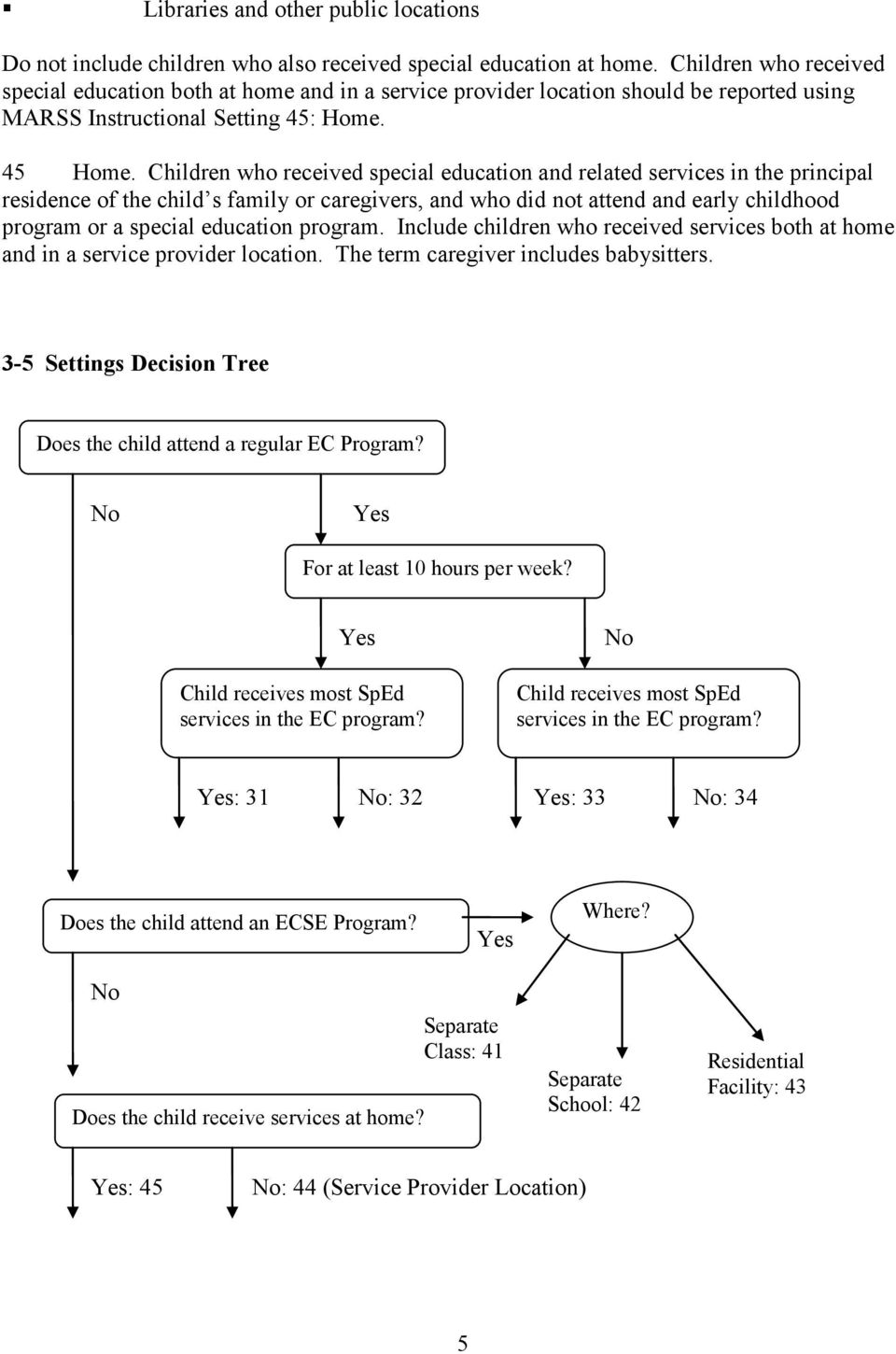
1 Memorandum To: Directors of Special Education; Early Childhood Special Education Coordinators and Lead Teachers, MARSS Contacts From: Barbara O Sullivan, Supervisor of Early Learning Services Carol Hokenson, Supervisor of Program Finance Re: Reporting Instructional Settings for Children Ages 3-5 with Disabilities Date: July 10, 2010 The U.S. Department of Education recently released the approved forms for the upcoming December 1 count of children served under IDEA. The package includes a significant change in the reporting of instructional settings for children ages 3-5. The purpose of this memorandum is to increase the accuracy of instructional setting data reported for young children during the school year. The following pages provide guidance necessary to determine the appropriate Primary Disability Instructional Setting for a child in this age group. It is not possible to crosswalk the 3-5 settings used in previous years to the new settings. Accurate reporting will require ECSE teachers and special educators working with kindergarteners who will still be age 5 on December 1 to fully understand the new Instructional Settings and communicate each child s new code to your MARSS reporter. The enclosed Decision Tree illustrates the considerations that must be made to report children accurately and may be useful to special educators and providers of related services to determine the appropriate instructional settings for individual children. MDE requires accurate reporting of Instructional Settings throughout the year. A new enrollment record must be created each time the child s instructional setting changes. Please address questions regarding the content of this memo to Lisa Backer at [email protected]. Questions regarding MARSS reporting should be addressed to Barb Mattson at [email protected]

2 Determining Instructional Settings for Children Ages 3-5 When determining instructional settings for children ages three through five, use the following rules to decide which MARSS Primary Disability Instructional Setting to use when reporting each child. Please note that the order of the categories does not reflect a continuum from least to most restrictive. The first factor to consider is whether the child attends a regular early childhood program. The child s enrollment in a regular early childhood program does not need to be funded by IDEA, Part B or be based on an IEP team decision to be considered. A regular early childhood program includes at least 50 percent non-disabled children. If so, the child will be reported using MARSS Primary Disability Instructional Setting 31, 32, 33 or 34. Refer to the instructions in the section below to determine which specific category is appropriate. Early childhood programs include, but are not limited to: Head Start Kindergarten Private preschool programs School Readiness Early Childhood Family Education Group child care Reverse mainstream classrooms that include at least 50 percent children without disabilities For each child who does attend a regular early childhood program, the team must then consider the number of hours per week the child spends in the early childhood program or programs and whether or not the child receives the majority of special education and related services in the regular education setting. 31 The child is receiving the majority of hours of special education and related services in the Regular Early Childhood Program (and the child attends a Regular Early Childhood Program at least 10 hours per week). 32 The child is receiving the majority of hours of special education and related services in some other location such as an ECSE classroom or service provider location (and the child attends a Regular Early Childhood Program at least 10 hours per week). 33 The child is receiving the majority of hours of special education and related services in the Regular Early Childhood Program (and the child attends a Regular Early Childhood Program less than 10 hours per week). 34 The child is receiving the majority of hours of special education and related services in some other location such as an ECSE classroom or service provider location (and the child attends a Regular Early Childhood Program less than 10 hours per week). 2
3 If the child DOES NOT attend a regular early childhood program or kindergarten, the next factor to consider is whether the child attends a special education program. If so, the child will be reporting using MARSS Primary Disability Instructional Setting 41, 42, or 43 depending upon the location of the special education program. A special education program is one that includes less than 50% children without disabilities and includes, but is not limited to special instruction and related services provided in: 41 Special education classrooms in Regular school buildings Trailers or portables outside regular school buildings Child care facilities Hospital facilities on an out-patient basis Other community based settings 42 Separate schools; and 43 Residential facilities If the child DOES NOT attend a regular early childhood program or a special education program, the next factor to consider is whether the child receives some or all of his/her special education services in the home. If the child receives any of his/her service in the home, report the child using MARSS Primary Disability Instructional Setting 45: Home. 45 Home If the child does not receive any special education services in an early childhood program, a special education program or the home, report the child using MARSS Primary Disability Instructional Setting code 44: Service Provider Location. 44 Service Provider Location Examples A child attends a child care center (regular early childhood program) 30 hours each week and receives special education and related services within the child care setting. The child s setting is 31: Attends a regular EC program for at least 10 hours per week and receives the majority of special education services in that setting. A child attends School Readiness three half days for a total of 7.5 hours per week. The class is team taught by a School Readiness teacher and an ECSE teacher. Half of the children in the class are children with disabilities. The remaining children do not have identified disabilities. The child receives all special services in the School Readiness classroom. 3

4 The child s setting is 33: Attends a regular early childhood program less than 10 hours per week and receives the majority of special education services in that setting. A child attends a regular early childhood program six hours per week. The ECSE teacher provides 30 minutes of service in the regular EC setting. The child also receives one hour of special education and related services at home and an additional half hour of special education and related services in an elementary resource room. The child s setting is 34: Attends a regular early childhood program less than 10 hours per week and receives the majority of special education services in some other location. A child attends kindergarten (a regular early childhood program) for 16 hours each week and goes to child care for an additional 20 hours. While attending kindergarten the child receives speech/language service in a resource room. The correct setting is 32: Attends a regular EC program for at least 10 hours per week and receives the majority of special education services in some other location. The Primary Disability Instructional Settings in MARSS are defined as follows: 31 Participates in an early childhood or kindergarten program (non-special education) at least 10 hours per week and receives the majority of SpEd services in this setting. 32 Participates in an early childhood or kindergarten program (non-special education) at least 10 hours per week but receives the majority of SpEd services in another location. 33 Participates in an early childhood or kindergarten program (non-special education) up to 10 hours per week and receives the majority of SpEd services in this setting. 34 Participates in an early childhood or kindergarten program (non-special education) up to 10 hours per week but receives the majority of SpEd services in another location. 41 Separate class. Children who attended a special education program in a class with less than 50 percent children without disabilities. Do not include children who also attend a regular early childhood program. These children should be reported using Separate school. Children who received education programs in public or private day schools designed specifically for children with disabilities. Do not include children who also attended a regular early childhood program. These children should be reported using Residential facility. Children who received education programs in publicly or privately operated residential schools or residential medical facilities on an inpatient basis. 44 Service Provider Location: Children who received all of their special education and related services from a service provider, and who did not attend an early childhood program or a special education program. For example, speech instruction provided in: Private clinicians offices Clinicians offices located in school buildings Hospital facilities on an outpatient basis, and 4

5 Libraries and other public locations Do not include children who also received special education at home. Children who received special education both at home and in a service provider location should be reported using MARSS Instructional Setting 45: Home. 45 Home. Children who received special education and related services in the principal residence of the child s family or caregivers, and who did not attend and early childhood program or a special education program. Include children who received services both at home and in a service provider location. The term caregiver includes babysitters. 3-5 Settings Decision Tree Does the child attend a regular EC Program? For at least 10 hours per week? Child receives most SpEd services in the EC program? Child receives most SpEd services in the EC program? : 31 : 32 : 33 : 34 Does the child attend an ECSE Program? Where? Does the child receive services at home? Separate Class: 41 Separate School: 42 Residential Facility: 43 : 45 : 44 (Service Provider Location) 5
ARKANSAS DEPARTMENT OF EDUCATION SPECIAL EDUCATION AND RELATED SERVICES 30.00 EARLY CHILDHOOD SPECIAL EDUCATION. (AGES 3 THROUGH 5 YEARS) July 2008
 ARKANSAS DEPARTMENT OF EDUCATION SPECIAL EDUCATION AND RELATED SERVICES 30.00 EARLY CHILDHOOD SPECIAL EDUCATION (AGES 3 THROUGH 5 YEARS) July 2008 30.01 AUTHORITY AND APPLICABILITY 30.01.1 Statutory Authority.
Individual Education Program (IEP) Form Guidance
 The purpose of the IEP document is to provide a written record of the decisions made at an IEP meeting where parent(s) and school personnel jointly make decisions about the educational program for a student
Special Education NSSRS Data Element Definitions
 Special Education NSSRS Data Element Definitions These definitions are compiled to supplement the Special Education Snapshot instructions in the NSSRS Student Template available on the NSSRS Instructions
Belmont Public Schools Special Education Programs
 Belmont Public Schools Special Education Programs Preschool Program School: Belmont system wide Population Served: Special Education Students Aged 3 5 Grade: Pre K Program Description: This program is
Excerpts from Part 200 of the Regulations Regarding Consultant Teacher Services
 C onsultant teacher services support students with disabilities who are enrolled in general education classes, including career and technical education classes. The intent of consultant teacher services
Name of Grant Program: Early Childhood Special Education Allocation Fund Code: 262
 Name of Grant Program: Early Childhood Special Education Allocation Fund Code: 262 PART IV REQUIRED STATISTICAL INFORMATION please use this template as a working document and submit final numbers through
Here s where we re going. How are EE codes determined? How can we ensure that our data is accurate?
 Welcome to Determining Early Childhood Educational Environment Codes. 1 June, 2015 Type of program EE Codes Location of services Educational Environment (or EE) Codes tell what type of early childhood
Special Education Continuum of Services
 Special Education Continuum of Services Resources Memo from James P. Delorenzo, CONTINUUM OF SPECIAL EDUCATION SERVICES FOR SCHOOL AGE STUDENTS WITH DISABILITIES, April 2008 What does NYS mean by special
August, 2012. Denise Forrest, Coordinator
 August, 2012 Denise Forrest, Coordinator Purpose of Early Childhood Identification & Services (ECID&S) To identify children with potential special education needs who require support to access their education
Service Delivery Models
 Service Delivery Models Anne Arundel County Public Schools (AACPS) is committed to educational excellence by "Elevating all Students, Eliminating all Gaps." To that end, AACPS offers a full continuum of
SPECIAL EDUCATION SERVICE DELIVERY PLAN
 SPECIAL EDUCATION SERVICE DELIVERY PLAN Dubuque Community School District 2300 Chaney Road Dubuque, Iowa 52001 P: 563/552-3000 F: 563/552-3102 www.dbqschools.org DISTRICT DEVELOPED SPECIAL EDUCATION SERVICE
EARLY CHILDHOOD TRANSITION PROCESS
 FALL 2015 EARLY CHILDHOOD TRANSITION PROCESS A guide for helping families of children with special needs prepare for smooth and effective transitions JOHN WHITE STATE SUPERINTENDENT OF EDUCATION Terms
MARSS. (Minnesota Automated Reporting Student System) TRANSPORTATION CATEGORIES
 MARSS (Minnesota Automated Reporting Student System) TRANSPORTATION CATEGORIES Information and Instructions September 2009 Minnesota Department of Education Program Finance Division Pupil Transportation
Appendix F: Guidelines for Calculating Educational Environment
 Appendix F: Guidelines for Calculating Educational Environment Importance of Accurate Educational Environment Reporting Every state is required to provide an annual report of specific data related to the
Mesa Public Schools 63 E. Main Street Mesa, Arizona 85201
 1 Mesa Public Schools 63 E. Main Street Mesa, Arizona 85201 Superintendent Dr. Debra Duvall Assistant Superintendent of Student Services Dr. David Shuff Special Education Department William Santiago Director
Special Education Transportation Reporting SW/WC Service Cooperative RMIC - Region IV
 Special Education Transportation Reporting SW/WC Service Cooperative RMIC - Region IV April 14, 2015 Julie Belisle, MDE Student Transportation Specialist Kelly Wosika, MDE Student Accounting Specialist
Q & A on Statewide Open Enrollment
 Q & A on Statewide Open Enrollment Basic questions 1. Do we have to use the Minnesota Department of Education form for Open Enrollment, and if so, may we modify it? Yes, Minnesota school districts must
PLACEMENT Section 5 TABLE OF CONTENTS
 PLACEMENT Section 5 TABLE OF CONTENTS OREGON LAW AND PORTLAND PUBLIC SCHOOLS SPECIAL EDUCATION POLICIES AND PROCEDURES...5.3 PORTLAND PUBLIC SCHOOLS SPECIAL EDUCATION DISTRICT PROGRAMS...5.11 School Programs
NEW CREDENTIAL PROGRAM PROPOSAL. 1. Title: Education Specialist Credential: Mild to Moderate Disabilities
 CALIFORNIA STATE UNIVERSITY CHANNEL ISLANDS NEW CREDENTIAL PROGRAM PROPOSAL PROGRAM AREA: SPECIAL EDUCATION 1. Title: Education Specialist Credential: Mild to Moderate Disabilities 2. Objectives: The Objective
HOPKINTON PUBLIC SCHOOLS CONTINUUM OF ALTERNATIVE SERVICES AND PLACEMENTS
 HOPKINTON PUBLIC SCHOOLS CONTINUUM OF ALTERNATIVE SERVICES AND PLACEMENTS Hopkinton Public Schools provides programs for students in need of special education from the ages of three through twenty-one,
Selected Readings: NYCTF Guide to NYC Special Education Classroom Settings
 Selected Readings: NYCTF Guide to NYC Special Education Classroom Settings To enhance the observation experience, please find helpful information below on what you can expect to encounter within special
Transition to Early Childhood Special Education A Guide for Parents of Children with Disabilities Who Are Turning Three
 Transition to Early Childhood Special Education A Guide for Parents of Children with Disabilities Who Are Turning Three Originally developed: (1995) Bridging Early Services, Transition Taskforce, Kansas
Open Enrollment Frequently Asked Questions
 Open Enrollment Frequently Asked Questions 1. What is Open Enrollment? Open Enrollment provides parents of CCSD students with another choice. Schools with available seats will be advertised for the purpose
Question 1: What Process was used to develop the delivery system for eligible individuals?
 Colfax-Mingo Special Education Service Delivery Plan June 2015 Question 1: What Process was used to develop the delivery system for eligible individuals? The delivery system was developed in accordance
DC CATS. Early Childhood Outcomes B-7 Administrator Manual. District of Columbia Office of State Special Education
 DC CATS Early Childhood Outcomes B-7 Administrator Manual District of Columbia Office of State Special November 1, 2012 2012-2013 DC CATS User Functionality... 4 Introduction... 4 Agency Affiliation...
PRESCHOOL PLACEMENT CATEGORIES
 PRESCHOOL PLACEMENT CATEGORIES CASEMIS 20 EARLY CHILDHOOD SPECIAL EDUCATION SETTING Early Childhood Special Education Setting: This is a placement setting where children receive all of their special education
SPECIAL EDUCATION SERVICE DELIVERY PLAN
 SPECIAL EDUCATION SERVICE DELIVERY PLAN September 15 th, 2013 September 15 th, 2018 A plan for delivering instructional services including a full continuum of services and placements to address the wide
The Denver Public Schools Personalized Learning Vision. and Framework Urban Collaborative Fall 2014
 The Denver Public Schools Personalized Learning Vision and Framework Urban Collaborative Fall 2014 -Diann Richardson- Director of Special Education -Gene Bamesberger- Associate Director of Special Education
STUDENT LEARNING ASSESSMENT OVERVIEW EARLY CHILDHOOD EDUCATION
 STUDENT LEARNING ASSESSMENT OVERVIEW EARLY CHILDHOOD EDUCATION What early childhood professionals know and can do significantly influence children s development, learning, and success in school. Since
EXTENDED SCHOOL YEAR PROGRAMS AND SERVICES QUESTIONS AND ANSWERS
 EXTENDED SCHOOL YEAR PROGRAMS AND SERVICES QUESTIONS AND ANSWERS 1. Who is eligible for extended school year programs and services? 2. Must the IEP for the extended school year program be identical to
http://www.bls.gov/oco/ocos070.htm Teachers Special Education
 http://www.bls.gov/oco/ocos070.htm Teachers Special Education * Nature of the Work * Training, Other Qualifications, and Advancement * Employment * Job Outlook * Projections Data * Earnings * OES Data
IDENTIFICATION AND ASSESSMENT OF ENGLISH LANGUAGE LEARNERS
 IDENTIFICATION AND ASSESSMENT OF ENGLISH LANGUAGE LEARNERS CHAPTER 3 INDEX 3.1 PURPOSE AND SCOPE... 3 1 3.2 IDENTIFICATION AND REFERRAL OF ENGLISH LEARNERS SUSPECTED OF HAING A DISABILITY... 3 1 3.3 SPECIAL
Special Education For Preschoolers
 C A L I F O R N I A E A R L Y S T A R T Special Education For Preschoolers A G U I D E F O R P A R E N T S Early Intervention services system encouraging partnerships between families and professionals,
PROGRAM REVIEW 08-09
 CHILD DEVELOPMENT BOARD APPROVED 4/13/10 PROGRAM REVIEW 08-09 ONE COLLEGE WAY BLYTHE, CA 92225 EXECUTIVE SUMMARY CHILD DEVELOPMENT The Child Development program at Palo Verde College serves an important
The Least Restrictive Environment (LRE): Question & Answer Document
 The Least Restrictive Environment (LRE): Question & Answer Document A collaborative project of the Texas Education Agency and the Statewide Access to the General Curriculum Network Copyright Notice These
TENNESSEE STATE BOARD OF EDUCATION
 Policy for Local School Systems To establish early childhood education and parent involvement programs of high quality, the State Board of Education adopts the following policy: 1. Subject to the rules,
Frequently Asked Questions: Masters and Certification Programs in Early Childhood Special Education (ECSE) Preschool Special Education Endorsement
 Frequently Asked Questions: Masters and Certification Programs in Early Childhood Special Education (ECSE) Preschool Special Education Endorsement Department of Educational Psychology, Special Education,
Dear Parent, Sincerely, [Name] [Title]
![Dear Parent, Sincerely, [Name] [Title]](/thumbs/26/9135570.jpg "Dear Parent, Sincerely, [Name] [Title]") Struthers City School District Bylaws & Policies 2261.02 - TITLE I PARENTS RIGHT TO KNOW In accordance with the requirement of Federal law, for each school receiving Title I funds, the Superintendent shall
Struthers City School District Bylaws & Policies 2261.02 - TITLE I PARENTS RIGHT TO KNOW In accordance with the requirement of Federal law, for each school receiving Title I funds, the Superintendent shall
MUNIS certification reference rev. Rev. Aug. 2012
 0010 School District Superintendent School Superintendent 0020 School District Deputy Supt School Superintendent 0030 School District Asst Supt School Superintendent 0040 Director of Finance & Business
St. Joseph County Intermediate School District. Plan for Delivery of Special Education Programs and Services
 St. Joseph County Intermediate School District Plan for Delivery of Special Education Programs and Services July 2003 TABLE OF CONTENTS DOCUMENT ENDORSEMENT Local District/ISD Endorsement 1 Local District/ISD
SPECIAL EDUCATION POLICIES. Oklahoma State Department of Special Education Services 405-521-3351 http://ok.gov/sde/special-education
 SPECIAL EDUCATION POLICIES Oklahoma State Department of Special Education Services 405-521-3351 http://ok.gov/sde/special-education Special Education Policies Oklahoma State Department of Education Janet
Careers in Education. Pre-school, daycare Education
 Careers in Education Pre-school, daycare and K-12 K Education What academic programs are there that lead to the various levels of Teachers and Support Staff? Early Childhood Professional (Pre- school and
Early Childhood Education
 Early Childhood Education Four-year-olds and Younger to Grade 3 JULY 2010 Early Childhood Education Four-year-olds and Younger to Grade 3 Page 6 Highly Qualified Requirements At a Glance No Child Left
Staffing Requirements 1. and retain such personnel. All special education teachers K-12 must be highly qualified by
 Staffing Requirements 1 Newport News Public Schools understands the need to retain highly qualified and appropriately and adequately trained personnel with the knowledge and skills to provide special education
(cf. 4112.24 - Teacher Qualifications Under the No Child Left Behind Act)
 Victor ESD Administrative Regulation AR 4112.23(a) Certificated Personnel SPECIAL EDUCATION STAFF Qualifications/Assignment of Special Education Teachers Any teacher assigned to serve students with disabilities
Improving Classroom Management
 Improving Classroom Management Research suggests ways administrators and staff developers can help teachers with the important task of organizing and managing classrooms. Julie P. Sanford, Edmund T. Emmer,
Special Education FTE 101
 Special Education FTE 101 Let s Start at the Very Beginning.A Very Good Place to Start! FY15 Georgia Department of Education Data Collections Conference Dr. John D. Barge, State School Superintendent Dr.
Chapter 89. Adaptations for Special Populations. Subchapter D. Special Education Services and Settings
 Chapter 89. Adaptations for Special Populations Subchapter D. Special Education Services and Settings 89.61. Contracting for Residential Educational Placements for Students with Disabilities. Residential
5-K: SPECIAL EDUCATION EARLY CHILDHOOD PROGRAMS AND SERVICES
 5-K: SPECIAL EDUCATION EARLY CHILDHOOD PROGRAMS AND SERVICES The only pupils under the age of five who may be counted in membership are pupils with an individualized educational program (IEP) or an individualized
Continuum of Special Education Services for School-Age Students with Disabilities. April 2008 (Updated November 2013)
 Continuum of Special Education Services for School-Age Students with Disabilities April 2008 (Updated November 2013) The University of the State of New York The State Education Department Office of P-12
Jennifer Champagne O Connor
 VITA Fall 2010 Jennifer Champagne O Connor 4172 Cornwall Home Tel: (248) 420-0493 Berkley, MI 48072 Email: [email protected] Degrees EDUCATION 2009-Present Ph.D. (in progress) for Early
School of Education MASTER OF SCIENCE IN EARLY CHILDHOOD EDUCATION. MSED: Early Childhood Education
 School of Education MASTER OF SCIENCE IN EARLY CHILDHOOD EDUCATION : Early Childhood Education 2012-2014 Master of Science in Education () (Early Childhood Education) Purpose The Master of Science in Education
Trained teacher aides can. Child Development. Career & Employment Possibilities
 Child Applied Science Degree Program at Harold Washington College ü (AAS) ü Associate in Arts (AA) ü Advanced Certificate (AC) Trained teacher aides can assist in providing a healthy environment for the
NYC Department of Education Flexible Programming Guide. March 2012
 NYC Department of Education Flexible Programming Guide (Using the Full Continuum of Special Education Programs and Services) March 2012 Updated March 20, 2012 Page 1 For too long, educating students with
Financing Special Education in New Jersey New Jersey School Boards Association September 2007. History of Special Education in New Jersey
 Financing Special Education in New Jersey New Jersey School Boards Association September 2007 History of Special Education in New Jersey Establishment. By an act of the legislature in 1911, New Jersey
Admissions Requirements
 Special Education Dickinson Hall, Rooms 300F, 304 (501) 569-3124, (501) 569-8710, (501) 569-8922 Master of Education in Special Education The Master of Education in Special Education (SPED) prepares candidates
Continuum of Alternative Placements
 Continuum of Alternative Placements ARSD 24:05:28:01. Least restrictive program to be provided. Children in need of special education or special education and related services, to the maximum extent appropriate,
April 2008 SUBJECT: CONTINUUM OF SPECIAL EDUCATION SERVICES FOR SCHOOL-AGE STUDENTS WITH DISABILITIES
 THE STATE EDUCATION DEPARTMENT / THE UNIVERSITY OF THE STATE OF NEW YORK / ALBANY, NY 12234 OFFICE OF VOCATIONAL AND EDUCATIONAL SERVICES FOR INDIVIDUALS WITH DISABILITIES STATEWIDE COORDINATOR FOR SPECIAL
Bulletin 140 Guidance Performance Profile Rating
 Bulletin 140 Guidance Performance Profile Rating Overview Objectives: 1. Review Lead Agency Expectations and Role for the 2015-2016 Learning Year 2. Describe the purpose and focus of the Performance Profiles
Supporting Families in Transition between Early Intervention and School Age Programs
 Supporting Families in Transition between Early Intervention and School Age Programs by Cheryl Johnson, Special Education Unit, Colorado Department of Education The transitions between early intervention
Office of Special Education. Programs & Resources Guide for Families
 Office of Special Education Programs & Resources Guide for Families 2013 2014 2 OFFICE OF SPECIAL EDUCATION PROGRAMS & RESOURCES GUIDE Table of Contents Letter from the Chief of Special Education 2 Overview
Speech- Language Pathologists in Your Child s School
 Speech- Language Pathologists in Your Child s School What does the SLP do in schools? Screen students to find out if they need further speech and language testing. Evaluate speech and language skills.
UXBRIDGE PUBLIC SCHOOLS GUIDE TO SPECIAL EDUCATION PROGRAMS
 1 UXBRIDGE PUBLIC SCHOOLS GUIDE TO SPECIAL EDUCATION PROGRAMS This guide provides an overview of programs that are available for students 3 through 21 years old. Information outlined includes program descriptions,
Preschool Learning Center
 Preschool Learning Center GUIDELINES AND INFORMATION ON FEEDING AND SAFE MEALTIME PRACTICES FOR STUDENTS IN A SCHOOL SETTING I. RATIONALE FOR FEEDING GUIDELINES The number of children with severe disabilities
Determining Least Restrictive Environment (LRE) Placements for Preschool Children with Disabilities: Reference Points and Discussion Prompts
 The Early Childhood Technical Assistance Center Determining Least Restrictive Environment (LRE) Placements for Preschool Children with Disabilities: Reference Points and Discussion Prompts October 27,
eci early childhood intervention Planning Transition conference or Meeting Next Steps Terms You may hear Resources Timelines Regulations
 beyond early childhood intervention eci Planning Moving on from the Texas Early Childhood Intervention (ECI) Program! This booklet will help your family make the transition from ECI. Transition conference
SUMMARY OF NAEYC AND NACCP ACCREDITATION
 Overview: SUMMARY OF NAEYC AND ACCREDITATION Overview: NAEYC Accreditation National Association for the Education of Young Children Accreditation National Accreditation Commission NAEYC Purpose The purpose
ARLINGTON PUBLIC SCHOOLS SPECIAL EDUCATION PROGRAMS AND SERVICES
 ARLINGTON PUBLIC SCHOOLS SPECIAL EDUCATION PROGRAMS AND SERVICES Introduction The Arlington Public Schools provides a comprehensive array of programs and services from pre-school through grades 12 designed
Certification Teacher Competencies and Skills 1
 Attachment 1 Voluntary Prekindergarten (VPK) Education Instructor Credentials Bachelor s and Related Certification Coverages/Teacher Competencies and Skills Current Bachelor s Early Childhood Education/Preschool
Highly Qualified Exceptional Student Education Teachers. Questions and Answers
 Florida Department of Education Bureau of Exceptional Education and Student Services Highly Qualified Exceptional Student Education Teachers Questions and Answers Exceptional student education (ESE) teachers
Middle Georgia State College School of Education
 Early Childhood Special Education (B.S.) The Early Childhood Special Education program prepares the candidate to provide educational services for all students in grades P-5, including those with disabilities