
McAfee Policy Auditor software
|
|
|
- Verity Johns
- 10 years ago
- Views:
Transcription
1 McAfee Policy Auditor software
2 COPYRIGHT Copyright 2013 McAfee, Inc. Do not copy without permission. TRADEMARK ATTRIBUTIONS McAfee, the McAfee logo, McAfee Active Protection, McAfee AppPrism, McAfee Artemis, McAfee CleanBoot, McAfee DeepSAFE, epolicy Orchestrator, McAfee epo, McAfee EMM, McAfee Enterprise Mobility Management, Foundscore, Foundstone, McAfee NetPrism, McAfee Policy Enforcer, Policy Lab, McAfee QuickClean, Safe Eyes, McAfee SECURE, SecureOS, McAfee Shredder, SiteAdvisor, SmartFilter, McAfee Stinger, McAfee Total Protection, TrustedSource, VirusScan, WaveSecure, WormTraq are trademarks or registered trademarks of McAfee, Inc. or its subsidiaries in the United States and other countries. Other names and brands may be claimed as the property of others. LICENSE INFORMATION NOTICE TO ALL USERS: CAREFULLY READ THE APPROPRIATE LEGAL AGREEMENT CORRESPONDING TO THE LICENSE YOU PURCHASED, WHICH SETS FORTH THE GENERAL TERMS AND CONDITIONS FOR THE USE OF THE LICENSED SOFTWARE. IF YOU DO NOT KNOW WHICH TYPE OF LICENSE YOU HAVE ACQUIRED, PLEASE CONSULT THE SALES AND OTHER RELATED LICENSE GRANT OR PURCHASE ORDER DOCUMENTS THAT ACCOMPANY YOUR SOFTWARE PACKAGING OR THAT YOU HAVE RECEIVED SEPARATELY AS PART OF THE PURCHASE (AS A BOOKLET, A FILE ON THE PRODUCT CD, OR A FILE AVAILABLE ON THE WEBSITE FROM WHICH YOU DOWNLOADED THE SOFTWARE PACKAGE). IF YOU DO NOT AGREE TO ALL OF THE TERMS SET FORTH IN THE AGREEMENT, DO NOT INSTALL THE SOFTWARE. IF APPLICABLE, YOU MAY RETURN THE PRODUCT TO MCAFEE OR THE PLACE OF PURCHASE FOR A FULL REFUND. 2
3 Contents Introducing McAfee Policy Auditor Audience Conventions Finding product documentation Getting started with McAfee Policy Auditor Introduction to compliance audits Auditing systems What's new Software components and what they do Use of epolicy Orchestrator software features Managed systems vs. unmanaged systems Configuring McAfee Policy Auditor Server settings and what they control Edit McAfee Policy Auditor server settings How permission sets work Default permission sets Edit permission sets Using the McAfee Policy Auditor agent plug-in The agent plug-in and how it works Supported platforms How content is managed Install and uninstall the agent plug-in Install the McAfee Policy Auditor agent plug-in Uninstall the agent plug-in Send a manual wake-up call to a group of systems Display the system tray icon on Windows systems Configuring agentless audits How McAfee Policy Auditor integrates with the McAfee Vulnerability Manager extension Uniform system management McAfee Vulnerability Manager extension integration with scannable systems Asset Discovery scans
4 Contents Data collection scans The Maintain Foundstone Audits server task The Data Import server task Server support Configure McAfee Vulnerability Manager and the epolicy Orchestrator extension Create a McAfee Vulnerability Manager workgroup Configure the McAfee Vulnerability Manager single sign-on feature Create a data source to synchronize McAfee Vulnerability Manager and epolicy Orchestrator Register a McAfee Vulnerability Manager database server with McAfee Policy Auditor Manage McAfee Vulnerability Manager credential sets Create an Asset Discovery scan Create an MVM Data Import task Add systems found by McAfee Vulnerability Manager scans to the System Tree Create a Data Collection Scan View McAfee Vulnerability Manager scan status How to handle missing audit results Troubleshoot missing audit results How to handle mismatched McAfee Vulnerability Manager certificates Troubleshoot mismatched McAfee Vulnerability Manager certificates Creating and managing audits Audits and how they work Audit frequency When audits are run Per audit data maintenance Benchmark profiles and their effect on audits Considerations for including systems in an audit Benchmark labels and how they are used Findings Agentless audits Activate benchmarks Tailor a benchmark Create an audit Run an audit manually Disable an audit Delete audits Audit whiteout and blackout periods Set whiteout and blackout periods

5 Contents Service Level Agreements Create, edit, and delete Service Level Agreements How viewing audit results works Exporting audits and audit results Export audits Scoring Audits Default scoring model Flat unweighted scoring model Flat scoring model Absolute scoring model Changing the scoring model Managing Audit Waivers Types of waivers Exception waivers Exemption waivers Suppression waivers Waiver status Filtering waivers by status How start and expiration dates work Examples of filtering waivers by date Filtering waivers by date Filtering waivers by group How waiver requests and grants work Requesting waivers Granting waivers Making waivers expire Deleting waivers File Integrity Monitoring and entitlement reporting How file integrity monitoring works File information monitored File baselines Monitored and excluded files File versioning File version comparison Accept file integrity monitoring events Purge file integrity monitoring events

6 Contents Entitlement reporting Create and apply a file integrity monitoring policy Create a file integrity monitoring policy Apply a policy to systems Compare file versions Accept file integrity monitoring events Purge file integrity monitoring events Create a new file integrity monitoring baseline Query reports for file integrity monitoring Rollup reporting Rollup capabilities Rollup reporting considerations Rollup server tasks Rollup Data - PA: Audit Benchmark Results Rollup Data - PA: Audit Rule Result Rollup Data - PA: Audit Patch Check Result Rollup reports Configure rollup reporting Findings How findings work Types of violations Violation limit Other Findings enhancements Hide or unhide Findings results Dashboards and Queries Policy Auditor default dashboards PA: Compliance Summary dashboard PA: MS Patch Status Summary dashboard PA: Operations PA: Patch supersedence PA: PCI Summary Queries as dashboard monitors Policy Auditor agent plug-in debug tool Execute the agent plug-in debug tool Display help Run an audit

7 Contents Run a benchmark Run a check Save debug information Appendix A: Implementing the Security Content Automation Protocol Statement of FDCC compliance Statement of SCAP implementation Statement of CVE implementation Statement of CCE implementation Statement of CPE implementation Statement of CVSS implementation Statement of XCCDF implementation Statement of OVAL implementation Appendix B: Common Criteria requirements
8 Introducing McAfee Policy Auditor McAfee Policy Auditor automates the process required for system compliance audits. It measures compliance by comparing the actual configuration of a system to the desired state of a system. To understand what the software does and how to use it, you must be familiar with these basics: What an audit is, when you should use it, and why you should use it. The supported deployment solutions based on the type(s) of systems you want to audit. The system classifications that determine which functional components can be used. The functional components you can use to audit systems. This includes leveraging the software with McAfee Policy Auditor and other McAfee and third-party software. The functional components you can use to audit systems. This includes leveraging the software with McAfee Vulnerability Manager and other McAfee and third-party software. This document introduces these concepts, successively builds your understanding, and provides details about the use of each functional component. In addition, it helps you understand how the software fits into the framework provided by McAfee epolicy Orchestrator. Contents Audience Conventions Finding product documentation Audience McAfee documentation is carefully researched and written for the target audience. The information in this guide is intended primarily for two audiences: Network administrators who are responsible for implementing and enforcing the policy for protecting the company's intellectual property. Security officers who are responsible for determining sensitive and confidential data, and defining the corporate policy that protects the company's intellectual property. 8
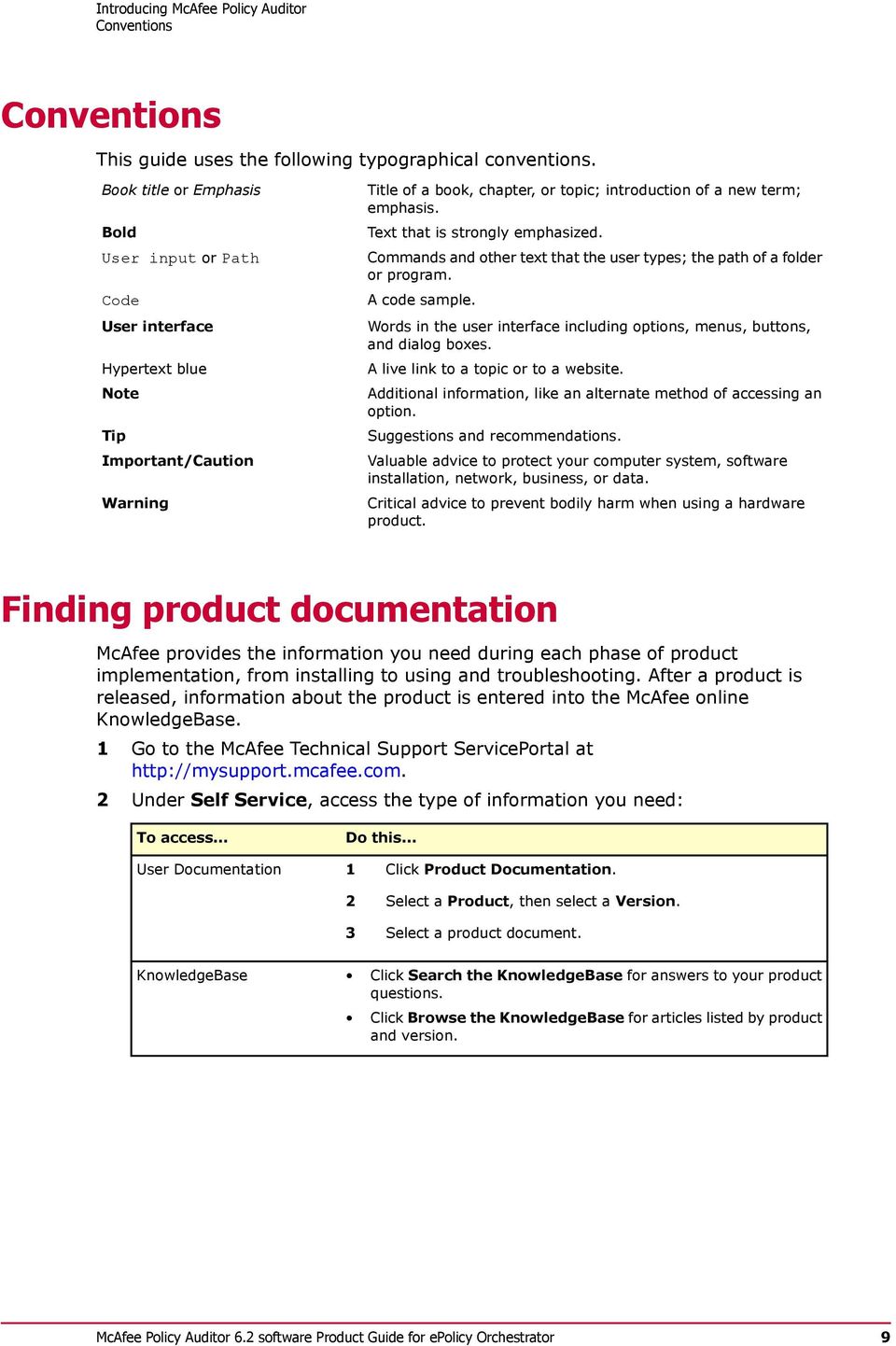
9 Introducing McAfee Policy Auditor Conventions Conventions This guide uses the following typographical conventions. Book title or Emphasis Bold User input or Path Code User interface Hypertext blue Note Tip Important/Caution Warning Title of a book, chapter, or topic; introduction of a new term; emphasis. Text that is strongly emphasized. Commands and other text that the user types; the path of a folder or program. A code sample. Words in the user interface including options, menus, buttons, and dialog boxes. A live link to a topic or to a website. Additional information, like an alternate method of accessing an option. Suggestions and recommendations. Valuable advice to protect your computer system, software installation, network, business, or data. Critical advice to prevent bodily harm when using a hardware product. Finding product documentation McAfee provides the information you need during each phase of product implementation, from installing to using and troubleshooting. After a product is released, information about the product is entered into the McAfee online KnowledgeBase. 1 Go to the McAfee Technical Support ServicePortal at 2 Under Self Service, access the type of information you need: To access... Do this... User Documentation 1 Click Product Documentation. 2 Select a Product, then select a Version. 3 Select a product document. KnowledgeBase Click Search the KnowledgeBase for answers to your product questions. Click Browse the KnowledgeBase for articles listed by product and version. 9
10 Getting started with McAfee Policy Auditor McAfee Policy Auditor is an extension to epolicy Orchestrator software versions 4.5, 4.6, and 5.0 that automates the process for risk and compliance system audits. Audits can perform tasks such as check system settings, including password length, open or closed ports, file changes, and the presence of software updates. Contents Introduction to compliance audits Auditing systems What's new Software components and what they do Use of epolicy Orchestrator software features Managed systems vs. unmanaged systems Introduction to compliance audits Before using McAfee Policy Auditor, it is important to understand what audits are, when you should use them, and why you should use them. What are compliance audits? A compliance audit is a comprehensive review of an organization's adherence to external regulatory guidelines or internal best practices. McAfee Policy Auditor automates the compliance audit process and allows you to demonstrate compliance to auditors by producing an audit trail showing compliance, compliance history, and actions taken to mitigate risks. Organizations that are out of compliance might be subject to fines or other sanctions, including criminal liability. When should you use audits? Use compliance audits when you are subject to government regulations that require your organization to determine system compliance and maintain records. You should also use audits to determine compliance with organizational requirements such as password complexity, password length, the presence of unsupported software, and software patch requirements. Why should you use audits? McAfee Policy Auditor automates the process for mandated and organizational audits. Its companion product, McAfee Benchmark Editor, contains built-in benchmarks that the software can use for mandated audits, such as Sarbanes-Oxley (SOX) and the Payment Card Industry Data Security Standards (PCI DSS). The reporting 10
11 Getting started with McAfee Policy Auditor Auditing systems system allows you to demonstrate compliance to auditors while the Findings feature helps you to find solutions to audit issues. Auditing systems An audit is an independent evaluation of a computer system to determine whether it is in compliance with corporate and industry security standards. Audit results show recommended improvements to reduce risks. McAfee Policy Auditor evaluates systems against independent standards developed by government and private industry. It can also evaluate systems against standards that you create yourself. McAfee Policy Auditor uses audits to determine the compliance status of systems and returns results indicating any areas where the system is out of compliance. Scoring audits When you audit a system with McAfee Policy Auditor, it returns a score indicating how well the system complied with the audit. McAfee Policy Auditor supports the four scoring models described in the extensible Configuration Checklist Description Format (XCCDF) 1.2 specifications. What's new McAfee Policy Auditor has a number of new features to enhance user experience and expand capabilities. These are the major new features for this software release: Patch supersedence As new patches are released, some replace or supersede older patches, and some patches become obsolete. McAfee Policy Auditor now reports which patches are the latest that you need to apply to your systems. Support for SCAP 1.2 The software adds support for Security Content Automation Protocol (SCAP) version 1.2. SCAP 1.2 support includes importing Data Stream and Data Streams with Tailoring. The product also supports SCAP version 1.0 and NOTE: McAfee Vulnerability Manager 7.5 does not support SCAP 1.2. SCAP 1.2 content in audits will not run when integrating McAfee Policy Auditor 6.2 and McAfee Vulnerability Manager 7.5. Support for OVAL The software adds support for Open Vulnerability and Assessment Language (OVAL) version NOTE: OVAL contains deprecated items that are supported in McAfee Policy Auditor 6.2 until these items are completely removed from the schema. Agent support for new operating system platforms The McAfee Policy Auditor agent plug-in supports these new platforms: Debian 5.0 and 6.0 Solaris 11 Microsoft Windows 8 11
12 Getting started with McAfee Policy Auditor Software components and what they do Microsoft Windows 2012 Support for McAfee epolicy Orchestrator 5.0 Software components and what they do McAfee Policy Auditor installs components that help you analyze systems for compliance with recognized, open-source standards and standards that you can create yourself. These are the McAfee Policy Auditor components as they appear in the interface: Benchmark Editor A utility used to enable, disable, create, and edit benchmarks. Each audit must contain at least one benchmark. Ideally, audits should contain only one benchmark. Benchmark Editor Content Distributor Distributes content downloaded from McAfee Labs to systems. Findings Manages findings, which help you understand why an audit check failed and provides information about how to fix the problem. PACore The primary portion of the software that controls all other features. PARollup Uses the rollup capabilities of epolicy Orchestrator software to collect summary information from registered epolicy Orchestrator servers and show aggregated data. Policy Auditor Handles policy and task management, audit schedules, and system management. McAfee Policy Auditor agent plug-in The McAfee Policy Auditor agent plug-in expands the ability of the McAfee Agent to support McAfee Policy Auditor. When audits are deployed to systems with the McAfee Agent, the agent plug-in determines when the audits should be run. The agent plug-in conducts audits at the appropriate time and returns the results to the epolicy Orchestrator server. The agent plug-in can conduct audits when the managed system is off the network, and returns results to the epolicy Orchestrator server once the system is reconnected to the network. Installing the agent plug-in adds a product icon to the McAfee Agent system tray. In Windows environments, the product icon optionally displays a balloon tip to indicate the system is being audited. Systems that have the McAfee Policy Auditor agent plug-in installed are known, in McAfee Policy Auditor terminology, as managed systems. Use of epolicy Orchestrator software features McAfee Policy Auditor is an extension of epolicy Orchestrator software, and uses and relies upon many of its features. McAfee Policy Auditor is configured from the epolicy Orchestrator server. The epolicy Orchestrator server is the center of your managed environment and provides a single location where you can administer and monitor security settings throughout 12

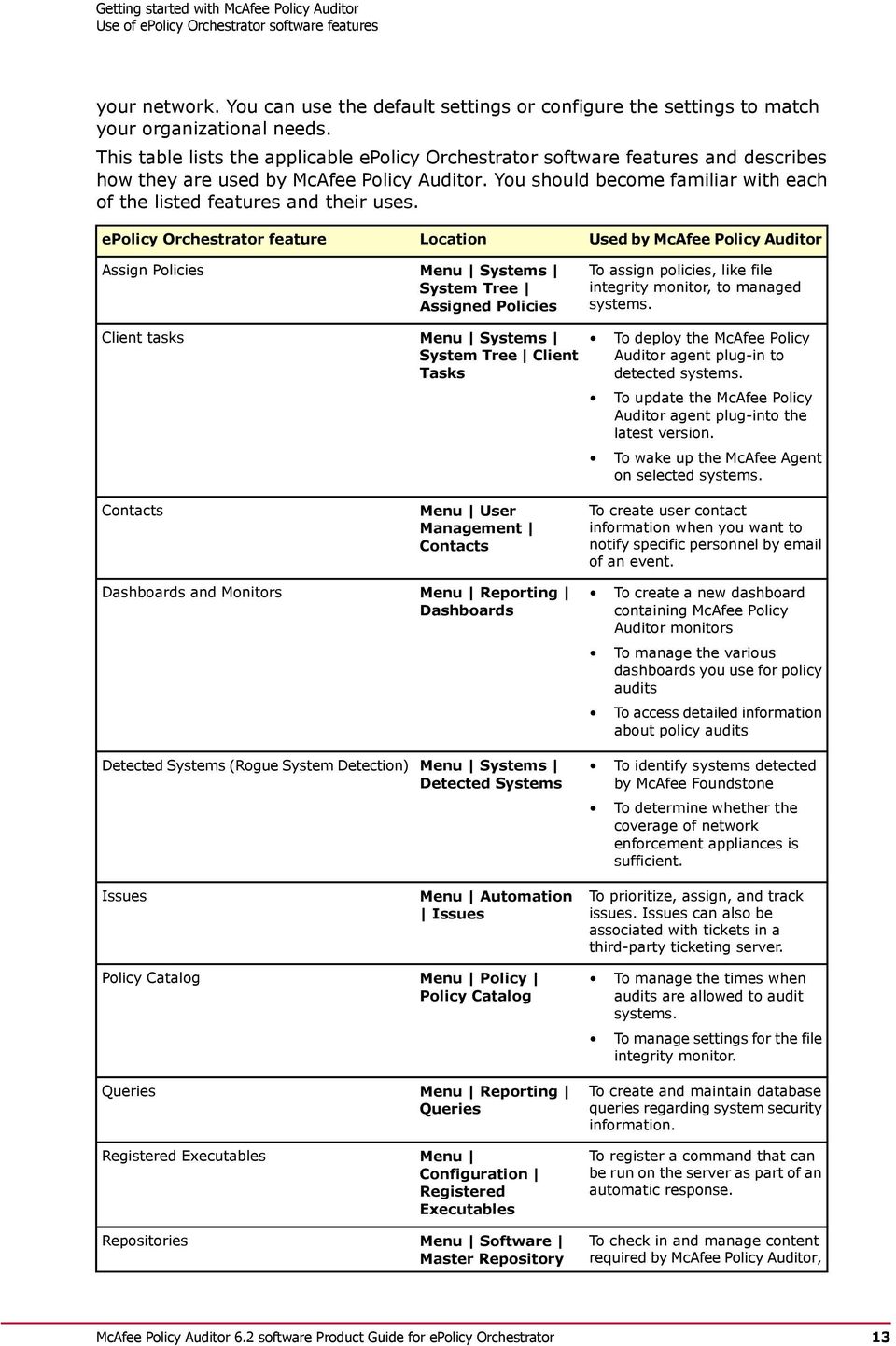
13 Getting started with McAfee Policy Auditor Use of epolicy Orchestrator software features your network. You can use the default settings or configure the settings to match your organizational needs. This table lists the applicable epolicy Orchestrator software features and describes how they are used by McAfee Policy Auditor. You should become familiar with each of the listed features and their uses. epolicy Orchestrator feature Assign Policies Location Menu Systems System Tree Assigned Policies Used by McAfee Policy Auditor To assign policies, like file integrity monitor, to managed systems. Client tasks Menu Systems To deploy the McAfee Policy System Tree Client Auditor agent plug-in to Tasks detected systems. To update the McAfee Policy Auditor agent plug-into the latest version. To wake up the McAfee Agent on selected systems. Contacts Menu User Management Contacts To create user contact information when you want to notify specific personnel by of an event. Dashboards and Monitors Menu Reporting To create a new dashboard Dashboards containing McAfee Policy Auditor monitors To manage the various dashboards you use for policy audits To access detailed information about policy audits Detected Systems (Rogue System Detection) Menu Systems To identify systems detected Detected Systems by McAfee Foundstone To determine whether the coverage of network enforcement appliances is sufficient. Issues Menu Automation Issues To prioritize, assign, and track issues. Issues can also be associated with tickets in a third-party ticketing server. Policy Catalog Menu Policy To manage the times when Policy Catalog audits are allowed to audit systems. To manage settings for the file integrity monitor. Queries Registered Executables Repositories Menu Reporting Queries Menu Configuration Registered Executables Menu Software Master Repository To create and maintain database queries regarding system security information. To register a command that can be run on the server as part of an automatic response. To check in and manage content required by McAfee Policy Auditor, 13
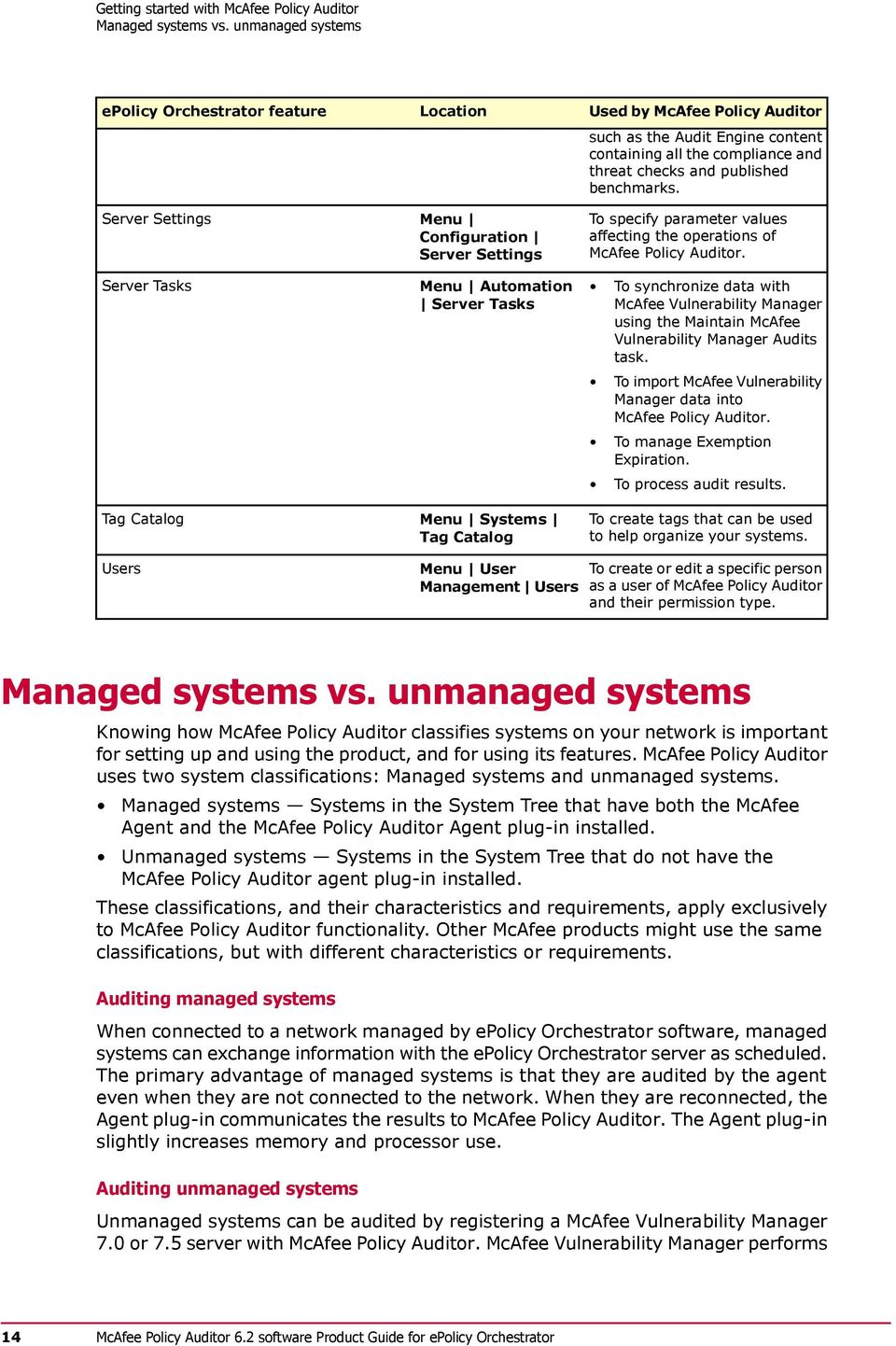
14 Getting started with McAfee Policy Auditor Managed systems vs. unmanaged systems epolicy Orchestrator feature Server Settings Location Menu Configuration Server Settings Used by McAfee Policy Auditor such as the Audit Engine content containing all the compliance and threat checks and published benchmarks. To specify parameter values affecting the operations of McAfee Policy Auditor. Server Tasks Menu Automation Server Tasks To synchronize data with McAfee Vulnerability Manager using the Maintain McAfee Vulnerability Manager Audits task. To import McAfee Vulnerability Manager data into McAfee Policy Auditor. To manage Exemption Expiration. To process audit results. Tag Catalog Menu Systems Tag Catalog To create tags that can be used to help organize your systems. Users Menu User Management Users To create or edit a specific person as a user of McAfee Policy Auditor and their permission type. Managed systems vs. unmanaged systems Knowing how McAfee Policy Auditor classifies systems on your network is important for setting up and using the product, and for using its features. McAfee Policy Auditor uses two system classifications: Managed systems and unmanaged systems. Managed systems Systems in the System Tree that have both the McAfee Agent and the McAfee Policy Auditor Agent plug-in installed. Unmanaged systems Systems in the System Tree that do not have the McAfee Policy Auditor agent plug-in installed. These classifications, and their characteristics and requirements, apply exclusively to McAfee Policy Auditor functionality. Other McAfee products might use the same classifications, but with different characteristics or requirements. Auditing managed systems When connected to a network managed by epolicy Orchestrator software, managed systems can exchange information with the epolicy Orchestrator server as scheduled. The primary advantage of managed systems is that they are audited by the agent even when they are not connected to the network. When they are reconnected, the Agent plug-in communicates the results to McAfee Policy Auditor. The Agent plug-in slightly increases memory and processor use. Auditing unmanaged systems Unmanaged systems can be audited by registering a McAfee Vulnerability Manager 7.0 or 7.5 server with McAfee Policy Auditor. McAfee Vulnerability Manager performs 14
15 Getting started with McAfee Policy Auditor Managed systems vs. unmanaged systems the audits and returns the results to McAfee Policy Auditor. The primary advantage of unmanaged systems is that you can audit them without installing an agent. Unmanaged systems cannot be audited when they are disconnected from the network. NOTE: McAfee Vulnerability Manager 7.5 does not support SCAP 1.2. SCAP 1.2 content in audits will not run when integrating McAfee Policy Auditor 6.2 and McAfee Vulnerability Manager

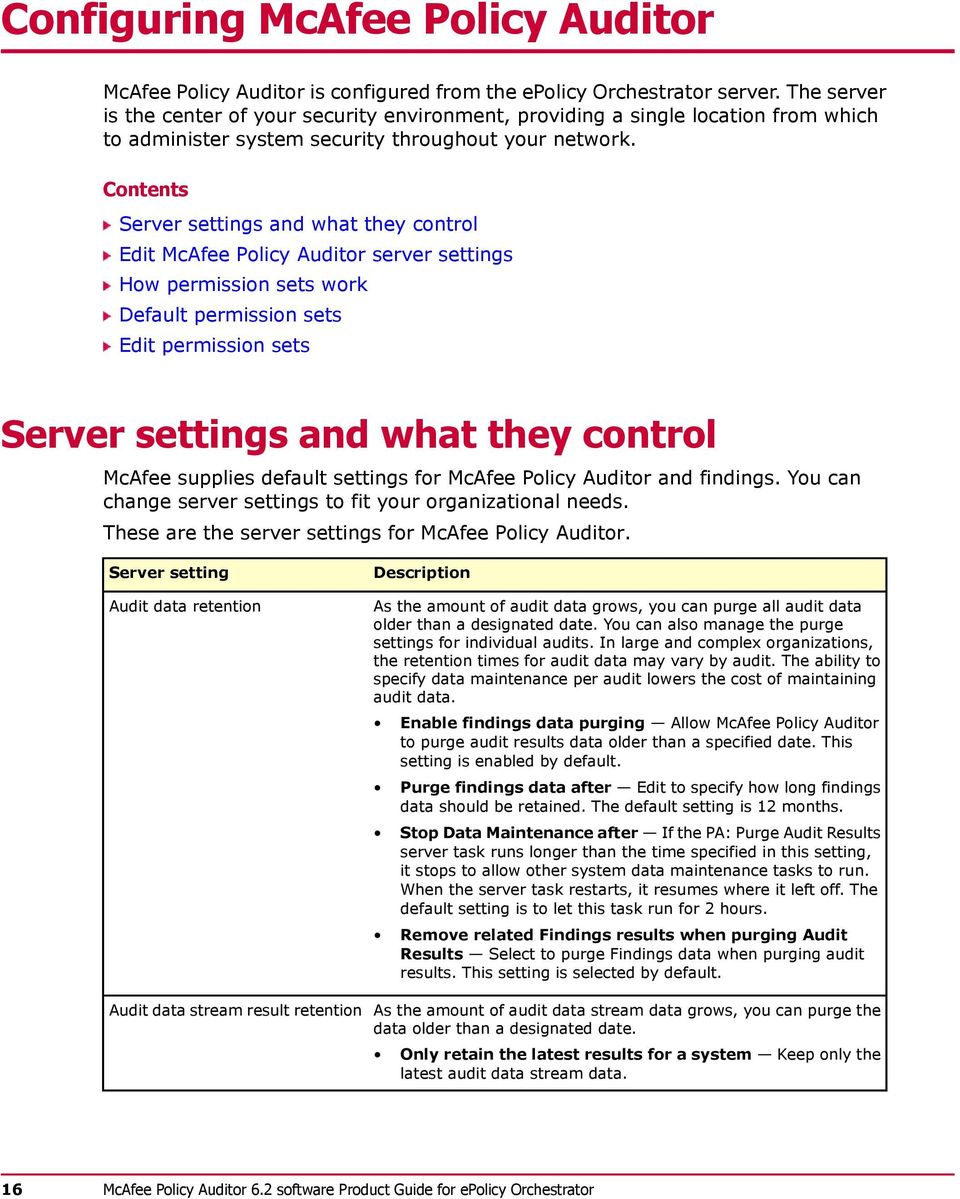
16 Configuring McAfee Policy Auditor McAfee Policy Auditor is configured from the epolicy Orchestrator server. The server is the center of your security environment, providing a single location from which to administer system security throughout your network. Contents Server settings and what they control Edit McAfee Policy Auditor server settings How permission sets work Default permission sets Edit permission sets Server settings and what they control McAfee supplies default settings for McAfee Policy Auditor and findings. You can change server settings to fit your organizational needs. These are the server settings for McAfee Policy Auditor. Server setting Audit data retention Description As the amount of audit data grows, you can purge all audit data older than a designated date. You can also manage the purge settings for individual audits. In large and complex organizations, the retention times for audit data may vary by audit. The ability to specify data maintenance per audit lowers the cost of maintaining audit data. Enable findings data purging Allow McAfee Policy Auditor to purge audit results data older than a specified date. This setting is enabled by default. Purge findings data after Edit to specify how long findings data should be retained. The default setting is 12 months. Stop Data Maintenance after If the PA: Purge Audit Results server task runs longer than the time specified in this setting, it stops to allow other system data maintenance tasks to run. When the server task restarts, it resumes where it left off. The default setting is to let this task run for 2 hours. Remove related Findings results when purging Audit Results Select to purge Findings data when purging audit results. This setting is selected by default. Audit data stream result retention As the amount of audit data stream data grows, you can purge the data older than a designated date. Only retain the latest results for a system Keep only the latest audit data stream data. 16
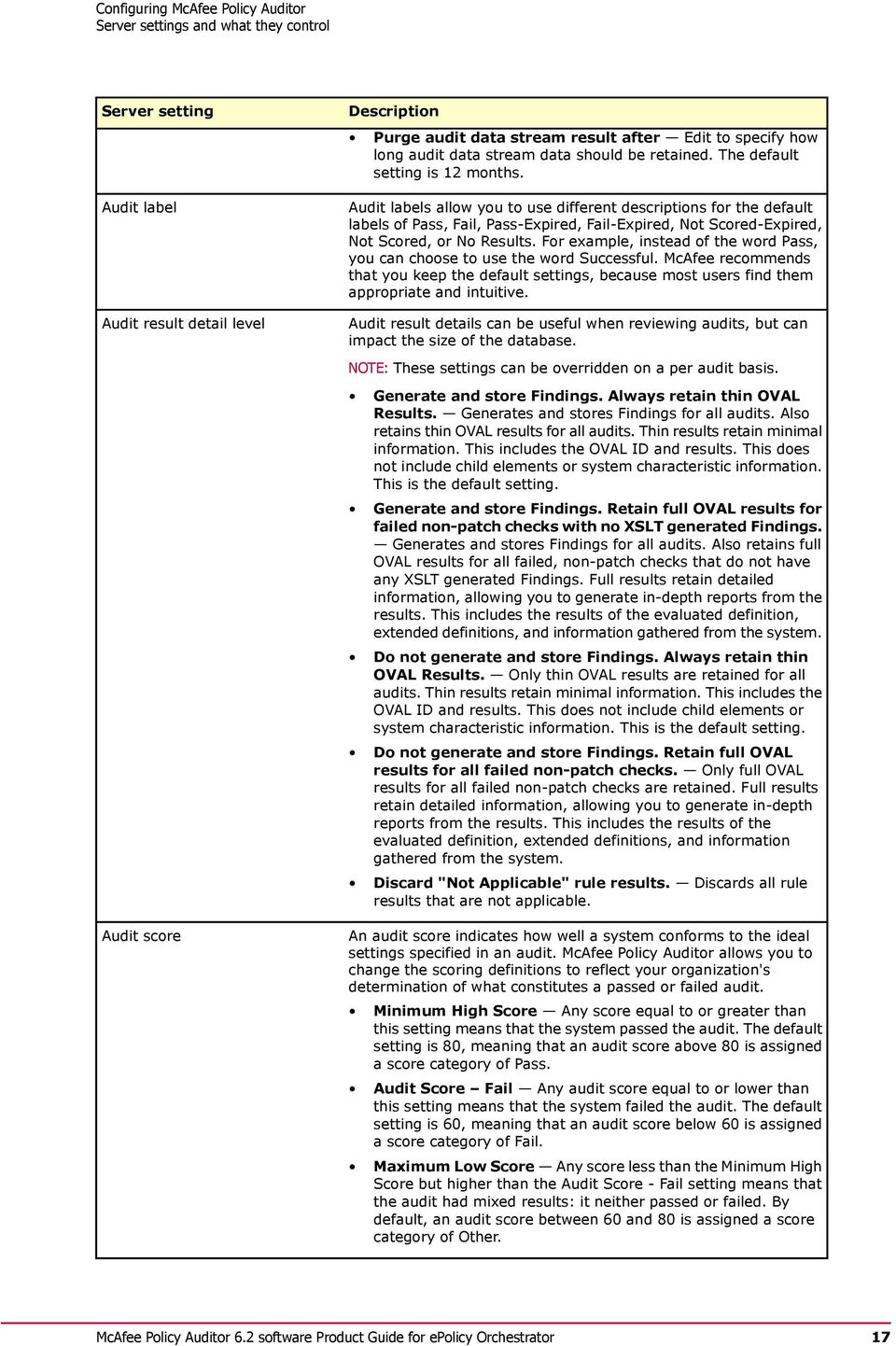
17 Configuring McAfee Policy Auditor Server settings and what they control Server setting Audit label Audit result detail level Audit score Description Purge audit data stream result after Edit to specify how long audit data stream data should be retained. The default setting is 12 months. Audit labels allow you to use different descriptions for the default labels of Pass, Fail, Pass-Expired, Fail-Expired, Not Scored-Expired, Not Scored, or No Results. For example, instead of the word Pass, you can choose to use the word Successful. McAfee recommends that you keep the default settings, because most users find them appropriate and intuitive. Audit result details can be useful when reviewing audits, but can impact the size of the database. NOTE: These settings can be overridden on a per audit basis. Generate and store Findings. Always retain thin OVAL Results. Generates and stores Findings for all audits. Also retains thin OVAL results for all audits. Thin results retain minimal information. This includes the OVAL ID and results. This does not include child elements or system characteristic information. This is the default setting. Generate and store Findings. Retain full OVAL results for failed non-patch checks with no XSLT generated Findings. Generates and stores Findings for all audits. Also retains full OVAL results for all failed, non-patch checks that do not have any XSLT generated Findings. Full results retain detailed information, allowing you to generate in-depth reports from the results. This includes the results of the evaluated definition, extended definitions, and information gathered from the system. Do not generate and store Findings. Always retain thin OVAL Results. Only thin OVAL results are retained for all audits. Thin results retain minimal information. This includes the OVAL ID and results. This does not include child elements or system characteristic information. This is the default setting. Do not generate and store Findings. Retain full OVAL results for all failed non-patch checks. Only full OVAL results for all failed non-patch checks are retained. Full results retain detailed information, allowing you to generate in-depth reports from the results. This includes the results of the evaluated definition, extended definitions, and information gathered from the system. Discard "Not Applicable" rule results. Discards all rule results that are not applicable. An audit score indicates how well a system conforms to the ideal settings specified in an audit. McAfee Policy Auditor allows you to change the scoring definitions to reflect your organization's determination of what constitutes a passed or failed audit. Minimum High Score Any score equal to or greater than this setting means that the system passed the audit. The default setting is 80, meaning that an audit score above 80 is assigned a score category of Pass. Audit Score Fail Any audit score equal to or lower than this setting means that the system failed the audit. The default setting is 60, meaning that an audit score below 60 is assigned a score category of Fail. Maximum Low Score Any score less than the Minimum High Score but higher than the Audit Score - Fail setting means that the audit had mixed results: it neither passed or failed. By default, an audit score between 60 and 80 is assigned a score category of Other. 17
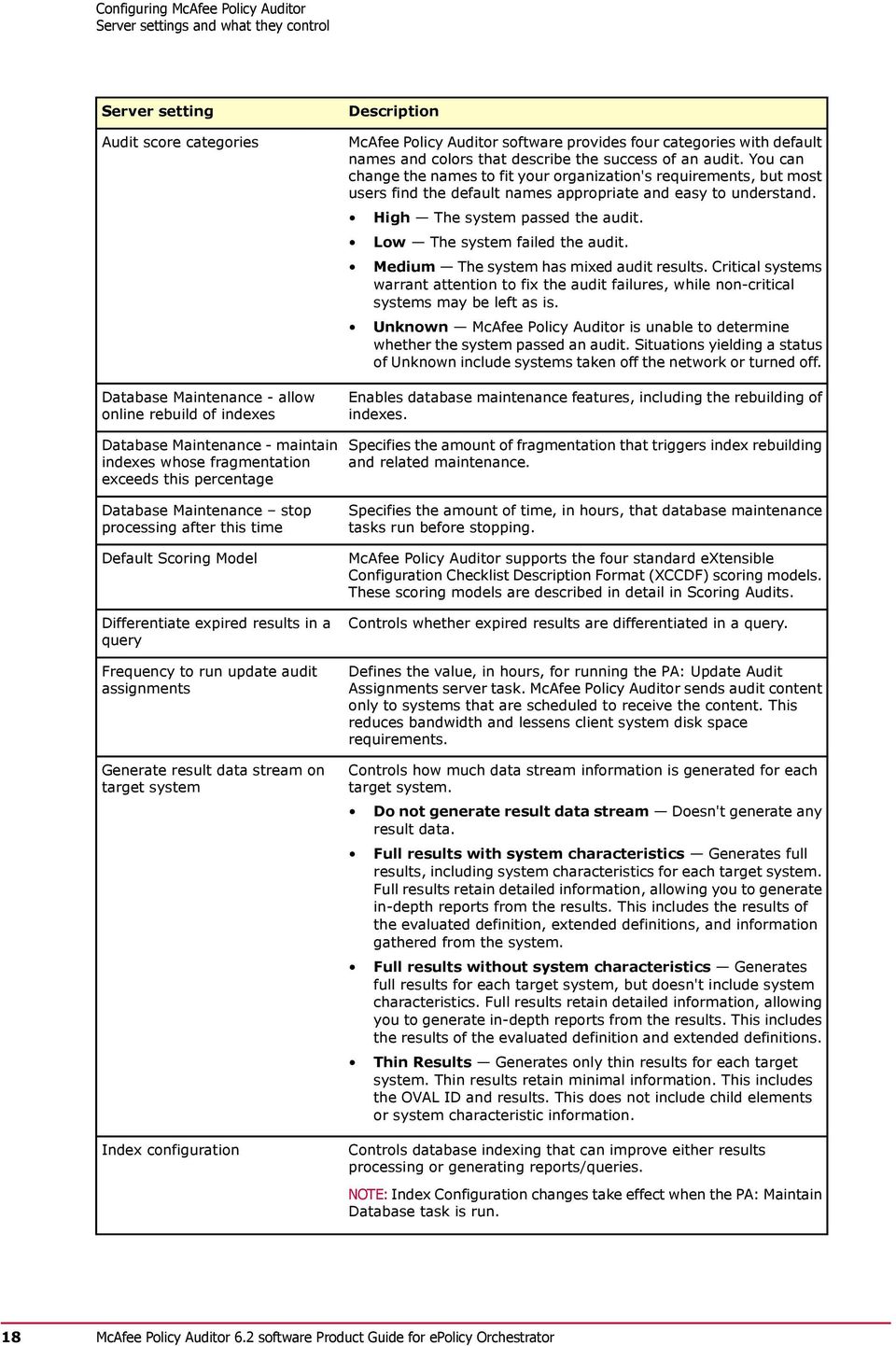
18 Configuring McAfee Policy Auditor Server settings and what they control Server setting Audit score categories Database Maintenance - allow online rebuild of indexes Description McAfee Policy Auditor software provides four categories with default names and colors that describe the success of an audit. You can change the names to fit your organization's requirements, but most users find the default names appropriate and easy to understand. High The system passed the audit. Low The system failed the audit. Medium The system has mixed audit results. Critical systems warrant attention to fix the audit failures, while non-critical systems may be left as is. Unknown McAfee Policy Auditor is unable to determine whether the system passed an audit. Situations yielding a status of Unknown include systems taken off the network or turned off. Enables database maintenance features, including the rebuilding of indexes. Database Maintenance - maintain indexes whose fragmentation exceeds this percentage Specifies the amount of fragmentation that triggers index rebuilding and related maintenance. Database Maintenance stop processing after this time Default Scoring Model Differentiate expired results in a query Frequency to run update audit assignments Generate result data stream on target system Index configuration Specifies the amount of time, in hours, that database maintenance tasks run before stopping. McAfee Policy Auditor supports the four standard extensible Configuration Checklist Description Format (XCCDF) scoring models. These scoring models are described in detail in Scoring Audits. Controls whether expired results are differentiated in a query. Defines the value, in hours, for running the PA: Update Audit Assignments server task. McAfee Policy Auditor sends audit content only to systems that are scheduled to receive the content. This reduces bandwidth and lessens client system disk space requirements. Controls how much data stream information is generated for each target system. Do not generate result data stream Doesn't generate any result data. Full results with system characteristics Generates full results, including system characteristics for each target system. Full results retain detailed information, allowing you to generate in-depth reports from the results. This includes the results of the evaluated definition, extended definitions, and information gathered from the system. Full results without system characteristics Generates full results for each target system, but doesn't include system characteristics. Full results retain detailed information, allowing you to generate in-depth reports from the results. This includes the results of the evaluated definition and extended definitions. Thin Results Generates only thin results for each target system. Thin results retain minimal information. This includes the OVAL ID and results. This does not include child elements or system characteristic information. Controls database indexing that can improve either results processing or generating reports/queries. NOTE: Index Configuration changes take effect when the PA: Maintain Database task is run. 18
19 Configuring McAfee Policy Auditor Edit McAfee Policy Auditor server settings Server setting Max number of FIM version files Description Minimal Indexing Maintains fewer indexes for faster results processing and a smaller database. Might have a negative impact when generating reports or queries. Hybrid Indexing Balances the indexing between results processing and reporting/query performance. This is the default setting. Maximum Indexing Maintains a higher number of indexes for faster performance when generating a report or query. Might have a negative impact on the database size and when processing results. Defines the number of file integrity file versions to store. You can store the contents of up to 6 text files, including the baseline version. See the File Integrity Monitoring section for more information on baselines and file versions. Minimum pass percentage for rule aggregation When the percentage of rules that pass in an audit exceed the defined percentage, the software will aggregate the results in queries and reports. Number of benchmark results to purge per batch Threads for audit results processing Threads for Findings Processing Threads for File Integrity Processing Violation limit The number of benchmark results purged when purging audit results. The number of processing threads allotted to audit results. The default number is 5. The number of processing threads allotted to Findings. The default number is 5. The number of processing threads allotted to File Integrity Processing. The default number is 5. Findings provide information about why checks failed in an audit. Since an audit may report thousands of violations, you can limit the number of violation shown in reports through the Violation Limit setting. By default, McAfee Policy Auditor truncates the number of violation results to 300. Edit McAfee Policy Auditor server settings Edit the McAfee Policy Auditor server settings to fit your organizational and business needs. Before you begin You must be a global administrator to perform this task. Task For option definitions, click? in the interface. 1 From the interface, click Menu Configuration Server Settings. 2 Under Setting Categories, select Policy Auditor. The McAfee Policy Auditor server settings appear in the main panel. 3 Click Edit. The settings page appears. 4 Change the settings to the desired values, then click Save. 19

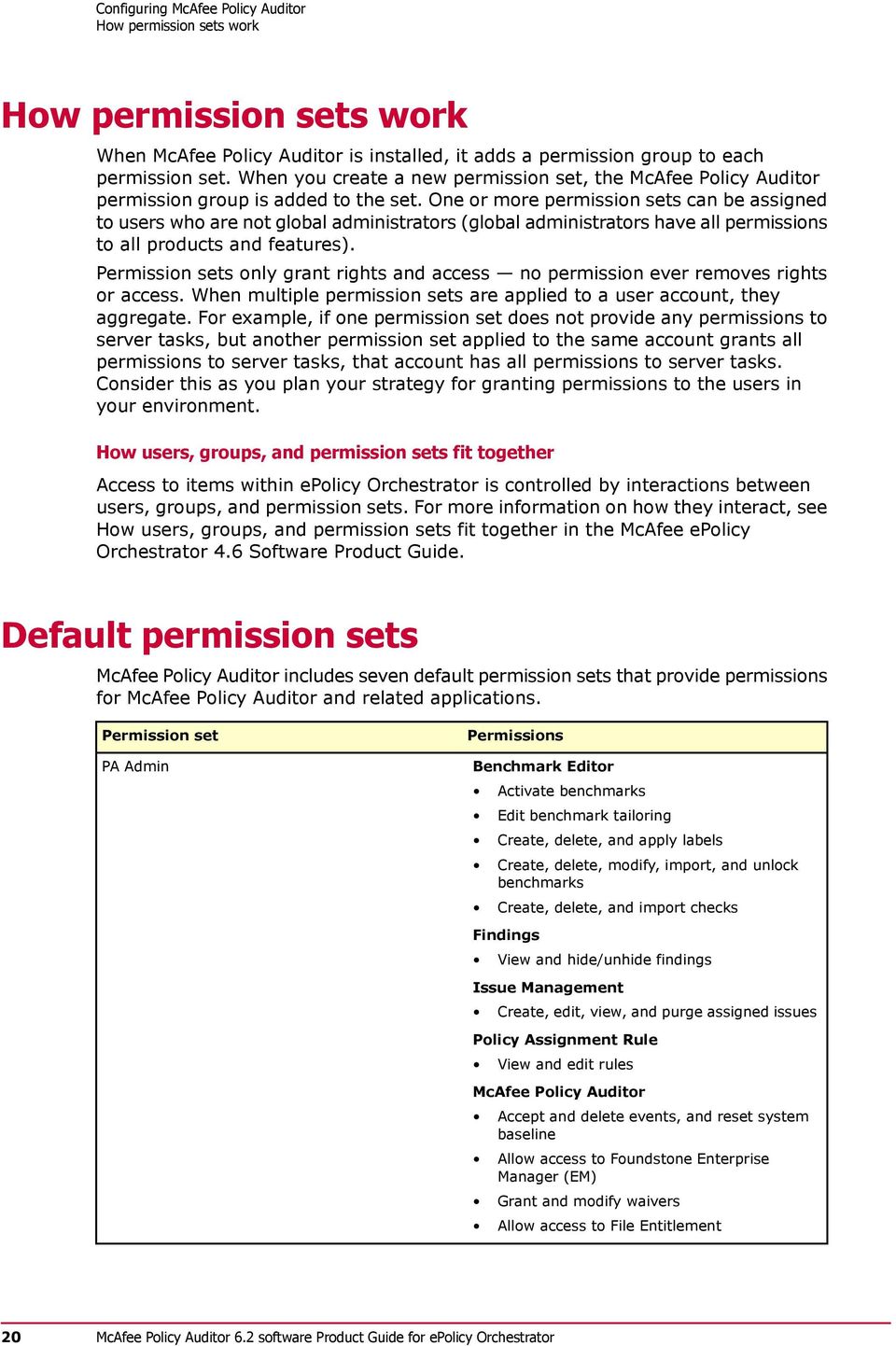
20 Configuring McAfee Policy Auditor How permission sets work How permission sets work When McAfee Policy Auditor is installed, it adds a permission group to each permission set. When you create a new permission set, the McAfee Policy Auditor permission group is added to the set. One or more permission sets can be assigned to users who are not global administrators (global administrators have all permissions to all products and features). Permission sets only grant rights and access no permission ever removes rights or access. When multiple permission sets are applied to a user account, they aggregate. For example, if one permission set does not provide any permissions to server tasks, but another permission set applied to the same account grants all permissions to server tasks, that account has all permissions to server tasks. Consider this as you plan your strategy for granting permissions to the users in your environment. How users, groups, and permission sets fit together Access to items within epolicy Orchestrator is controlled by interactions between users, groups, and permission sets. For more information on how they interact, see How users, groups, and permission sets fit together in the McAfee epolicy Orchestrator 4.6 Software Product Guide. Default permission sets McAfee Policy Auditor includes seven default permission sets that provide permissions for McAfee Policy Auditor and related applications. Permission set PA Admin Permissions Benchmark Editor Activate benchmarks Edit benchmark tailoring Create, delete, and apply labels Create, delete, modify, import, and unlock benchmarks Create, delete, and import checks Findings View and hide/unhide findings Issue Management Create, edit, view, and purge assigned issues Policy Assignment Rule View and edit rules McAfee Policy Auditor Accept and delete events, and reset system baseline Allow access to Foundstone Enterprise Manager (EM) Grant and modify waivers Allow access to File Entitlement 20
21 Configuring McAfee Policy Auditor Default permission sets Permission set PA Agent Admin PA Audit Admin PA Benchmark Activator PA Benchmark Editor PA Viewer PA Waiver Granter Permissions Add, remove, and change audits and assignments Policy Auditor Agent View and change settings Policy Auditor Rollup View Policy Auditor rollup reports McAfee Policy Auditor Agent View and change settings Benchmark Editor View and export checks View and export benchmarks Findings View and hide/unhide findings Issue Management Basic: Create issues and edit, view, and purge issues created by or assigned to me McAfee Policy Auditor View Waivers Allow access to Foundstone Enterprise Manager (EM) Add, remove, and change audits and assignments McAfee Benchmark Editor Activate benchmarks View and export checks View and export benchmarks McAfee Benchmark Editor Edit benchmark tailoring Create, delete, and apply labels Create, delete, and import checks Create, delete, modify, and import benchmarks McAfee Benchmark Editor View and export checks View and export benchmarks Findings View findings McAfee Policy Auditor View waivers View audits and assignments McAfee Benchmark Editor View and export benchmarks 21
22 Configuring McAfee Policy Auditor Edit permission sets Permission set Permissions View and export checks Findings View findings Issue Management Create, edit, view, and purge assigned issues McAfee Policy Auditor View audits and assignments Grant and modify waivers Edit permission sets You can edit the default McAfee Policy Auditor permission sets or create your own. Before you begin You must be a global administrator to perform this task. Task For option definitions, click? in the interface. 1 In the epolicy Orchestrator user interface, click Menu User Management Permission Sets, then select the permission set. 2 Click Edit next to the McAfee Policy Auditor permission group. The Edit Permission Set page appears. 3 Select the appropriate options, then click Save. 4 Repeat for all appropriate sections of other permission sets. 22
23 Using the McAfee Policy Auditor agent plug-in The McAfee Policy Auditor agent plug-in (agent plug-in) extends the features of the McAfee Agent. It manages the schedule for performing audits, runs the audits, and returns the results to the server. You install the McAfee Agent and the agent plug-in on managed systems. This enables audits to be conducted even if a system is not connected to the network. Once the system reconnects to the network, it returns audit information to the server and receives updated content and schedules for future audits from the McAfee Policy Auditor server. Contents The agent plug-in and how it works Supported platforms How content is managed Install and uninstall the agent plug-in The agent plug-in and how it works The McAfee Policy Auditor agent plug-in updates the audit schedule on managed systems, launches audit scans according to a schedule, and returns results to the server. Install the McAfee Agent and the McAfee Policy Auditor agent plug-in on your managed systems. The agent plug-in can perform audits when a system is not connected to its network. Once the system reconnects to the network, the agent plug-in returns the results to the server. The schedule relies on whiteout and blackout periods that you set. Audit whiteout periods are times when an audit can run on a system or group of systems. Audit blackout periods are times when an audit can't run. The agent plug-in determines the age of the current information and uses any pending blackout or whiteout windows to determine when content should be re-evaluated. Upon receipt or completion of an audit, the agent plug-in calculates and stores the date and time of the next scheduled audit. You can use the Run Audits feature of epolicy Orchestrator to force an immediate scan. When you do this, the agent plug-in marks the frequency information as expired and recalculates the date and time for the next scheduled audit. The recalculated date and time are always scheduled during a whiteout period. 23
24 Using the McAfee Policy Auditor agent plug-in Supported platforms Supported platforms The McAfee Policy Auditor agent plug-in supports a number of Windows, Linux, and Unix-based operating systems. Operating system X86 support X64 support Other processors Notes AIX 5.3 TL8 SP5 Power5, Power6 AIX 6.1 TL2 SP0 Power5, Power6 Apple Mac OS X 10.4 X X PowerPC Universal binary Apple Mac OS X 10.5 X X PowerPC Universal binary Apple Mac OS X 10.6 X X PowerPC Universal binary Apple Mac OS X 10.7 X Apple Mac OS X 10.8 X Debian 5 X X Debian 6 X X HP-UX 11i v1 RISC HP-UX 11i v2 RISC HP-UX 11i v2 Itanium RISC HP-UX 11i v3 RISC HP-UX 11i v3 Itanium RISC Red Hat Linux AS, ES, WS 4.0 X X 32-bit agent on 64-bit hardware Red Hat Enterprise Linux 5.0, 5.1 X X 32-bit agent on 64-bit hardware Red Hat Enterprise Linux 6.0 X X 32-bit agent on 64-bit hardware Solaris 8 SPARC Solaris 9 SPARC Solaris 10 SPARC Solaris 11 SPARC SuSE Linux 9 X X 32-bit agent on 64-bit hardware SuSE Linux Enterprise Server 10 X X 32-bit agent on 64-bit hardware SuSE Linux Enterprise Server 11 X X 32-bit agent on 64-bit hardware Windows 2000 Professional X Windows 2000 Server X Windows 2000 Advanced Server X Windows XP Professional X X Native 32- and 64-bit agent 24
25 Using the McAfee Policy Auditor agent plug-in How content is managed Operating system X86 support X64 support Other processors Notes Windows Server 2003 Standard Edition X X Native 32- and 64-bit agent Windows Server 2003 Enterprise Edition X X Native 32- and 64-bit agent Windows Server 2008 Standard Edition X X Windows Server 2008 Enterprise Edition X X Windows Server 2008 R2 X Windows Server 2012 X Windows Vista X X Native 32- and 64-bit agent Windows 7 X X Native 32- and 64-bit agent Windows 8 X X Native 32- and 64-bit agent Windows Embedded Standard 2009 (disk-based) Windows Embedded POSReady 2009 (disk-based) Windows Embedded POS (WEPOS) Windows XP Embedded SP2 (disk-based) How content is managed Content for McAfee Policy Auditor consists of benchmarks and checks. The content package is included when the product is installed, and is placed into the epolicy Orchestrator master repository. Before you can use benchmarks in audits, you must activate them in McAfee Benchmark Editor. See the McAfee Benchmark Editor Product Guide for information about how to do this. The master repository is updated daily by a server task that is included with the software. If you want to update McAfee Policy Auditor on a different schedule, you can create a new server task. You must verify that the task is enabled. The master repository is configured when installed. However, you must ensure that proxy server settings, if any, are configured correctly. By default, epolicy Orchestrator uses Microsoft Internet Explorer proxy settings. For information about repository management, proxy settings, and server tasks, see the epolicy Orchestrator software documentation. 25
26 Using the McAfee Policy Auditor agent plug-in Install and uninstall the agent plug-in Install and uninstall the agent plug-in Managed systems under McAfee Policy Auditor must have the McAfee Agent and the McAfee Policy Auditor agent plug-in. For information on installing and working with the McAfee Agent, see the epolicy Orchestrator documentation. Tasks Install the McAfee Policy Auditor agent plug-in Uninstall the agent plug-in Send a manual wake-up call to a group of systems Install the McAfee Policy Auditor agent plug-in Install the McAfee Policy Auditor agent plug-in before you run audits on managed systems. Task For option definitions, click? in the interface. 1 In the epolicy Orchestrator user interface, click Menu Systems System Tree then click the Assigned Client Tasks tab. 2 Select the System Tree group containing the systems on which you want to install the agent plug-in. 3 Click Actions New Client Task Assignment. The Client Task Assignment Builder appears. 4 Select McAfee Agent (under Product), Product Deployment (under Task Type), then click Create New Task (under Task Name). The Client Task Catalog appears. 5 Fill in the client task settings, then click Save. a Type an appropriate name for the task, such as Install McAfee Policy Auditor Windows agent plug-in. b Optionally, provide a description in the Notes text box. c Select the Target Platforms. d For Products and components, select a McAfee Policy Auditor agent plug-in. Then select options from the drop-down lists. e f McAfee Policy Auditor for Windows Action Install. Language Language neutral. Branch Current. For Options, you can select Run at every policy enforcement (Windows only) to re-install the plug-in at the next policy enforcement interval if a user has removed the product or component. For Postpone Deployment (Windows systems only), you can select Allow end users to postpone this deployment and then select settings. 6 Fill in the rest of the Select Task settings, then click Next. 26
27 Using the McAfee Policy Auditor agent plug-in Install and uninstall the agent plug-in a In Lock task inheritance, select Unlocked or Locked. b In Tags, select which systems in the selected group on which you want to install the agent plug-in. Send this task to all computers Install the agent plug-in on all systems in the selected group. Send this task to only computers which have the following criteria Use the edit buttons to include or exclude systems with tags. See the epolicy Orchestrator documentation for information on working with tags. 7 Configure the schedule details as needed, then click Next. 8 Review the task settings, then click Save. The task is added to the list of client tasks for the selected group and any group that inherits the task. 9 To run the client task immediately, send a manual wake-up call to the systems. Uninstall the agent plug-in Uninstall the McAfee Policy Auditor agent plug-in from systems on your network if you do not want them to be managed by McAfee Policy Auditor content. This is useful when you want to convert a managed system to an unmanaged system and reduce the load on system resources. Task For option definitions, click? in the interface. 1 Follow the procedure for installing the agent plug-in. On the Configuration page, select Remove from the Action drop-down list. Set the other options as needed 2 Review the task settings on the Summary page, then click Save to store the task. 3 Send a manual wake-up call to run the task immediately. Send a manual wake-up call to a group of systems Send manual wake-up calls to a System Tree group to verify that the McAfee Agent and epolicy Orchestrator server are communicating. This is useful when you make policy changes and want agents to download the update. Before you begin Before sending the agent wake-up call to a group, make sure that wake-up support for the systems groups is enabled and applied on the General tab of the McAfee Agent policy pages. This is enabled by default. Task For option definitions, click? in the interface. 1 In the epolicy Orchestrator user interface, click Menu Systems System Tree, then select the Systems tab. 2 Select a group, select the systems from the list, then click Wake Up Agents. The Wake Up McAfee Agent page appears. 3 Verify that the systems appear next to Target systems. 27
28 Using the McAfee Policy Auditor agent plug-in Display the system tray icon on Windows systems 4 Next to Wake-up call type, select whether to send an Agent Wake-Up Call or a SuperAgent Wake-Up Call. 5 Accept the default Randomization (0 60 minutes) or type a different value. NOTE: If you type 0, agents respond immediately. Consider carefully the number of systems that are receiving the wake-up call and how much bandwidth is available. 6 By default, Get full product properties is selected. This causes the agent plug-in to send complete system properties to McAfee Policy Auditor. Deselect this option if you want to send only properties that have changed since the last agent-server communication. 7 Click OK to send the wake-up call. 8 Verify that the agent plug-in and epolicy Orchestrator server are communicating: go to Reporting Audit Log and search the log for an entry Wake Up Agents Succeeded. Display the system tray icon on Windows systems You can configure McAfee Policy Auditor to display a system tray icon on Windows systems. The icon cannot is not available for non-windows systems. The icon allows the user to see the status of audits, including whether an audit is running, scheduled, not scheduled, or disabled. It optionally displays a balloon tip to indicate that the system is being audited. Task For option definitions, click? in the interface. 1 In the epolicy Orchestrator user interface, click Menu Systems System Tree, then click the Assigned Policies tab. 2 From the Product drop-down list, select Policy Auditor Agent. 3 Under the Policy column, click My Default. The whiteout/blackout page appears. 4 Next to General Options, select Show the Policy Auditor system tray icon (Windows only), then click Save. 28
29 Configuring agentless audits McAfee Policy Auditor can register a McAfee Vulnerability Manager 7.0 or 7.5 server to conduct agentless audits. Agentless audits allow you to audit systems that do not have the McAfee Policy Auditor agent plug-in installed. McAfee Vulnerability Manager searches for systems using a Host Name or IP range, adds them to the System Tree, and conducts agentless audits. Installing the McAfee Vulnerability Manager epo Extension allows you to import McAfee Vulnerability Manager data into your epolicy Orchestrator database and view that data in reports. To use the extension with epolicy Orchestrator software, you must also have an existing McAfee Vulnerability Manager installation with scanned asset data. Contents How McAfee Policy Auditor integrates with the McAfee Vulnerability Manager extension Configure McAfee Vulnerability Manager and the epolicy Orchestrator extension How to handle missing audit results How to handle mismatched McAfee Vulnerability Manager certificates How McAfee Policy Auditor integrates with the McAfee Vulnerability Manager extension McAfee Policy Auditor and McAfee Vulnerability Manager integrate seamlessly to gather data, share information, and perform both agent- and system-based audits. Systems with the agent plug-in installed are referred to as managed systems. Systems without the agent plug-in are called unmanaged systems. Uniform system management McAfee Policy Auditor and McAfee Vulnerability Manager support uniform system management under epolicy Orchestrator software. Managed and unmanaged system are supported the same way: Assets from a McAfee Vulnerability Manager Discovery Scan are matched to system already managed by the epolicy Orchestrator server to avoid duplication. Each system is uniquely identified. Systems with duplicate names can be added to the System Tree, but they are still managed as different systems. A System Tree group can contain both managed and unmanaged systems. 29
30 Configuring agentless audits How McAfee Policy Auditor integrates with the McAfee Vulnerability Manager extension When you change a system from unmanaged to managed, this distinction is reflected in queries and page views. McAfee Policy Auditor supports an all agent-based System Tree, an all agentless System Tree, and a mix of agent-based and agentless devices. A group can contain both managed and unmanaged systems. Communication between McAfee Policy Auditor and McAfee Vulnerability Manager is through a single channel and can pass through common firewall configurations without reconfiguration. McAfee Vulnerability Manager extension integration with scannable systems The McAfee Vulnerability Manager extension can scan most operating systems supported by McAfee Policy Auditor. McAfee Vulnerability Manager can scan these operating systems: AIX 5.3, 6.1 Red Hat Enterprise Linux 5.0, 5.1 Solaris 8 Solaris 9 Solaris 10 Windows XP Professional Windows 7 Asset Discovery scans Windows 2000 Server Windows 2000 Advanced Server Windows 2000 Professional Windows Server 2003 Standard Edition Windows Server 2003 Enterprise Edition Windows Server 2003 Advanced Edition Windows 2008 Server epolicy Orchestrator software supports the manual and automatic importing of systems into the System Tree. When McAfee Vulnerability Manager discovers new systems during a McAfee Vulnerability Manager Asset Discovery Scan, it designates them as rogue systems. Regardless of how assets are imported, users must add, or promote, them to the epolicy Orchestrator server System Tree before they can be audited. McAfee Vulnerability Manager can only audit systems that have a Foundstone ID. The association between a system and a Foundstone ID is established when a system is imported from McAfee Vulnerability Manager and added to the System Tree. Data collection scans The McAfee Vulnerability Manager extension uses the Data Collection Scan to audit systems and gather compliance data. For audit results to remain current, the scan must be scheduled with sufficient time to audit systems before running the the PA: Maintain Foundstone server task. The Maintain Foundstone Audits server task The Maintain Foundstone Audits server task is responsible for setting audit frequency requirements, synchronizing audit information, distributing audit content, and performing cleanup tasks. 30
31 Configuring agentless audits Configure McAfee Vulnerability Manager and the epolicy Orchestrator extension The installation application automatically creates a server task named PA: Maintain Foundstone audits when you install the McAfee Vulnerability Manager extension. The task runs once per day by default. If you need to change the schedule, you should schedule it to run after the Data Collection Scan has had the opportunity to conduct audits so that audit results stay current. The purpose of the PA: Maintain Foundstone audits server task is to: Adhere to audit frequency requirements by requesting audit results from McAfee Vulnerability Manager for any systems whose results expire within the next 24 hours. The task does not retrieve results from McAfee Vulnerability Manager, but requests McAfee Vulnerability Manager to update and assemble audit results from data in preparation for scanning systems and returning the results to McAfee Policy Auditor. Synchronize information between McAfee Vulnerability Manager and McAfee Policy Auditor. For example, if you add or delete an audit from McAfee Vulnerability Manager, the task will add or delete an audit from McAfee Policy Auditor. Distribute content, such as benchmarks, to the McAfee Vulnerability Manager server. If the benchmark has been updated on the epolicy Orchestrator server, the task will update the benchmark on the McAfee Vulnerability Manager server. Perform assorted cleanup tasks on the McAfee Vulnerability Manager server. The Data Import server task McAfee Vulnerability Manager uses the MVM Data Import server task to populate the epolicy Orchestrator server database with system data from the McAfee Vulnerability Manager database. The server task automatically gathers new McAfee Vulnerability Manager database asset data on a regular schedule. For audit results to remain current, the task must be scheduled to run after the PA: Maintain Audits Server task has finished running. Server support Before configuring McAfee Vulnerability Manager server, it is important to understand how McAfee Vulnerability Manager and epolicy Orchestrator work together. One McAfee Vulnerability Manager server can support multiple epolicy Orchestrator servers running McAfee Policy Auditor. However, an epolicy Orchestrator server running McAfee Policy Auditor can only integrate with one McAfee Vulnerability Manager server. Configure McAfee Vulnerability Manager and the epolicy Orchestrator extension You can configure McAfee Vulnerability Manager and the McAfee Vulnerability Manager extension to discover systems, collect data, and synchronize this information with McAfee Policy Auditor. Tasks Create a McAfee Vulnerability Manager workgroup 31
32 Configuring agentless audits Configure McAfee Vulnerability Manager and the epolicy Orchestrator extension Configure the McAfee Vulnerability Manager single sign-on feature Create a data source to synchronize McAfee Vulnerability Manager and epolicy Orchestrator Register a McAfee Vulnerability Manager database server with McAfee Policy Auditor Manage McAfee Vulnerability Manager credential sets Create an Asset Discovery scan Create an MVM Data Import task Add systems found by McAfee Vulnerability Manager scans to the System Tree Create a Data Collection Scan View McAfee Vulnerability Manager scan status Create a McAfee Vulnerability Manager workgroup Create a McAfee Vulnerability Manager workgroup and administrator for your McAfee Policy Auditor administrator and users. McAfee recommends that you give the McAfee Policy Auditor administrator only the access of a McAfee Vulnerability Manager workgroup administrator, not full access of an organization administrator. Workgroup administrators can make changes that affect their workgroup only. Organization administrators can make changes that affect the whole organization, including workgroups unrelated to the McAfee Policy Auditor group. You must perform this task in the McAfee Vulnerability Manager Enterprise Manager. Before you begin Before you can create a McAfee Vulnerability Manager workgroup, you must: Install and set up McAfee Vulnerability Manager. Create an organization. Specify an administrator for the organization. Task For option definitions, click? in the interface. 1 From McAfee Vulnerability Manager Enterprise Manager, go to Manage Users/Groups. 2 Select the organization that you have already created. 3 Right-click the organization and select New Workgroup. 4 On the General page, type the workgroup name and description, then click Next. The IP Pool page appears. 5 Type the IP ranges to be used in this workgroup, then click Next. The Administrator page appears. 6 Type the information for the workgroup administrator. 7 Click Finish. 32
33 Configuring agentless audits Configure McAfee Vulnerability Manager and the epolicy Orchestrator extension Configure the McAfee Vulnerability Manager single sign-on feature You can enable the McAfee Vulnerability Manager single-sign-on feature in McAfee Policy Auditor. This gives McAfee Policy Auditor users access to portions of the McAfee Vulnerability Manager Enterprise Manager. Before you begin Using single sign-on requires that you create a McAfee Vulnerability Manager workgroup. Task For option definitions, click? in the interface. 1 In the epolicy Orchestrator user interface, click Menu Configuration Server Settings and select Foundstone API Server. 2 Click Edit, select Enable Policy Auditor to use these server settings, and type an organization, user name, and password. 3 Click Save. 4 Go to Automation Server Tasks. 5 Click Run for the PA: Maintain Foundstone audits server task. The Server Task Log page appears and the Status column shows that the task is In Progress. The task might take several minutes or more to run. If the final status of the task is Completed, Single Sign-On is properly configured. 6 Verify that Single Sign-On is properly configured by going to Systems Audits and confirming that these links appear on the page: Edit Foundstone Scans View Foundstone Scan Status Manage Foundstone Credential Sets Manage Foundstone Data Sources Create a data source to synchronize McAfee Vulnerability Manager and epolicy Orchestrator You must synchronize McAfee Vulnerability Manager data with epolicy Orchestrator server data. This avoids duplication by ensuring that systems and other assets from a McAfee Vulnerability Manager Discovery Scan are matched to epolicy Orchestrator server-managed assets. You can also set up a data source from the McAfee Vulnerability Manager interface. See the McAfee Vulnerability Manager documentation for details on how to do this. Task For option definitions, click? in the interface. 1 In the epolicy Orchestrator user interface, click Menu Risk & Compliance Audits Manage Foundstone Data Sources. A new McAfee Vulnerability Manager browser window appears. 33
34 Configuring agentless audits Configure McAfee Vulnerability Manager and the epolicy Orchestrator extension 2 Click Add Data Source. 3 Enable McAfee Vulnerability Manager to connect to the epolicy Orchestrator database server by providing a name, data source type, epolicy Orchestrator server address, epolicy Orchestrator server database name, epolicy Orchestrator database server user name, and password. NOTE: If you leave the user name and password blank, the data synchronization service will try to use the account that the data synchronization service is configured to for authentication of the epolicy Orchestrator database server. This requires configuring the service to run as a domain user that has access to the epolicy Orchestrator database server. 4 Select Active in the Scheduler pane. 5 Select a Schedule Type and set the scheduling options. 6 Determine how you want to configure the McAfee Vulnerability Manager Integration pane. Select epolicy Orchestrator server to received the data and select the appropriate McAfee Vulnerability Manager organization or workgroup. Click Save. 7 Refresh the McAfee Vulnerability Manager browser window, select the scan you created and, if the scan has not been activated, click Activate. Register a McAfee Vulnerability Manager database server with McAfee Policy Auditor Configure your McAfee Vulnerability Manager Database server as a registered server. Before you begin You must have an existing McAfee Vulnerability Manager Database server, with scanned asset data, to use the McAfee Vulnerability Manager extension. Task For option definitions, click? in the interface. 1 In the epolicy Orchestrator user interface, click Menu Configuration Registered Servers, then click New Server. 2 From the Server type drop-down list, select Vulnerability Manager. Click Next. 3 Type the McAfee Vulnerability Manager Database server host name or IP address. For example, type myhost or Select a Server instance and type the appropriate information. Select Default if Microsoft SQL was installed with the default settings. Select Instance name if the Microsoft SQL name was changed and type the instance name. Select Port number if you are required to specify a port number for the IP address and type the port number. 5 Required to use SSL to connect is enabled by default. The epolicy Orchestrator server requires an SSL connection to communicate with the McAfee Vulnerability Manager Database server. 34
35 Configuring agentless audits Configure McAfee Vulnerability Manager and the epolicy Orchestrator extension 6 Type the McAfee Vulnerability Manager Database server name in the Database name field. The default is Faultline. 7 Select the appropriate Authentication type. Select Windows authentication to enter a Windows user name and password to access the McAfee Vulnerability Manager database server. The user name for Windows authentication must include the domain (domain\user). Select SQL authentication to enter a SQL user name and password to access the McAfee Vulnerability Manager Database server. 8 Click Test Connection to determine whether the epolicy Orchestrator server can connect to the McAfee Vulnerability Manager database. If the McAfee Vulnerability Manager Database server is inaccessible (for example, offline), then the test connection will fail. A successful test connection is not required for saving your Registered Server information. Manage McAfee Vulnerability Manager credential sets You can create, edit, and delete credential sets for systems managed by McAfee Vulnerability Manager. Credential sets grant McAfee Vulnerability Manager access to systems and, depending on the operating system, may use Windows authentication or a user name with password. Task For option definitions, click? in the interface. 1 In the epolicy Orchestrator user interface, click Menu Risk & Compliance Audits Manage Foundstone Credential Sets. The Credential Sets browser window opens. 2 On the Start tab, edit the name and description of the credential set. 3 Select credentials and click the appropriate account type in the System Tree or from the Account Type drop-down list. Type the required credential information in the appropriate fields. Click Add. 4 You can specify multiple credentials, such as credentials for each domain in the search range, and click Add after specifying each credential. Consult the McAfee Vulnerability Manager documentation for details on other settings for this tab. 5 Click Save. Create an Asset Discovery scan Create a McAfee Vulnerability Manager Asset Discovery scan to find systems in user-specified IP ranges. After you create and runa an asset discovery scan, create an run an MVM Data Import task, then add systems found by the scans to the System Tree. Consult the McAfee Vulnerability Manager documentation for details on Asset Discovery scan settings. Task For option definitions, click? in the interface. 35
36 Configuring agentless audits Configure McAfee Vulnerability Manager and the epolicy Orchestrator extension 1 In the epolicy Orchestrator user interface, click Menu Risk & Compliance Audits, then click Edit Foundstone Manager Scans. The Scan Configuration page opens in a new browser window. 2 Click New Scan. The Scan Details page opens in a new browser window. Select Use a Vulnerability Manager template and click Next. The Vulnerability Templates appear. 3 Select Asset Discovery Scan and click Next. 4 Type a descriptive name for the scan and select Custom from the Type drop-down list. 5 McAfee Vulnerability Manager offers three methods to search for systems or to exclude systems from scans. Use one or more of these three methods to include or exclude systems. Targets tab Supply any combination of a host name, IP address range, or CIDR Address. Click View Global Pool to see the available IP range. Browse tab Drag and drop listed systems into the Included Ranges or Excluded Ranges panes. Search tab Select a search type under General Filter and type an appropriate search phrase or IP address in the String to search for text box. Alternatively, you can select one or more checkboxes in the Criticality Filter. You can also combine General Filter and Criticality Filter searches. Click the Search button to return a list of assets matching your search criteria. 6 Click Next. The Settings tab appears. 7 Select credentials and click on the appropriate account type in the tree pane or from the Account Type drop-down list. Type the required credential information in the appropriate fields. Click Add. 8 You can specify multiple credentials, such as credentials for each domain in the search range, and click Add after specifying each credential. Click Next. The Reports tab appears. 9 Deselect Create remediation tickets. The Scheduler tab appears. 10 Select a Schedule Type. McAfee recommends that you select the Immediate option the first time you run this scan. Once McAfee Vulnerability Manager has had the opportunity to scan all assets, you can edit the scan to occur at regular intervals. 11 Click OK to save the scan. Create an MVM Data Import task Create an MVM Data Import task to populate the epolicy Orchestrator database with system data from the McAfee Vulnerability Manager database. The task automatically gathers new McAfee Vulnerability Manager database system data on a regular schedule. Before you begin You must have a Registered Server set up before you begin this task. 36
37 Configuring agentless audits Configure McAfee Vulnerability Manager and the epolicy Orchestrator extension Task For option definitions, click? in the interface. 1 In the epolicy Orchestrator user interface, click Menu Automation Server Tasks, then click New Task. 2 Type a Name and, optionally, Notes for the task. McAfee recommends naming the task Foundstone Data Import. 3 Select Enabled and click Next. 4 Select MVM Data Import from the Actions drop-down list. 5 Select a McAfee Vulnerability Manager server from the Server Name list. 6 Select one of the Import Data types to control how the data is imported. Use this... Delta All To do this... Imports only new data since the last time McAfee Vulnerability Manager data was imported. If there is no McAfee Vulnerability Manager data in the epolicy Orchestrator database, all available Vulnerability Manager data is imported. Overwrites all McAfee Vulnerability Manager data in yourepolicy Orchestrator database with current McAfee Vulnerability Manager data. 7 Click Next. The Scheduling page appears. Select scheduling options for this task, then click Next. The summary page appears. 8 Review the summary information before saving this task. 9 Click Save. Add systems found by McAfee Vulnerability Manager scans to the System Tree You can add systems discovered during a McAfee Vulnerability Manager scan to the epolicy Orchestrator server System Tree. To use systems discovered by a McAfee Vulnerability Manager scan in McAfee Vulnerability Manager, the user must import the systems into the epolicy Orchestrator server and make them available through the System Tree. Task For option definitions, click? in the interface. 1 In the epolicy Orchestrator user interface, click Menu Systems Detected Systems. 2 Select a Subnet in the Top 25 Subnets pane. 3 Select systems that you want to add to a System Tree group from the Rogue System Interfaces by Subnet list. Click Add to System Tree. The Add to System Tree page appears. 4 Click Browse and select a System Tree group. 5 Select Allow duplicate entries to be added to the System Tree only if you wish to allow duplicate entries in the System Tree. 37
38 Configuring agentless audits Configure McAfee Vulnerability Manager and the epolicy Orchestrator extension Caution: McAfee recommends caution when selecting this box, but there are valid reasons to use this feature. For example, you might have two systems with the same name but different IP addresses. 6 Click Add to add the selected systems to the selected group. 7 Repeat steps 2 6 to add other systems to System Tree groups. Create a Data Collection Scan Create a McAfee Policy Auditor Data Collection Scan to conduct audits requested by McAfee Policy Auditor. NOTE: Agentless audits conducted by McAfee Vulnerability Manager do not honor whiteout and blackout periods. Task For option definitions, click? in the interface. 1 In the epolicy Orchestrator user interface, click Menu Risk & Compliance Audits, then click Edit Foundstone Scans. The Scan Configuration page opens in a new browser window. 2 Click New Scan. The Scan Details page opens in a new browser window. Select Use a Vulnerability Manager template and click Next. The Vulnerability Templates appear. 3 Select McAfee Policy Auditor Data Collection Scan under the XCCDF Templates section. Click Next. 4 Supply a descriptive name for the scan and select Custom from the Type drop-down list. 5 McAfee Vulnerability Manager offers three methods to search for assets or to exclude systems from scans. Select one method or any combination of the three methods to include or exclude systems. When finished, click Next. The Settings tab appears. 6 Select Credentials and click on the appropriate account type in the tree pane or from the Account Type drop-down list. Type the required credential information in the appropriate fields. Click Add. 7 You can specify multiple credentials, such as credentials for each domain in the search range, and click Add after specifying each credential. Consult the McAfee Vulnerability Manager documentation for details on other settings for this tab. Click Next. The Scheduler tab appears. 8 Select the appropriate schedule type and settings. Click OK to save the scan. TIP: McAfee recommends that you select the Immediate option. Once McAfee Vulnerability Manager has had the opportunity to scan for systems, you can change the scan to occur at regular intervals. View McAfee Vulnerability Manager scan status You can view the status and results of McAfee Vulnerability Manager scans. The Asset Discovery Scan needs to finish running before you add assets to the epolicy Orchestrator System Tree. 38
39 Configuring agentless audits How to handle missing audit results Task For option definitions, click? in the interface. 1 In the epolicy Orchestrator user interface, click Menu Risk & Compliance Audits View Foundstone Scan Status. The Scan Status page opens in a new browser window. The Status column shows the scans that are complete. 2 Click to view the scan report. How to handle missing audit results McAfee Policy Auditor uses the concept of frequency to determine how often audit data should be gathered. Frequency is defined as "Audit results should be no older than nnn time unit," where "nnn" is a number and "time unit" is "days," "weeks," and "months." For example, if the frequency for an audit is defined as one month and a managed system has not been audited in more than one month, the system is out of frequency and its status is unknown. The McAfee Vulnerability Manager extension uses the Data Collection Scan to audit systems and gather compliance data. The Data Collection Scan must finish before the PA: Maintain Foundstone server task is run. When the PA: Maintain Foundstone server task runs, it requests audit results for any missing results, any expired results, or any results that will expire within the next 24 hours. Thus, audits with a one-day frequency is set for auditing every time the PA: Maintain Foundstone audits server task is run. The task also assembles previously-collected audit results, synchronizes information, and performs cleanup tasks. The PA: Maintain Foundstone audits server task must be given a sufficient amount of time to assemble data before the MVM Data Import server task is run. The MVM Data Import task collects the latest asset data and imports it into the epolicy Orchestrator server database. McAfee Policy Auditor then has the latest information to appear in reports and queries. To make sure that your audit results are up to date, configure the Data Collection Scan, PA: Maintain Foundstone audits server task, and MVM Data Import server task to give the system enough time to conduct audits and assemble result data. Troubleshoot missing audit results Configure McAfee Vulnerability Manager to ensure that the latest audit results appear in queries and reports. The Data Collection Scan, PA: Maintain Foundstone audits server task, and MVM Data Import server task can all be run manually from the interface. If systems are not being audited because they are disconnected from the network, you can run the scan and server tasks more frequently or convert them to managed systems by installing the McAfee Policy Auditor agent plug-in. A managed system audits itself and returns the results once it is reconnected to the network. Task For option definitions, click? in the interface. 39
40 Configuring agentless audits How to handle mismatched McAfee Vulnerability Manager certificates 1 Schedule the Data Collection Scan to audit systems and gather data. The scan must be given enough time to do its work and the schedule should match the smallest audit frequency. For example, if you schedule quarterly, monthly, and weekly audits, you should schedule the Data Collection Scan to run at the beginning of every week. 2 Schedule the PA: Maintain Foundstone audits server task to run after the Data Collection Scan has had enough time to complete. Click Menu Risk & Compliance Audits View Foundstone Scans to determine how long the Data Collection Scan takes to run and schedule the Maintain McAfee Vulnerability Manager server task appropriately. 3 Schedule the MVM Data Import server task to run after the PA: Maintain Foundstone audits server task has had enough time to complete. How to handle mismatched McAfee Vulnerability Manager certificates Certificates are sets of electronic files created by a trusted Certificate Authority. They contain encrypted information that allows others to verify their origin. On a network, certificates allow systems to create a trust relationship that allows them to exchange information using encrypted communication. The McAfee Vulnerability Manager Configuration Manager is designed to enable SSL (X.509) server certificate creation, as well as the secure distribution and installation of those certificates. Server certificates contain both public and private keys used by a McAfee Vulnerability Manager system component. The private key is the crucial element in the authentication process and must be kept secure. Mismatched certificates There are two situations when your McAfee Policy Auditor does not match the McAfee Vulnerability Manager server certificates. Repairing Policy Auditor Clicking Repair for McAfee Policy Auditor in Add or Remove Programs does not reinstall new McAfee Vulnerability Manager Configuration Manager certificates. The repair option reconnects with McAfee Vulnerability Manager Configuration Manager, but the certificates are old and SSL communication fails. Connecting to a new or different McAfee Vulnerability Manager server Connecting to a new or different McAfee Vulnerability Manager server does not automatically install new certificates. Troubleshoot mismatched McAfee Vulnerability Manager certificates Use this task to re-establish or change SSL communication between McAfee Policy Auditor and a McAfee Vulnerability Manager server. Task For option definitions, click? in the interface. 40
41 Configuring agentless audits How to handle mismatched McAfee Vulnerability Manager certificates 1 From the McAfee Vulnerability Manager Configuration Manager, select the McAfee Policy Auditor server that needs new certificates. 2 Click Tasks, then select Install Customer-Specific Certificate. 3 Click Initiate Task. McAfee Vulnerability Manager Configuration Manager distributes the customer-specific certificate to McAfee Policy Auditor. View the System Messages to ensure the task completed successfully. 4 Follow the tasks in Configuring McAfee Vulnerability Manager and the McAfee Vulnerability Manager extension to complete the setup. 41
42 Creating and managing audits McAfee Policy Auditor allows you to create audits based on benchmarks and assign them to run on systems. McAfee Policy Auditor evaluates systems against independent standards that are developed by government agencies and private industry. It can also evaluate systems against standards that you create (using Benchmarks that you create). You can create audits from a McAfee-supplied selection of predefined benchmarks established by government and industry such as SOX, HIPAA, PCI, and FISMA. You can also create audits based on third-party benchmarks or benchmarks that you create yourself. Audits return results that include a score allowing you to determine how well a system complies with the rules in the benchmark. Contents Audits and how they work Activate benchmarks Create an audit Run an audit manually Disable an audit Delete audits Audit whiteout and blackout periods Service Level Agreements Exporting audits and audit results Export audits Audits and how they work McAfee Policy Auditor evaluates systems against independent standards that are developed by government and private industry. It can also evaluate systems against standards that you create. The software uses audits to determine the compliance status of a system, and returns results indicating areas that are out of compliance. An audit consists of: A benchmark or a selected profile within a benchmark A system or groups of systems An audit frequency (how often the data should be gathered) An optional waiver to temporarily exclude systems or audit results from reports 42
43 Creating and managing audits Audits and how they work Benchmarks are documents that contain rules for describing the desired state of a system according to recognized standards. Rules contain one or more checks that are normally written in the OVAL language. See the documentation for McAfee Benchmark Editor to learn more about benchmarks and their structure. When you run an audit against a system, the audit reports the comparison between the configuration status of the system and the rules in the benchmarks. When the default audit scoring model is used, the audit also reports a comparative score of the system ranging from 0 to 100. Audit frequency Audit frequency describes how often data should be gathered. Frequency is defined as "Audit results should be no older than nnn time unit," where "nnn" is a number and "time unit" is days, weeks, or months. For example, if the frequency for an audit is defined as 1 month and a system has not been audited in more than 1 month, the results are considered to have expired. Differentiating expired results When you set the Differentiate expired results in a query server setting to true, reports and queries differentiate expired results as follows: pass-expired The results have expired but the last audit results evaluated to pass. fail-expired The results have expired but the last audit results evaluated to fail. other-expired The results have expired and the previous audit results evaluated to a condition other than pass or fail. No audit results If an audit has not run, it has a status of no results in reports and queries. Results are shown after the audit runs. When audits are run McAfee Policy Auditor provides three ways to run an audit. The software runs audits under these situations: You manually run an audit. When you manually run an audit, the audit runs during the next whiteout period. The audit is scheduled to run. Managed systems The agent plug-in runs the audit before the results expire, even if the system is not connected to the network. The audit expiration date is defined by the audit frequency. Unmanaged systems McAfee Foundstone or McAfee Vulnerability Manager runs the audit before the audit expires, as defined by the audit frequency. The system must be connected to the network. McAfee updates the audit content. This happens most often with patch assessment audits. When content is updated, the audit runs during the next whiteout period. 43
44 Creating and managing audits Audits and how they work Per audit data maintenance McAfee Policy Auditor provides per audit data maintenance. This lets you control, at the individual audit level, what information to retain and how long to retain it. The software system settings provide a standard for retaining results for audits and Findings. However, you may want to retain some audit information for a greater or lesser amount of time. You can create or edit an audit so that it retains audit or Findings information for a different period of time than is specified in the global system settings. Benchmark profiles and their effect on audits Audits have benchmarks assigned to them. Many benchmarks contain profiles, which are named sets of selected groups, rules, and values targeted toward different computer system configurations and threat risks. A profile can: Enable or disable one or more groups Enable or disable one or more rules Change the variables that are used within a rule, such as the minimum password length Profiles are normally designed to apply to a particular set of systems. For example, a benchmark could contain two profiles, one for Windows and one for UNIX. As another example, a benchmark might contain High Security, Medium Security, and Low Security profiles. Selecting a profile should be based upon the risk of the systems being audited. Systems containing customer credit card information are a greater threat to an organization if the data is compromised than does a system used to create company newsletters. Considerations for including systems in an audit Audits can be designed for a specific computer system configuration, and McAfee Policy Auditor allows you to include or exclude systems from an audit based on a number of system characteristics. McAfee Policy Auditor allows you to exclude one or more managed systems based on system name, IP address, MAC address, or user name. Including systems in an audit McAfee Policy Auditor provides two methods for including systems in an audit. The first method allows you to include managed systems by specifying System Tree and Tags: Add System A managed system as defined by system name, IP address, MAC address, or user name Add Group A group defined in the epo System Tree Add Tag Systems that have been tagged in the epo System Tree, such as server, workstation, or laptop. 44
45 Creating and managing audits Audits and how they work The second method allows you to include managed systems by specifying Criteria. Criteria is defined by selecting properties and using comparison operators and values to represent managed systems. You can select one or more criteria. Benchmark labels and how they are used Findings Labels classify a benchmark to aid in searches. Each benchmark can have multiple labels assigned to it. Labels can describe the programmatic use of a benchmark, such as applying a label of MNAC to a benchmark designed for the McAfee Network Access System extension. Labels can also describe the function of a benchmark, such as applying a label of SOX to a benchmark that tests compliance with the Sarbanes-Oxley standard. Labels are applied with the McAfee Benchmark Editor extension or are contained in McAfee-supplied benchmarks. When you assign a benchmark to an audit, the benchmark selection process provides a drop-down list showing all available benchmark labels. This tool allows you to filter benchmarks based on the label that you want to use for your audit. McAfee Policy Auditor provides enhanced results for checks, also known as findings. Findings results appear in monitors and queries and include additional information about the state of a system that is helpful to security officers and network administrators when fixing issues. Findings are included in reports and provide additional information in audit results. For example, if an audit expects a password with at least 8 characters but finds a password with only 6 characters, the Findings show the actual and expected results. Since it is possible to create a check that reports thousands of violations. McAfee Policy Auditor allows you to set a violation limit that reduces the number of violations that can be displayed to conserve database resources. Setting the violation limit to 0 causes monitors and queries to display all violations. Agentless audits When you create an audit, McAfee Policy Auditor provides the capability to create audits that use McAfee Vulnerability Manager (formerly Foundstone ) for some or all audits. If McAfee Policy Auditor is integrated with Foundstone, this is controlled by the Use Foundstone to audit all systems checkbox on the Properties page of the New Audit Builder. This table shows how McAfee Policy Auditor uses Foundstone to audit systems. Option Select Use Foundstone to audit all systems Definition Uses Foundstone to conduct agentless audits of all selected systems. Deselect Use Foundstone to audit all systems Uses the McAfee Policy Auditor agent plug-in to conduct audits of systems with the plug-in. Uses Foundstone to conduct agentless audits of systems that have been imported correctly into the System Tree. 45
46 Creating and managing audits Activate benchmarks Activate benchmarks You must activate a benchmark in McAfee Benchmark Editor before you can include it in an audit. Task For option definitions, click? in the interface. 1 Click Menu Risk & Compliance Benchmarks. 2 Find the benchmark to use in your audit and check its status. If the status is not active, select it and click Actions Activate. The benchmark is activated and appears in the list of available benchmarks when you create an audit. Tailor a benchmark Tailoring a benchmark allows you to change the rules or rule settings used by the benchmark. 1 Select Menu Risk & Compliance Benchmarks. 2 Select a benchmark, then click Tailoring. A message appears, stating that a copy of the benchmark will be saved. 3 Click OK. 4 Select a Rule or Group, then click Tailor Values. 5 Make changes to the Rule or Rule Settings, then click Save. In the Benchmark list, there are two benchmarks with the same name, but one will have Tailor in the Status column. Create an audit Audits determine whether systems comply with your security needs and the results tell you what, if anything, needs to be done to make the systems compliant. Before you begin You must have permissions to add, remove, and change audits and assignments. You must have a benchmark that you have activated for use in the audit. McAfee Policy Auditor must be integrated with McAfee Vulnerability Manager if you plan to create an agentless audit. Task For option definitions, click? in the interface. 1 Click Menu Risk & Compliance Audits, then click Actions New Audit. The New Audit Builder appears. 46
47 Creating and managing audits Run an audit manually 2 Select a platform and label to filter the benchmarks in the Active Benchmarks pane. For example, select the Microsoft Windows platform and the FISMA label to show only Windows benchmarks that have a FISMA label. 3 In the Active Benchmarks pane, select one or more benchmarks and click Add Benchmark to add them to your audit. McAfee recommends that you use only one benchmark per audit. 4 Choose a profile for your audit: in Selected Benchmarks, select the profile from the Selected Profile drop-down list, then click Next. NOTE: Some benchmarks don't have profiles. 5 Choose a method for adding systems to the audit: Select System Tree and Tags and click Add System, Add Group, or Add Tag to add systems to the audit. You can use more than one method to add systems. Select Criteria, then select one or more Available Properties to add to the Computer Properties pane. Use arrows in the Available Properties pane to add or remove criteria and the Comparison and Value controls lists to type or select system properties. 6 Under the Exclude these pane, click Add System to exclude systems from the audit, then click Next. The Properties page appears. 7 Type audit information and select options, then click Next. The Summary page appears. 8 Review the information, then click Save. Run an audit manually You can manually run an audit when you need to view results before the next scheduled audit. Task For option definitions, click? in the interface. 1 Click Menu Policy Audits. 2 Select one or more audits, then click Actions Run Audit. The audit runs during the next whiteout period. Disable an audit You can disable an existing audit. When an audit is disabled, McAfee Policy Auditor continues to purge information according to the schedule you have set. The audit will not run until you re-enable it. Task For option definitions, click? in the interface. 1 Click Menu Policy Audits. 47
48 Creating and managing audits Delete audits 2 Select an audit, then click Actions Edit Audit. The New Audit Builder opens. 3 Click Next to display the properties page. 4 Deselect Enable this Audit, then click Next. 5 The Summary page appears. Click Save. Delete audits You can delete an audit and all associated results and findings when you no longer need them. Task For option definitions, click? in the interface. 1 Click Menu Policy Audits. 2 Select the audits you want to delete and click Delete. Audit whiteout and blackout periods Audit whiteout periods are time intervals when an audit can run on a system or group of systems. Audit blackout periods are time intervals when an audit can not be run. Audits are not scheduled. For example, consider a benchmark that was last evaluated at 5:14 p.m. on Sunday May 6th. The frequency requirement states the information should not be older than 4 days. Blackout windows are set from 8:00 a.m. to 5:00 p.m. on weekdays. Whiteout windows cover the remaining period. If the benchmark is scheduled for re-evaluation during the Thursday evening whiteout window, the frequency requirement of 4 days is calculated so the benchmark must be evaluated no later than Thursday morning. Audit content updates sent to the epolicy Orchestrator server cause McAfee Policy Auditor to run the audit at the next available whiteout period. NOTE: Agentless audits conducted by Foundstone or McAfee Vulnerability Manager do not honor whiteout and blackout periods. Set whiteout and blackout periods Set whiteout and blackout periods for running audits on systems. Task For option definitions, click? in the interface. 1 Click Menu Systems System Tree and select the Assigned Policies tab. 2 Select McAfee Policy Auditor Agent from the Product drop-down list. 3 Under the Actions column, click edit assignments. The Policy Assignment page appears. 4 Under Assigned policy, click Edit Policy. The whiteout/blackout page appears. White squares represent periods of time when audits for the specified System 48
49 Creating and managing audits Service Level Agreements Tree group are allowed to run. Blue squares represent periods of time when audits for the specified System Tree group are not allowed to run. 5 Click a white square, which changes the color to blue, to designate a period of time when audits are not allowed to run. Click a blue square, which changes the color to white, to designate a period of time when audits are allowed run. 6 Click Save. Service Level Agreements Service Level Agreements (SLAs) are relationships that you create between system tags and patch severity levels. You then specify a number of days that you have to apply patches to systems that fit the relationship. As an example, you assign tags to systems, such as Finance or Administrative, to systems and check creators can assign severity levels, such as Critical or Moderate, to patch checks. When you create a Service Level Agreement, you can specify that Finance systems missing a Critical patch are given 30 days until you are required to apply the patch. Similarly, you can specify that Administrative systems failing a Critical patch check are be given 90 days before you are required to patch the System. You can monitor the status of Service Level Agreements from the PA: MS Patch Status Summary dashboard monitor. Create, edit, and delete Service Level Agreements Create, edit, or delete a Service Level Agreement between a system tag and a patch severity. Task For option definitions, click? in the interface. 1 Click Menu Risk & Compliance Audits, then select Actions Patch SLA. The Service Level Agreement Settings page appears. 2 Select Actions New SLA. The Add Service Level Agreement page appears. 3 Select a tag from the Select A Tag drop-down list. Select a severity level from the Select A Severity drop-down list. 4 Type the number of days that you have to install a patch after an audit discovers a system matching the tag that requires a patch matching the severity level. Click Save. 5 You can edit or delete a Service Level Agreement. Option Edit SLA Delete SLA Definition Edit the Service Level Agreement Delete the Service Level Agreement 49
50 Creating and managing audits How viewing audit results works How viewing audit results works McAfee Policy Auditor software offers a number of options for viewing audit results. Several options are available for viewing system and rule compliance. You can view audit results by clicking an audit from the Audits page. Results timeframe control The Results timeframe control allows you to view the results of an audit at any point in time since the audit first began. By default, the calendar is set to Today, which shows the results for current systems as defined by the frequency settings. A checkbox is available to show the last valid results if today's results are not current. Finally, the calendar control allows you to pick a date in the past and see the audit results for that date. Audit Benchmarks pane The Audit Benchmarks pane shows the status of each benchmark in the audit. You can view these columns in the pane: Benchmark ID Benchmark identifier. Profile ID Profile identifier, if any. Pass The number of benchmarks for which all systems passed the audit. Fail The number of benchmarks for which all systems failed the audit. pass-expired The results have expired but the last audit results evaluated to pass. fail-expired The results have expired but the last audit results evaluated to fail. other-expired The results have expired and the previous audit results evaluated to a condition other than pass or fail. You can click on the hyperlinked number in the columns to take you to the View System Results page. View System Results column Under the View Results column, clicking systems allows you to view the results for each system audited. This is an extension of the Audit Results pane that allows you to see the results at the system level. These columns appear in the Benchmark Systems pane: Audit Date The date of the audit being viewed. Expiration Date The expiration date, if any, of the audit. Score The audit score for the system. System Group The name of the group, if any, that the system belongs to. System Name The name of the system. System Tags Any tags associated with the system. Rules Passed The number of rules that passed the audit. Rules Failed The number of rules that failed the audit. Rules Other The number of systems that had a result other than pass or fail. 50
51 Creating and managing audits Exporting audits and audit results The page provides a control that allows you to view the results by system group, system subgroup, systems with a specific tag, or even individual systems. You can also adjust the results timeframe to select an audit to review. View Rule Results column Under the View Results column, clicking rule allows you to view the rule results for each system audited. This is an extension of the Audit Results pane that it allows you to see the results at the rule level. These columns appear in the Benchmark Rules pane: Rule ID The benchmark rule identifier. Group Path The path of the group containing the rule. Systems Passed The number of systems that passed the audit. Systems Failed The number of systems that failed the audit. Systems Other The number of systems that had a result other than pass or fail. The page provides a control that allows you to view the results by benchmark rule group, benchmark rule subgroup, or a specific rule which can be selected by clicking Find and selecting a rule. Exporting audits and audit results Audits and audit results can be exported in four different formats: Asset Reporting Format (ARF), CyberScope, OVAL, and XCCDF. In each case, the information is saved as a ZIP file. Common uses for exporting audits is for transfer to another epolicy Orchestrator server or for use in a third-party application. Option Export ARF Export CyberScope Export OVAL Export XCCDF Definition Creates an Asset Reporting Format (ARF) results file that conforms to the ARF results schema. Creates a CyberScope file that conforms to the CyberScope standard. Creates an OVAL results file that conforms to the OVAL results schema. This file can be consumed by any tool that understands the OVAL results schema. For example, Remediation Manager 4.5 can import OVAL results. Creates an XCCDF file that conforms to the XCCDF results schema. It contains the latest results for all the systems and benchmarks in the audit. The results file could be consumed by any tool that understands the XCCDF results schema. Export audits Export an audit to a file that conforms to the XCCDF or OVAL results schema. Task For option definitions, click? in the interface. 1 Click Menu Risk & Compliance Audits. 51
52 Creating and managing audits Export audits 2 Select the audit to export and click one of these options. Option Actions Export ARF Actions Export CyberScope Actions Export OVAL Actions Export XCCDF Definition Export an audit to a file that conforms to the Asset Reporting Format (ARF) results schema. Export an audit to a file that conforms to the CyberScope standard. Export an audit to a file that conforms to the OVAL results schema. Export an audit to a file that conforms to the XCCDF results schema. 3 The File Download dialog box appears. Click Save. The Save As dialog box appears. 4 Give the export ZIP file an appropriate name and click Save. 52
53 Scoring Audits When McAfee Policy Auditor performs an audit on a system, it generates information about system compliance that includes a compliance score. The software supports the four scoring models described in the National Institute of Standards and Technology (NIST) document Specification for the Extensible Configuration Checklist Description Format (XCCDF) Version 1.2 ( Default scoring model Flat unweighted scoring model Flat scoring model Absolute scoring model The software is preconfigured to use a normalized implementation of the flat unweighted score model. You can change the scoring model and the software recalculates scores to reflect the change. Contents Default scoring model Flat unweighted scoring model Flat scoring model Absolute scoring model Changing the scoring model Default scoring model The default scoring model computes the score independently for each collection of subgroups and rules in each group, and again for each rule and group within the audit's benchmark(s). Despite the name of the scoring model, McAfee Policy Auditor does not use this model for its preconfigured scoring model. Instead, the software uses a normalized version of the flat unweighted scoring model that makes it easier to compare audit scores. Calculating scores using the default scoring model The calculated test score under the default scoring model depends upon the number of groups, subgroups, and rules in benchmarks within an audit. This means that audits containing large benchmarks can yield a high score while audits containing small benchmarks can yield a low score. Audits can also have rules that are based 53
54 Scoring Audits Flat unweighted scoring model on the system configuration, so it is possible, for example, for the same audit to yield one score on an Windows XP system and another score on a Windows 7 system. Since the maximum possible score can vary from audit to audit and from system to system, it is difficult to compare audit scores. The primary use for this scoring model is for comparing historical audit scores on the same system. Flat unweighted scoring model The flat unweighted scoring model computes the score (the number of rules that passed) and compares it against the maximum possible score. McAfee Policy Auditor is preconfigured to use a normalized implementation of the flat-unweighted score model. The maximum possible score is the number of all applicable rules in an audit. For example, if an audit evaluates a system against 283 rules and the system passes 212 of the rules, the flat unweighted scoring model gives the system a score of 212. Another audit might have fewer rules and yield a lower score. This makes it difficult to compare results from different audits. How McAfee Policy Auditor calculates scores Because of the disparity in comparing audit scores, the software is preconfigured to use the flat unweighted scoring model and normalize the final score to a maximum possible score of 100. This allows you to reliably compare an audit with other audits on the same system or between systems with different configurations, such as Windows XP or Windows 7. The software uses this equation to normalize audit scores: audit score = (rules passed maximum possible score) 100 This table shows how scores for different audits can be compared using a normalized implementation of the flat unweighted score model. Audit example Maximum possible score Rules passed Flat unweighted audit score Normalized flat unweighted audit score Audit Audit Flat scoring model The flat scoring model compares the system score with the maximum possible system score. The maximum possible score is the sum of the weights of all rules in an audit that apply to a system. Rules that do not apply to a system are ignored when calculating the maximum possible score. The actual score is the sum of the weight of all rules that pass. Since the maximum possible score can vary from system to system, scores from systems that have different configurations, such as Windows XP or Windows 7, may 54
55 Scoring Audits Absolute scoring model not be directly comparable. This model is useful for comparing a system score with its historical scores. Score weighting The flat scoring model allows benchmarks to use weighted scores for each rule. A common example of score weighting is a school test where one question is worth more points than another question. In this example, an audit has a benchmark with two rules. One of the rules is weighted because the audit benchmark developer considered it to be more important than the other rule. Rule Assigned weight Laptop maximum rule score Non-laptop maximum rule score Port 8015 on a laptop system is closed Password on any system must be 10 or more characters Maximum possible score 4 1 The maximum possible audit score for a laptop is 4. On desktop systems, the software ignores the closed port rule and the maximum possible score is 1. Absolute scoring model The absolute scoring model yields a score of 100 when a system passes all applicable rules, and a score of 0 if all applicable rules do not pass. This scoring model is useful when an organization requires that a system pass every rule to be considered secure. The absolute scoring model makes it easy to differentiate between systems that pass or fail an audit. Changing the scoring model You can change the scoring model that McAfee Policy Auditor uses when reporting audit results. When you change the scoring model, the software recalculates the scores to reflect the selected model. Before you begin You must have appropriate permissions to perform this task. Task For option definitions, click? in the interface. 1 Click Menu Configuration Server Settings. 2 Under Setting Categories, select Policy Auditor. The McAfee Policy Auditor server settings appear in the right panel. 3 Click Edit. The Edit Policy Auditor page appears. 4 Select the scoring model from the Default Scoring Model drop-down box. 55
56 Scoring Audits Changing the scoring model 5 Click Save. 56
57 Managing Audit Waivers Waivers allow you to temporarily affect how systems are audited and have the potential to affect audit scores. They are useful when you have a system that you know may be out of compliance but you do not want to bring the system into compliance for a temporary period. For example, you may have systems in the Accounting Department that you do not want to patch near the end of an accounting cycle. You can create a waiver that will temporarily ignore any missing patches on systems until after the end of the accounting cycle. You can also create another type of waiver that suppresses the systems from being audited. Contents Types of waivers Waiver status How start and expiration dates work Examples of filtering waivers by date Filtering waivers by group How waiver requests and grants work Making waivers expire Deleting waivers Types of waivers McAfee Policy Auditor provides three types of audit waivers that apply to selected systems. Each type of waiver affects scoring results differently: Exception waiver Forces the audit results of a selected benchmark rule to have a result of pass. This potentially affects the score of system audits. Exemption waiver Prevents selected systems from being audited. Systems not audited do not appear in audit results. Suppression Allows a selected benchmark rule to be included in an audit, but excludes the results. This affects the score of system audits. All waivers have these common characteristics: A system, multiple systems, or groups of systems selected from the System Tree. A start date and an expiration (end) date. In addition, exception and suppression waivers must include a selected rule from a selected benchmark. The waiver applies to any audit that contains the benchmark. 57
58 Managing Audit Waivers Types of waivers Since exemption waivers are independent of benchmarks or rules, the interface does not give you the opportunity to select them. Exception waivers Exception waivers potentially affect the audit scores of selected systems by forcing the audit result of a benchmark rule to have a status of pass. The primary use of an exception waiver is to force audit rules to pass. Exception waivers have these characteristics: They apply to selected systems and groups in the System Tree. They require you to select an audit benchmark and a rule contained in the benchmark. They evaluate every rule during an audit, but force the selected rule(s) to have a status of pass. They can be backdated. Scores for results collected during the backdate timeframe are recalculated. For example, McAfee Policy Auditor audits a system with a benchmark that contains five rules. Four rules pass and one fails, resulting in a score of 80%. If the rule that failed is granted an exception waiver, all five rules are considered to have passed and the score is 100%. Exemption waivers Exemption waivers prevent selected systems from being audited. Exemption waivers have these characteristics: They apply to selected systems and groups in the System Tree. They do not require you to select a benchmark and a rule. They cannot be backdated. They do not audit the selected systems when the waiver is in effect. They do not include selected systems in the audit results. For example, McAfee Policy Auditor audits a system with a benchmark that contains five rules. Four rules pass and one fails, resulting in a score of 80%. If the system is granted an exemption waiver, it is not audited and does not appear in the audit results. Suppression waivers Suppression waivers potentially alter the audit scores of selected systems by excluding the audit result of a benchmark rule. The primary use of a suppression waiver is to hide the audit results. Suppression waivers have these characteristics: They apply to selected systems and groups in the System Tree They require you to select an audit benchmark and a rule contained in the benchmark. They evaluate every rule during an audit, but do not include the rule result when calculating the score. 58
59 Managing Audit Waivers Waiver status They can be backdated. Scores for results collected during the backdate timeframe are recalculated. For example, McAfee Policy Auditor audits a system with a benchmark that contains five rules. Four rules pass and one fails, resulting in a score of 80%. If the rule that failed is granted a suppression waiver, the rule results are excluded and the score is 100%. Waiver status Waivers can have one of four status properties. Status Requested Upcoming In-effect Expired Description A waiver has been requested but approval has not been granted for it to take effect. Requested waivers do not appear on the Waivers tab, but appear in the Issue Catalog (go to Menu Automation Issues). Requested waivers can be deleted. A waiver has been requested and granted approval but the waiver is not in effect because the start date has not yet arrived. Upcoming waivers can be deleted. A waiver is active and audits involving the system specified by the waiver temporarily affect the scoring of the system. In-effect waivers cannot be deleted but can be cancelled to give it a status of expired. A waiver is no longer in effect, because of user intervention or the expiration date has arrived. Expired waivers cannot be deleted. Filtering waivers by status You can filter waivers by their status. Task For option definitions, click? in the interface. 1 Click Menu Risk & Compliance Waivers. 2 Select a group from the System Tree containing waivers of different status. 3 Use the Status drop-down list to select a status. The software filters waivers based upon your choice. How start and expiration dates work Waivers are effective for a limited time only. When you create a waiver, you specify a start date and an expiration date. 59
60 Managing Audit Waivers Examples of filtering waivers by date The start date is when the waiver takes effect. The expiration date is when the waiver is no longer in effect. The start date is inclusive and the expiration date is not inclusive. The expiration date must be at least one day after the start date. For example, if you set a start date of March 1, 2013 and an expiration date of April 1, 2013, the waiver affects audits from March 1, 2013 through March 31, An audit conducted on April 1, 2013 is not affected by the waiver. Examples of filtering waivers by date When you filter waivers by date, McAfee Policy Auditor shows waiver status as of the selected date. The status may change according to the date you select for filtering. These assumptions apply to the filtering examples: Today's date is November 10, Waiver A has a start date of November 1, 2012 and an expiration date of November 15, Waiver B has a start date of November 15, 2012 and an expiration date of December 1, Filter by today's date Next to the As of date, click Today. The date is set to today's date of November 10, The Waivers tab shows: Waiver A has a status of In-effect. Waiver B has a status of Upcoming. Filter by a future date Next to the As of date, select November 15, The Waivers tab shows: Waiver A has a status of Expired. Waiver B has a status of In-effect. Filter by a past date Next to the As of date, select October 1, The Waivers tab shows: Waiver A has a status of Upcoming. Waiver B has a status of Upcoming. Filtering waivers by date McAfee Policy Auditor allows you to filter waivers according to a date that you select. Task For option definitions, click? in the interface. 1 Click Menu Risk & Compliance Waivers. 2 Use the calendar control next to As of to select a different date. 60
61 Managing Audit Waivers Filtering waivers by group The Waivers tab shows the status of each waiver as of the selected date. Filtering waivers by group McAfee Policy Auditor allows you to filter waivers by the group selected in the System Tree. Before you begin You must have a group with a subgroup that contains waivers. Task For option definitions, click? in the interface. 1 Click Menu Risk & Compliance Waivers. 2 Select the group containing the waivers from the System Tree. 3 From the Filter drop-down list, select This Group Only. The waivers tab shows only the waivers for systems in the selected group. 4 Select This Group and all Subgroups from the Filter drop-down list. The Waivers tab shows waivers for systems in the selected group and any subgroups of the selected group. How waiver requests and grants work McAfee Policy Auditor software shows waivers on the Waivers page when a user with the proper permissions grants approval for the waiver to take effect. Depending upon the internal security policies of your organization, the users who request waivers and the users who grant them can be different. A user who has permissions to request and grant waivers can create a waiver and grant it at the same time. Requesting waivers McAfee Policy Auditor software allows you to request a waiver. If a user only has permissions to request waivers, another user who has permissions to grant waivers must grant the waiver before it appears on the Waivers page. If you have the correct permissions to grant waivers, you can create and grant the waiver in a single step. Requested waivers appear in the Issues Catalog. Before you begin You must have permissions to request waivers. Task For option definitions, click? in the interface. 1 Click Menu Risk & Compliance Waivers, then click New Waiver. The Waiver Request page appears. 61
62 Managing Audit Waivers Making waivers expire 2 Type a name for the waiver. In the Notes box, type descriptive information that you want to associate with the waiver. 3 From the Waiver Type drop-down list, select the type of waiver that you want to create. 4 Use one or both of these options to select systems to apply the waiver to: Click Add Systems. The Quick System Search dialog box appears. Type the system name, IP address, MAC address, or user name that you want to search for. If you do not know the full name or address, you can type a partial search, like Click OK. The Search Results page appears. Click Add Group. The Select Tree Group dialog box appears. Select a group from the System Tree and click OK. Repeat as needed. 5 Select the systems that the waiver applies to, then click OK. The Waiver Request page appears. For exception and suppression waivers, select a benchmark and one or more rules. Exemption waivers do not require a benchmark and a rule. 6 Use the calendar control next to the Start Date and an Expires Date to select dates for the waiver to be in effect. The < and > controls move the month backward and forward. The << and >> controls move the year backward and forward. 7 Click Request Waiver. The Waivers tab appears. The requested waiver does not appear in the Waivers tab because the waiver had not been granted yet. Requested waivers appear in the Issues Catalog (Reporting Issues). If you have permissions to grant waivers, you can click Grant Waiver and the waiver will appear in the Waivers tab. Granting waivers Users with the permission to grant waivers can approve waivers requested by others. Before you begin You must have permissions to grant waivers. Task For option definitions, click? in the interface. 1 Click Menu Automation Issues. 2 Select a requested waiver and click Edit. The Edit Issue page will appear. 3 Click Grant Waiver. The waiver is now approved to take effect on the start date. Making waivers expire You can make a waiver expire. This is useful when you have a waiver with a status of In-effect and you want to end the waiver before the expiration date. 62
63 Managing Audit Waivers Deleting waivers Before you begin You must have permissions to grant waivers. Task For option definitions, click? in the interface. 1 Click Menu Risk & Compliance Waivers. The Waivers tab appears. 2 Select a waiver with a status of In-effect and click View. 3 Click Expire Waiver. The waiver has a status of Expired. Deleting waivers You can delete a waiver before it takes effect. You can only delete waivers with a status of Upcoming. Before you begin You must have permissions to grant waivers. Task For option definitions, click? in the interface. 1 Click Menu Risk & Compliance Waivers. The Waivers tab appears. 2 Select a waiver with a status of Upcoming and click View. 3 Click Delete Waiver. The deleted waiver no longer appears on the Waivers tab. 63
64 File Integrity Monitoring and entitlement reporting File integrity monitoring notifies you of changes to specified text files on managed systems. Entitlement reporting informs you of changes to user and group rights to files. These features are useful for complying with government and industry standards, such as the Payment Card Industry (PCI) Data Security Standard. Contents How file integrity monitoring works Entitlement reporting Create and apply a file integrity monitoring policy Query reports for file integrity monitoring How file integrity monitoring works The file integrity monitoring feature uses the McAfee Policy Auditor agent plug-in to track file changes to specified text files. The software monitors files on managed systems only. You must install the McAfee Agent and the agent plug-in on systems that you monitor. When a file is scanned, the agent plug-in returns an event to the McAfee Policy Auditor server. The event is encrypted and compressed to save disk space and bandwidth. To learn more about supported systems, see: Managed Systems in the Using the McAfee Policy Auditor agent plug-in section. Platforms supported by the McAfee Policy Auditor agent plug-in in the Using the McAfee Policy Auditor agent plug-in section. When you create a policy to monitor files, the software checks the file for changes every hour by default. You can change the monitoring frequency to fit your organizational needs. File integrity monitoring allows you to: Define which files should be tracked. You can use wildcard characters in file and path names. Define which files should not be tracked. Specify the frequency for detecting file changes. See and receive notification about changes to the file or file attributes. 64
65 File Integrity Monitoring and entitlement reporting How file integrity monitoring works McAfee Policy Auditor also provides the ability to retain up to six file versions, including the baseline version, and provides the ability to: Compare a file with it's baseline version, or any prior version. Compare a file with a file on another system. Show a side-by-side comparison of file changes and indicate which lines have been added, deleted, or modified. File information monitored The file integrity monitoring feature of McAfee Policy Auditor tracks a number of file attributes. A change in an attribute generates an event notifying you of the change. The monitored attributes differ between the various supported operating systems.the software monitors these attributes on all operating systems. File size (in bytes) File created (date and time) Last modified (date and time) Read only Hidden System Owner Group On Windows systems, the software monitors these attributes, the Archive attribute, plus permissions from the Discretionary Access Control List (DACL) File baselines When you create and apply a policy, the agent plug-in scans the file to create a baseline. The baseline contains information about the file attributes, and contains the file text if file versioning is enabled. If the file is changed, the software generates an event that is logged to the File Integrity Monitor page, included in reports, and can be handled by the issues and tickets feature of epolicy Orchestrator software software. McAfee Policy Auditor software monitors the MD5 and SHA-1 hashes of a file as well as the file attributes and permissions information. These values are stored in a database that is created on each system and on the software server. Each time the file is scanned, the software compares its configuration to the baseline. When the file or an attribute changes, the agent plug-in detects the change and sends an event back to the server according to the monitoring frequency. If versioning is enabled, the text file contents are sent to the server as well. Reset file baselines You can create a new baseline for all monitored files on a system from the Systems tab of the File Integrity page. You can also accept file integrity monitoring events, which creates a new baseline for the selected file and discards old baseline versions. 65
66 File Integrity Monitoring and entitlement reporting How file integrity monitoring works Monitored and excluded files You can create a policy to monitor file changes on a regular schedule. The interface allows to specify files to monitor and files to exclude from monitoring. It also provides the capability to monitor subfolders under each specified path and to monitor symbolic links. Wildcard characters Monitored and excluded paths and file names support the * and? wildcard characters. The * wildcard character represents one or more characters and the? wildcard represents a single character. You can choose to monitor a single file by typing the name of the file when you create a file integrity monitoring policy. By using wildcard characters, you can monitor files or paths of a specific type. For example, if you type?:\config for the path and *.txt for the file, McAfee Policy Auditor monitors all text files in the Config folder on all hard drives. You can exclude specific paths and files in a similar manner. File validation McAfee Policy Auditor does not validate the existence of files. It ignores paths or files that do not exist. File versioning McAfee Policy Auditor allows you to store up to six versions, including the file baseline, of text files from managed systems. The software does not support versioning for non-text files. NOTE: The actual text files are not stored in the software database. The database stores the text file contents for quick comparison purposes, even when the system is not connected to the network. When you create a policy, you have the opportunity to store file versions for comparison purposes. The number of file versions you can store ranges from 2 to 6. This number includes the baseline version. File versions are stored on a First In, First Out (FIFO) basis. For example, if you configure the software to store 3 versions, it stores the baseline version plus the two most recent versions. If the file changes, the oldest non-baseline file is purged to recover disk space by an internal server task that runs once a day by default. Configuring the maximum number of stored file versions When you create a file integrity monitoring policy, you can specify the maximum file size stored for each version with the Max versioned file size setting. The available settings range from 1 to 4 MB. For example, if you set Max versioned file size to 3 MB, the text in the file is stored when its size is less than or equal to 3 MB. If the file size exceeds 3 MB, the software alerts you with an error message. If you receive an error message, you can edit the policy so that it stores text from files as large as 4 MB. 66
67 File Integrity Monitoring and entitlement reporting How file integrity monitoring works Configuring the maximum number of file integrity monitoring files You can configure how many versions of files are stored by the software. Use the Server Settings page to set the number of file versions stored by McAfee Policy Auditor. For more information, see Max number of FIM version files and Edit Server Settings in the Getting Started with McAfee Policy Auditor Software section. File version comparison The comparison feature allows you to view the contents of a versioned file and compare the text file content with other files. The software uses a color-coding system to identify file lines that are equal, empty, deleted, inserted, or modified. You can compare a stored version of the text with: The file baseline. Previous file versions. A specified file on another system. Double-byte characters The file version comparison feature supports files containing only single-byte characters in the filename and contents. It does not support file comparison for files containing double-byte characters. Accept file integrity monitoring events When a monitored file changes, it generates an event that you can accept. You can accept one or more events from the File Integrity page or from pages that you drill down to in reports: Accepting an event designates the changed file as the new baseline version and purges, or deletes, any previous versions. Accepting multiple events designates the most recently changed files as the new baseline version and purges any previous version. Accepting an event for a versioned file sets it as the new baseline version and purges previous versions of the file. You can also accept events from the file integrity monitoring query reports drilldown pages. Purge file integrity monitoring events You can purge, or delete, file integrity monitoring events. The software purges events based on a selected age. You can also choose to purge baseline events. Purging events does not set a new baseline. If you select the option to purge baseline events on a versioned file, you cannot compare later files with the purged baseline file. However, you can compare file versions that have not been purged. If you purge a baseline file, the software discards the stored baseline file information, including stored text if versioning is enabled. The software retains the baseline file hash information and sends events with new file information when the file changes. 67
68 File Integrity Monitoring and entitlement reporting Entitlement reporting You can also purge events from the last page shown when you drill down into file integrity monitoring query reports. Entitlement reporting Entitlement reporting informs you of changes to user and group rights to files. Changes to a file's access permissions entitlement generates an event notifying you of the change. One aspect of compliance monitoring is knowing which accounts have access to which files. McAfee Policy Auditor monitors these access permissions. User User who has access to the file. Is Group Whether the User is a group. Read Data Whether the User has the ability to read the file. Write Data Whether the User has the ability to write to the file. Execute Whether the User has the ability to execute the file. Delete Whether the User has the ability to delete the file. Create and apply a file integrity monitoring policy Using a file integrity monitoring policy is a two-stage process. First, you must create the policy. Next, you must apply the policy to selected systems in a System Tree group. You can create one policy per group. Tasks Create a file integrity monitoring policy Apply a policy to systems Compare file versions Accept file integrity monitoring events Purge file integrity monitoring events Create a new file integrity monitoring baseline Create a file integrity monitoring policy Create a policy to monitor file integrity, file entitlement, and version changes. Before you begin You must install the McAfee Policy Auditor agent plug-in on all systems that are to be monitored. For instructions on how to do this, see Managing the McAfee Policy Auditor agent plug-in. When adding, editing, or excluding text files, you can use the? wildcard to represent one character and the * wildcard to represent multiple characters. 68
69 File Integrity Monitoring and entitlement reporting Create and apply a file integrity monitoring policy Task For option definitions, click? in the interface. 1 Click Menu Policy Policy Catalog. 2 From the Product drop-down list, select Policy Auditor Agent From the Category drop-down list, select File Integrity Monitor. 4 Click Actions New Policy. The New policy dialog box appears. 5 Provide information about the new policy: Option Category Definition Select File Integrity Monitor. This is selected by default. Create a policy based on this existing policy Select an existing policy, such as My Default, or another file integrity monitoring policy. Policy Name Notes Type a meaningful name for the policy Type information about the policy. This field is optional. 6 Click OK. The policy configuration window opens. Use the three tabs to configure the policy. Table 1: Monitor tab Use this: Add Edit Max versioned file size (1-4 MB) To do this: Open the Monitor Item dialog box: File path Type a file path to the monitored file(s). File name Type a file name to monitor, using wildcard characters as needed. Include subfolders Monitor files in subfolders of the file path. This is useful when you use wildcard characters in file names. Follow symlinks Monitor files referenced by symlinks or shortcuts in the file path. Monitoring setting File Entitlement Monitors whether a file has changed. File Entitlement, File Integrity Monitors whether a file has changed or whether the file's entitlements have changed. File Entitlement, File Integrity, File Versioning Monitors whether a file has changed, whether the file's entitlements have changed, and stores changes for supported text files. Change the configuration of the selected file. Select the maximum size of the files in the policy. You can only use versioning on text files. This has no effect on files that do not have versioning enabled. 69
70 File Integrity Monitoring and entitlement reporting Create and apply a file integrity monitoring policy Use this: Remove Table 2: Exclude tab Use this: Add Edit Remove Table 3: General tab Use this: Run every To do this: Remove the selected file from the list of files to be monitored. To do this: Open the Exclude Item dialog box: File path Type a file path to the file(s) you want to exclude from monitoring. File name Type a file that you want to exclude from monitoring. This is useful when you use wildcard characters for monitored files. Change the configuration of the selected file. Remove the selected file from the list of files to be monitored. To do this: Set the monitoring frequency for the file. By default, this is set to one hour. 7 Click Save. Apply a policy to systems When you create a file integrity monitoring policy, you can apply it to systems in a selected System Tree group. You can apply one file integrity monitoring policy to a group. Task For option definitions, click? in the interface. 1 Click Menu Systems System Tree. 2 Select the System Tree group that you want to apply the policy to. 3 From the Systems tab, select the systems that you want to apply the policy to. 4 Select the Assigned Policies tab, From the Product drop-down list, select Policy Auditor Agent Click Edit Assignment for a policy with a category of File Integrity Monitor. Under the Actions column heading, click Edit Assignment. The Policy Assignment page appears. 6 Select Break inheritance and assign the policy and settings below. 7 In the Assigned policy drop-down list, select a file integrity monitoring policy. Click Edit Policy to make changes to the policy. Click New Policy to create a new policy based on the selected policy. 8 Lock or unlock policy inheritance based on your needs. If you lock inheritance, you will not be able to create a new policy based upon this policy that breaks 70
71 File Integrity Monitoring and entitlement reporting Create and apply a file integrity monitoring policy inheritance. McAfee recommends that you unlock policy inheritance for file integrity monitoring policies. Click Save. Compare file versions When you enable file versioning, you can compare a file with a previous version, the baseline file, or a file on another system. Task For option definitions, click? in the interface. 1 Click Menu Reporting File Integrity, then select the Events tab. 2 Select a versioned file event, then click Actions Compare. The Select two files for comparison page appears. 3 The file in the File 1 pane is the file you selected. You can use the File name drop-down list to select another file and the Version drop-down list to select a different file version. Click Preview to see the file contents. 4 Select the options for the File 2 panel Use this... Compare with the baseline on the above host To do this Compare the file in the File 1 pane to the baseline version. Compare with the previous version on the above host Compare the file in the File 1 pane to the previous file version. Select a file Select another file for comparison on the system or another system: Host Opens the Quick System Search dialog box. Select the file on the Search Results page and click Select. File name A versioned file on the selected host. Version A version of the selected file. 5 Click Run Comparison. The File Comparison page appears. Use this... Show/Hide Attributes Context Size To do this Show or hide the file attributes. Sets the number of lines to show surrounding lines from the empty, deleted, inserted, or modified lines in File 2. Accept file integrity monitoring events McAfee Policy Auditor generates events when monitored files change. You can accept events and automatically create a new file baseline. Task For option definitions, click? in the interface. 1 Click Menu Reporting File Integrity, then select the Events tab. 71
72 File Integrity Monitoring and entitlement reporting Query reports for file integrity monitoring 2 Select the file events to accept, then click Actions Accept. Purge file integrity monitoring events McAfee Policy Auditor generates events when monitored files change. You can purge events based on their age. Task For option definitions, click? in the interface. 1 Click Menu Reporting File Integrity, then select the Events tab. 2 Select the file events to purge, then click Actions Purge. The Action: Purge dialog box appears. 3 Edit the dialog box to purge events older than the specified time. Select Purge Baseline Events to discard stored baseline settings, including the file text if versioning is enabled. Click OK. Create a new file integrity monitoring baseline You can create a new file integrity monitoring baseline for all monitored files on a system. NOTE: Use the Accept command on the File Integrity Events page to accept events for one or more files and automatically create new baselines. Task For option definitions, click? in the interface. 1 Click Menu Reporting File Integrity, then select the Systems tab. 2 Select a system, then click Actions Reset Baseline. The reset baseline dialog box appears. Click Yes. Query reports for file integrity monitoring McAfee Policy Auditor software provides four built-in query reports for file integrity monitoring. Each report provides information on events and allows you to drill down to see detailed information. The query reports also allow you to accept or purge events and to compare file versions if file versioning is enable. You can edit the queries, make new queries based on the existing queries, and add the queries to a dashboard. PA: File Integrity - All Events Displays an aggregated count of file integrity events grouped by the associated baseline date. PA: File Integrity Event Counts Displays a pie chart of file integrity events grouped by event type. 72
73 File Integrity Monitoring and entitlement reporting Query reports for file integrity monitoring PA: File Integrity Events By System/Baseline Date Displays a list of the file integrity exceptions encountered after a baseline reset, grouped by system and baseline date. PA: File Integrity Events By System/Event Type Display a an aggregated count of file integrity events grouped by system. 73
74 Rollup reporting You can run queries that report on summary data from multiple epolicy Orchestrator databases. McAfee Policy Auditor can use this feature to create rollup reports for audit results. Contents Rollup capabilities Rollup reporting considerations Rollup server tasks Rollup reports Configure rollup reporting Rollup capabilities You can roll up three types of audit information from multiple servers. The software provides rollup capabilities for these areas of audit information: Benchmark results Rule results Check results, including patches Each of these areas is independent and any combination of the three can be rolled up. You can include information from each of the areas because the data is related. Rollup reporting considerations You should carefully plan your rollup reporting configuration before implementing the feature. Here are some issues to consider: The volume of audit results can be substantial. Care should be given to only roll up essential data. This is especially true for rules and checks. The actual time to complete the initial roll up reporting run will vary based on the amount of data in the source databases. Future runs will take less time if performed at frequent intervals. If the sources have a large amounts of data the roll up process may take several hours to complete. Each time the roll up server tasks are run, they appear in the Server Task Log to show the status of the process. When creating reports, only include data that is being rolled up. Otherwise results may not be accurate. For example, if only rule results are being rolled up by a 74
75 Rollup reporting Rollup server tasks server task, do not include benchmark results in the report because it will not contain data. Rollup server tasks McAfee Policy Auditor includes three predefined server tasks to provide rollup reporting. The tasks are disabled by default. The tasks can roll up information to provide a meaningful view of audit results from multiple servers. The server tasks have predefined settings that do not limit the data returned. You can configure the settings by editing the tasks from the server tasks page. Rollup Data - PA: Audit Benchmark Results This task rolls up benchmark results and its associated database tables. Data rolled up Actions Audit Benchmark Result Score Rollup Purge No purging Purge all Purge rolled up items older than a specified period of time Filter Score Scoring system Audit end time Audit expiration date Audit name Benchmark name Benchmark profile Is most recent result System name Waiver in effect Rollup method Incremental Full Benchmark Text Rollup Purge No purging Purge all Filter (none available) Rollup method Incremental Full Benchmark Version Rollup Purge No purging 75
76 Rollup reporting Rollup server tasks Data rolled up Actions Purge all Filter (none available) Rollup method Incremental Full Rollup Data - PA: Audit Rule Result This task rolls up audit rule results and its associated database tables. Data rolled up Actions Audit Rule Result Rollup Purge No purging Purge all Purge rolled up items older than a specified period of time Filter Benchmark group name Benchmark L1 group name Benchmark parent group Group path Rule name Rule result Waiver type Rollup method Incremental Full Benchmark Text Rollup Purge No purging Purge all Filter (none available) Rollup method Incremental Full Group Text Rollup Purge No purging Purge all Filter (none available) Rollup method Incremental Full Group Tree Rollup Purge No purging 76
77 Rollup reporting Rollup server tasks Data rolled up Actions Purge all Filter (none available) Rollup method Incremental Full Rollup Data - PA: Audit Patch Check Result This task rolls up audit rule results and its associated database tables. Data rolled up Actions Audit Check Result Rollup Purge No purging Purge all Purge rolled up items older than a specified period of time Filter Check ID Check result Check status Check type (Default filter: Check type = Patch) Rollup method Incremental Full Audit Check Definition Rollup Purge No purging Purge all Filter (none available) Rollup method Incremental Full Audit Check Text Rollup Purge No purging Purge all Filter (none available) Rollup method Incremental Full Group Tree Rollup Purge No purging Purge all Filter (none available) Rollup method 77
78 Rollup reporting Rollup reports Data rolled up Actions Incremental Full Rollup reports McAfee Policy Auditor comes with a number of predefined rollup reports. You can use these reports or use them as starting points to create new reports to fit your organizational needs. The predefined reports show different aspects of audit results and use aggregation and grouping to help you interpret the information. You can drill down into each of the reports to find more detailed information. PA Rollup Audit Rule Results Pass-Fail-Other Shows audit rules by status. PA Rollup Benchmark Results - Failed by Scoring Category Shows benchmark results, categorized by scoring category, where the system failed the audit benchmark. PA Rollup Benchmark Results - Pass-Fail-Unknown Benchmark results categorized as pass/fail/unknown. PA Rollup Benchmark Results - Pass-Fail-Unknown by Server Benchmark results categorized as pass/fail/unknown, grouped by server. PA Rollup Failed Audit Rule Results By Rule Displays failed audit results grouped by rule title and rollup server. PA Rollup Failed By Actual Result, Benchmark, Group, Server Displays the actual results of a rule that failed during an audit. Data is grouped by server, benchmark, benchmark group and actual result. The average score is also displayed. PA Rollup Failed Rules By Group And Server Displays the rules that failed when audited, grouped by benchmark group and server. PA Rollup Patch Compliance Grouped by Server and Status Displays the rolled up patch compliance status grouped by server and status. Counts reflect the number of patches in the status. PA Rollup Patch Compliance Overview Displays the rollup count of patches grouped by compliance status. PA Rollup Patch Status by Benchmark, Server and Status Displays the rollup patch status grouped by benchmark, server, and status. PA Rollup Patch Status by Status, Benchmark, and Server Displays the rollup patch status grouped by status, benchmark, and server. PA Rollup Patch Status Grouped by Benchmark, Status and Server Displays the rollup patch status grouped by benchmark, server, and status. PA Rollup Patch Status Grouped by Server and Status Displays the rollup of patch status grouped by server and status. PA Rollup Patch Status Grouped by Status and Server Displays patch status grouped by status and server. PA Rollup Rule Results By Result and Server Displays rules results that have been reported, grouped by result and server. 78
79 Rollup reporting Configure rollup reporting PA Rollup Rule Results By Server and Result Displays the audit rule results grouped by each rollup server. Configure rollup reporting Configure rollup reporting on a server to collect summary information from multiple servers. Task For option definitions, click? in the interface. 1 Set up your servers according to the Multi-server rollup querying section in your epolicy Orchestrator Product Guide. Register each server with the reporting server. 2 Configure and enable these server tasks on each server, including the rollup server: Rollup Data - PA: Audit Benchmark Results Rollup Data - PA: Audit Rule Result Rollup Data - PA: Audit Patch Check Result 3 Configure and enable the Roll Up Data (Local epo Server) server task on the reporting server. 79
80 Findings Findings supplement the results of an audit check with additional information about the state of the machine. Instead of seeing a value of false for a test result, Findings give more meaningful information such as "The minimum password length is set to 6 but it should be set to 8 or higher." Contents How findings work Hide or unhide Findings results How findings work McAfee Policy Auditor reports Findings, which are enhanced results, for supported checks. Findings appear in interface pages and queries and include additional information about why a system failed a check. The software is installed as a separate extension called Findings and is exposed to McAfee and third-party applications through a Java API. This allows other applications to: Report additional details about Findings. Perform custom actions on Findings such as remediation on violations. Waive or hide selected Findings. Ignore Findings results. Findings can include three types of information: Violations Reporting violations provide additional information in audit results. For example, if an audit expects a password with at least 8 characters but finds a password with only 6 characters, the results show the actual and expected results. Since it is possible to create a check that reports thousands of violations. The software allows you to set a violation limit that reduces the number of violations that can be displayed to conserve database resources. Setting the violation limit to 0 causes monitors and queries to display all violations. Compliant A message displayed when the system complies with the audit. Incomplete A message displayed when the results gathered are not complete because they exceed the violation limit. 80
81 Findings How findings work Types of violations Violations are one of the types of information that can be shown by Findings. Violations can be one of three subtypes. Types of violations McAfee Policy Auditor shows information in reports and queries for three types of violations: Positive feedback Additional information is shown when a rule passes. For example, if a rule determines whether the password age of a system is less than 90 days and the password is 60 days old, the enhanced results show that the expected value is <90 and the actual value is 60. Violation with actual and expected values Additional information is shown when a rule fails. For example, if a rule determines whether the password of a system has 8 or more characters and the password has 6 characters, the enhanced results show a violation with the expected value of 8 and the actual value of 6. Violation with instance data Additional information is shown for each instance of a violation, up to the violation limit. For example, if a rule asserts that folder ABC can only be accessed by administrators and the folder is shared, the enhanced results show every user that has access to the folder. If the number of users that have access to the folder is greater than the violation limit, then the additional violations do not appear in the report or query. Violation limit For some checks, failure can result in many violations. To save processing time, bandwidth, and disk space, McAfee Policy Auditor provides a violation limit that allows to cap the number of violations shown. The violation limit sets the maximum number of violations that are created for a specific check. The default violation limit is 300. Setting the violation limit to 0 shows all violations. You can change the violations shown globally through the system settings. You can also configure how violations are retained and purge through the use of per audit data maintenance, which allows you to override global system settings at the individual audit level. Other Findings enhancements Findings provide additional enhancements that improve the user experience. McAfee Policy Auditor gives users the ability to: Import third-party Findings content, such as stylesheets and messages. You can import Findings content from the Checks page of McAfee Benchmark Editor. Hide or unhide Findings results. 81
82 Findings Hide or unhide Findings results Hide or unhide Findings results You can hide or unhide selected Findings results for a failed check contained in an audit with at least one failed result. Task For option definitions, click? in the interface. 1 Click Menu Risk & Compliance Audits, then click an audit. The Audit Benchmarks page appears. 2 Click a number in the Rules Failed column. The System Rules - Failed page appears. 3 Under the Result column, click fail for a rule. The Rule Details page appears. 4 From the Checks pane, click Results. The Results page appears. 5 Select Findings that wish to hide or show. Use this... Actions Hide Findings Actions Unhide Findings To do this... Hide Findings in reports for the check in this audit. Show Findings in reports for the check in this audit. 82
83 Dashboards and Queries Dashboards allow you to keep constant watch on your environment. Dashboards are collections of monitors, or reports. Monitors can be anything from a chart-based query, to a small web application, like the MyAvert Security Threats, that is refreshed at a user-configured interval. You can create your own dashboards from query results or use the McAfee Policy Auditor default dashboards. Users must have the appropriate permissions to use and create dashboards. Are you setting up dashboards for the first time? When setting up dashboards for the first time: 1 Decide which default dashboards and default monitors you want to use. 2 Create any needed dashboards and their monitors, and be sure to make active any you want available as tabs from the navigation bar. Refer to the epolicy Orchestrator documentation for detailed information on how to build query reports that can be added to a dashboard. Reporting queries and systems deleted from the system tree McAfee Policy Auditor deletes audit results based on the policy audit retention settings. This means that audit results are not deleted when a system is removed from the epolicy Orchestrator system tree. Because of this, McAfee Policy Auditor reporting queries cannot use permissions based on the system tree or a system tree subset. If an epolicy Orchestrator user has access to run or create report queries, the report shows audit results for all systems that have had results collected and maintained according to the policy audit retention settings, even from systems deleted from the system tree. Contents Policy Auditor default dashboards Queries as dashboard monitors Policy Auditor default dashboards McAfee Policy Auditor ships with three default dashboards, each of which has its own default monitors. All dashboards are owned by the epolicy Orchestrator software Global Administrators. Global Administrators must make additional dashboards active and public before other users can view them. 83
84 Dashboards and Queries Policy Auditor default dashboards When you log into the epolicy Orchestrator software, these are the visible McAfee Policy Auditor dashboards. PA: Compliance Summary PA: MS Patch Status Summary PA: Operations PA: Patch Supersedence PA: PCI Summary You can make other dashboards visible from the Dashboards page by clicking Options Select Active Dashboards, and selecting Available Dashboards. Default McAfee Policy Auditor queries The Queries & Reports page provides a set of queries that provide high-level reports on benchmarks, checks, rules, audit results, file integrity monitoring, findings, rollup reporting, and waivers. You can run these queries or use them as starting points to create custom queries. See the epolicy Orchestrator documentation for details on customizing and creating new queries. The default queries are: FND: Chart of Current Finding Status Types Pie chart of the current finding status types. FND: Chart of Finding Status Grouped By Finding Identifier Displays a grouped summary of the Finding Status further grouped by the Finding Identifier. FND: Count of Violations Grouped By Message Displays the count of violations grouped by the message. FND: Finding Status Grouped By Finding Identifier Displays a grouped summary of the Finding Status that is further grouped by the Finding Identifier. FND: Findings By Status and Message Displays the current findings grouped by their status and the finding message. FND: Findings Violations Displays finding identifier, system, and finding messages for all findings violations. FND: Grouped Summary of Finding Status for Systems Displays a grouped summary of a system showing the counts of finding status. PA: Agent Events Displays a list of threat events received from the PA Agent. PA: Agent Events Grouped by Event Type Displays a list of events reported by PA agent grouped by the event type. PA: Benchmark Checks Displays a bar chart count of checks included in all activated benchmarks, grouped by benchmark. PA: Benchmark Results - Pass/Fail/Unknown Pie chart of benchmark results categorized as pass/fail/unknown. PA: Benchmark Rules Displays a count of rules included in all activated benchmarks, grouped by benchmark. PA: Check Catalog List List of OVAL checks in the check catalog. PA: Check Catalog Usage List List of OVAL checks used in benchmarks, including the rule and benchmark associations. PA: Check Result Findings Pie chart of findings for current check results. 84
85 Dashboards and Queries Policy Auditor default dashboards PA: Checks Across Benchmarks Displays a list of checks along with a count of their usage in activated benchmarks. PA: Critical Patch Status for non-superseded patches Displays a pie chart of critical patches that have not been superseded by other patches. PA: File Entitlement Displays File Entitlement information for each file monitored for entitlement changes. PA: File Integrity - All Events Displays a count of the File Integrity Events grouped by the baseline date. PA: File Integrity Event Counts Displays a chart of File Integrity events grouped by event type. PA: File Integrity Events By System/Baseline Date Displays a count of the File Integrity exceptions encountered after a baseline reset, grouped by system and baseline date. PA: File Integrity Events By System/Event Type Displays a list of counts of the File Integrity Events grouped by system. PA: Group Results By Benchmark Group Bar chart of results for groups in the benchmark. Counts are rolled up from child group to parent group. PA: Group Rule Results By Benchmark Group Displays rule results grouped by the benchmark group. PA: Group Rule Results By Rule Result Displays rule results for a benchmark group. The report is grouped on the rule result. PA: Index Statistic List Displays a list of information about the indexes in the epo database. Values are updated when the PA: Get Index and Space Statistics server task is run. PA: Maintenance - Beginning Index Fragmentation Compared to 30% Display details on index fragmentation gathered during index maintenance. Values are updated when the PA: Maintain Database server task is run. PA: Maintenance - Index Detail Displays information related to database index maintenance. Values are updated when the PA: Maintain Database server task is run. PA: MS Critical Patch Status Displays the status of critical Microsoft patches. PA: MS SLA Non-Compliant Systems Grouped By Patch and Tag Displays the non-compliant systems grouped by patch and tag. PA: MS SLA Non-Compliant Systems Grouped By Tag and Patch Displays the non-compliant systems grouped by the tag and patch. PA: Number of superseded patches Displays the count of superseded patches by vendor. PA: Number of superseded patches by platform and application Displays the superseded patches by platform and application. PA: Patch count by Vendor for non-superseded patches Displays the patch count by vendor for non-superseded patches. PA: Patch Status Grouped by Severity for non-superseded patches Displays the trend of unpatched critical patches for non-superseded patches. PA: Systems by Audit Displays the systems assigned to an audit. PA: Trend - Rollup of Systems Reporting Failed Benchmarks Status Displays the trend of failed benchmark audits over time, grouped by rollup server. 85
86 Dashboards and Queries Policy Auditor default dashboards PA: Trend Of Benchmarks Reporting As Failed Displays the trend of benchmarks that failed during the audit process. PA: Trend Of Checks Reporting As False Displays the trend of checks that reported as false during the audit process. PA: Trend Of File Integrity Events Displays the trend of file integrity events received from managed systems. PA: Trend Of Rules Reporting As Failed Displays the trend of rules that failed during the audit process. PA: Trend of Unpatched Critical MS Patches Displays the trend of the systems reporting unpatched critical Microsoft patches. PA: Trend of Unpatched Critical Patches for non-superseded patches Displays the trend of unpatched critical patches for non-superseded patches. PA: Unprocessed Audit Results Displays unprocessed audit results. PA: Unprocessed Audit Results by Audit Displays unprocessed audit results, grouped by audit. PA: Unprocessed Audit Results By System Pie chart of unprocessed audit results grouped by system. PA: Unprocessed FIM Results by System Displays the unprocessed FIM results, grouped by system. PA: Unprocessed Finding Results List of unprocessed finding results. PA: Unprocessed Findings by Audit Displays unprocessed finding results, grouped by audit. PA: Unprocessed Finding Results By System Pie chart unprocessed finding results grouped by system. PA: Compliance Summary dashboard The Compliance Summary dashboard provides a high-level overview of audit results with links and drill down access to detailed information. PA: Compliance Summary dashboard The monitors included in this dashboard are: PA: Benchmark Results - Pass/Fail/Unknown Displays a pie chart, grouped by benchmark results and classified by status. PA: Benchmark Results - Failed by Scoring Category Displays a pie chart grouped by scoring category. PA: Rule Results By Benchmark Group Displays a grouped bar chart with each bar representing the number of benchmark results. The benchmark results are categorized by benchmark group. PA: Benchmark Results - Fail/Unknown by L1 Group Displays a grouped bar chart of benchmark results, with each bar representing the number of benchmark results. The chart is categorized by first-level System Tree group where the system status is failed or unknown. PA: Waivers In Effect Displays a list of waivers currently in effect, grouped by first-level System Tree group and classified by type of waiver. PA: Errors by Rule Displays rules from audits that fail with a result of error. 86
87 Dashboards and Queries Policy Auditor default dashboards PA: MS Patch Status Summary dashboard The MS Patch Status Summary dashboard is a set of monitors providing a high-level overview or Microsoft patches with links and drill down access to detailed information. PA: MS Patch Status Summary dashboard The monitors included in this dashboard are: PA: Status for MS Patch Benchmarks Displays a bar chart representing the deployment of all Microsoft patches, classified by status: PA: MS Critical Patch Status Displays a pie chart representing the deployment of all critical Microsoft patches PA: MS Unpatched Systems Grouped by MS Patch Displays the unpatched checks grouped by check ID. PA: MS Patch Status Grouped by Tag Displays a bar chart of patch status grouped by tag. PA: MS Patch Status Grouped By Severity Displays the patch status of Microsoft patches grouped by the vendor-assigned severity. PA: Trend of Unpatched Critical MS Patches Displays the deployment status of all critical unpatched Microsoft patches by month. The count displayed for each month is the number of critical patches that are not patched. PA: Operations The Operations dashboard is a set of monitors providing a high-level overview of information about the database, unprocessed audit results, unprocessed findings results and agent events. PA: Operations dashboard The monitors included in this dashboard are: PA: Unprocessed Audits Results by Audit Displays unprocessed audit results grouped by audit. PA: Unprocessed Finding Results by Audit Displays unprocessed finding results grouped by audit. PA: Agent Events Grouped by Event Type Displays events reported by McAfee Policy Auditor agent plug-in grouped by the event type. PA: Table Space Usage Displays the space used by each table in the epolicy Orchestrator database. Values are updated when the PA: Get Index and Space Statistics server task is run. PA: Maintenance - Ending Index Fragmentation Compared to 30% Display details on index fragmentation gathered after index maintenance. Values are updated when the PA: Maintain Database server task is run. PA: Last Reported Index Fragmentation Level Compared to 30% Displays the latest index fragmentation information gathered compared to 30%. Values are updated when the PA: Get Index and Space Statistics server task is run. 87
88 Dashboards and Queries Policy Auditor default dashboards PA: Patch supersedence As new patches are released, some replace or supersede older patches, and some patches become obsolete. Policy Auditor now reports which patches are the latest that you need to apply to your systems. For this release, the patch supersedence reports work with audit result data generated when running benchmarks auditing for Microsoft Windows, Microsoft Office, and Adobe (for Microsoft Windows) patches. Patch supersedence reporting occurs on the server. There is no impact to the McAfee Agent. PA: Patch Supersedence dashboard A new dashboard, PA: Patch Supersedence, is included with this feature. This dashboard is similar to the MS Patch Status Summary dashboard, but it excludes obsolete patches. The dashboard includes the following monitors: PA: Critical Patch Status for non-superseded patches Displays the critical patches that have not been superseded by other patches. PA: Patch count by Vendor for non-superseded patches Displays the patch count by vendor for non-superseded patches. PA: Patch Status Grouped By Severity for non-superseded patches Displays the status of non-superseded patches, grouped by the vendor assigned severity. PA: Trend of Unpatched Critical Patches for non-superseded patches Displays the trend of unpatched critical patches for non-superseded patches. PA: Number of superseded patches Displays the count of superseded patches by vendor. PA: Number of superseded patches by platform and application Displays the superseded patches by platform and application. The PA: MS Patch Status Summary report is still accessible. The PA: MS Patch Status Summary displays all Microsoft patches, including superseded and obsolete patches. Patch results are made available through the Policy Auditor Audit Patch Results table, accessible using the epo Query Builder. This table includes three new columns: Is Patch OVAL Check Superseded A boolean value which represents whether the patch is obsolete. If you want a report that contains only the most current patches, select this column as a filter. Latest Superseding OVAL Check ID's If this patch is obsolete, this column will contain the latest OVAL patch check ID. Superseding OVAL Check ID's If this patch is obsolete, this column lists all of the OVAL patch check ID's that supersede this specific patch. The Policy Auditor Patch Supersedence Mapping table allows you to view the directory of OVAL patch checks and the mapping to other OVAL patch checks that supersede it. This table drives the PA: Number of superseded patches and PA: Number of superseded patches by platform and application queries. 88
89 Dashboards and Queries Policy Auditor default dashboards PA: PCI Summary The Payment Card Industry (PCI) dashboard provides a high-level overview of audit results with links and drill down access to detailed information. PA: Compliance Summary dashboard Some reports are grouped by PCI aggregation names. These are the PCI aggregation names: Requirement 1: Install and maintain a firewall configuration. PCI Failed Systems Grouped By Aggregation. Requirement 3: Protect stored data. Requirement 4: Encrypt transmission of data across public networks. Requirement 5.1: Anti-virus software installed Requirement 5.1: Anti-virus software up-to-date Requirement 7: Restrict access to data Requirement 8: Assign a unique ID to each computer user Requirement 10: Track and monitor all access to network resources and data The monitors included in this dashboard are: PA: PCI Req 1: Install & Maintain Firewall Config Displays a pie chart grouped by scoring category. PCI Req 2: Do Not Use Vendor Supplied Defaults Displays a grouped bar chart of benchmark results, with each bar representing the number of benchmark results. The chart is categorized by first-level System Tree group where the system status is failed or unknown. PCI Req 4: Encrypt Transmission of Data Displays a pie chart, grouped by benchmark results and classified by status. PCI Req 5: Use AV or App Whitelisting Displays rules from audits that fail with a result of error. PCI Req 6.4: Automate documentation Displays a grouped bar chart with each bar representing the number of benchmark results. The benchmark results are categorized by benchmark group. PCI Req 7: Restrict Access to Data Displays a list of waivers currently in effect, grouped by first-level System Tree group and classified by type of waiver. PCI Req 8: Unique ID for each computer Displays a list of waivers currently in effect, grouped by first-level System Tree group and classified by type of waiver. PCI Req 10.3, 10.5, 11.5: File Integrity Monitoring Displays a list of waivers currently in effect, grouped by first-level System Tree group and classified by type of waiver. PCI Req 11.2 Run Vulnerability Scans Displays a list of waivers currently in effect, grouped by first-level System Tree group and classified by type of waiver. 89
90 Dashboards and Queries Queries as dashboard monitors Queries as dashboard monitors Use any chart-based query as a dashboard that is refreshed at a user-configured frequency, so you can use your most useful queries on a live dashboard. 90
91 Policy Auditor agent plug-in debug tool The Policy Auditor agent plug-in debug tool allows you to run audits, benchmarks, and checks on system and save the results, including debug information and the log file, to a ZIP file. The debug tool has an interactive console interface for all operating systems as well as a graphical interface for Windows systems. The graphical interface includes these buttons: Audits, Benchmarks, Checks, Run Selected Item, Save Debug Info, and Close. The details section shows information about a selected benchmark, audit or check. Contents Execute the agent plug-in debug tool Display help Run an audit Run a benchmark Run a check Save debug information Execute the agent plug-in debug tool Run the debug tool from a command prompt on Windows systems or a command-line interpreter on non-windows systems. Task 1 Open a command prompt on a Windows system or a command-line interpreter on a non-windows system. 2 Navigate to the folder containing the agent plug-in. On Windows systems, this is usually c:\program Files (x86)\mcafee\policy Auditor Agent. 3 Type the appropriate command to execute the program. Command enginemain.exe -u enginemain -n Description Opens the graphical version of the tool on Windows systems. Opens the interactive console version of the tool on all supported systems. 91
92 Policy Auditor agent plug-in debug tool Display help Display help You can obtain online help on running the tool from the command prompt or command-line interface. Task 1 Open a command prompt on a Windows system or a command-line interpreter on a non-windows system. 2 Navigate to the folder containing the agent plug-in. On Windows systems, this is usually c:\program Files (x86)\mcafee\policy Auditor Agent. 3 Execute the tool, then type the appropriate command to display help. Command enginemain.exe --help help Description Displays help for the graphical version of the tool on Windows systems. Displays help for the interactive console version of the tool on all supported systems. Run an audit Run a audit on a system and save the results to a file. Task 1 Execute the agent plug-in debug tool. 2 Save the debug information to a file. Interface Definition Graphical 1 Click Audits. A list of available benchmarks on the system appears. 2 Select an audit that you wish to run and click Run Selected Item. 3 A Save As dialog box appears. Navigate to the desired location and click OK to save the results file. Interactive 1 Enter resultfile <filename> to specify the path and name of the audit results file. Example: resultfile c:\test\results.xml 2 Enter aulist. A list of audits and their ID appears. 3 Enter aurun <ID>. where <ID> is the audit ID. The audit results are saved to the results file specified in step 1. 92
93 Policy Auditor agent plug-in debug tool Run a benchmark Run a benchmark Run a benchmark on a system and save the results to a file. Task 1 Execute the agent plug-in debug tool. 2 Save the debug information to a file. Interface Definition Graphical 1 Click Benchmarks. A list of available benchmarks on the system appears. 2 Select a benchmark that you wish to run and click Run Selected Item. 3 A Save As dialog box appears. Navigate to the desired location and click OK to save the results file. Interactive 1 Enter resultfile <filename> to specify the path and name of the audit results file. Example: resultfile c:\test\results.xml 2 Enter bmlist. A list of audits and their ID appears. 3 Enter bmrun <ID>. where <ID> is the audit ID. The audit results are saved to the results file specified in step 1. Run a check Run a check on a system and save the results to a file. Task 1 Execute the agent plug-in debug tool. 2 Save the debug information to a file. Interface Definition Graphical 1 Click Checks. A list of available checks on the system appears. 2 Select a check that you wish to run and click Run Selected Item. 3 A Save As dialog box appears. Navigate to the desired location 93
94 Policy Auditor agent plug-in debug tool Save debug information Interface Definition and click OK to save the results file. Interactive 1 Enter resultfile <filename> to specify the path and name of the audit results file. Example: resultfile c:\test\results.xml 2 Enter ovlist. A list of checks and their ID appears. 3 Enter ovrun <checkname>. where <checkname> is the name of the check. The audit results are saved to the results file specified in step 1. Save debug information You can save debug information, including the log file and database, to a ZIP file on the system. Task 1 Execute the agent plug-in debug tool and perform an action, such as run an audit. 2 Save the debug information to a file. Interface Definition Graphical 1 Click Save Debug info. 2 In the dialog box, type a filename and location to save the ZIP file, then click OK. Interactive Enter savedebug. The file is saved in the agent plug-in folder. 94
95 Appendix A: Implementing the Security Content Automation Protocol McAfee Policy Auditor version 6.2 uses the Security Content Automation Protocol (SCAP) version 1.2. Security content conforming to the SCAP standard can be used by any product supporting the standard and the results can be shared between these products. McAfee Policy Auditor also supports importing data streams and data streams with tailoring. A data stream is a collection of component files. NOTE: Imported tailored SCAP 1.2 benchmarks are read-only. You can't edit these benchmarks. Importing SCAP 1.2 benchmarks that are not tailored allows you to edit, tailor, or duplicate the benchmark. SCAP is a collection of six open standards developed jointly by various United States government organizations and the private sector. McAfee Policy Auditor uses the Security Content Automation Protocol (SCAP) to perform automated audits, including policy compliance evaluations such as the Federal Information Security Management Act (FISMA). Contents Statement of FDCC compliance Statement of SCAP implementation Statement of CVE implementation Statement of CCE implementation Statement of CPE implementation Statement of CVSS implementation Statement of XCCDF implementation Statement of OVAL implementation Statement of FDCC compliance McAfee asserts that McAfee Policy Auditor version 6.2 does not alter or conflict with the Federal Desktop Core Configuration (FDCC) settings on Microsoft Windows XP and Vista systems. These ports are used by McAfee Policy Auditor version 6.2. Setting Agent-to-server communication Port 80 Can be edited No 95
96 Appendix A: Implementing the Security Content Automation Protocol Statement of SCAP implementation Setting Agent wake-up communication Agent broadcast communication Console-to-application server communication Sensor-to-server communication Security threats communication SQL server TCP Port Can be edited Yes Yes Only during installation Only during installation Only during installation Only during installation Statement of SCAP implementation The Security Content Automation Protocol (SCAP) is a collection of six open standards developed jointly by various United States government organizations and the private sector. Security content conforming to the SCAP standard can be used by any product that supports the standard and the results can be shared among these products. McAfee Policy Auditor allows users to import and export benchmarks and checks that use SCAP. Users can tailor or edit benchmarks within the McAfee Benchmark Editor interface and activate them for use in audits. Benchmarks determine whether a system complies with the benchmark rules. Benchmarks also return results that can be converted to a human-readable format. Benchmarks and checks incorporate the following reference protocols to ensure that all rules are processed accurately and appropriately, and that the results appear properly in reports and export files: Common Vulnerabilities and Exposures (CVE) Common Configuration Enumeration (CCE) Common Platform Enumeration (CPE) Common Vulnerability Scoring System (CVSS) extensible Configuration Checklist Description Format (XCCDF) Open Vulnerability and Assessment Language (OVAL) McAfee Policy Auditor version 6.2 is compliant with SCAP 1.2 and provides the ability to detect and assess thousands of systems from a McAfee Policy Auditor server. This standardization allows regulatory authorities and security administrators to construct definitive security guidance and to compare results reliably and repeatedly. McAfee Policy Auditor is designed exclusively around SCAP and manages all aspects of analyzing systems for compliance. It uses XCCDF and OVAL to determine what items to check and how to check them. It uses the CPE, CCE, CVSS, and CVE reference protocols to ensure that all rules are accurately and appropriately evaluated during system audits. The SCAP standard references are visible in the interface, reports, and export files. 96
97 Appendix A: Implementing the Security Content Automation Protocol Statement of CVE implementation Statement of CVE implementation McAfee Policy Auditor version 6.2 fully implements and supports the Common Vulnerabilities and Exposures (CVE) standard vulnerability dictionary. CVE provides unique, standardized identifiers for security vulnerabilities. CVE address vulnerability and exposure issues, not compliance items. McAfee Policy Auditor implements and supports CVE enumeration, which provides standardized references to known vulnerabilities. CVE uses a named list of information security weaknesses, providing standardized identifiers to facilitate a universal naming convention. Each CVE identifier consists of: A CVE identifier number, such as CVE An indication of whether the CVE has a status of "entry" or "candidate." A description of the vulnerability. A list of any references, such as advisories or OVAL identification. McAfee Policy Auditor patch and vulnerability definitions are updated periodically when new content is available. The audit results can be viewed from the Audits, Reports, or Dashboard user interfaces. CVE information is accessible from the Checks interface, which displays details of Common Vulnerabilities. Users have the ability to view even more detailed CVE information from the Check Details page, which displays the Source, ID, and URL. For example, the URL refers the user to the Mitre site to view details about CVE The security content provided by McAfee refers to CVE identifiers when addressing vulnerabilities and whether a vendor's patch has been applied to address the vulnerability. Previous versions of McAfee Policy Auditor have been certified by Mitre as CVE-Compatible. Statement of CCE implementation CCE provides a standard system for identifying and referencing system configuration settings. CCE identifies the configuration itself, not the means by which that configuration was reached. CCE encourages interoperability, improves the correlation of test results, and simplifies gathering metrics. McAfee Policy Auditor includes CCE references in the checks content. The Checks tab lists all the checks available to users. Clicking on a check with CCE content lists CCE references that identify the CCE system configuration settings. McAfee Policy Auditor version 6.2 incorporates and supports version 5.0 of the Common Configuration Enumeration (CCE) standard. Previous versions of McAfee Policy Auditor have been certified by Mitre as CCE-Compatible. Statement of CPE implementation McAfee Policy Auditor version 6.2 implements version 2.3 of the Common Platform Enumeration (CPE) standard. CPE provides a standard reference and notation method for information technology systems, platforms, and packages. 97
98 Appendix A: Implementing the Security Content Automation Protocol Statement of CVSS implementation McAfee Policy Auditor contains the CPE data dictionary in the database with some of it in aggregated format to promote ease of use. Information from this dictionary drives various aspects of the McAfee Policy Auditor interface. McAfee Policy Auditor associates OVAL definitions with CPE Names and allows users to specify CPE names at the benchmark, group, profile, or rule level. McAfee Policy Auditor users can create audits with SCAP content that cover a number of common operating systems and platforms. When CPE platforms are specified, McAfee Policy Auditor uses this information to determine whether it should evaluate compliance with a rule or group of rules. For example, an audit can cover both Windows XP and Windows Vista operating systems but not the Windows 2000 operating system. CPE allows McAfee Policy Auditor to use the correct content on the correct systems. Previous versions of McAfee Policy Auditor have been certified by Mitre as CPE-Compatible. Statement of CVSS implementation McAfee Policy Auditor version 6.2 incorporates version 2.0 of the Common Vulnerability Scoring System (CVSS). CVSS is a standardized open framework for measuring the impact of vulnerabilities. Each CVE includes an associated CVSS vector to determine the relative severity of vulnerabilities. CVSS is built on a quantitative model that ensures repeatable measurements on systems, valid comparisons between systems, and that allows users to view the underlying vulnerability characteristics. Using CVSS scores help an organization to determine and prioritize responses to detected vulnerabilities. McAfee Policy Auditor supports all four standard SCAP scoring models: Flat Unweighted Absolute Default The default setting for McAfee Policy Auditor is a flat unweighted scoring model normalized to a maximum possible score of 100. The scoring model can be changed for comparison purposes. Previous versions of McAfee Policy Auditor have been certified by Mitre as CVSS-Compatible. Statement of XCCDF implementation The extensible Configuration Checklist Description Format (XCCDF) is an XML specification language that supports the exchange of information, generation of results, tailoring, automated compliance testing, and compliance scoring. It also provides a data model and format for storing results of benchmark compliance testing. XCCDF provides a uniform standard for the expression of benchmarks and other configuration guidance to encourage good security practices. McAfee Policy Auditor uses benchmarks from McAfee or third-party sources to construct audits. Users can 98
99 Appendix A: Implementing the Security Content Automation Protocol Statement of OVAL implementation select the benchmark profile, if any, to use for the audit. After a system is audited, the audit results are returned to McAfee Policy Auditor, which analyzes and reports on the configuration and vulnerability data. The user can specify how long audit data is retained so that they or auditors can review any changes in the state of a system over time. McAfee Policy Auditor version 6.2 implements version 1.2 of XCCDF. Previous versions of McAfee Policy Auditor have been certified by Mitre as XCCDF-Compatible. Statement of OVAL implementation The Open Vulnerability and Assessment Language (OVAL) describes the ideal configuration of systems, compares systems to the ideal configuration, and reports the test results. It provides a structured model for network and system administrators to detect vulnerabilities and configuration issues on systems. McAfee Benchmark Editor uses the Checks interface to import and export OVAL definitions and other formats supported by XCCDF. These checks can be filtered based on OVAL IDs, platforms, or any other criteria set by the user. The Check Details interface displays a hyperlink to specific OVAL IDs, which will display OVAL in XML format. When a system is audited, the OVAL content is processed according to the information in the XCCDF benchmarks contained in the audit. The OVAL content captures the state of the system at the particular point in time that the audit is run. The results are returned to McAfee Policy Auditor for analysis and reporting. The user specifies how long audit data is to be retained so that they or auditors can review any changes in the state of a system over time. McAfee Policy Auditor version 6.2 provides fully integrated support for OVAL versions Previous versions of McAfee Policy Auditor have been certified by Mitre as OVAL-Compatible. 99
100 Appendix B: Common Criteria requirements epolicy Orchestrator software has functional modifications that meet specific Common Criteria requirements. This information is intended for use by government agencies that are required to use only National Information Assurance Partnership (NIAP) Common Criteria validated security products. It describes functional modifications that meet specific Common Criteria requirements, and provides advice on best practices for satisfying those requirements. Server access Physical access to the server must be restricted to authorized personnel that have been adequately trained to manage the system. The server must be located in a physically secure facility with access limited to authorized personnel. Functionality on multiple platforms The combination of epolicy Orchestrator software and McAfee Policy Auditor software functions identically on all platforms where they operate. Encryption All packages created and distributed by McAfee are signed with a key pair using the DSA (Digital Signature Algorithm) signature verification system, and are encrypted using 168-bit 3DES encryption. A key is used to encrypt or decrypt sensitive data. The epolicy Orchestrator software repository list (SiteList.xml) file contains the names of all the repositories you are managing. The repository list includes the location and encrypted network credentials that managed systems use to select the repository and retrieve updates. The server sends the repository list to the agent during agent-server communication. The Security Keys page in the epolicy Orchestrator software allows you to manage encryption for repositories and for agent-server communications. Applications running under the epolicy Orchestrator software environment use a Secure Socket Layer (SSL) sublayer under regular HTTP application layering. HTTPS encrypts and decrypts user page requests as well as the pages that are returned by the web server. The use of HTTPS protects against eavesdropping and man-in-the-middle attacks. HTTPS and SSL support the use of X.509 digital certificates from the server so that a user can authenticate the sender. 100
101 Appendix B: Common Criteria requirements Passwords When a new epolicy Orchestrator software user is created, the Add New User interface allows for use of NT authentication, which has previously been set at the network level, or a new epolicy Orchestrator software authentication credential can be created. Administrators who must adhere to the requirements of the National Information Assurance Partnership (NIAP) Common Criteria Validation Scheme (CCEVS) are directed to assign passwords employing epolicy Orchestrator software authentication only. McAfee recommends that the network IT administrator assign passwords that meet the following requirements: Must be at least 10 characters in length. Must contain at least three of the following four character groups: English uppercase characters (A-Z). English lowercase characters (a-z). Numerals (0-9). Non-alphanumeric characters, such as!, $, #, %. User IDs and passwords should be unique. No two users should have the same password. In addition, the User ID used to access epolicy Orchestrator software should be different from any other User ID required for related epolicy Orchestrator software functionality such as SQL administration or creation of distributed repositories. Administrators must ensure that all user names and passwords are protected by the users in a manner which is consistent with IT security. Intrusion prevention system McAfee Host Intrusion Prevention System software is a preemptive approach to host and network security used to identify and quickly respond to potential threats. McAfee Host Intrusion Prevention System monitors individual host and network traffic. However, because an attacker might carry out an attack immediately after gaining access, McAfee Host Intrusion Prevention System can also take immediate action as preset by the network administrator. Timestamp epolicy Orchestrator software uses either a datetime or smalldatetime data type, as appropriate, to record the events and triggers to automatically update the timestamp when any modification takes place. Many tables have a datetime or smalldatetime data type to indicate when a row was created, and are linked to other tables to preserve the date and time of all modifications. alarm notifications of storage space exhaustion The epolicy Orchestrator software notification feature transmits alerts to designated recipients. The administrator must set up four Notifications that require configuration in order to meet the alarm requirements of FAU_STG.4.1 and IDS_STG.2.1 Notification that storage space for new records in the epoauditevent table in the SQL Server database is exhausted. 101
102 Appendix B: Common Criteria requirements Purging of the oldest 20% of the records in the epoauditevent table completed successfully. Purging of the oldest 20% of the records in the epoauditevent table failed. Notification that storage space for new records in the ENT_IPSEvent table in the SQL Server database is exhausted. When this notification is received, the administrator should purge the database. The appropriate version of the epolicy Orchestrator software Product Guide provides information about purging and archiving the database. 102
103 Index A absolute scoring model, Policy Auditor 55 accept events, file integrity monitoring 67, 71 agent plug-in debug tool display help 92 execute tool 91 run a benchmark 93 run a check 93 run an audit 92 save debug information 94 audience for Policy Auditor Product Guide 8 audit creation and editing activate a benchmark for use in audit 46 assign benchmark profiles 44 filter benchmarks based on labels 45 selecting benchmarks 46 using audit builder 46 audits add group 44 add system 44 add tag 44 benchmarks 42 blackout period 48 concept 11, 42 Data Collection Scan 39 delete 48 differentiating expired results 43 disable 47 Foundstone, create audit that uses 45 frequency (how often data is gathered) 43 introduction 10 missing audit results 39 no results 43 run manually 47 run on demand 45 set whiteout and blackout periods 48 specify criteria 44 Vulnerability Manager, create audit that uses 45 when audits are run 43 whiteout period 48 audits results export 51 view 50 audits, scoring models on Policy Auditor absolute scoring model 55 changing the scoring model 55 default scoring model 53 flat scoring model 54 flat unweighted scoring model 54 B baseline, file integrity monitoring 65 benchmark profiles effect on system audits 44 benchmarks activate for use in Policy Auditor 46 defining frequency 46 select benchmarks for an audit 46 used in audits 42 using Foundstone to audit systems 46 using Vulnerability Manager to audit systems 46 C CCE implementation 97 certificates for Vulnerability Manager epo Extension 40 checks use in audits 42 Common Configuration Enumeration (CCE) 97 common criteria requirements 100 Common Platform Enumeration (CPE) 97 Common Vulnerabilities and Exposures (CVE) 97 Common Vulnerability Scoring System (CVSS) 98 compare file versions, file integrity monitoring 67, 71 compliance audits 10 components installed 12 conventions used in this guide 9 CPE implementation 97 CVE implementation 97 CVSS implementation 98 D dashboards, Policy Auditor default provided by Policy Auditor 83 PA:Compliance Summary dashboard 86 PA:MS Patch Status Summary dashboard 87 PA:Operations 87 PA:PCI Summary 89 queries as dashboard monitors 90 Data Collection Scan 30 Data Import server task 31 default scoring model, Policy Auditor 53 delete audits 48 differentiating expired results 43 disable audits 47 documentation product-specific, finding 9 typographical conventions 9 E epolicy Orchestrator features used by Policy Auditor 12 events, file integrity monitoring 67, 71, 72 expiration date, Policy Auditor waivers 59 F FDCC compliance 95 file integrity monitoring accept events 67,
104 Index file integrity monitoring (continued) apply a policy to systems 70 baselines 65 built-in query reports 72 compare file versions 67, 71 concept 64 configuring number of versions stored 66 create a policy 68 entitlement reporting 68 excluding paths and files 66 file information monitored 65 file validation 66 file versions 66 frequency 64 including paths and files 66 purge events 67, 72 reset baseline 72 wildcard characters 66 file version comparison 67, 71 file versions, file integrity monitoring 66 findings violations 45 Findings results, hide and unhide 82 Findings, enhancements hide or unhide Findings results 81 import third-party Findings content 81 Findings, information compliant 80 incomplete 80 violations 80 Findings, settings creating an audit 81 Findings data retention 81 threads for Findings processing 81 violation limit 81 Findings, types of violations actual and expected values 81 instance data 81 positive feedback 81 flat scoring model, Policy Auditor 54 flat unweighted scoring model, Policy Auditor 54 frequency (how often data is gathered) 43 H hide Findings results 82 I installation repair Policy Auditor 40 M Maintain Foundstone audits server tasks 30 managed systems, Policy Auditor 14 McAfee ServicePortal, accessing 9 O OVAL export audit results 51 use in audits 42 OVAL implementation 99 P per audit data maintenance 44 permission sets, Policy Auditor default 20 edit 22 how they work 20 Policy Auditor activate benchmarks 46 agent plug-in, concept 23 components installed 12 Data Collection Scan 30 import Asset Discovery Scan results 30 using epolicy Orchestrator features 12 Vulnerability Manager epo Extension 30 Vulnerability Manager integration 29 Policy Auditor agent plug-in about 12 agent-server communication 27 concept 23 deploying 26 managing content 25 overview 23 supported platforms 24 uninstall 27 Policy Auditor permission sets default 20 edit 22 how they work 20 Policy Auditor Product Guide audience 8 Policy Auditor server settings edit 19 what they control 16 Policy Auditor, dashboards default provided by Policy Auditor 83 PA:Compliance Summary dashboard 86 PA:MS Patch Status Summary dashboard 87 PA:Operations 87 PA:PCI Summary 89 queries as dashboard monitors 90 Policy Auditor, file integrity monitoring accept events 67, 71 apply a policy to systems 70 baselines 65 built-in query reports 72 compare file versions 67, 71 configuring number of versions stored 66 create a policy 68 entitlement reporting 68 excluding paths and files 66 file information monitored 65 file validation 66 file versions 66 including paths and files 66 purge events 67, 72 reset baseline 72 wildcard characters 66 Policy Auditor, rollup reporting built-in rollup reports 78 configure 79 rollup capabilities 74 Rollup Data - PA:Audit Benchmark Results 75 Rollup Data - PA:Audit Patch Check Result 77 Rollup Data - PA:Audit Rule Result 76 rollup reporting considerations 74 rollup server tasks 75 Policy Auditor, waivers deleting 63 exception waivers
105 Index Policy Auditor, waivers (continued) exception waivers, effects on audits and scoring 58 exemption waivers 57 exemption waivers, effects on audits and scoring 58 expiration date 59 filtering by date 60 filtering by date, examples 60 filtering by group 61 filtering by status 59 granting 61, 62 making waivers expire 62 requesting 61 start date 59 status 59 suppression waivers 57 suppression waivers, effects on audits and scoring 58 Policy Auditor, what's new agent debug support 11 agent support for new platforms 11 Benchmark editor enhancements 11 database health tools 11 enhanced display of expired results 11 entitlement reporting 11 improved audit failure status reporting 11 server performance improvements 11 support for OVAL support for SCAP profiles, effect on system audits 44 purge events, file integrity monitoring 67, 72 Q queries, Policy Auditor PA:MS Patch SLA Status 49 R reports, file integrity monitoring 72 reports, Policy Auditor PA:MS Patch SLA Status 49 rollup reporting, Policy Auditor built-in rollup reports 78 configure 79 rollup capabilities 74 Rollup Data - PA:Audit Benchmark Results 75 Rollup Data - PA:Audit Patch Check Result 77 Rollup Data - PA:Audit Rule Result 76 rollup reporting considerations 74 rollup server tasks 75 rules example 42 use in audits 42 S SCAP CCE implementation 97 CPE implementation 97 CVE implementation 97 CVSS implementation 98 FDCC compliance 95 OVAL implementation 99 SCAP implementation 96 XCCDF implementation 98 SCAP implementation 96 scoring audits, Policy Auditor absolute scoring model 55 scoring audits, Policy Auditor (continued) changing the scoring model 55 default scoring model 53 flat scoring model 54 flat unweighted scoring model 54 server settings, Policy Auditor edit 19 what they control 16 server tasks PA:Maintain Foundstone audits 30 server tasks, Policy Auditor Foundstone Data import 31 Foundstone Data Import 39 MVM Data Import task 36 PA:Maintain Foundstone audits 30, 39 service level agreements create, edit, and delete 49 overview 49 ServicePortal, finding product documentation 9 SSL certificates Foundstone epo Extension 40 start date, Policy Auditor waivers 59 supported platforms, Policy Auditor managed systems 24 system tray icon, Policy Auditor display 28 overview 23 systems, Policy Auditor exclude from audits 44 include in audits 44 managed systems 14 specify criteria 44 unmanaged systems 14 T troubleshooting, Policy Auditor 39, 40 mismatched Vulnerability Manager epo extension certificates 40 missing audit results 39 U unhide Findings results 82 unmanaged systems, Policy Auditor 14 V violations violation limit 45 Vulnerability Manager epo Data Integration Extension registering a server 34 Vulnerability Manager epo extension add systems to System Tree 37 creating a data collection scan 38 creating MVM Data Import task server task 36 Data Collection Scan 30 integration with Policy Auditor 29 scannable systems 30 server support 31 SSL certificates 40 Vulnerability Manager epo Extension asset discovery scan, create 35 create a Vulnerability Manager Workgroup 32 credential sets, managing 35 import Asset Discovery Scan results 30 integration with Policy Auditor 29,
106 Index Vulnerability Manager epo Extension (continued) registering a server 34 setting up single sign-on feature 33 synchronizing with epo server data 33 uniform system management 29 view scan status 38 W waivers, Policy Auditor deleting 63 exception waivers 57 exception waivers, effects on audits and scoring 58 exemption waivers 57 exemption waivers, effects on audits and scoring 58 expiration date 59 filtering by date 60 filtering by date, examples 60 filtering by group 61 filtering by status 59 granting 61, 62 making waivers expire 62 requesting 61 start date 59 status 59 waivers, Policy Auditor (continued) suppression waivers 57 suppression waivers, effects on audits and scoring 58 wake-up calls deploying Policy Auditor agent plug-in 26 manual 27 uninstall Policy Auditor agent plug-in 27 what's new, Policy Auditor agent debug support 11 agent support for new platforms 11 Benchmark editor enhancements 11 database health tools 11 enhanced display of expired results 11 entitlement reporting 11 improved audit failure status reporting 11 server performance improvements 11 support for OVAL support for SCAP X XCCDF export audit results 51 XCCDF implementation
McAfee Policy Auditor 6.0 software Product Guide for epolicy Orchestrator 4.6
 McAfee Policy Auditor 6.0 software Product Guide for epolicy Orchestrator 4.6 COPYRIGHT Copyright 2011 McAfee, Inc. All Rights Reserved. No part of this publication may be reproduced, transmitted, transcribed,
Data Center Connector for vsphere 3.0.0
 Product Guide Data Center Connector for vsphere 3.0.0 For use with epolicy Orchestrator 4.6.0, 5.0.0 Software COPYRIGHT Copyright 2013 McAfee, Inc. Do not copy without permission. TRADEMARK ATTRIBUTIONS
McAfee Endpoint Encryption for PC 7.0
 Migration Guide McAfee Endpoint Encryption for PC 7.0 For use with epolicy Orchestrator 4.6 Software COPYRIGHT Copyright 2012 McAfee, Inc. Do not copy without permission. TRADEMARK ATTRIBUTIONS McAfee,
McAfee Policy Auditor 6.2.0 software Installation Guide
 McAfee Policy Auditor 6.2.0 software Installation Guide COPYRIGHT Copyright 2013 McAfee, Inc. Do not copy without permission. TRADEMARK ATTRIBUTIONS McAfee, the McAfee logo, McAfee Active Protection, McAfee
McAfee SiteAdvisor Enterprise 3.5 Patch 2
 Installation Guide McAfee SiteAdvisor Enterprise 3.5 Patch 2 For use with epolicy Orchestrator 4.5, 4.6 Software COPYRIGHT Copyright 2013 McAfee, Inc. Do not copy without permission. TRADEMARK ATTRIBUTIONS
Data Center Connector 3.0.0 for OpenStack
 Product Guide Data Center Connector 3.0.0 for OpenStack For use with epolicy Orchestrator 5.1.0 Software COPYRIGHT Copyright 2014 McAfee, Inc. Do not copy without permission. TRADEMARK ATTRIBUTIONS McAfee,
McAfee SaaS Email Archiving
 User Guide McAfee SaaS Email Archiving COPYRIGHT Copyright 2013 McAfee, Inc. Do not copy without permission. TRADEMARK ATTRIBUTIONS McAfee, the McAfee logo, McAfee Active Protection, McAfee AppPrism, McAfee
McAfee Asset Manager Console
 Installation Guide McAfee Asset Manager Console Version 6.5 COPYRIGHT Copyright 2012 McAfee, Inc. Do not copy without permission. TRADEMARK ATTRIBUTIONS McAfee, the McAfee logo, McAfee Active Protection,
Installation Guide. McAfee VirusScan Enterprise for Linux 1.9.0 Software
 Installation Guide McAfee VirusScan Enterprise for Linux 1.9.0 Software COPYRIGHT Copyright 2013 McAfee, Inc. Do not copy without permission. TRADEMARK ATTRIBUTIONS McAfee, the McAfee logo, McAfee Active
McAfee Endpoint Security 10.0.0 Software
 Installation Guide McAfee Endpoint Security 10.0.0 Software For use with epolicy Orchestrator 5.1.1 5.2.0 software and the McAfee SecurityCenter COPYRIGHT Copyright 2014 McAfee, Inc. Do not copy without
McAfee Public Cloud Server Security Suite
 Installation Guide McAfee Public Cloud Server Security Suite For use with McAfee epolicy Orchestrator COPYRIGHT Copyright 2015 McAfee, Inc., 2821 Mission College Boulevard, Santa Clara, CA 95054, 1.888.847.8766,
Integration Guide. McAfee Asset Manager. for use with epolicy Orchestrator 4.6
 Integration Guide Manager for use with epolicy Orchestrator 4.6 COPYRIGHT Copyright 2012 McAfee, Inc. Do not copy without permission. TRADEMARK ATTRIBUTIONS McAfee, the McAfee logo, McAfee Active Protection,
Product Guide Revision A. McAfee Web Reporter 5.2.1
 Product Guide Revision A McAfee Web Reporter 5.2.1 COPYRIGHT Copyright 2012 McAfee, Inc. Do not copy without permission. TRADEMARK ATTRIBUTIONS McAfee, the McAfee logo, McAfee Active Protection, McAfee
Upgrade Guide. McAfee Vulnerability Manager Microsoft Windows Server 2008 R2
 Upgrade Guide McAfee Vulnerability Manager Microsoft Windows Server 2008 R2 COPYRIGHT Copyright 2012 McAfee, Inc. Do not copy without permission. TRADEMARKS McAfee, the McAfee logo, McAfee Active Protection,
How To Use A Policy Auditor 6.2.2 (Macafee) To Check For Security Issues
 Vendor Provided Validation Details - McAfee Policy Auditor 6.2 The following text was provided by the vendor during testing to describe how the product implements the specific capabilities. Statement of
McAfee Directory Services Connector extension
 Getting Started Guide Revision A McAfee Directory Services Connector extension For use with epolicy Orchestrator 4.6.1 through 5.0 COPYRIGHT Copyright 2013 McAfee, Inc. Do not copy without permission.
McAfee Content Security Reporter 1.0.0 Software
 Product Guide Revision A McAfee Content Security Reporter 1.0.0 Software For use with epolicy Orchestrator 4.6.2 Software COPYRIGHT Copyright 2012 McAfee, Inc. Do not copy without permission. TRADEMARK
User Guide. FIPS Mode. For use with epolicy Orchestrator 4.6.x Software
 User Guide FIPS Mode For use with epolicy Orchestrator 4.6.x Software COPYRIGHT Copyright 2013 McAfee, Inc. Do not copy without permission. TRADEMARK ATTRIBUTIONS McAfee, the McAfee logo, McAfee Active
McAfee Database Activity Monitoring 5.0.0
 Product Guide McAfee Database Activity Monitoring 5.0.0 For use with epolicy Orchestrator 4.6.3-5.0.1 Software COPYRIGHT Copyright 2013 McAfee, Inc. Do not copy without permission. TRADEMARK ATTRIBUTIONS
McAfee Content Security Reporter 2.0.0
 Product Guide Revision A McAfee Content Security Reporter 2.0.0 For use with epolicy Orchestrator 4.6.5 Software COPYRIGHT Copyright 2013 McAfee, Inc. Do not copy without permission. TRADEMARK ATTRIBUTIONS
Hardware Sizing and Bandwidth Usage Guide. McAfee epolicy Orchestrator 4.6.0 Software
 Hardware Sizing and Bandwidth Usage Guide McAfee epolicy Orchestrator 4.6.0 Software COPYRIGHT Copyright 2011 McAfee, Inc. All Rights Reserved. No part of this publication may be reproduced, transmitted,
McAfee MOVE AntiVirus Multi-Platform 3.5.0
 Product Guide McAfee MOVE AntiVirus Multi-Platform 3.5.0 For use with epolicy Orchestrator 4.6.7, 4.6.8, 5.1.0 Software COPYRIGHT Copyright 2014 McAfee, Inc. Do not copy without permission. TRADEMARK ATTRIBUTIONS
Setup Guide Revision B. McAfee SaaS Email Archiving for Microsoft Exchange Server 2010
 Setup Guide Revision B McAfee SaaS Email Archiving for Microsoft Exchange Server 2010 COPYRIGHT Copyright 2015 McAfee, Inc., 2821 Mission College Boulevard, Santa Clara, CA 95054, 1.888.847.8766, www.intelsecurity.com
How To Encrypt Files And Folders With A Password Protected By A Password Encrypted By A Safesafe (Mafee) 4.2.2 (Eeff) 4
 Product Guide McAfee Endpoint Encryption for Files and Folders 4.2 For use with epolicy Orchestrator 4.6 Software COPYRIGHT Copyright 2013 McAfee, Inc. Do not copy without permission. TRADEMARK ATTRIBUTIONS
Product Guide. McAfee Endpoint Protection for Mac 2.1.0
 Product Guide McAfee Endpoint Protection for Mac 2.1.0 COPYRIGHT Copyright 2013 McAfee, Inc. Do not copy without permission. TRADEMARK ATTRIBUTIONS McAfee, the McAfee logo, McAfee Active Protection, McAfee
Product Guide. McAfee Agent 4.8.0
 Product Guide McAfee Agent 4.8.0 COPYRIGHT Copyright 2013 McAfee, Inc. Do not copy without permission. TRADEMARK ATTRIBUTIONS McAfee, the McAfee logo, McAfee Active Protection, McAfee AppPrism, McAfee
McAfee VirusScan Enterprise for Linux 1.7.0 Software
 Configuration Guide McAfee VirusScan Enterprise for Linux 1.7.0 Software For use with epolicy Orchestrator 4.5.0 and 4.6.0 COPYRIGHT Copyright 2011 McAfee, Inc. All Rights Reserved. No part of this publication
Product Guide. McAfee SaaS Endpoint Protection (October, 2012 release)
 Product Guide McAfee SaaS Endpoint Protection (October, 2012 release) COPYRIGHT Copyright 2012 McAfee, Inc. Do not copy without permission. TRADEMARK ATTRIBUTIONS McAfee, the McAfee logo, McAfee Active
epolicy Orchestrator Log Files
 Reference Guide epolicy Orchestrator Log Files For use with epolicy Orchestrator 4.6.0 Software COPYRIGHT Copyright 2011 McAfee, Inc. All Rights Reserved. No part of this publication may be reproduced,
McAfee Enterprise Mobility Management 11.0 Software
 Product Guide McAfee Enterprise Mobility Management 11.0 Software For use with epolicy Orchestrator 4.6.5-5.0 Software COPYRIGHT Copyright 2013 McAfee, Inc. Do not copy without permission. TRADEMARK ATTRIBUTIONS
McAfee Client Proxy 1.0.0 Software
 Product Guide McAfee Client Proxy 1.0.0 Software For use with epolicy Orchestrator 4.6 Software COPYRIGHT Copyright 2012 McAfee, Inc. Do not copy without permission. TRADEMARK ATTRIBUTIONS McAfee, the
Total Protection for Compliance: Unified IT Policy Auditing
 Total Protection for Compliance: Unified IT Policy Auditing McAfee Total Protection for Compliance Regulations and standards are growing in number, and IT audits are increasing in complexity and cost.
Setup Guide. Email Archiving for Microsoft Exchange Server 2007
 Setup Guide Email Archiving for Microsoft Exchange Server 2007 COPYRIGHT Copyright 2012 McAfee, Inc. Do not copy without permission. TRADEMARK ATTRIBUTIONS McAfee, the McAfee logo, McAfee Active Protection,
McAfee EETech for Mac 6.2 User Guide
 McAfee EETech for Mac 6.2 User Guide COPYRIGHT Copyright 2012 McAfee, Inc. Do not copy without permission. TRADEMARK ATTRIBUTIONS McAfee, the McAfee logo, McAfee Active Protection, McAfee AppPrism, McAfee
Setup Guide. Email Archiving for Microsoft Exchange Server 2010
 Setup Guide Email Archiving for Microsoft Exchange Server 2010 COPYRIGHT Copyright 2012 McAfee, Inc. Do not copy without permission. TRADEMARK ATTRIBUTIONS McAfee, the McAfee logo, McAfee Active Protection,
Product Guide Revision A. McAfee Data Loss Prevention Endpoint 9.3.0
 Product Guide Revision A McAfee Data Loss Prevention Endpoint 9.3.0 COPYRIGHT Copyright 2013 McAfee, Inc. Do not copy without permission. TRADEMARK ATTRIBUTIONS McAfee, the McAfee logo, McAfee Active Protection,
Setup Guide Revision A. WDS Connector
 Setup Guide Revision A WDS Connector COPYRIGHT Copyright 2013 McAfee, Inc. Do not copy without permission. TRADEMARK ATTRIBUTIONS McAfee, the McAfee logo, McAfee Active Protection, McAfee CleanBoot, McAfee
Product Guide. McAfee Endpoint Security 10
 Product Guide McAfee Endpoint Security 10 COPYRIGHT Copyright 2014 McAfee, Inc. Do not copy without permission. TRADEMARK ATTRIBUTIONS McAfee, the McAfee logo, McAfee Active Protection, McAfee DeepSAFE,
McAfee Client Proxy 2.0
 Product Guide Revision B McAfee Client Proxy 2.0 For use with McAfee epolicy Orchestrator COPYRIGHT Copyright 2015 McAfee, Inc., 2821 Mission College Boulevard, Santa Clara, CA 95054, 1.888.847.8766, www.intelsecurity.com
McAfee Cloud Single Sign On
 Setup Guide Revision B McAfee Cloud Single Sign On COPYRIGHT Copyright 2013 McAfee, Inc. Do not copy without permission. TRADEMARK ATTRIBUTIONS McAfee, the McAfee logo, McAfee Active Protection, McAfee
Installation Guide. McAfee SaaS Endpoint Protection 6.0
 Installation Guide McAfee SaaS Endpoint Protection 6.0 COPYRIGHT Copyright 2012 McAfee, Inc. Do not copy without permission. TRADEMARK ATTRIBUTIONS McAfee, the McAfee logo, McAfee Active Protection, McAfee
Best Practices Guide Revision B. McAfee epolicy Orchestrator 5.1.0 Software
 Best Practices Guide Revision B McAfee epolicy Orchestrator 5.1.0 Software COPYRIGHT Copyright 2015 McAfee, Inc., 2821 Mission College Boulevard, Santa Clara, CA 95054, 1.888.847.8766, www.intelsecurity.com
Release Notes for McAfee epolicy Orchestrator 4.5
 Release Notes for McAfee epolicy Orchestrator 4.5 About this document New features Known Issues Installation, upgrade, and migration considerations Considerations when uninstalling epolicy Orchestrator
Best Practices Guide. McAfee epolicy Orchestrator 5.0.0 Software
 Best Practices Guide McAfee epolicy Orchestrator 5.0.0 Software COPYRIGHT Copyright 2013 McAfee, Inc. Do not copy without permission. TRADEMARK ATTRIBUTIONS McAfee, the McAfee logo, McAfee Active Protection,
Virtualization Guide. McAfee Vulnerability Manager Virtualization
 Virtualization Guide McAfee Vulnerability Manager Virtualization COPYRIGHT Copyright 2012 McAfee, Inc. Do not copy without permission. TRADEMARKS McAfee, the McAfee logo, McAfee Active Protection, McAfee
Product Guide. McAfee Security-as-a-Service Partner SecurityDashboard 5.2.0
 Product Guide McAfee Security-as-a-Service Partner SecurityDashboard 5.2.0 COPYRIGHT Copyright 2010 McAfee, Inc. All Rights Reserved. No part of this publication may be reproduced, transmitted, transcribed,
Installation Guide. McAfee epolicy Orchestrator 5.0.0 Software
 Installation Guide McAfee epolicy Orchestrator 5.0.0 Software COPYRIGHT Copyright 2013 McAfee, Inc. Do not copy without permission. TRADEMARK ATTRIBUTIONS McAfee, the McAfee logo, McAfee Active Protection,
Installation Guide. McAfee SaaS Endpoint Protection
 Installation Guide McAfee SaaS Endpoint Protection COPYRIGHT Copyright 2012 McAfee, Inc. Do not copy without permission. TRADEMARK ATTRIBUTIONS McAfee, the McAfee logo, McAfee Active Protection, McAfee
Product Guide Revision A. McAfee Secure Web Mail Client 7.0.0 Software
 Product Guide Revision A McAfee Secure Web Mail Client 7.0.0 Software COPYRIGHT Copyright 2011 McAfee, Inc. All Rights Reserved. No part of this publication may be reproduced, transmitted, transcribed,
Installation Guide. McAfee Vulnerability Manager 7.5
 Installation Guide McAfee Vulnerability Manager 7.5 COPYRIGHT Copyright 2012 McAfee, Inc. Do not copy without permission. TRADEMARKS McAfee, the McAfee logo, McAfee Active Protection, McAfee AppPrism,
Product Guide. McAfee epolicy Orchestrator 5.3.0 Software
 Product Guide McAfee epolicy Orchestrator 5.3.0 Software COPYRIGHT Copyright 2014 McAfee, Inc. Do not copy without permission. TRADEMARK ATTRIBUTIONS McAfee, the McAfee logo, McAfee Active Protection,
Desktop Release Notes. Desktop Release Notes 5.2.1
 Desktop Release Notes Desktop Release Notes 5.2.1 COPYRIGHT Copyright 2011 McAfee, Inc. All Rights Reserved. No part of this publication may be reproduced, transmitted, transcribed, stored in a retrieval
McAfee SiteAdvisor Enterprise 3.5.0
 Product Guide Revision McAfee SiteAdvisor Enterprise 3.5.0 for use with epolicy Orchestrator 4.5 4.6 COPYRIGHT Copyright 2011 McAfee, Inc. All Rights Reserved. No part of this publication may be reproduced,
Product Guide. McAfee epolicy Orchestrator 5.0.0 Software
 Product Guide McAfee epolicy Orchestrator 5.0.0 Software COPYRIGHT Copyright 2013 McAfee, Inc. Do not copy without permission. TRADEMARK ATTRIBUTIONS McAfee, the McAfee logo, McAfee Active Protection,
McAfee Data Loss Prevention 9.3.0
 Product Guide Revision E McAfee Data Loss Prevention 9.3.0 For use with epolicy Orchestrator 4.5, 4.6, 5.0 Software COPYRIGHT Copyright 2014 McAfee, Inc. Do not copy without permission. TRADEMARK ATTRIBUTIONS
McAfee Endpoint Encryption 7.0
 Product Guide McAfee Endpoint Encryption 7.0 For use with epolicy Orchestrator 4.6 Software COPYRIGHT Copyright 2012 McAfee, Inc. Do not copy without permission. TRADEMARK ATTRIBUTIONS McAfee, the McAfee
The client transfer between epo servers guide. McAfee Drive Encryption 7.1.3
 The client transfer between epo servers guide McAfee Drive Encryption 7.1.3 COPYRIGHT Copyright 2015 McAfee, Inc., 2821 Mission College Boulevard, Santa Clara, CA 95054, 1.888.847.8766, www.intelsecurity.com
BMC Client Management - SCAP Implementation Statement. Version 12.0
 BMC Client Management - SCAP Implementation Statement Version 12.0 BMC Client Management - SCAP Implementation Statement TOC 3 Contents SCAP Implementation Statement... 4 4 BMC Client Management - SCAP
Release Notes McAfee Risk Advisor 2.6.2 Software For use with epolicy Orchestrator 4.5.0 and 4.6.0 Software
 Release s McAfee Risk Advisor 2.6.2 Software For use with epolicy Orchestrator 4.5.0 and 4.6.0 Software About this document New features System Requirements Supported Upgrades Installing and verifying
McAfee Risk Advisor 2.7
 Getting Started Guide McAfee Risk Advisor 2.7 For use with epolicy Orchestrator 4.5 and 4.6 1 McAfee Risk Advisor 2.7 Getting Started Guide About this guide COPYRIGHT Copyright 2012 McAfee, Inc. All Rights
McAfee Application Control / Change Control Administration Intel Security Education Services Administration Course
 McAfee Application Control / Change Control Administration Intel Security Education Services Administration Course The McAfee University Application Control / Change Control Administration course enables
Product Guide Revision A. McAfee Secure Web Mail Client 7.0.0 Software
 Product Guide Revision A McAfee Secure Web Mail Client 7.0.0 Software COPYRIGHT Copyright 2011 McAfee, Inc. All Rights Reserved. No part of this publication may be reproduced, transmitted, transcribed,
McAfee MOVE AntiVirus 2.6.0
 Deployment Guide McAfee MOVE AntiVirus 2.6.0 For use with epolicy Orchestrator 4.5.0, 4.6.0 Software COPYRIGHT Copyright 2012 McAfee, Inc. Do not copy without permission. TRADEMARK ATTRIBUTIONS McAfee,
Product Guide. McAfee Endpoint Security for Mac Threat Prevention 10.1.0
 Product Guide McAfee Endpoint Security for Mac Threat Prevention 10.1.0 COPYRIGHT Copyright 2015 McAfee, Inc., 2821 Mission College Boulevard, Santa Clara, CA 95054, 1.888.847.8766, www.intelsecurity.com
McAfee MOVE AntiVirus (Agentless) 3.6.0
 Product Guide McAfee MOVE AntiVirus (Agentless) 3.6.0 For use with McAfee epolicy Orchestrator COPYRIGHT Copyright 2015 McAfee, Inc., 2821 Mission College Boulevard, Santa Clara, CA 95054, 1.888.847.8766,
Product Guide. McAfee epolicy Orchestrator 4.6.0 Software
 Product Guide McAfee epolicy Orchestrator 4.6.0 Software COPYRIGHT Copyright 2011 McAfee, Inc. All Rights Reserved. No part of this publication may be reproduced, transmitted, transcribed, stored in a
Installation Guide Revision B. McAfee Email Gateway 7.x Virtual Appliances
 Installation Guide Revision B McAfee Email Gateway 7.x Virtual Appliances COPYRIGHT Copyright 2013 McAfee, Inc. Do not copy without permission. TRADEMARK ATTRIBUTIONS McAfee, the McAfee logo, McAfee Active
Installation Guide Revision B. McAfee epolicy Orchestrator 5.1.0 Software
 Installation Guide Revision B McAfee epolicy Orchestrator 5.1.0 Software COPYRIGHT Copyright 2014 McAfee, Inc. Do not copy without permission. TRADEMARK ATTRIBUTIONS McAfee, the McAfee logo, McAfee Active
Qualys PC/SCAP Auditor
 Qualys PC/SCAP Auditor Getting Started Guide August 3, 2015 COPYRIGHT 2011-2015 BY QUALYS, INC. ALL RIGHTS RESERVED. QUALYS AND THE QUALYS LOGO ARE REGISTERED TRADEMARKS OF QUALYS, INC. ALL OTHER TRADEMARKS
McAfee VirusScan and epolicy Orchestrator Administration Course
 McAfee VirusScan and epolicy Orchestrator Administration Course Intel Security Education Services Administration Course Training The McAfee VirusScan and epolicy Orchestrator Administration course from
Best Practices Revision A. McAfee Email Gateway 7.x Appliances
 Best Practices Revision A McAfee Email Gateway 7.x Appliances COPYRIGHT Copyright 2012 McAfee, Inc. Do not copy without permission. TRADEMARK ATTRIBUTIONS McAfee, the McAfee logo, McAfee Active Protection,
McAfee GTI Proxy 1.0.0 Administration Guide
 McAfee GTI Proxy 1.0.0 Administration Guide COPYRIGHT Copyright 2010 McAfee, Inc. All Rights Reserved. No part of this publication may be reproduced, transmitted, transcribed, stored in a retrieval system,
McAfee Enterprise Mobility Management 11.0 Software
 Installation Guide McAfee Enterprise Mobility Management 11.0 Software For use with epolicy Orchestrator 4.6.5-5.0 Software COPYRIGHT Copyright 2013 McAfee, Inc. Do not copy without permission. TRADEMARK
McAfee Data Loss Prevention Endpoint 9.4.100
 Product Guide Revision A McAfee Data Loss Prevention Endpoint 9.4.100 For use with McAfee epolicy Orchestrator COPYRIGHT Copyright 2015 McAfee, Inc., 2821 Mission College Boulevard, Santa Clara, CA 95054,
McAfee Optimized Virtual Environments - Antivirus for VDI. Installation Guide
 McAfee Optimized Virtual Environments - Antivirus for VDI Installation Guide COPYRIGHT Copyright 2010-2011 McAfee, Inc. All Rights Reserved. No part of this publication may be reproduced, transmitted,
McAfee Endpoint Encryption for PC 6.2
 EETech User Guide McAfee Endpoint Encryption for PC 6.2 For use with epolicy Orchestrator 4.5, 4.6 Software COPYRIGHT Copyright 2012 McAfee, Inc. Do not copy without permission. TRADEMARK ATTRIBUTIONS
Recommended Recommended for all environments. Apply this update at the earliest convenience.
 Release Notes McAfee Enterprise Mobility Management 11.0 Patch 4 About this document About this release Bug fixes and enhancement Installation instructions Files affected by patch Troubleshooting installation
Trend Micro Incorporated reserves the right to make changes to this document and to the products described herein without notice.
 Trend Micro Incorporated reserves the right to make changes to this document and to the products described herein without notice. Before installing and using the software, please review the readme files,
McAfee Drive Encryption 7.1
 Scripting Guide McAfee Drive Encryption 7.1 For use with epolicy Orchestrator 4.6.7 and 5.1.0 Software COPYRIGHT Copyright 2013 McAfee, Inc. Do not copy without permission. TRADEMARK ATTRIBUTIONS McAfee,
Installation Guide. McAfee Security for Microsoft Exchange 7.6.0 Software
 Installation Guide McAfee Security for Microsoft Exchange 7.6.0 Software COPYRIGHT Copyright 2011 McAfee, Inc. All Rights Reserved. No part of this publication may be reproduced, transmitted, transcribed,
About Help Desk. McAfee Help Desk 2.0 Software. Product Guide. Functions of McAfee Help Desk software. Quarantine release.
 Product Guide McAfee Help Desk 2.0 Software About Help Desk McAfee Help Desk is an extension installed in McAfee epolicy Orchestrator (McAfee epo ). Administrators use McAfee Help Desk to issue challenge/response
McAfee Host Data Loss Prevention 9.1 Cluster Installation Guide
 McAfee Host Data Loss Prevention 9.1 Cluster Installation Guide COPYRIGHT Copyright 2011 McAfee, Inc. All Rights Reserved. No part of this publication may be reproduced, transmitted, transcribed, stored
McAfee Vulnerability Manager 7.5.1
 McAfee Vulnerability Manager 7.5.1 The McAfee Vulnerability Manager 7.5.1 quarterly release adds features to the product without having to wait for the next major release. This release notes file contains
McAfee Certified Product Specialist McAfee epolicy Orchestrator
 McAfee Certified Product Specialist McAfee epolicy Orchestrator Exam preparation guide Table of Contents Introduction 3 Becoming McAfee Certified 3 Exam Details 3 Recommended Exam Preparation 4 Exam Objectives
Implementing McAfee Device Control Security
 Implementing McAfee Device Control Security COPYRIGHT Copyright 2009 McAfee, Inc. All Rights Reserved. No part of this publication may be reproduced, transmitted, transcribed, stored in a retrieval system,
Detecting rogue systems
 Product Guide Revision A McAfee Rogue System Detection 4.7.1 For use with epolicy Orchestrator 4.6.3-5.0.0 Software Detecting rogue systems Unprotected systems, referred to as rogue systems, are often
Installation Guide. McAfee epolicy Orchestrator 5.3.0 Software
 Installation Guide McAfee epolicy Orchestrator 5.3.0 Software COPYRIGHT Copyright 2014 McAfee, Inc., 2821 Mission College Boulevard, Santa Clara, CA 95054, 1.888.847.8766, www.intelsecurity.com TRADEMARK
Symantec Control Compliance Suite Standards Manager
 Symantec Control Compliance Suite Standards Manager Automate Security Configuration Assessments. Discover Rogue Networks & Assets. Harden the Data Center. Data Sheet: Security Management Control Compliance
McAfee VirusScan Enterprise for Storage 1.1.0
 Product Guide McAfee VirusScan Enterprise for Storage 1.1.0 For use with epolicy Orchestrator 4.5.7, 4.6.x, 5.0.x Software COPYRIGHT Copyright 2013 McAfee, Inc. Do not copy without permission. TRADEMARK
Assuria Auditor The Configuration Assurance, Vulnerability Assessment, Change Detection and Policy Compliance Reporting Solution for Enterprise
 Assuria Auditor The Configuration Assurance, Vulnerability Assessment, Change Detection and Policy Compliance Reporting Solution for Enterprise 1. Introduction Information security means protecting information
Network Security Platform 7.5
 M series Release Notes Network Security Platform 7.5 Revision B Contents About this document New features Resolved issues Known issues Installation instructions Product documentation About this document
Administration Guide Revision A. SaaS Email Protection
 Administration Guide Revision A SaaS Email Protection COPYRIGHT Copyright 2013 McAfee, Inc. Do not copy without permission. TRADEMARK ATTRIBUTIONS McAfee, the McAfee logo, McAfee Active Protection, McAfee
Patch Management Reference
 Patch Management Reference ZENworks 11 www.novell.com/documentation Legal Notices Novell, Inc. makes no representations or warranties with respect to the contents or use of this documentation, and specifically
McAfee Optimized Virtual Environments for Servers. Installation Guide
 McAfee Optimized Virtual Environments for Servers Installation Guide COPYRIGHT Copyright 2010 McAfee, Inc. All Rights Reserved. No part of this publication may be reproduced, transmitted, transcribed,
Administration Guide. McAfee SaaS Email Archiving
 Administration Guide McAfee SaaS Email Archiving COPYRIGHT Copyright 2013 McAfee, Inc. Do not copy without permission. TRADEMARK ATTRIBUTIONS McAfee, the McAfee logo, McAfee Active Protection, McAfee AppPrism,
Review: McAfee Vulnerability Manager
 Review: McAfee Vulnerability Manager S3KUR3, Inc. Communicating Complex Concepts in Simple Terms Tony Bradley, CISSP, Microsoft MVP September 2010 Threats and vulnerabilities are a way of life for IT admins.