
NXP Secure Smart Card Controllers P5CD016V1D / P5CD021V1D / P5CD041V1D / P5Cx081V1D with DESFire EV1
|
|
|
- Jody Lynch
- 10 years ago
- Views:
Transcription
1 NXP Secure Smart Card Controllers P5CD016V1D / P5CD021V1D / P5CD041V1D / P5Cx081V1D with DESFire EV1 Rev October 2011 BSI-DSZ-CC-0707 Evaluation documentation Document information Info Keywords Abstract Content CC, Lite,, P5CD081 The document at hand is the of NXP Secure Smart Card Controllers P5CD016V1D / P5CD021V1D / P5CD041V1D / P5Cx081V1D with DESFire EV1, which is developed and provided by NXP Semiconductors, Business Unit Identification according to the Common Criteria for Information Technology Security Evaluation Version 3.1 at Evaluation Assurance Level 4 augmented.
2 Revision history Rev Date Description May 2011 Derived from Security Target October 2011 Table 1 deliveries updated Latest version is: Rev. 1.1 (24 October 2011) Contact information For additional information, please visit: For sales office addresses, please send an to: [email protected] Evaluation documentation Rev October of 85

3 1. ST Introduction This chapter is divided into the following sections: ST reference, TOE reference, TOE overview and TOE Description. 1.1 ST reference NXP Secure Smart Card Controllers P5CD016V1D / P5CD021V1D / P5CD041V1D / P5Cx081V1D with DESFire EV1, Rev. 1.1, NXP Semiconductors, 24 October TOE reference The TOE is a hardware platform with IC Dedicated Software named NXP Secure Smart Card Controllers P5CD016V1D / P5CD021V1D / P5CD041V1D / P5Cx081V1D with DESFire EV1 in the following also called. The TOE can be delivered in different major configurations. These major configurations support different memory types and a different contactless interface. Therefore they have own names for unique identification. All major configurations are based on the same hardware platform and the same IC Dedicated Software. The details of the configuration are explained in section TOE overview Usage and major security functionality of the TOE The TOE is the IC hardware platform with IC Dedicated Software. The hardware platform incorporates an 8-bit processing unit, volatile and nonvolatile memories accessible via a Memory Management Unit, cryptographic coprocessors, other security components and two communication interfaces. This IC Dedicated Software includes IC Dedicated Support Software and IC Dedicated Test Software. The IC Dedicated Test Software is disabled before the TOE is delivered. The IC Dedicated Support Software consisting of the DESFire EV1 Software and the Boot-ROM Software. The Boot-ROM Software is used during each start-up of the TOE. The DESFire EV1 Software provides a set of functions to manage various kinds of data files stored in the non-volatile EEPROM partition for the DESFire EV1 Software. The hardware platform and the IC Dedicated Support Software enforce a separation between the DESFire EV1 Software and the Security IC Embedded Software provided by the customer. The TOE includes a Data Sheet for the hardware platform, a functional specification for the functionality provided by the DESFire EV1 Software, a document describing the Instruction Set of the hardware platform and the Guidance Document providing a description regarding the secure configuration and usage of the TOE. The security functionality of the TOE is designed to act as an integral part of a complete security system in order to strengthen the design as a whole. Several security mechanisms are completely implemented in and controlled by the TOE. Other security mechanisms allow for configuration or even require handling of the response of the TOE by the Security IC Embedded Software. With different CPU modes and a Memory Management Unit the TOE is intended to support multi-application projects. The hardware platform comprises different kind of on-chip memories. The ROM comprises the Security IC Embedded Software as well as the IC Dedicated Software. Evaluation documentation Rev October of 85
4 The non-volatile EEPROM can be used as data or program memory for the Security IC Embedded Software and comprises a partition to store the data of the IC Dedicated Support Software. It contains high reliability cells, which guarantee data integrity. This is perfect for applications requiring non-volatile data storage and important for the use as memory for native programs. The RAM provides temporary storage during the operation for the CPU and the arithmetic coprocessor. Several security mechanisms protect the content of all memories. A TOE used for high security applications in the banking and finance market or in electronic commerce applications shall: maintain the integrity and the confidentiality of code and data stored in its memories and maintain the different CPU modes with the related capabilities for configuration and memory access and maintain the integrity, the correct operation and the confidentiality of security functionality provided by the TOE. This is ensured by the construction of the TOE and its security functionality. The hardware platform of the provides: Functionality to calculate the Data Encryption Standard (Triple-DES) with up to three keys, Functionality to calculate the Advanced Encryption Standard (AES) with different key lengths, Support for large integer arithmetic operations like multiplication, addition and logical operations, which is suitable for public key cryptography and elliptic curve cryptography, A Random Number Generator, Memory management control, Cyclic redundancy check (CRC) calculation, ISO/IEC 7816 contact interface with UART, Contactless interface supporting MIFARE DESFire and ISO/IEC A. The IC Dedicated Support Software of the is split into the Boot-ROM Software and the DESFire EV1 Software. The Boot-ROM Software controls the secure start-up of the hardware platform and the DESFire EV1 Software provides: A set of functions used to manage the various kinds of data files stored in the nonvolatile EEPROM memory A detailed list of the software functions provided by the DESFire EV1 Software can be found in section In addition, several security mechanisms are implemented to ensure proper operation as well as integrity and confidentiality of stored data. For example, this includes security mechanisms for memory protection and sensors, which allow operation under specified conditions only. Note: Large integer arithmetic operations are intended to be used for calculation of asymmetric cryptographic algorithms. Any asymmetric cryptographic algorithm utilizing the support for large integer arithmetic operations has to Evaluation documentation Rev October of 85

5 1.3.2 TOE type be implemented in Security IC Embedded Software. Thus, the support for large integer arithmetic operations itself does not provide security functionality like cryptographic support. The Security IC Embedded Software implementing an asymmetric cryptographic algorithm is not included in this evaluation. Nevertheless the support for large integer arithmetic operations is part of the Security IC and therefore a security relevant component of the TOE, that must resist to the attacks mentioned in this Security Target and that must operate correctly as specified in the data sheet. The same scope of evaluation is applied to the CRC calculation. The TOE is the NXP Secure Smart Card Controllers P5CD016V1D / P5CD021V1D / P5CD041V1D / P5Cx081V1D with DESFire EV1. The TOE is a hardware platform including the IC hardware, IC Designer/Manufacturer proprietary IC Dedicated Test Software and IC Dedicated Support Software. The TOE is delivered as a sawn wafer, or as module or other packaged form Required non-toe hardware/software/firmware None Evaluation documentation Rev October of 85

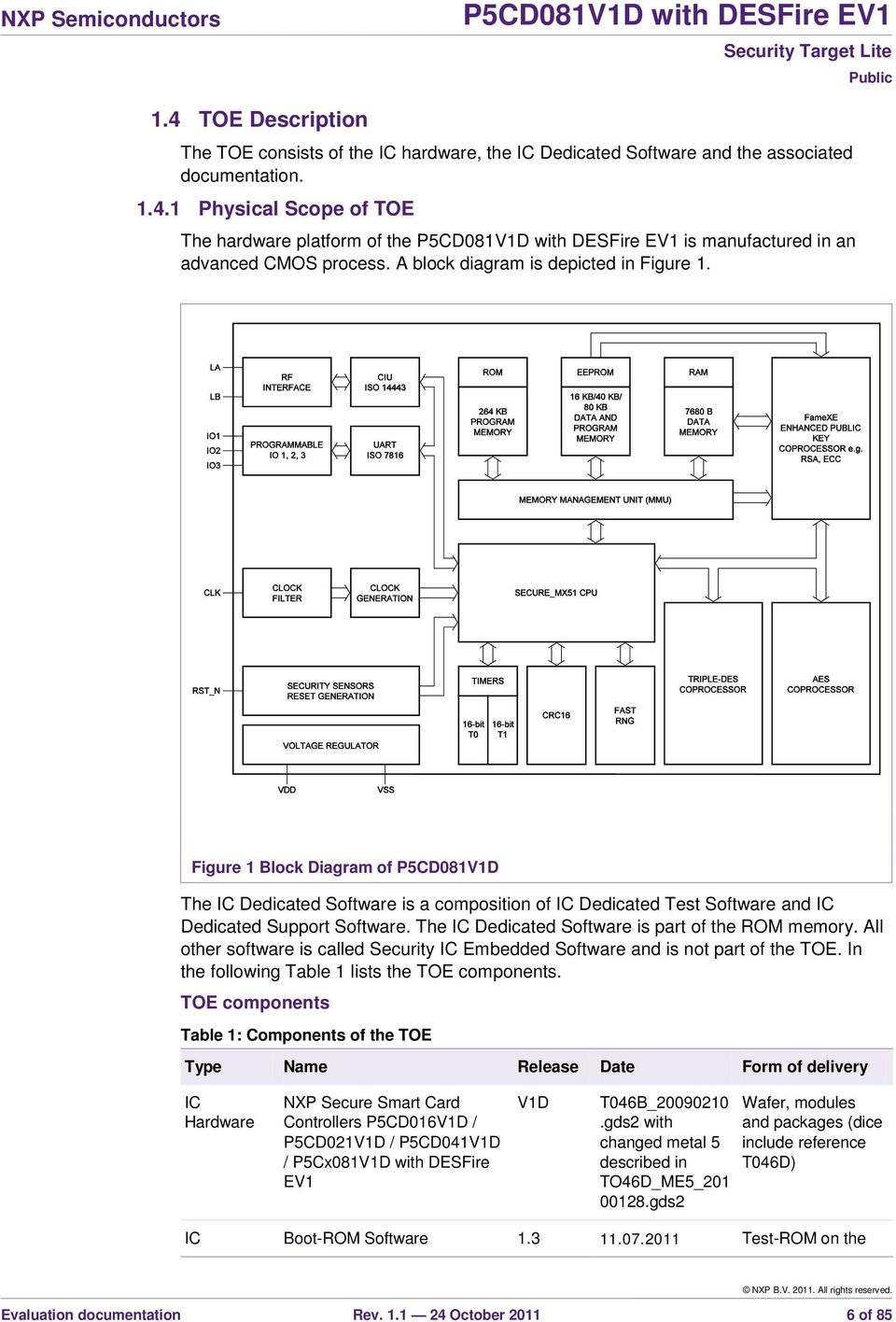
6 1.4 TOE Description The TOE consists of the IC hardware, the IC Dedicated Software and the associated documentation Physical Scope of TOE The hardware platform of the is manufactured in an advanced CMOS process. A block diagram is depicted in Figure 1. Figure 1 Block Diagram of P5CD081V1D The IC Dedicated Software is a composition of IC Dedicated Test Software and IC Dedicated Support Software. The IC Dedicated Software is part of the ROM memory. All other software is called Security IC Embedded Software and is not part of the TOE. In the following Table 1 lists the TOE components. TOE components Table 1: Components of the TOE Type Name Release Date Form of delivery IC Hardware NXP Secure Smart Card Controllers P5CD016V1D / P5CD021V1D / P5CD041V1D / P5Cx081V1D with DESFire EV1 V1D T046B_ gds2 with changed metal 5 described in TO46D_ME5_ gds2 Wafer, modules and packages (dice include reference T046D) IC Boot-ROM Software Test-ROM on the Evaluation documentation Rev October of 85
7 Type Name Release Date Form of delivery Dedicated Support Software chip, TestRom_042_107. hex DESFire EV1 Software Test-ROM on the chip, TestRom_042_107. hex IC Dedicated Test Software Test-ROM Software Test-ROM on the chip, TestRom_042_107. hex Document Document Document Document Document Product data sheet P5CD016/021/041/051 and P5Cx081 family; Secure dual interface and contact PKI smart card controller [8] Data Sheet P5CD016/021/041 V1D and P5Cx081 V1D with MIFARE DESFire EV1 OS [18] Instruction Set, SmartMX- Family, Secure and PKI Smart Card Controller [9] MIFARE DESFire Functional Specification, NXP Semiconductors, Business Line Identification [11] Guidance, Delivery and Operation Manual NXP Secure Smart Card Controllers P5CD016V1D/P5CD021V1D/ P5CD041V1D/P5Cx081V1D [10] Electronic document Electronic document Electronic document Electronic document Electronic document The TOE supports different configurations. The configurations of the customer visible EEPROM size and the contactless interface are named major configurations because each configuration has its own product name. All major configurations support specific configuration options that must be addressed by the Security IC Embedded Software and may have an impact on the security of the TOE. Each major configuration provides further configurations, which are named minor configuration options. The documentation covers all configurations Evaluated major hardware configurations The hardware platform can be configured to support different sizes of the EEPROM and different contactless interfaces. Five major configuration options are available, which are denoted by product names P5CD081V1D, P5CN081V1D, P5CD041V1D, P5CD021V1D and P5CD016V1D. All of them are equipped with a physical EEPROM of 80 kbytes and two interfaces comprising the ISO/IEC 7816 contact interface and the contactless Evaluation documentation Rev October of 85
![hex Document Document Document Document Document Product data sheet P5CD016/021/041/051 and P5Cx081 family; Secure dual interface and contact PKI smart card controller [8] Data Sheet P5CD016/021/041](/docs-images/56/7147598/images/page_7.jpg "V1D and P5Cx081 V1D with MIFARE DESFire EV1 OS [18] Instruction Set, SmartMX- Family, Secure and PKI Smart Card Controller [9] MIFARE DESFire Functional Specification, NXP Semiconductors, Business")
8 interface. Their major differences are related to availability of EEPROM space and the behavior of contactless interface as detailed below. The DESFire EV1 Software can be configured to support one of four possible configurations named A, D2, D4, and D8. The EEPROM memory sizes of these configurations are 2688 Byte for configuration D2, 5248 Byte for configuration D4, and 8320 Byte for configuration D8. Configuration A means that no EEPROM memory is reserved for DESFire and that the functionality of the DESFire EV1 Software is not available (except the CVEC2 call to Set/Get baud Rate). The EEPROM size available for the Security IC Embedded Software is reduced by the EEPROM size configured for the DESFire EV1 Software. The configuration of the DESFire EV1 Software is reflected in the commercial type names as listed in Table 3. The minor configuration options of all major configurations are described in subsection Major configuration P5CD016V1D P5CD016V1D supports all minor configuration options presented in subsection Its major differences to other configurations are as follows. The EEPROM space available to the Security IC Embedded Software is reduced to 16 kbytes minus 256 Bytes, which are reserved for Security Rows (128 Bytes) and configuration data (128 Bytes). With the DESFire EV1 Software configuration A, D2 respectively D4 the EEPROM space available to the Security IC Embedded Software is limited to / / respectively Byte, both minus 256 Bytes manufacturer data as described above. The contactless interface is configured for contactless communication according to ISO/IEC A in [24] and [25]. Major configuration P5CD021V1D P5CD021V1D supports all minor configuration options presented in subsection Its major differences to other configurations are as follows. The EEPROM space available to the Security IC Embedded Software is reduced to 20 kbytes minus 256 Bytes, which are reserved for Security Rows (128 Bytes) and configuration data (128 Bytes). With the DESFire EV1 Software configuration A, D2 respectively D4 the EEPROM space available to the Security IC Embedded Software is limited to / / respectively Byte, both minus 256 Bytes manufacturer data as described above. The contactless interface is configured for contactless communication according to ISO/IEC A in [24] and [25]. Major configuration P5CD041V1D P5CD041V1D supports all minor configuration options presented in subsection Its major differences to other configurations are as follows. The EEPROM space available to the Security IC Embedded Software is reduced to 40 kbytes minus 256 Bytes, which are reserved for Security Rows (128 Bytes) and configuration data (128 Bytes). Evaluation documentation Rev October of 85
9 With the DESFire EV1 Software configuration A, D2 / D4 / D8 the EEPROM space available to the Security IC Embedded Software is limited to / / / Byte, all minus 256 Bytes manufacturer data as described above. The contactless interface is configured for contactless communication according to ISO/IEC A in [24] and [25]. Major configuration P5CD081V1D P5CD081V1D supports all minor configuration options presented in subsection Its major differences to other configurations are as follows. The physically implemented EEPROM of 80 kbytes is available to the Security IC Embedded Software except for 256 Bytes, which are reserved for Security Rows (128 Bytes) and configuration data of the manufacturer (128 Bytes). With the DESFire EV1 Software configuration A, D2 / D4 / D8 the EEPROM space available to the Security IC Embedded Software is limited to / / / Byte, all minus 256 Bytes manufacturer data as described above. The contactless interface is configured for contactless communication according to ISO14443 A in [24] and [25]. Major configuration P5CN081V1D P5CN081V1D supports all minor configuration options presented in subsection Its major differences to other configurations are as follows. The physically implemented EEPROM of 80 kbytes is available to the Security IC Embedded Software except for 256 Bytes, which are reserved for Security Rows (128 Bytes) and configuration data (128 Bytes). With the DESFire EV1 Software configuration A, D2 / D4 / D8 the EEPROM space available to the Security IC Embedded Software is limited to / / / Byte, all minus 256 Bytes manufacturer data as described above. The contactless interface is enabled and configured in S²C mode. Therefore the TOE can be used for Near Field Communication (NFC) [26], for which an additional NFC helper IC is connected to IO3/SIGIN and LB/SIGOUT. However, it is possible that the TOE is powered in an appropriate electrical field when an antenna is connected to LA and LB. Pad I/O3 is connected to the NFC helper IC and cannot be used for contact communication according to ISO Common minor configuration options The following minor configuration options can be selected by the customer via order entry forms. Table 2: Evaluated minor configuration options Name Values Description EDATASCALE 10h up to FFh This value determines the size of the memory area available for the extended stack pointer. Refer to section 10.5 of [8]. Card Disable Function Yes or No When the Card Disable Function is enabled, the TOE can be locked completely. Once set by the Security IC Embedded Software, the execution of the Security IC Embedded Software is inhibited after the next reset. Refer to section 29.4 of [8]. Evaluation documentation Rev October of 85

10 Name Values Description Block ROM read instructions executed from EEPROM 128 Byte Page Mode Yes or No Yes or No Instructions executed from EEPROM are allowed or not to read ROM contents. Refer to section of [8]. In the 128 Byte Page Mode, up to 128 Bytes of EEPROM can be programmed simultaneously, instead of up to 64 Bytes. Refer to section of [8]. UID Double The size of the UID can be 7 bytes (Double UID). Refer to section of [8]. Contactless communication protocol Maximum CIU Baudrate Extended Voltage Class B activated Voltage Class C operation activated (i) proprietary protocol (compliant to ISO part 3) ; (ii) T=CL protocol (compliant to ISO part 3 and part 4) 106, 212, 424 or 848 kbaud Yes or No Yes or No Refer to section 21 of [8]. Defines the maximum available baudrate of the contactless interface. Refer to section 21 of [8]. If Extended Voltage Class B is activated, the usable "3V supply voltage range" is extended to lower values than the minimum Class B supply voltage 2.7 V, and Class C operation is not supported. Class BE supply voltage range: 2.2 V V DD 3.3 V. Refer to sections , 35.2, , 5 and 33 of [8]. If Voltage Class C is activated, supply voltage range is: 1.62 V V DD 1.98 V. Refer to sections , 35.2, , 5 and 33 of [8]. Requested LA/LB input capacitance 17 pf or 69 pf Additional capacitance (2x26 pf) between LA/LB required to meet resonance frequency at ID1/2 operation. The values of all options listed in Table 2 can be chosen independently. The Order Entry Forms [12], [13], [14], [15] and [16] contain a further option, which must be selected with a fixed value: The option Allow execution from RAM must be selected with No Evaluated package types A number of package types are supported for each major configuration of the TOE. The commercial types are named according to the following format. P5CD016pp/T1Drrffz for major configuration P5CD016V1D P5CD021pp/T1Drrffz for major configuration P5CD021V1D P5CD041pp/T1Drrffz for major configuration P5CD041V1D P5CD081pp/T1Drrffz for major configuration P5CD081V1D P5CN081pp/T1Drrffz for major configuration P5CN081V1D Evaluation documentation Rev October of 85
![UID Double The size of the UID can be 7 bytes (Double UID). Refer to section 11.1.1 of [8].](/docs-images/56/7147598/images/page_10.jpg "Contactless communication protocol Maximum CIU Baudrate Extended Voltage Class B activated Voltage Class C operation activated (i) proprietary protocol (compliant to ISO 14443 part 3) ; (ii) T=CL")
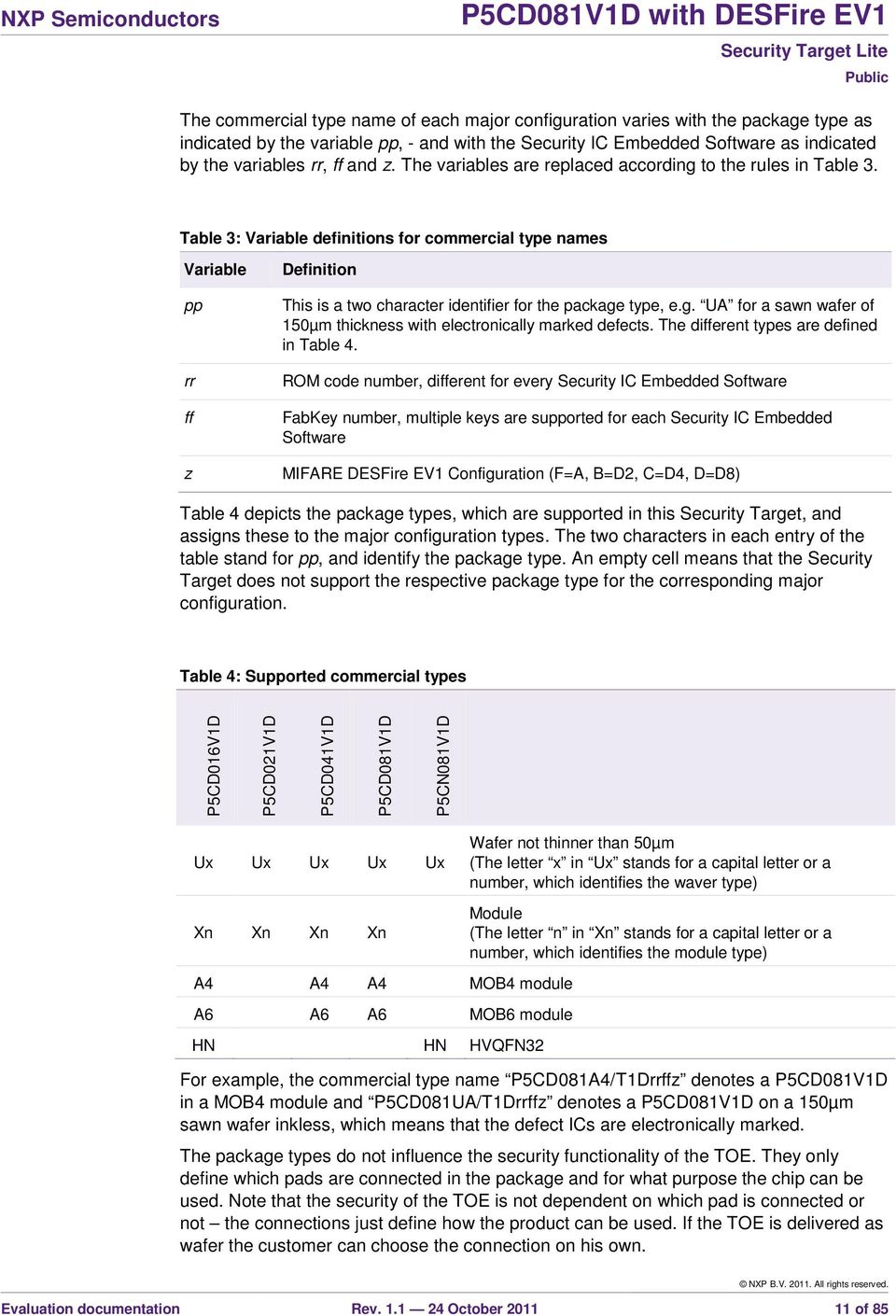
11 The commercial type name of each major configuration varies with the package type as indicated by the variable pp, - and with the Security IC Embedded Software as indicated by the variables rr, ff and z. The variables are replaced according to the rules in Table 3. Table 3: Variable definitions for commercial type names Variable pp rr ff z Definition This is a two character identifier for the package type, e.g. UA for a sawn wafer of 150µm thickness with electronically marked defects. The different types are defined in Table 4. ROM code number, different for every Security IC Embedded Software FabKey number, multiple keys are supported for each Security IC Embedded Software MIFARE DESFire EV1 Configuration (F=A, B=D2, C=D4, D=D8) Table 4 depicts the package types, which are supported in this Security Target, and assigns these to the major configuration types. The two characters in each entry of the table stand for pp, and identify the package type. An empty cell means that the Security Target does not support the respective package type for the corresponding major configuration. Table 4: Supported commercial types P5CD016V1D P5CD021V1D P5CD041V1D P5CD081V1D P5CN081V1D Ux Ux Ux Ux Ux Xn Xn Xn Xn Wafer not thinner than 50µm (The letter x in Ux stands for a capital letter or a number, which identifies the waver type) Module (The letter n in Xn stands for a capital letter or a number, which identifies the module type) A4 A4 A4 MOB4 module A6 A6 A6 MOB6 module HN HN HVQFN32 For example, the commercial type name P5CD081A4/T1Drrffz denotes a P5CD081V1D in a MOB4 module and P5CD081UA/T1Drrffz denotes a P5CD081V1D on a 150µm sawn wafer inkless, which means that the defect ICs are electronically marked. The package types do not influence the security functionality of the TOE. They only define which pads are connected in the package and for what purpose the chip can be used. Note that the security of the TOE is not dependent on which pad is connected or not the connections just define how the product can be used. If the TOE is delivered as wafer the customer can choose the connection on his own. Evaluation documentation Rev October of 85
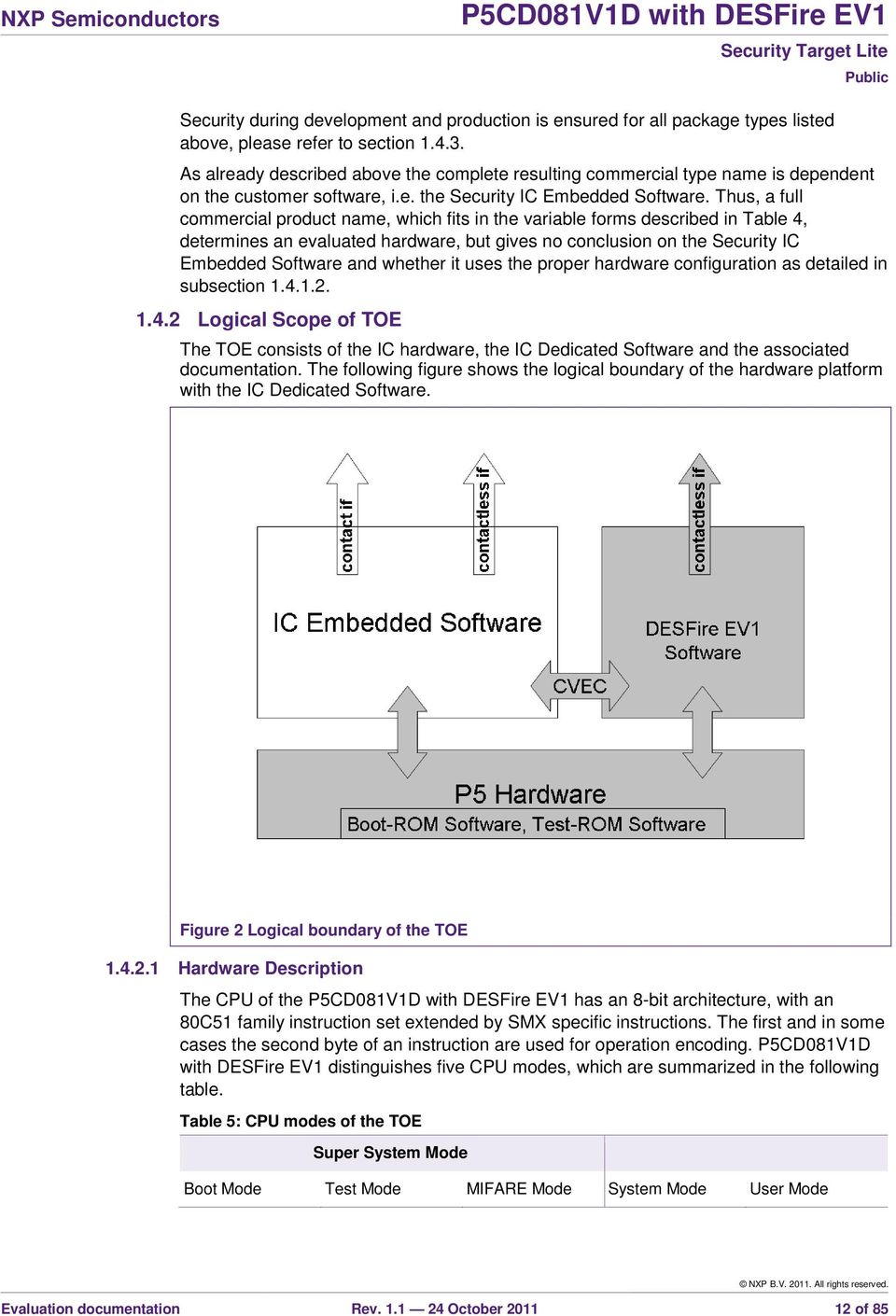
12 Security during development and production is ensured for all package types listed above, please refer to section As already described above the complete resulting commercial type name is dependent on the customer software, i.e. the Security IC Embedded Software. Thus, a full commercial product name, which fits in the variable forms described in Table 4, determines an evaluated hardware, but gives no conclusion on the Security IC Embedded Software and whether it uses the proper hardware configuration as detailed in subsection Logical Scope of TOE The TOE consists of the IC hardware, the IC Dedicated Software and the associated documentation. The following figure shows the logical boundary of the hardware platform with the IC Dedicated Software. Figure 2 Logical boundary of the TOE Hardware Description The CPU of the has an 8-bit architecture, with an 80C51 family instruction set extended by SMX specific instructions. The first and in some cases the second byte of an instruction are used for operation encoding. P5CD081V1D with DESFire EV1 distinguishes five CPU modes, which are summarized in the following table. Table 5: CPU modes of the TOE Super System Mode Boot Mode Test Mode MIFARE Mode System Mode User Mode Evaluation documentation Rev October of 85
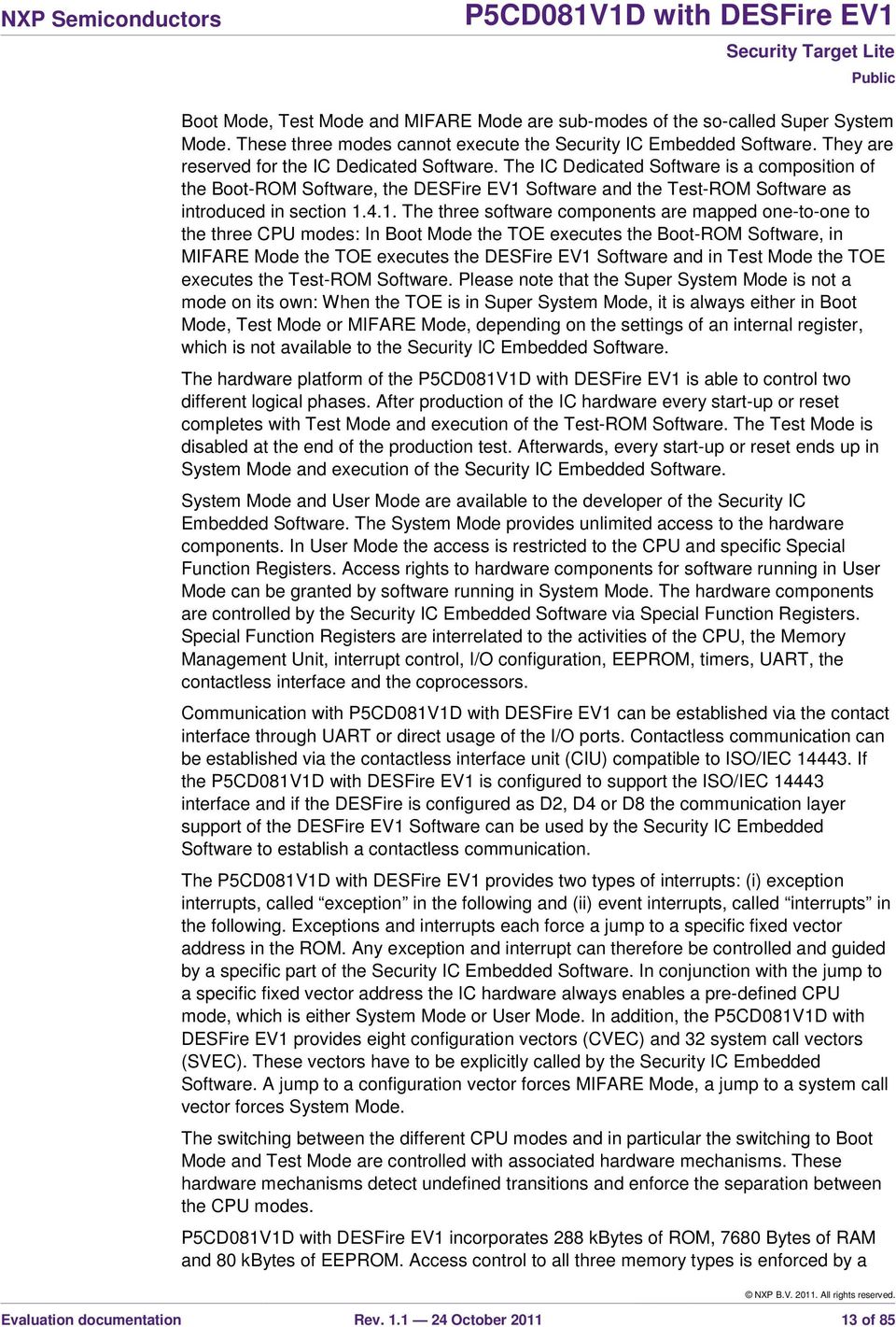
13 Boot Mode, Test Mode and MIFARE Mode are sub-modes of the so-called Super System Mode. These three modes cannot execute the Security IC Embedded Software. They are reserved for the IC Dedicated Software. The IC Dedicated Software is a composition of the Boot-ROM Software, the DESFire EV1 Software and the Test-ROM Software as introduced in section The three software components are mapped one-to-one to the three CPU modes: In Boot Mode the TOE executes the Boot-ROM Software, in MIFARE Mode the TOE executes the DESFire EV1 Software and in Test Mode the TOE executes the Test-ROM Software. Please note that the Super System Mode is not a mode on its own: When the TOE is in Super System Mode, it is always either in Boot Mode, Test Mode or MIFARE Mode, depending on the settings of an internal register, which is not available to the Security IC Embedded Software. The hardware platform of the is able to control two different logical phases. After production of the IC hardware every start-up or reset completes with Test Mode and execution of the Test-ROM Software. The Test Mode is disabled at the end of the production test. Afterwards, every start-up or reset ends up in System Mode and execution of the Security IC Embedded Software. System Mode and User Mode are available to the developer of the Security IC Embedded Software. The System Mode provides unlimited access to the hardware components. In User Mode the access is restricted to the CPU and specific Special Function Registers. Access rights to hardware components for software running in User Mode can be granted by software running in System Mode. The hardware components are controlled by the Security IC Embedded Software via Special Function Registers. Special Function Registers are interrelated to the activities of the CPU, the Memory Management Unit, interrupt control, I/O configuration, EEPROM, timers, UART, the contactless interface and the coprocessors. Communication with can be established via the contact interface through UART or direct usage of the I/O ports. Contactless communication can be established via the contactless interface unit (CIU) compatible to ISO/IEC If the is configured to support the ISO/IEC interface and if the DESFire is configured as D2, D4 or D8 the communication layer support of the DESFire EV1 Software can be used by the Security IC Embedded Software to establish a contactless communication. The provides two types of interrupts: (i) exception interrupts, called exception in the following and (ii) event interrupts, called interrupts in the following. Exceptions and interrupts each force a jump to a specific fixed vector address in the ROM. Any exception and interrupt can therefore be controlled and guided by a specific part of the Security IC Embedded Software. In conjunction with the jump to a specific fixed vector address the IC hardware always enables a pre-defined CPU mode, which is either System Mode or User Mode. In addition, the P5CD081V1D with DESFire EV1 provides eight configuration vectors (CVEC) and 32 system call vectors (SVEC). These vectors have to be explicitly called by the Security IC Embedded Software. A jump to a configuration vector forces MIFARE Mode, a jump to a system call vector forces System Mode. The switching between the different CPU modes and in particular the switching to Boot Mode and Test Mode are controlled with associated hardware mechanisms. These hardware mechanisms detect undefined transitions and enforce the separation between the CPU modes. incorporates 288 kbytes of ROM, 7680 Bytes of RAM and 80 kbytes of EEPROM. Access control to all three memory types is enforced by a Evaluation documentation Rev October of 85
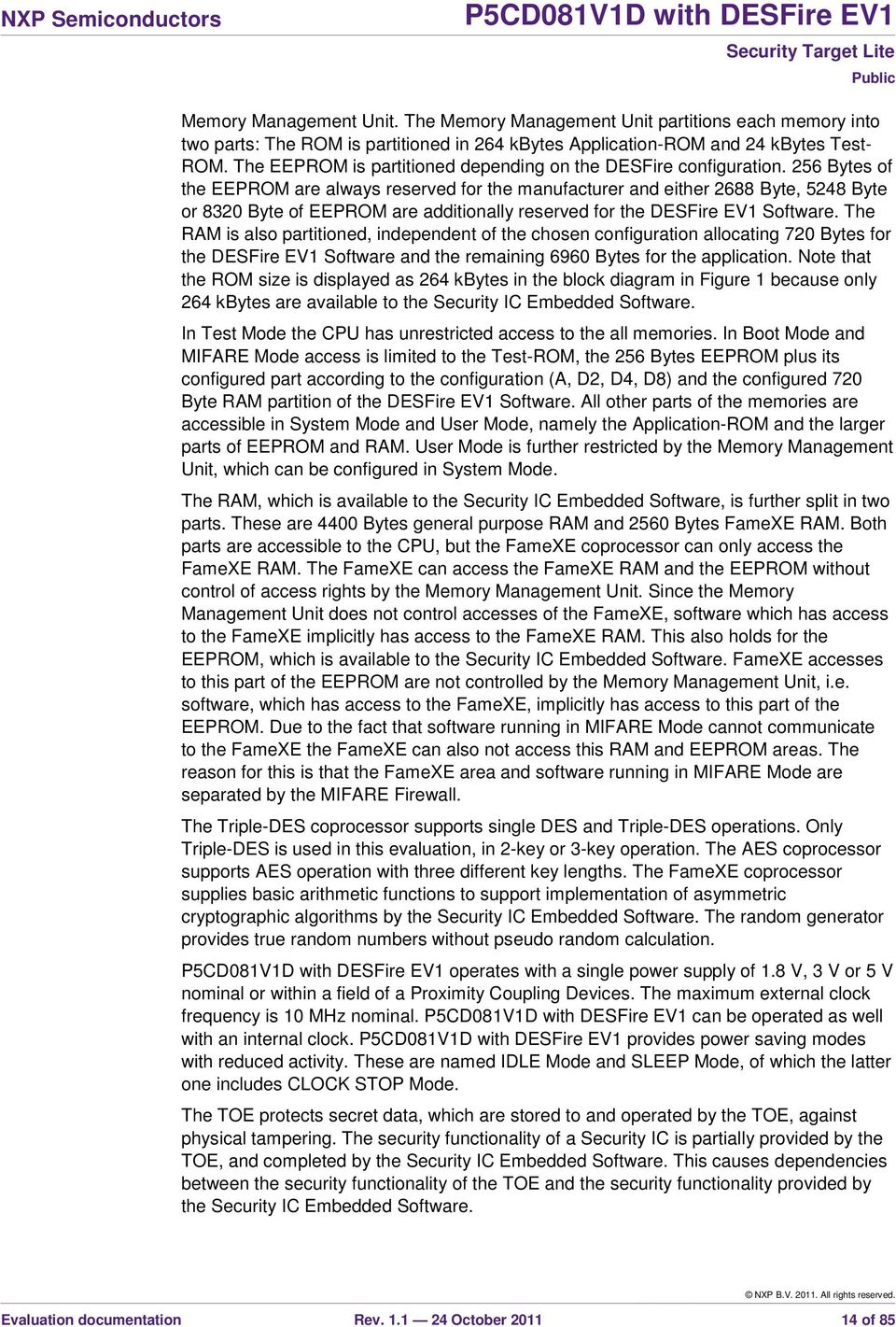
14 Memory Management Unit. The Memory Management Unit partitions each memory into two parts: The ROM is partitioned in 264 kbytes Application-ROM and 24 kbytes Test- ROM. The EEPROM is partitioned depending on the DESFire configuration. 256 Bytes of the EEPROM are always reserved for the manufacturer and either 2688 Byte, 5248 Byte or 8320 Byte of EEPROM are additionally reserved for the DESFire EV1 Software. The RAM is also partitioned, independent of the chosen configuration allocating 720 Bytes for the DESFire EV1 Software and the remaining 6960 Bytes for the application. Note that the ROM size is displayed as 264 kbytes in the block diagram in Figure 1 because only 264 kbytes are available to the Security IC Embedded Software. In Test Mode the CPU has unrestricted access to the all memories. In Boot Mode and MIFARE Mode access is limited to the Test-ROM, the 256 Bytes EEPROM plus its configured part according to the configuration (A, D2, D4, D8) and the configured 720 Byte RAM partition of the DESFire EV1 Software. All other parts of the memories are accessible in System Mode and User Mode, namely the Application-ROM and the larger parts of EEPROM and RAM. User Mode is further restricted by the Memory Management Unit, which can be configured in System Mode. The RAM, which is available to the Security IC Embedded Software, is further split in two parts. These are 4400 Bytes general purpose RAM and 2560 Bytes FameXE RAM. Both parts are accessible to the CPU, but the FameXE coprocessor can only access the FameXE RAM. The FameXE can access the FameXE RAM and the EEPROM without control of access rights by the Memory Management Unit. Since the Memory Management Unit does not control accesses of the FameXE, software which has access to the FameXE implicitly has access to the FameXE RAM. This also holds for the EEPROM, which is available to the Security IC Embedded Software. FameXE accesses to this part of the EEPROM are not controlled by the Memory Management Unit, i.e. software, which has access to the FameXE, implicitly has access to this part of the EEPROM. Due to the fact that software running in MIFARE Mode cannot communicate to the FameXE the FameXE can also not access this RAM and EEPROM areas. The reason for this is that the FameXE area and software running in MIFARE Mode are separated by the MIFARE Firewall. The Triple-DES coprocessor supports single DES and Triple-DES operations. Only Triple-DES is used in this evaluation, in 2-key or 3-key operation. The AES coprocessor supports AES operation with three different key lengths. The FameXE coprocessor supplies basic arithmetic functions to support implementation of asymmetric cryptographic algorithms by the Security IC Embedded Software. The random generator provides true random numbers without pseudo random calculation. operates with a single power supply of 1.8 V, 3 V or 5 V nominal or within a field of a Proximity Coupling Devices. The maximum external clock frequency is 10 MHz nominal. can be operated as well with an internal clock. provides power saving modes with reduced activity. These are named IDLE Mode and SLEEP Mode, of which the latter one includes CLOCK STOP Mode. The TOE protects secret data, which are stored to and operated by the TOE, against physical tampering. The security functionality of a Security IC is partially provided by the TOE, and completed by the Security IC Embedded Software. This causes dependencies between the security functionality of the TOE and the security functionality provided by the Security IC Embedded Software. Evaluation documentation Rev October of 85
15 Software Description Operating system and applications of a Security IC are developed by the customers. All software developed by the customer is summarized as Security IC Embedded Software. The Security IC Embedded Software is stored in the Application-ROM and/or in the EEPROM and is not part of the TOE. The Security IC Embedded Software depends on the usage of the Security IC. The IC Dedicated Test Software, which is named Test-ROM Software, is stored to the Test-ROM and used by the manufacturer of the Security IC during production test. Before NXP Semiconductors delivers the product, the test functionality is disabled by disabling the Test Mode of the CPU. The IC Dedicated Test Software is developed by NXP and embedded in the Test-ROM. The Test-ROM Software includes the test operating system, test routines for the various design blocks of the hardware platform, control flags of life cycle status and configuration in the Security Row and shutdown functions to ensure that security relevant test operations cannot be executed illegally after phase 3. The Dedicated Support Software is also stored to the Test-ROM and consists of two parts. The Boot-ROM Software, which is executed during start-up or reset of the TOE, i.e. each time when the TOE powers up or resets. It sets up the TOE and its basic configuration to ensure the defined initial values. The DESFire EV1 Software, which is started by a CVEC call of the Security IC Embedded Software. The DESFire EV1 Software provides the following functionality Flexible file system that can contain up to 28 applications with up to 32 files in each application. Support for different file types like values or data records. Mutual three pass authentication, also according to ISO Authentication on application level with fine-grained access conditions for files. Multi-application support that allows distributed management of applications and ensures application segregation. Data encryption for contact-less communication with replay attack protection. Transaction system with rollback that ensures consistency for complex transactions. Unique serial number for each device (UID) with optional random UID Documentation In addition the software layer of the DESFire EV1 Software can be used to establish the contactless communication according to ISO/IEC for the Security IC Embedded Software. Please refer to [18] for more information. The data sheet Product data sheet P5CD016/021/041/051 and P5Cx081 family; Secure dual interface and contact PKI smart card controller [8] contains a functional description and guidelines for the use of the security functionality of the hardware platform, as needed to develop Security IC Embedded Software. The data sheet addendum Data Sheet P5CD016/021/041 V1D and P5Cx081 V1D with MIFARE DESFire EV1 OS [18] is an addendum to the data sheet of the hardware platform which addresses the interfaces to DESFire EV1 Software, as needed to develop Security IC Embedded Software. Evaluation documentation Rev October of 85
16 The functional specification of the DESFire EV1 Software is described in MIFARE DESFire Functional Specification [11] The instruction set of the CPU is described in Instruction Set, SmartMX-Family, Secure and PKI Smart Card Controller [9]. The manual Guidance, Delivery and Operation Manual NXP Secure Smart Card Controllers P5CD016V1D/P5CD021V1D/P5CD041V1D/P5Cx081V1D [10] describes aspects of the program interface and the use of programming techniques to improve the security. The whole documentation shall be used by the developer to develop the Security IC Embedded Software. The documentation also includes guidance for the secure operation of the DESFire EV1 Software Security during Development and Production The Security IC product life-cycle is scheduled in phases as introduced in the PP [6]. IC Development as well as IC Manufacturing and Testing, which are phases 2 and 3 of the life-cycle, are part of the evaluation. The Security IC is delivered at the end of phase 3 or after IC Packaging, which is at the end phase 4 in the life-cycle, and then part of the evaluation as well. The development and production environment of the TOE ranges from phase 2 to TOE Delivery. With respect to Application Note 3 in [6] the TOE supports the authentic delivery using the FabKey feature or the originality key feature. For details on this features please refer to the data sheet in [8] and the manual in [10]. During the design and the layout process only people involved in the specific development project for an IC have access to sensitive data. Different people are responsible for the design data and for customer related data. The security measures installed within NXP ensure a secure computer system and provide appropriate equipment for the different development tasks. The verified layout data is provided by the developers of NXP Semiconductors, Business Unit Identification directly to the wafer fab. The wafer fab generates and forwards the layout data related to the different photo masks to the manufacturer of the photo masks. The photo masks are generated off-site and verified against the design data of the development before the usage. Accountability and traceability are ensured among the wafer fab and the photo mask provider. The production of the wafers includes two different steps regarding the production flow. In the first step the wafers are produced with the fixed masks independent of the customer. After that step the wafers are completed with the customer specific mask and the remaining fixed masks. The computer tracking ensures control of the complete process including storage of the semi-finished wafers. The test process of every die is performed by a test centre of NXP. Delivery processes between the involved sites provide accountability and traceability of the produced wafers. NXP embeds the dice into modules, inlays or packages based on customer demand. Information about non-functional items is stored on magnetic/optical media enclosed with the delivery or the non-functional items are physically marked. In summary, the TOE can be delivered in different forms, which are dice on wafers smartcard modules on a module reel packaged devices in tubes or reels Evaluation documentation Rev October of 85
![The manual Guidance, Delivery and Operation Manual NXP Secure Smart Card Controllers P5CD016V1D/P5CD021V1D/P5CD041V1D/P5Cx081V1D [10] describes aspects of the program interface and the use of](/docs-images/56/7147598/images/page_16.jpg "programming techniques to improve the security. The whole documentation shall be used by the developer to develop the Security IC Embedded Software.")
17 The availability of major configuration options of the TOE in package types is detailed in section TOE Intended Usage The end-consumer environment of the TOE is phase 7 of the Security IC product lifecycle as described in the PP [6]. In this phase the Security IC product provides the functionality defined by: the Security IC Embedded Software and if supported by the Security IC Embedded Software the IC Dedicated Support Software DESFire EV1 Software The TOE is used by the end-consumer depending on the functionality implemented by the Security IC Embedded Software and the applications supported by the DESFire EV1 Software. Security ICs are used to assure authorized conditional access in a wide range of applications. Examples are identity cards, Banking Cards, Pay-TV, Portable communication SIM cards, Health cards, and Transportation cards. The end-user environment covers a wide spectrum of very different functions, thus making it difficult to monitor and avoid abuse of the TOE. The TOE is intended to be used in an insecure environment, which does not protect against threats. The device is developed for most high-end safeguarded applications, and is designed for embedding into chip cards according to ISO/IEC 7816 [22] and for contactless applications. Usually a Security IC (e.g. a smartcard) is assigned to a single individual only, but it may also be used by multiple applications in a multi-provider environment. Therefore the TOE might store and process secrets of several systems, which must be protected from each other. The TOE then must meet security requirements for each single security module. Secret data shall be used as input for calculation of authentication data, calculation of signatures and encryption of data and keys. The Security IC Embedded Software can call the DESFire EV1 Software that is part of the TOE. If the DESFire EV1 Software is called it provides its own security functionality and operates independent of the Security IC Embedded Software on the memory partitions assigned to the DESFire EV1 Software. The DESFire EV1 Software supports DESFire compatible applications in the field of: Electronic fare collection Stored value card systems Access control systems Loyalty If privacy is an issue, the DESFire EV1 Software can be configured not to disclose any information to unauthorized users. However in this case also the application(s) implemented in the Security IC Embedded Software must support this privacy issue. Otherwise the privacy enforced by the DESFire EV1 Software can be circumvented by selecting another application of the TOE. In development and production environment of the TOE the Security IC Embedded Software developer and system integrators such as the terminal software developer may use samples of the TOE for their testing purposes. It is not intended that they are able to change the behavior of the hardware platform in another way than an end-consumer. The user environment of the TOE ranges from TOE delivery to phase 7 of the Security IC product life-cycle, and must be a controlled environment up to phase 6. Evaluation documentation Rev October of 85

18 Note: Interface of the TOE The phases between TOE Delivery (end of phase 3 or phase 4) and phase 7 of the Security IC Product life-cycle are not part of the TOE construction process in the sense of this Security Target. Information about these phases is just included to describe how the TOE is used after its construction. Nevertheless such security functionality of the TOE, that is independent of the Security IC Embedded Software, is active at TOE Delivery and cannot be disabled by the Security IC Embedded Software in the following phases. The TOE supports two separate electrical interfaces. The contact interface comprises the pads connecting power supply, reset input, clock input, ground and the serial communication pads IO1, IO2 and IO3. The contactless interface comprises the two pads (called LA and LB) for the connection of an antenna. Note: The S²C interface is based on a special configuration of the contactless interface and IO3. The logical interface of the TOE depends on the CPU mode. In the Boot Mode the Boot-ROM Software is executed which provides no interface. There is no possibility to interact with this software. In the MIFARE Mode the DESFire EV1 Softwareis executed by the CPU. The interface of the DESFire EV1 Software comprises the command interface as defined by the functional specification of the DESFire EV1 Software, refer to [11]. In System Mode and User Mode (used after TOE Delivery) the software interface is the set of instructions, the bits in the special function registers that are related to these modes and the physical address map of the CPU including memories. The access to the special function registers as well as to the memories depends on the CPU mode configured by the Security IC Embedded Software. Note: The logical interface of the TOE after TOE Delivery is based on the Security IC Embedded Software developed by the software developer. The Security IC Embedded Software can use both electrical interfaces. The identification and authentication of the user for the different CPU modes must be controlled by the Security IC Embedded Software. The Test Mode is disabled after production testing, before the TOE is delivered. Therefore no logical interface is visible in this CPU mode. The chip surface can be seen as an interface of the TOE, too. This interface must be taken into account regarding environmental stress e.g. like temperature and in the case of an attack where the attacker manipulates the chip surface. Note: An external supply and clock as well as a logical interface (terminal) are necessary for the operation of the TOE. Beyond the physical behavior the logical interface is defined by the Security IC Embedded Software or the DESFire EV1 Software as described above. Evaluation documentation Rev October of 85

19 2. Conformance Claims This chapter is divided into the following sections: CC Conformance Claim", "Package claim", "PP claim", and "Conformance Claim Rationale. 2.1 CC Conformance Claim This Security Target claims to be conformant to version 3.1 of Common Criteria for Information Technology Security Evaluation according to Common Criteria, Common Criteria for Information Technology Security Evaluation, Part 1: Introduction and General Model, Version 3.1, Revision 3, July 2009, CCMB [1] Common Criteria, Common Criteria for Information Technology Security Evaluation, Part 2: Security Functional Requirements, Version 3.1, Revision 3, July 2009, CCMB [2] Common Criteria, Common Criteria for Information Technology Security Evaluation, Part 3: Security Assurance Requirements, Version 3.1, Revision 3, July 2009, CCMB [3] The following methodology will be used for the evaluation. Common Methodology for Information Technology Security Evaluation, Evaluation Methodology, Version 3.1, Revision 3, July 2009, CCMB [4] This Security Target claims to be CC Part 2 extended and CC Part 3 conformant. The extended Security Functional Requirements are defined in chapter Package claim This Security Target claims conformance to the assurance package EAL 4 augmented. The augmentations to EAL4 are ALC_DVS.2 and AVA_VAN.5. In addition, the Security Target is augmented using the component ASE_TSS.2, which is chosen to include architectural information on the security functionality of the TOE. Note: The PP Security IC Platform Protection Profile [6] to which this Security Target claims conformance (refer to section 2.3) requires also assurance level EAL4 augmented with the augmentation listed above. The level of evaluation and the functionality of the TOE are chosen in order to allow the confirmation that the TOE is suitable for use within devices compliant with the German Digital Signature Law. 2.3 PP claim This Security Target claims conformance to the Protection Profile (PP) Security IC Platform Protection Profile, Version 1.0, registered and certified by Bundesamt für Sicherheit in der Informationstechnik (BSI) under the reference BSI-PP [6]. Since the Security Target claims conformance to this PP [6], the concepts are used in the same sense. For the definition of terms please refer to the PP [6]. These terms also apply to this Security Target. The TOE provides additional functionality, which is not covered in the PP [6]. In accordance with Application Note 4 of [6] this additional functionality is added using the Evaluation documentation Rev October of 85

20 policies P.Add-Components and P.DESFire-Emulation (see section 3.3 of this Security Target). 2.4 Conformance Claim Rationale According to section 2.3 this Security Target claims conformance to the PP Security IC Platform Protection Profile [6]. The TOE type defined in section of this Security Target is a smartcard controller with IC Dedicated Support Software. This is consistent with the TOE definition for a Security IC with IC Dedicated Software provided in section of [6]. All sections of this Security Target, where security problem definition, objectives and security requirements are defined, clearly state which of these items are taken from the PP [6] and which are added in this Security Target. Therefore this is not repeated here. Moreover, all additionally stated items in this Security Target do not contradict the items included from the PP (see the respective sections in this document). The operations done for the SFRs taken from the PP [6] are also clearly indicated. The evaluation assurance level claimed for this target (EAL4+) is shown in section 6.2 which applies to the requirements claimed by the PP (EAL4+). These considerations show that the Security Target correctly claims conformance to the PP [6]. Evaluation documentation Rev October of 85
![This is consistent with the TOE definition for a Security IC with IC Dedicated Software provided in section 1.2.2 of [6].](/docs-images/56/7147598/images/page_20.jpg "All sections of this Security Target, where security problem definition, objectives and security requirements are defined, clearly state which of these items are taken from the PP [6] and which are")
21 3. Security Problem Definition This Security Target claims conformance to the PP Security IC Platform Protection Profile, [6]. Assets, threats, assumptions and organizational security policies are taken from the PP [6]. This chapter lists these assets, threats, assumptions and organizational security policies, and describes extensions to these elements in detail. The chapter is divided into the following sections: Description of Assets", "Threats", "Organisational Security Policies", and "Assumptions". 3.1 Description of Assets Since this Security Target claims conformance to the PP Security IC Platform Protection Profile [6] the assets defined in section 3.1 of [6] are applied here. These assets are cited here. The assets related to standard functionality are: the User Data, the Security IC Embedded Software, stored and in operation, the security services provided by the TOE for the Security IC Embedded Software. If the Security IC Embedded Software includes calls of the DESFire EV1 Software the assets are extended by: the Keys, Files and Values controlled by the DESFire EV1 Software the DESFire EV1 Software, stored and in operation. Note that keys used by the Security IC Embedded Software for the cryptographic coprocessors are seen as User Data because the Security IC Embedded Software is not part of the TOE. Keys of the DESFire EV1 Software are explicitly addressed because their protection is completely provided by the TOE. To be able to protect these assets the TOE shall protect its security functionality. To support this protection the critical information about the TOE design shall be protected. Critical information includes: logical design data, physical design data, IC Dedicated Software, configuration data, Initialization Data and Pre-personalization Data, specific development aids, test and characterization related data, material for software development support, photomasks. 3.2 Threats Since this Security Target claims conformance to the PP Security IC Platform Protection Profile [6] the threats defined in section 3.2 of [6] are valid for this Security Target. The following table lists the threats defined in the PP [6]. Table 6: Threats defined by the PP [6]. Name Title T.Leak-Inherent T.Phys-Probing T.Malfunction T.Phys-Manipulation Inherent Information Leakage Physical Probing Malfunction due to Environmental Stress Physical Manipulation Evaluation documentation Rev October of 85
22 Name T.Leak-Forced T.Abuse-Func T.RND Title Forced Information Leakage Abuse of Functionality Deficiency of Random Numbers This Security Target defines additional threats related to the functionality provided by the DESFire EV1 Software. Considering Application Note 5 in [6] the following threats are defined by this ST: T.Data-Modification Unauthorized modification of keys, files and values maintained by the DESFire EV1 Software. Keys, files and values maintained by the DESFire EV1 Software are processed and stored by the TOE. They may be modified by unauthorized subjects. This threat applies to the processing of modified commands received by the TOE, it is not concerned with verification of authenticity. T.Impersonate T.Cloning 3.3 Organisational Security Policies Impersonating authorized users during the authentication process of the DESFire EV1 Software. An unauthorized subject may try to impersonate an authorized subject during the authentication sequence of the DESFire EV1 Software, e.g. by a man-in-the middle or replay attack. Cloning using keys, files and values maintained by the DESFire EV1 Software Keys, files and values maintained by the DESFire EV1 Software stored on the TOE may be read out by an unauthorized subject in order to create a duplicate. Since this Security Target claims conformance to the PP Security IC Platform Protection Profile [6] the policy P.Process-TOE Protection during TOE Development and Production in [6] is applied here as well. In accordance with Application Note 6 in [6] the following additional security policies are defined in this Security Target as detailed below. The TOE provides specific security functionality, which can be used by the Security IC Embedded Software. In the following, specific security functionality is listed, which is not derived from threats identified for the TOE s environment. It can only be decided in the context of the application against which threats the Security IC Embedded Software will use this specific security functionality. The hardware platform shall provide the following additional security functionality to the Security IC Embedded Software Additional Specific Security Components (P.Add- Components) as specified below. P.Add-Components Additional specific security components Triple-DES encryption and decryption AES encryption and decryption Evaluation documentation Rev October of 85
23 Area based Memory Access Control Memory separation for different software parts (including IC Dedicated Software and Security IC Embedded Software) Special Function Register Access Control. In addition the DESFire EV1 Software as part of the hardware platform provides the following security functionality P.DESFire-Emulation. The Security IC Embedded Software can call the DESFire EV1 Software which implements this security policy. It is not mandatory for the Security IC Embedded Software to call the DESFire EV1 Software because the policy described above is independent of the DESFire EV1 Software. However if the TOE shall emulate the DESFire functionality the Security IC Embedded Software must call the DESFire EV1 Software. Therefore the IC Developer/Manufacturer defines the additional policies as specified below. P.DESFire-Emulation 3.4 Assumptions The DESFire emulation provides the following specific security components: Confidentiality during communication provides the possibility to protect selected data elements from eavesdropping during contactless communication. Integrity during communication provides the possibility to protect the contactless communication from modification or injections. This includes especially the possibility to detect replay or man-in-the-middle attacks within a session. Transaction mechanism provides the possibility to combine a number of data modification operations in one transaction, so that either all operations or no operation at all is performed. Since this Security Target claims conformance to the PP Security IC Platform Protection Profile [6] the assumptions defined in section 3.4 of [6] are valid for this Security Target. The following table lists these assumptions. Table 7: Assumptions defined in the PP [6] Name Title A.Process-Sec-IC A.Plat-Appl A.Resp-Appl Protection during Packaging, Finishing and Personalization Usage of Hardware Platform Treatment of User Data The following additional assumptions are added in this Security Target according to Application Notes 7 and 8 in [6]. A.Check-Init Check of pre-personalization data to ensure the authenticity of the TOE. The Security IC Embedded Software must provide a function to check pre-personalization data and/or must support the use of the originality key function provided by the DESFire EV1 Software. The pre-personalization data is defined by the customer and the originality key is defined by NXP. Both data Evaluation documentation Rev October of 85
24 sets are injected by the TOE Manufacturer into the nonvolatile memory to provide the possibility for TOE identification and for traceability. The following additional assumption considers specialized encryption hardware of the TOE. The developer of the Security IC Embedded Software must ensure the appropriate Usage of Key-dependent Functions (A.Key-Function) while developing this software in Phase 1 as specified below. A.Key-Function Usage of Key-dependent Functions Key-dependent functions (if any) shall be implemented in the Security IC Embedded Software in a way that they are not susceptible to leakage attacks (as described under T.Leak- Inherent and T.Leak-Forced). Note that here the routines which may compromise keys when being executed are part of the Security IC Embedded Software. In contrast to this the threats T.Leak-Inherent and T.Leak-Forced address (i) the cryptographic routines which are part of the TOE and (ii) the processing of User Data including cryptographic keys. The following two assumptions are outside the control of the DESFire EV1 Software. These assumptions must be implemented to support the security functionality of the DESFire EV1 Software. A.Secure-Values A.Terminal-Support Usage of secure values Only confidential and secure keys shall be used to set up the authentication and access rights for the DESFire EV1 Software. These values are generated outside the TOE. They must be protected during generation, management outside the TOE and downloaded to the TOE. Terminal support to ensure integrity and confidentiality The terminal verifies information sent by the TOE in order to ensure integrity and confidentiality of the communication. Note that the assumptions A.Plat-Appl and A.Resp-Appl defined in the Protection Profile are relevant for all software running on the hardware platform. Therefore the assumptions are addressed during the development of the IC Dedicated Support Software. The Boot Software and the DESFire EV1 Software meet the assumptions A.Plat-Appl and A.Resp-Appl. The assumptions are still applicable for the Security IC Embedded Software and therefore they will remain in this Security Target as defined in the Protection Profile [6]. Evaluation documentation Rev October of 85
25 4. Security Objectives This chapter contains the following sections: Security Objectives for the TOE, Security Objectives for the Security IC Embedded Software development Environment, Security Objectives for the Operational Environment and Security Objectives Rationale. 4.1 Security Objectives for the TOE The TOE shall provide the following security objectives, which are taken from the PP Security IC Platform Protection Profile [6]. Table 8: Security objectives defined in the PP and the Hardware Security Target Name Title Defined in O.Leak-Inherent Protection against Inherent Information Leakage PP [6] O.Phys-Probing Protection against Physical Probing PP [6] O.Malfunction Protection against Malfunctions PP [6] O.Phys-Manipulation Protection against Physical Manipulation PP [6] O.Leak-Forced Protection against Forced Information Leakage PP [6] O.Abuse-Func Protection against Abuse of Functionality PP [6] O.Identification TOE Identification PP [6] O.RND Random Numbers PP [6] The Security Target defines additional security objectives. The following security objectives are provided by the hardware platform of the TOE: O.HW-DES3 O.HW-AES Triple DES Functionality The TOE shall provide the cryptographic functionality to calculate a Triple DES encryption and decryption to the Security IC Embedded Software and the IC Dedicated Software. The TOE supports directly the calculation of Triple DES with up to three keys. Note: The TOE will ensure the confidentiality of the User Data (and especially cryptographic keys) during Triple DES operation. This is supported by O.Leak-Inherent. AES Functionality The TOE shall provide the cryptographic functionality to calculate an AES encryption and decryption to the Security IC Embedded Software and the IC Dedicated Software. The TOE supports directly the calculation of AES with three different key lengths. Note: The TOE will ensure the confidentiality of the User Data (and especially cryptographic keys) during AES operation. This is supported by O.Leak-Inherent. Evaluation documentation Rev October of 85
26 O.MF-FW O.MEM-ACCESS O.SFR-ACCESS MIFARE Firewall The TOE shall provide separation between the DESFire EV1 Software as part of the IC Dedicated Support Software and the Security IC Embedded Software. The separation shall comprise software execution and data access. Area based Memory Access Control Access by processor instructions to memory areas is controlled by the TOE. The TOE decides based on the CPU mode (Boot Mode, Test Mode, MIFARE Mode, System Mode or User Mode) and the configuration of the Memory Management Unit if the requested type of access to the memory area addressed by the operands in the instruction is allowed. Special Function Register Access Control The TOE shall provide access control to the Special Function Registers depending on the purpose of the Special Function Register or based on permissions associated to the memory area from which the CPU is currently executing code. The access control is used to restrict access to hardware components of the TOE. The possibility to define access permissions to specialized hardware components of the TOE shall be restricted to code running in System Mode. The security objectives of the IC Dedicated Support Software (DESFire EV1 Software) can only be provided if this IC Dedicated Support Software is called by the Security IC Embedded Software. The DESFire EV1 Software is part of the TOE and provides the following security objectives: O.DATA-ACCESS O.AUTHENTICATION O.CONFIDENTIALITY Access Control to DESFire Data The TOE must provide an access control mechanism for data stored by the DESFire EV1 Software. The access control mechanism shall apply to read, modify, create and delete operations for data elements and to reading and modifying security attributes as well as authentication data. It shall be possible to limit the right to perform a specific operation to a specific user. The security attributes (keys) used for authentication shall never be output. Authentication The DESFire EV1 Software as part of the TOE must provide an authentication mechanism in order to be able to authenticate authorized users. The authentication mechanism shall be limited to the DESFire EV1 Software and shall be resistant against replay and man-in-the-middle attacks. Confidential Communication The TOE must be able to protect the communication of the DESFire EV1 Software by encryption. This shall be implemented by security attributes of the DESFire data Evaluation documentation Rev October of 85
27 O.TYPE-CONSISTENCY Data type consistency O.TRANSACTION element that enforce encrypted communication of the DESFire EV1 Software for the respective data element. During DESFire operation the TOE shall also provide the possibility to detect replay or man-in-the-middle attacks within a session. This shall be implemented by checking verification data sent by the terminal and providing verification data to the terminal. The TOE must provide a consistent handling of the data types (files and values) of the DESFire EV1 Software. This comprises over- and underflow checking for values, for data file sizes and for record handling. Transaction mechanism The TOE must be able to provide a transaction mechanism that allows to update multiple data elements of the DESFire EV1 Software either all in common or none of them. 4.2 Security Objectives for the Security IC Embedded Software development Environment In addition to the security objectives for the operational environment as required by CC Part 1 [1] the PP Security IC Platform Protection Profile [6] defines security objectives for the Security IC Embedded Software development environment which are listed below. Table 9: Security objectives for the environment Security objective Description Applies to phase... OE.Plat-Appl Usage of Hardware Platform Phase 1 OE.Resp-Appl Treatment of User Data Phase 1 Clarification of Usage of Hardware Platform (OE.Plat-Appl) The TOE supports cipher schemes as additional specific security functionality. If required the Security IC Embedded Software shall use these cryptographic services of the TOE and their interface as specified. When key-dependent functions implemented in the Security IC Embedded Software are just being executed, the Security IC Embedded Software must provide protection against disclosure of confidential data (User Data) stored and/or processed in the TOE by using the methods described under Inherent Information Leakage (T.Leak-Inherent) and Forced Information Leakage (T.Leak- Forced). If the Random Number Generator is used for leakage countermeasures, cryptographic operations (e.g. key generation) or cryptographic protocols (e.g. challenge response) these random numbers must be tested appropriately. For multi-applications the Security IC Embedded Software (Operating System) can implement a memory management scheme based upon security functionality of the TOE to ensure the separation of applications. Clarification of Treatment of User Data (OE.Resp-Appl) By definition cipher or plain text data and cryptographic keys of the Security IC Embedded Software are User Data. The Security IC Embedded Software shall treat Evaluation documentation Rev October of 85
28 these data appropriately, use only proper secret keys (chosen from a large key space) as input for the cryptographic function of the TOE and use keys and functions appropriately in order to ensure the strength of cryptographic operation. This means that keys are treated as confidential as soon as they are generated. The keys must be unique with a very high probability, as well as cryptographically strong. For example, if asymmetric algorithms are used, it must be ensured that it is not possible to derive the private key from a related public key using the attacks defined in this Security Target. If keys are imported into the TOE and/or derived from other keys, quality and confidentiality must be maintained. This implies that appropriate key management has to be realized in the environment. The treatment of User Data is also required when a multi-application operating system is implemented as part of the Security IC Embedded Software on the TOE. In this case the multi-application operating system will not disclose security relevant user data of one application to another application when it is processed or stored on the TOE. 4.3 Security Objectives for the Operational Environment The following security objectives for the operational environment are specified according to the PP Security IC Platform Protection Profile [6]. Table 10: Security objectives for the operational environment, taken from the PP [6] Security objective Description Applies to phase... OE.Process-Sec-IC Protection during composite product manufacturing TOE delivery up to the end of phase 6 OE.Check-FabKey and/or OE.Check-OriginalityKey are defined to allow a TOE specific implementation (refer also to A.Check-Init). The security objective for the environment is split since the identification may be checked by different users. OE.Check-FabKey Check of pre-personalization data by the Security IC Embedded Software To ensure the receipt of the correct TOE, the Security IC Embedded Software shall check a sufficient part of the prepersonalization data. This shall include at least the FabKey Data that is agreed between the customer and the TOE Manufacturer. OE.Check-OriginalityKey Check of the Originality Key of the DESFire EV1 Software To ensure the receipt of the original DESFire Functionality, the Security IC Embedded Software shall support the use of the originality function provided by the DESFire EV1 Software. The originality key is introduced by NXP to check the authenticity of the DESFire product. Note: OE.Secure-Values It is not mandatory for the Security IC Embedded Software to use the DESFire EV1 Software or the originality key provided by NXP. For configuration A the originality function of the DESFire EV1 Software is not available. Generation of secure values Evaluation documentation Rev October of 85
29 OE.Terminal-Support The environment shall generate confidential and secure keys for authentication purpose of the DESFire EV1 Software. These values are generated outside the TOE and they are downloaded to the TOE during the personalization or usage in phase 5 to 7 Terminal support to ensure integrity and confidentiality The terminal shall verify information sent by the DESFire EV1 Software in order to ensure integrity and confidentiality of the communication. This involves checking of MAC values, verification of redundancy information according to the cryptographic protocol and secure closing of the communication session. 4.4 Security Objectives Rationale Section 4.4 in the PP Security IC Platform Protection Profile [6] provides a rationale how the assumptions, threats, and organizational security policies are addressed by the objectives that are specified in the PP [6]. The following Table 11 reproduces the table in section 4.4 of [6]. Table 11: Security Objectives versus Assumptions, Threats or Policies Assumption, Threat or OSP Security Objective Notes A.Plat-Appl OE.Plat-Appl Phase 1 A.Resp-Appl OE.Resp-Appl Phase 1 P.Process-TOE O.Identification Phase 2 3 A.Process-Sec-IC OE.Process-Sec-IC Phases 4-6 T.Leak-Inherent T.Phys-Probing T.Malfunction T.Phys-Manipulation T.Leak-Forced T.Abuse-Func T.RND O.Leak-Inherent O.Phys-Probing O.Malfunction O.Phys-Manipulation O.Leak-Forced O.Abuse-Func O.RND The rational provided in [6] is still applicable for Table 11. The following Table 12 provides the justification for the additional security objectives. They are in line with the security objectives of the PP [6] and supplement these according to the additional assumptions, threats, and organizational security policy. Evaluation documentation Rev October of 85
30 Table 12: Additional Security Objectives versus Assumptions or Policies Assumption/Policy Security Objective Note A.Key-Function A.Check-Init OE.Plat-Appl OE.Resp-Appl OE.Check-FabKey OE.Check-OriginalityKey Phase 1 Phase 1 and 4-6 Phase 7 A.Secure-Values OE.Secure-Values Phase 5 to 7 A.Terminal-Support OE.Terminal-Support Phase 7 T.Data-Modification O.DATA-ACCESS O.TYPE-CONSISTENCY T.Impersonate O.AUTHENTICATION This must be supported by OE.Secure-Values T.Cloning P.Add-Components P.DESFire-Emulation O.DATA-ACCESS O.AUTHENTICATION O.HW-DES3 O.HW-AES O.MF-FW O.MEM-ACCESS O.SFR-ACCESS O.CONFIDENTIALITY O.TYPE-CONSISTENCY O.TRANSACTION This must be supported by OE.Secure-Values O.CONFIDENTIALITY requires OE.Terminal-Support The justification related to the policies Additional Specific Security Components (P.Add- Components and P.DESFire-Emulation) is detailed below. The policy P.Add-Components is related to the hardware platform and covers the additional objectives O.HW-DES3, O.HW-AES, O.MF-FW, O.MEM-ACCESS and O.SFR-ACCESS. The justification related to these security objectives is as follows. Since these objectives require the TOE to implement exactly the same specific security functionality as required by P.Add-Components, the organizational security policy is covered by the objectives. The hardware platform is extended by the security functionality required by P.Add- Components. The extended security functionality provides also protection against the threats defined in the Protection Profile. The policy P.DESFire-Emulation is related to the IC Dedicated Support Software and covers the additional objectives O.CONFIDENTIALITY, O.TYPE-CONSISTENCY, and O.TRANSACTION. The justification related to these security objectives is as follows. Since these objectives require the TOE to implement exactly the same specific security functionality as required by P.DESFire-Emulation, the organizational security policy is covered by the objectives. The functionality of the hardware platform is extended by additional IC Dedicated Support Software that emulates the security functionality defined by the DESFire application. The extended security functionality provides also protection against the threats defined in the Protection Profile. Evaluation documentation Rev October of 85
31 Therefore, the security objectives O.Leak-Inherent, O.Phys-Probing, O.Malfunction, O.Phys-Manipulation and O.Leak-Forced define how to implement the specific security functionality required by P.Add-Components and P.DESFire-Emulation. These security objectives are also valid for the additional specific security functionality since they must avert the threats already defined in the Protection Profile also for the components added related to these policies. The additional threats T.Data-Modification, T.Impersonate, T.Cloning are related to the DESFire application. They supplement the threats defined in the Protection Profile for the specific application context of the DESFire emulation. The threat T.Data-Modification is completely averted by the security objectives O.DATA-ACCESS and O.TYPE- CONSISTENCY provided by the TOE. The threat T.Impersonate is averted by the security objective O.AUTHENTICATION. This must be supported by OE.Secure-Values because the authentication is based on keys and the knowlegde of the keys must be limited to the authorized users. The threat T.Cloning is averted by O.DATA-ACCESS that prevents the disclosure of sensitive data from the TOE and O.AUTHENTICATION that limits the access to authorized user only. As already mentioned above, an appropriate key management according to OE.Secure-Values must be ensured. These additional threats are avert by the objectives introduced by P.DESFire-Emulation as summaries above. The requirements for a multi-application platform necessitate the separation of users. Therefore it is volitional that most of the security functionality cannot be influenced or used in User Mode and that the Security IC Embedded Software and the IC Dedicated Software do not interfere. This is ensured by the additional objectives for the hardware platform since the separation of the memories and CPU modes is provided by the additional objectives introduced by P.Add-Components. The justification related to the assumption A.Key-Function is as follows: Compared to [6] a clarification has been made for the security objective Usage of Hardware Platform (OE.Plat-Appl) : If required the Security IC Embedded Software shall use the cryptographic service of the TOE and its interface as specified. In addition, the Security IC Embedded Software (i) must implement operations on keys (if any) in such a manner that they do not disclose information about confidential data and (ii) must configure the memory management in a way that different applications are sufficiently separated. If the Security IC Embedded Software uses random numbers provided by the security service SS.HW_RNG these random numbers must be tested as appropriate for the intended purpose. This addition ensures that the assumption A.Key-Function is still covered by the objective OE.Plat-Appl although additional functions are being supported according to P.Add-Components. Compared to [6] a clarification has been made for the security objective Treatment of User Data (OE.Resp-Appl) : By definition cipher or plain text data and cryptographic keys are User Data. So, the Security IC Embedded Software will protect such data if required and use keys and functions appropriately in order to ensure the strength of cryptographic operation. Quality and confidentiality must be maintained for keys that are imported and/or derived from other keys. This implies that appropriate key management has to be implemented in the environment. In addition, the treatment of User Data comprises the implementation of a multiapplication operating system that does not disclose security relevant User Data of one application to another one. These measures make sure that the assumption A.Key-Function is still covered by the security objective OE.Resp-Appl although additional functions are being supported according to P.Add-Components. Evaluation documentation Rev October of 85
32 Since the security objectives for the environment OE.Plat Appl and OE.Resp Appl applies for all software running on the hardware platform the IC Dedicated Software as part of the TOE addresses these objectives to avert the threats defined in the Protection Profile and in this Security Target. Therefore the associated assumptions are covered. The justification related to the assumption "Check of initialization data by the Security IC Embedded Software (A.Check-Init)" is split because the assumption is mapped to two security objectives for the environment. Both allow an appropriate identification of the TOE. The justification is as follows: OE.Check-FabKey requires the Security IC Embedded Software developer to implement a function assumed in A.Check-Init to authenticate the TOE. This authentication is based on Fabkey data defined by the developer of the Security IC Embedded Software and stored in the Application-EEPROM. OE.Check-OriginalityKey requires the user of the DESFire EV1 Software to check the originality of the TOE as assumed in A.Check-Init. This check is based on data stored in the EEPROM and defined by NXP. Both security objectives for the environment are suitable to check the TOE as assumed in A.Check- Init. Based on the two security objectives for the environment the administrator of the DESFire EV1 Software and the user of the Security IC Embedded Software are independently able to identify the TOE. The justification related to the assumption A.Secure_Values is as follows: The management of the keys used for the authentication of roles for the DESFire application must be performed outside the TOE. These keys must be loaded in a personalization process and these keys must be protected by the environment. Since OE.Secure_Values requires from the Administrator, Application Manager or the Application User to use secure values for the configuration of the authentication and access control as assumed in A.Secure_Values, the assumption is covered by the objective. The justification related to the assumption A.Terminal_Support is as follows: The TOE can only check the integrity of data received from the terminal. For data transferred to the terminal the receiver must verify the integrity of the received data. This is assumed by the related assumption, therefore the assumption is covered. Evaluation documentation Rev October of 85
33 5. Extended Components Definition This Security Target does not define extended components. Note that the PP Security IC Platform Protection Profile [6] defines extended security functional requirements in chapter 5, which are included in this Security Target. Evaluation documentation Rev October of 85
34 6. Security Requirements This chapter consists of the sections Security Functional Requirements, Security Assurance Requirements and Security Requirements Rationale. 6.1 Security Functional Requirements The Security Functional Requirements (SFRs) of the TOE are presented in the following sections to support a better understanding of the combination of PP Security IC Platform Protection Profile [6] and Security Target SFRs of the Protection Profile Table 13 below shows all SFRs, which are specified in the PP [6] (in the order of definition in the PP). Some of the SFRs are CC Part 2 extended and defined in the PP [6]. This is shown in the third column of the table. Table 13: SFRs taken from the PP [6] SFR Title Defined in FRU_FLT.2 Limited fault tolerance CC, Part 2 FPT_FLS.1 Failure with preservation of secure state CC, Part 2 FMT_LIM.1 Limited capabilities PP, Section 5.2 FMT_LIM.2 Limited availability PP, Section 5.2 FAU_SAS.1 Audit storage PP, Section 5.3 FPT_PHP.3 Resistance to physical attack CC, Part 2 FDP_ITT.1 Basic internal transfer protection CC, Part 2 FPT_ITT.1 Basic internal TSF data transfer protection CC, Part 2 FDP_IFC.1 Subset information flow control CC, Part 2 FCS_RNG.1 Random number generation PP, Section 5.1 All operations except for the following assignments and selections are already performed in the PP [6]. For the SFR FAU_SAS.1 the PP [6] leaves the assignment operation open for the non-volatile memory type in which initialization data, pre-personalization data and/or other supplements for the Security IC Embedded Software are stored. This assignment operation is filled in by the following statement. Note that the assignment operations for the list of subjects and the list of audit information have already been filled in by the PP [6]. FAU_SAS.1 Hierarchical to: Dependencies: Audit storage No other components. No dependencies. FAU_SAS.1.1 The TSF shall provide the test process before TOE Delivery 1 with the capability to store the Initialization Data and/or Pre- 1 [assignment: list of subjects] Evaluation documentation Rev October of 85
35 personalization Data and/or supplements of the Security IC Embedded Software 2 in the EEPROM 3. For FCS_RNG.1.1 the PP [6] partially fills in the assignment for the security capabilities of the RNG by requiring a total failure test of the random source and adds an assignment operation for additional security capabilities of the RNG. In addition, for FCS_RNG.1.2 the PP [6] partially fills in the assignment operation for the defined quality metric for the random numbers by replacing it by a selection and assignment operation. For the above operations the original operations defined in chapter 5 of the PP [6] have been replaced by the open operations of the partially filled in operations in the statement of the security requirements in chapter 6 of [6] for better readability. Note that the selection operation for the RNG type has already been filled in by the PP [6]. FCS_RNG.1 Hierarchical to: FCS_RNG.1.1 FCS_RNG.1.2 Dependencies: Note: Random number generation No other components. The TSF shall provide a physical 4 Random Number Generator that implements total failure test of the random source and none 5. The TSF shall provide random numbers that meet independent bits with Shannon entropy of bits per 6 octet. No dependencies. Application Note 20 in [6] requires that the Security Target specifies for the security capabilities in FCS_RNG.1.1 how the results of the total failure test of the random source are provided to the Security IC Embedded Software. The TOE features a hardware test which is called by the Security IC Embedded Software. The results of the internal test sequence are provided to the Security IC Embedded Software as a pass or fail criterion by means of a special function register. The entropy of the random number is measured by the Shannon-Entropy as follows: 255 = p i log 2 p i E, where p i is the probability that the i= 0 ( 7, b6,, b0 b is equal to i as binary number. Here byte ) term bit means measure of the Shannon-Entropy. The value is assigned due to the requirements of AIS31, [5]. By this, all assignment/selection operations are performed. This Security Target does not perform any other/further operations than stated in the PP [6] [assignment: list of audit information] [assignment: type of persistent memory] [selection: physical, non-physical true, deterministic, hybrid] [assignment: list of additional security capabilities] [selection: independent bits with Shannon entropy of bits per octet, Min-entropy of 7.95 bit per octet, [assignment: other comparable quality metric]] Evaluation documentation Rev October of 85
36 Considering the Application Note 12 of [6] in the following paragraphs the additional functions for cryptographic support and access control are defined. These SFRs are not required in the PP [6]. As required by the Application Note 14 of [6] the secure state is described in section in the rationale for SF.OPC. Regarding the Application Note 15 of [6] an additional generation of audit is not defined for Limited fault tolerance (FRU_FLT.2) and Failure with preservation of secure state (FPT_FLS.1). As required by the Application Note 18 of [6] the automatic response of the TOE is described in section in the rationale for SF.PHY Additional SFRs regarding cryptographic functionality The (DES coprocessor of the) TOE shall meet the requirement Cryptographic operation (FCS_COP.1[HW_DES] as specified below. FCS_COP.1[HW_DES] Hierarchical to: FCS_COP.1.1 Dependencies: Note: Cryptographic operation No other components. The TSF shall perform encryption and decryption 7 in accordance with a specified cryptographic algorithm Triple Data Encryption Algorithm (TDEA) 8 and cryptographic key sizes of 112 or 168 bit 9 that meet the following list of standards 10 : FIPS PUB 46-3 FEDERAL INFORMATION PROCESSING STANDARDS PUBLICATION DATA ENCRYPTION STANDARD (DES) Reaffirmed 1999 October 25, keying options 1 and 2. [FDP_ITC.1 Import of user data without security attributes or FDP_ITC.2 Import of user data with security attributes, or FCS_CKM.1 Cryptographic key generation], FCS_CKM.4 Cryptographic key destruction. The cryptographic functionality FCS_COP.1[HW_DES] provided by the TOE achieves a security level of maximum 80 Bits, if keying option 2 is used. The (AES coprocessor of the) TOE shall meet the requirement Cryptographic operation (FCS_COP.1[HW_AES]) as specified below. FCS_COP.1[HW_AES] Cryptographic operation Hierarchical to: No other components. FCS_COP.1.1 The TSF shall perform encryption and decryption 11 in accordance with a specified cryptographic algorithm [assignment: list of cryptographic operations] [assignment: cryptographic algorithm] [assignment: cryptographic key sizes] [assignment: list of standards] [assignment: list of cryptographic operations] Evaluation documentation Rev October of 85
37 Dependencies: Advanced Encryption Standard (AES) algorithm 12 and cryptographic key sizes of 128, 192 or 256 bit 13 that meet the following list of standards 14 : FIPS PUB 197 FEDERAL INFORMATION PROCESSING STANDARDS PUBLICATION, ADVANCED ENCRYPTION STANDARD (AES), National Institute of Standards and Technology, 2001 November 26. [FDP_ITC.1 Import of user data without security attributes or FDP_ITC.2 Import of user data with security attributes, or FCS_CKM.1 Cryptographic key generation], FCS_CKM.4 Cryptographic key destruction Additional SFRs regarding hardware access control Hardware Access Control Policy The hardware shall provide different CPU modes to the IC Dedicated Software and Security IC Embedded Software. The TOE shall separate IC Dedicated Software and Security IC Embedded Software from each other by both, partitioning of memory and different CPU modes. The management of access to code and data as well as the configuration of the hardware shall be performed each in a dedicated CPU mode. The hardware shall enforce a separation between different applications (i.e. parts of the Security IC Embedded Software) running on the TOE. An application shall not be able to access hardware components without explicitly granted permission. The Security Function Policy (SFP) Hardware Access Control Policy uses the following definitions. The subjects are The Security IC Embedded Software i.e. data in the memories of the TOE executed as instructions by the CPU The Test-ROM Software as IC Dedicated Test Software The Boot-ROM Software as part of the IC Dedicated Support Software The DESFire EV1 Software as part of the IC Dedicated Support Software The objects are the memories consisting of ROM, which is partitioned into Test-ROM and Application-ROM, EEPROM, which is partitioned into two parts. For the ease of referencing the part reserved for the DESFire EV1 Software is called DESFire-EEPROM, the other part Application-EEPROM. RAM, which is partitioned into two parts. For the ease of referencing the part reserved for the DESFire EV1 Software is called DESFire-RAM, the other part Application-RAM. the code and data in the Memory Segments defined by the Memory Management Unit in Application-ROM, Application-EEPROM and Application-RAM. Note that this memory is a subset of the first three [assignment: cryptographic algorithm] [assignment: cryptographic key sizes] [assignment: list of standards] Evaluation documentation Rev October of 85
38 the physical memory locations within the three memories that are used by the Memory Management Unit for the MMU Segment Table. the Special Function Registers consisting of Special Function Registers to configure the MMU segmentation. This group contains the registers that define the pointer to the MMU Segment Table. Special Function Registers related to system management, a number of Special Function Registers that are intended to be used for overall system management by the operating system. Special Function Registers to configure the MIFARE firewall. These Special Function Registers allow to modify the MIFARE firewall regarding data exchange and Special Function Register access control. Special Function Registers used by the DESFire EV1 Software. The DESFire EV1 Software uses a number of internal Special Function Registers. Special Function Registers related to testing. These Special Function Registers are reserved for testing purposes. Special Function Registers related to hardware components. These Special Function Registers are used to utilize hardware components like the coprocessors or the interrupt system. Special Function Registers related to general CPU functionality. This group contains e.g. the accumulator, stack pointer and data pointers. The memory operations are read data from the memory, write data into the memory and execute data in the memory. The Special Function Register operations are read data from a Special Function Register and write data into a Special Function Register. The security attributes are CPU mode: There are five CPU modes based on the configuration of the Special Function Register Program Status Word High (PSWH) and two internal bits defining whether the instruction is executed in Boot Mode, Test Mode, MIFARE Mode, System Mode or User Mode. The values of the Special Function Registers to configure the MMU segmentation and Special Function Registers related to system management. These groups contain the pointer to the MMU Segment Table and those relevant for the overall system management of the TOE, especially PSWH. MMU Segment Table: Configuration of the Memory Segments comprising access rights (read, write and execute), the virtual code memory base address of the first and last valid address, and the relocation offset to the physical memory location for each of the 64 possible Memory Segments. For every segment also the access rights to the Special Function Registers related to hardware components are defined. The values of the Special Function Registers FWCTRLL, FWCTRLH, MXBASL, MXBASH, MXSZL and MXSZH belonging to the group Special Function Registers to configure the MIFARE firewall that define the access rights to the Special Function Registers related to hardware components for code executed in MIFARE Mode and Evaluation documentation Rev October of 85
39 the RAM area used for data exchange between IC Dedicated Support Software (DESFire EV1 Software) and Security IC Embedded Software. In the following the term code running combined with a CPU mode (e.g. code running in System Mode ) is used to name subjects. Note: Use of a Memory Segment is disabled in case no access permissions are granted. It is not necessary to define all 64 possible Memory Segments, the Memory Management Unit is capable of managing an arbitrary number of segments up to the limit of 64. The amount of the partitioned memory for EEPROM and RAM depends on the configuration of the TOE. DESFire EV Software supports three different size of the EEPROM (D2, D4, and D8), refer to section bytes of the EEPROM are always reserved for the manufacturer. The TOE shall meet the requirements Subset access control (FDP_ACC.1) as specified below. FDP_ACC.1[MEM] Subset access control Hierarchical to: No other components. FDP_ACC.1.1 The TSF shall enforce the Hardware Access Control Policy 15 on all code running on the TOE, all memories and all memory operations 16. Dependencies: Application Note: FDP_ACC.1[SFR] Hierarchical to: FDP_ACF.1 Security attribute based access control The Hardware Access Control Policy shall be enforced by implementing a Memory Management Unit, which maps virtual addresses to physical addresses. The CPU always uses virtual addresses, which are mapped to physical addresses by the Memory Management Unit. Prior to accessing the respective memory address, the Memory Management Unit checks if the access is allowed. Subset access control No other components. FDP_ACC.1.1 The TSF shall enforce the Hardware Access Control Policy 17 on all code running on the TOE, all Special Function Registers, and all Special Function Register operations 18. Dependencies: Application Note: FDP_ACF.1 Security attribute based access control The Hardware Access Control Policy shall be enforced by implementing hardware access control to each Special Function Register. For every access the CPU mode is used to determine if the access shall be granted or denied. In addition, in User Mode and MIFARE Mode the access rights to the Special Function Registers related to hardware components are provided by the MMU Segment Table and the Special [assignment: access control SFP] [assignment: list of subjects, objects, and operations among subjects and objects covered by the SFP] [assignment: access control SFP] [assignment: list of subjects, objects, and operations among subjects and objects covered by the SFP] Evaluation documentation Rev October of 85
40 Function Registers to configure the MIFARE firewall. A denied read access returns 0 instead of the actual value, a denied write access is in fact ignored. The read and/or write access to a Special Function Register may be not allowed depending on the function of the register or on the CPU mode to enforce the access control policy or ensure a secure operation. The TOE shall meet the requirement Security attribute based access control (FDP_ACF.1) as specified below. FDP_ACF.1[MEM] Security attribute based access control Hierarchical to: No other components. FDP_ACF.1.1 The TSF shall enforce the Hardware Access Control Policy 19 to objects based on the following: all subjects and objects and the attributes CPU mode, the MMU Segment Table, the Special Function Registers to configure the MMU segmentation and the Special Function Registers related to system management 20. FDP_ACF.1.2 The TSF shall enforce the following rules to determine if an operation among controlled subjects and controlled objects is allowed: Code executed in the Boot Mode has read and execute access to all code/data in the Test- ROM, has read, write and execute access to all code/data in the DESFIRE-EEPROM has read and write access to all data in the DESFIRE-RAM Code executed in the Test Mode has read and execute access to all code/data in the whole ROM, has read, write and execute access to all code/data in the whole EEPROM has read and write access to all data in the whole RAM Code executed in the MIFARE Mode has read and execute access to all code/data in the Test- ROM, has read, write and execute access to all code/data in the DESFIRE-EEPROM has read and write access to all data in the DESFIRE-RAM Code executed in the System Mode has read and execute access to all code/data in the Application-ROM, [assignment: access control SFP] [assignment: list of subjects and objects controlled under the indicated SFP, and for each, the SFPrelevant security attributes, or named groups of SFP-relevant security attributes] Evaluation documentation Rev October of 85
41 FDP_ACF.1.3 FDP_ACF.1.4 Dependencies: FDP_ACF.1[SFR] Hierarchical to: has read, write and execute access to all code/data in the Application-EEPROM, has read and write access to all data in the Application- RAM, Code executed in the User Mode has read and/or execute access to code/data in the Application-ROM controlled by the MMU Segment Table used by the Memory Management Unit, has read and/or write and/or execute access to code/data in the Application-EEPROM controlled by the MMU Segment Table used by the Memory Management Unit, has read and/or write access to data in the Application- RAM controlled by the MMU Segment Table used by the Memory Management Unit. 21 The TSF shall explicitly authorize access of subjects to objects based on the following additional rules: Code running in MIFARE Mode has read access to 64 bytes in the Application- ROM storing the Access Condition Matrix. Code running in MIFARE Mode has access to the Application-RAM defined by the Special Function Register MXBASL, MXBASH, MXSZL and MXSZH. Code running in Boot Mode or MIFARE Mode has read access to the Security Rows stored in the Application-EEPROM. The FameXE coprocessor has read access to the EEPROM and read/write access to the FameXE RAM. 22 The TSF shall explicitly deny access of subjects to objects based on the rules: no explicit rules 23. FDP_ACC.1 Subset access control FMT_MSA.3 Static attribute initialization Security attribute based access control No other components. FDP_ACF.1.1 The TSF shall enforce the Hardware Access Control Policy 24 to objects based on the following: all subjects and objects and the attributes CPU mode, the MMU Segment Table and the Special Function Registers FWCTRLL and FWCTRLH 25. FDP_ACF.1.2 The TSF shall enforce the following rules to determine if an operation among controlled subjects and controlled objects is allowed: The code executed in Boot Mode is allowed to access all Special Function Register groups [assignment: rules governing access among controlled subjects and controlled objects using controlled operations on controlled objects] [assignment: rules, based on security attributes, that explicitly authorise access of subjects to objects] [assignment: rules, based on security attributes, that explicitly deny access of subjects to objects] [assignment: access control SFP] [assignment: list of subjects and objects controlled under the indicated SFP, and for each, the SFPrelevant security attributes, or named groups of SFP-relevant security attributes] Evaluation documentation Rev October of 85
42 FDP_ACF.1.3 FDP_ACF.1.4 Dependencies: The code executed in Test Mode is allowed to access all Special Function Register groups. The code executed in MIFARE Mode is allowed to read Special Function Registers to configure the MIFARE firewall and to read/write Special Function Registers used by the DESFire EV1 Software. Access to Special Function Registers related to hardware components is based on the access rights determined by the Special Function Registers FWCTRLL and FWCTRLH. The code executed in System Mode is allowed to access Special Function Registers to configure the MMU segmentation, Special Function Registers related to system management, Special Function Registers to configure the MIFARE firewall and Special Function Registers related to hardware components. The code executed in the User Mode is allowed to access Special Function Registers related to hardware components based on the access rights defined in the respective Memory Segment in the MMU Segment Table from which the code is actually executed 26. The TSF shall explicitly authorize access of subjects to objects based on the following additional rules: In any CPU mode access to the Special Function Registers related to general CPU functionality is allowed. The Special Function Register PSWH belonging to group Special Function Registers related to system management is additionally readable in MIFARE Mode and User Mode. The Special Function Register CLKSEL of the group Special Function Registers related to hardware components can be read in the MIFARE Mode regardless of the MIFARE firewall settings given by FWCTRLL 27 and FWCTRLH. The TSF shall explicitly deny access of subjects to objects based on the rules: Access to Special Function Registers to configure the MMU segmentation is denied in all CPU modes except System Mode. The Special Function Registers RPT0, RPT1 and RPT2 of the group Special Function Registers related to system management are not readable. The Special Function Register RNR of the group Special Function Registers related to hardware components is read-only. The Special Function Registers AKEY and DKEY of the group Special Function Registers related to hardware components are not readable. 28 FDP_ACC.1 Subset access control FMT_MSA.3 Static attribute initialization [assignment: rules governing access among controlled subjects and controlled objects using controlled operations on controlled objects] [assignment: rules, based on security attributes, that explicitly authorise access of subjects to objects] [assignment: rules, based on security attributes, that explicitly deny access of subjects to objects] Evaluation documentation Rev October of 85
43 Implications of the Hardware Access Control Policy The Access Control Policy has some implications, that can be drawn from the policy and that are essential parts of the TOE security functionality. Code executed in Boot Mode or Test Mode is quite powerful. This code is used to configure and test the TOE. Code executed in the MIFARE Mode is separated from code executed in System Mode or User Mode. The separation is enforced by the partition of the memories provided by the Memory Management Unit. Only small memory areas are used for data exchange between the DESFire EV1 Software and the Security IC Embedded Software. Furthermore, the exchange area in RAM is fully controlled by code running in System Mode. Code executed in the System Mode can administrate the configuration of Memory Management Unit, because it has access to the respective Special Function Registers. Configuration means that the code can change the address of the MMU Segment Table and also modify the contents of it (as long as the table is located in write-able memory). Code executed in the User Mode cannot administrate the configuration of the Memory Management Unit, because it has no access to the Special Function Registers to configure the MMU segmentation. Therefore changing the pointer to the MMU Segment Table is not possible. It may be possible for User Mode code to modify the MMU Segment Table contents if the table itself is residing in a memory location that is part of a Memory Segment that the code has write access to. The TOE shall meet the requirement Static attribute initialization (FMT_MSA.3) as specified below. FMT_MSA.3[MEM] Hierarchical to: Static attribute initialization No other components. FMT_MSA.3.1 The TSF shall enforce the Hardware Access Control Policy 29 to provide restrictive 30 default values for security attributes that are used to enforce the SFP. FMT_MSA.3.2 Dependencies: Application Note: The TSF shall allow no subject to specify alternative initial values to override the default values when an object or information is created. FMT_MSA.1 Management of security attributes FMT_SMR.1 Security roles Restrictive means here that the reset values of the Special Function Register regarding the address of the MMU Segment Table are set to zero, which effectively disables any memory segment so that no User Mode code can be executed by the CPU. Furthermore, the memory partition cannot be configured at all. The TOE does not provide objects or information that can be created, since it provides access to memory areas. The [assignment: access control SFP, information flow control SFP] [selection, choose one of: restrictive, permissive, [assignment: other property]] [assignment: the authorised identified roles] Evaluation documentation Rev October of 85
44 FMT_MSA.3[SFR] Hierarchical to: definition of objects that are stored in the TOE s memory is subject to the Security IC Embedded Software. Static attribute initialization No other components. FMT_MSA.3.1 The TSF shall enforce the Hardware Access Control Policy 32 to provide restrictive 33 default values for security attributes that are used to enforce the SFP. FMT_MSA.3.2 Dependencies: Application Note: The TSF shall allow no subject to specify alternative initial values to override the default values when an object or information is created. FMT_MSA.1 Management of security attributes FMT_SMR.1 Security roles The TOE does not provide objects or information that can be created since no further security attributes can be derived (i.e. the set of Special Function Registers that contain security attributes is fixed). The definition of objects that are stored in the TOE s memory is subject to the Security IC Embedded Software. The TOE shall meet the requirement Management of security attributes (FMT_MSA.1) as specified below. FMT_MSA.1[MEM] Management of security attributes Hierarchical to: No other components. FMT_MSA.1.1 The TSF shall enforce the Hardware Access Control Policy 35 to restrict the ability to modify 36 the security attributes Special Function Registers to configure the MMU segmentation 37 to code executed in the System Mode 38. Dependencies: Application Note: [FDP_ACC.1 Subset access control or FDP_IFC.1 Subset information flow control] FMT_SMR.1 Security roles FMT_SMF.1 Specification of Management Functions The MMU Segment Table is not included in this requirement because it is located in the memory of the TOE and access to it is possible for every role that has access to the respective memory locations. This component does not include any management functionality for the configuration of the memory partition. This is because the memory partition is fixed and cannot be changed after TOE delivery [assignment: access control SFP, information flow control SFP] [selection, choose one of: restrictive, permissive, [assignment: other property]] [assignment: the authorised identified roles] [assignment: access control SFP(s), information flow control SFP(s)] [selection: change_default, query, modify, delete, [assignment: other operations]] [assignment: list of security attributes] [assignment: the authorised identified roles] Evaluation documentation Rev October of 85
45 FMT_MSA.1[SFR] Hierarchical to: Management of security attributes No other components. FMT_MSA.1.1 The TSF shall enforce the Hardware Access Control Policy 39 to restrict the ability to modify 40 the security attributes defined in Special Function Registers 41 to code executed in a CPU mode which has write access to the respective Special Function Registers 42. Dependencies: FMT_SMF.1[HW] Hierarchical to: FMT_SMF.1.1 Dependencies: Application Note: [FDP_ACC.1 Subset access control or FDP_IFC.1 Subset information flow control] FMT_SMR.1 Security roles FMT_SMF.1 Specification of Management Functions Specification of Management Functions No other components. The TSF shall be capable of performing the following security management functions: Change of the CPU mode by calling a system call vector (SVEC) or configuration vector (CVEC) address, change of the CPU mode by invoking an exception or interrupt, change of the CPU mode by finishing an exception/interrupt (with a RETI instruction), change of the CPU mode with a special LCALL/ACALL/ECALL address, change of the CPU mode by writing to the respective bits in the PSWH Special Function Register and modification of the Special Function Registers containing security attributes, and modification of the MMU Segment Table. 43 No dependencies Additional SFRs for the DESFire EV1 Software For the Hardware Access Control Policy the Security Functional Requirement FMT_MSA.1 is iterated. The dependency of FMT_MSA.1 to FMT_SMF.1 may imply a separation of the Specification of Management Functions. Iteration of FMT_SMF.1 is not needed because all management functions of the Hardware Access Control Policy rely on the same features implemented in the hardware. The following policy and security functional requirements can only be provided by the TOE if the DESFire EV1 Software is called by the Security IC Embedded Software. The [assignment: access control SFP(s), information flow control SFP(s)] [selection: change_default, query, modify, delete, [assignment: other operations]] [assignment: list of security attributes] [assignment: the authorised identified roles] [assignment: list of management functions to be provided by the TSF] Evaluation documentation Rev October of 85
46 subjects and objects described in the following policy are dedicated for the DESFire Emulation. DESFire Access Control Policy The Security Function Policy (SFP) DESFire Access Control Policy uses the following definitions: The subjects are The Administrator i.e. the subject that owns or has access to the card master key. The Application Manager i.e. the subject that owns or has access to an application master key. Note that the TOE supports multiple applications and therefore multiple Application Managers, however for one application there is only one Application Manager. The Application User i.e. the subject that owns or has access to a key that allows to perform operations with application objects. Note that the TOE supports multiple Application Users within each application and the assigned rights to the Application Users can be different, which allows to have more or less powerful Application Users. Any other subject belongs to the role Everybody. This includes the card holder (i.e. end-user) and any other subject e.g. an attacker. These subjects do not possess any key and cannot perform operations that are restricted to the Administrator, Application Manager and Application User. The Originality Key User who can authenticate himself to prove the authenticity of the Security IC. The term Nobody will be used to explicitly indicate that no rights are granted to any subject. The objects are The DESFire card level data itself. The DESFire EV1 Software can store a number of Applications. An application can store a number of Data Files of different types. One specific type of data file are Values. Note that data files and values can be grouped in standard files and backup files, with values belonging to the group of backup files. When the term file is used without further information then both data files and values are meant. The operations that can be performed with the objects are read a value or data from a data file, write data to a data file, increase a value (with a limit or unlimited), decrease a value, create an application, a value or a data file, delete an application, a value or a data file and modify attribute of the DESFire card level, an application, a value or a data file. Note that freeze will be used as specific form of modification that prevents any further modify. The security attributes are Evaluation documentation Rev October of 85
47 Attributes of the DESFire card level, applications, values and data files. There is a set of attributes for the DESFire card level, a set of attributes for every application and a set of attributes for every single file within an application. The term card attributes will be used for the set of attributes related to the DESFire card level, the term application attributes will be used for the set of application attributes and the term file attributes will be used for the attributes of values and data files. Note that subjects are authorized by cryptographic keys. These keys are considered as authentication data and not as security attributes. The DESFire card level has a card master key. Every application has an application master key and a variable number of keys used for operations on data files or values (all these keys are called application keys). The TOE shall meet the requirements Subset access control (FDP_ACC.1) as specified below. FDP_ACC.1[DESFire] Hierarchical to: Subset access control No other components. FDP_ACC.1.1 The TSF shall enforce the DESFire Access Control Policy 44 on all subjects, objects, operations and attributes defined by the DESFire Access Control Policy 45. Dependencies: Application Note: FDP_ACF.1 Security attribute based access control The DESFire Access Control Policy is related to the data maintained by the DESFire EV1 Software. The TOE shall meet the requirement Security attribute based access control (FDP_ACF.1) as specified below. FDP_ACF.1[DESFire] Hierarchical to: FDP_ACF.1.1 FDP_ACF.1.2 Security attribute based access control No other components. The TSF shall enforce the DESFire Access Control Policy 46 to objects based on the following: all subjects and objects and attributes 47. The TSF shall enforce the following rules to determine if an operation among controlled subjects and controlled objects is allowed: The Administrator can create and delete applications. The Application Manager of an application can create data file and values within this application, and delete data files and values within this application. An Application User can read or write a data file; read, increase or decrease a value based on the access control settings in the respective file attribute [assignment: access control SFP] [assignment: list of subjects, objects, and operations among subjects and objects covered by the SFP] [assignment: access control SFP] [assignment: list of subjects and objects controlled under the indicated SFP, and for each, the SFPrelevant security attributes, or named groups of SFP-relevant security attributes] [assignment: rules governing access among controlled subjects and controlled objects using controlled operations on controlled objects] Evaluation documentation Rev October of 85
48 FDP_ACF.1.3 FDP_ACF.1.4 Dependencies: The TSF shall explicitly authorize access of subjects to objects based on the following additional rules: The Application Manager of an application can delete this application if this is allowed by a specific card attribute. Everybody can create applications if this is allowed by a specific card attribute. Everybody can create and delete data files or values of a specific application if this is allowed by a specific application attribute. Everybody can read or write a data file; read, increase or decrease a value if this is allowed by a specific file attribute 49. The TSF shall explicitly deny access of subjects to objects based on the rules: Nobody can read or write a data file; read, increase or decrease a value if this is explicitly set for the respective operation on the respective data file or value 50. FDP_ACC.1 Subset access control FMT_MSA.3 Static attribute initialization Implications of the DESFire Access Control Policy The Access Control Policy has some implications, that can be drawn from the policy and that are essential parts of the TOE security functions. The TOE end-user does normally not belong to the group of authorized users (Administrator, Application Manager, Application User), but regarded as Everybody by the TOE. This means that the TOE cannot determine if it is used by its intended end-user (in other words: it cannot determine if the current user is the owner of the Security IC). The Administrator can have the exclusive right to create and delete applications on the DESFire card level, however he can also grant this privilege to Everybody. Additionally, changing the card attributes is reserved for the Administrator. Application keys, at delivery time should be personalized to a preliminary, temporary key only known to the Administrator and the Application Manager. At application personalization time, the Application Manager uses the preliminary application key in order to personalize the application keys, whereas all keys, except the application master key, can be personalized to a preliminary, temporary key only known to the Application Manager and the Application User. Furthermore, the Application Manager has the right to create files within his application scope. The TOE shall meet the requirement Static attribute initialization (FMT_MSA.3) as specified below. FMT_MSA.3[DESFire] Hierarchical to: Static attribute initialization No other components [assignment: rules, based on security attributes, that explicitly authorise access of subjects to objects] [assignment: rules, based on security attributes, that explicitly deny access of subjects to objects] Evaluation documentation Rev October of 85
49 FMT_MSA.3.1 FMT_MSA.3.2 Dependencies: Application Note: The TSF shall enforce the DESFire Access Control Policy 51 to provide permissive 52 default values for security attributes that are used to enforce the SFP. The TSF shall allow no subject to specify alternative initial values to override the default values when an object or information is created. FMT_MSA.1 Management of security attributes FMT_SMR.1 Security roles The only initial attributes are the card attributes. All other attributes have to be defined at the same time the respective object is created. The TOE shall meet the requirement Management of security attributes (FMT_MSA.1) as specified below. FMT_MSA.1[DESFire] Hierarchical to: FMT_MSA.1.1 Dependencies: Refinement: Management of security attributes No other components. The TSF shall enforce the DESFire Access Control Policy 54 to restrict the ability to modify or freeze 55 the security attributes card attributes, application attributes and file attributes 56 to the Administrator, Application Manager and Application User, or Everybody 57 based on the refinement below. [FDP_ACC.1 Subset access control or FDP_IFC.1 Subset information flow control] FMT_SMR.1 Security roles FMT_SMF.1 Specification of Management Functions The detailed management abilities are: The Administrator can modify the card attributes. The card attributes contain a flag that when set will prevent any further change of the card attributes, thereby allowing to freeze the card attributes. The Application Manager can modify the application attributes. The application attributes contain a flag that when set will prevent any further change of the application attributes, thereby allowing to freeze the application attributes. The Application Manager can decide to restrict the ability to modify the file attributes to the Application Manager, an Application User, Everybody or to Nobody. The restriction to Nobody is equivalent to freezing the file attributes [assignment: access control SFP, information flow control SFP] [selection, choose one of: restrictive, permissive, [assignment: other property]] [assignment: the authorised identified roles] [assignment: access control SFP, information flow control SFP] [selection: change_default, query, modify, delete, [assignment: other operations]] [assignment: list of security attributes] [assignment: the authorised identified roles] Evaluation documentation Rev October of 85
50 As an implication of the last rule, any subject that receives the modify abilities from the Application Manger gets these abilities transferred. The implication given in the previous rule includes the possibility for an Application User to modify the file attributes if the Application Manager decides to transfer this ability. If there is no such explicit transfer, an Application User does not have the ability to modify the file attributes. The TOE shall meet the requirement Specification of Management Functions (FMT_SMF.1) as specified below. FMT_SMF.1[DESFire] Hierarchical to: FMT_SMF.1.1 Dependencies: Specification of Management Functions No other components. The TSF shall be capable of performing the following security management functions: Authenticate a user, Invalidating the current authentication state based on the functions: Selecting an application or the DESFire card level, Changing a key, Occurrence of any error during the execution of a command, Reset; Changing a security attribute, Creating or deleting an application, a value or a data file. 58 No dependencies The TOE shall meet the requirements Security roles (FMT_SMR.1) as specified below. FMT_SMR.1[DESFire] Hierarchical to: FMT_SMR.1.1 FMT_SMR.1.2 Dependencies: Security roles No other components. The TSF shall maintain the roles Administrator, Application Manager, Application User, Everybody and Originality Key User 59. The TSF shall be able to associate users with roles. FIA_UID.1 Timing of identification Note: The SFR FMT_SMR.1 includes the identifier [DESFire] since it is a dependency of other SFR and thereby it is shown with dependencies is satisfied. Nobody is not considered as role and therefore not included in the list above. The TOE shall meet the requirement Import of user data with security attributes (FDP_ITC.2) as specified below. FDP_ITC.2 Hierarchical to: Import of user data with security attributes No other components. FDP_ITC.2.1 The TSF shall enforce the DESFire Access Control Policy 60 when importing user data, controlled under the SFP, from outside of the TOE [assignment: list of security management functions to be provided by the TSF] [assignment: the authorised identified roles] Evaluation documentation Rev October of 85
51 FDP_ITC.2.2 FDP_ITC.2.3 FDP_ITC.2.4 FDP_ITC.2.5 Dependencies: The TSF shall use the security attributes associated with the imported user data. The TSF shall ensure that the protocol used provides for the unambiguous association between the security attributes and the user data received. The TSF shall ensure that interpretation of the security attributes of the imported user data is as intended by the source of the user data. The TSF shall enforce the following rules when importing user data controlled under the SFP from outside the TOE: no additional rules 61. [FDP_ACC.1 Subset access control, or FDP_IFC.1Subset information flow control] [FTP_ITC.1 Inter-TSF trusted channel, or FTP_TRP.1 Trusted path] FPT_TDC.1 Inter-TSF basic TSF data consistency The TOE shall meet the requirement Inter-TSF basic TSF data consistency (FPT_TDC.1) as specified below. FPT_TDC.1 Hierarchical to: FPT_TDC.1.1 FPT_TDC.1.2 Dependencies: Note: Inter-TSF basic TSF data consistency No other components. The TSF shall provide the capability to consistently interpret data files and values 62 when shared between the TSF and another trusted IT product. The TSF shall use the rule: data files or values can only be modified by their dedicated type-specific operations honoring 63 the type-specific boundaries when interpreting the TSF data from another trusted IT product. No dependencies. The TOE does not interpret the contents of the data, e.g. it cannot determine if data stored in a specific data file is an identification number that adheres to a specific format. Instead the TOE distinguishes different types of files and ensures that type-specific boundaries cannot be violated, e.g. values do not overflow, single records are limited by their size and cyclic records are handled correctly. The TOE shall meet the requirement User identification before any action (FIA_UID.2) as specified below. FIA_UID.2 Hierarchical to: User identification before any action FIA_UID [assignment: access control SFP and/or information flow control SFP] [assignment: additional importation control rules] [assignment: list of TSF data types] [assignment: list of interpretation rules to be applied by the TSF] Evaluation documentation Rev October of 85
52 FIA_UID.2.1 Dependencies: Application Note: The TSF shall require each user to identify itself before allowing any other TSF-mediated actions on behalf of that user. No dependencies. Identification of a user is performed upon an authentication request based on the currently selected context and the key number. For example, if an authentication request for key number 0 is issued after selecting a specific application, the user is identified as the Application Manager of the respective application. Before any authentication request is issued the user is identified as Everybody. The TOE shall meet the requirement User authentication before any action (FIA_UAU.2) as specified below. FIA_UAU.2 Hierarchical to: FIA_UAU.2.1 Dependencies: User authentication before any action FIA_UAU.1 The TSF shall require each user to be successfully authenticated before allowing any other TSF-mediated actions on behalf of that user. FIA_UID.1 Timing of identification The TOE shall meet the requirement Multiple authentication mechanisms (FIA_UAU.5) as specified below. FIA_UAU.5 Hierarchical to: FIA_UAU.5.1 FIA_UAU.5.2 Dependencies: Multiple authentication mechanisms No other components. The TSF shall provide none and cryptographic authentication 64 to support user authentication. The TSF shall authenticate any user's claimed identity according to the following rules: The none authentication is performed with anyone who communicates with the TOE without issuing an explicit authentication request. The none authentication implicitly and solely authorizes the Everybody subject. The cryptographic authentication is used to authorize the Administrator, Application Manager, Application User and Originality Key User. 65. No dependencies. The TOE shall meet the requirement Management of TSF data (FMT_MTD.1) as specified below. FMT_MTD.1 Hierarchical to: FMT_MTD.1.1 Management of TSF data No other components. The TSF shall restrict the ability to change_default, modify or freeze 66 the card master key, application master keys and [assignment: list of multiple authentication mechanisms] [assignment: rules describing how the multiple authentication mechanisms provide authentication] Evaluation documentation Rev October of 85
53 Refinement: Dependencies: application keys 67 to the Administrator, Application Manager and Application User 68. The detailed management abilities are: The originality key cannot be changed by any role. The Administrator can modify the card master key. The card attributes contains a flag that when set will prevent any further change of the card master key, thereby allowing to freeze the card master key. The Administrator can change the default key that is used as the application master key and for the application keys when an application is created. The Application Manager of an application can modify the application master key of the application assigned to him. The application attributes contain a flag that when set will prevent any further change of the application master key, thereby allowing to freeze the application master key. The Application Manager can decide to restrict the ability to modify the application keys to the Application Manager, the Application Users or to Nobody. The restriction to Nobody is equivalent to freezing the application keys. The Application Users can either change their own keys or one Application User can be defined that can change all keys of the Application Users within an application. As an implication of the last rule, any subject that receives the modify abilities from the Application Manger gets these abilities transferred. The Originality Key User can only access the originality key to verify the originality of the Security IC. FMT_SMR.1 Security roles FMT_SMF.1 Specification of Management Functions The TOE shall meet the requirement Trusted path (FTP_TRP.1) as specified below. FTP_TRP.1 Hierarchical to: FTP_TRP.1.1 Trusted path No other components. The TSF shall provide a communication path between itself and remote 69 users that is logically distinct from other communication paths and provides assured identification of its end points and protection of the communicated data from modification or disclosure [selection: change_default, query, modify, delete, clear, [assignment: other operations]] [assignment: list of TSF data] [assignment: the authorised identified roles] [selection: remote, local] [selection: modification, disclosure, [assignment: other types of integrity or confidentiality violation]] Evaluation documentation Rev October of 85
54 FTP_TRP.1.2 The TSF shall permit remote users 71 to initiate communication via the trusted path. FTP_TRP.1.3 Dependencies: The TSF shall require the use of the trusted path for authentication requests with DES or AES, confidentiality and/or data integrity verification for data transfers protected 72 with AES and based on a setting in the file attributes. No dependencies. The TOE shall meet the requirement Cryptographic key destruction (FCS_CKM.4) as specified below. FCS_CKM.4 Hierarchical to: FCS_CKM.4.1 Dependencies: Cryptographic key destruction No other components. The TSF shall destroy cryptographic keys in accordance with a specified cryptographic key destruction method overwriting of memory 73 that meets the following: none 74. [FDP_ITC.1 Import of user data without security attributes, or FDP_ITC.2 Import of user data with security attributes, or FCS_CKM.1 Cryptographic key generation] FMT_MSA.2 Secure security attributes The TOE shall meet the requirement Basic rollback (FDP_ROL.1) as specified below. FDP_ROL.1 Basic rollback Hierarchical to: No other components. FDP_ROL.1.1 FDP_ROL.1.2 Dependencies: The TSF shall enforce DESFire Access Control Policy 75 to permit the rollback of the operations that modify the value or data file objects 76 on the backup files 77. The TSF shall permit operations to be rolled back within the scope of the current transaction, which is defined by the following limitative events: chip reset, (re-)authentication (either successful or not), select command, explicit commit, 78 explicit abort, command failure. [FDP_ACC.1 Subset access control, or FDP_IFC.1 Subset information flow control] The TOE shall meet the requirement Replay detection (FPT_RPL.1) as specified below. FPT_RPL.1 Hierarchical to: FPT_RPL.1.1 Replay detection No other components. The TSF shall detect replay for the following entities: authentication requests with DES or AES, confidentiality [selection: the TSF, local users, remote users] [selection: initial user authentication,[assignment: other services for which trusted path is required]] [assignment: cryptographic key destruction method] [assignment: list of standards] [assignment: access control SFP(s) and/or information flow control SFP(s)] [assignment: list of operations] [assignment: information and/or list of objects] [assignment: boundary limit to which rollback may be performed] Evaluation documentation Rev October of 85
55 FPT_RPL.1.2 Dependencies: and/or data integrity verification for data transfers protected with AES and based on a setting in the file attributes 79. The TSF shall perform rejection of the request is detected. No dependencies. 80 when replay 6.2 Security Assurance Requirements Table 14 below lists all security assurance components that are valid for this Security Target. With one exception these security assurance components are required by EAL4 (see section 2.2) or by the PP Security IC Platform Protection Profile [6]. The exception is the component ASE_TSS.2 which is chosen as an augmentation in this Security Target to give architectural information on the security functionality of the TOE. Considering Application Note 21 of [6] the column Required by shows the differences in the requirements of security assurance components between the PP [6] and the Security Target. The entry EAL4 / PP denotes, that an SAR is required by both EAL4 and the requirement of the PP [6], PP identifies this component as a requirement of the PP which is beyond EAL4. The augmentation ASE_TSS.2 chosen in this Security Target is denoted by "ST". The refinements of the PP [6] are considered in this Security Target. Table 14: Security Assurance Requirements SAR Title Required by ADV_ARC.1 Security architecture description EAL4 / PP ADV_FSP.4 Complete functional specification EAL4 / PP ADV_IMP.1 Implementation representation of the TSF EAL4 / PP ADV_TDS.3 Basic modular design EAL4 / PP AGD_OPE.1 Operational user guidance EAL4 / PP AGD_PRE.1 Preparative procedures EAL4 / PP ALC_CMC.4 Production support, acceptance procedures and automation EAL4 / PP ALC_CMS.4 Problem tracking CM coverage EAL4 / PP ALC_DEL.1 Delivery procedures EAL4 / PP ALC_DVS.2 Sufficiency of security measures PP ALC_LCD.1 Developer defined life-cycle model EAL4 / PP ALC_TAT.1 Well-defined development tools EAL4 / PP ASE_CCL.1 Conformance claims EAL4 / PP ASE_ECD.1 Extended components definition EAL4 / PP [assignment: list of identified entities] [assignment: list of specific actions] Evaluation documentation Rev October of 85
56 SAR Title Required by ASE_INT.1 ST introduction EAL4 / PP ASE_OBJ.2 Security objectives EAL4 / PP ASE_REQ.2 Derived security requirements EAL4 / PP ASE_SPD.1 Security problem definition EAL4 / PP ASE_TSS.2 TOE summary specification with architectural design summary ST ATE_COV.2 Analysis of coverage EAL4 / PP ATE_DPT.2 Testing: security enforcing modules EAL4 / PP ATE_FUN.1 Functional testing EAL4 / PP ATE_IND.2 Independent testing - sample EAL4 / PP AVA_VAN.5 Advanced methodical vulnerability analysis PP 6.3 Security Requirements Rationale Rationale for the security functional requirements Section in [6] provides a rationale for the mapping between security functional requirements and security objectives defined in the PP [6]. The mapping is reproduced in the following table. Table 15: Security Requirements versus Security Objectives Objective O.Leak-Inherent O.Phys-Probing O.Malfunction O.Phys-Manipulation O.Leak-Forced O.Abuse-Func TOE Security Functional Requirements FDP_ITT.1 Basic internal transfer protection FPT_ITT.1 Basic internal TSF data transfer protection FDP_IFC.1 Subset information flow control FPT_PHP.3 Resistance to physical attack FRU_FLT.2 Limited fault tolerance FPT_FLS.1 Failure with preservation of secure state FPT_PHP.3 Resistance to physical attack All requirements listed for O.Leak-Inherent FDP_ITT.1, FPT_ITT.1, FDP_IFC.1 plus those listed for O.Malfunction and O.Phys-Manipulation FRU_FLT.2, FPT_FLS.1, FPT_PHP.3 FMT_LIM.1 Limited capabilities FMT_LIM.2 Limited availability plus those for O.Leak-Inherent, O.Phys-Probing, O.Malfunction, O.Phys-Manipulation, O.Leak-Forced FDP_ITT.1, FPT_ITT.1, FDP_IFC.1, FPT_PHP.3, FRU_FLT.2, Evaluation documentation Rev October of 85
57 Objective TOE Security Functional Requirements FPT_FLS.1 O.Identification O.RND OE.Plat-Appl OE.Resp-Appl FAU_SAS.1 Audit storage FCS_RNG.1 Quality metric for random numbers plus those for O.Leak-Inherent, O.Phys-Probing, O.Malfunction, O.Phys-Manipulation, O.Leak-Forced FDP_ITT.1, FPT_ITT.1, FDP_IFC.1, FPT_PHP.3, FRU_FLT.2, FPT_FLS.1 not applicable not applicable The Security Target additionally defines SFRs for the hardware platform as well as for the DESFire EV1 Software of the TOE. These SFR are mapped to the additional objectives in the following table. The table gives an overview, how the requirements are combined to meet the security objectives. Table 16: Mapping of security objectives and requirements Objective TOE Security Functional Requirement Note O.HW-DES3 FCS_COP.1[HW_DES] Policy P.Add-Components O.HW-AES FCS_COP.1[HW_AES] Policy P.Add-Components O.MF-FW O.MEM-ACCESS O.SFR-ACCESS O.DATA-ACCESS FDP_ACC.1[MEM] FDP_ACF.1[MEM] FMT_MSA.3[MEM] FDP_ACC.1[MEM] FDP_ACF.1[MEM] FMT_MSA.3[MEM] FMT_MSA.1[MEM] FMT_MSA.1[SFR] FMT_SMF.1[HW] FDP_ACC.1[SFR] FDP_ACF.1[SFR] FMT_MSA.3[SFR] FMT_MSA.1[SFR] FMT_SMF.1[HW] FMT_SMR.1[DESFire] FDP_ACC.1[DESFire] FDP_ACF.1[DESFire] FMT_MSA.3[DESFire] FMT_MSA.1[DESFire] FMT_SMF.1[DESFire] FDP_ITC.2 FCS_CKM.4 FMT_MTD.1 Policy P.Add-Components Policy P.Add-Components Policy P.Add-Components Policy P.DESFire-Emulation O.AUTHENTICATION FCS_COP.1[HW_DES] Policy P.DESFire-Emulation Evaluation documentation Rev October of 85
58 Objective O.CONFIDENTIALITY TOE Security Functional Requirement FCS_COP.1[HW_AES] FIA_UID.2 FIA_UAU.2 FIA_UAU.5 FTP_TRP.1 FPT_RPL.1 FCS_COP.1[HW_AES] FTP_TRP.1 FPT_RPL.1 Note Policy P.DESFire-Emulation O.TYPE-CONSISTENCY FPT_TDC.1 Policy P.DESFire-Emulation O.TRANSACTION FDP_ROL.1 Policy P.DESFire-Emulation OE.Check-FabKey OE.Check-OriginalityKey OE.Secure-Values OE.Terminal-Support not applicable not applicable not applicable not applicable The additional security objectives are related to the additional security functionality provided by the hardware platform derived from P.Add-Components and the security functionality provided by the IC Dedicated Support Software derived from P.DESFire- Emulation. In the following the rationale for the components derived from policies P.Add- Components and P.DESFire-Emulation are given: Rationale for the requirements introduced by P.Add-Components: The justification related to the security objective Triple DES Functionality (O.HW-DES3) is as follows: O.HW-DES3 requires the TOE to support Triple DES encryption and decryption. Exactly this is the requirement of FCS_COP.1[HW_DES]. Therefore FCS_COP.1[HW_DES] is suitable to meet O.HW-DES3. The justification related to the security objective AES Functionality (O.HW-AES) is as follows: O.HW-AES requires the TOE to support AES encryption and decryption. Exactly this is the requirement of FCS_COP.1[HW_AES]. Therefore FCS_COP.1[HW_AES] is suitable to meet O.HW-AES. The justification related to the security objective MIFARE Firewall (O.MF-FW) is as follows: The security functional requirement Subset access control (FDP_ACC.1[MEM]) with the related Security Function Policy (SFP) Hardware Access Control Policy exactly require to implement a memory partition as demanded by O.MF-FW. Therefore, FDP_ACC.1[MEM] with its SFP is suitable to meet the security objective. The security functional requirement Security attribute based access control (FDP_ACF.1[MEM]) with the related Security Function Policy (SFP) Access Control Policy defines the rules to implement the partition as demanded by O.MF-FW. Therefore, FDP_ACF.1[MEM] with its SFP is suitable to meet the security objective. Evaluation documentation Rev October of 85
59 The security functional requirement Static attribute initialization (FMT_MSA.3[MEM]) requires that the TOE provide default values for the security attributes used by the Memory Management Unit to enforce the memory partition. These default values are configured by the reset procedure and the Boot-ROM Software. Restrictive with respect to memory partition means that the partition cannot be changed at all. Therefore this requirement (as dependency from FDP_ACF.1) is suitable to meet the security objective. The security functional requirement Management of security attributes (FMT_MSA.1) requires that the ability to update the security attributes is restricted to privileged subject(s). No management ability is specified in the two iterations of FMT_MSA.1 for the objective O.MF-FW because the memory partitioning shall not be changed. Therefore the memory partition is fixed and cannot be changed any subject, as required by O.MF-FW. The justification related to the security objective Area based Memory Access Control (O.MEM-ACCESS) is as follows: The security functional requirement Subset access control (FDP_ACC.1[MEM]) with the related Security Function Policy (SFP) Hardware Access Control Policy exactly require to implement an area based memory access control as demanded by O.MEM-ACCESS. Therefore, FDP_ACC.1[MEM] with its SFP is suitable to meet the security objective. The security functional requirement Security attribute based access control (FDP_ACF.1[MEM]) with the related Security Function Policy (SFP) Access Control Policy defines the rules to implement the area based memory access control as demanded by O.MEM-ACCESS. Therefore, FDP_ACF.1[MEM] with its SFP is suitable to meet the security objective. The security functional requirement Static attribute initialization (FMT_MSA.3[MEM]) requires that the TOE provide default values for the security attributes used by the Memory Management Units. Restrictive with respect to the memory segmentation means that the initial setting is very restrictive since it effectively disables any memory segment. Since the TOE is a hardware platform these default values are generated by the reset procedure for the related Special Function Register. Therefore this requirement (as dependency from FDP_ACF.1) is suitable to meet the security objective. The security functional requirement Management of security attributes (FMT_MSA.1) requires that the ability to update the security attributes is restricted to privileged subject(s). These management functions ensure that the required access control can be realized using the functions provided by the TOE. The iteration of FMT_MSA.1 into FMT_MSA.1[MEM] and FMT_MSA.1[SFR] is needed because the different types of objects have different security attributes. The security attributes of the Memory Management Unit can be changed by the Security IC Embedded Software. Since the pointer to the MMU Segment Table can only be changed in System Mode and this protection is implemented by access control to the respective Special Function Registers, both iterations are needed for O.MEM-ACCESS. Finally, the security functional requirement Specification of Management Functions (FMT_SMF.1) is used for the specification of the management functions to be provided by the TOE as demanded by O.MEM-ACCESS. Therefore, FMT_SMF.1[HW] is suitable to meet the security objective. The justification related to the security objective Special Function Register Access Control (O.SFR-ACCESS) is as follows: The security functional requirement Subset access control (FDP_ACC.1[SFR]) with the related Security Function Policy (SFP) Hardware Access Control Policy require to implement access control for Special Function Register as demanded by O.SFR- Evaluation documentation Rev October of 85
60 ACCESS. Therefore, FDP_ACC.1[SFR] with its SFP is suitable to meet the security objective. The access to Special Function Register is related to the CPU mode. The Special Function Register used to configure the Memory Management Unit can only be accessed in the System Mode. The Special Function Register required to use hardware components like e.g. the coprocessors or the Random Number Generator can be accessed in the System Mode as specified by the Security Function Policy (SFP) Hardware Access Control Policy. In the User Mode only Special Function Register required to run the CPU are accessible by default. In addition, specific Special Function Registers related to hardware components can be made accessible for the User Mode if the Memory Management Unit is configured to allow this. The security functional requirement Security attribute based access control (FDP_ACF.1[SFR]) with the related Security Function Policy Access Control Policy exactly requires certain security attributes to implement the access control to Special Function Register as demanded by O.SFR-ACCESS. Therefore, FDP_ACF.1[SFR] with its SFP is suitable to meet the security objective. The security functional requirement Static attribute initialization (FMT_MSA.3[SFR]) requires that the TOE provides default values for the Special Function Register (values as well as access control). The default values are needed to ensure a defined setup for the operation of the TOE. Therefore this requirement (as dependency from FDP_ACF.1) is suitable to meet the security objective. The security functional requirement Management of security attributes (FMT_MSA.1[SFR]) is realized in a way that besides the definition of access rights to Special Function Registers related to hardware components in User Mode and MIFARE Mode - no management of the security attributes is possible because the attributes are implemented in the hardware and cannot be changed. Finally, the security functional requirement Specification of Management Functions (FMT_SMF.1) is used for the specification of the management functions to be provided by the TOE as demanded by O.SFR-ACCESS. Therefore, FMT_SMF.1[HW] is suitable to meet the security objective. Note that the iteration of FDP_ACF.1 and FDP_ACC.1 with the respective dependencies is needed to separate the different types of objects because they have different security attributes. Since the management functions of the SFP Hardware Access Control Policy regarding O.MEM-ACCESS and O.SFR-ACCESS cannot be split the security functional requirement is assigned to both iterations. Rationale for the requirements introduced by P.DESFire-Emulation: The justification related to the security objective Access control to data controlled by the DESFire EV1 Software (O.DATA-ACCESS) is as follows: The SFR FMT_SMR.1 defines the roles of the Access Control Policy. The SFR FDP_ACC.1[DESFIRE] and FDP_ACF.1[DESFIRE] define the rules. The initialization and change of the attributes for the access control is covered by FMT_MSA.3[DESFIRE]. FMT_MTD.1 provides the rules for the management of the authentication data. The management functions are defined by FMT_SMF.1[DESFIRE]. The TOE stores data on behalf of the authorized subjects importing user data with security attributes as defined by FDP_ITC.2. Since cryptographic keys are used for authentication (refer to O.AUTHENTICATION), these keys have to be removed if the access permission based on such a key are related to a specific application is not longer needed (i.e. an Evaluation documentation Rev October of 85
61 application is deleted). This is required by FCS_CKM.4. These SFR provide an access control mechanism as required by the objective O.DATA-ACCESS. The justification related to the security objective User Authentication for the DESFire EV1 Software (O.AUTHENTICATION) is as follows: The identification and authentication is required by SFR FIA_UID.2 and FIA_UAU.2. Further FIA_UAU.5 requires multiple authentication mechanisms. Together these SFR define that users must be identified and authenticated before any action. The none authentication of FIA_UAU.5 also ensures that a specific subject is identified and authenticated before an explicit authentication request is sent to the TOE. FTP_TRP.1 requires a trusted communication path between the TOE and remote users, FTP_TRP.1.3 especially requires authentication requests. FPT_RPL.1 requires a replay detection for these authentication requests. Therefore these SFR implement the functionality as required by O.AUTHENTICATION. This is supported by the cryptographic coprocessors provided by the hardware platform, refer to FCS_COP.1[HW_DES] and FCS_COP.1[HW_AES]. The justification related to the security objective Protection of the communication (O.CONFIDENTIALITY) is as follows: FTP_TRP.1 requires a trusted communication path between the TOE and remote users, FTP_TRP.1.3 especially requires authentication requests. The SFR FPT_RPL.1 requires replay detection for integrity control and confidentiality of data as well as authentication requests. Therefore these SFR implement the functionality as required by O.CONFIDENTIALITY. This is supported by the cryptographic coprocessors provided by the hardware platform, refer to FCS_COP.1[HW_AES]. The justification related to the security objective Consistent handling of data types (O.TYPE-CONSISTENCY) is as follows: The SFR FPT_TDC.1 requires the TOE to consistently interpret data files and values. The TOE will honor the respective file formats and boundaries (i.e. upper and lower limits, size limitations). This meets the objective O.TYPE-CONSISTENCY. The justification related to the security objective Transaction control (O.TRANSACTION) is as follows: The SFR FDP_ROL.1 requires the possibility to rollback a set of modifying operations on backup files in total. The set of operations is defined by the scope of the transaction, which is itself limited by boundary events. This fulfils the objective O.TRANSACTION. The justification related to the security objective for the operational environment given below Table 12 is considered to be complete also for this aspect Dependencies of security functional requirements The dependencies listed in the PP [6] are independent of the additional dependencies listed in the table below. The dependencies identified in the PP [6] are fulfilled based on the Security Functional Requirements included in the PP [6]. One dependency of the Security Functional Requirements defined in the PP is open however based on the discussion in the PP the dependency is considered to be satisfied and the discussion is applicable for this Security Target. This Security Target includes additional Security Functional Requirements as defined in Part 2 of the Common Criteria. The following discussion demonstrates how the dependencies for these requirements specified in sections and are satisfied. Evaluation documentation Rev October of 85
62 The dependencies defined in the Common Criteria are listed in the table below. The table includes only those Security Functional Requirements used in the Security Target, for which dependencies are defined. Table 17: Dependencies of security functional requirements Security Functional Requirement FCS_COP.1[HW_DES] FCS_COP.1[HW_AES] Dependencies FDP_ITC.1 or FDP_ITC.2, or FCS_CKM.1 FCS_CKM.4 FDP_ITC.1 or FDP_ITC.2, or FCS_CKM.1 FCS_CKM.4 Fulfilled by security requirements in this ST No, see discussion below No, see discussion below FDP_ACC.1[MEM] FDP_ACF.1 Yes, by FDP_ACF.1[MEM] FDP_ACC.1[SFR] FDP_ACF.1 Yes, by FDP_ACF.1[SFR] FDP_ACF.1[MEM] FDP_ACF.1[SFR] FMT_MSA.3[MEM] FMT_MSA.3[SFR] FMT_MSA.1[MEM] FMT_MSA.1[SFR] FDP_ACC.1 FMT_MSA.3 FDP_ACC.1 FMT_MSA.3 FMT_MSA.1 FMT_SMR.1 FMT_MSA.1 FMT_SMR.1 FDP_ACC.1 or FDP_IFC.1 FMT_SMR.1 FMT_SMF.1 FDP_ACC.1 or FDP_IFC.1 FMT_SMR.1 FMT_SMF.1 Yes, by FDP_ACC.1[MEM] Yes Yes, by FDP_ACC.1[SFR] Yes Yes, by FMT_MSA.1[MEM] No, see discussion below Yes, by FMT_MSA.1[SFR] No, see discussion below Yes, by FDP_ACC.1[MEM] No, see discussion below Yes Yes, by FDP_ACC.1[SFR] No, see discussion below Yes FDP_ACC.1[DESFIRE] FDP_ACF.1 Yes, by FDP_ACF.1[DESFIRE] FDP_ACF.1[DESFIRE] FMT_MSA.3[DESFIRE] FMT_MSA.1[DESFIRE] FDP_ACC.1 FMT_MSA.3 FMT_MSA.1 FMT_SMR.1 FDP_ACC.1 or FDP_IFC.1 FMT_SMR.1 FMT_SMF.1 Yes, by FDP_ACC.1[DESFIRE] Yes Yes, by FMT_MSA.1[DESFIRE] Yes Yes, by FDP_ACC.1[DESFIRE] Yes Yes FMT_SMR.1[DESFIRE] FIA_UID.1 Yes (by FIA_UID.2) Evaluation documentation Rev October of 85
63 Security Functional Requirement FDP_ITC.2 Dependencies FDP_ACC.1 or FDP_IFC.1 FTP_ITC.1 or FTP_TRP.1 FPT_TDC.1 Fulfilled by security requirements in this ST Yes, by FDP_ACC.1[DESFIRE] Yes, by FTP_TRP.1 Yes FIA_UAU.2 FIA_UID.1 Yes (by FIA_UID.2) FMT_MTD.1 FCS_CKM.4 FMT_SMR.1 FMT_SMF.1 FDP_ITC.1 or FDP_ITC.2 or FCS_CKM.1 FMT_MSA.2 Yes Yes Yes (by FDP_ITC.2) No, see discussion below FDP_ROL.1 FDP_ACC.1 or FDP_IFC.1 Yes, by FDP_ACC.1[DESFIRE] The dependent requirements of FCS_COP.1[HW_DES] and FCS_COP.1[HW_AES] completely address the appropriate management of cryptographic keys used by the specified cryptographic function and the management of access control rights for these keys. The functional requirements [FDP_ITC.1, or FDP_ITC.2 or FCS_CKM.1] and FCS_CKM.4 are not included for the hardware platform since the hardware platform only provides a pure engine for encryption and decryption without additional features for the handling of cryptographic keys. Access control can be provided by the TOE as specified in the Hardware Access Control Policy. All requirements concerning these management functions shall be fulfilled by the environment (Security IC Embedded Software). The user management and the access control to the keys depend on the application context, therefore the Security IC Embedded Software must fulfill these requirements related to the needs of the realized application. The dependency FMT_SMR.1 introduced by the components FMT_MSA.1 and FMT_MSA.3 must be fulfilled by the Security IC Embedded Software. The definition and maintenance of the roles that act on behalf of the functions provided by the hardware must be subject of the Security IC Embedded Software. The functional requirement FMT_MSA.2 is not included because FMT_MSA.2 requires that The TSF shall ensure that only secure values are accepted for security attributes. This is clearly out of scope for the TOE. The design concept of the TOE and the systems in which the TOE is used is based on the fact that the authorized users can protect their data stored by the TOE by using secret keys and a secure access configuration. Therefore the TOE cannot ensure that the security attributes are secure, this is the primary responsibility of the authorized users Rationale for the Assurance Requirements The selection of assurance components is based on the underlying PP [6]. The Security Target uses the same augmentations as the PP. The level EAL4 is chosen in order to meet assurance expectations of digital signature applications and electronic payment systems. Additionally, the requirement of the PP [6] on EAL4 is fulfilled. The rationale for the augmentations is the same as in the PP. The assurance level EAL4 is an elaborated pre-defined level of the CC, part 3 [3]. The assurance components in an EAL level are chosen in a way that they build a mutually supportive and complete set of Evaluation documentation Rev October of 85
64 components. The requirements chosen for augmentation do not add any dependencies, which are not already fulfilled for the corresponding requirements contained in EAL 4. Therefore, these components add additional assurance to EAL 4, but the mutual support of the requirements is still guaranteed. As stated in the section of [6], it has to be assumed that attackers with high attack potential try to attack Security IC used for digital signature applications or payment systems. Therefore specifically AVA_VAN.5 was chosen by the PP [6] in order to assure that even these attackers cannot successfully attack the TOE Security Requirements are Internally Consistent The discussion of security functional requirements and assurance components in the preceding sections has shown that mutual support and consistency are given for both groups of requirements. The arguments given for the fact that the assurance components are adequate for the functionality of the TOE also show that the security functional and assurance requirements support each other and that there are no inconsistencies between these groups. The Security Functional Requirements must be split in to two categories. The first category is the Security Functionality provided by the hardware platform. This is defined by the Security Functional Requirements defined in the PP [6] and the additional Security Functional Requirements derived from the Organizational Security Policy P.Add- Components. The second category is the Security Functionality provided by the Organizational Security Policy P.DESFire-Emulation. The Security Functional Requirements of the PP and the Security Functional Requirements based on P.Add-Components match because the Security Functionality required to meet the security objectives O.Leak-Inherent, O.Phys-Probing, O.Malfunction, O.Phys-Manipulation and O.Leak-Forced also protect the cryptographic algorithms according to FCS_COP.1[HW_DES] and FCS_COP.1[HW_AES] as well as the implementation of the memory partitioning / memory access control and the access control to Special Function Register according to the security functional requirement FDP_ACC.1[MEM] and FDP_ACC.1[SFR] with reference to the Access Control Policies defined in FDP_ACF.1[MEM] and FDP_ACF.1[SFR]. The Security Functionality defined by P.DESFire-Emulation is only provided if the DESFire EV1 Software is called by the Security IC Embedded Software. However to the partitioning of the hardware platform by the MIFARE Firewall the Security Functionality provided by P.DESFire-Emulation cannot be influenced by the Security IC Embedded Software. The partitioning works in both directions so that the Security Functionality of the Security IC Embedded Software cannot be influenced by the DESFire EV1 Software. A Security IC hardware platform requires Security IC Embedded Software to build a secure product. Thereby the Security IC Embedded Software must support the security functionality of the hardware platform and implement a sufficient management of the security services provided by the hardware. The realization of the Security Functional Requirements within the TOE provides a good balance between flexible configuration and restrictions to ensure a secure behavior of the TOE. Evaluation documentation Rev October of 85
65 7. TOE Summary Specification This chapter is composed of sections Portions of the TOE Security Functionality and TOE Summary Specification Rationale. 7.1 Portions of the TOE Security Functionality The TOE Security Functionality (TSF) directly corresponds to the TOE security functional requirements defined in chapter 6. The TSF is split into Security Services (SS) and Security Features (SF), which are applicable to phases 4 to 7 of the Security IC product life-cycle. Note: Parts of the security functionality are configured at the end of phase 3 and all TOE Security Functionality is active after phase 3. The TOE provides security mechanisms to the Security IC Embedded Software, which are not listed as separated security service in the following. Such mechanisms do not provide a complete portion of TOE Security Functionality, but they can be used to support a portion of security functionality implemented by the Security IC Embedded Software, e.g. the FameXE coprocessor for asymmetric cryptographic algorithms or the CRC calculation for the control of data integrity Security Services of the hardware platform SS.HW_RNG: Random Number Generator The Random Number Generator continuously produces random numbers with a length of one byte. The TOE implements SS.HW_RNG by means of a physical hardware Random Number Generator working stable within the valid ranges of operating conditions, which are guaranteed by SF.OPC. The TSF provides a hardware test functionality, which can be used by the Security IC Embedded Software to detect faults in the hardware of the Random Number Generator. According to AIS31 [5] the Random Number Generator claims the fulfillment of the requirements of functionality class P2. This means that the Random Number Generator is suitable for generation of signature key pairs, generation of session keys for symmetric encryption mechanisms, random padding bits, zero-knowledge proofs and the generation of seeds for DRNGs. SS.HW_DES: Triple-DES Coprocessor The TOE provides the Triple Data Encryption Algorithm (TDEA) according to the Data Encryption Standard (DES). SS.HW_DES is a modular basic cryptographic function, which provides the TDEA algorithm as defined by FIPS PUB 46 by means of a hardware coprocessor and supports (a) the 3-key Triple-DEA algorithm according to keying option 1 and (b) the 2-key Triple DEA algorithm according to keying option 2 in FIPS PUB 46-3 [19]. The two/three 56-bit keys (112-/168-bit) for the 2-key/3-key Triple DES algorithm shall be provided by the Security IC Embedded Software. For encryption the Security IC Embedded Software provides 8 bytes of the plain text and SS.HW_DES calculates 8 bytes cipher text. The calculation output is read by the Security IC Embedded Software. For decryption the Security IC Embedded Software provides 8 bytes of cipher text and SS.HW_DES calculates 8 bytes plain text. The calculation output is read by the Security IC Embedded Software. SS.HW_AES: AES Coprocessor The TOE provides the Advanced Encryption Standard (AES) algorithm according to the Advanced Encryption Standard as defined by FIPS PUB 197 [20]. SS.HW_AES is a Evaluation documentation Rev October of 85
66 modular basic cryptographic function, which provides the AES algorithm by means of a hardware coprocessor and supports the AES algorithm with three different key lengths of 128, 192 or 256 bit. The keys for the AES algorithm shall be provided by the Security IC Embedded Software. The software part of the TOE provides calls of the AES coprocessor with three different key lengths of 128, 192 or 256 bit. The calculation output is read by SS.HW_AES. For decryption the Security IC Embedded Software provides 16 bytes of cipher text. The calculation output is read by SS.HW_AES Security Services of the DESFire EV1 Software SS.DF_AUTH: DESFire Authentication The TOE provides an authentication mechanism to separate authorized subjects from unauthorized subjects. The authentication of subjects is performed by a cryptographic challenge-response. The TOE supports the cryptographic algorithms 2-key Triple-DES, 3-key Triple-DES and 128-bit AES; for DES according to FIPS PUB 46-3 [19] and for AES according to FIPS PUB 197 [20]. The authentication mechanisms are implemented using the cryptographic coprocessors and the hardware random number generator provided by the hardware platform. The authentication mechanisms are protected against attacks like e.g. replay. SS.DF_AUTH identifies the user to be authenticated by the currently selected context (specific application, chosen by a select command) and the key number indicated in the authentication request. By default and before any authentication request SS.DF_AUTH identifies and authenticates the role Everybody. The roles Administrator, Application Manager, Application User and Originality Key User are authenticated during the authentication request by the knowledge of the respective cryptographic key. The authentication state is remembered by SS.DF_AUTH and the authentication need not to be performed again as long as none of the following events occur: Issue of a select command, occurrence of any error during the processing of commands, change of the key that was used for authentication and reset (any cause, either internal or external reset). These events will reset the authentication state to the default (Everybody). Additionally, if the Application Manager deletes his application the authentication state will be reset as an implication. Note that the TOE does also allow Single-DES authentication, but this shall not be used in the evaluated product. The TOE supports a backward compatible DES authentication in addition to the standard DES authentication. The backward compatible DES authentication shall not be used in the evaluated product. SS.DF_ACCESS: Access Control to DESFire Data SS.DF_ACCESS provides an access control mechanism to the objects and security attributes of the DESFire EV1 Software. The access control mechanism assigns subjects - (possibly multiple) Application Users - to 4 different groups of operations on files. For data files, the operations are read, write, read and write and change attribute. For values the operations are read and decrease, read, decrease, limited increase, read, decrease, limited increase, increase and change attribute. One subject can be assigned to each group of file operations. The special subjects Everybody and Nobody can also be assigned. For applications of the DESFire EV1 Software the operations are create file and delete file. These operations can be assigned to the Application Manager or to everybody. The Evaluation documentation Rev October of 85
67 assignment is stored in the application attributes. If a file is created the file attributes must be supplied with the create request. On the DESFire card level the operations are create application and delete application. These operations can be assigned to the Administrator or to Everybody. The assignment is stored in the card attributes. If an application is created the application attributes must be supplied with the create request. A delete application operation will securely delete all application keys by overwriting them with random values. The Originality Key User is not allowed to perform any action on objects, but with a successful authentication he can prove the authenticity of the Security IC. SS.DF_ACCESS also controls access to the security attributes and the authentication data. The card attributes and the card master key can only be changed by the Administrator, as long as the Administrator does not freeze the card attributes or freezes the card master key. The application attributes and application master keys can be changed by the Application Manager, as long as the Application Manager does not freeze the application attributes or the application master key. Additionally the Application Manager can change the Application User keys and decide if the Application Users can change their keys or not. For files, the attributes can be changed by the subject that has the change attribute right. SS.DF_ACCESS allows the Administrator to specify a default application master key and application keys that will be used when an application is created. SS.DF_CONFID: DESFire Communication Confidentiality The TSF SS.DF_CONFID provides a mechanism to protect the communication against eavesdropping. In order to do this the communication can be encrypted. The encryption is performed based on the option in the file attributes. There options can be changed by the file owner (i.e. the subject that has the right to change attribute for a file). The encryption algorithm is the same as the one used during authentication for the session, however SS.DF_CONFID only supports the AES algorithm, therefore it is bound to authentications with this algorithm. Note that the TSF SS.DF_CONFID can be activated after authentication performed with SS.DF_AUTH. SS.DF_CONFID can also be configured to add data to the unencrypted communication stream that enables the terminal to detect integrity violations, replay attacks or man-inthe-middle attacks. If an encrypted communication is requested, SS.DF_CONFID also verifies the data sent by the terminal and returns an error code if such an attack is detected. The detection mechanism covers all frames exchanged between the terminal and the DESFire EV1 Software up to the current encrypted frame. Therefore SS.DF_CONFID can detect any injected/modified frame in the communication before the transfer of the encrypted frame, but it cannot detect what frame was injected/modified. SS.DF_TYPECHECK: DESFire Filetype Consistency Check SS.DF_TYPECHECK ensures the type consistency of the file types stored by the TOE. For value files the check comprises over- or underflow. Furthermore size limitations of files are obeyed and SS.DF_TYPECHECK ensures that records read/writes are handled specific to the type of the record file. SS.DF_TRANS: DESFire Transaction Protection The transaction mechanism implemented by SS.DF_TRANS ensures that either all or none of the (modifying) commands within a transaction are performed. The transaction Evaluation documentation Rev October of 85
68 mechanism is active for backup data files, value files, linear record files and cyclic record files, it is not active for standard data files. All file types with the exception of standard data files are called backup files in the following. SS.DF_TRANS is always active for the respective file types. This means that for every modifying operation with a backup file an explicit commit request must be issued in order to let the modifications take effect. Several reasons will abort a transaction: These are the explicit abort request, chip reset, an authentication request, a select command or any failure of a command Security Features of the hardware platform SF.OPC: Control of Operating Conditions SF.OPC ensures correct operation of the TOE (functions offered by the microcontroller including the standard CPU as well as the Triple-DES coprocessor, AES coprocessor, the arithmetic coprocessor, the memories, registers, I/O interfaces and the other system peripherals) during execution of the IC Dedicated Support Software and Security IC Embedded Software. This includes all specific security mechanisms of the TOE, which are able to provide an active response. The TOE ensures its correct operation and prevents from any malfunction using the following mechanisms: filtering of power supply and clock frequency input as well as monitoring of voltage supply, clock frequency input and the temperature of the chip by means of sensors. There are multiple sensors for the different ISO/IEC 7816 voltage classes and the contactless operation mode. Light sensors are distributed over the chip surface and used to detect light attacks. Thresholds of the parameters, which are monitored by the mechanisms, are set appropriate to the range where the TOE ensures its correct operation. In addition to the light sensors the EEPROM provides two functions to detect light attacks. The Security IC Embedded Software can select one function and also disable both functions of the EEPROM detection function. Specific functional units of the TOE are equipped with the Secure Fetch Technology TM or other special circuitry to detect fault injection attacks. These are the Program Counter, the stack pointer, the PSWH register, the MMU address cache registers, the DES coprocessor, AES coprocessor, and the FameXE coprocessor. If one of the monitored parameters is out of the specified range, either (i) a reset is forced and the actually running program is aborted or (ii) an exception is raised which interrupts the program flow and allows a reaction of the Security IC Embedded Software. A reset is forced by the sensors for voltage, frequency, temperature and light, the Secure Fetch Technology TM and the single fault injection detection in the MMU address cache registers. An exception is forced by the EEPROM light detector and the other single fault injection detection circuitry. In case the TOE resets all components of the hardware platform, they are initialized with their reset values and the TOE provides a reset cause indicator to the Security IC Embedded Software. In the case an exception is raised an indicator for the reason of the exception is provided. Test Mode is disabled before TOE delivery. The TOE automatically enables the sensors when during startup. Furthermore the TOE defends the sensors from being disabled by the Security IC Embedded Software. The assignment which sensor raises an exception or forces a reset is hard-wired and cannot be changed by the Security IC Embedded Software. The TOE also controls the specified range of the stack pointer. The stack pointer and the control logic are implemented threefold for the User Mode, System Mode and Super Evaluation documentation Rev October of 85
69 System Mode (comprising Boot Mode, Test Mode and MIFARE Mode). An exception is generated in case the specified limits are exceeded. In addition, SF.OPC comprises a sensor, which checks the high voltage of the write process to the EEPROM during each write sequence. The result of this sensor must be read from a Special Function Register and does not force an automatic event (e.g. exception). SF.PHY: Protection against Physical Manipulation SF.PHY protects the TOE against manipulation of (i) the IC hardware, (ii) the IC Dedicated Software in ROM, (iii) the Security IC Embedded Software in ROM and EEPROM, (iv) the Application Data in EEPROM and RAM including TSF data in the EEPROM. It also protects User Data and TSF data against disclosure by physical probing when stored or while being processed by the TOE. The protection of the TOE comprises several security mechanisms in design and construction, which make reverse-engineering and tamper attacks more difficult. These mechanisms comprise dedicated shielding techniques for different components and specific encryption mechanisms for the memories. SF.PHY supports the efficiency of other portions of the security functionality. SF.PHY also supports the integrity of the EEPROM and the ROM. The EEPROM is able to correct a 1-bit error within each byte. The ROM provides a parity check. The EEPROM corrects errors automatically without user interaction, a ROM parity error forces a reset. SF.LOG: Logical Protection SF.LOG implements security mechanisms to limit or eliminate the information in the shape and amplitude of signals or in the time between events, which might be found by measuring such signals. This comprises the power supply and signals on other pads, which are not intentionally used for communication by the terminal, the DESFire EV1 Software or the Security IC Embedded Software. Thereby SF.LOG prevents from disclosure of User Data and TSF data stored and/or processed in the Security IC through measurement of power consumption and subsequent complex signal analysis. This protection of the TOE is enforced by several security mechanisms in the design, which support other portions of security functionality. The Triple-DES coprocessor includes security mechanisms to prevent SPA/DPA analysis of shape and amplitude of the power consumption and ensures that the calculation time is independent from any key and plain/cipher text. The AES coprocessor includes security mechanisms to prevent SPA/DPA analysis of shape and amplitude of the power consumption and ensures that the calculation time is with respect to the key length independent from any plain/cipher text. The FameXE coprocessor provides measures to prevent timing attacks on basic modular function. The calculation time of an operation depends on the lengths of the operands, but not on the value of the operands, with the following exceptions: multiplication with reduction, modular inversion and modular division. These three operations have no constant timing due to correction cycles that are needed based on the calculation method. In addition, mechanisms are included, which provide limitations of the capability for the analysis of shape and amplitude of the power consumption. Of course the FameXE does not realize an algorithm on its own and algorithm-specific leakage countermeasures have to be added by the Security IC Embedded Software when using the FameXE. Evaluation documentation Rev October of 85
70 Additional security mechanisms being configured by the Security IC Embedded Software comprise (i) FameXE HIGHSEC mode, which adds dummy calculations, and (ii) CPU clock configurations, that can be used to prevent the possibility to synchronize the internal operation with the external clock or to synchronize with the characteristics of the power consumption that can be used as trigger signal to support leakage attacks (DPA or timing attacks) Some mechanisms described for SF.PHY (e.g. the encryption mechanisms) and for SF.OPC (e.g. the filter mechanisms) also support SF.LOG. SF.COMP: Protection of Mode Control SF.COMP provides control of the CPU mode for (i) Boot Mode, (ii) Test Mode and (iii) MIFARE Mode. This includes protection of electronic fuses stored in a protected memory area, the so-called Security Rows, and the possibility to store initialization or prepersonalization data in the so-called FabKey Area. Control of the CPU mode for Boot Mode, Test Mode and MIFARE Mode prevents from abuse of test functions after TOE delivery. It also inhibits abuse of features, which are used during start-up or reset to configure the TOE. The initial but not user visible CPU mode during start-up or reset is the Boot Mode. Hardware circuitry determines whether Test Mode is available or not. If available, the TOE jumps to the IC Dedicated Test Software in Test Mode. Otherwise, the TOE switches to System Mode the initial user visible CPU mode and starts execution of the Security IC Embedded Software. The protection of electronic fuses ensures secure storage of configuration and calibration data, which are set up in Test Mode. SF.COMP protects CPU mode switches regarding Boot Mode, Test Mode and MIFARE Mode in the following way: Switching from Boot Mode to Test Mode or MIFARE Mode is allowed, switching from these modes back to Boot Mode is prevented. Switching to Test Mode is prevented as well after TOE delivery, because Test Mode then is permanently disabled. SF.COMP also ensures that Boot Mode is active only in the boot phase during start-up or reset of the TOE, and cannot be invoked afterwards. Therefore, once the TOE has left the test phase and each time the TOE completed start-up or reset, the MIFARE Mode is the only CPU mode available out of Super System Mode during the normal operation. Super System Mode is indicated by PSWH.SSM being set and means, that one CPU mode out of Boot Mode, Test Mode and MIFARE Mode is active. SF.COMP controls the mode, which is used, when bit PSWH.SSM is set. The protection of electronic fuses especially ensures that configuration options with regard to the security functionality cannot be changed, abused or influenced in any way. SF.COMP ensures that activation or deactivation of security mechanisms cannot be influenced by the Security IC Embedded Software or the DESFire EV1 Software so that the TSF provides self-protection against interference and tampering by untrusted Security IC Embedded Software or the DESFire EV1 Software. The TSF controls access to the Security Rows, the top-most 128 Bytes of the EEPROM memory, accessible at reserved addresses in the memory map. The available EEPROM memory space for the Security IC Embedded Software is reduced by this area. SF.COMP provides three memory areas in the Security Rows that can be used by the Security IC Embedded Software. These are the User Read Only Area the User Write Protected Area and the User Write Once Area. Evaluation documentation Rev October of 85
71 The User Read Only Area contains 32 bytes, which are read-only for the Security IC Embedded Software. The User Write Protected area contains 16 bytes, which can be write-protected by the Security IC Embedded Software on demand. The User Write Once Area contains 32 bytes of which each bit can separately be set to 1 once only, and not reset to 0. If the Card Disable Function is used (refer to section ) SF.COMP inhibits any startup of the Security IC Embedded Software once the Security IC Embedded Software disables the Security IC. SF.COMP also provides the FabKey Area in which pre-personalization data and identification data can be stored. The FabKey area does not belong to the Security Rows and is not protected by hardware mechanisms. The FabKey Area as well as the Security Rows can be used by SF.COMP to store a unique identification for each die. For all areas the initial values are set during chip testing and pre-personalization. They depend on the choice of the Security IC Embedded Software developer and are included in the Order Entry Form. The User Write Protected Area and the User Write Once Area are designed to store the identification of a (fully personalized) Security IC (e.g. smartcard) or a sequence of events over the life cycle, that can be coded by an increasing number of bits set to "one" or protecting bytes, respectively. SF.COMP limits the capabilities of the test functions and provides test personnel during phase 3 with the capability to store identification and/or pre-personalization data and/or supplements of the Security IC Embedded Software in the EEPROM. SF.COMP provides self-protection against interference and tampering by untrusted subjects both in the Test Mode and in the other modes. It also enforces the separation of domains regarding the IC Dedicated Software and the Security IC Embedded Software. SF.MEM_ACC: Memory Access Control SF.MEM_ACC controls access of any subject (program code comprising processor instructions) to the memories of the TOE through the Memory Management Unit. Memory access is based on virtual addresses that are mapped to physical addresses. The CPU always uses virtual addresses. The Memory Management Unit performs the translation from virtual to physical addresses and the physical addresses are passed from the Memory Management Unit to the memory interfaces to access the memories. The access control is performed in two ways: Memory partitioning: Each memory type ROM, RAM and EEPROM is partitioned into two parts. In Boot Mode, MIFARE Mode, System Mode and User Mode the CPU has access to only one part of each memory type. Access to both parts of each type is allowed in Test Mode for testing. Memory segmentation in User Mode: The three accessible parts of the memory in ROM, RAM and EEPROM can be segmented into smaller areas. Access rights (readable, writeable or executable) can be defined for these segments. In addition, access rights to Special Function Registers related to hardware components can be defined for code that is executed in a segment. Memory partitioning is fixed and cannot be changed. It is determined during production of the TOE and is solely dependent on the MIFARE configuration. Memory segmentation can be defined in System Mode. The segmentation is active when the CPU switches to User Mode. The segments, their access rights and the access rights to Special Function Registers related to hardware components are defined in the MMU Segment Table. The MMU Segment Table stores five values for each segment: The Evaluation documentation Rev October of 85
72 memory access rights, the virtual start address of the segment, the virtual end address of the segment, the address offset for the segment and the access rights to Special Function Registers for code that is executed in the segment. The address offset is used to relocate the segment anywhere in the memory map. The resulting address computed by the Memory Management Unit cannot overrule memory partitioning. Up to 64 segments can be defined in the MMU Segment Table. Special configurations of the memory access rights allow to specify less than 64 segments and to split the MMU Segment Table into several parts being stored at different locations in memory. Note that the MMU Segment Table itself is stored in the memory and therefore the table itself can be placed in a segment accessible in User Mode. In addition, SF.MEM_ACC permanently checks whether accessed addresses point to physically implemented memory. Access to forbidden memory addresses in User Mode and accesses outside the boundaries of the physical memory are notified by raising an exception. As stated above the Memory Management Unit handles access rights to Special Function Registers related to hardware components for code running in User Mode. This information is used by SF.SFR_ACC to grant or block a certain access. The access rights can be defined for up to 16 groups of Special Function Registers, which are related to 16 hardware components. SF.SFR_ACC receives the access rights to these 16 groups from the Memory Management Unit as well for the other CPU modes. In Boot Mode, Test Mode and System Mode the Memory Management Unit indicates full access to the 16 groups. In MIFARE Mode the Memory Management Unit indicates access rights as set in two Special Function Registers, which cannot be modified in MIFARE Mode. Thus, MIFARE Mode can be restricted in its access to the 16 hardware components on demand of the Security IC Embedded Software. Note that SF.MEM_ACC only provides the access rights to SF.SFR_ACC, the access control is enforced by SF.SFR_ACC. SF.SFR_ACC: Special Function Register Access Control SF.SFR_ACC controls access to the Special Function Registers and CPU mode switches based on Special Function Register PSWH. SF.SFR_ACC implements access control to the Special Function Registers as specified in the Access Control Policy and the Security Functional Requirements FDP_ACC.1[SFR] and FDP_ACF.1[SFR]. The function of the Special Function Register and the CPU mode determine, whether read and/or write access to a Special Function Register is allowed or not. For example, read access to the DES key register is write-only according to its function and its write access is granted depending on the CPU mode. Similar for the output register of the Random Number Generator, which is read-only based on its function, and read access is granted based on the CPU mode. SF.SFR_ACC ignores accesses to Special Function Registers, which are not allowed. Ignoring means that a write access has no influence and/or a read access always returns a fixed value independent of the true value of the Special Function Register. Some Special Function Registers are implemented threefold, one for User Mode, a second one for System Mode and a third one for Super System Mode meaning Boot Mode, Test Mode and MIFARE Mode. Hence, such Special Function Registers are already separated from the outset. Evaluation documentation Rev October of 85
73 SF.SFR_ACC relies on access rights to Special Function Registers related to hardware components, which are provided by SF.MEM_ACC. Access rights to all other Special Function Registers are pre-defined and cannot be changed. This implies that code running in User Mode or MIFARE Mode is not able to use SS.HW_RNG, SS.HW_DES, and SS.HW_AES until access to the respective group of Special Function Registers is explicitly granted by code running in System Mode. This holds for all 16 hardware components, which are controlled by the 16 groups of Special Function Registers related to hardware components. SF.SFR_ACC also implements transitions among CPU modes based on Special Function Register PSWH. This Special Function Register contains two bits, which are PSWH.SSM and PSWH.SM. Bit PSWH.SSM indicates Super System Mode when set, which means, that one out of Boot Mode, Test Mode and MIFARE Mode is active. Bit PSWH.SM indicates System Mode when set. If both bits are zero, the CPU operates in User Mode. The CPU mode changes by the following operations. Call of a system call vector (SVEC) address or a configuration vector (CVEC) address. A call of a SVEC sets bit PSWH.SM and enables System Mode, a call of a CVEC sets bit PSWH.SSM and enables MIFARE Mode. Calls of SVEC addresses are only allowed in User Mode, otherwise an exception is raised. Execution of an exception or interrupt. Any event that leads to the execution of an exception sets bit PSWH.SM. Interrupts can be executed in User Mode or in System Mode. The Security IC Embedded Software running in System Mode can configure this option at run time and based on this configuration bit PSWH.SM is modified or not. Return from an exception/interrupt or vector call with a RETI instruction. This restores the value of PSWH to the value before the event occurred. A RETI in User Mode is allowed only in case interrupts are allowed to be executed in User Mode and an interrupt is actually active, otherwise an exception is raised. Execution of an LCALL/ACALL/ECALL instruction to a specific address. A call of address 0x in System Mode enables User Mode and starts execution at this (virtual) address. This is similar to a CVEC or SVEC call, but no return address is pushed onto the stack. Direct modification of the two bits in PSWH. Hardware provided by SF.SFR_ACC ensures that the bits can only be cleared. Therefore it is not possible for code running in User Mode to enter System Mode, but System Mode can switch to User Mode. Two CPU modes are available to the Security IC Embedded Software, which are System Mode and User Mode. System Mode is the more privileged CPU mode since it allows access to all Special Function Registers of the hardware components and for system management (i.e. configuration of Memory Management Unit, clock settings and some mechanisms provided by SF.LOG). User Mode is the less privileged, but with regard to the hardware components it can be made as powerful as System Mode. SF.SFR_ACC and SF.COMP together ensure that other CPU modes are not available to the Security IC Embedded Software, but reserved for specific purposes fulfilled by the IC Dedicated Software. In addition, SF.MEM_ACC provides separation of the memories and access control information. Evaluation documentation Rev October of 85
74 7.2 TOE Summary Specification Rationale Rationale for the portions of the TOE security functionality The following table provides a mapping of portions of the TOE security functionality to the Security Functional Requirements. The mapping is described in detail in the text following the table (only in the full version of the Security Target). Table 18: Mapping of Security Functional Requirements and the portions of the TOE Security Functionality SS.HW_RNG SS.HW_DES SS.HW_AES SS.DF_AUTH SS.DF_ACCESS SS.DF_CONFID SS.DF_TYPECHECK SS.DF_TRANS SF.OPC SF.PHY SF.LOG SF.COMP SF.MEM_ACC SF.SFR_ACC FAU_SAS.1 X FCS_RNG.1 X FDP_IFC.1 X X X X X X X FDP_ITT.1 X X X X X X X FPT_ITT.1 X X X X X X X FMT_LIM.1 X X X FMT_LIM.2 X X X FPT_PHP.3 X FPT_FLS.1 X X X X FRU_FLT.2 X FCS_COP.1[HW_DES] X FCS_COP.1[HW_AES] X FDP_ACC.1[MEM] X FDP_ACC.1[SFR] X FDP_ACF.1[MEM] X FDP_ACF.1[SFR] X FMT_MSA.1[MEM] X FMT_MSA.1[SFR] X FMT_MSA.3[MEM] X FMT_MSA.3[SFR] X FMT_SMF.1[HW] X X Evaluation documentation Rev October of 85
75 SS.HW_RNG SS.HW_DES SS.HW_AES SS.DF_AUTH SS.DF_ACCESS SS.DF_CONFID SS.DF_TYPECHECK SS.DF_TRANS SF.OPC SF.PHY SF.LOG SF.COMP SF.MEM_ACC SF.SFR_ACC FMT_SMR.1[DESFIRE] X X FDP_ACC.1[DESFIRE] FDP_ACF.1[DESFIRE] FMT_MSA.1[DESFIRE] FMT_MSA.3[DESFIRE] X X X X FMT_SMF.1[DESFIRE] X X FDP_ITC.2 X X FPT_TDC.1 X FIA_UID.2 FIA_UAU.2 X X FIA_UAU.5 X X X X FMT_MDT.1 X FTP_TRP.1 X X FCS_CKM.4 X X FDP_ROL.1 X FPT_RPL.1 X X X X X An "X" in the above table means that the specific portion of the TOE security functionality realizes or supports the functionality required by the respective Security Functional Requirement. Evaluation documentation Rev October of 85
76 8. Annexes 8.1 Further Information contained in the PP Chapter 7 of the PP Security IC Platform Protection Profile [6] provides further information. Section 7.1 in [6] describes the development and production process of Security ICs including a detailed life-cycle description and a description of the assets of the IC Designer/Manufacturer. Section 7.2 in [6] comprises security aspects of the Security IC Embedded Software, i.e. further information regarding A.Resp-Appl and examples of specific Functional Requirements for the Security IC Embedded Software. Section 7.3 in [6] gives examples of Attack Scenarios. 8.2 Glossary and Vocabulary Administrator Application Data Boot Mode Composite Product (in the sense of the Common Criteria) The TOE may provide security functionality which can or need to be administrated (i) by the Security IC Embedded Software or (ii) using services of the TOE after delivery to Phases 4-6. Then a privileged user (in the sense of the Common Criteria, refer to definition below) becomes an administrator. All data managed by the Security IC Embedded Software in the application context. Application data comprise all data in the final Security IC. CPU mode of the TOE dedicated to start-up and reset of the TOE. This mode is not accessible for the Security IC Embedded Software. Integrator Role installing or finalizing the IC Embedded Software and the applications on platform transforming the TOE into the impersonalized Composite Product after TOE delivery The TOE Manufacturer may implement IC Embedded Software delivered by the Security IC Embedded Software Developer before TOE delivery (e.g. if the IC Embedded Software is implemented in ROM or is stored in the non-volatile memory as service provided by the IC Manufacturer or IC Packaging Manufacturer). Composite Product Manufacturer The Composite Product Manufacturer has the following roles (i) the Security IC Embedded Software Developer (Phase 1), (ii) the Composite Product Integrator (Phase 5) and (iii) the Personalize (Phase 6). If the TOE is delivered after Phase 3 in form of wafers or sawn wafers (dice) he has the role of the IC Packaging Manufacturer (Phase 4) in addition. The customer of the TOE Manufacturer, who receives the TOE during TOE Delivery. The Composite Product Manufacturer includes the Security IC Embedded Software developer and all roles after Evaluation documentation Rev October of 85
77 CPU mode exception interrupt FabKey Area IC Dedicated Software IC Dedicated Support Software IC Dedicated Test Software TOE Delivery up to Phase 6 (refer to [6], Figure 2 on page 240H10 and Section 7.1.1) Mode in which the CPU operates. The TOE supports five CPU modes, which are Boot Mode, Test Mode, MIFARE Mode, System Mode and User Mode. Non-maskable interrupt of program execution jumping to fixed addresses (depending on the exception source) and enabling System Mode. Sources of exceptions are hardware breakpoints, single fault injection detections, illegal instructions, stack overflows, unauthorized system call vector calls, execution of RETI instruction in User Mode, and the MMU exceptions access violation and access collision. A memory area in the EEPROM containing data, which are programmed during testing by the IC Manufacturer. The amount of data and the type of information can be selected by the customer. IC proprietary software embedded in a Security IC (also known as IC firmware) and developed by the IC Developer. Such software is required for testing purpose (IC Dedicated Test Software) but may provide additional services to facilitate usage of the hardware and/or to provide additional services (IC Dedicated Support Software). That part of the IC Dedicated Software (refer to above) which provides functions after TOE Delivery. The usage of parts of the IC Dedicated Software might be restricted to certain phases. That part of the IC Dedicated Software (refer to above) which is used to test the TOE before TOE Delivery but which does not provide any functionality thereafter. End-consumer User of the Composite Product in Phase 7 Initialization Data Integrated Circuit (IC) Memory Pre-personalization Data defined by the Composite Product Manufacturer to setup the internal data structures and possible supplements of the Security IC Embedded Software and related data to allow further life-cycle changes based on this data. Any data supplied by the Composite Product Manufacturer that is injected into the non-volatile memory by the Card manufacturer (Phase 5). Electronic component(s) designed to perform processing and/or memory functions. IC hardware component, that stores code and/or data, i.e. ROM, RAM or EEPROM of the TOE. Evaluation documentation Rev October of 85
78 Memory Management Unit Memory Segment MIFARE MIFARE Mode MMU Segment Table Pre-personalization Data S²C Security IC Security IC Embedded Software The MMU maps the virtual addresses used by the CPU into the physical addresses of RAM, ROM and EEPROM. This mapping is done based on (a) memory partitioning and (b) memory segments for code running in User Mode. Memory partitioning is fixed, whereas up to 64 memory segments can be configured individually. Each segment can be (i) positioned and sized (ii) enabled and disabled, (iii) configured for access rights in terms of read, write and execute in User Mode and (iv) configured for User Mode access rights to Special Function Registers related to hardware components of code executed in this segment. Address space provided by the Memory Management Unit according to the configuration in the MMU Segment Table. A memory segment defines a memory area, are accessible for code running in User Mode. Memory segments may address RAM, ROM and EEPROM. Contactless smartcard interface standard complying with ISO/IEC A. CPU mode of the TOE dedicated to execution of the DESFire EV1 Software, which is part of the IC Dedicated Support Software. This mode is not accessible for the Security IC Embedded Software. This structure defines the memory segments for code running in User Mode, which are controlled by the MMU. The structure can be located anywhere in the memory that is available in System Mode. It also contains User Mode access rights to Special Function Registers related to hardware components of code executed in each segment. Pre-personalization Data defined by the TOE Manufacturer to identify the TOE and to keep track of the Security IC s production and further life-cycle phases are considered as belonging to the TSF data. These data are for instance used for traceability and for TOE identification (identification data). It can also be used to protect the transport and support an originality check of the hardware platform. Smart card interface standard complying with ISO/IEC (as used in the PP [6]) Composition of TOE, Security IC Embedded Software, User Data and package (Security IC carrier). Software embedded in a Security IC and normally not being developed by the IC Designer. The Security IC Embedded Software is designed in Phase 1 and Evaluation documentation Rev October of 85
79 Security IC Product Security Rows Special Function Registers Super System Mode System Mode Test Features Test Mode TOE Delivery embedded into the Security IC in Phase 3 or in later phases of the Security IC product life-cycle. Some part of that software may actually implement a Security IC application others may provide standard services. Nevertheless, this distinction does not matter here so that the Security IC Embedded Software can be considered as being application dependent whereas the IC Dedicated Software is definitely not. Composite product which includes the Security Integrated Circuit (i.e. the TOE) and the Embedded Software and is evaluated as composite target of evaluation in the sense of the Supporting Document Top-most 128 bytes of the EEPROM memory reserved for configuration purposes as well as dedicated memory area for the Security IC Embedded Software to store life-cycle information about the TOE. Registers used to access and configure the functions for communication with an external interface device, the cryptographic coprocessors for Triple-DES or AES, the FameXE coprocessor for basic arithmetic functions to perform asymmetric cryptographic algorithms, the random numbers generator and chip configuration. This term represents either Boot Mode, Test Mode or MIFARE Mode. CPU mode of the TOE with unrestricted access to the hardware resources. The Memory Management Unit can be configured in System Mode. All features and functions (implemented by the IC Dedicated Test Software and/or hardware) which are designed to be used before TOE Delivery only and delivered as part of the TOE. CPU mode of the TOE for its configuration and execution of the IC Dedicated Test Software. The Test Mode is permanently and irreversible disabled after production testing. Specific Special Function Registers are accessible in Test Mode for test purposes. The period when the TOE is delivered which is (refer to [6], Figure 2 on page (10) either (i) after Phase 3 (or before Phase 4) if the TOE is delivered in form of wafers or sawn wafers (dice) or (ii) after Phase 4 (or before Phase 5) if the TOE is delivered in form of packaged products. Evaluation documentation Rev October of 85
80 TOE Manufacturer TSF data User User Data User Mode The TOE Manufacturer must ensure that all requirements for the TOE (as defined in [6], Section 1.2.2) and its development and production environment are fulfilled (refer to [6], Figure 2 on page 10). The TOE Manufacturer has the following roles: (i) IC Developer (Phase 2) and (ii) IC Manufacturer (Phase 3). If the TOE is delivered after Phase 4 in form of packaged products, he has the role of the (iii) IC Packaging Manufacturer (Phase 4) in addition. Data created by and for the TOE, which might affect the operation of the TOE. This includes information about the TOE s configuration, if any is coded in nonvolatile non-programmable memories (ROM), in specific circuitry, in non-volatile programmable memories (for instance EEPROM) or a combination thereof. (in the sense of the Common Criteria) The TOE serves as a platform for the Security IC Embedded Software. Therefore, the user of the TOE (as used in the Common Criteria assurance class AGD: guidance) is the Security IC Embedded Software. Guidance is given for the Security IC Embedded Software Developer. On the other hand the Security IC (with the TOE as a major element) is used in a terminal where communication is performed through the ISO/IEC interface provided by the TOE. Therefore, another user of the TOE is the terminal (with its software). All data managed by the Security IC Embedded Software in the application context. User data comprise all data in the final Security IC except the TSF data. CPU mode of the TOE. Access to memories is controlled by the Memory Management Unit. Access to Special Function Registers is restricted. 8.3 List of Abbreviations CC Common Criteria Version 3.1 CIU Contactless Interface Unit CPU Central Processing Unit DEA Data Encryption Algorithm DES Data Encryption Standard DRNG Deterministic Random Number Generator EAL Evaluation Assurance Level ECC Elliptic Curve Cryptography Evaluation documentation Rev October of 85
81 IC IT MMU MX NDA NFC PKC PP PSWH SAR SFR SIM SOF SF SS ST TOE TRNG TSF TSFI TSP UART Integrated circuit Information Technology Memory Management Unit Memory extension Non Disclosure Agreement Near Field Communication Key Cryptography Protection Profile Program Status Word (High byte) Security Assurance Requirement as abbreviation of the CC term: Security Functional Requirement, as abbreviation of the technical term of the SmartMX-family: Special Function Register 81 Subscriber Identity Module Strength of Function Security Feature Security Service Security Target Target of Evaluation True Random Number Generator TOE Security Functionality TSF Interface TOE Security Policy Universal Asynchronous Receiver and Transmitter 81 To avoid confusion this Security Target does not use SFR as abbreviation for Special Function Register in the explanatory text. However, the abbreviation is used in objective or security functionality identifiers and to distinguish iterations. Evaluation documentation Rev October of 85
82 9. Bibliography Evaluation Documents [1] Common Criteria, Common Criteria for Information Technology Security Evaluation, Part 1: Introduction and General Model, Version 3.1, Revision 3, July 2009, CCMB [2] Common Criteria, Common Criteria for Information Technology Security Evaluation, Part 2: Security Functional Requirements, Version 3.1, Revision 3, July 2009, CCMB [3] Common Criteria, Common Criteria for Information Technology Security Evaluation, Part 3: Security Assurance Requirements, Version 3.1, Revision 3, July 2009, CCMB [4] Common Methodology for Information Technology Security Evaluation, Evaluation Methodology, Version 3.1, Revision 3, July 2009, CCMB [5] Anwendungshinweise und Interpretationen zum Schema, AIS31: Funktionalitätsklassen und Evaluationsmethodologie für physikalische Zufallszahlengeneratoren, Version 1, , Bundesamt für Sicherheit in der Informationstechnik [6] Security IC Platform Protection Profile, Version 1.0, registered and certified by Bundesamt für Sicherheit in der Informationstechnik (BSI) under the reference BSI- PP-0035 [7] Supporting Document Mandatory Technical Document Application of Attack Potential to Smartcards, Version 2.7, Revision 1, March 2009, CCDB Developer Documents [8] Product data sheet P5CD016/021/041/051 and P5Cx081 family; Secure dual interface and contact PKI smart card controller, NXP Semiconductors, Business Line Identification [9] Instruction Set, SmartMX-Family, Secure and PKI Smart Card Controller, Philips Semiconductors [10] Guidance, Delivery and Operation Manual NXP Secure Smart Card Controllers P5CD016V1D/P5CD021V1D/P5CD041V1D/P5Cx081V1D, NXP Semiconductors, Business Line Identification [11] MIFARE DESFire Functional Specification, NXP Semiconductors, Business Line Identification [12] Order Entry Form P5CD016, NXP Semiconductors, Business Line Identification [13] Order Entry Form P5CD021, NXP Semiconductors, Business Line Identification [14] Order Entry Form P5CD041, NXP Semiconductors, Business Line Identification [15] Order Entry Form P5CD081, NXP Semiconductors, Business Line Identification [16] Order Entry Form P5CN081, NXP Semiconductors, Business Line Identification [17] NXP Secure Smart Card Controllers P5CD016/021/041V1A and P5Cx081V1A, Revision 0.1 NXP Semiconductors, 10 August 2009 [18] Data Sheet P5CD016/021/041 V1D and P5Cx081 V1D with MIFARE DESFire EV1 OS, NXP Semiconductors, Business Line Identification Evaluation documentation Rev October of 85
83 9.1.3 Other Documents [19] FIPS PUB 46-3 FEDERAL INFORMATION PROCESSING STANDARDS PUBLICATION DATA ENCRYPTION STANDARD (DES) Reaffirmed 1999 October 25 [20] FIPS PUB 197 FEDERAL INFORMATION PROCESSING STANDARDS PUBLICATION, ADVANCED ENCRYPTION STANDARD (AES), National Institute of Standards and Technology, 2001 November 26 [21] PKCS #1: RSA Cryptography Specifications, Version 2.0. RSA Laboratories, September 1998 [22] ISO/IEC :1996 Information technology Identification cards Integrated circuit(s) cards with contacts Part 2: Dimensions and location of contacts [23] ISO/IEC :1997 Information technology Identification cards Integrated circuit(s) cards with contacts Part 3: Electronic signals and transmission protocols [24] ISO/IEC :2001 Identification cards Contactless integrated circuit(s) cards Proximity cards Part 3: Initialization and anticollision [25] ISO/IEC :2001 Identification cards Contactless integrated circuit(s) cards Proximity cards Part 4: Transmission protocol [26] ISO/IEC 18092:2004: Information technology Telecommunications and information exchange between systems Near Field Communication Interface and Protocol (NFCIP-1) [27] ISO/IEC : Information technology Security techniques Message Authentication Part 1: Mechanisms using a block cipher, 1999 [28] FIPS PUB 81 FEDERAL INFORMATION PROCESSING STANDARDS PUBLICATION, DES modes of operation, US Department of Commerce/National Institute of Standards and Technology, 1980 December 2 [29] ANSI X9.52, American National Standard: Triple data encryption algorithm modes of operation, 1998 November 9 Evaluation documentation Rev October of 85
84 P5CD081V1A with DESFire 10. Legal information 10.1 Definitions Draft The document is a draft version only. The content is still under internal review and subject to formal approval, which may result in modifications or additions. NXP Semiconductors does not give any representations or warranties as to the accuracy or completeness of information included herein and shall have no liability for the consequences of use of such information Disclaimers General Information in this document is believed to be accurate and reliable. However, NXP Semiconductors does not give any representations or warranties, expressed or implied, as to the accuracy or completeness of such information and shall have no liability for the consequences of use of such information. Right to make changes NXP Semiconductors reserves the right to make changes to information published in this document, including without limitation specifications and product descriptions, at any time and without notice. This document supersedes and replaces all information supplied prior to the publication hereof. Suitability for use NXP Semiconductors products are not designed, authorized or warranted to be suitable for use in medical, military, aircraft, space or life support equipment, nor in applications where failure or malfunction of a NXP Semiconductors product can reasonably be expected to result in personal injury, death or severe property or environmental damage. NXP Semiconductors accepts no liability for inclusion and/or use of NXP Semiconductors products in such equipment or applications and therefore such inclusion and/or use is for the customer s own risk. Applications Applications that are described herein for any of these products are for illustrative purposes only. NXP Semiconductors makes no representation or warranty that such applications will be suitable for the specified use without further testing or modification. Export control This document as well as the item(s) described herein may be subject to export control regulations. Export might require a prior authorization from national authorities Licenses ICs with DPA Countermeasures functionality 10.4 Patents NXP ICs containing functionality implementing countermeasures to Differential Power Analysis and Simple Power Analysis are produced and sold under applicable license from Cryptography Research, Inc. Notice is herewith given that the subject device uses one or more of the following patents and that each of these patents may have corresponding patents in other jurisdictions. <Patent ID> owned by <Company name> 10.5 Trademarks Notice: All referenced brands, product names, service names and trademarks are property of their respective owners. FabKey is a trademark of NXP B.V. MIFARE is a trademark of NXP B.V. Evaluation documentation Rev October of 85
85 P5CD081V1A with DESFire 11. Contents 1. ST Introduction ST reference... 3 TOE reference TOE overview Usage and major security functionality of the TOE TOE type Required non-toe hardware/software/firmware 5 TOE Description Physical Scope of TOE Evaluated major hardware configurations... 7 Common minor configuration options Evaluated package types Logical Scope of TOE Hardware Description Software Description Documentation Security during Development and Production TOE Intended Usage Interface of the TOE Conformance Claims CC Conformance Claim Package claim PP claim Conformance Claim Rationale Security Problem Definition Description of Assets Threats Organisational Security Policies Assumptions Security Objectives Security Objectives for the TOE Security Objectives for the Security IC Embedded Software development Environment Security Objectives for the Operational Environment Security Objectives Rationale Extended Components Definition Security Requirements Security Functional Requirements SFRs of the Protection Profile Additional SFRs regarding cryptographic functionality Additional SFRs regarding hardware access control Additional SFRs for the DESFire EV1 Software Security Assurance Requirements Security Requirements Rationale Rationale for the security functional requirements Dependencies of security functional requirements Rationale for the Assurance Requirements Security Requirements are Internally Consistent TOE Summary Specification Portions of the TOE Security Functionality Security Services of the hardware platform Security Services of the DESFire EV1 Software Security Features of the hardware platform TOE Summary Specification Rationale Rationale for the portions of the TOE security functionality Annexes Further Information contained in the PP Glossary and Vocabulary List of Abbreviations Bibliography Evaluation Documents Developer Documents Other Documents Legal information Definitions Disclaimers Licenses Patents Trademarks Contents Evaluation documentation Please be aware that important notices concerning this document and the product(s) described herein, have been included in the section 'Legal information'. For more information, please visit: For sales office addresses, to: [email protected] Date of release: 24 October 2011
NXP Secure Smart Card Controllers P5CC008, P5CC012 V1A/ V1A(s)
 NXP Secure Smart Card Controllers Document information Info Content Keywords CC, Security Evaluation,, Functional Requirements, Security Functionality, Assurance Level, P5CC008, P5CC012 V1A/ V1A(s) Abstract
MIFARE DESFire EV1 MF3ICD81
 MIFARE DESFire EV1 MF3ICD81 Rev.1.5 10 May 2011 BSI-DSZ-CC-0712 Evaluation Documentation Document information Info Keywords Abstract Content, MF3ICD81 Evaluation of the NXP Secure Smart Card Controller
Certification Report. NXP Secure Smart Card Controller P40C012/040/072 VD
 TÜV Rheinland Nederland B.V. Version 20101101 Certification Report NXP Secure Smart Card Controller P40C012/040/072 VD Sponsor and developer: NXP Semiconductors Germany GmbH, Business Unit Identification
Smartcard IC Platform Protection Profile
 Smartcard IC Platform Protection Profile Version 1.0 July 2001 developed by Atmel Smart Card ICs Hitachi Europe Ltd. Infineon Technologies AG Philips Semiconductors Registered and Certified by Bundesamt
Security IC Platform Protection Profile
 Security IC Platform Protection Profile Version 1.0 15.06.2007 developed by Atmel Infineon Technologies AG NXP Semiconductors Renesas Technology Europe Ltd. STMicroelectronics Registered and Certified
EPASSPORT WITH BASIC ACCESS CONTROL AND ACTIVE AUTHENTICATION
 COMMON CRITERIA PROTECTION PROFILE EPASSPORT WITH BASIC ACCESS CONTROL AND ACTIVE AUTHENTICATION Draft Version 1.0 TURKISH STANDARDS INSTITUTION TABLE OF CONTENTS Common Criteria Protection Profile...
Secure Dual Interface PKI Smart Card Controller
 Secure Dual Interface PKI Smart Card Controller Rev. 1.3 4 October 2004 Short Form Specification 1. General description 1.1 Family description Philips Semiconductors SmartMX (Memory extension) multiple
Gemalto Mifare 1K Datasheet
 Gemalto Mifare 1K Datasheet Contents 1. Overview...3 1.1 User convenience and speed...3 1.2 Security...3 1.3 Anticollision...3 2. Gemalto Mifare Features...4 2.1 Compatibility with norms...4 2.2 Electrical...4
Cryptographic Modules, Security Level Enhanced. Endorsed by the Bundesamt für Sicherheit in der Informationstechnik
 Common Criteria Protection Profile Cryptographic Modules, Security Level Enhanced BSI-CC-PP-0045 Endorsed by the Foreword This Protection Profile - Cryptographic Modules, Security Level Enhanced - is issued
PUF Physical Unclonable Functions
 Physical Unclonable Functions Protecting next-generation Smart Card ICs with SRAM-based s The use of Smart Card ICs has become more widespread, having expanded from historical banking and telecommunication
MF1 IC S50. 1. General description. Functional specification. 1.1 Contactless Energy and Data Transfer. 1.2 Anticollision. Energy
 Rev. 5.2 15 January 2007 Product data sheet 001052 PUBLIC 1. General description NXP has developed the Mifare to be used in contactess smart cards according to ISO/IEC 14443A. The communication layer (
Common Criteria for IT security evaluation
 STMicroelectronics ST33F1M/1M0/896/768/640/512E, SC33F1M0/896/768/640/512/384E, SM33F1M/1M0/896/768/640/512E, SE33F1M/1M0/896/768/640/512E, SL33F1M/1M0/896/768/640/512E, SP33F1ME, with dedicated software
Supporting Document Guidance. Security Architecture requirements (ADV_ARC) for smart cards and similar devices. April 2012. Version 2.
 Supporting Document Guidance Security Architecture requirements (ADV_ARC) for smart cards and similar devices April 2012 Version 2.0 CCDB-2012-04-003 Foreword This is a supporting document, intended to
Chip Card & Security ICs Mifare NRG SLE 66R35
 Chip Card & Security ICs Mifare NRG Intelligent 1 Kbyte Memory Chip with Interface for Contactless Transmission according to the Mifare -System Short Product Information April 2007 Short Product Information
AN1304. NFC Type MIFARE Classic Tag Operation. Application note PUBLIC. Rev. 1.3 2 October 2012 130413. Document information
 NFC Type MIFARE Classic Tag Operation Document information Info Content Keywords NDEF, NDEF data mapping, NDEF Data Exchange Format MIFARE Classic 1K, MIFARE Classic 4K, MIFARE Classic 1K/4K, MIFARE Plus
Protection Profile for UK Dual-Interface Authentication Card
 Protection Profile for UK Dual-Interface Authentication Card Version 1-0 10 th July 2009 Reference: UNKT-DO-0002 Introduction This document defines a Protection Profile to express security, evaluation
SmartMX2 family P60D080 and P60D144
 SmartMX2 family 197210 1. Introduction The new NXP Semiconductors SmartMX2 P60 family was created in order to cover all important market requests for state-of-the-art security chip controllers: Innovative
Joint Interpretation Library
 for smart cards and similar devices Document purpose: provide requirements to developers and guidance to evaluators to fulfill the Security Architecture requirements of CC V3 ADV_ARC family. Version 2.0
Secure My-d TM and Mifare TM RFID reader system by using a security access module Erich Englbrecht ([email protected]) V0.1draft
 Application Report Secure My-d TM and Mifare TM RFID reader system by using a security access module Erich Englbrecht ([email protected]) V0.1draft Embedded RF ABSTRACT This application report describes
M7892 A21. Version 1.2, 2011-12-13 Author: Hans-Ulrich Buchmüller
 M7892 A21 Security Target Lite Version 1.2, Author: Hans-Ulrich Buchmüller Public Chip Card & Security Edition Published by Infineon Technologies AG 81726 Munich, Germany 2012 Infineon Technologies AG
LEGIC advant Series. LEGIC card-in-card AFS4096-JP12 V1.2. Security Target Lite. Common Critera ISO 15408 EAL4+
 LEGIC advant Series Security Target Lite LEGIC card-in-card AFS4096-JP12 V1.2 Common Critera ISO 15408 EAL4+ Classification: Public Document No.: LA-23-615a-en / BSI-DSZ-CC-0812 Edition: 6.2012 www.legic.com
AN1305. MIFARE Classic as NFC Type MIFARE Classic Tag. Application note COMPANY PUBLIC. Rev. 1.3 2 October 2012 130513. Document information
 MIFARE Classic as NFC Type MIFARE Classic Tag Document information Info Content Keywords NFC Forum, NFC data mapping, MIFARE Classic 1K/4K, MIFARE Classic 1K, MIFARE Classic 4K, MIFARE Plus X/S, NFC Type
Security & Chip Card ICs SLE 44R35S / Mifare
 Security & Chip Card ICs SLE 44R35S / Mifare Intelligent 1 Kbyte EEPROM with Interface for Contactless Transmission, Security Logic and Anticollision according to the MIFARE -System Short Product Info
Smart Card Technology Capabilities
 Smart Card Technology Capabilities Won J. Jun Giesecke & Devrient (G&D) July 8, 2003 Smart Card Technology Capabilities 1 Table of Contents Smart Card Basics Current Technology Requirements and Standards
M2M For industrial and automotive
 M2M For industrial and automotive Content ST at a glance... 4 Where to find us... 5 The value chain... 5 Secure MCU... 6 Focus on ST33 secure microcontrollers... 6 M2M fields of application... 7 What is
8-Bit Flash Microcontroller for Smart Cards. AT89SCXXXXA Summary. Features. Description. Complete datasheet available under NDA
 Features Compatible with MCS-51 products On-chip Flash Program Memory Endurance: 1,000 Write/Erase Cycles On-chip EEPROM Data Memory Endurance: 100,000 Write/Erase Cycles 512 x 8-bit RAM ISO 7816 I/O Port
Description of the Technical Component:
 Confirmation concerning Products for Qualified Electronic Signatures according to 15 Sec. 7 S. 1, 17 Sec. 4 German Electronic Signature Act 1 and 11 Sec. 2 and 15 German Electronic Signature Ordinance
Common Criteria Protection Profile
 Machine Readable Travel Document using Standard Inspection Procedure with PACE (PACE PP) Version 1.01, 22th July 2014 Foreword This Protection Profile Electronic Passport using Standard Inspection procedure
Supporting Document Guidance. ETR template for composite evaluation of Smart Cards and similar devices. September 2007. Version 1.
 Supporting Document Guidance ETR template for composite evaluation of Smart Cards and similar devices September 2007 Version 1.0 Revision 1 CCDB-2007-09-002 Foreword This is a supporting document, intended
Measurement and Analysis Introduction of ISO7816 (Smart Card)
 Measurement and Analysis Introduction of ISO7816 (Smart Card) ISO 7816 is an international standard related to electronic identification cards with contacts, especially smart cards, managed jointly by
MF3ICD81, MF3ICD41, MF3ICD21
 MF3ICD81, MF3ICD41, MF3ICD21 Rev. 3 17 February 2009 Product short data sheet 1. General description MIFARE DESFire EV1 is ideal for service providers wanting to use multi-application smart cards in transport
TÜBİTAK BİLGEM ULUSAL ELEKTRONİK & KRİPTOLOJİ ARAŞTIRMA ENSTİTÜSÜ AKİS PROJESİ AKİS V1.4N
 The contents of this document are the property of TÜBİTAK TÜBİTAK BİLGEM ULUSAL ELEKTRONİK & KRİPTOLOJİ ARAŞTIRMA ENSTİTÜSÜ AKİS PROJESİ AKİS-PASAPORT SECURITY TARGET LITE AKİS V1.4N Revision No 06 Revision
Common Criteria Protection Profile. electronic Health Card (ehc) elektronische Gesundheitskarte (egk)
 electronic Health Card (ehc) elektronische Gesundheitskarte (egk) BSI-CC-PP-0020-V3-2010-MA-01 Approved by the Federal Ministry of Health Version 2.9, 19th April 2011 electronic Health Card Version 2.9,
What is a Smart Card?
 An Introduction to Smart Cards and RFIDs Prof. Keith E. Mayes [email protected] Director of the ISG - Smart Card Centre www.scc.rhul.ac.uk Learning Objectives (MSc MSc) Identify the various types
Payment and Identification Secure solutions
 Payment and Identification Secure solutions ST at a glance STMicroelectronics is a global leader in the semiconductor market serving customers across the spectrum of sense & power, automotive and embedded
On Security Evaluation Testing
 On Security Evaluation Testing Kerstin Lemke-Rust Hochschule Bonn-Rhein-Sieg Workshop: Provable Security against Physical Attacks Lorentz Center, 19 Feb 2010 Kerstin Lemke-Rust (H BRS) On Security Evaluation
SecureDoc Disk Encryption Cryptographic Engine
 SecureDoc Disk Encryption Cryptographic Engine FIPS 140-2 Non-Proprietary Security Policy Abstract: This document specifies Security Policy enforced by SecureDoc Cryptographic Engine compliant with the
Protection Profile for the Security Module of a Smart Meter Gateway (Security Module PP)
 Protection Profile for the Security Module of a Smart Meter Gateway (Security Module PP) Schutzprofil für das Sicherheitsmodul der Kommunikationseinheit eines intelligenten Messsystems für Stoff- und Energiemengen
Secure Network Communications FIPS 140 2 Non Proprietary Security Policy
 Secure Network Communications FIPS 140 2 Non Proprietary Security Policy 21 June 2010 Table of Contents Introduction Module Specification Ports and Interfaces Approved Algorithms Test Environment Roles
RF-Enabled Applications and Technology: Comparing and Contrasting RFID and RF-Enabled Smart Cards
 RF-Enabled Applications and Technology: Comparing and Contrasting RFID and RF-Enabled Smart Cards January 2007 Developed by: Smart Card Alliance Identity Council RF-Enabled Applications and Technology:
MF0ICU2. 1. General description. MIFARE Ultralight C. 1.1 Contactless energy and data transfer. 1.2 Anticollision. Rev. 3.2 19 May 2009 171432
 Rev. 3.2 19 May 2009 171432 1. General description NXP Semiconductors has developed MIFARE - - to be used with Proximity Coupling Devices (PCD) according to ISO/IEC 14443A (see Ref. 1 ISO/IEC ). The communication
Hardware Security Modules for Protecting Embedded Systems
 Hardware Security Modules for Protecting Embedded Systems Marko Wolf, ESCRYPT GmbH Embedded Security, Munich, Germany André Weimerskirch, ESCRYPT Inc. Embedded Security, Ann Arbor, USA 1 Introduction &
Common Criteria Protection Profile. electronic Health Card (ehc) elektronische Gesundheitskarte (egk) BSI-PP-0020-V2-2007-MA01
 VERSION 2.50 (ehc) elektronische Gesundheitskarte (egk) BSI-PP-0020-V2-2007-MA01 Approved by the Federal Ministry of Health Version 2.50, 2 nd January 2008 Version 2.50, 2nd January 2008 this page was
AN 073120. mifare Ultralight Features and Hints. Document information. Multiple ticketing, secured data storage, implementation hints
 AN 073120 Rev. 2.0 18 December 2006 Application note Document information Info Keywords Abstract Content Multiple ticketing, secured data storage, implementation hints This document presents features and
1. Product Overview 2. Product Features 3. Comparison Chart 4. Product Applications 5. Order Information 6. Q & A
 www.acs.com.hk 1. Product Overview 2. Product Features 3. Comparison Chart 4. Product Applications 5. Order Information 6. Q & A 2 3 ACOS5 Series (32KB EEPROM) Cryptographic Smart Card and Token Module
Introducing etoken. What is etoken?
 Introducing etoken Nirit Bear September 2002 What is etoken? Small & portable reader-less Smartcard Standard USB connectivity Logical and physical protection Tamper evident (vs. tamper proof) Water resistant
SL2 ICS53/SL2 ICS54. 1. General description I CODE SLI-S/I CODE SLI-S HC. 1.1 Anticollision. 1.2 Contactless energy and data transfer
 Rev. 3.0 14 March 2007 Product data sheet 113730 1. General description The IC is a dedicated chip for smart label applications with the need for a higher security level, larger memory and/or a product
Joint Interpretation Library
 Document purpose: provide rules to ensure that CC is used for hardware integrated circuits in a manner consistent with today s state of the art hardware Version 3.0 February 2009 Joint Interpretation Library
INTEGRATED CIRCUITS I CODE SLI. Smart Label IC SL2 ICS20. Functional Specification. Product Specification Revision 3.1 Public. Philips Semiconductors
 INTEGRATED CIRCUITS I CODE SLI Smart Label IC SL2 ICS20 Product Specification Revision 3.1 February July 2005 2001 Public Philips Semiconductors CONTENTS 1 FEATURES...4 1.1 I CODE SLI RF Interface (ISO/IEC
Preventing fraud in epassports and eids
 Preventing fraud in epassports and eids Security protocols for today and tomorrow by Markus Mösenbacher, NXP Machine-readable passports have been a reality since the 1980s, but it wasn't until after 2001,
Entrust Smartcard & USB Authentication
 Entrust Smartcard & USB Authentication Technical Specifications Entrust IdentityGuard smartcard- and USB-based devices allow organizations to leverage strong certificate-based authentication of user identities
Joint Interpretation Library. Guidance for smartcard evaluation
 Joint Interpretation Library Guidance for smartcard evaluation Version 2.0 February 2010 Table of content 1. REFERENCES 5 2. OBJECTIVE 6 3. SMARTCARD PRODUCT PRESENTATION AND DEFINITIONS 7 3.1. Glossary
CERTIFICATION REPORT
 REF: 2011-11-INF-837 v1 Target: Público Date: 17.04.2012 Created by: CERT8 Revised by: CALIDAD Approved by: TECNICO CERTIFICATION REPORT File: 2011-11 KONA 102J1 epassport EAC v1.1 Applicant: KEBTechnology
Side Channel Analysis and Embedded Systems Impact and Countermeasures
 Side Channel Analysis and Embedded Systems Impact and Countermeasures Job de Haas Agenda Advances in Embedded Systems Security From USB stick to game console Current attacks Cryptographic devices Side
Security Target Lite STARCOS 3.4 Health HBA C1
 Security Target Lite STARCOS 3.4 Health HBA C1 Version 2.0/09.06.2011 Author: Giesecke & Devrient GmbH Document status: Final Giesecke & Devrient GmbH Prinzregentenstr. 159 Postfach 80 07 29 81607 München
BSI-DSZ-CC-0782-2012. for
 BSI-DSZ-CC-0782-2012 for Infineon Security Controller M7892 B11 with optional RSA2048/4096 v1.02.013, EC v1.02.013, SHA-2 v1.01 and Toolbox v1.02.013 libraries and with specific IC dedicated software (firmware)
Certification Report. NXP J3E145_M64, J3E120_M65, J3E082_M65, J2E145_M64, J2E120_M65, and J2E082_M65 Secure Smart Card Controller Revision 3
 TÜV Rheinland Nederland B.V. Version 20101101 Certification Report NXP J3E145_M64, J3E120_M65, J3E082_M65, J2E145_M64, J2E120_M65, and J2E082_M65 Secure Smart Card Controller Revision 3 Sponsor and developer:
MIFARE ISO/IEC 14443 PICC
 Rev. 3.0 26 June 2009 130830 Application note PUBLIC Document information Info Keywords Abstract Content Activate Card, MIFARE, Select Card This Application te shows the elementary communication for selecting
MultiApp ID V2.1. Java Card System. Common Criteria / ISO 15408 Security Target Public version EAL5+ MultiApp ID V2.1 JCS Security Target
 MultiApp ID V2.1 Java Card System Common Criteria / ISO 15408 Security Target Public version EAL5+ Copyright Gemalto SA 2012. Page: 1/71 TABLE OF CONTENTS 1 REFERENCE DOCUMENTS... 5 1.1 EXTERNAL REFERENCES
Secure Hardware PV018 Masaryk University Faculty of Informatics
 Secure Hardware PV018 Masaryk University Faculty of Informatics Jan Krhovják Vašek Matyáš Roadmap Introduction The need of secure HW Basic terminology Architecture Cryptographic coprocessors/accelerators
Training. MIFARE4Mobile. Public. MobileKnowledge April 2015
 MIFARE4Mobile Public MobileKnowledge April 2015 Agenda Why MIFARE4Mobile? MIFARE in Mobile related technologies MIFARE technology NFC technology MIFARE4Mobile technology High level system architecture
CycurHSM An Automotive-qualified Software Stack for Hardware Security Modules
 CycurHSM An Automotive-qualified Software Stack for Hardware Security Modules Dr. Frederic Stumpf, ESCRYPT GmbH Embedded Security, Stuttgart, Germany 1 Introduction Electronic Control Units (ECU) are embedded
MF3ICDx21_41_81. 1. General description. MIFARE DESFire EV1 contactless multi-application IC. Product short data sheet COMPANY PUBLIC
 145632 1. General description MIFARE DESFire EV1 (MF3ICD(H) 21/41/81), a Common Criteria (EAL4+) certified product, is ideal for service providers wanting to use secure multi-application smart cards in
Security Target. Astaro Security Gateway V8 Packet Filter Version 1.000. Assurance Level EAL4+ Common Criteria v3.1
 Astaro Security Gateway V8 Packet Filter Version 1.000 Assurance Level EAL4+ Common Criteria v3.1 This Security Target also covers the secunet wall 2 packet filter Version : 1.03 Date: 2011-05-20 Author:
Banking. Extending Value to Customers. KONA Banking product matrix. KONA@I is leading the next generation of payment solutions.
 Smart IC Banking Banking Extending Value to Customers KONA Banking product matrix Contact - SDA Product EEPROM Java Card Type KONA Products KONA@I is leading the next generation of payment solutions Banks,
Contactless Smart Cards vs. EPC Gen 2 RFID Tags: Frequently Asked Questions. July, 2006. Developed by: Smart Card Alliance Identity Council
 Contactless Smart Cards vs. EPC Gen 2 RFID Tags: Frequently Asked Questions July, 2006 Developed by: Smart Card Alliance Identity Council Contactless Smart Cards vs. EPC Gen 2 RFID Tags: Frequently Asked
Joint Interpretation Library
 Joint Interpretation Library Security Architecture requirements (ADV_ARC) for smart cards and similar devices Document purpose: provide guidance to developers to fulfill the Security Architecture requirements
Security in Near Field Communication (NFC)
 Security in Near Field Communication (NFC) Strengths and Weaknesses Ernst Haselsteiner and Klemens Breitfuß Philips Semiconductors Mikronweg 1, 8101 Gratkorn, Austria [email protected] [email protected]
Embedded Java & Secure Element for high security in IoT systems
 Embedded Java & Secure Element for high security in IoT systems JavaOne - September 2014 Anne-Laure SIXOU - ST Thierry BOUSQUET - ST Frédéric VAUTE - Oracle Speakers 2 Anne-Laure SIXOU Smartgrid Product
More effective protection for your access control system with end-to-end security
 More effective protection for your access control system with end-to-end security By Jeroen Harmsen The first article on end-to-end security appeared as long ago as 1981. The principle originated in ICT
SHE Secure Hardware Extension
 SHE Secure Hardware Extension Data Security for Automotive Embedded Systems Workshop on Cryptography and Embedded Security Embedded World @ Nuremberg, February 2012 Content Data Security - What does it
BSI-DSZ-CC-0829-2012. for
 BSI-DSZ-CC-0829-2012 for Infineon smart card IC (Security Controller) M7820 A11 and M11 with optional RSA2048/4096 v1.02.013, EC v1.02.013, SHA-2 v1.01 and Toolbox v1.02.013 libraries and with specific
MIFARE CONTACTLESS CARD TECHNOLOLGY AN HID WHITE PAPER
 MIFARE CONTACTLESS CARD TECHNOLOLGY AN HID WHITE PAPER GENERAL The MIFARE contactless smart card and MIFARE card reader/writer were developed to handle payment transactions for public transportation systems.
Protection Profile for Portable Storage Media (PSMPP) Common Criteria Protection Profile BSI-CC-PP-0081-2012 Version 1.0
 Protection Profile for Portable Storage Media (PSMPP) Common Criteria Protection Profile BSI-CC-PP-0081-2012 Version 1.0 German Federal Office for Information Security PO Box 20 03 63 D-53133 Bonn Tel.:
Java Card. Smartcards. Demos. . p.1/30
 . p.1/30 Java Card Smartcards Java Card Demos Smart Cards. p.2/30 . p.3/30 Smartcards Credit-card size piece of plastic with embedded chip, for storing & processing data Standard applications bank cards
VASCO Data Security International, Inc. DIGIPASS GO-7. FIPS 140-2 Non-Proprietary Cryptographic Module Security Policy
 VASCO Data Security International, Inc. DIGIPASS GO-7 FIPS 140-2 Non-Proprietary Cryptographic Module Security Policy Security Level: 2 Version: 1.7 Date: August 12, 2015 Copyright VASCO Data Security
USB Portable Storage Device: Security Problem Definition Summary
 USB Portable Storage Device: Security Problem Definition Summary Introduction The USB Portable Storage Device (hereafter referred to as the device or the TOE ) is a portable storage device that provides
NTAG213/215/216. The mechanical and electrical specifications of NTAG21x are tailored to meet the requirements of inlay and tag manufacturers.
 NFC Forum Type 2 Tag compliant IC with 144/504/888 bytes user memory 265332 1. General description NTAG213, NTAG215 and NTAG216 have been developed by NXP Semiconductors as standard NFC tag ICs to be used
SECURE USB FLASH DRIVE. Non-Proprietary Security Policy
 SECURE USB FLASH DRIVE Non-Proprietary Security Policy FIPS 140-2 SECURITY POLICY VERSION 9 Page 1 of 10 Definitions and Acronyms AES Advanced Encryption Standard CBC Cipher Block Chaining CRC Cyclic Redundancy
Details for the structure and content of the ETR for Site Certification. Version 1.0
 Details for the structure and content of the ETR for Site Certification Version 1.0 Bundesamt für Sicherheit in der Informationstechnik Postfach 20 03 63 53133 Bonn Tel.: +49 22899 9582-111 E-Mail: [email protected]
PACKAGE OUTLINE DALLAS DS2434 DS2434 GND. PR 35 PACKAGE See Mech. Drawings Section
 PRELIMINARY DS2434 Battery Identification Chip FEATURES Provides unique ID number to battery packs PACKAGE OUTLINE Eliminates thermistors by sensing battery temperature on chip DALLAS DS2434 1 2 3 256
PrivyLink Cryptographic Key Server *
 WHITE PAPER PrivyLink Cryptographic Key * Tamper Resistant Protection of Key Information Assets for Preserving and Delivering End-to-End Trust and Values in e-businesses September 2003 E-commerce technology
AN11004. MIFARE DESFire as Type 4 Tag. Rev. 2.4 22 May 2013 130224. Application note COMPANY PUBLIC. Document information.
 Document information Info Content Keywords NFC Forum, NFC Forum data mapping, NFC Forum Type 4 Tag Operation version 2.0, Type 4 Tag version 2.0, MIFARE DESFire EV1, NDEF Tag Application Abstract The NFC
Exercise 1: Set up the Environment
 RFID Lab Gildas Avoine, 2014 Contact: [email protected] Objective: Learn how much it is easy to read contactless tags, possibly simulate/clone. Requirement: Hardware: Reader SCL3711 or ACR122, Reader
ES_LPC4357/53/37/33. Errata sheet LPC4357/53/37/33. Document information
 Rev. 1.1 8 August 2012 Errata sheet Document information Info Keywords Abstract Content LPC4357FET256; LPC4357FET180; LPC4357FBD208; LPC4353FET256; LPC4353FET180; LPC4353FBD208; LPC4337FET256; LPC4337FET180;
SL2S2602. 1. General description ICODE SLIX2. 1.1 Contactless energy and data transfer. 1.2 Anticollision. 1.3 Security and privacy aspects
 276340 1. General description The IC is the newest member of NXP s SLIX product family. The chip is fully backwards compatible to SLIX and offers an increased user memory size, along with new outstanding
ST19NP18-TPM-I2C. Trusted Platform Module (TPM) with I²C Interface. Features
 Trusted Platform Module (TPM) with I²C Interface Data brief Features Single-chip Trusted Platform Module (TPM) Embedded TPM 1.2 firmware I²C communication interface (Slave mode) Architecture based on ST19N
Smart Card. Smart Card applications
 Smart Card Chip Plastic card A very secure way of storing a small amount of sensitive data 1 Smart Card applications Retail Sale of goods using Electronic Purses, Credit / Debit Vending machines Loyalty
Secure Automatic Ticketing System
 Secure Automatic Ticketing System MARIUS POPA, CRISTIAN TOMA Department of Computer Science in Economics Academy of Economic Studies Bucharest Romana Square, No. 6, Bucharest ROMANIA [email protected]
Northrop Grumman M5 Network Security SCS Linux Kernel Cryptographic Services. FIPS Security Policy Version 2.42. www.northropgrumman.
 Northrop Grumman M5 Network Security SCS Linux Kernel Cryptographic Services FIPS Security Policy Version 2.42 www.northropgrumman.com/m5/ SCS Linux Kernel Cryptographic Services Security Policy Version
Patterns for Secure Boot and Secure Storage in Computer Systems
 Patterns for Secure Boot and Secure Storage in Computer Systems Hans Löhr, Ahmad-Reza Sadeghi, Marcel Winandy Horst Görtz Institute for IT Security, Ruhr-University Bochum, Germany {hans.loehr,ahmad.sadeghi,marcel.winandy}@trust.rub.de
Certification Report
 Certification Report EAL 4+ (AVA_VAN.5) Evaluation of ID&Trust Ltd. HTCNS Applet v1.03 issued by Turkish Standards Institution Common Criteria Certification Scheme Certificate Number: 21.0.01/TSE-CCCS-29
SkyRecon Cryptographic Module (SCM)
 SkyRecon Cryptographic Module (SCM) FIPS 140-2 Documentation: Security Policy Abstract This document specifies the security policy for the SkyRecon Cryptographic Module (SCM) as described in FIPS PUB 140-2.
FIPS 140 2 Non Proprietary Security Policy: Kingston Technology DataTraveler DT4000 Series USB Flash Drive
 FIPS 140 2 Non Proprietary Security Policy Kingston Technology Company, Inc. DataTraveler DT4000 G2 Series USB Flash Drive Document Version 1.8 December 3, 2014 Document Version 1.8 Kingston Technology
AN11008 Flash based non-volatile storage
 Rev. 1 5 January 2011 Application note Document information Info Content Keywords Flash, EEPROM, Non-Volatile Storage Abstract This application note describes the implementation and use of a library that
512 bit Read/Write Multi-purpose Contactless Identification Device
 EM MICROELECTRONIC - MARIN SA EM4205-EM4305 512 bit Read/Write Multi-purpose Contactless Identification Device Description EM4205/4305 is a CMOS integrated circuit intended for use in electronic Read/Write