
Grand Canyon University University Policy Handbook Fall 2015
|
|
|
- Emma Edwards
- 10 years ago
- Views:
Transcription
1 Grand Canyon University University Policy Handbook Fall 2015 Effective 8/24/2015

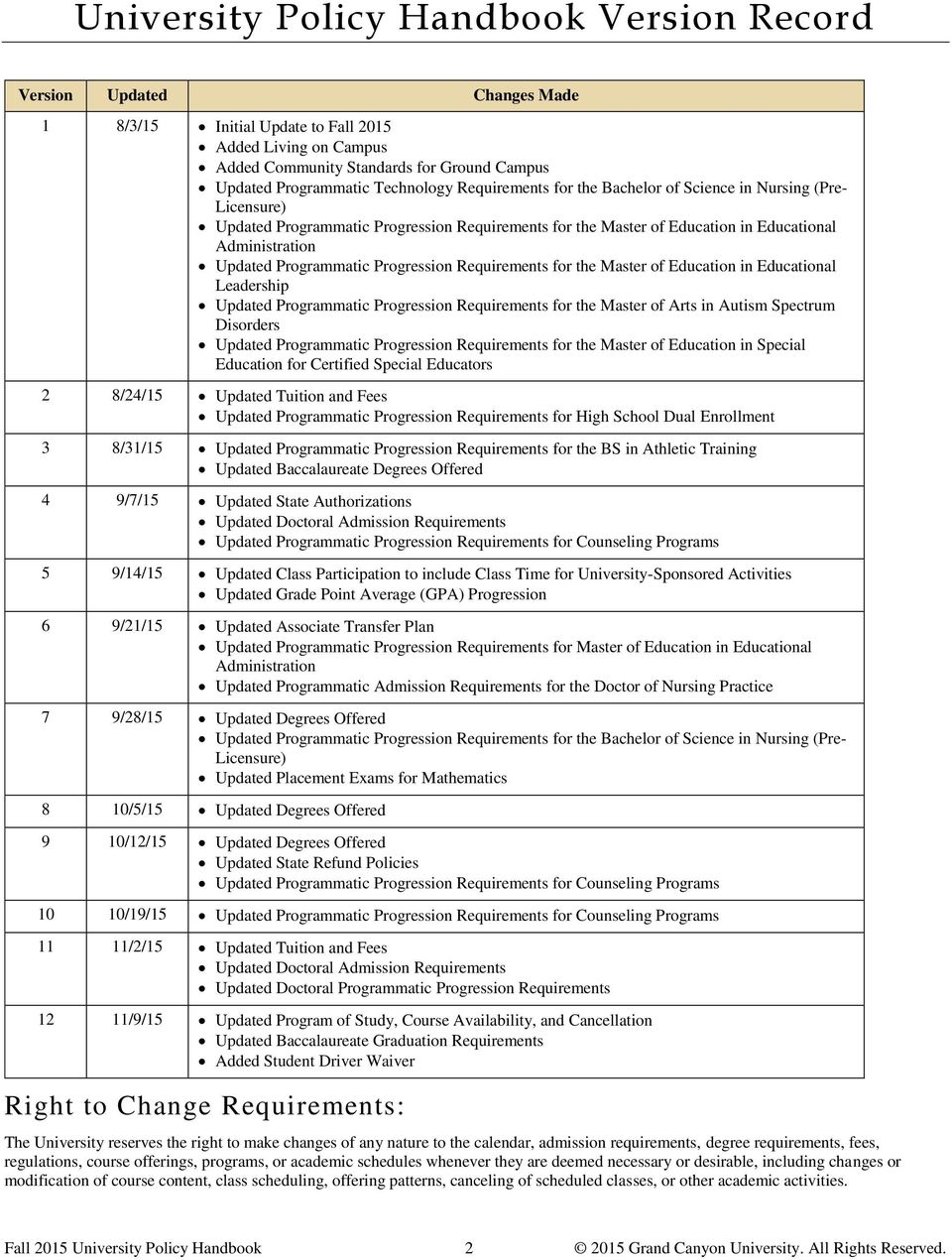
2 University Policy Handbook Version Record Version Updated Changes Made 1 8/3/15 Initial Update to Fall 2015 Added Living on Campus Added Community Standards for Ground Campus Updated Programmatic Technology Requirements for the Bachelor of Science in Nursing (Pre- Licensure) Updated Programmatic Progression Requirements for the Master of Education in Educational Administration Updated Programmatic Progression Requirements for the Master of Education in Educational Leadership Updated Programmatic Progression Requirements for the Master of Arts in Autism Spectrum Disorders Updated Programmatic Progression Requirements for the Master of Education in Special Education for Certified Special Educators 2 8/24/15 Updated Tuition and Fees Updated Programmatic Progression Requirements for High School Dual Enrollment 3 8/31/15 Updated Programmatic Progression Requirements for the BS in Athletic Training Updated Baccalaureate Degrees Offered 4 9/7/15 Updated State Authorizations Updated Doctoral Admission Requirements Updated Programmatic Progression Requirements for Counseling Programs 5 9/14/15 Updated Class Participation to include Class Time for University-Sponsored Activities Updated Grade Point Average (GPA) Progression 6 9/21/15 Updated Associate Transfer Plan Updated Programmatic Progression Requirements for Master of Education in Educational Administration Updated Programmatic Admission Requirements for the Doctor of Nursing Practice 7 9/28/15 Updated Degrees Offered Updated Programmatic Progression Requirements for the Bachelor of Science in Nursing (Pre- Licensure) Updated Placement Exams for Mathematics 8 10/5/15 Updated Degrees Offered 9 10/12/15 Updated Degrees Offered Updated State Refund Policies Updated Programmatic Progression Requirements for Counseling Programs 10 10/19/15 Updated Programmatic Progression Requirements for Counseling Programs 11 11/2/15 Updated Tuition and Fees Updated Doctoral Admission Requirements Updated Doctoral Programmatic Progression Requirements 12 11/9/15 Updated Program of Study, Course Availability, and Cancellation Updated Baccalaureate Graduation Requirements Added Student Driver Waiver Right to Change Requirements: The University reserves the right to make changes of any nature to the calendar, admission requirements, degree requirements, fees, regulations, course offerings, programs, or academic schedules whenever they are deemed necessary or desirable, including changes or modification of course content, class scheduling, offering patterns, canceling of scheduled classes, or other academic activities. Fall 2015 University Policy Handbook Grand Canyon University. All Rights Reserved.
3 The Grand Canyon University Policy Handbook does not establish a contractual relationship; rather, it sets forth academic and other requirements that students must meet to be granted a degree and, in some circumstances, to continue to be enrolled at the institution. While advisors and other Grand Canyon University personnel are available to guide students with respect to the requirements, students ultimately bear the responsibility of following the requirements. Students should view the Academic Catalog for college and program specific information. The Traditional Campus Student Handbook is published annually. It provides information and procedures. It is the student s responsibility to become familiar with and adhere to the procedures contained within the Traditional Campus Student Handbook. Notice of Non-Discrimination Grand Canyon University prohibits discrimination, including any form of harassment, by employees, faculty, students, contractors, or agents of the University and by anyone participating in a University sponsored activity against an individual based on race, color, national origin, gender, disability, or any other classification protected by applicable law in its programs or activities. Title IX regulations require nondiscrimination on the basis of sex or gender. Inquiries concerning the application of Title IX discrimination or the application of Title IX harassment policies may be submitted to the Title IX coordinator and/or to the Office of Civil Rights for the United States Department of Education: Title IX Coordinator Dr. Jennifer Lech Senior Vice President and University Registrar 3300 W. Camelback Road Phoenix, AZ [email protected] U.S. Department of Education Office for Civil Rights Lyndon Baines Johnson, Department of Education Building 400 Maryland Avenue, SW Washington, DC Telephone: FAX: ; TDD: [email protected] Fall 2015 University Policy Handbook Grand Canyon University. All Rights Reserved.

4 Table of Contents University Policy Handbook Version Record... 2 Right to Change Requirements:... 2 Notice of Non-Discrimination... 3 Table of Contents... 4 Contact Information... 7 General Contact Information... 7 Student Contacts... 7 Accreditation and Authorizations... 9 Accreditation... 9 State Authorizations About Grand Canyon University Vision Mission Statement Historical Sketch Board of Trustees Corporate Board of Directors Contributors University Seal University Mascot and Colors Statement of Principle Academic Calendar Traditional Campus Students Nontraditional Campus Students (Online, Evening-Satellite, and Evening-Campus) Holiday Schedule Degrees Offered Doctoral Programs Professional Programs Master Programs Graduate Certificate of Completion Programs Baccalaureate Programs Admission Policies and Application Procedures Overview Baccalaureate Admission Requirements Baccalaureate Programmatic Admission Requirements Master Admission Requirements Master Programmatic Admission Requirements Doctoral Admission Requirements Doctoral Programmatic Admission Requirements Non-Degree Program Admission Requirements General Application Procedures Admission Statuses International Student Admission General Academic Regulations Official Student Communication Official Name Change Preferred First Name Academic Calendar Classification of Students and Courses Program of Study, Course Availability, and Cancellation Registration Policy Class Presence Class Participation Grade Point Average (GPA) Progression Baccalaureate Programmatic Progression Requirements Master Programmatic Progression Requirements Doctoral Programmatic Progression Requirements Non-Degree Programmatic Progression Requirements Fall 2015 University Policy Handbook Grand Canyon University. All Rights Reserved.

5 Code of Conduct and Academic Standards Gender-Based and Sexual Misconduct Policy and Grievance Procedures University Appeal Procedures Textbooks Grading System Academic Honors Special Study Courses Official Enrollment Status Change and Withdrawal University Official Withdrawal Student Records Student Access Student Driver Waiver University Technology Requirements Programmatic Technology Requirements Intellectual Property Rights Financial Services Payment Policy Course Tuition Refund Institutional Aid (GCU Scholarships and GCU Grants) Tuition and Fees Federal Financial Aid Federal Funding Sources Federal Loan Programs Annual and Aggregate Loan Limits State Grants for Arizona Residents Student Employment Evaluation of Transfer Credit General Policies Baccalaureate Transfer Policies Master Degree Transfer Policies Doctoral Degree Transfer Policies Foreign Evaluation of Transfer Credits Transferring from GCU to another Institution Transfer Credit Application Alternative Transfer Credit Options Graduation Requirements Designation of Academic Catalog Baccalaureate Graduation Requirements Baccalaureate Programmatic Graduation Requirements Master Graduation Requirements Posthumous Degrees Commencement Graduation with Academic Recognition Academic Services and Resources Career Services Department The Center for Learning & Advancement GCU Library Campus Computer Center GCU Institutional Review Board International Students Office Drug-Free Campus and Workplace Policy Description of Health Risks Drug and Alcohol Counseling Institutional Sanctions Living on Campus Housing Policies Community Standards for Ground Campus Applicability of the Student Handbook Community Standards Student Conduct Process Fall 2015 University Policy Handbook Grand Canyon University. All Rights Reserved.

6 Sanctions for Conduct Violations Emergency Mental Health Policy Glossary Appendix A Dissertation Milestone Table Fall 2015 University Policy Handbook Grand Canyon University. All Rights Reserved.

7 Contact Information General Contact Information Web Site Main Switchboard Phone: Toll-free: Main Campus Mailing Address Grand Canyon University PO Box Phoenix, AZ Main Campus Street Address Grand Canyon University Main Campus 3300 West Camelback Road Phoenix, AZ Locations Grand Canyon University Banner Boswell W Thunderbird Blvd. Ste. 102 Sun City, AZ Grand Canyon University Mesa A.T. Still 5845 E Still Circle, Ste. 206 Mesa, AZ Grand Canyon University Scottsdale Scottsdale Healthcare E. Mountain View, Ste. 100 Scottsdale, AZ Grand Canyon University Tempe 1150 West Grove Parkway, Suite 101 Tempe, AZ Grand Canyon University Tucson Tucson Medical Center, 5099 E. Grant Rd.; Ste. 350 Tucson, AZ Student Contacts Admissions Representatives Responsibility: Assists students with their initial enrollment into a program of study. Phone: Campus Operations Responsibility: Provide parking passes for campus students, faculty and staff along with issue campus ID cards Phone: Canyon Health and Wellness Clinic Responsibility: Assists campus students with health needs. Phone: Fax: Website: Wellness-Center.php Career Services Responsibility: GCU's Career Services team provides students and alumni with the resources, professional knowledge and support they need to successfully transition from academics into purposeful and satisfying employment. Phone: [email protected] Website: Center for Learning and Advancement Responsibility: Provides learning resources for students through free face-to-face and online tutoring in writing, math (algebra, trigonometry, calculus), accounting, finance, statistics, APA, as well as workshops in test-taking techniques, reading strategies, time management, study skills, and note-taking techniques. The Center also oversees the First Year Experience (FYE) program, Study Abroad, Peer Mentoring, Lifelong Learning Assessment, and the Honors College. Phone: [email protected] Website: Learning-and-Advancement.php GCU Bookstore Responsibility: Carries materials required in GCU courses along with University-branded apparel and gifts. Phone: GCU Library Responsibility: Provides learning resources through physical and online libraries. Phone: or ext Website: Ask A Librarian: Webinars/Workshops: Affairs/Library/Webinar-Sign-Up.php GCU Today Responsibility: Provides the news and events source for Grand Canyon University students, updated daily. Phone: [email protected] Website: International Students Office Responsibility: Assists university students and staff in support of F-1 students during their stay in the United States Phone: Fax: [email protected] Fall 2015 University Policy Handbook Grand Canyon University. All Rights Reserved.

8 Mail and Copy Center Responsibility: Provide many services to the traditional campus students and staff, which includes mailing out letter and packages along with photocopying services Phone: Website: Center.php Office of Academic Records Responsibility: Tracks student progress to degree completion, evaluates transcripts, and admits students to the University. Phone: Office of Residence Life Responsibility: Assists students with campus housing Phone: Website: Information.php Office of Spiritual Life Responsibility: Provides spiritual needs of the campus, coordinates Chapel programming and outreach ministry Phone: Website: Office of Student Engagement Responsibility: Assists students with campus clubs, intramurals, Associated Students of GCU, and campus programming. Phone: Website: Public Safety Responsibility: Assists students, faculty and staff with issues relating to campus and public safety. Phone: Website: Safety.php Student Disability Services Responsibility: Assists students with obtaining reasonable accommodations, based on student self-disclosure of disability. Phone: or ext Student Services Advisors Responsibility: Assists students with planning financial resources needed to fund their education along with planning and maintaining their program of study. Phone: Technical Support Responsibility: Assists students with technical issues regarding the University systems. Phone: Website: Videos/Technical-Support.php Fall 2015 University Policy Handbook Grand Canyon University. All Rights Reserved.

9 Accreditation Accreditation and Authorizations Grand Canyon University holds many accreditations, some college-specific and others program-specific. Accreditation is desirable as it speaks to the quality of the college or university, acknowledged by peer institutions. In choosing a university, parents and students should ensure their university of choice is regionally accredited. Regional accreditation in higher education originated almost a century ago as an American process conferred by a nongovernmental agency. It provides quality assurance and ensures institutional program improvement. The agency s expert and trained peers have visited and reviewed Grand Canyon University. During the visit, Grand Canyon University is reviewed from a variety of facets, including: educational activities, administration, financial stability, admissions and student personnel services, resources, student academic achievement, organizational effectiveness, and relationships with outside constituencies. Six regional agencies provide institutional accreditation on a geographical basis Middle States, New England, North Central, Northwest, Southern, and Western. While independent of one another, the six regional associations cooperate extensively and recognize one another's accreditation. The Higher Learning Commission and its predecessor have accredited Grand Canyon University continually since 1968, obtaining its most recent ten-year reaccreditation in The Arizona State Board for Private Postsecondary Education licenses GCU in Arizona. Higher Learning Commission The Higher Learning Commission accredits Grand Canyon University. The Higher Learning Commission 30 North LaSalle Street, Suite 2400 Chicago, Illinois Phone: Toll-free: Arizona State Private Post-Secondary Education Grand Canyon University is licensed in Arizona by the Arizona State Board for Private Postsecondary Education. Arizona State Board for Private Postsecondary Education 1400 West Washington, Room 260 Phoenix, AZ Phone: Veteran s Administration Grand Canyon University is approved for the education and training of veterans under the provisions of Title 10 and 38, United States Code. We accept Chapter 30, 31, 32, 33, 35, 1606 and 1607 recipients. Veterans are approved for benefits for numerous programs. For more information regarding using your VA benefits at Grand Canyon University, [email protected]. Other Accreditations/Approvals In addition, the University has obtained the following specialized accreditations and approvals for our core program offerings: Association of Collegiate Business Schools and Programs, Arizona State Board of Education, Arizona Department of Education, Commission on Collegiate Nursing Education, and Commission on Accreditation of Athletic Training Education. Student Exchange Visitor Program (SEVP) Grand Canyon University has applied for and received certification to enroll F nonimmigrant students per the Student Exchange Visitor Program (SEVP) under 8 CFR The International Students Office has access to SEVIS and may issue Forms I-20, Certificate of Eligibility for Student Status, to prospective students. For more information see the International Students Office website. Colangelo College of Business The Accreditation Council for Business Schools and Programs, 7007 College Boulevard, Suite 420, Overland Park, KS 66211, , accredits the following programs of the Colangelo College of Business: Bachelor of Science in Accounting, Bachelor of Science in Business Administration, Bachelor of Science in Entrepreneurial Studies, Bachelor of Finance and Economics, Bachelor of Science in Marketing, Bachelor of Science in Sports Management, Master of Business Administration and Executive Master of Business Administration. The ACBSP requires each school to submit a periodic Quality Assurance Report that summarizes recent activity regarding compliance with ACBSP standards. View our most recent ACBSP Quality Assurance Report. View the results of the Undergraduate Business Field Test. Fall 2015 University Policy Handbook Grand Canyon University. All Rights Reserved.

10 College of Education Grand Canyon University's College of Education is approved by the Arizona State Board of Education and the Arizona Department of Education to offer institutional recommendations (credentials) for the certification of early childhood, elementary, secondary and special education teachers, as well as administrators. The College of Education is a candidate for accreditation by the National Council for Accreditation of Teacher Education (NCATE), Candidacy status means that the College of Education has met preconditions for accreditation but is not accredited. The list of teacher preparation programs and advanced educator preparation programs can be found under the Notification of NCATE Candidacy section in the Academic Catalog. College of Nursing and Health Care Professions The baccalaureate degree in nursing and master's degree in nursing at Grand Canyon University are accredited by the Commission on Collegiate Nursing Education (CCNE) ( GCU's College of Nursing and Health Care Professions is approved by the Arizona State Board of Nursing. The nursing program is approved by the New Mexico Board of Nursing. The Commission on Accreditation of Athletic Training Education (CAATE) accredits the Athletic Training Education Program ( College of Humanities and Social Sciences Our Master of Science in Addiction Counseling program has been approved for accreditation through the National Addiction Studies Accreditation Commission (NASAC) 1001 N. Fairfax St. Suite 201, Alexandria, VA NASAC accreditation is a new accreditation body as a result from a combined effort of The International Coalition for Addiction Studies Education (INCASE) and the Association for Addiction Professionals (NAADAC) to create a single higher education addiction studies accreditation. Intercollegiate Athletics Intercollegiate athletics function under the guidelines of the National Collegiate Athletic Association (NCAA) Division I, 700 W. Washington Street, P.O. Box 6222, Indianapolis, IN 46202, regarding eligibility to participate in intercollegiate sports. In the season, Grand Canyon University began the process of reclassifying from Division II to Division I as a member of the Western Athletic Conference. State Authorizations State Authorization Reciprocity Agreements (SARA) Participant Grand Canyon University is an institutional participant in the State Authorization Reciprocity Agreement (SARA) initiative. SARA is an agreement among member states, districts and territories that establishes comparable national standards for interstate offering of postsecondary distance education courses and programs. It is intended to make it easier for students to take online courses offered by postsecondary institutions based in another state. SARA is overseen by a National Council and administered by four regional education compacts. For more information and a list of member states, please visit Alabama Grand Canyon University has been granted authorization by the State of Alabama under Ala. Code (14) (1975) to offer the academic degree programs described herein. Since credentials earned through the College of Education do not automatically qualify for teacher certification, endorsement, and/or salary benefits within the State of Alabama, prospective students are advised to contact the Alabama State Superintendent of Education. Alaska Grand Canyon University is exempt from authorization under AS and 20 AAC because the program offered in Alaska is online and the University does not have a physical presence in the State of Alaska. Arkansas Arkansas Higher Education Coordinating Board certification does not constitute an endorsement of any institution, course or degree program. Such certification merely indicates certain minimum standards have been met under the rules and regulations of institutional certification as defined in Arkansas Code The student should be aware that these degree programs may not transfer. The transfer of course/degree credit is determined by the receiving institution. Georgia Grand Canyon University is authorized under the Nonpublic Postsecondary Educational Institutions Act of Master of Education students pursuing advanced degrees for certificate upgrades should have been enrolled by July, 15, 2011 and must be completed by December 15, Doctor of Education students pursuing advanced degrees for certificate upgrades should have been enrolled by July 15, 2011 and must be completed by December 15, If a complaint is not settled at the institutional level, students can refer to the Georgia Nonpublic Postsecondary Education Commission website at and click on Complaint Process. The Georgia Nonpublic Postsecondary Education Commission is located at 2082 East Exchange Place, Suite 220, Tucker, GA (Phone Number: ). Fall 2015 University Policy Handbook Grand Canyon University. All Rights Reserved.

11 Hawaii Any Hawaii residents who have exhausted the institution's complaint process can file a complaint with the Hawaii Post-secondary Education Authorization Program by going to Idaho Grand Canyon University is registered with the State Board of Education in accordance with Section , Idaho Code. Indiana This institution is authorized by: The Indiana Board for Proprietary Education, 101 W. Ohio St., Suite 670, Indianapolis, IN Iowa Students seeking an Iowa license are advised that successful completion of Grand Canyon University s programs of educator preparation do not qualify you for initial educator licensure by the Iowa Board of Educational Examiners. Candidates seeking licensure in the state of Iowa must first be licensed/certified as educators in Arizona. Grand Canyon University will assist you in understanding the licensure requirements of the Arizona Department of Education prior to completion of your educational preparation program. Arizona Department of Education can be contacted at or Candidates seeking subsequent licensure from the Iowa Board of Educational Examiners must contact that Board ( ; for licensure requirements in Iowa. Kansas Grand Canyon University has been approved to operate by the Kansas Board of Regents. Kentucky Please be advised that our educator preparation programs are NOT accredited in Kentucky by the Education Professional Standards Board and are NOT recognized for initial, additional, or renewal of certification or salary enhancement (rank change) for K-12 educators in Kentucky. For more information, please visit the Education Professional Standards Board s Website at Please check the Kentucky Council on Postsecondary Education s Website at to view a listing of approved programs. For more information, please contact the Council on Postsecondary Education, 1024 Capital Center Drive, Suite 320, Frankfort, Kentucky Louisiana Grand Canyon University is currently licensed by the Board of Regents of the State of Louisiana. Licenses are renewed by the State Board of Regents every two years. Licensed institutions have met minimal operational standards set forth by the state, but licensure does not constitute accreditation, guarantee the transferability of credit, nor signify that programs are certifiable by any professional agency or organization. Maryland The following programs have been authorized to operate in Maryland by the Maryland Higher Education Commission: Bachelor of Science in Counseling with an Emphasis in Addiction, Chemical Dependency, and Substance Abuse, Master of Arts in Teaching, Master of Education in Curriculum and Instruction: Reading, Master of Education in Curriculum and Instruction: Technology, Master of Education in Educational Administration, Master of Education in Educational Leadership, Master of Education in Teaching English to Speakers of Other Languages, Master of Science in Addiction Counseling, Master of Science in Professional Counseling, Master of Science in Nursing with an Emphasis in Public Health, Master of Science in Nursing: Nursing Education, Master of Science in Nursing: Nursing Leadership in Health Care Systems, Master of Science of Science in Special Education and Post-Master s Certificate of Science in Nursing. The Bachelor of Science in Early Childhood Education, Bachelor of Science in Elementary Education, Bachelor of Science in Elementary and Special Education, Bachelor of Science in Secondary Education, Master of Education in Early Childhood Education, Master of Education in Elementary Education and Master of Education in Secondary Education programs have not been recommended for implementation by the Maryland Higher Education Commission based upon on a possible shortage of student teaching placement opportunities, however students may still enroll in them. All other programs are pending registration by the Maryland Higher Education Commission. Minnesota Grand Canyon University is registered as a private institution with the Minnesota Office of Higher Education pursuant to Minnesota Statutes, Sections 136A.61 to 136A.71. Registration is not an endorsement of the institution. Credits earned at the institution may not transfer to all other institutions. Missouri Grand Canyon University has been approved to operate by the Missouri Coordinating Board for Higher Education. Grand Canyon University s Bachelor of Arts in History with an Emphasis in Secondary Education program has not been reviewed by the Missouri Department of Elementary and Secondary Education (DESE) and therefore may not satisfy teacher certification requirements. New Mexico Any New Mexico residents who have a complaint can file a complaint with the New Mexico Higher Education Department, 2048 Galisteo, Santa Fe, NM 87505, or visit Fall 2015 University Policy Handbook Grand Canyon University. All Rights Reserved.

12 Ohio Grand Canyon University is approved by the Ohio Board of Career Colleges and Schools and any Ohio residents who have a complaint can file a complaint with the Ohio Board of Career Colleges and Schools, 35 East Gay Street, Suite 403, Columbus, OH, 43215; or toll free Oregon Grand Canyon University is a unit of a business corporation authorized by the State of Oregon to offer and confer the academic degrees described herein, following a determination that state academic standards will be satisfied under OAR Inquiries concerning the standards or school compliance may be directed to the Office of Degree Authorization, 1500 Valley River Drive, Suite 100, Eugene, Oregon Pennsylvania Teacher education programs have not been reviewed or approved by Pennsylvania. Candidates will have to apply for certification and meet requirements for certification as out-of-state candidates. South Carolina Grand Canyon University is licensed to recruit SC residents by the South Carolina Commission on Higher Education, 1122 Lady Street, Suite 300, Columbia, SC 29201; ; Licensure indicates only that minimum standards have been met; it is not an endorsement or guarantee of quality. Grand Canyon University makes no guarantee that other institutions will accept credits earned at Grand Canyon University. The transfer of course/degree credit is determined by the receiving institution. Applicant students must consult with their academic advisors concerning eligibility for employment in discipline-related fields. Tennessee Grand Canyon University is authorized for operation as a postsecondary education institution by the Tennessee Higher Education Commission. In order to view detailed job placement and graduation information on the programs offered by Grand Canyon University, visit and click on the Authorized Institutions Data button. This authorization must be renewed each year and is based on an evaluation by minimum standards concerning quality of education, ethical business practices, health and safety, and fiscal responsibility. If a complaint is not settled at the institutional level, the student may contact the Tennessee Higher Education Commission (404 James Robertson Parkway, Suite 1900, Nashville, TN ; ). Transferability of Credits for Tennessee Students Credits earned at Grand Canyon University may not transfer to another educational institution. Credits earned at another educational institution may not be accepted by Grand Canyon University. You should obtain confirmation that Grand Canyon University will accept any credits you have earned at another educational institution before you execute an enrollment contract or agreement. You should also contact any educational institutions to which you may want to transfer credits earned at Grand Canyon University to determine if such institutions will accept credits earned at Grand Canyon University prior to executing an enrollment contract or agreement. The ability to transfer credits from Grand Canyon University to another educational institution may be very limited. Your credits may not transfer and you may have to repeat courses previously taken at Grand Canyon University if you enroll in another educational institution. You should never assume that credits will transfer to or from any educational institution. It is highly recommended and you are advised to make certain that you know the transfer of credit policy of Grand Canyon University and of any other educational institutions to which you may in the future want to transfer the credits earned at Grand Canyon University before you execute an enrollment contract or agreement. Washington Grand Canyon University is authorized by the Washington Student Achievement Council and meets the requirements and minimum educational standards established for degree-granting institutions under the Degree-Granting Institutions Act. This authorization is subject to periodic review and authorizes Grand Canyon University to offer specific degree programs. The Council may be contacted for a list of currently authorized programs. Authorization by the Council does not carry with it an endorsement by the Council of the institution or its programs. Any person desiring information about the requirements of the act or the applicability of those requirements to the institution may contact the Council at P.O. Box 43430, Olympia, WA This authorization is subject to periodic review and authorizes Grand Canyon University to advertise and recruit for the following degree programs: Associate of Arts, Bachelor of Arts in Christian Studies; Bachelor of Arts in Communications; Bachelor of Arts in Digital Film with an Emphasis in Production; Bachelor of Arts in Digital Film with an Emphasis in Screenwriting; Bachelor of Arts in English Literature; Bachelor of Arts in History; Bachelor of Arts in Interdisciplinary Studies; Bachelor of Science in Accounting; Bachelor of Science in Applied Management; Bachelor of Science in Business Administration; Bachelor of Science in Business Management, Bachelor of Science in Counseling; Bachelor of Science in Elementary Education; Bachelor of Science in Entrepreneurial Studies; Bachelor of Science in Finance and Economics; Bachelor of Science in Health Care Administration; Bachelor of Science in Health Sciences: Professional Development and Advanced Patient Care; Bachelor of Science in Justice Studies; Bachelor of Science in Marketing; Bachelor of Science in Medical Imaging Sciences; Bachelor of Science in Nursing (RN to BSN); Bachelor of Science in Psychology; Bachelor of Science in Public Safety and Emergency Management; Bachelor of Science in Respiratory Care; Bachelor of Science in Secondary Education; Bachelor of Science in Sociology; Bachelor of Science in Sports Management; Bridge to Master of Science in Nursing; Master of Arts in Christian Studies; Master of Arts in Teaching; Master of Business Administration; Master of Business Administration and Master of Science in Leadership; Master of Fall 2015 University Policy Handbook Grand Canyon University. All Rights Reserved.

13 Business Administration and Master of Science in Nursing; Master of Education in Curriculum and Instruction: Reading; Master of Education in Curriculum and Instruction: Technology; Master of Education in Education Administration; Master of Education in Early Childhood Education (IP/TL); Master of Education in Early Childhood Education (IP/Non-TL); Master of Education in Elementary Education (IP/Non-TL); Master of Education in Secondary Education; Master of Education in Special Education; Master of Education in Special Education for Certified Special Educators; Master of Public Administration; Master of Public Health; Master of Science in Accounting; Master of Science in Addiction Counseling; Master of Science in Criminal Justice; Master of Science in Health Care Administration; Master of Science in Health Care Informatics; Master of Science in Leadership; Master of Science in Nursing: Nursing Education; Master of Science in Nursing: Nursing Leadership in Health Care Systems; Master of Science in Nursing: Health Care Informatics; Master of Science in Professional Counseling; Master of Science in Psychology; and Doctor of Education in Organizational Leadership. The following programs lead to initial teacher certification or licensure in Arizona, and program applicants are encouraged to check with their state or local credentialing agency regarding applicability in their state: Bachelor of Science in Elementary Education (IP/TL); Bachelor of Science in Elementary Education and Special Education (IP/TL); Bachelor of Science in Secondary Education (IP/TL); Master of Education in Early Childhood Education (IP/TL); Master of Education in Educational Administration (AP/PL); Master of Education in Elementary Education (IP/TL); Master of Education in Secondary Education (IP/TL); Master of Education in Special Education (IP/TL). The following programs do not lead to initial building-level administrator certification or licensure, but may lead to professional development credit, and program applicants are encouraged to check with their state or local credentialing agency regarding applicability in their state: Master of Arts in Teaching (AP/CPE); Master of Education in Curriculum and Instruction: Reading (AP/CPE); Master of Education in Curriculum and Instruction: Technology (AP/CPE); Master of Education in Early Childhood Education (IP/Non-TL); Master of Education in Educational Leadership (AP/CPE); Master of Education in Elementary Education (IP/Non-TL); Master of Education in Secondary Education (IP/Non-TL); Master of Education in Special Education (IP/Non-TL); Master of Education in Special Education for Certified Special Educators (AP/CPE); Master of Education in Teaching English to Speakers of Other Languages (AP/CPE). The Education Specialist in K-12 Leadership program is not intended to lead to educator certification. Educators are advised to contact their individual school districts as to whether this program may qualify for salary advancement. Fall 2015 University Policy Handbook Grand Canyon University. All Rights Reserved.

14 Vision About Grand Canyon University Grand Canyon University is a premier Christian University educating people to lead and serve. Mission Statement Grand Canyon University prepares learners to become global citizens, critical thinkers, effective communicators, and responsible leaders by providing an academically challenging, values-based curriculum from the context of our Christian heritage. Historical Sketch Grand Canyon College was born in the wake of World War II as the realization of a dream long held dear by the tiny congregations of Southern Baptists that called the Arizona mission frontier their home. In the fall of 1946, the Baptist General Convention of Arizona voted to organize a college. A few months later, the Convention selected the first trustees for the college, who soon secured an abandoned armory building in Prescott, Arizona, as Grand Canyon s first campus. The College was chartered on August 1, 1949, with 16 faculty and approximately 100 students, many of them veterans. In 1951 the College put up its first permanent buildings on a 90-acre tract in west Phoenix. Grand Canyon College was fully accredited in 1968 by the Commission on Institutions of Higher Education, 30 North LaSalle Street, Suite 2400, Chicago, IL , , The College was first considered primarily a school for preachers, but its reputation expanded rapidly. Grand Canyon College became famous early on for its teacher education program and soon developed outstanding programs in the sciences, nursing, business, music, and the arts, while maintaining its excellence in Christian studies. During planning for the change in institutional organization and status from Grand Canyon College to Grand Canyon University, the institution identified several landmark events that had been and would be pivotal during this transition. These included, but were not limited to, the organization of programs and departments into multiple colleges, the offering of graduate degree programs, the formation of the Grand Canyon University Foundation, and the generosity of several individuals who pledged or gave unrestricted gifts valued at one million dollars or more to launch the University into the next decade and century. In May of 1984, the College trustees voted to prepare for transition to University status on the school s 40th anniversary in Another landmark event occurred at the turn of the century that moved the University away from being owned and operated by the Arizona Southern Baptists Convention to being self-owned by the Board of Trustees. Four years later, in 2004, the University was struggling financially and facing the prospect of having to close its doors. Unfortunately, the University did not have a large endowment or donor base to rely upon to help solve its financial crisis. In order to preserve the University, the University was sold to a small group of investors and converted to an investment funded model. The years were difficult for the University as its traditional campus deteriorated while the University focused primarily on online education and financial solvency. Then, in 2008, a management team with experience in Christian education, led by President Brian Mueller and Chief Operating Officer Dr. Stan Meyer, was installed and a new vision was imparted for reinvigorating the campus. In May 2008, the University raised additional funds for campus expansion through an initial public offering. Today, Grand Canyon Education, Inc., d/b/a Grand Canyon University, is a publicly traded company listed under the symbol LOPE on the NASDAQ National Market. Today, the painstaking re-engineering of Arizona s premier private Christian university is making a college education possible and affordable for many who could only dream of such an opportunity. Board of Trustees Will Gonzalez Don Andorfer Brian Mueller Jim Rice Fred Miller Corporate Board of Directors Brent Richardson; Executive Chairman Brian Mueller; President/Chief Executive Officer Bradley Casper; Director Jack Henry; Director David Johnson; Director Kevin Warren; Director Sara Dial; Director Contributors Dave Brazell Stadium: David and Mildred Brazell Fall 2015 University Policy Handbook Grand Canyon University. All Rights Reserved.

15 The Cooke Health Center: Alumni Association Ethington Memorial Theatre: Peter and Anna Ethington Fleming Classroom Building and Library: Mr. and Mrs. William Fleming College of Nursing and Health Care Professions: Samaritan Foundation Tim Salmon Baseball Clubhouse: Tim and Marci Salmon Smith Arts Complex: C. J. and Thelma Smith Smithey-Parker Building: Jerry and Sarah Smithey along with Bill and Joyce Parker Tell Science Building: Mr. and Mrs. Andrew P. Tell Williams Building: Dr. Bill and Shirley Williams Hegel Hall: Dr. Joni Hegel University Seal When the Grand Canyon College seal was adopted in 1950, two of its major components were the cross and the cactus. The saguaro cactus rises from its desert setting to signify the intellectual opportunity for Grand Canyon University students, counteracting the arid mental state of uneducated man. The cross stands prominently on the horizon as a guide for spiritual enlightenment. Between the outer circle representing the earth and the inner circle representing the wheel of progress, the name of the University and its location are inscribed. The use of the seal is permitted only with approval of the Chief Executive Officer of the University. University Mascot and Colors The University mascot is the antelope. Antelope are native to the region surrounding Prescott, Arizona, near the college s first campus. The mascot reminds us of our heritage and humble beginnings. School colors are purple, black, and white. Students, employees, or contractors of the University shall not use the Grand Canyon University name, logo, or mascot in connection with any commercial venture without written approval of the Chief Executive Officer. Statement of Principle The words of the Alma Mater summarize the attitude and spirit of Grand Canyon University: Fall 2015 University Policy Handbook Grand Canyon University. All Rights Reserved.

16 Academic Calendar Traditional Campus Students Fall 2015: 8/24/15 12/13/15 Instruction/Grade Calendars (15-Week Classes) Move in Date... August 17, 2015 August 21, Instruction begins... August 24, 2015 Thanksgiving Break... November 23, November 29, 2015 Face-to-face Instruction ends (except labs). December 11, 2015 Move out Date for Fall-only Students..10 a.m, December 12, 2015 Living Areas Closed for Christmas..10 a.m, December 12, 2015 End of Term... December 13, 2015 Final Course Grades Due... December 20, 2015 Christmas Break... December 14, 2015 January 3, 2016 See Policy Handbook Refund Policy... Variable Dates Winter Traditional Campus Commencement* Traditional Campus Commencement. 5p.m., December 11, 2015 Final Course Grades Due... August 21, 2016 Fall Break... August 15 August 28, 2016 See Policy Handbook Refund Policy... Variable Dates Nontraditional Campus Students (Online, Evening-Satellite, and Evening-Campus) Please note that online, onsite and offsite cohort students have classes that begin frequently. Therefore, students are encouraged to contact their Enrollment Counselor or Student Services Advisor for more information on class starts. Fall Nontraditional Campus Commencements* Online College Commencements... October 16-17, Christmas Break Schedule Undergraduates... December 21, 2015 January 3, 2016 Graduates... December 24, 2015 January 6, Online Christmas Break Schedule Undergraduates... December 21, 2015 January 3, 2016 Graduates... December 24, 2015 January 6, 2016 Spring 2016: 1/4/16 4/24/16 Instruction/Grade Calendars (15-Week Classes) Move in Date... January 2 3, 2016 Instruction begins... January 4, 2016 Spring Break...March 21 March 27, 2016 Face-to-face Instruction ends (except labs)... April 22, 2016 Move out Date p.m., April 23, 2016 End of Term... April 24, 2016 Final Course Grades Due... May 1, 2016 Summer Break... April 25 May 1, 2016 See Policy Handbook Refund Policy... Variable Dates Spring Traditional Campus Commencement* Traditional Campus Commencement... April 22, 2016 Summer 2016: 5/4/16 8/14/16 Instruction/Grade Calendars 15-Week Classes Move in Date... TBD Instruction begins... May 2, 2016 Session A... May 9 June 26, 2016 Session B...June 27 August 14, 2016 Face-to-face Instruction ends (except labs)... August 12, 2016 Move out Date... TBD End of Term... August 14, 2016 Spring Nontraditional Campus Commencements* Online College Commencements... April 25-26, 2016 * Dates and times of commencement ceremonies may be subject to change. Holiday Schedule Holiday Campus Offices Closed Evening Classes Meet Online Classes Meet Traditional students on campus do not meet New Year's Day X X X Martin Luther King Day X X X X President's Day X X X X Good Friday X X X Memorial Day X X X X Independence Day X X X X Labor Day X X X X Veteran's Day X X X Thanksgiving and the following Friday X X X Christmas Day X X X Note: Online students are encouraged to submit work early if an assignment due date falls directly on a holiday. Students are still responsible for timely submission of work Fall 2015 University Policy Handbook Grand Canyon University. All Rights Reserved.

17 Degrees Offered The University offers curricula leading to the degrees of Doctor of Business Administration, Doctor of Education, Doctor of Nursing Practice, Doctor of Philosophy, Master of Arts, Master of Business Administration, Master of Divinity, Master of Education, Master of Public Administration, Master of Public Health, Master of Science, Bachelor of Arts, and Bachelor of Science, as well as offering graduate and undergraduate certificates. Please refer to the university website ( for the locations/modalities in for each program. Students should be advised that some degree programs at GCU have competitive admissions or require college-specific admission requirements beyond the University level admission requirements. Doctoral Programs Doctor of Business Administration The Doctor of Business Administration (D.B.A.) is designed for those who desire a deeper understanding of business theory and its application to their area of professional interest. Grand Canyon University offers the following emphases for this degree: Management Doctor of Education in Organizational Leadership The Doctor of Education (Ed.D.) in Organizational Leadership program is delivered through a combination of online courses and face-to-face residencies. Aspects of the program s curriculum and instruction are shared by the College of Education, College of Humanities and Social Sciences, College of Nursing and Health Care Professions, College of Theology and the Colangelo College of Business, meeting the needs of master s-prepared professionals seeking a terminal degree in leadership. Grand Canyon University offers the following emphases for this degree: Behavioral Health Christian Ministry Education and Effective Schools Instructional Leadership Higher Education Leadership Organizational Development Special Education Doctor of Nursing Practice The Doctor Nursing Practice Degree (DNP) encompasses a mixture of didactic courses and mentored practicum experiences. Each course allows for the demonstration and achievement of programmatic competencies and objectives through real-world health care systems application. The curriculum and instruction meet the needs of master s-prepared nurses seeking a terminalpractice degree. Doctor of Philosophy in General Psychology The Doctor of Philosophy (Ph.D.) in General Psychology program offers a broad array of courses that increase the understanding of human actions in the past and present. Grand Canyon University offers the following emphases for this degree: Industrial and Organizational Psychology Integrating Technology, Learning, and Psychology Cognition and Instruction Performance Psychology Professional Programs Education Specialist in K-12 Leadership The Education Specialist (Ed.S.) in K-12 Leadership program develops and enhances the learner s ability to grasp, process, and apply doctoral-level constructs that positions them for organizational governance, capacity building, and vision casting. Post Master of Science Nursing Certificates The Post-Master of Science in Nursing Certificate programs prepare experienced registered nurses to provide competent advanced practice nursing care through an evidence-based program of study. Acute Care Nurse Practitioner with an Emphasis in Adult- Gerontology Family Nurse Practitioner Nursing Education Master Programs Master of Arts The Master of Arts is granted to those students who have completed a bachelor s degree at an accredited, GCU-approved institution and are seeking a Master of Arts degree. Autism Spectrum Disorders Christian Studies o Emphasis in Christian Leadership o Emphasis in Pastoral Ministry o Emphasis in Urban Ministry o Emphasis in Youth Ministry Curriculum and Instruction Gifted Education Reading o Emphasis in Elementary Education o Emphasis in Secondary Education Teaching o Emphasis in Professional Learning Communities o Emphasis in Teacher Leadership Teaching English to Speakers of Other Languages (TESOL) Master of Business Administration The Master of Business Administration is designed for those students who have previously completed a bachelor s degree at an accredited, GCU-approved institution. Emphases in: o Accounting o Finance o Health Systems Management o Leadership o Marketing o Project Management o Sports Business o Strategic Human Resource Management MBA/MS in Leadership (Dual Degree) MBA/MS in Nursing (Dual Degree) Fall 2015 University Policy Handbook Grand Canyon University. All Rights Reserved.

18 Master of Divinity The Master of Divinity is the standard degree for professional ministry preparation and is designed for students who intend to serve in local churches, Christian organizations, and other ministerial roles. The Master of Divinity program offers comprehensive biblical and theological knowledge while developing skills necessary for effective Christian ministry. This degree features a foundational, pastorally oriented program of study that emphasizes the centrality of the gospel, the significance of the church, and the pressing need to advance the Kingdom of God through missions. Emphasis in: o Global Ministry o Worship Leadership Master of Education The Master of Education degree is designed for students who have previously completed a bachelor s degree at an accredited, GCU-approved institution and may be seeking certification at the elementary or secondary level. An advanced Program of Study is included in that preparation or can be obtained after certification requirements are completed. This degree is available in the following specialized areas: Curriculum and Instruction o Reading Emphasis in Elementary Education Emphasis in Secondary Education o Technology Early Childhood Education* Educational Administration* Educational Leadership Elementary Education* Secondary Education* Special Education* Special Education for Certified Special Educators Teaching English to Speakers of Other Languages (TESOL) * Initial Program Leads to Initial Teacher Licensure Initial Program Does Not Lead to Teacher Licensure Master of Public Administration The Master of Public Administration is designed for those students who have previously completed a bachelor s degree at an accredited, GCU-approved institution. Emphases in: o Government and Policy o Health Care Management Master of Public Health The Master of Public Health is designed for those students who have previously completed a bachelor s degree at an accredited, GCU-approved institution. Master of Science The Master of Science is granted to those students who have completed a bachelor s degree at an accredited, GCU-approved institution and are seeking a Master of Science degree. Accounting Addiction Counseling Christian Counseling o Substance Use and Addictive Disorders Criminal Justice o Emphasis in Law Enforcement o Emphasis in Legal Studies Health Care Administration Health Care Informatics Leadership Disaster Preparedness and Executive Fire Leadership Nursing o Acute Care Nurse Practitioner with an Emphasis in Adult- Gerontology o Family Nurse Practitioner o Nursing Education o Nursing Leadership in Health Care Systems o Public Health o Health Care Informatics Organizational Growth and Sales Professional Counseling o Childhood and Adolescence Disorders o Marriage and Family Therapy o Trauma Psychology o Emphasis in Forensic Psychology o Emphasis in General Psychology o Emphasis in GeroPsychology o Emphasis in Health Psychology o Emphasis in Human Factors Psychology o Emphasis in Industrial and Organizational Psychology o Emphasis in Life Coaching Graduate Certificate of Completion Programs Certificate of Completion in English as a Second Language (ESL) The Certificate of Completion in English as a Second Language (ESL) is a convenient program for licensed teachers or administrators with an interest in working with English as a Second Language (ESL) students inside or out of the classroom. Students who complete the certificate program are prepared to become leaders in the ESL/TESOL initiatives that districts undertake in an ever-increasing school climate of diversity. Graduate Certificate of Completion in Elementary Education Teacher Preparation The Graduate Certificate of Completion in Elementary Education is a convenient program for licensed teachers to further their skills in the area of elementary education. Emphasis is placed on meeting the educational needs of elementary-aged children in a variety of settings. All courses are directly aligned with specialized professional teaching standards and the associated national content standards. Students must have access to a grade 1-8 classroom to complete assignments within many of the courses which guide teacher candidates through 38 hours of observational and practice-based experiences. Graduate Certificate of Completion in Secondary Education Teacher Preparation The Graduate Certificate of Completion in Secondary Education is a convenient program for licensed teachers to further their skills in the area of secondary education. Emphasis is placed on meeting the educational needs of secondary-aged children in a Fall 2015 University Policy Handbook Grand Canyon University. All Rights Reserved.

19 variety of settings. All courses are directly aligned with specialized professional teaching standards and the associated national content standards. Students must have access to a grade 6-12 classroom to complete assignments within many of the courses which guide teacher candidates through 38 hours of observational and practice-based experiences. Baccalaureate Programs Bachelor of Arts The Bachelor of Arts degree is granted to majors who complete all requirements in one the following areas: Advertising and Public Relations o Advertising Design Christian Studies o Emphasis in Biblical Studies o Emphasis in Worship Leadership o Emphasis in Youth Ministry Communication Dance Dance Education* Digital Design o Animation o Web Design Digital Film o Emphasis in Production o Emphasis in Screenwriting English Literature English for Secondary Education* Government o Legal Studies o State and Local Public Policy History o Emphasis in Public History History for Secondary Education* Music o Emphasis in Piano Performance o Emphasis in Instrumental Performance o Emphasis in Voice Performance Music Education* o Choir: Piano* o Choir: Voice* o Instrumental: Brass, Woodwind, Percussion or String* o Instrumental: Piano* Theatre and Drama Theatre Education* Worship Arts o Emphasis in Digital Media o Emphasis in Worship Management o Emphasis in Worship Ministry o Emphasis in Worship Production * Initial Program Leads to Initial Teacher Licensure Bachelor of Science The Bachelor of Science degree is granted to majors who complete all requirements in one the following areas: Accounting Applied Management Athletic Training Biology o Emphasis in Pre-Medicine o Emphasis in Pre-Pharmacy o Emphasis in Pre-Physician Assistant o Emphasis in Pre-Physical Therapy Biology for Secondary Education* Biomedical Engineering Business Administration o Emphasis in Business Intelligence Business Information Systems Business Management o Emphasis in Golf Management o Emphasis in Tennis Management Business for Secondary Education* Chemistry for Secondary Education* Computer Programming Computer Science o Emphasis in Big Data & Analytics o Emphasis in Business Entrepreneurship o Emphasis in Game Simulation Development Counseling o Emphasis in Addiction, Chemical Dependency, and Substance Abuse Early Childhood Education* Educational Studies Electrical Engineering Elementary Education o Emphasis in English* o Emphasis in English as a Second Language o Emphasis in Math* o Emphasis in Science* Elementary Education and Special Education* Entrepreneurial Studies Exercise Science o Emphasis in Health Education o Emphasis in Physical Education o Emphasis in Sports Performance Finance and Economics Forensic Science Health Care Administration Health Sciences: Professional Development and Advanced Patient Care Hospitality Management Information Technology o Emphasis in Business Entrepreneurship o Emphasis in Health IT o Emphasis in Technology Innovation Justice Studies Marketing Mathematics for Secondary Education* Mechanical Engineering Nursing o Pre-licensure o RN to BSN Psychology Public Safety and Emergency Management Secondary Education o Emphasis in Business Education* o Emphasis in English* o Emphasis in Math* o Emphasis in Physical Education* Sociology Sports Management * Initial Program Leads to Initial Teacher Licensure Fall 2015 University Policy Handbook Grand Canyon University. All Rights Reserved.

20 Minors Accounting Air Force (ROTC) Army (ROTC) Athletic Coaching Biblical Studies Business Administration Business Management Christian Studies Dance Education Digital Design Digital Film Entrepreneurial Studies Finance and Economics General Business Marketing Music Instrumental Music Piano Music Vocal Pre-Law Pre-Medicine Sports Management Spanish Theatre Worship Arts Note: Students should contact an Enrollment Counselor or Student Services Advisor for more information about program availability. Fall 2015 University Policy Handbook Grand Canyon University. All Rights Reserved.

21 Admission Policies and Application Procedures Overview Applications for admission to Grand Canyon University are considered primarily in light of the applicants academic qualifications. Qualified applicants, who are at least 16 years of age, willing to uphold the University s vision and mission, and open to the possibility of spiritual as well as intellectual development are encouraged to apply. Although the University seeks to integrate Christian faith and practice into all aspects of campus life, no statement of faith or religious affiliation is required of prospective students with the exception of majors in the College of Theology. Theology majors are required to affirm the University s Doctrinal Statement and the College s Covenant. Grand Canyon University does not discriminate on the basis of age, race, color, national origin, gender, disability, or any other classification protected by law in its programs and activities. Baccalaureate Admission Requirements All students must submit either acceptable high school or college transcripts to meet the admission requirements of the University. Additionally, if students cannot meet the GPA requirements with their transcripts, but have a test score that meets admissions requirements, students will be eligible for full admission. If both the degree-bearing transcript and the test scores do not meet admission requirements, students may be Accepted with Specifications. Credits High School Only And/or 1-5 Transferrable College Credits Admission Requirements Transcripts (Required) 1. Secondary (high school) transcript, documenting no less than 75% of the coursework needed for degree completion, with an unweighted grade point average (GPA) of 3.00 or above. Degree-bearing transcript must be submitted when conferred. If final transcript negatively impacts admissibility, acceptance status may be rescinded or modified to include specifications. 2. Degree-bearing, secondary (high school) transcript: An unweighted GPA of 3.00 or above o Home school transcripts from a state that recognizes home schooling as a valid secondary school option. o Students who reside in a state without home schooling as a valid secondary school option will be Accepted with Specifications. 3. General Education Development (GED) and transcripts of all credit-bearing course work: 2014 Series and later: Cumulative score of 680 or above Series: Cumulative score of 3000 or above 2002 Series and prior: Cumulative score of 258 or above 4. High School Equivalency Test (HiSET): Traditional and Nontraditional campus: Cumulative score of 80 or above; and transcripts of all credit-bearing course work 5. State Equivalency Diploma: Traditional and Nontraditional campus: Students will be Accepted with Specifications. Credits 6-24 Transferrable College Credits Transferrable College Credits 2 nd Bachelor Admission Requirements Test Scores (Optional) 1. Composite score of 19 or above on the ACT. GCU ACT code is Composite score of 920 or above (1600 point scale) or 1380 or above (2400 point scale) on the Scholastic Aptitude Test (SAT). GCU SAT code is **Applicants who cannot provide official copies of their secondary (high school) transcripts from an accredited high school or of a completed GED and do not have any postsecondary transferable credits may be admitted based on Self-Certification of completion of High School Diploma or GED (excludes Tennessee residents). Applicants admitted under this condition will be Accepted with Specifications and may be selected for verification of HS diploma or GED. Post-secondary (college) transcript(s) with an unweighted GPA of 2.75 or above Post-secondary (college) transcript(s) with an unweighted GPA of 2.25 or above. Post-secondary (college) transcript(s) with an unweighted GPA of 2.00 or above. Applicants who do not meet one of the above criteria may be Accepted with Specifications. Placement Exams for Mathematics Traditional Campus Students All incoming, traditional freshmen must complete either the GCU Algebra Placement Exam or the GCU College Mathematics Placement Exam before enrolling in a math course higher than MAT-110. Additionally, if a transfer student wants to place higher than MAT-110, the student is required to take the appropriate math placement exam unless they have transferred in a grade of C or better for an approved prerequisite, from a regionally accredited or GCU approved institution. The appropriate placement exam is dependent on the math requirement of each program of study. Students need to work with their advisor to determine the correct exam to complete. Students who complete the GCU College Mathematics Placement Exam will be placed according to the following guidelines: Fall 2015 University Policy Handbook Grand Canyon University. All Rights Reserved.
22 Score Course Placement into MAT Placement into MAT-110 Students who complete the GCU Algebra Placement Exam will be placed according to the following guidelines: Score Course Placement into MAT Placement into MAT Placement into MAT Placement into MAT-110 Placement Exams for English Traditional Campus Students Traditional campus students who have not met the appropriate competencies for English are required to take UNV-100. Students wishing to waive this prerequisite course can select one of the following options which will allow them to register directly into ENG-105. Course ENG-105 Prerequisites Prerequisite Requirement Options 1. Passing grade in AP English Coursework on the student s HS transcript. 2. Passing grade for UNV Receive a score of 550 or higher on the critical reading section of the College Board SAT Reasoning Test taken March 2005 to June Receive a score of 500 or higher on the critical reading section of the College Board SAT Reasoning Test effective Summer/Fall Receive a score of 680 or higher on the writing section of the SAT Reasoning Test taken March 2005 or later. 6. Receive a score of 550 or higher on the verbal section of the College Board SAT I: Reasoning Test taken between April 1995 and January Receive a score of 680 or higher on the College Board SAT II: Writing Test taken between May 1998 and January Receive a score of 22 or higher on the enhanced ACT English Test taken October 1989 or later. 9. Receive a score of 70% on the GCU English Placement Exam. Baccalaureate Programmatic Admission Requirements Grand Canyon University recommends a certain level of academic preparation to provide a solid foundation for undergraduate success. To promote success, admission to the University does not necessarily guarantee admission to some programs of study for which the standards are more rigorous. Students desiring to be admitted into these programs should review the additional program requirements listed below. Colangelo College of Business Bridge to the Master of Science in Accounting All entering students must have an Undergraduate degree in a business discipline or Graduate degree in business administration. Students need to meet the following Master of Science in Accounting (MSA) fundamental courses: ACC-250, ACC-350, ACC-370, ACC-371, ACC-460, and ACC-491. Students who have taken courses with equivalent content may be able to waive one or more of these MSA fundamental courses into the program of study upon evaluation of their official transcripts. Only courses with equivalent content and grades earned of C or better will be accepted to waive the MSA fundamental courses. College of Fine Arts and Production Bachelor of Arts in Music Bachelor of Arts in Music Education Prospective students seeking admission to Grand Canyon University as music majors should have a background in reading and performing music. To gain admission into the program, a student must meet the general admission requirement of the university along with the requirements below. 1. The successful completion of a music theory assessment exam, which can be completed at the traditional campus or online. 2. An audition in the primary area of study (keyboard, voice or instrumental), which can be completed at the traditional campus or by recorded audition. The candidate must demonstrate musical performance strength and skills that can be developed to enable the student to successfully complete the degree requirements of music major as stated in the curriculum. The student must demonstrate musical ability that can be developed through his/her undergraduate music studies to successfully serve as a professional in his major area of emphasis. Any student interested in auditioning must contact the office of the Assistant Dean of Music or designee in order to arrange an audition. College of Nursing and Health Care Professions Bachelor of Science in Athletic Training Students can enroll into the Bachelor of Science in Athletic Training. However, admission into the clinical portion of the Athletic Training Education program is competitive. Not all applicants will be admitted and able to progress forward in the program. Students need to review the Bachelor of Science in Athletic Training Clinical Requirements and understand the application deadlines to participate in the clinical portion of the program. Students can also view the clinical requirements on Professions/Athletic-Training-Program.php. Acceptance is determined by the Athletic Training Education Clinical Requirements and availability of clinical spaces. Bachelor of Science in Health Sciences: Professional Development and Advanced Patient Care Applicants to the program must meet one of the following criteria: 1. Possess an Associate degree from an accredited, GCUapproved college, university, or program that prepares students to acquire the necessary state, local, or national credentials required of allied health professionals involved in direct patient care. 2. Submit a state, local, or national credential/certificate/license issued by a sanctioned licensure/credentialing body, certifying that they are approved to practice as one of the following allied Fall 2015 University Policy Handbook Grand Canyon University. All Rights Reserved.
23 health professionals involved in patient health assessment or treatment: Medical Technician/Patient Care Technician Diagnostic Technician (Sonography, Radiology, Nuclear) Lab / Phlebotomy Technician Physical Therapy Assistant/Technician Occupational Therapy Assistant/Technician Cardiovascular Technician Respiratory Technician Surgical (OR) Assistant Emergency Technician Pharmacy Technician Nursing Assistant (CNA) Licensed Practical Nurse (LPN) Licensed Vocational Nurse (LVN) 3. Health care work experience in which applicants have demonstrated requisite knowledge and skills required of allied health professional to provide direct patient care. Competencies for allied health care providers are listed below: Performing basic diagnostic and therapeutic health care services Preparing patients for procedures Assisting nursing and medical personnel with examinations Carrying out Pre-operative and post-operative duties Collecting and processing laboratory specimens Preparing and maintaining medical records Scheduling and receiving patients Maintaining asepsis and infection control Maintaining medical equipment and supplies Providing therapeutic care related to nutrition, ambulation, rehabilitation and activities of daily living Performing first aid and CPR OR 4. Submit military documentation demonstrating satisfactory completion of Medical Military Occupational Specialty Training. Bachelor of Science in Nursing (RN-BSN) Degree-Bearing Candidates: Possess an associate s degree in nursing from an accredited, GCU-approved college, university, or program. Submit official transcripts bearing evidence of a cumulative GPA of 2.8. Possess a current unencumbered, unrestricted license as a registered nurse (RN) in the: o Canadian providence (excluding Quebec), where they are employed as a RN. Complete the RN-BSN Canadian Nurse Verification Form. Meet the International Student Application Procedures. Non Degree-Bearing/Nursing Diploma Candidates: Submit proof of successful completion of a state board approved nursing program. Submit official transcripts bearing evidence of a cumulative GPA of 2.8. Possess a current unencumbered, unrestricted license as a registered nurse (RN) in the: o Canadian providence (excluding Quebec), where they are employed as a RN. Complete the RN-BSN Canadian Nurse Verification Form. Meet the International Student Application Procedures. Be prepared to transfer or complete the following general education competencies that are not integrated into the program core with a minimum grade of C (2.00). o 6 credits in Effective Communication (Recommended GCU course: ENG 105: English Composition I) o 5 credits of Critical Thinking (Recommended GCU course: MAT 134: Applications of Algebra) Non Degree-Bearing/Vocational Nursing Candidates: Submit documentation of official evaluation of vocational nurse training by University-approved transcript evaluation service. Submit official transcripts bearing evidence of a cumulative GPA of 2.8. Possess a current unencumbered, unrestricted license as a registered nurse (RN). Vocational nurse training with RN licensure will be awarded 30 block credits. Complete the coursework listed below. Coursework can be fulfilled by transfer courses if the content is comparable. o 40 credits of General Education coursework o AND o ENG-135: Life Learning Assessment o UNV-104: Century Skills: Critical Thinking and Problem Solving o HLT-205: Health Care Systems and Transcultural Healthcare o MAT-274: Probability and Statistics Healthcare preparatory coursework is required however; transfer will be accepted for exact course match. Coursework Vocational Nursing Block Credit 30 General Education 40 Healthcare Preparatory 14 RN-BSN Program 36 Total program requirements 120 Credits Bridge to Master of Science in Nursing 1. All MSN bridge program candidates must meet the Master Admission Requirements and provide evidence of a bachelor s degree from an accredited, GCU-approved college, university or program reflecting a cumulative grade point average of 3.0 or above. 2. Candidates must provide evidence of a current, unencumbered license in the: State of residence upon admission to the program and for the duration of their study or Canadian province (excluding Quebec) where they are employed as an RN. Complete the MSN Canadian Nurse Verification Form. Meet the International Student Application Procedures. College of Science, Engineering, and Technology Bachelor of Science in Biomedical Engineering Bachelor of Science in Electrical Engineering Bachelor of Science in Mechanical Engineering Bachelor of Science in Biology for Secondary Education Bachelor of Science in Chemistry for Secondary Education Students must place into MAT-134, Applications of Algebra, by meeting the minimum score requirement on the Placement Exam or fulfilling the course pre-requisites. Fall 2015 University Policy Handbook Grand Canyon University. All Rights Reserved.
24 College of Theology All Programs Theology majors are required to affirm the University s Doctrinal Statement and the College s Covenant. Students must complete this by signing the Enrollment Agreement for their program of study. Bachelor of Arts in Worship Arts with an Emphasis in Worship Ministry Prospective students seeking admission into the Bachelor of Arts in Worship Arts with an Emphasis in Worship Ministry should possess a measure of musical skill as well as an aptitude for musical performance. To gain admission into the program, a student must meet the general admission requirement of the University along with an audition in the primary area of study (voice or instrumental), which can be completed by submitting a recorded audition. The candidate must demonstrate musical performance strength and skills that can be developed to enable the student to successfully complete the degree requirements of the Worship Ministry emphasis as stated in the curriculum. The student must demonstrate musical ability that can be developed through his/her undergraduate studies to successfully serve as a worship leader in his or her field. In order to demonstrate this ability, students must submit a recorded audition to the office of the Worship Arts Coordinator or a designee before admission to the program may be approved. Honors College Admission into the honors program is competitive and determined by the criteria listed below and availability of spaces. To be eligible for acceptance into the honors program, students must meet all of the following: 1. Be admitted into the University 2. Complete the Honors Program application 3. Complete a written essay demonstrating passion for community service and leadership 4. Submit at least two (2) professional letters of recommendation (i.e., faculty/teacher or employer, non-family members) 5. Submit copy of current resume to include both employment and community service In addition, student must meet one of the following: 1. Incoming freshman student Possess 12 college level credits or fewer AND Possess an unweighted minimum high school GPA of 3.8 OR ACT composite score of 27 or above OR SAT score (combined critical reading and math) of 1200 or above 2. Transfer student Possess 24 college level credits or more AND Possess an unweighted minimum cumulative GPA of 3.5 Master Admission Requirements All students must submit baccalaureate bearing college transcripts to meet the admission requirements of the University. Additionally, if students cannot meet the GPA requirements with their transcripts, but have a test score that meets admissions requirements, students will be eligible for full admission. If both the degree-bearing transcript and the test scores do not meet admissions requirements, students may be eligible to be admitted based on the Standards for Admission with Specification. Transcripts (Required): Undergraduate degree from an accredited, GCU-approved college, university, or program with a grade point average of 2.8 or better on the degree-bearing transcript Graduate degree from an accredited, GCU-approved college, university, or program Test Scores (Optional): Graduate Management Admissions Test (GMAT): Score of 500. Graduate Record Examination (GRE): Prior to 8/1/11: Combined score of 1,000 for the verbal and quantitative sections. After 8/1/11: Combined score of 300 for the verbal and quantitative sections. Master Programmatic Admission Requirements Some programs of study at Grand Canyon University require a higher GPA and/or other criteria to qualify for admission. Colangelo College of Business Master of Science in Accounting All entering students must have completed one of the following: Undergraduate degree in accounting GCU s Bridge to Master of Science in Accounting College of Education Graduate Certificate of Completion in Elementary Education Teacher Preparation Graduate Certificate of Completion in Secondary Education Teacher Preparation A copy of a current K-12 teaching certificate or 1 year of verified, full-time teaching (teacher of record) experience (Teacher Verification Form). Master of Education in Educational Administration Two (2) years of verified, full-time K-12 teaching (teacher of record) experience (Teacher Verification Form). Master of Education in Educational Leadership A copy of a current K-12 teaching certificate or verified, fulltime teaching (teacher of record) experience (Teacher Verification Form). Master of Arts in Curriculum and Instruction Master of Arts in Gifted Education Master of Arts in Reading Master of Arts in Teaching Master of Arts in Teaching English to Speakers of Other Languages (TESOL) Master of Education in Curriculum & Instruction: Reading Master of Education in Curriculum & Instruction: Technology Certificate of Completion in English as a Second Language (ESL) Fall 2015 University Policy Handbook Grand Canyon University. All Rights Reserved.
25 A copy of a current teaching certificate or evidence of 1 year of full-time teaching (teacher of record) experience (Teacher Verification Form). Master of Education in Special Education for Certified Special Educators Master of Arts in Autism Spectrum Disorders 1. A copy of a current special education teaching certificate. OR 2. Documentation of 1 year of full-time, special education teaching (teacher of record) experience (Teacher Verification Form). College of Humanities and Social Sciences Master of Science in Professional Counseling Master of Science in Addiction Counseling As of May 3, 2012, applicants will be required to choose either the Master of Science in Professional Counseling or Master of Science in Addiction Counseling. Students enrolled in the Master of Addiction Counseling prior to May 3, 2012 are eligible for an exception which will allow them to enroll into the Master of Science in Professional Counseling if they have been continuously enrolled in their program of study and do so prior to graduating from the Master of Science in Addiction Counseling. This provision allows students to complete only those courses of the current Master of Science in Professional Counseling program that was not part of their Master of Science in Addiction Counseling program. 1. Students must complete the additional 450 practicum hours associated with the second master s degree. 2. Students must complete all didactic coursework after matriculating into the Professional Counseling program before they can enroll in the practicum courses. College of Nursing and Health Care Professions Master of Science in Nursing: Acute Care Nurse Practitioner with an Emphasis in Adult-Gerontology (ACNP) Master of Science in Nursing: Family Nurse Practitioner (FNP) 1. Students must hold a Bachelor of Science in Nursing (BSN) degree from a CCNE/NLNAC or ACEN accredited program reflecting a cumulative grade point average of 3.0 or above (on a 4.0 scale) on a degree bearing transcript. OR Candidates who possess a bachelor s degree in a related field may apply if they have completed the bridge to MSN (excluding Nursing Concurrent Enrollment Program [NCEP] students). 2. Possess a current unencumbered, unrestricted license as a registered nurse (RN). 3. Students must submit a recent curriculum vitae (CV) listing all professional experience showing a minimum of one year fulltime work experience as a Registered Nurse (RN), related to the area of specialization. 4. Students must submit a Letter of Intent Final acceptance into the program will be determined by the College of Nursing and Health Care Professions Admissions Committee. An offer of admission will be valid for 12 months from the start date of the program. Applicants denied admission may reapply after 180 days. Leadership in Health Care Systems Master of Science in Nursing with an Emphasis in Public Health Master of Business Administration and Master of Science in Nursing with an Emphasis in Nursing Leadership in Health Care Systems (Dual Degree) Master of Science in Nursing with an Emphasis in Health Care Informatics Master of Science in Nursing with an Emphasis in Nursing Education 1. Students must hold a Bachelor of Science in Nursing (BSN) degree from a CCNE/NLNAC or ACEN accredited program reflecting a cumulative grade point average of 3.0 or above (on a 4.0 scale) on a degree bearing transcript. OR Candidates who possess a bachelor s degree in a related field may apply if they have completed the bridge to MSN (including Nursing Concurrent Enrollment Program [NCEP] students). 2. Possess a current unencumbered, unrestricted license as a registered nurse (RN). Canadian province (excluding Quebec) where they are employed as an RN. Complete the MSN Canadian Nurse Verification Form Meet the International Student Application Procedures Post-Master of Science in Nursing with an Emphasis in Nursing Education Certificate 1. Students must hold a Master of Science in Nursing (MSN) degree from a CCNE/NLNAC or ACEN accredited program reflecting a cumulative grade point average of 3.0 or above (on a 4.0 scale) on a degree bearing transcript. 2. Possess a current unencumbered, unrestricted license as a registered nurse (RN). Canadian province (excluding Quebec) where they are employed as an RN. Complete the MSN Canadian Nurse Verification Form Meet the International Student Application Procedures Post-Master of Science in Nursing: Family Nurse Practitioner Certificate Post-Master of Science in Nursing: Acute Care Nurse Practitioner with an Emphasis in Adult-Gerontology Certificate 1. Students must hold a Master of Science in Nursing (MSN) degree from a CCNE/NLNAC or ACEN accredited program reflecting a cumulative grade point average of 3.0 or above (on a 4.0 scale) on a degree bearing transcript. 2. Possess a current unencumbered, unrestricted license as a registered nurse (RN). 3. Students must submit a recent curriculum vitae (CV) listing all professional experience showing a minimum of one year fulltime work experience as a Registered Nurse (RN), related to the area of specialization. 4. Students must submit a Letter of Intent. Final acceptance into the program will be determined by the College of Nursing and Health Care Professions Admissions Committee. An offer of admission will be valid for 12 months from the start date of the program. Applicants denied admission may reapply after 180 days. Master of Science in Nursing with an Emphasis in Nursing Fall 2015 University Policy Handbook Grand Canyon University. All Rights Reserved.
26 College of Theology All Programs Theology majors are required to affirm the University s Doctrinal Statement and the College s Covenant. Students must complete this by signing the Enrollment Agreement for their program of study. Doctoral Admission Requirements Applicants to the doctoral programs may be accepted for admission by meeting the full range of criteria for one of the options specified below. Have earned a doctoral degree or GCU-approved post-master s program from a regionally accredited institution with a GPA of 3.4 or higher on the degree-bearing transcript. Applicants with a GPA less than 3.4 will be Accepted with Specifications. OR Have earned a master s from a regionally accredited institution with a GPA of 3.4 or higher in the degree on the degree-bearing transcript. Applicants with a GPA of will be Accepted with Specifications. Applicants with a GPA below a 3.0 will not be accepted into the University. AND Submit a Letter of Intent of approximately words. The Letter of Intent is designed to help learners begin their Doctoral Journey in a reflective and purposeful manner. Doctoral Programmatic Admission Requirements Some programs of study at Grand Canyon University require a higher GPA and/or other criteria to qualify for admission. Doctor of Business Administration (DBA) All entering DBA learners must have either: 1. MBA 2. Non-MBA masters or doctoral degree including fundamental courses with a minimum 3.0 GPA, or a passing grade if the institution does not use a traditional A-F grading systems, in accounting, finance, and statistics. At GCU these graduate level business fundamentals may be met by taking ACC-502, FIN-504, and SYM-506. Students must earn a minimum 3.0 GPA in each course. Students have the option to take an exam to fulfill this requirement. More information can be obtained through a Doctoral Enrollment Counselor. The business fundamental courses must be met prior to starting doctoral level courses. Doctor of Education in Organization Leadership with an Emphasis in Special Education All students entering into the Doctor of Education in Organizational Leadership with an Emphasis in Special Education must have an undergraduate, graduate or doctoral degree in education to be admitted into the program. Doctor of Nursing Practice (DNP) 1. Must hold a Master of Science in Nursing (MSN) degree from a CCNE/NLNAC or ACEN accredited program. For international students, the Master of Arts in Nursing (MAN) degree may substitute for the MSN requirement. 2. Possess a current unencumbered, unrestricted license as a registered nurse (RN): Canadian province (excluding Quebec), where they are employed as a RN. o Meet the International Student Application Procedures. 3. Must complete a statistics or data analysis course earning a minimum 2.0 GPA or a passing grade if the institution does not use traditional A-F grading systems. Courses must be shown on official transcripts. Students may need to identify which courses contained the content and submit a course description for review. Students also have the option to take an exam to fulfill this requirement. More information can be obtained through a College of Nursing and Health Care Professions (CONHCP) Enrollment Counselor. Doctor of Philosophy in General Psychology (Ph.D.) All entering Ph.D. learners must complete a statistics course or research course containing key statistics fundamentals, earning a minimum 2.0 GPA or a passing grade if the institution does not use traditional A-F grading systems, prior to starting doctoral level courses. Students have the option to take an exam to fulfill this requirement. More information can be obtained through a Doctoral Enrollment Counselor. Non-Degree Program Admission Requirements HS Dual Enrollment High school students may enroll if they are in their Junior or Senior year of high school, and have a current, minimum unweighted cumulative high-school GPA of 3.0. High school sophomore students may be admitted if they demonstrate their readiness to participate in college level coursework. To do so, they need to have a current, minimum unweighted cumulative high-school GPA of 3.25 and meet all course prerequisites. Grand Canyon University may waive the class status for up to 25% of the students enrolled for dual enrollment program. High school students may take a maximum of 32 credits (up to 8 courses). Exceptions to this policy require approval from the Provost or designee. High school students are required to meet the Prerequisites for all courses. College-level credit earned at GCU may later be applied toward a degree program at Grand Canyon University. High school students need to meet the Baccalaureate Admission Requirements listed within the University Policy Handbook. Continuing Education The University offers Continuing Education courses designed specifically for teachers in a 6-week, 3-graduate credit format. These courses can be used for a variety of purposes; recertification, salary scales, professional development, etc. but the student must check with their state and/or district to ensure transferability. Applications who wish to enroll in these courses must complete the Non-Degree Application. Non-degree seeking students may enroll in multiple courses. These courses will not transfer into a GCU degree program and will not be accepted for regular matriculation to the University. Fall 2015 University Policy Handbook Grand Canyon University. All Rights Reserved.
27 Single Course The University offers single-course registration to applicants who are not interested in enrolling in and completing a specific Program of Study. 1. Applicants who wish to enroll in either undergraduate or graduate courses must complete the Non-Degree Application. 2. Non-Degree seeking students may take a maximum of 24 credits (up to 6 courses). Exceptions to this policy require approval from the President, Provost or designee. 3. If additional credits are needed, students must enroll in a degree program. 4. Non-Degree seeking students may take up to two courses simultaneously. College-level credit earned may later be applied toward a degree program, except CEU courses, at Grand Canyon University, provided the student applies for admission and is accepted to the University. Applications for admission will be evaluated on an individual basis. If non-degree seeking students wish to complete a specific program of study, they must complete the standard Application for Admission and fulfill, as appropriate, the Baccalaureate Admission Requirements or the Master Admission Requirements. Applications for admission will be evaluated on an individual basis. Students who reach 16 credits in a nondegree seeking status may be contacted and encouraged to apply for University matriculation and to enter a specified degree program. General Application Procedures Although applicants may be conditionally accepted for admission based on incomplete records, final records are required in order to complete the admission file. In order to be considered for admission, all prospective students will need to remit the following: 1. Application for Admission: Prospective students must complete and sign the Application for Admission, and submit all requested information. Incomplete applications may be returned. Information and application forms are available on campus and on the Grand Canyon University Web site. 2. Official Transcript(s): Based on the degree level admission requirements. If applicants have completed coursework at an institution outside of the United States, they must have the work evaluated by an approved evaluation service selected by the University (see the section entitled Evaluation of Transfer Credit). If accepted, prospective students will need to submit a final transcript showing their graduation date. 3. Official Standardized Test Scores: If applicable Admission Statuses Conditionally Accepted All applicants are conditionally accepted until proof of admissions eligibility is met, including applicable documentation. All applicants will remain in this status until they have attended their first course at GCU. Accepted Students have demonstrated their admissions eligibility and are fully accepted into the University. Accepted with Specifications Students who do not meet the standards for admission may be admitted to Grand Canyon University programs with specification. Admission with specification requires nontraditional baccalaureate students to limit coursework to no more than 12 attempted credits or one semester for traditional baccalaureate student (no more than16 credits). Master s students are limited to 8 attempted credits (nontraditional) or one semester according to the program course-walk (traditional). Doctoral students are limited to 6 attempted credits. Traditional campus students may be required to fulfill additional requirements. Traditional campus students will be able to enroll for Chapel credit during their probationary term. The University will remove the specification for those who achieve the minimum standards below: Degree Level Undergraduate Graduate Doctoral Minimum Standards First-Year Students will be enrolled into GCU s Foundational General Education Sequence (Nontraditional: 3 courses/12 credits; Traditional: one semester [max 16 credits]). Transfer students enroll in UNV 103 or UNV 303, as one of their first 12 credits/semester courses. Complete their coursework with a minimum institutional GPA of 2.0 Review of academic record occurs after attempting 12 credits for nontraditional students, or one semester for traditional campus students. Administrative Withdrawal occurs after failing to achieve the minimum-standard GPA Acceptance occurs after achieving the minimum-standard GPA Complete their coursework with a minimum institutional GPA of 3.0. Review of academic record occurs after attempting 8 credits for nontraditional campus students, or one semester according to the program course-walk for traditional campus students. Administrative Withdrawal occurs after failing to achieve the minimum-standard GPA. Acceptance occurs after achieving the minimum-standard GPA. Complete their coursework with a minimum unweighted institutional GPA of 3.0. Review of academic record occurs after attempting 6 credits. Administrative Withdrawal occurs after failing to achieve the minimum-standard GPA. Acceptance occurs after achieving the minimum-standard GPA. Students who are withdrawn from the University will be neither academically nor financially responsible for any future courses for which they may have been pre-registered and may reapply in 12 months for reconsideration. Deferred Admissions Students who cannot provide sufficient admissions documentation will be deferred until complete and acceptable documentation is provided. Students currently attending a course Fall 2015 University Policy Handbook Grand Canyon University. All Rights Reserved.
28 will be permitted to complete the course but will not be registered for any additional coursework until officially admitted. Denied Students who do not meet the admission requirements of the University will not be accepted. International Student Admission International students may be citizens of the United States with foreign academic credentials or have entered the country on, a lawful immigrant or nonimmigrant visa. The following details the requirements for international student admission. International Student Application Procedures In order to be considered for admission, international students must complete the Application for Admissions, which includes submitting the following: 1. Official Transcript(s) a. Secondary School: All international students must have completed, or be in the process of completing, a secondary school program that is equivalent to the 12th grade (high school) in the United States. An official evaluation of students secondary school work, written in English, must be sent directly from a University-approved transcript evaluation service to the University. If an original document is not available, a certified copy will be accepted. Students who have not completed secondary school at the time of application must submit their official transcript evaluations upon graduation from the 12th-grade equivalent. b. College and/or University: Official transcripts (written in English or translation, if not in English) of students college or university work must be sent directly from the college or university to Grand Canyon University. If original documents are not available, certified copies will be accepted. GCU will consider three year international bachelor degrees for admission into graduate level programs. The acceptance of three year international bachelor degrees is contingent upon the students foreign credential evaluation (from a GCU approved evaluation agency). The evaluation must indicate: That the degree prepares the student for graduate level studies OR Given the relatively high proportion of coursework completed in the major field of study, the foreign degree program has prepared this student to meet minimum graduate admission eligibility standards. If the evaluation indicates that the three year bachelor degree does not prepare the student for graduate level studies, the student must complete a degree equivalent to a US bachelor degree prior to entering a graduate program. The following countries will be considered for three year bachelor degrees: Bologna Process participating countries, Australia, Canada, New Zealand and India (Bachelor in Commerce ONLY). c. University-approved Transcript Evaluations: In order to evaluate foreign credentials accurately and consistently, Grand Canyon University requires all international college or university transcripts to be evaluated by a Universityapproved evaluation service. Among others, Universityapproved evaluation services include those agencies that are members of or affiliated with the National Association of Credential Evaluation Services (NACES) and the American Association of Collegiate Registrars and Admission Officers (AACRAO). If the evaluation agency is unable to translate the transcripts into English, applicants may be able to obtain official translations at many consulates, embassies, or university language departments. Grand Canyon University will not award any transfer credit from foreign credentials without an evaluation from an approved evaluation service. The fee for evaluation is the responsibility of the student. All evaluations must have been evaluated by an approved agency within one year of the student s application date. The following is a list of approved agencies: Arizona International Credential Evaluators (AZICE) Academic and Professional International Evaluations, Inc. (APIE) Academic Credentials Evaluation Institute, Inc. (ACEI) American Education Research Corporation (AERC) Educational Credential Evaluators, Inc. (ECE) Educational Records Evaluations Service, Inc. (ERES) Evaluation Service, Inc. Foundation for International Services (FIS) Foreign Credentials Services of America (FCSA) Global Credential Evaluators (GCE) Institute for International Credentials Evaluation at CSU Fresno (IICE) International Consultants of Delaware, Inc. (ICD) International Education Research Foundation, Inc. (IERF) Lisano International: Foreign Educational Credential Evaluation (LI) Joseph A. Silny Associates (JS&A) World Education Services, Inc. (WES) 2. English Language Proficiency Documentation: a. Students who completed secondary school and/or received a diploma or degree from a post-secondary institution from the countries listed satisfy the English Language Proficiency admission requirement: Anguilla, Antigua and Barbuda, Australia, Bahamas, Barbados, Belize, Bermuda, Botswana, British Virgin Islands, *Canada, Cayman Islands, Christmas Island, Cook Islands, Dominica, Fiji, Gambia, Ghana, Grenada, Guyana, **India, Ireland, Jamaica, Kenya, Kiribati, Liberia, Malawi, Malta, Marshall Islands, Mauritius, Micronesia, Namibia, New Zealand, Nigeria, Niue, Norfolk Island, Palau, Papua New Guinea, Philippines, Pitcairn Islands, Puerto Rico, Saint Kitts, and Nevis, Saint Lucia, Saint Vincent and Grenadines, Seychelles, Sierra Leone, Singapore, *South Africa, Swaziland, Tanzania, Trinidad and Tobago, Turks and Caicos Islands, Uganda, United Kingdom, United States, Vanuatu, Zambia and Zimbabwe. *If French is noted on Canadian credentials or Afrikaans on South African credentials, the student must prove proficiency through testing. ** Healthcare programs in India are instructed with English as the sole medium of instruction. *** If a student submits multiple documents to satisfy the English Proficiency requirement, the English Proficiency Test Scores will supersede all other documents in making the admission decision. Fall 2015 University Policy Handbook Grand Canyon University. All Rights Reserved.
29 b. Students who have completed secondary school and/or received a diploma or degree from a post-secondary institution in a non-exemption country may obtain a letter on official letterhead indicating that English was the sole medium of instruction in their program. The letter must be signed and dated by a recognized school official. If, on the international transcript evaluation performed for application, it is specified that the sole medium of instruction is English, a letter from the school is not necessary. c. Students who have not completed secondary school and/or received a diploma or degree from a post-secondary institution must have completed a minimum of 24 semester college level credits at a regionally accredited or GCUapproved institution and/or an international institution recognized by the Ministry of Education or other acceptable government agency and have a minimum GPA of 2.75 from an institution whose sole medium of instruction is English. The language-proficiency requirement cannot be satisfied through experience in English learning programs at other schools. 3. English Language Proficiency Scores: If English is not the native language of prospective students, their score reports for a language proficiency test must be sent directly to Grand Canyon University from the testing center. The table below specifies minimum scores to be considered for admission to various programs. GCU accepts the following forms of language assessment: Test of English as a Foreign Language (TOEFL) Test of English for International Communication (TOEIC) International English Language Testing System (IELTS) Berlitz Language Evaluation Scores Required by Program Minimum Scores General Undergrad Programs Undergrad Education, Nursing & General Graduate Programs Test Type I II III TOEFL Paper-based TOEFL Computerbased TOEFL Internet-based TOEIC IELTS Berlitz Computerbased Graduate Education, Business & Nursing Programs ACT and SAT Scores: GCU does not require scores from these tests for international students; however, international athletes may be required to submit scores. F-1 Student Application Procedure F-1 student applicants are required to submit additional documentation to the International Student Coordinator in order to obtain the Certificate of Eligibility for Nonimmigrant (F-1) Student Status For Academic and Language Students, also known as an I-20. These international students are attending courses on the traditional campus or courses at an off-site location. Documents required for the I-20 include: Copy of Passport (valid within 6 months) International Student Application Confidential Financial Statement Affidavit of Sponsor (if applicable) Evidence of financial responsibility, not older than 6 months, such as official award letters for scholarships and fellowships and for personal or family funds evidence, which should be on bank letterhead stationery, or in the form of a legally binding affidavit. GCU reserves the right to ask for a $6,000 refundable deposit from applicants before an I-20 will be issued. A refund will be granted only if the visa is denied and evidence of denial is provided to the CIE. Application for campus housing is a separate procedure from admission. If prospective students plan to live on campus, they should contact the Office of Residence Life. Limitation on attempts for an F-1 Visa The I-20 is used to apply for an F-1 visa at a U.S. embassy or consulate. The decision to award a visa is up the consulate officer. Should a GCU applicant be denied a visa, the applicant may re-apply with a new I-20 for a second attempt. However, if the second application is denied and the applicant wishes to apply for a third time, eligibility for a third I-20 will require a personally written letter explaining the circumstances of the previous denials. GCU will not support any more than three total attempts for an F-1 visa. Each attempt will require the applicant to repeat the F-1 Student Application Procedure. Citizenship/Visas/Permanent Residents Neither United States citizenship nor residence within the United States is a requirement for admission to Grand Canyon University. In addition to U.S. Citizenship Grand Canyon University accepts the following students as eligible noncitizens. Permanent Resident: United States lawful permanent residency refers to a person's immigration status: the person is authorized to live and work in the United States of America on a permanent basis. A United States Permanent Resident Card is an identification card attesting to the permanent resident status of an alien in the United States. It is known informally as a green card because it had been green in color from 1946 until 1964, and it has reverted to that color since May Green card also refers to an immigration process of becoming a permanent resident. The green card serves as proof that its holder, a Lawful Permanent Resident, has been officially granted immigration benefits, which include permission to reside and take employment in the USA. The holder must maintain permanent resident status, and can be removed from the United States if certain conditions of this status are not met. Eligible Visa Status: Students with any of the following valid United States Visas are eligible for entry. Fall 2015 University Policy Handbook Grand Canyon University. All Rights Reserved.
30 Valid United States Visas Asylee/Refugee G-4 K-4 Q-3 U-3 A-1 G-5 L-1A R-1 U-4 A-2 H-1B L-1B R-2 U-5 B-1 (Non-Degree Bearing Candidates B-2 (Non-Degree Bearing Candidates DACA - Deferred Action for Childhood Arrivals E-1 H-2B O-2 H-1B1 L-2 S-5 V-1 H-1C N S-6 V-2 H-2A O-1 S-7 V-3 E-2 H-3 O-3 T-1 E-3 H-4 P-1 T-2 TPS- Temporary Protected Status EAC - Employment Authorization Card Valid United States Visas I P-2 T-3 F-1 (Ground Only) J-1 P-3 T-4 F-2 (Non-Degree Bearing Candidates J-2 P-4 TD G-1 K-1 Parole TN G-2 K-2 Q-1 U-1 G-3 K-3 Q-2 U-2 *N/A is reserved for undocumented persons residing in the USA who are seeking to attend our ground modality or non-u.s. Citizens residing outside of the USA and attending GCU via the online modality. Licensure Programs Online Students Programs which contain practicum, internship or student teaching that lead to licensure are not eligible for enrollment outside of the USA. Fall 2015 University Policy Handbook Grand Canyon University. All Rights Reserved.
31 General Academic Regulations This section of the Grand Canyon University Policy Handbook contains general academic policies intended to assure a consistent, high quality educational environment for GCU students and to reflect that quality to accrediting agencies, state licensing/certifying agencies, individuals and groups who provide scholarships or otherwise support the University, graduate schools, and potential employers of GCU graduates. The University has no right to change policies or procedures of another organization for which it is merely acting as an agent. Students are responsible for following all applicable University policies and procedures. Students should note some Programs of Study have specific policies in addition to general University policy. A careful review of policies and other requirements for a given program is strongly recommended. All policies and procedures herein apply to undergraduate, graduate and doctoral students unless explicitly stated otherwise. Please contact your Enrollment Counselor or Student Services Advisor for clarification and details. Oral or written inquires and requests are accepted, but a written message takes precedence over any oral message in the event of conflicting information. Official Student Communication Upon enrollment, all students receive a Grand Canyon University address. This address is used for all official communication with students including, but not limited to, student specific information, policy updates, notification of changes in University procedures, and general announcements. It is the student s responsibility to check this on a regular basis and be informed about published University policy. Official Name Change Students who would like to change their legal name need to submit two forms of government-issued identification to their Student Services Advisor (SSA). Preferred First Name When possible, the University may provide students the ability to use a preferred first name in University systems. While GCU will try to respect the first name the student prefers, GCU reserves the right to approve the preferred first name. Students trying to use a preferred first name that is inappropriate in an educational environment will revert to using the legal name on file. Academic Calendar Nontraditional (Online, Evening-Satellite and Evening- Campus) Students Grand Canyon University offers online and offsite courses in a sequential, non-term modality. Courses start on a regular basis, with undergraduate courses starting on Monday, graduate/doctoral courses starting on Thursday. The academic calendar year is defined as a minimum of 24 earned credits and 30 instructional weeks for undergraduate programs; 16 earned credits and 32 instructional weeks; 12 earned credits and 32 instructional weeks for doctoral programs. Students are required to adhere to the classroom posting required and complete assignments within the required timeframe. Please see the Class Attendance and Participation section of the University Policy Handbook. Students must maintain continuous enrollment in their programs. If students have a need to interrupt their course enrollment, they must contact their Student Services Advisor for options available to them. Traditional Campus Students Students attending Grand Canyon University s main campus attend school in three semesters; with traditional semesters of May (summer), September (fall), and January (spring) semester starts. Refer to the Academic Calendar for specific semester dates. Classification of Students and Courses Grand Canyon University complies with Department of Education credit hour definitions when designing and designating credits to courses per Federal Register 75 FR final regulations: Credit hour: Except as provided in 34 CFR 668.8(k) and (1) a credit hour is an amount of work represented in intended learning outcomes and verified by evidence of student achievement that is an institutionally established equivalency that reasonably approximates not less than one of the following- One hour of classroom or direct faculty instruction and a minimum of two hours of out-of-class student work each week for approximately fifteen weeks or one semester or trimester hour of credit, or ten to twelve weeks for one quarter hour of credit, or the equivalent amount of work over a different amount of time OR At least an equivalent amount of work as required in paragraph (1) of this definition for other academic activities as established by the institution, including laboratory work, internships, practicums, studio work, and other academic work leading to the award of credit hours. Student Classification Based on Credits Freshmen are students who have not yet completed 24 credit hours. Sophomores are students who have completed 24 to 47 credit hours. Juniors and seniors are students who have completed a minimum of 48 credit hours. Fifth Year Students are students who have completed a bachelor s degree from an accredited, GCU-approved college, university, or program and are accepted for a program of specified upper division courses to secure standard teacher certification. Second Degree Students are students who have completed a bachelor s degree from a regionally or nationally accredited institution and are completing the requirements for a second bachelor s degree. Graduate Students are students who have completed a bachelor s degree from an accredited, GCU-approved institution and have been admitted into the graduate program. Non-Degree Seeking Students are students who are not working toward a degree and/or are not placed in a classification. Fall 2015 University Policy Handbook Grand Canyon University. All Rights Reserved.
32 Academic Definition of Full-Time Status Nontraditional Students Nontraditional undergraduate students must complete 24 credits during their academic year to be considered full-time. Nontraditional graduate students who started their program prior to July 5, 2012 and all doctoral students must complete 12 credits during the academic year to be considered full-time. All nontraditional graduate students who start their program on or after July 5, 2012, must complete 16 credits during the academic year to be considered full-time. Students are also subject to the Program of Study, Course Availability, and Cancellation Policy. Traditional Campus Students Undergraduate students must enroll in a minimum of 12 credit hours in the Fall and Spring semesters. Undergraduate students will be considered full-time if they enroll in 6 credits in the Summer Session A or B, or 12 credits over the entire Summer semester. Graduate students who are enrolled in 16 or more credits during an academic year are considered full-time. Academic status may differ from financial aid status eligibility for funding. Please see the Financial Aid section of the University Policy Handbook for details. Per federal regulations, International (F-1) students are required to pursue a full course of study. During the Fall and Spring semester, the minimum for an undergraduate is 12 credits per semester and one online class may be taken to satisfy the 12 credit minimum. If the Summer semester is your first semester at GCU and a summer start date is on your I-20, then you must enroll for 6 credits in Session A or B, or 12 credits over the entire Summer semester to be considered a full-time student. The minimum for a graduate student s full course of study follows general campus policy noted above and is verified by the International Student Coordinator. To enroll in courses, a student must contact their Enrollment Counselor (new students) or their Student Services Advisor (current students). Overload Policy Nontraditional Students Students may request to take more than one course concurrently, if they meet the following criteria: Undergraduate students: Completed at least 12 credits at Grand Canyon within their current Program of Study, AND Cumulative GPA is 3.0 or better. OR GCU Alumni student with a 3.0 or better in graduated enrollment. Graduate students: Completed at least 6 credits at Grand Canyon within their current Program of Study, AND Cumulative GPA is 3.5 or better. OR GCU Alumni student with a 3.5 or better in graduated enrollment. Doctoral learners may not take more than one course at a time. Concurrent enrollment at Residency with one on-line course is the exception. Students will not be permitted to double-up on courses if the above criteria are not met. Additionally, if a student s GPA falls below the above standards after taking concurrent courses, future scheduled concurrent courses will be cancelled and the student s schedule adjusted to reflect one course at a time. Taking concurrent courses can change a student s academic year, and thus, payment periods. To enroll in concurrent courses, students must be financially cleared by their Student Services Advisor prior to starting those courses. A secondary payment method may be required. Traditional Campus Students To enroll in more than 20 credits per semester, undergraduate students must possess a GPA of 3.0 and file an official appeal that is approved by the Office of Academic Compliance. Course Classification Based on Course Number Courses are numbered from 000 to 999. The course numbering system is as follows: are remedial courses designed for students with deficiencies in specific content areas. Credits earned for these courses cannot be applied toward a degree program are lower division, undergraduate courses are upper division undergraduate courses are graduate level courses are doctoral level courses are continuing education courses. Course Length The University offers courses that are typically 4 to 15 weeks in length. The course length is determined by the Program of Study and/or format in which the course is taken. Online courses are typically 5, 7, or 8 weeks in length. Traditional Campus courses are typically 15 weeks in length. Program of Study, Course Availability, and Cancellation A Program of Study (POS) defines the courses required for a particular degree. If the University cancels a POS and/or courses, the University will use the following guidelines for program completion. If a major or degree is fully retired, and if a student had no breaks in enrollment except those defined/documented by the Leave of Absence Policy and Procedure, Baccalaureate and Masters students will have 2 years to complete the Program of Study under the Catalog of Record, defined as the Academic Catalog published in the academic year and edition (Fall, Spring, or Summer) under which the student enrolled. Doctoral students will have 3 years to reach the 900 course series in their Program of Study. This applies unless state or federal law and/or accrediting bodies mandate POS and/or course changes. In all cases that a course is retired, students will enroll in the course equivalency or a substituted course. In all cases where a student chooses to change the program of study, the student will always be required to enroll in the most current version of that program, which may change the student s catalog of record. Nontraditional Students If a student has been out of attendance less than 180 days, students return to their current program of study if the program version is active. If a program of study revised during the student s absence, the student may be able to update to the current version. If they choose to remain in their current version of the program, they may be required to take substituted courses from the new program version. Students Fall 2015 University Policy Handbook Grand Canyon University. All Rights Reserved.
33 must speak to their Financial Aid Counselor prior to program changes. If the student is out of attendance between 180 days and a year*, and the program of study revised, returning students must update to the current version of the program if one is available, or they must choose a different active program in which to transfer. Students out of attendance longer than a year must complete a new enrollment agreement and select either the newest version of a program, or another active program. *For students in any non-licensure program of study, an exception will be made for students with 2 or fewer courses remaining in their current program of study. Course substitutions may be made. Students with 3 or more courses must follow the above policy. *Students out of attendance for 180 days or less, and are changing their emphasis only are not subject to this policy. Doctoral Students who have started RES-885, RES-871, PSY- 825, or the 900 course series will be allowed to remain in their current program of study. Traditional Campus Students In order to remain in the current program of study, students must remain continuously enrolled. If students are out longer than one traditional term (either Fall or Spring) then the student will be required to enroll in the newest version of the program of study, if one is available. Course and Program Availability Students transferring to GCU from another educational institution, and GCU students transferring programs within the institution, are subject to course and section availability. GCU believes that sufficient interaction between students and faculty is an important part of the learning experience. Therefore, if a course section has too few students to support student learning, it may be cancelled. Additionally, if a student has a large number of transfer credits and enrolls in a new program and courses are not available, students may be required to take a different course needed in the program of study or will be subject to breaks in attendance until the course is available. Nontraditional students should reference the Leave of Absence Nontraditional policy for additional information. Program Exceptions Students enrolled in an Initial Program Leads to Initial Teacher Licensure (IP/TL) program within the College of Education, who cannot complete student teaching, may transfer to the equivalent Initial Program Does Not Lead to Teacher Licensure (IP/Non- TL) program, provided the courses are the same and the student has completed the entire program of study at the time of transfer. Military Reenrollment Grand Canyon University complies with the Higher Education Opportunity Act of 2008 requirements for readmission of service members. Students who are out of attendance greater than 180 days for qualified military service reasons may be able to return to their degree program without updating to the most current Academic Catalog. Students need to contact their military Enrollment, Academic or Student Services Advisor if they discontinued enrollment due to military service. Registration Policy Continuous Registration Upon application to the University, all applicants sign an Enrollment Agreement in which they attest to understanding the Program of Study requirements. This document acknowledges that most programs follow a course sequence and the student will be continuously enrolled and scheduled through the duration of their program unless they formally request to change their enrollment status. With the submission of this signed document, applicants are then registered into their chosen Program of Study. Students are granted 8 weeks from the program s start date to provide their official transcripts from the prior degree-granting institution (whether high school, associate, or baccalaureate degree) to gain admittance into the University. If this official documentation is not provided prior to the end of the 8-week period, students may not be allowed to continue forward into subsequent courses. Once the Office of Academic Records can confirm admissibility the student will be officially accepted to the University and will be allowed to continue registration. Students remain continuously enrolled throughout their program. If a student needs to make an adjustment to their course schedule or modify their enrollment status, the student will need to contact their Student Services Advisor. Those using Federal Financial Aid (Title IV) must speak to their Student Services Advisor prior to making the change and if the change is made, will need to adhere to the Leave of Absence policies as outlined in this handbook. First Course Completion Policy Nontraditional Students Grand Canyon University believes the foundational skills and experiences learned in the first course of the undergraduate, graduate or doctoral program is imperative to student success. Therefore, if a student fails or withdraws from one of these courses, the student will be withdrawn from any currently enrolled course and re-enrolled into this course. If a student fails or withdrawals this course after the second attempt, the student will be dismissed from the University. Additionally, if the student fails or withdraws from their first course, then passes this course and subsequently fails the next course taken, the student will also be dismissed from the University for not meeting the academic requirements for progression. Students who are withdrawn from the University will be neither academically nor financially responsible for any future courses for which they may have been pre-registered and may reapply in 12 months for reconsideration. This policy is for the nontraditional campus only. Class Presence Grand Canyon University believes that students are primarily responsible for their attendance in the classroom. Traditional Campus Classrooms All traditional campus students must post at least one message in the learning management system within the first week of the class start date in addition to being present at all face to face class meetings. Fall 2015 University Policy Handbook Grand Canyon University. All Rights Reserved.
34 Online Classrooms Grand Canyon University requires all students enrolled in an online course to attend every week. This attendance is marked by activity in the online classroom. An online week for undergraduate students is Monday through Sunday and for graduate students is Thursday through Wednesday. Students are not permitted to be out of attendance more than two consecutive, online weeks. An administrative withdrawal will be processed should a student be out of attendance for more than two consecutive, online weeks. Cohort Classrooms (Campus and Satellite Locations) Courses offered in the face-to-face, evening cohort programs for undergraduate and graduate students are designed as concentrated seminars with attendance being a prerequisite for student learning. Students are expected to act professionally and regular class attendance is one reflection of that commitment. Recognizing that occasional unavoidable absences may occur, students must notify the instructor in advance. If a face-to-face class absence (or partial absence) is necessary, the following guidelines apply: Partial Absence: At the course instructor s discretion, partial attendance may result in a deduction of participation points. One Absence: One class absence will result in the loss of participation points and, in-class activity points if applicable. Multiple Absences: Absences from two or more consecutive or non-consecutive classes in a course will result inbeing withdrawn from the course and a grade of W if they occur in any week prior to the last two weeks of a 4, 5, 6, 7, 8 or 12 week course or prior to the last four weeks of a 15 or 16 week course. Students in a 4, 5, 6, 7, 8 or 12 week course who stop attending during the last two weeks of the course or students in a 15 or 16 week course who stop attending during the last four weeks of the course will earn the grade based on their academic performance for the entirety of the course. Faculty will assign a letter grade of A through F. Students are required to follow the Course Drop Policy. An absence (or partial absence) does not preclude students from completing assignments as expected or according to completion timelines. Class Participation Participating in classroom discussion is paramount to the learning experience. Participating in the weekly discussions allows students and instructors to share experiences, investigate complicated subject matter, share expertise, and examine the content from new perspectives. The qualitative participation requirements are: Follow-up responses to classmates initial answers or responses that integrate course theories with a practical application of the subject, offering a personal observation or experience, or referencing real-world examples, current events, or presenting current research on the topic. Classroom interaction demonstrating deeper or broader thoughts beyond rephrasing what the textbook has presented on the topic. Responses encouraging further discussion and ongoing dialogue with other students and the instructor in the class. Asking additional, relevant questions about the week's topic. Communications that are presented in a professional and supportive manner, and with respectful tone. Traditional Campus Classrooms In addition to the qualitative requirements, each instructor will provide the specific, in-class, quantitative participation requirements. Online Classrooms (Undergraduate and Graduate) Participation can be earned only by posting substantive, quality messages to fellow classmates and the instructor in the main forum of the classroom. Certain courses may have alternative participation requirements. Students are encouraged to review the course syllabus and consult with the faculty member prior to the course start. Courses UNV-103, UNV-108, UNV-104, PHI-105, ENG-105, PSY-100, CWV-101 # Required Days 4 2 All Other Undergrad 3 2 Graduate and Doctoral 3 1 Cohort Classrooms # Required Substantive Posts Each Day Students participating in face-to-face classes in a cohort format are enrolled in a hybrid program that requires students to be active in both the physical classroom, as well as the online classroom. All programs (Except Nursing): Campus and Satellite Locations Students must post their initial response to the 1st discussion question by Day 3, and to the 2nd discussion question by Day 5 of each week. The post must also meet already established DQ requirements as stated in the course syllabus. In addition to the qualitative requirements, each instructor will provide the specific, in-class, quantitative participation requirements. Nursing Programs Students must post their initial response to the 1st discussion question by Day 3, and to the 2nd discussion question by Day 5 of each week. In order to earn full participation points students must post 1 substantial message on 3 different days of each course week in addition to actively engaging in the face to face classroom meetings. Online Classrooms (Doctoral) Full participation in the discussion is a key component of the learning experience. It enriches group interaction and enhances the doctoral learning environment. To be considered substantive, a participation post (the initial and the on-going) should average words in length. The post should include appropriate foundation knowledge, be factual, enhance the ongoing dialogue, and include support from scholarly literature. It is for this reason that a majority of a learners substantive participant posts should include at least one citation. Rather than just reporting what someone else has stated, the doctoral learner should demonstrate application and/or reflection of knowledge such that the learner enhances the meaning of the referenced material. Contributing to the discussion should promote an exciting, vibrant, shared learning community that accomplishes two or more of the following: Fall 2015 University Policy Handbook Grand Canyon University. All Rights Reserved.
35 Expands on a classmate s comments in a value-adding, topicrelated way Promotes a collaborative, supportive doctoral community Advances the dialogue through follow-up questions One-liners, off-topic posts, vague statements, unsupported opinions, inadequate explanations or posts do not meet the substantive participation requirements listed above. Assignment Submissions All assignments should be submitted through the drop box in the learning management system as Word documents with extensions of.doc or.docx unless otherwise indicated in the assignment description. Written assignments of 500 words or more are required to be submitted to the TurnItIn drop box before submitting to the Assignments drop box in the learning management system, thus allowing students to make adjustments prior to submitting the final version for grading. Late Policy All assignments are due before midnight Arizona time on the due dates indicated. Assignments posted after the indicated due dates will be subject to a deduction of 10% of the available points for each day late. No assignment can be accepted for grading after midnight on the final day of class. Technical issues are not valid excuses for late work unless the problem stems from GCU servers. Exceptions to this policy are at the discretion of the instructor. Learning Management System Availability Grand Canyon University s online learning management systems are specifically intended to host classrooms for current and recently completed classes. Student access to classes will be removed five (5) weeks following the course end date. It is the responsibility of each student and faculty member to keep copies of all files uploaded to the online learning management system. The University is not responsible to make course content or files submitted to the online learning management system available to students or faculty members once the class has been removed. Missed Class Time for University-Sponsored Activities The University recognizes the importance of participation in University-sponsored activities such as musical and theatrical performances, athletic competition, and debate. It also recognizes that such participation may result in conflict with scheduled class times, including examinations, homework, quizzes, presentations, activities, participation, etc. It is the responsibility of participating students to ensure that official documentation is submitted to their faculty members by the sponsoring organization/college in advance of the excused absences. The University defines an excused absence as a Universitysponsored activity that requires students to miss class. Students requiring excused absences will be afforded a reasonable opportunity to make up the affected assignments(s) within two weeks of the due date. All classwork must be submitted by the last day of the term. Faculty will provide students with discussion questions to complete to address missed participation. Students must complete exams and group assignments on time. Arrangements for proctoring assignments must be made by the sponsoring organization/college, in conjunction with the faculty of the course. Allowing the missed assignment or exam to be dropped does not constitute a reasonable opportunity. Specific courses including student teaching, internships, clinical sessions, or practicums cannot be missed even for University sanctioned events. If students fail to provide advanced documentation, instructors have the discretion to treat the absence as unexcused and to decline any missed work that was due during that absence. Any students found to have misrepresented themselves regarding their participation in University-sponsored activities will be referred to the University Code of Conduct Committee for possible disciplinary action. Grade Point Average (GPA) Progression Nontraditional Students When a student earns a grade that drops the overall cumulative GPA below the undergraduate requirement of 2.0, undergraduate nursing requirement of 2.5, or the graduate and doctoral requirement of 3.0, he/she will be placed On Notice. The student has up to three course attempts to raise the GPA to the respective requirements. If the student is able to increase the GPA within three courses, the student will no longer be On Notice. If the student is unable to raise the GPA after the third course, the student will be Academically Disqualified for a period of 15 weeks. If this occurs within the first 12 credits of the student s program, the First Course Completion and/or the Accepted with Specifications policy (if applicable) supersede this policy. Satisfactory Academic Progress Satisfactory Academic Progress (SAP) is defined as a student s progress toward successful completion of their degree requirements, as measured by cumulative GPA, completion rate of at least 67% of the cumulative credit hours attempted, and maximum timeframe, at each review time period. Warning Satisfactory Academic Progress (SAP) calculations for nontraditional students are performed at the completion of the intervals listed below and is calculated using both the GCU enrollment cumulative GPA and cumulative earned credits at each review time period. Nontraditional Undergraduate Students: Every 12 earned credit intervals Nontraditional Doctoral and Graduate Students who began their program prior to July 5, 2012: Every 6 earned credit intervals (as these students are on a 12 credit academic year) Nontraditional Graduate Students who began their program on or after July 5, 2012 or out of attendance for more than 180 days: Every 8 earned credit intervals (as these students are on a 16 credit academic year) Traditional Undergraduate and Graduate Students: After each semester Failed grades (F), incompletes, and withdrawals will be counted as attempted credits but will not count as earned credits. Credits earned for repeated coursework, in addition to the original credits, will be counted as both attempted and earned credits. Undergraduate students are placed on warning if their enrollment cumulative GPA drops below 2.0 or if they have not completed and earned at least 67% of the cumulative credit hours attempted at each review time period as stated above. Graduate students are placed on warning if their enrollment cumulative GPA drops below 3.0 or if they have not completed Fall 2015 University Policy Handbook Grand Canyon University. All Rights Reserved.
36 and earned at least 67% of the cumulative credit hours attempted at each review time period as stated above. Warning status is removed when the minimum enrollment cumulative GPA specified above is regained, and/or students earn 67% of the credits attempted. The warning period provides for an additional credit interval described above. If the student fails to meet the minimum GPA or 67% earned versus attempted credit, the student will be placed on suspension. Suspension Students who are placed on suspension are not permitted to enroll in courses for a 15-week suspension period, due to the inability to meet the minimum enrollment cumulative GPA of 2.0 for undergraduate students or 3.0 for graduate students, and/or not completing at least 67% of the credit hours attempted. Nontraditional students will begin their suspension period on the last day of attendance. Traditional campus students will begin their suspension period on the last day of the semester. After fulfilling the terms of the suspension, students may apply for reinstatement by submitting a Request for Reinstatement. Students may or may not be granted re-admittance based on their academic record that includes participation in previous courses. If readmission is granted, an Academic Plan will be created which may require students to first repeat any course (or its equivalencies) for which they did not earn a C or better (undergraduate) or a B or better (graduate). Students granted readmittance will need to follow their Academic Plan specifying courses to repeat, grades required to be earned, or any other activities students must complete. The student s progress under the terms of the Academic Plan is monitored. Failure to adhere to the terms of the Academic Plan, and for all repeated courses, if any course grade is considered failing, the student will not have the opportunity to continue under the reinstatement plan and will be expelled. Additionally, students will be placed on probation until their enrollment cumulative GPA to the required 2.0 for undergraduates, or the required 3.0 for graduates, and/or raising the credit completion percentage to 67% within the next credit interval described above. Students who do not meet this requirement are subject to expulsion. Students whose GPA fall below minimum allowances at any time after the suspension period will not be granted additional probationary time and will be expelled. Students may have financial aid reinstated if the student is reinstated academically. It is important to note that students may also be suspended, for other reasons, such as violations of the Code of Conduct and Academic Standards policy. Expulsion Expulsion is reserved for students who have continually failed to meet the University s expected performance requirements, measured by enrollment cumulative GPA and/or credit completion percentage. After a suspended student is permitted reinstatement, a student must raise his GPA to the required minimum and/or raise his credit completion percentage to 67% by the completion of the credit interval described above. If the student fails to meet this requirement, they will be expelled from the University and cannot register for any additional courses for two academic years. Students may reapply after that time period. If readmission is granted, students will be required to first repeat any course (or its equivalencies) for which they did not earn a C or better in their program major or minor (undergraduate) or a B or better (graduate). Additionally, the student s progress under the terms of the Academic Plan is monitored. Failure to adhere to the terms of the Academic Plan, and for all repeated courses, if any course grade is considered failing, the student will not have the opportunity to continue under the reinstatement plan and will be expelled. Nontraditional students will begin their expulsion period on the last day of attendance. Traditional campus students will begin their expulsion period on the last day of the semester. It is important to note that students may also be expelled for other reasons, such as violations of the Code of Conduct and Academic Standards policy. Baccalaureate Programmatic Progression Requirements Honors College Upon acceptance into the Honors College, students may remain enrolled as long as they adhere to the following, which will be reviewed by the Honors Committee annually: 1. Maintain an enrollment cumulative GPA of 3.5. Students who fail to maintain the enrollment cumulative GPA requirement will be placed on honors probation for one semester in order to remediate the deficiency. The student s case will be reviewed at the end of the probationary period (one semester) by the Honors Committee to determine if the student will be withdrawn from the Honors program. Students who are placed on honors probation for two consecutive semesters of full-time enrollment will be withdrawn from the Honors program. 2. Complete the Annual Symposium each year with a Pass grade. Students that fail to meet the minimum expectations for the Annual Spring Symposium will not be granted a probationary period, and will be withdrawn from the Honors program. 3. Refrain from committing Student Code of Conduct violations. Honors Course Withdrawal Students wishing to withdrawal from their honors course must follow the Course Drop Policy. Colangelo College of Business All CCOB Programs Internship Guidelines Unless specifically required by the student s program of study, internships are not a requirement for graduation. Students who desire to do an internship for elective credit are responsible for arranging the internship with a potential employer, based on the following guidelines. Guidelines for a Business Internship 1. Internships are limited to students who have completed at least two years of college work. 2. A maximum of two semesters of internships may be taken. The second semester should be taken with a different organization than the first. 3. A maximum of 6 credits can be awarded. Depending on the number of hours worked, internships may be for 1-4 credits per semester. Interns are expected to complete a minimum of 45 hours of documented work for each academic credit earned. 4. No academic credit will be granted for performing duties in the student s current job. An internship with a student s past or current employer must be for a special internship assignment and not be a part of the student s regular job assignment. In no case will academic credit be granted for work done in the past. 5. A reflection paper is required of all interns. Normally, this is written at the end of the internship experience. It should Fall 2015 University Policy Handbook Grand Canyon University. All Rights Reserved.
37 include the intern s self-evaluation of whether the internship goals were met and an explanation of how they were achieved. It should also include a discussion of how the skills needed to succeed in the internship compare with those developed within the coursework included in the student s academic program. The Director of the Internship Program will grade reflection papers. 6. At the end of the semester, the Director of the Internship Program will issue a letter grade, based upon the quality of the intern s reflection paper and the written evaluation of the intern s supervisor in the employing organization. 7. Arrangements for internships should be arranged with the Director of the Internship Program at the Colangelo College of Business. International students must also obtain the approval of the Center of International Studies. Colangelo College of Business Bachelor of Science in Business for Secondary Education (IP/TL) College of Education Bachelor of Science in Early Childhood Education (IP/TL) Bachelor of Science in Educational Studies (IP/Non-TL) Bachelor of Science in Elementary Education (IP/TL) Bachelor of Science in Elementary Education/Special Education (IP/TL) Bachelor of Science in Secondary Education (IP/TL) College of Fine Arts and Production Bachelor of Arts in Music Education (IP/TL) Bachelor of Arts in Theatre Education (IP/TL) Bachelor of Arts in Dance Education (IP/TL) College of Humanities and Social Sciences Bachelor of Arts in English for Secondary Education (IP/TL) Bachelor of Arts in History for Secondary Education (IP/TL) Bachelor of Science in Mathematics for Secondary Education (IP/TL) College of Science, Engineering, and Technology Bachelor of Science in Biology for Secondary Education (IP/TL) Bachelor of Science in Chemistry for Secondary Education (IP/TL) Prior to participation in any practicum/field experience, teacher candidates must provide their Teacher Education Specialist with verification of a current State of Arizona Department of Public Safety Fingerprint Clearance Card or current fingerprint clearance documentation in accordance with the fingerprint policies of the state in which they reside. Based on the teacher candidate s Program of Study, the teacher candidate will need one of the following: 1. Fingerprint Clearance Card 2. Federal Background Check: If a federal background check is required, official copies of this document will be reviewed by the Teacher Education Specialist. A federal background check will be considered clear if no offense(s) are listed. Teacher candidates with cleared federal background checks will be deemed eligible for participation in practicum/field experiences. Should any offense(s) be listed on the federal background check, teacher candidates will be required to apply for and secure a valid State of Arizona Department of Public Safety Fingerprint Clearance Card. Where applicable, a current teaching certificate may be provided in lieu of fingerprint clearance. GCU will not accept any background check older than six years. 3. District Letter: GCU accepts letters from cooperating school districts to satisfy the fingerprint clearance requirement. The letter must be on district letterhead. GCU must receive this letter directly from the district. If the letter is received directly from the teacher candidate, the teacher candidate must sign a FERPA release listing the letter s signatory (school/district contact who completed the letter), and the teacher candidate s TED will call the signatory to verify the letter s authenticity. In order for the district s letter to be accepted, the following information is required to be included: Teacher candidates name Employee identification number Date that the background check was completed (must be within the last 6 years) Identification number assigned to the background check Current employment status Date of initial employment Breaks in employment (if none, the letter must indicate that there were no breaks in employment) Should any of the above information be missing from the letter or if the letter is not printed on official district letterhead, GCU will be unable to accept the letter for the purpose of satisfying the Fingerprint Clearance Policy. Please note that teacher candidates may need to complete additional fingerprinting for certification purposes based on their state s requirements. In the event that admission to Grand Canyon University s College of Education is denied as a result of one or more offense listed in Sections B or Section C of the Arizona Revised Statute (ARS) , outlined in Appendix A, the following appeals process should be followed. Level One Appeal 1. Apply for a fingerprint clearance card from the Arizona Department of Public Safety. (Should the fingerprint clearance card be denied, see a Level Two Appeal) 2. Upon securing a fingerprint clearance card, request documentation from the Investigation Unit of the Arizona Department of Education indicating consent of your potential eligibility to apply for and obtain a teacher or principal license based on the listed offense(s). The Investigation Unit of the Arizona Department of Education may request additional information regarding the listed offense(s) prior to the issuance of their consent to be eligible for certification. 3. Provide Grand Canyon University with copies of the Arizona Fingerprint Clearance Card and the documentation provided by the Investigation Unit of the Arizona Department of Education for reconsideration of admission. Level Two Appeal 1. In the event that a fingerprint clearance card is denied, petition the Arizona Board of Fingerprinting for a good cause exception. More information regarding the application and process for a good cause exception can be found at the Arizona Board of Fingerprinting website. 2. If the Arizona Board of Fingerprinting approves the good cause exception, a fingerprint clearance card will be issued. (Should the Arizona Board of Fingerprinting deny the good cause exception, a fingerprint clearance card will not be issued, and denied admission. (This decision cannot be appealed.) Fall 2015 University Policy Handbook Grand Canyon University. All Rights Reserved.
38 3. Upon securing an Arizona Fingerprint Clearance Card, request documentation from the Investigation Unit of the Arizona Department of Education indicating consent of your potential eligibility to apply for and obtain a teacher or principal license based on the listed offense(s). The Investigation Unit of the Arizona Department of Education may request additional information regarding the listed offense(s) prior to the issuance of their consent to be eligible for certification. 4. Provide Grand Canyon University with copies of the Arizona Fingerprint Clearance Card and the documentation provided by the Investigation Unit of the Arizona Department of Education for reconsideration of admission. Appendix A: Pursuant to ARS Section B A person who is subject to registration as a sex offender in this state or any other jurisdiction or who is awaiting trial on or who has been convicted of committing or attempting, soliciting, facilitating or conspiring to commit one or more of the following offenses in this state or the same or similar offenses in another state or jurisdiction is precluded from receiving a fingerprint clearance card: 1. Sexual abuse of a vulnerable adult. 2. Incest. 3. First or second degree murder. 4. Sexual assault. 5. Sexual exploitation of a minor. 6. Sexual exploitation of a vulnerable adult. 7. Commercial sexual exploitation of a minor. 8. Commercial sexual exploitation of a vulnerable adult. 9. Child prostitution as prescribed in section Child abuse. 11. Abuse of a vulnerable adult. 12. Sexual conduct with a minor. 13. Molestation of a child. 14. Molestation of a vulnerable adult. 15. A dangerous crime against children as defined in section Exploitation of minors involving drug offenses. 17. Taking a child for the purpose of prostitution as prescribed in section Neglect or abuse of a vulnerable adult. 19. Sex trafficking. 20. Sexual abuse. 21. Production, publication, sale, possession and presentation of obscene items as prescribed in section Furnishing harmful items to minors as prescribed in section Furnishing harmful items to minors by internet activity as prescribed in section Obscene or indecent telephone communications to minors for commercial purposes as prescribed in section Luring a minor for sexual exploitation. 26. Enticement of persons for purposes of prostitution. 27. Procurement by false pretenses of person for purposes of prostitution. 28. Procuring or placing persons in a house of prostitution. 29. Receiving earnings of a prostitute. 30. Causing one's spouse to become a prostitute. 31. Detention of persons in a house of prostitution for debt. 32. Keeping or residing in a house of prostitution or employment in prostitution. 33. Pandering. 34. Transporting persons for the purpose of prostitution, polygamy and concubinage. 35. Portraying adult as a minor as prescribed in section Admitting minors to public displays of sexual conduct as prescribed in section Unlawful sale or purchase of children. 38. Child bigamy. Appendix A: Pursuant to ARS Sections C A person who is awaiting trial on or who has been convicted of committing or attempting, soliciting, facilitating or conspiring to commit one or more of the following offenses in this state or the same or similar offenses in another state or jurisdiction is precluded from receiving a fingerprint clearance card, except that the person may petition the board of fingerprinting for a good cause exception pursuant to section : 1. Manslaughter. 2. Endangerment. 3. Threatening or intimidating. 4. Assault. 5. Unlawfully administering intoxicating liquors, narcotic drugs or dangerous drugs. 6. Assault by vicious animals. 7. Drive by shooting. 8. Assaults on officers or fire fighters. 9. Discharging a firearm at a structure. 10. Indecent exposure. 11. Public sexual indecency. 12. Aggravated criminal damage. 13. Theft. 14. Theft by extortion. 15. Shoplifting. 16. Forgery. 17. Criminal possession of a forgery device. 18. Obtaining a signature by deception. 19. Criminal impersonation. 20. Theft of a credit card or obtaining a credit card by fraudulent means. 21. Receipt of anything of value obtained by fraudulent use of a credit card. 22. Forgery of a credit card. 23. Fraudulent use of a credit card. 24. Possession of any machinery, plate or other contrivance or incomplete credit card. 25. False statement as to financial condition or identity to obtain a credit card. 26. Fraud by persons authorized to provide goods or services. 27. Credit card transaction record theft. 28. Misconduct involving weapons. 29. Misconduct involving explosives. 30. Depositing explosives. 31. Misconduct involving simulated explosive devices. 32. Concealed weapon violation. 33. Possession and sale of peyote. 34. Possession and sale of a vapor-releasing substance containing a toxic substance. 35. Sale of precursor chemicals. 36. Possession, use or sale of marijuana, dangerous drugs or narcotic drugs. 37. Manufacture or distribution of an imitation controlled substance. 38. Manufacture or distribution of an imitation prescription-only drug. 39. Manufacture or distribution of an imitation over-the-counter drug. 40. Possession or possession with intent to use an imitation controlled substance. 41. Possession or possession with intent to use an imitation prescription-only drug. Fall 2015 University Policy Handbook Grand Canyon University. All Rights Reserved.
39 42. Possession or possession with intent to use an imitation overthe-counter drug. 43. Manufacture of certain substances and drugs by certain means. 44. Adding poison or other harmful substance to food, drink or medicine. 45. A criminal offense involving criminal trespass and burglary under title 13, chapter A criminal offense under title 13, chapter Child neglect. 48. Misdemeanor offenses involving contributing to the delinquency of a minor. 49. Offenses involving domestic violence. 50. Arson. 51. Kidnapping. 52. Felony offenses involving sale, distribution or transportation of, offer to sell, transport or distribute or conspiracy to sell, transport or distribute marijuana, dangerous drugs or narcotic drugs. 53. Robbery. 54. Aggravated assault. 55. Felony offenses involving contributing to the delinquency of a minor. 56. Negligent homicide. 57. Criminal damage. 58. Misappropriation of charter school monies as prescribed in section Taking identity of another person or entity. 60. Aggravated taking identity of another person or entity. 61. Trafficking in the identity of another person or entity. 62. Cruelty to animals. 63. Prostitution. 64. Sale or distribution of material harmful to minors through vending machines as prescribed in section Welfare fraud. Practicum/Field Experiences Practicum experiences are field-based learning opportunities that focus on observation, application, and reflection. Practicum experiences require the teacher candidate to spend a prescribed amount of time in real-life classroom settings in order to demonstrate competency with predetermined activities that are aligned to professional standards in the field of education. Teacher candidates in any course requiring practicum hours are required to have fingerprint clearance on file with their Teacher Education Specialist. Click link to view COE Practicum Requirements. COE Clinical Practice Expectations and Academic Standards The following clinical practice expectations for Teacher Candidates in the College of Education seek to address the common issues and responsibilities of Teacher Candidates who are out in schools and school districts in a field experience and clinical practice setting. The statements are designed to be reflective of the fundamental principles and values that are desired of a Teacher Candidate and his/her professional and personal conduct in the field experience and clinical setting. The conduct expectations clarify conduct unbecoming of a Teacher Candidate, and thus are subject to disciplinary action. By addressing these issues we seek to respond to and clarify our expectations for all of our Teacher Candidates who are representing themselves and Grand Canyon University in their role and work with students, Cooperating Teachers, GCU Faculty Supervisors, and school communities. Teacher Candidates in the College of Education represent GCU s value-based liberal arts institution. All Teacher Candidates who go out into the field are expected to abide by the responsibilities of university citizenship and to show consideration and respect for personal freedom and property rights of members of the civic, academic, and school community. Teacher Candidates are expected to abide by ethical, professional, and academic standards that are conducive to a positive learning experience. These expectations include, but are not limited to the expectation that the Teacher Candidate: Gives appropriate attention to college and site placement work Attends class, exercises, and engagements as required by the college and school site placement Acknowledges and accepts the responsibility of honorable adherence to the university s and site placement s standards, rules, policies, and procedures Supports and exhibits ethical behavior with students, faculty, staff, school placement personnel, and the community Recognizes and embraces the diversity and personal values of others Exhibits self-direction and self-reliance as a college student and in the pursuit of individual and collaborative learning objectives and goals Acknowledges and accepts personal responsibility and accountability for his or her actions, interactions, and communication in all forms with students, faculty, staff, school placement personnel, and the community Upholds confidentiality and respect for personal or professional information communicated in the placement classroom Adheres to college dispositional expectations, policies, and standards of academic honesty Represents themselves solely in all matters related to Clinical Practice performance, evaluation, assessments, disciplinary action, etc. Dresses according to professional attire expectations which can be interpreted as: o o o Women: slacks (dress pants), skirts (mid-calf to about two inches above the knee), blouses, shells, cardigans, blazers, dresses Men: dress pants, button down shirts, polo shirts (with a collar), blazers Dress not permitted: Anything that is see-through, short, tight, or shows too much skin, flip-flops, tennis shoes, jeans that are too loose fitting, ripped or faded. Teacher Candidates must also follow the dress code of teachers at the school site Dispositional Expectations High Expectations- Educators should believe that all students can learn and should set and support realistic expectations for student success. Respect for the Diversity of Others- Educators should be sensitive to individual learning and social needs of students and embrace the cultural diversity of the community. Fairness- Educators should promote social justice and equity, maintain appropriate standards of confidentiality, and exercise fairness in all areas including assessment. Professional Conduct- Educators should exercise sound judgment and ethical behavior. They should be a positive role model within their community. Fall 2015 University Policy Handbook Grand Canyon University. All Rights Reserved.
40 Reflection- Educators should recognize that reflection combined with experience leads to growth as a professional. Educators should be thoughtful about their professional practice, critically examine it, and seek continual improvement. Curiosity- Educators should promote and support curiosity and encourage active inquiry. They should be able to think innovatively and creatively, using critical thinking as a problem-solving approach. Honesty- Educators should model integrity by their words and actions. They should be forthright with others and uphold high standards of trust, character, and integrity. Compassion- Educators should demonstrate professional friendliness, warmth, and genuine caring in their relationships with others while providing intellectual, emotional, and spiritual support. Advocacy- Teachers understand the impact of community involvement and servant leadership as it applies to the welfare of others in the educational setting. Dedication- Educators should be committed to the profession of teaching and learning. They should be professionally active, lifelong learners and seek opportunities for professional development. Clinical Practice Expectation Violations The following violations clarify conduct unbecoming of Teacher Candidates in the College of Education. Teacher Candidates are expected not to engage in such action while in a clinical setting at a school or school district. The following is a non-exhaustive list of actions that are considered clinical practice conduct violations, for which Teacher Candidates are subjected to disciplinary action up to and including expulsion from the University. If teacher candidates are found eligible to continue with the program, Clinical Practice can only be repeated once. Falsification, forgery, alteration, or invention of information, including, but not limited to, any document used for admission or eligibility to the university, document related to: o o o o Admission or eligibility to Clinical Practice Information regarding the site placement school, the district and/or personnel Information regarding students Information regarding curriculum content in the classroom Disruptive behavior in any form that creates a hostile or offensive educational environment for a student, Cooperating Teacher, GCU Faculty Supervisor, faculty or staff Failure to comply promptly with any reasonable directive from a Cooperating Teacher, GCU Faculty Supervisors, GCU course instructor, or staff Failure to cooperate with an investigation Possession, use, distribution, or behavior under the influence of alcohol or illegal or banned drugs or substances while on school property, or as part of any school-related activity Communication orally, in writing, or by use of any technological device, including, and not limited to any phone or computer device, outside the classroom in a manner that could be perceived as inappropriate by any member of the site placement school, its extended community or university Fall 2015 University Policy Handbook Grand Canyon University. All Rights Reserved. Failure to maintain a professional approach to personal relationships with the students or the school community members Basic Skills and Content Area Exams (Initial Program/Teacher Licensure Only) 1. Teacher candidates enrolled in an Initial Program Leads to Initial Teacher Licensure Programs (IP/TL) beginning with the Academic Catalog must pass their state-mandated basic skills and content area exams or Praxis I (Basic Skills) and Praxis II (Content Area ) prior to student teaching. Arizona residents will be required to take the Arizona Educator Proficiency Assessments (AEPAs). 2. Arizona residents will be required to pass the Arizona Educator Proficiency Assessments (AEPA s) successfully. 3. Teacher candidates requiring Arizona certification in application for their local state licensure will need to complete the appropriate AEPA or an equivalent exam as determined by the Arizona Department of Education s out of state exam reciprocity requirements prior to receiving an Arizona IR. For content areas out of the approved AEPA areas, teacher candidates seeking Arizona Certification will be required to hold 24 units in the certification content area. 4. Score reports for Arizona residents and those seeking initial licensure in Arizona will be accepted only if the score report documents a passing score ( pass or passed ). 5. Teacher candidates residing in states that do not have statespecific mandated basic and/or content exams will be required to take the AEPA exams or an equivalent exam. Student Teaching (Initial Program/Teacher Licensure Only) Taken at the conclusion of all coursework, student teaching requires consecutive weeks of unpaid, full-time placement with a COE approved cooperating/mentor teacher, who must be licensed in the area in which the teacher is teaching. Student teaching cannot be done during summer months; and is required for an Institutional Recommendation (IR). Paraprofessionals (Initial Program/Teacher Licensure Only) Teacher candidates may not student teach in the classroom(s) in which they are employed as paraprofessionals. Paraprofessionals are not teachers of record. As assistants to a classroom teacher, their responsibilities are more limited than those required of a classroom teacher. Therefore, paraprofessionals will need to take a leave of absence from their duties and responsibilities while they complete the student teaching requirements for their program of study. Eligibility for Student Teaching (Initial Program/Teacher Licensure Only) 1. Complete all coursework within the program of study. 2. Pass the state-specified basic skills and content area exams or Praxis I (Basic Skills) and Praxis II (Content Area) prior to student teaching. 3. Maintain a minimum GPA of a Work with the appropriate departments to remove any academic and/or financial holds on account to ensure that the Student Services Advisor is able to complete the required registration process. 5. View program evaluations with assigned Student Services Advisor and/or Teacher Education Specialist to discuss program progression and academic eligibility. 6. Possess a current Fingerprint Clearance Card or background check. Arizona residents must have an Arizona Department of Public Safety Fingerprint Clearance Card.
41 7. Student teaching may only be repeated once. Application for Student Teaching (Initial Program/Teacher Licensure Only) The Student Teaching Application can be found on the College of Education website. Deadlines for applying for student teaching are as follows: For Fall Student Teaching February 1 For Spring Student Teaching August 1 No exceptions will be made to these deadlines, as placing learners in an appropriate setting is a process. Requirements for an Institutional Recommendation (Initial Program/Teacher Licensure Only) All teacher candidates seeking an Institutional Recommendation for a teaching license must complete the program requirements for their degree program, which include verification of fingerprint clearance, successful completion of student teaching, and passing scores in basic skills, content knowledge, and professional knowledge tests. It is the learner s responsibility to determine what, if any, testing is necessary for their individual state. Teacher candidates who are seeking licensure in a state which does not require verification of test scores for the basic skills, content knowledge, and/or professional knowledge exam prior to teacher licensure may request a waiver by completing a Waiver of Test Score Verification form. The Waiver of Test Score Verification will be approved only by a dean, or dean s designee. Learners should check with their own state department of education for additional applicable teacher licensure guidelines. College of Fine Arts and Production Bachelor of Arts in Dance Bachelor of Arts in Dance Education (IP/TL) Prospective students seeking admission to Grand Canyon University as dance education majors should have a minimum of two years of concentrated training in ballet, modern, and jazz dance technique. To gain admission into the program, a student must meet the general admission requirement of the university along with the requirements below. 1. An audition, either live or through the submission of DVD or digital materials 2. Dance resume and goal essay Auditionees will be led by a faculty member and asked to demonstrate their technical skill level via barre and center work, progressions and improvisation. In addition, students will perform one minute of solo choreography. Transfer students are required to perform solos that they have choreographed. Candidates must demonstrate performance strength and skills that can be developed to enable them to successfully complete the degree requirements of the major and to successfully serve in professional realms of dance and dance education. Prospective students may register online to audition on a date of their choice at College of Nursing and Health Care Professions Bachelor of Science in Athletic Training Students can enroll in the Bachelor of Science in Athletic Training (ATP) program on admission to Grand Canyon University. Admission into the clinical portion of the Athletic Training Education program is competitive and determined by the criteria listed below and availability of clinical spaces. To be eligible for acceptance into the clinical phase of the program, students must: 1. Complete the application by the designated deadline as specified on the ATP website. 2. Possess a minimum cumulative GPA of Successfully complete all prerequisite courses: UNV-103, ENG-105, ENG-106, MAT-134, BIO-155, BIO-155L, CWV- 101, EXS-214, EXS-214L and BIO-253. EXS-214, EXS-214L and BIO-253 must be completed at Grand Canyon University. 4. Complete and submit the application for an Arizona Department of Public Safety Fingerprint Clearance Card. 5. Complete and submit a First Aid course completion card from one of the following listed in the Guidelines for Undergraduate Field Experience Manual 6. Submit a Professional Rescuer CPR course completion card. CPR course must meet the Board of Certification (BOC) Emergency Cardiac Care (ECC) requirements ( Course completion card from one of the following listed in the Guidelines for Undergraduate Field Experience Manual 7. Complete the Athletic Training entrance examination, which includes content from prerequisite courses including BIO-155, BIO-155L, BIO-253, EXS-214, EXS-214L. 8. Complete a written essay to answer a series of questions regarding students knowledge of the profession of athletic training and commitment to learning. Upon acceptance into the clinical phase of the program, students may remain enrolled in the Athletic Training program as long as they adhere to the following criteria: 1. Maintain a minimum cumulative GPA of 2.7. Students who fail to meet the minimum GPA requirement will be placed on academic probation for the following semester. Students who fail to raise their GPA after the following semester will be administratively withdrawn from the program. 2. Successfully complete all Athletic Training major courses with C or better. Students who receive a lower grade than a C will be administratively withdrawn from the program and will need to follow the steps outlined in the Re-Entry to Athletic Training Major Courses section. 3. Maintain continuous enrollment during the fall and spring semesters. 4. Maintain National Athletic Trainers Association Membership at the cost to the student, which provides access to clinical course proficiency requirements. 5. Maintain Emergency Cardiac Care (ECC) certification (current through May of each academic year). 6. Maintain Athletic Training Student Liability Insurance (current through May of each academic year). 7. Attend the GCU Athletic Training Student Orientation annually (either in person or on a webinar), which includes blood borne pathogen training and a discussion of the communicable disease policy. 8. Follow clinical requirements as outlined in the Athletic Training Clinical Manual. 9. Know and adhere to a clinical site s privacy and procedures before undertaking any activities at the site. 10. Promptly report any violation of those procedures, applicable law, or ATP confidentiality agreement by an ATP student, faculty or staff member to the appropriate ATP clinical instructor or faculty member. 11. Understand that a violation of the clinical site s policies and procedures, of applicable law, or ATP confidentiality agreement will subject the student to disciplinary action. 12. Maintain Immunization Records as outlined in the Athletic Training Clinical Manual. Fall 2015 University Policy Handbook Grand Canyon University. All Rights Reserved.
42 13. Successfully complete GCU Board of Certification (BOC) endorsement exam prior to being endorsed by the Program Director. Students must report any legal incidence that may result in revocation of the fingerprint clearance card or cause ineligibility to sit for the BOC examination immediately to the program director. Re-Entry to Athletic Training Major Courses Students who have failed courses in the athletic training major must submit an official academic appeal to the Athletic Training Program Director to be considered for re-entry into the program. A student receiving a grade of incomplete I in any athletic training major course must assure that the incomplete is resolved and a grade is submitted prior to the start of the next academic semester. Failure to do so will result in administrative withdrawal from the program and current cohort sequence. Student must petition with the Athletic Training Program Director for re-entry to the athletic training major under the following conditions: 1. Interrupted Enrollment- Student has been out of the athletic training major (for at least one course). Students must follow a cohort sequence. 2. Course failure- Student receives a failure (below a grade of C ) in athletic training course. Students may not continue in ATP course sequence until failed course has been repeated and passed with a C or better. Courses are currently offered one time during the academic year. 3. Unresolved Incomplete- Student receives an incomplete I as a grade in an athletic training course that is unresolved by the first day of classes in the following semester. 4. Administrative Withdrawal- Student has been administratively withdrawn from the athletic training major course. Re-entry to the major is not assured simply because the student was previously enrolled in athletic training courses or was previously accepted. The decision will be based on the evidence showing that the student is ready to continue, has potential to complete the program, and is in compliance with University regulations and standards of behavior. All decisions to readmit are also contingent upon clinical space availability. The student must meet all admission and clinical requirements to be considered for re-entry into the program. Only one failed athletic training course may be repeated once based on acceptance of the student by the reapplication process to the major. Subsequent course failures constitute administrative withdrawal from the athletic training education program. Board of Certification Examination In order to attain certification, an individual must complete an entry-level athletic training education program accredited by the Commission on Accreditation of Athletic Training Education (CAATE) and pass the Board of Certification (BOC) exam. Please visit the BOC website and view the candidate information for full description of qualifications and process. Mandatory Advisement for Athletic Training Major Courses Faculty members may request mandatory advisement or remediation sessions when students are in clinical or academic jeopardy, and/or when student behavior appears below professional standards. Satisfactory academics and/or behavioral changes must be accomplished by the end of the course in order to progress in the nursing program. It is important to maintain continuous progress and a sound knowledge base to be successful throughout the program. Athletic Training Major Course Completion Successful completion of athletic training courses means that students must: 1. Achieve a minimum of 76% average for the theory portion of the course. a) Theory grade includes the average of exams and all non-clinical assignments. 2. Achieve a minimum of 76% average for the graded clinical portion of the course with satisfactory clinical performance. 3. Achieve a minimum of 76% average for the exam portion of the theory grade. a) Exam portion does not include quizzes. 4. All assignments, including pass/fail assignments, must be completed and submitted to earn course credit, with the exception of missed clinical assignments due to absence. Students are required to follow the Late Policy. Failure to achieve any of these criteria will result in athletic training course failure. Athletic training course is defined as any course associated with the program of study after admission to the athletic training program, not including pre-requisite coursework. Failure to pass all of the benchmark assignments as designated in the individual course will result in failure of the course. Bachelor of Science in Nursing (Pre-Licensure) Effective Fall 2015 Only Students can enroll into the Bachelor of Science in Nursing (Pre- Licensure) program on admission to the University. Admission Requirements for Clinical Coursework Admission into the clinical portion of the program is competitive and determined by the criteria listed below and availability of clinical spaces. 1. Possess a minimum cumulative GPA of 3.0 for all prerequisite coursework (UNV-103, ENG-105, MAT-134, BIO-201/201L, ENG-106, PSY-102, CHM-101/101L, BIO-202/202L, BIO- 205/205L, BIO-483, MAT-274, CWV-101, SOC-102, PSY- 357, and BIO-319). Any failed prerequisite in the last five (5) years will be noted and may factor into consideration for acceptance. 2. Complete the nursing entrance exam. Students will be required to complete the Health Education Systems, Inc. (HESI) in place of TEAS. Applicants must take all sections listed here: Math, Reading Comprehension, Vocabulary & General Knowledge, Grammar, Anatomy & Physiology, Learning Styles, and Personality Profiles. No minimum score is required. Students can take the test twice. The highest earned score of the two HESI tests will be used in the composite score calculation. 3. Submit verification of a Level One State of Arizona Department of Public Safety Fingerprint Clearance Card application in process or current fingerprint clearance documentation in accordance with the fingerprint policies of the state in which the student resides. This must be on file prior to beginning clinical courses. 4. Pass an approved background check (no felonies; misdemeanors will be subject to review by the college). If students are charged with a felony or misdemeanor while in the program, they are obligated to report this to their Site Director. Failure to do so may lead to immediate termination from the program. All criteria must be completed by the deadline specified below. The College of Nursing and Healthcare Professions will conduct Fall 2015 University Policy Handbook Grand Canyon University. All Rights Reserved.
43 a review of the student s records to determine admissibility into the nursing major. May 15 Deadline September 15 January 15 Fall Spring Summer Semester Effective Summer 2016 and forward Students can enroll into the Bachelor of Science in Nursing (Pre- Licensure) program on admission to the University. Admission Requirements for Clinical Coursework Admission into the clinical portion of the program is competitive and determined by the criteria listed below and availability of clinical spaces. 1. Applicants meeting the minimum Prerequisite GPA and HESI entrance exam scores, along with passing an approved background check will be considered for admission. 2. For admission into the clinical portion of the program, GCU uses a three-tiered admission process. GPA and HESI composite scores are stack-ranked for all applicants according to these tiers. The number of accepted students is dependent on the availability of clinical spaces and varies each application period. First tier applicants are prioritized. First tier: For admission purposes, all qualified applicants must have completed, or are currently in progress, 24 or more prerequisite credits at GCU that would apply to the Bachelor of Science in Nursing program at GCU. Second tier: For admission purposes, all qualified applicants must have completed, or are currently in progress, 1 to 23 prerequisite credits at GCU that would apply to the Bachelor of Science in Nursing program at GCU. Third tier: For admission purposes, all qualified applicants with no prerequisite credits at GCU completed at the time of application that would apply to the Bachelor of Science in Nursing program at GCU are considered third tier. Acceptance among the Phoenix Metro Campuses, Albuquerque, and Tucson programs differs due to dissimilarities in student populations; therefore, students should consider the probability of acceptance based on our experience that Main Campus has historically admitted students meeting Tier 1 only. Probability of acceptance goes down with each tier. Applicants may only apply to one state per application period. Prerequisite GPA requirements: Completion of Prerequisite courses with a minimum cumulative GPA of 3.25 or higher for all prerequisite coursework ( ENG-105, MAT-134/144, BIO-201/201L, ENG-106, PSY-102, CHM-101/101L, BIO- 202/202L, BIO-205/205L, BIO-483, MAT-274, SOC-102, PSY-357, and BIO-319) HESI exam score requirements: Complete the Health Education Systems, Inc (HESI) entrance exam with a minimum score of 80% in Reading Comprehension, Grammar, Vocabulary, Math and 70% in Human Anatomy and Physiology. Students are able to complete the full HESI entrance exam twice during one application period with a maximum of four total attempts. The highest HESI exam score earned for each subject will be used in the composite score calculation. 3. Submit verification of a Level One State of Arizona or New Mexico (where admitted) Department of Public Safety Fingerprint Clearance Card application in process or current fingerprint clearance documentation in accordance with the fingerprint policies of the state in which the student resides. This must be on file prior to beginning clinical courses. 4. Pass an approved Arizona or New Mexico (where admitted) background check (no felonies; misdemeanors will be subject to review by the college). If students are charged with a felony or misdemeanor while in the program, they are obligated to report this to their Program/Site Director. Failure to do so may lead to immediate termination from the program. All criteria must be completed by the deadline specified below. The College of Nursing and Healthcare Professions will conduct a review of the student s records to determine admissibility into the nursing major. May 15 Deadline September 15 January 15 Fall Spring Summer Semester Effective Spring 2016 Students can enroll into the Bachelor of Science in Nursing (Pre- Licensure) program on admission to the University. Admission Requirements for Clinical Coursework Admission into the clinical portion of the program is competitive and determined by the criteria listed below and availability of clinical spaces. 1. Complete the Health Education Systems, Inc (HESI) exam with a minimum score of 80% in Reading Comprehension, Grammar, Vocabulary, Math and 70% in Human Anatomy and Physiology. Students are able to complete the HESI exam twice during one application period with a maximum of four total attempts. The highest earned score of the two HESI tests will be used in the composite score calculation. 2. Meet the minimum HESI exam scores and GPA criteria below, will be considered for admission based on a tiered system. For admission purposes, an applicant is considered a GCU freshman as defined by the Student Classification Based on Credit policy. An applicant is considered a GCU student if they have completed 12 or more credits at GCU prior to the application deadline. An applicant is considered a transfer student if they have completed less than 12 credits at GCU prior to the application deadline or is applying directly into the program with no previously completed coursework at GCU. GCU students with a minimum cumulative GPA of 3.5 or higher for all prerequisite coursework (1st tier). GCU students with a cumulative GPA between 3.25 and 3.49 (2nd tier). Transfer students with a minimum GPA of 3.25 will be placed in a lottery for admission (3rd tier). 3. Submit verification of a Level One State of Arizona Department of Public Safety Fingerprint Clearance Card application in process or current fingerprint clearance documentation in accordance with the fingerprint policies of the state in which the student resides. This must be on file prior to beginning clinical courses. 4. Pass an approved background check (no felonies; misdemeanors will be subject to review by the college). If students are charged with a felony or misdemeanor while in the program, they are obligated to report this to their Program/Site Director. Failure to do so may lead to immediate termination from the program. Fall 2015 University Policy Handbook Grand Canyon University. All Rights Reserved.
44 All criteria must be completed by the deadline specified below. The College of Nursing and Healthcare Professions will conduct a review of the student s records to determine admissibility into the nursing major. May 15 Deadline September 15 January 15 Fall Spring Summer Semester Required Prior to Starting Clinical Coursework (Effective Fall 2015 and forward) Upon acceptance into the nursing program, students must complete the following prior to starting the major coursework and clinical phase of the program. 1. Sign the Health Insurance Portability and Accountability Act (HIPAA) Confidentiality Agreement before any involvement in a clinical setting. 2. Attend College of Nursing and Health Care Professions training or an approved in-classroom clinical instruction on requirements relating to patient privacy. 3. Complete the Drug, Nicotine, and Alcohol Screening. Please refer to the Guidelines for Undergraduate Field Experience Manual for additional information. 4. Provide the following health information to the Office of Field Experience at least two weeks before the semester start date where the student will begin their clinical coursework. Some requirements will need to be updated after the initial screening/immunization. Please refer to the Guidelines for Undergraduate Field Experience Manual for additional information. Health history Physical exam Current health insurance coverage Proof of immunization and/or immunity (as in the Guidelines for Undergraduate Field Experiences Manual) are required: o Tuberculosis (TB) screening o Lab evidence (titer) of immunity o MMR (measles, mumps, rubella) o Varicella Zoster (VZV) o Tetanus-Diphtheria (TD) o Influenza o Hepatitis A (recommended; not required) o Hepatitis B (recommended; a signed waiver is required if the vaccination series is not completed or declined by the student) Submit a Professional Rescuer CPR course completion card. The certification has to remain current throughout the program. Progression Requirements during the Clinical Coursework (Effective Fall 2015 and forward) While enrolled in the nursing major, students must adhere to the following criteria: 1. Follow the clinical policies and procedures outlined in the Prelicensure Guidelines for Undergraduate Field Experience Manual. 2. Maintain a current Level One State of Arizona Department of Public Safety Fingerprint Clearance Card or current fingerprint clearance documentation in accordance with the fingerprint policies of the state in which the student resides. 3. Maintain continuous enrollment in the nursing major courses. Traditional campus students maintain enrollment for the Fall and Spring semesters. Fast-track students maintain enrollment for the Fall, Spring, and Summer semesters. This includes clinical rotations. 4. Earn a grade of a C or better in all nursing major courses. 5. Only one non-passing grade may be repeated, provided the student follows the college s reapplication process and the application is approved. Re-entry is dependent upon space availability. Failure in a didactic or clinical course also results in failure of the co-requisite course; however, co-requisite failures are processed as a single non-passing occurrence. Students who fail a second course will not be permitted reentry to the program. Example NSG-321 Failure equals failure of NSG-321 and NSG-321C 6. Maintain a 2.7 cumulative GPA in all nursing major courses. If the GPA falls below 2.7, the student will be placed on nursing probation. If the student is able to raise his or her GPA during the subsequent semester, the student will be removed from nursing probation. However, if the student is unable to raise his or her GPA during the subsequent semester, the student will be administratively withdrawn from the nursing program. Failure to meet the criteria stated above will require the student to petition the Site Director or designee for re-entry to the nursing major. Re-entry to the nursing major is not assured simply because the student was previously enrolled in nursing courses or was previously accepted. The decision will be based on evidence showing that the student is ready to continue, has potential to complete the program, and is in compliance with University regulations, and standards of behavior. All decisions to readmit are also contingent upon clinical space availability. The student must meet all admission and clinical requirements to be considered for re-entry into the program. Re-Entry to Nursing Major Courses Any student who exits the nursing program prematurely for any reason must reapply to obtain another seat in the program. The reason(s) a student is unable to successfully progress may be due to failure, withdrawal (elective or administrative) or leave of absence (LOA) in a course(s). Readmission Definitions: 1. Student in Good Standing: A student will be considered in Good Standing when the eligibility to progress to the next semester is guaranteed through the successful completion of all coursework within the current semester. 2. Eligibility to Progress: A student will be considered eligible to progress when all portions (test, theory, and clinical) of each nursing course are passed with a 76% or greater average. A student must attain 76% or greater overall to complete a course successfully. 3. Student Not in Good Standing: A student will be considered Not in Good Standing when through Withdrawal (administrative) or failure the student has not successfully completed all coursework for the current semester. Given the student is now out of sequence with the normal progression of the nursing program, the student has lost his or her seat in the program and must seek readmission to the nursing program. 4. Failure: Nursing course failure occurs when the student does not attain a 76% or greater for each section (test, theory, and clinical) of the course and overall score for a nursing course. Conditions for Readmission Application 1. Student has been out of the nursing major for at least one clinical course. 2. Student receives a failure in one enrolled nursing course. Fall 2015 University Policy Handbook Grand Canyon University. All Rights Reserved.
45 3. Student has been administratively withdrawn from a nursing major course. Guidelines for Readmission 1. Consideration for readmission will be granted only to the student who is in compliance with the following readmission guidelines: a. The student must schedule an exit interview with the campus program director within 10 days of exit. b. The Exit Interview/Readmission Application will be completed and signed during the exit interview. Packet can be obtained from student s SSA or the Program Manager. c. Student requesting readmission must have: i. A 2.7 cumulative GPA on 4.0 scale in all nursing major courses. GPA will be calculated using course grades from previously completed nursing major courses, ii. A letter to the College Administrator detailing the reason(s) for not progressing in the nursing major; the reason(s) for readmission to the nursing major; indicate how the student s status has changed in regards to progression in the nursing major. Give examples of the strategies for success to be implemented if granted readmission. d. The College Administrator may specify certain criteria necessary for readmission. Additional readmission criteria may include but are not limited to: i. Repeating of academic courses; ii. Work experience; iii. Remediation meetings; iv. Counseling; v. Review of Code of Conduct issues, including timeliness, professionalism, and accountability. vi. Remediation activities related to Code of Conduct issues. e. The student is responsible for providing documentation of compliance with the readmission criteria. This may include a summary of work, educational, and other experiences required/obtained since leaving the program. vii. Documentation will be submitted to the Site Director a minimum of 30-days prior to the start of the designated date of readmission. f. The student must comply with all criteria set forth in the Exit Interview/Readmission Application within the specified time frame to be considered for readmission. viii. A student who prematurely exits the nursing program for any reason will complete an exit interview with the campus program director. ix. Students may be granted one readmission. x. A student requesting readmission to the College of Nursing & Health Care Professions may need to comply with new curriculum requirements. xi. Readmission to the nursing program is not guaranteed simply because the student was previously enrolled in nursing courses or was previously accepted. The decision will be based on the evidence showing that the student is ready to continue, has potential to complete the program, and is in compliance with University regulations and standards of behavior. xii. All readmissions are subject to space availability and approval of the Dean. xiii. If readmission is granted, the readmission is valid only for the semester noted on the Readmission Request Form. xiv. If readmission is granted, the student must meet all the requirements for readmission as detailed on the Readmission letter. xv. The re-entry application will be reviewed at the next scheduled Re-Entry/Transfer committee meeting (held monthly). The student will receive notification if the application for readmission was approved or denied via . xvi. Student acceptance letter will detail the requirements and timelines the student must meet before attendance in the courses can occur. xvii. Students denied readmission will receive a letter indicating College s decision. Mandatory Advisement Faculty members may request mandatory advisement or remediation sessions when students are in clinical or academic jeopardy, and/or when student behavior appears below professional standards. Satisfactory academics and/or behavioral changes must be accomplished by the end of the course in order to progress in the nursing program. It is important to maintain continuous progress and a sound knowledge base to be successful throughout the program. Course Completion Successful completion of nursing courses means that students must: 1. Achieve a minimum of 76% average for the theory portion of the course. a. Theory grade includes the average of exams and all non-clinical assignments. 2. Achieve a minimum of 76% average for the graded clinical portion of the course with satisfactory clinical performance. 3. Achieve a minimum of 76% average for the exam portion of the theory grade. a. Exam portion does not include quizzes. 4. All assignments, including pass/fail assignments, must be completed and submitted to earn course credit, with the exception of missed clinical assignments due to absence. a. Late assignments will be deducted 10% per day. b. No points will be awarded for any assignment submitted 10 days past the due date, but submission is still required. c. Technical issues are not valid excuses for late work unless the problem stems from GCU servers. d. No assignment can be accepted for grading after 11:59pm on the final day of class. 5. All asterisked skills (found within the Psychomotor Skills Checklist) must be completed and signed off by a clinical faculty before the end of the course. Failure to achieve any of these criteria will result in nursing course failure. Failure to pass ALL of the benchmark assignments as designated in the individual course will result in failure of the course. Total Testing Exams Students are required to complete total testing exams, as assigned at each level of nursing courses. Math Requirement A medication math exam, given at all levels, and as assigned after new math content, must be passed per the policy prior to administering medications in the clinical setting. Med-Math Policy The purpose of this policy is to allow students to gain clinical experience and knowledge while working toward med-math and medication administration proficiency in a clinical/simulated environment. Student will not be allowed to administer medication in the clinical setting until both Part A and Part B of the performance-based assessment has been successfully completed. Students that do not achieve a minimum of 90% score Fall 2015 University Policy Handbook Grand Canyon University. All Rights Reserved.
46 after the third med-math exam will fail the course following the third failure. Students progressing to Part B will have three (3) opportunities to demonstrate proficiency in medication administration. Students that cannot demonstrate safe medication administration practice after three (3) clinical/simulated scenarios will fail the course. The med-math and medication administration performance-based assessment will consist of two-parts within the following courses: Level 1: NSG-307, Level 2: NSG-321C, Level 3: NSG-401C and Level 4: NSG-421C: Part A: Administration of the med-math exams. Part B: Students demonstrate safe medication administration practice in a clinical/simulated environment evaluated by a clinical adjunct who has received training. The clinical adjunct will also be responsible for completing the checklist and signing their name on the document. Part A - Med-Math Exam Administration Schedule: Students must pass the med-math exam with a minimum score of 90% to progress to Part B. Part B Medication Administration Schedule: Student must demonstrate the safe administration of medication in the clinical setting. Failure of the final attempt of the medmath exam will result in nursing course failure. Students who successfully score a minimum of 90% on either med-math exam #1 or med-math exam #2 will be scheduled. Students failing medication administration attempt #1 will remediate with faculty or lab coordinator. Students who successfully score a minimum of 90% on med-math exam #2 or 3 will be scheduled for their first medication administration attempt. Students unsuccessful in the medication administration attempt #2, and who have remediated with faculty/lab coordinator, will be scheduled for their second medication administration attempt. Students unsuccessful in their first and second medication administration attempts, and who have remediated with faculty/lab coordinator, will be scheduled for their third and final attempt. Medication Administration Policy Administration of medication in the clinical setting should not occur with anyone but the Grand Canyon clinical faculty or with special arrangement by the faculty in agreement with the healthcare agency policies. All medication administration by students must be directly supervised by GCU faculty or the agency RN if permitted. Students may not: Take verbal orders or phone order from a doctor or primary care provider Transcribe orders Witness permits or advanced directives Care for patients with active tuberculosis (TB) Provide patient care or perform procedures, etc., unless their instructor is on the hospital premises Administer any medication without instructor or RN present Leave clinical setting for any reason without instructor's approval Start IVs or draw blood without instructor or RN supervising Administer blood products except albumin Silence any alarm without nursing staff present Administer IV push drugs in an emergency code situation Administer any medications or perform any invasive procedure without direct supervision of the clinical instructor or the staff nurse. This includes changing any programmed information on any monitoring devices including IV pumps. A student who fails to follow these guidelines will be placed on clinical probation after one incident. Licensure Examination (Effective Fall 2015 and forward) In order to be eligible to take the National Council of State Boards of Nursing Examination for Professional Licensure after graduation, students must have graduated from the Bachelor of Science in Nursing program. No exceptions are made to this policy. Students are responsible for applying to take the National Council License Examination Registered Nurse (NCLEX-RN) exam for professional licensure through the State Board of Nursing. The registered nurse licensing requirements are the exclusive responsibility of the State Board of Nursing (Arizona: Nurse Practice Act, A.R.S. Sections et. seq.; New Mexico: Nurse Practice Act, Chapter 61, Article 3, NMSA 1978) and must be satisfied independently of any requirements for graduation from the University. Historically, the College of Nursing and Health Care Professionals graduates have been successful on the licensure examination. Satisfactory performance on the licensure examination is the responsibility of the graduate and not guaranteed by the College of Nursing and Health Care Professionals. Professional Nurse Qualifications Section of the Arizona State Board of Nursing Statutes, Chapter 15, Article 2 Licensing states, An applicant for a license to practice as a graduate, professional or registered nurse shall file with the board a verified written application accompanied by the prescribed fee and shall submit satisfactory proof that the applicant: 1. Has completed the basic professional curriculum in approved professional nursing program and holds a diploma or degree from that program. 2. If convicted of one or more felonies, has received an absolute discharge from the sentences for all felony convictions five or more years prior to the date filing an application pursuant to this chapter. In New Mexico, per Licensure Requirements for Registered Nurses and Practical Nurses. Nursing students are expected to be clear of any felony convictions at the time of admission into the College of Nursing & Health Care Professions and to remain free of felony convictions for the duration of the program. If the prospective student or student is charged with a felony, or undesignated offense either before admission or during the program, he/she must speak with the Dean immediately. Bachelor of Science in Nursing (Pre-Licensure) Bachelor of Science in Athletic Training Bridge to Master of Science in Nursing No Rounding Policy The GCU College of Nursing & Health Care Professions has adopted a No Rounding policy for all courses within the program. This policy states that all grades will be entered to the hundredth at their face value and not rounded (i.e., a final grade of will be entered as B and not a B+). Fall 2015 University Policy Handbook Grand Canyon University. All Rights Reserved.
47 Testing Policy Students are allowed 1.3 min per question and 3 min per short answer and math questions on exams. Honor Code All students will sign the following Honor Code Statement each time they take a test, either electronically or by paper and pencil. On my honor, as a Grand Canyon University Student, I have neither given nor received unauthorized aid on this academic work. The Ground Testing Environment Examinations will be administered in an environment that is conducive to success and minimizes the opportunity for academic dishonesty. 1. Students may only have a pencil and piece of blank scratch paper issued by the proctor at their desk or computer. 2. Everything brought into the room (backpacks, purses, phones, PDAs, hats, snacks, water, etc.) must be placed at the front of the room at the student s own risk. 3. All phones must be turned off. 4. Students may only use calculators and paper provided by GCU. 5. Faculty will actively monitor all students during examinations. 6. Students will be issued a piece of colored cardstock to use as a cover sheet while taking paper exams. 7. Talking is not allowed during the exam. 8. Each student s eyes must be on their own exam at all times. 9. Once the exam has begun students cannot approach faculty to ask questions or seek clarification about the exam. 10. Students cannot leave the room and return once the exam has begun. 11. Students may only access the test site on the computer while taking an electronic exam. Students may not minimize the site, exit the site, or use chat during the exam. 12. After completing the examination, students will leave the classroom and not return until instructed by faculty once all students have finished the exam. 13. Students are encouraged to be present and well prepared to take all examinations. Consequences for being absent may include being given a different version of the exam. Only students with excused absences will be given the opportunity to take a make-up exam. Students must notify the instructor no less than 30 minutes prior to the start of the exam for the absence to be considered excused. Students may make up no more than one exam per course. 14. Students who are observed violating the above criteria will be asked to leave the exam, given no credit for the exam, and reported to the University Code of Conduct Committee. Policy for Student Drug, Nicotine & Alcohol Screening The practice of professionalism demands that the clinician be free from the influence of any substance that would impair judgment and thinking ability. As a result, health care agencies are requiring students who work directly with patients to undergo drug screening. Students must also be free from impairing substances. Health care agencies and the CONHCP require drug screening of all students prior to their first clinical experience. In addition, students are subject to screening if either the faculty or preceptor suspects that the student is impaired at any time on campus, or during any health care experience or any other university or work related activity. Any student whose test is deemed positive will not be able to enroll or continue in nursing course for a minimum period of one year. Determination will be made in the Professional Standards Committee. The College is required to reports any positive screens and/or suspicion refusal to the appropriate board. This policy is designed to identify the procedures to be followed for both types of testing as well as to outline the appeal and readmission to the program. Initial Urine Drug Screening 1. First clinical course and new transfer students will be randomly given a drug screen authorization form and a 24- hour time frame to complete a urine drug screen at one of the laboratory options provided. 2. Students will be required to show picture identification upon arrival. A driver s license or passport are acceptable forms of identification. 3. The cost for all screening and medical review (if deemed necessary) is the students responsibility. 4. A screen with questionable results will be sent by the lab for a medical review. Costs for review and retest will be the responsibility of the student. 5. A negative report is necessary to continue in the program of study in the CONHCP. 6. This screen need not be repeated as long as the student maintains continuous enrollment. Continuous enrollment is defined as enrollment in nursing classes during all consecutive semesters until graduation. 7. Students may be re-tested for cause or reasonable suspicion. For Cause or Reasonable Suspicion Drug, Nicotine & Alcohol Screening The CONHCP may ask a student to submit to a drug and alcohol screening at any time a faculty member or preceptor believes that the student may be under the influence of drugs or alcohol. This includes but is not limited to the following circumstances: evidence of drugs or alcohol on or about the student s person or in the student s possession, unusual conduct on the student s part that suggests possible use or influence of drugs or alcohol, negative performance patterns, or excessive and unexplained absenteeism or tardiness. Determination will be made in the Professional Standards Committee. 1. Students will be asked to submit to an immediate oral drug and alcohol screening test conducted at one of the laboratory options provided. 2. Students may also be given a drug screen authorization form and asked to immediately complete a urine drug screen at one of the laboratory options provided. 3. Students will be required to show picture identification upon arrival. A driver s license or passport are acceptable forms of identification. 4. The costs for all screening and medical review (if deemed necessary) are the students responsibility. 5. A screen with questionable results will be sent by the lab for a medical review by the company completing the drug screen. Costs for review and retest will be the responsibility of the student. 6. A negative report, excluding a positive nicotine result, is necessary to continue in the program of study in the CONHCP. Follow-up Action: Positive Screen (For Cause or Initial Drug Screen) 1. Positive drug screens (including those medically prescribed) may result in withdrawal from the nursing program for a minimum of 12 months. After this 12-month period, the student may apply for readmission under general guidelines stated in the University Policy Handbook, provided there is submission of evidence of satisfactory participation in a rehabilitation program for alcohol/substance abuse. Fall 2015 University Policy Handbook Grand Canyon University. All Rights Reserved.
48 Determination will be made in the Professional Standards Committee. 2. Sources of evidence include: a. Documentation of completed program of rehabilitation. a. Acknowledgement of continuance in a twelve step or aftercare program. b. Letter from therapist or licensed health care provider stating the student is now able to function safely in a clinical facility. 3. The student must have a negative screen prior to being readmitted to the nursing program. The screen will be done at the direction of CONHCP and may be periodic while the student is in a CONHCP program. The student is responsible for all costs of screening. 4. The decision to readmit will be made by the CONHCP College Administrator after review of submitted materials. As with other applications for readmission, space availability may be a determining factor for that particular semester. 5. A report will be filed with the State Board of Nursing upon withdrawal from the program consistent with the rules and regulations of the State Board of Nursing. 6. Any student who screens positive after one readmission may be permanently dismissed from the nursing program. Follow-up Action For-Cause Negative Screen 1. Students whose drug screens are negative will meet with the College Administrator to discuss the perceptions of impaired behavior and the implications and steps to avoid similar situations in the future. 2. A review by the Medical Review Officer (MRO) by the company collecting the drug screen for documentation of any medical condition or treatment may be requested. 3. Students will not be counted as absent from clinical during this evaluation process. However, students will be expected to meet the clinical objectives. 4. A reasonable suspicion/cause drug screen that is positive; however, is deemed negative by a medical review officer will follow these guidelines: a. The student will meet with the College Administrator. b. The student may be required to undergo, at the student s expense, an evaluation for drug use/prescription drug use/impairment by a psychiatrist recommended by the State Board of Nursing. c. The student will follow other recommendations deemed necessary by the College Administrator. d. The student will be required to provide a negative drug screen prior to returning to clinical and be subject to periodic drug screens at the student s expense. e. More than one incident of a reasonable suspicion/cause drug screen that is positive; however, deemed negative by a medical review officer may result in withdrawal from the nursing program for a minimum of 12 months. In this case the student will follow the positive drug screening guidelines. Students Who Refuse Drug Screening Students who refuse to participate in screening will be required to leave the clinical area and make an appointment with the Dean of Nursing or his/her designee. The student will remain out of the clinical area until an investigation has been done and a recommendation has been made by the College Administrator. Students who refuse screening may be subject to dismissal from the CONHCP. A student who refuses to participate in the aforementioned rehabilitation program will not be allowed into clinical courses; therefore he/she cannot complete the nursing program. Substances Included in Urine Drug Screen Amphetamines, Barbiturates, Benzodiazepines, Cannabinoids, Cocaine metabolite, Cotinine (tobacco/nicotine), Fentanyl, Meperidine, Methadone, Opiates, Oxycodone, Phencyclidine, Propoxyphene *Please note certain clinical facilities include nicotine as part of their screening and will not allow students to rotate at their facility who test positive from nicotine or its byproduct, cotinine. Bodily Fluids Exposure and/or Injury During Field Experiences Grand Canyon University acknowledges the inherent risks associated with working around or with patients and health care organizations, including a potential exposure to blood and body fluids. Once in a patient care setting, you will have access to and are expected to utilize appropriate blood-borne pathogen barriers, proper sanitary precautions, and appropriate biohazard disposal equipment and procedures at each clinical site. The following policy outlines your responsibilities in this area: You must have and maintain current health insurance and show verification of coverage each year while matriculated in the program. GCU and the clinical agencies that provide practical experiences for our students are not responsible or liable for the costs of medical follow-up or expenses incurred. If evaluation and treatment is required by the facility where you are completing clinical experiences, the student is responsible for all costs and associated follow up. In the event that you are injured or exposed to blood and body fluids, you will: o o o o o o Immediately notify your clinical instructor or site supervisor Wash the area immediately and thoroughly with soap and water. Within 24 hours, follow-up with your own Primary Care Provider who will make a determination of immunization status and give appropriate prophylaxis or referral for appropriate prophylaxis. Assume full responsibility for disease sequelae. Follow the policies of the agency (if any). Complete a student incident report with the supervising faculty or instructor who was present during incident. A copy of this report will be given to the College Administrator and placed in the student s file. Communicable Disease Policy You may not participate in field experiences during the time you are affected by or suspect you have a communicable disease. A communicable disease is a health disorder that can be passed from one person to another. If suspected of communicable disease, you must immediately visit the student health center or personal physician for evaluation. If the evaluation shows possible communicable disease, you must remain out of contact with patients for the duration suggested by the physician. You may not return to participation in field experiences until you have been re-evaluated by a physician, nurse practitioner, or physician assistant and released with written verification from the medical Fall 2015 University Policy Handbook Grand Canyon University. All Rights Reserved.
49 provider. You must contact the clinical preceptor and faculty upon suspicion and verification of the disease. Clinical Attendance and Participation Policy Absences in clinical rotation may jeopardize a student s successful progression and completion of the program. Clinical absences may result in clinical probation at the discretion of the preceptor. Students who are too ill to perform safely in clinical should seek medical attention and contact their course faculty their preceptor prior to missing clinical. Attendance of 100% is strongly recommended. Students are responsible for any and all material covered in class, clinical, as well as their assigned readings. Participation in the classroom and clinical experience is essential to meet the objectives for all clinical major courses. No clinical make up will be allowed except under circumstances approved by the College Administrator, including missed clinical notes and assignments. Attendance at all scheduled lectures, discussions, clinical and laboratory courses is expected. Students are expected to be on time to all scheduled activities. Students are required to notify faculty of any absence and/or anticipated tardiness. Individual faculty will discuss the mechanism for notification of absence. Absenteeism may interfere with student attainment of course objectives, and may impact the grade students receive in clinical and theory courses. Legitimate illness may be an excused absence when defined as: a communicable disease which can be transmitted to patients, staff or other students an illness which would be aggravated by attendance at lecture, lab, or clinical hospitalization Students will be asked to submit to the course faculty evidence of illness for time periods when they have significant health problems or absences. Any student who has experienced an Emergency Department visit or hospitalization or an acute illness, trauma, surgery or pregnancy/delivery will need a health care provider s release to return to clinical. Such a release should provide information that attests to the fact that the student is physically and emotionally able to provide direct patient care. Students who must miss clinical due to pregnancy or extended illness may not be able to complete clinical objectives. Students must contact the course instructor to discuss options or students are encouraged to contact the Student Disability Office. The College is not obligated to provide makeup clinical opportunities for students unable to complete clinical during the normal academic calendar. Clinical Absence Policy Failure to complete the minimum clinical requirements will result in failure of that clinical course. All absences are to be reported to the preceptor in a timely manner via , text, or phone. If a student is unable to attend clinical, the student must: 1. Contact, by phone or in person, the course faculty, at least one (1) hour prior to the scheduled clinical time. 2. Notify by phone the designated client or clinical agency, at least one (1) hour prior to the scheduled clinical time. 3. At the discretion of the faculty member, submit a release signed by a health care provider to return to clinical. Clinical Tardy Policy Clinical tardiness is defined as being late at the beginning of a clinical. Any anticipated tardiness is to be reported to the appropriate course faculty and preceptor. Consequences of being tardy three times within the same course are: First Occurrence: Student will receive a clinical warning. Second Occurrence: Student will be placed on clinical probation for the second late. Third Occurrence: Student will fail clinical on the third late. Clinical Restriction Policy Clinical restriction is the official means of restricting the student from any field experience when students have missing, expired, or insufficient immunizations or documentation requirements on file with the Office of Field Experience (OFE). You will be notified by the OFE 4 weeks before documentation is set to expire. Once documentation has expired, the OFE will notify you course faculty of your restriction status. At all times it is your responsibility to ensure that your health and safety documentation is up to date and current, and that all other program requirements have been met. Health and safety requirements are mandatory for all students where indicated in this manual. Clinical Probation Policy Clinical probation is the official means of notifying you of unacceptable behavior or unsatisfactory performance. Being placed on probation can affect the field experience/clinical grade and may result in being administratively withdrawn from the course as determined by the Professional Standards Committee. Clinical probation status is conferred at the discretion of the course instructor, clinical instructor, and respective Course Faculty for any unsafe or unprofessional behaviors. The following are examples of behaviors that lead to probation: Participating in a setting with expired or outstanding immunizations or documentation or delay in completing OCO modules by the due date. Unexcused absences Tardiness, failure to notify faculty/staff of tardiness or absences in clinical Insufficient preparation for the field experience Failure to follow instructor s or preceptor s guidance Unsafe practice in the clinical area Causing a client unnecessary suffering or harm Failure to report abnormal data in a timely manner to the appropriate persons Conduct inappropriate to the role of the student as outlined in this manual Failure to follow instructor s guidance Failure to dress in approved program attire HIPAA violations Leaving the clinical site without permission at any time during clinical hours Pre-licensure students administering medications unsupervised by an RN Performing skills/interventions which have not been signed off by the faculty Acting outside of a student scope or practice Probation Procedure A discussion with Couse Faculty and letter of probation will be given you. Code of Conduct will be initiated. Fall 2015 University Policy Handbook Grand Canyon University. All Rights Reserved.
50 A copy of the letter will be sent to the College Administrator and will be placed in your file. Refer to the University Policy Handbook for more information Clinical probation may result in up to 10% reduction in the clinical grade and may result in the student being withdrawn from the course Failure/Program Expulsion If you fail to meet the course objectives, policies, and procedures outlined in the classroom and this manual, you may face failure or program expulsion. You must repeat any failed courses before moving on to the next course outlined in your program of study. A Code of Conduct form will be filed by the course faculty for any action that results in clinical failure. Field Experience/Clinical course failure may result in a failure of the co-requisite theory course at the judgment of the Course Faculty and Professional Standards Committee. Examples of clinical failure, program expulsion, or Code of Conduct violation actions: Compromising GCU s relationship with any site Compromising safety in any form Plagiarism and ethical conduct resulting in Code of Conduct Violations Clinical Probation Clinical probation means the student is not meeting the stated clinical objectives, which are listed in the syllabus for each clinical course. A student may be removed from the clinical area for any unsafe or unprofessional behaviors. Clinical probation may result in up to 10% reduction in the clinical grade and may result in the student being withdrawn from the course at the discretion of the lead faculty member. Examples of probationary actions, include but are not limited to: 1. Unsafe practice in the clinical area 2. Insufficient preparation for clinical experience 3. Failure to follow faculty/staff guidance in clinical experience 4. Failure to notify faculty/staff of tardiness or absences during clinical experience 5. Causing patient to experience unnecessary suffering 6. Inappropriate performance specific to level of expectations 7. Unprofessional communication to faculty, staff, or patient 8. Non-adherence to student uniform attire 9. Consciously falsifying documents, including patient and personal documents Clinical Probation Procedure (Effective Fall 2015 and forward) The following steps will occur if the student is not meeting the clinical objectives. 1. The lead faculty member will meet with the student and provide him or her with a letter of clinical probation effective throughout the duration of the clinical course. 2. A copy of the letter will be sent to the Associate Dean and Site Director and will be placed in the student s file. The student has the remainder of the course to earn a passing grade, which removes the student from clinical probation. Bachelor of Science in Nursing (RN to BSN) Students who have been accepted into the nursing program may remain in the program if they adhere to the following criteria: 1. Maintain a 2.5 cumulative GPA on 4.0 scale in all nursing major courses. 2. Maintain continuous enrollment for nursing major courses 3. Adhere to the Class Attendance and Participation section of the University Policy Handbook. 4. Students who earn two non-passing grades in the program will be administratively withdrawn from the program. Students have the option to complete a Request for Reinstatement, which is discussed within the University Appeals Procedures section of the University Policy Handbook. Students in the Bachelor of Science in Nursing (RN to BSN) program who want to transition into Grand Canyon University s Master of Science in Nursing (MSN) program may complete up to two graduate level courses as part of their upper division elective credits for the BSN degree completion. Eligible MSN programs are included on the Bachelor of Science in Nursing (RN to BSN) to Master of Science in Nursing (MSN) Fast-Track Request Form. To be eligible, students must: 1. Possess a 3.5 enrollment cumulative GPA at the time 33 of 36 RN to BSN program major credits are completed. 2. Complete the Bachelor of Science in Nursing (RN to BSN) to Master of Science in Nursing (MSN) Fast-Track Request Form. Once approved, students must complete the Master of Science in Nursing (MSN) courses with a C or better. Grades earned will be calculated into the graduate GPA. Tuition for the MSN courses taken as electives will be charged at the graduate tuition rate and will be charged the Canyon Connect Fee at the graduate rate. It is recommended that students enroll into the MSN program within 180 days of completing their Bachelor of Science in Nursing (RN to BSN) program to guarantee transferability of credit hours earned toward the MSN program. After 180 days, students will be required to advance into the graduate program of study deemed current at that time Bridge to Master of Science in Nursing CPR Requirements Students must be certified in CPR for Health Care Providers through the American Heart Association or American Red Cross and are required to maintain certification throughout the program. Graduate students may also obtain CPR certification for the Professional Rescuer from American Red Cross. Information as to the availability of courses may be obtained by calling either the American Heart Association, or American Red Cross. CPR for Bystanders or the community will not fulfill this requirement. CPR instruction teaches skill of airway management and external cardiac compression for the adult and pediatric victim. Students who do not have a current CPR certification card will not be permitted to participate in clinical experiences. In addition, Graduate students need to meet the certification requirements of the respective agency in which they perform clinical. Master Programmatic Progression Requirements College of Education All College of Education Graduate Programs COE Graduate Certificates Prior to participation in any practicum/field experience, teacher candidatess must provide their Teacher Education Specialist with verification of a current State of Arizona Department of Public Safety Fingerprint Clearance Card or current fingerprint clearance documentation in accordance with the fingerprint policies of the state in which they reside. Based on the teacher candidates s Program of Study, the teacher candidate will need one of the following: Fall 2015 University Policy Handbook Grand Canyon University. All Rights Reserved.
51 1. Fingerprint Clearance Card 2. Federal Background Check: If a federal background check is required, official copies of this document will be reviewed by the Teacher Education Specialist. A federal background check will be considered clear if no offense(s) are listed. Teacher candidates with cleared federal background checks will be deemed eligible for participation in practicum/field experiences. Should any offense(s) be listed on the federal background check, teacher candidates will be required to apply for and secure a valid State of Arizona Department of Public Safety Fingerprint Clearance Card. Where applicable, a current teaching certificate may be provided in lieu of fingerprint clearance. GCU will not accept any background check older than six years. 3. District Letter: GCU accepts letters from cooperating school districts to satisfy the fingerprint clearance requirement. The letter must be on district letterhead. GCU must receive this letter directly from the district. If the letter is received directly from the teacher candidate, the teacher candidate must sign a FERPA release listing the letter s signatory (school/district contact who completed the letter), and the teacher candidate s TED will call the signatory to verify the letter s authenticity. In order for the district s letter to be accepted, the following information is required to be included: Teacher candidate s name Employee identification number Date that the background check was completed (must be within the last 6 years) Identification number assigned to the background check Current employment status Date of initial employment Breaks in employment (if none, the letter must indicate that there were no breaks in employment) Should any of the above information be missing from the letter or if the letter is not printed on official district letterhead, GCU will be unable to accept the letter for the purpose of satisfying the Fingerprint Clearance Policy. Please note that teacher candidates may need to complete additional fingerprinting for certification purposes based on their state s requirements. In the event that admission to Grand Canyon University s College of Education is denied as a result of one or more offense listed in Sections B or C of the Arizona Revised Statute (ARS) , outlined in Appendix A, the following appeals process should be followed. *Note: Students enrolled in Non-College of Education programs at Grand Canyon University who seek to transfer into the College of Education need to meet current admission requirements. Level One Appeal 1. Apply for a fingerprint clearance card from the Arizona Department of Public Safety. (Should the fingerprint clearance card be denied, see a Level Two Appeal) 2. Upon securing an Arizona Fingerprint Clearance Card, request documentation from the Investigation Unit of the Arizona Department of Education indicating consent of your potential eligibility to apply for and obtain a teacher or principal license based on the listed offense(s). The Investigation Unit of the Arizona Department of Education may request additional information regarding the listed offense(s) prior to the issuance of their consent to be eligible for certification. 3. Provide Grand Canyon University with copies of the Arizona Fingerprint Clearance Card and the documentation provided by the Investigation Unit of the Arizona Department of Education for reconsideration of admission. Level Two Appeal 1. In the event that a fingerprint clearance card is denied, petition the Arizona Board of Fingerprinting for a good cause exception. More information regarding the application and process for a good cause exception can be found at the Arizona Board of Fingerprinting website. 2. If the Board of Fingerprinting approves the good cause exception, a fingerprint clearance card will be issued. (Should the Arizona Board of Fingerprinting deny the good cause exception, a fingerprint clearance card will not be issued, and denied admission. (This decision cannot be appealed.) 3. Upon securing an Arizona Fingerprint Clearance Card, request documentation from the Investigation Unit of the Arizona Department of Education indicating consent of your potential eligibility to apply for and obtain a teacher or principal license based on the listed offense(s). The Investigation Unit of the Arizona Department of Education may request additional information regarding the listed offense(s) prior to the issuance of their consent to be eligible for certification. 4. Provide Grand Canyon University with copies of the Arizona Fingerprint Clearance Card and the documentation provided by the Investigation Unit of the Arizona Department of Education for reconsideration of admission. Appendix A: Pursuant to ARS Sections B A person who is subject to registration as a sex offender in this state or any other jurisdiction or who is awaiting trial on or who has been convicted of committing or attempting, soliciting, facilitating or conspiring to commit one or more of the following offenses in this state or the same or similar offenses in another state or jurisdiction is precluded from receiving a fingerprint clearance card: 1. Sexual abuse of a vulnerable adult. 2. Incest. 3. First or second degree murder. 4. Sexual assault. 5. Sexual exploitation of a minor. 6. Sexual exploitation of a vulnerable adult. 7. Commercial sexual exploitation of a minor. 8. Commercial sexual exploitation of a vulnerable adult. 9. Child prostitution as prescribed in section Child abuse. 11. Abuse of a vulnerable adult. 12. Sexual conduct with a minor. 13. Molestation of a child. 14. Molestation of a vulnerable adult. 15. A dangerous crime against children as defined in section Exploitation of minors involving drug offenses. 17. Taking a child for the purpose of prostitution as prescribed in section Neglect or abuse of a vulnerable adult. 19. Sex trafficking. 20. Sexual abuse. 21. Production, publication, sale, possession and presentation of obscene items as prescribed in section Furnishing harmful items to minors as prescribed in section Furnishing harmful items to minors by internet activity as prescribed in section Obscene or indecent telephone communications to minors for commercial purposes as prescribed in section Luring a minor for sexual exploitation. 26. Enticement of persons for purposes of prostitution. 27. Procurement by false pretenses of person for purposes of prostitution. Fall 2015 University Policy Handbook Grand Canyon University. All Rights Reserved.
52 28. Procuring or placing persons in a house of prostitution. 29. Receiving earnings of a prostitute. 30. Causing one's spouse to become a prostitute. 31. Detention of persons in a house of prostitution for debt. 32. Keeping or residing in a house of prostitution or employment in prostitution. 33. Pandering. 34. Transporting persons for the purpose of prostitution, polygamy and concubinage. 35. Portraying adult as a minor as prescribed in section Admitting minors to public displays of sexual conduct as prescribed in section Unlawful sale or purchase of children. 38. Child bigamy. Appendix A: Pursuant to ARS Sections C A person who is awaiting trial on or who has been convicted of committing or attempting, soliciting, facilitating or conspiring to commit one or more of the following offenses in this state or the same or similar offenses in another state or jurisdiction is precluded from receiving a fingerprint clearance card, except that the person may petition the board of fingerprinting for a good cause exception pursuant to section : 1. Manslaughter. 2. Endangerment. 3. Threatening or intimidating. 4. Assault. 5. Unlawfully administering intoxicating liquors, narcotic drugs or dangerous drugs. 6. Assault by vicious animals. 7. Drive by shooting. 8. Assaults on officers or fire fighters. 9. Discharging a firearm at a structure. 10. Indecent exposure. 11. Public sexual indecency. 12. Aggravated criminal damage. 13. Theft. 14. Theft by extortion. 15. Shoplifting. 16. Forgery. 17. Criminal possession of a forgery device. 18. Obtaining a signature by deception. 19. Criminal impersonation. 20. Theft of a credit card or obtaining a credit card by fraudulent means. 21. Receipt of anything of value obtained by fraudulent use of a credit card. 22. Forgery of a credit card. 23. Fraudulent use of a credit card. 24. Possession of any machinery, plate or other contrivance or incomplete credit card. 25. False statement as to financial condition or identity to obtain a credit card. 26. Fraud by persons authorized to provide goods or services. 27. Credit card transaction record theft. 28. Misconduct involving weapons. 29. Misconduct involving explosives. 30. Depositing explosives. 31. Misconduct involving simulated explosive devices. 32. Concealed weapon violation. 33. Possession and sale of peyote. 34. Possession and sale of a vapor-releasing substance containing a toxic substance. 35. Sale of precursor chemicals. 36. Possession, use or sale of marijuana, dangerous drugs or narcotic drugs. 37. Manufacture or distribution of an imitation controlled substance. 38. Manufacture or distribution of an imitation prescription-only drug. 39. Manufacture or distribution of an imitation over-the-counter drug. 40. Possession or possession with intent to use an imitation controlled substance. 41. Possession or possession with intent to use an imitation prescription-only drug. 42. Possession or possession with intent to use an imitation overthe-counter drug. 43. Manufacture of certain substances and drugs by certain means. 44. Adding poison or other harmful substance to food, drink or medicine. 45. A criminal offense involving criminal trespass and burglary under title 13, chapter A criminal offense under title 13, chapter Child neglect. 48. Misdemeanor offenses involving contributing to the delinquency of a minor. 49. Offenses involving domestic violence. 50. Arson. 51. Kidnapping. 52. Felony offenses involving sale, distribution or transportation of, offer to sell, transport or distribute or conspiracy to sell, transport or distribute marijuana, dangerous drugs or narcotic drugs. 53. Robbery. 54. Aggravated assault. 55. Felony offenses involving contributing to the delinquency of a minor. 56. Negligent homicide. 57. Criminal damage. 58. Misappropriation of charter school monies as prescribed in section Taking identity of another person or entity. 60. Aggravated taking identity of another person or entity. 61. Trafficking in the identity of another person or entity. 62. Cruelty to animals. 63. Prostitution. 64. Sale or distribution of material harmful to minors through vending machines as prescribed in section Welfare fraud. Practicum/Field Experiences Practicum experiences are field-based learning opportunities that focus on observation, application, and reflection. Practicum experiences require the teacher candidate to spend a prescribed amount of time in real-life classroom settings in order to demonstrate competency with predetermined activities that are aligned to professional standards in the field of education. Teacher candidates in any course requiring practicum hours are required to have fingerprint clearance on file with their Teacher Education Specialist. Click link to view COE Practicum Requirements. 1. Basic Skills and Content Area Exams 2. Teacher candidates enrolled in an Initial Program Leads to Initial Teacher Licensure Programs (IP/TL) beginning with the Academic Catalog must pass their state-mandated basic skills and content area exams or Praxis I (Basic Skills) and Praxis II (Content Area ) prior to student teaching. Arizona residents will be required to take the Arizona Educator Proficiency Assessments (AEPAs). Fall 2015 University Policy Handbook Grand Canyon University. All Rights Reserved.
53 3. Arizona residents will be required to pass the Arizona Educator Proficiency Assessments (AEPA s) successfully. 4. Teacher candidates requiring Arizona certification in application for their local state licensure will need to complete the appropriate AEPA or an equivalent exam as determined by the Arizona Department of Education s out of state exam reciprocity requirements prior to receiving an Arizona IR. For content areas out of the approved AEPA areas, teacher candidates seeking Arizona Certification will be required to hold 24 units in the certification content area. 5. Score reports for Arizona residents and those seeking initial licensure in Arizona will be accepted only if the score report documents a passing score ( pass or passed ). 6. Teacher candidates residing in states that do not have statespecific mandated basic and/or content exams will be required to take the AEPA exams or an equivalent exam. COE Clinical Practice Expectations and Academic Standards The following clinical practice expectations for Teacher Candidates in the College of Education seek to address the common issues and responsibilities of Teacher Candidates who are out in schools and school districts in a field experience and clinical practice setting. The statements are designed to be reflective of the fundamental principles and values that are desired of a Teacher Candidate and his/her professional and personal conduct in the field experience and clinical setting. The conduct expectations clarify conduct unbecoming of a Teacher Candidate, and thus are subject to disciplinary action. By addressing these issues we seek to respond to and clarify our expectations for all of our Teacher Candidates who are representing themselves and Grand Canyon University in their role and work with students, Cooperating Teachers, GCU Faculty Supervisors, and school communities. Teacher Candidates in the College of Education represent GCU s value-based liberal arts institution. All Teacher Candidates who go out into the field are expected to abide by the responsibilities of university citizenship and to show consideration and respect for personal freedom and property rights of members of the civic, academic, and school community. Teacher Candidates are expected to abide by ethical, professional, and academic standards that are conducive to a positive learning experience. These expectations include, but are not limited to the expectation that the Teacher Candidate: Gives appropriate attention to college and site placement work Attends class, exercises, and engagements as required by the college and school site placement Acknowledges and accepts the responsibility of honorable adherence to the university s and site placement s standards, rules, policies, and procedures Supports and exhibits ethical behavior with Teacher Candidates, faculty, staff, school placement personnel, and the community Recognizes and embraces the diversity and personal values of others Exhibits self-direction and self-reliance as a college student and in the pursuit of individual and collaborative learning objectives and goals Acknowledges and accepts personal responsibility and accountability for his or her actions, interactions, and communication in all forms with Teacher Candidates, faculty, staff, school placement personnel, and the community Upholds confidentiality and respect for personal or professional information communicated in the placement classroom Adheres to college dispositional expectations, policies, and standards of academic honesty Represents themselves solely in all matters related to Clinical Practice performance, evaluation, assessments, disciplinary action, etc. Dresses according to professional attire expectations which can be interpreted as: o Women: slacks (dress pants), skirts (mid-calf to about two inches above the knee), blouses, shells, cardigans, blazers, dresses o Men: dress pants, button down shirts, polo shirts (with a collar), blazers o Dress not permitted: Anything that is see-through, short, tight, or shows too much skin, flip-flops, tennis shoes, jeans that are too loose fitting, ripped or faded. Teacher Candidates must also follow the dress code of teachers at the school site Dispositional Expectations High Expectations- Educators should believe that all Teacher Candidates can learn and should set and support realistic expectations for student success. Respect for the Diversity of Others- Educators should be sensitive to individual learning and social needs of Teacher Candidates and embrace the cultural diversity of the community. Fairness- Educators should promote social justice and equity, maintain appropriate standards of confidentiality, and exercise fairness in all areas including assessment. Professional Conduct- Educators should exercise sound judgment and ethical behavior. They should be a positive role model within their community. Reflection- Educators should recognize that reflection combined with experience leads to growth as a professional. Educators should be thoughtful about their professional practice, critically examine it, and seek continual improvement. Curiosity- Educators should promote and support curiosity and encourage active inquiry. They should be able to think innovatively and creatively, using critical thinking as a problem-solving approach. Honesty- Educators should model integrity by their words and actions. They should be forthright with others and uphold high standards of trust, character, and integrity. Compassion- Educators should demonstrate professional friendliness, warmth, and genuine caring in their relationships with others while providing intellectual, emotional, and spiritual support. Advocacy- Teachers understand the impact of community involvement and servant leadership as it applies to the welfare of others in the educational setting. Dedication- Educators should be committed to the profession of teaching and learning. They should be professionally active, lifelong learners and seek opportunities for professional development Clinical Practice Expectation Violations The following violations clarify conduct unbecoming of Teacher Candidates in the College of Education. Teacher Candidates are expected not to engage in such action while in a clinical setting at a school or school district. The following is a non-exhaustive list of actions that are considered clinical practice conduct violations, for which Teacher Candidates are subjected to disciplinary action up to and including expulsion from the University. If teacher Fall 2015 University Policy Handbook Grand Canyon University. All Rights Reserved.
54 candidates are found eligible to continue with the program, Clinical Practice can only be repeated once. Falsification, forgery, alteration, or invention of information, including, but not limited to, any document used for admission or eligibility to the university, document related to: o Admission or eligibility to Clinical Practice o Information regarding the site placement school, the district and/or personnel o Information regarding Teacher Candidates o Information regarding curriculum content in the classroom Disruptive behavior in any form that creates a hostile or offensive educational environment for a student, Cooperating Teacher, GCU Faculty Supervisor, faculty or staff Failure to comply promptly with any reasonable directive from a Cooperating Teacher, GCU Faculty Supervisors, GCU course instructor, or staff Failure to cooperate with an investigation Possession, use, distribution, or behavior under the influence of alcohol or illegal or banned drugs or substances while on school property, or as part of any school-related activity Communication orally, in writing, or by use of any technological device, including, and not limited to any phone or computer device, outside the classroom in a manner that could be perceived as inappropriate by any member of the site placement school, its extended community or university Failure to maintain a professional approach to personal relationships with the Teacher Candidates or the school community members Student Teaching (Initial Program/Teacher Licensure Only) Taken at the conclusion of all coursework and dependent upon the teacher candidate s program of study, student teaching requires consecutive weeks of unpaid, full-time placement with a COE approved cooperating/mentor teacher, who must be licensed in the area in which the teacher candidate is teaching. Student teaching cannot be done during summer months; and is required for an Institutional Recommendation (IR). Paraprofessionals (Initial Program/Teacher Licensure Only) Teacher candidates may not student teach in the classroom(s) in which they are employed as paraprofessionals. Paraprofessionals are not teachers of record. As assistants to a classroom teacher, their responsibilities are more limited than those required of a classroom teacher. Therefore, paraprofessionals will need to take a leave of absence from their duties and responsibilities while they complete the student teaching requirements for their program of study. Eligibility for Student Teaching (Initial Program/Teacher Licensure Only) 1. Complete all coursework within the program of study. 2. Pass the state-specified basic skills and content area exams or Praxis I (Basic Skills) and Praxis II (Content Area) prior to student teaching. 3. Maintain a minimum GPA of a Work with the appropriate departments to remove any academic and/or financial holds on account to ensure that the Student Services Advisor is able to complete the required registration process. 5. View program evaluations with assigned Student Services Advisor and/or Teacher Education Specialist to discuss program progression and academic eligibility. 6. Possess a current Fingerprint Clearance Card or background check. Arizona residents must have an Arizona Department of Public Safety Fingerprint Clearance Card. 7. Student teaching may only be repeated once. Application for Student Teaching (Initial Program/Teacher Licensure Only) The Student Teaching Application can be found on the College of Education website. Deadlines for applying for student teaching are as follows: For Fall Student Teaching February 1 For Spring Student Teaching August 1 No exceptions will be made to these deadlines, as placing learners in an appropriate setting is a process. Requirements for an Institutional Recommendation (Initial Program/Teacher Licensure Only) All teacher candidates seeking an Institutional Recommendation for a teaching license must complete the program requirements for their degree program, which include verification of fingerprint clearance, successful completion of student teaching, and passing scores in basic skills, content knowledge, and professional knowledge tests. It is the learner s responsibility to determine what, if any, testing is necessary for their individual state. Teacher candidates who are seeking licensure in a state which does not require verification of test scores for the basic skills, content knowledge, and/or professional knowledge exam prior to teacher licensure may request a waiver by completing a Waiver of Test Score Verification form. The Waiver of Test Score Verification will be approved only by a dean, or dean s designee. Learners should check with their own state department of education for additional applicable teacher licensure guidelines. Certification through Non-Degree Courses (Initial Program/Non-Teacher Licensure Only) Graduates from an Initial Program Does Not Lead to Teacher Licensure (IP/Non-TL) programs who wish to return to GCU to complete certification coursework will enroll in student teaching courses through the non-degree division. As these learners do not qualify for an Institutional Recommendation they must be certified in Arizona through a course-by-course evaluation conducted by the certification division of the Arizona Department of Education. Learners will need to meet all Arizona certification requirements, including verification of fingerprint clearance, successful completion of student teaching, verification of passing scores on the AEPA or an equivalent exam as determined by the Arizona Department of Education s out of state exam reciprocity requirements, and successful completion of Arizona SEI requirements. Master of Education in Educational Administration (Advanced Program for Principal Licensure (AP/PL) Eligibility for the Educational Administration (EDA) Internship 1. Complete all coursework within the program of study 2. Work with the appropriate departments to remove any academic and/or financial holds on account to ensure that the Student Services Advisor is able to complete the required registration process. 3. View program evaluations with assigned Student Services Advisor and/or Teacher Education Specialist to discuss program progression and academic eligibility. Principal candidates not meeting the graduate GPA requirement of a 3.0 at the time of the internship, must submit an appeal which will be reviewed by the College of Education. 4. Possess a current Fingerprint Clearance Card or background check. Arizona residents must have an Arizona Department of Public Safety Fingerprint Clearance Card. Fall 2015 University Policy Handbook Grand Canyon University. All Rights Reserved.
55 5. The Internship may only be repeated once. Students unable to meet the eligibility requirements may transfer enrollment to the Master of Educational Leadership program of study. Internship and Field Work Hours Learners in the educational administration program will accumulate 270 internship and 90 field work hours, totaling 360 hours. Field work hours are accrued throughout the program and internship hours are accrued only during the last two courses of the program for 16 consecutive weeks. Internship hours are unpaid, require partial-time placement with an approved COE mentor administrator, and are required for an Institutional Recommendation (IR). Institutional Recommendation All College of Education principal candidates seeking an Institutional recommendation for principal license must complete the program requirements for their degree program, which include verification of the fingerprint clearance and successful completion of an internship component, and verification of passing scores on a principal licensure test. Arizona residents will be required to successfully pass the Arizona Educator Proficiency Assessment (AEPA) principal licensure test. Principal candidates requiring Arizona principal certification in application for their local state licensure will need to successfully pass the principal AEPA licensure test or an equivalent exam as determined by the Arizona Department of Education s out of state exam reciprocity requirements prior to receiving an Arizona IR. Principal candidates requiring Arizona principal certification in application for their local state licensure will need to complete all requirements for Arizona principal licensure, including successful completion of Arizona Master of Education in Educational Administration (Advanced Program for Principal Licensure (AP/PL) (Effective March 19, 2015) Prior to the first internship course, students must submit a copy of one of their Valid Arizona Fingerprint Clearance Card or official results of Federal Background Clearance from their state Department of Public Safety agency to their Teacher Education Specialist. Eligibility for the Educational Administration (EAD) Internship 1. Learners must complete the following courses prior to starting their internship courses. EAD-501, EAD-505, and EAD-510 must be successfully completed in order to enter into the first internship, EAD-519. EAD-519, EAD-513, EAD-520, and EAD-523 must be successfully completed in order to enter into the second internship, EAD-529. EAD-529, EAD-530, EAD-533, and EAD-536. Must be successfully completed in order to enter into the third and final internship, EAD Work with the appropriate departments to remove any academic and/or financial holds on account to ensure that the Student Services Advisor is able to complete the required registration process. 3. View program evaluations with assigned Student Services Advisor and/or Teacher Education Specialist to discuss program progression and academic eligibility. 4. Principal candidates not meeting the graduate GPA requirement of a 3.0 at the time of the final internship, EAD- 539, must submit an appeal which will be reviewed by the College of Education. 5. Possess a current Fingerprint Clearance Card or background check. Arizona residents must have an Arizona Department of Public Safety Fingerprint Clearance Card. 6. The Internship may only be repeated once. Students unable to meet the eligibility requirements may transfer enrollment to the Master of Educational Leadership program of study. Internship and Field Work Hours Learners in the educational administration program will accumulate 270 internship and 90 field work hours, totaling 360 hours. Field work hours are accrued throughout the proram and internship hours are accured at the culmination of each of the three blocks in 90-hour increments. Internship hours are unpaid, require partial-time placement with an approved COE mentor administrator, and are required for an Institutional Recommendation (IR). Institutional Recommendation All College of Education principal candidates seeking an Institutional recommendation for principal license must complete the program requirements for their degree program, which include verification of the fingerprint clearance and successful completion of an internship component, and verification of passing scores on a principal licensure test. Arizona residents will be required to successfully pass the Arizona Educator Proficiency Assessment (AEPA) principal licensure test. Principal candidates requiring Arizona principal certification in application for their local state licensure will need to successfully pass the principal AEPA licensure test or an equivalent exam as determined by the Arizona Department of Education s out of state exam reciprocity requirements prior to receiving an Arizona IR. Principal candidates requiring Arizona principal certification in application for their local state licensure will need to complete all requirements for Arizona principal licensure, including successful completion of Arizona College of Humanities and Social Sciences Master of Science in Addiction Counseling Master of Science in Christian Counseling Master of Science in Christian Counseling of Substance Use and Addictive Disorders Master of Science in Professional Counseling Fingerprint Clearance Card (Effective January 1, 2016) Prior to student participation in any practicum or field experience at GCU, students must submit a copy of an official Fingerprint Clearance Card, or the official results of the federal fingerprint background clearance from the Department of Public Safety, or a comparable agency in the students state of residence. This document should be sent to the Office of Field Experience (OFE) as part of the pre-practicum/practicum approval process. If students are going to pursue licensure in their state, students will most likely be required to submit fingerprint or background clearance documentation to their state board. Students need to reach out to the Department of Public Safety or a comparable agency in their state of residence to learn the process of obtaining a fingerprint clearance card. There are no exceptions to this policy. Students who do not submit the required documentation will not be permitted to enter any practicum or field experience. Fall 2015 University Policy Handbook Grand Canyon University. All Rights Reserved.
56 Pre-Practicum Hours Requirement Students are required to complete the minimum of 100 prepracticum hours. Students who fail to meet the minimum amount of hours required per course will receive a failing grade and will have to retake the course. Hours accumulated during a course that receives a non-passing grade will not be counted towards the program practicum hour requirement. Students may not complete additional hours to use in a future course. Students are responsible for determining which licensure guidelines, including additional practicum hours, are applicable to and necessary for their individual state boards. Practicum Hours Requirement Students are required to complete the minimum practicum hours required for each course in their program of study. Each practicum course requires that the student complete 150 practicum hours. Students who fail to meet the minimum amount of hours required per course will receive a failing grade and will have to retake the course. Hours accumulated during a course that receives a non-passing grade will not be counted towards the program hour requirement. Students may not complete additional hours to use in a future course. Students are responsible for determining which licensure guidelines, including additional practicum hours, are applicable to and necessary for their individual state boards. Coaching Practicum Students during Practicum/Internship Process Students who are in practicum courses and need support from the college will be asked to participate in a concurrent four-week coaching series with the college. Clinical supervisors, practicum instructors, or the College can request the four-week coaching for students. Though this process is not part of a corrective action plan, if students do not comply with this request, they may have to undergo the Code of Conduct process for failure to comply with a college directive. The ability of students to complete practicum courses and accrue hours will not be impacted by the coaching or Code of Conduct process. Dispositional Expectations Dispositions are the values, commitments, and professional ethics that influence behaviors toward others, and, if sincerely held, dispositions lead to actions and patterns of professional conduct. The Grand Canyon University Counseling Program s dispositions adhere to the University s mission statement, as well as to the established counseling profession codes of ethics. The Grand Canyon University Counseling Program have adopted the following dispositions for its students derived from the American Counseling Association (ACA) Code of. Although these dispositions are not all inclusive, they do represent values and qualities that are warranted by counseling students. Students who fail to adhere to or demonstrate such dispositions may be subject to disciplinary actions. Psychological Fitness - Counselors* are aware and assess their motives for pursuing the counseling profession. They are aware of their unfinished emotional and/or mental health issues, and resolve them before starting to provide counseling services to others. Counselors engage in self-care and seek resolutions to issues that arise during their practice. Counselors adhere to the American Counseling Association (ACA) Code of and/or the NAADAC, the Association for Addiction Professionals Code of. Self-Awareness - Counselors are aware of their personal moral, ethical, and value systems and provide counseling Fall 2015 University Policy Handbook Grand Canyon University. All Rights Reserved. services with objectivity, justice, fidelity, veracity, and benevolence. Counselors are acutely aware of their personal limitations in providing services, and are willing to refer clients to another provider when necessary. Cultural Diversity - Counselors respect, engage, honor, and embrace diversity and a multicultural approach that supports the worth, dignity, potential, and uniqueness of people within their social and cultural context. Counselors promote self-advocacy and assist clients in advocating for empowerment within their cultural context. Acceptance - Counselors foster a healthy climate of change by providing and promoting acceptance, and a nonjudgmental environment during the therapeutic process. They understand their personal value system and do not impose their values, attitudes, beliefs, and behaviors on their clients. Empathy - Counselors foster understanding, compassion, and avoid any actions that can cause harm to a client. Counselors treat others with dignity and respect. Genuineness - Counselors deal truthfully with themselves and their clients, in order to avoid harming their clients. Flexibility - Counselors practice a client-centered approach, and align treatment to the client s goals for therapy. Patience - Counselors understand the therapeutic process and respect clients efforts to gain control over their lives. Counselors encourage an environment that promotes selfempowerment and allows client s voice in the therapeutic process. Amiability - Counselors do not support or engage in any act of discrimination against a prospective, current, or former client. Counselors promote and practice social justice and do not exploit others in their professional relationships. Professional Identity - Counselors adhere to regulatory state boards and nationally recognized codes of ethics. Counselors practice only within their scope and competencies. They seek to utilize best practices and empirically supported treatments. Counselors stay current with the counseling profession through seeking continuing education, and by supporting counseling associations. * The term counselor is used to refer to counselors in training at the graduate level. Corrective Action Plan for Unprofessional Behavior Unprofessional conduct, as defined by the American Counseling Association (ACA) and/or the National Association for Addiction Professionals (NAADAC) counseling codes of ethics, may be the subject of a code of conduct violation charge and/or corrective action plan. Depending on the determination made by the Corrective Action Plan Committee, students may be administratively withdrawn from practicum courses and asked to participate in mandatory four-week coaching session. If administratively withdrawn, students will be issued an F as a final grade. If students are terminated from sites due to an unethical or illegal behavior and, consequently, administratively withdrawn from an individual practicum course, the practicum hours completed during this time will not be counted for that course. To resume practicum experiences, students must successfully complete the terms of their corrective action plans, which include mandatory coaching, within the allotted four-week period. Students will not earn credits or practicum hours for completing corrective action plans. If students are administratively withdrawn from a practicum course as part of a corrective action plan, they may need to
57 retake the course at their own expense. Students are encouraged to discuss any financial or other concerns with a Student Services Adviser (SSA). Students may not participate in corrective action plans more than twice. Students who do not successfully complete their corrective action plan will not be able to graduate with a counseling degree. Ethical violations may result in the student being reported to the state licensing board (for information on different types of violations, and potential consequences refer to the Unprofessional Conduct Acknowledgement Form located in the practicum manuals). College of Nursing and Health Care Professions All CONHCP Nursing Graduate Programs Professional Standards The American Nursing Association (ANA) Code of statement serves as the guiding principle for the nursing profession. The Associate Dean of Graduate Programs in the College of Nursing and Healthcare Professions, together with the respective APRN program director and faculty, will determine the consequences for graduate nursing students who violate these standards. Graduate nursing students must adhere to the Code of Conduct and Academic Standards section of the University Policy Handbook. The University carries Medical Professional Liability Insurance on all students. The coverage is $2,000,000 each incident or occurrence and $4,000,000 in the aggregate through the following company: Parker Smith & Feek, Inc. Bellevue ( ) th Avenue NE Bellevue, WA Certificate number: MFL Master of Science in Nursing: Acute Care Nurse Practitioner with an Emphasis in Adult-Gerontology (ACNP) Master of Science in Nursing: Clinical Nurse Specialist with an Emphasis in Adult-Gerontology (ACNS) Master of Science in Nursing: Family Nurse Practitioner (FNP) Students who have been accepted into the nursing program may remain in the program if they adhere to the following criteria: 2. Submit a Student Clinical Placement Application prior to the start of each clinical course to the Office of Field Experience. The Office of Field Experience will give priority to assigning clinical placements to those students who have submitted the application and all required documentation by the appropriate deadline. 3. Submit the following documents to the Office of Field Experience. Students are required to maintain these documents in order to continue in the clinical setting each semester. Evidence of Professional Nursing Liability Insurance $1 million per event and $3 million total coverage Evidence of Health Insurance Health/Safety Requirements as described in the Guidelines for Graduate Field Experience Manual Upon admission into the clinical portion of the program, the following will be required: State Board of Nursing Variance Clinical Placement Maintain minimum enrollment cumulative 3.0 GPA Maintain a copy of the current RN license Master of Public Health Master of Science in Nursing Post-Master of Science in Nursing Certificate No Rounding Policy The GCU College of Nursing & Health Care Professions has adopted a No Rounding policy for all courses within the program. This policy states that all grades will be entered to the hundredth at their face value and not rounded (i.e., a final grade of will be entered as B and not a B+). Testing Policy Students are allowed 1.3 min per question and 3 min per short answer and math questions on exams. Honor Code All students will sign the following Honor Code Statement each time they take a test, either electronically or by paper and pencil. On my honor, as a Grand Canyon University Student, I have neither given nor received unauthorized aid on this academic work. The Ground Testing Environment Examinations will be administered in an environment that is conducive to success and minimizes the opportunity for academic dishonesty. 1. Maintain continuous enrollment for the duration of their program. 2. Students who earn one non-passing (W, F) grade will be 1. Students may only have a pencil and piece of blank scratch administratively withdrawn from the program. Students who paper issued by the proctor at their desk or computer. are administratively withdrawn or take a leave of absence have 2. Everything brought into the room (backpacks, purses, the option to complete a Request for Reinstatement, which is phones, PDAs, hats, snacks, water, etc.) must be placed at discussed within the University Appeals Procedures section of the front of the room at the student s own risk. the University Policy Handbook. 3. All phones must be turned off. 3. Students need to follow the requirements listed in the 4. Students may only use calculators and paper provided by Guidelines for Graduate Field Experience Manual. If not GCU. followed, students may have a registration hold place on their 5. Faculty will actively monitor all students during student accounts. examinations. 4. Students must possess self-coverage Professional Nursing 6. Students will be issued a piece of colored cardstock to use as Liability Insurance. The coverage is a minimum of $1 million a cover sheet while taking paper exams. per event/$3 million total coverage. Proof of insurance must be 7. Talking is not allowed during the exam. submitted upon request by the Office of Field Experience. 8. Each student s eyes must be on their own exam at all times. Graduate Clinical Requirements 9. Once the exam has begun students cannot approach faculty Prior to registration for clinical courses, the student must meet to ask questions or seek clarification about the exam. the following requirements: 10. Students cannot leave the room and return once the exam has begun. 1. Possess a minimum cumulative 3.0 GPA. Fall 2015 University Policy Handbook Grand Canyon University. All Rights Reserved.
58 11. Students may only access the test site on the computer while taking an electronic exam. Students may not minimize the site, exit the site, or use chat during the exam. 12. After completing the examination, students will leave the classroom and not return until instructed by faculty once all students have finished the exam. 13. Students are encouraged to be present and well prepared to take all examinations. Consequences for being absent may include being given a different version of the exam. Only students with excused absences will be given the opportunity to take a make-up exam. Students must notify the instructor no less than 30 minutes prior to the start of the exam for the absence to be considered excused. Students may make up no more than one exam per course. 14. Students who are observed violating the above criteria will be asked to leave the exam, given no credit for the exam, and reported to the University Code of Conduct Committee. Policy for Student Drug, Nicotine & Alcohol Screening The practice of professionalism demands that the clinician be free from the influence of any substance that would impair judgment and thinking ability. As a result, health care agencies are requiring students who work directly with patients to undergo drug screening. Students must also be free from impairing substances. Health care agencies and the CONHCP require drug screening of all students prior to their first clinical experience. In addition, students are subject to screening if either the faculty or preceptor suspects that the student is impaired at any time on campus, or during any health care experience or any other university or work related activity. Any student whose test is deemed positive will not be able to enroll or continue in nursing course for a minimum period of one year. Determination will be made in the Professional Standards Committee. The College is required to reports any positive screens and/or suspicion refusal to the appropriate board. This policy is designed to identify the procedures to be followed for both types of testing as well as to outline the appeal and readmission to the program. Initial Urine Drug Screening 1. First clinical course and new transfer students will be randomly given a drug screen authorization form and a 24- hour time frame to complete a urine drug screen at one of the laboratory options provided. 2. Students will be required to show picture identification upon arrival. A driver s license or passport are acceptable forms of identification. 3. The cost for all screening and medical review (if deemed necessary) is the students responsibility. 4. A screen with questionable results will be sent by the lab for a medical review. Costs for review and retest will be the responsibility of the student. 5. A negative report is necessary to continue in the program of study in the CONHCP. 6. This screen need not be repeated as long as the student maintains continuous enrollment. Continuous enrollment is defined as enrollment in nursing classes during all consecutive semesters until graduation. 7. Students may be re-tested for cause or reasonable suspicion. For Cause or Reasonable Suspicion Drug, Nicotine & Alcohol Screening The CONHCP may ask a student to submit to a drug and alcohol screening at any time a faculty member or preceptor believes that the student may be under the influence of drugs or alcohol. This includes but is not limited to the following circumstances: evidence of drugs or alcohol on or about the student s person or in the student s possession, unusual conduct on the student s part that suggests possible use or influence of drugs or alcohol, negative performance patterns, or excessive and unexplained absenteeism or tardiness. Determination will be made in the Professional Standards Committee. 1. Students will be asked to submit to an immediate oral drug and alcohol screening test conducted at one of the laboratory options provided. 2. Students may also be given a drug screen authorization form and asked to immediately complete a urine drug screen at one of the laboratory options provided. 3. Students will be required to show picture identification upon arrival. A driver s license or passport are acceptable forms of identification. 4. The costs for all screening and medical review (if deemed necessary) are the students responsibility. 5. A screen with questionable results will be sent by the lab for a medical review by the company completing the drug screen. Costs for review and retest will be the responsibility of the student. 6. A negative report, excluding a positive nicotine result, is necessary to continue in the program of study in the CONHCP. Follow-up Action: Positive Screen (For Cause or Initial Drug Screen) 1. Positive drug screens (including those medically prescribed) may result in withdrawal from the nursing program for a minimum of 12 months. After this 12-month period, the student may apply for readmission under general guidelines stated in the University Policy Handbook, provided there is submission of evidence of satisfactory participation in a rehabilitation program for alcohol/substance abuse. Determination will be made in the Professional Standards Committee. 2. Sources of evidence include: a. Documentation of completed program of rehabilitation. a. Acknowledgement of continuance in a twelve step or aftercare program. b. Letter from therapist or licensed health care provider stating the student is now able to function safely in a clinical facility. 3. The student must have a negative screen prior to being readmitted to the nursing program. The screen will be done at the direction of CONHCP and may be periodic while the student is in a CONHCP program. The student is responsible for all costs of screening. 4. The decision to readmit will be made by the CONHCP College Administrator after review of submitted materials. As with other applications for readmission, space availability may be a determining factor for that particular semester. 5. A report will be filed with the State Board of Nursing upon withdrawal from the program consistent with the rules and regulations of the State Board of Nursing. 6. Any student who screens positive after one readmission may be permanently dismissed from the nursing program. Follow-up Action For-Cause Negative Screen 1. Students whose drug screens are negative will meet with the College Administrator to discuss the perceptions of impaired behavior and the implications and steps to avoid similar situations in the future. Fall 2015 University Policy Handbook Grand Canyon University. All Rights Reserved.
59 2. A review by the Medical Review Officer (MRO) by the company collecting the drug screen for documentation of any medical condition or treatment may be requested. 3. Students will not be counted as absent from clinical during this evaluation process. However, students will be expected to meet the clinical objectives. 4. A reasonable suspicion/cause drug screen that is positive; however, is deemed negative by a medical review officer will follow these guidelines: a. The student will meet with the College Administrator. b. The student may be required to undergo, at the student s expense, an evaluation for drug use/prescription drug use/impairment by a psychiatrist recommended by the State Board of Nursing. c. The student will follow other recommendations deemed necessary by the College Administrator. d. The student will be required to provide a negative drug screen prior to returning to clinical and be subject to periodic drug screens at the student s expense. e. More than one incident of a reasonable suspicion/cause drug screen that is positive; however, deemed negative by a medical review officer may result in withdrawal from the nursing program for a minimum of 12 months. In this case the student will follow the positive drug screening guidelines. Students Who Refuse Drug Screening Students who refuse to participate in screening will be required to leave the clinical area and make an appointment with the Dean of Nursing or his/her designee. The student will remain out of the clinical area until an investigation has been done and a recommendation has been made by the College Administrator. Students who refuse screening may be subject to dismissal from the CONHCP. A student who refuses to participate in the aforementioned rehabilitation program will not be allowed into clinical courses; therefore he/she cannot complete the nursing program. Substances Included in Urine Drug Screen Amphetamines, Barbiturates, Benzodiazepines, Cannabinoids, Cocaine metabolite, Cotinine (tobacco/nicotine), Fentanyl, Meperidine, Methadone, Opiates, Oxycodone, Phencyclidine, Propoxyphene *Please note certain clinical facilities include nicotine as part of their screening and will not allow students to rotate at their facility who test positive from nicotine or its byproduct, cotinine. Bodily Fluids Exposure and/or Injury During Field Experiences Grand Canyon University acknowledges the inherent risks associated with working around or with patients and health care organizations, including a potential exposure to blood and body fluids. Once in a patient care setting, you will have access to and are expected to utilize appropriate blood-borne pathogen barriers, proper sanitary precautions, and appropriate biohazard disposal equipment and procedures at each clinical site. The following policy outlines your responsibilities in this area: You must have and maintain current health insurance and show verification of coverage each year while matriculated in the program. GCU and the clinical agencies that provide practical experiences for our students are not responsible or liable for the costs of medical follow-up or expenses incurred. If evaluation and treatment is required by the facility where you are completing clinical experiences, the student is responsible for all costs and associated follow up. In the event that you are injured or exposed to blood and body fluids, you will: o o o o o o Immediately notify your clinical instructor or site supervisor Wash the area immediately and thoroughly with soap and water. Within 24 hours, follow-up with your own Primary Care Provider who will make a determination of immunization status and give appropriate prophylaxis or referral for appropriate prophylaxis. Assume full responsibility for disease sequelae. Follow the policies of the agency (if any). Complete a student incident report with the supervising faculty or instructor who was present during incident. A copy of this report will be given to the College Administrator and placed in the student s file. Communicable Disease Policy You may not participate in field experiences during the time you are affected by or suspect you have a communicable disease. A communicable disease is a health disorder that can be passed from one person to another. If suspected of communicable disease, you must immediately visit the student health center or personal physician for evaluation. If the evaluation shows possible communicable disease, you must remain out of contact with patients for the duration suggested by the physician. You may not return to participation in field experiences until you have been re-evaluated by a physician, nurse practitioner, or physician assistant and released with written verification from the medical provider. You must contact the clinical preceptor and faculty upon suspicion and verification of the disease. Clinical Attendance and Participation Policy Absences in clinical rotation may jeopardize a student s successful progression and completion of the program. Clinical absences may result in clinical probation at the discretion of the preceptor. Students who are too ill to perform safely in clinical should seek medical attention and contact their course faculty their preceptor prior to missing clinical. Attendance of 100% is strongly recommended. Students are responsible for any and all material covered in class, clinical, as well as their assigned readings. Participation in the classroom and clinical experience is essential to meet the objectives for all clinical major courses. No clinical make up will be allowed except under circumstances approved by the College Administrator, including missed clinical notes and assignments. Attendance at all scheduled lectures, discussions, clinical and laboratory courses is expected. Students are expected to be on time to all scheduled activities. Students are required to notify faculty of any absence and/or anticipated tardiness. Individual faculty will discuss the mechanism for notification of absence. Absenteeism may interfere with student attainment of course objectives, and may impact the grade students receive in clinical and theory courses. Legitimate illness may be an excused absence when defined as: a communicable disease which can be transmitted to patients, staff or other students Fall 2015 University Policy Handbook Grand Canyon University. All Rights Reserved.
60 an illness which would be aggravated by attendance at lecture, lab, or clinical hospitalization Students will be asked to submit to the course faculty evidence of illness for time periods when they have significant health problems or absences. Any student who has experienced an Emergency Department visit or hospitalization or an acute illness, trauma, surgery or pregnancy/delivery will need a health care provider s release to return to clinical. Such a release should provide information that attests to the fact that the student is physically and emotionally able to provide direct patient care. Students who must miss clinical due to pregnancy or extended illness may not be able to complete clinical objectives. Students must contact the course instructor to discuss options or students are encouraged to contact the Student Disability Office. The College is not obligated to provide makeup clinical opportunities for students unable to complete clinical during the normal academic calendar. Clinical Absence Policy Failure to complete the minimum clinical requirements will result in failure of that clinical course. All absences are to be reported to the preceptor in a timely manner via , text, or phone. If a student is unable to attend clinical, the student must: 1. Contact, by phone or in person, the course faculty, at least one (1) hour prior to the scheduled clinical time. 2. Notify by phone the designated client or clinical agency, at least one (1) hour prior to the scheduled clinical time. 3. At the discretion of the faculty member, submit a release signed by a health care provider to return to clinical. Clinical Tardy Policy Clinical tardiness is defined as being late at the beginning of a clinical. Any anticipated tardiness is to be reported to the appropriate course faculty and preceptor. Consequences of being tardy three times within the same course are: First Occurrence: Student will receive a clinical warning. Second Occurrence: Student will be placed on clinical probation for the second late. Third Occurrence: Student will fail clinical on the third late. Clinical Restriction Policy Clinical restriction is the official means of restricting the student from any field experience when students have missing, expired, or insufficient immunizations or documentation requirements on file with the Office of Field Experience (OFE). You will be notified by the OFE 4 weeks before documentation is set to expire. Once documentation has expired, the OFE will notify you course faculty of your restriction status. At all times it is your responsibility to ensure that your health and safety documentation is up to date and current, and that all other program requirements have been met. Health and safety requirements are mandatory for all students where indicated in this manual. Clinical Probation Policy Clinical probation is the official means of notifying you of unacceptable behavior or unsatisfactory performance. Being placed on probation can affect the field experience/clinical grade and may result in being administratively withdrawn from the course as determined by the Professional Standards Committee. Clinical probation status is conferred at the discretion of the course instructor, clinical instructor, and respective Course Faculty for any unsafe or unprofessional behaviors. The following are examples of behaviors that lead to probation: Participating in a setting with expired or outstanding immunizations or documentation or delay in completing OCO modules by the due date. Unexcused absences Tardiness, failure to notify faculty/staff of tardiness or absences in clinical Insufficient preparation for the field experience Failure to follow instructor s or preceptor s guidance Unsafe practice in the clinical area Causing a client unnecessary suffering or harm Failure to report abnormal data in a timely manner to the appropriate persons Conduct inappropriate to the role of the student as outlined in this manual Failure to follow instructor s guidance Failure to dress in approved program attire HIPAA violations Leaving the clinical site without permission at any time during clinical hours Pre-licensure students administering medications unsupervised by an RN Performing skills/interventions which have not been signed off by the faculty Acting outside of a student scope or practice Probation Procedure A discussion with Couse Faculty and letter of probation will be given you. Code of Conduct will be initiated. A copy of the letter will be sent to the College Administrator and will be placed in your file. Refer to the University Policy Handbook for more information Clinical probation may result in up to 10% reduction in the clinical grade and may result in the student being withdrawn from the course Failure/Program Expulsion If you fail to meet the course objectives, policies, and procedures outlined in the classroom and this manual, you may face failure or program expulsion. You must repeat any failed courses before moving on to the next course outlined in your program of study. A Code of Conduct form will be filed by the course faculty for any action that results in clinical failure. Field Experience/Clinical course failure may result in a failure of the co-requisite theory course at the judgment of the Course Faculty and Professional Standards Committee. Examples of clinical failure, program expulsion, or Code of Conduct violation actions: Compromising GCU s relationship with any site Compromising safety in any form Plagiarism and ethical conduct resulting in Code of Conduct Violations Clinical Probation Clinical probation means the student is not meeting the stated clinical objectives, which are listed in the syllabus for each clinical course. A student may be removed from the clinical area for any unsafe or unprofessional behaviors. Clinical probation may result in up to 10% reduction in the clinical grade and may Fall 2015 University Policy Handbook Grand Canyon University. All Rights Reserved.
61 result in the student being withdrawn from the course at the discretion of the lead faculty member. Examples of probationary actions, include but are not limited to: 1. Unsafe practice in the clinical area 2. Insufficient preparation for clinical experience 3. Failure to follow faculty/staff guidance in clinical experience 4. Failure to notify faculty/staff of tardiness or absences during clinical experience 5. Causing patient to experience unnecessary suffering 6. Inappropriate performance specific to level of expectations 7. Unprofessional communication to faculty, staff, or patient 8. Non-adherence to student uniform attire 9. Consciously falsifying documents, including patient and personal documents Clinical Probation Procedure (Effective Fall 2015 and forward) The following steps will occur if the student is not meeting the clinical objectives. 3. The lead faculty member will meet with the student and provide him or her with a letter of clinical probation effective throughout the duration of the clinical course. 4. A copy of the letter will be sent to the Associate Dean and Site Director and will be placed in the student s file. 5. The student has the remainder of the course to earn a passing grade, which removes the student from clinical probation. Doctoral Programmatic Progression Requirements College of Doctoral Studies Doctor of Business Administration Doctor of Education in Organizational Leadership Doctor of Philosophy in General Psychology Learners in the DIS process beginning with RES-871, RES-885, and PSY-825 are taking ownership of their dissertation journey and setting their own schedule and goals. Learners need to follow the dissertation process and policy set in the Grand Canyon University Dissertation Milestone Guide and the Learner Expectations Checklist, accessible by all learners via the DC Network. Supporting this process are the various University resources that are available to them. Doctoral Dispositions: It is important for the doctoral learner and dissertation chair to establish a clear understanding of the expectations of working together, how each will communicate with the other, and how they will establish a timeline for completion of dissertation milestone steps (see below). Additionally, it is important that the learner model the doctoral dispositions that exemplify a practicing scholar and researcher. As an independent scholar, a doctoral learner should be modeling the dispositions in their interactions with their committee, the college, and support staff. The Doctoral Dispositions state that doctoral learners at GCU: Are dedicated Scholar-Practitioners, passionate about their field, who become leaders in the disciplines and communities they serve Commit to producing scholarly research, which is ethical and academically honest Are self-directed, able to self-motivate toward their continued pursuit of knowledge and are responsible for their own learning Engage in reflective scholarly practice, asking questions of both self and others Actively communicate effectively and professionally with peers, faculty, and college staff Are accountable for the quality and academic integrity of their own scholarship and research agenda Are receptive to the feedback, analysis, and constructive critique from peers and faculty within their scholarly community Demonstrate how to design, execute, and present independent, academically rigorous research, that adds to the body of knowledge within their discipline Continuous Enrollment Learners need to remain continuously enrolled in order to access guidance from their chairs and University resources throughout the dissertation process. There are three academic reasons for a Leave of Absence (LOA): After the learner has completed External AQR Review for the Proposal and is planning on submitting for a full IRB review or requires a site authorization/external IRB that is taking longer than thirty (30) days, he/she can take an LOA until the review is completed. Learners who are using a longitudinal design for data collection that will require more than two months may take an LOA for a specified amount of time based on their approved methodology. After the learners have completed the Form and Format review of their dissertation, they do not need to maintain active enrollment as they complete the final steps of the process. Learners should reference the Leave of Absence Nontraditional policy for additional information. All standard policies regarding LOAs apply. Learners looking to take a Leave of Absence for academic or other reasons should work closely with their SSA. Chairs and committee members are under no obligation to work with a learner who is on an LOA. Once a learner is reenrolled, the chair and committee members will return to following the Committee Roles and Expectations document. If Learners are Inactive longer than three months for reasons other than the exceptions listed above, the University may need to assign them a different chair when they return. Students in the Doctor of Business Administration, Doctor of Education in Organizational Leadership, and Doctor of Philosophy in General Psychology programs have a limit of seven calendar years to successfully complete the course of study and dissertation as determined by their original enrollment date in the degree program. Changing emphases does not change this date, but changing programs (i.e. from Ph.D to Ed.D) does. Learners who are also out more than 12 months and reenroll will use their reenrollment date as their start date. This limit is in effect regardless of whether the learner is active or inactive. Learners approaching the limit may submit a formal appeal through a Student Services Advisor requesting a one year extension; however, the extension is not guaranteed. Including any extensions, the time required to complete the doctorate may not exceed a maximum of nine calendar years from the start of program. Residency Attendance Policy Doctoral Learners that are required to attend residencies as part of their program of study for their degree programs and who do not attend residency during the first 24 credit hours of their program will be not be allowed to register for further coursework until the first residency requirement is fulfilled. Fall 2015 University Policy Handbook Grand Canyon University. All Rights Reserved.
62 Additionally, any learner who has not fulfilled their second residency requirement by completion of 42 credit hours will not be allowed to register for further coursework until the second residency requirement is fulfilled. All residency requirements must be fulfilled as a graduation requirement. The only exceptions to this attendance policy will be for medical or other unforeseen extenuating circumstances and then only at the recommendation of the appeals process. Any learner who is granted an appeal to postpone residency will be expected to attend the next available residency to fulfill this attendance requirement. Dissertation Milestone Table The table shows the eight review levels required for dissertation approval. Each review level is iterative and may be repeated until the documents meet the standards set for that document based on GCU criteria and general accepted standards of scholarly work for doctoral research across disciplines. Use this table to set target completion dates for the major milestones and levels of review. Then track and adjust your plan (if necessary) according to the actual completion dates. Please refer to Appendix A. Doctor of Nursing Practice (DNP) Learners in the Direct Practice Improvement (DPI) Project process beginning with DNP-955, DPI Project: Part I, are taking ownership of their direct practice improvement project journey and setting their own schedule and goals. Learners need to follow the DPI Project process and policy set in the Grand Canyon University DPI Project Milestone Guide and the Learner Expectations Checklist, accessible by all learners via the DC Network. Supporting this process are the various University resources that are available to them. Learners need to remain continuously enrolled in order to access guidance from their chairs and University resources throughout the DPI Project process. Learners looking to take a Leave of Absence (LOA) for academic or other reasons should work closely with their Student Services Advisor (SSA). Chairpersons and committee members are under no obligation to work with a learner who is on an LOA. Once a learner returns, the chairperson and committee members will resume following the Committee Roles and Expectations. The learner might also be assigned a new chairperson and/or committee members if the previously assigned chairperson or committee members are unavailable once the learner returns. Students in the Doctor of Nursing Practice programs have a limit of seven calendar years to successfully complete the course of study and DPI Project as determined by their original enrollment date in the degree program. This limit is in effect regardless of whether the learner is active or inactive. Learners approaching the limit may submit a formal appeal through a Student Services Advisor requesting a one year extension; however, the extension is not guaranteed. Including any extensions, the time required to complete the doctorate may not exceed a maximum of nine calendar years from the start of program. Practice Immersion Requirements Prior to registration for practice immersion courses, the student must meet the requirements set forth in the Program Handbook. Doctor of Philosophy in General Psychology (Ph.D.) This degree is not intended for those seeking licensure in clinical practice. Those interested in licensure or certification should identify the applicable requirements by inquiring directly with their state or province. Non-Degree Programmatic Progression Requirements HS Dual Enrollment (Effective Fall 2015) Each fall, continuing high school students must maintain a 3.0 GCU enrollment cumulative GPA, as well as the required high school GPA, in order to continue in the HS Dual Enrollment program. Students who fail to meet the 3.0 GCU enrollment cumulative GPA in the fall semester will not be able to participate in the spring semester of the same academic year. Students may enroll in no more than two online courses at a time. Code of Conduct and Academic Standards Student Code of Conduct Grand Canyon University endeavors to create an atmosphere of value-based liberal arts education. All students who enroll in the University are expected to accept the responsibilities of university citizenship and to show consideration and respect for personal freedom and property rights of members of the civic and academic community. Students are expected to abide by ethical, professional, and academic standards that are conducive to a positive learning experience. These expectations include, but are not limited to, the expectations that the student Gives appropriate attention to college level work Attends class, exercises, and engagements as required Acknowledges and accepts the responsibility of honorable adherence to the University s standards, rules, policies, and procedures Supports and exhibits ethical behavior with fellow students, faculty, and staff Recognizes and embraces the diversity and personal values of others Exhibits self-direction and self-reliance as a college student and in the pursuit of individual and collaborative learning objectives and goals Acknowledges and accepts personal responsibility and accountability for his or her actions, interactions, and communication in all forms with fellow students, faculty, and staff Upholds confidentiality and respect for personal or professional information communicated in the classroom Adheres to University policies and standards of academic honesty Conduct Violations The following is a non-exhaustive list of actions that are considered student conduct violations, for which students are subjected to disciplinary action up to and including expulsion from the University: Falsification, forgery, alteration, or invention of information, including, but not limited to, any document used for admission or eligibility to the University, or other official University documents. Communicating or behaving in any form that disrupts or interferes with the educational process or any institutional function Behaving in any manner that creates a disruption, or a hostile or offensive educational environment for a student, faculty member, or staff member Fall 2015 University Policy Handbook Grand Canyon University. All Rights Reserved.
63 Failing to comply promptly with any reasonable directive from a faculty member or University official Failing to cooperate with officials in a University investigation Possessing, using, distributing, or being under the influence of alcohol or illegal drugs while on University property or as part of any University activity Permitting anyone, with the exception of authorized persons, access to one s classroom, to attend class in one s stead, or to attend class for another Sharing one s password or using someone else s password for any University system or network Using any University system, network, or other IT resources to upload, download, or otherwise share and/or distribute any copyrighted music, video, software, written works, or other materials without the written consent of the copyrighted owner No student or person, individually or on behalf of any business or organization of any kind, whether for-profit or not-forprofit, is permitted to solicit, market, offer goods or services, or operate on behalf of such organization in any way on the University s campus without the prior written consent of the University s President or Provost. In addition, no student or person, individually or on behalf of any business or organization of any kind, whether for-profit or not-for-profit, may use the University s name, marks, seal, logos or other identifying symbols, without the prior written consent of the University s President or Provost. Campus Violence and Substance Abuse Prevention Grand Canyon University is committed to creating a safe educational atmosphere and providing an appropriate learning environment for the University community. Therefore, the University prohibits and will take immediate action, up to and including expulsion, against the following: Threatening statements, behaviors, or acts of violence against students, faculty, and staff Acting in a manner which can be interpreted as physical assault or abuse Threatening to harm or endanger the safety of others. Behaving or acting in a manner which carries the potential for violence or acts of aggression, as interpreted by a reasonable person Possessing a weapon on campus: Weapons, as defined by GCU s Weapons-Free Campus Policy, and hazardous materials are not allowed on campus. Students possessing weapons on campus are in violation of GCU s Weapons-Free Campus Policy. Students possessing a firearm on campus are subject to immediate expulsion from the University. Law Enforcement Officers, on or off duty, are exempt from this provision Selling/Distribution of Illegal and Unprescribed Drugs: In addition to legal consequences which may result from the involvement of law enforcement, this policy applies to students found to be selling, distributing, or possessing an amount determined to be for more than personal use of illegal or prohibited substances, or paraphernalia indicative of selling/distribution. This includes but is not limited to the intent or ability to distribute. Illegal drugs are defined as any controlled substance banned by the State of Arizona and/or the United States Federal Government. In addition to these banned controlled substances, GCU also prohibits the possession and distribution of synthetic marijuana products/ substitutes such as Spice, K2 or Potpourri ; Bath Salts ; prescription medication not prescribed to the possessor and synthetic substances categorized as a drug by law enforcement. Drug paraphernalia is described as any equipment, product or material that is modified or used for making, consuming, using or concealing drugs. This includes but it is not limited to the use or possession of a Hookah pipe, glass smoking pipe or items altered to assist in the making, using or concealing drugs including the scent of drugs. Academic Integrity Violations As indicated in the Code of Conduct, all students are expected to possess a high standard of conduct and personal integrity in the classroom. Academic dishonesty is defined as any act of deception in an academic setting. The following examples include, but are not limited to, academic integrity violations for which students may be subjected to disciplinary action: Cheating, attempting to cheat, or assisting others to cheat, including dishonest activity or unauthorized use of any resource or materials in any academic exercise Fabricating, falsifying, forging, altering, or inventing information that applies, but is not limited to, academic coursework, any academic exercise or academic activity Plagiarizing, intentionally or unintentionally, the words, works, or ideas of others without proper citation or acknowledgement and representing them as one s own in any academic exercise. Paraphrasing sources which do not represent the student s original words or ideas without proper citation or acknowledgement Presenting work that has been prepared by someone other than the student, including the purchase and sharing of work Submitting work that has been prepared and used for a different course, wholly or in part, and without appropriate citation of the original work and prior approval of faculty Using materials not authorized by the faculty member to complete an assignment, or completion of an assignment by someone other than the student, including, but not limited to, providing/receiving exam answers, using faculty materials, answer keys, or solution manuals Collaborating in an unsanctioned manner - Students must work individually on homework, assignments, and other assigned coursework, unless collaboration has been expressly permitted by the instructor. Students who do collaborate without express permission of their instructor must inform the instructor of the nature of their collaboration Violating copyright laws and regulations. Violating the University s policies and regulations pertaining to the use and propriety nature of the Grand Canyon University curriculum, network, networking facilities, computer use, or platform access Selling or providing papers, essays, discussion questions, assignments, or any part of the University curriculum, to online term paper clearinghouses, or other commercial websites Procedure for Processing Alleged Violations of the Student Code of Conduct The University may take disciplinary action against a student who violates the University s Code of Conduct. Depending on where the incident occurs, violations will be reported on the Classroom Incident Report (classroom-related incidents), the Residence Life Incident Report form (for campus housing issues), or the Security Incident Report (for general campus incidents) (collectively the Reports ). Fall 2015 University Policy Handbook Grand Canyon University. All Rights Reserved.
64 Reports are forwarded to the Office of Academic Compliance upon discovery of the incident. Additionally, faculty are required to notify students that an incident report will be submitted to the Office of Academic Compliance. The Office of Academic Compliance then reviews the report, as well as any history of prior offenses. This office then notifies the student if the University intends to take further action as a result of the particular report or as a result of the history of offenses. If further action is recommended, the Code of Conduct Committee will determine whether the alleged violation has been substantiated and which University-level penalty to apply. Students who are charged with a violation of the Student Code of Conduct are afforded an opportunity to be heard before a University-level penalty is applied. Students at risk for University-level sanctions will be contacted by the Office of Academic Compliance and offered the opportunity to present documentation and speak on their own behalf to the Code of Conduct Committee, which includes the Dean (or designee) of the appropriate College. Those at risk for University-level sanctions are offered three ways in which they may present refutation information to the Code of Conduct Committee: 1) Written statement; 2) Teleconference, and 3) In-person meeting (students are responsible for any expenses incurred). Students are not required to present information to the Code of Conduct Committee. If the student does not respond within seven days of being contacted by the Office of Academic Compliance, the student forfeits his/her right to participate in the process and a determination will be made by the Code of Conduct Committee. Students are not entitled to representation by any third party, personal representative, or attorney in the University disciplinary process. In-Course Penalties The instructor determines the penalty for academic dishonesty that occurs during the course, as it relates to the outcome of the course for the student. An in-class penalty may include, but is not limited to: Requiring a rewrite of the assignment or paper, with or without point deductions Awarding limited credit for a specific assignment or paper Awarding no credit for a specific assignment or paper An instructor may not prevent a student from attending or completing a course, as this would be a University-level decision. However, the professor can recommend such action to the Code of Conduct Committee in the Classroom Incident Report. University Penalties The Code of Conduct Committee determines all University-level penalties. In making its determination, the Committee considers the severity of the offense, as well as the student s history at the University. A University-level penalty may include, but is not limited to: Applying an official disciplinary warning to the student record (which may result in further penalties for additional occurrences) Assigning a failing grade for the assignment(s) Assigning a failing grade for the course Removing a student from class Stipulating suspension for 15-weeks Stipulating expulsion for two years Revoking academic credit or degree The recommendation for academic suspension, academic expulsion, and the revocation of academic credit or degree must be approved by the Director of Academic Compliance or a designee. Upon conclusion of a required separation period, students who are suspended or expelled from the University for a code of conduct violation may apply for reinstatement by submitting a formal appeal through a Student Services Advisor; however, re-admittance is not guaranteed. Grand Canyon University requires the use of plagiarism detection software, by which student work is monitored for plagiarism. The University retains all student work submitted to the plagiarism detection database. The University reserves the right to review all courses for any purpose at any time. If unreported / undiscovered academic dishonesty is found through course examination, the University may engage in a thorough investigation of all coursework the student completed at GCU. Upon completion of the investigation, if the University believes academic dishonesty has occurred, a report will be submitted to the Office of Academic Compliance for disciplinary action by the Code of Conduct Committee. Gender-Based and Sexual Misconduct Policy and Grievance Procedures Purpose Grand Canyon University prohibits discrimination, including any form of harassment, by employees, faculty, students, contractors, or agents of the University and by anyone participating in a University sponsored activity against an individual based on race, color, national origin, gender, disability, or any other classification protected by applicable law in its programs or activities. Title IX regulations require non-discrimination on the basis of sex or gender. Statement of Objective This policy prohibits any gender-based discrimination and/or harassment by, of, and between members of the Grand Canyon University community. For example, between employees, between an instructor and a student, between two students, or between a student and campus guest. This policy applies in all University programs and activities, including but not limited to, athletics, instruction, grading, housing, and University employment. Definitions For the purposes of this policy, prohibited sex discrimination includes harassment, sexual misconduct, and other misconduct offenses when sex or gender is the foundation. Full definitions are provided in the following sections. Proceeding - Any hearing where a determination is made on a complaint, including whether there is a finding and/or sanctions. This includes informal resolution, Administrative adjudication, and Title IX Hearing Board adjudication. Result - Regulatory requirements stipulate that both parties be notified, in writing, of the outcome of the complaint and any appeal. This includes information about the sanction imposed upon the Respondent when the sanction directly relates to the claimant. Compliance with these provisions does not constitute a violation of Section 444 of the General Education Provisions Act (20 U.S.C. 1232g), commonly known as the Family Educational Fall 2015 University Policy Handbook Grand Canyon University. All Rights Reserved.
65 Rights and Privacy Act of 1974 (FERPA). e provided in the following sections. Policy Off-Campus Conduct Conduct that occurs off campus can be the subject of a complaint or report and will be evaluated to determine whether it violates this policy, e.g., if off-campus harassment has continuing effects that create a hostile environment on campus. Allegations of offcampus sexual misconduct are of particular concern and should be brought to the University s attention. The University is able to respond to alleged incidents of sex and gender-based misconduct: that occurred on campus, that were part of official University programs or activities (regardless of location), or where the Claimant and Respondent are students, member of the faculty, staff, administration or third-party vendor of the University. If the offender is unknown or is not a member of the GCU community, the Title IX Coordinator (or designee) will assist individuals in identifying appropriate campus resources, including assistance in contacting local authorities if the individual would like to file a criminal report. In addition, GCU may take other actions to protect the individual and the campus community. Retaliation Prohibited The University prohibits retaliation against anyone who complains of, or is involved in the filing, investigation, or resolution of a gender-based harassment or discrimination claim. The University also will not retaliate against anyone who files a complaint, or otherwise participates in an investigation, proceeding or hearing conducted by an outside agency. Employees or students who believe they have witnessed or experienced retaliation in violation of this policy should report the retaliation pursuant to the Complaint Procedure outlined in this policy. Mandatory Employee Reporting To enable the University to respond effectively and to stop instances of sexual harassment and sexual misconduct at the University proactively, all University employees must promptly (normally within 24 hours) report information they have about alleged or possible sexual harassment and sexual misconduct to the Title IX Coordinator or Deputy Title IX Coordinator. Employees who are legally required to keep confidentiality, such as licensed health-care professionals and medical staff, and those in a pastoral role, are exempt from these reporting requirements. Policy Members of the Grand Canyon University community, guests and visitors have the right to be free from all forms of gender and sex-based discrimination, examples of which can include acts of sexual violence, sexual harassment, domestic violence, dating violence, and stalking. All members of the campus community are expected to conduct themselves in a manner that does not infringe upon the rights of others. When an allegation of misconduct is brought to an appropriate administration s attention, and a respondent is found to have violated this policy, serious sanctions will be used to reasonably ensure that such actions are never repeated. This policy has been developed to reaffirm these principles and to provide recourse for those individuals whose rights have been violated. This policy is intended to define community expectations and to establish a mechanism for determining when those expectations have been violated. Harassing conduct may take various forms, including, namecalling, graphic verbal or written statements (including those communicated through cell phones, social media, or the Internet), or other conduct that may be physically threatening, harmful, or humiliating. Harassment does not have to be based on intent to harm, be directed at a specific target, or involve repeated incidents. Sex-based harassment includes sexual harassment, which is further defined below. Sexual Misconduct Offenses Sexual misconduct offenses include, but are not limited to: 1. Sexual Harassment 2. Non-Consensual Sexual Contact (or attempts to commit same) 3. Non-Consensual Sexual Intercourse (or attempts to commit same) 4. Sexual Exploitation Sexual Harassment Sexual Harassment is unwelcome, gender-based verbal or physical conduct that is sufficiently severe, persistent or pervasive that it: unreasonably interferes with, denies or limits someone s ability to participate in or benefit from the university s educational program and/or activities, and is based on power differentials (quid pro quo), the creation of a hostile environment, or retaliation. Quid-pro quo Quid pro quo sexual harassment exists when there are: unwelcome sexual advances, requests for sexual favors or other verbal or physical conduct of a sexual nature; and submission to or rejection of such conduct results in adverse educational or employment action Hostile Environment A Hostile Environment based on sex exists when harassment has the purpose or effect of unreasonably interfering with an individual s employment or academic performance. A hostile environment can be created by anyone involved in a university program or activity (e.g., administrators, faculty members, students, and even campus guests). Mere offensiveness is not enough to create a hostile environment. Repeated incidents increase the likelihood that harassment has created a hostile environment. A serious incident, such as a sexual assault, even if isolated, can be sufficient. In determining whether harassment creates a hostile environment, the harassment will be considered not only from the perspective of the individual who feels harassed, but also from the perspective of a reasonable person in a similar situation. Also, the following factors will be considered: The degree to which the conduct affected one or more students education or individual s employment; The nature, scope, frequency, duration, and location of the incident or incidents; The identity, number, and relationships of the persons involved; The perspective of a reasonable person in the same situation as the person harassed; and The nature of higher education. Fall 2015 University Policy Handbook Grand Canyon University. All Rights Reserved.
66 Retaliatory Harassment Retaliatory harassment is any adverse employment or educational action taken against a person because of the person s participation in a complaint or investigation of discrimination or sexual misconduct. Non-Consensual Sexual Contact Non-Consensual Sexual Contact is: any intentional sexual touching, however slight, with any object, by a man or a woman upon a man or a woman, that is without consent and/or by force. Sexual Contact Sexual Contact includes: intentional contact with the breasts, buttock, groin, or genitals, or touching another with any of these body parts, or making another touch you or themselves with or on any of these body parts; any intentional bodily contact in a sexual manner, though not involving contact with/of/by breasts, buttocks, groin, genitals, mouth or other orifice. Non-Consensual Sexual Intercourse Non-Consensual Sexual Intercourse is: any sexual intercourse however slight, with any object, by a man or woman upon a man or a woman, that is without consent and/or by force. Intercourse Intercourse includes: vaginal penetration by a penis, object, tongue or finger, anal penetration by a penis, object, tongue, or finger, and oral copulation (mouth to genital contact or genital to mouth contact), no matter how slight the penetration or contact. Non-consensual sexual intercourse includes sexual assault, defined by ASRS , as intentionally or knowingly engaging in sexual intercourse or oral sexual contact with any person without consent of such person. Sexual Exploitation Occurs when someone takes non-consensual or abusive sexual advantage of another for his/her own advantage or benefit, or to benefit or advantage anyone other than the one being exploited, and that behavior does not otherwise constitute one of other sexual misconduct offenses. Examples of sexual exploitation include, but are not limited to: Invasion of sexual privacy; Prostituting another student; Non-consensual video or audio-taping of sexual activity; Going beyond the boundaries of consent (such as letting your friends hide in the closet to watch you having consensual sex); Engaging in voyeurism; Knowingly transmitting an SDI, STD or HIV to another student; Exposing one s genitals in non-consensual circumstances; inducing another to expose their genitals; Sexually-based stalking and/or bullying may also be forms of sexual exploitation Consent Consent is an understandable exchange of affirmative words or actions, as long as those words or actions create mutually understandable clear permission regarding willingness to engage in (and the conditions of) sexual activity. Silence does not necessarily constitute consent. In the absence of mutually understandable words or actions, it is the responsibility of the initiator, or the person who wants to engage in the specific sexual activity, to make sure that he/she has the consent from his/her partner(s). Consent to any one form of sexual activity cannot automatically imply consent to any other forms of sexual activity. Previous relationships or prior consent cannot imply consent to future sexual acts. Effective consent may not be given by minors less than 18 years old. Force Force is the use of physical violence and/or imposing on someone physically to gain sexual access. Force also includes threats, intimidation (implied threats) and coercion that overcome resistance or produce consent ( Have sex with me or I ll hit you. Okay, don t hit me, I ll do what you want. ). Coercion is unreasonable pressure for sexual activity. Coercive behavior differs from seductive behavior based on the type of pressure someone uses to get consent from another. When someone makes clear to you that they do not want sex, that they want to stop, or that they do not want to go past a certain point of sexual interaction, continued pressure beyond that point can be coercive. There is no requirement that a party resists the sexual advance or request, but resistance is a clear demonstration of nonconsent. Incapacitation Incapacitation is a state where someone cannot make rational, reasonable decisions because they lack the capacity to give knowing consent (e.g. to understand the who, what, when, where, why or how of their sexual interaction). This policy also covers a person whose incapacity results from mental disability, sleep, involuntary physical restraint, alcohol or drug consumption, or from the taking of rape drugs. o Possession, use and/or distribution of any of these substances, including Rohypnol, Ketomine, GHB, Burundanga, etc. is prohibited, and administering one of these drugs to another student is a violation of this policy. Sexual activity with someone who one should know to be -- or based on the circumstances should reasonably have known to be -- mentally or physically incapacitated (by alcohol or other drug use, unconsciousness or blackout), constitutes a violation of this policy. Use of alcohol or other drugs will never function as a defense for any behavior that violates this policy. Other Misconduct Offenses When Based on Sex or Gender Allegations of the following behaviors, regardless of whether they are based on discrimination, shall be addressed and considered in accordance with this policy and Discrimination Grievance Procedures: Bullying, defined as repeated and/or severe aggressive behavior likely to intimidate or intentionally hurt, control or diminish another person, physically or mentally (that is not speech or conduct otherwise protected by the 1st Amendment). Domestic and Dating Violence, defined in ASRS , as any act that is a dangerous crime if any of the following applies: o The relationship between the victim and the defendant is one of marriage or former marriage or of persons residing or having resided in the same household. Fall 2015 University Policy Handbook Grand Canyon University. All Rights Reserved.
67 o The victim and the defendant have a child in common. o The victim or the defendant is pregnant by the other party. o The victim is related to the defendant or the defendant's spouse by blood or court order as a parent, grandparent, child, grandchild, brother or sister or by marriage as a parent-in-law, grandparent-in-law, stepparent, stepgrandparent, stepchild, step-grandchild, brother-in-law or sister-in-law. o The victim is a child who resides or has resided in the same household as the defendant and is related by blood to a former spouse of the defendant or to a person who resides or who has resided in the same household as the defendant. o The relationship between the victim and the defendant is currently or was previously a romantic or sexual relationship. The following factors may be considered in determining whether the relationship between the victim and the defendant is currently or was previously a romantic or sexual relationship: The type of relationship. The length of the relationship. The frequency of the interaction between the victim and the defendant. If the relationship has terminated, the length of time since the termination. Stalking, defined in ASRS , as a course of conduct that is intentionally and knowingly directed toward another person, if that conduct either: o Would cause a reasonable person to fear for the person's safety or the safety of that person's immediate family member and that person in fact fears for the person's safety or the safety of that person's immediate family member. o Would cause a reasonable person to fear death of that person or that person's immediate family member and that person in fact fears death of that person or that person's immediate family member o This behavior includes visual or physical proximity to a specific person, and directing express or implied verbal or written threats to a specific person on two or more occasions. Sanction Statement Consequences for violating this policy will depend upon the facts and circumstances of each particular situation. In determining the severity of sanctions or corrective actions, factors such as the frequency and severity of the offense and any history of past discriminatory, harassing or retaliatory conduct are relevant. The sanctions include, but are not limited to: Any student found responsible for violating the policy on Non- Consensual or Forced Sexual Contact (where no intercourse has occurred) will likely receive a sanction ranging from warning to expulsion, depending on the severity of the incident, and taking into account any previous code of conduct violations. Any student found responsible for violating the policy on Non- Consensual or Forced Sexual Intercourse will likely face a recommended sanction of suspension or expulsion. Any student found responsible for violating the policy on sexual harassment, sexual exploitation, or other misconduct or harassment offenses will likely receive a recommended sanction ranging from warning to expulsion, depending on the severity of the incident, and taking into account any previous code of conduct violations. For employees, a finding of discrimination, harassment that creates a hostile environment or results in a tangible employment or educational action, or sexual misconduct may be cause for disciplinary action up to and including termination. Amnesty for Drug or Alcohol Possession and Consumption Violations The University strongly encourages students to report instances of sex-based discrimination, sexual harassment, and sexual misconduct involving students. Therefore, students who provide information about sex-based discrimination, sexual harassment, sexual misconduct, dating violence, domestic violence, or stalking involving students will not be disciplined by the University for any violation of the University s drug or alcohol possession or consumption policies in which they might have engaged in connection with the reported incident. Consensual Relationships Sexual behavior that is welcome or consensual does not constitute sexual harassment under the law. However, romantic relationships in situations where one individual has greater power or authority over the other can create a perception of favoritism or other problems in the workplace. Thus, if a consensual relationship occurs, the University may take steps to discontinue any situation of authority and take other appropriate action to the extent consistent with federal, state or local law. At the University, the role of the teacher or athletic coach is multifaceted, including serving as a counselor, mentor and advisor; the teacher s or coach s influence and authority extend far beyond the classroom and athletic field. Consequently, the University believes that a sexual or romantic relationship between a teacher and a student or between a coach and a student, even where consensual, is inconsistent with the proper role of the teacher or coach, and should be avoided. The University, therefore, prohibits such relationships. Grievance Procedures The University will take prompt and appropriate action to: (1) thoroughly, promptly, and impartially investigate complaints; and (2) prevent, correct and, if necessary, discipline individuals who engage in behavior that violates this policy. The following procedures should be followed whenever a person believes that they have witnessed or been the subject of discrimination, harassment or retaliation on the basis of sex or gender. These procedures also apply to students and employees in our online environment. If an individual feels they have been harassed in any way, it is generally best to tell the offending person that you find such behavior offensive, that such behavior is against University policy, and that you want him or her to immediately stop. However, if an individual is uncomfortable taking this action, or if the conduct does not stop after the offending person has been warned, the student should immediately contact the Title IX or Deputy Title IX Coordinator. If the complainant is an employee, he/she should report the conduct to a supervisor. Students and employees should report the offending incident or conduct promptly. Timely reporting is vital to the University s ability to investigate complaints and take appropriate action. Prompt reporting also discourages further misconduct. This said, students and employees are encouraged to report offensive conduct even if similar conduct was not reported in the past. The complaint should specify: The name of the individual(s) against whom the complaint is made The nature of the alleged offense Fall 2015 University Policy Handbook Grand Canyon University. All Rights Reserved.
68 The specifics of the offending incident(s) with precise details (what happened, who was present, when, where, any reasons why they believe the action was taken) The date and signature of the person making the complaint A person wishing to file a complaint should submit a written statement to the Title IX Coordinator or one of the Title IX Deputy Coordinators. It is recommended that as much information as possible be provided regarding the offending incident or conduct. Contacts Title IX Coordinator Jennifer Lech, Ph.D. Senior Vice President of Academic Affairs and University Registrar 3300 W. Camelback Road Phoenix, AZ [email protected] Duties and Responsibilities: Monitoring and oversight of overall implementation of Title IX compliance at the University, including coordination of training, education, communications, and administration of grievance procedures for faculty, staff, students, and other members of the University community. Deputy Title IX Coordinators For students: Tim Griffin Dean of Students 3300 W. Camelback Road Phoenix, AZ [email protected] For employees or vendors: Patti Stoner Director of Human Resources 3300 W. Camelback Road Phoenix, AZ [email protected] If the alleged harasser participates in athletics: Jamie Boggs Deputy Director of Athletics Senior Women s Administrator 3300 W. Camelback Road Phoenix, AZ [email protected] Confidentiality of Complaints and Reports GCU will inform and obtain consent from the complainant before beginning an investigation. All parties involved in the investigation process, including witnesses, have privacy rights and information will be shared only as necessary: To the Claimant, Respondent, or witnesses, as necessary to give fair notice of the allegations and to conduct the investigation. This includes the complaint, investigation report and findings including sanctions, and any decision resulting from an appeal; To other University officials who have a need to know in performing their official University business; To law enforcement consistent with state and federal law and University Policy; To government agencies who review the University s compliance with federal law; As necessary to respond to litigation, formal investigation, or to respond to lawfully issued subpoenas. Claimant Requests Confidentiality or No Investigation If a claimant requests confidentiality or asks that the complaint not be pursued, GCU will take reasonable steps to investigate and respond to the complaint consistent with the request for confidentiality, but GCU s ability to respond may be limited. The Title IX Coordinator will evaluate the request in the context of its responsibility to provide a safe and nondiscriminatory environment for all students, faculty, and staff. GCU reserves the right to initiate a formal or informal investigation, and will inform claimants if confidentiality cannot be ensured. Interim Measures The University reserves the right to take whatever measures it deems necessary in response to an allegation of sexual misconduct in order to protect students' rights and personal safety. Such measures include, but are not limited to, the issuance of No Contact Orders, modification of living arrangements, class or employment schedules, or interim suspension from campus pending a hearing. Failure to adhere to the parameters of any interim measure will result in a Code of Conduct violation for failure to comply with a reasonable directive, and failure to cooperate with officials in a University investigation Law Enforcement Investigations Because sexual misconduct and relationship violence may constitute both a violation of University policy and criminal activity, the University encourages students to report alleged such acts promptly to local law enforcement agencies, and will assist them in doing do if requested. Criminal investigations may be useful in the gathering of relevant evidence, particularly forensic evidence. Because the standards for finding a violation of criminal law are different from the standards for finding a violation of this policy, criminal investigations or reports are not determinative of whether a sexual misconduct or relationship violence act has occurred as it relates to this policy. The filing of a complaint of a sexual assault under this policy is independent of any criminal investigation or proceeding. While the University s investigation may be delayed temporarily while the criminal Investigators are gathering evidence, the University will not wait for the conclusion of any criminal investigation or proceedings to commence its own investigation and will issue immediate interim measures as necessary. If police have not already been notified, the University may be obligated to contact law enforcement if it has reasonable belief that a crime has been committed. Claimants will be notified if such a report is necessary. This does not mean charges will be automatically filed or that a Claimant must speak with the police, but the institution is legally required to notify law enforcement authorities. Preserving Evidence So that a claimant may have the ability to seek criminal charges through the legal process, it is important that evidence of sexual assault be preserved because it may be needed for prosecuting the criminal case. Do not shower, bathe, wash, douche, change clothing, comb hair, drink or eat, or do anything that would alter a physical exam. Wait until after one has been completed at a hospital. Also, do not launder clothing and/or bedding or throw away anything that can be used as evidence. GCU Public Safety or local law enforcement can assist arranging the appropriate medical examinations. Fall 2015 University Policy Handbook Grand Canyon University. All Rights Reserved.
69 It is also important to preserve other types of corroboratory documentary evidence. Such evidence can include text messages, Facebook or Instagram posts, photos, voic s, or s. Preliminary Investigation If the University receives a complaint or otherwise becomes aware of conduct that may constitute sexual harassment or sexual misconduct, a preliminary investigation will be conducted to assess whether the alleged facts, as immediately known, could rise to the level of prohibited conduct, and whether informal or formal resolution is appropriate. A preliminary investigation may include an initial meeting with the Claimant to: Review details of the allegation Provide a copy of this policy Explain avenues for resolution Explain the steps involved in an investigation Discuss confidentiality standards and concerns Determine whether the Claimant wishes to pursue a resolution through the University Referral to law enforcement, counseling, medical, academic, or other resources, as appropriate. Discuss interim measures that can be provided during the investigation and resolution process. If the Title IX Coordinator, or designee, determines that a full investigation is not warranted, the Claimant will be provided written notification of the decision and any remedial measures that the University plans to implement in order to ensure the concerns were reviewed and addressed. A determination that a full investigation under this policy is not warranted does not preclude the University from taking appropriate steps to eliminate, deter, remedy, or address prohibited or otherwise disruptive conduct. Resolution of Complaints A Title IX Investigation will normally be completed within 60 calendar days after the University has notice of an allegation of prohibited conduct. The Title IX Coordinator or designee may extend this timeframe for good cause, including but not limited to, law enforcement involvement, number of witnesses to be interviewed, and University breaks. The University will take all reasonable efforts to apprise the parties of the progress of the investigation. Anyone with a perceived conflict of interest may not be a part of the fact finding or decision making process. Informal Resolution Some complaints may allow for an informal resolution. Informal resolution will not be used to resolve sexual misconduct complaints. If informal resolution is appropriate, a resolution of the conflict that is agreeable to all parties will be pursued. Under the informal process, GCU is required to only conduct such factfinding as is useful to resolve the complaint, and to protect the interests of the parties, the University, and the community. If a satisfactory resolution is reached, the matter will be considered closed, and both parties will be provided written notification of the outcome. A formal investigation can be requested at any time by the parties, or as initiated by GCU. Formal Investigation and Resolution If investigation is to commence, the Respondent will receive a Notice of Investigation as notification that a report has been filed, and will have the opportunity to review the written compliant or otherwise be informed of the substance of the allegation. If the Respondent cannot be located, attempts at notification will be documented and additional University actions may take place to ensure a documented response to the notification. A trained Investigator will interview the Claimant, Respondent, and, as applicable, any witnesses. The Claimant and Respondent may each have an advisor of their choice present at all interviews in which they participate. The Investigator will also gather any pertinent evidentiary materials (this may include, but is not limited to, s, written documents, or photographs). During the investigation process, both the Claimant and the Respondent will have opportunity to provide the Investigator with evidence and/or specify witness information. The Investigator will then prepare a report detailing the relevant content of the interviews and the documentation materials gathered, which is submitted to the Title IX Coordinator for review. Directly following the submission of the investigative report, the Title IX Coordinator will determine sanctions if a policy violation has been found, or determine that no policy violation has occurred. For all levels of adjudication, the rules of evidence, process and procedure used in civil or criminal court do not apply and will be based on the preponderance of the evidence standard (i.e. it is more likely than not that a policy violation occurred). Adjudication Where the Respondent is a Student Administrative Adjudication No Policy Violation If no violation is found to have occurred, such outcome will be communicated in writing to the Claimant and Respondent along with the opportunity to review the investigative report. GCU will continue to assist the Claimant with resources as applicable. Administrative Adjudication Policy Violation Established If a violation is found to have occurred, the Respondent and Claimant will each individually have the opportunity to review the investigative report and the documentation materials from the investigation in the presence of the Title IX Coordinator, Investigator, or other designee. Following this review, the Respondent will be given the opportunity to accept the findings and sanctions as issued by the Title IX Coordinator, or designee. If the Respondent accepts, the decision and sanctions will be communicated to both parties in writing, and the decision is not appealable by the Respondent. If the Respondent rejects the findings and sanctions, the case will be forwarded to the Title IX Hearing Board. The claimant will be notified of the submission to the Title IX Hearing Board. Title IX Hearing Board Adjudication Policy Violation Established If the Respondent rejects the Title IX Coordinator findings and sanctions, the issue is forwarded to the University s Title IX Hearing Board for a formal hearing, which will be convened within 7 days of the Respondent s rejection of the findings. The Claimant and Respondent will be notified of the date, time, and location of the hearing. One member of the Board will be designated as the Chair and responsible for administering the hearing and recording the decision. The Board members will be given timely and equal access to the information that will be used at the hearing. A Title IX Hearing Board meeting regarding a violation under this policy will consist of the following components: Introduction of members and procedural rules o Claimant, Respondent, and Advisors cannot interact and are not permitted to speak to or question one another. o Claimant, Respondent, and Advisors cannot interrupt the proceedings at any time. o Claimant, Respondent, and Advisors cannot correct the Investigator during the presentation of the case. Fall 2015 University Policy Handbook Grand Canyon University. All Rights Reserved.
70 o Claimant, Respondent, and Advisors are to address the Board only. Presentation of the information and investigative report by the Investigator Questions asked by Board (directed toward Investigator, or the parties as necessary) Closed deliberation, as determined by a majority vote, by Title IX Hearing Board. The Claimant has the option to not be in the same room with the Respondent during the hearing, and the University will accommodate and facilitate such requests to the extent practicable. It is not required that either party attend the scheduled hearing; however, the hearing will proceed in their absence and a determination will be made by the Title IX Hearing Board. Where the preponderance of the evidence supports the findings against the accused individual, the Title IX Hearing Board will institute penalties for the infractions in accordance with the sanction statement listed above. Notification of the decision will be provided in writing to both parties within three (3) business days after the hearing has been completed. Adjudication Where the Respondent is Faculty or Staff Due to the intersection of employment law and Title IX, there are only two potential outcomes when a finding involves a faculty or staff: Administrative Adjudication No Policy Violation If no violation is found to have occurred, such outcome will be communicated in writing to the Claimant and Respondent along with the opportunity to review the investigative report. GCU will continue to assist the Claimant with resources as applicable. Administrative Adjudication Policy Violation Established If a violation is found to have occurred, the Respondent and Claimant will each individually have the opportunity to review the investigative report and the documentation materials from the investigation in the presence of the Title IX Coordinator, Investigator, or other designee. Following this review, the Respondent will be given the opportunity to accept the findings and sanctions as issued by the Title IX Coordinator, or designee. If the Respondent accepts, the decision and sanctions will be communicated to both parties in writing, and the decision is not appealable by the Respondent. If the Respondent rejects the findings and sanctions, the case will be forwarded to the Deputy Title IX Coordinator for Human Resources. The claimant will be notified of the submission to the Deputy Title IX Coordinator for Human Resources. Appeal Process for Students Students will have three (3) business days to appeal the decision made during the hearing. All appeals must be made in writing, providing additional documentation for consideration. Appeals are not intended to be full re-hearings of the complaint, and as such, appeals will only be accepted based on one of the following factors: Procedural error or omission New evidence that was unknown or not available during the original hearing Substantially disproportionate sanctions Disagreement with the findings or sanctions is not, by itself, ground for an appeal. The request for an appeal, including the grounds upon which the request is based and the documentation thereof should be submitted in writing to the Title IX Coordinator: Jennifer Lech, Ph.D. Senior Vice President of Academic Affairs and University Registrar 3300 W. Camelback Road Phoenix, AZ [email protected] Both parties will be notified in writing if an appeal is submitted. The appeal will be submitted for an initial review to the Title IX Appeal Committee, who will be given timely and equal access to the compliant, investigative report, appeal, and any other relevant documentation. One member of the Committee will be designated as the Chair and responsible for administering the hearing and recording the decision. The Title IX Appeal Committee will review the appeal and new documentation to determine if the appeal meets the limited grounds described above. If the Title IX Appeal Committee determines that grounds are met, it will review the appeal in light of the new information. Appeals are confined to a review of the written documentation or record of the original hearing, and pertinent documentation regarding the grounds for appeal. A decision will be issued within 15 business days of the appeal being accepted. Any sanctions will remain in place during the appeal process. The Title IX Appeal Committee s decision to deny an appeal request, and appeal decision, is considered the final decision of the University. Appeal Process Where the Respondent is Faculty or Staff A Respondent who is faculty or staff will have three (3) business days to appeal the decision made during the hearing. All appeals must be made in writing, providing additional documentation for consideration. Appeals are not intended to be full re-hearings of the complaint, and as such, appeals will only be accepted based on one of the following factors: Procedural error or omission New evidence that was unknown or not available during the original hearing Substantially disproportionate sanctions Disagreement with the findings or sanctions is not, by itself, ground for an appeal. The request for an appeal, including the grounds upon which the request is based and the documentation thereof should be submitted in writing to the Title IX Coordinator: Jennifer Lech, Ph.D. Senior Vice President of Academic Affairs and University Registrar 3300 W. Camelback Road Phoenix, AZ [email protected] Appeals for Respondents who are faculty or staff will be processed through the Open Door Policy, as outlined in the Employee Handbook, and reviewed by the Deputy Title IX Coordinator for Human Resources. Please refer to the Employee Handbook for information on the Open Door Policy. Both parties will be notified in writing if an appeal is submitted. Any sanctions will remain in place during the appeal process. The Role of Advisors/Support Persons All parties are entitled to an advisor of their choosing to guide and accompany them throughout the campus resolution process. The advisor may be a friend, mentor, family member, attorney or any other supporter. Fall 2015 University Policy Handbook Grand Canyon University. All Rights Reserved.
71 The parties are entitled to be accompanied by their advisor in all meetings and interviews at which the party is entitled to be present, including intake, interviews, and hearings. Advisors should help their advisees prepare for each meeting, and are expected to advise ethically, with integrity and in good faith. The University cannot guarantee equal advisory rights, meaning that if one party selects an advisor who is an attorney, but the other party does not, or cannot afford an attorney, the university is not obligated to provide one. All advisors are subject to the same rules, whether they are attorneys or not. Advisors may not address campus officials in a meeting, interview or hearing unless invited to. Advisors may confer quietly with their advisees as necessary, as long as they do not disrupt the process. For longer or more involved discussions, the parties and their advisors should ask for breaks or step out of meetings to allow for private conversation. Advisors are expected to refrain from interference with the University investigation and resolution. Any advisor who steps out of their role in any meeting under the campus resolution process will be warned once and only once. If the advisor continues to disrupt or otherwise fails to respect the limits of the advisor role, the advisor will be asked to leave the meeting. When an advisor is removed from a meeting, that meeting will typically continue without the advisor present. Subsequently, the Title IX Coordinator or a Deputy will determine whether the advisor may be reinstated, may be replaced by a different advisor, or whether the party will forfeit the right to an advisor for the remainder of the process. The University expects that the parties will wish to share documentation related to the allegations with their advisors. The University provides a consent form that authorizes such sharing. The parties must complete this form before the University is able to share records with an advisor. Advisors are expected to maintain the privacy of the records shared with them. These records may not be shared with 3rd parties, disclosed publicly, or used for purposes not explicitly authorized by the University. The University will restrict the role of any advisor who does not respect the sensitive nature of the process or who fails to abide by the University s privacy expectations. The University expects an advisor to adjust their schedule to allow them to attend University meetings when scheduled. The University does not typically change scheduled meetings to accommodate an advisor s inability to attend. The University will, however make provisions to allow an advisor who cannot attend in person to attend a meeting by telephone, video and/or virtual meeting technologies as may be convenient and available. A party may elect to change advisors during the process, and is not locked into using the same advisor throughout. False Reports Any member of the university community who knowingly files a false complaint of sexual harassment, or who knowingly provides false information to or intentionally misleads university officials who are investigating or reviewing a complaint of alleged sexual harassment, is subject to disciplinary action up to and including discharge for employees and dismissal for students. Enforcement Any question of interpretation or application of this policy will be referred to the Title IX Coordinator, or designee, for final determination. Any student, faculty, or staff found to have violated this policy may be subject to disciplinary action, up to and including expulsion (for students) or termination of employment (for faculty or staff). The University may, at any time, in its sole discretion, change, modify or vary from anything stated in this policy, with or without notice. Nothing contained in this or any other policy, procedure or work rule of the University shall affect the at will status of any employee. University Appeal Procedures The process described herein relates only to the formal University-level procedure for student appeals, including academic and financial issues. In some cases, a student may appeal a financially or academically related University policy or decision, including tuition, fees, a Code of Conduct or an Academic Dishonesty charge when extreme extenuating circumstances merit, and where supporting documentation exists. Such issues may involve, but are not limited to, final grades, discrimination, or harassment. The appeal process is designed to offer the student multiple opportunities to be heard, as illustrated in the table below. Students should be aware that appeals in which policy or process was not followed, in which extenuating circumstances are not existent, are unlikely to be approved. Additionally, in order to provide students with as many options as possible for resolving issues, University departments may attempt to address student concerns through an informal issue resolution process which is separate from the formal Universitylevel appeal procedure. Students may request to escalate their appeal to the University Appeal process at any time; any decision made at the University-level will supersede all previous proposed resolutions. Students must initiate the appeal by contacting their Student Services Advisor. The Student Services Advisor will gather the information and route to the appropriate parties at the university. All supporting documentation should clearly and explicitly describe the appeal (including the actual policy being appealed), demonstrating he or she attempted in good faith to resolve the issues with the involved parties. Students are strongly encouraged to discuss the intended appeal with a Student Services Advisor prior to submission. Under extenuating circumstances, if the student believes the first level decision is unjust, the student may escalate the appeal to the second level by submitting another request via their Student Services Advisor. Not liking the first level decision is not justification for filing a second appeal. A second appeal decision requires additional documentation to justify a re-submission of the issue. The second level of appeal decision is the final decision of the University. The following include the different appeal definitions: End-of-course grades: Faculty are responsible for issuing earned grades. The University supports this assessment made by the faculty based on student performance throughout the course, and overturning a grade is unlikely and only if miscalculation occurred. A student cannot appeal final grades earned unless the student has ample evidence that the grade earned was indeed miscalculated. GCU does not condone rounding grades, and therefore that is not considered miscalculation. To file a grade appeal, students must provide ample documentation indicating where the grade was miscalculated, as well as evidence the faculty and student communicated about the alleged miscalculation of the overall course grade, or the appeal will not be accepted for review. A final grade for a course may be disputed within five weeks of the last day of the course. Students may not file a grade appeal with the University for a grade/score on an individual assignment while the course is in progress. Fall 2015 University Policy Handbook Grand Canyon University. All Rights Reserved.
72 Reinstatement Admission Appeals: Students who have been dismissed from the University due to a lack of academic progress or Code of Code of Conduct violations have the option to submit a Request for Reinstatement. Code of Conduct: Depending on the severity and origination of a Code of Conduct violation, a student may be subject to consequences of violating the Student Code of Conduct up to, and including, expulsion. A Code of Conduct violation that is also a violation of state or federal law will be turned over to the appropriate authorities for action and is not under the jurisdiction of the University. A published policy: Students who have issues with a particular policy may in some cases appeal the policy. However, the following is a list of reasons, albeit a non-exhaustive list, for which a dispute of a published policy is not acceptable, and for which relief (tuition and fees) will not be granted: o Disputes arising out of a student s lack of knowledge or understanding of a stated policy o A student s reliance upon verbal statements which conflict with the University s written policies, regardless of the source of the verbal communication o A student s actions when the student failed to investigate, understand, or consider the financial ramifications of that action / decision o A student s failure to regularly review University communications, whether via telephone, mail, or o Illness or death of a person who is not a member of the student s immediate family o Disputes arising because of technological issues that are not in direct control of the University For any appeal where documentation is required but not submitted, the appeal will be returned to the Student Service Advisor as incomplete, and will not be accepted for review. Documentation includes, but is not limited to, communication, evidence showing attempts to resolve grade appeal issues with faculty, or evidence which supports specific details relating to the claim. Additional documentation may be requested by the University at any time. Below is a list of specific policies that are not appealable, and for which appeals will not be accepted for review: Minimum GPA requirements for graduation Program credit requirements for graduation Residency requirement Upper division credit requirement Course overload requirements Continuing Education Credits for certificates that do not meet the criteria outlined for GCU Approved Certificates SAP statuses (Warning/Probation/Suspension) GPA Progression statuses Grade appeals where the student has not provided evidence that it meets the terms of the end-of-course grades policy Exceeding the maximum number of course repeat attempts Reason for Appeal End-of-course grades A published policy 1st Appeal Level Program chair or equivalent in the appropriate college Appeals Decision Board 2nd Appeal Level Dean of the appropriate college or designee Vice President of Academic Affairs or designee Reason for Appeal Reinstatement Admission Appeals A Code of Conduct violation that may result in sanctions up to and including suspension from GCU A Code of Conduct violation that results in expulsion from GCU A doctoral academic appeal Denial of doctoral admission 1st Appeal Level Dean (or designee) of the appropriate college Dean (or designee) of the appropriate college Vice President of Academic Affairs or designee Dean of College of Doctoral Studies NA 2nd Appeal Level Vice President of Academic Affairs or designee Vice President of Academic Affairs or designee Provost or designee Vice President of Academic Affairs or designee Vice President of Academic Affairs or designee If the student complaint cannot be resolved after exhausting the Institution s appeal procedure, the student may file a complaint with the Arizona State Board for Private Post-Secondary Education. The student must contact the State Board for further details. The State Board address is: 1400 W. Washington, Room 260 Phoenix, AZ Phone: 602/ Website: For New Mexico residents, please contact: New Mexico Higher Education Department 2048 Galisteo Street Santa Fe, NM (505) Appeal Timelines Appeals for both academic and non-academic concerns must be filed no later than five weeks after grades are posted for the course involving the appealed issue. Appeals received after this deadline will not be considered. If the student chooses to dispute the first appeal decision, the second appeal must be filed with the University within five weeks after the notification of the first appeal decision is issued. The University makes every effort to come to a decision and notify the student within 15 business days of receipt of the appeal. However, in some cases the investigative process may lengthen this timeframe. Appeal Communication Appeal decisions are communicated to the student through postal letter. Any questions regarding the appeal must be communicated to the assigned Student Services Advisor. Fall 2015 University Policy Handbook Grand Canyon University. All Rights Reserved.
73 Textbooks Some courses are digitally enabled where students are charged the Canyon Connect fee to access the ebook in their Learning Management System. Other courses that may require a print textbook will direct students to purchase the print copy at the campus bookstore. For questions on print textbooks, contact Grading System Grade points are assigned to specific grades according to the grading system and are used to compute a grade point average (GPA). Only those courses in which a letter grade (A through F) is earned are included in the calculation of the GPA. The semester credits of each course are multiplied by the grade points for the grade earned in each course. The sum of these products is divided by the number of semester credits in which a letter grade (A through F) is earned. The GPA that appears on the GCU transcript is based only upon coursework completed at Grand Canyon University. Certain courses earn credit toward fulfilling academic requirements but are not included in the computation of the GPA. These courses are denoted by a grade of CR or S. A grade of U earns no credit. A degree will never post prior to the final course end date. Undergraduate GPA Undergraduate students must earn a minimum grade point average of 2.0 to meet the minimum GPA graduation requirement. Undergraduate students must earn a grade of C in courses in their majors and minors. To review all graduation requirements, please visit the Undergraduate Graduation Requirements section. Undergraduate Grading Scale The 100-point grading scale is the standard for all GCU undergraduate courses, although point scales may differ by college or program. Previous grading scales are presented on the University s official transcript. The grade or symbol, point equivalent (scale), the GPA value of the course letter grade, and the interpretation of the level of performance are as follows: Letter Grade GPA Value COE, COFAP, CONHCP (Non- Nursing), COT, CHSS, CSET, CCOB Point Scale CONHCP (Nursing) Interpretation of Level of Performance A Superior; A outstanding scholarship B Above average; good work B Average B standard performance C Letter Grade GPA Value COE, COFAP, CONHCP (Non- Nursing), COT, CHSS, CSET, CCOB Point Scale CONHCP (Nursing) Interpretation of Level of Performance C Average standard performance D Below standard F 0.0 <60 <72 Failure I NA NA NA Course work is Incomplete W NA NA NA Authorized withdrawal; No Credit MW NA NA NA Mandatory Withdrawal AW NA NA NA Academic Withdrawal DW NA NA NA Deployment Withdrawal CR NA NA NA Campus Only: Credit given, but No Grade or GPA Value S NA NA NA Campus Only: Satisfactory Completion of Non-Credit Course U NA NA NA Campus Only: Additional work needed to meet requirements in non-credit or non-grade course NR NA NA NA Grade status not reported by instructor IP NA NA NA Course currently in progress Graduate GPA Graduate students must maintain a GPA of 3.0 or higher to be eligible for graduation. Graduate students must earn a grade of C or better in all of their courses. Fall 2015 University Policy Handbook Grand Canyon University. All Rights Reserved.
74 Graduate Grading Scale The 100-point grading scale is the standard for all GCU graduate courses, although point scales may differ by college or program. In graduate courses, students will be evaluated by the grading scale shown below. Previous grading scales are presented on the University s official transcript. If a graduate student earns a grade of F, he or she will be required to repeat the course and bring up the grade in order to continue in the program. The grade or symbol, point equivalent (scale), the GPA value of the course letter grade, and the interpretation of the level of performance are as follows: Letter Grad e GPA Value COE, COFAP, CONHCP (Non- Nursing), COT, CHSS, CSET, CCOB Point Scale CDS, CONHCP (Nursing) Interpretation of Level of Performance A Superior; A outstanding scholarship B Above average; good work B Average standard performance B C Below Standard C F 0.0 <70 <76 Failure I NA NA NA Course work is incomplete W NA NA NA Authorized withdrawal; no credit CR NA NA NA Campus Only: Credit given, but no grade or GPA value S NA NA NA Campus Only: Satisfactory completion of non-credit course U NA NA NA Campus Only: Additional work needed to meet requirements in non-credit or non-grade course MW NA NA NA Mandatory Withdrawal Letter Grad e GPA Value COE, COFAP, CONHCP (Non- Nursing), COT, CHSS, CSET, CCOB Point Scale CDS, CONHCP (Nursing) Interpretation of Level of Performance AW NA NA NA Academic Withdrawal DW NA NA NA Deployment Withdrawal NR NA NA NA Grade status not reported by instructor IP NA NA NA Course currently in progress Incomplete Grades Students become eligible to request an incomplete grade if the following requirements have been met during the last week of the course: They are experiencing a physical and/or extreme circumstance that prevent them from completing the assignments by the scheduled end of the course; They are passing the course at the last week of the class; They have no outstanding Incompletes; and Their course fees and tuition are paid in full. Incompletes are not intended for students who have fallen behind in their studies and request an extension past the last day of class solely to submit materials. Even if the student is eligible for an Incomplete, the decision to grant the Incomplete contract lies solely with the instructor. If the instructor grants an incomplete, the following must happen: By the end of the course, the instructor and the student must complete the Incomplete Contract Form, which is created by the instructor and lists all eligible assignments to be completed by the student and the deadline date(s). When submitting final grades for the course, the instructor must enter a grade of I and send a copy of the Incomplete Contract Form to the Office of Academic Records. The student must submit all assignments within three weeks of the last day of the course. Within four weeks of the last day of the course, the instructor must submit a final grade for the student, or the grade of I will be changed to a failing grade. Neither the incomplete nor the failing grade may be changed to a W grade. A student with more than one outstanding Incomplete may not register for any additional courses until the requirements for all outstanding Incompletes have been fulfilled. Auditing Courses Students are not permitted to audit Grand Canyon University courses. Fall 2015 University Policy Handbook Grand Canyon University. All Rights Reserved.
75 Repeat Policy When a course has been repeated, the credit used in computing the grade point average is the grade and credit hours earned the last time the repeated course was taken. Students who maximize the number of attempts for repeating a required course may not be able to complete their program. Repeating Non-Passing Courses A grade of D or lower earned at Grand Canyon University may be replaced in an undergraduate student s GPA when the identical course or course equivalent is retaken. Undergraduate students must repeat any program-specific Prerequisite courses completed in which a grade of less than C was earned. A grade of C or lower earned at Grand Canyon University may be removed from a graduate student s GPA under the same conditions and with the same results as stated above. Students may attempt the same course up to three times. Attempts include any course with an issued grade, including withdrawn courses. All attempted courses will be documented on the official transcript, but the repeat grade will be the grade of record regardless if it is higher or lower on the grading scale. A course in a Program of Study may not be repeated once the degree has been awarded. The student should note that graduate schools or other institutions may calculate grades in an alternate fashion. This policy does not apply to special topics and independent study courses, which may consist of varying content depending on the timeframe it was offered. Repeating Non-Failing Courses Undergraduate students have the option to repeat any undergraduate general education course where a non-failing grade was earned. The grade earned at Grand Canyon University may be replaced in an undergraduate student s GPA when the identical general education course or equivalent course is retaken. Students have one attempt to retake the same non-failing general education course. This option can only be used for a total of two non-failing general education courses throughout their academic career at Grand Canyon University. All attempts will need approval by submitting a formal University Appeal through an Student Services Advisor. Students may be financially responsible for the tuition of the course. All attempted courses will be documented on the official transcript, but the repeat grade will be the grade of record regardless if it is higher or lower on the grading scale. A course in a Program of Study may not be repeated once the degree has been awarded. The student should note that graduate schools or other institutions may calculate grades in an alternate fashion. This policy does not apply to special topics and independent study courses, which may consist of varying content depending on the timeframe it was offered. Grade Changes A final grade may be changed by the instructor of the course within five weeks of the last day of the course for the following reasons: A miscalculation or error in grading has been detected by the instructor/student after final grades have been submitted. A University investigation of a grade dispute appeal supports a change of grade or an instructor fails to submit a final grade to replace an Incomplete grade by the deadline. To change a student s final grade, an instructor must complete and submit a Grade Change Form to the Office of Academic Records. Academic Honors Dean s and President s List GPAs for all undergraduate students completing 12 semester credits are calculated to determine eligibility for these honors. Students whose enrollment cumulative GPA is 3.5 or above qualify for the Dean s List. Students whose enrollment cumulative GPA is 3.8 or above qualify for the President s List. Student's receiving the Dean's and President's honors will be notified by letter, at each 12-credit review. Special Study Courses Certain course numbers have been reserved for special study courses that departments of the University wish to approve. This fall into four categories: independent study, practicum, internship, and student teaching. To register for a special study course, students must obtain and complete appropriate forms with their Student Services Advisor. Once approved by the college, these forms are submitted to the Office of Academic Records where they are reviewed to determine student eligibility. A Special Study Request Form must be submitted no later than the last day of the regular registration period. Independent Study Independent Study courses may only be used when a student exhausted alternative courses, especially in the case of degree completion. Independent study courses are restricted to a caseby-case need that must be approved by the instructor, College Dean, and the Provost. A syllabus must be included. Practicum A practicum is a supervised practical experience in the student s major area of interest. Between 45 and 60 hours of practical experience equates to one University credit. Arrangements must be made between the agency, organization, or individual and the College Dean/designee to design and evaluate the student s experience. Practicum is reserved for junior and senior students with at least a cumulative 2.0 GPA and approval is required from the College Dean and/or Department Chair or designee(s). Practicum courses are restricted to the lock-step programs of study in the online modality. Internship The internship is the culminating course in an academic Program of Study. The internship provides students the opportunity to work as independent practitioners within their field and to practice principles learned in their major area of study by working in an outside organization under the supervision of a professional. Student Teaching Student teaching provides students with the opportunity to demonstrate mastery of knowledge and skills in a live classroom setting. College of Education requires full-time placement of student teachers for weeks, dependent upon student s program of study, in classrooms associated with their major area(s) of interest under the direct supervision of a certified educator. During this time, student teachers will assume all teaching duties and responsibilities necessary for effective teaching of students, including assessing students, planning and teaching lessons, and evaluating students progress. Students must complete all associated student teaching paperwork and approvals, prior to commencing student teaching activities. Fall 2015 University Policy Handbook Grand Canyon University. All Rights Reserved.
76 Students with missing approvals on forms needed may be removed from student teaching. Student teaching may only be repeated once. Official Enrollment Status Change and Withdrawal The implications of discontinuing course registration differ greatly during various points. The academic and financial consequences of the specific types of enrollment status changes are outlined below. Change of Classification Traditional Undergraduate students who want to become a Nontraditional (Online) Undergraduate student, or vice versa, need to contact their Student Services Advisor for approval. The Student Services Advisor will assign a new Student Services Advisor to the student. Change of Start Date Graduate and undergraduate students who have not begun their initial start date at GCU may decide to change their start date by contacting their Enrollment Counselor. Students should be aware of the University Course Tuition Refund Policy, when considering changing their start date after the commencement and attendance in their first course. Course Drop When students seek to remain active in school, yet reduce the number of credits for which they are registered, the option to drop a course is available. Students must contact their Student Services Advisor to process a course drop. Students in a 4, 5, 6, 7, 8 or 12 week course are not permitted to drop a course during the last two weeks of the course. If students stop attending a course within the last two weeks of the course, they will earn the grade based on their academic performance for the entirety of the course. Faculty will assign a letter grade of A through F. Students who drop a course prior to two weeks before the end of the course will earn a grade of W for the course. Students in a 15 or 16 week course are not permitted to drop a course during the last four weeks of the course. If students stop attending a course within the last four weeks of the course, they will earn the grade based on their academic performance for the entirety of the course. Faculty will assign a letter grade of A through F. Students who drop a course prior to four weeks before the end of the course will earn a grade of W for the course. Before dropping a course, students are strongly advised to speak with their Student Services Advisor to understand the academic and financial ramifications associated with dropping a course. The Course Tuition Refund Policy in the Financial Services section of the University Policy Handbook outlines the refund schedule for dropped courses. Students who delay exercising the course-drop option until after the deadline retain financial responsibility. Students are responsible for all non-refundable charges. Add/Drop If students drop and add courses there may be additional tuition charges depending on the timing of the drop/add action, and the length of the instructional period of the course that is being dropped or added. Traditional Campus Students All students may add courses after the semester has begun, but the scheduling may differ based on the length of the instructional period. Students enrolled in 15-week courses may add additional 15- week courses to their schedule through the third week of the semester with College approval. Students are responsible for any additional tuition charges that may be incurred as a result of adding credits based on the change. A student who is enrolled in 15-week courses, who desires to drop a 15-week course after the third week of the semester (outside the refund period) and add another course will be responsible for tuition charges if the number of registered credits, including the dropped course, exceeds 18. Students enrolled in 7-week and 8-week may add additional courses in their current 15-week semester only if the course has not yet begun, they have been actively enrolled from the beginning of the semester, and are responsible for any additional tuition charges based on the change. Students who unregister from a course may be eligible for a portion of their refund based on total registered credits remaining. Before dropping a course, students are strongly advised to speak with their Student Services Advisor to understand the academic and financial ramifications associated with dropping a course. The Course Tuition Refund Policy in the Financial Services section of the University Policy Handbook outlines the refund schedule for dropped courses. Registration Discontinuance Students who choose to drop from courses after they have already begun participation in the courses must request to discontinue by contacting their Student Services Advisor. Students will be dropped from all current and future scheduled courses and will be considered inactive for the period discussed with their Student Services Advisor. Although the discontinuation of registration places students in an inactive status for the requested time, students retain their admitted status within the University and should remain in contact with a Student Services Advisor. If the student is out of attendance for more than 180 days, the student will have to enroll in a program in the current Academic Catalog. Students are still subject to the Course Tuition Refund Policy and the Course Drop Policy. Students are strongly advised to speak with their Student Services Advisor to understand the academic and financial ramifications associated with dropping a course. University Official Withdrawal In the event that students choose to discontinue their enrollment at GCU, they must officially withdraw from the University. Students in this situation lose all of the rights and privileges associated with being GCU students, including maintaining enrollment in their Program of Study (POS). To officially withdraw from the University, students must submit a University Official Withdrawal Form to the Office of Academic Records via the GCU Student Portal. When submitting the University Official Withdrawal Form, students will be asked to identify the reason for withdrawing from the University. If students notify their Student Services Advisor of their intent to withdraw from the University but do not complete the Official Withdrawal form, Student Services Advisors will notify the Office of Academic Records of the Official Withdrawal. Students may also be Fall 2015 University Policy Handbook Grand Canyon University. All Rights Reserved.
77 withdrawn from the University through the Unofficial Withdrawal policy. Students are still subject to the Course Tuition Refund Policy and the grading policy listed above in Course Drop Policy. Before withdrawing from the University, students are strongly advised to speak with a Student Services Advisor to understand the academic and financial ramifications associated with dropping a course. All Financial Aid students are required to complete Exit Counseling for any federal loans borrowed while in attendance at Grand Canyon University. This is in accordance with the Department of Education requirements and students should contact their Stude for further information on how to complete the Exit Counseling. Officially withdrawn students must reapply for admission to the University if they decide to return, and enroll in the most current POS. Semester Official Withdrawal Traditional Campus Students Traditional campus students, who choose to discontinue their enrollment at GCU for the current semester enrolled, must complete a Semester Official Withdrawal Form, which can be obtained through their Student Services Advisor. Students are subject to the Course Tuition Refund Policy and the grading policy listed above in Course Drop Policy. Military Deployment In support of U.S. military students, the University offers special circumstance withdrawals for students who find themselves deployed without computer access or experience other circumstances that will make it impossible to complete coursework within the prescribed time frame due to temporary assignments when accompanied with official documentation. Active Duty, Reservists, and National Guard students that are currently enrolled in a degree program will be placed on a deployed status for the duration of deployment. Students will receive a tuition credit to their GCU account for the course(s) from which the University withdraws the student. A DW grade (Deployment Withdrawal) will appear on the student transcript for each class the University approves for withdraw with the expectation that students will re-take the affected courses upon re-entrance. Students seeking this option must submit a completed GCU Deployment Form prior to deployment to be eligible, including submission of official military deployment orders to their Student Services Advisor. It is also the student s responsibility to inform the instructor of the situation. The student assumes responsibility of a course if they post into the classroom after the deployment date indicated on the soldier s Orders. Students out of attendance for greater than 14 days may have a recalculation of financial aid completed, which may result in a balance on the student s account (if student is using Title IV). Grand Canyon University will defer collections of tuition and fees while in a deployed status. Eligibility: The student must have been attending the course and completing the assignments up to the point of the deployment request. The student's circumstances must involve a military commitment. Students who determine their need for a deployment withdrawal must submit the GCU Deployment form prior to any scheduled departure date. Students must submit official documentation to confirm deployment and/or circumstance (official orders, letter from Commander, etc.). Students using Financial Aid must also complete a Deferment Form. Official documentation submitted by the student must confirm that the dates of the deployment and/or special circumstance coincide with the time frame of the course. Temporary Duty or No-Notice deployment will be assessed on a case-by-case basis and must have a letter from the Commander of the soldiers unit attached with the Deployment Orders. Unofficial University Withdrawal There are two types of unofficial university withdrawals. The first is administrative withdrawal and the second is the 14-day rule. Administrative Withdrawal The University reserves the right to administratively withdraw a student for the following reasons: Students who do not attend any of their registered classes within the first week of the course may be administratively withdrawn from all classes, current and future. Students who have not returned to the University in 6 months and have not provided any notification of their absence. Students deemed ineligible for admission as a result of the Internal Review process. Students withdrawn through these provisions are processed separately from the Code of Conduct procedures. o Falsification, forgery, alteration, or invention of information, including, but not limited to, any document used for admission or eligibility to the University, document used to apply for financial aid, or other official University documents. Students may be financially responsible for any balances on account. o Acting on behalf of another student and/or allowing someone to act on one s own behalf without approved documentation on file. o Failing to comply with the Internal Review process. 14-day Rule An unofficial withdrawal occurs when a student has stopped attending courses for a period of 14 consecutive days or more but has not communicated a desire to officially withdraw from the University. Student Records Family Educational Rights and Privacy Act (FERPA) Grand Canyon University annually informs students of the Family Educational Rights and Privacy Act of The Family Educational Rights and Privacy Act (FERPA) affords students certain rights with respect to their education records. Questions concerning the Family Educational Rights and Privacy Act may be referred to the Office of Academic Records. These rights are as follows: The right to inspect and review educational records within 45 days of the day the University receives a request for access. Students should submit written requests that identify the Fall 2015 University Policy Handbook Grand Canyon University. All Rights Reserved.
78 record(s) they wish to inspect to the Office of Academic Records. The University will make arrangements for access and notify the student of the time and place where the records may be inspected. The right to request an amendment of education records that the student believes is inaccurate or misleading. Students may ask the University to amend a record that they believe is inaccurate or misleading. They should write the Office of Academic Records and clearly identify the part of the record they want changed, and specify why it is inaccurate or misleading. If the University decides not to amend the record as requested by the student, the University will notify the student of the decision and advise the student of his or her right to a hearing regarding the request for amendment. Additional information regarding the hearing procedures will be provided to the student when notified of the right to a hearing. The right to consent to disclosure of personally identifiable information contained in the student's education records, except to the extent that FERPA authorizes disclosure without consent. One exception that permits disclosure without consent is disclosure to school officials with legitimate educational interests. A school official is a person employed by the University in an administrative, supervisory, academic, research, or support staff position (including law enforcement, personnel, and health staff); a person or company with whom the University has contracted (such as an attorney, auditor, or collection agent); a person serving on the Executive Cabinet; or a student serving on an official committee, such as a disciplinary or appeal committee, or assisting another school official in performing his or her tasks. A school official has a legitimate educational interest if the official needs to review an education record in order to fulfill his or her professional responsibility. Upon request, the University discloses education records without consent to officials of another school in which a student seeks or intends to enroll. The right to file a complaint with the U.S. Department of Education concerning alleged failures by the University to comply with the requirements of FERPA. The name and address of the Office that administers FERPA is: Family Policy Compliance Office U.S. Department of Education 400 Maryland Ave., SW Washington, DC, Grand Canyon University has designated certain information in the education records as directory information for the purposes of the Family Educational Rights and Privacy Act (FERPA). Students are required to complete a Student Information Release Form, submitted to the Office of Academic Records, to control release of such information with respect to student records. The Student Information Release Form is good for one year, from the date of signature. Although GCU recognizes some information as directory, GCU's practice is not to release most directory components unless the University determines a need to do so (for example, police request). Some directory information will be released when it comes to athletes, or other student activities, such as theatre productions, regardless if a student opts out. Students wishing to opt out of ALL directory information disclosure must send their request to the following address: [email protected]. If choosing to opt out students must provide their student ID, and or, reply from their GCU address. Student name Address Personal address Phone number Date and place of birth Hometown Degrees and awards received and dates Dates of attendance (current and past) Full or part-time enrollment status Participation in officially recognized activities or sports Weight and height of members of athletic teams Most recently attended educational institution Major field of study Academic levels Photographs Student Access Mobility Individuals who reside upon and/or visit the GCU campus are responsible for their own mobility. If assistance is needed, a golf cart ride may be available based on a disability issue; however, arrangements need to be made at least 48 hours prior to the visit and are offered as a courtesy service only. Rides are based on availability of campus resources. For disability accommodations, please contact Student Disability Services Grand Canyon University (GCU) seeks to serve all of its students equally. This plan is established in order to provide all students with equal access to GCU s programs, systems and facilities. In order to receive accommodations through the University, students are required to complete the Accommodation Request Form and provide supporting documentation to Student Disability Services. To allow the University sufficient time for processing, requests should be submitted no later than two (2) weeks (10 working days) prior to the start of the course. All approved accommodation requests turned in after the course has begun will be in place as of the date the form and documentation was received by Student Disability Services. Accommodations will not be retroactive. Processing of accommodations begins after both the request form and the appropriate documentation information is received. Students are required to complete a new accommodation request form annually based on their original approval date. Documentation for permanent disabilities will remain on file with Student Disability Services. Students that are approved for Temporary services will be asked to provide additional documentation to extend services. (Please see Temporary Accommodations Policy for more information). Students are required to notify Student Disability Services of any schedule changes that may occur during their program of study, in order to ensure that their accommodations are applied or adjusted accordingly. Students that withdraw from the University or have been suspended will need to contact Student Disability Services upon their return in order to re-establish their accommodations. Please note that the University cannot provide accommodations that are not requested. Steps to Accommodations: 1. Complete the Accommodation Request Form 2. Supporting documentation is required for all students requesting accommodations through Student Disability Services. The documentation must be from a medical provider (such as a doctor, psychologist, psychiatrist, etc.) or from Fall 2015 University Policy Handbook Grand Canyon University. All Rights Reserved.
79 testing services (such as Wechsler Adult Intelligence Scale and other tests). The documentation should be on letterhead from the provider or service company. The documentation is kept on file in Student Disability Services for verification purposes. 3. Turn in a copy of the above items via one of the options listed below: 4. Fax (All documents must contain the student's name and be addressed: Attn: Disabilities Coordinator) [email protected] please put the students name in the subject line of the (last, first) 6. Hand Delivery - Take requests to the Kaibab building through the Ground Advisement Team and ask for Student Disability Services. The student is required to provide documentation that demonstrates credible assurance of a disability issue. The documentation should directly support the student s request for accommodations. The documentation must be from a medical provider (such as a doctor, psychologist, psychiatrist, etc.) or from testing services (such as Wechsler Adult Intelligence Scale and other tests). The documentation must state the specific disability and show cause for why a student's disability significantly limits their ability to complete their educational goals at GCU. The documentation should include a summary of the student's functional limitations in order for the University to determine the appropriate accommodations. The documentation is kept on file in Student Disability Services for verification purposes. The documentation should be typed with the appropriate official signature and contact information for the associated facility for verification purposes (on official letterhead is preferred). We do NOT accept documentation that is handwritten or submitted on a prescription note. These documents are scanned into a protected part of your permanent record and therefore, must be legible and clear. Documentation can be submitted to Student Disability Services either by fax to , by to [email protected] or they can be hand delivered to Student Disability Services at the Main Campus in Phoenix, Arizona. Once documentation is received it will be reviewed. If the documentation provided does not meet the University's requirements it will not be accepted as the official documentation. Students will receive notice and will be asked to provide alternative supporting documentation. The documentation is kept on file in Student Disability Services for verification purposes. Students requesting additional accommodations after their initial approval may be asked to provide additional documentation. Service Animals and Assistive Animals Policy For the purpose of this policy, the term accommodation animal refers to service animals, emotional support animal, assistive animals and necessary assistance animals as defined by the Americans with Disabilities Act, Fair Housing Act, and other applicable laws. Any resident student wanting an accommodation animal to live in Grand Canyon University Housing must complete the Steps to Accommodations process. Their request needs to include an explanation of the disability-related need for the animal, the types of tasks, if any; the animal is trained to perform, as well as a description of the animal, including type and the animal s name. With the exception of a trained service dog, the animal should not be in residence unless/until the request is approved. Please note that the approval of a request is animal-specific and is not transferable to another or different animal. Service Animal: Per the ADA 2010 Revised Requirements, service animals are defined as dogs that are individually trained to do work or perform tasks for people with disabilities. If the animal is a trained service dog trained to perform service tasks, then the student s Request for Accommodations must answer two questions: (1) Is this a service animal that is required because of a disability? (2) What work or tasks has the animal been trained to perform? If the resident s disability is not readily apparent, appropriate medical documentation verifying the student s disability will be required. Therapy/Emotional Support Animals: If the animal is not a dog, or the animal (even if a dog) is not trained to perform service tasks but is an emotional support animal, then the student needs to request a Housing Accommodation for the assistive animal through the Student Disability Services office. In this case, the student s Request must answer these two questions: (1) Does the student (asking to live with the animal) have a disability i.e., a physical or mental impairment that substantially limits one or more major life activities? (2) Does the resident making the request have a disability-related need for an assistance animal? When the disability and/or disability-related need for the animal are not readily apparent, the student will be required to also provide supporting documentation in the form of a letter from a treating physician, licensed mental health professional (specialist), or DSP Specialist documenting the disability and/or disability-related need for the animal, and outlining the following: a) Verification of the disability the animal is supporting, and b) How the animal serves as an accommodation for the verified disability, and c) How the need for the animal relates to the ability of the student to use and enjoy the living arrangements available through the University, and d) The letter is subject to the Documentation Criteria as outlined in the Steps to Accommodations. Please note that Therapy/Emotional Support animals are restricted to the residence area where the student resides only. They cannot go to class or to other communal areas of the University including the Library, the Arena, sports fields, the Rec Center, Thunder Alley, Classroom buildings, Pool area, etc. Denied Requests: Requests for an assistive animal as a disability-related accommodation may be denied if granting the request would constitute an undue financial or administrative burden, or would fundamentally alter the nature of the housing option. In addition, animal accommodation requests may be denied if: (1) the specific assistance animal in question poses a direct threat to the health or safety of others that cannot be reduced or eliminated by another reasonable accommodation, or 2) the specific assistance animal in question would cause substantial physical damage to the property of others that cannot be reduced or eliminated by another reasonable accommodation. Breed, size, and weight limitations are not applicable to an assistance animal. Fall 2015 University Policy Handbook Grand Canyon University. All Rights Reserved.
80 Guidelines for Assistive Animals Living on the Grand Canyon University Campus The following guidelines apply to all approved disability-related accommodation animals and their students who live in GCU Housing. Animal Behavior 1. An Exception to the Residential Pet Policy is granted for accommodation animals provided that their behavior, noise, odor and waste do not exceed reasonable standards and that these factors do not create unreasonable disruptions for students, faculty or staff. 2. Dangerous, poisonous, and/or illegal animals are not permitted. 3. The approved accommodation animal must be contained within the private residential area (room, suite, apartment, or enclosed balcony) at all times. When being transported outside the private residential area, the animal must be in a carrier or controlled by leash or harness. Animal Health and Well-Being 1. Accommodation animals must have all veterinarianrecommended vaccinations to maintain the animal s health and prevent contagious diseases. Documentation of appropriate vaccinations are due at the time the Request. Grand Canyon University reserves the right to request updated vaccination verification during the animal s residency. 2. Animals that live on GCU s campus fall under the licensure and health requirements for Maricopa County. Proof of compliance with those rules and regulations is part of the documentation required for approval of an assistive animal. Please visit the following link for more information: 2. All accommodation animals that reside on the GCU campus are required to have the appropriate GCU issued identification cards. Animal Cleanliness Residents are responsible for properly containing and disposing of all animal waste, including but not limited to: 1. Indoor animal waste, such as cat litter, must be placed in a sturdy plastic bag and tied securely before being disposed of in outside trash dumpsters. Litter boxes should be placed on mats so that feces and urine are not tracked onto carpeted surfaces. 2. Outdoor service animal waste, such as dog feces, must be immediately retrieved by resident, placed in a plastic bag and securely tied before being disposed of in outside trash dumpsters. 3. With respect to common areas, the University reserves the right to designate specific sites indoors/outdoors for animal elimination of waste and to prohibit (even if there is immediate clean up afterwards) animal waste in any other common area. Resident Responsibilities 1. The student is responsible for assuring that the accommodation animal does not interfere with the routine activities of their fellow resident students or cause unreasonable difficulties for student, faculty or staff. Residential community living requires respect for the needs of residents with allergies and those who may fear animals. 2. The student is financially responsible for all consequences caused by the actions of the accommodation animal, including bodily injury or property damage which may necessitate replacement or repair of damaged furniture, carpet, drapes, or wall covering, etc. If an accommodation animal causes substantial physical damage to the property of others that cannot be reduced or eliminated by reasonable accommodation, the animal may be excluded from living in the residence. 4. The University shall have the right to bill the student s account for unmet obligations arising for damage caused by an accommodation animal.). 5. The student's place of residence may be inspected for fleas, ticks or other pests once per semester or as needed. If fleas, ticks or other pests are detected through inspection, the residence will be treated using approved fumigation methods by a universityapproved pest control service. 6. The student must notify Student Disability Services in writing if the accommodation animal is no longer needed as an accommodation or is no longer in residence within 48 hours. 7. Even if the student previously obtained permission for an accommodation animal, the student must file a new request for accommodations if s/he wishes to bring in a new/different accommodation animal in substitution of the previous accommodation animal. 8. The University has the ability to relocate resident and accommodation animal as necessary provided the new site is consistent with the terms of the current contractual agreement. 9. All roommates or suitemates of the student must sign an agreement allowing the accommodation animal to be in residence with them. In the event that one or more roommates or suitemates do not approve, either the student and pet or the non-approving roommates or suitemates, as determined by the Student Disability Services and Housing, may be moved to a more suitable location. 10. Student agrees to continue to abide by all other residential policies. An exception to a policy that otherwise prohibits having an animal does not constitute an exception to any other policy. 11. Any violation of the above rules will be reviewed through the University s Code of Conduct and the resident will be afforded all rights of due process and appeal as outlined in that process. Resident students will be required to sign an acknowledgement of these guidelines with Student Disability Services. ADA Executive Decision Committee Students have the opportunity to request accommodations above and beyond the normal scope of Student Disability Services. At such times, students submit requests for additional accommodations through Student Disability Services who then presents the request to the ADA Executive Decision Committee for their determination. If the student is unsatisfied with the determination made by the ADA Executive Decision Committee they can request a final determination from the Provost of Grand Canyon University or designee. As the second decision, the Provost s decision will stand as the final decision of the University. Grand Canyon University does not discriminate on the basis of age, race, color, national origin, sex, or handicap in its programs and activities. Student Driver Waiver Students are required to acknowledge the statement below within the Student Driver Waiver document in their Student Portal. Students may participate in both mandatory and voluntary off-site events (including classes, internships, externships, clinicals, training, student teaching, volunteer work, school events, etc). Students driving in a personal motor vehicle will be personally responsible for their travel to and from off-site events. Students Fall 2015 University Policy Handbook Grand Canyon University. All Rights Reserved.
81 waive, release, and discharge any and all claims against GCU for damages for death, personal injury, or property damage to students or others that may arise as a result of operating a motor vehicle while traveling to and from any off-site events. University Technology Requirements Students and faculty participating in Online and Traditional Web- Enhanced courses must have access to the following minimum hardware and software: *We are working on optimizing our online learning system for mobile devices. Until this optimization is complete, some functions may not be fully available and system navigation may appear different on your mobile device than on your computer. Some error messages may intermittently appear about your mobile browser not being supported. **Please note that most mobile devices, including tablets, smart phones and PDA devices, as well as many ebook reader devices, do not support ebook (PDF) files with embedded digital right management (DRM) restrictions that require connecting to a live server for authentication. Operating System Processor Speed CPU Memory Internet Connection Internet Browser Internet Browser Configuration Java Runtime Environment Hard Disk Space Audio Card Software Please note that Microsoft Works is not a valid alternative Operating System Processor Speed CPU Memory Microsoft Windows PC Minimum Windows XP with Service Pack 2 (SP2) or Service Pack MHz Pentium III, or equivalent/better 512 MB of RAM or more Cable Broadband or DSL Internet Explorer 8.0 or greater Mozilla Firefox 8 or greater Google Chrome 14.0 or greater Pop-Up Blocking Disabled JavaScript Enabled Adobe Flash Player 10 or higher AJAX Enabled or higher 500 MB Free 24-bit or better Microsoft Office Suite 2007 or higher (Word, Excel, PowerPoint) Windows Media Player 12 or newer Adobe Acrobat Reader 10 or newer An updated anti-virus software OS 10.4 Apple Macintosh Minimum 800 MHz G4, or better 256 MB of RAM or more Internet Connection Internet Browser Internet Browser Configuration Java Runtime Environment Hard Disk Space Audio Card Software Apple Macintosh Minimum Cable Broadband or DSL Apple Safari 5.1 or greater Mozilla Firefox 8 or greater Google Chrome 14.0 or greater Pop-Up Blocking Disabled JavaScript Enabled Adobe Flash Player 10 or higher AJAX Enabled or higher 500 MB Free 24-bit or better Computers and Software Microsoft Office 2008 Suite (Word, Excel, PowerPoint) Adobe Acrobat Reader 10 or newer An updated anti-virus software The Department of Information Technology Services provides computing services at GCU. Students have free access to computers on the GCU campus. The GCU Library is outfitted with new Dell desktop computers offering Internet access. Each student has an individual login that includes secured space on a server for the storage of personal files. This means the student does not have to rely on saving work on a disc. In addition to the library computers, wireless access is available for students with laptops. Hours of Operation Monday Thursday: Friday: Saturday: Sunday: Contact Information Location GCU Library, Student Union 7:00am - Midnight 7:00am - 10:00pm 10:00am - 10:00pm 10:00am - Midnight The Data Base (Computer Repair Bar) The Data Base offers free computer repair to current GCU students and faculty. Services available: Computer clean-ups, virus removal, software installation, limited hardware repair, and password resets for student/faculty portal and . Hours of Operation Monday Friday: Saturday: Sunday: Contact Information (602) [email protected] Location 2 nd floor of Student Union 8:00am 8:00pm 8:00am 5:00PM 12:00pm 6:00pm Fall 2015 University Policy Handbook Grand Canyon University. All Rights Reserved.
82 Applications Installed on the PCs Microsoft Office 2013: Access, Excel, Info Path, Outlook, Power Point, Publisher, Visio, Word, Digital Certificate for VBA Projects, itunes, Quick Time, Roxio Easy CD Creator, Microsoft Photo Draw, Adobe Acrobat Reader 7.0, Internet Explorer, Windows Media Player, Windows Messenger, Windows Movie Maker, Power DVD, Calculator, Notepad, Paint, and WordPad. GCU Accessibility Standards Grand Canyon University is committed to providing accessible website content and functionality. Accessible means that regardless of any visual impairment, an individual is able to independently access and utilize GCU s websites to obtain information and services offered by the University. It is GCU s goal that all students, faculty and staff are able to use the same web services with equivalent ease of use. In order to achieve this goal, GCU has adopted the following standards for new web development: 1. GCU websites will be designed and developed to be compatible with screen reader software. 2. All website functionality will be accessible through keyboard commands. 3. Site navigation will be arranged so that a user can progress logically from start to finish through the site content. 4. Web sites will be designed to permit screen readers to skip repetitive navigation menus. 5. Frames will be titled with text to allow navigation and identification. 6. Data tables will include identified row and column headers. 7. Multimedia elements will have text alternatives provided. 8. Descriptive text elements will be included for all non-text elements of the page that relate to the page content and functions. 9. Alt tags will be included for pages that contain images. 10. All videos will be closed-captioned and a descriptive text transcript will be made available for blind users. 11. All audio content will include transcripts. 12. All form controls must be labeled. 13. Elements that expand / collapse must be labeled to announce change to the screen reader. 14. If a timed response is required, the user must be alerted and given a method to request more time. 15. All elements must be visible in high contrast mode (Windows). 16. Any information conveyed by color will also be available without the use of color. 17. All pages will be understandable without their associated style sheet. 18. All elements will be designed to avoid causing a screen flicker in the frequency range of 2Hz to 55Hz, inclusive. If a video is unable to meet these standards due to content, a warning label will be included. 19. GCU will use tools provided by W3C to scan new websites and attempt to resolve accessibility suggestions before the website is made available. In addition to the above standards, GCU offers Technical Support for individuals to work in a one-on-one basis to assist with navigation of a GCU website. Individuals requiring assistance can contact Technical Support or Student Disability Services for assistance. Programmatic Technology Requirements Students and faculty participating in the programs below must have access to the following minimum computer hardware and software. College of Fine Arts and Production Bachelor of Arts in Advertising and Public Relations with an Emphasis in Advertising Design Advertising and Public Relations with an Emphasis in Advertising Design majors must have access to the following computer hardware and software: Software Peripherals Laptop Operating System CPU Speed RAM memory Hard Drive Storage Screen Built-in AV Service Plan (optional insurance available at time of purchase from computer manufacturer) Laptop Operating System CPU Speed RAM memory Hard Drive Storage Screen Built-in AV All Students Subscription to Adobe Creative cloud - Paid monthly by student Microsoft Office (free to students) Mouse Graphics Tablet (Wacom Intuos, size choice is up to the student)(optional) Microsoft Windows PC Minimum Windows 8 Intel Core i7 Extreme with 6 cores 2.6 GHz 16GB 512GB SSD for back ups 16 Ultra HD resolution WLED, contrast 600:1 (for games 1000:1 recommended) Built-in AV 3-4 years including accidental damage OS X Apple Macintosh Minimum Intel Core i7 Quad-core 2.2 GHz 16GB 512GB for back ups 15 Retina Display Webcam, Speakers Fall 2015 University Policy Handbook Grand Canyon University. All Rights Reserved.
83 Laptop Apple Macintosh Minimum Laptop Microsoft Windows PC Minimum Service Plan (optional insurance available at time of purchase from computer manufacturer) 3-4 years including accidental damage Wireless Networking Service Plan (optional insurance available at time of purchase from computer manufacturer) Wi-Fi 33, Bluetooth Firewire, USB3.0, HDMI 3-4 years including accidental damage Bachelor of Arts in Digital Film (Nontraditional Only) Digital Film majors must have access to the following computer hardware and software: Software Screenwriting Students Software - Production Camera & Tripod Lighting Laptop Operating System CPU Speed RAM memory Hard Drive Storage Screen All Students Final Draft Movie Magic Screenwriting Celtix - Free Microsoft Word Screenwriting template - Free Final Cut Pro X or 7 Subscription to the Adobe Creative Cloud, paid monthly by the student, to include Adobe Premier. Adobe Premiere Avid IMovie, Edit Movie, Windows Movie Maker Free All Digital Film Majors are required to have a camera and a tripod. The camera must be able to manually adjust the aperture, shutter speed, frame rate, white balance, and ISO/Gain. Two models we recommend are listed here. Only one lens is required. DSLR cameras that take video are recommended as well as Prosumer level video camera like (Canon C100, Sony FS100, or Blackmagic Cinema Camera). Lighting needs are practical lamps and foam core bounce cards. Microsoft Windows PC Minimum Windows 8 Intel Core i7 Extreme with 6 cores 2.6 GHz 16GB or 8GB with capability to expand later to 32GB (2Ghz speed) 1TB SSD or 512GB SSD upgradable later to 1TB 16 Ultra HD resolution WLED, contrast 600:1 (for games 1000:1 recommended) Laptop Operating System CPU Speed RAM memory Hard Drive Storage Screen Wireless Networking Service Plan (recommended) OS X 10.9 Apple Macintosh Minimum Intel Core i7 Quad-core 2.6 GHz 16GB or 8 GB with capability to expand later to 32GB (2Ghz speed) 1TB SSD or 512GB SSD upgradable later to 1TB 15 Retina Display Wi-Fi 33, Bluetooth Thunderbolt, USB 3.0, HDMI 3-4 years including accidental damage Bachelor of Arts in Digital Design All Digital Design majors with an emphasis in Web Design or Animation must have access to the following computer hardware and software: Software Web Design students Software Animation Students All Students Subscription to Adobe Creative cloud - Paid monthly by student Web Hosting and domain registration, paid for by the student. (Instructions given in DDN-300) XCode - PhoneGap - both paid for by student Audacity audio editor Free MAMP Free GameSalad Free Sublime Text JQuery & JQuery Mobile Wordpress Joomla Drupal Android SDK Subscription to Adobe Creative cloud Maya Student download Free ( Pencil-Animation Free ( Fall 2015 University Policy Handbook Grand Canyon University. All Rights Reserved.
84 Peripherals Camera & Tripod Laptop Operating System CPU Speed RAM memory Hard Drive Storage Graphics Card Screen Wireless Networking Built-in AV Service Plan (optional insurance available at time of purchase from computer manufacturer) Laptop Operating System CPU Speed RAM memory Hard Drive Storage Graphics Card All Students Audacity audio editor Free Mouse (Animation students will need a 3- button mouse) Graphics Tablet (Wacom Intuos, size choice is up to the student) External storage 16 GB USB drive All Design Majors are required to have a 35mm DSLR camera and tripod. The camera must be able to manually adjust the aperture, shutter speed, and ISO. Two models we recommend are listed here. Only one lens is required. Cannon EOS Rebel T3i or equivalent Nikon Nikon D3200, D3300 or equivalent Microsoft Windows PC Minimum Windows 8 Intel Core i7 Extreme with 6 cores 2.6 GHz 32GB or 16GB with capability to expand later to 32GB (2Ghz speed) 1TB SSD or 512GB SSD upgradable later to 1TB NVIDA GeForce GT or GTx 16 Ultra HD resolution WLED, contrast 600:1 (for games 1000:1 recommended) Wi-Fi 33, Bluetooth Firewire, USB3.0, HDMI Webcam, Speakers 3-4 years including accidental damage OS X 10.9 Apple Macintosh Minimum Intel Core i7 Quad-core 2.6 GHz 32GB or 16GB with capability to expand later to 32GB (2Ghz speed) 1TB SSD or 512GB SSD upgradable later to 1TB NVIDA GeForce GT or GTx Laptop Screen Wireless Networking Built-in AV Service Plan (optional insurance available at time of purchase from computer manufacturer) Apple Macintosh Minimum 15 Retina Display Wi-Fi 33, Bluetooth Thunderbolt, USB 3.0, HDMI Webcam, Speakers 3-4 years including accidental damage College of Nursing and Health Care Professions Bachelor of Science in Nursing (Pre-Licensure) All Bachelor of Science in Nursing majors are required to have a portable device (PC or MAC laptop computer, tablet) with internet access that meets the University Technology Requirements. College of Science, Engineering, and Technology Bachelor of Science in Computer Science Bachelor of Science in Information Technology Bachelor of Science in Biomedical Engineering Bachelor of Science in Electrical Engineering Bachelor of Science in Mechanical Engineering All Computer Science, Biomedical Engineering, Electrical Engineering, Mechanical Engineering and Information Technology majors must have access to the following computer hardware and software: Laptop Operating System CPU Speed RAM memory Hard Drive Storage Screen Wireless Networking Built-in AV Software Microsoft Windows PC Minimum Windows 8 Intel Core i7 Extreme with 6 cores 2.6 GHz 32GB or 16GB with capability to expand later to 32GB (2Ghz speed) 1TB SSD or 512GB SSD upgradable later to 1TB 16 Ultra HD resolution WLED, contrast 600:1 (for games 1000:1 recommended) Wi-Fi, Bluetooth Firewire, USB3.0, HDMI Webcam, Speakers Install Linux to make computer dual boot for Windows and Linux Microsoft Office Suite 2013 for students (Word, Excel, PowerPoint) Microsoft Visual Studio Express 2014 with C, C#, C++. (FREE) Notepad++ editor (FREE) Antivirus + malware protection Fall 2015 University Policy Handbook Grand Canyon University. All Rights Reserved.
85 Laptop Service Plan (recommended) Laptop Operating System CPU Speed RAM memory Hard Drive Storage Screen Wireless Networking Built-in AV Software Service Plan (recommended) College of Theology Microsoft Windows PC Minimum 3-4 years including accidental damage OS X 10.9 Apple Macintosh Minimum Intel Core i7 Quad-core 2.6 GHz 32GB or 16GB with capability to expand later to 32GB (2Ghz speed) 1TB SSD or 512GB SSD upgradable later to 1TB 16 Retina Display Wi-Fi 33, Bluetooth Thunderbolt, USB 3.0, HDMI Webcam, Speakers Either o Install Windows 8 to make computer dual-boot Ma OS / Windows o Install Parallels software and install Windows on top Microsoft Office Suite 2014 for students (Word, Excel, PowerPoint) Microsoft Visual Studio Express 2014 (on Windows). (FREE) TextWrangler editor (FREE) Antivirus + malware protection 3-4 years including accidental damage Bachelor of Arts in Worship Arts with an Emphasis in Digital Media All majors in the Bachelor of Worship Arts with an emphasis in Digital Design program are required to have a PC or Mac laptop computer and the appropriate software. When selecting a laptop, students may choose from a variety of makes and models provided that the laptop meets the following technical specifications: Software Worship Arts Production Peripherals Laptop Operating System CPU Speed All Students Subscription to Adobe Creative cloud Audacity audio editor Free Mouse External storage 16 GB USB drive Microsoft Windows PC Minimum Windows 8 Intel Core 2 Duo 2.0GHz processor or better Laptop RAM memory Hard Drive Storage Software Ports Service Plan (recommended) Laptop Operating System CPU Speed RAM memory Hard Drive Storage Software Ports Service Plan (recommended) Microsoft Windows PC Minimum 4 GB minimum, 8 GB (or more) recommended 8 GB - 16 GB hard drive space recommended Pro Tools or any DAW (Digital Audio Workstation) Vectorworks Adobe Creative Cloud o Will be required by instructor for purchase in semester-long increments during particular courses 2 available USB port 3-4 years including accidental damage Apple Macintosh Minimum OS X or 10.8 Intel Core 2 Duo 2.0 GHz processor or better 8 GB RAM Required 8GB - 16 GB hard drive space Pro Tools , Garageband, or any DAW (Digital Audio Workstation) Vectorworks Adobe Creative Cloud o Will be required by instructor for purchase in semester-long increments during particular courses 2 available USB port 3-4 years including accidental damage Bachelor of Arts in Worship Arts with an Emphasis in Worship Ministry All majors in the Bachelor of Worship Arts with an emphasis in Worship Ministry program are required to have a PC or Mac laptop computer and the appropriate software. When selecting a laptop, students may choose from a variety of makes and models provided that the laptop meets the following technical specifications: Software Worship Arts Production Peripherals Laptop Operating System All Students Subscription to Adobe Creative cloud Audacity audio editor Free Mouse External storage 16 GB USB drive Microsoft Windows PC Minimum Windows 8 Fall 2015 University Policy Handbook Grand Canyon University. All Rights Reserved.
86 Laptop CPU Speed RAM memory Hard Drive Storage Software Ports Service Plan (recommended) Laptop Operating System CPU Speed RAM memory Hard Drive Storage Software Ports Service Plan (recommended) Microsoft Windows PC Minimum Intel Core 2 Duo 2.0GHz processor or better 4 GB minimum, 8 GB (or more) recommended 8 GB - 16 GB hard drive space recommended Pro Tools or any DAW (Digital Audio Workstation) Notion 2 available USB port 3-4 years including accidental damage Apple Macintosh Minimum OS X or 10.8 Intel Core 2 Duo 2.0 GHz processor or better 8 GB RAM Required 8GB - 16 GB hard drive space Pro Tools , Garageband or any DAW (Digital Audio Workstation) Notion 2 available USB port 3-4 years including accidental damage Bachelor of Arts in Worship Arts with an Emphasis in Worship Production All majors in the Bachelor of Worship Arts with an emphasis in Worship Production program are required to have a PC or Mac laptop computer and the appropriate software. When selecting a laptop, students may choose from a variety of makes and models provided that the laptop meets the following technical specifications: Software Worship Arts Production Peripherals Laptop Operating System CPU Speed RAM memory Hard Drive Storage All Students Subscription to Adobe Creative cloud Audacity audio editor Free Mouse External storage 16 GB USB drive Microsoft Windows PC Minimum Windows 8 Intel Core 2 Duo 2.0GHz processor or better 4 GB minimum, 8 GB (or more) recommended 8 GB - 16 GB hard drive space recommended Laptop Software Microsoft Windows PC Minimum Pro Tools or any DAW (Digital Audio Workstation) Vectorworks Adobe Creative Cloud o Will be required by instructor for purchase in semester long increments during particular courses Fall 2015 University Policy Handbook Grand Canyon University. All Rights Reserved. Ports Service Plan (recommended) Laptop Operating System CPU Speed RAM memory Hard Drive Storage Software Ports Service Plan (recommended) 2 available USB port 3-4 years including accidental damage Apple Macintosh Minimum OS X or 10.8 Intel Core 2 Duo 2.0 GHz processor or better 8 GB RAM Required 8GB - 16 GB hard drive space Pro Tools , Garageband or any DAW (Digital Audio Workstation) Vectorworks Adobe Creative Cloud o Will be required by instructor for purchase in semester long increments during particular courses 2 available USB port 3-4 years including accidental damage Intellectual Property Rights The Digital Millennium Copyright Act (DMCA) amends federal copyright law to provide certain liability protections for online service providers, when their computer systems or networks carry materials that violate (infringe) copyright law. To qualify for liability protection, the University is required to have a policy under which the computer accounts of users will be terminated if they repeatedly infringe the copyrighted works of others. The objectives of this policy are to minimize liability while also providing support for the activities of students, faculty, and staff. In the context of copyright and other intellectual property, this means that the Chief Information Officer should be advised as soon as possible of any suspected infringement. The Chief Information Officer will work with the University content provider to establish any defenses. However, if there is inadequate information to provide a defense, or it appears that no defense exists, the best route to minimize University damages will be prompt removal of the allegedly infringing material. Policy Statement Compliance with federal copyright law is expected of all students, faculty, and staff at Grand Canyon University. "Copyright" is legal protection for creative intellectual works, which is broadly interpreted to cover just about any expression of an idea. Text (including and Web information), graphics, art, photographs, music, and software are examples of types of
87 works protected by copyright. The creator of the work, or sometimes the person who hired the creator, is the initial copyright owner. Students may "use" all or part of a copyrighted work only if (a) they have the copyright owner's permission (in writing either e- mail or letter), or (b) they qualify for a legal defense (the most common defense is called "fair use"). "Use" of a work is defined for copyright purposes as copying, distributing, making derivative works, publicly displaying, or publicly performing the work. Copying, distributing, downloading, and uploading information on the Internet may infringe the copyright for that information. Even an innocent, unintentional infringement violates the law. Violations of copyright law that occur on or over the University's networks or other computer resources may create liability for the University as well as the computer user. Accordingly, repeat infringers are subject to the appropriate disciplinary review procedures as set forth in the disciplinary policies for students, faculty or staff. Violations of law may also be referred for criminal or civil prosecution. The University has a legal duty to ensure that official Web sites, official , and other official communications and expressions do not violate the intellectual property rights of third parties. The most common intellectual property rights found on the Internet involve copyright and trademark/service marks. "Official" Web sites and communications include those that are funded or otherwise sponsored by the University for a University purpose, or which are created by an employee or agent of the University who is acting within the authorized scope of employment or agency on behalf of the University (e.g., posting Canyon Connect on the web for educational use of enrolled students). Removal of official University content, especially Canyon Connect, can be harmful to academic freedom, to teaching effectiveness, and to the University's educational mission. Therefore, faculty and staff are encouraged to secure copyright permission, a license, or a legal basis for use of someone else's intellectual property, before using the material. Procedures A Notice and Counter Notice for material that may infringe on Intellectual Property Rights: Notice: A copyright owner, or person acting for the owner, must provide the University's designated agent, the Chief General Council, with written notice that information residing on the University's computer systems or networks is an infringement of the copyright. The notice requirement also applies to information in system cache and to information location tools (e.g., hypertext links) that infringe copyright. If a person working for the University has independent knowledge of a copyright violation on a University computer system or network, the University may have a duty to remove the infringing material. This is true even if there is no "notice" from the copyright owner and this person should report the violation to the General Council as soon as possible. The University has "notice" of possible infringement when a third party advises a University official that there is an infringement, or when it appears to a University official that material is likely to be infringing based on the circumstances (e.g., copies of nationally syndicated cartoons appear on a University Web site without any statement of copyright permission). When the University has notice of a possible intellectual property infringement in official University-provided content, it will in good faith: Attempt to establish who truly owns the copyright (or other intellectual property) through consultation with the author of the University content and the party claiming ownership. Attempt to determine if any legal defense (e.g., "fair use") exists to allow the material to be used by the University. Attempt to negotiate a permission or settlement if it appears that the content is infringing or if it appears that settlement is preferable to litigating an unclear claim. If permission or settlement is not feasible and it appears that the material is infringing, the University will promptly remove the material and the designated agent will notify the computer user and the person who complained of infringement. When copyright ownership is clear and sharing of the copyrighted material on the University s network appears to violate the law, the University will take appropriate, interim actions to discontinue sharing of the copyrighted materials on the University s network. Determine if any disciplinary action is appropriate against the person who posted infringing content. In the case of repeated infringement or bad faith infringement, disciplinary action may include suspension or termination of computing privileges, disciplinary review, termination of employment, and/or legal action. Network Use To assure reliable operation of the Grand Canyon University computer network in a manner compliant with all applicable federal, state, and local laws and regulations, the Information Technology Services department enforces each of the policies listed below. All network users must agree to abide by these policies. Use of the network or any portion thereof for any purpose implies such consent. Network Goals and Priorities The Grand Canyon University Information Technology Services department operates and maintains the computer network for the purpose of facilitating the timely transfer of digital information relevant to and essential for the research and educational activities of Grand Canyon University. In particular, the network is intended to enable information transfer among students, faculty, staff and administrators as necessary to observe the following goals: To facilitate student and faculty research; To enable access to published literature relevant to teaching and research efforts at Grand Canyon University; To allow the receipt and transmission of electronic mail both within the campus and between the campus and off-campus institutions and individuals; and To provide access to Internet-based information resources of value to teaching and research efforts at Grand Canyon University. For all students, faculty, and administrators of Grand Canyon University Information Technology Services, all networking activities not directly related to one of the above goals are considered to be of secondary importance and should not impede or interfere with activities which serve the stated goals of the network. Fall 2015 University Policy Handbook Grand Canyon University. All Rights Reserved.
88 Media Licensing and Compliance with Copyright Protection Legislation It is strictly forbidden for any student of Grand Canyon University to engage in any illegal activity while on Grand Canyon University property or during performance of coursework or any other duties related to their involvement with the University. Because unauthorized copying of software is a form of theft and theft is illegal, the illegal copying or pirating of software, music, videos, or other media is forbidden by Grand Canyon University policy. Software Purchase and Installation To fully comply with Grand Canyon University policy governing software copyright protection, each registered network user must agree that (s)he will not install or use any software that is not legally purchased and registered. Copyrighted Materials and Usage of Peer-to-Peer and Other File Sharing Systems Grand Canyon University strictly forbids the sharing and distribution of copyrighted digital materials, including music, movies, photos, etc. Peer-to-Peer File-sharing software including, but not limited to LimeWire, BitTorrent, and Kazaa shall not be activated on any computer that is attached to any GCU network without express written permission from the Information Security. The University shall monitor its networks for indications of such file sharing systems and refer all violations for disciplinary action. Discipline and Consequences of Policy Violation If there is discovery of illegally installed software or inappropriate possession, use, or sharing of copyrighted materials, the user may be subject to disciplinary action which may include but is not limited to the loss of network access privileges, suspension, dismissal, and/or criminal prosecution. The individual involved shall be held responsible to fully reimburse the Grand Canyon University for all losses resulting from such discovery. Installation and Detachment of Network Devices No device may be connected to the network without authorization of the network manager for the Information Technology Services department. This includes hardware or software, routers, printers, modems, servers, wireless access points and new computers. Violation of this policy that results in network crashes, or other downtime, may result in loss of network privileges. Computer Virus Protection All computers connected to the Grand Canyon University Network will be required to have anti-virus software installed and providing active protection. The software must be configured to check for updates on a daily basis. Upon request, the Information Technology Services department will provide students legal sources for free and/or low cost anti-virus software that meets these requirements. User-Caused Network Service Interruptions Any user who repeatedly causes service interruptions in any network segment, either through knowingly or unknowingly performing disruptive procedures, introducing viruses, or by attempting procedures for which the user is unqualified, can lose the privilege of access to the network. It is incumbent upon the individual user to use reasonable care to make sure that his/her computer is free of computer viruses that may infect other network computers before each attachment to the network. In cases of malicious vandalism of the network and/or tampering with other user files, the perpetrator may be financially liable for all damages, subject to disciplinary action, and can be subject to criminal prosecution. Hacking It is expressly forbidden to make any attempt to defeat any security system in operation on the network. It is also forbidden to reconfigure any common use machine without the express authorization of the network manager responsible for supporting that machine. No computer attached to the network may be used for any illegal activities, including attempts to penetrate the security of other networks. Any user who knowingly or negligently attempts to defeat security may be subject to disciplinary action including but not limited to loss of network access. Desktop Support Desktop support is defined as the support required to keep a desktop personal computer up and running. This includes the installation, set-up and trouble-shooting of desktop hardware including hard drives, computer cards, monitors, modems, printers, memory upgrades, etc. University Information Technology Services does not provide desktop support to students. Software Support Students will not receive software support from the Grand Canyon University Information Technology Services department. Network Access and Support The Grand Canyon University Information Technology Services department will provide support for student computers to connect to the University network and access the Internet. The Grand Canyon University Information Technology Services department assumes no responsibility for the loss of any data that resides on student owned computers. Student computers must have a network interface card (NIC) or wireless network adapter in order to connect to the GCU network. Students are required to be present when a representative from the Information Technology Services department is working on a student owned computer. Warranties It is a recommendation that students maintain manufacturer warranties for the computer and any software installed. Fall 2015 University Policy Handbook Grand Canyon University. All Rights Reserved.
89 Financial Services The financial information presented in this Handbook was current when published. Many of the policies, interest rates, limitations, etc., are set by organizations (private or governmental), which may change after this Handbook is published. We strongly urge students to confirm all such information with the student s Student Services Advisor before making financial decisions or commitments. Payment Policy Method of Payment The University offers students the option of one or more of the following methods of payment: Cash Payment Options Direct Bill Financial Aid Students choose primary and secondary methods of payment upon completing the application for admission. Students are expected to clear their account balances using the specified methods of payment, unless other arrangements are approved. Upon clearing their account, students may contact their Student Services Advisor to arrange different methods of payment for future courses. Cash Payment Options Cash For the protection of Grand Canyon University students and employees, cash payments are only accepted in the Advisement Center with a Student Services Advisor. Students should not send cash through the mail. Check The University accepts personal checks, traveler's checks, bank money orders, and cashier's checks. When paying by check, students must include their full name and GCU Student ID on the face of the check. Remit payments to the Accounting Department at P.O. Box 11590, Phoenix, AZ A service fee of $25.00 is charged for each check returned by a bank for any reason. The University may refuse future payments by check for individuals whose payment is returned by a bank. Charge The University accepts Visa, MasterCard, Discover and American Express. All credit card payments are subject to authorization by the issuing bank. If authorization is denied, payments cannot be processed. Credit card payments can be made online via the Student Portal at The Portal displays student balances by payment period. Enter payment information and submit. An will be sent to the GCU address with confirmation of payment received. Monthly Installment Plan The Tuition Payment Plan enables students to spread tuition payments across an agreed upon timeframe. Participation requires a non-refundable $25.00 enrollment fee and advanced approval by their Student Services Advisor. Students who fail to meet the requirements of the payment plan may be prohibited from participating in future payment plans. For additional information, students may contact their Student Services Advisor. Direct Bill Payment Options Corporate Students may have employers that pay school tuition directly to GCU which is different from Deferred Payment. In this situation, the Employer will create an account with GCU, and the GCU Accounting Office will send a billing statement directly to the Employer. This payment relationship bypasses the students; however, students must have their employer complete a Direct Bill Voucher, and submit with their application. Students should contact their assigned Student Services Advisor with questions. In addition, students must pay any balance that Employers do not cover or on which Employers default by selecting an alternative payment option before the end of each payment period. Military In order to support those who are currently serving and their spouses or those who have served in the military and are able to utilize military education benefits, Grand Canyon University offers a special military rate per credit hour. Consideration is given to students who can provide the following supporting documentation which must be presented in advance of the term to receive the scholarship: Military Transcripts; Copy of DD-214 (Release or Discharge from Active Duty); Letter from Commanding Officer; VA Letter Certifying Military Service; Benefit Documentation (TA form, COE, VA form 1905); Copy of Military Orders; Leave and Earnings Statement (LES); and Copy of Military Personal Record. There are numerous military benefits from the government based upon military status at the time of departure from the service as well as for active duty personnel. Students may utilize several Veterans Administration educational benefits at GCU such as ROTC, the Montgomery GI Bill, Tuition Assistance (Top-Up), and Vocational Rehabilitation. For additional information, please call or visit International Student Payment Students attending GCU as F-1 visa holders are required to make payment of school tuition, fees and housing in full 30 days prior to the start date of each semester. Delays in satisfying payment may prevent students from attending classes and jeopardize their F-1 status. If international students anticipate payment issues for the following semester, they must consult with the International Students Office immediately. As noted under the admission policy, Grand Canyon University reserves the right to require a $6,000 refundable deposit from applicants before an I-20 will be issued. A refund will be granted only if the visa is denied and evidence of denial is provided to the International Students Office. Financial Payment Options Students may use financial aid to fund their education. Refer to the Financial Aid section for information on applying for aid and the types of aid available. Payment Deadlines Tuition and fees are assessed to students as follows: Online (Nontraditional) students are assessed at the time of attendance and Ground (Traditional Campus) students are assessed on the Fall 2015 University Policy Handbook Grand Canyon University. All Rights Reserved.
90 start date of the term. All cash payment options must be paid in full by the start date of the course or term, unless other payment arrangements have been agreed to. Students are able to view their outstanding balance and account activity as well as initiate a credit card payment by logging on to their student portal. Any financial related questions should be directed to the student s assigned Student Services Advisor. All direct-bill payment options must be paid in full within 30 days of invoicing unless other terms are agreed to with the vendor. Balance notices will be generated and sent to the responsible third party on Day 10 of the course after all rosters have been confirmed. Accounts that remain delinquent past 30 days are subject to collection efforts that may include credit reporting and placement of the account with a third party collection agency. Accounts that are placed with a third party collection agency will be assessed the associated collection fees. It is the sole responsibility of the students to adhere to payment deadlines of their tuition and fees, regardless of the method of payment or contract with their employer. Late Payment Fee Traditional Campus Students Traditional campus students are required to establish payment arrangements prior to the first day of the semester and to fulfill those payment arrangements, as scheduled, on a monthly basis. Students who do not fulfill the established terms of payment, by failing to submit required financial documents or making full payment as scheduled, will be assessed a monthly fee of $25.00 until the account is current. Additionally, students who do not pay their balance in full prior to the term s completion may be removed from future university classes, residential housing, and/or have their Meal Plan access restricted, depending on the reason for the balance. Schedule Change Fee Traditional Campus Students Traditional campus students are permitted to change their schedule up to 14 calendar days prior to the semester s start date without financial penalty. Students who make schedule changes after this date are subject to a $25.00 Schedule Change Fee for each advising office visit where the student requests schedule changes. Schedule changes include exchanging courses, adding or dropping courses, or transferring to another section of the same course. The schedule change fee will be waived for students adjusting schedules based on institutional initiated changes. Schedule changes stemming from participating in a GCU club or activity will be evaluated and verified with the Club/Activity Owner. Failure to Pay Failure to pay the balance does not cancel registration or responsibility for tuition and fee charges or related taxes. Nonattendance does not cancel registration or responsibility for tuition and fee charges or related taxes. All cash and direct-bill payment options must be received in full by their due date or a Finance hold will be placed on the student s account on day 30 of the payment period. ** The only exception to this rule includes CASH-paying students who are making regular and consistent payments through Tuition Payment Plans or students with a Deferred Payment Voucher. These students will not incur holds on their accounts. A Finance Hold will prohibit any future class registration as well as prohibit the purchase and distribution of any official Grand Canyon University transcripts or diploma. Any students who have a hold placed on their account will be subject to Grand Canyon University s Collection Policy. Failure to comply with the stated policies of the University may result in an administrative withdrawal from classes and/or submission to an outside collection agency, with the student assuming all additional costs. Student Bankruptcies Upon notification that a student has filed a bankruptcy petition, the University will immediately cease any collection efforts on the student s account, including removing any Collection Hold that had been issued. In addition, the University will immediately place a Bankruptcy Hold on the student s account. The purpose of a Bankruptcy Hold is to identify a student with a pending bankruptcy petition. A Bankruptcy Hold allows the University to: Release the student s transcript upon receipt of an Official Transcript Request Form and Fee, if applicable. Allow the student continued enrollment and attendance in current course(s). Students that file a bankruptcy petition will have their files referred to the University's legal department for processing. Students in this situation may continue to attend their current classes without interruption, but must prepay for future enrollment. Course Tuition Refund The University will refund tuition according to the following policy unless a student attending courses online is a resident of a state that requires the University to follow different guidelines. These state policies are listed in the State Refund Policies section of this handbook. Refer to the Official Enrollment Status Change section of the University Policy Handbook for a complete explanation of the University s Withdrawal Policy. Nontraditional Students Students who drop/withdraw from a course/all courses are eligible for the following refund: Before Week % tuition refund During Week % tuition refund During or after Week 2... No refund Traditional Campus Students Students who drop/withdraw from a course/all courses within the 15-week semester at the ground campus in Phoenix, Arizona, are eligible for the following refund. The refund policy is based on the start date of the semester regardless of where the course falls within the semester. Before Week % tuition refund During Week % tuition refund During Week % tuition refund During Week % tuition refund During or after Week 4... No refund Course Fee Refunds Nontraditional Students All fees, including materials fees, are non-refundable after the start of a course. Fall 2015 University Policy Handbook Grand Canyon University. All Rights Reserved.
91 Traditional Campus Students With the exception of materials fees and student insurance, which are non-refundable after the start of class, all instructional and ground campus-related fees are refundable during Week 1. After Week 1, all fees are non-refundable. State Refund Policies Many states have regulations that require the University to apply a specific refund policy to students taking courses in these states. The specific state refund policies are listed below. Georgia Students in the state of Georgia will receive a full refund of all monies, including application fees, if the student requests it within three business days after signing an enrollment agreement. A student who has completed 50% or less of a course and withdraws is eligible for a pro rata refund. The completion percentage is based on the total number of calendar days in a course and the total number of calendar days completed. All refunds are made in full to the student within 30 days of the date of official withdrawal. Refunds will be calculated as follows: Applicants requesting cancellation more than three business days after signing the contract will receive a 100% refund of tuition. Students completing no more than 5% of a course are refunded 95% of tuition. Students completing more than 5% but no more than 10% of a course are refunded 90% of tuition. Students completing more than 10% but no more than 25% of a course are refunded 75% of tuition. Students completing more than 25% but no more than 50% of a course are refunded 50% of tuition. Students completing more than 50% of a course will receive no refund. Indiana Students in the state of Indiana will receive refunds in accordance with the following policy: The University shall cancel a student's enrollment upon request of the student. The University must make the proper refund no later than 31 days after the student's request for cancellation or withdrawal. The student's obligation at the time of cancellation will be calculated as follows: If a student cancels an enrollment agreement within six days of the signing of the agreement, the student has no obligation and is entitled to a full refund of all monies paid. If a student cancels an enrollment agreement after six days, but before the start of a course, the student is entitled to a full refund, less a registration fee of 20% of the total tuition not to exceed $100. A student canceling enrollment in a course after starting the course and completing 10% or less of the assignments is entitled to a 90% refund of total tuition, less the registration fee. A student canceling enrollment in a course after completing 10% of the assignments but prior to completing 25% of the assignments is entitled to a 75% refund of total tuition, less the registration fee. A student canceling enrollment in a course after completing 25% of assignments but prior to completing 50% of the assignments is entitled to a 50% refund of total tuition, less the registration fee. A student canceling enrollment in a course after completing 50% of assignments but prior to completing 75% of the assignments is entitled to a 25% refund of total tuition, less the registration fee. A student canceling enrollment in a course after completing 75% or more of assignments is not entitled to a refund. Iowa If a student withdraws from an 8-week course after the fifth week, from a 7-week course after the fourth week, or from a 5- week course after the third week, the University is not required to refund tuition to the student, except for military withdrawal, explained below. If a student withdraws from a course before those periods have elapsed, the University shall refund tuition charges on a pro-rata basis, calculated as follows: The tuition charged for the course shall be multiplied by a fraction, the numerator of which shall be equal to the number of days that have not yet elapsed in the course, and the denominator of which shall be the number of days in the length of the course. In this calculation, each course week shall be counted as 7 days, without regard for holidays or weekends. The amount which results is the amount of the refund. No additional fee of any kind shall be charged to the student by reason of such withdrawal. Any such refund shall be accomplished within thirty days of the date that the University determines that the student has withdrawn. Military Withdrawal: If an Iowa resident is ordered to active duty military service, whether it be Federal or State of Iowa service, the University shall, upon receipt of a copy of the order to report to duty, offer the following options to the student, and if the student is the spouse of a deployed service member who has a dependent child, to the spouse: Withdraw from the student s entire registration and receive a full refund of tuition and mandatory fees for any courses not completed. Make arrangements with the student s instructors for course grades, or for incompletes that shall be completed by the student at a later date. If such arrangements are made, the student s registration shall remain intact and tuition and mandatory fees shall be assessed for the courses in full. Make arrangements with only some of the student s instructors for grades, or for incompletes that shall be completed by the student at a later date. If such arrangements are made, the registration for those courses shall remain intact and tuition and mandatory fees shall be assessed for those courses. Any course for which arrangements cannot be made for grades or incompletes shall be considered dropped and the tuition and mandatory fees for the course refunded. Kentucky Students in the state of Kentucky who cancel their enrollment at any point before the start of the first class session will receive a full refund of all monies paid, minus 10% of the tuition agreed upon in the enrollment agreement or $100, whichever is less. A student who has completed less than 50% of a course and withdraws is eligible for a refund. All refunds are made in full to the student within 30 days of the date of official withdrawal. Refunds will be calculated as follows: Students who withdraw from a course during the first week of instruction are eligible for a 75% refund. Students who withdraw after the first week of a course but complete no more than 50% of a course will be refunded 10% of tuition. Fall 2015 University Policy Handbook Grand Canyon University. All Rights Reserved.
92 Students who complete more than 50% of a course will receive no refund. Maryland Students in the state of Maryland who have completed less than 60% of a course are eligible for a pro rata refund. If the student has completed less than 10% of the class, 90% of the tuition charged for the class will be refunded to the student. If the student has completed less than 20% of the class, the student will receive a refund of 80% of the tuition paid. If the student has completed less than 30% of the class, the student will receive a refund of 60% of the tuition paid. If the student has completed less than 40% of the class, the student will receive a refund of 40% of the tuition paid. If the student has completed less than 60% of the class, the student will receive a refund of 20% of the tuition paid. The percentage of completion will be calculated by dividing the total numbers of days of the course (8-week course = 56 days) into the number of days completed in that course as of the official date of withdrawal. Refunds will be paid within 60 days of the student's official withdrawal. Mississippi Students in the state of Mississippi who cancel their enrollment at any point before the start of the first class session will receive a full refund of all monies paid. A student who has completed less than 4 weeks of a course and withdraws is eligible for a refund. All refunds are made in full to the student within 45 days of the date of official withdrawal. Refunds will be calculated as follows: Students who withdraw from a course during the first week of instruction will receive a 100% refund of tuition for the course. Students who withdraw from a course during the second week of instruction will receive a 75% refund of tuition for the course. Students who withdraw from a course during the third week of instruction will receive a 50% refund of tuition for the course. Students who withdraw from a course during the fourth week of instruction will receive a 25% refund of tuition for the course. Students who withdraw from a course after the fourth week of instruction will receive no refund. Missouri Students in the state of Missouri will receive a full refund of all monies, including application fees, if the student requests it within three business days after signing an enrollment agreement. After the three-day period, all fees are nonrefundable. A student who has completed 50% or less of a course and withdraws is eligible for a pro rata refund. The completion percentage is based on the total number of calendar days in a course and the total number of calendar days completed. All refunds are made in full to the student within 30 days of the date of official withdrawal. Nevada Students in the state of Nevada who cancel their enrollment any time before the start of the first class session will receive a full refund of all monies paid, less 10% of the tuition agreed upon in the enrollment agreement or $100, whichever is less. A student who withdraws or is expelled by the University after the start of the course and before the completion of more than 60% of the course will be refunded a pro rata amount of the tuition agreed upon in the enrollment agreement, minus 10% of the tuition agreed upon in the enrollment agreement or $100, whichever is less. The completion percentage is based on the total number of calendar days in a course and the total number of calendar days completed. All refunds are made in full to the student within 15 days of the date of official withdrawal. New Mexico Any student signing an enrollment agreement or making an initial deposit or payment toward tuition and fees of the institution shall be entitled to a cooling off period of at least 3 work days from the date of agreement or payment or from the date that the student first visits the institution, whichever is longer. During the cooling off period, the agreement can be withdrawn and all payments shall be refunded. Evidence of personal appearance at the institution or deposit of a written statement of withdrawal for delivery by mail or other means shall be deemed as meeting the terms of the cooling off period. Prior to the beginning of instruction, a student may withdraw from enrollment, effective upon personal appearance at the institution or deposit of a written statement of withdrawal for delivery (as defined above), and the institution shall be entitled to retain no more than $200 in tuition or fees as registration charges. Refunds will be calculated as follows: Students completing no more than the first 10% of the enrollment period are refunded 90% of tuition. Students completing no more than the second 10% of the enrollment period are refunded 75% of tuition. Students completing no more than the third 10% of the enrollment period are refunded 60% of tuition. Students completing no more than the fourth 10% of the enrollment period are refunded 45% of tuition. Students completing no more than the fifth 10% of the enrollment period are refunded 30% of tuition. Students completing no more than the sixth 10% of the enrollment period are refunded 15% of tuition. Students completing after the sixth 10% of the period will not receive a refund. "Enrollment period means a quarter, semester, or other term of instruction followed by the institution which the student has begun and for which the student has agreed to pay tuition. Tuition and fee refunds must be made within 30 calendar days of the institution receiving written notice of a student's withdrawal or of the institution terminating enrollment of the student, whichever is earlier. Upon request by a student or the department, the institution shall provide an accounting for such amounts retained under this standard within 5 work days. Oregon Students in the state of Oregon who have completed 50% or less of a course and withdraw are eligible for a pro rata refund. The refund percentage shall be based on unused instructional time. Students who withdraw prior to the start of a course will receive a full tuition refund. All fees, including materials fees, are nonrefundable after the start of a course. South Carolina A student in the state of South Carolina has a right to a full refund of all monies paid if the student cancels his/her enrollment agreement within 72 hours (excluding weekends and legal holidays) after signing the agreement or the student is not accepted by the University. After the 72-hour cancellation period, the University may retain up to $100 if the student does not attend a course. A student who has completed 60% or less of the course is eligible for a pro rata refund. The refund will be calculated by dividing the total numbers of weeks of the course into the number of weeks remaining in that course as of the official date of withdraw. This percentage should be rounded downward to the nearest 10%. The University may retain an Fall 2015 University Policy Handbook Grand Canyon University. All Rights Reserved.
93 administrative fee up to $100. Refunds will be paid within 40 days of the student's official withdrawal. Tennessee Students in the state of Tennessee will receive refunds in accordance to the following policy: If a student withdraws from the institution on or before the first day of classes, or fails to begin classes, the refund shall equal the sum of all amounts paid or to be paid by or on behalf of the student for the period of enrollment, less an administrative fee of one hundred dollars ($100.00); If after classes have commenced and before expiration of ten percent (10%) of the period of enrollment for which he or she was charged, a student withdraws, drops out, is expelled, or otherwise fails to attend classes, the refund shall equal seventy-five percent (75%) of all amounts paid or to be paid by or on behalf of the student for the period, less administrative fee of one hundred dollars ($100.00); If after expiration of the of ten percent (10%) of the period of enrollment for which he or she was charged, and before expiration of twenty-five percent (25%) of the period, a student withdraws, drops out, is expelled, or otherwise fails to attend classes, the refund shall equal twenty-five percent (25%) of all amounts paid or to be paid by or on behalf of the student for the period, less administrative fee of one hundred dollars ($100.00); If after expiration of twenty-five (25%) of the period of enrollment for which he or she was charged, a student withdraws, drops out, is expelled, or otherwise fails to attend classes, the student may be deemed obligated for one hundred (100%) of the tuition, fees and other charges assessed by the institution. Virginia Students in the state of Virginia will receive refunds in accordance with the following policy: The University shall cancel a student's enrollment upon request of the student. The University must make the proper refund no later than 45 days after the student's request for cancellation or withdrawal or the date the student last attended classes, whichever is sooner. The student's obligation at the time of cancellation will be calculated as follows: All fees and payments remitted to the University by a prospective student shall be refunded if the student is not admitted, does not enroll in the University, does not begin the program or course, withdraws prior to the start of the program, or is dismissed prior to the start of the program. For students cancelling their enrollment prior to the completion of the first course assignment, all monies paid to the school shall be refunded. A student who starts a course and withdraws after completing the first course assignment but prior to completing 25% of the course is entitled to a 75% refund of total tuition. All fees are non-refundable. A student who starts a course and withdraws after completing 25% of the course but prior to completing 50% of the course is entitled to a 50% refund of total tuition. All fees are nonrefundable. A student who starts a course and withdraws after completing 50% of the course but prior to completing 75% of the course is entitled to a 25% refund of total tuition. All fees are nonrefundable. A student who withdraws from a course after completing 75% or more of the course is not entitled to a refund. Wisconsin Students in the state of Wisconsin will receive refunds in accordance with the following policy: The student is entitled to a full refund if they cancel enrollment within 3 business days; the student accepted is unqualified and the school did not secure a disclaimer; or the school procured the student s enrollment as the result of any false representations in the written materials used by the school or in oral representations made by or on behalf of the school. A student who withdraws or is dismissed after 3 business days has passed, but before completing 60% of the potential units of instruction in the current enrollment period, shall be entitled to a pro rata refund, as calculated below, less any amounts owed by the student for the current enrollment period, less a one time application fee of $100. Pro rata refund shall be determined as the number of units remaining after the last unit completed by the student, divided by the total number of units in the enrollment period, rounded downward to the nearest ten percent. Pro rata refund is the resulting percent applied to the total tuition and other required costs paid by the student for the current enrollment period. All efforts will be made to refund prepaid amounts for books, supplies and other charges unless the student has consumed or used those items and they can no longer be used or sold to new students, or returned by the school to the supplier. Refunds shall be paid within 40 days after the effective date of termination. After the student s first period of enrollment, if a student withdraws or is dismissed in a subsequent enrollment period, the school may also retain an administrative fee of 15% of the total cost of a resident program, or $400, whichever is less. No refund is required for any student who withdraws or is dismissed after completing 60% of the potential units of instruction in the current enrollment period unless a student withdraws due to mitigating circumstances, which are those that directly prohibit pursuit of a program and which are beyond the student s control. Sales/Use/Excise/Gross Receipts Taxes It is the policy of the University to collect and remit sales, use, excise, and/or gross receipts taxes in compliance with state and local taxing jurisdiction regulations which require the University to remit tax where applicable. These regulations vary by student location. Please note: It is also the policy of the University to require payment of sales, use excise, and/or gross receipts tax. Payment of tax is ultimately the student s financial responsibility to the University regardless of the financing arrangements. Per Hawaii requirements: It is hereby stated that students residing in the State of Hawaii will be charged Hawaii General Excise Tax on all transactions. Students living in the District of Oahu will be charged 4.5%. Students residing in other Hawaii districts will be charged 4.0%. Institutional Aid (GCU Scholarships and GCU Grants) Traditional Campus Students Grand Canyon University institutional aid reduces the cost of tuition, room and board, materials, and lab fees. Institutional aid is not available for the summer semester except in certain circumstances. Fall 2015 University Policy Handbook Grand Canyon University. All Rights Reserved.
94 Eligibility Applicants may be required to: 1. Complete and submit a GCU Admissions Application. 2. Submit post-secondary (college) transcripts, if applicable. 3. Submit final transcripts noting high school graduation date and unweighted GPA to allow final institutional aid to be awarded by the University due date. 4. Submit math and reading SAT and ACT scores (writing does not need to be included). 5. Students must be fully accepted into the University. Students who are Accepted with Specifications are not eligible for institutional scholarships and will remain ineligible even if they meet full acceptance criteria after their first semester. Students already receiving an employer tuition discount are not eligible for institutional aid. Institutional Aid Limits Institutional aid can be combined up to an annual limit (commonly referred to as caps). Institutional aid limits vary by enrollment period. Institutional aid limits also vary based on housing selection per semester. Institutional Aid Renewal Eligibility The following University institutional aid renewal criteria do not supersede requirements that may be specifically outlined within other GCU scholarship programs. 1. Students must maintain full-time continuous enrollment which is defined by program (typically 12 credits per semester) and meet minimum GPA requirements. Students are typically re-evaluated at the end of the University s academic year. 2. Students may use the Summer semester to increase their GPA, if needed. If students become ineligible to participate in the institutional aid program, they lose eligibility for any future institutional aid. 3. Institutional aid is renewable up to eight semesters for freshman students and up to six semesters for transfer students. 4. Many forms of institutional aid vary based on housing selection and are adjusted on a semester basis. 5. Students enrolled in a double major or double degree may extend their institutional aid for additional semesters if needed, but only if they were enrolled in the double major or double degree prior to their first semester. Scholarship Revocation Students who are unable to fulfill the requirements of their institutional aid will have their award immediately revoked in the full amount for the current semester, regardless of the calendar date or amount of time spent in their program of study. Students transitioning from Online, Evening-Satellite or Evening- Campus to the Traditional Campus do not qualify for Academic, Programmatic or Early Start scholarships. GCU reserves the right to decline institutional aid at any time. Typically, students will be re-evaluated at the end of the University s academic year. Financial Bridge Program / Regaining Eligibility Program The University provides a Financial Bridge opportunity to students who originally qualified for a Freshman Entry academic scholarship but earned a cumulative GCU GPA of upon completion of their first year. During the Financial Bridge period (the second academic year at GCU), students are eligible for $4,000 per year (on-campus resident) or $3,000 per year (offcampus). Students are required to bring their cumulative GCU GPA to a minimum of 3.0 to continue receiving this level of funding. Once a student participates in the Financial Bridge program, s/he forfeits the right to participate in the original Academic Scholarship program for future academic years. If, upon the completion of an Academic Year, your GCU cumulative GPA falls below 2.8, you are ineligible for the Financial Bridge program and will not receive any academic aid for the subsequent Academic Year. However, through the Regaining Eligibility program, students can secure aid for the following academic year if a minimum 3.0 GCU cumulative GPA is earned. This Regaining Eligibility program awards $4,000 per year to an on-campus student and $3,000 per year for an offcampus student. This level of aid is renewable annually as long as a minimum 3.0 GCU cumulative GPA is maintained. Once a student participates in the Regaining Eligibility program, s/he is ineligible to participate in the Academic Scholarship program for the future academic years. The Financial Bridge Program is available to students who began as new students at GCU in the Academic Scholarship Program during the academic year. The Regaining Eligibility Program is available to all students at GCU who have lost eligibility for their Academic Scholarship Program. Common Institutional Aid Awards Following is a list of commonly awarded forms of Institutional Aid for new students who enrolled for the first time during the Academic Year*. This is not a comprehensive list and excludes the Institutional Aid program requirements for prior years. For more information about the specific requirements for any Institutional Aid program not listed, please contact your Student Service Advisor. Direct Academic Scholarships (0-23 credits) This program is only available for freshman students attending GCU and coming directly from High School: Students who have fewer than 24 transfer credits. Students who completed college coursework while enrolled in high school are except from the 24 transfer credit limit. These students may choose to use their transfer GPA, if preferred. This award is evaluated annually and can be adjusted up or down as long as the student maintains eligibility. Once enrolled, Maintain continuous and full-time enrollment at GCU. Scholarship Options Chancellor's Scholarship President s Scholarship Provost s Scholarship Award Amount for new Freshman students starting during the Fall 2015 or Spring 2016 term $9,750 per year ($4,875 per Semester) Minimum incoming 4.0 GPA (un-weighted) Maintain minimum 3.75 GPA $7,750 per year ($3,875 per Semester) Minimum incoming 3.9 GPA (un-weighted) or SAT: 1350 / ACT: 31, or exceeds on 3 of 3 AIMS exams Maintain minimum 3.5 GPA $6,750 per year ($3,375 per Semester) Minimum incoming 3.6 GPA (un-weighted) or SAT: 1225 / ACT: 27, or exceeds on 2 of 3 AIMS exams Maintain minimum 3.3 GPA Fall 2015 University Policy Handbook Grand Canyon University. All Rights Reserved.
95 Scholarship Options Dean s Scholarship Faculty Scholarship Award Amount for new Freshman students starting during the Fall 2015 or Spring 2016 term $5,750 per year ($2,875 per Semester) Minimum incoming 3.5 GPA (un-weighted) or SAT: 1100 / ACT: 24 Maintain minimum 3.2 GPA $4,750 per year ($2,375 per Semester) Minimum incoming 3.2 GPA (un-weighted) or SAT: 1050/ ACT: 22 Maintain minimum 3.1 GPA Scholarship Options Nursing President s Scholarship Nursing Provost s Scholarship Nursing Dean s Scholarship Award Amount $2,875 per semester Minimum incoming GPA of 3.7 Maintain minimum GPA of 3.5 $1,875 per semester Minimum incoming GPA of 3.5 Maintain minimum GPA of 3.3 $1,375 per semester Minimum incoming GPA of 3.25 Maintain minimum GPA of 3.0 Antelope's Scholarship $3,750 per year ($1,875 per Semester) Minimum incoming 3.0 GPA (un-weighted) or SAT 1000/ACT 20 Maintain minimum 3.0 GPA *Freshman students who started prior to Fall 2013 need to contact their Student Service Advisor for award amounts and requirements. Transfer Academic Scholarships (24 or more transfer credits) Non- Nursing This program is only available for transfer students who must: 1. Submit transcripts showing cumulative GPA for 24 or more college credits. 2. Submit official transcripts for all previously completed coursework by day 21 of the semester. 3. Maintain continuous and full-time enrollment at GCU once enrolled. 4. This award is evaluated annually and can be adjusted up or down so long as the student maintains eligibility. Scholarship Options Transfer President s Scholarship Transfer Provost s Scholarship Transfer Dean s Scholarship Award Amount $5,750 per year ($2,875 per Semester) Minimum incoming 3.5 GPA Maintain minimum 3.3 GPA $3,750 per year ($1,875 per Semester) Minimum incoming 3.25 GPA Maintain minimum 3.2 GPA $2,750 per year ($1,375 per Semester) Minimum incoming 3.0 GPA Maintain minimum 3.0 GPA *Transfer students who started prior to Fall 2013, need to contact their Student Service Advisor for award amounts and requirements. Indirect Academic Scholarships Nursing This award is available for students who transfer from another institution into GCU s Bachelor of Science in Nursing (BSN) Pre-Licensure program. 1. Students must maintain full-time continuous enrollment. 2. Students must not be receiving reduced tuition or other discounts. 3. Prerequisite GPA is based on all prerequisite classes being completed. 4. Scholarships will not be applied until all grades for prerequisite classes are accounted for on official transcripts. 5. Scholarships are renewable yearly up to five consecutive semesters of the nursing program. Priority Registration Grant This scholarship/grant is for new students only. Award amounts are limited to the first 6,000 registered students. The first 3,500 awarded will receive $500 per year. The next 2,500 registered students will receive $250 per year and must meet Direct or Indirect Academic Scholarship eligibility. There is no wait list for these funds. Once awarded, student must maintain a 2.75 cumulative GPA and maintain continuous full-time enrollment to retain this scholarship/grant. Early Registration Scholarship & New Student Grant This scholarship/grant was not awarded to new students for the Academic Year. Students who are currently receiving this scholarship will remain eligible as long as the following criteria are met: This scholarship/grant is for new students only. Award amounts are based on date of registration, housing selection per semester and incoming GPA: Direct students must have a minimum incoming 2.75 GPA (un-weighted) and Indirect students (24 or more transfer credits) must have a minimum 2.25 cumulative GPA. Once awarded, students must maintain a 2.75 GPA and maintain continuous full-time enrollment to retain this Scholarship. Programmatic Scholarships Effective February 13, 2012, this Institutional Aid program was eliminated. New students enrolled in an applicable program prior to this date will remain eligible to participate in this program on an ongoing basis, as long as the following criteria are met: Students must maintain a minimum 2.5 GPA. Students must complete a minimum of 12 credits per semester. Students must stay enrolled in the applicable program. If the student changes programs and the new program was originally designated for programmatic scholarship eligibility for the year the student enrolled, the student will be eligible for the new award amount, as long as it is of equal or lesser value. For a list of eligible programs and the Scholarship values per Academic Year, please contact your Student Services Advisor. Tuition and Fees Tuition Rates for Courses beginning September 7, 2015: Credits 1-11 Traditional Campus Programs Undergraduate Tuition $687.50/credit Block Tuition (12-18 credits) $8, Fall 2015 University Policy Handbook Grand Canyon University. All Rights Reserved.
96 Credits 19+ (Block +) Traditional Campus Programs $8, $687.50/ per credit above 18 credits Summer Traditional $290/credit Undergraduate rate (except prelicensure nursing cohorts) Graduate Tuition Graduate Programs $390.00/credit *No In-State/Out-State rates *Traditional campus students are required to take a minimum of 9 credits in the Traditional Campus format during the Fall and Spring semester *Traditional campus students taking courses in the online format will be charged the regular traditional tuition rates. *$390 Graduate tuition is only for traditional day-time students attending Master s programs on the West Phoenix Main Campus. Education Programs Theology Programs Non- Traditional Campus Undergraduate Tuition Online and Professional Studies (all programs other than those listed above) Active Duty and Active Reserve (Online and Professional Studies) Graduate Tuition $440/credit $355/credit $470/credit $250/credit Education Programs $515/credit MDIV Program $330/credit Business Programs $560/credit Nursing Programs $500/credit Advanced Practice Nursing Programs $610/credit Executive MBA Program $1,200/credit Online and Professional Studies (all $500/credit programs other than those listed above) Doctoral Programs (includes $640/credit dissertation courses DIS-966 thru DIS- 970) Doctoral Programs-Active Duty and $598.50/credit Active Reserve (Online and Professional Studies) Active Duty and Active Reserve $400/credit (Online and Professional Studies) Continuing Education (CTE) Tuition Online Fees Canyon Connect-Undergraduate $85 Canyon Connect-Graduate $95 $150/credit Canyon Connect-Doctoral $105 Course Material Fee for RN to BSN $110/per course Program, 5 week courses with an NRSprefix and HLT-362V Course Material Fee NUR-634 $300 Non- Traditional Campus Program Fee All DNP, APRN, FNP, $50 and ACNP programs Learning Management Service Fee $400 (New Online & Professional Studies students) Doctoral Residencies (including $950/residency MDiv) Doctoral Programs Dissertation $500 Continuation (Optional zero credit course DIS-975) Accordance Bible Software (New $225 MDiv students only) Credential Evaluation (International) $175 Basic Evaluation Credential Evaluation (International) $250 Course-by-Course Evaluation Returned Check Fee-All returned $25 checks Transcript Fee $5 Graduation Fee $150 Traditional Campus Programs Fees Student Activity Fee (Traditional campus students excluding students accepted into Pre-Licensure nursing program) Computer Science, Engineering, and Information Technology Program Premiums Nursing Program Premium (Pre- Licensure nursing program) Golf Management Premium Worship Arts and Tennis Management Premiums Hospitality Management Premium Student Parking Fee (Commuters only) Health Insurance Housing Application Fee $250 Registration Deposit $50 Health Fee Global Studies Portfolio Fee $90 Schedule Change Fee $25 Late Payment Fee $25 $275/semester (Excl. Summer) $600/semester $700/semester $500/semester $250/semester $100/semester $5-$300 depending on lot $1200/semester $50/semester Room Rates (per semester) for Residential Students Dormitory Rates: (Students are required to carry at least Canyon 1350 Meal Plan) Camelback Hall / Sedona Hall / Saguaro Hall / Chaparral Hall / Prescott Hall / Ocotillo Hall Triple Occupancy $1,675 Fall 2015 University Policy Handbook Grand Canyon University. All Rights Reserved.
97 Traditional Campus Programs The Grove: Acacia / Ironwood / $1,775 Juniper / Willow Triple Occupancy Canyon Hall / Hegel Hall Double $2,200 Occupancy Prescott / Camelback / Sedona / $2,400 Chaparral / Saguaro / Ocotillo Double Occupancy The Grove: Acacia / Iron wood / $2,500 Juniper / Willow Double Occupancy Papago Suites (Students required to $2,700 - $3,000 carry Canyon 500 only) Roosevelt Pointe Apartments (not $3,000 required to carry meal plan) North Rim Apartments (Students are required to carry at least 500 Meal Plan) Double Occupancy $2,600 Married/Family Unit $5,200 Summer Room Rates Active Student (must be actively enrolled in at least 1 course) Working Student (On-campus job, but not enrolled in any course) Dining Options $1,200/semester $1,600/semester Dining options for will be an allotment of Dining Dollars and will not include meal swipes. All resident students are required to purchase a dining option. Students residing in oncampus apartments are required to purchase at minimum the $500 option. Students in remote housing are not required to purchase a dining option. Students residing in a residence hall are required to purchase at minimum the $1,350 option, but may elect to purchase any of the other options except for the $500 option. Commuter students may purchase any of the available dining options. Dining options changes may only be made prior to when the Dining Dollars are available for use on campus. Dining Dollars may not be transferred from the purchasing student to any other individual. Dining Dollar refunds will be calculated less the actual usage and based on the applicable refund percentage at the time of the dining option cancellation. (Week 1 90%, Week 2-75%, Week 3 50%). After the first three weeks of the term, there will be no Dining Dollar refunds. Dining Dollars that are not used at the end of the fall semester will be available for use in the spring semester. Unused Dining Dollars will expire at the end of the academic year (spring semester). Dining Options Details Price Canyon $500 Dining Dollars Canyon $1,350 Dining Dollars Canyon $1,800 Dining Dollars Exclusive to only apartment and remote housing residents. Minimum requirement for Papago and North Rim Residents. Residence Hall Minimum $500/semester $1,350/semester $1,750/semester Dining Options Details Price Canyon $2,100 $2,000/semester Dining Dollars Canyon $2,700 $2,550/semester Dining Dollars Students who have special dietary needs should contact Dining Services in person or at (602) Lopes Cash Lopes Cash is a form of payment separate from Dining Dollars. Funds can be loaded to a student s campus ID card by their Student Services Advisor. Lopes Cash can be used at all dining locations, to check out resources and books from the GCU Library, and to print from computers. At the end of the academic year, a student no longer attending the University has 30 days to request a refund of any unused Lopes Cash with their Student Services Advisor. If a request is not made by the student to the University, the Lopes Cash will be forfeited. For both attending and non-attending students, unused Lopes Cash may be used to cover any other outstanding balance the student has with University prior to a refund being issued. Campus ID Cards Campus ID cards are issued for accessing GCU services as well as for security on campus. Campus ID cards can be used for Dining Dollars access, to check out resources and books from the GCU Library, or discounts on, certain GCU-sponsored events (sporting events, etc.). Students may obtain a campus ID card by visiting the Enrollment Office during normal business hours. Do not give your card to another student or person to use for building access, event admission or for meals. If a student allows another to use his or her card to access food services, both students may receive disciplinary sanctions. Students are issued one card for use during the entire time at GCU at no charge. It is the responsibility of the student to ensure the security of their student ID card. Any ID cards that are lost or stolen will not receive a refund on any Dining Dollars or Lopes Cash that had been used during the time the card was stolen. If a card is lost or stolen, please notify your Student Services Advisor to put a hold on it for protection. There is a $10.00 fee to replace a lost or stolen card. Special Course Fees (Effective October 1, 2015) Certain University classes require payment of fees or deposits for materials, breakage, and/or rental. Contact the Program Director in the pertinent College for specific information. All Education students are required to have an e-portfolio through TaskStream. The fee of $115 is billed to the student s account when students begin Education core classes and provides a 3 year subscription to TaskStream. The TaskStream fee is waived for students who have already paid the $400 LMS Fee. Please note that the TaskStream account is specific to GCU curriculum. Any course where digital materials are provided will be charged the course materials fee. Digital course materials include but are not limited to, simulations, multimedia content, ebooks and/or custom created content. Some courses will include electronic textbooks for which students will be charged a Canyon Connect fee. Fall 2015 University Policy Handbook Grand Canyon University. All Rights Reserved.
98 Special Course Fees Course Fee EXS-415 Course Fee HLT-665, NUR-665E, NUR-670, NSG-301, NSG- 303, NSG-321, NSG-323, NSG-401, NSG-403, NSG-421, UNV-300, DNP-801, PCN-662B, PCN- 662D Course Fee (Online only) HOS-200, HOS-440, HOS-450, HOS-460, HOS- 465, HOS-470 Course Fee (Online only) PCN-490, PCN-622 Laboratory Fee BIO-100L, BIO-181L, BIO-182L, BIO-201L, BIO- 202L, BIO-205L, BIO-320L, BIO-360L, BME- 356L, BME-460, CHM-101L, CHM-113L, CHM- 115L, CHM-225L, CHM-231L, CHM-232L, CHM-235L, CHM-331L, CHM-332L, CHM-360L, CHM-365L, CST-110, CST-115, CST-116, CST- 125, CST-200, CST-210, CST-211, CST-213, CST-215, CST-216, CST-217, CST-217HN, CST- 220, CST-225, CST-226, CST-230, CST-305, CST-307, CST-310, CST-315, CST-320, CST-322, CST-325, CST-340, CST-360, CST-405, CST-410, CST-415, CST-416, CST-425, CST-435, CST-440, CST-452, EEE-213L, ESG-202L, ESG-250, ESG- 360, ESG-435, ESG-455, EXS-214L, EXS-335L, EXS-340L, EXS-387L, HIM-410, HIM-412, HIM- 450, HIM-484, PHY-111L, ITT-115, ITT-120, ITT-200, ITT-325, ITT-410, ITT-422, ITT-450, MEE-340L, MEE-352, MEE-460, NUR-456, PHY- 111L, PHY-112L, PHY-121L, PHY-122L, STG- 110L, STG-242L, STG-330, STG-350L, STG-430, UNV-112 Course Fee BIO-253, BIO-356, BIO-440, EEE-302, EEE-320, EEE-431, ESG-451, ESG-452, EXS-322, EXS-351, EXS-352, EXS-353, EXS-354, EXS-355, EXS- 356, EXS-358, EXS-366, EXS-421, EXS-426L, ITT-305, ITT-306, STG-451, STG-452 Testing Fee NUR-413 Course Fee NUR-634, PCN-662A, PCN-662C Laboratory Fee NSG-305, NSG-307, NSG-321C, NSG-323C, NSG-401C, NSG-403C, NSG-421C Music & Worship Arts-Private Applied Instruction Fee MAP-118, MAP-128, MAP-218, MAP-250, MAP- 313, MAP-318, MAP-323, MAP-350, MAP-413, MAP-450, MAP-451, MBE-113, MBE-123, MBE- 213, MBE-223, MBE-313, MBE-323, MBE-413, MBE-423, MEN-318, MIE-113, MIE-123, MIE- 213, MIE-223, MIE-313, MIE-323, MIE-413, MIE-423, MSE-113, MSE-123, MSE-213, MSE- 223, MSE-313, MSE-323, MSE-413, MSE-423, MVA-119, MVA-129, MVA-219, MVA-229, MVA-319, MVA-329, MVA-419, MVA-429, MWE-113, MWE-123, MWE-213, MWE-223, MWE-313, MWE-323, MWE-413, MWE-423 $30 $50 $50 $80 $100 $100 $100 $150 $150 $200 Special Course Fees Music & Worship Arts-Private Applied Instruction Fee MAP-120, MAP-130, MAP-220, MAP-230, MAP- 320, MAP-330, MAP-420, MAP-430, MBE-115, MBE-125, MBE-215, MBE-225, MBE-315, MBE- 325, MBE-415, MBE-425, MIE-115, MIE-125, MIE-215, MIE-225, MIE-315, MIE-325, MIE-415, MIE-425, MSE-115, MSE-125, MSE-215, MSE- 225, MSE-315, MSE-325, MSE-415, MSE-425, MVA-120, MVA-130, MVA-220, MVA-230, MVA-320, MVA-330, MVA-420, MVA-430, MWE-115, MWE-125, MWE-215, MWE-225, MWE-315, MWE-325, MWE-415, MWE-425, WGA-111, WGA-112, WGA-211, WGA-212, WGA-311, WGA-312, WGA-411, WKA-111, WKA-112, WKA-211, WKA-212, WKA-311, WKA-312, WKA-411, WPA-111, WPA-112, WPA-211, WPA-212, WPA-311, WPA-312, WPA- 411, WVA-111, WVA-112, WVA-211, WVA-212, WVA-311, WVA-312, WVA-411 NCLEX Testing Fee NUR-498B Laboratory Fee NUR-636C $250 $375 $475 Tuition Rates for ONLINE Courses beginning September 7, 2015 (GTR Rates for Academic Year): Credits 1-11 Traditional Campus Programs Undergraduate Tuition $687.50/credit Block Tuition (12-18 credits) $8, Credits 19+ (Block +) $8, $687.50/ per credit above 18 credits Summer Traditional $310/credit Undergraduate rate (except prelicensure nursing cohorts) Graduate Tuition Graduate Programs $390.00/credit *No In-State/Out-State rates *Traditional campus students are required to take a minimum of 9 credits in the Traditional Campus format during the Fall and Spring semester *Traditional campus students taking courses in the online format will be charged the regular traditional tuition rates. *$390 Graduate tuition is only for traditional day-time students attending Master s programs on the West Phoenix Main Campus. Education Programs Theology Programs Non- Traditional Campus Undergraduate Tuition Online and Professional Studies (all programs other than those listed above) Active Duty and Active Reserve (Online and Professional Studies) $440/credit $355/credit $470/credit $250/credit Fall 2015 University Policy Handbook Grand Canyon University. All Rights Reserved.
99 Education Programs MDIV Program Business Programs Nursing Programs Non- Traditional Campus Graduate Tuition Advanced Practice Nursing Programs Online and Professional Studies (all programs other than those listed above) Doctoral Programs (includes dissertation courses DIS-966 thru DIS- 970) Doctoral Programs-Active Duty and Active Reserve (Online and Professional Studies) Active Duty and Active Reserve (Online and Professional Studies) Online $515/credit $330/credit $560/credit $500/credit $610/credit $500/credit $640/credit $608/credit $400/credit Continuing Education (CTE) Tuition Fees Canyon Connect-Undergraduate $85 Canyon Connect-Graduate $95 $150/credit Canyon Connect-Doctoral $105 Course Material Fee for RN to BSN $110/per course Program, 5 week courses with an NRSprefix and HLT-362V Course Material Fee NUR-634 $300 Learning Management Service Fee $400 (New Online & Professional Studies students) Doctoral Residencies (including $950/residency MDiv) Doctoral Programs Dissertation $500 Continuation (Optional zero credit course DIS-975) Accordance Bible Software (New $225 MDiv students only) Credential Evaluation (International) $175 Basic Evaluation Credential Evaluation (International) $250 Course-by-Course Evaluation Returned Check Fee-All returned $25 checks Transcript Fee $5 Graduation Fee $150 Traditional Campus Programs Fees Student Activity Fee (Traditional campus students excluding students accepted into Pre-Licensure nursing program) $275/semester (Excl. Summer) Traditional Campus Programs Computer Science, Engineering, and Information Technology Program Premiums Nursing Program Premium (Pre- Licensure nursing program) Golf Management Premium Tennis Management Premium Worship Arts Premium (includes minors beginning 16/SP) Hospitality Management Premium Student Parking Fee Health Insurance $700/semester $800/semester $500/semester $250/semester $250/semester $100/semester $5-$300 depending on lot Fall 2015 University Policy Handbook Grand Canyon University. All Rights Reserved. TBD Housing Application Fee $250 Registration Deposit (non-refundable) Housing Pre-Payment (Returning residents only, non-refundable) Health Fee $50 AZ Residents $300 Out of State $200 Global Studies Portfolio Fee $90 Schedule Change Fee $25 Late Payment Fee $25 $60/semester Room Rates (per semester) for Residential Students Dormitory Rates: (Students are required to carry at least Canyon 1350 Meal Plan) Camelback Hall / Sedona Hall / $1,775 Saguaro Hall / Chaparral Hall / Prescott Hall / Ocotillo Hall Triple Occupancy The Grove: Acacia / Ironwood / $1,775 Juniper / Willow Triple Occupancy Canyon Hall / Hegel Hall Double $2,200 Occupancy Prescott / Camelback / Sedona / $2,500 Chaparral / Saguaro / Ocotillo Double Occupancy The Grove: Acacia / Iron wood / $2,500 Juniper / Willow Double Occupancy Papago/Roadrunner/Encanto Double $2,750 Occupancy (Students required to carry Canyon 500 only) Papago/Roadrunner/Encanto Single $3,050 Occupancy (Students required to carry Canyon 500 only) Roosevelt Pointe Apartments (not TBD required to carry meal plan) North Rim Apartments (Students are required to carry at least 500 Meal Plan) Double Occupancy $2,750 Single Occupancy $3,000 Summer Room Rates Active Student (must be actively enrolled in at least 1 course) $1,200/semester
100 Traditional Campus Programs Working Student (On-campus job, but not enrolled in any course) Dining Options $1,600/semester Dining options for will be an allotment of Dining Dollars and will not include meal swipes. All resident students are required to purchase a dining option. Students residing in oncampus apartments are required to purchase at minimum the $500 option. Students in remote housing are not required to purchase a dining option. Students residing in a residence hall are required to purchase at minimum the $1,350 option, but may elect to purchase any of the other options except for the $500 option. Commuter students may purchase any of the available dining options. Dining options changes may only be made prior to when the Dining Dollars are available for use on campus. Dining Dollars may not be transferred from the purchasing student to any other individual. Dining Dollar refunds will be calculated less the actual usage and based on the applicable refund percentage at the time of the dining option cancellation. (Week 1 90%, Week 2-75%, Week 3 50%). After the first three weeks of the term, there will be no Dining Dollar refunds. Dining Dollars that are not used at the end of the fall semester will be available for use in the spring semester. Unused Dining Dollars will expire at the end of the academic year (spring semester). Dining Options Details Price Canyon $500 Dining Dollars Canyon $1,350 Dining Dollars Canyon $1,800 Dining Dollars Canyon $2,100 Dining Dollars Canyon $2,700 Dining Dollars Exclusive to only apartment and remote housing residents. Minimum requirement for Papago and North Rim Residents. Residence Hall Minimum $500/semester $1,350/semester $1,750/semester $2,000/semester $2,550/semester Students who have special dietary needs should contact Dining Services in person or at (602) Lopes Cash Lopes Cash is a form of payment separate from Dining Dollars. Funds can be loaded to a student s campus ID card by their Student Services Advisor. Lopes Cash can be used at all dining locations, to check out resources and books from the GCU Library, and to print from computers. At the end of the academic year, a student no longer attending the University has 30 days to request a refund of any unused Lopes Cash with their Student Services Advisor. If a request is not made by the student to the University, the Lopes Cash will be forfeited. For both attending and non-attending students, unused Lopes Cash may be used to cover any other outstanding balance the student has with University prior to a refund being issued. Campus ID Cards Campus ID cards are issued for accessing GCU services as well as for security on campus. Campus ID cards can be used for Dining Dollars access, to check out resources and books from the GCU Library, or discounts on, certain GCU-sponsored events (sporting events, etc.). Students may obtain a campus ID card by visiting the Enrollment Office during normal business hours. Do not give your card to another student or person to use for building access, event admission or for meals. If a student allows another to use his or her card to access food services, both students may receive disciplinary sanctions. Students are issued one card for use during the entire time at GCU at no charge. It is the responsibility of the student to ensure the security of their student ID card. Any ID cards that are lost or stolen will not receive a refund on any Dining Dollars or Lopes Cash that had been used during the time the card was stolen. If a card is lost or stolen, please notify your Student Services Advisor to put a hold on it for protection. There is a $10.00 fee to replace a lost or stolen card. Special Course Fees Certain University classes require payment of fees or deposits for materials, breakage, and/or rental. Contact the Program Director in the pertinent College for specific information. All Education students are required to have an e-portfolio through TaskStream. The fee of $115 is billed to the student s account when students begin Education core classes and provides a 3 year subscription to TaskStream. The TaskStream fee is waived for students who have already paid the $400 LMS Fee. Please note that the TaskStream account is specific to GCU curriculum. Any course where digital materials are provided will be charged the course materials fee. Digital course materials include but are not limited to, simulations, multimedia content, ebooks and/or custom created content. Some courses will include electronic textbooks for which students will be charged a Canyon Connect fee. Special Course Fees Course Fee EXS-415 Course Fee DAN-100, DAN-101, DAN-120, DAN-130A, DAN-130B, DAN-180A, DAN-180B, DAN-200, DAN-210, DAN-250, DAN-260, DAN-270, DAN- 280A, DAN-280B, DAN-300, DAN-310, DAN- 312, DAN-313, DAN-350, DAN-353, DAN-360, DAN-363, DAN-370, DAN-373, DAN-380A, DAN-380B, DAN-385, DAN-390, DAN-412, DAN-413, DAN-430, DAN-435, DAN-450, DAN- 453, DAN-465A, DAN-465B, DAN-470, DAN- 480, HLT-665, NUR-665E, NUR-670, NSG-301, NSG-303, NSG-321, NSG-323, NSG-401, NSG- 403, NSG-421, UNV-300, DNP-801, PCN-662B, PCN-662D Course Fee (Online only) HOS-200, HOS-440, HOS-450, HOS-460, HOS- 465, HOS-470 Course Fee (Online only) PCN-490, PCN-622 Laboratory Fee BIO-100L, BIO-181L, BIO-182L, BIO-201L, BIO- 202L, BIO-205L, BIO-320L, BIO-360L, BME- Fall 2015 University Policy Handbook Grand Canyon University. All Rights Reserved. $30 $50 $50 $80 $100
101 Special Course Fees 356L, BME-460, CHM-101L, CHM-113L, CHM- 115L, CHM-225L, CHM-231L, CHM-232L, CHM-235L, CHM-331L, CHM-332L, CHM-360L, CHM-365L, CST-110, CST-115, CST-116, CST- 125, CST-200, CST-210, CST-211, CST-213, CST-215, CST-216, CST-217, CST-217HN, CST- 220, CST-225, CST-226, CST-230, CST-305, CST-307, CST-310, CST-315, CST-320, CST-322, CST-325, CST-340, CST-360, CST-405, CST-410, CST-415, CST-416, CST-425, CST-435, CST-440, CST-452, EEE-213L, ESG-202L, ESG-250, ESG- 360, ESG-435, ESG-455, EXS-214L, EXS-335L, EXS-340L, EXS-387L, HIM-410, HIM-412, HIM- 450, HIM-484, PHY-111L, ITT-115, ITT-120, ITT-200, ITT-325, ITT-410, ITT-422, ITT-450, MEE-340L, MEE-352, MEE-460, NUR-456, PHY- 111L, PHY-112L, PHY-121L, PHY-122L, STG- 110L, STG-242L, STG-330, STG-350L, STG-430, UNV-112 Course Fee BIO-253, BIO-356, BIO-440, EEE-302, EEE-320, EEE-431, ESG-451, ESG-452, EXS-322, EXS-351, EXS-352, EXS-353, EXS-354, EXS-355, EXS- 356, EXS-358, EXS-366, EXS-421, EXS-426L, ITT-305, ITT-306, STG-451, STG-452 Testing Fee NUR-413 Course Fee NUR-634, PCN-662A, PCN-662C Laboratory Fee NSG-305, NSG-307, NSG-321C, NSG-323C, NSG-401C, NSG-403C, NSG-421C Music & Worship Arts-Private Applied Instruction Fee MAP-118, MAP-128, MAP-218, MAP-250, MAP- 313, MAP-318, MAP-323, MAP-350, MAP-413, MAP-450, MAP-451, MBE-113, MBE-123, MBE- 213, MBE-223, MBE-313, MBE-323, MBE-413, MBE-423, MEN-318, MIE-113, MIE-123, MIE- 213, MIE-223, MIE-313, MIE-323, MIE-413, MIE-423, MSE-113, MSE-123, MSE-213, MSE- 223, MSE-313, MSE-323, MSE-413, MSE-423, MVA-119, MVA-129, MVA-219, MVA-229, MVA-319, MVA-329, MVA-419, MVA-429, MWE-113, MWE-123, MWE-213, MWE-223, MWE-313, MWE-323, MWE-413, MWE-423 $100 $100 $150 $150 $200 Special Course Fees Music & Worship Arts-Private Applied Instruction Fee MAP-120, MAP-130, MAP-220, MAP-230, MAP- 320, MAP-330, MAP-420, MAP-430, MBE-115, MBE-125, MBE-215, MBE-225, MBE-315, MBE- 325, MBE-415, MBE-425, MIE-115, MIE-125, MIE-215, MIE-225, MIE-315, MIE-325, MIE-415, MIE-425, MSE-115, MSE-125, MSE-215, MSE- 225, MSE-315, MSE-325, MSE-415, MSE-425, MVA-120, MVA-130, MVA-220, MVA-230, MVA-320, MVA-330, MVA-420, MVA-430, MWE-115, MWE-125, MWE-215, MWE-225, MWE-315, MWE-325, MWE-415, MWE-425, WGA-111, WGA-112, WGA-211, WGA-212, WGA-311, WGA-312, WGA-411, WKA-111, WKA-112, WKA-211, WKA-212, WKA-311, WKA-312, WKA-411, WPA-111, WPA-112, WPA-211, WPA-212, WPA-311, WPA-312, WPA- 411, WVA-111, WVA-112, WVA-211, WVA-212, WVA-311, WVA-312, WVA-411 NCLEX Testing Fee NUR-498B Laboratory Fee NUR-636C Student Health Insurance $250 $375 $475 All GCU students must ensure they follow the federal guidelines for insurance coverage under the Affordable Care Act. Insurance coverage must be demonstrated or secured by the first of the month prior to the semester. August 1 January 1 May 1 Deadline Fall Spring Summer Semester The student populations below are required to secure suitable insurance coverage while attending GCU All traditional campus undergraduate students taking 12 credits or more, regardless of registered credits, are required to carry health and accident insurance. o The University-sponsored plan is provided by Aetna Life Insurance Company. The plan provides in-and-out patient coverage up to the required limit (see current brochure for limit) of reasonable and customary charges. Insurance brochures are available in the Cooke Health and Wellness Center. o Annual Period: Coverage for all insured students enrolled for the Fall semester, will become effective at the start of the fall semester. o Fall Semester Period: Coverage for all insured students will become effective at the start of the semester and conclude at the duration of the fall semester. o Spring Semester (Newly Enrolled) Period: Coverage for all students first entering Grand Canyon University in the Spring semester will become effective at the start of the spring semester, and will terminate at the end of the summer semester. o New Enrolled Summer Semester Period: Coverage will be determined prior to the start of the Summer semester. Fall 2015 University Policy Handbook Grand Canyon University. All Rights Reserved.
102 o NOTE: The health insurance rate for the full academic year is $2,450. It is $ for Fall semester and $1, for the combined Spring and Summer semesters. The rate for students who enroll for the first time during the Spring semester is $1, These rates may be subject to change in Fall 2015 For Newly Enrolled Summer Students rates will be determined prior to the start of the Term. Insurance charges may be subject to change in Fall All international students with an F-1 visa (all programs of study) will be automatically enrolled into the Universitysponsored plan and do not have the option of waiving. All student athletes (all programs of study) are required to provide proof of suitable coverage by semester deadline, or they will be automatically enrolled into the Universitysponsored plan and are required to pay the premium. Students in the following programs, are required to provide proof of suitable coverage by semester deadline, or they will be automatically enrolled into University-sponsored plan and are required to pay the premium. International students cannot opt out of the coverage. o Pre-licensure Nursing - upon entry/acceptance of Level 1 into the program o Athletic Training- upon entry/acceptance as a Level 1 into the program o Theatre Education- upon entry/acceptance as a Freshman into the program o Theatre and Drama- upon entry/acceptance as a Freshman into the program o Dance Education- upon entry/acceptance as a Freshman into the program Waiving Insurance Student athletes and nursing students (in their clinical portion of their program) with comparable health insurance, including coverage for acute and follow-up health care in the Phoenix area, may apply to waive the University-sponsored plan. To submit a waiver, student should visit Student must complete the insurance waiver process by the posted semester deadlines. No other means of acceptance will be acknowledged. A new waiver must be completed each academic year. All waivers are subject to verification and approval. The University cannot waive student health insurance later than the deadline and fees cannot be appealed Federal Financial Aid The purpose of financial aid is to provide funding resources to students who otherwise would be unable to pursue a postsecondary education. The primary responsibility for meeting University costs lies with the students and their family. General Eligibility Requirements To receive federal Title IV financial assistance, all students must be admitted to the University, be enrolled in a degree Program of Study, be in good academic standing, and be making satisfactory academic progress. Students who are Accepted with Specifications are eligible for financial assistance according to the University s admission policy. According to federal regulations, financial aid recipients must be U.S. citizens or eligible non-citizens, not owe money back on a federal student grant, and cannot be in default on any federal student loans. Application Process The University uses the Free Application for Federal Student Aid (FAFSA). Students are encouraged to complete the FAFSA on the Internet at If a student does not have Internet access, he may complete a paper FAFSA that may be obtained from either the Department of Education or from most high schools. The University does not require any of the supplemental forms processed by the College Scholarship Service (CSS) or American College Testing (ACT), for which there is a fee charged. Verification Based on information reported on the FAFSA, the Department of Education will require certain applicants to complete the verification process before becoming eligible for TIV aid. If a student is selected for verification, the University will request that the student provide all required documentation which may include, but is not limited to: IRS Tax Return Transcript Verification of household size and number in college Documentation of high school completion Government Issued Photo Identification Statement of Educational Purpose Additional documentation may be required to complete the verification process. All paperwork must be submitted as soon as possible but no later than the earlier of 120 days after the student s last day of enrollment or the end of the award year which runs through the month of September. Failure to complete the verification process will result in the cancellation of all TIV funding except for any non-need based funding such as Direct Unsubsidized or PLUS loans which are not subject to the verification rules. Preference/Deadline Dates Both new and returning are strongly encouraged to submit initial or renewal FAFSA applications as soon as possible after January 1 of each year. Some types of financial aid have limited funding and those students whose FAFSA applications are delayed run an increased risk of receiving reduced awards. Only students who have applied for admission to Grand Canyon University will be issued a financial aid award notice through the Student Portal. Financial Need and Expected Family Contribution (EFC) Aid for most federal funding is awarded based on financial need. The EFC is a measure a family s financial strength and indicates how much of students and students families (for dependent students) financial resources should be available to help pay educational costs. The EFC is calculated from information reported on the FAFSA using a formula established by law. Family income and assets are considered in determining the EFC along with household size and number of family members attending a postsecondary school. The EFC can be found on the Student Aid Report (SAR) which is the document produced from the information supplied on the FAFSA. To determine financial need for federal student aid programs the EFC is subtracted from the Cost of Attendance (COA) which is an estimated amount it will cost to attend school for an academic year. Estimated costs include tuition and fees, housing, allowances for books, supplies, transportation, and personal expenses. Federal grants and other financial aid are used to meet financial need. Fall 2015 University Policy Handbook Grand Canyon University. All Rights Reserved.
103 Upon completion of all required paperwork, Title IV funds will be awarded with a financial aid award letter available on the student s portal. Any changes made to original reported information on the FAFSA may result in a change in financial aid award amounts. If the FAFSA is selected for verification, any changes made during the verification process may also change financial aid award amounts. Traditional Academic Calendar The majority of aid processed for the Traditional campus is completed using the Scheduled Academic Year calendar which consists of a Fall and Spring term (semester) with aid for a Summer term optional. To receive maximum financial aid benefits, undergraduate students must be enrolled full-time (minimum 12 credits per term). Undergraduate students enrolled less than full-time may be eligible for prorated amounts of federal aid depending on the funding source. Undergraduate programs do require enrollment of at least six credits per term for federal loan eligibility. Students who receive any institutional scholarships (i.e., academic, departmental, endowed, and/or merit) must maintain continued fulltime enrollment status. Courses taken at other colleges do not count towards enrollment status at Grand Canyon University for financial aid/scholarship purposes. Nontraditional Academic Calendar Nontraditional campus aid is processed using the Borrower- Based, Non-term academic calendar. An academic year for undergraduate programs is defined as a minimum of 24 earned credits and 30 instructional weeks. The academic year for masters programs starting July 2012 and after is defined as a minimum of 16 earned credits and 32 instructional weeks. Doctoral programs and graduate enrollments before that date utilized an academic year definition of 12 earned credits and 32 instructional weeks. An academic year begins with participation in the first eligible course of a degree program and ends when a student successfully completes both the credits and weeks of instructional requirements. An academic year has no calendar time constraints and continues through periods of non-attendance that are less than 180 days until both the credit and weeks requirements are met. The academic year is divided into payment periods (terms). The first payment period consists of half of the credits and instructional weeks as defined in the academic year. The second payment period begins when a student has successfully completed the first payment period requirements and has continued on into the next scheduled course. Aid for students is packaged and disbursed using these definitions. Payments of financial aid awards are made in two equal disbursements following the appropriate payment period rules. Inform the Office of Financial Aid Students who receive additional outside assistance must report this fact to the Office of Financial Aid through their assigned Student Services Advisor. Students who have received any Title IV aid from a prior school or are currently receiving Title IV aid at another institution while attending Grand Canyon University must also notify the Office of Financial Aid through their assigned Student Services Advisor as this other source of funding may affect students eligibility to receive maximum Title IV aid with GCU. Student Responsibilities All students should do the following: Accurately complete and return all applications, additional documentation, verification forms, corrections, and/or new information that are requested by any GCU department or any other agency providing financial assistance. Errors or omissions may delay the disbursement of eligible funds. Read and understand all documentation and/or agreements that are signed and submitted to any department and/or agency. Review award letter and all other notices issued regarding the responsibilities and conditions that must be adhered to by students receiving financial aid. Understand what portion of the financial aid package is gift aid (grant and scholarships that does not have to be repaid) and what portion is self-help aid (funding that must be repaid such as student loans). If any portion of the self-help aid is in the form of a student loan, understand the total amount of the loan, the interest rate assessed to the amount borrowed, the repayment schedule, the time-frame of the repayment schedule, and the start date for the repayment schedule. Notify the lender(s) of any changes to personal name, address, and enrollment status. Review and understand the amounts pertaining to the cost of attendance and the Course Tuition Refund Policy for Grand Canyon University as stated in the Financial Services section. Review and comply with all rules and regulations pertaining to academic, financial aid, and University conduct policies. Understand that any intentional misrepresentation of information on applications and/or documentations submitted for federal financial aid is a violation of law and is considered a criminal offense subject to penalties under the U.S. Criminal Code and will be reported to the Office of Inspector General (OIG) Disbursement of Title IV Funds for Books and Supplies If a Pell grant-eligible student meets all requirements to receive Title IV funds at least 10 days before the start of a payment period, any Title IV funds in excess of the amount owed to the school at the that time (Title IV credit balance funds) are to be made available to the student up to the amount needed to obtain books and supplies. The school must make the Title IV credit balance funds for books and supplies available to the student by the 7th day of the payment period. If a student has not yet established eligibility to receive Title IV funds at least 10 days before the beginning of a payment period due to outstanding verification requirements, unresolved C codes on the Student Aid Report (SAR), or conflicting information, this requirement does not apply. In determining whether a Title IV credit balance exists, the school considers all Title IV funds that could be disbursed at least 10 days before the term/payment period, regardless if funds have been received by the institution. It is the student s eligibility to receive Title IV funds at that time, rather than the school s schedule for receiving or disbursing those funds, that determines the existence and amount of a Title IV credit balance for this purpose. If a student requires monetary assistance with purchasing books and supplies, he should contact his Student Services Advisor to determine if he meets the qualifications listed above. If the Student Services Advisor determines that the student is eligible to receive assistance in purchasing books/supplies, the student will have a maximum of $300 available at the GCU bookstore to purchase the required books/supplies. Fall 2015 University Policy Handbook Grand Canyon University. All Rights Reserved.
104 The student is under no obligation to take advantage of this provision. Excess Funds - Stipend Checks Many times students request aid in excess of the total account charges. Once funds post to the student s account, any excess funds create a credit balance on the account. When the University determines that there is no existing balance from a prior payment period within the academic year, in compliance with federal regulations, the University will mail an excess funds (stipend) check within 14 calendar days from the date the credit balance was created on the account. It is University policy to mail all refund checks to the current address on file. Students who wish to change their address must go through the Office of Academic Records to make this change. Students will be subject to a $25 charge for stop payments after seven business days of mailed date. Stipend checks are processed according to federal regulations and University policies. For further details, please contact your Student Services Advisor. Leave of Absence Nontraditional Leave of Absence (LOA) refers to a specific time period during a program when a student is not in attendance. A student who requires a temporary break of enrollment in his program of study that will last for more than 14 days has the option of requesting a Leave of Absence. An LOA must meet certain conditions to be counted as a temporary interruption in a student s education rather than being counted as a withdrawal from the University. There must also be a reasonable expectation that the student will return from the LOA in order for the leave to be approved. Leave of Absence Criteria An LOA request must be signed, dated and submitted on or before the last day of class attendance in a course and must include the reason for the student s request. The request must be completed on the GCU Leave of Absence form. Any request submitted after the last day of class in a course will be denied unless unforeseen circumstances prevented the student from doing so. GCU policy allows two LOAs of up to 60 calendar days each in any 12 month rolling calendar year. A third LOA can be requested for extenuating circumstances only and will be approved within this 12 month period only if the student can demonstrate extenuating circumstances that would warrant a third leave of absence. The total LOA time cannot exceed a 180 days in a rolling calendar year. Students who do not return from an approved LOA will be withdrawn from the University as of their last date of documented attendance. Title IV loans cannot be disbursed to a student while on an LOA; Pell Grant, FSEOG Teach Grant and Perkins funds can be disbursed to a student while on an LOA. A student wishing to request an LOA will need to initiate the process with his Student Services Advisor. The final approval/ denial will be completed within one week of the student s LDA. No additional charges can be assessed to a student who returns from an approved LOA. If the LOA request is not approved or the student does not return as scheduled from the approved LOA, this time of nonattendance will be counted against any grace period for Title IV student loan repayment purposes. Because of various federal requirements, a Leave of Absence is available only to the Nontraditional student population. Federal Refund Policy - Official and Unofficial Withdrawal Any federal financial aid recipient who fails all courses in a semester (traditional campus) or withdraws from the University (traditional and nontraditional) is subject to a federal Return of Title IV Aid calculation. This calculation determines both the amount of federal aid that the school is allowed to retain as well as the amount that must be returned to the Department of Education. Federal Aid is defined under the Financial Aid Section of the University Policy Handbook. An official withdrawal occurs when a student has formally requested to be withdrawn from the University. The student must submit a Complete Withdrawal Form, available on the student portal. If a student notifies his Student Services Advisor of his intent to withdrawal from the University but did not complete the Official Withdrawal form, the Student Services Advisor will notify the Office of Academic Records of the official withdrawal. An unofficial withdrawal occurs when a student has stopped attending any coursework for a period of 14 consecutive days or more but has not communicated a desire to officially withdraw from the University. The federal refund calculation is as follows: 1. Withdrawal: a. Withdrawal from the University before the first day of classes, 100% of Title IV aid must be returned. b. Withdrawal from the University through 60% of the payment period will result in a prorated percentage of aid being earned. Any unearned aid due from the school will be returned to the appropriate funding source. In some instances a portion of unearned aid will be the student s responsibility. c. Withdrawal from the University after attending more than 60% of the payment period will result in 100% of the student s Title IV aid being earned. The institution will retain 100% of funding that covers institutional costs; students may retain the remainder of funding. 2. Failing All Courses in a Semester (Traditional Campus): Traditional campus students earning all failing grades for the semester will earn only 50% of Title IV aid. If validation can be obtained of a later Last Academic Activity date (LAA), that date will be used in the calculation. The student will continue to owe tuition and fees for the entire semester and will be responsible to the University for any remaining balance on account. 3. Unofficial Withdrawal within a Term Containing Modules (Traditional Campus): Coursework taken within a term where no courses taken span the entire length of the term will be subject to modular refund rules. If the withdrawal from future courses within the term occurs while the student is no longer attending a course, Title IV aid will be earned at a 50% rate and the student will be responsible to the University for any remaining balance. If validation can be obtained of a later Last Academic Activity date (LAA), that date will be used in the refund calculation. Maximum Timeframe Federal regulations require a student to complete his Program of Study within a measured maximum time frame that cannot exceed 150% of the published length of the program. The sum of the total required credits multiplied by 150% will be the maximum number of attempted credits for which a student is eligible to receive aid. If a student reaches the 150% timeframe and has not completed his program of study, he is no longer Fall 2015 University Policy Handbook Grand Canyon University. All Rights Reserved.
105 eligible for Title IV aid. The student may continue taking required coursework, but must make other payment arrangements. Federal Funding Sources Federal Pell Grant Awarding A Federal Pell Grant is a free grant and is available to eligible undergraduate students who have not earned a bachelor's degree. Student and family income information that is provided when completing the Free Application for Federal Student Aid (FAFSA) determines Pell eligibility. Effective July 2012, the Department of Education limited the number of semesters/terms to 12 in which a student may receive Pell Grant funds. A student s remaining Pell eligibility will be reported on the student s Institutional Student Aid Report or students may contact their Student Services Advisor for this information. Federal Supplemental Educational Opportunity Grant SEOG is available to undergraduate students with exceptional financial need. Students with the lowest EFCs who also receive Pell grants for that award year have primary consideration for FSEOG funding. FSEOG is an award that does not require repayment. This award is dependent on financial need and availability of limited funds. Iraq and Afghanistan Service Grant (IASG) A student whose parent or guardian was a member of the U. S. Armed Forces and died as a result of service performed in Iraq or Afghanistan after September 11, 2001, may be eligible to receive this grant. For more information on this grant students may contact their Student Services Advisor. Teacher Education Assistance for College and Higher Education Grant (TEACH) The Teacher Education Assistance for College and Higher Education (TEACH) Grant Program was established under the College Cost Reduction and Access Act (CCRAA), to benefit current and prospective teachers. This program currently provides up to $3708 a year in grant assistance to students who plan on becoming a teacher and meet certain specified requirements. Based on the Budget Control Act of 2011, this amount may be increased/reduced every October. If a student who receives a TEACH Grant does not complete the required teaching obligation, the grant must be repaid as a Direct Unsubsidized Loan under the William D. Ford Federal Direct Loan Program ( To be eligible to receive a TEACH Grant, students must: Be enrolled in an eligible institution File an application and Agreement To Serve Have a 3.25 GPA The Agreement To Serve terms: Full-time teacher for 4 years within eight years of completing degree Teach in high need subject areas such as Math, Science, Foreign Language, Bilingual Education, Special Education, Reading Specialist, or a field as defined by the federal government as high need Comply with the requirements for being a highly qualified teacher Amount of grant will be treated as an unsubsidized Stafford loan and interest will accrue from the date of grant award if the student fails to complete service. For more information about this grant, students can refer to the Financial Services website. Federal Loan Programs Loans are often part of a financial award package and are considered self-help aid. They provide students with an opportunity to defer part of their educational costs by borrowing now and paying later. Please note that the FAFSA must be submitted each award year and is required to establish the student s eligibility for federal student loans. Likewise, eligibility for certain loans and loan amounts may change according to the information reported on all required documentation. Federal Carl D. Perkins Loan The Federal Perkins Loan provides low interest, long-term loans for graduate and undergraduate students who are United States citizens or permanent residents. The amounts awarded vary depending on financial need and the availability of limited funds. No interest is charged nor is repayment required while the borrower is enrolled at least halftime. Nine months after the borrower ceases to be enrolled at least half time, payments begin at an interest rate of 5%. Loan repayment must be completed within a ten-year period at a minimum repayment rate of $40 per month. Under certain circumstances, a portion of the loan may be canceled for designated public service. All financial records pertaining to Perkins Loans awarded to Grand Canyon University students are maintained by the Office of Financial Aid. Perkins loan recipients must complete the Perkins Entrance Interview and sign the Perkins Promissory Note before funds can be disbursed. Federal Direct Loan Program Direct Subsidized Loans Subsidized loans are available to undergraduate students who meet certain financial need criteria. The federal government will pay the interest on the loan while the student is in school at least half time and during periods when the loan is deferred. Due to prior regulations the federal government did not subsidize interest during the six-month post-school grace period for new subsidized Stafford loans first disbursed between July 1, 2012 and June 30, Effective July 1, 2012, graduate and professional students were no longer eligible for this loan. The Department of Education implemented a cap on the amount of time a student can attend an institution and continue to receive a subsidized loan. Any student who had no loan debt effective July 1, 2013 will need to complete his program of study within 150% of the published time to completion. If the student does not complete his program of study within that timeframe, he will no longer be eligible to receive additional subsidized funding. Under certain conditions, the provision also causes first-time borrowers who have exceeded the 150% limit to lose the interest subsidy on their Direct Subsidized loans. Direct Unsubsidized Loans Unsubsidized loans are available to students regardless of financial need. Students are responsible for the interest that accrues on this loan from the date the funds are disbursed until the funds are paid in full. The student borrower also has the option to pay the interest during school or postpone payment. If payment is posted, the interest is added to the principal balance. Fall 2015 University Policy Handbook Grand Canyon University. All Rights Reserved.
106 Plus Loans PLUS loans are available for graduate/professional students as well as parents of dependent undergraduate students. The PLUS Loan enables parents/graduate students to borrow up to the full cost of attendance less any other financial assistance awarded to the student. PLUS Loan borrowers are subject to a credit check before loan approval. Repayment will begin repayment within 60 days after the loan is disbursed. The interest rate for new loans is determined each year and is announced during the month of July. Contact your Student Services Advisor for the current interest rates. Repayment on the principle loan balance begins six (6) months after the borrower drops below half-time enrollment status or graduates. Normally, monthly loan payments will not be less than fifty dollars ($50) and must be repaid within the time-period specified by the terms of your repayment contract. Annual and Aggregate Loan Limits Academic Year Loan Limits Base Loan Dependent/ Independent Sub/Unsub Additional Loan Independent Unsub Total Loan Amount Freshman $3,500/$2,000 $ 4,000 $ 9,500 Sophomore $4,500/$2,000 $ 4,000 $10,500 Junior $5,500/$2,000 $ 5,000 $12,500 Senior $5,500/$2,000 $ 5,000 $12,500 Graduate $20,500 $20,500 Aggregate Stafford Loan Limits Undergraduate Subsidized Limit $ 23,000 Undergraduate Combined Limit $ 57,500 Graduate Subsidized Limit (including all undergraduate loans) Graduate Combined Limit (including all undergraduate loans) State Grants for Arizona Residents $ 65,500 $138,500 Arizona Leveraging Educational Assistance Partnership Program (AzLEAP) The AZ LEAP program is a state and institutional partnership that provides student financial assistance in the form of needbased grants to low-income, undergraduate, Arizona resident students who have demonstrated substantial financial need. Minimum Qualifications: Must be U.S. Citizen or an eligible non-citizen Must be a resident of Arizona Must be enrolled at least half-time as an undergraduate student Must have substantial financial need (be Pell eligible) as determined by the Free Application for Federal Student Aid (FAFSA) Must meet GCU Satisfactory Academic requirements Must not have concurrent enrollment in undergraduate and graduate courses Math, Science, Special Education Teach Loan Forgiveness Program (MSSE) The Math, Science and Special Education Teacher Loan Forgiveness Program (MSSE) is a student-centered, need-based forgivable loan designed to financially support and to encourage Arizona resident junior or senior college students to enter into the teaching profession and teach in a public school in Arizona. The maximum forgivable loan is $7,000 per academic year for up to three years excluding all grants, scholarships and other tuition benefits (ex: tribal and military). Funds can be applied toward tuition, instructional materials and mandatory fees as documented in the student s Cost of Attendance (COA) at their institution. Students must enter into an agreement with the Arizona Commission for Postsecondary Education (ACPE) to teach in an Arizona public school in a term equal to the number of year of loan received plus one year. Additionally, students must sign a promissory note acknowledging the conditions of the loan and promising to repay the loan plus interest if the teaching obligation is not met. Minimum Qualifications: Must be U.S. Citizen or an eligible non-citizen Must be a resident of Arizona for at least the previous 12 months at the time of application Must be enrolled at least half-time as an undergraduate student Must be a junior or senior (completed at least 60 college credits) in a course of instruction with the intent to attain licensure as a teacher in math, science, special education in a public school in Arizona Must be seeking a first baccalaureate degree Must have financial need Must maintain satisfactory academic progress Must enter into an agreement with the Arizona Commission for Postsecondary Education to teach in an Arizona public school in a term equal to the number of year of loans of loan received plus one year Must sign a promissory note acknowledging the conditions of the loan and promising to repay the loan plus 7% interest if teaching obligations are not met. Postsecondary Education Grant (PEG) Suspended for the Academic Year The Postsecondary Education Grant was established to provide financial assistance to students seeking a baccalaureate degree from an accredited private postsecondary institution in Arizona. The PEG grant award is $2,000 annually for a maximum of 4 calendar years to be used for tuition, books, and fees. If the student fails to receive a baccalaureate degree within five years from the recipient of the first award, the student shall reimburse the state the total amount awarded. Monies are distributed on a first-come, first-serve basis and are contingent upon registered enrollment at a qualified private postsecondary institution. Fall 2015 University Policy Handbook Grand Canyon University. All Rights Reserved.
107 Student Employment Federal and Non-Federal Work Study On campus Federal Work Study and Non-Federal Work Study employees will not be able to work without completed hiring documents. Federal and Non-Federal Work Study positions are paid bi-monthly. A student employed by GCU must be registered for at least six credit hours in order to maintain his/her exemption from Social Security taxes. Students are unable to receive state unemployment upon termination of their position. Students are expected to do the following: Report to work promptly. Notify supervisors in advance if they will be late or absent from work. Refrain from conducting personal business and schoolwork on during scheduled work hours. Accurately report the hours worked (sign time sheet). Dress appropriately according to position. Monitor earnings in relation to their Federal Work Study award. Give two weeks notice before resigning. International Student Employment International students who wish to work while in the U.S. must be aware of and comply with F-1 visa employment regulations. Working illegally while in the U.S. is a serious offense that must be reported to the Department of Homeland Security (SEVIS) and can result in loss of F-1 status and benefits, and possible deportation. All international students must confer with the staff at the International Students Office before accepting or beginning any employment. For Canadian Students: Grand Canyon University is dedicated to providing high quality service for our Canadian students. Please be advised that students are responsible for determining their eligibility for Canadian Tax Credits. Certain Grand Canyon University courses and programs may not meet certain requirements for tax credits, including but not limited to the minimum week and continuous enrollment requirements. For more information on Canadian Tax Credits, please contact The Revenue Canada Agency or visit On-Campus Employment International students with F-1 status may be employed on campus without obtaining special permission from the U.S. Citizenship and Immigration Services (USCIS) provided they are maintaining legal immigration status. Nonetheless, international students should check with the International Students Office to be sure the prospective job is permissible. Off-Campus Employment After being enrolled full-time for one academic year (two semesters), international students may be eligible for employment off-campus; however, opportunities are limited. Consult with the International Students Office for more information. Below is a listing of the three primary types of off-campus employment that are available to international students. Practical Training (PT) - PT is a benefit that allows F-1 students to gain practical experience working in the US in their field of study. There are two types of PT, Optional Practical Training (OPT) and Curricular Practical Training (CPT). OPT may be taken either during or following completion of the degree program, but is most feasible following completion because of the amount of time it takes to apply. Students are allowed a total of 12 months of OPT. The International Student Coordinator in the International Students Office will determine eligibility for OPT and may recommend to USCIS that work authorization for OPT be given. Prior to submitting an application for OPT, students must have completed full-time enrollment in two semesters of the degree program, and the application must be submitted to USCIS prior to completion. USCIS will review the application and upon approval will issue an Employment Authorization Document (EAD) card as legal permission to work. Students must have the EAD in their possession before they begin to work. Students are not required to have a job offer to apply for OPT. CPT may be authorized for those F-1 students who have enrolled in an internship course and have an internship job (firm offer) that has been certified through the college and the International Students Office. Any time up to 12 months on full-time CPT does not detract from a student s OPT. Students who complete 12 or more months of full-time CPT, however, are not eligible for OPT. Employment with an International Organization: This type of employment is very limited and must fit within the guidelines of the International Organization Immunities Act. It may require a change of status that could be detrimental to the student s status. Social Security Number A Social Security Number (SSN) is required in order to be employed in the U.S. For F-1 students to obtain an SSN, they must have employment on-campus or have other work authorization like Curricular Practical Training or Optional Practical Training. To apply for a SSN on the basis of an oncampus job, students must provide a letter from the campus department and the International Students Office, verifying the job and eligibility. The following documentation will be necessary to present when applying: Unexpired passport containing F-1 visa Form I-94 Arrival/Departure record I-20 form One other piece of identification a student ID card, driver s license, etc. Letter of eligibility from the Center of International Education Letter from campus department where the student will be working To apply on the basis of Curricular Practical Training (CPT), after approval for the internship and registration for an internship course, the staff in International Students Office will generate a new I-20 that lists the student s work permission for that specific employment. In the case of Optional Practical Training (OPT), the student will apply for it in the last semester of study. Upon approval from U.S. Citizenship and Immigration Service (USCIS), the student will receive a card showing work authorization. Please see staff in the International Students Office for these types of employment. After obtaining one of the above types of authorization and documentation, an international student may apply for a Social Security Number by going in person to the local Social Security Administration office. The International Students Office can direct students to the nearest Social Security Administration office. Fall 2015 University Policy Handbook Grand Canyon University. All Rights Reserved.
108 International Student Tax-Reporting Responsibilities International students have some responsibilities for reporting to the Internal Revenue Service each year. Students may be subject to U.S. taxation based on the source and type of income and the number of years they have been present in the U.S. Each tax year, all international students must file Form Those who earned income from a U.S. source must file Form 1040NR or 1040NR- EZ. Grants and scholarships may be subject to taxation. Generally, tax forms must be filed by April 15 for the previous tax year (January 1 December 31). It is students responsibility to determine tax liabilities and file the appropriate forms in a timely manner. The International Students Office is not trained as professional tax consultants and cannot complete and/or file any tax forms. Fall 2015 University Policy Handbook Grand Canyon University. All Rights Reserved.
109 Evaluation of Transfer Credit The following section outlines how Grand Canyon University evaluates transfer credit from other institutions, alternative transfer credit options, and discusses general policies. General Policies The University generally accepts courses from accredited, GCUapproved colleges, universities, or programs provided the work is not of a highly specialized nature and a grade of C or better is earned. Transfer Credit Practices of Designated Educational Institutions, published by the American Association of Collegiate Academic Registrars and Admissions Officers, is used as a general guide in determining acceptability. If the Office of Academic Records is unable to determine specific applicability for an acceptable course, general elective credit will be granted. Baccalaureate Transfer Policies All undergraduate students accepted to Grand Canyon University with prior college or university course credit will receive an official transfer credit evaluation from the Office of Academic Records showing how the courses completed at each previous school will transfer. Evaluations will include the total number of credits accepted, as well as a course-by-course breakdown indicating how each class may be applied toward University graduation requirements. Courses may be accepted as upper or lower division general electives, upper or lower division major or minor electives, or as directly equivalent University courses. GCU uses the following policies to determine acceptability of courses in an undergraduate program: For undergraduate programs, a maximum of 90 hours of transfer credit, no more than 84 credits of which can be lowerdivision. A maximum of 30 credits, combined from the list below, can come from alternative credit options: o College Level Examination Program (CLEP) o Prometric DSST Exams (DANTES) o Excelsior Colleges Exams o Berlitz Language Evaluation o Advanced Placement (AP) o International Baccalaureate (IB) o American Credit Evaluation (ACE) approved credits o National College Credit Recommendation Service (NCCRS) approved credits o Lifelong Learning Assessments (8 credit maximum) o GCU Approved Certificates o Global Studies Porfolios (GSP) Another 30 credits maximum can come from military schools and training. All other transfer credits must come from accredited, GCUapproved college(s) transcripts. The University will not accept transfer credits from a thirdparty transcript. Each transfer course must be presented on the college transcript from which the course was completed. Courses with a grade of Pass (P) will be considered if P is equivalent to a C or better. This is determined by reviewing the grade scale of the institution where the course was completed. The University will not accept any course for credit that is described as having remedial or developmental content. If a student disagrees with the way credit has been awarded, he or she may appeal through the appeals process as outlined in this University Policy Handbook. When coursework is equivalent, transfer credit from a quartersystem institution is evaluated and converted to semester credits on a 1:0.666 ratio. Quarter Credits Equivalency in Semester Credits Below are examples of the evaluation and conversion of quarter system courses: Example A: If a student completed 4 quarter credits of ENG 101, the credits would be converted to 2.66 semester credits of English Composition at GCU. It would fulfill credits in the Communications requirement of the General Education; however, the student would earn only 2.66 credits toward the overall requirement of 120. Example B: If a student completed 3-quarter credits of ENG 101, the credits would be converted to 2.00 semester credits of English Composition at GCU. The 2 credits would count toward the overall requirement of 120 hours by fulfilling 2 credits in the Effective Communications requirement of the General Education; however, it does not fulfill the English composition requirement. The student would earn only 2.00 semester credits toward the overall requirement of 120. Master Degree Transfer Policies The University generally accepts courses from accredited, GCUapproved colleges, universities, and programs, provided the work is equivalent to a Grand Canyon University graduate-level course, has been earned in conjunction with the completion of a 500 level or higher course, and a grade of B or better was earned. The University will accept up to 12 credits or 1/3 of the total program requirements in transfer (whichever is less). If students are found to have taken a course equivalent to a GCU course of differing credit, the student will still need to meet the total program requirements in order to graduate. College Transfer Restriction The first course of the graduate program of study cannot be satisfied by transferred credits. Doctoral Degree Transfer Policies The University generally accepts doctoral-level courses from regionally accredited colleges and universities, provided the content is equivalent to a Grand Canyon University doctoral-level course, and a grade of B or better was earned. The University will Fall 2015 University Policy Handbook Grand Canyon University. All Rights Reserved.
110 accept up to nine credits into the program. Coursework transferred into GCU s doctoral program must have been completed within seven years prior to transfer. Due to the dissertation or practice improvement components integrated throughout courses in GCU s doctoral programs, the following courses are not eligible for transfer and must be completed at GCU: All research courses: RES, PSY-801, PSY-815, PSY-825, PSY-850 All residency (RSD) courses All assessment and statistics courses: PSY-843, PSY-845, PSY-870 All dissertation courses RES-871, PSY-885, and all 900 level courses DNP-801 and the DPI Project (DNP-955, DNP-960, DNP-965) courses in the DNP program. Foreign Evaluation of Transfer Credits The following policies apply to credits students have earned at foreign institutions and wish to transfer to GCU. In order to accurately and consistently evaluate foreign credentials, Grand Canyon University requires all international college or university transcripts to be evaluated by a Universityapproved evaluation service. Obtaining an evaluation is an additional step to awarding college or university credit from foreign transcripts. The fee for evaluation is the responsibility of the student. Transferring from GCU to another Institution Students transferring from GCU to another educational institution are subject to that institution s transfer credit policy. All institutions reserve the right to refuse credits for transfer; therefore, students are encouraged to consult that institution s policy. Grand Canyon University cannot control how, or if, other institutions accept credits earned at GCU. Transfer Credit Application There are two methods Grand Canyon University uses to apply transfer credit; through an earned transfer-oriented associate degree (AA or AS), or through course-by-course evaluation. Associate Transfer Plan Students who complete a transfer-oriented associate degree (Associate of Arts or Associate of Science) at an accredited, GCU-approved college, university, or program may fulfill the University s General Education requirements, with the exception of the University Success, Christian Worldview, and specified general education course requirements. This applies only if the content of the associate is in alignment with the chosen bachelor program (Associate of Science in Business to Bachelor of Science in Business Administration). If a student s chosen bachelor program is not in alignment (Associate of Science in Business to Bachelor of Science in Education) then a course-bycourse evaluation will occur (due to the number of credits required in the major). The same is true of the Arizona General Education Curriculum (AGEC) from Arizona s public community colleges and the California Intersegmental General Education Transfer Curriculum (IGETC) from California s public community colleges. Students enrolled in the Bachelor of Science in Nursing (RN to BSN) program need to refer to the Baccalaureate Programmatic Admission Requirements section for more information on general education requirements. Course-by-Course Evaluations Students who transfer into a baccalaureate degree program without a previously earned transfer-oriented associate s degree (AA or AS) or with an Associate of Applied Science degree must fulfill the requirements of the General Education and have a course-by-course evaluation completed. Grand Canyon University will accept a maximum of 90 transfer credits, of which a maximum of 84 can be lower-division credits. Students are required to complete the 120-credit graduation requirement, including the balance of courses specified in the program of study and any elective credits. Course-by-course transcript evaluations are conducted to determine if courses taken in transfer work equal courses in the student s chosen GCU bachelor degree program. If courses match, the University considers the content requirement fulfilled by that equivalency; however, the upper division requirement may remain. After the University evaluates the student s transfer credits, the University only applies those transfer credits that fulfill program requirements including general education, electives, and courses in the major. Additionally, credit will only be given when it does not duplicate credit previously earned. Alternative Transfer Credit Options Students may transfer a total of 30 credits from all alternative transfer credit options combined. All alternative methods accepted are listed in this section. Many students who come to Grand Canyon University have achieved college-level mastery of certain subjects through advanced high school programs or by other means not generally recognized for college credit. For this reason, the University actively participates in the following: High School Programs Advanced Placement (AP) International Baccalaureate Credit (IB) Alternative Testing Programs College Level Examination Program (CLEP) of the College Entrance Examination Board; Prometric DSST Exams (Formerly DANTES) Excelsior College Exams Berlitz Language Evaluation American Council on Education (ACE); National College Credit Recommendation Service (NCCRS) GCU Approved Certificates Lifelong Learning Assessment (LLA) Global Studies Portfolios (GSA) Certain restrictions apply to these programs. Credit will be given only when it does not duplicate credit previously earned and is not for a course more elementary than one for which the student has earned college credit. CLEP credit will be given only for examinations completed after July Fall 2015 University Policy Handbook Grand Canyon University. All Rights Reserved.
111 High School Programs Student may have earned credits through two alternative credit options during high school. These include Advanced Placement Requirements (AP) and International Baccalaureate Credit (IB). Official transcripts will need to be sent to the Office of Academic Records. Upon receipt of transcripts, credit will be awarded as designated below. Advanced Placement Requirements (AP) General Examination: Score Credit s General Education Competency Art History 3 6 Global Awareness, Biology 3 8 Critical Thinking Calculus AB 3 3 Critical Thinking Calculus BC 3 6 Critical Thinking Chemistry 3 8 Critical Thinking Chinese Language & Culture Computer Science A Computer Science AB Economics: Macroeconomics Economics: Microeconomics English Language & Composition English Literature & Composition Environmental Science 3 6 Effective Communication 3 3 Critical Thinking 3 6 Critical Thinking 3 3 Critical Thinking or Global Awareness, 3 3 Critical Thinking or Global Awareness, 3 6 Effective Communication 3 6 Effective Communication or Global Awareness, 3 3 Critical Thinking European History 3 6 Global Awareness, French Language and Culture French Literature and Culture German Language and Culture 3 8 Effective Communication 3 6 Effective Communication 3 6 Effective Communication General Examination: Government and Politics: Comparative Government and Politics: United States Score Credit s General Education Competency 3 3 Global Awareness, 3 2 Global Awareness, Human Geography 3 3 Global Awareness, Italian Language & Culture Japanese Language & Culture 3 7 Effective Communication 3 6 Effective Communication Latin: Literature 3 6 Effective Communication Latin: Vergil 3 6 Effective Communication Music Theory 3 6 Global Awareness, Physics B 3 6 Critical Thinking Physics C: Electricity and Magnetism Physics C: Mechanics 3 4 Critical Thinking 3 4 Critical Thinking Psychology 3 3 Global Awareness, Spanish Language and Culture Spanish Literature and Culture 3 8 Effective Communication Effective Communication Statistics 3 3 Critical Thinking Studio Art: 2D Design Portfolio Studio Art: 3D Design Portfolio Studio Art: Drawing Portfolio United States History 3 6 Global Awareness, 3 6 Global Awareness, 3 6 Global Awareness, 3 6 Global Awareness, World History 3 6 Global Awareness, Fall 2015 University Policy Handbook Grand Canyon University. All Rights Reserved.
112 International Baccalaureate Credit (IB) Subject (Higher level exams only) Score Hours General Education Competency Biology 4 4 Critical Thinking 5,6,7 8 Critical Thinking Chemistry 4 4 Critical Thinking 5,6,7 8 Critical Thinking Economics 4 3 Global Awareness, 5,6,7 6 Global Awareness, English A 4 3 Effective Communication 5,6,7 6 Effective Communication English B N/A N/A N/A Geography 5,6,7 3 Global Awareness, History American 4 3 Global Awareness, 5,6,7 6 Global Awareness, History European 4 3 Global Awareness, 5,6,7 6 Global Awareness, Math Methods 4,5,6,7 3 Critical Thinking Advanced Math 4 3 Critical Thinking 5,6,7 6 Critical Thinking Music 4 3 Global Awareness, Philosophy 4,5,6,7 3 Critical Thinking Psychology 5,6,7 3 Global Awareness, Spanish A 4 4 Effective Communication Spanish B 5,6,7 7 Effective Communication Alternative Testing Programs National testing exams offer students another choice to demonstrate mastery of course content. Credit awarded is based on official transcripts. College Level Examination Program Requirements (CLEP) General Examination: American Government American Literature Analysis and Interpreting of Literature Score Credit s General Education Competency Global Awareness, Global Awareness, Global Awareness, Biology Critical Thinking Calculus Critical Thinking Calculus with Elementary Functions Critical Thinking Chemistry Critical Thinking College Algebra Critical Thinking College Algebra Trigonometry College Composition College Composition Modular College Mathematics English Literature (with or without Essay) Critical Thinking Effective Communication Effective Communication Critical Thinking Global Awareness, English Literature Global Awareness, Financial Accounting Critical Thinking French, Level Effective Communication French, Level Effective Communication Freshman College Composition Effective Communication German, Level Effective Communication German, Level Effective Communication Fall 2015 University Policy Handbook Grand Canyon University. All Rights Reserved.
113 General Examination: History of the United States I: Early Colonization to 1877 History of the United States II: 1865 to Present Human Growth and Development Score Credit s General Education Competency Global Awareness, Global Awareness, Global Awareness, Humanities Global Awareness, Information Systems Introduction to Educational Psychology Introductory Business Law Introductory Psychology Introductory Sociology Critical Thinking Global Awareness, Global Awareness, Global Awareness, Global Awareness, Natural Sciences Critical Thinking Precalculus Critical Thinking Principles of Accounting Principles of Macroeconomics Principles of Management Principles of Marketing Principles of Microeconomics Social Sciences and History n/a 6 Critical Thinking Global Awareness, General Elective General Elective Global Awareness, Global Awareness, Spanish, Level Effective Communication Spanish, Level Effective Communication Trigonometry n/a 3 Critical Thinking General Examination: Western Civilization I: Ancient Near East to 1648 Western Civilization II: 1648 to Present Score Credit s General Education Competency Global Awareness, Global Awareness, Prometric DSST Exams (Formerly DANTES) General Examination A History of the Vietnam War Art of the Western World Score Credit s General Education Competency Global Awareness, Global Awareness, Astronomy Critical Thinking Auditing I Critical Thinking Basic Automotive Service Basic Technical Drafting Beginning German I Beginning German II General Elective General Elective Effective Communication Effective Communication Beginning Italian I Effective Communication Beginning Spanish I Beginning Spanish II Business and Society Effective Communication Effective Communication UD Global Awareness, Business Law II UD Global Awareness, Business Mathematics Contemporary Western Europe: V3.400 V2. 48 V Critical Thinking Global Awareness, Criminal Justice Global Awareness, Fall 2015 University Policy Handbook Grand Canyon University. All Rights Reserved.
114 General Examination Score Credit s General Education Competency Electric Circuits General Elective Environment and Humanity: The Race to Save the Planet Critical Thinking in America UD Global Awareness, Foundation of Education Fundamentals of College Algebra Fundamentals of Counseling Fundamentals of Electronics General Anthropology Here s To Your Health Human/ Cultural Geography Introduction to Business Introduction to Carpentry Introduction to Computing Introduction to Law Enforcement Introduction to the Modern Middle East Introduction to World Religions Introductory College Algebra Introductory Cost Accounting Lifespan Developmental Psychology Global Awareness, Critical Thinking General Elective General Elective Global Awareness, Global Awareness, Global Awareness, V2.400 V Global Awareness, General Elective Critical Thinking UD Global Awareness, Global Awareness, UD Global Awareness, Critical Thinking Critical Thinking Global Awareness, General Examination Management Information Systems Money and Banking Organizational Behavior Score Credit s General Education Competency Critical Thinking UD Critical Thinking Global Awareness, Personal Finance Critical Thinking Personnel/ Human Resource Management Global Awareness, Physical Geology Critical Thinking Principles of Electronic Communications Systems Principles of Finance Principles of Finance Accounting Principles of Physical Science I Principles of Public Speaking Principles of Refrigeration Technology Principles of Statistics Principles of Supervision Rise and Fall of the Soviet Union General Elective V3.400 V2. 46 V UD Critical Thinking Critical Thinking Critical Thinking Effective Communication General Elective Critical Thinking V2.400 V Global Awareness, 45 3 UD Global Awareness, Substance Abuse UD Global Awareness, Technical Writing Effective Communication The Civil War and Reconstruction Western European Since UD Global Awareness, Global Awareness, Fall 2015 University Policy Handbook Grand Canyon University. All Rights Reserved.
115 Excelsior College Examinations (ECE) General Examination Abnormal Psychology Adult Nursing American Dream Anatomy and Physiology Score C or better C or better C or better C or better Credit s General Education Competency 3 UD Global Awareness, 8 UD Critical Thinking 6 UD Global Awareness, 6 Critical Thinking General Examination Fundamentals of Nursing Health Differences Across the Life Span 1 Health Differences Across the Life Span 2 Health Differences Across the Life Span 3 Score C or better C or better C or better C or better Credit s General Education Competency 3 Critical Thinking 8 Critical Thinking 3 Critical Thinking 3 Critical Thinking Bioethics: Philosophical Issues C or better 3 UD Critical Thinking History of Nazi Germany C or better 3 UD Global Awareness, Clinical Performance in Nursing Exam (CPNE) College Writing Pass 8 General Elective C or better 3 Effective Communication Human Resource Management International Conflict in the Twentieth Century C or better C or better 3 UD Global Awareness, 3 UD Global Awareness, Community- Focused Nursing Corporate Finance Cultural Diversity Earth Science English Composition Essentials of Nursing Care: Chronicity Essentials of Nursing Care: Health Differences C or better C or better C or better C or better C or better C or better C or better 4 UD Global Awareness, 3 Critical Thinking 3 UD Global Awareness, 3 Critical Thinking 6 Effective Communication 3 Critical Thinking 3 Critical Thinking Interpersonal Communication Introduction to Macroeconomics Introduction to Microeconomics Introduction to Music Introduction to Philosophy Introductory Accounting C or better C or better C or better C or better C or better C or better 3 Effective Communication 3 Critical Thinking or Global Awareness, 3 Critical Thinking or Global Awareness, 3 Global Awareness, 3 Critical Thinking 6 Critical Thinking Essentials of Nursing Care: Health Safety C or better 3 Critical Thinking Juvenile Delinquency C or better 3 UD Global Awareness, Essentials of Nursing Care: Reproductive Health : Theory and Practice Foundations of Gerontology C or better C or better C or better 3 Critical Thinking 3 UD Global Awareness, 3 UD Critical Thinking Labor Relations Lifespan Developmental Psychology Literacy Instruction in the Elementary School C or better C or better C or better 3 UD Global Awareness, 3 Global Awareness, 6 UD Global Awareness, Fall 2015 University Policy Handbook Grand Canyon University. All Rights Reserved.
116 General Examination Score Credit s General Education Competency General Examination Score Credit s General Education Competency Management in Nursing Maternal and Child Nursing: Associate Maternal and Child Nursing: Baccalaureate Maternity Nursing Microbiology New Role of Reason: Philosophy and Society in the Seventeenth Century Nursing Concepts 1 Nursing Concepts 2 Nursing Concepts 3 Nursing Concepts 4 Nursing Concepts 5 Nursing Concepts 6 Nursing Concepts: Foundations of Professional Practice Nursing Examinations Associate Degree Level - Differences In Nursing Care: Area A C or better C or better C or better C or better C or better C or better C or better C or better C or better C or better C or better C or better C or better 4 UD Global Awareness, 6 LD Critical Thinking 8 UD Critical Thinking 3 Critical Thinking 3 Critical Thinking 3 Critical Thinking 4 Critical Thinking 4 Critical Thinking 4 Critical Thinking 4 Critical Thinking 4 Critical Thinking 4 Critical Thinking 3 General Elective General Elective Nursing Examinations Associate Degree Level Maternal and Child Nursing (Associate) Nursing Examinations Associate Degree Level - Occupational Strategies In Nursing Organizational Behavior Pathophysiology Principles of Management Principles of Marketing Production / Operations Management Psychiatric/ Mental Health Nursing Psychology of Adulthood and Aging Religions of the World Research in Nursing Research Method in Psychology C or better 6 General Elective General Elective C or better C or better C or better C or better C or better C or better C or better C or better C or better C or better 3 UD Global Awareness, 3 UD Critical Thinking 3 General Elective 3 General Elective 3 General Elective 8 UD Critical Thinking 3 UD Global Awareness, 3 Global Awareness, 3 UD Critical Thinking 3 UD Critical Thinking or Global Awareness, Nursing Examinations Associate Degree Level - Differences In Nursing Care: Area B General Elective Social Psychology Statistics C or better C or better 3 UD Global Awareness, 3 Critical Thinking Nursing Examinations Associate Degree Level - Differences In Nursing Care: Area C General Elective Transition to the Registered Professional Nurse Role C or better 3 General Elective Fall 2015 University Policy Handbook Grand Canyon University. All Rights Reserved.
117 General Examination Values & Responsibility: The Individual and Society War in Vietnam ( ): A Global Perspective World Conflicts Since 1900 World Population Score C or better C or better C or better C or better Credit s General Education Competency 6 Global Awareness, 3 UD Global Awareness, 3 UD Global Awareness, 3 UD Global Awareness, Berlitz Language Evaluation For assessment of languages, an evaluation of language proficiency from the Berlitz Institute may be accepted for credit. Credit will satisfy the foreign language requirements. Students can take exams for any language assessed by Berlitz. A maximum of 16 lower-division credits will be awarded using the following scale: A rating of 7 (out of 10) must be attained on each of the following to receive 8 credits of lower division for the Speaking and Listening portion of the evaluation: Listening Comprehension Pronunciation Speaking Ability Vocabulary Use of Grammar A rating of 7 (out of 10) must be attained on each of the following to receive 8 credits of lower division for the Reading and Writing portion of the evaluation: Reading Comprehension Writing Ability Vocabulary Grammar Spelling American Council on Education (ACE) ACE provides credit recommendations for formal courses and examinations completed outside of a traditional classroom. ACE evaluated courses can be applied towards undergraduate lower division general education or elective requirements. Certificates or an ACE transcript should be submitted to the Office of Academic Records. A transcript can be requested on the ACE website at Students may submit certificates issued by the National Fire Academy (NFA) and Emergency Management Institute (EMI) as approved by the American Council on Education (ACE). All other certificates issued by NFA and EMI, as well as FEMA Independent Study and Gannett, will not be considered for alternative transfer credits. National College Credit Recommendation Service (NCCRS) NCCRS (formerly National PONSI) evaluates training and education programs offered outside the traditional college classroom setting and translating them into college credit equivalencies. NCCRS-evaluated courses can be applied towards undergraduate lower-division general education requirements or toward undergraduate lower-division elective requirements. Official transcripts from the organization that sponsored the course or learning experience must be submitted to the Office of Academic Records. NCCRS does not issue transcripts. More information can be found on the NCCRS website. GCU Approved Certificates GCU has identified a list of international and national professional certificates that students can submit for alternative transfer credits, which are listed on the GCU Transfer Center. These certificates have been approved by the Colleges and can apply towards one of the following: Lower or upper division undergraduate general education, program major/core or elective requirements Limited graduate level coursework Grand Canyon University will award alternative transfer credits based on the equivalencies listed below: 10 contact hours = 1 Continuing Education Units (CEU) credit 10 CEUs = 1 semester credit 100 CEU contact hours = 1 semester credit Grand Canyon University will consider an academic appeal for certificate(s) not listed on the ACE website or GCU Transfer Center if the certificate meets the following criteria: Issued by an international or national organization (cannot be issued by an approved provider of a national or international organization) Name of attendee Name of Certification earned Documents number of CEU or contact hours completed Date certification was awarded Lifelong Learning Assessment (LLA) The Center for Learning & Advancement defines 'Lifelong Learning Experiences' within the context of the LLA, and for the purposes of choosing an LLA topic and writing an LLA paper, as: "A real-life event that was experienced first-hand, has generated an extensive amount of personal and professional learning that is equivalent to college-level academic rigor and quality, and has created a significant life change in the learner (i.e., an increased capacity to live and apply the learning in new contexts). These learning experiences are most valued when they are job-based (or volunteerism), but they should involve engaging in activities for significant amounts of time (e.g., several years or more), are non-episodic (i.e., not one-time events), and are context-embedded within naturally occurring life events during the adult years of life." In order to take advantage of this alternative credit method, students must first take the course ENG 135: Lifelong Learning Assessment, which teaches students the skills needed to submit up to 8 credits of Lifelong Learning Assessments. Students create and submit an LLA by documenting adult life experience in the form of an essay following the Kolb model of experiential learning. Papers submitted for consideration of credit should follow the following guidelines to earn: 2 credits, complete 10 pages and a minimum of two academic references; 3 subtopics; 4 credits, complete 20 pages and a minimum of four academic references; 6 subtopics. Fall 2015 University Policy Handbook Grand Canyon University. All Rights Reserved.
118 Papers should be written and documented following APA guidelines, including title and reference pages. These pages are not included in the page requirement. Grand Canyon University will award credit to students for life experiences when the evaluator is convinced that such experiences meet the requirements as outlined in the grading rubric and LLA definition. Sample topic areas follow: Caring for the Elderly Death and Dying Early Childhood Management Marriage and Family Credit earned through the LLA process can only be used to fulfill undergraduate general-education or elective requirements and these credits may not be transferable to another institution in the way credit for actual courses completed at GCU would be transferable. Students should note that incomplete LLAs or LLAs with incomplete coversheets will not be reviewed and will be returned to the student. Students will be notified of the outcome of the review within 2 weeks of receipt of the LLA. Students are notified through their GCU account. Students will only have 2 attempts to receive a passing score on their LLA paper. Completed LLAs are submitted through the Transfer Center site. Global Studies Portfolio (GSP) Traditional Campus Students The Global Studies Portfolio program will provide international opportunities for students to integrate experiential learning, personal development, disciplinary knowledge, and spiritual growth through active involvement in mission trip experiences through the Department of Spiritual Life. This program strives to prepare students to be responsible leaders and global citizens who participate in a values-based curriculum from the context of our Christian heritage. GSPs submitted for consideration of credit should follow the following guidelines to earn: 2 credits, submit 10 of the pre-determined artifacts and a minimum of two academic references. Mandatory artifact assignments include G1.9 and G credits, submit 20 of the pre-determined artifacts and a minimum of four academic references. Each artifact has a detailed assignment description. Papers should be written and documented following APA guidelines, including title and reference pages. These pages are not included in the page requirement. Grand Canyon University will award credit to students for a Global Studies Portfolio (GSP) when the student demonstrates that such experiences meet the requirements as outlined in the grading rubric and GSP definition. Credit earned through the GSP process can only be used to fulfill lower division elective credit requirements. These credits may not be transferable to another institution in the way credit for actual courses completed at GCU would be transferable. Credits are repeatable up to 8 total elective credits. Students should note that incomplete GSPs with incomplete coversheets will not be reviewed and will be returned to the student. Learning will be evaluated based on content, presentation and mechanics of the portfolio. Students will be notified of the outcome of the review within 2 weeks of receipt of the GSP. Students are notified through their GCU account. Students will only have 2 attempts to receive a passing score on their GSP. Completed GSPs are submitted to [email protected] within 90 days of the conclusion of the GCU Mission Trip. A $90 processing fee must be submitted prior to evaluation of the GSP. Payment should be delivered to the Study Abroad Office in the Center for Learning and Advancement. Credit for Military Training and Experience In addition to the alternative transfer credit option policy, Grand Canyon University will award a maximum additional 30 credits for military training and experience as included on the Army/ACE Registry Transcript System (AARTS), Sailor/Marine/ACE Registry Transcript (SMART), Air University/Community College of the Air Force (CCAF), Coast Guard Institute (CGI) or Joint Services Transcript (JST). If used in conjunction with the alternative transfer credit option, a military student can transfer in 60 credits (30 military training and experience and 30 alternative credits). Credits earned above 60 credits must come from transfer coursework up to 90 credits, of which a maximum of 84 lower-division credits would be accepted. AARTS, SMART, JST, CCAF, and CGI transcripts track all of a service member s or veteran s military training and coursework. Created by the Army, Navy, and Marine Corps in partnership with ACE and similar in format to college transfer transcripts, the documents list personal student data, courses, and occupations evaluated by ACE, including descriptions, learning outcomes, and equivalent college credit recommendations, as well as national college-level exam results. In lieu of the AARTS, SMART or JST documentation, GCU also will accept the DD Form 295, Application for the Evaluation of Learning Experiences during Military Service and DD Form 214, Certificate of Release or Discharge from Active Duty. More information is available regarding these transcripts at Services.aspx. Fall 2015 University Policy Handbook Grand Canyon University. All Rights Reserved.
119 Graduation Requirements The completion of the required minimum of 120 semester credits for a baccalaureate degree usually requires four years of 30 semester hours each. The freshman and sophomore years are usually spent in general or introductory courses in diversified liberal arts areas. During the remaining two years, the student may concentrate in the field of major interest. The work for the entire program consists of General Education (GE) requirements, major and minor subjects, and elective courses. Students completing a graduate program must meet the curricular requirements per the Program of Study. A Student Services Advisor will help each student select a combination of major, minor, and elective studies appropriate for that individual. However, it is the ultimate responsibility of the student to plan their course of study appropriately. Designation of Academic Catalog University and college programmatic requirements may change. A degree candidate is required to meet the requirements for graduation as outlined in the Academic Catalog in effect at the time he/she begins classes or those of any subsequent changes in the University Policy Handbook, provided the student has remained in continuous enrollment at Grand Canyon University. These requirements are also contained in the student s signed Enrollment Agreement. Nontraditional Student Continuous enrollment is defined as being in attendance continuously, with no break in attendance longer than 14 days. Traditional Campus Student Continuous enrollment is defined as consecutive semesters; enrollment in the Summer session is not relevant for the traditional campus student. A student who has been readmitted after a period of nonattendance or after attending an institution other than Grand Canyon University (including an Arizona community college) will graduate under the requirements for graduation as stated in the Academic Catalog at the time of readmission. This provision applies whether the period of non-attendance at Grand Canyon University was voluntary or due to Academic Suspension or Academic Expulsion. Students who complete one degree program and then wish to pursue a second degree do not do so under the same Academic Catalog as their first degree. These students must meet the Academic Catalog requirements in effect at the time they begin work toward the second degree, unless they remained in continuous enrollment for both degrees and both degrees will be posted at the same time. Baccalaureate Graduation Requirements Students are considered complete once all degree requirements are fulfilled and grades have been posted. Students are eligible for graduation upon submission of the Graduation Application, graduation fee, and clearance of financial responsibilities. All degrees will be posted (formally placed on the student s transcript) approximately 30 days after degree requirements are fulfilled and grades are posted. Students wishing to participate in Commencement will have additional requirements to complete. Please refer to the Commencement section for further details. Program Credit Requirement The minimum number of semester credits required for a baccalaureate degree is 120. Students lacking the required minimum 120 credits to graduate from their program, usually due to transfer credit may take one of the University s Service Learning courses to complete the difference in credits either in the major or elective category. Service Learning courses cannot be used to fulfill credits in the general education category. Students are required to meet the program graduation requirements of their degree including meeting the required coursework and any capstone requirements. Traditional Campus Student Traditional campus students who have transferred in a minimum of 24 college level credits and have a 3.0 GPA or higher can waive the University Foundations course, UNV-303. However, College of Education students are required to take University Foundations in College of Education, UNV-108, regardless of transfer credits and GPA. College of Education students who have previously completed a GCU University Success course or satisfied the waiver requirement in some other fashion are not required to take UNV-108. Minimum GPA Requirements Major Grade Point Average: Undergraduate students must also have at least a cumulative 2.0 GPA in their majors and are not permitted to count any course with a grade below C toward their majors. Higher GPAs are required by specific departments and colleges. Minor Grade Point Average: Undergraduate students must have at least a cumulative 2.0 GPA in their minors and are not permitted to count any course with a grade below C toward their minors. Residency Requirement Undergraduate students must complete at least 30 semester credits of course work in a Grand Canyon University program to satisfy residency requirements. Upper Division Credit Requirement For a baccalaureate degree, a student must earn a minimum of 36 semester credits in upper division (300 or above) courses. Writing Intensive Course Credit As a graduation requirement for all baccalaureate programs of study, students must successfully complete a minimum of three courses that have been designated as Writing Intensive. These courses must include ENG-105 (or its equivalent) and two courses in the major, one of which must be upper-division. Writing-Intensive courses are designed to provide students with a structured format, within which to learn and to demonstrate mastery of content through effective, discipline-appropriate written assignments. A designated writing-intensive assignment involves multiple submissions that include the following essential elements: Research (appropriate source selection, integration, acknowledgment, and citation) Pre-writing and Review (may include brainstorming, outlining, annotated bibliographies, peer-review, faculty feedback) Revision and Final submission Fall 2015 University Policy Handbook Grand Canyon University. All Rights Reserved.
120 To ensure a shared focus on content, as well as style, a minimum of 30% of the final writing-assignment grade is based upon mechanics and organization. In all cases, revision is required, and the culminating writing-intensive assignment(s) comprise a minimum of 30% of the course grade. The University has always accepted comparable courses from other accredited, GCU-approved institutions that, in the judgment of the faculty, meet the intent of the requirements as specified. The faculty teaching a specific discipline will be consulted when the Office of Academic Records cannot establish whether or not a particular transferred course is substantially similar to the GE requirement. Major/Core Undergraduate students are required to select one subject area, a major, in which they must earn at least 36 semester hours of acceptable credit. At least 36 credits of the major must be upper division. Courses with a grade of D or below (2.0 GPA) are not permitted to count toward the major. Double Major Traditional campus student Students wishing to pursue two majors under a single degree (e.g., Bachelor of Arts in Communications and Bachelor of Arts in History or Master of Science in Leadership and Master of Science in Psychology): Must meet the admission criteria for that degree. Must submit request form to their Student Services Advisor of the primary major and the desire to seek a secondary major. Must fulfill the General Education requirements (for undergraduate programs) and all degree requirements for each major sought. Will have a single GPA for the purpose of determining graduation honors (undergraduate programs only). 24 semester credits must be unduplicated within each major for the completion of both majors if pursuing a second major. Will use the catalog year of the primary major to determine the secondary major requirements. Must file a Graduation Application with the Office of Academic Records that notes each major sought. Will receive a single diploma with the degree, primary major and secondary major. The secondary major will also be indicated upon the transcript. Dual Major Traditional campus student Dual major programs are specifically designed sets of University curriculum and clearly outlined in the Academic Catalog as predetermined by the University (e.g., Bachelor of Science in Elementary Education and Special Education). Fulfill the General Education requirements, degree prerequisites and requirements, and all other University requirements for the dual-major program. Will have a single GPA for the purpose of determining graduation honors. Will receive a single diploma with the degree, primary major and secondary major. This will also be indicated upon the transcript. Minors (Undergraduate Programs) Traditional campus student Students wishing to pursue an additional minor under a single degree: Minors are a minimum of 16 semester credits, with a minimum of 12 semester credits being unduplicated. Must complete at least 12 semester credits of course work at Grand Canyon University to satisfy residency requirement for minor. Must submit request form to their Student Services Advisor of their desire to seek a minor. Must fulfill the prerequisites and requirements for the minor sought. Will use the catalog year of the primary major to determine requirements. Will have the additional minors indicated upon their transcripts. Minors will not be listed on the diploma. Additional Emphases (Graduate Programs) Students wishing to pursue an additional emphasis under a single degree: An Additional Emphasis is a minimum of 8 semester credits, with a minimum of 8 semester credits being unduplicated. Must submit request form to their Student Services Advisor of their desire to seek an additional emphasis. Must fulfill the prerequisites and requirements for the emphasis sought. Will use the catalog year of the primary major to determine requirements. Will have the additional emphasis indicated upon their transcripts. Will receive a single diploma with the degree, primary emphasis and secondary emphasis. Dual-Degree Programs Dual-degree programs are specifically designed sets of University curriculum that will convey two separate degrees (e.g., M.B.A. and M.S.) upon completion of a set of unified curriculum. Dual-degree programs are clearly outlined in the Academic Catalog and predetermined by the University. A student wishing to pursue a dual degree: Must meet the admission criteria for that dual-degree program Must complete the requirements for both degrees before being granted either degree. Must file a Graduation Application with the Office of Academic Records that notes each degree sought. Will receive two separate diplomas, one for each degree in the dual-degree program. Double Degree Traditional campus student An undergraduate student wishing to pursue two degrees simultaneously from Grand Canyon University must meet the following requirements: (e.g.: Bachelor of Science in Psychology and Bachelor of Arts in Christian Studies) Must meet the admission criteria for each degree. Must submit request form to their Student Services Advisor of the primary degree and the desire to seek a second degree. Complete a minimum of 30 credit hours at Grand Canyon University beyond the requirements for the first degree (e.g., a minimum of 150 credit hours if the requirements, for the first degree were completed after 120 hours). Must fulfill the General Education requirements, all degree prerequisites and requirements, and all other University requirements for each degree sought. Fall 2015 University Policy Handbook Grand Canyon University. All Rights Reserved.
121 24 semester credits must be unduplicated within each degree for the completion of both degrees if pursuing a second degree. Will use the catalog year of the primary degree to determine the secondary degree requirements. Must file a Graduation Application with the Office of Academic Records that notes each degree sought. Will receive a single diploma for each degree earned. The secondary degree will also be indicated upon the transcript. The student will have a single GPA for the purpose of determining graduation honors. Second Degree A student who has earned a baccalaureate degree from an accredited, GCU-approved college, university, or program may be granted an additional baccalaureate degree from Grand Canyon University upon completion of the following: Meet the admission criteria for that degree. Select a major field not used as a major for the previous degree (see specific major for number of hours required). Complete a minimum of 30 additional credit hours in the major area at Grand Canyon University after the conferral of the previous baccalaureate degree(s). (Note: Second Degree students do not qualify for honors at graduation.) File a Graduation Application with the Office of Academic Records for the degree sought. Baccalaureate Programmatic Graduation Requirements Colangelo College of Business Bachelor of Science in Hospitality Management Students are required to accumulate 600 hours of paid or unpaid experience in the hospitality industry throughout their program of study. Experience may be in any aspect of the hospitality industry, subject to the Colangelo College of Business approval. Bachelor of Science in Business Management with an Emphasis in Golf Management Students are required to accumulate 100 hours of paid or unpaid experience in the golf industry throughout their program of study. Experience may be in any aspect of the golf industry, subject to the Colangelo College of Business approval. Bachelor of Science in Business Management with an Emphasis in Tennis Management Students are required to accumulate 100 hours of paid or unpaid experience in the tennis industry throughout their program of study. Experience may be in any aspect of the tennis industry, subject to the Colangelo College of Business approval. Master Graduation Requirements Graduate students must meet the degree requirements of the degree in which they graduate. Requirements include earning the total number of credits required by the program, meeting content requirements, and submitting any capstone activities (College of Education- TaskStream). If students fail to meet any of the program requirements, a degree will not be conferred until the requirements are met. Graduate students must also have at least a cumulative 3.0 GPA, with no grade lower than a C. Students lacking the required minimum credits to graduate from their program, usually due to transfer credit may take one of the University s Service Learning courses. Students are required to meet the program graduation requirements of their degree including meeting the required coursework and any capstone requirements. Posthumous Degrees In the unfortunate event that a student passes away prior to earning his or her degree, GCU may, if the student qualifies, grant the student s degree posthumously. The qualifications include: Baccalaureate Students Student was in good academic standing (as measured by GPA) at the time of his or her death. The student completed at least 90 credits toward a 120 credit degree; including completion of at least half the credits in the student s major A deceased student s cause of death was not due to any unlawful activity on the part of the student. Master s/post Master s Students Student was in good academic standing (as measured by GPA) at the time of his or her death. The student completed more than 75% of the program A deceased student s cause of death was not due to any unlawful activity on the part of the student. Doctoral Students Student was in good academic standing (as measured by GPA) at the time of his or her death. The student completed more than 75% of the program Student s Dissertation or DPI Project Proposal had been approved by the University. A deceased student s cause of death was not due to any unlawful activity on the part of the student. Commencement Eligibility to Participate in Commencement A candidate for graduation must meet the criteria listed below for one of the two commencement exercises. Fall Non Traditional Ceremonies Students expected to complete their degree by between 7/1-12/31 o Degree posted or registered through completion with end date of final course ending on or before 12/31 *Note: The College of Doctoral Studies requires the Dean s signature on the completed committee-approved Dissertation with a signed GCU D-80 form by close of business 60 days prior to the date of the graduation ceremonies. Winter Traditional Ceremony Expected Fall graduates o Degree posted or registered through completion with end date of final course being on or before end of Fall Semester Spring Traditional Ceremony Expected Spring & Summer graduates Fall 2015 University Policy Handbook Grand Canyon University. All Rights Reserved.
122 o Degree posted or registered through completion with end date of final course being on or before end of Summer Semester Non Traditional Ceremony Students expected to complete their degree between 1/1-6/30 o Degree posted or registered through completion with end date of final course ending on or before 6/30 *Note: The College of Doctoral Studies requires the Dean s signature on the completed committee-approved Dissertation with a signed GCU D-80 form by close of business 60 days prior to the date of the graduation ceremonies. Attendance at Commencement A candidate for graduation is invited to attend public commencement exercises that are held annually in May or October. Information regarding the commencement exercise is available at Official GCU Graduation Website. Academic Regalia for Commencement Candidates for graduation participating in the commencement exercises are required to wear the prescribed academic regalia, which consist of a black gown and hood. The gown has distinguished sleeves to indicate the level of academic achievement earned. Undergraduate students: pointed sleeves Graduate students: oblong sleeves Doctoral students: bell-shaped sleeves The academic colleges are represented by the color of the tassels which hang from the cap. While not an exhaustive list, the following are some of the colors that may be seen on the graduates hoods: Arts, Letters, Humanities - white Business - drab Education - light blue Math and Sciences - gold Music - pink Nursing - apricot Physical Education - sage green Public Health salmon pink Religion scarlet Science golden yellow Those who hold the Ph.D. degree may choose either the color of their discipline or Ph.D. blue, a royal blue. American Council on Education (2012). Academic Regalia. Retrieved from: late=/cm/htmldisplay.cfm&contentid=39133#costume. Graduation with Academic Recognition Ray-Maben Scholars This recognition represents the highest scholarship honor awarded by Grand Canyon University each year at graduation. Established by the faculty, the criteria consist of a cumulative and Grand Canyon University GPA of at least 3.9, with no more than 12 transferable semester credits. Latin Honors Undergraduate students who have earned at least 60 hours at Grand Canyon University may qualify for honors at graduation by maintaining one of the following GPAs: 3.40 to 3.59 may qualify for graduation cum laude; 3.60 to 3.79 may qualify for graduation magna cum laude; 3.80 to 4.00 may qualify for graduation summa cum laude. Students must meet or exceed the GPA requirement for that honor both on work done at GCU and on all college work attempted. Transfer students may not graduate with an honor higher than that for which their GPA at Grand Canyon University would qualify them. Second bachelor degree and graduate students are not eligible for honors. In academe, being admitted and completing a graduate degree is considered an honor. For walking purposes for graduation, honor candidates will be decided by using the GPA at the time graduation registration closes for each scheduled graduation. Walking honors does not guarantee actual honors will be granted and displayed on the student s transcript or diploma. True honors will be determined at the time of the posting of the degree and will be displayed on the student s transcript and diploma. University Honors Undergraduate students who have completed less than 60 semester credits at Grand Canyon University may be eligible for University Honors. Students, who complete their degree with a cumulative grade point average of 3.5 or higher for credits earned at Grand Canyon University, will be awarded University Honors at Graduation. Honors will be displayed on the student s transcript. Honors College Students who complete the Honors program will be given special recognition, which will be determined at the time of the degree posting and will be displayed on the students transcript. Fall 2015 University Policy Handbook Grand Canyon University. All Rights Reserved.
123 Academic Services and Resources The following section highlights some of the academic services and resources available to students, both traditional and nontraditional. The University strives to provide and introduce additional support for students to achieve their educational goals. As new services are introduced, they will be included in this section of the University Policy Handbook. Career Services Department Career exploration and career planning are available to any Grand Canyon University student or Alumni at the Career Services Center. Students can access the services and resources of Career Services during regular university hours. Career Service Areas Career services offer the following: College Major Exploration Free College Major Testing Tools Talk online or at our Career Services Center Career Services Career Fairs Career Resource Center Career Services Advising Employer Networking Employment Opportunities (on and off Campus) Informational interviews Internships Job Postings Job Search Assistance Mock Interviews Resource Boards Resume Review Small Discussions and Workshops Virtual Career Fair Walk-in Appointments Career Advisement Appointments Career advisement is available to assist students in selfassessment, college major exploration, career exploration, resume and cover letter writing, portfolio building, job searching, and interview preparation. Career advisement is available by walk-in, phone, or appointment. Call ; , or The Center for Learning & Advancement successful or to connect with a tutor on-ground or online. The Center is open Monday-Friday, 8am-5pm (Arizona time), although there are several nights of extended hours which vary. Please contact the Center for Learning and Advancement by calling , ing them at [email protected], or going to their website at Center for Learning and Advancement website. GCU Library The GCU Library serves as the foundation of academic support for all learning and research pursuits of GCU students, faculty, staff and administration, and serves the greater community by providing access to quality research materials. The GCU Library is proud to offer the following library services: Ask A Librarian: Ask the GCU Library staff directly for research assistance. Contact us via phone, or chat. We can help with personalized assistance with creating effective search strategies for research topics, basic database navigation, using the resource tools, including RefWorks & EndNote Web, personalized database accounts, RSS feeds, search alerts, APA formatting, persistent links, and more! GCU Library Databases & Resources: Search for journal articles, ebooks and physical books, dissertations, streaming video and streaming music, using our extensive collection of databases and resources. Organize and manage your citations with bibliographic management software tools RefWorks or EndNote Web. Help & Tutorials: Find general library, database, and technical support tutorials on the GCU Library s web site: Sign-up for the GCU Library: Introduction webinar, where you will receive a guided tour of how to access and use the GCU Library s resources: Interlibrary Loan (ILL): Need materials the GCU Library does not own? Request an ILL on the GCU Library s web site: The GCU Library has many reciprocal sharing agreements with libraries throughout the country. As we contact them and make the borrowing arrangements, the process can take a few days up to a few weeks. Usually, there is no cost for this service. However, sometimes a lending library charges a fee. If there are fees involved, the GCU Library will inform you before continuing to order the item. The Center for Learning & Advancement (CLA) provides Contacting the GCU Library: tutoring support services to all students at GCU. It offers several tutoring formats like face-to-face (one-on-one and small group), Chat live with a GCU Librarian at our web site, live online sessions, and content area clubs. Students are also welcome to use the CLA facilities for studying with their peers or Monday-Friday: 9:00 am-4:00 pm (Arizona Time) alone. Additionally, the CLA supports student success through tutorials and workshops related to reading strategies, time GCU Library Hours (Arizona Time)* management techniques, study skills, note-taking strategies, testtaking Monday Thursday:... 7:00 am 10:00 pm techniques, and APA. As an added resource, Friday:... 7:00 am 5:00 pm ThinkingStorm is an online tutoring service that Grand Canyon Saturday:... 9:00 am 6:00 pm University makes available to all its students. ThinkingStorm Sunday:... 1:00pm 10:00 pm provides tutoring in mathematics (basic math through Calculus, *Holidays, summer, and break hours vary. Check with the GCU including Bilingual Math), Biology, Introduction to Human Library for information. Anatomy and Physiology, Chemistry, Organic Chemistry, Physics, Economics, Statistics, Spanish, and Writing. Students are encouraged to contact the Center for Learning & Advancement for ways to help them become more academically Fall 2015 University Policy Handbook Grand Canyon University. All Rights Reserved.
124 Campus Computer Center There are five computer labs on campus (GCU Library, College of Education Building, Fleming Building and College of Nursing and Health Care Professions Building). All labs are equipped with up-to-date computers and monitors. The computer labs offer Internet access and a host of applications for use outside of the classroom. In addition to the lab computer resources, wireless Internet access is available for students at various points on campus. GCU Institutional Review Board Grand Canyon University (GCU) is committed to quality research, scholarship, and service. All systematic research undertaken by GCU personnel or learners in which human subjects participate is subject to review under the Institutional Review Board (IRB) policy and procedures for protection of human subjects in research. The federal definition for research is a systematic investigation, including research development, testing and evaluation, designed to develop and contribute to generalizable knowledge (Federal Regulations 45 CFR 46). This definition includes any surveys, tests, observations of people, or experiments which involve systematic data collection that could result in knowledge reported in dissertations, publications and professional meetings. The GCU Institutional Review Board operates under federal policies and procedures mandated by the U.S. Department of Health and Human Services and the Office for Human Research Protections Policies governing academic scholarship and research activities conducted at GCU are available on the DC Research Center ( and the GCU website ( Studies/Institutional-Review-Board.php) apply to all research conducted at or sponsored by Grand Canyon University. All research projects directed by GCU faculty, staff, or learners must receive IRB approval prior to collecting data. GCU researchers must complete required training in research ethics CITI Training ( and adhere to the principles of respect for persons, beneficence, and justice embodied in the Belmont Report. Individuals from external institutions who wish to conduct research using GCU data, learners or personnel as participants must submit an application for site authorization to the Office of Academic Research, provide proof of IRB approval from their home institution, and receive approval from the GCU IRB and the Provost. Classroom curriculum projects, workshop evaluations, and administrative projects do not need IRB approval if they are not research. If the results will not be distributed outside the classroom, institutional setting, or if they are used solely for program review or evaluation, IRB review is not required. However, if such projects lead to generalizable information, through publication or dissemination of results external to GCU, they must undergo review. Regardless of whether the project is subject to review, all GCU faculty, staff and learners must adhere to ethical guidelines when conducting class or institutional projects with human participants. Research activities or exercises conducted as part of curriculum for coursework are considered exempt from IRB review when the following criteria are met: There is minimal risk, and The planned classroom exercise does not involve members of vulnerable populations, and Information obtained is recorded in such a manner that human subjects cannot be identified, directly or through identifiers linked to subjects, and The information will not be made public in the form of presentation or publication outside of the classroom or education setting. International Students Office The International Students Office, or ISO, is housed on campus in Building 18, Room 101 and houses the International Student Coordinator s office. The ISO contains an international students lounge, which students may use as a meeting place, study space, or area to relax between classes. The ISO is the storehouse and archive of F-1 student documents. The International Student Coordinator manages F-1 student documents and SEVIS records, issues I-20s, and is the advisor on matters related to maintaining F-1 status. Maintaining F-1 Status International F-1 students are responsible for knowing the rules to maintain their F-1 status. In order to learn the obligations and privileges of being an F-1 student, they may consult with the International Student Coordinator or acquire information from the Homeland Security s website Study in the States. Change of Address Students are required to report a change of residence within 10 days of your move. Contact the staff of the International Students Office, so the University can officially update the SEVIS record. Authorization to Work See the International Student Employment section of the University Policy Handbook. Maintain Full Course of Study Per federal regulations, International (F-1) students are required to pursue a full course of study; the minimum for an undergraduate is 12 credits per semester and one online class may be taken to satisfy the 12 credit minimum. The minimum for a graduate student s full course of study follows general campus policy noted above and is verified by the International Student Coordinator. Securing a Validating Signature Students, who need a validating signature for an I-20, should take it to the International Students Office for processing several days before the planned departure. Immigration Documents Students must keep immigration documents valid at all times. Passport Students must know passport expiration date. Do not allow the passport to expire. Students are required to have a valid passport with an expiration date that is no less than six months hence, except in those cases where the student s home country has an agreement with the U.S. To find out how to extend the validity of your passport, contact your country s consulate in the U.S. A list of foreign consular offices in the U.S. may be found at Fall 2015 University Policy Handbook Grand Canyon University. All Rights Reserved.
125 F-1 Visa The visa is a permit which allows individuals to apply for entry to the U.S. at the port of entry. It shows immigration status (should be F-1), the number of times an individual may enter the U.S. (shown as single, double, or multiple entry), and the last day on which he or she can enter the country. It does not show how long the student may stay in the U.S. While it is not illegal to be in the U.S. with an expired visa, a new visa will be required to leave and re-enter the US. (Exception: If a student travels to Canada, Mexico, or any of the islands in the Caribbean except Cuba and return within 30 days, and he or she has a valid passport, an unexpired I-20 and an I-94 card, the student may enter with an expired visa.) It is not possible to obtain a visa in the U S. If a student will be traveling outside the US and wishes to re-enter after the visa has expired, he or she should plan to visit a U.S. consulate to apply for a new visa. Form I-20 The I-20 authorizes individuals to attend Grand Canyon University (GCU). International students are required to read the I-20 and indicate acceptance of its terms by endorsing the document. Form I-94 Arrival and Departure Record The I-94 demonstrates that the students have been lawfully admitted to the US. The I-94 is distributed on the airplane prior to landing. When the student passes through the immigration check station at the port of entry, the border agent will make a notation of the date of entry and visa status, and will usually staple the form into your passport. In most cases a notation of D/S (duration of status) will be marked on the card, indicating that the student may stay in the U.S. until the student has finished the academic program, as long as the student maintains an acceptable status. If a specific date is noted on this form instead of D/S, notify the staff of the International Students Office because the student must either exit the country by that time or file an extension. Do not lose the I-94. Only one will be issued and replacements are expensive and take a long time to receive. When the student travels overseas, the student must surrender the card at the airport. Few exceptions exists to this requirement, including travel to Mexico, Canada, or the Caribbean Islands (verify this information with the International Students Office). When the student re-enters the U.S., the student will be issued a new I-94. Safeguarding Immigration Documents Do not lose or destroy any documents received from the U.S. government or school officials. Keep all issued documents in a safe and accessible place in the event it is necessary to show them to the authorities. Travel in F-1 Status Always consult with the Principal Designated School Official (PDSO) in the Center of International Education before planning travel abroad. Since the circumstances of each student will differ, the information in this section is meant to provide general guidelines for students. It may not be all inclusive of the things that the student needs to determine whether or not it is appropriate to travel or whether or not the student will be readmitted to the United States. Please remember that the U.S. Customs and Border Protection (CBP) officer at the Port of Entry (POE) decides whether or not a person is admissible to the United States. This decision is based upon the facts and circumstances presented at the time that the student applies to enter, therefore it important to know the situation and carry the proper documentation. Inside the U.S. On and near campus While students are on-campus or in the surrounding area, they do not need to have their passport or I-20 with them. Keep the documents safely stored, however, and know where to get them quickly, if necessary. Away from the campus in the Phoenix area Students should carry their passport, I-94 card and I-20 with them in case authorities ask for proof of identity. Outside the U.S. Students who travel abroad must show proper documentation to re-enter the U.S. They must not have been gone from the U.S. more than 5 months for the following guidelines. At the port of entry, present: Valid passport with expiration date at least six months from the date of entry. For exceptions, see the Passport agreement list below for countries with agreements with the US for shorter expiration dates. Valid F-1 visa stamp in passport I-20 that has been endorsed by the PDSO in the International Students Office within the last 6 months. (Technically, the signature is valid for one year, but many agents at the port of entry prefer to see the endorsement from the school more frequently.) Other recommended documents: Financial guarantee documents showing the student have funds to pay for your educational and living expenses while here, copy of recent transcripts, letter from CIE verifying student status at GCU. Exceptions to the travel documentation above apply to travel to Canada, Mexico or adjacent islands with the exception of Cuba. If the student plans to travel to one of these locations for fewer than 30 days, retain your I-94 card. Even if the visa is expired, a student may be readmitted based on an automatic revalidation of the visa. Study Abroad and International Programs Study Abroad programs may involve relationships with other colleges, universities, organizations, or countries. Students should contact the College of Liberal Arts for more information. Study abroad students typically enroll at Grand Canyon University in a holding course such as UNV 300 to retain their enrollment and eligibility for financial aid. Upon successful completion of the semester, the specific credit for the experience replaces the holding course. Students are required to affirm with their Academic Advisor how study abroad courses will apply to Grand Canyon University s requirements. Fall 2015 University Policy Handbook Grand Canyon University. All Rights Reserved.
126 Drug-Free Campus and Workplace Policy Grand Canyon University is committed to providing a drug-free campus and workplace environment. As an institution of higher education, the University recognizes the need to establish a drug and alcohol awareness program to educate faculty, staff and students about the dangers of drug and alcohol abuse. This policy is established as required by the Drug-Free Workplace Act of 1988 and the Drug-Free Schools and Communities Act of The sale, offer to sell, purchase, use, transfer, possession and/or manufacture of illegal drugs, including marijuana (medical or otherwise) and alcohol, are strictly prohibited on University premises including parking lots, cafeterias, and other non-work related areas. Employees may not unlawfully possess, consume or be under the influence of alcohol while working, participating in Grand Canyon University events, or present on University Premises (including parking lots, cafeterias, and other non- work related areas), unless pre-authorized by senior management. Description of Health Risks Drugs and/or alcohol use contribute to: 65% of all suicides 70% of all drowning deaths 83% of all fire deaths 50% of all motor vehicle accidents 70% of all homicides The following are descriptions of dangerous drugs: Alcohol is a potentially addictive drug of significant physical and psychological consequence. Alcohol is a central nervous system depressant that affects all neurological functions. At relatively low levels it affects ones judgment and decisionmaking, and at higher levels it impairs the functioning of one s vital organs and can result in a coma or death. Alcohol is an irritant to the gastrointestinal tract and moderate overindulgence ordinarily results in nausea, vomiting, and diarrhea. In addition to these significant physical consequences, there are a number of less obvious consequences to alcohol use. For example, the effects of alcohol on sleep have been well documented. Consuming several drinks before bedtime has been found to decrease the amount of REM (rapid eye movement) or dreaming sleep. The consequences of being deprived of REM sleep are impaired concentration and memory, as well as anxiety, tiredness, and irritability. Additionally, research has demonstrated that alcohol tends to decrease fear and increase the likelihood that an individual will accept risks. This lack of inhibition and judgment is a major contributor to the extraordinarily high percentage of serious accidents and accidental deaths related to alcohol use. Prolonged and excessive use of alcohol usually causes progressively more serious erosion of the gastrointestinal tract lining ranging from gastritis to ulcers and hemorrhage. Damage to the pancreas is frequent among those who have used alcohol. Interestingly, while 10% of the adult population is estimated to be addicted to beverage alcohol, (i.e., they are alcoholics), this 10% of the population comprises 35% of those hospital in-patients who receive major surgery in any given year. Alcoholism is the third major killer in the United States, second to heart disease and cancer, and acute alcohol intoxication is the second leading cause of death by poisoning. Marijuana (cannabis) (nicotina glauca) is an illegal drug that impairs memory, perception, judgment, and hand-eye coordination skills. The tar content in cannabis smoke is at least 50% higher than that of tobacco and thus smokers run the added risk of lung cancer, chronic bronchitis, and other lung diseases. Recently, the medical community has diagnosed the existence of an AA motivational syndrome that affects moderate to chronic users and includes symptoms of loss of energy, motivation, effectiveness, concentration, ability to carry out long-term plans, and performance in school and work. LSD (Lysergic Acid Diethylamide) is a semi-synthetic drug regarded as a hallucinogenic. Short-term effects of this drug are generally felt within an hour of consumption and may last from two to 12 hours. Physiologically the user experiences increased blood pressure, rise in body temperature, dilated pupils, rapid heartbeat, muscular weakness, trembling, nausea, chills, numbness, loss of interest in food, and hyperventilation. Fine motor skills and coordination are usually impaired, as are perception, thought, mood, and psychological processes. Longterm effects may include flashbacks, weeks and even months after taking the drug, mental illness, prolonged depression, anxiety, psychological dependence, and suicidal thoughts. PCP (Phencyclidine Hydrochloride) is a white crystalline powder that was originally used as a local anesthetic, but due to extreme side effects, was discontinued in In humans, PCP is a difficult drug to classify in that reactions may vary from stupor to euphoria and resemble the effects of a stimulant, depressant, anesthetic, or hallucinogen. Short-term effects include hyperventilation, increase in blood pressure and pulse rate, flushing and profuse sweating, general numbness of the extremities, and muscular in coordination. At higher doses it causes nausea, vomiting, blurred vision, loss of balance, and disorientation. It produces profound alteration of sensation, mood and consciousness, and can cause psychotic states in many ways indistinguishable from schizophrenia. Large doses have been known to cause convulsions, permanent brain damage, and coma. Psilocybin is a hallucinogenic drug occurring naturally in about 20 species of Mexican mushrooms and is also produced synthetically. It is a white powder made of fine crystals and distributed in tablet, capsule, or liquid form. Shortly after taking psilocybin, a user may experience increased blood pressure, rapid heartbeat, a rise in body temperature, dry mouth, dilated pupils, and some degree of agitation or excitement. This is followed by a decrease in the ability to concentrate or stay in touch with reality. (Hallucinations, as well as altered perceptions of time and space, may occur.) The effects are usually shorter lasting than those of LSD, yet the dangers are very similar. Cocaine is a naturally occurring stimulant drug which is extracted from the leaves of the cocoa plant. Cocaine is sold as a white translucent crystalline powder frequently cut to about half its strength by a variety of other ingredients including sugars and cleaning powders. It is one of the most powerfully addictive drugs in use today. Short-term effects of cocaine include constricted peripheral blood vessels, dilated pupils, increased heart rate and blood pressure. It also causes appetite suppression, pain indifference, possible vomiting, visual, auditory, and tactile hallucinations, and occasionally paranoia. Fall 2015 University Policy Handbook Grand Canyon University. All Rights Reserved.
127 Long-term effects include nasal congestion, collapse of nasal septum, restlessness, irritability, anxiety, and depression. Overdoses or chronic use may result in toxicity which includes symptoms of seizures followed by respiratory arrest, coma, cardiac arrest, and/or death. Cocaine Free-Base or Crack is the result of converting street cocaine to a pure base by removing the hydrochloric salt in many of the cutting agents. The end result is not water soluble, and therefore, must be smoked. It is much more dangerous than cocaine because it reaches the brain in seconds, and the intensified dose results in a sudden and intense physical reaction. This response lasts a few minutes and is followed by deep depression, loss of appetite, difficulty in sleeping, feeling revulsion for self, and worries and obsessions about getting more crack. Consequently, users often increase the dose and frequency of use resulting in severe addiction that includes physical debilitation and financial ruin. Physiologically, seizures followed by respiratory arrest and coma or cardiac arrest and death may accompany long-term use. Amphetamines are central nervous system stimulants that were once used medically to treat a variety of symptoms including depression and obesity. They may be taken orally, sniffed, or injected into the veins. Short-term effects disappear within a few hours and include reduction of appetite, increased breathing and heart rate, raised blood pressure, dilation of pupils, dry mouth, fever, sweating, headache, blurred vision and dizziness. Higher doses may cause flushing, rapid and irregular heartbeat, tremor, loss of coordination, and collapse. Death has occurred from ruptured blood vessels in the brain, heart failure, and very high fever. Psychological effects include increased alertness, postponement of fatigue, a false feeling of well-being, restlessness, excitability, and a feeling of power. Long-term effects include drug dependence and the risk of drug induced psychosis. Withdrawal includes extreme fatigue, irritability, strong hunger, and deep depression that may lead to suicide. Drug and Alcohol Counseling More information about alcohol and drugs and the risks they pose to health is available in the GCU Cooke Health & Wellness Center. Outside counseling services and support groups are available. The following is a partial list of these sources: Alcoholics Anonymous: Al-Anon and Ala-teen Information: Alcohol and Drug Abuse Hotline: Alcohol and Drug Abuse: Alcohol and Drug Recovery Center: Drug and Alcohol Treatment Institute: Crossroads (Drug and Alcohol Recovery): Teen Challenge: Terros, Inc.: Institutional Sanctions The University will impose sanctions (consistent with local, State, and Federal law) upon all faculty, staff and students who violate the standards of conduct set forth in this policy. Such sanctions may include required completion (at the faculty, staff members, or students own expense) of an appropriate rehabilitation program chosen by the University, referral for prosecution, probation, suspension or expulsion of students and suspension or termination of faculty and staff members. Fall 2015 University Policy Handbook Grand Canyon University. All Rights Reserved.
128 Living on Campus The Living on Campus section is designed to help students settle into their new home at Grand Canyon University. It contains information regarding many aspects of Residential Life and Student Housing. The Academic Catalog, and Housing Contract provide a more complete understanding of GCU policies and guidelines. Housing Policies Policies See the Housing website at gcu.edu/housing for polices relating but not limited to: Abandonment Personal Property Alterations Appliances and Furniture Bed Bug Protocol Charges and Fines Entering Student Rooms Fire Safety Health and Safety Inspections Housing Eligibility Housing Eviction Housing Appeals Housing Application Fee and Prepayment Accommodation Requests Maintenance, Preservations, and Repairs Mercury Moisutre and Mold Movies Group Rental Personal Property Personal Property Searches Pets Roommate Privacy Room Switches Smoking Waitlists Housing Cancellation and Reimbursement Meal Plan Cancellation and Refund Early Move-in and Extended Stay Break Housing Closures Sales/Solicitation Vehicle Inspections Fall 2015 University Policy Handbook Grand Canyon University. All Rights Reserved.
129 Community Standards for Ground Campus Grand Canyon University is first and foremost a Christian University and as such upholds a commitment to maintaining an atmosphere on campus that honors God. While students do not have to sign a Statement of Faith or be a Christian to attend GCU, they are expected to abide by the Community Standards. The Community Standards uphold certain University values that are believed to enhance the overall moral fabric of the community. The Community Standards identify essential values that GCU students are expected to show mutual respect and courtesy to one another, faculty and staff. Our expectation is that students would reflect what is known as the fruit of the Spirit in their behavior. This includes demonstrating: love, joy, peace, patience, kindness, goodness, faithfulness, gentleness and self-control. Our vision is that students would strive to treat others as they would want to be treated. Our goal is to develop a community based on the Biblical principles of respect and honor. We as community members will strive to encourage one another, respect one another s differences, speak truthfully, and create lasting relationships. We understand that these actions are most possible as a result of choosing to put others above ourselves and to look out for the interests of others. To help accomplish this, campus residents will be required to complete a Roommate Agreement, which is designed to proactively facilitate a conversation between roommates at the beginning of each semester. Students may contact their RA for more information. Applicability of the Student Handbook The Student Handbook applies principally to conduct outside the classroom that occurs on University property or at University-related activities or facilities (in-class conduct is addressed in the University Policy Handbook). Likewise, conduct engaged through electronic communication systems, including but not limited to, social media, and text messaging, is subject to the Student Handbook. Off-campus behavior may also cause a student to go through the Student Conduct Process or other appropriate administrative action when it is reasonably perceived to pose an imminent threat of harm to the safety of the student or others, adversely affects the University Community and/or the pursuits of its objectives. The Dean of Students or his/her designee will decide whether the Student Handbook will be applied to conduct occurring off campus, on a case by case scenario, in his/her sole discretion. This includes, but is not limited to, remote University Housing (e.g. Roosevelt Point). Each student will be responsible for his/her conduct from the time of application for admission through the actual awarding of a degree and/or the end of the student s housing contract, whichever comes last. Each student is responsible for their conduct even though conduct may occur before classes begin or after the classes end, as well as during the academic year and during periods between terms of actual enrollment. The Student Handbook will apply to a student s conduct even if the student withdraws from school while a conduct matter is pending. The Student Handbook applies to commuter students as well. It is expected that they are aware of the University policies. Any violation of the Student Handbook will remain on the student s conduct record for the duration of his/her GCU academic career and will provide context for any future violations. Community Standards Students are held responsible to the following standards and if found in violation will go through the Student Conduct Process. See Sanctions for Conduct Violations for possible sanctions: Alcohol GCU maintains a dry campus and as such alcohol and/or alcohol paraphernalia are not permitted on GCU property (GCU Arena may serve Alcohol for outside events; students will not be allowed to purchase alcohol in the Arena). Violations of the alcohol policy will be taken seriously and consequences include University-approved sanctions up to and including police involvement, suspension or expulsion from the university. Any alcohol-related offense could be grounds for expedited sanctions that could result in suspension or expulsion from the University. Violations of the alcohol policy include, but are not limited to: Consuming and/or possessing alcohol on campus. Alcohol bottles or containers will be treated as alcohol, opened or sealed, even if empty. Engaging in underage drinking. Providing alcohol to others underage. Public intoxication is the use of alcohol, even offcampus, that leads to public or obvious intoxication on campus that includes, but is not limited to, slurred speech, difficulty walking, needing medical assistance, violent behavior or any other behavior that is a disruption to the campus community. Refusal to take or successfully complete a breathalyzer test. When University personnel reasonably suspect a student of consuming or possessing alcohol on campus and/or when a student is believed to be publically intoxicated on campus, the student may be required to take a breathalyzer test. Students present where alcohol is actively being consumed will be in violation of the alcohol policy for not leaving the immediate area or reporting the violation to a University official. Fall 2015 University Policy Handbook Grand Canyon University. All Rights Reserved.
130 Students with knowledge of the presence of alcohol on campus may be considered in violation of the alcohol policy for not leaving the immediate area or reporting the violation to a University official. Arizona revised statutes make it unlawful: 1. For a person under the age of twenty-one years, to buy, receive, have in possession or consume spirituous liquor. A.R.S For a person to buy for resale, sell or deal in spirituous liquors in this state without first having procured a license duly issued by the Arizona State Liquor Board. A.R.S (1). 3. To consume spirituous liquor in a public place, thoroughfare or gathering as set forth in A.R.S (20). 4. For any person to serve or to furnish spirituous liquor to an intoxicated or disorderly person, or for any person to allow or to permit an intoxicated or disorderly person to come into or to remain at an event where spirituous liquor is being served or consumed. A.R.S (14). 5. For a person to operate a motor vehicle on any highway while consuming spirituous liquor. A.R.S (21). 6. To conduct drinking contests, or to sell or provide to a person an unlimited number of spirituous liquor beverages during any set period of time for a fixed price or to provide more than two spirituous liquor beverages to one person at one time for that person's consumption as set forth in A.R.S (23). 7. To sell or give liquor to underage person; illegally obtaining liquor by underage person; violation; classification; definitions A.R.S Good Samaritan Policy The overall health and safety of our students is of paramount concern to all members of Grand Canyon University. All community members are expected to act out of concern for themselves and others. Recognizing that there are times when students of the community find themselves in positions where medical assistance is needed to ensure the proper care of a person, the University has established this Good Samaritan Policy. Grand Canyon University wishes to ensure that students at medical risk as a result of alcohol use will receive prompt and appropriate medical attention. Members of the Grand Canyon University community, specifically students, have an ethical responsibility to contact a Residence Life staff member or the Office of Public Safety when they believe that assistance for an intoxicated student is needed. Students who seek assistance from these sources and the individual(s) assisted, should not fear disciplinary action should they seek help for a friend or themselves who has had too much to drink. Instead, under the guidelines of this policy, these violations will be dealt with through health and safety education initiatives instead of disciplinary action with respect to the alcohol policy. Students will be considered for a one-time acceptance under the guidelines of the policy through a review of the sequence of events that occurred during their incident. The Office of Residence Life and Public Safety will record the name(s) of intoxicated student(s) and any other information that may enable any follow-up deemed necessary to ensure students overall well-being. In order for this policy to apply, the intoxicated student(s) must agree to meet with a Student Conduct Officer to discuss the incident and understand the guidelines, process, and expectations. The student(s) will also agree to a timely completion of all the suggested educational and intervention recommendations. Students who fail to complete any of the requirements assigned will be subject to action under the Student Handbook for failure to complete those initiatives. Furthermore, community members who demonstrate a consistent and repeated pattern of behavior after appropriate intervention and education from the University will not be considered under this policy. This policy does not preclude the University from taking disciplinary action regarding other violations of the Student Handbook. Students should also be aware that this University policy does not prevent action by local, state and federal authorities. The spirit of the Good Samaritan is that there is an ethical responsibility to help people in need and this policy is designed to save lives. It is an expectation that our students will take active steps to protect the health and safety and well-being of the community and one another. Alcohol Paraphernalia Possession of alcohol paraphernalia is not permitted on campus. Alcohol paraphernalia is defined as any product whose primary function is for containing alcohol, drinking alcohol, or advertising or promoting alcohol (paraphernalia is not actual alcohol bottles or containers). This includes, but is not limited to, shot glasses, yard or half-yard glasses, wine glasses, decorative alcohol displays, mixers and shakers. Civility and Respect It is expected that all students demonstrate mutual respect and courtesy to one another, faculty and staff. Physical abuse, verbal abuse, bullying, threats, intimidation, harassment, coercion, and/or other conduct which threatens or endangers the health or safety of any person will not be tolerated. Disorderly Conduct Conduct that is disorderly, lewd or indecent will be considered a violation of the Student Handbook. Disorderly conduct includes, but is not limited to, any unauthorized use of electronic or other devices to make an audio or video record of any person while on University premises without his/her prior knowledge or without his/her effective consent when such a recording is likely to cause injury or distress. This includes, but is not limited to, surreptitiously taking pictures of another person in a gym, locker room or restroom. Drugs: Illegal and Unprescribed Grand Canyon University is committed to maintain a drug-free community. Being under the influence of, using, possession of or distributing illegal drugs (including, but not limited to, the intent or ability to distribute), un-prescribed medications and/or corresponding paraphernalia on campus or at universitysanctioned events will not be tolerated. This includes distribution of one s own prescription drugs as well as prescriptions not prescribed to the student. Any drug-related offense could be grounds for expedited sanctions that could result in suspension or expulsion from the University. Failure to comply with these policies will result in Phoenix PD involvement. Illegal drugs are defined as any controlled substance banned by the State of Arizona and/or the United States Federal Government. In addition to these banned controlled substances, GCU also prohibits the possession of synthetic marijuana products/ substitutes such as Spice, K2 or Potpourri ; Bath Salts ; prescription medication not prescribed to the possessor Fall 2015 University Policy Handbook Grand Canyon University. All Rights Reserved.
131 and synthetic substances categorized as a drug by law enforcement. Drug paraphernalia is described as any equipment, product, or material that is modified or used for making, consuming, using, or concealing drugs. This includes but it is not limited to the use or possession of a glass smoking pipe or items altered to assist in the making, using or concealing drugs including the scent of drugs. Medical Marijuana Although the state of Arizona has medical marijuana statutes in place, the Unites States Federal Government does not currently recognize those statutes. The Drug Free Schools and Communities Act of 1986 (20 U.S.C. 1145g) prohibits illegal possession of controlled substances on the campus of institutions of higher education that receive Title IV funding. As Grand Canyon University is one such institution the possession and use of medical marijuana is prohibited in all campus areas. Electronic and Other Smoking Devices The possession of e-cigarettes, hookah pipes, and other smoking devices are not permitted on University property including all living areas. The possession of these devices may be viewed as drug paraphernalia by the University. E-cigarettes are included in the policy because to date, there have been no rigorous, peer-reviewed studies conducted that prove e- cigarettes are a safe and effective nicotine replacement therapy. We realize many smokers have used e-cigarettes to assist them in their efforts to quit smoking; however both the US Food & Drug Administration and the World Health Organization (WHO) have publicly discouraged the use of e-cigarettes. Therefore, until we fully understand the effectiveness and safety of e-cigarettes, we feel it is our responsibility to the University community to include them in this policy. Though the possession of electronic cigarettes is prohibited on University property including all living areas for purposes of this policy, other forms of nicotine replacement therapy such as gum, lozenges and patches are allowed. Falsification of Information Students will be held to a standard of honesty and are not permitted to falsify (verbal or written) information. Failure to Comply It is expected for students to promptly comply with a reasonable University directive. Visitation Privileges Grand Canyon University strives to remain above reproach in all encounters with members of the opposite gender. For this reason, residential students of the opposite gender and/or significant others are allowed to visit during specified hours listed below and in the living room. Refer to the Guest Privileges section for guidelines related to off-campus guests and GCU-commuter student guests. dorm suite they may not enter the bedroom (except for Studio Single Occupancy units in Papago 47). The door to the dorm suite must be propped open at 90 degrees for the entirety of the visit. Students may continue their visitation with the opposite gender in the main lobby on the first floor of the hall/dorm buildings, but not in the lobby on each floor. Guest Privileges The Guest Privileges Policy applies to students hosting offcampus and/or GCU commuter students in the apartment/dorm during guest hours. For policy related to having GCU residential students as guests, please see the Visitation Privileges section. Students in campus housing are allowed to have guests in their apartment or dorm. Students are expected to observe the following standards: Guests are the responsibility of the student who is hosting them, whether the guest is a GCU commuter student or an off-campus guest. The actions of the guests are the actions of the student hosting them. In other words, if a student s guest brings drugs into the apartment or dorm suite, the student host will assume all responsibility and sanctions for the violation. Guests are required to abide by all the policies and rules of the University. Guests, whether off-campus guests or GCU commuter students, must sign in and out of the Guest Log found at the RA Desk in the lobby of the halls/apartments and the Hub of the North Rim Apartments. Guests must be at least 15-years old or accompanied by their parent or legal guardian. In the halls/dorms, guest hours are for Sunday through Thursday are 12:00 PM (noon) to 11:00 PM. In the halls/dorms, guest hours for Friday and Saturday are between 12:00 PM (noon) to 12:00 AM (midnight). In the apartments, guest hours are 10:00 AM to 12:00 AM (midnight) seven days a week. In all living areas, guests of the opposite gender and/or significant others are required to stay in the common living area of the apartment or dorm suite they may not enter the bedroom (except for the Studio Single Occupancy units in Papago 47). The door to the dorm suite must be propped open at 90 degrees for the entirety of the visit. Guests must depart living areas when guest/visitation hours end. Overnight Guests in Campus Housing Students living in campus housing are permitted to have guests (off-campus guests and/or GCU commuter students) spend the night with them on campus. Overnight guests must be of the same gender and not significant others. The same standards for Guest Privileges (see above) apply to the overnight guest plus these additional guidelines: In the halls/dorms, visitation hours for Sunday through Thursday are 12:00 PM (noon) to 11:00 PM. Overnight guests are required to complete a Guest In the halls/dorms, visitation hours for Friday and Registration Form found at the RA Desk in the lobby of Saturday are between 12:00 PM (noon) to 12:00 AM the living areas and the Hub of the North Rim (midnight). apartments. In the apartments, visitation hours are 10:00 AM to Overnight guests are only permitted to stay no more 12:00 AM (midnight), seven days a week. than six (6) nights per semester in campus housing, In both apartments and halls/dorms, guests of the regardless of which student they stay with. opposite gender and/or significant others are required Students are only permitted to have overnight guests no to stay in the common living area of the apartment or more than six (6) nights per semester in campus housing. Fall 2015 University Policy Handbook Grand Canyon University. All Rights Reserved.
132 Hazing Any and all forms of hazing and initiation are illegal whether voluntary or involuntary. The University takes very seriously any alleged forms of hazing and strictly prohibits this behavior. Hazing includes, but is not limited to: All forms of physical activity deemed dangerous or harmful. The application of foreign substances to the body. Scavenger hunts involving illegal activities, kidnapping, or ditching a member of the community. Depriving students of sleep. Not providing decent and edible foods. Depriving student s means of maintaining personal hygiene. Forcing, coercing, pressuring, or requiring a student to consume alcohol, or foreign or unusual amounts of substances. Nudity or forcing a student to dress in a degrading manner. Psychological hazing: any act which is likely to compromise the dignity of a student; cause embarrassment or shame to a student; cause a student to be the object of ridicule or malicious amusement; or inflict psychological or emotional harm. Housing Guidelines Modesty Students, including GCU commuter students, who are found residing in other on-campus housing units other than is listed in their StarRez housing profile, will be considered as a squatter and may be held liable for the pro-rated charge for semester housing. Students are not permitted to loan out their keys and passpoint to another individual, even if it is a fellow GCU student. Students and/or their guests may not enter/exit a dorm room or apartment through a window. Modesty is showing the maturity to act and dress in a manner that reflects a person s maturity and faith, does not inhibit an atmosphere of learning and shows respect and professionalism. The University chooses not to define what constitutes modest dress but expects all student to dress appropriately for a learning and living community. Fire Alarms All students and their guests are expected to immediately evacuate any living space once a fire alarm is sounded. Any tampering of a smoke alarm may result in a sanction. Identifying Oneself It is expected of students to identify him/herself when requested to do so by a University official, including resident assistants (RAs). Inappropriate Language Students are expected to avoid the use of inappropriate language (profanity and vulgarity). Pets Pets, other than fish or turtles in a small aquarium, are not allowed in residential facilities or on adjacent grounds. Aquariums may not be larger than 10 gallons and can be used only for fish or turtles. Residents having pets for any length of time on campus will be subject to disciplinary action, a contract violation fine, and excessive cleaning fees. Pets of visitors are not permitted on campus. The same rules apply regardless of pet ownership. It is the resident s responsibility to make sure guests are aware of the rules and policies of the University. Students who need to have a service animal reside with them should contact the Student Disability Services Office to arrange for accommodations. Pranks Students who participate in any activity on or off campus that threatens and intimidates and/or endangers the health, physical, or emotional well-being of a community member; results in damage; malicious or non-malicious vandalism, or general disregard for University or private property; or involves a violation of University policy is strictly prohibited. Quiet Hours In all living areas, quiet hours are from 10:00 PM to 10:00 AM, seven days a week. Smoking Smoking is permitted in designated areas only. No smoking is permitted in any building, including all living areas including apartment balconies. Violators are subject to University sanction. Standards of Respectful Behavior Grand Canyon University is first and foremost a Christian university and as such upholds a commitment to maintaining an atmosphere on campus that honors God. Regardless of religious affiliation all members are expected to abide by Grand Canyon University s Standards of Respectful Behavior. The Standards uphold university values that are believed to enhance the overall relational fabric of the community. The Standards identify essential values that GCU community members are expected to show mutual respect and courtesy to one another. Our expectation is that members would reflect what is known as the fruit of the Spirit (Galatians 5:22-23) in their behavior. This includes demonstrating: love, joy, peace, patience, kindness, goodness, faithfulness, gentleness and self-control. Our vision is that community members would strive to treat others as they would want to be treated. Our goal is to develop a community based on the Biblical principles of respect and honor. We as community members will strive to encourage one another, respect one another s differences, speak truthfully and create lasting relationships. We understand that these actions are most possible as a result of choosing to put others above ourselves and to look out for the interest of others. To help accomplish this community members may be directed to these Standards when applicable. Theft and Vandalism Attempted or actual theft of and/or damage to property of the University community or other personal or public property, on or off campus will be considered a violation of the Student Handbook. Fall 2015 University Policy Handbook Grand Canyon University. All Rights Reserved.
133 Weapons Weapons as defined by GCU s Weapons-Free Campus Policy and hazardous materials are not allowed on campus. Banned weapons include, but are not limited to, firearms, live ammunition, BB guns, water-balloon launchers, paintball guns, airsoft guns, bows and arrow, blowguns and knives longer than four inches when open. Student Conduct Process As a Christian university, GCU strives to offer loving accountability and to be redemptive in its approach to students who have violated the Student Handbook. Every situation is handled on a case-by-case basis. The student will be referred to one of the following processes: Meet with a RD regarding the violation Meet with a Student Conduct Coordinator to respond to discuss the possible violation. If the student accepts responsibility, the Student Conduct Coordinator will issue the student with a letter defining the sanctions within 7 calendar days. If the student denies responsibility, the student will be referred to the Student conduct Board. If a student fails to attend the Student Conduct Coordinator meeting, it will be up to the discretion of the Student Conduct office to determine the next action. Meet with the Student Conduct Board to further discuss the incident in order to determine involvement and possible sanctions. Sanctions can be enhanced all the way up through being suspended from campus housing and, if the Student Conduct Board deems it appropriate based on the circumstances, being referred to the Code of Conduct Committee for suspension or expulsion from the University. The Student Conduct Manager will determine the composition of the Student Conduct Boards and determine which Student Conduct Board will be authorized to hear each matter. Any student serving on the Student Conduct Board is bound by a strict confidentiality agreement. The Student Conduct Manager will develop policies for the administration of the Student Conduct Board Hearings that are not inconsistent with the provisions of the Student Handbook. Decisions made by the Student Conduct Board or the Student Conduct office will be final, pending the normal appeal process. If a student fails to report to an assigned conduct officer and/or hearing, a fine may be assessed up to $50.00 for the first occurrence. Serious offenses for which the Dean of Students may recommend suspension or expulsion from the University will be heard and decided by the University Code of Conduct Committee. If a student is subject to State or Federal court fines and/or community service hours, a Student Conduct Officer will make the decision to whether or not to allow those fines and hours to replace that of the Student Conduct Board. Any question of interpretation or application of the Student Handbook will be referred to the Dean of Students or his/her designee for final determination. Student Conduct Board Hearing At a Student Conduct Board Hearing, the technical rules of evidence, process and procedure used in a civil or criminal court will not apply. Students who are subject to meet with the Student Conduct Board are notified at the time of the corresponding incident by the Student Conduct Office. The student will be notified of the date, time and place of their hearing through text or . If a student fails to appear before the Student Conduct Board, the Board will discuss the sanctions they feel are appropriate for the student. In most cases the absent student will be given the same sanction as other students who were involved in the same incident. If a student is the only person involved in the incident, the Board will base appropriate sanctions on the facts found in the RD or Public Safety report and as they appear in the guidelines for sanctions. During the Student Conduct Board Hearing, students are not permitted to be accompanied by third parties or attorneys and may not document the hearing by the use of a recording device. The University will record the hearing and the recording will be University property. Students are introduced to the Board members and informed of the hearing s agenda. The students will then have chance to speak about the incident, give their account for the incident and accept or deny responsibility for the incident. Students then will be asked any pertinent questions that the Board may have and then the student will then be told the minimum sanctions, if any, for the corresponding incident. Before the student is dismissed, the student is informed of a timeline when they can expect to hear the Board s decision and to pick up their sanction letter, if applicable. After the student is dismissed from the hearing, the Student Conduct Board will decide whether to hold the student responsible or not for the incident. The determination of the Board is made on the basis of whether it is more likely than not that the student violated the Student Handbook. As a rule, the student will be informed of the Student Conduct Board s decision in person and in writing. If a student fails to appear for the follow-up meeting with a Student Conduct Officer or is off-campus for a semester break, then any sanction letter and documentation will be mailed, ed or placed on the student s door, whichever is deemed appropriate by the University. A student may be referred to a restorative justice process, where there will be dialogue between the responsible party and the harmed party/community. Appeals of Student Conduct Sanctions Appeals of sanctions given by the Student Conduct Board, a Student Conduct Officer or a Resident Director (RD) are only accepted within 72 hours of when the student is informed of the decision, either verbally or in writing, whichever is first (except for fines related to missed Hall Meetings, as noted below). Appeals are not accepted after this time. Appeals must include the student s reason for the appeal, personal contact information, and the sanctions the student is disputing. Appeals not including all this information will not be accepted. Appeals will only be accepted for the following reasons: There was a procedural error in the Student Conduct Process that unfairly and materially affected the outcome of the Student Conduct Board s decision. Evidence has been discovered that was not reasonably available at the time of the hearing. There was a clear abuse of discretion on the part of the Student Conduct Board. The sanctions that were assigned were substantially disproportionate to similar violations. Fall 2015 University Policy Handbook Grand Canyon University. All Rights Reserved.
134 If a student wishes to appeal sanctions imposed by the Student Conduct Board or a Student Conduct Officer, they can do so by completing the appeals form online at gcu.edu/studentconductappeals. Reason for Appeal Student Conduct Board or Officer decision Fines given by Resident Director Fine/Charges given by office of Residence Life Time to Appeal 1st Appeal Level 72 hours Director of Res. Life and Res. Life Mgr. or designee 30 days Asst. Res. Life Mgr. or designee 30 days Residence Life Appeal Committee 2nd Appeal Level Dean of Students or designee Residence Life Mgr. or designee Res. Life Mgr. or designee Suspension or Expulsion from the University It is always the goal of the Student Conduct Board to restore and redeem a student who violates a school policy. However, there may be times when a student s suspension or expulsion from the University may be necessary for the health and safety of the entire community. In such cases, suspension or expulsion from the University will occur with a recommendation is made by the Student Conduct Board and the Dean of Students to the University Code of Conduct Committee. Students Who Fail to Complete Sanctions If a student fails to complete an assigned sanction by the given deadline as outlined in a sanction letter, a hold will be placed on the student s academic account and housing account. Making changes to a student s schedule or their ability to choose housing will not be permitted until the sanctions have been completed. Abuse of the Student Conduct Process Abuse of the Student Conduct Process is strictly prohibited and includes, but is not limited to: Failure to obey the notice from the Student Conduct Board or a Student Conduct Officer to appear for a hearing or meeting as part of the Student Conduct Process. Falsification, distortion, or misrepresentation of information before a Student Conduct Board or Residence Life staff member. Disruption or interference with the orderly conduct of a Student Conduct Board meeting. Attempting to discourage an individual s proper participating in, or use of, the Student Conduct Process. Harassment (verbal, physical, social media) and/or intimidation of a member of a Student Conduct Board prior to, during, and/or after a Student Conduct Board meeting. Sanctions for Conduct Violations Every conduct situation is handled on a case-by-case basis. Sanctions (consequences) can be enhanced all the way up through being banned from housing and, if the Student Conduct Board deems it appropriate based on the circumstances, being referred to the Code of Conduct Committee for suspension or expulsion from the University. The following are examples of sample sanctions that may be given to the student found to have violated the Student Handbook. Alcohol First Violation In addition to legal consequences from the Phoenix PD if a minor is involved, sanctions may include, but are not limited to: Fall 2015 University Policy Handbook Grand Canyon University. All Rights Reserved. Up to $150 fine to be charged to the student s account. Community service to be determined by the Student Conduct Board, of which five hours must be completed in Chapel and/or thegathering. Attending a mandatory Alcohol Awareness Class. If the student is under the age of 21, a parent or guardian will be required to call and speak with a Student Conduct Officer or his/her designee regarding the incident. Second Violation In addition to legal consequences from the Phoenix PD if a minor is involved, sanctions may include, but are not limited to: Up to $300 fine to be charged to the student s account. Community service to be determined by the Student Conduct Board, of which five hours must be completed in Chapel and/or thegathering Attend four Celebrate Recovery meetings. If the student is under the age of 21, a parent or guardian will be required to call and speak with a Student Conduct Officer or his/her designee regarding the incident. Attend educational classes Third Violation In addition to legal consequences from the Phoenix PD if a minor is involved, sanctions may include, but are not limited to: The student will lose campus housing privileges and will be banned from all residential areas on campus. Possible referral to the Code of Conduct Committee for suspension from the University. Any additional offenses may result in being referred to the Code of Conduct Committee for suspension or expulsion from the University. Providing to underage In additions to being held to an alcohol violation, any student of legal age providing alcohol to underage students may receive loss of housing and/or referral to Code of Conduct. Civility and Respect Bullying and Threats without Physical Violence Bullying and threats not involving physical violence would report to the Resident Director but potential referral to the Student Conduct Board based on the severity. Sanctions may include, but are not limited to: First incident: mediation with both parties involved. Second Offense: written warning, possible community service hours. Third incident: loss of on-campus housing, potential removal from Grand Canyon University and possible law enforcement involvement.
135 Bullying and Threats with Violence Bullying and threats involving physical violence would be sent through the Student Conduct Process. Sanctions may include, but are not limited to: First incident: fine and community service hours, possible counseling, and possible relocation or possible ban from campus housing privileges at the discretion of the Student Conduct Board. Second incident: removal from housing and possible recommendation to the Code of Conduct Committee for suspension or expulsion. Physical One-on-One Fight Students involved in a one-on-one fight will be sent through the Student Conduct Process. Sanctions may include, but are not limited to: First incident: fine, community service hours, possible counseling, possible relocation or possible ban from campus housing at the discretion of the Student Conduct Board, possible involvement of the Phoenix Police Department depending on severity of physical harm. Second incident: loss of campus housing privileges, plus the potential referral to the Code of Conduct Committee for suspension or expulsion from the University plus possible involvement of the Phoenix Police Department. Extreme Physical Fight Students involved in an extreme physical fight which includes, but is not limited to, multiple people vs. one person fight and hate crimes will be sent through the Student Conduct Process. Sanctions may include, but are not limited to: First incident: fine, community service, counseling assessment, housing suspension, possible referral to the Code of Conduct Committee for suspension for expulsion from the University and potential involvement of the Phoenix Police Department. Drugs: Illegal and Un-prescribed Any drug-related offense could be grounds for expedited sanctions that could result in suspension or expulsion from the University. Every situation involving illegal and/or un-prescribed drugs is handled on a case-by-case basis. Sanctions can be enhanced all the way up through being suspended from housing and, if the Student Conduct Board deems it appropriate based on the circumstances, being referred to the Code of Conduct Committee for suspension or expulsion from the University. Selling/Distribution of Illegal and Un-prescribed Drugs In addition to legal consequences which may result from the involvement of the Phoenix PD, sanctions are: Student will be immediately removed from campus housing. Student will be referred to the Code of Conduct Committee for suspension or expulsion from the University. Illegal and Unprescribed Drugs Policy: First Violation In addition to legal consequences which may result from the involvement of the Phoenix PD, sanctions may include but are not limited to: The student found violating the University drug policy will temporarily lose his/her student status for a specified period of time (usually a week), with Fall 2015 University Policy Handbook Grand Canyon University. All Rights Reserved. resulting loss of all student rights and privileges. During the entire duration of a University Furlough, the student is not to attend class, University functions and/or to be on University property. The student must vacate the campus at the date and time noted in the sanction letter given to the student. The student will not be permitted to make up missed academic work prior to, during or after the stated period of furlough. If the University Furlough were to fall on the week of midterms or final exams, the student will be furloughed for the subsequent week the student is enrolled. Once the University Furlough has been completed and in certain situations, the student may also lose his/her campus housing privileges and be banned from all residential areas on campus for an extended duration. This will be determined on a case-by-case basis at the sole discretion of the Student Conduct Board. Up to $250 fine to be charged to the student s account. Community service to be determined by the Student Conduct Board, of which five hours must be completed in Chapel or thegathering. Random drug tests at the time, location and in the manner of the University s choosing and at the student s expense until graduation or no longer a student at GCU. If the student is under 21, a parent or guardian will be required to call and speak with a Student Conduct Officer or his/her designee regarding the incident. The student may also be required to complete a drug assessment, at his or her expense, to determine the level of dependency or abuse plus any resulting treatment. Students with extended housing bans may be reinstated to housing if conditions are met, which may include, but are not limited to, drug testing, treatment, and counseling. Educational Classes Illegal and Un-prescribed Drugs: Second Violation In addition to legal consequences which may result from the involvement of the Phoenix PD, sanctions may include, but are not limited to: Student will lose on-campus housing privileges and be banned from all residential areas. Student will be referred to the Code of Conduct Committee for suspension or expulsion from the University. If the student is under the age of 21, a parent or guardian will be required to call and speak with a Student Conduct Officer or his/her designee regarding the incident. Electronic and Other Smoking Devices Students in possession of electronic or other smoking devices may be sent through the Student Conduct Process. Minimum sanctions include but are not limited to: Confiscation of devices by Public Safety. At the sole discretion of the Student Conduct Officers these items may be viewed as drug paraphernalia and treated as such. (See Illegal and Un-prescribed Drug section).
136 Visitation Violations Examples of minor visitation violations include, but are not limited to, the suite door not open, being past visitation hours and the violation of visitation hours in the study rooms or floor lobbies. 1 st violation: Recorded Incident 2 nd violation: $50 fine 3 rd violation: Loss of visitation privileges for three weeks 4 th violation: Considered a major visitation violation Examples of major visitation violations include, but are not limited to, being in the bedroom (door open or closed), significantly past hours as determined by the Resident Director, the intent to spend the night, spending the night and sexual activity as determined by the RD. 1 st violation: loss of visitation privileges, 15 hours of community service. 2 nd violation: extended loss of visitation privileges and 20 hours of community service. 3 rd violation: additional offenses will result in being sent to the Student Conduct Board as well as the potential loss of campus housing privileges. Guest Privileges Violations of the Guest Policy may result in a $50 fine to the student s account. Guest-Overnight in Campus Housing Violations of the Overnight-Guest Policy may result in a $50 fine to the student s account. Hazing Minimum sanctions for hazing include, but are not limited to: Sent through the Student Conduct Process. First incident: $100 fine, 15 hours of community service, possible counseling, possible suspension from campus housing at the discretion of the Student Conduct Board, possible involvement of the Phoenix Police Department depending on severity of physical harm, possible referral to the Code of Conduct Committee for suspension from the University. Second incident: suspension from campus housing, possible involvement of the Phoenix PD and possible referral to the Code of Conduct Committee for suspension or expulsion from the University. Housing Guidelines Students, including commuters, who are found residing in other on-campus housing units other than is listed in their StarRez housing profile, will be considered as a squatter and may be held liable for the pro-rated charge for semester housing. Students found loaning out their keys and/or passpoint to another individual, even if it is a fellow GCU student, will result sanctions ranging from $50 to $500 to a possible housing ban, as determined by the Student Conduct Officer. Students who enter/exit a dorm room or apartment through a window will be fined $50 for first time. The second incident of using a window will result in the student being moved up to second or higher floor and charged for any additional room charges. Fire Alarms Any students and their guests who do not immediately evacuate any living space once a fire alarm is sounded will be fined $ Pets Pets, other than fish or turtles in a small aquarium, are not allowed in residential facilities or on adjacent grounds. Aquariums may not be larger than 10 gallons and can be used only for fish or turtles. Residents having pets for any length of time on campus may be subject to disciplinary action, a contract violation fine, and excessive cleaning fees. Minimum fines start at $150 for the initial violation and may be as much as $25 per day above and beyond the initial fee. Pranks Sanctions may include but are not limited to: Smoking Sent through the Student Conduct Process. First incident: $100 fine and 10 hours of community service. Second incident: Up to $100 fine and 15 hours community service, possible suspension from campus housing at the discretion of the Student Conduct Board, possible involvement of the Phoenix Police Department depending on severity of the prank, and possible referral to the Code of Conduct Committee for suspension or expulsion from the University. Smoking in undesignated areas will result in a verbal warning the first time and a $50 fine the second time. Student may also have to pay cleaning & damage fines if they have smoked in their room/apartment. Theft and Vandalism In addition to legal consequences which may result from the involvement of the Phoenix PD, the sanctions may include, but are not limited to: Weapons Repayment of stolen and/or damaged goods. Community service. If theft took place in his/her room, the student may be required to change rooms and live in and pay for a single room. Student may lose housing privileges and be banned from all residential areas on campus. The student may be referred to the Code of Conduct Committee for suspension from the University. Any additional offenses may result in being referred to the Code of Conduct Committee for suspension or expulsion from the University. Students possessing weapons on campus in violation of GCU s Weapons-Free Campus Policy may face sanctions up to and including referral to the Code of Conduct Committee for suspension or expulsion from the University. Students possessing a firearm on campus are subject to immediate expulsion from the University. Fall 2015 University Policy Handbook Grand Canyon University. All Rights Reserved.
137 Emergency Mental Health Policy There are times when the University may need to require a student to seek professional mental health help if there is sufficient evidence that the student is engaging/likely to engage in behavior that represents a real danger or harm to her/himself or others, or substantially disrupts the learning environment and activities of the campus community. There are limits to the University s ability to care for students with serious physical or psychological conditions and the University reserves the right to decide, in certain circumstances, when it cannot provide educational and/or other services to a particular student who creates an emergency situation. In emergency situations, the University reserves the right to do any or all of the following: Consult with and refer the student to a mental and/or healthcare facility or provider (University s Counseling Center, an area hospital, licensed mental health or healthcare professional, or Urgent Psychiatric Care Center) for a mental health or other medical evaluation. The cost for any off-campus referral will be at the expense of the student. If a student refuses to voluntarily seek help, the Maricopa Crisis Line ( ) and/or Urgent Psychiatric Care Center ( ) will be called. They will assess the student and determine if transportation to a facility is necessary. Remove the student from campus (including oncampus housing) until such time that a full mental health and/or medical evaluation is completed and the Dean of Students approves the student s return to campus. Require the student to sign appropriate release forms allowing designated staff at Grand Canyon University to consult clinician(s) serving the student. Refer the student to the University Student Conduct Process if the student s behavior has violated any rules, policies or procedures. If a student experiences serious psychological difficulties that become chronic, dangerous, or excessively disruptive, the Dean of Students, or his/her designee, may require the student to be assessed by a University staff counselor or a student may consult an approved off-campus provider. The purpose of this assessment is to assure: The student is safe to return to campus and does not pose a threat to him/herself or others and is able to adequately care for him/herself. The student is able to function both socially and academically and will not cause any disruption to the community or normal functioning of the University. After receiving the written assessment, the Dean of Students, or his/her designee, will make a decision about the student s status, which may include the following options: Immediate return to the campus, providing the student signs and follows a Health Management Contract with the SDS Office, Office of Residence Life, and the GCU Counseling Office. Failure to follow the contract will result in review with the University Code of Conduct Committee. Student s return to campus deferred until additional assessment or treatment can be obtained. Student s return to campus deferred indefinitely due to significant and specific concerns about continued danger to him/herself or others and/or disruption to the community. In some circumstances, Grand Canyon University reserves the right to notify the parents of the student and appropriate University officials, including academic deans and faculty, due to the potentially serious nature of the situation, as permitted by law. Fall 2015 University Policy Handbook Grand Canyon University. All Rights Reserved.
138 The following is a glossary of commonly used terms: Glossary Borrower-based Academic Year: A financial aid year based on each student s enrollment. The year for undergraduate programs is defined as a minimum of 24 earned credits and 30 instructional weeks. The academic year for graduate programs is defined as a minimum of 16 earned credits and 32 instructional weeks. The academic year for doctoral programs is defined as a minimum of 12 earned credits and 32 instructional weeks. All nontraditional students use this type of financial aid year. Doctoral student: A learner who is currently taking courses that has not yet earned a doctoral degree, but already holds a master s degree. Enrollment: A student s program of study Enrollment Cumulative GPA: GPA earned on a program of study or enrollment Masters student: A student who is currently taking courses that has not yet earned a master s degree, but already holds a baccalaureate degree. Nontraditional Student: Any student who is not attending campus courses. This includes online and professional studies students. Satisfactory Academic Progress: Students are required to maintain two measurements of satisfactory academic program, GPA and % progression as measured by attempted versus completed courses. If either of these are not maintained, a student is said to not be making satisfactory academic progress. Semester-based Academic Year: A financial aid year based on terms, specifically the semester. All traditional campus students use this type of financial aid year. Traditional Campus Student: Any student who is taking courses on GCU s traditional campus. Undergraduate Student: A student who is currently taking courses that has not yet earned a baccalaureate degree. Fall 2015 University Policy Handbook Grand Canyon University. All Rights Reserved.
139 Appendix A Dissertation Milestone Table Review Levels and Final Approval Learner Submitted Document(s) for Review GCU Dissertation Form Required Reviewing and/or Approval Authority Optimal Progression Point Minimum Progression Point Level 1 Review: Prospectus Review and Recommendation (GCU D-20)-Initiated by chair after Methodologist Approval of Prospectus 10 Strategic Points Research Prospectus D-20 Dissertation Prospectus Approval Chair and Methodologist RES-885 PSY-825 RES-871 DIS-955 PSY-955 DBA-955 Level 2: Proposal Review and Recommendation by Academic Quality Review (AQR) Reviewer for Proposal Defense Conference Call Committee Reviewed Dissertation Proposal (Chapters 1-3) with Scored Criteria Tables Committee Reviewed Dissertation Proposal (Chapters 1-3) without Criteria Tables No Form: sent with AQR Reviewer s approval for Defense Call Chair loads required documents to initiate this review. Dissertation Committee AQR Reviewer DIS-955 PSY-955 DBA-955 DIS-960 PSY-960 DBA-960 Level 3 Review: Proposal Defense and Dissertation Committee Approval of Proposal Level 2 AQR Approved Dissertation Proposal (Chapters 1-3) Updated 10 Strategic Points document Dissertation Proposal PowerPoint Presentation for Defense Call D-35 - AQR Dissertation Proposal Approval Dissertation Committee DIS-960 PSY-960 DBA-960 DIS-965 PSY-965 DBA-965 Level 4 Review: Institutional Review Board (IRB) Review and Approval Completed GCU D- 20 Form Completed GCU D- 35 Form Approved Research Prospectus Updated 10 Strategic Points document Committee Approved Dissertation Proposal (Chapters 1-3) Clean Copy Data Collection Instruments D-50 Approval to Conduct Research IRB Director Learner loads required documents into IRB system. Chair approves and submits documents from IRB system to initiate this review. DIS-960 PSY-960 DBA-960 DIS-966 PSY-966 DBA-966 Site Approvals Final IRB documents (updated from Level 2/3 reviews by the Learner/approved by Chair if applicable) Fall 2015 University Policy Handbook Grand Canyon University. All Rights Reserved.
140 Review Levels and Final Approval Learner Submitted Document(s) for Review GCU Dissertation Form Required Reviewing and/or Approval Authority Optimal Progression Point Minimum Progression Point Level 5 Review: AQR Review and Recommendation for Dissertation Defense Conference Call Committee Reviewed Dissertation Manuscript (Chapters 1-5) with Scored Criteria Tables Committee Reviewed Dissertation Manuscript (Chapters 1-5) without Criteria Tables No Form: sent with AQR Reviewer s approval for Defense Call Chair loads required documents to initiate this review. Dissertation Committee AQR Reviewer DIS-960 PSY-960 DBA-960 DIS-967 PSY-967 DBA-967 Level 6 Review: Dissertation Review and Recommendation by Full Committee for Level 7 Review Level 5 AQR Approved Dissertation Manuscript (Chapters 1-5) Dissertation PowerPoint Presentation D-65 AQR Dissertation Defense Approval Dissertation Committee DIS-965 PSY-965 DBA-965 DIS-968 PSY-968 DBA-968 Level 7 Review: Form/ Format Review & Approval Recommendation of Dissertation for Level 8 Review Committee and AQR Approved) Dissertation with all final editing and revisions from Dissertation Defense completed and approved by Chair Form and Format Checklist Completed by Learner and Reviewed/Signed by Chair IRB Closeout Form D-75 Form and Format Approval of Dissertation Chair loads required documents to initiate this review. Form & Format Reviewer DIS-965 PSY-965 DBA-965 DIS-970 PSY-970 DBA-970 Level 8 Review: Dean s and Final Approval of Dissertation Final Dissertation Manuscript for Dean s Approval and Signature D-80 Final Approval and Dean s Signature on Manuscript Chair submits required documents for Dean s Review to initiate this review Dean, College of Doctoral Studies Director, Office of Academic Research DIS-965/ After courses completed. PSY-965/ After courses completed DBA-965/ After courses completed DIS-970/ After courses completed. PSY-970/ After courses completed. DBA-970/ After courses completed. ProQuest Publication PDF of Dean Signed Dissertation Manuscript with Signature Page Inserted CDS administrative staff After courses completed. After courses completed. Fall 2015 University Policy Handbook Grand Canyon University. All Rights Reserved.
Grand Canyon University University Policy Handbook Summer 2015
 Grand Canyon University University Policy Handbook Summer 2015 Effective 5/4/2015 University Policy Handbook Version Record Version Updated Changes Made 1 5/4/2015 Initial Update to Summer 2015 Updated
Grand Canyon University University Policy Handbook Spring 2013
 Grand Canyon University University Policy Handbook Spring 2013 Effective 1-7-13 University Policy Handbook Version Record Edition Version Updated Changes Made Spring 2013 v.1 1/7/13 Updated Board of Directors
Grand Canyon University University Policy Handbook 2011-2012 Spring
 Grand Canyon University University Policy Handbook 2011-2012 Spring Effective 1-09-12 University Policy Handbook Version Record Edition Version Updated Changes Made 2011 2011-12 9/5/11 Updated International
Grand Canyon University Academic Catalog 2015-2016
 Grand Canyon University Academic Catalog 2015-2016 Spring 2016 Version Spring 2016 Academic Catalog 1 2016 Grand Canyon University. All Rights Reserved. Spring 2016 Academic Catalog Version Record The
Grand Canyon University Faculty Handbook
 Grand Canyon University Faculty Handbook 2012-2013 Copyright 2005-2012. Grand Canyon University. All rights reserved. i About this Handbook The purpose of this handbook is to provide faculty with a resource
Grand Canyon University Academic Catalog 2012-2013
 Grand Canyon University Academic Catalog 2012-2013 Fall 2012 Edition 2012-2013 v 2.0 Version Overview 2012-2013 Fall (Version 2.0) The following is a record of the major changes made to the Grand Canyon
Grand Canyon University Academic Catalog 2012-2013
 Grand Canyon University Academic Catalog 2012-2013 Summer 2012 2012-2013 v 1.0 Version Overview 2012-2013 Summer (Version 1.0) The following is a record of the major changes made to the Grand Canyon University
Grand Canyon University Academic Catalog 2015-2016
 Grand Canyon University Academic Catalog 2015-2016 Fall 2015 Version Fall 2015 Academic Catalog 1 2015 Grand Canyon University. All Rights Reserved. Fall 2015 Academic Catalog Version Record The following
Grand Canyon University Academic Catalog 2012-2013
 Grand Canyon University Academic Catalog 2012-2013 Spring 2013 Update 2012-2013 v 3.1 Version Overview 2012-2013 Spring (Update 3.1) The following is a record of the major changes made to the Grand Canyon
Grand Canyon University Academic Catalog 2011-2012
 Grand Canyon University Academic Catalog 2011-2012 Fall 2011 Edition 2011-2012 v 2.2 Table of Contents CONTACT INFORMATION... 1 GENERAL CONTACT INFORMATION... 1 STUDENT CONTACTS... 1 ACCREDITATION... 2
Still Scholars & Early Decision programs
 Still Scholars & Early Decision programs Osteopathic Medicine (DO degree) A.T. Still University Kirksville College of Osteopathic Medicine Location: Kirksville, Mo. Still Scholars - DO Get admitted early
Grand Canyon University Academic Catalog 2013-2014
 Grand Canyon University Academic Catalog 2013-2014 Summer 2013 Version 2013-2014 v 1.0 Version Overview 2013-2014 Summer (Version 1.0) The following is a record of the major changes made to the Grand Canyon
GCU is Honored to Serve the Military Community. 3300 West Camelback Road, Phoenix, AZ 85017
 GCU is Honored to Serve the Military Community 3300 West Camelback Road, Phoenix, AZ 85017 About Grand Canyon University Since 1949, Grand Canyon University has been helping students find their purpose
Grand Canyon University Academic Catalog 2011-2012. Summer 2011 Edition
 Grand Canyon University Academic Catalog 2011-2012 Summer 2011 Edition Table of Contents CONTACT INFORMATION... 1 GENERAL CONTACT INFORMATION... 1 STUDENT CONTACTS... 1 ACCREDITATION... 2 ABOUT GRAND CANYON
Education Administrator, Director and Principal Careers, Jobs, and Employment Information
 Education Administrator, Director and Principal Careers, Jobs, and Employment Information Career and Job Highlights for Education Administrators Qualifications such a master s or doctoral degree and experience
Physical Presence Triggers N/A
 State Alabama Alaska Arizona Arkansas California Colorado Connecticut District of Columbia Delaware Authorization Requirements License from AL Department of Postsecondary Education; Certificate of Authority
Grand Canyon University Academic Catalog 2013-2014
 Grand Canyon University Academic Catalog 2013-2014 Fall 2013 Version 2013-2014 v 2.3 Version Overview 2013-2014 Fall (Version 2.3) The following is a record of the major changes made to the Grand Canyon
Table of Contents. 2010-2011 Academic Catalog v 1.0 iii 2010 Grand Canyon University. All Rights Reserved
 Grand Canyon University Academic Catalog 2010-2011 Table of Contents CONTACT INFORMATION... 1 GENERAL CONTACT INFORMATION... 1 STUDENT CONTACTS... 1 ACCREDITATION... 2 ABOUT GRAND CANYON UNIVERSITY...
NEW UNITS OF INSTRUCTION, PUBLIC SERVICE, AND RESEARCH AT PUBLIC UNIVERSITIES
 Item #10 April 1, 2008 NEW UNITS OF INSTRUCTION, PUBLIC SERVICE, AND RESEARCH AT PUBLIC UNIVERSITIES Submitted for: Action. Summary: This item requests approval of seven degree programs and one center
Steps for Getting Started Online
 Why Choose The University of West Alabama Online? Division of Online Programs Convenience No residency requirement. You work at your chosen time of the day. Five terms per year in eight-week blocks. Graduates
Grand Canyon University Academic Catalog 2010-2011. Spring 2011 Edition
 Grand Canyon University Academic Catalog 2010-2011 Spring 2011 Edition Table of Contents CONTACT INFORMATION... 1 GENERAL CONTACT INFORMATION... 1 STUDENT CONTACTS... 1 ACCREDITATION... 2 ABOUT GRAND CANYON
BALL STATE UNIVERSITY GRADUATE CATALOG
 BALL STATE UNIVERSITY GRADUATE CATALOG 2005 2007 BALL STATE UNIVERSITY BULLETIN (USPS 040-660) Volume LXXX, Number 2 Spring 2005 Ball State University Bulletin published four times a year by Ball State
DISTANCE EDUCATION ENROLLMENT REPORT. Brad W. Jamie P.
 DISTANCE EDUCATION AY 5 Brad W. Jamie P. CONTENTS PAGE 4 Steady AY 24-5 HIGHLIGHTS growth, progress PAGE 7 credit REACHING MORE STUDENTS Headcount, enrollments, student hours generated PROGRAM GROWTH Degree,
Masters of Science in Finance Online Degree Program Updated February 5, 2014.
 Masters of Science in Finance Online Degree Program Updated February 5, 2014. This document contains the following information related to Georgetown University s Master of Science in Finance Online Program:
The Value of National Accreditation
 The Value of National Accreditation 2015 Table of Contents What is Accreditation... 3 Functions of Accreditation... 4 Types of Accrediting Agencies... 5 What Does it Mean to be a Recognized Accrediting
COUNSELING, M.A. GRADUATE PROGRAM SCHOOL COUNSELING, M.A. GRADUATE PROGRAM. Achieve More. Together.
 SCHOOL COUNSELING, M.A. GRADUATE PROGRAM Achieve More. Together. SCHOOL COUNSELING, M.A. GRADUATE PROGRAM Licensed Teachers Licensed Teachers Earning M.A. in School Counseling with LPC Option Non-Licensed
graduate-level Nursing
 nova southeastern university college of allied health and nursing graduate-level Nursing Master of Science in Nursing Degree Post-Master of Science in Nursing Certificates entering class 2012 The Master
Graduate and Professional Programs
 Graduate and Professional Programs Graduate and Professional Programs at CSU Achieve your career goals with a graduate or professional degree from Chicago State University (CSU). Since 1867, CSU has provided
GRADUATE SCHOOL OF EDUCATION AND HUMAN DEVELOPMENT
 GRADUATE SCHOOL OF EDUCATION AND HUMAN DEVELOPMENT Dean M.J. Feuer Senior Associate Dean C.A. Kochhar-Bryant Associate Dean for Research and External Relations M.B. Freund Administrative Dean and Chief
COPPIN STATE COLLEGE REHABILITATION COUNSELING PROGRAM STUDENT HANDBOOK
 COPPIN STATE COLLEGE REHABILITATION COUNSELING PROGRAM STUDENT HANDBOOK Available in Alternative Formats 2500 West North Avenue, Baltimore, Maryland 21216-9978 (410) 951-3510 (Voice/TTY) * (410) 951-3511
CADC Degree Program Overviews
 visited on Page 1 of 6 Login Register Degrees Schools Careers Courses Search Degrees, Careers, or Schools / CADC Degree Program Overviews CADC Degree Program Overviews Learn about associate's and bachelor's
GRADUATE APPLICATION PACKET
 GRADUATE APPLICATION PACKET Graduate Degree and Certificate Programs Marymount offers a wide variety of graduate degree and certificate programs designed to support the career goals of professionals. BUSINESS
An Invitation to Apply: East Tennessee State University College of Nursing Director of Undergraduate Programs
 An Invitation to Apply: East Tennessee State University College of Nursing Director of Undergraduate Programs THE SEARCH The East Tennessee State University (ETSU) College of Nursing invites applications,
Southwest Baptist University
 Doctoral Program in Educational Leadership Application Packet Southwest Baptist University College of Education and Social Sciences Department of Graduate Studies in Education Page 1 Overview of Program
Liberal Arts programs
 Liberal Arts programs Founded in 1949, Grand Canyon University is Arizona s private university. For more than 60 years, GCU has been preparing learners to become global citizens, critical thinkers, effective
ADMISSION SPRING AND FALL 2016
 ADMISSION SPRING AND FALL 2016 Master of Studies in Law (MSL) in Taxation This document describes the application policies and procedures for the Master of Studies in Law (MSL) in Taxation program. Applying
Master of Science in Nursing Online Programs
 Master of Science in Nursing Online Programs Nursing Education Health Systems Leadership COLLEGE OF NURSING nova southeastern university 2012 2013 MASTER OF SCIENCE IN NURSING NURSING EDUCATION/HEALTH
Your guide to a better future.
 Your guide to a better future. Welcome to University of Phoenix, where we re committed to your success. We d like to thank you for your interest in attending University of Phoenix. This guide is designed
ADMISSION APPLICATION
 ADMISSION APPLICATION THE APPLICATION PROCESS 1. Complete this application (or complete the online application at nl.edu/applyonline)* 2. Refer to the appropriate Application Checklist for program requirements
Graduate Programs. Curriculum and Instruction ONLINE. Meeting teachers continuing education needs through online learning.
 Curriculum and Instruction ONLINE Graduate Programs Meeting teachers continuing education needs through online learning. global.k-state.edu/education/curriculum-instruction If you are an educator who is
Saint Francis Medical Center College of Nursing Peoria, Illinois. Doctor of Nursing Practice. Application for Admission
 Saint Francis Medical Center College of Nursing Peoria, Illinois Doctor of Nursing Practice Application for Admission Saint Francis Medical Center College of Nursing 511 N.E. Greenleaf Street, Peoria,
Accreditation and State Regulatory Authorization for Online Education at the University of Colorado Denver Anschutz Medical Campus
 Accreditation and State Regulatory Authorization for Online Education at the University of Colorado Denver Anschutz Medical Campus The University of Colorado Denver Anschutz Medical Campus (CU Denver and
UNDERGRADUATE APPLICATION AND REQUIREMENTS
 www.nku.edu E-Mail: [email protected] Office of Admissions, Lucas Administrative Center 400 Nunn Drive, Highland Heights, KY 41099 UNDERGRADUATE APPLICATION AND REQUIREMENTS Northern Kentucky University
Eligibility to Apply
 Eligibility to Apply All successful Urban Teachers applicants must demonstrate strong academic performance, commitment to children and youth and education equity, professionalism, a learner stance, and
MASTER OF SCIENCE IN EDUCATION AND CERTIFICATION OPTIONS
 Overview MASTER OF SCIENCE IN EDUCATION (INSTRUCTIONAL LEADERSHIP) AND CERTIFICATION OPTIONS Neumann University s graduate program leading to the Master of Science in Education: Instructional Leadership
Providing Educational Excellence
 2012-2013 Viewbook Mountain View College empowers people and transforms communities. Student Services Building Providing Educational Excellence Mountain View College was founded in 1970, as the second
2014-2015 Procedures and Requirements. Special Education. Revised: 8/15/14; Amended 3/27/15 MASTER S DEGREE
 1 MASTER S DEGREE 2014-2015 Procedures and Requirements Special Education Revised: 8/15/14; Amended 3/27/15 2 PROCEDURES AND REQUIREMENTS FOR THE SPECIAL EDUCATION MASTERS PROGRAM Department of Special
Master of Science in Nursing
 Master of Science in Nursing Advanced Practice Registered Nurse, Family Nurse Practitioner COLLEGE OF NURSING nova southeastern university 2012 2013 MASTER OF SCIENCE IN NURSING ADVANCED PRACTICE REGISTERED
ONLINE Graduate Programs How to Apply
 Kansas State University Curriculum and Instruction Online Graduate Programs Global Campus Curriculum and Instruction ONLINE Graduate Programs How to Apply Begin your study as a nondegree distance education
Nursing Admission Information
 Nursing Admission Information www.worwic.edu Table of Contents Introduction 3 Accreditation 3 Costs 3 CPN Program 4 Description 4 Admission Requirements 4-5 Drug Testing and Background Checks 5 GPA Admission
Georgetown University Online Graduate Nursing Programs Updated September 24, 2012
 Georgetown University Online Graduate Nursing Programs Updated September 24, 2012 This document contains the following information related to Georgetown University s Online Graduate Nursing Programs: Student
John Tyler Community College
 John Tyler Community College A Success Story for Every Student At John Tyler Community College, these are not just words. This is our vision. Every day our faculty, staff and administration help students
Graduate-Level Nursing Ph.D. in Nursing Education COLLEGE OF NURSING
 Graduate-Level Nursing Ph.D. in Nursing Education COLLEGE OF NURSING nova southeastern university entering class 2013 DOCTOR OF PHILOSOPHY (PH.D.) IN NURSING EDUCATION The Doctor of Philosophy (Ph.D.)
Master of Library and Information Science (MLIS)
 St. Catherine University 1 Master of Library and Information Science (MLIS) Mission The Master of Library and Information Science (MLIS) program at St. Catherine educates students in the principles, practices
VALPARAISO UNIVERSITY
 VALPARAISO UNIVERSITY APPLICATION FOR ADMISSION TO THE GRADUATE SCHOOL Kretzmann Hall Room 116 1700 Chapel Drive Valparaiso, Indiana 46383-6493 Telephone: 1.219.464.5313 Toll Free: 1.800.821.7685 Fax:
Glossary of College Terms
 Glossary of College Terms Academic Advisor: Member of student services who helps and advises students on what classes to take, what major to pursue, etc. He or she also assists students during the registration
INDIANA UNIVERSITY SCHOOL OF EDUCATION. Long-Range Plan. An Evaluative Framework for Pursuing School Goals and Objectives
 INDIANA UNIVERSITY SCHOOL OF EDUCATION Long-Range Plan An Evaluative Framework for Pursuing School Goals and Submitted by the School of Education Long-Range Planning Committee 3/4/2013 Approved by Policy
20 14 DISTANCE EDUCATION ENROLLMENT REPORT
 2 4 DISTANCE EDUCATION ENROLLMENT REPORT YEAR IN REVIEW 24 Academic year 23-4 was a banner year for distance education at Mizzou. Fifteen new program options were added in the past several months; many
a history of excellence
 College of Nursing a history of excellence Grand Canyon University s College of Nursing has been providing outstanding education for over 25 years. Set in an environment that provides extensive hands-on
ADMISSION POLICY. Documents required to start the admission process are:
 ADMISSION POLICY The UAA welcomes applications from students who choose to combine intellectual integrity with spiritual goals in their efforts to obtain a profession. The Admission Committee reviews applications
UNIVERSITY OF NORTH DAKOTA COLLEGE OF NURSING INFORMATION AND APPLICATION TO THE COLLEGE OF NURSING DISTANCE DELIVERY RN TO BSN PROGRAM
 UNIVERSITY OF NORTH DAKOTA COLLEGE OF NURSING INFORMATION AND APPLICATION TO THE COLLEGE OF NURSING DISTANCE DELIVERY RN TO BSN PROGRAM INTRODUCTION The RN/BSN Option is an upper division completion program
Higher Education Committee. John L. D Agati. Permission to Operate: Strayer University at the Verizon Wireless Call Center in Rochester
 THE STATE EDUCATION DEPARTMENT / THE UNIVERSITY OF THE STATE OF NEW YORK / ALBANY, NY 12234 To: From: Subject: Higher Education Committee John L. D Agati Permission to Operate: Strayer University at the
The Institution s Name, Program Title, and Program Summary are listed below. Contact ADHE for a copy of the proposals.
 Academic Program Proposals October 31, 2014 The following is a list of academic program proposals being considered for approval at the October 31, 2014, Arkansas Higher Education Coordinating Board Meeting.
2014-2015. AAS in Nursing to Master of Science in Nursing Concurrent Enrollment Program
 2014-2015 AAS in Nursing to Master of Science in Nursing Concurrent Enrollment Program MaricopaNursing-Grand Canyon University AAS-MSN Nursing Concurrent Enrollment Program (NCEP) If you re a prospective
IAC 7/2/08 Nursing Board[655] Ch 2, p.1. CHAPTER 2 NURSING EDUCATION PROGRAMS [Prior to 8/26/87, Nursing Board[590] Ch 2]
![IAC 7/2/08 Nursing Board[655] Ch 2, p.1. CHAPTER 2 NURSING EDUCATION PROGRAMS [Prior to 8/26/87, Nursing Board[590] Ch 2]](/thumbs/26/9126685.jpg "IAC 7/2/08 Nursing Board[655] Ch 2, p.1. CHAPTER 2 NURSING EDUCATION PROGRAMS [Prior to 8/26/87, Nursing Board[590] Ch 2]") IAC 7/2/08 Nursing Board[655] Ch 2, p.1 CHAPTER 2 NURSING EDUCATION PROGRAMS [Prior to 8/26/87, Nursing Board[590] Ch 2] 655 2.1(152) Definitions. Approval means recognition status given to nursing education
IAC 7/2/08 Nursing Board[655] Ch 2, p.1 CHAPTER 2 NURSING EDUCATION PROGRAMS [Prior to 8/26/87, Nursing Board[590] Ch 2] 655 2.1(152) Definitions. Approval means recognition status given to nursing education
Florida House of Representatives - 1998 CS/HB 3389 By the Committee on Colleges & Universities and Representative Trovillion
 By the Committee on Colleges & Universities and Representative Trovillion 1 A bill to be entitled 2 An act relating to nonpublic postsecondary 3 education institutions; amending s. 246.021, 4 F.S.; clarifying
Kaplan University School of Nursing
 Kaplan University School of Nursing 2013 2014 School Overview healthcare.kaplan.edu 866.583.6765 (Toll Free) healthcare.kaplan.edu 2 Contents Our Goal... 5 Kaplan University History... 6 School of Nursing
knoxville campus B.S.N DEGREE PROGRAM BACHELOR OF SCIENCE IN NURSING fort sanders nursing department
 knoxville campus B.S.N DEGREE PROGRAM BACHELOR OF SCIENCE IN NURSING fort sanders nursing department from the associate dean of nursing Robert Cornette, DNP, APRN Welcome to Tennessee Wesleyan College
Doctor of Architecture and Master of Architecture
 Michael Speaks, Ph.D., is Dean of the. David Biagi, M.Arch., is Director of the School of Architecture. Ann Whiteside-Dickson, M.S., is Director of the. The strives to be a leading force in the world of
2014-2015 Procedures and Requirements. Special Education. Revised: 12/2/14 MASTER S DEGREE
 1 MASTER S DEGREE 2014-2015 Procedures and Requirements Special Education Revised: 12/2/14 2 PROCEDURES AND REQUIREMENTS FOR THE SPECIAL EDUCATION MASTERS PROGRAM Department of Special Education and Communication
People. Advocates. 5700 College Rd. Lisle, IL 60532 (630) 829-6300 www.ben.edu/edhealth [email protected]
 People. Advocates. We are Benedictine Benedictine University is more than just a place to educate the mind. At Benedictine, we believe in developing the whole person academically, socially and spiritually.
ST. JOHNS RIVER STATE COLLEGE ADMINISTRATIVE SALARY SCHEDULE 2015-2016
 ADMINISTRATIVE SALARY SCHEDULE ADMINISTRATIVE - 12 MONTH CONTRACT Twelve (12) month administrative salaries are determined by formal education, teaching or administrative experience, job responsibilities,
CARSON-NEWMAN COLLEGE Jefferson City, Tennessee
 CARSON-NEWMAN COLLEGE Jefferson City, Tennessee APPLYING FOR ADMISSION TO GRADUATE STUDIES INFORMATION AND INSTRUCTIONS: CARSON-NEWMAN COLLEGE operates under a semester calendar. The fall term begins in
Grand Canyon University Phoenix, AZ
 Grand Canyon University Phoenix, AZ Dear Shareholders: The year 2012 was outstanding for Grand Canyon University. We exceeded expectations and delivered strong academic and financial results. In addition,
The following information from the U.S. Department of Education (USDE) shows student loan default rates at Saint Leo University.
 In 2006, the Commission licensed Saint Leo to offer in Sumter its first programs off a South Carolina military installation. The institution now offers programs leading to the A.A. degree in Liberal Arts,
Higher Education Partnership Programs
 A Guide to Higher Education Partnership Programs with Local Colleges and Universities for Teacher Preparation, Career Enhancement, and Leadership Development Montgomery County Public Schools Rockville,
Alabama Department of Postsecondary Education Private School Licensure Division P.O. Box 302130 Montgomery, AL 36130 2130
 Alabama Department of Postsecondary Education Private School Licensure Division P.O. Box 302130 Montgomery, AL 36130 2130 Alaska Commission on Postsecondary Education P.O. Box 110505 Juneau, AK 99811 0505
Tentative Agenda Items October 31, 2014 AHECB Meeting
 Tentative Agenda Items October 31, 2014 AHECB Meeting BOARD BUSINESS (Introductions, announcements, minutes) EXECUTIVE SECTION AGENCY UPDATES ACADEMIC COMMITTEE REPORT* FINANCE COMMITTEE REPORT* OTHER
Kaplan University School of Nursing
 Kaplan University School of Nursing 2013 School Overview healthcare.kaplan.edu Contents Who We Are... 5 Our Goal... 5 Kaplan University History... 6 School of Nursing Mission... 6 School of Nursing Philosophy...
How To Become A Diabetic Nurse
 School of Nursing Doctor of Nursing Practice DNP Program Coordinator: R. Morgan The Doctor of Nursing Practice (DNP) degree at King is designed for nurses seeking a terminal degree in nursing practice.
2010-2015 Strategic Plan Template. Department of Special Education and Child Development 2010-2015 Strategic Plan
 2010-2015 Strategic Plan Template Department of Special Education and Child Development 2010-2015 Strategic Plan I. EXECUTIVE SUMMARY 1-2 pages A. Mission and goals: The mission of the Department Special
Vice Chancellor for Academic, Faculty and Student Affairs
 Announcing the Invitation for Applications and Nominations for the Vice Chancellor for Academic, University of Tennessee Health Science Center - Memphis, Knoxville, Nashville, and Chattanooga www.uthsc.edu
Computer competency includes word processing skills and the ability to communicate electronically.
 College of Nursing Graduate Programs The College of Nursing at the University of Toledo offers several graduate-level degree and certificate programs. DNP and MS degrees and academic certificates are offered.
2015-2016. AAS in Nursing to Master of Science in Nursing Concurrent Enrollment Program
 2015-2016 AAS in Nursing to Master of Science in Nursing Concurrent Enrollment Program MaricopaNursing-Grand Canyon University AAS-MSN Nursing Concurrent Enrollment Program (NCEP) If you re a prospective
GRADUATE PROGRAM IN THEOLOGY MASTER OF ARTS IN CATHOLIC THEOLOGY
 GRADUATE PROGRAM IN THEOLOGY MASTER OF ARTS IN CATHOLIC THEOLOGY The Theology Program at Our Lady of Holy Cross College offers a Master of Arts in Catholic Theology (MACT). This degree is designed to be