
Initial ACT-R Extensions for User Modeling in the Mobile Touchscreen Domain
|
|
|
- Delphia McCarthy
- 10 years ago
- Views:
Transcription
1 Initial ACT-R Extensions for User Modeling in the Mobile Touchscreen Domain Kristen K. Greene National Institute of Standards and Technology (NIST), 100 Bureau Drive Gaithersburg, MD USA Franklin P. Tamborello, II Cogscent, LLC, 2711 Centerville Rd, Ste 120 Wilmington, DE USA Abstract Advances in mobile touchscreen computing offer new opportunities to test traditional cognitive architectures and modeling tools in a novel task domain. ACT-Touch, an extension of the ACT-R 6 (Adaptive Control of Thought- Rational) cognitive architecture, seeks to update and expand methods for modeling touch and gesture in today s increasingly mobile computing environment. ACT-Touch adds new motor movement styles to the existing ACT-R architecture (such as tap, swipe, pinch, reverse-pinch and rotate gestures) and also includes a simulated multi-touch touchscreen device with which models may interact. An ACT-Touch model was constructed to explore the nature of human errors qualitatively observed during previously conducted formative usability testing, where participants occasionally missed taps on a particular interface button while completing a biometric sensor configuration task on a tablet computer. Due to features unique to the mobile touchscreen environment finger size relative to target size these objectively small errors in motor movement combined with interface usability issues to produce disproportionately large effects on cognition and task performance. This finding improved both the interface (practical application) and the model (theory). Keywords: ACT-R 6; ACT-Touch; cognitive architectures; computational cognitive modeling; mobile handheld devices; motor execution errors; motor movement variability; tablet computers; touch and gesture; usability testing; user modeling. Introduction Just as technology continues to evolve, so too should our modeling and simulation techniques. As the use of mobile devices expands into historically desktop-bound application areas, the modeling community must be able to explain and predict how this rapidly evolving interaction paradigm (e.g., multi-touch gestural input on smaller displays) impacts human cognition and performance. The current work describes and makes use of recent motor extensions to the ACT-R cognitive architecture, ACT-Touch. ACT-Touch adds several basic motor movement styles (tap, swipe, pinch, reverse-pinch, and rotate gestures) that are commonly used across a variety of today s handheld mobile devices. In conjunction with ACT-Touch s included simulated multitouch touchscreen device, these updated movement styles are a first step towards supporting higher-fidelity, longerterm model exploration in a task domain still fairly new in the computational cognitive modeling community, mobile touchscreens. This is not to suggest that models using small devices (e.g., Das & Stuerzlinger, 2007; Luo & John, 2005) or touchscreens (Abdulin, 2011) do not exist, but rather to emphasize firstly that models of tasks on mobile multitouch devices are overall newer, fewer, and far less mature than models of tasks in the traditional desktop environment, and secondly that we wish to bring to bear mature tools such as the ACT-R cognitive architecture (Anderson, 2007) to Human-Computer Interaction problems involving mobile touchscreen computers. There are particular human interface challenges for mobile touchscreen computers, such as the relatively small display area compared to desktop environments. Although smaller display sizes offer significant benefits in mobility, they also pose specific challenges for human cognition and motor performance. Reduced screen sizes may mean that task performance depends more upon human memory processes, since the user can view less information at a time. The use of fingers rather than mice as pointing/input devices has new implications for motor movement accuracy that are unique to the small touchscreen environment. With a traditional desktop computer, the pointer size (especially the very tip of the mouse cursor) is smaller than even the minutest radio buttons or checkboxes. In the handheld touchscreen computing environment (where stylus use is rare for the most common mobile devices), a person s finger can easily be larger than the target, and occludes a greater portion of the display than does a mouse pointer. Depending on the difference between fingertip size and touchscreen target size, this may make certain errors (e.g., missing a small target entirely or tapping a neighboring one instead) both more frequent and more costly to recover from when using a mobile device in comparison to a similar task with a desktop computer. Computational frameworks like ACT-R can help researchers address such human-computer interaction challenges by extending traditional modeling of perceptual, cognitive, and motor processes from the desktop to the mobile touchscreen environment; ACT-Touch and the current model are an initial attempt to do just that. Architecture While ACT-R s perceptual-motor modeling capabilities are well-developed overall, its basic motor movement styles were born of the traditional desktop research environment (PC, monitor, physical keyboard, mouse) and may benefit from updating to better reflect the use of modern touch screen devices. To begin addressing modeling challenges in the mobile touchscreen task environment (such as simulating smaller displays, virtual keyboards, and direct manipulation of interface elements), ACT-Touch adds new 348

2 motor movement styles to the existing ACT-R architecture, such as tap, swipe, pinch, reverse-pinch and rotate gestures. ACT-Touch is a novel tool for addressing issues of Human-Computer Interaction in mobile touchscreen task environments in combination with the theoretical broadness and rigor of a cognitive architecture, namely ACT-R. For now, ACT-Touch s nascent state precludes address of many low-level details, such as accounting for how much the area of a finger increases as it compresses against the touchscreen surface. Another limitation is that when ACT- Touch touches an interface element within its included simulated touchscreen device, it always touches the upperleft corner of that element. This has to do with low-level details underlying ACT-R s motor module and can be addressed with further technical development. ACT-Touch: Motor Extensions for Touch HCI ACT-Touch extends ACT-R s motor feature preparation and execution framework by adding additional movement styles applicable to the mobile touchscreen environment to ACT- R s extant motor module. In ACT-R parlance, ACT-Touch extends ACT-R s motor module manual requests to include new requests to the standard ACT-R manual request repertoire, such as tap: +manual> isa swipe hand right finger index r 200 theta 0 num-fngrs 2 The movement feature and preparation framework, borrowed from the EPIC (Executive Process-Interactive Control) cognitive architecture (Kieras & Meyer, 1997), extends readily to a new task environment because the same features used to perform movements such as typing and mouse pointing are readily recomposed into movements appropriate to the mobile multi-touch screen task environment such as taps and swipes. In the swipe movement type example above, standard EPIC-derived features present in ACT-R are used to emulate a swipe style movement across the face of the simulated touchscreen. A swipe consists of pressing num-fngrs number of fingers onto the surface of the touchscreen, moving them a distance of r pixels in the direction of θ radians (where 0 radians is to the right), and then lifting the fingers off of the surface of the touchscreen device. In ACT-R as in EPIC, motor movements occur in phases. First there is preparation, in which ACT-R collects the features of the movement such as which finger and which hand will perform the movement, as well as action type (e.g., ply), and direction and distance as applicable. Preparation time increases with increasing number of movement features. Following the preparation phase, ACT-R executes the movement. The execution phase simulates the model s hands or fingers physically performing the action in the model s simulated physical space. Finally, the movement may have a finish phase in which the model moves its finger or hand back to its starting position, if applicable. ACT-Touch follows the same sequential pattern as ACT-R in constructing motor movements, but it composes the motor movement features provided by ACT-R into new gestural commands appropriate to touch screen computer task environments. Input commands such as swipe, scroll, flick, pinch, are now common in the mobile domain, yet simply did not exist in the traditional desktop research environment. Virtual Multitouch Device ACT-Touch includes a simulated multi-touch touchscreen device with which ACT-R models using the ACT-Touch manual request extensions may interact during model runs. The virtual-multitouch-device is an ACT-R device capable of presenting visual and aural stimuli to ACT-R and taking input from model actions. The virtual-multitiouch-device interprets ACT-R motor events of the types supplied by the ACT-Touch manual request extensions as touchscreen events, i.e. taps, swipes, etc. Furthermore, ACT-Touch s virtual-multitouch-device includes library code for generating and running experiments with blocks of trials or as continuous sequences of events, as in a lengthy procedural task. The library code is also instrumented so that it can record information such as action types and latencies. It is based on experiment management library code developed by Dr. Michael D. Byrne at Rice University. The ACT-Touch software library and accompanying reference manual are available for download as source code from Model Model Purpose The current model was constructed to explore the nature of a specific human error qualitatively observed during prior formative usability testing of biometric sensor configuration on a tablet computer (Greene, Fiumara, & Micheals, 2013). During several user testing sessions, experimenters observed that participants occasionally failed to tap the Done button as they should have when they finished configuring sensor properties (Figure 1). Figure 1: Partial screenshot of sensor properties dialogue. When misses occurred, it appeared that participants tapped very near the Done button at that point, which would indicate that it may have been their intended target. Based on experimenters qualitative visual observations in conjunction with participant comments, it seemed highly likely that these errors were motoric rather than cognitive in origin. Participants in the original formative usability testing 349

3 sessions were novice users (intentionally given no training and recruited specifically to have little knowledge of biometrics); if expert users with training and biometric knowledge were also to miss tapping the Done button, it would lend greater support to the claim that motor execution errors rather than lack of task knowledge caused participants to miss the Done button. Therefore, we constructed an ACT- Touch model to explore the Done button error and make initial predictions regarding that specific motor error for expert users. Because this model was based on an infrequent error qualitatively observed during prior formative usability testing, we did not start out with quantitative error data to initially inform the model. In order to begin collecting the quantitative data needed for future model validation, we incorporated custom touch-logging within the application, then piloted the task with two expert users in order to compare their data with ACT-Touch model predictions regarding expected frequencies and tap locations for Done button misses. The current ACT-Touch model was intended solely to further explore that very specific motor movement error of missing the Done button. Why is a simple button miss like this worth modeling? 1) Because of the high frequency with which buttons like it appear across other, more common mobile applications, and 2) Due to the abnormally high cost of error recovery in this particular task, as described below. Sensor Configuration Task Sensor configuration consists of a series of subtasks during which the user taps various menu buttons to select the desired biometric modality and submodality 1 (finger and left slap, respectively), then enters a compatible sensor s network address and name via the native ios virtual keyboard (Figure 2). For the current model, we focused solely on the sequence of menu button taps and ignore the typing subtask, as modeling text entry with virtual keyboards was out of scope for the project. We do not address the initial knowledge acquisition or transfer process here. Our focus is intentionally limited to modeling behavioral data from experienced operators configuring a single sensor repeatedly. To configure a sensor, one must step through sequentially ordered subtasks, essentially advancing through different screens for selecting biometric modality, submodality, and sensor settings, in that order. If the error occurred in the first two subtasks, when participants were selecting the desired biometric modality (finger capture type) and submodality (left slap), participants erred by accidentally tapping the menu button immediately below the target. In both subtasks the target was the topmost menu button. While interesting, these errors were relatively minor in their impact on task performance; they required only two corrective tap actions, one to navigate back to the previous step, and a second to select the correct menu option. In sharp contrast to the minor consequences of motor execution errors during the modality/submodality subtasks, consequences of error commission in the final sensor settings subtask were much more severe. Whereas the former only required re-execution of the immediately preceding subtask (in two quick taps), the latter required reexecution of all the preceding sensor configuration subtasks. The latter errors occurred when participants accidentally tapped just outside of the Done button after entering sensor network address and name. (As noted previously, we do not attempt to model typing errors of which there were several during the sensor information entry subtasks.) Note that the Done button is initially gray and inactive (Figure 2) until the system checks for a sensor at the specified network address; after this check is completed, the Done button changes to blue and becomes active (Figure 1). This is where the critical, yet infrequent, Done button misses occurred. The blue Done button (along with the similarly sized edit/ cancel buttons) is a commonly used native ios 2 control, and often missing the Done button in many applications has no effect other than forcing the user to try again; in these instances error recovery usually consists of a single tap as users aim for the same button again. Unfortunately, in the current application, the error recovery process was much more costly, since tapping the Done button was a crucial final step in the last subtask; tapping it was the last action required to exit the sensor configuration task sequence and save all modality, submodality, and sensor information settings from preceding subtasks. A tap that missed the Done button was registered by the system as a tap outside to dismiss command, to which the system dutifully responded by dismissing the current sensor settings screen along with dismissing all the information entered in the preceding configuration screens and returning to the main WSABI screen. Some users did not realize that this had occurred (after all, shouldn t tapping the Done button also dismiss the screen?). For those who did realize it had occurred, they had to repeat the entire left slap configuration procedure; none of the information previously entered was saved. Clearly a significant usability issue (subsequently fixed), the tap-outside-to-dismiss feature had actually been implemented by request, to make it easier to jump out of the sensor configuration workflow at any time. If modeling been used to determine whether to implement the dismiss feature in the first place, we may have been able to predict the observed motor movement errors a priori with a more complete and validated model. 1 The most commonly used biometric modalities are finger, face, and iris. Examples of less commonly used biometric modalities include voice, gait, vein, and DNA. 2 Disclaimer: Any mention of commercial products or reference to commercial organizations is for information only; it does not imply recommendation or endorsement by the National Institute of Standards and Technology nor does it imply that the products mentioned are necessarily the best available for the purpose. 350

4 Figure 2: Full screenshot of sensor properties dialogue. (Done button inactive). Modeling Missed Touchscreen Button Taps The ACT-Touch sensor configuration model uses only two of the several new motor actions that ACT-Touch adds to ACT-R: tap and move-hand-touch. The former models the user moving the finger from just above the simulated touchscreen surface to contact the surface briefly, then return to its starting position retracted from the display device. The latter movement type, move-hand-touch, moves the hand from its current position to that of a location or object that the ACT-R model sees. Human performance at the Done step in the sensor configuration task revealed a new constraint on motor movements in the touch screen task environment. The small size of the Done button relative to a human fingertip, combined with the button s close proximity the edge of the dialog window, meant than even when subjects were aiming to tap the Done button, they occasionally missed it due to physical constraints of the finger-to-target size ratio. The pattern of taps suggests that the errors were motoric in origin. Unlike all the other simulated steps, which use tappable target regions measuring 950 pixels wide by 90 pixels tall, the Done step uses a tappable target region measuring only 100 pixels wide by 60 pixels tall. At the display resolution used by the ipads in data collection the area of the Done button is smaller than that of a typical adult s index finger tip. The apparent difficulty subjects had in tapping the Done button carried with it an important implication for task performance. When subjects missed the Done button and instead tapped at a location not only outside the Done button, but also outside the sensor configuration dialog window, the application cancelled the sensor configuration and returned to its main menu. Tapping the Done button happened to be the final step of the sensor configuration task, and it was located in the upper-right corner of the sensor configuration dialog window. The dialog used only a portion of the ipad s display in the middle of the screen so missing the Done button often resulted in tapping outside of the sensor configuration dialog window. Because of the tap outside to dismiss capability, taps that fell outside of the sensor dialog cancelled the sensor configuration, forcing subjects to unnecessarily repeat their previous steps in order to recover from the missed tap error. The sensor configuration model introduced to ACT- Touch s move-hand-touch command a method to model subject performance with small interface items such as the Done button (i.e., taps outside of, yet fairly close to, the target). The revised move-hand-touch calculates the area of the movement s target and compares it to the area of the model s simulated index finger tip, which ACT-Touch defaults to 45 pixels wide by 27 pixels tall, or 5/8 inches by 1/4 inch at 72 pixels per inch. If the target area is less than the model s index finger tip area, then with probability proportional to the size of the difference, the move-handtouch returns to the ACT-R simulation a tapped location that is outside the requested target. When ACT-Touch determines that it has missed the target, it then computes the distance by which it has missed the origin (of the virtual-multitouchdisplay-device) and adds that distance to the dimensions of the missed widget in order to return the miss tap location to the ACT-R simulation. The amount of deviation is also proportional to the size of the difference in areas. ACT-Touch calculates the probability of a miss by first taking the log2 of the difference of the index finger tip area (normed to the second author s right index finger tip) and target area. If that quantity is greater than a randomly chosen integer out of {1:100}, then, at random, ACT-Touch would either add or subtract that log2 areal difference to the sum of the target s center and half its width and height, respectively, to produce X and Y coordinates to where the model s fingertip would actually move. Model Results and Discussion Figure 3: Scatterplot of model tap actions (misses) around the Done button of the sensor configuration task. 351

5 The model predicted missing the Done button 10% of the time (10 out of 100 trials); these 10 misses around the Done button are depicted in Figure 3. The remaining 90 out of a 100 trials were hits (i.e., accurate taps on the Done button). Hits are not included in the scatterplot, as there was no variability in the distribution of hit touch coordinates; for every hit, the model tapped the exact same location in the upper left corner of the Done button (575, 250, corresponding to the virtual-multi-touch-display device s origin). The lack of variability in hit locations is due to a limitation in the current ACT-Touch implementation: it only touches the upper-left corner of interface widgets. Based on the literature, this is clearly not representative of the pattern of variability seen in human touch distributions. In fact, merely observing the two pilot participants (discussed in the next section) was sufficient to emphasize the importance of addressing this limitation in future work. ACT-Touch should make move-hand-touch optionally noisy, to make ACT- Touch s movements distributed appropriately in the location of the target most commonly tapped by humans. This may be a way to make small target misses fall more naturally out of the theory. Collecting Data for Model Evaluation To move from the previously described qualitative observations to the quantitative data collection needed for ACT-Touch model validation, we updated existing customized ios touch-logging (Greene, Tamborello, & Micheals, 2013). We now have some capability to record an integrated, timestamped log of user touch events and corresponding system responses. For applicable events, the log contains a description of the item tapped, the event type (e.g., tap, scroll), the local touch coordinates, the global touch coordinates, the dimensions of the tapped object, and the top-left coordinate of the tapped object. ACT-Touch currently outputs global touch coordinates only; object dimensions and locations are located within its virtualmultitouch-display device, but are not automatically included in the model output. During informal pilot testing of these touch-logging capabilities (N=2, experienced users who each performed 100 repetitions of the sensor configuration task previous described), we identified a significant logging issue: because the critical Done button is an ios-provided control, along with the navigation bar upon which it rests, logging XY coordinates for touches on those items will require implementing additional custom code. While we unfortunately do not have fine-grained quantitative data (i.e., XY tap coordinates for the error type of interest) from our pilot testing, we do have basic counts of the number of Done button misses: eight misses for one participant, and only a single miss for the other. We also observed a new type of motor error, one that would not have been predicted with the current ACT-Touch model: accidental touch input. Accidental touch input was a repeated problem for one user, but it was unclear whether this was due to motor fatigue vs. continual switching between tapping with the index and middle fingers (or some other factor not observed). While ACT-Touch already provides support for modeling multitouch input, such input was assumed to be intentional, the result of a goal-directed action. Future Modeling Directions In addition to the unnatural consistency in hit locations, the current model was limited to simulating experienced users who already possessed knowledge of task steps and their corresponding screen locations. In the future, a more complex model would ideally address the knowledge acquisition process for truly novice users. Issues of motor learning (including along the z-axis), motor fatigue, dexterity limitations, handedness, and hand size may also prove promising avenues for future model expansion. Practical Applications The use of handheld mobile devices for biometric configuration and capture is relatively new in the biometrics community. Biometrics (information about a person, such as fingerprints, face images, and iris images) are used by both government and industry for a variety of applications such as screening, border control, physical access control, and enrollment. Currently, biometric sensors (hardware devices that capture the biometric data) are frequently constrained to the traditional desktop computing environment, with separate systems requiring proprietary software that is vendor- and device-specific. Operators need substantial training on each piece of software, and switching vendors or adding new devices can mean significant user retraining costs. NIST s Biometric Web Services (BWS) project ( is developing technical specifications for biometric sensors to use Web Services 3, enabling interoperability and mobility across devices and platforms. The BWS reference implementation uses a handheld touchscreen computer to wirelessly control multiple biometric devices using a single application, where sensor configuration is generalized to work similarly across different biometric modalities and devices. Unlike many existing systems, operators do not have to switch between different software programs the operator performs the same basic sequence of task steps regardless of biometric modality 4 or sensor. One would expect significant human performance benefits from this type of cognitive and procedural consistency. However, testing large numbers of trained FBI and DHS operators to explore such benefits is simply not feasible. As in other areas where access to large numbers of subject matter experts is difficult (e.g., pilots, air traffic controllers, astronauts, submarine crew), computational cognitive modeling can augment existing research efforts. In this case, 3 Web Services, as defined by the Internet standards body W3C (World Wide Web Consortium), refers to a software system designed to support interoperable machine-to-machine interaction over a network. It uses machine-processable formats such as WSDL (Web Services Description Language), SOAP (Simple Object Access Protocol), HTTP (Hypertext Transfer Protocol), XML (Extensible Markup Language), and REST (Representational State Transfer). 352

6 cognitive modeling can help supplement costly and timeconsuming usability testing in the BWS project to better demonstrate and predict the total human-system performance for different biometric configuration tasks. The current model is a small first step in ongoing efforts to optimize the interface and task structure, and most importantly, objectively quantify operator-training/retraining savings. Conclusions and General Discussion We discovered an interesting cognitive side effect arising from occasional, small inaccuracies in human motor movement. Simply missing a target button by a few pixels could cancel a current operation and require redoing several preceding steps, interrupting a well-practiced sequence of taps and forcing subjects to recognize and correct an error. Issues modeling human-computer interaction in the particular domain of mobile devices are addressable by many of the same basic research methodologies used to date for traditional desktop HCI problems. Human performance in the mobile touchscreen domain can still be measured with traditional metrics of task completion time and errors. Those two things are a function of cognition, which itself is the mental transformation of information. That information is taken from the environment, encoded, operated on, and transmitted back to the environment through action. Furthermore, many mobile computing platforms adopt representational conventions pioneered in the desktop graphical user interface milieu, such as using icons to represent applications, files, and folders, and interactive form widgets such as checkboxes, radio buttons, and text fields. Thus perceptual, cognitive, and motor information processing paradigms developed for HCI research in the desktop domain tend to be fundamentally applicable to the mobile touchscreen domain as well. While cognitive architectures and modeling tools may require specific modifications to better address user modeling in this novel domain, the core paradigm of comparing model predictions with human data to advance a unified theory of human cognition remains unchanged. Anderson, J. R. (2007). How can the human mind exist in the physical universe? New York: Oxford University Press. Biometric Web Services Project. Byrne, M. D. Cogscent, LLC. ACT-Touch. Das, A., & Stuerzlinger, W. (2007). A cognitive simulation model for novice text entry on cell phone keypads. In Proceedings of the European Conference on Cognitive Ergonomics: ECCE 2007 (pp ). London, UK. Greene, K. K., Fiumara, G., & Micheals, R. J. (2013). Design and Testing of a Touchscreen Interface for Multi- Modal Biometric Capture. (Manuscript in preparation). Greene, K. K., Tamborello, F. P., & Micheals, R. J. (2013). Computational Cognitive Modeling of Touch and Gesture on Mobile Multitouch Devices: Applications and Challenges for Existing Theory. To appear in Proceedings of the 15th International Conference on Human- Computer Interaction. Las Vegas, NV. Kieras, D. E., & Meyer, D. E. (1997). An overview of the EPIC architecture for cognition and performance with application to human-computer interaction. Human- Computer Interaction, 12(4), Luo, L. & John, B. E. (2005). Predicting task execution time on handheld devices using the keystroke-level model. In Extended Abstracts of CHI ACM, New York, NY. Acknowledgments This work is funded in part by a Measurement Science and Engineering grant from the National Institute of Standards and Technology s Information Technology Laboratory (ITL) Grant Program. Federal Funding Opportunity 2012-NIST- MSE-01. Grant 60NANB12D134, Formal Model of Human-System Performance, awarded to Cogscent, LLC. Special thanks to Dr. Ross M. Micheals (NIST) for project guidance, and to Dr. Michael D. Byrne (Rice University) for the use of his code library. References Abdulin, E. (2011). Using the Keystroke-Level Model for Designing User Interface on Middle-Sized Touch Screens. In Proceedings of the SIGCHI Conference on Human Factors in Computing Systems. CHI ACM, New York, NY. 353

Help. Contents Back >>
 Contents Back >> Customizing Opening the Control Panel Control Panel Features Tabs Control Panel Lists Control Panel Buttons Customizing Your Tools Pen and Airbrush Tabs 2D Mouse and 4D Mouse Tabs Customizing
LCD MONITOR TOUCH PANEL DRIVER 2 OPERATION MANUAL. for Mac. Version 1.0 PN-L703A/PN-70TA3/PN-L703B/PN-70TB3/PN-L603A/PN-60TA3/PN-L603B/PN-60TB3
 LCD MONITOR TOUCH PANEL DRIVER 2 OPERATION MANUAL for Mac Version 1.0 Applicable models PN-L703A/PN-70TA3/PN-L703B/PN-70TB3/PN-L603A/PN-60TA3/PN-L603B/PN-60TB3 Contents Introduction...3 System Requirements...3
Multi-Touch Ring Encoder Software Development Kit User s Guide
 Multi-Touch Ring Encoder Software Development Kit User s Guide v2.0 Bulletin #1198 561 Hillgrove Avenue LaGrange, IL 60525 Phone: (708) 354-1040 Fax: (708) 354-2820 E-mail: [email protected] On the
Lenovo Miix 2 8. User Guide. Read the safety notices and important tips in the included manuals before using your computer.
 Lenovo Miix 2 8 User Guide Read the safety notices and important tips in the included manuals before using your computer. Notes Before using the product, be sure to read Lenovo Safety and General Information
Multi-Touch Control Wheel Software Development Kit User s Guide
 Multi-Touch Control Wheel Software Development Kit User s Guide V3.0 Bulletin #1204 561 Hillgrove Avenue LaGrange, IL 60525 Phone: (708) 354-1040 Fax: (708) 354-2820 E-mail: [email protected] www.grayhill.com/instinct
User Manual. pdoc Pro Client for Windows. Copyright Topaz Systems Inc. All rights reserved.
 User Manual pdoc Pro Client for Windows Copyright Topaz Systems Inc. All rights reserved. For Topaz Systems, Inc. trademarks and patents, visit www.topazsystems.com/legal. Table of Contents 1.0 The pdoc
How to Get High Precision on a Tablet with a Drawing-Like App. Craig A. Will. May, 2014
 How to Get High Precision on a Tablet with a Drawing-Like App Craig A. Will May, 2014 One of the issues with tablet computers that use touchscreen user interfaces is that of how to get high precision when
Steps for using MagicConnect
 Getting Started Getting Started MagicConnect is a remote access service that allows you safe remote access to a target device from your remote device. What is a remote device? It is a Windows device, iphone/ipad,
Multi-Touch Control Wheel Software Development Kit User s Guide
 Multi-Touch Control Wheel Software Development Kit User s Guide v1.0 Bulletin #1204 561 Hillgrove Avenue LaGrange, IL 60525 Phone: (708) 354-1040 Fax: (708) 354-2820 E-mail: [email protected] On the
A Novel Multitouch Interface for 3D Object Manipulation
 A Novel Multitouch Interface for 3D Object Manipulation Oscar Kin-Chung Au School of Creative Media City University of Hong Kong [email protected] Chiew-Lan Tai Department of Computer Science & Engineering
Setting up Wireless ipad Control of your DEWETRON Computer-based System
 Setting up Wireless ipad Control of your DEWETRON Computer-based System There are a few important things that you need to do in order to use remote desktop applications, such as the itap RDP on the new
Creating Effective Mobile Advertising Campaigns
 Creating Effective Mobile Advertising Campaigns This document pertains specifically to creating Mobile Display Ad Campaigns running on the Google Ads network. It is intended to provide recommendations
RDM+ Remote Desktop for Android. Getting Started Guide
 RDM+ Remote Desktop for Android Getting Started Guide RDM+ (Remote Desktop for Mobiles) is a remote control tool that offers you the ability to connect to your desktop or laptop computer from Android device
Getting Started with Vision 6
 Getting Started with Vision 6 Version 6.9 Notice Copyright 1981-2009 Netop Business Solutions A/S. All Rights Reserved. Portions used under license from third parties. Please send any comments to: Netop
Setting up RDP on your ipad
 This document will show you how to set up RDP (Remote Desktop Protocol) on your ipad. It will cover the following: Step 1: Creating an itunes account (if necessary) Step 2: Using the App Store Step 3:
Windows 8 Features (http://www.dummies.com/how-to/content/windows-8-for-dummies-cheat-sheet.html)
 Windows 8 Features (http://www.dummies.com/how-to/content/windows-8-for-dummies-cheat-sheet.html) Five Big Changes in Windows 8 Windows 8 looks and behaves much differently from previous versions of Windows.
14.1. bs^ir^qfkd=obcib`qflk= Ñçê=emI=rkfuI=~åÇ=léÉåsjp=eçëíë
 14.1 bs^ir^qfkd=obcib`qflk= Ñçê=emI=rkfuI=~åÇ=léÉåsjp=eçëíë bî~äì~íáåö=oéñäéåíáçå=ñçê=emi=rkfui=~åç=lééåsjp=eçëíë This guide walks you quickly through key Reflection features. It covers: Getting Connected
Vengeance M90 Gaming Software
 Vengeance M90 Gaming Software User Guide Revision 1.0 Copyright 2012, Corsair Components, Inc. All Rights Reserved. Corsair, the Sails logo, and Vengeance are registered trademarks of Corsair in the United
For keyboard and touchscreen BlackBerry devices User manual
 TSMobiles Terminal Service client for Mobiles For keyboard and touchscreen BlackBerry devices User manual Introduction... 3 System Requirements... 3 1. Configuring Remote Desktop on computer... 4 2. Installation...
Remote Desktop Services Guide
 Remote Desktop Services Guide ipad V 1.1 30/01/2013 i Contents Introduction... 1 Install and connect with ipad... 1 1. Download and Install Citrix Receiver... 2 2. RSA Authentication... 3 3. Setting up
How to Develop Accessible Linux Applications
 Sharon Snider Copyright 2002 by IBM Corporation v1.1, 2002 05 03 Revision History Revision v1.1 2002 05 03 Revised by: sds Converted to DocBook XML and updated broken links. Revision v1.0 2002 01 28 Revised
Oracle Virtual Desktop Client for ipad. User Guide for Version 1.0
 Oracle Virtual Desktop Client for ipad User Guide for Version 1.0 Oracle Virtual Desktop Client for ipad: User Guide for Version 1.0 Published June 2011 Abstract Part Number: E23350-01 This manual describes
LCD MONITOR TOUCH DISPLAY DRIVER OPERATION MANUAL. for Mac. Version 1.0 PN-K322B/PN-K322BH/LL-S201A. Applicable models
 LCD MONITOR TOUCH DISPLAY DRIVER OPERATION MANUAL for Mac Version 1.0 Applicable models PN-K322B/PN-K322BH/LL-S201A Contents Introduction...3 System Requirements...3 Setting up the Computer...4 Installing
OPERATION MANUAL. MV-410RGB Layout Editor. Version 2.1- higher
 OPERATION MANUAL MV-410RGB Layout Editor Version 2.1- higher Table of Contents 1. Setup... 1 1-1. Overview... 1 1-2. System Requirements... 1 1-3. Operation Flow... 1 1-4. Installing MV-410RGB Layout
HCI Lecture 11: Rich Interaction. Barbara Webb
 HCI Lecture 11: Rich Interaction Barbara Webb Key points: Limitations of interaction descriptions Including embodiment Including continuous time Status-event descriptions Distributed cognition Situated
Kaspersky Password Manager USER GUIDE
 Kaspersky Password Manager USER GUIDE Dear User! Thank you for choosing our product. We hope that this documentation helps you in your work and provides answers you may need. Any type of reproduction or
Introduction: The Xcode templates are not available in Cordova-2.0.0 or above, so we'll use the previous version, 1.9.0 for this recipe.
 Tutorial Learning Objectives: After completing this lab, you should be able to learn about: Learn how to use Xcode with PhoneGap and jquery mobile to develop iphone Cordova applications. Learn how to use
KING ONLINE APPLICATIONS USING THE APPLE IPAD
 King Schools, Inc. KING ONLINE APPLICATIONS USING THE APPLE IPAD User Guide Rcooley Contents 1. INTRODUCTION... 1 2. THE ISWIFTER SOLUTION... 2 2.1 DOWNLOAD AND PURCHASE... 2 2.2 USING ISWIFTER... 2 3.
Internet and Computing Core Certification Guide Module A Computing Fundamentals
 Lesson 4: Using Input/Output Devices input/output devices common input devices common output devices specialized devices how a device connects what a port is what a device driver is What are Input/Output
Maintenance Bills of Material (CS-BD/PM-EQM-BM)
 Maintenance Bills of Material (CS-BD/PM-EQM-BM) HELP.PMEQMBM Release 4.6C SAP AG Copyright Copyright 2001 SAP AG. All rights reserved. No part of this publication may be reproduced or transmitted in any
Advantage Cloud Access: Microsoft Remote Desktop for Android
 Advantage Cloud Access: Microsoft Remote Desktop for Android 2645 Townsgate Road, Suite 200 Westlake Village, CA 91361 Support: 800.888.8075 Fax: 805.497.4983 2013 Compulink Business Systems, Inc. All
Passion for Innovation
 Passion for Innovation A Complete Solution Hardware All the Alveo servers are designed and optimized to manage the home automation system. They arebuilt for continuous operation with fanless processing
Akin Gump Strauss Hauer & Feld LLP Remote Access Resources (DUO)
 Akin Gump Strauss Hauer & Feld LLP Remote Access Resources (DUO) Firm Laptop Windows Home PC Mac Computer Apple ipad Android Devices Exit akingump.com 2015 Akin Gump Strauss Hauer & Feld LLP Check Point
SMART Ink 1.5. Windows operating systems. Scan the following QR code to view the SMART Ink Help on your smart phone or other mobile device.
 SMART Ink 1.5 Windows operating systems User s guide Scan the following QR code to view the SMART Ink Help on your smart phone or other mobile device. Trademark notice SMART Ink, SMART Notebook, SMART
GAZETRACKERrM: SOFTWARE DESIGNED TO FACILITATE EYE MOVEMENT ANALYSIS
 GAZETRACKERrM: SOFTWARE DESIGNED TO FACILITATE EYE MOVEMENT ANALYSIS Chris kankford Dept. of Systems Engineering Olsson Hall, University of Virginia Charlottesville, VA 22903 804-296-3846 [email protected]
Chapter 5 Objectives. Chapter 5 Input
 Chapter 5 Input Describe two types of input List characteristics of a Identify various types of s Identify various types of pointing devices Chapter 5 Objectives Explain how voice recognition works Understand
A system is a set of integrated components interacting with each other to serve a common purpose.
 SYSTEM DEVELOPMENT AND THE WATERFALL MODEL What is a System? (Ch. 18) A system is a set of integrated components interacting with each other to serve a common purpose. A computer-based system is a system
Fingerprint Identity User Manual for the Griaule Biometric Framework 040-0103-01 Rev 1.00
 Fingerprint Identity User Manual for the Griaule Biometric Framework 040-0103-01 Rev 1.00 www.griaulebiometrics.com Brazil Phone: 55-19-3289-2108 USA Phone: (408) 490 3438 Fingerprint Identity Index Getting
White Paper Using PHP Site Assistant to create sites for mobile devices
 White Paper Using PHP Site Assistant to create sites for mobile devices Overview In the last few years, a major shift has occurred in the number and capabilities of mobile devices. Improvements in processor
ADOBE ACROBAT CONNECT PRO MOBILE VISUAL QUICK START GUIDE
 ADOBE ACROBAT CONNECT PRO MOBILE VISUAL QUICK START GUIDE GETTING STARTED WITH ADOBE ACROBAT CONNECT PRO MOBILE FOR IPHONE AND IPOD TOUCH Overview Attend Acrobat Connect Pro meetings using your iphone
Chase Mobile Checkout Canada User Guide
 Chase Mobile Checkout Canada User Guide TM Trademark of Chase Paymentech, LLC, Chase Paymentech Solutions authorized user. Contents 1. INTRODUCTION... 3 1.1. OVERVIEW... 3 1.2. GET ADDITIONAL ASSISTANCE...
Mobile Technologies Index
 www.pwc.com/technology Technology Institute Mobile Technologies Index Mobile operating system: Smartphones will just get smarter By Raman Chitkara, Global Technology Industry Leader The smartphone seems
KANGAROO MOBILE DESKTOP USER GUIDE
 KANGAROO MOBILE DESKTOP USER GUIDE Copyright InFocus Corporation., 2015. All rights reserved. This document contains information proprietary to InFocus Corporation, hereinafter InFocus. Use or disclosure
GoodReader User Guide. Version 1.0 GoodReader version 3.16.0
 GoodReader User Guide Version 1.0 GoodReader version 3.16.0 Contents Operating GoodReader 1 Send PDF files to Your ipad 2 Copy Files with itunes 2 Copy Files to a Cloud Service 5 Download Files from the
WACOM GESTURE GUIDE: USING TOUCH WITH WACOM PRODUCTS
 1 WACOM GESTURE GUIDE: USING TOUCH WITH WACOM PRODUCTS Wacom products that support touch are designed to enhance the way you work. Touch enables you to interact with a computer using only your fingertips
The following sections are for installers and administrators only:
 009-1481-00 Contents Overview... 5 Mondopad home page... 5 Mondopad toolbar... 6 Touch screen techniques... 8 Launch the Mondopad software... 9 Change users... 9 Restart the Mondopad device... 9 Power
Acellus Natural 3D Tablet
 Acellus Natural 3D Tablet Locked Down & Optimized for Use with the Acellus Learning System Acellus Natural 3D Tablet Locked Down & Optimized for Use with the Acellus Learning System Contents I. Quick Start
The same as the Bold convention (see above) but with the intent of providing a greater emphasis.
 Document Conventions Our documents use certain types of document conventions to help you distinguish language elements from keyboard sequences, and so on. The following table clarifies the new conventions
Windows 10.1 Tablet (UB-15MS10 and UB-15MS10SA) FAQ December 2014
 Windows 10.1 Tablet (UB-15MS10 and UB-15MS10SA) FAQ December 2014 Navigation... 2 Question 1: What are charms used for?... 2 Question 2: How do I navigate while using a mouse or trackpad?... 3 Question
User s manual. Intuos Pro (PTH-451, PTH-651, PTH-851)
 1 User s manual Intuos Pro (PTH-451, PTH-651, PTH-851) Setting up Intuos Pro Using the Pen Tablet controls The Intuos pro multi-touch experience Customizing Intuos pro Application-specific settings Working
As you look at an imac you will notice that there are no buttons on the front of the machine as shown in figure 1.
 Apple imac When you first sit down to use an Apple Macintosh Computer, or Mac for short, you may seem intimidated by using something other than Microsoft Windows, but once you use a Mac, you might find
High-Speed Thin Client Technology for Mobile Environment: Mobile RVEC
 High-Speed Thin Client Technology for Mobile Environment: Mobile RVEC Masahiro Matsuda Kazuki Matsui Yuichi Sato Hiroaki Kameyama Thin client systems on smart devices have been attracting interest from
Introduction To Microsoft Office PowerPoint 2007. Bob Booth July 2008 AP-PPT5
 Introduction To Microsoft Office PowerPoint 2007. Bob Booth July 2008 AP-PPT5 University of Sheffield Contents 1. INTRODUCTION... 3 2. GETTING STARTED... 4 2.1 STARTING POWERPOINT... 4 3. THE USER INTERFACE...
Wind River Financial iprocess Setup Guide for IOS Devices
 Wind River Financial iprocess Setup Guide for IOS Devices (Requires ios 4.3 or later. Compatible with iphone, ipad, and ipod touch. This app is optimized for iphone 5.) Table of Contents (Clickable Links):
Apps for Android. Apps for iphone & ipad INS584-3
 Apps for iphone & ipad INS584-3 Apps for Android Android is a trademark of Google Inc. iphone is a trademark of Apple Inc., registered in the U.S. and other countries. ipad is a trademark of Apple Inc.,
TUTORIAL 4 Building a Navigation Bar with Fireworks
 TUTORIAL 4 Building a Navigation Bar with Fireworks This tutorial shows you how to build a Macromedia Fireworks MX 2004 navigation bar that you can use on multiple pages of your website. A navigation bar
USER S MANUAL. AXIS Mobile Monitor
 USER S MANUAL AXIS Mobile Monitor AXIS Mobile Monitor Overview Main window Main menu Find Devices Find Devices menu Monitor window Monitor menu Sequence window Sequence menu How to Use AXIS Mobile Monitor
Florence School District #1
 Florence School District #1 Module 2: SMART Board Basics and Beyond 1 SMART Board Software and Beyond In SMART Notebook software, you can create or open SMART Notebook software (.notebook) files. After
INDEX. Google Android Phone OS application and operation 2. Blackberry Operation System(Software Installation and Operation) 13
 DVR4rt-H264 Mobile User Guide INDEX DATE: 2011/03/02 VER 1.0 Google Android Phone OS application and operation 2 Blackberry Operation System(Software Installation and Operation) 13 iphone Software installation
Contents. Introduction... Shorthand... Tappable Items... Arrows... The Basics: Finding and Navigating to a Destination
 Contents Introduction... Shorthand... Tappable Items... Arrows... The Basics: Finding and Navigating to a Destination Simple Search and Navigation... Part 1. Getting Started Touch Gestures... Using Touch
USING THE MODEL IQ 1000 INTELLICLOCK
 USING THE MODEL IQ 1000 INTELLICLOCK The IQ 1000 is an advanced model of time clock with many features and benefits designed to offer you a wide range of options in how you collect your time and attendance
JumpStart Guide. Trimble QuickPen PipeDesigner 3D Software
 L JumpStart Guide Trimble QuickPen PipeDesigner 3D Software Revision A February 2013 F Englewood Office Trimble Navigation Limited 384 Inverness Parkway, Suite 200 Englewood, Colorado 80112 (800) 234-3758
SMART Board Tips & Tricks (version 9.0) Getting Started. SMART Tools vs. SMART Notebook software
 SMART Board Tips & Tricks (version 9.0) Getting Started SMART Tools vs. SMART Notebook software Click the SMART Board icon (in the system tray at the bottom right of your screen) to access the SMART Board
Installing LearningBay Enterprise Part 2
 Installing LearningBay Enterprise Part 2 Support Document Copyright 2012 Axiom. All Rights Reserved. Page 1 Please note that this document is one of three that details the process for installing LearningBay
QUIT MACSCHOOL AND DRAG YOUR SERVER ICONS TO THE TRASH OR HIT THE DISCONNECT BUTTON BESIDE THE SERVER ICON IN THE TOP SIDEBAR
 Macintosh Operating System OSX 10.3.x STARTING YOUR COMPUTER Logging in Whenever you start your computer, you will need to enter your computer password at the log in screen. When the log in screen appears,
Axxon Monitor. User Manual
 Axxon Monitor by DComplex LLC User Manual This document has the latest documentation about the Axxon Monitor, iphone/ipad app by DComplex LLC, for monitoring Axxon Intellect Video Management System. Download
ViMO Digital Forms with e-signature capability
 How To Series: ViMO Digital Forms with e-signature capability Electronic Forms in ViMO are easy to complete, speed up the process and save you time and money. Impress your clients by incorporating this
ivms-4500 (Android) Mobile Client Software User Manual (V3.1)
 ivms-4500 (Android) Mobile Client Software User Manual (V3.1) UD.6L0202D1111A01 Thank you for purchasing our product. This manual applies to ivms-4500 (Android) V3.1 mobile client software; please read
A powerful dashboard utility to improve situational awareness of the markets, place precise orders, and graphically monitor trading positions.
 A powerful dashboard utility to improve situational awareness of the markets, place precise orders, and graphically monitor trading positions. Position DashBoard Powered by BAR ANALYZER Position DashBoard
2010 Ing. Punzenberger COPA-DATA GmbH. All rights reserved.
 2010 Ing. Punzenberger COPA-DATA GmbH All rights reserved. Distribution and/or reproduction of this document or parts thereof in any form are permitted solely with the written permission of the company
EmpCenter Employee Training for Harvey Mudd College. TR-01: Time and Attendance Employee Functions
 ` EmpCenter Employee Training for Harvey Mudd College TR-01: Time and Attendance Employee Functions LEGAL NOTICES Copyright 2012 WorkForce Software All Rights Reserved. WorkForce Software 38705 Seven Mile
OPERATION MANUAL. IWB Setup Software/EyeRIS NEC edition
 IWB Setup Software/EyeRIS NEC edition OPERATION MANUAL This manual describes installation and operation procedures of the driver / the calibration software Supported model NP03Wi NP04Wi UM352W (for the
3. Surfing with Your Tablet
 95 3. Surfing with Your Tablet In this chapter you will get to know the Internet app. This is the default web browser application that is installed on your Samsung Galaxy Tab. You can use this app to surf
Appspace 5.X Reference Guide (Digital Signage) Updated on February 9, 2015
 Appspace 5.X Reference Guide (Digital Signage) Updated on February 9, 2015 1 TABLE OF CONTENTS 2 What is Appspace For Digital Signage... 4 3 Access Appspace... 4 4 Best Practices and Notes... 4 5 Appspace
ANDROID GUEST GUIDE. Remote Support & Management PC Tablet - Smartphone. 1. An Introduction. Host module on your PC or device
 ANDROID GUEST GUIDE Remote Support & Management PC Tablet - Smartphone Remote Desktop Guest module on your Android device Host module on your PC or device 1. An Introduction WiseMo develops software for
TECHNICAL BULLETIN. Configuring Wireless Settings in an i-stat 1 Wireless Analyzer
 i-stat TECHNICAL BULLETIN Configuring Wireless Settings in an i-stat 1 Wireless Analyzer Before configuring wireless settings, please enable the wireless functionality by referring to the Technical Bulletin
Getting Started How To Use an Android Tablet
 Getting Started How To Use an Android Tablet Table of Contents Introduction Page 2 Buttons of the table Page 3 Using the touchscreen Page 4 Using the keyboard Page 4 Connecting to Wi Fi Page 5 Applications
Introduction Configuring Your HP Mouse Batteries Replacing the Batteries Mouse Sensor Technology Navigating the HP Mouse Control Center
 Introduction Congratulations on your purchase of an HP mouse. This mouse is the latest in a wide range of computer peripherals manufactured by HP. It is designed to provide you with the highest level of
Raptor K30 Gaming Software
 Raptor K30 Gaming Software User Guide Revision 1.0 Copyright 2013, Corsair Components, Inc. All Rights Reserved. Corsair, the Sails logo, and Vengeance are registered trademarks of Corsair in the United
Introduction to Autodesk Inventor for F1 in Schools
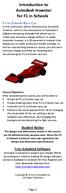 Introduction to Autodesk Inventor for F1 in Schools F1 in Schools Race Car In this course you will be introduced to Autodesk Inventor, which is the centerpiece of Autodesk s digital prototyping strategy
FOR WINDOWS FILE SERVERS
 Quest ChangeAuditor FOR WINDOWS FILE SERVERS 5.1 User Guide Copyright Quest Software, Inc. 2010. All rights reserved. This guide contains proprietary information protected by copyright. The software described
Introduction to Service Oriented Architectures (SOA)
 Introduction to Service Oriented Architectures (SOA) Responsible Institutions: ETHZ (Concept) ETHZ (Overall) ETHZ (Revision) http://www.eu-orchestra.org - Version from: 26.10.2007 1 Content 1. Introduction
If you know exactly how you want your business forms to look and don t mind detail
 Advanced Form Customization APPENDIX E If you know exactly how you want your business forms to look and don t mind detail work, you can customize QuickBooks forms however you want. With QuickBooks Layout
Medstar Health Dell Services
 Medstar Health Dell Services Non Medstar Device Citrix Connectivity Guide October 2012 Sean Kaminski Dell Services System Admin Consultant 1 Table of Contents Overview...3 What is Citrix and why do I need
Sharing Software. Chapter 14
 Chapter 14 14 Sharing Software Sharing a tool, like a software application, works differently from sharing a document or presentation. When you share software during a meeting, a sharing window opens automatically
Chapter 3 Input Devices
 CSCA0101 COMPUTING BASICS Chapter 3 1 Topics: Examples of Input Device Keyboard Pointing Devices Graphic and Video Audio 2 Any peripheral (piece of computer hardware equipment) used to provide data and
COMSPHERE 6700 SERIES NETWORK MANAGEMENT SYSTEM
 COMSPHERE 6700 SERIES NETWORK MANAGEMENT SYSTEM SECURITY MANAGER FEATURE SUPPLEMENT Document No. 6700-A2-GB41-30 February 1998 Copyright 1998 Paradyne Corporation. All rights reserved. Printed in U.S.A.
Citrix Receiver. Configuration and User Guide. For Macintosh Users
 Citrix Receiver Configuration and User Guide For Macintosh Users rev: 25.03.2015 https://access.sap.com/ TABLE OF CONTENTS Introduction... 3 Installation... 3 Accessing our portal... 3 Accessing from SAP
+ Create, and maintain your site
 T4 Basics Version 1.0 + Create, and maintain your site With T4, you are in control of the content of your website. Feel free to be creative, and keep your site up to date. Few of T4 Features Media Library
Using OfficeMate/ExamWRITER on an Apple ipad. October 2013
 Using OfficeMate/ExamWRITER on an Apple ipad October 2013 Limitation of Liability and Damages The information contained herein is subject to change without notice and is provided "as-is" without warranty
Introduction to dobe Acrobat XI Pro
 Introduction to dobe Acrobat XI Pro Introduction to Adobe Acrobat XI Pro is licensed under the Creative Commons Attribution-NonCommercial-NoDerivatives 4.0 International License. To view a copy of this
Using the Jive for ios App
 Using the Jive for ios App TOC 2 Contents App Overview...3 System Requirements... 4 Release Notes...5 Which Version Am I Using?... 6 Connecting to Your Community... 11 Getting Started...12 Using Your Inbox...13
ivms-4500 HD (ios) Mobile Client Software User Manual (V3.4)
 ivms-4500 HD (ios) Mobile Client Software User Manual (V3.4) UD.6L0202D1587A01 Thank you for purchasing our product. This manual applies to ivms-4500 HD (ios) mobile client software; please read it carefully
Creating mobile layout designs in Adobe Muse
 Creating mobile layout designs in Adobe Muse Using Adobe Muse, you can create site layouts for web content to be displayed on desktop, smartphones, and tablets. Using the mobile design features, you can
Guide To Creating Academic Posters Using Microsoft PowerPoint 2010
 Guide To Creating Academic Posters Using Microsoft PowerPoint 2010 INFORMATION SERVICES Version 3.0 July 2011 Table of Contents Section 1 - Introduction... 1 Section 2 - Initial Preparation... 2 2.1 Overall
StrikeRisk v6.0 IEC/EN 62305-2 Risk Management Software Getting Started
 StrikeRisk v6.0 IEC/EN 62305-2 Risk Management Software Getting Started Contents StrikeRisk v6.0 Introduction 1/1 1 Installing StrikeRisk System requirements Installing StrikeRisk Installation troubleshooting