
How To Understand The Facts Of Education In The United States
|
|
|
- Samson McBride
- 5 years ago
- Views:
Transcription
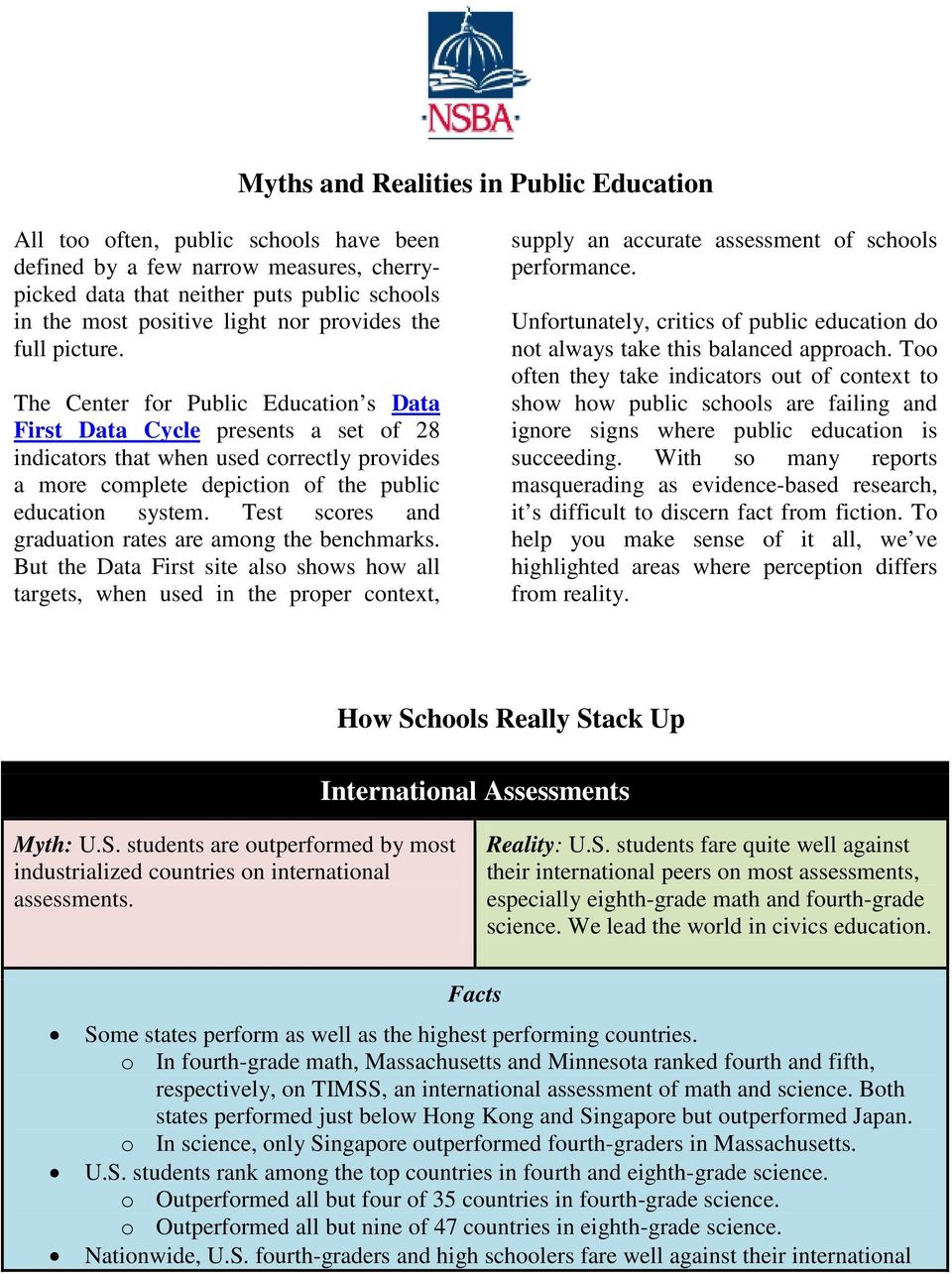
1 Myths and Realities in Public Education All too often, public schools have been defined by a few narrow measures, cherrypicked data that neither puts public schools in the most positive light nor provides the full picture. The Center for Public Education s Data First Data Cycle presents a set of 28 indicators that when used correctly provides a more complete depiction of the public education system. Test scores and graduation rates are among the benchmarks. But the Data First site also shows how all targets, when used in the proper context, supply an accurate assessment of schools performance. Unfortunately, critics of public education do not always take this balanced approach. Too often they take indicators out of context to show how public schools are failing and ignore signs where public education is succeeding. With so many reports masquerading as evidence-based research, it s difficult to discern fact from fiction. To help you make sense of it all, we ve highlighted areas where perception differs from reality. How Schools Really Stack Up International Assessments Myth: U.S. students are outperformed by most industrialized countries on international assessments. Reality: U.S. students fare quite well against their international peers on most assessments, especially eighth-grade math and fourth-grade science. We lead the world in civics education. Some states perform as well as the highest performing countries. o In fourth-grade math, Massachusetts and Minnesota ranked fourth and fifth, respectively, on TIMSS, an international assessment of math and science. Both states performed just below Hong Kong and Singapore but outperformed Japan. o In science, only Singapore outperformed fourth-graders in Massachusetts. U.S. students rank among the top countries in fourth and eighth-grade science. o Outperformed all but four of 35 countries in fourth-grade science. o Outperformed all but nine of 47 countries in eighth-grade science. Nationwide, U.S. fourth-graders and high schoolers fare well against their international
2 counterparts in reading. o U.S. fourth-graders outperformed all but 10 of 44 countries. o At the high school level just nine of 64 countries performed higher than U.S. 15 year-olds. National Assessments Myth: Student achievement has remained stagnant even as funding has increased. Reality: Student achievement has actually increased significantly. Data shows fourth- and eighth-grade students have made tremendous progress over the past two decades despite the fact that a growing portion of the student population is comprised of traditionally disadvantaged students. Math o At the fourth-grade level, the proportion of students reaching proficiency has more than tripled since 1990, climbing from 13 to 40 percent. o More than twice as many eighth-graders scored proficient on the National Assessment of Education Progress (NAEP) in 2011 (35 percent) than in 1990 (15 percent). o Progress is being made at many large urban districts as well. Between 2003 and 2011, Boston and Atlanta made gains that were the equivalent to nearly two more years worth of learning. Reading o Since 1992, the percentage of eighth-graders reaching the proficiency benchmark increased by six percentage points for both black and Hispanic students. High School Graduation Rates Myth: High school graduation rates have remained relatively flat for several decades. Reality: Graduation rates have been increasing for nearly a decade. The national graduation rate rose from 66 to 73 percent between 1999 and 2009, increasing nearly five percentage points since 2007 alone. The actual high school graduation rate is closer to 80 percent when students who take longer than four years to graduate are included. According to Education Week, the number of states with an estimated on-time graduation rate of at least 70 percent, increased from 26 states in 1999 to 40 states in Graduation rates are likely to continue to increase as states and districts implement early warning systems to identify struggling students and provide them with early interventions

3 to keep them on-track to graduate. The number of so-called Dropout Factories schools that graduate less than 60 percent of their students on time have declined by 23 percent between 2002 and 2010.

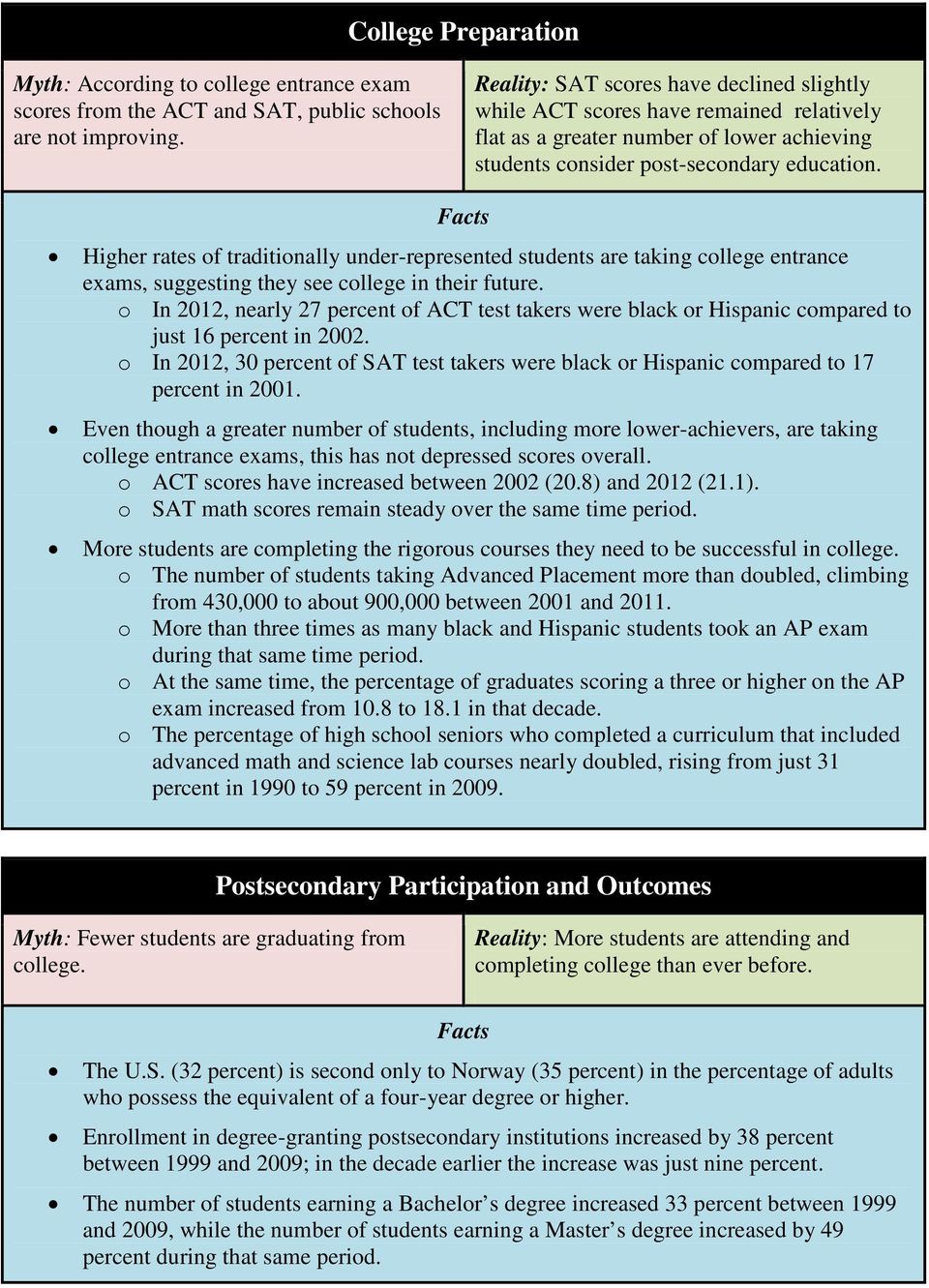
4 College Preparation Myth: According to college entrance exam scores from the ACT and SAT, public schools are not improving. Reality: SAT scores have declined slightly while ACT scores have remained relatively flat as a greater number of lower achieving students consider post-secondary education. Higher rates of traditionally under-represented students are taking college entrance exams, suggesting they see college in their future. o In 2012, nearly 27 percent of ACT test takers were black or Hispanic compared to just 16 percent in o In 2012, 30 percent of SAT test takers were black or Hispanic compared to 17 percent in Even though a greater number of students, including more lower-achievers, are taking college entrance exams, this has not depressed scores overall. o ACT scores have increased between 2002 (20.8) and 2012 (21.1). o SAT math scores remain steady over the same time period. More students are completing the rigorous courses they need to be successful in college. o The number of students taking Advanced Placement more than doubled, climbing from 430,000 to about 900,000 between 2001 and o More than three times as many black and Hispanic students took an AP exam during that same time period. o At the same time, the percentage of graduates scoring a three or higher on the AP exam increased from 10.8 to 18.1 in that decade. o The percentage of high school seniors who completed a curriculum that included advanced math and science lab courses nearly doubled, rising from just 31 percent in 1990 to 59 percent in Postsecondary Participation and Outcomes Myth: Fewer students are graduating from college. Reality: More students are attending and completing college than ever before. The U.S. (32 percent) is second only to Norway (35 percent) in the percentage of adults who possess the equivalent of a four-year degree or higher. Enrollment in degree-granting postsecondary institutions increased by 38 percent between 1999 and 2009; in the decade earlier the increase was just nine percent. The number of students earning a Bachelor s degree increased 33 percent between 1999 and 2009, while the number of students earning a Master s degree increased by 49 percent during that same period.
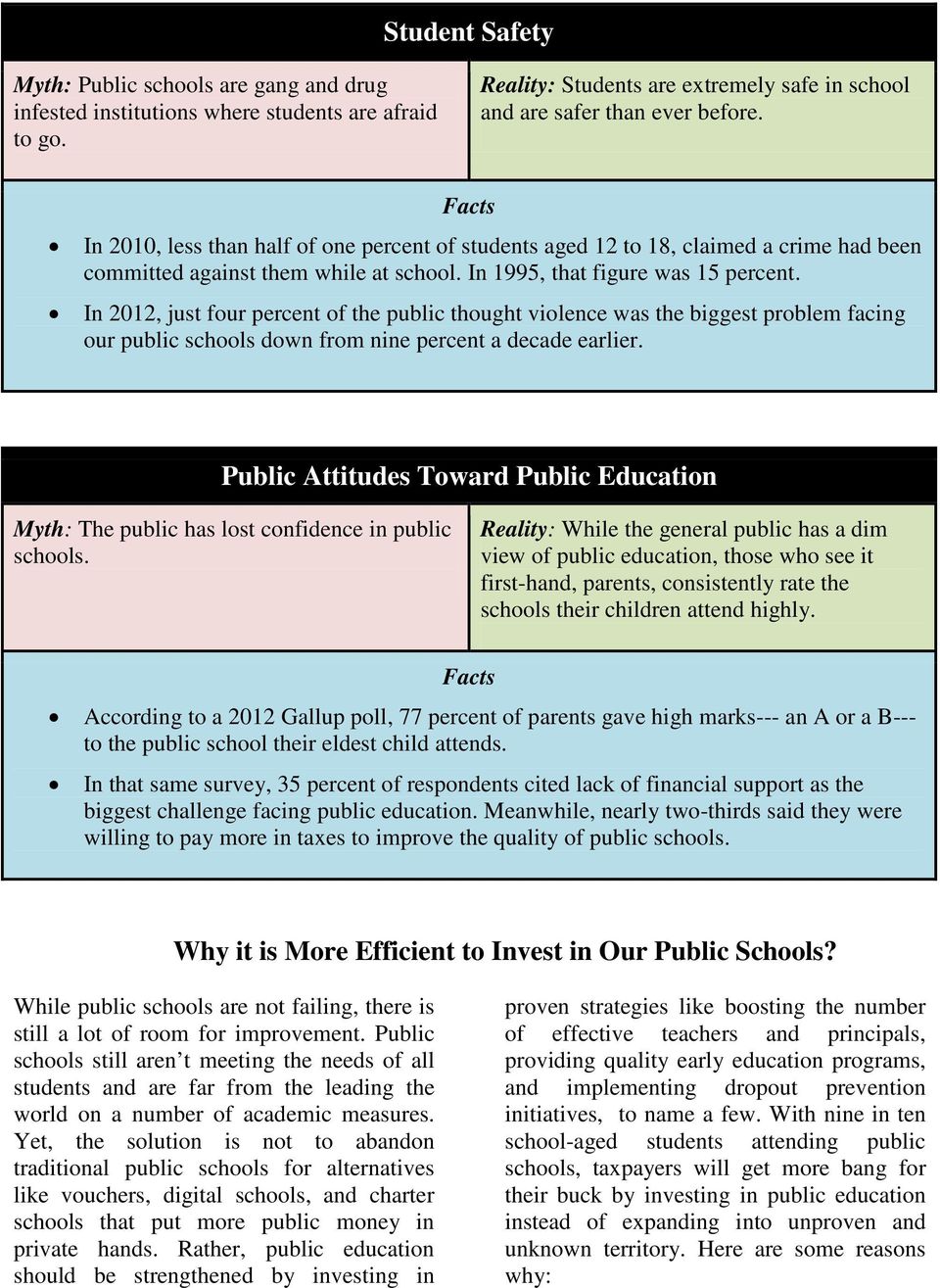
5 Student Safety Myth: Public schools are gang and drug infested institutions where students are afraid to go. Reality: Students are extremely safe in school and are safer than ever before. In 2010, less than half of one percent of students aged 12 to 18, claimed a crime had been committed against them while at school. In 1995, that figure was 15 percent. In 2012, just four percent of the public thought violence was the biggest problem facing our public schools down from nine percent a decade earlier. Public Attitudes Toward Public Education Myth: The public has lost confidence in public schools. Reality: While the general public has a dim view of public education, those who see it first-hand, parents, consistently rate the schools their children attend highly. According to a 2012 Gallup poll, 77 percent of parents gave high marks--- an A or a B--- to the public school their eldest child attends. In that same survey, 35 percent of respondents cited lack of financial support as the biggest challenge facing public education. Meanwhile, nearly two-thirds said they were willing to pay more in taxes to improve the quality of public schools. Why it is More Efficient to Invest in Our Public Schools? While public schools are not failing, there is still a lot of room for improvement. Public schools still aren t meeting the needs of all students and are far from the leading the world on a number of academic measures. Yet, the solution is not to abandon traditional public schools for alternatives like vouchers, digital schools, and charter schools that put more public money in private hands. Rather, public education should be strengthened by investing in proven strategies like boosting the number of effective teachers and principals, providing quality early education programs, and implementing dropout prevention initiatives, to name a few. With nine in ten school-aged students attending public schools, taxpayers will get more bang for their buck by investing in public education instead of expanding into unproven and unknown territory. Here are some reasons why:
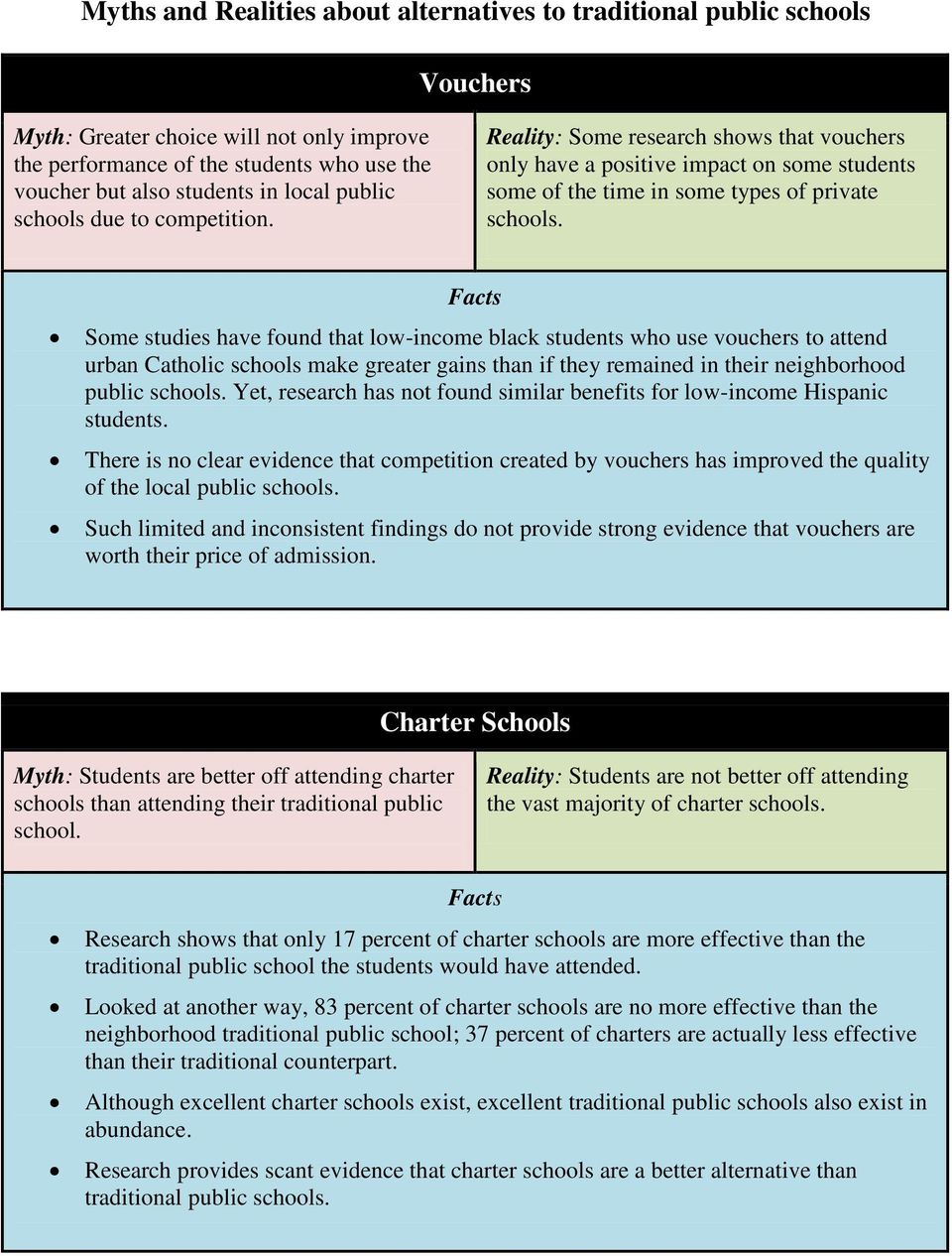
6 Myths and Realities about alternatives to traditional public schools Vouchers Myth: Greater choice will not only improve the performance of the students who use the voucher but also students in local public schools due to competition. Reality: Some research shows that vouchers only have a positive impact on some students some of the time in some types of private schools. Some studies have found that low-income black students who use vouchers to attend urban Catholic schools make greater gains than if they remained in their neighborhood public schools. Yet, research has not found similar benefits for low-income Hispanic students. There is no clear evidence that competition created by vouchers has improved the quality of the local public schools. Such limited and inconsistent findings do not provide strong evidence that vouchers are worth their price of admission. Charter Schools Myth: Students are better off attending charter schools than attending their traditional public school. Reality: Students are not better off attending the vast majority of charter schools. Research shows that only 17 percent of charter schools are more effective than the traditional public school the students would have attended. Looked at another way, 83 percent of charter schools are no more effective than the neighborhood traditional public school; 37 percent of charters are actually less effective than their traditional counterpart. Although excellent charter schools exist, excellent traditional public schools also exist in abundance. Research provides scant evidence that charter schools are a better alternative than traditional public schools.
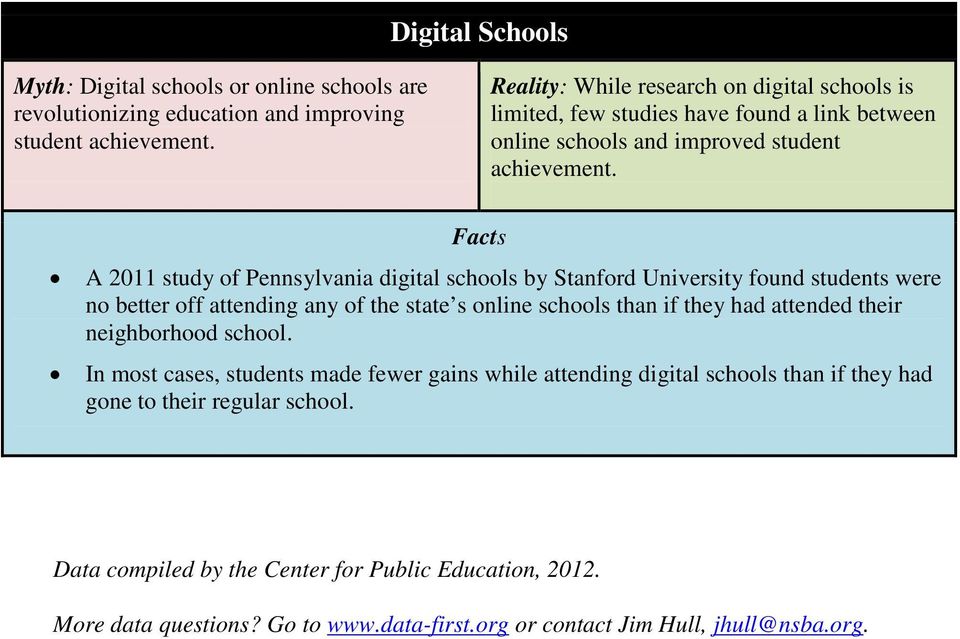
7 Digital Schools Myth: Digital schools or online schools are revolutionizing education and improving student achievement. Reality: While research on digital schools is limited, few studies have found a link between online schools and improved student achievement. A 2011 study of Pennsylvania digital schools by Stanford University found students were no better off attending any of the state s online schools than if they had attended their neighborhood school. In most cases, students made fewer gains while attending digital schools than if they had gone to their regular school. Data compiled by the Center for Public Education, More data questions? Go to or contact Jim Hull, [email protected].
State of the Schools Report Archdiocese of Boston Catholic Schools. June 2014
 State of the Schools Report Archdiocese of Boston Catholic Schools June 2014 Our Catholic schools educate students from 144 cities and towns Elementary Schools High Schools Early Education Centers Special
Getting Back to the Top
 Getting Back to the Top An International Comparison of College Attainment Where the U.S. Stands Jim Hull, Senior Policy Analyst The Center for Public Education National School Boards Association December
A second year progress report on. Florida s Race to the Top
 Florida s Race to the Top A second year progress report on Florida s Race to the Top January 2013 Florida s Race to the Top Florida has a strong history of reform, establishing a solid foundation that
THE EDUCATIONAL PROGRESS OF BLACK STUDENTS
 NATIONAL CENTER FOR EDUCATION STATISTICS Findings from THE CONDITION OF EDUCATION 1994 NO. 2 THE EDUCATIONAL PROGRESS OF BLACK STUDENTS U.S. Department of Education Office of Educational Research and Improvement
JUST THE FACTS. Birmingham, Alabama
 JUST THE FACTS Birmingham, Alabama The Institute for a Competitive Workforce (ICW) is a nonprofit, nonpartisan, 501(c)(3) affiliate of the U.S. Chamber of Commerce. ICW promotes the rigorous educational
Gwinnett County Public Schools, Ga.
 , Ga. District Profile*: Rank among U.S. school districts (by size): 14 Number of schools: 123 Number of students: 159,298 Number of teachers: 11,000 Per pupil expenditures**: $8,859 Superintendent: J.
Florida. Who attends Florida's public schools? Total 2010-11 Public Elementary and Secondary Enrollment: 2,643,347
 Florida Who attends Florida's public schools? Total 2010-11 Public Elementary and Secondary Enrollment: 2,643,347 Student Enrollment by Race/Ethnicity Student Enrollment by Income, Disability, and English
The MetLife Survey of
 The MetLife Survey of Challenges for School Leadership Challenges for School Leadership A Survey of Teachers and Principals Conducted for: MetLife, Inc. Survey Field Dates: Teachers: October 5 November
Practices Worthy of Attention High Tech High San Diego Unified School District San Diego, California
 San Diego Unified School District San Diego, California Summary of the Practice. is a charter school set up with the mission of giving students an interdisciplinary and hands-on education so they can be
October 2009 Reality Check: Making Sure Your High School Students are Adequately Prepared for College
 October 2009 Reality Check: Making Sure Your High School Students are Adequately Prepared for College Now that your students are enrolled in college preparatory programs, they are firmly on the path to
Understanding Ohio s New Local Report Card System
 Achievement Performance Indicators Performance Index The Performance Indicators show how many students have a minimum, or proficient, level of knowledge. These indicators are not new to Ohio students or
Testimony to the Tennessee Senate Education Committee in Support of. of the Common Core State Standards.
 Testimony to the Tennessee Senate Education Committee in Support of The Common Core State Standards Patricia Levesque, Chief Executive Officer, Foundation for Excellence in Education September 20, 2013
Year Four Evaluation of City Year Greater Philadelphia
 Year Four Evaluation of City Year Greater Philadelphia March 2013 Prepared by Research for Action Michael H. Norton Year Four Evaluation of City Year Greater Philadelphia Prepared by Research for Action
Characteristics of Colorado s Online Students
 Characteristics of Colorado s Online Students By: Amanda Heiney, Dianne Lefly and Amy Anderson October 2012 Office of Online & Blended Learning 201 E. Colfax Ave., Denver, CO 80203 Phone: 303-866-6897
Moving the Needle on Access and Success
 National Postsecondary Education Cooperative (NPEC) Moving the Needle on Access and Success Student Success Symposium November 2, 2006 David A. Longanecker Executive Director Western Interstate Commission
Statistical Profile of the Miami- Dade County Public Schools
 2 Statistical Profile of the Miami- Dade Public Schools The mission of the Miami-Dade Public Schools is to support the improvement of student achievement by strengthening instructional leadership, by launching
THE EDUCATIONAL PROGRESS OF WOMEN
 NATIONAL CENTER FOR EDUCATION STATISTICS Findings from THE CONDITION OF EDUCATION 1995 NO. 5 THE EDUCATIONAL PROGRESS OF WOMEN U.S. Department of Education Office of Educational Research and Improvement
Atrisco Heritage Academy High
 District: Albuquerque Public s Grade Range: 0912 Code: 1576 Grade Report Card 20112012 inal Grade D Performance in ath and Reading Current Standing How did your students perform in the most recent school
Achievement in America: Going the Distance to Improve Results and Close Gaps
 Achievement in America: Going the Distance to Improve Results and Close Gaps Washington Technology Alliance September, 2009 4 th Grade Reading: Record Performance with Gap Narrowing *Denotes previous assessment
Practices Worthy of Attention YES College Preparatory School Houston Independent School District Houston, Texas
 Houston Independent School District Houston, Texas Summary of the Practice. in Houston, Texas, is an openenrollment public school serving students in grades 6 12 from populations that are historically
Race Matters. Household Asset Poverty by Race in North Carolina. Child Poverty by County
 Race Matters Children of color are more likely to grow up in both income poverty and asset poverty. This double burden creates a difficult barrier for children to overcome. As adults, children of color
Facts About Kids and Reading
 STUDENT READING ACHIEVEMENT FACTS: Only one-third of all students entering high school are proficient in reading only about 15 percent of African American students, and 17 percent of Hispanic students.
Florida s Guide to Public High School Graduation
 Florida s Guide to Public High School Graduation It s a Major Opportunity! For Students Entering Ninth Grade in 2008-2009 Florida Department of Education 2008 1 High School Graduation Programs Overview
Every Student Succeeds Act: A Progress Report on Elementary and Secondary Education
 Every Student Succeeds Act: A Progress Report on Elementary and Secondary Education Executive Office of the President December 2015 Every Student Succeeds Act: A Progress Report on Elementary and Secondary
KANSAS ASSOCIATION OF SCHOOL BOARDS 1420 SW Arrowhead Road, Topeka, Kan. 66604 785.273.3600 800.432.2471 www.kasb.org
 KANSAS ASSOCIATION OF SCHOOL BOARDS 1420 SW Arrowhead Road, Topeka, Kan. 66604 785.273.3600 800.432.2471 www.kasb.org Special Report: February, 2014 School Funding, At-Risk and All-Day Kindergarten and
Review of AVID Research
 Review of AVID Research Watt, K.M., Mills, S.J., & Huerta, J. (In Press.). Identifying attributes of teacher leaders within the AVID program: A survey of school principals. Journal of School Leadership.
YEAR 3 REPORT: EVOLUTION OF PERFORMANCE MANAGEMENT ALBANY NY CHARTER SCHOO CHARTER SCHOOL PERFORMANCE IN FLORIDA. credo.stanford.edu.
 YEAR 3 REPORT: EVOLUTION OF PERFORMANCE MANAGEMENT CHARTER SCHOOL PERFORMANCE IN FLORIDA IN credo.stanford.edu ALBANY NY CHARTER SCHOO June 2009 INTRODUCTION This report supplements the CREDO National
Our Challenge: Graduating Students College & Career Ready The Long Island Regional Advisory Council on Higher Education January 31, 2013
 Our Challenge: Graduating Students College & Career Ready The Long Island Regional Advisory Council on Higher Education January 31, 2013 EngageNY.org Graduating College and Career Ready New York's 4-year
Review test prep resources for educators, students and families.
 Goals: Discuss findings of the 2013 SAT Report on College and Career Readiness and the ACT 2013 Condition of College and Career Readiness; examine performance data to see how Arizona students are testing.
YEAR 3 REPORT: EVOLUTION OF PERFORMANCE MANAGEMENT ALBANY NY CHARTER SCHOO CHARTER SCHOOL PERFORMANCE IN NEW YORK CITY. credo.stanford.
 YEAR 3 REPORT: EVOLUTION OF PERFORMANCE MANAGEMENT CHARTER SCHOOL PERFORMANCE IN NEW YORK CITY IN credo.stanford.edu ALBANY NY CHARTER SCHOO January 2010 SUMMARY This report supplements the CREDO National
State of New Jersey 2012-13
 1 OVERVIEW GRADE SPAN 912 395262 SCOTCH PLAINS, NEW JERSEY 776 1. This school's academic performance is very high when compared to schools across the state. Additionally, its academic performance is very
State of New Jersey 2013-14
 1 OVERVIEW 21314 GRADE SPAN 912 31411 15 PARK AVENUE PATERSON, NJ 751 1. This school's academic performance significantly lags in comparison to schools across the state. Additionally, its academic performance
JUST THE FACTS. Washington
 JUST THE FACTS Washington The Institute for a Competitive Workforce (ICW) is a nonprofit, nonpartisan, 501(c)(3) affiliate of the U.S. Chamber of Commerce. ICW promotes the rigorous educational standards
Are ALL children receiving a high-quality education in Ardmore, Oklahoma? Not yet.
 Are ALL children receiving a high-quality education in Ardmore, Oklahoma? Not yet. Despite a relatively high graduation rate, too many students are not graduating from Ardmore Public Schools ready for
Future Students, Future Revenues
 Future Students, Future Revenues Strategies for Sustainable Enrollment in the Coming Decade A Preview of Upcoming EAB Research Full Report Available Fall 2013 eab.com Executive Summary Key Lessons Pundits
Wilder Research. 2010-11 Statewide Census of Private Education (SCOPE) Summary of a study of private K-12 schools in Minnesota.
 Wilder Research 2010-11 Statewide Census of Private Education (SCOPE) Summary of a study of private K-12 schools in Minnesota To better understand the reach and impact of private education in Minnesota,
Florida s Plan to Ensure Equitable Access to Excellent Educators. heralded Florida for being number two in the nation for AP participation, a dramatic
 Florida s Plan to Ensure Equitable Access to Excellent Educators Introduction Florida s record on educational excellence and equity over the last fifteen years speaks for itself. In the 10 th Annual AP
The Condition of College & Career Readiness 2013. National
 The Condition of College & Career Readiness 2013 National 2013 by ACT, Inc. All rights reserved. The ACT college readiness assessment is a registered trademark of ACT, Inc., in the U.S.A. and other countries.
ANNUAL REPORT ON CURRICULUM, INSTRUCTION AND STUDENT ACHIEVEMENT
 The mission of the Greenbush-Middle River School is to provide a quality education which will prepare all students to meet success by developing self-directed thinkers and communicators who are responsible,
Evaluation of the MIND Research Institute s Spatial-Temporal Math (ST Math) Program in California
 Evaluation of the MIND Research Institute s Spatial-Temporal Math (ST Math) Program in California Submitted to: Andrew Coulson MIND Research Institute 111 Academy, Suite 100 Irvine, CA 92617 Submitted
Principles to Actions
 Principles to Actions Executive Summary In 1989 the National Council of Teachers of Mathematics (NCTM) launched the standards-based education movement in North America with the release of Curriculum and
Progress and Promise A report on the Boston Pilot Schools Executive Summary January 2006
 Progress and Promise A report on the Boston Pilot Schools Executive Summary January 2006 Center for Collaborative Education Boston, Massachusetts New research conducted by Boston s Center for Collaborative
DEPARTMENT OF EDUCATION
 DEPARTMENT OF EDUCATION Funding Highlights: Provides $68.6 billion in discretionary funding for the Department of Education to build upon investments in preschool access, ongoing K-12 reforms, and efforts
TESTIMONY TO THE BASIC EDUCATION FUNDING COMMISSION DECEMBER 4, 2014 EAST STROUDSBURG, PA
 TESTIMONY TO THE BASIC EDUCATION FUNDING COMMISSION DECEMBER 4, 2014 EAST STROUDSBURG, PA DR. RICH FRERICHS PRESIDENT PENNSYLVANIA SCHOOL BOARDS ASSOCIATION JOHN CALLAHAN SENIOR DIRECTOR OF GOVERNMENT
Into the Eye of the Storm: Assessing the Evidence on Science and Engineering Education, Quality, and Workforce Demand
 Into the Eye of the Storm: Assessing the Evidence on Science and Engineering Education, Quality, and Workforce Demand October 2007 B. Lindsay Lowell Georgetown University [email protected] Hal Salzman
Application Trends Survey
 The premier provider of market intelligence Application Trends Survey SURVEY REPORT About This Study The Application Trends Survey is a product of the Graduate Management Admission Council (GMAC ), a global
Overcoming Doubts About Online Learning
 Educational Technology Cooperative Overcoming Doubts About Online Learning November 2009 Southern Regional Education Board 592 10th St. N.W. Atlanta, GA 30318 (404) 875-9211 www.sreb.org This publication
YEAR 3 REPORT: EVOLUTION OF PERFORMANCE MANAGEMENT ALBANY NY CHARTER SCHOO CHARTER SCHOOL PERFORMANCE IN ARIZONA. credo.stanford.edu.
 YEAR 3 REPORT: EVOLUTION OF PERFORMANCE MANAGEMENT CHARTER SCHOOL PERFORMANCE IN ARIZONA IN credo.stanford.edu ALBANY NY CHARTER SCHOO June 2009 INTRODUCTION This report supplements the CREDO National
Michigan Merit Curriculum High School Graduation Requirements
 Michigan Merit Curriculum High School Graduation Requirements 45 Understanding Michigan s graduation requirements will enable you to help your child obtain a high school diploma and ultimately succeed
Student Academic Preparation and Educational Partnerships
 Student Academic Preparation and Educational Partnerships (SAPEP) Annual Report Highlights 2013-14 OV E RV I E W The University of California s Student Academic Preparation and Educational Partnerships
NCES 2011-034 U.S. DEPARTMENT OF EDUCATION
 NCES 2011-034 U.S. DEPARTMENT OF EDUCATION The Condition of Education 2011 in Brief MAY 2011 Editors Susan Aud National Center for Education Statistics Gretchen Hannes American Institutes for Research
Florida s Guide to Public High School Graduation
 Florida s Guide to Public High School Graduation It s a Major Opportunity! For Students Entering Ninth Grade in 2007-2008 Florida Department of Education 2007 High School Graduation Programs Overview If
San José Unified School District is
 The San José Unified School District Story: Implementing a College-Ready Curriculum for All Dr. Linda Murray San José Unified School District San José Unified School District is an urban district in the
Public Housing and Public Schools: How Do Students Living in NYC Public Housing Fare in School?
 Furman Center for real estate & urban policy New York University school of law wagner school of public service november 2008 Policy Brief Public Housing and Public Schools: How Do Students Living in NYC
Connecticut College and Career Readiness Toolkit Supplemental Data Central High School
 Connecticut College and Career Readiness Toolkit Supplemental Data Central High School Prepared by the Educational Policy Improvement Center on behalf of the Connecticut P-20 Council Preface This packet
The School Counselor s Role in College and Career Readiness
 College and Career Readiness Counseling for All Students 1 The School Counselor s Role in College and Career Readiness Judy Petersen, M. Ed. Director, College and Career Readiness Granite School District
The Greenville County Schools homepage provides five goals for the school system (www.greenville.k12.sc.us/district/admin/stats/measures.
 Education Greenville County Schools The Greenville County Schools homepage provides five goals for the school system (www.greenville.k12.sc.us/district/admin/stats/measures.asp): 1. Raise the academic