
Achievement in America: Going the Distance to Improve Results and Close Gaps
|
|
|
- Rudolf Bishop
- 10 years ago
- Views:
Transcription
1 Achievement in America: Going the Distance to Improve Results and Close Gaps Washington Technology Alliance September, 2009

2 4 th Grade Reading: Record Performance with Gap Narrowing *Denotes previous assessment format Source: NAEP 2008 Trends in Academic Progress, NCES

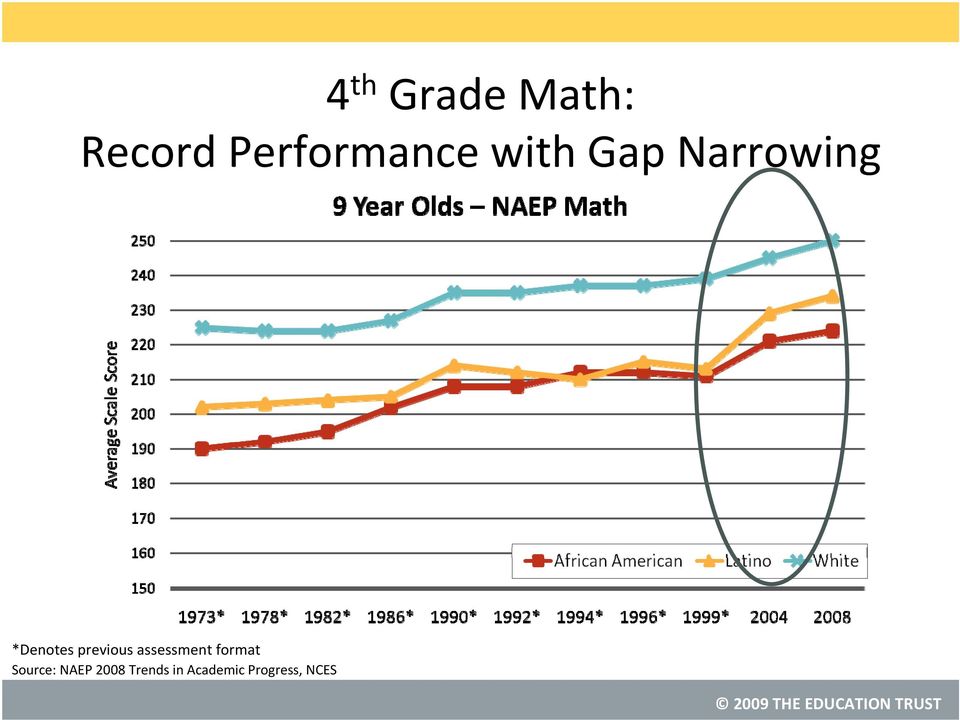
3 4 th Grade Math: Record Performance with Gap Narrowing *Denotes previous assessment format Source: NAEP 2008 Trends in Academic Progress, NCES
4 8 th Grade Reading: Not Much Progress *Denotes previous assessment format Source: NAEP 2008 Trends in Academic Progress, NCES

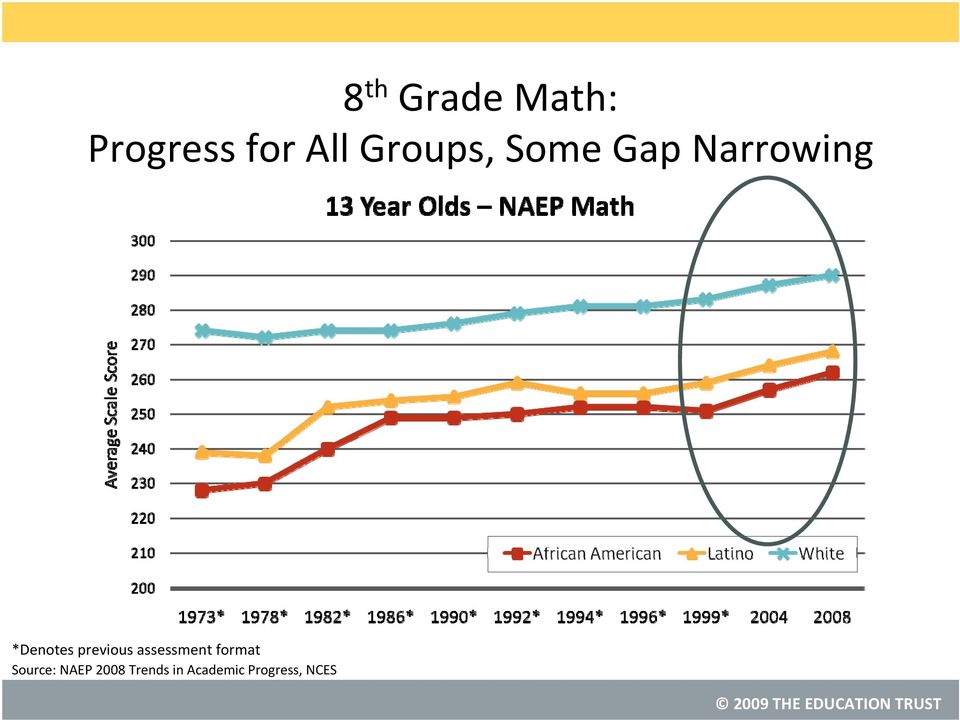
5 8 th Grade Math: Progress for All Groups, Some Gap Narrowing *Denotes previous assessment format Source: NAEP 2008 Trends in Academic Progress, NCES
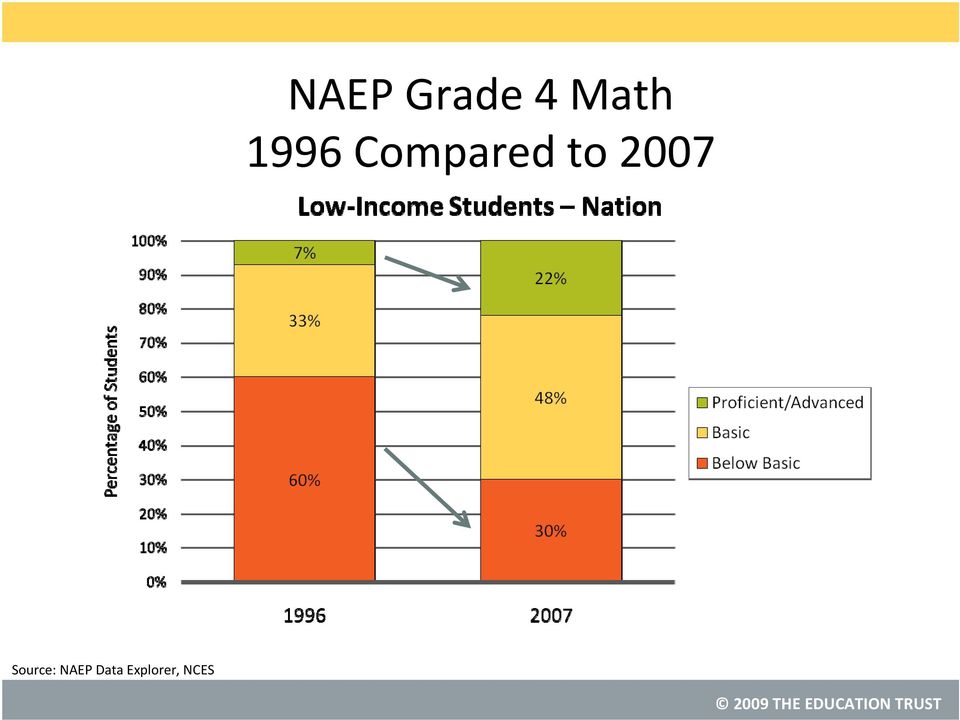
6 Progress Even Clearer When Examined Over a Decade

7 1996 NAEP Grade 4 Math Source: NAEP Data Explorer, NCES

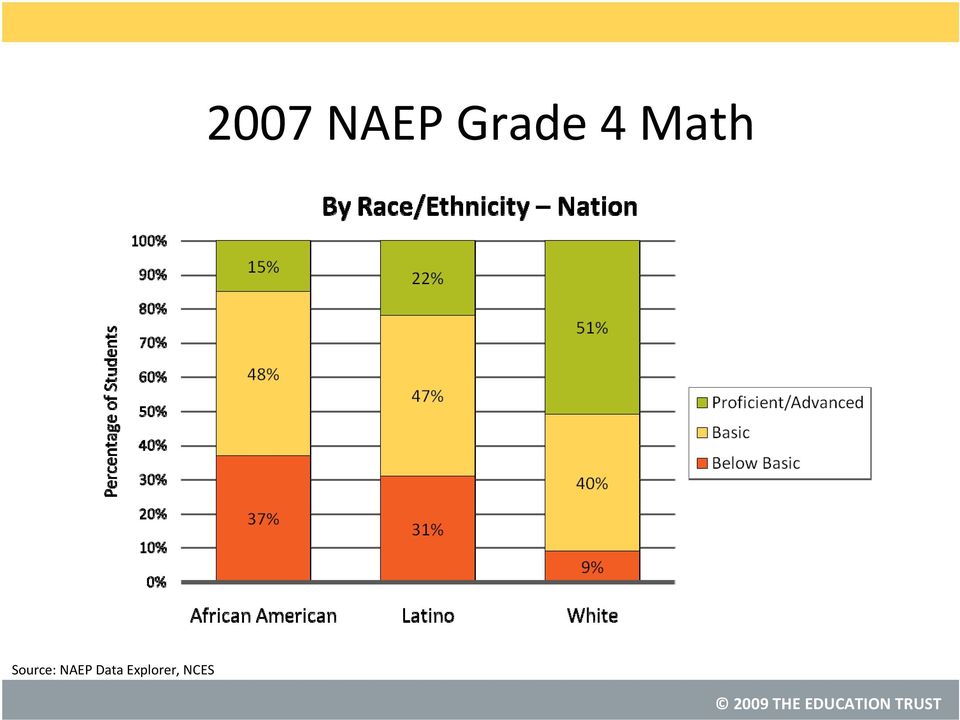
8 2007 NAEP Grade 4 Math Source: NAEP Data Explorer, NCES
9 NAEP Grade 4 Math 1996 Compared to 2007 Source: NAEP Data Explorer, NCES
10 High schools, however, are another matter

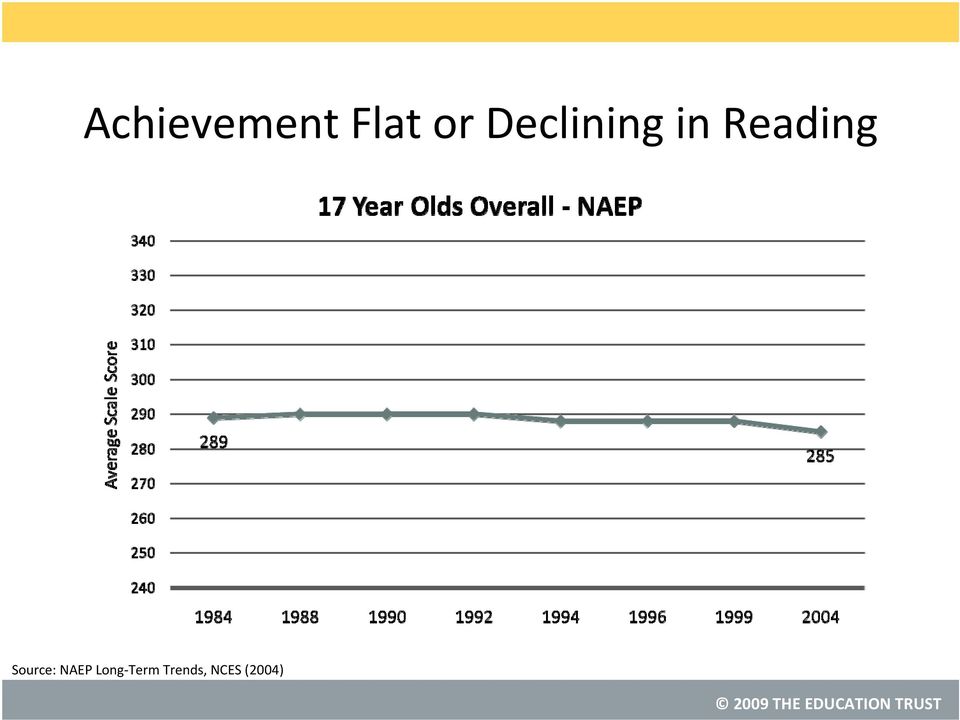
11 Achievement Flat or Declining in Reading Source: NAEP Long Term Trends, NCES (2004)
12 NAEP math scores have remained flat over time * Denotes previous assessment format Source: National Center for Education Statistics, NAEP 2008 Trends in Academic Progress

13 And gaps between groups are wider today than in THE THE EDUCATION EDUCATION TRUST TRUST

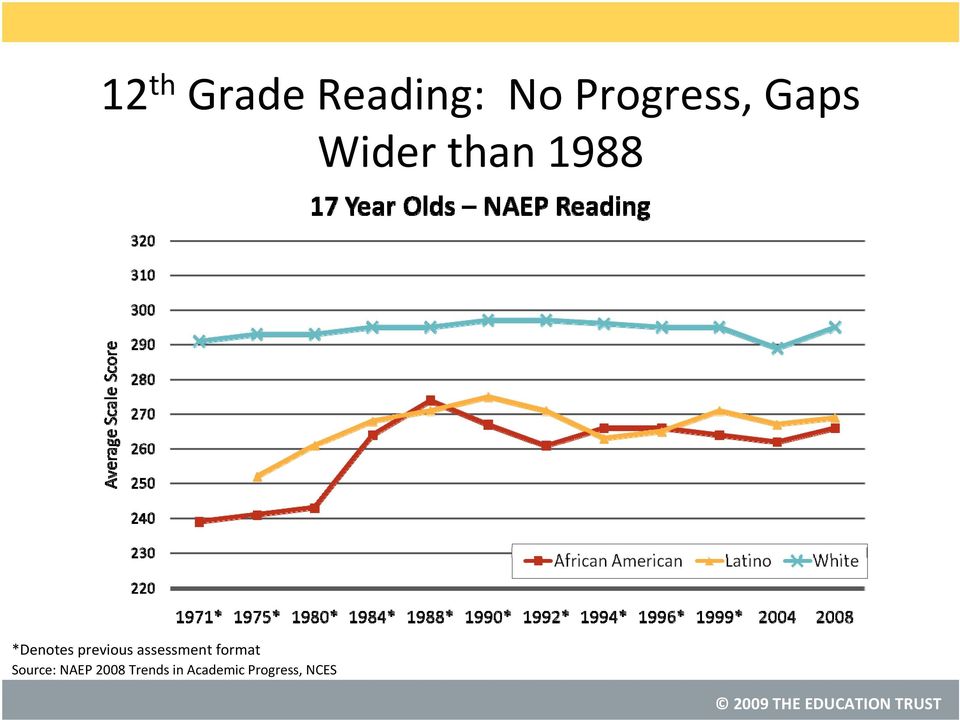
14 12 th Grade Reading: No Progress, Gaps Wider than 1988 *Denotes previous assessment format Source: NAEP 2008 Trends in Academic Progress, NCES
15 12 Grade Math: Results Mostly Flat Mostly Widening Gaps for Blacks *Denotes previous assessment format Source: NAEP 2008 Trends in Academic Progress, NCES

16 Internationally?
17 PISA Performance U.S.A. Ranks Near Bottom, Has Fallen Since 2000 Subject Mathematics Science 2000 Rank (out of 26) 17 th 13 th 2003 Rank (out of 26) 22 nd Tied 17 th 2006 Rank (out of 26) 22 nd 19 th Note: Rankings are for the 26 OECD countries participating in PISA in 2000, 2003, and Source: PISA 2006 Results, OECD

18 A closer look at math THE THE EDUCATION EDUCATION TRUST TRUST
19 Of 29 OECD Countries, U.S.A. Ranked 24 th U.S.A. Source: PISA 2003 Results, OECD

20 Problems are not limited to our high poverty and high minority schools...

21 U.S. Ranks Low in the Percent of Students in the Highest Achievement Level (Level 6) in Math Source: Organization for Economic Cooperation and Development (OECD), PISA 2003 Results, data available at
22 U.S. Ranks 23 rd out of 29 OECD Countries in the Math Achievement of the Highest Performing Students* * Students at the 95 th Source: Organization for Economic Cooperation Percentile and Development (OECD), PISA 2003 Results, data available at
23 U.S. Ranks 23 rd out of 29 OECD Countries in the Math Achievement of High SES Students Source: Organization for Economic Cooperation and Development (OECD), PISA 2003 Results, data available at
24 Problems not limited to math, either.
25 Science? THE THE EDUCATION EDUCATION TRUST TRUST
26 Of 30 OECD Countries, U.S.A. Ranked 21 st U.S.A. Source: PISA 2006 Results, OECD Higher than U.S. average Not measurably different from U.S. average Lower than U.S. average
27 Immigrants? The U.S.A. does have a larger percentage of immigrants and children of immigrants than most OECD countries 50.0% 2nd Generation 1st Generation 40.0% 30.0% 20.0% U.S.A. Percent of Students 10.0% 0.0% Luxembourg Switzerland Australia New Zealand Canada United States Germany Belgium Austria France Netherlands Sweden OECD Average United Kingdom Denmark Greece Spain Norway Portugal Ireland Italy Mexico Czech Repub Iceland Hungary Finland Turkey Slovak Repub Japan Poland Source: OECD, PISA 2006 Results, table 4.2c,
28 But ranks 21 st out of 30 OECD countries when only taking into account native student* scores PISA 2006 Science U.S.A. *Students born in the country of assessment with at least one parent born in the same country Source: OECD, PISA 2006 Results, table 4.2c,
29 Even in problem solving, something we consider an American strength THE THE EDUCATION EDUCATION TRUST TRUST
30 U.S.A. Ranks 24 th Out of 29 OECD Countries in Problem Solving U.S.A. Source: PISA 2003 Results, OECD
31 Only place we rank high? Inequality.
32 PISA 2003: Gaps in Performance Of U.S.15 Year Olds Are Among the Largest of OECD Countries Mathematical Literacy Problem Solving Rank in Performance Gaps Between Highest and Lowest Achieving Students * 8 th 6 th *Of 29 OECD countries, based on scores of students at the 5 th and 95 th percentiles. Source: Organization for Economic Cooperation and Development (OECD), PISA 2003 Results, data available at
33 Among OECD Countries, U.S.A. has the 4 th Largest Gap Between High SES and Low SES Students U.S.A. Source: PISA 2006 Results, OECD, table 4.8b
34 We used to make up for this by sending far more of our students to college but no longer.
35 U.S: 3 rd Out of 30 OECD Countries in Overall Postsecondary Attainment United States (38%) Source: 2007 OECD Education at a Glance, Note: data is for 2005.
36 U.S. tied for 9 th out of 30 OECD nations in the percentage of younger workers with an associates degree or higher United States (39%) Source: 2007 OECD Education at a Glance, Note: data is for 2005.
37 U.S. is one of only two OECD nations where today s young people are not better educated than their parents United States (0) Source: 2007 OECD Education at a Glance, Note: data is for 2005.
38 What about Washington?
39 4 th Grade Reading: WASL
40 4 th Grade Reading: WA Kids on National Assessment
41 8 th Grade Math: WASL
42 8 th Grade Math: WA Kids on National Assessment
43 Compared to other states?
44 2007 NAEP Grade 4 Reading Average Overall Scale Scores by State Washington National Average Proficient Scale Score: 238 Source: National Center for Education Statistics, NAEP Data Explorer,
45 2007 NAEP Grade 4 Reading Average White Scale Scores by State National Average Proficient Scale Score: 238 Source: National Center for Education Statistics, NAEP Data Explorer,
46 2007 NAEP Grade 4 Reading Average Latino Scale Scores by State National Average Proficient Scale Score: 238 Source: National Center for Education Statistics, NAEP Data Explorer,
47 2007 NAEP Grade 4 Reading Average African American Scale Scores by State National Average Proficient Scale Score: 238 Source: National Center for Education Statistics, NAEP Data Explorer,
48 2007 NAEP Grade 8 Math Average Overall Scale Scores by State National Average Proficient Scale Score: 299 Source: National Center for Education Statistics, NAEP Data Explorer,
49 In other words, mostly average performance
50 Improvement over time?
51 4 th Grade Reading Improvements: WA vs. Leading Improvers Source:
52 4 th Grade Reading: Gaps Narrowing in WA? Source:
53 WA: 4 th Grade Reading Gaps Over Time Source:
54 8 th Grade Math Improvements: WA versus Leading Improvers Source:
55 8 th Grade Math: Gaps Narrowing in WA? Source:
56 WA 8 th Grade Math Gaps Over Time Source:
57 High School Completion Source:
58 What about college?
59 College Going Rate for Recent High School Graduates: 2004 Washington Third from Bottom Source: Postsecondary.org
60 When High School Dropout Rate is Factored In, State Performance Rises a Bit But Stays Near Bottom (HS Grad. Rate x College Continuation Rate, 2004) Source: Postsecondary.org
61 Six Year College Graduation Rates: Washington Performance in Top Third (2005) Source: Ed Trust Analysis of IPEDS data. First-time, full-time freshmen
62 Adults Ages with at least Associate s Degrees: Washington #12 Source: NCHEMS - calculated using data from U.S. Census Bureau
63 Adults 25+ with at least Bachelor s Degrees Washington #13 Source: Postsecondary.org Educational Attainment by State 1977 to 2007
64 What Can We Do?
65 #1. STICK WITH THE JOB YOU HAVE STARTED: Put all kids not just some in a demanding high school core curriculum.
66 The single biggest predictor post high school success is the QUALITY AND INTENSITY OF THE HIGH SCHOOL CURRICULUM Cliff Adelman, The Toolbox Revisited, U.S. Department of Education
67 Rigorous course of study in high school ALSO has benefits far beyond college.
68 Students of all sorts will learn more...
69 Low Quartile Students Gain More From College Prep Courses* *Grade 8-grade 12 test score gains based on 8th grade achievement. Source: USDOE, NCES, Vocational Education in the United States: Toward the Year 2000, in Issue Brief: Students Who Prepare for College and Vocation
70 They will also fail less often...
71 Challenging Curriculum Results in Lower Failure Rates, Even for Lowest Achievers Ninth-grade English performance, by high/low level course, and eighth-grade reading achievement quartiles Source: SREB, Middle Grades to High School: Mending a Weak Link. Unpublished Draft, 2002.
72 And they ll be better prepared for the workplace.
73 Leading states are making college prep the default curriculum. Texas, Indiana, Arkansas, Michigan, Oklahoma, South Dakota, New York and 13 others
74 #2. Teachers matter a lot. Make sure yours have the help they need to succeed THE THE EDUCATION EDUCATION TRUST TRUST
75 10 Percentile Point Average Difference for Students who have Top and Bottom QuartileTeachers Source: Gordon, R., Kane, T.J., and Staiger, D.O. (2006). Identifying Effective teachers Using Performance on the Job. Washington, D.C.: The Brookings Institution.
76 Cumulative Teacher Effects On Students Math Scores in Dallas Beginning Grade 3 Percentile Rank= 55 Beginning Grade 3 Percentile Rank= 57 Source: Heather Jordan, Robert Mendro, and Dash Weerasinghe, The Effects of Teachers on Longitudinal Student Achievement (1997)
77 Today, you are asking even the weaker ones to get 100% students through advanced courses, when they typically got fewer than half of their students through. They need help (or to be helped OUT of profession).
78 Stimulus/ARRA: Teacher Effectiveness a top priority To participate, states will have to link teacher and student data. For Race to the Top, will likely have to be on a track to use that data in evaluation and compensation.
79 #3. Get serious about improvement especially in low performing schools THE THE EDUCATION EDUCATION TRUST TRUST
80 Washington 10 th Grade Reading Performance by level of 2004 performance
81 Washington 10 th Grade Math Performance by level of 2004 performance
82 You started down the path of improved accountability, now How about ARRA?
83 #4. Get serious about getting more students into and through college THE THE EDUCATION EDUCATION TRUST TRUST
84 Current College Completion Rates: 4 Year Colleges Approximately 4 in 10 entering freshmen obtain a Bachelor s degree within 4 years; Within six years of entry, that proportion rises to about 6 in 10. If you go further, to look at graduation from ANY institution, numbers grow to about twothirds.
85 But graduation rates vary widely across the nation s postsecondary institutions
86 Some of these differences are clearly attributable to differences in student preparation and/or institutional mission.
87 But when you dig underneath the averages, one thing is very clear: Some colleges are far more successful than their students stats would suggest.
88 College Results Online
89
90 So, what do you learn? Some institutions that have same mission, same focus and serve essentially same students get far better results.
91 Research Institutions Similar Students, Different Results Median SAT Size % Pell % URM Overall Grad Rate URM Grad Rate Penn State University University of Wisconsin University of Washington Purdue University University of Minnesota 1,190 33, % 7.4% 84.2% 68.8% 1,260 27, % 5.9% 76.7% 57% 1,200 24, % 8.7% 74.3% 63.7% 1,145 30, % 6.6% 66.4% 52.4% 1,165 28, % 7.2% 60.7% 41.4% Source: College Results Online 2005 data
92 Masters Institutions Large Similar Students, Different Results University of Northern Iowa Montclair State Western Illinois University of Wisconsin Whitewater Southern Illinois Edwardsville Median SAT Size % Pell Overall Graduation Rate 1,045 10, % 65% 1,045 10, % 58.3% , % 55.4% 1,030 8,844 21% 50% 1,045 9, % 44.8% Source: College Results Online 2005 data
93 Historically Black Colleges Similar Students, Different Results Median SAT Size % Pell Overall Graduation Rate Elizabeth City 835 2, % 48.8% Delaware State University of Arkansas Pine Bluff 810 3, % 35.1% 775 2, % 30.3% Norfolk State 880 4, % 29.2% Coppin State 2, % 20.2% Source: College Results Online 2005 data
94 Source: Lots To Do. A good start? Include college going (overall and by group) in high school and college accountability systems; Hold colleges accountable for improving success and closing gaps between groups; Make sure financial aid (state and institutional) is focused on the students who need help the most; and, Reverse disinvestment in public higher ed.
95 Download this presentation on our website! H Street NW Suite 700 Washington, DC (202)
ACCESS TO SUCCESS IN AMERICA
 May 28, 2015 ACCESS TO SUCCESS IN AMERICA Kati Haycock President, Education Trust Copyright 2015 The Education Trust America: Two Powerful Stories 1. Land of Opportunity: Work hard, and you can become
Creating the Future of Public Education: Graduation Requirements in New York State. NYS Board of Regents Regional Forum
 Creating the Future of Public Education: Graduation Requirements in New York State NYS Board of Regents Regional Forum 2011 1 60 Why Do We Need To Change? % 70 U.S. college graduation rates have stagnated
55-64. Percent of adults with postsecondary degree. Japan. Mexico. Canada. Poland. Denmark. Greece Germany. Italy. Austria. Korea.
 34 19 10 26 24 22 19 35 11 14 15 23 26 27 22 22 21 19 17 14 11 11 11 11 9 8 6 7 10 7 Turkey Percent of adults with postsecondary degree 55-64 New Zealand Switzerland Iceland Netherlands Greece Germany
New York State Trends in Student Financial Aid and Cost of Attendance
 New York State Trends in Student Financial Aid and Cost of Attendance Presented to the Higher Education Committee of the New York State Board of Regents January 10, 2011 Joseph Frey Glenwood Rowse Office
MEASURING UP 2008 THE STATE REPORT CARD ON HIGHER EDUCATION. Florida
 MEASURING UP 2008 THE STATE REPORT CARD ON HIGHER EDUCATION What Is Measuring Up? Measuring Up is a series of biennial report cards that provide the general public and policymakers with information to
Paul E. Lingenfelter President, State Higher Education Executive Officers
 Paul E. Lingenfelter President, State Higher Education Executive Officers Western Interstate Commission on Higher Education Monday, November 5, 2007 Forces Flattening the Global Playing Field Fall of Berlin
MEASURING UP 2008 THE STATE REPORT CARD ON HIGHER EDUCATION. Ohio
 MEASURING UP 2008 THE STATE REPORT CARD ON HIGHER EDUCATION What Is Measuring Up? Measuring Up is a series of biennial report cards that provide the general public and policymakers with information to
Percentage of U. S. Population, Age 25 to 64, with High School Diploma and Bachelors Degree, by Survey Year and Sex, 1962 - Present.
 Percent 100% Percentage of U. S. Population, Age 25 to 64, with High School Diploma and Bachelors Degree, by Survey and Sex, 1962 - Present. 90% 80% 70% HSGrad - Men HSGrad - Women 60% BA+ - Men 50% 53%
relating to household s disposable income. A Gini Coefficient of zero indicates
 Gini Coefficient The Gini Coefficient is a measure of income inequality which is based on data relating to household s disposable income. A Gini Coefficient of zero indicates perfect income equality, whereas
How To Calculate Tertiary Type A Graduation Rate
 Indicator How Many Students Finish Tertiary Education? Based on current patterns of graduation, it is estimated that an average of 46% of today s women and 31% of today s men in OECD countries will complete
Delegation in human resource management
 From: Government at a Glance 2009 Access the complete publication at: http://dx.doi.org/10.1787/9789264075061-en Delegation in human resource management Please cite this chapter as: OECD (2009), Delegation
Developing Effective Need- Based Financial Aid Legislation
 June 26, 2006 Inaugural Meeting: Idaho Student Aid Task-force Boise, Idaho Presenter: David Longanecker Executive Director Developing Effective Need- Based Financial Aid Legislation Financial Aid in Context
STRONGER BY DEGREES. Making Kentucky
 Making Kentucky STRONGER BY DEGREES 3rd Annual NKU Faculty Professional Development Conference Presentation by Robert L. King, President Kentucky Council on Postsecondary Education A global war for good
Expenditure and Outputs in the Irish Health System: A Cross Country Comparison
 Expenditure and Outputs in the Irish Health System: A Cross Country Comparison Paul Redmond Overview This document analyzes expenditure and outputs in the Irish health system and compares Ireland to other
Health and welfare Humanities and arts Social sciences, bussiness and law. Ireland. Portugal. Denmark. Spain. New Zealand. Argentina 1.
 Indicator to Which fields of education are students attracted? Women represent the majority of students and graduates in almost all OECD countries and largely dominate in the fields of education, health
TOWARDS PUBLIC PROCUREMENT KEY PERFORMANCE INDICATORS. Paulo Magina Public Sector Integrity Division
 TOWARDS PUBLIC PROCUREMENT KEY PERFORMANCE INDICATORS Paulo Magina Public Sector Integrity Division 10 th Public Procurement Knowledge Exchange Platform Istanbul, May 2014 The Organization for Economic
Taking stock of the digital divide
 Taking stock of the digital divide Dr. Sharon Strover University of Texas at Austin Prepared for the Lisbon Research and Policy Workshop: Technologies, contents and services for social inclusion: Facing
(OECD, 2012) Equity and Quality in Education: Supporting Disadvantaged Students and Schools
 (OECD, 2012) Equity and Quality in Education: Supporting Disadvantaged Students and Schools SPOTLIGHT REPORT: NETHERLANDS www.oecd.org/edu/equity This spotlight report draws upon the OECD report Equity
Higher education institutions as places to integrate individual lifelong learning strategies
 Higher education institutions as places to integrate individual lifelong learning strategies Andrzej Krasniewski Warsaw University of Technology Bologna Expert QUALIFICATIONS FRAMEWORKS AS INSTRUMENTS
How many students study abroad and where do they go?
 From: Education at a Glance 2012 Highlights Access the complete publication at: http://dx.doi.org/10.1787/eag_highlights-2012-en How many students study abroad and where do they go? Please cite this chapter
How Many Students Will Enter Tertiary Education?
 How Many Students Will Enter Tertiary Education? Indicator Based on current patterns of entry, it is estimated that an average of 59% of today s young adults in OECD countries will enter tertiary-type
(OECD, 2012) Equity and Quality in Education: Supporting Disadvantaged Students and Schools
 (OECD, 2012) Equity and Quality in Education: Supporting Disadvantaged Students and Schools SPOTLIGHT REPORT: SPAIN www.oecd.org/edu/equity This spotlight report draws upon the OECD report Equity and Quality
Education at a Glance 2008. OECD Technical Note For Spain
 Education at a Glance 2008 NO MEDIA OR WIRE TRANSMISSION BEFORE 9 SEPTEMBER 2008, 11:00 PARIS TIME OECD Technical Note For Spain Governments are paying increasing attention to international comparisons
32 nd National Conference on Law & Higher Education
 32 nd National Conference on Law & Higher Education Improving the Quality of Student Learning Improving the quality of student learning and the level of degree attainment through common degree requirements
PISA FOR SCHOOLS. How is my school comparing internationally? Andreas Schleicher Director for Education and Skills OECD. Madrid, September 22 nd
 PISA FOR SCHOOLS How is my school comparing internationally? Andreas Schleicher Director for Education and Skills OECD Madrid, September 22 nd PISA in brief Over half a million students representing 28
Preventing fraud and corruption in public procurement
 Preventing fraud and corruption in public procurement CRIM, European Parliament 24 September 2012 Brussels János Bertók Head of division Public Sector Integrity OECD Data on trends in procurement Size
Country note - Greece
 Education at a Glance 2011 OECD Indicators DOI: http://dx.doi.org/10.1787/eag-2011-en OECD 2011 Under embargo until 13 September at 11:00 Paris time Country note - Greece Questions can be directed to:
An Overview of Adult Education in the United States. Susan Sclafani, Managing Director Chartwell Education Group, LLC
 An Overview of Adult Education in the United States Susan Sclafani, Managing Director Chartwell Education Group, LLC Overview of Adult Education in the U.S. Need for 21 st Century Skills Adult Education
(OECD, 2012) Equity and Quality in Education: Supporting Disadvantaged Students and Schools
 (OECD, 2012) Equity and Quality in Education: Supporting Disadvantaged Students and Schools SPOTLIGHT REPORT: AUSTRIA www.oecd.org/edu/equity This spotlight report draws upon the OECD report Equity and
Country note China. More than 255 million people in OECD and G20 countries have now attained tertiary education (Table A1.3a).
 Education at a Glance 2011 OECD Indicators DOI: http://dx.doi.org/10.1787/eag-2011-en OECD 2011 Under embargo until 13 September, at 11:00 Paris time Education at a Glance 2011 Country note China Questions
International Women's Day PwC Women in Work Index
 www.pwc.co.uk International Women's Day Women in Work Index Women in Work Index UK rises four places to 14 th position within the OECD, returning to its position in 2000. The third annual update of the
SF3.1: Marriage and divorce rates
 Marriage rates Definitions and methodology SF3.1: Marriage and divorce rates The crude marriage rate is the number of marriages formed each year as a ratio to 1 000 people. This measure disregards other
ORGANISATION FOR ECONOMIC CO-OPERATION AND DEVELOPMENT
 2 OECD RECOMMENDATION OF THE COUNCIL ON THE PROTECTION OF CRITICAL INFORMATION INFRASTRUCTURES ORGANISATION FOR ECONOMIC CO-OPERATION AND DEVELOPMENT The OECD is a unique forum where the governments of
The U.S Health Care Paradox: How Spending More is Getting Us Less
 The U.S Health Care Paradox: How Spending More is Getting Us Less Elizabeth H. Bradley Yale School of Public Health Lauren A. Taylor Harvard Divinity School 1 The paradox Then there's the problem of rising
41 T Korea, Rep. 52.3. 42 T Netherlands 51.4. 43 T Japan 51.1. 44 E Bulgaria 51.1. 45 T Argentina 50.8. 46 T Czech Republic 50.4. 47 T Greece 50.
 Overall Results Climate Change Performance Index 2012 Table 1 Rank Country Score** Partial Score Tendency Trend Level Policy 1* Rank Country Score** Partial Score Tendency Trend Level Policy 21 - Egypt***
Encouraging Quality in Early Childhood Education and Care (ECEC)
 Encouraging Quality in Early Childhood Education and Care (ECEC) INTERNATIONAL COMPARISON: JOB TITLES, QUALIFICATIONS AND REQUIREMENTS Findings Job titles and qualifications Five job types are commonly
Size and Development of the Shadow Economy of 31 European and 5 other OECD Countries from 2003 to 2015: Different Developments
 January 20, 2015 ShadEcEurope31_January2015.doc Size and Development of the Shadow Economy of 31 European and 5 other OECD Countries from 2003 to 2015: Different Developments by Friedrich Schneider *)
Most people in Germany attain upper secondary education
 Education at a Glance: OECD Indicators is the authoritative source for accurate and relevant information on the state of education around the world. It provides data on the structure, finances, and performance
2014 UXPA Salary Survey. November 2014
 2014 UXPA Salary Survey November 2014 Summary 1355 Total Responses from 58 Countries Salary Data converted to US Dollars Median Salary decreased 2% (in constant US Dollars) to $92,500 Median US Salary
Ageing OECD Societies
 ISBN 978-92-64-04661-0 Trends Shaping Education OECD 2008 Chapter 1 Ageing OECD Societies FEWER CHILDREN LIVING LONGER CHANGING AGE STRUCTURES The notion of ageing societies covers a major set of trends
Belgium (Fr.) Australia. Austria. England. Belgium (Fl.) United States 2. Finland 2. Norway 2. Belgium (Fr.) Australia. Austria Norway 2, 4.
 How Much Are Teachers Paid? Indicator The statutory salaries of teachers with at least 15 years of experience average USD 38 914 at the primary level, USD 41 701 at the lower level and USD 43 711 at the
How Many Students Finish Secondary Education?
 Indicator How Many Students Finish Secondary Education? Based on current patterns of graduation, it is estimated that an average of 82% of today s young people in OECD countries will complete upper secondary
What Proportion of National Wealth Is Spent on Education?
 Indicator What Proportion of National Wealth Is Spent on Education? In 2008, OECD countries spent 6.1% of their collective GDP on al institutions and this proportion exceeds 7.0% in Chile, Denmark, Iceland,
Executive Summary. Introduction. Defining equity in education. Why does equity in education matter?
 Executive Summary Introduction Defining equity in education Equity in education has two dimensions. The first is fairness, which implies ensuring that personal and social circumstances for example gender,
Health Care in Crisis
 Health Care in Crisis The Economic Imperative for Health Care Reform James Kvaal and Ben Furnas February 19, 2009 1 Center for American Progress Health Care in Crisis U.S. spends twice as much per capita
Culture Change in the Workforce in an Aging America: Are We Making Any Progress?
 Culture Change in the Workforce in an Aging America: Are We Making Any Progress? Anne Montgomery Center for Elder Care and Advanced Illness [email protected] Altarum Institute integrates independent
Closing the College Attainment Gap between the U.S. and Most Educated Countries, and the Contributions to be made by the States
 National Center for Higher Education Management Systems Closing the College Attainment Gap between the U.S. and Most Educated Countries, and the Contributions to be made by the States Patrick J. Kelly
What Is the Student-Teacher Ratio and How Big
 What Is the Student-Teacher Ratio and How Big Are Classes? The average class in primary education in OECD countries has more than 21 students. Among all countries with available data, this number varies
Student performance in mathematics, reading and science
 NORWAY Key findings Norway performs around average in mathematics, above average in reading, but below average in science. Norway s mean performance in mathematics declined since the previous PISA assessment
What Are the Incentives to Invest in Education?
 Indicator What Are the Incentives to Invest in Education? On average across 25 OECD countries, the total return (net present value), both private and public, to a man who successfully completes upper secondary
CO1.2: Life expectancy at birth
 Definitions and methodology CO1.2: at birth at birth is the average number of years a newborn can expect to live if he or she experienced the age-specific mortality rates prevalent in a particular year.
Constructing a High-Performance Tertiary Education System in Finland
 Constructing a High-Performance Tertiary Education System in Finland Jamil Salmi, 10 December 2014 The future of tertiary education? A world of science fiction? social and economic progress is achieved
Topic 1: The learning and school environment in primary and secondary education
 FRANCE This note on France focuses on three major topics covered in the present edition of Education at a Glance, which particularly concern France. These topics are: the learning and school environment
Women s Earnings and Income
 Earnings and Income of U.S. Women and Men The median annual earnings for full-time, year-round women workers in 2010 was $36,931 compared to men s $47,715. 1 In 2011, the median weekly earnings for full-time
Current Trends & Analysis of ACBS. Completion of Accredited Courses & Recognition of Prior Learning in ACBS
 1 2 3 4 Concept & Necessity of ACBS Current Trends & Analysis of ACBS Completion of Accredited Courses & Recognition of Prior Learning in ACBS Conclusion Concept of ACBS in Korea: An educational system
How To Earn More Money In The United States
 Education at a Glance 2011 OECD Indicators DOI: http://dx.doi.org/10.1787/eag-2011-en OECD 2011 Under embargo until 13 September, at 11:00 Paris time COUNTRY NOTE UNITED STATES Questions can be directed
PhD Education in Educational Sciences in Finland: Systematic Development of the Programmes
 PhD Education in Educational Sciences in Finland: Systematic Development of the Programmes Jari Lavonen Department of Teacher Education, University of Helsinki, Finland Käyttäytymistieteellinen tiedekunta
Foreign Taxes Paid and Foreign Source Income INTECH Global Income Managed Volatility Fund
 Income INTECH Global Income Managed Volatility Fund Australia 0.0066 0.0375 Austria 0.0045 0.0014 Belgium 0.0461 0.0138 Bermuda 0.0000 0.0059 Canada 0.0919 0.0275 Cayman Islands 0.0000 0.0044 China 0.0000
Which Path? A Roadmap to a Student s Best College. National College Access Network National Conference Mary Nguyen Barry September 16, 2014
 Which Path? A Roadmap to a Student s Best College National College Access Network National Conference Mary Nguyen Barry September 16, 2014 THE EDUCATION TRUST WHO WE ARE The Education Trust works for the
PUBLIC VS. PRIVATE HEALTH CARE IN CANADA. Norma Kozhaya, Ph.D Economist, Montreal economic Institute CPBI, Winnipeg June 15, 2007
 PUBLIC VS. PRIVATE HEALTH CARE IN CANADA Norma Kozhaya, Ph.D Economist, Montreal economic Institute CPBI, Winnipeg June 15, 2007 Possible private contribution Possible private contribution in the health
Education at a Glance. OECD Indicators. Annex: UOE Data Collection Sources
 Education at a Glance OECD Indicators Annex: UOE Data Collection Sources UOE DATA COLLECTION National Sources 2013 UNESCO/OECD/EUROSTAT (UOE) data collection on education statistics. Australia: The Commonwealth
What Is the Total Public Spending on Education?
 What Is the Total Public Spending on Education? Indicator On average, OECD countries devote 12.9% of total public expenditure to, but values for individual countries range from less than 10% in the Czech
PERMANENT AND TEMPORARY WORKERS
 PERMANENT AND TEMPORARY WORKERS Australia Permanent worker: Permanent workers are employees with paid leave entitlements in jobs or work contracts of unlimited duration, including regular workers whose
A Comparison of the Tax Burden on Labor in the OECD
 FISCAL FACT July 2015 No. 475 A Comparison of the Tax Burden on Labor in the OECD By Sam Jordan & Kyle Pomerleau Research Assistant Economist Key Findings Average wage earners in the United States face
Insurance corporations and pension funds in OECD countries
 Insurance corporations and pension funds in OECD countries Massimo COLETTA (Bank of Italy) Belén ZINNI (OECD) UNECE, Expert Group on National Accounts, Geneva - 3 May 2012 Outline Motivations Insurance
Broadband Mapping 2013
 Broadband Mapping 2013 Broadband Mapping 2013 Summary Publisher: The Danish Business Authority A full Danish edition can be downloaded from the website of the Danish Business Authority: www.erst.dk BROADBAND
Shifting from. College Access to College Success 10/4/2011 THE EDUCATION TRUST. What is CRO and how does it work? How can CRO help school counselors?
 Shifting from College Access to College Success NACAC September 24, 2011 THE EDUCATION TRUST WHO WE ARE The Education Trust works for the high academic achievement of all students at all levels, prekindergarten
B Financial and Human Resources
 Chapter B Financial and Human Resources Invested In Education Education at a Glance OECD 2011 203 chapter B Classification of al expenditure Educational expenditure in this chapter is classified through
Trends in Digitally-Enabled Trade in Services. by Maria Borga and Jennifer Koncz-Bruner
 Trends in Digitally-Enabled Trade in Services by Maria Borga and Jennifer Koncz-Bruner Digitally-enabled are those for which digital information and communications technologies (ICT) play an important
Young Italians difficulties in finding work threaten to undermine investment in education.
 Education at a Glance: OECD Indicators is the authoritative source for accurate and relevant information on the state of education around the world. It provides data on the structure, finances, and performance
The Role of Banks in Global Mergers and Acquisitions by James R. Barth, Triphon Phumiwasana, and Keven Yost *
 The Role of Banks in Global Mergers and Acquisitions by James R. Barth, Triphon Phumiwasana, and Keven Yost * There has been substantial consolidation among firms in many industries in countries around
THE EDUCATIONAL PROGRESS OF BLACK STUDENTS
 NATIONAL CENTER FOR EDUCATION STATISTICS Findings from THE CONDITION OF EDUCATION 1994 NO. 2 THE EDUCATIONAL PROGRESS OF BLACK STUDENTS U.S. Department of Education Office of Educational Research and Improvement
Eliminating Double Taxation through Corporate Integration
 FISCAL FACT Feb. 2015 No. 453 Eliminating Double Taxation through Corporate Integration By Kyle Pomerleau Economist Key Findings The United States tax code places a double-tax on corporate income with
Review of R&D Tax Credit. Invitation for Submissions
 Review of R&D Credit invitation for submissions Review of R&D Credit Invitation for Submissions February 2013 Economic and Fiscal Divisions Department of Finance Government Buildings, Upper Merrion Street,
ORGANISATION FOR ECONOMIC CO-OPERATION AND DEVELOPMENT
 2 OECD RECOMMENDATION OF THE COUNCIL FOR ENHANCED ACCESS AND MORE EFFECTIVE USE OF PUBLIC SECTOR INFORMATION ORGANISATION FOR ECONOMIC CO-OPERATION AND DEVELOPMENT The OECD is a unique forum where the
UW Madison Massive Open Online Courses (MOOCs): Preliminary Participant Demographics
 UW Madison Massive Open Online Courses (MOOCs): Preliminary Participant Demographics Clare Huhn, UW Madison MOOC Data Coordinator Starting in Fall 2013, UW Madison will offer four MOOCs using the Coursera
International comparisons of obesity prevalence
 International comparisons of obesity prevalence June 2009 International Comparisons of Obesity Prevalence Executive Summary Obesity prevalence among adults and children has been increasing in most developed
While a large proportion of adults in the United States have universitylevel
 Education at a Glance: OECD Indicators is the authoritative source for accurate and relevant information on the state of education around the world. It provides data on the structure, finances, and performance
Among the 34 OECD countries, Belgium performed above the OECD average in each of
 BELGIUM ***Note- Some results for Belgium published today (3 December 2013) in the PISA 2012 international reports are in need of revision due to a technical error. An erratum is available from the PISA
Technology and Writing Assessment: Lessons Learned from the US National Assessment of Educational Progress 1
 Technology and Writing Assessment: Lessons Learned from the US National Assessment of Educational Progress 1 Randy Elliot Bennett Educational Testing Service Princeton, NJ 08541 [email protected] 1 This
Waiting times and other barriers to health care access
 Dr. Frank Niehaus Wissenschaftliches Institut der PKV (Scientific Research Institute of the Association of German Private Health Insurers) Waiting times and other barriers to health care access 31.8 %
THE EDUCATIONAL PROGRESS OF WOMEN
 NATIONAL CENTER FOR EDUCATION STATISTICS Findings from THE CONDITION OF EDUCATION 1995 NO. 5 THE EDUCATIONAL PROGRESS OF WOMEN U.S. Department of Education Office of Educational Research and Improvement
NCES 2011-034 U.S. DEPARTMENT OF EDUCATION
 NCES 2011-034 U.S. DEPARTMENT OF EDUCATION The Condition of Education 2011 in Brief MAY 2011 Editors Susan Aud National Center for Education Statistics Gretchen Hannes American Institutes for Research
Education at a Glance. Update of Employment and Educational Attainment Indicators
 Education at a Glance Interim Report: Update of Employment and Educational Attainment Indicators Education at a Glance Interim Report: Update of Employment and Educational Attainment Indicators January