
Year Four Evaluation of City Year Greater Philadelphia
|
|
|
- Clare Morton
- 10 years ago
- Views:
Transcription
1 Year Four Evaluation of City Year Greater Philadelphia March 2013 Prepared by Research for Action Michael H. Norton

2 Year Four Evaluation of City Year Greater Philadelphia Prepared by Research for Action for City Year Greater Philadelphia March 2013 Author Michael H. Norton Copyright 2013 Research for Action

3 About Research for Action Research for Action (RFA) is a Philadelphia-based nonprofit organization. We seek to use research as the basis for the improvement of educational opportunities and outcomes for traditionally underserved students. Our work is designed to: strengthen public schools and postsecondary institutions; provide research-based recommendations to policymakers, practitioners, and the public at the local, state, and national levels; and enrich the civic and community dialogue about public education. For more information, please visit our website at Acknowledgments This report is the fourth annual report submitted as part of an ongoing partnership between City Year Greater Philadelphia and Research for Action. Thank you to Virgil Sheppard and Dave Weinstein at City Year Greater Philadelphia for their collegial support throughout the evaluation process. Their active involvement in providing student participation records and key programmatic developments throughout the school year were indispensable for the development of this report. At the School District of Philadelphia, Dr. Tonya Wolford and Michael Imburgia in the Office of Research and Evaluation provided access to student records to support the evaluation. Finally, thank you to all the RFA staff who supported the development of this report. Noemi Gonzalez provided research assistance; Dr. Kate Shaw, Executive Director, and Dr. Stephanie Levin, Associate Director, and Dr. Rebecca Reumann-Moore, Senior Research Associate, all provided on-going guidance and feedback on early drafts of the report. Alison Murawski, Communications Director, and Allison Petrosky, Communications Assistant, ensured that the report was accessible and attractive.

4 Table of Contents Executive Summary... i Introduction...1 I. Serving School District of Philadelphia Public School Students...4 II. Attendance & Behavior Coaching III. Math & Literacy Tutoring IV. A Closer Look at Math and English Performance V. Conclusions and Recommendations for Future Research Appendix... 35

5 Year Four Evaluation of City Year Greater Philadelphia Executive Summary March 2013 Introduction In , City Year Greater Philadelphia (CYGP) entered its 15 th year of operation in Philadelphia, partnering with 19 schools across the city. Corps members served in 15 School District of Philadelphia (SDP) schools, seven high schools and eight elementary/middle schools, and provided targeted academic and behavioral supports for students in grades 6-9. In recent years, CYGP has focused its mission on reducing the incidents of high school dropout. This has resulted in a concentration on: Working with middle school and 9 th grade students as they transition to high school; and, Improving student outcomes related to high school dropout. CYGP supports are ideally targeted to students identified as at-risk of dropping out school. These students entered the school year with any of the following Early Warning Indicators (EWIs): 1. Average daily attendance below 90%; 2. Received one or more out of school suspensions; or 3. Received a D or an F as a final course grade in math and/or English. Research for Action s (RFA s) evaluation of CYGP corps member supports for SDP students during the school year represents the fourth consecutive year of RFA s partnership with CYGP. RFA s evaluation found that a majority of students receiving corps member supports did represent the target population of students who had entered the school year with at least one EWI from the prior year. In addition, the report found mixed results in the overall improvement of students attendance, behavior and academic performance, and identified the following key areas to watch in the evaluation: 1. The degree to which corps members supported the CYGP target population in their partner schools; 2. The degree to which corps members focused more heavily on academic supports; 3. The overall performance of students who received corps member supports in attendance, behavior and course performance; and, 4. The effect corps member supports have on student performance in attendance, behavior and course performance. i

6 Building on the findings from the evaluation, the analyses presented in the report also assessed differences between two groups of students within each outcome category (attendance, behavior and course performance): City Year Group, which is comprised of students who finished the academic year with an EWI in the relevant outcome and received corps member supports in ; and the Comparison Group, comprised of students who finished the school year with an EWI in the relevant outcome and did not receive corps member supports in Key Findings Serving the Target Population Corps members did not always provide behavioral and academic supports to the target population of students in partner schools. o There are a considerable number of at-risk students at CYGP partner schools who did not receive CYGP supports in both the middle grades and 9 th grade. Relatively few students who received academic tutoring reached CYGP dosage thresholds. CYGP Supports & Student Performance Relatively few students who received attendance and behavior coaching finished the schoolyear as at-risk students in these areas. Students who entered the school year at-risk across all support areas continued to struggle with attendance, behavior and academics in CYGP academic supports exerted only modest contributions to at-risk students academic performance among 9 th grade students, and had no discernible effect in the middle grades. Attendance was a strong, driving force behind academic performance in math and English for at-risk 9 th grade students. Some of the findings presented in this report echo the findings presented in the report. In particular, identifying behaviorally and academically at-risk students with the use of continually updated focus lists appears to be an ongoing challenge. Working closely with teachers and administrators at CYGP partner schools will continue to be important for corps members and the CYGP leadership moving forward. In order to effectively assess the overall impact of CYGP supports for students that align with CYGP s programmatic goals, it is crucial that corps member consistently support the CYGP target population. The findings presented in this report suggest that the accumulation of multiple EWIs, having low attendance, getting suspended, and struggling in other courses, all decrease the likelihood that 9 th grade students will succeed at CYGP partner schools. However, the analyses of the effect corps member supports exerted on student attendance, behavior and academic performance did not generate clear results. The absence of any observable influence of attendance and behavior coaching on students receiving these supports may be the result of inconsistent provision of these supports throughout the year. ii

7 In terms of academic supports, the findings were slightly more complicated: Initial comparisons between 9 th grade CYGP students and comparison students suggested a positive relationship between receipt of corps member tutoring and course performance. However, when the effect of multiple factors were taken into consideration, such as students attendance, behavior and prior academic performance, the effect of CYGP tutoring disappeared. There are a number of ways to understand this apparently contradictory finding. One possible explanation is that corps members had effectively identified the most at-risk students in these areas and that these students continue to struggle, despite the additional supports they received. A second possible explanation may be related to the relatively small percentage of tutored students who reached dosage levels in math and literacy tutoring. With the vast majority of students receiving math and literacy tutoring falling below the dosage threshold, it may be unreasonable to expect these students to have benefited from these corps member supports. A third possible explanation is that corps members tutoring supports were ineffective, possibly due to the amount, or quality, of the tutoring students received. Key Recommendations 1. Continue to work with school administrators and staff to accurately identify atrisk students across all support areas. CYGP has already moved in this direction during the school year, utilizing rolling focus lists that are updated after the first marking period. Working closely with school administrators and staff to identify at-risk students within the school year will allow CYGP to assess change from the first to the last marking period, as well as from year to year. 2. Prioritize attendance and behavioral supports for at-risk students. The findings presented in this study echo key findings from other studies of at-risk student academic performance: attending school regularly and staying out of trouble are consistently positive predictors of students long term academic performance. 3. Intentionally coordinate attendance and behavioral supports with academic tutoring to support at-risk students academic progress. Students who do not attend school regularly likely do not benefit as much from academic tutoring as those who regularly attend. Supporting students attendance and behavior to keep them attending school will provide additional opportunities for success for those students also identified for targeted academic tutoring. 4. Include qualitative research and analyses of program management and implementation in all future evaluations. This will support more nuanced understanding of findings, clearer identification of corps members challenges, and the ability to connect program implementation to student performance at partner schools. iii

8 Year Four Evaluation of City Year Greater Philadelphia Prepared by Research for Action March 2013 Introduction In , City Year Greater Philadelphia (CYGP) entered its 15 th year of operation in Philadelphia, partnering with 19 schools across the city. Corps members served in 15 School District of Philadelphia (SDP) schools, seven high schools and eight elementary/middle schools, and provided targeted academic and behavioral supports for students in grades In recent years, CYGP has focused its mission on reducing the incidents of high school dropout. This has resulted in a concentration on: Working with middle school and 9 th grade students as they transition to high school; and, Improving student outcomes related to high school dropout. Previous research has identified the transition to 9 th grade as a crucial time for students; their academic and behavioral performance leading up to 9 th grade and once they enroll in high school plays a significant role in their prospects for staying in school. 2 In addition, research has revealed that student dropout is typically preceded by a combination of early warning signs of low attendance, negative behavior, and poor course performance that contribute to students dropping out of school. Researchers refer to these markers as Early Warning Indicators (EWIs), 3 and CYGP has established metrics assessing attendance, behavior and course performance as measurable target outcomes. 4 For the purposes of this report, students are identified as at-risk of dropping out if they entered the school year with any of the following EWIs: 1 See Appendix A for a list of all CYGP schools in In this report we use the term middle grades schools to include K-8, 5-8, 6-8, and 7 & 8 configurations. 2 Neild, R., Stoner-Eby, Furstenberg. (2008). Connecting Entrance and Departure: The Transition to Ninth Grade and High School Dropout. Education and Urban Society, 40(5), Balfanz, R., Herzog, L., Mac Iver, D. (2007). Preventing Student Disengagement and Keeping Students on the Graduation Path in Urban Middle-Grades Schools: Early Identification and Effective Interventions. Educational Psychologist, 42(4), For the purposes of this report, academic EWIs will also include students who received a D in Math or English; these students also fall into City Year s target population. 4 Neild, R., Balfanz, R., and Herzog, L. (2007). An Early-Warning System. Educational Leadership, 65 (2): 28-33; also see Scaling City Year s Impact: In School and On Track: A National Challenge at Academic achievement has become the most prominent due to new AmeriCorps benchmarks emphasizing measurable outcomes in academic achievement. 1
9 1. Average daily attendance below 90%. 2. Received one or more out of school suspensions. 3. Received a D or an F as a final course grade in math and/or English. Research for Action s (RFA s) evaluation of CYGP corps member supports for SDP students during the school year represents the fourth consecutive year of RFA s partnership with CYGP. While previous evaluations included a mix of student assessment analyses with analyses of program implementation, the evaluation focuses exclusively on student receipt of corps member supports and students attendance, behavior and academic performance. RFA s evaluation found that a majority of students receiving corps member supports did represent the target population, in that these students entered the school year with at least one EWI from the prior year. In addition, the report found mixed results in the overall improvement of students attendance, behavior and academic performance. The report also identified the following key areas to watch coming into the evaluation: 1. The degree to which corps members supported the CYGP target population in their partner schools; 2. The degree to which corps members focused more heavily on academic supports; 3. The overall performance of students who received corps member supports in attendance, behavior and course performance; and, 4. The effect corps member supports have on student performance in attendance, behavior and course performance. Building on the findings from the evaluation, the analyses presented in this report assess differences between two groups of students within each outcome category (attendance, behavior and course performance): City Year Group, which is comprised of students who finished the academic year with an EWI in the relevant outcome and received corps member supports in ; and the Comparison Group, comprised of students who finished the school year with an EWI in the relevant outcome and did not receive corps member supports in This report is divided into five sections: I. Students Served in School District of Philadelphia Public School: This section presents the overall number of students served by CYGP corps member supports at SDP partner schools in the middle and 9 th grades. This section also contextualizes CYGP-supported students socio-demographics and prior accumulation of EWIs at CYGP partner schools to show similarities and differences between those students and the overall student populations at CYGP partner schools. This initial review of the student population at CYGP partner schools provides an overall picture of the relative size of the CYGP target population at their partner schools, along with the proportion of these students who received the relevant corps member supports. II. Attendance and Behavior Coaching: This section presents: 1) a detailed review the overall number of students who received attendance and behavior coaching from corps members at partner schools; 2) these students attendance and behavioral performance 2

10 during the school year; and, 3) comparative analyses between a subset of corps member supported students and comparison students to assess the effect of corps member supports in these areas. III. IV. Math and Literacy Tutoring: This section presents: 1) a detailed review the overall number of students who received math and literacy tutoring from corps members at partner schools; 2) these students math and English performance during the school year; and, 3) a comparative analyses between a subset of corps member-supported students and comparison students to assess the effect of corps member supports in these areas. A Closer Look at Math and English Performance: This section presents the results of two sets of predictive analyses designed to estimate how receiving corps member tutoring supports, along with a set of other key factors, influenced students academic performance in math and English. V. Conclusion and Recommendations for Future Research: The recommendations provided in the conclusion point to programmatic adjustments to support implementation at CYGP partner schools, along with adjustments to future evaluation designs to strengthen research. 3

11 1. Students Served in School District of Philadelphia Public School CYGP provided records for 1,454 students in grades 6-11 who received corps member supports at an SDP public school during the school year. 5 Students who entered the school year at-risk or who were struggling at the outset of the school year, academically or behaviorally, were identified by CYGP program managers at each partner school in consultation with classroom teachers, school administrators, and corps members. This section gives an overview of the student populations at CYGP partner schools, along with the number of students who received corps member supports during the school year. Figure 1 presents the overall number of students enrolled at CYGP partner schools and the total number of students who received corps member supports in both middle grades (6-8), and in 9 th grade. 6 Figure 1. Total Enrolled Students and Total Students Served by CYGP Corps Members Corps members served 621 middle grades students, representing roughly 30% of all students in middle grades at partner schools. Corps members served th grade students, representing roughly 35% of all 9 th grade students at partner schools. Serving an At-Risk Population As the following figures in this section will show, corps members served a student population that was fairly representative of the overall at-risk student population at their partner schools, but with some notable differences. 5 1,269 student IDs provided by CYGP were matched by the SDP Office of Research and Evaluation to support the analyses presented in this report. CYGP also provided records for th grade students and 2 11 th grade students. Since 9 th grade students represent the CYGP target population, these 14 students were not included in the analyses presented in this report. 6 See the Appendix for a list of CYGP partner schools and the total students served in each school. 4

12 Prior research related to student dropout shows that African American and Latino boys are at a particularly high risk of dropping out of school compared to their peers. 7 Figures 2 and 3 present comparisons between the proportion of African American and Latino boys served by corps members to the overall student populations a partner schools. Figure 2. African American and Latino Boys: Middle Grades *Group differences are statistically significant (p<.05) 7 Rumberger, R. (2011). Dropping Out: Why Students Drop Out of High School and What Can Be Done About It. Library of Congress Cataloguing in Publication Data. Washington DC. Bradley, C., and Renzulli, L. (2011). The Complexity of Non-Completion: Being Pushed or Pulled to Drop Out of High School. Social Forces, 90(2), Dunham, R., and G. Wilson Race, within-family social capital, and school dropout: An analysis of Whites, Blacks, Hispanics, and Asians. Sociological Spectrum 27(2):

13 Figure 3. African American & Latino Boys: 9 th Grade *Group differences are statistically significant (p<.05) In both the middle grades (45% v. 34%) and 9 th grade (43% v. 36%), the proportion of African American male students who received corps member supports was significantly higher than the African American male population at partner schools overall. In the middle grades, the proportion of Latino male students who received corps member supports was significantly lower than the Latino male population at partner schools overall (8% v. 13%). In 9 th grade, the proportion of Latino male students who received corps member supports was roughly equivalent to the Latino male population at partner schools overall (14% v. 15%). In addition to African American and Latino boys, prior research has also found that students who come from low-income families, students with learning disabilities and those who lack full proficiency in English are also at a higher risk for dropping out of school than the general student population in urban school districts. 8 Figures 4 and 5 present comparisons between the proportion of students served by corps members who were Special Education students, students who receive free/reduced priced lunch, and students with limited English proficiency (LEP) to the overall student populations a partner schools. 8 Rumberger, R. (2011). Dropping Out: Why Students Drop Out of High School and What Can Be Done About It. Library of Congress Cataloguing in Publication Data. Washington DC. Bradley, C., and Renzulli, L. (2011). The Complexity of Non-Completion: Being Pushed or Pulled to Drop Out of High School. Social Forces, 90(2), Dunham, R., and G. Wilson Race, within-family social capital, and school dropout: An analysis of Whites, Blacks, Hispanics, and Asians. Sociological Spectrum 27(2): Carpenter II and Ramirez (2007). More Than One Gap: Dropout Rate Gaps Between and Among Black, Hispanic, and White Students. Journal of Advanced Academics 19(32)

14 Figure 4. Low Income, Special Education, and Limited English Proficiency Students: Middle Schools * *Group differences are statistically significant (p<.05) Figure 5. Low Income, Special Education, and Limited English Proficiency Students: 9 th Grade * *Group differences are statistically significant (p<.05) In the middle grades, the proportion of students receiving free/reduced priced lunch that received corps member supports was significantly higher than the free/reduced price lunch population at partner schools overall (80% v. 74%). 7
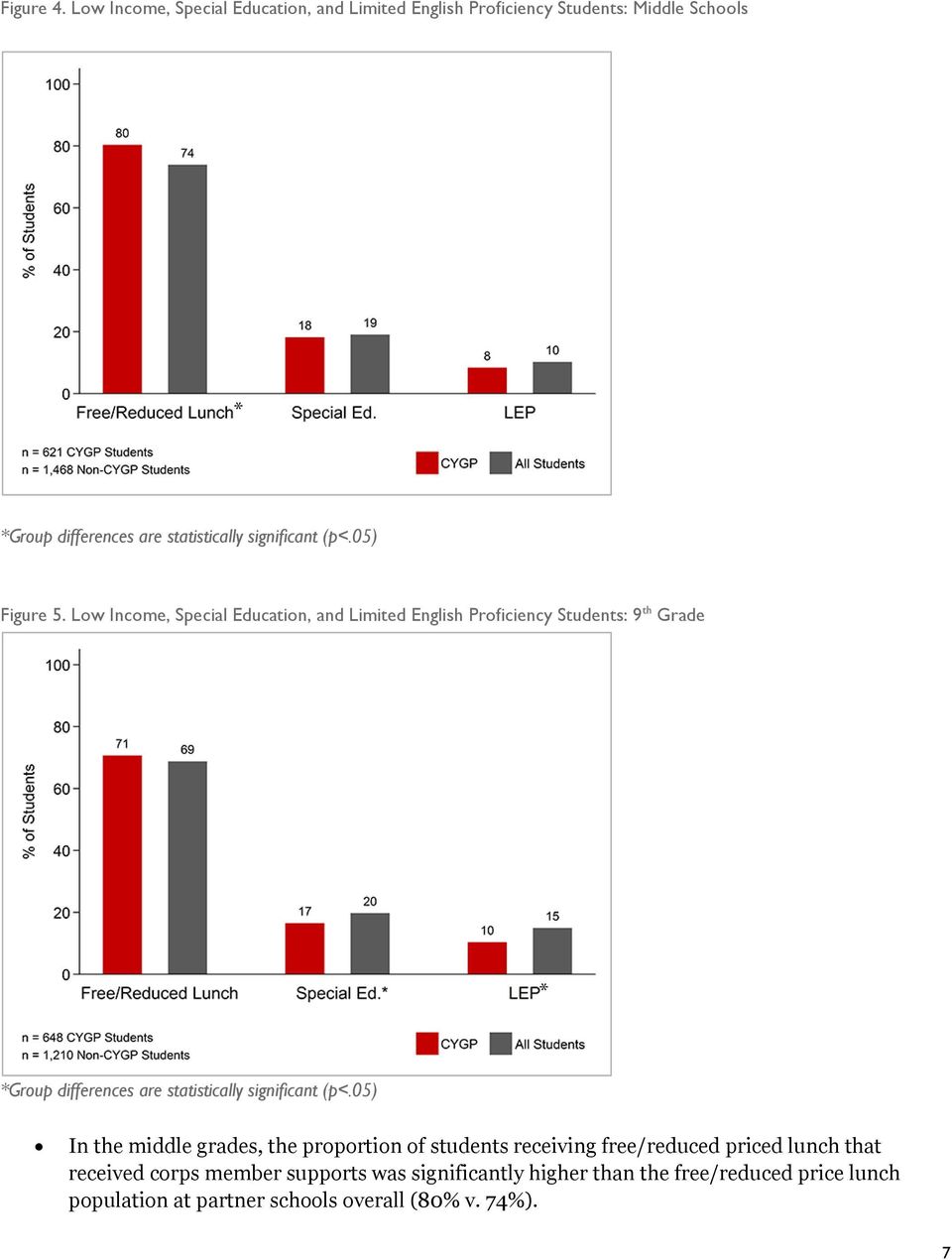
15 In 9 th grade, the proportion of special education students that received corps member supports was significantly lower than the special education population at partner schools overall (17% v. 20%). In 9 th grade, the proportion of LEP students that received corps member supports was significantly lower than the LEP population at partner schools overall (10% v. 15%). Figures 2 through 5 reveal that, overall, corps members served a disproportionate share of African American male students at all grade levels, while they served significantly lower portion of the Latino boys in the middle grades. In addition, the vast majority of students at CYGP partner schools are economically disadvantaged students, receiving free/reduced priced lunch. Corps members serve a relatively low number of special education and LEP (Limited English Proficiency) students due the fact that they are not placed in classes designed to serve these students in partner schools. The special education and LEP students who did receive CYGP supports were those students who took their courses with the general population of students in their schools. 9 CYGP Target Population The target population for CYGP is students who enter the academic year with an EWI from the prior year. Corps members work with teachers and administrators at partner schools to develop focus lists of students based on these EWIs. The development and use of the focus lists has been a key strategy for CYGP to effectively serve students who are most in need of additional behavioral and academic supports. Figures 6 and 7 present the total number of at-risk students who received corps member supports (red), and those who did not (gray); the full height of each bar constitutes the overall size of the target population for each support. Figure 6. Students with EWIs: Middle Grades 9 Corps members are not trained to support students with these special needs, and these students are not part of CYGP s target population of students. 8

16 Figure 7. Students with EWIs: 9th Grade In both the middle grades and 9 th grade, a sizeable number of students entered the school year with an attendance or academic EWI. o In both middle grades and 9 th grade, corps members served a minority of these student populations. In both the middle grades and 9 th grade, a smaller number of students entered the school year with a behavioral EWI. o In both middle grades and 9 th grade, corps members served a minority of these student populations. Students Receiving Corps Member Supports Figure 8 shows the overall number of students who received each support provided by corps members: attendance coaching, behavior coaching, math tutoring, and literacy tutoring. 9

17 Figure 8. Total Supports Provided by CYGP Corps Members In both the middle grades and 9 th grade, math and literacy tutoring were the most commonly offered supports. Corps member provided more attendance and behavior coaching to 9 th graders than middle grades students. From a programmatic standpoint, it is not only important that corps members serve a consistent number of students; supported students also need to receive enough support over the course the year. Table 1 presents the dosage thresholds for students receiving corps member supports within each support area. Table 1. CYGP Dosage Thresholds CYGP Support Attendance & Behavior Coaching Math & Literacy Tutoring Dosage Threshold Eight weeks of continuous enrollment 15 hours of tutoring Figure 9 shows the percentage of students served by each support who reach the CYGP dosage threshold for each support. 10

18 Figure 9. Percentage of Supported Students Reaching Dosage In both the middle grades and 9 th grade, the vast majority of students who received attendance and behavior coaching were enrolled to receive these supports for at least eight weeks during the school year. In both the middle grades and 9 th grade, relatively few students tutored in math and literacy received at least 15 hours of tutoring during the school year. 11

19 Table 2 shows the different possible combinations of corps member supports a student could receive. Table 2. Corps Member Support Combinations Middle Grades 9 th Grade Number of Supports Support Combinations Number of Students % of Students Number of Students % of Students % % % % % % % % Total Attendance Coaching Behavior Coaching Math Tutoring Literacy Tutoring In both the middle grades and 9 th grade, the vast majority of students received multiple corps member supports over the course of the school year. o A significantly greater percentage of 9 th grade students received all four corps member supports than students in middle grades (21% versus 7%). In both the middle grades and 9 th grade, the most common support combinations were those that included both math and literacy tutoring. 12

20 Serving the CYGP Target Population In Figures 10 and 11 the full length of each bar shows the total number of students who received each corps member support; each bar is divided into the number of students who entered the school year with the EWI that corresponds to the support received (red), and the number of students who did not enter the school year with the EWI that corresponds to the support received (gray). Figure 10. Total Students Served: Middle Grades Figure 11. Total Students Served: 9th Grade 13
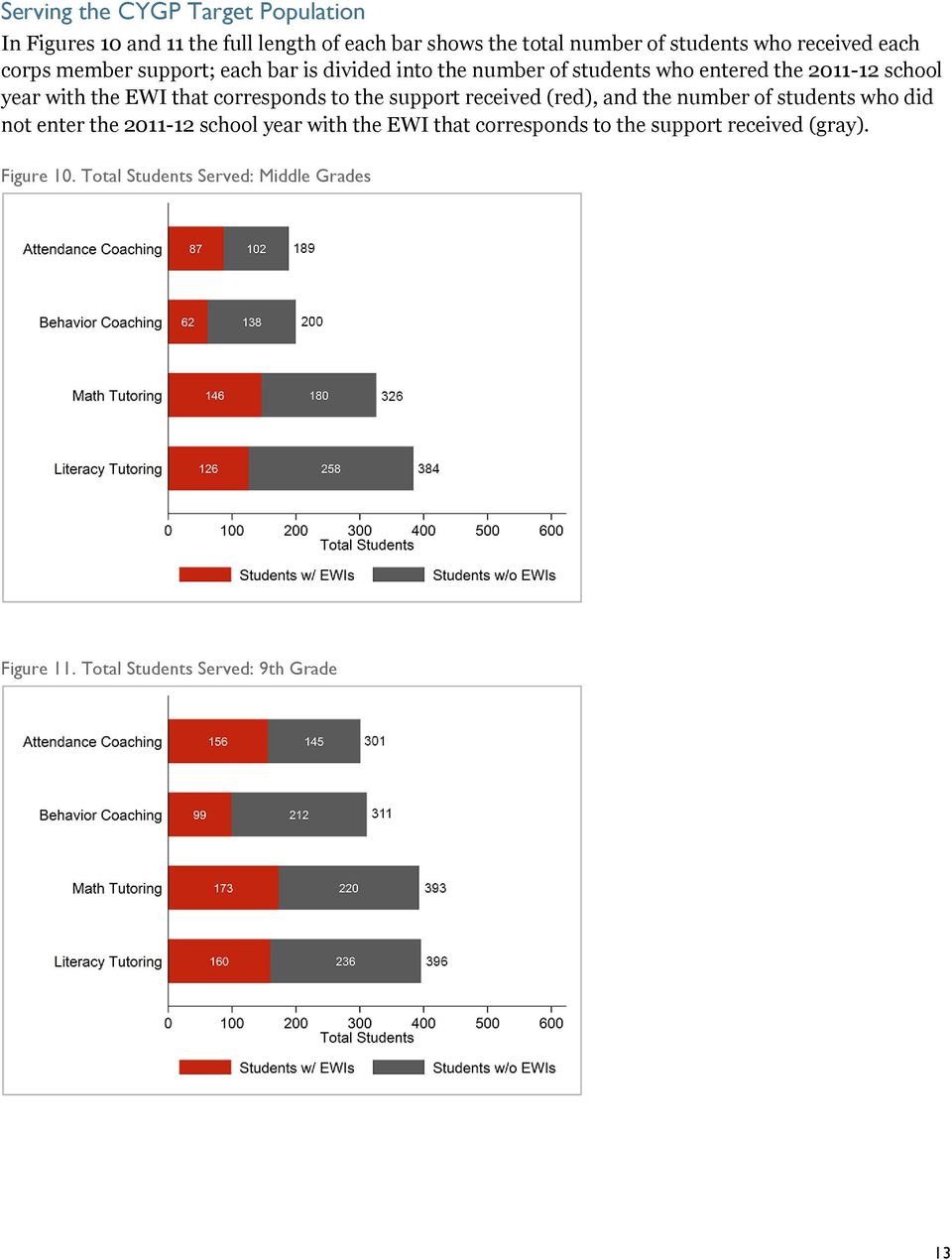
21 In both the middle grades and 9 th grade, roughly half of those students who received attendance coaching entered the school year with an attendance EWI from the previous year. In both the middle grades and 9 th grade, roughly a third of those students who received behavior coaching entered the school year with a behavioral EWI from the previous year. In both the middle grades and 9 th grade, a minority of students receiving math and English tutoring entered the school year with an EWI in math or English from the prior year. Overall, figures 10 and 11 suggest that corps member supports were not always provided to the target populations. Summary The figures presented in this section point to four key findings related to student population served: 1. Corps members appear to have focused more heavily on academic supports, with substantially more students receiving math and literacy tutoring than attendance and behavior coaching in the middle grades and in 9 th grade. 2. While the vast majority of students at both grade levels reached dosage in attendance and behavior coaching, only small minorities of students reached dosage for academic tutoring. 3. With only one exception, fewer than half of students served by corps members in middle grades and 9 th grade, across all corps member supports, entered the school year with corresponding EWIs from At each grade level there were sizable proportions of students with behavioral and academic EWIs who were not receiving corps member supports. The following sections provide a review of students performance along each of the four support areas: student attendance, behavior and student academic performance in math and English. The analyses presented in the following sections present findings related to the effect corps member supports had on students performance in each area. 14
22 II. Attendance and Behavior Coaching RFA s evaluation identified a range of formal and informal attendance and behavioral coaching practices provided by corps members throughout the school year. At both grade levels, attendance and behavioral coaching was found to have been initiated one on one, in small groups, and at large school-wide activities and events. Supports at high schools tended to be more individualized, while small group and school wide events were more common at middle schools. 10 This section reviews the overall student population who received attendance and behavior coaching during the school year by presenting: 1. Student populations served, by grade group; 2. Performance of each grade group population in attendance and behavior; and 3. Comparisons between coached students and a set of similarly situated students that did not receive CYGP coaching. Figures 12 and 13 present the total number of students who received attendance and behavior coaching along with the proportion of these students who also received additional corps member supports during the school year. In each figure, the lightened portion of each bar represents those students who only received attendance or behavior coaching at each grade level. Figure 12. Total Students Served: Attendance Coaching 10 Tracey Hartmann, Michael H. Norton, Holly Maluk, Nichole Johnson. Year Three Evaluation of City Year Greater Philadelphia, Research for Action. Dec.,
23 Figure 13. Total Students Served: Behavior Coaching Key Findings: The vast majority of all students in both middle grades and 9 th grade who received attendance and behavior coaching also received at least one other corps member support in Figures 14 and 15 show the average daily attendance (ADA) of middle grades and 9 th grade students who received attendance coaching during the school year. Each figure presents the percentage of coached students who finished the school year with average daily attendance within the following ranges: Less than 60%; 60-70%; 70-80%; 80-90% and 90% or better. 16
24 Figure 14. ADA for Students Receiving Attendance Coaching: Middle Grades Figure 15. ADA for Students Receiving Attendance Coaching: 9th Grade Key Findings: A majority of middle grades students (56%) who received attendance coaching finished the school year with an average daily attendance rate above 90%. A minority of 9 th grade students (23%) who received attendance coaching finished the school year with an average daily attendance rate above 90%. 17
25 Figures 16 and 17 show the number of suspensions received by of middle grades and 9 th grade students who received behavior coaching during the school year. Each figure presents the percentage of coached students who finished the school year with no suspensions, one suspension, or more than one suspension. Figure 16. Suspensions for Students Receiving Behavior Coaching: Middle Grades Figure 17. Suspensions for Students Receiving Behavior Coaching: 9th Grade A majority of middle grades students (64%) and 9 th grade students (58%) who received behavior coaching finished the school year without receiving a single suspension. 18
26 Figure 18 presents a descriptive comparison between at-risk students who received attendance coaching and at-risk students who did not receive attendance coaching; all students in Figure 18 finished the school year with an average daily attendance rate below 90%. Figure 19 presents a descriptive comparison between at-risk students who received behavior coaching and at-risk students who did not receive behavior coaching; all students in Figure 19 finished the school year with at least one suspension. 11 Figure 18. At-Risk Students with Average Daily Attendance above 90% in See Appendix Tables A2 and A3 for descriptive comparisons between the CYGP group of students and the comparison group of students for each analysis. 19
27 Figure 19. At-Risk Students with No Suspensions in *Group differences are statistically significant (p<.05) Key Findings Attendance Coaching There were no significant differences between students who received attendance coaching and the comparison group of students, in middle grades or 9 th grade. Among middle grades students, roughly a third of both CYGP students and students in the comparison group finished the school year with average daily attendance above 90%. Among 9 th graders, only small minorities of both CYGP students (5%) and comparison students (7%), finished the school year with average daily attendance above 90%. Behavior Coaching In both the middle grades and 9 th grade, significantly fewer CYGP students were never suspended than the comparison group of students. Among middle grades students, 31% of CYGP students, compared to 46% of students in the comparison group, finished the school year with no suspensions. Among 9 th graders 27% of CYGP students, compared to 44% of students the comparison group, finished the school year with no suspensions. 20
28 Summary The vast majority of students receiving attendance and behavior coaching also received multiple corps member supports over the course of the year. A majority of students who received attendance and behavior coaching completed the school year with attendance levels and behavioral patterns that would not be considered at-risk. However, among those students served who entered the school year with attendance and behavioral EWIs from the previous year, many continued to struggle with their attendance and behavior in
29 III. Math and Literacy Tutoring RFA s report identified three key ways corps members support students math and literacy: through in-class supports, pull outs and report card conferences. While math and literacy tutoring continue to be key areas of focus for CYGP, the report found considerable variation in corps members ability to consistently provide these supports to the right students those most in need of assistance. As reported earlier, more than half of all students who received math and literacy tutoring in entered the school year with an academic EWI. This section reviews the overall student population who received math and literacy tutoring from corps members during the school year by presenting: 1. Student population served, by grade group; 2. Performance of each grade group in math and English courses; and 3. Comparisons between tutored students and a set of comparison students. Figures 20 and 21 present the total number of students who received math and literacy tutoring and the proportion of these students who also received additional corps member supports during the school year. Figure 20. Total Students Receiving Math Tutoring 22
30 Figure 21. Total Students Receiving Literacy Tutoring Key Findings The vast majority of all students in middle grades and 9 th grade who received math and literacy tutoring also received at least one other corps member support in Figures 22 and 23 show the percentage of all students tutored in math and literacy who earned a C or better in their math or English courses during the school year Figures 21 and 22 do not include a comparison group of students and were developed to provide an overall sense of how all students who received corps member tutoring support performed in their courses. The following set of figures present comparisons between a subset of CYGP and non-cygp students performance in their math and English courses. 23
31 Figure 22. CYGP Students Earning a C or Better in Math Figure 23. CYGP Students Earning a C or Better in English Key Findings The majority of middle grades students (63%), and just under half of 9 th grade students (45%), who received math tutoring earned a C or better in their math courses in A sizable majority of middle grades students (70%), and just over half of 9 th grade students (54%), who received literacy tutoring earned a C or better in their English courses in
32 Figures 24 and 25 present descriptive comparisons between at-risk students who received corps member math and literacy tutoring, and at-risk students who did not receive these supports. All students included in Figures 24 and 25 entered the school year with a D or an F in a Math or English course from the previous year. The two figures compare academically at-risk students who received corps member supports to academically at-risk students who did not receive these supports. 13 Figure 24. Students Earning a C or Better in Math * *Group differences are statistically significant (p<.05) 13 See Appendix Tables A4 and A5 for descriptive comparisons between the CYGP group of students and the comparison group of students for each analysis. 25
33 Figure 25. Students Earning a C or Better in English * *Group differences are statistically significant (p<.05) Key Findings Math Among 9 th grade students, a significantly greater percentage of students who received CYGP tutoring (40%) earned a C or better in than the comparison group of students (30%). The overall performance of both groups is quite low. Among middle-grades students, there was no significant difference between the percentage of students who received CYGP tutoring (55%) and the students in the comparison group (58%) who earned a C or better in Math in English Among 9 th grade students, a significantly greater percentage of students who received CYGP literacy tutoring (52%) earned a C or better in English in than students in the comparison group (36%). The overall performance of both groups is quite low. Among middle-grades students, there was no significant difference between the percentage of students who received CYGP literacy tutoring (62%) and the students in the comparison group (52%) who earned a C or better in English in
34 Summary The analyses presented in this section point to three key findings: 1. The vast majority of students receiving math and literacy tutoring also received at least one other corps member support over the course of the year. 2. A majority of middle grade students, and roughly half of 9 th grade students, who received math and literacy tutoring completed the school year with a C or better in their math and English courses. 3. Among 9 th grade students who entered the school year with an academic EWI from , the descriptive comparisons between CYGP students and similar non-city Year students show that a significantly greater percentage of CYGP students earned a C or better in the Math and English classes than the comparison group of 9 th grade students; this relationship was not observed among middle grades students. However, the overall percentage of students earning a C or better among the CYGP students and the comparison groups was rather low in both math and English. These preliminary analyses provide some initial evidence to suggest that corps member tutoring supports make a positive contribution to 9 th grade students academic performance. One possible explanation for these observed differences is that as a group, the CYGP students had better attendance than the comparison students. In both analyses, a significantly lower percentage of the CYGP students had attendance levels below 90% compared to the comparison groups of students (72% v. 85% in math; 61% v. 82% in English). 14 To further investigate the relationship between CYGP tutoring and students academic performance, the following section presents findings from analyses that assess the effect of multiple factors on the probability that a student earned a C or better in their Math and English courses in See Appendix Tables A4 and A5. 27
35 IV. A Closer Look at Math and English Performance The findings presented in the previous section suggest that, overall, academically at-risk 9 th grade students who received corps member academic supports significantly outperformed similar students who did not receive the same supports. To estimate the effect corps member supports had on students academic performance, two separate predictive analyses were conducted to assess students chances of earning a C or better in math or English. 15 Each analysis isolated receipt of corps member tutoring as the key predictor, along with student attendance and behavior, to understand how these factors also influenced students academic performance in For each analysis, the comparison group of students was roughly equivalent to those students receiving CYGP tutoring supports with one exception: significantly more CYGP students entered the school year with academic EWI from the previous year. Each model was developed to specifically control for these group differences. 16 Table 3 presents the key predictors and controls that were included in each analysis. Table 3. Predictive Model Components: Math and English Performance MATH PERFORMANCE ENGLISH PERFORMANCE 17 Outcome Outcome Earning a C or better in Math Earning a C or better in English Predictors Predictors City Year Math Tutoring City Year Literacy Tutoring Receiving a D or F in English Average Daily Attendance Average Daily Attendance Behavioral EWI Behavioral EWI (Receiving 1 or more suspension) (Receiving 1 or more suspension) Controls Controls D or F in Math D or F in English Gender Gender African American African American Special Education Status Special Education Status Free/Reduced Lunch Receipt Free/Reduced Lunch Receipt Limited English Proficiency Limited English Proficiency The main results from both analyses suggest that, after controlling for a number of factors, receiving corps member tutoring had a slightly negative influence on students likelihood of earning a C or better in Math, and had no significant effect on students likelihood of earning a C or better in English. Table 4 15 See the Appendix for the predictive results. 16 See Appendix Tables A6 and A7 for descriptive comparisons of the City Year and comparison groups of students 17 The predictive model for English performance did not include a control for students math performance. Prior studies have found student literacy to be very important for students performance in all other academic subjects, however, math proficiency does not influence students ability to perform well in English classes in the same way. 28
36 shows the main relationships between key predictors and controls in the analyses and students estimated chances of earning a C or better in math or English. 18 Table 4. Key Factors Influencing 9th Grade Students Academic Performance Predictors Improved Students Chance of Earning a C or Better in Math Improved Students Chance of Earning a C or Better in English City Year Student No NA D or F in Math No D of F in English - No Average Daily Attendance Yes Yes 1 or More Suspension No No D or F in English No - While the main predictor of interest, receipt of corps member tutoring, did not exert the expected effect on students likelihood of earning a C or better in math or English, it is instructive to note how other key predictors listed in Table 4 influenced students academic performance. Students past academic performance was a strong predictor of their current years academic performance in both math and English. o In both math and English, earning a D or F in previous school year had a significant, negative, impact on the likelihood that a students earned a C or better in the following year in each subject. Students who struggle in English also struggle in math. o Earning a D or F in an English class exerted a strong, negative, effect on students likelihood of earning a C or better in math. Students who receive suspensions struggle academically. o Receiving one or more suspension had a strong, negative, effect on students likelihood of earning a C or better in math and English. Students who consistently attend school perform better academically. o Student attendance was a strong, positive, positive predictor of students likelihood of earning a C or better in math and English. Predicting Student Success To represent the combined effect of EWIs on students academic performance, the results of each analysis were used to estimate the probability that a student would a C or better in each subject. Figures 26 and 27 show how students probability of earning a C or better in Math or English is influenced by their average daily attendance, their behavior, and their academic performance in the other core subject area. In each figure, the solid line represents the change in the probability that a student who did not accumulate any other EWIs during the school year will earn a C or better as their average daily 18 A - in Table 4 indicates that a particular measure was not included in the predictive modeling for the relevant outcome; the math model did not control for students prior performance in their English courses, and the English model did not control for students prior, or concurrent, performance in math. 29
37 attendance increases. The dotted line in each figure represents the change in the probability that a student who also had other EWIs will earn a C or better as their average daily attendance increases. Figure 26. Probability of Earning a C or Better in Math as ADA Improves* *Group differences are statistically significant (p<.05) Figure 27. Probability of Earning a C or Better in English as ADA Improves* *Group differences are statistically significant (p<.05) 30
38 Key Findings As students average daily attendance increases, their probability of earning a C or better in math or English steadily increases. Students who had one or more suspension had a significantly lower probability of earning a C or better in English. Students who had one or more suspensions and earned below a C in English had a significantly lower probability of earning a C or better in math. Summary Overall, the findings presented in this section point to two key findings. 1. Corps member tutoring supports in math and English did not exert a significant, positive, effect on students academic performance in either subject. While the initial analyses presented in the previous section provided some evidence to suggest that corps member supports were positively influencing students academic performance in the 9 th grade, when a host of other factors are considered the CYGP effect becomes less clear. 2. The combined effect of multiple early warning indicators, poor attendance, suspensions, and course failure, all contribute to significantly reduce the likelihood that students will succeed academically. While the findings presented in this section do not point specifically to a discernible effect of corps member tutoring supports, they do provide some insight into the key factors that are driving 9 th grade students academic performance in City Year high schools. Indeed, these results suggest that focusing on attendance and behavior may be an effective strategy to improve students academic performance. 31
39 V. Conclusions and Recommendations for Future Research The findings presented in this report can inform effective practice by corps members and CYGP leadership in the current school year and beyond. Key Findings Serving the Target Population 1. Corps members did not always provide behavioral and academic supports to the target population of students in partner schools 2. There are a considerable number of at-risk students at CYGP partner schools who did not receive CYGP supports in both the middle grades and 9 th grade. 3. Relatively few students who received academic tutoring reached CYGP dosage thresholds. CYGP Supports & Student Performance 1. Relatively few students who received attendance and behavior coaching finished the school-year as at-risk students in these areas. 2. Students who entered the school year at-risk across all support areas continued to struggle with attendance, behavior and academics in CYGP academic supports exerted only modest contributions to at-risk students academic performance among 9 th grade students, and had no discernible effect in the middle grades; 4. Attendance was a strong, driving force behind academic performance in math and English for at-risk 9 th grade students. Some of the findings presented in this report echo the findings presented in the report. In particular, the use of focus lists to identify the target student population appears to be an ongoing challenge to identifying at-risk students. Working closely with teachers and administrators at CYGP partner schools will continue to be important for corps members and the CYGP leadership moving forward. In order to effectively assess the overall impact of CYGP supports for students that align with CYGP s programmatic goals, it is crucial that corps members consistently support the CYGP target population. In addition, the absence of any observable influence of attendance and behavior coaching on students receiving these supports may be the result of inconsistent provision of these supports throughout the year. While the current report does not include any findings directly related to implementation or dosage, conversations with CYGP staff suggest that behavior and attendance coaching remain areas that do not receive as much attention as tutoring supports. Finally, the initial comparisons between 9 th grade CYGP students and the comparison students suggested a positive relationship between receipt of corps member tutoring in math and English and course performance. However, when the effect of multiple factors was taken into consideration the predictive analyses in section IV, the effect of CYGP tutoring observed previously disappeared in English, and became negative in math. 32
40 There are a number of ways to understand these apparently contradictory findings. One possible explanation for the negative effect observed on tutored math students is that corps members had effectively identified the most at-risk students in this area and that these students continue to struggle, despite the additional supports they received. A second possible explanation for these findings may be related to the relatively small percentage of tutored students who reached dosage levels in math and literacy tutoring. With the vast majority of students receiving math and literacy tutoring falling below the dosage threshold, it may be unreasonable to expect these students to have benefited from these corps member supports. A third possible explanation is that corps members tutoring supports were ineffective; either due to the amount, or quality, of the tutoring they received. Without additional information, we cannot know what other circumstances may have influenced students outcomes. However, the findings presented in this report do suggest that the accumulation of multiple EWIs, having low attendance, getting suspended, and struggling in other courses, all decrease the likelihood that 9 th grade students will succeed at CYGP partner schools. On the basis of these key findings, a set of recommendations for programming and future research are presented below. Recommendations The following recommendations include new policies and practices to support effective program implementation: 1. Continue to work with school administrators and staff to accurately identify at-risk students across all support areas. CYGP has already been moving in this direction during the school year, utilizing rolling focus lists that are updated after the first marking period. Working closely with school administrators and staff to identify at-risk students within the school year will allow CYGP to assess change from the first to the last marking period, as well as from year to year. 2. Prioritize attendance and behavioral supports for at-risk students. The findings presented in this study echo key findings from other studies of at-risk student academic performance: attending school regularly and staying out of trouble are consistently positive predictors of students long term academic performance. 3. Intentionally coordinate attendance and behavioral supports with academic tutoring to support at-risk students academic progress. Students who do not attend school regularly likely do not benefit as much from academic tutoring as those who regularly attend. Supporting students attendance and behavior to keep them attending school will provide additional opportunities for success for those students also identified for targeted academic tutoring. 4. Include qualitative research and analyses of program management and implementation in all future evaluations. 33
41 This will allow for a more nuanced understanding of findings, identify corps members challenges, and connect program implementation to student performance at partner schools. 34
42 Appendix Table A1. Total Students Served at CYGP Partner Schools Middle Grades Schools High Schools Public SDP Partner Schools Students Served Anna H. Shaw Middle School 53 Benjamin Franklin School 127 Feltonville School of Arts & Sciences 98 Francis P. Pastorius School 106 Thurgood Marshall School 54 Tilden Middle School 107 Walter G. Smith School 76 Frankford High School 124 Germantown High School 68 Overbrook High School 112 Samuel Fels High School 97 South Philadelphia High School 41 Thomas Edison High School 139 West Philadelphia High School 85 Total Students Served 1,287 Table A2. Attendance Comparison Groups: CYGP Students v. Comparison Group Students Middle Grades 9th Grade City Year Non-City Year City Year Non-City Year % Male*^ 66% 47% 46% 57% % Special Ed.^ 20% 28% 15% 28% % Free Lunch 91% 86% 80% 76% % LEP 7% 10% 6% 12% % African American* 76% 61% 67% 61% % Latino* 18% 33% 25% 29% % Behavioral EWI 39% 41% 43% 44% % Math EWI*^ 44% 30% 58% 69% % English EWI^ 40% 35% 46% 61% % 2+ EWIs % 62% 79% 77% % Behavioral EWI % 29% 39% 47% % Math EWI % 37% 55% 62% % English EWI % 35% 52% 57% % Attendance EWI 68% 63% 95% 93% Total Students * Group difference are significant, Middle Grades (p<.05) ^ Group differences are significant, 9th Grade (p<.05) 35
43 Table A3. Behavior Comparison Groups: CYGP Students v. Comparison Group Students Middle Grades 9th Grade City Year Non-City Year City Year Non-City Year % Male 63% 55% 69% 61% % Special Ed.* 11% 29% 18% 28% % Free Lunch^ 82% 76% 60% 78% % LEP^ 3% 8% 5% 12% % African American^ 83% 72% 82% 70% % Latino^ 18% 27% 15% 25% % Attendance EWI^ 34% 42% 72% 85% % Math EWI 44% 31% 63% 70% % English EWI* 45% 30% 53% 62% % 2+ EWIs 10-11* 79% 63% 89% 84% % Attendance EWI % 43% 61% 68% % Math EWI % 34% 59% 62% % English EWI % 31% 62% 61% % Behavioral EWI*^ 69% 54% 73% 56% Total Students * Group difference are significant, Middle Grades (p<.05) ^ Group differences are significant, 9th Grade (p<.05) 36
44 Table A4. Math Comparison Groups: CYGP Students v. Comparison Group Students Middle Grades 9th Grade City Year Non-City Year City Year Non-City Year % Male 62% 58% 59% 62% % Special Ed.* 17% 35% 15% 29% % Free Lunch 80% 79% 66% 72% % LEP 11% 13% 7% 12% % African American^ 73% 64% 75% 63% % Latino*^ 23% 33% 20% 30% % Attendance EWI*^ 30% 42% 61% 82% % Behavioral EWI 38% 40% 39% 46% % English EWI ^ 40% 40% 38% 62% % Multiple EWIs % 80% 84% 85% % Behavioral EWI % 27% 40% 44% % English EWI % 60% 66% 65% % Attendance EWI 10-11^ 36% 43% 51% 63% % Math EWI^ 45% 42% 60% 70% Total Students * Group difference are significant, Middle Grades (p<.05) ^ Group differences are significant, 9th Grade (p<.05) 37
45 Table A5. English Comparison Groups: CYGP Students v. Comparison Group Students Middle Grades High School City Year Non-City Year City Year Non-City Year % Male 69% 61% 64% 70% % Special Ed.*^ 18% 40% 13% 27% % Free Lunch 81% 81% 72% 71% % LEP 10% 12% 8% 14% % African American^ 74% 67% 76% 62% % Latino*^ 20% 31% 20% 28% % Attendance EWI*^ 31% 46% 65% 81% % Behavioral EWI 40% 49% 38% 46% % Math EWI * 47% 43% 58% 70% % 2+ EWIs % 80% 86% 87% % Attendance EWI 10-11^ 35% 43% 54% 64% % Behavior EWI % 26% 41% 48% % Math EWI 10-11* 74% 63% 71% 72% % English EWI^ 38% 45% 48% 64% Total Students * Group difference are significant, Middle Grades (p<.05) ^ Group differences are significant, 9th Grade (p<.05) 38
46 Predictive Modeling To assess the effect of CYGP tutoring on students academic performance two separate logistic regression models were designed to estimate differences between City Year Students and students who did not receive corps member tutoring. For each model, the overall student population included in the analyses was 9 th grade students who had not transferred out of school and who had not dropped out of school over the course of the year. The outcome for each model was a dichotomous measure of whether a student earned a C or Better in either their Math (Model I) or English (Model II) course. All independent and control variables included in both models were dummy variables, i.e., they were measured as Yes or No. Students average daily attendance was the only variable measured continuously as the percentage of a students enrolled days that a student attended during the school year. Tables A6 and A7 present descriptive comparisons between the CYGP students and the comparison students along the measures included in each model. To control for school level dependence between students attending the same school, robust standard errors were estimated for each coefficient in both models. 19 Table A8 presents the full model results for each predictive model. Table A6. Predictive Modeling: Descriptive Statistics Math City Year Students Comparison Students % Math D or F* 58% 36% Average Daily Attendance 84% 82% % Behavioral EWI 37% 32% % English EWI 37% 38% % Male 59% 54% % African American* 75% 62% % Special Ed.* 15% 23% % Free/Reduced Lunch 69% 73% % Limited English Proficiency* 6% 14% % Edison* 12% 17% % Fels* 12% 24% % Frankford 20% 21% % Germantown 9% 10% % Overbrook* 21% 6% %South Philadelphia 9% 9% % West Philadelphia 15% 12% Total Students * Group difference are significant (p<.05) 19 More advanced techniques to control for school level dependence, such as multi-level models, were not possible for these analyses due to the relatively small number of students receiving math and literacy tutoring at some high schools. 39
47 Table A7. Predictive Modeling: Descriptive Statistics English City Year Students Comparison Students % English D or F* 54% 33% Average Daily Attendance 82% 82% % Behavioral EWI 36% 32% % Male 59% 54% % African American* 75% 62% % Special Ed.* 15% 23% % Free/Reduced Lunch 73% 73% % Limited English Proficiency* 7% 14% % Edison* 12% 17% % Fels* 11% 24% % Frankford 20% 21% % Germantown 12% 10% % Overbrook* 19% 6% % South Philadelphia 10% 9% % West Philadelphia* 17% 12% Total Students * Group difference are significant (p<.05) 40
48 Table A8. Predictive Model Results: Math & English Model I: C or Better in Math Robust B SE Model II: C or Better in English b Robust SE City Year Student * D or F in Math *** D of F in English *** Average Daily Attendance 0.043*** *** or More Suspension *** *** D or F in English *** Male Student * African American Student Special Education ** Limited English Proficiency Free Reduced/Priced Lunch Edison HS^ *** *** Frankford HS^ 0.148** *** Germantown HS^ *** Overbrook HS^ *** *** S. Philadelphia HS^ 0.190*** * W. Philadelphia HS^ 0.666*** *** Constant ** *** Psuedo Log Likelihood Psuedo R Square N 1,112 1,109 ^Samuel Fels High School is the High School reference school 41
49 Bibliography Balfanz, R., Herzog, L., Mac Iver, D. (2007). Preventing Student Disengagement and Keeping Students on the Graduation Path in Urban Middle-Grades Schools: Early Identification and Effective Interventions. Educational Psychologist, 42(4), Bradley, C., and Renzulli, L. (2011). The Complexity of Non-Completion: Being Pushed or Pulled to Drop Out of High School. Social Forces, 90(2), Carpenter II, D., and Ramirez, A. (2007). More Than One Gap: Dropout Rate Gaps Between and Among Black, Hispanic, and White Students. Journal of Advanced Academics, 19(32) Dunham, R., and Wilson, G., Race, within-family social capital, and school dropout: An analysis of Whites, Blacks, Hispanics, and Asians. Sociological Spectrum 27(2): Hartmann, T., Norton, M.H., Maluk, H., and Johnson, N., Year Three Evaluation of City Year Greater Philadelphia, Research for Action. Neild, R., Balfanz, R., and Herzog, L. (2007). An Early-Warning System. Educational Leadership, 65 (2): 28-33; also see Scaling City Year s Impact: In School and On Track: A National Challenge at Neild, R., Stoner-Eby, Furstenberg. (2008). Connecting Entrance and Departure: The Transition to Ninth Grade and High School Dropout. Education and Urban Society, 40(5), Rumberger, R. (2011). Dropping Out: Why Students Drop Out of High School and What Can Be Done About It. Library of Congress Cataloguing in Publication Data. Washington DC. 42
Characteristics of Colorado s Online Students
 Characteristics of Colorado s Online Students By: Amanda Heiney, Dianne Lefly and Amy Anderson October 2012 Office of Online & Blended Learning 201 E. Colfax Ave., Denver, CO 80203 Phone: 303-866-6897
State of New Jersey 2012-13
 1 OVERVIEW GRADE SPAN 912 395262 SCOTCH PLAINS, NEW JERSEY 776 1. This school's academic performance is very high when compared to schools across the state. Additionally, its academic performance is very
Gradual Disengagement: A Portrait of the 2008-09 Dropouts in the Baltimore City Schools
 Gradual Disengagement: A Portrait of the 2008-09 Dropouts in the Baltimore City Schools A Research Report by the Baltimore Education Research Consortium Authored by: Martha Abele Mac Iver August, 2010
State of New Jersey 2013-14
 1 OVERVIEW 21314 GRADE SPAN 912 31411 15 PARK AVENUE PATERSON, NJ 751 1. This school's academic performance significantly lags in comparison to schools across the state. Additionally, its academic performance
State of New Jersey 2014-15
 Page 1 of 22 OVERVIEW COUNTY VOCATIONAL GRADE SPAN 0912 1.00 313995050 WAYNE, NJ 074702210 The New Jersey Department of Education (NJDOE) is pleased to present these annual reports of Performance. These
New York State Profile
 New York State Profile Jennifer Guinn EDUC 547 FALL 2008 According to 2006 U.S. Census estimates, with a total population of over 19 million people, 20 percent of New York State s population were foreign-born
DRAFT. Denver Plan 2014. Every Child Succeeds
 Denver Plan 2014 Every Child Succeeds 100 80 Introduction Every child takes that first step into their first day of school with butterflies and talent, potential and dreams. It s the day that the door
Strategies for Promoting Gatekeeper Course Success Among Students Needing Remediation: Research Report for the Virginia Community College System
 Strategies for Promoting Gatekeeper Course Success Among Students Needing Remediation: Research Report for the Virginia Community College System Josipa Roksa Davis Jenkins Shanna Smith Jaggars Matthew
Early Warning Systems Foundational Research and Lessons from the Field
 Early Warning Systems Foundational Research and Lessons from the Field Robert Balfanz and Joanna Fox Everyone Graduates Center, Johns Hopkins Univ. National Governors Association Philadelphia October 2011
Race Matters. Household Asset Poverty by Race in North Carolina. Child Poverty by County
 Race Matters Children of color are more likely to grow up in both income poverty and asset poverty. This double burden creates a difficult barrier for children to overcome. As adults, children of color
ILLINOIS SCHOOL REPORT CARD
 5-8-9-6- MASCOUTAH ELEM SCHOOL MASCOUTAH C U DISTRICT 9 MASCOUTAH, ILLINOIS GRADES : PK K 5 6 MASCOUTAH ELEM SCHOOL ILLINOIS SCHOOL REPORT CARD and federal laws require public school districts to release
Achievement of Children Identified with Special Needs in Two-way Spanish/English Immersion Programs
 The Bridge: From Research to Practice Achievement of Children Identified with Special Needs in Two-way Spanish/English Immersion Programs Dr. Marjorie L. Myers, Principal, Key School - Escuela Key, Arlington,
Factors affecting bachelor s degree completion among Black males with prior attrition
 Factors affecting bachelor s degree completion among Black males with prior attrition ABSTRACT Rayna Matthews-Whetstone Richardson, Texas ISD Joyce A. Scott Texas A&M University-Commerce Black males lag
How To Understand The Facts Of Education In The United States
 Myths and Realities in Public Education All too often, public schools have been defined by a few narrow measures, cherrypicked data that neither puts public schools in the most positive light nor provides
CHARTER SCHOOL PERFORMANCE IN PENNSYLVANIA. credo.stanford.edu
 CHARTER SCHOOL PERFORMANCE IN PENNSYLVANIA credo.stanford.edu April 2011 TABLE OF CONTENTS INTRODUCTION... 3 DISTRIBUTION OF CHARTER SCHOOL PERFORMANCE IN PENNSYLVANIA... 7 CHARTER SCHOOL IMPACT BY DELIVERY
74% 68% 47% 54% 33% Staying on Target. ACT Research and Policy. The Importance of Monitoring Student Progress toward College and Career Readiness
 Staying on Target ACT Research and Policy The Importance of Monitoring Student Progress toward Research Brief 74% Percentage of ACT-tested 11 high school graduates took a core curriculum in high school
JUST THE FACTS. Memphis, Tennessee
 JUST THE FACTS Memphis, Tennessee The Institute for a Competitive Workforce (ICW) is a nonprofit, nonpartisan, 501(c)(3) affiliate of the U.S. Chamber of Commerce. ICW promotes the rigorous educational
Racial/Ethnic Disproportionality in Special Education METROPOLITAN CENTER FOR URBAN EDUCATION. Data Analysis Workbook. Dr. Edward Fergus Roey Ahram
 Racial/Ethnic Disproportionality in Special Education METROPOLITAN CENTER FOR URBAN EDUCATION Data Analysis Workbook Dr. Edward Fergus Roey Ahram Racial/Ethnic Disproportionality in Special Education Data
ILLINOIS SCHOOL REPORT CARD
 17-2-15-2-24 Lincoln Elem Clinton CUSD 15 Clinton, ILLINOIS GRADES : 2 3 2 1 3 Lincoln Elem 1 ILLINOIS SCHOOL REPORT CARD and federal laws require public school districts to release report cards to the
JUST THE FACTS. Birmingham, Alabama
 JUST THE FACTS Birmingham, Alabama The Institute for a Competitive Workforce (ICW) is a nonprofit, nonpartisan, 501(c)(3) affiliate of the U.S. Chamber of Commerce. ICW promotes the rigorous educational
Testimony before the Basic Education Funding Commission October 21, 2014
 Testimony before the Basic Education Funding Commission October 21, 2014 Good morning. My name is Patrick Dowd and I am the executive director of Allies for Children, a nonpartisan, child advocacy nonprofit
Destination Graduation: Sixth Grade Early Warning Indicators for Baltimore City Schools. Their Prevalence and Impact B E R C
 Destination Graduation: Sixth Grade Early Warning Indicators for City Schools Their Prevalence and Impact page 1 B E R C Consortium February 2011 B E R C Consortium BERC Executive Committee Andrés Alonso,
Passing When It Counts Math courses present barriers to student success in California Community Colleges
 Engaging Californians on Key Education Challenges I S S U E B R I E F F E B U A R Y 2 0 1 2 Passing When It Counts Math courses present barriers to student success in California Community Colleges Overview
For Immediate Release: Thursday, July 19, 2012 Contact: Jim Polites 860.713.6525
 For Immediate Release: Thursday, July 19, 2012 Contact: Jim Polites 860.713.6525 2012 CMT, CAPT RESULTS SHOW SOME INCREASES, WHILE GAPS IN ACHIEVEMENT PERSIST The Connecticut State Department of Education
YEAR 3 REPORT: EVOLUTION OF PERFORMANCE MANAGEMENT ALBANY NY CHARTER SCHOO CHARTER SCHOOL PERFORMANCE IN NEW YORK CITY. credo.stanford.
 YEAR 3 REPORT: EVOLUTION OF PERFORMANCE MANAGEMENT CHARTER SCHOOL PERFORMANCE IN NEW YORK CITY IN credo.stanford.edu ALBANY NY CHARTER SCHOO January 2010 SUMMARY This report supplements the CREDO National
The Bronx Achievement Pact
 The Bronx Achievement Pact Every Student Counts Overview The Bronx Achievement Pact works to improve educational outcomes in the Bronx by closing the gaps in the high school-college pipeline. This comprehensive
Governor Snyder s FY2016 Education & School Aid Budget Recommendations
 Governor Snyder s FY2016 Education & School Aid Budget Recommendations February 23, 2015 The annual budget is the single most powerful expression of the state s priorities. It is during the budget process
Introduction: Online school report cards are not new in North Carolina. The North Carolina Department of Public Instruction (NCDPI) has been
 Introduction: Online school report cards are not new in North Carolina. The North Carolina Department of Public Instruction (NCDPI) has been reporting ABCs results since 1996-97. In 2001, the state General
Nebraska School Counseling State Evaluation
 Nebraska School Counseling State Evaluation John Carey and Karen Harrington Center for School Counseling Outcome Research Spring 2010 RESEARCH S c h o o l o f E d u c a t i o n U n i v e r s i t y o f
KANSAS ASSOCIATION OF SCHOOL BOARDS 1420 SW Arrowhead Road, Topeka, Kan. 66604 785.273.3600 800.432.2471 www.kasb.org
 KANSAS ASSOCIATION OF SCHOOL BOARDS 1420 SW Arrowhead Road, Topeka, Kan. 66604 785.273.3600 800.432.2471 www.kasb.org Special Report: February, 2014 School Funding, At-Risk and All-Day Kindergarten and
BEST PRACTICES IN INTERVENTION & REMEDIATION
 BEST PRACTICES IN INTERVENTION & REMEDIATION Achieve has compiled the following examples of targeted intervention and remediation best practices with where appropriate corresponding student performance
Colorado Springs School District 11
 Colorado Springs School District 11 Colorado Superintendent: Dr. Sharon A. Thomas Primary contact: Holly Brilliant, Title I facilitator 29,625 students, K-12, urban District Description Colorado Springs
Review of Special Education in the Commonwealth of Massachusetts
 Review of Special Education in the Commonwealth of Massachusetts Thomas Hehir and Associates Thomas Hehir, Todd Grindal and Hadas Eidelman Boston, Massachusetts April 2012 Report commissioned by the Massachusetts
The MetLife Survey of
 The MetLife Survey of Challenges for School Leadership Challenges for School Leadership A Survey of Teachers and Principals Conducted for: MetLife, Inc. Survey Field Dates: Teachers: October 5 November
CHARTER SCHOOL PERFORMANCE IN INDIANA. credo.stanford.edu
 CHARTER SCHOOL PERFORMANCE IN INDIANA credo.stanford.edu March 2011 TABLE OF CONTENTS INTRODUCTION... 3 CHARTER SCHOOL IMPACT BY STUDENTS YEARS OF ENROLLMENT AND AGE OF SCHOOL... 6 DISTRIBUTION OF CHARTER
Implementing RTI Using Title I, Title III, and CEIS Funds
 Implementing RTI Using Title I, Title III, and CEIS Funds Key Issues for Decision-makers U.S. Department of Education 1 As Response to Intervention, or RTI expands across the country, the question we at
M D R w w w. s c h o o l d a t a. c o m 8 0 0-3 3 3-8 8 0 2
 MDR s Guide to Federally Funded Education Programs Major federal programs in the Education Budget for Fiscal Year 2011 are listed below. Twenty-three programs were eliminated from the FY2011 budget, including
South Dakota DOE 2013-2014 Report Card
 School Classification: Focus Title I Designation: Schoolwide Performance Indicators * No bar will display at the school or district level if the subgroup does not meet minimum size for reporting purposes.
ETS s Addressing Achievement Gaps Symposium. Black Male Teens: Moving to Success in the High School Years. A Statistical Profile
 ETS s Addressing Achievement Gaps Symposium Black Male Teens: Moving to Success in the High School Years A Statistical Profile ETS s Addressing Achievement Gaps Symposium Black Male Teens: Moving to Success
YEAR 3 REPORT: EVOLUTION OF PERFORMANCE MANAGEMENT ALBANY NY CHARTER SCHOO CHARTER SCHOOL PERFORMANCE IN FLORIDA. credo.stanford.edu.
 YEAR 3 REPORT: EVOLUTION OF PERFORMANCE MANAGEMENT CHARTER SCHOOL PERFORMANCE IN FLORIDA IN credo.stanford.edu ALBANY NY CHARTER SCHOO June 2009 INTRODUCTION This report supplements the CREDO National
Are ALL children receiving a high-quality education in Ardmore, Oklahoma? Not yet.
 Are ALL children receiving a high-quality education in Ardmore, Oklahoma? Not yet. Despite a relatively high graduation rate, too many students are not graduating from Ardmore Public Schools ready for
WORKING DRAFT. Building On-Track Indicators for High School Graduation and College. Readiness: Evidence from New York City
 Running head: BUILDING ON-TRACK INDICATORS WORKING DRAFT Building On-Track Indicators for High School Graduation and College Readiness: Evidence from New York City James J. Kemple, Micha D. Segeritz, and
What Matters for Staying On-Track and Graduating in Chicago Public High Schools
 Research Report c c s r CONSORTIUM ON CHICAGO SCHOOL RESEARCH AT THE UNIVERSITY OF CHICAGO July 2007 What Matters for Staying On-Track and Graduating in Chicago Public High Schools A Close Look at Course
Reading Between the Lines:
 COLLEGE READINESS Reading Between the Lines: What the ACT Reveals About College Readiness in Reading Executive Summary Based on 2005 ACT-tested high school graduates, it appears that only about half of
Maine High School Graduates: Trends in College-Going, Persistence, and Completion August 2015
 Maine High School Graduates: Trends in College-Going, Persistence, and Completion August 2015 This report summarizes data from the Maine Department of Education (DOE) and the National Student Clearinghouse
The Historic Opportunity to Get College Readiness Right: The Race to the Top Fund and Postsecondary Education
 The Historic Opportunity to Get College Readiness Right: The Race to the Top Fund and Postsecondary Education Passage of the American Recovery and Reinvestment Act (ARRA) and the creation of the Race to
Student Success Courses and Educational Outcomes at Virginia Community Colleges
 Student Success Courses and Educational Outcomes at Virginia Community Colleges Sung-Woo Cho and Melinda Mechur Karp February 2012 CCRC Working Paper No. 40 Address correspondence to: Sung-Woo Cho Quantitative
Statistical Profile of the Miami- Dade County Public Schools
 2 Statistical Profile of the Miami- Dade Public Schools The mission of the Miami-Dade Public Schools is to support the improvement of student achievement by strengthening instructional leadership, by launching
Review of Special Education in the Houston Independent School District
 Review of Special Education in the Houston Independent School District Thomas Hehir & Associates Boston, Massachusetts Review of Special Education in the Houston Independent School District TABLE of CONTENTS
GAO INDIVIDUALS WITH DISABILITIES EDUCATION ACT
 GAO United States Government Accountability Office Report to the Chairman, Committee on Health, Education, Labor, and Pensions, U.S. Senate February 2013 INDIVIDUALS WITH DISABILITIES EDUCATION ACT Standards
The University of the State of New York The State Education Department DIAGNOSTIC TOOL FOR SCHOOL AND DISTRICT EFFECTIVENESS (DTSDE)
 The University of the State of New York The State Education Department DIAGNOSTIC TOOL FOR SCHOOL AND DISTRICT EFFECTIVENESS (DTSDE) BEDS Code 51110106007 School Name West Side Elementary School School
Blended Learning: Evolution and Strategy in DC Public Schools
 April 4, 2014 Blended Learning: Evolution and Strategy in DC Public Schools District of Columbia Public Schools 1200 First Street, NE Washington, DC 20002 T 202.442.5885 F 202.442.5026 dcps.dc.gov Who
Moving the Needle on Access and Success
 National Postsecondary Education Cooperative (NPEC) Moving the Needle on Access and Success Student Success Symposium November 2, 2006 David A. Longanecker Executive Director Western Interstate Commission
A New Measure of Educational Success in Texas. Tracking the Success of 8th Graders into and through College
 A New Measure of Educational Success in Texas Tracking the Success of 8th Graders into and through College National Center for Management Systems (NCHEMS) Contents Introduction 1 The Challenge 2 Purpose
United States Government Accountability Office GAO. Report to Congressional Requesters. February 2009
 GAO United States Government Accountability Office Report to Congressional Requesters February 2009 ACCESS TO ARTS EDUCATION Inclusion of Additional Questions in Education s Planned Research Would Help
WORLD S BEST WORKFORCE PLAN
 WORLD S BEST WORKFORCE PLAN ANNUAL REPORT 2014 2015 School Year South Early Learning Center, North Intermediate, Saint Peter Middle/High School 1 Saint Peter Public Schools World s Best Workforce Report
Bryan Middle School. Bryan Middle School. Not Actual School Data. 100 Central Dr Anywhere, DE 19900 (555) 555-5555. Administration.
 O Hare School District Emma Haviland 100 Central Dr Anywhere, DE 19900 (555) 555-5555 Administration Principal Assistant Principal Assistant Principal Emma Haviland Stan Westfield Barbara Powell Accountability
AT GREATER RISK. California Foster Youth and the Path from High School to College
 AT GREATER RISK California Foster Youth and the Path from High School to College Independent of such risk factors as having a disability, California youth in foster care are less likely than other students
Special Education Audit: Organizational, Program, and Service Delivery Review. Yonkers Public Schools. A Report of the External Core Team July 2008
 Special Education Audit: Organizational, Program, and Service Delivery Review Yonkers Public Schools A Report of the External Core Team July 2008 The Collaborative Founded in 1994 Sponsored by the Education