
WHAKATANE DISTRICT COUNCIL. Walking and Cycling Strategy. October 2007
|
|
|
- Isabella White
- 10 years ago
- Views:
Transcription
1 WHAKATANE DISTRICT COUNCIL Walking and Cycling Strategy

2
3 DOCUMENT HISTORY AND STATUS Issue Rev. Issued To Qty Date Prepared Reviewed Approved 1 Draft Whakatane District Council 1 Elec 9/2/07 C Inder T Keyte R Burnett 2 Draft Whakatane District Council 2 3/4/07 C Inder T Keyte R Burnett 3 Final Whakatane District Council 1 Elec 9/10/07 C Inder R Burnett R Burnett Printed: 10 October, 2007 Last Saved: 9 October, 2007 File Name: K:\ Whakatane Transportation Study\Walking and Cycling Strategy\Report\Walking and Cycling Strategy_FINAL.doc Project Manager: Reece Burnett Name of Organisation: Bloxam Burnett & Olliver Ltd Name of Project: Whakatane Transportation Strategy Name of Report: Whakatane Walking and Cycling Strategy Report Version: Final Project Number:

4 CONTENTS 1.0 FOREWORD INTRODUCTION OVERVIEW STRATEGY DEVELOPMENT WHY HAVE A WALKING AND CYCLING STRATEGY? CHALLENGES FOR WALKING AND CYCLING CONTEXT WALKING AND CYCLING IN NEW ZEALAND WALKING AND CYCLING IN WHAKATANE WALKING AND CYCLING ACCIDENTS OUR VISION AND GOALS VISION FOR WALKING AND CYCLING GOALS FOR WALKING AND CYCLING ACHIEVING THE GOALS TARGETS POLICY CONTEXT FOR WALKING & CYCLING NATIONAL POLICY CONTEXT REGIONAL POLICY CONTEXT ACHIEVING THE STRATEGY TARGETS INITIATIVES TO INCREASE CYCLING AND WALKING ENGINEERING INFRASTRUCTURE EDUCATION ENCOURAGEMENT ENFORCEMENT FUNDING OF WALKING AND CYCLING PROJECTS FEATURE PROJECTS STRATEGY MONITORING AND REVIEW CONSULTATION IMPLEMENTATION MONITORING REVIEW NETWORK PLANS IMPLEMENTATION PROGRAM INDICATIVE 10 YEAR PLAN QUICK WIN PROJECTS QUICK WIN URBAN INFRASTRUCTURE MODIFICATIONS INDICATIVE COSTS OF INFRASTRUCTURE...32 APPENDIX A...33 EXAMPLE QUESTIONNAIRE SURVEY FORM...33 APPENDIX B...36 DESIGN STANDARDS AND GUIDELINES...36 APPENDIX C...37 POSSIBLE MONITORING ACTIVITIES...37
5 1.0 FOREWORD To be written and signed by a Councillor or the Mayor Page1

6 2.0 INTRODUCTION 2.1 OVERVIEW This document prepared by Bloxam Burnett and Olliver Ltd engineering consultants, is the first Walking and Cycling Strategy (the Strategy) developed for Whakatane District Council (Council). It outlines Council s commitment and plan to advance walking and cycling in the Whakatane, Ohope and Edgecumbe areas such that there is a notable future increase in the population of people participating more regularly in walking and cycling for transport and enjoyment. It does not pertain to Murupara or Te Teko. Many people do not walk or cycle regularly. There are many reasons given for this. Examples include: the distances are too great; disability limitations, a car is needed because other people or goods have to be transported; the weather is a concern; the hills are to difficult; and specifically in the case of cycling, it is too dangerous to cycle on the roads, helmets interfere with their hair styles or current clothing fashions are not conducive to cycle. Yet in Whakatane, there are still people who do walk and cycle despite these apparent reasons for not doing so. Their challenges tend to be concerned with the existing traffic conditions they experience every day and the quality of the walking and cycling facilities provided. For the purposes of this Strategy, Walkers includes walking, jogging, running and pedestrians with disabilities. This walking and cycling strategy is intended to help Council overcome these challenges in Whakatane so that walking and cycling experience a resurgence in popularity and acceptance. 2.2 STRATEGY DEVELOPMENT This Strategy has been developed with input from Council staff, interested parties and individuals in the Whakatane community, the New Zealand best practice guide to Walking and Cycling Strategies (Land Transport New Zealand Research Report 274) and key guidelines from national organisations such as the national Walking and Cycling Strategy, Getting There On Foot by Cycle (MOT 2005). The Walking and Cycling Strategies - Best Practice (2005) guide identifies the best features of other New Zealand council strategies available at the time, and also recommends an appropriate format for the development of new strategies. Accordingly, where relevant this Strategy draws on the best practice features available from a number of those highlighted strategies, including Christchurch City Council, and Tasman, Tauranga and Central Otago District Councils. A Walking and Cycling Strategy is (and must be) a living document, reviewed and updated frequently to take account of current policy and progress in the district. It is recommended that this document be reviewed and re-published one year after publication and thereafter, every three years. The Strategy includes walking and cycling network plans and recommends the establishment of annual implementation plans, to be reviewed and updated in conjunction with the annual Long Term Council Community Plan (LTCCP) review. 2.3 WHY HAVE A WALKING AND CYCLING STRATEGY? Funding for Local Walking and Cycling Projects Land Transport New Zealand is the national funding agency for land transport initiatives. A dedicated fund was established in 2002 for the promotion of walking and cycling in the country, with access to the funds on the condition that Council s have a Strategy that set out a clear vision, objectives and priorities for cycling and walking in their district. National Policy National policies promoting cycling and walking have been prepared by a number of New Zealand Government agencies since, including the Ministry of Transport, Ministry of Health, Energy Efficiency and Conservation Authority and Land Transport New Zealand. These policies seek to encourage cycling and walking as sustainable and healthy transport alternatives, particularly relevant for short trips in our community instead of the use of motor vehicles. Page2

7 The Bay of Plenty Regional Land Transport Strategy 2007 The Bay of Plenty Regional Land Transport Strategy 2007 (RLTS) includes sustainability as a strategic outcome. In particular, the outcome being sought is that real efforts are made to manage travel and travel demand, optimise existing networks and improve alternative modes. One of the corresponding actions in the RLTS is to implement local pedestrian and cycling strategies, including the Whakatane Walking and Cycling Strategy. The Benefits of Walking and Cycling The benefits of increasing the number of people who regularly walk and cycle for short trip transportation and leisure are far reaching for individuals, the community and the country. Benefits at a personal level include an improved mental and physical health due to the more active lifestyle, and better social interaction with people and connection to the community, while at a local level the benefits include less demand on local health services, less Council spending on car related infrastructure (roads, intersections and car parks) less environmental pollution and reduced vehicle congestion in the urban environment. Combining the benefits of increased walking and cycling in each town and city would then translate nationally to a significant cost saving for New Zealand s public health system, reduced reliance on non-renewable energy resources for transportation and an improved economy and environment due to the reduced congestion and air/noise pollution in the main cities. The Whakatane district is extremely well suited to walking and cycling due to the warm coastal climate, generally flat topography, the numerous recreation tracks and scenic views, and for Whakatane township in particular, the relatively close proximity of residential housing areas to the predominant employment areas in the town. Many people choose to live in Whakatane for these lifestyle reasons. However, as illustrated in Section 3.0, walking and cycling as modes of transport for short trips are significantly underrepresented in Whakatane compared with car driver/passenger trips. Accordingly this Strategy will provide Council with a clear vision, objectives, supporting policy, targets and an action plan for promoting walking and cycling in the community. 2.4 CHALLENGES FOR WALKING AND CYCLING Several key issues affect the attractiveness of cycling and walking and these are outlined under the following headings. Land Use Planning and Traffic Generation Development in Whakatane has been characterized by low-density suburban development that is heavily dependent on private motor vehicles for every-day transportation. Footpaths have generally been constructed when roads are built, although consideration of concepts like connectivity and providing where people wish to walk have often been overlooked in this process. The result of planning and construction geared towards vehicle use has increased reliance on private motor vehicles for even short local trips, and the associated increase in traffic volumes has had a negative effect on the safety and desirability of cycling and walking. Reduced Health The general health of the population has become an issue because of the increase in diseases related to inactive lifestyles and poor diet. Sedentary jobs have become more common and the increased use of motor vehicles, machines and technology allows us to perform a greater number of tasks without physical exertion. Furthermore our recreational activities have increasingly become more focussed on entertainment such as television and video, movies and video games. Consequently, opportunities for physical activity have almost been eliminated from our daily working lives. This is evidenced in increased obesity levels in New Zealand. Results of the 2002/03 New Zealand Health Survey (A Portrait of Health) revealed that one in five New Zealand adults are obese, and one in three adults are overweight (excludes obese). The sub-regional Physical Activity Plan contains a special component for Whakatane District Council that promotes Walking and Cycling in line with the SPAC (Sport and Recreation New Zealand) philosophy More People, More Active, More Often. Page3
8 Perception of Safety Perceptions of poor safety are reasons given for not walking or cycling. Crime, anti-social behavior, vehicle speeds and increased traffic volumes, and poor driver behaviour are all perceived or real safety factors. Public walkways are often viewed as unsafe as historically they tend to be fenced on both sides, narrow, poorly lit, often vandalised, and vegetation not always adequately maintained. Maintenance Lack of maintenance, resulting in broken footpaths, overgrown vegetation and unswept cycle lanes as examples, pose a safety risk for and have a negative effect on the quality of the environment and the goal of encouraging cycling and walking. Both cycle and walking facilities require regular monitoring to ensure things such as broken glass, loose stone chip, debris from car crashes, rubbish, graffiti and overgrown vegetation are dealt with. Balancing the needs of different users. Balancing the various needs of different cycle users is a key challenge. Recreational cyclists who may choose to cycle in parks and on footpaths have very different needs from commuter cyclists who cycle to get from point A to B as efficiently as possible. There is also a need to cater for all pedestrians, from able-bodied pedestrians, to people pushing children in strollers and wheelchair and mobility scooter users. Other users, such as roller blades and skateboards are considered pedestrians also. Accordingly facilities need to be functional with provision of safe crossings of street for all. Urban Design The quality of the environment is an important factor when it comes to encouraging more cycling and walking. Common design problems that occur include: Uneven footpath/cycleway surfacing, no consideration for impaired mobility users Poor consideration for where pedestrians and cyclists wish to go (desire-lines). Inadequate street lighting Inadequate sightlines Overgrown vegetation Obstacles such as street furniture Graffiti, rubbish and broken glass Poor connectivity with other facilities Page4

9 3.0 CONTEXT 3.1 WALKING AND CYCLING IN NEW ZEALAND Walking is a mode of transport used by many people. For some it provides a critical link between their doorway and other modes of transport, and for others it is their primary mode of transport for short trips and day-to-day activities The New Zealand Walking and Cycling Strategy, Getting There - On Foot, by Cycle 1 and the New Zealand Pedestrian Profile 2 provides some insight into walking and cycling travel by New Zealanders. Nearly twenty percent of household trips are undertaken by foot Walking is particularly significant in the travel of children, young people and older adults Social and leisure are the most common reasons for walking followed by shopping, education and work trips. However Walking as a mode of transport for short trips is declining in favour of travel in cars. It is estimated that New Zealanders took some 400,000 fewer walking trips per day in 1998 than in 1990 The number of walking trips by children going to school declined by 10 percent between 1989/90 and 1997/98. The decline in both walking and cycling as forms of household travel is most apparent among the young. Between 1990 and 1998 the number of cycling trips in New Zealand reduced by 39%. 1. Getting There - On Foot, by Cycle, February New Zealand Pedestrian Profile, 2000 The reduction in the number of young people cycling in New Zealand is a significant concern. Research by Land Transport New Zealand (Report 273: Balancing the Needs of Cyclists and Motorists) found that Whether or not a parent used to cycle to school, is related to the likelihood of their high school children cycling to school. Accordingly future efforts to encourage cycling to school will be further impeded by the absence of a cycling history in parents. 3.2 WALKING AND CYCLING IN WHAKATANE Walking and cycling are activities undertaken by people for a number of different reasons, each with different needs. They can be categorised into three user groups, and the Strategy should address each group specifically if walking and cycling are to grow in popularity. The user groups are: Commuters those who walk or cycle to employment, places of education or service Recreational users - those who walk and/or cycle for sports, fitness, and leisure Tourism walking and cycling for sightseeing and the outdoors experience Commuter Walking and Cycling in Whakatane District The New Zealand Travel Survey carried out by the Land Transport Safety Authority in 1999, found that commuting trips across New Zealand accounted for 42 percent of all cycling trips and 29 percent of all walking trips. Detailed results from the 2003/04 Travel Survey remain unavailable at this time. Census Data Commuter walking and cycling data specific to Whakatane is currently restricted to Census surveys that involve the collection of Main Means of Travel to Work data. Census data records the mode of travel, age and household location of the survey participant. The data is useful as a five yearly snap-shot of walking and cycling in the district, but has the following limitations: Page5

10 The weather on Census day can affect walking and cycling figures Surveys only Employed persons Surveys only Commuter trips Surveys only those aged 15 years and over. Hence children walking or cycling to school are not counted. Figure 1 illustrates the percentage of commuters (aged 15 years an over) in the Whakatane District who walked (jogged/ran) or cycled as their main means of travel to work on the day of the Census surveys from 1986 to Figure 1: Whakatane / New Zealand Travel to Work by Walking and Cycling 1986 to % Percent Main Means of Travel to Work 14% 12% 10% 8% 6% 4% 2% 13.7% 10.2% 11.2% 9.1% 9.9% 5.7% 8.5% 4.5% 7.1% 3.1% Walk or Jog Whakatane Cycle Whakatane Walk or Jog Nationally Cycle Nationally 0% Census Year Data Source: Statistics New Zealand Data in this graph only relates to those who travelled to work. It does not include those who work from home or didn t go to work. The above graph illustrates that commuter walking is more popular than commuter cycling in the Whakatane District, but both transport modes have experienced a steady decline in participants since In 1986, 13.7% walked (jogged/ran) and 10.2% cycled to work as their main means of travel, compared with 7.1% and just 3.1% respectively 20 years later in For New Zealand as a whole, the graph similarly shows a reduction over the same period for commuter cycling rates, while the number who walk to work initially reduced but has been static at around 7% since For all years shown, the rates of commuter walking and cycling in Whakatane have been above or equal to the national figures. Figure 2 illustrates commuter walking and cycling rates in Whakatane township compared with Nelson urban area. Nelson has been selected for comparison with Whakatane due to the similar coastal climate, sunshine hours and topography. Figure 2 shows that commuter cycling is declining in both Nelson and Whakatane, although Whakatane s rate of decline is significantly more rapid. Before 1996 Whakatane commuter cycling rates exceeded that of Nelson, and commuter cycling was more popular than walking in Whakatane. The number of people walking to work is also declining in Whakatane, albeit slower than cycling. However this trend is in contrast with Nelson rates where, after 1996 commuter walking has been gaining in popularity again and now at 9.6%, exceeds Whakatane s rate by 2.1%. Page6
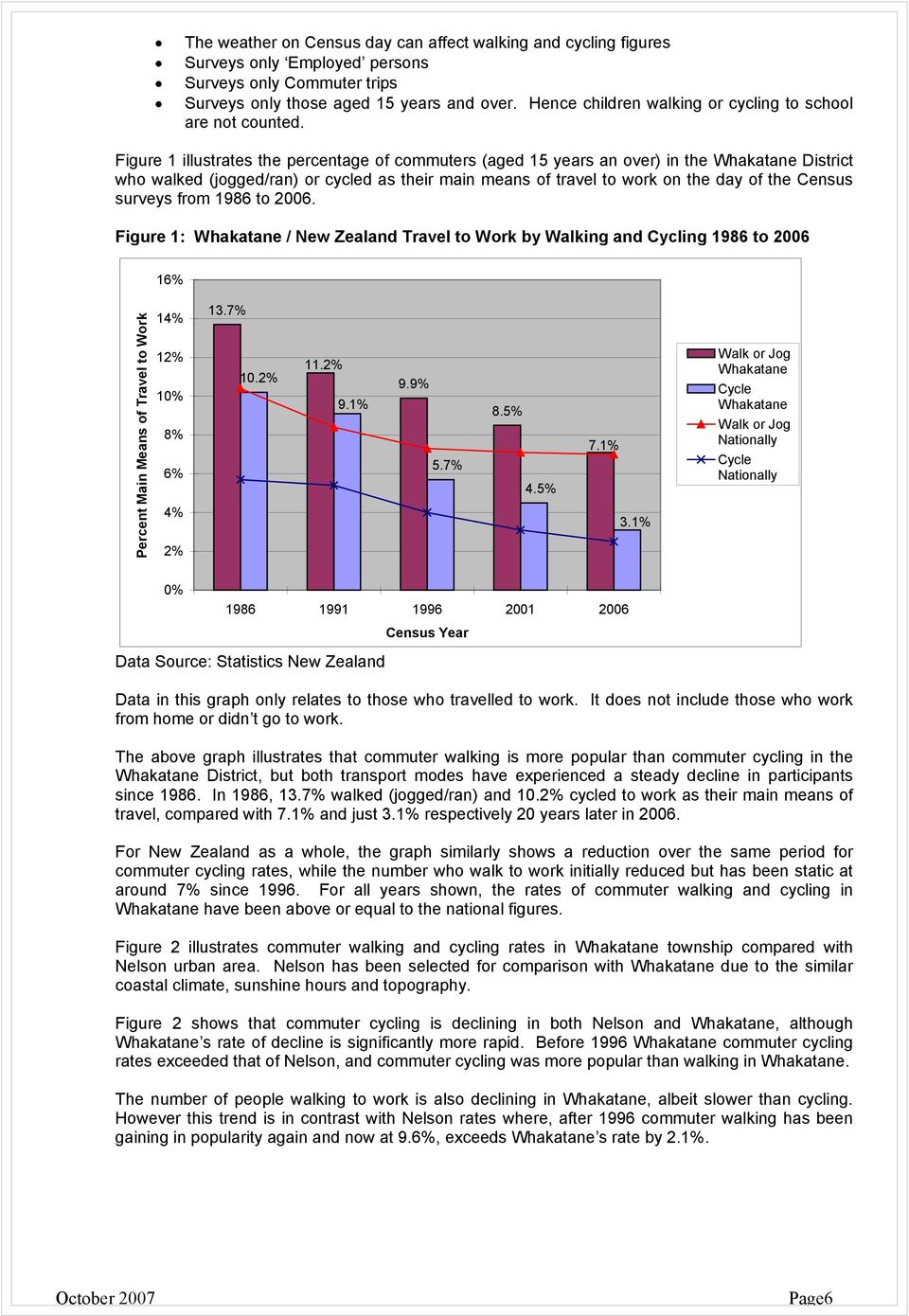
11 Figure 2: Whakatane / Nelson Travel to Work Trends by Walking and Cycling 1986 to % Percent Main Means of Travel to Work 14% 12% 10% 8% 6% 4% 2% 10% 14.0% 11.5% 8.8% 9.0% 7.6% 8.1% 5.8% 7.5% 4.0% Walk or Jog Whakatane Cycle Whakatane Walk or Jog Nelson Cycle Nelson 0% Census Year Data Source: Statistics New Zealand Overall, the Census survey results reveal that commuter Walking and Cycling in Whakatane are continually declining in popularity, similar to the trend throughout New Zealand. However Whakatane s rate of decline is much greater than that occurring in Nelson, indicating the need for a Walking and Cycling Strategy to help reverse the declining trend. Count Data Pedestrian and cycling count surveys were carried out in Whakatane Township on weekdays of the 19 th to 21 st of August Cycling and pedestrian count data is useful for indicating the popularity of walking and cycling in the community. The counts were carried out at various strategic intersections illustrated in Figure 3, to capture numbers on the popular urban access routes. Figure 3 Page7

12 Two surveys were also situated on the stop-bank by the Landing Road Bridge and the Motor Camp (at McGarvey Road) and a further survey was conducted at the CBD end of Hillcrest Road. The surveys were carried out during the peak commuter hours of 7:30am 9:30am, 11am 1pm, the school departure peak 3pm 4pm and the commercial peak period, 4pm - 6pm. Table 1 summarises the survey findings. The cyclist and pedestrian volumes include all arrivals on all approaches to the survey location. Table 1: Cyclist and Pedestrian Survey Count Summary Location 7:30am - 9:30am 11am - 1pm School Peak 3pm - 4pm 4pm - 6pm Cyclists Pedestrians Cyclists Pedestrians Cyclists Pedestrians Cyclists Pedestrians McAlister Street / The Strand Roundabout Commerce Street / The Strand Roundabout Gorge Road / Valley Road Roundabout Landing Road / Hinemoa Street McAlister Street / Domain Road Landing Road / Eivers Road King Street / Domain Road Goulstone road / King Street Stop Bank at Landing Road Bridge Stop Bank at Motor Camp (McGarvey Rd) Hillcrest Road (by Stairway to CBD) Surveyors observed the following functional issues for pedestrians and cyclists at the Landing Road / Hinemoa Street roundabout: The roundabout approaches, being very busy with traffic are difficult to cross for pedestrians and cyclists heading to or coming from the bridge footpaths. Many cyclists choose to ride on the paths across the bridge due to the narrow traffic carriageways in either direction. Those who continue on the road tend to be confident cyclists who ride in the centre of the traffic lane. The narrow paths on either side of the bridge are designated as shared-use for pedestrians and cyclists. They require significant care and attention by users when pedestrians encounter a cyclist riding in the opposing direction on the path. Hinemoa Street has no crossing facilities in place or formal refuge island for pedestrians at the roundabout, despite count data proving this is a popular location particularly for students to cross. Pedestrians were seen to stand on the vegetated splitter island while waiting to cross. Kerb let-downs and footpaths leading to the kerbs are typically in poor condition or nonexistent. Furthermore there are no formal kerb let-downs or paths for cyclists riding to and from the bridge shared use paths. Informal dirt tracks indicate the desire paths of cyclists. Many pedestrians choose to use an informal and track beneath the bridge instead of crossing Landing Road at the bridge. The informal track is a potential security issue for users in it s current state, and could be improved and formally linked to footpaths at street level. Illustrating the lack of formal cycle kerb let-downs Landing Road Bridge cycle/pedestrian path Page8

13 Informal track under Landing Road Bridge No pedestrian facility across Hinemoa Street Questionnaire Survey BBO carried out a phone questionnaire survey for the Whakatane District, involving 152 participants selected randomly from the phone book (approx. 1% of study area population (Census 2006) over the age of 14). The survey contained questions in 3 categories: 1. Usual mode of transport to work or place of study 2. Whether participant walks or cycles for recreation/fitness 3. Whether any school aged children living at the address walked or cycled to school regularly. An example survey form is located in Appendix A to illustrate the questions, along with a full analysis of the survey results. A summary of the survey results relating to Transport to Work and School Aged Children follows: Transport to Work 52% of respondents went to a regular place of employment or study. The majority who did not attend a regular place of employment or study were retired. Of those who did, 64% drove a car for 1-10min to work. 8% walked regularly to work while only 1% cycled. The 1-10min driver timeframe was important in this questionnaire as it identified those may live within cycling or walking distance to work or place of study. The predominant reasons by those people who drove their car to work for 1-10min each day rather than walk or cycle, are as follows: 40% identified time constraints in the morning 13% admitted they drive because they are lazy 15% required their car for work purposes Only 4% identified safety concerns with walking or cycling to work or place of study. Other minor reasons included disabilities or that the distance was too far. School Children Just 22% of respondents (33) had school aged children living at home. Of those respondents, 33% of children regularly walked to school while 9% regularly cycled. 30% drove their children in a car 1-10 minutes to school, of which 60% said they did so because it was on the way to work while only 20% identified road/traffic safety concerns as the reason their children do not walk or cycle the distance. Recreational Walking and Cycling in Whakatane District Formal survey data does not exist, either district wide or nationally, concerning the number of recreational walking or cycling trips undertaken each year. Accordingly BBO included questions relating to walking and cycling for recreation and/or exercise in the phone survey. Recreation Of the 152 survey participants, only 32% did not walk or cycle regularly for recreation of exercise. Page9

14 Walking was considerably the most popular of the two activities, with 56% of participants compared with 4% that cycle. 7% regularly do both activities. 85% of walkers walked at least twice per week, while all those that cycled do so at least twice per week. In total, 77% of respondents that walk, cycle or both for recreation did so for 30 minutes or more per occasion. The following are the predominant reasons given by those who did not walk or cycle for recreation: 6% go to the gym for recreation and exercise 35% identified disability reasons (typically retired participants) 19% said they had no time 17% identified laziness as the reason Tourism The Ministry of Tourism Research collects information from international visitors concerning their stay in New Zealand, including aspects such as reasons for visiting, main activities undertaken, destinations and means of travel within our country. The information is provided on the Ministry s website 3 for the National and Regional levels, and although not town specific, it gives an indication of tourism trends and the potential regional tourism market for Whakatane to be a part of. At year ended September 2006, a total of 2.2 million international visitors aged 15 years and over visited New Zealand. Of these 38,200 listed Cycling on Road and 24,800 identified Mountain Biking as activities undertaken while here. Similarly, 283,800 people listed walking (non-specific) and 182,700 listed a ½ hr bush walk as activities enjoyed in New Zealand. Concerning transportation types, 6,600 people identified cycling as a means of travel in New Zealand, up from 3800 in 2001, while 24,900 identified walking/tramping as a means of travel. Domestic and international travellers in 2005 made a total of 3.4 million visits to the Bay of Plenty Region (all locations in the area except Rotorua). Cycling was a transportation type for 16,700 domestic visitors, while cycling data for international visitors to the region cannot be provided as it found to be unreliable on the website Page10
15 3.3 WALKING AND CYCLING ACCIDENTS Pedestrians and Cyclists are vulnerable road users. They are required to share and compete at times for road space with vehicles of significantly greater size, speed and weight, often on roads that poorly cater for their needs. The CAS database operated by Land Transport New Zealand contains a record of the cycle and pedestrian accidents involving vehicles reported to police. However it is likely that the number of pedestrians and cyclists accidents per year is much greater. Land Transport New Zealand estimates that 40 to 60 percent of injury accidents go unreported. While others estimate that more than 60 percent of injury accidents go unreported, and that falls associated with cyclist error or road features are rarely reported 4. The reasons for this under reporting of accidents are: The Transport Act 1962 only requires motor vehicle crashes to be reported and therefore the Police need only record those cyclist or pedestrian crashes involving a car. Crashes between a pedestrian and a cyclist or a fall from a cycle, or pedestrian falling on a footpath are not recorded. Crashes that do not involve serious injury can go unreported if the parties involved choose not to phone the police. Further, Land Transport New Zealand reports that of those injuries requiring hospitalisation between 1997 and 2001, 84% of cycling and 26% of pedestrian injuries were either off-road or did not involve a motor vehicle Wood, K Bicycle Crashes in New Zealand 5. LTSA Draft Pedestrian and Cyclist Strategy Framework, October 2003 Figure 4 illustrates the number and injury status of reported pedestrian and cycle accidents in the Whakatane District for the 5 year period from 1997 to Figure Cycle and Pedestrian Accidents in Whakatane District 16 Accidents per 5 Years Cyclists Pedestrians FATAL SERIOUS MINOR Non-Injury Injury Data Source: Land Transport NZ CAS Database In total, 24 crashes involved cyclists and 22 crashes involved pedestrians. Of the combined total, 81% occurred in an urban speed environment. As shown, 5 of the pedestrian accidents resulted in fatality 3 of which were under the age of nineteen. A total of 10 (45%) accidents involved pedestrians under the age of 19, while only 3 involved pedestrians over the age of 70. Of the 24 cyclist accidents, 9 were under the age of nineteen although a further 10 accidents were reported without a cyclist age. Roundabouts featured in 7 (29%) of the 24 cycle crashes, while a further 7 crashes were recorded at T Intersections. Of the T intersection crashes, 5 were directly related to the operation of the intersection. Figure 5 illustrates the number and injury status of reported pedestrian and cycle accidents in the Whakatane District for the most recent 5 year period in the database, August 2001 to August Page11

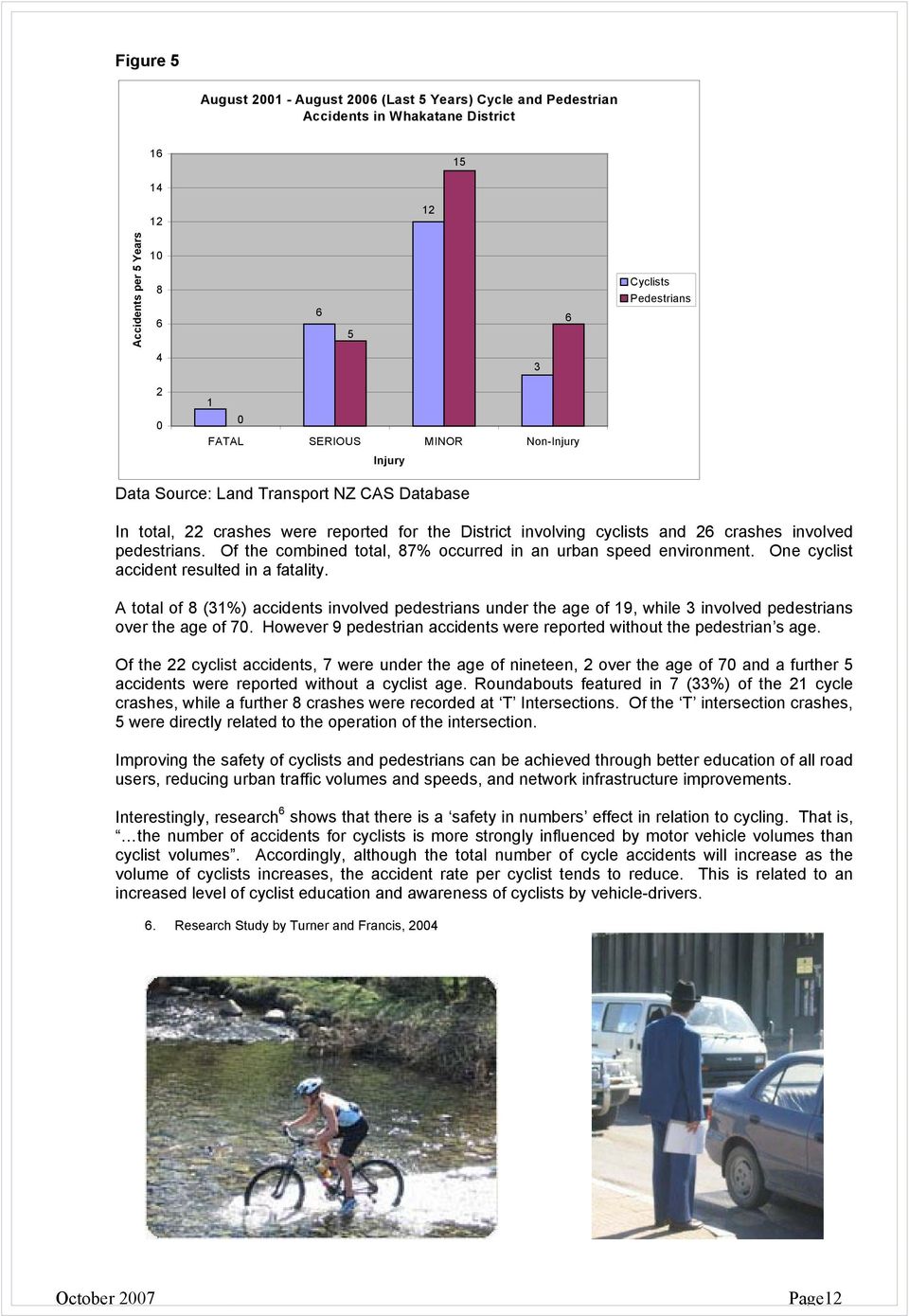
16 Figure 5 August August 2006 (Last 5 Years) Cycle and Pedestrian Accidents in Whakatane District Accidents per 5 Years Cyclists Pedestrians FATAL SERIOUS MINOR Non-Injury Injury Data Source: Land Transport NZ CAS Database In total, 22 crashes were reported for the District involving cyclists and 26 crashes involved pedestrians. Of the combined total, 87% occurred in an urban speed environment. One cyclist accident resulted in a fatality. A total of 8 (31%) accidents involved pedestrians under the age of 19, while 3 involved pedestrians over the age of 70. However 9 pedestrian accidents were reported without the pedestrian s age. Of the 22 cyclist accidents, 7 were under the age of nineteen, 2 over the age of 70 and a further 5 accidents were reported without a cyclist age. Roundabouts featured in 7 (33%) of the 21 cycle crashes, while a further 8 crashes were recorded at T Intersections. Of the T intersection crashes, 5 were directly related to the operation of the intersection. Improving the safety of cyclists and pedestrians can be achieved through better education of all road users, reducing urban traffic volumes and speeds, and network infrastructure improvements. Interestingly, research 6 shows that there is a safety in numbers effect in relation to cycling. That is, the number of accidents for cyclists is more strongly influenced by motor vehicle volumes than cyclist volumes. Accordingly, although the total number of cycle accidents will increase as the volume of cyclists increases, the accident rate per cyclist tends to reduce. This is related to an increased level of cyclist education and awareness of cyclists by vehicle-drivers. 6. Research Study by Turner and Francis, 2004 Page12
17 4.0 OUR VISION AND GOALS 4.1 VISION FOR WALKING AND CYCLING Whakatane District Council s Vision for walking and cycling is A District where walking and cycling are convenient, attractive and popular forms of everyday transportation and recreation. A District that promotes Sustainable Transportation. 4.2 GOALS FOR WALKING AND CYCLING Council s goals to fulfil the Vision for walking and cycling in the Whakatane District are: 1. To increase the number of people who regularly cycle or walk to school and work (measured by Census, traffic counts and public consultation surveys), particularly those living within 3km of their regular daily travel destination. 2. To establish and promote a strategic Cycle and Walking Network within the Whakatane District. 3. To continually develop road infrastructure that is accessible, wellconnected and safe for pedestrians and cyclists, such that walking and cycling become more viable and convenient forms of travel and recreation in Whakatane. 4. To reduce the number and severity of Pedestrian and Cyclists injury accidents per year in the District 5. To educate and develop a driver culture of awareness and acceptance that cyclist and pedestrians are legitimate road users. 6. To ensure that cycling and walking are promoted in Council s land use and transport planning, engineering and development control policies. Page13

18 5.0 ACHIEVING THE GOALS 5.1 TARGETS Quantifiable targets have been set, based on the trends illustrated in Section 3.0, to meet Whakatane s goals for walking and cycling. Targets for Goal 1 To increase the mode-share of walking and cycling commuter trips, measured by Census survey, from 2006 levels (8% and 4% respectively) to the following levels: Walking; 10% by 2011 and 13% by 2016 Cycling ; 6% by 2001 and 9% by 2016 To increase the volume of students, living within walking or cycling distance to school, to 60% by 2011, from the baseline 2006 levels identified (approximately 42% combined), measured by questionnaire survey of parents, or student surveys at schools. To establish a program of regular pedestrian and cycle count surveys on key routes within Whakatane, starting with and building on the survey locations of this strategy. To record an increasing trend in walking and cycling volumes year by year relative to the baseline count data reported in this Strategy. Target for Goal 2 To establish and promote the development of a Strategic Walking and Cycling Network within the Whakatane District by 2008, with completion of the networks by Targets for Goal 3 To ensure that the development of the cycle and pedestrian facilities are designed according to New Zealand s best practice engineering design guides identified in Appendix B, and carried out with priority towards completion of the Strategic Walking and Cycling Network. To record and sustain an increase in regular recreational walking and cycling to 80% of survey respondents by 2011, as a result of the increased viability and convenience afforded by the improved walking and cycling infrastructure. (An 80% rating targets the 11.5% who identified no time or too lazy as reasons for no recreational walking or cycling participation in the 2006 questionnaire survey) Targets for Goal 4 Council implement and administer a register for recording unreported cycle and pedestrian accidents. To reduce the number of Fatal cycle and pedestrian accidents per 5 year period to 0. To reduce the number of cycle and pedestrian Serious injury accidents per 5 year period to 2 each respectively. To reduce the number of cycle and pedestrian Minor injury accidents per 5 year period to an average of 8 each respectively (a 40% reduction from the 5 years to 2006). To provide adequate resources so that the proportion of students who have the opportunity to undertake LTSA sanctioned cycle training by Year 7 (Form 1) is 100% per annum by Targets for Goal 5 To achieve an 80% satisfaction rating in surveys of cyclists and pedestrian perceptions by 2011, concerning a change in driver culture towards acceptance of cyclists and pedestrians as legitimate road users. Page14

19 Targets for Goal 6 To ensure the District Plan and all other development policy manuals recognise the Walking and Cycling Strategy, and accordingly provision/consideration for the needs of pedestrians and cyclists is mandatory for new developments. Time Frame: At the next review of each of the Whakatane District Council planning documents. To ensure Council s Engineering Codes of Practice requires good-practice design of pedestrian and cyclist facilities, and that safety and amenity provision for walking and cycling is mandatory in all new or upgraded infrastructure. Time Frame: The next review of the Code of Practice 6.0 POLICY CONTEXT FOR WALKING & CYCLING 6.1 NATIONAL POLICY CONTEXT New Zealand Transport Strategy The New Zealand Transport Strategy sets out the government's vision for transport and will guide policy decisions about transport. Therefore it is important that this Strategy reflects the objectives of the New Zealand strategy. The objectives of the New Zealand Transport Strategy are to: Assist economic development Assist safety and personal security Improve access and mobility Protect and promote public health Ensure environmental sustainability. The New Zealand Transport Strategy objectives are met in this Walking and Cycling Strategy by: Considering means of assisting safety and personal security through identifying existing road safety concerns and urban personal security issues for pedestrians and cyclists; Identifying improvements to access and mobility that promote a sense of community Promoting public health by promoting active means of transport Promoting sustainable transport modes that cause little adverse impacts on the environment and reduced reliance on fossil fuels In providing for these land transport objectives, Council will also help to assist economic development and promotion of environmental sustainability. New Zealand Land Transport Management Act The Land Transport Management Act (LTMA) represents the biggest change to land transport legislation since the late 1980s. The Act was passed in November 2003 and envisages an integrated, long-term approach for land transport funding and management, with more emphasis on social and environmental needs. It expands the role of Land Transport New Zealand so it focuses on land transport as a whole and not just the roads themselves. In line with the vision of the New Zealand Transport Strategy, Land Transport New Zealand will have to contribute to achieving a land transport system that is integrated, safe, responsive and sustainable. The LTMA Act requires organisations seeking funding from Land Transport New Zealand to prepare detailed land transport programmes and to submit them to Land Transport New Zealand for approval. All approved programmes will be consolidated into the National Land Transport Programme. Whakatane s Pedestrian and Cycleway Strategy will provide the basis of Council s programme for walking and cycling initiatives in the Whakatane District. Land Transport Act Sections 175 to 183 of the Land Transport Act require Council to develop and implement a Regional Land Transport Strategy (RLTS). The Bay of Plenty RLTS (2007) identifies the land transport needs of the region and provides Whakatane Council with a set of policies and actions for meeting these needs. Page15
20 Road Safety 2010 Strategy In September 2002, the Minister of Transport, Hon. Paul Swain, announced the Government's new road safety goals of achieving no more than 300 fatalities and 4,500 hospitalisations per annum across New Zealand by In considering the present national road safety statistics, the Road Safety 2010 Strategy highlights that: Children account for a high number of fatalities and injuries in walking and cycling related crashes. However over-representation may be due to their limited road safety skills and higher use of walking and cycling as a means of independent transport. Accident statistics show that the greatest risk to cyclists and pedestrians occurs in urban areas where the majority of crashes occur. Under-reporting of accidents is however acknowledged in respect of recreational cycling and walking. Provision of dedicated cycle lanes and pedestrian facilities can significantly reduce localised safety risks. Councils shall provide safe facilities where these are justified. Other National Policies Other national policy papers that support the need for increasing the amount of walking and cycling in New Zealand, include: Energy Efficiency and Conservation Strategy. Ministry of Health Draft Healthy Action Healthy Eating Strategy Getting There - On Foot, by Cycle 2005 (MOT). 6.2 REGIONAL POLICY CONTEXT Bay of Plenty Regional Land Transport Strategy (RLTS) The Bay of Plenty Regional Land Transport Strategy 2007 (RLTS) is consistent with these national policy directions. The RLTS identifies the need to provide and plan for walking and cycling transport modes in the following actions given to Road Controlling Authorities (RCAs) in Chapter 7: To ensure cyclists and pedestrians have safe access along and across the road network. Develop procedures to ensure new development incorporates pedestrian, cycling and public transport facilities. Outcome 8 (public health) contains an action for the region to actively encourage recreational walking and cycling in order to promote public health. For Whakatane District Council to develop and implement their Walking and Cycling Strategy (this report). Performance indicators in the RLTS include recording of pedestrian and cyclist numbers. Travel Demand Management also features in Chapter 6 of the RLTS, with a focus on promoting modal shift for short trips, from car use to cycling and walking modes. The Strategic Regional Walking and Cycling Package contained in the RLTS seeks to advance this objective with the following initiatives to be implemented by TLAs across the region: Strategic cycleway network development [all]; Inform and educate strategy for identified cycle routes [Environment BOP/ all districts]; Cycle facilities on major commuting routes (development of standards and shoulder widening [Transit, TCC, RDC]; Develop regional cycling design standards for commuter routes [Transit/Environment BOP]; Narrow bridge assessment and mitigation programme (bridge widening or use of warning technologies Cyclist on bridge ) [Transit/Environment BOP]; and Develop school travel plans including walking school buses. Whakatane District Council LTCCP Council have committed in the LTCCP to producing this Walking and Cycling Strategy and seeing that it is implemented over the next 10 years, from 2006 to Projects identified in the implementation plan featuring later in this Strategy, will be added when programmed to Council s Annual Plan, and to the LTCCP s Transport Network and Systems program during the 3 yearly LTCCP review process. Currently the only programmed construction of walking and cycling facilities in the LTCCP is on Ohope Road during the seal widening and upgrades from 2007 to Page16

21 7.0 ACHIEVING THE STRATEGY TARGETS 7.1 INITIATIVES TO INCREASE CYCLING AND WALKING This Section outlines how Council aims to progress the District towards meeting the objectives and becoming a place where walking and cycling are convenient, attractive and popular forms of everyday transportation and recreation. The Initiatives are underpinned by the concept of The 4 Es ; Engineering, Encouragement, Education and Enforcement. They are not exclusive methods of achieving the goals and Council may wish to trial alternative initiatives that are appropriate to a particular situation. 7.2 ENGINEERING INFRASTRUCTURE Well designed and engineered infrastructure is important for providing a safe, attractive and enjoyable cycling and walking environment. Cycling and walking must be promoted in Council s land use and transport planning, engineering and development control policies (Goal 6 in Section 4) to ensure good design is planned and implemented. A key target of Goal 6 is that the consideration of the safety and amenity needs of pedestrians and cyclists is adopted in all road construction projects. Walking and Cycling Networks Both local and international experience indicates that developing connected facilities in a walking and cycling network better serves the needs of walkers and cyclists, and encourages more people to walk or cycle than isolated facilities. A walking and cycling network generally includes a combination of the following: Footpaths for walkers or shared-use paths for pedestrians and cyclists. Safe crossing facilities for walkers and cyclists that minimise delay Cycle lanes marked on roads; Allocated cycle space at intersections; Off-street cycle paths (often designated as shared-use with pedestrians); Cycle routes on local roads chosen for the low traffic environment (sign-posted but not marked with cycle lanes); and Wide paved shoulders for cyclists on more heavily-travelled rural roads and State Highways. Off-road paths in rural areas that traverse areas of natural and heritage value or provide linkages between roads suitable for cycle touring and walking. Places and facilities for resting for walkers and for cycle parking for cyclists. Network Design Principles Cycling Well-known European research that is equally applicable in New Zealand identifies five main requirements for developing well-engineered cycling infrastructure: Coherence The cycling infrastructure should form a coherent entity, linking all trip origins and destinations; routes should be continuous and consistent in standard. Directness Routes should be as direct as possible, based on desire lines, since detours and delays will deter use. Attractiveness Routes must be attractive to cyclists on subjective as well as objective criteria. Lighting, personal safety, aesthetics, noise and integration with the surrounding area are important. Safety Designs should minimise casualties and perceived danger for cyclists and other road users. Comfort Cyclists need smooth, well-maintained surfaces, regular sweeping and gentle gradients. Routes must be convenient to use and avoid complicated manoeuvres and interruptions. Most cycling in Whakatane is done on district roads and the State Highway network, rather than on special cycling facilities. Consequently, an important function of this strategy is to ensure that the basic road network is safe and attractive for cycling. In general, provision of off-street cycling facilities parallel to roads (such as shared footpaths/cycle paths) needs to be carefully considered. Motorists do not expect cyclists in these locations and can collide with them, for example, when exiting driveways. Often either wide shoulders or cycle lanes on Page17
22 both sides of a road are preferable solutions. In support of this concept, an industry accepted principle for cycle facility design is to consider in order the following hierarchy of solutions: Traffic Volume Reduction Traffic Speed Reduction (Calming) Intersection Treatments and Traffic Management Reallocation of carriageway space Cycle lanes and paths Most collisions between cyclists and vehicles occur at intersections. Careful intersection design, including the choice of intersection control, can improve cyclist safety considerably. Roundabouts are a popular intersection type in Whakatane Township, and while efficient for vehicle movement most of the time they can cause significant problems for less-than confident cyclists, and discourage many people from cycling on the road at all. Section 3.2 notes that 1/3 of cycle injury accidents occurred at roundabouts in the Whakatane District in the last 5 years. Accordingly the Cycle Network Plans in Section 9.0 avoids routes that take cyclists through roundabouts where an alternative safe and direct route is available. Regardless, cyclists in Whakatane will still encounter roundabouts and therefore roundabout layouts should be modified to accommodate the design principles of the LTNZ Research Report 287, Improved Multi-Lane Roundabout Designs for Cyclists. The primary design principle, to narrow approaches and add deflection angles that discourage vehicle speeds above 30km/h, is equally applicable to single lane roundabouts. Additionally road signage and markings should be installed, encouraging cyclists to ride in the centre of the approach and circulating lanes of the roundabout. A periodic cycle safety at roundabouts campaign is also highly recommended, and discussed further in Section 7.3. Pedestrians The UK Department for Transport s Encouraging Walking publication contains a checklist for the Local Walking Environment that contains the Five Cs for walking: Comfortable Convenient Convivial Conspicuous Connected These aspects are appropriate for determining the quality of the walking environment. Kopeopeo shopping area is a good example of a quality pedestrian environment that meets the Five Cs. Further to this checklist, the needs of all pedestrians must be considered carefully in the design of infrastructure; from the able-bodied users to young children, elderly people and people with Page18
23 disabilities. The planning and design of any new or upgraded pedestrian facilities will refer to NZS4121 Design for Access and Mobility: Building and Associated Facilities to ensure they met the needs of pedestrians with disabilities. Network Planning and Development The planning and development of a primary cycle and walking network is a core function of this Strategy. Whilst footpaths are reasonably well provided in the District, opportunities do exist for new or extended recreational walking trails, and there is a need for the development of a cycle network throughout the District. To achieve efficient network planning and development Council will: Identify the primary cycle and walking routes to be developed. This has been undertaken as part of the development of this strategy and is identified in Section 9.0. Council will Massproduce maps outlining the cycle and walking networks as they develop. Establish a range of regular cycling and pedestrian counts that take into account seasonal and daily factors. Counts are required in the investigations for those routes identified as priorities in the Implementation Plan of this Strategy. Integrate cycling and walking into mainstream transportation planning so desirable features are incorporated into mainstream infrastructure improvements (resealing roads, road reconstruction intersection upgrades) rather than retrofitted at a later date. Audit roading projects to ensure that opportunities to improve conditions for cycling and walking are properly identified and considered. Develop off-road cycling and walking tracks in accordance with the recently published Standards New Zealand Handbook Tracks and Outdoor Visitor Structures. Upon completion of a cycling or walking facility, a safety inspection will be undertaken and any remedial works considered necessary will be completed as soon as practical. Ensure existing and proposed pedestrian facilities are designed to best practice engineering standards. Design standards and guidelines are presented in Appendix B of this Strategy. Ensuring that suitable and sufficient numbers of bike racks are installed at appropriate and convenient locations around popular cycle destinations and include markings on the cycle network map showing where these racks are located. Further to this Council will consider funding on a future basis for new racks to be installed and to replace existing racks where required with ones of appropriate style and configuration. New Developments Council will continue to encourage developers to provide cycling and walking facilities, with good connections to existing facilities at the development boundaries. The connectivity aspect is to ensure that linkages are provided between road networks as well as other public areas and facilities such as reserves, car parks, swimming pools etc thereby providing a viable alternative transport route for the community. By providing attractive and ideally more direct routes, will walking and cycling transportation be attractive. A further consideration will be for developers and Council to take into account personal security in the design and layout of these areas. Urban Area Design Encouraging cycling and walking in urban centres starts with ensuring that the urban area serves the needs of cycling and walking as well as, or more so than those of the motorist. To ensure cycling and walking modes are served in urban areas, Council will: Provide street amenity features that encourage safe pedestrian movements such as tactile pavers, cycle friendly built out pedestrian crossings, shade trees, and appropriate lighting in accordance with best engineering practice. Provide, or require provision of, dedicated short and long term cycle storage facilities at convenient and safe locations. Traffic calming measures in urban centres to prioritise pedestrian movements over vehicle movements. Page19
24 Ensure both roadside and off-road footpaths and cycle facilities are safe environments with Crime Prevention Through Environmental Design (CPTED) principals integrated into the design Programme maintenance of these facilities to ensure a high quality of service is provided across all facilities Infrastructure Safety Auditing Existing Facilities Council s road maintenance contractor presently carries out inspections of existing footpaths and on road cycle facilities from time to time. Audits for both existing pedestrian and cycle facilities should be undertaken periodically and in line with the example and guidelines referred to in: 1. Cycle Facilities - Austroads Guide to Traffic Engineering Practice Part 14: Bicycles as well as in the New Zealand supplement to this guide; 2. Pedestrian Facilities - Audits of pedestrian facilities shall be undertaken in line with the considerations set out in Appendix 2 of the Land Transport Safety Authority s publication Pedestrian Network Planning and Facilities Design Guide. Cycling and pedestrian advocacy groups, and representatives for disabled persons may also be invited to be included in the audit team when carrying out audits of existing facilities. Proposed Auditing and New Facilities Proposed and new pedestrian/cycling facilities that are to be subsidised by Land Transport New Zealand, are to be audited. These audits shall follow the requirements set out in the published guideline by Transfund NZ (now Land Transport New Zealand): Road Safety Audit Procedures for Projects Guideline. There are four stages of audits that are; Feasibility Concept, Preliminary Design Concept, Detailed Design Stage and Post Construction Stage. Council will determine which of the four audit stages shall be carried-out. Walking and cycling advocacy groups will also so be invited to comment at the detailed design stage. Safety Improvements Council is able to access funding from Land Transport New Zealand to undertake specific minor safety improvements that help to ensure a safe cycling or walking environment. This funding is, at present, limited to projects of no more than $150,000 of which Land Transport New Zealand will fund 59%. Council will target minor safety improvements at the following locations: Intersections where historical safety issues have been identified, or those intersections through which cycling and walking is being promoted. Bridges, culverts and other structures that impede pedestrian and cyclists safe movement. Large sections of new cycle lane or footpath will not to be funded through Council s minor safety budget. Council will prioritise for treatment those areas that have historical crash issues or where potential hazards (e.g. on-road parking, narrow roads, high traffic volumes or speeds) are identified on routes that Council is promoting. Council will work with Transit New Zealand to ensure consistency of service between State Highways and Council Roads. Specific sections identified in this strategy that require attention are identified in the route plans and implementation plan. Council Paper Roads and Esplanade Reserves Council owns land resources in various forms of reserves. These reserves are set-aside for certain purposes (road, esplanade etc) but may also be suitable for cycle facilities or walkways. Development of these reserves to encourage recreational and / or commuter cycling and walking is a core function of Council s Community Services and Assets Departments. Council will give consideration to using paper roads and esplanade reserves for future trails where appropriate. Page20
25 Speed Control Mechanisms A common reason cited for not cycling or walking in New Zealand is a perception that cyclists and pedestrians are not safe on roads that operate at higher vehicle speeds. Whilst speeding is an enforcement issue that is addressed below, vehicle drivers can be encouraged to travel at speeds appropriate to local road conditions through signage and physical structures that limit vehicle speeds but allow for safe passage of pedestrians or cyclists. In 2000, Land Transport New Zealand (formerly Land Transport Safety Authority) trialled the concept of a school zone temporary speed limit (in Christchurch) on high speed, high volume road. Speeds were temporarily dropped to 40km/hr during times when school children were coming to or going home from school. The trial was successful and guidelines were first published in Since then 40km/hr variable speed limits have been established throughout New Zealand. A bylaw is passed for the variable speed limit by Council following approval to do so by the Director of Land Transport. Where necessary to controlling vehicle speeds, Council will: Provide official warning signage in areas where specific safety issues need to be highlighted (ie. narrow bridges) Install physical measures (e.g. urban thresholds) where appropriate to improve road safety. Assess the need for school zones in areas where safety of school pupils is at risk from vehicle speeds or volumes in accordance with Land Transport New Zealand warrant. Delineate on-road or off-road facilities where traffic speed and volume of roads presents a safety hazard to pedestrians and cyclists. PAGE10 Facility Maintenance It is important that regular maintenance be undertaken on the Walking and Cycling Network to ensure a quality service is provided to pedestrians and cyclists. Council will: Establish a set of performance standards and provide adequate funding to cover the maintenance of all cycling and walking facilities particularly surface quality (swept of loose chip, glass and rubbish), signage, pavement markings and vegetation control. Regularly inspect cycling and walking routes and undertake necessary maintenance. Establish and publicise methods for the public to report defects to Council such as a Hotline phone number, postcards or Internet. Inspect cycle and pedestrian routes after storm events, during and after road works or property development to ensure debris is removed and appropriate repairs made. Consider establishing a 24-hour answer-phone line for the public to advice Council of walking and cycling tracks in need of maintenance, such as glass or chip removal and graffiti. 7.3 EDUCATION Education is an important part of changing attitudes and behaviour amongst all road users. Road user courtesy, safety habits and providing for all forms of transport within the road corridor are all matters that can be addressed through education of road users and transport planners and engineers alike. In particular, cycling education for new cyclists is crucial to build competence and confidence so they can cope successfully in traffic with any potential hazards they encounter. Without such skills new cyclists are more likely to feel vulnerable and may not continue to cycle. Research indicates that education programmes teaching new cyclists how to ride safely on the road are effective in reducing their involvement in traffic crashes both as children and adults. Schools Targeted For Road Safety Education The safety statistics for school age children in the Whakatane District reveals a high proportion of casualties (Section 3.2). Road safety education focussing on the correct use of bikes, helmets, the road code, lights, safe routes to school and the correct use of cycling and walking facilities are ways to improve safety amongst school children that will carry over to adulthood. The Police (Youth Education Officer) and Council s Road Safety Co-ordinator are actively involved in this service. Page21
26 Road Safety programmes currently offered include: Stepping out ; aimed at Years 0 to 3 and teaching safe walking and road crossing concepts Riding By ; promoting and teaching safe bike riding skills to school children aged 9-12 years old. Road Sense ; integrating road safety education in daily classroom lessons Promote The Benefits Of Cycling And Walking The economic, social and environmental benefits of integrating cycling and walking into daily lives are well known, as is the health benefits to individuals. Council will promote these benefits of cycling and walking through its Road Safety Coordinator with the help of the Police Youth Education Officer. Other stakeholders helping Council to promote walking and cycling in Whakatane include Sport Bay of Plenty, Sport and Recreation New Zealand (SPARC) and Environment Bay of Plenty. Promotions will target initiatives that help to connect the community by walking and cycle to work places, schools and shopping areas and general community centres, while at the same time promoting the far reaching benefits of this activity. Further educational benefits could be provided for Tourists and the local community through the provision of information about natural and historical features along recreational walking and cycling tracks. Council Staff Education Many of Council s activities have the potential to affect cycling and walking. Council will ensure that all its staff have appropriate knowledge of this strategy and carry out their functions in ways which support this strategy s objectives. This will be achieved through training in network planning and design, consultation with local stakeholders and interaction with national and local authorities in the delivery of cycling and pedestrian services. Road Safety Campaigns Council, together with the help of the Eastern Bay Road Safety Committee will continue to periodically run media and targeted road safety campaigns on important cycling and pedestrian issues. To promote safer cycling and walking, road safety campaigns will aim to raise awareness around safe cycling / walking and direct this information towards drivers as well as cyclists and pedestrians. Campaigns may refer to on or off-road facilities, driveways and intersections, town centres or any other traffic-conflict situations where pedestrians and cyclists mix with vehicles. An example pedestrian campaign is Marlborough s Project Orange Week. Project Orange highlights the school traffic safety teams and their parent supporters work throughout the year, helping children to safely cross the roads near their schools. The campaign also looks at what motor vehicle drivers do around school crossing areas and highlights some of the behaviours that endanger children on the crossings and those in the school traffic safety teams. The campaign includes a week of participation at school level targeting the school community, radio and newspaper awareness raising, targeting the wider community and motorists, and concludes with several weeks of enforcement targeting specific motorist behaviour around schools. An example cycle safety campaign is the Don t Burst their Bubble project in Whakatane, which aimed to encourage drivers to think of a bubble of space around cyclists that they should not encroach on. Local cyclists reported significant improvements in driver behaviour, and perceived that their safety and acceptance as road users by motorists increased during the promotion. Page22
27 A website, similar to the Skid Lids website for young cyclists and pedestrians (skateboarders and roller-bladers etc) in the Tasman District could be setup and promoted to inform students of coming activities and programs for concerning road and travel safety, as well as recording of crashes or near misses. It could further provide safety information to children and parents and provide an interactive environment that encourages discussion and participation on road safety issues. Other campaigns could target failing to observe which is a leading cause of cycle/car crashes and in New Zealand. It is important that promotions encourage cyclists and pedestrians to take reasonable and appropriate measures to make themselves more visible (eg lights, reflective clothing). Road safety campaigns aim to raise awareness of these issues with pedestrians/cyclists along with targeting drivers at high-risk locations (such as intersections) to be more aware of other road users and to look twice for bikes. Specific to Whakatane is the issue of cyclist safety at roundabouts. A periodic campaign of signs on approaches to roundabouts, encouraging cyclists to travel in the centre of the approach and circulating lanes of the roundabout is highly recommended. The campaign should also warn motorists to be aware of cyclists manoeuvring at roundabouts. PAGE Further information about Education and Road Safety for pedestrians and cyclists can be found at Land Transport New Zealand s website: ENCOURAGEMENT Safe Routes To School Identifying and implementing Safe Routes to School (SRTS; is key to promoting cycling and walking journeys to and from schools that are safe and enjoyable. Undertaking a SRTS assessment involves consultation with parents and students to identify travel modes, routes and hazards. Outcomes of undertaking a SRTS assessment may include engineering treatments, educational and promotional campaigns in schools, and traffic enforcement around schools. Council will promote the benefits of SRTS to schools and the Ministry of Education, and will be actively involved in any SRTS consultation processes to identify those engineering features that will help to encourage safe and enjoyable cycling and walking to and from school. Examples of potential engineering solutions may include road crossings, off-road footpaths or cycle facilities, school speed zones or parking restrictions. The Council will work with schools regarding identification of safer routes and forming travel plans. Walking School Buses will also be encouraged and supported by Council, in collaboration with Schools and the Police Youth Education Officer. Network Maps A published network map (a specific leaflet, or provided on general tourist maps) of the strategic walking and cycling routes in Whakatane will also encourage more walking and cycling, by both the community and tourists. Cycle routes in particular, need to be continuous and direct and in directions where cyclists and pedestrians want to go, such as town centres, shops, schools, and tourist or recreational destinations. The needs of walkers and cyclists and the desires of the walking and cycling community should drive the development of the network, rather than locating facilities down side or back streets where its easiest to include them. Recreation and tourism maps of Whakatane District can also be used to publicise walking and cycling networks and facilities. The Walking and Cycling network map could also have reminder illustrations of typical do s and don ts particularly for cycling on roads and shared walking paths. Promote And Provide Secure Public Cycle Parking Having secure cycle facilities provided in places of employment, urban centres and schools helps encourage more cycling. Council will investigate, and where required install more safe cycle lockup racks in and around urban centres over the life of this Strategy. Council will also promote the provision of cycle-friendly facilities at workplaces and schools in order to support those who wish to cycle to work or school. There is also a need to provide and maintain cycling parking in the smaller urban centres of Ohope, Edgecumbe and Matata. Page23
28 Change the Image Walking and cycling are normal modes of travel for a wide variety of age groups, income levels and trip purposes. Accordingly, promotional campaigns could highlight that walkers and cyclists are typical Whakatane citizens who enjoy active lifestyles, and that Whakatane as an ideal District for walking and cycling. Workplace and school travel plans are useful tools to encourage more people to use walking and cycling as a modes of transport for commuter trips. Working with schools and students is an important aspect of identifying the key factors that will encourage school students to walk or cycle to school. With the worldwide resurgence in popularity of cool bikes such as the Chopper, Beach Cruiser and Low-rider bikes, cycling is becoming appealing to many school age kids who wouldn t otherwise ride a bike. This resurgence of interest needs to be supported and encouraged. Council will work with schools to assess whether their policies actively support or encourage walking and cycling to school. Supplying secure, sheltered and visible-to-the-school cycle racks is an example of encouraging cycling. Barriers should be resolved where walking and cycling isn t currently supported in school policy and action. National Promotions Whakatane Council, together with Environment Bay of Plenty and Sport Bay of Plenty, actively take part in many of the national programmes to support walking and cycling such as the Bike Wise Week and the Push Play campaigns. Our challenge is to continue what we are already doing and to increase the momentum further throughout our community. Work Place Promotions Opportunities exist to promote walking and cycling as viable commuter transport modes in our work places. Council will investigate ways to work with employers to implement workplace initiatives, such as incentives for the workplace with the highest rate of non-car based transport or the pairing of bike-buddies to travel to and from work together on bicycles. Whakatane District Council To practice what we are preaching in this Strategy, Council will purchase two bicycles and encourage staff to use them for making local trips to meetings or site visits rather than taking a pool vehicle. For the communities use, Council will consider setting up a 24 hour answer-phone line for people to advise Council on where maintenance of walking and cycling tracks is required. Encouraging Parents As noted in Section 3.1, whether or not a parent cycled to school has a direct affect on whether or not their children cycle to school. Its easy to point the blame at schools for the decline in walking and cycling to school, but parents need to set good examples to children as well. Council will firstly target through promotion, those parents who used to walk or cycle to school to encourage their children to do so as well. Promotions will also target all parents to think of their children s health and future habits, and lead by example by taking the kids cycling or walking as a form of recreation. 7.5 ENFORCEMENT Council supports enforcement initiatives by ensuring compliance with Engineering Standards and the Resource Management Plan. Council also supports enforcement of traffic regulations and road safety. Obeying Road Rules A bicycle is a vehicle and as such, cyclists have the same rights and responsibilities as a motorist. The rights and responsibilities of all road users are contained within the road code ( and these must be obeyed for continued safety and enjoyment of Page24
29 cycling and walking. Council will continue to support Police efforts in enforcing traffic regulations and run programmes in conjunction with the Police through the road safety coordinator. Speed Limits When setting speed limits Council is required to comply with the speed warrant process which is audited by Land Transport New Zealand. The speed warrant process aims to set uniform national speeds for similar road conditions. The warrant is based upon level of roadside development and not the type of traffic mix on the road itself. Traffic mix is to be managed by delineation or signage. Council is generally unable to change speed limits where this is not supported by a speed limit warrant. The exception to this is noted above under Speed Control Mechanisms where Council can apply to the Director of Transport to pass a bylaw for a School Zone variable speed limit. Maintaining High Helmet Wearing Rates The Land Transport New Zealand monitors helmet wearing rates throughout New Zealand, with the most recent survey carried out in April The Bay of Plenty cycle helmet-wearing rate was 93%, just below the national rate of 94%. Council will support the promotion of wearing cycle helmets in conjunction with its road safety education initiatives. 7.6 FUNDING OF WALKING AND CYCLING PROJECTS Central and local government invests more than $2.0 billion dollars a year in land transport projects and initiatives. In 2006, Land Transport New Zealand allocated $11.5 million to the promotion of cycling and walking. The development of cycling and walking facilities in Whakatane may be funded through rates, developer contributions or, where projects meet funding criteria a funding subsidy of 59% from Land Transport New Zealand. Transit New Zealand (Transit) is responsible for the maintenance and improvement of the state highway system in New Zealand, as well as maintaining existing and providing new cycle and pedestrian facilities on the highways. State Highways 2, 30, and 34 are important routes that provide the vital links between communities and allow the transportation of goods in and out of the Whakatane District. Council promotes pedestrian and cycling facilities identified in state highway corridors in this strategy but the investigation, design and implementation is the responsibility of Transit. To qualify for project funding, Council and Transit must meet funding criteria by demonstrating the benefits of a project outweighing the costs, known as a benefit cost ratio. In addition, Land Transport New Zealand will only subsidise projects that fall into the subsidised roading category. All other works must be fully funded by Council, as part of a developer s contribution (typically as part of a resource consent or subdivision) or from community initiatives. In all cases, Council must approve projects in the annual plan process prior to construction commencing. Council will ensure conventional road funding sources can be used for a range of improvements that have multiple advantages for motorists as well as cyclists and pedestrians. Such sources include incorporating projects from this strategy into projects such as planned rural seal widening, road reseals and capital projects. Council will also investigate alternative avenues for help with funding, particularly on specific tracks and projects that provide a widespread benefit to the district and community. Such sponsorship and grants from businesses, community foundations and trusts in Canterbury have made the construction of the Little River Rail Trail possible. The Warren Cole Walkway is currently partially funded by the Whakatane Harbour fund. Page25
30 7.7 FEATURE PROJECTS The identification, commencement and completion of a few feature projects are ideal opportunities for Council to demonstrate commitment to the promotion of walking and cycling in Whakatane. Warren Cole Walkway (Harbour River Bank) The Warren Cole walkway, extending along the Whakatane Riverbank from Landing Road to the Heads is undergoing improvements to include an all weather surface over the entire length. Progress continues as funding becomes available. Ohope Hill A cycle lane was recently constructed on Ohope Road from Hillcrest Road to Burma Road. Safety improvements are being carried out for this existing facility, along with continuation of the cycle lane to Ohope in association with planned carriageway widening and maintenance works, with completion by 2008/9. Commerce Street The scheduled replacement of kerb and channel on Commerce Street provides the opportunity to include quality walking and cycling provision in the design, which is significantly more desirable and less costly than retrofitting facilities at a later date. Commerce Street is particularly suited as part of the cycling network due to its direct route to the CBD allowing cyclists to avoid the narrow carriageway of McAlister Street along with two roundabouts. The amount of off-street parking available to businesses also enables on-street parking to be reduced for the purposes of providing sufficient width for a quality cycling facility. This project has funding and is due for completion in Redundant Rail Corridor Opportunities A significant recreational and tourism opportunity exists in the Whakatane District, by transforming the old railway corridor that runs from the Boardmill site to Awakeri, into a walking and cycling track. Old rail corridors are well suited to cycling as they are typically flat or with gentle gradients, and as is the case with the Whakatane rail corridor, the bridging structures are often still established. The Otago Rail Trail ( has proven to be very popular with both locals and tourists alike. An organized walk in 2006 where 230 people walked from Awakeri to Whakatane on the redundant rail corridor, demonstrated the huge support and desire in the community for Council to obtain the corridor and transform it into a recreational walking and cycling track. Cycle and walking supporters have suggested that the track to Awakeri could be a first stage of a loop track that in future continues on to the Peketahi Bridge and then joins a path leading back to Whakatane along the river stop bank. Such a circuit would create a quality walking and cycling resource in excess of 30km in length, ideally suited to recreation, fitness training and tourism. The proposed path from the Boardmill and back to Whakatane features in the Walking and Cycling Network Map and implementation plan. Following the communities walk of support for the Rail Trail, Council began working with Transit New Zealand and land owners fronting the redundant corridor from Awakeri to the Boardmill, to work through the issues of land ownership to progress development of the walking and cycling facility. Rail Corridor Whitepine Bush Walking from Awakeri to Whakatane Page26
31 8.0 STRATEGY MONITORING AND REVIEW It is important with any strategy to monitor its effectiveness and to assess whether or not the targets are being met. The trends and targets set out above have been established from known data about cycling and walking. It is important that these trends continue to be monitored and that other survey locations are added to enhance that monitoring. 8.1 CONSULTATION Council will consider forming a working party involving members of the walking/cycling community with Council staff to assist in meeting the objectives of the Walking and Cycling Strategy. Council will also consult with adjacent landowners prior to carrying out any development to ensure any Community concerns are heard and considered. This may include: Distributing flyers to affected residents. Communication via community newsletters (eg Newsline). Open day meetings to invite feedback from general public. Displays of plans etc at Council offices to illustrate proposed development. 8.2 IMPLEMENTATION The implementation of this strategy is the primary responsibility of the Transportation Manager and the Manager of Service Delivery at Whakatane District Council. 8.3 MONITORING There are two types of monitoring that needs to take place in the implementation of this Strategy: Monitoring of targets set by this strategy that were discussed Section 3.3 above; and Monitoring of the actions undertaken by Council, including maintenance of infrastructure Appendix C identifies a range of possible monitoring activities and actions needed to ensure that the targets are being met or worked towards, and that Council is undertaking the actions. 8.4 REVIEW This strategy will be reviewed every three years in line with the review of Council s LTCCP. The Strategy review will consider the relevance of the cycling and walking initiatives against: The objectives and policies of the LTCCP The effectiveness of Council s actions under this strategy as measured through monitoring undertaken; The progress made in developing the primary cycling and walking networks Any alteration to priorities as expressed through consultation, network implementation, the Regional Land Transport Strategy or national policy. Page27
32 9.0 NETWORK PLANS Network plans are useful for illustrating where the existing walking and cycling routes are, and identifying the locations of proposed new paths and shared-use facilities. The geographic coverage and connectivity of routes in the context of the towns and the district is most easily comprehended by reference to a network plan. Accordingly this section of the Strategy identifies the Cycling and Walking Network Plans for the following locations in the District: Whakatane Ohope Edgecumbe Edgecumbe / Thornton Whakatane / Awakeri / Taneatua Points to Note: 1. The following network maps are not drawn to scale and the plans contained in this Strategy do not illustrate every walking facility presently in the district, since most urban roads have footpaths supplied as a matter of course. 2. Off-road walking and cycling paths are included although the plans may not contain all of the existing walking/cycling tracks available in the Whakatane District. It is our intention that the plans include the primary network of tracks. 3. The locations of proposed cycle, walking and shared-use facilities represent the desire-lines and connectivity required for the users. However there remains the need for Council to carry out full design investigations concerning the type of facility or road corridor treatment appropriate for the particular network environment. For instance, investigations are required where a cycle facility is proposed, to determine whether a marked cycle lane is appropriate IMPLEMENTATION PROGRAM 10.1 INDICATIVE 10 YEAR PLAN Table 2 outlines an indicative 10 year Cycling and Walking Project Implementation Plan. Two phases are necessary for every project; Investigation and Construction. Planning and Investigation (0): This phase primarily involves looking at the feasibility of a particular cycling or pedestrian project. If it is not feasible to construct a project, then Council will look at alternatives to the route proposed. Investigation will include: Cycle and pedestrian counts Consultation with user groups Costing of routes and, where appropriate, preparation of funding applications from Land Transport New Zealand. Council is heavily reliant upon Land Transport New Zealand for up to 59% of funding for major projects. If a project is feasible it will have detailed design and a safety audit completed prior to letting the contract for construction. Implementation / Construction ( ): This phase involves the implementation of actions to promote walking and cycling in the community, including the building of the cycling or walking facility projects in accordance with engineering standards and best practice guidelines. Infrastructure construction will include detailed design, audit, tender (if appropriate) and letting of contract to construct the proposed cycle lane. Construction is subject to funding being secured for the project following the investigation phase. Page28
33 The 10 year plan illustrates projects to be addressed in the 1-5 year range and the 6 10 year range. Table 2: Indicative 10 Year Implementation Plan Project Awakeri to Whakatane Board Mills Rail Trail 0 / Ohope Road Shoulder Widening and Cycling and Walking facility Safety improvements Production of district walking and cycling network maps 0 / Follow up and expand support for cycle training in schools. 0 / Promote workplace incentives for commuter walking and cycling. Introduce and encourage the concept of bike-buddies in the workplace. 0 / Warren Cole Walkway (Landing Road Bridge to CBD) construction of all-weather surfacing. Awakeri to Peketahi Bridge Rail Trail 0 * Peketahi Bridge to Whakatane Stop Bank Path 0 ** Valley Road to Hinemoa Street Canal Path 0 Landing Rd to Arawa Rd Stop Bank Walking/Cycling Path 0 / Edgecumbe cycle lanes - Bridge Street and College Road 0 / Edgecumbe to Thornton Stop Bank formal Walking and Cycling Path 0 / Ohope Road (Burma Rd to Pohutukawa Road Cycle and Pedestrian Facility) 0 / Implement cycle lanes on Pohutukawa Road, Ohope 0 / Commerce Street Cycle Facility (as part of programmed kerb and channel replacement) * The future of the unused Taneatua Branch Railway Line is yet to be decided. Consultation will need to be undertaken with Ontrack and Environment Bay of Plenty before this project can proceed. ** The Whakatane / Taneatua Network Map illustrates two options for the river stop bank walking and cycling path based on the timing, and positioning of a second bridge crossing identified in Whakatane s Transportation Strategy. The stop bank walking and cycling path is proposed for the western side of the river (shown in yellow), connecting to Landing Road Bridge until such time as the second crossing is built. The path would then use the new bridge, connecting to the eastern riverbank and on to the stop bank surrounding Whakatane township. Redundant Rail Line to Taneatua Ohope Road Towards Whakatane Page29
34 10.2 QUICK WIN PROJECTS The following are initiatives that could be completed within 2 years of adoption of the Walking and Cycling Strategy, to illustrate to the community that Council is committed to the Strategy s Vision. Construct formal cycle / walking path on Stop Bank from Landing Road to Arawa Street The Awakeri to Whakatane Board Mill Rail Trail, connecting to Landing Road via Mill Road and the river stop-bank behind the Board Mills site Investigations for obtaining and developing the Awakeri to Taneatua Rail Trail Road Safety Campaigns for motorists and cyclists using Roundabouts Print and distribute a Whakatane Cycle and Walking Network Map of strategic routes Public Promotion of Whakatane s River Banks for recreational walking and cycling Stop Bank by Arawa Road Redundant Rail Line at Awakeri 10.3 QUICK WIN URBAN INFRASTRUCTURE MODIFICATIONS The following are some required urban infrastructure modifications that could be completed within 2 years of adoption of the Walking and Cycling Strategy. Progressively treat all urban area road-crossing locations with drop-down kerbs (note Landing Road / Hinemoa Street Roundabout pictures in Section 3.2) ensuring pedestrian desire-lines are observed. Carry out Cycle Safety Audits of all roundabouts in urban areas and implement recommended improvements. Refer to LTNZ Research Report 287. Provide footpath route signage on eastern side of Muriwai Drive, identifying connection to the Warren Cole Walkway at the harbour edge Gorge Road / Valley Road Roundabout footpath continuation and street-level crossing provision across Valley Road at the roundabout. Completion of the all weather surfacing treatment on the Warren Cole Walkway. Supply walking paths (suitable for skateboarding) on entrance to Skate Bowl Park car park. Ohope Road cycle lane connectivity to Gorge Road. Carry out vegetation and surfacing maintenance on road shoulders and footpaths, and improve alleyway appearance and security. Consider lighting options. Install signs on approaches to the Landing Road Bridge warning motorists of cyclists presence on the narrow carriageway Ensure trees line walkways for aesthetics and sun-shelter, while not creating a security hazard at night. Ensure rest benches are provided at adequate spacing along each route. Page30
35 Muriwai Road footpth looking to Kohi Point Muriwai Road footpath ends at the Reserve. Informal crossing under Valley Road because there is no crossing facility provided Entrance to Skate Bowl Park and Warren Cole Walkway No footpaths, encourages vehicle use. Ohope Road Cycle Lane ends abruptly ends leaving cyclists to compete with vehicles Page31
36 10.4 INDICATIVE COSTS OF INFRASTRUCTURE Table 3 outlines the rough-order treatment costs for installing cycling facilities. Table 3: Typical Cycling / Walking Facility Treatment Costs Project Kerbside Cycle Lane Modify existing shoulder removing car parking (signs and markings) Kerbside Cycle Lane Minor widening to create shoulder (ie increase width from 0.5m to 2.0m) Cycle Lane Signs and pavement marking only (including existing marking removal) Cycle Lane Minimal widening to provide for cycle lane with car parking Cycle Lane Extensive widening to provide for cycle lane / car parking Cycle Under Pass Box culvert type structure Typical Cost $500 per km $200k - $400k / km $5,000 10,000 / km $150k - $250k / km $300k - $500k / km $100k - $150k each Off-road cycle / walking path: 3m wide, concrete pavers, flat terrain $240,000 / km Off-road cycle / walking path: 2.5m wide, concrete pavers, steep terrain $420,000 / km Off-road cycle / walking path: (asphalt concrete) $60k 100k / km Note: The above typical costs show large ranges which take into account the following: 1. Costs reduce significantly if only one side of a road is widened 2. Widening costs depend on whether or not a footpath needs to be reinstalled 3. The amount of existing pavement marking varies on every site 4. Service relocation figures vary greatly 5. Land Purchase provision is not included 6. Bridge construction or special pavement requirements for swampy ground is not accounted for. Page32
37 APPENDIX A EXAMPLE QUESTIONNAIRE SURVEY FORM WHAKATANE TRANSPORTATION SURVEY Date: Hi, my name is, and I am calling on behalf of Whakatane District Council. We are conducting a quick questionaire for Council's Transportation Strategy Study. Would you mind participating in the survey, which should take no more than about 4 minutes? All information will be used for statistical purposes only and your identity is not required. 1. Did you go to a place of work or study today? Yes No (If YES, go to question 2. otherwise Question 6) 2. In the following list, which mode of Transport best fits the one you took to that place of work or study? (a) Car / Motorbike (b) Walked (c) Cycled (d) Bus / Taxi 3. Is that your normal method of transport to that place on a daily basis? Yes No (If 'no') What then, is your normal transport method? (If travelled by car (including passenger) or motorbike, go to NEXT question. otherwise Question 6) 4. Which of the following best fits your typical length of time spent travelling to that place of work or study? (a) 1-5min (b) 5-10 min (c) 10-15min (d) 15+min (If ticked (a) or (b), go to Question 5.otherwise Question 6) 5. Which best describes your reason for not walking or cycling to your typical place of work or study? (a) Time Constraints (b) Concerns with safety in traffic (c) Disability Limitations (d) Other, Please explain: 6. Do you particilate in regular walking or cycling for leisure or exercise? Yes, Which or both? Walking Cycling No (if NO go to Question 7., If YES go to Question 8 ) 7. (ONLY IF 'NO' ABOVE) Which best describes your reason for not walking or cycling for leisure or exercise? (a) No spare time (b) Concerns with safety in traffic (c) Disability Limitations (d) I go to the Gym for exercise (e) Other, Please explain: (Now go to Question 10) 8. From the following list, approximately how often do you Walk and/or Cycle for leisure or exercise? walking... (a) Daily (b) Every 2nd day (c) Twice per week (d) other? cycling (a) Daily (b) Every 2nd day (c) Twice per week (d) other? 9. What is the typical length of time you spend walking or cycling for leisure or exercise? (a) 1-30min (b) 30min - 1hr (c) 1hr - 1.5hrs (d) 1.5hrs + TURN OVER Page33
38 Continued WHAKATANE TRANSPORTATION SURVEY Date: 10. Do you have any school age children? Yes No (If YES, go to question 11. otherwise END) 11. To get to school, do your children typically walk, cycle, get driven in the car, or take a bus? (a) Walk (b) Cycle (c) Car (d) Bus (e) None, they are (If travel by car, go to question 12. otherwise END) home-schooled 12. How long does their journey to school typically take (from leaving the house to arriving at school)? (a) 1-5min (b) 5-10 min (c) 10-15min (d) 15+min (If ticked (a) or (b), go to Question 13.otherwise END) 13. Which best fits your reason for driving your child/children to school? (a) Limited time in the morning (b) It is on the way to work or place of study (c) Safety concerns with walking or cycling (d) Other, Please explain: END STATEMENT OK, that is the end of the survey, so thankyou very much for your time. Have a good night. Page34
39 SUMMARISED WHAKATANE TRANSPORTATION SURVEY RESULTS Commuter Q1 % who worked 52% Q2 a % of commuters driving a car to work 89% b % who walk 8% c % who cycle 1% d % who bus / taxi 1% Q3 Q4 % who drive 1-10min to work 64% Q5 REASONS a time 40% b safety 4% c disability 2% d other 53% of which work car 29% Lazy 25% Recreation Q6 Walk 56% Cycle 4% none 32% Both 7% % who walk cycle or both for recreation 68% Q7 REASONS for no walk or cycle recreation a no time 19% b safety concerns 2% c disability 35% d Gym 6% e Other 38% of which lazy 44% Q8 Of the 68% who W/C for Recreation Walkers at least twice per week 85% Cyclist at least twice per week 4% both at least twice per week 12% Q9 Regular length of Time 30min or more 77% School Q10 School age kids 22% Q11 walk 33% cycle 9% both 0% car 42% bus 15% Q12 % who drive kids 1-10min to school 71% (10 out of 14) Q13 REASON on the way to work 60% safety on the roads 20% Page35
40 APPENDIX B DESIGN STANDARDS AND GUIDELINES Geometric design guidelines for walking and cycling facilities can be obtained from a variety of sources. The following are recommended: Pedestrian network planning and facilities design guide (LTSA 2005) Cycle Network and Route Planning Guide (LTSA 2004) RTS 14 Guidelines for Blind and Vision Impaired (LTSA 2004) NZS:4121 Design for Access and Mobility: Building and Associated Facilities Austroads Guide to Traffic Engineering Practice Part 13: Pedestrians (Austroads 1995) Austroads Guide to Traffic Engineering Practice Part 14: Bicycles (Austroads 1999) NZ Supplement to Austroads Part 14 Bicycles (Transit NZ October 2004) Improved Multi-lane Roundabout Designs for Cyclists (Land Transport NZ research report 287) Ministry of Transport Manual of Traffic Signs and Markings (MOTSAM) Websites recommended to consult for further guidelines and standards o Transit New Zealand o Tauranga City Council o Land Transport New Zealand Page36
41 APPENDIX C POSSIBLE MONITORING ACTIVITIES Data Set Census journey to work (Statistics New Zealand) New Zealand Travel Survey (Ministry of Transport) Collision statistics (Land Transport New Zealand) Walking and cycling infrastructure Funding and staffing Comments Good long-term data series of trends for walking and cycle commuting ( main means of travel to work ) but does not capture school or recreational traffic. Disadvantages are that the data are collected only once every five years, and may be weather-dependant on any particular Census day. This detailed study of travel behaviour in New Zealand was first done nationally in 1989/90; the second survey in 1997/98 and since 2003 annual surveys are being undertaken on a rolling basis to cover the country every few years. Walking and cycling collisions tend to be statistically rare events, and many crashes are not reported to the authorities. This means that potentially dangerous locations are unlikely to be identified by conventional black spot collision analysis, and also that locations with one collision (or more) may not be any more dangerous than other locations. Overall trends in walking and cycling crash numbers, however, are useful indicators of walking and cycling safety, and should be monitored routinely. An inventory list of public walking and cycling facilities should be established and maintained, including footpaths, cycle lanes (on-street), off-street paths, wide shoulders on rural roads marked as cycle routes and bicycle parking facilities. A component of this inventory should be updating the walking and cycling network plans. Funding and staff resources will be needed to develop, implement and maintain the walking and cycling strategy. Recording these items will track Whakatane s commitment to walking and cycling. Automatic counts traffic Routine classified traffic counts identify the proportion of traffic of each vehicular mode (including cars and many different classes of truck and bus). Traffic tube counters can count bicycle traffic as well. Manual traffic counts School bike stand surveys Bicycle tourism Walking and cycling events Opinion surveys of walkers/runners, and cyclists Opinion survey of resident population Manual surveys are needed to count pedestrians and help distinguish between school and other types of cyclists. They re more expensive than automatic counts and consequently may be carried out for shorter intervals and at key locations only. Cycling to school gives an indication of the use of cycles by younger residents of the community. If this number declines then future numbers of adult cyclists are likely to decline. Bike stand surveys do not quantify walking trips so student surveys are necessary in any case. Numbers of visitor nights of cyclists on organised cycle tours in the district. Number of walking and cycling events held in the District such as Bike Week promotion, fun rides, road or off-road races, club activities. Attitudes of existing walkers, runners and cyclists toward pedestrian and cycling facilities, surveyed annually and documented. Attitudes toward walking and cycling in general can be surveyed and documented to ascertain what is required to encourage more people to walk and cycle regularly. Page37
Trends and issues Lake Te Koutu walkway, Cambridge
 27 Trends and issues Lake Te Koutu walkway, Cambridge 3 Trends 3.1 Journey to work Over the past two to three decades there has been a significant increase in private vehicle ownership and usage and a
Footpath Extension Policy
 16.6.9 Footpath Extension Policy 1.0 FOOTPATH EXTENSION POLICY - INTENTION The Footpath Extension Policy provides for the ranking of new footpaths in the Council s footpath construction programme. The
Cycle Strategy 2006 2011
 Cycle Strategy 2006 2011 TABLE OF CONTENTS 1 INTRODUCTION... 1 2 POLICY BACKGROUND... 2 3 BACKGROUND... 6 4 MAIN OBJECTIVES... 8 5 TARGETS... 9 6 THE CYCLE NETWORK... 10 7 CONCLUSION... 13 Appendix A:
THE WANGANUI CYCLING STRATEGY
 THE WANGANUI CYCLING STRATEGY For Review by May 2008 1. INTRODUCTION Cycling is a practical, healthy and fun form of transport and recreation. The formation of the Wanganui Cycling Strategy is aimed at
2 Integrated planning. Chapter 2. Integrated Planning. 2.4 State highway categorisation and integrated planning
 2 Integrated planning Chapter 2 Integrated Planning This chapter contains the following sections: Section No. Topic 2.1 Introduction to integrated planning 2.2 Transit s Integrated Planning Policy 2.3
SAFETY PROCESS. Martin Small
 SAFETY PROCESS Martin Small With a broad transport policy background including extensive work in the maritime sector, Martin Small has been working in road safety for five years, in a variety of roles
Regional Road Safety Strategy September 2004
 Regional Road Safety Strategy September 2004 Regional Road Safety Strategy September 2004 Cover photo courtesy of St Mark s Church School Executive Summary The vision of the Regional Road Safety Strategy
Walking and Cycling Strategy
 Walking and Cycling Strategy for the Gisborne District 2004 Prepared by Gisborne District Council with the assistance and cooperation of NZ Land Transport Safety Authority, Transit New Zealand, Gisborne
DEPARTMENT OF TRANSPORT CYCLING STRATEGY 29 February 2008
 DEPARTMENT OF TRANSPORT CYCLING STRATEGY 29 February 2008 INTRODUCTION The Department of Transport s Business Plan for the 2007/08 financial year stated the following: Government Aim: Quality Environment
Regional Cycling Strategy. May 2004
 Regional Cycling Strategy May 2004 they also have the largest number of cyclists. Fault rests approximately two thirds with drivers and one third with cyclists. Figure 1 illustrates
Getting there on foot, by cycle. A strategy to advance walking and cycling in New Zealand transport. February 2005 ISBN: 0 478 10004 3
 Getting there on foot, by cycle A strategy to advance walking and cycling in New Zealand transport February 2005 ISBN: 0 478 10004 3 FOREWORD In 2002, the Government released the New Zealand Transport
Goals & Objectives. Chapter 9. Transportation
 Goals & Objectives Chapter 9 Transportation Transportation MISSION STATEMENT: TO PROVIDE A TRANSPORTATION NETWORK CAPABLE OF MOVING PEOPLE AND GOODS EFFICIENTLY AND SAFELY. T he transportation system
Department of State Development, Infrastructure and Planning. State Planning Policy state interest guideline. State transport infrastructure
 Department of State Development, Infrastructure and Planning State Planning Policy state interest guideline State transport infrastructure July 2014 Great state. Great opportunity. Preface Using this state
ROAD SAFETY GUIDELINES FOR TAH ROAD INFRASTRUCTURE SAFETY MANAGEMENT
 I. GENERAL ROAD SAFETY GUIDELINES FOR TAH ROAD INFRASTRUCTURE SAFETY MANAGEMENT ANNEX III B i. The setting up and implementing of appropriate management procedures is an essential tool for improving the
Bicycle Safety Enforcement Action Guidelines
 Introduction Bicycle Safety Enforcement Action Guidelines People ride bicycles for many different reasons: fitness, recreation, or for transportation. Regardless of the reason for riding, bicyclists young
Planning for Safe Transport Infrastructure at Schools
 Planning for Safe Transport Infrastructure at Schools Technical guidance for the provision of effective and safe transport infrastructure at schools April 2011 DRAFT NOT GOVERNMENT POLICY Planning for
Needs Analysis. Long Beach Bicycle Master Plan. Bicycle Commuter Needs. LONG BEACH BICYCLE MASTER PLAN Needs Analysis
 Long Beach Bicycle Master Plan Needs Analysis The purpose of reviewing the needs of commuter and recreational bicyclists is twofold: (1) it is instrumental when planning a system which must serve both
Timaru District Council. Land Transport. Lifecycle Management Strategy
 Timaru District Council Land Transport Lifecycle Management Strategy Quality Record Sheet Timaru District Council Land Transport Lifecycle Management Strategy Issue Information Issue Purpose Final Issue
Bicycle Safety Webinar December 1 st 2010
 Bicycle Safety Webinar December 1 st 2010 Kay Teschke Kay Teschke is Professor in the Schools of Population and Public Health and of Environmental Health at the University of British Columbia. She is principal
Deaths/injuries in motor vehicle crashes per million hours spent travelling, July 2008 June 2012 (All ages) Mode of travel
 Cyclists CRASH STATISTICS FOR THE YEAR ENDED 31 DECEMBER 212 Prepared by the Ministry of Transport CRASH FACTSHEET November 213 Cyclists have a number of risk factors that do not affect car drivers. The
1. The consultation seeks views on the vision, targets and measures for improving road safety in Great Britain for the period beyond 2010.
 Executive Summary 1. The consultation seeks views on the vision, targets and measures for improving road safety in Great Britain for the period beyond 2010. 2. We have made good progress in reducing road
Bedford s Network Management Strategy (2011 2021) November 2010
 Bedford s Network Management Strategy (2011 2021) November 2010 Page 1 of 13 1. Introduction 1.1. The Bedford Borough Council Network Management Strategy has been developed to support local and national
the Ministry of Transport is attributed as the source of the material
 Disclaimer All reasonable endeavours are made to ensure the accuracy of the information in this report. However, the information is provided without warranties of any kind including accuracy, completeness,
Oxfordshire Local Transport Plan 2011-2030 Revised April 2012. Objective 3 Reduce casualties and the dangers associated with travel
 6. Road Safety Objective 3 Reduce casualties and the dangers associated with travel Road safety continues to be a core priority both nationally and locally reflecting the very high human and other costs
Development Layout Design
 Development Layout Design General Design Considerations for Adoptable Highways Version 1 June 2012 Transportation, Waste and Environment Service Issue and Revisions Record Revision Date Originator Purpose
Walking or Cycling? Facts about Extent, Safety and Environmental Consequences
 Summary: TØI report 432/1999 Authors: Rune Elvik, Marika Kolbenstvedt, Ingunn Stangeby Oslo 1999, 54 pages Norwegian language Walking or Cycling? Facts about Extent, Safety and Environmental Consequences
How To Develop A Balanced Transport System In Devon
 Devon Structure Plan First Review - 1995 to 2011 7 Transportation (T Policies) Explanatory Memorandum (September 1999) (Policies and Proposals adopted February 1999) 7. TRANSPORTATION 7.1 Transportation
Christchurch Cycle Design Guidelines
 Christchurch Cycle Design Guidelines 2013 Acknowledgements We would like to thank the contributions from ViaStrada and other contributors including Glen Koorey, Spokes, NZTA, Canterbury Public Health,
Legislative Council Panel on Transport. Cycling Safety and Use of Safety Equipment for Cyclists
 LC Paper No. CB(1)1130/10-11(05) For Discussion 28 January 2011 Legislative Council Panel on Transport Cycling Safety and Use of Safety Equipment for Cyclists Purpose This paper briefs members on Government
Cycling Safety Action Plan 2014 2016
 Cycling Safety Action Plan 2014 2016 May 2014 CONTENTS 1. OVERVIEW OF CYCLING ROAD TRAUMA IN NSW LOCATION SERIOUS INJURIES WHEN TYPES OF CRASHES WHO HELMET USAGE SUMMARY OF NSW CYCLING ROAD TRAUMA 3 3
Wakefield Council. Cycle Strategy for Wakefield 2013 A guide to delivering cycle infrastructure. www.wakefield.gov.uk
 Wakefield Council Cycle Strategy for Wakefield 2013 A guide to delivering cycle infrastructure www.wakefield.gov.uk - A guide to delivering cycle infrastructure Executive Summary This document presents
Construction Traffic Management Plan
 Introduction This (CTMP) has been prepared in order to discharge Condition 20 of planning permission ref 07/02879/EFUL for the enabling site works associated with the wider Bath Western Riverside development.
 Walkable Communities Florida Department of Transportation State Safety Office Pedestrian and Bicycle Program April 1995 www.dot.state.fl.us/safety Twelve Steps for an Effective Program Page 1 Twelve Steps
ROADING ASSET MANAGEMENT PLAN
 ROADING ASSET MANAGEMENT PLAN 1 EXECUTIVE SUMMARY 1.1 Overview This Roading Asset Management Plan (RAMP) follows the format recommended by the National Asset Management Steering Group (NAMS) and is largely
Planning and Design for Sustainable Urban Mobility
 1 Planning and Design for Sustainable Urban Mobility 2 1 UrbanizationUrbanization Rapid pace, largely uncontrolled growth, taking place mainly in developing countries 3 Global Urbanization Trends World
Development Type - Retirement Accommodation
 Retirement Accommodation Introduction Australia has an ageing population and by 2056 up to one quarter of Australia s population will be aged 65 or older. Australia's population, like that of most developed
Speed Limit Policy Isle of Wight Council
 APPENDIX C - 59 Speed Limit Policy Isle of Wight Council June 2009 Contents Section 1 Introduction 1.1 Links with the Local Transport Plan Section 2 Speed Limits on Urban Roads and Residential Areas 2.1
Segregation of Shared Use Routes
 Segregation of Shared Use Routes Technical Information Note No. 19 April 2014 About Sustrans Sustrans makes smarter travel choices possible, desirable and inevitable. We re a leading UK charity enabling
PART FOUR Vision, Objectives and Policies
 PART FOUR Vision, Objectives and Policies VISION: To enhance the reserve as a Botanic Garden through improved plant collections and provide learning and passive recreation opportunities. 4.1 Plant Collections
Chapter 1: Background
 Chapter 1: Background 1.1 Trends in Bicycle Ridership and Collisions in Toronto Toronto has relatively high levels of bicycle traffic on its downtown streets. On a typical weekday, bicycles make up roughly
Temporary Traffic Management
 Temporary Traffic Management Tom Kiddle 4 th July 2012 Temporary Traffic Management Auckland Transport TTM Operation Requirements AT TTM Audits Qualified Persons on site Pedestrian Management 1 AT Temporary
PEDESTRIAN PLANNING AND DESIGN MARK BRUSSEL
 PEDESTRIAN PLANNING AND DESIGN MARK BRUSSEL CONTENT OF LECTURE a) Walking as a transport mode b) Walking in Sub Sahara Africa c) Policies for pedestrians d) Pedestrian characteristics e) Network planning
New Zealand all-age mandatory bicycle helmet law
 New Zealand all-age mandatory bicycle helmet law A public health and safety disaster New Zealand is one of only three countries in the world with national all-age mandatory bicycle helmet laws, the others
IS CYCLING A SAFE MODE? COMPARING APPLES WITH APPLES
 IS CYCLING A SAFE MODE? COMPARING APPLES WITH APPLES Dr Glen Koorey Senior Lecturer in Transportation, Dept of Civil and Natural Resources Engineering, University of Canterbury, Private Bag 4800, Christchurch
TRAFFIC POLICY NOTE DTP 34/05 LOCAL SPEED LIMITS. Policy. Preamble. Devon Local Transport Plan Objectives. Revisions
 TRAFFIC POLICY NOTE LOCAL SPEED LIMITS DTP 34/05 Policy To work in partnership with local communities and in consultation with the police to: Provide 30 mph speed limits in communities Provide 20mph speed
BICYCLE TRENDS IN CAMBRIDGE
 BICYCLE TRENDS IN CAMBRIDGE Cambridge promotes bicycling as a healthy, environmentally friendly way of getting around as an important part of the City's efforts to improve mobility and protect our environment.
Cycle safety. Monograph 17. Cycle safety: a national perspective. Cycle helmets
 Monograph 17 Cycle safety ISSN: 1444-3503 ISBN: 1 877071 85 4 Cycle safety: a national perspective Cycling is an important form of transport and recreation for many Australians. It is accessible to a wide
Children and road safety: a guide for parents
 Child Safety Week Report Children and road safety: a guide for parents What are the facts? The number of children aged up to 19 years who are killed or seriously injured each year on Britain's roads has
CAPACITY AND LEVEL-OF-SERVICE CONCEPTS
 CHAPTER 2 CAPACITY AND LEVEL-OF-SERVICE CONCEPTS CONTENTS I. INTRODUCTION...2-1 II. CAPACITY...2-2 III. DEMAND...2-2 IV. QUALITY AND LEVELS OF SERVICE...2-2 Service Flow Rates...2-3 Performance Measures...2-3
road safety issues 2001 road toll for the WBOP/Tauranga Police area JULY 2002 Regional crash causes 1997 2001 Major road safety issues:
 WESTERN BAY OF PLENTY/TAURANGA POLICE AREA road safety issues JULY 22 The Land Transport Safety Authority (LTSA) has prepared this Road Safety Issues Report. It is based on reported crash data and trends
Pilot Staff Bike Share Project. Induction Notes
 Pilot Staff Bike Share Project Induction Notes www.capetown.gov.za/travelsmart [email protected] Contents Contents... i Introduction.... 1 How do I get access to the bicycles?... 1 Location
SAFE Streets for CHICAGO
 Overview Each day, hundreds of thousands of Chicagoans walk or drive in the city. Ensuring their safety is the City s top priority. Over the past several years, Chicago has developed many successful strategies
SAN DIEGO - A BICYCLE FRIENDLY CITY
 SAN DIEGO - A BICYCLE FRIENDLY CITY MANY OPPORTUNITIES FOR IMPROVEMENT SUMMARY The designated bicycle paths and lanes in the City of San Diego (City) are often substandard because of their location and
Downtown Tampa Transportation Vision
 Downtown Tampa Transportation Vision Executive Summary August 1, 2006 Hillsborough County Metropolitan Planning Organization County Center, 18 th Floor Tampa, Florida 33602 813-272-5940 www.hillsboroughmpo.org
A Review of Serious Casualty Motorcycle Crashes in Tasmania
 A Review of Serious Casualty Motorcycle Crashes in Tasmania D epart ment of Infrastructure, Energy and Resources A Review of Serious Casualty Motorcycle Crashes in Tasmania Traffic and Infrastructure Branch
Building Age-Friendly Communities
 AGE-FRIENDLY CHECKLIST This checklist incorporates information from the Checklist of Essential Features of Age-friendly Cities developed by the World Health Organization; and Age-Friendly Rural and Remote
A Bicycle Accident Study Using GIS Mapping and Analysis
 A Bicycle Accident Study Using GIS Mapping and Analysis Petra Staats, Graduate Assistant, Transportation Policy Institute, Rutgers University, New Brunswick, NJ, USA [email protected] Summary Surveys
road safety issues 2001 road toll for the Bay of Plenty Police district JULY 2002 Regional crash causes 1997 2001 Major road safety issues:
 BAY OF PLENTY POLICE DISTRICT road safety issues JULY 22 The Land Transport Safety Authority (LTSA) has prepared this Road Safety Issues Report. It is based on reported crash data and trends for the 1997
Cycle Safety. Some tips on safer cycling. Údarás Um Shábháilteacht Ar Bhóithre Road Safety Authority
 Cycle Safety Some tips on safer cycling Údarás Um Shábháilteacht Ar Bhóithre Road Safety Authority Be safe For further information on safe cycling, please look at the Rules of the Road website at www.rulesoftheroad.ie
Safety Evidence for Bicycling
 Photo: Boegh (Flickr) Cycling in Cities Research Program School of Population & Public Health The University of British Columbia Faculty of Health Sciences Simon Fraser University Driving near bicyclists
GOALS, OBJECTIVES, AND EVALUATION MEASURES
 GOALS, OBJECTIVES, AND EVALUATION MEASURES The Tallahassee-Leon County MPO is developing its first Bicycle and Pedestrian Master Plan, a 20- year plan that provides guidance for the development of facilities
OVERVIEW PROJECT SUMMARY
 OVERVIEW Cesar Chavez showcases how to successfully redesign a primary arterial route into a neighborhood destination, improving modal share, water sensitive design, biodiversity and safety whilst maintaining
A23 CHEQUERS ROUNDABOUT, HORLEY: PREDESTRIAN AND CYCLING CROSSING IMPROVEMENTS
 s A23 CHEQUERS ROUNDABOUT, HORLEY: PREDESTRIAN AND CYCLING CROSSING IMPROVEMENTS SURREY COUNTY COUNCIL S LOCAL COMMITTEE FOR REIGATE AND BANSTEAD 12 JANUARY 2004 KEY ISSUE To consider the conclusions of
Rockhampton Office Brisbane Office Tarong Site. Barron Gorge Hydro PS Kareeya Hydro PS Mica Creek PS
 Business Procedure Traffic Management Document Number OHS-PROC-130 This document applies to the following sites: All Sites Rockhampton Office Brisbane Office Tarong Site Barron Gorge Hydro PS Kareeya Hydro
Integrated Public Transport Service Planning Guidelines. Sydney Metropolitan Area
 Integrated Public Transport Service Planning Guidelines Sydney Metropolitan Area December 2013 CONTENTS 1. INTRODUCTION 3 1.1 Purpose 3 1.2 Background 3 1.3 Travel in Sydney Metropolitan Area 5 1.4 Objectives
Cycle storage provision in new dwellings Advice Note: London Borough of Waltham Forest
 Cycle storage provision in new dwellings Advice Note: London Borough of Waltham Forest Contents 1.0 Introduction and Policy Background Page 3 2.0 Objectives Page 7 3.0 Cycle storage solutions Page 11 4.0
NZ Transport Agency Safer journeys for schools: guidelines for school communities 2
 NZ Transport Agency Safer journeys for schools: guidelines for school communities 2 Understanding school road safety 1. The purpose of these guidelines The safety of students travelling to and from school
How to implement cycling solutions in a post-communist street system (and mentality) Marcin Hyła, VeloForum, 16 Oct.
 How to implement cycling solutions in a post-communist street system (and mentality) Marcin Hyła, www.miastadlarowerow.pl VeloForum, 16 Oct. 2010 th What has communism to do with cycling? No free flow
New Jersey SRTS Travel Plan Guide
 New Jersey SRTS Travel Plan Guide Prepared For: Funded By: Prepared By: New Jersey Department of Transportation Federal Highway Administration Alan M. Voorhees Transportation Center Edward J. Bloustein
Regional Transport in Canterbury Health Impact Analysis Dynamic Simulation Model
 Regional Transport in Canterbury Health Impact Analysis Dynamic Simulation Model Final Report for Environment Canterbury David Rees and Adrian Field 11 June 2010 CONTENTS 1. Background 2. Model Structure
How to reduce road injuries through best-practice speed management : Learnings from Australia s experience
 How to reduce road injuries through best-practice speed management : Learnings from Australia s experience Associate Professor Jennie Oxley Monash University Accident Research Centre WRI Sao Paulo, 15
Cycling Promotion and Cycling Safety: Is there a conflict? C.Woolsgrove *
 Proceedings, International Cycling Safety Conference 2012 7-8 November 2012, Helmond, The Netherlands Cycling Promotion and Cycling Safety: Is there a conflict? C.Woolsgrove * * European Cyclists Federation
What happens when walkers and cyclists share the space?
 What happens when walkers and cyclists share the space? Narelle Haworth and Amy Schramm Walk21, Sydney, 21-23 October 2014 CRICOS No. 00213J Outline Safe Systems principles Review literature Crash and
Attachment 1 to Report 12.605. State of Cycling Report: Wellington region 2001-2012
 State of Cycling Report: Wellington region 21-212 Contents 1. INTRODUCTION...5 2. DATA SOURCES...6 2.1 HOUSEHOLD TRAVEL SURVEY...6 2.2 TRANSPORT PERCEPTIONS SURVEY (TPS)...6 2.3 SHORT-TRIP ACTIVE MODE
Submission from Living Streets Aotearoa Wellington City Public Transport Spine Study
 Submission from Living Streets Aotearoa Wellington City Public Transport Spine Study Contact person: Ellen Blake Email: [email protected] Phone: 021 1067139 Date: 30 September 2013 About
Residential Development Travel Plan
 Residential Development Travel Plan A Template for Developers Name of Development (Address) Name of Developer (Contact Details) Date of Travel Plan For office use: Planning reference.. /.. /.. Residential
Delineation. Section 4 Longitudinal markings
 Delineation Section 4 Longitudinal markings The delineation guidelines have been developed to assist in designing and maintaining a quality delineation system. The guidelines are to comprise 19 sections
HIGHWAY DESIGN REPORT. Appendix 4. Proposed Design Principles for City Passings
 HIGHWAY DESIGN REPORT Appendix 4 Proposed Design Principles for City Passings June 2000 Contents Page 1 Introduction 2 1.1 Purpose 2 1.2 Definition of city passing 2 1.3 Safety Problems 2 1.4 Planning
IPENZ TRANSPORTATION GROUP CONFERENCE 2013 KEEP CHRISTCHURCH MOVING FORWARD CHRISTCHURCH TRANSPORT STRATEGIC PLAN
 Keep Christchurch moving forward Foxon R. Kurucz R. Cheeseborough T. Page 0 IPENZ TRANSPORTATION GROUP CONFERENCE 2013 KEEP CHRISTCHURCH MOVING FORWARD CHRISTCHURCH TRANSPORT STRATEGIC PLAN RUTH FOXON
Significant investment and improvement of infrastructure and transport networks, delivered at no cost and no risk
 December 2014 FACT SHEET: TRANSPORT AND INFRASTRUCTURE Significant investment and improvement of infrastructure and transport networks, delivered at no cost and no risk The Gold Coast Integrated Resort
The Northumberland Estates Proposed Residential Development, Prudhoe Town Centre D/I/D/63558/603. Framework Residential Travel Plan
 The Northumberland Estates Proposed Residential Development, Prudhoe Town Centre D/I/D/63558/603 Framework Residential Travel Plan September 2013 CONTROL SHEET CLIENT: PROJECT TITLE: REPORT TITLE: THE
Associati. The Annex Residents Association. The Annex Residents Association Cycling Policy Adopted by the Board, January 13, 2011.
 Associati The Annex Residents Association The Annex Residents Association Cycling Policy Adopted by the Board, January 13, 2011 The objective of these recommendations is to establish a set of guiding principles
Route Optimisation / Traffic Signals Efficiency
 Route Optimisation / Traffic Signals Efficiency Glossary Auckland Council Advanced Real-time Traffic Information System Auckland Transport Closed Circuit Television (Traffic cameras) Full Time Equivalent
SAFE CYCLING GUIDE. 7th Edition
 SAFE CYCLING GUIDE 7th Edition BEFORE SETTING OUT A Check tire pressure B Check that the chain does not slip C Check the brakes D Check lights and reflectors: 1 A WELL-MAINTAINED BICYCLE is key 3 4 5 Adjust
Pedestrian Safety in car parks Designing for safety or just parking provision compliance?
 Pedestrian Safety in car parks Designing for safety or just parking provision compliance? A subsidiary of A division of www.luxmoore parking.com.au research consulting technology Terms of reference the
KENTUCKY TRANSPORTATION CABINET. Department of Rural and Municipal Aid. Office of Local Programs
 KENTUCKY TRANSPORTATION CABINET Department of Rural and Municipal Aid Office of Local Programs Office of Local Programs Transportation Enhancements Safe Routes to School Congestion Mitigation and Air Quality
Central London ongestion charging
 Transport for London Central London ongestion charging Impacts monitoring Fourth Annual Report, June 2006 Overview MAYOR OF LONDON Transport for London 2006 All rights reserved. Reproduction permitted
The partnership has selected three intersections where enforcement, education, and engineering initiatives are being implemented to improve safety:
 Hamilton-Finn Suite 310 Tel. (403) 207-6000 Road Safety 3016 5th Avenue N.E. Fax. (403) 273-3440 Consultants Ltd. Calgary, Alberta dawatt.dawatt.com www.hamiltonfinn.ca January 19, 2005 Mr. Don Szarko,
Pedestrian and Bicycle
 Department of Transport Pedestrian and Bicycle Facility Guidelines 1 TITLE: PEDESTRIAN AND BICYCLE FACILITY GUIDELINES Engineering manual to plan and design safe pedestrian and bicycle facilities STATUS