
Wakefield Council. Cycle Strategy for Wakefield 2013 A guide to delivering cycle infrastructure.
|
|
|
- Leona Harvey
- 10 years ago
- Views:
Transcription
1 Wakefield Council Cycle Strategy for Wakefield 2013 A guide to delivering cycle infrastructure

2

3 - A guide to delivering cycle infrastructure Executive Summary This document presents a strategy to deliver the best cycling infrastructure for the Wakefield District and in doing so support the health of our citizens and the environment and economy of Wakefield by increasing the use of cycling as a transport mode, a pastime and for sport, in both urban and rural areas. The strategy builds on the once in a lifetime opportunity to raise the profile of cycling across the region provided by Yorkshire's hosting of the Grand Départ of the 2014 Tour de France. It follows British successes at London 2012 and in the 2012 and 2013 Tours, which have already brought cycling into the limelight. Cycling's popularity as a low cost, low pollution, healthy and enjoyable transport mode has also increased enormously in recent years. To capitalise on this opportunity local and regional partners have come together with local cycling groups to develop a cycling legacy for Wakefield that promotes and increases cycling district wide. We will add value to local infrastructure by promoting cycling, providing strong co-ordinated leadership and raising cycling's profile through sharing information on best practice. Our vision is for Wakefield: We will achieve this vision by giving people of all ages, abilities and disabilities, whether living in or visiting Wakefield, access to infrastructure and facilities that enable them to cycle confidently and safely. To encourage cycling we will provide coordinated leadership and investment that; To be recognised as a great district for safe cycling, inspiring more people to cycle more often. Delivers high quality infrastructure; Increases skills; Promotes uptake; Increases participation in sport; Improves health and fitness; Increases capacity in communities.... It is important to keep in mind that although this is a cycling infrastructure strategy, achieving the vision contributes to a broad range of cross-sectoral objectives; health and wellbeing, the environment and the economy as well as social inclusion, tourism, transport and sporting success. Wakefield already has a wide range of excellent opportunities for cycling (including led rides, training, sports clubs and bike doctors) as well as examples of good quality infrastructure that support leisure, utility and sports cycling. However, there remains significant scope to improve and expand the opportunities to new and existing cyclists, thus encouraging and inspiring more people in the district to start cycling or cycle more often. Evidence of the benefits of cycling continues to grow, not least from the recent publication of guidance on promoting walking and cycling from the National Institute for Clinical Excellence. Wakefield's guide to delivering cycle infrastructure supports the vision for cycling in Yorkshire and recognises the key objectives: Safe, high quality infrastructure and facilities to enable cycling, appropriate to local circumstances and need, to be provided throughout each local authority area, linking main residential and ingress points to key destinations; Cycling to be widely perceived as a safe, effective, cheap, healthy and enjoyable activity for commuting and leisure; Yorkshire and the Humber to be recognised as a great region for cycle sport, cycle tourism and events; A broad range of community, public and private sector partners to be effectively working together to promote cycling; Local authorities and partners to effectively encourage and facilitate everyone in the region to cycle more often as a mode of transport, for recreation and for sport. 1
4 ... Contents Page Introduction Background Context Strategy Aims and Objectives Cycling Objectives 8. Objective 1: Creating a Network of Cycle Routes 10. Objective 2: Design Principles and Standards 12. Objective 3: Cycle Safety 13. Objective 4: Construction of Cycle Routes 14. Objective 5: Maintenance of Cycle Routes 15. Objective 6: Adopt Guidelines for Cycle Parking Standards 16. Objective 7: Travel Plans 17. Objective 8: Safe Routes to School / School Travel Plan Initiatives 18. Objective 9: Land Use Planning 19. Objective 10: Communication and Promotion 21. Objective 11: Enforcement Targets Proposed Action Plan Proposed Programme of Cycling Initiatives Monitoring APPENDICES 29 A. Local Development Framework Policies 31 B. Cycle Parking Standards for Wakefield 39 C. Construction Standards 45 D. Inspection, Maintenance and Repair Standards 2

5 1. Introduction The Wakefield Cycle Strategy is designed to complement the Regional Get Yorkshire Cycling initiative and the West Yorkshire Local Transport Plan Cycle Prospectus and place cycling into a more specific Wakefield context. The strategy will inform how all highway, maintenance, new developments and cycling infrastructure schemes are developed for the benefit of cyclists. It will also outline how resources are allocated to ensure the objectives and targets set out are achieved. People cycle for enjoyment, sport, to improve their health and as a utility (e.g. commuting, accessing shops, etc.). Encouraging more people to cycle contributes to the objectives set out in the Local Development Framework and the Local Transport Plan to tackle congestion, improve air quality, promote physical activity and improve accessibility. The Yorkshire and Humber Local Authorities and other key partners are collaborating to develop and implement a regional strategy for realising the Legacy of the 2014 Tour de France. Yorkshire's hosting of the Grand Depart is a unique opportunity to raise the profile of cycling and to add value to local initiatives by drawing partners together to co-ordinate activities and funds. The strategy is to be used primarily: As a guide for highway and traffic engineers to incorporate cycling within all highway schemes and maintenance programmes; To guide development management staff in assessing new development proposals; By developers and their agents to ensure that the needs of cyclists are included in development proposals; To clarify and inform the public and cycling interest groups; 3
6 By all Council services departments who are planning infrastructure improvements; To help promote physical activity and improve overall health outcomes. The Local Transport Plan (LTP3) and the Manual for Streets adopt a hierarchy of users to assist in design, planning and development management decisions. These place pedestrians at the top, followed by cyclists and then public transport and other vehicles. It is intended that the application of the principles put forward in this strategy will enable a consistent level of cycling infrastructure to be implemented throughout the district. Clearly every scheme and location needs to be considered on its own merits, however, this Strategy should be followed when deciding on what form a cycle facility should take. It is recognised that many potential new and returning cyclists have a perception that cycling on the road is not safe and therefore a good network of designated cycling facilities and lanes and traffic free routes is needed to encourage them to see cycling as an alternative means of travel. However, roads that have low traffic volumes, low speeds, are well lit, well maintained and direct are also attractive to cyclists. Given that most cycling takes place on the road (and will continue to do so) it is essential that the road network is made more suitable for cycling. Cyclists are more likely to choose routes that enable them to keep moving. Routes that take cyclists away from their desire lines and require them to concede priority to side road traffic are less likely to be used. The aim of this strategy is to deal with all cycling trips and will address all barriers to increasing the numbers of cyclists and cycling trips across the district including cyclist safety, cycle theft and ease of use. It will also help achieve other objectives set by the Council and outside organisations. This document forms part of the Get Wakefield Cycling Action Plan that covers, events, promotion, training, sports and health. Whilst this strategy is designed to help deliver the objectives of the Wakefield Transport Strategy and Implementation Plan and the West Yorkshire Cycle Prospectus, it will also help achieve other objectives set by the Council and outside organisations. Cycling can play a vital role in improving the health of the nation. It is a good way of keeping fit and improving an individual's health, it can reduce coronary heart disease, stroke risk, cancer and diabetes, keep the musculoskeletal system healthy and promote positive mental wellbeing for a relatively small individual cost. Wakefield has nine Air Quality Management Areas, where levels of Nitrogen Oxide exceed limits for health. Most of these are located on major transport corridors and are attributed to high levels of traffic and congestion. As a zero emissions form of travel, cycling can play a role in achieving improved air quality by cutting down the numbers of cars on the road. 4

7 2. Background The Council's original Cycle Strategy, launched in 2002, set headline targets to double cycle use from 2002 to Responsibilities were identified for local authorities to contribute by setting local targets and producing strategies to develop a cycling culture. This revised strategy revises the targets and objectives of the previous version. It incorporates not only the changes to targets for casualty reduction but also alterations to national cycling targets. 3. Context This strategy does not exist in isolation, but provides a focus for action to improve conditions for cyclists drawn from a range of related policies and initiatives. In doing this it works within the framework provided by a number of national, regional and local plans and strategies, including: Wakefield Local Development Framework setting out land use policies across the district; West Yorkshire Local Transport Plan (LTP3), ( My Journey ) which provides the strategic framework for the development of the transport system within West Yorkshire and the West Yorkshire Local Transport Plan Cycle Prospectus; Wakefield Transport Strategy and Implementation Plan ; The Wakefield Right of Way Improvement Plan (ROWIP) The ROWIP serves as a strategy and an action plan and identifies the resources required to improve the Right of Way network; Experience Wakefield setting a strategy and action plan to support the borough's growing status as a tourism destination; School / Work place travel plans which targets individual schools and other organisations with the view to reducing levels of car use; Door to Door: A strategy for improving sustainable transport integration ; Transport 2010: The 10 year plan setting a vision for how the objectives of the white paper should be met; Walking and Cycling: An Action Plan (2004), which outlines best practice with respect to planning, infrastructure, safety and travel behaviour; Bikeability is the Cycling Proficiency test for the 21st century and is designed to give the next generation of students the skills and confidence to ride their bikes. Get Yorkshire Cycling a strategy for cycling in Yorkshire and the Humber to realise the legacy of the Grand Départ; 5
8 4. Strategy Aims and Objectives The Council views cycling as an important mode of transport because: Cycling provides a viable mode of transport for local and district journeys and when combined with public transport, also provides a flexible, practical option for longer journeys across the district and further afield; Cycling is the most sustainable form of mechanical travel that is accessible to a large proportion of the population regardless of age or income. For residents of some areas in the district, without car access, cycling can provide affordable, convenient access to employment and education opportunities and community facilities; In urban areas, cycling can be the quickest and most convenient form of transport, and requires less valuable land to be taken up for parking. Encouraging more people to cycle will bring benefits to the whole community through: Improved health through increased fitness, reduced risk of heart attack, weight control and reduced stress; Reduced noise, air pollution and congestion leading to enhancement of the local environment and quality of life; Reduced greenhouse gas emissions; Less consumption of non-renewable energy resources; Economic gains through cycle tourism and leisure. The key aims of the Cycling Strategy are: To encourage more people to cycle more often for both utility and leisure journeys and so help reduce the dependency on private cars and improve health. Develop a safe, convenient, efficient and attractive transport infrastructure that encourages and facilitates cycling, with an emphasis on segregated facilities. Reduce the casualty rate for cyclists. To ensure that policies to increase cycling and meet the needs of cyclists are integrated into all appropriate Policies, Plans, Strategies and resource bids. 6
9 5. Cycling Objectives The ultimate aim of Wakefield Council is to allow the vast majority of cycle trips to be made on safe routes and for those trips to be as convenient by cycle as they would by car. This will be done by developing safer links between the town centres and across the district. The network will eventually link all of the districts main trip destinations which include routes to and from residential areas, schools, colleges and workplaces, shops and leisure facilities. Utility trips in particular will be catered for, but leisure cycling will not be neglected as it has been shown that this can encourage future utility trips. To maximise opportunities for cyclists, the network will aim to achieve a balance between off and on road routes. This could comprise of: Segregated routes (off road tracks adjacent to the highway); Completely traffic free routes or parts of routes; Signed routes along quieter roads; On road cycle lanes together with facilities at junctions; Shared use footways as appropriate. Cycling Objectives Objective 1: Objective 2: Objective 3: Objective 4: Objective 5: Objective 6: Objective 7: Objective 8: Objective 9: Creating a Network of Cycle Routes Design Principles and Standards Cycle Safety Construction of Cycle Routes Maintenance of Cycle Routes Adopt Guidelines for Cycle Parking Standards Travel Plans Safe Routes to School / School Travel Plan Initiatives Land Use Planning Objective 10: Communication and Promotion Objective 11: Enforcement 7

10 OBJECTIVE 1 Creating a Network of Cycle Routes The Council will seek to produce a comprehensive Strategic Cycle Network Plan for the Wakefield district. The Plan will identify existing and proposed routes that are on existing roads or comprise new off road routes. Where possible, the Plan will identify key issues, timescales, priorities, costs and funding sources with regard to proposed new routes.... A prioritised network of routes has been considered as follows: Routes creating links both between the main urban areas in the district and to the main urban areas outside the district, which penetrate directly into the settlement areas; Routes to the main transport interchanges (bus and rail stations) to schools, colleges, to the main employment areas and to the main leisure and recreational facilities; Routes linking residential areas to the settlement centres; Recreational routes which link to the routes set out above; Off road cycle routes and links to sports and leisure facilities. 8

11 Working in partnership with the Wakefield District Cycle Forum, the Council will identify an aspirational network of commuter, utility and leisure routes. These will form the basis of a Cycle Network Plan for the district and tie into the aspirations for the West Yorkshire Local Transport Plan Cycle Prospectus. Sections of the network will be developed using opportunities arising from highway maintenance schemes, land reclamation schemes, new developments, canal towpaths, parks, disused railways and other tracks. The network will be designed to cater for both utility and leisure cycling. The Cycle Network Plan will be designed to provide routes for both utilitarian cyclists (people cycling for a specific purpose e.g. shopping, commuting etc) and recreational cyclists. Existing routes in the district are primarily recreational in character, linking urban areas with the countryside. Whilst these routes are also used for long distance commuting and parts are used for utilitarian purposes, there is a need to expand the network in the urban area for utilitarian cyclists. Development of the network will include the use of bus lanes and recommend routes through traffic free and lightly trafficked areas. Off road facilities, shared use paths and purpose built off road routes will be developed for utilitarian cyclists when road conditions exclude on road facilities. Such off road facilities will continue to be developed for recreational use together with recommend routes on quiet routes. Recreational routes are important in their own right for leisure, fitness and helping to promote green tourism. It is widely recognised that people who start off cycling for recreation are more likely to be persuaded to use their cycles for everyday purposes. New additions to the network will continue to develop and improve recreational facilities. Use of waterway towpaths for cycling Waterways have played an important part of Wakefield's history and as such there is a great opportunity to utilise this network to develop an extensive off road network for both cyclists and pedestrians The Council have a long standing aspiration for the Aire and Calder Navigation towpath to be surfaced and made cycleable. Most of the route between Wakefield and Castleford has been completed. As the towpath network is developed in the district, a leaflet will be produced to inform and promote the network to the general public 9

12 OBJECTIVE 2 Design Principles and Standards The Council will aim to make all cycles routes as direct as possible and easy to follow. The Council will seek to improve convenience and safety for cyclists, particularly on roads with high traffic flows. As resources permit, the Council will ensure that cycle route networks meet high standards of design.... Most cycling takes place on the road and this will continue to be the case, so it is essential that the road network is made suitable for cycling. Measures to be included in the design of all highway and cycle specific facilities will be based on the latest guidance (e.g. LTN 2/08, Sustrans and Cycle Friendly Infrastructure ). 10

13 Potential Measures Measure Traffic Reduction Traffic Calming Junction Treatment and Traffic Management Relocation of the Carriageway Cycle Lanes and Cycle Tracks Details and Considerations Can traffic volumes be reduced sufficiently to achieve the desired improvements in attractiveness and safety, can heavy lorries be restricted or can cyclists be exempted from restrictions applying to general traffic e.g. one way streets, road closures and bus lanes, where it is safe to do so. Can speeds be reduced and driver behaviour be modified to achieve the desired improvements on both urban and rural roads in a cycle friendly manner? Progress will be made to increase the number of 20mph limits in urban areas. Can the problems that cyclists encounter, particularly accident locations be solved by specific junction treatment or other traffic management solutions such as contraflow cycle lanes, advanced stop lines, toucan crossings and cycle priority phases at traffic lights. Can the carriageway be re-allocated to give more space to cyclists, perhaps in conjunction with bus priority schemes? What specific cycle lanes or tracks are necessary including shared use of suitable footways where there are no practical alternatives. All new road proposals should give full consideration to the needs of cyclists. The Council is usually a consultee in such cases, and will ensure that cyclists are given full consideration as part of any proposals. Sometimes, traffic management schemes which include proposals to narrow the carriageway or speed humps can cause problems for cyclists. The Council will ensure that cyclists are no longer disadvantaged by the development of traffic management measures. In addition, it is important that all routes are adequately signed in both directions such that users do not have to resort to the use of a map. The design of measures to assist cycling will be sensitive to the needs and well being of pedestrians and people with mobility difficulties. This is of particular importance where the possibility of cyclists sharing space with pedestrians is being considered. 11
14 OBJECTIVE 3 Cycle Safety The Council will increase the safety of cyclists by minimising the potential for any conflict which might arise between cyclists and other road users as a result of highway design. The Council will also continue to provide training and awareness to improve cycle safety.... The Council is committed to reducing the number of people killed or seriously injured by 50% by Although the numbers of reported accidents of cyclists is low, we will aim to reduce conflict by promoting considerate cycling. A variety of research projects have indicated that a high proportion of crashes in which cyclists are injured are not reported to the Police, although cyclists receive medical treatment, either in hospital, or more usually at their local GP. Alongside the intention to develop and encourage cycling, sits the requirement to modify the environment so that cycling becomes safer. Many people are put off from cycling because of the perceived and real dangers from other traffic. Road safety measures including advanced stop lines, cycle lanes, bus/cycle lanes and speed control measures will be implemented on the existing highway network to reduce the number of accidents involving cyclists. The opportunity to introduce such measures can be taken when an assessment of accident statistics justifies the necessity for a Route Action Plan, Area Action Plan or single Road Safety Scheme. A cycle audit for all highway schemes will be carried out at each stage of design and implementation to ensure that, wherever possible, the opportunity is taken to improve facilities for cyclists and, at a minimum, no measures are taken which serve to discourage cycle use. 12

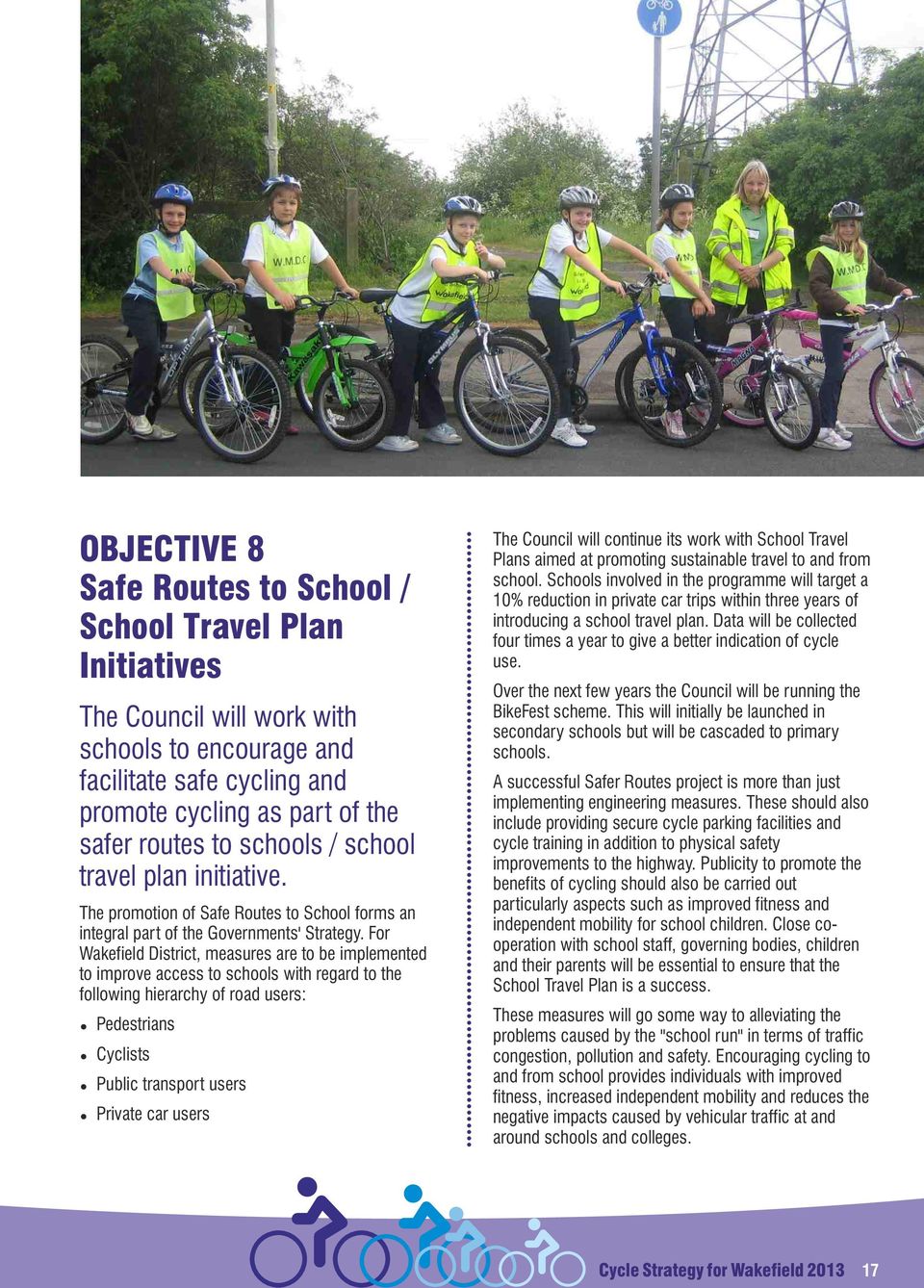
15 OBJECTIVE 4 Construction of Cycle Routes Cycle routes within the district will be constructed in line with the standards set out in Appendix C of this document. These standards will only be varied in exceptional circumstances or where local circumstances mean variations are in the best overall interests of cycle provision and after full consultation.... The standards of construction and maintenance of cycle routes is central to the ability of a route to attract and continue to attract cyclists. A sub-standard route, or one that quickly falls into disrepair, is unlikely to encourage more people to cycle. It is important to be clear about the quality of facilities that cyclists should be able to expect when riding in the district. Facilities will be designed to high standards, minimising future maintenance liabilities. Cycle tracks will be adopted and provided where they are constructed to appropriate standards, perform legitimate transport functions and create useful links to the network. 13
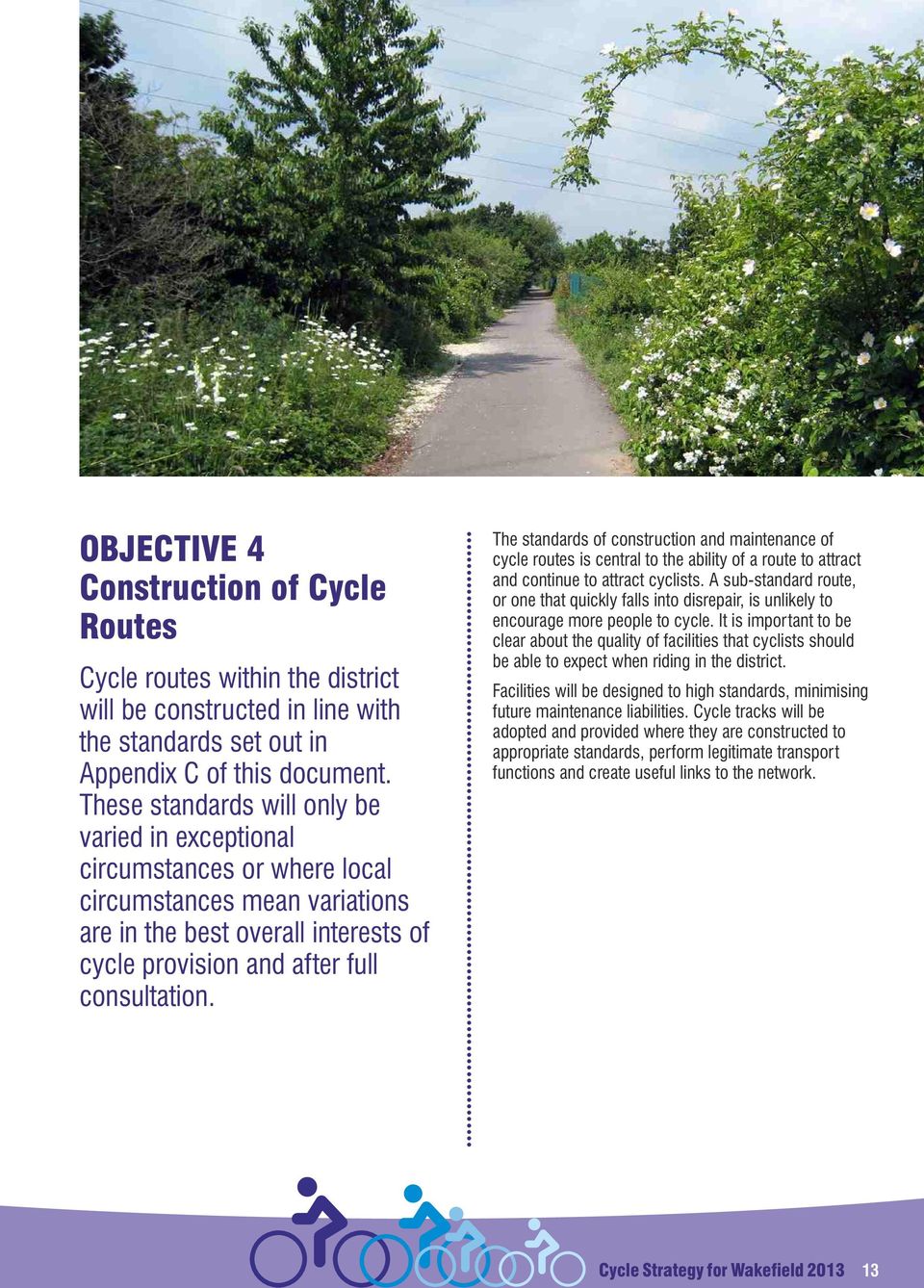
16 OBJECTIVE 5 Maintenance of Cycle Routes The Council will ensure that the designated cycle routes are adequately maintained within the resources available. We recognise that good maintenance of cycle routes is essential if we are to encourage increased cycle use. A constant source of irritation for cyclists is where cycle lanes are not adequately maintained, thus pushing the cyclist back onto the main road. This clearly destroys the purpose of the cycle lane and is counter productive. There are a number of areas that need to be improved, including surfacing, sweeping and landscape growth. The surface conditions will tend to affect cyclists to a far greater extent than motorists and can result in a safety hazard for cyclists.... The Council has appropriate standards for the inspection, maintenance and repair of the following types of cycle route: 1. Cycle routes within adopted highways including shared use paths. 2. Cycle routes that have been built to the adopted highway standards. 3. Cycle routes in rural areas or with low usage rates. These standards are set out in Appendix C of this document. 14
17 OBJECTIVE 6 Adopt Guidelines for Cycle Parking Standards Cycle Parking Standards listing detailed design requirements has been adopted as policy and published within the adopted Street Design Guide. The Council's cycle parking standards, which are shown in Appendix B, will form the basis of the Local Development Framework cycling accessibility standards. Parking should be provided at retail centres, public transport interchanges, leisure facilities and other major journey attractors. Employers will be encouraged to provide workplace cycle parking. Many potential cyclists are deterred from riding a bicycle through fear of having their bikes stolen. However, carefully planned provision of secure parking facilities can do much to encourage new users and make existing cyclists more confident about leaving their bicycles.... The level of cycle parking provision needed depends upon the type of development. Facilities for cycle parking and the type to be provided in new and re- developments should be in line with the Council's parking standards. Cycle parking should also provide security for bikes, convenience for the cyclist and an indication to the public that cyclists are welcomed. To this end, cycle parking should be provided in prominent locations close to entrances of public places, rather than on left over plots at the rear. The parking should be in view of the building entrance so that it benefits from casual, as well as formal surveillance. 15

18 OBJECTIVE 7 Travel Plans The Council will ensure that Travel Plans implemented as part of the planning process will secure measures to promote cycling in the workplace and in residential developments. Travel Plans are site or organisation specific initiatives aimed at promoting sustainable travel through increased use of public transport, cycling and walking with the aim of reducing the need to travel by car. The use of Travel Plans will form an essential part of the Cycle Infrastructure Strategy for Wakefield.... Measures to promote cycling in Travel Plans should include consideration of the need for: Increased levels of secure, conveniently placed cycle parking; Provision of dedicated shower / changing facilities; Cycle mileage allowances and the loans for the purchase of bikes through the National Cycle to Work scheme; The provision and / or upgrading of links to the local cycle network including highway quality signing; Providing staff with cycle training opportunities (e.g. through go:cycling). The Travel Plans will also set out targets for the increase in cycle travel. Wakefield Council will set an example as a cycle friendly employer and will actively encourage developers to adopt Travel Plans that promote cycling as an alternative mode of transport. 16

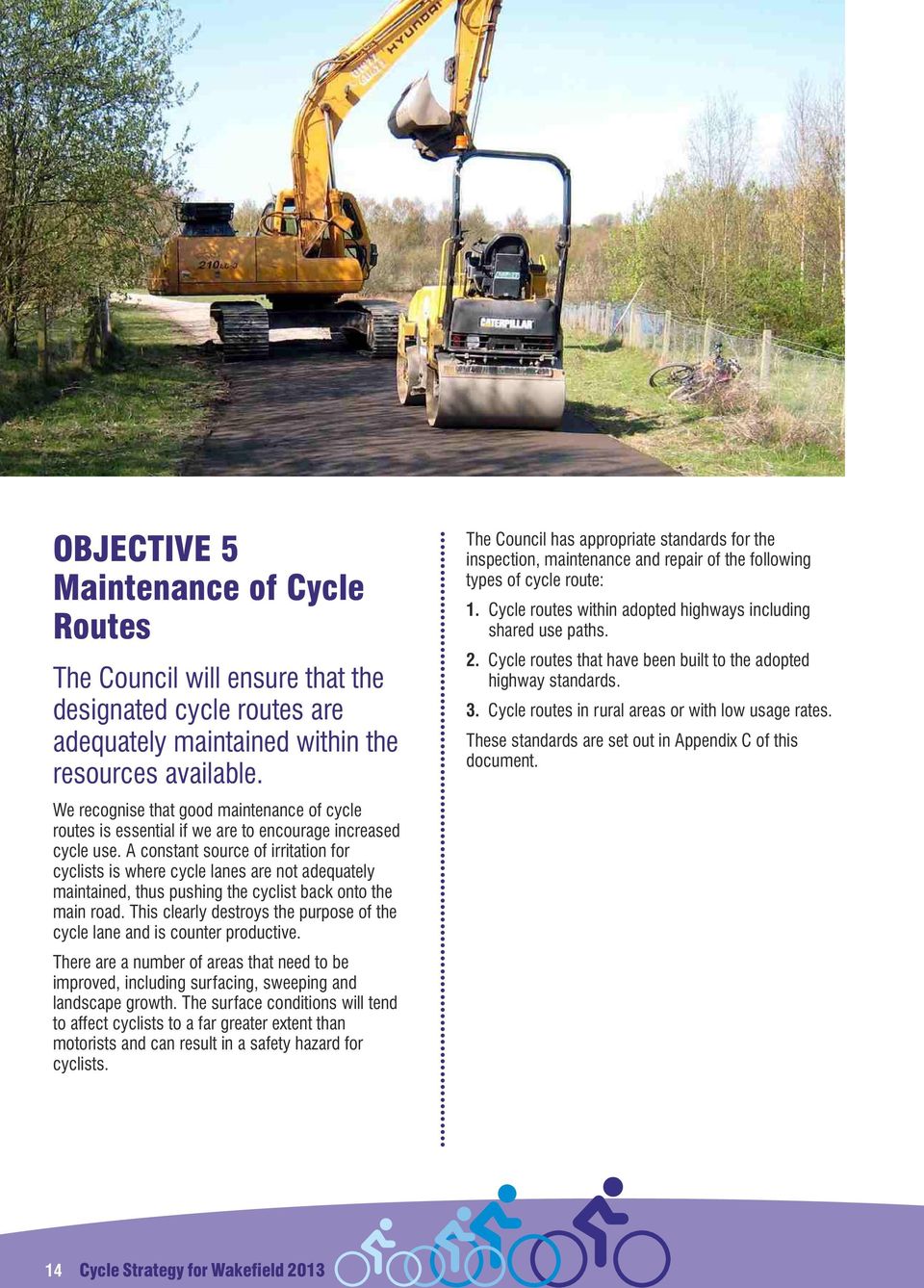
19 OBJECTIVE 8 Safe Routes to School / School Travel Plan Initiatives The Council will work with schools to encourage and facilitate safe cycling and promote cycling as part of the safer routes to schools / school travel plan initiative. The promotion of Safe Routes to School forms an integral part of the Governments' Strategy. For Wakefield District, measures are to be implemented to improve access to schools with regard to the following hierarchy of road users: Pedestrians Cyclists Public transport users Private car users... The Council will continue its work with School Travel Plans aimed at promoting sustainable travel to and from school. Schools involved in the programme will target a 10% reduction in private car trips within three years of introducing a school travel plan. Data will be collected four times a year to give a better indication of cycle use. Over the next few years the Council will be running the BikeFest scheme. This will initially be launched in secondary schools but will be cascaded to primary schools. A successful Safer Routes project is more than just implementing engineering measures. These should also include providing secure cycle parking facilities and cycle training in addition to physical safety improvements to the highway. Publicity to promote the benefits of cycling should also be carried out particularly aspects such as improved fitness and independent mobility for school children. Close cooperation with school staff, governing bodies, children and their parents will be essential to ensure that the School Travel Plan is a success. These measures will go some way to alleviating the problems caused by the "school run" in terms of traffic congestion, pollution and safety. Encouraging cycling to and from school provides individuals with improved fitness, increased independent mobility and reduces the negative impacts caused by vehicular traffic at and around schools and colleges. 17
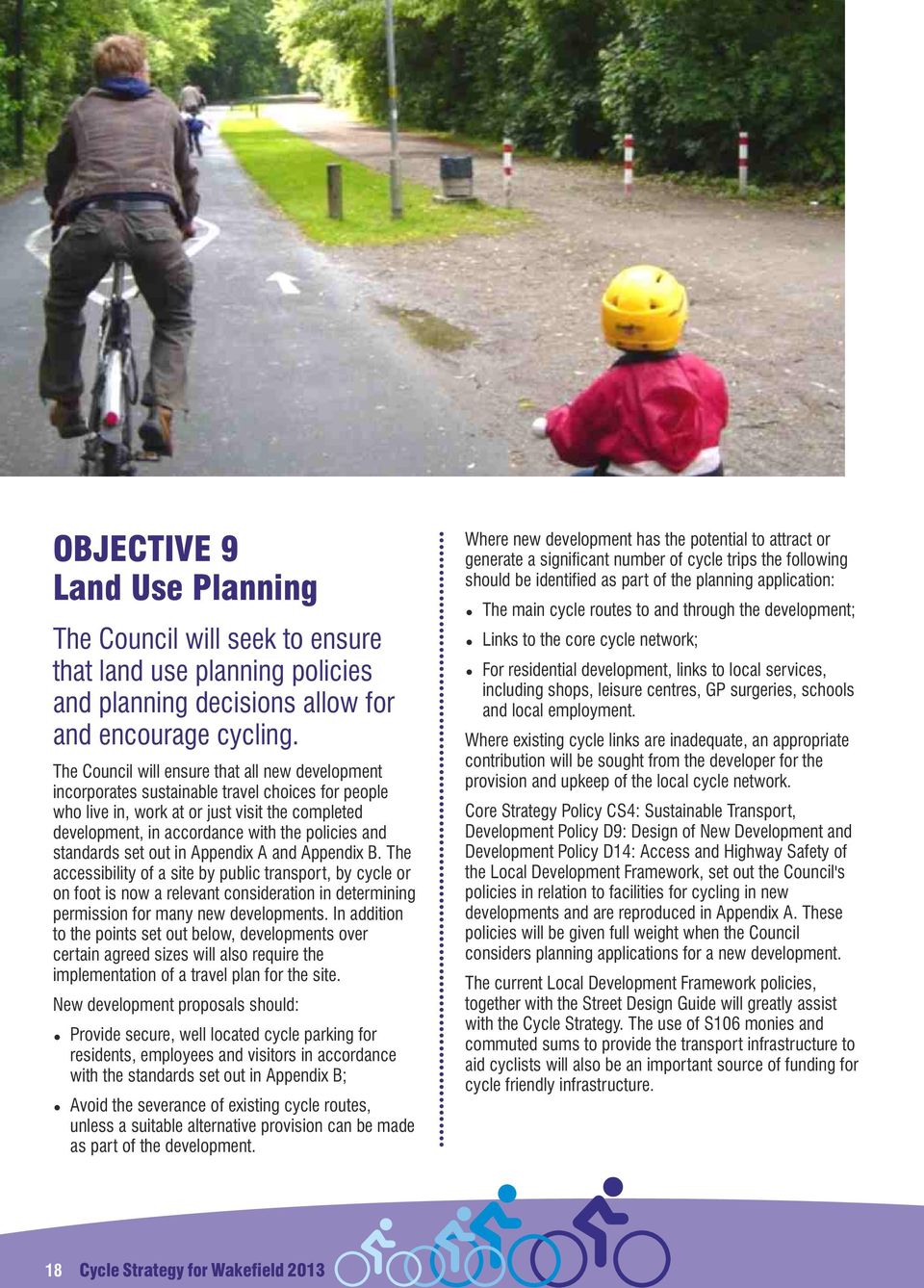
20 OBJECTIVE 9 Land Use Planning The Council will seek to ensure that land use planning policies and planning decisions allow for and encourage cycling. The Council will ensure that all new development incorporates sustainable travel choices for people who live in, work at or just visit the completed development, in accordance with the policies and standards set out in Appendix A and Appendix B. The accessibility of a site by public transport, by cycle or on foot is now a relevant consideration in determining permission for many new developments. In addition to the points set out below, developments over certain agreed sizes will also require the implementation of a travel plan for the site. New development proposals should: Provide secure, well located cycle parking for residents, employees and visitors in accordance with the standards set out in Appendix B; Avoid the severance of existing cycle routes, unless a suitable alternative provision can be made as part of the development.... Where new development has the potential to attract or generate a significant number of cycle trips the following should be identified as part of the planning application: The main cycle routes to and through the development; Links to the core cycle network; For residential development, links to local services, including shops, leisure centres, GP surgeries, schools and local employment. Where existing cycle links are inadequate, an appropriate contribution will be sought from the developer for the provision and upkeep of the local cycle network. Core Strategy Policy CS4: Sustainable Transport, Development Policy D9: Design of New Development and Development Policy D14: Access and Highway Safety of the Local Development Framework, set out the Council's policies in relation to facilities for cycling in new developments and are reproduced in Appendix A. These policies will be given full weight when the Council considers planning applications for a new development. The current Local Development Framework policies, together with the Street Design Guide will greatly assist with the Cycle Strategy. The use of S106 monies and commuted sums to provide the transport infrastructure to aid cyclists will also be an important source of funding for cycle friendly infrastructure. 18
21 OBJECTIVE 10 Communication and Promotion The Council, in partnership with the West Yorkshire Transport Authority, including the project and the Wakefield District Cycle Forum will provide clear, consistent and useful information to encourage cycling across the Wakefield District. Publicity is one of the more important factors in a successful cycling initiative. People need to be informed about the options available and be able to make the choice on the different modes of transport available to them. The Council will actively promote cycling throughout the district through a variety of measures, including: Updating the Wakefield District Cycle Map; Creation of one point of contact;... Information being available on the Council and Metro's websites; Travel packs provided at all new developments to include cycling information; Signing up to Skyride; Use of local press and Council publications; Leading by example; Consistently utilising the brand to support promotional material and activities. Go:cycling The project has been set up by the five West Yorkshire district Councils and Metro as a way of encouraging greater participation in cycling as a means of travel for adults. The approach includes: A bold and engaging branding style to be central to the promotion of adult cycling: - Promotion of new or enhanced infrastructure; - Promotion of cycling as an activity and form of travel; - Promotion of cycling through workplace travel plans. An offer one to one or group adult cycle training: - 3 levels of the National Training Standards for riding on public highways; - Cycle maintenance skills. 19
22 The brand is jointly owned by the West Yorkshire district Councils and Metro. For the brand to achieve its optimum effectiveness it needs to be consistently assimilated into all promotional material. National Bike Week Often provides the focus for all cycle promotional activities undertaken by a Local Authority. However there is a need for a year round commitment to promote cycling and provide well-distributed cycle literature and information to ensure that cycling is retained within the mindset of the public. Website Currently the webpage on the Council's website under "cycling" or on the Wakefield District Cycle Forum Website at contains useful information on cycle routes, maps, Cycle Forum, local bike shops contacts and relevant web-links. This web-page will be developed further to include the cycle strategy and more general guidance (parking standards etc) as well as information on where to cycle in the Wakefield District. Council Strategies There is a need to capitalise on the work achieved through the Staff Travel Plan by ensuring cycling incentives for staff is high on the agenda. Working in these groups ensures that extra resources are diverted towards providing facilities and incentives for staff to encourage cycling. The Staff Travel Plan will adopt the Cycle to Work scheme, bicycle mileage, facilities and pool of bikes with maintenance negotiated. The Sport and Physical Activity Strategy's vision is to provide opportunity to increase participation and improve performance in sport and physical activity. The Employee Health Plan will promote cycling for health and fitness in order to contribute to the reduction of staff sickness days through illness. Wakefield Council has established a Bike Users Group to support staff who cycle, help campaign for improved facilities, support cycle events and share cycle information. School Travel Plans The School Travel Plan and Road Safety Team will work with schools on Bikeability Training, BikeFest and other cycle training initiatives. Cycling Information A thoroughly revised and updated Wakefield District Cycle Map will be published and the website will also be updated and improved but there is still a need for further literature focusing on promoting cycling in the district. More general information on choosing a bike and how to maintain a bike will be put on the website. Cycle Network/Facilities As the Cycle Network develops the Council will publicise routes opened to encourage their usage and increase cycling levels. Local Bike Shops Will be actively encouraged to attend the Wakefield District Cycle Forum to build relations and the further promotion of cycling. Wakefield Council will investigate whether a local bike shop consortium can be established - offering incentives for employees/schools involved in travel plans, or discounts for National Bike Week Events organised by the Council and Wakefield District Cycle Forum. Cycle Signage The Council will seek to introduce effective cycle signage where possible. Cycle signage provides a constant presence for cycling in the physical environment, raising awareness to both the pedestrian and the driver. Currently there is not enough cycle signage in Wakefield. Proper signage is needed on the cycle network's longer routes and more signage is needed indicating destinations along with an indication of distance/time likely to be taken to arrive at destination. Get Wakefield Cycling Group The Council has set up a group, consisting of all people involved with and interested in cycling across the district (e.g. cycle clubs, cycle trainers, shop owners, etc.) to help deliver the Get Yorkshire Cycling initiative. 20
23 OBJECTIVE 11 Enforcement The Council fully supports national and local road safety campaigns and will work with the Police to ensure that traffic law is enforced locally. We recognise that with cycling increasing in popularity, particularly in urban areas, there is a need to make cycling safer for both cyclists themselves and for other road uses, particularly. There are a number of sanctions for the police for those cyclists who break the law. There will be difficulties with enforcement, especially with children cycling on the pavement, and penalties or prosecutions are a matter for the police. It is an offence to ride a bicycle on a public footpath under section 72 of the Highways Act 1835, as amended. This was made a fixed penalty offence in 1999 and since December 2002, Police Community Support Officers have been able to issue a fixed penalty notice for this offence.... It is also an offence to ride a cycle dangerously or carelessly on a public road (including the pavement) and to cycle while under the influence of drink or drugs. Cycling on the pavement is an offence which presents particular difficulties for enforcement. Many cyclists, not just children feel anxious and exposed when riding in traffic and therefore use the pavement for safety. This is understandable and must be taken into account in enforcement. However, pedestrians also have the right to use the footway without facing the hazard of cyclists approaching them or coming up from behind. This practice can be especially worrying for the elderly, the infirm and the very young. The Council recognises that the enforcement of cycling offences can be difficult, but we will continue to work with the police in establishing the right balance on how to enforce the law in this area. In addition, the Council will continue its work with West Yorkshire Police to discourage the thefts of bicycles and ancillary equipment by ensuring secure facilities for cyclists in addition to educating cyclists on how to store their equipment securely. As connectivity is a major consideration for cyclists, the Police Architectural Liaison Officer should be consulted on new layouts and connections to ensure that routes are not created that might encourage antisocial behaviour and crime. 21
24 6. Targets The following targets have been set by the Council, within the context of the National Cycling Strategy and carries on the targets set in the former Local Transport Plan (LTP2), as a means of achieving the aims and objectives outlined in this document. The targets are considered realistic and achievable, given a reasonable level of funding. In line with the LTP3, these targets are monitored and reported annually. Target Increase the number of peak period cyclists by 100% to 1% by 2026 from a base of 0.5% in % of journeys to work in the major urban centres to be by cycle by 2026 (from a base of 1% in 2005). 3% of the trips by pupils between 5-15 years in schools that have implemented travel plan initiatives to be by cycle in 2026 (from a base of 2002 levels). To provide cycle safety training for 50% of all year olds by To have 75% of secondary schools and colleges involved and committed to school travel plan initiatives by To reduce the number of slight injuries suffered by cyclists from an average of 20 between to 15 by The number of cyclists involved in fatal and serious road accidents is low, making it difficult to set statistically meaningful targets. The policies of this document will, however, contribute to the Council's targets of a 50% reduction in the number of children and an overall 40% reduction in the number of people killed and seriously injured in road accidents by 2016 from the average. Increase the total cycle parking provision at key transport hubs, schools, places of employment etc throughout the district year on year. Increase the total length of cycle routes throughout the district year on year. Ensure that all existing cycle routes have been surveyed and entered on a common map base (MapInfo GIS) by the end of Improve the satisfaction of people believing that quality of cycle facilities in the Wakefield district to be very good. Aims Encourage more people to cycle Encourage more people to cycle Encourage more people to cycle Encourage more people to cycle Encourage more people to cycle Reduce casualty rates Develop transport infrastructure Develop transport infrastructure Develop transport infrastructure Encourage more people to cycle 22
25 7. Proposed Action Plan The Action Plan collects together the actions to be undertaken by the Council to put into effect the Cycling Strategy. We feel that the Action Plan is challenging but realistic, recognising inevitable pressures on staff time and budgetary constraints. It is intended that cyclists will as soon as possible begin to see the benefits of this Strategy, so "quick wins" will be implemented where possible. The programme is dependent on sufficient resources, and to take advantage of external funding opportunities, certain programmes may be accelerated and others postponed. Objective 1: Creating a network of cycle routes Action Publish Wakefield Cycle Infrastructure Strategy as Council Policy. Timescale Draft for cabinet. Circulate for consultation. Assess responses and produce draft for adoption. Adopt strategy. By October 2012 February 2013 October 2013 Finalise a Strategic Cycle Network Plan to ensure that: All existing and proposed cycle routes have been surveyed and entered on a common map base. Staff currently working on GIS map base The map base is amended annually. 2: Design Principles and Standards Work on major routes and advisory routes for cyclists within key corridors: Compile a programme of implementation. Continue to develop off road cycle routes and links to sports and leisure facilities. Work in partnership with the Canal & Rivers Trust to deliver cycle facilities. Cycle Audits to be undertaken on all major schemes. All new developments to include Advanced Stop Lines and feeder lanes subject to Safety Audits. Potential upgrades to Toucan Crossings as part of new developments. Provide signing to all major and advisory cycle routes. Ongoing - to be completed by April 2014 To attend the Cycle Stakeholders meetings Ongoing 23
26 Objective Action Timescale 3: Cycle Safety Identify cycle accident black spots and characteristic problem areas. By April 2014 Draw up hierarchy of problem sites and produce a timetable for improvement implementation. Use of traffic management measures to improve cycling conditions. 4: Construction of Cycle routes 5: Maintenance of cycle routes Ongoing cycle training in schools. Continue to design cycle routes as direct as possible with emphasis on safety. Develop walking and cycling links to education facilities. Improve walking and cycling access and facilities at public transport interchanges. Develop highway maintenance strategy in accordance with the West Yorkshire Transport Asset Management Plan. Specific standards for the maintenance of cycle facilities and routes will be implemented and adopted. Ongoing Ongoing to be reviewed by April 2014 Assess maintenance budget to develop prioritised programme of maintenance. 6: Adopt guidelines for parking standards Compile current cycle parking standards as a stand alone document or within Street Design Guide. Compile baseline surveys of cycle parking facilities and: Identify key locations for cycle parking in town centres. Develop prioritised programme for installation of new facilities. Already within the Street Design Guide Ongoing - as part of GIS map base Develop secure cycle parking at key trip destinations. 24
27 Policy Action Timescale 7: Travel Plans Continue to encourage developers to introduce measures to improve cycling within their Travel Plans. Through development control procedures request cycle parking provision, improvements to cycle links. Finalise and publish the Council's document: "Travel Plans and New Development: Guidance on Preparing Travel Plans". Ongoing Secured through the planning process To commence : Safe Routes to School / School Travel Plan Initiatives Continue to work with schools to encourage and facilitate safe cycling and promote cycling as part of safer routes to schools initiatives. Ongoing 9: Land Use Planning Publish new Street Design Guide. Adopted in January : Communication and promotion Promote the recreational and leisure uses of cycling and identify suitable leisure routes. Publicise the cycle route network and other facilities, emphasising the health, social, financial and environmental benefits of cycling. Work with the Primary Care and NHS Trusts to develop health promotion initiatives. Leisure & Recreation Leisure & Recreation Leisure & Recreation Deliver Bikeability projects within targeted schools to encourage the uptake of cycling to school. Work with the Wakefield District Cycle Forum, go:cycling and Sky Ride to organize and publicise rides and cycle training. Continuous programme Continuous programme 11: Enforcement Continue to support national and local road safety campaigns. Continuous With the introduction of Civil Parking Enforcement (CPE) ensure that traffic law is enforced - parking on cycle lanes. CPE to start 2014 Continue to reduce cycle casualties through a programme of engineering, education and enforcement measures. Continuous 25
28 8. Proposed Programme of Cycling Initiatives Sustrans undertook a study for Wakefield Council to assess the feasibility of developing a cycle network throughout the Five Towns. Particular attention was given to promoting sustainable access to the rail stations. The aim of the study was to make cycling an attractive means of getting around the district to work, to school, to shop and to leisure facilities. A series of plans were produced, together with the associated costs. These initial plans will form the first part of our programme of cycling initiatives, which will tie in with the recent adoption of the Local Development Framework. We will commission Sustrans to complete the feasibility of developing a cycle network for the rest of the district, so that our programme covers the whole district. While we carry out this review, we will continue to deliver proposed schemes, subject to funding being available. To tie in with the Wakefield District Transport Strategy and Implementation Plan, the Local Development Framework and Local Transport Plan (My Journey LTP3), the Council proposes the programme of works, outlined by Sustrans is delivered over the next 15 years; providing budgetary provision is made. Where routes fall within sites that are allocated within the Local Development Framework, it is expected that developers will provide / contribute to the provision of that route. 26
29 9. Monitoring Data gathered in across the district for the Local Transport Plan have indicated that the levels of cycling across the district are still low in comparison with the National Average. The importance of monitoring to establish the success of a strategy is well documented and is recognised as an important factor in measuring achievement and commitment. The Council will monitor the success of the Cycle Infrastructure Strategy through the following targets and indicators: Production of a Strategic Cycle Network Plan for the district by 2012; Annual length of Cycle Routes created. Base data needs to be established; Cycle Accident data; Annual installation of cycle parking facilities. Base data needs to be established; Previous versions of this strategy contained a number of targets, although none were monitored in sufficient detail to judge progress. A new programme of monitoring set out in this document will allow the assessment of future progress. Cordon counts will be carried out in Wakefield, the Five Towns and Castleford Areas. For future monitoring, counts will be repeated at these locations every two years. The counts for each site will comprise of two 12 hour weekday surveys ( ) taken in June and October. The Cycle Infrastructure Strategy will need to be monitored to ensure that the aims and objectives of the Strategy are being achieved. A Monitoring Report will be produced every two years to assess the success of the strategy. One of the key indicators will be the actual numbers of cyclists on some of the strategic route corridors in the district. Monitoring of cycle usage on strategic routes through Local Transport Plan (My Journey LTP3); Monitoring of School Travel Plans and promotional activities; Monitoring of the Bikeability scheme. 27
30 28
31 APPENDIX A Local Development Framework Policies 29
32 Local Development Framework Policies Core Strategy Policy CS 4 - Sustainable Transport Development will be located in accordance with the spatial development strategy so that the need to travel is reduced and essential travel needs can be met by the use of transport modes other than the car. In particular development will be located where: a) It can be served by alternative modes of transport other than the car, such as public transport, walking and cycling. f) Development which generates a large number of passenger movements should be located in Wakefield city centre, in other town centres, in the main urban areas or at locations which provide convenient access on foot, by cycle and public transport. The number and proportion of journeys by public transport, cycling and on foot will be increased by: g) Creating integrated, safe and attractive public transport, cycling and footpath networks across the district. h) Giving priority to buses, cyclists and pedestrians over the private car, particularly in urban areas. I) Promoting the integration of cycling and walking with public transport as part of longer journeys. Policy CS 9 - Transport Network e) High quality, safe cycle, footpath and bridleway networks will be safeguarded and extended to provide opportunities to reduce the number of short car journeys and for cycling, walking and riding for recreation in the countryside. Disused railway lines and waterways across the district, including the former Barnsley Canal, will be protected from other forms of development to safeguard their potential to be reinstated to their former use for commercial or leisure purposes or to extend the cycling or footpath networks. Policy CS 14 - Influencing the Demand for Travel The Council will work with relevant national, regional and sub-regional agencies to develop a co-ordinated long term approach to manage the demand for travel. The spatial development strategy will maximise the use of sustainable modes of travel - public transport, walking and cycling and reduce the need to travel by concentrating development in city / town centres. Alongside this strategy, the Council will influence the demand for travel through: e) Securing local and area wide Travel Plans to reduce the number of single occupancy car trips generated by or attracted to new development, working in partnership with relevant organisations including the Highways Agency and Metro. Development Polices Document Policy D9 - Design of New Development Within the district are a diverse range of settlements which have distinct local characteristics. In order to maintain and enhance local diversity all new developments shall make a positive contribution to the environment and amenity of its locality by virtue of high quality design, layout and landscaping. In particular proposals shall: f) Incorporate arrangements for access of vehicles, pedestrians and cyclists. Policy D14 - Access and Highway Safety Development proposals shall demonstrate that they can be accessed conveniently and safely and by modes of transport other than the car. In particular proposals shall: d) Provide pedestrian and cycling connections within the site and to its surroundings, including linking into existing and proposed pedestrian and cycling routes where appropriate and ensuring these can be accessed easily and safely and by all sections of the community. e) Include provision for safe cycle storage. 30
33 APPENDIX B Cycle Parking Standards for Wakefield 31
34 Cycle Parking Guidelines Introduction The provision of high quality cycle parking is an important part of Wakefield's Cycle Infrastructure Strategy as set out in the Local Transport Plan and the Local Development Framework Core Strategy Policy CS4 - Sustainable Transport. Increased cycling is an important element of progressing policy aims to reduce the dependency on the use of the car. In order to achieve this, new or improved developments must cater for the needs of cyclists in the form of good quality long and short stay cycle parking, and, where relevant, associated facilities such as changing areas, lockers and showers. Core Strategy Policy CS4 states: "New development proposals will provide opportunities to introduce new and improved routes and facilities for cyclists and pedestrians. Layouts should provide facilities for cyclists and segregated connections to the footpath, cycle track or highway network, providing direct access by cycle and on foot to destinations within the development. Transport Assessments should demonstrate that the needs of cyclists and pedestrians have been taken into account (using cycle and pedestrian audits). Planning conditions and obligations will be used where appropriate to ensure the provision of appropriate facilities is secured". The cycle parking standards listed in this document also form part of the Council's District Wide Parking standards within the new Street Design Guide, adopted in January Many developments will also require a Travel Plan, which will include cycle parking and internal facilities. A Travel Plan is developed and progressed over a longer time period before and after construction of the development. However, it is important that the necessary physical measures relating to cycle parking are considered at the design stage so that they are approved as part of the planning permission for the development. This will ensure that the best possible facilities for cycle parking are provided. The need for cycle parking Providing the confidence that a parked bicycle will still be there on its owner's return is an important element of encouraging more people to cycle; removing the fear of theft overcomes ones of the greatest obstacles to bicycle use. Good cycle parking needs careful thought and sensitive design to ensure it meets users' needs. It also needs to be provided over the whole life of any development to match levels of parking provision with growth in cycle use. However, when successfully implemented it brings a number of benefits both for individual cyclists and the community as a whole; these include: Encouraging people to cycle by reducing theft; Widening modal choice and flexibility for short journeys; Increasing accessibility to shops and local facilities; Creating a healthier community when used to encourage cycling to school and work; Reducing the need for car parking (typically 8 bikes can be parked in the space of one car), freeing up land for other uses; Low costs of installation and maintenance. The purpose of this document is to give guidance on the nature and layout of cycle parking, and other security measures, to be provided as a consequence of all new development. The guide aims to reflect best practice whilst taking into consideration the need to balance between the different demands on land use. It is aimed at: Developers and their agents; Planning and highway engineering staff of local authorities; Anyone else with an interest in this subject. It is imperative that cycle parking forms an integral part of any full or reserved matters application, rather than treating it as a secondary issue to be resolved by condition. Full details of the location, type of rack, spacing, numbers, method of installation and access to cycle parking should be provided. 32
35 Planning for cycle parking To be effective, cycle parking should be integrated into not only the existing streetscape but also into the design of new developments. When doing so, the following principles of best practice should be followed i.e. cycle parking should be: Visible Cycle parking should be easy to find and well signed if necessary. Good siting and high quality facilities will help demonstrate the importance of cycling as a transport mode. Accessible Cycle parking should be easy to get to and as close as possible to the cyclists' destination - typically within 20 metres. It should be easy to get to and should be well laid out with no difficult ramps or obstructions. Secure Cycle parking should provide security for the bicycle and its user and be sited where it is regularly overlooked. Stands should enable the bicycle to be secured by the frame and at least one wheel, preferably both. Parking should not be sited in locations where users are likely to feel their personal security is at risk. Lighting and CCTV coverage may be necessary in some situations. Easy to use, manage, maintain and regularly monitored Stands should be able to support all types of bicycle, even when knocked, and be used by all members of the community; cycle parking that proves difficult to use may be ignored and street furniture used instead, possible to the detriment of pedestrians. Lockers are best managed by assigning them to individuals. Robust finishes that reduce whole life costs and do not scratch bikes are preferred. Surfaces under and around stands and lockers should be easy to sweep. Consistently available Where parking is needed for short periods, for example in shopping areas, small clusters of stands at frequent intervals will often provide a better level of service than larger grouping at fewer sites. Covered Covered long stay parking, for example at transport interchanges, school or work sites will make cycling a more attractive option. Connected Cycle parking should complement both the on-road and off-road cycle network, and destinations along the way, with no barriers to its use created by difficult road conditions or other safety hazards. Linked to other services Where parking is provided at rail or bus stations or as cycle centres, countryside projects etc, opportunities to combine parking with activities such as cycle hire, repair, countryside access projects and tourist information should be exploited. Attractive The design of cycle parking equipment should ensure it fits in visually with its surrounding environment. Not a problem for others Cycle parking should not obstruct pedestrian desire lines or pose a hazard to the blind or partially sighted. It should also comply with the requirements of the Disability Discrimination Act
36 Statutory procedures Road Traffic Regulation Act 1984 Part IV of the Road Traffic Regulation Act allows for the provision of off street parking places for vehicles and allows the use of any part of a road as a parking place. These powers are extended by Section 63 of the Act to allow provision "in roads and elsewhere of stands and racks for bicycles". It is interpreted that this includes cycle stands. A singles Order under this Act can be used for the provision of cycle parking in the whole of an administrative area. However, all the individual sites must be set out in the mandatory accompanying Schedule. Where there are existing waiting and loading restrictions in force, bicycles, like other vehicles, may not be legally parked on the carriageway or within the footway. Where such restrictions are in force, cycle parking can be permitted through an exemption within the existing waiting and loading orders or by additional orders designating part of the road for cycle parking only. Highways Act 1980 In pedestrianised streets, section 115B of the Highways Act (inserted in Schedule 5 of the 1982 Act), provides for a local authority to place objects or structures on a highway for the purposes of providing a service for the benefit of the public or a section of the public. Where pedestrianised highways have been introduced under Section 249 of the Town & County Planning Act 1990, this also gives local authorities the powers to place objects / structures on the highway. In both of these cases, this has been interpreted as permitting local authorities to provide cycle stands. NOTE: These procedures may only be carried out by Wakefield Council as Highway Authority. Where new cycle parking is provided within the existing highway by virtue of new development the Council may seek to recover from developers the reasonable costs of doing so. Disability Discrimination Act 1995 The Disability Discrimination Act gives disabled people important rights of access to everyday services. The siting or use of cycle parking should not impede these rights. Local consultation should be undertaken to address the needs of those with disabilities. Unsuitable Cycle parking facilities Cycle parking facilities that only allow for the front or back wheel to be secured are not favoured by cyclists for a number of reasons: Cyclists favour a cycle parking device, against which the bicycle A frame can be rested making the cycle less likely to fall over; Wheels can easily be removed from a bicycle frame. Therefore, securing only a wheel to a cycle parking device means that a thief can easily steal the main body of the bicycle leaving the wheel secured to the cycle parking device. It has been known for a thief to bring a spare wheel to attach to the stolen bike frame to allow a stolen bicycle to be ridden away; Cyclists favour securing the A frame of their bicycle to a cycle parking device as this provides the best way to secure a bicycle. The devices shown below do not allow a cyclist to do this, particularly with U- locks or short cable locks; Bicycles can be easily pushed over, causing damage. The following pictures give examples of cycle parking devices that only allow the front or back wheel to be secured. These facilities should not be used. X 34
37 Short stay cycle parking facilities Short stay cycle parking needs are those required by visitors or customers to a building. It should generally be provided as close to the entrances of a building as possible. Cycle stands should be positioned so that they can be properly used eg with adequate clearance from walls. Signage may be required. It should be within CCTV coverage, overlooked by adjacent development or on well used pedestrian routes to minimise the risk of theft or vandalism. Cycle parking facilities must be located in a safe, convenient location, usually within the curtilage of the development. "Sheffield" stands (defining a "staple" or "n" shape) are recommended for most types of development - one of which is suitable for two cycle parking spaces when installed correctly. Sheffield stands allow the cycle frame to be locked to the stand, whereas some other designs allow only the front wheel to be locked, which is less secure and can allow the cycle to fall. At least some short term cycle parking should be protected from the weather (a portion can be unprotected, since demand tends to increase during dry weather). Stands should be spaced at 1.0m intervals to allow two bicycles to use each stand; Bolted down stands are more secure when used in a grouped "toast rack" configuration, rather than individually. If an embedded mounting is used; footplates, or the addition of pins through the stand legs greatly increases security. Do not surface mount on tarmac. Sheffield Stand When the stand is less than 1.8m long the stand should be located at least 650mm from a wall / fence to allow the bicycle wheel to overhang the stand and enable the A frame of the bicycle to be secured to the stand. Sheffield Stand specifications Only the higher specification galvanised and powder or nylon coated should be used. Stainless steel can also be used and will not rust away at ground level. Sheffield stands can be either bolted to the ground or embedded in concrete footings. If those bolted to the ground are to be used, anti theft bolts should be used, or the heads otherwise adapted to prevent unscrewing. Covered Sheffield Stand 35
38 Long stay cycle parking facilities Long stay facilities are provided where the user is likely to park their bicycle for a significant period of time, such as an employee who cycles to work, cyclists leaving their bicycle at a train station, whilst they travel on the train, students who cycle to schools and colleges. They should also be provided in shopping centres, leisure centres and public buildings and other places where members of the public could be expected to spend lengths of time The facilities must be located in a safe, secure, convenient, well lit location within the curtilage of the development. Security considerations may dictate that long term parking is provided either within the building itself or to the side or rear of the building. Whilst the need for security is important, it must also be accessible to the relevant cycle users, close to a convenient building entrance. The key requirements of long stay parking should: Provide shelter from the elements; Allow the A frame of the bicycle to be secured; Provide for the safe storage of cycle helmets, lights etc. New developments should therefore provide either inside the block of flats to secure bikes or provide a separate bike shed within the housing development. For houses the provision of a suitable sized garage (6.0m x 3.0m) can provide sufficient space for a vehicle and cycle parking. Houses in new developments without a garage should provide a garden shed, should have a secure cycle hoop or security anchor installed Facilities should provide security for the whole bicycle, including accessories. Weather protection is essential. Places of employment, such as offices, factories etc should provide a purpose built store and also provide internal facilities such as changing rooms, lockers and showers for staff. To encourage cycle use for commuting to work it is important that these facilities are provided. Such facilities should be integral to staff travel plans where these are a requirement of new or expanded development. Shopping centres, leisure centres and other buildings used by members of the public should also provide for the long stay cyclist in the form of purpose built storage. These measures should be provided in new car parks to encourage travel to town centres by cycle. Cycle parking facilities provided as a condition of planning consent must be retained for this purpose. The importance of providing some form of cycle parking space for flats and houses cannot be overemphasised. Small halls and flats up stairs cause real problems for those wishing to cycle and deter those who might otherwise use this form of transport. Covered "Sheffield stand" with lockable access (requires personal lockers for the safe storage of cycle helmets, lights, clothes etc.) Individual cycle lockers (allowing storage of bicycles and helmets, lights etc.) 36
39 Cycle parking provision The general guidance on levels of cycle parking provision in new developments within Wakefield is as follows: Cycle Parking Standards - for a full list please refer to the Street Design Guide Development Cycle Parking Required A1 retail A3 - A5 B1 - B2 B8 C1 Residential Health centres (D1) Education Long stay spaces 1 space per: 500sq.m or 10 staff Secure and undercover 50sqm or 3 staff Secure and undercover 150 sqm / 10 staff Secure and undercover 500 sqm / 10 staff Secure and undercover 10 beds / 3 staff Secure and undercover unit Secure and undercover 5 staff Secure and undercover 10 students Secure and undercover Short stay spaces 1 space per: 500sq.m Sheffield stands 50sqm GFA Sheffield stands 150 sqm Sheffield stands 500 sqm Sheffield stands Minimum 2 spaces Sheffield stands Minimum 2 spaces Sheffield stands Minimum 2 spaces Sheffield stands As the level of cycle parking will depend upon type of facility, likely number of visitors, the availability of existing nearby parking, location of development and the requirements of any agreed travel plan. When new parking facilities are introduced these should aim to meet the existing demand (including suppressed demand) and provide capacity for future growth. Wakefield Council will regularly monitor the take up of new cycle parking to ascertain if demand is growing. Growing demand should be met by regularly increasing the number of parking spaces. Manual for Streets recommends that "providing enough convenient and secure cycle parking at people's homes and other locations for both residents and visitors is critical to increasing the use of cycles. In residential developments, designers should aim to make access to cycle storage at least as convenient as access to car parking". This guidance cannot cover every potential parking situation or layout. Designers should not, therefore, simply rely on the information represented by the diagrams and summary tables etc. Instead they should seek to understand the principles involved in order to be able to determine for themselves, from first principles, what solution best suits the needs of those who will use the parking for many years to come. 37
40 38
41 APPENDIX C Construction Standards Cycle Standards and Specifications for Highway Schemes 39
42 Mandatory (Traffic Regulation Order required) and Advisory Cycle Lanes Cycle lanes within the adopted carriageway will, where road conditions allow, be designed to be 1.5m. This width is based on two cyclists abreast (0.75m per cyclist). 2m should be used where speeds are greater than 40mph and where they form part of the identified cycle routes. Mandatory Cycle routes are the preferred option as Advisory Cycle routes are seen as more hazardous due to parked vehicles. It is acknowledged that there will be a range of circumstances when achieving these widths is not possible but we intend to provide cycle lanes of various widths to cope with a range of carriageway widths as shown in the table below: Cycle Lane Widths Uniform surface colour - Red should be the standard and only used on classified and main roads or where it forms an integral part of the Wakefield Cycle network. Coloured surfacing will also be considered to highlight a cycle lane, across road junctions or on classified roads for example. Signing - Cycle lanes will be signed as set out in the "Traffic Signs Regulations and General Directions 2002" (TSRGD) or any subsequent Regulations. Carriageway Width (m) Half Carriageway Width (m) Cycle Lane (m) General Purpose Lane (m) None * None * /1.8 ** 3.65/ Notes: * Use 0.75m lanes in special circumstances or in lead up to advanced stop lines. ** Where cycle lanes are mandatory and the cycle flows are high, then it may be beneficial to widen the lanes from 1.5m to 1.8m or more. Cycle lanes wider than 1.8m are likely to be abused by other traffic. Advanced stop lines (ASL) - will be considered in all new and renewed and resurfaced signalised junctions with the ASL depth ranging from a minimum of 4m to a maximum of 5m. If highway capacity requires a depth of 5m then the least possible depth will be 3m. Advanced stop lines should be served by a cycle lane, where road width allows. Feeder lanes - Minimum width should be 1.2m but ideally 1.5m and should only be provided where there is sufficient carriageway width i.e. 3.65m or more with a cycle symbol 750mm wide. 40
43 Cycle paths All sections of shared use path will be designed equally for pedestrians, including those with disabilities and cyclists. In some areas, provision for horses will also be required. In remote areas or where total flows are low paths will be unsegregated, while in more urban areas or areas with high total flows the path will be segregated Cycle Lane Widths Type Unsegregated Shared path Bridleway Riverside Path Segregated Shared path Recommended Path Width 3m (2m minimum) 4m 3m (2m minimum) 5m (3m minimum) * Mowing Strip 1m at each side 1m at each side 1m /1.2 on riverside 1m at each side Notes: * If the path is bounded by a wall, barrier etc on one side, the path width will be increased by 0.5m. If bounded on both sides, the width will be increased by 1m. Guard rail on a shared path will have a minimum height of 1.4m. Segregation will be by the use of a raised white line or by a 50mm change in level. If a raised white line is used, it must conform to diagram no in TSRGD and be combined with tactile paving as indicated in the "National Cycle Network Guidelines and Practical Details 1997". If the change in level is used, the design must clearly show that it has not created a tripping hazard for pedestrians. 41
44 Cycle paths will be constructed to provide the most suitable surface but will balance this with aesthetic, construction and maintenance considerations. Cycle path construction, materials and thicknesses are shown in the Table below: Cycle Path Construction Materials and Thicknesses All Routes Surface Macadam (to BS 4987:2001) Specialist surface treatment Specialist surface treatment Construction Details 20mm thick dense bitumen macadam, 6mm nominal size aggregate (machine laid) surface course. A binder course of 40mm dense bitumen macadam, 20mm nominal size. The sub base will be 100 to 150mm thick, type 1 granular material. Machine rolled to ensure a smooth surface. 20mm down selected recycled aggregate with a proprietary binder (preferably machine laid) to a thickness of mm, rolled to achieve suitable compaction. Laid on a well drained, well compacted and stable sub-base. A proprietary treatment applies glass fibres in-situ, sandwiching them between two layers of polymer modified bitumen. Selected aggregates are then rolled into the surface leaving a crack and fatigue resistant surfacing characterised by enhanced tensile strength. The system can be applied as a single coat, double coat or racked in dressing depending on the needs of the site. Laid on a well drained, well compacted and stable sub-base. Exceptional Circumstances Surface Gravel Construction Details A wearing course of 75mm gravel (30mm fines) on a mm type 1 granular material base course. Shared use paths will be signed as set out in TSRGD or any subsequent regulations. Lighting should be considered along high use commuter routes that form part of the districts strategic cycle network. All lighting will be subject to approvals with AMEY streetlighting PLC. Lighting will not be required on all other routes. Access barriers cause problems for all users of shared use paths; barriers which exclude motorcycles also exclude many cyclists, most wheelchair users and many other users. The Council will attempt to minimise the level of restriction and will follow the guidance given in "National Cycle Network Guidelines and Practical Details 1997". 42
45 It is very important to carry out pre-consultation before any decisions are taken to install a barrier, which will help determine the most suitable (and least suitable) type of barrier for a particular site, local circumstances and expected users, either local or from further afield. Consideration should also be given to factors such as whether a path that is being considered for a barrier serves local health facilities such as a hospital, doctor's surgery or residential care home and whether the path is used by people who rely on a mobility chair or other mobility aid. Consideration should also be given to the distance between each barrier and the number of barriers used along a particular route. Some cyclists have indicated that too many barriers along a particular route may become tedious and may put them off using a particular path or route. Traffic calming Speed Cushions - Minimum gap of 0.75 metre to 1 metre from kerbline. Speed Tables - The ramps should be set back sufficiently far from the junction mouth to improve cycle turning manoeuvre. Chicanes or Build outs - Minimum gap 1.5 metres between kerb faces. Pedestrian refuge island - Desirable minimum width of 3 metres, absolute minimum of 2 metres to prevent cycles entering the carriageway. Bus Lanes - For a shared use a minimum width of 4.5 metres should be achieved unless over short lengths where 4 metres is the minimum. Cycle infrastructure standards Dept of Transport Guidelines which was circulated i.e. Cycle Infrastructure Design - Local Transport Note 2/08 (October 2008); Traffic Signs, Regulations and General Directions 2002; National Cycle Network Guidelines and Practical Details Issue 2 March 1997; On the right track surface requirements for shared use routes by The Countryside Agency; Traffic Signs Manual:- - Chapter 3 Regulatory Signs; - Chapter 4 Warning Signs; - Chapter 5 Road Markings; - Chapter 7 Design of Traffic Signs. 43
46 44
47 APPENDIX D Inspection, Maintenance and Repair Standards 45
48 Cycle routes within the adopted highway built to adoptable standards. The overarching document for inspection and maintenance is the Well - maintained Highways, code of practice for Highway Maintenance Management. Inspection Inspection of the routes with these categories will be carried out within a regular inspection regime, with routes inspected at least on an annual basis. Inspection of cycle routes within the adopted highway will be carried out by qualified inspectors in accordance with the Code of Practice. Reports of defects will be investigated and an inspection made within 2 working days on receipt. Cycle routes not built to adoptable standards. These routes will be reported to the local authority for consideration but are not the responsibility of the local highway authority unless specific agreement is in place. Repair Dangerous defects will be repaired or made safe within the minimum requirements of the code of practice. Routine repairs will be undertaken as required with available resources. Maintenance Winter maintenance of cycle ways will be in accordance with the councils Winter Maintenance Plan. Cycle routes on the adopted highway will be swept and kept free of rubbish in accordance with the councils cleansing contract. Vegetation within the boundaries of the adopted highway or contained within the cycle route will be treated to create on a reactive basis based on priority. Vegetation and or roots outside the boundaries of the adopted highway will be brought to the attention of the landowners responsible. 46
Cycle Strategy 2006 2011
 Cycle Strategy 2006 2011 TABLE OF CONTENTS 1 INTRODUCTION... 1 2 POLICY BACKGROUND... 2 3 BACKGROUND... 6 4 MAIN OBJECTIVES... 8 5 TARGETS... 9 6 THE CYCLE NETWORK... 10 7 CONCLUSION... 13 Appendix A:
DEPARTMENT OF TRANSPORT CYCLING STRATEGY 29 February 2008
 DEPARTMENT OF TRANSPORT CYCLING STRATEGY 29 February 2008 INTRODUCTION The Department of Transport s Business Plan for the 2007/08 financial year stated the following: Government Aim: Quality Environment
Bedford s Network Management Strategy (2011 2021) November 2010
 Bedford s Network Management Strategy (2011 2021) November 2010 Page 1 of 13 1. Introduction 1.1. The Bedford Borough Council Network Management Strategy has been developed to support local and national
Trends and issues Lake Te Koutu walkway, Cambridge
 27 Trends and issues Lake Te Koutu walkway, Cambridge 3 Trends 3.1 Journey to work Over the past two to three decades there has been a significant increase in private vehicle ownership and usage and a
How To Develop A Balanced Transport System In Devon
 Devon Structure Plan First Review - 1995 to 2011 7 Transportation (T Policies) Explanatory Memorandum (September 1999) (Policies and Proposals adopted February 1999) 7. TRANSPORTATION 7.1 Transportation
The Northumberland Estates Proposed Residential Development, Prudhoe Town Centre D/I/D/63558/603. Framework Residential Travel Plan
 The Northumberland Estates Proposed Residential Development, Prudhoe Town Centre D/I/D/63558/603 Framework Residential Travel Plan September 2013 CONTROL SHEET CLIENT: PROJECT TITLE: REPORT TITLE: THE
1. The consultation seeks views on the vision, targets and measures for improving road safety in Great Britain for the period beyond 2010.
 Executive Summary 1. The consultation seeks views on the vision, targets and measures for improving road safety in Great Britain for the period beyond 2010. 2. We have made good progress in reducing road
Care, Fairness & Housing Policy Development Panel 21 November 2005
 Agenda Item No: 6 Developing a Corporate Health & Well-being Strategy Head of Environmental Services Summary: This report proposes the development of a health & well-being strategy for the Council, which
2 Integrated planning. Chapter 2. Integrated Planning. 2.4 State highway categorisation and integrated planning
 2 Integrated planning Chapter 2 Integrated Planning This chapter contains the following sections: Section No. Topic 2.1 Introduction to integrated planning 2.2 Transit s Integrated Planning Policy 2.3
Oxfordshire Local Transport Plan 2011-2030 Revised April 2012. Objective 3 Reduce casualties and the dangers associated with travel
 6. Road Safety Objective 3 Reduce casualties and the dangers associated with travel Road safety continues to be a core priority both nationally and locally reflecting the very high human and other costs
Segregation of Shared Use Routes
 Segregation of Shared Use Routes Technical Information Note No. 19 April 2014 About Sustrans Sustrans makes smarter travel choices possible, desirable and inevitable. We re a leading UK charity enabling
Speed Limit Policy Isle of Wight Council
 APPENDIX C - 59 Speed Limit Policy Isle of Wight Council June 2009 Contents Section 1 Introduction 1.1 Links with the Local Transport Plan Section 2 Speed Limits on Urban Roads and Residential Areas 2.1
Claughton Medical Centre Travel Plan
 Claughton Medical Centre Travel Plan June 2011 1 Contents Page 1. Introduction 2 2. Objectives 3 3. Targets 5 4. Site Audit 6 5. Travel Survey 11 6. Marketing strategy 13 7. Monitoring and review 15 8.
Residential Development Travel Plan
 Residential Development Travel Plan A Template for Developers Name of Development (Address) Name of Developer (Contact Details) Date of Travel Plan For office use: Planning reference.. /.. /.. Residential
Transport Mobility Management: Small Changes - Big Impacts
 Transport Mobility Management: Small Changes - Big Impacts Understanding TMM in the Urban Context Damian PRICE and Amy LEATHER Abstract Although Transport Mobility Management (TMM) is still considered
CORPORATE TRAVEL PLAN. Key Messages
 CORPORATE TRAVEL PLAN Key Messages Version 1.0 December 2010 Not protectively marked The aims and benefits of the corporate travel plan Our travel plan is a strategic management tool aimed at better managing
3.0 Planning Policies
 3.0 Planning Policies 3.1 National Policy 3.1.1 Government Planning Policy Guidance Notes (PPGs), and Planning Policy Statements (PPSs) provide the background to most aspects of the planning system. The
CONTENTS. References 12
 RESPONSE TO TRANSPORT COMMITTEE INQUIRY INTO CYCLING SAFETY 1 CONTENTS Why Britain has a cycling safety problem 3 Subjective safety 5 Safety by design 6 Separation of cycling and motorised traffic 7 Sustainable
Department of State Development, Infrastructure and Planning. State Planning Policy state interest guideline. State transport infrastructure
 Department of State Development, Infrastructure and Planning State Planning Policy state interest guideline State transport infrastructure July 2014 Great state. Great opportunity. Preface Using this state
East Ayrshire Council Road Safety Plan
 East Ayrshire Council Road Safety Plan Foreword Road crashes are not inevitable - the deaths and injuries which occur each year need not happen. However, in order to reduce these incidents a major effort
WEST YORKSHIRE BUS STRATEGY
 WEST YORKSHIRE BUS STRATEGY Phase 1 Consultation on Vision and Principles Introduction and Purpose There is a statutory requirement for the West Yorkshire Combined Authority (WYCA) to produce a Local Transport
Vision for Salisbury Quality Bus Partnership. 25 July 2012
 Vision for Salisbury Quality Bus Partnership 25 July 2012 Vision for Salisbury Quality Bus Partnership Signed on 25 July 2012 Sir Christopher Benson J.P., D.L. Chairman... Salisbury Vision Partnership
Joined-Up Cycling. Cycle Links for Horsham Town Centre
 Joined-Up Cycling Cycle Links for Horsham Town Centre 1 4 3 6 2 5 Proposals to improve cycle access to the town at the Albion Way/Bishopric junction and join up some of the fragmented cycle routes in the
Cycle Network Modelling A new evidence-based approach to the creation of cycling strategy
 Cycle Network Modelling A new evidence-based approach to the creation of cycling strategy A The Business Cycle, London, mapping of commuter cycle routes and hotspots, 2000. A It is refreshing to see an
Monitoring and evaluation of walking and cycling (draft)
 Sustrans Design Manual Chapter 16 Monitoring and evaluation of walking and cycling (draft) November 2014 September 2014 1 About Sustrans Sustrans makes smarter travel choices possible, desirable and inevitable.
Child Road Safety Audit for South Gloucestershire 2009-2011
 Child Road Safety Audit for South Gloucestershire 9 - August 9 Contents Page Foreword Executive Summary. Introduction. Review of the Action Plan. Summary of Casualty Statistics 9. Child Casualty Trends.
ASSET MANAGEMENT STRATEGY
 ASSET MANAGEMENT STRATEGY Transport and Highways June 2013 Asset Management Strategy (June 2013) Page 1 of 10 CONTENTS INTRODUCTION 3 SECTION 1: WHY ASSET MANAGEMENT 4 1.1 Background 4 1.2 Strategic Framework
Cycle storage provision in new dwellings Advice Note: London Borough of Waltham Forest
 Cycle storage provision in new dwellings Advice Note: London Borough of Waltham Forest Contents 1.0 Introduction and Policy Background Page 3 2.0 Objectives Page 7 3.0 Cycle storage solutions Page 11 4.0
A Bicycle Accident Study Using GIS Mapping and Analysis
 A Bicycle Accident Study Using GIS Mapping and Analysis Petra Staats, Graduate Assistant, Transportation Policy Institute, Rutgers University, New Brunswick, NJ, USA [email protected] Summary Surveys
IPENZ TRANSPORTATION GROUP CONFERENCE 2013 KEEP CHRISTCHURCH MOVING FORWARD CHRISTCHURCH TRANSPORT STRATEGIC PLAN
 Keep Christchurch moving forward Foxon R. Kurucz R. Cheeseborough T. Page 0 IPENZ TRANSPORTATION GROUP CONFERENCE 2013 KEEP CHRISTCHURCH MOVING FORWARD CHRISTCHURCH TRANSPORT STRATEGIC PLAN RUTH FOXON
Draft New Museums Site Development Framework Supplementary Planning Document SUSTAINABILITY APPRAISAL SCREENING REPORT
 Draft New Museums Site Development Framework Supplementary Planning Document SUSTAINABILITY APPRAISAL SCREENING REPORT MAY 2015 1 Contents 1 INTRODUCTION 3 2 DRAFT NEW MUSEUMS SITE SPD 4 3 STRATEGIC ENVIRONMENTAL
TRANSPORT ASSESSMENT GUIDANCE
 TRANSPORT ASSESSMENT GUIDANCE Contents 1 INTRODUCTION...1 Purpose of the Guidance...1 Policy Context...1 Who Should Read This Document?...2 Structure of Guidance...3 2 ASSESSMENT PRINCIPLES AND PROCESS...4
A new Garden Neighbourhood for West Guildford An opportunity for Smart Growth. university of surrey November 2013
 A new Garden Neighbourhood for West Guildford An opportunity for Smart Growth university of surrey November 2013 A new Garden Neighbourhood for West Guildford Preface Since the County and Borough Councils
SD10: HIGHWAY NETWORK MANAGEMENT BEST VALUE REVIEW. (reproduced review document)
 SD10: HIGHWAY NETWORK MANAGEMENT BEST VALUE REVIEW (reproduced review document) Highway Network Management Best Value Review Report of the Member Panel Summary of Key Findings Leicestershire County Council
University of Glasgow Strategic Travel Plan 2010 2015
 University of Glasgow Strategic Travel Plan 2010 2015 Jess Bailey Travel Plan Specialist Viola Retzlaff University of Glasgow Document Control Date Reviewed: March 2010 Version Number: 1 Author/Revised
STROUD TOWN COUNCIL WALKING AND TRANSPORT STRATEGY March 2004
 STROUD TOWN COUNCIL WALKING AND TRANSPORT STRATEGY March 2004 VISION To create an attractive town environment which encourages people to move about on foot; and in which it is easy for those with mobility
May 2015. The Right Direction. The Mayor s Strategy for improving transport safety, security and reliability in London 2015-2017 Executive Summary
 May 2015 The Right Direction The Mayor s Strategy for improving transport safety, security and reliability in London 2015-2017 Executive Summary Greater London Authority May 2015 Published by Greater London
Welsh Fire and Rescue Services Road Safety Strategy 2015-2020
 All Wales Call Challenge Welsh Fire and Rescue Services Road Safety Strategy 2015-2020 GWASANAETH TÂN AC ACHUB Canolbarth a Gorllewin Cymru Mid and West Wales FIRE AND RESCUE SERVICE 2 Contents Executive
WELCOME PROPOSALS FOR PENTAVIA RETAIL PARK WELCOME TO OUR EXHIBITION WHICH SETS OUT OUR PLANS TO DEVELOP THE PENTAVIA RETAIL PARK SITE.
 WELCOME WELCOME TO OUR EXHIBITION WHICH SETS OUT OUR PLANS TO DEVELOP THE PENTAVIA RETAIL PARK SITE. The purpose of the exhibition is to provide the community with the opportunity to view our initial ideas
11. Managing our Transport Assets
 11. Managing our Transport Assets 11.1 The Need for an Asset Management Plan 11.1.1 A key challenge is to make transport assets work for the city in a way which fully contributes to the delivery of corporate
Pilot Staff Bike Share Project. Induction Notes
 Pilot Staff Bike Share Project Induction Notes www.capetown.gov.za/travelsmart [email protected] Contents Contents... i Introduction.... 1 How do I get access to the bicycles?... 1 Location
Children and road safety: a guide for parents
 Child Safety Week Report Children and road safety: a guide for parents What are the facts? The number of children aged up to 19 years who are killed or seriously injured each year on Britain's roads has
Examples of Transportation Plan Goals, Objectives and Performance Measures
 Examples of Transportation Plan Goals, Objectives and Performance Measures The next step in the Long Range Transportation Plan (LRTP) process is to develop goals, objectives, and performance measures.
SAFETY PROCESS. Martin Small
 SAFETY PROCESS Martin Small With a broad transport policy background including extensive work in the maritime sector, Martin Small has been working in road safety for five years, in a variety of roles
Safety In Numbers. Halving the risks of cycling
 Safety In Numbers Halving the risks of cycling Safety In Numbers There is good evidence to support the idea that cycling gets safer the more people do it. Yet despite this, many organisations are reluctant
Central London ongestion charging
 Transport for London Central London ongestion charging Impacts monitoring Fourth Annual Report, June 2006 Overview MAYOR OF LONDON Transport for London 2006 All rights reserved. Reproduction permitted
Seamless journeys from door to door. www.bettertransport.org.uk
 Seamless journeys from door to door www.bettertransport.org.uk Seamless journeys from door to door If public transport is to offer a real and attractive alternative to cars, it needs to offer the same
Environment Committee 11 January 2016
 Environment Committee 11 January 2016 Title Whole Life Costing of Footway Maintenance Treatments and Scheme Prioritisation Report of Wards Status Urgent Key Enclosures Commissioning Director, Environment
YOUR GUIDE TO INTRA-TOWN CYCLING
 YOUR GUIDE TO INTRA-TOWN CYCLING Content 04 Introduction 05 Attire Before you set off 06 Safety Checklist for Bicycle 07 Maintenance 08 Preventing Bicycle Theft What to look out for on the way 10 Signs
The facts about mobile phones and driving
 The facts about mobile phones and driving The facts about mobile phones and driving 1 Use of mobile phones while driving policy Employee safety, health and wellbeing is of the highest importance to us.
Great Britain Road Safety - Plans, Targets and Measures
 A Safer Way: Consultation on making Britain s roads the safest in the world Response from: British Vehicle Rental and Leasing Association River Lodge Badminton Court Amersham BUCKS HP7 0DD Tel: +44 1494
Roads for All. The Trunk Road Network. Disability Equality Scheme. and. Action Plan
 Roads for All The Trunk Road Network Disability Equality Scheme and Action Plan Transport Scotland Glasgow 4 December 2006 Acknowledgements This Trunk Road Network Disability Equality Scheme and Action
VISION, DESIGN PRINCIPLES & OVERALL PLANNING STRATEGY
 3 VISION, DESIGN PRINCIPLES & OVERALL PLANNING STRATEGY The overall planning strategy for the Bank Street CDP is to ensure that future development is undertaken in a coordinated and planned approach, supported
CROYDON MAJOR ACTIVITY CENTRE PARKING STUDY
 CROYDON MAJOR ACTIVITY CENTRE PARKING STUDY December 2011 EXECUTIVE SUMMARY Strategic Context The Croydon Town Centre has been classified as a Major Activity Centre (MAC) in the Melbourne 2030 metropolitan
Delivering Cycling Improvements in Newcastle A ten year strategy 2011-22
 Delivering Cycling Improvements in Newcastle A ten year strategy 2011-22 02 Contents Introduction...3 Vision, aims and objectives...5 Policies...7 Section 1: Cycle route network...7 Section 2: Policy planning
REPORT 4 FOR DECISION. This report will be considered in public
 REPORT 4 Subject: Safety Readiness for the Summer 2013 Events Programme Agenda item: Public Item 7 Report No: 4 Meeting date: 28 May 2013 Report to: Board Report of: Mark Camley, Interim Executive Director
Goals & Objectives. Chapter 9. Transportation
 Goals & Objectives Chapter 9 Transportation Transportation MISSION STATEMENT: TO PROVIDE A TRANSPORTATION NETWORK CAPABLE OF MOVING PEOPLE AND GOODS EFFICIENTLY AND SAFELY. T he transportation system
Car Club Strategy. London Borough of Richmond upon Thames
 Car Club Strategy London Borough of Richmond upon Thames December 2006 Page 1 of 16 Contents 1.0 Introduction 2.0 Policy Context 3.0 Sustainable Travel In Richmond 4.0 Car Clubs 5.0 Car Clubs in Richmond
Chapter 1: Background
 Chapter 1: Background 1.1 Trends in Bicycle Ridership and Collisions in Toronto Toronto has relatively high levels of bicycle traffic on its downtown streets. On a typical weekday, bicycles make up roughly
This document is part of a series of Building a Stronger South Australia policy initiatives from the Government of South Australia.
 3. Public Transport This document is part of a series of Building a Stronger South Australia policy initiatives from the Government of South Australia. 1. Future Fund 2. Jobs and Skills 3. Public Transport
The New Mobility: Using Big Data to Get Around Simply and Sustainably
 The New Mobility: Using Big Data to Get Around Simply and Sustainably The New Mobility: Using Big Data to Get Around Simply and Sustainably Without the movement of people and goods from point to point,
Significant investment and improvement of infrastructure and transport networks, delivered at no cost and no risk
 December 2014 FACT SHEET: TRANSPORT AND INFRASTRUCTURE Significant investment and improvement of infrastructure and transport networks, delivered at no cost and no risk The Gold Coast Integrated Resort
Where Do We Want to Go? How Can We Get There?
 Where Do We Want to Go? How Can We Get There? The BRTB has adopted nine goals, with supporting strategies, performance measures, and performance targets. Together, these goals, strategies, measures, and
THE WANGANUI CYCLING STRATEGY
 THE WANGANUI CYCLING STRATEGY For Review by May 2008 1. INTRODUCTION Cycling is a practical, healthy and fun form of transport and recreation. The formation of the Wanganui Cycling Strategy is aimed at
Vote on for a: PUTTING PEOPLE FIRST
 Vote on for a: PUTTING PEOPLE FIRST Guildford Borough Council Liberal Democrat Manifesto May 2015 A Fair Local Plan Liberal Democrat councillors aim to develop a fair Local Plan to raise the quality of
GREENING THE FLEET STAFF TRAVEL OPTIONS
 ITEM NO: 5 Report To: ENERGY PANEL Date: 3 September 2009 Reporting Officer: Robin Monk - Assistant Executive Director Technical and Property Services Paul Jennings Engineering Operations Manager Subject:
school transport: survey of good practice
 school transport: survey of good practice IMPROVING SERVICES SAFE WORKING TOGETHER SUSTAINABLE SCHOOL TRANSPORT: SURVEY OF GOOD PRACTICE 1 MVA Consultancy was commissioned to undertake a survey of good
Slough Borough Council. Highway Asset Management Strategy
 Slough Borough Council Highway Asset Management Strategy OUR AMBITION USING RESOURCES WISELY By 2019 the Council s income and the value of its assets will be maximised 1 Key Priorities 1.1 We understand
City Plan Part 1 Sustainability Appraisal Summary February 2012
 City Plan Part 1 Sustainability Appraisal Summary February 2012 1.0 Introduction The Council is in the process of preparing its new Local Plan in consultation with the public, developers, landowners and
SAN DIEGO - A BICYCLE FRIENDLY CITY
 SAN DIEGO - A BICYCLE FRIENDLY CITY MANY OPPORTUNITIES FOR IMPROVEMENT SUMMARY The designated bicycle paths and lanes in the City of San Diego (City) are often substandard because of their location and
Bicycle Safety Webinar December 1 st 2010
 Bicycle Safety Webinar December 1 st 2010 Kay Teschke Kay Teschke is Professor in the Schools of Population and Public Health and of Environmental Health at the University of British Columbia. She is principal
Legislative Council Panel on Transport. Cycling Safety and Use of Safety Equipment for Cyclists
 LC Paper No. CB(1)1130/10-11(05) For Discussion 28 January 2011 Legislative Council Panel on Transport Cycling Safety and Use of Safety Equipment for Cyclists Purpose This paper briefs members on Government
Site Deliverability Statement Development at: Beech Lane, Kislingbury. Persimmon Homes Midlands March 2015
 Site Deliverability Statement Development at: Beech Lane, Kislingbury Persimmon Homes Midlands March 2015 Contents Site Deliverability Statement Development at: Beech Lane, Kislingbury 1.INTRODUCTION 1.1
11. Monitoring. 11.1 Performance monitoring in LTP2
 178 11. Monitoring 11.1 Performance monitoring in LTP2 Performance against the suite of indicators adopted for LTP2 is shown in the following table. This shows progress between 2005/06 and 2009/10 (the
Regional Road Safety Strategy September 2004
 Regional Road Safety Strategy September 2004 Regional Road Safety Strategy September 2004 Cover photo courtesy of St Mark s Church School Executive Summary The vision of the Regional Road Safety Strategy
 Walkable Communities Florida Department of Transportation State Safety Office Pedestrian and Bicycle Program April 1995 www.dot.state.fl.us/safety Twelve Steps for an Effective Program Page 1 Twelve Steps
Construction Traffic Management Plan
 Introduction This (CTMP) has been prepared in order to discharge Condition 20 of planning permission ref 07/02879/EFUL for the enabling site works associated with the wider Bath Western Riverside development.
New Jersey SRTS Travel Plan Guide
 New Jersey SRTS Travel Plan Guide Prepared For: Funded By: Prepared By: New Jersey Department of Transportation Federal Highway Administration Alan M. Voorhees Transportation Center Edward J. Bloustein