
Safety aspects of contraflow cycling
|
|
|
- Amelia Merritt
- 10 years ago
- Views:
Transcription
1 3 Research and analysis Safety aspects of contraflow cycling cyclist's vademecum for the brussels capital region Detailed analysis of accidents involving cyclists on cyclist contraflows in the Brussels-Capital Region (2008, 2009 and 2010)

2 Research and analysis Cyclist contra-flows encourage more people to travel by bicycle, as they allow cyclists to use safe routes and avoid unnecessary detours. The aims of this study are to: evaluate the relative risk of cycling accidents in contra-flows compared to the rest of the road network, determine the proportion of accidents involving a cyclist travelling against the flow of traffic, understand the circumstances of recorded accidents in order to determine whether the road layout could have contributed to their occurrence, and propose recommendations for the design of contraflow schemes with a view to reducing the risk of accident. It implements Action 8.3 of the Road Safety Action Plan (Plan d actions sécurité routière/verkeersveiligheid Actieplan) of the Brussels-Capital Region, and pages 2.1 and 2.2 of the Cycling Plan (Plan Vélo/Fietsplan) of the Brussels-Capital Region. Authors Isabelle Chalanton (BRSI) Benoît Dupriez (BRSI) Contributors Marc Broeckaert (BRSI), Patricia Courange (BM) Marianne Courtois (BM), Florence Dekoster (BM), Frederik Depoortere (BM), Karl Determe (BM), Yves Englebin (BRSI), Jean-François Gaillet (BRSI), Françoise Godart (BM) Michèle Guillaume (BRSI), Isabelle Janssens (BM), Laurence Sailliez (BRSI), Ulric Schollaert (BM), Arnaud Verstraete (De Lille cabinet) Acknowledgements We thank the College of Attorneys General, which allowed us to consult the official accident reports; the managers and staff of the traffic accident department at the Brussels Police Prosecutor s Office, and the police precincts of Brussels-Ixelles, Brussels-Midi, Polbruno, and Uccle- Auderghem-Watermael-Boitsfort for their warm welcome during the analysis of the official reports; and Ms Caroline Zwaenepoel, of the Police Operational Information Directorate of the Federal Police, who sent us the essential identification numbers of the official reports. Layout Ria De Geyter (BRSI) This brochure can be downloaded from the sites: (webshop.ibsr.be) and Disponible en français. Beschikbaar in het Nederlands D/2014/0779/22 Publisher : Camille Thiry (Brussels Mobility) March 2014 Glossary BM BIVV IBSR BRSI Cyclist Vehicle Pedestrian Brussels Mobility Belgisch Instituut voor de Verkeersveiligheid (Belgian Road Safety Institute) Institut Belge pour la Sécurité Routière (Belgian Road Safety Institute) Belgian Road Safety Institute

3 Table of contents 3 Summary Introduction Objectives of the study Background Analysis of the literature Methodology The mapping step Mapping the contra-flows Mapping of accidents Selection of the accidents to be analysed Analysis of the accidents Initial observations Distribution and use of contra-flows One in four streets in the Brussels-Capital Region is a contra-flow Over 4 in 10 cyclists on contra-flows travel against the traffic General characteristics of accidents on contra-flows What proportion of accidents occurred on a contra-flow? What is the breakdown of accidents involving a cyclist on a contra-flow between accidents at intersections and accidents on road sections? Are contra-flows more dangerous than the rest of the road network? Are there more accidents when cyclists travel against the traffic? Are accidents involving cyclists travelling against the traffic on contra-flows serious? Is the breakdown of cycling accidents on contra-flows by age and gender significant? Is the breakdown of cycling accidents on a contra-flow by time significant?... 22

4 4 4 - Accident profiles Accidents at an intersection Accidents on a road section Points for discussion Does specific cycling infrastructure ensure safety? What are the possible types of conflict on a contra-flow? Are narrow contra-flows more hazardous? Does the positioning of parking on the right or the left have an impact on cyclist safety? Can profiles of the most dangerous road types be identified? Conclusions Annexes References... 44

5 1 Préalables Summary 5 One street in four in the Brussels- Capital Region has a cyclist contraflow There are 404 km (251 miles) of one-way streets with cyclist contra-flow in the Brussels- Capital Region, accounting for 25% of the road network open to cyclists. Nearly 91% of them are local access streets (the local network ), 6% are local collector roads, 2.5% are primary collector roads, and 0.5% are arterial roads (the primary network ). At 48% of intersections in the Region, one or more of the streets has a contra-flow. This is the case for 50.5% of intersections on the local network, 56% of intersections on local collector roads, 44% of intersections on primary collector roads, and 34% of intersections on the primary network. Thus contra-flows constitute a significant part of the Brussels cycling network and contribute to high cycle permeability throughout the city. Contra-flows are not road safety black spots Of the 992 cycle accidents analysed, 126 (or 12.7%) involved a cyclist travelling (in either direction) on a road with a cyclist contra-flow, entering an intersection from a contra-flow, or crossing an intersection while heading towards a contra-flow. Only 47 accidents out of 992, or 4.7% of all cycle accidents, involved a cyclist travelling against the traffic on a contra-flow. When the number of accidents by direction of travel is compared with the number of cyclists travelling in each direction, there are proportionally no more accidents involving a cyclist travelling against the traffic than with the traffic; in fact, there are slightly fewer. Studies conducted abroad confirm that the introduction of contra-flow cycling has not caused a rise in cycle accidents on the roads concerned, and given the advantages it presents, it has an overall positive effect on safety. Of the 47 accidents involving a cyclist travelling against the traffic, 31 (66%) occurred at an intersection. For cyclists travelling with the traffic, the proportion of accidents at intersections (40%) was below the overall average. On sections of road away from intersections the danger is therefore greater when the cyclist is travelling with the traffic, but at intersections the danger is greater when the cyclist is travelling against the traffic. Thus the risk of accident to cyclists travelling with the general traffic flow must not be underestimated, and where necessary solutions must be found. The highest accident risk for cyclists is on the primary network The type of road or intersection is a more decisive factor in the risk of a cycling accident than the introduction of contra-flow cycling. The risk of an accident occurring per km of road is over 15 times greater on a road section or intersection on the primary network than on a road section or intersection on the local network. On the local network, where most contra-flows are located, there are fewer cycle accidents per km on sections of road with contra-flow cycling than on sections of road without contra-flow cycling. On the basis of cyclist counts, the risk for a cyclist of being involved in an accident is approximately four times greater per km travelled on the primary network and twice as great on local collector and primary collector roads than on the local network.

6 summary 6 Failure to give way (yield) is the most common cause of accidents when the cyclist is travelling against the traffic The main causes of accident when a cyclist is travelling against the traffic are: failure to give way (yield) (by one or other of the two road users) at an intersection: 14 accidents poor positioning of the road users involved at an intersection: 7 accidents vehicle turning at an intersection, cutting across the path of an oncoming cyclist: 6 accidents vehicle leaving a parking space on a road section: 6 accidents pedestrian crossing a road section: 5 accidents oncoming vehicle on a road section: 4 accidents. Studies conducted abroad confirm that most accidents with a cyclist travelling against the traffic take place at an intersection. Accidents on a road section generally involve pedestrians who fail to check whether a cyclist is coming in the opposite direction.. Influence of the width of the roadway and the positioning of parking The narrowness of streets does not appear to be a major accident factor; narrow streets are awkward, but the number of accidents involving contra-flow cyclists is lower than the proportion of such streets in the road network. The risk to cyclists appears to be less where parking is situated on the left (the main traffic flow being on the right) than where parking is situated on the right. Parking on the left greatly reduces the risk of accidents involving drivers opening car doors without looking, but it involves two main risks for contra-flow cyclists: it encourages the cyclist to veer towards the centre of the road, which is a riskier position to be in when approaching intersections; and it can mask visibility for pedestrians crossing between two vehicles without paying attention to contra-flow cyclists. A follow-up study would be useful to confirm this analysis with a larger sample of observations. Conclusion Overall, the accident risk for cyclists travelling on, entering or leaving a contra-flow is low. Nonetheless, two conclusions can be drawn on intersections: (a) intersections should be properly designed in order to reduce speeds and increase mutual visibility; (b) road users should be encouraged to take greater care when approaching an intersection with a contra-flow.

7 7 1 - Introduction 1.1. Objectives of the study Brussels Mobility identified four objectives for this study: evaluate the relative risk of accidents for cyclists on contra-flows compared to the rest of the road network; determine the percentage of accidents involving a cyclist travelling against the traffic; understand the circumstances of the accidents to determine whether the road layout could have contributed to their occurrence; make recommendations regarding road layouts with a view to reducing the accident risk. Figure 2 - F19 + M4 road signs at the entrance to a contra-flow 1.2. Background Since 2004, highway authorities have been required to authorise two-way cycling on oneway streets. They can only refuse to do so on grounds of safety, such as insufficient road width, lack of visibility at bends, or excessive traffic speed that has not yet been reduced. Cyclist contra-flows, known in Belgium as limited one-way streets (sens unique limité/ SULs or beperkt eenrichtingsverkeer/bev), are indicated by (compulsory) road signs (Royal and Ministerial Decrees of 18 December 2002) and (optional) road markings. Available road width <2.6 m 2.6 m >3 m 3 m contra-flow prohibited contra-flow authorised contra-flow mandatory Figure 1 - Introduction of contra-flow cycling depending on available road width according to regulations (Sources: Royal and Ministerial Decrees of 18 December 2002; IBSR 2004) Figure 3 - C1 + M2 road signs at the exit from a contra-flow. Despite the advantages of contra-flows for cyclists - shortest route, avoidance of busy and/or dangerous main roads, eye contact when passing oncoming traffic - some contraflows are sometimes still perceived as being dangerous. It is therefore necessary to evaluate contra-flows in order to respond objectively to criticisms and comments. Chapter 2 explains the methodology used. The overall results of the study are presented in Chapter 3, while the accident scenarios identi-

8 introduction 8 fied as a result of detailed analysis of the official accident reports are discussed in Chapter 4. A number of specific issues are discussed in greater detail in Chapter Analysis of the literature There are few published studies on accidents involving cyclists travelling against the traffic on contra-flows. However, the progressive introduction of contra-flows in several cities provides us with initial feedback from neighbouring countries. In Germany, cyclist contra-flows have been allowed since 1997, and a few already existed before then. At the end of the 1980s, the city of Munster introduced a number of contra-flows. A study by Planungsgemeinschaft Verkehr (1992) showed that the number and severity of cycling accidents on the roads concerned remained almost unchanged. It also showed that the introduction of contra-flows improved traffic conditions for cyclists, which in turn led to increased use of contra-flows by cyclists. Over half of cyclists considered contra-flows to be safe, while most had encountered critical situations there. For their part, half of motorists believed that contra-flows were dangerous. The main problem cited by both cyclists and motorists was the road width, while most conflicts actually occur at intersections, as on narrow streets road users tend to slow down and adapt their behaviour. Narrow streets are nonetheless more problematic when there is more motorised traffic. The study concludes that the accident risk is similar, or even lower, when the cyclist travels against the traffic than when he travels with the traffic. Better signage of contra-flows, especially by means of road markings, and more awareness-raising measures are desirable. The study by Alrutz D. et al. (2002), conducted in 15 German cities, showed that most accidents involving a cyclist travelling against the traffic occurred with pedestrians who failed to check whether a cyclist was coming in the contra-flow direction. Accidents between a cyclist riding against the traffic and a motor vehicle are rather rare and occur mainly at an intersection. The study concludes that the introduction of contra-flows has no negative effects on road safety, and that it is even positive as it enables cyclists to get off busy main roads and use quiet back streets instead. These conclusions are confirmed by the study conducted by Ryley T and Davies D (1998) in London. Video sequences filmed on five contra-flows showed that cyclists travelling against the traffic were not in danger. Furthermore, no accident was recorded following the introduction of contra-flow cycling (during the study period). Most cyclists interviewed felt safe but believed that better signage was necessary. In France, 215 km (134 miles) of two-way cycling streets were opened during the summer of 2010 in 30 km/h (20 mph) zones in Paris. A study conducted at seven sites by Paris City Hall (2011) showed a sharp increase in use of the roads concerned by cyclists. Despite the increased number of cyclists, there was no increase in the number of accidents. The study also concluded that the introduction of contraflows is safe and that the much-feared head-on collisions are extremely rare, but that there is a conflict between contra-flow cyclists and pedestrians crossing between parked vehicles. Other studies conducted in France by CERTU [Centre for Studies on Road Networks, Transport, Urban Planning and Public Facilities] (Nuyttens, 2008) with the aim of evaluating contra-flows show that few accidents involve cyclists travelling against the traffic, and that all accidents occur at intersections.

9 9 introduction Finally, in Oslo, the Norwegian Centre for Transport Research has studied the introduction of contra-flows on two roads. In one case, video observations showed that the conversion of a parking lane into a contra-flow cycling lane led to a reduction in the number of conflicts between cyclists and pedestrians on the pavement (sidewalk), to the satisfaction of pedestrians. Thus in neighbouring countries the introduction of contra-flows has not caused a rise in cycling accidents on the roads in question and, given the advantages, has a positive overall effect on safety.

10 Methodology This study comprises two methodological components: the first involves mapping the contra-flows and identifying the exact location of cycling accidents in the Brussels-Capital Region; the second involves analysis of the accidents that occurred on contra-flows or at an intersection with a contra-flow The mapping step This step is necessary in order to determine which cycling accidents occurred on a contraflow or at an intersection with a contra-flow, as this information is not mentioned in the accident database provided by the Ministry of Economic Affairs (SPF Économie/FOD Economie), Directorate-General of Statistics and Economic Information (see explanations below) Mapping the contra-flows Mapping of the contra-flows is based on the UrbAdm_sa layer of Urbis We first identified the road network accessible to cyclists by eliminating motorways, tunnels and certain bridges. This network comprises 12,424 sections of roadway and has a total length of 1,654.2 km (1,027.9 miles). The mapping of one-way streets and one-way streets with cyclist contra-flow is based on the map of the Brussels-Capital Region for active travel modes (cycling and walking), September 2011 edition. As this source has some errors, it was checked against the One-Way Map application of the Brussels Regional Informatics Centre (CIRB/CIRG) and Google Street View. As these two sources are not entirely up to date, there may be some inaccuracies in the mapping of one-way streets and one-way streets with cyclist contra-flow Mapping of accidents The cycling accidents were first identified using the database of accidents involving injury compiled each year by the Ministry of Economic Affairs(SPF Économie/FOD Economie), Directorate-General of Statistics and Economic Information. These data, extracted from the forms for the analysis of traffic accidents with fatalities or injuries, are seriously underrecorded, especially with regard to slight injuries 2. In 2008, 2009 and 2010, 824 cycling accidents involving injury were recorded in the Brussels- Capital Region. These three years were chosen because contra-flows were rolled out across the 19 municipalities making up the region in Of these 824 accidents, 433 took place on a road section between intersections and 391 at an intersection. These accidents were mapped using the ArcGIS Online geolocation tool (in the absence, at this point in the study, of a geolocation tool based on the Urbis data). The location of most of the accidents at an intersection was verified manually. For 13% of the accidents on a road section no house number was given, which makes it impossible to identify the precise location. These accidents were assumed to have occurred in the middle of the road segment Selection of the accidents to be analysed The location of the accidents was identified using the ArcGIS projection system (WGS 84 projection). The map of the accidents was then imported into the Belgian Lambert 72 projection system, used for the URBIS data (which 1. The URBIS data are cartographic data generated by the Brussels Regional Informatics Centre (CIRB/CIBG). The UrbAdm_sa vector layer contains the centre line of all roadways in the Brussels-Capital Region. 2. Accidents with injury, and especially those involving vulnerable road users, are by no means all identified in the list compiled on the basis of the accident analysis forms:, the police are not called out to every accident with injury, especially where the cyclist is the only person involved, and the police do not always fill in an accident analysis form in addition to the accident report.

11 11 methodology had been used to map the contra-flows). Due to this change of reference system, these points may not be perfectly positioned on the correct street segment of the URBIS network. It was thus necessary to take account of this imprecision when selecting the accidents. For this, the selection of accidents located on a contra-flow segment was extended to include those located less than 10 metres from a contra-flow segment (using the select by location tool of ArcGIS). Nonetheless, some accidents whose location is out by more than 10 m may not have been selected, while they should have been. On the other hand, those that were selected in error (because they were less than 10 m from a contra-flow without having occurred there) were removed during the analysis. Mapping the accidents involving cyclists from 2008 to 2010 shows that 222 accidents (out of a total of 824) occurred on a contra-flow or at an intersection with a contra-flow. A previous study conducted in 2009 by the Belgian Road Safety Institute (IBSR/BIVV) (Dupriez, 2009) showed that 16 accidents (out of a total of 168) took place on a contra-flow or at an intersection with a contra-flow in 2005, 2006 and 2007 in the municipalities of Etterbeek, Evere, Saint- Josse-Ten-Noode/Sint-Joost-ten-Noode, Schaerbeek/Schaarbeek, Woluwe-Saint-Lambert/ Sint-Lambrechts-Woluwe and Woluwe-Saint- Pierre/Sint-Pieters-Woluwe. These accidents were added to the analysis, as in these six municipalities contra-flows were generalised in The study thus deals with 238 accidents that occurred on a contra-flow or at an intersection with a contra-flow. Four of the case files were not available for consultation; 234 accidents were therefore analysed Analysis of the accidents The accidents were reconstructed on the basis of the official accident reports. The files were consulted in the police precincts of Brussels-Ixelles/Brussel-Elsene, Brussels-Midi/ Brussel-Zuid, Polbruno, and Uccle-Auderghem- Watermael-Boitsfort/Ukkel-Oudergem-Watermaal-Bosvoorde and at the Brussels Police Prosecutor s office. The official report numbers, not included in the database provided by the Ministry of Economic Affairs, were provided by the Police Operational Information Directorate of the Federal Police. Each file was then studied using an analysis chart that includes data on the locations, the road users, the sequence of events in the accident (divided into four phases 3 ) and several factors judged to contribute to an accident (see the analysis charts in the Annex). Field visits were then made to determine the extent to which the road layout could have played a role in the accident. In the vast majority of cases, the road layout had not changed between the time of the accident and that of the analysis. Where it had changed, it was still possible to reconstruct the road layout at the time of the accident relatively accurately, in particular using aerial photographs. Following the analysis, cases considered similar were grouped together on the basis of the sequence of events in the accident to obtain several accident profiles. 3. Namely, the driving situation, the accident situation, the emergency situation and the collision situation. This sequential analysis of the accidents follows that proposed by INRETS (French National Institute for Transport and Safety Research) (Brenac et al., 2003).

12 fiche n o Initial observations 3.1. Distribution and use of contra-flows One in four streets in the Brussels-Capital Region is a contra-flow Network accessible to cyclists Two-way One-way with contra-flow One-way Kilometers Figure 4 - One-way streets in the Brussels-Capital Region (2009).

13 13 initial observations Mapping the one-way streets shows that there are 3,116 sections of one-way street with cyclist contra-flow out of a total of 12,424 road sections accessible to cyclists in the Brussels- Capital Region, or 25% of the roads. The total length of contra-flows is linear km, or 24% of the 1,654 km of roadways accessible to cyclists. There are 722 sections of one-way street without contra-flow cycling, making a total of 88.9 km. The breakdown of contra-flows by hierarchical level of road, as defined in the Iris 2 regional mobility plan (see Figure 7), is as follows: Hierarchy Total number of road sections Number of contra-flow sections Percentage of contra-flow sections in this category (%) Total number of intersections 4 Number of intersections with at least one contra-flow Percentage of intersections with at least one contra-flow in this category (%) Local network , ,5 Local collector road Primary collector road Primary network , , , , , Total , Figure 5 - Road hierarchy as defined in the Iris 2 plan Almost 91% of contra-flows are on the local network, 6% on local collector roads, 2.5% on primary collector roads, and 0.5% on the primary network. At 48% of all intersections in the region, at least one of the roads is a contra-flow; 50.5% of intersections on the local network include at least one contra-flow, compared with 56% on local collector roads, 44% on primary collector roads, and 34% on the primary network. Thus contra-flows constitute a major part of the Brussels cycling network and contribute to a high permeability of cyclists throughout the city Over 4 in 10 cyclists on contra-flows travel against the traffic The recent series of cyclist counts organised by Provelo, Cyclists count 6, provided some information on the use of contra-flows by cyclists. Of the 212 cyclist counts conducted on the local road network (106 different sites), 87 of them on contra-flows (43 different sites), the average number of cyclists counted was greater on contra-flows than on two-way or one-way streets: approximately 10 cyclists per site (observed over 20 minutes) compared with approximately 8 on the other roads. 4. Intersections were categorised according to the highest hierarchical level of road present. We took into account only those accessible to cyclists. 5. The hierarchical level of the road is not specified for all segments on the map file provided by Brussels Mobility. 6. These data come from 381 individual 20-minute counts, carried out during the rush hour by cyclist counters at locations chosen by them during a specified one-week period. While these data have no scientific value, the large number of individual counts provides orders of magnitude which are useful for the purposes of this analysis. Campaign site:

14 initial observations 14 These counts also show that 56% of cyclists travelling on contra-flow sections of the local road network are travelling with the traffic and 44% against it General characteristics of accidents on contra-flows Although this data should be treated with caution, it is the only information available in such detail, and provides at least orders of magnitude on use of the road network by cyclists What proportion of accidents occurred on a contra-flow? 992 accidents* 758 No contra-flow in the vicinity no presence of a contra-flow? yes 60 No user on the contra-flow 48 Other vehicle on the contra-flow no no presence of one of the 2 users on the contra-flow? yes Cyclist on the contra-flow? yes 79 Cyclist riding with the traffic on the contra-flow no Cyclist riding against the traffic on the contra- yes 47 Cyclist riding against the traffic on the contra-flow Figure 6 - Breakdown of cycling accidents in the Brussels-Capital Region by type of road (with or without a contra-flow) and by direction of travel of the cyclist * 824 accidents out of the 19 municipalities (years 2008 to 2010) accidents out of 6 municipalities (years 2005 to 2007) = 992 accidents.

15 15 initial observations Of the 992 cycling accidents analysed, 126, or 12.7%, involved a cyclist travelling on a contraflow, entering an intersection from a contra-flow, or crossing an intersection towards a contra-flow. Accidents involving a cyclist travelling against the traffic on a contra-flow accounted for 47 cases out of 992, or 4.7% of all accidents involving cyclists. In 48 accidents the other vehicle was on the contra-flow section, and in 60 cases none of the users involved was coming from or heading towards the contra-flow section. A concentration of cycling accidents was observed on the primary network and on the central boulevards. related to the contra-flow (n=115) not related to the contra-flow (n=107) not on a contra-flow motorway/trunk/arterial road primary collector road local collector road local access road kilometers Figure 7 - Cycling accidents in the Brussels-Capital Region in 2008, 2009 and 2010 and hierarchy of roadways.

16 initial observations What is the breakdown of accidents involving a cyclist on a contra-flow between accidents at intersections and accidents on road sections? As can be seen in Figure 8, of the 992 accidents involving a cyclist, 47.8% occurred at an intersection. Of the 126 accidents involving a cyclist travelling on a contra-flow, entering an intersection from a contra-flow or entering a contra-flow, a similar proportion (48.7%) occurred at an intersection. Section n=514 Intersection n=478 on a section not on a contra-flow at an intersection without a contra-flow or other vehicle on contraflow (n=48) on a section on a contra-flow - cyclist with the traffic at an intersection with a contra-flow- cyclist with the traffic on a section on a contra-flow - cyclist against the traffic at an intersection with a contra-flow - cyclist against the traffic Figure 8 - Breakdown of cycling accidents in the Brussels-Capital Region between those at or not at an intersection, those with or without a contra-flow in the vicinity, and the direction of travel of the cyclist. Figure 9 shows that of the 47 accidents involving a cyclist travelling against the traffic, 31 (66%) occurred at an intersection. In the case of cyclists travelling with the traffic, accidents at intersections were, at 39.7%, below the overall average. The danger is therefore greater when the cyclist is travelling with the traffic on a road section or against the traffic at an intersection. Thus the risk of accident for a cyclist travelling with the traffic must not be underestimated, and where necessary measures must be taken to reduce it. Intersections at the exit from a contra-flow should also be laid out in such a way as to reduce traffic speeds and increase mutual visibility. Road users should also be encouraged to take extra care when approaching an intersection with a contra-flow.

17 17 initial observations 100% 90% 80% 70% 512 ON A ROAD SECTION % 50% 40% average 30% 20% 10% AT AN INTERSECTION 31 0% total cyclist on a contraflow travelling with the traffic cyclist on a contra-flow against the traffic Figure 9 - Comparison of the number of cycling accidents at an intersection and on a road section Are contra-flows more dangerous than the rest of the road network? On a road section Nearly 91% of contra-flows are on the local network. They should therefore be compared primarily with this type of road. Contra-flows account for 32.9% of the total length of the local network, and had 30.5% of the accidents that occurred on the local network. The rest of the contra-flows are distributed as follows: 6% on local collector roads, 2.5% on primary collector roads, and 0.5% on the primary network. When the number of accidents involving cyclists on a road section is divided by the number of kilometres of each category of road, the following results are obtained (see Figure 10): On a road section, the level of danger for a cyclist travelling on the local network is thus 5 to 6 times less per km travelled than on the primary network, and 3 to 4 times less than on a primary collector road. On the local network, contra-flow road sections even appear to give rise to fewer accidents per km of road than other roads (two-way or ordinary one-way). On the rest of the road network, the number of cycling accidents on a section is too small to be able to make the same distinction between roads with and without contra-flows.

18 initial observations 18 25,0 24,8 20,0 15,0 15,6 13,8 10,0 5,0 average 4,4 3,9 0,0 Primary Primary collector Local collector Local roadway not contra-flow Local roadway contra-flow Figure 10 - Number of cycling accidents on a road section per 100 km of road (Brussels-Capital Region, 2008 to 2010, N=824). At an intersection The breakdown of accidents by hierarchical level of intersection is as follows: Primary Primary collector Local collector Local % of intersections 12 19, ,3 Of which, % of intersections with at least one contra-flow ,5 % of cycling accidents 37,5 30,6 17,2 14,7 Of which, cycling accidents related to the contra-flow(%) 1,3 6,1 1,8 5,1 Figure 11 - Number of cycling accidents at an intersection by hierarchical level. The proportion of cycling accidents occurring at an intersection on the primary network (37.5% of all accidents) is three times the proportion of intersections located on the primary network (12% of all intersections). This table also shows that the proportion of accidents related to the contra-flow is greater at intersections on primary collectors. Intersections on primary collectors and the primary network with a contra-flow must therefore be carefully designed.

19 19 initial observations Road sections and intersections Figure 12 shows that on the primary network, primary collectors and local collectors there are more cycling accidents at intersections than on road sections. Conversely, on the local road network, more accidents take place on a road section. It should be noted, however, that the Ministry of the Brussels-Capital Region classifies intersections according to the highest hierarchical level of road present. As a result the higher hierarchical levels are somewhat over-represented. The risk per km of road can be found by dividing the number of accidents that occurred on each of the categories of the network (road section + intersection) by the linear distance of this category. Figure 13 shows that the risk of accident per km of roadway is over 15 times greater on a road section or intersection on the primary network than on a road section or intersection on the local network. This means that improving safety by redesigning 1 km of the primary network will have a significantly greater effect on the road safety of cyclists than redesigning 1 km of the local network. The accident rate on local collector roads is very similar to that on primary collector roads, even though local collector roads are supposed to resemble local roads more closely than primary collector roads (see the Regional Development Plan). 160 not related to a contra-flow related to a contra-flow - cyclist travelling with the traffic related to a contra-flow - cyclist travelling against the traffic Accidents not related to a contra-flow Accidents related to a contra-flow and with cyclist going with the traffic Accidents related to a contra-flow and with cyclist going against the traffic # accidents Road Section Primary Intersection Road Section Intersection Primary collector Road Section Road Section Local 156 km 231 km 155 km 1108 km Figure 12 - Number of cycling accidents at an intersection or on a road section by hierarchical level (Brussels-Capital Region, , N=824). Intersection Local collector Intersection Number of accidents per 100 km of road and per year Primary Primary collector Local collector Local average 156 km 231 km 155 km 1108 km Figure 13 - Relative risk of a cycling accident (road section or intersection) per 100 km of road by hierarchical level (Brussels-Capital Region, , N=824).

20 initial observations 20 The average risk for a cyclist (the concept of "risk exposure") can be calculated by dividing the number of accidents per km of road by the average number of cyclists who use that type of road. The only data available on the number of cyclists by hierarchical level of road come from the "Cyclists count" data collected by Provelo in These figures should be treated with caution, but they nonetheless reveal a general trend. The results obtained by Provelo are as follows : Hierarchical level of the road Primary network Primary collector Local collector Local network # cyclists on average/20 min Figure 14 : Number of cyclists by hierarchical level of roadways (Source: Provelo). On the basis of the above cyclist counts, Figure 15 shows that the accident risk per km travelled on the local road network is below the average for the entire road network (=1), while the accident risk on other road types is above average. Relative risk of accident per km travelled by bike 2,5 2,0 1,5 1,0 0,5 0,0 Accidents not related to a contra-flow Accidents related to a contra-flow Primary Primary collector Local collector average Local 156 km 231 km 155 km 1108 km The accident risk for a cyclist per km travelled is approximately 4 times greater on the primary network and twice as high on primary collector or local collector roads as on the local network. The counts appear to show that there are more cyclists on contra-flow sections than on other sections of the local network. If these counts are confirmed, they would tend to show that the risk for a cyclist per km travelled is less on a contra-flow section of the local network than on other sections of the local network. Overall It is clear that the hierarchical level of the road section or intersection is a more decisive risk factor for bike accidents than the introduction of contra-flow cycling on one-way streets. On the local network, where most contra-flows are found, the number of cycling accidents per km is lower on contra-flows than on other roads. Figure 15 - Relative risk of accident per km travelled by bike (Brussels-Capital Region, , N=824, Provelo cyclist counts). 7.

21 21 initial observations Are there more accidents when cyclists travel against the traffic? The cyclist was travelling against the traffic in 47 of the 126 accidents on a contra-flow road section, or 37% of cases, and with the traffic in 55% of cases. In 8% of cases the cyclist was either making a different manoeuvre (e.g. crossing the road) or the direction of travel was not recorded. These figures can be compared with the Provelo cyclist counts, which show that on average 44% of cyclists on a contra-flow are travelling against the traffic and 56% with the traffic. Thus, proportionally there are no more accidents involving a cyclist travelling against the traffic than with the traffic, or even slightly fewer Are accidents involving cyclists travelling against the traffic on contra-flows serious? The 992 accidents involving a cyclist resulted in 1,042 deaths or injuries, including two deaths and 52 serious injuries, or a severity rate 8 of 5.2%. The 126 accidents involving a cyclist travelling on a contra-flow road section, entering an intersection from a contra-flow or crossing an intersection towards a contra-flow resulted in 137 injuries, including 10 serious injuries, and no fatalities, or a severity rate of 7.3%. The severity rates can be broken down by direction of travel as follows: # injuries # serious injuries Severity rate (%) On a contra-flow - cyclist travelling against the traffic ,8 On a contra-flow - cyclist travelling with the traffic ,0 On a contra-flow other manoeuvre or unknown Figure 16 - Severity of cycling accidents on contra-flows. Thus in general the consequences of accidents involving a cyclist are less serious when the cyclist is travelling against the traffic than when travelling with the traffic or making another manoeuvre. However, the rather low number of serious injuries does not allow definitive conclusions to be drawn, regardless of the direction of travel of the cyclist Is the breakdown of cycling accidents on contra-flows by age and gender significant? 78% of cyclists involved in accidents going against the traffic on a contra-flow are male. This is explained in part by the greater proportion of men travelling by bike (approximately 69%, according to the Provelo cyclist counts in 2008, 2009 and 2010). Proportionally more male cyclists are also accident victims (76% of the cyclists having an accident in 2008, 2009 and 2010 were male). Male adolescents and men in the age range seem to be involved more often than the average in an accident going against the traffic on a contra-flow. The low number of cases, however, does not allow a formal conclusion to be drawn. 8. Severity rate = number of deaths and serious injuries divided by the total number of deaths and injuries. 9. In particular: crossing the road.
22 fiche initial nobservations o Is the breakdown of cycling accidents on a contra-flow by time significant? The time distribution of accidents involving cyclists going against the traffic on contraflows follows the trend for all cycling accidents. There are more accidents overall during the summer months, with a dip during the school holiday period. The more marked variations are due to the low number of accidents taken into account. The distribution over the course of the day of accidents involving cyclists going against the traffic on contra-flows also follows the same trend as all cycling accidents, namely peaks during the morning, noon and evening rush hours. Six accidents took place at night and two at dawn/dusk. Two accidents occurred in rainy weather. Thus 10 accidents out of 47 took place under conditions of reduced visibility. Number of accidents involving cyclists going against the traffic on a contra-flow Number of cycling accidents (2008, 2009, 2010) Accidents involving cyclists going against the traffic on a contra-flow Cycling accidents (2008, 2009, 2010) Figure 17 - Breakdown by month of accidents involving cyclists on a contra-flow going against the traffic and of all cycling accidents (2008, 2009 and 2010).
23 23 fiche n o Accident profiles Despite the low number of accidents involving cyclists travelling on, entering or leaving a contra-flow road section, these accidents have been analysed in order to understand the sequence of events. The aim is to determine whether the road layout could have contributed to their occurrence and, if so, to propose recommendations for improved road layouts with a view to further reducing the accident risk Accidents at an intersection In 31 accidents out of 110, the cyclist was entering or leaving a contra-flow against the traffic. Two thirds of the accidents involved a road user travelling on a road intersecting that taken by the cyclist, and only one fifth of the accidents involved an oncoming vehicle turning into an intersecting road. special cases 4 Cyclist going wiht the traffic 79 Cyclist going against the traffic 31 same road 6 intersecting roads 21 Figure 18 - Number of cycling accidents at an intersection where at least one road user was coming from or heading towards the contra-flow road section. Typical accident 1: Failure to give way (yield) (on the part of one or other of the two road users) In 14 cases, the two road users were travelling on intersecting roads and one of the two failed to give way (yield) to the other. In 7 accidents the cyclist failed to give way to the other vehicle, 6 times at an intersection with priority for traffic coming from the right and once at an intersection with a give-way sign (B1). The other road user failed to give way six times at an intersection with priority for traffic coming from the right and once at an intersection with a give way sign (B1). At the six intersections with priority for traffic coming from the right, the required road signs (B17 announcing an intersection with priority for traffic coming from the right + M9 announcing a cyclist contra-flow on the intersecting street) were not present. In addition, at one of these intersections, the priority-from-the-right rule should not have been applicable, as the contra-flow exited onto a regional priority road. The signage has since been changed.
24 fiche accident n o 1profiles 24 Figure 19 - Accident sketches (the vehicle is represented in red and the cyclist in green). Recommendations Figure 20 - Marking at the exit of contra-flows at priority-to-the-right intersections (IBSR 2006). Mark a bicycle symbol at the exit of contraflows to make drivers aware of the presence of cyclists when cyclists have priority. Lay out intersections so as to reduce traffic speeds and increase mutual visibility. At intersections between a local road and a more major road, install give way (yield) signs (B1) for cyclists travelling against the traffic (highly visible sign and road marking). Increase cyclists awareness of the rules of priority and encourage them to take extra care when approaching intersections, even if they have right of way. Install the B17 sign (announcing an intersection with priority for traffic coming from the right) + M9 sign (announcing a cyclist contra-flow on the intersecting street) where it is legally required. Figure 21 - Accident at the intersection of Rue du Cornet/Hoornstraat and Avenue d Auderghem/ Oudergemselaan. The give way (yield) sign is not sufficiently visible to cyclists and there are no give way road markings, even though the contraflow exits onto a very busy road.
25 25 accident fiche profiles n o 1 Typical accident 2: Poor road positioning of the road users involved Seven accidents took place between road users travelling on intersecting roads when one of them was poorly positioned at the approach to the intersection. In 3 cases, the vehicle turning left cut the corner and collided with the arriving cyclist. In 3 cases, the cyclist was travelling either in the centre or on the left side of the road at the approach to the intersection. The vehicle could not avoid the cyclist when turning. In one case, the cyclist was travelling on the left side of the road and collided head-on with the vehicle when turning. Figure 22 - Accident sketches (the vehicle is represented in red and the cyclist in green), independently of the priority rules at the intersection. Recommendations Add bicycle symbol road markings to make drivers aware of the presence of cyclists and to indicate to the cyclist where he should be positioned. If necessary, provide channelising traffic islands (either physical islands or painted ghost islands) at the entrances and exits of contra-flows in order to channel traffic flows. They should be designed in such a way as not to present a risk to motorcyclists. Eliminate parking at the approach to intersections to allow cyclists to position themselves more to the right, especially in the case of downhill contra-flow sections. The design of kerb build-outs (curb extensions) at intersections needs to be adapted to take account of the path followed by cyclists. Figure 23 - Accident at the intersection of Rue Gray/Graystraat and Rue du Serpentin/Spiraalbuisstraat: the bicycle symbol road markings are not sufficient to encourage vehicles to keep to the right.
26 fiche accident n o 1profiles 26 Typical accident 3: Vehicle turning, cutting across the path of an oncoming cyclist Six accidents involved a vehicle and a cyclist travelling on the same road, but in opposite directions. In 5 of these accidents, the vehicle turned left into a perpendicular road and cut across the path of the oncoming cyclist. In one case, the cyclist was travelling against the traffic on the service road and was struck by a vehicle turning right. In 4 accidents, the drivers stated that they did not see the cyclist coming, although there was nothing to mask visibility and it was daytime in 3 cases. Recommendations At intersections with traffic lights (two cases), programme conflict-free phase changes. Add bicycle symbol road markings to make drivers aware of the presence of cyclists. Remind cyclists of the importance of making themselves visible. Figure 24 - Accident sketch (the vehicle is represented in red and the cyclist in green). Figure 25 - Accident at the intersection of Chaussée de Gand/Gentse Steenweg and Rue de l Ecole/ Schoolstraat: the vehicle turns left and collides with the cyclist, who is going straight on. Red surfacing could be applied to the cycle lane to mark the point of conflict. Figure 26 - Accident at the intersection of the Avenue des Croix du Feu/Vuurkruisenlaan and Avenue de l Araucaria/Araucarialaan: the phasing of the traffic lights on the service road could be different from those on the main road to prevent conflicts between road users who are turning and those who are going straight on. 4 special cases: A vehicle travelling in reverse collided with a cyclist who was entering the contra-flow; a tram turned and a cyclist was unable to brake; a pedestrian was crossing at a pedestrian crossing and a cyclist was unable to avoid him; a cyclist fell off his bike (no other vehicle involved).
27 27 accident fiche profiles n o Accidents on a road section these 16 accidents, over one third were related to parked vehicles. Another third of the accidents involved a pedestrian crossing the street. In 16 accidents out of 64, the cyclist was travelling against the traffic on the contra-flow. Of Cyclist going with the traffic Cyclist going against the traffic special cases related to vehicles going with the traffic 1 parking-related 6 pedestrian-related 5 Figure 27 : Number of cycling accidents on a contra-flow road section. Typical accident 4: parked vehicles pulling out Six accidents involved vehicles that were pulling out either from a vehicular access located on the left of the roadway 10 (4 cases), or from a longitudinal parking bay located on the left of the roadway (2 cases). In 4 accidents out of 6, other parked vehicles masked the view of the drivers. Figure 28 - Accident sketch (the vehicle is represented in red and the cyclist in green) In half of the cases, there was a segregated cycle track, a cycle lane, or a series of bicycle symbol road markings at the scene of the accident. In every case except one, masked visibility prevented the driver from seeing the cyclist arriving against the traffic. 10. Directions are always indicated by reference to the general traffic direction.
28 fiche accident n o 1profiles 28 Recommendations As far as possible, avoid masked visibility on either side of major vehicular accesses. Add a cycle track or cycle lane, or at least appropriate road markings, at the exit from major vehicular accesses. Remind drivers of the obligation to use directional indicator lights when leaving a parking space. Raise awareness among cyclists of the need to keep a safe distance from parked vehicles, especially when they conceal a vehicular access. Figure 29 - Accident on Avenue Ducpétiaux/ Ducpétiauxlaan at the exit from the petrol station. The bottle banks prevent drivers pulling out from the petrol station from seeing approaching cyclists, but the coloured cycle lane draws their attention. Typical accident 5: pedestrian crossing In 5 cases, the accident occurred with pedestrians who were crossing the road during the daytime under normal weather conditions. Four of these pedestrians were coming from the cyclist s right; one was coming from the left and had already crossed part of the road. In all cases, the pedestrian was crossing between parked vehicles, which masked the view of both road users. In 4 of the 5 cases, there were no road markings to draw attention to the presence of cyclists travelling against the traffic. One of the pedestrians was seriously injured. Recommandations Figure 30 - Accident sketch (the pedestrian is represented in blue and the cyclist in green). By comparison, only 3 accidents out of 64 involved a cyclist travelling with the traffic and a pedestrian crossing the road. Where there are long unbroken longitudinal parking lanes, create suggested pedestrian crossing points with good mutual visibility in the form of a kerb build-out (curb extension) at least 5 metres long, with a dropped kerb, but not necessarily with pedestrian crossing (crosswalk) markings. The pedestrian is invited to cross at this safer location. Make pedestrians aware of the presence of cyclists travelling in both directions. Make cyclists aware of the fact that they are silent and that pedestrians, relying on hearing when crossing, do not hear them coming.
29 29 accident fiche profiles n o 1 Typical accident 6: oncoming vehicle Four accidents involved oncoming vehicles. The narrowness of the road was clearly a factor in two of the accidents, aggravated by difficult weather conditions (snow) in one case. In another case, an illegally parked vehicle masked visibility. Recommendations Figure 31 - Accident sketch (the vehicle is represented in red and the cyclist in green). Ensure that very busy contra-flows, with heavy flows of either cyclists or motor vehicles, are sufficiently wide to allow road users to pass each other comfortably (cf. point 5, Discussion). Physically prevent illegal parking, which reduces the width of the roadway and gives rise to avoidance manoeuvres. If deliveries take place frequently, provide sufficiently wide parking bays reserved for deliveries. Raise awareness among cyclists of the need to take extra care when there is snow or black ice. Figure 32 : Accident on Rue de la Tulipe/Tulipstraat: it is not easy for a cyclist and a vehicle to pass on this contra-flow. N.B.: the two parking lanes reduce the available road width to less than 4 m, which hinders access for emergency services. Figure 33 : Accident on Rue Traversière/Dwarsstraat: illegal parking obliges drivers to drive on the cycle lane (Source: maps.google.be). Special case: One accident took place with a vehicle parked in the wrong direction (against the flow of the traffic), the driver of which opened the door and struck a cyclist travelling against the traffic.
30 fiche n o Points for 30 discussion 5.1. Does specific cycling infrastructure ensure safety? At an intersection segregated cycle track compulsory cycle lane advisory cycle lane no specific infrastructure bicycle symbols at intersection only 11 Figure 34 - Type of cycling infrastructure present when an accident at an intersection involves a cyclist travelling against the traffic on a contra-flow. In two thirds of the accidents at an intersection specific cycling infrastructure was present: either bicycle symbol road markings at the intersection only, or an advisory or compulsory cycle lane or a segregated cycle track all along the road section on which the cyclist was travelling. It would therefore seem that the On a road section presence of cycling infrastructure is not always enough to make motorists aware of the presence of cyclists riding against the traffic, but it is difficult to draw more detailed conclusions without being able to compare the accident sites with a representative sample of intersections with contra-flows. segregated cycle track compulsory cycle lane 3 1 no specific infrastructure advisory cycle lane 3 9 Figure 35 - Type of cycling infrastructure at the time of an accident on a road section involving a cyclist travelling against the traffic on a contra-flow.
31 31 points for discussion fiche n o 1 In over half of accidents on a road section, there was no specific cycling infrastructure at the accident site. There were too few accidents where specific cycling infrastructure was present to draw conclusions on whether or not they are necessary What are the possible types of conflict on a contra-flow? Some people cite the surprise at seeing a cyclist riding against the traffic as a reason for considering contra-flows to be dangerous. This situation occurs on a road section when the cyclist and the motorist are travelling in opposite directions, and at an intersection when either the vehicle or the cyclist enters the contra-flow section. There were four accidents on a road section in which the cyclist and the motorist were travelling in opposite directions, eight accidents at the entrance (for motor traffic) to a contra-flow section, and one at the exit (for motor traffic) from a contra-flow section. Thus, counting accidents on a road section and those at an intersection, only 13 accidents out of 47 involved a cyclist riding against the traffic on a contra-flow coming face to face with a vehicle. Some motorists find this surprising, as they consider this situation to be inherently unsafe. Despite the surprise effect this situation can cause, it leads to few accidents. However, conflicts can and do occur. They are more or less problematic depending on the distances between the road users, the type of road users, and the frequency with which they meet. Figure 36 - Situations in which a cyclist and a motorist come face to face.
32 fiche points nfor o 1 discussion 32 Passive interaction: no need to slow down Sufficient distance/room for manoeuvre between road users Active interaction: need to slow down in order to pass or manoeuvre Barely sufficient distance/ room for manoeuvre between road users Minor to major conflict: need to stop when passing or turning at an intersection Distances between road users are too small. Major conflict: need to stop when passing or turning at an intersection, and one of the two road users must pull off the roadway. Distances between road users are too small. No need for the cyclist or the vehicle to slow down compared to a situation without interaction Wide vehicles only All vehicles Wide vehicles only All vehicles Wide vehicles only All vehicles Uncommon situation Common situation Uncommon situation Common situation Uncommon situation Common situation Uncommon situation Common situation Uncommon situation Common situation Uncommon situation Common situation Neither problematic nor awkward Neither problematic nor awkward Not problematic but awkward Neither problematic nor awkward Not problematic but awkward (Slightly) problematic and (slightly) awkward (Highly) problematic and awkward (Slightly) problematic and awkward (Highly) problematic and very awkward (Slightly) problematic and awkward for the cyclist (Highly) problematic and very awkward for the cyclist Problematic and awkward for the cyclist Highly problematic and very awkward for the cyclist SPECIAL CARE TO BE GIVEN TO ROAD LAYOUT, ESPECIALLY AT THE APPROACH TO AN INTERSECTION Figure 37 - Possible conflicts 11 between vehicles and cyclists travelling against the traffic on a contra-flow 11. Conflict = "A serious incompatibility between two or more interests" (Oxford Dictionaries online), in this case right of way!
33 33 points for discussion fiche n o 1 The conflicts arising on contra-flows should be studied so that they can be resolved. Is it not possible to reduce speeds, eliminate parking, or consider better sharing of the public space (e.g. home zones)? 5.3. Are narrow contraflows more hazardous? segments was taken at random. The position of parking (on the left, on the right, on both sides) and the available road width (width between kerbs minus 2 m per parking lane) were then taken into account for each segment. The widths of contra-flows where an accident had occurred were also measured (where available). To answer this question, the width of contraflows between kerbs was measured using the 2012 URBIS data 12. A sample of 100 road Staggered Staggered Parking on Parking on on on Parking on on Parking on on on Parking on on Parking on on on on No parking No No No No parking parking parkingthe left the the left the left the left leftthe right the the right the right the right right both both sides both both sides both sides sides sides Narrow 3 m 3,1 à 3,5 m 0 segment 1 segment 2 segment 1 segment 16 segment 20 0 segment 1 segment 2 segment 0 segment 20 segment 23 3,6 à 4,5 m Average 2 segment 12 segment 10 segment 1 segment 9 segment 34 > 4,5 m Wide 1 segment 5 segment 5 segment 0 segment 12 segment Figure 38 - Number of contra-flow road segments broken down by width and position of parking. Figure 38 shows that the available road width in 43% of contra-flows is less than 3.5 m13 (and in almost half of these it is less than 3 m). As most contra-flows are local access streets, narrower available road widths are also acceptable. Tables showing the number of cycling accidents broken down by road width and position of parking are available in the annex. 12. Where the width between kerbs varied too much along a road segment, it was not possible to calculate it automatically. It is therefore not available for all road segments. 13. This value corresponds to the minimum available road width on a transit roadway with parking on one side (IBSR, 2006).
34 fiche points nfor o 1 discussion 34 Very narrow < 3 m Narrow 3-3,5 m Average 3,51-4,5 m Wide > 4,5 m Sample of road segments Number of accidents - cyclist against the traffic (n = 36) Number of accidents - cyclist with the traffic (n = 58) % 20% 40% 60% 80% 100% Figure 39 - Breakdown of cycling accidents on a contra-flow by road width Figure 39 shows that there are proportionally more accidents on contra-flows with a width greater than 4.5 m, especially when the cyclist is travelling with the traffic. Only one third of accidents involving cyclists going against the traffic occurred on a contraflow with an available road width of less than 3.5 m. The figures used are too low for valid conclusions to be drawn, but it would seem that narrow roads are not more problematic than wider roads. in the vicinity of intersections to allow the cyclist to keep right as he approaches the intersection. The design of kerb build-outs (curb extensions) should therefore take account of the path followed by cyclists, while avoiding any adverse impact on the safety and mobility of pedestrians. Avoid having an available road width of less than 3.5 m on roads with very dense cyclist or motor vehicle traffic. If necessary, eliminate a parking lane. We can nevertheless make the following comment: travelling against the traffic on a narrow contra-flow, a cyclist who leaves a buffer zone between himself and vehicles parked on his right can easily find himself in the centre of the road. If this positioning is not corrected when he reaches an intersection, he runs a greater risk, especially with regard to vehicles turning and not realising that there is a cyclist in the middle of the road. This risk is increased if the road slopes downhill and the cyclist is travelling at high speed. Recommendations Mark the correct positioning of the cyclist at the approach to an intersection with chevrons and bicycle symbols. Eliminate parking on the left of the road Figure 40 - Rue Jacques de Lalaing/Jacques de Lalaingstraat: parking has been prohibited for a distance of 14 metres at the approach to the intersection. This allows cyclists to position themselves better when approaching the intersection and to have good visibility of the traffic coming from the intersecting road.
35 35 points for discussion fiche n o Does the positioning of parking on the right or the left have an impact on cyclist safety? No parking Staggered parking Parking on the left Parking on the right Parking on both sides Road segment sample Number of accidents - cyclist against the traffic (n = 36) Number of accidents - cyclist with the traffic (n = 58) % 20% 40% 60% 80% 100% Figure 41 - Breakdown of cycling accidents on a contra-flow by position of parking. Figure 41 shows that most accidents on contraflows take place where there is parking on both sides. This configuration is also the most common among contra-flow road segments. It also shows that there are as many contra-flow segments with parking on the left as with parking on the right. There are proportionally fewer accidents when parking is on the left and the cyclist is travelling with the traffic. For other configurations, the figures used are too low to allow valid conclusions to be drawn. Our analysis identified two accidents, out of a total of 16 accidents on a road section involving a cyclist riding against the traffic, where the vehicle was pulling out from a parking space (in both cases situated on the left of the road relative to the general traffic direction). There were no accidents involving the door of a parked vehicle opening. By comparison, 10 accidents, out of a total of 48 accidents on a road section involving a cyclist travelling with the traffic, were directly related to vehicle parking: 8 involved the unexpected opening of the door of a vehicle parked on the right, and two involved a vehicle entering a parking space (situated on the right of the road). Thus there are more accidents involving a parked vehicle (manoeuvre or door opening) when the cyclist is going with the traffic. As a reminder, the last series of cyclist counts showed that slightly more than half of the cyclists observed on contra-flows were travelling with the traffic. Given the small number of accidents analysed, it is not possible to reach a decisive conclusion.
36 fiche points nfor o 1 discussion 36 Parking is also a contributing factor to accidents, in particular where it masks visibility between a cyclist and a driver leaving a vehicular access, or between a cyclist and a pedestrian crossing between two parked vehicles. On the basis of the accidents analysed, parking on the left seems to present slightly less risk for cyclists, but it encourages cyclists riding against the traffic to veer towards the centre of the road and so expose themselves to more danger when approaching intersections. Moreover, it increases the risk of an accident involving a pedestrian crossing between two vehicles without being aware of cyclists travelling against the traffic. Five accidents occurred between a pedestrian crossing between parked vehicles and a cyclist riding against the traffic. By comparison, there were only three accidents of this type with a cyclist going with the traffic. As for vehicles leaving a vehicular access and being masked by parked vehicles, there were four accidents of this type involving a cyclist going against the traffic and one involving a cyclist going with the traffic. Recommendations Where there is parking on one side only, parking on the left relative to the general traffic direction seems to involve slightly less risk for cyclists. However, this recommendation is based on a small number of cycling accidents. It would be useful to extend the analysis with camera observations of the behaviour and interactions of the various road users depending on the side on which vehicles are parked. Figure 42 and 43 - Narrow contra-flow and parking on the left. The cyclist tends to keep away from the doors of the parked cars.
37 37 points for discussion fiche n o Can profiles of the most dangerous road types be identified? 1. When all vehicles are obliged to turn, coming into conflict with the cyclist For example, intersections where all the branches are contra-flows, and only one of them is an exit from the intersection, would seem to be a more dangerous configuration. All vehicles coming from the contra-flow sections are obliged to take the exit contra-flow section. If there is heavy traffic on these roads, the approach to the intersection can be awkward for cyclists. Figure 44 - Vehicles (in red) all turning towards the cyclist (in green). Recommendations: Design intersections properly so as to reduce speeds and increase mutual visibility. If visibility between road users is poor and/ or where the road is sufficiently wide, install channelising islands to separate traffic flows and avoid points of conflict. In other cases, mark bicycle symbols on the road to make drivers aware of the presence of cyclists and to indicate to cyclists where they should position themselves. Figure 45 - Channelising island (the white marking should be accentuated to increase its visibility).
38 fiche points nfor o 1 discussion When the SUL has a curved profile The presence of a curve in a SUL is often cited as a reason for concern about accidents, given that visibility can be poor there and motorists tend to cut curves. However, the accident analysis does not allow us to conclude that there are more accidents on a SUL with a curved profile. Nevertheless, certain measures can be taken to reduce the risk of accidents. 3. When the contra-flow is on a bend The presence of a bend on a contra-flow is often cited as a reason for concern about accidents, given that visibility can be poor and motorists tend to cut corners. However, the accident analysis does not lead to the conclusion that there are more accidents on a contraflow with a bend. Nevertheless, measures can be taken to reduce the risk of accidents. First of all, speeds must be moderated. If necessary, the maximum authorised speed should be reduced. In general, this should be accompanied by infrastructure measures to limit speed. Motorists must also be made aware of the possible presence of cyclists travelling against the traffic, for example by marking an advisory cycling lane with additional road markings at the bend(s) where visibility is poor. If there is enough room, contra-flow cyclists can even be physically segregated from cars in some places by constructing a raised cycle track with a vertical kerb or a reflective vibrating strip, a median strip or even, if speeds are sufficiently low, small posts. Where necessary and possible, visibility can be improved by removing obstacles such as bushes, parking lanes, bus shelters, etc. (IBSR, 2004). Figures 46 and 47 - Rue de l Armistice: bicycle logos are closely spaced on the curve and a mirror has been installed allowing mutual visibility of cyclists and motorists. Joint bus and cycle contra-flows This analysis does not cover accidents on joint bus and cycle contra-flows, as we considered the configuration of such streets to be different from that of cyclist contra-flows. The problems and solutions are not the same. We nevertheless note that five accidents involved a cyclist travelling against the traffic on a joint bus and cycle contra-flow. Three of these accidents involved a vehicle travelling in the general direction of traffic that cut across the path of the cyclist while turning left. Another accident involved a pedestrian crossing at a pedestrian crossing. In the fifth accident, no other road user was involved. All the accidents occurred while the cyclist was travelling downhill, but the speed of the cyclist is never mentioned in the accident reports.
39 39 fiche n o Conclusions Cyclist contra-flows account for a quarter of the road network in the Brussels-Capital Region and are mainly located on local access roads. Accidents involving a cyclist going against the traffic on a contra-flow, or entering or leaving a contra-flow at an intersection, account for less than 5% of all cycling accidents. This is not therefore a major safety issue. Analysis of 992 accidents did not reveal an increased risk of accident on a contra-flow compared to another road of the same category. It even seems that the number of accidents per km of local access road is lower on contra-flows than on the rest of the local network. Moreover, the proportion of accidents involving a cyclist travelling against the traffic on a contra-flow is fairly close to, or slightly less, than the proportion of cyclists travelling against the traffic on a contra-flow. Studies conducted abroad confirm that the introduction of contra-flow cycling has not caused a rise in cyclist accidents on the roads concerned, and given the advantages, has a positive overall effect on safety. Moreover, when the cyclist was travelling against the traffic, the percentage of accident victims who were seriously injured was half that when the cyclist was travelling with the traffic or making another manoeuvre. Of the cycling accidents related to a contraflow, accidents on a road section are overrepresented when the cyclist was travelling with the traffic, while accidents at an intersection were overrepresented when the cyclist was travelling against the traffic. In general, the hierarchical level of the road or intersection is a more decisive factor in the risk of a cycling accident than the introduction of contra-flow cycling on one-way streets. The main types of accidents involving a cyclist travelling against the traffic on a contra-flow are: failure to give way (yield) (by one or other of the two road users) at an intersection: 14 accidents poor positioning of the road users involved at an intersection: 7 accidents vehicle turning at an intersection, cutting across the path of an oncoming cyclist: 6 accidents vehicle leaving a parking space on a road section: 6 accidents pedestrian crossing a road section: 5 accidents oncoming vehicle on a road section: 4 accidents. Studies conducted abroad confirm that most accidents with a cyclist travelling against the traffic take place at an intersection. Accidents on a road section generally involve a vehicle leaving a vehicular access or a pedestrian crossing without checking whether a cyclist is coming in the opposite direction. The narrowness of roads does not appear to be a major factor; narrow roads are obviously awkward, but the number of accidents involving cyclists travelling against the traffic on narrow roads is lower than the proportion of the road network which they form. The risk to cyclists appears to be less where parking is situated on the left (the main traffic flow being on the right) than where parking is situated on the right. Parking on the left greatly reduces the risk of accidents involving drivers opening car doors without looking, but it involves two main risks for contra-flow cyclists: it encourages the cyclist to veer towards the centre of the road, which is a riskier position to be in when approaching intersections, and it can mask visibility for pedestrians crossing between two vehicles without paying atten-
40 fiche conclusions n o 1 40 conclusion tion to contra-flow cyclists. A follow-up study would be useful to confirm this analysis with a larger sample of observations. There are a number of ways of reducing the already low risk of accident for cyclists travelling on, entering or leaving a contra-flow. In particular, intersections should be properly designed to reduce speeds and increase mutual visibility, and road users should be encouraged to take greater care when approaching an intersection with a contra-flow.
41 41 fiche n o Annexes Analysis chart for accidents on a road section Road section form Municipality Date Type of day Weather conditions Highway authority Regional cycle route Cyclist Age of cyclist Accident report no. Street and house no. Time Light level Status of the road Parking Cycling infrastructure Other user Sex Position Manoeuvre Direction of travel Road user(s) at fault Severity of accident Type of injury Technical status + lighting Alcohol Wearing helmet/safety jacket Speed Saw the cyclist? Description Factors
42 fiche annexes n o 1 42 Analysis chart for accidents at an intersection Intersection form Accident report No. Date Time Type of day Light level Weather cond. Status of the road Municipality Road cyclist coming from Parking Road cyclist going to Parking Road car coming from Type intersection Type of intersection Cyclist Date of birth Highway authority Cycling infrastructure Highway authority Cycling infrastructure Highway authority Other road user Who had right of way? Sex Position Manoeuvre Direction Error Severity Type of injury Technical status + lighting Alcohol Wearing helmet/safety jacket Speed Saw the cyclist? Description Factors
43 43 fiche annexes n o 1 Number of accidents involving cyclists riding against the traffic on a contra-flow broken down by road width and position of parking. Staggered Staggered Parking on Parking on on on Parking on on Parking on on on Parking on on Parking on on on on No parking No No No No parking parking parkingthe left the the left the left the left leftthe right the the right the right the right right both both sides both both sides both sides sides sides Narrow 3 m 3,1 à 3,5 m 0 accident 0 accident 1 accident 1 accident 5 accident 7 accidents 0 accident 0 accident 0 accident 0 accident 4 accident 4 accidents 3,6 à 4,5 m Average 0 accident 2 accident 2 accident 0 accident 9 accident 13 accidents > 4,5 m Wide 1 accident 4 accident 2 accident 0 accident 6 accident 13 accidents 1 accident 6 accident 51 accident 1 accident 24 accident 36 accidents Number of accidents involving cyclists riding with the traffic on a contra-flow, broken down by road width and position of parking. Staggered Staggered Parking on Parking on on on Parking on on Parking on on on Parking on on Parking on on on on No parking No No No No parking parking parkingthe left the the left the left the left leftthe right the the right the right the right right both both sides both both sides both sides sides sides Narrow 3 m 3,1 à 3,5 m 1 accident 0 accident 1 accident 0 accident 10 accident 12 accidents 0 accident 2 accident 0 accident 0 accident 7 accident 9 accidents 3,6 à 4,5 m Average 1 accident 3 accident 1 accident 0 accident 9 accident 14 accidents > 4,5 m Wide 3 accident 2 accident 1 accident 1 accident 16 accident 23 accidents 5 accident 7 accident 3 accident 1 accident 42 accident 58 accidents
44 fiche n o References Introduction Institut Belge pour la Sécurité Routière [Belgian Road Safety Institute], SULs, sens uniques limités [contra-flow cycling]. February 2004, available at: detail/sul-sens-uniques-limits-pour-une-introduction-gnralise-en-toute-scurit-des-sens-uniqueslimits-ref-022 Belgisch Instituut voor Verkeersveiligheid, BEV, beperkt eenrichtingsverkeer. Februari 2004, beschikbaar op: Methodology BRENAC T., NACHTERGAËLE C., REIGNER H., Scénarios types d'accidents impliquant des piétons et éléments pour leur prévention [Typical accident scenarios involving pedestrians and factors in preventing them], INRETS report no. 256, December Institut Belge pour la Sécurité Routière [Belgian Road Safety Institute], Accidents de cyclistes en contexte urbain [Cycling accidents in urban areas]. January 2006, available at: webshop.ibsr.be/fr/produit/detail/accidents-de-cyclistes-en-contexte-urbain-ref-025 Belgisch Instituut voor de Verkeersveiligheid, Fietsongevallen in stedelijke omgeving. Januari 2006, beschikbaar op: Institut Belge pour la Sécurité Routière [Belgian Road Safety Institute], Accidents de piétons sur passages pour piétons non réglés par feux [Pedestrian accidents at non-signal-controlled pedestrian crossings]. August 2009, available at: accidents-de-pitons-sur-passages-pour-pitons-non-rgl-par-feux-ref-045 Belgisch Instituut voor de Verkeersveiligheid, Ongevallen met voetgangers op een nietlichtengeregelde voetgangersoversteekplaats. Augustus 2009, beschikbaar op webshop.bivv.be/nl/product/detail/ongevallen-met-voetgangers-op-een-niet-lichtengeregeldevoetgangersoversteekplaats-ref-045 Review of the literature German studies Bureau Planungsgemeinschaft Verkehr, 'Radfahren in unechten Einbahnstrassen' (Cycling on one-way streets with contra-flow bicycle traffic)(published by the City of Munster in the framework of the Cycle-friendly Cities study programme of the state of North Rhine- Westphalia, August 1992), available at: titleinfo/53514 and Munster%20accidents%20Sens%20Uniques%20Limit%E9s%20=%20DSC.pdf ALRUTZ D., ANGENEDT W., DRAEGER W. GUNDEL D., Traffic safety on one-way streets with contraflow bicycle traffic. Strassenverkehrstechnik, 6/2002, available at: research/contraflow/gegengerichtet.htm Belgian study VANDENBULCKE G., THOMAS I., INT PANIS L., Predicting cycling accident risk in Brussels: A spatial case-control approach, Accident Analysis and Prevention, Available at:
45 45 references fiche o 1 VANDEWINCKEL, Evaluatie van de maatregel BEV naar verkeersveiligheid toe [Evaluation of contra-flow cycling with regard to traffic safety], Verkeersdienst [Traffic Service] Kortrijk, British study RYLEY T. and DAVIES D., Further developments in the design of contra-flow cycling schemes, French studies Mairie de Paris [City Hall of Paris]. Bilan de la mise en place des double sens cyclables à Paris [Assessment of the establishment of cyclist contra-flows in Paris]. October CERTU [Centre for Studies on Road Networks, Transport, Urban Planning and Public Facilities], Evaluations des double-sens cyclables [Evaluations of cyclist contra-flows]. Presentation of Nicolas Nuyttens at the technical workshop launching the slow traffic zones decree of 9 September 2008, available at: routi%c3%a8res-n28/v%c3%a9los-n117/img/pdf/9sept08-evaluations_des_double-sens_ cyclables-2.pdf and at: en%20double%20sens%20cyclables.pdf Norwegian study Study of the Norwegian Centre for Transport Research, summary available at: fietsberaad.nl/index.cfm?lang=nl§ion=nieuws&mode=newsarticle&repository=oslo:+fietsen +in+tegenrichting+geeft+weinig+problemen Initial observations Institut Belge pour la Sécurité Routière [Belgian Road Safety Institute], Contraflow cycling in Belgium and the Brussels Region. Presentation by Benoît Dupriez at Velocity 2009, available at: Recommendations and discussion Institut Belge pour la Sécurité Routière [Belgian Road Safety Institute], SULs, sens uniques limité [Cyclist contra-flows]. February 2004, available at: detail/sul-sens-uniques-limits-pour-une-introduction-gnralise-en-toute-scurit-des-sens-uniqueslimits-ref-022 Belgisch Instituut voor de Verkeersveiligheid, BEV, beperkt eenrichtingsverkeer. Februari 2004, beschikbaar op: Institut Belge pour la Sécurité Routière [Belgian Road Safety Institute], Marquage et signalisation dans les contresens cyclables [Marking and signage on cycling contraflow streets]. Vademecum vélo en Région de Bruxelles-Capitale [Cycling Guidebook for the Brussels- Capital Region]. September 2006, available at: marquage-et-signalisation-dans-les-contresens-cyclables-vademecum-vlo-en-rgion-de-bruxellescapitale-ref-030 Belgisch Instituut voor de Verkeersveiligheid, Markering en signalisatie van beperkt eenrichtingsverkeer. Fietsvademecum Brussels Hoofdstedelijk Gewest. September 2006, beschikbaar op:
46 fiche n o 1 46
47 research and analysis Chaussée de Haecht/Haachtsesteenweg 1405 B-1130 Bruxelles/Brussel Tél. : 02/ Fax : 02/ [email protected] - [email protected] Direction Stratégie - Directie Beleid CCN - rue du Progrès/ Vooruitgangstraat 80 bte 1 - B-1035 Bruxelles/Brussel Tél. : 02/ Fax : 02/ [email protected] - [email protected] - brusselmobiliteit.irisnet.be
48 Cyclist contra-flows encourage more people to travel by bicycle, as they allow cyclists to use safe routes and avoid unnecessary detours. Several years after their generalisation in the Brussels- Capital Region, it was appropriate to assess their impact on cyclist safety. Although the number of accidents involving cyclists on contra-flows is rather low, Brussels Mobility asked the Belgian Road Safety Institute (IBSR/BIVV) to quantify the accident risk and analyse the accidents in order to identify and understand their circumstances. This publication also makes recommendations on road layouts and awareness-raising with a view to reducing the accident risk.
TEST ON Driving Safely Among Bicyclists and Pedestrians
 TEST ON Driving Safely Among Bicyclists and Pedestrians Next you will take a 16 question test about driving safely among bicyclists and pedestrians. Please take out a sheet of paper to mark down and score
Patrick D haese. Pro-cycling legislation
 Thanks to Patrick D haese Fietsersbond vzw Chairman Pro-cycling legislation Subplenary 1.4 Pro-cycling legislation Traffic codes: quite some differences! in Europe Subplenary 1.4 Pro-cycling legislation
Road Safety Authority Provisional Review of Road Crashes 2013
 A review of 2013 fatal collision statistics December 31 st 2013 The following report summarises the main trends that have emerged in 2013. This has been prepared by the Road Safety Authority following
Accident configurations and injuries for bicyclists based on the German In-Depth Accident Study. Chiara Orsi
 Accident configurations and injuries for bicyclists based on the German In-Depth Accident Study Chiara Orsi Centre of Study and Research on Road Safety University of Pavia State of the art Vulnerable road
Bicycle Safety Quiz Answers Parental Responsibilities
 Bicycle riding is a great way to get into shape and enjoy the outdoors. To remain safe on Illinois roads, it is important to follow the same traffic safety laws that govern vehicle drivers. No amount of
Bicycle riding is a great way to get into shape
 Bicycle riding is a great way to get into shape and have fun. To remain safe on Illinois roads, it is important to follow the same traffic safety laws that govern vehicle drivers. No amount of bicycle
UNEP recommendations to KURA on Improving Safety and Reducing Congestion on UN Avenue (7 October 2009; revised 23 November 2009)
 UNEP recommendations to KURA on Improving Safety and Reducing Congestion on UN Avenue (7 October 2009; revised 23 November 2009) UN Avenue extends for 2 km between Limuru Road and Ruaka Road (Runda Roundabout).
Delineation. Section 4 Longitudinal markings
 Delineation Section 4 Longitudinal markings The delineation guidelines have been developed to assist in designing and maintaining a quality delineation system. The guidelines are to comprise 19 sections
Bicycle Safety Enforcement Action Guidelines
 Introduction Bicycle Safety Enforcement Action Guidelines People ride bicycles for many different reasons: fitness, recreation, or for transportation. Regardless of the reason for riding, bicyclists young
Associati. The Annex Residents Association. The Annex Residents Association Cycling Policy Adopted by the Board, January 13, 2011.
 Associati The Annex Residents Association The Annex Residents Association Cycling Policy Adopted by the Board, January 13, 2011 The objective of these recommendations is to establish a set of guiding principles
Traffic Safety Basic Facts 2012
 Accident Causation National accident databases mostly focus on crash circumstances so in-depth investigations are required to provide a more detailed analysis of causation. This Fact Sheet presents basic
The partnership has selected three intersections where enforcement, education, and engineering initiatives are being implemented to improve safety:
 Hamilton-Finn Suite 310 Tel. (403) 207-6000 Road Safety 3016 5th Avenue N.E. Fax. (403) 273-3440 Consultants Ltd. Calgary, Alberta dawatt.dawatt.com www.hamiltonfinn.ca January 19, 2005 Mr. Don Szarko,
These "rules of the road" are based on Texas Transportation Code statutes. Find the complete bicycle code at the bottom of the page
 Texas Bicycle Laws These "rules of the road" are based on Texas Transportation Code statutes. Find the complete bicycle code at the bottom of the page Bicyclists have the rights and duties of other vehicle
Cycle Safety. Some tips on safer cycling. Údarás Um Shábháilteacht Ar Bhóithre Road Safety Authority
 Cycle Safety Some tips on safer cycling Údarás Um Shábháilteacht Ar Bhóithre Road Safety Authority Be safe For further information on safe cycling, please look at the Rules of the Road website at www.rulesoftheroad.ie
Road safety and perceived risk of cycle facilities in Copenhagen
 Road safety and perceived risk of cycle facilities in Copenhagen By Søren Underlien Jensen, Trafitec, [email protected] Claus Rosenkilde, Road & Park, City of Copenhagen, [email protected] Niels Jensen, Road
chapter 3 basic driving skills
 chapter 3 basic driving skills When curving to the left, keep the front wheels close to the right edge of the lane to keep your driver s side rear wheels out of the next lane of traffic. Curve ahead slow
Reported Road Casualties Great Britain: 2013 Annual Report
 Reported Road Casualties Great Britain: 2013 Annual Report Focus on pedal cyclists Key findings The key findings from this article include: Pedal cyclist deaths have seen a long-term fall, but have fluctuated
Safety Evidence for Bicycling
 Photo: Boegh (Flickr) Cycling in Cities Research Program School of Population & Public Health The University of British Columbia Faculty of Health Sciences Simon Fraser University Driving near bicyclists
SAN DIEGO - A BICYCLE FRIENDLY CITY
 SAN DIEGO - A BICYCLE FRIENDLY CITY MANY OPPORTUNITIES FOR IMPROVEMENT SUMMARY The designated bicycle paths and lanes in the City of San Diego (City) are often substandard because of their location and
SAFE CYCLING GUIDE. 7th Edition
 SAFE CYCLING GUIDE 7th Edition BEFORE SETTING OUT A Check tire pressure B Check that the chain does not slip C Check the brakes D Check lights and reflectors: 1 A WELL-MAINTAINED BICYCLE is key 3 4 5 Adjust
Atlanta, Georgia Road Test
 1. When driving your car Into traffic from a parked position, you should: A. Sound your horn and pull Into the other lane. B. Signal and proceed when safe. C. Signal other traffic and pull directly into
SAFE CYCLING GUIDE. 6th Edition
 SAFE CYCLING GUIDE 6th Edition BEFORE SETTING OUT A WELL-MAINTAINED BICYCLE is key A Check tire pressure B Check that the chain does not slip C Check the brakes D Check lights and reflectors: 3 4 1 5 2
Stop The stop sign, a red octagon with white lettering, means come to a full stop and be sure the way is clear before proceeding.
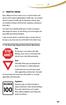 Tr a f f i c S i g n s 7 7. TRAFFIC SIGNS Many collisions and near crashes occur as a result of drivers who ignore or fail to respond appropriately to traffic signs. It is essential that the meaning of
6: LANE POSITIONS, TURNING, & PASSING
 6: LANE POSITIONS, TURNING, & PASSING BASIC LANE POSITIONS Traffic law says that slower vehicles should stay to the right. But where exactly should bicycles ride? Here are some basics. Never Ride Against
A Scientific Study "ETAC" European Truck Accident Causation
 A Scientific Study "ETAC" European Truck Accident Causation Executive Summary and Recommendations 1 Introduction 1.1 The project and its objectives Currently, only limited statistics are available regarding
Pedestrian and Bicycle Crash Data Analysis: 2005-2010
 MICHIGAN DEPARTMENT OF TRANSPORTATION Pedestrian and Bicycle Crash Data Analysis: 2005-2010 FINAL REPORT Prepared by: T.Y. Lin International and Western Michigan University 4/3/2012 TABLE OF CONTENTS List
PEDESTRIAN AND BICYCLE ACCIDENT DATA. Irene Isaksson-Hellman If Insurance Company P&C Ltd.
 PEDESTRIAN AND BICYCLE ACCIDENT DATA Irene Isaksson-Hellman If Insurance Company P&C Ltd. Vulnerable road users 2 Number Number Official accident statistics 45 35 4 3 35 25 3 25 2 2 15 15 1 1 5 5 5 4 5
HIGHWAY DESIGN REPORT. Appendix 4. Proposed Design Principles for City Passings
 HIGHWAY DESIGN REPORT Appendix 4 Proposed Design Principles for City Passings June 2000 Contents Page 1 Introduction 2 1.1 Purpose 2 1.2 Definition of city passing 2 1.3 Safety Problems 2 1.4 Planning
Framework Traffic Management for Shared Zones in Large Private Estates AITPM 2014 National Conference
 Framework Traffic Management for Shared Zones in Large Private Estates AITPM 2014 National Conference Presented by : Wayne Johnson Senior Project Manager GTA Consultants [email protected] Outline
BICYCLE TRENDS IN CAMBRIDGE
 BICYCLE TRENDS IN CAMBRIDGE Cambridge promotes bicycling as a healthy, environmentally friendly way of getting around as an important part of the City's efforts to improve mobility and protect our environment.
BIKE AND PEDESTRIAN CRASH SURVERY
 This survey includes questions regarding biking activity, accidents, and injuries, as well as the answer options provided by the Nashville MPO. Introduction 1. Have you ridden a bicycle within the past
CAMPAIGN ASSETS THINK CYCLIST STAKEHOLDER TOOLKIT
 STAKEHOLDER TOOLKIT INTRODUCTION The Department for Transport s campaign provides road safety information for road users. Our aim is to encourage safer behaviour to reduce the number of people killed and
A Guide to Safe Bicycling in Hawai i
 A Guide to Safe Bicycling in Hawai i Sharing the Road: A Guide to Safe Bicycling in Hawai i What Motorists & Bicyclists Should Know Everyone has the right to be safe on Hawai i s roads. Law of the Splintered
Direct Compensation Agreement for the Settlement of Automobile Claims
 1 Direct Compensation Agreement for the Settlement of Automobile Claims Automobile Insurance Act (R.S.Q., chapter A-25, sections 116 and 173) (13th edition) This brochure represents the Direct Compensation
CAMPAIGN ASSETS THINK CYCLIST STAKEHOLDER TOOLKIT
 STAKEHOLDER TOOLKIT INTRODUCTION The Department for Transport s campaign provides road safety information for road users. Our aim is to encourage safer behaviour to reduce the number of people killed and
DRIVING TEST POSSIBLE QUESTIONS & ANSWERS.
 DRIVING TEST POSSIBLE QUESTIONS & ANSWERS. Question 1. What shape and colour is a warning sign? Diamond Shape - Yellow and Black Question 2. When should you not drive? While under the influence of alcohol,
Joined-Up Cycling. Cycle Links for Horsham Town Centre
 Joined-Up Cycling Cycle Links for Horsham Town Centre 1 4 3 6 2 5 Proposals to improve cycle access to the town at the Albion Way/Bishopric junction and join up some of the fragmented cycle routes in the
Traffic accidents in Hanoi: data collection and analysis
 Traffic accidents in Hanoi: data collection and analysis Nguyen Hoang Hai Vietnam, Hanoi Department of Transport, [email protected] 1. Introduction Hanoi, the capital and administrative center of Vietnam,
BBAC Report on City of Beavercreek Pedestrian/Cyclist Accidents 2007-2011. Prepared June 4, 2011 by committee members Roger Brislawn Jerry Walling
 BBAC Report on City of Beavercreek /Cyclist Accidents 2007-2011 Prepared June 4, 2011 by committee members Roger Brislawn Jerry Walling /Cyclists Accidents 2007-2011 Total For reporting period 19 accidents
Memo: Background Research, Bike Law/Safety Enforcement Video
 Memo: Background Research, Bike Law/Safety Enforcement Video Values, roles, and challenges of training law enforcers in bicycle safety What the value behind training law enforcers? Increasing knowledge
ROAD SAFETY GUIDELINES FOR TAH ROAD INFRASTRUCTURE SAFETY MANAGEMENT
 I. GENERAL ROAD SAFETY GUIDELINES FOR TAH ROAD INFRASTRUCTURE SAFETY MANAGEMENT ANNEX III B i. The setting up and implementing of appropriate management procedures is an essential tool for improving the
Road fatalities in 2012. Road fatality: person killed in a traffic crash or deceased because of an injury within 30 days after the crash.
 Norway Source: IRTAD, Public Roads Administration Inhabitants Vehicles/1 000 inhabitants Road fatalities in 2012 Fatalities /100 000 inhabitants in 2012 5.0 million 703 145 2.9 1. Road safety data collection
0.0 Curb Radii Guidelines Version 1.0.2
 Background In early 2014, Transportation Services initiated a review of the Division's design guidelines and standards to move our organization in a direction consistent with the transportation departments
Smart Cycling IN SANTA MONICA SANTA MONICA POLICE DEPARTMENT BE SMART. BE VISIBLE. BE ATTENTIVE. HAVE FUN!
 Smart Cycling IN SANTA MONICA BE SMART. BE VISIBLE. BE ATTENTIVE. HAVE FUN! Safety Tips and Rules of the Road for Cyclists SANTA MONICA POLICE DEPARTMENT Rules of the Road Drivers, bicyclists, and pedestrians
Traffic Collision Statistics Report
 Traffic Collision Statistics Report 2012 EXECUTIVE SUMMARY Executive Summary 2012 Traffic Collision Statistics Report Executive Summary Motor vehicle collisions resulting in a fatality, injury or property
FMCSA Webinar Nov.18th to Examine Large Truck Crash Fatalities Involving Pedestrians & Bicyclists. New Technology for Better Fleet Management
 In This Issue: FMCSA Webinar Nov.18th to Examine Large Truck Crash Fatalities Involving Pedestrians & Bicyclists Help Prevent Roadway Accidents involving Pedestrians How to Steer Clear of Accidents with
A Review of Serious Casualty Motorcycle Crashes in Tasmania
 A Review of Serious Casualty Motorcycle Crashes in Tasmania D epart ment of Infrastructure, Energy and Resources A Review of Serious Casualty Motorcycle Crashes in Tasmania Traffic and Infrastructure Branch
How To Know If A Motorcyclist Is Safe
 Motorcyclists CRASH FACTSHEET November 2013 CRASH STATISTICS FOR THE YEAR ENDED 31 DECEMBER 2012 Prepared by the Ministry of Transport In 2012, 50 motorcyclists 1 died and a further 1,138 were injured
New Zealand all-age mandatory bicycle helmet law
 New Zealand all-age mandatory bicycle helmet law A public health and safety disaster New Zealand is one of only three countries in the world with national all-age mandatory bicycle helmet laws, the others
Deaths/injuries in motor vehicle crashes per million hours spent travelling, July 2008 June 2012 (All ages) Mode of travel
 Cyclists CRASH STATISTICS FOR THE YEAR ENDED 31 DECEMBER 212 Prepared by the Ministry of Transport CRASH FACTSHEET November 213 Cyclists have a number of risk factors that do not affect car drivers. The
a U.S. Department of Transportation National Highway Traffic Safety Administration Computer Accident Typing for Bicyclist Accidents Coder's Handbook
 a U.S. Department of Transportation National Highway Traffic Safety Administration Computer Accident Typing for Bicyclist Accidents Coder's Handbook INTRODUCTION This Coder's Handbook is part of a package
Why Do We Bike? And where, how, who, when, and with what
 Why Do We Bike? And where, how, who, when, and with what What will I learn today? Knowledge of laws for bikes in traffic: your rights and responsibilities as a bicyclist and motorist Examples of safe and
How To Understand The Safety Of A Motorcycle
 Disclaimer All reasonable endeavours are made to ensure the accuracy of the information in this report. However, the information is provided without warranties of any kind including accuracy, completeness,
Walking or Cycling? Facts about Extent, Safety and Environmental Consequences
 Summary: TØI report 432/1999 Authors: Rune Elvik, Marika Kolbenstvedt, Ingunn Stangeby Oslo 1999, 54 pages Norwegian language Walking or Cycling? Facts about Extent, Safety and Environmental Consequences
What roundabout design provides the highest possible safety?
 What roundabout design provides the highest possible safety? In Sweden, as in several other countries, the number of roundabouts is on the increase. According to a study recently carried out by the VTI,
Traffic Safety Tips. Edmonton
 Traffic Safety Tips Edmonton Contents HUEdmonton Traffic Safety TipsUH 3 HUBeing A Responsible Courteous DriverUH 3 HUSpeed LimitsUH 4 HUFollowing Too CloseUH 6 HUStopping DistancesUH 6 HUIntersection
Rural Road Safety Policy in Korea: Lesson Learned
 Regional Seminar on Safe, Climate Adaptive and Disaster Resilient Transport for Sustainable Development Nov. 17 th, Seoul Rural Road Safety Policy in Korea: Lesson Learned Sangjin HAN Korea Transport Institute
- FREE! - The Official San Francisco BIKE GUIDE. 1st Edition
 - FREE! - The Official San Francisco BIKE GUIDE 1st Edition SF BIKE LAWS SAN FRANCISCO BICYCLISTS MUST: Yield to People Walking Whether they re in a crosswalk or not, ALWAYS yield to people walking. Stop
Back to School Car Safety. Direct Buy Warranty Staff September 19, 2014
 Back to School Car Safety Direct Buy Warranty Staff September 19, 2014 It s back to school season, and that means kids are picking out new clothes, putting on their backpacks, and hitting the road to get
SAFE Streets for CHICAGO
 Overview Each day, hundreds of thousands of Chicagoans walk or drive in the city. Ensuring their safety is the City s top priority. Over the past several years, Chicago has developed many successful strategies
Motorcycle and Scooter crashes Recorded by NSW Police from January to December 2011
 Motorcycle and Scooter crashes Recorded by NSW Police from January to December 2011 Data supplied by the Centre for Road Safety, Transport for NSW Analysis completed by the Survive The Ride Association
SIDEWALK BICYCLING SAFETY ISSUES
 SIDEWALK BICYCLING SAFETY ISSUES Lisa Aultman-Hall and Michael F. Adams Jr. Department of Civil Engineering University of Kentucky Lexington, KY 40506-0281 Email: [email protected] Transportation Research
SAFETY PROCESS. Martin Small
 SAFETY PROCESS Martin Small With a broad transport policy background including extensive work in the maritime sector, Martin Small has been working in road safety for five years, in a variety of roles
CYCLIST-CAR ACCIDENTS THEIR CONSEQUENCES FOR CYCLISTS AND TYPICAL ACCIDENT SCENARIOS
 CYCLIST-CAR ACCIDENTS THEIR CONSEQUENCES FOR CYCLISTS AND TYPICAL ACCIDENT SCENARIOS Matthias Kuehn Thomas Hummel Antje Lang German Insurers Accident Research Germany Paper Number 15-0243 ABSTRACT The
AAA S GUIDE TO A SAFE
 Credit: ThinkStock SAME ROADS SAME RULES SAME RIGHTS AAA S GUIDE TO A SAFE BIKE RIDE DRIVING A BICYCLE Yes, bicyclists MUST drive their bicycles in the same manner that motorists drive their cars. Most
The State Government recognises. areas, and regulates bicycle
 cycling & THE LAW rules introduction for roads The State Government recognises The cycling South Australian as a legitimate Road Traffic form of Act including transport the Australian and an increasingly
STATISTICS OF FATAL AND INJURY ROAD ACCIDENTS IN LITHUANIA,
 Vilnius 215 STATISTICS OF FATAL AND INJURY ROAD ACCIDENTS IN LITHUANIA, 211 214 TABLE OF CONTENTS INTRODUCTION... 9 GENERAL INFORMATION... 1 1. VEHICLE FLEET... 11 1.1. Number of vehicles, 1995 214...
CHAPTER 2 TRAFFIC SIGNS AND HIGHWAY MARKINGS
 CHAPTER 2 TRAFFIC SIGNS AND HIGHWAY MARKINGS This chapter summarizes traffic signs, signals and road markings that control the flow of traffic, making streets and highways safer for motorists, bicyclists
ITARDAInstitute for Traffic Accident
 972 972 972 972 972 972 972 972 ITARDAInstitute for Traffic Accident Research and Data Analysis ( 財 ) 交 通 事 故 総 合 分 析 センター ITARDA INFORMATION No. 211 9SEPTEMBER 1, 2, 3, 4, 5, 1 1 1km/h or less 1,42 2
PEDESTRIAN LAWS OF NORTH CAROLINA
 PEDESTRIAN LAWS OF NORTH CAROLINA Under North Carolina law, pedestrians have the right of way at all intersections and driveways. However, pedestrians must act responsibly, using pedestrian signals where
Cycling more for safer cycling
 Cycling more for safer cycling Cycling presents a lot of benefits to the individual and to society. Health, environment, accessibility, local businesses, all gain when more people cycle. Yet many governments
FORENSIC COLLISION INVESTIGATION REPORT
 FORENSIC COLLISION INVESTIGATION REPORT Prepared by: Martin Lowe Prepared For: Solicitors for the XXXXXXXXXX Table of Contents 1. Brief.....1 Instructing Solicitors Instructions Location of the collision
Pass Plus evaluation 06224 April 2009
 Pass Plus evaluation 06224 April 2009 CONFIDENTIALITY Please note that the copyright in the attached report is owned by TfL and the provision of information under Freedom of Information Act does not give
Chapter 1: Background
 Chapter 1: Background 1.1 Trends in Bicycle Ridership and Collisions in Toronto Toronto has relatively high levels of bicycle traffic on its downtown streets. On a typical weekday, bicycles make up roughly
NASHVILLE BICYCLE LAW 3/18/09
 NASHVILLE BICYCLE LAW 3/18/09 12.60.010 Compliance with Title 12 provisions. It is unlawful for any person to do any act prohibited or fail to perform any act required by Title 12 of this code. (Prior
Analysis of Accidents by Older Drivers in Japan
 Analysis of Accidents by Older Drivers in Japan Kazumoto Morita 1, Michiaki Sekine 1 1 National Traffic Safety and Environment Laboratory, Japan Abstract Since Japan is a rapidly aging society, ensuring
How To Improve Safety
 Collision Diagrams Collision diagrams are used to display and identify similar accident patterns. They provide information on the type and number of accidents; including conditions such as time of day,
New Jersey SRTS Travel Plan Guide
 New Jersey SRTS Travel Plan Guide Prepared For: Funded By: Prepared By: New Jersey Department of Transportation Federal Highway Administration Alan M. Voorhees Transportation Center Edward J. Bloustein
Put the Brakes on Speeding
 Put the Brakes on Speeding The risks of driving too fast The costs and consequences Tips to maintain a safe speed Speed kills There s no doubt about it driving over the speed limit is dangerous. It puts
Principles of Road and Traffic Engineering Designs for Mixed Traffic Flow with a Numerous Motorcycles
 Principles of Road and Traffic Engineering Designs for Mixed Traffic Flow with a Numerous Motorcycles Dr. Ming-Heng Wang Assistant Professor, Department of Transportation Technology and Management, Kainan
1. Rules for users of powered wheelchairs and powered mobility scooters
 Jersey Highway Code Introduction The Minister for Transport and Technical Services has issued directions for the guidance of road users, the Highway Code. The Highway Code for Jersey is the Official Highway
Maximum speed. Stop and Give way to Manually operated temporary No entry for give way traffic on STOP and GO signs vehicular traffic major road
 Signs giving orders Signs with red circles are mostly prohibitive. Plates below signs qualify their message. Entry to 20 mph zone End of 20 mph zone Maximum speed National speed limit applies School crossing
Level 2 Award in Safe Driving at Work
 Level 2 Award in Safe Driving at Work Student notes (sample) www.britsafe.org Membership Training Qualifications Audit and Consultancy Audit and Policy Consultancy and Opinion Policy Awards and Opinion
Children and road safety: a guide for parents
 Child Safety Week Report Children and road safety: a guide for parents What are the facts? The number of children aged up to 19 years who are killed or seriously injured each year on Britain's roads has
A Bicycle Accident Study Using GIS Mapping and Analysis
 A Bicycle Accident Study Using GIS Mapping and Analysis Petra Staats, Graduate Assistant, Transportation Policy Institute, Rutgers University, New Brunswick, NJ, USA [email protected] Summary Surveys
Sharing the road safely
 6 sharing the road in this chapter Sharing the road safely Pedestrians Cyclists Motorcycle riders Passenger vehicles Large vehicles School buses Public transit buses Emergency vehicles Emergency workers
Advantages and Disadvantages of One Way Streets October 30, 2007
 Advantages and Disadvantages of One Way Streets October 30, 2007 0 P age Background As the revitalization of the Central Waterfront area moves forward, one issue that might need closer analysis is the
Road Signs Recognition Quiz
 Road Signs Recognition Quiz Place your answer for each of the signs/pavement markings on the answer sheet. Ready to Roll? Here Comes Sign # 1... #1 A No right turn B Right turn only C Warning, no turn
YOUR GUIDE TO INTRA-TOWN CYCLING
 YOUR GUIDE TO INTRA-TOWN CYCLING Content 04 Introduction 05 Attire Before you set off 06 Safety Checklist for Bicycle 07 Maintenance 08 Preventing Bicycle Theft What to look out for on the way 10 Signs
Contributory factors to road accidents
 Contributory factors to road accidents Jonathan Mosedale, Andrew Purdy and Eddie Clarkson, Transport Statistics: Road Safety, Department for Transport Introduction The STATS19 national system of collection
Keiichi OGAWA a. Keywords: Bicycle, Cycling Space, Traffic Accident, Intersection 1. INTRODUCTION
 Comparative Analysis of Traffic Accident Probability Based on Location and Bicycle Travel Direction Considering Number of Intersections between Origin and Destination for Bicycle Users Keiichi OGAWA a
INSTRUCTOR S GUIDE. Stay on the Right Track Highway-Railway Crossing Awareness Training for Newly Licensed Drivers
 INSTRUCTOR S GUIDE Stay on the Right Track Highway-Railway Crossing Awareness Training for Newly Licensed Drivers WHAT WE DO Operation Lifesaver is a nationwide, non-profit public information and education
ENGINEERING SOLUTIONS FOR DESIGNING YOUR SAFE ROUTES
 How to Get Started ENGINEERING SOLUTIONS FOR DESIGNING YOUR SAFE ROUTES Design Elements Selecting appropriate design treatments for school neighborhoods creates environments that address the needs of all
To Foreign Nationals Who Drive Vehicles in Japan (English Language Version) Chapter 1 Basic Information
 7,1, 2011 License Division Translated by National Police Agency To Foreign Nationals Who Drive Vehicles in Japan (English Language Version) Introduction This booklet is designed to help you understand
the Ministry of Transport is attributed as the source of the material
 Disclaimer All reasonable endeavours are made to ensure the accuracy of the information in this report. However, the information is provided without warranties of any kind including accuracy, completeness,
WYDOT Quick Facts TRAFFIC SIGNALS
 TRAFFIC SIGNALS WYDOT Quick Facts 2 Advantages of traffic signals WYDOT Quick Facts Traffic signals control vehicle and pedestrian traffic by assigning priorities to various traffic movements to influence
Beginner s Permit. Survival Guide. Compliments of. (843) 263-5023 www.123drivedrivingacademy.com [email protected]
 Beginner s Permit Survival Guide Compliments of (843) 263-5023 www.123drivedrivingacademy.com [email protected] Please use this study guide to assist you in studying for your written knowledge
Accident Analysis of Sheridan Road between Isabella Street and South Boulevard
 Accident Analysis of Sheridan Road between Isabella Street and South Boulevard Prepared for TranSystems Corporation for the City of Evanston Submitted by Regina Webster & Associates, Inc. Date: 08/15/2008