
2009 AICPA Newly Released Questions Business
|
|
|
- Gordon Harmon
- 10 years ago
- Views:
Transcription
1 Following are multiple choice questions recently released by the AICPA. These questions were released by the AICPA with letter answers only. Our editorial board has provided the accompanying explanation. Please note that the AICPA generally releases questions that it does NOT intend to use again. These questions and content may or may not be representative of questions you may see on any upcoming exams. 1

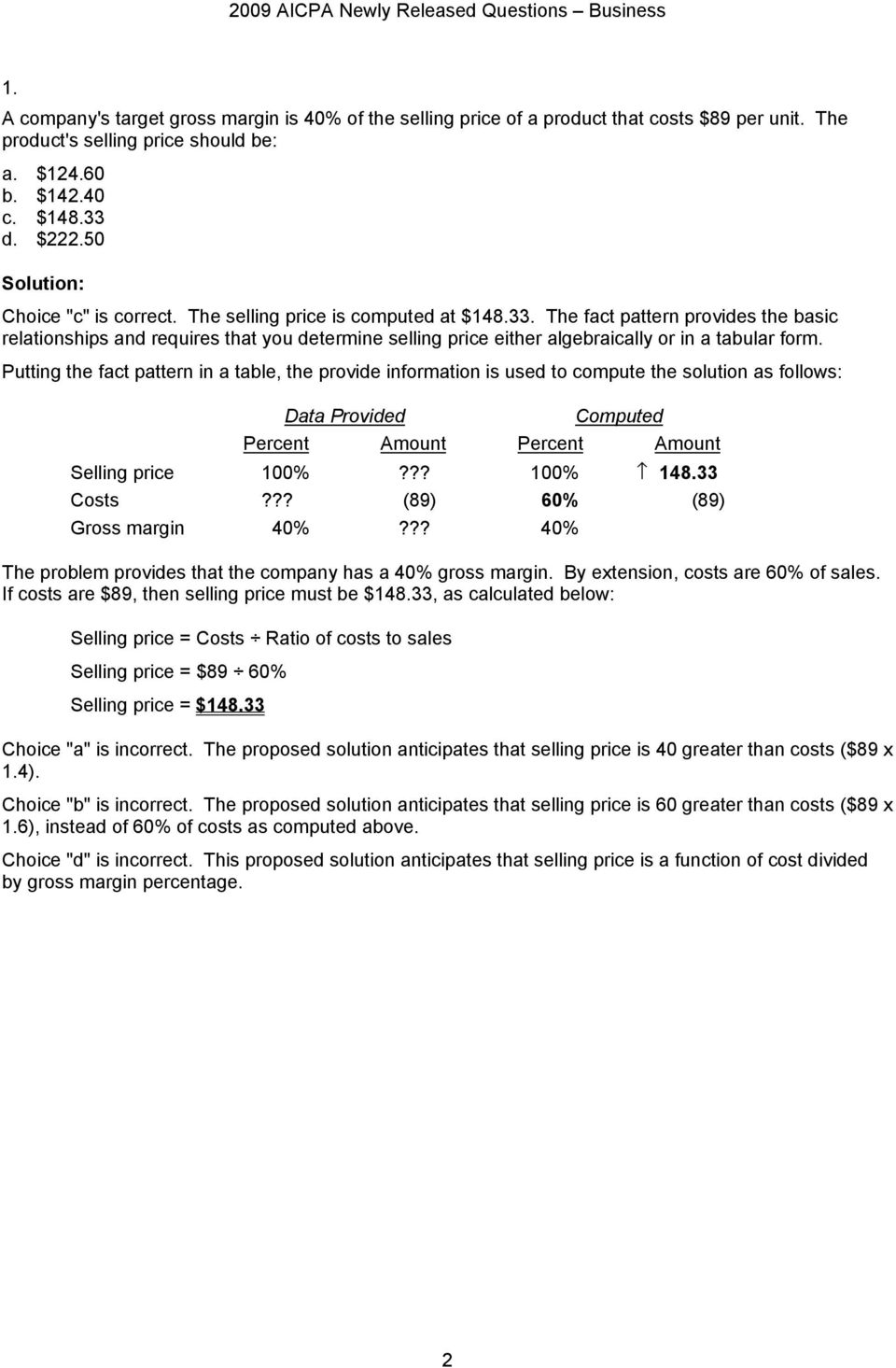
2 1. A company's target gross margin is 40% of the selling price of a product that costs $89 per unit. The product's selling price should be: a. $ b. $ c. $ d. $ Choice "c" is correct. The selling price is computed at $ The fact pattern provides the basic relationships and requires that you determine selling price either algebraically or in a tabular form. Putting the fact pattern in a table, the provide information is used to compute the solution as follows: Data Provided Computed Percent Amount Percent Amount Selling price 100%??? 100% Costs??? (89) 60% (89) Gross margin 40%??? 40% The problem provides that the company has a 40% gross margin. By extension, costs are 60% of sales. If costs are $89, then selling price must be $148.33, as calculated below: Selling price = Costs Ratio of costs to sales Selling price = $89 60% Selling price = $ Choice "a" is incorrect. The proposed solution anticipates that selling price is 40 greater than costs ($89 x 1.4). Choice "b" is incorrect. The proposed solution anticipates that selling price is 60 greater than costs ($89 x 1.6), instead of 60% of costs as computed above. Choice "d" is incorrect. This proposed solution anticipates that selling price is a function of cost divided by gross margin percentage. 2
3 2. Wren Co. manufactures and sells two products with selling prices and variable costs as follows: A B Selling price $18.00 $22.00 Variable costs Wren's total annual fixed costs are $38,400. Wren sells four units of A for every unit of B. If operating income last year was $28,800, what was the number of units Wren sold? a. 5,486 b. 6,000 c. 9,600 d. 10,500 Choice "d" is correct. Wren will have sold a total of 10,500 units to achieve a $28,800 operating profit assuming the fact pattern described above. The question requires the candidate to recall the basic contribution margin formula and apply some algebra. The fact pattern describes that the operating income is $28,800 and the fixed costs are $38,400. The contribution margin is; therefore, the total of the two $67,200. The basic formula to compute units sold is: CM per unit x Units = $67,200 The fact pattern indicates that Wren has two products with unique selling and cost patterns. First, compute the contribution margin: Contribution Selling price - Variable cost = margin per unit Product A $18 - $12 = $6 Product B $22 - $14 = $8 Second, quantify the selling pattern and the relationship between the products. Wren sells 4 units of Product A for every unit of Product B, so expressing Product A in terms of Product B: Product A = 4 x Product B Third, determine the number of units of Product B that were sold: $6 contribution margin x (4B) + $8 contribution margin x B = $67,200 24B + 8B = 67,200 32B = 67,200 B = 2,100 Fourth, determine the number of Product A and the total number of products sold: A = 4 x B (4 x 2,100) or 8,400 Total units = 2, ,400 or 10,500 Choices "a", "b", and "c" are incorrect, per the computations above. 3

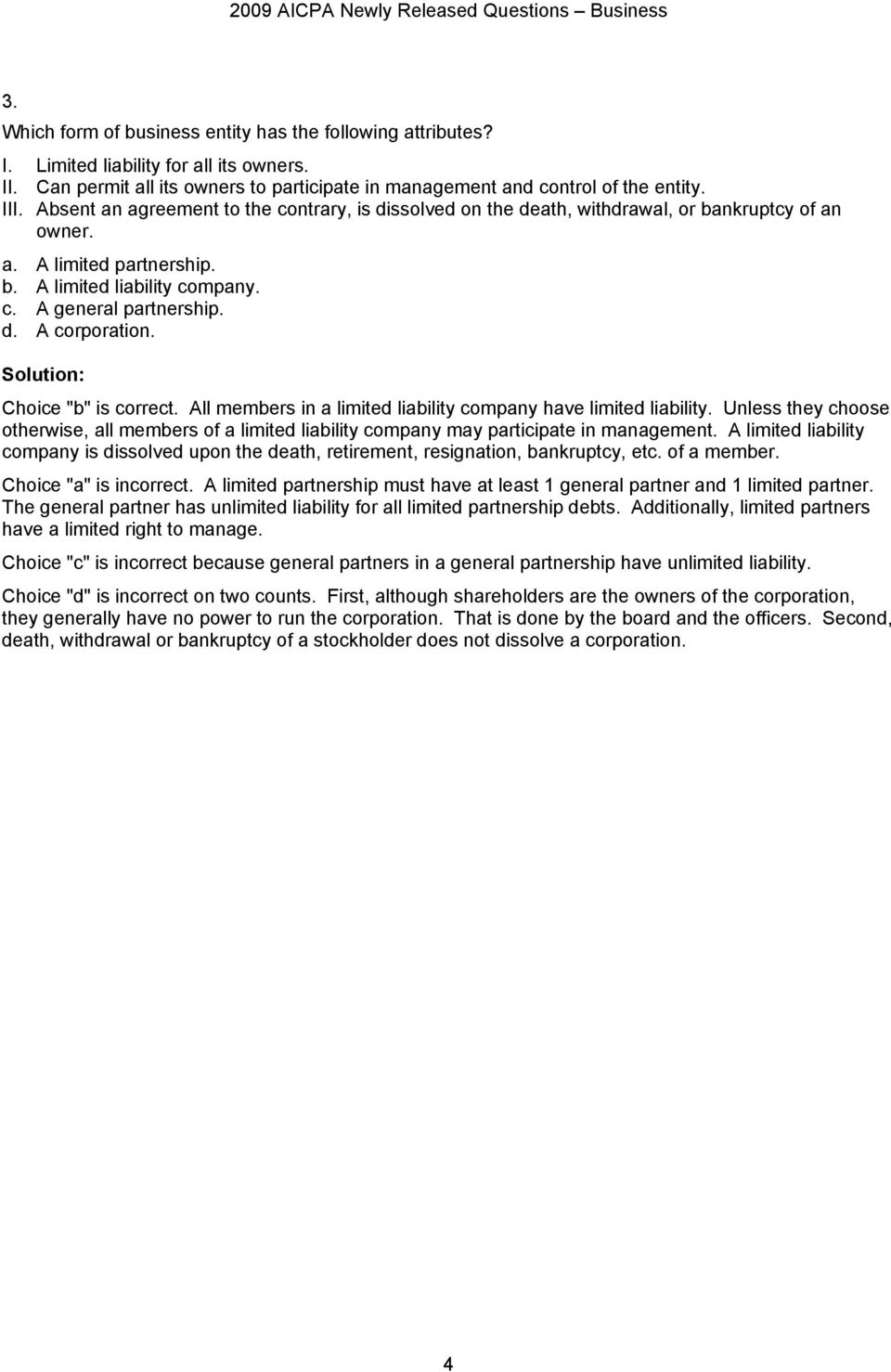
4 3. Which form of business entity has the following attributes? I. Limited liability for all its owners. II. Can permit all its owners to participate in management and control of the entity. III. Absent an agreement to the contrary, is dissolved on the death, withdrawal, or bankruptcy of an owner. a. A limited partnership. b. A limited liability company. c. A general partnership. d. A corporation. Choice "b" is correct. All members in a limited liability company have limited liability. Unless they choose otherwise, all members of a limited liability company may participate in management. A limited liability company is dissolved upon the death, retirement, resignation, bankruptcy, etc. of a member. Choice "a" is incorrect. A limited partnership must have at least 1 general partner and 1 limited partner. The general partner has unlimited liability for all limited partnership debts. Additionally, limited partners have a limited right to manage. Choice "c" is incorrect because general partners in a general partnership have unlimited liability. Choice "d" is incorrect on two counts. First, although shareholders are the owners of the corporation, they generally have no power to run the corporation. That is done by the board and the officers. Second, death, withdrawal or bankruptcy of a stockholder does not dissolve a corporation. 4
5 4. Joint ventures are most similar to which of the following types of business organizations? a. Limited partnerships. b. General partnerships. c. Business trusts. d. Subchapter S corporations. Choice "b" is correct. The legal requirements, consequences, advantages, and disadvantages of forming a joint venture generally are identical to those of a general partnership. Choices "a", "c", and "d" are incorrect. Joint ventures are not similar to limited partnerships, a business trust or a subchapter S corporation. Joint ventures are similar to a general partnership. 5

6 5. Which of the following statements best states the purpose of cumulative voting? a. To assure the continuance of incumbent directors. b. To allow minority shareholders to gain representation on the board of directors. c. To allow for the election of one-third of the board of directors each year. d. To assure that a majority of shares voted elects the entire board of directors. Choice "b" is correct. In cumulative voting, each share is entitled to one vote for each director position that is being filled and the shareholders may cast the votes in any way, including casting all for a single candidate. This helps minority shareholders gain representation on the board. Choices "a", "c", and "d" are incorrect. Cumulative voting does not insure the continuance of incumbent directors. It does not permit the election of 1/3 of the board each year. It does not assure that the majority of the votes cast elect the entire board. If a 1/3 minority of shares cast all votes for a single candidate of their choice and the 2/3 majority of shares split their votes among the remaining candidates, the minority would be assured of electing their candidate. 6

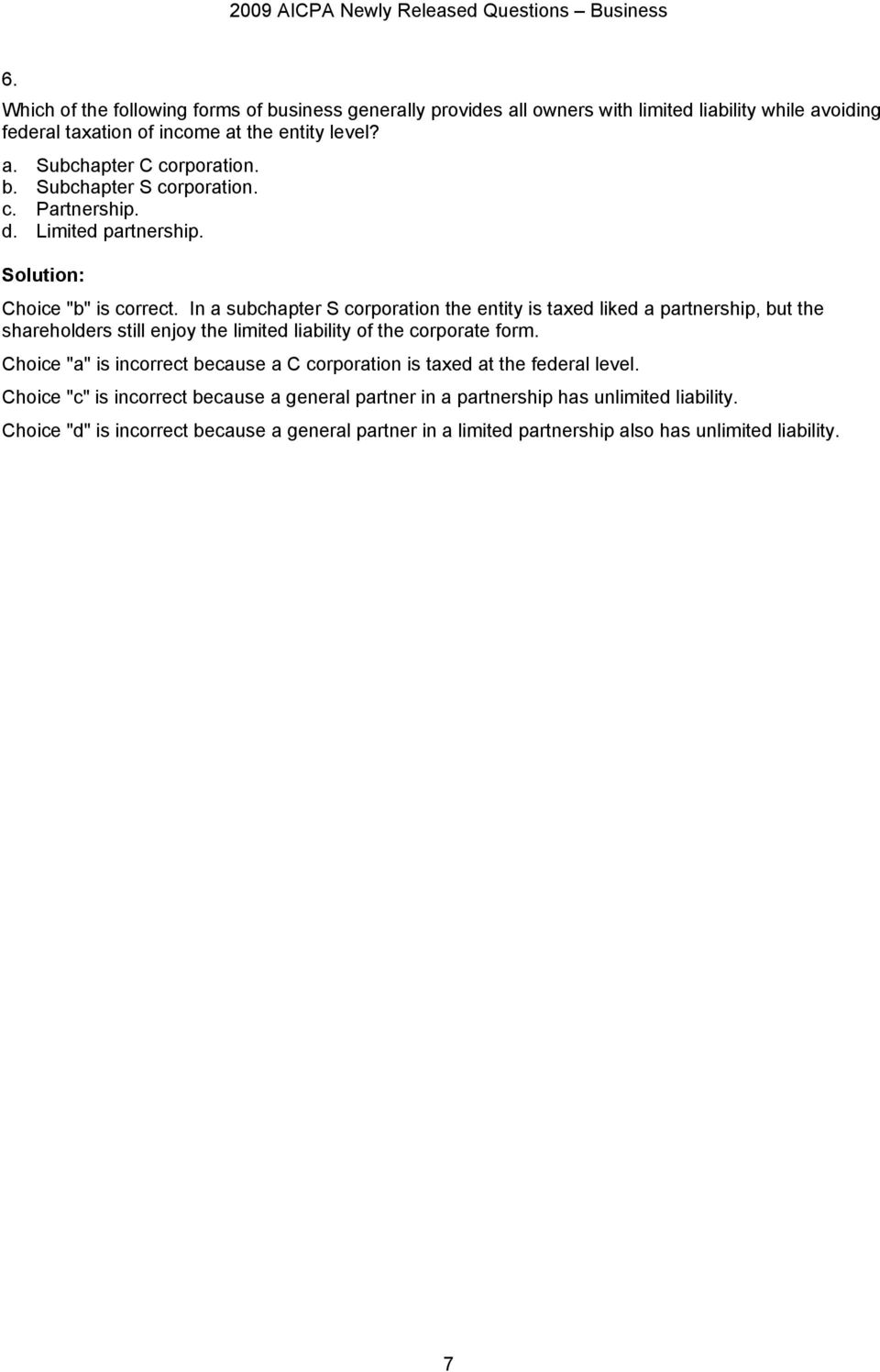
7 6. Which of the following forms of business generally provides all owners with limited liability while avoiding federal taxation of income at the entity level? a. Subchapter C corporation. b. Subchapter S corporation. c. Partnership. d. Limited partnership. Choice "b" is correct. In a subchapter S corporation the entity is taxed liked a partnership, but the shareholders still enjoy the limited liability of the corporate form. Choice "a" is incorrect because a C corporation is taxed at the federal level. Choice "c" is incorrect because a general partner in a partnership has unlimited liability. Choice "d" is incorrect because a general partner in a limited partnership also has unlimited liability. 7
8 7. Under the Revised Model Business Corporation Act, which of the following dividends is not defined as a distribution? a. Cash dividends. b. Property dividends. c. Liquidating dividends. d. Stock dividends. Choice "d" is correct because, technically, dividends paid in stock are not a distribution. Stock dividends are dividends in the corporation's own authorized but unissued shares. No assets are distributed. The stockholder's wealth and percentage of ownership are not increased. A stock dividend has no affect on earnings and profits for federal income tax purposes. Choice "a" is incorrect because a cash dividend is obviously a distribution. Choice "b" is incorrect. A property dividend is a distribution of earnings in the form of property. Choice "c" is incorrect. A liquidating dividend is a dividend that is paid by the corporation to shareholders from capital rather than retained earnings. As such, it is clearly a distribution. 8

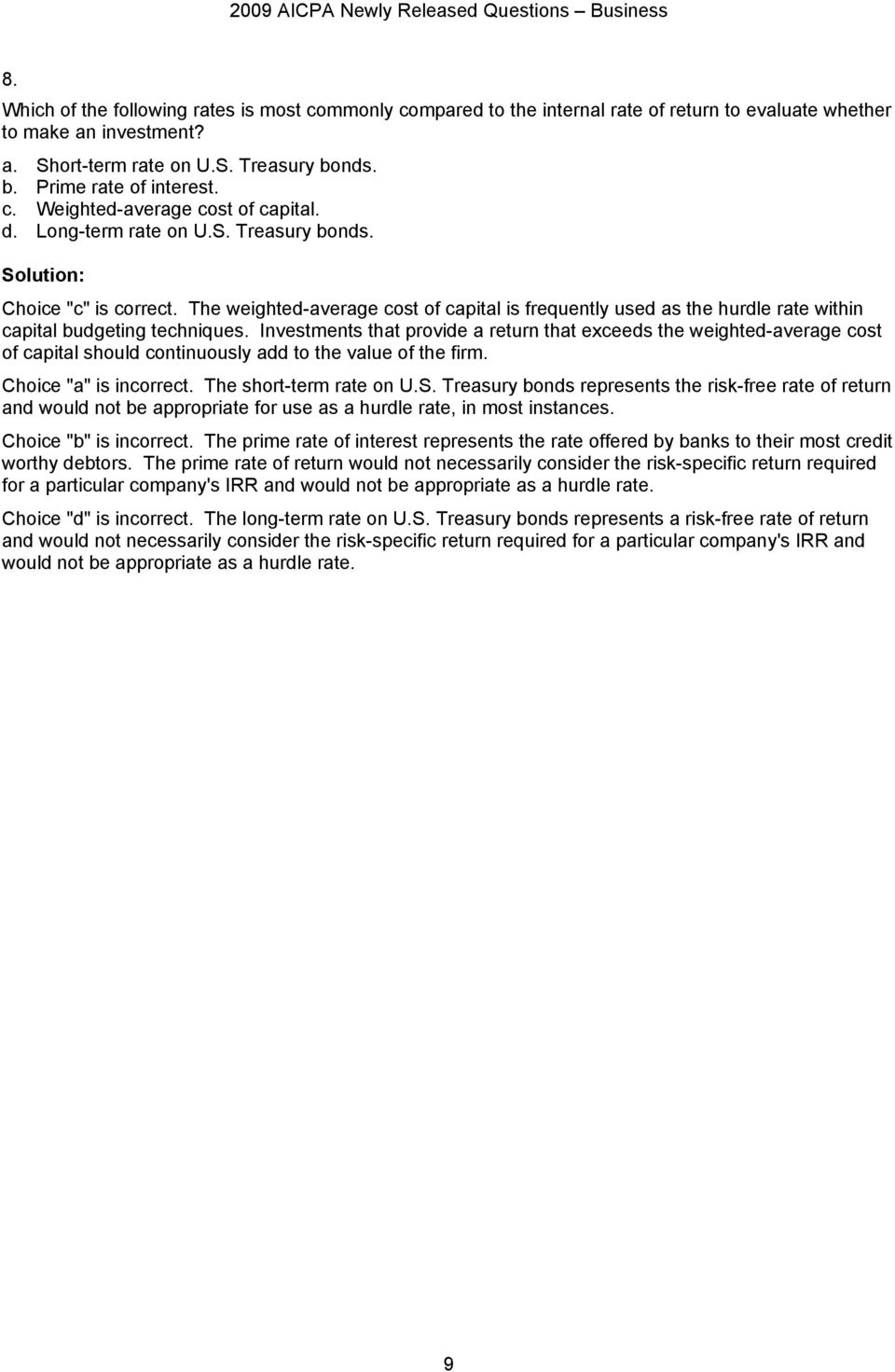
9 8. Which of the following rates is most commonly compared to the internal rate of return to evaluate whether to make an investment? a. Short-term rate on U.S. Treasury bonds. b. Prime rate of interest. c. Weighted-average cost of capital. d. Long-term rate on U.S. Treasury bonds. Choice "c" is correct. The weighted-average cost of capital is frequently used as the hurdle rate within capital budgeting techniques. Investments that provide a return that exceeds the weighted-average cost of capital should continuously add to the value of the firm. Choice "a" is incorrect. The short-term rate on U.S. Treasury bonds represents the risk-free rate of return and would not be appropriate for use as a hurdle rate, in most instances. Choice "b" is incorrect. The prime rate of interest represents the rate offered by banks to their most credit worthy debtors. The prime rate of return would not necessarily consider the risk-specific return required for a particular company's IRR and would not be appropriate as a hurdle rate. Choice "d" is incorrect. The long-term rate on U.S. Treasury bonds represents a risk-free rate of return and would not necessarily consider the risk-specific return required for a particular company's IRR and would not be appropriate as a hurdle rate. 9
10 9. What is the most likely effect if a court pierces the corporate veil? a. The corporation's shareholders, officers, and directors can be assigned liability. b. The corporation can be held liable for acts of the directors. c. The corporation can lose its tax exempt status. d. The corporation can be held liable for acts of nonofficer employees of the corporation. Choice "a" is correct. When the "corporate veil is pierced," courts disregard the corporate form and hold shareholders, officers or directors personally liable. Courts generally will pierce the corporate veil for commingling of funds, inadequate capitalization or fraud. Choice "b" is incorrect. "Piercing the corporate veil" does not entail holding a corporation liable for the acts of directors; it entails holding a shareholder, officer or director liable. Choice "c" is incorrect because "piercing the corporate veil" does not entail a corporation losing taxexempt status. Choice "d" is incorrect because "piercing the corporate veil" does not entail holding a corporation liable for the acts of nonofficer employees; it entails holding a shareholder, officer or director liable. 10
11 10. Eaton is the sole owner of a construction company. Eaton is concerned about personal liability. Which of the following entities will best allow Eaton to limit personal liability? a. Sole proprietorship. b. C corporation. c. General partnership. d. Limited partnership. Choice "b" is correct. One of the main advantages of a corporation is that stockholders, directors and officers generally are not personally liable for the obligations of the corporation. Generally, only the corporation itself can be held liable. Choice "a" is incorrect because a sole proprietor is personally liable for all obligations of the business. Choice "c" is incorrect because all general partners have unlimited personal liability. Additionally, Eaton could not be the sole owner in a general partnership; he would have to share ownership with other partners. Choice "d" is incorrect because in a limited partnership there must be at least one limited and one general partner. The general partner in a limited partnership has unlimited liability. Eaton would not choose to be a limited partner because then Eaton would have no right to manage and control the business; he would have to give up control to a general partner. 11

12 11. Which of the following costs would decrease if production levels were increased within the relevant range? a. Total fixed costs. b. Variable costs per unit. c. Total variable costs. d. Fixed costs per unit. Choice "d" is correct. In the relevant range, fixed costs are constant in total, but decrease per unit as production levels increase. Choice "a" is incorrect. Although total fixed costs are constant in total in the relevant range, the call of the question relates to per-unit fixed costs. Fixed costs per unit decrease as production levels increase. Choice "b" is incorrect. Variable costs per unit remain unchanged in the relevant range, but increase in total as unit volume increases. Choice "c" is incorrect. Total variable costs increase as total unit volume increases in the relevant range. 12
13 12. Which of the following assumptions is associated with the economic order quantity formula? a. The carrying cost per unit will vary with quantity ordered. b. The cost of placing an order will vary with quantity ordered. c. Periodic demand is known. d. The purchase cost per unit will vary based on quantity discounts. Choice "c" is correct. The economic order quantity formula (EOQ) assumes that periodic demand is known. Annual sales volume is a crucial variable in the EOQ formula. Choice "a" is incorrect. The carrying cost per unit is anticipated to remain constant Choice "b" is incorrect. The cost of placing an order is anticipated to remain constant Choice "d" is incorrect. The purchase price per unit is not a component of EOQ. 13
14 13. Which of the following statements about investment decision models is true? a. The discounted payback rate takes into account cash flows for all periods. b. The payback rule ignores all cash flows after the end of the payback period. c. The net present value model says to accept investment opportunities when their rates of return exceed the company's incremental borrowing rate. d. The internal rate of return rule is to accept the investment if the opportunity cost of capital is greater than the internal rate of return. Choice "b" is correct. The payback period computation ignores cash flows after the initial investment has been recovered. The payback method focuses on liquidity and the time it takes to recover the initial investment. Choice "a" is incorrect. The discounted payback period considers the time value of money but, like any other payback method, it ignores cash flows after the initial investment has been recovered. Choice "c" is incorrect. The net present value method measures amount of return and not rate. Although a positive net present value would confirm that the entity's investment exceeds the hurdle rat established by management, it neither measure the rate specifically nor assumes a hurdle rate equal to the incremental borrowing rate. Choice "d" is incorrect. When using the internal rate of return, the analyst recommends acceptance of the investment in the event that the IRR is greater than the hurdle rate established by management. 14

15 14. Which of the following Federal Reserve policies would increase money supply? a. Change the multiplier effect. b. Increase reserve requirements. c. Reduce the discount rate. d. Sell more U.S. Treasury bonds. Choice "c" is correct. If the Fed wanted to increase the money supply, it would reduce the discount rate. A lower discount rate would reduce short-term interest rates, which would encourage more (short-term) borrowing at the lower interest rate (lower cost means more demand). More borrowing means more lending and more money in the economy. Choice "a" is incorrect. The Fed really cannot change the multiplier "effect." It can change the multiplier by changing the required reserve ratio (which it seldom does), but it cannot change the effect. The multiplier effect is the effect on the money supply of the multiplier itself. It is due to banks having to keep only a (small) portion of amounts deposited in reserve. Choice "b" is incorrect. Increasing reserve requirements would mean less lending because banks would have to hold a larger portion of amounts deposited in reserve. That would mean a reduced money supply, not an increased money supply. Choice "d" is incorrect. Selling more U.S. Treasury bonds would reduce, not increase, the money supply since the bonds would have to be paid for with money out of the money supply. If the Fed were to buy U.S. Treasury bonds, that would increase the money supply. 15
16 15. Which of the following tasks would be included in a document flowchart for processing cash receipts? a. Compare control and remittance totals. b. Record returns and allowances. c. Authorize and generate an invoice. d. Authorize and generate a voucher. Choice "a" is correct. A task (a box on a document or system flowchart) to compare control totals and remittance totals would be included in the processing of cash receipts. Note that this is a very general step that could appear on almost any document flowchart. All of the other choices in this question are specific to a particular type of processing. Choice "b" is incorrect. Recording returns and allowances would not be included in the processing of cash receipts. Anything returned will not be received in cash. Returns and allowances would be included in the processing (and thus the document flowchart) of sales. Choice "c" is incorrect. Authorizing and generating invoices would not be included in the processing of cash receipts. Invoices would be included in the processing of sales. Choice "d" is incorrect. Authorizing and generating vouchers would not be included in the processing of cash receipts. Vouchers would be included in the processing of accounts payable and payments. 16

17 16. The performance audit report of an information technology department indicated that the department lacked a disaster recovery plan. Which of the following steps should management take first to correct this condition? a. Bulletproof the information security architecture. b. Designate a hot site. c. Designate a cold site. d. Prepare a statement of responsibilities for tasks included in a disaster recovery plan. Choice "d" is correct. The first step in preparing a disaster recovery plan is to determine the responsibilities of the various participants in the plan. Prior to that first step, a determination is made of the kind and extent of recovery that is needed. Once that decision is made, the people responsible for the recovery can be determined (and those people will normally prepare the plan itself). Like with any other plan, an unclear designation of responsibilities will normally lead to a lousy plan, and a lousy plan will lead to a lousy recovery. All plans need to be tested. Choice "a" is incorrect. The information security architecture has nothing to do with a disaster recovery plan. Bulletproofing the architecture might be something that is needed (although it is normally not the "architecture" that is bulletproofed), but not as part of a disaster recovery plan. Choice "b" is incorrect. A hot site may or may not be in the disaster recovery plan, depending on what kind of recovery is needed. Recovery is much faster at a hot site than at a cold site, and "fast" recovery is often needed. With a hot site, hardware is sitting "on the floor" waiting to be configured and used. Of course, a hot site normally costs more than a cold site. Nothing is free. Choice "c" is incorrect. A cold site may or may not be in the disaster recovery plan, depending on what kind of recovery is needed. Recovery is much slower at a cold site than at a hot site because hardware must be ordered, delivered, received, and configured. 17
18 17. The regression analysis results for ABC Co. is shown as y = 90x The standard error (S b ) is 30 and coefficient of determination (r 2 ) is The budget calls for production of 100 units. What is ABC's estimate of total costs? a. $3,090 b. $4,590 c. $9,030 d. $9,045 Choice "d" is correct. The total cost formula is the formula for a line where total cost, the dependent variable (y) is equal to volume times the independent variable, variable costs (x) plus a constant (fixed costs. The formula for ABC Company is: y = 90x + 45 The problem tells us that we plan to produce 100 units so total costs, y, is computed as follows: Y = (90 x 100) + 45 Y = 9,045 The coefficient of determination measures the proportion of the total variation in "y" or total cost that is explained by the total variation in the independent variable, x, or variable costs. The coefficient of determination measures the reliability of the formula, but is not used for determining the value of "y". The standard error (also standard error of the mean) is a measurement used in conjunction with standard deviation computations and is not relevant to this projection. Choices "a", "b", and "c" are incorrect, per the above. 18
19 18. An information technology director collected the names and locations of key vendors, current hardware configuration, names of team members, and an alternative processing location. What is the director most likely preparing? a. Data restoration plan. b. Disaster recovery plan. c. System security policy. d. System hardware policy. Choice "b" is correct. More than likely, the director is preparing a disaster recovery plan. Choice "a" is incorrect. The names and locations of key vendors, the current hardware configuration, team members, and an alternate processing location all have nothing to do with a data restoration plan. Data is restored after the alternative processing location is ready. All of the data being collected is necessary to get the alternate processing location ready to go. Choice "c" is incorrect. The names and locations of key vendors, the current hardware configuration, team members, and an alternate processing location all have nothing to do with a system security policy. This information is needed for a disaster recovery plan. Choice "d" is incorrect. The names and locations of key vendors, the current hardware configuration, team members, and an alternate processing location all have nothing to do with system hardware policy. System hardware policy would be a policy on what kind of hardware could and could not be used in an organization. The more different kinds of hardware (and software) used in an organization, the harder it is for application systems (and hardware) to "talk" to each other. 19
20 19. A company currently has 1,000 shares of common stock outstanding with zero debt. It has the choice of raising an additional $100,000 by issuing 9% long-term debt, or issuing 500 shares of common stock. The company has a 40% tax rate. What level of earnings before interest and taxes (EBIT) would result in the same earnings per share (EPS) for the two financing options? a. An EBIT of $27,000 would result in EPS of $10.80 for both. b. An EBIT of $27,000 would result in EPS of $7.20 for both. c. An EBIT of -$18,000 would result in EPS of ($7.20) for both. d. An EBIT of -$10,800 would result in EPS of ($7.92) for both. Choice "a" is correct. Earnings before interest and taxes (EBIT) of $27,000 would produce identical EPS amounts of $10.80 under both the equity and debt financing assumptions provided in the fact pattern. Equity Financing Debt Financing EBIT $ 27,000 $ 27,000 Interest expense 0 (9,000) (100,000 x 9%) Operating income 27,000 18,000 Taxes (40%) (10,800) (7,200) Net income 16,200 10,800 Shares outstanding 1,500 1,000 EPS $ $ Choice "b" is incorrect. An EBIT of $27,000 produces an EPS of $10.80 for each financing choice. Choice "c" is incorrect. An EBIT of $18,000 produces an EPS of $7.20 for equity financing and $5.40 for debt financing Choice "d" is incorrect. An EBIT of $10,800 produces an EPS of $4.32 for equity financing and $1.08 for debt financing. 20
21 20. What does the consumer price index measure? a. Cost of capital. b. Average household income. c. Rate of inflation. d. Prime rate of interest. Choice "c" is correct. The consumer price index is a measure of the inflation rate (the percentage change of the consumer price index from one period to the next). It is only one measure of inflation; there are others, such as the producers price index, but the consumer price index is the most widely known and used. Choice "a" is incorrect. The consumer price index does not measure the cost of capital. The cost of capital is calculated as the weighted-average cost of capital (WACC). Choice "b" is incorrect. The consumer price index does not measure average household income. Choice "d" is incorrect. The consumer price index does not measure the prime rate of interest. 21
22 21. Platinum Co. has a receivable due in 30 days for 30,000 euros. The treasurer is concerned that the value of the euro relative to the dollar will drop before the payment is received. What should Platinum do to reduce this risk? a. Buy 30,000 euros now. b. Enter into an interest rate swap contract for 30 days. c. Enter into a forward contract to sell 30,000 euros in 30 days. d. Platinum cannot effectively reduce this risk. Choice "c" is correct. Since Platinum is going to receive euros in 30 days, it will want to lock in the price of euros now. The way to do that is to enter into a forward contract (referred to in the text as a forward hedge) to sell euros in 30 days. The price will be fixed now, but the transaction will not occur until the end of the 30 day period. A futures contract might be able to be used also. Note that, with the fixed price, Platinum will not be hurt if the price of euros in terms of dollars falls, but it will also not benefit if the price of euros in terms of dollars rises. In this question, the treasurer was concerned about the price of euros dropping. Choice "a" is incorrect. Buying 30,000 euros now will not reduce the risk of a drop in the value of the euro. In fact, the risk will double since the company will have 60,000 euros in 30 days. Choice "b" is incorrect. Buying an interest rate swap will do nothing to reduce the risk of a drop in the value of the euro. Interest rate swaps might reduce the risk of changes in interest rates. Swaps are not used for single transactions anyway. Choice "d" is incorrect. Platinum can reduce the risk of a drop in the value of the euro by using the appropriate hedge. Hedges are often used to reduce currency risk. 22
23 22. Which of the following best defines electronic data interchange (EDI) transactions? a. Electronic business information is exchanged between two or more businesses. b. Customers' funds-related transactions are electronically transmitted and processed. c. Entered sales data are electronically transmitted via a centralized network to a central processor. d. Products sold on central web servers can be accessed by users any time. Choice "a" is correct. The best definition of EDI is electronic (computer-to-computer) exchange of business transaction documents (business information). EDI is always between two separate businesses (not internally). Choice "b" is incorrect. It is difficult to determine exactly what the transmission of "customers' fundsrelated transactions" means. Does it mean credit card purchases? Does it mean the transfer of funds between the merchants and the banks to pay for those purchases? In either case, however, it is unlikely to be EDI; although, this choice is probably the second best answer. Choice "c" is incorrect. Transmitting entered sales data to a central processor would be internal data communication. For internal data transfers, there is no reason to bother with all of the format translation that is necessary with EDI transactions. Choice "d" is incorrect. It is difficult to determine exactly what this choice means. Does it actually mean products, or does it mean product information? What users, internal or external? But, regardless of what the choice really means, access to products and product information is not EDI. EDI is electronic (computer-to-computer) exchange of business transaction documents (business information) and is always between two separate businesses (not internally). 23
24 23. Which of the following entities does not require the approval of the state in which the entity is formed? a. A general partnership. b. A limited liability partnership. c. A limited liability company. d. A corporation. Choice "a" is correct. Under the common law and the Revised Uniform Partnership Act there is no requirement for a general partnership to file with the state and obtain state approval. All that is necessary to form a general partnership is: (1) an agreement (ii) between at least two competent parties (iii) to carry on as co-owners of a business for profit. Choices "b", "c", and "d" are all incorrect because a limited liability partnership, a limited liability company and a corporation are all required to file with and be approved by the state. 24
25 24. Freely fluctuating exchange rates perform which of the following functions? a. They automatically correct a lack of equilibrium in the balance of payments. b. They make imports cheaper and exports more expensive. c. They impose constraints on the domestic economy. d. They eliminate the need for foreign currency hedging. Choice "a" is correct. As we have mentioned in our explanations of other questions, sometimes questions that are released by the AICPA are released because they will never be used again or because they were test questions that didn't "make" it to be used as part of the recurring database. This may be the case with this question, but it is a good learning experience for candidates, as questions like this may appear on any exam. According to the examiners, it appears that "freely fluctuating (currency) exchange rates" correct a lack of equilibrium in the balance of payments. It is clear that none of the other choices is correct (see explanations below). It is unclear what the statement in "a" even means, but it is the correct answer, and we know that none of the others are correct. Our best explanation of the answer option follows. The balance of payments has two major components: the current account (which is basically imports and exports) and the capital account (which is basically investments in this country and foreign countries). The two components generally offset each other (for the most part). Freely fluctuating exchange rates will impact both of these components because the price of the currencies will fluctuate. What the examiners appear to be saying is that freely fluctuating exchange rates will affect the two components in opposite directions. Assume dollars and euros. If dollars are or become cheaper, imports will be more expensive and exports will be less expense. This condition will reduce imports and increase exports, thereby worsening the current component of the balance of payments. However, if dollars are cheaper, investments in the US will be less expensive. Thus, those in the euro zone will be able to come into the US and buy investments at a good price for them. When they do that, the capital account balance will move in the opposite direction from the current account balance. Choice "b" is incorrect. Freely fluctuating (currency) exchange rates do not necessarily make imports cheaper and exports more expensive. It depends on the direction of the exchange rate movements. Choice "c" is incorrect. Freely fluctuating exchange rates do not impose constraints on the domestic economy. Exchange rates will have an effect on the domestic economy, but the effect will be indirect over a period of time. Choice "d" is incorrect. Freely fluctuating (currency) exchange rates may actually increase (not eliminate) the need for foreign currency hedging because the exchange rates will change on a continuous basis and may change in either direction. Note: The balance of payments is not currently covered on point in the course, which is why this detailed explanation is provided with this question. 25
26 25. Which of the following characteristics would indicate that an item sold would have a high price elasticity of demand? a. The item has many similar substitutes. b. The cost of the item is low compared to the total budget of the purchasers. c. The item is considered a necessity. d. Changes in the price of the item are regulated by governmental agency. Choice "a" is correct. If an item has many similar substitutes, its price elasticity of demand will be high. Customers can always switch to a substitute, so a change in price may affect demand substantially. Choice "b" is incorrect. If the cost of an item is low compared to the total budget of the purchasers, it will make little difference how much it costs. For a business, for example, the cost of paper clips will probably not be a significant factor. Choice "c" is incorrect. If an item is considered a necessity (e.g., insulin to diabetics), the price elasticity of demand will be relatively low (i.e., inelastic). Purchasers will buy it regardless of the cost, and demand will not change all that much. Choice "d" is incorrect. If the price of an item is regulated by a government agency, the demand may not be highly price elastic because the price may not be able to be changed that much or at all or all that quickly. 26
27 26. A company has an outstanding one-year bank loan of $500,000 at a stated interest rate of 8%. The company is required to maintain a 20% compensating balance in its checking account. The company would maintain a zero balance in this account if the requirement did not exist. What is the effective interest rate of the loan? a. 8% b. 10% c. 20% d. 28% Choice "b" is correct. The effective rate of interest rate is 10%. The effective interest rate represents the actual finance charges associated with a borrowing after reducing loan proceeds for charges and fees. The fact pattern tells us that that finance charges are $40,000 ($500,000 x 8%), and the net proceeds or amount available under the loan is $400,000 (the face value of $500,000 net of the 20% compensating balance of $100,000 [$500,000 x 20%]). The effective rate of interest is the finance charge of $40,000 divided by the net proceeds of $400,000: $40,000 $400,000 = 10% Choice "a" is incorrect. The stated rate of the loan (8%) is not the effective rate of interest. Choice "c" is incorrect. The compensating balance (20%) percentage is not the effective rate of interest. Choice "d" is incorrect. The sum of the stated rate and the compensating balance (28%) is not the effective rate of interest. 27
28 27. Which of the following is a primary function of a database management system? a. Report customization. b. Capability to create and modify the database. c. Financial transactions input. d. Database access authorizations. Choice "b" is correct. A primary function of a database management system is to provide the capability to create and modify the database. Choice "a" is incorrect. A function of a database management system could be report customization if the database management system has an attached report writer. That function is not, however, primary. Choice "c" is incorrect. A function of a database management system would seldom be financial transaction (or any other type of transaction) input. Transaction input and processing would be provided by an application system using the database management system to store the application data. Choice "d" is incorrect. A function of many database management systems is to authorize database access. Many database management systems have security systems built in. This answer is close, but choice "b" is better. 28
29 28. Which of the following types of bonds is most likely to maintain a constant market value? a. Zero-coupon. b. Floating-rate. c. Callable. d. Convertible. Choice "b" is correct. Floating-rate bonds would automatically adjust the return on a financial instrument to produce a constant market value for that instrument. No premium or discount would be required since market changes would be accounted for through the interest rate. Choice "a" is incorrect. Zero-coupon bonds have, in effect, a fixed stated rate of return that would require assignment of a premium or discount to the underlying security to produce a market rate of interest if that market yield is different from the stated rate. Choice "c" is incorrect. Callable bonds would fluctuate in value. In fact, one of the advantages to the issuer of callable bonds is the ability to call or, effectively, refinance the bonds if interest rates become favorable. Choice "d" is incorrect. Convertible bonds would fluctuate in value. In fact, one of the advantages to the investor (and potentially the issuer) in relation to convertible bonds is the ability to convert or, effectively, swap the bonds for equity if market conditions become favorable (equity returns exceed fixed return on debt). 29
30 29. To maintain effective segregation of duties within the information technology function, an application programmer should have which of the following responsibilities? a. Modify and adapt operating system software. b. Correct detected data entry errors for the cash disbursement system. c. Code approved changes to a payroll program. d. Maintain custody of the billing program code and its documentation. Choice "c" is correct. An application programmer would have the responsibility to code approved changes to a payroll program. A payroll program is an application program. Note that the changes have been previously "approved." Choice "a" is incorrect. An application programmer should never be assigned the responsibility to modify or adapt operating system software. Few application programmers would have the knowledge and experience to deal with operating system software anyway, but that would be way too much responsibility in one person/position. Choice "b" is incorrect. An application programmer should never be assigned the responsibility to correct data entry errors for the cash disbursement (or any other) system. Application programmers should not have access to data (other than for very controlled situations, such as data fixes). Choice "d" is incorrect. An application programmer should not have custody of billing (or any other application system) program code. Custody should be with a librarian (either a person or a system), and application programmers should only have controlled access to the program code. Program documentation should probably also be secured, but it is nowhere near as important. 30
31 30. Which of the following limitations is common to the calculations of payback period, discounted cash flow, internal rate of return, and net present value? a. They do not consider the time value of money. b. They require multiple trial and error calculations. c. They require knowledge of a company's cost of capital. d. They rely on the forecasting of future data. Choice "d" is correct. The common disadvantage of all capital budgeting models is their reliance on future data. Capital financing relates to longer periods of time that are subject to greater levels of uncertainty than other short-term budgeting and financing decisions. Choice "a" is incorrect. While the failure to consider the time value of money is a shortcoming of the payback method, it is not a common weakness in NPV and IRR methods or other discounted cash flow methods that do consider the time value of money. Choice "b" is incorrect. While the IRR method may require multiple trial-and-error computations, other methods do not. This weakness is not common to all of the capital budgeting methods mentioned. Choice "c" is incorrect. The cost of capital is a typical hurdle rate used in discounting future cash flows in capital budgeting, but it is not used for the payback method. Cost of capital considerations are not common to all of the capital budgeting methods mentioned. 31
32 31. A company with a combined federal and state tax rate of 30% has the following capital structure: Weight Instrument Cost of capital 40% Bonds 10% 50% Common stock 10% 10% Preferred stock 20% What is the weighted-average after-tax cost of capital for this company? a. 3.3% b. 7.7% c. 8.2% d. 9.8% Choice "d" is correct. The weighted-average cost of capital (WACC) is 9.8%. Computation of the weighted-average cost of capital purely weights the cost of each form of capital financing with its relative percentage of total financing. The cost used for the WACC is the after-tax cost of capital. The example provides a number of capital financing instruments and their relative weight in the capital structure. Debt costs are reduced by tax benefits while equity costs are not. The WACC is computed as follows: Pre-tax Tax After-tax Weight Product Debt 10% x (1 -.3) = 7% x 40% = 2.8% Common 10% x n/a = 10% x 50% = 5.0% Preferred 20% x n/a = 20% x 10% = 2.0% WACC 9.8% Choice "a" is incorrect. The proposed solution anticipates that all financing has a tax benefit and goes on to use a computed after-tax rate for all financing. Only debt benefits from a tax deduction for the financing charges, even when correctly applied. Choice "b" is incorrect. The proposed solution anticipates that all financing has a tax benefit and uses a computed after-tax rate for all financing. Only debt benefits from a tax deduction for the financing charges. Choice "c" is incorrect. The proposed solution uses the tax benefit rather than the after-tax rate to compute WACC. 32
33 32. Which of the following terms best describes a payroll system? a. Database management system (DBMS). b. Transaction processing system (TPS). c. Decision support system (DSS). d. Enterprise resource planning (ERP) system. Choice "b" is correct. A payroll system is a transaction processing system. It may use a database management system to store its data (the data has to go somewhere), but it is not a database management system per se. Choice "a" is incorrect. A database management system is a system that is used by other systems to store and manage data, not an application system itself. All of these other systems more than likely use a DBMS as a repository of the data. A database management system is a tool. Choice "c" is incorrect. A decision support system is a system that provides interactive support during the decision making process. A payroll system is not a decision support system, although it is certainly possible that a payroll system might have some decision support capabilities (to support decisions in the payroll area). Choice "d" is incorrect. An enterprise resource planning system is a cross-functional enterprise system that integrates and automates the many business processes that must work together in the manufacturing, logistics, distribution, accounting, finance, and human resource functions of a business. A payroll system might be a part of the human resources part of an ERP (most ERP systems are combinations of other systems), but it is certainly not an ERP system by itself. 33
34 33. Adapted To measure inventory management performance, a company monitors its inventory turnover ratio. Listed below are selected data from the company's accounting records: Current year Prior year Annual sales $2,525,000 $2,125,000 Gross profit percent 40% 35% Beginning finished goods inventory for the current year was 15% of the prior-year's annual sales volume at cost, and ending finished goods inventory was 22% of the current-year's annual sales volume at cost. What was the company's inventory turnover at the end of the current period? a b c d Choice "b" is correct. The inventory turnover is The problem requires computation of the elements of inventory turnover (average inventory and cost of goods sold) from the fact pattern to compute the ratio. The current year cost of goods sold is equal to Sales x (1 - Gross profit percent), as follows: $2,525,000 x.6 (1 -.4) = $1,515,000 Inventory is given as a percentage of sales. Current year-ending inventory is 22% of current year sales. Ending inventory is $333,300 ($1,515,000 x 22%) while beginning inventory is 15% of prior year sales, thus beginning inventory is $207,188 [($2,125,000 x.65 (1-.35)) x 15%]. Average inventory is computed as the sum of beginning and ending inventory divided by two, as follows: ($333,300 + $207,188) 2 = $270,244 Inventory turnover is the ratio of cost of goods sold to average inventory, computed as follows: $1,515,000 $270,244 = 5.61 Choice "a" is incorrect. The solution proposes the use of ending inventory in the denominator rather than average inventory. Choice "c" is incorrect. The solution proposes the use of average cost of goods sold in the numerator rather than current cost of goods sold divided by average inventory. Choice "d" is incorrect. The solution proposes the use of beginning inventory in the denominator rather than average inventory. 34
35 34. In a large multinational organization, which of the following job responsibilities should be assigned to the network administrator? a. Managing remote access. b. Developing application programs. c. Reviewing security policy. d. Installing operating system upgrades. Choice "a" is correct. In a large multinational organization (or even a medium sized national organization), managing remote access would be the responsibility of a network administrator. The question used the qualifiers "large" and "multinational" to distinguish this organization from that of a small organization, where many different job functions might be combined in a single individual. In a large organization, a network administrator would not perform any of these other functions (even assuming that the network administrator had the skillset to perform them). IT jobs often require a very specific skillset. Choice "b" is incorrect. A network administrator would not develop application programs. Choice "c" is incorrect. A network administrator would not review security policy. Choice "d" is incorrect. A network administrator would not install operating system upgrades. Few network administrators would have the knowledge and/or training to install operating system upgrades other than possibly simple PC desktop operating systems. 35
36 35. An employee mistakenly enters April 31 in the date field. Which of the following programmed edit checks offers the best solution for detecting this error? a. Online prompting. b. Mathematical accuracy. c. Preformatted screen. d. Reasonableness. Choice "d" is correct. The only programmed edit checks in the choices are reasonableness checks and edits for mathematically accuracy. Obviously, April does not have 31 days. A check on this kind of data entry would be easy to implement and is standard. Choice "a" is incorrect. Online prompting is not really a programmed edit check. Online prompting might assist in accurate data entry, however. Anything that makes data entry easier will help accuracy. Choice "b" is incorrect. A test for mathematical accuracy is a programmed edit check. However, there are no mathematics in a date such as April 31. Choice "c" is incorrect. A preformatted screen is not really a programmed edit check. A preformatted screen might assist in accurate data entry, however. Anything that makes data entry easier will help accuracy. Note: For more detailed information regarding controls, please refer to the B4 Technical Addendum Optional Reading, Insert
37 36. A ceramics manufacturer sold cups last year for $7.50 each. Variable costs of manufacturing were $2.25 per unit. The company needed to sell 20,000 cups to break even. Net income was $5,040. This year, the company expects the price per cup to be $9.00; variable manufacturing costs to increase 33.3%; and fixed costs to increase 10%. How many cups (rounded) does the company need to sell this year to break even? a. 17,111 b. 17,500 c. 19,250 d. 25,667 Choice "c" is correct. The ceramics manufacturer will need to sell 19,250 cups under new cost assumptions to break even. The fact pattern provides current breakeven information and requires computation of a revised breakeven subject to new assumptions. Current Costs Assumptions Revised Costs Selling price (given) $ 7.50 $ 9.00 Variable costs (given) 2.25 x = 3.00 Contribution margin (computed) $ 5.25 $ 6.00 Breakeven in units (given) 20,000 Fixed costs (computed) $105,000 x 1.10 = $ 115,000 Current fixed costs are computed using the breakeven formula in units as follows: Fixed costs Contribution margin per unit = Breakeven in units Fixed costs $5.25 = 20,000 Fixed costs = $5.25 x 20,000 = $105,000 Revised breakeven point in units is computed using the same formula with revised data: Fixed costs Contribution margin per unit = Breakeven in units $115,000 $3.00 = Breakeven in units 19,250 = Breakeven in units Choice "a" is incorrect. The solution assumes no change in variable costs. Choice "b" is incorrect. The solution assumes no change in fixed costs Choice "d" is incorrect, per the explanations provided above. 37
38 37. Adapted A company has the following financial information: Source of capital Proportion of capital structure Cost of capital Long-term debt 60% 7.1% Preferred stock 20% 10.5% Common stock 20% 14.2% To maximize shareholder wealth, the company would most likely establish a hurdle rate that would limit acceptance of projects to only those with minimum returns greater than what percent? a. 7.1% b. 9.2% c. 10.6% d. 14.2% Choice "b" is correct. Generally speaking, the financial manager should establish hurdle rates for capital investments at or above the weighted-average cost of capital to ensure that the company receives a return equal to its costs of long-term capitalization. The WACC for this company is computed as follows: Weight Rate Product 60% x 7.1% = 4.26% 20% x 10.5% = 2.1% 20% x 14.2% = 2.84% WACC 9.20% Choice "a" is incorrect. A company would most likely use the WACC as a hurdle rate, not the after-tax cost of debt. Choice "c" is incorrect. A company would most likely use the WACC as a hurdle rate, not the cost of preferred shares. Choice "d" is incorrect. A company would most likely use the WACC as a hurdle rate, not the cost of common shares. 38
39 38. Two individuals are planning to form a business with equal ownership. The individuals would like to limit their personal liability, avoid double taxation, and be active in the business. Which of the following organizational structures would meet their requirements? a. C corporation. b. Limited liability company. c. Limited partnership. d. General partnership. Choice "c" is correct. The objectives of the two individuals are to limit liability, avoid double taxation, and be active in management. As limited liability members, they would have no liability beyond their investment. With a limited liability company, the entity would be taxed like a partnership (thus no double taxation) unless they chose otherwise. As limited liability members, they would have the right to participate in management decisions of the LLC. Choice "a" is incorrect because a C corporation is subject to double taxation. Choice "b" is incorrect because in a limited partnership there are both limited and general partners. The general partners have the right to manage, but have unlimited liability. The limited partners have no liability beyond their investment, but have no right to manage or control. Thus, they cannot have both limited liability and the right to manage in a limited partnership. Choice "d" is incorrect because a general partner in a general partnership has unlimited liability. 39
40 39. A company has the following information in its financial records: Beginning balance Ending balance Cash $ 3,900 $ 3,000 Marketable securities 3,800 4,400 Accounts receivable 14,600 12,900 Total current assets $ 22,300 $20,300 Net sales $103,200 Expenses 20,430 Net income $ 82,770 What is the company's receivable turnover ratio? a. 6.0 b. 7.1 c. 7.5 d. 8.0 Choice "c" is correct. Accounts receivable turnover is computed as the ratio of sales to average accounts receivable. There is a lot of distracting data in the fact pattern, but on a limited amount of relevant information: Beginning A/R $ 14,600 Ending A/R $ 12,900 Average A/R (the sum of beginning and ending 2) $ 13,750 Sales $ 103,200 Turnover = $103,200 13,750 = 7.50 Choice "a" is incorrect. The proposed solution incorrectly divides net income by average accounts receivable, instead of sales. Choice "b" is incorrect. The proposed solution incorrectly divides sales by beginning accounts receivable, instead of average accounts receivable. Choice "d" is incorrect. The proposed solution incorrectly divides sales by ending accounts receivable, instead of average accounts receivable. 40
41 40. A controller is developing a disaster recovery plan for a corporation's computer systems. In the event of a disaster that makes the company's facilities unusable, the controller has arranged for the use of an alternate location and the delivery of duplicate computer hardware to this alternate location. Which of the following recovery plans would best describe this arrangement? a. Hot site. b. Cold site. c. Back-up site procedures. d. Hot spare site agreement. Choice "b" is correct. The arrangement that the controller would be looking for would be a cold site. The reason is the use of an alternate location (either a hot site or a cold site) and then the delivery of duplicate computer hardware (that makes it a cold site). It would not necessarily be a good idea to make the controller responsible for the preparation of a disaster recovery plan, however. Controllers are generally experts in financial reporting. Unless cross-trained, few of them would have the expertise to prepare a disaster recovery plan for anything other than the most simple of organizations and computer systems. Choice "a" is incorrect. With a hot site, the hardware would already be on the floor at the alternate location and available for use. Nothing would have to be delivered, unless the organization had some company-specific hardware that was not included in the disaster recovery contract. If so, that hardware would have to be delivered to the alternate location. Choice "c" is incorrect. There should certainly be written procedures for the use of the back-up site, but that is not the name of the arrangement. There may or may not be written procedures. Choice "d" is incorrect. This answer is just a bunch of made-up words that look good. If it said "hot site agreement," that wording would be acceptable because there certainly has to be a contract with the hot site/disaster recovery provider (they rightly insist on providing only those services that are provided in the contract). However, even then, that is not the name of the arrangement. 41
42 41. Controls in the information technology area are classified into the preventive, detective, and corrective categories. Which of the following is a preventive control? a. Contingency planning. b. Hash total. c. Echo check. d. Access control software. Choice "d" is correct. Access control software is a preventive control. It prevents "bad people" from accessing an organization's systems and data. Choice "a" is incorrect. Contingency planning, while necessary, is not a preventive, detective, or corrective control. Choice "b" is incorrect. A hash total is a detective control, not a preventive control. A hash total attempts to detect if numbers that are not normally added (such as account numbers) have been processed incorrectly. A batch (hash) total is used for numbers, such as dollars, that are normally added. Choice "c" is incorrect. An echo control is a detective control, not a preventive control. Note: For more information on controls, please refer to the B4 Technical Addendum Optional Reading, Insert
43 42. Which of the following topics is the focus of managerial accounting? a. Financial statements and other financial reports. b. Historical cost principles. c. The needs of creditors. d. The needs of the organization's internal parties. Choice "d" is correct. Managerial accounting focuses on the needs of internal users (managers) and on data relevant for decision making. Choice "a" is incorrect. Financial accounting focuses on financial statements and other reporting in conformity with GAAP. Choice "b" is incorrect. Managerial accounting focuses on future costs and the impact of decisions on future profitability, not historical costs. Financial accounting focuses on historical costs. Choice "c" is incorrect. Financial, not managerial, accounting focuses on the needs of external users such as creditors and investors. 43
44 43. Which of the following statements is true regarding opportunity cost? a. Opportunity cost is recorded in the accounts of an organization that has a full costing system. b. The potential benefit is not sacrificed when selecting an alternative. c. Idle space that has no alternative use has an opportunity cost of zero. d. Opportunity cost is representative of actual dollar outlay. Choice "c" is correct. Opportunity cost is the potential benefit lost by selecting a particular course of action. If idle space has no alternative use, there is no benefit foregone; opportunity cost is zero. Choice "a" is incorrect. Opportunity costs are not recorded in the accounting records. Choice "b" is incorrect. Opportunity cost is the potential benefit lost by selecting a particular course of action. Choice "d" is incorrect. Opportunity costs do not represent actual cash outlays. 44
45 44. Merry Co. has two major categories of factory overhead: material handling and quality control. The costs expected for these categories for the coming year are as follows: Material handling $120,000 Quality inspection 200,000 The plant currently applies overhead based on direct labor hours. The estimated direct labor hours are 80,000 per year. The plant manager is asked to submit a bid and assembles the following data on a proposed job: Direct materials $4,000 Direct labor (2,000 hours) 6,000 What amount is the estimated product cost on the proposed job? a. $8,000 b. $10,000 c. $14,000 d. $18,000 Choice "d" is correct. The estimated product cost is equal to the sum of prime costs and applied overhead or 18,000. Prime costs are the sum of direct labor and direct material: Direct labor $ 6,000 Direct material 4,000 Subtotal, prime costs $ 10,000 Applied overhead is equal to the overhead rate times the estimated hours: Computations of rate - total overhead: Material handling $ 120,000 Quality inspection 200,000 Total overhead $ 320,000 Total cost driver 80,000 Rate $ 4.00 Applied overhead: Estimated hours 2,000 Rate x $ 4.00 Applied overhead 8,000 Estimated costs $ 18,000 Choice "a" is incorrect. The proposed solution incorrectly anticipates that the product cost is equal to only applied overhead, exclusive of prime costs. Choice "b" is incorrect. The proposed solution incorrectly anticipates that the product cost is equal to only prime costs, exclusive of applied overhead. Choice "c" is incorrect. The proposed solution incorrectly anticipates that the product cost is equal to the sum of only direct labor and applied overhead, exclusive of direct material. 45
46 45. Under the Revised Uniform Limited Partnership Act, which of the following statements is correct regarding limited partnerships? a. Limited partners may lose limited liability if they participate in management activities. b. Limited partnerships may legally exist without filing a certificate of limited partnership. c. Limited partners have the same rights, responsibilities, and authority as general partners. d. Limited partners may contribute cash only and may not contribute services as their capital contributions. Choice "a" is correct. A limited partner must not participate in management or he can lose his limited liability status. Choice "b" is incorrect because a limited partnership can only be formed pursuant to a state statute and only be filing a certificate with the state. Choice "c" is incorrect because general partners in a limited partnership have the right to manage and control. Limited partner cannot manage or control. If they do manage or control, they are liable to anyone who thought they were a general partner. Choice "d" is incorrect. Limited partners may contribute things other than cash as their capital contribution. For example, limited partners could contribute services or property as their capital contribution. 46
47 46. Which of the following is not a basic approach to allocating costs for costing inventory in joint-cost situations? a. Sales value at split-off. b. Flexible budget amounts. c. Physical measures such as weights or volume. d. Constant gross margin percentage net realizable value method. Choice "b" is correct. Joint costs will most likely be allocated based upon relative unit volume, relative sales value at split off, or net realizable value. Flexible budget amounts are not used to allocate joint costs Choice "a" is incorrect. Sales value at split-off is a recognized method of allocating joint costs. Choice "c" is incorrect. Physical measures, such as weights or volume, are a recognized method of allocating joint costs. Choice "d" is incorrect. Constant gross margin percentage net realizable value method is a recognized method of allocating joint costs. 47
48 47. Adapted A company has two divisions. Division A has operating income of $500 and net assets of $1,000. Division B has operating income of $400 and net assets of $1,600. The required rate of return for the company is 10%. Division B's residual income would be which of the following amounts? a. $40 b. $240 c. $400 d. $640 Choice "b" is correct. The formula for residual income is as follows: Division B net income $400 Net book value $1,600 Hurdle rate x 10% Required return 160 Residual income $240 Choice "a" is incorrect. The solution incorrectly computes the residual income for Division B based upon Division B's revenue and the hurdle associated with both Division A and Division B. Choice "c" is incorrect. The solution incorrectly proposes the residual income for Division A. Choice "d" is incorrect. The solution incorrectly proposes the residual income for both divisions. 48
49 48. The management of a company would do which of the following to compare and contrast its financial information to published information reflecting optimal amounts? a. Budget. b. Forecast. c. Benchmark. d. Utilize best practices. Choice "c" is correct. Benchmarking would be used by a company in comparing its financial data to published information to determine if optimal. Benchmarking is the process often used to identify standards that define or quantify critical success factors. Choice "a" is incorrect. Budgets are internal comparisons, not external. Choice "b" is incorrect. Forecasts are internal comparisons, not external. Choice "d" is incorrect. Use of best practices represents the implementation of procedures or modifications to operations, not the comparison of data to externally-published benchmarks. 49
50 49. Adapted Weighted-average and first in, first out (FIFO) equivalent units would be the same in a period when which of the following occurs? a. No beginning inventory exists. b. No ending inventory exists. c. Beginning inventory equivalent units exceed 50% complete. d. Beginning inventory equivalent units are less than 50% complete. Choice "a" is correct. FIFO and weighted average produce the same equivalent units when there is no beginning inventory. FIFO is a three-step process, while weighted average is a two-step process. The major difference between the two methods is consideration of beginning inventory amounts by FIFO. Choice "b" is incorrect. Treatment of ending inventory by the FIFO and weighted-average methods is identical. Elimination of ending inventory alone would not cause FIFO and weighted-average method equivalent unit computations to be identical. Choice "c" is incorrect. FIFO is a three-step process, while weighted average is a two-step process. The major difference between the two methods is consideration of beginning inventory amounts by FIFO. Even if there is no change in inventory, the treatment of beginning inventory will cause FIFO to be different from weighted average. Choice "d" is incorrect. FIFO is a three-step process, while weighted average is a two-step process. The major difference between the two methods is consideration of beginning inventory amounts by FIFO. The treatment of beginning inventory will cause FIFO to be different from weighted average. 50
51 50. Bacchus, Inc. is a large multinational corporation with various business units around the world. After a fire destroyed the corporate headquarters and largest manufacturing site, plans for which of the following would help Bacchus ensure a timely recovery? a. Daily backup. b. Network security. c. Business continuity. d. Backup power. Choice "c" is correct. A business continuity plan is broader than a disaster recovery plan. It provides for continuation of the business, not just for recovery of the computer processing. We can quibble with the idea that these plans will "ensure" a timely recovery, but there will not be a timely recovery without such plans. Choice "a" is incorrect. A daily backup might be necessary, but it will not "ensure" a timely recovery. Choice "b" is incorrect. Network security has nothing to do with recovery from a disaster. Choice "d" is incorrect. Backup power will be necessary at the alternate processing facility, but it is only a very small part of either a disaster recovery plan or a business continuity plan. 51
Institute of Chartered Accountant Ghana (ICAG) Paper 2.4 Financial Management
 Institute of Chartered Accountant Ghana (ICAG) Paper 2.4 Financial Management Final Mock Exam 1 Marking scheme and suggested solutions DO NOT TURN THIS PAGE UNTIL YOU HAVE COMPLETED THE MOCK EXAM ii Financial
Fundamentals Level Skills Module, Paper F9
 Answers Fundamentals Level Skills Module, Paper F9 Financial Management June 2008 Answers 1 (a) Calculation of weighted average cost of capital (WACC) Cost of equity Cost of equity using capital asset
Fundamentals Level Skills Module, Paper F9. Section A. Monetary value of return = $3 10 x 1 197 = $3 71 Current share price = $3 71 $0 21 = $3 50
 Answers Fundamentals Level Skills Module, Paper F9 Financial Management December 2014 Answers Section A 1 A Monetary value of return = $3 10 x 1 197 = $3 71 Current share price = $3 71 $0 21 = $3 50 2
Fundamentals Level Skills Module, Paper F9
 Answers Fundamentals Level Skills Module, Paper F9 Financial Management December 2008 Answers 1 (a) Rights issue price = 2 5 x 0 8 = $2 00 per share Theoretical ex rights price = ((2 50 x 4) + (1 x 2 00)/5=$2
Paper F9. Financial Management. Fundamentals Pilot Paper Skills module. The Association of Chartered Certified Accountants
 Fundamentals Pilot Paper Skills module Financial Management Time allowed Reading and planning: Writing: 15 minutes 3 hours ALL FOUR questions are compulsory and MUST be attempted. Do NOT open this paper
MBA Financial Management and Markets Exam 1 Spring 2009
 MBA Financial Management and Markets Exam 1 Spring 2009 The following questions are designed to test your knowledge of the fundamental concepts of financial management structure [chapter 1], financial
1 (a) Net present value of investment in new machinery Year 1 2 3 4 5 $000 $000 $000 $000 $000 Sales income 6,084 6,327 6,580 6,844
 Answers Fundamentals Level Skills Module, Paper F9 Financial Management June 2013 Answers 1 (a) Net present value of investment in new machinery Year 1 2 3 4 5 $000 $000 $000 $000 $000 Sales income 6,084
STUDENT CAN HAVE ONE LETTER SIZE FORMULA SHEET PREPARED BY STUDENT HIM/HERSELF. FINANCIAL CALCULATOR/TI-83 OR THEIR EQUIVALENCES ARE ALLOWED.
 Test III-FINN3120-090 Fall 2009 (2.5 PTS PER QUESTION. MAX 100 PTS) Type A Name ID PRINT YOUR NAME AND ID ON THE TEST, ANSWER SHEET AND FORMULA SHEET. TURN IN THE TEST, OPSCAN ANSWER SHEET AND FORMULA
Contribution 787 1,368 1,813 983. Taxable cash flow 682 1,253 1,688 858 Tax liabilities (205) (376) (506) (257)
 Answers Fundamentals Level Skills Module, Paper F9 Financial Management June 2012 Answers 1 (a) Calculation of net present value (NPV) As nominal after-tax cash flows are to be discounted, the nominal
Question 1. Marking scheme. F9 ACCA June 2013 Exam: BPP Answers
 Question 1 Text references. NPV is covered in Chapter 8 and real or nominal terms in Chapter 9. Financial objectives are covered in Chapter 1. Top tips. Part (b) requires you to explain the different approaches.
Copyright 2009 Pearson Education Canada
 The consequence of failing to adjust the discount rate for the risk implicit in projects is that the firm will accept high-risk projects, which usually have higher IRR due to their high-risk nature, and
Business Organization\Tax Structure
 Business Organization\Tax Structure Kansas Secretary of State s Office Business Services Division First Floor, Memorial Hall 120 S.W. 10th Avenue Topeka, KS 66612-1594 Phone: (785) 296-4564 Fax: (785)
STATEMENT OF CASH FLOWS AND WORKING CAPITAL ANALYSIS
 C H A P T E R 1 0 STATEMENT OF CASH FLOWS AND WORKING CAPITAL ANALYSIS I N T R O D U C T I O N Historically, profit-oriented businesses have used the accrual basis of accounting in which the income statement,
Fundamentals Level Skills Module, Paper F9
 Answers Fundamentals Level Skills Module, Paper F9 Financial Management June 2009 Answers 1 (a) Weighted average cost of capital (WACC) calculation Cost of equity of KFP Co = 4 0 + (1 2 x (10 5 4 0)) =
How To Calculate Financial Leverage Ratio
 What Do Short-Term Liquidity Ratios Measure? What Is Working Capital? HOCK international - 2004 1 HOCK international - 2004 2 How Is the Current Ratio Calculated? How Is the Quick Ratio Calculated? HOCK
Understanding Financial Management: A Practical Guide Guideline Answers to the Concept Check Questions
 Understanding Financial Management: A Practical Guide Guideline Answers to the Concept Check Questions Chapter 6 Working Capital Management Concept Check 6.1 1. What is the meaning of the terms working
SAMPLE FACT EXAM (You must score 70% to successfully clear FACT)
 SAMPLE FACT EXAM (You must score 70% to successfully clear FACT) 1. What is the present value (PV) of $100,000 received five years from now, assuming the interest rate is 8% per year? a. $600,000.00 b.
Business 2019 Finance I Lakehead University. Midterm Exam
 Business 2019 Finance I Lakehead University Midterm Exam Philippe Grégoire Fall 2002 Time allowed: 2 hours. Instructions: Calculators are permitted. One 8.5 11 inches crib sheet is allowed. Verify that
2008 AICPA Newly Released Questions Business
 Following are multiple choice questions recently released by the AICPA. These questions were released by the AICPA with letter answers only. Our editorial board has provided the accompanying explanations.
Business Organization\Tax Structure
 Business Organization\Tax Structure One of the first decisions a new business owner faces is choosing a structure for the business. Businesses range in size and complexity, from someone who is self-employed
How To Invest In Stocks And Bonds
 Review for Exam 1 Instructions: Please read carefully The exam will have 21 multiple choice questions and 5 work problems. Questions in the multiple choice section will be either concept or calculation
CFS. Syllabus. Certified Finance Specialist. International benchmark in Finance profession
 CFS Certified Finance Specialist Syllabus International benchmark in Finance profession Certified Finance Specialist Summary: This award will provide candidates the opportunity to gain advanced level knowledge
Basic Investment Terms
 Because money doesn t come with instructions.sm Robert C. Eddy, CFP Margaret F. Eddy, CFP Matthew B. Showley, CFP Basic Investment Terms ANNUITY A financial product sold by financial institutions pay out
Web. Chapter FINANCIAL INSTITUTIONS AND MARKETS
 FINANCIAL INSTITUTIONS AND MARKETS T Chapter Summary Chapter Web he Web Chapter provides an overview of the various financial institutions and markets that serve managers of firms and investors who invest
DFA INVESTMENT DIMENSIONS GROUP INC.
 PROSPECTUS February 28, 2015 Please carefully read the important information it contains before investing. DFA INVESTMENT DIMENSIONS GROUP INC. DFA ONE-YEAR FIXED INCOME PORTFOLIO Ticker: DFIHX DFA TWO-YEAR
MGT201 Solved MCQs(500) By
 MGT201 Solved MCQs(500) By http://www.vustudents.net Why companies invest in projects with negative NPV? Because there is hidden value in each project Because there may be chance of rapid growth Because
Paper F9. Financial Management. Friday 7 June 2013. Fundamentals Level Skills Module. The Association of Chartered Certified Accountants.
 Fundamentals Level Skills Module Financial Management Friday 7 June 2013 Time allowed Reading and planning: Writing: 15 minutes 3 hours ALL FOUR questions are compulsory and MUST be attempted. Formulae
Indian Accounting Standard (Ind AS) 7 Statement of Cash Flows
 Contents Indian Accounting Standard (Ind AS) 7 Statement of Cash Flows Paragraphs OBJECTIVE SCOPE 1 3 BENEFITS OF CASH FLOW INFORMATION 4 5 DEFINITIONS 6 9 Cash and cash equivalents 7 9 PRESENTATION OF
Sri Lanka Accounting Standard-LKAS 7. Statement of Cash Flows
 Sri Lanka Accounting Standard-LKAS 7 Statement of Cash Flows CONTENTS SRI LANKA ACCOUNTING STANDARD-LKAS 7 STATEMENT OF CASH FLOWS paragraphs OBJECTIVE SCOPE 1 3 BENEFITS OF CASH FLOW INFORMATION 4 5 DEFINITIONS
Most economic transactions involve two unrelated entities, although
 139-210.ch04rev.qxd 12/2/03 2:57 PM Page 139 CHAPTER4 INTERCOMPANY TRANSACTIONS LEARNING OBJECTIVES After reading this chapter, you should be able to: Understand the different types of intercompany transactions
SPDR Wells Fargo Preferred Stock ETF
 SPDR Wells Fargo Preferred Stock ETF Summary Prospectus-October 31, 2015 PSK (NYSE Ticker) Before you invest in the SPDR Wells Fargo Preferred Stock ETF (the Fund ), you may want to review the Fund's prospectus
Financial Ratio Cheatsheet MyAccountingCourse.com PDF
 Financial Ratio Cheatsheet MyAccountingCourse.com PDF Table of contents Liquidity Ratios Solvency Ratios Efficiency Ratios Profitability Ratios Market Prospect Ratios Coverage Ratios CPA Exam Ratios to
1 (a) Calculation of net present value (NPV) Year 1 2 3 4 5 6 $000 $000 $000 $000 $000 $000 Sales revenue 1,600 1,600 1,600 1,600 1,600
 Answers Fundamentals Level Skills Module, Paper F9 Financial Management December 2011 Answers 1 (a) Calculation of net present value (NPV) Year 1 2 3 4 5 6 $000 $000 $000 $000 $000 $000 Sales revenue 1,600
Net revenue 785 25 1,721 05 5,038 54 3,340 65 Tax payable (235 58) (516 32) (1,511 56) (1,002 20)
 Answers Fundamentals Level Skills Module, Paper F9 Financial Management December 2013 Answers 1 (a) Calculating the net present value of the investment project using a nominal terms approach requires the
Cost of Capital and Project Valuation
 Cost of Capital and Project Valuation 1 Background Firm organization There are four types: sole proprietorships partnerships limited liability companies corporations Each organizational form has different
Accounts payable Money which you owe to an individual or business for goods or services that have been received but not yet paid for.
 A Account A record of a business transaction. A contract arrangement, written or unwritten, to purchase and take delivery with payment to be made later as arranged. Accounts payable Money which you owe
Financial ratio analysis
 Financial ratio analysis A reading prepared by Pamela Peterson Drake O U T L I N E 1. Introduction 2. Liquidity ratios 3. Profitability ratios and activity ratios 4. Financial leverage ratios 5. Shareholder
Moss Adams Introduction to ESOPs
 Moss Adams Introduction to ESOPs Looking for an exit strategy Have you considered an ESOP? Since 1984, we have performed over 2,000 Employee Stock Ownership Plan (ESOP) valuations for companies with as
Five Things To Know About Shares
 Introduction Trading in shares has become an integral part of people s lives. However, the complex world of shares, bonds and mutual funds can be intimidating for many who still do not know what they are,
Paper F9. Financial Management. Specimen Exam applicable from December 2014. Fundamentals Level Skills Module
 Fundamentals Level Skills Module Financial Management Specimen Exam applicable from December 2014 Time allowed Reading and planning: 15 minutes Writing: 3 hours This paper is divided into two sections:
Answers to Review Questions
 Answers to Review Questions 1. The real rate of interest is the rate that creates an equilibrium between the supply of savings and demand for investment funds. The nominal rate of interest is the actual
Chapter 13 Money and Banking
 Chapter 13 Money and Banking Multiple Choice Questions Choose the one alternative that best completes the statement or answers the question. 1. The most important function of money is (a) as a store of
FRISSE & BREWSTER LAW OFFICES
 FRISSE & BREWSTER LAW OFFICES ADVANTAGES AND DISADVANTAGES OF VARIOUS BUSINESS ENTITIES SOLE PROPRIETORSHIP A sole proprietorship is simple to establish and operate; little ongoing documentation is needed.
RISK DISCLOSURE STATEMENT FOR SECURITY FUTURES CONTRACTS
 RISK DISCLOSURE STATEMENT FOR SECURITY FUTURES CONTRACTS This disclosure statement discusses the characteristics and risks of standardized security futures contracts traded on regulated U.S. exchanges.
THEME: C CORPORATIONS
 ACCOUNTING TERM: Corporation THEME: C CORPORATIONS By John W. Day A corporation is a person or persons granted a charter from a state that legally recognizes it as a separate entity having its own rights,
The Business Organization: Choosing an Entity
 The Business Organization: Choosing an Entity The subject matter is divided into two sections: 1. Section A shows direct comparison of different types of organizational structures. 2. Section B details
TYPES OF FINANCIAL RATIOS
 TYPES OF FINANCIAL RATIOS In the previous articles we discussed how to invest in the stock market and unit trusts. When investing in the stock market an investor should have a clear understanding about
MCQ on Financial Management
 MCQ on Financial Management 1. "Shareholder wealth" in a firm is represented by: a) the number of people employed in the firm. b) the book value of the firm's assets less the book value of its liabilities
RAPID REVIEW Chapter Content
 RAPID REVIEW BASIC ACCOUNTING EQUATION (Chapter 2) INVENTORY (Chapters 5 and 6) Basic Equation Assets Owner s Equity Expanded Owner s Owner s Assets Equation = Liabilities Capital Drawing Revenues Debit
CHAE Review Pricing Modules, Cash Management and Ratio Analysis
 CHAE Review Pricing Modules, Cash Management and Ratio Analysis This is a complete review of the two volume text book, Certified Hospitality Accountant Executive Study Guide, as published by The Educational
A Guide to Incorporating Your Business
 A Guide to Incorporating Your Business Forming a C or S Corporation Advantages of Incorporating Operating and Maintaining a Corporation Comparing C Corps., S Corps. and LLCs Table of Contents INTRODUCTION....................................................
An Introduction to Institutions, Management, & Investments
 An Introduction to Institutions, Management, & Investments TEMTH EBITIQM HERBERT B. MAYO The College of New Jersey *\ SOUTH-WESTERN t% CENGAGE Learning- Australia Brazil Japan Korea Mexico Singapore Spain
CHOOSING THE RIGHT BUSINESS STRUCTURE
 CHOOSING THE RIGHT BUSINESS STRUCTURE One type of business structure is not necessarily better than another, therefore, it is important to evaluate your needs now and into the future, and consider the
Loan Disclosure Statement
 ab Loan Disclosure Statement Risk Factors You Should Consider Before Using Margin or Other Loans Secured by Your Securities Accounts This brochure is only a summary of certain risk factors you should consider
INDICE Preface Part 1 the accounting cycle 1 Accounting, the language of business What is accounting?
 INDICE Preface XV Part 1 the accounting cycle 1 Accounting, the language of business 2 What is accounting? The purpose and nature and accounting information, creating accounting information. Communicating
Choice of Entity: Corporation or Limited Liability Company?
 March 2014 Choice of Entity: Corporation or Limited Liability Company? By Gianfranco A. Pietrafesa* Attorney at Law There are many different types of business entities, including corporations, general
Choosing the Right Entity for Maximum Tax Benefits for Your Construction Company
 Choosing the Right Entity for Maximum Tax Benefits for Your Construction Company Timely re-evaluation of choice of entity will enhance the shareholder value of your contractor client By Theran J. Welsh
Examiner s report F9 Financial Management December 2014
 Examiner s report F9 Financial Management December 2014 General Comments The F9 examination paper consisted of two sections. Section A contained 20 multiple-choice questions worth two marks each. Section
Examiner s report F9 Financial Management June 2013
 Examiner s report F9 Financial Management June 2013 General Comments The examination consisted of four compulsory questions, each worth 25 marks. Most candidates attempted all four questions and there
Fundamentals Level Skills Module, Paper F9. Section A. Mean growth in earnings per share = 100 x [(35 7/30 0) 1/3 1] = 5 97% or 6%
![Fundamentals Level Skills Module, Paper F9. Section A. Mean growth in earnings per share = 100 x [(35 7/30 0) 1/3 1] = 5 97% or 6%](/thumbs/40/20831119.jpg "Fundamentals Level Skills Module, Paper F9. Section A. Mean growth in earnings per share = 100 x [(35 7/30 0) 1/3 1] = 5 97% or 6%") Answers Fundamentals Level Skills Module, Paper F9 Financial Management June 2015 Answers Section A 1 A 2 D 3 D Mean growth in earnings per share = 100 x [(35 7/30 0) 1/3 1] = 5 97% or 6% 4 A 5 D 6 B 7
Answers Fundamentals Level Skills Module, Paper F9 Financial Management June 2015 Answers Section A 1 A 2 D 3 D Mean growth in earnings per share = 100 x [(35 7/30 0) 1/3 1] = 5 97% or 6% 4 A 5 D 6 B 7
CHAPTER 15 Capital Structure: Basic Concepts
 Multiple Choice Questions: CHAPTER 15 Capital Structure: Basic Concepts I. DEFINITIONS HOMEMADE LEVERAGE a 1. The use of personal borrowing to change the overall amount of financial leverage to which an
Understanding A Firm s Financial Statements
 CHAPTER OUTLINE Spotlight: J&S Construction Company (http://www.jsconstruction.com) 1 The Lemonade Kids Financial statement (accounting statements) reports of a firm s financial performance and resources,
NEPAL ACCOUNTING STANDARDS ON CASH FLOW STATEMENTS
 NAS 03 NEPAL ACCOUNTING STANDARDS ON CASH FLOW STATEMENTS CONTENTS Paragraphs OBJECTIVE SCOPE 1-3 BENEFITS OF CASH FLOWS INFORMATION 4-5 DEFINITIONS 6-9 Cash and cash equivalents 7-9 PRESENTATION OF A
Brown Advisory WMC Strategic European Equity Fund Class/Ticker: Institutional Shares / BAFHX Investor Shares / BIAHX Advisor Shares / BAHAX
 Summary Prospectus October 30, 2015 Brown Advisory WMC Strategic European Equity Fund Class/Ticker: Institutional Shares / BAFHX Investor Shares / BIAHX Advisor Shares / BAHAX Before you invest, you may
Structuring Your Business
 Structuring Your Business Overview of Guide This guide is designed to provide basic information on some of the legal and practical issues to consider when setting up a business and applies only to New
MULTIPLE CHOICE. Choose the one alternative that best completes the statement or answers the question.
 ECON 4110: Sample Exam Name MULTIPLE CHOICE. Choose the one alternative that best completes the statement or answers the question. 1) Economists define risk as A) the difference between the return on common
Chapter 17 Does Debt Policy Matter?
 Chapter 17 Does Debt Policy Matter? Multiple Choice Questions 1. When a firm has no debt, then such a firm is known as: (I) an unlevered firm (II) a levered firm (III) an all-equity firm D) I and III only
Bond Mutual Funds. a guide to. A bond mutual fund is an investment company. that pools money from shareholders and invests
 a guide to Bond Mutual Funds A bond mutual fund is an investment company that pools money from shareholders and invests primarily in a diversified portfolio of bonds. Table of Contents What Is a Bond?...
5.3.2015 г. OC = AAI + ACP
 D. Dimov Working capital (or short-term financial) management is the management of current assets and current liabilities: Current assets include inventory, accounts receivable, marketable securities,
CHAPTER 15. Stockholders Equity ASSIGNMENT CLASSIFICATION TABLE (BY TOPIC) Concepts for Analysis. Brief Exercises Exercises Problems
 CHAPTER 15 Stockholders Equity ASSIGNMENT CLASSIFICATION TABLE (BY TOPIC) Topics Questions Brief Exercises Exercises Problems Concepts for Analysis *1. Stockholders rights; corporate form. 1, 2, 3, 4,
Chapter 1 The Scope of Corporate Finance
 Chapter 1 The Scope of Corporate Finance MULTIPLE CHOICE 1. One of the tasks for financial managers when identifying projects that increase firm value is to identify those projects where a. marginal benefits
Choice of Entity: Corporation or Limited Liability Company?
 September 2012 Choice of Entity: Corporation or Limited Liability Company? By Gianfranco A. Pietrafesa* Attorney at Law There are many different types of business entities, including corporations, general
INSTITUTE OF ACTUARIES OF INDIA. CT2 Finance and Financial Reporting MAY 2009 EXAMINATION INDICATIVE SOLUTION
 INSTITUTE OF ACTUARIES OF INDIA CT2 Finance and Financial Reporting MAY 2009 EXAMINATION INDICATIVE SOLUTION General guidelines to markers: The solutions provided here are indicative ones. Please award
Untangling F9 terminology
 Untangling F9 terminology Welcome! This is not a textbook and we are certainly not trying to replace yours! However, we do know that some students find some of the terminology used in F9 difficult to understand.
Examiner s report F9 Financial Management June 2011
 Examiner s report F9 Financial Management June 2011 General Comments Congratulations to candidates who passed Paper F9 in June 2011! The examination paper looked at many areas of the syllabus and a consideration
Level 6 Advanced Diploma in Finance (531) 126 Credits
 Level 6 Advanced Diploma in Finance (531) 126 Credits Unit: Finance Theory Guided Learning Hours: 210 Exam Paper No.: 4 Prerequisites: Knowledge of Finance. Number of Credits: 21 Corequisites: A pass or
UNIVERSITY OF WAH Department of Management Sciences
 BBA-330: FINANCIAL MANAGEMENT UNIVERSITY OF WAH COURSE DESCRIPTION/OBJECTIVES The module aims at building competence in corporate finance further by extending the coverage in Business Finance module to
Study Unit 6. Managing Current Assets
 Study Unit 6 Managing Current Assets SU- 6.1 Working Capital What is working capital and types of capital policies What all is included in working capital? Net working capital = What is used to acquire
Organizational Types and Considerations for a Small Business
 Table of Contents Welcome... 3 What Do You Know? Organizational Types and Considerations for a Small Business... 4 Pre-Test... 5 Factors for Choosing an Organizational Type... 7 Discussion Point #1: Organizational
Course 4: Managing Cash Flow
 Excellence in Financial Management Course 4: Managing Cash Flow Prepared by: Matt H. Evans, CPA, CMA, CFM This course provides an introduction to cash flow management. This course is recommended for 2
Financial Ratios and Quality Indicators
 Financial Ratios and Quality Indicators From U.S. Small Business Administration Online Women's Business Center If you monitor the ratios on a regular basis you'll gain insight into how effectively you
Financial Statement and Cash Flow Analysis
 Chapter 2 Financial Statement and Cash Flow Analysis Answers to Concept Review Questions 1. What role do the FASB and SEC play with regard to GAAP? The FASB is a nongovernmental, professional standards
Daily Income Fund Retail Class Shares ( Retail Shares )
 Daily Income Fund Retail Class Shares ( Retail Shares ) Money Market Portfolio Ticker Symbol: DRTXX U.S. Treasury Portfolio No Ticker Symbol U.S. Government Portfolio Ticker Symbol: DREXX Municipal Portfolio
Chapter 17 Corporate Capital Structure Foundations (Sections 17.1 and 17.2. Skim section 17.3.)
 Chapter 17 Corporate Capital Structure Foundations (Sections 17.1 and 17.2. Skim section 17.3.) The primary focus of the next two chapters will be to examine the debt/equity choice by firms. In particular,
A GUIDE TO MUTUAL FUND INVESTING
 Many investors turn to mutual funds to meet their long-term financial goals. They offer the benefits of diversification and professional management and are seen as an easy and efficient way to invest.
Cash flow before tax 1,587 1,915 1,442 2,027 Tax at 28% (444) (536) (404) (568)
 Answers Fundamentals Level Skills Module, Paper F9 Financial Management June 2014 Answers 1 (a) Calculation of NPV Year 1 2 3 4 5 $000 $000 $000 $000 $000 Sales income 5,670 6,808 5,788 6,928 Variable
Multiple Choice Questions (45%)
 Multiple Choice Questions (45%) Choose the Correct Answer 1. The following information was taken from XYZ Company s accounting records for the year ended December 31, 2014: Increase in raw materials inventory
Fundamental Analysis Ratios
 Fundamental Analysis Ratios Fundamental analysis ratios are used to both measure the performance of a company relative to other companies in the same market sector and to value a company. There are three
Management Accounting Financial Strategy
 PAPER P9 Management Accounting Financial Strategy The Examiner provides a short study guide, for all candidates revising for this paper, to some first principles of finance and financial management Based
Prospectus Socially Responsible Funds
 Prospectus Socially Responsible Funds Calvert Social Investment Fund (CSIF) Balanced Portfolio Equity Portfolio Enhanced Equity Portfolio Bond Portfolio Money Market Portfolio Calvert Social Index Fund
Fundamentals Level Skills Module, Paper F9. Section B
 Answers Fundamentals Level Skills Module, Paper F9 Financial Management September/December 2015 Answers Section B 1 (a) Market value of equity = 15,000,000 x 3 75 = $56,250,000 Market value of each irredeemable
TYLER JUNIOR COLLEGE School of Continuing Studies 1530 SSW Loop 323 Tyler, TX 75701 1.800.298.5226 www.tjc.edu/continuingstudies/mycaa
 TYLER JUNIOR COLLEGE School of Continuing Studies 1530 SSW Loop 323 Tyler, TX 75701 1.800.298.5226 www.tjc.edu/continuingstudies/mycaa Education & Training Plan Finance Professional Program Student Full
Return on Equity has three ratio components. The three ratios that make up Return on Equity are:
 Evaluating Financial Performance Chapter 1 Return on Equity Why Use Ratios? It has been said that you must measure what you expect to manage and accomplish. Without measurement, you have no reference to
Deutsche Gold & Precious Metals Fund (formerly DWS Gold & Precious Metals Fund)
 Summary Prospectus March, 205 Deutsche Gold & Precious Metals Fund (formerly DWS Gold & Precious Metals Fund) Class/Ticker A SGDAX B SGDBX C SGDCX INST SGDIX S SCGDX Before you invest, you may want to
Corporations: Organization, Stock Transactions, and Dividends
 C H A P T E R 13 Corporations: Organization, Stock Transactions, and Dividends Financial Accounting 14e Warren Reeve Duchac human/istock/360/getty Images Advantages and Disadvantages of the Corporate Form
DUKE UNIVERSITY Fuqua School of Business. FINANCE 351 - CORPORATE FINANCE Problem Set #7 Prof. Simon Gervais Fall 2011 Term 2.
 DUKE UNIVERSITY Fuqua School of Business FINANCE 351 - CORPORATE FINANCE Problem Set #7 Prof. Simon Gervais Fall 2011 Term 2 Questions 1. Suppose the corporate tax rate is 40%, and investors pay a tax
U.S. Treasury Securities
 U.S. Treasury Securities U.S. Treasury Securities 4.6 Nonmarketable To help finance its operations, the U.S. government from time to time borrows money by selling investors a variety of debt securities
Discussion Board Articles Ratio Analysis
 Excellence in Financial Management Discussion Board Articles Ratio Analysis Written by: Matt H. Evans, CPA, CMA, CFM All articles can be viewed on the internet at www.exinfm.com/board Ratio Analysis Cash