
vrealize Business User Guide
|
|
|
- Stuart Floyd
- 10 years ago
- Views:
Transcription
1 vrealize Business Advanced or Enterprise 8.2 This document supports the version of each product listed and supports all subsequent versions until the document is replaced by a new edition. To check for more recent editions of this document, see EN

2 You can find the most up-to-date technical documentation on the VMware Web site at: The VMware Web site also provides the latest product updates. If you have comments about this documentation, submit your feedback to: Copyright 2014 VMware, Inc. All rights reserved. Copyright and trademark information. VMware, Inc Hillview Ave. Palo Alto, CA VMware, Inc.

3 Contents About This Book 7 1 Using vrealize Business 9 Log in to vrealize Business 9 Getting Started with IT Financial Management 10 Viewing Links to Reports and Dashboards 10 Searching in vrealize Business 12 Tasks in vrealize Business 16 Business Processes 19 Common vrealize Business Toolbar Options 19 Using the Administrative Links 20 Using Keyboard Shortcuts 21 Using the vrealize Business Workspace 22 Mandatory Fields 23 2 Cost And Cost Analysis 25 About Cost Models 25 Getting Started with Cost Models 26 Working with Cost Models 27 Uploading Data to vrealize Business 38 Working with Allocation Settings 58 Analyzing Cost Data 63 Viewing Model Problems 85 Cost Model Metrics 87 3 Planning Budgets 89 Create a Plan Model 90 Modify a Plan Model 90 Using the History Feature 101 Plan Model Metrics 102 Viewing Model Metrics 103 Managing Budgets 104 Analyze Plan Data 105 Refresh Plan Results 105 Upload Forecast Data to a Cost Model 106 Add a Service Plan Scenario 106 View Service Planning Dashboard 108 About Service Planning Scenario Dashboard Overview of Service Level Management 111 Agreements Overview 111 VMware, Inc. 3

4 Agreements Tab 112 Agreement List 112 Master Agreement 112 Create an Agreement 113 Add a Live Link to a Master Agreement 114 Add a Service Instance 114 Modify an Agreement 115 Display Customized Data 115 Define the Approval Duration 116 Adjust Data Benchmarking Module 119 About Reports in the Benchmarking Dashboard Portfolio 121 PortfolioTab 122 Subscribe to Services in a Portfolio 122 View and Subscribe to Published Services 122 View Business or Technical Services 124 Service Bundles 130 Add a Classification 131 Add an Expense Account 131 Add a Specification 132 Business Rule Templates 132 Uploading Data to vrealize Business Reports, Dashboards, and Booklets 135 Working with Reports 135 Working With Dashboards 151 Working with Booklets Troubleshooting vrealize Business Issues 167 Adaptors Cannot Access Database after Import 167 Cannot Find Database Package After Import 168 No Data Appears in Plan Model 168 Unable to See Data in Report 168 Unable to Upload File in Internet Explorer Unable to Upload Yearly Data 169 Report is Invalid 169 When Adaptors Leads to Out Of Memory 170 Stranded Objects in Plan Model Miscellaneous Topics 173 Deleting Objects in vrealize Business 173 Browse Selector 173 Managing Contacts 174 Attachments 174 Resource Mapping VMware, Inc.
5 Contents Right Click Menus Administration vrealize Business 179 Organizations 179 Customers 180 Providers 181 All Uploads 181 Security 182 Resource Management 188 General Preferences 193 Open vrealize Business Designer Financial Management Scenarios 201 Analyze Total Cost of Ownership 201 Create Cost Model 202 Setting Cost Model Nodes 204 Analyzing IT Costs Input 205 Schedules 205 Rules 206 Value Sets 208 Database Connections 209 URL Connections Resources Tab 215 Resources 215 Resource Groups 216 Resource Types 218 Resource Group Types Design 223 Workshop 223 Flow Manager 311 Color and Ordering 322 Performance Tuning Tools 327 System Definitions 327 About Batch Editor 335 Self Documentation 341 Importing and Exporting Data 341 Refresh Cache ODBC Configuration 349 Index 351 VMware, Inc. 5

6 6 VMware, Inc.

7 About This Book The vrealize Business Advanced and Enterprise User Guide describes the features of vrealize Business. vrealize Business IT Financial Management (ITFM) is a set of Software as a Service (SaaS) business applications that automate key processes for vrealize Business and also provides on-site deployment. The vrealize Business ITFM product includes: IT Costing IT Demand Management and Budget Planning IT Showback and Chargeback IT Cost Optimization Vendor Manager SLA Manager NOTE Vendor Manager and SLA Manager are available in the vrealize Business Enterprise. But these two modules are not available in vrealize Business Advanced. Intended Audience The information is written for experienced Windows, UNIX, and Linux system administrators. VMware Technical Publications Glossary VMware Technical Publications provides a glossary of terms that might be unfamiliar to you. For definitions of terms as they are used in VMware technical documentation, go to VMware, Inc. 7

8 8 VMware, Inc.

9 Using vrealize Business 1 vrealize Business automates the core financial processes needed to easily plan, charge, and optimize the cost and value of IT. With its intuitive visual interface, automated data association and mapping engine, combined with pre-built workflows, cost models, reports, and dashboards, vrealize Business delivers dramatically lower cost of ownership and risk than any other approach. This chapter includes the following topics: Log in to vrealize Business, on page 9 Getting Started with IT Financial Management, on page 10 Viewing Links to Reports and Dashboards, on page 10 Searching in vrealize Business, on page 12 Tasks in vrealize Business, on page 16 Business Processes, on page 19 Common vrealize Business Toolbar Options, on page 19 Using the Administrative Links, on page 20 Using Keyboard Shortcuts, on page 21 Using the vrealize Business Workspace, on page 22 Mandatory Fields, on page 23 Log in to vrealize Business To use vrealize Business, you must provide registered user name and password. Install and configure vrealize Business. 1 Start your Web browser on a computer that is connected through the network to the server machine on which vrealize Business is installed. 2 Type the appropriate URL: For systems with the vrealize Business SaaS solution, user needs to enter the name of the URL provided by the administrator. For Customers not using the SaaS solution, use VMware, Inc. 9

10 <host> is the name of the machine on which vrealize Business is running. <port> is the number of the port wherevrealize Business is running. 3 Type the User Name and Password. 4 Click Go (vrealize Business SaaS system) or Login (non-saas system) or press Enter. Getting Started with IT Financial Management vrealize Business IT Financial Management is a set of Software as a Service business applications that automate key processes and also provides an on-site deployment. Through its proactive planning, billing, and cost optimization capabilities, IT Financial Management provides the visibility and predictability that enables stakeholders to improve value and align spending with business goals. Identifying cost elements helps in creating your organization's cost model to track and manage costs. Use this checklist to help organize information: Identify the services that you want to measure. and storage, for example, are services that are used by every department in your organization. Services can be designated as business services (help desk facility and video conferencing) or technical services (storage, network, and wireless network). Let us consider your business consumes business services directly, while business services are based on and consume technical services. Understand the cost drivers and cost allocation targets for each service. Cost drivers contribute costs, and cost allocation targets receive costs. The element can be both a cost driver and the source of a cost allocation. For example, storage contributes costs to servers, and servers pass costs to R and D. In this example, storage is a cost driver of servers, servers are one of the cost allocation targets for storage, and servers are a cost driver of R and D. Understand your cost data. Cost data collected from various sources can be input directly or calculated within the system. For example, expense spreadsheets usually contain detailed information including expense accounts, amounts, and cost objects to which expenses are allocated. Conversely, help desk data needs to be extracted and analyzed before useful cost data is computed. You can collect cost data in several ways. You can find expenses in your general ledger module of your ERP system. You can use your monitoring system to collect usage data, for example, storage usage or network usage. Accuracy is enhanced by detailed usage data. However, if the detailed data is unavailable, cost allocation can be defined by several allocation settings that are built-in, such as properties or by percentage. Use the services, drivers or allocation targets, and cost data to map your organization s structure to a cost model. You can start with a subset and add cost elements as you become more comfortable with the cost model feature. For more information, see Create a Cost Model, on page 36. Viewing Links to Reports and Dashboards You can view a list of links to reports, dashboards, and favorite that are of particular importance to you. You can construct a My Menu menu by creating folders to organize the links. vrealize Business only displays links for which you have appropriate permissions. The frame also displays tasks that are pending in your name. See Tasks in vrealize Business, on page 16 for details. You can open the My Menu tab by selecting My Preferences from the Administrative Links in the top righthand corner of the main window. For every role, vrealize Business maintains a corresponding default set of folders and links for the My Menu frame, which administrator can customize. To restore the original set, click Restore Default Settings. 10 VMware, Inc.
11 Chapter 1 Using vrealize Business Create and Organize Your Menu You can add links to your favorite reports and organize them in a folder. You can click the folder under the My Menu link to expand or collapse the view of the folder contents. You must have an administrator permissions. 1 Log in to vrealize Business. 2 Go to My Preferences and click My Menu tab. 3 Click the arrow on the Add option. u a b To add a folder, select Folder from the Add option. Type a name for the folder. Click OK. 4 To add a links to the folder, select Link from the Add option. a b c Type a name for the link. Select a parent folder for the link. Click Browse to navigate to your favorite report or go to the target for the link. 5 (Optional) To edit folders or links in the My Menu frame, select an element and click the Edit... option. 6 (Optional) To reorder the folders and links, point to an element and when the mouse pointer changes, drag the element to the new required location in My Menu. Define a Home Page for vrealize Business You can set your vrealize Business home page to a particular report or dashboard. This helps you to navigate to a frequently used report or dashboard easily. You must have administrator permissions. 1 Log in to vrealize Business. 2 Go to My Preferences. 3 Select the My Menu tab. 4 Select one of the following options to set an entry page for ITFM and SLA. Entry Page- to display a standard page with pictorial links to the most common vrealize Business features. Report - to display a specific report or dashboard as your home page, click Browse and navigate to the relevant object. 5 Click Save. 6 To restore the original configurations, click Restore Default Settings VMware, Inc. 11

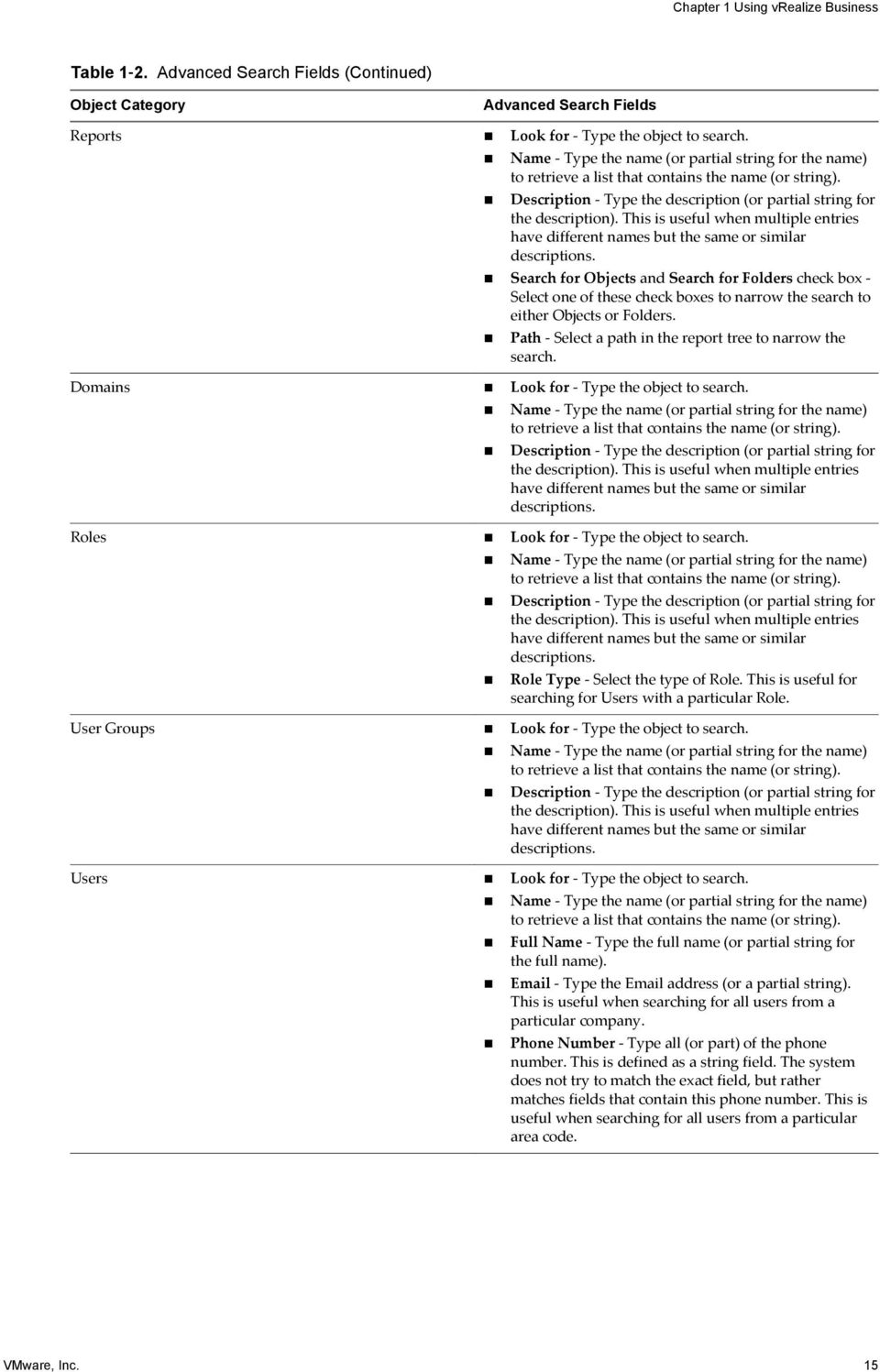
12 Enable the Portal Page for vrealize Business For some users, an vrealize Business window runs in a Portal on their external system. You can view a particular report or dashboard inside this external vrealize Business window. Log in to vrealize Business as an administrator. 1 Go to Tools > General Preferences> on the Options tab. 2 Select the Enable Portal Page check box. 3 In the portal on the external system, define a link tovrealize Business by using a URL of the form NOTE This is case sensitive. Searching in vrealize Business You can use vrealize Business search to find objects in the system. vrealize Business provides two search options. Regular Search - Select an object category from the Look for drop-down list and type an object string (or partial string) in the text box. Click Search. The search results appear in the Search Results Pane. Table 1 1. System Categories System Category Portfolio Organization Agreements Reports Domains Roles User Groups Users Search Object Category (Look for) Business and Technical Services, Business and Technical Offerings, Business Rules in Business Services and in Technical Services, Service Bundles, Classifications, Line Items, and Specifications. In addition, the list also displays other Portfolio-related options, such as Resources, Resource Groups, and Business Rule Templates. Organization, Customers, and Providers Agreements, Master Agreements, or Business Rules in Revisions/Agreements/All Agreements Reports Domains Roles User Groups Users Advanced Search- Click Advanced Options to view an advanced search dialog and complete the fields. Partial strings are acceptable for any of the text fields. The search feature treats character and numeric fields differently. For character fields, the search feature retrieves records with a string that contains the input characters. For example, if the user types abc for the Name field, any agreements that contain the string abc in their Name is displayed. Character field searches are not case-sensitive. For numeric fields or drop-down menus, the search feature retrieves records with an exact match to the input selection. For example, if the user types 80 for the Weight field or selects Draft for the agreement status, any agreements that contain exactly 80 or Draft is displayed. 12 VMware, Inc.

13 Chapter 1 Using vrealize Business Every search option contains different criteria, and so, different fields might appear for each object category. In addition, some fields are User Defined Fields and vary per system. Table 1 2. Advanced Search Fields Object Category Advanced Search Fields Portfolio Look for - Type the object to search. Name - Type the name (or partial string for the name) to retrieve a list that contains the name (or string). Description - Type the description (or partial string for the description). This is useful when multiple entries have different names but the same or similar descriptions. Search for Objects and Search for Folders check box - Select one of these check boxes to narrow the search to either Objects or Folders. Status - This is the publication status for the Portfolio object. Alias - This is an alternate category for the object. For example, a system contains computers by IP number. If some of the computers contain the alias Laptop, this could enable the system to search by this alias rather than IP number. Resource Type - Select the category for the Resource. Statement - This is text detailing the Business Rule, and is obtained from the Business Rule Template. The expression that was compiled using the vrealize Business Operators is composed into a meaningful statement. For example, the unavailability of application should not exceed $MAX_PERCENT during $SF_SCHEDULE $SF_PERIOD. Weight - This is the weight (numerical importance) of the Business Rule. Business Rule Template - Type the BRT Name (or partial string). Organization Look for - Type the object to search. Name - Type the name (or partial string for the name) to retrieve a list that contains the name (or string). Description - Type the description (or partial string for the description). This is useful when multiple entries have different names but the same or similar descriptions. Search for Objects and Search for Folders check box - Select one of these check boxes to narrow the search to either Objects or Folders. VMware, Inc. 13

14 Table 1 2. Advanced Search Fields (Continued) Object Category Advanced Search Fields Agreements Look for - Type the object to search. Name - Type the name (or partial string for the name) to retrieve a list that contains the name (or string). Description - Type the description (or partial string for the description). This is useful when multiple entries have different names but the same or similar descriptions. Customer Name - This is the name of the Service recipient. Provider Name - This is the name of the Service supplier. Agreement Type - Agreements can be classified into four different types. Stand Alone - This agreement is not dependent on any other type of agreement, nor does it have any other agreements linked to it. Master - This Agreement is used as a template for other Agreements. Master agreements have no customers and no engine calculations are performed for these agreements. Live Link - This is a pointer to a master agreement. The advantage to using Live Links is that any change to the master agreement affects all of the Live Links simultaneously. Detached - This type indicates that an agreement has changed from a Master agreement to a Stand Alone Agreement. Agreement Status - An Agreement can contain many revisions. Revision - Select a Revision number from the dropdown list. Search based on the description field which opens the agreement with the revision details. Statement - This is text detailing the Business Rule (obtained from the Business Rule Template). The expression that was compiled using the vrealize Business Operators is composed into a meaningful statement. For example: The unavailability of application should not exceed $MAX_PERCENT during $SF_SCHEDULE $SF_PERIOD. Weight - This is the weight (numerical importance) of the Business Rule. Business Rule Template - Business Rule Templates are instantiated in agreements using different parameters to form different Business Rules. Classification - A set of performance-related categories to which Business Rules belong. Examples include Performance, Quality, and Satisfaction. 14 VMware, Inc.
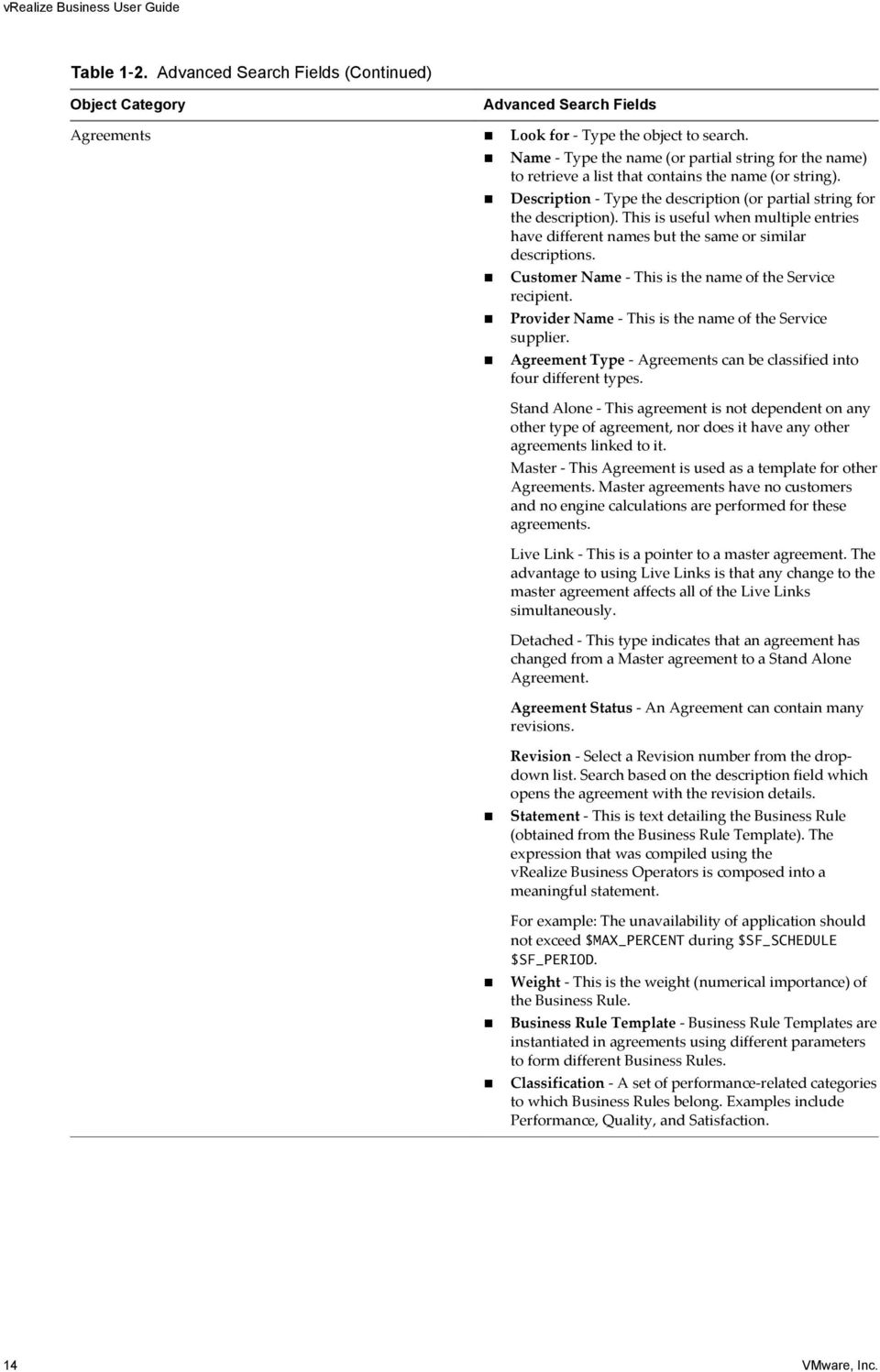
15 Chapter 1 Using vrealize Business Table 1 2. Advanced Search Fields (Continued) Object Category Advanced Search Fields Reports Look for - Type the object to search. Name - Type the name (or partial string for the name) to retrieve a list that contains the name (or string). Description - Type the description (or partial string for the description). This is useful when multiple entries have different names but the same or similar descriptions. Search for Objects and Search for Folders check box - Select one of these check boxes to narrow the search to either Objects or Folders. Path - Select a path in the report tree to narrow the search. Domains Look for - Type the object to search. Name - Type the name (or partial string for the name) to retrieve a list that contains the name (or string). Description - Type the description (or partial string for the description). This is useful when multiple entries have different names but the same or similar descriptions. Roles Look for - Type the object to search. Name - Type the name (or partial string for the name) to retrieve a list that contains the name (or string). Description - Type the description (or partial string for the description). This is useful when multiple entries have different names but the same or similar descriptions. Role Type - Select the type of Role. This is useful for searching for Users with a particular Role. User Groups Look for - Type the object to search. Name - Type the name (or partial string for the name) to retrieve a list that contains the name (or string). Description - Type the description (or partial string for the description). This is useful when multiple entries have different names but the same or similar descriptions. Users Look for - Type the object to search. Name - Type the name (or partial string for the name) to retrieve a list that contains the name (or string). Full Name - Type the full name (or partial string for the full name). - Type the address (or a partial string). This is useful when searching for all users from a particular company. Phone Number - Type all (or part) of the phone number. This is defined as a string field. The system does not try to match the exact field, but rather matches fields that contain this phone number. This is useful when searching for all users from a particular area code. VMware, Inc. 15
16 If you initiate the search while viewing the Portfolio Browser or My Subscriptions, the regular search yields links to objects in the Portfolio Browser. However, if you start the search while viewing service objects in the Tree view (via Manage), the regular search yields links to objects in the Manage-Tree view. If you cannot access the Manage feature, the search results in links in the Portfolio Browser. Conversely, if the Portfolio is not installed, the search produces Manage-Tree view links. NOTE To enable breadcrumbs, see Infrastructure Configuration Parameters in the vrealize Business Installation and Administration Guide. Tasks in vrealize Business In vrealize Business, there are business processes that are comprised of multiple steps. For example, subscribing to a service involves not only the customer s action of subscribing, but also the account manager s approval of the subscription. Such steps are managed using Tasks. Tasks are generated from the following sources: Agreement Activation - A user who wants to activate an agreement but does not have permission to do so requests activation from a manager. In this case, the manager receives a task called Account Manager Approval. Subscription Approval - A user subscribes to a service in the portfolio. An agreement is automatically generated and requires the manager to approve the agreement activation. Upload Data - An upload process, which requires one or more users to upload data for processing (for example, Monthly Reports), generates an Upload Data Task. View Task List When vrealize Business assigns a task, the participating user receives alerting to the subscription request or upload task. In the My vrealize Business frame, the tasks link indicates the number of tasks that await this user s attention. See Viewing Links to Reports and Dashboards, on page 10. To view the My Tasks link, the View Tasks option must be selected in the User s Role. u Click the list to view the Task List. The number indicates the tasks that are currently active and require attention. These include tasks that are in progress, suspended, and offered. This task list includes the following information: Task Name - This name describes the task - either Approval or Upload Data. You can click the link to see the Task details. See View Task Details, on page 17 for more information. Process Name - The name reflects the origin of the Task: For tasks generated from agreement activation, the Process Name is a combination of the agreement name with revision activation. For tasks generated from subscription approval (available when the portfolio application is installed), the Process Name is a combination of the agreement name with approval. For tasks generated from upload data, the Process Name is a combination of the adaptor name with data upload. 16 VMware, Inc.
17 Chapter 1 Using vrealize Business For tasks generated from monthly validation, the Process Name is a combination of the Month/Year for which the monthly validation is executed with Validate Cost Model, Validate Data Gathering, or Validate Results. Status - Options include: <Blank> - Select this option at the top of the list to view all status entries. Default - Select this option to view In Progress, Suspended, and Offered entries simultaneously. Offered - When a task is initiated, it can be assigned to one or more individuals or to all members of a role. When it is assigned to more than one user, its status is Offered. When someone claims the task, it is removed from the Task List of the other role members and its status changes to In Progress. In Progress - The process has started and is in the user s task list. Suspended - Sometimes, an approval process must be delayed. For example, more research might be required until a decision can be made, or input is required from an individual who is away from the office. The user or manager can suspend the task, which freezes the task execution. See View Task Details, on page 17. Completed - The task is complete. Cancelled - The task has been cancelled, but rather than removing it from the Task List, its status becomes Cancelled. Process Start - This is the date that the process was initiated. My Start - This is the date that the manager began to work on the task. Quick Action - Click this link to go to the agreement or upload dialog. Both of these targets can be accessed from the Task tab. See View Task Details, on page 17 for more information. View Task Details Select the View Business Process Details option to view the History and Process Diagram tabs. You can use the Task Name link from the task list to view additional information about the task. You can view the general information about the task under the Task tab. The fields on the tab depends on whether the task involves approval or upload data. Common fields include the process name that reflects the origin of the task, the description, which provides processing instructions for the manager, the start date of the task, and the current status of the task. You can click the Action link to open the Agreement or Upload File dialog box. You can browse to select the file that should be uploaded and then upload the data. You can see the agreement name connected to the task, the customer involved with the agreement, subscriber comments, task manger comments in the Agreement Approval Task tab. You can use the Upload Data Task tab to include the identifiers that are unique to the upload task. You can view the various individual actions involved in the task under the History tab. For each action, the tab lists the contact, start time for the action, and comments. You can view a flow chart with all of the steps that are required for the task in the Process Diagram tab. VMware, Inc. 17

18 Using Toolbar for Tasks In addition to the regular toolbar buttons, several toolbar buttons appear for tasks. You can use the toolbar to perform task related actions such as approving the task, adding comments, submitting, or denying the task. Table 1 3. Toolbar for tasks Button Add Comment Adjust Revision Approve Deny Done More Actions More Info Start Task Submit Function Open a comment dialog box. This comment appears in the History tab. View more information as required before revision approval. The results are as follows: The task moves from the manager s task list to the initiating contact s task list. The task name changes to Revision Adjustment. The status changes to Adjusting. Approve the task. Deny approval for the task. Indicate that the upload process is complete. This button includes the following options: (Not all options are enabled in every case.) Suspend - Postpone work on the task. Resume - Restart a Task that was suspended. Reassign - Assign the Task to a different User. Deallocate - Revert the Task to Offered Status. View more information related to subscription approval. This button is available after the Portfolio application is installed. The results are as follows: The task moves from the manager s task list to the initiating contact s task list. The task name changes to Provide Information. The status changes to Waiting Response. Accept a task offered to you. After you provide more information, resend the task to the approving manager and change the status to Awaiting Approval. Tracking Tasks Related to Groups Using vrealize Business, managers can track tasks that are assigned to their group members. When users are added invrealize Business, a manager can be assigned. All of the tasks that belong to a manager's group appear automatically under My Group Tasks. While monitoring these tasks, the manager can perform the following actions: Decide to assign a task to a different user in the group. Open a task and add comments, which appear on the History tab. The My Group Tasks includes the same fields as those for the task list, along with one additional field related to the task owner. The task owner is the user to whom the task is currently assigned. If the user is on vacation or cannot complete the task, the manager can reassign the task to a different user. 18 VMware, Inc.

19 Chapter 1 Using vrealize Business Reassign Tasks Tasks are assigned to task owners. If a task owner is on vacation or cannot complete the task, the manager can reassign the task to a different user. You must have manager privileges. 1 Click the task name. 2 Click More Actions and select Reassign from the drop-down list. 3 Click Browse to select an alternative user. Business Processes In vrealize Business, business processes are comprised of multiple tasks. The system includes a set of default Business Process Definitions (BPD), and lets you to add custom definitions. Select Tools> System Definitions > Business Process Definitions to view the business process details. The types of business processes that appear depend on the installed applications. The list includes: ID - The ID is assigned by vrealize Business during business process definition creation. It cannot be modified. (If this field does not appear, select the Show ID columns check box in the My Preferences Options tab. See Using the Administrative Links, on page 20 for details.) Process Type - The name of the business process definition. Click a link to see the process diagram. This diagram illustrates the tasks that are involved with this particular business process definition. Click Download to save this business process definition. Users with proper knowledge, can edit and save this copy and upload it as a new version. Description - Provides the description for business process definition. Version - You can create more than one business process definition for any particular process type. However, vrealize Business uses only the latest version of a business process definition. To revert to a previous version, delete the current version. The system maintains the earlier versions and automatically uploads the next and highest version in its place. Process Class - The type of the business process definition that determines when it will be used. When defining a new business process definition, you must assign a process class. Add a Business Process Definition To create a new business process definition, click Add. Select a Process Class from the drop-down menu. A custom process class is available beside the standard process classes. Click Browse to upload a customized business process definition. Common vrealize Business Toolbar Options The toolbar contains various options for the current page, but includes some basic set of buttons in common. Additional toolbar buttons that are relevant to a particular feature are presented within each feature section. See List View, on page 22 for additional information on list button for the specific buttons associated with lists. VMware, Inc. 19

20 Toolbar Button Cancel Save Go one level up Table of Contents Function Cancel the editing changes. Save the editing changes. Move one level up in the hierarchy. Table of Contents view. Buttons are enabled, disabled, or absent according to the user set permission and the relevance of action. Clicking the arrow icon at the bottom of the toolbar displays a drop-down menu with additional options, which differ from button to button. NOTE In the list view, the user can select multiple items for deletion. This feature is not available within the folder view. Using the Administrative Links Located in the top right-hand corner of the screen, the administrative links let you customize the system. User ID - This string indicates the ID of the user who is currently logged into the system. Roll the cursor over this string to see the date and time of the last login. Logout - Click this link to logout of vrealize Business. My Preferences Click this link to modify user preferences. After changing any of these preferences, you must either log out and log in to vrealize Business, or refresh the browser window for the settings to be effective. Complete the fields in the My Preferences options tab: User Name This is the login ID. Full Name This field can only be edited by the system administrator. Password Click Change to modify your password. User Locale This setting affects date and currency or number formats. Use the default value or select an alternative value. Report Time Sort Order This option determines the default sort order for data displayed in reports. Ascending displays data from the least recent to the most recent and descending displays data from the most recent to the least recent. Results Per Page Set this value to the maximum number of search results to be displayed on each page in the list view. The system provides paging links for the user can navigate to additional results. See List View, on page 22. Context behavior on login - Use this option to pre-set the context for your login session. Select between use default context and use last context. For more information on context, see Context. Display - Select the display check boxes as required: Check Box Show ID columns Show warning before leaving an unsaved object Description Select this check box to display an additional column in the workspace with the ID of thevrealize Business object. This can be useful for troubleshooting. (This check box is disabled by default.) Before leaving a page, vrealize Business gives a warning if an item on the page has been modified but not saved. Select this check box to enable the warning messages. (The check box is enabled by default.) 20 VMware, Inc.

21 Chapter 1 Using vrealize Business Check Box Show confirmation upon success Show confirmation upon successful deletion Show confirmation when editing Hierarchy in Cost Model Show warning upon saving Dashboard Description After modifying an item, vrealize Business gives a confirmation message if the changes are saved successfully. Select this check box to enable the confirmation messages. (The check box is enabled by default.) If an item is deleted, vrealize Business gives a warning message. Select this check box to enable the warning messages. (The check box is enabled by default.) If an item is edited, vrealize Business gives a warning message. Select this check box to enable the warning messages. (The check box is enabled by default.) When the administrator (or any User with publish report permissions) modifies the system dashboard (see Customizing a Report for details), these changes apply to all Users in the system. Select this check box to show a warning message to this effect. (The check box is enabled by default.) Keyboard - Select the keyboard check box as desired: Check Box Enable keyboard shortcuts Show simplified reports for keyboard navigation Description Select this check box to facilitate keyboard navigation in the vrealize Business user interface, minimizing the need for mouse usage. In the keyboard shortcuts tab, the user defines keyboard shortcuts for common vrealize Business activities. See Using Keyboard Shortcuts, on page 21 for more information. Select this check box to facilitate keyboard navigation in the vrealize Business user interface, minimizing the need for mouse usage. In the keyboard shortcuts tab, the user defines keyboard shortcuts for common vrealize Business activities. See Using Keyboard Shortcuts, on page 21 for more information. My Menu tab - In this tab, the user sets the home page and defines the contents for the My Menu frame in vrealize Business. See My Menu for more information. Keyboard Shortcuts tab - Use this tab to define keyboard navigation for common vrealize Business activities. See Using Keyboard Shortcuts, on page 21 for details. Click Save to apply the changes and they are affective immediately. Click Restore Default Settings to overwrite any applied values with the original values. Click Cancel to close the window without applying any changes. Using Keyboard Shortcuts If you have difficulties using a mouse or prefer to use the keyboard instead of the mouse, you can define customized keyboard shortcuts for common vrealize Business activities. Select My Preferences from the user (in the top right-hand corner of the main window) and select the Keyboard Shortcuts tab. For most vrealize Business activities, a default shortcut is already defined. To change this value, click the definition. In the New key text box, type the desired keyboard combination. Press <Backspace> to remove the assigned shortcut. Use any key as a shortcut; adding <CTRL>, <ALT>, and/or <SHIFT> (or any combination) is optional. With Internet Explorer, several combinations that are interpreted by the browser cannot be used in vrealize Business. For example, <CTRL>+F and <CTRL>+R. With Firefox, no such limitations are applicable. However, use of a combination is usually interpreted by the browser. Even if a shortcut is assigned to an operation that is currently unavailable, it will perform the regular browser action. For example, if <CTRL>+R is the shortcut for revert changes and the Cancel button in the toolbar is not enabled, <CTRL>+R is passed to the browser which will reload the page. VMware, Inc. 21
22 Using the vrealize Business Workspace The workspace contains various vrealize Business screens based on the selected options, either from the main menu options or from the left pane selections. Workspace format can include list view. See List View, on page 22 for additional information. List View List view displays data in the records area in a table. Each record occupies one row of the table. In addition to the records area, this view contains the filter row, paging links, and list buttons. Click any column heading in the heading Row to sort the contents of a particular column. Filter Row The filter row appears at the top of all tables in the list view. The fields in this row correspond to the fields in the table. Use the filter row to quickly filter the table, to view specific desired values. For example, the agreement list displays all agreements by default. To view only the active agreements, select active from the empty cell in the filter row that corresponds to the Status column. Press Enter to see the filtered results. Use a semicolon (;) to filter for multiple values. For example, type 6;red in the name box to view all names that contain the numeral 6 or the string red. Paging Links Paging links are used to navigate between pages in the list view. The number of items on each page is determined by the user in the My Preferences page. (See Using the Administrative Links, on page 20 for details.) The page numbers act as links for navigating to a particular page. In addition, the paging links contain the following navigation symbols: Symbol Meaning First Page Jump to the first page. Previous Page Next Page Last Page No Previous Pages No Next Pages View All Clear Filters Search Clear Sorting Display the previous ten pages. Up to ten numbers are displayed. Display the next ten pages. Up to ten numbers are displayed. Jump to the last page. No previous pages. No next pages. Display all of the list entries, regardless of the number defined in the results per page field. Clears all filters. Search the list view. Clears sorting. List Buttons List buttons are located above vrealize Business lists, and include the following set of options. Button Add Duplicate Function Add an appropriate element. In addition to the default action (which differs for each Object set), click the drop-down arrow to see additional add options. Create a copy of the selected item. 22 VMware, Inc.
23 Chapter 1 Using vrealize Business Button Delete Move Function Delete the selected entry. Move an object to another folder. Note that this button is only available in list view and only for selected Objects. Click browse to select an alternative location. Tree View The tree view displays each element as a level in an tree. Levels are determined by the structure of hierarchy. Select a number and the list of numbers varies according to the number of available levels to display the desired level. Mandatory Fields In vrealize Business, there are fields that are mandatory and these fields are marked with asterisks along with text boxes or with asterisks only. The mandatory fields are physical and logical by nature. Physical mandatory field - This field is denoted by and asterisk together with a text box (for example, a name field). These fields must be populated before any information can be saved. Logical mandatory field - Indicated by an asterisk only (for example. the report field). This field is mandatory and will affect calculations and final results. However, the user can save and close the window without completing this field. For example, a report distribution is defined. It must have a name, but if the user does not know exactly which report should be distributed, the dialog box can still be saved, and the precise report can be defined at a later time. NOTE The report distribution does not work properly without the name of the report. VMware, Inc. 23
24 24 VMware, Inc.
25 Cost And Cost Analysis 2 IT Finance Managers, and similar users, use a cost model in vrealize Business to manage cost data and from which to analyze cost data. A cost model is a multi-tiered set of allocation rules that map the financial relationships between expenses and other objects within the organization. Cost analysis illustrates the relationship between the cost and business needs. vrealize Business includes analysis dashboards that demonstrate the association between services and their delivery costs through business processes. This chapter includes the following topics: About Cost Models, on page 25 Getting Started with Cost Models, on page 26 Working with Cost Models, on page 27 Uploading Data to vrealize Business, on page 38 Working with Allocation Settings, on page 58 Analyzing Cost Data, on page 63 Viewing Model Problems, on page 85 Cost Model Metrics, on page 87 About Cost Models A cost model is a multi-tiered set of allocation rules that map the financial relationships between expenses and other objects within the organization. This relationship reveals the entities that drive the cost of other entities and the entities to which cost is passed. The cost model diagram is a visual representation of the cost model high-level structure. It illustrates cost flow throughout the organization. vrealize Business includes a default cost model. The IT controller, or similar user, creates and modifies the cost model to reflect cost relationships in the business structure. Modifications to the cost model include adding and deleting cost objects, and changing dependencies to reflect the current contributory relationships between cost elements. VMware, Inc. 25
26 Elements of a Cost Model Diagram The cost model diagram is a visual representation of the cost model high-level structure. It illustrates cost flow throughout the organization. The cost model diagram includes expenses, groups, and objects. Expenses are the critical input to all cost models. vrealize Business uses expense data to calculate the cost of all other cost model elements. Because the cost model represents expense allocation relationships, expenses are the only entities that initially contain actual numeric costs and therefore are an integral part of the cost model. The default cost model diagram includes an expenses node, and you can add additional expenses nodes to represent general ledgers or other expense inputs. Every element in the cost model should either have expenses directly linked to it or indirectly linked through other elements. Expense nodes in the cost model diagram are square. Cost group are collections of cost objects. Groups can be standalone, such as names of individual servers, or folders that contain other cost objects. For example, cost centers can be a cost group that includes the cost object folders related to IT security, database team, and storage products. Cost groups in the cost model diagram are squares with rounded corners and layered frames. Cost objects are entities associated with the organization s activity for which costs are incurred. The object itself, a product, service, department, or other entity, might have expenses of its own. Conversely, you can evaluate its cost by applying cost allocation rules to its cost drivers. Cost objects in the cost model diagram are squares with rounded corners. Cost Model Diagram The cost model diagram shows the state and relationships of the cost model elements. Costs originate in expenses and flow from left to right through the elements in the diagram. Links represents cost movement, connect cost model elements. Cost model elements can display a monetary amount that indicates the total cost of the element. When you point to a cost path, the relevant cost model nodes are highlighted. By default, the cost model diagram reflects organizational data for the current month. Because vrealize Business might contain different cost data, or cost allocations might change from month to month, you can select a date to view cost data for an alternative month and year. Metrics are measurements of data. They appear in the status line above the cost model and in each cost model element. The system presents up to two metrics at any given time. You can change metrics to view alternative information. The date of the last cost calculation appears in the upper-right corner. The time appears if the last calculation was done during the current day. Getting Started with Cost Models vrealize Business includes a default cost model. The cost model incorporates the most common cost groups and cost objects with related links that reflect an organization s structure. You can customize the default cost model to match any organization. Some of the cost groups in the default cost model are initialized with standard data. For example, the physical servers cost group includes UNIX, Linux, and Windows, the most common physical server types that allow benchmark comparison with industry standards and peers. Other cost groups, like Applications, are initially empty. Populate these cost groups with data that is appropriate to your organization. 26 VMware, Inc.
27 Chapter 2 Cost And Cost Analysis Follow these basic steps to achieve a complete, functional, and useful cost model. 1 Upload expense accounts and hierarchies for your organization s IT cost centers, data centers, applications, and business units. For more information, See Uploading Data to vrealize Business, on page Upload the General Ledger expenses, mapping, and usage files for the organization s specific cost objects to the default cost model by using the Upload Data Sources feature. See Upload Data Sources, on page View the cost model results and resolve any issues or missing data. Resolve Upload Problems, on page To obtain a comprehensive view of the cost model, review the default content dashboards. For the best value from these dashboards, and especially in the CIO Dashboard, customize the reports and select the relevant services that best fit your organization. See Analyzing Cost Data, on page 63. Working with Cost Models vrealize Business includes a default cost model with common cost objects such as expenses and cost centers. The IT controller or a similar user can add or delete objects, upload cost data, and define cost drivers and cost allocation targets. Add a Cost Model Element A cost model element represents an entity in the organization for which the IT Controller or a similar user wants to examine costs. Elements can represent departments in a company, or objects such as or CPUs. You can add a node to the cost model to analyze its cost and calculate its unit cost. Connecting nodes to the cost model illustrates the node s relationship in the organization and allows costs to be distributed to and from the node. You must have update permission to add cost model nodes. An administrator can modify the user s role as required. 1 Point to the area above or below the center of an existing cost model element and click the Add Element icon. 2 Select the required element from the Add Element pop-up window. The new node appears in the cost model where you clicked the Add Element icon. 3 Type the name of the new element in the text box. 4 To keep similar elements together, drag elements to the required location in the cost model. 5 Point to an element node to which the new element should be connected. 6 Drag the arrow to the new element. What to do next For cost groups, define group details. See Define Cost Group Details, on page 28. VMware, Inc. 27
28 Define Cost Object Details You can upload data to a stand-alone cost object. You must be an IT controller or a similar user. 1 Right-click cost object and select Setup Object. The Help Desk: Setup Object window appears. 2 Select a Category from the drop-down menu and select the Role. 3 Click Manage > Add. 4 Select Users and select the User Name. 5 Click OK. What to do next To define a cost group, see Define Cost Group Details, on page 28. Define Cost Group Details You can upload data either as a flat list or as a hierarchy. The decision to categorize a cost group as one or the other depends on the data, the organization, and how costs are distributed. You must be an IT controller, or a similar user. 1 Click the name link for a cost object. The Browse Cost pop-up window opens with cost details for the object. 2 Point to the group name and click the down icon. 3 Select Setup Group from the drop-down menu. 4 On the Select Group Type page, select a category. You can assign a category for cost objects to filter or generate reports based on category. 5 Select the group type. Option Flat List New Hierarchy Existing Hierarchy Description Creates a group with data that is not hierarchical. Click Finish to close the wizard or click Next to add aliases. Type the name of the hierarchy in the text box and click Next. Select a hierarchy from the drop-down menu. Click Finish to close the wizard or click Next to define the hierarchy structure. 6 On the Hierarchy Structure page, for new hierarchy groups, click Add to define the levels of the hierarchy. The order of the levels is significant to the hierarchy structure. You can drag levels to change the order as required. 28 VMware, Inc.
29 Chapter 2 Cost And Cost Analysis 7 Click Next. 8 On the Alias page, define one or more aliases for the group. a b Click Add to add an alias for the group. If vrealize Business uses the alias as the object title, select the check box in the Same as Object Title column. 9 Click Finish. What to do next To define a cost object, see Define Cost Object Details, on page 28. View Cost Details You can view cost details for an object in the cost model. A folder icon indicates a level in a cost group or hierarchy. For example, the Business Services cost group contains folders for Hotel Operations, Associate Services, and Professional Services. Metrics appear in Browse Cost pop-up window for every cost object with associated costs. To view alternative metrics, see Viewing Model Metrics, on page 103. Create a cost model. 1 Click the name link for a cost object. The Browse Cost pop-up window appears with cost details for the object. 2 To view cost details for an object in a cost group or hierarchy, click the required line in the Browse Cost pop-up window. 3 To sort the columns with metric data, click the column title. View Cost Drivers Cost drivers are objects that contribute cost to other objects. Create a cost model. 1 Click the name link for a cost object. 2 Point to a cost object in the Browse Cost pop-up window. The Drivers link appears to the left of the window. 3 Click the Drivers link. An additional Browse Cost pop-up window appears with a list of the drivers for the selected object. VMware, Inc. 29
30 View Cost Allocation Targets Cost allocation targets are objects that receive cost from other objects. When you view cost allocation targets, the metrics in the primary Browse Cost pop-up window appear in the Allocations pop-up window. Create a cost model. 1 Click the name link for a cost object. 2 Point to a cost object in the Browse Cost pop-up window. 3 Click the Allocations link to open an additional Browse Cost pop-up window, to the right of the current window, with a list of the allocation targets for the selected object. View Pass Through Cost Pass through cost represents costs that are routed by means of other cost objects in the cost model. Use this window to track costs that are not used in a cost object, but passed to other cost objects. Create a cost model. 1 Click the name link for a cost object. The Browse Cost pop-up window opens with cost details for the object. 2 Point to any object and click the down-arrow icon. 3 Select Pass Through Cost from the drop-down menu. The Pass Through Cost window shows pass through cost details, such as amount and cost path, related to the selected cost object. Add a Property This allows the user to add a property to cost group or object. You can assign property values for the cost group or object for each month in the fiscal year. See Modify Property Values, on page 31. You can upload multiple properties with value data from hierarchies, expenses, or flat list cost groups. See Uploading Data to vrealize Business, on page 38. Properties link a cost object or cost group with a value to improve cost allocation calculations. An example of a property is head count. For example, vrealize Business uses head count information to manage costs for employees in the different departments in a company. Create a cost model. 1 Click the name link for a cost object. The Browse Cost pop-up window opens with cost details for the object. 2 Point to an object and click the down-arrow icon. 30 VMware, Inc.
31 Chapter 2 Cost And Cost Analysis 3 Select Property List from the drop-down menu. If the selected object is a cost group, the Property List window appears. If the selected object is a cost object, the Property Values window appears. 4 Click Add to add a property for the selected cost group or object. 5 In the Add Property window, select an option and click Save. Option Select Create New Description Choose a property from the drop-down list. Type a property in the text box. You can reuse the new property for any cost object or group. 6 Click Close. Modify Property Values The property values help to predict changes in cost for the organization. You can assign property values for each month in the fiscal year. For example, the headcount in January is twenty. Due to a hiring effort, the headcount for February through May is projected to be fifty. The system administrator can define the first month of the fiscal year in the Options tab under General Preferences. This directly affects costing and budgeting calculations. For the months January through July, the fiscal year is set to the calendar year to which the first month belongs. For August through December, the fiscal year is set to the following year. For example, if the current year is 2012 and the first month is set to October, the fiscal year in vrealize Business is set to You can upload multiple properties with value data. See Uploading Data to vrealize Business, on page 38. You must be an IT Controller, or a similar user. 1 Click the name link for a cost object. The Browse Cost pop-up window opens with cost details for the object. 2 Point to any object and click the down-arrow icon. 3 Select Property List from the drop-down menu. If the selected object is a cost group, the Property List window appears. If the selected object is a cost object, the Property Values window appears. 4 For a cost group, select the property to set monthly values. 5 In the Property Values window, click inside a cell to edit the value and click Save. Add an Expense Account This allows you to add an expense account which includes Travel, Salaries, and Office Supplies. Expense accounts are categories that explain the purpose of each expense. The IT Controller, or similar user, collects data from the chart of accounts and uploads all expense account information to vrealize Business. Create a cost model. VMware, Inc. 31
32 1 Select Costing > Expense Accounts. 2 Click Add and complete the required fields in the New Account page. 3 Click Add. Add an Expense Record Expense records help you track and organize expenses. Open a cost model. 1 Point to an expenses element in the cost model and click the down-arrow icon. 2 Select View Expenses from the drop-down menu. The Expense Records window shows details for all expense records. 3 Click Add to add an expense record. 4 In the New Record window, supply the required information, and click OK. Option Amount Date Account Expense Code Fixed/Variable Capex/Opex Description Amount of the expense. Month and year for the expense. Expense account to which the expense belongs. Optional code for the expense. To understand the fixed/variable implications of your budget plan, ensure your accounts fixed/varibale property is defined correctly. 1 Click Date to open the account tree, and for each account, click edit. 2 Select the Fixed/Variable field and assign the correct value 3 Click OK and refresh the system. Type of overhead expense. Fixed costs do not change when production activity changes. Examples include rent and insurance. Variable costs respond to changes in activity or volume. Examples include hourly wages and office supplies. To understand the capex/opex implications of your budget plan, ensure your accounts capex/opex property is defined correctly. 1 Click Date to open the account tree, and for each account, click edit. 2 Select the Capex/Opex field and assign the correct value 3 Click OK and refresh the system. Type of expense. Capital expenditures, Capex, are those for which the benefit extends beyond the tax year. These expenditures includes fixed assets, such as equipment or property. Operating expenditures, Opex, are those required for day-to-day business functions, such as wages and maintenance. 32 VMware, Inc.
33 Chapter 2 Cost And Cost Analysis Export Cost Model Data You can export cost model data to use in another application, such as , or in a presentation. The output is a.csv file. Verify that you have an open cost model from which to export data. 1 Click the name link for a cost object. The Browse Cost pop-up window opens. 2 Navigate to the required object for export. 3 Click Export and select the export level. Option Current Level All Levels Description The output file includes all cost objects, and related cost information, for the current level. The output file includes the cost information for the current level, displays the parent level and all levels to which this level allocates cost. Use this option to export all levels for hierarchical data. For compatibility between different applications, the output file does not include formatting in the columns, and units, such as $ or %, appear in the column headers only. Use the formatting features of the application that you use. 4 Click Open or Save, as required. Manage Cost Data The IT Controller or users with a similar role can modify and track cost model upload activities for expenses, allocations, and unit cost or unit price settings. For example, you might have a monthly process for collecting and uploading data to the cost model. You can use this feature to review the status of your uploads, and upload missing information, or contact the appropriate person to upload the data. Verify that you have a cost model with uploaded data and one or more cost allocations. For information about uploading data, see Uploading Data to vrealize Business, on page 38. For information about uploading, adding, and editing expense records, see Add an Expense Record, on page 32. For information about allocation settings, see Working with Allocation Settings, on page 58. For information about properties, see Modify Property Values, on page Click Manage Data from the toolbar. The Manage Data window shows information and statistics for upload activity. 2 Click a link in the Log column to view a read-only upload log for the corresponding Target Object. 3 Click a link in the Upload column to upload data for the corresponding Target Object. VMware, Inc. 33
34 4 Click a link in the Edit column to modify upload details. The action is different according to the value in the Type column. Option Expense Allocation Group Property Action The Expense Records window appears. The list of cost allocations for which uploads have occurred appears. Click a Path link to edit the Allocation routing. The list of values for the uploaded property appears. Delete the Cost Model Data The administrators can delete the cost model data for the expenses allocated, delete the allocation data and also delete the allocation rules set. Verify that you have a cost model with uploaded data and one or more cost allocations. 1 Click Manage Data from the toolbar. The Manage Data window displays information and statistics for upload activity. 2 Click the tab Delete Cost Model Data to cleanup cost model or to empty the data and optional allocation methods. 3 Select one of the allocation methods to cleanup the data or the allocation rules. Delete Expenses: Deletes the expenses which refers to the particular cost model. Delete Allocation Data: Deletes the allocation data which refers to the particular cost model. Delete Allocation Rules: Deletes the data and allocation rules which refers to the particular cost model. NOTE If you select the Delete Allocation Rules option the Delete Allocation Data is automatically greyed out. NOTE When you perform this operation the changes are reflected in the application after running the full cycle. Define Cost Model Permissions The IT Controller, or similar user, can assign permissions per cost model for non-administrative users or groups. For example, a cost model contains business unit-specific information. The manager in charge of this business unit must have permission to manage this cost model. The same manager s access should be excluded on a different cost model to which he has no connection. Verify that the cost model is open. Verify that the primary hierarchy for the users in the Authorization List is set to Cost Models. See Role, on page 184. You can set permissions to create, read, update, delete, or calculate results for cost models. 34 VMware, Inc.
35 Chapter 2 Cost And Cost Analysis 1 Click Permissions in the toolbar. The Permissions window shows the roles and the associated authorized users or groups that have permissions for the cost model. 2 Highlight a role and click Manage to modify the list of authorized users for the role. 3 In the Manage Authorization window, click Add and select either Users or Groups. 4 Select the required users or groups and click OK. Authorized users can delete only users or groups that they add to the Authorization List. The Can Be Deleted column indicates that the current user can delete a user. 5 Click Close. Defining a Calculation Period for Cost Models You can define the default time frame for the cost model calculation. You can also set a cost model not to calculate by default. This improves the cost model calculation performance. Create a cost model. 1 Select Costing > Cost Models and select the required cost model. 2 Click Properties from the toolbar. 3 In the Properties pop-up window, select one of the options to define the calculation period. Do not calculate - Select this option to disable cost model calculation. Calculate for default period (24 months back, 36 months forward) - Select this option to calculate cost data from past two years till 36 months. Calculate for custom period- Select this option to specify the calculation period according to your requirement. Refresh Cost Model Calculations After modifying a cost model, recalculate the cost data to update the model with the most accurate cost information. Verify that the cost model is open. 1 Click Refresh Results. The system updates all monetary calculations for the current cost model for the current month. 2 Select Full Results from the Refresh Results drop-down list to recalculate monetary data for all cost models for all months. VMware, Inc. 35
36 Define Primary Cost Model You can define multiple cost models, but only one model is the primary cost model. vrealize Business uses the primary cost model as the default input for cost-related dashboards and reports. If you designate an alternative cost model as the primary cost model, results for all cost-related dashboards and reports will change. Open a cost model. 1 Select Costing > Cost Models. 2 Click the line with the required cost model and click Set Primary. 3 In the confirmation pop-up window, click OK. The primary cost model appears in the Cost Models list in bold. Create a Cost Model The cost model represents a set of cost elements and their financial relationships. You can create either an empty cost model or create a cost with out-of-the-box cost elements. You must be an administrator, IT Controller, or similar user. 1 Select Costing > New Cost Model... 2 Select the cost model type. Blank Cost Model - To create an empty cost model on which you require cost elements. Primary Cost Model - To create a cost model with default cost elements and their relationships. NOTE vrealize Business uses the primary cost model as the default input for cost-related dashboards and reports. You can create multiple cost models, but only one model is the primary cost model. You can set any cost model as a primary cost model at any time. See Define Primary Cost Model, on page Provide a name to the cost model. 4 Click Add. Delete a Cost Model The IT Controller or similar user can delete a cost model if the cost relationships are no longer valid or if the cost data is obsolete. Create a cost model. 1 Select Costing > Cost Models. 2 Click the line with the required cost model and click Delete. 36 VMware, Inc.
37 Chapter 2 Cost And Cost Analysis Find a Cost Object You can use the Find Cost Object feature to locate one or more cost objects in a cost or plan model. Create a cost model. 1 In the model toolbar, click Find Cost Object. 2 To narrow your search, type a string in the Search text box. 3 Click Search. 4 If you leave the Search text box empty, click Search to find all cost objects. The results of the search appear in the lower portion of the Find Cost Object window. A folder icon indicates a cost group. Since multiple objects can match the search string, the Path column shows the object s location in the model. Rename a Cost Model Element You can rename the cost model group or object once it is created. Create a cost model. 1 Point to the cost model element to rename and click the down-arrow icon. 2 Select Rename from the drop-down menu. 3 Type the new name in the element name text box. Delete a Cost Model Element You can delete an element from a cost model when the element is not useful or required. Create a cost model element. 1 Point to a link that connects two cost model elements, one of which to delete. 2 Click the Delete icon. 3 Point to the cost model element to delete and click the down-arrow icon. 4 Select Delete from the drop-down menu. Create a What-If Model You can make changes to a What-If model and observe results without affecting the cost model on which the What-If model is based or the budgets, reports, or dashboards that use it. The date for the What-If model is the last date for which there is data in the cost model. VMware, Inc. 37
38 You must be an IT Controller, or similar user. 1 Select Costing > New What If. 2 Provide the required information and click Add. Creating a Service Owner Persona You can assign a user as a service owner to any cost object that is set as a service in a cost model in the vrealize Business application. Ensure that there is a user existing in the environment and a cost group or objects in the cost model that are marked with a service category. 1 Select cost model to view from IT Financial Management > Costing. For a stand-alone service cost object, right-click on the cost object from the cost model and select Setup Object from the drop-down menu. For service cost group, right-click on the cost group from the cost model and select Setup Group from the drop-down menu. For service cost group child, right-click on the cost group child and select Assign Owner from the drop-down menu. 2 To add a user, select the service owner, click Manage > Add. 3 Select User and click Close. When the user logs in to the system, the user can view the service analysis dashboard only for each of the cost model service the user owns. Uploading Data to vrealize Business Uploading data to the vrealize Business Financial Manager provides information for calculations, basis for analysis, and information for output reports. The IT Controller or similar user can upload data from many sources in vrealize Business Financial Manager. Hierarchies Expenses Expense accounts Cost allocations Unit costs Unit prices Property list information Portfolio Organizations 38 VMware, Inc.
39 Chapter 2 Cost And Cost Analysis Flat list cost groups The upload methods vary according to the type of object. You can upload hierarchical data with an upload template. All other uploads use an upload wizard. After a successful cost data upload, you can calculate usage-based costs, and view reports to analyze cost data. Uploading Hierarchies You can use an upload template to import hierarchy data to vrealize Business. Each hierarchy in vrealize Business has a unique structure. For example, organization hierarchies might have divisions and departments. Business services might have service lines, service categories, and services. Storage equipment might have storage type and storage component. Upload Organizational Hierarchies You can use an upload template to import organizational hierarchy data to vrealize Business. Create an hierarchy. 1 Create and save an upload template. a b Select Administration > Organization > All Uploads. Click Download Template in the row that corresponds to the required hierarchy. vrealize Business creates a Microsoft Excel file and uses the hierarchy definition to generate the specific columns in the file. 2 In the Excel file, type the required information. 3 Click Upload in the row that corresponds to the required hierarchy. 4 On the Upload File page, click Browse to select the upload file and click Upload. After vrealize Business verifies the data, the Hierarchy Upload Results page appears. 5 Click the View link to see the Added Nodes, Warnings, and Errors. 6 Click Continue Upload to complete the upload process. Upload Portfolio Hierarchies You can use an upload template to import portfolio hierarchy data to vrealize Business. Create a portfolio hierarchy. 1 Create and save an upload template. a b Select Portfolio > All Uploads. Click Download Template in the row that corresponds to the required hierarchy. The system creates a Microsoft Excel file and uses the hierarchy definition to generate the specific columns in the file. 2 In the Excel file, type the required information. VMware, Inc. 39
40 3 Click Upload in the row that corresponds to the required hierarchy. 4 On the Upload File page, click Browse to select the upload file and click Upload. After the system verifies the data, the Hierarchy Upload Results page appears. 5 Click the View link to see the Added Nodes, Warnings, and Errors. 6 Click Continue Upload to complete the upload process. Upload Cost Model Hierarchies You use an upload template to import cost model hierarchy data to vrealize Business. Create a cost model hierarchy. 1 In the cost model, point to the required hierarchy object, click the down arrow, and select Get Template. vrealize Business creates a Microsoft Excel file and uses the hierarchy definition to generate the specific columns in the file. 2 In the Excel file, type the required information. 3 In the cost model, point to the required hierarchy object, click the down arrow and click Upload. 4 On the Upload File page, click Browse to select the upload file and click Upload. After vrealize Business verifies the data, the Hierarchy Upload Results page appears. 5 Click the View link to see the Added Nodes, Warnings, and Errors. 6 Click Continue Upload to complete the upload process. Upload Expense Accounts You use an upload template to import expense account data to vrealize Business. Create an expense account. 1 Create and save an upload template. a b Select Costing > Expense Accounts. Select Get Template from the Upload drop-down menu in the toolbar. vrealize Business creates a Microsoft Excel file and uses the hierarchy definition to generate the specific columns in the file. 2 In the Excel file, type the required information. 3 Select Costing > Expense Accounts. 4 Select Upload Hierarchy Data from the Upload drop-down menu in the toolbar. 5 On the Upload File page, click Browse to select the upload file and click Upload. After vrealize Business verifies the data, the Hierarchy Upload Results page appears. 6 Click the View link to see the Added Nodes, Warnings, and Errors. 40 VMware, Inc.
41 Chapter 2 Cost And Cost Analysis 7 Click Continue Upload to complete the upload process. Monthly Budget Support for Cost Object Allows the user to enter yearly budget with monthly resolution of data for any cost object. The reports displays the budget data when they are uploaded. User creates multiple month s budget based on the yearly budget plan for the cost objects. 1 User creates an yearly budget plan based on the selected cost model. 2 Based on the yearly budget plan, the user can select these options: Click Export to Excel. Select the top level cost groups (group and top level objects) to export. Select to save the excel file. 3 Export or import to excel format. What to do next For the user to upload multiple months budget from an excel file, see Upload the Budget from an Excel File, on page 41. Upload the Budget from an Excel File User should provide an excel file that specifies the budget value of each cost object in the relevant months. Once you upload a budget, the user needs to specify the relevant FY and relevant cost model. The file should contain cost object of the entire FY months. The file can contain any cost object. Each cost object should have an indication as direct. User can upload by group hierarchy or by group and alias. By selecting group and alias, it allows the user to add multiple groups or for each added group to define the alias to use. Upload Hierarchies in Designer You can use an upload template to import hierarchy data to vrealize Business in the designer. Verify that you are an administrative users or users with similar permissions. 1 Create and save an upload template. a b Select Tools > System Definitions > Dimension Management. Select a hierarchy with Excel Upload for the input method. vrealize Business creates a Microsoft Excel file and uses the hierarchy definition to generate the specific columns in the file. 2 In the Excel file, type the required information. 3 Click Upload in the row that corresponds to the required hierarchy. VMware, Inc. 41
42 4 On the Upload File page, click Browse to select the upload file and click Upload. After vrealize Business verifies the data, the Hierarchy Upload Results page appears. 5 Click the View link to see the Added Nodes, Warnings, and Errors. 6 Click Continue Upload to complete the upload process. Uploading Non-hierarchical Data You use an upload wizard to upload non-hierarchical data from adaptors or files to vrealize Business. You can upload from an XLS, XLSX, or CSV files. You can also use an adaptor as a source to upload data. An administrator creates adaptors, which are located in the Designer under IT Financial Manager Additional Sources. NOTE When you run the ITFM Full Cycle job in the Flow Manager and if you upload data using an adaptor and then add a record to a group, thevrealize Business considers the records uploaded from the adaptor ignoring the manually added record. Uploaded data might contain records with unmatched allocation targets. For example, the target does not exist in the uploaded data or the allocation percentage does not equal 100 percent. The system rejects this data by default. You can allocate these targets immediately or in the future. Otherwise, you can define an allocation method for this type. See Working with Allocation Settings, on page 58. To understand upload results, see Interpreting Upload Results, on page 56. Access Upload Wizard You can access the upload wizard from different areas in vrealize Business. Create a cost model. 1 For Cost model expenses, click the down arrow icon and select Upload Expenses from an expenses node in the cost model. 2 For Cost Allocations, from the Allocations Settings window for which the allocation method has already been defined, click Upload. 3 For Unit cost or unit price, on the Allocation Method page, if the unit cost selection is Define per Object, click Edit and click Upload on the Edit Unit Price page. 4 For Cost model property lists, from the Property Values page, click Upload. 5 For Flat lists with cost model data, from a flat list cost model object, click the down-arrow icon and select Upload. What to do next Configure the data upload. See Configure the Data Upload, on page 42. Configure the Data Upload vrealize Business uses data association settings, which you set during upload, to confirm, assign, and calculate costs in your cost model. Create a data source. 42 VMware, Inc.
43 Chapter 2 Cost And Cost Analysis 1 On the Select Upload Source page, select the source for the upload data. For an upload file, vrealize Business assumes that the first row contains title information and not data and so ignores the row. 2 Select the Replace existing check box to overwrite any existing data, from the specified date through the optional ending date, with the new data. You can leave this check box unselected to add the incoming data to the existing data. The upload process ignores duplicate data. 3 Select the Add records check box to assign unmatched records to the Unresolved target type and click Next. The Upload Details page appears with the Data Association tab open by default. vrealize Business selects the default sheet in the input file as the source for the upload data and divides the data according to the column structure in the source sheet. If the data was uploaded in the past, vrealize Business assigns attributes to the data. As a result, the columns with the preassigned attributes appear in different colors. 4 Select an alternative sheet from the Select Sheet drop-down list to upload different data. This option is applicable to file uploads only. Option Select Multiple Sheets Only use sheets Description Select more than one sheet on the Select Multiple Sheets page. vrealize Business uploads data from all sheets. Filters sheet selection. 5 If the file contains sheets for each month that span multiple years, use the regular expression *Jan* to select all sheets from January, regardless of the year. 6 Click OK. What to do next Configure the uploads attribute table. See Configure Upload Attributes Table, on page 43. Configure Upload Attributes Table When you upload data to vrealize Business, you assign attributes to the data. vrealize Business uses the attribute definition to verify data and warn you about inconsistencies or data that is expected but missing. On the Data Association tab, the data is mapped to attributes and vrealize Business uses this mapping to determine whether the incoming, upload data is valid or invalid. The Upload Results show the number of records that were processed, the number of processed records that are accepted and will be uploaded, and the processed records that are discarded and will not be uploaded. You must define attributes. For information about attribute definitions, see Define Attributes, on page 45. VMware, Inc. 43
44 1 In the table section on the lower half of the Data Association tab, assign attributes to the columns. You can reassign attributes if necessary. a b Click on a column heading to highlight the entire column, a row number to highlight an entire row, or a cell or group of cells. Right-click to reveal a menu of attributes and select the attribute that best suits the highlighted data. Depending on the cost model object, the attribute list contains different items. 2 If the attribute association is incorrect, remove the attribute association. a b Point to a column, row, cell, or group of cells. Click the delete icon to remove the attribute definition from the object. 3 To associate an attribute to an object, edit the attribute association. 4 If you are routing expenses to one object, select an Amount cell rather than a row in the input file. What to do next You should complete the upload process. See Finish Data Upload, on page 44. Finish Data Upload The Upload Results show the number of records that were processed, the number of processed records that are accepted and will be uploaded, and the processed records that are discarded and will not be uploaded. The Routing tab on the Upload Details page gives a pictorial view of expense routing. This tab appears only when you upload expense data. Upload data into vrealize Business. 1 On the Summary tab on the Upload Details page, click an attribute name link in the Name column to modify the values in the Source column. 2 On the Routing tab in the Upload Details window, you can modify expense routing paths. Click the Edit icon to modify attribute properties. Click the Delete icon to delete the corresponding cost model object. Click the Add Object icon to add another cost object to the expense routing. Note that the order is significant. To swap the order, you can drag and drop the cost objects. 3 Click Next. 4 Select the date and specific expense account, if it is relevant, for which the upload is applicable. This window appears only when you upload expenses. 5 Click Next and click Finish. 44 VMware, Inc.
45 Chapter 2 Cost And Cost Analysis Define Attributes When you upload data with an upload wizard, you assign attributes to the data. vrealize Business uses the attributes to verify the contents and structure of the data and produces warnings that highlight missing or malformed data. Create a cost object. 1 Select the required group from the Group drop-down list. 2 Select a Cost Object option. 3 If you want the system to identify the cost object from the data, select Identify From Data and provide values in the Source and Identify by text boxes. 4 Select a Source option from the drop-down list. 5 In the Identify by text box, select Title or an alias that best matches the attribute items. 6 Define a custom pattern for the Identify by option. a b c Select Advanced. Type a pattern in the Regular Expression text box. Select Negate to exclude the items that match the pattern. d In the Match Group text box, type the required group in the format $1. For example, the data includes cost center information. The cost center names are in the format ID:Name. Expenses should only be routed to cost centers with ID=123. In this case, the pattern is (123)(:)(*) and the match group is $1 to indicate the first group. 7 For flat lists, select the Populate check box to initialize cost groups with appropriate data from the expenses. Upload Data Sources vrealize Business includes default mappings with standard business definitions. The IT Controller, or similar user, can use these mappings to upload data to vrealize Business. vrealize Business includes a default cost model that uses common names for cost groups and their cost objects. You must create and upload mapping files that translate your organization s specific names to the common names that the default cost model uses. Each mapping requires a unique Microsoft Excel file. See Mapping And Allocations, on page 46 for a description of the structure of each mapping file. For instructions about how to upload the Excel file to the system, see Uploading Data to vrealize Business, on page 38 Create data sources. 1 Select Costing > Upload Data Sources for the complete list of mappings. 2 Click the appropriate link to upload the mapping. VMware, Inc. 45
46 What to do next After you upload data, review the cost model results, and resolve any problems. See Resolve Upload Problems, on page 56. Mapping And Allocations When you use mapping links to upload data vrealize Business, and expects that the data in the uploaded Excel file is in a specific format. Each mapping has a unique structure and expected type of data. Expenses Mapping The Expenses link uploads expense data. The system uses the account and IT cost center mapping files and calculates the appropriate share of the cost to the different accounts, routed through the relevant IT cost center. You can map expenses to multiple allocation groups while selecting aliases. Columns in the Excel file include Date (mandatory), Account (mandatory), IT Cost Center (mandatory), Capex/Opex (optional), Fixed/Variable (optional), Amount (mandatory), Expense Code (optional), and Description (optional). Table 2 1. Sample Expenses Excel file Date Account IT Cost Center Capex or Opex Fixed or Variable Amount Expense Code Description 1/1/20 10 Software Maintenance IT Project Management Opex Fixed /1/20 10 Miscellaneou s IT Developmen t Opex Fixed /1/20 10 Software Licenses/ Purchases IT Portfolio Management Opex Variable /1/20 10 External Computer Services IT Security Opex Fixed Account Mapping The Account Mapping link is a mapping between the organization s chart of accounts and common expense account categories that the default cost model uses. Columns in the Excel should include Chart of Accounts (mandatory) and Account Category (mandatory). Table 2 2. Sample Account Mapping Excel file Chart of Accounts Account Category 6001 Real Estate 6002 Power 6003 Other 6004 Other 6005 External 6006 SW Maintenance & Support The default cost model recognizes the following account categories: HW Depreciation 46 VMware, Inc.
47 Chapter 2 Cost And Cost Analysis HW Maintenance & Support Labor External Labor Internal SW Depreciation SW Maintenance & Support Internet Backbone Land Line Mobile Phone Real Estate Power Cooling Gas Other Facilities Other You can map multiple accounts to the same account category. For example, you can map the rent account for Boston and Newark to the real estate account category. IT Cost Center Mapping Each IT cost center allocates its costs to one of the nine IT functions in the default cost model. Each row includes the IT Cost Center (mandatory), the IT Function (mandatory) to which it is allocating cost, and the Percentage (mandatory) of the cost center s total cost that is allocated to this function. Table 2 3. Sample IT Cost Center Mapping Excel file IT Cost Center IT Function Percentage IT Staff Help Desk IT Staff Applications IT Business Office IT Business Office Help Desk IT Tech Arch & Planning Physical Servers IT Tech Arch & Planning Virtual Servers 10 In the sample file, the IT Staff Cost Center allocates 50% of its cost to Help Desk and 50% to Applications. The default cost model recognizes the following: Help Desk Applications Physical Servers Virtual Servers Storage/Backup Network VMware, Inc. 47
48 Data Center Client Computing Labor Hours Mapping The cost model can calculate cost according to the hours of labor for each IT function group or specific object. The labor hours are divided between internal and external labor. Each row in the Excel file includes a Start Time (mandatory), End Time (optional), the cost object to which the cost is allocated in the Allocated to column (mandatory), the Type (mandatory, Labor Internal or Labor External), and the number of labor hours in the Hours Spent column (mandatory). The start time and end time represent the report period. Table 2 4. Sample Labor Hours Excel file Start Time End Time Allocate to Type Hours Spent 1/1/2010 1/1/2010 Network Labor Internal 30 1/1/2010 1/1/2010 Backup Labor Internal 40 1/1/2010 1/1/2010 Tier 1 Labor Internal 35 1/1/2010 1/1/2010 Linux Labor Internal 20 1/1/2010 1/1/2010 Virtual Servers Labor Internal 20 1/1/2010 1/1/2010 Help Desk Labor Internal 20 Generate this information for the organization from the Timesheet Tracking system. Software Allocations Mapping This Excel file contains data on software depreciation and maintenance and support allocations for the various applications in the cost model. Columns in this file should include Start Time (mandatory), End Time (optional), the Software Type (mandatory - SW Depreciation (Applications) or Maintenance & Support (Applications), the Application (mandatory) to which the Allocation is directed, and the Percentage (mandatory) of the allocation from the total cost of the source. Table 2 5. Sample Software Allocations Excel file Start Time End Time Software Type Applications Percentage SW Depreciation (Applications) SW Depreciation (Applications) SW Depreciation (Applications) SW Maintenance & Support(Application s) SW Maintenance & Support(Application s) SW Maintenance & Support(Application s) HP Open View 12 Microsoft 20 Oracle 20 HP Open View 12 Microsoft 30 Oracle VMware, Inc.
49 Chapter 2 Cost And Cost Analysis Servers Inventory Mapping The cost model can calculate costs according to the list of servers by using the servers inventory Excel file. The required fields might be generated from the asset management system. Table 2 6. Sample Servers Inventory Excel file Server Name OS Acq uire d Date Ref res h Dat e Data Center Servic e Tier PriorityClass Server Type # of CPUs Architecture PDWGHIH Window s Londo n 1 - Premiu m Non-Critical Physical 3 x86 RMMCBTT Unix Bangal ore 2 - Standar d Non-Critical Virtual 2 x86 EUATQMZ Linux Londo n 2 - Standar d Non-Critical Physical 3 POWER DEYNRXB Linux Bangal ore 2 - Standar d Non-Critical Physical 1 SPARC TTPEDZC Window s Bangal ore 1 - Premiu m Critical Physical 4 x86 JFRVJAC Window s New York 1 - Premiu m Critical Physical 6 x86 Not all information is required. This table contains the mandatory information. Table 2 7. Mandatory Information Column Server Name Operating System Acquired Date Data Center Server Type Number of CPUs Description Name of the host, which is the unique key for the data. Used to link the use and allocation details. Server type. By default, the out-of-the-box cost model includes Windows, Linux, and Unix. Date when the server was purchased. Server location, which must be aligned with the data center hierarchy in the cost model. Physical or virtual use. Number of CPUs for the server. This table contains optional information. Table 2 8. Optional Information Column Refresh Date Service Tier Description Scheduled date that the servers will be replaced with a newer version of hardware. Server support level, which enables cost optimization. VMware, Inc. 49
50 Table 2 8. Optional Information (Continued) Column Priority Class Architecture Description Server business criticality, which enables cost optimization. Server s architecture, which allows for cost optimization. Examples include x86, POWER, SPARC, and PA-RISC. Servers Allocations Mapping This Excel file specifies the servers allocations to IT services and applications. This data is generated from an internal database or existing Excel spreadsheet, or from an asset management system. The required columns are Start Time (mandatory), End Time (optional), Server Name (mandatory), and the Allocate to (mandatory) column that contains the recipient of the allocation. Table 2 9. Sample Servers Allocations Excel file Start Time End Time Server Name Allocate to PDWGHIHHP Open View RMMCBTT Microsoft EUATQMZ Oracle DEYNRXB Sage TTPEDZC Saleforce JFRVJAC SAP LYJIVXL Siebel ATMBRIE KEYECJH Help Desk Servers Utilization Mapping This Excel file contains statistics on use for the organization s servers. This data is generated from the servers operation and monitoring systems. The columns in the Excel file are Start Time (mandatory), End Time (optional), Server Name (mandatory), Average CPU Utilization Percentage (mandatory), Maximum CPU Utilization Percentage (optional), CPU Peak to Average Ratio (optional), Maximum Memory Utilization Percentage (optional), and Memory Used Average Percentage (optional). Table Sample Servers Utilization Excel file Start Time End Time Server Name AVG CPU Utilizatio n % MAX CPU Utilization % CPU Peak to Average Ratio MAX Memory Utilization% Memory Used Average% 1/1/2010 PDWGHI H 1/1/2010 RMMCBT T 1/1/2010 EUATQM Z /1/2010 DEYNRXB VMware, Inc.
51 Chapter 2 Cost And Cost Analysis VMware Chargeback Manager Mapping When the administrator installs vrealize Business and connects to the VMware Chargeback Manager, the system collects virtualization cost directly from Chargeback Manager. In this case, the cost model and the dashboard reflect true virtualization costs in the total cost of an application or a service and display the total true cost of virtualization. The data source structure includes the virtual machine name and its cost for a definite period. Table Sample VMware Chargeback Manager data source structure Start Time End Time VM Name Cost Host 11/8/ /8/2011 VM1 $155 LNYHAKT 12/9/ /9/2009 VM2 $127 ADLDWLC 28/6/ /6/2010 VM4 $328 QCRWUXL VM Allocations Mapping This Excel file specifies the virtual machines allocations to IT services and applications. This data is generated either from an internal database, existing Excel spreadsheet, or from an asset management system. The required columns are Start Time (mandatory), End Time (optional), VM Name (mandatory), and the Allocate to (mandatory) column that contains the recipient of the allocation. Table Sample VM Allocations Excel file Start Time End Time VM Name Allocate to VM1 Sage VM2 Oracle VM4 HP Open View VM5 Siebel VM9 Saleforce VM11 Virtual Desktop VM12 Microsoft VM19 Sage VM20 Virtual Desktop VM21 Help Desk VM VM24 Blackberry Storage Allocations Mapping This Excel file specifies the amount of storage that is allocated to each application. This data is generated from the storage management or monitoring systems. The columns in the Excel file are Start Time (mandatory), End Time (optional), Tier (mandatory - by default, the OOTB cost model includes Tier 1, Tier 2, Tier 3, and Backup), the Allocate to (mandatory) column that contains the recipient of the allocation, and the Allocation Storage in gigabytes. VMware, Inc. 51
52 Table Sample Storage Allocations Excel file Start Time End Time Tier Allocate to Allocated Storage in GB Tier 1 HP Open View Tier 1 Microsoft Tier 1 Oracle Tier 1 Sage Tier 1 Saleforce Tier 1 SAP Tier 1 Siebel Tier Network Allocations Mapping This Excel file specifies the applications and the amount of bandwidth that is allocated for each one. This data is generated from the network management or monitoring systems. This Excel file specifies the applications and the amount of bandwidth that is allocated for each one. This data is generated from the network management or monitoring systems. The required columns are Start Time (mandatory), End Time (optional), the Allocate to (mandatory) column that contains the recipient of the allocation, and the Bandwidth Quotas (in Mbps) (mandatory) for each allocation. Table Sample Network Allocations Excel file Start Time End Time Allocate to Bandwidth Quotas (Mbps) HP Open View Microsoft Oracle Sage Saleforce SAP Siebel Help Desk PC Virtual Desktop Blackberry 1800 Applications Users Mapping This Excel file contains the applications that the organization uses, which business units use them, and the number of users in the business unit. This data is generated from each application s statistics reports or logs. The required columns are Start Time (mandatory), End Time (optional), Application Name (mandatory), BU (mandatory), and the Number of Users (mandatory). 52 VMware, Inc.
53 Chapter 2 Cost And Cost Analysis Table Sample Application Users Excel file Start Time End Time Application Name BU # of Users HP Open View Finance Microsoft HR & Communications Oracle Finance Sage Marketing & Product Management Saleforce Marketing & Product Management SAP Finance Siebel HR & Communications HP Open View Law & Contracts Sage Law & Contracts HP Open View Corporate Sage Customer & Product Support Microsoft Corporate 35 Client Computing Usage Mapping This Excel file contains the devices and the number of these devices for each business unit. You can generate this data from the asset management system. The required columns are Start Time (mandatory), End Time (optional), BU (mandatory), Device Type (mandatory), and Number of Devices (mandatory). Table Sample Client Computing Usage Excel file Start Time End Time BU Device Type Number of Devices Finance Desktop Customer & Product Support Desktop Finance Laptop Customer & Product Support Laptop Finance Blackberry Customer & Product Support Customer & Product Support Engineering & Technology Blackberry 10 Virtual Desktop 400 Virtual Desktop 450 Allocated GB Mapping This Excel file specifies each business unit and the size of its allocation (in gigabytes). You can use the mail server use reports to generate this data. The columns in the Excel file are Start Time (mandatory), End Time (optional), BU (mandatory), and Allocated GB (mandatory). VMware, Inc. 53
54 Table Sample Allocated GB Excel file Start Time End Time BU Allocated GB 1/1/2009 1/10/2011 Finance /1/2009 1/10/2011 Customer & Product Support /1/2009 1/10/2011 Engineering & Technology /1/2009 1/10/2011 HR & Communications /1/2009 1/10/2011 Information Technology /1/2009 1/10/2011 Law & Contracts /1/2009 1/10/2011 Marketing & Product Management /1/2009 1/10/2011 Corporate Help Desk Tickets Allocations Mapping This Excel file specifies the BU and the number of tickets that it opened in the help desk. You can generate this data from the ticketing systems or from help desk reports. The columns in the Excel file are Start Time (mandatory), End Time (optional), BU (mandatory), and Number of Tickets (mandatory). Table Sample Help Desk Ticket Allocations Excel file Start Time End Time BU Allocated GB Finance Customer & Product Support Engineering & Technology HR & Communications Information Technology Law & Contracts Marketing & Product Management Corporate 25 BU Headcount Mapping This Excel file specifies the business unit and its number of employees. You can generate this data from the human resource database. The columns in the Excel file are Start Time (mandatory), End Time (optional), BU (mandatory), and Headcount (mandatory). Table Sample BU Headcount Excel file Start Time End Time BU Allocated GB Finance Customer & Product Support Engineering & Technology VMware, Inc.
55 Chapter 2 Cost And Cost Analysis Table Sample BU Headcount Excel file (Continued) Start Time End Time BU Allocated GB HR & Communications Information Technology Law & Contracts Marketing & Product Management Corporate 5500 Data Center Size Mapping This Excel file specifies the data centers and the area that they occupy. You can generate this data from the real estate reports. The columns in the Excel file are Start Time (mandatory), End Time (optional), Data Center (mandatory), and Square Feet (mandatory). Table Sample Data Center Size Excel file Start Time End Time Data Center Square Feet New York Brisbane Bangalore Dallas London Munich 4200 Staff Count by IT Function Mapping This Excel file specifies the number of employees that work in specific IT roles. You can generate this data from the Timesheet Tracking system. The columns in the Excel file are Start Time (mandatory), End Time (optional), IT Function (mandatory), and Staff Count (mandatory). Table Sample Count by IT Function Mapping Excel file Start Time End Time BU Allocated GB Client Computing Help Desk Physical Servers Storage/Backup Network Virtual Servers 200 This information does not influence the cost model or cost data. It is used for benchmarking only. VMware, Inc. 55
56 Benchmarking Metric Upload This Excel file specifies benchmarking statistics per year. If you want to use benchmarking information in your system, consult VMware Professional Services. The benchmarking information does not influence the cost model or cost data. It is used for benchmarking only. Resolve Upload Problems After you upload all relevant information, review the cost model results and resolve any problems or missing data. Verify the cost model for any issues. For information about model problems, see Model Issues, on page 86 1 Select Full Results from the Refresh Results drop-down list. Warnings occur for cost objects with 0% allocations. 2 If any warnings are present, click the with warnings link to open the Model Issues pane. 3 Select Full Results to recompute all cost calculations. You can review costs in the cost model and learn the real cost of IT services and allocations to business units. Interpreting Upload Results At the end of an upload process, vrealize Business summarizes the results of the upload. You can use this summary to troubleshoot problems that occur during an upload, and run the upload process again. The upload results include the following information: Cell - The corresponding cell in the Data Association tab where the discarded record appears. Value - The item for which the upload process found a problem. Message - Information about why the item was discarded. Message Date is null or incorrectly formatted. Cost Model ID is null or incorrectly formatted. Record is from a different Cost Model <Cost Model Name>. All Cost Objects must be from the configured Cost Model <Cost Model Name>. File ID is null or incorrectly formatted. Group ID is null or incorrectly formatted. Found Cost Objects, but they are not members of the Cost Group <Cost Group>. Meaning vrealize Business did not find the expected format match between the Date and the Date in the potential, upload data. The Cost Model ID is either missing or not formatted as expected. Ensure that all cost objects are included in the configured cost model. The file ID is either missing or not formatted as expected. The group ID is either missing or not formatted as expected. Ensure that all cost objects are correctly assigned to the appropriate cost groups in the cost model. 56 VMware, Inc.
57 Chapter 2 Cost And Cost Analysis Message Found more than one Cost Object with name <Name>. Found Cost Objects, but none of them exists on given date <Date>. No Cost Objects found for the given name. No Cost Objects found. Empty/Invalid/Mismatching/Duplicate value for field <Column>. Meaning vrealize Business found duplicate items in the upload data. The system does not check for duplicates between data that is already uploaded and data that is being uploaded. Ensure that the date for the upload is valid and that the cost objects exist for that date. vrealize Business found an inconsistency between the upload data and the expected data according to the mapping during data association. For example, a column on the Data Association tab was marked as the cost centers cost group. However, the data includes items that are not in the known list of cost centers. Verify that cost objects exist for the upload. vrealize Business flags empty, invalid, mismatching, or duplicate values for fields in the upload data that are inconsistent with expected values. What Was Discarded - Details the item that was discarded in the upload process. Item One Record One Row One Column One Sheet Multiple Records Meaning One record in the Excel file was discarded. One row in the Excel File was discarded. One column in the Excel File was discarded. An entire sheet in the Excel file was discarded. A single row in the Excel file could contain multiple records. For example, one row contains a column for each month, January through December. Each of these months corresponds to a different record. This row contains twelve records. The upload process might reject any of these records. Manual Modifications of Uploaded Data Manual additions, modifications, or deletions of data that you uploaded to vrealize Business are preserved after subsequent data uploads. When you modify uploaded data manually and reload the same data, manual corrections are always preserved, even during subsequent uploads. For example: You upload a set of allocation data from the business service to 50 business units. You change the allocation from to Human Resources from 12 mailboxes to 21 mailboxes. You observe that the original uploaded file should have contained allocations to 90 business units. You upload the file again with all 90 business units, and with the original incorrect value of 12 mailboxes to Human Resources. After the second upload, all 90 records appear in the system and the allocation to Human Resources is 21 mailboxes. Subsequent uploads of the original file do not override manual corrections. This behavior applies to manual additions and deletions. When you manually add rows, they are not deleted even if the subsequent upload file does not contain them. When you manually delete rows, they do not reappear even if the subsequent upload file contains them. VMware, Inc. 57
58 Working with Allocation Settings The IT Controller, or similar user, uploads and assigns expenses to objects in the cost model. This expense distribution is called allocation. You can allot allocations to a cost group or to any of the cost objects in a hierarchy or group in the cost model. You can use allocation settings to define the method by which the cost of the current group or object is allocated to other cost objects that are connected in the cost model. After you define the method defined, this feature tracks cost allocation. You can also modify the allocation definition. Assign Allocation Settings The IT Controller, or similar user, can choose the method by which vrealize Business allocates the cost of an object to other objects. You must be familiar with the various allocation methods. See Allocation Methods, on page 62 for a description of each method. 1 Click the name link for a cost object. The Browse Cost pop-up window opens with cost details for the object. 2 Point to any object and click the down arrow icon. 3 Select Allocation Settings from the drop-down menu. 4 Select the required Allocation Method and click Save. Modify Allocation Settings You can modify allocation settings for cost groups or objects with an existing allocation setting. Note that changing these settings affects other objects in the cost model. By default, an object in a group inherits its allocation setting. This is called the Master Rule. You can override this setting and select a different allocation method for a selected object. When uploading data to the cost model, there are cases for which cost records may be rejected by the system due to incomplete cost allocation information. This is called unallocated costs. Examples include: There are unassigned target objects for the cost. This can occur when a target object exists, but in a month other than the month in which the upload occurs. The allocation total is less than 100%. Rather than reject the records, you can decide on a different action for the unallocated costs. You can associate expense accounts, such as travel or software, with a cost allocation. To add allocation records, see Add an Allocation Record, on page 59. You must be familiar with the various allocation methods. See Allocation Methods, on page 62for a description of each method. 1 Click the name link for a cost object. The Browse Cost pop-up window opens with cost details for the object. 58 VMware, Inc.
59 Chapter 2 Cost And Cost Analysis 2 Point to any object and click the down arrow icon. 3 Select Allocation Settings from the drop-down menu. The Allocation Settings window shows allocation details for the selected object. 4 To modify the allocation method settings, click Change Allocation Method. If the selected object is a cost group, the Allocation Method setting applies to all cost objects in the group. 5 To select a different allocation method for a specific object in a group, click Override Allocation Settings and click Change Allocation Method. Override Allocation Settings and click Change Allocation Method. 6 To restore the group s allocation method for an object for which the method was overridden, click Revert to Master Allocation Settings. 7 To change the allocation method for a group and its objects from the object level, click the group link on the Master Rule line and click Change Allocation Method. 8 When the allocation method is Weighted, select the Calculate check box to choose the cost object from which the weight rations are determined. You can select an entire cost group or a specific object in the group. If you do not select the Calculate check box, vrealize Business calculates the weight according to the total cost for the target object. Unallocated costs and pass through costs are ignored. 9 To define an action for unallocated costs, click the View link and select the allocation action. Option Do not allocate Allocate equally according to the existing Allocation Method Allocate to Description Reject the record. Allocates proportionately to all objects according to the existing allocation method. This is used for percentage, usage, and relationship allocation methods only. Assigns a cost allocation target. You can assign all cost, which does not have defined target, to a specific target. For example, you can assign all unallocated costs to IT Overhead that can be allocated to business units. 10 To work with accounts for this allocation setting, click Show Accounts. a b c To add accounts, click Add and select accounts from the Expense Accounts window. To remove an accounts, select the account and click Remove. To close the accounts frame, click Hide Accounts. Add an Allocation Record You can add allocation records to an object or group. These records show the cost allocation path. Create a cost model. 1 Click the name link for a cost object. The Browse Cost pop-up window opens with cost details for the object. 2 Point to any object and click the down arrow icon. VMware, Inc. 59
60 3 Select Allocation Settings from the drop-down menu. The Allocation Settings window shows allocation details for the selected object. 4 To add a new allocation record, click Add. The New Allocation Record window appears. 5 If the allocation method is by percentage, usage, or unit cost, type a value for the Percentage or Amount. 6 Click the Add icon and select an allocation target. If the target is a cost object, the allocation path appears in the New Allocation Record window. If the target is a cost group, the Select Allocation Target window opens. 7 In the Select Allocation Target window, select Entire Group or a specific Object In Group as required and click OK 8 Click OK. The new allocation record appears in the Allocation Settings window. About the New Allocation Record Window When you add allocation records, vrealize Business monitors the relationship between the objects and prompts you if any inconsistencies occur either during the current allocation or after an upload procedure. In the New Allocation Record window, the pictorial representation in the lower section of the window represents the allocation path. When adding an allocation target to the path, objects with the folder icon are cost groups and objects without this icon are cost objects. The objects in the target list are arranged according to their relationship to the current node. Objects above the dividing line are already connected to the current object in the cost model. Objects that appear below the dividing line are not connected. Objects that cannot be connected are not displayed, since this would create a circular allocation. Point to the Short Message to see the Explanation. Short Message Explanation Notes Node does not exist Node was removed on <Month/Year> Node does not exist No Properties defined Property not defined No value for Property Allocating to Node <Node> but this node does not exist. Allocating to Node <Node> but this node was removed in <Month>. Allocating to Node <Node> but this node only exists in a future month: <Month/Year>. Allocating by Property <Property> to <Node> but no Properties at all are defined on the Target. Allocating by Property <Property> to <Node> but this Property is not defined on the Target. Allocating by Property <Property> to <Node> but no value for this Property is defined on the Target for <Month/Year>. This message may occur when a cost allocation exists between two nodes, and one node is removed. This message may occur when a cost allocation exists between two nodes, and one node is removed. 60 VMware, Inc.
61 Chapter 2 Cost And Cost Analysis Short Message Explanation Notes No such Link in Cost Model Routing through Cost Group Link does not exist between <Node> and <Node>. Cost is being routed through <Node>, which is a Cost Group, but Cost can only be routed through Cost Objects. This message has two possibilities: A line with Yellow exclamation icon means that the link does not exist and cannot be created. A line with Green exclamation icon means that the link does not exist, but will be created automatically if you save the allocation record. Modify Unit Cost or Unit Price Allocation For cost groups that allocate costs by unit cost or unit price, you can to designate a cost or price for all objects or for a particular object in the group. Verify that the cost group allocates costs by unit cost or unit price. For information on uploading cost data, see Uploading Data to vrealize Business, on page 38 1 Click the name link for a cost object. The Browse Cost pop-up window opens with cost details for the object. 2 Point to any object and click the down arrow icon. The Allocation Settings window shows allocation details for the selected object. 3 Click Edit Unit Cost. 4 Select the required option based on the whether the unit cost or unit price is the same or different for all cost objects. a If the unit cost or unit price is the same for all cost objects, select Same for all Objects and type the cost or price in the text box. b If the unit cost or unit price is different, select Defined Per Object. Manually type the unit cost or unit price values or upload the appropriate cost or price data. You can define a unit price for a cost object when allocating the unit price from the different object levels. Dimension node (root node) Cost object in a dimension node Folder in a dimension node VMware, Inc. 61
62 Allocation Methods The allocation method determines how the system distributes costs to objects in the cost model. You should select the method that is most appropriate for your organization and your data. Table Allocation Methods Allocation Method Not Allocated Percentage Usage Cost Object Property Relationship Unit Cost Unit Price Description Costs are not allocated to any cost groups or objects in the cost model by means of the selected cost object. This is the default option since there must be an informed decision about the allocation method that is appropriate for the organization and the particular cost object. The system generates a model issue for objects that do not allocate costs to remind you to select a suitable allocation method. See Viewing Model Problems, on page 85 for details on model issues. The system assigns costs as percentage values to the cost objects. You can use this allocation method when there is no accurate information about the allocation to each target, but there is a general knowledge of the distribution of usage between the targets. For example, Application A and Application B consume 70% and 30% of the administration labor respectively. You manually define the allocation percentage to each target or upload a table with the allocation percentages. Under-allocation, percentages with a sum less than to 100%, generate a model issue warning, since some of the cost will not be allocated in the cost model. Over-allocation, percentages with a sum of more than 100%, are normalized to 100%. You can divide the cost by usage volume for any cost object. This requires quantitative usage information for each object. Examples include the number of mailboxes that each department uses or gigabytes of storage that each application uses. When allocating by usage on a cost group and not an individual cost object, the usage is the default for each cost object in the cost group that does not have its own allocation record. In this case, the usage is effectively multiplied by the number of cost objects in the cost group, rather than divided among them. If the source object is a cost group, the allocated units are the same for all objects. If the target object is a cost group, the allocated units are divided between the objects. For example, there are two cost groups - Applications and Business Units. Under Applications, there are two cost objects - SAP and Oracle. Under Business Units, there are two cost objects - BU1 and BU2. Setting the allocation record for 50 units of Applications to BU1 means 50 units from each application (SAP and Oracle) will go to BU1. Setting the allocation record for 50 units of Oracle to Business Units means 25 units will go from Oracle to BU1 and 25 units will go to BU2. The system divides cost by a property, for example, Headcount, IP Addresses, or number of PCs. The specified property must be defined for each object. For example, you can divide the cost of the Network service to Lines of Business by the FTEs property that is defined for each Line of Business. The allocation is done by a property of the target. When allocating by property, allocate to one cost group only. An administrator, or similar user, can add properties to the Cost Unit Usage Type value set. The system divides the cost according to a declared relationship with attached objects. For example, you can assign the cost of each server in the group to the Data Center to which it belongs and to the Business Unit that it serves. You can assign a fixed unit cost to any attached object and allocate by volume. This method differs from the Usage allocation method in that the unit cost is overridden rather than calculated. The total cost of the object is not used in the allocation. You can use this allocation method to create an ad-hoc expense source. Set a fixed unit price and charge by the usage volume of any attached object. This method also calculates the unit cost as a result of the usage. However, it generally implies that cost is not allocated, but rather charged from attached objects. You can set a chargeback mechanism for services, charge the business units by usage on a service rate basis, and view the actual unit cost of the service. 62 VMware, Inc.
63 Chapter 2 Cost And Cost Analysis Table Allocation Methods (Continued) Allocation Method Weighted Allocation Data check box Description This option distributes cost to the target objects based on a weighted value. This weight is determined before cost is allocated. For example, you have three business units - BU1, BU2, and BU3. All of the existing cost drivers for these business units contribute $1000 to their cost. The cost allocated to BU1 is $200, cost to BU2 is $100, and cost to BU3 is $700. When using this method according to these distributions, the system assigns a weight to each of these business units: BU1 receives 20% of the total cost, BU2 receives 10%, and BU3 receives 70%. Now, you want to divide $400 of overhead cost among these business units. When using the Weighted allocation method, the system calculates the total cost allocation for the business units as (current total cost) + (total overhead cost * weighted value). For BU1, this would be $200 + ($400 * 20%) for a total of $280. Select this check box to apply the allocation data to future months. Deselect this check box to apply allocation data to the current month only. Analyzing Cost Data Cost analysis illustrates the relationship between the cost and business needs. vrealize Business includes analysis dashboards that demonstrate the association between services and their delivery costs through business processes. By default, the system shows the last month with uploaded expenses data. Overview of IT Cost Analysis It is important for other parts of your organization to understand the value of cost entities and their effect on your delivery costs, what these costs include, and how you work efficiently to minimize your costs. vrealize Business includes reporting and accounting for all aspects of the delivery costs. These costs include shared resources and asset use, cost drivers, cost allocation, cost of maintaining service levels, and cost recovery, that are combined to manage, analyze, and minimize the costs. Cost visibility aligns between the cost and business needs and demonstrates the association between services and their delivery costs through the business processes. Each analysis dashboard presents different reports and graphs. You can use this information to perform the following tasks: Analyze cost and usage trends, comparing unit costs to previous months, goals, budget, and industry standards Expose potential cost savings Manage the dependencies on associated cost drivers and examine alternatives as methods of minimizing costs Assist in planning expenditures and tracking potential problematic areas Anatomy of an Analysis Dashboard The individual analysis dashboards emphasize distinct results from vrealize Business cost calculations. Analysis dashboard structure is similar. The dashboard header section contains date and filter selection tools. You can use these tools to view alternative time frames or data based on different filter values. See Customize a Report, on page 139. Metrics are measurements of data. The key metrics section contains selected metrics. To select additional metrics, modify the list of metrics, or for general information about metrics, see Add a Cost Model Metrics Framelet, on page 156. VMware, Inc. 63
64 The analysis section contains the reports specific to the particular dashboard. All analysis dashboards are based on the primary cost model by default. The analysis dashboards include icons that indicate the status of information. Symbol Grey arrows Flag No symbol Description Points up when a value, such as cost, unit cost, or volume is larger than a comparable value, such as the cost value for the last month. An arrow points down when a value is less than the comparable value. Indicates the business unit with the highest metric value. When you point to the flag, for example in the YTD budget overrun column, a tooltip appears stating that the associated business unit has the highest YTD budget overrun among all business units. Indicates that no significant change occurred in the cost element s contribution, allocation share or total cost, for the selected month. View the CIO Dashboard The CIO dashboard includes reports which analyze cost and budget data on the organizational level. The data in this dashboard is appropriate for a high-level executive user. 1 Select Cost Analysis > CIO Dashboard. 2 To modify the layout, click Edit Layout. About the CIO Dashboard Reports The CIO dashboard contains reports with statistics and analysis for the organization. The CIO dashboard includes several reports. You can drill down each report to access the source of each value. If the forecast information is uploaded into vrealize Business, some reports might display additional values to compare cost and budget with forecast values. For more information, see About Forecast Values. Cost versus Budget Trend - This composite report shows a monthly view of the top five accounts with the largest yearly cost, as a bar report, along with the budget trend, as a line report, to illustrate the cost versus budget alignment each month. Click any segment of a bar to open the expense by account report. (See the Additional reports framelet description for details.) YTD Cost versus Budget - This gauge report verifies the cost with respect to the estimated budget whether it is over, under, or within the budget figures. Observations - Observation framelet displays top 5 observations of the cost objects. The observation rank is determined based on the budget and set threshold. For information about threshold, see Customizing Display Elements, on page 193. If the cost is greater than the budget and the threshold value and percentage, observation gets the highest value. The report in the Observation framelet is grouped by cost object. So, when there are two observations of the same cost object with high observation ranking, only one instance of the cost object is displayed in the report, instead of displaying two instances of the same the cost objects in the report. However, you can drilldown each cost object in the Observation framelet and review all the observation details related to the cost object on the Observations window. To get insights into significant trends in cost, budget, and unit cost of each object, you can right-click the cost object in the Observation framelet and click Cost Analysis Dashboard. (see About the Cost Object Analysis Dashboard, on page 68). For a complete listing of observations that may appear in this report, see Cost Object and Cost Group Observations, on page VMware, Inc.
65 Chapter 2 Cost And Cost Analysis Cost by IT Service - This table report shows a finance status summary for selected IT services. Service links in this table open the corresponding cost group or cost object analysis dashboard. For details, see About the Cost Object Analysis Dashboard, on page 68 or About the Cost Group Analysis Dashboard, on page 69. YTD Cost Distribution of IT Services - For the IT services in the cost by IT service report, this pie chart illustrates the year-to-date contribution, by percentage and amounts, of these services to the total cost. The segments in the pie chart are links that open the corresponding cost group or cost object analysis dashboard. For details, see About the Cost Object Analysis Dashboard, on page 68 or About the Cost Group Analysis Dashboard, on page 69. Cost by IT s Consumers - This table report displays a summary of the finance status, for example charges, overruns, and headcount, for IT's consumers. The business unit links open the corresponding IT statement report. See About the Review IT Statements Report, on page 79 for details. YTD Charge Distribution for IT Consumers - For the business units in the cost by IT s consumers report, this pie report shows the business units and their corresponding portion, by percentage and amount, of the cost. The segments in the pie chart are links that open the corresponding IT statement report. See About the Review IT Statements Report, on page 79 for details. Unit Cost versus Benchmark - This table report presents an efficiency summary for IT cost objects compared to previous periods. Links in this report open the cost object analysis dashboard. See About the Cost Object Analysis Dashboard, on page 68. Below the table report, the horizontal bar graphs display a visual depiction of the statistics in the table report. Tooltips on the bars show cost object, time period, and unit cost information. Spending by IT Infrastructure - This table report displays a summary of the finance status, for example cost, recovery, forecast, and overruns, for IT infrastructure. In addition, any of the cost observations, listed in the observations table report in this dashboard, may appear for this report. Links open the corresponding analysis dashboard. Additional reports - This framelet includes links to the following reports. Capex/Opex Trend - This bar graph shows the cost trend for the capital and operational expenses during the report year. Fixed/Variable Trend - This bar graph shows the cost trend for the fixed and variable expenses during the report year. Operational Metrics - This table report shows the following metrics: Metric Opex % in IT Variable % in IT IT Spend Per FTE Description Percentage of opex cost within the total IT cost. Percentage of variable cost within the total IT cost. Average of the total IT cost by the number of supported employees, or total Business units headcount. Expenses by Account - This table report shows the list of accounts and amounts for the report period. Direct Expenses - This table report displays list of accounts with expense codes and amounts that contribute to the direct expenses for this cost group. Benchmarking Dashboard VMware, Inc. 65
66 Cost Driver Summary - For the selected cost objects, this table report displays various cost, volume, and unit cost information. In this report, these cost objects are cost drivers, or entities that pay, for the cost group that is the focus of this dashboard. When there is a change in Unit Cost or Monthly Cost of a cost object, the Observation Column calculates and display the actual change value in the description. When there is no significant change in Unit Cost or Monthly Cost for a cost object, the Observation column is empty. For a complete list of driver observations that may appear in the observations column, see Cost Driver Observations, on page 83. YTD Cost Driver Contribution - For the cost objects in the cost driver summary report, this pie chart illustrates the YTD contribution, by percentage, of these cost objects to the total cost for the cost object that is the focus of this dashboard. Cost Allocation Summary - For the selected cost objects, this table report displays various cost, volume, and unit cost information. In this report, these cost objects are cost targets for the cost object that is the focus of this dashboard. When there is a change in Unit Cost or Monthly Cost of a cost object, the Observation Column calculates and display the actual change value in the description. When there is no significant change in Unit Cost or Monthly Cost for a cost object, the Observation column is empty. For a complete list of allocation observations that may appear in the observations column, see Cost Allocation Observations, on page 84. YTD Cost Allocation Contribution - For the cost objects in the cost allocation summary report, this pie chart illustrates the YTD contribution, by percentage, of these consumers to the total cost for the cost object that is the focus of this dashboard. Cost Versus Budget: IT Cost Centers - This report displays the cost and budget values of top X cost centers in dual bars with different illustrations for the current month and YTD. Cost Versus Budget: Services - This report displays the cost and budget values of top X services (groups that are categorized as services) in dual bars with different illustrations for the current month and YTD. Cost vs. budget: IT overall - This report displays the overall cost and budget values of top X variances for the month in percentage. Over/Under Recovery - This displays a new gauge report. The sum of all drivers allocates to BUs by unit price versus the cost difference in percentage of these drivers. View CFO Dashboard The CFO dashboard includes reports which analyze cost and budget data on the organizational level. The data in this dashboard is appropriate for a high-level executive user. 1 Select Cost Analysis > CFO Dashboard. 2 To modify the layout, click Edit Layout. About CFO Dashboard Reports The CFO dashboard contains reports with statistics and analysis for the organization. The reports in this dashboard include: Cost versus Budget Trend - This composite report shows a monthly view of the top five accounts with the largest yearly cost, as a bar report, along with the budget trend, as a line report, to illustrate the cost versus budget alignment each month. Click any segment of a bar to open the expense by account report. (See the Additional reports framelet description for details.) 66 VMware, Inc.
67 Chapter 2 Cost And Cost Analysis Cost by IT Service - This table report shows a finance status summary for selected IT services with a new horizontal stacked bar report. Service links in this table open the corresponding cost group or cost object analysis dashboard. For details, see About the Cost Object Analysis Dashboard, on page 68 or About the Cost Group Analysis Dashboard, on page 69. Chargeout/Cost by LOB - This metric displays the YTD chargeout percentage versus cost. A new horizontal stacked bar report which displays the YTD and the current month on the same bar. Chargeout is calculated only for objects that are allocated to business units and for objects that use unit price allocation. Observations - Observation framelet displays top 5 observations of the cost objects. The observation rank is determined based on the budget and set threshold. For information about threshold, see Customizing Display Elements, on page 193. If the cost is greater than the budget and the threshold value and percentage, observation gets the highest value. The report in the Observation framelet is grouped by cost object. So, when there are two observations of the same cost object with high observation ranking, only one instance of the cost object is displayed in the report, instead of displaying two instances of the same the cost objects in the report. However, you can drilldown each cost object in the Observation framelet and review all the observation details related to the cost object on the Observations window. To get insights into significant trends in cost, budget, and unit cost of each object, you can right-click the cost object in the Observation framelet and click Cost Analysis Dashboard. (see About the Cost Object Analysis Dashboard, on page 68). For a complete listing of observations that may appear in this report, see Cost Object and Cost Group Observations, on page 82. YTD Cost versus Budget - This gauge report verifies the cost with respect to the estimated budget whether it is over, under, or within the budget figures. Over/Under Recovery - This displays a new gauge report. The sum of all drivers allocates to BUs by unit price versus the cost difference in percentage of these drivers. Cost Summary - The table reports cost, price for the month along with the unit cost and unit price per month and YTD. View the Cost Object Analysis Dashboard The cost object analysis dashboard includes reports which analyze cost and budget data on the cost object level. You can access the cost object analysis dashboard from a few different areas in vrealize Business. 1 In the cost model area, right click a cost object element in the cost model and select Cost Analysis from the drop-down menu to view the dashboard. 2 In the cost group analysis dashboard area, click a cost object link to view the dashboard. 3 In the CIO dashboard area, click a cost object link to view the dashboard. VMware, Inc. 67
68 About the Cost Object Analysis Dashboard The cost object analysis dashboard contains reports with statistics and analysis for a single cost object in the cost model. The cost object analysis dashboard displays the following reports: Cost versus Budget Trend - This composite report shows a monthly view of the top five accounts with the largest yearly cost, as a bar report, along with the budget trend, as a line report, to illustrate the cost versus budget alignment each month. Click any segment of a bar to open the expense by account report. (See the Additional reports framelet description for details.) YTD Cost versus Budget - This gauge report verifies the cost with respect to the estimated budget whether it is over, under, or within the budget figures. Unit Cost and Volume Trend - This line report highlights unit cost and volume data over time. Cost Driver Summary - For the selected cost objects, this table report displays various cost, volume, and unit cost information. In this report, these cost objects are cost drivers, or entities that pay, for the cost group that is the focus of this dashboard. When there is a change in Unit Cost or Monthly Cost of a cost object, the Observation Column calculates and display the actual change value in the description. When there is no significant change in Unit Cost or Monthly Cost for a cost object, the Observation column is empty. For a complete list of driver observations that may appear in the observations column, see Cost Driver Observations, on page 83. YTD Cost Driver Contribution - For the cost objects in the cost driver summary report, this pie chart illustrates the YTD contribution, by percentage, of these cost objects to the total cost for the cost object that is the focus of this dashboard. Cost Allocation Summary - For the selected cost objects, this table report displays various cost, volume, and unit cost information. In this report, these cost objects are cost targets for the cost object that is the focus of this dashboard. When there is a change in Unit Cost or Monthly Cost of a cost object, the Observation Column calculates and display the actual change value in the description. When there is no significant change in Unit Cost or Monthly Cost for a cost object, the Observation column is empty. For a complete list of allocation observations that may appear in the observations column, see Cost Allocation Observations, on page 84. YTD Cost Allocation Contribution - For the cost objects in the cost allocation summary report, this pie chart illustrates the YTD contribution, by percentage, of these consumers to the total cost for the cost object that is the focus of this dashboard. Additional Reports - This framelet includes links to the following reports. Accumulated Cost versus Budget - This line report shows the cost and budget deviation trend over time. Capex/Opex Trend - This bar graph shows the cost trend for the capital and operational expenses during the report year. Fixed/Variable Trend - This bar graph shows the cost trend for the fixed and variable expenses during the report year. Top Budget Overrun Cost Group (Top 5) - This bar report shows significant cost drivers for which cost is over budget. Over/Under Recovery - This composite report tracks the YTD income and spend sums for each quarter against the YTD accumulated amounts. Cost by Account - This table report shows the list of accounts and costs for the report period. 68 VMware, Inc.
69 Chapter 2 Cost And Cost Analysis View the Cost Group Analysis Dashboard The cost group analysis dashboard includes reports which analyze cost and budget data on the cost group level. You can access the cost group analysis dashboard from a few different areas in vrealize Business. 1 In the cost model area, right click a cost group element in the cost model and select Cost Analysis from the drop-down menu to view the dashboard. 2 In the CIO dashboard area, click a cost group link to view the dashboard. About the Cost Group Analysis Dashboard The cost group analysis dashboard contains reports with statistics and analysis for a single cost group in the cost model. The cost group analysis dashboard shows the following reports. Cost versus Budget Trend - This composite report shows a monthly view of the top five accounts with the largest yearly cost, as a bar report, along with the budget trend, as a line report, to illustrate the cost versus budget alignment each month. Click any segment of a bar to open the expense by account report. (See the Additional reports framelet description for details.) YTD Cost versus Budget - This gauge report verifies the cost with respect to the estimated budget whether it is over, under, or within the budget figures. Over/Under Recovery - This composite report tracks the YTD income and spend sums against the YTD accumulated amounts. Cost Breakdown by Cost Object - This table report shows a finance status summary for the group s cost objects. When there is a change in Unit Cost or Monthly Cost of a cost object, the Observation Column calculates and display the actual change value in the description. Cost object link opens the corresponding cost object cost analysis dashboard. For details, see About the Cost Object Analysis Dashboard, on page 68. For a complete list of cost observations that may appear in the Observations column, see Cost Object and Cost Group Observations, on page 82. YTD Cost Breakdown by Cost Object - For the cost objects in the cost breakdown by cost object report, this pie chart illustrates the YTD contribution, by percentage of these cost objects to the total cost. Click a segment of the pie chart to open the corresponding cost object analysis dashboard. For details, see About the Cost Object Analysis Dashboard, on page 68. Cost Driver Summary - For the selected cost objects, this table report displays various cost, volume, and unit cost information. In this report, these cost objects are cost drivers, or entities that pay, for the cost group that is the focus of this dashboard. When there is a change in Unit Cost or Monthly Cost of a cost object, the Observation Column calculates and display the actual change value in the description. When there is no significant change in Unit Cost or Monthly Cost for a cost object, the Observation column is empty. For a complete list of driver observations that may appear in the observations column, see Cost Driver Observations, on page 83. YTD Cost Driver Contribution - For the cost objects in the cost driver summary report, this pie chart illustrates the YTD contribution, by percentage, of these cost objects to the total cost for the cost object that is the focus of this dashboard. VMware, Inc. 69
70 Cost Allocation Summary - For the selected cost objects, this table report displays various cost, volume, and unit cost information. In this report, these cost objects are cost targets for the cost object that is the focus of this dashboard. When there is a change in Unit Cost or Monthly Cost of a cost object, the Observation Column calculates and display the actual change value in the description. When there is no significant change in Unit Cost or Monthly Cost for a cost object, the Observation column is empty. For a complete list of allocation observations that may appear in the observations column, see Cost Allocation Observations, on page 84. YTD Cost Allocation Contribution - For the cost objects in the cost allocation summary report, this pie chart illustrates the YTD contribution, by percentage of the target cost objects to the total cost for the cost group that is the focus of this dashboard. Additional Reports - This framelet includes links to the following reports. Accumulated Cost versus Budget - This line report shows the cost and budget deviation trend over time. Capex/Opex Trend - This bar graph shows the cost trend for the capital and operational expenses during the report year. Fixed/Variable Trend - This bar graph shows the cost trend for the fixed and variable expenses during the report year. Top Budget Overrun Cost Group (Top 5) - This bar report shows significant cost drivers for which cost is over budget. Cost by Account - This table report shows the list of accounts and costs for the report period. View the Physical Servers Dashboard The physical servers dashboard includes reports which analyze cost and budget data for physical servers. 1 From the cost model, click the drop-down icon on the physical servers cost group. 2 Select Cost Analysis from the drop-down menu. About the Physical Servers Dashboard The physical servers dashboard contains reports with statistics and analysis of physical servers data. The physical servers dashboard shows the following reports: Cost versus Budget Trend - This composite report shows a monthly view of the top five accounts with the largest yearly cost, as a bar report, along with the budget trend, as a line report, to illustrate the cost versus budget alignment each month. Click any segment of a bar to open the expense by account report. (See the Additional reports framelet description for details.) YTD Cost versus Budget - This gauge report verifies the cost with respect to the estimated budget whether it is over, under, or within the budget figures. Server Key Information - This table report lists cost statistics and trends for physical servers. Cost Driver Summary - For the selected cost objects, this table report displays various cost, volume, and unit cost information. In this report, these cost objects are cost drivers, or entities that pay, for the cost group that is the focus of this dashboard. When there is a change in Unit Cost or Monthly Cost of a cost object, the Observation Column calculates and display the actual change value in the description. When there is no significant change in Unit Cost or Monthly Cost for a cost object, the Observation column is empty. For a complete list of driver observations that may appear in the observations column, see Cost Driver Observations, on page 83. YTD Cost Driver Contribution - For the cost objects in the cost driver summary report, this pie chart illustrates the YTD contribution, by percentage of these cost objects to the total cost for physical servers. 70 VMware, Inc.
71 Chapter 2 Cost And Cost Analysis Cost Allocation Summary - For the selected cost groups and cost objects, this table report displays various cost, volume, and unit cost information as a summary of the finance status for physical servers allocations. In this report, these cost objects are cost targets for physical servers. For a complete list of allocation observations that may appear in the Observations column, see Cost Allocation Observations, on page 84. YTD Cost Allocation Contribution - For the cost objects in the cost allocation summary report, this pie chart illustrates the YTD contribution, by percentage, of these consumers to the total cost for physical servers. YTD Cost Breakdown by Server Type - This pie report shows the physical servers cost objects and their contribution to the total cost for physical servers. Click a pie segment to open the corresponding cost object analysis dashboard. See About the Cost Object Analysis Dashboard, on page 68. Number of Servers by Type - This bar report displays the number of units according to each type of physical server. Unit Cost Trend by Server Type - This line report illustrates the unit cost by physical servers cost objects over time. Physical versus Virtual Servers - This line report compares volume between physical and virtual servers over time. Servers Average CPU Utilization - This gauge report presents the average CPU utilization for all physical servers in the organizations data centers. Servers by Data Center - This bar report shows the number of servers and their cost per data center. View the Virtual Servers Dashboard The virtual servers dashboard includes reports which analyze cost and budget data for virtual servers. 1 From the cost model, click the drop-down icon on the virtual servers cost group. 2 Select Cost Analysis from the drop-down menu to view the virtual servers dashboard. About the Virtual Servers Dashboard The virtual servers dashboard contains reports with statistics and analysis of virtual servers data. The virtual servers dashboard displays the following reports: Virtual versus Physical Unit Cost (this Month) - This bar report shows a comparison of unit cost (Capex/Opex) between virtual servers and physical servers. The system calculates the physical servers unit cost based on the number of CPUs with the assumption that on an average each virtual machine runs on one CPU. YTD Cost versus Budget - This gauge report verifies the cost with respect to the estimated budget whether it is over, under, or within the budget figures. Server s Key Information - This table report lists cost statistics and trends for virtual servers. The system calculates the value for the percentage of servers Virtualized metric in this table report from a computing perspective. # virtual machines / ((# Physical Servers - # of VM Physical Boxes) + # virtual machines) VMware, Inc. 71
72 For example, we have 100 physical servers. Ten of them are used for virtualization, running 50 virtual machines. The total number of computing servers is: 90 physical servers + 50 virtual machines = 140 Computing Servers The percentage of servers virtualized is the number of virtual machines divided by the total number of computing servers:50 / 140 = 36% Realized ROI by Virtual Servers Allocation - This table report displays a summary of the finance status for virtual servers cost allocations - including savings and low and high virtualization ratio. The variance between physical and virtual servers unit cost is evaluated as the savings. For example, the help desk runs on 500 virtual machines and an additional 100 physical servers with 250 CPUs. The physical servers cost group contributes $100K to the help desk. The system calculates the cost per CPU as $100K/250 = $400 per CPU. The virtual servers cost group contributes $80K to the help desk. The system calculates the cost per CPU as $80K/500 = $160 per virtual machine. If there were no virtual machines, the cost calculation is $400*750 = $300K. The savings are equal to $300K-$180K = $120K, which is exactly the same as ($400-$160)*500 = $120K. Realized YTD Savings - This bar report shows a cumulative YTD virtualization savings breakdown by Capex or Opex per month. Realized ROI by Virtual Servers Cost Driver - This table report shows the summary of finance status and savings for virtual servers cost drivers. This report shows the virtual servers drivers unified with the relative cost of the physical servers drivers. For example, the total cost of physical servers is $2M per month. We have 1000 servers running on 2500 CPUs. The average is 2.5 CPUs per server. The data center cost driver contributes $500 of the $2M. Therefore, we can calculate the unit cost to run 1000 physical servers with 2500 CPUs in the data center is $500K/2500 = $200 per CPU. 200 of our physical servers with 500 CPUs, based on an average per server, are being used as virtualized servers and run a total of 1500 virtual machines. As a result, we can claim that the cost contribution of the data center to the virtual Servers cost group is $500K*500/2500 = $100K. Therefore, the unit cost to run 1500 virtual machines in the data center is $100K/1500 = $66.7 per virtual machine. The data center cost calculation, if there were no Virtual machines, is (( )+1500) * $200 = $700K. The savings are equal to $700K-$500K = $200K, which is exactly the same as ($200-$66.7)*1500 = $200K. Distribution of YTD Savings by Virtual Servers Cost Driver - For the cost groups listed in the realized ROI by virtual servers cost driver report, this bar report illustrates the overall savings for virtualization per cost group. Cost versus Budget Trend - This composite report shows a monthly view of the top five accounts with the largest yearly cost, as a bar report, along with the budget trend, as a line report, to illustrate the cost versus budget alignment each month. Click any segment of a bar to open the expense by account report. (See the Additional reports framelet description for details.) Physical versus Virtual Servers - This line report compares volume between physical and virtual servers over time. Physical versus Virtual Servers Ratio (this Month) - This pie report shows the ratio of physical and virtual servers among all servers in the organization. 72 VMware, Inc.
73 Chapter 2 Cost And Cost Analysis As opposed to the percentage of servers virtualized metric in the Servers key information table report in this dashboard, this pie report calculates the ratio between the volume of physical servers and virtual machines for the organization. For example, we have 100 physical servers. Ten of them are used for virtualization, running 50 virtual machines. The total number of servers is: 100 physical servers + 50 virtual machines = 150 The ratio of virtual servers is: 50 virtual servers/ 150 Total Servers = 30% View the Labor Cost Dashboard The labor cost dashboard includes reports which analyze cost and labor data on the organizational level. The data in this dashboard is appropriate for a high-level executive user. 1 Select Costing > Cost Models. 2 Click the line with the required cost model. 3 Select the drop-down for Labor and click Cost Analysis. About the Labor Cost Dashboard Reports The labor cost dashboard contains reports with statistics and analysis for the organization. The reports in this dashboard include: Cost by Service - This composite report shows a monthly view as a bar report for a cost versus budget trend. As a line report, to illustrate break down by internal Full Time Equivalent (FTE) and contractors. The report shows the labor allocation for different services. Labor Headcount by Service - This pie chart illustrates the headcount distribution for internal and external by service for the IT services in the labor by IT service report. Cost and Headcount by Organization - This table report shows a cost and headcount break down by the IT cost center and illustrates the cost per FTE. Hours by Service - This table report displays the number of hours and illustrates the break down by FTE's versus the contractors. Labor rate by service - This composite report shows the budget and forecast and illustrates the YTD contribution. Additional Reports - This framelet includes links to the following reports. Headcount by Service - The table report displays the services allocated including the unit rate by headcount, unit rate by hour for internal and external along with their totals. Labor Cost Trend View Project Dashboard The project dashboard includes reports which analyze cost and data for the respective projects. The data in this dashboard is appropriate for a high-level executive user. VMware, Inc. 73
74 1 Select Costing > Cost Models. 2 Click the line with the required cost model. 3 Select the drop-down for Project and click Cost Analysis. About Project Cost Analysis Dashboard Reports The project dashboard contains reports with statistics and analysis for the organization. Projects are grouped to a single project group, and placed in the cost model The reports in this dashboard include: Cost versus Budget Trend - This composite report shows a monthly view of the top five accounts with the largest yearly cost, as a bar report, along with the budget trend, as a line report, to illustrate the cost versus budget alignment each month. Click any segment of a bar to open the expense by account report. (See the Additional reports framelet description for details.) Project by Run/Grow - When you upload the project information, the report displays if the project is for run purposes (focusing on operation excellence) or for grow (business or process transformation) purposes. Overlay - All costs of projects are routed from the expenses and IT function to the specific project will allocate to services or business unit by hour. Cost Versus Budget - This report shows the year-to-date cost in comparison with year-to-date budget. Project by Status - This pie chart displays the ratio between your projects based on the uploaded data (for example in progress, started or closed). Active Project Summary - This table contains all the information you have uploaded about the projects (for example code, status, type) and cost analysis based on the consumed reported project hours. View Public Cloud Dashboard The public cloud dashboard includes reports which analyze cost and data available in cloud. The data in this dashboard is appropriate for a high-level executive user. 1 Select Costing > Cost Models. 2 Click the line with the required cost model. 3 Select the drop-down for Public Cloud and click Cost Analysis. About Public Cloud Dashboard Reports The public cloud dashboard contains reports with statistics and analysis for the data available in cloud. The reports in this dashboard include: Cost versus Budget Trend - This composite report shows a monthly view of the top five accounts with the largest yearly cost, as a bar report, along with the budget trend, as a line report, to illustrate the cost versus budget alignment each month. Click any segment of a bar to open the expense by account report. (See the Additional reports framelet description for details.) YTD Cost versus Budget - This gauge report verifies the cost with respect to the estimated budget whether it is over, under, or within the budget figures. Over/Under Recovery - This displays a new gauge report. The sum of all drivers allocates to BUs by unit price versus the cost difference in percentage of these drivers. 74 VMware, Inc.
75 Chapter 2 Cost And Cost Analysis Cost Breakdown by Cost Object - This table report shows a finance status summary for the public cloud cost objects. Click a cost object link to open the corresponding cost object cost analysis dashboard. For details, see About the Cost Object Analysis Dashboard, on page 68. For a complete list of cost observations that may appear in the Observations column, see Cost Object and Cost Group Observations, on page 82. YTD Cost Breakdown by Cost Object - For the cost objects in the cost breakdown by cost object report, this pie chart illustrates the YTD contribution, by percentage, of these public cloud cost objects to the total cost. Click a segment of the pie chart to open the corresponding cost object analysis dashboard. For details, see About the Cost Object Analysis Dashboard, on page 68. Cost Driver Summary - For the selected cost objects, this table report displays various cost, volume, and unit cost information. In this report, these cost objects are cost drivers, or entities that pay, for the cost group that is the focus of this dashboard. When there is a change in Unit Cost or Monthly Cost of a cost object, the Observation Column calculates and display the actual change value in the description. When there is no significant change in Unit Cost or Monthly Cost for a cost object, the Observation column is empty. For a complete list of driver observations that may appear in the observations column, see Cost Driver Observations, on page 83. YTD Cost Driver Contribution - For the cost objects in the cost driver summary report, this pie chart illustrates the YTD contribution, by percentage, of these cost objects to the total cost for the cost object that is the focus of this dashboard. Cost Allocation Summary - For the selected cost objects, this table report displays various cost, volume, and unit cost information. In this report, these cost objects are cost targets for the cost object that is the focus of this dashboard. When there is a change in Unit Cost or Monthly Cost of a cost object, the Observation Column calculates and display the actual change value in the description. When there is no significant change in Unit Cost or Monthly Cost for a cost object, the Observation column is empty. For a complete list of allocation observations that may appear in the observations column, see Cost Allocation Observations, on page 84. YTD Cost Allocation Distribution - For the cost objects in the cost allocation summary report, this pie chart illustrates the YTD distribution, by percentage, of the target cost objects to the total cost for the cost group that is the focus of this dashboard. Additional Reports - This framelet includes links to the following reports. Accumulated Cost versus Budget - This line report shows the cost and budget deviation trend over time. Capex/Opex Trend - This bar graph shows the cost trend for the capital and operational expenses during the report year. Fixed/Variable Trend - This bar graph shows the cost trend for the fixed and variable expenses during the report year. Top Budget Overrun Cost Group (Top 5) - This bar report shows significant cost drivers for which cost is over budget. Cost by Account - This table report shows the list of accounts and costs for the report period. View Private Cloud Dashboard The private cloud dashboard includes reports which analyze cost and data available in cloud. The data in this dashboard is appropriate for a high-level executive user. 1 Select Costing > Cost Models. 2 Click the line with the required cost model. VMware, Inc. 75
76 3 Select the drop-down for Private Cloud and click Cost Analysis. About Private Cloud Dashboard Reports The private cloud dashboard contains reports with statistics and analysis for the data available in private cloud. The reports in this dashboard include: Virtual versus Physical Unit Cost (this Month) - This bar report shows a comparison of unit cost (Capex/Opex) between virtual servers and physical servers. The system calculates the physical servers unit cost based on the number of CPUs with the assumption that, on average, each virtual machine runs on one CPU. YTD Cost versus Budget - This gauge report verifies the cost with respect to the estimated budget whether it is over, under, or within the budget figures. Server s Key Information - This table report lists cost statistics and trends for virtual servers. The system calculates the value for the percentage of servers virtualized metric in this table report from a computing perspective. # virtual machines / ((# Physical Servers - # of VM Physical Boxes) + # virtual machines) For example, we have 100 physical servers. Ten of them are used for virtualization, running 50 virtual machines. The total number of computing servers is: 90 physical servers + 50 virtual machines = 140 Computing Servers The percentage of servers virtualized is the number of virtual machines divided by the total number of computing servers:50 / 140 = 36% YTD Cost Allocation Distribution - For the cost objects in the cost allocation summary report, this pie chart illustrates the YTD distribution, by percentage, of the target cost objects to the total cost for the cost group that is the focus of this dashboard. YTD Cost Driver Contribution - For the cost objects in the cost driver summary report, this pie chart illustrates the YTD contribution, by percentage, of these cost objects to the total cost for the cost object that is the focus of this dashboard. Public versus Private Cloud Total Cost (this Month) - Cost versus Budget Trend - This composite report shows a monthly view of the top five accounts with the largest yearly cost, as a bar report, along with the budget trend, as a line report, to illustrate the cost versus budget alignment each month. Click any segment of a bar to open the expense by account report. (See the Additional reports framelet description for details.) Physical versus Virtual Servers - This line report compares volume between physical and virtual servers over time. Physical versus Virtual Servers Ratio (this Month) - This pie report shows the ratio of physical and virtual servers among all servers in the organization. As opposed to the percentage of servers virtualized metric in the Servers key information table report in this dashboard, this pie report calculates the ratio between the volume of physical servers and virtual machines for the organization. For example, we have 100 physical servers. Ten of them are used for virtualization, running 50 virtual machines. The total number of servers is: 100 physical servers + 50 virtual machines = VMware, Inc.
77 Chapter 2 Cost And Cost Analysis The ratio of virtual servers is: 50 virtual servers/ 150 Total Servers = 30% Additional Reports - This framelet includes links to the following reports. Realized ROI by Virtual Servers Allocation - This table report displays a summary of the finance status for virtual servers cost allocations - including savings and low and high virtualization ratio. The variance between physical and virtual servers unit cost is evaluated as the savings. For example, the help desk runs on 500 virtual machines and an additional 100 physical servers with 250 CPUs. The physical servers cost group contributes $100K to the help desk. The system calculates the cost per CPU as $100K/250 = $400 per CPU. The virtual servers cost group contributes $80K to the help desk. The system calculates the cost per CPU as $80K/500 = $160 per virtual machine. If there were no virtual machines, the cost calculation is $400*750 = $300K. The savings are equal to $300K-$180K = $120K, which is exactly the same as ($400-$160)*500 = $120K. Realized FY Savings - This bar report shows a cumulative FY virtualization savings breakdown by Capex or Opex per month. Realized ROI by Virtual Servers Cost Driver - This table report shows the summary of finance status and savings for virtual servers cost drivers. This report shows the virtual servers drivers unified with the relative cost of the physical servers drivers. For example, the total cost of physical servers is $2M per month. We have 1000 servers running on 2500 CPUs. The average is 2.5 CPUs per server. The data center cost driver contributes $500 of the $2M. Therefore, we can calculate the unit cost to run 1000 physical servers with 2500 CPUs in the data center is $500K/2500 = $200 per CPU. 200 of our physical servers with 500 CPUs, based on an average per server, are being used as virtualized servers and run a total of 1500 virtual machines. As a result, we can claim that the cost contribution of the data center to the virtual Servers cost group is $500K*500/2500 = $100K. Therefore, the unit cost to run 1500 virtual machines in the data center is $100K/1500 = $66.7 per virtual machine. The data center cost calculation, if there were no Virtual machines, is (( )+1500) * $200 = $700K. The savings are equal to $700K-$500K = $200K, which is exactly the same as ($200-$66.7)*1500 = $200K. Distribution ofsavings by Virtual Servers Cost Driver - For the cost groups listed in the realized ROI by virtual servers cost driver report, this bar report illustrates the overall savings for virtualization per cost group. View Data Quality Dashboard The data quality dashboard contains these discarded data reports. You can view the list of data that were not imported and also the reason to ignore from importing. 1 Select Costing > Data Quality Dashboard. 2 To modify the layout, click Edit Layout. VMware, Inc. 77
78 About Data Quality Dashboard Reports When you upload data into vrealize Business, some data might be ignored from importing. The Data Quality Dashboard contains these discarded data reports. You can view the list of data that were not imported and also the reason to ignore from importing. The reports in the dashboard include: Data Validation Report Overall - This pie chart describes the unallocated cost for all cost groups. This report displays total expense versus total allocation. Data Validation Report Discarded Records by Data Source- This pie chart displays the number of records that were discarded by each data source. Data Validation Report Error Count - This report displays the amount of errors for each upload types such as, Expenses, Allocations, Usage, and Unit Price. Data Validation Report by Cost Group - This tabular report displays the unallocated cost for all cost groups. Note that you can drill down by cost group to view the discarded data report for each cost group. Data Validation Report Expense - This report displays the number of records that were discarded by each expense source. View ITFM Sizing Dashboard ITFM sizing dashboard includes the scale and sizing metrics in a dashboard. 1 Select Costing > Data Quality Dashboard and click ITFM Sizing Dashborad. 2 To modify the layout, click Edit Layout. About ITFM Sizing Dashboard Reports ITFM sizing dashboard includes the scale and sizing metric s in a dashboard. The reports in this dashboard include: System size - Specifies the system size as small, medium or large. You also get few additional system metrics like number of cost models, number of adaptors used in cost models, number of months with data in cost models and number of expense accounts. Top 5 Months by Size - This report shows based on one cost model for example, from various cost models that have maximum number of output record, and calculates for five months that have maximum number of output record. It can specify the month that has the maximum data from one cost model and for the other month a different cost model. It shows the relation between source and target, source size and target size, input and output records, ratio of input and output records. Temporary vs. Real Data - This report shows the combination of real and temporary data. Whenever you edit the cost model, an edit session is generated and it also generates the copy of the cost model. Top 5 Cost Models - This pie chart shows the top 5 cost models by size. Cost Model Complexity - This report displays the number of expense, number of allocation, number of objects and the complexity is based on the input to output record ratio. 78 VMware, Inc.
79 Chapter 2 Cost And Cost Analysis Viewing Showback Data Showback is the process of identifying costs to each business unit. Showback proves IT consumption and acts as an incentive to manage IT activities more effectively. For example, the IT department manages accounts and each user owns an account. Using vrealize Business, the IT department tracks account volume and creates a statement for each business unit about the volume that their users consumed during the month. If actual funds are transferred from the business units, or the line of business to which the business units belong, to the IT department, this is called chargeback. However, when the statements are issued and no funds are involved, this is called showback. vrealize Business includes a showback report called review IT statements. About the Review IT Statements Report The review IT statements report provides an IT monthly statement, which is similar to a bill for all business units that use IT services. This report contains cost and forecast data as a single line summary for each business unit in every line of business. You can click a link in the business unit column to view a statement breakdown. This dashboard includes the following reports. Cost versus Budget Trend This composite report shows a monthly view of the top five accounts. The largest yearly cost appears as a bar report, and the budget trend, as a line report, to illustrate the cost against budget alignment each month. The bar segments are links that open the expense by account report. YTD Cost versus Budget This gauge report verifies the cost compared to the estimated budget, whether it is over, under, or within the budget figures. YTD Cost Driver Contribution This pie chart illustrates the year-to-date contribution, by percentage, of the cost drivers for the business unit that is the focus of this dashboard. Statement Summary This table report shows a summary of the finance status for the business units cost drivers. The cost drivers are services that the business unit consumed, including a total for each cost group. The summary displays various cost, budget, volume, and unit cost information, in addition to several insights, or observations, into significant changes in the cost drivers share. Links in the cost object column show additional information on the cost object s cost drivers with the business unit context. This dashboard includes the following reports. Cost Driver Summary - For the selected cost object, this table report displays various information for the cost drivers, or entities that pay, of the cost object that is the focus of this dashboard. YTD Cost Driver Contribution - For the cost objects in the Cost Driver Summary report, this pie chart illustrates the year-to-date contribution, by percentage, of these cost drivers to the total cost for the cost object that is the focus of this dashboard. Cost Group Distribution - For the cost objects in the Cost Driver Summary report, this pie chart illustrates the year-to-date contribution, by percentage, of these cost drivers to the total cost for the cost object that is the focus of this dashboard. VMware, Inc. 79
80 Additional Reports - For the cost groups in the Cost Group Distribution report, the YTD Cost Group Contribution pie chart shows the year-to-date contribution, by percentage, to the total cost for the cost object that is the focus of this dashboard. View Service Analysis Dashboard The service analysis dashboard contains reports with statistics and analysis for services offered in the vrealize Business. To view service analysis dashboard 1 Select Costing > Primary Cost Model. 2 Select the Help Desk cost model. 3 From the Help Desk drop-down menu, click Cost Analysis. The Service Analysis Dashboard is displayed. Service Analysis Dashboard The service analysis dashboard contains reports with statistics and analysis for services offered in the vrealize Business. The service analysis dashboard contains the following reports: Accumulated Cost vs. Budget - This line report shows the cost and budget deviation trend over time. Over/Under Recovery - This composite report tracks the YTD income and spends sums for each quarter against the YTD accumulated amounts. YTD Cost vs Budget - This gauge report verifies the cost with respect to the estimated budget whether it is over under, or within the budget figures. Cost Driver Summary - For the selected cost objects, this table report displays various cost, volume, and unit cost information. In this report, these cost objects are cost drivers, or entities that pay, for the cost group that is the focus of this dashboard. When there is a change in Unit Cost or Monthly Cost of a cost object, the Observation Column calculates and display the actual change value in the description. When there is no significant change in Unit Cost or Monthly Cost for a cost object, the Observation column is empty. For a complete list of driver observations that may appear in the observations column. Cost Drivers Contribution This Month - This report displays Top 5 Cost Drivers that contribute for the selected Cost Object\Group total Cost, this allows you to see what are the main factors that impact the overall cost of this Cost Object or Group Cost Allocation Summary for Cost Object - This report displays the cost allocation summary for the selected cost object Cost Consumers This Month - This report displays Top 5 Consumers of the selected Cost Object\Group. this allows you to see who is mainly impacted if the cost of this Cost Object\Group is changed. Rate vs. Volume - This report will show the correlation between the volume of the selected Cost Object\Group and its rate (price), in many cases the price of a service will directly impact the amount of customers consuming it. Cost Consumers YTD - This report displays the top Consumers of the selected Cost Object\Group Over Time, this will show you how the consumption has changed over time. Cost Drivers - This report displays the cost drivers for the selected service Cost Drivers (YTD) - Cost drivers are objects that contribute cost to other objects on a yearly basis. 80 VMware, Inc.
81 Chapter 2 Cost And Cost Analysis Cost, Budget & Rate YTD - This report displays a year to date graph with cost, budget and price as parameters Rate VS. Volume - This report displays a graph of rate against volume, where volume can be any kind of unit like mailbox, user and rate is represented by the unit price. Top 5 Drivers over time - This report displays a bar chart with the top 5 drivers by their cost allocation. Top 10 Consumers - This report displays a pie chart of the top consumers with allocation volume for the entire month. Top 5 Consumers over time - This report displays a bar graph over time with the top 5 consumers by their allocation volume. View Data Center Dashboard The data center dashboard contains reports and statistics about the cost incurred by a data center of the vrealize Business. To view data center dashboard 1 Select Costing > Primary Cost Model. 2 Select the Data Center cost model. 3 From the Data Center drop-down menu, click Cost Analysis. The Data Center Dashboard is displayed. Data Center Dashboard The data center dashboard contains reports and statistics about the cost incurred by a data center of the vrealize Business. The data center dashboard contains the following reports: Network Cost by Data Centers - This report displays a pie chart which depicts the top five data centers breakdown by network cost, and their percentage of the overall network. Physical Servers Cost by Data Centers - This report displays a pie chart which shows the top five data centers breakdown by Physical Servers cost and the usage percentage of the overall physical servers. Storage/Backup Cost by Data Centers - This report displays a pie chart which shows the top five data centers breakdown by storage or backup cost and their percentage indicating the overall storage. Cost Driver Summary - For the selected cost objects, this table report displays various cost, volume, and unit cost information. In this report, these cost objects are cost drivers, or entities that pay for the cost group that is the focus of this dashboard. When there is a change in Unit Cost or Monthly Cost of a cost object, the Observation Column calculates and display the actual change value in the description. When there is no significant change in Unit Cost or Monthly Cost for a cost object, the Observation column is empty. For a complete list of driver observations that may appear in the observations column. Top 10 Applications Cost - This report displays a pie chart which shows the cost for the top ten applications running in the data center. Top 5 Overall Cost by Data Center - This report displays a bar graph which shows the cost and budget for each of the data centers. Data Center Server Virtualization Rate by Cost - This report displays a bar graph which shows the virtualization rate of each of the data centers, allowing comparison between them. VMware, Inc. 81
82 Cost Distribution Per Data Center - This report displays a bar graph which shows the cost distribution for each data center. Cost Allocation Summary - This report shows a table of all costs allocated from all data centers together. Cost by Account - This report gives a breakdown of the entire accumulated data center costs by account, allowing the users to understand which expense accounts are responsible for data center costs. Cost Object and Cost Group Observations Cost object and cost group observations provide insights into significant trends in cost. These observations appear in CIO dashboards, cost group analysis dashboards, and cost object analysis dashboards. The following is a complete list of cost object and cost group observations in vrealize Business. Monthly cost <AMOUNT> (<COST VARIANCE IN PERCENT>) is below or above Year-to-Date average. Monthly cost <AMOUNT> decreased or increased by <COST VARIANCE> from last month cost. Monthly cost <AMOUNT> decreased or increased by <COST VARIANCE> from last year cost. Monthly cost, <AMOUNT>, is below or above YTD average for three consecutive months. Monthly cost for <NUMBER OF COST OBJECTS> <COST GROUP NAME> cost objects is below or above YTD average. Monthly cost has no significant change from YTD average. Monthly cost has no significant change from last year or month cost. Monthly cost for <NUMBER OF COST OBJECTS> <COST GROUP NAME> cost objects has no significant change from YTD average. Monthly cost for <NUMBER OF COST OBJECTS> <COST GROUP NAME> cost objects is above or below last month cost. Monthly cost for <NUMBER OF COST OBJECTS> <COST GROUP NAME> cost objects has no significant change from last month cost. Monthly cost for <NUMBER OF COST OBJECTS> <COST GROUP NAME> cost objects is above or below last year cost. Monthly cost for <NUMBER OF COST OBJECTS> <COST GROUP NAME> cost objects has no significant change from last year cost. Actual cost exceeds yearly budget. Monthly cost exceeds budget but Year-to-Date budget is met. Monthly cost exceeds budget but Year-to-Date budget not fully utilized. Monthly budget and Year-to-Date budget not fully utilized. Monthly budget fully utilized but Year-to-Date cost is still below budget. Year-to-Date cost exceeds budget again this month, but yearly cost is still below budget. Year-to-Date cost still exceeds budget but yearly budget not fully utilized. Yearly budget fully utilized, is met and is achieved so far. No significant change in unit cost. There is no significant change in unit cost because the total cost and number of units increased in a parallel manner. Unit cost decreased because it became less expensive to support the same number of units. 82 VMware, Inc.
83 Chapter 2 Cost And Cost Analysis Unit cost decreased because the number of units rose significantly (and despite the increase in total cost). Unit cost decreased because the number of units rose while the total cost remained unchanged. Unit cost decreased because the total cost dropped and the demand rose. Unit cost decreased because the total cost dropped significantly (and despite the decrease in number of units). Unit cost increased because it became more expensive to support the same number of units. Unit cost increased because the number of units dropped and the total cost did not drop accordingly. Unit cost increased because the number of units dropped significantly (and despite the decrease in total cost). Unit cost increased because the total cost rose significantly (and despite the increase in number of units). Unit cost increased due to a rise in the total cost. Cost Driver Observations Cost driver observations provide insight into significant trends in driver status. These observations appear in cost group analysis dashboards, cost object analysis dashboards and the physical servers dashboard. This is a complete list of driver observations in vrealize Business. Cost Driver Observation Description Cost driver decreased allocation to this cost object. Cost driver did not contribute to this cost object this month. Cost driver increased allocation to this cost object. Cost driver's total cost decreased. Cost driver's total cost dropped and it decreased allocation to this cost object. Cost driver's total cost increased. Cost driver's total cost rose and it increased allocation to this cost object. Cost object has no direct expenses this month. No significant change in cost driver or direct expenses The contribution of this cost driver dropped due to a significant decrease in allocation to this cost object (and despite the increased total cost of the cost driver). The cost driver now allocates less cost to this cost object, since the percentage of cost allocation to this cost object is lower compared to previous periods. For example, last month, the cost driver contributed 50% of a cost of 200K, and this month contribution is 20% out of 400K, which is a lower percentage. The contribution of this cost driver dropped due to a significant decrease in the cost driver's total cost (and despite the increased allocation to this cost object). The contribution of this cost driver rose due to a significant increase in its allocation to this cost object (and despite the decrease in the total cost of the cost driver). The contribution of this cost driver rose due to a significant increase in its total cost (and despite the decreased allocation to this cost object). VMware, Inc. 83
84 Cost Driver Observation Description The direct expenses of this cost object decreased. The direct expenses of this cost object increased. This month, cost driver contributed cost. It did not affect the cost last month. This month, the cost object had direct expenses and there were no direct expenses last month. While cost driver decreased allocation to this cost object, its total cost rose. The contribution therefore remained about the same. While cost driver increased allocation to this cost object, the total cost of the cost driver dropped. The contribution therefore remained about the same. Cost Allocation Observations Cost allocation observations provide insights into significant trends in allocation. These observations appear in cost group analysis dashboards, cost object analysis dashboards, and the physical server dashboard. This is a complete list of cost allocation observations in vrealize Business. Cost Allocation Observation Allocated share decreased because both the volume of other cost targets rose and the volume of this cost object dropped. Allocated share decreased because the volume of other cost targets rose significantly. Description The system calculates the allocated share as the cost allocated by this cost object, as a percentage of the total allocation of the cost group. The allocation, in this case, is by usage. The usage volume changed in two ways - the usage of other targets increased, and the usage of this cost object dropped. Therefore, the share of this cost object decreased. For example, cost object A allocates costs to targets T1 and T2 according to their usage U1 and U2. Assume U1 and U2 in January is 1000 units, and in February it is 500 for U1 and 1500 for U2. In this case, you will see this observation, since in January the allocated share of T1 was 50%, and in February only 25%. The reason is that there is both a decrease in the usage of T1 and an increase in the usage of other cost targets (T2). For example, the allocation is by usage. Last month, the volume of usage from this cost object to targets T1, T2 was 50 and 50 respectively. This month, the volume changed to 50 and 150 respectively. Although the usage of T1 was unchanged, its share dropped because the usage of T2 inccreased significantly, and therefore T1 now has only 25% allocation share. Allocated share decreased because the volume of other cost targets rose. Allocated share decreased because the volume of this cost target dropped significantly. For example, the allocation is by usage. Last month, the volume of usage from this cost object to targets T1, T2 was 50 and 50 respectively. This month, the volume changed to 150 and 50 respectively. Although the usage of T2 was unchanged, its share dropped because the usage of T1 inccreased significantly, and therefore T2 now has only 25% allocation share. Allocated share decreased because the volume of this cost target dropped. Allocated share decreased. 84 VMware, Inc.
85 Chapter 2 Cost And Cost Analysis Cost Allocation Observation Allocated share increased because both the volume of this cost target rose and the volume of other cost targets dropped. Description The allocated share is calculated as the cost allocated by this cost object, as a percentage of the total allocation of the cost group. The allocation, in this case, is by usage. The usage volume changed in two ways - the usage of other targets dropped, and the usage of this cost object increased. Therefore, the share of this cost object increased. For example, cost object A allocates costs to targets T1 and T2 according to their usage U1 and U2. Assume U1 and U2 in January is 1000 units, and in February it is 1500 for U1 and 500 for U2. In this case, you will see this observation, since in January the allocated share of T1 was 50%, and in February it rose to 75%. The reason is that there is both an increase in the usage of T1 and a decrease in the usage of other cost targets (T2). Allocated share increased because the volume of other cost targets dropped significantly. Allocated share increased because the volume of other cost targets dropped. For example, SAP allocates cost to BU1 and BU2. The allocation is by the number of user accounts that each BU has for SAP. Last month, cost for SAP was $1000. BU1 and BU2 have 40 and 60 users respectively for SAP. The allocated cost will be $400 for BU1 and $600 for BU2.This month cost for SAP is still $1000. But now, BU1 and BU2 have 40 and 10 users respectively for SAP. In this case, the allocated cost will be $800 for BU1 and $200 for BU2. The cost for BU1 increased only because the number of user accounts for BU2 dropped. Allocated share increased because the volume of this cost target rose significantly. Allocated share increased because the volume of this cost target rose. Allocated share increased. For example, last month allocation cost was $50 and this month it is $65. Cost is not allocated to cost target this month. No cost is allocated to the cost target this month, although costs were allocated in previous months. Verify that the usage data and expenses were uploaded this month. No significant change in allocated share. This month, cost is allocated to cost target. This allocation did not occur last month. Viewing Model Problems During cost model calculations, the system tracks unresolved problems and presents them in the model issues pane of the cost model page. This pane displays issues for the entire cost model, or for a specific cost object in the current month. View Model Problems for Cost Model or Single Object You can view the problems for an entire cost model or a specific cost object to highlight inconsistencies in the model contents. Verify that you have an open cost model. VMware, Inc. 85
86 1 Click the with warnings link in the Last calculation line in the upper-right corner of the cost model window. The model issues pane appears at the bottom of the cost model window. 2 Select View Issues from the menu drop-down menu on any cost object. The model issue pane appears at the bottom of the cost model window. What to do next To repair model problems, see Model Issues, on page 86. Model Issues You can use the model issues feature to verify cost model or cost object integrity and repair any known issues. Repair any model issue as indicated in the Solution column. Table Cost Model Issues Problem Number allocation records that originates at source cost object, connects source cost object and target cost object. This path is not supported by the cost model. Number allocation records that originates at source cost object are directed through target cost object.target cost object is a cost group and not a cost object. Cost object is a cost group, but contains no valid cost objects. Cost group does not have a configured allocation rule. Expense Node does not have any expense records. Cost group is missing allocation records for <Number> out of number cost objects on account name. Cost object allocates by the property name property to target cost object, which does not have a property value. Cost object allocates by the property name property to target cost object, which lacks a property value for number out of number cost objects. Cost group is set with property, but no data was uploaded. Cost group is set with property name property, but no data is uploaded for number object(s). Cost allocation path is under allocating. Only Number% is being allocated. Cost allocation Path is over allocating. Allocation adjusted from number% back to 100%. Number allocation records that originates at cost allocation path, allocates to a removed object. Number allocation records, that originates at cost allocation path, allocates through a removed object. Solution Remove the incorrect allocation records or add an arrow to the cost model that connects the source cost object to the target cost object. Allocation must be routed through cost objects and cannot be routed through cost groups. Remove the incorrect allocation records or select an alternative cost object within the cost group, or another cost object in another cost group, through which to direct the allocation records. Add one or more cost objects to the cost group. Set an allocation rule for the cost group. Upload the expenses. When setting allocation settings, click Show Account and select the specific account. Either Add manually to add one or more allocation records or Upload to upload multiple allocation records. For the target cost object, upload and set property values. For the source cost object, select another property or another allocation method. Upload data for this property, remove this property, or replace this property with another one. Either upload and set allocations for this cost object or select an unallocated cost policy for this cost object. Upload and set allocations for this cost object. Remove the specific allocation records, select an alternate cost object as the target for the allocation, or re-create the cost object that was removed. 86 VMware, Inc.
87 Chapter 2 Cost And Cost Analysis Cost Model Metrics This is a metrics to measure cost variables for a cost model. Sometimes if a specific metric lacks a relevant value, the metrics appears blank, or is set to zero. Table Cost Model Metrics Metric Cost Unit Cost Allocation % Volume Last Month Cost YTD Cost YTD Budget Exception Cost Exception % Exception Volume Unallocated Cost Unallocated % Unallocated Volume Budget Description Total cost of the group or object. Cost of one unit of the cost object. This value is relevant for allocation by usage. Percentage of allocated cost. Allocation of less than 100% indicates that some of the cost is not allocated to other objects. Avoid this situation. If this situation occurs, the system generates a model issue. For information about Model Issues, see Viewing Model Problems, on page 85. Amount of usage for the cost object. Total cost of the cost object for the previous month. Sum of the costs for all previous months since the beginning of the fiscal year. Sum of the budget for all previous months since the beginning of the fiscal year. This value is relevant only if a budget exists. Cost that cannot be allocated because of an inconsistency in the allocation rule. For example, allocating to a missing object or to an object that does not have a link from the source object. An action for unallocated costs might be to allocate them evenly or to a specific target. If you defined an action for unallocated costs, and the unallocated cost is zero, but the exception cost reflects what was not allocated with an unallocated generic rule rather than a valid allocation rule. Percentage of the cost that is not allocated by a specific allocation rule out of the total cost of this cost group or cost object. For example, a cost group has $100K of cost allocated to it, and rules to allocate $80K of this cost to specific cost objects or cost groups. The exception cost for this group is $20K. In this case, this metric shows 20%. For cost groups or cost objects that allocate by usage, this is the volume that is not allocated by a specific allocation rule. For example, the servers cost group uses 100 servers, 70 that are allocated to a valid cost object and 30 that are allocated to non-existent cost groups. In this case, this metric is 30%. Cost that was not allocated. If you defined an allocation rule for unallocated costs, this metric s value is zero. Percentage of cost that is not allocated. For cost objects or cost groups that allocate by usage, this is the volume that is not allocated by any rule, either a specific allocation rule or a generic rule for unallocated cost. For example, the servers cost group uses100 servers, 70 that are allocated to a valid cost object, and 30 that are allocated to non-existent cost groups. If the unallocated cost rule is set to "Do not allocate", this metric shows 30%. If the unallocated cost rule is set to "Allocate pro-rata according to the main allocation", this metric shows 0%. Overall estimate of cost used for planning and forecasting. VMware, Inc. 87
88 88 VMware, Inc.
89 Planning Budgets 3 The IT Planning module of vrealize Business assists IT business users to plan future IT budgets. To plan the budget, you must understand your existing costs and cost structure. You can use the existing cost data to project future costs. A plan model helps you calculate changes in the demand for a particular service, changes in the cost of a driver, or changes in expenses. The vrealize Business creates a plan model from an existing cost model. Modify the plan model to include planned changes in cost structure, expense accounts, or suppliers. Modify demand for business services as needed by business users. Add new initiatives as required by internal IT plans. Add new services planned for the coming year as requested by business users. You can create several alternative plans and examine them until you achieve an optimal plan. After your organization approves a plan, commit it as a budget for the next fiscal year. You can track your actual spending against the plan. These examples are common reasons for using a plan model. A business unit will increase its use of the Microsoft Exchange business service next year by 10 percent because of an expected increase in headcount. To prepare for single sign-on authentication, an organization will transfer user management to an Active Directory service. The electric company announces an increase in the price of electricity in the coming year. The utilities expense account is expected to increase by 2 percent for all cost centers. An organization will introduce a sales force automation service to track and improve its sales effort. This chapter includes the following topics: Create a Plan Model, on page 90 Modify a Plan Model, on page 90 Using the History Feature, on page 101 Plan Model Metrics, on page 102 Viewing Model Metrics, on page 103 Managing Budgets, on page 104 Analyze Plan Data, on page 105 Refresh Plan Results, on page 105 VMware, Inc. 89
90 Upload Forecast Data to a Cost Model, on page 106 Add a Service Plan Scenario, on page 106 View Service Planning Dashboard, on page 108 About Service Planning Scenario Dashboard, on page 108 Create a Plan Model You can create a plan model from an existing cost model, with future plan dates. NOTE A Plan Model creation is a two-step process which involves converting the existing cost model into a plan model. vrealize Business cost model does support negative costs. However, the reverse logic which is required by the plan model does not allow negative costs as it implies a negative demand which is undefined. To resolve this conflict, the conversion of negative cost was introduced into the plan model creation. 1 From the Planning menu, select New Plan Model. 2 Complete the required fields. Option Starting date with no end date Starting date with end date Description Calculations for the plan model objects are based on costs for the starting date, multiplied by the plan length. Calculations for the plan model objects are an average of the costs for the months in the range between the starting date and ending date, inclusive, multiplied by the plan length. The vrealize Business uses the cost figures that correspond to the From and to months as a basis for calculating the cost figures in the plan model. Type the Name and Description. 3 Click Add. The plan model appears in the plan models list. What to do next Modify a plan. See Modify a Plan Model, on page 90. Modify a Plan Model You can make changes to a plan model and see the effect of the change on the overall budget. Change Demand for a Business Unit Change the demand for a business unit to reflect an expected change. Open a plan model in which to change the demand settings. For example, your organization plans to hire more full-time employees next year. To prepare for this change, HR must arrange for an increase in accounts. 90 VMware, Inc.
91 Chapter 3 Planning Budgets 1 In the Business Units object, click the Business Units link. The name, Business Units, is the default name for this object. The actual name in your organization s cost and plan models are different. 2 Click through the hierarchy of object names until you reach the required business unit. 3 Select the business unit and select Demand Settings from the drop-down menu. 4 On the Demand Settings tab, select a driver to modify. To change the demand for accounts, select Microsoft Exchange Server or Zimbra. 5 (Optional) To change the demand settings for multiple drivers, select the drivers and click Edit Drivers. 6 On the Edit Demand Settings page, modify the required Change option. 7 Click OK. The demand settings page displays the cost change for the selected driver. An increase in the use of Microsoft Exchange server is propagated to the drivers of that service, and to their drivers, until it reaches the expenses group. 8 Click Close. What to do next To change the demand for a service, see Change Demand for a Service, on page 91. Change Demand for a Service You can change the demand for a service after one or more changes are propagated to the service from the business units. A change to the total use of a service might trigger changes in its cost structure. For example, the Microsoft Exchange Service might have a support staff with five people. When the increase in volume of 20 percent is propagated to the service, the cost of the staff increases by 20 percent, reflecting the cost for six people. The support manager decides that the existing staff must handle the increased load without increasing the headcount. In this case, you should reduce the support cost driver to reflect the cost of five people. Open a plan model in which to change the demand settings. 1 In the Business Units object, click the Business Units link. The name, Business Units, is the default name for this object. The actual name in your organization s cost and plan models are different. 2 Click through the hierarchy of object names until you reach the required business unit. 3 Select the business service and select Demand Settings from the drop-down menu. 4 On the Demand Settings tab, select a driver to modify. To change the amount of network that will be required, select Network. 5 (Optional) To change the demand settings for multiple drivers, select the drivers and click Edit Drivers. VMware, Inc. 91
92 6 On the Edit Demand Settings page, modify the required Change option and click OK. The Demand Settings page displays the cost change for the selected driver. The vrealize Business applies the modification and propagates it both to the left and to the right in the plan model. Propagation to the left is applied to the drivers of that service, and to their drivers, until it reaches the expenses. The change to the cost structure results in a new unit cost. The users of the service use the same volume, but at a different cost. This change is propagated to the right until it reaches the business units. 7 Click Close. What to do next To change the demand for an expense account, see Change Demand for an Expense Account, on page 92. Change Demand for an Expense Account Change the demand for an expense account to reflect a predicted change. Open a plan model in which to change the demand settings. 1 On the Expenses object, click the drop-down and select Demand Settings. The name, Expenses, is the default name for this object. The actual name in your organization s cost and plan models are different. The Usage Settings tab on the Demand Settings page opens. The Usage Settings tab shows the accounts to which expenses are allocated. 2 Click the link in the Via column for the required expense account. 3 (Optional) To change the usage settings for multiple allocation targets, select the targets and click Edit Usage. 4 On the Usage Settings page, modify the required Change option. 5 Click OK. The Usage settings pop-up window displays the cost change for the selected account. 6 Click Close. A modification in the cost for expense accounts is propagated to the right in the plan model to every cost object that it affects. The electric rates might increase next year. The utilities expense account must show a 12 percent increase in the power supply expense. This increase affects several cost centers. For example, the projected increase in the demand for electricity increases costs for the network cost center, the mail business service, and the HR business unit. 92 VMware, Inc.
93 Chapter 3 Planning Budgets Working with Demand Settings Demand settings include expected cost drivers, and their associated costs, that affect objects during the plan period. Add Demand To calculate future cost requirements, you must consider future demand for services, equipment, or personnel. You can add demand to reflect a new expected cost driver and to observe cost changes for affected plan objects. When you add cost to an expense account that lacks defined costs, add cost from a cost object Demand Settings tab rather than from the expense account Demand Settings tab. For example, to add $10K from the Travel Expenses account to the data center cost object, you use the data center Demand Settings tab, and select the Travel Expenses account. Open a plan model in which to add demand for a cost object. 1 Click the name link for a plan object. 2 Navigate through the hierarchy of object names until you reach the object for which you want to add demand. 3 Point to the object and select Demand Settings from the drop-down menu. 4 On the Demand Settings tab, click Add and select the required hierarchy or cost object. Option Add multiple objects from a hierarchy Add single objects Description a b Select multiple objects and click Next. For each object, change the Cost as required and click Finish. Edit the demand diagram in the lower half of the page. The demand diagram defines the cost path. a b c Click the dop-down icon. Select an object that contributes costs. For cost groups, select the corresponding Cost Object in the group in the properties pop-up window. 5 Set the Set Plan Cost or Set Plan Volume parameter in the change area in the upper half of the Add Demand window. For example, select Set Plan Volume and type a value in the text box. 6 Click OK and click Close. The demand appears in a new line on the Demand Settings tab. If your organization plans to hire 50 new employees next year, demand for computer storage will increase. What to do next To remove demand, see Remove Demand, on page 94. VMware, Inc. 93
94 Remove Demand Remove demand to reflect a predicted removal of a cost driver and to observe cost changes for affected plan objects. Open a plan model in which to remove demand settings. 1 Click the name link for a plan object. 2 Navigate through the hierarchy of object names until you reach the object for which you want to remove demand. 3 Point to the object and select Demand Settings from the drop-down menu. 4 In the Demand Settings tab, select a driver to remove. 5 Click Delete and click Close. The plan model reflects the cost savings to all affected objects. If your organization will reduce the number of employees next year, so demand for computer storage will decrease. Working with Usage Settings Usage settings show the accounts, with their associated usage amounts, that affect plan objects during the plan period. Add Usage Usage settings show the business units to which expenses are allocated. Open a plan model in which to add usage settings for a cost object. 1 Click the name link for a plan object. 2 Navigate through the hierarchy of object names until you reach the object for which you want to add usage settings. 3 Point to the object and select Demand Settings from the drop-down menu. 4 On the Usage Settings tab, click Add and select the required hierarchy or cost object. Option Add multiple objects from a hierarchy Add single objects Description a b Select multiple objects and click Next. For each object, change the Cost as required and click Finish. Edit the demand diagram in the lower half of the page. The demand diagram defines the cost path. a b c Click the dop-down icon. Select an object that contributes costs. For cost groups, select the corresponding Cost Object in the group in the properties pop-up window. 94 VMware, Inc.
95 Chapter 3 Planning Budgets 5 Modify the Change option in the upper half of the Add Usage window. Select Set Plan Volume and type the required amount in the text box. 6 Click OK and click Close. The usage appears in a new line on the Usage Settings tab. Human resources department and the accounting department use , and the cost of the Microsoft Exchange service is allocated to these business units. What to do next To remove usage, see Remove Usage, on page 95. Remove Usage Remove usage when a cost object stops using a service. Open a plan model from which to remove usage settings. 1 Click the name link for a plan object. 2 Click through the hierarchy of object names until you reach the object for which you want to remove usage settings. 3 Point to the object and select Demand Settings from the drop-down menu. 4 On the Usage Settings tab, select a row with the usage to delete. 5 Click Delete. On the Delete page, comments that you add appear in the History pane. 6 Click Delete and click Close. If the data center in New York is transferring Unix support to the data center in London, you must remove the Unix usage setting for New York. Working with Demand per Unit or Demand Ratio The Demand per Unit or Demand Ratio tab shows the cost of a single driver unit. An object uses demand per unit if it allocates cost by unit. An object uses demand ratio if it does not allocate cost by unit. Add Demand per Unit or Demand Ratio You can add demand per unit or demand ratio settings to reflect a new, expected cost driver, and to observe cost changes for affected plan objects. Open a plan model in which to add demand per unit or demand ratio settings for a cost object. An object uses demand per unit if it allocates cost by unit. An object uses demand ratio if it does not allocate cost by unit. 1 Click the name link for a plan object. VMware, Inc. 95
96 2 Navigate through the hierarchy of object names until you reach the object for which you want to add demand per unit or demand ratio. 3 Point to the object and select Demand Settings from the drop-down menu. 4 On the Demand per Unit or Demand Ratio tab, click Add and select the required hierarchy or cost object. Option Add multiple objects from a hierarchy Add single objects Description a b Select multiple objects and click Next. For each object, change the Cost as required and click Finish. Edit the demand diagram in the lower half of the page. The demand diagram defines the cost path. a b c Click the dop-down icon. Select an object that contributes costs. For cost groups, select the corresponding Cost Object in the group in the properties pop-up window. 5 Modify the Change option in the upper half of the Add Demand window. Select Set Plan Volume and type the required amount in the text box. 6 Click OK and click Close. The demand appears in a new line on the Demand per Unit or Demand Ratio tab. What to do next To remove demand per unit or demand ratio, see Remove Demand per Unit or Demand Ratio, on page 96. Remove Demand per Unit or Demand Ratio Remove demand per unit or demand ratio to reflect a predicted removal of a cost driver and to observe cost changes for affected plan objects. Open a plan model in which to remove demand per unit or demand ratio settings for a cost object. An object uses demand per unit if it allocates cost by unit. An object uses demand ratio if it does not allocate cost by unit. 1 Click the name link for a plan object. 2 Click through the hierarchy of object names until you reach the object for which you want to remove demand settings. 3 Point to the object and select Demand Settings from the drop-down menu. 4 On the Demand per Unit or Demand Ratio tab, select a driver to remove. 5 Click Delete. On the Delete page, comments that you add appear in the History pane. 6 Click Delete and click Close. The plan model reflects the cost savings to all affected objects. 96 VMware, Inc.
97 Chapter 3 Planning Budgets What to do next To duplicate a cost object, see Duplicate a Cost Object, on page 97. Duplicate a Cost Object Duplicate a cost object in a plan model to create an object that is similar to an existing object. You can create the object without the cost of the original object. You can transfer cost or volume when you duplicate the object or afterwards. Open a plan model in which to duplicate a cost object. 1 Click the name link for a plan object. 2 Click through the hierarchy of object names until you reach the object to duplicate. 3 Point to the object and select Duplicate from the drop-down menu. 4 On the Duplicate Cost Object page, complete the required fields. 5 (Optional) If you select Transfer Cost or Transfer Volume, complete the additional fields. 6 Click OK. What to do next To transfer the usage, see Transfer Usage, on page 97. Transfer Usage Usage settings show the accounts to which expenses are allocated. You can transfer usage from one account to another. Open a plan model in which to transfer usage settings. 1 Click the name link for a plan object. 2 Click through the hierarchy of object names until you reach the object for which to transfer usage settings. 3 Point to the object and select Demand Settings from the drop-down menu. 4 On the Usage Settings tab, select an allocation for which to transfer usage. 5 Click Transfer Usage. 6 On the Transfer Usage page, modify the required fields. 7 Click OK and click Close. Human resources department and the finance department use . A company reorganization might reduce the human resources department by one and increase the finance department by one. VMware, Inc. 97
98 Add an Object to a Plan Model An object in the plan model represents an entity in the organization for which the IT Controller wants to calculate future costs. One object can represent a department in your company and another object can represent a service such as . 1 In a plan model, point to the center of any existing object to select the drop-down icon. 2 Click this icon to add a Cost Group or Cost Object. 3 Type the name of the new object in the text box. The new object initially appears in the same column as the icon. To keep like objects together, drag objects to the required location in the plan model. What to do next Connect the new object to the plan model so that it can distribute and receive costs. See Connect a Plan Model Object, on page 101. Configure the Unit Type The unit type for a cost object specifies the type of measurement. vrealize Business calculates cost based on the unit type. When you configure the unit type for new cost objects, you define the demand per unit to produce one unit and the settings for the use of the cost object. You also define the recipients of the service and specify how much they pay for this service. These definitions are called usage settings. Verify that you have a new object for which to configure the unit type. See Add an Object to a Group, on page Point to the object and select Demand Settings from the drop-down menu. 2 On the Unit Type page, select the Unit Type. Option Does not allocate No unit Specific unit Description Cost objects that do not pass costs to other cost objects. For example, business units. Measure the cost allocation that does not have a specific unit. In the cost model, these objects commonly are allocated by percentage. For example, networking. Click Unit and select the measurement for the cost object. 3 Click Save. 4 On the Demand Settings page, click Add to add the demand per unit. 5 On the Add Demand Per Unit page, specify the cost objects that will use the service and how much they will pay. The call centers track tickets, storage is sold in gigabytes or terabytes, and availability is calculated as a percentage of a 24-hour day. 98 VMware, Inc.
99 Chapter 3 Planning Budgets Modify the Unit Type You can change the unit type for an existing object if the unit type definition is missing or incorrect. When you modify the unit type, you do not need to redefine the object s demand or usage settings. A cost model might have objects that do not have a defined unit type or objects for which the allocation method changed during the plan period. When you create a plan model from such a cost model, these plan objects either do not have a unit type or the unit type might be incorrect. The system recalculates the cost per unit when you change the unit type. Verify that you have an existing object to modify the unit type. See Configure the Unit Type, on page Point to the object and select Demand Settings from the drop-down menu. 2 On the Overview tab, select the Edit link for the unit type. Option Does not allocate No unit Specific unit Description Cost objects that do not pass costs to other cost objects. For example, business units. Measure the cost allocation that does not have a specific unit. In the cost model, these objects commonly are allocated by percentage. For example, networking. Click Unit and select the measurement for the cost object. 3 Change the unit type. 4 If you selected a new, specific unit in, complete the Convert Units section. In this section, you determine how to convert the original units to the new units. 5 Click Save. The new units appear on the Demand per Unit and Usage Settings tabs. Resolve Surplus Costs In a plan model, surplus costs are unallocated costs from the original cost model. 1 Point to the cost object and select Demand Settings from the drop down menu. On the Overview tab, the Surplus entry in the Overview table shows the surplus statistics for the cost object. 2 Select the Surplus link in the Overview table. 3 Modify the required Change option. select Set Plan Volume and type the required amount in the text box. 4 (Optional) Transfer surplus costs to other cost objects. a b c On the Surplus Cost page, select Set Plan Cost and type 0 in the text box. Click OK. Click Add on either the Demand Settings tab or the Usage Settings tab to add the surplus costs. VMware, Inc. 99
100 Your organization needs 100 terabyte drives, but pays maintenance for 110 terabyte drives. Surplus costs in the plan model include the ten extra reserve drives. You can resolve these costs by setting. What to do next For information about adding demand or usage, see Add Demand, on page 93 and Add Usage, on page 94. Add an Object to a Group Plan models are based on cost models, the plan model contains cost groups and objects by default. You can add extra objects, which consume or transmit costs, to a cost group. 1 In a plan model, click the name of the cost group to which you want to add an object. 2 Point the drop-down icon next to the name of the cost group. 3 Select Add Cost Object. 4 Provide the requested information. 5 Click Add. The object is added to the group. When you add an object to a hierarchy, such as business services, customers, or providers, it appears in the hierarchy in all plan models and cost models in your vrealize Business installation. What to do next Configure the unit type for the new object. See Configure the Unit Type, on page 98. Delete an Object from a Plan Model The plan model objects represent entities in your organization. You might need to delete plan model objects to reflect a restructure or when a particular entity is unnecessary or obsolete. Verify that no cost exists between the cost object to delete and other objects in the model. 1 Select an object to delete. Option Cost objects within a cost group High level cost objects in the plan model Description Point to the business unit and select Delete from the drop-down menu. a b Point to a connector and click the X icon to delete the connection. Point to the model object to reveal a menu icon in the upper-right corner, and select Delete. 2 When you delete an object from a hierarchy, such as business services, customers, or providers, it is deleted from the hierarchy in all plan models and cost models in your vrealize Business installation. Your company might decide to use cloud storage rather than internal storage. If that is the case, you can delete internal storage from the plan model. 100 VMware, Inc.
101 Chapter 3 Planning Budgets Connect a Plan Model Object Connecting an object to the plan model illustrates the object s relationship in the organization and allows costs to be distributed to and from the object. 1 Point to the right edge of the plan model object to which the new object should be connected. 2 Drag the arrow to the new object. Find a Cost Object You can use the Find Cost Object feature to locate one or more cost objects in a cost or plan model. 1 In the model toolbar, click Find Cost Object. 2 To narrow your search, type a string in the Search text box. 3 Click Search. 4 (Optional) If you leave the Search text box empty, click Search to find all cost objects. The results of the search appear in the lower portion of the Find Cost Object window. A folder icon indicates a cost group. Since multiple objects can match the search string, the path column shows the object s location in the model. Change Plan Model Name You can change the name for an existing plan model. The properties pop-up window shows information for the plan model such as the fiscal year, the plan length, and the cost model on which the plan model is based. You can change the name only for the plan model. 1 Select Planning > Plan Management and select the required plan model. 2 Click Properties from the toolbar. 3 In the properties pop-up window, change the name for the plan model as required. Using the History Feature vrealize Business includes a change-tracking mechanism for plan models. The history pane displays a list of all changes on the model and object levels. The history feature tracks all modifications to objects in a plan since its creation. You can review changes to the model or per object. Track Changes for the Plan Model The history feature shows the history of modifications to the plan model. Use this feature to review changes for the entire model. The change log contains a list of all changes to the plan model since its creation. Entries with a pending status are not saved. VMware, Inc. 101
102 1 Click History on the toolbar. The history pane appears at the bottom of the main page. 2 The history pane displays additional information which includes the ID, change time, comment, status and summary. What to do next To track the plan object changes, see Track Changes for a Plan Object, on page 102. Track Changes for a Plan Object Track Changes for a Plan ObjectThe history feature shows the chronology of changes to an object in the plan model. Use this feature to review changes at the object level. The history feature contains a list of all modifications to objects in a plan since its creation. 1 For a cost group, click the name link. 2 Click through the hierarchy of object names until you reach the required object. 3 Point to the object and select History from the drop-down menu. The history pane appears at the bottom of the main page. A pending status indicates that the changes are not saved. Plan Model Metrics Metrics are measurements of data. Use metrics in a plan model to compare values, for example plan cost and original plan cost. You can also use metrics to highlight cost change, for example plan diff %. Sometimes, if a specific metric lacks a relevant value, it appears blank, or is set to zero. Table 3 1. Plan Model Metrics Metric Plan Cost Plan Volume Plan Unit Cost Original Plan Cost Original Plan Volume Original Plan Unit Cost Plan (% of Original Plan) Plan Diff % Plan Change Description Total cost of the plan group or plan object. Amount of usage for the plan object. Cost of one unit of the plan object. This is relevant for allocation by usage. Initial value of the cost for the plan object before modification. Initial value of the volume for the plan object before modification. Initial value of the unit cost for the plan object before modification. vrealize Business calculates this value as the current plan divided by the original plan, and multiplied by 100. vrealize Business calculates this value as the difference between the current plan and the original plan, divided by the value of the original plan, and multiplied by 100. vrealize Business calculates this value as the difference between the current plan and the original plan. 102 VMware, Inc.
103 Chapter 3 Planning Budgets Viewing Model Metrics Model metrics appear for every plan model object for which the vrealize Business computes calculations. You can view alternative metrics, at any time, for the entire plan model or for a specific object. vrealize Business displays the model metrics as added information. These metrics do not affect the associated cost objects. View Different Metrics for a Cost or Plan Model You can select to view different metrics for all objects in a cost or plan model. The new metrics appear for all objects in the current model for the current user. Verify that you understand the model metrics. See Plan Model Metrics, on page Select Model Metrics from the plan model toolbar. 2 Select the values for Metric 1 and Metric 2 as required. 3 Select the Show bar in Browse Cost check box to display a bar that emphasizes the portion of the total for the metric. 4 Click Save. The new metrics appear for all plan model objects and are saved for subsequent login sessions for the same plan model and user. What to do next To view different metrics for a signle object, see View Different Metrics for a Single Object, on page 103. View Different Metrics for a Single Object You can change the model metrics for a specific object to temporarily view different metrics. This change affects the display in the current browse cost pop-up window and the display for its drivers and allocation targets. Verify that you understand the model metrics. See Plan Model Metrics, on page From the browse cost pop-up window, click the Metrics Setting icon to select the specific metrics to display. 2 Select the values for Metric 1 and Metric 2 as required. 3 Select the Show bar in Browse Cost check box to display a bar that emphasizes the portion of the total for the metric. 4 Click Save. When the current browse cost pop-up window closes, this temporary setting reverts to the previous setting. This change does not affect the metrics that appear in the other plan model nodes. VMware, Inc. 103
104 Managing Budgets You can create budgets from a plan. After the plan is approved as part of the larger corporate budget, you can commit the plan as the budget for the coming year. You can also create a budget by using a cost model and uploading budget data from an external file. Commit a Budget from a Plan Model You use a plan model to plan expenses for a future budget. After the plan is approved as part of the larger corporate budget, you can commit it as the budget for the coming year. You cannot modify a committed budget, because the organization approved it. Verify that you have an approved plan model as a basis for a future budget. 1 Select Planning > Plan Management. 2 Select the plan model to use from the plan models list. 3 On the Planning toolbar, select Budget > Commit Budget. The budget appears in the budget management list on the manage budgets page. What to do next To revert a committed budget, see Revert a Committed Budget, on page 104. Revert a Committed Budget You can revert a committed budget back to a plan model. When you revert to a plan model, you can update plan estimates that were not finalized when the plan was originally committed. 1 Select Planning > Plan Management. 2 Select the plan model to use from the plan models list. 3 From the Budget option on the Planning toolbar, select Revert Budget. 4 Modify the plan model as required. Commit a Budget from an Uploaded File The budget data for an organization can be in an external file. You can upload the file and commit it as a budget. It is a best practice to commit a budget from a plan model. 1 Select Planning > Budget Management. 2 From the Add menu, select Budget From File. 3 In the upload budget pop-up window, set the budget parameters. Click Browse to select the Cost Model on which to base the budget. Select the Fiscal Year for the budget. 104 VMware, Inc.
105 Chapter 3 Planning Budgets 4 Upload the cost data. Analyze Plan Data vrealize Business includes a dashboard with reports for plan model analysis. You can use the planning analysis dashboard to analyze any plan model in the system. 1 Select Planning > Plan Management. 2 In the plan model list, click the Analyze link for the plan model to analyze. The plan analysis dashboard opens for the plan model. About the Planning Analysis Dashboard The planning analysis dashboard contains reports with statistics and analysis for a single plan model. The planning analysis dashboard displays the reports. Plan Cost by IT Cost Centers - This table report contains plan data for IT cost centers by capex and opex, with a comparison of the baseline and plan costs. Baseline vs. Plan by Top IT Cost Centers - This bar report provides an at-a-glance comparison by top IT cost centers of total baseline and plan cost. Plan Summary by IT Services - This table report contains plan data for IT services by usage volume, unit cost, and TCO, with a comparison of the baseline and plan costs. Baseline vs. Plan by Top IT Services - This bar report provides an at-a-glance comparison by top IT services of total baseline and plan cost. Plan Cost by Business Unit - This table report shows baseline IT cost per employee and plan IT cost per employee for business units. Plan Cost by Business Units - This bar report shows the business units with their corresponding portion of the plan cost. Plan Cost by Business Units - This bar report shows the business units with their corresponding portion of the plan cost. Baseline Cost by Business Units - This bar report shows the business units with their corresponding portion of the baseline cost. Baseline vs. Plan IT Cost per Employee by Business Unit - This bar report shows the IT plan cost per employee. IT cost per employee is an indicator of cost efficiency and helps to predict future cost. Refresh Plan Results Changes to objects in the plan model affect related objects. After you modify a plan model, recalculate the cost data to update calculations for all plan model objects. Cost data in the model may not be up-to-date if you do not refresh the plan results. The ITFM results pane shows the time and date of the last successful cost recalculation for all plan models. If the recalculation fails, an administrator can check the ITFM full cycle job in the flow manager for details. 1 Select Planning > Plan Management and select the plan model to refresh. 2 In the ITFM results pane, click the refresh icon in the plan line. VMware, Inc. 105
106 The status changes as the system recalculates the plan results. Depending on how you modify the plan model, you can see the updated cost data in the plan objects after the recalculation finishes. Upload Forecast Data to a Cost Model Forecast management enables the user to upload forcasting data to an existing cost model. Existing out of the box reports shows the forecasting data along with the actual cost and budget data. Various database tables that handle cost objects such as FIN_COST_OBJECT_STATISTICS also have a column for forecast. 1 Select Planning > Forecast Management. 2 Click Add > Forecast. 3 Click Browse to select an existing cost model and select the fiscal year for the forecast. 4 Click OK. 5 In the select upload source screen, select Upload File or Import from Adaptor to select the source for the cost model. NOTE The uploaded file template is identical to the files uploaded when creating a cost model. If you select the Upload File option, you can use the following method to retrieve the template. a b c d Select Planning > Plan Management. Add a plan model based on the cost model. Click Export and select the cost groups for the forecast model. Populate the excel file with the forecast data. 6 Right click on each of the columns to identify their respective columns. 7 Click Finish. NOTE The data cannot be edited, and to update you need to create a new forecast. Add a Service Plan Scenario User is able to select one cost model service to transfer some or all of its demand to the replacement service or duplicate it, if the replacement service does not exist. These scenarios help the user on analyzing the impact of transferring the cost model service only without any changes to the cost model. You can change the drivers of the replacement service as needed or add a new service to the model. You may need to add a driver for replacement costs and may need to change cost of existing drivers, delete or add drivers. 1 Select Planning > Service Planning. 2 To add a new service planning scenario, click Add > Service Planning. 106 VMware, Inc.
107 Chapter 3 Planning Budgets 3 Choose a Service Planning Scenario. Option Description Introduce a New Service To create a new service from scratch To create a new service from a cloud service Re-Plan Service To modify a service To transfer usage to an existing service Terminate Service To terminate a service 4 Click Next. 5 In the Modify Service: Cost Model source screen, click Browse to add the cost model and populate the from and to dates. Add a name to the new service planning and provide the desciption to the service planning. 6 For Plan Length, select one of the period to calculate the data for a Month, Quarter or a Year. This feature helps the user to control the planning with a better granularity. Click Next. 7 Choose service by selecting the Group drop-down menu and browsing the Cost Object, if any and click Next. 8 In the Modify Service: Demand Settings screen, select the Unit Type in the overview tab on the Demand settings screen. Option Does not allocate No unit Specific unit Description Cost objects that do not pass costs to other cost objects. For example, business units. Measure the cost allocation that does not have a specific unit. In the cost model, these objects commonly are allocated by percentage. For example, networking. Click Unit and select the measurement for the cost object. 9 On the Demand Settings tab, click Add and select the required hierarchy or cost object. Option Description Add multiple objects from a hierarchy a b Select multiple objects and click Next. For each object, change the Cost as required and click Finish. Add single objects Edit the demand diagram in the lower half of the page. The demand diagram defines the cost path. a b c Click the dop-down icon. Select an object that contributes costs. For cost groups, select the corresponding Cost Object in the group in the properties pop-up window. VMware, Inc. 107
108 10 On the Demand per Unit or Demand Ratio tab, click Add and select the required hierarchy or cost object. Option Add multiple objects from a hierarchy Add single objects Description a b Select multiple objects and click Next. For each object, change the Cost as required and click Finish. Edit the demand diagram in the lower half of the page. The demand diagram defines the cost path. a b c Click the dop-down icon. Select an object that contributes costs. For cost groups, select the corresponding Cost Object in the group in the properties pop-up window. 11 Set the Set Plan Cost or Set Plan Volume parameter in the change area in the upper half of the Add Demand window and click OK. For example, select Set Plan Volume and type a value in the text box. 12 On the Usage Settings tab, click Add and select the required hierarchy or cost object. Option Add multiple objects from a hierarchy Add single objects Description a b Select multiple objects and click Next. For each object, change the Cost as required and click Finish. Edit the demand diagram in the lower half of the page. The demand diagram defines the cost path. a b c Click the dop-down icon. Select an object that contributes costs. For cost groups, select the corresponding Cost Object in the group in the properties pop-up window. 13 Modify the Change option in the upper half of the Add Usage window and click OK. Select Set Plan Volume and type the required amount in the text box. 14 (Optional) To change the demand settings for multiple drivers, select the drivers and click Edit Drivers. 15 Click Finish. View Service Planning Dashboard vrealize Business includes a dashboard with reports for service planning scenarios. You can use the service planning dashboard which shows the impact at the IT cost center level and impact at business units level. 1 Select Planning > Service Planning. 2 In the service planning list, click on the Name link to view the service planning dashboard. About Service Planning Scenario Dashboard The service planning scenario dashboard contains reports with statistics and analysis for a service planning. Service planning scenario dashboard shows the service planning description, along with the impact at the IT cost center level, impact at the cost model service level and impact at business units level. Service Planning Effect - This table lists the changes that were done in this scenario to examine their impact. 108 VMware, Inc.
109 Chapter 3 Planning Budgets Service Planning Cost by IT Cost Centers - This table report contains plan data for IT cost centers by capex and opex, with a comparison of the baseline and plan costs. Baseline versus Service Planning by Top IT Cost Centers - This bar report provides an at-a-glance comparison by top IT cost centers of total baseline and service planning. Service Planning Summary by IT Services - This table report contains plan data for IT services by usage volume, unit cost, and TCO, with a comparison of the baseline and plan costs. Baseline versus Service Planning by Top IT Services - This bar report provides an at-a-glance comparison by top IT services of TCO baseline and service planning. Service Planning Cost by Business Units - This table report shows baseline IT cost per employee, service planning IT cost per employee for business units. This also compares the baseline and plan total cost and per employee cost Service Planning Cost by Business Units (Pie) - This pie chart shows the business units with their corresponding portion of the plan cost. Baseline Cost by Business Units - This pie chart shows the business units with their corresponding portion of the baseline cost. Baseline verus Plan IT Cost per Employee by Business Unit - This bar report shows the IT plan cost per employee. IT cost per employee is an indicator of cost efficiency and helps to predict future cost. VMware, Inc. 109
110 110 VMware, Inc.
111 Overview of Service Level 4 Management Service Level Management is synonymous with SLA Manager. Service Level Management contains specialized reports for managers to view, adjust, and approve SLM reports are related to Performance Business Rules. Service Level Management may include options such as Compliance, Credits, Bonuses, and Earnbacks. For each option, the manager can view or modify the related reports according to the permissions set for the particular role. In addition, users can create classifications to organize the classifications business rules. This chapter includes the following topics: Agreements Overview, on page 111 Agreements Tab, on page 112 Agreement List, on page 112 Master Agreement, on page 112 Create an Agreement, on page 113 Add a Live Link to a Master Agreement, on page 114 Add a Service Instance, on page 114 Modify an Agreement, on page 115 Display Customized Data, on page 115 Define the Approval Duration, on page 116 Adjust Data, on page 116 Agreements Overview Agreements define the service agreement parameters between the serving system or staff (Provider) and the recipient (Customer). There can be multiple services, therefore multiple agreements, for a relationship. The agreement is comprised of Services (as Service Instances), Service Bundles, and Business Rules. Agreements include one or more Revisions. Every agreement must have at least one revision. Revisions are variations of the agreement. For example, an agreement defines the sale of chairs. One revision advertises the chairs at the regular price for a particular time period. A different revision advertises the chairs at a sale price for a different time period. There are three different types of agreements in vrealize Business. Customer Agreements Provider Agreements VMware, Inc. 111
112 Master Agreements The customer and provider agreements define the service arrangement between a provider and a customer. Master Agreements are used as a basis for building agreements and do not contain a customer specification until it is used. Agreements Tab The Agreements tab is divided into the different functional sections, each with multiple options. Agreement List Master Agreements Add Customer Agreements Add Provider Agreements Add Master Agreements In addition, the Search Agreement and Advanced Search options in the Search frame of the Left Pane include agreement specific selections. Agreement List The Agreement List displays all of the Agreements that are currently defined in vrealize Business based on the search filter. Select SLM > Agreements > Agreements List. Table 4 1. Agreement List Options Option Agreeme nt Name Provider Description The name of the agreement assigned during agreement creation. Click the link to review details or modify the agreement. For more information, see Modify an Agreement, on page 115. The provider that supplies the service defined in the agreement. For more information, see Modify an Agreement, on page 115 Customer This is the recipient of the service. For more information, see Modify an Agreement, on page 115 Type and Status See Search. Master Agreement A Master Agreement is a complete Agreement, including BRTs. However, Master Agreements do not have any defined customers nor does the vrealize Business engine process any calculations for them. They are used as a template for creating future Agreements. Creating a Master Agreement is a multi-step process. After defining the initial description for the Agreement, there are many additional elements, which comprise the complete Agreement, that the user needs to complete. See Create an Agreement, on page 113. To view the Master Agreements hierarchy, select SLM > Agreements > Master Agreements. A Master Agreement Folder is useful for organizing Master Agreements. You can select Master Agreement Folder from the Add drop-down menu. 112 VMware, Inc.
113 Chapter 4 Overview of Service Level Management Create an Agreement The service owner or a user with a similar role is responsible for creating and maintaining agreements. Agreements can be created at any time. Add Customers in your vrealize Business environment. Create Services. 1 Create an agreement. Select Customer Agreement or Provider Agreement from the Add drop-down menu of the Agreement List. Select SLM > Agreements > Add Customer Agreement or Add Provider Agreement or Add Master Agreement. Different options appear for different vrealize Business modes. 2 Select an option. u a b c u a b c d e u a b c d e u Blank Agreement: To create a new agreement by using an empty agreement form. Click Next. Provide a name, description, customer, and provider for the agreement. However, depending upon the vrealize Business implementation the customer or the provider might be automatically defined. Click Finish. Copy of Existing Agreement: To create a new agreement by using an existing agreement. Click Next. Select an agreement from the list of existing agreement list. Click Next. Update the name, description, customer, and provider for the agreement, if required. Click Finish. Copy of Existing Master Agreement: To create a new Master agreement by using an existing Master agreement as the basis for the new agreement. Click Next. Select a Master agreement from the list of existing Master agreement list. Click Next. Update the name, description, customer, and provider for the agreement, if required. Click Finish. Live Links: This option appears only for Customer Agreement type. For more information, see Live Links. What to do next Order services via the Portfolio Create a Business Rule Template VMware, Inc. 113
114 Add a Business Rules to an agreement Add a Live Link to a Master Agreement You can add a Live Link to a Master Agreements to provide a virtual reference to the agreement. When you add a Live Link, the changes made to the Master Agreement affect all the associated Live Links simultaneously. Create a Master Agreement. 1 Select SLM > Agreements > Master Agreement. 2 Click a Master Agreement link to view its details. 3 Click Add > New Live Link. 4 Update the values in the Add Live Link Agreement window. a b c d e f Click Browse to select or change the Master Agreement to which the Live Link belongs. Provide a meaningful name and description for the Live Link. Click Browse to select the customer that is associated with the Live Link Agreement. Type or select a date to set the attach and detach dates for this Live Link Agreement. Click Next. Click Finish. Add a Service Instance A Business or Technical Service Instance is a copy of a Business or Technical Service in an Agreement. Business Service Instances are used for Customer Agreements; Technical Service Instances are used for Provider Agreements. You can add a service instance to an agreement in Service Level Manager. Create an agreement. 1 Select SLM > Agreements > Agreement List. 2 Click an agreement link to view its details. 3 Click Add > Business Service Instanceor click Add > Technical Service Instance. 4 Update the values for the service instance. a Click Browse to select a business service or a technical service from the list of services. You can add a new service or select an existing service. To include a service in an agreement as a Service Instance, the agreement must be published. b c d From the drop-down menu, select a business offering or a technical offering that includes its associated Business Rules. The No Business Offering or No Technical Offering option lets you customize the service instance by rejecting the service's standard offerings and adding one or more Business Rules to the agreement at a later date. Type a unique name for the service instance. Click Add. 114 VMware, Inc.
115 Chapter 4 Overview of Service Level Management Modify an Agreement You can modify the updated agreement details. Create an agreement. 1 Click the link for an agreement name in the Agreement List to view the agreement s details. 2 Modify the agreement details. Agreement details are divided into three sections. In the top section, you can change the revision status and export the revision information to MS Word format. In the middle section, you can view each revision, its span over time, and the overall summary of all revisions. You can also compare two revisions and see the Services and Business Rules associated with each revision. In the bottom section, you can view the details about the particular revision for the agreement, such as the revision number, status, and validity period. 3 Click Add to add the following elements to the agreement. Revision - Add a revision to the agreement. Revisions contain the contents of the agreement. For example, one revision can span January to June, and another, with different Business Rules, can span July to December. Business/Technical Service Instance - Add a copy of a service to this agreement. Click Browse to select a Business/Technical Service from the Published Business/Technical Services. Depending upon this selection, select an offering from this service. Assign a name to this service instance. Service Bundle - See Service Bundles for details. This applies to systems with the Portfolio application installed. Performance/Financial/Specification Business Rule - See Business Rules for details. Additional Fields vrealize Business lets users with the appropriate permissions add extra fields for the objects. Additional fields add more information and enable system customization. For example, Address and Contact Person are fields that may be added for Customers. These fields vary according to the type of the object being added. One or more of these fields might appear in this dialog box. Type appropriate values where required. If an attachment has been defined as an additional field, click Edit to add one or more attachments to this Live Link. Display Customized Data In vrealize Business, the administrator or user with the proper permissions can define different Result Types and define associated Reports for each Result Type. For example, Compliance is defined as a Result Type and Reports are defined for the View and Adjust Reports. These reports appear in the SLM View and Adjust tabs for each Result Type. The View Report is defined in the Business Processes tab to display customized data for the specified Result Type. VMware, Inc. 115
116 Create reports. 1 Open SLM. 2 Select the View tab. SLM > Compliance > View SLM > Credits & Bonuses > Credit > View SLM > Credits & Bonuses > Bonuses > View SLM > Credits & Bonuses > Earnbacks > View Define the Approval Duration The Approve tab in SLM defines the approval duration per customer for each entry in the SLM. The Approve tab displays the customers and until when a customer can view data. Open Service Level Management (SLM). 1 Select the Approve tab. SLM > Compliance > Approve SLM > Credits & Bonuses > Credit > Approve SLM > Credits & Bonuses > Bonuses > Approve SLM > Credits & Bonuses > Earnbacks > Approve To view the data, the entire data period must be within the approved time range. For example, vrealize Business has monthly-aggregated data for March and April. The March data is complete and closed, but the April data is not final. In this case, set the Approved Until date for April 1 to allow the customer to see all of the data from March. 2 Click a Customer link to change the Approved Until date for the customer. 3 To reset the Approved Until date to the system default (December 31, 1969), select one or more customers in the Approve tab and click Reset. Adjust Data In vrealize Business, the administrator or user with the proper permissions can define different Result Types and define associated Reports for each Result Type. For example, Compliance is defined as a Result Type and Reports are defined for the View and Adjust Reports. These reports appear in the SLM View and Adjust tabs for each Result Type. The Adjust Report contains Drilldown links to allow you to adjust data in the Report and view Adjust history. Create reports. 116 VMware, Inc.
117 Chapter 4 Overview of Service Level Management 1 Open SLM. 2 Select Adjust tab. SLM > Compliance > Adjust SLM > Credits & Bonuses > Credit > Adjust SLM > Credits & Bonuses > Bonuses > Adjust SLM > Credits & Bonuses > Earnbacks > Adjust VMware, Inc. 117
118 118 VMware, Inc.
119 Benchmarking Module 5 You can use the benchmarking module to compare the performance with the industry and peers. Benchmarks are critical to run IT like a business, used in making projections, and are best in class functional peers. Benchmarking helps in comparing your IT footprint with that of other companies with similar footprints. For example, number of servers, applications, labor costs and complexity. About Reports in the Benchmarking Dashboard The benchmarking dashboard contains reports with statistics and analysis in comparison with the peers for the organization. The benchmarking dashboard includes several reports. You can use each report to access the source of each value. Distributed Computing - This bar chart report displays the benchmarking view. For example, average cost per user for the actual, peers, industry or global standards. Helpdesk - This bar chart report displays the benchmarking view. For example, equipment cost per ticket created for the actual, peers, industry or global standards. Midrange - This bar chart report displays the benchmarking view. For example, total cost per physical server for the actual, peers, industry or global standards. Actual versus Benchmark Metrics - The table reports the actual, peer average and peer average variance along with the tower metrics. VMware, Inc. 119
120 120 VMware, Inc.
121 Portfolio 6 vrealize Business IT Financial Manager (ITFM) is a set of SaaS business applications that automate key processes for vrealize Business. With an intuitive visual interface, automated data association and mapping engine, combined with pre-built workflows, cost models, reports, and dashboards, ITFM delivers lower cost of ownership and risk than any other approach. The ITFM product of vrealize Business includes: IT Costing Maps the connections between IT services and their underlying cost drivers by using an intuitive graphical approach that enables TCO and unit cost tracking. IT Demand Management and Budget Planning Facilitate accurate and fact-based IT budgeting, planning, and forecasting. IT Showback and Chargeback Provides information about IT costs and alternatives all the way to full billing and chargeback with an itemized bill of IT. IT Cost Optimization Displays potential areas for ongoing cost reduction, such as candidates for virtualization and consolidation, storage tiering, SLA reduction, end of life, deferral of upgrades, support reduction, and more. Vendor Manager Provides a control and optimization mechanism for vendor agreements that proactively governs contractual commitments. Service Level Agreement (SLA) Manager Set, track, and report on SLAs, Key Performance Indicators (KPIs), and Key Volume Indicators (KVIs) for services, vendors, customers, as well as perform root cause and business impact analysis at all levels. The Portfolio tab of the vrealize Business lets you create, publish, and subscribe to services. Whereas Agreements are the domain of the account manager, the portfolio feature is the domain of the portfolio manager or product manager. This is the vrealize Business feature where services are defined and sales are managed. This chapter includes the following topics: PortfolioTab, on page 122 Subscribe to Services in a Portfolio, on page 122 View and Subscribe to Published Services, on page 122 View Business or Technical Services, on page 124 Service Bundles, on page 130 Add a Classification, on page 131 Add an Expense Account, on page 131 Add a Specification, on page 132 VMware, Inc. 121
122 Business Rule Templates, on page 132 Uploading Data to vrealize Business, on page 133 PortfolioTab vrealize Business provides a mechanism for creating, publishing, and subscribing to services.you can view information about the browse portfolio, your subscriptions, business services, service bundles, technical services, classifications, expense account, specifications, business rule template, all uploads, and shopping cart. The Portfolio tab contains the following: Browse Portfolio - Use this feature to shop for services in the portfolio browser. My Subscriptions - Use this feature to quickly access the current user s Customers subscriptions. Business or Tehnical Service A service is a collection of one or more Offerings. Services can also be created and published without any Offerings. Resources are managed at the service level. One or more services can be included in a service bundle. Service Bundle A service bundle is a collection of services. Service bundles are useful when related services are sold as a single package. Specifications - A specification is an attribute of a service agreement that is not measured or for which a measurement is not applicable. These attributes are used in the portfolio. Business Rule Templates - Business rules calculate performance or financial measurements. A Business Rule Template (BRT) defines a business rule and can be linked to calculate breach results. All Uploads - This feature groups hierarchies that can be uploaded to the system. Shopping Cart - Use this link to view the shopping cart in the portfolio browser. Subscribe to Services in a Portfolio You can subscribe to services that are offered in the portfolio. 1 Select Portfolio > My Subscriptions to view the services available to your customers. 2 Click a Subscription link in the Name column to view the details of the agreement. 3 If you have permissions to view subscriptions for more than one customer, select the alternative customers from the context. View and Subscribe to Published Services You can use the portfolio browser to view and subscribe to published services. 1 Select Portfolio > Browse Portfolio. The main window displays the uppermost hierarchy level (service line, for example) of the services hierarchy. 2 Click the links for each hierarchy level (service line, service category, and so on) until the service level. Note that the objects are displayed according to a particular customer. 3 Click the link to change the customer. If no published offerings are included in a service, the service and its categorydo not appear in the portfolio browser. Only published objects appear in the portfolio browser. 122 VMware, Inc.
123 Chapter 6 Portfolio 4 To activate an offering, click option in the title of the offering. The service level shows the offerings to which the customer can subscribe. Since an agreement is created with this offering for the customer, only one offering per service per customer is permitted. If a different offering is selected, you are prompted to substitute the offering that is currently in your shopping cart. 5 Click Add to Cart. The offering is added to the shopping cart. 6 To view the shopping cart, click My Cart or Checkout in the toolbar. 7 Select the individual services that you want to subscribe to. The services are added to the agreement. 8 Type an agreement name and select a start date and click Subscribe. The subscribe window connects the services or offerings to an agreement. The subscription request is queued for approval and the user is notified when it is approved. 9 To export the contents of the portfolio browser, select Export > To Word. What to do next Edit and preview portfolio features. See Edit and Preview Portfolio Data, on page 123. Edit and Preview Portfolio Data The portfolio includes edit and preview features that let a portfolio manager modify and review published and unpublished items. Unpublished items do not appear in the portfolio browser, but do appear in the system. 1 In the portfolio browser, click Edit. 2 Click Description or Short Description to use the rich text editor. It enhances the display of the particular field in the portfolio browser by using (for example) bold, colors, alignment modifications, and size variations. 3 From the edit view, click Preview. While viewing Service Line Service Category Business Service Business Offering Tabs that appear The Service Line tab displays all the service lines. The Service Category tab displays the page with the service category. The Business Service tab displays the service details including published offerings. The Business Service Offering tab displays the specific offering details with the price and service quality. The Cart tab shows the offering in the shopping cart. The preview lets you see how the entry will look in the portfolio browser. Tabs provide a quick way to see how the different elements will appear in the portfolio browser. Use the edit feature to modify the details and the preview feature to verify the desired result. VMware, Inc. 123
124 View Business or Technical Services Providers deliver services, which are categorized as either business services or technical services. Business services are the core of the provider's business. Examples include video conferencing, product support, and help desk services. Technical services are the business services that need to actualize the service. Examples include network, storage, and wireless network services. Services are comprised of one or more offerings, and multiple services are grouped together into a service bundle. Portfolio application should be installed on the system. Only users with relevant permissions are able to perform operations on services. 1 Select Portfolio > Business Services or Portfolio > Technical Services to view the services in the system. 2 Select Services > Business Services or Services > Technical Services to view the services in the system without the portfolio application installed. 3 In a system with no hierarchies, all of the services appear in the Portfolio > Business or Technical Services level. If the breadcrumbs are enabled, the service level is viewed by traversing through the higher service hierarchy levels in the service hierarchy. Otherwise, you must drill down through the various service folders until the service level appears. NOTE For systems without the portfolio application, see the Services > Business or Technical Services. 4 Select a service to view its offerings and select an offering to view the business rules that participate in the offering. Services are also created without offerings. 5 Service can have one of the following status: a b Unpublish This is the default status for any new service. The service cannot be assigned to an agreement or service bundle (for systems with the portfolio application and unless the service bundle also has an unpublish status). Use this status to hide a service before it is ready for publication or to remove it from publication. Users view this Business or Technical Service from the services list within the portfolio. For any published Business/Technical Service, click Unpublish to change its status and prevent it from inclusion in agreements or service bundles (unless they are also unpublished). Publish The service can be assigned to an agreement or service bundle. For any unpublished service, click Publish to change its status and let it be included in agreements or service bundles. Technical services can be linked to business services. For example, a business service offers . Part of this service includes backup or recovery, which is a technical service. Services can also be attached to a master agreement or directly to a specific agreement. See Agreements Overview, on page 111 for more information. One or more resources can be mapped to a service. Resources are useful when attaching the service to an agreement. They define which resources the service needs while it is associated with an agreement. 6 Select Upload to upload data that is used for cost management. What to do next Add a service or a service folder. See Add a Service or Service Folder, on page VMware, Inc.
125 Chapter 6 Portfolio Add a Service or Service Folder Service folder names are configured by the administrator or any user with the adequate permissions. Technical services are created in the same way as business services. However, because technical services provide additional support for business services, there are no additional fields. For systems with the portfolio application, there is no short description or image. These services are not seen in the portfolio browser. Technical services are linked to business services. 1 Click the drop-down arrow on the Add button to add a Service or Service Folder. Name Type a meaningful name for the service or service folder. In or Service Line or Service Category or Business Service Click Browse to select a location in the related tree under which this object will reside. If there is more than one level in the hierarchy, this is a mandatory field. Otherwise, it is pre-filled and cannot be changed. Description Type a description for the object. A detailed description will assist in distinguishing similar or similarly-named objects. Short Description For business services, type a description that appears in the portfolio browser along with the business service name and image. NOTE This is applicable for systems with the portfolio application installed. 2 Additional Fields vrealize Business includes a flexible feature that lets users with adequate permissions to add extra text boxes for the objects. These fields add more information and enable system customization. For example, address and contact person are fields that may be added for customers. These fields vary according to the type of the object being added. One or more fields appear in the dialog box to supply appropriate values where required. 3 If an attachment is defined as an additional field, click Edit to add one or more attachments to the service or service folder. For more information about additional fields, contact your system administrator. 4 Image For business services, an image accompanies the business service or business service folder in the portfolio browser. a b c d e To change the image, select Edit from the image s drop-down menu. The images that are loaded into vrealize Business appear. Select one of the available images and click OK or click Add to add an image from your system. Since the portfolio displays two distinct sizes of every image, you need to crop any image that you add. Move the highlighted region around the image until the desired area of the image falls within this region. (The region size is fixed according to the size of the images in the portfolio browser.) Click Next. To emphasize the region for the thumbnail image that appears in the portfolio, move the thumbnail region (also a fixed size) to include the desired crop area. Click Finish. To restore the default image, click Restore Default. VMware, Inc. 125
126 Anatomy of a Service The service window displays the service information in the top section and the related offerings in the bottom section. Some fields are not available unless the portfolio application is installed. 1 To modify or set the description (or short description in systems with the portfolio application), click the space to the right of the field name to use the rich text feature. 2 For systems with the portfolio application, select or modify the default image appears. 3 The contact list contains users or user groups that have permissions for this service. 4 To manage resources, click Manage. 5 To link technical services to the business service, click Edit. If this business service is a cost object, you cannot add technical services in this window. There are two actions that can be performed for technical services in this window: a b c Click Add to add a technical service to the list. Click Browse to select a technical service from the hierarchical tree. Click Delete to remove a technical service reference from the current business service. 6 Click the link to change any associated additional fields. For more information about additional fields, contact your system administrator. 7 The offerings appear in the lower section. They appear in the portfolio browser for systems with the portfolio application, and in reports in the order in which they appear in the service page. To change the order, select an offering and drag or drop it to the preferred location. Business Rules A business rule is a tool that measures service performance. The business rule defines the agreement between parties and measures performance according to a defined breach condition. The administrator creates business rule definitions by using business rule templates. One or more business rules can be included in an offering. It includes different types of business rules that can be added to an offering. In the Tools > General Preferences > Agreements tab, you can define business rule Types according to one of these classifications. Performance A performance business rule is used to track performance for credits purposes, to identify availability such as network or server availability, or to measure effectiveness of operation such as application or database performance. The question that performance business rules answer is How well is the Provider doing the job? NOTE This function is only available when the SLM application is installed. Financial Financial business rules measure financial impact such as labor costs, software costs, hardware costs, or facilities management costs of items. The question that financial business rules answer is How much will this Service cost? NOTE This function is only available when the SLM application is installed. 126 VMware, Inc.
127 Chapter 6 Portfolio Specification - A specification is an attribute of a service agreement that is not measured or for which a measurement is not applicable, for example redundant Web sites for disaster recovery, 1GB mailbox, unlimited Domain Name Service (DNS) aliases, 24/7 availability, and daily backups. The question that specification business rules answer is What does this Service include? NOTE This function is only available when the SLM application is installed. Add or Modify Business Rules When adding or modifying a business rule, the general tab appears. 1 The general details tab displays basic information about the business rule. <Specific> Name Type a meaningful name for the business rule. The <Specific> business rule type precedes the name. Description Type a description for the business rule. This is optional. Key Info A brief description about the business rule. This information is displayed when you view the portfolio or agreement information in the TOC layout. Business or Technical Offering/Business or Technical Service Instance This is the place within the offering's list (in the portfolio) or service s list (in agreements) where this business rule belongs. By default, it is the offering or service line from which the business rule definition is launched. Some of the types are only relevant for some types of business rules. For example, score business rules do not have a service instance. Business Rule - This is the business rule template that is associated with this offering or service Instance. This field is populated by the business rule template selected in the business rule tab. 2 Reference ID This value has different meanings, depending upon the user s role: It links the vrealize Business business rule to the legal agreement. In this case, the reference ID is usually the number of the paragraph in the original legal agreement. It represents the logical ID of the business rule. Because the business rule might change technically between different revisions, the reference ID is used to connect multiple instances of the same business rule. There is an option to disable the reference id field. In this case, the system uses the business rule s name together with the name of the service instance. For more information, see your System Administrator. 3 Classification/Line Item/Specification - A tree structure is used to improve organization of the performance or financial or specification classifications. When business rule types are initially created, they are assigned a classification. When they are used in a business rule, they are assigned to either the performance category classification, the finance category classification tree, or the specification classification tree. Classifications are used in reports as hierarchies. Report data is displayed according to selected classifications. NOTE Depending on your installation options, one of more of these business rules may not be available in your system. 4 Click Browse to assign the business rule to a classification or line item or specification. The classifications are only relevant for certain types of business rules. 5 Weight Offering includes more than one business rule, it is useful to assign a weight to a business rule. The higher the weight, the more important the business rule in the agreement. 6 Shadow Business rules are used in breach calculations and are visible in reports. However, a provider can create a business rule for internal use only. VMware, Inc. 127
128 7 Select the check box to prevent this business rule from being visible to the customer or displayed in report calculations. Users with view shadow business rules permissions have access to the business rules. 8 Additional Fields vrealize Business includes a flexible feature that lets users with adequate permissions to add extra text boxes for the objects. These fields add more information and enable system customization. For example, address and contact person are fields that may be added for customers. These fields vary according to the type of the object being added. One or more fields appear in the dialog box to supply appropriate values where required. 9 If an attachment is defined as an additional field, click Edit to add one or more attachments to this business rule. For more information about additional fields, contact your system administrator. What to do next To check specific information about selected business rule, see Business Rule Tab, on page 128. Business Rule Tab The Business rule tab presents specific information about the selected business rule. Business Rule Template Click Browse to select a Business Rule Template (BRT) from the BRT tree. To add business rule templates, contact your system administrator. Statement The statement presents the objective of the BRT. Assign values to define this instance of the BRT. Targets Targets define the boundaries for the breach. Assign a value in the text box to define the breach measurement boundary. Alerts The alert level sets an alert condition that is related to the breach condition before a breach occurs. Click the Recipients link to establish a list of recipients that will receive an alert when the business rule breaches an alert Level. Targets and alerts are independent of one another. For example, a target boundary for the breach can be 90%. However, an alert can be sent at 80%. Recipents are added in two ways: Type a string in the recipients box and select one or more entries from the drop-down list or click Add User. Add Contact to select a recipient from the list of users or contacts in the system. Contacts are defined in the agreement positions section of the agreements tab. To define contacts, check with your system administrator. Create an Offering One or more business rules can be grouped together to create an offering. Multiple offerings can belong to a service. However, only one offering of a particular service can be part of a service bundle. Portfolio application should be installed on the system. 1 To create an offering, navigate to Portfolio > Business Services or Portfolio > Technical Services. 128 VMware, Inc.
129 Chapter 6 Portfolio 2 Select Business or Technical offering from the Add drop-down menu. a b c d e f g Type a Name for the offering. To select a service under which the offering belongs, click Browse. Type an optional Description for this offering and a meaningful description which will help differentiate this offering from others. Price - For business offerings, type a price for the offering. For example, a gold offering may cost $100, whereas a silver offering may cost $50. Offering Includes - For business offerings, this list represents the details that are associated with the offering. Examples include ticket tracking, customer support, and notification. Service Quality - For business offerings, this list qualifies the Offering Includes list. For example, up-to-the-minute ticket tracking, 24/7 customer support, and notification within one hour is the service quality for a gold offering. vrealize Business includes a flexible feature that allows users (with the relevant permissions) to add extra fields for the objects. These fields add more information and enable system customization. For example, address and contact person are fields that can be added for customers. These fields vary according to the type of the object being added. One or more of these fields might appear in this dialog box and supply appropriate values where required. If an attachment has been defined as an additional field, click Edit to add one or more attachments to this offering. NOTE Price, service quality, and offering includes menus are only available for business offering. What to do next Modify or edit an offering. See Edit an Offering, on page 129. Edit an Offering The business offering window displays the offering information in the upper section and the related business rules in the bottom section. The business offering window displays every technical service that is linked to the business service. For each technical service, the associated technical offerings appear in the drop-down list. Only one technical offering per service can be added. For example, for a gold offering, you can add 24/7 offering for the support service, but you cannot add the 12/5 offering. Portfolio application should be installed on the system. 1 Modify or set the description, the contents of the offering, the price, or service quality. 2 To link the technical offerings, click Edit. 3 Select Duplicate to create a copy of the selected item. 4 Select Preview to view the offering in the portfolio browser. 5 Click Publish to publish an offering. VMware, Inc. 129
130 Service Bundles A service bundle is a collection of services or service bundles. Service bundles are only available with the portfolio application. Service bundles are useful when related services are sold as a single package. For example, a cable television company offers a basic package that includes a collection of most of the common channels. They also offer a separate package of movie channels, a separate package of sports channels, and a separate package of children s channels to which a customer can subscribe in addition to the basic package. In vrealize Business model, these packages are service bundles. Select a service bundle to view the services or service bundles that it contains. These services or service bundles are references (pointers) to the actual services or service bundles that this service bundle contains. For additional information, see View Business or Technical Services, on page 124. Add a Service Bundle or Service Bundle Folder To add a service bundle or service bundle folder that allows users to add extra fields for vrealize Business. Service bundles may contain other service bundles. All services in a service bundle must have unique names. All services in a service bundle must be published if the service bundle itself is to be published. Only published service bundles are included in agreements. If a service s status is changed to unpublish, the bundles that contain the service are also unpublished NOTE For more information about additional fields, contact your system administrator. 1 From the Add drop-down menu, select to add a Service Bundle or Service Bundle Folder. Name -Type a meaningful name for the service bundle or service bundle folder. Service Bundle Folder - Select a service bundle folder under which the service bundle or service bundle folder belongs. Description - Provide an optional description that helps in distinguishing similarly-named service bundles. 2 Additional Fields vrealize Business includes a flexible feature that lets users with adequate permissions to add extra text boxes for the objects. These fields add more information and enable system customization. For example, address and contact person are fields that may be added for customers. These fields vary according to the type of the object being added. One or more fields appear in the dialog box to supply appropriate values where required. 3 If an attachment is defined as an additional field, click Edit to add one or more attachments to the service bundle or service bundle folder. What to do next Add a business service reference or service bundle reference. See Add Service References or Service Bundle References, on page VMware, Inc.
131 Chapter 6 Portfolio Add Service References or Service Bundle References Service references and service bundle references are pointers to actual services or service bundles and are used in services and service bundles. 1 From the Add drop-down menu, select service reference or service bundle reference. To view business rules associated with that service or service links included in the service bundle. Service Bundle - Click Browse to select the service bundle into which the service reference is added. Business Service - Click Browse to select the business service. Busienss Offering - Select the specific offering from the service to be included in the reference. 2 Click Go one level up to traverse upwards in either the service tree (for service references) or service bundle tree (for service bundle references). 3 Click Publish to publish a service bundle. Add a Classification The performance category classification tree organizes the various classifications within a hierarchical folder structure. By default, the classification hierarchy has only one level for classifications. To add a level for classification folders, check with your system administrator. 1 Select Portfolio > Classification and click Add to add a classification. Name Type a meaningful name for the classification. In Classifications are not subdivided into folders but they are found in the All Classification root folder. Description Type a description for the classification. 2 Additional Fields vrealize Business includes a flexible feature that lets users with adequate permissions to add extra text boxes for the objects. These fields add more information and enable system customization. For example, address and contact person are fields that may be added for customers. These fields vary according to the type of the object being added. One or more fields appear in the dialog box to supply appropriate values where required. 3 If an attachment is defined as an additional field, click Edit to add one or more attachments to the classification. Add an Expense Account Expense accounts are categories that explain the purpose of each expense. The IT controller, or similar user, collects data from the chart of accounts and uploads all expense account information to vrealize Business. Expense accounts can include travel, salaries, and office supplies. VMware, Inc. 131
132 1 Select Portfolio > Expense Accounts and click Add. Name Type a meaningful name for the expense account. Description Type a description for the object. A detailed description will assist in distinguishing similar or similarly-named objects. Fixed/Varibale Defines the type of overhead expense. Fixed costs do not change when production activity changes. Examples include rent and insurance. Variable costs respond to changes in activity or volume. Examples include hourly wages and office supplies. Account Code Optional code for the account. 2 Capex/Opex Defines the type of expense. Capital expenditures are those for which the benefit extends beyond the tax year. These expenditures includes fixed assets, such as equipment or property. Operating expenditures are costs incurred for day-to-day business functions such as wages and maintenance. Add a Specification To add a specification and which is an attribute of a service agreement that is not measured or for which a measurement is not applicable. Examples include redundant Web sites for disaster recovery, 1GB mailbox, unlimited DNS aliases, 24/7 availability, and daily backups.specification business rules give information about What a service includes. 1 Click Add to add a specification. Name Type a meaningful name for the specification. Description Type a description for the object. A detailed description assists in distinguishing similar or similarly-named objects. 2 Click Browse to select a location in the related tree under which the object resides. If the hierarchy contains more than one level, this text box is mandatory. Otherwise, it is disabled. Business Rule Templates A Business Rule Template defines a business rule and is linked to a flow with its exact parameters to calculate breach results. Business rules refer to one particular aspect of the quality of a provided service, such as network load or response time, or to correlated statistics from different sources, or the number of active NT servers. Business rules calculate performance or financial measurements. When a Business Rule Template (BRT) is connected, the rule s parameter list is automatically populated with the parameters of the flow to which it is linked. However, in the system, there may be a need to create a BRT without regard to calculations. For example, a service manager can create a BRT with its definition but not the technical aspects behind it, such as the flow, calculations, and so on. The BRT option enables this functionality. 132 VMware, Inc.
133 Chapter 6 Portfolio Add a Business Rule Template To add a business rule template and the window displays the published business rule templates. 1 Select Portfolio > Business Rule Templates. 2 Click Add to add a business rule template. 3 Click an existing business rule template in the tree to view or modify its definition. Name - Type a name for the busines rule template. Description - Type a description for the business rule template. A meaningful description helps distinguish between similarly-named business rule templates. Folder - Click Browse to select a location or change the location in the business rule template tree. Type - This field is automatically populated with the type of business rule template that is selected, and cannot be modified. Result - Depending upon the logic of the business rule template, select higher or lower. For example, if the business rule template is related to call center response time, a lower number is better since it reflects a faster response time. However, if the business rule template is related to computer center availability, a higher number is better since it reflects more time that the computer center is operational. Select the Display as attributes (type and format) for the result. This is directly related to the type of result that is being measured. Business Rule Statement - This is the statement that describes the measurement for the business rule template. For example, the time it takes to answer a call should be less than 10 seconds. Uploading Data to vrealize Business You can provide input to vrealize Business for calculations, basis for analysis, and information for output reports. IT finance administrators can upload data from hierarchies such as geography, services, or selected cost-related contributors. All uploads groups hierarchies that can be uploaded to the system. If you need to upload data and the all uploads link is not available, check with your system administrator. The all uploads link appears if the associated dimensions are defined with an input method of excel upload. Upload System Hierarchy To upload business or technical services hierarchy. 1 Select Portfolio > All Uploads. Build an excel file (external) manually and use upload to include the data. 2 Use Download Template to download a file and to use as a template (with or without pre-filled entries). This provides the user with a predefined excel file that includes the required columns to supply data. VMware, Inc. 133
134 134 VMware, Inc.
135 Reports, Dashboards, and Booklets 7 In vrealize Business, reports can be line graphs, table reports, bar reports, or gauge reports, or composite reports that combine two different report types. An vrealize Business administrator can create reports in the designer and publish them to the report manager or other users in vrealize Business. You can combine sets of related reports to dashboards. Dashboards define the visual layout of the user experience. A customized booklet can include agreements, business rules, reports, drilldown reports, or a combination of one or more of these elements. You can combine sets of related reports to dashboards. Dashboards define the visual layout of the user experience. Customized Booklet This chapter includes the following topics: Working with Reports, on page 135 Working With Dashboards, on page 151 Working with Booklets, on page 164 Working with Reports Includes agreements, business rules, reports, drilldown reports, or a combination of one or more of these elements. This sections describes on how to work with Reports in vrealize Business. In vrealize Business, reports can be line graphs, table reports, bar reports, gauge reports, or composite reports that combine two different report types. An vrealize Business administrator creates reports in the designer and publishes them to the report manager or other users in vrealize Business. vrealize Business security governs the access and publishing privileges for reports. You can save, publish, or share reports with other users. With proper permissions, you can create a distribution schedule to send reports regularly to a set of recipients. Favorite Report List The Favorite Reports list contains all the reports, dashboards, and booklets that a particular user can see. You can use Favorite Reports to organize customized reports, booklets, and reports that other users share or distribute. VMware, Inc. 135
136 Save a Report After viewing or changing a report, you can save your changes. Open a report. 1 From an open report in the vrealize Business browser, select Create Favorite from the Save drop-down menu. 2 Complete the required fields and click OK. The report is saved in the My Reports folder. Delete a Report You can delete a report from vrealize Business if it is obsolete or its structure does not present the report data in the most effective way. For example, delete a pie report and create a table report with the same data. 1 From the Favorite Reports list, select the folder that contains the report to delete. 2 Select a report and click Delete. The report is removed from the Favorite Reports list. Publish a Report vrealize Business users can publish reports. Information change to the original report are propagated to the published copy. Create a report and verify that you have the proper permissions to publish. 1 Open an existing report and select Publish As from the Publish drop-down menu. 2 The Publish As window appears. a The selected report name is displayed by default. b Click Browse and select a location to save the report. c To duplicate the most recently selected header visibility setting for the Header State, select Set Header Visibility as per last User selection. You can also select the header state to hide, display, or remove the header. d Click Add to add permissions for the report recipients by adding group, user or a role. 3 Click OK. The report is published in the recipient s Published Reports folder. All users to whom the report is published can view changes made to a published report. 136 VMware, Inc.
137 Chapter 7 Reports, Dashboards, and Booklets Share a Report You can share a report with other users in vrealize Business. A recipient with the correct permissions can make modifications to the report header, and can save the report under a different name. Recipients of a shared report cannot overwrite the original report. Recipients can view the shared report only if the original report on which the shared report is based wasis also published to the recipients. 1 From any open report in the vrealize Business browser, select Share from the Publish drop-down menu. 2 Provide the information required for sharing the report. 3 Click OK. The report is saved in the Incoming Shared Reports folder. a Report You can send a report by to reviewers before sending it to a wider distribution audience. 1 Open a report and select Send from the Send drop-down menu. 2 Provide the required information to the report. For the Document Type, the CSV and XLS options appear only for table reports. 3 If the report has associated drilldown reports that should be included with the main report, select the Drilldowns check box. This option is unavailable for reports that do not have associated drilldown reports. 4 Click OK. The report appears in the recipient s box. Create a Schedule for Distributing a Report You can distribute reports to other vrealize Business users. To create a distribution, you must define a report and select the frequency with which the report is distributed. Verify that you have the correct permissions. Verify that the Mail Distributor and Report Distributor backend processes are running. 1 Open a report and select Distribute from the Send drop-down menu. 2 On the General Details tab, provide the information to create the distribution. 3 To filter the report data for this distribution by a hierarchy, select the hierarchy from the drop-down menu. For example, to distribute a report that contains New York specific information to account managers in New York, select the Geography hierarchy and the New York node within that hierarchy. 4 On the Schedule tab, select the frequency at which the distribution occurs. VMware, Inc. 137
138 5 Click Save. The report are distributed at the scheduled time. Filter Report based on Category You can filter reports on the dashboard based on categories. Create categories. 1 Open a dashboard. For example, CIO Dashboard. 2 Click the Personalize icon on a framelet. For example, Monthly Cost Distribution of IT Services. 3 On the Customize Framelet Properties dialog box, click the Filtering tab. 4 Under the Category field, select the category with which you want to filter the reports. 5 Click Generate. The framelet displays the report based on the category you have selected. Export a Report For table reports, you can save the output on your local computer in a comma separated values (CSV) or Excel file. After you save the file, you can send it to users who are external to vrealize Business. 1 Open a report and select the Tools drop-down menu. Select Export to CSV or Export to Excel. Select Export to Word. a b To include drilldown in the Microsoft Word file, select the Drilldowns check box. When exporting a report to Microsoft Word, you get an option to select whether you want to use the default layout or the custom layout. To use default layout, click OK. To use a custom layout for your report output, select Custom Layout and click Browse to select a template to associate with the Microsoft Word file. The format of the template file must be.rtf. If you do not have a custom template, vrealize Business uses its default template. The URL drilldown is supported after you export a report to a Word or a PDF document. The CSV and excel files do not support URL drilldown. When you export a report to a CSV file, the totals are removed from the file. NOTE The advanced word formatting options such as tables, tables of contents, margins and background images may not be displayed correctly when exporting vrealize Business reports to PDF. c Click OK to open the report in Microsoft Word. 2 Save the file. 138 VMware, Inc.
139 Chapter 7 Reports, Dashboards, and Booklets Customize a Report Depending on a report s definition and contents, you can use the options in the report header and edit tabs to filter and manipulate the report data. Change the Report Time Span You can change the time span for the report to display different data, if data during the specified period exists. Define the format for the Time Span. See Change the Format for the Report Time Span Format, on page Open a report. 2 In the Time Span text boxes, change the values. 3 Click Generate. If data for the specified time period exists, the report displays the appropriate data. Change the Format for the Report Time Span Format You can change the format for the time span in the report header. Depending on the format, you set variables according to the required time period for the report. 1 Open a report. 2 Click the edit icon to open the Edit Report Header dialog box. 3 On the General tab, select a time span option. 4 Complete the variables to define the time span. 5 Click Generate. If data for the specified time period exists, the report displays the appropriate data. The system updates the time span in the report header with the new time span format. Change the Report Filters The report designer can define reports with filters or group-bys that can be used as filters. You can change the filters so that the report displays different data, if data for the selected filter exists. Create reports and filters. 1 Open a report. If the report contains filters, they appear in the report header. 2 In the report header, select alternative filters to display different data, if data exists for the filter in the specified time period. 3 Click Generate. VMware, Inc. 139
140 4 Change filters on the Filtering tab. a b c In the report header, click the edit icon. On the Filtering tab, change the filters as required. Click Generate. If data for the selected filter exists in the specified time period, the report displays the appropriate data. Change Report Aggregation If a report has aggregated data, you can change the aggregation value. For example, you can select a monthly aggregation value to show data by month. Create a report with aggregate data. 1 Open a report. 2 In the report header, click the edit icon. 3 On the General tab, change the Aggregation as required. 4 Click Generate. If data exists for the selected aggregation value in the specified time period, the report displays the appropriate data. Change Data Comparison in Reports As a report designer, you can add data comparison to table reports. You can change the type of data to compare in the report output. The Compare option determines the information for comparison. For example, you can compare this month s data with the same month one year ago. You can also view the variance between aggregations periods, in units such as currency or time, in percent values, or both. Verify that the Allow Comparison option is set for the report. 1 Open a table report. 2 In the report header, click the Edit icon. 3 On the General tab, change the Compare selection as required. 4 Click Generate. If data for the specified time period exists, the report reloads with comparison columns for the appropriate data. 140 VMware, Inc.
141 Chapter 7 Reports, Dashboards, and Booklets Add Trigger Points to a Report Trigger points emphasize one or more dates in the report output. You can add one or more trigger points to a line graph or bar graphs that show time on the X-axis. For every trigger point, a trigger line divides the report into distinct periods. Verify that the TRIGGER_POINTS_ON property is set to true in the serviceflow.properties file. 1 Open a line graph or bar report. 2 In the report header, click the Edit icon. 3 On the General tab, click edit on the Trigger Points line. 4 On the Trigger Points page, click Add. 5 Select a date for the trigger point. 6 Click OK and click Generate. Trigger point lines appear in the report output. Freeze Headers in Table Reports You can freeze column headers for table reports so that they are always visible. When you scroll through the report, the headers appear regardless of the number of rows in the table. 1 Open a table report. 2 In the report header, click the Edit icon. 3 On the General tab, select the Freeze Table Headers check box on the scrolling line. 4 Click Generate. When you scroll through the report, the headers always appear. Customize Report Fields You can customize the bars, rows, columns, or lines in a report by selecting fields to display. Verify that the Filtering Option is set in the report definition. If the report designer adds fields after a report is published, they appear in the Available list. You can move these fields to the Selected list to see them in the report. 1 Open a report. 2 In the report header, click the edit icon. 3 On the General tab, change the Fields selection as required. For Single Values filtering, select the required field from the drop-down menu. For Multiple Values filtering, move one or more fields from the Available to the Selected box. VMware, Inc. 141
142 4 Click Generate. Show Accumulated Results in a Table Report You can configure a table report so that it displays an additional row or column that contains a summary for a particular time period. You can view accumulated results for table reports with a single, time period group-by column or row. An additional row or column appears with the total for the specified number of time periods. For example, if a report displays credits for each month, you can add an accumulated result row that shows the total for only the last two months. Verify that the Allow Accumulated Results option is set for the report. 1 Open a table report. 2 In the report header, click the edit icon. 3 On the General tab, click edit on the Accumulated Results line. 4 On the Accumulated Results page, click Add. 5 On the Add Accumulated Results page, complete the required values for the accumulated results row or column. 6 Click OK and click OK again. 7 Click Generate. An additional row or column appears with the accumulated results. Change the Refresh Rate for Report Data You can change the frequency with which data is loaded in a report. This option applies to only reports in a dashboard framelet. 1 In a dashboard, click the Edit icon in the framelet header. 2 Select the Refresh Rate check box. 3 Set the refresh frequency. 4 Click Generate. The report in the framelet reloads according to the refresh frequency. Change the Report Title You can change the title for a report. This option is available for only reports in a dashboard framelet. 1 In a dashboard, click the Edit icon in the framelet header. 2 Select Set Title and type the title in the text box. 3 To hide the title and border, select Hide Title and Border. 4 Click Generate. 142 VMware, Inc.
143 Chapter 7 Reports, Dashboards, and Booklets The title appears in the report framelet. If you decide to hide the title and border, they do not appear in either the Edit Layout or the regular layout. Assign Automatic Height to a Report Framelet You can assign the default height to a report. This option applies to only reports in a dashboard framelet. You can resize a report framelet by dragging its border. 1 In a dashboard, click the edit icon in the framelet header. 2 Select the Height check box. 3 Click Generate. The system sets the height to the default framelet height. Change Data Display in a Report You can change the display of report hierarchies, rows, columns, and filters by changing the order or by changing how the system presents information. Create a report. 1 Open a report. 2 In the report header, click the edit icon. 3 Click the Structure tab. 4 Change the order for an item. a b Click the item in a Selected group. Use the up and down arrows to change the position. 5 Change the function for an item. a b Select an item in an Available group. Click the right arrow to move the item to the corresponding Selected group. For example, the Business Services hierarchy is a row in the report. To filter the report data by this hierarchy instead, move the hierarchy from the Available Filters group to the Selected Filters group. The hierarchy moves from the Rows Selected group to the Rows Available group. 6 Click Generate. Change Hierarchy Values If a report contains hierarchies, you can change hierarchy values when you view the report. Create a report. 1 Open a report. VMware, Inc. 143
144 2 In the report header, click the edit icon. Each hierarchy in the report has a tab. 3 Select the tab that corresponds to the hierarchy to change. 4 Select the level of detail for the hierarchy data display. Table 7 1. Data Display Options Option Display data from the root level of the hierarchy Specify the level of detail for display Description Select All. Select Detailed and a specific level. 5 If required, filter the data in the Filter Data section. 6 Click Generate. The hierarchy appears according to the detail level. Change Hierarchy Scope for a Report Framelet For reports that appear in dashboard framelets, users with dashboard administration privileges can limit the scope of a hierarchy in the report. For example, you can limit report data for a regional customer representative to the required region. Limiting the scope of the hierarchy in the report framelet depends on how the report uses the hierarchy. When the report uses the hierarchy as a filter, you cannot modify the hierarchy. The system filters the report data according to the setting in the dashboard header. When the report uses the hierarchy in the body of the framelet report, you can decide how the report appears. Verify that you have administrator permissions. 1 Open a report. 2 In the report header, click the edit icon. Each hierarchy in the report has a tab. 3 Select the hierarchy tab that corresponds to the hierarchy to change. 4 If the report uses the hierarchy in the body of the report, select the required Levels value. Select the number of levels that can appear in the report. Select an option to show or hide the hierarchy level in the dashboard. Select the level at which the report appears. For example, in the dashboard header, you select All for the Customer hierarchy. On the Customer hierarchy tab, you select to display two levels, which include the Customer Folder level and the Customer level. For the level at which the report appears, you select the Customer level. These settings cause the report to appear at the Customer level and not show the Customer Folder level. 5 Click Generate. 144 VMware, Inc.
145 Chapter 7 Reports, Dashboards, and Booklets View Totals for Report Columns In a table report, you can view an additional row that displays totals for group-by or hierarchy data. For example, you can view the total number of tickets that are generated or closed in your help desk. Verify that the Allow Totals on Columns option is set for the report. Verify that the group-by or hierarchy level is defined with the option to calculate totals. 1 Open a table report. 2 In the report header, click the edit icon. 3 On the Totals tab, select the required hierarchy level or group-by check box. 4 To show a grand total, select the Grand Total check box. 5 Click Generate. An additional row displayed the selected totals. Sort Data in Table Reports vrealize Business provides several methods for sorting data in table reports. The report designer uses these methods to achieve the most effective sorting for the report data. Create and open a report. 1 To set the sorting method, right-click a column title. The default sort option appears in bold. 2 Select a sorting option. Option Sort Ascending Sort Descending Sort Descending Cross Groups Sort Ascending Cross Groups Description Sorts numeric data from the smallest value to the largest value in the current column. For alphabetic data, the data appears in alphabetical order. The remaining columns are arranged so that row data stays together. For example, a report contains a list of services with their actual cost, planned cost, and percentage diversion from the plan. If you sort the percentage diversion column, all associated data appears in the report together in the other columns. Sorts numeric data from the largest value to the smallest value and alphabetical data in reverse alphabetical order. Also rearranges other columns according to the value in the selected column. Separates groups and sorts all report values across all groups from largest value to smallest value. For example, if you sort the percentage diversion column, the customer column sorts by the values in the percentage diversion column. Separates groups and sorts all report values across all groups from the smallest value to the largest value. VMware, Inc. 145
146 Option Multisort Descending Multisort Ascending Description Sorts an additional column in a report that is already sorted. For example, column A is sorted. You can use this option to sort column B by each value in column A. A number appears in the column heading if the multisort is applied to more than one column. The order of the numbers indicates the order of the sorted columns. Sorts an additional column in a report that is already sorted. Sorts from the smallest value to the largest value. Reporting Top-N Results The Top-N feature is available for bar, table, pie, and interactive map reports. The report designer sets the Top-N number for the report. Each report type displays the Top-N results differently. You must select Top-N in Advanced Settings to use the Top-N feature in report output. The report designer sets the maximum records that a report can display on the screen. The Top-N results appear differently for each report type. Table 7 2. Top - N results Table Type Simple table report Simple table report with aggregation Table reports with more than one group-by Simple bar reports Bar reports with a group-by Interactive map reports Pie reports Top-N Display Selected number of lines appears. Select number of lines appears according to the selected sort column. Top-N results appear for the inner group.for example, if the report has a yearly group-by and a monthly group-byin each year, the Top-N results appear for the monthly data.if the table is sorted with the Cross Groups method, the Top-N resultsare Cross Groups. See Sort Data in Table Reports, on page 145 Top-N number of bars appears along the X-axis. Group the bard that are not Top-N bars in one bar called Other. See Combine Report Elements That Are Not Top-N Elements, on page 147. Top-N number of bars appears in each group. Top-N number reflects the top number of regions. Top-N number of slices appears. Group the slices that are not Top-N slices into one slice called Other. See Combine Report Elements That Are Not Top-N Elements, on page 147. Show Top-N Report Results You can display the Top-N results from the report output. The results are based on the field on which the report is sorted. You can display a subset of data when a report contains large amounts of data. Set the Top-N option for the report, see Limit records in a Report, on page Open a table report in the vrealize Business browser. 2 In the report header, click the edit icon. 3 On the Totals tab, select the Top N check box. 4 Select the number of items to display. 5 Click Generate. 146 VMware, Inc.
147 Chapter 7 Reports, Dashboards, and Booklets Combine Report Elements That Are Not Top-N Elements In bar or pie reports that show top-n results, the report designer can group the remaining results into one bar or one slice called Other. Set the Top N option for the report. 1 In the vrealize Business Designer, open a report template. 2 Click Advanced Settings. 3 To display the Other bar or slice, type DISABLE_TOP_N_OTHER=false in the Configuration text box. 4 To display the Other bar or slice, type DISABLE_TOP_N_OTHER=true in the Configuration text box. 5 Click OK. Limit records in a Report The report designer can define a report to show a top-n number of report results. For example, you can set the Top N setting for a report so that users can limit the report display. Open the vrealize Business Designer. 1 In the vrealize Business Designer, open a report template. 2 Click Advanced Settings. 3 Select the Top N check box. 4 Select the default number of top-n items to appear in the report. 5 Click OK. Add Dynamic Values to Report Description You can add additional settings such as page number, total count, dimensions, and filters to display the value dynamically in the table report description. You must be a report administrator or user with similar permissions. 1 In the vrealize Business Designer, open a table report properties. 2 Enter the name, title for the report. 3 In the Description field, type the purpose of the report that appears above the report and use parameters such as #PAGE_NUMBER, #START_TIME, #TOP_N. 4 Generate the table report in the vrealize Business browser to see the dynamic values in the report description. VMware, Inc. 147
148 Using Hierarchies in Reports The term hierarchy is commonly used to describe the set of distinct values, or members, for a given field in a table. Hierarchies usually have logical sets of members. Each member belongs to a level in the hierarchy. Hierarchies present data in a well-organized, user-friendly, hierarchical fashion. The system displays hierarchy elements as links in a report. For example, hierarchies can include customers, geography, and business services. For each category, a hierarchy appears in the database. Table 7 3. Example Hierarchies and Levels Hierarchy Customers Geography Business Services Levels Customer Folders and Customers Continent, Country, and City Service Line, Service Category, and Business Service Depending on the drilldown context, you can manage levels of the hierarchy in the report header. See Change Hierarchy Values, on page 143 An empty cell does not appear if no value exists for a particular level. The value for the next higher level appears. The text element appears in parentheses, indicating an upward, recursive substitution. Navigate Hierarchies with Links Hierarchy links can overwrite information in a column. You can use hierarchy links to display different hierarchical levels without adding columns to the report. Viewing a single column hierarchy differs from multiple column hierarchy. Create hierarchy report. 1 In a single column, click a hierarchy link to display the next, lower hierarchical level in the same column. For example, click a country link to see city data for that country in the same column. 2 When multiple columns appear for a hierarchy, click a link to overwrite the columns with information from the next, lower hierarchical levels. For example, both the continent and country levels appear in two report columns. 3 Click a country link in the country column. The continent column s data is overwritten with country data and the country data s column is overwritten with city data. Change Hierarchies with Arrows You can change information in columns to higher or lower hierarchy levels. Create hierarchy levels. 148 VMware, Inc.
149 Chapter 7 Reports, Dashboards, and Booklets 1 In a single column, point to the hierarchy title bar to reveal the navigation buttons. For example, the geography hierarchy contains data for the continent, country, and city levels. A geography report shows the city level in a single column. 2 Click the arrows to move the hierarchies up or down in the same column. 3 When multiple columns appear for a hierarchy, click the up or down arrow to change the next higher or lower level data, respectively, in the same columns. For example, in a geography report, both country and city levels appear. Click the up arrow to swap the current data with continent and country level data. Click the down arrow to reload the country and city level data. Expand or Collapse Hierarchy Columns with Buttons You can expand or collapse columns in reports with hierarchical data. You can use these columns to view and hide additional columns without changing the report structure. Create an hierarchy. 1 Point to a hierarchy title bar to view the plus and minus buttons. 2 Click a plus button to add a column to the display. A geography hierarchy report shows the country and city columns. Click the left-most plus button to open the continent column to the left of the country column. 3 Click a minus button to close a column. In a geography hierarchy report with the continent, country, and city, click the right-most minus button to close the city column. Working with Report Distribution and Approval You can distribute reports to other vrealize Business users. To establish a distribution, you need a report and a schedule that identifies the frequency of the report delivery. Report distributions are queued manually or with a schedule. When you define a report distribution, you can define if it requires approval before the distribution occurs. Users can monitor their report distributions and report administrators can monitor all report distributions. Monitor Report Distributions You can monitor report distributions that you define. Distribution information includes the name of the distribution, the report, the hierarchy for the report, and the last and next distribution times. Verify that you created a report distribution schedule. See Create a Schedule for Distributing a Report, on page Select Reports > My Distributions. 2 On the Distributions tab, click a link in the Name column to review the distribution details. VMware, Inc. 149
150 Add a Report Distribution You can distribute reports manually or with a schedule. Create a report. 1 Select Reports > My Distributions. 2 On the Distributions tab, click Add. 3 On the General Details tab, provide the information to create the distribution. 4 Select the report that you want to distribute. 5 Select the report type. 6 Select the Approval Checkbox, if the report needs an approval. 7 Select the Drilldowns checkbox, if you want to include drilldown feature in the reports. 8 To filter the report data for this distribution by a hierarchy, select the hierarchy from the drop-down menu. For example, to distribute a report that contains New York specific information to account managers in New York, select the Geography hierarchy and the New York node within that hierarchy. 9 Type the subject to provide a description about the report. 10 Type the recipient names or select an user or add an user by using the Add User.. link. You can also distribute the report to a group by selecting or adding an user by using the Add Group.. link. 11 On the Schedule tab, you can set to distribute the report manually or provide the information to determine the frequency at which the distribution occurs. 12 Click Save. The report distribution is saved and runs at the scheduled time. Send a Distribution Manually vrealize Business sends report distributions according to a schedule that the report administrator defines. You can send a distribution manually if you do not want to wait for the scheduled distribution. Create a distribution. 1 Select Reports > My Distributions. 2 Select a distribution and click Send Now. Track Distribution Status You can track previous report distributions. Create a report distribution. 1 Select Report > My Distributions 150 VMware, Inc.
151 Chapter 7 Reports, Dashboards, and Booklets 2 Select a distribution and click Log. The Distribution Log page appears with the statistics for the selected report distribution. Process a Pending Distribution The report administrator, or a similar user, can set an approval option for a report distribution. The distribution stays in a pending mode until the owner verifies that it is ready to send to other users. Create a distribution. 1 Select Reports > My Distributions. 2 Click the Pending Approval tab. 3 Click a link in the Name column. The Pending Approval page opens with distribution details. 4 Select an action for the distribution. Option Preview Regenerate Send Mail Cancel Approve Description Review the report as it appears to the distribution recipients. Rejects the current distribution. Sends an with the distribution. Use this option to suggest modifications to the report before approval. Closes the Pending Approval page without deleting the distribution. Sends the distribution to the recipients and removes the entry from the Pending Approval tab. The report administrator, or a similar user, can select multiple reports to set an approval option for a report distribution. Working With Dashboards Dashboards define the visual layout of the user experience. You can combine sets of related reports to dashboards. Dashboards define the visual layout of the user experience. Each dashboard is composed of framelets that display customized information designed for the intended user. The administrator or a user with similar privileges creates dashboards. Create a Dashboard A dashboard combines multiple reports into a single display. Dashboards improve user experience by presenting reports that are important to a specific user or group. For example, a dashboard for a sales representative might contain reports with year-to-date sales comparisons and regional sales statistics. Verify if you have administrator permissions. 1 Select Reports > Report Management. 2 From the Add menu, select Dashboard. VMware, Inc. 151
152 3 On the New Dashboard page, provide the required information. 4 Click Add. The new dashboard appears. It is saved in the folder that you specified in Step 3. Customize a Dashboard You can customize the contents of the framelets on your dashboard. You can add spacers between rows of framelets to create a uniform display. You can also move and resize framelets and personalize framelet content. Framelets can include reports, a list of links to reports, booklets, or other dashboards, and cost model metrics. Add a Dashboard Description You can add a text box framelet on a dashboard to add additional information about the dashboard such as sub-titles or a small description. Create a dashboard. 1 Click Edit Layout in the dashboard toolbar. 2 From the Add Framelet menu, select Text Box. 3 In the Free Text dialog box, type the text that you want to display on the dashboard. 4 Apply formatting to the text and click More to apply additional formatting to the text. 5 Click OK. The updated text appears on the top of the dashboard. Add a report to a Dashboard and Available Reports List Dashboards contain report framelets. You can select a report for the dashboard from the list of available reports. For optimum system performance and usability, it is a best practice to limit the number of reports in a dashboard to 5 or 6. If needed, you can define additional drilldown reports from the reports in the dashboard. You must have report administration permission. 1 Open a dashboard. 2 Click Edit Layout. 3 From the Add Framelet menu, click Report... 4 Select a report from the list of available reports. 5 Click OK. The report appears in the dashboard and in the list of available reports. 152 VMware, Inc.
153 Chapter 7 Reports, Dashboards, and Booklets Add a Report To the Available Reports List You can manage the list of available reports that a user can add to a dashboard or add to a quick links list. You must have report administration permission. 1 On the dashboard toolbar, select Properties > Settings. 2 Select the Available Reports tab. 3 Click Add. 4 Select a report from the Published Report tree. The report appears in the list of available reports. 5 Click OK. Delete a Report From the Available Report List You can delete a report from the available report list. You must have report administration privileges. 1 On the dashboard toolbar, select Properties > Settings. 2 Select the Available Reports tab. 3 Select a report from the available report list. 4 Click Delete. 5 Click OK. Add a Quick Links Framelet Quick links are framelets that contain one or more links to reports, booklets, or other dashboards. You can use quick links to include any of these elements without adding separate framelets. Filters, which influence the entire dashboard, affect reports and dashboards in the quick links framelet. Open an existing dashboard. 1 Click Edit Layout. 2 From the Add Framelet menu, click Quick Links. VMware, Inc. 153
154 3 On the Add Quick Links page, set the required information. a b Select Set Title and enter a name for the quick link title or hide the title and border. Select a drilldown target to determine the destination of the drilldown links in the quick links framelet. Same Window - Overwrites the contents of the current window with the target link s data. New Window - Opens a new window with the target link data. Dialog - Opens a dialog box with the target link s data. Drilldown to dashboard or booklet cannot open a dialog. In these cases, the target opens in the same window. c d Select a report or dashboard from the Available Reports list and use the right arrow to move it to the Selected Reports list. In the Selected Reports list, use the up and down arrows to arrange the items in the required order. Click OK. The quick links framelet appears in the dashboard. Add a Dashboard Hierarchy Dashboard hierarchies influence the data in the entire dashboard. You can define dashboard hierarchies and personalize the hierarchies in report framelets, depending on the hierarchy selection in the dashboard header. You must have administrator permissions or report administration permissions. 1 On the dashboard toolbar, select Properties > Settings. 2 Click the Hierarchies tab and click Add. 3 Select a hierarchy from the Hierarchies list and click OK. 4 Select the Apply Context check box to use the context of the hierarchy as a filter for the entire dashboard. For example, if you selected the Geography hierarchy and the context is New York, the system filters geography reports in the dashboard to show New York data. 5 Select the Single Select check box to limit the hierarchy level selection for the dashboard contents. Single select hierarchies appear in the dashboard header. Multiple select hierarchies do not appear in the dashboard header. 6 To limit the scope of the hierarchy, select the relevant level from the drop-down list. 7 Click OK. Delete a Dashboard Hierarchy Dashboard hierarchies influence the data in the entire dashboard. If the dashboard contains no reports that use a particular hierarchy, you can remove it from the hierarchy list for the dashboard. You must be an administrator or report administration permissions 154 VMware, Inc.
155 Chapter 7 Reports, Dashboards, and Booklets 1 On the dashboard toolbar, select Properties > Settings. 2 Click the Hierarchies tab. 3 Select a hierarchy. 4 Click Delete. 5 Click OK. Add Dashboard Permissions You can set permissions for dashboard users. You can add individual users, a group of users, or all users in a specific role. You can find users by using a string search or by clicking one of the specific search links, for example Add User. You must be an administrator or have report administration privileges. 1 On the dashboard toolbar, select Properties > Permissions and click Add. 2 Create a filter to find a user, group, or role. a b Type a string in the Permissions text box. All users, groups, and roles that match the string appear in a pop-up list. Select the required item from the pop-up list. You can select multiple items. 3 Click Add User, select one or more users, and click OK. 4 Click Add Group, select one or more groups, and click OK. 5 Click Add Role, select one or more roles, and click OK. 6 Select the Allow Drilldown check box to permit users to follow drilldown links in the dashboard. 7 Select the Allow Header Changes check box to permit users to modify the dashboard header. 8 Click Add and click Save. Add Permissions to the Eastern Regional Sales Dashboard You can add permissions to a dashboard so that the regional sales manager, the regional sales representatives' group, and all users who belong to the reporting manager role can access and make changes to the header. Create a dashboard that contains sales statistics for the Eastern region. 1 On the Add Permissions page, type Regional. 2 Select Regional Sales Manager and Regional Sales Representatives Group from the pop-up list. 3 Click Add Role and select Reporting Manager from the list of roles. 4 Click OK. 5 Select the Allow Header Changes check box. 6 Click Add and click Save. VMware, Inc. 155
156 Delete Dashboard Permissions You can remove permissions for dashboard users. You must have administrator permissions or report administration privileges. 1 On the dashboard toolbar, select Properties > Permissions. 2 On the Permissions page, select a permission to delete. You can select multiple permissions. 3 Click Delete. 4 Click Save. Add a Cost Model Metrics Framelet The cost model metrics framelet, typically located at the top of the dashboard, contains one or more cost, volume, budget, or unit cost measurements. When the dashboard shows data that is connected to a particular cost model, you can use this framelet to show cost metrics. Some cost model metrics show a value with an additional value in parentheses. The value in the parentheses might be negative or positive, depending on its relation to the cost. For example, the value of the YTD Cost vs. YTD Budget metric is $53,636.4K (-83%). This means that the YTD Budget is 83% below the YTD Cost. When a metric is not relevant to the entire display, the notation (N/A) appears. Create a cost model. 1 Click Edit Layout in the dashboard toolbar. 2 From the Add Framelet menu, select Cost Model Metrics. For the cost model metrics to appear, click Properties > Settings > General tab, and set the dashboard filter to Cost Model or Cost Model & Cost Object. 3 Select a metric from the Available Metrics list. To select multiple metrics, press Ctrl while you select the metrics. 4 In the Selected Metrics list, use the up and down arrows to change the order of the metrics. 5 Click OK. The cost model metrics framelet appears in the dashboard. Remove Cost Model Metrics from a Dashboard In the cost model metrics framelet, you might want to remove a metric if it is not relevant to the dashboard, or if its value is unimportant. Add a cost model metric to a dashboard. 156 VMware, Inc.
157 Chapter 7 Reports, Dashboards, and Booklets 1 Click edit in the header of the cost model metrics framelet. 2 Select a metric from the Selected Metrics list. To select multiple metrics, press Ctrl while you select the metrics. 3 Use the left arrow to move the metrics to the Available Metrics list. 4 Click OK. The metrics that you removed do not appear in the cost model metrics framelet. Add a Spacer to a Dashboard Reports can be different sizes. A horizontal spacer in a dashboard creates a uniform display for the reports framelets. A spacer creates an invisible area that provides a visual break between framelets and a barrier beyond which a report cannot extend. Create a dashboard and a report. 1 Click Edit Layout in the dashboard toolbar. 2 From the Add Framelet menu, select Spacer. The spacer appears in the dashboard. 3 Drag the spacer to the required location or resize the spacer as required. Remove a Spacer from a Dashboard Spacers occupy a small area in the dashboard. You might decide to remove a spacer if you need the space or if you do not need the vertical separation between reports. Add a spacer to a dashboard. 1 Click Edit Layout in the dashboard toolbar. The spacers appear in the dashboard. 2 Point to the upper-right corner of the spacer to remove. 3 Click the delete icon. Move and Resize Dashboard Framelet You can move framelets in a dashboard to change the order in which they appear. You can also resize framelets to maximize the dashboard s display area. Open a dashboard. 1 Click Edit Layout in the dashboard toolbar. 2 To move a framelet, drag from its header to the required location. VMware, Inc. 157
158 3 To resize a framelet, drag from its side border. Change the Dashboard Date All reports in a dashboard use the effective date in the dashboard header to calculate their output. For example, a dashboard contains two reports. The time span for Report A is three months ending this month and the time span for Report B is one year ending last month. If the dashboard date is January 2011, Report A displays data from November 2010 through January 2011, and Report B displays data from January 2010 through December Open an existing dashboard. 1 In the dashboard header, click the date icon. 2 Set the effective date for the dashboard. Change the Dashboard Title You can change the title for a dashboard. You can use filter values in the title. For example, if the title #START_TIME, and if the geography filter is New York and the date is January 2012, the title appears as New York: January Open an existing dashboard. 1 On the dashboard toolbar, select Properties > Settings. 2 Click the General tab. 3 Type the required title for the dashboard. 4 Click OK. Change the Effective Date Resolution You can change the effective date resolution for a dashboard. This value, day, month, or year, determines the detail for the dashboard s effective date. Changing the effective date resolution does not influence either the aggregation period or the time span of the reports in the dashboard. You must be an administrator, or a user with report administration permissions. 1 On the dashboard toolbar, select Properties > Settings. 2 Click the General tab. 3 Select a value for the Effective Date resolution. 4 Click OK. 158 VMware, Inc.
159 Chapter 7 Reports, Dashboards, and Booklets Select a Date Filter The date filter determines the effective date for the dashboard. You can select a date filter for dashboards with cost-related content. You must be an administrator, or a user with report administration permissions. 1 On the dashboard toolbar, select Properties > Settings. 2 Click the General tab. 3 Select the Date Filter. Option Use current date Use last date with cost data Use last date with compliance data Description Sets the effective date to the current date. Sets the effective date to the last date for which the system has cost data. This date applies to systems with IT Financial Manager. Sets the effective date to the last date for which the system has compliance data. This date applies to systems with SLM. 4 Click OK. Add Cost Filters You can add cost filters to a dashboard with cost content. You must be an administrator, or a user with report administration permissions. 1 On the dashboard toolbar, select Properties > Settings. 2 Click the General tab. 3 Select a value in the Filters menu. The filters appear in the dashboard header. NOTE If the filter value includes cost model, you can select the Use primary Cost Model check box to set the cost model information to that of the primary cost model. 4 Click OK. Configure Filtering on a Dashboard You can filter the dashboard objects based on several categories, such as cost model, cost model objects, plan model, business case. Create a dashboard with several objects. 1 Open a dashboard. For example, CIO Dashboard. VMware, Inc. 159
160 2 Click Properties > Settings. A dashboard settings window opens. 3 From the Filters drop-down list, select a filter type that you want to appear on the dashboard. Based on your selection, filtering options appear on the dashboard. Note that the list displays maximum of 150 objects, by default. 4 To change the number of values returned in filters, contact your administrator or open a support ticket. Export Data From a Report Framelet You can export data from a table report in a framelet and save it on your local computer in either a comma separated values (CSV) or Excel file. You can export any report in a framelet to a Microsoft Word file on your local computer. In either case, you can send the exported file to users who are external to vrealize Business. Add reports to a dashboard. 1 Select the right arrow button in the framelet header for the report to export. 2 Select the export option. For table reports, select Export to CSV or Export to Excel. For any report, select Export to Word. 3 Click Open to view the file. 4 Save the file as required. View a Report Outside a Dashboard You can view a report outside a dashboard framelet. You can use an external report to view additional data or save a modified copy outside the dashboard. Modifications to the external report do not affect the report in the framelet. For example, in the report framelet, you might see the top 3 report results, but you want to see the top 10 results. Because of framelet size limit in the dashboard, you cannot view the larger report. You can view the extended report outside the dashboard. You must be a report administrator, or must have similar permissions. 1 Select View Published Report from the down arrow in the upper-right corner of the report framelet. The report opens outside the dashboard. 2 Modify and save the report as required. View Report Template Properties You can view a report template for report framelets. You can use the template to change the report definition. Modifications to the external report do not affect the report in the framelet. 160 VMware, Inc.
161 Chapter 7 Reports, Dashboards, and Booklets You must be a report administrator, or must have similar permissions. 1 Select View Template Properties from the down arrow in the upper-right corner of the report framelet. The report template opens in the vrealize Business Designer. 2 Modify and save the report as required. View an SQL Query for a Report You can view the SQL query that produces a report. You can use the query to troubleshoot problems about the contents of the report display. You must be a report administrator, or must have similar permissions. 1 Select Get Query from the down arrow in the upper-right corner of the report framelet. The Get Query window opens. You can review the query to troubleshoot problems with the report display. 2 Click Close. Default and Ready to Use Dashboards After installation, vrealize Business includes a standard system dashboard that contains default reports and content. A report administrator, or similar user, can customize and publish the standard dashboard to all users. In the dashboard header, two buttons appear for users who have permission to publish reports. Out of the Box Dashboard - Provides access for an administrator to the dashboard that has content that is ready to use. Default Dashboard - An administrator or content manager can customize the default dashboard by modifying content information or adding reports. After the administrator saves the customized dashboard, the Default Dashboard toolbar button is enabled. For every subsequent login session, vrealize Business loads the default dashboard for the administrator. All other users see the default dashboard, if it exists. Administrators can use these buttons to toggle the display between the two dashboards. For more information about content management, see Modify Ready to Use Dashboards, on page 162 My Dashboard and Default Dashboard A report administrator, or similar user, can customize and publish the default, vrealize Business dashboard to all users. Users without publish permissions can access the default dashboard or save a copy as a personal dashboard. The dashboard header contains two buttons for users who do not have publish permissions. Default Dashboard - The administrator sets a system-wide dashboard for all users. This dashboard appears by default and can be accessed via the Default Dashboard toolbar button. VMware, Inc. 161
162 My Dashboard - A user who has permission to create a dashboard can customize the default dashboard by adding or removing reports, changing framelet placement, or modifying other settings such as date or hierarchy level filters. After a user saves a customized dashboard, the My Dashboard toolbar button is enabled. For every subsequent login session, vrealize Business loads the customized dashboard or the default dashboard, whichever is more recent. Modify Ready to Use Dashboards You can modify the default dashboard by using the content management feature. Report administrators can use links in the out of the box version column and the default version column to compare the original dashboard with the modified copy. This ability is useful after a system upgrade. During an upgrade, all of the default dashboards are updated to reflect new system changes. The administrator can compare the newer version to the modified default version and decide whether to keep the current default version or modify the new version. You must be a report administrator or a user with similar permissions. 1 Select Reports > Content Management. The out of the box version column contains links to the original content dashboards that vrealize Business includes. The default version column contains links to dashboards that the report administrator modified and saved from the original version. 2 For any dashboard with a default version, click the Switch to Out of the Box Version link to revert the default version to the original version. You can see the default version without the administrator s modifications. About Bill of Cloud Dashboard Bill of cloud dashboard shows the detailed bill and usage based on their consumption of cloud services. Bill of cloud dashboard helps in identifying where they can potentially save costs, plan for future demand and make sure they recieve the proper level of service. This dashboard is multi-tenant which allows to identify the context of the users as they login. Monthly Charge Distribution by Service - This pie chart shows the monthly charge distribution by service for the top six services. Application and Infrastructure Charge Trend - This line chart shows the trend of application and infrastructure charges over a period of three months. Monthly Charges Trend - This bar chart shows the trend of total charges stacked by service over a period of three months and offering a drilldown per service for further details. Cloud Statement - This table report shows the application and infrastructure monthly charges grouped by service. NOTE User with the role of business manager will only see the bill of cloud dashboard for their business unit and will not be able to see the showback management or cloud business visibility dashboard. 162 VMware, Inc.
163 Chapter 7 Reports, Dashboards, and Booklets About Cloud Business Visibility Dashboard Director of cloud can analyze their cloud services consumption by the tenants or business groups, plan for future demand based on current and projected usage, identify potential downsize opportunities and related savings, report on over or under recovery and budget state by cloud service. Cloud Over/Under Recovery - This gauge report shows the overall monthly over/under recovery of cost for all cloud services. Consumption by Business Group - This pie chart shows the monthly charge of the top six business groups and offering drill-down per business group for further details. Cost versus Charge Trend - This line chart compares the trends of costs and charges over a period of three months. Cloud Cost and Charge Visibility - This table report compares total cost and charge and shows application and infrastructure costs and offering drill-down for further cost details. Over/Under Recovery by Service - This bar report compares cost and charge by service to show over/under recovery offering drill-down by service for further details. Application and Infrastructure Cost Trend - This line chart shows the trend of application and infrastructure costs over a period of three months. About Showback Management Dashboard The showback management dashboard provides the cloud architect the flexibility to show or charge back their cloud services based on a methodology which is agreed by IT and the business consumers. Types of reports in Showback dashboard: Service Pricing - This table report allows the director of cloud to set pricing information for each service. The information includes monthly overhead infra cost, application monthly license cost and application development or support monthly number of hours. NOTE If you are upgrading from IT Business Management 8.1 to vrealize Business 8.2, you need to import the ITCM.zip to get the price per virtual machine from vrealize Business Standard 6.0 and to use the showback management content. Showback Methodology - This table report allows the director of cloud to set the methodology parameters used to calculate charge. The parameters include: Allocation Method - You can set the charge method to configured or usage. Time Proration - It depends whether or not to take the monthly up-time into consideration. App Dev/Support Hourly Rate - Provides a global hourly labor rate for all services. Additional Information for Showback Management This describes the additional information and updates for showback management. The following changes in vrealize Business Standard 6.0 has affected the Showback management in vrealize Business 8.2: The projects concept in vrealize Business Standard 6.0 is removed. Business Unit Dimension is now a single level dimension. Except in vrealize Automation mode where there are two levels of dimensions. The column order in various reports have changed in this version. The vrealize Business Standard pricing model is changed in this version. VMware, Inc. 163
164 The following updates especially in pricing and dimension have caused upgrade changes in vrealize Business 8.1 and vrealize Business 8.2 content package: Business Dimension: This has two nodes, the dimension is built from the inventory provided by vrealize Business Standard. All vcenter and vcloud Director (vcd) virtual machines are assigned to Others. Business units in the first level and the Business unit name is in the second level. All vcloud Automation virtual machines are assigned to relevant tenant or business group as defined in vcloud Automation. Service Dimension: This has one level. The value for vcenter virtual machines (VM) is always Others. The value for vcd VMs is vapp and for vcloud Automation VMs is the blueprint from where the virtual machine is provisioned. Pricing capability: All pricing capabilities have remained the same. This is only applicable for the upgrades. Users can no longer define or change pricing rules in vrealize Business Enterprise, except in Application price which has remained the same. The virtual machine price is calculated by vrealize Business. This is only applicable for new installation. Pricing Configuration: A new Webform adaptor has been created which helps the users to choose between the old and new pricing methodologies. It contains one record with one expected value (Yes or No). If it is set to Yes, the new pricing configuration will be used that is used by vrealize Business for price calculations. If it is set to No, the previous pricing calculation logic will be applied which means they are calculated from the cluster prices from vrealize Business Standard as in 8.1. About Cloud Pricing Management Dashboard By controlling pricing, the director of cloud can define a pricing methodology that differentiates tiers of service or types of workloads, use allocation methods that are agreed with the business consumers, and maintain competitiveness with external providers. It helps to enable the next level of flexibility in pricing, but at the same time keep the pricing options simple and straight forward. Compute resource pricing - This table reports shows the cost and price for compute resources (CPU and RAM) per cluster and allows the director of cloud to fine tune the prices for these resources. Storage Pricing - This table reports shows the cost and price per GB of storage per datastore and allows the director of cloud to fine tune the prices. Working with Booklets A booklet is a customized publication that contains agreements, business rule templates, reports, drilldowns, or a combination of one or more of these elements. With the booklet feature, users can design a customized layout for multiple elements using a specific set of commands, rather than using a specific input and a predefined layout for the resulting document, An administrator, a Professional Services representative, or a user with similar privileges can create a booklet, according to the user s specifications, using the vrealize Business Dynamic Tag Library of commands. Add a Booklet You can add a booklet to your favorite reports or distribute it to other users. An administrator, Professional Services representative, or a user with similar privileges can create a booklet. You can select a hierarchy, or a specific hierarchy level, by which the system filters the report data for the booklet. Verify that a booklet exists and obtain its location from Professional Services. 164 VMware, Inc.
165 Chapter 7 Reports, Dashboards, and Booklets 1 Select Reports > Report Management and click Add. 2 Complete the required fields. 3 To add recipients to whom the booklet is published, click Add. a Type a string in the Recipients text box. All users, groups, and roles that match the string appear in a pop-up list. b Select the required item from the pop-up list. You can select multiple items. c d e Click Add User, select one or more users from the Users page, and click OK. Click Add Group, select one or more groups from the User Groups page, and click OK. Click Add Role, select one or more roles from the Roles page, and click OK. 4 Click Add. Edit a Booklet Report administrators, or similar users can edit a booklet. Users without these privileges can save a booklet to distribute to other users. Create a booklet. 1 Select Reports > Favorite Reports and select a booklet. 2 Click the Microsoft Word link to open the booklet file. 3 On the View as Word file page, select the effective date for the reports in the booklet and click OK. The booklet opens in Microsoft Word. 4 Depending on your report privileges, edit or save the booklet as required. Publish a Booklet You can publish booklets so that they are available to other users. Changes to the original booklet are propagated to the published copy. You can select a hierarchy, or a specific hierarchy level, by which the vrealize Business filters the report data for the booklet. Verify that you have the proper permissions. The administrator sets publishing permissions. 1 From an open booklet in the vrealize Business browser, select Publish As from the Publish drop-down menu. 2 Complete the required fields. VMware, Inc. 165
166 3 To add recipients to whom the booklet is published, click Add. a Type a string in the Recipients text box. All users, groups, and roles that match the string appear in a pop-up list. b Select the required item from the pop-up list. You can select multiple items. c d e Click Add User to select one or more users from the Users page, and click OK. Click Add Group to select one or more groups from the User Groups page, and click OK. Click Add Role to select one or more roles from the Roles page, and click OK. 4 Click Add. The booklet is published in the recipient s Published Reports folder. All users to whom the booklet is published can view changes made to a published booklet. Upload an Alternative Booklet File You can swap the contents of a booklet file with a different file. You can use this feature to change the booklet contents without deleting the current booklet and adding a new one. You must be an Report administrator, or an user with similar permissions. 1 Select Reports > Favorite Reports, and open a booklet file. 2 Click Upload. 3 Select a file to upload to the booklet and click Open. The system swaps the booklet contents with the contents of the new file. 4 Click the Word file link to examine the new contents of the booklet. 5 Save the file as required. Download the Booklet Source You can use the download feature to open the booklet source and make required changes. You must be a report administrator or a user with similar rights. 1 Select Reports > Favorite Reports, and open a booklet file. 2 Click Download and click Open. The booklet s source file opens in Microsoft Word. 3 Modify and save the source file as required. 166 VMware, Inc.
167 Troubleshooting vrealize Business Issues 8 You can troubleshoot problems that you encounter when using vrealize Business. This chapter includes the following topics: Adaptors Cannot Access Database after Import, on page 167 Cannot Find Database Package After Import, on page 168 No Data Appears in Plan Model, on page 168 Unable to See Data in Report, on page 168 Unable to Upload File in Internet Explorer 8, on page 169 Unable to Upload Yearly Data, on page 169 Report is Invalid, on page 169 When Adaptors Leads to Out Of Memory, on page 170 Stranded Objects in Plan Model, on page 170 Adaptors Cannot Access Database after Import The adaptors that you imported cannot connect to the defined database. Problem Although the database adaptor can connect to the database on the source system, after you import an adaptor, the database connection is invalid. Cause The encryption key, which you create during vrealize Business installation, is not transferred during the export and import process. This results in a mismatch of encryption keys on the source and target vrealize Business systems. Solution You must use the key on the target system to enable the database adaptors to connect to the databases and retrieve data. VMware, Inc. 167
168 Table 8 1. Encryption Key Synchronization Number of Database Connections Single Bulk load Solution On the target system, select Import > Database Connections to open the database connection, and then reset the password to synchronize the connection with the encryption key. Copy the DF Config/ITBM.key encryption key file from the source system to the DF-Config directory on the target system, and restart your system. Cannot Find Database Package After Import After you export and import database packages such as TZO, they are not found on the target system. Problem vrealize Business application cannot find database packages in the target system after import. Cause Database packages are not exported during when you expect vrealize Business. Solution On the target system, duplicate database packages that you use. No Data Appears in Plan Model No data appears in a plan model. Problem Although the cost model contains data, the data does not appear when you open the related plan model. Cause ThevRealize Business system does not populate data for the current month. Solution Note the month for which the cost model has data and create the plan data with the same month s cost model. Unable to See Data in Report ThevRealize Business report does not contain any data. Problem Earlier the vrealize Business report contained data. Now the report does not contain any data. Cause The system administrator might have removed the report, or the report headings might have changed. Solution Consult your administrator about the validity of the report or changes to its headings. You can also make the necessary changes to the report settings. 168 VMware, Inc.
169 Chapter 8 Troubleshooting vrealize Business Issues Unable to Upload File in Internet Explorer 8 When you attempt to upload a file in Internet Explorer 8, you might notice that the file path contains a segment called fakepath. Problem When you use Internet Explorer 8 to select and upload a file, the file path might contain a segment called fakepath instead of the designated path. Cause Internet Explorer 8 includes a security feature that blocks uploading files from non secure servers. Solution 1 In Internet Explorer 8, navigate to Tools > Internet Options. 2 On the Security tab, select a network zone. 3 Click Custom Level. 4 Scroll down to the Include local directory path when uploading files to a server entry. 5 Select Enable. 6 Click OK and click Apply. NOTE By default, the Include local directory path when uploading files to a server option is enabled for trusted sites and disabled for all others. Unable to Upload Yearly Data vrealize Business lets you define your fiscal year from April to March. However, it does not let you upload data for the complete 12-month period. Problem The upload process considers a year from January to December. If you define a different start and end month for your fiscal year, the system uploads data from the start month until December. Cause The upload feature processes data for a single calendar year for each upload. Solution You can divide the data and upload it twice. In the upload for the first year, include data from the start of the period to December. In the upload for the second year, include data from January to the last month of the period. Report is Invalid A link to a report in the favorite reports list of vrealize Business is invalid. Problem A report link that was available with vrealize Business earlier is now invalid. Cause If the administrator removes a report template for any reason, the reports that created from that template become invalid. VMware, Inc. 169
170 Solution Consult your administrator about the validity of the report or delete the report from your favorite reports list. When Adaptors Leads to Out Of Memory Adaptors consume a significant amount of server memory. If you run multiple adaptors, OutOfMemory errors occur. Problem When an adaptor runs, it maintains a batch of records in memory. When the system runs many adaptors, which process large amounts of string data, OutOfMemory errors and other performance problems might occur. Cause Running twenty or more adaptors simultaneously can cause performance problems. If some of the adaptors read many rows while running, or process thirty or more large string columns, the OutOfMemory failure might occur sooner. The size of a row is based on the number of columns and their type. Columns with string data consume the most memory. An adaptor on a source with many text columns requires more memory than an adaptor on a source with few text columns. The amount of memory in a server is divided by all of the processes that run in the background. If you try to run multiple adaptors simultaneously, you might run out of memory even if when a single adaptor has enough memory. Solution 1 Add more memory to the application process. The amount of required memory varies, but you can approximate this amount by <number of rows in the batch of records> * <size of a row in memory>. 2 Run fewer adaptors in parallel. 3 Reduce the number of columns in the adaptor or remove unnecessary columns. 4 Configure the number of rows in a batch in the Advanced Settings dialog box in the vrealize Business Advanced and Enterprise. The default is Stranded Objects in Plan Model When you delete cost objects with allocated costs, they become stranded objects. You must either transfer the costs to other cost objects or delete the object. Problem When a cost object is deleted with allocated costs, the plan model contains stranded objects. Cause Stranded objects are cost objects that belong to a hierarchy and have related costs. When objects are deleted from either the plan model, from the cost model on which it is based, or from cost models in the system that include the cost object hierarchy, the cost is remains allocated to the deleted objects, resulting in a stranded object. 170 VMware, Inc.
171 Chapter 8 Troubleshooting vrealize Business Issues Solution 1 From the main window with the plan model, click the Stranded Objects link. The Stranded Objects frame is displayed at the bottom of the main window. 2 Click the link for the group that contains the deleted object. The list of stranded objects in the group is displayed. 3 Select the stranded object and delete the cost or transfer the usage. Table 8 2. Cost Transfer Usage Actions Action Delete cost Transfer usage Description Click Delete. In the Transfer Usage window, complete the required text boxes to transfer the cost to another cost object, and click OK. 4 Click Close. VMware, Inc. 171
172 172 VMware, Inc.
173 Miscellaneous Topics 9 You must understand certain important general information about features in the vrealize Business. This chapter includes the following topics: Deleting Objects in vrealize Business, on page 173 Browse Selector, on page 173 Managing Contacts, on page 174 Attachments, on page 174 Resource Mapping, on page 174 Right Click Menus, on page 175 Deleting Objects in vrealize Business An administrator can delete vrealize Business objects, such as adaptors, flows, and business rule templates. To ensure that object-deletion errors are kept to a minimum, the vrealize Business includes an Administrative Delete mechanism feature. While deleting objects that might result in possible disruption of workflow or inconsistencies throughout vrealize Business, you are prompted with an Administrative Delete confirmation window. The objects that are marked for deletion are listed in the window. To delete objects, you can select the individual check boxes. You can clear an object s check box to remove it from the deletion list. Below each object, you can see a list of related objects that might be affected by the selected object deletion. To continue with the Administrative Delete process, click Delete. This window displays a warning for the Administrative Delete. To enable Delete, you must select the Proceed to delete check box. NOTE Use this procedure with extreme caution. Browse Selector When selecting the Browse button, a tree structure that relates to the current positional context appears. The tree popup contains three sections. Name: The name of the tree. The tree appears as a popup using the Browse button and also in the native position. For reports, Reports > Favorite Reports. Tree Structure: Expand the tree structure to open folders in the tree until the desired node appears. The appropriate nodes that are suitable for selection in a particular case appear in bold. The OK button is enabled only when a suitable node is selected. VMware, Inc. 173
174 Toolbar: The toolbar contains a standard toolbar with an Add option and Delete options for adding or deleting nodes. In addition, you can use the tree view, folder view and list view options to change the appearance of the tree structure. Managing Contacts The Contact List contains one or more user or user groups such as Administrators, Managers, and Technical Users, that are responsible for an organization level or service. This relationship is established when you define a role in the Primary Hierarchy field. To add a user or group, select Users or Groups from the Add drop-down list and select the specific user or group from the associated popup list. To delete a user or group from the Contact List, select a user or group icon and click Delete. Authorized users can only delete users or groups that they added to the Contact List. The Can Be Deleted column indicates whether or not a user or group may be deleted by the current user. For example, an administrator adds User A. User A adds User B. User A can see User B in the Contact List and can delete User B. However, although User B can see User A in the Contact List, User B cannot delete User A. Attachments You can add attachments as a user defined field to many vrealize Business objects. Click Add and select the type of attachment. To open an attachment, from the Windows Choose File dialog box, select a file or multiple files one at a time, and click Open. You can add all types of files. To delete an attachment, select its line in the Attachments table and click Delete. Resource Mapping A resource represents an item that is used in service relationships. Resources are useful when attaching a service to an agreement. You can select the resources that a service needs while it is associated with an agreement. One or more resources can be mapped to a service. Similarly, one or more resources can be mapped to a customer. A laptop and mobile phone are examples of customer resources. The Resource Mapping window shows information for every resource currently mapped to the particular service or customer. This information includes the name, resource type, the start date, and the end date for the mapping. To add additional resource mappings for a service or customer, click Add. The Resource Mapping window presents all of the resources that are available for mapping. You can to add a resource that is not in the list. Otherwise, click anywhere in a row to select a resource (or press the Shift key and select more than one resource) and complete the Start Time and End Time fields for the duration of the resource mapping and add. The selected resources are mapped to the service or customer for the specified duration. The Resource Mapping is available in the administration module. To use the Resource Mapping, you need to create its type in the designer under Resources > Resource Type. 174 VMware, Inc.
175 Chapter 9 Miscellaneous Topics Right Click Menus The vrealize Business designer features convenient right-click menus for Flows, Operators, and Adaptors, and Reports. The right-click menus contain all of the pertinent options for the specific vrealize Business objects. You can access every option elsewhere in the window that contains the object. Refer these topics for additional information on right click menus: Workshop Tree Root or Folder Levels, on page 175 Flows, on page 175 Operators, on page 176 Adaptors, on page 176 Reports, on page 177 Workshop Tree Root or Folder Levels Flows You can add a node to a tree structure or add a folder level. The workshop tree root or folder level includes several options. Add Folder or Adaptor or Flow or Business Rule Template or Report Template - Use the appropriate right-click options to add the required vrealize Business objects. Restore Deleted Flows - Use this option to restore deleted flows. The vrealize Business keeps track of deleted flows to restore. You can select a flow from the list and restore. Cut or Paste or Delete- Use Cut and Paste to move folder to another location. Use Delete to delete a folder. These options are for all folders except the root folder. Show Config - Use this option to view a summary of the system s configuration including the Application Server, Database details, and Java information. Show configuration is available only under the root level in the workshop. Debug Printouts (for Administrators only) - Use this option to enable or disable debugging messages for objects. By default, system messages are written to the Log file to aid in troubleshooting problems. For more information see Download Log File in Using the Administrative Links, on page 20. However, in some cases, a user can request extra debugging messages for Queries, Flows, Adaptors, Reports, and Import or Export. Writing extra debugging messages to the Log file affects system performance. After enabling these messages and viewing the output in the Log file, make certain to disable them. You can mange the flows in vrealize Business by adding, restoring or moving the flows. Flow includes several options to add and modify. Add Operator (Draft Flows only) - Select an operator to add to a flow from the drop-down list. Commit (Draft Flows only) or Revert (Committed Flows only) - Commit a draft Flow for future running or revert a committed flow for editing. VMware, Inc. 175
176 By default, no descriptions appear. After each modification to the flow, click the link in the version column to add a description of the activity. This serves as a reminder about the stage. To restore a particular stage, select the icon for the desired row and restore. Use this option to remove erroneous or logically-confusing stages. All stages that were created chronologically after the restored stage are deleted and the flow status is returned to the selected stage. NOTE The versions are assigned minor numbers (for example, 0.2 or 0.3) until the flow is committed. After Commit and Revert back to a Draft, the versions stages are combined and the entire version is assigned a major number ( for example, 1.0 or 2.0) Run or Reset or Show in Flow Manager (Committed Flows only) - Select these options to run the flow, reset the flow values (deletes all the data that is stored for the flow), or display the flow information within the Flow Manager. Download Log - Use this feature after a committed flow has already run. The results are saved in a log; the contents of this file may be useful in troubleshooting. Cut or Copy or Paste or Delete- Use Cut and Paste to move flow to another location in the Flows and Adaptors tree. Use Copy and Paste to copy a flow and paste it in a different location; two copies will exist. Use Delete to delete a flow and all its associated objects. Operators You can update operators and view data in vrealize Business. Operators include several options to modify. Add Parent or Add Child (Draft Flow only) - Select an operator from the drop-down list. Add Parent adds an operator above the currently selected operator. Add Child adds an operator below the currently selected operator. View Raw Data - Select this option to view any data that has already been generated for this operator. This option is available for operators in flows that have already run. View Data with Business Rule - Select this option to view data mapped to the business rule to which it belongs. This option is available for operators in flows that have already run. View Discarded Data - Select this option to view invalid rows that were discarded. The discarded data report may not exist if the administrator chose not to import the Data Validation package during installation. Commit (Draft Flows only) or Revert (Committed Flows only) - Select this option from the operator right-click menu to commit the draft flow, which contains this operator, for future running or revert the committed flow, which contains this operator, for editing. Run Flow or Reset Flow or Show in Flow Manager (Committed Flows only) - These options apply to the flow that contains the operator. Select these options to run the flow, reset the flow values (deletes all the data that is stored for the flow), or display the flow information within the Flow Manager. Cut or Copy or Paste or Delete- Use Cut and Paste to move an operator to another location in the flows. Use Copy and Paste to copy an opeartor and paste it in a different location; two copies will exist. Use Delete to delete an operator. Adaptors You can run an adaptor and make modifications to the adapters in vrealize Business. Adaptors include several options to run and modify. Run Adaptor - Run the adaptor; if successful and data exists, use View Data to display the adaptor s data. 176 VMware, Inc.
177 Chapter 9 Miscellaneous Topics Reset Adaptor - This action deletes all of the data that is stored for the adaptor. Use this option if something in the adaptor changed. For instance, if a new field is added in the adaptor, reset the data to delete existing data and retrieve data that includes the new field. Reports Purge Adjustments - Adjusted data is kept indefinitely and can be viewed in the Adjusted Data tab. When changes are made to the data (such as, comments added, values updated.) and the adaptor is reset, the adjusted data overrides the newly read data. If, however, purging this data becomes necessary or the data is no longer needed, use this option to remove the adjusted data. Show in Flow Manager - This option shows run information in the Flow Manager for the adaptor. View Raw Data or View Discarded Data - These options are enabled for adaptors that have already run. Select View Raw Data to view any raw data generated for this adaptor. The View Discarded Data report shows invalid rows that were discarded. The Discarded Data Report may not exist if the administrator chose not to import the Data Validation package during installation. Cut or Copy or Paste or Delete- Use Cut and Paste to move an adaptor to another location. Use Copy and Paste to copy an adapter and paste it in a different location; two copies will exist. Use Delete to delete an adaptor. You can right-click to view report options and modify reports. The right-click menu includes several report options: View Report - Select this option to generate and view an report with the current Report Header settings. Cut or Copy or Delete- Use Cut and Paste to move a report to another location. Use Delete to delete a report. VMware, Inc. 177
178 178 VMware, Inc.
179 Administration vrealize Business 10 An administrator user can modify several system settings related to security and resource management. This chapter includes the following topics: Organizations, on page 179 Customers, on page 180 Providers, on page 181 All Uploads, on page 181 Security, on page 182 Resource Management, on page 188 General Preferences, on page 193 Open vrealize Business Designer, on page 199 Organizations The organization allows management of business relationships in the vrealize Business. These relationships are of central importance when creating and using agreements. Business entities include customers, providers, and organization hierarchies. The main provider is directly related to these entities. Working with Organizations To view existing organization details or to add new nodes to hierarchy. 1 To view the organization details, select Organization > Hierarchy. The hierarchy opens in tree View with one or more nodes. Select a node to view details. The Name and the Description for the organization node appear and can be changed by clicking in the area. The contact list contains one or more users or user groups (administrators, managers, technical users) who are responsible for this organization node. If resources and attachments are associated with the organization, see Resource Mapping, on page 174 and Attachments, on page 174 for more information. VMware, Inc. 179
180 2 Use the add button to add new nodes to a hierarchy. Type a name and description for the node. If you are adding a node directly below the root node, the hierarchy is predefined as in <Root node>. If adding a node below the root node, the hierarchy defaults to the parent node. For example, if adding a country, the hierarchy node s label is continent or if adding a business unit, the hierarchy s node label is line of business. Click Browse to select the appropriate node in the parent node. vrealize Business lets users with the relevant permissions to add extra fields for vrealize Business objects. These fields add more information and enable system customization. For example, address and contact person are fields that are added for customers. Business unit ID is an additional field for a business unit. These fields vary according to the type of vrealize Business object being added. One or more of these fields appear in this dialog box or in the details about the hierarchy node and supply appropriate values where required. If an attachment is defined as an additional field, click Edit to add one or more attachments to this hierarchy node. NOTE When adding or modifying nodes, the updated changes might not appear in the reports, until the report's input stream has run. The input stream runs on a predefined schedule and can also be triggered by an administrator. For more about additional fields, contact your system administrator. Organization Hierarchies Hierarchies are used to store and manage data. By default, vrealize Business includes five organization hierarchies. The hierarchies are configurable by professional services personnel or your system administrator. For example, the Omega company s hierarchies include geography (with region, country, and city information), development (with development teams and members), and IT cost centers (with database team and IT security). In this case, geography, development, and IT cost centers are organization hierarchies, and if defined accordingly, appear in the organizations menu. Customers A customer is the beneficiary of a service. Depending upon the installation type, customers can be either internal or external to the main organization. If a customer is internal, it belongs to a hierarchy in the main organization. Create a Customer To create a customer or customer folder. 1 Select Organizations > Customers and click Add to create a folder. Type a Name and an optional Description. By default, the customer or provider hierarchy has only two levels, namely the folder and the customers or providers themselves. Therefore, the hierarchy field is disabled. If, however, the hierarchy has more levels, click Browse to select a location in the customer or provider hierarchy tree. 180 VMware, Inc.
181 Chapter 10 Administration vrealize Business 2 To create a customer, select a folder and click Add or select the customer option from the Add dropdown menu. Type a name and an optional description. In the hierarchy field, click Browse to select a folder to which the customer belongs. NOTE When adding or modifying nodes, latest results are not seen in reports till the report's input stream is run or the hierarchy is synchronized. The input stream is usually run on a predefined schedule and can be triggered by an administrator. 3 Additional Fields vrealize Business includes a flexible feature that lets users with adequate permissions to add extra text boxes for the objects. These fields add more information and enable system customization. For example, address and contact person are fields that may be added for customers. These fields vary according to the type of the object being added. One or more fields appear in the dialog box to supply appropriate values where required. 4 If an attachment is defined as an additional field, click Edit to add one or more attachments to this customer or provider or folder. For more about additional fields, contact your system administrator. What to do next Edit a customer. See Edit a Customer, on page 181. Edit a Customer To edit a customer or view the resources that are assigned to the customer. Providers 1 From the customer list, select a customer. 2 Add a Description for the customer. The description can add additional information that helps to differentiate customers in the system. 3 Click Assign to add a contact. 4 Assign a role and click Browse to select either a user or user group as the contact. 5 Click Manage to view the resources that are assigned to the customer. Providers are external to the main organization. They are an important part of any agreement or service. Providers are organized within provider folders. Providers are similar in structure and functionality to customers. All Uploads Uploading data to vrealize Business provides input for calculations, basis for analysis, and information for output reports. IT finance administrators or users with a similar role can upload data from hierarchies such as geography, services, or selected cost-related contributors. All Uploads conveniently groups cost object types that are uploaded to the system. The all uploads link appears if the associated dimensions are defined with an input method of excel upload. VMware, Inc. 181
182 Upload Organizational Hierarchy Security To upload organizational hierarchies using an Excel file or download template. 1 Select Organizations > All Uploads. Build an excel file (external) manually and use upload to include the data. 2 Use Download Template to download a file and to use as a template (with or without pre-filled entries). This provides the user with a predefined excel file that includes the required columns to supply data. The security section allows the administrator to add users, groups, roles, and domains to the system. In addition, you can manage roles, reports, and dashboards in the security section. Add a User To add a user who has a role that reflects the user s position within the organization and defines the user s permissions. In conjunction with the role, the user belongs to a domain or area of the business structure. A user might have different roles across several domains. 1 Select Administration > Security > Users and click Add. Type the User Name, Full Name, Password, and Confirm Password (all mandatory fields). Click Browse to optionally assign a Manager for the user. This relationship requires subscription or agreement approval. In addition, optionally add the address and Phone Number for the user. 2 The vrealize Business includes a flexible feature that allows users (with the relevant permissions) to add extra fields for vrealize Business objects. These fields add more information and enable system customization. For example, signing date is a field that may be added for agreements. These fields vary according to the type of vrealize Business object being added. One or more fields appear in the dialog box to supply appropriate values where required. NOTE For the user who is used as a contact in older versions, user names are retained even if the user is deleted. 3 If an attachment is defined as an additional field, click Edit to add one or more attachments. For information on about additional fields, contact your system administrator. What to do next Modify a user. See Modify a User, on page VMware, Inc.
183 Chapter 10 Administration vrealize Business Modify a User To modify a user who has a role that reflects the user s position within the organization and defines the user s permissions. 1 Select Administration > Security > Users and from the users list, click a User Name. Password - Click Set to change the password. Type a New Password and type the identical string in the Confirm Password text box. Permissions - Click Edit to set the permissions for the user. The permissions are added in the permissions tab. Report and dashboard permissions are determined by the user s role and domain assignment. To add permissions, click Add. Click Browse to select a role and a domain for this permission definition. Click Save. The User Private Domain tab appears for user permissions only. It shows the relationship between a provider and their customers from the provider's point of view. Manager - Click Browse to select a manager from the user tree. The manager assignment enables the manager to view the user s tasks. 2 Primary Role - Click the link to assign a primary role for the user from the drop-down list. This role determines the principal capabilities of the user within the vrealize Business, especially if the user possesses multiple roles. It also determines the user s home page. If the primary role has an associated context, the default context reflects this value. NOTE The actual permissions for the user are determined by all of the roles assigned to the user. For example, if the primary role does not include a particular permission, but this permission is included in one of the user s other roles, the permission is granted for the user. 3 /Phone Number - Click each field and type a new value in the associated text box. 4 Click Save. Add a User Group To add a user group for easy administration. Users can be assigned to groups. When you use groups, permissions are not set for individual users but are set for the group to which the users belong. 1 To add a new group, select Administration > Security > User Groups. Type a Name and add a Description for the user group and click Save. 2 Click Edit to view permissions for this group. 3 Click Add to assign permissions to the group. To assign a complete permission, the group must have a specific role for a particular domain. 4 Click Browse to select a role and a domain and click OK. The definition appears in the permissions list for the group. VMware, Inc. 183
184 Role Roles consolidate permissions for various system activities. You can use roles to restrict access to certain parts of the system to only certain types of users. Permissions are defined in different roles, and the users are assigned to one or more roles. Depending upon the business relationship and a particular task, a user might require an account manager and an administrator role. vrealize Business provides several roles by default. The roles can be modified and new roles can be added. Add a Role To add a new role where permissions are defined in different roles and the users are assigned to one or more roles. 1 To add a new role, select Administration > Security > Roles and click Add. Type a Name (mandatory field) and Description (which is not mandatory field, but may help distinguish similarly-named roles). Context Hierarchies - Context hierarchies establish the working environment for the members of the role. Select up to three context hierarchies per role and click Edit. Permissions - Select the number of users that have permissions in this role. My Menu - Click Edit to define the home application, the ITFM home page, the SLA home page, and the My Menu contents for the role. Click Add to define a folder under my menu. Primary Hierarchy - The primary hierarchy is a declaration that establishes ownership of a particular role for a particular hierarchy. After setting a primary hierarchy and assigning a contact, the relevant permissions and domain are automatically created. For example, the Account Manager Regional role has a primary hierarchy set to geography. In the geography hierarchy node for the main organization, California is selected and a user is assigned to be a contact in the account manager (regional role), which automatically appears in California. Upon further inspection, a California contact domain appears in the list of domains and permissions are created for account manager (regional role in the California contact domain. NOTE The system does not support customers as the primary hierarchy for administrator roles. 2 To set the permissions for each feature, select the check boxes Create, Read, Update, and Delete. For example, a guest role can have the read permission set on all categories, and an administrator can have all permissions set on all categories. Additional Information on Roles Use these links to access additional information about the roles features. Dependencies exist between actions and features. For example, users cannot create a report unless they have publish permission. To view these dependencies, hover on feature s check box. Table Portfolio Links Action Item For details, see... Business Service/Business Service Folder Publish View Business or Technical Services, on page 124 Cart Subscribe Subscribe to Services in a Portfolio, on page VMware, Inc.
185 Chapter 10 Administration vrealize Business Table Portfolio Links (Continued) Action Item For details, see... Service Bundle/Service Bundle Folder (System Wide) Technical Service/Technical Service Folder Publish Service Bundles, on page 130 Publish View Business or Technical Services, on page 124 Table ITFM Links Action Cost Model Item General Calculate Results Budget Planning IT Statement Manage Manage Table SLM Links Action Compliance Credits Bonuses Item View, Adjust, Approve View, Adjust, Approve View, Adjust, Approve Table Agreement Links Action Item For details, see... Agreement Master Agreement (System Wide) Direct Activate Revision Terminate Revision Direct Activate Revision Terminate Revision Agreements Overview, on page 111 Table System Wide Links Action For details, see... View Shadow Business Rules Add or Modify Business Rules, on page 127 Manual Data Entry (Use Web Forms) Upload Hierarchies View Uploaded Data Organizations, on page 179 Edit My Menu Classifications/Expense Accounts/Specifications Add a Specification, on page 132 Business Rule Templates Business Rule Templates, on page 132 Table Report Links Action For details, see... Publish Share VMware, Inc. 185
186 Table Report Links (Continued) Action For details, see... Distribution View Unapproved Data Drill Down to Public, Drill Down to Root Cause, Drill Down to Raw Data, Drill Down to Sensitive, Drill Down to Financial, Drill Down to Raw Data Adjustment Check with your system administrator. Check with your system administrator. Manage All Published Reports Define/Modify Report Template Check with your system administrator. Table Organization Links Action For details, see... Customer/Customer Folder Customers, on page 180 Provider/Provider Folder Providers, on page 181 Main Organization Organizations, on page 179 Organization Node Organizations, on page 179 Table Administration (System Wide) Links Action Define/Modify User Defined Fields Configure Auditing Configure Options License Management For details, see... Check with your system administrator. Check with your system administrator. Check with your system administrator. Check with your system administrator. Search Users Define/Modify Users Modify a User, on page 183 Search User Groups Define/Modify User Groups Add a User Group, on page 183 Search Roles Define/Modify Roles Add a Role, on page 184 Define/Modify Domains Add or Modify a Domain, on page 187 Assign Contact Managing Contacts, on page 174 Define/Modify Permissions Permissions, on page 188 Power Delete Deleting Objects in vrealize Business, on page 173 Calculate ITFM Results Designer Links These links are only accessible through the vrealize Business designer. Table Business Processes Links Action For details, see... View Tasks View Business Process Details 186 VMware, Inc.
187 Chapter 10 Administration vrealize Business Table Business Processes Links (Continued) Action For details, see... Manage Business Process: Subscription Subscribe to Services in a Portfolio, on page 122 Manage Business Process: Activate Revision Manage Business Process: Activate Revision in Provider Agreement Manage Business Process: Adaptor Data Upload Manage Business Process: Business Service Publish Manage Business Process: Technical Service Publish Check with your system administrator. View Business or Technical Services, on page 124 View Business or Technical Services, on page 124 Service Owner Persona The service owner role simplifies the process of retrieving information pertaining to a cost model service the user owns. The user can retrieve the required information from the application when a user logs into vrealize Business. These objects require permission to manage and retrieve information of a cost object or a cost group object a service owns. Domain A domain is a collection of nodes over which the user has a specific role. It includes the system objects upon which actions can be applied. A domain represents a world view for a vrealize Business user. Add or Modify a Domain To add or modify a domain over which the user has a specific role. 1 To add a domain, click Add. Type a Name and Description. The description is optional, but will help distinguish between similarlynamed domains. 2 Select an existing domain to modify its characteristics. From the main domain list, click a Domain Name. 3 To add a new rule, from the add drop-down menu: Click Browse to select the particular entity for which the rule will apply from the appropriate hierarchical tree. For example, if the customer is selected from the add drop-down menu, the customer tree appears in the browse window. The rule can apply to the current level, or to multiple levels in a recursive manner. In the Recursive drop-down, select Recursive (to apply the rule to all levels below it), Recursive until Level (to apply the rule to all levels below it and up to a particular level defined in the last level field), or This Node (to not apply any recursion to this rule). VMware, Inc. 187
188 Permissions Permissions are combinations of roles in addition with domain granted to users or groups. 1 Select Administration > Security > Permissions. The view permissions displays the Role, Domain, the type of permission assignment, and the specific User/Group Name for whom the permission is applicable. 2 Adding or modifying permissions are accomplished on the user or group level. What to do next To report permissions, see Report Permissions, on page 188. Report Permissions Permissions are granted for specific reports, dashboards, and booklets. These permissions are established when the report, dashboard, or booklet is published to a user or group, and are only displayed but cannot be modified. 1 Select Administration > Security > Permissions, and select the Report Permissions tab. Name - The name of the entity (report/dashboard/booklet) for which the permission is granted. Type - Displays the type of entity. Drill Down - The value indicates whether the permission includes drill-down capabilities. Change Header - The value indicates whether the permission includes modification to the report or dashboard header information. Operation Type - This value describes the type of publication for the entity. Publish indicates that the recipient of the publish activity is the one listed in the user, group or role column. Publish Owner indicates that the user that appears in the user, group, or role name column is the owner of the publish activity and the one to whom this entity is published. 2 Click Delete to remove permissions from reports. NOTE Permissions can be deleted only when the report is assigned directly to the user when viewing a user, or directly to group when viewing a group. Resource Management Users with the relevant permissions can manage and map resources to services. A resource represents an item that is used in service relationships. Resources are external elements that customers or providers require, and are integral parts of services. When resources are assigned to customers, providers, or services, the relationship is called resource mapping. Resource mapping defines dependencies between objects. Examples include mailbox servers, off-site storage facilities, computers, or maintenance personnel. 188 VMware, Inc.
189 Chapter 10 Administration vrealize Business A resource group consists of one or more resources and is itself considered a resource. Resource groups cluster multiple resources to simplify mapping. For example, a wireless network interface card, a power supply, a CD-ROM drive, and an optical disc can all belong to a hardware resource group. If a service needs hardware resources, it is more convenient to map the hardware resource group than each element within the group. Add Hierarchy or Resource Group Mapping To add a hierarchy mapping or resource group mapping. Resource mapping defines dependencies between objects and are significant in vrealize Business calculations. 1 Select Administration > Resource Management > Resources. Name is a link that opens to display the resource details and Description and Type are the other fields that appear. If there are temporal aliases (time-based aliases) defined for this resource, a table with these values appears. 2 Click Add to add a new temporal alias. Type a Value and type a date to define the Start Time and End Time when this temporal alias is valid. Although multiple values are defined, only the primary value is used for the temporal alias field. 3 Select a value and click Delete to remove a value. 4 The Hierarchies tab and the Resource Group tab display any hierarchy or resource group to which this particular resource is mapped, along with the pertinent dates for the mapping. a To edit an existing mapping, click the mapping link. The Hierarchy or Resource Group and Name cannot be changed. Type a date to modify the Start Time and End Time for the mapping. NOTE The end date is exclusive, ending at 0:00 on the specified date. b c d e To add hierarchy mapping, select Hierarchy Mapping from the Add button. Select a hierarchy, click Browse, and select a position (node) in the hierarchy s tree to define the mapping point. Select the Start Time and End Time for the mapping period. To add resource group mapping, select Resource Group Mapping from the Add button. Select an existing Resource Group and define the Start Time and End Time for the mapping period. Click Add to add additional resource groups. NOTE The end date is exclusive, ending at 0:00 on the specified date. 5 The Type field contains the value for the type or category of the resource. To define resource types, contact your system administrator. 6 Aliases are alternative names for a resource that the system uses for better processing speed and better match data that exists in customer database tables. Examples include IP addresses (a substitute name for a computer), phone extension (a substitute name for an office phone number), or room number (a substitute name for a location). What to do next Add resource or resource group. See View Resource Groups, on page 190. VMware, Inc. 189
190 View Resource Groups To view resource groups which consists of one or more resources. 1 Select Administration > Resource Management > Resource Groups. Name is a link that opens to display the resource group details and Description and Type are the other fields that appear. If there are temporal aliases (time-based aliases) defined for this resource group, a table with these values appears. 2 Click Add to add a new temporal alias. Type a Value and type a date to define the Start Time and End Time when this temporal alias is valid. Although multiple values are defined, only the primary value is used for the temporal alias field. 3 Select a value and click Delete to remove a value. 4 To add additional mappings, click Add. 5 Select a Resource and define the Start Time and End Time for the mapping period. NOTE The end date is exclusive, ending at 0:00 on the specified date. 6 To add other resources, click Add. 7 The Type field contains the value for the type or category of the resource. To define resource types, contact your system administrator. 8 Aliases are alternative names for a resource that the system uses for better processing speed and better match data that exists in customer database tables. Examples include IP addresses (a substitute name for a computer), phone extension (a substitute name for an office phone number), or room number (a substitute name for a location). What to do next To add resource or resource group, see Add Resource or Resource Group, on page 190. Add Resource or Resource Group Resource types or resource group types are required when adding resources or resource groups. 1 Select Administration > Resource Management > Resources or Resource Groups and click Add. Assign a meaningful Name for this resource or resource group. This is a mandatory field. Type a Description for this resource or resource group. This is not a mandatory field, but this information is valuable when trying to distinguish between many resources or resource groups. Select a Type from the drop-down list. The type field contains the value for the type or category of the resource or resource group. To define resource types or resource group types, contact the system administrator. 2 If there are Aliases defined for this resource or resource group, assign a value to the alias. If there are temporal aliases (ID extension in the example), click Add to define or select a value. Select a value and click Delete to remove a value. If there are multiple values defined, only the primary value is used for the temporal alias field. 190 VMware, Inc.
191 Chapter 10 Administration vrealize Business 3 Additional Fields vrealize Business includes a flexible feature that lets users with adequate permissions to add extra text boxes for the objects. These fields add more information and enable system customization. For example, address and contact person are fields that may be added for customers. These fields vary according to the type of the object being added. One or more fields appear in the dialog box to supply appropriate values where required. 4 If an attachment is defined as an additional field, click Edit to add one or more attachments to this resource or resource group. User Defined Fields You can define global fields that are used in selected objects. Depending upon your installation, selected UDF objects are unavailable in your system. The list of objects in the vrealize Business appears for which user defined fields are defined. For example, define an agreement field called EMERGENCY_ . This is a string that must contain symbol. The constraint is defined as #emergency_ like %@% so that for any EMERGENCY_ address that does not contain this symbol, the constraint is violated. Add User Defined Fields To add a user defined field which enables the user to define global fields. u Select Administration > Tools > User Defined Fields and click Add. Name This is the name as displayed to the user. Field Name This is automatically assigned by vrealize Business. Description Add a meaningful description in the text box. Tooltip - Type the text that will appear as a tooltip when the mouse hovers on the field. Type Select from among the available types: Type String Rich Text Description The UDF is a string variable, which must be between 1 and the number of characters specified in the length field. Use this option to enable text formatting for the UDF. Examples include bold, colors, alignment, and size variations. When the user clicks the UDF, the rich text tool appears. You can view an expanded or compressed set of rich text options. URL The user supplies a standard URL to this UDF. The URL must be no more than 1000 characters. Value Set Number Date Date and Time Month Year Interval Hierarchy The value of the type is selected from a value set list drop-down. The value of the type is a number. The format and minimum or maximum values should be set. Enter the date in the Default Value field. Enter the date in the Default Value field and add the appropriate time. Enter the month in the Default Value field. Enter the year in the Default Value field. Set the value for the interval in the Default Value field. Select the hierarchy, level, and click Browse to select the mandatory Default Value. VMware, Inc. 191
192 Type Attachment Cost Object Text Description The UDF is an attachment. No additional fields appear for the attachment type. The UDF is a cost object. Click Browse to select a cost object for the mandatory Default Value. Type the text in the mandatory Default Value text box. Depending upon the Type selection, the following additional fields appear: Field Name Appears with Type Description Default Value All types except for attachment. Often set as mandatory. Provides a default value for the UDF. The user is able to select and change this value. Length String Select an option to define the size of the text box for the field. URL URL Type the URL in the text box. Format Number Select the format of the number from the drop-down list. Minimum Value or Maximum Value Number, Interval Type a minimum or maximum value in the text box for number type. For interval type, use the spin boxes to select the value. Hierarchy or Levels Hierarchy Select the hierarchy and the level from the corresponding drop-down lists. Value Set Value Set Select the value set from the drop-down list. Additional Attributes- Select the attributes among the following: What to do next Mandatory Defines this field as a mandatory field. If selected, the user must supply a value for this field. Searchable - Lets users search for the value of this UDF in the search line of any list View. Show in List View Adds a column in the list view for the vrealize Business object that contains this UDF. Show in Business Service Page or Show in Business Offering Page or Show in Cart Page - Displays the UDF in the particular portfolio page. This is useful, for example, to show the price field on a particular page, but hide it on a different page. This option appears only if the portfolio application is installed. Add a constraint to user defined fields. See Add Constraints for User Defined Fields, on page 193. Constraints of User Defined Fields Constraints are restrictions directly related to the fields. A message, with varying degrees of severity, can accompany the constraint. For example, a business rule is used to order equipment. The order date is recorded and the shipment date is computed. A constraint can be defined such that changes to an order cannot be made within two days of shipment. The corresponding SQL constraint is: #order_date - #shipment_date > 2*24*60*60* VMware, Inc.
193 Chapter 10 Administration vrealize Business Add Constraints for User Defined Fields Constraints are restrictions directly related to the fields. A message, with varying degrees of severity, can accompany the constraint. 1 Click the Constraints Edit link above the list of user defined fields. 2 To add a constraint, click Add. Message Type Select the type as error, warning, success, or info. In case of error, the user must re-enter the additional input field in the BRT. In case of warning, success, or info, the message is displayed and the data is accepted as entered. Message Type the message in the message text box. The message appears in the case when there is non-compliance of the SQL constraint. SQL Constraints Define the SQL constraints in the text box. The defined error, warning, or info is displayed if the entered data fails to meet the SQL Constraint. For example, a business rule is used to order equipment. The order date is recorded and the shipment date is computed. A constraint is defined such that changes to an order cannot be made within two days of shipment. The corresponding SQL Constraint is: #order_date - #shipment_date > 2*24*60*60*1000. Add a Constraint To add a constraint to user defined fields. u Select Administration > Tools > User Defined Fields and click Add. Message Type Select the type as error, warning, success, or info. In case of error, the user must re-enter the additional input field in the BRT. In case of warning, success, or info, the message is displayed and the data is accepted as entered. Message Type the message in the message text box. The message appears in the case when there is non-compliance of the SQL constraint. SQL Constraints Define the SQL constraints in the text box. The defined error, warning, or info is displayed if the entered data fails to meet the SQL constraint. General Preferences The settings under the general preferences tab enable system-wide customization of the vrealize Business. Customizing Display Elements The Options tab concentrates on customizing elements the users display. Settings in this tab affect all users across the entire system. Therefore, relevant permissions are required for a user to change these settings. 1 Select Administration > Tools > General Preferences and select the Options tab. 2 In the Options tab, set the values for the fields. Locale The locale determines default currency, and numerical format in vrealize Business. Use the default value or select an alternate value from the drop-down list. VMware, Inc. 193
194 Results Per Page This option governs the maximum number of records that are shown when a list of values is presented in any part of the system. Use the default value or select another value from the drop-down list. Time Zone This option has the greatest impact on system calculations as they relate to time and time-bound reports. Use the default value or select another value from the drop-down list. NOTE Do not change the time zone after you create a cost model or after uploading data into vrealize Business. Otherwise, it might not display the cost model or the cost model might display incorrect cost calculation and plan generation. This is because, though the records do not appear in the cost models, records that exist in different time zone are considered during calculations. Number of items in Recently Used list This option appears for agreements and reports. Select the maximum number of items that will appear in this list. Result Approval When enabled, the system blocks non-approved data from customer view. Portal Page - Select this option to enable a vrealize Business report or dashboard to load inside a page on an external portal system. Classification - By default, classification is not a mandatory field when defining business rules. Select this check box to change this field to mandatory and every performance business rule will require a classification value. Business Offerings - By default, offerings cannot be published without defined business rules. However, a Portfolio manager can advertise an offering before all of the business rules are finalized. Select this option to allow this type of publication. Work Week - Use this to define the first day of your organization s work week. This is used for many vrealize Business reports and calculations, and especially those related to cost management. First Month of Fiscal Year - Use this to define the first month of your organization s fiscal year. This is used for many vrealize Business reports and calculations, especially those related to IT Financial Management. For costing and budgeting calculations: For the months January through July, the fiscal year is set to the calendar year to which the first month belongs. For August through December, the fiscal year is set to the following year. For example, if the current year is 2010 and the first month is set to October, the fiscal year is set to Account for Unit Cost Plan Allocations - The system converts unit cost allocations to expenses during planning. However, there is no expense account for unit cost allocation, and expenses must have an expense account. This selection defines the expense account that the system uses during planning conversion. Observation Threshold Value- Set a threshold value to determine observation ranking. By default, it is set to Observation Threshold Percentage - Set a threshold value to determine observation ranking. By default, it is set to 10. What to do next NOTE The threshold value and threshold percentage are used to define more accurate cost type observation results on dashboards. An observation result is displayed only if the change in the cost is higher then the threshold value or if the change in percentage is higher than the threshold percentage. If the cost is greater than the threshold value and threshold percentage, a high observation rank is assigned to the cost object. To set the numerical format in reports, dashboards and cost models, see Set Numerical Format, on page VMware, Inc.
195 Chapter 10 Administration vrealize Business Set Numerical Format The format tab controls the numerical format of values in reports, dashboards, and cost models. Settings in this tab affect all users across the entire system. Therefore, relevant permissions are required for a user to change these settings. 1 Select Administration > Tools > General Preferences and select the Format tab. Date Format Select the preferred date or time format display. Duration Format This option sets the duration display. Currency Symbol This option sets the currency. Cost Format - This option defines the cost format in the system. Unit Cost Format - This option defines unit cost format in the system. Volume Format - This option defines the volume format in the system. 2 Click Save to save the settings. What to do next To customizing the agreement settings, see Customize Agreement Settings, on page 195 Customize Agreement Settings You can customize settings that are specific to agreements. Any user with the proper security can alter these settings. u Select Administration > Tools > General Preferences and select the Agreements tab. Business Rule Types Define types of business rules. These are used when creating business rule templates. Click Add and select business rule types from the drop-down list. Complete the fields and click OK. Name Type a name for the business rule type. Plural Form - For display purposes, type the plural form of this business rule type in the text box. Module Select the classification (financial or service level management) that best categorizes this business rule template. A financial classification indicates that the business rule type is finance-related. (For example: A penalty of $200 will be charged for any breach.) An SLM classification indicates that the business rule type is performance-related. (For example: A callcenter employee must successfully handle 20 calls every hour.) VMware, Inc. 195
196 Type - Select the method for processing this business rule type. Select either Service (performance and finance tier, which uses the entire DFL_BREACHES table as its only input), or General Terms and Conditions. For this selection, select among the following: Table Output Calculation Selection Output calculates overall score Output updates an existing record Meaning Output calculates overall score per agreement (overall score tier per agreement) - System uses individual results DFL_BREACHES and adds an additional column to DFL_BREACHES with the resulting calculation. Output calculates overall score cross-agreement (overall score tier cross agreement) - System uses rows of results (from different agreements) from DFL_BREACHES and adds an additional column to DFL_BREACHES with the resulting calculation. Output adds information to an existing record (additional calculation tier) - System uses some individual results or rows of results from DFL_BREACHES and adds an additional column to DFL_BREACHES with the resulting calculation. Output changes breach (modification tier) - System uses some individual results or rows of results from DFL_BREACHES and modifies existing records. Targets Select this check box if the business rule type will include a target in its business rule. (For example: Systems must be operational for more than 90% of business hours.) One Time Measure - This field indicates as to whether the business rule type will be evaluated one time or will incur ongoing evaluation (every time the flow, on which this type is defined, runs). Agreement Contact Roles These positions specify the types of users that are involved in agreements. Click Add. Type a name for the position and click OK. The agreement authorizer is selected from among the position values. This user has authorization to modify the agreement. Target Levels These levels are used in agreements to set the target for the business rule template. Define up to five different target levels in the system. Click Add and complete tjhe fields: Name Type a name for the target level. Mandatory Select this check box if this target level is required for a valid business rule template. Alert Levels Alert levels are used when defining a new business rule and assigning it to an agreement or service bundle. The alert level sets an alert condition that is related to the breach condition before a breach occurs. Define up to five different alert levels in the system. Click Add and type a Name for the alert level. SLA TOC Type - When displaying BRTs, this option governs the contents of the TOC display. Select minimum or expected, minimum, or key info. Business Rule Options - Consider the following business rule options: Display Business Rule Weight Select this check box to display the weight. Weight is the important for the business rule compared with other business rules in the same agreement. This field affects business rules in the portfolio. 196 VMware, Inc.
197 Chapter 10 Administration vrealize Business Display Business Rule Unique Reference ID By default, the system assigns a unique reference ID to every business rule (typically a concatenation of the name of the business rule with the name of the service instance). This value may be changed by selecting this check box, which enables the reference ID field in the business rule general details tab. For example, a typical reason to change this value would be to link it to the legal agreement, perhaps by using the number of the paragraph in the original legal agreement. This field affects business rules in the portfolio. Default Business Rule Templates: Performance BRT or finance BRT or specification BRT - For the user s convenience, the system provides three default BRTs to aid in creating BRTs for services in the portfolio. Although these default BRTs do not actually compute calculations, they enable the portfolio manager to proceed uninterrupted through the complete process of creating services for the portfolio. The designer user will see any BRTs that were created by the portfolio manager for each of these templates and create the appropriate flow calculations. To change one or more of these default BRTs, click Browse and select a different BRT from the list of published BRTs. What to do next To check the types of results supported, see Define Result Types, on page 197. Define Result Types Business processes tab displays the types of results that are supported for vrealize Business system. This feature enables the administrator or professional services personnel to customize the system with the types of results that users want to view. For example, if a system has no earnbacks, this type of result can be blocked by using the business processes tab. This tab is directly connected to the SLA feature. If earnbacks are blocked in this tab, they will not be visible in the SLA feature. u Select Administration > Tools > General Preferences and select the Business Processes tab. The list of result types is included with the system. For any result type, click the link in the name column. For display purposes only, type the plural form of this result type in the Plural Form text box. For the View Report, select the system report that should appear for this result type. For the Adjustment Report, select the system report that should appear for this result type. Enabled denotes that the result type is supported by this system. Select this check box to enable the result type in the SLM drop-down menu. Clear this check box to disable the result type. What to do next To check the object usage information, see Object Usage Information, on page 197. Object Usage Information The auditing feature tracks system usage per object in the system. Use this feature to keep usage information on selected objects for a specific amount of time. 1 Select Administration > Tools > General Preferences and select the Auditing tab. Select the Delete elements older than value (in days, weeks, months, or years). This determines the length of time that objects should be kept before deletion. NOTE The increased time directly affects storage requirements. VMware, Inc. 197
198 Select the Maximum number of events to keep that should be kept before deletion. This is the total number of all events that are selected for auditing. When the number of events exceeds this value, the events will be deleted from the database by event date (oldest first). The values (by default) are: Term Value Compact 5,000,000 Recommended 10,000,000 Extreme 15,000,000 Unlimited 20,000,000 These values are set in the values list Audit Maximum Number of Events. 2 For each category, select the system objects that will be audited. For each object, select either tracking for viewing (View) or tracking for creating, saving or removing (Modify). Click the link in the left-most column to enable or disable both view and modify options. Click the word View or the word Modify to enable or disable the entire column. 3 Click Save to save or Cancel to reject any modifications. What to do next To check the system variables, see Viewing System Variables, on page 198. Viewing System Variables The setup tab contains important system variables that should be defined for the system. Main Provider In every installation of the vrealize Business, there is one known participant for each contract. This participant is defined in the vrealize Business as the main provider. The main provider appears automatically in all agreements. In customer agreements, it acts as the provider and in provider agreements, it acts as the customer. To define the main provider, select Administration > Tools > General Preferences and select the Setup tab. Type the Name and an optional Description. Engine Notification The engine notification option enables one or more users to receive messages about the vrealize Business engine activity failures. In the Notification Sender field, define the user from which the is generated. Use this feature to filter these special engine s. If a batch, adaptor, or flow run fails, the notification recipients will receive an with the details of the failure. Type any, address (or multiple addresses separated by semicolons) to define these recipients. 198 VMware, Inc.
199 Chapter 10 Administration vrealize Business Add System Notification Message As an administrator, you can define a system notification message. All users receive this message when they log into the vrealize Business. Use this feature to announce system-wide events such as a scheduled outage. When users see the system notification message, they can select the Do not show this again check box to hide the message for subsequent login sessions. If you change the message or extend the expiration date, the message re-appears even if users selected to hide it. 1 Select Administration > Tools > General Preferences and select the System Notification tab. 2 Complete the required fields. Licensing The vrealize Business displays the system notification until the end of the expiration date. The Legal Notification displays the message to the user after logging in and is not time dependent. Administrators or users can add their license key to successfully install the vrealize Business Advanced and Enterprise product. 1 Select Administration > Tools > General Preferences and select the Licensing tab. 2 Add the License Key. If it is a valid license key it displays, Your license has been successfully installed. NOTE During installation, you can add your license key under the licensing tab. Open vrealize Business Designer Use this feature to open the vrealize Business application, for the same designer user, in a separate window. VMware, Inc. 199
200 200 VMware, Inc.
201 Financial Management Scenarios 11 Analyzing costs is critical in justifying your IT requirements and in calculating the total cost of ownership. Identifying the cost elements will help in creating your organization s cost model to track and manage costs. This chapter includes the following topics: Analyze Total Cost of Ownership, on page 201 Create Cost Model, on page 202 Setting Cost Model Nodes, on page 204 Analyzing IT Costs, on page 204 Analyze Total Cost of Ownership Computing and analyzing costs is critical in justifying your IT requirements and in calculating total cost of ownership for any element in your organization. Using vrealize Business helps the organization arrange concepts and data in a manner that allows them to understand and track the Total Cost of Ownership (TCO). For more information on TCO, see org/wiki/total_cost_of_ownership. Getting Started with IT Financial Management vrealize Business IT Financial Management is a set of Software as a Service business applications that automate key processes and also provides an on-site deployment. Through its proactive planning, billing, and cost optimization capabilities, IT Financial Management provides the visibility and predictability that enables stakeholders to improve value and align spending with business goals. Identifying cost elements helps in creating your organization's cost model to track and manage costs. Use this checklist to help organize information: Identify the services that you want to measure. and storage, for example, are services that are used by every department in your organization. Services can be designated as business services (help desk facility and video conferencing) or technical services (storage, network, and wireless network). Let us consider your business consumes business services directly, while business services are based on and consume technical services. Understand the cost drivers and cost allocation targets for each service. Cost drivers contribute costs, and cost allocation targets receive costs. The element can be both a cost driver and the source of a cost allocation. For example, storage contributes costs to servers, and servers pass costs to R and D. In this example, storage is a cost driver of servers, servers are one of the cost allocation targets for storage, and servers are a cost driver of R and D. VMware, Inc. 201
202 Understand your cost data. Cost data collected from various sources can be input directly or calculated within the system. For example, expense spreadsheets usually contain detailed information including expense accounts, amounts, and cost objects to which expenses are allocated. Conversely, help desk data needs to be extracted and analyzed before useful cost data is computed. You can collect cost data in several ways. You can find expenses in your general ledger module of your ERP system. You can use your monitoring system to collect usage data, for example, storage usage or network usage. Accuracy is enhanced by detailed usage data. However, if the detailed data is unavailable, cost allocation can be defined by several allocation settings that are built-in, such as properties or by percentage. Use the services, drivers or allocation targets, and cost data to map your organization s structure to a cost model. You can start with a subset and add cost elements as you become more comfortable with the cost model feature. For more information, see Create a Cost Model, on page 36. Using the Cost Model for Cost Analysis Your cost model is a visual representation of your organization and its expense sources, cost groups and cost objects, and how costs are allocated throughout the organization. Use the cost model and the vrealize Business built-in cost analysis reports to obtain information. Cost transparency: Using the cost model, it is clear to see the flow of cost in the organization. The cost model also helps to see the drivers leading to a business service, how it is distributed among the various cost centers, and the targets for cost allocation. Total Cost of Ownership (TCO): In the cost model, select an element and you can see the total cost for this element, the cost objects that share the cost, and their cost distribution. Use the metrics setting icon to select alternate combinations such as unit cost versus volume, cost versus last month cost, and allocation percentage versus unallocated cost. For complete details, see View Cost Details, on page 29 and Viewing Model Metrics, on page 103. Cost source and destination: Hover on an element in the browse cost window to check a drivers link and an allocations link. Follow either of these links to check the cost contributors (drivers) and cost targets (allocations). To learn more about cost allocation, see Working with Allocation Settings, on page 58. Cost justification: In business, the need often arises to justify costs to customers or even to other areas within the organization. The vrealize Business includes several comprehensive analysis reports that show a wide range of cost metrics such as cost versus budget, IT spend summary, cost breakdown by cost objects, and cost allocation versus volume. For complete information, see Analyzing Cost Data, on page 63. Planning ahead: When faced with a cost-reduction challenge, it is helpful to simulate changes to costs and analyze the results. The vrealize Business what-if analysis enables users to create a duplicate of any cost model, make changes, and see how these changes affect costs in the organization. See Create a What-If Model, on page 37 for more information. Create Cost Model You can create a cost model which reflects your organizational structure. After following these steps, you will be able to upload expense data and find the cost of each service and business unit in your organization. A cost model is a multi-tiered set of allocation rules that reflects the organizational structure and maps the financial relationships between expenses and other objects within the organization. This relationship reveals the entities that drive the cost of other entities and the entities to which cost is passed. 202 VMware, Inc.
203 Chapter 11 Financial Management Scenarios 1 Add a new cost model to your system - Select Costing>New Cost Model and type a name and description for the cost model. 2 Rename a cost model node - The newly-created cost model includes several nodes with default names. These default names may or may not match cost groups in the organization. To change the name of a cost model node, select the check box and click Rename. See Rename a Cost Model Element, on page 37 and Delete a Cost Model Element, on page 37 for details. 3 Add a new cost group - For every cost group (for example, storage or marketing) that receives or allocates cost, define a corresponding node in the cost model. Connect the node to other nodes to indicate the flow of costs or allocations in the cost model. See Add a Cost Model Element, on page 27 for additional information. NOTE Depending on your organization s structure and cost flow, a cost object can be more appropriate than an entire cost group, which usually contains multiple cost objects. 4 Set-up a cost model group - Select Costing> Cost Model and point to a group name and from the dropdown menu, select Setup Group. Cost group data can be uploaded to vrealize Business either as a flat list or as a hierarchy. The decision to categorize a cost group as one or the other depends on the data, organization, and how costs are distributed. It is recommended to use the built-in hierarchies to represent your cost centers, business units, business services, and technical services (if applicable). See Define Cost Group Details, on page 28 for details. 5 Define allocation rule - Allocation settings enable the user to define the method by which the cost of the current cost group or object will be allocated to other cost objects that are connected in the cost model. Cost allocations apply to targets that are placed to the right in the cost model. See Working with Allocation Settings, on page 58 for details. 6 Verify the cost model - Before uploading data to your cost model, you should confirm that the structure and cost allocation is acceptable. Click the with warnings link (if it exists) in the upper-right corner on the last calculation line. The Model Issues pane opens at the bottom of the cost model window. See Viewing Model Problems, on page 85 for details. 7 Upload Data - To upload data, select Costing>Upload Data Sources. Uploading data to the vrealize Business provides input for calculations, basis for analysis, and information for output reports. It is advisable to upload some expenses to see how the money is routed in your cost model. After creating and setting up cost groups, upload data to these groups. Begin by uploading expenses from an excel file. Subsequent uploads are automated by using an adaptor. See Uploading Hierarchies, on page 39 for hierarchies or Uploading Non-hierarchical Data, on page 42 (for flat lists and expenses) for details. 8 Set the new cost Model as Primary - Select Costing> Cost Model and select the cost model to Set Primary. You can designate the cost model as the primary cost model. This affects budget planning, cost summaries, and system calculations. Your cost model is now defined and functional. Track cost allocations to the different cost groups or objects and use the analysis reports to review cost or allocation details. See Analyzing Cost Data, on page 63 for more information. What to do next To learn about the features for each node in the model, see Setting Cost Model Nodes, on page 204. VMware, Inc. 203
204 Setting Cost Model Nodes To set-up cost model nodes and depending on the type of cost object node the user can access the cost allocation and review complete details of cost and allocation analysis. Select the cost group name to check the browse cost popup. A cost group, view the cost objects within the cost group. Cost drivers and cost allocation targets for the cost group or object. Different metrics through the metrics drop-down. Depending on the type of cost object node, the user can access: To set the cost allocation method - Refer to Working with Allocation Settings, on page 58 inorder to assign allocation settings and an allocation record. To define properties for the cost object or group - Refer to Add a Property, on page 30 for additional information. To define details for a cost group - Refer to Define Cost Group Details, on page 28 for additional information. To rename or delete a cost model node - Refer to Rename a Cost Model Element, on page 37 and Delete a Cost Model Element, on page 37 for additional information. To upload expense data from an expense node or cost data from a cost model node - Refer to Uploading Data to vrealize Business, on page 38 for additional information. To review complete details of cost and allocation analysis - Refer to Analyzing Cost Data, on page 63 for information on dashboard reports. Analyzing IT Costs Cost analysis illustrates the relationship between the cost and business needs. vrealize Business includes analysis dashboards that demonstrate the association between services and their delivery costs through business processes. The system offers several comprehensive reports that analyze IT costs. By default, the system shows the last month with uploaded expenses data. See About the CIO Dashboard Reports, on page 64, About the Cost Object Analysis Dashboard, on page 68, About the Cost Group Analysis Dashboard, on page 69 and About the Physical Servers Dashboard, on page 70 or About the Virtual Servers Dashboard, on page 71 for additional information. 204 VMware, Inc.
205 Input 12 Schedules Input tab provides the user with support tools for the desiger elements. This chapter includes the following topics: Schedules, on page 205 Rules, on page 206 Value Sets, on page 208 Database Connections, on page 209 URL Connections, on page 212 Schedules are used as input to flows to define certain time frames and set execution rules. Business Rule Templates (BRT) can contain conditions that require some action be taken within a certain time frame. Schedules are used to define this time frame. In addition to start and end dates, schedules also include rules. Rules further define the boundaries of the schedule. Examples of rules include limit certain timed responses that can occur during working hours or set system backup schedules to run during holiday hours. Create or Modify Schedule You can create or modify schedules by defining the duration for which the schedule is in effect. 1 Select Input > Schedules. The schedules window that appears contains a list of schedule names, along with the start date and end date of each schedule. 2 Select a schedule to modify, or click New to create a new schedule. The general information and list of rules for the schedule appears. VMware, Inc. 205
206 3 Enter or modify the schedule Name, Start Date, End Date, and Group in the general information area of the screen. Group enables several different schedules to be combined and treated as one schedule. For example, a weekend hours schedule is combined with a national holidays schedule in one group called US non-work schedule. NOTE The end date is exclusive, ending at 0:00 on the specified date. 4 Select the Closing Date check box to ensure that the schedule retrieves modified data after the closing date. NOTE Data prior to the closing date, which is already imported, will not be changed. 5 Select the Break Rows check box to divide events that continue past midnight (span more than one day) into two or more rows. For example, a server s downtime is recorded from 10 pm on Monday to 8 am on Tuesday, with the break rows option. The schedule will split this record into two records with one from 10 pm to midnight on Monday and the second from midnight to 8 am on Tuesday. 6 Click Save to save the schedule. Delete Schedule Rules You can delete a schedule or all schedules by highlighting the schedule name. 1 Select Input > Schedules. The schedules window that appears contains a list of schedule names, along with the start date and end date of each schedule. 2 Click the Select arrow to highlight a schedule and click Delete. 3 To delete all schedules, click the drop-down arrow and select Delete. Rules define the time segments that comprise the schedule. Each schedule s rules are applied to the general schedule of a particular business rule, when the business rule refers to the schedule. By default, rules are inclusive and the time segments are added to the schedule. For example, an inclusive rule called business working hours is defined as Monday through Friday, 9:00 am to 5:00 pm. Rules can also be defined as exclusive and the time segments are subtracted from the schedule. For example, an exclusion rule called non-working hours is defined as Monday through Friday, 5:00 pm to 9:00 am, in addition to Saturday and Sunday. If there is more than one rule, vrealize Business first implements all of the inclusive rules, followed by all the exclusive rules. Rules are defined using a 24-hour clock and not the AM/PM system. Create or Modify Rules for a Schedule You can create or modify rules for a schedule by specifying the frequency and description. 1 Select Input > Schedules. 206 VMware, Inc.
207 Chapter 12 Input 2 Select a schedule. The general information and list of rules for the schedule appears. 3 Select a rule to modify, or click New to add a new rule. a b Select a Rule Description. Click the Exclusion Rule check box and the rule will define a period that will be subtracted from the schedule. For example, if you have a rule that includes all hours, you can create one or more exclusion rules for different non-operational hours (weekly company meetings and weekends). c d e f Modify the Start Date and End Date, if desired. The end date is exclusive, ending at 0:00 on the specified date. Select a frequency value in the Occurs section. Depending on the occurs value, specify the exact details in the adjacent section. In the Daily Frequency section, specify the time and duration, and when the schedule will run on the days that you have selected. To save the schedule, click OK. 4 Click Save to save the rule. Certain combinations of rules may have more than one set of data that satisfies them. For example, these are two sample rules. Daily: 8:00 to 17:00 Mondays: 17:00 to 19:00 Considering these rules, both of the following are legal schedules for Mondays: 8:00 to 19:00 (one schedule entry) 8:00 to 17:00 and 17:00 to 19:00 (two schedule entries) In general, vrealize Business tries to merge schedule entries whenever possible to save space and improve performance. NOTE This is not always guaranteed and users should not rely on the schedule mechanism to produce specific schedule entries. The only guarantee is that the period between 8:00 and 19:00 (based on the example) will be covered by one or more schedule entries. Delete Rules for a Schedule You can delete rules for a schedule or all rules by highlighting the rule. 1 Select Input > Schedules. The schedules window that appears contains a list of schedule names, along with the start date and end date of each schedule. 2 Select a schedule. 3 Click Select arrow to highlight the rule and click Delete. 4 To delete all the rules, click the drop-down arrow and click Delete. NOTE If you delete a schedule, the rules associated with the schedule are automatically deleted. VMware, Inc. 207
208 Value Sets Value sets are groups of values that are used in the system. For example, in table reports, users can add colors to cells in the table. The list of possible colors is predefined in a value set. You can create new value sets with values that you want to use. In some cases, you can add and delete values within the system value sets. Add a Value Set or a Dynamic Value Set You can add a value set or a dynamic value set with values that you want to use in the system. 1 Select Input > Value Set. Name - This is the name of the value set. Access - Depending upon the origin of a value set or where it is used in the system, there are various degrees of user accessibility. Full Access Enables changing the name of the value set, adding and deleting items in the value set, or deleting the value set. Full Access is only applicable to value sets that users create. Edit Enables adding and deleting items in the value set. You cannot change the value set name or delete the value set. Use Only Enables viewing the values without adding, deleting, or editing value set. Dynamic A database query generates the items in the value set. Every time the value set is used, the items within are re-generated depending on the available data. Modify Users can edit the values for items in the value set, but cannot add or delete items. No Access These value sets contain system items and they can be modified in the database, but not through the user interface. User Defined Dynamic A database query generates the items in the value set. These value sets are user defined and can be created and accessed through the user interface. Number of Values This represents the number of values that are defined for the value set. Sample Values This list displays the first few actual values in the value set. Type This is the data type for the values in the value set. 2 Click Add > Value Set. Name Type a mandatory name for the value set. Type Select a type from the drop-down menu. Once set, this field is not editable. NOTE System date formats include the American dates. 3 Click Add to add a particular value one time for the value set. Enter the Value Key and Title in the system. 4 Click Save. 5 Click Add > Dynamic Value Set. Name - Type a mandatory name for the value set. Type Select a type from the drop-down menu. Once set, this field is not editable. 208 VMware, Inc.
209 Chapter 12 Input Table Name - Provide the appropriate database table name. ID Column, Definition Column and Title Column - Select the appropriate values from the dropdown menu. ID field contains columns with number value and definition field contains columns according to the dynamic value set type definition. 6 Click Save. Edit a Value Set If a value set access is set to full access, modify, or edit, you can change the value set and its values. 1 Select Input > Value Set. 2 Select the check box in the Value Set panel and click Name to edit the value. 3 Click Add to add a new value key. 4 To add additional categories, filter for category and modify the value set. Categories are used to create and filter reports, and to categorize cost objects. You can map your cost model groups to these assignments in order for the filters to work correctly. 5 To delete a value key, select the check box and click Delete. NOTE When deleting the value keys, it may affect the report output. Clone a Value Set You can create a value set that is similar to an already existing value. 1 Select Input > Value Set. 2 Select the check box in the Value Set panel and click Duplicate. You can edit the Name and Type fields and add, delete or modify the values as desired. 3 Click Save. Delete a Value Set You can delete a value set that you no longer want to use in the system. 1 Select Input > Value Set. 2 Select the check box in the Value Set panel and click Delete. 3 In the confirm panel, click Delete to delete the value set. Database Connections The database servers configuration window lists the database servers and their configurations. Multiple database servers can be configured. By default, the list of database connections includes a connection, connection to vrealize Business database, that is initially included when the system is installed. VMware, Inc. 209
210 Add a Database Connection You can add a database connection through specific fields or connection string. 1 Select Input > Database Connections. 2 Click Add. Connection Name The name that refers to the database. This is assigned by the user for convenience. Type Select the database type from the drop-down menu. vrealize Business supports MS-SQL 2008 and 2012 as one of the database servers. If you require a DB2 driver, you must download a DB2 driver from IBM and save the driver in DF Config/lib-ext. Define Details Select the method to supply details about the database. Table Specific Fields Field Server Name Database User Name Password Description Type the name of the server. Type the name of the databse. For the particular server, type the user name that has access and import permissions for the database. Type the actual password in this field. This password is not encrypted by default. To encrypt a password, change the value of ENCRYPT_DS_DB_PASSWORD in serviceflow.properties. Table Connection String Field Connection Stirng Password Description Type the ODBC connection string for the particular database management system. Type the actual password in this field. This password is not encrypted by default. To encrypt a password, change the value of ENCRYPT_DS_DB_PASSWORD in serviceflow.properties. Test Connection Use this button to test the connection, as defined. For example, NOTE Take care not to type the actual password in the string and use the in this field, if required. SQL Server Driver={SQL Server}; Server=Aron1;Database=pubs;Uid=myUsername; Pwd=@PWD@; Oracle Driver={Microsoft ODBC for Oracle}; Server=OracleServer.world;Uid=myUsername; Pwd=@PWD@; Excel Driver={Microsoft Excel Driver (*.xls)}; DriverId=790;Dbq=C:\MyExcel.xls; DefaultDir=c:\mypath; NOTE When the ODBC connection is an excel file which is open and an adaptor that is defined on this connection is set to run, it will fail. Close the excel file to run the adaptor. 210 VMware, Inc.
211 Chapter 12 Input On Unix or Linux systems, ensure that the ODBC library is properly linked, and can be found by any Java process. The system provides an alert if there are problems connecting to the database. Alerts are often caused by a spelling error or an incorrect password. Remove a Database Connection You can remove a database connection from the server. 1 Select Input > Database Connections. 2 Click Select arrow to highlight a database connection and click Delete. View or Edit Database Properties You can view or edit the database properties. 1 Select Input > Database Connections. 2 Click Server Name to view or edit the database properties. 3 To use the connection string, select the Connection check box and type the string in the Connection String text box. 4 Click Save. 5 In the database connection dependencies section, click a link to open the vrealize Business items that are linked to this database. Creating a Service Owner Persona You can assign a user as a service owner to any cost object that is set as a service in a cost model in the vrealize Business application. Ensure that there is a user existing in the environment and a cost group or objects in the cost model that are marked with a service category. 1 Select cost model to view from IT Financial Management > Costing. For a stand-alone service cost object, right-click on the cost object from the cost model and select Setup Object from the drop-down menu. For service cost group, right-click on the cost group from the cost model and select Setup Group from the drop-down menu. For service cost group child, right-click on the cost group child and select Assign Owner from the drop-down menu. 2 To add a user, select the service owner, click Manage > Add. 3 Select User and click Close. When the user logs in to the system, the user can view the service analysis dashboard only for each of the cost model service the user owns. VMware, Inc. 211
212 URL Connections URL connection is used to define adaptors that connect through URL to an external source that returns a Comma Seperated Value (CSV) file. URL connection defines the URL prefix and is appended by the URL suffix. The URL suffix is defined inside the remote file adaptor. The full URL is assumed to returns a CSV file. For example, application/vnd.ms-excel, application/zip. If the zip file does not include a CSV file, it fails in parsing its content. NOTE URL adaptors work only in the current snap shot mode. Add URL Connections You can add URL connections by specifying the authentication method. 1 Select Input > URL Connections. 2 Click Add. Name - The name that refers to the URL connection. This is assigned by the user for convenience. URL Enter the URL address to connect. Authentication Method - Select the authentication method for the URL connection. Field No authentication Basic Authentication vrealize Business Standard Authentication Description No authentication is required. Type the user name, password and confirm the password entered for basic authentication. Type the vrealize Business Standard token field value from the token generation dialog. 3 Click Add in the add URL conection window. Edit the URL Connections You can modify URL connections by changing the name, URL or the authentication method. 1 Select Input > URL Connections. 2 Enter or modify the URL Name, URL, and Authentication Method in the edit URL connection screen. 3 Click Save to save the URL connection. Delete the URL Connections You can delete the URL connection that you no longer want to use in the system. 1 Select Input > URL Connections. 2 Select the check box in the URL Connections panel and click Delete. 3 In the confirm panel, click Delete to delete the URL connection. 212 VMware, Inc.
213 Chapter 12 Input Create an URL Adaptor You can create an URL adaptor for cloud based service like ServiceNow. Verify that you have a new URL Connection, see Add URL Connections, on page 212 for more information. 1 Select Design > Workshop 2 Click Add and select Adaptor > Flat File Adaptor. 3 In the input mode, select Remote File. 4 Choose the new URL connection you have created and insert the URL. 5 Click the Imported Fields to select the fields to import. VMware, Inc. 213
214 214 VMware, Inc.
215 Resources Tab 13 Resource tab describes the capabilities within resources, resource groups, resource types, and resource group types. Resources This chapter includes the following topics: Resources, on page 215 Resource Groups, on page 216 Resource Types, on page 218 Resource Group Types, on page 220 Resources are external elements that are required by customers or providers and are integral parts of services. A resource represents an item that is used in service relationships. When resources are assigned to customers or providers of services, the relationship is called resource mapping. Mapping defines dependencies between vrealize Business objects and are significant in vrealize Business calculations. Examples include mailbox servers, off-site storage facilities, computers, or maintenance personnel. Add a Resource To add a resource, resource types or resource group types are required. 1 Select Resources > Resources. The upper section contains general information about the resource. In addition to the Name, Description, and Type, other fields may appear. To define the Temporal aliases (time-based aliases) for this resource: Click Add to add a new temporal alias. Type a Value and enter a date to define the Start Time and End Time when this temporal alias is valid. NOTE Although multiple values can be defined, only the primary value is used for the temporal alias field. VMware, Inc. 215
216 The lower section contains the Hierarchies tab and the Resource Group tab which displays any hierarchy or resource group to which this particular resource is mapped, along with the pertinent dates for the mapping. To edit an existing mapping, click the mapping link. The Hierarchy or Resource Group and Name cannot be changed. Enter a date to modify the Start Time and End Time for the mapping. NOTE The end date is exclusive, ending at 0:00 on the specified date. To add hierarchy mapping, select Hierarchy Mapping from the Add drop-down list. Select a Hierarchy and click Browse and select a Node (position) in the hierarchy s tree to define the mapping point. Select the Start Time and End Time for the mapping period. To add resource group mapping, select Resource Group Mapping from the Add drop-down menu. Select an existing Resource Group and define the Start Time and End Time for the mapping period. Click Add to add additional resource groups. NOTE The end date is exclusive, ending at 0:00 on the specified date. The Type field contains the value for the type or category of the resource. Aliases are alternate names for a resource that the system uses to fasten processing and better match data that exists in customer database tables. Examples include IP addresses (a substitute name for a computer), phone extension (a substitute name for an office phone number), or room number (a substitute name for a location). 2 Click Add to add a resource. Assign a meaningful Name for the resource. This is a mandatory field. Type a Description for the resource. It is not a mandatory field, this information may prove valuable when trying to distinguish between many resources. Select a Type from the drop-down list. The type field contains the value for the type or category of the resource. If there are Aliases defined for the resource, assign a value to the alias. If there are temporal aliases, click Add to define or select a value. Select a value and click Delete to remove a value. Additional Fields - vrealize Business includes a very flexible feature that allows users to add extra fields for vrealize Business objects. These fields add more information and enable system customization. For example, address and contact person are fields that can be added for customers. These fields vary according to the type of vrealize Business object being added. One or more of these fields appear in this dialog box and supply appropriate values where required. If an attachment is defined as an additional field, click Edit to add one or more attachments to this resource. Resource Groups Resource groups cluster multiple resources to simplify mapping. A resource group consists of one or more resources. Resource group mappings are primarily used with the identify operator. For example, a wireless network interface card, a power supply, a CD-ROM drive, and an optical disc can all belong to a hardware resource group. 216 VMware, Inc.
217 Chapter 13 Resources Tab Add a Resource Group You can add a resource group, resource types or a resource group types are required. 1 Select Resources > Resource Groups. The upper section contains general information about the resource. In addition to the Name, Description, and Type, other fields may appear. To define the Temporal aliases (time-based aliases) for this resource: Click Add to add a new temporal alias. Type a Value and enter a date to define the Start Time and End Time when this temporal alias is valid. NOTE Although multiple values can be defined, only the primary value is used for the temporal alias field. The lower section contains a list of all the resources associated with the resource group, along with the pertinent dates for each mapping. Click Add to add additional mappings. Select a Resource and define the Start Time and End Time for the mapping period. NOTE The end date is exclusive, ending at 0:00 on the specified date. Click Add to add other resources. The Type field contains the value for the type or category of the resource group. Aliases are alternate names for a resource group that the system uses to fasten processing and better match data that exists in customer database tables. Examples include IP addresses (a substitute name for a computer), phone extension (a substitute name for an office phone number), or room number (a substitute name for a location). 2 Click Add to add a resource group. Assign a meaningful Name for the resource group. This is a mandatory field. Type a Description for the resource group. It is not a mandatory field, this information may prove valuable when trying to distinguish between many resource groups. Select a Type from the drop-down list. The type field contains the value for the type or category of the resource group. If there are Aliases defined for the resource group, assign a value to the alias. If there are temporal aliases, click Add to define or select a value. Select a value and click Delete to remove a value. Additional Fields - vrealize Business includes a very flexible feature that allows users to add extra fields for vrealize Business objects. These fields add more information and enable system customization. For example, address and contact person are fields that can be added for customers. These fields vary according to the type of vrealize Business object being added. One or more of these fields appear in this dialog box and supply appropriate values where required. If an attachment is defined as an additional field, click Edit to add one or more attachments to this resource. VMware, Inc. 217
218 Clone a Resource or Resource Group You can create a resource or a resource group that is similar to an existing set. 1 Select Resource > Resources or Resource Groups. 2 Select the check box in the Resources or Resource Group panel and click Duplicate. 3 Click Save. Delete a Resource or Resource Group You can delete a resource or a resource group by highlighting the resource or resource group name. 1 Select Resource > Resources or Resource Groups. 2 Click the Select arrow to highlight a resource or resource group and click Delete. 3 To delete all resources or resource groups, click the drop-down arrow and click Delete. Resource Types A resource type defines alias types for resources. You must create resource types if you plan to creating resources. Create a Resource Type You can create resource types by specifying the number of records for each resource type in the system. 1 Select Resources > Resource Types. 2 Click Add to add a resource type. 3 Type a Name for the resource type. This field is mandatory. 4 Type a Description. This field is not mandatory, but is useful when differentiating between different resource types. 5 For Synchronization, the resource type is synchronized by using information within vrealize Business (as opposed to manual input). The input stream and resource column fields must be completed to use this feature. 6 Select the Input Stream, which is the operator or adaptor that contains the resource information. 7 Click Browse to select the operator or adaptor. The Resource Column in the input stream contains the resource name. 8 Select the Alias Types. These are additional names by which an organization refers to a resource type. Refer to Modify a Resource Type, on page 218 for additional information. Modify a Resource Type You can modify resource types by editing the name, description, synchronization and alias types if needed. 1 Select Resources > Resource Types. 218 VMware, Inc.
219 Chapter 13 Resources Tab 2 Click the Name link. Name - This is the name of the resource type. You can modify, if desired. Description - This is not a mandatory field, this information is useful when trying to distinguish between many resource types. Synchronization - Resources are updated with information in operator or adaptor tables. This synchronizes resource information with information in vrealize Business. To enable this feature, select the Synchronize Resources check box. Click Browse to select an Input Stream and depending upon this information, select the Resource Column that contains the resource name. If there are any user defined fields defined for resources, select the field from the input stream that contains the user defined field value. This field is also synchronized from the input stream along with the resource information. Click Save and Synchronize in the toolbar to read data from the operator or the adaptor. When viewing the resources in vrealize Business or the designer, the updated, synchronized information appears. Mapping Synchronization - Resources are mapped to hierarchies or to resource groups. In resources, mapping information is defined on an individual basis. Use mapping synchronization to define multiple mapping information from an external source. As with synchronization, mapping information can also be initialized or updated with vrealize Business data by selecting the Auto Synchronize Mapping check box. Click the link and the auto synchronize mapping window appears. Input Stream - This is the operator or adaptor that contains the mapping information. Select an input stream that contains a column with the alias type for the resource and a column with the hierarchy or resource group alias type. For example, to map employees (with an alias type of first name) with the hierarchy geography (with an alias type location ID), select the input stream that contains this data. Map to - Select either the Hierarchy or the Resource Group to which this mapping information is related. Select the Alias Type (depending upon the particular hierarchy or resource Group) and Column in the input stream that contains the alias information. For example, select the hierarchy geography, with the alias type kocation ID, and the column LOC_ID. Alias Type - This field defines the resource s alias Type. For example, the alias type first name is selected for the first drop-down list and the FIRST_NAME field is selected for the column in the input stream. Mapping Start Time or Mapping End Time - If applicable, select the column in the input stream that contains the start time or end time information. Alias Types - Alias types are additional names by which an organization refers to a resource type. For example, in the case of a desk phone resource type, a company refers to this resource by its extension. An alias type enables the user to add nicknames for this resource type. Click Add to add alias types. Name - Type a name for the alias type. This field is mandatory. Description - Type a description. This field is not mandatory, but is useful when differentiating between different alias types. Tooltip - Type a tooltip for this alias type. The tooltip appears when the user hovers over the alias value in the resource. Source Column - If this resource type is synchronized (from the resource type details window), use this drop-down to select the column in the input stream that corresponds to the alias type. VMware, Inc. 219
220 Mandatory - Select this check box if this alias type is mandatory. It is possible to define more than one mandatory alias type. Temporal - Select this check box to define a time-based limitation for this alias type. This feature allows the user to define one alias type that may change over time. For example, Sally is getting married. Until January 31, her last name is Smith. After February 1, her last name will be Jones. NOTE The end date is exclusive, ending at 0:00 on the specified date. Use Name - Instead of setting a value, this alias type uses the name of the alias as its value. It can be retrieved from synchronized resource information and it must be unique. Resource Group Types Resource group types are required for creating resource groups. A resource group type defines alias types for resource groups. Create a Resource Group Type You can create resource group types by specifying the number of records for each resource group type in the system. 1 Select Resources > Resource Group Types. 2 Click Add to add a resource group type. 3 Type a Name for the resource type. This field is mandatory. 4 Type a Description. This field is not mandatory, but is useful when differentiating between different resource types. 5 For Synchronization, the resource type is synchronized by using information within vrealize Business suite (as opposed to manual input). The input stream and resource column fields must be completed to use this feature. 6 Select theinput Stream, which is the operator or adaptor that contains the resource information. 7 Click Browse to select the operator or adaptor. Resource Column in the input stream contains the resource name. 8 Select the Alias Types. These are additional names by which an organization refers to a resource type. Refer to Modify a Resource Type, on page 218 for additional information. Modify a Resource Group Type You can modify resource group types by editing the name, description, synchronization and alias types if needed. 1 Select Resources > Resource Group Types. 2 Click the Name link. Name - This is the name of the resource type. You can modify, if desired. Description - This is not a mandatory field, this information is useful when trying to distinguish between many resource group types. 220 VMware, Inc.
221 Chapter 13 Resources Tab Synchronization - Resource groups are updated with information in operator or adaptor tables. This synchronizes resource group information with information in vrealize Business. To enable this feature, select the Synchronize Resources check box. Click Browse to select an Input Stream and depending upon this information, select the Resource Column that contains the resource name. Click Save and Synchronize in the toolbar to read data from the operator or the adaptor. When viewing the resource groups in vrealize Business or the designer, the updated, synchronized information appears. Mapping Synchronization - Resources are mapped to hierarchies or to resource groups. In resources, mapping information is defined on an individual basis. Use mapping synchronization to define multiple mapping information from an external source. As with synchronization, mapping information can also be initialized or updated with vrealize Business data by selecting the Auto Synchronize Mapping check box. Click the link and the auto synchronize mapping window appears. Input Stream - This is the operator or adaptor that contains the mapping information. Select an input stream that contains a column with the alias type for the resource group and a column with the hierarchy or resource group alias type. Map to - Select either the Hierarchy or the Resource Group to which this mapping information is related. Select the Alias Type (depending upon the particular hierarchy or resource Group) and Column in the input stream that contains the alias information. Alias Type - This field defines the resource s alias Type. For example, the alias type first name is selected for the first drop-down list and the FIRST_NAME field is selected for the column in the input stream. Mapping Start Time or Mapping End Time - If applicable, select the column in the input stream that contains the start time or end time information. Alias Types - Alias types are additional names by which an organization refers to a resource group. For example, in the case of a telecommunications equipment resource type, a company refers to this resource group by hand-held communication devices. An alias type enables the user to add nicknames for this resource group type. Click Add to add alias types. Name - Type a name for the alias type. This field is mandatory. Description - Type a description. This field is not mandatory, but is useful when differentiating between different alias types. Tooltip - Type a tooltip for this alias type. The tooltip appears when the user hovers over the alias value in the resource group. Source Column - If this resource group type is synchronized, use this drop-down to select the column in the input stream that corresponds to the alias type. Mandatory - Select this check box if this alias type is mandatory. It is possible to define more than one mandatory alias type. Temporal - Select this check box to define a time-based limitation for this alias type. This feature allows the user to define one alias type that may change over time. For example, Sally is getting married. Until January 31, her last name is Smith. After February 1, her last name will be Jones. NOTE The end date is exclusive, ending at 0:00 on the specified date. VMware, Inc. 221
222 Use Name - Instead of setting a value, this alias type uses the name of the resource group as its value. It can be retrieved from synchronized resource group information and it must be unique. 222 VMware, Inc.
223 Design 14 The design tab provides the user with all the tools required to create, maintain, and monitor the vrealize Business design elements. Workshop This chapter includes the following topics: Workshop, on page 223 Flow Manager, on page 311 Color and Ordering, on page 322 Performance Tuning, on page 324 The workshop is the area in which the vrealize Business user creates and modifies the flows, operators, adaptors, reports and business rule templates. The vrealize Business users can combine these objects into a single tree structure, and the user also has the option to save these objects individually or save them in folders with other inter-related objects. For example, a folder called availability can contain a flow with adaptors and operators that calculates the availability, a business rule template with parameters that are linked to the flow, and the reports that present the availability data through these calculations. Reports Designer The vrealize Business enables you to extract data and generate different types of reports and graphs. With the available data sources as input, the data is organized and presented in the selected report type. Report designers can include conditions on report data, the data can be eliminated if the conditions are false or highlighted if a particular value is present. The addition of icons, fonts, and other presentation elements helps the designer in customizing every report. Reports are available to users (with appropriate permissions) throughout vrealize Business. Users can find reports in dashboards or from drilldown links within other reports. Users can also send reports in or save them as excel files, this option is applicable only for table reports. Create a Report You can use this option to create a folder in vrealize Business. 1 Select Design > Workshop. VMware, Inc. 223
224 2 Click Add and select the Folder option. A new folder pop up window appears. 3 Enter the name of the new folder. The name must be unique and less than 60 characters. 4 Click Browse to select the folder location. Select a location in the related tree under which this object resides. 5 Enter the description of the folder. 6 Click Add. After adding a report, each report s properties tab appears. For more information, refer to the specific report: Bar Reports, on page 237 Composite Reports, on page 241 Create a Gauge Report, on page 241 Create an Interactive Map Report, on page 243 Create a Line Report, on page 246 Map Reports, on page 249 Pie Reports, on page 252 Table Reports, on page 254 Copy a Report If there are new reports which are similar to the existing reports, you can copy the existing report and edit the properties that differ. 1 Select Design > Workshop. The vrealize Business Workshop screen appears. 2 Click Add and select Report Templates. 3 Select an existing report and click Copy. 4 Select a target folder and click Paste. The copied report appears in the report tree under the selected folder as copy of report name. NOTE To assign a unique name, change the name field in report properties. Edit a Report You can choose to edit an existing report, or choose to edit a new report created by cloning. You cannot edit built-in reports. 1 Select Report Templates from the search dropdown menu. 2 Select the report to edit and modify the fields as required. 224 VMware, Inc.
225 Chapter 14 Design Delete a Report You can delete reports from the vrealize Business using this option. 1 Select Report Templates from the search dropdown menu. 2 Select the report to be deleted and click Delete. Report Properties vrealize Business reports are characterized by properties. The user assigns values to these properties and specify the variables that are represented in the report. vrealize Business reports can have additional features, depending on the report type. Each additional report feature has its own set of properties. Additional report features include report drilldowns, dimensions, and additional attributes. Report drilldowns enable the access of one report from another report. Usually, a drilldown is created from a general report to a more specific report. For more information, see Report Drilldowns, on page 228. Dimension is commonly used to describe the set of distinct values (members) for a given field in the table. Dimensions usually have logical hierarchies of members and each member is defined as a level of dimension. Additional attributes are values that determine how elements in the report are displayed. Modify the display by adding drilldowns, colors, icons, tool tips. For more information, see Additional Attributes, on page 227. The vrealize Business offers many types of graphs for reporting. Table Report Types Report Type Samples of Reports Bar Reports Single Bars Stacked Bars Groups of Bars Groups of Stacked Bars Composite Reports Gauge Reports Multiple Reports Gauge Line Graphs Single Line Multiple Lines Map Reports Pie Reports Colored Regions Pie Chart Table Reports Table Table with Totals Table with Dimensions Timelines Timeline Adding a New Attribute Using this option you can add new attributes to a report. 1 To add a new attribute to a report, select the report and click Add. VMware, Inc. 225
226 2 Select the report type from the Type drop-down menu. 3 Select a Line Function. Draws a line across the report corresponding to a particular function. a b c d Type a Title. Select a Line Function from the six sigma functions in the drop-down menu. Select a color for the line from the Line Color drop-down menu. Click Next. 4 Select Color. a b c d Click Add to choose a color for the inside of the cell (in a table report) or the bar (in a bar report). Select a palette from the drop-down menu and choose a specific color from the palette. Click OK. After selecting a color, click Change Color to modify the selection. 5 Select Cell Border color. 6 Select Cell Icon Left/Cell Icon Right/Cell Icon Center. 7 Type Tooltip text. You can embed other report values by and choosing a value title. 8 Complete the following fields Text Format Text Size Text Color Text Align Text Font Default Text Cell Width Pixels/Cell Height Pixels Cell Width Percentage/Cell Height Percentage 9 Select Post It. This option highlights a table cell with several shades of a selected color from the drop-down menu. 10 Click Affected Cells, to select the cells for which the additional attributes are applied. This is only relevant for table reports. The TABLE_STYLE property determines the look and feel of the table. With TABLE_STYLE=3, cell height and width settings do not affect the header cells. You can use TABLE_STYLE=1 and TABLE_STYLE=2 to apply height and width settings to the header cells. 11 Click Add to define one or more conditions for attribute. Define a condition to drill down in certain cases. For example, the drill-down action should succeed only if the value of a particular field is greater than 0. Define a condition to highlight results. For example, the cell color should be green only if the region is EAST. All conditions must be true for the rule to take effect. If no condition is defined, the rule is unconditional. Use this to further narrow the display criteria. 226 VMware, Inc.
227 Chapter 14 Design Choose among the available objects in the list. Field Current Aggregation Period Current Report Period Filters Specific Metric Value Group By Field Dimension Subtree From Record Outdated Top N Other Dimension Opened To Definition The aggregation period is set for the report value. The report period is set for the report. Select among the defined filters for the report. Select a value from the pre-defined fields in the report. Select from the defined group bys in the report. Select from the available report dimensions in the drop-down list. Data is modified in the adaptor using the adjustment feature. However, the data is outdated because the report uses an operator above of the adaptor which will only be updated when the flow runs. When using the Top N feature, this yields a result for the other group and all the values which are not in the top N result. This is the lowest open level in a specific dimension. NOTE Not all objects appear for all the reports. 12 Select Comparison. 13 Select Value or type a value. Report Header Depending on a report s definition and contents, you can use the options in the report header and edit tabs to filter and manipulate the report data. For more information, see Customize a Report, on page 139. Additional Attributes Additional attributes are values that determine how the elements in the report are displayed. Modify the display by adding drilldowns, colors, icons, tooltips and many more. To modify the existing attributes, use the buttons listed in the table. Table Additional Report Attributes Icon Copy Paste View/Edit Move left/move right Remove Meaning Select a value and click this button to copy the properties. Click this button to paste the copied properties. Paste one or more properties to another report value in the same report or a report value in a different report. Select a value and click this button to view or edit the properties. Additional attributes are evaluated in the order in which they appear. Select a value and move it right or left to change the evaluation order. Select a value and click this button to remove the value from the list. VMware, Inc. 227
228 The following list contains the examples for using the additional attributes. If the country is United States, highlight the table cell with a happy face icon. When a particular vendor is featured, drill down to the vendor s URL. For this entire column, color the cell borders blue. Report Drilldowns Report drilldowns enable the access of an item from a source report, usually from a general report to something more specific. The target drilldown provides additional information about the particular field in the source report. Users can define drilldowns from any vrealize Business report. Types of Report Drilldowns The user can supply values that are common to all drilldown report types. Table Report Drilldowns Drilldown Element Drilldown Title Drilldown Adaptor Adjustment Drilldown Breach Adjustment Drilldown Business Rule Template Report Drilldown Cost Object Drilldown Dashboard Drilldown Report Drilldown Specific Report Description Is a string that appears when the user right-clicks the drilldown link in the source report. Embed other report values by and selecting a value. For more information about types of Report Drilldown, refer Additional Attributes, on page 227. This option is used to set the target drilldown to this Adaptor. Mode - You can specify a new record or edit an existing record. Lock Editing - Key fields cannot be edited in the drilldown report. This can prevent editing of other fields. For more information, see Database Adaptor, on page 272 or Flat File Adaptor, on page 274. In vrealize Business, there are special reports that specifically reflect breach data. One of these reports enables breach adjustment. Use this option to establish breach adjustment. The type of vrealize Business report specifies to which the drilldown is enabled. In addition, specify the specifics for the breach id that links the source and target reports. When a business rule template is created, the user can optionally define four different reports, related to the business rule template that correspond to the root cause, graphical representation, raw data adjustment, and alert attachment. This option is used to set the drilldown to one of these reports. For more information, see Business Rule Templates - Administrator, on page 309 and Destination Report Properties, on page 229. This option is used to set a drilldown target to cost object information. Since the analysis tab has multiple dashboards, use the override dashboard to select any dashboard in the system for the drilldown target report. For the drilldown target field, select where the drilldown target should appear. Overwrite the source report in the same window, open a new window with the target report, or open a dialog box with the target report information. A target dashboard is selected from the drop-down menu. The drill type adds additional security to the drilldown. This security is set in roles. For more information refer Destination Report Properties, on page 229. The drill type adds additional security to the drilldown capability. For more information, refer Role, on page 184 and Destination Report Properties, on page 229. The drill type adds additional security to the drilldown capability. For more information, refer Role, on page 184 and Destination Report Properties, on page VMware, Inc.
229 Chapter 14 Design Table Report Drilldowns (Continued) Drilldown Element Drilldown URL Drilldown Upload File Adaptor Drilldown Web Form Description The URL can contain arguments, for example: For the drilldown target field, select where the drilldown target should appear. Overwrite the source report in the same window, open a new window with the target report, or open a dialog box with the target report information. Use this option to initiate data collection from the drilldown target link. Select an upload adaptor from the list. This shows the fields as defined in the selected adaptor. Optionally, set the source and value for each field. Key fields cannot be edited in the drilldown report; select the lock editing to prevent editing of other fields. Select the enable row to allow row deletion in the drilldown report. This only includes data that is changed through the adjustment adaptor. Drilldown web forms enable the access of a pre-defined target web form. Select the drilldown target web form and check whether the web form is used to create records or to edit them. The drill type adds additional security to the drilldown capability. For more information, refer Role, on page 184. This window shows the fields as defined in the selected adaptor. Optionally, set the source and value for each field. Key fields cannot be edited in the drilldown report; select the lock editing to prevent editing of other fields. For more information, see Web Form Adaptor, on page 280. NOTE References to columns that are embedded in attributes cannot be copied across reports. For example, if you build a drilldown to URL and try to copy and paste it to a different report, the result will be You can correct this drilldown URL by selecting the appropriate column in the target report. Destination Report Properties Several drilldown types require additional settings. Complete the fields with the values available in the corresponding drop-down menu. The list of items to configure depends on the properties needed in the drilldown target report. The options in the drop-down menus may depend upon attributes of the system, parent report, or drilldown report. Fields may include in alphabetical order: Aggregation Period - This sets the Aggregation Period field in the Report Header. Table Aggregation Period Option Current Report Period Current Aggregation Period Fixed Description Sets the Aggregation period to the value that is currently assigned. Select Unmodified (no change from the defined value), One lesser or One greater. A lesser value than the value that is currently defined or a greater value than the value that is currently defined. Sets the Aggregation period to the value that is set as the Aggregation Period. Select Unmodified (no change from the defined value), One lesser or One greater. A lesser value than the value that is currently defined or a greater value than the value that is currently defined. Sets the Aggregation period to a fixed value. Select a number and a time frame from the values in the associated drop-down menu. For the Report Period and the Aggregation Period, the One lesser or One greater options are not intuitive. For each value, the behavior is explained in the following table. VMware, Inc. 229
230 Table One lesser and One greater - Actual values Period/Duration Lesser Value Greater Value Year Month Year Half Year Month Year Quarter Month Year Month Day Year Week Day Quarter Day Hour Month Hour (Aggregation Period only) Hour Day Dimension State - Use this section to determine the behavior of Dimensions in the target Drilldown report. Select from the following options: Table Dimension State Option Keep All Custom Description The target Drilldown report should inherit all of the Dimension settings from the User s Context. To modify the Dimension settings for the target Drilldown Report, click Edit. A separate tab appears for each Dimension in the target Drilldown Report. Determine the Drilldown settings as follows: Position - This option determines how the Dimension is viewed in the target Drilldown report. Select As - This option in the source report shows the Dimension in the target report as it is used in the source as a Filter or in the Report body. Select Use - This option is used as a Filter to treat the Dimension in the target report. Show - This option is used to include the Dimension in the report body in the target report. When Show in report body is selected, the Levels option is enabled. Levels - This option determines which Dimension level will be initially displayed in the target report. Keep the source report as is as it shows the levels in the target as displayed in the source. Next level - This option displays one level lower than the level in the source. For example, if Continent is displayed in the source, Country (one level lower) will be shown in the target. Select Last level to display the lowest Dimension level in the target. For the Custom option, select either Global (to show the Root node) or Detailed (to select the precise Dimension levels (single or multiple levels) to display. Filters - This option controls how the target Drilldown report will be filtered. Specific Metric Value or Group-By Field - This options allows the user to select a metric value or a group-by field. Fixed filter - This options allows to choose a value from the specific Dimension. Context - This option is used from the Drilldown Point to apply the context from the Drilldown link in the source to the target. For example, the value for New York is 89, which is a Drilldown link. When the User clicks the 89 link, the target Report will be filtered by New York. Drilldown Target - Select where the Drilldown target should appear - overwrite the source report in the Same Window, open a New Window with the target Report, or open a Dialog Box with the target Report information. Effective Date - This is used for Drilldown to Dashboards. Use this value to determine the Effective Date of the Dashboard information. 230 VMware, Inc.
231 Chapter 14 Design Table Effective Date Option Current Date Event time Fixed Custom (taken from DRILL_START_TIME) Description The information in the target Dashboard will reflect the information as of the date that the Report runs. Sets the Effective Date to the time of the event at the Drilldown location. The data in the target Dashboard will use a fixed value for the Effective Date. Enter a date. The User can define an alternate, date-related field in the Dashboard as the Effective Date for the Drilldown target. This date-related field must be defined as a Report Value (Bar, Row, Column, etc.) with the Unique Title as DRILL_START_TIME. Header Use this section to determine the Header behavior in the target Drilldown Report. Select from the following options in the drop-down menu: Table Header option Option System default header visibility Report header is fixed Description Select the behavior of the Header in the Drilldown Report: Hide Header - Hide the Header in the target Report. Display Header - Display the Header in the target Report. Set Header Visibility as per last User selection - Copy the Header behavior from the source Report. If the Header appears, show the Header for the target Report. If the Header is hidden, hide the Header for the target Report. Remove Header - Remove the Header in the target Report. If the target Report Header is displayed based on priorselected behavior, select this check box to prevent any changes to the Header fields. If the Drilldown Report requires input from one or more filters, select the specific values in the Settings for Filtering Options section in the Taken From column. Include this Drilldown when exporting to Word or sending by mail A User viewing a Report may want a detailed explanation of that Report, its associated Drilldowns, and its underlying SLOs. This output is created as an ordinary file; it can be printed or sent as and viewed outside vrealize Business. Select this check box if you want to include information from this Drilldown Report when the source Report is exported or sent. Report start time This sets the From field in the Report Header: Table Report Header Option Event Time Report Start Time Description Sets the Report start time to the time of the event at the Drilldown location. Note that if the Aggregation Period is Day of Week or Hour of Day, use Report Start Time instead of Event Time for this field. Sets the Report start time to the value of the From field in the parent Report. VMware, Inc. 231
232 Table Report Header (Continued) Option Round to beginning of target period Custom (taken from DRILL_START_TIME) Description Sets the Report start time to the start of the time value at the Drilldown location. For example, if the Drilldown location s value is February 17 (and the aggregation is monthly), this option sets the Report start time to February 1. The User can define an alternate, date-related field in the Report as the Report start time for the Drilldown target. This date-related field must be defined as a Report Value (Bar, Row, Column, etc.) with the Unique Title as DRILL_START_TIME. Report Period This sets the Report period field in the Report Header: Table Report Period attributes Option Current Report Period Current Aggregation Period Fixed Description Sets the Report period to the value that is currently assigned. Select Unmodified (no change from the defined value), One lesser (a lesser value than the value that is currently defined) or One greater (a greater value than the value that is currently defined). Sets the Report period to the value that is set as the Aggregation Period. Select Unmodified (no change from the defined value), One lesser (a lesser value than the value that is currently defined) or One greater (a greater value than the value that is currently defined). Sets the Report period to a fixed value. Select a number and a time frame from the values in the associated drop-down list. Scrolling - Select the Freeze Table Headers check box to ensure that column or row headers in a Table report will always be viewed, even when scrolling a table with many rows. Selected Metric(s) Select one or all metrics that are used in the report names of the bars, rows, columns, lines and so on. This is used in the Report Header. This option appears when either Single Values or Multiple Values is selected for Columns/Rows Filtering Option in the Report Properties window. See Table Reports, on page 254 for more information. Sort by Select a field among the available fields or axis in the report, by which to sort the report output. In addition, select the default order (ascending or descending) in which the fields will appear. There is also an option to select the Default Sort. This sort is usually done by START_TIME or by the right-most column in case of a Group-By. Top N This option displays the Top N results from the report output. This option is applicable for Table reports and Bar graphs. Select among the following: 232 VMware, Inc.
233 Chapter 14 Design Table Top - N options Option Default for Report Same as Source Report Fixed Description This is the default for the particular Report type as defined in the DFL_OPTION file. Retain the Top-N value defined in the Header of the Source Report. Type a specific value in the associated text box. Totals - Use this option to view totals in the target report. The target report must have Allow Totals on Columns selected in Advanced Settings. See View Totals for Report Columns, on page 145 for more information. Click Edit. Select the Group By or Dimension Level that are defined to calculate totals. These totals will be displayed in the target report. Advanced Settings Advanced Settings includes additional report attributes that you can modify. Not all advanced settings options appear for every kind of report. This complete list is in alphabetical order. Allow Accumulated Results This option is available for table reports, displays an additional column with a summary of a particular time period. This is related to the rolling N option in the aggregate operator. For more information, see Configuring Attributes - Aggregate, on page 291 and Show Accumulated Results in a Table Report, on page 142. Allow Comparison - This option is available for table reports. Enables display columns according to the selections in the report header s general tab. For more information, see Change Data Comparison in Reports, on page 140. In addition tlo side-by-side comparison columns with actual values, the user can select to display cost variance columns by units, like currency, time so on and by percentages. Allow Metadata caching - This option can be applied to any report. NOTE The report cacher backend process must be running. This allows the report definition (metadata) to be cached. You can read the report metadata from the database every time the report loads. This is useful when modifying the report from the database. The disadvantage is that the report will take longer to execute. Allow Multiple Drilldowns Use this feature for any report except composite reports. The report designer can define multiple drilldowns on the same field by defining conditions for each drilldown. For more informaiton, see Reports Designer, on page 223. If more than one condition is valid, the Drilldown targets option is used. You can view a report with drilldowns, using the default drilldown (the first defined drilldown for which the condition is met). You can also view the complete list of drilldowns. Allow Precaching This option can be applied to any non-composite report. NOTE The Report Cacher Backend Process must be running. This allows the Report content to be cached before the User views it. For example, if the Report is queued to run during the night. If the report is cached at this time, the User waits less time when viewing the Report the next morning. Allow Time Automatic Drilldown Use this option in Bar, Line, and Table Reports. If reports are grouped by time period, drilldown links appear in the report for the time field. For example, a breach exists in a report; the data is displayed by year. The user can drill down on the year to see monthly, weekly or daily to reveal the precise time when the problem occurred. Time automatic drilldown capabilities are disabled when the aggregation period is either Day of Week or Hour of Day. VMware, Inc. 233
234 Allow Totals on Columns This option is available for table reports, enables or disables total calculations and potential for viewing totals. See Table Reports, on page 254 and Report Dimensions, on page 236. When enabled, the Totals tab in the Report Header appears. For more information, see View Totals for Report Columns, on page 145. If you change a column into a Row, the Allow Totals on columns feature is removed from the report. NOTE The fields must be aggregated and a Time Period Group By must be defined. Totals can be added for report values per Group-Bys and Dimensions. Approval Type Use this option to filter sensitive data for any report. A Compliance Report, where the approval type is set to Compliance contains data that should be restricted from Customer view until the data has been approved. A user with approval permissions can limit the scope of the viewed data per customer in the Approve tab for the specific approval type. This option is enabled if the input stream contains the SF_CUSTOMER_MAPPING/SF_PROVIDER_MAPPING field. Cache Policy Set the cache policy for the report. Select from the following options: Cache cleared when Input Stream modified - The system cache is cleared when data in the Report s input stream is modified. Cache cleared when Engine runs - Cache is cleared when the engine runs any Adaptor or Flow or a web form is modified. Do Not Cache - Do not cache the Report output. Color palette - This Color Scheme defines the color palette that the system uses to color Bar, Line, Pie, and Timeline Reports. Use the default value or select an alternate value from the drop-down list. Color strategy - The Chart Color Strategy defines the color order that the system uses to color Bar, Line, Pie, and Timeline Reports. Use the default value or select an alternate value from the dropdown list. Column/Row headers check box - Select this box if you want to adjust the look of the Table Report output. If selected, the column/row headers will appear before the Group-Bys. In these examples, the Report is grouped by Region: Table Column/Row headers check box selected Missed Calls Total Calls EAST Region WEST Region EAST Region WEST Region Table Column/Row headers check box NOT selected EAST Region WEST Region Missed Calls Total Calls Missed calls Total Calls Configuration Use this feature for any report except composite reports. Type text in the configuration text box for the report output. For example, BAR_VALUE_STYLE = (OFF,black,"Arial Plain",10,,CENTER) BAR_VALUE_LABEL_POSITION = MIDDLE For more information, see Working with Reports, on page 135. In addition, you can specify properties from Visual Mining. For a complete list of properties, refer to the Visual Mining documentation. Use the property ADVANCED_CHART_PROPERTIES= to reference one or more Visual Mining properties. Use ";" to separate multiple properties. The following is an example with two Visual Mining properties (BarBorder and Grid): ADVANCED_CHART_PROPERTIES=BarBorder=(SOLID, 2, red);grid = (blue, yellow, black,, ); 234 VMware, Inc.
235 Chapter 14 Design Empty Report Message - When a report runs and there is no data to display, this feature can provide a customized message. The Use Default (which displays the default message: No data to display), Use Custom (type the customized message in the text box), or No Message options can be selected. Free SQL Condition Use this feature for any non-composite report. Type an SQL Condition in the text box, which is empty by default. This action pre-filters the data in the report. For example, if you know that this report is for the East Region only, create an SQL condition that defines this restriction. The data will be pre-filtered before it is used as input by the report. Hide table column titles - Use this option for table reports to remove column title rows from table reports. The most common use case is for tables with only metrics that are displayed in rows. Horizontal This option is only available for Bar reports to display the bar report in a horizontal orientation. Maintain 3/4 ratio between height and width - This feature is only available for graphic reports and is enabled by default. The ratio between the height and width in the Report is 3:4. This option is used to enable the user to stretch or shrink the size of the report, disregarding the 3:4 ratio between the two dimensions. Override Data Periods Use this feature for any report type to improve report performance. The report designer usually knows the data periods for the data. By selecting the specific data periods, the system does not need to generate a list of data periods through database queries. For example, CPU usage data is recorded daily. The report designer can specify a Daily Data Period. Since the system recognizes this setting, the overhead for database queries on this data is drastically reduced. Time Filtering - Use this feature for all reports excluding Line, Timeline, and Composite. Select from among these options to determine the method by which the Report is filtered by time: Based on records with START_TIME that is within Report period - Include records for which the START_TIME falls inside the report period. Based on records for which the period between START_TIME and END_TIME coincides with the report period - Include records with the specified START_TIME/END_TIME that overlap with the report period. No time limit - All records, regardless of START_TIME and END_TIME will be included in the report. Use records with null times as well - By default, these records are not included in the report. Select this check box to override this default. This check box is automatically selected and disabled when No time limit is selected. Top N This option displays the Top N results, based on the field on which the report is sorted from the report output. This option is applicable for any Table, Bar, Interactive Map, and Pie Report types: For a simple Table report, the selected number of lines appear. For a simple Table report with aggregation, the selected number of lines appear, according to the selected sort column. For Table reports with more than one Group-By, the Top N results appear for the inner group. For example, if the Report has a Yearly Group-By and a Monthly Group-By within each year, the Top N results appear for the Monthly data. If the Table is sorted Cross Groups, the Top N results will be Cross Groups. For more information, see Table Reports, on page 254. For simple Bar graphs, the Top N number of Bars appears along the X-Axis. For Bar reports with a Group-By, the Top N number of Bars appears within each group. For Interactive Map reports, the Top N number reflects the top number of Regions. For Pie reports, the remaining slices other than the Top N slices can be grouped together into one slice called Other. In the Configuration box, set DISABLE_TOP_N_OTHER to False to view the other slice; set it to True to hide the other slice. This is also applicable for bars in Bar Reports. VMware, Inc. 235
236 View 3D Report This option is available for Bar and Line reports to display the report s elements as three-dimensional. Report Dimensions Bar, gauge, line graph, map, pie, table, and timeline reports display the dimension information. For each dimension, you can add additional attributes such as drilldowns, colors, icons, and tooltips. For more information, see Using Hierarchies in Reports, on page 148. Add a Report Dimension You can include report dimensions in bar, gauge, line graph, map, pie, table and timeline reports. Detailed explanation for report dimension attributes is given below. For more information, see Using Hierarchies in Reports, on page Click the green icon in any report to add a new report dimension. a b Display information by Select from the list of pre-defined global groups. Depending upon the selection, the associated list of dimensions appear. Dimension ID Column This field is the foreign key that maps each row of data to the appropriate position in the dimension hierarchy. If the data source contains GEOGRAPHICAL dimension information, it contains a column called GEO_ID. The value of this column, for each row in the data, will map to exactly one row in the dimension hierarchy table GEO_DIMENSION. c The display title appears in the report. Select from the following options: Same as unique title Define the display tile Select hide, to hide the title in the report. d Data Type Determines the data selection method for dimension reports. The system maintains two database tables that are directly related to dimension reports, namely a metadata table which defines the dimensions and a data table which contains the dimension data. Input Holds Rolled Up Data This option is applicable when the input stream consists of aggregated data rolled up by the rollup operator. For more information, see Operator: Rollup, on page 298. Input Holds Pre Joined Data This option is applicable when the input stream is a materialized view containing the joined values from the data and dimension hierarchy tables. The type column should be set to the column in the input stream that contains the level information for each dimension in the hierarchy. Input Holds Identified Data This option is applicable when the input stream consists of non-aggregated data that is identified by the Identify operator. For more information, see Operator: Identify, on page 296 option. Input Holds Cost Data This option is applicable when the input stream consists of the cost data.the exclusion column can be set to the column in the input stream that contains the exclusion information for each dimension in the hierarchy. NOTE To set this option correctly, the user should have a detailed understanding of the report data. In all cases, the dimension ID column should be set to the dimension mapping field in the input stream - for example, SF_DIM10_MAPPING (location). 236 VMware, Inc.
237 Chapter 14 Design e f g h Single Select - Select this check box to define the dimension level (or any) as a single select filter. The dimension will appear in the report header and not in the report body. Select the Allow total check box to enable total calculations per dimension level. To see the total values, the Allow Totals on Columns check box in advanced settings must be selected. For more information, see Advanced Settings, on page 233. Click Add to set the conditional attributes and click Finish. Sub Levels Click rename to rename the dimension for the report output. 2 Click OK. Report Templates Report templates contains general information about concepts that are common to all the reports. You can find detailed instructions for creating each type of report supported by vrealize Business. Bar Reports A bar report is used to summarize a set of categorical data. The vrealize Business displays the data using a number of rectangles of the same width, each of which represents a particular category. The height of each bar is proportional to the number of cases in the category it represents, for example, packet loss per router or employee attendance per month of year. There is an option to display the bars in three dimensions. For more information, see Advanced Settings, on page 233. To know how to create a report, see Create a Report, on page Creating a Bar Report on page 237 A bar report is used to summarize a set of categorical data. 2 Setting an Axis on page 238 The report must have at least one Y-Axis. A default Y-Axis is created for you when you create a report. 3 Configure a Report Value on page 238 You can define the actual bars for the report in the bars line. 4 Configure a Group-By-Rule on page 239 Bars in the report are grouped along the horizontal X-Axis by either a field or time period. 5 Filtering Options on page 240 You can filter the data to limit the focus for the report. Multiple filters are allowed. 6 Configuring a Report Dimension on page 240 Dimension is commonly used to describe the set of distinct values or members for a given field in the table. Creating a Bar Report A bar report is used to summarize a set of categorical data. The vrealize Business displays the data using a number of rectangles of the same width, each of which represents a particular category. For more information, see Advanced Settings, on page 233. To know how to create a report, see Create a Report, on page 223. A new folder should be created. VMware, Inc. 237
238 1 Click Add > Report Template > Bar Report. A new bar report template window appears. 2 Type a Name in the name field. 3 Click Browse to select a file. 4 Click Add. The bar report properties window appears. 5 Type a Title for the new bar report, which reflects report s objective. 6 Click the icon to select a Title and Legend Format. The respective Title and Legend Format window appears. 7 Select the required format fields from the drop-down menu and click OK. 8 Type a report Name for the report tree. 9 Type in the Description. 10 All flow elements defined in the designer are available as the input stream. Click Browse to select an input stream. Setting an Axis The report must have at least one Y-Axis. A default Y-Axis is created for you when you create a report. 1 Click the green icon to add a new item. The Graph Axes window appears. 2 Type a valid Title. 3 Click the icon to define an axis format. The axis format window appears. 4 Select the elements to assign the values from the drop-down menu and click OK. 5 The Related Axis is set to left by default. 6 To define the Scale Type, select the values from the drop-down menu. 7 Click OK. The newly added title is displayed in the graph axes field. What to do next For configuring a report value in the bar report, see Configure a Report Value, on page 238. Configure a Report Value You can define the actual bars for the report in the bars line. Set the graph axis. 238 VMware, Inc.
239 Chapter 14 Design 1 Click the green icon to add a new item. The configure a report value window appears. 2 Type a title for the Unique Title that appears in the properties window. 3 For the Display Title, select any of the options to retain the title as same as the unique title, hide the title or define a new title. 4 Select the Aggregation Function from the drop-down menu. 5 Select the Field value from the drop-down menu. Available fields are dependent upon the input stream selected. Two additional options in the drop-down list include: a b Enter a Formula - Type a computation in the formula text box that appears. to display the list of fields from the input stream. Enter an Aggregation Formula - Use this option to incorporate aggregate functions and type a computation in the formula text box that appears. to display the list of fields from the input stream. Example: SUM(case > 90 then 1 else 0 end)/count(1)*100. NOTE The aggregation function option in this dialog is disabled, if this option is selected. 6 Define the Display Format by selecting the values from the drop-down menu. Select a value from the category and data type drop-down lists and the format drop-down list when applicable. 7 To determine the Additional Attributes in the report, click the green icon. The attribute properties window appears. For more information, see Additional Attributes, on page Define the values for the additional attribute Type, Color and Affected Cells. 9 Click Add to modify the values under the object column and click Finish. 10 Select the appropriate values for Color and Ordering and click OK. The report value for the bar is displayed. What to do next For configuring a group-by-rule, see Configure a Group-By-Rule, on page 239. Configure a Group-By-Rule Bars in the report are grouped along the horizontal X-Axis by either a field or time period. Configure a report value. 1 Click the green icon to add a new item. The Configure a group-by-rule window appears. 2 Type a title for the Unique Title that appears in the properties window. 3 Select a value from the drop-down menu by which the report sections are grouped. 4 Define the Display Format, by selecting the values from the drop-down menu. 5 Select the appropriate values for Color and Ordering and click OK. VMware, Inc. 239
240 6 For Bar Options, select either of the following options: No Stacked bars - The bars will not be stacked, but will appear side by side. Stack bars - This option is available if more than one visible bar is defined in the bar report. In this case, bars are stacked according to the group bars by field. Stack by - Select this option to group the bars by something other than the defined group bars by field. Overlay options - Select this option to display an additional bar inside the bar chart. You need to have atleast two bar fields set in the report for the overlay option to be enabled. The grouped bar properties are added and the title is displayed in the bar properties window. What to do next To filter data, see Filtering Options, on page 240. Filtering Options You can filter the data to limit the focus for the report. Multiple filters are allowed. 1 Click the green icon to add a new item. The configure a filtering option window appears. 2 Type a Unique Title that appears in the properties window. 3 For Field, select a value from the drop-down menu by which the data is filtered. 4 Define the Display Format, by selecting the values from the drop-down menu. 5 For Selection Options, select either Single or Multiple option. This allows the user to choose the number of fields to filter in the report header. 6 Select the Allow All check box to add the word All to the list of filter options. 7 Select either Enabled, Hidden or Locked option from the Visibilty drop-down menu. 8 Click OK. 9 For Bars Filtering Option, select the values from the drop-down menu. 10 For Default Sort, select the X or Y axis from the drop-down menu. What to do next To configure a dimension in a report, see Configuring a Report Dimension, on page 240. Configuring a Report Dimension Dimension is commonly used to describe the set of distinct values or members for a given field in the table. Dimensions have logical hierarchies of members and each member is defined as a level of the dimension. 1 Click the green icon to add a new report dimension. The Configure a Dimension window appears. 2 Click OK. For more information on Report Dimensions, see Report Dimensions, on page VMware, Inc.
241 Chapter 14 Design Composite Reports A composite report combines multiple reports into one report display. There are two ways in which this is implemented combine a Bar Report with a Table Report. Multiple Reports shown in the same single Report together. For example, combine a Bar Report with a Line graph. Multiple Reports shown separately, one after the other. For example, combine a Bar Report with a Table Report. 1 Select Design>Workshop. 2 Click Add and select Report Template > Composite Report. The Composite Report window appears. 3 Type the Title for the report. 4 Type the Name and Description for the report tree. 5 Click New on the Displayed Reports to add a new report listing. 6 Click Add to add Reports. The Select a Report window appears. 7 Click Browse to select a report from the tree list. 8 For Line Break Reports, click * icon to add another report that is combined with the line Report. The Line-Break report is a Timeline Report that describes line breaks. It cannot be displayed by itself, but rather in combination with a Line Report. 9 To remove the Report, select it and click the Remove icon. 10 Click Save. 11 Click View Report to displat the report. If the report does not appear as expected, modify the report definition, click Save, and display the report again. When multiple reports in a composite report contain dimensions: a b Full header functionality is available in the first report only. You cannot affect dimensions in reports beyond the first report except for sorting a feature or modifying the structure tab to dimensions that appear in subsequent reports are transmitted. When a composite report contains a bar report and a line report in a single report, as opposed to two separate reports in the composite report with the bar report listed first; sorting the bar report on the X Axis (Sort Ascending) displays the bar and the line reports as sorted ascending. When using any other sort, only the bar report appears and is sorted according to the sort selection. Create a Gauge Report Gauge reports indicate a particular value, determined by using the report data set with a user-defined aggregation function. This value is displayed in a gauge report within a user-defined range. 1 Select Design>Workshop. VMware, Inc. 241
242 2 Click Add and select Report Template > Gauge Report. 3 Type a Name and click Browse to select a folder. 4 Click Add. The gauge report properties window appears. 5 Type a Title for the new bar report, which reflects report s objective. 6 Type a report Name for the report tree. 7 Type the Description. 8 The Aggregation Function determines the target value in the gauge report and select an aggregation function from the drop-down menu provided. Minimum will calculate the minimum number in the data set and indicate this value with the arrow in the gauge report. 9 In the Input Field select a value from the drop-down menu which is determined by the input stream and upon which the data will be reported. 10 Select a value from the first drop-down menu and select an appropriate Display Format from the second drop-down menu. Display format is dependent upon the field selected. 11 Scale Boundaries sets the range for the gauge scale. 12 To add additional sections, click Add. To remove sections, click Remove. to highlight a section and click 13 Report Dimension is commonly used to describe the set of distinct values or members for a given field. Dimensions usually have logical hierarchies of members and each member is defined as a level of the dimension. Examples of dimensions include: Global Group Dimension Level 1 Dimension Level 2 Dimension Level 3 Geography Continent Country City Product Category Product Name For more information about Report Dimensions, see Report Dimensions, on page For information on Advanced Settings, see Advanced Settings, on page 233. To view the report, click View Report. Filtering Options You can filter the data to limit the focus for the report and multiple filters are allowed. 1 Click the green icon to add a new item. The configure a filtering option window appears. 2 Type a Unique Title that appears in the properties window. 3 For Field, select a value from the drop-down menu from which the data is filtered. 4 Define the Display Format, by selecting the values from the drop-down menu. 5 For Selection Options, select either Single or Multiple option. This allows the user to choose the number of fields to filter in the report header. 6 Select the Allow All check box to add the word All to the list of filter options. 242 VMware, Inc.
243 Chapter 14 Design 7 Select either Enabled, Hidden or Locked option from the Visibilty drop-down menu. 8 Click OK. 9 For Bars Filtering Option, select the values from the drop-down menu. 10 For Default Sort, select the X or Y axis from the drop-down menu. Interactive Map Report Interactive map reports display information using a map generated by a third-party map provider. If you want to use interactive map reports on servers that are not hosted by VMware, you need to purchase a license from Google for Google Maps and set the value for the DYNAMIC_MAPS_CLIENT_ID (ID=2028) property in the DFL_OPTION table. VMware does not supply a default value for this option because it is customer-specific. NOTE This is generally done once after installation and is not set on a per-report basis. For more information, see Advanced Settings, on page 233. To know how to create a report, see Create a Report, on page Create an Interactive Map Report on page 243 This is an optional feature in vrealize Business. Interactive Map reports display information using a map generated by a third-party map provider. 2 Configure a Report Value for Interactive Map Reports on page 244 You can define the actual bars for the report in the bars line. 3 Filtering Options for Interactive Map Report on page 245 You can filter the data to limit the focus for the report. and multiple filters are allowed. 4 Configuring a Report Dimension on page 245 Dimension is commonly used to describe the set of distinct values or members for a given field in the table. 5 Using the Interactive Map Report on page 245 The features differ slightly between third-party map providers. Create an Interactive Map Report This is an optional feature in vrealize Business. Interactive Map reports display information using a map generated by a third-party map provider. Additionally, the interactive map report requires one organizational dimension with two user defined fields of type number, namely longitude and latitude. For information on user defined fields, see User Defined Fields, on page 191. Interactive map reports are view-only. vrealize Business cannot print, send, or export this report type. 1 Select Design>Workshop. 2 Click Add and select Report Template > Interactive Map Report. 3 Type a Name and click Browse to select a folder. 4 Click Add. The interactive map report properties window appears. 5 Type a Title for the new bar report, which reflects report s objective. 6 Type a report Name for the report tree. VMware, Inc. 243
244 7 Type the Description. 8 All flow elements defined in the designer are available as the input stream. Click Browse to select an input stream. 9 In the report header for the properties window, click Save to save any changes to the report properties. For information on Advanced Settings, see Advanced Settings, on page To view the report, click View Report. NOTE A Marker is the location that is displayed in the map. There can be multiple markers, but only one is visible and the remaining markers must be defined as hidden. Configure a Report Value for Interactive Map Reports You can define the actual bars for the report in the bars line. Set the graph axis. 1 Click the green icon to add a new item. The configure a report value window appears. 2 Type a title for the Unique Title that appears in the properties window. 3 For the Display Title, select any of the options to retain the title as same as the unique title, hide the title or define a new title. 4 Select the Aggregation Function from the drop-down menu. 5 Type a title for the Unique Title that appears in the properties window. 6 For the Display Title, select any of the options to retain the title as same as the unique title, hide the title or define a new title. 7 Select the Aggregation Function from the drop-down menu. 8 Select the Field value from the drop-down menu. Available fields are dependent upon the input stream selected. Two additional options in the drop-down list include: a b Enter a Formula - Type a computation in the formula text box that appears. to display the list of fields from the input stream. Enter an Aggregation Formula - Use this option to incorporate aggregate functions and type a computation in the formula text box that appears. to display the list of fields from the input stream. Example: SUM(case > 90 then 1 else 0 end)/count(1)*100. NOTE The aggregation function option in this dialog is disabled if this option is selected. 9 Define the Display Format by selecting the values from the drop-down menu. Select a value from the category and data type drop-down lists and the format drop-down list when applicable. 10 To determine the Additional Attributes in the report, click the green icon. The attribute properties window appears. For more information, see Additional Attributes, on page Select the check box to hide the fields, even though they are not displayed in the actual report. If multiple fields are defined, all except one must be hidden, since the interactive map report displays results based on only one marker. 244 VMware, Inc.
245 Chapter 14 Design Filtering Options for Interactive Map Report You can filter the data to limit the focus for the report. and multiple filters are allowed. 1 Click the green icon to add a new item. The configure a filtering option window appears. 2 Type a Unique Title that appears in the properties window. 3 For Field, select a value from the drop-down menu from which the data is filtered. 4 Define the Display Format, by selecting the values from the drop-down menu. 5 For Selection Options, select either Single or Multiple option. This allows the user to choose the number of fields to filter in the report header. 6 Select the Allow All check box to add the word All to the list of filter options. 7 Select either Enabled, Hidden or Locked option from the Visibilty drop-down menu. 8 Click OK. 9 Select Markers Filtering Option drop-down to customizes the display of the report. The number of values, selected in the Report header, determines the number of values that the user chooses to display. Configuring a Report Dimension Dimension is commonly used to describe the set of distinct values or members for a given field in the table. Dimensions have logical hierarchies of members and each member is defined as a level of the dimension. 1 Click the green icon to add a new report dimension. The Configure a Dimension window appears. 2 Click OK. For more information on Report Dimensions, see Report Dimensions, on page 236. Using the Interactive Map Report The features differ slightly between third-party map providers. The maps include the control button, display styles and the drilldown to a specific target. Controls - The control buttons allow the user to move the map image and/or alter magnification. Use the arrows to slide the map image up, down, right, or left. Use the plus or minus buttons to increase or decrease the magnification. Display Style - The map provider offers different viewing styles for displaying the map. One style shows location names with country, state or province border markers. Another view gives topographical relief information, but does not show names or location borders and another view combines these two styles. Drilldown - Use the report icons to drill down to a specific target in the report. and continue to click icons to reveal more detailed information. VMware, Inc. 245
246 Line Report A line report is also called a frequency polygon which is a visual display of the relationship between variables. The values for a set of variables are plotted along the horizontal or X-axis. A linear report can be defined only on numeric values. Line graphs are appropriate for showing trends over a period of time (where the X- Axis always reflects the time.) 1 Create a Line Report on page 246 You can create a line report to display the relationship between variables. 2 Setting an Axis on page 247 The report must have at least one Y-Axis. A default Y-Axis is created for you when you create a report. 3 Configure a Report Value on page 247 You can define the actual bars for the report in the bars line. 4 Configure a Group-By-Rule on page 248 Bars in the report are grouped along the horizontal X-Axis by either a field or time period. 5 Filtering Options for Line Report on page 248 You can filter the data to limit the focus for the report. and multiple filters are allowed. 6 Configuring a Report Dimension on page 249 Dimension is commonly used to describe the set of distinct values or members for a given field in the table. Create a Line Report You can create a line report to display the relationship between variables. 1 Select Design>Workshop. 2 Click Add and select Report Template > Line Report. 3 Type a Name and click Browse to select a folder. 4 Click Add. The line map report properties window appears. 5 Type a Title for the new line report, which reflects report's objective. 6 Click the icon to select a Title and Legend Format. The respective title and legend format window appears. 7 Select the required format fields from the drop-down menu and click OK. 8 Type a report Name for the report tree. 9 Type the Description. 10 All flow elements defined in the designer are available as the input stream. Click Browse to select an input stream. 11 In the report header for the properties window, click Save to save any changes to the report properties. For information on Advanced Settings, see Advanced Settings, on page To view the report, click View Report. 246 VMware, Inc.
247 Chapter 14 Design Setting an Axis The report must have at least one Y-Axis. A default Y-Axis is created for you when you create a report. 1 Click the green icon to add a new item. The Graph Axes window appears. 2 Type a valid Title. 3 Click the icon to define an axis format. The axis format window appears. 4 Select the elements to assign the values from the drop-down menu and click OK. 5 The Related Axis is set to left by default. 6 To define the Scale Type, select the values from the drop-down menu. 7 Click OK. The newly added title is displayed in the graph axes field. What to do next For configuring a report value in the bar report, see Configure a Report Value, on page 238. Configure a Report Value You can define the actual bars for the report in the bars line. Set the graph axis. 1 Click the green icon to add a new item. The configure a report value window appears. 2 Type a title for the Unique Title that appears in the properties window. 3 For the Display Title, select any of the options to retain the title as same as the unique title, hide the title or define a new title. 4 Select the Aggregation Function from the drop-down menu. 5 Select the Field value from the drop-down menu. Available fields are dependent upon the input stream selected. Two additional options in the drop-down list include: a b Enter a Formula - Type a computation in the formula text box that appears. to display the list of fields from the input stream. Enter an Aggregation Formula - Use this option to incorporate aggregate functions and type a computation in the formula text box that appears. to display the list of fields from the input stream. Example: SUM(case > 90 then 1 else 0 end)/count(1)*100. NOTE The aggregation function option in this dialog is disabled, if this option is selected. 6 Define the Display Format by selecting the values from the drop-down menu. Select a value from the category and data type drop-down lists and the format drop-down list when applicable. VMware, Inc. 247
248 7 To determine the Additional Attributes in the report, click the green icon. The attribute properties window appears. For more information, see Additional Attributes, on page Define the values for the additional attribute Type, Color and Affected Cells. 9 Click Add to modify the values under the object column and click Finish. 10 Select the appropriate values for Color and Ordering and click OK. The report value for the bar is displayed. What to do next For configuring a group-by-rule, see Configure a Group-By-Rule, on page 239. Configure a Group-By-Rule Bars in the report are grouped along the horizontal X-Axis by either a field or time period. Configure a report value. 1 Click the green icon to add a new item. The Configure a group-by-rule window appears. 2 Type a title for the Unique Title that appears in the properties window. 3 Select a value from the drop-down menu by which the report sections are grouped. 4 Define the Display Format, by selecting the values from the drop-down menu. 5 Select the appropriate values for Color and Ordering and click OK. 6 For Bar Options, select either of the following options: No Stacked bars - The bars will not be stacked, but will appear side by side. Stack bars - This option is available if more than one visible bar is defined in the bar report. In this case, bars are stacked according to the group bars by field. Stack by - Select this option to group the bars by something other than the defined group bars by field. Overlay options - Select this option to display an additional bar inside the bar chart. You need to have atleast two bar fields set in the report for the overlay option to be enabled. The grouped bar properties are added and the title is displayed in the bar properties window. What to do next To filter data, see Filtering Options, on page 240. Filtering Options for Line Report You can filter the data to limit the focus for the report. and multiple filters are allowed. 1 Click the green icon to add a new item. The configure a filtering option window appears. 248 VMware, Inc.
249 Chapter 14 Design 2 Type a Unique Title that appears in the properties window. 3 For Field, select a value from the drop-down menu from which the data is filtered. 4 Define the Display Format, by selecting the values from the drop-down menu. 5 For Selection Options, select either Single or Multiple option. This allows the user to choose the number of fields to filter in the report header. 6 Select the Allow All check box to add the word All to the list of filter options. 7 Select either Enabled, Hidden or Locked option from the Visibilty drop-down menu. 8 Click OK. 9 Select the Lines Filtering Option drop-down which customizes the display of the report. The number of values selected in the report header, determines the number of values that the user chooses to display. Configuring a Report Dimension Dimension is commonly used to describe the set of distinct values or members for a given field in the table. Dimensions have logical hierarchies of members and each member is defined as a level of the dimension. 1 Click the green icon to add a new report dimension. The Configure a Dimension window appears. 2 Click OK. For more information on Report Dimensions, see Report Dimensions, on page 236. Map Reports Map reports display information based on area or section data that is mapped to a polygon in an associated image. Data for map reports are aggregated and there may be many hidden fields, only one field is visible for the map report. The mandatory group-by field is the name of the highlighted area in the report. A database table called RPS_MAPS contains definitions for all the maps in the system, including a description, the name of the map s image file name (.gif file), and the corresponding polygon file (.properties file). The image and polygon files are located in the.war file at <instance dir>\df- Config\images\user_defined\maps. The image file contains the picture which will be displayed. The polygon file contains the coordinates that define each section of the image.save the changes to the report in the properties window of report header. For more information, see Advanced Settings, on page 233. Create a Map Report Create option map report allows you to add map data or section data which is mapped to a polygon associated with an image. For more information, see Advanced Settings, on page 233. To know how to create a report, see Create a Report, on page 223. A new folder must be created. 1 Select Design> Workshop. VMware, Inc. 249
250 2 Click Add > Report Template > Map Report. A new map report template window appears. 3 Type a Name and click Browse to select a folder. 4 Click Add. The map report properties window appears. Configure a Report Value You can define the actual bars for the report in the bars line. Set the graph axis. 1 Click the green icon to add a new item. The configure a report value window appears. 2 Type a title for the Unique Title that appears in the properties window. 3 For the Display Title, select any of the options to retain the title as same as the unique title, hide the title or define a new title. 4 Select the Aggregation Function from the drop-down menu. 5 Select the Field value from the drop-down menu. Available fields are dependent upon the input stream selected. Two additional options in the drop-down list include: a b Enter a Formula - Type a computation in the formula text box that appears. to display the list of fields from the input stream. Enter an Aggregation Formula - Use this option to incorporate aggregate functions and type a computation in the formula text box that appears. to display the list of fields from the input stream. Example: SUM(case > 90 then 1 else 0 end)/count(1)*100. NOTE The aggregation function option in this dialog is disabled if this option is selected. 6 Define the Display Format by selecting the values from the drop-down menu. Select a value from the category and data type drop-down lists and the format drop-down list when applicable. 7 To determine the Additional Attributes in the report, click the green icon. The attribute properties window appears. For more information, see Additional Attributes, on page Define the values for the additional attribute Type, Color amd Affected Cells. 9 Click Add to modify the values under the object column and click Finish. 10 Select the appropriate values for Color and Ordering and click OK. For information on defining spectrums, see Color and Ordering, on page Select the Hidden check box if you want to hide the report value. Hidden report values contribute to conditions, even if they are not displayed in the actual report. 250 VMware, Inc.
251 Chapter 14 Design Configure a Group-By-Rule Bars in the report are grouped along the horizontal X-Axis by either a field or time period. 1 Click the green icon to add a new item. The configure a group-by-rule window appears. 2 Type a title for the Unique Title that appears in the properties window. 3 Select a value from the drop-down menu by which the report sections are grouped. 4 Define the Display Format, by selecting the values from the drop-down menu. 5 Select the appropriate values for Color and Ordering and click OK. 6 For Bar Options, select either of the following options: No Stacked bars - The bars will not be stacked, but will appear side by side. Stack bars - This option is available if more than one visible bar is defined in the bar report. In this case, bars are stacked according to the group bars by field. Stack by - Select this option to group the bars by something other than the defined group bars by field. Overlay options - Select this option to display an additional bar inside the bar chart. You need to have atleast two bar fields set in the report for the overlay option to be enabled. Filtering Options You can filter the data to limit the focus for the report and multiple filters are allowed. 1 Click the green icon to add a new item. The configure a filtering option window appears. 2 Type a Unique Title that appears in the properties window. 3 For Field, select a value from the drop-down menu from which the data is filtered. 4 Define the Display Format, by selecting the values from the drop-down menu. 5 For Selection Options, select either Single or Multiple option. This allows the user to choose the number of fields to filter in the report header. 6 Select the Allow All check box to add the word All to the list of filter options. 7 Select either Enabled, Hidden or Locked option from the Visibilty drop-down menu. 8 Click OK. 9 For Bars Filtering Option, select the values from the drop-down menu. 10 For Default Sort, select the X or Y axis from the drop-down menu. Configuring a Report Dimension Dimension is commonly used to describe the set of distinct values or members for a given field in the table. Dimensions usually have logical hierarchies of members. Each member is defined as a level of the dimension. VMware, Inc. 251
252 1 Click the green icon to add a new report dimension. The configure a dimension window appears. For more information on report dimensions, see Report Dimensions, on page Click OK. Pie Reports Pie reports create a visual representation that helps you to understand the relationships and meanings of numbers. Pie charts are useful in representing proportions, percentage, and fractions. Create a Pie Report Create pie report option allows you to add pie reports to vrealize Business. Pie reports create a visual representation that helps you to understand the relationships between data and its associated report. For more information, see Advanced Settings, on page 233. To know how to create a report, see Create a Report, on page 223. A new folder must be created. 1 Select Design> Workshop. 2 Click Add > Report Template > Pie Report. The new pie report template window appears. 3 Type a Title for the new pie report, which reflects report s objective. 4 Click Set Title Format to set the format of pie report and enter the values. TheTitle Format window appears. 5 Select the required format fields from the drop-down menu and click OK. 6 Click Browse to select an Input Stream. NOTE The input stream should be an operator or an adaptor. 7 Select the required format fields from the drop-down menu and click OK. Configure a Report Value You can define the actual bars for the report in the bars line. Set the graph axis. 1 Click the green icon to add a new item. The configure a report value window appears. 2 Type a title for the Unique Title that appears in the properties window. 3 For the Display Title, select any of the options to retain the title as same as the unique title, hide the title or define a new title. 4 Select the Aggregation Function from the drop-down menu. 252 VMware, Inc.
253 Chapter 14 Design 5 Select the Field value from the drop-down menu. Available fields are dependent upon the input stream selected. Two additional options in the drop-down list include: a b Enter a Formula - Type a computation in the formula text box that appears. to display the list of fields from the input stream. Enter an Aggregation Formula - Use this option to incorporate aggregate functions and type a computation in the formula text box that appears. to display the list of fields from the input stream. Example: SUM(case > 90 then 1 else 0 end)/count(1)*100. NOTE The aggregation function option in this dialog is disabled if this option is selected. 6 Define the Display Format by selecting the values from the drop-down menu. Select a value from the category and data type drop-down lists and the format drop-down list when applicable. 7 To determine the Additional Attributes in the report, click the green icon. The attribute properties window appears. For more information, see Additional Attributes, on page Define the values for the additional attribute Type, Color amd Affected Cells. 9 Click Add to modify the values under the object column and click Finish. 10 Select the appropriate values for Color and Ordering and click OK. For information on defining spectrums, see Color and Ordering, on page Select the Hidden check box if you want to hide the report value. Hidden report values contribute to conditions, even if they are not displayed in the actual report. Configure a Group-By-Rule Bars in the report are grouped along the horizontal X-Axis by either a field or time period. 1 Click the green icon to add a new item. The configure a group-by-rule window appears. 2 Type a title for the Unique Title that appears in the properties window. 3 Select a value from the drop-down menu by which the report sections are grouped. 4 Define the Display Format, by selecting the values from the drop-down menu. 5 Select the appropriate values for Color and Ordering and click OK. 6 For Bar Options, select either of the following options: No Stacked bars - The bars will not be stacked, but will appear side by side. Stack bars - This option is available if more than one visible bar is defined in the bar report. In this case, bars are stacked according to the group bars by field. Stack by - Select this option to group the bars by something other than the defined group bars by field. Overlay options - Select this option to display an additional bar inside the bar chart. You need to have atleast two bar fields set in the report for the overlay option to be enabled. VMware, Inc. 253
254 Filtering Options You can filter the data to limit the focus for the report and multiple filters are allowed. 1 Click the green icon to add a new item. The configure a filtering option window appears. 2 Type a Unique Title that appears in the properties window. 3 For Field, select a value from the drop-down menu from which the data is filtered. 4 Define the Display Format, by selecting the values from the drop-down menu. 5 For Selection Options, select either Single or Multiple option. This allows the user to choose the number of fields to filter in the report header. 6 Select the Allow All check box to add the word All to the list of filter options. 7 Select either Enabled, Hidden or Locked option from the Visibilty drop-down menu. 8 Click OK. 9 For Bars Filtering Option, select the values from the drop-down menu. 10 For Default Sort, select the X or Y axis from the drop-down menu. Configuring a Report Dimension Dimension is commonly used to describe the set of distinct values or members for a given field in the table. Dimensions usually have logical hierarchies of members. Each member is defined as a level of the dimension. 1 Click the green icon to add a new report dimension. The configure a dimension window appears. For more information on report dimensions, see Report Dimensions, on page Click OK. Table Reports Tables present sets of data concisely and efficiently. Arranged in columns and rows, tables show trends or reveal relationships. Using vrealize Business, you can design your tables with different colors, different fonts, manage sorting order for the fields, and add additional dimensions to the report. Create a Table Report Using vrealize Business, you can design your tables with different colors, different fonts, manage sorting order for the fields, and add additional dimensions to the report. For more information, see Advanced Settings, on page 233. To know how to create a report, see Create a Report, on page 223. A new folder must be created. 1 Select Design> Workshop. 254 VMware, Inc.
255 Chapter 14 Design 2 Click Add > Report Template > Table Report. The new table report template window appears. 3 Type a Title for the new table report, which reflects report s objective. 4 Select the required format fields from the drop-down menu and click OK. 5 Click Browse to select an Input Stream. NOTE The input stream should be an operator or an adaptor. 6 Select the required format fields from the drop-down menu and click OK. Configure a Report Value You can define the actual bars for the report in the bars line. Set the graph axis. 1 Click the green icon to add a new item. The configure a report value window appears. 2 Type a title for the Unique Title that appears in the properties window. 3 For the Display Title, select any of the options to retain the title as same as the unique title, hide the title or define a new title. 4 Select the Aggregation Function from the drop-down menu. 5 Select the Field value from the drop-down menu. Available fields are dependent upon the input stream selected. Two additional options in the drop-down list include: a b Enter a Formula - Type a computation in the formula text box that appears. to display the list of fields from the input stream. Enter an Aggregation Formula - Use this option to incorporate aggregate functions and type a computation in the formula text box that appears. to display the list of fields from the input stream. Example: SUM(case > 90 then 1 else 0 end)/count(1)*100. NOTE The aggregation function option in this dialog is disabled if this option is selected. 6 Define the Display Format by selecting the values from the drop-down menu. Select a value from the category and data type drop-down lists and the format drop-down list when applicable. 7 To determine the Additional Attributes in the report, click the green icon. The attribute properties window appears. For more information, see Additional Attributes, on page Define the values for the additional attribute Type, Color amd Affected Cells. 9 Click Add to modify the values under the object column and click Finish. 10 Select the appropriate values for Color and Ordering and click OK. For information on defining spectrums, see Color and Ordering, on page Select the Hidden check box if you want to hide the report value. Hidden report values contribute to conditions, even if they are not displayed in the actual report. VMware, Inc. 255
256 Configure a Group-By-Rule Bars in the report are grouped along the horizontal X-Axis by either a field or time period. 1 Click the green icon to add a new item. The configure a group-by-rule window appears. 2 Type a title for the Unique Title that appears in the properties window. 3 Select a value from the drop-down menu by which the report sections are grouped. 4 Define the Display Format, by selecting the values from the drop-down menu. 5 Select the appropriate values for Color and Ordering and click OK. 6 For Bar Options, select either of the following options: No Stacked bars - The bars will not be stacked, but will appear side by side. Stack bars - This option is available if more than one visible bar is defined in the bar report. In this case, bars are stacked according to the group bars by field. Stack by - Select this option to group the bars by something other than the defined group bars by field. Overlay options - Select this option to display an additional bar inside the bar chart. You need to have atleast two bar fields set in the report for the overlay option to be enabled. Filtering Options You can filter the data to limit the focus for the report and multiple filters are allowed. 1 Click the green icon to add a new item. The configure a filtering option window appears. 2 Type a Unique Title that appears in the properties window. 3 For Field, select a value from the drop-down menu from which the data is filtered. 4 Define the Display Format, by selecting the values from the drop-down menu. 5 For Selection Options, select either Single or Multiple option. This allows the user to choose the number of fields to filter in the report header. 6 Select the Allow All check box to add the word All to the list of filter options. 7 Select either Enabled, Hidden or Locked option from the Visibilty drop-down menu. 8 Click OK. 9 For Bars Filtering Option, select the values from the drop-down menu. 10 For Default Sort, select the X or Y axis from the drop-down menu. Configuring a Report Dimension Dimension is commonly used to describe the set of distinct values or members for a given field in the table. Dimensions usually have logical hierarchies of members. Each member is defined as a level of the dimension. 256 VMware, Inc.
257 Chapter 14 Design 1 Click the green icon to add a new report dimension. The configure a dimension window appears. For more information on report dimensions, see Report Dimensions, on page Click OK. Sorting Data in a Table Report vrealize Business sprovides several methods for sorting data in table reports. Right-click in the table report column title area for the menu of sorting options. The default sort appears in bold and the default sort is also achieved by clicking the column title. Sort Ascending - This option sorts numeric data from the smallest value to the largest value. If the data is alphabetical, this option displays the data in alphabetical order. It also reararranges the right-most group according to the value in the selected column. All other columns remain in alphabetical order. For example, in the January 2009 diversion from plan column, select sort ascending to sort this column s values from smallest to largest. NOTE Service column values are reararranged with their corresponding values in the diversion from plan column. Sort Descending - This option sorts numeric data from the largest value to the smallest value and alphabetical data in reverse alphabetical order. As in sort ascending, this sort also rearranges the rightmost group according to the value in the selected column. All other columns remain in alphabetical order. Sort Descending Cross Groups - This option breaks groups and sorts all report values across all groups. In this example, the January 2009 diversion from plan column is sorted by sort ascending cross groups. You can see, the values in the customers and service columns along with their other corresponding columns in the report are sorted by the diversion from plan column values. Sort Ascending Cross Groups - This option is similar to sort descending cross groups, except that the selected column is sorted from the smallest value to the largest value. Multisort Descending - This option is used to sort an additional column in an already-sorted report. For example, along with the diversion from plan column s sort, use multisort descending in the January 2009 actual column to sort those values by each of the diversion from plan values. In this example, for each percentage in the diversion from plan column, the values in the actual column are sorted in descending order. NOTE The numbers in the column headings appear only if the multisort is applied to more than one column and their order indicates the order of the sorted columns. Multisort Ascending - This option is similar to multisort ascending except that the selected column is sorted from the smallest value to the largest value. Timeline Report A timeline report is appropriate for use with data that has both a START_TIME and an END_TIME. A new flow is created. 1 Select Design>Workshop. 2 Click Add + and select Report Template > Timeline Report. VMware, Inc. 257
258 3 Type the Title and Description in their respective fileds. 4 The Name is a unique name that appears in the report tree. 5 Click Browse to select an Input Stream. The input stream contains the data that is used as the basis of the report display 6 Type a title for the X Axis Title. 7 Type a title for the Unique Title that appears in the properties window. 8 Select a value from the drop-down menu by which the report sections are grouped. 9 Define the Display Format, by selecting the values from the drop-down menu. 10 Click OK. 11 For hidden fields, click Add to add the hidden fields. The configure a report value window appears. 12 Type a title for the Unique Title that appears in the properties window. 13 For the Display Title, select any of the options to retain the title as same as the unique title, hide the title or define a new title. 14 Select the Aggregation Function from the drop-down menu. 15 Select the Field value from the drop-down menu. Available fields are dependent upon the input stream selected. Two additional options in the drop-down list include: a b Enter a Formula - Type a computation in the formula text box that appears. to display the list of fields from the input stream. Enter an Aggregation Formula - Use this option to incorporate aggregate functions and type a computation in the formula text box that appears. to display the list of fields from the input stream. Example: SUM(case > 90 then 1 else 0 end)/count(1)*100. NOTE The aggregation function option in this dialog is disabled if this option is selected. 16 Click Add to add the Additional Properties. The Attribute Properties window appears. For more information, see Additional Attributes, on page 227 and Color and Ordering, on page Click the green icon to add a new report dimension. The Configure a Dimension window appears. For more information on report dimensions, see Report Dimensions, on page Click OK. Flows and Adaptors One of the key components of vrealize Business is the data correlation engine, which performs the actual calculations necessary to measure service level performance, calculate financial data, or pre-process data for reports. The engine consists of three prinicipal parts. Adaptors - Used to import data from external systems. Flows - Performs the calculations. Batches - Synchronize the execution of the adaptors and flows. 258 VMware, Inc.
259 Chapter 14 Design Flows consist of a series of linked operators. Each operator receives its input from an operator below it, and performs a specific, well-defined operation on it. The output is stored in the database, or passed up immediately to an operator above it. There are several types of operators, each of which is designed to perform a different type of calculation. Various reports and BRTs are linked to an operator to measure or display the data it has calculated. Flows Flows consist of a series of linked operators. Each operator receives its input from an operator below it, and performs a specific, well-defined operation on it. The output is stored in the database, or passed up immediately to an operator above it. There are several types of operators, each of which is designed to perform a different type of calculation. Various reports and BRTs are linked to an operator to measure or display the data it has calculated. A simple example of a flow takes regional call data and filters it by the eastern region. This data is saved and can be used as input to reports, BRTs, or passed along to another operator in the flow. Flows are run on demand or scheduled through a batch. The vrealize Business administrator (or technical user with a similar role) is expected to create and schedule flows. Flows are created and modified in the workshop. The workshop tree displays committed and draft flows. Lifecycle of a Flow Describes the different stages present in the lifecycle of a flow. 1 To create a flow, perform the sequential steps in the same order. a b c d e Create adaptor(s). Create a flow. Paste the adaptor(s) into the flow. Add operators. Commit the flow. 2 Run the flow. 3 Revert, modify with versioning, and commit the flow. A flow is run, and calculate its data, only after it is committed. NOTE Adaptors and flows are used as input streams to reports, business rule templates, and other flows. Create and Commit Flows You can create and commit flows of vrealize Business using this procedure. Create an adaptor which provides the initial input to the flow. For more information, see Adaptors. It is recommended to consider the flow design and become familiar with the different operators that can be used. For more information, see Operators. 1 From the vrealize Business Administration page, select Design > Workshop. The vrealize Business workshop screen appears. VMware, Inc. 259
260 2 Click the drop-down arrow on the Add button and select Flow from the menu. The new flow window appears. 3 Enter the required information for all the fields and refer Flow Attributes, on page 260 to complete these fields. 4 Click Save. Flow Attributes The important attributes of flow are described. 1 Select Design > Workshop and click the drop-down arrow on the Add button and select Flow from the menu. 2 Type a meaningful Title and Description for the flow. 3 Flow parameters are automatically added to the flow when an operator that uses them is created. Use View/Edit parameters properties to correct the data types of the parameters. a b Closing Date - Select this check box to prevent the flow from modifying existing calculations from before the closing date, regardless of whether the data in the adaptors has changed. Performance - Select this check box to cause each query to run under its own transaction. This improves overall job performance. NOTE Data is not be available in reports while the flow is running. The default value is set in DEFAULT_USE_MANY_TRANS and serviceflow.properties. c Time Slice - Select this check box to limit the amount of data that the flow contains (only from the last selected number of months). This setting is designed to improve the flow s performance if: The flow contains more than 10 million rows distributed throughout the entire year, but only the last one to two months actually show any changes. The flow uses monthly aggregation only. Reports on this flow need to access both old and new data, and all of these reports are based on a small number of the flow s operators. NOTE Data accumulators and breaches or alerts will continue to contain all the data. 4 To use this feature perform the following tasks: a b Revert the flow. Add data accumulators over the operators on which reports sit, and modify the reports to read from these data accumulators. 260 VMware, Inc.
261 Chapter 14 Design c d Enable time slice, set the number of months, and commit the flow. The first time that the flow runs after these changes, it will run on all of the data. During all subsequent runs, only the new data is calculated in the flow. Old data in the data accumulators and breaches or alerts is not modified. Since calculations are running for a smaller number of months, the flow will run more quickly. Tiered Flow - This check box applies to flows for which the adaptor is a business rule picker. For more information, see Business Rule Picker Adaptor, on page 284. Select this check box when the calculation is per agreement and not cross-agreements. Optimize For - Select one of two options: Optimizing for Frequent short runs reduces logging overhead for faster runtimes. However, the progress of the flow is updated less frequently, and interrupted runs must be restarted rather than resumed. Optimizing for a Daily long runs means the status will always be up-to-date, at a runtime cost of about half a second per operator. In general, it is recommended to optimize for daily long runs while a flow is under development, as it makes debugging easier. Once the flow is reached production, if it is designed to run very frequently (for every 5-15 minutes), and its average runtime is under two minutes, optimizing for frequent short runs yields a significant improvement. If it is necessary to tune, optimize, or debug the flow, it is recommended that you return the optimizing setting to daily long runs, for more precise debugging data. When a flow is optimized for frequent short runs, it runs with reduced overhead (average savings of half a second per operator), and it no longer appears to be continuously updated in the flow manager, even if you refresh frequently. When the flow is complete, its status is updated. If the flow fails, you will not lose any details of the failure. After a flow is committed, it can be used to measure service level compliance. Additional Flow Attributes Displays the additional flow attributes. 1 Select Design > Workshop and click the drop-down arrow on the Add button and select Flow from the menu. 2 Select the Additional Properties drop-down menu. a Test Parameters - Use this option, with a draft or committed flow, to test the flow parameters. Click Add to assign test values to each of the flow parameters. This is usually done with a business rule template or report. This option enables the advanced user to test the flow with values before BRTs or reports are connected to the flow. NOTE Data calculated by test parameters appears only in the data tab and not in other reports. b Data Maintenance - This option appears for committed flows. For more information, see Data Maintenance for Selected Objects, on page Click Run Flow to run a committed flow. 4 Click Revert to revert the flow to a draft. 5 Click Flow Manager open the flow in the flow manager. For more information, see Flow Manager, on page Click Save to save the flow as a draft. VMware, Inc. 261
262 Operator Properties The properties tab contains unique properties for each operator. Operator: Aggregate, on page 291 Operator: Evaluate, on page 289 Operator: Filter, on page 288 Operator: Flatten, on page 302 Operator: Join, on page 294 Operator: Rollup, on page 298 Operator: Trend, on page 303 Operator: Unify, on page 301 Data Tab This tab is disabled at the flow root level, but enabled for the individual operators in the flow and for adaptors that are configured. Ensure the tab is enabled for the adaptors and operators. 1 From the vrealize Business, click Design > Workshop. 2 Select the adaptor for the report that you want to view. If Save Point Keep Data is selected, the data tab displays the data for the operator. It is useful for troubleshooting problems or tracking flow progress. Raw Data: This report shows the raw data and is displayed by default for all operators and adaptors. Data Mapped to Business Rule: This report is available for all operators, shows the data mapped to the business rule to which it belongs. Discarded Data: This report is available for flat file adaptors and identify operators, displays invalid rows that are discarded. This report only exists if the system administrator selects to import the Data Validation package during vrealize Business installation. 3 Click the Edit icon to modify the header information of the operator. By modifying the header information, the view of the operator s data can be altered, but no changes to the actual data are made. NOTE The filter condition must be in the form of an SQL where statement, any strings in the filter condition should be contained within single quote marks, as per SQL syntax. 4 Click Generate to generate and view the report. To know additional information on modifying header information, see Customize a Report, on page VMware, Inc.
263 Chapter 14 Design Statistic Information At the flow level, this tab displays statistical information for the flow s most recent runs. The table contains run times for each operator in the flow that is defined with a save point. Each operator s run times are displayed in a separate row in the order in which they appear in the flow. The last row displays the flow s total run time. At the operator level, this tab displays the queries run times, in the order they are processed. The last row displays the operator s total run time. A table cell can appear empty if the operator is new in the flow and the flow is not yet run. In addition, there may be empty cells if the flow configuration has changed, either by adding or removing save points or by reverting the flow, making changes, and re-committing the flow. Operator/Query Name This column displays the name of the operator or query. Roll over the name to see a tooltip with the name and ID. If the name is too long to fit in the column, an ellipsis appears. In the flow-level statistics tab, operators with a save point appear in bold. You can get a detailed statistics if you access an operator's statistics window. Status A tuning status icon appears if the operator is tuned or if tuning changes are applied. A tooltip displays a summary of the tuning status. For more information, see Tuning Tab, on page 263. Run Times These columns contain the last run times of the operator, starting with the most recent run. Roll over the column heading to see a tooltip with the start time and session ID. Roll over the time to see a tooltip with number of rows created, and percentage of the total run time the operator used. The SQL button opens a window with the specific SQL query that run. If the query runs over a pre-determined threshold, the explain plan appears below the query. The EXPLAIN_PLAN_THRESHOLD property in serviceflow.properties defines the minimum threshold in minutes to log a query s explain plan. The default is five minutes. A plan shows technical database information about how the query is executed. It is useful in analyzing and tuning queries. See the general database documentation for more details. Table Operator/query icons Icon Description Yellow Percent Indicates that the operator or query used between 20-60% of the flow s total run time Red Percent Indicates that the operator or query used more than 60% of the flow s total run time NOTE These are default values that can be configured in serviceflow.properties. Use the STATISTICS_DURATION_OF_RUNTIME_THRESHOLDS property to configure these values. These icons do not appear if the run time is below a minimum run time value defined as the STATISTICS_MINIMUM_PERCENTAGE_THRESHOLD. The default is one minute. Additionally, these icons do not appear if there is only one operator or query in the flow. Tuning Tab At the Flow level, the Tuning tab displays the Operators in the Flow and highlights their tuned status. The value in the Parallelism column indicates the number of threads that will read the Operator s Table in parallel. If applicable, Flow elements appear with corresponding Tuning icon in the Tuning column. Buttons for this tab apply to the entire Flow. At the Operator level, the Tuning tab is useful for viewing and modifying database queries and Indexes per Operator (only with a Save Point) in committed Flows. The tab contains the following fields, icons, and buttons, VMware, Inc. 263
264 Table Fields Field Table Tablespace Parallelism Last Analyzed Next Analysis Queries SQL Indexes Description This is the name of the output table for the Operator which contains read-only definition for the table. The list of Tablespaces may include invalid entries due to a discrepancy between the Tablespaces that are defined serviceflow.properties (through the Designer in the Flow Table Spaces Value Set, for more information, see Value Sets, on page 208) and the existing Tablespaces in the database. This could occur if Tablespaces are defined in serviceflow.properties but not in the database, or if the DBA deleted a Tablespace from the database but not from serviceflow.properties. If an invalid Tablespace is specified, the User receives an error message. Possible options to repair the error include: Select another Tablespace that exists in the database. Create the selected Tablespace in the database. Add a new Tablespace, which exists in the database, to the drop-down menu through the Flow Table Spaces Value Set. This feature allows the User to view and control the degree of parallelism of the Operator Tables from the UI. Changing the degree of the Tables will cause the queries to be executed in parallel. The feature appears in the Operators Tuning Tab and the Flow Root. The value reflects the degree of parallelism used when reading the Table. For example, if the value is two, two threads will read in parallel. In addition, if the computer is powerful enough, expect the runtime to decrease by a factor of the Parallelism value. If the system is not powerful enough, this will do nothing, or even cause a slowdown. It is recommended to assign a value between one and four for this field. If it is necessary to apply a default parallelism value for all the Flows, contact Professional Services. The changes in the degree of parallelism are preserved across Revert/Commit and Export/Import. The feature can only be used if the Decrease Transaction Size flag is set (in the Flow Root), because it is not possible to read or write to a Table after it has been modified in parallel until the transaction is committed. This is the last time statistics were analyzed on this table. This is the next time we can expect the statistics to be analyzed. This drop-down menu shows the Operator s queries (number and name) in the order in which they are run. This area contains the SQL query. The User can modify the text in this area. This area displays the Indexes defined on all the Tables that the Operator uses. The Indexes columns include those found in Table 2. Table Indexes Columns Column Select Status Name Table Tablespace Columns Description Select All specifies all the Indexes or Select specifies a particular Index. This column displays the Tuning Status icon. This is the name of the Index. Duplicate names are not permitted throughout the entire database. This is the name of the table on which the Index is defined. This is the tablespace of the Index (DFL_IDX by default). This is the list of column names on which the Index is defined and in the order in which they were defined. 264 VMware, Inc.
265 Chapter 14 Design Table Tuning Status Icons Status Unchanged Changed Tuned Tuned and Changed Tuned and Pending Delete Tuning Error Description This is the status of an item that has not been changed. The item was changed and the change was saved, but not applied. The item was changed and the change was applied. The item was changed, the change was applied, and additional changes were made and not yet applied. The item was changed and the change was applied. It has subsequently been marked for deletion upon the next Apply Tuning process. The item was changed and an error occurred during the Apply Tuning process. In this case, the Flow may still be run. Click this icon to view the details of the error. Table Buttons Button Apply Tuning Recreate Defaults Discard Changes Flow Parallelism Save New Delete Restore Description This option causes the engine to apply changes to all items with the Tuned and Changed icon. If you use this option in the Operator s Tuning tab, the changes apply at the Operator level; from the Flow root s Tuning tab, the changes apply to the entire Flow. This option restores the items to their original default values, as if no tuning occurred. This action only affects the current Operator. This is useful, for example, if changes were made and applied, but the Flow failed due to the changes. Extra Indexes are deleted. Click Apply Tuning to apply the default values. This option cancels all of the changes that have not yet been applied. This action only affects the current Operator. The result is that the Tuned and Changed icons are removed from any changed item. This option can be used to set the level of parallelism for all Operators in the Flow. Click Apply Tuning to effect this change. This option saves the changes; the items are marked with a Tuned and Changed icon. This action only affects the current Operator. This option allows you to create a new Index. You can type the DDL in a new window. A default DDL is supplied and can be modified. This option allows you to mark a specific index for deletion, to delete the index use the Apply Tuning option. This option allows you to restore an index which is marked for deletion. NOTE If a committed Flow with tuned queries/tables is reverted to a Draft, the tuned queries/tables still exist. Changes that were not applied are discarded when the Flow is reverted. VMware, Inc. 265
266 A Flow with tuned queries/tables can be imported or exported; the tuned queries/tables will exist in the new database. If the new database does not have the necessary tablespaces, they will be created in the default tablespace. Changes that were not applied are not exported. Copying a Flow does not copy any tuning changes, whether they were applied or not. Dependency Information The dependencies tab displays dependency relationship information for flows and adaptors to other objects. Many objects are closely related to and dependent upon other vrealize Business objects. For example, reports use flows and/or adaptors as input and adaptors are used as input to flows. For flows, the information includes reports, BRTs, batches, and adaptors. For adaptors, the information includes reports, flows, and batches. Links provide quick access to the dependent object. In the case of flow and adaptor links, these open the correlating dependencies tab for the particular flow or adaptor. Adjustment Tab This tab is available for adaptors when the enable adjustments check box is selected in the properties tab and key fields are defined. The fields in the adaptor appear in this tab. Users can adjust values for the fields through a default web form that is automatically created for the adaptor. Additionally, links are created in the data tab that allow the user to drilldown to a particular record and adjust its data. Adding a Constraint Constraints are used to enforce restrictions directly to the records. A constraint can be defined such that changes to an order cannot be made within two days of shipment. A message with varying degrees of severity can accompany the constraint. 1 Click the Edit and click Add. 2 For Message Type, select any of the type from the drop-down menu. In case of error, the user must reenter the additional input field in the BRT. In case of Warning, Success, or Info, the message is displayed and the data is accepted as entered. 3 Type the message in the Message text box. The message appears in case when there is non-compliance of the SQL constraint. 4 Define the SQL Constraints in the text box. This is required for Error, Warning, or Info messages. 5 Click View to see this template, a default template for the web form is automatically created. 6 Click Edit to alter the default template definition. 7 Select the Closing Date check box to ensure that the adaptor retrieves modified data after the closing date. Data prior to the closing date, which is already imported, will not be changed. For more information, see Define a Closing Date, on page For Swap Order, click and drag fields to change their order in the record. 9 For New Record, complete filling the Template and click Save. 10 Click Preview to display the template for reference purposes only. 266 VMware, Inc.
267 Chapter 14 Design Adjusted Data Tab This tab is available for adaptors, when the enable adjustments check box is selected in the properties tab and key fields are defined. Key fields are defined, and adjustments are made on the data. A header appears in the upper section and the adjusted data appears in the report section. 1 Click Edit to edit the header information and for additional information, see Customize a Report, on page Click Generate to view the data after altering the header information. Save Point Save point instructs the vrealize Business engine whether or not to save the output. Each operator manipulates its incoming data through calculations. The calculations can either be executed for each operator individually or nested into a higher operator s calculation. No Save Point The calculation is not executed at the operator s level and it is nested into the next or higher operator with a defined save point. Note that this option is not available for the trend operator, correlate operator, and for the uppermost operator in a flow. In addition, the data tab and the tuning tabs are disabled for operators with this option. For more information, see Data Tab, on page 262 and Tuning Tab, on page 263. Save Point Keep Data (default) The calculation is executed for this operator and any operator that is nested below in the flow. The interim results are saved in an output table. After the flow is committed and run, the data for the operator is visible through the Data Tab, on page 262 and database query information is visible in the Tuning Tab, on page 263. Select this option as an aid in troubleshooting, to track flow progress, or if the results of the particular operator (or group of nested operators) are needed for a BRT or a report. Save Point Discard Data The calculation is executed for this operator and any operator that is nested below in the flow. After the flow is committed and run, the data for the operator is discarded. Selecting the save point involves a bit more overhead for the engine which translates into longer run time for the flow. It is important to be familiar with the data. Conversely, nesting too many consecutive operators results in an excessively complex query. An aggregate operator with two or more periods must have a save point. NOTE It is not recommended to have more than two consecutive operators without a save point. Revert a Flow This feature is useful in creating and debugging new flows. In addition, use this feature to make a very minor change to an older, established flow, like changing the condition in a filter. Use the revert button to revert a committed flow back to a draft flow. Since a flow measures service level compliance only after it is committed, it is possible to create a flow, commit it, verify its results, and revert it back to a draft to make any changes. Considerable changes to flows with attached BRTs or reports should be avoided. When the flow is reverted, data associated with the flow is removed and any BRTs or reports that use the flow are detached. When the flow is recommitted, the system will try to attach the reports and BRTs and inform the user about success or failures. NOTE Making several changes to a flow may damage the reports or BRTs that are based on it. After reverting or committing a previously committed flow, manually verify the reports and BRTs that use that flow. VMware, Inc. 267
268 Data Maintenance for Flows Default for data maintenance are set in the system level for committed flows, adaptors, operators, and other system activities. Data maintenance (purging data) set for the flow overrides the default that is set at the system level. However, with committed flows, these defaults can be overridden by using the data maintenance button. For more information, see Configure Data Purging, on page 330. The window is divided into the following sections: Area or Period Type The rows include non-aggregated data or other aggregation periods and the aggregation period(s) set within the flow. Minimum Retention Data for the flow will never be deleted before the stipulated time. Data that is older may be deleted. Settings that appear in bold override system settings. Maximum Retention Data for the flow that is very old will always be deleted. Settings that appear in bold override the system settings. For information about setting data maintenance for individual operators in the flow, see Data Maintenance for Operators, on page 308. Adaptors An adaptor brings input data, which is either generated by an external system or created in the vrealize Business, to be used for system calculations. Adaptors can capture data from virtually any kind of data source. This capability includes flat files and any ODBC-supported database. Adaptors are created and modified in the workshop. It is recommended to consider the flow design and become familiar with the different operators that can be used with the adaptor s data. See Operators, on page 287 for more information. A flow report or BRT is created to be used the adaptor. See Flows, on page 259, Reports Designer, on page 223 or Business Rule Templates - Administrator, on page 309. Track and analyze the adaptor or any flow that uses it. See Flow Manager, on page 311 for details. Data adaptor is a generic term for an input mechanism. An adaptor pulls specific information from a data source on a specific system. A.csv file containing geography and sales data. Fields are selected from this file for calculations by the flow that uses this adaptor s data as input. This data is saved and can be used as input to flows, reports, and BRTs. Adaptors are created and modified in the workshop. Create an Adaptor An adaptor pulls specific information from a data source on a specific system. 1 Select Design > Workshop. 2 Select any folder or the root node as the destination for the adaptor. Click Add to select an adaptor. 3 From the sub-menu, select the adatpor to add. 4 Select the type of adaptor and complete the following fields: For database adaptor, see Database Adaptor, on page 272. For flat file adaptor, see Flat File Adaptor, on page 274. For view adaptor, see View Adaptor, on page 279. For web form adaptor, see Web Form Adaptor, on page VMware, Inc.
269 Chapter 14 Design What to do next For additional information on adaptors refer to: Schedule Adaptor, on page 279 Business Rule Picker Adaptor, on page 284 Data Accumulator View Adaptor, on page 285 Time Zone Conversion Functions Use time zone conversion functions to convert between timestamps, different time zones and formatted date strings. All dates and time in the vrealize Business are represented by a timestamp. It displays the number of milliseconds that have passed since the epoch or reference time. The epoch is used in other Java applications: 1/1/1970 0:00:00 Universal Time. These functions are used in SQL expressions throughout the system and specifically in View Adaptor, on page 279, Database Adaptor, on page 272 ) and in computation fields in evaluate operators. 1 Convert from the formatted date string to timestamp. 2 Add or subtract a number in milliseconds that corresponds to the difference, add or subtract a number in milliseconds that corresponds to the difference. 3 Convert the timestamp back to a formatted date string. Convert between Timestamps and Formatted Date Strings Describes the steps followed in the conversion of timestamps and formatted date strings To convert from a formatted date string to a timestamp, use the vrealize Business function TO_SF_DATE(). For example: TO_SF_DATE(systdate) returns To convert from a timestamp to a formatted date, use the vrealize Business function FROM_SF_DATE(). For example: FROM_SF_DATE( ) returns 6/5/2011 5:54:29 PM. Converting between Time Zones This section describes the process followed during time zone conversion. To convert from UTC to any Time Zone (such as New York), use the relevant function from the DB TZO package. For example, TZO.AMERICA_NEW_YORK(<timestamp>)subtracts five hours in the winter or four hours in the summer. To convert from any Time Zone (such as New York) to UTC, use the relevant INV function from the DB TZO package. For example, TZO.AMERICA_NEW_YORK_INV(<timestamp>) adds five hours in the winter or four hours in the summer. To convert from any Time Zone to another Time Zone, combine these two functions. For example, to convert from New York to Sydney, use the following: TZO.AUSTRALIA_SYDNEY(TZO.AMERICA_NEW_YORK_INV(<timestamp>))This adds 14 hours in the Norther Hemisphere summer and 16 hours in the winter. Combined Functions This section describes the combined function used in the conversion of timestamps and formatted date The function NT(<timestamp>) converts from timestamp to formatted date using the SF Time Zone. It is equivalent to using FROM_SF_DATE(TZO.AMERICA_NEW_YORK(<timestamp>)). The function TN(<timestamp>) converts from formatted date to timestamp using the SF Time Zone. It is equivalent to using TZO.AMERICA_NEW_YORK_INV(TO_SF_DATE(<formatted datestring>)). VMware, Inc. 269
270 Add an Adaptor to a Flow You can add an adaptor to a draft flow. Ensure that the adaptor is configured and the flow is in draft state. 1 Verify that the desired adaptor is configured properly. 2 Select the desired adaptor and use the right-click menu to copy or click the copy button. 3 Select the exact position in the draft flow to add the adaptor and use the right-click menu to paste or click the paste button. The adaptor appears in the draft flow. NOTE All adaptors can be added to flows. What to do next For information on specific adaptors, see: Database Adaptor, on page 272 Flat File Adaptor, on page 274 Schedule Adaptor, on page 279 View Adaptor, on page 279 Web Form Adaptor, on page 280 Business Rule Picker Adaptor, on page 284 Data Accumulator View Adaptor, on page 285 Buttons for Adaptors In addition to the regular toolbar buttons, additional buttons appear for adaptors. Additional Properties - This button appears for database adaptors and flat file adaptors. The options include: Key Fields - Flows require key fields to identify breaches. Each row should have unique values in the key fields. Key fields should be chosen carefully with regard to the nature of the data at the particular point in the flow. Incorrect key fields will cause the flow to fail. Select the key fields from the available output fields. Data Maintenance - This feature controls data purging. See Data Maintenance for Selected Objects, on page 271 for details. Advanced Settings - Change additional settings for flat file adaptors by using advanced settings. When an adaptor runs, it can read hundreds of thousands of rows. Each row is loaded into memory and written to the database, which can cause an Out-Of-Memory error. To avoid memory problems, adaptors write their rows in batches. Each batch is assigned its own database transaction, along with a marker that remembers the last row that is written. Therefore, if the adaptor is stopped in the middle, there is no duplication of data. The default batch size is 10,000 and the user can override this value in the override batch line in the advanced settings dialog box. Run Adaptor - Use this button to manually run the adaptor. This is useful for testing and/or troubleshooting. To schedule an adaptor to run automatically, see About Batch Editor, on page 335. Upload File - When working with a flat file adaptor in file upload input mode, use this button to manually upload files. For more information, see File Upload, on page VMware, Inc.
271 Chapter 14 Design Launch Process - Use this button to manually launch the file upload process in the flat file adaptor. This is useful for testing and/or troubleshooting. For more information, see Flat File Adaptor, on page 274. Flow Manager - Open the adaptor in the flow manager. For more information, see Flow Manager - Adaptor, on page 272. Data Maintenance for Selected Objects Defaults for data maintenance are set on the system level for committed flows, adaptors, operators, and other system activities. Use the data maintenance (purging data) button to override the system settings at the adaptor level. For more information, see Configure Data Purging, on page 330. In adaptor tables, the data purger mechanism deletes according to END_TIME. If there is no END_TIME field, the purging is determined by the START_TIME field. If minimum retention is less than maximum retention, delete according to maximum retention. If minimum retention is greater than maximum retention, delete according to minimum retention. Area or Period Type Since no aggregation period is set within the adaptors, the only option that appears is non-aggregated data or other aggregation periods. Minimum Retention Data will not be purged before certain amount of time has passed, even if it has already become disposable. Data older than this may be deleted. Settings that appear in bold override system settings. Maximum Retention Data will be purged after certain amount of time, even if it has not yet become disposable. Data older than this will always be deleted. Settings that appear in bold override system settings. Changing Retention periods Change retention periods to override system settings. To enable the override, select the check box and select the length of the retention. The override is indicated in bold. Maintenance Instructions There are four instructions for data maintenance: Disable all data maintenance operations for this object This option ignores any setting, whether system or local, for this adaptor. No data purging is accomplished while this option is selected. Enable Data Purging according to the schedule above This option is the default. Data purging will proceed according to the parameters set for the minimum and maximum retention periods. Enable Data Archiving according to the schedule above A data archive is created with the data that exists to this point. This is useful when a snapshot of data is required for a particular time. After the archive is created, data for the entire flow, including adaptors, is deleted except in the following case: If an adaptor uses the reimport progress detection method, data is only deleted beyond the reimport time. NOTE The administrator establishes archiving through the data maintenance window per operator or adaptor. This table is appended with new data during each archive run. Archives are not purged automatically and should be periodically purged manually. Although this purging cannot be done in vrealize Business, it can be done with an Oracle job. When the system archives data, it moves data from the operator or adaptor tables to a separate table using one of the JDBC connection pools called archivepool. This can be set in the config.xml file. (See vrealize Business Installation and Administration Guide for details on archivepool, special tablespaces, and archive user permissions that are all required for archiving). The data is transferred to a table with the same name defined for a different database user. For example, a synonym called A_SF_DS_0020_C in the main user points to SF_DS_0020_C in the archive user. VMware, Inc. 271
272 If archiving fails (the database connection fails, the system crashes, etc.), the data will remain in the original table and the administrator is not notified in this case. Restore all data from archive and then disable further data maintenance - The data is restored from the archive file. This is useful for restoring data from a particular period. Further data maintenance is disabled to allow complete usage of the restored data. To reinstate data maintenance, select enable data purging. Flow Manager - Adaptor Flow Manager is a series of screens, which provides both a comprehensive view of the state of the engine (Flows, Adaptors, and Batch Jobs) and considerable control over its activity. Database Adaptor Databases are the most frequently-used source of input data. A new flow is created. 1 From the vrealize Business Administration page, select Design > Workshop. 2 From the Add + drop-down menu, select Database Adaptor. 3 Type the Title and Description that reflects the objective of the adaptor. 4 Click the icon. The Select Database Connection window appears. 5 Select the Connection Name from the drop-down menu. 6 Select any of the options for Requested Tables and click Next. The Select Source Table or a Query screen opens. 7 Select either Database Table and select a table from the drop-down list provided, or choose SQL Query and type a query. For an SQL Query,the fields produced will be supplied as input for the rest of the adaptor creation process, see Time Zone Conversion Functions, on page 269. NOTE In the case of ODBC, you must select SQL Query. 8 Click Next to select the fields to import. The Select Fields to Import screen appears. 9 Select the fields from the Imported Fields column and click the left arrow to add them to the Fields in Origin Table column. 10 Click Next. The Progress Detection Method window appears. For more information, see Progress Detection Method, on page Select the Method from the drop-down menu to define the mechanism for identifying new data that needs to be imported to the system. Due to performance issues and to the fact that many systems delete old data, vrealize Business does not import full data from the source every time the adaptor runs. 12 Click Next. The Identify Special Fields screen opens. 272 VMware, Inc.
273 Chapter 14 Design 13 Select the Start Time and End Time from the drop-down menu on the screen. Click Next. NOTE START_TIME and END_TIME have reserved meanings in the system and must be explicitly specified. 14 Select the Time Zone in the Configure Time Zone window and click Next. 15 Select the Key Field in the Set Names and click Finish. 16 Set the Initial Start Time and select the Closing Data, Adjustments and Discared Data check boxes respectively. 17 The Configure Time Zone dialog allows the Designer to define the Time Zone for this specific Adaptor. Source Time Zone is the same as VMware vrealize Business: <Time Zone> Source Time Zone is <select from drop-down list> Source records are in Local Time Zone Source contains data from a VMware vrealize Business system Source records are in multiple Time Zones and should be shifted accordingly Column containing Time Zone data <select field from drop-down list> 18 To add, delete or modify choices in the Set Names and Types screen Click Previous to the corresponding screens Click a cell in the Target Type, Size, and/or Target Name columns. Click Finish. The Adaptor begins collecting data with the timestamp set in Initial Start Time. Enter the date. The current snapshot adaptors always read all data, regardless of the Initial Start Time. 19 Select the Closing Date and Enable Adjustments check box. For information about the buttons in the Database Adaptor Properties window, see Buttons for Adaptors, on page 270. Progress Detection Method The progress detection method. The progress detection method include By ID This is a numeric field. Multiple records with the same ID are not supported. By Time This is a time field. Multiple records with the same Time are supported. Reimport This function looks back at the database for a specified period, re-reads old data in that period, and imports changes/new rows during that look back window. Use Reimport to update current data. This also has the following fields that needs to be filled. Progress Field - The field to use for Progress Detection. The drop-down list contains all date/time fields from the input (whether or not they were selected as input fields). Look-Back - Instructs the system how far back to look for new data. Allow-Deletions - Select this check box to add a Reimport deletion operation to the Adaptor. If entries in the source were deleted, those same entries will be deleted in the vrealize Business database upon Reimport. (In a regular reimporter (not one that allows deletions), the row is not marked for deletion, but can be modified.) Progress Detection Key Fields - Select a Progress Detection Key Field. An increase in the value of the selected field indicates that new data has arrived. This wizard window only appears when Reimport is selected. VMware, Inc. 273
274 You can complete the fields for the Progress Detection Method for Reimport: Option Progress Field Look-Back Allow Deletions Progress Detection Key Fields Description The field to use for Progress Detection. The drop-down menu contains all date/time fields from the input (whether or not they were selected as input fields). Instructs the system how far back to look for new data. Use this for Reimport only. Select this option to add a Reimport deletion operation to the Adaptor. If entries in the source were deleted, those same entries will be deleted in the vrealize Business database upon Reimport. In a regular reimporter (not one that allows deletions), the row is not marked for deletion, but can be modified. An increase in the value of the selected field indicates that new data has arrived. This wizard window only appears when Reimport is selected. Use this for Reimport only. Current Snapshot This Adaptor copies over all of its data each time it runs, overwriting the previous version of its data. This is useful in those cases where a Reimporter cannot be used for example, data which can change also in the distant past. However, because all of the data is copied each time the Adaptor runs, this Adaptor may encounter performance problems when reading large sets of data more than 200,000 rows. In previous versions of vrealize Business, this adaptor treated START_TIME as a special field - always populating it with the date of the current run. If it is necessary to recreate this behavior in a Legacy System, change the adaptor s query. Instead of simply reading from table X, select t.*, sysdate as start_time from table_with_no_start_time t. DB Updating Snapshot The DB Updating Snapshot samples its input periodically and tracks its changes over time. It polls rows from a table or file, and passes them into the system with the times in which the rows appeared in that table or file. It also divides long periods according to a selected granularity. By Last Update Time This method is designed to read from an updating ticketing system. Flat File Adaptor A flat file adaptor collects data for vrealize Business calculation from a flat file or ASCII file. It contains fields that are captured for each event. The flat File may contain delimiters between the fields or have a fixed width. To add a flat file adaptor to a flow 1 From the vrealize Business Administration page, select Design > Workshop. 2 From the Add + drop-down menu, select Flat File Adaptor. 3 Select Input Mode option. External Files, on page 275 File Upload Remote File 4 Click icon in Imported Fields. All Files window appears. 5 Select the adaptor files and click OK. 274 VMware, Inc.
275 Chapter 14 Design 6 Select the Closing Date check box. If selected, any data with a START_TIME prior to the closing date will not be modified or imported. Data prior to the Closing Date, which has already been imported, will not be changed. 7 Select the Adjustments checkbox. Enable Adjustments check box to facilitate the creation of drilldowns with which the user can adjust the adaptor s raw data; the Adjustment and Adjusted Data tabs are enabled after the Adaptor is saved. If this check box is cleared, the Adjustment Web Form (in the Adjustment tab) and any adjusted data (in the Adjusted Data tab) are disconnected from the adaptor, the data within these tabs remains intact. This check box is disabled when the adaptor is initially created or when Imported fields and Identifiers. For more information, see Buttons for Adaptors, on page Select Save next to Discarded Data and click Save. External Files The external files attribute describes the type of file that can be included while creating adaptors. When you create a flat file adaptor, if you select external files as the input mode, you have to complete the following steps. 1 Select a Template Type from the drop-down list provided. Wildcard: The File Name Template contains a wildcard character in the last node itself). The system will search for files in which the wildcards can be substituted with actual characters in the file name. Options include regular expression characters such as *,?, [, and ]. (For more information, see Configuring Attributes - Join, on page 294.) The Wildcard option allows more flexibility in the File Name Template field. The default case sensitivity for wildcard file matching is case insensitive. To change this setting, modify the value of the LOG_FILE_WILDCARD_CASE_SENSITIVE property in the serviceflow.properties file. For example, if the file name has ABC (upper-case), this will also match abc (lower-case) unless the property is changed. 2 Select Initial File Date from the calendar. Date: The File Name Template contains a date field. An example is \adaptor_files\slaexpress\expressflowdata\file<mmddyyyy>.log. A field for the Initial File Date appears when this template type is selected. Initial file date is the first date used to generate filenames from the template. Enter a date. 3 Click Browse to select the File Name Template from the drop-down list. The File Name Template specifies the file(s) from which the adaptor extracts data. You can type a path name where the flat file is stored or browse system directories (by clicking the links) and select the desired flat file. 4 Select a value from the When Finished drop-down list. The When Finished section dictates system behavior with the flat files after processing. When the system finishes processing a file, it treats the file according to the defined option: Take No Action: The file remains and is neither moved nor deleted. Move To: This action moves the file to a target directory. You can use the target directory and use the spin box to define the amount of time after the last modification that the file will be moved. VMware, Inc. 275
276 Delete: This action deletes the file. You can use the spin box define the amount of time after the last modification that the file will be deleted. 5 Complete the remaining steps in Flat File Adaptor, on page 274. The adaptor renames the files before moving and deleting them by appending. DF_CLEANUP to their names. vrealize Business application must have the necessary permissions to perform this operation. If the adaptor finds files with this extension, even if it matches the pattern in the File Name Template, it will ignore them. It is possible that these cleanup files may remain if the server crashes. The correct procedure for deleting these files is as follows: 1 Run the relevant adaptor. 2 Once the adaptor has finished running, delete the associated cleanup files. However, if it is known that no new files will appear with the original filename, the relevant cleanup file may be moved/deleted with impunity. For example, if a file called PingData-123. DF_CLEANUP exists and the source of the pingdata files never reuses the file name, the file may be moved or deleted without necessitating additional precautions. The adaptor may encounter several new files in one session. If the adaptor fails or the server crashes after some of the files have already been completely processed, those files will not be moved/deleted. Modifying or overwriting the input files while the adaptor is running may cause unexpected results, including loss of data. This is true for all adaptors especially wildcard adaptors. It is important to schedule updates so that they do not interfere with the adaptor s run. Regarding modifying system flat file adaptors. Some changes may be overridden when the system is upgraded to a newer version. For example, it is sometimes necessary to change the flat file template directory of a system flat file adaptor. When the system is upgraded, the directory may revert to the default directory. Therefore, it is recommended that such changes be logged, so that they can be verified after an upgrade. File Upload The file upload option allows you to upload different files when creating adaptors. When you create a flat file adaptor, if you select file upload as the input mode, you have to complete the following steps. 1 Click Browse to select a sample file. You can use the sample file to select a file whose structure is used to create the database table for this adaptor. Since vrealize Business algorithm builds the table and analyses the types of data in the sample file, it is recommended to include several lines of data. This is similar to the procedure for external files. 2 Click icon next to Identifiers. The File Identifiers window appears. 3 Select the identifier files and click OK. Identifiers are similar to key fields. Each identifier is added as an additional column to every record that the adaptor retrieves. This helps to create unique records, especially since, in this case, more than one user is uploading similar data. For example, account managers from different regions are submitting their End-of-Month data for this adaptor to process. Identifiers such as region and manager name will ensure uniqueness, even if the remaining fields of the record are identical. During the upload process, users are prompted to complete these fields. 276 VMware, Inc.
277 Chapter 14 Design 4 Click Add to add new file identifiers. The New Flat File Adaptor: Add File Identifier window appears. Complete the required fields. 5 Click OK. 6 Select the Upload Process, the choices are: Create Upload Task for Specific Users, on page 277 Create Upload Task by Role, on page Click Browse to view the previously uploaded files. a Select an entry and click Re Read and commit to reload the data. The status changes to Commited. NOTE If the adaptor is reset, its data is removed however, the upload entry remains in the uploaded files list. If an adaptor is not reset but its data has been removed, click Re Read and Commit to reload the data. This can be used if the adaptor s configuration is modified and some new files, but not all files, require processing. b c Select an entry and click Re Read and commit to reload the data. For an adaptor that is reset and has no loaded data, select an entry and click Re Read. For an adaptor that is reset and has no loaded data, select an entry and click Re-Read to reload the associated data. The status changes to Processed. The data is not available in the Data Tab, on but can be viewed by selecting the entry and clicking View Data or by clicking the link in the Uploaded by column. In the File Upload Results popup, view the data in the Valid Data tab and if satisfied click Confirm Upload to upload the data. d Select a file and click Download to save the file on your system. e Select a row and click Delete to delete a file from the upload adaptor. During an upload, it is possible that not all records in the file will be complete or fully comply with the exact format of the field specifications in the imported fields. The adaptor will upload the file with the validated records and discard the incomplete or erroneous records. If the keep discarded data option is selected in the advanced settings, the discarded data will be kept and can be reviewed in the data tab. ESPECIALLY FOR UPLOAD: If you make any modifications to a row (change, delete, or insert a new row), the adaptor will always reflect the most recent manual change. Even when the adaptor is rerun (or reset and rerun) and new data is read, the most recent manual change will take precedence. For example, if you delete a row, and re-upload the data, the row will still be deleted, even though it was apparently re-loaded. If you want the row to re-appear, you must manually insert it. Once a row is changed manually, the user is responsible for maintaining it manually. It is possible to return to the previous situation by deleting the row from the adjustment web form in the database. This should only be done by an administrator. Create Upload Task for Specific Users You can use this option to define one or more users who are responsible for uploading files to a flat file adaptor. When you select Create Upload Task for Specific Users as the upload process you have to complete the following fields. VMware, Inc. 277
278 1 If you select Create upload Tasks for specific Users, click Edit. The New Flat File Adaptor:Upload Process window appears. 2 From the drop-down list, select Process Type. The users who participate in this upload process receive an informing them that they have an upload task. The task is also included in their task list. To create the upload process, define at least one task. 3 Click Browse to select the Process Owner. 4 Click Browse to select a batch process to run. 5 Click Add to include users. For each user added in this window, include the identifies in the Add File Identifier window. The additional fields in this dialog box are the identifiers that are defined for this adaptor. In the designer, these fields are not mandatory, however when the users complete their tasks in vrealize Business, they must supply values for these identifier fields. 6 Click OK 7 Complete the remaining fields in Flat File Adaptor, on page 274. Create Upload Task by Role You can use this option to assign the upload task to all members of a particular role. Each member receives a task. When one of the members starts to work on the task, the task is removed from the task lists for the remaining members in the role. When you select Create Upload Task by Role as the upload process, you have to complete the following fields. 1 Select Create upload Tasks by Role and click Edit. The New Flat File Adaptor:Upload Process window appears. 2 From the drop-down menu, select Process Type. 3 Click Browse to select the Process Owner. 4 Click Browse to select the Role. 5 Select the Hierarchy from the drop-down menu. For the role, select the Hierarchy and Level within the hierarchy that are in the role s domain. 6 Select the Level from the drop-down menu. 7 Click Browse and complete the required fields for Start From window. From this dialog select the specific product, customer, and region within the specified hierarchy. This is useful, for example, in organizations with many customers and it can focus the adaptor output on each customer separately. There is an option to run a batch process after the upload process. 8 Click Browse to run a batch process. 9 Click OK. 10 Complete the remaining fields in Flat File Adaptor, on page VMware, Inc.
279 Chapter 14 Design Remote File You can use this option to connect the flat file adaptor to other applications. When you create a flat file adaptor, if you select file remote file as the input mode, you have to complete the following steps. 1 Click the Connection drop-down to select a connection. 2 Enter the application URL. You can specify a full URL or one relating to the base URL defined in the selected connection. 3 Complete the remaining fields in Flat File Adaptor, on page 274. Schedule Adaptor A Schedule Adaptor is a schedule that is used as an input to vrealize Business. To create a schedule for use in the schedule adaptor, see Schedule, on page 316. Copy a Schedule You can use this option to copy a schedule adaptor. 1 In the Workshop tree, open the System Adaptors folder. 2 Right-click System Schedules and select Copy. Alternatively, click System Schedules and click Copy to copy the Schedule. 3 Select the exact position in the Draft Flow to add the Schedule, right-click and select Paste. Alternatively, click Paste to paste the Schedule. Create a Schedule Adaptor This is used to create a schedule adaptor. 1 Type a valid Title and a Description that reflects the objective of the Adaptor. 2 Cick Pre Selected or User Selectable schedule from the pre-defined list of available schedules or from a user-defined schedule. View Adaptor It is necessary to read directly from local tables and in such cases, the view adaptors are used. Output from view adaptors are used as input for reports and flows. 1 Select Design>Workshop. 2 Click Add and select Adaptor > View Adaptor. 3 Type the Title and the Description that reflects the objective of the adaptor. 4 View fields are the fields that are saved in the view adaptor. Click Browse to select a Database View from the drop-down list of tables or create a SQL Query in the text box. Click Next. For additional SQL information, see Time Zone Conversion Functions, on page 269. VMware, Inc. 279
280 5 To change the representation of the variable in the view, click Target Type column and choose number, string, or data. NOTE Character Large Object (CLOB) fields are not supported in view adaptors. 6 If the particular field should be flagged as a key field, click the corresponding cell in the Key Field column and select the check box. 7 After saving, vrealize Business marks key fields with a key icon. Key fields enable the user to use the enable adjustments check box and the adjustment or adjusted data tabs. Select the Enable Adjustments check box to facilitate the creation of drilldowns with which the user can adjust the adaptor's raw data. The adjustment and adjusted data tabs are enabled after the adaptor is saved. If this check box is cleared, the adjustment web form in the adjustment tab and any adjusted data in the adjusted data tab are disconnected from the adaptor and the data within these tabs remains intact. Web Form Adaptor The web form adaptor is unique among vrealize Business adaptors in that it is updated manually. Changes are reflected immediately; there is no waiting period for a schedule to update the Adaptor. 1 Select Design>Workshop. 2 Click Add + and select Adaptor > Web Form Adaptor. Entries in the web form are created either in the adaptor itself or by drilling down to the web form from a report. Create a Web Form The Web Form Adaptor is unique among the vrealize Business adaptors. The entries in the web form are created either in the adaptor itself or by drilling down to the web form from a Report. 1 Click Design > Workshop. The Workshop window appears. 2 Click Add > Adaptor > Web Form Adaptor. The Web Form Adaptor Properties window appears. 3 Type the Title and a Description. 4 To add a Constraint, click the Edit. The New Web Form Adaptor window appears. 5 Click Add. The New Web Form Adaptor window appears. 6 Select the Message Type from the drop-down menu and type the message in the Message textbox. 7 Type the SQL constraints in SQL Constraints text box. 8 Click OK. The constraint is added and click OK. 9 You can select the following options to view or customize the web form template: Click View to view the default template. 280 VMware, Inc.
281 Chapter 14 Design Click Edit to modify the default template definition. 10 Select the Closing Date check box to ensure that the adaptor retrieves modified data after the closing date. 11 Click Add. The New Web Form Adaptor: Add Web Form Field window appears. 12 The following table explains the elements and its descriptions in the window: Elements Title Field Name Description Tooltip Type Additional Attributes Length Default Value Description Type a title that appears when the user enters a record. Type the name of the field in the database. Type a description. Type in a tooltip that will appear when the user hovers over the field. Select the type for the field. Depending upon the selection, different values appear below the mandatory field. Select one of these check boxes to mark the field as either Mandatory or Hidden. If mandatory, the user is required to assign a value to this field. Select the character length from the drop-down menu. Type the value length and assign a default value for the string. Create Web Form Entries Creating Web Form entries is a two-fold process. A relationship must be established between an existing Report and a Web Form. 1 Establishing a relationship between an existing report and a Web Form. See Establish a Creation Relationship, on page Drilling down to the Web Form and adding entries. See Add Entries, on page 282 Establish a Creation Relationship This allows the user to establish a relationship between an existing report and a web form. A relationship must be established between an existing report and a web form. 1 Select an existing bar, table, pie, or line report and define the web form as the target of a drilldown from a report element. a b c d e From the Type drop-down menu, select Drill Down Web Form. Select the target web form to create a record. Select Create Records. Select the Drill Type. Click Administration > Security > Roles. VMware, Inc. 281
282 f Under Affected Cells, select either header cells or data cells. 2 Click Next. NOTE You can create a rule for this relationship in the Conditions for Rule section. You can either drill down only to certain cases or drill to more than one web form from this report. 3 Set the Source for the web form fields by selecting the following options: a b c d e Select the Default Value option. You can use the same value as the one defined for the report itself. Select the Filters. Select a value from the predefined fields in the report for the Specific Metric Value. Select the Group By Field from the defined group bys in the report. Type a specific Fixed value in the Field text box. 4 Set the Value for the web form fields by selecting the following options: a b c d e Select the Filters. Select a value from the predefined fields in the report for the Specific Metric Value. Select the Group By Field from the defined group bys in the report. Type a specific Fixed value in the Field text box. Assign the currect date for the Current Date field. 5 Set the Lock editing property. Add Entries After the report-web form relationship has been established for creating records, run the report and drill down from the bar,row,column and so on to add entries in the web form. The initial values are those that were set in Establish a Creation Relationship, on page Click Save to create a record in the web form. All constraints like data freeze period and SQL conditions are verified. 2 Select the web form from the Flows and Adaptors tree. 3 Select the web form and open the Data tab to see the entries. Edit Web Form Entries Editing web form entries is a two-fold process: Editing web form entries also requires a report-web form relationship; the mechanism to edit web forms is set within a report. 1 Create a new report with an editing relationship to a web form. See Create an Edit Web Form Report, on page 283 for more information. 2 Drill down to the web form and editing entries. See Edit Entries, on page VMware, Inc.
283 Chapter 14 Design Create an Edit Web Form Report A Web Form entry also requires a Report-Web Form relationship. Create a new Report with an editing relationship to a Web Form. Editing web form entries also requires a report-web form relationship, the mechanism to edit web forms is set within a report. 1 For the Input Stream, select the web form for editing or the flow or an operator above it. 2 For the data point, bar, column or a row, add the fields in the web form. 3 Select one of the columns from which to drilldown to the web form. a b c d e f From the Type drop-down menu, select Drill Down Web Form. Click the select icon to select the web form defined for the input stream to the report. Select Edit existing records to define the web form s behavior as one that enables record editing. Select the Drill Type, which adds additional security to the drilldown capability. Optionally create a rule for this relationship in the conditions for rule section. See Establish a Creation Relationship, on page 281 for more information. Click Next. 4 Set the Source for the web form fields by selecting the following options: a b c d e Select the Filters for the report. Select a value from the predefined fields in the report for the Specific Metric Value. Select the Group By Field from the defined group bys in the report. Type a specific Fixed value in the Field text box. Assign the currect date for the Current Date field. 5 Set the Value for the web form fields by selecting the following options a b c d e Select the Filters. Select a value from the predefined fields in the report for the Specific Metric Value. Select the Group By Field from the defined group bys in the report. Type a specific Fixed value in the Field text box. Assign the current date for the Current Date field. 6 Set the Lock editing property. The record ID is a read-only field added by the system to uniquely identify the record in the web form. 7 Select the Enable row deletion check box to enable the user to delete the row in the web form. This enables the Delete button, Submit and Cancel, when editing web forms. Edit Entries The user can edit the entries made in the report and drill down on a defined field. Existing entries or records are available in the Web Form. VMware, Inc. 283
284 1 Click View to view the report. 2 Modify the fields and click Save. 3 Click Cancel to abort the edit process. 4 Select the Enable row deletion option and then click Delete to delete a record. For more information, see Create an Edit Web Form Report, on page 283. Business Rule Picker Adaptor A Business Rule Picker Adaptor is used to filter data from breaches using the DFL_BREACHES table. Copy a Business Rule Picker A business rule picker can be copied to a draft flow. A business rule picker is already available in the tree. 1 In the Migrated Flows and Adaptors > System Adaptors, right-click on Business Rule Picker. 2 Select Copy. 3 Select the exact position in the draft flow to add the business rule picker, right-click and select Paste. Create a Business Rule Picker Adaptor The vrealize Business allows the user to create a business rule picker adaptor, which is used to filter data from breaches. A business rule picker is already available in a draft flow. 1 Type the Title and the Description that reflects the objective of the business rule picker. 2 Select Save Point from the drop-down menu. Save Point instructs the vrealize Business engine whether or not to execute the operator s calculation(s) individually and whether to save the output. See Save Point, on page 267 for more information. 3 Select any of the following specific types from the Business Rule Class types drop-down menu: SLM Finance Specification All Types 284 VMware, Inc.
285 Chapter 14 Design 4 The following table gives a brief description of the elements that is required to create a business rule picker. Element Type and Period Business and Technical Service Breach Level Classification Free SQL Text Additional Filter Rules Description Specifies the business rule type and period. See General Preferences, on page 193 for more information. Specifies a service the business and technical services available along with the associated parameter. Specifies the list of breach levels available in the drop-down menu. See General Preferences, on page 193 for more information. Specifies an available service classification. Specifies the free SQL text with the desired filtering specifications. Specifies the additional filter rules. Only Contractual Business Rules: There are many business rules, only a subset may apply to any given flow calculation. The variable, SF_IS_CONTRACTUAL, can be set in the data to ensure that only the necessary information is passed along for calculation. Include Tiered Business Rules: This refers to the overall score tier type. Select this check box to include the specific type of business rule. Shadow Business Rules: Shadow rules are those that are hidden from the customer view and only appear in provider calculations. Select either Non Shadow, Shadow, or Both from the drop-down list. Attach User Defined Fields: User defined fields are set in the vrealize Business. They enable the user to define additional fields that may not be included in the source data. NOTE To add a filter for these fields you have to select the objects that contain UDFs and move them to the selected objects column. 5 Under Dimension Instances, click New to add a Dimension Name. 6 Select the Dimension Name and click Browse to select the specific dimension node for the Pre Selected option. 7 Under Dimension Levels, click New to add a Dimension Name. 8 Select the Dimension Name and select the specific dimension level from the Pre Selected drop-down menu. Data Accumulator View Adaptor The data accumulator view adaptor allows users to read data from a single, local table regardless of the number of data accumulator operators which write to the specific table. The table is created in the workshop folder where the first flow with a data accumulator operator, (see Operator: Data Accumulator, on page 300 for more details) that writes to the specific table, is committed. The data accumulator view adaptor is used as input for reports and flows. Elements Title and Description View Fields Target Type and Sub Type Key Field Enable Adjustments Adjustment and Adjustment Data Description Specifies the title and description for the generated view adaptor. Specifies the view fields which are saved in the view adaptor. Specifies view adaptor's target type and sub type. Specifies which field is define as key field in the view adaptor. Specifies the creation of drilldowns with which the user can adjust the adaptor's raw data. Specifies whether the adjustment and adjustment data are enabled for the saved adaptor. VMware, Inc. 285
286 Reserved Names In vrealize Business, several restrictions apply in assigning names to operator fields. Names must begin with a letter and may only contain uppercase, alphanumeric characters or underscores. Field length must not exceed 25 characters. Reserved Names must not be used for field names. The following table contains Reserved Names that are restricted in vrealize Business Table Restricted Reserved Names ACCESS ADD ALL ALTER AND ANY ARRAYLEN AS ASC AUDIT BETWEEN BY CHAR CHECK CLUSTER COLUMN COMMENT COMPRESS CONNECT CREATE CURRENT DATE DECIMAL DEFAULT DELETE DESC DISTINCT DROP DURATION ELSE EXCLUSIVE EXISTS FILE FLOAT FOR FROM GRANT GROUP HAVING IDENTIFIED IMMEDIATE IN INCREMENT INDEX INITIAL INSERT INTEGER INTERSECT INTO IS LEVEL LIKE LOCK LONG MAXEXTENTS MINUS MODE MODIFY NOAUDIT NOCOMPRESS NOT NOTFOUND NOWAIT NULL NUMBER OF OFFLINE ON ONLINE OPTION OR ORDER PCTFREE PRIOR PRIVILEGES PUBLIC RAW RENAME RESOURCE REVOKE ROW ROWID ROWLABEL ROWNUM ROWS SELECT SESSION SET SHARE SIZE SMALLINT SQLBUF START SUCCESSFUL SYNONYM SYSDATE TABLE THEN TO TRIGGER UID UNION UNIQUE UPDATE USER VALIDATE VALUES VARCHAR VARCHAR2 VIEW WHENEVER WHERE WITH Reserved field names for all Operators This section describes all the reserved names used for operators in vrealize Business. START_TIME The time at which a time-based event or input begins. END_TIME The time at which a time-based event or input ends. DURATION The time interval during which a state exists. Duration is usually calculated as END_TIME minus START_TIME. RESOURCE The item being managed or measured. 286 VMware, Inc.
287 Chapter 14 Design Reserved field names for the Aggregate Operator This section describes all the reserved field names for the aggregate operator COUNT_SELECTED COUNT_ALL DURATION_TOTAL <OPERATION>_<FIELD>_SELECTED <OPERATION>_<FIELD>_ALL SF_PERIOD The Aggregate operator generates this field and specifies the Aggregation Periods (i.e. MM for monthly, HH for hourly). Reserved Parameter Names Each parameter that is automatically generated by vrealize Business is assigned a reserved name. To assign a value, this reserved name must be included in a business rule statement. Several reserved SF parameter names include, SF_SCHEDULE The aggregate and intersect operators generate this parameter when the user selects a user-defined value the schedule field. SF_RESOURCE The identify operator generates this parameter when the user selects a user-defined value for a resource group field. SF_CUSTOMER_ID The identify operator generates this parameter when By Customer is selected. SF_PROVIDER_ID The identify operator generates this parameter when By Provider is selected. All names beginning with SF_ are reserved for vrealize Business. Operators vrealize Business displays a flow as a tree-directory structure, which the user can manipulate graphically. Each node in the flow represents one of the vrealize Business operators. The user traverses the tree upwards, the output of one operator is transferred to its parent. The user can connect, disconnect, and manipulate the hierarchy of vrealize Business operators to construct a flow that describes a complex service condition. The results of completed flows are used to provide information for measuring the compliance of a business rule and to produce performance reports that are instrumental for in-depth analysis of service levels. Variables extend the flexibility of the operators by allowing the business rule to define parts of the calculation as opposed to being pre-determined within the operators. $REGION variable can be used to manipulate the filter operator s output to include a particular region s data. Operators are presented in this section by ease or frequency of usage. Insert a new Operator You can insert new operators to the vrealize Business, when the flow is still in draft state and before you commit it. 1 From the vrealize Business Administration page, select Design > Workshop. The vrealize Business Workshop Frame appears. 2 Select the flow for which you need to configure evaluate operator and click + Add. A pop-up window appears. VMware, Inc. 287
288 3 Select Operator Above Position or Operator Below Postion and select the operator. The new operator window appears. 4 Enter values for the necessary fields and click Save. The attributes of new operator are configured. Operator: Filter The filter operator specifies a filter condition that restricts records from the input stream. This process delivers only the events that pass the filter criteria. Using Filter Use the filter to reduce both the amount of input passed to other operators and overall processing time for the flow. When processing information about the East region only, group the input data by region and test the input data for East region information only. Conversely, save time and reduce data by filtering the input and only passing the East region information to the other operators in the flow. Filter Configuration The filter configuration describes how to configure the attributes of a filter. 1 From the vrealize Business Administration page, select Design > Workshop. The vrealize Business Workshop Frame appears. 2 Select a new flow for which you need to configure Filter operator and click + Add. 3 Select Operator Below Position from the drop-down menu and click Filter. The Operator Filter window appears. 4 Type the Title and Description. 5 Select a value from the Save Point drop-down menu. 6 Type a conditon of a Filter Condition. The attributes of filter operator are configured. Configuring Attributes - Filter This topic provides information about the accepted filter operator attributes. A new flow is created. 1 Type a valid Title and Description that reflects the objective of the operator. 2 Select the Save Points from the drop-down menu. For more information on save point, see Save Point, on page The filter condition specifies the filtering criteria. The syntax follows the SQL WHERE clause; it may optionally include the following special is used to specify a field from the input stream. $NAME is used to specify a Flow Parameter name. 288 VMware, Inc.
289 Chapter 14 Design 4 Select Additional Properties to add Key Fields or Data Maintenance. Table Additional Properties Button Key Fields Data Maintenance Function Key Fields help to identify the breach. Each row should have unique values in the Key Fields. Key Fields should be chosen carefully with regard to the nature of the data at the particular point in the flow. Incorrect Key Fields will cause the Flow to fail. This button appears for Operators in committed Flows. For more information, refer Data Maintenance for Operators. NOTE When typing a symbol that denotes a special element, the interface identifies a list of relevant names. The output of the filter operator includes all events that pass the filter condition. The format of events in the output of the operator is the same as in the input. Operator: Evaluate The evaluate operator performs arithmetic, string, or date manipulations on fields within each record in the input stream. Using Evaluate It can also do other arithmetic calculations, not based on any data from the input, and save them as output values. For each output field, the evaluate operator may evaluate several condition or computation pairs. These pairs are evaluated in order and when a match for the condition is found, the computation is executed and saved as the output field. The last condition is left blank to serve as a default condition, if no other condition is met and the computation for this line is used. Use evaluate to create values either using fields from the input or creating expressions. For more information, see Configuring Attributes - Evaluate, on page 290. Example: 1 Establish a grading scale: an A is any score between 90 and 100, a B is any score between 80 and 89, a C is between 70 and 79, a D is between 60 and 69, and an F is any other value. Example: 2 Save the value Good when a customer is named Joe. Otherwise, save the value Not Good. Example: 3 Compute a value, but avoid dividing by 0. If the condition x+1!= 0 is met, the computation executed is y/(x +1). Otherwise, the value saved is -1. Example: 4 Compute the square root, but only of positive numbers. If the condition x=0 is met, the value saved is 0. If the condition y/x < 0 is met, the value saved is 0. Otherwise, the value saved is sqrt (y/x). Evaluate is a very flexible and powerful operator. Since errors can be easily created, it is the user s responsibility to confirm the validity of the computations. NOTE Check the flow to ensure that evaluate does not produce any mathematical errors. Ensure that the type of value from the computation matches the type of value set for the output field. If these do not match, a warning will occur during the commit process. VMware, Inc. 289
290 Evaluate Configuration The evaluate configuration describes how to configure the attributes of a evaluate operator. 1 From the vrealize Business Administration page, select Design > Workshop. The vrealize Business Workshop Frame appears. 2 Select the flow for which you need to configure evaluate operator and click + Add. A pop-up window appears. 3 Select Operator Below Position and click Evaluate. The Operator Evaluate window appears. 4 Enter values for the necessary fields and click Save. The attributes of evaluate operator are configured. Configuring Attributes - Evaluate This topic provides information about the accepted evaluate operator attributes. A new flow is created. 1 From the vrealize Business, click Design > Workshop. A new flow is already created. 2 Click Add > Operator Below Position > Evaluate. The Evaluate properties window appears. 3 Type the Title and Description. 4 Click New. The Evaluate window appears. 5 Select the Output Field Name from the drop-down menu. 6 Select the Type of the output field from the drop-down menu. NOTE When a Condition is true, the value in the Computation column is saved as the Output Field. In the last line, else condition, the Condition must be blank and if evaluation proceeds to this line, the value in the Computation column for this line is saved. The last line must have a blank Condition field. This is used as the default value if no other conditions are met. This is the condition for calculating the Output Field. Depending on the Condition, this is the value that will be saved as the Output Field. The syntax is the same as SQL. For additional SQL ideas, see Time Zone Conversion Functions. 7 Click OK. 8 Select the values from the Save Point drop-down menu. For more information, see Save Point, on page 267. It is permitted to to specify fields from the Input Stream or create unique and $INPUT_TYPE= VMware, Inc.
291 Chapter 14 Design Type an equation or value. It is permitted to to specify parameters from the input stream or create unique and 5 Operator: Aggregate The Aggregate operator aggregates numerical data over a period and produces an aggregate record per period. Using Aggregate Multiple types of periods can be selected. Using the aggregate operator, with a yearly aggregation period, on ping data that is spaced one minute apart will greatly reduce the amount of data. It is best to place such an aggregate operator early in the flow. However, an aggregate operator, with a daily aggregation period, which is used with events that occur every few days, will not greatly affect reduction in the amount of data. Place the aggregate operator higher in the flow. Configuring Attributes - Aggregate This topic provides information about the accepted aggregate operator attributes. A new flow is created. 1 From the vrealize Business, click Design > Workshop. A new flow is already created. 2 Click Add > Operator Below Position > Aggregate. The Aggregate properties window appears. 3 Type the Title and Description. 4 Select the values from the Save Point drop-down menu. For more information, see Save Point, on page Click Browse to select the Input Stream. 6 Under the Aggregation Functions, click New to add a new aggregation function. 7 For Group By Fields, click to select the aggregation period. The Select Aggregation Period window appears. 8 Select No Periods or Constant and click OK. 9 Select the Event Inclusion Condition from the drop-down menu. a b c Event starts within period - This option may not be selected if aggregation founction is SumDuration. SumDuration truncates any portion of the duration that falls outside of the aggregation period. Event ends within period - This option may not be selected if Aggregation Function is SumDuration. SumDuration truncates any portion of the duration that falls outside of the aggregation period. Event contained within period - This option may not be selected if Aggregation Function is SumDuration. SumDuration truncates any portion of the duration that falls outside of the aggregation period. VMware, Inc. 291
292 10 Select Additional Properties for additional properties. Table Additional Properties Button Key Fields Data Maintenance Function Key fields help to identify the breach. Each row should have unique values in the key fields. Key fields should be chosen carefully with regard to the nature of the data at the particular point in the flow. Incorrect key fields cause the flow to fail. This button appears for operators in committed flows. For more information, refer Data Maintenance for Operators. NOTE When typing a symbol that denotes a special element, the interface identifies a list of relevant names. Aggregation Functions An aggregation function computes an arithmetic function on the specified fields over the period of time indicated by the aggregation period. If there is no data in a period, no output is produced. Functions that can be performed on events within each period Table Aggregation Functions Function Count Sum Sum Duration Average Maximum Minimum Standard deviation (STDDEV) Variance (VAR) Percentile Count Distinct Sum Square Description Calculates the count of events within the aggregation period. Calculates the sum of values of the selected <field> from all events within the Aggregation Period. A special version of Sum that operates on the Duration field and truncates any portion of the Duration that falls outside of the Aggregation Period. Calculates the average value for the selected <field> for all events within the Aggregation Period. Returns the highest value of a selected <field> for all events within the Aggregation Period. Returns the lowest value of a selected <field> for all events within the Aggregation Period. Returns the statistical standard deviation (square root of the Variance) of all values in the given expression. Returns the variance (square of the Standard deviation) of all values in the given expression. The value, on a scale of 100, that indicates the percent of a distribution that is equal to or below it. Type the percent value in the provided text box. (NOTE: This function is not available for the Rollup operator.) Calculates the number of distinct values within the Aggregation Period. NOTE This function is not available for the Rollup operator. Sum square is useful for statistical data such as variance, population variance, etc. Input Field is the field from the selected Input Stream that is used for performing the Aggregation Function (except for the Count function). 292 VMware, Inc.
293 Chapter 14 Design The Output Field Name, which is the field produced as output, varies based upon the selections for Function and Input Stream/Input Stream Field. Define a unique Output Field name with the following restrictions: The name must begin with a letter. The name may only contain uppercase alphanumeric characters or underscores. Its length must not exceed 25 characters. The name cannot be a Reserved Name. For more information, see Reserved Names, on page 286. When the aggregate function encounters a missing value in a part of the input, the Mismatch Group By Action determines which result is saved: Set output field to zero If no value is found, the output is set to zero. Set output field to null If no value is found, the output is set to null. Skip output record Does not generate an output record for that Group-By value. Input Stream Group By Fields: Outputs Group By Field Group-By Fields tell the Aggregate Operator to group the data by the indicated fields before performing the specified operations. Example: Group the data by URL to compute the average hourly load time for each URL within a series of URLs. Binding to Other Group By Fields Binding to other Group-By fields joins the values of the corresponding bound streams before applying the Group-By rule. One output record is generated for each Aggregation Period and per group, depending on Group-By settings. START_TIME is set to the time when the period starts. END_TIME is set to the time when the period ends. DURATION is a virtual field that is automatically calculated from START_TIME and END_TIME. Any calculated Output Field that was generated by an Aggregation Function. Any Group-By field that was chosen in the Aggregation Functions or Period. SF_PERIOD contains the period code used to calculate the record. The values of SF_PERIOD are as follows: Table Aggregation Period Period Hourly Daily Weekly Monthly Quarterly Half Yearly Yearly Value of SF_PERIOD HH DD WW MM QQ SA YY VMware, Inc. 293
294 Operator: Join The join operator merges data in two different input streams and creates one output record with the combined data Common fields in both inputs are joined initially and additional columns from each input are appended to the remainder of each output record. The TimeJoin option narrows the join by limiting the events in the first input by time criteria of the second input which act as a schedule. Using Join Join uses the same processing on two input streams and produce one, combined record. One input stream includes employee name and employee id. A different input stream includes employee id and start date of employment. The goal is to combine this information into one convenient record with employee name, employee id, and start date of employment. Configuring Attributes - Join This topic provides information on configuring join attributes. Create a new flow or select the flow for which you want configure the join attributes. 1 From the vrealize Business Administration page, select Design > Workshop. 2 Select the flow and click Add > Operator Below Position > Join. The Join operator properties window appears. 3 Type the Title and Description. 4 Select the values from the Save Point drop-down menu. For more information, see Save Point, on page Click Browse to select First Stream and Second Stream. First Stream and Second Stream are input sources, they can be any elements in the flow below the join operator. If you use the same elements for the first stream and second stream, it is known as a self join. You can use the rows are optional check box to include rows from the other table. 6 Select Enable TimeJoin Options check box. With this option, the first stream is considered the data stream and the second is considered the schedule stream, the join operation is done according to the specified intersection criteria. 7 Select Picking Criteria from the drop-down menu. If a picking criteria Intersects with schedule, and a schedule consists of daily entries from 8:00 to 17:30, an event, which starts at midnight and lasts for 48 hours, will produce two events in the output. The following table describes the various options available for picking criteria: Table Picking Criteria options Picking Criteria Starts in schedule Ends in schedule Intersecting with schedule Description Specifies the event s start time which is included in any of the event durations of the schedule stream. Specifies the event s end time which is included in any of the event durations of the schedule stream. Specifies any part of the event s duration occurring simultaneously with any event from the schedule stream. 294 VMware, Inc.
295 Chapter 14 Design Table Picking Criteria options (Continued) Picking Criteria Contained within schedule Starts outside schedule Ends outside schedule Not intersecting with schedule All events Description Specifies the event s complete duration occurring simultaneously with one or more events from the schedule stream. Specifies that the event s start time is not included in any of the event durations of the schedule stream. Specifies that the event s end time is not included in any of the event durations of the schedule stream. Specifies that at no point there is intersection between events in the schedule stream. Specifies that all events are processed, regardless of their intersections with the schedule stream. 8 Select Duration Produced from the drop-down menu. The SumDuration option behaves a little differently. It will always produce precisely one row for each input event, regardless of how many schedule entries intersect with it. In addition, it will calculate the total duration of all the schedule entries which intersect with the event. Table Duration Produced options Duration Produced Divided event durations within schedule Divided event durations outside schedule Sum of duration within schedule Sum of duration outside schedule Whole Event Description Produce an event for each duration of the event that occurs simultaneously with an event in the schedule stream. Produce an event for each duration of the event that does not occur simultaneously with any event in the schedule stream. This option only appears in flows with nested calculations. Produce one event with a field summing the durations of the event that is occurs simultaneously with events in the schedule stream. No end time is produced. Supply a short Result Field Name that reflects the contents of the result Produces an event for the duration of the first intersecting schedule stream event. Only the duration occurring simultaneously is produced. Supply a short Result Field Name that reflects the contents of the result. No modification done to the START_TIME and END_TIME of the event. Useful for filtering events based on schedule intersection criteria. Overlaps in the schedule stream should be avoided. In most configurations, they will cause duplications in the output that are undesirable or simply incorrect. When using sumduration, they will produce an artificially inflated duration. If such overlaps exist and cannot be prevented, use the flatten operator to correct the schedule.the system analyzes the two input streams and creates rows that have values in common. These rows appear in the join columns section. 9 To add an additional column, click Add. VMware, Inc. 295
296 10 To remove a column, click the Select arrow on the desired line and click Remove. A column name appears in red if it was deleted from its input stream and can no longer be used in the join. You can delete this column from the join and select a different column. If the timejoin option is enabled, START_TIME and END_TIME are removed from this section and appear (disabled) in the additional columns section. They are selected, however, indicating that their values will appear in the final output record. In the case of timejoin, time values are determined by the duration produced. Therefore, these fields are included but cannot be altered by the user. In the additional columns section, use the check boxes to select additional fields. These fields are added to each row in the join output. Additional Properties: Use the additional properties drop-down options as follows. Table Additional Properties Button Key Fields Data Maintenance Function Key Fields help to identify the breach. Since default key fields exist, it is not necessary to define key fields. Each row should have unique values in the key fields. Each row should have unique values in the key fields. Key fields should be chosen carefully with regard to the nature of the data at the particular point in the flow. Incorrect key fields will cause the flow to fail. This button appears for operators in committed flows. For more information, see Data Maintenance for Operators, on page 308. Operator: Identify The identify operator processes data according to one of two distinct options, resource groups and dimensions. Resource Groups: The identify operator attaches resource group identities to records from the input stream by matching chosen fields with resource groupings and mappings. Each match generates one record; if a record maps to multiple identities, one record will be generated for each identity. On the other hand if no mappings are found for a resource, no record will be generated. Dimensions: The identify operator joins data from the input stream with an internal table to create an output stream that contains additional columns with dimension node IDs. This information can be used as direct input to reports and can be passed to the rollup operator for further aggregated processing. See Operator: Rollup, on page 298 or Using Hierarchies in Reports, on page 148 for more information. Using Identify Resources: Identify links data to resources. For example, when the system displays computer names, identify associates the IP addresses or operating systems to the resources. vrealize Business user authorizations, when viewing reports, are based upon the By Customer and By Provider conditions specified in the identify operator. Dimensions: Identify links data to dimension IDs. This is especially useful as input to the rollup operator. See Operator: Rollup, on page 298 and as input to dimension reports. For more information on Dimensions, see Using Hierarchies in Reports, on page 148. Configuring Attributes - Identify This topic provides information about the accepted Identify operator attributes. Create a new flow or select the flow for which you want configure the identify attributes. 296 VMware, Inc.
297 Chapter 14 Design 1 From the vrealize Business Administration page, select Design > Workshop. 2 Select the flow and click Add > Operator Below Position > Identify. The identify operator properties window appears. 3 Type the Title and Description. 4 Select the values from the Save Point drop-down menu. For more information, see Save Point, on page To add mapping details to the operator, click New in the Identify Mappings section. The mapping properties window appears. 6 Select dimension or resource group for the identity mapping from the Map to drop-down menu. 7 From the Based on column drop-down menu, select the field from the input stream that contains the identity of the applicable type. 8 Type the output field name in Put Group ID in Output Field. This option is enabled for Map to Resource Group. Define this name with the following restrictions: The name must begin with a letter and should not exceed 25 characters. The name can only contain uppercase alphanumeric characters or underscores. The name cannot be a reserved name. For more information, see Reserved Names, on page Select one of the following resource option from the drop-down menu. Use Resources of type: This option is enabled for Map to Dimension or Map to Resource Group. Select this option to use resource types for the identify operation. Use Dimension Aliases: This option is enabled for Map to Dimension. Select this check option to identify nodes directly via aliases. 10 Select a value from Limit to Aliases of type drop-down menu. This option further restricts the identify operation to the specific aliases indicated by the selection. 11 Select Save Discarded Data. This option is recommended for potential troubleshooting efforts. During data evaluation, the identify operator recognizes potential problems and saves these records. See Data Tab, on page 262 for more information. 12 Select Use this mapping to filter data. Select this check box to cause the Identify operator to filter only the data that is relevant to the business rules that match the map to field. This reduces the volume of data that is passed to the remainder of the flow. The options include provider, customer, business service, business service instance, technical service, and technical service instance. When using the configuration Identify Service Instance together with Use this mapping to filter data according to relevance to the Business Rules: Before Version 7.0, when a service instance was part of more than one active revision, a row could be generated for each revision. After Version 7.0, only one row will be generated, matching the revision with Start/End times that contain the START_TIME of the data. If the service instance is not mapped to any active revision, no data will be generated. This is true for business service instance and technical service instance. This query will identify those identify operators that might be affected: select op_id, name from sf_op_info t where e_op_type=7 and xml_config like '%<relevancefilter>true</relevancefilter>%' and (xml_config like '%<dimid>16</dimid>%' or xml_config like '%<dimid>6</dimid>%') VMware, Inc. 297
298 13 Click OK. 14 Click Additional Properties to include additional attributes. For more information, see Additional Attributes, on page 227. Operator: Rollup Rollup operator uses a user-defined input stream that contains dimension data. This data is prepared for the rollup operator as a result of processing with the identify operator. For more information, refer Configuring Attributes - Identify, on page 296. The rollup operator is used to calculate additional data for all levels of the dimension hierarchy. Using Rollup Example illustrates a use-case for the rollup operator. There is a dimension hierarchy for geography, which includes country and city. Each city (New York, Los Angeles, and Toronto) has associated salary data. The cities are the input to the rollup operator. The rollup operator not only calculates the salary totals for each city, but optionally rolls the data up to create salary totals for each country and for the root node All. This is useful as input to dimension reports. For more information, see Configuring Attributes - Rollup, on page 298. Configuring Attributes - Rollup This topic provides information about the accepted Rollup operator attributes. Create a new flow or select the flow for which you want configure the rollup attributes. 1 From the vrealize Business Administration page, select Design > Workshop. 2 Select the flow and click Add > Operator Below Position > Rollup. The rollup operator properties window appears. 3 Type the Title and Description. 4 Select the values from the Save Point drop-down menu. For more information, see Save Point, on page Click Browse to select the Input Stream. The Input Stream must contain dimension data for its calculations, the rollup operator uses this type of input stream exclusively. with the identify dimensions option, produces this input and must be included in the flow. For more information, see Configuring Attributes - Identify, on page On the Aggregation Functions pane, click New. Multiple functions may be defined for Aggregation Functions. Each function adds an additional column of data to Rollup s output. For more information, see Aggregation Functions, on page Select the Dimension that has to be processed by the rollup operator. Each Dimension adds additional columns, depending upon the number of levels in the Dimension, to Rollup s output. 8 For each dimension, click the Rollup levels link to select the exact levels that will be processed. All Levels: Selects all levels in the dimension. All Levels except Leaf: Selects all levels except the leaf (last, bottom-most) node. For example, in a geography dimension with continent, country, and city levels, only continent and country are processed. 298 VMware, Inc.
299 Chapter 14 Design Leaf Level: Selects only the leaf (last, bottom-most) node. For example, in a geography dimension with continent, country, and city levels, only the city level is processed. Preserve Existing Rollup: If the data from the input stream of this rollup operator was already processed by another rollup operator, the current rollup operator will preserve the same processed levels. Specific Levels: Select one or more levels that will be processed. 9 Under theadditional Group By Fields pane click New, The select group-by fields window appears. NOTE The additional group-by fields direct the rollup operator to group the data by the indicated fields before rolling the data up on the selected dimension. For example, group the data by department to compute the total salary for each city within a group of departments. 10 To delete a group-by, click, select a row and click Delete. 11 Click to select the aggregation period. The aggregation period instructs the aggregate operator data grouping by time period(s). The select aggregation period window appears. 12 Select the aggregation period and click OK. No Periods: Choose this option to prevent the rollup operator from automatically grouping the data into pre-defined periods. This is useful, for example, if there are user-defined periods, and the data is divided into the periods using a join operator (with the timejoin option) below the rollup operator in the flow. You can select no periods and group by a unique identifier (the user-defined periods) to get the desired output. (Note: START_TIME must exist.) Constant: Use constant to set the aggregation period to one or more constant time periods, Yearly, Half Yearly, Quarterly, Monthly, Weekly, Daily, and Hourly. SF_PERIOD in the output stream identifies the period. SF_PERIOD has the format described in Date and Time Format. Rolling N: For any selected period, this option accumulates totals for the specified number of periods. If allow accumulated results is selected in advanced settings for reports, these totals are displayed in an additional column in table reports that use this information as input. See Advanced Settings, on page Select the event inclusion condition from the Event Inclusion Condition drop-down menu. The event inclusion condition is the criterion for inclusion of an event in a period. Depending upon the aggregation function or whether or not the input has an end time field, some conditions may not appear. Event starts within period: May not be selected if aggregation function is SumDuration. SumDuration truncates any portion of the duration that falls outside of the aggregation period. Event ends within period: May not be selected if aggregation function is SumDuration. SumDuration truncates any portion of the duration that falls outside of the aggregation period. Event intersects with period: May be selected for any aggregation function. 14 Click Additional Properties to include additional attributes. For more information, see Additional Attributes, on page Click OK. VMware, Inc. 299
300 Limitations: The rollup operator does not impose strict limits on the large dimensions will produce an unreasonably large dataset, which will exceed the capabilities of the database. This limit is not easy to ascertain ahead of time, as configurations and loads may vary considerably between systems. As a general rule, rolling up on more than four dimensions is not recommended, even though fine-tuned systems on strong database servers may be able to exceed this number without suffering degradation. Operator: Data Accumulator The data accumulator operator is used in conjunction with other data accumulator operators to gather data from multiple Flows and concatenate this data into one output table. A data accumulator view adaptor is automatically created to view the data in this table. One data accumulator view adaptor is created in the same folder as the first flow that references the adaptor s output table; all subsequent flows that write to this table use this same data accumulator view adaptor. See Data Accumulator View Adaptor, on page 285 for more information. Using Data Accumulator The most common use case for this adaptor is accumulate data from multiple flows into one table. The view adaptor for this table is then subsequently used as input to reports and flows. This method may be an alternative to reporting on DFL_BREACHES. Configuring Attributes - Data Accumulator This topic provides information about the accepted values for data accumulator attributes. A new flow is created. 1 From the vrealize Business, click Design > Workshop. A new flow is already created. 2 Click Add > Operator Below Position > Data Accumulator. The Data Accumulator properties window appears. 3 Type the Title and Description. 4 Select the values from the Save Point drop-down menu. For more information, see Save Point, on page Click Browse to select the Input Stream. 6 For Output Table, select the values from the drop-down menu. This displays a list of output from the data accumulator operator. Upon committing the flow, a data accumulator view adaptor is created for this table to enable viewing its contents. For more information, see Data Accumulator View Adaptor, on page Under Existing Table Fields/New Fields, select from existing output tables or create a new output table for this operator. 8 Under the Source column, select the field from the input stream that provides the value for this filed in the output table. 9 Click New to create additional field in the output table. 300 VMware, Inc.
301 Chapter 14 Design 10 The Additional Properties tab above lists two options in the drop-down menu: Table Additional Properties Button Key Fields Data Maintenance Function Key Fields help to identify the breach. Since default key fields exist, it is not necessary to define key fields. Each row should have unique values in the key fields. Choose key fields carefully with regard to the nature of the data at the particular point in the flow. Incorrect key fields will cause the flow to fail. This button appears for operators in committed flows. For more information, see Data Maintenance for Operators, on page 308. Operator: Unify The unify operator acts as a funnel, joining one or more streams of events into one unified stream, while setting a unified format of fields. No correlation is done between events. Each record in each one of the Input Streams is mapped to a single record in the output stream. The configuration specifies which fields and their type to produce in the output. Each Input Stream specifies data that is saved in those fields, either a field from its stream or a constant value. If the values for the fields change in the Input Stream, these changes are reflected in the output. Using Unify You can use unify to unite multiple input streams. Use Filter to filter the information on each adaptor separately, or use Unify to combine the three Adaptors and use Filter one time on the unified Adaptor. There are three Adaptors that contain region information. Each adaptor is from a different region. The goal is to capture information on missed calls from each region. Use Filter to filter this information on each Adaptor separately, or use Unify to combine the three Adaptors and use Filter one time on the unified Adaptor. Unify Configuration The unify configuration describes how to configure the attributes of unify operator. 1 From the vrealize Businessadministration page, select Design > Workshop. The vrealize Business workshop frame appears. 2 Select the new flow for which you need to configure the unify operator and click + Add. A pop-up window appears. 3 Select Operator Below Position and click Unify. The Operator Unify window appears. 4 Enter values for the necessary fields and click Save. The attributes of unify operator are configured. Configuring Attributes - Unify This topic provides information about the accepted unify operator attributes. A new flow is created. 1 Type a valid Title and Description that reflects the objective of the operator. VMware, Inc. 301
302 2 Select the save points from the drop-down menu. For more information on save point, see Save Point, on page The Unified Fields automatically includes a reference for each input stream. These are the fields that are passed as output. Click in the column to add output fields. 4 Click New to add a new Output Field Name. Define a unique output field name with the following restrictions The name must begin with a letter. The name may only contain uppercase alphanumeric characters or underscores. Its length must not exceed 25 characters. The name cannot be a reserved name. For more information, see Reserved Names, on page 286. Type Choose from the following options: number, string, date,interval, and schedule. For each of the unified events, choose from the following options: fields of the event, Set Constant, and Set to Null. In the case of Set Constant, an additional text box appears for the constant value. There will be a column per input stream. 5 Select Additional Properties for additional properties. Table Additional Properties Button Key Fields Data Maintenance Function Key fields help to identify the breach. Each row should have unique values in the key fields. Key fields should be chosen carefully with regard to the nature of the data at the particular point in the flow. Incorrect key fields cause the flow to fail. This button appears for operators in committed flows. For more information, refer Data Maintenance for Operators. NOTE When typing a symbol that denotes a special element, the interface identifies a list of relevant names. Operator: Flatten The flatten operator flattens all events into a stream of adjacent records in one timeline. Records are separated by the start and end times of any event in the input stream. For example, if the input stream contains uptime with times 8:00 to 10:00 and 9:00 to 11:00, the output will contain three records with times 8:00 to 9:00, 9:00 to 10:00, and 10:00 to 11:00. Using Flatten Although flatten is rarely used, it can be used to combine events into one timeline, removing overlaps in the input. Flatten Configuration The flatten configuration describes how to configure the attributes of a flatten operator. 1 From the vrealize Business administration page, select Design > Workshop. The vrealize Business workshop frame appears. 302 VMware, Inc.
303 Chapter 14 Design 2 Select the new flow for which you need to configure flatten operator and click + Add. A pop-up window appears. 3 Select Operator Below Position and click Flatten. The Operator Flatten window appears. 4 Enter values for the necessary fields and click Save. The attributes of flatten operator are configured. Configuring Attributes - Flatten This topic provides information about the accepted flatten operator attributes. A new flow is created. 1 Type a valid Title and Description that reflects the objective of the operator. 2 Select the save points from the drop-down menu. For more information on save point, see Save Point, on page Click the icon to select the Group By Fields from the list of fields in the input stream. The Select Group-By Fields window appears. Records with the same values in the Group-By fields are flattened together. Group-By instructs the flatten operator to group the data first, by the indicated fields, before performing the requested operations. 4 Select the fields in input stream variable to move and click Move Right to move it to the Group-By fields section. 5 The output field for Event Count per Section counts the number of records that intersect with a particular time frame. 6 Select Additional Properties for additional properties. Table Additional Properties Button Key Fields Data Maintenance Function Key Fields help to identify the breach. Each row should have unique values in the Key Fields. Key Fields should be chosen carefully with regard to the nature of the data at the particular point in the flow. Incorrect Key Fields will cause the Flow to fail. This button appears for Operators in committed Flows. For more information, refer Data Maintenance for Operators. Operator: Trend Trend and forecast operator or trend operator uses aggregated, group-by data either directly from an aggregated data source or through an aggregate operator in the flow to predict data behavior in the future. Using Trend Use trend to forecast future behavior based on current data and its trend. Sales totals for the past five days are 78, 76, 80, 90, and 100. The trend operator calculates the current trend based on these values and, according to the settings defined in the operator properties, calculates the sales prediction, or forecast, over the next specified time frame. VMware, Inc. 303
304 Trend Configuration The trend configuration describes how to configure the attributes of a trend operator. 1 From the vrealize Business Administration page, select Design > Workshop. The vrealize Business workshop frame appears. 2 Select the new flow to configure the trend operator and click + Add. A pop-up window appears. 3 Select Operator Below Position and click Trend. The Operator Trend window appears. 4 Enter values for the necessary fields and click Save. The attributes of trend operator are configured. Configuring Attributes - Trend Operator This section provides information about the accepted unify operator attributes. A new trend is created in the workshop tree. 1 Under the Properties tab, type a Title and a Description. 2 Select the Save Point from the drop-down menu. See Save Point, on page For Trends and Forecasts, click New to determine the current trend and future forecast. The Trends and Forecasts window appears. 4 Under the Define Function subsection, select Linear Regression or Moving Average for a Function. NOTE Linear Regression. The line of points is determined by taking the average of the number of lookback values. For example, values are 78, 76, 80, 90, 100, 200 and Look-Back is set to 3. The first point on the trend line is equal to the first value. The second point is calculated as the average of the first two values. Beginning with the third point, calculation is the average of a set of three (the lookback number) values. The third point is calculated as the average of the first set of three values: 78, 76, and 80. The fourth point is calculated as the average of the second set of three values: 76, 80, and 90, and so on. For this example, the trend line points are 78, 77, 82, 90, and 130. Moving Average. vrealize Business uses a linear regression function that uses the look-back values to determine the slope of the line and calculate the next forecasted value. The slope and the last value predict the future values. 5 For Look Back, select the amount of time to start calculations. This number corresponds to the aggregation of the input data. 6 Select the Positive values Only check box to prevent calculation of negative values. if values are negative, they are set to zero. 7 Under the Define input column subsection, select the values from the Input Column. 8 Under the Define output column subsection, the name concatenates the function type with the Input column name. Click Ok. 304 VMware, Inc.
305 Chapter 14 Design 9 For Target date for forecasting, click New to define one or more target dates for forecasting future values. Each item defined in this section is evaluated for every function defined in the functions section. 10 Select the values from the drop-down menu under the Forecast for and Base on Data Aggregated columns. 11 Select the Group By field to determine the forecast. 12 From the Additional Properties drop-down menu, select Key Fields or Data Maintenance to identify the breach or to select the Maintenance Instructions. Operator: Correlate The Correlate Operator searches for patterns of events within the input stream using criteria specified by a Correlation Pattern. The format resembles a regular-expression pattern, and specifies a sequence of events sorted by their START_TIME. For each of the patterns, Correlate scans the stream from the beginning point of the last match. When a match is found, a record is written that contains selected fields from the matched group of events. Using Correlate Use the Correlate Operator to create new output records based on one or more pre-defined search patterns. Example 1: The input stream contains record data that tracks tickets. There are records with Start Time information, records with End Time information, and records with Ticket information. You would like to know how long the ticket event lasted. Using a regular expression, you capture the Start time, process through one or more ticket items, and capture the End time. Using these times, you can calculate the event length. Example 2: The input stream contains ping data that reflect computer uptime and downtime. You would like to determine how long a computer was down. You process the data, retrieving the time of the first successful ping and the time of the next successful ping after an unsuccessful ping (or the start time of the unsuccessful ping). The difference between the two times is the uptime for the computer. Correlate Configuration The correlate configuration describes how to configure the attributes of a correlate operator. 1 From the vrealize Business Administration page. Select Design > Workshop. The vrealize Business Workshop Frame appears. 2 Select the new flow for which you need to configure Filter operator and click + Add. A pop-up window appears. 3 Select Operator Below Position and click Correlate. The Operator Correlate window appears. 4 Enter values for the necessary fields and click Save. The attributes of Correlate operator are configured. Configuring - Coorelate Operator Attributes This topic provides information on accepted correlate operator attributes. 1 Type a Title and a Description in their respective fields. VMware, Inc. 305
306 2 Select the value for Save Point from the drop-down menu. For more information, see Save Point, on page For Pattern Blocks, click New to add a new search item. Pattern Blocks are the basic information for defining a Search Pattern.The elements of the Search Pattern are separately defined Filter Blocks, each representing a filter condition. Each Filter Block is assigned a letter that is used to reference that Filter Block in the pattern. 4 Under Letter, assign an upper-case letter for referencing the Filter in the Search Pattern. 5 Under Filter, assign a filter condition. For more information, see Operator: Filter, on page 288. NOTE You cannot use $ parameters in the Correlate operator s pattern blocks. 6 Type a Search Pattern, which is the Correlate pattern string. The search tries to match the pattern to the events from the beginning of the input. For more information on special characters and syntax, see Search Pattern and Syntax, on page Click the View/Edit parameters properties icon to enter Group By Fields 8 Select one or more Group-By Fields from the Fields in Input Stream list provided. To select more than one, press the <Shift> or <Ctrl> button while selecting. Group-By Fields tell the Correlate Operator to first group the data by the indicated fields before performing the requested operations. 9 Click New to add a new field. Match Group The matched group number from the pattern that was provided. A negative number will count the groups from the end of the pattern. This is useful for obtaining the last matched group, regardless of which pattern was actually matched. Group 0 (zero) represents all the events within the match. Otherwise, the groups (indicated by parentheses) are numbered in the order in which they appear. Event Ordinal Select which event, within the selected Match Group, will be the source for the field. A negative number will count events from the end of the group. Field These are the fields from Correlate s input stream. Output Field Name This is the name by which Correlate saves the fields. START_TIME is a mandatory field. Define a unique Output Field name with the following restrictions: The name must begin with a letter. The name may only contain uppercase alphanumeric characters or underscores. Its length must not exceed 25 characters. The name cannot be a Reserved Name. See Reserved Names, on page 286 for more information. 10 Select the values for Backtrack Count from the drop-down menu to select the number of events to back track at the end of a match, before the next search begins. 11 Select the values from the Minimum Match Length from the drop-down menu for the shortest set of event that is considered a match for a pattern. 306 VMware, Inc.
307 Chapter 14 Design 12 Data Naturedescribes the type of data that the Correlate Operator uses as input. There are two types of Data Nature: Ping/System Status Ping data monitors the system by polling the status over time. Ping data is usually a large quantity of data that does not change. Imagine that a computer is checked to see if it is up or down. The ping is either successful or unsuccessful and recorded in the input stream accordingly. This data does not change. The system remembers the point until where it processed and begins at that point next time. Cases/Tickets Grouped by cases or tickets, this data has fewer rows and is re-read by Correlate each time. Changes to this type of data can and do occur, as long as all data surrounding the update remains. When data is updated, the whole group is recalculated from the beginning to reflect the change. 13 Select the Additional Properties drop-down menu to insert more properties. Table Additional Properties Button Key Fields Data Maintenance Function Key Fields help to identify the breach. Since default Key Fields exist, it is not necessary to define Key Fields. Each row should have unique values in the Key Fields. Key Fields should be chosen carefully with regard to the nature of the data at the particular point in the flow. Incorrect Key Fields will cause the Flow to fail. This button appears for Operators in committed Flows. For more information, see Data Maintenance for Operators, on page 308. Example: Find the durations of all down times. Filter Block A finds down records. The Search Pattern is: (A+)([^A]),(A+)$ Match Group: 1 Event Ordinal: 1 START_TIME START_TIME Match Group: -1 Event Ordinal: -1 START_TIME END_TIME Find the durations from the time where a CRM ticket was created, until the last response of that ticket before it was closed. The Search Pattern is: A[^C]*BC. The Correlate Operator in this sample creates one output record, according to the specified pattern, with the start and end times of the event. One output record is generated for each correlation, which has the selected list of fields plus any selected Group-By fields. Search Pattern and Syntax The Search Pattern is in the form of one or more regular expressions. A regular expression is a series of patterns that are matched to the real data. Once the pattern is matched, it is cut into pieces according to the pattern format. Each piece is identified and can be altered, copied or replaced. Table Special Characters Character ^ ^ Explanation Beginning of the string. The expression ^A matches an A only at the beginning of the string. The caret (^) immediately following the left-bracket ([) has a different meaning. It is used to exclude the remaining characters within brackets from matching the target string (similar to a NOT operation). The expression [^0-9] indicates that the target character should not be a digit. VMware, Inc. 307
308 Table Special Characters (Continued) Character Explanation $ The dollar sign ($) matches the end of the string. The expression ABC$ matches the sub-string abc only if it is at the end of the string. The alternation character ( ) allows either expression on its side to match the target string. The expression a b matches a as well as b.. The dot (.) matches any character. * The asterisk (*) indicates that the character to the left of the asterisk in the expression should match 0 or more times. + The plus (+) is similar to the asterisk, except there should be at least one match of the character to the left of the + sign in the expression.? The question mark (?) matches the character to its left 0 or 1 time. ( ) Treat all elements within the parentheses as a group. The parentheses also affect the order of pattern evaluation. [ ] Brackets ([ and ]) enclosing a set of characters indicate that any of the enclosed characters may match the target character. Table Syntax Parameters Ranges Searching for special characters Sub-strings Description Specify a range by using a dash (- ) character. For example, the syntax [0-9] indicates any digit between 0 and 9. Ignore the meaning of special characters by using a backslash ( \ ) character. For example, \* matches a single asterisk. Use an ampersand ( & ) character to represent a sub-string that was found; this is used for substitutions. For example, if the sub-string that matched the regular expression is abcd, an expression of xyz&xyz changes to xyzabcdxyz. Data Maintenance for Operators Defaults for data maintenance (purging data) are set on the system level for committed flows, operators, and other system activities. The Data Maintenance button, which is available for operators of committed flows, is used to override the system settings at the operator level. Data Maintenance that is set for the operator overrides the setting at the flow level, see Data Maintenance for Flows, on page 268 or the system level. See Configure Data Purging, on page 330. This window contains the following fields: Area or Period Type The possible rows include aggregation periods set within the Operator and Nonaggregated data or other aggregation periods if no aggregation period is set in the Operator. Aggregation periods, if no aggregation period is set in the Operator. If an aggregation period is set in the Operator, this window displays these periods and allows the user to further specify data retention settings: Minimum Retention Data will not be purged before this amount of time has passed, even if it has already become disposable. Data older than this may be deleted. Settings that appear in bold override system settings. Maximum Retention Data will be purged after this amount of time, even if it has not yet become disposable. Data older than this will always be deleted. Settings that appear in bold override system settings. Changing Retention periods Change retention periods to override system settings; select the check box to enable the override. Select the length of the retention. The override is indicated in bold. 308 VMware, Inc.
309 Chapter 14 Design Maintenance Instructions There are four instructions for Data Maintenance: Disable all data maintenance operations for this object This option ignores any setting, whether System or local, for this Operator. No data purging is accomplished while this option is selected. Enable Data Purging according to the schedule above This option is the default. Data purging will proceed according to the parameters set for the Minimum and Maximum retention periods. Enable Data Archiving according to the schedule above A data archive is created with the data that exists to this point. This is useful when a snapshot of data is required for a particular time. After the archive is created, the entire flow, with all participating Operators, is considered and data is deleted except in the following cases: Table Operators Operator Aggregate Operator Correlate Operator Flatten Operator Intersect Operator Description If the flow contains an Aggregate Operator, data above Aggregate is not deleted. If the Aggregate function is Percentile, Minimum, or Maximum, data below Aggregate in the flow is not deleted If the flow contains a Correlate Operator, data above and below Correlate is not deleted If the flow contains a Flatten Operator, data above Flatten is not deleted If the flow contains an Intersect Operator, data above Intersect is not deleted. NOTE The Administrator establishes archiving through the data maintenance window per operator or adaptor. When the system archives data, it moves data from the operator/adaptor tables to a separate table using one of the JDBC connection pools called archivepool. This can be set in the config.xml file. See vrealize Business Installation and Administration Guide for details on archivepool, special tablespaces, and archive user permissions that are all required for archiving. This table is appended with new data during each archive run. Archives are not purged automatically and should be periodically purged manually. Although this purging cannot be done in vrealize Business, it can be done with an Oracle job. The data is transferred to a table with the same name defined for a different database user. For example, a synonym called A_SF_DS_0020_C in the main user points to SF_DS_0020_C in the archive user. If archiving fails for whatever reason like the database connection fails, the system crashes, so on, then data should remain in the original table; the Administrator is not notified in this case. Restore all data from archive and then disable further data maintenance - The data is restored from the archive file. This is useful for restoring data from a particular period. Further Data Maintenance is disabled to allow complete usage of the restored data. Enable Data Purging according to the schedule above to reinstate data maintenance. Be very careful when using data maintenance to remove data. Business Rule Templates - Administrator Business rules refer to one particular aspect of the quality of a provided service, such as network load or response time, or to correlated statistics from different sources, such as the number of active NT servers. In IT value manager, business rules are instantiated in agreements using different parameters to form different business rules. For example, a business rule of system availability is built to support different systems and different availability thresholds, while using the same rule definition. Business rules calculate performance or financial measurements. A breach occurs when the conditions in the business rule are met. In addition, a specification is an attribute of a service agreement that is not measured or for which a measurement is not applicable. VMware, Inc. 309
310 A business rule template must be linked to a flow with its exact parameters. When connected, the rule s parameter list is automatically populated with the parameters of the flow to which it is linked. Redundant websites for disaster recovery, 1GB mailbox, unlimited DNS aliases, 24/7 availability, and daily backups. Create a Business Rule Template The vrealize Business allows the user to create a business rule template. A business rule template must be linked to a flow with its exact parameters. The Workshop tree is opened in the vrealize Business designer. 1 Click Design > Workshop. The Business Rule Template (BRT) appear in the workshop tree either under the All folder or within other folders. 2 To create a folder, click Add > Folder. The Workshop: New Folder window appears. 3 Type the Name and Description of the folder. 4 Click Browse to select a template from the workshop tree. 5 Click Add. The new folder is added to the workshop tree. 6 To create a Business Rule Template, click Add > Business Rule Template. 7 Select a business rule type from either the Performance, Financial or Specification option from the drop-down menu. NOTE The Types are defined in Tools > System Definitions > General Preferences > Agreements. 8 Select any of the features that you want to create in the Business Rule template and click Add. The respective property window for the feature you have selected appears. Field Name and Description Status Used by Type Service Type Description Add a Name and Description that reflect the purpose of the BRT. The two options are Published or Not Published. Published BRTs can be used in Agreements and in the Portfolio, whereas Not Published BRTs cannot. The Publish or UnPublish option in the Toolbar changes according to the Status. This field informs the user as to the number of times this BRT is used in Agreements or in the Portfolio. Some fields cannot be changed when the BRT is used. This is the type of Performance/Financial BRT. This has three types of services, Business, Technical, or Both, for which this BRT is most appropriate. 310 VMware, Inc.
311 Chapter 14 Design Field Input Stream Parameters Result Output Fields Additional Fields Business Rule Statement Alert Description User Defined Fields Reports Description If a BRT s Input Stream is reverted to a draft or deleted, the BRT becomes Detached and is shown in the BRT Tree in red. Unpublished Detached BRTs cannot be published. If the BRT was already published and subsequently became Detached, calculations based on this BRT cannot be performed. When the original Input Stream is re-committed, the Detached status is removed automatically. An alternate Input Stream can be assigned to the BRT if the Operator has the same set of Flow Parameters as the established BRT. This capability enables you to change the input to a new revision of the Flow, while maintaining any Agreement built on the BRT. You can view the Operator s definition in the Flow. Parameters include the fields in the input stream that are configurable at the BRT definition stage. You can view or edit the parameters to configure these parameters. The name value is derived from the operator flow parameters and cannot be changed. The type is inherited from the input stream and cannot be changed. Value set are lists of possible values; the default value for the field may be selected from one of these values. This mandatory section defines the breach condition. For each part of the condition, select the appropriate value from the drop-down menu. These values are stored in the DFL_BREACHES table for this BRT. Select one or more Output Field as desired and select the value on which the field is based from the associated drop-down list. These are the same as output fields, but can be defined dynamically. This field is mandatory. This statement reflects the statement that the user will eventually complete for the agreement. This message will be added to the alert s that are sent to recipients specified in the agreement. These fields are global fields that appear, by name for all BRTs generated in the system. For more information, see User Defined Fields, on page 191. There are four types of Reports that are associated with BRTs. These reports are used as drilldowns usually from compliance reports to provide additional information. For these reports, OBJECTIVE_ID is required as part of the input stream. Root cause contains data for root cause analysis. Graphical representation is a graphical report that reflects a particular BR. Raw data adjustment is a report that is used to adjust data that comes from an adaptor before any processing by the Flow. The adjustment affects all calculations, but only after the flow runs. Alert attachment is sent as an attachment in an alert , and shows the details as to the reason for the Alert. You can browse to link a particular report with its type. 9 Click Save to save the BRT as a draft. 10 Click Publish to commit the BRT; published BRTs may be used in Services and Agreements. Flow Manager Flow Manager is a series of screens, which provides both a comprehensive view of the state of the engine and considerable control over its activity. 1 From the vrealize Business Administration page, select Design > Flow Manager. The vrealize Business Flow Manager screen appears. VMware, Inc. 311
312 2 The Flow Manager screen is divided into three sections. Button Bar Filter Bar Information Section If you have flows with long-running Operators (usually due to large amounts of data), you may encounter a transaction timeout. By default, this timeout is set to 33 minutes, but it can be increased as follows: 1 Find the jta.properties file for your Application Server. This file usually resides within the /lib/ directory. It is not part of the.war file, and is not in the Domain directory. 2 Find the line that contains the following string: com.atomikos.icatch.default_jta_timeout 3 Set this value to the desired amount (in milliseconds). 4 Find the line that contains the following string: com.atomikos.icatch.max_timeout 5 Set this value to the desired amount (in milliseconds). Examples: com.atomikos.icatch.default_jta_timeout = com.atomikos.icatch.max.timeout = This will extend the timeout to one hour. What to do next Flow Manager Drilldowns, on page 319 Button Bar The Button Bar contains the following elements (in order of frequency of use): Run/Stop Reset Jobs Refresh (Flow Manager Display) Auto Refresh View Properties Enable/Disable Runner Pools Run/Stop These buttons affect the Status column only. Select one or more jobs (with follows: ) and use these buttons as Run Depending on the current status, the subsequent actions are as follows: If the current status is Stopped, this button runs the job immediately. This execution is not connected to the schedule, which may be disabled, and does not wait for an EngineRunner. If the job is Running already, no action is taken. If the job is in a Pending Stop state, it is run immediately. If the job Failed, the job is run. Stop Depending on the current status, the subsequent actions are as follows: If the job is already Stopped, no action is taken. 312 VMware, Inc.
313 Chapter 14 Design If the job is Running, the status changes to Pending Stop. If the job Failed, the status changes to Stop. If the job is Pending Stop, the statement that is currently executing is forced to stop. Reset Jobs Select one or more jobs from the Information Section ( For more information, see Information Section, on page 316) and click Reset Jobs. For Flows and Adaptors, this function rewinds the job to the beginning and deletes data. For Batch jobs, the Batch itself is reset to run from the beginning; the jobs within the Batch are not directly affected. To reset everything in the Batch, select Jobs in Selected Batch from the Change View to button. For more information, see Filter Bar, on page 314. Refresh (Flow Manager Display) This button refreshes the Flow Manager display. With this button, refresh the display anytime, regardless of the value for Auto Refresh. Auto Refresh This option sets the refresh rate for the Flow Manager display. By default, this option is Off. Click Off. 1 Select Do not refresh to ensure that the refresh rate remains disabled. 2 Select Refresh every X seconds to establish the refresh rate interval. The default is five seconds. 3 Click OK. If the Auto Refresh is set, leaving the window or opening a smaller window (a Schedule window, for example) disables it. View Properties 1 Select an item in the Flow Manager and click View Properties to toggle to the Properties tab. This tab contains the unique properties for each Operator, Flow, or Adaptor. See an individual Operator/Adaptor/Flow for an explanation of this tab. Enable/Disable These buttons affect the Sched column only. Select one or more jobs (with enable or disable the schedules of the jobs. ) and use these buttons to Runner Pools The runner pools are a legacy feature that control the runs of flows and adaptors. It is a best practice to use batches to run flows and adaptors, since they allow a much greater degree of control and transparency. The runner pools are preserved primarily for backwards compatibility. Runners are execution threads that run engine jobs (Adaptors, Flows, and Batch jobs). The runners are grouped into Runner Pools (similar to thread pools), and only run jobs that are assigned to their Pool. A particular job may only be assigned to one Pool. For more information, refer to Pool Assignment in Information Section, on page 316. In general, it is better to use Batches instead of Runner Pools. (For more information, refer About Batch Editor, on page 335) Run commands witin Batches are NOT affected by Runner Pools. VMware, Inc. 313
314 Usage Suppose we have three heavy Flows (Flow1, Flow2, and Flow3) that should not be run at the same time. We can assign these Flows to Pool A, and put only one runnerin Pool A. This ensures that these Flows will not be run concurrently. The simple Flows (Flow4, Flow5, etc.) will be assigned to Pool B, which can have several runners. Thus, we ensure that the heavy Flows do not run together, and thesimple Flows will never have to wait for one of the heavy Flows to finish. Regardless of how many runners are in all the pools, there is an external limit to the number of runners that can run concurrently. This limit appears in the quartz.properties file in the directory DF-Config as the value org.quartz.threadpool.threadcount = 10. It is recommended not to modify this file; however, if it is changed, the server must be reset. Under rare circumstances, the quartz scheduler may occasionally trigger an EngineRunner twice concurrently. For example, if you have a runner pool with only one runner, and three flows assigned to that pool, you may still see two of the flows running in parallel. If you observe this behavior, and is undesirable, you can coordinate the three flows using a batch. In this case, there will be one batch assigned to the runner pool with one runner, and the batch will run the flows one after the other. If the system triggers the EngineRunner twice concurrently, the first one will run the batch and the second one will do nothing, since there is nothing for it to run, which is the desired behavior. Configure the Pools 1 To configure the pools, click Runner Pools. 2 Click Advanced View. The Runner Pools Simple view is divided into two columns: Pool Name There are three default pools: Default Flows Pool, Default Adaptors Pool, and Default Batch Jobs Pool. Add or remove pools by selecting pools (with the arrow) and using the New and Delete buttons respectively. Number of Runners This configurable amount represents the number of runners in the pool, which in turn determines the number of task that can be run in the pool. Click in the column to change these values. The Runner Pools Advanced view has an additional column: Runners These are the IDs of the runners that are assigned to the pool. They are read-only and dynamically assigned by the system. They are used for debugging purposes only. There is a limit to the number of pools that can be defined. This limit, however, is configurable. Filter Bar The Filter Bar contains options that control which jobs the Flow Manager displays, and in which order. Use filters to display only a subset of the jobs in the system. The filtering options include: Global Filter Server Time Change View To Sort By 314 VMware, Inc.
315 Chapter 14 Design Global Filter The Global Filter allows the user to narrow the list of displayed jobs by listing only those that contain a particular string in their name. For example, to display all jobs with the string ACME in the name, simply type ACME in the Global Filter text box. The list displays only the jobs with ACME (whole or partial string) in their name. General notes The filtering is case-insensitive, so capital letters are disregarded. The Global Filter is the dominant filter; all other filtering options are subservient to this filter. For example, type ACME in the Global Filter text box and select Adaptors in selected Flow in the Change View to filter list. The displayed jobs will be those Adaptors in the selected Flow that have ACME in their name. If there are changes to the filter, all subsequent actions will use the new filter, ignoring any previous value. Recommended usage For best results with this feature, use a naming convention to categorize jobs. For example, if Group A works on a distinct group of Flows/Adaptors, adding a string like GRPA to the job names helps the group identify their particular jobs. Additionally, this can be used with View Properties to search in the Flows and Adaptors tree. For more information, see View Properties in Button Bar, on page 312 section. Server Time Server Time displays the time on the server. This is useful when the server is in one time zone and the user is in a different time zone. The user observes that the next run time for a Flow is 14:00. The time in his office is 14:28. The Flow is not running, however, because the server s time is 13:28. Attention to the Server Time alleviates confusion. Change View To This list includes options that further filter the viewed jobs. Most of them require a selection of at least one job before they are executed. Note that they are all subservient to the Global Filter. All Shows all the jobs. This is the default view for the Flow Manager. Selected Shows the jobs selected with the Selection arrow. This provides a convenient way to work with a small, selected number of jobs. Adaptors in selected Flow Shows the currently selected jobs, plus any Adaptors that are used in any of the selected Flows. Flows using selected Adaptor Shows the currently selected jobs, plus any Flows that use any of the selected Adaptors. Jobs in selected Batch Shows the currently selected jobs, plus any jobs run from any of the selected Batch jobs. Batches running selected Job Shows the currently selected jobs, plus any Batch jobs that run any of the selected jobs. 1 We have reset an Adaptor and want to reset all the Flows that use it. a b c Select the Adaptor. Select Flows using selected Adaptor. This retrieves the Adaptor and all its Flows. Select all of them and click Reset Jobs. VMware, Inc. 315
316 2 A Flow is calculating incorrect results and needs to be prevented from running. It is not enough to disable the schedule, as other Batch jobs may be running it. a b c d Select the Flow. Select Batches running selected Job. This displays the Batch jobs. Select everything and click Delete. Select everything and click Stop. Sort By This filter sorts the rows by the selected criterion: Type and Name The Type (Adaptor/Flow/Batch) is sorted first, and the Name column is sorted within the Type. Status, Type and Name The Status is sorted first, then the Type and Name. The Status sort order is as follows: (For more information, see Status, on page 318. Running jobs Pending jobs Failed jobs Stopped jobs Pool Name The rows are sorted by Pool name. Information Section The Information section displays the view of job activity in the flow manager. Drilldowns are also available from flows and batch jobs. For more information, see Flow Manager Drilldowns, on page 319. The columns in this section provide a comprehensive picture of the current activity of each job for the flow, adaptor or batch job. In addition, it provides a snapshot of the current status of the vrealize Business engine. Schedule The schedule column indicates when the job is scheduled to run. 1 Click Enabled or Disabled to configure or modify the schedule. Each job has a default schedule set on the system level. Enabled/Disabled The job will run or not run according to the schedule. Batch schedule enabled/job stopped or Batch schedule enabled/job running The job is stopped or running depending on the choice of selection, but appears in a batch with an enabled schedule. 316 VMware, Inc.
317 Chapter 14 Design 2 Use the flow schedule window to modify the schedule: a b c Interval Set the schedule to run at every number of minutes between certain hours in the day. This is useful for scheduling an adaptor to run and update its data. Fixed time Set the schedule to run at a fixed time. This option is useful if there is a large flow that takes a long time to run. Set its schedule to run in the middle of the night, when there is less activity on the system. Cron String Cron is a daemon process that allows users to execute commands or batch jobs automatically at user-configurable dates and times. vrealize Business uses Quartz Cron. ( See addition details. For users on secure systems, copy the link in a separate browser window.) 3 A Cron expression consists of six fields (in the following order): Second This field specifies the exact second of the minute to execute the job. It is a numeric value between 0 and 59. In Quartz cron, this field may not be set to an asterisk (*) character. Minute This field specifies the exact minute of the hour to execute the job. It is a numeric value between 0 and 59. Hour This field specifies the hour of the day to execute the job. It is a numeric value between 0 and 23 (24-hour clock). DOM (Day of the Month) This field specifies the day of the month to execute the job. It is a numeric value between 1 and 31. Month This field specifies the month of the year to execute the job. It is either a numeric value between 1 and 12 or a string with the actual name of the month. (Month names are case-insensitive and only the first three characters are significant.) DOW (Day of the Week) This field specifies the day of the week to execute the job. It is either a numeric value between 1 and 7 (where 1 = Sunday, 2 = Monday, 3 = Tuesday, 4 = Wednesday, 5 = Thursday, 6 = Friday, and 7 = Saturday) or a string with the actual name of the weekday. (Weekday names are case-insensitive; only the first three characters are significant.) Year (optional field) - This optional field is a four-digit string for the year. Use an asterisk (*) character to match all possible values for a field when assigning a specific value is undesirable. A variation is the question mark (?) character. With the DOM/DOW pair, if either DOM or DOW is used, (?) denotes no specific value for the field that is not used. Set a schedule for a job to run at 10:30PM every day in June. The cron expression would be * June?. In addition, within each field, cron allows additional flexibility with the following: Lists The comma (,) character denotes list items. Cron matches all values in the list for the field. For example, 0 0,15,30,45 * * *? will run the job every fifteen minutes on the quarter hour. Ranges The dash (-) character denotes range items. Cron matches all values from the start of the range to the end (inclusive). For example, * Jun-Dec? will run the job only during the last six months of the year. Intervals The slash (/) character denotes an interval. The value to the left of the slash indicates the starting point and the value to the right of the slash specifies the size of the interval. For example, starting at 10 minutes past the hour and running every 20 minutes can be shown as 0 10/20 *? * * (which is the same as 0 10,30,50 *? * *). Assign an asterisk as the left-hand value. This translates to all possible values for the range. For example, to run a job every ten minutes, use a range 0 */10 *? * * (which is the same as 0 0,10,20,30,40,50 *? * *). VMware, Inc. 317
318 Table Crong String Cron string Meaning 0 */5 *? * * Every five minutes during the whole day 0 */30 0-4? * * Every half hour during the middle of the night 0 0 0? * 1-5 Every weekday midnight 0 * */1 1 * * Once an hour on the first day of the month When there is a plan to pool large amounts of data (several months worth of data from a very frequent data source, for example), it might be wise to set the adaptor to run daily, during the night, so that it will not affect system performance. Status The status column indicates the current status of the job. Running The job is currently running. Starting Run - This icon appears during the short interval between the time that the user clicks Run on a flow, batch or adaptor and the moment that it actually starts running. Pending Stop The job is running, but trying to stop. Pending This icon appears in flow and batch drilldowns. ( See Flow Drilldown, on page 319 and Batch Drilldown, on page 321) For batch commands, this icon indicates that the batch is waiting for this job to finish running. When the job finishes, the next command will be processed. For operators, its meaning is similar to pending stop for the entire flow. Paused The job is between pending stop and stopped. Runners that are assigned to the job are released for use with other jobs. Failed The job failed. There are two types of failed indicators: White background The user must drill down to the flow or batch to look for the operator, adaptor, or job the failed. For more information, see Flow Manager Drilldowns, on page 319. Red background - Click this indicator to display the reason for the failure. Idle The job is not running. Running via a Batch The job is running because a batch is running it. A job can run, even if the schedule is disabled. A job that is scheduled to run once a day will have a schedule that is enabled, but may be in a stopped state for most of the day. The corrupted status icon indicates that the job is corrupted. The tooltip over the icon indicates the solution: Must Reset Either reset, revert, or delete the job. Must Revert - Revert or delete the job. Must Delete Delete the job. Revert the flow to a draft, using the revert button or delete the flow. Name and Type The name of the job and its type for the adaptor, flow or batch appear in these columns respectively. Hover over the name to reveal its ID. Flows and batch jobs have associated drilldown windows. See Flow Manager Drilldowns, on page 319 for more information. 318 VMware, Inc.
319 Chapter 14 Design Last Run This indicates the start time for the last run of the job. This field is empty if the job does not run. If not empty, hover over the field to reveal the session ID (SID). Next Run This indicates the next time the job is scheduled to run. If the schedule is disabled, this field will be empty. Run Time This indicates the length of time for the job that is running. If the status is stopped, this field will be empty. Pool Assignment Use this link to assign a job to a particular pool. 1 To assign a job to a pool, click the table cell in the pool column that corresponds to the job. 2 Select a Pool from the list and click OK. The job is assigned to the new pool. Flow Manager Drilldowns In this section we describe the different options available in flow manager drilldowns. 1 From the vrealize Business Administration page, select Design > Flow Manager. The vrealize Business flow manager frame appears. 2 Click the Name field to drill down to either the flow or batch drilldown screen. The respective flow manager drill down screen appears. What to do next Flow Drilldown, on page 319 Batch Drilldown, on page 321 Flow Drilldown This drilldown shows a detailed view of the state of the flow. View or Edit Button Area You can view or edit button area contains information about all the attributes present in the button area of a flow. 1 From the vrealize Business Administration page, select Design > Flow Manager. 2 Click Auto Refresh option which sets the refresh rate for the flow manager display. VMware, Inc. 319
320 3 Debug Flags button opens a window that allows the user to change debug flags for the flow. If required for debugging, customer support will provide the necessary flags. 4 Download Log downloads the system log for the flow. This is used for debugging purposes. 5 Send to Flow Manager sends the flow and all of its associated adaptors to the flow manager. 6 Enable/Disable are the same as in the flow manager and they apply to the entire flow. 7 Run/Stop are the same as in the flow manager and they apply to the entire flow. 8 Reset Data button is used to reset data for the flow or if something in the flow is changed.. It deletes all of the data that is stored for the flow. For instance, if a new field is added in a data source, reset the data to delete existing data and retrieve data that includes the new field. 9 Refresh button refreshes the flow manager display. With this button, refresh the display anytime, regardless of the value for Flow Manager Auto Refresh. 10 Click View Properties to toggle to the properties tab for the flow. View or Edit Status Area You can view or edit the status area contains information about all the attributes present in the status area of a flow. 1 From the vrealize Business Administration page, select Design > Flow Manager. a b c Schedule icon see Schedule, on page 316 for a detailed explanation. Status icon see Status, on page 318 for a detailed explanation. Pool see Pool Assignment, on page 319 for a detailed explanation. 2 Run by helps if the flow is run through a batch, the batch name is listed here. 3 Started is the time the flow starts running. 4 Next Run helps record the next time the flow is scheduled to run. 5 Total Run Time field shows the total run time for the entire flow or batch. This is useful, for example, in estimating the duration for the flow or batch when creating schedules. View or Edit Information Area You can view or edit information area which contains information about all the attributes present in the information area of a flow. 1 From the vrealize Business Administration page, select Design > Flow Manager. 2 Flow Hierarchy column shows the actual flow with all of the operators and adaptors. NOTE If the flow hierarchy is very large, it may not appear on the screen. 3 Click Tree Only to hide the status, type, last run, and run time columns so that the entire flow hierarchy is visible. 4 Click Details to reduce the view of the flow hierarchy and reveal these columns. 5 Displays the Status icons that is displayed in the information area. 320 VMware, Inc.
321 Chapter 14 Design 6 Click any of these icons to view the SQL query status for the operator. For finished, stopped, or waiting for cleanup, a list of all completed queries appears. For running, the currently running query appears. a b c d e f g h Log Date - This is the exact date or time the query runs. Stage/Param/FibNo - These three columns reflect the exact context in which the query runs. Operators have several stages, and run computations in several parallel threads. Try - This is the number of execute attempts for the query. Query Name - This is the name of the query. Time - This is the total run time of the query. Res - This is the number of rows affected by the query. SQL - This field contains the entire query. Last Column - Click in this column for a complete view of the query. 7 Type field is a drilldown to the operator s data. 8 Total Rows displays the total number of rows in the operator s output. 9 Last Run is the time when the operator started running and Run Time is the length of time from when the operator is running. Batch Drilldown It is recommended to have some familiarity with the supported batch commands. For more information, see Batch File Format, on page 339. Button Area See Flow Drilldown, on page 319 for an explanation of this area. In the batch drilldown, this area contains one batch-related button: Reset Batch The batch itself is reset to run from the beginning; the jobs within the batch are not directly affected. Status Area See Flow Drilldown, on page 319 for an explanation of this area. Information Area This area is divided into the following columns: Status This is the status of the batch command and not the status of the job(s) listed in the batch. There are several icons that can be displayed in this area: Name Done Waiting Stopped Failed Description The command has finished executing successfully. If the command is RunFlow, an ok status means that the command to start the flow has been sent. It does not mean that the flow has finished. The command has not yet finished because it is waiting for something to happen. For example, RunFlow will wait if the flow is already running when the command is executed. WaitFlow waits until the flow has finished running. The command is not yet running. Different commands can fail for different reasons. For example, RunFlow will fail if the flow is already failed when the command is executed. WaitFlow will fail if the flow fails during the current run. Command The name of the command. VMware, Inc. 321
322 Parameters A command can have many parameters. If the command runs another job, the name of the job appears here, along with a drilldown to that job (if it is a flow or a batch). If it is an adaptor, drill down from this window is disabled. To access adaptor information, click Send to Flow Manager. Last Run The time that the command started running. Run Time The length of time that the command has been running. Description The description of the command from the Batch file. Color and Ordering Color and ordering enables report designers to globally define colors that highlight values throughout reports in the system and assign a sorting order for these values. Specific color assignments set in additional attributes override assignments in color and ordering. Using Additional Attributes, on page 227, the report designer can assign colors to specific string values. However, these values are only pertinent to the report for which they are defined. Use of Color and Ordering You can use the color and ordering feature in vrealize Business to perform the following operations. Each of the following examples uses a spectrum called spectrum - countries in which different countries are matched to colors and ranked by zone. Color a particular item - The report displays information about countries and cities. Use color and ordering to highlight each country in a different color. The configure a report value window appears. This is the configure window for the country field in the report. In the color and ordering section, color by uses spectrum - countries and source is defined as country (the same field in the report). The corresponding report appears. Color members of a group - This report displays information about countries and cities. Use color and ordering to highlight each city in its country s color. The configure a report value window appears. This is the configure window for city field in the report. In the color and ordering section, color by uses spectrum1 and source is defined as country (the field in the report). The corresponding report appears. Color members of a Group By - The report displays information about countries and cities. Use color and ordering to highlight each city in its country s color, grouped by cities. The configure a report value window appears. This is the configure window for city field in the report. In the color and ordering section, color by uses spectrum1 and source is defined as country group (the group-by field in the report). The corresponding report appears. In the configure a report value window, dimensions and bar stacks can be used as sources for color and ordering and can be colored themselves. The following example uses a spectrum called spectrum - cities in which different cities are matched to colors and ranked by position. The bar report displays number information by city. The report displays the cities in order of their position as defined in spectrum-cities. NOTE The unranked items appear alphabetically among the position values of the ranked items. 322 VMware, Inc.
323 Chapter 14 Design Zone Ranking In zone ranking, items are ranked as top, bottom, or unranked. Regardless of their value, top items always appear first in the report and bottom items always appear last in the report. Unranked items appear between the top and bottom items and are sorted according to the sorting mechanism designated by the report designer. Example: In a spectrum, the unranked items list contains Buffalo and Spring Valley. Top items include Silver Spring and Jacksonville, and bottom items include Teaneck and Highland Park. In a report that uses this spectrum, the cities will appear in the following order: Silver Spring, Jacksonville, Buffalo, Spring Valley, Teaneck, and Highland Park. (The top items are first, followed by the unranked items, and the bottom items are listed last.) Assigning a Color to a Zone Rank The zone rank color assignment allows you to assign color to a report element. 1 From the vrealize Business administration page. Select Design > Color and Ordering. The color and ordering window appears. 2 On the color and ordering window pane, click New. The new spectrum window appears. 3 Type a name and description for the spectrum. 4 Click Color Palette drop-down list and select the required option. 5 Select the Zone or Position radio button to rank the items. 6 Click Find to search for available spectrum. 7 Select the display order form the Display drop-down. 8 Click New in Unranked, Top or Bottom tab. The new item window appears. 9 Type the Key name. The key corresponds to values in the reports. For example, if USA should be colored blue in every report, type USA for the key value. 10 Select the required color from the color palette. 11 Select the ranking order using the Ranking drop-down list. Ranking assigns an item to one of these groups by selecting unranked, top, or bottom. You can view the assignment in the spectrum window. This item can be reassigned in the spectrum window. 12 Click OK in new item window and new spectrum window. VMware, Inc. 323
324 Position Ranking In position ranking, items are either ranked or unranked. Strings, which are assigned to the items, determine the order in which the items are sorted. For example, cities in a report include Bern, NYC, and Paris. If NYC is ranked as AA, the order in which these cities will appear is NYC, Bern, and Paris. Unranked items are sorted according to their value. Assigning a Color to a Position Rank The position rank color assignment allows you to assign color to a report elements. 1 From the vrealize Business administration page, select Design > Color and Ordering. The color and ordering window appears. 2 On the color and ordering window pane, click New. The new spectrum window appears. 3 Type a name and description for the spectrum. 4 Click Color Palette drop-down menu and select the required option. 5 Select the Position radio button to rank the items. 6 Click Find to search for available spectrum. 7 Click New in Unranked or Ranked tab. The new item window appears. 8 Type the Key name. The key corresponds to values in the reports. For example, if USA should be colored blue in every report, type USA for the key value. 9 Select the required color from the color palette. 10 Click OK in new item window and new spectrum window. Performance Tuning Performance tuning is a feature that increases database query speed by building indexes. This type of work is usually performed by a database administrator, so this feature improves the DBA s workflow. Use this feature once. If required, use performance tuning on the same report or operator only if modifying Report Filters or Dimensions. This feature is run on either a report or on a specific operator. When selecting a report, the system determines the appropriate operator on which the report is based. Indexes are created to improve runtime for all the reports that use the particular operator. In addition, performance tuning indexes improve runtime for reports with filters and join operations with dimension tables. Use this feature when report execution is very slow. 1 Click Design > Performance Tuning. The performance tuning: tune report/operator window appears. 2 Select Reporter or Operator for the Time from the drop-down menu. 324 VMware, Inc.
325 Chapter 14 Design 3 Click Browse to locate the specific object in the associated tree structure. The performance tuning dialog displays the operator and the report(s) that will be affected by the optimization. In addition, it lists the actual SQL query that will be performed. 4 Click Execute SQL Query to complete the optimization process. VMware, Inc. 325
326 326 VMware, Inc.
327 Tools 15 As a technical user, you can access several tools to work with batch files, packages, business processes, and others in the vrealize Business. This chapter includes the following topics: System Definitions, on page 327 About Batch Editor, on page 335 Self Documentation, on page 341 Importing and Exporting Data, on page 341 Refresh Cache, on page 347 System Definitions You can configure various aspects of vrealize Business using the system definitions. General Preferences The settings under the general preferences tab enable system-wide customization of the vrealize Business. Customizing vrealize Business You can customize the by using the tabs under the General preferences tab. 1 Click Tools > System Definitions > General Preferences. The General Preference tab appears. 2 Click the Options tab to customize the elements the users view. Complete the required fields. 3 Click the Format tab to control the numerical format of values in Reports, Dashboards, and Cost Models. Complete the required fields. 4 Click the Agreements tab, to customize the settings that are specific to Agreements. Complete the required fields. VMware, Inc. 327
328 5 Click the Business Processes tab to display the types of results that are supported for the vrealize Business system. Complete the required fields. 6 Click the Auditing tab to track system usage per object in the system. Complete the required fields. 7 Click the Setup tab. Complete the required fields. 8 Click the Add System Notification Message tab to define a system notification. Complete the required fields. Dimension Management vrealize Business contains default dimensions and enables users to create their own dimensions. Use the designer user interface for defining dimensions and hierarchical levels. The dimension feature works with an independently established flow which includes an identify operator and a rollup operator. The identify operator maps identifiers from the input data with the resources defined in the system. The rollup operator performs a group-by query and optionally calculates additional data for all levels of a dimension hierarchy. Dimensions have different levels and records. There are several virtual dimensions (denoted by "to Business Rules" and "to Offerings" in the list of dimensions) that the system uses to connect business rules to dimensions. They add additional levels that are needed for meaningful compliance reports. For example, this connection is required to measure how a particular business is performing for a business service. Virtual dimensions include the same levels as the similar non-virtual dimension plus additional business rule and service instance levels. Security for the business services or technical services virtual dimensions are the same as the permissions set for the business services or technical services permissions are applicable to all levels in the dimension hierarchy. Edit a Dimension You can view the titles of the dimensions that are defined in the system. For each dimension, the total number of levels and records, which is the number of entries in the system for the dimension are also displayed. Select a dimension. 1 Select Tools > System Definitions >Dimension Management. 2 To configure a dimension, click Add > Dimension. 3 Type a unique and a meaningful dimension title for the Title. 4 Click New to add a new level to the dimension. The levels appear in the dimension according to the order in this section. 328 VMware, Inc.
329 Chapter 15 Tools 5 Select any of the following options from the Dimension Access drop-down menu: Option Show in VMware vrealize Business allow editing Show in VMware vrealize Business read only Do not show in VMware vrealize Business Description The dimension is available in the systemand may be edited (by users with proper permissions). The dimension is available in the system, but cannot be modified. This option appears for the five organization dimensions and for userdefined dimensions. 6 Select any of the following options from the Input Method drop-down menu: Option Manual Entry Full Hierarchy Path Excel Upload Full Hierarchy Path Input Stream Parent ID Hierarchy Input Stream Description Data is obtained through user input; no synchronization is used. When a user uploads a dimension or cost-related data in vrealize Business, the dimension s data is stored in a dimension upload repository. When excel upload is selected, the dimension is synchronized (Bulk mode) from the content of this repository according to the dimension ID. No UDFs are used with this option. You can select either of the following check boxes for the unique ID: Input contains a unique ID Read start time and end time from uploaded files Each row in the input (through the designated input stream) contains the complete path (ID,TITLE) to the root node. There is one line per leaf node. This option maps each dimension level to a field in the input stream and creates synchronized data with a full path to each child node. No UDFs are used with this option. The user have to select the Start Time Field and End Time Field to select the Full Hierarchy Path Input Stream. The data is structured such that there is one line for every node. This option uses the parent-id and ID of the current record to synchronize. Optional synchronization of description field is also supported. 7 To select the Parent ID Hierarchy Input Stream, click Browse to select the Input Stream. a b c d e Select the field from which the unique ID will be taken for the ID Field. Select the field that contains the title for the individual dimension elements for the Title Field. Select the field from which the node s parent ID will be taken for Parent ID Field. Select the field from which the description will be taken for the Description Field. Select the Start Time Field and End Time Field. These dates reflect the existence of nodes in the dimension; nodes that appear in the dimension are those that are valid for the defined period between Start Time and End Time. 8 Click the (1)Manage link. Where 1 is the number of aliases that are already defined for this dimension. The Manage Alias window appears. 9 Select Customers or Providers for the Pre Filtered By drop-down menu. This feature is used to support the same dimension for many Customers. When Pre-Filtered By option is set for a specific dimension, the user is able to present the data for this dimension only when it is filtered by customer or provider hierarchy. For example, in a multi-customer system, there are two Customers: A and B. We want to use the same geography dimension for both customers; however, each VMware, Inc. 329
330 customer focuses on different countries and cities. Customer A and customer B should only see the geographical units to which each has access. This is achieved by having the geography dimension to be marked as Pre-filtered by customers. This system requires adding customer dimension before geography dimension in the dimensions section of report's definition. 10 Click Add. The New Alias Type window appears. 11 Enter the Name for a new alias and type a Description. 12 Type the Tooltip for the alias type. 13 Select the "Alias is qual to Title" check box for the Use Title. 14 If the dimension is synchronized, select the column in the input stream that corresponds to the alias type for the Source Column. 15 Select the Mandatory and Temporal check box if the alias type is mandatory or a time-based. Click OK. 16 Select the newly added alias and click OK. 17 Select Customers or Providers from the Pre Filtered By drop-down menu. 18 Select the Security check box to determine the inclusion of vrealize Business domains. Click OK. Define a Closing Date You can use the Closing Date option to ensure that the historical data is not modified. Closing date is used in schedules, the data adaptor, and flat file adapters. The data that is prior to the closing date are frozen. Update or import some historical data. 1 In the vrealize Business designer, click Tools. 2 Click System Definitions > Closing Date. 3 To set a closing date, enter a date in the text box or use the date icon to select a date from the pop-up calendar. For example, in late April or early May, data for March has been approved. Set the Closing Date to April 1. Data added on or after April 1 is updated or deleted, but data added before April 1 is frozen. 4 Click Save. Configure Data Purging Data purging enables garbage collection and archiving in various parts of the system. Data can be deleted for an individual adaptor or operator, an individual flow, or for any of these entities on a system level. In addition, data can be purged at the system level for other system activities. NOTE Data purging is relevant for all adaptors and only relevant for flows with a closing date. vrealize Business determines which data at each level can be marked for deletion without adversely affecting calculations, and when the purging mechanism must delete it. If nothing is set at a particular level, vrealize Business records the default set at the system level. 330 VMware, Inc.
331 Chapter 15 Tools Update or import data into vrealize Business. 1 In the vrealize Business designer, click Tools. 2 Click System Definitions > Data Purging. A list displays areas in vrealize Business and their specific retention periods. These values are used as global default values. Field Area or Period Type Minimum Retention Maximum Retention Description These are the specific areas in vrealize Business for which data purging is configured. Data is not purged before this amount of time has passed, even if it has already become disposable. Data is purged after this amount of time, even if it has not yet become disposable. The actual data retention time will be between the Minimum Retention and Maximum Retention values. NOTE You can override these values for adapters and flows or operators in committed flows. 3 Click on a value to set or update the Minimum Retention or Maximum Retention values. 4 Click Save. Schedule the System Services The vrealize Business contains a set of services that you can schedule for execution. 1 In the vrealize Business designer, click Tools. 2 Click System Definitions > Backend Processes. The window opens with each vrealize Business service and its status. Service Mail Distributor Business Rules Alert Dispatcher Report Distributor Engine Runner Data Purging System Resource Monitor Keep Alive Event Manager Report Cache Purger Engine Table Compactor Engine DB Starts Calculator Log Purger Description Distributes all messages that the system generates. Creates alert notifications. Runs the distribution requests that are configured in the report schedules screens. See Working with Report Distribution and Approval, on page 149. Finds flows, adaptors, or batch jobs that need to run and launches them. Executes the instructions provided in each Flow s data maintenance settings. Collects information about system resource usage for the system reports. Sends the keep alive messages to auditing or SNMP. Checks for incoming engine events that need to be executed. Removes unused data from the reports cache. Compresses flow tables in the database to save space and improve performance. Collects database statistics for flow tables to improve performance. Deletes old logging data. VMware, Inc. 331
332 Service User Management Synchronizer Engine Interrupted Jobs Cleanup Description Synchronizes internal user repository with external repositories. Releases engine jobs interrupted by severe failures such as network outages and DB crashes. Change the Status of a System Service You can modify the system service status and the service properties in vrealize Business. A set of service names are available in the backend process. 1 Select a service and click Start to change a service. 2 Select a service to modify a service. The configuration window appears. 3 Click Ok. For example: Enter the IP number for the SMTP server and type the address in the sender field. Type the user name and password and you can set the timings for the repeat interval using the arrows. Define External Activation External Activation is a mechanism by which an external agent runs jobs in vrealize Business through a message in the JMS queue. 1 In the vrealize Business designer, click Tools. 2 Click System Definitions > External Activation. The window opens with the mapping between the external Message ID and the job that should be run when this message appears in the JMS queue. 3 Click Add > External Activation. A New External Activation window appears. 4 Enter the Message ID in the associated text box. 5 Activate a job. a b Click Browse to select the Flow or Adaptor and click Add. Select the batch job from the drop-down menu and click Add. 6 To delete an external activation mapping, click anywhere in the row to select an entry and click Delete. 7 To duplicate an external activation mapping, click anywhere in the row to select an entry and click Duplicate. 332 VMware, Inc.
333 Chapter 15 Tools Business Process Definition In vrealize Business, there are Business Processes that are comprised of multiple tasks. The system includes a set of default Business Process Definitions (BDP) and lets the user add custom definitions. 1 In the vrealize Business designer, click Tools. 2 Click System Definitions > Business Process Definitions. 3 Click Add > Business Process Definition. The Business Process Definition: Add window appears. 4 Select the Process Class from the drop-down menu. Besides the standard process classes, there is a custom process class. Use this option to upload a customized BPD. 5 Select the File to upload a file that contains the BPD. The default definitions appear. The columns in this list include: Element ID Process Type Description Version Process Class Description The ID assigned by vrealize Business during BPD creation. It cannot be modified. The name of the BPD. This lets the user see the process diagram. This diagram illustrates the tasks that are involved with the BPD. The user can download and save the BPD. Users with the proper knowledge can edit and save this copy and upload it as a new version. A description for the BPD. Users can create more than one BPD for any particular process type. However, vrealize Business uses only the latest version of a BPD. To revert to the previous version, delete the current version. The system maintains the previous versions and automatically uploads the next, highest version in its place. The type of the BPD that determines when it will be used. When defining a new BPD, the user must assign a process class. Cost Object DashBoard In the vrealize Business, users can view Out-of-the-Box Cost Analysis or Cost Group Analysis Dashboards for every cost object or cost group in any cost model. The cost object dashboard feature lets the administrator override the default dashboards and define alternative dashboards for several groups. Entire cost group Cost objects within a specific cost group Specific cost object The following table explains the description of each elements in the cost object dashboard: Elements Description Default Dashboards Group Dashboard: Displays the cost analysis dashboard for every cost group regardless of the cost model. This also allows you to select an alternate dashboard. Object Dashboard: Displays the cost analysis dashboard for every cost object regardless of the cost model. This also allows you to select an alternate dashboard. Cost Object ID The ID assigned to each cost object in the specified cost model listed in the model names column. VMware, Inc. 333
334 Elements Cost Object Name Group Dashboard Name Object Dashboard Name Model Names Description The name of the cost object or cost group for which an alternate dashboard has been defined. The dashboard that overrides the default group dashboard listed in the upper section of this window. The dashboard that overrides the default group dashboard listed in the upper section of this window. The cost models in which the particular cost object or cost group appears. Adding a Cost Object Dashboard The vrealize Business lets users override or add a Cost Object Dashboard. 1 Click Tools > System Definitions > Cost Object Dashboard. 2 Click Add > Cost Object Dashboard. The Add Cost Object Dashboard window appears. 3 From the Name drop-down menu, select the Cost Object or Cost Group. Entries related to every Cost Model in which the Cost Object or Cost Group is defined appears under the Appears in Cost Models section. 4 Select the entry and click Next. 5 Under the Cost Object, select one of the following options: Entire Group: For the Group Dashboard, click Browse to select a group dashboard to override the existing dashboard. Specific Object: Select a specific object from the drop-down menu. 6 For Object Dashboard, click Browse to select an Object Dashboard. 7 Click Finish. Benchmark Mapping Bechmark mapping supplies the benchmarking calculation process and the intended cost object for deriving the data for the variable. For example, consider the desktop cost object for deriving the desktop cost variable. You can configure the desktop mapping and choose the cost object that represents the desktop in the cost model. The system then shows in which cost model the choice is valid. The cost model variables that is automatically calculated will take the new mapping into consideration. Click Tools > System Definitions > Benchmark Mapping. Description of the elements in the benchmark mapping are: Elements Benchmark mapping Name Description Cost Object Name Model Names Description Enter the benchmark mapping name. Provide the description for the benchmark mapping. Is the name of the cost object or cost group for which an alternate dashboard is defined. Cost models in which the particular cost object or cost group appear. 334 VMware, Inc.
335 Chapter 15 Tools About Batch Editor Batches are engine jobs that contain special commands. The Batch Editor lets you edit batches without writing XML code. The system uses special commands to ensure that flows and adaptors run in a sequence. Create a Batch File In the vrealize Business, the main batches window shows a list of existing batches. The value in the resume column indicates whether an interrupted batch file should run again from the stopping point or restart from the beginning of the batch file. 1 Click Tools > Batch Editor. 2 Click Add > Batch. The Edit Batch: New Batch window appears. 3 Enter the new batch name in the Name field. 4 Enter the required Description for the batch name. 5 The following table gives a detailed description of the elements to add a new batch: a b c d e f g Enter a mandatory Name for the batch. Enter an optional description to aid in distinguishing similarly named batches. Batches might stop running before completion for many reasons such as an electrical problem or a missing file that an adaptor needs. Select to resume the batch from the step after it fails. Deselect to restart the batch from the beginning in case of an interruption. Under the command section, click Add to add a run command followed by a Wait command to the batch. Select Run & Wait, click either of the options Flow, Adpator or Batch to run their respective command and click OK. Click Add to add a Run command to the batch. Select Run.., click either of the options Flow, Adpator or Batch to run their respective command and click OK. Multiple Flows/Adaptor/Batch jobs can run simultaneoulsy. Click Add. Select Wait Flow.., click either of the options Flow, Adpator or Batch. This command causes the batch job to wait until the Flow/Adaptor/Batch job finishes before the next command is executed and click OK. Use this command to execute a flow, adaptor, or batch job to wait until it completes the existing job. 6 When a new command is selected to run a batch, a new command window appears. Flow/Adaptor/Batch: This is a mandatory field. Click Browse to select the item from the corresponding list. Description: Add an optional description. Critical: This field determines whether or not the entire batch should fail when a command fails. Select the check box to stop the batch in case of a command failure. Clear the check box to cause the batch to continue running. VMware, Inc. 335
336 Retry Count: This field only appears with Wait commands. Type a number that indicates the number of times that the batch will resume in case of a command failure. This is an optional field. NOTE The Wait Flow command at the end of the batch is not necessary, but recommended. Without the command, the batch can finish before the flow has finished running. This might cause unexpected results, either from this batch, or from other system activities. 7 Click Add. Select Run to execute a stored procedure in the database. A New Command window appears. 8 Select the required from the drop-down menu. 9 Click Add. Type the Parameter and click OK. 10 Select the command that you added, and click Add. 11 The syntax for Run is RunProcSync(procedure name,[optional parameters]). You can add SQL procedures to this list through the file jserf\web-inf\classes\defaultconfig\batch_procedure_whi telist.properties and click Add. 12 Select Run Java Command to use the Java Classes within the batch. 13 Click Add. Select the Class from the drop-down menu, type the Description and click OK. 14 Select the newly added command check box and click Add. The syntax is RunJavaSync(classname,[optional parameter string]). Every class that is run by the RunJavaSync command should implement the following interface: public interface ScriptJavaCommand { public void execute(string params, Connection con) throws Exception; } 15 Click Add. Select Synchronize Hierarchy to synchronize the dimension data. 16 Click Add. Select the Hierarchy from the drop-down menu, type the Description and click OK. 17 Select the newly added command check box and click Add. Out-of-the-Box Stored s The following table gives the list of Out-of-the-Box (OOTB) stored procedures and their descriptions: OOTB Stored CLEAN_DATASOURCE_JET_ONLY CLONE_TABLE CREATE_INDEX_ON_TABLE ENGINE_LOG_CLEANER FIN_COST_MODEL_CLEAN_SESSIONS RESET_ADAPTOR Description Clean the _U tables of an adaptor. Only used for Web Forms as of version 7.0. Clones Tables. Utility Function - Creates an Index on a Table. Cleans up the Engine-related Logging tables by deleting old rows. Cleans all the cost model edit sessions. Resets an Adaptor. RESET_ARCHIVE_CRC Resets the CRC value for the archived data. RESET_FLOW_CALCULATION RESET_SCRIPT SAVE_STORAGE_DATA SF_ANALYZE_ADAPTORS SF_ANALYZE_FLOWS Resets a Flow. Resets a Batch so that it will start from the beginning next time. Logs storage data of DB Tables in UTL_MON_STORAGE. Called automatically by a backend process. Performs the standard DB Analysis on all Adaptors. Performs the standard DB Analysis on all Flows. 336 VMware, Inc.
337 Chapter 15 Tools OOTB Stored SF_ANALYZE_FLOW SF_ANALYZE_INDEX SF_ANALYZE_OPERATOR SF_ANALYZE_TABLE SF_COMPACT_FLOWS SF_COMPACT_FLOW SF_COMPACT_OPERATOR SF_COMPACT_TABLE SF_CONVERT_COLUMN_TO_NUMBER SF_CONVERT_COLUMN_TO_STRING SF_ENGINE_VERSION_CLEANER SF_FIX_ADAPTOR_MANUAL_DATA SF_RECREATE_METRIC_INDEXES SF_RENAME SF_UNLOCK_ENGINE_JOB SP_CREATE_SYNONYMS UTL_FIX_SEQUENCE UTL_RECREATE_UDF_VIEWS Description Performs the standard DB Analysis on one Flow. Used by SF_ANALYZE_FLOWS. Performs the standard DB Analysis on one Index. Used by all the other SF_ANALYZE procedures. Performs the standard DB Analysis on one Operator. Used by SF_ANALYZE_FLOW. Performs the standard DB Analysis on one Table. Used by all the other SF_ANALYZE procedures. Performs the standard DB compaction on all Flows. Performs the standard DB compaction on one Flow. Used by SF_ANALYZE_FLOWS. Performs the standard DB compaction on one Operator. Used by SF_ANALYZE_FLOW. Performs the standard DB compaction on one Table. Used by SF_ANALYZE_OPERATOR. Converts a column in a table to type Number. The column must contain only values that are legal numbers. Converts a column in a table to type varchar2. Cleans old versions of Flows. Fixes data timestamps so that all new manual records are read the next time a Flow, which is based on the Web Form, runs. You must run this procedure after manually inserting data into a Web Form. Used to recreate metric indexes, which can sometimes get corrupted. Rename tables and synonyms. Unlock a stuck job. Sets runner_id=null in sf_engine_sched. Create synonyms for all adaptors / operators that are marked with [synonym_name]. Sets the given sequence to be to the maximum ID found in the given table_name. Recreates all UDF views. Out-of-the-Box Java Class The table gives the list of Out-of-the-Box (OOTB) Java classes in the drop-down menu. OOTB Java Class Adaptor Results Publisher AutoSync Dimensions AutoSync Resource Mappings AutoSync Resources Benchmark Metrics Calc Calculate Cost Command Calculate Plan Capex Opex Description Publishes results of an adaptor. Synchronizes the dimensions. Expects a dimension ID as a parameter. Synchronizes the resource mapping. Expects a resource type ID as a parameter. Synchronizes the resources. Expects a resource type ID as a paramter. Perform the benchmark metrics calculation. You can validate the metrics data if the parameter validate is specified. Perform the cost calculation. Expects either a specific cost model ID to calculate cost for that model or no parameters to calculate cost for all cost models. Calculates the capital expenditure or operating expenditure for all plan models. VMware, Inc. 337
338 OOTB Java Class Clean Cost and Plan Edit Sessions Distribute Report Execute SFTP Script Flush Dimensions Pre-Cache Reports Purge Cost Models Purge Data Purge Data in Adaptor Purge Data in Flow Refresh System Cache Sync Cost Model Allocations Command Runner Sync Cost Model Data Command Runner Sync Dimensions: Parameters Upload Process Command Runner XML Extractor Description Clean expired cost and plan model edit sessions. Runs report distribution. Expects distribution IDs as parameters. Internal script to transfer files using FTP. This is used by SaaS. Inherits parameters from SFTP. Flushes dimension to create the lookup tables. As parameter, expects either ALL for all dimensions or a specific dimension ID. Run the report pre-cacher. This is the same command that is run from the backend processes feature. Clean expired cost and plan model edit sessions. Run the data purger (garbage collector). This is the same process that runs from the backend processes feature. Run the data purger, but only on the specified adaptor. Expects an adaptor ID as a parameter. Run the data purger, but only on the specified flow. Expects a flow ID as a parameter. Refresh cache. This is the same command that can be run manually from the tools menu. Performs the additional step in cost calculation for OOTB reports. Expects either a specific cost model id to calculate the cost for that model or no parameters to calculate cost for all cost models. Import data for cost models (expenses, allocation records, and so on) from adaptors. Expects either ALL for all cost models or a specific cost model ID. Synchronizes the dimensions. Expects either ALL for all dimensions or a specific dimension ID. Launch a process for the upload adaptor. The class is used by the engine scripts to run the upload process. Expects an adaptor ID as a parameter. Plug-in to extract lines of XML from log files and insert them into a database table. This class uses several parameters. String filepath. Location of input files, for example C:\logs. String xsltfile. Path and name of the xslt file that performs the transformation. It can be an absolute location similar to C:\def\xml_extractor.xslt or located in the CLASSPATH folder (sample of XSLT file located under the xml package), for example xml_extractor.xslt. String delimiter. Delimiter of the transformation output, for example #####. String dsttablename. Destination table name, for example test_xml. Boolean truncatetable. Truncate destination table, for example FALSE. String regex. Pattern (regular expression) that will be erased (sometimes need to remove XML namespace and prefix), for example ( *xmlns=[^>]* *) ([<]\?xml[^>]*[>]). String docmenttag. The main document tag that will be used to find a valid XML row, for example Envelope. Any additional parameters are used as destination table column, for example FILE_NAME,ASSEMBLY_LINE,ASSEMBLY_LINE_SECTION, ASSEMBLY_SUBLINE,PLANT,DATAGU_ID,TIME_STAMP,END_TIME,NAME,RESULT_CODE,START_ TIME. Edit a Batch File The vrealize Business lets you edit an entry from the Batch editor. Verify that a list of batch names is available in the Batch editor. 338 VMware, Inc.
339 Chapter 15 Tools 1 Select the Batch Name from the Name column on the Batch Editor. The Edit Batch: CS-CMP Processing Job window appears. 2 Edit the entries by selecting any of the options from the Add drop-down menu. Click Save to reload the file. Delete a Batch File The vrealize Business lets you delete an entry from the Batch editor. A list of Batch names should be available in the Batch editor. 1 Select the Batch Name from the Name column on the Batch editor. 2 Click Delete. Copy a Batch File The vrealize Business allows you to create a copy of an existing Batch file. A list of Batch names should be available in the Batch editor. 1 Select the required Batch Name check box from the Name column on the Batch editor. 2 Click Duplicate. Load a Batch File The vrealize Business allows you to externally add a Batch file. 1 Click Add > Load Batch from XML. 2 Click Browse, select a file, and click Upload. The Batch file is added to the system and read by the engine. Batch File Format The batch editor uses an.xml batch file that contains special commands depending on the purpose of the batch. The contents of the.xml batch file have a strict structure..xml Batch File Line 1: <?xml version= '1.0' encoding='utf-8'?> Line 2: <batch name="" name="my Batch" desc="my Important Nightly Batch"> Last line: </batch> See the Batch Commands for more information on the commands. VMware, Inc. 339
340 Batch Commands The body contains one or more commands. The commands are explained in XREF CREATING BATCH FILES. Batch Commands Table Batch Commands Command Run Flow Run Adaptor Run Batch Example <command type="runflow" desc="calculates Employee Spending"> <arg value="1111" /></command> <command type="runadaptor" desc="checksfinances"><arg value="112" /></command> <command type="runbatch" desc="calculates Employee Absentee Rates"> <arg value="123" /> </command> Wait Flow <command type="waitflow" desc=""> <arg value="1111" /> </command> Wait Adaptor <command type="waitadaptor" iscritical= true desc=""> <arg value="112" /> </command> Wait Batch <command type="waitbatch" desc=""> <arg value="123" /> </command> Run Run Java Command Synchronize Hierarchy <command type="runprocsync" desc="reset Flat File Adaptor" iscritical="false"> <arg value="reset_adaptor"/> <arg value="1111"/></command> <command type="runjavasync" desc="run Java Test"> <arg value="enginerunner.scriptrunnercommandimpltest" /> <arg value="parameters dummy 1" /> </command> <command type="rundimsync" desc="synchronizes Dimension data"> <arg value="all" /> </command> Apply Branding You can customize the vrealize Business by adding logos, pictures, layout, or text content. You can including branding elements in several parts of the vrealize Business. Logo in the UI Report Distribution Dashboard Export to Word Self Documentation RTF documentation for Agreements Business Terms Resource Groups vrealize Business supports the following file types for branding your system:.gif,.jpg,.jpeg,.png,.htm,.html,.js,.css,.jsp 340 VMware, Inc.
341 Chapter 15 Tools Branding can be applied on both of the following: Client Side Create a jserf folder under the\df_config folder and mimic the folder structure under jserf with the folders/files that should be used for branding. Server Side Consider the Classes Server-side folder as the \DF_Config folder and mimic the folder structure under \DF_Config with the folders or files under the Classes folder that should be used for branding. NOTE Files places in these positions automatically override the corresponding, default vrealize Business files. You need not rebuild the.war file. Self Documentation vrealize Business allows the user to create documentation for system Business Rules, Flows and Adaptors. The document describes the object, including object-specific details, and dependent objects. Use self documentation to collate details about data and provide accessibility to this data through convenient RTF files. Each self document contains a Table of Contents section, with links that correspond to each included section; each section contains a link back to the Table of Contents. For documents that include Flows, additional sections include the Flow Structure (with a tree representation and links to each element within the tree) and a section for each operator in the flow (with a link back to the flow structure section). Self Documentation vrealize Business allows the user to create documentation for Busines Rules, Flows and Adaptors. All the details are collected into one convenient output document that can be saved on disk. 1 Click Tools > Self Documentation. 2 Type the name of the object or a part of the name as a string of characters in the Name text box and click Find. 3 Select any of the options from the In drop-down menu to regulate the display output. 4 In the Object Found column, select one or more objects and click Move Right. The selected objects are added to the Document Contents section. 5 Click Ok to generate a self document from the items listed in the Document Contents. Importing and Exporting Data With the export and import feature, you can transfer data that is configured in any vrealize Business system, starting from vrealize Business ServiceFlow 5.0. You can import and export data to copy a development environment to a QA environment, and eventually to a production environment. On the source system, you create a package, add objects to the package, and save the package to an export file that you can import to another system. You can create as many packages as required, each with a unique name. These files are not backward compatible. You must import the exported files to an vrealize Business system with the same version of the vrealize Business. VMware, Inc. 341
342 In the vrealize Business, objects can have dependencies. For example, a dashboard contains dependent reports and reports have dependent data sources that contain the report data. When you include objects in a package, the dependencies are included in the package too. You can exclude dependencies if you do not need them or if you changed the dependent objects in the target system since the original import and do not want to overwrite the modifications during a subsequent import. Create a Package A package is a holding area on a source system where you collect objects for exporting to a target system. 1 Click Tools > Import/Export. 2 Select Export. The Export Package window appears. 3 Click Add > Export Package. The New Package window appears. 4 Type the name and description in the Package Name and Description text boxes. The package name added is displayed under the Export package column. Modifying a Package You can modify an export package by adding or removing objects, selecting objects to exclude or include during export, or defining object treatment during import to the target system. Add Objects to Package A package is a collection of objects that are bundled together and moved from one system to another. On a source system, you can copy objects into a package for exporting to a target system. Add Package Objects from a List When selecting objects for the package, you can select a group of objects from a list with names that include a common string. Create a package. 1 Click Tools > Import/Export > Export. 2 Select an existing package. 3 Click Add. 4 For the View Mode, select List. 5 Type a name or string in the Search text box. 6 Select a specific object type from the In drop-down menu. 7 Click Find. 8 Select one or more objects to add to the package and click Add. 9 Click Close. The list of export items in the package appears. 342 VMware, Inc.
343 Chapter 15 Tools Add Package Objects from Workshop When selecting objects for the package, you can select a group of objects from the Workshop tree. Create a package. 1 Click Tools > Import/Export > Export. 2 Click an existing Package. 3 Click Add. 4 For the View Mode, select Tree. 5 Click Browse to select a group of objects from the Workshop Tree. 6 Click OK. 7 Click Add. The selected objects, and their dependencies, are included in the package. 8 Click Close. The list of export items in the package appears. Delete Explicit Objects The vrealize Business allows you to delete an explicit objects from a package. One or more exsiting packages should be available in the export package list. 1 Click Tools > Import/Export > Export. 2 Select a package from the Export Packages List. The explicit objects appear. The implicit objects are included as dependencies in the package. 3 Select the object in the Export Items list. 4 Click Delete. The object and its implicit objects are deleted from the package. Exclude Objects from Export You can exclude an object to remove it from the export process but not from the package. Verify that a list of existing packages is available in the export packages list. 1 Cick Tools > Import/Export > Export. 2 Select an existing package from the Export Packages list. 3 Click Dependencies to see all objects and their dependencies. The Export window appears. VMware, Inc. 343
344 4 The Export window has two tabs: Object Details - Displays all explicit and implicit objects and their default import action Dependancy Tree - Displays the explicit objects in a tree struture 5 You can exclude all objects of a particular types. a b c d Select the Dependency Tree tab. Select an object type. Click Exclude. Click OK. NOTE The vrealize Business marks all objects of the selected type for exclusion from the export package. If you exclude an item upon which another item is dependent, you can still export the package, but imports of such packages might cause errors. 6 You can exclude a specific object from the export package by performing the following steps. a b c d Select the Object Details tab. Click the object name link for the object that you want to exclude. In the Object Properties window, select Exclude from the Export drop-down menu. Click OK and then click OK. Include Objects for Export You can include an object that was previously excluded from an import package. A list of objects should be available in the Export package list. 1 Click Tools > Import/Export > Export. The Export Packages window appears. 2 Select the existing package from the Export Packages list. 3 Click Dependencies to see all objects and their dependencies. 4 The Export window contains two tabs: Object Details - Displays all the explicit and implicit objects and their default import action. Dependency Tree - Displays all the explicit objects in a tree structure. 5 You can specify object from the export package. a b c d Select the Dependency Tree tab. Select an object type. Click Include. Click OK. 6 You can include all objects of a particular type. a b Select the Object Details tab. Click the object name link for the object that you want to exclude. 344 VMware, Inc.
345 Chapter 15 Tools c d In the Object Properties window, select Include from the Export drop-down menu. Click OK and then click OK. Modify Default Import Action After an object is exported, you can determine how the vrealize Business handles the object during the import process. Rather than excluding an object or removing it from an export package, the object remains in the package, and is treated according to the import action that you define. A new or an existing package should be available in the package list to modify. 1 Click Tools > Import/Export > Export. 2 Select an existing package from the Export Packages list. 3 Click Dependencies to see all objects and their dependencies. 4 On the Object Details tab, click the link for the an object. 5 In the window that displays object properties, select any of the following option from the Default Import Action drop-down menu and click OK. Option Do Not Import Create New Import and Override Description Do not import the object. Create a new instance of the object on the target system. If the object exists on the target system, override the existing value on the target system. 6 Click OK. Export Package Export a package to enable data transfer between two systems. After exporting a package, you can import it on the target system. A new or an existing package should be available in the package list to export. 1 Click Tools > Import/Export > Export. The Export Package window appears. 2 Select an existing package from the list. 3 Click Export. The vrealize Business creates the export package. This might take a few mintues. 4 Click Open or Save to view or save the export package on your machine. VMware, Inc. 345
346 Import Data to vrealize Business You can import data that you exported from a source system to a target vrealize Business system. You can import all of the data, or select specific data to import. A new or an existing package should be available in the package list. 1 Click Tools > Import/Export > Import. The Import History List window appears. 2 Click Add > Import New Content. The Import New Content: Upload File window appears. 3 Click Browse to select the file in the File text box. 4 Type the related description in the Description text box. 5 Click Next. The Explicit Objects Summary window lists the objects that were explicitly added to the export package. 6 Select an object and click Include or Exclude to change whether or not the object and its dependencies is included in the import process. 7 Click Next. The Dependency Summary window displays the import parameters for all the included objects and their dependencies. 8 Select an Action and click Confirm to accept the value that the vrealize Business assigned to the object. 9 Click either Import or Do not Import to change the assigned value. 10 Click OK. 11 Click Next. 12 Click Start Import to import the package. 13 Click Close. Review Imported Data You can review the status, data, and log file of an import process. 1 Click Tools > Import/Export > Import. The Import History List window appears listing the packages that are already imported to the vrealize Business. 2 To review the log file, click the Download link for the required package. 3 To examine the object details, click a name in the Name column to review the package. 346 VMware, Inc.
347 Chapter 15 Tools Refresh Cache The refresh cache redraws the display. Use Refresh cache to renew the current display with updated information. VMware, Inc. 347
348 348 VMware, Inc.
349 ODBC Configuration 16 You use ODBC connection strings in vrealize Business. For each server or data file, the applicable, tested version appears. It is recommended to use these strings or an alias that can be created in the ODBC data source administrator. Select the system DSN tab to create the data source name. Microsoft Excel Driver={Microsoft Excel Driver(*.xls)};DBQ=C:\myFolder\myExcelFile.xlsSample SQL query: select * from [sheet1$] Microsoft Access Driver={Microsoft Access Driver (*.mdb)};dbq=c:\myfolder\myaccessfile.mdb;uid=admin;pwd=;>sample SQL query: select * from mytable Oracle Driver={Microsoft ODBC for Oracle};Server=dbqaps;Uid=myUsername;Pwd=@PWD@;Sample SQL query: select * from mytable Microsoft SQL Server Driver={SQL Server};Server=qa-sql;Database=DataSourceArchive1;Uid=sa;Pwd=@PWD@;Sample SQL query: select * from mytable SAP Sybase jdbc:odbc:sybase_11;uid=df;pwd=@pwd@;(where sybase_11 is defined in the ODBC Data Source Administrator)Sample SQL query: select mystring,cast (mynum as numeric) mynum,cast (mydate as numeric) mydate from mytable Oracle MySQL Driver={MySQL ODBC 3.51 Driver};Server=teva.internal.digitalfuel.com;Port=3306;Database=df;User=df;Pa ssword=@pwd@;option=3;sample SQL query: select * from mytable where 1=1 IBM DB2 Driver={IBM DB2 ODBC DRIVER};Database=df;Hostname=teva;Port=50000;Protocol=TCPIP;Uid=df;Pwd=df;Sam ple SQL query: select * from mytable VMware, Inc. 349
350 350 VMware, Inc.
351 Index A account 46 accumulated results 142 adaptor 268 adaptors 223, 268 Adaptors 258 adaptors cannot access database 167 add 95, 236 add a constraint 193 add a domain, modify a domain 187 add a service plan 106 add a user 182 add an adaptor to a flow 270 add business rule template 133 add dashboard 334 add database connection 210 add demand 93 Add Element 27 add entries 282 add map report 249 add object 98, 100 add objects 342 add objects workshop 343 add pie report 252 add resource 215 add resource group 217 add URL connections 212 add usage 94 add user defined fields 191 add value set 208 adding a new attribute 225 adding attributes 304 adding, constraint 266 additional 261 additional attributes 227 additional information 184 Adjust tab 116 adjustment tab 266, 267 administration 179 administrative delete 173 administrative link 20 administrator 144, 155, 156, 173 advanced settings 233 Advanced Settings 147 advanced search 12 aggregate 140 aggregate configuration 291 Aggregation Functions Aggregation functions 292 agreement 16, 112, 115, 174 agreements agreements tab 195 allocation methods 58 allocation path 59, 60 allocation records 60 allocation settings 58, 59, 61 allocation target 60 allocations 46 alternate booklet 166 analysis 63 analysis dashboard 63, 105 analyze 63, 105 analyze IT cost 204 anatomy 63 anatomy of a service 126 anatomy of an offering 129 application statistics 52 application users 52 apply brand 340 approve 116 approve report 151 arrows 148 asset management system 50, 51, 53 attachments 173 attributes 45 attributes table 43 auditing tab 197 Available group 143 available reports 153 B backend processes 137 bandwidth 52 bar reports 237 batch commands 340 Batch Drilldown 321 batch editor 335 batch file format 339 VMware, Inc. 351
352 Batches 258 benchmark mapping 334 benchmarking 56, 119 bill of cloud 162 booklet 164, 165 booklets 135, 165, 166 border 143 bottom section 115 Browse Cost 61 browse portfolio, service bundle, business service, technical service, shopping cart, expense account, business rule template 122 browse selector 173 budget 41, 89, 104 busines rule template 132 business case 106 business process 19 business processes 197 business rule templates 223 business service, technical service 124, 128 business unit 53, 54, 90 business units 52 business dimension 163 business process definition 333 business rule 126, 127 business rule tab 128 business rule template 133 Business Rule Templates 309 business rules 111 business service hierarchy, technical service hierarchy 133 business service reference, service bundle reference 131 button area 319 Button Bar 312 buttons 149 buttons for adaptors 270 C calculation period 35 categories 138 CFO 66 CFO dashboard 66 change demand change plan model name 101 Chargeback Manager 51 child 176 CIO 64 CIO dashboard 64 classification 131 clone dynamic value set 209 clone value set 209 cloud business visibility 163 cloud pricing management 164 collapse hierarchy 149 Color a particular item 322 Color and ordering 322 Color members of a group 322 Color members of a Group By 322 column headers 141 Combined Functions 269 commit budget 104 commit a budget 104 committed budget, revert committed budget 104 compare 140 compare data 140 compliance 115, 116 composite reports 241 configure, report dimension 240, 245, 249 configure flatten 303 configure unit type 98 configure, group by rule 239, 248 configure, report value 238, 247 configuring attributes identify 296 configuring attributes rollup 298 configuring data upload 42 connect plan model 101 constraints 192, 193 contact list 173 content management 162 coorelate operator attributes 305 copy a report 224 copy a schedule 279 copy batch file 339 copy business rule picker 284 Correlate Configuration 305 cost 58, 99, 103, 201, 204 cost center 47 cost group 26, 28, 29, 69, 82 cost group analysis dashboard 69 cost model elements 26 cost object 30, 33, 37, 41, 45, 62, 68, 82, 101 cost object dashboard 67, 333 cost objects 25 27, 30, 42 cost relationship 25 cost allocation 10, 30, 58, 84, 201 cost analysis 25 cost centers 27 cost data 10, 25, 33, 34, 63, 201 cost details 29 cost driver 10, 83, 201 cost drivers VMware, Inc.
353 Index cost elements 25, 26 cost filter 159 cost group details 28 cost groups 26 cost model 25 28, 33 37, 40, 47, 51, 56, 85, 87, 156, 159, 201, 202, 204 cost model diagram 25, 26 cost model element 27, 37 cost model metrics 156 cost model nodes 201 cost model properties 35 cost model and analysis 202 cost model node 204 cost models 27, 30, 36 cost transparency, cost justification 202 costing 31, 36 count 147 create an adaptor 268 create and commit flows 259 create a business rule picker adaptor 284 create a customer 180 create a plan model 90 create a table report 254 create agreements 112 Create an Edit Web Form Report 283 create bar report 237 create batch file 335 create business rule 310 create cost model 202 create entries 281 create package 342 create report or folder 223 create resource type 218 create resource group type 220 create rules for schedule, modify rules for schedule 206 create schedule, modify schedule 205 create upload task 277 create upload task by role 278 Create Web Form 280 creating service owner 38, 211 CSV 138 customer 112, 116, 174, 180, 181 customer agreement 113, 114 customers 180 customization 115 customize 152, 327 customize dashboard 152 customized dashboard 161 D dashboard 11, 64, 66, 68 71, 73 76, 108, 119, 138, dashboard date 158 dashboard header 154 dashboards 135, 151, 152 data 176 data adaptors 330 Data Association 43 data center 55 data maintenance for flows 268 data accumulator attributes 300 data accumulator view 285 data center dashboard 81 Data Maintenance for Operators 308 Data Maintenance for Selected Objects 271 data missing 168 Data quality reports 78 data quality dashboard 77 data sources 38, 45, 223 data tab 262 Data validation reports 78 database adaptor 272 database connection 210, 211 database connections 209 database properties 211 database package mport 168 date filter 159 date strings 269 default dashboard 161 delete 36, 37, 154, 156, 173 delete a report 225 delete an object 100 delete batch file 339 delete cost model data 34 delete dynamic value set 209 delete explicit objects 343 delete rules for schedule 207 delete schedule 206 delete URL connections 212 delete value set 209 demand 93, 94 demand per unit, demand ratio 95 demand settings 93 dependencies 341 dependency information 266 description 152 designer 175, 199, 328 Designer 41 destination report properties 229 devices 53 VMware, Inc. 353
354 dialog boxes 9 dimensions 328 discard 56 display data 143 distribute report 165 distribution status 150 domain 187 download booklet 166 Duplicate cost objectduplicate cost object 97 dynamic value set, add dynamic value set 208 E edit, preview 123 edit a customer 181 edit a report 224 edit batch file 338 edit dimension 328 edit dynamic value set 209 edit URL connections 212 edit value set 209 Edit Web Form Entries 282 effective date resolution allocation 53 employees count 54, 55 entry page 11 establish relationship 281 Evaluate Configuration 290 Evaluate Operator Attributes 290 excel 41 Excel 138 expand hierarchy 149 expense 46 expense account 40, 92, 131 expense accounts 31 expense type 32 expense record 32 expenses 26, 27, 40 export 33, 341 export level 33 export data 160 export package 343, 345 exporting reports 138 external activation 332 external report 160 external files 275 external system 12 extra fields 115 F favorite 136 favorite report 164 favorite reports 135, 166 favorite list 136 file upload 276 filter 144, 158 filter configuration 288 filter reports 138 Filter Bar 314 filter operator attributes 288 filter options 240, 245, 248 filtering 141 filtering option 242, 251, 254, 256 filtering reports 139 filters 139, 159 finance manager 25 financial management 10, 201 find cost object 101 flat file adaptor 274 flat file adaptors 330 flat list 28 Flatten Configuration 302 flow 259, 267 flow attributes 260, 261 flow drilldown 319, 320 Flow Manager 176, 311 Flow Manager Drilldowns 319 flow manager - Adaptor 272 flows 223, 259, 268 Flows 258 folder 175 folders 11 forecast data 106 format tab 195 framelet 157 framelets 151, 152, 156 G gauge reports 241 general preferences 193, 195, , 327 general tab 127 generate report 139 gigabytes 53 graph 141 group 45, 59, 100, 155 group data 139 group-by 145 groups 18 H height 143 help desk VMware, Inc.
355 Index hierarchy 28, 40, 41, 144, , 154 hierarchy data 39, 145 hierarchy mapping, resource group mapping 189 history feature 101 home page 11 human resource database 54 I import data, See also export imported adaptors 167 include objects 344 information area 320 Information Section 316 input 205 Insert New Operator 287 interactive map report 245 interactive map reports 243 Invalid Report 169 IT cost 63, 204 IT function group 48 IT functions 47 IT roles 55 IT services 51 IT Services 50 IT statement report 79 IT costing, IT showback, cost optimization, SLA manager, vendor manager 7 IT Financial Management 7 J join attributes 294 K keyboard shortcut 21 L labor cost 73 labor hours 48 large string columns 170 Last Run 319 levels 148 licensing 199 lifecycle 259 limit records 146 line report 246 line reports 246 links 11 list view 22 Live Link 114 load batch file 339 log 150 login 9 M mail distributor 137 mail server 53 manage 104 manage data 33 manager 19 managing attachments 174 managing flows 175 mandatory field 23 Manual report distribution 150 map reports 249 mapping 46 49, 51, 189 mappings 46 master agreement 112, 113 Master Agreement 114 master agreements 112 Master Rule 58 menu 10, 11, 175 menus 9, 173, 175 message 56 metrics 26, 29, 30, 87 middle section 115 model metrics 103 model problems 85 model issues 86 modify a plan model 90 modify a user 183 modify dashboards 162 modify default import 345 modify package 342 modify resource type 218 modify resource group type 220 modify system services 332 modify unit type 99 monitoring systems 50 monthly budget 41 multisort 145 my subscription 122 N Name and Type 318 network 52 network management 52 Next Run 319 no data 168 non-hierarchical data 42 not allocated, percentage 62 VMware, Inc. 355
356 O object 59, 103 objects 58, 173, 175 observation ODBC 349 offering 128, 129 OOTB java class 337 OOTB stored procedure 336 operator 262 Operator Flatten 302 Operator Data Accumulator 300 Operator Join 294 Operator Rollup 298 Operator Trend 303 Operator:Correlate 305 Operator:Identify 296 Operator:Aggregateoperator aggregate 291 Operator:Evaluate 289 Operator:Filter 288 Operator:Unify 301 operators 223, 328 Operators 287 options, format, agreements, business processes, auditing, setup, system notification 327 options tab 193 organization organization hierarchies 180 organizational hierarchy 182 Other bar 147 out of memory errors 170 out of the box version 162 owner 18 P package objects list 342 page number 147 panes 9 parent 176 Pending Approval tab 151 performance tuning 324 permission 136 permissions 34, 135, 137, 155, 156, 161, 188 physical servers dashboard 70 physical server 70 pie reports 252 plan data 105 plan result 105 plan model 90, 98, plan model metrics 102 plan object 102 planning 105 planning budget 89 Pool Assignment 319 portal page 12 portfolio 11, 121, 122, 124, portfolio data 123 portfolio hierarchy 39 Position ranking 324 position rank color assignment 324 primary cost model 36 private cloud 75, 76 processes 16 professional services 164 progress detection method 273 project 73, 74 properties 159, 262 property 30 property values 31 provider 112 provider agreement 113, 114 providers 181 public cloud 74 publish 136 publish booklet 165 publish reports 135 purge 176 Q quick links 153 R Ranked Items 324 ready to use dashboard 161 real estate 55 reassign 19 reference 131 refresh 105 refresh results 35, 56 refresh cache 347 refresh report 142 Regional Sales Manager 155 Regional 155 regular search 12 related reports 151 relationship 62 remote file 279 remove 96 remove usage 95 remove database connection 211 remove demand 94 rename VMware, Inc.
357 Index report 136, 137, 143, 160, 161 report administration privileges 156 report administrator 161 report administrators 165 report aggregation 139 report description 147 report dimension 236, 251, 254, 256 report distribution 149, 150 Report distributor 137 report fields 141 report filters 139 report framelets 157 report header 154, 227 report list 153 report management 151 Report Management 164 report permissions 188 report schedule 149, 150 report template 160 report approval 149 report data 142 report dimensions 236 report drilldown types 228 report drilldowns 228 report framelet 160 report output 141 report properties 147, 160, 225 report templates 237 report time span 139 report title 139, 142 report type 146, 223 report value 244, 250, 252, 255 reports 10, 11, 135, 136, 140, 149, , 166, 223 Reports designer 223 Reserved field names 287 Reserved field names for all Operators 286 reserved names 286 Reserved Parameter Names 287 resize 157 resoruce group, add resource, add resource group 190 resource 190, 215, 218 resource group clone resource, clone resource group 218 delete resource, delete resource group 218 resource management 188 resource group type 220 resource group types 220 resource groups, resource types, resource group types 215 resource type 218 resource types 218 resources 173, 215 result type 115, 116 revert a flow 267 review 79 review import data 346 revision 111 right-click 175 role, add a role 184 roles 155, 184 Routing 44 rules 205, 206 Run Time 319 running multiple adaptors 170 S save point 267 schedule, value sets, database connections 205 Schedule Adaptor 279 schedule adaptor 279 schedules 330 search 112 search agreements 112 search pattern, syntax 307 security 182, 184, 187, 188 Selected group 143 self documentaion procedure 341 self documentation 341 server inventory 49 server operation 50 servers 49, 50 service, service folder 125 service plan scenario dashboard 108 Service Analysis Dashboard 80 service bundle 130 service bundle folder 130 service planning dashboard 108 services 111, 331 set axis 238, 247 settings 159 setup tab 198 share 137 show total 145 showback data 79 showback management 163 single object 85 sizing dashboard 78 sizing dashboard report 78 VMware, Inc. 357
358 SLA Manager 111 SLM 111 software allocation 48 software depreciation 48 software maintenance 48 sort ascending 145 sort descending 145 sorting data 145, 257 spacer 157 specification 132 SQL query 161 standard dashboard 161 statistics information 263 Status 318 status area 320 storage allocation 51 storage management 51 stranded objects 170 Structure tab 143 subscription, service bundle, business rule template, shopping cart, expense account 121 Summary 44 surplus cost 99 swap booklet 166 system hierarchy 133 system definition 327 system definitions 330 system DSN 349 system notification tab 199 T table report 257 table reports 141, 254 task owner 19 task status 17 tasks 16, 18, 19 technical service 114, 125 template 40 ticketing systems 54 time span 139 time span format 139 Time Zone Conversion 269 time zone conversion functions 269 timeline report 257 timestamps 269 title 158 toolbar 18, 19, 173 toolbars 9 tools 327, 330 Tools 330 top section 115 Top-N 146, 147 top-n entries, advanced settings 147 total cost ownership 201 Totals tab 146 Totals Tab 146 track changes for plan object 102 track plan model change 101 tracking system 55 transfer usage 97 tree 173, 175 tree view 23 Trend Configuration 304 trigger points 141 Tuning Tab 263 U unable to upload file in IE8 169 Unable to upload yearly data 169 unallocated costs 58 Unify Configuration 301 unify operator attributes 301 unit cost 62 unit price 62 unit type 98, 99 Unranked Items 324 upload 133, 181 upload template 39 upload templates 39 upload booklet 166 upload data 38, 42, 46, 57 upload hierarchy 39 upload source 42 upload wizard 42 URL adaptor 213 URL connections 212 usage 62, 94, 95 usage settings 94 Use of color and ordering 322 user 155, 182, 183 user defined field 193 user defined fields 174, user group 183 Using Filter 288 V value set 208, 209 value sets 208 view 64, 66, 67, 69, 70, 79, 85, 103 view metrics 103 view adaptor VMware, Inc.
359 Index view data center dashboard 81 view database properties, edit database properties 211 View Expense 32 view model problems 85 view report 177 view service analysis dashboard 80 view service planning dashboard 108 View tab 115 view virtual server dashboard 71 virtual machines 51 virtual server 71 virtualization 51 vrealize Business Troubleshooting 167 W Web Form Adator 280 weighted 62 what if 37 work space 23 working with organization 179 workshop, flow manager, performance tuning 223 workspace 22 Z zone rank color assignment 323 Zone ranking 323 VMware, Inc. 359
360 360 VMware, Inc.
VMware Mirage Web Manager Guide
 Mirage 5.1 This document supports the version of each product listed and supports all subsequent versions until the document is replaced by a new edition. To check for more recent editions of this document,
vrealize Operations Manager User Guide
 vrealize Operations Manager User Guide vrealize Operations Manager 6.0.1 This document supports the version of each product listed and supports all subsequent versions until the document is replaced by
EMC Documentum Webtop
 EMC Documentum Webtop Version 6.5 User Guide P/N 300 007 239 A01 EMC Corporation Corporate Headquarters: Hopkinton, MA 01748 9103 1 508 435 1000 www.emc.com Copyright 1994 2008 EMC Corporation. All rights
vrealize Operations Manager Customization and Administration Guide
 vrealize Operations Manager Customization and Administration Guide vrealize Operations Manager 6.0.1 This document supports the version of each product listed and supports all subsequent versions until
Management Pack for vrealize Infrastructure Navigator
 Management Pack for vrealize Infrastructure Navigator This document supports the version of each product listed and supports all subsequent versions until the document is replaced by a new edition. To
Editor Manual for SharePoint Version 1. 21 December 2005
 Editor Manual for SharePoint Version 1 21 December 2005 ii Table of Contents PREFACE... 1 WORKFLOW... 2 USER ROLES... 3 MANAGING DOCUMENT... 4 UPLOADING DOCUMENTS... 4 NEW DOCUMENT... 6 EDIT IN DATASHEET...
NETWORK PRINT MONITOR User Guide
 NETWORK PRINT MONITOR User Guide Legal Notes Unauthorized reproduction of all or part of this guide is prohibited. The information in this guide is subject to change without notice. We cannot be held liable
Table of Contents. Welcome... 2. Login... 3. Password Assistance... 4. Self Registration... 5. Secure Mail... 7. Compose... 8. Drafts...
 Table of Contents Welcome... 2 Login... 3 Password Assistance... 4 Self Registration... 5 Secure Mail... 7 Compose... 8 Drafts... 10 Outbox... 11 Sent Items... 12 View Package Details... 12 File Manager...
Microsoft Access 2010 Part 1: Introduction to Access
 CALIFORNIA STATE UNIVERSITY, LOS ANGELES INFORMATION TECHNOLOGY SERVICES Microsoft Access 2010 Part 1: Introduction to Access Fall 2014, Version 1.2 Table of Contents Introduction...3 Starting Access...3
VMware Horizon FLEX User Guide
 Horizon FLEX 1.1 This document supports the version of each product listed and supports all subsequent versions until the document is replaced by a new edition. To check for more recent editions of this
Table of Contents INTRODUCTION... 2 HOME PAGE... 3. Announcements... 7 Personalize & Change Password... 8 Reminders... 9 SERVICE CATALOG...
 Table of Contents INTRODUCTION... 2 HOME PAGE... 3 Announcements... 7 Personalize & Change Password... 8 Reminders... 9 SERVICE CATALOG... 11 Raising a Service Request... 12 Edit the Service Request...
EMC Smarts Network Configuration Manager
 EMC Smarts Network Configuration Manager Version 9.4.1 Advisors User Guide P/N 302-002-279 REV 01 Copyright 2013-2015 EMC Corporation. All rights reserved. Published in the USA. Published October, 2015
vcenter Operations Manager for Horizon Supplement
 vcenter Operations Manager for Horizon Supplement vcenter Operations Manager for Horizon 1.6 This document supports the version of each product listed and supports all subsequent versions until the document
Using the vcenter Orchestrator Plug-In for vsphere Auto Deploy 1.0
 Using the vcenter Orchestrator Plug-In for vsphere Auto Deploy 1.0 vcenter Orchestrator 4.2 This document supports the version of each product listed and supports all subsequent versions until the document
Getting Started with Mamut Online Desktop
 // Mamut Business Software Getting Started with Mamut Online Desktop Getting Started with Mamut Online Desktop Contents Welcome to Mamut Online Desktop... 3 Getting Started... 6 Status... 23 Contact...
VMware Horizon FLEX User Guide
 Horizon FLEX 1.5 This document supports the version of each product listed and supports all subsequent versions until the document is replaced by a new edition. To check for more recent editions of this
Legal Notes. Regarding Trademarks. 2012 KYOCERA Document Solutions Inc.
 Legal Notes Unauthorized reproduction of all or part of this guide is prohibited. The information in this guide is subject to change without notice. We cannot be held liable for any problems arising from
VMware vrealize Operations for Horizon Administration
 VMware vrealize Operations for Horizon Administration vrealize Operations for Horizon 6.1 This document supports the version of each product listed and supports all subsequent versions until the document
SHAREPOINT 2010 FOUNDATION FOR END USERS
 SHAREPOINT 2010 FOUNDATION FOR END USERS WWP Training Limited Page i SharePoint Foundation 2010 for End Users Fundamentals of SharePoint... 6 Accessing SharePoint Foundation 2010... 6 Logging in to your
SAP BusinessObjects Financial Consolidation Web User Guide
 SAP BusinessObjects Financial Consolidation Document Version: 10.0 Support Package 18 2016-02-19 SAP BusinessObjects Financial Consolidation Web User Guide Content 1 General user functions....12 1.1 To
VMware vcenter Operations Manager Administration Guide
 VMware vcenter Operations Manager Administration Guide Custom User Interface vcenter Operations Manager 5.6 This document supports the version of each product listed and supports all subsequent versions
IBM Information Server
 IBM Information Server Version 8 Release 1 IBM Information Server Administration Guide SC18-9929-01 IBM Information Server Version 8 Release 1 IBM Information Server Administration Guide SC18-9929-01
Web Content Management Training Manualv3
 City & County of San Francisco Powered by Innovation DT City & County of Sa Departme Techno Powered by Innova DEPARTMENT OF TECHNOLOGYDT Web Content Management Training Manualv3 Department of Technology
CTERA Agent for Mac OS-X
 User Guide CTERA Agent for Mac OS-X September 2013 Version 4.0 Copyright 2009-2013 CTERA Networks Ltd. All rights reserved. No part of this document may be reproduced in any form or by any means without
User Guide QAD Customer Relationship Management. Introduction Sales Management Marketing Management Customer Service
 User Guide QAD Customer Relationship Management Introduction Sales Management Marketing Management Customer Service 78-0707B QAD CRM 6.1 September 2008 This document contains proprietary information that
F9 Integration Manager
 F9 Integration Manager User Guide for use with QuickBooks This guide outlines the integration steps and processes supported for the purposes of financial reporting with F9 Professional and F9 Integration
User Guide QAD Customer Relationship Management. Introduction Sales Management Marketing Management Customer Service Reference
 User Guide QAD Customer Relationship Management Introduction Sales Management Marketing Management Customer Service Reference 70-3192-6.6.3 QAD CRM 6.6.3 September 2014 This document contains proprietary
Installing and Configuring vcloud Connector
 Installing and Configuring vcloud Connector vcloud Connector 2.7.0 This document supports the version of each product listed and supports all subsequent versions until the document is replaced by a new
vcenter Support Assistant User's Guide
 vcenter Support Assistant 5.5 This document supports the version of each product listed and supports all subsequent versions until the document is replaced by a new edition. To check for more recent editions
User Manual for Web. Help Desk Authority 9.0
 User Manual for Web Help Desk Authority 9.0 2011ScriptLogic Corporation ALL RIGHTS RESERVED. ScriptLogic, the ScriptLogic logo and Point,Click,Done! are trademarks and registered trademarks of ScriptLogic
Alfresco Online Collaboration Tool
 Alfresco Online Collaboration Tool USER MANUAL BECOMING FAMILIAR WITH THE USER INTERFACE... 4 MY DASHBOARD... 4 MY PROFILE... 6 VIEWING YOUR FULL PROFILE... 6 EDITING YOUR PROFILE... 7 CHANGING YOUR PASSWORD...
Strategic Asset Tracking System User Guide
 Strategic Asset Tracking System User Guide Contents 1 Overview 2 Web Application 2.1 Logging In 2.2 Navigation 2.3 Assets 2.3.1 Favorites 2.3.3 Purchasing 2.3.4 User Fields 2.3.5 History 2.3.6 Import Data
Colligo Email Manager 6.0. Offline Mode - User Guide
 6.0 Offline Mode - User Guide Contents Colligo Email Manager 1 Key Features 1 Benefits 1 Installing and Activating Colligo Email Manager 2 Checking for Updates 3 Updating Your License Key 3 Managing SharePoint
Webmail Instruction Guide
 Webmail Instruction Guide This document is setup to guide your through the use of the many features of our Webmail system. You may either visit www.safeaccess.com or webmail.safeaccess.com to login with
Novell ZENworks Asset Management 7.5
 Novell ZENworks Asset Management 7.5 w w w. n o v e l l. c o m October 2006 USING THE WEB CONSOLE Table Of Contents Getting Started with ZENworks Asset Management Web Console... 1 How to Get Started...
Decision Support AITS University Administration. Web Intelligence Rich Client 4.1 User Guide
 Decision Support AITS University Administration Web Intelligence Rich Client 4.1 User Guide 2 P age Web Intelligence 4.1 User Guide Web Intelligence 4.1 User Guide Contents Getting Started in Web Intelligence
Power Monitoring Expert 7.2
 Power Monitoring Expert 7.2 PDF version of the Web Applications online help 7ENxx-00xx-00 07/2013 PDF version of the Web Applications online help Safety information Safety information Important information
AdventNet ManageEngine SupportCenter Plus :: User Guide. Table Of Contents INTRODUCTION... 3 REQUEST... 4. Creating a New Request...
 Table Of Contents INTRODUCTION... 3 REQUEST... 4 Creating a New Request... 5 Quick Create...5 Contact Details...5 Classifying Request Category...5 Prioritizing Request...6 Describe Request...6 Add Attachments
Corporate Telephony Toolbar User Guide
 Corporate Telephony Toolbar User Guide 1 Table of Contents 1 Introduction...6 1.1 About Corporate Telephony Toolbar... 6 1.2 About This Guide... 6 1.3 Accessing The Toolbar... 6 1.4 First Time Login...
Installing and Configuring vcloud Connector
 Installing and Configuring vcloud Connector vcloud Connector 2.0.0 This document supports the version of each product listed and supports all subsequent versions until the document is replaced by a new
VMware vcenter Operations Standard Installation and Administration Guide
 VMware vcenter Operations Standard Installation and Administration Guide vcenter Operations Standard 1.0 This document supports the version of each product listed and supports all subsequent versions until
Chapter 15: Forms. User Guide. 1 P a g e
 User Guide Chapter 15 Forms Engine 1 P a g e Table of Contents Introduction... 3 Form Building Basics... 4 1) About Form Templates... 4 2) About Form Instances... 4 Key Information... 4 Accessing the Form
User Guide. Publication Date: October 30, 2015. Metalogix International GmbH., 2008-2015 All Rights Reserved.
 ControlPoint for Office 365 Publication Date: October 30, 2015 All Rights Reserved. This software is protected by copyright law and international treaties. Unauthorized reproduction or distribution of
The LSUHSC N.O. Email Archive
 The LSUHSC N.O. Email Archive Introduction The LSUHSC N.O. email archive permanently retains a copy of all email items sent and received by LSUHSC N.O. Academic email users. Email items will be accessible
VMware vcenter Operations Manager Enterprise Administration Guide
 VMware vcenter Operations Manager Enterprise Administration Guide vcenter Operations Manager Enterprise 5.0 This document supports the version of each product listed and supports all subsequent versions
VMware Horizon FLEX User Guide
 Horizon FLEX 1.0 This document supports the version of each product listed and supports all subsequent versions until the document is replaced by a new edition. To check for more recent editions of this
Infoview XIR3. User Guide. 1 of 20
 Infoview XIR3 User Guide 1 of 20 1. WHAT IS INFOVIEW?...3 2. LOGGING IN TO INFOVIEW...4 3. NAVIGATING THE INFOVIEW ENVIRONMENT...5 3.1. Home Page... 5 3.2. The Header Panel... 5 3.3. Workspace Panel...
Creating and Using Forms in SharePoint
 Creating and Using Forms in SharePoint Getting started with custom lists... 1 Creating a custom list... 1 Creating a user-friendly list name... 1 Other options for creating custom lists... 2 Building a
WatchDox Administrator's Guide. Application Version 3.7.5
 Application Version 3.7.5 Confidentiality This document contains confidential material that is proprietary WatchDox. The information and ideas herein may not be disclosed to any unauthorized individuals
History Explorer. View and Export Logged Print Job Information WHITE PAPER
 History Explorer View and Export Logged Print Job Information WHITE PAPER Contents Overview 3 Logging Information to the System Database 4 Logging Print Job Information from BarTender Designer 4 Logging
DIRECTV Rio Track 2 Dispatch 3 rd Party QA Truck Roll Activities Instructor Guide
 Rio Track 2 Dispatch 3 rd Party QA Truck Roll Activities Table of Contents Introduction...1 Course Outline...2 Siebel (Rio) Benefits...3 Getting Started...4 Logging Onto the etrust Identity Manager...5
vcloud Director User's Guide
 vcloud Director 5.5 This document supports the version of each product listed and supports all subsequent versions until the document is replaced by a new edition. To check for more recent editions of
VMware vcenter Operations Manager for Horizon Supplement
 VMware vcenter Operations Manager for Horizon Supplement vcenter Operations Manager for Horizon 1.7 This document supports the version of each product listed and supports all subsequent versions until
IaaS Configuration for Cloud Platforms
 vrealize Automation 6.2.3 This document supports the version of each product listed and supports all subsequent versions until the document is replaced by a new edition. To check for more recent editions
Kaldeera Workflow Designer 2010 User's Guide
 Kaldeera Workflow Designer 2010 User's Guide Version 1.0 Generated May 18, 2011 Index 1 Chapter 1: Using Kaldeera Workflow Designer 2010... 3 1.1 Getting Started with Kaldeera... 3 1.2 Importing and exporting
CTERA Agent for Linux
 User Guide CTERA Agent for Linux September 2013 Version 4.0 Copyright 2009-2013 CTERA Networks Ltd. All rights reserved. No part of this document may be reproduced in any form or by any means without written
BIG LOTS VENDOR COMPLIANCE WEB PORTAL USER GUIDE - VENDOR 300 PHILLIPI RD. COLUMBUS, OH 43228
 BIG LOTS VENDOR COMPLIANCE WEB PORTAL USER GUIDE - VENDOR 300 PHILLIPI RD. COLUMBUS, OH 43228 Contents Getting Started...4 Tips for Using Actionable Intelligence... 4 Logging into Actionable Intelligence...
Enterprise Toolbar User s Guide. Revised March 2015
 Revised March 2015 Copyright Notice Trademarks Copyright 2007 DSCI, LLC All rights reserved. Any technical documentation that is made available by DSCI, LLC is proprietary and confidential and is considered
Community Edition 3.3. Getting Started with Alfresco Explorer Document Management
 Community Edition 3.3 Getting Started with Alfresco Explorer Document Management Contents Copyright... 3 Introduction... 4 Important notes...4 Starting with Explorer... 5 Toolbar... 5 Sidebar...6 Working
Dashboard Admin Guide
 MadCap Software Dashboard Admin Guide Pulse Copyright 2014 MadCap Software. All rights reserved. Information in this document is subject to change without notice. The software described in this document
Hamline University Administrative Computing Page 1
 User Guide Banner Handout: BUSINESS OBJECTS ENTERPRISE (InfoView) Document: boxi31sp3-infoview.docx Created: 5/11/2011 1:24 PM by Chris Berry; Last Modified: 8/31/2011 1:53 PM Purpose:... 2 Introduction:...
Using Webmail. Technical Manual: User Guide. Document Updated: 1/07. The Webmail Window. Displaying and Hiding the Full Header.
 Using Webmail Technical Manual: User Guide The Webmail Window To save an attachment: 1. Click once on the attachment name. Or, if there are multiple attachments, click the Save icon to save all attachments
EMAIL QUICK START GUIDE
 IT Services Microsoft Outlook 2010 EMAIL QUICK START GUIDE Contents What is Outlook?...2 Quick Guide to Email...2 Create a new e-mail message...2 Forward or reply to an e-mail message...2 Creating new
SonicWALL SSL VPN 3.5: Virtual Assist
 SonicWALL SSL VPN 3.5: Virtual Assist Document Scope This document describes how to use the SonicWALL Virtual Assist add-on for SonicWALL SSL VPN security appliances. This document contains the following
Attix5 Pro Server Edition
 Attix5 Pro Server Edition V7.0.3 User Manual for Linux and Unix operating systems Your guide to protecting data with Attix5 Pro Server Edition. Copyright notice and proprietary information All rights reserved.
Integrated Virtual Debugger for Visual Studio Developer s Guide VMware Workstation 8.0
 Integrated Virtual Debugger for Visual Studio Developer s Guide VMware Workstation 8.0 This document supports the version of each product listed and supports all subsequent versions until the document
Cloud Director User's Guide
 Cloud Director 1.0 This document supports the version of each product listed and supports all subsequent versions until the document is replaced by a new edition. To check for more recent editions of this
Horizon Debt Collect. User s and Administrator s Guide
 Horizon Debt Collect User s and Administrator s Guide Microsoft, Windows, Windows NT, Windows 2000, Windows XP, and SQL Server are registered trademarks of Microsoft Corporation. Sybase is a registered
Microsoft Project Server 2010 Project Manager s Guide for Project Web App
 Microsoft Project Server 2010 Project Manager s Guide for Project Web App Copyright This document is provided as-is. Information and views expressed in this document, including URL and other Internet Web
Table of Contents INTRODUCTION... 2 HOME PAGE... 3. Announcements... 7. Personalize & Change Password... 8. Reminders... 10 SERVICE CATALOG...
 Table of Contents INTRODUCTION... 2 HOME PAGE... 3 Announcements... 7 Personalize & Change Password... 8 Reminders... 10 SERVICE CATALOG... 12 Raising a Service Request... 12 Edit the Service Request...
vsphere Host Profiles
 ESXi 5.1 vcenter Server 5.1 This document supports the version of each product listed and supports all subsequent versions until the document is replaced by a new edition. To check for more recent editions
BMC Service Request Management 7.6.04 User s Guide
 BMC Service Request Management 7.6.04 User s Guide January 2011 www.bmc.com Contacting BMC Software You can access the BMC Software website at http://www.bmc.com. From this website, you can obtain information
Custom Reporting System User Guide
 Citibank Custom Reporting System User Guide April 2012 Version 8.1.1 Transaction Services Citibank Custom Reporting System User Guide Table of Contents Table of Contents User Guide Overview...2 Subscribe
Mail Chimp Basics. Glossary
 Mail Chimp Basics Mail Chimp is a web-based application that allows you to create newsletters and send them to others via email. While there are higher-level versions of Mail Chimp, the basic application
PowerLogic ION Enterprise 6.0
 70002-0298-00 06/2009 PowerLogic ION Enterprise 6.0 Power management software User guide Notices This section describes the symbols used in this guide. Danger This alerts you to things that may cause
ELOQUA INSIGHT Reporter User Guide
 ELOQUA INSIGHT Reporter User Guide Copyright 2012 Eloqua Corporation. All rights reserved. July 2012 revision. Table of Contents Preface... 5 Introduction toeloqua Insight Business Intelligence... 6 Introduction
Installing and Configuring vcenter Support Assistant
 Installing and Configuring vcenter Support Assistant vcenter Support Assistant 5.5 This document supports the version of each product listed and supports all subsequent versions until the document is replaced
Business Warehouse Reporting Manual
 Business Warehouse Reporting Manual This page is intentionally left blank. Table of Contents The Reporting System -----------------------------------------------------------------------------------------------------------------------------
Rational Team Concert. Quick Start Tutorial
 Rational Team Concert Quick Start Tutorial 1 Contents 1. Introduction... 3 2. Terminology... 4 3. Project Area Preparation... 5 3.1 Defining Timelines and Iterations... 5 3.2 Creating Team Areas... 8 3.3
Microsoft Dynamics GP. Cash Flow Management
 Microsoft Dynamics GP Cash Flow Management Copyright Copyright 2010 Microsoft. All rights reserved. Limitation of liability This document is provided as-is. Information and views expressed in this document,
MCCG PowerChart. Message Center Complete Manual. Hold the Ctrl key down & then left click on a link below to navigate to it:
 Hold the Ctrl key down & then left click on a link below to navigate to it: Table of Contents Overview of the Message Center Message Center Basics Working with the Message Journal Working with Documents
GETTING STARTED WITH COVALENT BROWSER
 GETTING STARTED WITH COVALENT BROWSER Contents Getting Started with Covalent Browser... 1 What is the Browser Version?... 4 Logging in... 5 The URL address... 5 Home page... 5 Menu bar... 5 Go To button...
Welcome to MaxMobile. Introduction. System Requirements. MaxMobile 10.5 for Windows Mobile Pocket PC
 MaxMobile 10.5 for Windows Mobile Pocket PC Welcome to MaxMobile Introduction MaxMobile 10.5 for Windows Mobile Pocket PC provides you with a way to take your customer information on the road. You can
EMC Smarts Integration Guide
 vcenter Operations Manager Enterprise 1.0 This document supports the version of each product listed and supports all subsequent versions until the document is replaced by a new edition. To check for more
POINT OF SALES SYSTEM (POSS) USER MANUAL
 Page 1 of 24 POINT OF SALES SYSTEM (POSS) USER MANUAL System Name : POSI-RAD System Release Version No. : V4.0 Total pages including this covering : 23 Page 2 of 24 Table of Contents 1 INTRODUCTION...
efiletexas.gov Review Queue User Guide
 efiletexas.gov Review Queue User Guide EFS-TF-200-3194 v.4 February 2014 Copyright and Confidentiality Copyright 2014 Tyler Technologies, Inc. All rights reserved. All documentation, source programs, object
Configuration Information
 This chapter describes some basic Email Security Gateway configuration settings, some of which can be set in the first-time Configuration Wizard. Other topics covered include Email Security interface navigation,
NYS OCFS CMS Contractor Manual
 NYS OCFS CMS Contractor Manual C O N T E N T S CHAPTER 1... 1-1 Chapter 1: Introduction to the Contract Management System... 1-2 CHAPTER 2... 2-1 Accessing the Contract Management System... 2-2 Shortcuts
VMware Software Manager - Download Service User's Guide
 VMware Software Manager - Download Service User's Guide VMware Software Manager 1.1 This document supports the version of each product listed and supports all subsequent versions until the document is
Using Outlook WebAccess
 Using Outlook WebAccess Outlook Toolbars - Terminology Update all folders New Move/Copy Reply Forward Check for New Messages Help Show/Hide Folders Delete Reply to All Show/Hide Reading Pain Search Address
P R O V I S I O N I N G O R A C L E H Y P E R I O N F I N A N C I A L M A N A G E M E N T
 O R A C L E H Y P E R I O N F I N A N C I A L M A N A G E M E N T, F U S I O N E D I T I O N R E L E A S E 1 1. 1. 1.x P R O V I S I O N I N G O R A C L E H Y P E R I O N F I N A N C I A L M A N A G E
Microsoft Windows SharePoint
 Microsoft Windows SharePoint SharePoint Basics Introduction What is Microsoft SharePoint? SharePoint is a tool to connect people and information. It provides a central site for sharing information with
IT Service Desk Manual Ver. 2.0. Document Prepared By: IT Department. Page 1 of 12
 Document Prepared By: Page 1 of 12 INDEX 1. Introduction. 3 2. Home Page..... 4 2.1 My Request Summary..... 4 2.2 Announcement....... 5 2.3 Submit your Request...... 5 2.4 Report a Problem...... 6 2.5
SAS Business Data Network 3.1
 SAS Business Data Network 3.1 User s Guide SAS Documentation The correct bibliographic citation for this manual is as follows: SAS Institute Inc. 2014. SAS Business Data Network 3.1: User's Guide. Cary,
Integrated Accounting System for Mac OS X and Windows
 Integrated Accounting System for Mac OS X and Windows Program version: 6.2 110111 2011 HansaWorld Ireland Limited, Dublin, Ireland Preface Books by HansaWorld is a powerful accounting system for the Mac
SAP BusinessObjects Business Intelligence Platform Document Version: 4.1 Support Package 5-2014-11-06. Business Intelligence Launch Pad User Guide
 SAP BusinessObjects Business Intelligence Platform Document Version: 4.1 Support Package 5-2014-11-06 Business Intelligence Launch Pad User Guide Table of Contents 1 Document history....7 2 Getting started
Audit Management Reference
 www.novell.com/documentation Audit Management Reference ZENworks 11 Support Pack 3 February 2014 Legal Notices Novell, Inc., makes no representations or warranties with respect to the contents or use of
Table of Contents INTRODUCTION...2 HOME PAGE...3. Announcements... 6 Personalize... 7 Reminders... 9 Recent Items... 11 SERVICE CATALOG...
 Table of Contents INTRODUCTION...2 HOME PAGE...3 Announcements... 6 Personalize... 7 Reminders... 9 Recent Items... 11 SERVICE CATALOG...12 REQUEST...14 Request List View... 15 Creating a New Incident...
Ohio University Computer Services Center August, 2002 Crystal Reports Introduction Quick Reference Guide
 Open Crystal Reports From the Windows Start menu choose Programs and then Crystal Reports. Creating a Blank Report Ohio University Computer Services Center August, 2002 Crystal Reports Introduction Quick