
VRS. Your Retirement Roadmap. Virginia Retirement System Retiree Handbook For Retirees Under Plan 1 and Plan 2
|
|
|
- Patrick Lawson
- 10 years ago
- Views:
Transcription
1 Plan VRS 1&2 Your Retirement Roadmap Virginia Retirement System Retiree Handbook For Retirees Under Plan 1 and Plan 2

2

3 Plan VRS 1&2 Your Retirement Roadmap For Retirees Under Plan 1 and Plan 2 You are in Plan 1 if your membership date is before July 1, 2010 and you were vested (you had at least five years of service credit) as of January 1, You are in Plan 2 if your membership date is before July 1, 2010 and you were not vested as of January 1, 2013, or your membership date is between July 1, 2010, and December 31, CONTACT VRS Website: Toll-Free: VARETIR ( ) TDD: [email protected]. Important notice: Do not send personal or confidential information, such as your Social Security number, by . VRS will send only non-confidential replies. VRS Retirement Counseling Center: 1111 East Main Street, Richmond, VA Go to for directions to the center and the parking deck; the first hour of parking is free. VRS Administrative Offices: 1200 East Main Street, Richmond, VA Mailing Address: P.O. Box 2500, Richmond, VA Note: The information contained in this document is governed by Title 51.1 of the Code of Virginia. This information is intended to be general. It cannot be complete in all details and cannot supersede or restrict the authority granted by the Code of Virginia, which may be amended from time to time. [cover photo] Russell County Credit: Bill Crabtree Jr., Courtesy Virginia Tourism Corporation

4 About VRS Plan: The Virginia Retirement System (VRS) administers defined benefit, defined contribution and hybrid plans qualified under Section 401(a) of the Internal Revenue Code, based on a plan year July 1 to June 30. VRS is governed by the provisions of Title 51.1 of the Code of Virginia. Changes to the law can be made only by an act of the General Assembly. Administration: VRS is an independent state agency. As provided under the Constitution of Virginia, VRS funds are separate from other state funds and can be used only to administer and pay benefits for members, retirees and beneficiaries. Benefit plans include defined benefit plans through VRS, the State Police Officers Retirement System (SPORS), the Virginia Law Officers Retirement System (VaLORS) and the Judicial Retirement System (JRS); the Hybrid Retirement Plan, which contains a defined benefit and defined contribution component; and defined contribution plans, including the Commonwealth of Virginia 457 Deferred Compensation and Cash Match Plans; VRS Group Life Insurance Program; Virginia Sickness and Disability Program (VSDP) and VSDP Long-Term Care Plan for state employees; Virginia Local Disability Plan (VLDP) and VLDP Long Term Plan for political subdivision or school division employees covered under the Hybrid Retirement Plan, Commonwealth of Virginia (COV) Voluntary Group Long Term Care Insurance Program; disability retirement for members not covered under VSDP; and the Retiree Health Insurance Credit Program. A board of trustees administers the investment program and benefit plans of VRS. Nine members serve on the VRS Board of Trustees. Their appointment is shared between the executive and legislative branches of state government. The Governor appoints five members, including the chairman. The Joint Rules Committee of the Virginia General Assembly appoints four members. The General Assembly confirms all appointments. Of the nine Board members, four must be investment experts; one must be experienced in employee benefit plans; one must be a local government employee; one must be an employee of a Virginia public institution of higher education; one must be a state employee; and one must be a public school teacher. The public employee members may be active or retired. The following individuals currently serve on the Board of Trustees: VARETIR ( ) PLAN 1&2 Robert L. Greene, Chairman William H. Leighty Diana F. Cantor, Vice Chairman Joseph W. Montgomery A. Marshall Acuff, Jr. Mitchell L. Nason Wallace G. Harris, Ph.D. Troilen Gainey Seward, Ed.S. W. Brett Hayes The board appoints the director of the Virginia Retirement System, who serves as chief administrative officer, as well as the chief investment officer and the internal audit director. The following individuals currently serve in these positions: Patricia S. Bishop, Director; Ronald D. Schmitz, Chief Investment Officer; and Franklin O. Berry, Internal Audit Director. Employees Eligible for Membership: Membership in VRS is automatic with employment in a covered position. Covered employment is a full-time permanent, salaried position with a VRS-participating employer. Some part-time permanent, salaried state positions also are covered under VRS. Participating employers include state agencies, public colleges and universities, local public school divisions and political subdivisions that have elected to participate in VRS. VRS Relationship with Employers: VRS administers benefits on behalf of employers that participate in VRS. Employers are not agents of VRS nor do they act at the direction of VRS. A list of participating employers is available at
5 Table of Contents Page 1. Starting Out: The Basics of Your Retirement Benefit I ve Just Retired What Do I Need to Know? 5 How Do I Know My Benefits? 6 When Can I Expect My First Benefit Payment? 7 When Will I Start Receiving a Cost-of-Living Adjustment (COLA)? 8 Will I Receive a Hazardous Duty Supplement? 9 Is My Retirement Benefit Taxable? Roadside Assistance: myvrs myvrs: At Your Service in Retirement 16 What You Can Do in myvrs 16 Security and Privacy in myvrs Help in Paying for The Trip: Social Security and Deferred Compensation Plans What Other Retirement Income Do I Have? 20 Social Security 20 Commonwealth of Virginia 457 Deferred Compensation and Cash Match Plans 21 Page 7. Detours: When Things Change What if I Need to Change My Survivor Option? 44 What Happens if I Divorce? 45 What Should I Do if I Can t Take Care of My Affairs? 46 What Should My Loved Ones Do When I Die? Further Travels: Working After Retirement Working After Retirement 50 Returning to Non-Covered Employment 51 Teaching While Retired 52 K-12 Critical Shortage Positions 53 If You Return to Work in a VRS-Covered Position 54 Retired Faculty Returning to Covered Employment 57 What Happens When I Retire Again? Frequently Used Terms Retirement Roadmap Resources Looking Out for Your Passengers: Life Insurance Basic Group Life Insurance 25 Optional Group Life Insurance 27 Who Is My Beneficiary? Making the Right Turn: Health Insurance in Retirement Do I Have Health Insurance? 30 What Are My Medicare Benefits and When Am I Eligible? 31 Help With the Cost of Health Insurance Premiums: Health Insurance Credit Down The Road: Long-Term Care Add to Your Financial Security Through Long-Term Care 38 Commonwealth of Virginia (COV) Voluntary Long-Term Care Insurance Program 38 Virginia Sickness and Disability Program Long-Term Care Plan (State Retirees) 40 3 YOUR RETIREMENT ROADMAP PLAN 1&2
6 WARSAW Starting Out: 1The Basics of Your Retirement Benefit VARETIR ( ) PLAN 1&2 Warsaw, the Northern Neck Credit: Bill Crabtree Jr., Courtesy Virginia Tourism Corporation

7 I ve Just Retired What Do I Need to Know? Expect your first benefit payment on the first of the month after the month you retire. You may become eligible for a cost-of-living-adjustment (COLA) after one full calendar year (January 1 to December 31) from your retirement date. For more information, see When Will I Start Receiving a Cost-of-Living Adjustment (COLA)? in this chapter. VRS sends you a retirement benefits statement only when there is a change to your net benefit or account, such as when you receive a COLA, when you change your tax withholding or if you change bank accounts. Use myvrs at to confirm your benefit payment amount and the account to which it is deposited each month, as well as to change your tax withholding amounts online. If you have not set up a myvrs account, use the one-time authentication code you received from VRS in the mail to create your online account. If the code has expired, contact VRS at VARETIR ( ). Did you have VRS Group Life Insurance coverage before you retired? If so, a portion of your life insurance continued into retirement. See Chapter 4-Looking Out for Your Passengers: Life Insurance for more information. If you wish to designate or change your beneficiary, complete the Designation of Beneficiary (VRS-2) and send it to VRS. Keep a copy for your records. You will not receive a copy or confirmation of receipt. If you are eligible for the health insurance credit and VRS is not deducting your premiums from your monthly benefit, submit the Request for Health Insurance Credit (VRS-45) to VRS. The health insurance credit helps with the cost of health insurance premiums. For more information, see Chapter 5-Making the Right Turn: Health Insurance in Retirement. If you move, you can change your address through your myvrs retiree online account or send VRS a Name and Address Declaration For Retirees (VRS-58), available online at 5 CH 1 YOUR RETIREMENT ROADMAP PLAN 1&2

8 How Do I Know My Benefits? Once your retirement application is processed, you receive a retirement certificate. Your certificate shows: Your retirement date Type of retirement, whether service or disability retirement Benefit payout option you chose at retirement Gross amount of your monthly benefit When you will be eligible for a COLA Health insurance credit amount, if applicable Group life insurance retiree coverage, if applicable VARETIR ( ) PLAN 1&2 Your actual retirement certificate may appear different. Please keep your certificate and this handbook with your important papers. If you do not have your retirement certificate, call VRS toll-free at VARETIR ( ) to request a copy. Check your benefits online. You can look up your benefit payment amount and other retiree benefits through the secure online myvrs system. See Chapter 2 Roadside Assistance: myvrs for more information about using myvrs.

9 When Can I Expect My First Benefit Payment? You receive your first benefit payment on the first of the month after the month you retire. Example: If you retired on July 1, your first payment will be August 1. This is your payment for July. VRS deposits your monthly benefit payment to the financial institution account you designated when you retired. Your payment is deposited on the first day of the month for the preceding month s benefit. If the first day of the month falls on a weekend or holiday, VRS will deposit your payment on the last business day of the preceding month. Example: If September 1 is a Saturday, your benefit will be deposited on Friday, August 31. What to Do if You Change Your Financial Institution Account: Complete and submit a new Authorization for Direct Deposit of Monthly Benefit (VRS-57) to VRS as soon as possible. You can: Print this form, fill it out and send it to VRS. Select the fillable version at complete it online and then print and sign the form before submitting it to VRS. Call VRS toll-free at VARETIR ( ) to request the form. Make sure you: Provide the name of the financial institution, its location and the type of account. Attach a voided check with your new account information. Mail the form to VRS at P.O. Box 2500, Richmond, VA If you change your account, you will receive a retirement benefits statement from VRS showing the effective date of the direct deposit in your new account. Do not close your old account until your direct deposit begins in your new account. You can verify your new deposit information through myvrs (see Chapter 2 Roadside Assistance: myvrs) or by calling your financial institution. About Benefit Payment Options You receive your retirement benefit according to the payout option you chose when you applied for retirement. If you chose the Basic Benefit, the amount is based on your age, years of service credit and average final compensation at retirement. If you chose the Survivor Option, you are receiving a lower monthly benefit during retirement so that your survivor can receive a monthly benefit after your death. If you worked at least one year beyond your eligibility for an unreduced retirement benefit, you may have chosen to receive a one-time Partial Lump- Sum Option Payment (PLOP). This payment reduces your monthly benefit. If you chose the Advance Pension Option, your monthly benefit was increased temporarily. It will be permanently decreased at the age you selected at retirement, between 62 and your normal retirement age under Social Security. 7 CH 1 YOUR RETIREMENT ROADMAP PLAN 1&2
10 When Will I Start Receiving a Cost-of-Living Adjustment (COLA)? COLA Announcement VRS posts the COLA amount each year at as soon as the COLA is announced, usually in early spring. The COLA also is published in the summer issue of Retiree News. Cost-of-living adjustments (COLAs) allow your retirement benefit to keep pace with inflation. The COLA is based on the Consumer Price Index for all Urban Consumers (CPI-U), published by the U.S. Bureau of Labor Statistics and updated each July 1. During years of no inflation or deflation, the COLA is 0 percent. COLA Effective Dates for Service Retirement If you retire with an unreduced benefit or with a reduced benefit with at least 20 years of service credit, the COLA will go into effect on July 1 after one full calendar year (January 1 to December 31) from your retirement date. Example: If you retire on November 1, 2015, your first COLA will be effective July 1, 2017 and appear in your August 1, 2017 benefit payment. If you retire with a reduced benefit with fewer than 20 years of service credit, the COLA will go into effect on July 1 after one full calendar year (January 1 to December 31) from the date you would have become eligible for an unreduced benefit. Example: If your unreduced retirement eligibility date is October 1, 2020 but you retire on November 1, 2015 and have fewer than 20 years of service credit when you retire, your first COLA will be effective July 1, 2022 and appear in your August 1, 2022 benefit payment VARETIR ( ) PLAN 1&2 Exceptions to COLA Effective Dates If you are eligible for a COLA under any of the following circumstances, your COLA will go into effect on July 1 following one full calendar year (January 1 to December 31) from your retirement date: You were within five years of qualifying for an unreduced retirement benefit as of January 1, You retire on disability. You retire directly from short-term or long-term disability under the Virginia Sickness and Disability Program (VSDP). You are involuntarily separated from employment for causes other than job performance or misconduct and are eligible to retire under the Workforce Transition Act or the Transitional Benefits Program.

11 You die in service and your survivor or beneficiary is eligible for a monthly death-in-service benefit. The COLA will go into effect on July 1 following one full calendar year (January 1 to December 31) from the date the monthly benefit begins. How the COLA Is Calculated 1. The average of the monthly Consumer Price Index for all Urban Consumers (CPI-U) for the most recent calendar year used to determine the VRS COLA is the difference between (i) the average for the calendar year just ended and (ii) the average for the most recent calendar year in which a COLA was paid. 2. This difference is then divided by the CPI-U for the most recent COLA being paid. The result is multiplied by 100 to convert it to a percentage. COLA Calculation Under Plan 1 The COLA is calculated using the first 3 percent increase in the CPI-U and half of any additional increase (up to 4 percent), for a maximum COLA of 5 percent. Example: If the CPI-U is 3.57 percent, the COLA will be 3.29 percent: 3 percent + (1/2 x.57) = 3.29 percent. COLA Calculation Under Plan 2 The COLA is calculated using the first 2 percent increase in the CPI-U and half of any additional increase (up to 2 percent), for a maximum COLA of 3 percent. Example: If the CPI-U is 3.57 percent, the COLA will be 2.79 percent: 2 percent + (1/2 x 1.75 percent) = 2.79 percent. If you retired under the Basic Benefit or Advance Pension Option, the COLA calculation is based on your Basic Benefit amount. If you retired under the Basic Benefit with the Partial Lump-Sum Option Payment (PLOP), Survivor Option or Survivor Option with the PLOP, the COLA calculation is based on your reduced benefit amount. Will I Receive a Hazardous Duty Supplement? The hazardous duty supplement is a dollar amount added to your monthly benefit if you retired with at least 20 years of eligible hazardous duty service credit. If you are receiving the supplement as a retiree of the 9 CH 1 YOUR RETIREMENT ROADMAP PLAN 1&2
12 Virginia Law Officers Retirement System (VaLORS), the supplement will continue until age 65. If you are receiving the supplement and retired under the State Police Officers Retirement System (SPORS) or from a hazardous duty position with a political subdivision providing enhanced coverage, the supplement will continue until your normal retirement age under Social Security. The supplement amount is reviewed every other year. If it is increased, the increase will become effective on July 1 of that year and reflected in the August 1 benefit payment. A notice giving the current supplement amount is available at Is My Retirement Benefit Taxable? More Information About Taxes IRS Form W4P, Withholding Certificate for Pension or Annuity Payments, provides more information about federal income tax withholding. Visit or call toll-free Your retirement benefit is subject to federal income taxes and, if you live in Virginia, state income taxes. If your benefit includes after-tax contributions made to your member contribution account while you were employed, this portion of your benefit will not be taxed again. See your retirement certificate for the amount of your benefit, if any, that is non-taxable. VRS does not withhold taxes for other states. If you change your primary residence to another state and are having Virginia income taxes withheld, update your tax withholdings as soon as possible VARETIR ( ) PLAN 1&2 For Virginia tax information, visit the Virginia Department of Taxation at or call If you live in another state, contact your state s tax department or agency. Changing Your Withholdings Using the Request for Income Tax Withholding (VRS-15) Obtain the form from the VRS website: Go to Select the link to Forms on the homepage. From the Forms list, select VRS-15 Request for Income Tax Withholding. Select the fillable version if you would like to fill out the form online or select the non-fillable version to print the form and complete it manually. Sign and date the form and send it to VRS, P.O. Box 2500, Richmond, VA Call VRS toll-free VARETIR ( ) to request a copy of the VRS-15.
13 Changing Your Tax Withholdings Through the myvrs Tax Tool From your Account Home page, go to Income Tax Information. Then select the Change Withholdings Online link. Try different withholding combinations under Explore Your Options. See the resulting estimated tax deductions instantly. Submit the change by confirming your selections. A confirmation will be displayed indicating the benefit payment for which the change will be effective. 11 CH 1 YOUR RETIREMENT ROADMAP PLAN 1&2

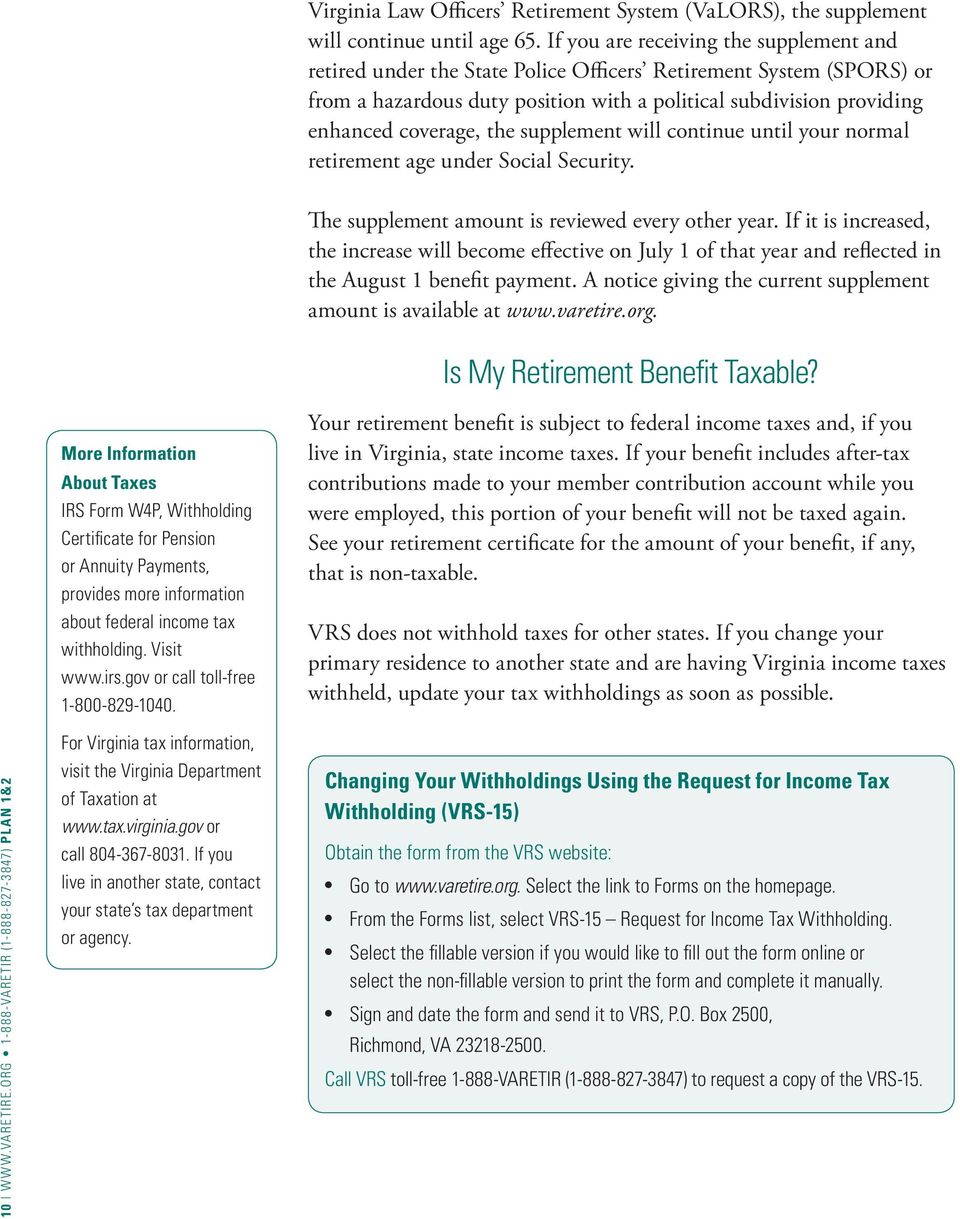
14 Your 1099-R shows: Box 1 Benefits VRS paid to you the previous year. Includes the total of your monthly benefit, any cost-of-living increases and any hazardous duty supplements you were paid. Box 2a Total taxable amount of your benefit. Equals the amount in Box 1 minus the amount in Box 5. Box 4 Total amount of federal income tax withheld during the previous year based on the total number of exemptions reported on your Request for Income Tax Withholding (VRS-15) VARETIR ( ) PLAN 1&2 Box 5 Amount of your benefit that is not subject to tax. Includes any contributions you made to VRS on which you already paid income taxes. Subtract the amount in Box 2a (taxable amount) from the amount in Box 1 (gross distribution) for the amount shown in this box. Box 12 Total amount of state taxes withheld if you lived in Virginia in the previous year based on the total number of exemptions reported on your Request for Income Tax Withholding (VRS-15). Live outside of Virginia? Contact your state s taxation agency for more information about completing your state income tax returns. VRS does not deduct taxes for other states.
15 Your W-2 shows: Box 1, 3 & 5 Your imputed income (tax liability for the cost of group life insurance for the amount over $50,000). Box 16 Imputed income (tax liability for the cost of group life insurance for the amount over $50,000). Box 12 A C in this box means that funds represent imputed income such as your life insurance imputed income. Box 4 & 6 Social Security and Medicare taxes withheld year to date. What Do I Need for My Tax Returns? Each January, you receive the Internal Revenue Service (IRS) Form 1099-R from VRS showing your benefit payments, taxes withheld and other information for the previous calendar year. You file this form with your federal and state income taxes for your VRS benefits. Retired on work-related disability? If you are receiving a work-related disability retirement benefit based on the VRS formula amount, you will receive a Form 1099-R each year. If your benefit is based on the workrelated guaranteed amount, you will not receive a Form 1099-R; the guaranteed benefit is tax-exempt. 13 CH 1 YOUR RETIREMENT ROADMAP PLAN 1&2

16 VARETIR ( ) PLAN 1&2 If You Retired as a Public Safety Officer The federal Healthcare Enhancement for Local Public Safety (HELPS) Retirees Act allows eligible retired public safety officers to exclude a certain amount per year from retirement income used for qualified health insurance premiums or long-term care insurance premiums. Premiums covering yourself as well as your spouse and dependent children may be eligible for this exclusion. You must claim the premium exclusion on your tax return. The 1099-R reflects total taxable income without any adjustment for this benefit. For more information, contact a tax advisor or the IRS toll-free at or Imputed income. The cost of group life insurance over $50,000 is called imputed income. The IRS considers this amount as income to you and subject to income taxes and FICA (Social Security and Medicare) taxes. If you have VRS group life insurance coverage, VRS automatically withholds FICA taxes and sends you a W-2 form each year showing the amount of FICA taxes withheld and the additional taxable income. You use the W-2 to file federal and, if applicable, state income taxes. As your life insurance coverage reduces, the amount of imputed income also reduces. If your coverage reduces to less than $50,000, these taxes will no longer be withheld. For more information, see Chapter 4 Looking Out for Your Passengers: Life Insurance. Need tax help? The IRS sponsors programs offering free help in tax preparation for taxpayers age 60 and older and for low-to-moderate income taxpayers who cannot prepare their own tax returns. For more information, call the IRS toll-free at In addition, the following IRS publications, available at focus on managing and filing taxes: Publication 907, Tax Highlights for Persons with Disabilities Publication 17, Your Federal Income Tax Publication 3966, Living and Working with Disabilities Publication 523, Selling Your Home Form 1040 (Schedule R), Credit for the Elderly or the Disabled Publication 554, Tax Guide for Seniors Form W-4P, Withholding Certificate for Pension or Annuity Payments Form 1040ES, Estimated Tax for Individuals
17 195 JAMES RIVER Roadside Assistance: myvrs Downtown Richmond Credit: Jeffrey Greenberg, Courtesy Virginia Tourism Corporation 15 CH 2 YOUR RETIREMENT ROADMAP PLAN 1&2
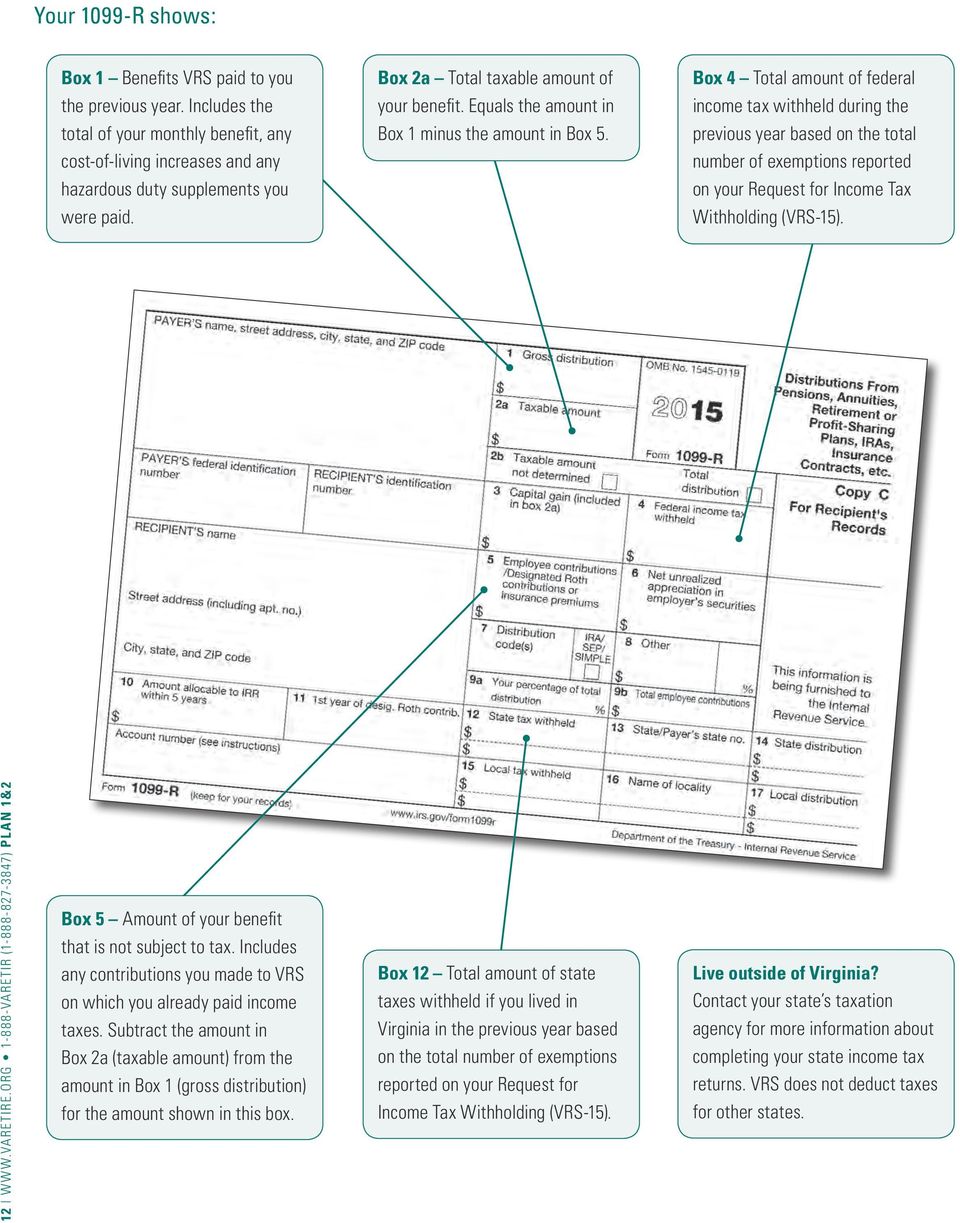
18 myvrs: At Your Service in Retirement myvrs is a secure, online way to look up your benefits. You can see the amount of your monthly benefit payment and other up-to-date information from your retiree account including your tax withholdings and your VRS Group Life Insurance coverage, if applicable. From the benefit summary page: What You Can Do in myvrs Benefit Payment Summary. View the details of your last six monthly benefit payments, including the amount of your health insurance credit, if you are eligible, and your tax withholdings. Print an income verification document reflecting your most recent benefit payment VARETIR ( ) PLAN 1&2 Payment Destination. Confirm your payment destination, including the financial institution, the account into which VRS deposits your benefit and the date and amount of the deposit. To change accounts, complete an Authorization for Direct Deposit of Monthly Benefit (VRS-57), available at and submit to VRS. Do not close your old account until your direct deposit begins in your new account.
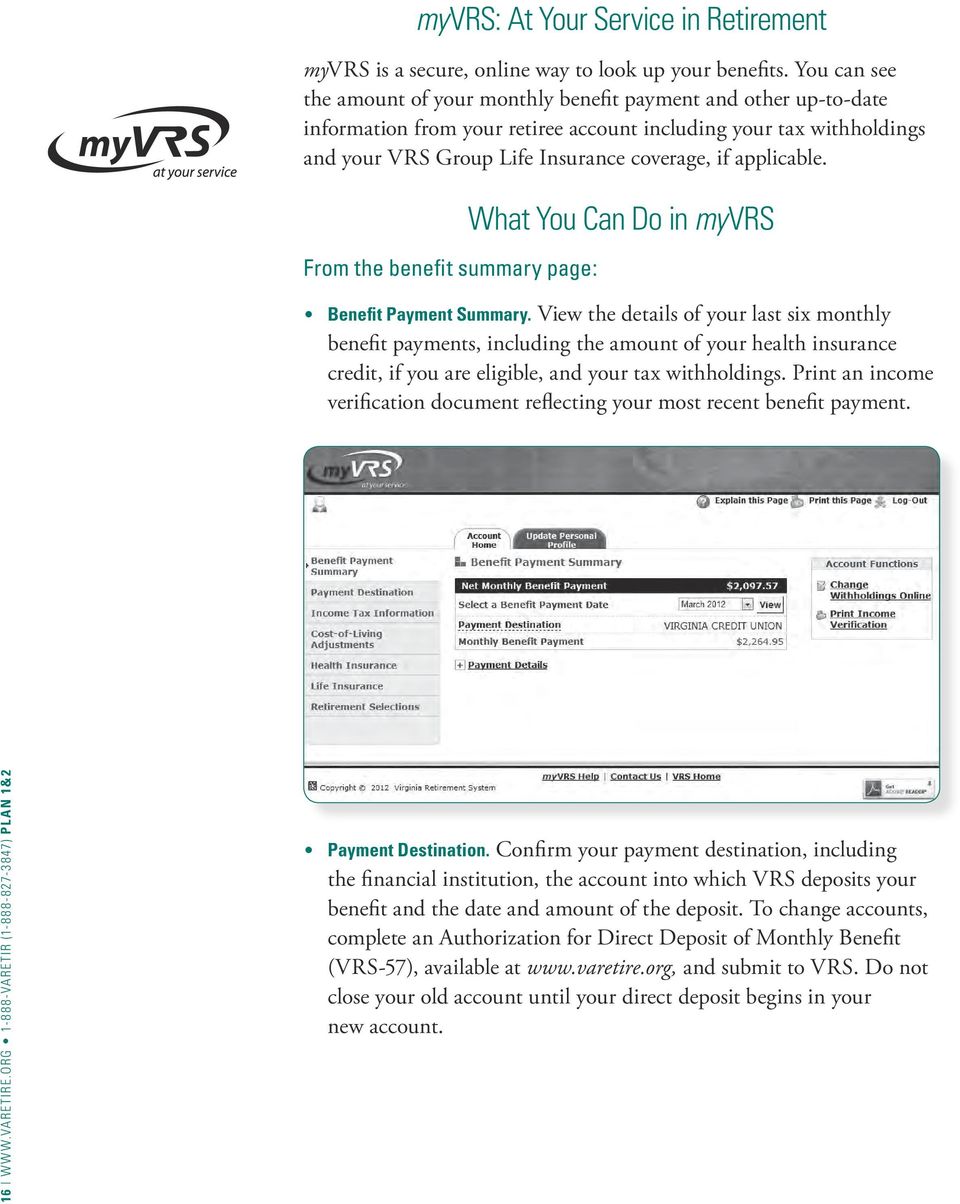
19 Income Tax Information. Look up your income tax information for the amount of federal and state income taxes withheld, your marital status and exemptions. To try new withholding amounts, select the link Explore Other Options. If you decide to change your withholdings, you can submit the change online. See Changing Your Tax Withholdings Through the myvrs Tax Tool in Chapter 1 for more information. Cost-of-Living Adjustments. View cost-of-living adjustments (COLAs) for the year you become eligible for your first COLA. See the current COLA and a list of the COLAs for the previous five years. For more information about the COLA, see Chapter 1-Starting Out: The Basics of Your Retirement Benefit. Health Insurance. Review your health insurance, if applicable, including your plan name, date of coverage and the premium amount if VRS deducts the premiums from your benefit. If you are eligible to receive the health insurance credit, the actual amount as well as the maximum health insurance credit for which you are eligible also will be provided on this page. Life Insurance. View the amount of your current basic life insurance coverage, if you are covered under the VRS Group Life Insurance Program, and the amount of coverage when it reaches the final reduction amount. You also can see a chart that shows the amount of your insurance as it reduces and the date of each reduction. For more information on life insurance coverage, see Chapter 4-Looking Out for Your Passengers: Life Insurance. Retirement Selections. Review the plan under which you retired (Plan 1 or Plan 2); your type of retirement regular or disability; your retirement date; your years of service credit at retirement; your age at retirement; and the benefit payout option you chose. Assistance With myvrs Select myvrs Help from the bottom of any screen for general information. Select Explain this Page from the top right for help on a particular screen. If you get locked out, call VRS toll-free at VARETIR ( ). For additional questions, call VRS or [email protected]. Important notice Do not send confidential or personal information, such as your Social Security number, by even when you are logged into your account. VRS will only non-confidential replies. VRS will use regular U.S. mail to send confidential information directly to you. 17 CH 2 YOUR RETIREMENT ROADMAP PLAN 1&2

20 Security and Privacy in myvrs VARETIR ( ) PLAN 1&2 Registering for myvrs From select myvrs Access and then Retirees- Register. From the log-in page, select Register Now. To set up your account, use the one-time authentication code you received from VRS in the mail if it has not expired. If the code has expired, call VRS toll-free at VARETIR ( ) for a new code. Any time you want to log in, enter the username and password you set up to create your account. Note: Even if you had a myvrs account as an active member, you need to set up your myvrs account as a retiree to access your retiree account information. VRS is committed to protecting the security and privacy of your information. Before you are allowed access to your information, your identity is authenticated through the online account creation process. You set up your own username and password, which you use each time you log into myvrs. No one but you has access to your myvrs account; never give anyone your username and password. VRS does not sell your information to anyone. Information is shared only with third-party administrators authorized to help coordinate benefits and services for VRS members, retirees and beneficiaries. Tips to Protect Your Identity: Do not close your browser to log out of myvrs. Always select Log-Out from the top right area of the page. Never send personal or confidential information through , even when you are logged into your online account. VRS will send only non-confidential replies. Avoid using the same password for myvrs that you use to access other secure systems, such as your online bank account. Change your password regularly. Store printed copies of your online account securely. Never use publicly shared computers to access secure systems.

21 Help in Paying for the Trip: Social Security and Deferred 3Compensation Plans IWO JIMA MEMORIAL The Marine Corps War Memorial (also called the Iwo Jima Memorial) located outside the walls of Arlington National Cemetery Credit: Virginia Tourism Corporation 19 CH 3 YOUR RETIREMENT ROADMAP PLAN 1&2
22 What Other Retirement Income Do I Have? As a retiree under VRS, you are eligible for Social Security. And, if you contributed to a supplemental retirement plan while you were an active member, such as the Commonwealth of Virginia 457 Deferred Compensation and Cash Match Plans, you can receive distributions (payments) from your account. This chapter provides an overview of Social Security and the Commonwealth s 457 Plan. If you have other retirement accounts, such as an Individual Retirement Account (IRA), a 403(b) plan or another employer-sponsored supplemental plan, contact your plan provider or former employer for more information about distributions under these plans. Social Security You are eligible for a full Social Security benefit in addition to your VRS retirement benefit when you reach your normal Social Security retirement age. The amount of your Social Security benefit is based on lifetime earnings and how many years you worked. The chart below shows when you become eligible for a full (normal) Social Security retirement benefit. You may qualify for a reduced Social Security benefit as early as age 62. Social Security Retirement Ages for Full Benefits VARETIR ( ) PLAN 1&2 Year of Birth Normal Retirement Age 1937 or 65 years earlier months months months months months years Year of Birth Normal Retirement Age months months months months months 1960 or 67 years later
23 Are you ready to apply for Social Security? Go to for more information including an online application form. Also, take advantage of the Social Security s online retirement planner and retirement estimator for estimates based on your actual Social Security earnings record. The Social Security website also provides publications of interest to retirees, such as How To Apply Online For Retirement Benefits ( ), How Work Affects Your Benefits ( ) and Retirement Information For Medicare Beneficiaries ( ). Need more help? Call the Social Security Administration toll-free at or contact your local Social Security Administration office. Commonwealth of Virginia 457 Deferred Compensation and Cash Match Plans If you participated in the Commonwealth s 457 Plan, upon retirement your options for your account balance were: Request a payment (distribution) from your plan. Leave your money in your account and continue to manage your investments. Your pre tax account continues to be tax deferred. If you have a Roth after tax account, it can also remain in the plan. You continue to manage your investments. You cannot contribute to the Commonwealth s 457 Plan unless you return to salaried or wage employment with an employer that offers the plan. Use your cash match plan to consolidate your retirement funds from other qualified employer plans or Individual Retirement Accounts (IRAs). Roll over money from your 457 Plan or cash match account to another qualified employer plan or IRA. You are required to take your first minimum distributions by April 1 of the calendar year following the later of: 1) the calendar year in which you reach age 70½, or 2) the calendar year in which you terminate employment from the employer sponsoring your plan. 21 CH 3 YOUR RETIREMENT ROADMAP PLAN 1&2
24 Your 457 Deferred Compensation online account, available at www. varetire.org/457, provides an overview of your account including a history of your transactions and investment information. If you do not have a 457 Plan online account, call 1-VRS-DC-PLAN1 ( ). Press 1 to speak with an Investor Services Representative, weekdays 8:30 a.m. 9:00 p.m. Press 2 to speak with a Defined Contribution Plans Retirement Specialist or reach the Virginia Service Center, weekdays 8:30 a.m. 5:00 p.m. Are My Distributions Taxable? VARETIR ( ) PLAN 1&2 Beneficiary for Your 457 Plan Account If you do not designate a beneficiary, upon your death the account balance will be paid according to the order of precedence. For more information, see Chapter 4-Looking Out for Your Passengers: Life Insurance. Distributions from your Commonwealth of Virginia 457 Plan pre tax account are subject to a 20 percent federal income tax withholding unless you elect a direct rollover of the entire amount to an eligible retirement plan such as a 401(a), 401(k), 403(b), governmental 457(b) or IRA that accepts such rollovers. State income taxes will be withheld from your distributions if you live in a state that taxes income. You may elect to have an additional amount withheld to cover any tax liability you may have. Distributions that you receive from your Roth contributions and any earnings on those may be withdrawn tax free if you meet the following requirements: separated from covered employment with a bona fide break in service at least five years have passed since January 1 of the year you made your first Roth contribution at least age 59½, permanently disabled or the assets are being paid to your beneficiaries following your death. Note: You can request separate distributions from your pre tax account and your Roth after tax account. For additional distribution information, visit
25 What Happens to My Deferred Compensation Plan Account Upon My Death? Upon you death, your account balance will be paid to the beneficiary you designated for your account. You can add or change your beneficiary or cancel your designation by submitting the Designation of Beneficiary Form Commonwealth of Virginia 457 Deferred Compensation Plan and Cash Match Plan to: ICMA-RC Attn: Workflow Management Team P.O. Box Washington, DC Fax: The form is available at Who is my beneficiary? Look up your current beneficiary through your online 457 Plan account. Current beneficiaries also appear on the quarterly statement as a reference for members. For more information and to request a beneficiary designation form, contact a customer service associate toll-free at 1-VRS-DC-PLAN1 ( ). Have a Question About the 457 Plan? Get more information online at Registered plan representatives also are available for one-on-one counseling. Call toll-free 1-VRS-DC-PLAN1 ( ) 23 CH 3 YOUR RETIREMENT ROADMAP PLAN 1&2
26 95 PEAKS OF OTTER 64 Looking Out for Your Passengers : 4Life Insurance VARETIR ( ) PLAN 1&2 Peaks of Otter, Blue Ridge Parkway in the Blue Ridge Mountains Credit: Virginia Tourism Corporation
27 If you had basic group life insurance through the VRS Group Life Insurance Program when you were working, you have basic group life coverage in retirement. Life Insurance Benefit Basic Group Life Insurance Your life insurance benefit is equal to your compensation at retirement, rounded to the next highest thousand and then doubled. If you retired with 20 or more years of service credit, the benefit will be based on your highest compensation as a covered employee, even if your final salary at retirement was lower. This benefit is payable if you die of natural or accidental causes. The provisions allowing for double the natural death benefit for accidental death or dismemberment ended at retirement. Accelerated Death Benefit Option If you are diagnosed with a terminal condition and have fewer than 12 months to live, you can withdraw some or all of your life insurance coverage to use for any purpose. Your beneficiary or survivor will receive any amount remaining upon your death. Life Insurance Coverage Reduction What Is Compensation? Compensation is the salary your employer reported to VRS while you were employed, not including payments for overtime, temporary employment, extra duties or other additional payments. In most cases, this compensation is used to determine the amount of your life insurance coverage. Life Insurance Coverage in Retirement. Your coverage begins to reduce on January 1 following one calendar year of retirement. The reduction rate is 25 percent each January 1 until it reaches 25 percent of the total life insurance benefit value at retirement. If you have at least 30 years of creditable service, your coverage cannot reduce below $8,000. This minimum will be increased annually based on the VRS Plan 2 cost of living adjustment calculation. If You Do Not Have VRS Life Insurance If you do not have life insurance through VRS, you may have coverage through your former employer. Contact your former employer s human resource office for information. 25 CH 4 YOUR RETIREMENT ROADMAP PLAN 1&2
28 When Your Life Insurance Benefit EXAMPLE You retire Your life insurance benefit You retired on March 1, is equal to your compensation Your compensation at retirement, rounded to the at retirement was $49,780; next highest thousand for your life insurance and then doubled coverage, that amount is rounded to $50,000 then doubled to equal $100,000 at retirement On January 1 after you Your life insurance Your first 25 percent complete one calendar coverage reduces reduction will be on year of retirement 25 percent January 1, 2017 with remaining (January through December) coverage of $75,000 On January 1 after you Your life insurance coverage Your next 25 percent reduction complete two calendar reduces another will be on January 1, 2018 years (January through 25 percent with remaining coverage of December) of retirement $50,000; On January 1 after you Your life insurance coverage Your final reduction will be complete three calendar reduces a final 25 percent and on January 1, 2019 and years (January through remains at that value for the your coverage will remain at December) of retirement rest of your retirement $25,000 for the rest of your retirement VARETIR ( ) PLAN 1&2 Did you retire on disability? If you retired on disability and had VRS life insurance when you retired, your coverage will begin to reduce by 25 percent beginning on January 1 following one full calendar year from your normal retirement age under your plan. It continues to reduce by 25 percent each January 1 until it reaches 25 percent of its original value. Example: If your normal retirement age under Social Security is 65 and you turn age 65 on May 2, 2015, your first 25 percent reduction will occur on January 1, If you have at least 30 years of creditable service, your coverage cannot reduce below $8,000. This minimum will be increased annually based on the VRS Plan 2 cost-of-living adjustment calculation.
29 Optional Group Life Insurance If you were enrolled in the Optional Group Life Insurance Program, you could continue a portion of your coverage into retirement for yourself as well as your spouse and dependent children, if enrolled. Or you could convert your coverage to an individual policy. If you continued your coverage, optional life insurance amounts begin to reduce by 25 percent based on your age, beginning with your normal retirement age under your plan. Coverage ends at age 80. The maximum amount of optional group life insurance coverage in retirement is $275,000. If you continued your optional life coverage, your plan pays a benefit to your beneficiary if you die of natural or accidental causes. For more information about your optional coverage, contact Minnesota Life toll-free at Additional Information About Your Life Insurance Irrevocable assignment. You own your rights in your group life insurance coverage, and you may exercise the accelerated death benefit option of your policy. You may give your ownership rights to another living person or entity. However, this is an irrevocable assignment; you cannot change it once it is made. Before making an irrevocable assignment, contact a legal advisor or Minnesota Life toll-free at for assistance. Loans prohibited. You may not borrow from or use your group life insurance coverage to secure a loan. Child support liens. The Department of Social Services may file child support liens against proceeds payable under the Group Life Insurance Program. VRS is required to pay life insurance proceeds to the Department of Social Services to satisfy any outstanding child support obligations at your death. These payments are deducted from the life insurance benefit before it is paid to your beneficiary. Who Is My Beneficiary? You can designate or change your beneficiary for life insurance benefits as well as any member contributions and interest remaining in your member contribution account upon your death. To name or change your beneficiary, complete the Designation of Beneficiary (VRS-2). Keep a copy of the form for your records. You will not receive a copy or confirmation of receipt. Naming Multiple Beneficiaries The Designation of Beneficiary (VRS-2) allows you to name up to three individuals as your beneficiaries. If you wish to name more than three, list the additional beneficiaries on the Designation of Beneficiary-Continuation (VRS-2A) and submit this form with the VRS CH 4 YOUR RETIREMENT ROADMAP PLAN 1&2
30 Beneficiary Designation for the Deferred Compensation Plan The Designation of Beneficiary (VRS-2) applies only to life insurance and your member contribution account. For information on designating a beneficiary for the Commonwealth s 457 Plan, visit or call toll-free 1-VRS-DC-PLAN1 ( ). Who can be a beneficiary? You can name any living person or an entity, such as an eligible trust or charity, as your beneficiary. Primary beneficiaries. You can name more than one primary beneficiary to share in life insurance benefits and any funds remaining in your member contribution account upon your death, or you can name a different primary beneficiary for each benefit. Contingent beneficiaries. You can name a contingent beneficiary or beneficiaries. If your primary beneficiary or beneficiaries are deceased at the time of your death, your contingent beneficiary or beneficiaries will receive benefit payments according to your designation. Keeping your beneficiary designation current. VRS is required by law to pay benefits according to the latest beneficiary designation in your VRS record. Review your beneficiary designation after a personal milestone such as a change in marital status. To change your beneficiary, submit a new Designation of Beneficiary (VRS-2) to VRS as soon as possible. If you cannot remember your designation, submit a new VRS-2 or write to Minnesota Life, P.O. Box 1193, Richmond, VA Neither Minnesota Life nor VRS can provide your designation over the phone VARETIR ( ) PLAN 1&2 If there is no beneficiary designation. If there is no valid beneficiary designation on file, or your primary beneficiary or beneficiaries are deceased at the time of your death and there is no contingent beneficiary or beneficiaries, VRS will pay benefits according to the following order of precedence, as required by law: Order of Precedence First, to your spouse If no spouse, to your natural or legally adopted children or descendants of your deceased natural or legally adopted children If none of the above, to your parents equally or to the surviving parent If none of the above, to the duly appointed executor or administrator of your estate If none of the above, to your next of kin under the laws of the state where you resided at the time of your death
31 Making the Right Turn: 5Health Insurance in Retirement 64 The Emancipation Oak, Hampton University Credit: Bill Crabtree, Jr., Courtesy Virginia Tourism Corporation 29 CH 5 YOUR RETIREMENT ROADMAP PLAN 1&2
32 Do I Have Health Insurance? If You Do Not Have Health Insurance Contact the U.S. Administration on Aging for information on federal, state, local or private programs that help pay for health care and prescription drugs. The website address is eldercare.net/public/index. aspx, or call toll-free If you retired as a teacher or a political subdivision employee, your former employer may have offered a retiree health insurance program. If so, and if you enrolled in the program, VRS may be deducting your premiums from your benefit payment. Some employers have arranged with VRS to deduct the health insurance premiums. Contact your former employer for more information about your coverage, including coverage for your survivors. If you retired as a state employee, you had the option of enrolling in the State Retiree Health Benefits Program administered by the Department of Human Resource Management (DHRM). If you elected this option, your premiums are being deducted from your monthly benefit payment. If your monthly benefit is not enough to cover the premiums, you are billed directly by the health insurance company. If you enrolled your survivors (a spouse and dependent children) in the State Retiree Health Benefits Program, your survivors may elect to continue coverage within 60 days of your death as long as they were covered when you died VARETIR ( ) PLAN 1&2 If you chose the Survivor Option at retirement and did not enroll your spouse or dependent children, they may enroll in the program within 60 days of your death. To enroll, they need to complete a State Health Benefits Program Enrollment Form For Retirees, Survivors And LTD Participants. In completing the form, they should follow the directions for a new VRS retiree or survivor. You can cancel your coverage at any time by submitting the State Health Benefits Program Enrollment Form For Retirees, Survivors And LTD Participants to VRS, P.O. Box 2500, Richmond, VA , or by sending a written request to VRS. The form is available on the VRS website at Cancelling your coverage also cancels coverage for your spouse and dependent children, if enrolled.
33 Once you cancel coverage, you are not eligible to re-enroll in the program. However, you can be covered as a dependent of an active state employee or a state retiree who enrolls you in the program, or if you return to work and retire again as a state employee. In the latter case, you will have 31 days from your retirement date to enroll in the program, provided you do not defer your subsequent retirement. What Are My Medicare Benefits and When Am I Eligible? Medicare is a federal government-sponsored health insurance program. You become eligible for Medicare when you reach age 65. Medicare includes coverage for hospital care (Part A) at no cost to you and medical care (Part B), for which you pay monthly premiums. You also may elect coverage under the prescription drug plan (Part D). You should apply for Medicare at least three months before your 65th birthday. You can apply online at or call tollfree MEDICARE ( ) for assistance. If you are receiving Social Security benefits, you do not need to apply. You will be enrolled automatically when you qualify. The premiums will be deducted from your Social Security benefit. Once Medicare coverage goes into effect, this will become your primary health care insurer. You may go to any physician, hospital or health care facility that accepts Medicare. You will pay a deductible and then Medicare will pay its share of your health care expenses and supplies. If you have other health insurance coverage, this will be your secondary insurer covering its share of covered expenses. After you apply for Medicare, you will receive a red, white and blue Medicare card. Present your Medicare card and your card for other retiree health insurance, if applicable, when seeking health care services. If you are in a Medicare-coordinating plan, such as Advantage 65 for state retirees, also present this card. 31 CH 5 YOUR RETIREMENT ROADMAP PLAN 1&2
34 Advantage 65 for State Retirees VARETIR ( ) PLAN 1&2 Advantage 65 Participants Important Note About Your Medicare and Medicare- Coordinating Coverage To receive the full level of benefits with no gap in coverage, you must enroll in Medicare Part A and Part B when you become eligible for Medicare and select one of the Advantage 65 plans. If you do not select a plan, you will be enrolled automatically in Advantage 65 with Dental/Vision plan. More Information About Medicare Visit or call toll-free MEDICARE ( ). Advantage 65 is a Medicare-coordinating program for state retirees enrolled in the State Retiree Health Benefits Program. This plan supplements Medicare benefits through medical coverage administered by Anthem Blue Cross and Blue Shield (BCBS) and prescription drug coverage under MEDCO. If you have coverage under the State Retiree Health Benefits Program, you will receive a courtesy notification from VRS within 45 to 60 days before your 65th birthday reminding you to apply for Medicare and enroll in one of the following Advantage 65 plans: Advantage 65 is the basic medical BCBS and MEDCO prescription drug plan. Advantage 65 with Dental/Vision adds dental and vision benefits to Advantage 65 and includes prescription drug coverage under MEDCO. Advantage 65 Medical Only provides the basic medical BCBS coverage. It does not include prescription drug coverage under MEDCO. Advantage 65 Medical Only with Dental/Vision adds dental and vision benefits to Advantage 65 Medical Only. It does not include prescription drug coverage under MEDCO. To enroll yourself or eligible dependents, submit the Retiree Enrollment/ Waiver form you will receive with your notification from VRS. Or you can enroll online through the Department of Human Resource Management (DHRM) Employee Direct at
35 Help With the Cost of Health Insurance Premiums: Health Insurance Credit The health insurance credit is a tax-free benefit that reimburses you for a portion of health insurance premiums you pay for single coverage, excluding any portion of the premiums covering a spouse or dependents. The credit is a dollar amount set by the General Assembly for each year of service credit at retirement. The health insurance credit ends upon your death and cannot exceed the amount of your individual health insurance premiums for single coverage. The credit is applied to your retirement benefit payment. If you do not receive a monthly retirement benefit payment, VRS will send you a check each month for the health insurance credit amount. You are eligible if you retired with at least 15 years of service credit as a: State employee; Teacher or administrative school employee; General registrar or employee of a general registrar; Constitutional officer or employee of a constitutional office; Local social service employee; or Employee of a political subdivision that elected to offer the health insurance credit to its retirees. If You Are Covered Under Your Spouse s Health Insurance Plan Your health insurance credit is based on your portion of the health insurance premium. Your spouse s health insurance provider can give you the premium amount represented by your coverage. 33 CH 5 YOUR RETIREMENT ROADMAP PLAN 1&2
36 Health Insurance Credit Dollar Amounts EMPLOYEE TYPE Amount per Year of Service Maximum Credit per Month State employees $4.00 No Cap Teachers and school administrators $4.00 No Cap General registrars and their employees, constitutional officers and their employees and local social service employees $1.50 $45.00 General registrars and their employees, constitutional officers and their employees and local social service employees if the political subdivision has elected the $1.00 enhancement $2.50 $75.00 Other political subdivision employees if the employer has elected to provide the health insurance credit $1.50 $ VARETIR ( ) PLAN 1&2 Qualifying health plans Individual health plans Coverage as a dependent on a spouse s plan Employer-sponsored health plans, including the State Retiree Health Benefits Program Medicare Part B Dental and vision plans Prescription drug plans, including Medicare Part D The following are examples of plans not eligible for the health insurance credit: Coverage for specific diseases or procedures to treat a specific illness, such as cancer insurance Hospital or other indemnity policies Limited benefit plans, which offer coverage for only particular health care conditions or diseases, and do not replace traditional health insurance Plans covering home health care
37 Long-term care insurance Long-term disability insurance Life insurance Network discount programs or policies, such as pharmacy discount programs Policies that include non-healthcare coverage, such as an auto club membership that includes a prescription discount program Non Insurance Healthcare Sharing Plans or Programs What if I m Not Receiving the Health Insurance Credit? If you were eligible for the health insurance credit when you retired and VRS is deducting retiree health insurance premiums from your monthly benefit, the health insurance credit is being applied automatically to your benefit payment. The amount of the credit and your health insurance premium deduction are reflected in your monthly benefit payment. You also can look it up in your myvrs retire online account. Your benefit payment summary is displayed when you log in. Select Show Payment Details under your gross monthly defined benefit amount. For more information about myvrs, see Chapter 2-Roadside Assistance: myvrs. If VRS is not deducting your health insurance premiums and you are eligible for the credit but not receiving it, send a Request for Health Insurance Credit (VRS-45) to VRS. If you have Medicare coverage, include the effective date of your Medicare Part B coverage and the premium amount you pay each month for health insurance on the VRS- 45. If you have health, dental, vision or prescription drug insurance, complete Part B of the VRS-45. If you have more than one health insurance policy, provide the additional policy information in Part C of the form. The form is available on the VRS website at Or call VRS to request the form. Allow approximately 45 to 60 days for your request for the health insurance credit to be processed. 35 CH 5 YOUR RETIREMENT ROADMAP PLAN 1&2
38 Your Health Insurance Credit Amount The amount of your health insurance credit and your health insurance premium deduction, if applicable, are reflected in your monthly benefit payment as well as in the retirement certificate you received when you retired. You also can look up your health insurance information in your myvrs online account. From your Account Home page, under Benefit Payment Summary, select Show Payment Details. For more information about myvrs, see Chapter 2-Roadside Assistance: myvrs. Annual Health Insurance Credit Notice If you receive the health insurance credit, VRS will send you an annual Health Insurance Credit Notice reminding you to verify and update your health insurance information, if necessary. This will ensure you are receiving the proper credit amount in a timely manner and are not at risk for overpayments. For any premiums VRS is not deducting from your monthly benefit payment, report a change or cancellation by submitting a Request for Health Insurance Credit (VRS-45) to VRS. More information about the health insurance credit is available at Select the Retiree homepage and then Insurance in Retirement VARETIR ( ) PLAN 1&2
39 Down the Road: 6Long-Term Care 460 Main Street in Historic Farmville Credit: Beth Furgurson, Courtesy Virginia Tourism Corporation 37 CH 6 YOUR RETIREMENT ROADMAP PLAN 1&2
40 Add to Your Financial Security Through Long-Term Care Most health insurance plans don t cover long-term care services such as nursing home care or in-home health care. Long-term care insurance can help protect your retirement income against the rising cost of longterm care. This chapter provides an overview of the Commonwealth of Virginia (COV) Voluntary Group Long Term Care Insurance Program and the Virginia Sickness and Disability Program (VSDP) Long-Term Care Plan. Commonwealth of Virginia (COV) Voluntary Group Long-Term Care Insurance Program As a VRS retiree, you are eligible to enroll in the Commonwealth of Virginia (COV) Group Voluntary Group Long-Term Care Insurance Program. You can apply for the program at any time, provided you are under age 80. Select family members between the ages of 18 and 79 also can apply. These family members include a spouse, adult children, parents, parents-in-law, step parents, step parents-in-law, grandparents, grandparents-in-law, step grandparents and step grandparents-in-law. Genworth Life Insurance Company, the insurer for the program, requires medical underwriting, which may involve an attending physician s report, copies of your medical records, a medical evaluation, a telephone interview or an in-person interview VARETIR ( ) PLAN 1&2 Covered Services The COV Voluntary Group Long-Term Care Insurance Program provides a maximum monthly allowance for covered long-term care expenses, such as: Care in a nursing home Assisted living facility care Adult day care Services provided at home by a nurse or licensed physical, occupational, respiratory or speech therapist
41 Home and community care assistance with simple health care tasks, such as personal hygiene, managing medications and performing other activities of daily living You may qualify for benefits if you need help with at least two of six activities of daily living or if you have Alzheimer s disease or another severe cognitive impairment that requires supervision. A doctor, nurse, social worker or other appropriately licensed health care practitioner must certify that you qualify for benefits. If you are approved for coverage and need benefits, Genworth s registered nurses and other care coordinators will help you develop a personalized care plan. If your claim is approved, you will receive benefit payments on a monthly basis beginning after the 90-calendar day waiting period. You will only need to satisfy this 90-day period once in your lifetime. Program Features You pay the premiums directly to Genworth Life. If you arrange to pay the premiums on a quarterly, semi-annual or annual basis, you may be eligible for a premium discount. At group rates, your premiums may be more affordable. Premium rates are guaranteed through March 1, 2020 and will change only if you make changes to your coverage. You can choose one of three benefit increase options that will allow you to increase your coverage over time to help protect against the rising cost of care. How to Apply Visit Genworth online at for a summary of benefits and an application. Or call Genworth toll-free at to request an information kit that includes the application form, directions and more details. 39 CH 6 YOUR RETIREMENT ROADMAP PLAN 1&2
42 Virginia Sickness and Disability Program Long-Term Care Plan (State Retirees) If you retired as a state employee and had coverage under the Virginia Sickness and Disability Program (VSDP), you had the option to continue your coverage under the VSDP Long-Term Care Plan into retirement. VRS has contracted with the Long Term Care Group, Inc. to coordinate benefits and claims under the program. If you continued your coverage, you are paying the premiums directly to the Long Term Care Group, Inc. Six Activities of Daily Living Bathing Transferring, such as getting in and out of bed Dressing Toileting (using the bathroom) Continence Eating (ability to feed oneself) Qualifying for Benefits You are eligible for benefits if a licensed healthcare professional certifies that: You are unable to perform at least two of six activities of daily living; or You have a severe cognitive impairment, such as Alzheimer s disease, requiring substantial supervision. The maximum daily benefit amount is $96 with a lifetime maximum of $70,080. Benefits are payable 90 calendar days after your licensed healthcare professional certifies that you qualify for long-term care benefits. A summary of covered services begins on the next page. How to File a Claim VARETIR ( ) PLAN 1&2 Contact the Long Term Care Group, Inc. within 60 days of when your licensed health care practitioner certifies that you are eligible for benefits. A family member or friend may call on your behalf: Long Term Care Group, Inc. P.O. Box St. Paul, MN Toll-free:
43 VSDP Long-Term Care Program Covered Services Your coverage pays the lesser of actual qualified expenses incurred per day or the allowable maximum daily benefit amount, as described in this chart. Nursing Care Facility Up to 100 percent of the maximum daily benefit amount of $96. (Nursing Home) Provides skilled and custodial care in a nursing care facility that meets all applicable licensing requirements. Assisted Living Up to 100 percent of the maximum daily benefit amount of $96. Facility Personal services and care in an assisted living facility that meets all applicable licensing requirements. Hospice Care Up to 50 percent of the maximum daily benefit amount ($48). Facility Provides care if you are terminally ill and in a hospice facility that meets all applicable licensing requirements. Home Health Up to 50 percent of the maximum daily benefit amount ($48). Care Provides custodial care, nursing care, therapy and homemaker services in your home by nurses, social workers, home health aides or other licensed or certified professionals. Adult Day Care Up to 50 percent of the maximum daily benefit amount ($48). Center Provides a community-based, group setting for adults. Hospice Care Up to 50 percent of the maximum daily benefit amount ($48). Agency Provides care in your home by a hospice care agency that meets all applicable licensing requirements if you are terminally ill. Alternate Plan Up to 50 percent of the maximum daily benefit amount ($48). Benefit May cover an Alternate Plan of Care developed by your licensed healthcare professional, provided you, your physician and the Long Term Care Group, Inc. agree to the plan. 41 CH 6 YOUR RETIREMENT ROADMAP PLAN 1&2
44 Transitional Care One-time cash payment equal to three times the maximum daily benefit amount ($288) to support your transition from independent living to long-term care. You may use this one-time payment in any way you wish. This benefit does not reduce your lifetime maximum benefit. Informal Care Benefit Informal Caregiver Training Bed Reservation Respite Care Up to 25 percent of the maximum daily benefit amount ($24) for up to 50 days per calendar year to provide for personal care from a family member, neighbor or private caregiver you hire. This benefit does not reduce your lifetime maximum benefit. One payment each time you are receiving benefits to provide for the training of your personal caregiver by a licensed healthcare professional. The payment is equal to the lesser of the actual amount of the cost of training or three times the maximum daily benefit amount ($288). This benefit does not reduce your lifetime maximum benefit. Up to 100 percent of the maximum daily benefit amount ($96) for up to 21 days per calendar year to hold your bed reservation if you are in a covered facility, such as a nursing care facility, and you have to be hospitalized. Up to 50 percent of the maximum daily benefit amount ($48) for up to 21 days per calendar year to provide for a substitute in-home caregiver while your usual caregiver is on leave. This benefit does not reduce your lifetime maximum benefit. Just Retired? VARETIR ( ) PLAN 1&2 If you were covered under the VSDP Long-Term Care Plan and did not elect to continue your coverage into retirement, you can apply for coverage up to 60 days from your retirement date. This option is not available after 60 days from your retirement date. Submit the Authorization of Coverage Retention for the Long-Term Care Plan (VSDP or VLDP) (VRS-170) and the Protection Against Unintentional Lapse of Long-Term Care (VSDP or VLDP) (VRS-171) to the Long Term Care Group, Inc., P.O. Box 64011, St. Paul, MN The forms are available at or by calling the Long Term Care Group, Inc. toll-free at
45 13 Detours: 7When Things Change 175 Assateague Island National Seashore, Eastern Shore Credit: Bill Crabtree, Jr., Courtesy Virginia Tourism Corporation 43 CH 7 YOUR RETIREMENT ROADMAP PLAN 1&2
46 What if I Need to Change My Survivor Option? You Can Change Your Survivor Only Once If you elected the Survivor Option and need to change your survivor, call VRS toll-free at VARETIR ( ) for assistance. Do not use the Designation of Beneficiary (VRS-2) to inform VRS of a change in survivor. The VRS-2 is only for designating or naming a beneficiary for life insurance benefits and member contribution account payments, if applicable. The benefit payout option you elected at retirement is irrevocable, except for the Survivor Option under some circumstances. If you chose the Survivor Option at retirement, you may be able to name a new survivor or revert to the Basic Benefit if: Your survivor dies. Your survivor is your spouse and you divorce with fewer than 20 years of marriage. Your survivor is your spouse, you divorce after 20 or more years of marriage and your spouse dies, remarries or consents in writing to a change in benefit. You provide VRS a written consent from your survivor giving up claim to a benefit along with proof of your survivor s good health. Note: If you are divorced and VRS has an Approved Domestic Relations Order (ADRO) on file, your benefit must be paid as directed by the ADRO VARETIR ( ) PLAN 1&2
47 What Happens if I Divorce? If you divorce, your VRS benefit may be regarded as marital property in a property settlement. The Code of Virginia authorizes VRS to make a direct payment to a former spouse if he or she is awarded part of your retirement benefit by the court. VRS implements the court decision when it receives a certified copy of an Approved Domestic Relations Order (ADRO). The court, not VRS, decides whether to divide your retirement benefit and how it is to be divided, provided the order is in compliance with the provisions of the Code of Virginia regarding payment of benefits or distributions from a member contribution account. Your attorney should provide VRS a draft domestic relations order before filing it with the court to ensure the language conforms to VRS requirements. Your attorney can obtain guidelines at When the ADRO is on file, VRS notifies you and your former spouse by letter of the monthly amount your former spouse will receive. VRS processes the monthly payment as ordered in the ADRO. Your former spouse is required to complete withholding forms, and the appropriate taxes are withheld each month. Release of information. VRS will not release information about your benefit to anyone other than yourself without your written authorization, unless your information is subpoenaed. Other attachments. The Code of Virginia allows other attachments to your VRS benefit. Examples include Internal Revenue Service tax levies, debt to an employer and child support or other marital rights as stated in an ADRO. 45 CH 7 YOUR RETIREMENT ROADMAP PLAN 1&2
48 What Should I Do if I Can t Take Care of My Affairs? VRS Durable Power of Attorney (VRS-901) VARETIR ( ) PLAN 1&2 Authorization to Discuss VRS Account Information (VRS-900) The VRS-900 allows you to name one or more individuals to speak to a VRS representative about your VRS benefits and account information. It does not allow individuals to take actions on your behalf. If you would like the agent you name in the VRS-901 to speak with VRS about your information, you do not need to file a VRS-900; the VRS-901 extends that authority to your agent. If you would like someone other than your agent to have this authority, complete the Authorization to Discuss VRS Account information (VRS-900) and submit it to VRS. The VRS Durable Power of Attorney (VRS-901) allows you to name a person as your agent to take actions on your behalf in the event you no longer can handle your own affairs. Your agent can: Name or update your beneficiary or survivor. Request information about your benefits. Take other actions, such as setting up direct deposit, submitting a change of address or filing your tax withholdings. Create or change rights of survivorship. This means that if you elected the Survivor Option and your survivor dies or you divorce, your agent could name a new survivor or authorize a change to the Basic Benefit Option. Delegate authority granted under the power of attorney. This means that your agent could appoint another person as power of attorney. When to Name a Power of Attorney Consider naming a power of attorney when you are not incapacitated. If you should become incapacitated, VRS will have your information on file and can work with your designated agent. You do not have to be incapacitated to have your agent handle your affairs. However, VRS must have the VRS-901 on file designating the individual you wish to act as your agent. The authority granted by the VRS-901 is limited to matters relating to your VRS record. The agent you designate on the VRS-901 will not have authority over matters outside of VRS. You may submit any valid durable power of attorney drafted by your legal counsel to VRS at P.O. Box 2500, Richmond, VA
49 What Should My Loved Ones Do When I Die? VRS has contracted with Minnesota Life as the insurer for the Group Life Insurance Program. Your loved one should call Minnesota Life toll-free at or write to Minnesota Life at P.O. Box 1193, Richmond, VA to report your death. The person who calls Minnesota Life will need: Your full name, Social Security number and date of death as well as a mailing address where claim information can be sent Original or certified copy of the death certificate Original or certified letter of qualification issued by the Circuit Court if benefits are to be paid to an estate Copies of trust agreement establishing a trust and appointment of individual trustee if benefits are to be paid to a trust Copy of guardianship appointment for the minor child s estate if benefits are to be paid to a minor child Copy of power-of-attorney document if benefits are to be paid to a non-minor beneficiary who has a designated attorney-in-fact to handle his or her affairs. Note: This is a different document than the VRS Durable Power of Attorney (VRS-901). Minnesota Life can initiate VRS benefit claims and will provide information to VRS for processing any benefits due, such as: Life insurance benefits Payment of any remaining member contributions in your VRS member contribution account or a monthly benefit to your named survivor if you elected the Survivor Option at retirement Payment from your Commonwealth of Virginia 457 Deferred Compensation Plan if you participated in this plan Health insurance benefits for your eligible dependents if you are a state retiree, if applicable. Social Security Survivor Benefits Call the Social Security Administration toll-free , contact your local Social Security Administration office, or visit Commonwealth of Virginia 457 Deferred Compensation Plan Call toll-free 1-VRS-DC- PLAN1 ( ) or visit Virginia Retirement System Call toll-free VARETIR ( ) or visit 47 CH 7 YOUR RETIREMENT ROADMAP PLAN 1&2
50 What Happens to My Member Contribution Account When I Die? If you did not elect the Survivor Option when you retired, your beneficiary is eligible for a lump-sum payment of any member contributions and interest remaining in your member contribution account upon your death in addition to VRS life insurance benefits, if applicable. Note, however, that there may be no contributions left in your account. When you retire, your benefit is paid first from your member contribution account. If you elected the Partial Lump-Sum Option Payment (PLOP), the PLOP also is paid from your account. After your funds have been paid out, your benefit is paid from employer contributions and investment earnings. If you elected the Survivor Option, your survivor will receive a monthly benefit upon your death in the amount you designated at retirement instead of a lumpsum payment of any contributions remaining in your account. That is because your member contributions help fund your survivor s benefit VARETIR ( ) PLAN 1&2
51 Further Travels: 8Working After Retirement KENTUCKY BREAKS INTERSTATE PARK 80 Breaks Interstate Park, Geological Trail Credit: Courtesy Sarah Hauser, Virginia Tourism Corporation 49 CH 8 YOUR RETIREMENT ROADMAP PLAN 1&2
52 Working After Retirement VARETIR ( ) PLAN 1&2 What Is Covered and Non-Covered Employment? Covered employment is a full-time permanent, salaried position with an employer that participates in VRS. Some part-time permanent, salaried state positions also are covered under VRS. Non-covered employment is a part-time position with a VRS-participating employer. Non-covered positions do not provide eligibility for benefits. Part-time positions typically require 80 percent or less of the hours of comparable full-time permanent positions. Some full-time positions may be considered non-covered if they are temporary and require 80 percent or less of the hours per year that would be considered fulltime and permanent for that position. After you retire, you can work for any employer that does not participate in the Virginia Retirement System (VRS) and continue to receive your retirement benefits. If you return to covered employment with a VRS-participating employer, your retirement benefits will stop and you will become an active member. See If You Return to Work in a VRS-Covered Position. Under some circumstances, you can continue to receive your retirement benefits while working in a non-covered position with a VRSparticipating employer. If you work for the employer from which you retired, you must have a bona fide break in service. A bona fide break in service is a break of at least one full calendar month from your retirement date over a period you normally would work. Periods of leave with or without pay do not count toward satisfying this break in service. For retired teachers and faculty members, summer breaks, intersession periods, educational leave and sabbaticals also do not count toward satisfying this break. See Returning to Non-Covered Employment on the next page for more information. Retired on Disability? If you are retired on disability and accept a position with any non-vrs or VRS-participating employer that requires the same or similar duties as those you performed in your previous position, your disability retirement benefits will end. If you return to covered employment with a VRS-participating employer, your disability benefits will stop and you will become an active member, regardless of your new duties. When you retire again, you will retire under service retirement. The period of time you were retired on disability will be included in the calculation of your service retirement benefit. If you wish to retire on disability again, you must reapply by submitting all required disability retirement forms and documents. Your application will be evaluated under the medical review process based on the duties of your new position, even if they are the same as or similar to those you performed when you previously retired on disability.
53 Returning to Non-Covered Employment If you return to non-covered employment with the employer from which you retired, you must have a bona fide break in service to continue receiving retirement benefits. The Commonwealth of Virginia, including all state agencies and public colleges and universities, is considered one employer. School divisions and political subdivisions are considered separate employers. Example: You have just started your retirement after 30 years with the Virginia Department of Transportation (VDOT). If James Madison University offers you a part-time position, you will be required to have a break in service of at least one full calendar month from your retirement date to continue receiving your benefits. James Madison and VDOT are part of the same employer, the Commonwealth of Virginia. However, if the City of Harrisonburg offers you a part-time position, no break in service will be required. The city is a separate employer. Full-Time and Part-Time Employment If you want to work for a VRS-participating employer and continue to receive your retirement benefits, you must work 80 percent or less of the hours required of a full-time employee in the same or a comparable covered position. If you wish to work in more than one part-time position for your former employer, the total number of hours for all positions cannot exceed a part-time schedule. Employers, not VRS, classify positions as full time or part time and define the hours applicable to each classification, according to the following guidelines: Full-time employment is typically considered to be 40 hours a week. Thirty-two hours is the usual minimum number for a full-time position. Part-time employment is typically 80 percent or less of a comparable full-time position. Note that some permanent part-time state positions are paid on a salaried basis and are considered covered positions providing eligibility for benefits. 51 CH 8 YOUR RETIREMENT ROADMAP PLAN 1&2
54 Some full-time positions may be considered non-covered if they are temporary and require 80 percent or less of the hours per year that would be considered full-time and permanent for that position. Interim appointments. In some cases, retirees can work in an interim position for up to six months without interruption in retirement benefits. Examples include working in a vacant position while the employer recruits for a full-time permanent employee or while the incumbent is on leave. If you are considering an interim appointment, your employer must discuss the appointment with VRS before hiring you in the position. If you return to the employer from which you retired, you also must have a bona fide break in service. Teaching While Retired You may work in a non-covered part-time teaching position with your former school division, or an adjunct teaching position with a public college or university and continue to receive your retirement benefits, provided you have a bona fide break in service of at least one full calendar month from your retirement date over a period you normally would work. This includes teachers who retired under an early retirement incentive program (ERIP). Periods of leave with or without pay, including educational leave and sabbaticals, as well as intersession periods do not count toward satisfying the bona fide break in service. If you were on a nine-, 10- or 11-month contract, summer breaks also do not satisfy this requirement VARETIR ( ) PLAN 1&2 Examples: You were on a nine-month contract for the period August 1 to May 31, and you retired at the end of your contract. If you wish to return to part-time employment with your employer, the months of June, July and August will not count toward satisfying the bona fide break in service. To continue receiving your retirement benefits, the earliest you could return to work would be October 1.
55 You were on a 10-month contract for the period August 20 to June 15, and you retired at the end of your contract. If you wish to return to part-time employment with your employer, the months of July and August will not count toward satisfying the bona fide break in service. To continue receiving your retirement benefits, the earliest you could return to work would be October 1. If you are a retired teacher or faculty member and want to teach while you are retired, contact your former human resource office to determine the earliest you could return to a non-covered part-time teaching position without interrupting your retirement benefits. If you return to any position covered under VRS, whether or not it is a teaching or faculty position, your retirement benefits will stop and you will become an active member. See If You Return to Work in a VRS-Covered Position on the next page. K-12 Critical Shortage Positions You may be eligible to teach or serve as a principal or assistant principal in a designated critical shortage position for a Virginia public school. You do not have to be a retired teacher or school administrator as long as you become licensed by the Virginia Board of Education for the position you will hold. Positions are full time and temporary (non-covered) for the current school year. If you qualify, you will continue to receive your retirement benefits. To be considered for a K-12 critical shortage position, you must: Work in a designated critical shortage position. Hold a Virginia Board of Education license for the position. Have a break in service of at least 12 consecutive months between your retirement date and the date you wish to work in a critical shortage position. This break means not working in any full-time, part-time or temporary position with any VRSparticipating employer. Not have retired with a reduced VRS benefit under an early retirement incentive program (ERIP). Not have taken a refund of your member contributions and interest or deferred retirement. 53 CH 8 YOUR RETIREMENT ROADMAP PLAN 1&2
56 For more information on critical shortage designations and how to apply, visit the Department of Education online at or contact the school system where you would like to work VARETIR ( ) PLAN 1&2 Plan 1 and Plan 2 You are in Plan 1 if your membership date is before July 1, 2010 and you were vested (you had at least five years of service credit) as of January 1, You are in Plan 2 if your membership date is before July 1, 2010 and you were not vested as of January 1, 2013, or your membership date is between July 1, 2010, and December 31, Before Returning to Work If you want to work after you retire, call VRS toll-free at VARETIR ( ) to determine the effect of accepting covered or non-covered employment on your current and future retirement benefits. Also contact the Social Security Administration for information on how earnings during retirement might affect your eligibility for Social Security Benefits. Call toll-free or visit If You Return to Work in a VRS-Covered Position If you decide to go back to work in a covered position with a VRSparticipating employer you will be rehired under Plan 1 or Plan 2 according to the plan under which you retired. Once you are reemployed in a covered position, your retirement benefits must stop effective with the date of your new position. To avoid overpayment of the retirement benefit, your new employer should notify VRS of your return to work as soon as possible. Upon reemployment in a covered position, you will resume earning service credit toward your next retirement. Your subsequent benefit calculation will include the additional service credit as well as any increase in your average final compensation. In many cases, that will result in a higher subsequent benefit than your current benefit amount. However, depending on your circumstances, your next benefit may actually be less. Examples: Any cost-of-living adjustments (COLAs) you are receiving with your current benefit will not resume when you retire again. As a result, your subsequent benefit may be less than your current benefit amount, especially if you have been receiving the COLA for several years. The COLA will be calculated as if you are retiring for the first time. For more information about the COLA, see Chapter 1-Starting Out: The Basics of Your Retirement Benefit. If you retired under a severance benefits program administered by VRS, you will lose any additional retirement credits used to calculate your current benefit upon subsequent retirement. This may affect whether or not your next benefit is less than your current benefit amount.
57 Life Insurance and Disability Coverage Upon Reemployment Basic group life insurance: If you have retiree coverage under the VRS Group Life Insurance Program and return to an employer that participates in the program, you will resume active member coverage for basic life insurance benefits. The amount of coverage will be based on your compensation upon reemployment or, if you have 20 or more years of service credit, your highest compensation as a covered employee. If you have retiree coverage and return to an employer that does not participate in the VRS Group Life Insurance Program, you will continue your retiree coverage at the level to which it had reduced before reemployment. Optional group life insurance: If you return to an employer that participates in the group life insurance program, you can apply for the Optional Group Life Insurance Program for yourself as well as a spouse or dependent children upon reemployment. You will pay the premiums. If you elected optional life insurance with your previous position and continued your coverage into retirement, this coverage will not continue if you return to covered employment with an employer that participates in the VRS Group Life Insurance Program. You must re-apply to have optional life coverage again as an active member. However, if you converted your previous coverage to an individual policy, you may continue your policy as well as re-apply for coverage as an active member if you wish. More Information on Active Member Benefits For more information on group life insurance and disability coverage for active members, refer to the current Handbook for Members for Plan 1 or Plan 2 available at org. If you are returning to covered employment, your human resource office also can assist you. Disability coverage: If you return to covered employment with the Commonwealth of Virginia, you will be enrolled automatically in the Virginia Sickness and Disability Program (VSDP). You will be required to satisfy eligibility periods for non-work related disability coverage and certain income replacement levels. For program details, refer to the Virginia Sickness and Disability Program Handbook for State Employees, available on the VRS website at 55 CH 8 YOUR RETIREMENT ROADMAP PLAN 1&2
58 If you return to covered employment with a school division or a VRS-participating political subdivision, you will be eligible to be considered for disability retirement if you have a medical condition that prevents you from performing your job and it is likely to be permanent. For program details, refer to the VRS Disability Retirement Handbook for Members, available at Deferred Compensation Plan If you return to covered state employment, you will be automatically enrolled in the Commonwealth of Virginia 457 Deferred Compensation Plan within 90 days of reemployment unless you are already a participant, you self-enroll, you contributed to a 403(b) plan offered by your employer or you opt-out of automatic participation. If you have an account balance, you may resume your contributions by logging into your account at You will be eligible for an employer cash match through the Virginia Cash Match Plan. The amount will be equal to 50 percent of your contributions, not to exceed $20 per pay period. School division and political subdivision employees. Your employer may offer the Commonwealth s 457 Plan and Virginia Cash Match Plan, a 403(b) plan or another supplemental savings plan. Contact your human resource office for more information about your savings opportunities. Your employer also may provide automatic enrollment in these plans upon employment VARETIR ( ) PLAN 1&2
59 Retired Faculty Returning to Covered Employment If You Are Retired Under the ORPHE If you left employment when you were covered under the Optional Retirement Plan for Higher Education (ORPHE) and return to a faculty position at another Virginia public institution of higher education without a bona fide break in service, you will remain covered under the ORPHE or the optional retirement plan offered by the institution. If you have a bona fide break in service, you may choose between the ORPHE and the VRS defined benefit plan. Your ORPHE distributions will stop if you return to VRS- or ORPcovered employment, unless you elected to purchase an annuity with your ORPHE account balance. In this case, your annuity payments will continue even if you return to a VRS- or ORPHE-covered position. If You Are Retired Under the VRS Defined Benefit Plan If you are retired under the VRS defined benefit plan and return to a permanent, salaried full-time or part-time faculty position, you may continue in the defined benefit plan under Plan 1 or Plan 2, according to the plan under which you retired, or you may elect the ORPHE. You are eligible for this election whether or not you have a bona fide break in service. If You Return to a Non-Faculty Position If you return to a non-faculty position covered under VRS or to the State Police Officers Retirement System (SPORS), the Virginia Law Officers Retirement System (VaLORS) or the Judicial Retirement System (JRS), you will come under the provisions of the defined benefit plan for retirement and other benefits. If you are retired under the ORPHE and return to a non-faculty covered position, you will not be eligible to take a distribution from your ORPHE account while you are employed. However, you can continue to manage your investments. What Is a Bona Fide Break in Service? A bona fide break in service is a break of at least one full calendar month from your retirement date over a period you normally would work. Periods of leave with or without pay, including educational leave and sabbaticals, as well as summer breaks and intersession periods do not count toward satisfying the break in service. Health Insurance Credit and the ORPHE If you took a full distribution of your ORPHE account or if you stop receiving periodic distributions at any time after retiring, you are no longer eligible for the health insurance credit. 57 CH 8 YOUR RETIREMENT ROADMAP PLAN 1&2
60 What Happens When I Retire Again? If You Are Retiring Again Information about applying for retirement is available at Select the Member homepage, then Getting Ready to Retire heading. See also the Handbook for Members for Plan 1 and 2 available on the VRS website. If you are working in a covered position from having previously retired under VRS, your next retirement benefit will be recalculated to include the additional service credit earned in your current position as well as any changes in your average final compensation. For an estimate of your next benefit, submit the Request for Estimate of Retirement Benefits (VRS-60) to VRS. Applying for Subsequent Retirement You must submit a new Application for Service Retirement (VRS-5) and other required forms and documents and elect the same benefit payout option you elected previously. If you elected the Partial Lump- Sum Option Payment (PLOP) for your previous retirement, you will not receive another PLOP; your subsequent benefit also will be adjusted for the payment of your first PLOP. If you elected the Advance Pension Option, your subsequent benefit calculation will be adjusted for the temporary increase in your previous benefit. Cost-of-Living Adjustment (COLA) VARETIR ( ) PLAN 1&2 Any cost-of-living adjustments (COLAs) you were receiving with your previous retirement benefit will not resume when you retire again. If you are eligible for a COLA, it will be calculated as if you are retiring for the first time. For more information about the COLA, see Chapter 1-Starting Out: The Basics of Your Retirement Benefit.
61 Retired on Disability? If you retired on disability and returned to covered employment, you will retire under service retirement when you retire again. The period of time you were retired on disability will be included in the calculation of your service retirement benefit. If you return to a covered position that does not provide eligibility for the Virginia Sickness and Disability Program (VSDP) and wish to retire on disability again, you must resubmit all required forms and documents for disability retirement and be evaluated again under the medical review process for your new position. 59 CH 8 YOUR RETIREMENT ROADMAP PLAN 1&2
62 42 81 ROCKINGHAM COUNTY 9Frequently Used Terms 33 Plan VRS 1& VARETIR ( ) PLAN 1&2 Rockingham County Credit: Bill Crabtree Jr., Courtesy Virginia Tourism Corporation
63 Active Member You are an active member if you are working in a covered position with an employer that participates in the Virginia Retirement System (VRS). Active Service Active service is the number of years you worked in a covered position. While you were an active member, you earned one month of service credit for each month you were employed ( in service ). Advance Pension Option The Advance Pension Option is one of the benefit payout options available at retirement. Under this option, retirees can temporarily increase their monthly benefit amount until an age they select, between age 62 and their normal retirement age under Social Security. At that point, the benefit is permanently reduced. Approved Domestic Relations Order (ADRO) An Approved Domestic Relations Order (ADRO) is a court order related to marital property rights and other attachments to your benefit such as child support at the time of divorce. If you divorce, your VRS benefit may be regarded as marital property in a property settlement. Average Final Compensation Average final compensation is one of the factors used to calculate your retirement benefit. If you retired under Plan 1, it was the average of your 36 consecutive months of highest compensation as a covered employee. If you retired under Plan 2, it was the average of your 60 consecutive months of highest compensation as a covered employee. Basic Benefit Your Basic Benefit was calculated based on a formula using your average final compensation, a retirement multiplier and your total service credit at retirement. You could elect the Basic Benefit or another payout option when you applied for retirement. Beneficiary Your beneficiary is eligible for a payment of any funds remaining in your member contribution account and any life insurance benefits you may have upon your death. You may designate a beneficiary or beneficiaries on the Designation of Beneficiary (VRS-2). If you elected the Survivor Option, your survivor will receive a monthly benefit instead of a lump-sum payment of any contributions remaining in your account at the time of your death. Benefit Payout Options Bona Fide Break in Service Child Support Liens The retirement benefit payout options are the Basic Benefit, Survivor Option, Partial Lump-Sum Option Payment (PLOP) and Advance Pension Option. The option you elected at retirement is irrevocable. That means you cannot change it, except for the Survivor Option under some circumstances. A bona fide break in service is a break of at least one full calendar month from your retirement date or your last day of employment over a period you normally would work. The Department of Social Services may file child support liens against proceeds payable under the VRS Group Life Insurance Program. VRS is required to pay life insurance proceeds to the Department of Social Services to satisfy any outstanding child support obligations at your death. 61 CH 9 YOUR RETIREMENT ROADMAP PLAN 1&2
64 Compensation Compensation is the salary that your former employer reported to VRS while you were an active member. Compensation for reporting purposes did not include payments for overtime, temporary employment, extra duties or other additional payments you may have received. Consumer Price Index for all Urban Consumers The cost-of-living adjustment (COLA) is based on the Consumer Price Index for all Urban Consumers (CPI-U) published by the U.S. Bureau of Labor Statistics. The CPI-U is defined as a measure of the average change over time in the prices paid by urban consumers for goods and services such as food, housing, apparel, transportation, medical care, recreation, education, communication and other goods and services. Cost-of-Living Adjustment A cost-of-living adjustment (COLA) is an annual increase in your retirement benefit based on the Consumer Price Index for all Urban Consumers. Covered Employment Covered employment is a full-time permanent, salaried position with an employer that participates in VRS. Some part-time permanent, salaried state positions also are covered under VRS. Deferred Member You are considered a deferred member if you have left covered employment but have not withdrawn your member contributions and interest and have service credit in VRS or are maintaining an account balance in a Virginia optional retirement plan. Direct Deposit When you applied for retirement, you included the Authorization for Direct Deposit of Monthly Benefit (VRS- 57), which designated the financial institution account where VRS deposits your monthly retirement benefit payment. If your account changes, use the VRS-57 to notify VRS of where to begin depositing your benefit. Form 1099-R You receive a 1099-R from VRS each January for the previous year s benefit payments and tax withholding. You file this form with your income tax returns VARETIR ( ) PLAN 1&2 Full-Time Employment Hazardous Duty Supplement Imputed Income Irrevocable Assignment Full-time employment is typically 40 hours a week. Thirty-two hours a week is considered the minimum number for full-time employment. Employers, not VRS, classify positions as full time or part time and define the hours applicable to each classification. The hazardous duty supplement is a dollar amount added to the monthly retirement benefit. It continues until your normal retirement age under Social Security or until age 65 if you retired from VaLORS. You qualify for the supplement if you retired with at least 20 years under SPORS, or at least 20 years of eligible hazardous duty service credit from a position providing the supplement, or if you retired under VaLORS with the 1.7 percent multiplier with at least 20 years of eligible hazardous duty service credit. Imputed income is the cost of life insurance in excess of $50,000, as determined by the Internal Revenue Service (IRS). It is subject to FICA and income taxes. VRS deducts FICA taxes and reports taxable or imputed income for as long as your group life insurance exceeds $50,000. Irrevocable assignment means assigning your ownership rights in your life insurance coverage to another person. You cannot change this assignment once it is made.
65 Non-Covered Employment Non-covered employment is a part-time position with a VRS-participating employer. Non-covered positions do not provide eligibility for benefits. Part-time positions typically require 80 percent or less of the hours of comparable full-time permanent positions. Some full-time positions may be considered non-covered if they are temporary and require 80 percent or less of the hours per year that would be considered full-time and permanent for that position. Note that some part-time permanent salaried state positions are covered under VRS. Normal Retirement Age Normal retirement age under the VRS Plan 1 is age 65. Normal retirement age under the VRS Plan 2 is your normal Social Security retirement age. Normal retirement age for members of SPORS and VaLORS, and for political subdivision employees eligible for enhanced hazardous duty coverage, is age 60. Order of Precedence If there is no valid beneficiary designation on file or your beneficiary is deceased at the time of your death, VRS is required by law to pay benefits according to an order of precedence. You designate a beneficiary on the Designation of Beneficiary (VRS-2). You can elect the order of precedence on the VRS-2 instead of naming a beneficiary. Partial Lump-Sum Option Payment The Partial Lump-Sum Option Payment (PLOP) is one of the benefit payout options available at retirement. Under this option, members who work at least one year after the date they become eligible for an unreduced retirement benefit may elect a PLOP of up to three times the annual benefit amount. The amount depends on how long the member works beyond his or her unreduced retirement eligibility date. If you elected the PLOP, the lump sum was paid from your member contribution account and reduced your monthly benefit. Part-Time Employment Part-time employment is typically 80 percent or less of full-time employment. Employers, not VRS, classify positions as full time or part time and define the hours applicable to each classification. Plan 1 You are covered under Plan 1 if your membership date is prior to July 1, 2010 and you were vested before January 1, 2013, and have not taken a refund. You are covered under Optional Retirement Plan 1 if you have an ORP membership date before July 1, 2010 and maintain an account balance. If you have a pre-july 1, 2010, ORP account balance and moved to a defined benefit plan, you must have any combination of VRS creditable service and/or ORP participation that totals five years as of January 1, 2013, to be considered a Plan 1 member. Plan 2 Plan Provisions You are covered under Plan 2 if your membership date is from July 1, 2010, to December 31, 2013 and you have not taken a refund. Additionally, you are covered under Plan 2 if you have a membership date prior to July 1, 2010, but you were not vested before January 1, You are covered under Optional Retirement Plan 2 if you have an ORP membership date after July 1, 2010, and maintain an account balance. If you are covered under VaLORS or SPORS, with enhanced hazardous duty benefits or the hazardous duty alternate option and were hired on or after July 1, 2010, you are in Plan 2, even if your membership date is after December 31, Plan provisions are the requirements that govern the plans or programs under which you were covered as an active member based on your position of employment. 63 CH 9 YOUR RETIREMENT ROADMAP PLAN 1&2
66 Power of Attorney Under a power of attorney, you can name someone as your agent to take actions on your behalf and in accordance with your wishes if you no longer can take care of your own affairs. To name an agent for VRS matters, submit a VRS Durable Power of Attorney (VRS-901). Refund A refund is a lump-sum payment of your member contribution account balance. If you left covered employment before your were eligible for retirement and took a refund, it cancelled your membership and eligibility for any future benefits. Required Minimum Distribution If you participate in the Commonwealth of Virginia 457 Deferred Compensation Plan, a required minimum distribution will begin if you have not arranged to receive payments from your plan by age 70½ or when you leave a position with an employer providing the plan, whichever is later. Retiree You are a retiree if you are no longer employed in a covered position and are receiving a monthly retirement benefit from VRS. Retirement Date Retirement is effective on the first of the month following the date you leave your position. Retirement Multiplier Under the VRS Plan 1, the retirement multiplier is 1.7 percent for service and disability retirement. Under the VRS Plan 2, the retirement multiplier is 1.65 percent for service retirement for service earned, purchased or granted on or after January 1, Service earned, purchased or granted before this date comes under the 1.7 percent multiplier. For disability retirement under the VRS Plan 2, the multiplier is 1.65 percent on all service, regardless of when it was earned, purchased or granted. Under SPORS, and for sheriffs and regional jail superintendents, the multiplier is 1.85 percent. Under VaLORS, the multiplier is 2.0 percent. For all other political subdivision hazardous duty employees, the retirement multiplier is 1.7 percent, unless the employer elected the 1.85 percent multiplier for these employees VARETIR ( ) PLAN 1&2 Rollover Service Retirement Survivor Option Vesting A rollover is a contribution of a pre-tax lump-sum payment, such as a Partial Lump-Sum Option Payment (PLOP) or payment to your beneficiary upon your death in retirement, to an Individual Retirement Account (IRA) or another qualified plan. A rollover allows you to defer income taxes until you withdraw the money from your plan. Service retirement is another term for regular retirement. The Survivor Option is one of the benefit payout options available at retirement. Under this option, a retiree elects to continue a monthly benefit to a survivor or survivors upon the retiree s death. This option reduces the monthly benefit. If you elected this option, you can change your survivor or revert to the Basic Benefit under some circumstances. You will be allowed to change your survivor only once. Vesting is one of the eligibility requirements for retirement. As an active member, you became vested when you had five years of service credit. Vesting is the minimum length of service needed to qualify for a retirement benefit, if you meet the age and service requirements for your plan.
67 VRS Richmond, Virginia N.10TH ST. CAPITOL SQUARE E. MAIN ST. S.10TH ST. VRS Counseling Center E. CARY ST. S.12TH ST. N.12TH ST. S.13TH ST. N.13TH ST. E. MAIN ST. N.14TH ST. N.15TH ST. EXI E. CANAL ST. Want to learn more about your retiree benefits? Meet with a counselor at the VRS Retirement Counseling Center at 1111 East Main Street, Richmond, VA Sessions are held on a first-come, first-served basis with limited scheduled appointments available. The center is open Monday through Friday, 8:30 a.m. 4 p.m. Go to for directions to the center and the parking deck; the first hour of parking is free. For Deferred Compensation Plan Regional Education Meetings, visit and select Education. 65 CH 9 YOUR RETIREMENT ROADMAP PLAN 1&2
68 VARETIR ( ) PLAN 1&2 Quick reference 10 Retirement VRS website: myvrs, a secure online system providing access to your retiree information Retiree benefit information, publications and forms Retiree Forms All the forms you need in retirement are online at You can fill them out online or print them and fill them out manually. You also can request a form from VRS. Call toll-free VARETIR ( ): Designation of Beneficiary (VRS-2) Request for Income Tax Withholding (VRS-15) Request for Health Insurance Credit (VRS-45) Authorization for Direct Deposit of Monthly Benefit (VRS-57) Name and Address Declaration for Retirees (VRS-58) Authorization to Discuss VRS Account Information (VRS-900) VRS Durable Power of Attorney (VRS-901) State Health Benefits Program Enrollment/Waiver for Retirees, Survivors and VSDP/LTD Participants (Department of Human Resource Management form for state employees) Authorization of Coverage Retention for the Long Term Care Plan (VSDP or VLDP) (VRS-170) VRS Benefit Contacts Roadmap Resources Commonwealth of Virginia 457 Deferred Compensation Plan: 1-VRS-DC-PLAN1 ( ); Information on your deferred compensation plan options if you participate in the Commonwealth s 457 Plan. Commonwealth of Virginia (COV) Voluntary Group Long-Term Care Insurance Program, Genworth Life: ; Providing details about the program and how to apply if you are not enrolled. Group Life Insurance Program: Minnesota Life, Information on life insurance coverage if you are covered under the VRS Group Life Insurance Program. Virginia Sickness and Disability Program (VSDP) Long-Term Care Plan (State Employees): Long Term Care Group, Inc., If you are covered under the program and need services, contact the Long Term Care Group, Inc. to file a claim.
69 Health Benefits Anthem Blue Cross/Blue Shield (state employees): ; Information about health insurance coverage if you are a state retiree and elected the State Retiree Health Benefits Program. Medicare: ; Information on Medicare benefits and how to file a claim. Virginia Department of Human Resource Management (state employees): in Richmond or OHB-4414 ( ); For state retirees health care information. Social Security Social Security Administration: ; Information on benefits and applying for Social Security or disability insurance benefits online. Social Security Online for Women: ; What every woman should know about Social Security, retirement and Medicare. Taxes Internal Revenue Service: ; For help with income taxes including Publication 575 Pension and Annuity Income for Filing Tax Returns and other publications for retirees. Virginia Department of Taxation: ; Forms and information on filing your Virginia tax returns. Other Agencies and Organizations Administration on Aging: Connects you to services that help you maintain health and independence. American Association of Retired Persons: OUR AARP ( ); A non-profit advocacy organization for people over age 50. Benefits Checkup: This service of the National Council on Aging helps you find federal, state, local or private programs that help pay for prescription drugs, utility bills, meals, health care and other needs. Center for Medical Advocacy (CMA): This organization advocates for Medicare and educates Medicare participants. National Council on Aging (NCOA); Coordinating information on health insurance and improving seniors financial and physical health. Road Scholar: ; Connections to educational travel around the world. Senior Connections: ; Offers a comprehensive range of Home and Community-Based Services for Central Virginia. Virginia Department for the Aging: ; Works with local Area Agencies on Aging and other public and private organizations to help older Virginians find services and information. 67 CH 10 YOUR RETIREMENT ROADMAP PLAN 1&2
70 VARETIR ( ) PLAN 1&2
71
72 Plan VRS 1&2 Virginia Retirement System 1200 East Main Street P.O. Box 2500 Richmond, VA VARETIR ( ) TDD: Virginia Retirement System RetireeHB
Virginia Retirement System Plan 2
 Virginia Retirement System Plan 2 Handbook for Members Plan VRS 2 PROVIDING INFORMATION ABOUT YOUR... retirement benefits resources Plan VRS 2 Virginia Retirement System (VRS) Plan 2 Handbook for Members
Getting Ready to Retire
 Plan VRS 1&2 Getting Ready to Retire Guide for Members in Plan 1 and Plan 2 Providing information to help you prepare and apply for retirement GETTING READY TO RETIRE GUIDE 08-2014 1 Getting Ready to Retire
Virginia Retirement System Plan 1
 Plan VRS 1 Virginia Retirement System Plan 1 Handbook for Members PROVIDING INFORMATION ABOUT YOUR... retirement benefits resources Plan VRS 1 Virginia Retirement System (VRS) Plan 1 Handbook for Members
Helping you plan for tomorrow, today. Hybrid Retirement Plan Handbook for Members
 Helping you plan for tomorrow, today Hybrid Retirement Plan Handbook for Members Virginia Retirement System Hybrid Retirement Plan Handbook for Members You are covered under the VRS Hybrid Retirement Plan
Choosing Your Retirement Plan Optional Retirement Plan for Higher Education VRS Hybrid Retirement Plan Membership Date: On or after January 1, 2014
 Choosing Your Retirement Plan Optional Retirement Plan for Higher Education VRS Hybrid Retirement Plan Membership Date: On or after January 1, 2014 A comparison guide to help you select the best plan for
Handbook for Members Virginia Retirement System
 Handbook for Members Virginia Retirement System V R S System Virginia Retirement Handbook for Members Virginia Retirement System The Virginia Retirement System (VRS) exists to provide its members and their
The Virginia Retirement System (VRS) Board of Trustees
 Retiree VIRGINIA RETIREMENT SYSTEM COLA Effective July 1: 3.08 Percent VRS Board Approves Recommendations for 2009 COLA Overpayment The Virginia Retirement System (VRS) Board of Trustees earlier in the
Virginia Retirement System Disability Retirement
 Virginia Retirement System Disability Retirement Handbook for Members in Plan 1 and Plan 2 Plan VRS 1&2 Providing information about... Disability Retirement Resources Post-Retirement Benefits Virginia
Plan Comparison Guide
 Plan Comparison Guide The Virginia Retirement System Plan Comparison Guide provides a quick look at some of the similarities and differences among VRS Plan 1, VRS Plan 2 and the Hybrid Retirement Plan.
VRS Hybrid Retirement Plan Features and Benefits. Version 02/15
 VRS Hybrid Retirement Plan Features and Benefits Version 02/15 Introductions Virginia Retirement System & ICMA-RC 2 Today s Agenda Learn About Your Plan Your Investment Options Benefit Payments & Distribution
Virginia Sickness and Disability Program
 Virginia Sickness and Disability Program Handbook for State Employees in the Virginia Retirement System, State Police Officers Retirement System and Virginia Law Officers Retirement System PROVIDING INFORMATION
EMPLOYER MANUAL TABLE OF CONTENTS. ELIGIBILITY 1 Individuals Not Eligible Waiving Coverage
 EMPLOYER MANUAL TABLE OF CONTENTS ELIGIBILITY 1 Individuals Not Eligible Waiving Coverage OPTIONAL GROUP LIFE INSURANCE ENROLLMENT 3 Additions and Changes to Optional Life Coverage Optional Life and Transfers
VRS Guide to Retirement Benefits and Divorce
 VRS Guide to Retirement Benefits and Divorce The Virginia Retirement System (VRS) provides its members and their beneficiaries with benefits at retirement or upon disability or death. Benefits described
DEFINED BENEFIT PLAN REQUEST FOR REFUND
 DEFINED BENEFIT PLAN REQUEST FOR REFUND VIRGINIA RETIREMENT SYSTEM P.O. Box 2500 Richmond, Virginia 23218-2500 Toll Free 1-888-VARETIR (827-3847) www.varetire.org 1. Social Security Number 2. Employer
Table of Contents. Participant Section
 Table of Contents Participant Section Introduction...1 Planning Ahead...1 Distribution Making Your Choice...2 Other Considerations...5 Joint Life and Survivor Expectancy Table...7 Single Life Expectancy
Your Pension Benefits from The City of Atlanta and The Atlanta Board of Education
 Rev. 12/05 Your Pension Benefits from The City of Atlanta and The Atlanta Board of Education Summary Plan Description for the General Employees Pension Plan Police Officer s Pension Plan Firefighter s
How To Pay Taxes On A Pension From A Retirement Plan
 Payout Guide A GUIDE TO OPTIONS FOR YOUR STATE OF MICHIGAN 401(K) AND 457 PLAN ACCOUNTS 1-800-748-6128 http://stateofmi.ingplans.com State of Michigan 401(k) and 457 Plan Participant: You ve worked hard
Frequently Asked Questions and Next Steps to Retirement
 State Teachers Retirement System Of Ohio Completing My Service Retirement Application Frequently Asked Questions and Next Steps to Retirement for Members Enrolled in the Defined Benefit Plan Dear Member:
TEACHERS AND STATE EMPLOYEES RETIREMENT SYSTEM. your retirement benefits
 TEACHERS AND STATE EMPLOYEES RETIREMENT SYSTEM your retirement benefits Department of State Treasurer Raleigh, NC Revised January 2014 NORTH CAROLINA DEPARTMENT OF STATE TREASURER RETIREMENT SYSTEMS DIVISION
TEACHERS AND STATE EMPLOYEES RETIREMENT SYSTEM. your retirement benefits
 TEACHERS AND STATE EMPLOYEES RETIREMENT SYSTEM your retirement benefits Department of State Treasurer Raleigh, NC Revised January 2013 NORTH CAROLINA DEPARTMENT OF STATE TREASURER RETIREMENT SYSTEMS DIVISION
DEATH BENEFITS. Department of Employee Trust Funds P. O. Box 7931 Madison, WI 53707-7931 etf.wi.gov ET-6101 (REV 5/13)
 DEATH BENEFITS Department of Employee Trust Funds P. O. Box 7931 Madison, WI 53707-7931 etf.wi.gov ET-6101 (REV 5/13) 4 The Department of Employee Trust Funds (ETF) administers three programs that provide
Disability Retirement Benefits
 Contact Us Disability Retirement Benefits PO Box 268 Jefferson City, MO 65102-0268 3210 W. Truman Blvd. Jefferson City, MO 65109 (573) 634-5290 or toll free (800) 392-6848 Email: [email protected]
Service Retirement Application
 Do not separate page from application. State Teachers Retirement System Of Ohio Service Retirement Application for Members Enrolled in the Defined Benefit Plan Choosing to retire is an important life decision.
What You Need to Know as the Recipient of a Lump-Sum Payment An MTRS Q&A guide for our active and inactive members
 What You Need to Know as the Recipient of a Lump-Sum Payment An MTRS Q&A guide for our active and inactive members For the MTRS member About your annuity savings account... 1 Withdrawing your balance.....
Service Retirement. Plans of Payment AND. For members enrolled in the Defined Contribution Plan
 Service Retirement AND Plans of Payment For members enrolled in the Defined Contribution Plan 2015 2016 Service Retirement Overview Table of Contents Service Retirement Overview...1 Benefit calculation...2
Distribution Request Form
 The 3121 Premier Plan Eligible Full-Time, Part-Time, Seasonal, and Temporary Employees Social Security Alternative Retirement Plan Employer (please print or type): Distribution Request Form Name of Participant:
LOCAL GOVERNMENTAL EMPLOYEES RETIREMENT SYSTEM FOR LOCAL LAW ENFORCEMENT OFFICERS. your retirement benefits
 LOCAL GOVERNMENTAL EMPLOYEES RETIREMENT SYSTEM FOR LOCAL LAW ENFORCEMENT OFFICERS your retirement benefits Department of State Treasurer Raleigh, NC Revised January 2012 NORTH CAROLINA DEPARTMENT OF STATE
KPERS. Getting Ready to Retire Your KP&F Pre-Retirement Planning Guide. re-retirement PlanningGuide
 Getting Ready to Retire Your KP&F Pre-Retirement Planning Guide re-retirement PlanningGuide nsas Police and Firemen s Retirement System Information for KP&F Members Nearing Retirement KPERS Countdown to
BENEFITS RETIREMENT HANDBOOK
 The University of Houston BENEFITS RETIREMENT HANDBOOK Rev 10/07 UNIVERSITY OF HOUSTON BENEFITS RETIREMENT HANDBOOK TABLE OF CONTENTS SECTION I DEFINITION OF A RETIREE 3 SECTION II RETIREE INSURANCE BENEFITS
SPECIAL TAX NOTICE REGARDING PLAN PAYMENTS
 I C M A R E T I R E M E N T C O R P O R A T I O N SPECIAL TAX NOTICE REGARDING PLAN PAYMENTS This notice explains how you can continue to defer federal income tax on your retirement savings in your employer's
Participant Distributions
 City of Los Angeles Deferred Compensation Plan Participant Distributions considering your options living your dreams Severance of Employment Table of Contents Introduction... 1 What Are My Choices?...
Florida Retirement System Pension Plan D R O P. Deferred Retirement Option Program
 Florida Retirement System Pension Plan D R O P Deferred Retirement Option Program Department of Management Services Division of Retirement July 2011 DISCLAIMER If questions of interpretation arise as a
GENERAL INCOME TAX INFORMATION
 NEW YORK STATE TEACHERS RETIREMENT SYSTEM GENERAL INCOME TAX INFORMATION TABLE OF CONTENTS Taxes on Loans from the Annuity Savings Fund 1 (Tier 1 and 2 Members Only) Taxes on the Withdrawal of the Annuity
Retirement Plan DISTRIBUTION FORM
 Retirement Plan Services P.O. Box 2978 5910 Mineral Point Road Madison, WI 53701-2978 Phone: 800.999.8786 Fax: 608.236.8017 www.benefitsforyou.com Retirement Plan DISTRIBUTION FORM DEFINED CONTRIBUTION
Partial Lump-Sum. Option Plan. For members enrolled in the. Defined Benefit Plan Combined Plan
 Partial Lump-Sum Option Plan For members enrolled in the Defined Benefit Plan Combined Plan 2015 2016 Partial Lump-Sum Option Plan Overview Table of Contents Partial Lump-Sum Option Plan Overview...1 Member
Your Retirement Plan
 Your Retirement Plan Special 20- and 25-Year Plans For PFRS Tier 1, 2, 3, 5 and 6 Members (Sections 384, 384-d and 384-e) New York State Office of the State Comptroller Thomas P. DiNapoli New York State
TAX LIABILITY ON WRS BENEFITS
 TAX LIABILITY ON WRS BENEFITS ET-4125 (7/2014) Scan to read online. Tax Liability on WRS Benefits Taxation of Your WRS Benefit 2 Taxation of Monthly Annuities 3 Taxation of Lump Sum Benefits 5 Required
Chapter 9. Disability Retirement
 9 Chapter 9. Disability Retirement Table of Contents ELIGIBILITY 1 Regular Disability VRS Formula Amount Minimum Guaranteed Benefit Work-Related Disability Mandatory Refund of the Member Contribution Account
IRS 402(f) Special Tax Notice. Your Rollover Options
 IRS 402(f) Special Tax Notice Your Rollover Options You are receiving this notice because all or a portion of a payment you are receiving from Virginia Retirement System ( VRS ) is eligible to be rolled
Deferred Retirement Option Plan (DROP)
 Deferred Retirement Option Plan (DROP) Any Group G member who meets the requirements for a normal retirement may elect to participate in the DROP for up to three years. Sick leave may be used as credited
Public Employees Retirement System Teachers Pension and Annuity Fund
 RM-0018-0411 Application for Retirement Allowance Public Employees Retirement System Teachers Pension and Annuity Fund State of New Jersey Division of Pensions and Benefits PO Box 295 Trenton, New Jersey
Ohio Public Employees Retirement System 277 East Town Street, Columbus, Ohio 43215-4642 1-800-222-PERS (7377) www.opers.org
 Ohio Public Employees Retirement System 277 East Town Street, Columbus, Ohio 43215-4642 1-800-222-PERS (7377) www.opers.org Traditional Pension Plan Refund Application When you leave public employment,
Planning for Retirement
 Planning for Retirement FCERS School Employees Presented by Carol Patterson Fairfax County Retirement Systems 10680 Main Street, Suite 280 Fairfax, VA 22030 www.fairfaxcounty.gov/retirement/ January 2015
Participant Name (First) (Middle Initial) (Last) Social Security Number I.D. Number. Participant Address (Street) City State ZIP Code + 4
 Mailing Address: Des Moines, IA 50392-0001 Principal Life Insurance Company Early Withdrawal of Benefits Without Guaranteed Accounts No Spousal Consent Needed CTD00603 Complete this form to withdraw part
Federal Employees Group Life Insurance Program
 FEGLI Federal Employees Group Life Insurance Federal Employees Group Life Insurance Program Office of Personnel Management Retirement & Insurance Service RI 76-12 Previous editions are not usable Revised
JOINT AND SURVIVOR ANNUITY NOTICE
 JOINT AND SURVIVOR ANNUITY NOTICE The purpose of this notice is to provide you as the participant and your spouse if you are married, with an explanation of the joint and survivor annuity and your rights
District of Columbia Teachers Retirement Plan
 District of Columbia Teachers Retirement Plan SUMMARY PLAN DESCRIPTION 2012 District of Columbia Teachers Retirement Plan Summary Plan Description This booklet is a Summary Plan Description (SPD) of the
Table of contents. 2 Federal income tax rates. 12 Required minimum distributions. 4 Child credits. 13 Roths. 5 Taxes: estates, gifts, Social Security
 2015 Tax Guide Table of contents 2 Federal income tax rates 4 Child credits 5 Taxes: estates, gifts, Social Security 6 Rules on retirement plans 8 Saver s credit 12 Required minimum distributions 13 Roths
Application for Retirement Allowance Public Employees' Retirement System Teachers' Pension and Annuity Fund
 Application for Retirement Allowance Public Employees' Retirement System Teachers' Pension and Annuity Fund State of New Jersey Division of Pensions and Benefits PO Box 295 Trenton, New Jersey 08625-0295
Choosing a Retirement Program
 Revised July 1, 2011 S TATE R ETIREMENT AND P ENSION S YSTEM Choosing a Retirement Program Maryland Optional Retirement Plan Highlights of the SRPS & ORP Retirement Programs ABOUT THIS BOOK About This
Special Tax Notice Regarding Plan Payments Under Governmental 401(a) Plans
 Special Tax Notice Regarding Plan Payments Under Governmental 401(a) Plans Page 1 of 8 This notice explains how you can continue to defer federal income tax on your retirement savings in the Indiana State
Request for Distribution from Individual Retirement Annuity, 403(b) Tax-Sheltered Annuity or Pension Plan
 Request for Distribution from Individual Retirement Annuity, 403(b) Tax-Sheltered Annuity or Pension Plan Standard Insurance Company Individual Annuities 800.247.6888 Tel 800.378.4570 Fax 1100 SW Sixth
SUMMARY REVIEW COLORADO COUNTY OFFICIALS AND EMPLOYEES RETIREMENT ASSOCIATION 457 DEFERRED COMPENSATION PLAN FOR THE
 SUMMARY REVIEW FOR THE COLORADO COUNTY OFFICIALS AND EMPLOYEES RETIREMENT ASSOCIATION 457 DEFERRED COMPENSATION PLAN TABLE OF CONTENTS INTRODUCTION... i HIGHLIGHTS... 2 PARTICIPATION... 2 Eligibility to
Base Plan Account Withdrawal
 Base Plan Account Withdrawal Purpose of the Form Use this form to choose how you want PERSI to handle the withdrawal of your PERSI Base Plan contributions and interest when you terminate employment with
Thrift Savings Plan. Plan Overview. Investment Options. Contribution Limits. Withdrawal Options
 Plan Overview Investment Options Contribution Limits Withdrawal Options (TSP) Contents Investment Options... Life Cycle Funds... TSP Contributions - Tax Treatment... Agency Contributions... Over 50 Catch-up
QUALIFIED PLAN DISTRIBUTION NOTICE
 QUALIFIED PLAN DISTRIBUTION NOTICE Introduction As a participant in your employer s Qualified Retirement Plan, you have accumulated a vested account balance. You may receive your vested account balance
Understanding DROP. Deferred Retirement Option Program. Overview
 Understanding DROP Deferred Retirement Option Program Fairfax County Retirement Systems 2015 PLEASE NOTE: The provisions referenced in this slide presentation are relevant for employees who were Fairfax
COLLIERS INTERNATIONAL USA, LLC And Affiliated Employers 401(K) Plan DISTRIBUTION ELECTION
 1. EMPLOYEE INFORMATION (Please print) COLLIERS INTERNATIONAL USA, LLC And Affiliated Employers 401(K) Plan DISTRIBUTION ELECTION Name: Address: Social Security No.: Birth Date: City: State: Zip: Termination
Los Angeles County Employees Retirement Association
 Los Angeles County Employees Retirement Association Death and Continuing Benefits LACERA Will Assist You through the Death Benefit Process A time of loss is a difficult and emotional period. We understand
FMPTF 401(a) Defined Contribution and 457(b) Deferred Compensation BENEFICIARY DISTRIBUTION REQUEST
 FMPTF 401(a) Defined Contribution and 457(b) Deferred Compensation BENEFICIARY DISTRIBUTION REQUEST If you have any questions, please contact the Florida Municipal Pension Trust Fund (FMPTF) by calling
ARIZONA STATE RETIREMENT SYSTEM (ASRS) SPECIAL TAX NOTICE REGARDING PLAN PAYMENTS SURVIVOR BENEFITS
 SPECIAL TAX NOTICE REGARDING PLAN PAYMENTS SURVIVOR BENEFITS Phoenix (602) 240-2000 Tucson (520) 239-3100 Toll-free (800) 621-3778 www.azasrs.gov FEDERAL TAX INFORMATION Introduction - This notice contains
DISTRIBUTION REQUEST FORM
 DISTRIBUTION REQUEST FORM Previously, there was little oversight regarding the withdrawal of money from 403(b) plans. The recent law changes now apply sanctions on Plans that do not carefully monitor and
DISTRIBUTION REQUEST FORM FICA ALTERNATIVE PLAN FOR FLORIDA STATE UNIVERSITY
 DISTRIBUTION REQUEST FORM FICA ALTERNATIVE PLAN FOR FLORIDA STATE UNIVERSITY INSTRUCTIONS: Complete items one through four and send this form to the employer at the address printed at the bottom of the
Payment Options. Retirement Benefit
 Payment Options Retirement Benefit Table of contents Choosing your benefit payment option... 2 Life Annuities... 5 Fixed Period Benefit... 7 Installment Benefit... 8 Combination of Benefits... 10 Single
QP/401(k) Separation From Service Distribution Request Form
 #10486 (3/2004) QP/401(k) Separation From Service Distribution Request Form This form may be used if you have separated from service due to termination, disability or attainment of normal retirement age
Lump Sum Cashout. Fact Sheet: Lump Sum Cashout
 Lump Sum Cashout Fact Sheet: Lump Sum Cashout By authority of the Regents, University of California Human Resources, located in Oakland, administers all benefit plans in accordance with applicable plan
Service Retirement Guide Public Employees' Retirement System of Mississippi
 Service Retirement Guide Public Employees' Retirement System of Mississippi As a public employee in Mississippi, retirement is a benefit you have worked toward your entire covered career. Your years of
Death Benefits. For members enrolled in the. Defined Benefit Plan
 s For members enrolled in the Defined Benefit Plan 2015 2016 s Overview Table of Contents s Overview...1 Death benefit options and eligibility...2 Cost of coverage...4 Effective date of coverage...7 Miscellaneous...10
råáîéêëáíó=çñ=p~å=aáéöç=aéñáåéç=`çåíêáäìíáçå=oéíáêéãéåí=mä~å== cáå~ä=aáëíêáäìíáçå=cçêã =
 råáîéêëáíó=çñ=p~å=aáéöç=aéñáåéç=`çåíêáäìíáçå=oéíáêéãéåí=mä~å== cáå~ä=aáëíêáäìíáçå=cçêã = = = = = = = = = = = = = = = = = = = = = = = = = = = = = = = = = = = = = = = = = pçåá~ä=péåìêáíó=kìãäéê== i~ëí=k~ãé=
TEACHER RETIREMENT SYSTEM OF TEXAS TRS 6 1000 Red River Street, Austin, Texas 78701-2698 Rev. 07-11 Telephone (512) 542-6400 or 1-800-223-TRST(8778)
 *+6* TEACHER RETIREMENT SYSTEM OF TEXAS TRS 6 1000 Red River Street, Austin, Texas 78701-2698 Rev 07-11 Telephone (512) 542-6400 or 1-800-223-TRST(8778) NOTICE OF FINAL DEPOSIT AND REQUEST FOR REFUND Part
Small Amounts Benefit Election
 Mailing Address: P.O. Box 9394 Des Moines, IA 50306-9394 Principal Life Insurance Company Small Amounts Benefit Election You are entitled to a distribution according to the Small Amounts provision of the
Annuity Election. Instructions. Section A. Employer Information. Section B. Participant Information. Section C. Distribution Information
 Annuity Election Instructions To elect an annuity, complete all applicable sections of this form, obtain any required signatures, and return the form to Diversified at the above address. The following
SPECIAL TAX NOTICE REGARDING DEFERRED RETIREMENT OPTION PLAN ( DROP ) DISTRIBUTION PAYMENTS
 SPECIAL TAX NOTICE REGARDING DEFERRED RETIREMENT OPTION PLAN ( DROP ) DISTRIBUTION PAYMENTS This notice contains important information you will need before you decide how to receive your benefits from
Teachers Retirement Plan Participants (All CSO and WTU Employees Only)
 Teachers Retirement Plan Participants (All CSO and WTU Employees Only) If you are enrolled in the Teachers Retirement Plan, you must complete the following steps to secure your refund: Obtain a copy of
TABLE OF CONTENTS. Introduction... 1. Membership... 1. Defined Benefit Portion of the Hybrid... 2. Retirement Benefits for Public Safety Officer...
 TABLE OF CONTENTS Introduction... 1 Membership... 1 Defined Benefit Portion of the Hybrid... 2 Retirement Benefits... 4 Retirement Benefits for Public Safety Officer... 5 Cost-of-Living Adjustments after
Withdrawal Request Form
 Without Spousal Consent Section I: Plan Information Plan Name: Plan Sponsor Name: Section II: Participant Information **If you have a P.O. Box, U.S. tax laws require a street address to be indicated, or
REVIEWING YOUR TIAA-CREF INCOME CHOICES A GUIDE TO YOUR PAYMENT OPTIONS
 REVIEWING YOUR TIAA-CREF INCOME CHOICES A GUIDE TO YOUR PAYMENT OPTIONS FLEXIBILITY & CHOICE TIAA-CREF UNDERSTANDS YOUR FINANCIAL PRIORITIES can change over time, which is why we offer you a wide range
o NOTICE OF TERMINATION AND/OR o CURRENT DISTRIBUTION CHANGE o ALTERNATE PAYEE DISTRIBUTION PER QUALIFIED
 CalPERS Supplemental Income 457 Plan DISTRIBUTION REQUEST FORM o NOTICE OF TERMINATION AND/OR o CURRENT DISTRIBUTION CHANGE o ALTERNATE PAYEE DISTRIBUTION PER QUALIFIED INITIAL DISTRIBUTION DOMESTIC RELATIONS
UNDERSTANDING YOUR PERSI DISABILITY BENEFITS
 UNDERSTANDING YOUR PERSI DISABILITY BENEFITS If your career is cut short because of a permanent and total disability, you may be eligible for a monthly disability benefit from your PERSI Base Plan if you
SPECIAL TAX NOTICE REGARDING PLAN PAYMENTS
 SAFE HARBOR EXPLANATION FOR PLANS QUALIFIED UNDER SECTION 401(a) OR SECTION 403(b) TAX SHELTERED ANNUITIES BENCOR PLAN SPECIAL TAX NOTICE REGARDING PLAN PAYMENTS This notice explains how you can continue
KPERS 1 KPERS 2. Retire. Getting Ready to. KPERS Pre-Retirement Planning Guide KPERS
 KPERS 1 KPERS 2 Getting Ready to Retire KPERS Pre-Retirement Planning Guide KPERS Countdown to Retirement Checklist Attend a pre-retirement seminar. Our pre-retirement seminars are designed to help you
How To Get A Pension From The Pension Fund
 Member s Guide to: DROP Deferred Retirement Option Plan www.op-f.org PLAN DEFERRED RETIREMENT DROP The Deferred Retirement Option Plan (DROP) is an optional benefit that allows eligible police officers
Distribution Form Subject to Joint & Survivor Annuity
 Distribution Form Subject to Joint & Survivor Annuity Please refer to the Plan s Summary Plan Description (SPD) for reasons distributions that are allowed in your plan. You may review the SPD, your account
NOTICE OF HARDSHIP WITHDRAWAL
 NOTICE OF HARDSHIP WITHDRAWAL The current Plan provides that certain amounts may be withdrawn if you have a financial hardship. This hardship distribution is not in addition to your other benefits and
Texas Municipal Retirement System TMRSFACTS. A brief overview of your retirement plan
 Texas Municipal Retirement System TMRSFACTS A brief overview of your retirement plan Table of Contents What Is TMRS? 1 How Does TMRS Work? 2 How Do I Keep Up with My Account? 4 How Do I Contact TMRS? 5
Teachers and State Employees Retirement System (TSERS)
 Teachers and State Employees Retirement System (TSERS) Revised July 2010 Disclaimer This presentation is based on current legislation and is subject to change without notice. This material is to be used
Tier. Plan. for members participating prior to September 1, 2008
 Tier Plan for members participating prior to September 1, 2008 This guide is a companion publication to KRS Summary Plan Description. For a comprehensive overview of our plans, refer to the Summary Plan
SOUTHERN CALIFORNIA IBEW-NECA DEFINED CONTRIBUTION PLAN SPECIAL TAX NOTICE REGARDING PLAN PAYMENTS
 SOUTHERN CALIFORNIA IBEW-NECA DEFINED CONTRIBUTION PLAN SPECIAL TAX NOTICE REGARDING PLAN PAYMENTS This notice explains how you can continue to defer federal income tax on your retirement savings in the
DELUXE CORPORATION 401(k) AND PROFIT SHARING PLAN SUMMARY PLAN DESCRIPTION
 DELUXE CORPORATION 401(k) AND PROFIT SHARING PLAN SUMMARY PLAN DESCRIPTION October 1, 2015 151027:0918 INFORMATION IN THIS SUMMARY INTRODUCTION... 1 WHY CONTRIBUTE TO THE PLAN?... 2 ELIGIBILITY... 2 Eligibility