
Configuration Planning Guide
|
|
|
- Doreen Hancock
- 10 years ago
- Views:
Transcription
1 Configuration Planning Guide Release 6.2 Rev A July 2013

2 NOTICE The information contained in this document is subject to change without notice. UNLESS EXPRESSLY SET FORTH IN A WRITTEN AGREEMENT SIGNED BY AN AUTHORIZED REPRESENTATIVE OF STRATUS TECHNOLOGIES, STRATUS MAKES NO WARRANTY OR REPRESENTATION OF ANY KIND WITH RESPECT TO THE INFORMATION CONTAINED HEREIN, INCLUDING WARRANTY OF MERCHANTABILITY AND FITNESS FOR A PURPOSE. Stratus Technologies assumes no responsibility or obligation of any kind for any errors contained herein or in connection with the furnishing, performance, or use of this document. Software described in Stratus documents (a) is the property of Stratus Technologies Bermuda, Ltd. or the third party, (b) is furnished only under license, and (c) may be copied or used only as expressly permitted under the terms of the license. The software described in this document is covered by the following copyright: Stratus Technologies Bermuda, Ltd. 2008, Stratus documentation describes all supported features of the user interfaces and the application programming interfaces (API) developed by Stratus. Any undocumented features of these interfaces are intended solely for use by Stratus personnel and are subject to change without warning. This document is protected by copyright. All rights are reserved. Stratus Technologies grants you limited permission to download and print a reasonable number of copies of this document (or any portions thereof), without change, for your internal use only, provided you retain all copyright notices and other restrictive legends and/or notices appearing in the copied document. Stratus, the Stratus logo, ftserver, and the ftserver logo are registered trademarks of Stratus Technologies Bermuda, Ltd. The Stratus Technologies logo, the Stratus 24 x 7 logo, ActiveService, ftscalable, Automated Uptime, and Active Upgrade are trademarks of Stratus Technologies Bermuda, Ltd. The Application Availability Experts, ComputeThru, everrun, and SplitSite are registered trademarks or trademarks of Stratus Technologies Bermuda, Ltd. Microsoft and Windows are registered trademarks of Microsoft Corporation in the United States and/or other countries; Xen and Citrix are registered trademarks and XenServer, XenCenter, and XenConvert are trademarks of Citrix Systems, Inc.; Java is a registered trademark of Sun Microsystems; Linux is a registered trademark of Linus Torvalds. Intel is a registered trademark of Intel Corporation. All other trademarks are the property of their respective owners.

3 Stratus everrun products are protected by one or more of the following patents: U.S. Patent Numbers: 5,600,784; 5,615,403; 5,787,485; 5,790,397; 5,896,523; 5,956,474; 5,983,371; 6,038,685; 6,205,565; 6,279,119; 6,473,869; 6,728,898; 7,373,545; 7,877,552. European Patent Numbers: EP ; EP ; EP ; EP ; EP ; EP ; EP ; EP ; GB ; Japanese Patent Numbers: ; ; Other patents pending. The product makes use of software covered under the GNU Public License (GPL) and the Lesser GNU Public License (LGPL). For a written copy of these licenses, see /var/ everrun/ current_everrun/licenses on any XenServer host on which everrun software is installed. Stratus will make source components available upon request, as required under the terms of the GPL. Contact everrun MX Support (US Toll-Free) or (International) Stratus Technologies Bermuda, Ltd. All rights reserved.
4 Contents Chapter 1 Introduction Overview... 1 Contents of This Guide... 1 Chapter 2 Configuration Fundamentals Overview... 3 Production Deployments... 3 FT-SMP Requirements... 4 Option A: A Local Two-Host Pool... 4 Option B: A Local Multi-Host Pool... 5 Option C: A SplitSite Two-Host Pool... 6 General Deployment Guidelines... 6 For More Information... 8 Chapter 3 Server Fundamentals Overview... 9 XenServer Hosts... 9 Where to start?... 9 How many servers?... 9 How many CPUs? What CPUs are supported? How much RAM? CPU and Server Rules System Management (Client) Computer Quorum Service Computers Summary Contents iv
5 Chapter 4 Network Fundamentals Overview...15 LAN Requirements...15 Management LAN...15 Management LAN Best Practices...16 Providing an Isolation IP Address...16 Private LANs (Availability Links)...16 Private LAN (A-Link) Rules...17 Subnet Configuration Options...17 Private LAN (A-Link) Best Practices...18 Public Production LANs...19 Public Production LAN Rules...19 Public Production LAN Best Practices...19 Additional NICs...20 Multicast Network Traffic...20 Provide TCP/IP Configurations for Production Deployment...20 Summary...20 Chapter 5 Quorum Service Fundamentals Overview...21 When is Quorum Service Required?...21 Quorum Service Rules...22 Quorum Service Best Practices...23 Summary...23 Chapter 6 Storage Fundamentals Overview...25 everrun Storage Support...25 everrun Data Protection...26 everrun Mirroring...26 Storage Subsystem Data Protection...27 Performance and Placement...29 Storage Rules...30 Summary of Storage Options...30 v Configuration Planning Guide

6 Chapter 7 Summary of Deployment Options Overview Configuration Options Meeting Your Availability Goals Protection Level 3 (System Level Fault Tolerance) Protection Level 2 (Component Level Fault Tolerance) Protection Level 1 (Basic Failover) Surviving Management LAN Segmentation Failure Best Practices to Avoid LAN Segmentation Failure Summary of Deployment Guidelines Comparison of everrun Deployment Options Appendix A Option A: Local Two-Host Pool Overview Software Servers Networking Storage PVM Deployment for FT-SMP System Connectivity Appendix B Option B: Local Multi-Host Pool Overview Software Servers Quorum Service Networking Storage System Connectivity Appendix C Option C: Two-Host SplitSite Pool Overview Software Servers Quorum Service Networking Contents vi
7 Storage...56 PVM Deployment for FT-SMP...56 System Connectivity...56 Brief Glossary everrun Terminology...59 XenServer and Industry Terminology...61 vii Configuration Planning Guide

8 Preface This document describes configuration options and best practices for the three supported classes of everrun installation: a local two-host pool; a local multi-host pool; and a SplitSite pool. Audience This guide is written for experienced technical personnel responsible for configuring, installing, administering, and managing network server hardware and software, including Microsoft Windows virtual machines. Use this guide to plan your everrun deployment. The document provides planning information to help define the configuration that will meet your availability needs. Refer to it again when you are installing everrun, to recall the configuration details and settings that will ensure a successful system deployment. This manual contains a brief glossary of key terms. After you install, you ll find an extensive glossary of terms in the everrun Online Help, which is accessible from the eac management GUI. everrun Guides The following everrun documents are shipped with this release: Read Me First is an overview of the everrun installation sequence, which explains all components and documents needed. everrun Product Overview* is a quick overview of everrun product features and functionality. everrun Release Notes* covers all known issues that affect the current release. everrun Setup and Installation Guide* provides step-by-step instructions for setting up your system. everrun Upgrade Guide* provides step-by-step instructions for upgrading to the Preface viii
9 current release. everrun Configuration Planning Guide describes configuration issues and best practices for the three supported classes of installation: a local two-host pool; a local multi-host pool; and a SplitSite pool. everrun SNMP Guide* describes everrun's implementation of the Simple Network Management Protocol (SNMP). everrun Messages Guide is a complete reference guide to the messages generated by each everrun component. everrun Evaluation Guide describes a process for testing an everrun configuration as part of a first-time setup, evaluation, or proof of concept. everrun Hardware Guide identifies the key considerations for sizing and purchasing servers to run everrun software. * These documents may be accessed (in PDF format) from the Welcome tab of the eac. The entire documentation set is also available from the everrun product download site located on the everrun Customer Portal at everrun Online Help In addition to the published guides, everrun contains an extensive online help system, with instructions for configuring and operating the everrun system. The online help contains a keyword search facility as well as an index and glossary. everrun Online Help contains detailed information about everrun system administration, including online help pages for each of the everrun (ev) command-line options. You access the Online Help from the eac Help menu. Choose Help > Contents to see a table of contents view; Help > Index for an alphabetical index of topics; or Help > Search to open a keyword search view of the Help system. The everrun Online Help is also available as a standalone Windows HTML file (in CHM format) for users who want to consult online help when the eac is not accessible. ix Configuration Planning Guide

10 Introduction 1 Overview This document provides guidelines to help plan your everrun installation and select the appropriate system, network, and storage components for your everrun configuration. These planning guidelines are meant to ensure maximum success during system installation and operation. For help in understanding the terms used in this guide, please read the everrun Product Overview and consult the brief glossary at the end of this document. Before starting your installation, review the everrun Release Notes provided with this release. To install, use both the Read Me First installation overview and the step-by-step installation details in the everrun Setup and Installation Guide. Contents of This Guide This guide describes the supported everrun deployments. Chapter 2, Configuration Fundamentals, describes the elements of an everrun system. It describes the supported production configurations: - Option A: A local, two-host pool. Minimum requirements for this option are slightly more demanding when your pool includes any protected VMs running in Level 3 SMP mode (FT-SMP operation). - Option B: A local, multi-host pool. - Option C: A SplitSite (disaster tolerant) two-host pool, where each host is located in a different room or facility, usually separated by very long distances. Appendixes A to C provide specific configuration guidelines for each of these deployments. Chapter 3, Server Fundamentals, lists XenServer host requirements. Chapter 4, Networking Fundamentals, describes the networking hardware and IP Introduction 1
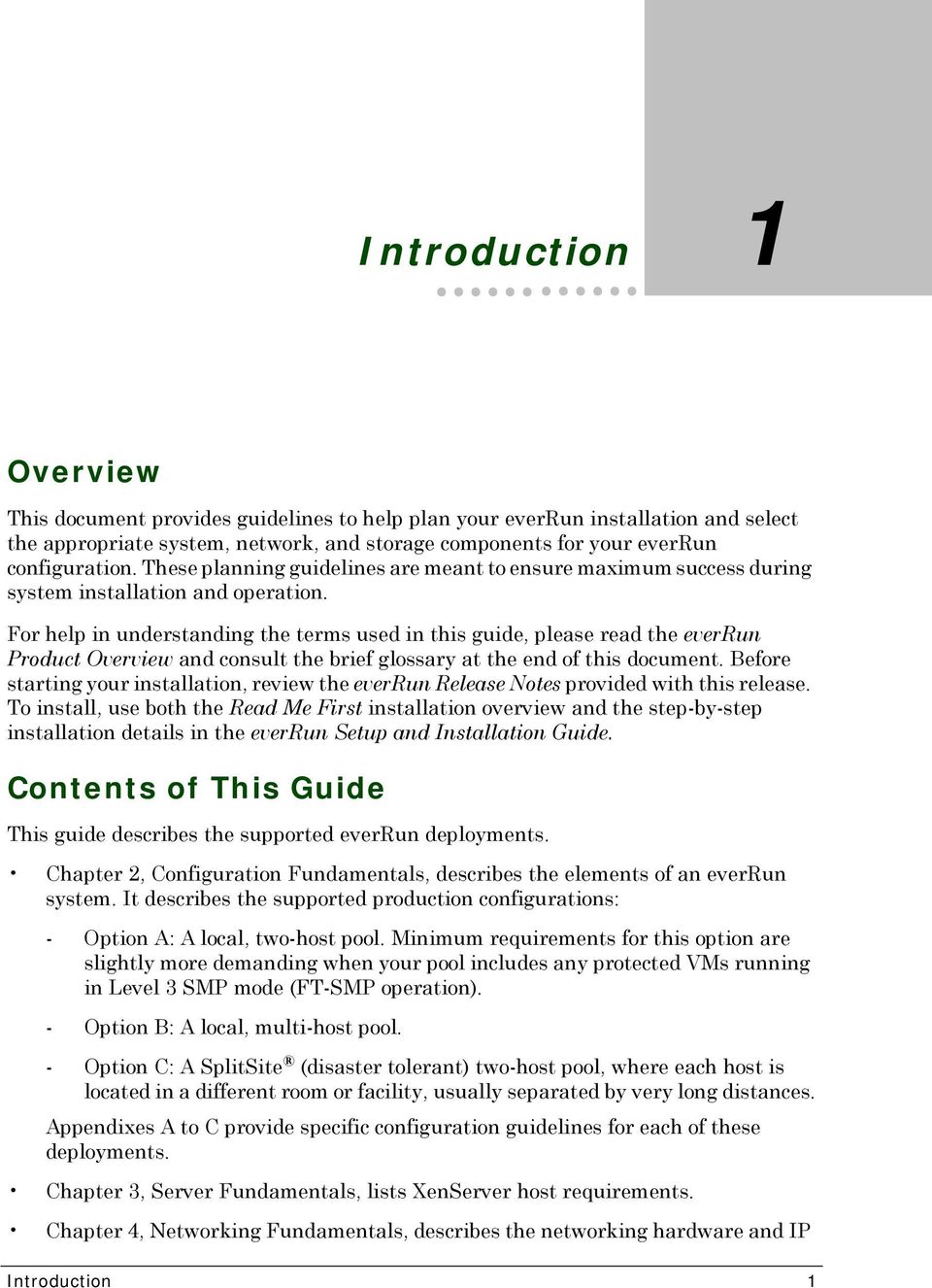
11 addressing schemes needed to interconnect pool resources. Chapter 5, Quorum Service Fundamentals, discusses everrun quorum service, which runs on general-purpose computers. It provides automatic restart capabilities and data integrity assurances if specific failure modes occur. Chapter 6, Storage Fundamentals, describes storage hardware resources and configuration information. Chapter 7, Summary of Deployment Options, lists strategies for meeting your availability goals using everrun Level 3, Level 2, and Level 1 fault tolerance, as defined in the following table. The chapter describes the configuration options as mandatory or not supported, and rates them as Good, Better, or Best choices for fault tolerance or resiliency. Fault Tolerance Level Level 3, System-Level Fault Tolerance Level 2, everrun Component- Level Fault Tolerance Level 1, Basic Failover (Citrix XenServer HA) Properties Zero downtime for any failure Retention of application state and memory state during failures All the benefits of Level 2 Automated fault management policies handle server, network, and storage subsystem failures. Assured recovery of virtual machines Zero downtime due to I/O failures Zero data loss Basic failover to another host, with resource calculation to determine the number of simultaneous host failures that can be worked around Monitoring the health of hosts within a pool Shared-storage configuration required (special Citrix licensing requirements apply). 2 Configuration Planning Guide

12 Configuration Fundamentals 2 Overview This chapter describes the production deployments supported in this release. Production Deployments The production options detailed in this guide are: Option A: A Local two-host pool. This redundant two-host configuration is located in a single site, such as a computer room. It uses private, directly connected availability link (A-link) networks. Option A is the simplest to configure. It is the configuration encouraged for evaluations including tests and demonstrations of failures, recoveries, and repair scenarios. Option B: A Local multihost pool. This configuration integrates quorum services for a two, three, or four host pool. Quorum services are integrated to ensure the integrity of PVMs in the pool against multiple network failure scenarios, and to provide for unattended startup of PVMs after specific server failures have occurred. Quorum services are always recommended and required for all but the simplest of configurations (refer to Option A). Option C: A SplitSite (disaster-tolerant) two-host pool. This configuration represents the everrun SplitSite option, a disaster-tolerant deployment that maintains hardware redundancy as well as redundancy of physical computer rooms and the buildings containing them. Because of the geographic separation, the SplitSite option requires careful planning of component placement and more complex networking topologies. Quorum services are also required. FT-SMP Considerations Multi-processor VMs protected with Level 3 (System-Level Fault Tolerance or FT- SMP) provides important scalability benefits, but it also imposes additional hardware resource requirements: Configuration Fundamentals 3
13 FT-SMP operation requires Intel processors that implement the Extended Page Tables (EPT) feature. Each Level 3 PVM running in multiprocessor mode (SMP) uses 512 MB incremental RAM and CPU threads. Level 3 SMP PVMs depend on higher network performance between the XenServers. Actual demands vary with application load. If you deploy two SMP PVMs on the same pool, specify a different physical server as the primary host for each. It is possible to deploy multiple FT-SMP PVMs on the same pool, however due to application variables, configuration of more than 2 PVMs must be modeled to characterize the impact on performance. Option A: A Local Two-Host Pool An everrun protected VM (PVM) requires two physical servers, and provides redundancy by connecting a set of resources on a primary host server to a second set of resources on a different physical host, as shown in Figure 1. Figure 1 Two-host pool installed in a single computer room. 4 Configuration Planning Guide

14 This option uses two servers in a single room with directly connected Ethernet cable or fiber connections for A-Link1 and A-Link2. The first everrun (PVM) host for the protected VM resides on XenServer Host A, and the redundant everrun host is allocated from resources on XenServer Host B. The two A-links provide redundant, private connections between the two everrun hosts. Option A is recommended for evaluations and some production deployments because it is simple to configure and offers adequate insurance against common failure modes. A-Link LANs must be configured perfectly when deploying Option A. A direct-connected two-host configuration does not require you to enable quorum services. The short, point-to-point, A-link LANs minimize the likelihood of simultaneous A-link network failures, and the potential for an undesirable split-brain condition to occur. Beginning with v6.2, everrun MX configurations are no longer limited to using A-Links for quorum networking. Configuration of quorum services is highly recommended for all production deployments (refer to Option B). Option A is recommended for: Evaluations Production deployments when adequate split-brain avoidance measures can be applied Option B cannot be considered for added benefits quorum. Review the details in Appendix A for detailed requirements and recommendations if you will deploy Option A. Option B: A Local Two, Three, or Four Host Pool Use Option B (Figure 2) if you are planning to deploy a pool of two to four XenServer hosts on a single site with quorum service. Configuration Fundamentals 5

15 Figure 2 A two, three, or four host pool on one site. This deployment includes two to four XenServer hosts at the same location. To supply the required quorum service, two quorum computers are configured and placed on a LAN. The networks are typically interconnected as shown in Figure 2. Any network can be configured for use with quorum services. All quorum communications are routable. Option B is highly recommended for: Production deployments of two, three, or four XenServers in a common computer room. When redundant facilities (sites) are not feasible or not required. Review the details in Appendix B for detailed requirements and recommendations if you will deploy Option B. Option C: A SplitSite Two-Host Pool In a SplitSite deployment (shown in Figure 3 ), the two XenServer hosts are located in separate data centers or in geographically separate buildings, with wide area networking configured between them as shown in the drawing. Multiple gateways 6 Configuration Planning Guide

16 between sites A and B - and quorum computers are required (when one site fails, quorum communications with a surviving host on another site must NOT be interrupted). A common and simpler alternative to Figure 3, using direct connected A-Links (i.e. campus SplitSite with private fiber) works well. If you are not experienced with SplitSite designs, consider a professional services engagement with your service provider. SplitSite requires quorum service, configured in accordance with best practices. For best fault tolerance, a preferred quorum computer is located in a third facility and an alternate is located in a fourth. However, the alternate quorum computer can also be placed with the preferred quorum computer and still yield satisfactory results. When only two sites (or a single gateway) are available, some failures can break quorum communications with PVMs on the surviving site. Whenever a surviving PVM loses access to quorum and cannot safely complete fault handling, PVMs at the surviving site must shut themselves down and be manually restarted (a disaster recovery scenario). If Option C meets your needs, review the details in Appendix C carefully before beginning your installation and make certain you include appropriate infrastructure for the PVMs you plan to include in your deployment. Option C is best for: Production deployments when you must protect against facility falures - in addition to common equipment failures. Synchronous, automatic DR deployments when adequate A-Link networks can be provided. Review the details in Appendix C for detailed requirements and recommendations if you will deploy Option C. General Deployment Guidelines In addition to deployment topologies outlined in Appendixes A, B, and C, you can plan to protect your virtual machines at Level 3, 2, or 1, or an appropriate combination of those protection levels. If you do not plan to include XenServer HA (everrun Level 1) in your pool, some requirements associated with Level 1 can be eliminated. Specifically: You do not need to configure shared storage. When using only everrun Level 3 and Level 2, you only need to provide local storage. There is no need to consider host fencing as a result of the XenServer HA protection algorithm. You can place Level 3 and Level 2 PVMs on any host in the pool and depend on everrun fault-handling and quorum for all eventualities. Configuration Fundamentals 7

17 Figure 3 A SplitSite configuration has one XenServer host on each of two sites. The deployment shown includes active, switched A-link networks and storage attached directly to each host. You are NOT required to meet the XenServer HA requirement of a bonded NIC pair on the management network. However, it is recommended that you implement this bonded NIC to provide maximum reliability of the management network. Because a bonded NIC uses two separate network cards, this configuration consumes a minimum of four, not five NICs. 8 Configuration Planning Guide

18 The following points describe the relationship of quorum service and everrun automatic/manual master failover. If quorum service is enabled, it overrides everrun's automatic pool master failover. A VM continues to operate when the pool master fails, but the system administrator manually designates the new pool master host as required. If quorum service is disabled the everrun Management Service (MMS) provides pool master failover based on an alternative Isolation IP address capability. For More Information Networking is further described in Chapter 4, quorum service in Chapter 5, and storage in Chapter 6. When selecting a deployment option, you may find it helpful to review Chapter 7, which compares the availability provided by various deployment options and includes additional SplitSite perspectives. Appendices A, B, and C provide deployment details for software, servers, quorum service, networking, storage, and PVMs, as well as a connectivity diagram for each configuration. If you have questions that are not addressed in this guide, or if you need help to plan a custom configuration that meets your availability needs, consult your everrun MX reseller for professional deployment services. Configuration Fundamentals 9

19 10 Configuration Planning Guide

20 Server Fundamentals 3 Overview Hardware redundancy enables everrun-protected VMs to operate through failures, resulting in very high levels of availability for Windows environments. This chapter describes the basic hardware and software requirements for hosts in an everrun pool, and the general-purpose computers required for system management or quorum service management. XenServer Hosts The basic hardware requirement for a single protected VM is two separate XenServer hosts that are members of the same resource pool. Each server should be configured according to the guidelines in this chapter. Where to start? Choose two or more servers from those listed on the Citrix XenServer Hardware Compatibility List (HCL) at the link shown below. Tip: Browse to To narrow your search, specify server and enter your vendor of choice. See CPU and Server Rules on page 15 for more information. How many servers? Acquire the number of servers you will deploy to meet your capacity and redundancy requirements. See CPU and Server Rules on page 15 for more information. Server Fundamentals 11

21 How many CPUs? Populate each server with enough CPU cores/threads to meet your performance needs. The total number of CPUs required will vary greatly, according to your system design. This section lists a few factors to consider when planning your CPU requirements. See CPU and Server Rules on page 15 for more information. The XenServer environment uses four CPUs. Each running (non-protected) VM requires one or more CPUs on the XenServer host where it will run and each protected VM represents CPU requirements on two separate XenServer hosts. Each L3 PVM requires (up to) 6 extra CPU threads for an AM. Each L2 PVM requires 1 extra CPU thread for an AM. Consider the capacity requirements on each host after failover has occurred. For example, Level 2, and Level 1 PVMs may require additional resources on the machines they fail over to. - Level 3 protected VMs Always reserve the same number of CPUs on both hosts. - Level 2 protected VMs The default configuration (recommended) reserves the same number of CPUs on the active and standby hosts. It is possible to reserve a different number of CPUs on the redundant host, resulting in some disadvantages. Online migration cannot be performed (hindering software upgrade and repair scenarios) and following a failure requiring Windows to restart on the redundant host - capacity will be adjusted down/up to match the number of CPUs reserved. - Level 1 protected VMs After the VMs fail over, VM performance of all VMs will be reduced unless free CPU resources are reserved for the worst case scenario. XenServer permits a higher vcpu demand than physical CPUs that exist (over committing CPUs), however when all become active, performance can degrade significantly. For best performance, you should provide enough physical CPU threads on each server to minimize or eliminate over committing CPUs. For acceptable availability, you should provide a minimum of 1 CPU thread for each vcpu of demand on both servers. NOTE: Guidelines and a worksheet for planning your vcpu demand on a XenServer host are available in the KnowledgeBase at the everrun support website. To review these guidelines, log in to everrun Technical Support with your 12 Configuration Planning Guide
22 customer password, click the Knowledge button, and choose the Documents category in the list at left. Then type "CPU Overcommit Counters" into the Search This Category window and click Search. Server Fundamentals 13
23 What CPUs are supported? A list of the processors currently supported for everrun Level 3 SMP, Level 3 uniprocessor, and Level 2 protection is available at: If you want to evaluate whether your hardware supports everrun Level 3 multiprocessor (SMP), Level 3 uniprocessor, or Level 2 operation, download and run the everrun Compatibility Check utility to prequalify your hardware. The utility, which is available in the Tools and Utilities section of the everrun download site, checks CPU vendor, brand, and type; microcode revision; and other features required for everrun operation. It runs from a DVD or USB key attached to the target hardware and does not require XenServer or everrun software to be installed at the time. For instructions, download the Compatibility Check Readme document, also available at the everrun site in the Tools and Utilities category. How much RAM? Populate each server with sufficient RAM to support all the VMs you need to run at once. XenServer limits you to the number of VMs the physical RAM can support. Provide a minimum of 4GB of RAM per server to accommodate four (or more) protected VMs and the XenServer environment. Less RAM will constrain you to have fewer VMs or VMs with smaller amounts of memory. Tip: Make sure each of the XenServer hosts contains enough RAM to support your requirementswhen another host fails. Meeting this recommendation also provides capacity for online migration of Level 2 and Level 1 PVMs in repair or recovery scenarios. For best availability and performance, a protected VM should have identical RAM allocated on its redundant everrun host. The following guidelines apply to different PVM types. Level 3 protected VM Always requires an identical amount of RAM on both hosts. everrun is utilizing this RAM for Windows simultaneously on both physical hosts even before a failure. Each VM protected at Level 3 (uniprocessor) or Level 2 uses 128 MB of incremental RAM (beyond that configured for Windows for an AM) on both hosts. It is mandatory to meet this RAM requirement on each host. Each Level 3 PVM running in multiprocessor (SMP) mode uses 512 MB incremental RAM instead of 128 MB. 14 Configuration Planning Guide
24 Level 2 protected VM Unless configured otherwise at the time of protection, Level 2 PVMs reserve identical RAM on both hosts. RAM allocated to Level 2 PVMs depletes available resources on the host; thus Level 2 PVMs have priority over Level 1 PVMs when failover attempts are processed. In Level 2 protection the amount of RAM configured for the standby side is reserved when the PVM is started (in advance of any host failure). Online migration (a feature that permits you to maintain PVM operation during software updates or hardware repair scenarios) can be performed only if the RAM is identically configured on both hosts. However, if a PVM is configured to use less RAM on the standby host, it will still be possible to migrate with restart. Level 1 protected VM Requires identical RAM on two hosts, according to your failover needs. It is best to have ample RAM reserved when a single host failure would cause many VMs to fail over. If adequate RAM is not available, some Level 1 VMs cannot be restarted on another XenServer host. CPU and Server Rules Select a server with approved Intel processors from the lists available at everrun-support.stratus.com Minimum of 2 servers per pool; 4 maximum have been qualified. Each CPU must be the same family and model, and otherwise be eligible to join a common XenServer pool. Provide a minimum of 4 CPU cores per server; 160 CPU threads (vcpus) maximum per server. An everrun PVM may contain up to 8 vcpus. The actual number of CPUs required varies with the PVMs you plan to deploy. Refer to How many CPUs? on page 12 for guidelines. System Management (Client) Computer The client computer(s) used for everrun management can be any general-purpose computers running Windows 7, Windows XP, Windows Vista, Windows Server 2003, Windows Server 2008, Windows Server 2008 R2 (all editions and versions). You use the client computer to access the two graphical management interfaces in the everrun system: The everrun Availability Center (eac) The browser-based eac everrun management GUI can be loaded and run by any Flash-enabled web browser on any computer. Server Fundamentals 15
25 The XenCenter interface XenCenter is the client application for remote management of XenServer hosts. It can be installed and run on any management computer. Quorum Service Computers Quorum services should be enabled with all deployments, however they can be considered optional for deployment Option A. If your deployment uses active, switched A-Link networks, quorum service software is required. Quorum service software should be installed on two Windows XP (SP2 or newer), Windows Server 2003 or 2008, Windows Vista, or Windows 7 computers, as described in Chapter 5. Summary For more information about everrun server configurations, see Chapter 7, Summary of Deployment Options. After you select a deployment option, refer to the relevant appendix (A to C) before procuring hardware, preparing the infrastructure, and beginning your hardware and software installation. 16 Configuration Planning Guide
26 Network Fundamentals 4 Overview Proper attention to network design can make the difference between building a configuration that functions and building a configuration that delivers the availability you require when a hardware or network failure occurs. This chapter describes requirements and best practices for the management LAN, private (A-link) LANs, and public (production) LAN. LAN Requirements A minimum of four physical LANs (using four or five NICs per host) are recommended, as shown in Figure 1 on page 4. A NIC is added whenever a bonded management LAN is used. A bonded management LAN is strongly recommended when deploying Level 1-protected VMs (called XenServer High Availability [HA] in Citrix documentation). In addition to its primary functions, each LAN type may be used to meet quorum requirements for deployment Options B or C. The total number of networks may exceed the minimum- up to XenServer maximums. For example, your deployment may call for more than a single Production LAN for some PVMs - or for separate physical LANs for different PVMs. Additionally, you may decide to use dedicated networks for Quorum services - or integrate Quorum with your Management, A-Link, or Production networks. Quorum services are descussed in Chapter 5 (Quorum Service Fundamentals) - however quorum considerations specific to each LAN type are integrated in the sections that follow. Management LAN The XenServer management LAN interconnects pool members and management applications. It is required to reach Network Time Protocol (NTP) servers, import or export a VM, and to synchronize or migrate PVMs (and VMs) between hosts in the pool. Tominimize the impact of a failure of this LAN, Citrix recommends that you use a Network Fundamentals 17
27 bonded NIC pair on each host, to provide management LAN redundancy between hosts and network switches. Physical Configuration Best Practices - Management LAN Provide independent production and management NICs and LANs whenever possible. Connect each management NIC through switches and uplinks such that no switch or uplink failure can impact more than one XenServer host or both NICs in a bonded pair. Bonded NICs are strongly recommended for the management LAN, if you plan to enable XenServer HA (deploy Level 1 PVMs) in your pool. Configure the bonded NIC pair on the management LAN, with each NIC cabled to a separate Ethernet switch. Configure gateway access between your management LAN and other LANs as required for mangement computer access (including LANs used for remote management purposes). To support online migration of a Level 2 protected VM or (re)synchronization of a Level 3 PVM, all NICs, switches, and uplinks must be capable of 155 Mbps or greater, with full duplex connections. 1 GbE components end-to-end or faster are recommended. 155 Mbps uplink capacity is sufficient for limited SplitSite configurations, however if Level 3 SMP PVM(s) are deployed, the minimum (end-to-end) bandwidth requirement increases to 1 Gbps. Identify a device with a static IP address for use by everrun s Management Service (MMS) failover. This device must be configured to reply to ICMP ping requests initiated by all hosts in the pool, and it should remain powered on at all times on the management LAN. MMS failover is applicable to deployment Option A (without Xen HA enabled), and in other situations when quorum services are temporarily disabled. Providing an Isolation IP Address The pool-wide isolation IP address, described in the final row of the preceding table, is used by the everrun management service to maintain availability of pool management capabilities in deployment Option A only. It enables everrun to automatically appoint a replacement if the active pool master should fail for a few minutes. Configuring this feature is useful in simple configurations when the administrator is not familiar with XenServer pool management. Pool-wide isolation IP address configuration is explained in greater detail in the everrun Availability Center (eac) Online Help. Subnet Configuration Options and Requirements - Management LAN) When setting up your Management network, you can elect to assign each XenServer host (control domain) on a common IP subnet or you can configure routes between hosts. If you are configuring a local, two-host pool (Option A), all hosts are typically configured using a common subnet. Requirements: 18 Configuration Planning Guide
28 - Static IP address assignments - One or more NTP servers must be accessible from the XenServer hosts - IP access among all XenServer hosts - IP networking between management computers and the XenServer hosts If you are configuring a local two, three or four host pool (Option B), all hosts are typically configured using static IP addresses on a common subnet. Requirements and considerations: - All requirements of Option A must be met - The quorum service features can be configured using the Management, or a different LAN. If you are configuring a SplitSite configuration (Option C), where the two hosts are in separate locations, routed Management LANs are sometimes prescribed by the network administrator and required for quorum to be effective. Requirements and considerations: - All requirements of Option A must be met - The quorum service features can be configured using the Management, or a different LAN. Separate gateways local to each site are necessary to reach quorum computers and support proper fault handling when networks fail. Private LANs (Availability Links) Level 3 and Level 2 Protected VMs use two LANs for private availability-link networks (A-link 1 and A-link 2). Within a protected VM, the A-link networks connect the two everrun hosts for the protected VM. Physical Configuration Best Practices - LANs Do not configure NIC bonding for availability-link (A-link) networks. Do not assign both A-Links on on the same multi-port card or server board. Hardware failures impacting multiple ports have happened and should be guarded against. Network Fundamentals 19
29 Provide independent LANs for A-links in each XenServer host. If both A-Links use common physical components, a single failure escalates to multiple failures simultaneously. Connect each A-link NIC through switches, routers, and uplinks such that: - An uplink failure can only impact one A-Link LAN. - A gateway failure can only impact one XenServer host's connectivity to other hosts or Quorum Computers (if configured using A-Link LANs). - All NICs, switches, and uplinks should be capable (end-to-end) of 1Gbps (or faster), full-duplex connections. The minimum (end-to-end) speed is 155 Mbps only if Level 3 SMP PVM(s) are NOT configured. Subnet Configuration Options and Requirements - Private LANs When setting up your network IP addresses, you can elect to assign each A-link to a single IP address range (two subnets total) or you can assign a separate IP address range to the connection at each end of the A-link (four subnets total). This section describes the appropriate use of two-subnet and four-subnet approaches for the supported everrun configuration options. If you are configuring a local, two-host pool (Option A), all hosts are configured using two subnets (one for A-Link1 and one for A-Link2). Because the LANs are not switched or routed, everrun default address ranges are almost always used. Requirements: - IP address range assigned for each A-Link network. - The range must provide two IP addresses for each PVM (everrun defaults provide 100 addresses, more than enough for PVMs) If you are configuring a local two, three or four host pool (Option B), all hosts are typically configured using two subnets (one for A-Link1 and one for A-Link2). With local configurations, there is rarely an advantage to configuring routable A- Link networks. Requirements and considerations: - All requirements of Option A must be met - If the A-Links will be switched networks (more that two XenServer hosts or use of A-Links to implement quorum), do NOT use default everrun address ranges. You must assure no address conflicts with other network devices that might have access to these LANs -- including other everrun pools (installed using default assignments). - Configure dedicated IP address ranges for each A-Link whenever a switched network configuration is used. - If routable A-Links are desired, refer to Option C. It is uncommon but possible to install a SplitSite compliant, two host configuration in a single room. 20 Configuration Planning Guide
30 - Quorum service features can be configured using A-Links -- or without the use of any A-Links LANs. Refer to Chapter 5 "Quorum Service Fundamentals". If you are configuring a SplitSite configuration (Option C), where the two hosts are in separate locations, routed A-Link WANs are often prescribed by the network administrator. Requirements and considerations: - All requirements of Option A must be met - The quorum service features are required, however it is not necessary to meet the requirements using A-Link WANs - Routable A-Links may be used to reach Quorum. When using A-Links for Quorum access use separate IP address ranges and gateways (one local to each site) to fault handle correctly when networks fail. This means two subnets for each A-Link in use with quorum. - Point-to-point A-Links can be configured ("campus SplitSite") using dedicated long distance fiber or other media. Point-to-point A-Links cannot be used for Quorum access -- so only a single IP address range and no gateways are configured. NOTE: Quorum is required for campus SplitSite configurations. A different WAN using separate gateways and IP address ranges (and SplitSite license) must be allocated for quorum networks. See Chapter 5 "Quorum Service Fundamentals". Figure 4 is a simplified illustration of a routed four-subnet scheme. Each end of an A- link has a separate path, via a local gateway, to a quorum computer. The drawing shows an option to configure the preferred quorum computer using one of the A-Link WANs; a similar pathway would be configured to the alternate quorum computer, using the same approach. While Quorum services should be configured for all deployments, use of A-Link networks for this purpose are optional (see Chapter 5, Quorum Service Fundamentals ). Network Fundamentals 21
31 Figure 4 Note: Simplified sketch of a four-subnet scheme that provides separate pathways to each end of each availability link (A-link). IP addresses in the illustration are samples, not examples. Configuration of Quorum Computers is possible using any routed network between sites. Use of an A-Link is shown in figure 4 for illustration purposes. Refer to Chapter 5 "Quorum Service Fundamentals" for complete information about configuring quorum services.. Public Production LANs Production networks connect virtual machines and LAN-based clients must use a single vlan. VMs protected at everrun Level 3 and Level 2 provide redundant, layer 2 LAN access for the Windows operating system by managing separate physical NICs on two XenServer hosts as a redundant pair. Up to six (in releases older than v6.2) public production LANs can be configured for each PVM. A XenServer knowledge 22 Configuration Planning Guide
32 article (available at describes considerations for XenServer switch ports. Physical Configuration Rules - LAN Although it is possible in some circumstances to combine production and management NICs, such a configuration is not recommended. Production LANs must pass layer 2 multicasts between all ports connected to the physical NICs on each host in the pool. Even if the XenServer hosts containing the NICs are on different sites (deployment Option C) both NICs must be connected to a common (v)lan. Do not configure NIC bonding for production networks. Comply with best practices for quorum network configurations (on a non-routable LAN) if using Production NICs to access Quorum computers. See Chapter 5 for a discussion of quorum service and quorum service computers. Never configure both NICs of a redundant pair to a common network switch. Physical Configuration Best Practices - LAN Although more than one Production LAN can be configured using a common physical NIC, it is not recommended. For maximum redundancy (of multiple LANs for one PVM), provide separate NICs and LANs for each production LAN. Connect each production physical NIC through switches and uplinks such that no one switch or uplink failure can impact the ability of production clients to connect to the redundant host. Absence of multicast network traffic will delay failover response. In very quiet LAN environments consider adding a multicast generator to accelerate failover response. Additional Production NICs everrun supports up to six virtual NICs per protected VM. A maximum of twelve virtual devices (NICs and disks combined) are allowed per protected VM. For information about the maximum number of physical NICs supported by XenServer, refer to the Citrix XenServer documentation at the Citrix website ( support.citrix.com) or the everrun MX support website ( Home/Services/CustomerSupport ). Network Fundamentals 23
33 TCP/IP Configurations for Production Deployment This document does not describe production TCP/IP configurations for the VMs you plan to install on the pool. However, it is recommended you accommodate each Production LAN on each protected VM within your IP address range. These LANs can be used for configuration of Quorum services, however they are most appropriate for deployment Option B (site failure protection is beyond scope). Production LANs are layer 2 implementations, and cannot be routed between XenServer host locations. In Option C (SplitSite), a routed WAN quorum configuration (using A-Links, Management WAN or a seperate, low bandwith WAN) is required to achieve ideal fault handling results. For some classes of network failure. non-routed quorum solutions result in synchronous replication DR behaviors (intentional outages and manual restart). Refer to Chapter 5 "Quorum Service Fundamentals". Summary This chapter has provided insight into the requirements each deployment option imposes on the networks. For more information about which option best supports your deployment needs, see Chapter 7, Summary of Deployment Options. After you select a deployment option, use the corresponding appendix as a checklist during detailed planning and installation exercise. 24 Configuration Planning Guide
34 Quorum Service Fundamentals 5 Overview The quorum service communicates with Level 3 and Level 2 PVMs to ensure integrity during failures of XenServer hosts or multiple networks (for example, simultaneous failure of all A-links and production LANs) between hosts in an everrun configuration. This failure scenario may occur when direct connected Ethernet cable routes exceed three meters; when switches or patch panels are introduced; when multiple networks share a common uplink; and when a multi-port NIC hangs or fails impacting more than a single LAN connection. Network configuration best practices attempt to minimize the likelihood of network failures, but when such measures fail, quroum services implement the final measures required to assure data integrity. The fault management software, aided by quorum service managers, selects an appropriate everrun compute instance that can safely continue, regardless of where a failure occurs -- if one XenServer and its connection to the current quorum survives. A PVM instance that may be running, but is isolated from its "peer" and quorum service will correctly "halt" and SplitBrain can be avoided. A quorum service is installed on Windows client computers, which are placed strategically on one of the networks. In deployment option C (SplitSite) gateways are configured to provide sustained quorum access through the failure modes that can happen to servers, sites and networks. In deployment option B (two, three or four hosts on one site) attention is paid to handling the failure modes than can happen to servers and local networks (not the site). Two quorum service computers are configured, placed and accessed using networks available to the XenServer resource pool. Only one quorum computer is required to support correct fault handling. Two are provided, so when one fails or is restarted, the other can be automatically placed on line (elected). Whenever both quorum service computers are unavailable, PVMs downgrade themselves to run on only a single XenServer host (SplitBrain prevention). Later, when either quorum service computer is recovered, the PVMs upgrade themselves to full redundancy again. Quorum Service Fundamentals 25
35 The requirements for quorum service (Windows) computers are described in the Quorum Service Computers section. To facilitate automatic recovery after large-scale power outages, access to the quorum service (which was in use prior to the outage) can authorize PVMs to start with integrity, but without redundancy even if one physical server fails to recover. Automatic recovery features are most applicable to deployment Option B, where it is likely a power outage can impact all XenServer hosts -- at the same time. This chapter describes when quorum service is required and summarizes the rules and best practices for quorum service configuration. When is Quorum Service Required? All configurations can benefit from the use of quorum service computers. When configured carefully, deployment Option A mimizes the likelihood of SplitBrain failure modes and justifies deploying without Quorum. Such configurations (particularly evaluations) can justify the simplest of configurations without Quorum services. Quorum service is required for each of the following deployment scenarios: Deployment Option B (two, three or four host pool). No additional license is required to enable use of quorum services. Deployment Option C (SplitSite). A SplitSite license is required to configure quorum services properly -- and survive real site failures (including power outages that impact only one of two sites) with no downtime. A SplitSite license is not required to use quorum services safely resulting as a synchronous replication DR capability where some failures will cause PVMs to shutdown and require manual intervention to start.. Quorum Service Rules Provide two quorum service computers for the everrun pool. Quorum service installs as a Windows service on XP SP2 or newer, Server 2003, Vista, or Windows 7. Other Windows operating systems may work but are not certified for use with everrun MX. Quorum service must not be installed on a VM residing in the pool where everrun is installed. Quorum service must NOT be installed on a PVM on the same or another pool. A PVM Production LAN may fail over to an alternate physical location and violate the integrity of the SplitSite design. Quorum service computers must be configured using static IP addresses. everrun protected VMs contact quorum service computers using UDP. By default, firewalls must open port 2189 between A-link NICs and quorum service computer. 26 Configuration Planning Guide
36 Quorum service computers communicate with AMs operating on everrun-enabled pool member (or master) hosts using UDP. By default, firewalls must open port 2188 between A-link NICs and quorum service computers. everrun quorum service installations can coexist on the same computer with other applications and services, including quorum service for earlier everrun FT and everrun HA products. That is, quorum service installations from different product families (such as everrun FT/HA products) operate independently, and may be installed side by side on the same quorum service computer. If you are running a quorum service from a prior version of the everrun MX/2G/VM product, it is recommended that you install the quorum service that is part of the latest everrun version. Newer versions of the quorum service software are backward-compatible with all versions of the everrun MX/2G/VM. Quorum Service Best Practices Configure two quorum service computers with minimum common networking between the quorum computers and the XenServer hosts. In SplitSite licensed configurations, specify four subnets and separate, local gateways associated with each NIC Management A-link, or designated Quorum network and quorum service traffic. Quorum service computers should not reside on the same site as any XenServer host when deploying Option C (SplitSite). If PVM redundancy is not impacted, but both preferred and alternate quorum computers fail for a common reason, PVMs will gracefully downgrade redundancy then continue to operate using one host, pending recovery of a quorum computer. However, if a XenServer host and the elected quorum computer fail for a common reason, everrun hosts running on the surviving XenServer shut themselves down. Exception: When deploying Option B (two, three, or four Host on one site) the entire pool is on one site, placing both quorum computers at the same location where all hosts in the same site can fail for a common reason. Deployments on a single site are not expected to survive site wide failures (including power outages impacting all equipment on the site).. If the preferred and alternate quorum service computers must reside on a common site, power them from separate AC power sources (phases) or configure them on separate UPS devices. Make all provisions you can cost justify, then document when PVMs must shut down to protect themselves (even when one XenServer continues to function). When deploying Option C (SplitSite), configure a physical network route from each XenServer to a preferred quorum service computer using one of the networks (Management, A-Links or dedicated Quorum computer) available to the XenServer and associated gateway. Make sure that nothing in the route (including a gateway) can fail and cause both hosts to lose contact with the preferred quorum service computer. Option: When deploying Option B (two, three or four Host on one site) the entire pool is on one site, placing both quorum computers at the same location when all hosts in the same site using a Production network with no gateway creates no additional liability. Quorum Service Fundamentals 27
37 Quorum Service Best Practices When deploying Option C (SplitSite), configure a separate physical network route from each XenServer to an alternate quorum using a second of the networks (Management, A-Links or dedicated Quorum computer) available to the XenServer gateway with no hardware in common with the A-link 1 LAN/gateway. Make sure that nothing in the route (including a gateway) can fail and cause both hosts to lose contact with the alternate quorum service computer. Option: When deploying Option B (two, three or four Host on one site) the entire pool is on one site, placing both quorum computers at the same location when all hosts in the same site using a Production network with no gateway creates no additional liability. Summary Optimum configuration and placement of the quorum service computers vary, depending on your deployment needs and choices. Key variables are the number of sites you have to work with, as well as the network designs that interconnect the hosts and sites. After choosing a deployment option in Chapter 2, refer to the appendix for that option to obtain additional quorum service details. 28 Configuration Planning Guide
38 Storage Fundamentals 6 Overview You must configure storage capacity, functionality, and performance sufficient to meet the needs of all PVMs you plan to deploy on the pool. A minimum of 72 GB of directattached storage per XenServer host is adequate for evaluation and testing. You should increase storage capacity and functionality as required to accommodate the storage features in your design and the applications you plan to install. This chapter describes some availability and performance tradeoffs associated with the storage options avaiable enabling you to make informed compromises. everrun Storage Support everrun supports both types of storage repositories (SRs) described in the everrun documentation: Host-specific storage physical storage directly attached to a host, or networked storage allocated to a single host. In both cases, the storage is not available to other hosts in the pool. Also called local storage. All features of everrun are supported with direct attached storage except everrun Storage System Data Protection (a PVM disk type described later in this chapter). Shared storage networked physical storage with access to all hosts in the pool. This type of storage includes a variety of storage options, including iscsi and FC-SAN. You can configure these options as described in the Storage chapter of the XenServer Administrator s Guide and About Storage Configuration in the everrun Online Help. everrun Data Protection The storage options described in this chapter are based on two methods that can be used for everrun data protection: everrun mirroring is a process for creating and maintaining a set of identical Storage Fundamentals 29
39 disk images on separate virtual disks. Each everrun-protected VM relies on a pair of virtual disk images (VDIs). It is best (fault tolerance and performance) if the VDI are created in XenServer storage repositories (SRs) on different physical disk systems. everrun mirror sets maintain identical information in each VDI. If a fault occurs on one of the disks in a mirror set everrun reconfigures the mirror set to provide continuous access and no data loss. Storage subsystem data protection is a path-redundant option, available to users who prefer to integrate intelligent SAN systems and meet storage redundancy needs using the storage fabric. This option relies exclusively on the storage hardware to protect the data. Both everrun hosts access data on a common VDI. If one server or pathway to the storage fails, the everrun software activates the alternate pathway on the other server hosting the protected VM. Storage subsystem data protection must be implemented using a "RAW" type VDI. As such features (i.e. snapshots) that depend on VHD type VDI are not applicable. everrun Mirroring Host-specific storage repositories using everrun data mirroring (see Figure 5) provide most the most comprehensive data protection for Level 3 and Level 2 PVMs. Figure 5 Redundant hosts on one site, with host-specific, independent storage. 30 Configuration Planning Guide
40 NOTE: Separate shared storage devices, such as iscsi, can provide adequate storage repositories (SRs) for everrun mirrored storage. Most configurations use direct attached storage unless a SAN exists and must be incorporated into the solution. everrun mirrored storage requires separate virtual disks (XenServer virtual disk images, or VDIs) for redundancy. Storage repositories provide the greatest fault tolerance when implemented in physically separate storage subsystems. Shared storage is required when configuring everrun Level 1 (XenServer HA) protected VMs, or when implementing storage subsystem data protection (pathredundant) disks for everrun Levels 3 and 2. Storage Subsystem Data Protection Storage subsystem data protection (the path-redundant alternative to everrun mirrored protection) relies exclusively on features of the storage hardware to provide fault resiliency (see Figure 6). In this type of data protection, everrun provides a redundant access path to common, shared storage, but everrun does not provide redundancy of the data. Storage Fundamentals 31
41 Figure 6 Redundant hosts at one site, using storage subsystem data protection. 32 Configuration Planning Guide
42 Shared storage accessible to all hosts in the pool supports: Level 3 and Level 2 storage subsystem data protection, with path redundancy. - Using 50% of the storage capacity required to implement everrun mirroring. - Limited to features of "RAW" disks (i.e. no snapshot support). Level 1 basic failover protection requires shared storage (see Figure 6). If using SAN storage with everrun mirrored data protection, configure separate virtual disks in separate storage repositories, in physically separate storage subsystems (see Figure 7). Figure 7 Redundant hosts with shared storage-based local storage repositories (SRs) in separate storage systems (can be NFS-based, iscsi, or a SAN fabric). Storage Fundamentals 33
43 Performance and Placement You should consider performance needs and placement requirements when configuring SAN(s). Direct attached disks often perform best and are located where the XenServers are placed.performance considerations include: Performance Issue Resource contention Storage system Storage fabric Considerations I/O intensive loads compete for the performance capabilities of host bus adapter (HBA) caches, pathways to the storage system, and the storage system itself. Controllers, caches, and physical access characteristics are shared among hosts competing for common physical resources. Random patterns of access perform better than I/Os that are synchronized, such as dual reads/ writes and mirror copy accesses typical of everrun mirrored storage. For best performance with everrun mirror sets, locate the mirror set members in physically different storage systems, and configure physical storage with batterybackedup, write-back caches. Direct attached storage is often the best solution. Common switches and physical pathways perform best when loads are distributed randomly. For best performance with everrun mirror sets, configure separate pathways through the storage network for each host. If you include FC-SAN storage in your deployment, configure multipath FC-SAN to minimize the likelihood of connectivity loss. 34 Configuration Planning Guide
44 Placement considerations include: Placement Issue Single points of failure Considerations Storage vendors minimize single points of failure. However, problems with firmware or storage networks render storage systems inaccessible to all hosts at the same time. Separate storage systems and storage network configurations add insurance against inadvertently configuring a single point of failure. Using separate sites (facilities) for the XenServers and associated storage offers the greatest insurance against any single point of failure. Storage Rules Do not configure any Ethernet accessed (i.e. iscsi) storage access via the Management, A-link (everrun private) or production (client) networks. Dedicated storage NICs are used with Ethernet based SANs. When enabling XenServer HA, the state file (a file that maintains the pool heartbeat) cannot reside on NFS servers. Only FC-SAN and iscsi are supported for this purpose. This limitation applies only to the XenServer state file. Storage for Level 3 and Level 2 PVMs can reside on NFS servers. When deploying storage subsystem data protection (SSDP) -- it is necessary to create a RAW storage repository containing a RAW VDI for each PVM disk. Do not exceed eleven disks (VDI) for a single PVM. (The sum of disks and production LANs must not exceed twelve.) Summary of Storage Options The number of storage systems provided, as well as their location, creates tradeoffs of availability, performance, and functionality. You may configure FC- SAN, iscsi, or NFS servers as host-specific storage directly attached to a host, or as shared repositories available to all pool members. (EXCEPTION: An NFS server cannot host the XenServer state file in Level 1 PVMs.) iscsi and NFS servers must not be configured on the management LAN or any IP subnet that the management LAN can route to. Do not share storage LANs with everrun A-Links or PVM production LANs. A NIC must be added for the dedicated use of LAN-based storage architectures. Storage Fundamentals 35
45 It is recommended that you use redundant NICs for Ethernet-based storage access configured as path-redundant storage with multipathing enabled. When adding NICs, be aware of how many active NICs are accumulating within each host in this pool (XenServer 6.0 supports a maximum of sixteen active NICs per host). Independent storage systems for each pool member provide: - Highest availability. - Higher performance (if using everrun mirror sets). NOTE: Always configure large caches in RAID controllers and provide battery backup (BBU). The absence of BBU (or battery failure) will result in significant performance loss. Effective storage caches largely compensate for non-optimal choices of RAID type and over commitment of individual storage repositories (RAID groups and LUNs). PVMs support storage volumes up to 2 TB in capacity. - Disks larger than 2TB can be used by overriding the use of VHD storage repositories (VDI type = RAW). - RAW disks do not support snapshot features of everrun or XenServer. - Disks larger than 2TB require GPT partitioning. MBR disks are limited to 2TB or smaller. This chapter provides general guidelines. For implementation details, see the appendix that describes the deployment option you choose to configure. 36 Configuration Planning Guide
46 Summary of Deployment Options 7 Overview This chapter recaps XenServer pool configurations suitable for everrun production deployments. It lists considerations for applying Level 3, Level 2, and Level 1 everrun protection on each deployment option. It then contrasts the supported configurations in a summary table, which rates availability features as Good, Better, and Best. Configuration Options All production deployments require hardware redundancy to deliver the value of everrun protection. Redundant physical hosts, storage, networking and quorum service are appropriately configured and deployed in support of the availability goals for your production environment. The table in Comparison of everrun Deployment Options on page 43 compares the deployments in terms of their fault tolerance features. After selecting a deployment option, refer to the corresponding appendix to design a hardware configuration and a plan to integrate with your infrastructure. Meeting Your Availability Goals everrun protection Levels 3 and 2 can be deployed on each of the deployment options. Level 1 depends on shared storage and bonded NICs, and is compatible with configuration Options A and B. NOTE: Option C bridges multiple sites. Attempts to configure shared storage across multiple sites, even if possible, cannot uphold the objectives of site-level fault tolerance. The following sections list factors to consider when designing a deployment strategy to protect VMs at desired levels of fault tolerance. Summary of Deployment Options 39
47 Protection Level 3 (System-Level Fault Tolerance) Choose Level 3 for applications that cannot be permitted to fail as a consequence of a (single) hardware failure in the pool, storage, or networks. Level 3 PVMs continue to run through failures of storage or networks and even after a complete failure of a physical host. Multiple PVMs may coexist on the same pool, however DO not exceed everrun recommended vcpu over commit ratios (refer to PAGE 10 How many CPUs?). Option A Local Two-Host* Level 3 protected VMs have no single point of failure not the servers, nor the storage, nor the network devices. You can deploy less critical, Level 2 PVMs on the same two hosts without compromising uptime of more important Level 3 PVMs. In Option A, you can deploy less critical, Level 1 PVMs on the same two hosts without compromising uptime of more important Level 3 PVMs.** Option B Local Multi-Host If you misconfigure Level 3 PVMs (placing L3 PVMs on more than just two hosts and enabling XenServer HA) the survival of all cannot be guaranteed in case of a management LAN segmentation. You can deploy less critical, Level 2 PVMs to any hosts in the pool without impacting Level 3 PVMs (if all Level 3 PVMs reside on two common XenServers). You can deploy less critical, Level 1 PVMs on any hosts in the pool without impacting Level 3 PVMs (if all Level 3 PVMs reside on two common XenServers).* Option C SplitSite Two-Host* Level 3 Protected VMs have no single point of failure including the room (site) where the servers, storage and network devices physically reside. You can deploy less critical, Level 2 PVMs on the same two hosts without compromising uptime of Level 3 PVMs. * If your deployment uses any Level 3 PVMs with two or more CPUs (SMP multiprocessor), 1Gbps of bandwidth for both A-link networks is required. Deployments using only uniprocessor Level 3 PVMs can operate with a minimum of 155 Mbps A-link network bandwidth. ** An exception occurs when failures already exist before a management LAN segmentation failure. Refer to Surviving Management LAN Segmentation Failure below. Protection Level 2 (Component-Level Fault Tolerance) Choose Level 2 for applications that must tolerate storage and network failures, even in cases when some XenServer host failures may require (protected) Windows migration (with reboot) to the other host Choose Level 2 for deployments requiring more than 1 CPU if the more demanding A-link bandwidth and latency requirements for Level 3 SMP cannot be met. 40 Configuration Planning Guide
48 . Option A or D Local Two-Host You can migrate applications to another host when the online host hardware fails, with only a momentary interruption for restart. You can deploy less critical, Level 1 PVMs on the same two hosts without compromising uptime of more important Level 3 or Level 2 PVMs.* Option B Local Multi-Host If you misconfigure Level 2 PVMs by placing them on hosts that do not have the greatest number of Level 3 PVMs and by enabling XenServer HA, the Level 2 PVMs cannot be guaranteed to survive if a management LAN segmentation occurs. You can deploy less critical, Level 1 PVMs on the same hosts without compromising uptime of more important Level 3 or Level 2 PVMs.* Option C SplitSite Two-Host When you lose an online host, the only impact of the failure is an immediate restart of the failed host. All components (including the room where the servers, storage, and network devices physically reside) are protected against outage. * An exception occurs when failures already exist (for instance, when repairs are not completed) before a management LAN segmentation failure. This is a double failure scenario. Protection Level 1 (Basic Failover) Choose Level 1 protection for applications that can restart on another host (with reboot) if the host where it is running fails. Level 1 depends on shared storage to make its disks available to an alternate host. Network failures that disconnect a Level 1 PVM from a production LAN require manual intervention to online migrate the VM to an alternate host. Option A Local Two-Host Level 1 PVMs can be combined on the same two hosts without compromising uptime of more important Level 3 or Level 2 PVMs.* Option B Local Multi-Host Level 1 PVMs can be combined on various hosts without compromising uptime of Level 3 or Level 2 PVMs.* Option C SplitSite Two-Host Generally speaking, Level 1 PVMs cannot be deployed across multiple sites. Shared storage is typically located in a single physical computer room. * An exception occurs when failures already exist before a management LAN segmentation failure. Refer to Surviving Management LAN Segmentation Failure below. Often it is best to configure separate pools to meet classes of availabilty objectives. Multiple small pools offer a better model than a single, consolidated pool that attempts to meet a range of conflicting availability requirements. Summary of Deployment Options 41
49 Surviving Management LAN Segmentation Failure The likelihood of a segmented management LAN (failure) depends on the configuration of NICs, switches, and uplinks in the management LAN. Use the guidelines in this section to ensure that applications protected at Level 3 and Level 2 will be able to survive potential management LAN segmentation failures. Best Practices to Avoid LAN Segmentation Failure To ensure that all Level 3 protected applications survive a potential LAN segmentation: 1.) Protect all Level 3 PVMs on the same two hosts (in pools of more than two hosts.) Protect VMs that have less critical uptime requirements on different hosts or in different pools. OR 2.) Do not enable XenServer HA on the pool.* To ensure that all Level 2 protected applications survive a potential LAN segmentation: 1.) Protect Level 2 PVMs on the two hosts that contain the largest number of Level 3 PVMs. Assign VMs that have less critical uptime requirements (e.g., Level 1 protection) to other hosts or to another pool. OR 2.) Do not enable XenServer HA on the pool.* *When XenServer HA is enabled and a segmented management LAN occurs, the hosts that contain the largest number of Level 3 PVMs will continue to run. Hosts connected to other segments of the management LAN will be reset by XenServer HA. Summary of Deployment Guidelines Use the following guidelines when choosing your deployment. Deployment Guidelines Comply with all best practices. Provide ample CPU cores and RAM to avoid overcommitting the resources. Overcommitting can produce configurations that cannot run or will not deliver to your availability expectations. To insure all Level 3 and Level 2 PVMs survive segmentation of the management LAN, protect all Level 3 and the most important Level 2 PVMs on a common pair of hosts. Assign PVMs with less critical uptime requirements (Level 1 PVMs) to other hosts. If XenServer HA is enabled take all measures available to minimize the likelihood of a segmented management LAN. Then, deploy PVMs under the assumption that it still can happen. 42 Configuration Planning Guide
50 A bonded NIC configuration for the management LAN in each XenServer host is strongly recommended, and is required if XenServer HA is enabled. At times, you may best meet conflicting availability objectives by splitting the deployment into multiple pools (that is, by consolidating Level 1 PVMs into a dedicated pool or by reducing the number of PVMs to avoid overcommitting pool resources). Comparison of everrun Deployment Options The following chart contrasts the availability and performance considerations of the everrun deployment options described in this document. The legend describes the symbols used. Good (), Better ( ), and Best ( ) indicate relative fault tolerance and resiliency ratings. Options marked with () are not supported or not applicable to a configuration. Those marked () are mandatory for a configuration. Feature General Redundancy 2 Hosts in Pool Option A Local Two-Host Pool Option B Two, Three, or Four Host Pool Option C Two-Host SplitSite Pool See Chapter 2 to review pool configuration fundamentals. + More than 2 Hosts in pool everrun Protection Level 1 everrun Protection Level 2 everrun Protection Level 3 (uniprocessor)* everrun Protection Level 3 multiprocessor (2 or more CPUs) * + Adds physical site protection + + * Level 3 adds virtual OS redundancy (in addition to I/O redundancy in Level 2) Feature Networking Private LAN Redundancy Option A Local Two-Host Pool Option B Local Multi-Host Pool See Chapter 4 to review networking fundamentals. Option C Two-Host SplitSite Pool Direct-attached, dedicated media Public (Production) LAN Redundancy Two routable A-links everrun Protection Level 1 ** ** everrun Protection Level 2 everrun Protection Level 3 (uniprocessor) + + Summary of Deployment Options 43
51 everrun Protection Level 3 multiprocessor (2 or more CPUs) Management LAN Redundancy XenServer NIC bonding Storage: Host-Specific SR(s) See Chapter 6 to review storage fundamentals. Data Availability/ Integrity*** everrun mirroring, PVM Protection Level 1 everrun mirroring, PVM Protection Level 2 everrun mirroring, PVM Protection Level 3 (uniprocessor) everrun mirroring, PVM Protection Level 3 (multiprocessor) Storage subsystem data protection, PVM Protection Level 1 Storage subsystem data protection, PVM Protection Level 2 Storage subsystem data protection, PVM Protection Level Performance Storage: Shared SR(s) See Chapter 6 to review storage fundamentals. Data Availability/Integrity everrun mirroring (PVM Protection Level 1) everrun mirroring (PVM Protection Level 2) *** *** + *** everrun mirroring (PVM Protection Level 3) *** *** + *** Storage subsystem data protection (PVM Protection Level 1) Storage subsystem data protection (PVM Protection Level 2) Storage subsystem data protection (PVM Protection Level 3) Performance*** + Adds physical site protection **Requires manual detection of the LAN issue and migration to another host (or restart of Windows and protected applications on another host) *** SAN based storage repository -- zoned for private access and SR created accordingly (shared = "false") 44 Configuration Planning Guide
52 Option A: Local Two-Host Pool A Overview Use this appendix to deploy Option A a two-host pool in a single room with static IP addressing and point-to-point (private) A-link networking. NOTE: The two-host, local deployment options described in this appendix have increased A-Link requirements when configuring Level 3 multiprocessor PVMs (also called FT-SMP technology). Make certain that your configuration includes appropriate infrastructure for the PVMs you plan to include in your deployment. The XenServer hosts must be interconnected with short, crossover (or patch) Ethernet cables or fiber connections for A-link networks as shown in Figure 8 on page 50. Additionally, A-Link NICs must NOT use two ports of a common multi-port NIC.By following these guidelines, you minimize the possibility of simultaneous A-link network failures and minimize the likelihood of split-brain operation. In the following tables, the best practice for each item is classified as either Required or Recommended. You can use these tables as worksheets to ensure that you have appropriate resources configured for Option A. Software Local Two-Host Pool Software* Host A Host B Required Recommended Required Recommended XenServer everrun OEM license** everrun 6.1 pool-wide license to enable all hosts planned for pool Option A: Local Two-Host Pool 45
53 * everrun Release Notes and everrun Technical Support web portal list officially required updates, if applicable. (Log in at **Level 1 operation (XenServer HA) requires an advanced edition license, which can be purchased from Citrix. Servers Local Two-Host Pool Host A Host B Required Recommended Required Recommended Servers (Listed on Citrix XenServer HCL ( Approved servers on XenServer HCL Identify a route to one or more NTP servers for this deployment. CPUs Intel VT-capable CPUs (1.5 GHz minimum; virtualization enabled in BIOS; (same family, stepping, model in all hosts)* 4 vcpus for XenServer Dom0*** Add l vcpus as desired for all Level 3 PVM*** Add l vcpus as desired for each Level 2 PVM.** Qty: Add'l vcpus as desired for all Level 1 PVMs add'l vcpus as required for all nonprotected VMs everrun supports a maximum of 64 logical processors per XenServer host RAM 1 GB for XenServer Add l RAM to meet full requirement of each Level 3 PVM **** Qty: Add l RAM to meet full requirement of each Level 2 PVM**** Qty: 512 MB add l RAM for the AM in each Level 3 multiprocessor (FT-SMP) 128 MB add l RAM for the AM in each Level 3 uniprocessor or Level 2 PVM Add l RAM to meet full requirement of each Level 1 PVM**** Qty: Add l RAM to meet needs of each non-protected VM Qty: Qty: everrun supports the XenServer maximum of 512 GB RAM per host * A list of the currently supported processors for everrun VM Level 3 (both uniprocessor and SMP) and Level 2 protection is available at The everrun Compatibility Check utility, described in What CPUs are supported? on page 14, is a simple-to-use everrun tool to prequalify your system hardware before installing XenServer or everrun software ** Allocate base CPU requirements, plus redundancy requirements on secondary host. The virtual CPU requirement must be no greater than 1.5 times the quantity of physical CPUs (include HT) provided. Note that a 1-to-1 ratio is recommended, as specified in CPU and Server Rules on page 15 of this guide. 46 Configuration Planning Guide
54 ****Allocate identical RAM on the secondary host (the host that a Level 3 PVM is protected on, or that a Level 2 PVM will someday migrate to, or that a Level 1 PVM will someday fail over to). Level 2 PVMs cannot migrate online unless the identical RAM requirement is met on its standby host. Level 1 PVMs cannot fail over unless adequate RAM is provided on an alternate host. Networking Local Two-Host Pool A-link 1 Network Host A Host B Required Recommended Required Recommended Crossover cable/fiber (3 meters or shorter) Isolate from A-link 2 (physical cable route) 1 Gbps, full-duplex NIC minimum 10 Gbps, full-duplex NIC Use default eth1 Default static IP assignments in subnet /24* Avoid using common card (multiport NIC) with A-link 2 A-link 2 Network Separate card required Separate card required Crossover cable/fiber (3 meters or shorter) Isolate from A-link 1 (physical cable route) 1 Gbps, full-duplex NIC minimum 10 Gbps, full-duplex NIC Use default eth2 Default static IP assignments in subnet /24* Avoid using common card (multiport NIC) with A-link 1 Management Network Separate card required Separate card required Configure on management vlan 1 Gbps, full-duplex NIC minimum** 10 Gbps, full-duplex NIC (optional)** Use default eth0 Bonded eth0 with eth4 (use default)*** Assign a static IP configuration (address, gateway, DNS) Separate NIC and IP subnet from any iscsi or NFS servers Connect each NIC to separate switch(es) from other pool members Connect bonded NIC to separate switch(es) from the other LAN in the bonded pair, and to same management vlan Separate switch required for bond Separate switch required for bond Option A: Local Two-Host Pool 47
55 Configure gateway to production LAN for remote management Specify an isolation IP address for automatic pool failover**** Networking (cont.) Local Two-Host Pool Production Network***** Host A Host B Required Recommended Required Recommended Use default eth3 Configure on production vlan Same layer 2 multicast domain as other host in the pool; DST MAC=01-E ; DIX packet type 0x8806 Same layer 2 multicast domain as other host(s) in the pool; DST MAC=01-E ; DIX packet type 0x8805 Same vlan (and IP subnet) as other host(s) in the pool Configure each NIC on separate switch(es) from the other pool member host Separate switch required Separate switch required Configure gateway to management LAN for remote management everrun supports the XenServer maximum of 7 virtual NICs per host. *Defaults will work for all direct-connected installations; however, it is preferable to assign your own local subnet in order to avoid LAN conflicts that could occur in the pool if you plan to integrate with Option B or C in the future. **All network components (switches, uplinks, etc.) must have >155 MBps minimum capacity end-to-end. ***For maximum redundancy of the management LAN, it is strongly recommended that you use a bonded NIC on this network. If you plan to deploy Level 1 protection (XenServer HA) in your pool, a bonded NIC is required. **** Isolation IP is a pool-wide concept. Allocate only one address per pool, not an address for each XenServer host in the pool. ***** Second, third, fourth production LANs are optional. Repeat these requirements for each LAN configured. 48 Configuration Planning Guide
56 Storage Local Two-Host Pool Storage Minimum 4 GB per XenServer host Shared SRs* Add l shared storage to meet full requirement of each VM protected at Level 3** Add l shared storage to meet performance, availability, and capacity of each VM protected at Level 2** Add l shared storage to meet full requirement of each VM protected at Level 1** Direct Attached, Local SRs Add l host-specific storage to meet performance, availability, and capacity of each VM protected at Level 3*** Add l host-specific storage to meet performance, availability, and capacity of each VM protected at Level 2*** Host A Host B Required Recommended Required Recommended * If deploying with storage subsystem data protection, allocate storage on a shared SR once only (not on both hosts) ** Allocate storage for each host on separate shared SRs or a host-specific SR. IF configuring storage subsystem data protection on a shared SR as an alternative to an everrun mirrored disk, do not allocate storage for the second host. IF configuring host-specific everrun mirrored disks, allocate storage on two hosts and configure SRs on physical storage to meet performance needs. ***Must use everrun mirroring on Direct Attached, Local SRs. Allocate storage on two hosts and configure to meet performance needs. PVM Deployment for FT-SMP When getting started with SMP, it is a good idea to deploy Level 3 SMP PVMs incrementally. Start with a single SMP PVM in a pool, assess resource utilization, and then decide whether the remaining resources will support an additional SMP PVM. If you deploy two SMP PVMs, choose a different server as the primary host for each PVM. System Connectivity Qty: Qty: Qty: Qty: Qty: Figure 8 on page 50 shows one way to comply with best practices and set up a local twohost pool. Qty: Qty: Qty: Qty: Option A: Local Two-Host Pool 49
57 Figure 8 Connectivity for local two-host pool. 50 Configuration Planning Guide
58 Option B: Local Two, Three, or Four- Host Pool B Overview Use this appendix only to deploy Option B a pool of two to four hosts on a single site, with active, switched A-link networking and quorum service. In this option, up to four XenServer hosts are located in a common computer room environment. This deployment requires quorum service configured in compliance with best practices. Ideally, a preferred quorum service computer is located at a third facility and an alternate is located at a fourth site (or carefully placed at the third site). The networks are interconnected as shown in Figure 9 on page 57. In the following tables, the best practice for each item is classified as either Required or Recommended. You can use these tables as worksheets to ensure that you have appropriate resources configured for Option B. Software Local Multi-Host Pool Software* Host A Hosts B, C, and D Required Recommended Required Recommended XenServer everrun OEM license** everrun 6.1 pool-wide license to enable all hosts planned for pool * everrun Release Notes and everrun Technical Support web portal list officially required updates. (Log in at **Level 1 protection (XenServer HA) requires an advanced edition license, which can be purchased from Citrix. Option B: Local Two, Three, or Four-Host Pool 51
59 Servers Local Multi-Host Pool Host A Hosts B, C, and D Required Recommended Required Recommended Servers (Listed on Citrix XenServer HCL ( Identify a route to one or more NTP servers for this deployment Make REQUIRED under each Host. Approved servers on XenServer HCL CPUs Intel VT-capable CPUs (1.5 GHz minimum; virtualization enabled in BIOS; (same family, stepping, model in all hosts)* 4 CPUs for XenServer Dom0*** Add l CPUs as desired for all Level 3 PVMs, up to 8 vcpus/pvm*** Add l CPUs as desired for each Level 2 PVM, up to 8 vcpus/pvm. Include Qty: non-protected VMs**, *** everrun supports a maximum of 64 logical processors per host RAM 1 GB for XenServer Add l RAM to meet full requirement of each Level 3 PVM**** Add l RAM to meet full requirement of each Level 2 PVM **** 128 MB add l RAM for each Level 2 or Level 3 uniprocessor PVM (everrun AM) Add l RAM to meet full requirement of Qty: each Level 1 PVM **** Add l RAM to meet needs of each Qty: non-protected VM everrun supports the XenServer maximum of 512 GB RAM per host * A list of the currently supported processors for everrun VM Level 3 (both uniprocessor and SMP) and Level 2 protection is available at The everrun Compatibility Check utility, described in What CPUs are supported? on page 14, is a simple-to-use everrun tool to prequalify your system hardware before installing XenServer or everrun software. ** Allocate base core requirements, plus redundancy requirements on secondary host. The virtual CPU requirement must be no greater than 1.5 times the quantity of physical cores provided. However, a 1-to-1 ratio is recommended, as specified in CPU and Server Rules on page 15 of this guide. *** Allocate identical RAM on the secondary host (the host that a Level 3 PVM is protected on, or that a Level 2 PVM will someday migrate to, or that a Level 1 PVM will someday fail over to). Level 2 PVMs cannot migrate online unless the identical RAM requirement is met on its standby host. Qty: Qty: Qty: 52 Configuration Planning Guide
60 Quorum Service Local Multi-Host Pool Latency < 500ms RTT to all everrun hosts UDP port 2189 open from all hosts to quorum computer UDP port 2188 open from quorum computer to all hosts Computer running Windows Server 2003, Windows XP (SP2 or newer), Windows 2008, Windows Vista or Windows 7; always powered on Access via choice of Production, Management, or Private LAN (gateway)** Access via choice of Production, Management, or Private LAN (gateway)** Limit use to a single pool Preferred Quorum Computer Alternate Quorum Computer Pool Configuration Req d Recom d Req d Recom d Req d Recom d Static IP configuration Connect to production LAN (connectivity representative of production clients) *Quorum computers should have as little in common as possible. Care must be taken to minimize dependencies on common power sources or common Ethernet switches to reach the XenServer pool member (and master) hosts. See Chapter 5 for an overview of quorum considerations. **Physical connectivity between the XenServer hosts and the quorum computer should use one of the indicated LANs for the preferred quorum and a different LAN for the alternate quorum. See Chapter 5 for an overview of quorum. NOTE: Ports 2189, 2188 may be reconfigured from the everrun defaults in the rare event that you need to make changes to accommodate your network infrastructure. Option B: Local Two, Three, or Four-Host Pool 53
61 Networking Local Multi-Host Pool A-link 1 Network Host A Hosts B, C, and D Required Recommended Required Recommended Direct connected (two hosts) or connected to separate switch from A-link 2. 1 Gbps, full-duplex NIC minimum 10 Gbps or faster, full-duplex NIC Max latency RTT 2 ms Assign an IP address range instead of using the everrun default ( /24) for the pool** Same IP subnet as other A-link 1 connections Different IP subnet from A-link 2 connections Use default eth1 Avoid using common card (multiport NIC) with A-link 2 A-link 2 Network Direct connected (two host) or connected to separate switch from A-link 1 1 Gbps or faster, full-duplex NIC 10 Gbps, full-duplex NIC optional Max latency RTT 10 ms Assign an IP address range instead of using the everrun default ( /24) for the pool** Same IP subnet as other A-link 2 connections* Different IP subnet from A-link 1 connections* Use default eth2 Avoid using common card (multiport NIC) for A-link 1 Management Network Configure on management vlan 1 Gbps, full-duplex NIC minimum* 10 Gbps, full-duplex NIC (optional) * All network components (switches, uplinks, etc., if used) must have 155 MBps or greater bandwidth end-to-end. **If A-Links are switched, assigning your own local subnet is recommended, to avoid LAN conflicts possible with everrun's default values. Networking (cont.) 54 Configuration Planning Guide
62 Local Multi-Host Pool Management Network (cont d) Host A Hosts B, C, and D Required Recommended Required Recommended Use default eth0 Bonded eth0 with eth4 (use default)* Assign a static IP configuration (address, gateway, DNS) Verify DNS time source reachable Separate NIC and IP subnet from any iscsi or NFS devices Connect each NIC to a separate switch (from the other NIC in the bonded pair), and to the same management vlan Connect each NIC to separate switch from other pool members and to same management vlan Configure gateway to production LAN for remote management Specify an isolation IP address for automatic pool failover ** Production Network*** Use default eth3 Configure on production vlan Same layer 2 multicast domain as other host(s) in the pool; DST MAC=01-E ; DIX packet type 0x8806 Same layer 2 multicast domain as other host(s) in the pool; DST MAC=01-E ; DIX packet type 0x8805 Same vlan (and IP subnet) as other host(s) in the pool Configure each NIC on separate switch(es) from the other pool member hosts; same production/ client vlan * For maximum redundancy of the management LAN, it is strongly recommended that you use a bonded NIC on this network. If you plan to deploy Level 1 protection (XenServer HA) in your pool, a bonded NIC is required. ** Isolation IP is a pool-wide concept. Allocate only one IP address per pool; do not allocate an address for each XenServer host in the pool. Note, pool master failover is always defeated (when quorum is enabled). *** Second, third, fourth, fifth, and sixth production LANs are optional. Repeat these requirements for each LAN configured. Option B: Local Two, Three, or Four-Host Pool 55
63 Storage Local Multi-Host Pool Storage Minimum 4 GB per XenServer host Shared SRs* Add l shared storage to meet full requirement of each VM protected at Level 3** Add l shared storage to meet performance, availability, and capacity of each VM protected at Level 2** Add l shared storage to meet full requirement of each VM protected at Level 1** Direct Attached, Local SR Add l host-specific storage to meet performance, availability, and capacity of each VM protected at Level 3*** Add l host-specific storage to meet performance, availability, and capacity of each VM protected at Level 2*** Host A * Allocate storage on a shared SR once only (not on both hosts). Hosts B, C, and D Required Recommended Required Recommended ** Allocate storage on a shared SR or a host-specific SR not both. IF configuring storage subsystem data protection on a shared SR as an alternative to an everrun mirrored disk, do not allocate storage for the second host and create the virtual disk as type raw BEFORE populating it with data. IF configuring host-specific everrun mirrored disks, allocate storage on two hosts and configure to meet performance needs. ***Allocate storage on a shared SR or a Direct Attached, Local SR not both. To configure everrun disk mirroring, allocate storage on two separate hosts (for each PVM). System Connectivity Qty: Qty: Qty: Qty: Qty: Figure 9 on page 57 shows one way to comply with best practices and set up a local two, three, or four host pool. Qty: Qty: Qty: Qty: 56 Configuration Planning Guide
64 Figure 9 Connectivity for switched A-link two, three, or four pool. Option B: Local Two, Three, or Four-Host Pool 57
65 58 Configuration Planning Guide
66 Option C: Two-Host SplitSite Pool C Overview Use this appendix only to deploy Option C a pool of two hosts on two sites (one host per site), with routed A-link networking and quorum service. In this SplitSite option, two XenServer hosts are located in separate buildings with geographic separation and LANs over wide area networking configured between them. NOTE: The two-host, local deployment options described in this appendix have different minimum A-Link requirements for (1) a pool containing Level 2 PVMs and/or Level 3 PVMs running on a single processor and (2) a pool that includes Level 3 multiprocessor PVMs (also called FT-SMP technology). Make certain that your configuration includes appropriate infrastructure for the PVMs you plan to include in your deployment. In any SplitSite deployment, two quorum service computers should be configured in compliance with best practices. A preferred quorum service computer is located in a third facility and an alternate is located in a fourth site (or carefully placed in the third). The networks are interconnected as shown in Figure 10 on page 65. Locally attached storage and everrun mirrored disks are configured in a SplitSite deployment, because the benefits of site-level redundancy are realized only when storage is local to each site. Software Two-Host SplitSite Pool Software* Host A Host B Required Recommended Required Recommended XenServer license** everrun 6.2 pool-wide license to enable both hosts in pool Option C: Two-Host SplitSite Pool 59
67 * everrun Release Notes and everrun Technical Support web portal list officially required software. (Log in at **Level 1 operation (XenServer HA) is not supported in SplitSite configurations. Servers Two-Host SplitSite Pool Host A Host B Required Recommended Required Recommended Servers (Listed on Citrix XenServer HCL ( Identify a route to one or more NTP servers for this deployment Make REQUIRED under each Host. Approved servers on XenServer HCL CPUs Intel VT-capable CPUs (1.5 GHz minimum; virtualization enabled in BIOS; (same family, model in all hosts)* 4 CPUs for XenServer Dom0*** Add l CPUs as desired for all Level 3 PVMs, up to 8 vcpus/pvm*** Add l CPUs as desired for each Level 2 PVM, up to 8 vcpus/pvm **, *** Add l cores to meet requirements for all VMs planned. Include nonprotected VMs.**, *** Qty: everrun supports a maximum of 64 logical processors per XenServer host RAM 1 GB for XenServer Add l RAM to meet full requirement of each Level 3 PVM**** Add l RAM to meet full requirement of each Level 2 PVM**** 128 MB add l RAM for the AM in each Level 3 uniprocessor PVM or Level 2 PVM 512 MB add l RAM for the AM in each Level 3 multiprocessor (FT-SMP) Add l RAM to meet needs of each non-protected VM Qty: everrun supports the XenServer maximum of 512 GB RAM per host * A list of the currently supported processors for everrun VM Level 3 (both uniprocessor and SMP) and Level 2 protection is available at The everrun Compatibility Check utility, described in What CPUs are supported? on page 14, is a simple-to-use everrun tool to prequalify your system hardware before installing XenServer or everrun software ** Allocate base core requirements, plus redundancy requirements on secondary host. The virtual CPU requirement must be no greater than 1.5 times the quantity of physical cores provided. However, a 1-to-1 ratio is recommended, as specified in CPU and Server Rules on page 15 of this guide. **** Allocate identical RAM on the secondary host (the host that a Level 3 PVM is protected on, or that a Level 2 PVM will someday migrate to, or that a Level 1 PVM will someday fail over to). Level 2 PVMs cannot migrate online unless the identical RAM requirement is met on its standby host. Qty: Qty: 60 Configuration Planning Guide
68 Quorum Service Two-Host SplitSite Pool Preferred Quorum Computer Alternate Quorum Computer Pool Configuration Req d Recom d Req d Recom d Req d Recom d Latency < 500ms RTT to all everrun hosts UDP port 2189 open from all hosts to quorum computer UDP port 2188 open from quorum computer to all hosts Computer running Windows Server 2003, Windows XP (SP2 or newer), Windows Vista or Windows 7; always powered on Static IP configuration (quorum computers Connect to production LAN (connectivity representative of production clients) Place at third site (preferred quorum), fourth site or third site (alternate quorum). Different network switch and power source from any host (or other quorum)*** Access via Choice of Management, Private LAN (or configure a dedicated Quorum Link WAN) (gateway)** Access via Choice of Management, Private LAN (or configure a dedicated Quorum Link WAN) (gateway)** Minimize common switches and uplinks between quorum computer and multiple hosts Limit use to a single pool Static IP configuration * Quorum computers should be as isolated as possible. If both must be located at a common (third) site, care must be taken that they don t depend on common power sources or common Ethernet switches to reach the locations (sites) of the pool member hosts. Review Chapter 5 for an overview of quorum considerations. ** Physical connectivity between the quorum computers must not route through either production site to reach the other. Physical connectivity between the XenServer hosts and the quorum computer should use one of the indicated LANs for the preferred quorum and a different LAN for the alternate quorum. Productions LANs cannot be routed, and thus do not support good quorum configuration in SplitSite topologies. Dedicated, low bandwidth Quorum-Link WAN(s) can ALSO be configred to work best with sites 3 and 4. See Chapter 5 for an overview of quorum. *** Placing quorum with a XenServer host will ensure data integrity, however some site failure scenarios must shut PVMs down until manually restarted. Refer to Chapter 5 for comments. NOTE: Ports 2189, 2188 may be reconfigured from the everrun defaults in the rare event that you need to make changes to address your network infrastructure. See the everrun Setup and Installation Guide, Appendix D for instructions. Option C: Two-Host SplitSite Pool 61
69 Networking Two-Host SplitSite Pool A-link 1 Network Host A Host B Required Recommended Required Recommended Connected to separate switch from other host (same pool) and quorum computers 1 Gbps, full-duplex NIC minimum* 10 Gbps, full-duplex NIC optional* Min bandwidth 1 Gbps for Level 3 FT-SMP PVMs* Intersite RTT 2 ms latency or better for Level 3 FT-SMP PVMs* Min bandwidth 155 Mbps for Level 3 uniprocessor or Level 2 PVMs* Intersite RTT 10 ms latency or better for Level 3 uniprocessor or Level 2 PVMs* Configure your IP address range for the pool** Different IP subnet from other A-link 1 connection** Different IP subnet(s) from A-link 2 connection** Use default eth1 Avoid using common card (multiport NIC) with A-link 2 A-link 2 Network Connected to separate switch from other host (same pool) and quorum computers 1 Gbps, full-duplex NIC minimum* 10 Gbps, full-duplex NIC optional* Min bandwidth 1 Gbps for Level 3 FT- SMP PVMs* Intersite RTT 2 ms latency or better for Level 3 FT-SMP PVMs* Min bandwidth 155 Mbps per Level 3 uniprocessor or Level 2 PVMs* Intersite RTT 10 ms latency or better for Level 3 uniprocessor or Level 2 PVMs* Configure your IP address range for the pool** Different IP subnet from other A-link 2 connections** Different IP subnet(s) from A-link 1 connections** Use default eth2 Avoid using common card (multiport NIC) with A-link 1 62 Configuration Planning Guide
70 Networking (cont.) Two-Host SplitSite Pool Management Network Host A Host B Required Recommended Required Recommended Configure on management vlan 1 Gbps, full-duplex NIC minimum* 10 Gbps, full-duplex NIC optional* Use default eth0 Bonded eth0 with eth4 (use default)*** Assign a static IP configuration (address, gateway, DNS) Separate NIC and IP subnet from any iscsi or NFS servers Connect each NIC to separate switch fromother pool member. Configure gateways to production LAN for remote management Specify an isolation IP address for automatic pool failover**** Production Network***** Use default eth3 Configure on production vlan Same layer 2 multicast domain as other host(s) in the pool; DST MAC=01-E ; DIX packet type 0x8806 Same layer 2 multicast domain as other host(s) in the pool; DST MAC=01-E ; DIX packet type 0x8805 Same vlan (and IP subnet) as other host(s) in the pool Configure each NIC on separate switch(es) from the other pool member host; same production/client vlan *Use private point-to-point 10Gbit media for campus deployments. For routed, wide area deployments, all network components (switches, uplinks, etc.) must provide 155 MBps or greater capacity per PVM for L2 PVMs or Level 3 uniprocessor PVMs; 1 Gbit capacity is required for Level 3 FT-SMP PVMs. Note different minimum latency requirements for Level 2/Level 3 uniprocessor and Level 3 FT-SMP PVMs. **Use private point-to-point 10Gbit media for campus deployments. If using a routed WAN assigning your own local subnets is recommended, to avoid LAN conflicts with everrun's default values. Note: In routed configurations, 2 subnets and 2 gateways are required for each A-Link. Refer to Chapter 5 for additional comments. *** For maximum redundancy of the management LAN, it is strongly recommended that you use a bonded NIC on this network. However, Level 1 protection (XenServer HA) is not appropriate for SplitSite deployments. ****Isolation IP is a pool-wide concept. Allocate only one IP address per pool; do not allocate an address for each XenServer host in the pool. Note: When quorum service is enabled in this configuration, it overrides pool master failover. *****Second, third, fourth, fifth, and sixth production LANs are optional. Repeat these requirements for each LAN configured. Use additional ethn networks and associated physical interfaces for each production network. Option C: Two-Host SplitSite Pool 63
71 Storage Two-Host SplitSite Pool Storage Minimum 4 GB for XenServer Host-Dedicated* Host A Host B Required Recommended Required Recommended Add l local storage to meet performance, availability, and capacity of each VM protected at Level 3** Add l local storage to meet performance, availability, and capacity of each VM protected at Level 2** Qty: Qty: Qty: Qty: * Do not configure shared storage. Host-dedicated SRs created from separate storage appliances (direct-attached or FC-SAN) are supported for a SplitSite configuration. See Chapter 6 to review overall storage requirements and considerations. ** Allocate storage on two hosts (configure as everrun mirrored disks). NOTE: You will probably require assistance planning your initial SplitSite configuration. Contact your everrun MX professional service representative for assistance. PVM Deployment for FT-SMP When getting started with SMP, it is a good idea to deploy Level 3 SMP PVMs incrementally. Start with a single SMP PVM in a pool, assess resource utilization, and then decide whether the remaining resources will support an additional SMP PVM. If you deploy two SMP PVMs, choose a different server as the primary host for each. System Connectivity Figure 10 on page 65 shows one way to comply with best practices and set up a two-host SplitSite pool. 64 Configuration Planning Guide
72 Figure 10 Connectivity for two-host SplitSite pool Option C: Two-Host SplitSite Pool 65
73 66 Configuration Planning Guide
74 Brief Glossary Here are some common terms you ll encounter in this guide. everrun terms and XenServer/Industry terms are listed separately. You ll find a more extensive glossary in the Online Help system, available from the everrun Availability Center (eac). everrun Terminology availability links (A-links) The connectivity path(s) between two availability managers (normally located on separate XenServer hosts) in an everrun-protected virtual machine (PVM). Availability Manager (AM) A purpose-built virtual appliance containing the everrun software that applies protection to a target virtual machine (VM). The AM, which exists on each everrun-enabled XenServer host, implements the logic and context required to create the protected VM. bonded network interface card (NIC) An everrun bonded NIC aggregates two separate network interface cards into a single logical interface. everrun uses a bonded NIC on the XenServer management network to provide a hot standby in case one NIC should fail. Compute Instance (CI) A component of the protected virtual machine (PVM) that represents a single instance of the everrun PVM on a XenServer host. A duplicate instance is cloned on another XenServer host. everrun Availability Center (eac) The browser-based everrun graphical user interface (GUI) used to manage and monitor everrun-protected virtual machines. everrun mirroring A process for creating and maintaining a set of identical disk images on separate physical disks. Each everrun protected VM relies on a pair of storage repositories (SRs), known as a mirror set, which maintain identical information. everrun SplitSite An everrun deployment located in two separate physical locations, in order to provide protection against outage at one location. Used for disaster-tolerance or data recovery. host-specific storage Physical storage directly attached to a host, or networked storage allocated to a single host. In both cases, the storage is not available to other hosts in the pool. Brief Glossary 67
75 Compare to shared storage under XenServer and Industry Terminology. isolation IP address The IP address of an independent network device on the XenServer management network. everrun software pings this device to detect the health of the host s management network connection. The results of the ping help isolate master/member failures and determine corrective action. You must configure this IP address; suggested values are that of the network s gateway device or the preferred quorum computer configured for the pool. Level 1 protected VM A VM protected using XenServer HA. Level 2 protected VM A VM protected using everrun Level, component-level protection, and configured using one to four CPUs. Continue to run through a failure of storage or network components, or a host failure that requires migration to the alternate host. Level 3 protected VM A VM protected using everrun Level, system-level protection, traditionally configured with a single CPU (uniprocessor). Continue to run through a complete failure of a physical host. Level 3 SMP (or FT-SMP) PVM A VM protected using everrun Level, system-level protection, and configured with two to four CPUs (multiprocessor). Offers scalability advantages over uniprocessor-based Level 3 PVMs. protected VM (PVM) A virtual machine (VM) that has everrun availability software applied. For optimum availability, a PVM should run on two physical XenServer hosts. See also Level 2 or Level 3 protected VM. quorum service An everrun communication service, installed on one or more Windows clients on the LANs, that prevents host servers from operating independently in a noncommunicating, partitioned mode of operation (commonly known as split brain). Also enables unattended restarts in failure modes that impact all networks (such as loss of connectivity between the two AMs in a PVM). quorum service computer One of two network-accessible PCs that run the everrun quorum service when quorum service is included in the system deployment. The eac provides a dialog box where you can specify an IP address for the preferred quorum computer, as well as an alternate quorum computer. All PVMs in a resource pool use the same quorum service computers. split brain An undesirable condition in which the two availability managers (AMs) servicing the two halves of an everrun protected VM are partitioned and operating independently. storage subsystem data protection An everrun data protection option, which is available to users whose configuration includes intelligent SAN systems that provide redundant paths to the data within the storage fabric. Both everrun hosts access data on a single VDI. If one pathway to the storage fails, the everrun software activates the alternate pathway on the other server hosting the protected VM data. 68 Configuration Planning Guide
76 XenServer and Industry Terminology domain In XenServer terminology, refers to the execution context that contains a running virtual machine (VM). The relationship between VMs and domains in XenServer is similar to that between programs and processes in an operating system: like a program, a VM is a persistent entity that resides on disk. When it is loaded for execution, a VM runs in a domain with a distinct domain ID. See Domain0, DomainU. Domain0 (Dom0) A privileged virtual machine (VM) that provides the platform management and drives the physical I/O devices and platform resources. Dom0 (rhymes with Mom) is the first domain started by the XenServer hypervisor at boot, running a Linux OS. Dom0 is sometimes referred to as the control domain. DomainU (DomU) An unprivileged domain on a XenServer, running a guest operating system that has been ported to XenServer; for example, each Windows guest VM runs in a DomU, or user domain. FC-SAN In storage virtualization, fibre-channel (FC) storage area networks (SAN) allow you to aggregate disks and logical units (LUNs) from disparate systems into shared storage pools. iscsi Internet SCSI, an IP-based standard for linking data storage devices over a network and transferring data by carrying SCSI commands over IP networks. For an overview, see wikipedia.org. ISO image A disk image (archive file) of an optical disc using a conventional ISO format supported by many software vendors. The name "ISO" is taken from the ISO 9660 file system used with CD-ROM media. logical unit number (LUN) An address for an individual disk drive. The term is used in the SCSI protocol as a way to differentiate individual disk drives within a common SCSI target. In everrun VM, the LUN provides address information for individual storage volumes within a mirror set. logical volume In computer storage, logical volume management (LVM) is a method of allocating space on mass storage devices that is more flexible than conventional partitioning schemes. Volume management is one of many forms of storage virtualization. A volume manager can concatenate, stripe together, or otherwise combine partitions (volumes) into larger virtual ones that can be resized or moved. management computer In a XenServer configuration, the general-purpose Windows computer that is used to manage the XenServer software as well as the everrun software. Also called client computer. master host The physical node in a XenServer resource pool that contains an administration interface and forwards commands to individual member nodes. member host A physical node in a XenServer resource pool that has no administration interface and receives commands from the pool's master node. Also called pool member. Brief Glossary 69
77 NFS Network File System, an industrystandard client/server application that allows network users to access shared files stored on computers of different types. Users can manipulate shared files as if they were stored locally on the user's own hard disk. PATA Parallel Advanced Technology Attachment. One type of standard interface for connecting storage devices in personal computers. For an overview, see AT Attachment at wikipedia.org. resource pool A connected group of homogeneous XenServer hosts that, combined with shared storage, provide a platform on which virtual machines (VMs) run. Servers in a resource pool monitor the state and availability of their peers. Also called pool. SATA Serial Advanced Technology Attachment. One type of standard interface for connecting storage devices in personal computers. For an overview, see AT Attachment at wikipedia.org. SCSI A type of hard disk drive used in highperformance workstations an servers. For an overview see SCSI at wikipedia.org. shared storage Networked physical storage with access to all hosts in the pool. This is a XenServer configuration property, described in the Storage chapter of the XenServer Administrator s Guide. It includes a variety of storage options, including iscsi and FC-SAN. Compare to host-specific storage under everrun Terminology. storage repository In XenServer, any storage target that contains physical disks. virtual disk image (VDI) A disk abstraction that contains the contents of a virtual disk. virtual machines (VMs) File-based abstractions of dedicated machines, which provide the environment in which a hosted operating system (OS) runs. A VM is also known as a guest domain or "DomU" in XenServer terminology. Xen bridge (xenbr) In XenServer network configuration, the bridge parameter defines a method of connecting objects. For example, if a physical interface (PIF) object connects a network object (n) to a host object (h), the network corresponding to n is bridged onto a physical interface specified by the fields of the PIF object. Thus, if a NIC is named eth0, the associated bridge is xenbr0. XenCenter A Windows client (GUI) application that enables you to manage XenServer hosts, resource pools, and shared storage. It also lets you deploy, manage, and monitor VMs. XenServer API (xapi) The Citrix XenServer management API, the applications programming interface that supports both XenCenter GUI and the xe command line interface (CLI). XenServer host As defined by Citrix, a host is a homogeneous system aggregated into a single management entity that can contain a number of virtual machines. See the XenServer documentation for more information. 70 Configuration Planning Guide
Release Notes. Software Versions and Hardware Supported
 everrun Release Notes NOTE: For the most recent documentation and updates, please log in to the everrun customer web portal and download the latest versions. The link is: http://www.stratus.com/stratus/home/services/customersupport
Setup and Installation Guide
 Setup and Installation Guide Release 6.2 Rev A July 2013 NOTICE The information contained in this document is subject to change without notice. UNLESS EXPRESSLY SET FORTH IN A WRITTEN AGREEMENT SIGNED
Product Overview Release 6.2 Rev A July 2013
 Product Overview Release 6.2 Rev A July 2013 NOTICE The information contained in this document is subject to change without notice. UNLESS EXPRESSLY SET FORTH IN A WRITTEN AGREEMENT SIGNED BY AN AUTHORIZED
Getting Started with Endurance FTvirtual Server
 Getting Started with Endurance FTvirtual Server Marathon Technologies Corporation Fault and Disaster Tolerant Solutions for Windows Environments Release 6.1.1 June 2005 NOTICE Marathon Technologies Corporation
SAN Conceptual and Design Basics
 TECHNICAL NOTE VMware Infrastructure 3 SAN Conceptual and Design Basics VMware ESX Server can be used in conjunction with a SAN (storage area network), a specialized high speed network that connects computer
HRG Assessment: Stratus everrun Enterprise
 HRG Assessment: Stratus everrun Enterprise Today IT executive decision makers and their technology recommenders are faced with escalating demands for more effective technology based solutions while at
System Requirements and Server Configuration
 Hardware Requirements for C Series, page 1 Open Virtualization Files, page 2 VMware Hosting, page 2 Software, page 2 Side A Server Component Configurations, page 5 Side B Server Component Configurations,
PHD Virtual Backup for Hyper-V
 PHD Virtual Backup for Hyper-V version 7.0 Installation & Getting Started Guide Document Release Date: December 18, 2013 www.phdvirtual.com PHDVB v7 for Hyper-V Legal Notices PHD Virtual Backup for Hyper-V
Citrix XenServer Design: Designing XenServer Network Configurations
 Citrix XenServer Design: Designing XenServer Network Configurations www.citrix.com Contents About... 5 Audience... 5 Purpose of the Guide... 6 Finding Configuration Instructions... 6 Visual Legend... 7
Remote PC Guide for Standalone PC Implementation
 Remote PC Guide for Standalone PC Implementation Updated: 2007-01-22 The guide covers features available in NETLAB+ version 3.6.1 and later. IMPORTANT Standalone PC implementation is no longer recommended.
PARALLELS SERVER BARE METAL 5.0 README
 PARALLELS SERVER BARE METAL 5.0 README 1999-2011 Parallels Holdings, Ltd. and its affiliates. All rights reserved. This document provides the first-priority information on the Parallels Server Bare Metal
Astaro Deployment Guide High Availability Options Clustering and Hot Standby
 Connect With Confidence Astaro Deployment Guide Clustering and Hot Standby Table of Contents Introduction... 2 Active/Passive HA (Hot Standby)... 2 Active/Active HA (Cluster)... 2 Astaro s HA Act as One...
OPTIMIZING SERVER VIRTUALIZATION
 OPTIMIZING SERVER VIRTUALIZATION HP MULTI-PORT SERVER ADAPTERS BASED ON INTEL ETHERNET TECHNOLOGY As enterprise-class server infrastructures adopt virtualization to improve total cost of ownership (TCO)
Use Cases for everrun MX and CA ARCserve RHA
 Use Cases for everrun MX and CA ARCserve RHA Introduction Stratus Technologies is pleased to offer CA ARCserve RHA, a disaster recovery solution, as an add-on to everrun MX, Stratus s best-in-class software
RSA Authentication Manager 7.1 to 8.1 Migration Guide: Upgrading RSA SecurID Appliance 3.0 On Existing Hardware
 RSA Authentication Manager 7.1 to 8.1 Migration Guide: Upgrading RSA SecurID Appliance 3.0 On Existing Hardware Contact Information Go to the RSA corporate website for regional Customer Support telephone
Using Multi-Port Intel Ethernet Server Adapters to Optimize Server Virtualization
 White Paper Intel Ethernet Multi-Port Server Adapters Using Multi-Port Intel Ethernet Server Adapters to Optimize Server Virtualization Introduction As enterprise-class server infrastructures adopt virtualization
Installation Guide for Citrix XenServer 5.5
 white paper Installation Guide for Citrix XenServer 5.5 Title: Installation Guide for Citrix XenServer 5.5 Author(s): Xtravirt (Paul Buckle) Target Audience: Technical - Novice Current Revision: 1.0 (Jul
Title Goes ASSET MANAGEMENT
 Title Goes ASSET MANAGEMENT MAXIMIZING UPTIME: BUILDING A FAULT-TOLERANT FACTORYTALK ASSETCENTRE SYSTEM ASSET MANAGEMENT Introduction FactoryTalk AssetCentre software has proven to be the industry standard
PARALLELS SERVER 4 BARE METAL README
 PARALLELS SERVER 4 BARE METAL README This document provides the first-priority information on Parallels Server 4 Bare Metal and supplements the included documentation. TABLE OF CONTENTS 1 About Parallels
RED HAT ENTERPRISE VIRTUALIZATION FOR SERVERS: COMPETITIVE FEATURES
 RED HAT ENTERPRISE VIRTUALIZATION FOR SERVERS: COMPETITIVE FEATURES RED HAT ENTERPRISE VIRTUALIZATION FOR SERVERS Server virtualization offers tremendous benefits for enterprise IT organizations server
How to Test Out Backup & Replication 6.5 for Hyper-V
 How to Test Out Backup & Replication 6.5 for Hyper-V Mike Resseler May, 2013 2013 Veeam Software. All rights reserved. All trademarks are the property of their respective owners. No part of this publication
High Availability for Citrix XenServer
 WHITE PAPER Citrix XenServer High Availability for Citrix XenServer Enhancing XenServer Fault Tolerance with High Availability www.citrix.com Contents Contents... 2 Heartbeating for availability... 4 Planning
Infor Web UI Sizing and Deployment for a Thin Client Solution
 Infor Web UI Sizing and Deployment for a Thin Client Solution Copyright 2012 Infor Important Notices The material contained in this publication (including any supplementary information) constitutes and
Solution Brief Availability and Recovery Options: Microsoft Exchange Solutions on VMware
 Introduction By leveraging the inherent benefits of a virtualization based platform, a Microsoft Exchange Server 2007 deployment on VMware Infrastructure 3 offers a variety of availability and recovery
Goliath Performance Monitor Prerequisites v11.6
 v11.6 Are You Ready to Install? Use our pre-installation checklist below to make sure all items are in place before beginning the installation process. For further explanation, please read the official
RSA Authentication Manager 8.1 Setup and Configuration Guide. Revision 2
 RSA Authentication Manager 8.1 Setup and Configuration Guide Revision 2 Contact Information Go to the RSA corporate website for regional Customer Support telephone and fax numbers: www.emc.com/domains/rsa/index.htm
Trend Micro Incorporated reserves the right to make changes to this document and to the products described herein without notice.
 Trend Micro Incorporated reserves the right to make changes to this document and to the products described herein without notice. Before installing and using the software, please review the readme files,
VELOCITY. Quick Start Guide. Citrix XenServer Hypervisor. Server Mode (Single-Interface Deployment) Before You Begin SUMMARY OF TASKS
 If you re not using Citrix XenCenter 6.0, your screens may vary. VELOCITY REPLICATION ACCELERATOR Citrix XenServer Hypervisor Server Mode (Single-Interface Deployment) 2013 Silver Peak Systems, Inc. This
ADVANCED NETWORK CONFIGURATION GUIDE
 White Paper ADVANCED NETWORK CONFIGURATION GUIDE CONTENTS Introduction 1 Terminology 1 VLAN configuration 2 NIC Bonding configuration 3 Jumbo frame configuration 4 Other I/O high availability options 4
Integration Guide. EMC Data Domain and Silver Peak VXOA 4.4.10 Integration Guide
 Integration Guide EMC Data Domain and Silver Peak VXOA 4.4.10 Integration Guide August 2013 Copyright 2013 EMC Corporation. All Rights Reserved. EMC believes the information in this publication is accurate
Virtual Appliance Setup Guide
 The Virtual Appliance includes the same powerful technology and simple Web based user interface found on the Barracuda Web Application Firewall hardware appliance. It is designed for easy deployment on
simplify monitoring Environment Prerequisites for Installation Simplify Monitoring 11.4 (v11.4) Document Date: January 2015 www.tricerat.
 simplify monitoring Environment Prerequisites for Installation Simplify Monitoring 11.4 (v11.4) Document Date: January 2015 www.tricerat.com Legal Notices Simplify Monitoring s Configuration for Citrix
QuickStart Guide vcenter Server Heartbeat 5.5 Update 2
 vcenter Server Heartbeat 5.5 Update 2 This document supports the version of each product listed and supports all subsequent versions until the document is replaced by a new edition. To check for more recent
Remote PC Guide Series - Volume 1
 Introduction and Planning for Remote PC Implementation with NETLAB+ Document Version: 2016-02-01 What is a remote PC and how does it work with NETLAB+? This educational guide will introduce the concepts
Symantec Database Security and Audit 3100 Series Appliance. Getting Started Guide
 Symantec Database Security and Audit 3100 Series Appliance Getting Started Guide Symantec Database Security and Audit 3100 Series Getting Started Guide The software described in this book is furnished
Consolidated Monitoring, Analysis and Automated Remediation For Hybrid IT Infrastructures. Goliath Performance Monitor Installation Guide v11.
 Consolidated Monitoring, Analysis and Automated Remediation For Hybrid IT Infrastructures Goliath Performance Monitor Installation Guide v11.5 (v11.5) Document Date: March 2015 www.goliathtechnologies.com
XenClient Enterprise Synchronizer Installation Guide
 XenClient Enterprise Synchronizer Installation Guide Version 5.1.0 March 26, 2014 Table of Contents About this Guide...3 Hardware, Software and Browser Requirements...3 BIOS Settings...4 Adding Hyper-V
VMware Infrastructure 3 and Stratus Continuous Availability:
 by Stratus Technologies, The Availability Company October, 2007 B E N E F I T F RO M VMware Infrastructure 3 and Stratus Continuous Availability: Going Beyond High Availability for Business-Critical Virtualization
Using AnywhereUSB to Connect USB Devices
 VMWARE TECHNICAL NOTE VMware ESX Server Using to Connect Devices Digi International s Remote I/O Concentrator is a remote networking solution that utilizes over IP technology, called RealPort, to enable
Cisco Active Network Abstraction Gateway High Availability Solution
 . Cisco Active Network Abstraction Gateway High Availability Solution White Paper This white paper describes the Cisco Active Network Abstraction (ANA) Gateway High Availability solution developed and
AXIS Camera Station Quick Installation Guide
 AXIS Camera Station Quick Installation Guide Copyright Axis Communications AB April 2005 Rev. 3.5 Part Number 23997 1 Table of Contents Regulatory Information.................................. 3 AXIS Camera
TimeIPS Server. IPS256T Virtual Machine. Installation Guide
 TimeIPS Server IPS256T Virtual Machine Installation Guide TimeIPS License Notification The terms and conditions applicable to the license of the TimeIPS software, sale of TimeIPS hardware and the provision
Citrix XenServer 5.6 Feature Pack 1 Quick Start Guide. Published Monday, 17 January 2011 1.2 Edition
 Citrix XenServer 5.6 Feature Pack 1 Quick Start Guide Published Monday, 17 January 2011 1.2 Edition Citrix XenServer 5.6 Feature Pack 1 Quick Start Guide Copyright 2011 Citrix Systems. Inc. All Rights
Installation Prerequisites for MetaFrame Presentation Server 3.0
 3 Installation Prerequisites for MetaFrame Presentation Server 3.0............................................... Terms you ll need to understand: Terminal Services Licensing Terminal Services Client Access
Deploying the BIG-IP System with VMware vcenter Site Recovery Manager
 Deployment Guide Version 1.0 Deploying the BIG-IP System with VMware vcenter Site Recovery Manager Contents 2 Prerequisites and configuration notes 2 Deployment overview 3 Example configuration of BIG-IP
Microsoft File and Print Service Failover Using Microsoft Cluster Server
 Microsoft File and Print Service Failover Using Microsoft Cluster Server TechNote First Edition (March 1998) Part Number 309826-001 Compaq Computer Corporation Notice The information in this publication
Feature Comparison. Windows Server 2008 R2 Hyper-V and Windows Server 2012 Hyper-V
 Comparison and Contents Introduction... 4 More Secure Multitenancy... 5 Flexible Infrastructure... 9 Scale, Performance, and Density... 13 High Availability... 18 Processor and Memory Support... 24 Network...
Core Protection for Virtual Machines 1
 Core Protection for Virtual Machines 1 Comprehensive Threat Protection for Virtual Environments. Installation Guide e Endpoint Security Trend Micro Incorporated reserves the right to make changes to this
SILVER PEAK ACCELERATION WITH EMC VSPEX PRIVATE CLOUD WITH RECOVERPOINT FOR VMWARE VSPHERE
 VSPEX IMPLEMENTATION GUIDE SILVER PEAK ACCELERATION WITH EMC VSPEX PRIVATE CLOUD WITH RECOVERPOINT FOR VMWARE VSPHERE Silver Peak Abstract This Implementation Guide describes the deployment of Silver Peak
Red Hat enterprise virtualization 3.0 feature comparison
 Red Hat enterprise virtualization 3.0 feature comparison at a glance Red Hat Enterprise is the first fully open source, enterprise ready virtualization platform Compare the functionality of RHEV to VMware
Management Software. Web Browser User s Guide AT-S106. For the AT-GS950/48 Gigabit Ethernet Smart Switch. Version 1.0.0. 613-001339 Rev.
 Management Software AT-S106 Web Browser User s Guide For the AT-GS950/48 Gigabit Ethernet Smart Switch Version 1.0.0 613-001339 Rev. A Copyright 2010 Allied Telesis, Inc. All rights reserved. No part of
Hyper-V Installation Guide. Version 8.0.0
 Hyper-V Installation Guide Version 8.0.0 Table of Contents 1. Introduction... 1 1.1. About this Document... 1 1.2. Documentation and Training... 1 1.3. About the AXS GUARD... 1 1.3.1. Introduction... 1
Veeam Cloud Connect. Version 8.0. Administrator Guide
 Veeam Cloud Connect Version 8.0 Administrator Guide April, 2015 2015 Veeam Software. All rights reserved. All trademarks are the property of their respective owners. No part of this publication may be
Dell High Availability Solutions Guide for Microsoft Hyper-V
 Dell High Availability Solutions Guide for Microsoft Hyper-V www.dell.com support.dell.com Notes and Cautions NOTE: A NOTE indicates important information that helps you make better use of your computer.
NEFSIS DEDICATED SERVER
 NEFSIS TRAINING SERIES Nefsis Dedicated Server version 5.2.0.XXX (DRAFT Document) Requirements and Implementation Guide (Rev5-113009) REQUIREMENTS AND INSTALLATION OF THE NEFSIS DEDICATED SERVER Nefsis
How To Install An Aneka Cloud On A Windows 7 Computer (For Free)
 MANJRASOFT PTY LTD Aneka 3.0 Manjrasoft 5/13/2013 This document describes in detail the steps involved in installing and configuring an Aneka Cloud. It covers the prerequisites for the installation, the
Novell ZENworks Asset Management 7.5
 Novell ZENworks Asset Management 7.5 w w w. n o v e l l. c o m October 2006 INSTALLATION GUIDE Table Of Contents 1. Installation Overview... 1 If you are upgrading... 1 Installation Choices... 1 ZENworks
Citrix XenServer Workload Balancing 6.5.0 Quick Start. Published February 2015 1.0 Edition
 Citrix XenServer Workload Balancing 6.5.0 Quick Start Published February 2015 1.0 Edition Citrix XenServer Workload Balancing 6.5.0 Quick Start Copyright 2015 Citrix Systems. Inc. All Rights Reserved.
If you re not using Citrix XenCenter 6.0, your screens may vary. Required Virtual Interface Maps to... mgmt0. virtual network = mgmt0 wan0
 If you re not using Citrix XenCenter 6.0, your screens may vary. VXOA VIRTUAL APPLIANCES Citrix XenServer Hypervisor In-Line Deployment (Bridge Mode) 2012 Silver Peak Systems, Inc. Support Limitations
Microsoft Exchange Solutions on VMware
 Design and Sizing Examples: Microsoft Exchange Solutions on VMware Page 1 of 19 Contents 1. Introduction... 3 1.1. Overview... 3 1.2. Benefits of Running Exchange Server 2007 on VMware Infrastructure 3...
FOR SERVERS 2.2: FEATURE matrix
 RED hat ENTERPRISE VIRTUALIZATION FOR SERVERS 2.2: FEATURE matrix Red hat enterprise virtualization for servers Server virtualization offers tremendous benefits for enterprise IT organizations server consolidation,
vsphere Networking ESXi 5.0 vcenter Server 5.0 EN-000599-01
 ESXi 5.0 vcenter Server 5.0 This document supports the version of each product listed and supports all subsequent versions until the document is replaced by a new edition. To check for more recent editions
HP VMware ESXi 5.0 and Updates Getting Started Guide
 HP VMware ESXi 5.0 and Updates Getting Started Guide Abstract This guide is intended to provide setup information for HP VMware ESXi. HP Part Number: 616896-002 Published: August 2011 Edition: 1 Copyright
SOFTWARE LICENSE LIMITED WARRANTY
 CYBEROAM INSTALLATION GUIDE VERSION: 6..0..0..0 IMPORTANT NOTICE Elitecore has supplied this Information believing it to be accurate and reliable at the time of printing, but is presented without warranty
CITRIX 1Y0-A14 EXAM QUESTIONS & ANSWERS
 CITRIX 1Y0-A14 EXAM QUESTIONS & ANSWERS Number: 1Y0-A14 Passing Score: 800 Time Limit: 90 min File Version: 42.2 http://www.gratisexam.com/ CITRIX 1Y0-A14 EXAM QUESTIONS & ANSWERS Exam Name: Implementing
Intel Ethernet Switch Load Balancing System Design Using Advanced Features in Intel Ethernet Switch Family
 Intel Ethernet Switch Load Balancing System Design Using Advanced Features in Intel Ethernet Switch Family White Paper June, 2008 Legal INFORMATION IN THIS DOCUMENT IS PROVIDED IN CONNECTION WITH INTEL
Backup and Redundancy
 Backup and Redundancy White Paper NEC s UC for Business Backup and Redundancy allow businesses to operate with confidence, providing security for themselves and their customers. When a server goes down
User's Guide. System Monitor - Performance Monitoring Services 5.0
 User's Guide System Monitor - Performance Monitoring Services 5.0 Preface System Monitor - Performance Monitoring Services (hereafter referred to as "System Monitor - Performance Monitoring Services")
Windows Server 2008 R2 Hyper-V Live Migration
 Windows Server 2008 R2 Hyper-V Live Migration White Paper Published: August 09 This is a preliminary document and may be changed substantially prior to final commercial release of the software described
Introduction to VMware EVO: RAIL. White Paper
 Introduction to VMware EVO: RAIL White Paper Table of Contents Introducing VMware EVO: RAIL.... 3 Hardware.................................................................... 4 Appliance...............................................................
Acronis Backup & Recovery 11.5 Quick Start Guide
 Acronis Backup & Recovery 11.5 Quick Start Guide Applies to the following editions: Advanced Server for Windows Virtual Edition Advanced Server SBS Edition Advanced Workstation Server for Linux Server
EMC Data Domain Management Center
 EMC Data Domain Management Center Version 1.1 Initial Configuration Guide 302-000-071 REV 04 Copyright 2012-2015 EMC Corporation. All rights reserved. Published in USA. Published June, 2015 EMC believes
INFRASTRUCTURE AS A SERVICE (IAAS) SERVICE SCHEDULE Australia
 INFRASTRUCTURE AS A SERVICE (IAAS) SERVICE SCHEDULE Australia 1 DEFINITIONS Capitalised terms in this Service Schedule not otherwise defined here have the meaning given in the Standard Terms and Conditions:
http://docs.trendmicro.com
 Trend Micro Incorporated reserves the right to make changes to this document and to the products described herein without notice. Before installing and using the product, please review the readme files,
5 Easy Steps to Implementing Application Load Balancing for Non-Stop Availability and Higher Performance
 5 Easy Steps to Implementing Application Load Balancing for Non-Stop Availability and Higher Performance DEPLOYMENT GUIDE Prepared by: Jim Puchbauer Coyote Point Systems Inc. The idea of load balancing
Protecting SQL Server in Physical And Virtual Environments
 Protecting SQL Server in Physical And THE NEED TO PROTECT SQL SERVER AND RELATED APPLICATIONS Microsoft SQL Server is the preferred database management system for a large number of Windows-based applications.
http://docs.trendmicro.com
 Trend Micro Incorporated reserves the right to make changes to this document and to the products described herein without notice. Before installing and using the product, please review the readme files,
Virtualizing your Datacenter
 Virtualizing your Datacenter with Windows Server 2012 R2 & System Center 2012 R2 Part 2 Hands-On Lab Step-by-Step Guide For the VMs the following credentials: Username: Contoso\Administrator Password:
The Advantages of Multi-Port Network Adapters in an SWsoft Virtual Environment
 The Advantages of Multi-Port Network Adapters in an SWsoft Virtual Environment Introduction... 2 Virtualization addresses key challenges facing IT today... 2 Introducing Virtuozzo... 2 A virtualized environment
Coyote Point Systems White Paper
 Five Easy Steps to Implementing Application Load Balancing for Non-Stop Availability and Higher Performance. Coyote Point Systems White Paper Load Balancing Guide for Application Server Administrators
Fault Tolerant Solutions Overview
 Fault Tolerant Solutions Overview Prepared by: Chris Robinson Sales & Technical Director 24/7 Uptime Ltd October 2013 This document defines and highlights the high level features, benefits and limitations
Deploying Windows Streaming Media Servers NLB Cluster and metasan
 Deploying Windows Streaming Media Servers NLB Cluster and metasan Introduction...................................................... 2 Objectives.......................................................
Brocade Solution for EMC VSPEX Server Virtualization
 Reference Architecture Brocade Solution Blueprint Brocade Solution for EMC VSPEX Server Virtualization Microsoft Hyper-V for 50 & 100 Virtual Machines Enabled by Microsoft Hyper-V, Brocade ICX series switch,
Windows Server 2008 R2 Hyper-V Server and Windows Server 8 Beta Hyper-V
 Features Comparison: Hyper-V Server and Hyper-V February 2012 The information contained in this document relates to a pre-release product which may be substantially modified before it is commercially released.
CLOUD SERVICE SCHEDULE Newcastle
 CLOUD SERVICE SCHEDULE Newcastle 1 DEFINITIONS Defined terms in the Standard Terms and Conditions have the same meaning in this Service Schedule unless expressed to the contrary. In this Service Schedule,
Setup for Failover Clustering and Microsoft Cluster Service
 Setup for Failover Clustering and Microsoft Cluster Service ESX 4.0 ESXi 4.0 vcenter Server 4.0 This document supports the version of each product listed and supports all subsequent versions until the
Fault Tolerant Servers: The Choice for Continuous Availability on Microsoft Windows Server Platform
 Fault Tolerant Servers: The Choice for Continuous Availability on Microsoft Windows Server Platform Why clustering and redundancy might not be enough This paper discusses today s options for achieving
Chapter 1 - Web Server Management and Cluster Topology
 Objectives At the end of this chapter, participants will be able to understand: Web server management options provided by Network Deployment Clustered Application Servers Cluster creation and management
Virtual Appliance Setup Guide
 Virtual Appliance Setup Guide 2015 Bomgar Corporation. All rights reserved worldwide. BOMGAR and the BOMGAR logo are trademarks of Bomgar Corporation; other trademarks shown are the property of their respective
How To Set Up A Two Node Hyperv Cluster With Failover Clustering And Cluster Shared Volume (Csv) Enabled
 Getting Started with Hyper-V and the Scale Computing Cluster Scale Computing 5225 Exploration Drive Indianapolis, IN, 46241 Contents Contents CHAPTER 1 Introduction to Hyper-V: BEFORE YOU START. vii Revision
EPSON Scan Server & EPSON TWAIN Pro Network
 EPSON Scan Server & EPSON TWAIN Pro Network EPSON Scan Server & EPSON TWAIN Pro Network SCANNER UTILITY PROGRAMS All rights reserved. No part of this publication may be reproduced, stored in a retrieval
Junos Space. Virtual Appliance Deployment and Configuration Guide. Release 14.1R2. Modified: 2015-08-14 Revision 2
 Junos Space Virtual Appliance Deployment and Configuration Guide Release 14.1R2 Modified: 2015-08-14 Revision 2 Juniper Networks, Inc. 1133 Innovation Way Sunnyvale, California 94089 USA 408-745-2000 www.juniper.net
ALTIRIS Package Server
 ALTIRIS Package Server The information contained in the Altiris knowledgebase is subject to the Terms of Use as outlined at http://www.altiris.com/legal/termsofuse.asp. History Additions / Edits Date 1st
Server Clusters : Geographically Dispersed Clusters For Windows 2000 and Windows Server 2003
 Server Clusters : Geographically Dispersed Clusters For Windows 2000 and Windows Server 2003 Microsoft Corporation Published: November 2004 Abstract This document describes what a geographically dispersed
ReadyNAS Replicate. Software Reference Manual. 350 East Plumeria Drive San Jose, CA 95134 USA. November 2010 202-10727-01 v1.0
 ReadyNAS Replicate Software Reference Manual 350 East Plumeria Drive San Jose, CA 95134 USA November 2010 202-10727-01 v1.0 2010 NETGEAR, Inc. All rights reserved. No part of this publication may be reproduced,
An Oracle White Paper July 2011. Oracle Primavera Contract Management, Business Intelligence Publisher Edition-Sizing Guide
 Oracle Primavera Contract Management, Business Intelligence Publisher Edition-Sizing Guide An Oracle White Paper July 2011 1 Disclaimer The following is intended to outline our general product direction.
Veritas Storage Foundation High Availability for Windows by Symantec
 Veritas Storage Foundation High Availability for Windows by Symantec Simple-to-use solution for high availability and disaster recovery of businesscritical Windows applications Data Sheet: High Availability
Bosch Video Management System High Availability with Hyper-V
 Bosch Video Management System High Availability with Hyper-V en Technical Service Note Bosch Video Management System Table of contents en 3 Table of contents 1 Introduction 4 1.1 General Requirements
Administrator Guide VMware vcenter Server Heartbeat 6.3 Update 1
 Administrator Guide VMware vcenter Server Heartbeat 6.3 Update 1 This document supports the version of each product listed and supports all subsequent versions until the document is replaced by a new edition.
Administering and Managing Failover Clustering
 24_0672329565_ch18.qxd 9/7/07 8:37 AM Page 647 CHAPTER 18 Administering and Managing Failover Clustering Failover clustering is one of four SQL Server 2005 highavailability alternatives. Other SQL Server