
New Contact for Benefits Administration
|
|
|
- Dina Fields
- 10 years ago
- Views:
Transcription
1 New Contact for Benefits Administration Effective July 24, 2014, Pacific Gas and Electric Company (PG&E) is introducing a new partner for benefits administration. The following print version of content from the Summary of Benefits Handbook (the summary plan description ( SPD )) includes references to the old benefits administration team. (The SPD website has been updated, but not the print version of the SPD.) Where the following pages refer to the HR Service Center, you should use the following contacts, instead of the HR Service Center: PG&E Benefits Service Center at (open weekdays from 7:30 a.m. to 5 p.m. Pacific time) Mercer BenefitsCentral, accessible via: o PG&E@Work For Me (if on the PG&E network) or o (for those outside the network). Other Resources In addition to the PG&E Benefits Service Center and Mercer BenefitsCentral, you have two other important benefits and human resource contacts that are not changing: PG&E Pension Call Center Xerox is still providing benefits administration for the retirement plans. Contact them at or and online at HR Service Center While Mercer will administer most benefits other than retirement, the HR Service Center will still help you with questions about your job title, classification or changing your name or contact information. In addition, the HR Service Center will continue to help with the performance management tool, OCRs and PCRs. Contact them at [email protected], or using Company extension , externally at HELP or toll-free at
2 The PG&E Corporation Retirement Savings Plan ( the Plan ) for Management, Administrative & Technical employees offers you a valuable way to save for your future, through pre-tax and after-tax contributions, as well as employer contributions. The Plan is a consolidated plan merging defined contribution retirement plans formerly administered by subsidiaries of PG&E Corporation which offers eligible employees of PG&E Corporation, Pacific Gas and Electric Company and other designated subsidiaries a tax-advantaged way to save for retirement. The Plan also includes an additional component an Employee Stock Ownership Plan (ESOP), which is linked to the PG&E Corporation Stock Fund investment option (see PG&E Corporation Stock Fund Information on page 413 for more information. The Plan is intended to qualify under section 401(a) and section 401(k) of the Internal Revenue Code (IRC). The Plan is also intended to satisfy the requirements of section 404(c) of the Employee Retirement Income Security Act of 1974, as amended (ERISA), including all applicable regulations issued by the United States Department of Labor and the United States Treasury Department. Company Defined Throughout this Retirement Savings Plan section, unless otherwise stated, reference to Company or PG&E means PG&E Corporation. The Plan and benefits described in the section also apply to employees of Pacific Gas and Electric Company and other designated subsidiaries, but only to the extent that such entities are participating employers with respect to the described plans or programs and such employees meet the eligibility requirements of the plans or programs. This Summary Plan Description contains a summary of your rights and benefits under the Plan. It is not meant to interpret, extend or change the Plan in any way. A copy of the Plan is on file with the Administrator and may be reviewed by any participant or beneficiary at any reasonable time. The Plan document governs in the event of any discrepancy between this Summary Plan Description and the actual provisions of the Plan document. PG&E Corporation reserves the right to change, amend, or terminate the Plan at any time. This Retirement Savings Plan section constitutes part of a prospectus covering securities that have been registered under the Securities Act of This prospectus is available at If you have questions about the Plan or the Summary Plan Description, please contact the RSP Service Center at 877-PGE-401k or or the Plan Administrator (see the Rules, Regulations and Administrative Information section for contact information). Benefits Effective January 1,
3 In This Section Retirement Savings Plan at a Glance 401 Participating in the Plan 401 Enrolling in the Plan 402 Automatic Enrollment in the Plan 402 Beneficiary Designation 403 Contributions 403 Vesting 403 Employee Contribution 403 Catch-Up Contribution 404 Matching Employer Contribution 405 Rollover Contributions from Previous Employer Plans 405 Contribution Limits 406 Investing 407 Investment Options 407 PG&E Corporation Stock Fund Information 413 Monitoring and Making Changes to Your Investments 413 Accessing Your Account 415 Loans 415 In-Service Withdrawals 418 Distributions After Your Employment Has Ended 422 Investment and Advisory Services 422 Financial Engines 422 Fidelity Education and Modeling Tools 424 Taxes and Penalties 424 What Happens 426 If You Are on an Authorized Leave of Absence 426 If You Leave PG&E or Retire 427 If You Die 427 If You Transfer to or from a Union Classification 427 If You Get Divorced 428 If You Get Rehired 428 Additional Plan Information 428 Significant Accounting Policies and Investment Disclosure 428 Fees and Expenses 428 Plan Administration and the Corporation s Power and Duties 429 Participant Account Activity and Plan Service Provider 429 Claims and Appeals Procedures 430 Borrowing, Pledging, and Assigning Interests in the Plan 430 Future of the Plan 431 Qualified Domestic Relations Orders (QDROs) Benefits Effective January 1, 2014

4 Facility of Payment 431 No Guarantee of Employment 431 Military Service 431 Missing Participants 432 Requests for Documents 432 Retirement Savings Plan at a Glance The Retirement Savings Plan, sometimes referred to as the 401(k) plan, offers a tax-advantaged way for you to save for retirement. You may contribute a portion of your salary to the Plan on a pre-tax basis, an after-tax basis, or a combination of both. Beginning January 1, 2013, certain aspects of participation in the Plan will depend on the form of pension benefit that you earning under the Pacific Gas and Electric Company Retirement Plan (the Retirement Plan), or your date of hire or rehire. If you are participating in the Cash Balance Pension, or generally were hired or rehired after 2012 into an eligible position, you will be automatically enrolled in the Plan and you will be eligible for a higher employer match. Please see the Retirement Plan Cash Balance Pension Benefit section for more information about your pension benefits. When an eligible employee makes contributions to the Plan, certain participant contributions are eligible for matching employer contributions. These matching employer contributions are invested in units of the PG&E Corporation Stock Fund, but you may transfer company matching contributions to other Plan investment options at any time. You are fully vested in your contributions to the Plan and in all employer contributions credited to your account, together with any earnings. Contributions made on a pre-tax basis are made before income taxes are withheld, reducing your taxable income. Income taxes on pre-tax contributions and any earnings are deferred (postponed) until you withdraw the money from the Plan. Although after-tax contributions are deducted after income taxes are withheld, taxes on earnings are deferred so long as the amounts remain in the Plan. The Plan does not offer a Roth 401(k). The Plan offers three tiers of investment options for you to choose from. Your individual investment strategy should reflect your personal savings goals and tolerance for financial risk. Ultimately, your investment choice is an individual decision. If you need professional advice on how to invest contributions to the Plan, you should seek assistance from a financial consultant or tax advisor. You may also obtain investment advisory assistance through the services provided by Financial Engines (see Investment and Advisory Services on page 407 for more information). Participating in the Plan Who s Eligible In general, the Plan covers all Management and Administrative & Technical employees of participating employers within the PG&E Corporation. Certain individuals are not eligible to participate in the Plan, including independent contractors, leased employees (or other employee of an employment agency or third-party) and individuals who have a written contract or agreement that excludes participation in the Plan. You may participate in the Plan for as long as you remain an eligible employee of a participating employer within PG&E Corporation. If you are rehired by a participating employer within PG&E Corporation, and you had previously worked more than 12 months for PG&E or you had left PG&E less than 12 months before your rehire date, you will receive credit for your past service. Benefits Effective January 1,
5 Enrolling in the Plan You are eligible to participate in the Plan when you start work in an eligible job classification. You may enroll and elect to have pre-tax, after-tax, or a combination of both types of contributions in an amount up to 50% of your covered compensation deducted from your pay. Your elected contributions to the Plan will be deducted from your salary as soon as practicable after you enroll, or, if applicable, once you are automatically enrolled in the plan (see Automatic Enrollment in the Plan, below). After your personal employment data is processed, you will receive an enrollment kit from the Plan s service provider, Fidelity Investments (Fidelity). You can enroll through Fidelity NetBenefits online account services at You may also enroll using Fidelity s RSP Service Center (877-PGE-401K or ) You may choose the percentage of your covered compensation, from 0% up to 50% that you wish to contribute to the Plan and your investment elections. If you don t provide investment instructions for your Plan contributions, including if you are automatically enrolled in the Plan, they will be invested in the Target Date Fund with a target date closest to your 65 th birthday until you specify otherwise (see Investment Options on page 407). Automatic Enrollment in the Plan You will be automatically enrolled in the Plan if you are an: Eligible employee hired or rehired on or after January 1, 2013, or Eligible employee hired or rehired before January 1, 2013 who elects to participate in the Cash Balance Pension formula of the Pacific Gas and Electric Retirement Plan ( Retirement Plan ), effective as of January 1, All other groups of employees, including eligible employees who continue to participate in the Final Average Pay pension formulas in the Retirement Plan are not covered by automatic enrollment and must complete the enrollment process to begin making contributions to the Plan (see Enrolling in the Plan, above). If automatic enrollment applies to you, it will work as follows: If you are hired or re-hired on or after January 1, 2013: You are automatically enrolled for pre-tax deductions at a rate of 8% of your covered compensation. Your automatic enrollment will be effective at the beginning of the first pay period that starts 30 days after your hire date, or as soon thereafter as practicable, unless you specifically elect not to participate in the Plan, or elect to contribute a different rate of your covered compensation. After your personal employment data is processed, you will receive an enrollment kit from the Plan s service provider, Fidelity Investments (Fidelity). Your enrollment kit will indicate your automatic enrollment date, pre-tax contribution percentage, and the default investments that will apply. This kit will also tell you how to change the percent of pay you are contributing, make your personal investment elections, and how to decline to participate in the Plan. If you enroll on your own before your automatic enrollment effective date, there will be no change to your contribution or investment elections. If you elected to participate in the Cash Balance Pension during the one time pension choice period in 2013: The automatic enrollment process applies to you beginning January 1, If you are contributing less than 8% of your covered compensation as of January 1, 2014, you will be automatically enrolled for pre-tax deductions at the 8% contribution level as of the first payroll period, or as soon thereafter as practicable, unless you specifically elect not to participate in the Plan or elect a different contribution rate. Re-enrollment of Automatically Enrolled Participants: If automatic enrollment applies to you, and you reduce your contribution percentage below 8% of covered compensation, you will be automatically enrolled at the 8% contribution level in January of the next plan year. Each time you are re-enrolled, you may elect not to participate in the Plan, or elect to contribute a different rate of your covered compensation. 402 Benefits Effective January 1, 2014
6 If this is the first time you are automatically enrolled in the Plan: You may request a refund of your automatic enrollment contributions no later than 90 days after the date that the first automatic enrollment contribution is made. You will receive a distribution of the amounts deducted from your pay under this automatic enrollment provision. The distribution will be increased to reflect earnings on your contributions, or decreased to reflect investment losses, but you will forfeit any company matching contribution and applicable earnings on such company match. Your request to receive a refund will also be considered an election to defer 0% of your covered compensation until you elect to begin making contributions or automatic re-enrollment. Contribution refunds are subject to income tax when distributed, but early distribution penalty taxes do not apply. These amounts are not eligible for a tax-deferred rollover. By law, you may only request a refund the first time the automatic enrollment process under this Plan is applied to you. This is true whether or not you elected a refund when you were automatically enrolled for the first time, or if you are a rehire who was automatically enrolled in the Plan during a period of previous employment. Beneficiary Designation Once you are participating in the Plan, you should designate a beneficiary. This may be done online at Fidelity NetBenefits or If you do not have online access, you may contact Fidelity s RSP Service Center at 877-PGE-401K ( ) to request a beneficiary designation form. If you do not designate a beneficiary, your default beneficiary will be your spouse if you are married, or your estate if you are not married. If you are married and designate anyone other than your spouse as a beneficiary, you must submit notarized evidence of spousal consent. You should review your beneficiary designations regularly, and any time your circumstances change (such as marriage, divorce, or birth or adoption of a child). You may change your beneficiary designation at any time. For purposes of the Plan, you have a spouse if you are legally married under applicable law of a state or foreign jurisdiction, including a same-sex couple. However, in accordance with IRS guidance, a registered domestic partnership, civil union, or other similar formal relationship that is not denominated as a marriage under the law is not treated as legally married for purposes of the Plan. Contributions This section contains information about the types of contributions you may make to your account. To start, stop, or change the amount of your contributions to the Plan, you can log on to Fidelity NetBenefits online account services at or call Fidelity s RSP Service Center at 877-PGE-401K ( ) and speak with a Participant Services Representative or use the automated voice response system. PG&E makes every effort to send your contributions and the company matching contribution to Fidelity within several business days, or as soon as practicable after your payroll date. When Fidelity receives the funds, they invest your contributions based on the investment options you selected. Vesting You are 100% vested at all times in the contributions you make to your own account. You are also 100% vested at all times in employer contributions credited to your account. Employee Contribution You may elect to contribute any amount in 1% increments from 1% to 50%of your covered compensation on a pre-tax basis, on an after-tax basis, or a combination of both. Covered compensation includes: straight-time pay for hours worked and for temporary upgrades; shift and nuclear premiums at the straight-time rate; Benefits Effective January 1,
7 vacation pay, paid time off (PTO) (including vacation or PTO upon termination or retirement), sick leave pay, holiday pay, and pay during an approved leave of absence; inclement weather pay; differential pay for military service; pay for other time off with permission; or employer-paid benefits for disability, including long-term disability (LTD), and supplemental benefits for industrial injury. Covered compensation does not include: commissions; pay or shift and nuclear premiums for more than 40 hours a week; overtime; one-time payments including bonus and incentive pay, recognition awards, sale of vacation or PTO; deferred compensation payments reimbursements severance payments, or any lump sum payments; per diem allowances and other special fees or allowances; or payments from any other benefit plan provided through insurance or that are not considered to be taxable wages paid by an employer, including insured short-term disability and long-term disability benefits, workers compensation and state disability. You may start, stop, or change the amount of your pre-tax, after-tax, or catch-up contributions to the Plan at any time. You can do so by logging on to Fidelity NetBenefits online account services at or by calling Fidelity s RSP Service Center at 877-PGE-401K ( ) and speaking with a Participant Services Representative or using the automated voice response system. Employee contributions may be directed to any one or more of the investment fund options available under the Plan (see Investment Options on page 407). Contribution investment elections must be made in 1% increments to any fund or combination of funds and must equal 100% of your elected contribution amount. Changes to contribution amounts are subject to payroll deadlines, but are generally effective within 30 days of receipt of your elections. Catch-Up Contribution Participants who will be age 50 or older before the close of the plan year (December 31) are eligible to make catch-up contributions to the Plan in that plan year or thereafter. Catch-up contributions are in addition to your regular Plan contributions. If eligible, you may elect a catch-up contribution from 1% to 50% of your covered compensation on a pre-tax basis up to the maximum dollar amount allowed by law (which amount is periodically adjusted by the Treasury Department). The maximum catch-up contribution is $5,500 for In order for the amounts you elect to be eligible as catch-up contributions, you must reach one of the following limits (see Contribution Limits on page 406): IRC annual pre-tax section 401(k) contribution limit ($17,500 for 2014); or IRS annual additions limit including your pre-tax, after-tax and employer contributions combined ($52,000 for 2014); or Plan contribution percentage limit of 50% of covered compensation. If you do not reach one of these limits, your catch-up contributions will be considered regular plan contributions. Catch-up contributions are not eligible for matching employer contributions. Your catch-up contributions will be treated as pre-tax contributions, but are not counted towards the IRC section 401(k) limit or annual additions limit. 404 Benefits Effective January 1, 2014

8 Matching Employer Contribution Matching employer contributions are made on behalf of eligible employees who contribute to the Plan and are a way in which PG&E shares in providing retirement savings for you. Matching contributions are made each payroll period. You become eligible for matching employer contributions when you make contributions to the Plan. The amount of matching employer contributions that you are eligible to receive is determined based on the type of pension you are earning under the Retirement Plan (see the Final Average Pay section and the Cash Balance section in the introduction to the Retirement Benefits section for more information on the pension formulas.) If you are earning a Final Average Pay Pension under the Retirement Plan, the matching employer contribution is $0.75 per dollar that you contribute up to 6% of pay. If you are earning a Cash Balance Pension under the Retirement Plan, you are eligible for a matching employer contribution of $0.75 per dollar that you contribute up to 8% of pay. If you are hired or rehired after December 31, 2012, you are eligible for this company matching contribution upon hire. If you elected to move to the Cash Balance Pension during the one-time Pension Choice period in 2013, you are eligible for the company matching contribution of $0.75 per dollar on your contributions up to 8% of covered pay when you begin participation in the Cash Balance Pension. To receive the maximum matching employer contribution, you must contribute the maximum percentage of your pay that is eligible for the match each pay period. You must contribute at least 6% of your covered compensation (for Final Average Pay Pension participants) or 8% of your covered compensation (for Cash Balance Pension participants) to receive the maximum employer match. You are 100% vested at all times in matching employer contributions credited to your account. Matching employer contributions are invested in the PG&E Corporation Stock Fund. You may, however, reallocate the employer match to the other investment options at any time after it has been credited to your account, subject to the prohibition against insider trading (see PG&E Corporation Stock Fund Information on page 413 for more information). For more information about your investment options for matching employer contributions, (see Investment Options on page 407). Rollover Contributions from Previous Employer Plans As long as you are eligible to make contributions to the Plan, you may rollover (either directly or within 60 days upon receipt of the distribution) a taxable or non-taxable distribution from most qualified retirement plans offered by a previous employer including plans from tax-exempt non-profit organizations (IRC section 403(b) plans) and state and local governments (IRC section 457plans) or from an Individual Retirement Account (IRA). The Plan does not accept rollovers of Roth 401(k) contributions from another qualified retirement plan. The Plan reserves the right to refuse any rollover from a participant that would disqualify the Plan under the Internal Revenue Code (IRC). You may invest rollover contributions in any of the investment options available under the Plan. Rollover contributions will be accounted for separately from any other contributions. Rollover contributions and earnings may be withdrawn at any time, but may be subject to tax penalties if withdrawn early and not re-deposited into a tax-qualified retirement plan. Rollover contributions are not eligible for matching employer contributions. Benefits Effective January 1,

9 Contribution Limits Limit on Annual Pre-Tax Employee Contributions Your pre-tax contribution amounts (other than catch-up contributions) are limited by rules contained in IRC section 402(g). For 2014, the annual limit for 401(k) plan pre-tax contributions is $17,500. This limit is adjusted periodically for inflation. Note that this limit applies to any pre-tax contributions you have made in the same calendar year, including any pre-tax contributions you made under a previous employer s plan. You are responsible for ensuring that your total pre-tax contributions from the combined plans do not exceed the IRC section 402(g) limit. If you reach the annual limit before the end of the year and want to continue to receive the matching employer contribution for the entire year, you should consider a provision under the Plan called the spillover election. This election automatically changes your pre-tax contributions to after-tax contributions when you reach the pre-tax limit. You may make the spillover election through Fidelity NetBenefits online account service ( or by contacting Fidelity s RSP Service Center at 877-PGE-401K ( ). If you make a spillover election, your original pre-tax contribution elections will resume automatically in January of the following year unless you specify otherwise. Limit on Annual Plan Contributions All employee pre-tax and after-tax contributions, excluding catch-up contributions, as well as all employer contributions, may not exceed the IRC annual additions limit, which is the lesser of: (i) 100% of your compensation; or (ii) a dollar amount specified under IRC section 415 ($52,000 for 2014) as adjusted periodically for inflation. If you reach the IRC section 415 limit before the end of any calendar year, your contributions to the Plan (except for eligible employee catch-up contributions) will be stopped. Other Contribution Limits IRC section 401(a)(17) specifies a dollar limit for annual covered compensation on which contributions may be made, which is adjusted periodically for inflation. The earnings limit for 2014 is $260,000. In addition, the average contribution percentages made by and on behalf of highly compensated employees may not exceed the average contribution made by and on behalf of non-highly compensated employees by more than the amounts set forth in IRC section 401(k) and section 401(m). In general, employees earning more than $115,000 per year in 2014 are considered highly compensated. This amount is updated periodically. Corrective Amounts for Excess Contributions If the IRC section 402(g), section 401(k) or section 401(m) limits described above are exceeded within the Plan, the Plan Administrator will notify you and will refund any excess contributions by April 15 of the year following the year in which the excess contributions were made. Any earnings or losses on refunds of participants excess contributions will be allocated in accordance with IRS regulations. However, if you are eligible for catch-up contributions, any excess contributions will be re-characterized as catch-up contributions (to the extent allowed by law). You are responsible for ensuring that your contributions to all employer plans in a single calendar year do not exceed applicable IRC limits. If your contributions to all employer plans do exceed the applicable IRC limits, you must contact the Plan Administrator to request a refund. 406 Benefits Effective January 1, 2014
10 Investing This section describes the different investment options available to you. Specific information about your individual account is available online at Fidelity Investments website, NetBenefits online account services at or by telephone from the Fidelity RSP Service Center at 877-PGE-401K ( ). Investment and Advisory Services Financial Engines is an unbiased, independent advisory firm which the Plan Administrator has selected to provide Plan participants with support and assistance in making investment decisions. For a description of the firm s services, see Financial Engines on page 422. Investment Options The RSP offers a number of investment options for building an individual investment portfolio designed to achieve your retirement savings goals. You should keep in mind several factors when determining your individual investment strategy and deciding which investment funds meet your needs. Primarily, you should weigh your tolerance for risk against your personal savings goals and how long you have to reach them. You should also consider your overall financial picture, including any external personal investments. Regardless of which funds you choose, it is always your responsibility to ensure that your fund choices meet your investment objectives. It is also important to periodically review your investments, your objectives, and the investment options under the Plan to help ensure that your retirement savings will meet your retirement goals. To help achieve long-term retirement security, you should also give careful consideration to the benefits of a wellbalanced and diversified investment portfolio. Spreading your assets among different types of investments can help you achieve a favorable rate of return, while minimizing your overall risk of losing money. This is because market or other economic conditions that cause one category of assets, or one particular security, to perform well often cause another asset category, or another particular security, to perform poorly. The Department of Labor and the Internal Revenue Service advise that if you invest more than 20% of your retirement savings in any one company or industry, such as the PG&E Corporation Stock Fund, your savings may not be properly diversified. Although diversification is not a guarantee against loss, it is an effective strategy to help you manage investment risk. The Employee Retirement Income Security Act of 1974 (ERISA) imposes certain duties on the parties who are responsible for the operation of the Plan. These parties, called fiduciaries, have a duty to manage Plan assets in a prudent manner. However, an exception exists for plans which comply with section 404(c) of ERISA and permit a participant or beneficiary to exercise control over the assets in his or her account and choose from a broad range of investment alternatives. This Plan is intended to be an ERISA section 404(c) plan. This means that you, not the Plan Administrator, the Company or any other employee, are responsible for investment decisions relating to the assets in your account under the Plan. Investment information, including prospectuses, fund descriptions and investment performance, can be found by logging on to Fidelity NetBenefits online account services at or by calling Fidelity s RSP Service Center at 877-PGE-401K ( ). RSP investment options are structured in three tiers: Tier 1: Target Date Funds Tier 2: Core Funds Tier 3: Self-Directed Account Tier 1: Target Date Funds Tier 1 provides a suite of eleven individual funds that each provides a broadly diversified portfolio consisting principally of U.S. and international common stock and marketable fixed income securities with an asset allocation that is suitable for a participant with a retirement date in the fund s specified target year. The asset allocation is established by the fund s investment manager and is incrementally adjusted to reflect an appropriate balance of opportunities for growth and stable income relative to the stated target retirement date. Benefits Effective January 1,
11 The RSP Retirement Income Fund is designed for investors who have reached their retirement date. The strategy is comprised mostly of bond funds to provide stability and income; it also includes an allocation to equities to provide diversification and some growth during retirement. You should be aware that the RSP Retirement Income Fund will still be exposed to fluctuations in the security markets. Each Target Date Fund has its own fund description which describes the investment mix and strategy of each fund. These funds are based on well-established investing concepts related to diversification and risk. However, these funds do not guarantee a positive return or adequate funds throughout retirement. Be sure to review the applicable fund description before making your investment decision. The Target Date Funds are the Plan s default investment option(s). If you do not provide instructions on how you want your contributions invested, they will be invested in the Target Date Fund with a target date closest to your 65 th birthday. For participants over age 65, they will be invested in the RSP Retirement Income Fund. PG&E provides oversight and monitoring of the Target Date Funds investment manager to ensure that the funds remain consistent with their stated objectives. Current information regarding fund performance and fees is available through Fidelity NetBenefits at or by calling Fidelity s RSP Service Center at 877-PGE-401K ( ). Tier 2: Core Funds The Core Funds include the following eleven investment options: RSP Money Market Fund RSP Short Term Bond Index Fund RSP Bond Index Fund RSP U.S. Government Bond Index Fund RSP Large Company Stock Index Fund RSP Small Company Stock Index Fund RSP Total U.S. Stock Index Fund RSP International Stock Index Fund RSP World Stock Index Fund RSP Emerging Markets Enhanced Index Fund PG&E Corporation Stock Fund PG&E provides oversight and monitoring of the Core Fund managers to ensure that the funds remain consistent with their stated objectives. RSP Money Market Fund The Fund seeks to offer safety of principal by investing in short-term government and non-government debt securities. The Fund invests principally in the following instruments: U.S. Treasury bills, notes and bonds (which are direct obligations of the U.S. government). An investment in a money market fund is not insured or guaranteed by the Federal Deposit Insurance Corporation (FDIC) or any other government agency. Although the fund seeks to preserve the value of your investment at $1.00 per share, it is possible to lose money by investing in the fund. Be sure to review the fund description for more information including the Fund s investment manager, applicable fees and investment return experience before making your investment decision. The fund description can be found on NetBenefits at or by calling Fidelity s RSP Service Center at 877-PGE-401K ( ). 408 Benefits Effective January 1, 2014

12 RSP Short Term Bond Index Fund The Fund seeks to match the returns of the Barclays Capital U.S. 1 3 Year Government/Credit Bond Index. The Fund is managed using a passive or indexing investment approach, by which the Fund s investment manager attempts to replicate, before expenses, the performance of the Barclays Capital U.S. 1 3 Year Government/Credit Bond Index (the Index ). Since it is an index fund, the Fund invests in a well-diversified portfolio that is representative of the short-term domestic bond market. The performance of the Fund depends primarily on the value of its bond holdings, changes in interest rates, and the credit quality and maturity of its investments. In general, bond prices tend to increase when interest rates decrease, and vice versa. This price fluctuation can produce decreases in principal value if interest rates rise; this effect is often most pronounced for longer maturity bonds. Therefore, the Fund s investment in high-quality bonds with a short-term maturity will generally produce steady income with reduced risk compared with funds that invest in longer maturity bonds. Be sure to review the fund description for more information including the Fund s investment manager, applicable fees and investment return experience before making your investment decision. The fund description can be found on NetBenefits at or by calling Fidelity s RSP Service Center at 877-PGE-401K ( ). RSP Bond Index Fund This Fund seeks to match the returns of the Barclays Capital Aggregate Bond Index, a benchmark representing the broad, intermediate maturity, investment-grade U.S. bond market. The Fund invests primarily in government, corporate, mortgage-backed, and asset-backed fixed-income securities of intermediate maturity; all bonds are investment grade. Since it is an index fund, the Fund invests in a well-diversified portfolio that is representative of the broad domestic bond market. The performance of the Fund depends primarily on the value of its bond holdings, changes in interest rates, and the credit quality and maturity of its investments. In general, bond prices tend to increase when interest rates decrease, and vice versa. This price fluctuation can produce decreases in principal value if interest rates rise; this effect is often most pronounced for longer maturity bonds. Therefore, the Fund s investment in high-quality bonds with an intermediate-term maturity will generally produce steady income with reduced risk compared with funds that invest in longer maturity bonds. Be sure to review the fund description for more information including the Fund s investment manager, applicable fees and investment return experience before making your investment decision. The fund description can be found on NetBenefits at or by calling Fidelity s RSP Service Center at 877-PGE-401K ( ). RSP U.S. Government Bond Index Fund This Fund seeks to match the returns of the Barclays Capital US Government Bond Index, a benchmark representing investment-grade fixed income securities issued by the United States government or its agencies. The Fund invests in a sample of bonds in the Barclays Capital US Government Bond Index in proportion to their weight in the index. All bonds are investment grade. Since it is an index fund, the Fund invests in a well-diversified portfolio that is representative of the U.S. government and agency intermediate maturity bond market. The performance of the Fund depends primarily on the value of its bond holdings, changes in interest rates, and the credit quality and maturity of its investments. In general, bond prices tend to increase when interest rates decrease, and vice versa. This price fluctuation can produce decreases in principal value if interest rates rise; this effect is often most pronounced for longer maturity bonds. Therefore, the Fund s investment in high-quality bonds with an intermediate-term maturity will generally produce steady income with reduced risk compared with funds that invest in longer maturity bonds. Benefits Effective January 1,

13 Be sure to review the fund description for more information including the Fund s investment manager, applicable fees and investment return experience before making your investment decision. The fund description can be found on NetBenefits at or by calling Fidelity s RSP Service Center at 877-PGE-401K ( ). RSP Large Company Stock Index Fund This Fund seeks to match the performance of the Standard & Poor s 500 Index, a benchmark representing the large-capitalization U.S. stock market. The Fund invests in all 500 stocks in the S&P 500 Index in proportion to their weightings in the index. The S&P 500 Index provides exposure to about 78% of the market value of all publicly-traded common stocks in the United States. The strategy of investing in the same stocks as the S&P 500 Index assures a return similar to the benchmark, minimizes the need for trading, and results in lower expenses. The performance of the Fund depends on the value of its holdings. Stock values may vary from day to day in response to the corporate performance of individual companies and general market and economic conditions. The Fund is diversified to minimize the impact of underperformance by a single company. In the short term, stock values may be volatile, but over the long term, they have the potential for higher returns than bond or short-term investments. Be sure to review the fund description for more information including the Fund s investment manager, applicable fees and investment return experience before making your investment decision. The fund description can be found on NetBenefits at or by calling Fidelity s RSP Service Center at 877-PGE-401K ( ). RSP Small Company Stock Index Fund This Fund seeks to match the performance of the Russell Small Cap Completeness Index, a benchmark representing the mid-and small-capitalization sectors of the U.S. stock market. The Fund invests in all of the stocks in the Russell Small Cap Completeness Index in proportion to their weightings in the index. These stocks represent about 22% of the market value of all publicly-traded common stocks in the United States. The strategy of investing in the same stocks as the Russell Small Cap Completeness Index assures a return similar to the benchmark, minimizes the need for trading, and results in lower expenses. The performance of the Fund depends on the value of its holdings. Stock values may vary from day to day in response to the corporate performance of individual companies and general market and economic conditions. The Fund is diversified to minimize the impact of underperformance by a single company. In the short term, stock values may be volatile, but over the long term, they have the potential for higher returns than bond or short-term investments. Be sure to review the fund description for more information including the Fund s investment manager, applicable fees and investment return experience before making your investment decision. The fund description can be found on NetBenefits at or by calling Fidelity s RSP Service Center at 877-PGE-401K ( ). RSP Total U.S. Stock Index Fund This Fund seeks to match the performance of the Russell 3000 Index, a benchmark representing the 3000 largest U.S. companies. The Fund invests in all of the stocks in the Russell 3000 Index in proportion to their weightings in the index. These stocks represent about 98% of the market value of all publicly-traded common stocks in the United States. The strategy of investing in the same stocks as the Russell 3000 Index assures a return similar to the benchmark, minimizes the need for trading, and results in lower expenses. The performance of the Fund depends on the value of its holdings. Stock values may vary from day to day in response to the corporate performance of individual companies and general market and economic conditions. The Fund is diversified to minimize the impact of underperformance by a single company. In the short term, stock values may be volatile, but over the long term, they have the potential for higher returns than bond or short-term investments. 410 Benefits Effective January 1, 2014

14 Be sure to review the fund description for more information including the Fund s investment manager, applicable fees and investment return experience before making your investment decision. The fund description can be found on NetBenefits at or by calling Fidelity s RSP Service Center at 877-PGE-401K ( ). RSP International Stock Index Fund This Fund seeks to match closely the performance of the Morgan Stanley Capital International World ex-us Index, a benchmark representing the large-capitalization sectors of developed stock markets outside of the United States. The Fund typically invests in all the stocks in the MSCI World ex-us Index in proportion to their weightings in the index. The strategy of investing in the same stocks as the MSCI World ex-us Index assures a return similar to the benchmark, minimizes the need for trading, and results in lower expenses. The performance of the Fund depends on the value of its holdings. Stock values may vary from day to day in response to the corporate performance of individual companies and general market and economic conditions. The Fund is diversified to minimize the impact of underperformance by a single company. In the short term, stock values may be volatile, but over the long term, they have the potential for higher returns than bond or short-term investments. Investment in the Fund is made in U.S. dollars; therefore, the Fund is also exposed to fluctuations in foreign currencies. Be sure to review the fund description for more information including the Fund s investment manager, applicable fees and investment return experience before making your investment decision. The fund description can be found on NetBenefits at or by calling Fidelity s RSP Service Center at 877-PGE-401K ( ). You are not allowed to make more than one exchange into or out of the RSP International Stock Index Fund in any 30-day period. RSP World Stock Index Fund This Fund seeks to match closely the performance of the Morgan Stanley Capital International World All Country World (MSCI ACWI) Index, a benchmark representing global developed and emerging markets. The Fund typically invests in a sample of the stocks in the MSCI ACWI Index in proportion to their weightings in the index. The strategy of investing in a sample of the same stocks as the MSCI ACWI Index assures a return similar to the benchmark, minimizes the need for trading, and results in lower expenses. The performance of the Fund depends on the value of its holdings. Stock values may vary from day to day in response to the corporate performance of individual companies and general market and economic conditions. The Fund is diversified to minimize the impact of underperformance by a single company. In the short term, stock values may be volatile, but over the long term, they have the potential for higher returns than bond or short-term investments. Investment in the Fund is made in U.S. dollars; therefore, the Fund is also exposed to fluctuations in foreign currencies. Be sure to review the fund description for more information including the Fund s investment manager, applicable fees and investment return experience before making your investment decision. The fund description can be found on NetBenefits at or by calling Fidelity s RSP Service Center at 877-PGE-401K ( ). You are not allowed to make more than one exchange into or out of the RSP World Stock Index Fund in any 30-day period. RSP Emerging Markets Enhanced Index Fund This Fund seeks to outperform the performance of the Morgan Stanley Capital International Emerging Markets Index, a benchmark representing global emerging markets. The Fund typically invests in foreign common stocks expected to offer the greatest value in countries determined to be the most attractive based on the investment manager s investment process. Benefits Effective January 1,

15 The performance of the Fund depends on the value of its holdings. Stock values may vary from day to day in response to the corporate performance of individual companies and general market and economic conditions. The Fund is diversified to minimize the impact of underperformance by a single company. In the short term, stock values may be volatile, but over the long term, they have the potential for higher returns than bond or short-term investments. Investment in the Fund is made in U.S. dollars; therefore, the Fund is also exposed to fluctuations in foreign currencies. Be sure to review the fund description for more information including the Fund s investment manager, applicable fees and investment return experience before making your investment decision. The fund description can be found on NetBenefits at or by calling Fidelity s RSP Service Center at 877-PGE-401K ( ). You are not allowed to make more than one exchange into or out of the RSP Emerging Markets Enhanced Index Fund in any 30-day period. PG&E Corporation Stock Fund This Fund is designed to provide you with an opportunity to own part of PG&E Corporation and to share in the investment performance of PG&E Corporation common stock. PG&E Corporation common stock is listed on the New York Stock Exchange (NYSE) under the symbol PCG. All matching employer contributions are initially invested in this Fund. The PG&E Corporation Stock Fund is invested primarily in PG&E Corporation common stock, with a small amount of short-term investments that is held to provide the liquidity needed to accommodate your buy and sell orders on a daily basis. Under the accounting method used for the Fund, each participant owns units of the Fund rather than shares of stock. Each unit represents an interest in the Fund s PG&E Corporation common stock and a small amount of the Fund s short-term investments. Each day, the value of each unit is adjusted to reflect each participant s interest in the change in the price of PG&E Corporation common stock, any dividend activity, and interest earned on the short-term investments held by the PG&E Corporation Stock Fund. Dividends are used to either purchase additional units for participants or pay participants in cash (see PG&E Corporation Stock Fund Information on page 413). The Fund is not diversified and effectively invests in a single security. As a result, the Fund s returns will be driven principally by the performance of PG&E Corporation common stock. PG&E has filed a registration statement with the Securities and Exchange Commission covering the offer and sale of PG&E Corporation common stock under the Plan. In addition to reading this summary plan description, you should read the description of the Fund that is contained in a separate prospectus that is provided along with this summary plan description before investing in the PG&E Corporation Stock Fund. This prospectus is available at Also, be sure to review the fund description for more information including the Fund s investment manager, applicable fees and investment return experience before making your investment decision. The fund description and prospectus can be found on NetBenefits at or by calling Fidelity s RSP Service Center at 877-PGE-401K ( ). Tier 3: Self-Directed Account (Fidelity BrokerageLink) Tier 3 is a self-directed brokerage account that provides investment choices beyond the funds in Tiers 1 and 2 of the Plan. Through the Self-Directed Account, you can invest in mutual funds available in Fidelity FundsNetwork through the use of Fidelity BrokerageLink. If you wish to invest in funds that are available through the Self-Directed Account, you must open a BrokerageLink account directly with Fidelity Brokerage Services LLC (or FBSLLC). The terms of the brokerage account, including fees, are established in written agreements between FBSLLC and participants. FBSLLC establishes the terms and provisions applicable to Fidelity BrokerageLink holdings and transactions. FBSLLC retains full control over the mutual funds made available through Fidelity s FundsNetwork. Mutual funds may be added or closed at the sole discretion of FBSLLC. Neither the Plan Administrator nor PG&E Corporation selects or monitors the offering of specific mutual funds through BrokerageLink or the terms and provisions 412 Benefits Effective January 1, 2014

16 applicable to Fidelity BrokerageLink holdings and transactions. Therefore, participants choosing to enroll in BrokerageLink are fully responsible for their investment decisions, including all appropriate research regarding the suitability of investing in any such funds. You cannot use the Self-Directed Account to invest in PG&E Corporation common stock or in any of the Plan s other Tier 1 or Tier 2 funds. Participant account balances invested in a Self-Directed Account must be exchanged into one or more of the Plan s Tier 1 or Tier 2 funds before such amounts are available for a participant loan, withdrawal or distribution. For additional discussion of the Self-Directed Account and BrokerageLink, please refer to the BrokerageLink Fact Sheet available under the Plan Information and Documents section, and the BrokerageLink Brochure and materials available under the BrokerageLink section of NetBenefits at Or, you may contact Fidelity s RSP Service Center at 877-PGE-401k ( ) and ask to be transferred to a BrokerageLink representative. PG&E Corporation Stock Fund Information The Plan contains an Employee Stock Ownership Plan (ESOP). Under the ESOP, participants who hold an investment in the PG&E Corporation Stock Fund on the record date for the payment of a dividend on PG&E Corporation common stock may elect to: Reinvest the dividends in additional units of the PG&E Corporation Stock Fund, Receive the dividends in cash, or Choose a combination of both. Unless you instruct Fidelity to pay the dividends in cash, dividends will be reinvested in additional units of the PG&E Corporation Stock Fund. Once made, this election remains in effect until changed. You may change your dividend election each quarter. Dividends are payable only with respect to an investment in the PG&E Corporation Stock Fund made at least 3 business days before the dividend record date. Dividend Election If you would like to have all of your dividends reinvested, you do not need to do anything. Dividends that are reinvested in additional units of the PG&E Corporation Stock Fund are not taxed until withdrawn. Dividend Pass Through If you would like to receive all or a portion of your dividends in cash, you must notify Fidelity Investments at least 10 business days before dividends are paid, excluding NYSE holidays. You may specify the portion of dividends to be paid in cash in 1% increments. To make a dividend election, you are required to call Fidelity s RSP Service Center at 877-PGE-401K ( ). Each dividend payment is subject to federal and state income taxes in the year in which it is paid; however, no federal or state penalty taxes on early distributions from defined contribution plans will apply. Voting Rights If you participate in the PG&E Corporation Stock Fund, you will have the right to vote the proportionate shares of PG&E Corporation common stock held in the Fund that are credited to your account in the Plan as of the proxy record date. The Trustee will send participants the proxy solicitation material issued by the Corporation and a form requesting confidential instructions on how to vote each participant s shares. If you do not direct how to vote your shares, the Trustee will not make any votes with respect to the stock credited to your account. Monitoring and Making Changes to Your Investments Because your investment objectives and financial needs change over time, it is important that you have the flexibility and tools to review your account activity and modify your investment periodically. Benefits Effective January 1,

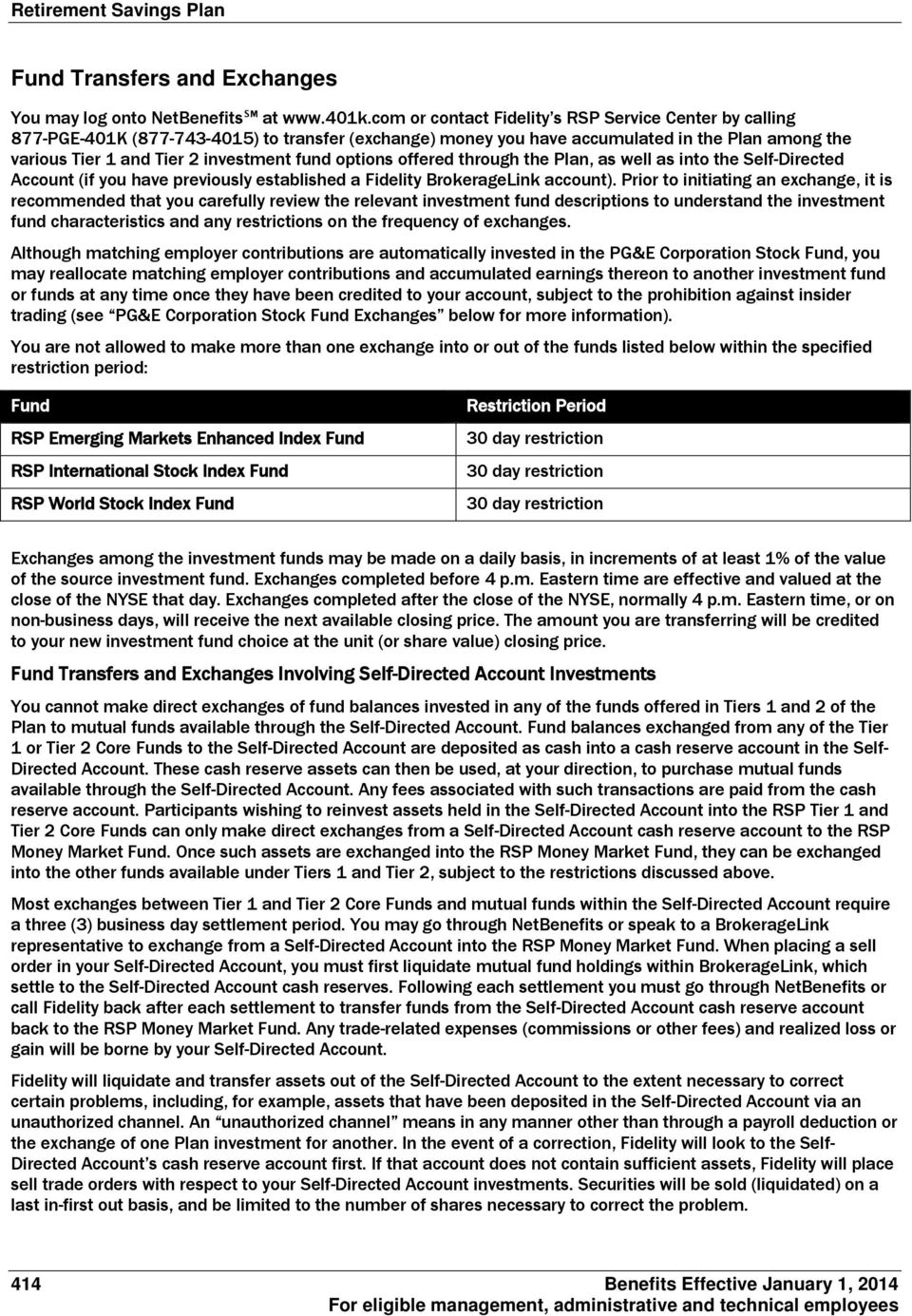
17 Fund Transfers and Exchanges You may log onto NetBenefits at or contact Fidelity s RSP Service Center by calling 877-PGE-401K ( ) to transfer (exchange) money you have accumulated in the Plan among the various Tier 1 and Tier 2 investment fund options offered through the Plan, as well as into the Self-Directed Account (if you have previously established a Fidelity BrokerageLink account). Prior to initiating an exchange, it is recommended that you carefully review the relevant investment fund descriptions to understand the investment fund characteristics and any restrictions on the frequency of exchanges. Although matching employer contributions are automatically invested in the PG&E Corporation Stock Fund, you may reallocate matching employer contributions and accumulated earnings thereon to another investment fund or funds at any time once they have been credited to your account, subject to the prohibition against insider trading (see PG&E Corporation Stock Fund Exchanges below for more information). You are not allowed to make more than one exchange into or out of the funds listed below within the specified restriction period: Fund RSP Emerging Markets Enhanced Index Fund RSP International Stock Index Fund RSP World Stock Index Fund Restriction Period 30 day restriction 30 day restriction 30 day restriction Exchanges among the investment funds may be made on a daily basis, in increments of at least 1% of the value of the source investment fund. Exchanges completed before 4 p.m. Eastern time are effective and valued at the close of the NYSE that day. Exchanges completed after the close of the NYSE, normally 4 p.m. Eastern time, or on non-business days, will receive the next available closing price. The amount you are transferring will be credited to your new investment fund choice at the unit (or share value) closing price. Fund Transfers and Exchanges Involving Self-Directed Account Investments You cannot make direct exchanges of fund balances invested in any of the funds offered in Tiers 1 and 2 of the Plan to mutual funds available through the Self-Directed Account. Fund balances exchanged from any of the Tier 1 or Tier 2 Core Funds to the Self-Directed Account are deposited as cash into a cash reserve account in the Self- Directed Account. These cash reserve assets can then be used, at your direction, to purchase mutual funds available through the Self-Directed Account. Any fees associated with such transactions are paid from the cash reserve account. Participants wishing to reinvest assets held in the Self-Directed Account into the RSP Tier 1 and Tier 2 Core Funds can only make direct exchanges from a Self-Directed Account cash reserve account to the RSP Money Market Fund. Once such assets are exchanged into the RSP Money Market Fund, they can be exchanged into the other funds available under Tiers 1 and Tier 2, subject to the restrictions discussed above. Most exchanges between Tier 1 and Tier 2 Core Funds and mutual funds within the Self-Directed Account require a three (3) business day settlement period. You may go through NetBenefits or speak to a BrokerageLink representative to exchange from a Self-Directed Account into the RSP Money Market Fund. When placing a sell order in your Self-Directed Account, you must first liquidate mutual fund holdings within BrokerageLink, which settle to the Self-Directed Account cash reserves. Following each settlement you must go through NetBenefits or call Fidelity back after each settlement to transfer funds from the Self-Directed Account cash reserve account back to the RSP Money Market Fund. Any trade-related expenses (commissions or other fees) and realized loss or gain will be borne by your Self-Directed Account. Fidelity will liquidate and transfer assets out of the Self-Directed Account to the extent necessary to correct certain problems, including, for example, assets that have been deposited in the Self-Directed Account via an unauthorized channel. An unauthorized channel means in any manner other than through a payroll deduction or the exchange of one Plan investment for another. In the event of a correction, Fidelity will look to the Self- Directed Account s cash reserve account first. If that account does not contain sufficient assets, Fidelity will place sell trade orders with respect to your Self-Directed Account investments. Securities will be sold (liquidated) on a last in-first out basis, and be limited to the number of shares necessary to correct the problem. 414 Benefits Effective January 1, 2014
18 Fidelity will transfer assets into the Self-Directed Account to the extent necessary to correct certain problems, including, for example, a negative balance in the Self-Directed Account s cash reserve account due to an unsecured debit or overdraft, or assets that have been withdrawn from the Self-Directed Account via an unauthorized channel. An unauthorized channel means in any manner other than through the Plan s recordkeeping system. In the event of an unauthorized channel withdrawal, Fidelity will contact you and request that the withdrawn assets be returned to Fidelity. Upon return, those assets will be re-deposited into the Self- Directed Account s cash reserve account. In the event of an unsecured debit or overdraft, Fidelity will look first to your investments in Tiers 1 and 2. If Tiers 1 and 2 do not contain sufficient assets, Fidelity will place sell trade orders with respect to your Self-Directed Account investments. Securities will be sold (liquidated) on a last in-first out basis, and be limited to the number of shares necessary to correct the problem. There may be restrictions or trading fees on some funds in the Self-Directed Account. You will need to contact Fidelity s RSP Service Center by calling 877-PGE-401K ( ) for more information on restrictions. With respect to exchanges into the Self-Directed Account, if a request is confirmed before the close of the market (generally 4 p.m. Eastern time on non-holiday weekdays), 100% of the exchanged amount will be available for trading on the next business day. However, if the exchange is initiated through a BrokerageLink representative (i.e., not through NetBenefits ), 90% of the assets will be immediately available to trade through a BrokerageLink representative. PG&E Corporation Stock Fund Exchanges Trades into or out of the PG&E Corporation Stock Fund are permitted. However, if you are aware of inside information (i.e., information that would be important to an investor, but which has not yet been made public), you are prohibited by federal securities laws and PG&E Corporation policy from trading in the PG&E Corporation Stock Fund until the information has been publicly disseminated. Executive officers of PG&E Corporation and members of the Board of Directors of PG&E Corporation are subject to additional restrictions with respect to transactions involving the PG&E Corporation Stock Fund in order to ensure compliance with section 16 of the Securities Exchange Act of Fidelity will process requests to sell PG&E Corporation Stock Fund units for exchanges, withdrawals, distributions, and loans provided that there are enough short-term investments in the Fund for liquidity. In the unusual event that there are not enough short-term investments for liquidity, requests to sell units will be suspended. As long as the PG&E Corporation Stock Fund remains open and participants have not cancelled the transaction, their requests to sell units will be processed, generally on a first-in-first-out basis, as liquidity is restored in the Fund. Loans and withdrawals will be given priority over exchanges. If a transaction involves a suspended sale of PG&E Corporation Stock Fund units, the entire transaction will be suspended, including the corresponding purchase transaction. Participants will receive the net asset value on the processing date. Participants who have requested transactions requiring the sale of PG&E Corporation Stock Fund units will need to check their account the following business day to determine whether their request has been processed. Accessing Your Account This section describes the rules and process of accessing the funds in your account. Specific information for participants about their individual accounts is available online at Fidelity Investments website, NetBenefits, at or by telephone from the Fidelity RSP Service Center at 877-PGE-401K ( ). Loans The Plan has a loan feature that gives you access to your money before retirement by letting you borrow from your account at a reasonable rate of interest. You can borrow your money without incurring any immediate income tax liability or early distribution penalties. Benefits Effective January 1,

19 As long as you are employed by a participating employer within PG&E Corporation, you are eligible to borrow your money in the Plan. Loans are funded by reducing your Plan balance by the amount you borrow and are secured by a promissory note between you and the Plan Administrator. Repayments, plus interest, are credited back to your account; in essence, you are borrowing the money from yourself. Please note that if you have any investments in the Self-Directed Account, those investments must be exchanged into one or more of the Plan s Tier 1 or Tier 2 funds before such amounts are available for a loan or loans. Loan Terms and Borrowing Limits Loans with a term of five years or less can be used for any reason. Longer-term loans with repayment periods extending up to 15 years may be taken to purchase a principal residence. Interest on long-term loans is not deductible for income tax purposes; therefore, a conventional home mortgage loan may be more advantageous for participants seeking financing for a principal residence. There are limits to how much you can borrow and how often. You may have only three loans outstanding at any time, and the maximum amount of principal that can be borrowed or outstanding may not exceed the lesser of $50,000 or 50% of the value of your Plan balance invested in Tier 1 and Tier 2 funds, minus the highest outstanding loan balance in the previous 12 months. * The minimum loan amount is $1,000. A loan may not be refinanced during the loan term. A loan may be funded from several types of contributions (pre-tax, matching employer, after-tax, etc.) depending on your contribution elections. The proceeds to fund a loan from your Plan balance will be deducted from the various types of contributions invested in Tier 1 and Tier 2 funds in the following sequence: 1. Accumulations attributable to any after-tax contributions 2. Accumulations attributable to any rollover contributions 3. Accumulations attributable to matching employer contributions 4. Accumulations attributable to any pre-tax contributions 5. Accumulations attributable to catch-up contributions 6. Accumulations attributable to basic employer contributions** * If you have an outstanding loan under a plan formerly administered by one of the Corporation s subsidiaries, it will continue to be in force under the loan provisions of the former plan. In the case of a default on the loan, however, it will be subject to disposition under the provisions of this Plan. Outstanding loans under a plan formerly administered by the Corporation or one of its subsidiaries are included in the maximum number of loans a participant may have outstanding at one time, and the amount that may be borrowed will be reduced by the amount of the highest outstanding loan principal during the 12 months preceding the date the loan is funded. ** The term basic employer contributions refers to the employer contribution equal to 5% of the employee s covered compensation that was contributed for plan years beginning before April 1, 2007, to eligible employees who were not accruing service under a defined benefit pension plan of a company within PG&E Corporation. Interest Rates Interest rates for all loans equal the prime rate plus 1%, as determined by Reuters or any successor selected by the Plan Administrator for the month in which the loan is requested. The rate is set when you apply for a loan and remains fixed throughout the duration of the loan. Fees There are fees associated with loans. See Fees on page 428 for more information. However, for Participants performing uniformed military service (as defined under federal law), the interest rate will not be higher than 6%, compounded annually to the extent required by federal law. 416 Benefits Effective January 1, 2014

20 Electronic Funds Transfer Service When you request a loan or withdrawal from your account through Fidelity NetBenefits or the RSP Service Center, you can have the proceeds transferred electronically to your bank account instead of waiting for a check. You can also set up or change your bank account information online or through a Participant Services Representative. If you will be requesting a loan or withdrawal in the future and would like to take advantage of Electronic Funds Transfer (EFT), you will need to have the service established in advance. The set-up process, known as pre-note, can be initiated online through NetBenefits online account services ( or by calling 877-PGE-401K ( ) and speaking with a Participant Services Representative, Monday through Friday, 5 a.m. to 9 p.m. Pacific time, and generally requires seven days to complete. To set up EFT, you ll need to have the following information available: Social Security Number Personal Identification Number Name of Bank Name on Bank Account Bank Account Number Bank Routing Number Repayment Generally, you repay a loan through automatic after-tax payroll deductions. If your current payroll contributions are being invested in Tier 1 and/or Tier 2 funds, loan repayments will be credited back to your account according to your current investment election. If all or any part of your current payroll contributions are being invested in the Self-Directed Account, the portion of your loan repayments relating to such contributions will be credited to the Self-Directed Account s cash reserve account. Depending on the type of contributions that were deducted to fund your loan, your loan repayments will be credited in the following sequence: 1. Repayments of accumulations attributable to basic employer contributions 2. Repayments of accumulations attributable to catch-up contributions 3. Repayments of accumulations attributable to pre-tax contributions 4. Repayments of accumulations attributable to matching employer contributions 5. Repayments of accumulations attributable to rollover contributions 6. Repayments of accumulations attributable to after-tax contributions The maximum repayment term is five years or up to 15 years if you are using the loan proceeds to purchase a principal residence. Cash repayments paid in level installments to Fidelity are required if: Your net pay is insufficient to cover a payroll deduction for the full amount from your paycheck; You are granted an unpaid leave of absence; or You terminate employment with PG&E. You may also make partial or full cash repayment before the completion of the loan term without prepayment penalties. Following any partial prepayment, the loan can be re-amortized at your direction to provide for continued level installments for the original loan term. If you terminate employment with Company, you must make direct payments or elect the EFT service to repay any outstanding loan balance to Fidelity Investments. The Plan Administrator reserves the right to call any participant s loan upon a participant s termination of employment with PG&E or upon termination of the Plan. Benefits Effective January 1,

21 Loan Repayment Suspensions For participants on a leave of absence from the Company, loan repayments may be suspended for the lesser of (i) the leave of absence or (ii) 12 months. The participant must notify the Benefits department when a leave of absence is approved. The participant is responsible to begin payments in the 13 th month if the leave extends beyond 12 months. Failure to begin repayments in the 13 th month will result in a default notification. If a loan remains in default for more than 30 days after notification, the unpaid principal will be treated as a taxable distribution subject to federal and state income tax and applicable penalty taxes. If, upon resumption of payments, the suspension period, when added to the original loan repayment period, exceeds the permissible loan repayment limits of five or 15 years, the loan can be re-amortized, at the direction of the participant, to conform to these limits. If the loan is not re-amortized, and would otherwise go beyond the original loan repayment period, the participant will owe the balance in full at the end of the original repayment period. Suspension of repayment is also allowed during a period when you are performing uniformed military service. Contact Fidelity s RSP Service Center by calling 877-PGE-401K ( ) for more information. Loan Defaults and Distributions A loan is treated as a default whenever a loan payment is not made within 60 days of the date it is due. A participant who is late on a loan payment will have 30 days from the date the Plan Administrator provides written notice of the default to cure the default before it becomes final. If the past due amounts are not paid within the 30-day grace period, any outstanding principal will be treated as a taxable distribution from the Plan. It may also be subject to early distribution tax penalties. Deemed Distribution of Plan Loans A loan is considered a deemed distribution when the loan is in default and the participant is not otherwise eligible to receive a distribution of the loan from the Plan. For purposes of a new loan, the loan that was deemed to be distributed will still be treated as outstanding for as long as the participant remains employed by a participating employer within PG&E. This means that both the number of outstanding loans allowed and the allowable total outstanding balance for all loans will be reduced by the number and value of any loan(s) that have been deemed to be distributed. When a participant has a deemed distribution of a loan, the outstanding principal and accrued interest is reported to the participant and the IRS on a Form 1099-R. Plan Loans When Your Plan Balance is Distributed If you terminate employment and request a distribution of your Plan balance, your outstanding loan balance will be considered a part of this distribution. In other words, the value of your outstanding loan will be reported as a taxable distribution from the Plan. Funding Process and Recordkeeping You may apply for a loan by logging on to Fidelity NetBenefits online account services at or by calling Fidelity s RSP Service Center at 877-PGE-401K ( ). Fidelity will send you the loan application paperwork and process the loan upon receipt of your properly completed application form. Spousal consent is required on the loan application if you are married. The check for the loan proceeds and a Truth-In-Lending Agreement will be issued within three to five business days. Your signature endorsement on the check constitutes your agreement to the terms of the loan. A separate loan account will be established and maintained for each loan, and unpaid loan principal and accrued but unpaid interest on the loan will be reflected for accounting purposes in your loan account. In-Service Withdrawals In accordance with Internal Revenue Code (IRC) provisions that govern qualified retirement plans, withdrawals and distributions from the Plan are permitted only as provided below. If you are married, spousal consent is required for any withdrawals, including hardship withdrawals from contribution sources that are subject to special 418 Benefits Effective January 1, 2014
22 restrictions (see the Hardship Withdrawals subsection under this In-Service Withdrawals section for more information). All withdrawals are subject to federal and state income tax and possibly tax penalties for early distribution (see Taxes and Penalties on page 424). Additionally, there are fees associated with in-service withdrawals (see Fees and Expenses on page 428for more information). Withdrawals from the investment funds, except PG&E Corporation Stock Fund, must be taken in cash unless you elect a direct rollover. A direct rollover is not allowed for hardship withdrawals. Please note that if you have any investments in the Self-Directed Account, those investments must be exchanged into one or more of the Plan s Tier 1 or Tier 2 funds before such amounts are available for a withdrawal or distribution. However, if there are insufficient assets in Tiers 1 and 2 to make any legally required or other necessary distributions (for example, Minimum Required Distributions discussed below), Fidelity will liquidate investments in your Self-Directed Account and use the assets to make the required distribution. Source and Sequence of Withdrawals It is important to realize that when you request a withdrawal, you are requesting that investment units (which are the measure of your interest in the investment funds) be withdrawn and converted to cash to pay for the withdrawal. The source of your withdrawal and the sequence in which it is paid determines the extent to which it is taxable. The Plan Administrator will use the following sequence when making distributions from your account: 1. after-tax contributions made before 1987, plus earnings 2. after-tax contributions made after 1986, plus earnings 3. rollover contributions and earnings 4. matching employer contributions and earnings that have held in the Plan for at least two years, subject to certain exceptions as discussed below 5. eligible pre-tax contributions and earnings 6. eligible catch-up contributions and earnings After-tax Contributions There are no restrictions on withdrawals of after-tax contributions and earnings. You may withdraw your after-tax contributions to the Plan and any earnings thereon at any time. Note that earnings withdrawn are taxable, and also may be subject to early distribution penalty taxes. Rollover Contributions You may withdraw money you rolled over to the Plan from another qualified retirement plan from a previous employer, plus earnings, at any time. Any taxable amount of your withdrawal is subject to ordinary income tax and may be subject to early distribution penalty taxes. Matching Employer Contributions You may withdraw matching employer contributions (plus earnings) that have been in this Plan for at least two full years. For example, if you want to withdraw income attributable to matching employer contributions made at any time in 2013, you must wait until 2016 or anytime thereafter. Exceptions to the two-year waiting period are granted if you: become permanently disabled; have attained age ; are a military reservist ordered or called to active duty for a period in excess of 179 days (or for an indefinite period) after September 11, 2001 and before December 31, 2007; or have requested and are entitled to receive a hardship withdrawal (see the Hardship Withdrawals subsection under In-Service Withdrawals on page 418 for more information). Benefits Effective January 1,
23 Basic Employer Contributions Withdrawals of basic employer contributions are not available before termination of employment with all participating employers within PG&E Corporation. The term basic employer contributions refers to the employer contribution equal to 5% of the employee s covered compensation that was paid, in plan years beginning before April 1, 2007, to eligible employees who were not accruing service under a defined benefit pension plan of a company within PG&E Corporation. Pre-tax Contributions (Including Catch-Up Contributions) Withdrawals of your pre-tax contributions to the Plan and any associated earnings are generally restricted while you are employed within PG&E Corporation. If you are currently employed within PG&E Corporation, you may only withdraw pre-tax contributions and earnings if you: become permanently disabled; have attained age ; or are a military reservist ordered or called to active duty for a period in excess of 179 days (or for an indefinite period) after September 11, 2001 and before December 31, 2007; or if you are on active military duty for more than 30 days. If you take a withdrawal of pre-tax contributions and/or earnings, you are automatically suspended from Plan participation and may not resume making contributions to the Plan for six months following the date the distribution was made (see Suspensions below for more information). Hardship Withdrawals You may take a hardship withdrawal while you are employed within PG&E Corporation only on account of an immediate and heavy financial need. To be eligible for a hardship withdrawal, you must have exhausted all other financial resources insurance proceeds, liquidation of your other financial assets, cessation of your contributions to the Plan, distribution of dividends from shares hold in the PG&E Corporation Stock Fund, other Plan withdrawals and/or loans, and loans from commercial financial intermediaries. You will also have to provide satisfactory proof of valid hardship to the Plan Administrator. The following reasons will be considered to be valid hardships: to cover unreimbursed medical expenses for the participant, spouse, or dependents (as defined in IRC section 152, without regard to section 152(b)(1), (b)(2) and (d)(1)(b)) or primary beneficiary determined without regard to whether the expenses exceed 7.5% of adjusted gross income; the purchase of the participant s principal residence (excluding mortgage payments); tuition payments and/or room and board for the next twelve months of post-secondary education for the participant, spouse, dependents, (as defined in IRC section 152) or primary beneficiary; payments necessary to prevent foreclosure on the mortgage of, or eviction from, the participant s principal residence; to pay expenses for the repair or damage to the participant s or beneficiary s principal residence that would qualify for the casualty deduction under IRC section 165 (determined without regard to whether the loss exceeds 10% of adjusted gross income); unreimbursed expenses for the funeral of a participant s parent, spouse, dependent (as defined in IRC section 152) or primary beneficiary; or taxes or unreimbursed expenses directly related to the participant s bankruptcy. Amounts available for hardship withdrawals will follow the withdrawal order described under the Source and Sequence of Withdrawals heading, above, including your employer contributions and earnings not otherwise available to be distributed, and your pre-tax contributions, including any catch-up contributions plus earnings 420 Benefits Effective January 1, 2014
24 accrued on your pre-tax contributions before January 1, Participants requesting a hardship withdrawal may not request an amount that exceeds the amount actually required to satisfy the immediate financial need. The Plan Administrator will automatically withhold 10% for federal taxes from a hardship withdrawal, unless the participant specifies different withholding. Hardship withdrawals may also be subject to early distribution tax penalties. Suspensions If you withdraw your pre-tax contributions while still employed by PG&E or any company within PG&E Corporation or take a hardship withdrawal, you are automatically suspended from Plan participation and may not resume making contributions to the Plan for six months following the date the distribution was made. After the six-month period has expired, you must elect to resume contributions; contributions do not resume automatically unless you are subject to automatic enrollment. If you are subject to automatic enrollment, you will be automatically enrolled as described in Automatic Enrollment in the Plan as of the next plan year following the end of your suspension. Withdrawals from Merged Plans If you had an account balance under another employer plan within PG&E Corporation that was merged into this Plan, special distribution options may apply to the part of your account that was transferred to this Plan. The plans merged into this Plan completely or partially include: The Pacific Gas Transmission Company Savings Fund Plan for Management Employees; The PG&E Gas Transmission, Texas Corporation Savings Fund Plan; The U.S. Generating Company 401(k) Profit-Sharing Plan for Union-Represented Employees; The U.S. Generating Company 401(k) Profit-Sharing Plan; The U.S. Generating Company Retirement Plan; The PG&E Energy Trading Profit-Sharing Plan; and The PG&E Energy Services Retirement Plan. You will be notified at the time you elect any distribution under this Plan of any such special distribution options. Withdrawal Options When You Leave PG&E When your employment with all employers within PG&E ends, the full value of your account is payable to you. Depending on your account balance, you may elect to leave your money in your account until a later date, or to take a full or partial distribution of your account balance. A distribution package will be mailed to your home after a 30-day waiting period. The package contains information should you want to withdraw all or a part of your account balance. You may elect to have your distribution transferred to an IRA or other tax-qualified plan, or you may elect to have it paid to you. If your account balance is $1,000 or less when you retire or leave the employment of the Company, you will receive a letter and a distribution form. You must take a lump-sum distribution of your account balance. If the Plan Administrator does not receive your election form within 60 days from the date on which the materials are mailed to you, your distribution will be sent to you in cash subject to mandatory 20% federal income tax withholding (see Taxes and Penalties on page 424). If your account balance is greater than $1,000 but not greater than $5,000 when you retire or leave the employment of the Company, you will receive a letter and a distribution form. You must take a lump-sum distribution of your account balance. If the Plan Administrator does not receive your election form within 60 days from the date on which the materials are mailed to you, your distribution will be automatically rolled over to a Fidelity IRA in your name and invested in the Fidelity Cash Reserve Fund, which is an investment designed to preserve capital and provide a reasonable rate of return and liquidity. Benefits Effective January 1,
25 If your account balance is greater than $5,000 when you retire or leave the employment of the Company, your account may remain in the Plan until you request a lump-sum or partial distribution of your account balance. Although your money can remain in the Plan, you may not make additional contributions or borrow money from your account. However, as long as you maintain a balance greater than $5,000, you may still make transfers among the investment funds or request partial withdrawals or a distribution from your account. Your account will continue to share in any investment gains or losses for the funds in which you are invested (see Monitoring and Making Changes to Your Investments on page 413). If you leave employment before retirement age (age 55) and you keep your account in the Plan, you will be charged a recordkeeping fee (see Fees and Expenses on page 428 for more information). The fee for 2014 is $53 per year, and is charged to your account quarterly. If you retire and keep your account in the Plan, PG&E will continue to pay the recordkeeping fee on your behalf. If your account balance is greater than $5,000 when you retire or your employment ends, you may also choose to have distributions paid in equal monthly, quarterly, or annual installments. Payments can begin immediately or at a later date that is specified by you. Payments can be deposited directly into your bank account. Distributions After Your Employment Has Ended If you are retired or have terminated your employment with PG&E and have left your account balance in the Plan, you must take a minimum distribution from the Plan by April 1 of the calendar year following the year in which you reach age , or, if later, the year you retire after reaching age Once minimum distributions have started, you must receive a minimum distribution annually. There is a fee imposed each year that a participant receives a minimum required distribution (see Fees and Expenses on page 428 or more information). Minimum required distributions will be made from your investments in Tiers 1 and 2 of the Plan. However, if there are insufficient assets in Tiers 1 and 2 to make any required distributions and you do not liquidate sufficient funds upon notification of the requirement to do so, Fidelity will liquidate investments in your Self-Directed Account and use the assets to make the required distribution. In such a case, Fidelity will look to the Self-Directed Account s cash reserve account first. If that account does not contain sufficient assets, Fidelity will place sell trade orders with respect to your Self-Directed Account investments. Securities will be sold (liquidated) on a last in-first out basis, and be limited to the number of shares necessary to make the required distribution. The Plan Administrator will notify you if you are subject to required minimum distributions. The Plan Administrator can perform a default calculation (based on Single Life Expectancy) to determine the amount that will satisfy your minimum required distribution. Alternatively, you may make a one-time election to direct the Plan Administrator to use other assumptions (such as Joint Life Expectancy) in the calculation of your required distribution. Note that minimum required distributions paid from the Plan satisfy the requirements for this Plan only. If you have money invested in other employer-sponsored pension plans or IRAs, minimum required distribution for those plans or retirement accounts must be satisfied independently of the requirements for this Plan. Investment and Advisory Services The Plan offers a range of investment and advisory services to help you become a more informed investor and provide access to expert financial guidance. These services are provided for informational and educational purposes only. Keep in mind that investing involves risk. The value of your investment will fluctuate over time and you may gain or lose money. Always consider carefully the investment objectives, risk, charges, and expenses of any investment option before investing. Financial Engines Financial Engines is an unbiased, independent advisory firm which the Plan Administrator has selected to provide Plan participants with support and assistance in making investment decisions. Financial Engines provides two basic types of assistance. 422 Benefits Effective January 1, 2014
26 On-Line Advice Financial Engines On-Line Advice service is an internet-based interactive service that can help you: Build an investment strategy; Get advice on which investments to select in Tiers 1 and 2 of the Plan; and Monitor your account over time. You can access On-Line Advice through Fidelity NetBenefits at by selecting the Financial Engines link. There is no cost to you for using On-Line Advice since PG&E pays the full cost of this service. Professional Management You have the option to enroll in Financial Engines Professional Management. If you enroll in Professional Management, you are retaining Financial Engines as your own investment advisor. There are fees associated with this service (see Fees and Expenses on page 428 for more information). As your investment advisor, Financial Engines will: Create a retirement savings strategy for your Plan investments; Professionally manage your account for you, including directing Fidelity to carry out investment transactions on your behalf; and Provide you with quarterly progress reports. Fees for Professional Management will be deducted quarterly from your Plan account based on the assets in your account that are under professional management. Please read about applicable fees at The specific terms of your relationship with Financial Engines are set forth in the customer agreement that you enter into directly with Financial Engines. If you enroll in Professional Management, you may terminate at any time by contacting Financial Engines. Professional Management Income+ If you re enrolled in Professional Management, you can take advantage of Fidelity s Income+ service if you re age 60 or within five years from retirement. Help with preservation. Get help with managing your account with a goal of balancing growth with safety. Fidelity will provide you with an updated Retirement Plan that shows the adjusted investment strategy for your PG&E account. Help with planning. Speak to a Professional Management Income+ Investment Advisor Representative for a Retirement Checkup. Review when you might be able to retire, what sources of income you ll have in retirement, and how much you may be able to spend. Help with payouts. At your request, the service can also provide monthly payouts from your PG&E Corporation Retirement Savings Plan account that can last throughout your retirement. If you enroll in Professional Management, Financial Engines has responsibility as a fiduciary to you for the advice and management it provides. Neither the Plan Administrator nor the Corporation is responsible for the results or advice provided by Financial Engines. During the time that you are enrolled in Professional Management, Financial Engines will make all investment decisions with respect to your account. You will not have the ability to make or implement investment decisions directly until you terminate your relationship with Financial Engines. Financial Engines will only manage investments in Tiers 1 and 2 of the Plan. If you have investments in the Self- Directed Account (Tier 3) at the time you enroll in Professional Management, you may maintain your balance in the Self-Directed Account, but you will be responsible for the investment of these assets. During the time you are enrolled in Professional Management, you will not be permitted to make additional payroll contributions into any mutual funds available through the Self-Directed Account. Benefits Effective January 1,
27 For more information about retaining Financial Engines as your investment advisor, including fees for the Professional Management service, please contact Fidelity s RSP Service Center by calling 877-PGE-401K ( ), or visit Fidelity Education and Modeling Tools Fidelity offers a number of education and modeling tools to help you manage your account. You can access: Planning tools to help determine if you are on track to meet your retirement and savings goals; Articles on timely savings and retirement topics; Calculators to help with financial questions, such as the impact of transactions, such as loans and withdrawals. Learn more about these resources by logging on to Fidelity NetBenefits online account services at or by calling Fidelity s RSP Service Center at 877-PGE-401K ( ). Taxes and Penalties The taxable portion of Plan withdrawals and distributions is generally taxed as ordinary income in the year it is received. Further, withdrawals taken before age may be subject to nondeductible penalty taxes, unless you qualify for an exemption. The taxable portion of virtually all non-periodic Plan withdrawals (other than hardship withdrawals) is also subject to mandatory 20% federal withholding tax, unless you arrange to directly roll over the money into an IRA or to another qualified retirement plan. Certain lump-sum distributions from the Plan may be eligible for special tax treatment if you meet age and participation requirements. If you were born before 1936, you may be eligible for ten-year forward income averaging when you retire if you take a total withdrawal of your account balance. If you think you may be eligible for forward income averaging, you should consult a tax advisor prior to retirement. Your Plan withdrawals and distributions will be reported annually on Forms 1099-R, which are mailed in January following the year in which the distribution was paid. You are responsible for reporting the taxable amount as income when you file your income tax returns. When you request a withdrawal or distribution from the Plan, you will receive tax information regarding your income tax liability. You should read this information carefully to understand your payment options and how the manner in which you elect to receive your distribution affects your taxes and tax withholding. If you choose to take a withdrawal or distribution, you are responsible for complying with Internal Revenue Code rules governing distributions from retirement plans and for any tax consequences, and are strongly encouraged to consult a tax advisor. The Plan Administrator is not responsible for advising participants as to the tax consequences of withdrawals or distributions. Withdrawals of PG&E Corporation Stock For any withdrawal of contributions and earnings you have invested in the PG&E Corporation Stock Fund, you may have the total amount converted to PG&E Corporation common stock or paid to you in cash. Withdrawals from all of the other investment funds must be taken in cash, unless you elect a direct rollover. If you want to receive PG&E Corporation stock instead of cash from such other funds, you may exchange all or a portion of your money in the other investment funds for units in the PG&E Corporation Stock Fund before taking the withdrawal. If you withdraw PG&E Corporation stock, you will only be liable for income taxes on the cost basis of each unit. The cost basis is the average purchase price for all the units you own in the Fund. If you sell the withdrawn shares, you will be liable for income taxes on the difference between the cost basis of your units and the sale price. The income will be subject to the capital gains tax rate if you held the shares for at least one year before the sale. Participants who are considered affiliates of PG&E Corporation may generally resell their shares of PG&E Corporation common stock in compliance with the Securities and Exchange Commission Rule Benefits Effective January 1, 2014
28 Rollovers Most taxable and non-taxable withdrawals and distributions from the Plan are eligible for direct rollover to an IRA or other qualified employer retirement plan that accepts rollovers. There are two types of rollovers direct rollovers and indirect rollovers. A direct rollover is when the check for your Plan balance is payable directly to the receiving IRA or tax-qualified plan. If you choose a direct rollover of the taxable or non-taxable portion of a Plan distribution: no taxes will be withheld when the distribution is paid; the distribution will not be reported as taxable income; and taxes will be deferred until you later withdraw the money from the IRA or recipient qualified employer plan. An indirect rollover is when the check for your Plan balance is made payable to you, and you then deposit all or a portion of that amount in an IRA or qualified plan. If you request an indirect rollover, the Plan is required by law to withhold 20% of the taxable amount. When you file your income tax return for that year, you must report the total amount of the distribution, including the withheld tax. You will receive a credit for the tax withheld to help offset the income tax you owe for that year. If you take an indirect rollover, you have 60 days from the date that you receive the distribution to roll it over to an IRA, Roth IRA or other qualified plan. Also, if you roll over taxable amounts to a Roth IRA, you will be subject to income tax on those conversions. Plan distributions that are not eligible for rollover include: refunds of automatic enrollment contributions within 90 days of enrollment; ESOP dividends; loans treated as deemed distributions; distributions that are part of a series of substantially equal payments made at least once a year over a period of your lifetime/life expectancy, your and your beneficiary s lifetimes/life expectancies, or 10 years or more; minimum required distributions from the Plan; hardship withdrawals; and refunds of excess contributions. Although PG&E Corporation stock may be an eligible rollover distribution from the Plan, some IRAs and qualified retirement plans may not accept rollovers of stock certificates. Before requesting a direct rollover of stock certificates, you must verify with the recipient IRA trustee or plan administrator that the IRA or plan will accept a direct rollover of stock certificates. Early Distribution Penalties In addition to being taxed as ordinary income, distributions taken before age (early distributions) may be subject to nondeductible federal and state penalty taxes (currently a 10% federal and 2 1 2% California state tax; penalty taxes in other states may differ). Early distributions are exempt from the penalty taxes if made for one of the following reasons: refunds of automatic enrollment contributions within 90 days of enrollment; ESOP dividends; loans treated as deemed distributions; after termination of employment during or after the year in which you reach age 55; on account of your permanent disability; after termination of employment in a series of substantially equal periodic payments, based on your life expectancy, and continuing for at least five years or until age , whichever is later; after qualified service as a reservist (those called to active duty for 180 or more days); Benefits Effective January 1,
29 to cover unreimbursed medical expenses for you, your spouse, or dependents in excess of 7.5% of your adjusted gross income; to an alternate payee under a Qualified Domestic Relations Order (QDRO) upon dissolution of marriage; to roll over to an IRA or other qualified retirement plan either directly or within 60 days of receipt of the distribution; or on account of your death. The early withdrawal penalties also apply to all hardship distributions except for those taken for unreimbursed medical expenses to the extent that they exceed 7.5% of your adjusted gross income. The Plan Administrator does not withhold or assess any early distribution penalties when a distribution is paid. If you are subject to the early distribution penalties, you are responsible for including the penalties when you file your income tax return. What Happens This section provides general information about how your benefits may be affected by certain life events. Where appropriate, it offers tips about things you may want to consider, actions you may want to take and sources where you can find more information. In this section you can find information about actions you may take: If You Are on an Authorized Leave of Absence on page 426 If You Leave PG&E or Retire on page 427 If You Die on page 427 If You Transfer to or from a Union Classification on page 427 If You Get Divorced on page 428 If You Get Rehired on page 428 If You Are on an Authorized Leave of Absence Authorized leaves of absence include, but are not limited to, absences due to: illness or injury; qualified military service; or short-or long-term disability. Your participation in the Plan continues as long as your authorized leave of absence does not constitute a break in service. You may continue making employee contributions and receiving employer matching contributions on any covered compensation you receive while on authorized leave of absence. You may apply for an in-service or hardship withdrawal depending on your account assets, and the type of withdrawal (see the Hardship Withdrawals subhead under In-Service Withdrawals on page 418 for more information. You must meet all Plan and Internal Revenue Code requirements for the requested withdrawal. You may not take a distribution from the Plan while on an authorized leave of absence (see Distributions After Your Employment Has Ended on page 422). If you have an outstanding loan, you may need to arrange for a loan repayment suspension, or arrange to make direct payments to Fidelity to repay the loan while you are on leave (see the Repayment, Loan Repayment Suspensions and Loan Defaults and Distributions subheads under Loans on page 415 for more information). You may not initiate a new loan while on an unpaid leave of absence. 426 Benefits Effective January 1, 2014
30 If You Leave PG&E or Retire If you terminate your employment with PG&E, you may no longer contribute to the Plan, except for contributions made with respect to retroactive wage payments. You may elect full distribution of your account after your employment ends. You may elect to: leave assets in the Plan (subject to minimum account distributions and potential ongoing administrative fees); rollover your account balance to an IRA or another employer s plan; or take a distribution (subject to taxes and penalties). See the Withdrawal Options If You Leave PG&E subhead under In-Service Withdrawals on page 418, Distributions After Your Employment Has Ended on page 422, and Taxes and Penalties on page 424 for additional information. Administrative Fees If your employment ends before reaching retirement age (age 55), and you elect to maintain your balance in the Plan, your Plan account will be assessed an administrative fee for the maintenance of your account. This administrative fee does not apply to employees or retirees (employees who are age 55 or older when employment ends). See Fees and Expenses on page 428 for more information. Loans You may make direct payments or elect EFT service to repay any outstanding loan balance to Fidelity. The loan will default if a loan payment is not made within 60 days of the date it is due. Defaulted loans are treated as plan distributions and are subject to ordinary income taxes. Early distribution penalty taxes may also apply. You cannot take out a new loan once your employment with PG&E ends. If You Die If you die, your Plan balance is payable to your beneficiary. If you are married at the time of death and did not designate a different beneficiary with the notarized consent of your spouse, your spouse is automatically your beneficiary. If you are single and did not designate a beneficiary, your estate is your beneficiary. Once the Plan is notified, your spouse or beneficiary will receive his or her options for disposition of the account. Your spouse or beneficiary may elect either to take a lump-sum distribution or to roll the Plan balance over directly into an inherited IRA. For the purposes of the Plan, you have a spouse if you are legally married under applicable law of a state or foreign jurisdiction, including a same-sex couple. However, in accordance with IRS guidance, a registered domestic partnership, civil union, or other similar formal relationship that is not denominated as a marriage under the law is not treated as legally married for purposes of the Plan. Payment to your beneficiary will occur within 60 days of the Plan Administrator s receipt of your beneficiary s payment instructions. If your beneficiary does not provide payment instructions for disposition of the account within 180 days following the Plan Administrator s receipt of notification of your death, the Plan Administrator will automatically withhold 20% from the taxable portion of the distribution for federal taxes and distribute the remainder to your beneficiary in a lump sum (see Taxes and Penalties on page 424). You may change your beneficiary designation at any time by logging onto NetBenefits at or by calling Fidelity s RSP Service Center at 877-PGE-401K ( ). If You Transfer to or from a Union Classification If you transfer to or from a union classification and participate in the Final Average Pay Pension, be aware that your eligible company matching contributions may change. Also, loan repayments may be re-amortized and may change the frequency of your payments. Benefits Effective January 1,
31 If You Get Divorced Once the divorce is finalized, you may want to change your beneficiary designation. If your former spouse was previously listed as your beneficiary (and you have not designated a different beneficiary), your Plan balance will remain payable to your former spouse on your death. You can change your beneficiary designation at any time by logging onto NetBenefits at or by calling Fidelity s RSP Service Center at 877-PGE-401K ( ). If your former spouse has a community property interest in your Retirement Savings Plan account, you should submit your endorsed-filed Qualified Domestic Relations Order (QDRO), to the PG&E Law Department for review and implementation. If you have a pending divorce order referred to as a Domestic Relations Order or DRO you may be restricted from taking withdrawals and distributions from your account until the QDRO is finalized. See additional information regarding QDROs under Qualified Domestic Relations Orders (QDROs) on page 431. If You Get Rehired If you leave the employment of PG&E and are subsequently rehired, you may resume participation in the Plan and will be immediately eligible for matching employer contributions. If you are rehired on or after January 1, 2013, you will be automatically enrolled in the Plan and will receive matching employer contributions of $0.75 per dollar on up to 8% of pay. See Matching Employer Contribution on page 405 and Automatic Enrollment in the Plan for more information. Additional Plan Information This section describes a number of regulations that apply to the benefits described in this Handbook, and provides some administrative details about the plans. For further information on these and other rules, see the Rules, Regulations and Administrative Information section. Significant Accounting Policies and Investment Disclosure Participants contributions to the investment funds offered under the Plan are credited to participants accounts as units, rather than individual purchases of stocks, bonds, or other securities. The gains or losses in investment fund values are accounted for through increases or decreases in the value of the units. Similar to mutual fund share prices, unit values change daily, taking into account the current fair market value of the investment portfolio, including any earned interest or dividend income, and are determined by dividing the net assets of the fund by the number of units outstanding. Fees and Expenses Beginning January 1, 2012, participants who are no longer employed at PG&E but continue to have a balance in the Plan are assessed an administrative fee for as long as they keep an account in the Plan. This fee, which may increase in the future, currently is $53 per year ($13.25 per quarter). The fee will be deducted from your account at the beginning of each quarter and will be reflected on your quarterly statement. This fee applies only to employees who terminate their employment at PG&E but decide to maintain their RSP account. It will not apply to PG&E employees or retirees (employees who were age 55 or older at employment termination). If you have an account in the Plan, and you select or execute the following service(s) or transaction(s), the fee(s) outlined below are deducted from your account. As you review this information, please keep in mind that fees are subject to change and that certain individual fees may not be deducted in some circumstances. Type of Fee Prior Loan Maintenance Fee Loan Setup Fee Amount $15.00 per year per loan initiated prior to 11/01/2009, deducted quarterly. $50.00 per loan 428 Benefits Effective January 1, 2014
32 Type of Fee In-Service Withdrawal Fee Minimum Required Distribution Fee Loan Maintenance Fee Overnight Mailing Fee Financial Engines Professional Management Fee Amount $25.00 per transaction $25.00 per distribution year $25.00 per year per loan initiated on or after 11/09/2009, deducted quarterly $25.00 per transaction If you utilize this service, the Financial Engines fee is as follows: 0.50% per year for the first $100, in your account; 0.45% per year on the next $100, to $250,000.00; 0.30% per year for any amount over $250, and is deducted quarterly. Investment management and trust expenses are netted against investment returns of Tier 1 and Tier 2 funds. Mutual fund fees and expenses are netted against investment returns for mutual funds in Tier 3. Administrative costs (with the exception of loan fees and Financial Engines Professional Management fees) are generally paid by PG&E Corporation or participating employers, however, the Plan Administrator may use Plan assets that have been forfeited and are not allocable to individual accounts to pay the reasonable, administrative expenses of the Plan. Additional fee and expense information is provided in the Participant Disclosure Notice that is provided to you each year. The fund descriptions and more information on fees and expenses can be found on Fidelity NetBenefits at or by calling Fidelity s RSP Service Center at 877-PGE-401K ( ). The automated voice response system is available 24 hours a day. You can speak with a Participant Services Representative Monday through Friday from 5 a.m. to 9 p.m. Pacific time. Plan Administration and the Corporation s Power and Duties The PG&E Corporation Employee Benefit Committee is the Plan Administrator and is responsible for the overall administration of the Plan. This committee has the sole power and discretionary authority to establish, and from time to time revise, such rules and regulations as may be necessary to administer the Plan in a nondiscriminatory manner for the exclusive benefit of participants and all other persons entitled to benefits under the Plan. This committee delegates to the Senior Vice President Human Resources of PG&E Corporation and assigned staff the authority to interpret, implement, and revise rules and regulations as necessary to administer the Plan in a proper and nondiscriminatory manner. Staff is also responsible for overseeing participant recordkeeping, accounting, reporting, and receipt and disbursement of Plan assets. The Plan Administrator has the discretionary authority to interpret and construe the terms of the Plan, to resolve any conflicts or discrepancies between documents and to establish rules which are necessary or desirable for the administration of the Plan. Participant Account Activity and Plan Service Provider Individual accounts are maintained for each participant s interest in the Plan and all contributions are accounted for separately with respect to units attributable to pre-tax contributions, after-tax contributions, basic employer contributions, matching employer contributions, catch-up contributions, and any rollover contributions. As previously stated, separate accounts are also maintained for participants with an outstanding Plan loan balance. Quarterly statements of account activity, reflecting contributions and earnings/losses in each investment fund and summarizing transactions during the period, are mailed to each participant as soon as practicable after the end of each quarter. You may also request to receive quarterly statements online. Fidelity is the administrative service provider for the Plan, and is charged with day-to-day recordkeeping and participant account maintenance. Participant accounts are valued daily with up-to-date account values and share prices, and transactions may be initiated on a daily basis. Benefits Effective January 1,
33 Participant services include: 24-hour Internet access through Fidelity NetBenefits online account services ( 24-hour toll-free telephone automated voice response system; and Participant Services Representatives who are available from 5 a.m. to 9 p.m. Pacific time, 6 a.m. to 10 p.m. Mountain time, 7 a.m. to 11 p.m. Central time, and 8 a.m. to midnight Eastern time at Fidelity s RSP Service Center (877-PGE-401K or ). Claims and Appeals Procedures If you have a claim for benefits that cannot be resolved through Fidelity s RSP Service Center, you may file a claim for benefits in writing with the Plan Administrator. Claims should be submitted to: The Retirement Savings Plan Administrator PG&E Corporation 1850 Gateway Boulevard, 7025C Concord, CA If a claim by a participant or beneficiary is denied in whole or in part, the Plan Administrator will notify the claimant in writing, explaining the reason for denial within 90 days of receipt of the initial claim unless due to special circumstances an additional 90 days is required. Such notification will set forth: the specific reason for the denial; the Plan provision on which the denial is based; and, if necessary, any explanation or information that may be beneficial to the claimant in order to perfect the claim. The notice will also include instructions about how to appeal the Plan Administrator s denial and request that the claim be reviewed, including a statement of your right to bring a civil action under ERISA section 502(c) following an adverse benefit determination on appeal. If you do not receive a notice of denial of your initial claim, you may submit a written request for review to the Plan Administrator within these time periods. A claimant s appeal for review must be made in writing within 90 days of receiving the Plan Administrator s notice of denial. As part of your appeal, you will (1) have the opportunity to submit written comments, documents, records, and other information relating to your claim for benefits; and (2) be provided, upon request and free of charge, reasonable access to, and copies of, all documents, records, and other information relating to your claim for benefits. The review of your claim will take into account all comments, documents, records, and other information you submit relating to your claim, without regard to whether it was submitted or considered in the initial benefit determination. Failure to raise issues or present evidence on review will preclude those issues or evidence from being presented in any subsequent proceeding or judicial review of the claim. A final written decision will be rendered within 60 days of receipt of the appeal for review unless due to special circumstances an additional 60 days is required. Your claim is considered approved only if the Plan Administrator s approval is communicated to you in writing. The administrative remedies described in this section must be exhausted before any legal action can be taken by a claimant. If a claimant timely exhausts all levels of appeal available to the claimant under the Plan s claims procedures (including appeals to both the Plan Administrator and the EBAC), any permissible legal action under ERISA section 502(a) must be initiated within the applicable statute of limitations. The review procedures described in this section are the exclusive administrative procedures provided under the Plan. Borrowing, Pledging, and Assigning Interests in the Plan No participant or beneficiary may borrow against, pledge, or assign voluntarily or involuntarily, or by operation of law any interest in the Plan or in any distribution to be made under the Plan. However, this does not prevent an employee from obtaining a loan from his or her Plan account in accordance with the Plan s loan procedures. Also, a spouse, former spouse, child, or other dependent of an employee may be able to claim an interest in an employee s Plan benefits under a QDRO issued by a court (see Qualified Domestic Relations Orders below). If a 430 Benefits Effective January 1, 2014
34 participant files for personal bankruptcy, an exclusion and certain exceptions under the bankruptcy law may be applicable to part or all of the participant s Plan account. Except as described above, no party, including creditors of PG&E Corporation, has or may create a lien on any funds, securities, or other assets held under the Plan. Future of the Plan Although the Corporation expects the Plan to continue indefinitely, it has the exclusive right to amend, suspend, or terminate the Plan at any time. No amendment to the Plan may be made, however, that would result in a participant s or beneficiary s loss of rights or accumulated Plan assets. Further, in the event of Plan termination, all contributions to the Plan will stop, but the Plan will continue to operate until all of the assets have been distributed in accordance with Plan provisions in effect on the date of its termination. Qualified Domestic Relations Orders (QDROs) In the event a participant is divorced, ERISA permits the division of the participant s Plan account between the participant and certain other beneficiaries pursuant to a QDRO. The Plan Administrator will determine the qualified status of any domestic relations order for a participant who is divorced or legally separated. The Plan will also oversee the disbursement of Plan assets to the participant and the spouse, former spouse, child, or other dependent named in a QDRO as having a right to receive benefits in the Plan. Domestic relations orders include any judgment, decree, or order (including approval of a property settlement agreement) that relates to child support, alimony payments, or marital property rights and that is made pursuant to state domestic relations laws (including community property law). You can obtain a free copy of the QDRO procedures or a sample QDRO by calling the HR Service Center at Company extension , externally at HELP ( ) or toll-free at You can also send an to the HR Service Center at [email protected]. Once the divorce is finalized, you may want to change your beneficiary designation. You can change your beneficiary designation at any time by logging onto NetBenefits at or by calling Fidelity s RSP Service Center at 877-PGE-401K ( ). Facility of Payment If you are entitled to any payment under the Plan, and the Plan Administrator determines that you are physically or mentally incompetent and no guardian or conservator has been appointed to receive your payment, the Plan Administrator may make payments on your behalf to a third-party to be applied for and on behalf of and for your benefit. Payments made on your behalf will completely discharge the Plan s responsibility for the amount of the payment. No Guarantee of Employment Participation in the Plan does not guarantee your right to employment with PG&E Corporation or any affiliates. Further, nothing set forth in this Summary of Benefits Handbook should be interpreted to give you or your beneficiary any legal or equitable rights against PG&E or its affiliates. Military Service Federal law provides rights to certain reemployed veterans for service credit and makeup contributions for all or a portion of the period of military service. Please contact Fidelity s RSP Service Center at 877-PGE-401K ( ) for more information. Benefits Effective January 1,
35 Missing Participants If the Plan Administrator is unable to locate a Participant after three years and after reasonable efforts have been made to do so, the Participant s benefit under the Plan will forfeited and used to offset future employer contributions. If a proper claim is subsequently presented, the Participant s benefit will be reinstated. Requests for Documents Participants may review the Plan document, the Trust Agreement between the Corporation and Fidelity Management Trust Company, Investment Agreements between the Corporation and the investment managers, and the Summary Plan Description and any amendments or changes to the provisions contained in these documents at the office of the Plan Administrator. Any report regarding the Plan filed with the Department of Labor, the Internal Revenue Service, or any other governmental agency is also available for review. Requests for copies of any of these documents must be made to the Plan Administrator as follows: Employee Benefit Committee of PG&E Corporation 1850 Gateway Boulevard 7025C Concord, CA The Plan Administrator reserves the right to charge for providing such copies up to the amount permitted under ERISA. Copies of PG&E Corporation s latest annual report to shareholders, proxy statement, reports, and other communications sent to shareholders, are available without charge upon oral or written request to the Plan Administrator. Requests may be directed to: PG&E Corporation Corporate Secretary 77 Beale Street, 24 th floor Mail Code B24W San Francisco, CA Benefits Effective January 1, 2014
401(k) Savings Plan. As of the first day of month on or following three full months of Honda employment, unless you elect not to participate
 401(k) Savings Plan The Honda 401(k) Savings Plan (Savings Plan or the Plan) allows you to save and invest for retirement with tax advantages and a savings match and other contributions from Honda. Highlights
U.S. Bank 401(k) Savings Plan Summary Plan Description
 U.S. Bank 401(k) Savings Plan Summary Plan Description January 2012 This document constitutes part of a prospectus covering securities that have been registered under the Securities Act of 1933. HR1201W
How To Understand The Liban 401(K) Retirement Plan
 LANS 401(k) Retirement Plan Summary Plan Description This Summary Plan Description (SPD) is intended to provide a summary of the principal features of the LANS 401(k) Retirement Plan ("Plan") and is not
Salaried Investment and Savings Plan Summary Plan Description (SPD)
 Salaried Investment and Savings Plan Summary Plan Description (SPD) As of January 1, 2012 (Including updates through 7/31/2012) TABLE OF CONTENTS TABLE OF CONTENTS... 1 ABOUT THIS SPD... 3 ISP AT A GLANCE...
Please fax your response to MAS Benefits Compliance at (703) 907-6409 or email to [email protected]
 IMPORTANT: Please fill out the Acknowledgment Form and return as indicated on the form. Thanks. System Name: 401(k) Pension Plan Summary Plan Descriptions (SPD) Distribution Acknowledgement System RUS#:
YOUR GUIDE TO GETTING STARTED
 Navient 401(k) Savings Plan Invest in your retirement and yourself today, with help from Navient 401(k) Savings Plan and Fidelity. YOUR GUIDE TO GETTING STARTED Invest some of what you earn today for what
Wells Fargo & Company 401(k) Plan
 Summary Plan Description Wells Fargo & Company 401(k) Plan October 1, 2013 This Summary Plan Description ( SPD ) summarizes the major features of the Wells Fargo & Company 401(k) Plan ( 401(k) Plan ).
Start investing in yourself today, with help from the University System of Maryland Supplemental 403(b) Plan and Fidelity.
 University System of Maryland Supplemental 403(b) Plan (#65612) Start investing in yourself today, with help from the University System of Maryland Supplemental 403(b) Plan and Fidelity. Invest some of
Employees Profit Sharing and Savings Plan SPD
 Employees Profit Sharing and Savings Plan SPD The part of this Benefits Resource Guide under the caption Employees Profit Sharing and Savings Plan constitutes part of a prospectus covering securities that
The 401(k) Savings Plan
 The 401(k) Savings Plan Your Wealth Accumulation Program JPMorgan Chase offers a number of wealth accumulation plans that help you build income for your future. These plans include: The Retirement Plan
Earning for Today and Saving for Tomorrow. Retirement Savings Plan 401(k) inspiring possibilities
 Earning for Today and Saving for Tomorrow Retirement Savings Plan 401(k) inspiring possibilities Retirement Savings Plan 401(k) Advocate Health Care Network offers the Advocate Health Care Network Retirement
Notice to All Employees Eligible to Participate in the Halliburton Retirement and Savings Plan
 Notice to All Employees Eligible to Participate in the Halliburton Retirement and Savings Plan Halliburton Company (the Company ) has made saving for retirement under the Halliburton Retirement and Savings
AVAYA INC. SAVINGS PLAN SUMMARY PLAN DESCRIPTION
 AVAYA INC. SAVINGS PLAN SUMMARY PLAN DESCRIPTION This document is dated March 31, 2013. Helpful search tools: Table of Contents (TOC): Each item on the TOC is a hyperlink to a corresponding page and section.
Please take some time to review this SPD, since it includes a comprehensive overview of:
 January 2006 Dear US Airways Benefit Plan Participant: We are pleased to present to you this Summary Plan Description ( SPD ) for the US Airways, Inc. Employee Pension Plan and the US Airways, Inc. Employee
WESTON SOLUTIONS, INC. RETIREMENT SAVINGS AND EMPLOYEE STOCK OWNERSHIP PLAN. SUMMARY PLAN DESCRIPTION (January 1, 2014)
 WESTON SOLUTIONS, INC. RETIREMENT SAVINGS AND EMPLOYEE STOCK OWNERSHIP PLAN SUMMARY PLAN DESCRIPTION (January 1, 2014) INTRODUCTION Weston Solutions, Inc. (the "Company") established the Weston Solutions,
VISA 401k PLAN SUMMARY PLAN DESCRIPTION January 1, 2014. Table of Contents
 PLAN HIGHLIGHTS How the Visa 401k Plan Works Eligibility Requirements Enrolling in the Plan Naming Your Beneficiary CONTRIBUTIONS TO THE PLAN VISA 401k PLAN SUMMARY PLAN DESCRIPTION January 1, 2014 Table
The Bank of New York Mellon Corporation 401(k) Savings Plan Summary Plan Description
 The Bank of New York Mellon Corporation 401(k) Savings Plan This document constitutes part of a prospectus covering securities that have been registered under the Securities Act of 1933, as amended. Table
Frequently Asked Questions PG&E Corporation Retirement Savings Plan (a 401(k) Plan) Need Help? General Questions: Information About Your RSP Account
 Need Help? Information About Your RSP Account Call the Fidelity RSP Service Center at 1-877-PGE-401k (1-877-743-4015) Customer Service Associates are available 5:30 a.m. to 9 p.m. Pacific Time on weekdays,
Wells Fargo & Company 401(k) Plan
 Summary Plan Description/Prospectus Wells Fargo & Company 401(k) Plan Effective January 1, 2011 This document constitutes part of a prospectus covering securities that have been registered under the Securities
THE EMPLOYEE INVESTMENT PROGRAM
 THE EMPLOYEE INVESTMENT PROGRAM The Employee Investment Program (EIP or Program) has two components: 1) The Employee Investment Plan Account governed by Internal Revenue Code Section 403(b) - the account
Dell Inc. 401(k) Plan Summary Plan Description and Prospectus. Effective January 1, 2012
 Dell Inc. 401(k) Plan Summary Plan Description and Prospectus Effective January 1, 2012 Table of Contents Introduction... 1 Plan Highlights... 2 Safe Harbor Notice... 3 Eligibility... 4 Enrollment... 5
Benefits Handbook Date January 1, 2016. Marsh & McLennan Companies 401(k) Savings & Investment Plan
 Date January 1, 2016 Marsh & McLennan Companies 401(k) Savings & Investment Plan Marsh & McLennan Companies Marsh & McLennan Companies 401(k) Savings & Investment Plan The Marsh & McLennan Companies 401(k)
SUMMARY PLAN DESCRIPTION. STAPLES, INC. EMPLOYEES 401(k) SAVINGS PLAN
 SUMMARY PLAN DESCRIPTION STAPLES, INC. EMPLOYEES 401(k) SAVINGS PLAN Updated as of January 1, 2015 Important Note This booklet is called a Summary Plan Description ( SPD ) and is intended to provide a
Your Thrift Plan Handbook... THRIFT PLAN. Thrift Plan for Retirees Table of Contents. Keys to having made the most of your savings:
 Preset Mixes Table Your Thrift Plan Handbook... Keys to having made the most of your savings: THRIFT PLAN Be sure to choose a payment option To make the most of your benefits, meet with a Deseret Mutual
Progress Energy 401(k) Savings & Stock Ownership Plan Prospectus Supplement
 Document title: AUTHORIZED COPY Progress Energy 401(k) Savings & Stock Ownership Plan Summary Plan Description Document number: HRI-SUBS-00017 Applies to: Keywords: Eligible employees of Progress Energy
Annual Disclosure of Plan Investment Information
 Annual Disclosure of Plan Investment Information The Boeing Company Voluntary Investment Plan August 30, 2014* *Revised January 1, 2015 Copyright 2015 Boeing. All rights reserved. 256743 2014-637 Introduction
Workplace Education Series. Making the Most of Your New Workplace Savings Plan
 Making the Most of Your New Workplace Savings Plan Making the Most of Your New Workplace Savings Plan Guiding you through exciting plan changes ahead Today s agenda: New plan features Steps to prioritizing
Who May Join the Plan You are eligible to join the Savings Plan/Plus if you are a regular employee who works at least 20 hours per week.
 Congratulations! You are eligible to enroll in Teradyne s retirement plan, the Teradyne, Inc. Savings Plan/Plus (the Plan). Below is a brief summary of the main features of the Plan. For more details,
DELUXE CORPORATION 401(k) AND PROFIT SHARING PLAN SUMMARY PLAN DESCRIPTION
 DELUXE CORPORATION 401(k) AND PROFIT SHARING PLAN SUMMARY PLAN DESCRIPTION October 1, 2015 151027:0918 INFORMATION IN THIS SUMMARY INTRODUCTION... 1 WHY CONTRIBUTE TO THE PLAN?... 2 ELIGIBILITY... 2 Eligibility
DELTA PILOTS SAVINGS PLAN BENEFITS HANDBOOK. Summary Plan Description (SPD) Effective as of July 1, 2010
 DELTA PILOTS SAVINGS PLAN BENEFITS HANDBOOK Summary Plan Description (SPD) Effective as of July 1, 2010 TABLE OF CONTENTS INTRODUCTION AND PLAN INFORMATION... 1 Plan Information and Notice... 1 Updates...
SUMMARY REVIEW COLORADO COUNTY OFFICIALS AND EMPLOYEES RETIREMENT ASSOCIATION 457 DEFERRED COMPENSATION PLAN FOR THE
 SUMMARY REVIEW FOR THE COLORADO COUNTY OFFICIALS AND EMPLOYEES RETIREMENT ASSOCIATION 457 DEFERRED COMPENSATION PLAN TABLE OF CONTENTS INTRODUCTION... i HIGHLIGHTS... 2 PARTICIPATION... 2 Eligibility to
DELTA FAMILY-CARE SAVINGS PLAN BENEFITS HANDBOOK
 DELTA FAMILY-CARE SAVINGS PLAN BENEFITS HANDBOOK Summary Plan Description (SPD) Effective as of January 1, 2013, Including Amendments as of February 1, 2013 TABLE OF CONTENTS INTRODUCTION AND PLAN INFORMATION...
Barnes Group Inc. Retirement Savings Plan. Start investing in yourself today, with help from the Retirement Savings Plan and Fidelity.
 Barnes Group Inc. Retirement Savings Plan Start investing in yourself today, with help from the Retirement Savings Plan and Fidelity. Invest some of what you earn today for what you plan to accomplish
Qualified Retirement Plan
 Qualified Retirement Plan SUMMARY PLAN DESCRIPTION 150838 02/13 This page intentionally left blank. Qualified Retirement Plan and Trust Summary Plan Description TABLE OF CONTENTS INTRODUCTION... iii DEFINITIONS...
SIEMENS SAVINGS PLAN SUMMARY PLAN DESCRIPTION
 SIEMENS SAVINGS PLAN SUMMARY PLAN DESCRIPTION (As of January 1, 2012) Table of Contents INTRODUCTION... 1 ELIGIBILITY AND ENROLLMENT... 1 ELIGIBILITY... 1 ENROLLMENT/DECLINING PARTICIPATION... 2 AUTOMATIC
The Summary Plan Description for the D&B 401(k) Plan
 The Summary Plan Description for the D&B 401(k) Plan FINAL dated April 01, 2010 Table of Contents IMPORTANT INFORMATION... 1 HOW TO REACH YOUR 401(K) PLAN SERVICE PROVIDER... 2 ABOUT YOUR PARTICIPATION...
Summary of Material Modifications NUSCO 401k Plan June 2011
 Summary of Material Modifications NUSCO 401k Plan June 2011 This supplement serves as an addendum to the Northeast Utilities Service Company (NUSCO) 401k Plan (the Plan ) Summary Plan Description (SPD),
Deferred Vesting Retirement Plan Summary Plan Description. Introduction
 Introduction Brown University maintains two 403(b) retirement plans for faculty and staff: The Legacy Retirement Plan, for those hired before March 1, 2001*, and the Deferred Vesting Retirement Plan, for
Regions Financial Corporation. 401(k) Plan. Summary Plan Description
 Regions Financial Corporation 401(k) Plan Summary Plan Description July 2013 Regions Financial Corporation 401(k) Plan Summary Plan Description July 1, 2013 Table of Contents The Regions Financial Corporation
Saudi Arabian Oil Company (Saudi Aramco)
 Saudi Arabian Oil Company (Saudi Aramco) Summary Plan Description Savings Plan U.S. Dollar Employees January 1, 2016 Table of Contents PURPOSE OF THE PLAN... 1 WHO IS ELIGIBLE... 2 HOW TO PARTICIPATE...
CBS & YOU PREPARE. DECIDE. ACT.
 YOUR HR/BENEFITS PROGRAM PREPARE. DECIDE. ACT. YOUR HR PORTAL Dear YOUR CBS CBS Employee: 401(K) PLAN Congratulations, you re now eligible to participate in the CBS 401(k) Plan. As you ll see, your CBS
Centel Retirement Savings Plan for Bargaining Unit Employees
 Centel Retirement Savings Plan for Bargaining Unit Employees 1 R E T I R E M E N T S A V I N G S P L A N WHAT IS INSIDE Answering Your Needs... 1 Future of the Plan... 1 A Quick Look At The Plan... 2
Summary Plan Description. of the. BECKMAN PRODUCTION SERVICES 401(k) PLAN
 Summary Plan Description of the BECKMAN PRODUCTION SERVICES 401(k) PLAN 2015 TO OUR EMPLOYEES Beckman Production Services, Inc. ( Company ) established the Beckman Production Services 401(k) Plan ( Plan
Summary Plan Description. PetSmart, Inc. SaveSmart 401(k) Plan
 Summary Plan Description PetSmart, Inc. SaveSmart 401(k) Plan As Revised Effective January 1, 2010 TABLE OF CONTENTS INTRODUCTION... - 1 - Type of Plan... - 1 - Plan Sponsor... - 1 - Purpose of This Summary...
Summary Plan Description for the Glatfelter 401(k) Savings Plan. Salaried and Non-union Hourly Employees
 Summary Plan Description for the Glatfelter 401(k) Savings Plan Salaried and Non-union Hourly Employees Effective January 1, 2011 Overview This document is the Summary Plan Description (SPD) of the Glatfelter
AVAYA INC. SAVINGS PLAN FOR SALARIED EMPLOYEES SUMMARY PLAN DESCRIPTION
 AVAYA INC. SAVINGS PLAN FOR SALARIED EMPLOYEES SUMMARY PLAN DESCRIPTION This document is dated March 31, 2013 Helpful search tools: Table of Contents (TOC): Each item on the TOC is a hyperlink to a corresponding
401(k) Retirement Savings Plan Summary Plan Description
 Livonia, Michigan 401(k) Retirement Savings Plan Summary Plan Description This booklet is a Summary Plan Description (SPD) and summarizes the important information contained in the Trinity Health 401(k)
Summary Plan Description
 Summary Plan Description Prepared for Loyola University Maryland Retirement Plan July, 2014 INTRODUCTION As of 07/01/2014, Loyola has restated the Loyola University Maryland Retirement Plan (the Plan )
401(k) Plan IN THIS SECTION SEE PAGE. Diageo: Your 2015 Employee Benefits 121
 Diageo: Your 2015 Employee Benefits 121 401(k) Plan The Diageo North America, Inc. Savings Plan (401(k) Plan) makes it easy for you to save for your future. Some of your retirement income may come from
Summary Plan Description
 Summary Plan Description Prepared for DePauw University Retirement Plan January 2012 TABLE OF CONTENTS Page INTRODUCTION...1 ELIGIBILITY...1 Am I eligible to participate in the Plan?...1 What requirements
401(k) Summary Plan Description
 The Lincoln Electric Company Employee Savings Plan 401(k) Summary Plan Description This date of this Summary Plan Description is June 24, 1999. THIS DOCUMENT CONSTITUTES PART OF A PROSPECTUS COVERING SECURITIES
Schwab Individual 401(k) Plan Summary Plan Description
 Schwab Individual 401(k) Plan Summary Plan Description Employer Instructions 1. Complete the Summary Plan Description (SPD) in accordance with the elections you made on the Adoption Agreement. 2. Provide
The IBM 401(k) Plus Plan. Invest today for what you hope to accomplish tomorrow
 The IBM 401(k) Plus Plan Invest today for what you hope to accomplish tomorrow The IBM 401(k) Plus Plan Dollar-for-dollar company match, automatic company contributions, broad range of investment options
SUMMARY PLAN DESCRIPTION COMMERCE BANCSHARES PARTICIPATING INVESTMENT PLAN (PIP) Updated as of October 1, 2009
 SUMMARY PLAN DESCRIPTION COMMERCE BANCSHARES PARTICIPATING INVESTMENT PLAN (PIP) Updated as of October 1, 2009 Table of Contents Introduction What is the Participating Investment Plan (PIP)? Who is eligible
Summary Plan Description
 Summary Plan Description Prepared for Norwich University Defined Contribution Retirement Plan INTRODUCTION Norwich University has restated the Norwich University Defined Contribution Retirement Plan (the
Your Current Savings Plan Account Will Be Merged Into the AT&T Retirement Savings Plan
 Benefits Update > PROSPECTUS SUPPLEMENT/SMM This document constitutes part of a prospectus covering securities that have been registered under the Securities Act of 1933. This document supplements and
CHG Companies, Inc. Employee 401(k) Plan
 CHG Companies, Inc. Employee 401(k) Plan There are many great benefits to being part of the CHG Companies, Inc. Employee 401(k) Plan. Among those benefits is exceptional customer service online, by phone,
Who May Join the Plan You are eligible to join the Savings Plan/Plus if you are a regular employee who works at least 20 hours per week.
 Congratulations! You are eligible to enroll in Teradyne s retirement plan, the Teradyne, Inc. Savings Plan/Plus. Below is a brief summary of the main features of the Plan. For more details, please read
401(k) Summary Plan Description
 401(k) Summary Plan Description WELLSPAN 401(K) RETIREMENT SAVINGS PLAN SUMMARY PLAN DESCRIPTION I I PRIOR TO II III I TABLE OF TO YOUR PLAN What kind of Plan is this? 5 What information does this Summary
SUMMARY PLAN DESCRIPTION. Roman Catholic Diocese of Erie, Pennsylvania 401(k) Retirement Plan
 SUMMARY PLAN DESCRIPTION Roman Catholic Diocese of Erie, Pennsylvania 401(k) Retirement Plan Table of Contents I. BASIC PLAN INFORMATION AND DEFINITIONS...2 A. ACCOUNT...2 B. BENEFICIARY...2 C. DISABLED
YOUR GUIDE TO GETTING STARTED
 George Mason University Cash Match Plan (#72170) Invest in your retirement and yourself today, with help from The George Mason 401(a) Match Plan and Fidelity. YOUR GUIDE TO GETTING STARTED Invest some
EMBARQ Retirement Savings Plan
 EMBARQ Retirement Savings Plan 1 R E T I R E M E N T S A V I N G S P L A N WHAT IS INSIDE Answering Your Needs... 1 Future Of The Plan... 1 A Quick Look At The Plan... 2 History Of The Plan... 3 Embarq
Your Guide to Getting Started
 Hallmark Health 401(k) Savings Plan Invest in your retirement and yourself today, with help from the Hallmark Health 401(k) Savings Plan and Fidelity. Your Guide to Getting Started Invest some of what
Important Information on Your Investment Options, Fees, and Other Expenses for the JPMorgan Chase 401(k) Savings Plan: Fee Disclosure Notice
 November 2014 Important Information on Your Investment Options, Fees, and Other Expenses for the JPMorgan Chase 401(k) Savings Plan: Fee Disclosure Notice Important: This notice refers to the 401(k) Savings
GOLD CROSS SERVICES, INC. 401(K) RETIREMENT SAVINGS PLAN SUMMARY PLAN DESCRIPTION
 GOLD CROSS SERVICES, INC. 401(K) RETIREMENT SAVINGS PLAN SUMMARY PLAN DESCRIPTION TABLE OF CONTENTS INTRODUCTION TO YOUR PLAN What kind of Plan is this?... 1 What information does this Summary provide?...
Summary Plan Description
 Summary Plan Description Prepared for The College of Wooster Defined Contribution Plan July 2011 TABLE OF CONTENTS INTRODUCTION...3 ELIGIBILITY...4 A. Am I eligible to participate in the Plan?...4 B. What
Emory University Retirement Plan
 Emory University Retirement Plan Revised Summary Plan Description January 2012 852048-3 EMORY UNIVERSITY RETIREMENT PLAN Revised Summary Plan Description January 2012 Introduction Emory University is pleased
Your Retirement PLUS Plan Handbook...
 Table Provide current income consistent Short term U.S. government, Capital preservation and with the preservation of capital agency, and corporate obligations low returns from very Very low risk. Any
The IBM 401(k) Plus Plan. Invest today for what you hope to accomplish tomorrow
 The IBM 401(k) Plus Plan Invest today for what you hope to accomplish tomorrow The IBM 401(k) Plus Plan Dollar-for-dollar company match, automatic company contributions, broad range of investment options
EP Energy 401(k) Retirement Plan Summary Plan Description
 EP Energy 401(k) Retirement Plan Summary Plan Description December 31, 2014 Contents EP Energy 401(k) Retirement Plan... 3 Purpose... 3 About This Summary Plan Description... 3 Access Your Benefits via
Summary Plan Description
 Summary Plan Description Prepared for Olympia Sport Center, Inc. 401(k) Plan INTRODUCTION Olympia Sport Center, Inc. has established Olympia Sport Center, Inc. 401(k) Plan (the "Plan") to help you and
SUMMARY PLAN DESCRIPTION
 Qualified Retirement Plan SUMMARY PLAN DESCRIPTION 150838 Rev. 11/08 Qualified Retirement Plan and Trust Summary Plan Description TABLE OF CONTENTS INTRODUCTION...iii DEFINITIONS...1 Beneficiary...1 Catch-up
Welcome to the Thrift Savings Plan!
 Welcome to the Thrift Savings Plan! The TSP offers these important features to help you save for retirement: You benefit from low administrative costs that help keep more money in your account. You have
CITI FUND SERVICES, INC. CUSTODIAL ACCOUNT DISCLOSURE STATEMENT. MERK FUNDS Custodial Account Disclosure Statement. Part One: Traditional IRAs
 MERK FUNDS Custodial Account Disclosure Statement This Custodial Account Disclosure Statement ( Disclosure Statement ) applies to Traditional Individual Retirement Accounts ( IRAs ), Roth IRAs and Coverdell
For a complete list of EBSA publications, call toll-free: 1-866-444-EBSA (3272) This material will be made available in alternate format upon request:
 This publication has been developed by the U.S. Department of Labor, Employee Benefits Security Administration. It is available on the Internet at: www.dol.gov/ebsa For a complete list of EBSA publications,
Overview. Retirement Plan
 Overview Retirement Plan Retirement Plan 74 Regardless of your age, the time for thinking about retirement is now. With careful planning, you can help make your retirement years a more comfortable and
Your Guide to Getting Started
 City of Dallas 401(k) Retirement Savings Plan Invest in your retirement and yourself today, with help from the City of Dallas 401(k) Plan and Fidelity. Your Guide to Getting Started Invest some of what
Benefits Handbook Date January 1, 2016. Mercer HR Services Retirement Plan Marsh & McLennan Companies
 Date January 1, 2016 Mercer HR Services Retirement Plan Marsh & McLennan Companies Mercer HR Services Retirement Plan The (the Plan ) is a tax-qualified retirement plan. Each calendar quarter, Mercer HR
Summary Plan Description
 Summary Plan Description Prepared for The Cooper Union Defined Contribution Retirement Plan INTRODUCTION The Cooper Union has restated the The Cooper Union Defined Contribution Retirement Plan (the Plan
Summary Plan Description. The University of Chicago Contributory Retirement Plan
 The University of Chicago Contributory Retirement Plan ( CRP ) Summary Plan Description July 2005 The University of Chicago Contributory Retirement Plan Table of Contents Your CRP Benefits... 1 CRP Highlights...
PDS Staff Profit Sharing Plan Summary Plan Description April, 2015
 PDS Staff Profit Sharing Plan Summary Plan Description April, 2015 TABLE OF CONTENTS INTRODUCTION TO THE PLAN... 1 GENERAL INFORMATION ABOUT THE PLAN... 2 ELIGIBILITY AND PARTICIPATION... 3 CONTRIBUTIONS
DISTRIBUTION FROM A PLAN NOT SUBJECT TO QJSA
 DISTRIBUTION FROM A PLAN NOT SUBJECT TO QJSA This form must be preceded by or accompanied by the Special Tax Notice Regarding Plan Payments [Code (402(f)) Notice] PLAN INFORMATION Name of Plan: PARTICIPANT
so sodexo Welcome to Your Sodexo Retirement Program Your future P L A N O V E R V I E W A valuable benefit that lets you share in Sodexo s success
 P L A N O V E R V I E W Your future so sodexo Welcome to Your Sodexo Retirement Program A valuable benefit that lets you share in Sodexo s success SOD_Enroll_Guide Mar_09 09IAS-03-003 2009 ING Institutional
Thrift Savings Plan. Plan Overview. Investment Options. Contribution Limits. Withdrawal Options
 Plan Overview Investment Options Contribution Limits Withdrawal Options (TSP) Contents Investment Options... Life Cycle Funds... TSP Contributions - Tax Treatment... Agency Contributions... Over 50 Catch-up
CoreLogic, Inc. 401(k) Savings Plan. Summary Plan Description
 CoreLogic, Inc. 401(k) Savings Plan Summary Plan Description This Summary Plan Description ( SPD ) provides an overview of how the CoreLogic, Inc. 401(k) Savings Plan (the Plan ) works, and your rights
NOVA SOUTHEASTERN UNIVERSITY 401(K) PLAN SUMMARY PLAN DESCRIPTION
 NOVA SOUTHEASTERN UNIVERSITY 401(K) PLAN SUMMARY PLAN DESCRIPTION 11/21/11 TABLE OF CONTENTS INTRODUCTION TO YOUR PLAN What kind of Plan is this?...1 What information does this Summary provide?...1 ARTICLE
Attorneys' Title Guaranty Fund, Inc. Savings Plan
 Attorneys' Title Guaranty Fund, Inc. Savings Plan There are many great benefits to being a participant in the Attorneys' Title Guaranty Fund, Inc. Savings Plan. Among those benefits is exceptional customer
BORGWARNER INC. RETIREMENT SAVINGS PLAN SUMMARY PLAN DESCRIPTION NOVEMBER 1, 2011
 BORGWARNER INC. RETIREMENT SAVINGS PLAN SUMMARY PLAN DESCRIPTION NOVEMBER 1, 2011 This document constitutes part of a prospectus covering securities that have been registered under the Securities Act of
Eagle Systems, Inc. Tax Deferred Savings Plan & Trust (EAG) DISTRIBUTION REQUEST FORM
 Participant Information Eagle Systems, Inc. Tax Deferred Savings Plan & Trust (EAG) DISTRIBUTION REQUEST FORM Name: SSN: Address: City: State: Zip: *Phone Number: *Email: Hours Worked YTD: Date of Birth:
Windstream 401(k) Plan. Summary Plan Description
 Summary Plan Description TABLE OF CONTENTS THE PLAN AT A GLANCE... 4 WINDSTREAM 401(k) PLAN SUMMARY PLAN DESCRIPTION AND PROSPECTUS... 6 ELECTIONS AND ACCOUNT INFORMATION... 6 ELIGIBILITY... 7 ENROLLMENT...
403(b) Retirement Plan Summary Plan Description
 403(b) Retirement Plan Summary Plan Description July 2012 CH01/ 25979961.3 Table of Contents INTRODUCTION TO THE DEPAUL UNIVERSITY 403(B) RETIREMENT PLAN... 1 PLAN HIGHLIGHTS... 1 KEY POINTS REGARDING
Summary Plan Description Dow Corning Corporation Employees Capital Accumulation Plan
 Summary Plan Description Dow Corning Corporation Employees Capital Accumulation Plan INTRODUCTION This Summary Plan Description (SPD) provides detailed information about the Dow Corning Employees Capital
Hitachi Data Systems Deferred Compensation Plan II - Sales
 Hitachi Data Systems Deferred Compensation Plan II - Sales Introduction Plan Overview Deferrals to the Plan Benefits Available Investment Measurement Options Benefit Payments Summary of Plan Provisions
Introduction... 1. Plan Features... 1. Plan Options... 2. 401(k) Before-tax Option... 2. Roth 401(k) After-tax Option... 3
 Thrift Plan Introduction......................................................... 1 Plan Features........................................................ 1 Plan Options.........................................................
AK Steel Corporation Retirement Savings Plan (401(k))
 c AK Steel Corporation Retirement Savings Plan (401(k)) IAM Local 1943 Hourly Employees Summary Plan Description Effective March 15, 2007 Table of Contents Introduction... 1 Summary Plan Description General
salesforce.com, Inc. and Salesforce.com Foundation 401(k) Plan
 salesforce.com, Inc. and Salesforce.com Foundation 401(k) Plan There are many great benefits to being a participant in the salesforce.com, Inc. and Salesforce.com Foundation 401(k) Plan. Among those benefits
NORTHWESTERN UNIVERSITY RETIREMENT PLAN AND VOLUNTARY SAVINGS PLAN SUMMARY PLAN DESCRIPTION
 NORTHWESTERN UNIVERSITY RETIREMENT PLAN AND VOLUNTARY SAVINGS PLAN SUMMARY PLAN DESCRIPTION Effective January 1, 2011 Table of Contents Introduction...1 Definitions...2 Eligible Employee...5 Eligible Employees...