
Introduction Plan Features Plan Options (k) Before-tax Option Roth 401(k) After-tax Option... 3
|
|
|
- Jemimah Walton
- 10 years ago
- Views:
Transcription
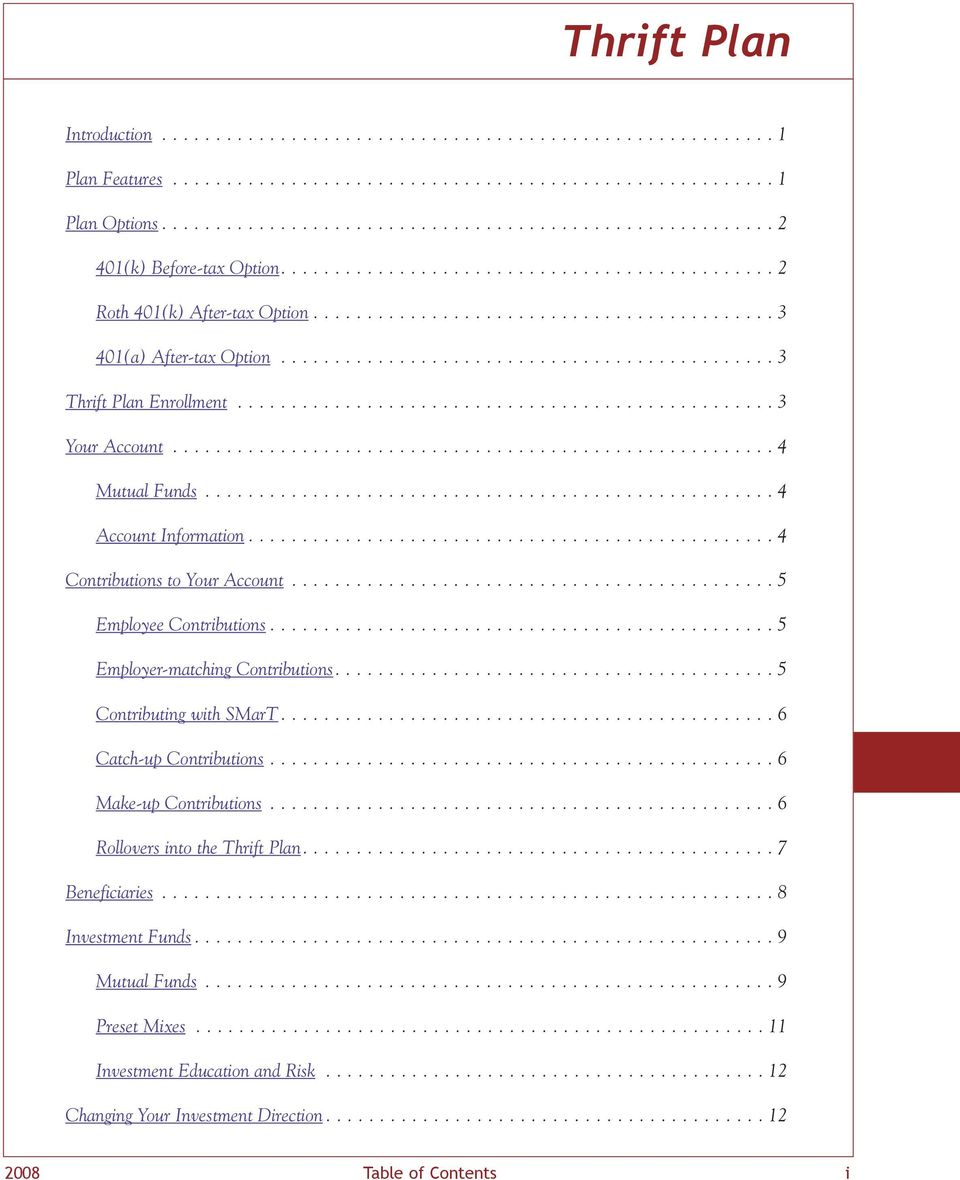
1 Thrift Plan Introduction Plan Features Plan Options (k) Before-tax Option Roth 401(k) After-tax Option (a) After-tax Option Thrift Plan Enrollment Your Account Mutual Funds Account Information Contributions to Your Account Employee Contributions Employer-matching Contributions Contributing with SMarT Catch-up Contributions Make-up Contributions Rollovers into the Thrift Plan Beneficiaries Investment Funds Mutual Funds Preset Mixes Investment Education and Risk Changing Your Investment Direction Table of Contents i
2 Thrift Plan Future Fund Elections Current Balance Transfers Rebalancing Plan Loans Eligibility General Loan Provisions Loan Amounts Plan Withdrawals General Withdrawal Provisions Spousal Consent Distribution Options After Employment Ends Spousal Protection at Retirement Qualified Joint & Survivor Annuity and Qualified Optional Survivor Annuity Payment Options at Retirement Annuity Payment Options Relative Value of Annuity Payment Options Fixed Dollar Installment Distribution Option Monthly Flexible Distribution Option Annual Payment Option Automatic Payment Options (Default) Required Minimum Distribution Distribution Options After Your Death Spousal Protection Qualified Preretirement Survivor Annuity ii Table of Contents 2008

3 Thrift Plan Payments to Beneficiary Divorce and Qualified Domestic Relations Orders Divorce Orders Procedures Direct Rollovers Employment Status Changes Termination of Employment Transfer of Employment Disability Tax Considerations Percent Withholding Requirement State Income Taxes Additional 10 Percent Tax Taxes on Death Benefits Estate Taxes Lump Sum Distributions and Income Averaging Planning Tools Fiduciary Duties Conflict of Interest Assignment Notification of Discretionary Authority / Appeal Information Notification of Benefit Changes Table of Contents iii

4 Thrift Plan iv Table of Contents 2008

5 Thrift Plan Deseret Mutual s Thrift Plan is a long-term, defined contribution, retirement savings program to help you prepare for your future. It s designed to work with your Social Security benefits, personal savings, and employer-funded Master Retirement Plan benefits (if you re eligible). The Thrift Plan provides you with a separate account in which you defer, or contribute, a percentage of your eligible gross income (see Considered Earnings in the Definitions section of your Benefits Handbook) for your retirement. Your employer, on your behalf, matches a percentage of your contributions. With the Thrift Plan, you are always 100 percent vested in the value of the contributions and earnings made by both you and your employer (you own the value of the funds in your account). Investing in your future takes time. So he sooner you begin to participate in the Thrift Plan, the better your opportunity to grow your retirement fund. The Thrift Plan qualifies under Section 401(k) of the Internal Revenue Code for before-tax and Roth after-tax contributions and it qualifies under Section 401(a) for after-tax contributions. It complies with the Employee Retirement Income Security Act of 1974 (ERISA) and 404(c), permitting you to make independent investment decisions about the allocation of the assets in your account, within the available funds. This section of your Benefits Handbook outlines the major provisions of Deseret Mutual s Thrift Plan as of January 1, Plan Features The Thrift Plan can be important in your financial planning because it allows you to save money, take advantage of employer contributions, and enjoy tax advantages: You decide what percentage of your income, within the plan guidelines, to contribute (see Your Account on page 4) You control how contributions are invested, choosing from Deseret Mutual s preset mixes or from among the mutual funds offered in the plan (see Investment Funds on page 9) You may choose to save in before-tax and/or after-tax options You have Social Security and Medicare taxes withheld on all of your contributions so your Social Security benefit is not reduced by participating in the plan You may borrow funds from your Thrift Plan account with a plan loan (see Plan Loans on page 14) 2008 Benefits Handbook 1

6 Thrift Plan You may withdraw funds from your Thrift Plan account, based on plan guidelines (see Plan Withdrawals on page 17) You determine how to receive payments at retirement or the end of employment (see Distribution Options After Employment Ends on page 19) Plan Options The Thrift Plan includes three options: 401(k) before-tax, Roth 401(k) after-tax, and 401(a) after-tax. The table below shows how funds for each of these options are taxed. For more information about how each option works, see pages 2 to (k) Before-tax Roth 401(k) After-tax 401(a) After-tax Employee Contributions Employee Contribution Earnings Taxed when withdrawn Taxed before contribution Taxed before contribution Taxed when withdrawn Tax free Taxed when withdrawn Employer Matches Taxed when withdrawn Taxed when withdrawn Taxed when withdrawn Employer Match Earnings Taxed when withdrawn Taxed when withdrawn Taxed when withdrawn 401(k) Before-tax Option You don t pay taxes on the portion of your income being contributed to the Thrift Plan until the time you withdraw money from the plan, thereby lowering your income tax today. (This is tax-deferred income.) Employer-matching contributions are not taxed until you withdraw the money Investment earnings are not taxed on either your contributions or your employer-matching contributions until you withdraw the money The before-tax option offers significant tax advantages. However, if you are younger than and employed by a participating employer, then government regulations restrict withdrawals from this option to cases of specific financial hardship. 2 Benefits Handbook 2008

7 Thrift Plan Roth 401(k) After-tax Option Taxes are paid on these contributions at the time they are deducted from your paycheck Employer-matching contributions are not taxed until you withdraw the money Investment earnings on your contributions are tax free, as long as you meet the withdrawal requirements to take a qualified withdrawal of Roth 401(k) money. The requirements are that your account must be open for at least five years and you must be or older. Withdrawals made when you are younger than or before you end employment are subject to hardship provisions 401(a) After-tax Option Taxes are paid on these contributions at the time they are deducted from your paycheck Employer-matching contributions are not taxed until you withdraw the money Investment earnings on your contribution are not taxed until you withdraw the money To withdraw after-tax contributions made after December 31, 2003, you may be subject to requirements of specific financial hardship by federal regulation. All 401(a) after-tax contributions made before January 1, 2004 are more readily available for withdrawal. Thrift Plan Enrollment You are eligible to participate in the Thrift Plan if you meet all of these requirements: You are employed by a participating employer You are 21 or older You are regularly scheduled to work at least 1,000 hours a year. Even if your hours drop under 1,000, after you meet this requirement, you are always eligible unless you are moved to an excluded class of employment, which is defined by the participating employer. You are not in an excluded class of employment as defined by your employer To enroll, go to Deseret Mutual s Web site and follow the links to your Thrift Plan account or call Deseret Mutual and select the savings program phone system. You must know your Deseret Mutual identification number and your personal identification number (PIN) before you can enroll Benefits Handbook 3

8 Thrift Plan Your Account When you enroll in the Thrift Plan, Deseret Mutual sets up an account in your name. Your account reflects: Your contributions to all of the Thrift Plan options and their investment earnings and/or losses Employer-matching contributions and their investment earnings and/or losses The breakdown of balances in the mutual fund(s) you have chosen Any transactions you have made such as contributions, loans, and withdrawals We update the value of your mutual funds each business day with the current day s closing values. For information about the value of your account balance, go to Deseret Mutual s Web site and follow the links to your Thrift Plan account or call Deseret Mutual and select the savings program phone system. Mutual Funds Deseret Mutual has chosen mutual funds (a fund with a predetermined investment objective operated by an investment company that allows a group of investors to pool their money together) to provide investment opportunities in all the significant segments of the stock and bond markets. You invest your Thrift Plan contributions among a selection of these mutual funds. For more information, see Investment Funds on page 9. If you want a fund prospectus (a legal document that describes the securities or mutual fund shares available), go to Deseret Mutual s Web site and follow the links to your Thrift Plan account or contact Deseret Mutual. Account Information Deseret Mutual provides information on your Thrift Plan account in four ways. You can: Access information on your account through Deseret Mutual s Web site Get information through our savings program phone system Use the detailed, quarterly statement showing the value of your account and your personalized rate of return. We send it out within 30 days of the end of each calendar quarter. Please check your statement carefully. Statements are considered correct if you do not notify Deseret Mutual of errors within 60 days of mailing. Call Deseret Mutual and talk to a savings plan representative for account information 4 Benefits Handbook 2008

9 Thrift Plan Contributions to Your Account Your annual maximum Thrift Plan contributions, including 401(k) before-tax, Roth 401(k) after-tax, 401(a) after-tax, and employer-matching contributions, are determined by law to be 100 percent of your eligible income or $46,000, whichever is less. This annual maximum contribution limit may be adjusted, as prescribed by law. Employee Contributions As a Thrift Plan participant, you can contribute up to the maximum amount allowed by law. Your contributions to the Thrift Plan may range from 1 to 96 percent, in whole percentages, of your eligible income, not including taxes and other deductions, per pay period. However, because of administration needs, your deferral contribution will be limited to 75 percent unless you get approval from Deseret Mutual. If you have any questions, check with your payroll department to make sure your paycheck can cover your contribution. Your options allow for several contribution choices. You can: Split your contributions between the three options Contribute up to $15,500 in the before-tax and Roth after-tax options combined, in The federal government indexes this amount each year. Any contributions you make beyond this $15,500 amount must be in the 401(a) after-tax option. Change your contribution percentage at any time. To make a change, go to Deseret Mutual s Web site and follow the links to your Thrift Plan account by selecting the Savings pull-down menu and then selecting the Access to Your Thrift Account option. Or you can call Deseret Mutual and select the savings program phone system. Depending on your employer s payroll cycle, it may take one or two pay periods before the change is effective. Employer-matching Contributions When you contribute to the Thrift Plan, your employer makes a matching contribution to your account. Your Contribution: Your Before-tax and After-tax, Employer s Total including Roth 401(k), Combined Contribution Contribution 1% 1% 2% 2% 2% 4% 3% 3% 6% 4% 3.5% 7.5% 5% to 96% 4% 9% to 100% 2008 Benefits Handbook 5

10 Thrift Plan The maximum employer-matching contribution is 4 percent of your eligible income per pay period. The employer-matching contribution is calculated on a per payroll basis and not on an annual basis. This means that to get a full employer match, you must make Thrift Plan contributions each pay period throughout the year. Please note: Only money you contribute to Deseret Mutual s Thrift Plan is eligible for a matching contribution from your employer. For example, if you work for an educational institution such as one of the Brigham Young Universities and contribute only to TIAA-CREF, your employer does not match this contribution. Contributing with SMarT The SMarT option, or Save Money for Tomorrow, allows you to continually and automatically increase your contributions each year by 1 percent. With this program, you don t have to remember to increase your contributions; SMarT does it for you. And you can choose the date to start, perhaps to correspond with your annual salary increase before you re used to spending the increase. To activate SMarT, go to Deseret Mutual s Web site and follow the links to your Thrift Plan account or call Deseret Mutual and select the savings program phone system. Catch-up Contributions If you will be 50 or older by the end of the year and will reach the $15,500 maximum Thrift Plan 401(k) before-tax and Roth 401(k) after-tax limit, you can make a catch-up contribution of $5,000. So you can contribute up to $20,500 in your 401(k) plan, including before-tax and Roth after-tax in The federal government indexes this amount each year. Catch-up contributions are made by payroll deduction. Just change your contribution percentage to include your catch-up contribution amount. The amount above 5 percent, which counts toward the catch-up contribution, does not qualify for an additional employer match. And you cannot contribute with a lump sum. Make-up Contributions If you are an active employee and you have not contributed the annual maximum amount permitted, you can deposit make-up contributions to the 401(a) after-tax option of the Thrift Plan. 6 Benefits Handbook 2008

11 Thrift Plan At your request, Deseret Mutual calculates the maximum amount you are eligible to contribute as a make-up contribution The maximum amount calculated determines the percentage you can contribute from your paycheck for the remainder of the calendar year You can send lump sum make-up contributions in personal checks to Deseret Mutual in amounts of $100 or more as often as you want, up to the maximum amount calculated for the calendar year To be included for the year, send make-up contributions to Deseret Mutual by the third week of December Make-up contributions are invested based on your current Future Fund Election (see Investment Funds on page 9) Make-up contributions are not eligible for employer-matching contributions. In addition, you can only make up contributions if you are receiving an income from a participating employer. You cannot put in make-up contributions while on an unpaid leave of absence, while receiving Deseret Mutual s Disability Plan benefit, while in an excluded class of employment, or if you have ended employment with a participating employer Be aware that if you are classified as a highly-compensated employee, your make-up contributions along with your earnings may be subject to refund, as required by law Rollovers into the Thrift Plan If you have savings in previous employer-sponsored plans, you may be eligible to roll over your account balances into your Thrift Plan account. Deseret Mutual may accept before-tax and after-tax rollovers from: 401(a) plans SIMPLE IRAs 401(k) plans Rollover or conduit IRAs 403(b) plans Target Benefit plans 457 governmental plans Trusteed Money Purchase plans Cash Balance plans Trusteed Profit Sharing plans Keoghs Profit Sharing and SIMPLE (Savings Incentive Match Plan for Money Purchase SEP (Simplified Employee Pension) IRAs Employees) 401(k) plans This rollover provision is subject to Internal Revenue Service guidelines. Before you begin to roll over your account balances, contact Deseret Mutual for information on possible restrictions Benefits Handbook 7

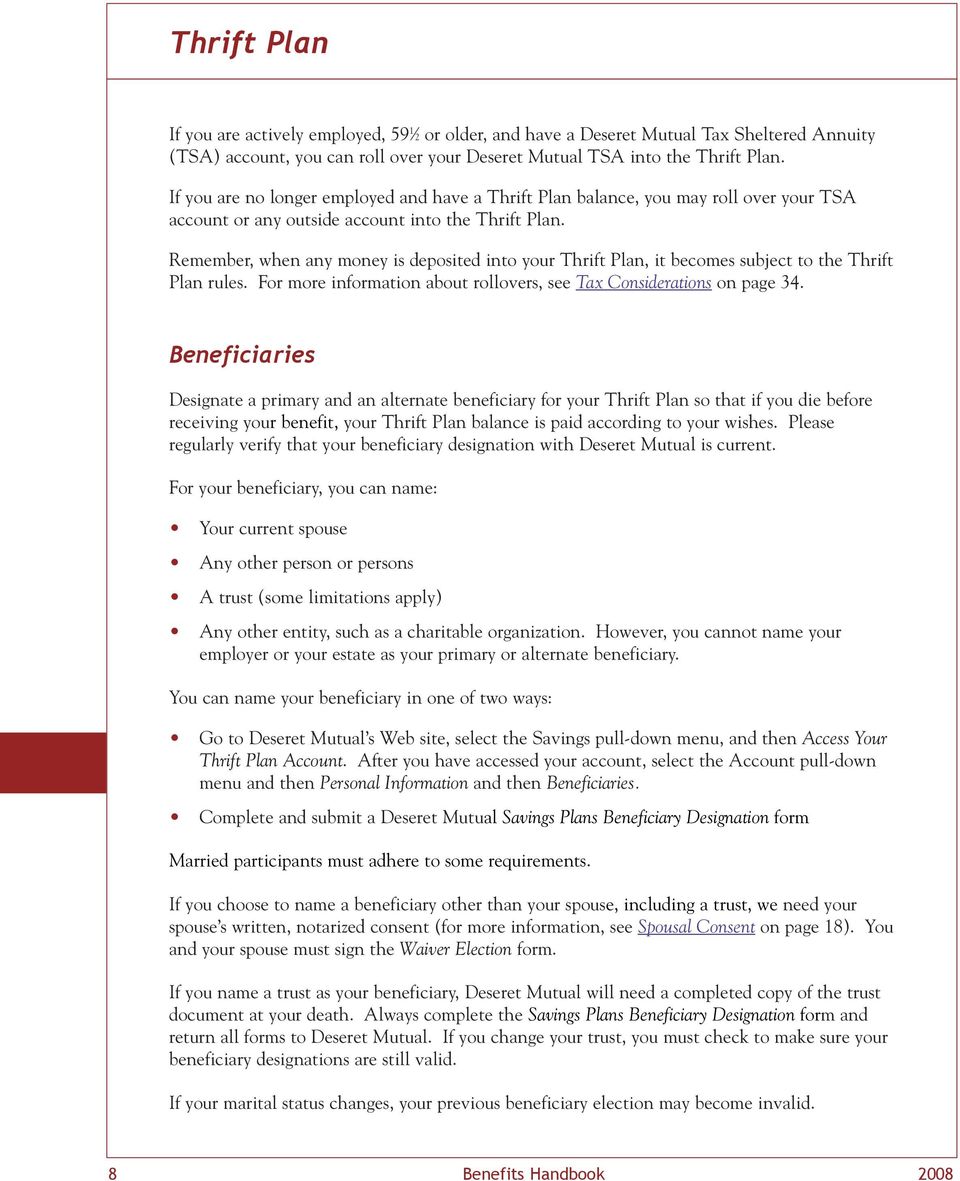
12 Thrift Plan If you are actively employed, or older, and have a Deseret Mutual Tax Sheltered Annuity (TSA) account, you can roll over your Deseret Mutual TSA into the Thrift Plan. If you are no longer employed and have a Thrift Plan balance, you may roll over your TSA account or any outside account into the Thrift Plan. Remember, when any money is deposited into your Thrift Plan, it becomes subject to the Thrift Plan rules. For more information about rollovers, see Tax Considerations on page 34. Beneficiaries Designate a primary and an alternate beneficiary for your Thrift Plan so that if you die before receiving your benefit, your Thrift Plan balance is paid according to your wishes. Please regularly verify that your beneficiary designation with Deseret Mutual is current. For your beneficiary, you can name: Your current spouse Any other person or persons A trust (some limitations apply) Any other entity, such as a charitable organization. However, you cannot name your employer or your estate as your primary or alternate beneficiary. You can name your beneficiary in one of two ways: Go to Deseret Mutual s Web site, select the Savings pull-down menu, and then Access Your Thrift Plan Account. After you have accessed your account, select the Account pull-down menu and then Personal Information and then Beneficiaries. Complete and submit a Deseret Mutual Savings Plans Beneficiary Designation form Married participants must adhere to some requirements. If you choose to name a beneficiary other than your spouse, including a trust, we need your spouse s written, notarized consent (for more information, see Spousal Consent on page 18). You and your spouse must sign the Waiver Election form. If you name a trust as your beneficiary, Deseret Mutual will need a completed copy of the trust document at your death. Always complete the Savings Plans Beneficiary Designation form and return all forms to Deseret Mutual. If you change your trust, you must check to make sure your beneficiary designations are still valid. If your marital status changes, your previous beneficiary election may become invalid. 8 Benefits Handbook 2008
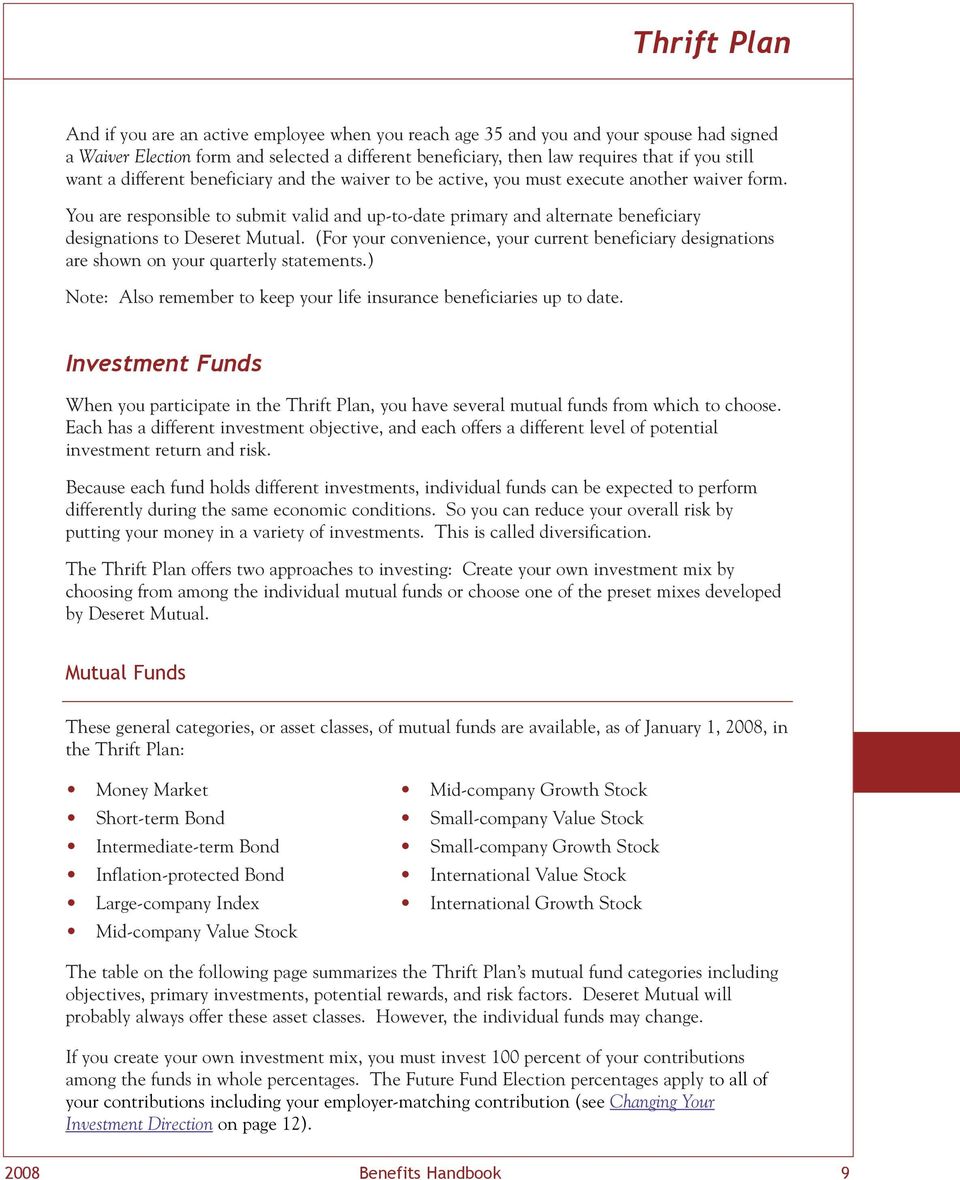
13 Thrift Plan And if you are an active employee when you reach age 35 and you and your spouse had signed a Waiver Election form and selected a different beneficiary, then law requires that if you still want a different beneficiary and the waiver to be active, you must execute another waiver form. You are responsible to submit valid and up-to-date primary and alternate beneficiary designations to Deseret Mutual. (For your convenience, your current beneficiary designations are shown on your quarterly statements.) Note: Also remember to keep your life insurance beneficiaries up to date. Investment Funds When you participate in the Thrift Plan, you have several mutual funds from which to choose. Each has a different investment objective, and each offers a different level of potential investment return and risk. Because each fund holds different investments, individual funds can be expected to perform differently during the same economic conditions. So you can reduce your overall risk by putting your money in a variety of investments. This is called diversification. The Thrift Plan offers two approaches to investing: Create your own investment mix by choosing from among the individual mutual funds or choose one of the preset mixes developed by Deseret Mutual. Mutual Funds These general categories, or asset classes, of mutual funds are available, as of January 1, 2008, in the Thrift Plan: Money Market Mid-company Growth Stock Short-term Bond Small-company Value Stock Intermediate-term Bond Small-company Growth Stock Inflation-protected Bond International Value Stock Large-company Index International Growth Stock Mid-company Value Stock The table on the following page summarizes the Thrift Plan s mutual fund categories including objectives, primary investments, potential rewards, and risk factors. Deseret Mutual will probably always offer these asset classes. However, the individual funds may change. If you create your own investment mix, you must invest 100 percent of your contributions among the funds in whole percentages. The Future Fund Election percentages apply to all of your contributions including your employer-matching contribution (see Changing Your Investment Direction on page 12) Benefits Handbook 9
14 Thrift Plan Categories Objectives Primary Investments Potential Rewards Risk Factors Money Market Provide current income consistent with the preservation of capital and liquidity. Provide a stable share price. Short-term U.S. government, agency, and corporate obligations with an average maturity of 90 days or less Capital preservation and low returns from very short-term money market securities Very low risk. Any risk is primarily because of lower income from falling interest rates. * Short-term Bond Provide a higher rate of return than the Money Market Fund, with only modest changes in the value of the principal Investment grade bonds of major corporations with a maturity of between one and three years Principal preservation and fairly low returns from short-term debt securities Moderate fluctuation in value of investments. Fairly low risk. Any risk is primarily because of lower income. Intermediateterm Bond Provide total return with consistent preservation of capital and prudent investment management U.S government securities, corporate bonds, mortgage or assetbacked securities. Many use derivative instruments for hedging purposes or as part of investment strategy. The average maturity is 3 to 10 years. Moderate returns over time based on interest payments, sales of debt securities, and changes on bond values Moderate risk because of changes in interest rates (bond values and interest rates generally move in opposite directions) Inflation- Protected Bond Provide a long-term rate of return that outpaces inflation Treasury Inflation Protected Securities with an average maturity between 7 and 20 years Protection against inflation Moderate risk because of changes in interest rates and inflation. In an environment where inflation is decreasing, the fund will typically underperform U.S. Treasuries of similar maturity. Large-company Index Match the investment performance of the Standard & Poors 500 Stock Index Equities included in the Standard & Poors Stock Index. The index includes stocks from most of the larger corporations in the United States. Stocks in mid-sized companies that trade at a substantial discount to the private market value of the company Moderate to high returns over time based on changes in stock values and stock dividends Moderately high risk because of changes in the market value of stock in the fund Mid-company Value Stock Provide capital appreciation from sound, mid-sized companies whose stock is believed to be undervalued Capital appreciation and fairly high returns over time based on changes in stock values and stock dividends Moderately high risk because of changes in the market value of stocks in the fund Mid-company Growth Stock Provides capital appreciation from mid-sized companies that are believed to grow their earnings rapidly Stocks of mid-sized companies that are growing very rapidly Capital appreciation and fairly high returns over time based on changes in stock values Higher risk because of changes in market value of stocks in the fund Small-company Value Stock Provide capital appreciation from stocks of smaller companies believed to be undervalued Stocks of small companies whose stock price to asset value per share is low when compared to other small companies Capital appreciation and high returns over time based on changes in stock values High risk because of changes in market value of stocks in the fund Small-company Growth Stock Provide capital appreciation from small companies believed to have rapid growth potential Stock of small companies that have the ability to grow their earnings rapidly Capital appreciation and high returns over time based on changes in stock values High risk because of changes in market value of stocks in the fund International Value Stock Provide capital appreciation from stocks of companies based outside the United States that are believed to be undervalued Stocks in large and midsized companies based outside the United States. At least 80% of the fund is invested in developed countries Capital appreciation and high returns over time based on changes in stock values High risk because of changes in market value of stocks in the fund and changes in the value of foreign currencies and political changes International Growth Stock Provide capital appreciation from stocks of companies based outside of the United States that are believed to have potential for rapid growth Stock of large and midsized companies based outside the United States that have the potential to grow their earnings rapidly Capital appreciation and high returns over time based on changes in stock values High risk because of changes in market value of stocks in the fund and changes in the value of foreign currencies and political changes 10 Benefits Handbook 2008

15 Thrift Plan Preset Mixes To make it easier for you, the Thrift Plan offers four preset investment mixes. These preset mixes are comprised of the plan s individual mutual funds. They are designed to match your general investment horizon, which is the time a sum of money is expected to be invested before it is needed for retirement, and your individual risk tolerance (see the table below). Please realize that your investment horizon usually goes way beyond your retirement date; it goes through all your retirement years. If you have a longer investment horizon, investments such as stocks can have long-term gains that outweigh short-term dips in value. However, as your investment horizon becomes shorter, more conservative investments may be appropriate. The investment default is the intermediate-term preset mix. So if you do not tell us how you want your money and your employer s matching contributions invested, we will invest your money in the intermediate preset mix. Naturally, some mutual funds outperform others. These funds then make up a larger percentage of your total account than originally invested. For your convenience, the preset mixes are rebalanced (set to the original investment mix) at the end of each quarter. This brings your account back to the original Future Fund Election percentages so your account stays diversified and balanced (see Changing Your Investment Direction on page 12). A preset mix is a Future Fund Election selected by investment professionals. In fact, since their inception our preset mixes have substantially outperformed other investment strategies. Categories Short-term (0 to 4 years) Preset Mixes Intermediate-term (5 to 11 years) Long-term (12+ years) Stock-only (12+ years) Money Market 10% 0% 0% 0% Short-term Bond 20% 10% 0% 0% Intermediate-term Bond 25% 20% 15% 0% Inflation-protected Bond 15% 10% 5% 0% Large-company Index 14% 20% 28% 34% Mid-company Value Stock 5% 8% 10% 13% Mid-company Growth Stock 3% 8% 10% 13% Small-company Value Stock 0% 6% 8% 10% Small-company Growth Stock 0% 3% 4% 5% International Value Stock 3% 6% 8% 10% International Growth Stock 5% 9% 12% 15% 2008 Benefits Handbook 11

16 Thrift Plan Investment Education and Risk Each person s financial situation and objectives vary. Deseret Mutual provides information to help you understand some basic principles of saving and investing. Your employers, through Deseret Mutual, provide financial planners who offer workshops and consultations at no charge to you. These planners are available to offer general objective financial counsel to help you plan for your future. They can help you to clarify goals, gather information, analyze your situation, develop solutions, and take action. However, we do not provide specific investment advice. Each mutual fund carries its own objective and degree of risk. We cannot assure that the investment objective of any mutual fund is achieved. Please be aware that neither Deseret Mutual, our financial planners, the fund managers, nor your employer can guarantee the value of the contributions and/or fund earnings in any of the mutual funds. Deseret Mutual s Thrift Plan requires you to make personal investment decisions about the investment and Future Fund Election of the money in your account, within the available funds. If you want, you may consult an independent retirement or financial planner in making your investment decisions. (See Fiduciary Duties and Conflict of Interest on page 37.) Changing Your Investment Direction When you enroll in the Thrift Plan, you choose how to invest your money among the available funds. However, there may be times when you want to change the funds in which your account balance is currently invested. You may choose an election for your future fund contributions and/or you may do a balance transfer of your current account balances. However, you cannot choose a preset mix for a Future Fund Election and then choose a different investment mix for a Current Balance Transfer, or vice versa. Preset mixes always affect existing and future funds in the same way. To change your investment direction, go to Deseret Mutual s Web site and follow the links to your Thrift Plan account or call Deseret Mutual and select the savings program phone system. Please be advised that problems beyond Deseret Mutual s control can occur at any time and could delay your change request. Deseret Mutual cannot be responsible for these delays. The phone system is at peak capacity from about 1 to 2 p.m., Mountain Time, on most business days. If you want to change how your future contributions are invested among the mutual funds or transfer your current investments, we encourage you to call before 1 p.m., Mountain Time. 12 Benefits Handbook 2008

17 Thrift Plan Future Fund Elections (formerly called Allocations) Future Fund Elections affect how the future contributions to your Thrift Plan account are invested: Future Fund Elections are in whole percentages The Future Fund Election you choose applies to both your contributions and your employer-matching contributions in all plans at Deseret Mutual Future Fund Elections apply only to future contributions, not your current balance unless you choose a preset mix When you choose a preset mix, your future contributions are invested according to the preset mix. And the Current Balance Transfer on your existing balance occurs at the closing market price on the day your election becomes effective. Changes confirmed before 2 p.m., Mountain Time, are effective that business day. Changes confirmed after 2 p.m., Mountain Time, or on weekends or holidays are effective the next business day. Current Balance Transfers (formerly called Redistributions) Current Balance Transfers affect existing account balances: Current Balance Transfers are in whole percentages Current Balance Transfers apply to your total account balance (employee contributions, employer-matching contributions, and earnings) in all plans at Deseret Mutual You can choose to: Do a Current Balance Transfer for your entire account balance among any or all of the individual funds Select one of the four preset mixes. When you choose a preset mix, a Current Balance Transfer of your existing balances occurs and a Future Fund Election is created for your future contributions. In keeping with Deseret Mutual s action to prevent improper trading, we have a 15-day restriction on mutual fund trades. In other words, only one trade is permitted every 15 calendar days after the effective date of trade. This is because qualified plans like the Thrift Plan are not intended to be used as short-term trading vehicles Benefits Handbook 13

18 Thrift Plan When you request a Current Balance Transfer, the money in your existing funds is valued at the closing asset value for that business day. When the Current Balance Transfer occurs, your money is moved into the new fund(s) at the current asset value of the new fund(s). The 15-day restriction begins the day after your Current Balance Transfer is valued. Changes confirmed before 2 p.m., Mountain Time, are effective that business day. Changes confirmed after 2 p.m., Mountain Time, or on weekends or holidays are effective the next business day. All Current Balance Transfers must be confirmed by the time the New York Stock Exchange closes. Rebalancing Because of fluctuations in fund performance and to maintain your investment diversification, it is important to rebalance and bring your account back to the original Future Fund Election percentages, or investment mix, you selected. If you are currently investing in a preset mix, rebalancing automatically occurs every quarter If you are using your own customized investment mix, you can request to automatically rebalance your account to your own mix on a quarterly basis. With your customized investment mix, rebalancing is not required but it is a good idea. You can rebalance your account based on your Future Fund Elections only Each time you request a Future Fund Election or a Current Balance Transfer, you must choose whether or not to automatically rebalance based on your customized Future Fund Election mix You can discontinue your rebalance election on a customized investment mix at any time, except at the time it is actually rebalancing your account, which is the last business day of each calendar quarter If you are no longer employed and therefore no longer contributing to the Thrift Plan, rebalancing continues to be based on your Future Fund Election Plan Loans The Thrift Plan is designed to supplement your retirement income. Your should invest your money in the Thrift Plan and then leave it alone. However, sometimes you may need access to the money in your Thrift Plan account while you are actively employed. At these times, you may be eligible to borrow a portion of your account balance. Remember, a plan loan is a financial obligation you are required by law to repay. 14 Benefits Handbook 2008

19 Thrift Plan With a Thrift Plan loan: You can borrow up to 50 percent of your Thrift Plan account balance. The minimum you can borrow is $500 and the maximum amount you can borrow is determined by your account balance and cannot exceed $50,000 in a 12-month period, including loans from other plans sponsored by your employer. Other guidelines may apply. (See Loan Amounts on page 17.) The interest you pay on the loan is credited back to your account You avoid a hardship withdrawal that would incur income taxes and possible penalties You can have a maximum of two regular loans and one residential loan from all Deseret Mutual savings plans outstanding at the same time You must be debt-free from at least one regular loan during the last 90 days to qualify for a new regular loan. So if you still have an outstanding loan after you pay off a loan, you ll be restricted from taking another loan for at least 90 days. If you have two outstanding loans and you pay one off, you cannot take out another loan for 90 days. If you have two outstanding loans and you pay them both off, again you cannot take out another loan for 90 days. If during the last 90 days you have had only one loan and you pay it off, you may take another loan immediately. The 90-day restriction applies whether you pay off your loan through payroll deductions or with a lump sum. This loan policy becomes effective on January 1, At that time, you will only be able to take a loan if you did not have a loan or paid one off before October 2,2007. Residential loans are not restricted to this 90-day policy. Eligibility You are eligible to apply for a loan if: You are an active employee receiving regular paychecks from a participating employer, including employees on paid leaves of absence or those receiving Deseret Mutual s Disability Plan benefit You have a Thrift Plan account balance of at least $1,000 Loan payments from all plans sponsored by your employer would not exceed 50 percent of your net take-home pay from your participating employer or your Disability Plan benefit check You are currently in a class of employment that allows you to contribute to the Thrift Plan 2008 Benefits Handbook 15

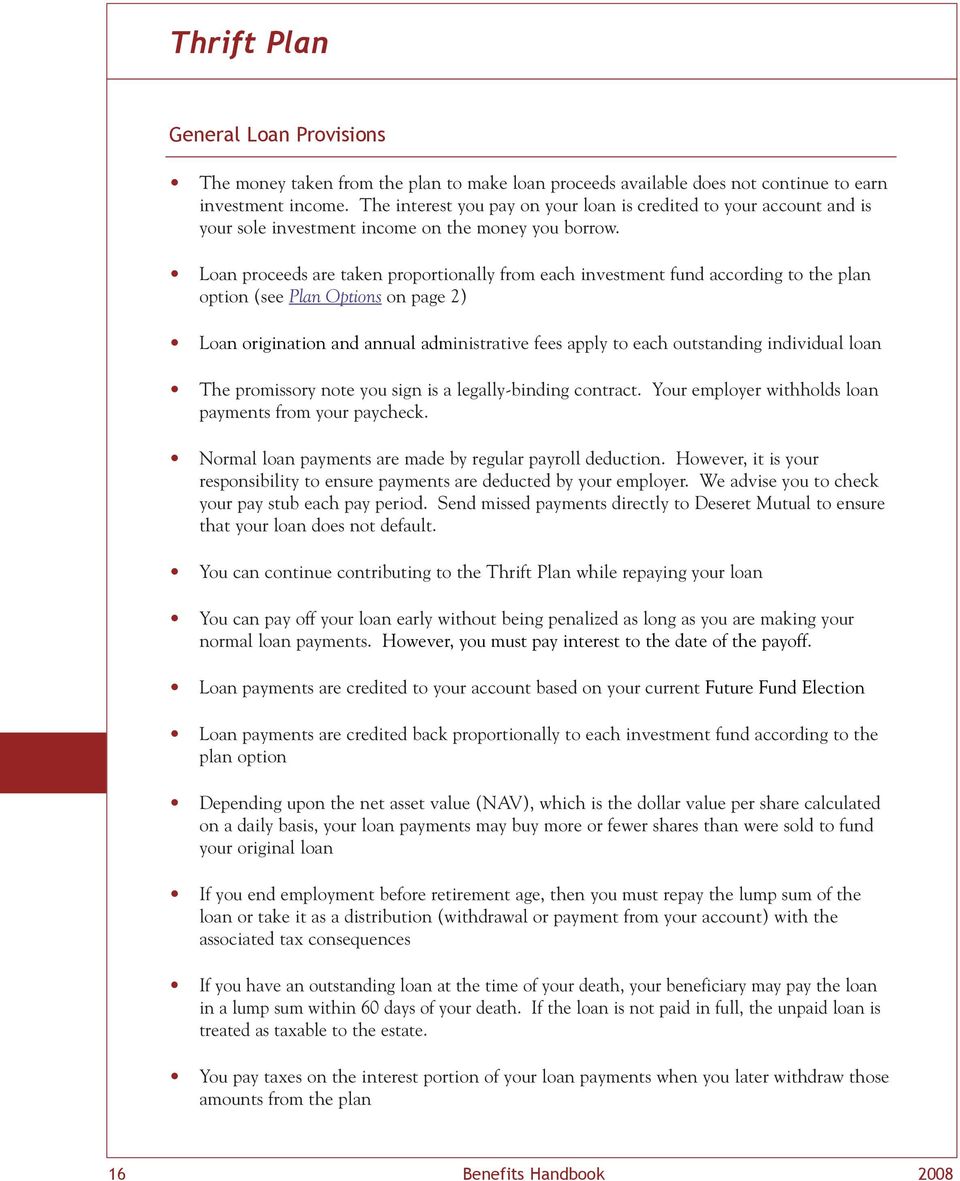
20 Thrift Plan General Loan Provisions The money taken from the plan to make loan proceeds available does not continue to earn investment income. The interest you pay on your loan is credited to your account and is your sole investment income on the money you borrow. Loan proceeds are taken proportionally from each investment fund according to the plan option (see Plan Options on page 2) Loan origination and annual administrative fees apply to each outstanding individual loan The promissory note you sign is a legally-binding contract. Your employer withholds loan payments from your paycheck. Normal loan payments are made by regular payroll deduction. However, it is your responsibility to ensure payments are deducted by your employer. We advise you to check your pay stub each pay period. Send missed payments directly to Deseret Mutual to ensure that your loan does not default. You can continue contributing to the Thrift Plan while repaying your loan You can pay off your loan early without being penalized as long as you are making your normal loan payments. However, you must pay interest to the date of the payoff. Loan payments are credited to your account based on your current Future Fund Election Loan payments are credited back proportionally to each investment fund according to the plan option Depending upon the net asset value (NAV), which is the dollar value per share calculated on a daily basis, your loan payments may buy more or fewer shares than were sold to fund your original loan If you end employment before retirement age, then you must repay the lump sum of the loan or take it as a distribution (withdrawal or payment from your account) with the associated tax consequences If you have an outstanding loan at the time of your death, your beneficiary may pay the loan in a lump sum within 60 days of your death. If the loan is not paid in full, the unpaid loan is treated as taxable to the estate. You pay taxes on the interest portion of your loan payments when you later withdraw those amounts from the plan 16 Benefits Handbook 2008
21 Thrift Plan Loan Amounts The minimum loan amount is $500. Larger loan amounts are in $100 increments. The maximum loan amount is the lesser of: $50, percent of your Thrift Plan account balance The $50,000 maximum amount is reduced by your highest outstanding loan balance during the previous 12 months, even though you may have repaid the loan. When the $50,000 amount is calculated, we combine existing loans, previously repaid loans, and newly requested loans from all plans including those outside of Deseret Mutual, in which you participate. If you exceed the amount specified by law, you are subject to additional taxes and possible penalties. Your loan will be reduced by the loan origination fee. Plan Withdrawals The Thrift Plan is designed to help ensure your financial security after you retire. However, in some cases, you may need money from your Thrift Plan account while still employed. Therefore, in very limited circumstances, withdrawals (distributions) are available based on plan guidelines. General Withdrawal Provisions When you are older than , end employment, retire, become permanently disabled, or are a beneficiary or alternate payee, you may be able to withdraw all or part of the money in your account as often as every three months If you don t meet these requirements, you may need to prove financial hardship, as defined by federal regulations Based on federal regulations, you may be required to take a loan rather than a hardship withdrawal Outstanding plan loans may affect the availability of funds for withdrawal If you are married, your spouse must consent to your withdrawal in writing (see Spousal Consent on page 18) 2008 Benefits Handbook 17
22 Thrift Plan Taxes and possible tax penalties apply to the taxable portion of all withdrawals (see Tax Considerations on page 34) There is a minimum three-month waiting period between withdrawals. This may be waived if you are closing your account after the date your employment ends or you retire. If you formerly qualified for Thrift Plan participation and are actively employed by a participating employer, but do not currently qualify, withdrawals from your account may be limited If you are receiving benefits from Deseret Mutual s Disability Plan, you may qualify for hardship withdrawals Employer-matching contributions made after January 1, 2001, and all employer earnings are not available for hardship withdrawals You need to prove financial hardship to withdraw from your Roth 401(k) after-tax or 401(a) after-tax contributions deposited into your account after January 1, And then you may withdraw your Roth 401(k) after-tax contributions prorated with earnings once every three months or your 401(a) after-tax contributions prorated with earnings once per calendar year. Other restrictions may also apply. Investment earnings on 401(k) before-tax and Roth 401(k) after-tax contributions are not generally available for hardship withdrawal. However, some Roth 401(k) after-tax contributions and earnings are available in some circumstances. Contract Deseret Mutual for information. Your withdrawal amount may be limited to 95 percent, from each source, of the total of all the money in your account A qualified reservist distribution is not subject to the additional 10 percent tax on early distributions (see Tax Considerations on page 34). The call to duty must have been after September 11, 2001 and before December 31, And it must be for 180 days or more. Please contact Deseret Mutual for specific information. Spousal Consent If you are married, your spouse must provide written, notarized consent if you: Take a loan of any amount (see Plan Loans on page 14) Withdraw any amount (see Plan Withdrawals on page 17) Do a direct rollover of any amount (see Direct Rollovers on page 32) 18 Benefits Handbook 2008
23 Thrift Plan Waive the Qualified Preretirement Survivor Annuity (see Distribution Options after Your Death on page 27) Choose a primary beneficiary other than, or in addition to, your spouse, including a trust (see Beneficiaries on page 8) Select any payment option except the Qualified Joint & Survivor Annuity or the Qualified Optional Survivor Annuity (see Spousal Protection at Retirement Qualified Joint & Survivor Annuity and Qualified Optional Survivor Annuity on page 20) Are younger than 65 when you choose to begin any payment option (see Payment Options at Retirement on page 20) Your spouse s signature must be notarized by a notary public or witnessed by an authorized Deseret Mutual representative. The spousal consent must be dated within 180 days before the date of the first payment, distribution, or other financial transaction. An additional waiver may be required. The notary s signature and your spouse s signature must have the same date. Photo identification is required. You are responsible for any cost incurred for this service. Distribution Options after Employment Ends First, leave your account alone. You don t have to close your account. You don t even have to take money from your account. When you end employment with all participating employers, you can leave your account balance in the Thrift Plan until you reach your required beginning date (see Required Minimum Distribution on page 27). At that time, you must choose a payment option. Until then you can take out only what is necessary. Second, between age 55 and your required beginning date, select a payment option either an annuity or another payment option (see these options beginning on page 20). You may do a direct rollover to another qualified plan. Also, anytime after you end employment, you can receive your entire Thrift Plan account balance as a lump sum distribution, which is the payment option that pays your account balance or accrued benefit in one taxable year. Or you can choose to withdraw a portion of your account balance without proving financial hardship, based on plan guidelines. For the Thrift Plan, going to part-time, temporary, or on-call status with your employer does not constitute ending employment. Regular withdrawal provisions apply until you actually end employment with any participating employer Benefits Handbook 19
24 Thrift Plan Spousal Protection at Retirement Qualified Joint & Survivor Annuity and Qualified Optional Survivor Annuity Federal law protects your spouse s rights to your Thrift Plan benefit. The Qualified Joint & Survivor Annuity (QJSA) payment option is an annuity for your life that also provides a 50 percent survivor annuity to your spouse after your death. And the Qualified Optional Survival Annuity (QOSA) payment option is an annuity for life that also provides a 75 percent survivor annuity to your spouse after your death. When both you and your spouse die, the benefit payments on either of these options do not continue to anyone. If you are married, the law permits Deseret Mutual to offer you several payment options. However, federal law requires that your Thrift Plan benefit be paid as a QJSA or a QOSA unless you and your spouse waive that right. Your spouse is required to give written, notarized consent to your waiver. Waiver Election If you want an option other than the QJSA or the QOSA, you and your spouse must complete the QJSA and/or QOSA Waiver and Spousal Consent section of the benefit application (see Spousal Consent on page 18). You and your spouse must sign these forms within 180 days before the date of your first benefit payment or effective date. Your benefit cannot be paid unless you choose the QJSA or the QOSA or you and your spouse complete the QJSA and/or QOSA Waiver and Spousal Consent section of the benefit application. Your spouse cannot revoke consent. If you change your mind and you want the QJSA or the QOSA, you may revoke your waiver any time before you receive your first payment. You do not need your spouse s consent. If you again decide to waive the QJSA or QOSA, your spouse must consent to the new waiver election. After payments begin, you may not revoke your waiver. If you and your spouse waive the QJSA or the QOSA, you may receive your benefit in any other form the plan provides. Benefit amounts and eligibility requirements for other payment options differ. Payment Options at Retirement If you are at least age 55 and your employment has ended, you may receive your account balance in one of several ways. Or you may leave your money in the account and do nothing until your required beginning date or until you need money for your retirement, whichever comes first. Annuity Payment Options An annuity is regular income paid at fixed intervals. Annuity payment guidelines are as follows: 20 Benefits Handbook 2008
25 Thrift Plan If your account balance is at least $3,500, you can close your account and purchase an annuity from Deseret Mutual An annuity pays equal monthly payments for the amount of time specified in the annuity option you choose Several annuity options are available, some of which extend a portion of the payments to your spouse (joint annuitant) or designated beneficiary after your death You can change your annuity option by written request before you receive your first payment. After you receive your first payment, you cannot make any changes. A combination of payment options may be available If you are older than 70, IRS regulations may limit the payment options available to you The joint and survivor annuity payment options are intended for married participants and provide payments to your joint annuitant when you die. (Your joint annuitant is your spouse at the time you purchase your annuity. You cannot change your joint annuitant, even if you later divorce, become widowed, or remarry. However, you can change your beneficiary.) Be aware that fees are associated with the annuity payment options. These annuities and options are available from Deseret Mutual: Joint & Survivor 100 Percent Annuity (10-year Term Certain) This payment option provides equal monthly payments for as long as you live. If you die before your joint annuitant, your joint annuitant receives 100 percent of the monthly payments you were receiving until your joint annuitant s death. If both you and your joint annuitant die before 10 years from your annuity starting date (the date the annuity payments begin), the payments continue to your designated beneficiary for the remainder of the 10 years. Joint & Survivor 75 Percent Annuity (10-year Term Certain) This payment option provides equal monthly payments for as long as you live. If you die before your joint annuitant, your joint annuitant receives 75 percent of the monthly payments you were receiving until your joint annuitant s death. If both you and your joint annuitant die before 10 years from your annuity starting date, reduced payments continue to your designated beneficiary for the remainder of the 10 years. Joint & Survivor 50 Percent Annuity (10-year Term Certain) This payment option provides equal monthly payments for as long as you live. If you die before your joint annuitant, your joint annuitant receives 50 percent of the monthly payments you were receiving until your joint annuitant s death. If both you and your joint annuitant die before 10 years from your annuity starting date, reduced payments continue to your designated beneficiary for the remainder of the 10 years Benefits Handbook 21
26 Thrift Plan Special Joint & Survivor Two-thirds Annuity (10-year Term Certain) This option provides a monthly payment that is reduced to two-thirds at the time either you or your joint annuitant dies. This reduced payment continues for the remainder of the survivor s life. If both you and your joint annuitant die before 10 years from your annuity starting date, reduced payments continue to your designated beneficiary for the remainder of the 10 years. Qualified Joint & Survivor Annuity (QJSA) (No Term Certain) This payment option provides equal monthly payments for as long as you live. If you die before your joint annuitant, it provides a 50 percent survivor annuity for the remainder of your joint annuitant s life. Unlike most other joint and survivor annuity options, the QJSA does not have a 10-year term certain. The payments stop when both you and your joint annuitant die. Compare this option to the Joint and Survivor 50 Percent Annuity (10-year Term Certain). Qualified Optional Survivor Annuity (QOSA) (No Term Certain) This payment option provides equal monthly payments for as long as you live. If you die before your joint annuitant, it provides a 75 percent survivor annuity for the remainder of your joint annuitant s life. Unlike most other joint and survivor annuity options, the QOSA does not have a 10-year term certain. The payments stop when both you and your joint annuitant die. Compare this option to the Joint and Survivor 75 Percent Annuity (10-year Term Certain). Life Annuity The Life Annuity provides equal monthly payments for as long as you live. Payments do not continue to a beneficiary after your death. 10-year Term Certain & Life Annuity This payment option provides a life annuity with equal monthly payments for as long as you live. If you die before 10 years from your annuity starting date, payments continue to your designated beneficiary for the remainder of the 10 years. Term Certain Annuity Options You can choose to receive your benefit in monthly payments for 2 1 2, 5, 7 1 2, 10, 15, or 20 years. If you die before the end of the selected time period, payments continue to your designated beneficiary for the remainder of that period. Based on your age, the term certain annuity options may be limited because of your life expectancy. 22 Benefits Handbook 2008
27 Thrift Plan Relative Value of Annuity Payment Options The amount we expect your payments to add up to over your life expectancy is called the relative value. It is based on the value of your account balance, the age when your payments begin, and the interest rates in effect at the time the annuity is purchased. Below is an example to help you better understand the relative value of your payment options. In this example, the account balance is $65,000, the age when payments begin is 65, and the joint annuitant s age is 72. Note that interest rates change month to month, but are locked in when annuity payments begin. Relative Values Annuity Options Interest Rates Participant Monthly Payments Joint Annuitant Term Certain Beneficiary Joint & Survivor 100 Percent (10-year Term Certain) Joint & Survivor 75 Percent (10-year Term Certain) Joint & Survivor 50 Percent (10-year Term Certain) Special Joint & Survivor Two-thirds (10-year Term Certain) Qualified Joint & Survivor Annuity (QJSA) No Term Certain Qualified Optional Survivor Annuity (QOSA) No Term Certain 4.70% $ 315 $ 315 $ % $ 325 $ 244 $ % $ 336 $ 168 $ % $ 343 $ 229 $ % $ 336 $ % $ 325 $ 244 Life Annuity 4.49% $ year Term Certain & Life Annuity 4.49% $ 346 $ year Term Certain 1.99% $2,182 $2,182 5-year Term Certain 3.00% $1,144 $1, year Term Certain 3.55% $ 805 $ year Term Certain 3.93% $ 640 $ year Term Certain 4.33% $ 478 $ year Term Certain 4.43% $ 396 $ Benefits Handbook 23
28 Thrift Plan Fixed Dollar Installment Distribution Option If your account balance is at least $3,500, you can choose the Fixed Dollar Installment Distribution Option. You can select a payment of only what you need, $100 being the minimum. And you may change the dollar amount once per calendar year. You can make partial withdrawals as often as once every three months or you can close your account at any time, based on plan guidelines. You may change to another payment option, based on plan guidelines. For example, at age 70½, you may change to the Annual Payment option. While you are receiving monthly payments, your remaining balance generates investment earnings or losses, even though you re no longer making contributions to your account You can transfer your account balance among the various mutual funds according to the plan guidelines (see Changing Your Investment Direction on page 12) You can choose one of two methods to receive your funds: Fund Preference Method: This method is the least risky if the investment markets are flat or going through a down cycle. Payments are taken from each source of money one fund at a time in the ascending order of risk associated with each fund. For example, all 401(a) after-tax sources from the Money Market first, then Fixed Income, Bond Index, Stock Index, and so on. When that money is gone, the 401(k) before-tax money will be taken in order and then the Roth 401(k) after-tax money in order and so on. Prorata Method: With this method, payments are taken proportionately from all investment funds in your account The 20 percent federal tax withholding is mandatory. State taxes can also be withheld. (See 20 Percent Withholding Requirement on page 34.) Withheld taxes will reduce the amount you receive each month. So if you want to receive a specific amount, you ll need to increase the requested dollar amount to cover the withheld taxes. Deseret Mutual can help you calculate the payment you need to request. If you are required to receive a minimum distribution, you may need an extra payment at the end of the year to meet that requirement. We will make sure this payment satisfies the requirement. If you are an active employee when you reach age , you are still eligible to set up the Fixed Dollar Installment Distribution Option. 24 Benefits Handbook 2008
29 Thrift Plan Monthly Flexible Distribution Option If your account balance is at least $3,500, you can choose the Monthly Flexible Distribution Option. You can specify the number of whole years for which you want to receive payments, from two years to the maximum allowed by law. Your account balance is divided into monthly payments during that period of time. The maximum number of years you can receive Monthly Flexible Distribution Option payments is limited by IRS regulations according to your life expectancy The maximum years allowed depends on you and your beneficiary s ages. Deseret Mutual calculates the maximum number of years for each situation. While you are receiving monthly payments, your remaining balance generates investment earnings or losses, even though you re no longer making contributions to your account You can make partial withdrawals or close your account at any time, based on plan guidelines. If you make the request in writing and receive approval from Deseret Mutual, at any time you can change the time period during which you have chosen to receive payments. You can transfer your account balance among the various mutual funds according to the plan guidelines (see Changing Your Investment Direction on page 12) You can choose one of two methods to receive your funds: Fund Preference Method: This method is the least risky if the investment markets are flat or going through a down cycle. Payments are taken from each source of money one fund at a time in the ascending order of risk associated with each fund. For example, all 401(a) after-tax sources from the Money Market first, then Fixed Income, Bond Index, Stock Index, and so on. When that money is gone, the 401(k) before-tax money will be taken in order and then the Roth 401(k) after-tax money in order and so on. Prorata Method: With this method, payments are taken proportionately from all investment funds in your account If you are required to receive a minimum distribution, you may need an extra payment at the end of the year to meet that requirement. We will make sure this payment satisfies the requirement. If you are an active employee when you reach age , you are still eligible to set up the Monthly Flexible Distribution Option Benefits Handbook 25
30 Thrift Plan Annual Payment Option This option provides an annual payment equal to the required minimum distribution amount (see Required Minimum Distribution on page 27). You are eligible to choose the Annual Payment Option if you have: Ended employment Reached your required beginning date, and At least $3,500 in your Thrift Plan account The annual payment is paid in December of each calendar year This option allows you to keep the funds in your Thrift Plan fully invested during the calendar year With this option, you can make partial withdrawals or close your account at any time, based on plan guidelines. Withdrawals do not reduce the amount you will receive from the Annual Payment Option in December. You can choose one of two methods to receive your funds: Fund Preference Method: This method is the least risky if the investment markets are flat or going through a down cycle. Payments are taken from each source of money one fund at a time in the ascending order of risk associated with each fund. For example, all 401(a) after-tax sources from the Money Market first, then Fixed Income, Bond Index, Stock Index, and so on. When that money is gone, the 401(k) before-tax money will be taken in order and then the Roth 401(k) after-tax money in order and so on. Prorata Method: With this method, payments are taken proportionately from all investment funds in your account Automatic Payment Options (Default) If you have ended employment and you do not choose a permanent payment option by your required beginning date, Deseret Mutual is required to set up one of the automatic payment options described below: If your account balance is less than $3,500, the amount is automatically paid to you and your account is closed 26 Benefits Handbook 2008
31 Thrift Plan If you have at least $3,500 in your account and you are: Single, your account balance is paid to you as a Life Annuity Married, your account balance is paid as a QJSA After the automatic payment option begins, you cannot change it to another payment option. Therefore, it is important to choose a payment option by your required beginning date. Required Minimum Distribution A required minimum distribution is a payment to you from your Thrift Plan account balance that s required by federal law. It must be paid to you by your required beginning date, which is the later of: April 1 of the year following the calendar year in which you reach age or April 1 of the year following the calendar year in which you end employment When you reach your required beginning date, you must select a permanent payment option or close your account. If you have ended employment and have reached your required beginning date, Deseret Mutual must send you a required minimum distribution. The required minimum distribution amount is not eligible for rollover. Distribution Options After Your Death If you are receiving a payment option, the guidelines of that payment option will be followed. If you die before choosing a payment option, your account balance will be paid to your designated beneficiary or to your estate. In some cases the estate may be small enough that an affidavit of small estate can be submitted. The court will either recognize the personal representative you named in your estate plan or appoint a personal representative. This person files the necessary paperwork with Deseret Mutual and we release your funds to the personal representative on behalf of your estate and probate can be avoided Benefits Handbook 27
32 Thrift Plan If you are single and do not designate a beneficiary before your death, 100 percent of your account balance will be paid to your estate. If you are married at the time of your death and have not designated a beneficiary or have named a beneficiary other than your spouse without your spouse s written, notarized consent, your account will be distributed as follows: 50 percent to your spouse, even if your spouse is not your named beneficiary, and 50 percent to your designated beneficiary. If you did not name a beneficiary, the remaining 50 percent will be paid to your estate. Spousal Protection Qualified Preretirement Survivor Annuity Federal law protects your spouse s rights to your Thrift Plan benefit in the event of your death. The Thrift Plan pays an automatic benefit to your spouse if: You are married when you die You die before your payments begin Your spouse is still alive, and You have not designated a beneficiary or your beneficiary designation is not valid This is called a Qualified Preretirement Survivor Annuity (QPSA). If you name someone other than your spouse, and your spouse doesn t sign a valid waiver, then the QPSA provides that your spouse is the automatic beneficiary of at least 50 percent of your account balance at the time of your death. For example, if your account balance is $80,000 when you die and the beneficiary you have named is: Your spouse, then your spouse receives the entire $80,000 Your sister without your spouse s written, notarized consent, then your spouse receives $40,000 and your sister receives $40,000 Your sister with your spouse s written, notarized consent, then your sister receives the entire $80,000 No one, then your spouse receives $40,000 and your estate receives $40, Benefits Handbook 2008
33 Thrift Plan The right to a QPSA is only effective until you begin receiving your selected payment option. At that time, the death benefit provisions of the payment option you choose supercede the QPSA. Waiver Election Federal law allows you to waive your right to the automatic QPSA if both you and your spouse agree to name a primary beneficiary other than, or in addition to, your spouse. This waiver is required even if you name a trust as your primary beneficiary. You and your spouse may change or revoke the QPSA waiver election as often as you wish. Also, if your marital status changes, you must complete a new beneficiary form. The waiver election is valid only for the spouse consenting to the waiver. And if you are an active employee when you reach age 35 and you and your spouse had signed a Waiver Election form and selected a different beneficiary, then law requires that if you still want a different beneficiary and the waiver to be active, you must complete and execute another waiver form. Payments to Beneficiary After your death, Deseret Mutual transfers your account balance into a new account established for your beneficiary. Your beneficiary can withdraw some or all of the funds in the new account, based on plan guidelines, without needing to prove financial hardship. Your beneficiary is responsible for paying all taxes due after making withdrawals from the account. If you select a payment option and you die after payments begin, the payment option you selected determines the method of payment to your beneficiary or joint annuitant. Plan guidelines apply. If you die before receiving payments, payments are made based on your current beneficiary designation. If your beneficiary is your spouse, your spouse may: Take a lump sum payment Set up monthly payments if the account balance is at least $3,500 and your spouse is at least age 55. Your surviving spouse can choose an annuity, the Monthly Flexible Distribution Option, or the Fixed Dollar Installment Distribution Option any time before your required beginning date. However, your surviving spouse cannot choose a joint and survivor annuity payment option, even if your spouse remarries. Leave the account open until your required beginning date. Your surviving spouse may still make withdrawals and Current Balance Transfers, based on plan guidelines. Your surviving spouse may also be eligible for the Annual Payment Option. Request a direct rollover from the Thrift Plan into an IRA or other qualified plan. The 20 percent mandatory tax withholding rules will not apply. (The withholding rules do apply to withdrawals.) 2008 Benefits Handbook 29
34 Thrift Plan If your beneficiary is someone other than your spouse, your beneficiary may: Take a lump sum payment Roll over to an inherited IRA. The 20 percent mandatory tax withholding rules will not apply. However other federal guidelines apply, so contact a tax advisor. Set up monthly payments if the account balance is at least $3,500 and the beneficiary is at least age 55. Your beneficiary may choose a monthly annuity payment option, the Monthly Flexible Distribution Option, or the Fixed Dollar Installment Distribution Option for up to five years. Federal guidelines apply. The payments must begin by December 31 of the year following your death. Leave the account open until December 31 of the fifth year following your death. Until that time, your non-spouse beneficiary can still make withdrawals and Current Balance Transfers, based on plan guidelines. At the end of the fifth year, your beneficiary must close the account. If your beneficiary is a trust, or if your account defaults to your estate, your trustee or executor may choose: A lump sum payment A direct rollover to an inherited IRA, if a trust. However, an estate cannot do a direct rollover. The 20 percent mandatory tax withholding rules will not apply. However other federal guidelines apply so contact a tax advisor. A monthly annuity option (subject to federal limits or plan guidelines), the Monthly Flexible Distribution Option, or the Fixed Dollar Installment Distribution Option for up to five years if you were 55 or older at the time of your death and your account balance is at least $3,500. The payments must begin by December 31 of the year following your death. To leave the account open until December 31 of the fifth year following your death. Until that time, your trustee or executor can make withdrawals and Current Balance Transfers, based on plan guidelines. At the end of the fifth year, your trustee or executor must close the account and take the remaining account balance. Divorce and Qualified Domestic Relations Orders Deseret Mutual pays the benefit according to the provisions of the divorce decree or Qualified Domestic Relations Order (QDRO), as applicable. 30 Benefits Handbook 2008
35 Thrift Plan Divorce If you divorce after beginning employment with a participating employer, you must provide Deseret Mutual with this documentation: A court-certified copy of the divorce decree. This includes the clerk s or judge s stamp and signature certifying the decree s completeness and authenticity. If the document is missing pages or information, it is not court-certified. Court-certified copies of any settlements, agreements, exhibits, or attachments that are part of the divorce decree Orders A Domestic Relations Order (DRO) includes any judgment, decree, or order made according to state domestic relations laws pertaining to child support, alimony, or marital property rights awarded to an alternate payee (such as a spouse, former spouse, child, or another dependent). Deseret Mutual pays benefits to an alternate payee according to the provisions of a Qualified Domestic Relations Order (QDRO). A QDRO is a DRO that has been qualified by Deseret Mutual and that creates an alternate payee s right to receive all or a portion of the payable retirement benefit. A QDRO can t, however, provide a benefit that isn t available under the plan. Procedures Federal law requires that Deseret Mutual follow established procedures to determine when a DRO is a QDRO and how benefits are distributed. Before submitting a QDRO to a judge, you may send us a draft to determine if it meets the terms of our plan. This saves time and helps lower your court costs for repeated filings (and you are responsible for all costs required to obtain a QDRO). Please note that Deseret Mutual must receive a court-certified QDRO that meets all of the plan requirements before we can divide the benefit. Your QDRO must specify a dollar amount or a percentage of your current account balance to be put into an account for your alternate payee. We will not perform the calculations needed to determine the dollar amount or percentage of the current balance. If you have a pending divorce and are an active participant ready to begin receiving your savings plan benefit, then Deseret Mutual won t be able to process your benefit until the alternate payee s rights are determined. If you have separated and started any legal action, Deseret Mutual is required to freeze your account. Until the divorce is finalized, we cannot approve requests for loans, withdrawals, or changes to your beneficiaries Benefits Handbook 31
36 Thrift Plan The administrative cost to set up a QDRO will be paid from your account. The cost ranges from $100 to $500. Direct Rollovers A direct rollover is a distribution from a qualified pension plan, such as a 401(k) plan, that is paid directly to the trustee, custodian, or issuer of the receiving IRA or qualified plan and is reported to the IRS as a rollover. 401(k) before-tax contributions, plan earnings, and employer-matching contributions may qualify to be rolled over into an IRA or another qualified employer plan You can roll over your Roth 401(k) after-tax or 401(a) after-tax contributions to a qualified employer plan or an IRA. However, some plans are not required to accept these after-tax contributions. Or you can request that these after-tax contributions be sent directly to you. The Roth 401(k) after-tax money can only be rolled to a Roth IRA plan or another Roth 401(k) plan Installment payments (fixed dollar and monthly payment options) are not eligible to be rolled over As an active employee, once you reach age , you may roll Deseret Mutual s Taxsheltered Annuity (TSA) Plan into your Thrift Plan account If you are no longer employed and have a balance in the Thrift Plan, you may roll money into the Thrift Plan from other qualified plans including Deseret Mutual s TSA Plan Rollovers may be limited by federal regulations Please check carefully with the other plan before rolling over your money. When you roll your money to another plan, it becomes subject to the rules of the new plan. You should understand the withdrawal rules, hardship rules, tax penalties, and so on of the new plan. You may not be able to roll the money back into the Thrift Plan after you roll it out. Employment Status Changes Termination of Employment If you end employment for any reason, including retirement, you cannot make further Thrift Plan contributions. However you may be able to roll over other employer-sponsored plan money into your Thrift Plan. 32 Benefits Handbook 2008
37 Thrift Plan When your employment ends or you retire, you can: Leave your account open. You can make withdrawals and Current Balance Transfers, based on plan guidelines. However, you must choose a payment option by your required beginning date. Choose a payment option, if eligible (see Distribution Options After Employment Ends on page 19) Close your account and either Receive a lump sum distribution, or Have the eligible portion of your account balance sent as a direct rollover from Deseret Mutual to a qualified plan or an IRA of your choice (see Tax Considerations on page 34) Transfer of Employment If you transfer employment from one participating employer to another, usually the status of your account is not affected. However, if you are not eligible to contribute in the Thrift Plan with your new employer, your payroll-deducted loan payments will stop. You are responsible to continue your loan payments directly to Deseret Mutual. If you are eligible to contribute to the Thrift Plan with your new employer, please be certain your contributions and loan payments continue to be taken from your paychecks. Disability If you become disabled, you can leave your Thrift Plan account open. You can make withdrawals and Current Balance Transfers, based on plan guidelines. You cannot make further contributions to the Thrift Plan while you are disabled if you do not receive any income from a participating employer while you are receiving Deseret Mutual s Disability Plan benefit. If you are permanently disabled you may: Leave your account open Close your account and receive a lump sum distribution, or Close your account and have the eligible portion of your account balance sent as a direct rollover from Deseret Mutual to a qualified plan or an IRA of your choice 2008 Benefits Handbook 33
38 Thrift Plan You may be eligible for a Thrift Plan loan. Loan payments are deducted from Deseret Mutual s Disability Plan benefit check, but cannot exceed 50 percent of your net Disability Plan benefit. Tax Considerations The following tax considerations are intended as summaries. Federal tax laws are complex and subject to change. To help explain tax considerations, the federal government has issued a Special Tax Notice Regarding Plan Payments that includes more information. You can get this notice from Deseret Mutual. Before you make decisions about receiving money from your Thrift Plan account, you may want to consult a qualified tax advisor. Deseret Mutual representatives are not tax advisors. To avoid some of the tax consequences, see Direct Rollovers on page 32. As long as your money remains in the Thrift Plan, you do not pay income taxes on your 401(k) before-tax contributions, employer-matching contributions, or investment earnings, including those earnings on the after-tax contributions. You are taxed on these amounts when you withdraw the money (when the money is distributed to you). Because you already paid taxes on your after-tax contributions, both the Roth 401(k) and the 401(a), before they were deposited into your account, you are not required to pay income taxes on this money when it is withdrawn from the Thrift Plan. However, the earnings on after-tax money is taxable when withdrawn. Qualified withdrawals of Roth 401(k) after-tax contributions and the earnings are tax free. However, the earnings on non-qualified withdrawals of Roth 401(k) after-tax money are subject to regular taxes and possible tax penalties. Remember, to avoid being taxed on a withdrawal, you must roll over your distribution to another qualified plan within 60 days of receipt of your check. If you are going to roll over your distribution, do a direct rollover to avoid tax complications. 20 Percent Withholding Requirement The taxable portion of a Thrift Plan withdrawal may be subject to a federally mandatory 20 percent withholding for federal income tax. Unless you choose to have Deseret Mutual transfer your funds directly into another qualified plan or IRA, we withhold 20 percent of the taxable portion of your distribution and send it to the IRS. This amount is credited toward your federal tax for the calendar year. Your final tax obligation may be more or less than the mandatory 20 percent withholding. 34 Benefits Handbook 2008
39 Thrift Plan This mandatory withholding does not apply to certain distributions and the monthly annuity payment options The date of your check determines the calendar year in which the funds are taxable. We mail a tax statement to you by January 31 of the following year indicating the taxable amount withdrawn and the taxes withheld, if any. Hardship withdrawals are subject to federal income taxes. In addition, hardship withdrawals are generally subject to the additional 10 percent tax on withdrawals made if you are younger than You may want to contact your tax advisor about the tax consequences of your hardship withdrawal and the amount of withholding to request. Federal law states that hardship withdrawals and required minimum distributions are not eligible to be rolled over into IRAs or other qualified plans. Therefore they are not subject to the 20 percent mandatory withholding. Unless requested, Deseret Mutual does not withhold 20 percent from hardship withdrawals and required minimum distributions. State Income Taxes You may choose whether or not you want state taxes withheld, unless you live in a state with mandatory withholding. Additional 10 Percent Tax An additional 10 percent tax (early withdrawal penalty) may apply to the taxable portion of your distribution. This 10 percent federal tax is in addition to the income tax you pay on the taxable portion of your distribution. Exceptions include: Participants older than , beneficiaries, people with certain disability statuses, or retirees Withdrawals of your Roth 401(k) after-tax or 401(a) after-tax contributions Distributions to an alternate payee resulting from a QDRO Some withdrawals made between ages 55 and Benefits Handbook 35
40 Thrift Plan Taxes on Death Benefits If your account balance is paid to your beneficiary including your trust, your beneficiary is responsible for paying all taxes when the money is withdrawn. Estate Taxes Distributions may be subject to estate taxes. This is true regardless of where the distribution goes. Lump Sum Distributions and Income Averaging Income averaging is available one time for participants born before January 2, If you receive your entire account balance in one calendar year, it is called a lump sum distribution and may qualify for income averaging. The rules are complex. Therefore, seek the advice of a qualified tax advisor before you decide how to receive your Thrift Plan account balance. Income averaging may not be available if you previously rolled over part of your account to another plan or rolled over money into the Thrift Plan from another plan or IRA. Planning Tools Deseret Mutual provides a number of tools to help you with your investing and retirement planning, such as online tools and booklets. For an estimate of the impact of your savings contributions on your paychecks, go to Deseret Mutual s Web site, select Savings, Financial Planning Tools, and then the Paycheck Calculator For an estimate of the future value of your contributions, go to our Web site, select Savings, Financial Planning Tools, and then the Thrift Plan Savings Calculator For an estimate of your annuity amount if you are 55 or older, go to our Web site, select Savings, Financial Planning Tools, and then the Savings Annuity Estimator For information on payment options and the required minimum distribution, call Deseret Mutual and ask for the booklet Decisions for the Future 36 Benefits Handbook 2008
41 Thrift Plan For investment and mutual fund information, go to our Web site, and select the Savings pull-down menu. The third-party links found here provide a wealth of information. You get direct access to all of Deseret Mutual s investment fund performances, the Net Asset Value and related information for the mutual funds that are part of the Thrift Plan, and a Yahoo site where you can track your own portfolio returns. For information about taxes, go to the IRS Web site at Through Deseret Mutual, your employers provide financial planners who offer workshops and consultations at no charge to you. These planners are available to offer general objective financial counsel to help you plan for your future. They can help you to clarify goals, gather information, analyze your situation, develop solutions, and take action. However, our financial planners do not provide specific investment advice. Fiduciary Duties Pursuant to section 404 of ERISA, the Thrift Plan provides for individual accounts and permits you, as a participant, or your beneficiary to make independent investment decisions about the investments and Future Fund Election of the assets in your account within the available funds. The Thrift Plan is administered according to Section 404 of ERISA and in accordance with its plan document. It is for the exclusive purpose of providing benefits to participants at reasonable administrative expenses. Deseret Mutual and its employees use the care, skill, prudence, and diligence required under the circumstances in administering the Thrift Plan. Best efforts are used to select and monitor appropriate investments and investment managers and to take all other action necessary to fulfill our fiduciary duties as prescribed by ERISA. You (not the Thrift Plan, Deseret Mutual, nor any of the participating employers) are solely responsible for investment loss that is the direct and necessary result of your decisions regarding the investment and Future Fund Election of the assets in your Thrift Plan account. Conflict of Interest Department of Labor (DOL) regulations require Deseret Mutual to have you certify that there is no conflict of interest for a withdrawal. A conflict of interest occurs when an independent investment advisor, who has been paid for advising you in investing your assets in the Deseret Mutual savings plans, advises you to withdraw funds from the Deseret Mutual plans and then manages those funds outside of our plans Benefits Handbook 37
42 Thrift Plan Assignment Your rights as a participant of the Thrift Plan may not be assigned. This means funds in your account may not be used as collateral for loans or assigned to creditors. Notification of Discretionary Authority / Appeal Information Deseret Mutual has full discretionary authority to interpret the Thrift Plan and to determine eligibility. Deseret Mutual also has the sole right to construe plan terms. All Deseret Mutual decisions relating to plan terms or eligibility are binding and conclusive. Report any errors you may find on your quarterly statements within 30 days of the statement date. At 30 days, the statements will be considered correct. If you have questions concerning this authority or how this plan is managed or you wish to appeal a benefit decision, you may contact our Plan Administrator: Victor N. Gibb General Counsel/Secretary Deseret Mutual Benefit Administrators 60 East South Temple, #670 Salt Lake City, Utah Notification of Benefit Changes The Thrift Plan is administered according to federal regulations. Deseret Mutual reserves the right to amend or terminate the plan at any time. If benefit changes are made, we will notify you as required by law. This section of your Benefits Handbook outlines the major provisions of Deseret Mutual s Thrift Plan. It is not the plan legal document. If you would like a copy of the plan legal document, please contact your employer or Deseret Mutual. 38 Benefits Handbook 2008
43 Thrift Plan If you have any questions, please call your Deseret Mutual Benefits Team or visit our Web site. Our telephone numbers and Web site address are: Salt Lake City area Toll free Web site If your hearing is impaired, we also have lines to accommodate Telecommunications Devices for the Deaf (TDD). Our telephone numbers for this service are: Salt Lake City area Toll free Deseret Mutual s Thrift Plan is a long-term, defined contribution, retirement savings program to help you prepare for your future. It s designed to work with your Social Security benefits, personal savings, and employer-funded Master Retirement Plan bene Plan Features Plan Options 401(k) Before-tax Option Roth 401(k) After-tax Option 401(a) After-tax Option Thrift Plan Enrollment Your Account Mutual Funds Account Information Contributions to Your Account Employee Contributions Employer-matching Contributions Contributing with SMarT Catch-up Contributions Make-up Contributions Rollovers into the Thrift Plan Beneficiaries Investment Funds Mutual Funds Preset Mixes Investment Education and Risk Changing Your Investment Direction Future Fund Elections (formerly called Allocations) Current Balance Transfers (formerly called Redistributions) Rebalancing Plan Loans Eligibility General Loan Provisions Loan Amounts Plan Withdrawals General Withdrawal Provisions Spousal Consent Distribution Options after Employment Ends Spousal Protection at Retirement Qualified Joint & Survivor Annuity and Qualified Optional Survivor Annuity Payment Options at Retirement Annuity Payment Options Relative Value of Annuity Payment Options Fixed Dollar Installment Distribution Option Monthly Flexible Distribution Option Annual Payment Option Automatic Payment Options (Default) Required Minimum Distribution Distribution Options After Your Death Spousal Protection Qualified Preretirement Survivor Annuity Payments to Beneficiary Divorce and Qualified Domestic Relations Orders Divorce Orders Procedures Direct Rollovers Employment Status Changes Termination of Employment Transfer of Employment Disability Tax Considerations 20 Percent Withholding Requirement State Income Taxes Additional 10 Percent Tax Taxes on Death Benefits Estate Taxes Lump Sum Distributions and Income Averaging Planning Tools Fiduciary Duties Conflict of Interest Assignment Notification of Discretionary Authority / Appeal Information Notification of Benefit Changes 2008 Benefits Handbook 39
44 Notes 40 Benefits Handbook 2008
45 Notes 2008 Benefits Handbook 41
46 Notes 42 Benefits Handbook 2008
47 Notes 2008 Benefits Handbook 43
48 Notes 44 Benefits Handbook 2008
49 Master Retirement Plan Introduction Eligibility Factors that Affect Your Master Retirement Plan Benefit Vesting Credit Benefit Credit Final Average Salary Interruption in Service Break in Service Retirement Status Normal Retirement Early Retirement Vested Terminated Participant Benefit Calculations Normal Retirement Early Retirement Minimum Normal Master Retirement Plan Benefit Payment Options Spousal Protection at Retirement Qualified Joint & Survivor Annuity and Qualified Optional Survivor Annuity Payment Methods Level Payment Method Increasing Payment Method Payment Options Lump Sum Distributions Limited Payment Options Automatic Payment Options Changing Your Payment Option Payment Option Amounts Table of Contents i
50 Master Retirement Plan Relative Value of Retirement Payment Options Spousal and Beneficiary Rights If You Die After You Begin Receiving Benefit Payments Spousal Protection Before Retirement Qualified Preretirement Survivor Annuity Spousal Consent How the QPSA Benefit Is Paid Orphan Benefits Divorce and Qualified Domestic Relations Orders Divorce Orders Procedures Changes in Employment Status Transfer of Employment Termination of Employment Disability Re-employment Tax Considerations Lump Sum Distributions and Income Averaging Percent Withholding Requirement Lump Sum Distributions and Additional 10 Percent Tax Taxes on Death Benefits Estate Taxes Master Retirement Plan Benefit Application Payment Arrangements Planning Tools Assignment Notification of Discretionary Authority / Appeal Information Notification of Benefit Changes ii Table of Contents 2008
51 Master Retirement Plan Introduction Deseret Mutual s Master Retirement Plan is designed to work hand-in-hand with other programs such as Social Security, Deseret Mutual s Thrift Plan, and your personal savings. It is a defined benefit pension plan that is 100 percent employer-funded. This section of your Benefits Handbook outlines the major provisions of Deseret Mutual s Master Retirement Plan as of January 1, Eligibility You are eligible to participate in Deseret Mutual s Master Retirement Plan if you: are 21 or older, are in an eligible class of employment as defined by your employer, and have one year of employment with a participating employer (worked at least 1,000 hours in your first year of employment or any calendar year). Factors that Affect Your Master Retirement Plan Benefit Your Master Retirement Plan benefit is determined by the following: Months of Vesting Credit: Your employment as an eligible employee for a participating employer, beginning at the later of age 18 or your hire date, that is not forfeited by a break in service (see Break in Service on page 4). Months of Benefit Credit: Your eligible service, beginning at the later of age 21 or your hire date, usually to a maximum of 396 months (33 years). Some exceptions apply (see Benefit Credit on page 2). Final Average Salary: Your average monthly salary for the highest five years of the last 10 years of eligible employment with a participating employer (see Final Average Salary on page 3). Age: Your age when you begin receiving your benefit. Special rules apply if you work for more than one participating employer at the same time Benefits Handbook 1
52 Master Retirement Plan Vesting Credit When you are vested, you own your benefit. In the Master Retirement Plan, you are either 100 percent vested or you are not vested. With 60 months (five years) of vesting credit, you are 100 percent vested. You may earn vesting credit during an employer-approved leave of absence (interruption in service) based on plan limitations and guidelines (see Interruption in Service on page 3). However, you forfeit all vesting credit if you have a break in service (see Break in Service on page 4). You may earn vesting credit even if you are not earning benefit credit. Benefit Credit When you participate in the Master Retirement Plan, you earn benefit credit, which is the eligible service you earn as a participant. This is used to calculate your Master Retirement Plan benefit. Benefit credit: begins to accrue at age 21 or your hire date, whichever is later begins the first day of the month following your hire date, unless you were hired on the first day of the month, in which case it begins that day is earned on a monthly basis while you work in an eligible class of employment for a participating employer (contact your employer for specific information) has a maximum of 33 years (396 months) If your years of benefit credit plus your age equaled 75 on December 31, 2000, you are eligible to accrue up to 40 years (480 months) of benefit credit. Special rules apply if you: did not work at least 1,000 hours in your first year of employment with a participating employer but you did in a subsequent year were hired on the first day of a month and ended employment on the first day of a month were hired before January 1, 1988 and you were 60 or older 2 Benefits Handbook 2008
53 Master Retirement Plan Final Average Salary Your final average salary is calculated from the eligible portion of your gross income (considered earnings). Considered earnings include all FICA reportable income, including earned nonseverance compensation paid after the termination of your employment. It excludes severance pay at termination, nonqualified plan payments, and lump sum payments for paid and sick leave. Your final average salary is based on your income during your five highest-paid years out of the last 10 years before you end employment. Three methods may be used to calculate your final average salary. The benefit you receive at retirement is based on the method that produces the highest final average salary for you. The personal fiscal year can be used for all participants. For example, if your employment ends at the end of March 2009, your last personal fiscal year is based on the complete 12- month period from your last month worked (April 2008 to March 2009). The academic year may be used if you are employed by some employers. An academic year is a complete year from September 1 through August 31. The calendar year is used by other employers. A calendar year is a complete year from January 1 through December 31. Your final average salary may be affected if you retire while you are on an employer-approved leave of absence or if you are receiving workers compensation or Deseret Mutual s Disability Plan benefit. Interruption in Service An interruption in service occurs if you have a break in employment with a participating employer that does not cause you to lose your previous vesting and benefit credit. An interruption in service is when you fail to return to work: within one year after you end employment for any reason, including a layoff after an employer-approved leave of absence within the time specified by your employer after an absence caused by illness or accident in which you have been declared fit for work by either your doctor or a doctor designated by your employer within three months of discharge, resignation, or release from armed forces or full-time ministerial service (if you are on active duty, the Uniformed Services Employment and Reemployment Rights Act (USERRA) gives you special rights) 2008 Benefits Handbook 3
54 Master Retirement Plan The beginning date of an interruption in service is the first day of the month following the date you end employment with a participating employer. In specific situations, special rules may delay the start of an interruption in service. This includes absence caused by pregnancy, birth, or adoption of a child. Break in Service A break in service is an interruption in service that is long enough to cause you to lose all your previous vesting and benefit credit. Based on government regulations, the rules governing breaks in service have changed over time. Since 1985, a break in service occurs if you: have an interruption in service that lasts five or more consecutive years, or longer than your previous service, whichever is greater, and are not vested in your Master Retirement Plan benefit If you need information on break in service rules before 1985, please contact Deseret Mutual. Retirement Status You are eligible for a Master Retirement Plan benefit if you are a participant with at least 60 months of vesting credit and at least one month of benefit credit. You must complete the Master Retirement Plan Benefit Application. Normal Retirement Your normal retirement date is the first day of the month following either your 65th birthday or the date your employment ends, whichever is later. If your birthday is on the first day of the month, your normal retirement date is that day. Early Retirement You may elect early retirement at any time after you end employment as long as you are at least age 55, but not yet 65. In addition, if you are eligible for a benefit but are working in an excluded class of employment as defined by the participating employer, you may choose to receive benefit payments before you end employment, even as young as Benefits Handbook 2008
55 Master Retirement Plan Early Master Retirement Plan benefit payments are less than normal benefit payments because: your benefit payments are likely to be spread out for a longer period of time you have fewer months of benefit credit than if you had continued to work until age 65 you may have a lower final average salary Vested Terminated Participant If your employment ends before you reach age 55 and you are eligible for a Master Retirement Plan benefit, you are considered a vested terminated participant. You may begin receiving your benefit at 55 or older. Remember, you must complete the Master Retirement Plan Benefit Application. Note: If you end employment before age 65, your monthly benefit payments must begin no later than your normal retirement date. If the lump sum value of your benefit is less than $1,000 when you end employment, you must receive your benefit as a lump sum at that time. Benefit Calculations The amount of your benefit is based on your age at the time you begin receiving your benefit, your final average salary, and the amount of benefit credit you have earned at the time you end employment. Remember, you must have at least 60 months of vesting credit and one month of benefit credit to qualify for a Master Retirement Plan benefit. The Standard Benefit is the 10-year Certain & Life payment option. All other payment options are calculated based on this option (see Payment Options starting on page 10). Your monthly benefit payment option is calculated using these steps: Step 1: Add your annual salaries for your five highest personal fiscal (or academic or calendar) years out of the last 10 years (see Final Average Salary on page 3). Step 2: Divide the result by 60 (months) to get your monthly final average salary. Step 3: Multiply your monthly final average salary by 1.5 percent. Step 4: Multiply the result in Step 3 by the number of months of benefit credit you have earned. Step 5: Divide the result in Step 4 by 12 (months) to get your monthly Master Retirement Plan benefit payment. For help in calculating your benefit, see Planning Tools on page Benefits Handbook 5
56 Master Retirement Plan Normal Retirement Examples of monthly benefit payments at age 65 using the Standard Benefit are shown below. This table provides estimated amounts of your monthly benefit payments if they were to begin on the first day of the month after your 65th birthday. Examples of Monthly Benefit Payments Monthly Final Average Salary Benefit Credit Months $1,500 $2,000 $2,500 $3,000 $3,500 $4,000 $4, , ,050 1,200 1, ,125 1,313 1,500 1, ,125 1,350 1,575 1,800 2, ,238 1,485 1,733 1,980 2,228 Early Retirement When you end employment, Deseret Mutual calculates the amount of the Standard Benefit available to you at age 65, based on the benefit credit and final average salary you earned through the date your employment ends, not through 65. However, if you choose to begin receiving your benefit before you are 65, to make it possible to spread the payments over more years, the amount of your monthly benefit payment is reduced. The following two tables show the early retirement reductions on the Standard Benefit. Other payment options are then calculated on this reduced amount. Your monthly Standard Benefit is not reduced if you end employment and begin receiving Master Retirement Plan payments at: 62 or older with at least 30 years of benefit credit 61 or older with at least 40 years of benefit credit, available to those whose age plus years of benefit credit equaled 75 on December 31, Benefits Handbook 2008
57 Master Retirement Plan If you are 55 or older when you end employment, or if you die as an active participant, you or your surviving spouse use this first table: If you start your The amount of each monthly benefit payments on... benefit payment is... Your 64th birthday 97% of the benefit at 65 Your 63rd birthday 94% of the benefit at 65 Your 62nd birthday 91% of the benefit at 65 Your 61st birthday 87% of the benefit at 65 Your 60th birthday 83% of the benefit at 65 Your 59th birthday 79% of the benefit at 65 Your 58th birthday 75% of the benefit at 65 Your 57th birthday 71% of the benefit at 65 Your 56th birthday 67% of the benefit at 65 Your 55th birthday 63% of the benefit at 65 If you are younger than 55 when you end employment, use this table: If you start your The amount of each monthly benefit payments on... benefit payment is... Your 64th birthday 92% of the benefit at 65 Your 63rd birthday 84% of the benefit at 65 Your 62nd birthday 76% of the benefit at 65 Your 61st birthday 68% of the benefit at 65 Your 60th birthday 60% of the benefit at 65 Your 59th birthday 56% of the benefit at 65 Your 58th birthday 52% of the benefit at 65 Your 57th birthday 48% of the benefit at 65 Your 56th birthday 44% of the benefit at 65 Your 55th birthday 40% of the benefit at Benefits Handbook 7
58 Master Retirement Plan Minimum Normal Master Retirement Plan Benefit If your Standard Benefit at age 65 is less than $75 per month when you begin receiving the Master Retirement Plan benefit and you have at least 60 months of benefit credit, your benefit payments increase to $75 per month. However, if you are vested when you begin receiving the benefit but have less than 60 months of benefit credit, the minimum benefit payment ($75 per month) is prorated according to your actual months of benefit credit. Payment Options Several payment options are available from your Master Retirement Plan. Each is paid monthly (called an annuity, which is regular income paid at fixed intervals) from your retirement date for the rest of your life, except for the lump sum, which is paid just one time. And some options allow payments to continue to your spouse or beneficiary after you die. First you choose whether you want to receive level payments or increasing payments (see Level Payment Method on page 9 and Increasing Payment Method on page 10). Then you choose one of the payment options (see Payment Options beginning on page 10). If you qualify, you may also select a lump sum distribution (see Lump Sum Distributions on page 12). If you are married, you can select any of the payment options. The joint and survivor annuity payment options provide benefit payments to you and then to your joint annuitant when you die. Your joint annuitant is your spouse at the time you retire, which is at the time you begin receiving the Master Retirement Plan benefit. If you are single, you cannot select any joint and survivor annuity options. Spousal Protection at Retirement Qualified Joint & Survivor Annuity and Qualified Optional Survivor Annuity Federal law protects your spouse s rights to your retirement benefit. The Qualified Joint & Survivor Annuity (QJSA) payment option is an annuity for your life that also provides a 50 percent survivor annuity to your spouse after your death. And the Qualified Optional Survivor Annuity (QOSA) payment option is an annuity for your life that also provides a 75 percent survivor annuity to your spouse after your death. For either of these options, when both you and your spouse die, the benefit payments do not continue to anyone. If you are married, the law permits Deseret Mutual to offer you several payment options. However, federal law requires that your Master Retirement Plan benefit be paid as a QJSA or a QOSA unless you and your spouse waive that right. Your spouse is required to give written, notarized consent to your waiver. 8 Benefits Handbook 2008
59 Master Retirement Plan Retiree Election If you choose an option other than the QJSA or the QOSA, you and your spouse must complete the Retiree Election and Spousal Consent section of the benefit application (see Spousal Consent on page 17). You and your spouse must sign these forms within 180 days before the date of your first benefit payment. Your benefit cannot be paid unless you choose the QJSA or the QOSA or you and your spouse complete the Election Waiver and Spousal Consent section of the benefit application. Your spouse cannot revoke consent. If you change your mind and you want the QJSA or the QOSA, you may revoke your waiver any time before you receive your first payment. You do not need your spouse s consent. If you again decide to waive the QJSA or the QOSA, your spouse must consent to the new retiree election. After payments begin, you may not revoke your waiver. Consequences of Waiving the QJSA and the QOSA If you and your spouse waive the QJSA and the QOSA, you may receive your benefit in any other form the plan provides. Benefit payment amounts for other payment options differ. The amount we expect your payments to add up to over your life expectancy is called the relative value. It is based on your final average salary, benefit credit, and your age at your retirement date. The relative value of all payment options is approximately the same value as that of the life annuity payment option (for more information on relative values and for detailed descriptions of the payment options, see pages 9 through 15). After you begin receiving benefit payments, you cannot change your payment option. You cannot change your joint annuitant, even if you later divorce, become widowed, or remarry. If your marital status changes after you begin receiving benefit payments, your benefit continues to be paid according to the payment option you selected at that time. Payment Methods Unless you qualify for and want a lump sum distribution, you first select from one of two payment methods. Level Payment Method The Level Payment Method provides a monthly benefit payment that remains the same, from month to month and year to year Benefits Handbook 9
60 Master Retirement Plan Increasing Payment Method The Increasing Payment Method provides a monthly benefit payment that is designed to help you manage inflation by starting at a lower payment and then increasing at 4 percent annually. The table below shows how the Level Payment Method payment remains constant while the Increasing Payment Method payment starts lower and may end significantly higher. Age Level Payments Increasing Payments 65 $715 $ (15 years) $715 $ (30 years) $715 $1,621 Here you see an example of payment methods based on an employee retiring on January 1, 2008, with a monthly payment of $715. With the Increasing Payments, the first benefit payment increase occurs on January 1, 2009, and then each January 1 thereafter. (We prorate the increase the first year you begin receiving benefit payments.) The relative value, or the total worth of one method compared to the other, is the same. In the beginning, payments from the Increasing Payment Method are about one-third less than the level method. But the payments continue to increase at 4 percent annually until the benefit ends. The estimated break-even point is 18 to 20 years after the benefit payments begin. (That s when the cumulative payments under the Increasing Payment Method are the same as the cumulative payments under the Level Payment Method.) Of course, it s up to you to decide which payment method is right for you. Generally, you may be best suited for the Increasing Payment Method if you are: a young retiree or surviving spouse or alternate payee (longer exposure to inflation) a married retiree (greater chance that at least one spouse will live significantly longer) a well-positioned retiree (can supplement needed income from the Thrift Plan or other sources in the early years) an optimistic retiree (anticipate significant longevity for yourself and/or your spouse) Payment Options These two payment methods apply to all payment options. After you select a payment method, you need to select a payment option. 10 Benefits Handbook 2008
61 Master Retirement Plan 10-year Certain & Life (Standard Benefit) This Standard Benefit provides monthly payments to you for as long as you live. If you die before 10 years from your retirement date, payments continue to your designated beneficiary for the remainder of the 10 years. 15-year Certain & Life This option provides monthly payments to you for as long as you live. If you die before 15 years from your retirement date, payments continue to your designated beneficiary for the remainder of the 15 years. 20-year Certain & Life This option provides monthly payments to you for as long as you live. If you die before 20 years from your retirement date, payments continue to your designated beneficiary for the remainder of the 20 years. Life Annuity (No Term Certain) The Life Annuity option provides monthly payments to you for as long as you live. Payments end when you die. Joint & Survivor 100 Percent Annuity (10-year Certain) This option provides monthly payments to you for as long as you live. If you die before your joint annuitant, your joint annuitant receives 100 percent of that amount until your joint annuitant s death. If both you and your joint annuitant die before 10 years from your retirement date, payments continue to your designated beneficiary for the remainder of the 10 years. Joint & Survivor 75 Percent Annuity (10-year Certain) This option provides monthly payments to you for as long as you live. If you die before your joint annuitant, your joint annuitant receives 75 percent of that amount until your joint annuitant s death. If both you and your joint annuitant die before 10 years from your retirement date, these reduced payments continue to your designated beneficiary for the remainder of the 10 years Benefits Handbook 11
62 Master Retirement Plan Joint & Survivor 50 Percent Annuity (10-year Certain) This option provides monthly payments to you for as long as you live. If you die before your joint annuitant, your joint annuitant receives 50 percent of that amount until your joint annuitant s death. If both you and your joint annuitant die before 10 years from your retirement date, these reduced payments continue to your designated beneficiary for the remainder of the 10 years. Special Joint & Survivor Two-thirds Annuity (10-year Certain) This option provides monthly benefit payments that reduce to two-thirds at the time either you or your joint annuitant dies. The two-thirds payment continues for the remainder of the survivor s life. If both you and your joint annuitant die before 10 years from your retirement date, the twothirds payments continue to your designated beneficiary for the remainder of the 10 years. Qualified Joint & Survivor Annuity (No Term Certain) The QJSA option provides monthly payments to you for as long as you live. After you die, it also provides a 50 percent survivor benefit for the remainder of your joint annuitant s life. Unlike most other joint and survivor annuity options, payment option does not have a 10- year term certain. The benefit payments stop when both you and your joint annuitant die. Compare this option to the Joint & Survivor 50 Percent Annuity (10-year Certain) option. Qualified Optional Survivor Annuity (QOSA) (No Term Certain) The QOSA option provides monthly payments to you for as long as you live. After you die, it also provides a 75 percent survivor benefit for the remainder of your joint annuitant s life. Unlike most other joint and survivor annuity options, this option does not have a 10-year term certain. The benefit payments stop when both you and your joint annuitant die. Compare this option to the Joint & Survivor 75 Percent Annuity (10-year Certain) option. For help in calculating your benefit options, see Planning Tools on page 24. Lump Sum Distributions If you are eligible, your entire Master Retirement Plan benefit can be paid to you in one payment. A lump sum may be rolled into your Thrift Plan account, an Individual Retirement Account (IRA), or another qualified retirement plan. Rollovers may be limited by federal regulations. Please note: The amount you may be eligible to receive as a lump sum distribution changes from year to year. This is because of your age and the interest rate at the time your lump sum is calculated. The interest rate is governed by federal law and changes annually. 12 Benefits Handbook 2008
63 Master Retirement Plan A lump sum may be mandatory or optional. Unlike other payment options, it may be paid to you if you are younger than 55. Mandatory Lump Sum Distribution: If the value of your benefit is less than $1,000 when you end employment, you must receive your benefit as a lump sum at that time. Optional Lump Sum Distribution: If the value of your benefit is between $1,000 and $15,000 when you end employment, you may receive your benefit as a lump sum, a QJSA, or a QOSA. You may also defer receiving your benefit to age 55 or older and then select any payment option. If you receive a lump sum, you are no longer eligible to receive any other benefit payment from your Master Retirement Plan for this period of service. The lump sum option is a onetime payment. Some exceptions exist (see Re-employment on page 20). A lump sum may be subject to a mandatory 20 percent withholding for federal income taxes. Also, if you begin receiving benefit payments when younger than , you may have a 10 percent additional tax if you elect to have a lump sum paid directly to you rather than rolling the money into your Thrift Plan account, an IRA, or another qualified plan (see Tax Considerations on page 21). If you end employment and the present value of your plan benefit is more than $15,000, you cannot receive your Master Retirement Plan benefit as a lump sum. When you begin receiving benefit payments at 55 or older, you may choose one of the monthly payment options. Limited Payment Options If you are older than 65 when you begin receiving your benefit payments, because of your life expectancy the Internal Revenue Service (IRS) regulations may limit the payment options that are available to you. These options may not be available to you: 10-year Certain & Life (Standard Benefit) 15-year Certain & Life 20-year Certain & Life Automatic Payment Options If you have ended employment with a participating employer and have not selected a payment option by age 65, Deseret Mutual will automatically pay your benefit according to the following guidelines: If you are married, federal law requires that you receive the QJSA, unless your spouse consents to a different payment option. If you are single, you receive the Standard Benefit, unless you are limited to the Life Annuity payment option because of your age Benefits Handbook 13
64 Master Retirement Plan Changing Your Payment Option Remember, you may only change your Master Retirement Plan payment option by written request before the date of your first benefit payment. If you are married, you must include your spouse s written, notarized consent (see Spousal Consent on page 17). However, after your benefit payments begin, you cannot change your payment option. Payment Option Amounts When you are ready to begin receiving benefit payments, but not more than 180 days in advance, contact Deseret Mutual to calculate your benefit from the Master Retirement Plan. Payment options are calculated by multiplying the Standard Benefit by an annuity factor. This annuity factor, which is determined using mortality tables (life expectancy tables), converts the Standard Benefit payment option to the other annuity payment options (see Benefits Calculations on page 5). These payment options and annuity factors are shown in the table on below. Master Retirement Plan Annuity Conversion Factors Payment Options Level Payment Method Increasing Payment Method 10-year Certain & Life (Standard Benefit) year Certain & Life year Certain & Life Life Annuity (No Term Certain) Joint & Survivor 100 Percent (10-year Certain) Joint & Survivor 75 Percent (10-year Certain) Joint & Survivor 50 Percent (10-year Certain) Special Joint & Survivor Two-thirds (10-year Certain) QJSA (No Term Certain) QOSA (No Term Certain) Benefits Handbook 2008
65 Master Retirement Plan Relative Value of Retirement Payment Options The relative value of each payment option is based on your final average salary, your benefit credit, and your age when you begin receiving benefit payments. It is approximately the same value as that of the life annuity payment option. In the example below, the final average salary is $3,569, the benefit credit is 387 months, and the age when the benefit payments begin is 65. The participant wants level payments rather than increasing payments. Monthly Benefit Payments Examples of Relative Values of Retirement Level Payment Options Joint Annuitant* Participant (Spouse) 10-year Certain & Life (Standard Benefit) $1,726 N/A 15-year Certain & Life $1,588 N/A 20-year Certain & Life $1,450 N/A Life Annuity (No Term Certain) $1,864 N/A Joint & Survivor 100 Percent (10-year Certain) $1,459 $1,459 Joint & Survivor 75 Percent (10-year Certain) $1,545 $1,158 Joint & Survivor 50 Percent (10-year Certain) $1,631 $ 817 Special Joint & Survivor Two-thirds (10-year Certain) $1,683 $1,122 QJSA (No Term Certain) $1,631 $ 817 QOSA (No Term Certain) $1,545 $1,158 * These payment amounts to your joint annuitant begin when you die. This is the death benefit provision of the payment option. Spousal and Beneficiary Rights When you apply for your Master Retirement Plan benefit and if you select a Certain & Life payment option, you must designate a beneficiary to receive plan benefit payments when you die. You may not designate a joint annuitant or beneficiary before you retire Benefits Handbook 15
66 Master Retirement Plan After you retire (begin receiving Master Retirement Plan benefit payments), you may change your beneficiary by submitting the appropriate form to Deseret Mutual. Forms are available from our Deseret Mutual Web site in the Forms Library or from your employer. Remember, your spouse s written, notarized consent is required if you choose someone other than your spouse as your beneficiary for the 10, 15, or 20-year Certain & Life payment options. Please keep in mind that you cannot designate a joint annuitant or beneficiary until you are ready to begin receiving benefit payments and you have submitted the necessary paperwork. If you do not designate a beneficiary at the time you apply for retirement, or if your designated beneficiary dies before you do and you do not designate a new beneficiary, a lump sum payment is made to your estate. If You Die After You Begin Receiving Benefit Payments Your benefit is paid according to the payment option you selected when you began receiving benefit payments. If you selected a Joint & Survivor payment option, benefit payments will continue to your joint annuitant. If you and your joint annuitant die, and assuming you both die before the 10-year period is over, benefit payments continue to your designated beneficiary for the remainder of the 10-year period. If you selected another payment option and you live beyond the certain time period you chose, or if the payment option has no certain period, then the benefit ends. Special provisions allow a non-spouse beneficiary to roll over retirement benefits to an Inherited IRA. Contact a tax advisor for more information. Spousal Protection Before Retirement Qualified Preretirement Survivor Annuity Federal law protects your spouse s rights to your Master Retirement Plan benefit in the event of your death. This protection is a death benefit. After you become vested in the plan and if you die before your benefit payments begin, then the Qualified Preretirement Survivor Annuity (QPSA) is payable to your surviving spouse. The QPSA protection is in effect until you begin receiving your benefit payments (which happens when you choose a payment option, your spouse agrees to it, and you begin receiving benefit payments). At that time, the QPSA is superceded by the death benefit provisions of the payment option you selected. If Deseret Mutual receives your completed Master Retirement Plan Benefit Application and you live to your retirement date, we pay the benefit to your surviving spouse according to the payment option you selected. However, paying the benefit according to the payment option you selected does not apply if you die before your retirement date. And special provisions apply if you choose a Life Annuity or a 10, 15, or 20-year Certain Annuity and Life payment option. 16 Benefits Handbook 2008
67 Master Retirement Plan The Retiree Election and Spousal Consent section of the benefit application acknowledges that you have been informed that QPSA protection ends when your first Master Retirement Plan benefit payment is received. It also acknowledges that your spouse agrees to the payment option you selected and the benefit payments that option provides, if any, when you die. The death benefit then is paid according to the payment option you are receiving, instead of the QPSA. Note: If you are single before you begin receiving benefit payments, a death benefit is not available, unless you have unmarried, dependent children who have no surviving parent (see Orphan Benefits on page 18). Spousal Consent If you are married at the time you apply for your benefit, your spouse must provide written, notarized consent if you: choose a payment option other than the QJSA or the QOSA, choose a primary beneficiary other than or in addition to your spouse for a 10, 15, or 20- year Certain & Life payment option, begin receiving benefit payments younger than 65, or choose a direct rollover of your Master Retirement Plan benefit. Your spouse s signature must be notarized by a notary public or witnessed by an authorized Deseret Mutual representative (not your employer). Please note: The notary s signature and your spouse s signature must have the same date. Photo identification is required. You are responsible for any cost incurred for this service. How the QPSA Benefit Is Paid If you die before benefit payments begin, the QPSA (or the death benefit) is payable to your surviving spouse. It is based on your final average salary and benefit credit at the time of your death. The benefit is calculated at your normal retirement date (the first day of the month after you would have reached 65) and then the appropriate early retirement reduction factor is applied (for the later of your age 55 or your age at death). The death benefit is paid as follows: 2008 Benefits Handbook 17
68 Master Retirement Plan If the present value of your QPSA is less than $1,000, your spouse must receive a lump sum immediately after your death. If the present value of your QPSA is between $1,000 and $15,000, your spouse may choose either a lump sum or a monthly benefit payment. For a lump sum, your spouse can receive the distribution immediately after your death. If the present value of your QPSA is more than $15,000, your spouse receives a monthly benefit payment: If you are younger than 55 when you die, the monthly benefit payment cannot begin until you would have reached age 55, but must begin no later than when you would have reached age 65. If you are between ages 55 and 65 when you die, your spouse s monthly benefit payments begin immediately, unless your spouse files a written waiver with Deseret Mutual. Your spouse may waive rights to begin receiving the benefit until when you would have reached age 65. If you are older than 65 when you die, your spouse s benefit payments begin immediately. * If your spouse agrees to defer payments until your normal retirement age of 65 by signing the QPSA Waiver Form and you pass away before the beginning date, no benefit will be payable unless you have unmarried children younger than 18 who do not have a surviving parent (see Orphan Benefits below). Please note: If your spouse chooses to defer the surviving spouse benefit, your spouse must file the appropriate waiver form with Deseret Mutual. Orphan Benefits If you are vested when you die and you have unmarried dependent children who are younger than 18 without a surviving parent, an orphan benefit is available to your dependents until they no longer qualify as dependents. Contact Deseret Mutual for details. The total orphan benefit is equal to the survivor amount of the QJSA payment option. This amount is divided equally among your children. Each child receives a portion of the monthly benefit payment until the child reaches age 18 or marriage, whichever comes first. After a child who is receiving a monthly benefit payment becomes ineligible, that child s monthly benefit payment is divided equally among the remaining eligible children. The orphan benefit is only paid as a monthly benefit and begins immediately after your death; your children do not need to wait until you would have reached age Benefits Handbook 2008
69 Master Retirement Plan Divorce and Qualified Domestic Relations Orders Deseret Mutual pays the benefit according to the provisions of the divorce decree or Qualified Domestic Relations Order (QDRO), as applicable. Divorce If you divorce after beginning employment with a participating employer, you must provide Deseret Mutual with this documentation: A court-certified copy of the divorce decree. This includes the clerk s or judge s stamp and signature certifying the decree s completeness and authenticity. If the document is missing pages or information, it is not court-certified. Court-certified copies of any settlements, agreements, exhibits, or attachments that are part of the divorce decree. Orders A Domestic Relations Order (DRO) includes any judgment, decree, or order made according to state domestic relations laws pertaining to child support, alimony, or marital property rights awarded to an alternate payee (such as a spouse, former spouse, child, or another dependent). Deseret Mutual pays benefits to an alternate payee according to the provisions of a Qualified Domestic Relations Order (QDRO). A QDRO is a DRO that has been qualified by Deseret Mutual and that creates an alternate payee s right to receive all or a portion of the payable retirement benefit. A QDRO can t, however, provide a benefit that isn t available under the plan. Procedures Federal law requires that Deseret Mutual follow established procedures to determine when a DRO is qualified and how benefits are distributed. Before submitting a QDRO to a judge, you may send us a draft to determine if it meets the terms of our plan. This saves time and helps lower your court costs for repeated filings (and you are responsible for all costs required to obtain a QDRO). Then Deseret Mutual must receive a court-certified QDRO that meets all of the plan requirements before we can divide the benefit. If you have a pending divorce and are an active participant ready to begin receiving your retirement benefit, then Deseret Mutual will be unable to process your benefit until the alternate payee s rights are determined Benefits Handbook 19
70 Master Retirement Plan If you have begun receiving your benefit and a portion has been awarded to an alternate payee, then the alternate payee s portion may be suspended from your benefit payments until Deseret Mutual receives a QDRO. Changes in Employment Status Transfer of Employment If you transfer employment from one participating employer to another and are still eligible for vesting and benefit credit, your vesting and benefit credit continue without interruption. Termination of Employment If you are not vested at the time you end employment, you lose all of your previously earned benefit credit, unless you return to work before incurring a break in service (see Break in Service on page 4). If you end employment with a participating employer after you are vested and you have at least one month of benefit credit, you are eligible to receive a Master Retirement Plan benefit. If you are at least age 55 when you change to an excluded class of employment, as defined by your employer, but are otherwise eligible for a benefit, you may begin receiving your benefit. Disability If you are receiving worker s compensation or Deseret Mutual s Disability Plan benefit, you continue to accrue benefit credit. Generally, your income before your disability is used to calculate your final average salary, which is used to calculate your Master Retirement Plan benefit. Re-employment If you retire and begin receiving your benefit payments from the Master Retirement Plan and then return to work for a participating employer, special rules apply. 20 Benefits Handbook 2008
71 Master Retirement Plan And if you have a vested benefit in the Master Retirement Plan, but you will not immediately begin receiving benefit payments, then returning to active employment may increase or decrease your future benefit. If you chose to receive a monthly benefit payment, then: you continue to receive your monthly benefit payments during your period of reemployment and when you terminate your re-employment, you may be eligible to receive an additional payment amount. Deseret Mutual will prepare a new retirement calculation using all service and income you have earned. The new payment amount will be adjusted based on the payment option you select at the second termination of your employment (unless your marital status changes), your age, and the payments you received under the Master Retirement Plan while you were re-employed. If the new payment amount is lower than your original payment, Deseret Mutual will continue to pay your original payment amount. If you are eligible and initially chose to receive a lump sum distribution from the Master Retirement Plan, then: if it has been less than five years since you received the distribution, you may be eligible to repay your original lump sum distribution payment with interest and have your former service reinstated and Deseret Mutual must receive your repayment within one year of your re-employment to have your former service reinstated. If you die during your period of re-employment and if you are eligible for any additional benefit, then they will be paid according to the payment option you had selected. Note that if your marital status changes, then your payments will be paid using the same payment option but with a different joint annuitant. If you are receiving benefit payments and are considering re-employment, please contact Deseret Mutual for more information. Tax Considerations This information on tax considerations is intended as a summary only. Federal tax laws are complex and subject to change. To help explain tax considerations, the federal government has issued a Special Tax Notice Regarding Plan Payments that includes more information. This notice is available on Deseret Mutual s Web site or by calling us Benefits Handbook 21
72 Master Retirement Plan Before you make decisions about receiving your benefit from the Master Retirement Plan, you may want to consult a qualified tax advisor. Deseret Mutual representatives are not tax advisors. Because your employer pays the entire cost of your Master Retirement Plan, your benefit payment is taxed as you receive it. Each January, Deseret Mutual sends you an IRS Form R indicating the taxable amount of the Master Retirement Plan benefit payments you received for the previous year. Lump Sum Distributions and Income Averaging Income averaging is available one time for participants born before January 1, A lump sum may qualify for income averaging. The rules are complex. Deseret Mutual encourages you to seek the advice of a qualified tax advisor before you decide how to receive your benefit. 20 Percent Withholding Requirement A lump sum distribution of your Master Retirement Plan benefit is subject to a mandatory 20 percent withholding for federal income tax. Therefore, unless you have Deseret Mutual transfer your lump sum directly into your Thrift Plan account, an IRA, or another qualified retirement plan, we withhold 20 percent of your distribution and send it to the IRS. This amount is credited to you when you file your tax return for the calendar year. The date of your check determines the calendar year in which the funds are taxable. This mandatory withholding does not apply to certain distributions or monthly benefit payment options. Lump Sum Distributions and Additional 10 Percent Tax An additional 10 percent federal tax (an early withdrawal penalty) may apply to a lump sum distribution of your Master Retirement Plan benefit before you are age This 10 percent tax is in addition to the regular income tax you pay on your benefit. If you end employment before the calendar year in which you reach age 55 and you receive a lump sum before you reach age , the additional 10 percent tax applies. If you end employment during the calendar year in which you reach 55 or older, the additional 10 percent tax does not apply to your lump sum, even if you receive the distribution when younger than Benefits Handbook 2008
73 Master Retirement Plan If your surviving spouse receives a lump sum at the time of your death, your spouse is not subject to this additional 10 percent tax. To avoid the 10 percent tax, a lump sum distribution may qualify to be rolled over into your Thrift Plan account, an IRA, or another qualified retirement plan. Rollovers may be limited by federal regulations (see Lump Sum Distributions on page 12). Taxes on Death Benefits If your Master Retirement Plan benefit is paid to your beneficiary, either a spouse or an alternate payee, after your death your beneficiary is responsible for paying taxes when they receive the benefit payments. Estate Taxes Distributions may be subject to federal estate taxes. Master Retirement Plan Benefit Application To apply for your Master Retirement Plan benefit, follow these steps: Step 1: Request a calculation of your benefit: Active and vested terminated participants: Contact Deseret Mutual about 90 days before you plan to begin receiving benefit payments. Surviving spouses or dependent children: Your spouse should contact Deseret Mutual or your former employer immediately after your death. Deseret Mutual sends a benefit calculation and a Master Retirement Plan Benefit Application packet with necessary forms. The calculation shows the estimated amounts that may be received from the various payment options. Step 2: Complete the required forms and gather copies of certified birth, marriage, divorce, and/or death certificates. Copies of the certificates must show the appropriate government seals. Step 3: Return the completed benefit application packet to Deseret Mutual, your employer, or your former employer Benefits Handbook 23
74 Master Retirement Plan Payment Arrangements We strongly encourage you to take advantage of direct deposit of your checks. Direct deposit provides extra safety. Your check cannot be stolen or lost in the mail. Your check is deposited in the bank by the first business day of each month. Direct deposit saves you trips to the bank. To have your your checks deposited directly into your account at your financial institution, complete an authorization form. The form is available on our Web site in the Forms Library or you can contact Deseret Mutual for a form. If you do not use direct deposit, your retirement check is mailed to your home address on the last business day of each month. It is your responsibility to inform Deseret Mutual if your address changes. Planning Tools Deseret Mutual provides a number of tools, such as online tools and booklets, to help you with your retirement planning. For an estimate of your Master Retirement Plan benefit payments based on the date you expect to end employment, go to our Web site, select the Financial Planning Tools, and then the Master Retirement Plan Calculator. If you are an active employee, to find your personal benefit statement, which contains a projection of your Master Retirement Plan benefit, go to our Web site. This information is updated monthly. For information on benefit calculations, payment options, taxation, and beneficiary rights, call Deseret Mutual and ask for the booklet Master Retirement Plan Your Income Choices. For information about Social Security rights, go to the Social Security Web site at Your employers, through Deseret Mutual, provide financial planners who offer workshops and consultations at no charge to you. These planners are available to offer general objective financial counsel to help you plan for your future. They can help you to clarify goals, gather information, analyze your situation, develop solutions, and take action. However, our financial planners do not provide specific investment advice. 24 Benefits Handbook 2008
75 Master Retirement Plan Assignment Your rights as a participant in the Master Retirement Plan may not be assigned, or transferred to another person. This means your benefit may not be used as collateral for loans or assigned to creditors. Notification of Discretionary Authority / Appeal Information Deseret Mutual has full discretionary authority to interpret the Master Retirement Plan and to determine eligibility. Deseret Mutual also has the sole right to construe plan terms. All Deseret Mutual decisions relating to plan terms or eligibility are binding and conclusive. If you have questions concerning this authority or how this plan is managed or you wish to appeal a benefit decision, you may contact our Plan Administrator: Victor N. Gibb General Counsel/Secretary Deseret Mutual Benefit Administrators 60 East South Temple, #670 Salt Lake City, Utah Notification of Benefit Changes Deseret Mutual reserves the right to amend or terminate the Master Retirement Plan at any time. If benefits change, we will notify you at least 30 days before the effective date of change. This section of your Benefits Handbook outlines the major provisions of Deseret Mutual s Master Retirement Plan. It is not the plan legal document. If you would like a copy of the plan legal document, please contact Deseret Mutual. If you have any questions, please call your Deseret Mutual Benefits Team or visit our Web site. Our telephone numbers and Web site address are: Salt Lake City area Toll free Web site Benefits Handbook 25
76 Master Retirement Plan If your hearing is impaired, we also have lines to accommodate Telecommunications Devices for the Deaf (TDD). Our telephone numbers for this service are: Salt Lake City area Toll free Introduction Eligibility Factors that Affect Your Master Retirement Plan Benefit Vesting Credit Benefit Credit Final Average Salary Interruption in Service Break in Service Retirement Status Normal Retirement Early Retirement Vested Terminated Participant Benefit Calculations Normal Retirement Early Retirement Minimum Normal Master Retirement Plan Benefit Payment Options Spousal Protection at Retirement Qualified Joint & Survivor Annuity and Qualified Optional Survivor Annuity Payment Methods Level Payment Method Increasing Payment Method Payment Options Lump Sum Distributions Limited Payment Options Automatic Payment Options Changing Your Payment Option Payment Option Amounts Relative Value of Retirement Payment Options Spousal and Beneficiary Rights If You Die After You Begin Receiving Benefit Payments Spousal Protection Before Retirement Qualified Preretirement Survivor Annuity Spousal Consent How the QPSA Benefit Is Paid Orphan Benefits Divorce and Qualified Domestic Relations Orders Divorce Orders Procedures Changes in Employment Status Transfer of Employment Termination of Employment Disability Re-employment Tax Considerations Lump Sum Distributions and Income Averaging 20 Percent Withholding Requirement Lump Sum Distributions and Additional 10 Percent Tax Taxes on Death Benefits Estate Taxes Master Retirement Plan Benefit Application Payment Arrangements Planning Tools Assignment Notification of Discretionary Authority / Appeal Information Notification of Benefit Changes 26 Benefits Handbook 2008
77 Notes 2007 Benefits Handbook 27
78 Notes 28 Benefits Handbook 2008
79 Notes 2008 Benefits Handbook 29
80 Notes 30 Benefits Handbook 2008
81 Definitions of Terms Accelerated Death Benefit: A Group Term Life insurance benefit available before you die, if you are an active or disabled employee with a life expectancy of six months or less. Accident: An unpremeditated event of violent and external means that happens suddenly, without intent or design, is unexpected, unusual, unforeseen, is identifiable as to time and place, and is not the result of illness. Active Employee: A person currently employed by a participating employer. Acute: Having rapid onset, severe symptoms, and a short course; opposite of chronic. Affidavit: A statement written and sworn to in the presence of someone authorized to administer an oath, such as a notary public. Allocation: See Future Fund Election. Alternative Care: Outpatient treatment for mental illness in lieu of inpatient care if you qualify for inpatient care and can be discharged from an inpatient acute care setting to a less expensive setting, such as day treatment or partial day treatment, without compromising the quality of care. Alternate Payee: Your spouse, former spouse, child, or other dependent who is awarded benefits through a domestic relations order, including a divorce decree. Annual Maximum Benefit: The maximum medical or dental benefit payable in a calendar year for you and each of your eligible dependents. Annual Maximum Contribution Limit: Your annual maximum Thrift Plan contributions, including before-tax, after-tax, and employer matching contributions, determined by law to be 100 percent of your eligible income or $45,000, whichever is less. The annual maximum contribution limit may be adjusted, as prescribed by law. Annual Salary: The amount of compensation you receive during the calendar year, as reported by your employer. Annuity: A regular income paid at fixed intervals and produced by money invested in the Thrift Plan or the TSA Plan, or produced by your benefit in the Master Retirement Plan. Annuity Conversion Factor: A mathematical factor used to convert the Master Retirement Plan Standard Benefit to other annuity options. It is calculated using mortality tables Benefits Handbook 1
82 Definitions of Terms Annuity Starting Date: The date annuity payments begin. Appeal: A formal complaint you make when you want us to reconsider a benefit decision. Appliance: A dental device, removable or fixed, used to provide function or therapeutic healing effect. A fixed appliance is cemented to the teeth or attached by adhesive materials. A prosthetic appliance is used to replace one or more missing teeth. Asset Diversification: A strategy of putting your money in a variety of investment funds to optimize the risk and reward trade-off. Diversification reduces both the upside and downside potential and allows for more consistent performance under a wide range of economic conditions. Audit Reimbursement: A reward for discovering, after a payment has been made, a provider or facility billing overcharge on any of your medical or dental bills that Deseret Mutual has not already discovered and corrected. Basic Benefits Program: See Core Insurance Benefits. Beneficiary: A person, persons, trust, or other entity you name in writing to receive benefits provided by the life insurance plan, Thrift Plan, TSA Plan, or Master Retirement Plan if you die. A beneficiary may be a primary beneficiary or an alternate beneficiary. Benefit Credit: Your eligible service in months, beginning at the later of age 21 or your hire date, usually to a maximum of 396 months (33 years), that you earn in an eligible class of employment. Benefit credit is used in calculating your Master Retirement Plan benefit and your eligibility for Deseret Mutual s post-retirement medical insurance. See Eligible Class of Employment and Excluded Class of Employment. Brain Death: Brain death is defined in detail according to criteria established by experts for use in U.S. hospitals. Criteria include, but are not limited to, bilateral absence of cerebral hemispheric and/or brain stem function documented by silent EEG and appropriate findings on detailed neurological exam. These findings must have occurred after excluding the possibility of reversible causes. Clinical evidence of brain death must be demonstrated on multiple exams over 12 to 24 hours or else absent blood flow to the brain must be shown by brain scan or angiography. Brand-name Drug: A prescription drug that is originally researched and developed. Brand-name drugs have the same active-ingredient formula as the generic version of the drug. But generic drugs are manufactured and sold by other drug manufacturers and are not available until after the patent on the brand-name drug has expired. Break in Service: A break in employment with a participating employer that is long enough to cause all previous Master Retirement Plan vesting and benefit credit to be lost. 2 Benefits Handbook 2008
83 Definitions of Terms Case Management: A collaborative process that promotes quality health care, costeffective outcomes, and provides a comprehensive plan of care and rehabilitation that enhances physical and psycho-social health. Catastrophe Protection: Financial protection from devastating medical expenses. If your expenses reach a certain limit, then you may qualify for a higher level of benefit payments. Catch-up Contribution: For participants 50 and older, additional money beyond the normal limits that can be contributed to the Thrift Plan 401(k) before-tax and Roth 401(k) after-tax options. Certificate of Creditable Coverage: A document provided from your previous medical insurance plan that shows the beginning and ending dates of your last medical insurance coverage. Children: See Dependents. Chronic: Showing little change or slow progression and long continuance of symptoms; opposite of acute. Claim: Notification to Deseret Mutual requesting a benefit payment. COBRA (Consolidated Omnibus Budget Reconciliation Act of 1985): A provision of federal law that gives employees and their families who lose their health benefits the right to continue group health benefits provided by their group health plan for limited periods of time under certain circumstances. Coinsurance: The percentage of eligible medical and dental expenses you are responsible for paying after you make the applicable copayments and your insurance plan benefits have been paid. Comparable Job: Any position in the national economy in which you have the ability to earn 70 percent of your regular monthly income that was in effect on the last day you worked before you became disabled. Conflict of Interest: Occurs when an independent investment advisor, who has been paid for advising you in investing your assets in the Deseret Mutual savings plans, then advises you to withdraw funds from the Deseret Mutual plans and manages those funds outside of our plans. Considered Earnings: For the Master Retirement Plan, the amount of eligible gross income that is used to determine your final average salary. Considered earnings include all 2008 Benefits Handbook 3
84 Definitions of Terms FICA reportable income, including earned non-severance compensation paid after the termination of your employment. It excludes severance pay at termination, nonqualified plan payments, and lump sum payments for paid and sick leave. Considered earnings for your Master Retirement Plan benefits won t be reduced by your participation in the FSA or POP programs (see the Flexible Benefits section of the Benefits Handbook). For the Thrift Plan, the income that is used to calculate your contribution to the plan. Considered earnings include all W-2 reportable income (including bonuses, lump sum payments for paid and sick leave, and earned non-severance compensation paid after the termination of your employment). Also, considered earnings for your Thrift Plan contributions aren t reduced for FSA deferrals, welfare (health insurance) premiums, or POP. It excludes severance pay at termination and nonqualified plan payments. Contracted Facilities: Hospitals, labs, and other health-care facilities that have contracted with Deseret Mutual to provide services to participants. Contracted Providers: Physicians, specialists, and other providers of health-care services who have contracted with Deseret Mutual to provide services to participants. Coordination of Benefits: The process of combining medical (or dental) benefits of two or more plans to assure maximum benefits without paying more in benefits than the actual charges incurred. Copayment: The initial dollar amount you pay of the charges for eligible medical and dental services that you are responsible for paying. Core Insurance Benefits: Deseret Mutual s insurance program that includes a medical plan, a dental plan, the Disability Plan, Group Term Life, and Occupational Accidental Death & Dismemberment insurances. Current Balance Transfer: The process of changing the investment mix of your existing, or current, account balance to a new mix of available mutual funds from the previous mix of available funds. Custodial Care: Maintaining a patient beyond the acute phase of injury or illness. Custodial care includes room, meals, bed, or skilled medical care in a hospital or extended care facility, or at home to help the patient with feeding, bowel and bladder care, respiratory support, physical therapy, administration of medications, bathing, dressing, ambulation, and so on. Death Benefit: With the Master Retirement Plan, if you die while an active employee, your surviving spouse is eligible for a QPSA benefit. If you die while receiving benefit payments, the guidelines of that payment option are followed. 4 Benefits Handbook 2008
85 Definitions of Terms With the Thrift Plan, if you die while an active employee, your benefit will be paid to your valid, designated beneficiary, to your estate, or according to federal law. If you die while receiving benefit payments, the guidelines of that payment option are followed. Deductible: An initial dollar amount you pay toward certain benefits in Deseret Premier and Deseret Value when you receive services from non-contracted providers. You must satisfy the deductible once each year before plan benefits begin. Also, it is the initial dollar amount you pay for obesity surgery in all Deseret Mutual medical plans, including Deseret Choice. Defined Benefit Plan: A qualified retirement plan in which the benefit to be provided to each participant is defined by formula. The plan administrator figures the amount of funding needed to provide those benefits and then the participating employer contributes those funds. The Master Retirement Plan is a defined benefit plan. Defined Contribution Plan: A qualified retirement plan that provides a separate account for each person in the plan and is defined by contributions to that account. The Thrift Plan is a defined contribution plan. Dentist: A person licensed to practice dentistry pursuant to the laws and regulations in the locality where the services are rendered. Dependents: Your spouse and children, as defined below: Spouse: A person of the opposite sex who is a husband or a wife. Children: Your unmarried children who are younger than 26 including: Natural children (including infants from the date of birth), legally adopted children, and children appointed by a court of law to the custody of the employee or employee s spouse A child placed with you under the direction of a licensed child-placement agency A grandchild who is the child of your covered, unmarried, dependent child. The unmarried dependent child and the grandchild reside in your home and depend primarily upon you for support. A direct lineal relationship must exist between you and the grandchild (or a direct line is created through adoption) for the grandchild to be covered. Your unmarried child who is 26 or older and incapable of self-support because of mental or physical incapacity that existed before the child reached 26, and who is wholly dependent upon you for support Your stepchildren (children of your spouse) younger than 26 The provisions of the Master Retirement Plan orphan benefit do not apply to all dependent children. If you need clarification, please call Deseret Mutual Benefits Handbook 5
86 Definitions of Terms Deseret Mutual Identification Number (DMID): A participant number that Deseret Mutual assigns to you as a secure means for accessing your benefit information. Direct Rollover: A distribution from a qualified pension plan, such as a 401(k) plan, that is paid directly to the trustee, custodian, or issuer of the receiving IRA or qualified plan and is reported to the Internal Revenue Service (IRS) as a rollover. Disabled Employee: A person who was employed by a participating employer but who is now receiving a disability benefit from Deseret Mutual s Disability Plan. Distribution: A withdrawal or payment from your Thrift Plan, TSA Plan, or Master Retirement Plan. Domestic Relations Order (DRO): A court order that includes any judgment, decree, or order made according to state domestic relations laws pertaining to child support, alimony, or marital property rights awarded to an alternate payee (such as a spouse, former spouse, child, or another dependent). Durable Medical Equipment: Equipment needed for medical reasons to be used by a person who is ill or injured. A person normally needs this kind of equipment only when ill or injured. It can be used in the home. Examples of durable medical equipment include wheelchairs, hospital beds, or equipment that supplies a person with oxygen. Early Retirement Date: The first day of the month that your Master Retirement Plan benefit payments begin, on or after the later of your 55th birthday or your termination date, but before your 65th birthday, subject to plan requirements. Early Retirement Reduction: The amount your monthly Master Retirement Plan benefit payment is reduced if you choose early retirement before age 65. Elective Surgery: Operations or surgical procedures for a condition that is not immediately life threatening and the timing is subject to the choice or decision of the patient and the physician. Eligibility Date: The date you become eligible for benefits in an eligible class of employment. For a spouse, the eligibility date is the employee s eligibility date or the date of marriage, whichever is later. For a dependent child, the eligibility date is the employee s eligibility date or the date of birth, adoption, or placement in legal custody, whichever is later. Eligible Charges / Expenses: Expenses incurred by you or a dependent for treatment of injury or illness that are: 6 Benefits Handbook 2008
87 Definitions of Terms Medically necessary for the care and treatment of the injury or illness and are incurred on the recommendation and while under the continuous care of a physician Not in excess of the maximum allowable charges as defined by Deseret Mutual for the services performed or the materials furnished Not excluded from coverage or otherwise excluded by the terms of the plan Incurred for one or more of the services or materials specified in the plan Incurred during a period of active enrollment in the plan. Eligible charges incur on the date the service is performed or the purchase is made. Eligible Class of Employment: An employment category, defined by the participating employer, that qualifies you for benefits. Eligible Employee: An employee who meets the conditions for participation in a plan. Plan participation requirements vary by plan. Emergency Care: The care required in connection with a sudden and unexpected onset of a condition requiring medical or surgical care necessary to safeguard the patient s life immediately after the onset of the emergency. This includes heart attack, severe bleeding, loss of consciousness, convulsions, acute asthmatic attacks, or temperature of more than 104 Fahrenheit. Covered services that are furnished by a provider qualified to furnish emergency services and needed to evaluate or stabilize an emergency medical condition. Emergency Room: See Hospital Emergency Room. Employee Contribution: The percentage of your eligible income, or considered earnings, that you invest in the Thrift Plan. Employer Matching Contribution: Contributions your employer makes to your Thrift Plan account, matching a percentage of your Thrift Plan employee contribution. ERISA (Employee Retirement Income Security Act of 1974): The federal law that establishes legal requirements for plan administration and investment practices of employee benefit plans. Estate: All assets owned by an individual at death which are to be distributed according to the individual s will or by a court that determines the distribution of the assets between heirs and/or creditors Benefits Handbook 7
88 Definitions of Terms Excluded Class of Employment: An employment category, defined by the participating employer, that makes you ineligible for participation in the Thrift Plan and Master Retirement Plan even if you have previously met participation requirements. Explanation of Benefits (EOB): A document that verifies how medical and/or dental benefit payments are applied to your claim. Final Average Salary: Your average monthly salary, using considered earnings, for the highest five years of the last 10 years of eligible employment with a participating employer. The final average salary is used to calculate the Master Retirement Plan benefit. Flexible Benefits: Programs that may provide tax advantages to you, such as the Flexible Spending Account program (FSA). Formulary Medications: A preferred list of medications that have been reviewed by an independent pharmacy and therapeutics committee for safety and efficacy and are covered by the plan. Future Fund Election: The process of changing the investment mix of your future Thrift Plan contributions to a new mix of the available mutual funds. Generic Drug: A prescription drug that has the same active-ingredient formula as a brandname drug. Generic drugs usually cost less than brand-name drugs and are rated by the Food and Drug Administration (FDA) to be as safe and effective as brand-name drugs. High-risk Employee: An employee who applies for Group Term Life insurance or Disability Plan coverage after 30 days from the eligibility date and does not meet the health standards. Employees who are at high risk may be excluded from benefits or subject to benefit coverage limitations. HIPAA (Health Insurance Portability and Accountability Act of 1996): A federal law that provides rights and protections for participants and beneficiaries in group health plans. Hire Date: The date on which you perform your first hour of paid service for a participating employer. Hospital: A facility that is licensed as a hospital and is operating within the scope of this license. Hospital Emergency Room: Hospital facility that provides treatment for urgent medical needs that may or may not be life-threatening at that particular time. 8 Benefits Handbook 2008
89 Definitions of Terms Illness: A bodily disorder, disease, pregnancy, mental or emotional infirmity, or all sickness that is a result of the same cause or a related cause. Income: Includes all sources of money (such as wages, salary, and bonuses) paid to you from your employer. Increasing Payment Method: Provides a monthly Master Retirement Plan benefit payment that is designed to help you manage inflation by starting at a lower payment and then increasing at 4 percent annually. Individual Retirement Account (IRA): A tax-deferred retirement account that permits individuals to save a limited amount of money per year, with earnings tax-deferred until withdrawals begin at or older (or younger with a 10 percent penalty). Deseret Mutual accepts rollovers from specific, qualified IRAs into Thrift Plan accounts. Injury: Harm or hurt. It may be inflicted upon oneself (such as a hamstring injury) or by an external agent (such as frostbite). For benefit purposes, see the plan provisions and exclusions. Inpatient Care: Health care that you get when you are admitted to a hospital, skilled nursing facility, or rehabilitation facility. Inpatient Hospital for Mental Illness: A general acute-care hospital that has designated beds and is licensed by the state and certified by Medicare and/or Medicaid for the treatment of mental illness disorders, or a freestanding psychiatric hospital that is licensed by the state as a health-care facility and is certified by Medicare and/or Medicaid for the treatment of mental illness. Interruption in Service: Either voluntary or involuntary termination of employment with a participating employer that does not cause you to lose your previous vesting and benefit credit. Invalid Beneficiary: A beneficiary who the participant has named but without written. spousal consent. Investment Horizon: The time a sum of money is expected to be invested before it is needed for retirement. Your investment horizon usually goes significantly beyond your retirement date. Investment Mix: For your Thrift Plan account, the percentage contribution for each mutual fund you select. From the mutual funds offered, you may use a preset mix, or you may use one fund, all the funds, or any combination of the funds Benefits Handbook 9
90 Definitions of Terms Joint Annuitant: With the Thrift Plan, your spouse at the time you purchase your annuity, even if you later divorce, become widowed, or remarry. With the Master Retirement Plan, your spouse at the time you retire, even if you later divorce, become widowed, or remarry. Level Payment Method: Provides a monthly Master Retirement Plan benefit payment that remains the same, from month to month and year to year. Lost Earnings: The difference between your predisability income and your new income after factoring in other income sources such as workers compensation. Lump Sum Distribution: The Thrift Plan, TSA Plan, or Master Retirement Plan payment option that pays your account balance or accrued benefit in one taxable year. Maintenance Drugs: Prescription medications for conditions that require ongoing, regular medication. Make-up Contribution: Deposits to the 401(a) after-tax option of the Thrift Plan allowed for participants who have not contributed the annual maximum contribution limit. Maximum Allowable Charge (Limit): The maximum dollar amount Deseret Mutual will pay for a defined medical or dental procedure as set forth under contract provisions and/or market practice. Medically Necessary: Services or supplies that are proper and needed for a legitimate diagnosis or a cost-efficient treatment of your medical condition; are used for the diagnosis, direct care, and treatment of your medical condition; meet the standards of good medical practice in the local community; and are not mainly for the convenience of you or your doctor. Member: See Participant. Mental Illness: A diagnosed, manifest psychiatric disorder, as defined in the Diagnostic and Statistical Manual of Medical Disorders (DSM IV). Minimum Normal Retirement Benefit: The minimum monthly Master Retirement Plan benefit payable to a vested participant based on the Standard Benefit (10-year Certain & Life) at 65 or older. Mutual Fund: A fund operated by an investment company that allows a group of investors to pool their money together with a predetermined investment objective. 10 Benefits Handbook 2008
91 Definitions of Terms Non-contracted Facilities: Hospitals, labs, and other health-care facilities that have not contracted with Deseret Mutual to provide services to participants. Non-contracted Providers: Physicians, specialists, and other providers of health-care services who have not contracted with Deseret Mutual to provide services to participants. Nonformulary Medications: Medications not on the list of formulary medications. For determining formulary or nonformulary status, medications are reviewed by an independent pharmacy and therapeutics committee for safety and efficacy. Normal Retirement Date: The first day of the month following either your 65th birthday or the date your employment ends, whichever is later. Orphan Benefit: A Master Retirement Plan benefit equal to the survivor amount of the QJSA payment option if you do not have a surviving spouse. It is for your unmarried, dependent children who are younger than 18 and do not have a surviving parent. Participant: An eligible employee who fulfills the conditions of and participates in a Deseret Mutual benefit plan. Each plan has unique participation requirements. Participating Employer: A company that adopts a Deseret Mutual benefit plan. Participation Date: The date an eligible employee first becomes a plan participant in a Deseret Mutual benefit plan. The participation date varies by plan. Payment Options: Options for receiving your Thrift Plan, TSA Plan, or Master Retirement Plan benefits. Pension: A qualified retirement benefit paid to you by a former employer after you retire. Personal Fiscal Years: Your yearly income based on 12-month periods from your last month worked. Personal fiscal years can be used to calculate the Master Retirement Plan benefit. Personalized Rate of Return: Your individual investment performance that reflects your individual fund(s) selection and the impact of certain transactions, such as investment changes, loans, and withdrawals. Physician: A person who has been educated, trained, and licensed as a physician to practice the art and science of medicine pursuant to the laws and regulations in the locality where the services are rendered Benefits Handbook 11
92 Definitions of Terms Plan Provider: Provider is a general term for doctors, health-care professionals, hospitals, and health-care facilities that are licensed or certified by Medicare and by the state to provide health-care services. A plan provider is a provider that is contracted with Deseret Mutual to provide services to plan participants. Plan Representative: An authorized employee of Deseret Mutual, not your employer. Plan Service Area: The geographic area where Deseret Mutual offers a specific benefit plan. PPA (Pension Protection Act of 2006): An amendment to ERISA (Employee Retirement Income Security Act of 1974). Preauthorization: A vital process in your making sure your care is medically appropriate. It is required for a number of benefit payments and gives you guidelines and tells you what services are eligible for benefit payments before you commit to the costs. Predisability Income: Your regular monthly income, or earned income, from a participating employer that is in effect on the last day you worked before you became disabled. Preferred Network Pharmacy: A network pharmacy that offers covered drugs to members of our plan at lower cost-sharing levels than apply at another network pharmacy. Premium: A regular, periodic payment for an insurance plan. Preset Mixes: Investment mixes Deseret Mutual has developed from the Thrift Plan s individual mutual funds, designed to match your general investment horizon and your individual risk tolerance. Primary Care Physician (PCP): A physician under contract with Deseret Mutual to provide service and to coordinate health care for participants. PCP refers to the physician you chose from the list of participating physicians. Primary Plan: When you are covered by two or more medical or dental insurance plans, the plan that first pays the allowable expenses, as if no other medical or dental plan were involved. Prosthesis: An artificial replacement of a limb or other body part. Qualified Change in Family Status / Qualifying Event: A major family event such as birth, marriage, adoption, divorce, or death. 12 Benefits Handbook 2008
93 Definitions of Terms Qualified Domestic Relations Order (QDRO): A domestic relations order that has been court-certified and has been qualified by Deseret Mutual. It creates an alternate payee s right to receive all or a portion of the payable retirement benefit. A QDRO can t, however, provide a benefit that isn t available under the plan guidelines (Thrift Plan, TSA Plan, or Master Retirement Plan). Qualified Joint & Survivor Annuity (QJSA): A Thrift Plan, TSA Plan, or Master Retirement Plan payment option in the form of an annuity for your life that also provides a 50 percent survivor annuity for your spouse after your death. Qualified Medical Child Support Order (QMCSO): A court or administrative order that requires an employee (or plan participant) to provide health insurance coverage for a dependent child. The order must comply with state domestic relations law. Deseret Mutual must also certify that the order complies with the terms of its health plan coverage. Qualified Preretirement Survivor Annuity (QPSA): A benefit that is payable to your surviving spouse if you die before your Thrift Plan, TSA Plan, or Master Retirement Plan benefit payments begin. Qualified Retirement Plan: A plan that meets the requirements of the Internal Revenue Code and the Employee Retirement Income Security Act of 1974 (ERISA) and is eligible for favorable tax treatment. A qualified retirement plan includes defined benefit plans (such as the Master Retirement Plan) and defined contribution plans (such as the Thrift Plan). Rebalancing: Bringing your Thrift Plan account balance back to the original Future Fund Election percentages, or investment mix, you selected. Redistribution: See Current Balance Transfer. Regular Occupation: Your occupation before becoming disabled. This is the basis for determining your predisability income. Rehabilitation: For a partially disabled person, participation in an approved program of vocational training or employment that provides less than 70 percent of your predisability income. Relative Value: The total worth of one payment method or option compared to another. It is the amount we expect your payments to add up to over your life expectancy. The relative value of the Master Retirement benefit is based on your final average salary, benefit credit, and your age at your retirement date. The relative value of the Thrift Plan is 2008 Benefits Handbook 13
94 Definitions of Terms based on your account balance, the age when your payments begin, and the interest rates in effect at the time you purchase an annuity. Required Beginning Date: The date you are required by law to receive your first retirement benefit payment for the Thrift Plan, TSA Plan, or Master Retirement Plan. Required Minimum Distribution: A payment required by federal law from your qualified retirement plan that you must receive by your required beginning date. Retire: When you begin receiving Master Retirement Plan benefit payments, not necessarily when you end employment with a participating employer. Retirement Date: The date your Master Retirement Plan benefit payments begin. Rollover: Moving money from one qualified plan to another. An eligible rollover distribution is the portion of a distribution that is eligible to be rolled over into an IRA or another qualified, tax-deferred plan. Service: Time you are employed by one or more of the participating employers. Service Date: The date medical or dental treatment begins. Skilled Nursing Facility: An institution, or part of an institution, that is licensed pursuant to state or local law, and is operated primarily for the purpose of providing skilled nursing care and treatment for an individual convalescing from injury or illness as an inpatient. SMarT: The SMarT option, or Save Money for Tomorrow, allows you to continually and automatically increase your Thrift Plan contributions each year by 1 percent. Speciality Pharmacy: A pharmacy that covers some expensive medications that require special handling and are used to treat complex and/or rare conditions. Spousal Consent: If you are married, written, notarized consent by your spouse for a number of your Thrift Plan and Master Retirement Plan financial options such as taking a Thrift Plan loan, waiving the QPSA, choosing a primary beneficiary other than or in addition to your spouse, or beginning to receive benefit payments when you are younger than 65. Spouse: A person of the opposite sex who is a husband or a wife. Standard Benefit: The 10-year Certain & Life payment option in the Master Retirement Plan. 14 Benefits Handbook 2008
95 Definitions of Terms Supplemental Insurance Benefits: Benefits beyond the core insurance benefits, for which you pay the entire premium. These benefits include Supplemental Group Term Life and 24-Hour Accidental Death & Dismemberment insurance. Tax-deferred Income: Income whose taxes can be postponed until a later date, such as with the Thrift Plan s 401(k) before-tax option. Tax-free Income: Income never requiring taxes, such as a qualified distribution from the Thrift Plan s Roth 401(k) after-tax investment earnings. Term Certain: With annuity payment options, a guaranteed, minimum payment period, such as ten years. Termination Date: The date you end employment with a participating employer. Transfer of Employment: Transferring from one participating employer to another participating employer within a 90 day period. Treatment: Care provided under the direction of a physician in connection with an injury or illness. Trust: A legal arrangement in which an individual gives fiduciary control of property to a person or institution for the benefit of beneficiaries. TSA Plan (Tax Sheltered Annuity): Deseret Mutual s Tax Sheltered Annuity Plan (a before-tax plan that qualifies under Section 403(b) of the Internal Revenue Code) formerly available to employees of some of Deseret Mutual s participating employers. Uniformed Services Employment and Re-employment Rights Act (USERRA): Congress enacted act to protect the rights of persons who voluntarily or involuntarily leave employment positions to undertake military service. Urgent Care Facility: A facility or clinic, not a hospital emergency room or physician s office, that provides treatment for urgent medical needs that are not life-threatening at that particular time. Value-added Benefits: Programs and discounts that add value to your benefit package and where you pay the entire cost if you use the benefit. Vest, Vested, or Vesting: Ownership of Thrift Plan, TSA Plan, and/or Master Retirement Plan benefits. Vested benefits are not subject to forfeiture. With the Thrift Plan, you are always 100 percent vested. With the Master Retirement 2008 Benefits Handbook 15
96 Definitions of Terms Plan, you are 100 percent vested with at least 60 months (five years) of vesting credit and one month of benefit credit. Vested Terminated Participant: A participant who ends employment younger than 55 and who has at least 60 months (five years) of vesting credit and one month of benefit credit; a vested participant who ends employment before retirement age. Vesting Credit: All months of eligible service with a participating employer after you turn 18. You may earn vesting credit even if you are not earning benefit credit. Waiting Period: Forty-five calendar days after leaving employment as a result of a disability. The waiting period begins the day after your last day at work. No Disability Plan benefit is payable during this time. For a complete description of all applicable definitions of terms, please refer to the various plan legal documents available from either your employer or Deseret Mutual. Accelerated Death Benefit: Accident: Active Employee: Acute: Affidavit: Allocation: Alternative Care: Alternate Payee: Annual Maximum Benefit: Annual Maximum Contribution Limit: Annual Salary: Annuity: Annuity Conversion Factor: Annuity Starting Date: Appeal: Appliance: Asset Diversification: Audit Reimbursement: Basic Benefits Program: Beneficiary: Benefit Credit: Brain Death: Brand-name Drug: Break in Service: Case Management: Catastrophe Protection: Catch-up Contribution: Certificate of Creditable Coverage: Children: Chronic: Claim: COBRA (Consolidated Omnibus Budget Reconciliation Act of 1985): Coinsurance: Comparable Job: Conflict of Interest: Considered Earnings: Contracted Facilities: Contracted Providers: Coordination of Benefits: Copayment: Core Insurance Benefits: Current Balance Transfer: Custodial Care: Death Benefit: Deductible: Defined Benefit Plan: Defined Contribution Plan: Dentist: Dependents: Deseret Mutual Identification Number (DMID): Direct Rollover: Disabled Employee: Distribution: Domestic Relations Order (DRO): Durable Medical Equipment: Early Retirement Date: Early Retirement Reduction: Elective Surgery: Eligibility Date: Eligible Charges / Expenses: Eligible Class of Employment: Eligible Employee: Emergency Care: Emergency Room: Employee Contribution: Employer Matching Contribution: ERISA (Employee Retirement Income Security Act of 1974): Estate: Excluded Class of Employment: Explanation of Benefits (EOB): Final Average Salary: Flexible Benefits: Formulary Medications: Future Fund Election: Generic Drug: High-risk Employee: HIPAA (Health Insurance Portability and Accountability Act of 1996): Hire Date: Hospital: Hospital Emergency Room: Illness: Income: Increasing Payment Method: Individual Retirement Account (IRA): Injury: Inpatient Care: Inpatient Hospital for Mental Illness: Interruption in Service: Invalid Beneficiary: Investment Horizon: Investment Mix: Joint Annuitant: Level Payment Method: Lost Earnings: Lump Sum Distribution: Maintenance Drugs: Make-up Contribution: Maximum Allowable Charge (Limit): Medically Necessary: Member: Mental Illness: Minimum Normal Retirement Benefit: Mutual Fund: Non-contracted Facilities: Non-contracted Providers: Nonformulary Medications: Normal Retirement Date: Orphan Benefit: Participant: Participating Employer: Participation Date: Payment Options: Pension: Personal Fiscal Years: Personalized Rate of Return: Physician: Plan Provider: Plan Representative: Plan Service Area: PPA (Pension Protection Act of 2006): Preauthorization: Predisability Income: Preferred Network Pharmacy: Premium: Preset Mixes: Primary Care Physician (PCP): Primary Plan: Prosthesis: Qualified Change in Family Status / Qualifying Event: Qualified Domestic Relations Order (QDRO): Qualified Joint & Survivor Annuity (QJSA): Qualified Medical Child Support Order (QMCSO): Qualified Preretirement Survivor Annuity (QPSA): Qualified Retirement Plan: Rebalancing: Redistribution: Regular Occupation: Rehabilitation: Relative Value: Required Beginning Date: Required Minimum Distribution: Retire: Retirement Date: Rollover: Service: Service Date: Skilled Nursing Facility: SMarT: Speciality Pharmacy: Spousal Consent: Spouse: Standard Benefit: Supplemental Insurance Benefits: Tax-deferred Income: Tax-free Income: Term Certain: Termination Date: Transfer of Employment: Treatment: Trust: TSA Plan (Tax Sheltered Annuity): Uniformed Services Employment and Re-employment Rights Act (USERRA): Urgent Care Facility: Value-added Benefits: Vest, Vested, or Vesting: Vested Terminated Participant: Vesting Credit: Waiting Period: 16 Benefits Handbook 2008
Your Thrift Plan Handbook... THRIFT PLAN. Thrift Plan for Retirees Table of Contents. Keys to having made the most of your savings:
 Preset Mixes Table Your Thrift Plan Handbook... Keys to having made the most of your savings: THRIFT PLAN Be sure to choose a payment option To make the most of your benefits, meet with a Deseret Mutual
DESERET 401(K) PLAN KEY POINTS OF THE PLAN
 401KPLN2HBB0216 2016 DESERET 401(K) PLAN This section of your benefits handbook outlines the major provisions of the Deseret 401(k) Plan as of January 1, 2016. This document also serves as your Summary
Your Retirement PLUS Plan Handbook...
 Table Provide current income consistent Short term U.S. government, Capital preservation and with the preservation of capital agency, and corporate obligations low returns from very Very low risk. Any
The IBM 401(k) Plus Plan. Invest today for what you hope to accomplish tomorrow
 The IBM 401(k) Plus Plan Invest today for what you hope to accomplish tomorrow The IBM 401(k) Plus Plan Dollar-for-dollar company match, automatic company contributions, broad range of investment options
The IBM 401(k) Plus Plan. Invest today for what you hope to accomplish tomorrow
 The IBM 401(k) Plus Plan Invest today for what you hope to accomplish tomorrow The IBM 401(k) Plus Plan Dollar-for-dollar company match, automatic company contributions, broad range of investment options
THE EMPLOYEE INVESTMENT PROGRAM
 THE EMPLOYEE INVESTMENT PROGRAM The Employee Investment Program (EIP or Program) has two components: 1) The Employee Investment Plan Account governed by Internal Revenue Code Section 403(b) - the account
Accessing Funds. This section contains information to help you process participant requests for funds through: Loans. Hardship withdrawals
 Accessing Funds This section contains information to help you process participant requests for funds through: Loans Hardship withdrawals Distributions Death benefits In This Section See Page Loans... 58
Overview. Supplemental Retirement and Savings Plan
 Overview Savings Plan Savings Plan In addition to the Boston University Retirement Plan, you may also accumulate funds for your future through the Boston University Supplemental. Your contributions to
JOINT AND SURVIVOR ANNUITY NOTICE
 JOINT AND SURVIVOR ANNUITY NOTICE The purpose of this notice is to provide you as the participant and your spouse if you are married, with an explanation of the joint and survivor annuity and your rights
råáîéêëáíó=çñ=p~å=aáéöç=aéñáåéç=`çåíêáäìíáçå=oéíáêéãéåí=mä~å== cáå~ä=aáëíêáäìíáçå=cçêã =
 råáîéêëáíó=çñ=p~å=aáéöç=aéñáåéç=`çåíêáäìíáçå=oéíáêéãéåí=mä~å== cáå~ä=aáëíêáäìíáçå=cçêã = = = = = = = = = = = = = = = = = = = = = = = = = = = = = = = = = = = = = = = = = pçåá~ä=péåìêáíó=kìãäéê== i~ëí=k~ãé=
Your Master Retirement Plan Handbook...
 annuity options. Master Retirement Plan Your Master Retirement Plan Handbook... Key points in understanding this generous benefit: Remember, if you re married, you can select any of the payment options.
Mailing Address: Des Moines, IA 50392-0001
 Mailing Address: Des Moines, IA 50392-0001 Principal Life Insurance Company Complete this form to withdraw part of the retirement account in cash while still employed. Participant/Spouse complete Sections
Earning for Today and Saving for Tomorrow. Retirement Savings Plan 401(k) inspiring possibilities
 Earning for Today and Saving for Tomorrow Retirement Savings Plan 401(k) inspiring possibilities Retirement Savings Plan 401(k) Advocate Health Care Network offers the Advocate Health Care Network Retirement
DELUXE CORPORATION 401(k) AND PROFIT SHARING PLAN SUMMARY PLAN DESCRIPTION
 DELUXE CORPORATION 401(k) AND PROFIT SHARING PLAN SUMMARY PLAN DESCRIPTION October 1, 2015 151027:0918 INFORMATION IN THIS SUMMARY INTRODUCTION... 1 WHY CONTRIBUTE TO THE PLAN?... 2 ELIGIBILITY... 2 Eligibility
QP/401(k) Separation From Service Distribution Request Form
 #10486 (3/2004) QP/401(k) Separation From Service Distribution Request Form This form may be used if you have separated from service due to termination, disability or attainment of normal retirement age
1. Participant Information Please print clearly in CAPITAL LETTERS.
 REQUIRED MINIMUM DISTRIBUTION FORM PLAN NAME: PLAN NUMBER: Use this form to request a required minimum distribution following attainment of age 70½, unless you are still employed and are not a 5% owner.
Retirement Plan DISTRIBUTION FORM
 Retirement Plan Services P.O. Box 2978 5910 Mineral Point Road Madison, WI 53701-2978 Phone: 800.999.8786 Fax: 608.236.8017 www.benefitsforyou.com Retirement Plan DISTRIBUTION FORM DEFINED CONTRIBUTION
How To Understand The Liban 401(K) Retirement Plan
 LANS 401(k) Retirement Plan Summary Plan Description This Summary Plan Description (SPD) is intended to provide a summary of the principal features of the LANS 401(k) Retirement Plan ("Plan") and is not
QUALIFIED PLAN DISTRIBUTION NOTICE
 QUALIFIED PLAN DISTRIBUTION NOTICE Introduction As a participant in your employer s Qualified Retirement Plan, you have accumulated a vested account balance. You may receive your vested account balance
SPECIAL TAX NOTICE REGARDING PLAN PAYMENTS
 SAFE HARBOR EXPLANATION FOR PLANS QUALIFIED UNDER SECTION 401(a) OR SECTION 403(b) TAX SHELTERED ANNUITIES BENCOR PLAN SPECIAL TAX NOTICE REGARDING PLAN PAYMENTS This notice explains how you can continue
Request for Distribution from Individual Retirement Annuity, 403(b) Tax-Sheltered Annuity or Pension Plan
 Request for Distribution from Individual Retirement Annuity, 403(b) Tax-Sheltered Annuity or Pension Plan Standard Insurance Company Individual Annuities 800.247.6888 Tel 800.378.4570 Fax 1100 SW Sixth
Defined Contribution and Tax-deferred Annuity Retirement Plan. Summary Plan Description
 Defined Contribution and Tax-deferred Annuity Retirement Plan Summary Plan Description Updated September 2015 This document provides each Participant with a description of the Institution's Defined Contribution
For a complete list of EBSA publications, call toll-free: 1-866-444-EBSA (3272) This material will be made available in alternate format upon request:
 This publication has been developed by the U.S. Department of Labor, Employee Benefits Security Administration. It is available on the Internet at: www.dol.gov/ebsa For a complete list of EBSA publications,
NOTICE OF HARDSHIP WITHDRAWAL
 NOTICE OF HARDSHIP WITHDRAWAL The current Plan provides that certain amounts may be withdrawn if you have a financial hardship. This hardship distribution is not in addition to your other benefits and
Date of Birth. Marital Status
 First Western Advisors PARTICIPANT TERMINATION/ROLLOVER NOTIFICATION Submission of this form initiates the processing of distributions from a qualified plan. All items on the form must be completed for
AFPlanServ 403(b) Hardship Distribution Authorization Form
 AFPlanServ 403(b) Hardship Distribution Authorization Form Participant Instructions If your Plan allows loans, you must apply for a loan first. If you are not eligible for a loan from your provider, your
Thrift Savings Plan. Plan Overview. Investment Options. Contribution Limits. Withdrawal Options
 Plan Overview Investment Options Contribution Limits Withdrawal Options (TSP) Contents Investment Options... Life Cycle Funds... TSP Contributions - Tax Treatment... Agency Contributions... Over 50 Catch-up
Lincoln Director SM. group variable annuity. Choices for your retirement plan distribution. Distribution options
 Lincoln Director SM group variable annuity Choices for your retirement plan distribution Distribution options You have choices when it comes to your Lincoln Director SM group variable annuity retirement
INSTRUCTIONS TO EMPLOYER. What to do when a participant terminates employment
 INSTRUCTIONS TO EMPLOYER What to do when a participant terminates employment 1. Print the following distribution forms and give them to the terminated participant. The required forms include: a. Instructions
Any questions about your benefits under the 401(k) Plan should be directed to your Human Resources representative.
 Summary Plan Description Background The COUNTRY/IAA 401(k) Plan, (the Plan or the 401(k) Plan) is a defined contribution plan that provides retirement benefits. The Employee Retirement Income Security
Emory University Retirement Plan
 Emory University Retirement Plan Revised Summary Plan Description January 2012 852048-3 EMORY UNIVERSITY RETIREMENT PLAN Revised Summary Plan Description January 2012 Introduction Emory University is pleased
Overview. Retirement Plan
 Overview Retirement Plan Retirement Plan 74 Regardless of your age, the time for thinking about retirement is now. With careful planning, you can help make your retirement years a more comfortable and
Required Distribution Election Form For IRA and 403(b) Contracts
 Required Distribution Election Form For IRA and 403(b) Contracts Participant Name Contract Number Daytime Phone Number Date of Birth Plan Type Protective Life Insurance Company (PLICO/"the Company") Protective
BRANDEIS UNIVERSITY. Defined Contribution Retirement Plan Faculty, Professional, and Administrative Employees
 BRANDEIS UNIVERSITY Defined Contribution Retirement Plan Faculty, Professional, and Administrative Employees January 2015 BASIC RETIREMENT PLAN Benefit Overview The Brandeis University Defined Contribution
The Summary Plan Description for the D&B 401(k) Plan
 The Summary Plan Description for the D&B 401(k) Plan FINAL dated April 01, 2010 Table of Contents IMPORTANT INFORMATION... 1 HOW TO REACH YOUR 401(K) PLAN SERVICE PROVIDER... 2 ABOUT YOUR PARTICIPATION...
Loan Application Form
 Loan Application Form READ THE ATTACHED IRS SPECIAL TAX NOTICE AND WRITTEN EXPLANATION OF QUALIFIED J OINT AND 50% CONTINGENT SUVIVIOR ANNUITY FORM OF BENEFIT BEFORE COMPLETING THIS FORM Please Note: Do
Summary Plan Description. of the. BECKMAN PRODUCTION SERVICES 401(k) PLAN
 Summary Plan Description of the BECKMAN PRODUCTION SERVICES 401(k) PLAN 2015 TO OUR EMPLOYEES Beckman Production Services, Inc. ( Company ) established the Beckman Production Services 401(k) Plan ( Plan
H.T. BAILEY INSURANCE GROUP 401(k) PLAN Case # 943-80987. ELECTION OF PAYMENT METHOD (Please Print Clearly)
 H.T. BAILEY INSURANCE GROUP 401(k) PLAN Case # 943-80987 ELECTION OF PAYMENT METHOD (Please Print Clearly) PARTICIPANT NAME: DATE OF BIRTH: SOCIAL SECURITY NUMBER: DATE OF HIRE: DATE OF TERMINATION: DO
SUMMARY REVIEW COLORADO COUNTY OFFICIALS AND EMPLOYEES RETIREMENT ASSOCIATION 457 DEFERRED COMPENSATION PLAN FOR THE
 SUMMARY REVIEW FOR THE COLORADO COUNTY OFFICIALS AND EMPLOYEES RETIREMENT ASSOCIATION 457 DEFERRED COMPENSATION PLAN TABLE OF CONTENTS INTRODUCTION... i HIGHLIGHTS... 2 PARTICIPATION... 2 Eligibility to
Welcome to the Thrift Savings Plan!
 Welcome to the Thrift Savings Plan! The TSP offers these important features to help you save for retirement: You benefit from low administrative costs that help keep more money in your account. You have
DISTRIBUTION/DIRECT ROLLOVER REQUEST - 401(k) Plan Refer to the Participant Distribution Guide while completing this form. Use blue or black ink only.
 DISTRIBUTION/DIRECT ROLLOVER REQUEST - 401(k) Plan Refer to the Participant Distribution Guide while completing this form. Use blue or black ink only. HEALTH MIDWEST RETIREMENT SAVINGS PLAN 1009529-02
SPECIAL TAX NOTICE REGARDING PLAN PAYMENTS
 SPECIAL TAX NOTICE REGARDING PLAN PAYMENTS This notice explains how you can continue to defer federal income tax on your retirement savings and contains important information you will need before you decide
Participant Name (First) (Middle Initial) (Last) Social Security Number I.D. Number. Participant Address (Street) City State ZIP Code + 4
 Mailing Address: Des Moines, IA 50392-0001 Principal Life Insurance Company Early Withdrawal of Benefits Without Guaranteed Accounts No Spousal Consent Needed CTD00603 Complete this form to withdraw part
401(k) Plan (Sales Reps)
 The Stryker Corporation 401(k) Savings and Retirement Plan gives participants a way to save for their future financial needs. Important Effective September 30, 2012 the former Stryker Corporation 401(k)
EXPLANATION OF DIRECT ROLLOVER OPTION
 EXPLANATION OF DIRECT ROLLOVER OPTION You have the right to consider the decision whether or not to elect a direct rollover for at least 30 days after this Explanation is provided to you. This notice explains
Summary Plan Description Dow Corning Corporation Employees Capital Accumulation Plan
 Summary Plan Description Dow Corning Corporation Employees Capital Accumulation Plan INTRODUCTION This Summary Plan Description (SPD) provides detailed information about the Dow Corning Employees Capital
HCS RETIREMENT SERVICES
 Distribution Form HCS RETIREMENT SERVICES 1095 South 800 East Orem, UT 84097 Phone 801-224-1900 Fax 801-224-1930 www.hcsretirement.com EMPLOYER: PERSONAL INFORMATION Last Name: S.S. #: First Name: Date
SOUTHERN CALIFORNIA IBEW-NECA DEFINED CONTRIBUTION PLAN SPECIAL TAX NOTICE REGARDING PLAN PAYMENTS
 SOUTHERN CALIFORNIA IBEW-NECA DEFINED CONTRIBUTION PLAN SPECIAL TAX NOTICE REGARDING PLAN PAYMENTS This notice explains how you can continue to defer federal income tax on your retirement savings in the
Transamerica Financial Life Insurance Company Home Office: Purchase, NY Administrative Office: 100 G Executive Drive, Edgewood, NY 11717-8331
 Transamerica Financial Life Insurance Company Home Office: Purchase, NY Administrative Office: 100 G Executive Drive, Edgewood, NY 11717-8331 Distribution Request Form READ THE ATTACHED IRS SPECIAL TAX
AFPlanServ 403(b) Plan Exchange Authorization Form
 AFPlanServ 403(b) Plan Exchange Authorization Form Participant Instructions The AFPlanServ 403(b) Plan Exchange Authorization Form must be submitted to AFPlanServ to approve an exchange of assets within
DISTRIBUTION REQUEST FORM FICA ALTERNATIVE PLAN FOR FLORIDA STATE UNIVERSITY
 DISTRIBUTION REQUEST FORM FICA ALTERNATIVE PLAN FOR FLORIDA STATE UNIVERSITY INSTRUCTIONS: Complete items one through four and send this form to the employer at the address printed at the bottom of the
Salaried Investment and Savings Plan Summary Plan Description (SPD)
 Salaried Investment and Savings Plan Summary Plan Description (SPD) As of January 1, 2012 (Including updates through 7/31/2012) TABLE OF CONTENTS TABLE OF CONTENTS... 1 ABOUT THIS SPD... 3 ISP AT A GLANCE...
Base Plan Account Withdrawal
 Base Plan Account Withdrawal Purpose of the Form Use this form to choose how you want PERSI to handle the withdrawal of your PERSI Base Plan contributions and interest when you terminate employment with
QUALIFIED RETIREMENT PLAN AND 403(b)(7) DISTRIBUTION REQUEST FORM
 QUALIFIED RETIREMENT PLAN AND 403(b)(7) DISTRIBUTION REQUEST FORM The Employee Retirement Income Security Act of 1974 (ERISA) requires that you receive the information contained in this form prior to your
COLLIERS INTERNATIONAL USA, LLC And Affiliated Employers 401(K) Plan DISTRIBUTION ELECTION
 1. EMPLOYEE INFORMATION (Please print) COLLIERS INTERNATIONAL USA, LLC And Affiliated Employers 401(K) Plan DISTRIBUTION ELECTION Name: Address: Social Security No.: Birth Date: City: State: Zip: Termination
Direct Rollover Request
 Direct Rollover Request Instructions To request a direct rollover to an IRA or an eligible retirement plan, complete all applicable sections of this form, obtain any required signatures, and return the
401(k) Plan Summary Plan Description
 401(k) Plan Summary Plan Description i Table of Contents Background Information... 1 Name of the Plan... 1 Plan Sponsor... 1 Plan Sponsor s IRS Identification Number... 1 Participating Companies... 1 Plan
Supplement to IRA Custodial Agreements
 Supplement to IRA Custodial Agreements Effective December 31, 2014, the update below will be made to the American Century Custodial agreements for the following retirement accounts: Traditional IRAs, Roth
SUMMARY PLAN DESCRIPTION. STAPLES, INC. EMPLOYEES 401(k) SAVINGS PLAN
 SUMMARY PLAN DESCRIPTION STAPLES, INC. EMPLOYEES 401(k) SAVINGS PLAN Updated as of January 1, 2015 Important Note This booklet is called a Summary Plan Description ( SPD ) and is intended to provide a
401(k) Summary Plan Description
 The Lincoln Electric Company Employee Savings Plan 401(k) Summary Plan Description This date of this Summary Plan Description is June 24, 1999. THIS DOCUMENT CONSTITUTES PART OF A PROSPECTUS COVERING SECURITIES
DISTRIBUTION FROM A PLAN NOT SUBJECT TO QJSA
 DISTRIBUTION FROM A PLAN NOT SUBJECT TO QJSA This form must be preceded by or accompanied by the Special Tax Notice Regarding Plan Payments [Code (402(f)) Notice] PLAN INFORMATION Name of Plan: PARTICIPANT
Summary Plan Description
 Summary Plan Description Prepared for DePauw University Retirement Plan January 2012 TABLE OF CONTENTS Page INTRODUCTION...1 ELIGIBILITY...1 Am I eligible to participate in the Plan?...1 What requirements
Supplemental Retirement Account. Summary Plan Description
 Supplemental Retirement Account Summary Plan Description This booklet is not the Plan document, but only a summary of its main provisions and not every limitation or detail of the Plan is included. Every
Annuity Election. Instructions. Section A. Employer Information. Section B. Participant Information. Section C. Distribution Information
 Annuity Election Instructions To elect an annuity, complete all applicable sections of this form, obtain any required signatures, and return the form to Diversified at the above address. The following
Defined Contribution and Tax-deferred Annuity Retirement Plan
 Defined Contribution and Tax-deferred Annuity Retirement Plan January 2011 This document provides each Participant with a description of the Institution's Defined Contribution and Tax-deferred Annuity
Please take some time to review this SPD, since it includes a comprehensive overview of:
 January 2006 Dear US Airways Benefit Plan Participant: We are pleased to present to you this Summary Plan Description ( SPD ) for the US Airways, Inc. Employee Pension Plan and the US Airways, Inc. Employee
Ferrum College Tax-Deferred Annuity (TDA) Plan
 Ferrum College Tax-Deferred Annuity (TDA) Plan Restated as of February 8, 2000 Summary Plan Description This document provides each Participant with a description of the Institution's Tax-Deferred Annuity
Summary Plan Description
 Summary Plan Description Prepared for The College of Wooster Defined Contribution Plan July 2011 TABLE OF CONTENTS INTRODUCTION...3 ELIGIBILITY...4 A. Am I eligible to participate in the Plan?...4 B. What
CHG Companies, Inc. Employee 401(k) Plan
 CHG Companies, Inc. Employee 401(k) Plan There are many great benefits to being part of the CHG Companies, Inc. Employee 401(k) Plan. Among those benefits is exceptional customer service online, by phone,
Summary Plan Description
 Summary Plan Description Prepared for Loyola University Maryland Retirement Plan July, 2014 INTRODUCTION As of 07/01/2014, Loyola has restated the Loyola University Maryland Retirement Plan (the Plan )
DISTRIBUTION REQUEST FORM
 DISTRIBUTION REQUEST FORM Previously, there was little oversight regarding the withdrawal of money from 403(b) plans. The recent law changes now apply sanctions on Plans that do not carefully monitor and
SPECIAL TAX NOTICE REGARDING PLAN PAYMENTS
 I C M A R E T I R E M E N T C O R P O R A T I O N SPECIAL TAX NOTICE REGARDING PLAN PAYMENTS This notice explains how you can continue to defer federal income tax on your retirement savings in your employer's
THE SHERWIN-WILLIAMS COMPANY EMPLOYEE STOCK PURCHASE & SAVINGS PLAN SUMMARY PLAN DESCRIPTION (SPD) SPD as of July 1, 2008
 THE SHERWIN-WILLIAMS COMPANY EMPLOYEE STOCK PURCHASE & SAVINGS PLAN SUMMARY PLAN DESCRIPTION (SPD) SPD as of July 1, 2008 TABLE OF CONTENTS Important Information... 4 Who To Contact... 5 Introduction...
SPECIAL TAX NOTICE REGARDING PLAN PAYMENTS
 SPECIAL TAX NOTICE REGARDING PLAN PAYMENTS This notice explains how you can continue to defer federal income tax on your retirement plan savings in the Plan and contains important information you will
MUNICIPAL FIRE & POLICE RETIREMENT SYSTEM OF IOWA
 MUNICIPAL FIRE & POLICE RETIREMENT SYSTEM OF IOWA 7155 Lake Drive Suite 201, West Des Moines, Iowa 50266 Phone: (515) 254-9200 (888) 254-9200 Fax: (515) 254-9300 Email: [email protected] DROP DISTRIBUTION
Start investing in yourself today, with help from the University System of Maryland Supplemental 403(b) Plan and Fidelity.
 University System of Maryland Supplemental 403(b) Plan (#65612) Start investing in yourself today, with help from the University System of Maryland Supplemental 403(b) Plan and Fidelity. Invest some of
TRIUMPH GROUP, INC. (For Non-Bargaining Unit Employees of Triumph Aerostructures, LLC, VAC Industries, Inc. and Vought Commercial Aircraft Company)
 SUMMARY PLAN DESCRIPTION OF TRIUMPH GROUP, INC. 401(k) PLAN (For Non-Bargaining Unit Employees of Triumph Aerostructures, LLC, VAC Industries, Inc. and Vought Commercial Aircraft Company) Effective January
TRADITIONAL IRA DISCLOSURE STATEMENT
 TRADITIONAL IRA DISCLOSURE STATEMENT TABLE OF CONTENTS REVOCATION OF ACCOUNT... 1 STATUTORY REQUIREMENTS... 1 (1) Qualification Requirements... 1 (2) Required Distribution Rules... 1 (3) Approved Form....
Distribution Request Form
 Distribution Request Form READ THE ATTACHED IRS SPECIAL TAX NOTICE: IF YOUR PLAN ALLOWS FOR AN ANNUITY OPTION, READ THE WRITTEN EXPLANATION OF QUALIFIED JOINT AND 50% CONTINGENT SURVIVOR ANNUITY FORM OF
How To Defer Federal Income Tax On Your Retirement Savings In The Cahill Pipe Trades Local No. 777 Annuity Fund
 Connecticut Pipe Trades Local 777 Annuity Fund 1155 Silas Deane Hwy. Wethersfield, CT 06109 Phone (860) 571-9191 Fax (860) 571-9221 www.connecticutpipetrades.com ANNUITY HARDSHIP WITHDRAWAL PROVISIONS
Special Tax Notice Regarding Plan Payments Under Governmental 401(a) Plans
 Special Tax Notice Regarding Plan Payments Under Governmental 401(a) Plans Page 1 of 8 This notice explains how you can continue to defer federal income tax on your retirement savings in the Indiana State
403(b) Retirement Plan Summary Plan Description
 403(b) Retirement Plan Summary Plan Description July 2012 CH01/ 25979961.3 Table of Contents INTRODUCTION TO THE DEPAUL UNIVERSITY 403(B) RETIREMENT PLAN... 1 PLAN HIGHLIGHTS... 1 KEY POINTS REGARDING
Withdrawal Request Form
 Without Spousal Consent Section I: Plan Information Plan Name: Plan Sponsor Name: Section II: Participant Information **If you have a P.O. Box, U.S. tax laws require a street address to be indicated, or
401(k) Plan (Non-Sales Rep Employees)
 401(k) Plan (Non-Sales Rep Employees) The Stryker Corporation 401(k) Savings and Retirement Plan gives participants a way to save for their future financial needs. Important This summary plan description
SPECIAL TAX NOTICE FOR PARTICIPARTS RECEIVING PLAN BENEFIT PAYMENTS
 SPECIAL TAX NOTICE FOR PARTICIPARTS RECEIVING PLAN BENEFIT PAYMENTS SPECIAL TAX NOTICE REGARDING PLAN PAYMENTS This notice explains how you can continue to defer federal income tax on your retirement plan
GOLD CROSS SERVICES, INC. 401(K) RETIREMENT SAVINGS PLAN SUMMARY PLAN DESCRIPTION
 GOLD CROSS SERVICES, INC. 401(K) RETIREMENT SAVINGS PLAN SUMMARY PLAN DESCRIPTION TABLE OF CONTENTS INTRODUCTION TO YOUR PLAN What kind of Plan is this?... 1 What information does this Summary provide?...
402(f) Notice Special Tax Rules on Distributions. Summary
 This notice contains important information you will need before you decide how to receive your benefits from your retirement plan. This notice summarizes only the federal (not state or local) tax rules
AUTOMATIC IRA ROLLOVER PAC
 Plan Year 1999-2000 AUTOMATIC IRA ROLLOVER PAC FOR OUR COMPANY 401(K) PLAN Use this Automatic IRA Rollover Pac to... Indicate your distribution choice in the event that your employment with our company
TAX SHELTERED ANNUITY ROLLOVER / PARTIAL WITHDRAWAL / FULL SURRENDER REQUEST
 General American Retirement & Investment Services PO Box 19098 Greenville, SC 29602 Customer Service: 800-449-6447 Fax: 866-214-0926 TAX SHELTERED ANNUITY ROLLOVER / PARTIAL WITHDRAWAL / FULL SURRENDER
How To Pay Taxes On A Pension From A Retirement Plan
 Payout Guide A GUIDE TO OPTIONS FOR YOUR STATE OF MICHIGAN 401(K) AND 457 PLAN ACCOUNTS 1-800-748-6128 http://stateofmi.ingplans.com State of Michigan 401(k) and 457 Plan Participant: You ve worked hard
U.S. Bank 401(k) Savings Plan Summary Plan Description
 U.S. Bank 401(k) Savings Plan Summary Plan Description January 2012 This document constitutes part of a prospectus covering securities that have been registered under the Securities Act of 1933. HR1201W
The 401(k) Savings Plan
 The 401(k) Savings Plan Your Wealth Accumulation Program JPMorgan Chase offers a number of wealth accumulation plans that help you build income for your future. These plans include: The Retirement Plan
Table of Contents. Participant Section
 Table of Contents Participant Section Introduction...1 Planning Ahead...1 Distribution Making Your Choice...2 Other Considerations...5 Joint Life and Survivor Expectancy Table...7 Single Life Expectancy
Governmental 457(b) Application For Distribution
 #1303-PS (5/14/2008) Governmental 457(b) Application For Distribution GENERAL INFORMATION Name of Plan Name of Employer Address City State Zip Name of Participant Date of Birth Complete the following section
YOUR PAYMENT OPTIONS
 A Guide to YOUR PAYMENT OPTIONS Deseret Mutual Benefit Administrators FBB0140715 MASTER RETIREMENT PLAN PAYMENT OPTIONS Several payment options are available to you from your Master Retirement Plan benefit.
P. O. Box 2069 Woburn, MA 01801-1721 (781) 938-6559 NOTICE TO PARTICIPANTS SEPARATED FROM SERVICE
 P. O. Box 2069 Woburn, MA 01801-1721 (781) 938-6559 NOTICE TO PARTICIPANTS SEPARATED FROM SERVICE Under the terms of the SBERA 401 (k) Plan, you may now elect to withdraw your total account balance. Your
Janus Qualified Retirement Accounts Distribution Form
 Janus Qualified Retirement Accounts Distribution Janus Qualified PO Box 55932 Form Retirement Accounts Distribution Form Boston, MA 02205-5932 800-525-1093 PO Box 55932 Boston, MA 02205-5932 800-525-1093
HOOD COLLEGE DEFINED CONTRIBUTION RETIREMENT PLAN SUMMARY PLAN DESCRIPTION
 HOOD COLLEGE DEFINED CONTRIBUTION RETIREMENT PLAN SUMMARY PLAN DESCRIPTION TABLE OF CONTENTS INTRODUCTION TO YOUR PLAN ARTICLE I PARTICIPATION IN THE PLAN Am I eligible to participate in the Plan?...1
Rules for Taking Distributions from Tax-Deferred Retirement Savings Plans
 Rules for Taking Distributions from Tax-Deferred Retirement Savings Plans Putting money into an employer s retirement plan or IRA is just the first step toward financial security in retirement. How you