
NORTHWESTERN UNIVERSITY RETIREMENT PLAN AND VOLUNTARY SAVINGS PLAN SUMMARY PLAN DESCRIPTION
|
|
|
- Rudolf Lang
- 10 years ago
- Views:
Transcription
1 NORTHWESTERN UNIVERSITY RETIREMENT PLAN AND VOLUNTARY SAVINGS PLAN SUMMARY PLAN DESCRIPTION Effective January 1, 2011

2 Table of Contents Introduction...1 Definitions...2 Eligible Employee...5 Eligible Employees... 5 Non-Eligible Employees... 5 Transfer to Eligible Employee Position... 5 Employment Status and Work Schedule... 5 Participation...7 Participation Requirements for Voluntary Plan... 7 Participation Requirements for Retirement Plan... 7 Participation Date for Retirement Plan... 7 Transfer to Eligible Employee Position... 8 Authorized Leaves of Absence... 8 Break in Eligibility Service Rules for Retirement Plan... 9 Termination of Active Participation in the Retirement Plan Participation in Retirement Plan upon Reemployment or Reclassification Participation beyond Normal Retirement Age Plan Contributions...12 Plan Contributions At A Glance Eligible Earnings University Automatic Retirement Contributions University and Employee Match Retirement Contributions Employee Supplemental Retirement Contributions Employee Retirement Contributions Before-Tax Contributions Salary Reduction Agreement Rollover Contributions Plan Contributions During an Authorized Leave Vesting of Plan Contributions Investment of Plan Contributions Plan Contribution Limits Employee Contribution Limit Excess Employee Contributions Plan Contribution Limit Investing Your Plan Contributions...24 Investment Companies January 1, 2011 Retirement Plan and Voluntary Savings Plan

3 Investment Funds TIAA Traditional Annuity TIAA Real Estate Account and CREF Accounts Fidelity and TIAA-CREF Mutual Funds Investment Vehicles TIAA Traditional Annuity TIAA Real Estate Account and CREF Accounts Fidelity and TIAA-CREF Mutual Funds Availability of Fund Information and Investment Education Selecting Your Investment Company Selecting Your Investment Funds Monitoring Your Investment Funds Reallocating Your Future Plan Contributions Transferring Amounts Among Investment Funds Investing Your Account After Termination of Employment Participant Loans...33 Fidelity Loan Program TIAA-CREF Loan Program Number of Loans Loan Term Loan Payments Default Spousal Consent Qualified Military Service Distributions From Your Account...37 While You Are Employed by the University Hardship Withdrawals General Requirements Immediate and Heavy Financial Need After You Terminate Employment Starting Distributions Normal Form of Payment Optional Forms of Payment Description of Forms of Payment Amount of Lifetime Payments Electing an Optional Form of Payment Direct Rollovers Required Minimum Distributions Qualified Domestic Relations Orders Tax Information January 1, 2011 Retirement Plan and Voluntary Savings Plan ii

4 Death Benefits...47 Death Benefits Forms of Payments for Death Benefits Designating your Beneficiary Beneficiary Designation Form Failure to Properly Designate a Beneficiary Periodic Review of Your Designated Beneficiary Designation of Non-Spouse Beneficiary Applicable Election Period Spousal Consent Required Minimum Distributions Claims and Appeals Procedures...52 Claims Procedures Appeals Procedures Bar on Civil Action Other Plan Information...54 Plan Administrator Amendment and Termination of the Plans Creditor Claims Cost of Plan Administration Pension Benefit Guaranty Corporation (PBGC) Your ERISA Rights...55 Receive Information about the Plans and Benefits Prudent Actions by Plan Fiduciaries Enforce Your Rights Assistance with Your Questions Plan References...57 January 1, 2011 Retirement Plan and Voluntary Savings Plan iii

5 Introduction The Retirement Plan (the Retirement Plan ) and Northwestern University Voluntary Savings Plan ( Voluntary Plan ) is maintained by (the University ) for the benefit of Eligible Employees of the University. The purpose of the Retirement Plan and the Voluntary Plan (together, the Plans ) is to provide Participants with the opportunity to accumulate a source of retirement income in addition to income from Social Security and personal savings. Retirement Plan. The Retirement Plan is funded by both contributions made by Participants and contributions made by the University. Under the Retirement Plan, contributions made by Participants are referred to as Employee Matched Retirement Contributions. The University makes two types of contributions on behalf of Participants Northwestern Automatic Retirement Contributions and Northwestern Match Retirement Contributions (together, Northwestern Retirement Contributions ). Northwestern Automatic Retirement Contributions are made for all Participants. Northwestern Match Retirement Contributions are made for Participants who make Employee Matched Retirement Contributions. Voluntary Plan. The Voluntary Plan is funded solely by contributions made by Participants. Under the Voluntary Plan, contributions made by Participants are referred to as Employee Supplemental Retirement Contributions. Eligible Employees who have not satisfied the Retirement Plan s participation requirements and Retirement Plan Participants who wish to make contributions in addition to their Employee Matched Retirement Contributions can make Employee Supplemental Retirement Contributions to the Voluntary Plan. The University does not match Employee Supplemental Retirement Contributions. The Retirement Plan and Voluntary Plan are both defined contribution plans that are intended to satisfy the requirements of Section 403(b) of the Internal Revenue Code. Plan assets are held in one or more annuity contracts or one or more custodial accounts that are intended to satisfy the requirements of Section 403(b) of the Internal Revenue Code (together, Investment Vehicles ). The Investment Vehicles are issued or established by Investment Companies selected by the Plan Administrator. Plan contributions are deposited in the Investment Vehicle(s) of the Investment Companies selected by Participants, allocated to Accounts established by the Investment Companies on behalf of Participants, and then invested in Investment Funds selected by Participants. This Summary Plan Description summarizes the key terms and features of the Plans as in effect on January 1, The Summary Plan Description is not intended as a substitute for the legal plan documents. If there is any ambiguity or inconsistency between the Summary Plan Description and the legal plan documents, the terms of the plan documents will govern. If you have questions about the Plans, please call the Benefits Division, Office of Human Resources ( Benefits Division ) at (847) , 9:00 a.m. to 4:00 p.m., Monday through Friday. You may also us at [email protected]. January 1, 2011 Retirement Plan and Voluntary Savings Plan

6 Definitions As used in this Summary Plan Description, the following terms shall have the meanings set forth below: Account means, collectively, the recordkeeping accounts maintained by one or more Investment Companies to record your total interest in the Plans. Authorized Leave of Absence means any paid or unpaid leave from active employment duly authorized by the University under its leave of absence policy as amended from time to time. If you fail to return to work upon the expiration of an unpaid Leave of Absence, your employment with the University will be deemed terminated as of the first day of such Leave of Absence. Beneficiary means the individual or entity designated by you to receive the entire value (or remaining value) of your Account upon your death. For information regarding the procedures to designate or change your Beneficiary, see the Death Benefits Section. Eligible Earnings means the portion of your University compensation that is taken into account for purposes of determining the amount of Employee Retirement Contributions and Northwestern Retirement Contributions made to the Plans as further described in the Plan Contribution Section. Eligible Employee means an employee of the University whose job position (as each position is described in the Eligible Employee Section) renders him or her eligible to actively participate in the Plans. Employee Matched Retirement Contributions means contributions made by Participants to the Retirement Plan that the University matches by making Northwestern Match Retirement Contributions as further described in the Plan Contributions Section. Employee Supplemental Retirement Contributions means contributions made by Participants to the Voluntary Plan that are not matched by the University as further described in the Plan Contributions Section. Employee Retirement Contributions means, together, Employee Matched Retirement Contributions made to the Retirement Plan and Employee Supplemental Retirement Contributions made to the Voluntary Plan. Hours of Service means, for purposes of determining whether you have satisfied one of the Retirement Plan s participation requirements, your hours of employment computed as described in the Participation Section. Investment Company means an investment company selected by the Plan Administrator to issue or establish the Investment Vehicles used for purposes of funding the Plans. An Investment Company also performs recordkeeping and administrative services for the Plans. The Investment Companies currently selected for the Plans are Fidelity Investments and TIAA- January 1, 2011 Retirement Plan and Voluntary Savings Plan 2

7 CREF. For further information regarding the Plans Investment Companies, see the Investing Your Plan Contributions Section. Investment Funds means the various investment funds offered by an Investment Company which you select for the investment of your Plan Contributions and/or Account. For further information regarding the Plans Investment Funds, see the Investing Your Plan Contributions Section. Investment Vehicle means (1) any annuity contract issued to the Participant or the Plans that is intended to satisfy the requirements of Section 403(b)(1) of the Internal Revenue Code or (2) any custodial account established with respect to the Plans that is intended to satisfy the requirements of Section 403(b)(7) of the Internal Revenue Code. For further information regarding the Plans Investment Vehicles, see the Investing Your Plan Contributions Section. Non-Eligible Employee means an employee of the University whose job position (as each position is described in the Eligible Employee Section) renders him or her ineligible to actively participate in the Retirement Plan. A Non-Eligible Employee, however, continues to be eligible to participate in the Voluntary Plan. Northwestern Automatic Retirement Contributions means contributions made by the University to the Retirement Plan on behalf of all Participants who are Eligible Employees as further described in the Plan Contributions Section. Northwestern Match Retirement Contributions means contributions made by the University to the Retirement Plan on behalf of all Participants who are Eligible Employees and who make Employee Matched Retirement Contributions as further described in the Plan Contributions Section. Northwestern Retirement Contributions means, together, Northwestern Automatic Retirement Contributions and Northwestern Match Retirement Contributions made by the University to the Retirement Plan. Participant means an Eligible Employee who has satisfied the Plans participation requirements and any former Eligible Employee on whose behalf an Account is maintained under the Plans. Plan Contributions means, collectively, Northwestern Retirement Contributions, Employee Retirement Contributions, and Rollover Contributions made under the Retirement Plan and/or the Voluntary Plan. Plans means the Retirement Plan and Voluntary Plan. Plan Administrator means the University. Plan Year means the calendar year. The Plans accounting records are also maintained on the basis of the Plan Year. Retirement Plan means the Retirement Plan. January 1, 2011 Retirement Plan and Voluntary Savings Plan 3

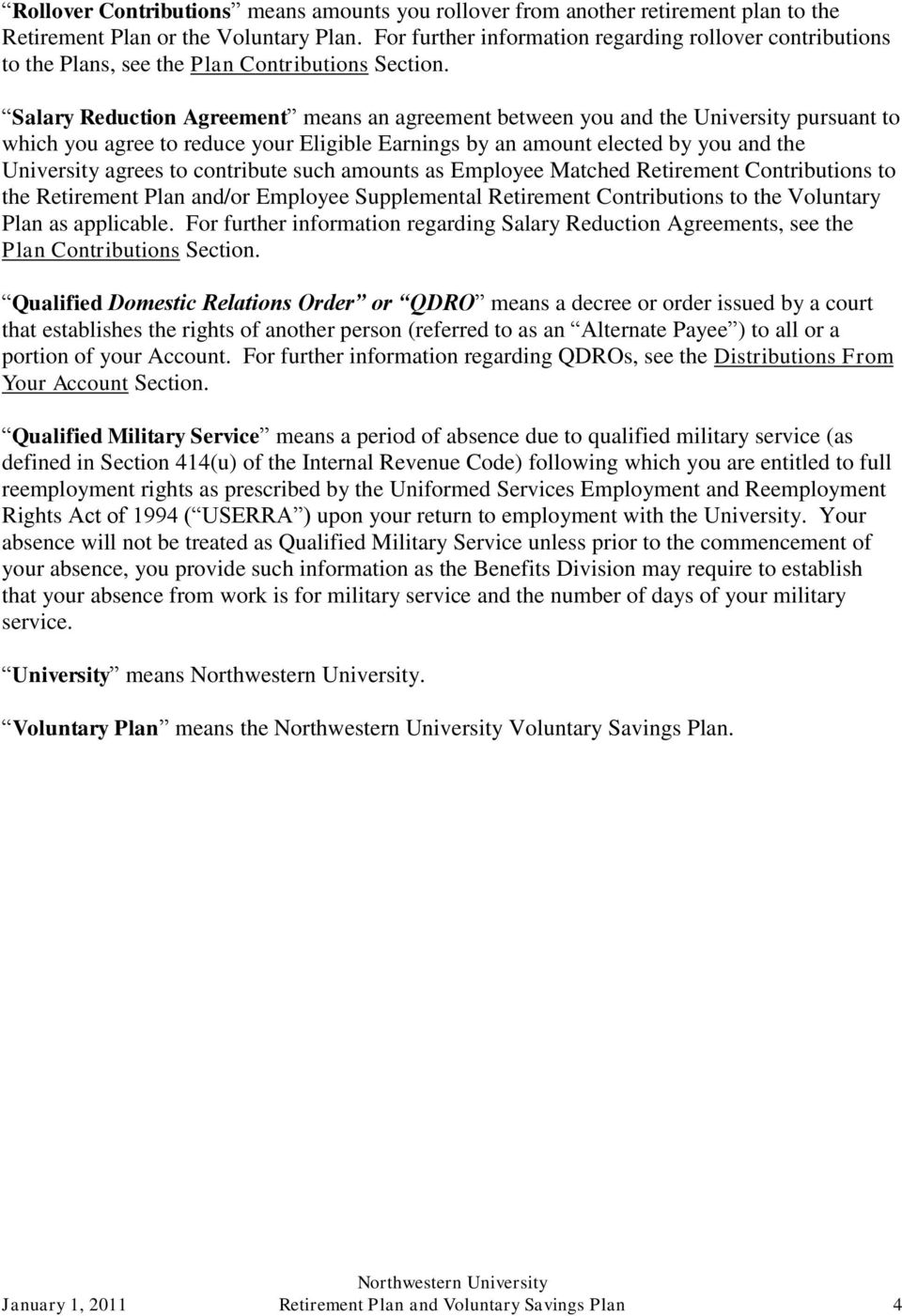
8 Rollover Contributions means amounts you rollover from another retirement plan to the Retirement Plan or the Voluntary Plan. For further information regarding rollover contributions to the Plans, see the Plan Contributions Section. Salary Reduction Agreement means an agreement between you and the University pursuant to which you agree to reduce your Eligible Earnings by an amount elected by you and the University agrees to contribute such amounts as Employee Matched Retirement Contributions to the Retirement Plan and/or Employee Supplemental Retirement Contributions to the Voluntary Plan as applicable. For further information regarding Salary Reduction Agreements, see the Plan Contributions Section. Qualified Domestic Relations Order or QDRO means a decree or order issued by a court that establishes the rights of another person (referred to as an Alternate Payee ) to all or a portion of your Account. For further information regarding QDROs, see the Distributions From Your Account Section. Qualified Military Service means a period of absence due to qualified military service (as defined in Section 414(u) of the Internal Revenue Code) following which you are entitled to full reemployment rights as prescribed by the Uniformed Services Employment and Reemployment Rights Act of 1994 ( USERRA ) upon your return to employment with the University. Your absence will not be treated as Qualified Military Service unless prior to the commencement of your absence, you provide such information as the Benefits Division may require to establish that your absence from work is for military service and the number of days of your military service. University means. Voluntary Plan means the Voluntary Savings Plan. January 1, 2011 Retirement Plan and Voluntary Savings Plan 4
9 Eligible Employee If you employed by the University in an Eligible Employee position, you are eligible to participate in the Voluntary Plan on your date of hire. Once you satisfy the participation requirements for the Retirement Plan, you will automatically begin participation in the Retirement Plan on your Participation Date. If you subsequently transfer to a Non-Eligible Employee position, your participation in the Retirement Plan will cease. However, you are always eligible to participate in the Voluntary Plan. You are an Eligible Employee if you are an: Eligible Faculty Member. A faculty member who holds a full-time appointment at the University for at least half of the full academic year or an appointment of at least half-time for the entire academic year; Eligible Regular Status Staff Member. A regular status staff member who is paid by the University on a monthly basis and scheduled to work at.5 FTE (Full-Time Equivalent) or greater or on a bi-weekly basis and normally scheduled to work at least hours per week; or Eligible Union Member. A University employee whose terms of employment are the subject of a collective bargaining agreement and the collective bargaining agreement expressly provides that you are eligible to participate in the Plans. If you are not an Eligible Employee as described above, you are not eligible to participate in the Retirement Plan. A Non-Eligible Employee includes a (1) Temporary Allen Center Instructor, (2) Temporary Athletic Coach, Instructor, or Trainer, (3) Temporary Center for Talent Development Teacher or Assistant, (4) Temporary Kellogg Mock Interviewer, (5) Public Safety Adjunct Instructor, (6) SPAC Group Fitness or Personal Trainer, or (7) nonresident alien. If you cease to be an Eligible Employee, you are always eligible to participate in the Voluntary Plan. If you were not initially hired as an Eligible Employee position, you will become an Eligible Employee on the first day of the pay period following the date you are appointed or transferred to an Eligible Employee position. You will automatically begin participation in the Retirement Plan on your Participation Date. Your appointment, job position or classification (including type of appointment and scheduled hours) is determined by the payroll or personnel records maintained by the University and such January 1, 2011 Retirement Plan and Voluntary Savings Plan 5

10 determination is binding and conclusive for all purposes of the Plans. For example, if you are classified as an independent contractor or an individual whose services are performed pursuant to a leasing agreement, i.e., you are not classified as a common law employee by the University at the time services are performed, you are not eligible to retroactively participate in the Retirement Plan regardless of any judicial or administrative reclassification or subsequent reclassification by the University. January 1, 2011 Retirement Plan and Voluntary Savings Plan 6

11 Participation You are eligible to participate in the Voluntary Plan on your date of hire or rehire regardless of age. If you are hired as an Eligible Employee and are at least 24 years old, your participation in the Retirement Plan will begin once: You complete 1-Year of Continuous Service; or You submit a Service Waiver Form to the Benefits Division documenting that 31 or fewer days before your University hire date you were (1) an employee of a tax-exempt educational or research organization or a state educational organization for at least a 12-consecutive month period and (2) eligible to receive employer contributions or accrue benefits under that organization s retirement plan. If you complete 1-Year of Continuous Service or completed the equivalent at another organization as described above but you are not 24 years old, your participation in the Retirement Plan will begin once you attain age 24; provided, you are an Eligible Employee on your Participation Date. 1-Year of Continuous Service You will be credited with 1-Year of Continuous Service on the first anniversary of your hire date if you are scheduled to work as an Eligible Employee at all times during the 12-consecutive month period beginning on your hire date. If you do not complete 1-Year of Continuous Service, your participation in the Retirement Plan will begin if you complete 1-Year of Eligibility Service, see Transfer to Eligible Employee Position Section below. Service Waiver From You can download the Service Waiver Form at: /403bwaive.pdf. Once you satisfy the participation requirements, you will become a Participant in the Retirement Plan on your Participation Date as follows: Monthly Paid Eligible Employee. You will become a Participant on the first day of the month that next follows your completion of the participation requirements; provided, that you are an Eligible Employee on that date. Bi-Weekly Paid Eligible Employee. You will become a Participant as of the first pay date in the month next following your completion of the participation requirements; provided, that you are an Eligible Employee on that date. January 1, 2011 Retirement Plan and Voluntary Savings Plan 7

12 If you do not complete 1-Year of Continuous Service during your first year of employment with the University because, for example, you were not hired as an Eligible Employee but you are subsequently reclassified as an Eligible Employee, you may satisfy the Retirement Plan s participation requirements by completing 1-Year of Eligibility Service. You will be credited with 1-Year of Eligibility Service if you complete at least 1,000 Hours of Service during an Eligibility Computation Period. All of your employment with the University is taken into account in determining whether your have completed 1-Year of Eligibility Service. That is, your employment as a Non-Eligible Employee will be taken into account to determine whether you have completed 1-Year of Eligibility Service. Hour of Service Generally, you will be credited with at least one Hour of Service for each hour that you are directly or indirectly paid or entitled to pay for the performance of services for the University. See Authorized Leaves of Absence section below for special rules. For example, assume you are hired by the University on July 1, 2010 and subsequently become an Eligible Employee on September 1, Your first Eligibility Computation Period is July 1, 2010 to June 30, If you complete at least 1,000 Hours of Service during your first Eligibility Computation Period that ends on June 30, 2011, you will be credited with 1-Year of Eligibility Service and your participation in the Retirement Plan will begin on your Participation Date if you are at least 24 years of age. Eligibility Computation Period Your Eligibility Computation Period is the 12-consecutive month period that begins on your hire date and each anniversary of that date unless your Eligibility Computation Period is changed as described in the Break in Service Rules for Retirement Plan section below. If you do not complete 1,000 Hours of Service during your first Eligibility Computation Period but you complete at least 1,000 Hours of Service during any subsequent Eligibility Computation Period, your participation in the Retirement Plan will begin on your Participation Date; provided, you are an Eligible Employee on your Participation Date. If you complete 1-Year of Eligibility Service but you are not 24 years old, your participation in the Retirement Plan will begin on your Participation Date once you attain age 24; provided, you are an Eligible Employee on your Participation Date. For purposes of determining whether you have completed 1-Year of Continuous Service or 1-Year of Eligibility Service, you will be credited with Continuous Service or Hours of Service during an Authorized Leave of Absence as follows: Authorized Leaves of Absence. If you are an Eligible Employee on the day preceding an Authorized Leave of Absence, you will be treated as scheduled to work as an Eligible Employee throughout such leave. If you were not an Eligible Employee on the day January 1, 2011 Retirement Plan and Voluntary Savings Plan 8

13 preceding an Authorized Leave of Absence, you will be credited with Hours of Service equal to your normally scheduled work hours. In each case, if you fail to report to work at the end of an Authorized Leave of Absence, you will not be treated as an Eligible Employee throughout such leave or, if applicable, will be not be credited with Hours of Service while you were on such leave. Qualified Military Service. If you are an Eligible Employee on the day prior to the commencement of Qualified Military Service, you will be treated as scheduled to work as an Eligible Employee throughout your Qualified Military Service. If you were not an Eligible Employee on the day prior to the commencement of Qualified Military Service, you will be credited with Hours of Service equal to your normally scheduled work hours. In each case, if you fail to report timely to work at the end of your Qualified Military Service, you will not be treated as an Eligible Employee throughout your absence or, if applicable, will be not be credited with Hours of Service during your absence unless your absence is otherwise an unpaid Authorized Leave of Absence. Termination Prior to Completing a Year of Service. If you terminate employment with the University prior to completing 1-Year of Continuous Service or 1-Year of Eligibility Service, as applicable, and you are rehired after incurring a 1-Year Break in Service, you will be treated as a new hire. That is, you must complete 1-Year of Continuous Service or, if applicable, 1-Year of Eligibility Service following your rehire date determined using an Eligibility Computation Period that begins on your University rehire date and each anniversary thereof. You will incur a 1-Year Break in Service during your first Eligibility Computation Period if you do not complete at least 501 Hours of Service. For example, assume you are hired by the University on July 1, Your first Eligibility Computation Period is July 1, 2010 to June 30, Assume further that you terminate employment on September 30, 2010 after completing 480 Hours of Service. If you are not rehired by the University by the end of your first Eligibility Computation Period, i.e., by June 30, 2011, you will incur a 1-Year Break in Service during your first Eligibility Computation Period. If you are rehired after June 30, 2011, your Eligibility Computation Period will begin on your University rehire date and each anniversary thereof. If you do not incur a 1-Year Break in Service during your first Eligibility Computation Period, i.e., you completed at least 501 Hours of Service but less than 1,000 Hours of Service, you will incur a 1-Year Break in Service during your second Eligibility Computation Period if you are not rehired by the University by the end of your second Eligibility Computation Period. For example, assume you are hired by the University on July 1, Your first Eligibility Computation Period is July 1, 2010 to June 30, Assume further that you terminate employment on December 15, 2010 after completing 900 Hours of Service. If you are not rehired by the University by the end of your second Eligibility Computation Period, i.e., by June 30, 2012, you will incur a 1-Year Break in Service during your second Eligibility Computation Period. If you are rehired after June 30, 2012, your Eligibility Computation Period will begin on your University rehire date and each anniversary thereof. January 1, 2011 Retirement Plan and Voluntary Savings Plan 9
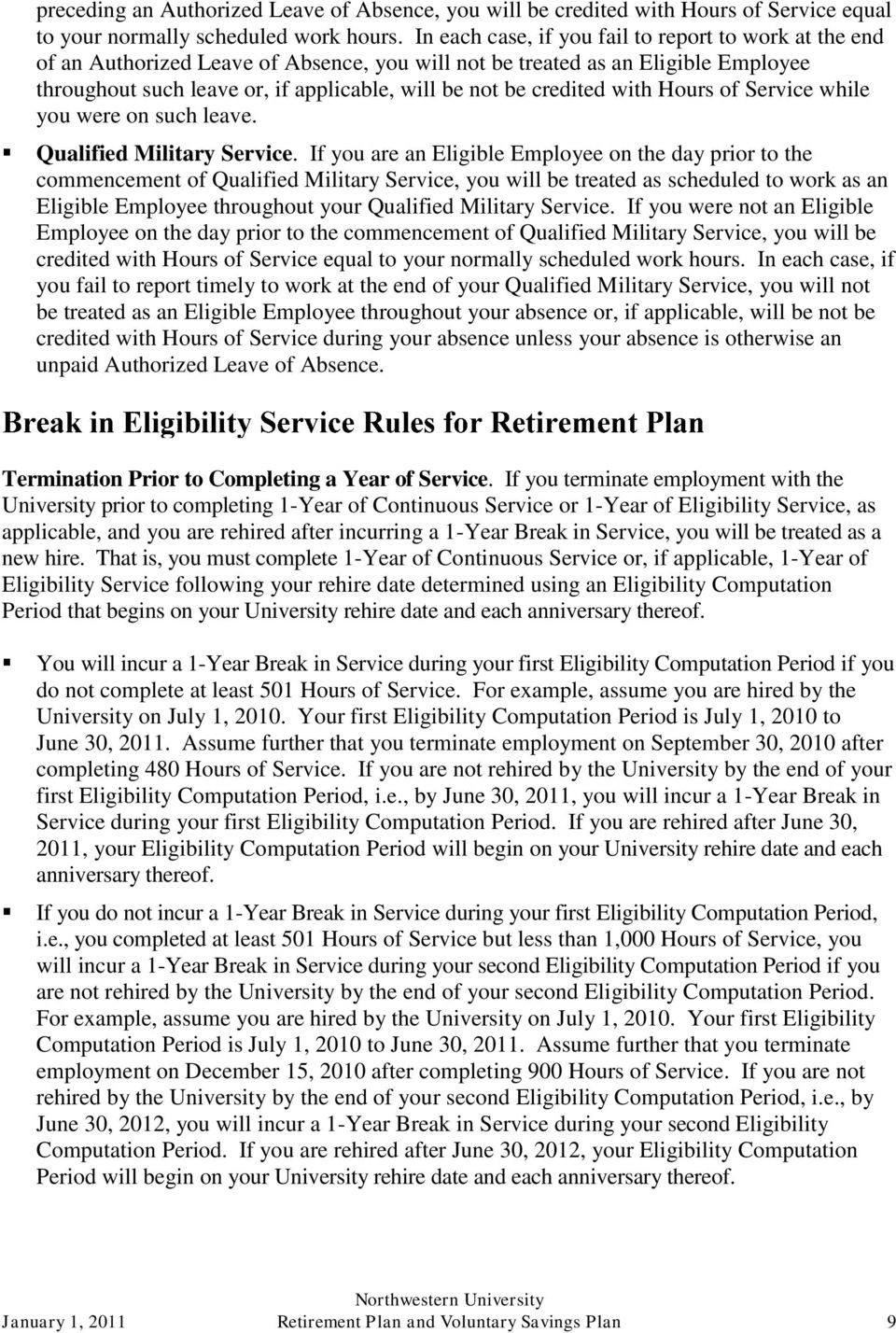
14 Termination After Completing a Year of Service. If you terminate employment with the University after completing 1-Year of Continuous Service or 1-Year of Eligibility Service, as applicable, and you were not a Participant in the Retirement Plan, i.e., you were not an Eligible Employee or you had not attained age 24, you will be treated as a new hire if you are rehired by the University after incurring a five (5) consecutive 1-Year Breaks in Service. That is, you must complete 1-Year of Continuous Service or, if applicable, 1-Year of Eligibility Service following your rehire date determined using an Eligibility Computation Period that begins on your University rehire date and each anniversary thereof. Termination After Becoming a Participant. If you terminate employment with the University after becoming a Participant in the Retirement Plan, the Break in Service rules described in this section do not apply to you and you will recommence participation in the Retirement Plan under the rules described in the Participation upon Reemployment or Reclassification section below. Maternity or Paternity Absence. If you terminate employment for maternity or paternity reasons, up to 501 Hours of Service will be credited to the Eligibility Computation Period in which you terminate if it is necessary to prevent a 1-Year Break in Service for that Eligibility Computation Period; otherwise such Hours of Service will be credited to the next following Eligibility Computation Period. A maternity or paternity leave is a period during which you are initially absent from work on account of (i) your pregnancy, (ii) birth of your child, (iii) placement of a child in connection with your adoption of such child, or (iv) care of a child described in (ii) or (iii) immediately after such birth or placement. You must timely provide the University with sufficient information prior to your maternity or paternity leave to establish that your termination from work is on account of maternity or paternity reasons. Once you become a Participant in the Retirement Plan, you may continue to actively participate in the Retirement Plan (i.e., you are eligible to make Employee Matched Retirement Contributions and to receive Northwestern Retirement Contributions) so long as you remain employed as an Eligible Employee, see Eligible Employee Section. If you cease to be an Eligible Employee for purposes of the Retirement Plan, you are always eligible to make to Employee Supplemental Retirement Contributions to the Voluntary Plan. Reemployment. If you were a Participant in the Retirement Plan as of your prior termination date and you are rehired as an Eligible Employee, you will resume active participation in the Retirement Plan as of your Participation Date (see above) determined as if you completed the Retirement Plan s participation requirements on your rehire date. If you are not rehired as an Eligible Employee, you will not resume active participation in the Retirement Plan on your rehire date. If you are subsequently reclassified as an Eligible Employee, you will participate in the Retirement Plan as described below. If you were not a Participant in the Retirement Plan prior to your rehire date, you will participate in the Retirement Plan once you complete the Retirement Plan s participation requirements (subject to any Break in Service rules) as each is described above. January 1, 2011 Retirement Plan and Voluntary Savings Plan 10

15 Reclassification. If you are a Participant in the Retirement Plan and you cease to be employed as an Eligible Employee, you will resume active participation in the Retirement Plan if you again become an Eligible Employee. In such case, your Participation Date (see above) will be determined as if you completed the Retirement Plan s participation requirements on your reclassification date. If you are not a Participant in the Retirement Plan and you cease to be employed as an Eligible Employee, you will participate in the Retirement Plan if you again become an Eligible Employee once you complete the Retirement Plan s participation requirements (subject to any Break in Service rules) as each is described above. If you work beyond the normal retirement age of 65, you may continue to participate in Retirement Plan and Voluntary Plan in the same manner as any other active Participant. January 1, 2011 Retirement Plan and Voluntary Savings Plan 11

16 Plan Contributions Building retirement income is a shared responsibility between you and the University. While you are eligible to make and receive contributions under the Retirement Plan, the University contributes Northwestern Automatic Retirement Contributions and, if you make an Employee Matched Retirement Contribution of at least one percent (1%) of your Eligible Earnings, the University will make a dollar for dollar Northwestern Match Retirement Contribution up to 5% of your Eligible Earnings. You may also supplement your retirement income by making Employee Supplemental Retirement Contributions to the Voluntary Plan. If you contribute: Then the University contributes: Match Retirement Contribution Automatic Retirement Contribution For a Total of: 0% + 0% + 5% = 5% 1% + 1% + 5% = 7% 2% + 2% + 5% = 9% 3% + 3% + 5% = 11% 4% + 4% + 5% = 13% 5% + 5% + 5% = 15% Generally, Eligible Earnings for a pay period is your base salary. This means that your Eligible Earnings includes any contributions you make pursuant to a Salary Reduction Agreement (described below) to the Plans as well as any amounts you contribute to University welfare and fringe benefit plans such as health plans, flexible spending accounts, and the qualified transportation plan. Eligible Earnings You can access a detailed list of Eligible Earnings Codes from the Benefits Divisions website at: retirement/pdf/elig-earnings.pdf Eligible Earnings does not include (1) reimbursements or other expense allowances, (2) fringe benefits (cash and noncash), (3) moving expenses, (4) nonqualified deferred compensation, (5) welfare benefits (including short-term disability payments), (6) bereavement pay, (7) lump sum payments of unused accrued vacation pay, or (8) severance pay. January 1, 2011 Retirement Plan and Voluntary Savings Plan 12

17 Eligible Earnings in excess of Compensation Limit. Eligible Earnings do not include amounts in excess of the compensation limit imposed by the Internal Revenue Code. This means that Eligible Earnings in excess of the Compensation Limit (measured on a Plan Year basis) is not taken into account for purposes of computing your Northwestern Retirement Contributions. The Compensation Limit is increased from time to time for cost of living adjustments. Additional Pay. If you are not a Highly Compensated Employee for the Plan Year, Eligible Earnings include supplemental pay and pay for temporary assignments or additional assignments. You are a Highly Compensated Employee if, for the immediately preceding Plan Year, you earned in excess of the dollar amount established by the IRS each year. Compensation Limit The compensation limit in effect for the 2011 Plan Year is $245,000. To find out the compensation limit in effect for subsequent Plan Years, visit the Benefits Division website at: tirement/index.html Highly Compensated Employee (HCE) You are an HCE for the 2011 Plan Year if your University pay was more than $110,000 in 2010 Plan Year. To find out the HCE compensation threshold for subsequent Plan Years, visit the Benefits Division website. Eligible Earnings paid prior to Participation Date. Eligible Earnings paid prior to your Participation Date is not taken into account for purposes of computing your Northwestern Retirement Contributions. Post-Termination Eligible Earnings. As required by tax laws, Eligible Earnings paid after termination of employment cannot be treated as Eligible Earnings unless paid by the end of the calendar year that includes your termination date or, if later, within 2½ months following your termination date. The University makes contributions to the Retirement Plan equal to five percent (5%) of your Eligible Earnings on a pay period basis regardless of whether you make Employee Matched Retirement Contributions. If you make an Employee Matched Retirement Contribution to the Retirement Plan of at least one percent (1%) of your Eligible Earnings (but not to exceed five percent (5%)) for a pay period, the University will make a Northwestern Match Retirement Contributions equal to 100% of your Employee Matched Retirement Contribution for that pay period. An Example If you only make a 1% Employee Matched Retirement Contribution, you are missing out. If you contribute 1% of your Eligible Earnings to the Retirement Plan, the University only contributes a 1% Northwestern Match Retirement Contribution. When you January 1, 2011 Retirement Plan and Voluntary Savings Plan 13
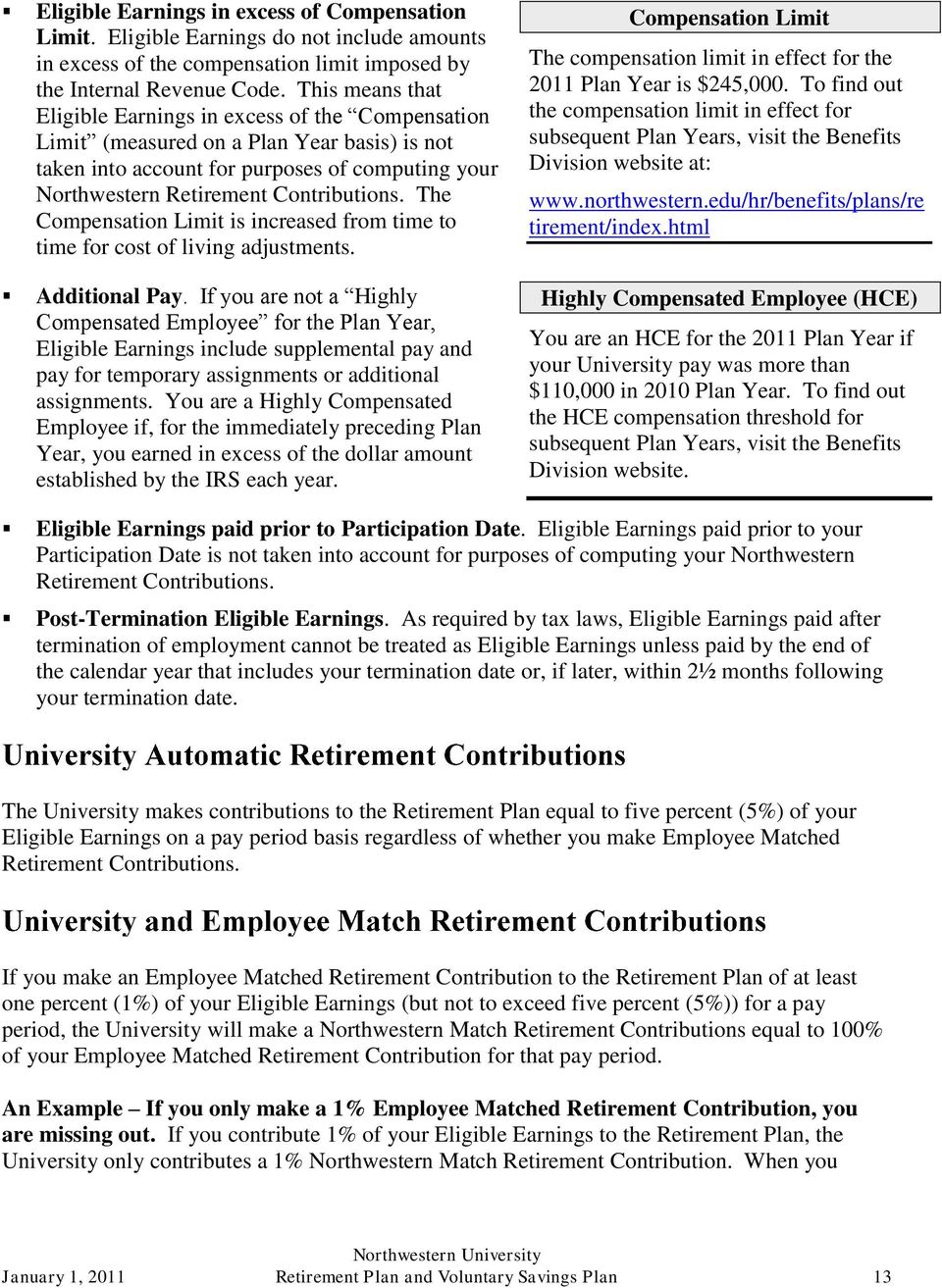
18 contribute 5% of your Eligible Earnings to the Retirement Plan, the University contributes a 5% Northwestern Match Retirement Contribution. Let s assume your annual Eligible Earnings are $50,000. If you contribute Employee Matched Retirement Contribution of Northwestern Match Retirement Contribution of 1% of your Eligible Earnings $50,000 x 1% $500 $500 5% of your Eligible Earnings $50,000 x 5% $2,500 $2,500 By only contributing 1% of your Eligible Earnings rather than 5% of your Eligible Earnings, you will receive $2,000 less in Northwestern Match Retirement Contributions per year. Northwestern Match Retirement Contribution True-Up The University will true up your Northwestern Match Retirement Contributions at the end of the year to make sure you receive the maximum match contribution amount. You will receive additional Northwestern Match Retirement Contributions under the true-up feature if the Northwestern Match Retirement Contributions you received on a pay period basis are less than the amount of Northwestern Match Retirement Contributions you would have received had the match contribution formula been applied on a Plan Year basis. True-up Northwestern Match Retirement Contributions are deposited as soon as administratively feasible following the end of the Plan Year but in no event later than March 31 st. You can make Employee Supplemental Retirement Contributions to the Voluntary Plan prior to becoming eligible to participate in the Retirement Plan. Once you are eligible to participate in the Retirement Plan, you can make contributions in addition to Employee Matched Retirement Contributions, i.e., contributions in excess of 5% of your Eligible Earnings, by making Employee Supplemental Retirement Contributions to the Voluntary Plan. If you cease to be an Eligible Employee, you can always make Employee Supplemental Retirement Contributions to the Voluntary Plan. For further information regarding Salary Reduction Agreement and the automatic transfer of your Salary Reduction Agreement between the Retirement Plan and Voluntary Plan, see below. The University does not match Employee Supplemental Retirement Contributions. Both Employee Matched Retirement Contributions to the Retirement Plan and Employee Supplemental Retirement Contributions to the Voluntary Plan are made on a before-tax basis. This means that your Eligible Earnings for each pay period is reduced by your Employee Retirement Contributions before federal and most state taxes are withheld. This lowers your current taxable income and allows you to pay less in income taxes. Employee Retirement January 1, 2011 Retirement Plan and Voluntary Savings Plan 14
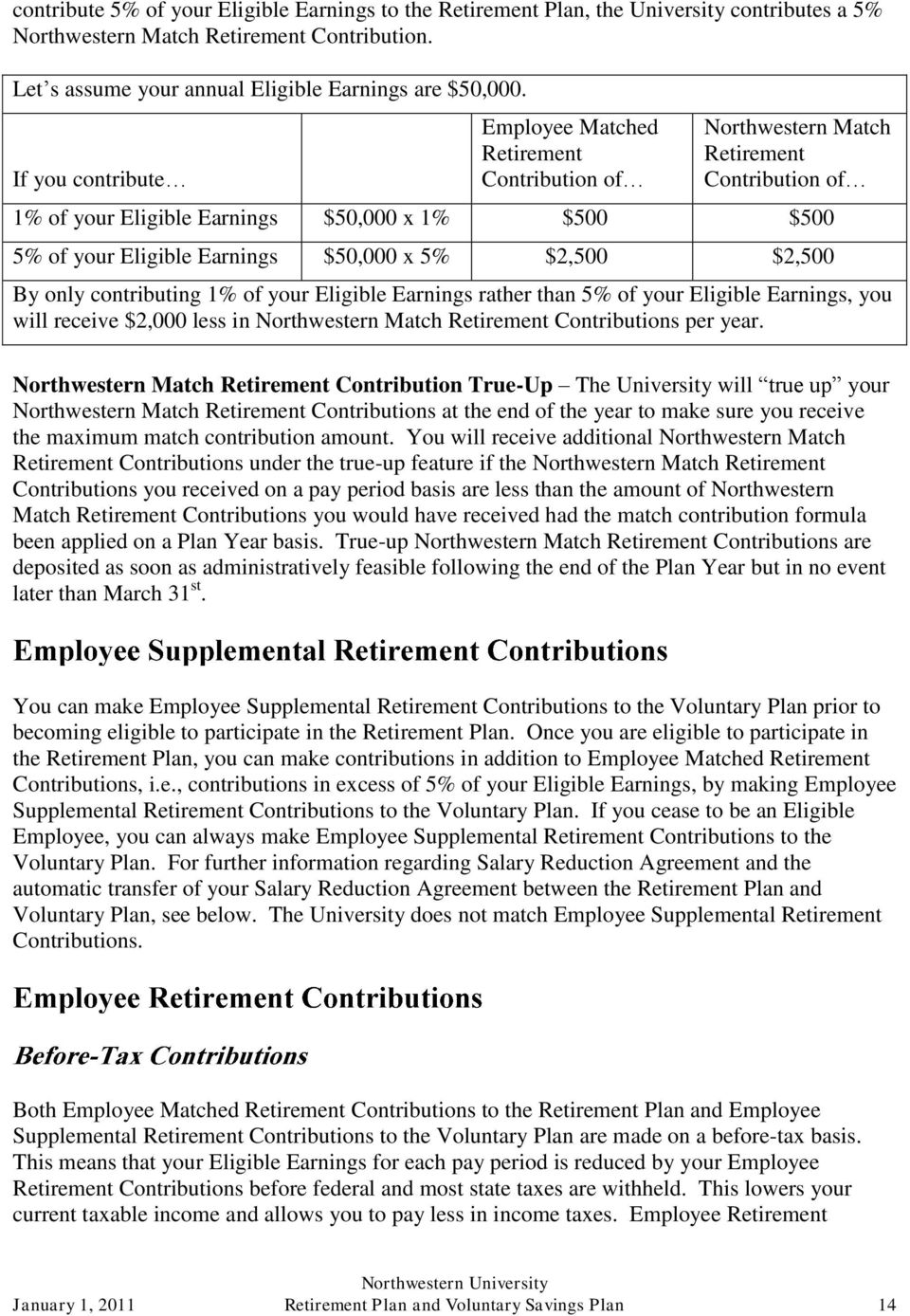
19 Contributions, however, do not reduce your Eligible Earnings for purposes of computing your Social Security and Medicare taxes. Let s assume your annual Eligible Earnings are $50,000. When you contribute You pay taxes on At an approximate tax rate of So, you pay in taxes Nothing (0%) of your Eligible Earnings $50,000 25% $12,500 5% of your Eligible Earnings $47,500 25% $11,875 Your tax savings would be $625 per year and you will receive $2,500 in Northwestern Match Retirement Contributions. Entering into a Salary Reduction Agreement. You must enter into a Salary Reduction Agreement to make Employee Retirement Contributions. If you cannot complete your Salary Reduction Agreement or make changes to your Salary Reduction Agreement online, contact the Benefits Division for assistance. Employee Matched Retirement Contributions to Retirement Plan. In the Salary Reduction Agreement, you will elect the amount you want to contribute on a pay period basis to the Retirement Plan as Employee Matched Retirement Contributions by entering a whole percentage between 1% and 5% of your Eligible Earning. Online submission of Salary Reduction Agreement (SRA) You must complete your SRA online using the University s HRIS Self Service that you can access through the Benefits Division website at: ement/index.html Employee Supplemental Retirement Contributions to Voluntary Plan. You may also elect the amount, if any, you want to contribute on a pay period basis to the Voluntary Plan as Employee Supplemental Retirement Contributions by entering a whole percentage of your Eligible Earnings or a flat dollar amount. Supplemental Contribution Calculator If you wish to contribute up to the maximum Employee Contribution Limit, you can use the Supplemental Contribution Calculator that is available to you through the Benefits Division website. You must also select the Investment Company you want to use for the investment of your Employee Retirement Contributions and Northwestern Retirement Contributions. For further information regarding the Plans Investment Companies and Investment Funds, see the Investing Your Plan Contributions Section. Effective Date of Salary Reduction Agreement. If you elect to make Employee Supplemental Retirement Contributions to the Voluntary Plan during the period you are not eligible to January 1, 2011 Retirement Plan and Voluntary Savings Plan 15

20 contribute to the Retirement Plan, your Salary Reduction Agreement will be applied against your next paycheck if administratively practicable or the next paycheck thereafter following the date you submit online your Salary Reduction Agreement. If you choose not to enter into a Salary Reduction Agreement until you are eligible to contribute to the Retirement Plan, your Salary Reduction Agreement will become effective as of your Participation Date or, if you choose to enter into a Salary Reduction Agreement after your Participation Date, your Salary Reduction Agreement will be applied against your next paycheck if administratively practicable or the next paycheck thereafter following the date you submit online your Salary Reduction Agreement. For further information regarding Participation Dates, see Participation Section. Once implemented, your Salary Reduction Agreement will remain in effect until you change or terminate it or it is automatically suspended as described below. If you fail to submit a Salary Reduction Agreement, you will be deemed to have filed a 0% Salary Reduction Agreement under both Plans. Salary Reduction Agreement Applies to Both Plans. If you are making Employee Supplemental Retirement Contributions to the Voluntary Plan during the period you are not eligible to contribute to the Retirement Plan, your Employee Supplemental Retirement Contributions that do not exceed 5% of your Eligible Earnings will be automatically converted to Employee Matched Retirement Contributions and made to the Retirement Plan once you are eligible to contribute to the Retirement Plan. If you are making Employee Matched Retirement Contributions to the Retirement Plan and you cease to be an Eligible Employee, your Employee Matched Retirement Contributions will be automatically converted to Employee Supplemental Retirement Contributions and made to the Voluntary Plan. To Change or Terminate Your Salary Reduction Agreement. You may change your Salary Reduction Agreement to increase or decrease your Employee Matched Retirement Contributions or your Employee Supplemental Retirement Contributions at any time by submitting an online Salary Reduction Agreement through the University s HRIS Self Service website. A change to your Salary Once your Salary Reduction Agreement (including a deemed 0% Salary Reduction Agreement) is put into effect, it will remain in effect for the current calendar year and each calendar year thereafter until you change or terminate your Agreement. Reduction Agreement will be applied against your next paycheck if administratively practicable or the next paycheck thereafter following the date you submit online a new Salary Reduction Agreement. Keep in mind that if you decrease your Employee Matched Retirement Contributions, your Northwestern Match Retirement Contributions will also decrease. For example, if you change your Employee Matched Retirement Contribution percentage from 5% to 2%, then the University will decrease the Northwestern Match Retirement Contribution percentage from 5% to 2%. Automatic Suspension of Salary Reduction Agreement. Your Salary Reduction Agreement will automatically be suspended as follows: Maximum Dollar Limit. If your Employee Matched Retirement Contributions to the Retirement Plan when added to your Employee Supplemental Retirement Contributions to the Voluntary Plan reach the Employee Contribution Limit described in the Plan Contribution Limits below during the calendar year, your Salary Reduction Agreement will January 1, 2011 Retirement Plan and Voluntary Savings Plan 16
21 be suspended for the remainder of the calendar year. If you don t change or terminate your Salary Reduction Agreement prior to the beginning of the next calendar year, your Salary Reduction Agreement as in effect prior to reaching your Employee Contribution Limit will automatically be reinstated and applied to your first paycheck in January. If you do change or terminate your Salary Reduction Agreement after you reach your annual contribution limit, your new contribution rate or zero contribution rate will be applied to your first paycheck in January. In each case, your Salary Reduction Agreement will stay in effect until you change it. Hardship Withdrawal. If you take a hardship withdrawal from the Retirement Plan or the Voluntary Plan, the IRS requires that your Employee Retirement Contributions to both Plans (and, if applicable, your contributions to the University s 457(b) Plan) be suspended for six months. If you don t change or terminate your Salary Reduction Agreement during the sixmonth suspension period, your Salary Reduction Agreement as in effect prior to your hardship withdrawal will automatically be reinstated and applied to the first paycheck you receive following the end of your suspension period. If you do change or terminate your Salary Reduction Agreement during your suspension period, your new contribution rate or zero contribution rate will be applied to the first paycheck you receive following the end of your suspension period. In each case, your Salary Reduction Agreement will stay in effect until you change it. For further information regarding hardship withdrawals, see the Distribution From Your Account Section. If you wish to make a rollover to the Retirement Plan or the Voluntary Plan, you must contact your Investment Company directly using the contact information to the right. All rollover contributions to the Plans are subject to rules established by the applicable Investment Company. Generally, however, you may roll over all or a portion of an eligible rollover distribution from another retirement plan to the Plans. An eligible rollover distribution is typically any cash distribution other than an annuity payment, a required minimum distribution, a distribution that is part of a fixed period payment of ten years or more, or a hardship withdrawal. To contact Fidelity Investments: Call (800) or visit Fidelity Investment s website at: Plan ID: To contact TIAA-CREF: Call the TIAA-CREF National Contact Center at (800) or visit the TIAA-CREF Web Center at: In most cases, your Investment Company will approve the following type of rollovers: Before-Tax Contributions. An eligible rollover distribution of tax deductible amounts from an individual retirement account or annuity (IRA) described in Section 408(a) or 408(b) of the Internal Revenue Code and before-tax contributions from a tax-deferred annuity contract described in Section 403(b) of the Internal Revenue Code, a qualified plan described in January 1, 2011 Retirement Plan and Voluntary Savings Plan 17
22 Section 401(a) or 403(a) Internal Revenue Code, or an eligible plan described in Section 457(b) of the Internal Revenue Code which is maintained by a state, political subdivision of a state, or any agency or instrumentality of a state or political subdivision of a state. After-Tax Contributions (Non-Roth Contributions). An eligible rollover distribution of after-tax contributions from a tax-deferred annuity contract described in Section 403(b) of the Internal Revenue Code or a qualified plan described in Section 401(a) or 403(a) Internal Revenue Code; provided, that (1) the rollover is accomplished by a direct rollover and (2) the distributing employer plan provides sufficient information so that the Investment Company can separately account for your rollover of after-tax contributions. The Plans cannot accept rollovers of non-deductible contributions from an IRA (an individual retirement account or annuity described in Section 408(a) or 408(b) of the Internal Revenue Code). Roth Contributions. The Plans cannot accept eligible rollover distributions of Roth contributions. Northwestern Retirement Contributions and Employee Retirement Contributions will continue or cease during an authorized leave of absence as follows: Leave With Pay. During a leave of absence with full or partial pay, Northwestern Retirement Contributions and Employee Retirement Contributions will continue to be made based on your Eligible Earnings then being paid by the University so long as you remain an Eligible Employee throughout such leave. If you are making Employee Matched Retirement Contributions to the Retirement Plan and you cease to be an Eligible Employee, your Employee Matched Retirement Contributions will be automatically converted to Employee Supplemental Retirement Contributions and made to the Voluntary Plan. Leave Without Pay. During a leave of absence without pay, Northwestern Retirement Contributions and Employee Retirement Contributions will cease. If you return as an Eligible Employee, Northwestern Automatic Retirement Contributions will automatically resume. If you don t change or terminate your Salary Reduction Agreement during your leave, your Salary Reduction Agreement as in effect prior to your leave will automatically be reinstated effective as of your first pay date following the end of your leave and corresponding Northwestern Match Retirement Contributions, if applicable, will automatically resume. If you do change or terminate your Salary Reduction Agreement during your leave, your new contribution rate or zero contribution rate will be implemented as of the first pay date following the end of your leave and corresponding Northwestern Match Retirement Contributions, if applicable, will automatically resume. In each case, your Salary Reduction Agreement will stay in effect until you change it. Leave for Qualified Military Service. If your leave of absence is due to Qualified Military Service, you are eligible to receive make-up Northwestern Automatic Retirement Contributions following your return to employment with the University. You are also eligible to contribute make-up Employee Retirement Contributions and to receive corresponding Northwestern Match Retirement Contributions. January 1, 2011 Retirement Plan and Voluntary Savings Plan 18
23 Northwestern Automatic Retirement Contributions. The University will contribute make-up Northwestern Automatic Retirement Contributions at the rate in effect during your Qualified Military Service based on the Eligible Earnings you would have received during your Qualified Military Service (less any Eligible Earnings actually received during your Qualified Military Service). If the Eligible Earnings you would have received cannot be determined with reasonably certainty, then your make-up Northwestern Automatic Retirement Contributions will be based on your average Eligible Earnings during the 12-month period immediately preceding your Qualified Military Service. Employee Retirement Contributions. The period during which you can contribute make-up Employee Retirement Contribution is equal to three (3) times the period of your Qualified Military Service, up to a maximum of five (5) years. For example, if your Qualified Military Service period was one year, you have three years following the date of your reemployment to contribute make-up Employee Retirement Contributions. The amount of your make-up Employee Retirement Contributions is subject to the dollar limit(s) that applied during your Qualified Military Service. You may change, terminate, or resume your make-up Employee Retirement Contribution during the make-up period without penalty for termination. Employee Matched Retirement Contributions (contributions that do not exceed 5% of your Eligible Earnings) are made under the Retirement Plan. Employee Supplemental Retirement Contributions are made under the Voluntary Plan. Northwestern Match Retirement Contributions. The University will contribute make up Northwestern Match Retirement Contributions at the rate in effect during your Qualified Military Service. For example, if your Qualified Military Service occurs during 2010 and following your return in 2011, you contribute make-up Employee Matched Retirement Contributions that equal to 5% of the Eligible Earnings you would have received during your Qualified Military Service, the University will contribute a make-up Northwestern Match Retirement Contributions in the same amount. You must timely provide the University with sufficient information prior to your military leave to establish that your leave from work is on account of Qualified Military Service. For further information regarding make-up Northwestern Retirement Contributions and Employee Retirement Contributions following Qualified Military Service, please contact the Benefits Division. You are always fully and immediately vested in your Account. This means that your Northwestern Retirement Contributions, Employee Retirement Contributions, and any Rollover Contributions as adjusted for earnings, losses, etc., belong to you and cannot be forfeited for any reason. However, the University retains the right to remove Plan Contributions and/or earnings from your Account that were allocated in error and you are responsible for any fees and charges that may be imposed by your Investment Company or under your selected Investment Funds. January 1, 2011 Retirement Plan and Voluntary Savings Plan 19
24 You select the Investment Funds in which you want your Account invested. For important information regarding the Investment Funds available under the Plans, see the Investing Your Plan Contributions Section. There are two types of contributions limits, an Employee Contribution Limit and a Plan Contribution Limit (Employee Retirement Contributions plus Northwestern Retirement Contributions). The limits apply on a calendar basis and, because the dollar limits are adjusted from time to time for cost of living adjustments, the IRS releases the dollar limits prior to the beginning of each calendar year. To find out the dollar limits in effect for a calendar year, visit the Benefits Division website at: ement/index.html For each calendar year, your Employee Retirement Contributions cannot exceed the maximum dollar limit set by the IRS for that calendar year. The maximum dollar limit is applied on an aggregate and individual basis. That is, your Employee Matched Retirement Contributions made to the Retirement Plan and your Employee Supplemental Retirement Contributions made to the Voluntary Plan as well as any elective before-tax or Roth contributions that you make to any other qualified 401(a) employer plan or 403(b) tax-sheltered annuity during the same calendar year count toward the maximum dollar limit. General Dollar Limit. The general dollar limit will apply to you if you are not eligible to increase the general dollar limit by the age 50 and older catch-up. For example, the general dollar limit for 2011 is $16,500. Age 50+ Catch-up Limit. If you will attain age 50 by the end of the calendar year, you may make Employee Retirement Contributions above the general dollar limit up to the age 50+ catch amount in effect for the calendar year and for each calendar year thereafter. For example, the age 50+ catch amount for 2011 is $5,500. Thus, if you will attain age 50 by the end of 2011, you can make Employee Retirement Contributions up to $22,000. You will be deemed to have notified the Benefits Division if your Employee Retirement Contributions made to the Plans exceed the maximum dollar limits described above. Excess Employee Retirement Contributions made to the Plans as adjusted for any allocable income or loss (beginning first with Employee Supplemental Retirement Contributions from the Voluntary Plan) will be distributed to you by April 15 th. Excess Employee Retirement Contributions are taxable in the year made and any allocable income is taxable in the year of distribution. You will receive a Form 1099-R in the following tax year reporting that excess Employee Retirement January 1, 2011 Retirement Plan and Voluntary Savings Plan 20
25 Contributions occurred in the prior year. Northwestern Match Retirement Contributions that are attributable to any excess Employee Matched Retirement Contributions and any allocable income or loss will also be removed from your Account. You are responsible for any tax obligation that you may have as the result of excess Employee Retirement Contributions to the Plans. Notify the Benefits Division. You are responsible for notifying the Benefits Division if you have excess Employee Retirement Contributions as a result of before-tax contributions and/or Roth contributions made to a plan not maintained by the University. You must report any excess Employee Retirement Contributions to the Benefits Division by March 1 st following the year in which your Employee Retirement Contributions exceed the maximum dollar limit. Excess Employee Retirement Contributions reported by March 1 st as adjusted for any allocable income or loss (beginning first with Employee Supplemental Retirement Contributions from the Voluntary Plan) will be distributed to you by April 15 th. Northwestern Match Retirement Contributions that are attributable to any excess Employee Matched Retirement Contributions and any allocable income or loss will also be removed from your Account. You will receive a Form 1099-R in the following tax year reporting that excess contributions occurred in the prior year. Double Taxation. If you do not report excess Employee Retirement Contributions to the Benefits Division by March 1 st, then your excess Employee Retirement Contributions are taxed twice: Once for the tax year in which you make the excess Employee Retirement Contributions, and later when the excess Employee Retirement Contributions are withdrawn or distributed from the Plans. To the extent that you have excess Employee Retirement Contributions as a result of contributions made to a plan not maintained by the University, the University is not liable for any tax obligation that you may have as the result of excess Employee Retirement Contributions to the Plans or any other applicable retirement plan. For each calendar year, the total amount of your Employee Retirement Contributions and Northwestern Retirement Contributions made under the Plans cannot exceed the contribution limit imposed by Section 415 of the Internal Revenue Code. The Plan Contribution Limit is the lesser of (1) the dollar limit in effect for the calendar year as increased from time to time for cost-of-living adjustments or (2) 100% of your Includible Compensation. Rollover Contributions and Employee Retirement Contributions made under the age 50+ catch-up rule described above to the Plans are not counted towards this limit. Includible Compensation. Includible Compensation generally means your gross compensation; that is, your compensation before it is reduced by any contributions you may make pursuant to a salary reduction agreement to the Plans as well as to University welfare and fringe benefit plans such as health plans, reimbursement accounts, and the qualified transportation plan. Special Aggregation Rule for Outside Employment. If a company controlled by you makes contributions on your behalf to a tax-qualified defined contribution plan (e.g., a profit-sharing plan, 401(k) plan, money purchase pension plan), your Northwestern Retirement Contributions January 1, 2011 Retirement Plan and Voluntary Savings Plan 21
26 and Employee Retirement Contributions made under the Plans must be aggregated with amounts contributed under your company plan in determining whether you have exceeded the Plan Contribution Limit for the calendar year. If amounts in excess of the Plan Contribution Limit are attributable to contributions made to your Account under the Plans, such amounts are treated as excess contributions under the Plans and must be included in your taxable income for the year in which the excess contributions were made. Excess contributions held in your Account will not jeopardize the tax-deferred status of your remaining Account if your Investment Company separately accounts for your excess contributions. If separate accounting is not maintained by your Investment Company for the year in which the excess contributions were made and each year thereafter, the IRS can treat your entire Account held under the Plans as taxable. It is your responsibility to notify the Benefits Division or your Investment Company by March 1 st following the calendar year in which you have excess contributions. If you fail to timely notify the Benefits Division or your Investment Company and your Investment Company does not separately account for your excess contributions, the University is not liable for any tax obligation that you may have as the result of excess contributions to the Plans. Controlled Company. Generally, if you own more than 50% of a company then the company is treated as a company controlled by you. For example, if you are a 100% shareholder of a corporation or operate a sole proprietorship that corporation or sole proprietorship is a company controlled by you. The tax laws regarding controlled companies are complex. If you are involved with or operate a business outside the University and you participate in a tax-qualified defined contribution retirement plan maintained by that business, you should consult with your tax advisor to determine whether these special aggregation rules apply to you. Distribution of Excess Contributions. To the extent permitted by your investment fund, you may request a distribution of your excess contributions and allocable income at any time. 6% Excise Tax. If your Account is invested in mutual funds, you may be subject to a 6% excise tax on the excess contribution. The excise tax does not apply to excess contributions invested in the TIAA Retirement Annuity or CREF Accounts. See the Investing Your Plan Contributions Section for further information regarding the different types of Investment Vehicles offered under the Plans. Also, the tax is more fully described in IRS Publication 571. You may obtain a copy of IRS Publication 571 from the IRS web site at An Example Application of Special Aggregation Rule. Jim, who is under age 50, participates in the Retirement Plan but does not participate in the Voluntary Plan. For the 2011 calendar year when the dollar limit is $49,000, Jim receives $12,000 in Northwestern Automatic Retirement Contributions, contributes $12,000 in Employee Matched Retirement Contributions, and receives corresponding Northwestern Match Retirement Contributions of $12,000 for a total contribution of $36,000. Jim is also a 100 percent shareholder of a professional corporation that maintains a qualified defined contribution plan in which Jim participates. For the 2011 calendar year, Jim also receives $20,000 in employer contributions under the plan maintained by his professional corporation. Jim s Retirement Plan contributions of $36,000 and his professional corporation s contributions of $20,000 must be aggregated to determine whether Jim s aggregate contributions are within the Plan Contribution Limit because Jim controls his professional corporation. January 1, 2011 Retirement Plan and Voluntary Savings Plan 22
27 Jim s total aggregate contributions of $56,000 ($36,000 + $20,000) exceed the Plan Contribution Limit of $49,000 by $7,000. The $7,000 is considered an excess contribution and taxable to Jim in The excess contribution will not jeopardize the tax-deferred status of his remaining Account held under the Retirement Plan if Jim timely notifies the Benefits Division or his Investment Company that separate accounting for the $7,000 is required. However, a 6% excise tax may apply until the excess contribution is distributed. January 1, 2011 Retirement Plan and Voluntary Savings Plan 23
28 Investing Your Plan Contributions You decide how your Plan Contributions are to be invested. You may invest your Plan Contributions among a wide range of Investment Funds and may make investment changes as often as you wish subject to the terms of your Investment Funds. The Plans offer a variety of investment choices from two Investment Companies Fidelity Investments and Teachers Insurance and Annuity Association/College Retirement Equities Fund (TIAA-CREF). Both Investment Companies offer a similar variety of Investment Funds, ranging from conservative to aggressive. You decide which Investment Company to use for investing your Plan Contributions. You can allocate your contributions to one Investment Company or between the two Investment Companies in such amounts (or in such percentages) as established by the University. Contact information for each Investment Company is provided at the right. To contact Fidelity Investments: Call (800) or visit Fidelity Investment s website at: Plan ID: To contact TIAA-CREF: Call the TIAA-CREF National Contact Center at (800) or visit the TIAA-CREF Web Center at: The University reserves the right to cease future Plan Contributions to an Investment Company or to add a new Investment Company. Similarly, the University reserves the right to close or cease future Plan Contributions to an Investment Fund or Investment Vehicle or to add a new Investment Fund or Investment Vehicle. The Investment Companies offer a wide range of Investment Funds. The types of Investment Funds offered under the Plans are currently as follows: The TIAA Traditional Annuity is a guaranteed annuity contract issued by TIAA-CREF. Contributions to the TIAA Traditional Annuity are used to purchase a contractual or guaranteed amount of future retirement benefits. Once purchased, the guaranteed benefit of principal plus interest cannot be decreased, but it can be increased by dividends. Dividends, if any, may increase or decrease and changes are usually gradual. January 1, 2011 Retirement Plan and Voluntary Savings Plan 24
29 The TIAA Real Estate Account and CREF Accounts are variable annuity contracts issued by TIAA-CREF. Contributions to the TIAA Real Estate Account and CREF Accounts are used to purchase accumulation units, or shares of participation in the underlying investment fund. The TIAA Real Estate Account and each CREF Account has its own investment objective and portfolio of securities and the value of the accumulation units changes each business day. There is no guaranteed rate of return. Contributions to a Fidelity or TIAA-CREF Mutual Fund are used to purchase accumulation units, or shares of participation in the fund. Each Mutual Fund has its own investment objective and portfolio of securities and the value of the units or shares changes each business day. There is no guaranteed rate of return. It is important for you to understand the types of Investment Vehicles under which Investment Funds are offered. The Plans offer their Investment Funds through a variety of Investment Vehicles as described below: The TIAA Traditional Annuity is a currently offered through the following types of Investment Vehicles: A group retirement annuity contract (GRA), a group supplemental retirement annuity contract (GSRA), an individual retirement annuity contract (RA), or an individual supplemental retirement annuity contract (SRA) issued by TIAA-CREF. Transfers to other Investment Funds and lump sum distributions following termination of employment may be restricted depending on the type of Investment Vehicle under which your TIAA Traditional Annuity is offered. Generally, however, the following restrictions apply: If all or a portion of your Account is invested in the TIAA Traditional Annuity and you do not know whether your TIAA Traditional Annuity is offered under a GRA, GSRA, RA or SRA, contact TIAA-CREF directly. You can obtain a detailed summary regarding the restrictions on transfers and lump sum distribution from the Benefits Division s website by clicking the RA-GRA-GSRA Contract Comparison Chart link. Restriction on Transfers. If your TIAA Traditional Annuity is held under a GRA or a RA, transfers from your TIAA Traditional Annuity to other Investment Funds must be made over a 10-year period (Transfer Payout Annuity) and the minimum transfer is $10,000 or your entire balance in the TIAA Traditional Annuity if less. However, if your total balance is $2,000 or less, you can transfer your entire TIAA Traditional Annuity balance in a single sum as long as you do not have an existing Transfer Payout Annuity in force. If your TIAA January 1, 2011 Retirement Plan and Voluntary Savings Plan 25
30 Traditional Annuity is held under a GSRA or SRA, transfers from your TIAA Traditional Annuity to other Investment Funds may be made at any time. Restriction on Lump Sum Distributions Following Termination of Employment. Whether restrictions apply to lump sum distribution of amounts invested in your TIAA Traditional Annuity following termination of employment depends on the Investment Vehicle under which your TIAA Traditional Annuity is held: - Group Retirement Annuity (GRA). A lump sum distribution is not available for amounts invested in the TIAA Traditional Annuity if held under a GRA unless (1) your total balance in the TIAA Traditional Annuity does not exceed $5,000 and you do not have an existing Fixed Period Option (see Distributions From Your Account Section for further information regarding the Fixed Period Option) or Transfer Payout Annuity in force or (2) you elect a lump sum distribution of your total balance in the TIAA Traditional Annuity within 120 days following your termination of employment and pay a 2½% surrender charge. If your total balance in the TIAA Traditional Annuity exceeds $5,000 and you do not elect a lump sum distribution within 120 days following your termination of employment, you can elect that distributions be made over a 5-year period or in the form of a lifetime annuity. - Retirement Annuity (RA). A lump sum distribution is not available for amounts invested in the TIAA Traditional Annuity if held under a RA. You can elect that distributions be made over a 10-year period or in the form of a lifetime annuity. However, if your total balance in the TIAA Traditional Annuity is $2,000 or less, you can elect a lump sum distribution of your entire TIAA Traditional Annuity balance as long as (1) you do not have an existing Fixed Period Option or Transfer Payout Annuity in force and (2) you elect a lump sum distribution of all amounts invested in TIAA-CREF Investment Funds at the same time. - Group Supplemental Retirement Annuity (GSRA) or Supplemental Retirement Annuity (SRA). A lump sum distribution is available for amounts invested in the TIAA Traditional Annuity if held under a GSRA or SRA. The TIAA Real Estate Account and CREF Accounts are also offered through a group retirement annuity contract (GRA), a group supplemental retirement annuity contract (GSRA), an individual retirement annuity contract (RA), or an individual supplemental retirement annuity contract (SRA). Transfers and withdrawals from the TIAA Real Estate Account are limited to once per calendar quarter. There are no restrictions on transfers and withdrawals from the CREF Accounts. The Mutual Funds are offered through a custodial account established by TIAA-CREF or Fidelity Investments. There are no restrictions on transfers and withdrawals from the Mutual Funds. However, each Mutual Fund has or may adopt its own frequent trading policy as disclosed in its prospectus and the Investment Companies reserve the right, with or without notice, to implement restrictions or block fund transactions if such transactions are identified by January 1, 2011 Retirement Plan and Voluntary Savings Plan 26
31 the Mutual Fund as violating its frequent trading policy. For further information regarding the frequent trading policies, see Transferring Amounts Among Investment Funds section below. It is important that you carefully choose your Investment Funds because the benefits payable from the Plans depend on the performance of the Investment Funds you choose over the years. Each Investment Company s enrollment packet contains the following information for each of its Investment Funds: A general description of the fund s investment objectives; The fund s risk and return characteristics; The type and diversification of the assets comprising the fund s portfolio; and The fund s designated investment manager. More detailed information on the investment objectives and risks and return characteristics of each Investment Fund can be obtained directly from the Investment Companies. Such information includes, but is not limited to: Copies of any prospectus (if applicable) and financial statements and reports relating to a fund. You can also view the prospectuses online by visiting the Investment Company website. - Fidelity Investments. To view the prospectuses online for Investment Funds offered by Fidelity Investments, go to the Fidelity Investments website at Plan ID If you prefer, you can obtain paper copies of the prospectuses by calling Fidelity Investments at (800) TIAA-CREF. To view the prospectuses online for Investment Funds offered by TIAA- CREF, go to the TIAA-CREF Web Center at scroll to the bottom of the page and click on Prospectuses. If you prefer, you can obtain paper copies of the prospectuses by calling TIAA-CREF at (877) Please note that on your Investment Company Enrollment Form, you will be asked to confirm that you have received and accessed the relevant prospectus(es) for your Investment Fund choices. A description of the annual operating expenses of a fund such as investment management fees, administrative fees and transaction costs (if applicable), along with the aggregate amount of such expenses expressed as a percentage of average net assets. A list of assets comprising the portfolio of a fund which will constitute plan assets under ERISA regulation , and the value of each such asset and, with respect to any fixed investment fund, the rate of return and maturity date. Current value of shares or units in the fund as well as the past and current investment performance of each fund, net of expenses. (Also included on your quarterly investment statements). General information on diversifying the investment of your Account. January 1, 2011 Retirement Plan and Voluntary Savings Plan 27
32 You may select one Investment Company or allocate your Plan Contributions between the two Investment Companies by completing an Enrollment Form. Even if you choose not to make Employee Retirement Contributions to the Plans, you must still select the Investment Company you want to use for the investment of your Northwestern Automatic Retirement Contributions. Online submission of Enrollment Form You must complete your Enrollment Form online using the University s HRIS Self Service that you can access through the Benefits Division website at: tirement/index.html If you fail to complete an Enrollment Form, your Northwestern Automatic Retirement Contributions will be deposited with TIAA-CREF and invested in a TIAA-CREF Lifecycle Fund and will remain invested in that Investment Fund until you transfer your balance to one or more Investment Funds. For further information regarding lifecycle funds, see Selecting Your Investment Funds section below. Default Investment Option Investment Company: TIAA-CREF Investment Funds: TIAA-CREF Lifecycle Funds If you cannot complete your Enrollment Form online, visit the Benefits Division for assistance. Investment Company Application Form. After you select your Investment Company(ies), you must complete and return the Investment Company Application Form to allocate your Plan Contributions among the various Investment Funds offered by the Investment Company. You may allocate Plan Contributions to one Investment Fund or among any of the Investment Funds offered by your Investment Company in such amounts (or in such percentages) as established by the Investment Company. Online submission of Investment Company Application Form You can complete your Investment Company Application Form online using the University s HRIS Self Service that you can access through the Benefits Division website. If you do not wish to complete your Investment Company Application Form online, you may print a paper copy from the Investment Company website and send a completed Application Form directly to the Investment Company. January 1, 2011 Retirement Plan and Voluntary Savings Plan 28
33 If you fail to complete your Investment Company s Application Form, your Plan Contributions will be invested in the default Investment Funds selected for your Investment Company as described in the box to the right. Your Plan Contributions will remain invested in the default Investment Fund until you transfer your balance to one or more Investment Funds. The Plans default Investment Funds are intended to be qualified default investment alternatives as described in Section 404(c)(5) of ERISA. If you wish to obtain further information regarding the Plans default Investment Funds, contact the respective Investment Companies. Default Investment Funds Fidelity Investments: Freedom Funds TIAA-CREF: Lifecycle Funds The Fidelity and TIAA-CREF default Investment funds are lifecycle funds that are invested using model asset-allocations based on your age and years to retirement. If your Plan Contributions are defaulted to a Fidelity or TIAA-CREF default Investment Fund, they will be invested in a fund that is closest to the year in which you will attain age 65 Application Form Applies to Both Plans. If you are making Employee Supplemental Retirement Contributions to the Voluntary Plan during a period you are not eligible to contribute to the Retirement Plan, your investment election made under the Voluntary Plan will automatically apply to the Retirement Plan once you are eligible to participate in the Retirement Plan. If you cease to be eligible for contributions under the Retirement Plan, your investment election made under the Retirement Plan will automatically apply to the Voluntary Plan if your Employee Matched Retirement Contributions are automatically converted to Employee Supplemental Retirement Contributions. You can change your investment elections at any time as described in the Reallocating Your Future Plan Contributions section below. Once you have selected your Investment Funds, it is important that you regularly review your Investment Funds to ensure that they continue to meet your personal investment objectives. You can monitor your Investment Funds by: Contacting Your Investment Company. You can access your Account information such as the share values, as updated each business day, for each investment fund as well as the current interest rates applicable to the TIAA Traditional Annuity. You have 24/7 access to your Account information if you use the Fidelity Investments website at Plan ID 56005, or the TIAA-CREF Web Center at You may also access your Account information by calling Fidelity Investments at (800) or the TIAA-CREF National Contact Center at (800) Once you commence participation in the Plans, your Investment Company(ies) will send you information how to access your Account information online. You will need to register and create a User ID as well as a password. If you have forgotten your User ID or password, you should contact your Investment Company by telephone or the Benefits Division. January 1, 2011 Retirement Plan and Voluntary Savings Plan 29
34 Reviewing your Quarterly Benefit Statements. The Investment Companies provide either by mail or, at your election, electronic delivery, quarterly benefit statements that shows fund balances, a summary of transactions made during the quarter period and the number and value of the shares you own in each Mutual Fund. If you invested Plan Contributions in the TIAA Traditional Annuity, the TIAA Real Estate Account, or a CREF Account, your TIAA-CREF quarterly benefit statements will also show the interest credited under the TIAA Traditional Annuity and the number and value of the accumulation units you own in the TIAA Real Estate Account and in each CREF Account. You may receive from time to time, Premium Adjustment Notices that summarize adjustments made to Plan Contributions invested in your TIAA Traditional Annuity. Arranging a One-on-One Appointment. You may also review your Investment Funds by speaking with a Fidelity Investments or TIAA-CREF representative by telephone or, in the case of TIAA-CREF, arranging a one-on-one on-campus appointment with a TIAA-CREF representative. Change in Investment Company or Reallocation between Investment Companies. Whether you selected your Investment Company(ies) or were defaulted to the Plans default Investment Company, you may change your allocation of future Plan Contributions between the Investment Companies at any time by completing a new Enrollment Form online. If you are allocating Plan Contributions to a new Investment Company, you must also complete the Investment Company s Application Form to allocate your Plan Contributions among the various Online submission of Enrollment Form You must complete a new Enrollment Form online using the University s HRIS Self Service that you can access through the Benefits Division website at: tirement/index.html If you cannot complete a new Enrollment Form online, contact the Benefits Division Office for assistance. Investment Funds offered by the Investment Company. An Investment Company change or reallocation will become effective as of your next pay date or as soon as administratively practicable thereafter following processing of the change by the Benefits Division. Change in Investment Funds. If you wish only to reallocate your future Plan Contributions among the various Investment Funds offered by your Investment Company, you may do so at any time by visiting the Investment Company s website or by calling its service representative. Changes in Investment Funds are generally effective as of your next pay date. January 1, 2011 Retirement Plan and Voluntary Savings Plan 30
35 You may transfer your fund balances among the various Investment Funds and from one Investment Company to another at no charge. You can transfer fund balances among the various Investment Funds offered by an Investment Company online or by calling its service representative. You can transfer amounts between Fidelity Investments and TIAA-CREF by completing an Asset Transfer Form that you can obtain from the recipient Investment Company (the Investment Company receiving the amounts). Restrictions on Transfers from the TIAA-CREF Investment Vehicles You can obtain a detailed summary regarding the restrictions on transfers from TIAA-CREF Investment Vehicles by visiting the Benefits Division s website and clicking the RA-GRA-GSRA Contract Comparison Chart link. Transfers among Investment Funds may be subject to restrictions. Generally, the following restrictions apply: TIAA Traditional Annuity. If your TIAA Traditional Annuity is held under a Group Retirement Annuity (GRA) or a Retirement Annuity (RA), you can transfer amounts from the TIAA Traditional Annuity to another Investment Fund only in substantially equal annual amounts over a period of 10 years. Transfers are made through the Transfer Payout Annuity (TPA) and are subject to the terms of the TPA contract. However, if the total balance in the TIAA Traditional Annuity is $2,000 or less, you can transfer your entire TIAA Traditional Annuity balance in a single sum as long as you do not have an existing TPA in force. If your TIAA Traditional Annuity is held under a Group Supplemental Retirement Annuity (GSRA) or a Supplemental Retirement Annuity (SRA), you can transfer amounts from the TIAA Traditional Annuity to another Investment Fund at any time. In each case, the minimum transfer amount is $10,000 (or your entire balance in the TIAA Traditional Annuity if it totals less than $10,000). If all or portion of your Account is invested in the TIAA Traditional Annuity and you do not know whether your TIAA Traditional Annuity is invested under a GRA, GSRA, RA or SRA, contact TIAA-CREF directly. TIAA Real Estate Account or a CREF Account. You can transfer amounts from the TIAA Real Estate Account to another Investment Fund once each calendar quarter. You can transfer amounts from a CREF Accounts at any time. In each case, the minimum transfer amount is $1,000 (or your entire balance in the TIAA Real Estate Account or a CREF Account if it totals less than $1,000). Mutual Funds. You can transfer amounts invested in a Mutual Fund to other Mutual Funds at any time. In the case of Mutual Funds offered by TIAA-CREF, the current minimum transfer amount is $1,000 (or your entire balance in the Mutual Fund if it totals less than $1,000). In the case of Mutual Funds offered by Fidelity Investments, the current minimum transfer amount is $250 (or your entire balance in the Mutual Fund if it totals less than $250). Each Mutual Fund has or may adopt its own frequent trading policy as disclosed in its prospectus and the Investment Companies reserve the right, with or without notice, to implement restrictions or block fund transactions if such transactions are identified by the Mutual Fund as violating its frequent trading policy. Generally, the Investment Companies will restrict and/or block fund transactions according to directions received from the Mutual January 1, 2011 Retirement Plan and Voluntary Savings Plan 31
36 Fund. Please read the prospectus issued for any Mutual Fund in which you invest, to determine if the fund imposes any trading restrictions or redemption fees. You may obtain TIAA-CREF s Intermediary Frequent Trading Policy through the TIAA-CREF Web Center and Fidelity Investments frequent trading policy by calling Fidelity Investments and speaking with a representative. Once you terminate employment or if you cease to be an Active Participant in either Plan, your Account will remain invested in your designated Investment Funds. Therefore, it is important that you continue to regularly monitor and review your Investment Funds. Your Account will continue to participate in the market experience of its respective Investment Funds or, in the case, of amounts invested in the TIAA Traditional Annuity will continue to be credited with the same interest as they would have been had you continued employment with the University or continued participation in the Plans. Keep in mind that you continue to have access to Account and Investment Fund information and the flexibility to make transfers among the Investment Funds in the same manner as described above. Please note: The Plans are intended to constitute a plan described in Section 404(c) of ERISA. Under this ERISA provision, you are responsible for any investment gains or losses that result from your investment decisions because you are permitted to choose your own investments. This means that fiduciaries of the Plans, including the University, are not liable if the value of your Account declines because of investment losses or fails to increase because of lack of gains based on your investment decisions. Accordingly, it is important that you review all available materials to ensure that your investment decisions meet your personal investment objectives. You also may want to consult your investment or financial advisor to assist you in making your investment decisions. January 1, 2011 Retirement Plan and Voluntary Savings Plan 32
37 Participant Loans The Investment Companies administers all participant loans under the Plans. To obtain information regarding the Plans Participant Loan Programs or to request a participant loan, contact the applicable Investment Company If you are a Participant (whether active or terminated), you may obtain a loan under the Loan Program administered by Fidelity Investments based on the balance of your Account invested with Fidelity. Amounts invested with TIAA-CREF are not considered when applying for a loan under the Fidelity Loan Program. If you wish to take a loan based on your amounts invested with TIAA-CREF, you must transfer those amounts to Fidelity Investments. Set forth below is a brief summary of loan details that are specific to the Fidelity Loan Program. Detailed information regarding the Fidelity Loan Program can be obtained from Fidelity Investments using the contact information to the right. Contact Fidelity Investments: If you wish to determine the amount you can borrow, the amount of your loan repayments, or to apply for a loan, you must contact Fidelity Investments directly: Visit Fidelity Investments website at (Plan ID 56005); or Call Fidelity Investments at (800) Loan Amount. The amount you may borrow from that portion of your Account invested with Fidelity Investments is a minimum amount of $1,000 and a maximum amount of the lesser of: (1) 50% of that portion of your Account invested with Fidelity Investments or (2) $50,000 (reduced by your highest outstanding loan balance within the last 12 months). For example, if you have $40,000 invested with Fidelity Investments, you may borrow up to $20,000 from your Account. For purposes of computing your maximum loan amount, loans taken under the Fidelity Loan Program and the TIAA-CREF Loan Program are aggregated as are loans taken under Loan Programs of the Retirement Plan and Voluntary Plan. Collateral. A portion of your Account invested with Fidelity Investments that is, an amount equal to 100% of the loan amount must serve as collateral for your loan. That portion of your Account serving as collateral is not available for benefit payouts until you have repaid your loan. Interest Rate. You will be charged a fixed rate of interest on your loan. Loan Fee. A nonrefundable set-up fee and a quarterly maintenance fee will be deducted from the portion of your Account invested with Fidelity Investments. Please refer to your loan application materials for applicable fees. January 1, 2011 Retirement Plan and Voluntary Savings Plan 33
38 If you are a Participant (whether active or terminated), you may obtain a loan from TIAA-CREF based on the balance of your Account invested with TIAA-CREF. Amounts invested with Fidelity Investments are not considered when applying for a loan from TIAA-CREF. If you wish to take a loan based on your amounts invested with Fidelity Investments, you must transfer those amounts to TIAA-CREF. Set forth below is a brief summary of loan details that are specific to the TIAA-CREF Loan Program. Detailed information regarding the TIAA-CREF Loan Program is contained the TIAA-CREF Retirement Plan Loans pamphlet. You can request a copy from TIAA-CREF using the contact information to the right. Contact TIAA-CREF: If you wish to determine the amount you can borrow, the amount of your loan repayments, or to apply for a loan, you must contact TIAA-CREF directly: Visit the TIAA-CREF Web Center at s/loans/#loan; or Call the TIAA-CREF National Contact Center at (800) Loan Amount. The minimum amount that you may borrow is $1,000, and the maximum amount is the lesser of: (1) 45% of the balance of your Account invested with TIAA-CREF or (2) $50,000 (reduced by your highest outstanding loan balance within the last 12 months). For example, if you have $40,000 invested with TIAA-CREF, you may borrow up to $18,000. For purposes of computing your maximum loan amount, loans taken under the TIAA-CREF Loan Program and the Fidelity Loan Program are aggregated as are loans taken under Loan Programs of the Retirement Plan and Voluntary Plan. Collateral. A portion of your Account invested with TIAA-CREF that is, an amount equal to 110% of the loan amount must serve as collateral for your loan and will be invested in the TIAA Retirement Loan Contract. For example, if you borrow $18,000, $19,800 (110% of $18,000) must serve as collateral for your loan and will be invested in the TIAA Retirement Loan Contract; the remaining $20,200 may be invested among any of the other Investment Funds. Also, amounts invested in the TIAA Retirement Loan Contract are not available for benefit payouts until you have repaid your loan. Collateral Sweep. As you repay the loan, a portion of the collateral being held in the TIAA Retirement Loan Contract is swept out of that contract back to the CREF Money Market. Once the sweep is completed, you may then request that the funds be transferred to other Investment Funds. The collateral sweep will take place only if/when a loan payment causes the amount in the TIAA Retirement Loan Contract to exceed 110% of the existing loan balance (i.e., the collateral requirement) by at least $100. If the excess collateral resulting from the loan payment is less than $100, a sweep will not occur until a subsequent loan payment causes the excess collateral to equal or exceed $100. Interest Rate. You will be charged a variable rate of interest on your loan; the interest rate is subject to change after the first six months and then quarterly thereafter. January 1, 2011 Retirement Plan and Voluntary Savings Plan 34
39 Loan Fee. Currently, none. Please refer to your loan application materials for applicable fees, if any. There is no limit on the number of loans you may have outstanding at one time. However, at no time may the total amount of such loans exceed the lesser of: (1) 50% of your Account or (2) $50,000 (reduced by your highest outstanding loan balance within the last 12 months). Under both the Fidelity Loan Program and TIAA-CREF Loan Program, you can take up to five years to repay your loan (up to 10 years if the loan proceeds are used to purchase your principal residence). You can repay your loan early without penalty. Under both the Fidelity Loan Program and TIAA-CREF Loan Program, loans can be repaid either quarterly or monthly. Loan payments must be sent directly to Fidelity or TIAA-CREF as applicable. Under the TIAA-CREF Loan Program, payments must be made by automatic deduction from your bank account if you choose to repay your loan on a monthly basis. Loan payments cannot be made by payroll deduction. If you miss a loan payment, you will be considered in default on the entire outstanding loan balance. Generally, if the total overdue amount is not paid by the end of the calendar quarter following the calendar quarter in which repayment was due, your loan will be in default and the outstanding loan balance (including accrued interest) will be reported to the IRS as current taxable income to you and may be subject to penalties for early distribution. Your loan will remain outstanding and that portion of your Account held as collateral for your loan, e.g., the amount invested in the TIAA Retirement Loan Contract is not available for benefit payments until you have repaid your loan. Repayment may be made either by direct repayment or by deemed repayment through a plan loan offset (that is, repayment of your outstanding loan by application of your loan collateral up to the amount that is due at such time as permitted by law). If you are married at the time you make a loan request, your spouse must consent to the loan. Your spouse s consent must be in writing and witnessed by a notary public. Unless a Qualified Domestic Relations Order requires otherwise, your spouse s consent is not required if you are legally separated or if you have been abandoned (within the meaning of local law) and you have a court order to such effect. Spousal consent is also not required if you can establish that you have no spouse or that he or she cannot be located. January 1, 2011 Retirement Plan and Voluntary Savings Plan 35
40 At your request, loan payments will be suspended while you are performing Qualified Military Service. Also, if you take a loan and are then called to Qualified Military Service, the Servicemembers Civil Relief Act ( SCRA ) requires that the interest rate on your loan cannot exceed 6% during your Qualified Military Service if you provide written notice of your call to military service and a copy of your military orders (or any order extending your military service) to Fidelity or TIAA-CREF, as applicable, within 180 days after you terminate service or are released from military service. You should contact Fidelity or TIAA-CREF, as applicable, for additional information prior to your Qualified Military Service if you wish to take advantage of these options. January 1, 2011 Retirement Plan and Voluntary Savings Plan 36
41 Distributions From Your Account Contact Your Investment Company The Investment Companies administer all withdrawals and distributions under the Plans. To request a withdrawal or distribution: Fidelity. Visit the Fidelity Investments website at (Plan ID 56005) or call (800) to speak with a representative. TIAA-CREF. Visit the TIAA-CREF Web Center at or call the TIAA-CREF National Contact Center at (800) You may withdraw all or portion of your Account while you are employed by the University to the extent permitted under terms of your Investment Funds as set forth below. Participant loans are also permitted, see Participant Loan Program Section for further information. Attainment of age 59½. You may withdraw all or a portion of your Employee Retirement Contributions at any time on or after attaining age 59½. Rollover Contributions. You may withdraw all or a portion of your Rollover Contributions and related earnings thereon at any time. Upon Hardship. You may withdraw all or portion of your Employee Retirement Contributions upon hardship as described below. Upon Disability. You may withdraw all or a portion of your Account at any time after you have been receiving disability benefits from the University s long-term disability plan; provided, that you must be totally and permanently disabled if you are under age 59½. Except as provided above, you may not make withdrawals from your Account while employed by the University. If you wish to request a withdrawal, contact your Investment Company to obtain a withdrawal application. In-service withdrawals are subject to federal income tax when you receive them and you may be subject to a 10% penalty tax if you are under age 59½. See Tax Information section below for further information. You may request a hardship withdrawal of your Employee Retirement Contributions. You may not withdraw earnings credited after December 31, 1988 on account of hardship. Hardship withdrawals are administered by the Investment Companies in accordance with the safe harbor rules set forth in Treasury Regulations. The amount of your hardship withdrawal January 1, 2011 Retirement Plan and Voluntary Savings Plan 37
42 cannot exceed the exact amount needed to cover your financial need, plus any income taxes or penalties reasonably anticipated to result from the hardship withdrawal. In addition, in order to receive approval for a hardship withdrawal: You must first obtain all other distributions, other than hardship distributions, and all nontaxable (at the time of the loan) loans from the Plans; and You may not make Employee Retirement Contributions to the Plans or before-tax contributions to any other University deferred compensation plan, e.g., the 457(b) Plan, for six months from the date of your hardship withdrawal. Your Investment Company will approve a hardship withdrawal only on account of an immediate and heavy financial need arising from: Unreimbursed medical expenses for you, your spouse, a dependent, or a properly designated primary beneficiary; Purchase of your principal residence (vacation homes are excluded), excluding mortgage payments; Post-secondary education (e.g., college), tuition and related educational fees and room and board expenses for the next 12 months for you, your spouse, a dependent, or a properly designated primary beneficiary; Amounts necessary to prevent foreclosure or eviction from your principal residence (e.g., unpaid rent or mortgage payments); Unreimbursed burial or funeral expenses for your spouse, a dependent, a properly designated primary beneficiary, or a deceased parent; Unreimbursed expenses for the repair of damage to your principal residence that qualifies for the casualty loss deduction under Section 165 of the Internal Revenue Code (without regard to whether the loss exceeds 10% of adjusted gross income); or Such other expenses that the IRS may later define as giving rise to an immediate and heavy financial need. For purposes of the above, a primary beneficiary means a primary beneficiary of the portion of your Account invested with the Investment Company. After you terminate employment, you can commence distributions from your Account at any time. The value of your Account will depend on the amount of Plan Contributions made on your behalf and the investment performance under the Investment Funds you selected. Once you decide to start receiving distributions, you have the flexibility to start distribution from the various Investment Funds on different dates and you can elect different forms of payment under the various Investment Funds as follows: January 1, 2011 Retirement Plan and Voluntary Savings Plan 38
43 Different Benefit Commencement Dates. If you have amounts invested in multiple Investment Funds, e.g., the TIAA Traditional Annuity, a CREF Account, and various Mutual Funds, you can elect different benefit commencement dates for each Investment Fund. For example, you can elect that amounts invested in your Mutual Funds be distributed immediately following termination and defer distribution of amounts invested in the TIAA Traditional Annuity and the CREF Account. Different Forms of Payment. If you have amounts invested in multiple Investment Funds, e.g., the TIAA Traditional Annuity, a CREF Account, and various Mutual Funds, you can also elect different forms of payment under each Investment Fund. In the case of the TIAA Traditional Annuity, the TIAA Real Estate Account, and CREF Accounts, however, you must have at least $10,000 for each form of payment. For example, assume you have $20,000 in the TIAA Traditional Annuity and $10,000 each in two CREF Accounts. You can elect up to four different forms of payment with spousal consent if applicable. Keep in mind that lump sum distributions may not be permitted from the TIAA Traditional Annuity. For further information regarding the TIAA Traditional Annuity, see the Investing Your Plan Contributions Section. Also, if you elect to have amounts invested in Mutual Funds paid in the form of a lifetime annuity, you must transfer those amounts to the TIAA Traditional Annuity, the TIAA Real Estate Account, or to a CREF Account. For further information regarding the different forms of payment, see Normal Form of Payment and Optional Forms of Payment sections below. Distributions are subject to federal income tax when you receive them and you may be subject to penalty tax if you are under age 59½. See Tax Information section below for further information. To start distributions from one or more of your Investment Funds, you must contact your Investment Company. Your Investment Company will send you (by mail or electronic delivery) a distribution packet that will include a distribution election form, detailed information about the available payment options, and tax information on distributions from the Plans. Your distribution election form will require certification of your termination of employment by the Benefits Division. You may obtain this certification either by mailing your completed application to the Benefits Division or by scheduling an appointment with the Benefits Division during business hours. You should submit your distribution election form to the Benefits Division at least a month before the date on which you want your distributions to begin. If you are married on the date you commence distribution from an Investment Fund, the Investment Company is required to pay distributions in the form of a Qualified Joint and Survivor Annuity unless you and your spouse waive the Qualified Joint and Survivor Annuity and your spouse consents to an optional form of payment. Under a Qualified Joint and Survivor Annuity, monthly payments (or, in the case of small payments, quarterly, semi-annual, or annual January 1, 2011 Retirement Plan and Voluntary Savings Plan 39
44 payments) are made for your lifetime and, at your death if your spouse survives you, he or she will receives payments equal to 50% of your lifetime payment. After your surviving spouse dies, all payments stop. If you are not married on the date you commence distribution from an Investment Fund, the Investment Company is required to pay distributions in the form of a Single Life Annuity unless you waive the Single Life Annuity and elect an optional form of payment. Under a Single Life Annuity, monthly payments (or, in the case of small payments, quarterly, semi-annual, or annual payments) are made for your lifetime, and at your death, all payments stop. If you or your spouse does not waive the normal form of payment form for amounts invested in Mutual Funds, you must transfer those amounts to the TIAA Traditional Annuity, the TIAA Real Estate Account, or to a CREF Account if you wish to commence distributions. The optional forms of payment vary depending on the Investment Funds in which your Account is invested and are governed by the terms of the Investment Funds. The optional forms of payment currently include: Single Life Annuity Option. This option enables you to receive amounts invested in the TIAA Traditional Annuity, the TIAA Real Estate Account, or a CREF Account in the form of monthly payments (or, in the case of small payments, quarterly, semi-annual, or annual payments) for life with payments stopping at your death. A single life annuity provides you with a larger payment than the survivor annuity options. This option is also available with a 10, 15, or 20 year guaranteed payment period (but not exceeding your life expectancy at the time you begin annuity payments). If you die during the guaranteed period, payments in the same amount that you would have received continue to your Beneficiary(ies) for the rest of the guaranteed period. Survivor Annuity Option. This option enables you to receive amounts invested in the TIAA Traditional Annuity, the TIAA Real Estate Account, or a CREF Account in the form of monthly payment (or, in the case of small payments, quarterly, semi-annual, or annual payments) for life, and if your co-annuitant lives longer than you, he or she continues to receive a monthly payment (or, in the case of small payments, quarterly, semi-annual, or annual payments) for his or her life. The amount of the payment continuing to your co-annuitant depends on which of the following four options you choose: - Half Benefit to Co-Annuitant. Payments continue as long as you live. If you die and your co-annuitant survives you, he or she will receive one-half of the payment you would have received if you had lived. - Full Benefit to Co-Annuitant. Payments continue as long as either you or your co-annuitant is living. January 1, 2011 Retirement Plan and Voluntary Savings Plan 40
45 - 75% Benefit to Co-Annuitant. Payments continue as long as you live. If you die and your co-annuitant survives you, he or she will receive 75% of the payment you would have received if you had lived /3% Benefit to Survivor. At the death of either you or your co-annuitant, payments are reduced to two-thirds of the amount that would have been paid if both of you had lived, and the reduced payment is continued to the survivor for life. All survivor annuities are available with a 10, 15, or 20 year guaranteed period, but not exceeding the joint life expectancies of you and your co-annuitant at the time you begin annuity payments. Retirement Transition Benefit Option. This option enables you to receive a one-time lump sum payment of up to 10% of amounts invested in the TIAA Traditional Annuity, the TIAA Real Estate Account, or a CREF Account at the time you start payments under an annuity option. The one-time payment cannot exceed 10% of the amounts then being converted to an annuity. Interest Payment Retirement Option (IPRO). This option enables you to receive payment from the TIAA Traditional Annuity equal to the contractual interest rate plus dividends that would otherwise be credited to your TIAA Traditional Annuity and is available only if (1) you are between the ages of 55 and 69½ and (2) you have at least $10,000 in the TIAA Traditional Annuity. Under the IPRO, your invested amount is not reduced because monthly payments are limited to the interest earned. Interest payments made under the IPRO must continue for at least 12 months and thereafter will continue until you begin or must begin receiving payments under an annuity option. When you do begin annuity payments from the TIAA Traditional Annuity, you may choose any of the available annuity options. If you die while receiving interest payments under the IPRO, your Beneficiary will receive the amount of your balance, plus interest earned but not yet paid. Fixed Period Option. This option enables you to receive amounts over a fixed-period of time. You may select a fixed period between two (2) and 30 years or five (5) and 30 years depending on your Investment Vehicle. However, with respect to amounts invested in the TIAA Traditional Annuity that are held under a Retirement Annuity, you are limited to a fixed period of 10 years. See Investing Your Plan Contributions Section for further information regarding TIAA-CREF Investment Vehicles. At the end of the selected period, all payments stop. If you die during the selected period, payments will continue in the same amount to your Beneficiary for the duration of your selected period. This option is currently not available for amounts invested in TIAA-CREF Mutual Funds. Minimum Distribution Option (MDO). This option enables you to automatically comply with federal tax law distribution requirements and is available only in the year you attain age 70½ or retire, if later. Under the MDO, you will receive the minimum distribution that is required by federal tax law while preserving as much of your Account as possible. If you die while receiving payments under the MDO, your Beneficiary will receive the remaining portion(s) of your Account. This option is currently not available for amounts invested in the TIAA-CREF Life Cycle Funds. Lump Sum or Partial Lump Sum Distribution Option. This option enables you to receive all or a portion of amounts invested in your Investment Funds in the form of a lump sum distribution or partial lump sum distributions. Partial lump sum distributions are January 1, 2011 Retirement Plan and Voluntary Savings Plan 41
46 administered through the Investment Company s systematic withdrawal service. This service (provided free of charge) allows you to specify the amount and frequency of payments. Currently, the initial amount must be at least $100 per investment fund. Once payments begin, they will continue at the frequency you specify, i.e., monthly, quarterly, semiannually, or annually. You can change the amount and frequency of payments, as well as stop and restart payments as your needs dictate. Once you receive the entire amount invested in such Investment Funds, no future benefits from those Investment Funds will be payable to you, your spouse, or Beneficiary upon your death. This option does not apply to amounts invested in the TIAA Traditional Annuity that are held under a Group Retirement Annuity (GRA) or a Retirement Annuity (RA) except as provided immediately below. See Investing Your Plan Contributions Section for further information regarding TIAA-CREF Investment Vehicles. One-Time Lump Sum Distribution Option. This one-time lump sum option enables you to receive amounts invested in the TIAA Traditional Annuity that are held under a Group Retirement Annuity (GRA) or a Retirement Annuity (RA). - Group Retirement Annuity (GRA). You may elect a one-time lump sum: (1) at any time if the amount invested in the TIAA Traditional Annuity does not exceed $5,000 and you do not have an existing Fixed Period Option or an existing Transfer Payout Annuity in force or (2) if you make an election to receive a one-time lump sum distribution of the amount invested in the TIAA Traditional Annuity within 120 days following termination of employment and you pay a 2.5% surrender charge. - Retirement Annuity (RA). You may elect a one-time lump sum at any time if the amount invested in the TIAA Traditional Annuity does not exceed $2,000 and (1) you do not have an existing Fixed Period Option (described above) or an existing Transfer Payout Annuity in force and (2) you elect a lump sum distribution of all amounts invested in TIAA-CREF Investment Funds at the same time. Once paid, no future distributions from your TIAA-CREF Investment Funds will be paid to you, your spouse, or Beneficiary upon your death. See Investing Your Plan Contributions Section for further information regarding TIAA-CREF Investment Vehicles and Transfer Payout Annuity. The above descriptions of the optional forms of payment are summaries. In the event there is an inconsistency between the above descriptions and the payment form available under the terms of your Investment Funds, the terms of your Investment Funds will govern. If you elect to have all or a portion of your Account paid in the form of lifetime annuity payments, the amount of your annuity payments will depend on a number of factors the amount subject to the payment option, the annuity option elected, your age, and if applicable, your co-annuitant s age at time payments commence. Contact TIAA-CREF The rules used to determine lifetime benefit payments under the different payment options are somewhat complex. Contact TIAA-CREF for details. January 1, 2011 Retirement Plan and Voluntary Savings Plan 42
47 For example, the amount of your lifetime annuity payments will be greater under the Single Life Annuity Option versus a Survivor Annuity Option. This is because your payments under a Survivor Annuity Option are reduced to take into account that payments continue to your spouse or other Beneficiary after your death. If you choose to have your amounts invested in the TIAA Traditional Annuity paid in the form of a lifetime annuity, the amount of your annuity payment will consist of the guaranteed amount plus dividends that may be declared each year. If you choose to have your amounts invested in the TIAA Real Estate Account or a CREF Account paid in the form of a lifetime annuity, the amount of your annuity payment is based on the value of the accumulation units you own, a value that changes daily. Also keep in mind that federal tax laws may limit the length of a guaranteed period or the amount of a survivor annuity if you name a co-annuitant who is not your spouse. The election of an optional form of payment must be made during the 180-day period before distributions payments begin. If you are married when distributions begin and you wish to elect an optional payment form or a co-annuitant other than your spouse, your spouse must consent within the same 180-day period. The waiver also may be revoked during the same 180-day period but cannot be revoked after payments begin. Your spouse s consent must be in writing and witnessed by a notary public and must contain his or her acknowledgment as to the effect of the consent and that it is irrevocable. Your spouse must either consent to a specific form of payment or provide a general consent that expressly permits you to choose an optional form of payment without his or her consent. Your spouse s consent is not required if you are legally separated unless a Qualified Domestic Relations Order (described below) requires otherwise or if you have been abandoned (within the meaning of local law) and you have a court order to such effect. Spousal consent is also not required if you can establish that you have no spouse or that he or she cannot be located. If you receive a distribution that is an eligible rollover distribution, you may roll over all or a portion of it either directly or within 60 days after receipt into an individual retirement account or annuity (IRA) described in Section 408(a) or 408(b) of the Internal Revenue Code, including a Roth IRA described in Section 408A of the Internal Revenue Code, a qualified plan described in Section 401(a) or 403(a) Internal Revenue Code, a tax-deferred annuity contract described in Section 403(b) of the Internal Revenue Code, or an eligible plan described in Section 457(b) of the Internal Revenue Code which is maintained by a state, political subdivision of a state, or any agency or instrumentality of a state or political subdivision of a state that accepts your eligible rollover distribution and to the extent required, separately accounts for your eligible rollover distribution. An eligible rollover distribution, in general, is any cash distribution other than an annuity payment, a minimum distribution payment, a payment that is part of a fixed period payment over ten or more years, or a hardship withdrawal. January 1, 2011 Retirement Plan and Voluntary Savings Plan 43
48 Eligible rollover distributions are subject to a mandatory federal income tax withholding rate of 20% unless it is rolled over directly to an IRA or other eligible retirement plan; this process is called a direct rollover. If you have an eligible rollover distribution paid to you, then 20% of the distribution must be withheld even if you intend to roll over the money into an IRA or other eligible retirement plan. This means that, in order to roll over the entire distribution in a 60-day rollover to an IRA or other eligible retirement plan, you must use other funds to make up for the 20% withheld. To avoid withholding, request your Investment Company to directly roll over an eligible rollover distribution. Generally, distributions from your Account must commence no later than April 1 of the calendar year following the year in which you attain age 70½, or, if later, April 1 following the calendar year in which you terminate employment from the University. The amount of your required minimum distribution depends on the value of your Account and whether you elect to have your required minimum distributions calculated over your life expectancy or the joint life expectancy of you and a designated Beneficiary. You may satisfy the minimum distribution requirement by taking your entire required minimum amount from either the Retirement Plan, the Voluntary Plan, or any other 403(b) plan in which you have an account balance. The payment of your required minimum distributions is extremely important because federal tax laws impose a 50% excise tax on the difference between the required minimum distribution amount and the amount actually distributed if it is less than the required minimum distribution amount. The foregoing rule does not apply to amounts contributed to TIAA-CREF prior to January 1, 1987 if such amounts were accounted for separately by TIAA-CREF. For further information regarding the special rules that apply to amounts accumulated prior to January 1, 1987, contact TIAA-CREF. To ensure that your required minimum distributions are made timely and in the proper amount, you can elect the Minimum Distribution Option described under Optional Forms of Payment section above. You should keep the Investment Companies informed of your current mailing address. The University is not responsible for any excise taxes that may be imposed if you cannot be located at the time a required minimum distribution is due. The Plans will comply with a decree or order issued by a court that establishes the rights of another person (referred to as an Alternate Payee ) to all or a portion of your Account to the extent that the decree or order is a Qualified Domestic Relations Order or QDRO. A decree or order is a QDRO if it is consistent with the terms and conditions of the Plans and your Investment Funds. A QDRO may preempt the usual requirements that your spouse be considered your primary Beneficiary for all or a portion of your Account. The Investment Companies will determine if a decree or order meets the requirements of a QDRO: Fidelity Investments. With respect to amounts invested with Fidelity Investments, you or your attorney can obtain a description of the procedures for QDRO determinations ( QDRO Procedures ) as well as a model Fidelity QDRO at no charge from the Fidelity Investments website at (Plan ID 56005) or by calling (800) Requests for determination as to whether a decree or order is a QDRO can be sent to Fidelity Investments as follows: January 1, 2011 Retirement Plan and Voluntary Savings Plan 44
49 - By Mail or Delivery: P.O. Box , Cincinnati, OH By Facsimile: Not Available. TIAA-CREF. With respect to amounts invested with TIAA-CREF, you or your attorney can obtain a description of the procedures for QDRO determinations ( QDRO Procedures ) as well as a model TIAA-CREF QDRO at no charge from the TIAA-CREF Web Center at or by calling the TIAA-CREF National Contact Center at (800) Requests for determination as to whether a decree or order is a QDRO can be sent to TIAA-CREF as follows: - By Mail or Delivery: P.O. Box 1259, Charlotte, NC By Facsimile: (800) It is recommended that prior to filing a decree or order with the court, you or your attorney should send a draft decree or order to Fidelity Investments or TIAA-CREF for review. By doing so, required revisions can be made prior to filing and you will avoid multiple filings with the court. An Alternate Payee may request a distribution (to the extent permitted under the QDRO) as soon as administratively practicably following the date the domestic relations order is determined to be a QDRO and prior to the Participant s termination date. The process by which the amount awarded is paid to the Alternate Payee shall be determined by the Investment Company including, but not limited to, the issuance or establishment of separate Investment Vehicles on behalf the Alternate Payee. Distributions from the Plans are subject to federal income tax when you receive them. Some of the rules that affect the taxation of your distributions are as follows: Lifetime Annuity Payments. Annuity payments paid over your lifetime are not subject to mandatory federal income tax withholding. You may elect that withholding not apply to your payments but if you do nothing, federal income tax will be withheld as if you are married claiming three withholding allowances. You may not roll over annuity payments to an IRA or other eligible retirement plan. The election to waive withholding will be included in the distribution packet sent to you by TIAA-CREF and must be completed before annuity payments can commence. Periodic Payments. Periodic payments may or may not be subject to mandatory federal income tax withholding. If your periodic payments are scheduled to last for a period of less than 10 years, the payments are treated as lump sum distributions and are subject to tax as described below. If your periodic payments are scheduled to last for a period of 10 years or more, the payments are treated like lifetime annuity payments and are subject to tax as described above. You also may be required to pay an additional 10% tax penalty if one or more of your periodic payments is an early distribution as described below. January 1, 2011 Retirement Plan and Voluntary Savings Plan 45
50 Lump Sum Distributions. Lump sum distributions are subject to a mandatory federal income tax withholding rate of 20% to the extent you do not elect a direct rollover to an IRA or other eligible retirement plan. See the Direct Rollover section above for further information regarding direct rollovers. If you roll over all or a part of your lump sum distribution within 60 days, that portion will not be subject federal income tax in the year of distribution and will continue to be tax-deferred. Portions that are not timely rolled over are treated as taxable income in the year of distribution and you may be required to pay income taxes in addition to the 20% withheld when you file your tax return for that year. You also may be required to pay an additional 10% tax penalty if your distribution is an early distribution as described below. Early Distribution Penalty. If you receive a distribution prior to age 59½, the portion you do not roll over to another tax-deferred retirement vehicle is subject to an additional 10% penalty federal excise tax unless the distribution is made because: You terminate employment with the University at age 55 or older; You die or become disabled; You elect to receive distributions as part of a series of substantially equal periodic payments (not less frequently than annually) for your life (or life expectancy) or the joint lives (or joint life expectancies) of you and your Beneficiary; or The distribution is received pursuant to a Qualified Domestic Relations Order. The tax information described above is not intended to give specific tax advice to you (or your Beneficiaries). A more detailed summary, Special IRS Tax Notice Regarding Plan Payments, contains more information and is available from the Investment Companies. Tax laws are complicated and change often. They also affect different individuals in different ways. A professional tax advisor is your best source of information about the tax laws applicable to distributions from the Plans. January 1, 2011 Retirement Plan and Voluntary Savings Plan 46
51 Death Benefits If you die after you commence distributions under an Investment Fund, the amount payable to your Beneficiary or, if applicable, your co-annuitant will depend on the payment option you elected. For example, if you elected that amounts invested in the TIAA Traditional Annuity, the TIAA Real Estate Account, or a CREF Account be paid in the form of a survivor annuity, then your co-annuitant will receive the survivor benefit you elected. Alternatively, if you elected a lump sum distribution or a single life annuity from the TIAA Traditional Annuity, the TIAA Real Estate Account, or a CREF Account, your surviving spouse or other Beneficiary will receive nothing. If you die before you commence distributions under an Investment Fund or you elected periodic lump sum distributions from an Investment Fund, the entire value (or remaining value) of your investment funds is payable as a death benefit. If you are not married at the time of your death, the entire value of your Investment Funds will be paid to your designated Beneficiary(ies). If you are married at the time of your death, at least 50% of the entire value (or remaining value) of your Investment Funds is payable to your spouse in the form of a Qualified Pre-Retirement Survivor Annuity (as described below) unless your spouse waives the Qualified Pre-Retirement Survivor Annuity or waives the Qualified Pre-Retirement Survivor Annuity and consents to a non-spouse Beneficiary as described below. Qualified Pre-Retirement Survivor Annuity. If you are married on the date of your death, your Investment Company is required to pay at least 50% of your death benefits in the form of a Qualified Pre-Retirement Survivor Annuity to your surviving spouse. Under a Qualified Pre-Retirement Survivor Annuity, monthly payments (or, in the case of small payments, quarterly, semi-annual, or annual payments) are made for your spouse s lifetime, and at his or her death, all payments stop. Your surviving spouse may waive the Qualified Pre- Retirement Survivor Annuity and elect an optional payment form. Alternatively, you may choose the form of payment to your spouse during your lifetime if you do so in a manner acceptable to your Investment Company. Optional Forms of Payment. A surviving spouse who waives the Qualified Pre-Retirement Survivor Annuity or a non-spouse Beneficiary may elect any optional payment form. Alternatively, you may choose the form of payment to your Beneficiary during your lifetime if you do so in a manner acceptable to your Investment Company. The optional payment forms available are similar to the optional payment options described in the Distributions From Your Account Section. For further information regarding distributions to Beneficiaries and available forms of payment, contact your Investment Company. If your death benefits are paid in the form of an eligible rollover distribution, a surviving spouse and non-spouse Beneficiary may elect a direct rollover as described in the Distributions From Your Account Section. A non-spouse Beneficiary, however, may only elect a direct rollover to an individual retirement account or an individual retirement annuity described in Section 408(a) January 1, 2011 Retirement Plan and Voluntary Savings Plan 47
52 or Section 408(b) of the Internal Revenue Code, respectively, that will be treated as an inherited IRA pursuant to the provisions of Section 402(c)(11) of the Internal Revenue Code. It is important for you to designate one or more Beneficiaries by completing a Beneficiary Designation Form or separate Beneficiary Designation Forms if you have amounts invested with Fidelity Investments and TIAA-CREF. Your Beneficiary is the person who will receive your death benefits, if any. Online submission of Beneficiary Designation Form You are encouraged to complete your Beneficiary Designation Form online through the Investment Companies websites. Please note the following: If you are not married, you can name anyone as your Beneficiary. If you are married at the time of your death, your spouse is automatically entitled to 50% of your death benefits. You can name anyone as your Beneficiary with respect to remaining 50% of your death benefits. If you wish to designate a Beneficiary other than your spouse to receive more than 50% of your death benefits, your spouse must consent to your choice of Beneficiary or Beneficiaries. For additional information regarding the designation of a non-spouse Beneficiary, see below. To complete a Beneficiary Designation Form: Fidelity Investments. To designate a Beneficiary for amounts invested with Fidelity Investments, you can complete your Fidelity Investments Beneficiary Designation Form online through the Fidelity Investments website at (Plan ID 56005). If you are married and designate a Beneficiary other than your spouse to receive more than 50% of your death benefits, your beneficiary designation is not complete (or effective) until you mail a signed and notarized Spousal Consent Form to Fidelity Investments at the address below: Fidelity Investments P.O. Box Cincinnati, OH If you do not wish to complete your Fidelity Investments Beneficiary Designation Form online, you may print a paper copy from the Fidelity Investments website or you may request a paper copy by calling (800) You must send the Fidelity Investments Beneficiary Designation Form and, if applicable, Spousal Consent Form to Fidelity Investments at the address above. TIAA-CREF. To designate a Beneficiary for amounts invested with TIAA-CREF, you can complete your TIAA-CREF Beneficiary Designation Form online through the TIAA-CREF Web Center at If you are married and designate a January 1, 2011 Retirement Plan and Voluntary Savings Plan 48
53 Beneficiary other than your spouse to receive more than 50% of your death benefits, your beneficiary designation is not complete (or effective) until you mail a signed and notarized Spousal Consent Form to TIAA-CREF at the address below: TIAA-CREF P.O. Box 1268 Charlotte, N.C If you do not wish to complete your TIAA-CREF Beneficiary Designation Form online, you may print a paper copy from the TIAA-CREF Web Center or you may request a paper copy by calling the TIAA-CREF National Contact Center at (800) You must send the TIAA-CREF Beneficiary Designation Form and, if applicable, Spousal Consent Form to TIAA-CREF at the address above. A Beneficiary Designation Form that is filed with one Investment Company is not effective with respect to amounts held by another Investment Company. If you fail to designate a Beneficiary, improperly designate a Beneficiary, or if no Beneficiary survives you, your death benefits, if any, will be distributed as set forth below: A Beneficiary Designation is not effective until a complete Beneficiary Designation Form and, if required, Spousal Consent Form, is received by your Investment Company. If you are not married on the date of your death and a Beneficiary Designation Form is not on file with your Investment Company on the date of your death or your designated Beneficiary does not survive you, 100% of your death benefits, if any, will be paid to your estate. If you are married on the date of your death and a Beneficiary Designation Form is not on file with your Investment Company on the date of your death or your designated Beneficiary does not survive you, 100% of your death benefits, if any, will be paid to your spouse. If you improperly designated a non-spouse Beneficiary, for example, you filed a Beneficiary Designation Form with TIAA-CREF designating that 100% of your death benefits be paid to a non-spouse Beneficiary but failed to file a completed Spousal Consent Form with TIAA- CREF prior to your death, 50% of your death benefits will be paid to your designated nonspouse Beneficiary but the remaining 50% of your death benefits will be paid to your spouse. You should review your beneficiary designation periodically to make sure the person you want to receive your death benefit is properly designated. For example, if your marital status changes, you should review your beneficiary designation. If you marry, your new spouse is automatically the Beneficiary with respect to 50% of your death benefits as a matter of law. However, your divorce will not automatically revoke a beneficiary designation naming your former spouse as your Beneficiary. You can change your Beneficiary at any time (subject to the spousal consent requirement) by submitting a new Fidelity Investments Beneficiary Designation Form to Fidelity Investments or a new TIAA-CREF Beneficiary Designation Form to TIAA-CREF, as applicable. January 1, 2011 Retirement Plan and Voluntary Savings Plan 49
54 You may obtain Beneficiary Designation Forms and, if applicable, a Spousal Consent Forms from your Investment Company. If you are married and you wish to designate a Beneficiary other than your spouse for more than 50% of your death benefits, the following rules apply: You may designate a non-spouse Beneficiary at any time but you may not designate a nonspouse Beneficiary with respect to more than 50% of your death benefits until your applicable election period that begins on the later of (1) the first day of the Plan Year in which you attain age 35 or (2) the day you first becomes a Participant. If you terminate employment with the University prior to the first day of the Plan Year in which you will attain age 35, the applicable election period begins on the date of your termination. The applicable election period ends on the first to occur: (1) the date of your death or (2) the date you start receiving benefit payments. You may also revoke your designation during the applicable election period. If you designate a non-spouse Beneficiary prior to the time you are permitted to do so, such designation will not treated as an effective designation with respect to 50% of your death benefits but will be treated as an effective designation with respect to amounts not required to be paid to your spouse. Also, consent by a former spouse is not effective with respect to a subsequent spouse. Your spouse must waive the Qualified Pre-Retirement Survivor Annuity and consent to your Beneficiary or Beneficiaries. Your spouse s waiver and consent must be in writing and witnessed by a notary public and must contain his or her acknowledgment as to the effect of the waiver and consent and that it is irrevocable. Your spouse may provide a general consent that expressly permits you to designate a Beneficiary without any further consent by your spouse. If a designated Beneficiary dies, a new consent is necessary unless your spouse gave his or her express consent of your right to designate a new one without further spousal consent. Your spouse s consent is not required if you are legally separated unless a Qualified Domestic Relations Order requires otherwise or if you have been abandoned (within the meaning of local law) and you have a court order to such effect. See Distributions From Your Account Section, for further information regarding Qualified Domestic Relations Orders. Spousal consent is also not required if you can establish that you have no spouse or that he or she cannot be located. Generally, death benefits must be distributed by December 31 of the fifth calendar year after your death. Under a special rule, death benefits may be payable over the life or life expectancy of your Beneficiary. If your Beneficiary is your spouse, distributions under the special rule can be deferred until December 31 of the calendar year that you would have attained age 70½ had you continued to live. If your Beneficiary is not your spouse, distributions must commence not later than December 31 of the calendar year immediately following the calendar year of your death. The distribution of death benefits in accordance with these rules is extremely important. January 1, 2011 Retirement Plan and Voluntary Savings Plan 50
55 Federal tax law imposes a 50 percent excise tax on the difference between the amount of distribution required by law and the amount actually distributed if it is less than the required minimum amount. The foregoing rule does not apply to amounts contributed to TIAA-CREF prior to January 1, 1987 if such amounts were accounted for separately by TIAA-CREF. For further information regarding the special rules that apply to amounts accumulated prior to January 1, 1987, contact TIAA-CREF. The Investment Companies will notify your Beneficiary of the applicable requirements at the time he or she notifies them of your death. If your Beneficiary fails to timely notify an Investment Company of your death, the University is not responsible for any excise taxes that may be imposed if your death benefits are not distributed timely. January 1, 2011 Retirement Plan and Voluntary Savings Plan 51
56 Claims and Appeals Procedures If all or part of your claim for benefits (or a claim by your Beneficiary or Alternate Payee under a Qualified Domestic Relations Order) is denied under the Plans, the Plan Administrator or its delegate (claim administrator) will send you (or your Beneficiary or authorized representative) a written or electronic explanation of denial setting forth (1) the specific reasons for the denial, (2) references to the Plans provisions upon which the denial is based, (3) a description of any missing information or material necessary to process your claim (together with an explanation why such material or information is necessary), (4) an explanation of the appeals procedures for the Plans, as applicable, and (5) a statement of your right to bring a civil action under Section 502(a) of ERISA if your claim is denied upon appeal. An explanation of denial will be sent within 90 days following receipt of your benefit claim by the claim administrator unless the claim administrator determines that special circumstances require an extension of time for processing your claim. In the event an extension is necessary, you will receive written or electronic notice of the extension prior to the expiration of the initial 90-day period. The notice shall indicate the special circumstances requiring an extension of time and the date by which a final decision is expected to be rendered. In no event shall the period of the extension exceed 90 days from the end of the initial 90-day period. If your claim for benefits is denied and you (or your Beneficiary or Alternate Payee under a Qualified Domestic Relations Order) or an authorized representative wish to appeal the denial of your claim, you must submit a written appeal to the Plan Administrator, in care of the Benefits Division, within 60 days after you receive the denial notice. You must exhaust the appeal procedures under the Plans prior to seeking any other form of relief. Under the Plans appeals procedures: You may include written comments, documents, records and other information relating to your claim. You may review all pertinent documents and, upon request, shall have reasonable access to or be provided free of charge, copies of all documents, records, and other information relevant to your claim. The Plan Administrator or its delegate will provide a full and fair review of the appeal and will take into account all your claim related comments, documents, records, and other information submitted without regard to whether such information was submitted or considered under the initial determination. The Plan Administrator will send you written or electronic notice of the decision rendered with respect to your appeal within 60 days following its receipt and all necessary documents and information unless the Plan Administrator determines that special circumstances require an January 1, 2011 Retirement Plan and Voluntary Savings Plan 52
57 extension of time for processing the appeal. In the event an extension is necessary, a written or electronic notice of the extension will be sent to you prior to the expiration of the initial 60-day period. The notice shall indicate the special circumstances requiring an extension of time and the date by which a final decision is expected to be rendered. In no event shall the period of the extension exceed 60 days from the end of the initial 60-day period. In the case of a denial of an appeal, the written or electronic notice of such denial shall set forth (1) the specific reasons for the denial, (2) references to the Plans provisions upon which the denial is based, (3) a statement that you are entitled to receive, upon request and free of charge, reasonable access to, and copies of, all documents, records, and other information relating to your claim for benefits, and (4) a statement of your right to bring a civil action under Section 502(a) of ERISA. Any decision of the Plan Administrator (or its delegate) made hereunder shall be final, conclusive and binding upon you, the Plans, and the University, and the Benefits Division will take appropriate action to carry out such decision. You (or your Beneficiary or Alternate Payee under a Qualified Domestic Relations Order) may not commence a civil action pursuant to ERISA Section 502(a)(1) with respect to a benefit under the Plans after the earlier of: Three (3) years after the occurrence of the facts or circumstances that give rise to, or form the basis for, such action; or One (1) year from the date you had actual knowledge of the facts or circumstances that give rise to, or form the basis for, such action. Notwithstanding the foregoing, in the case of fraud or concealment, such action may be commenced not later than three (3) years after the date of discovery of the facts or circumstances that give rise to, or form the basis for, such action. January 1, 2011 Retirement Plan and Voluntary Savings Plan 53
58 Other Plan Information The Plan Administrator is the University. The Plan Administrator has the duty to establish reasonable rules and procedures for the Plans administration and has the power to delegate dayto-day administration of the Plans. The Plan Administrator has the discretionary power and authority to determine all questions relating to the administration of the Plans, including, but not limited to, questions relating to eligibility to participate, reconciling any question or dispute arising under the Plans, and interpreting the plan document. Any determinations made by the Plan Administrator shall be final and binding. The University has reserved the right to terminate the Plans or to amend the Plans under circumstances that the University deems advisable (including, but not limited to, cost or plan design considerations). Current participation in the Plans does not vest in any Participant any rights to any particular benefit coverage in the future. In the event of termination or amendment or elimination of benefits, the rights and obligations of Participants prior to the date of such event shall remain in effect, and changes shall be prospective, except to the extent that the University or applicable law provides otherwise. By law, no one other than you and your Beneficiary have any claims to the benefits payable under the Plans. This means that you cannot assign or pledge your benefits to any creditor or other person, and a third party s claims for Plan benefits payable to you are ineffective. There is an exception to this rule. The Plans will comply with a Qualified Domestic Relations Order that directs the Plans to pay a specified portion of your Plan benefits to a spouse, former spouse, and/or for child support. See the Distributions From Your Account Section for further information. All costs of administering the Plans will be paid by the respective Plan except as otherwise provided in this Summary Plan Description or plan documents. Benefits under the Plans are not insured by the PBGC. The PBGC is the government agency that guarantees certain types of benefits under certain type of plans. January 1, 2011 Retirement Plan and Voluntary Savings Plan 54
59 Your ERISA Rights You are entitled to certain rights and protections under the Employee Retirement Income Security Act of 1974 (ERISA). ERISA provides that you shall be entitled to: As a Participant, you are entitled to receiving the following information about the Plans and your benefits: Examine, without charge, at the Benefits Division and at other specified locations, such as worksites, all documents governing the Plans, including insurance contracts, and a copy of the latest annual reports (Form 5500 Series) filed by the Plans with the U.S. Department of Labor and available at the Public Disclosure Room of the Employee Benefits Security Administration. Obtain, upon written request to the Benefits Division, copies of documents governing the operation of the Plans, including annuity contracts or custodial account agreements, and copies of the latest annual reports (Form 5500 Series) and updated Summary Plan Description. The Benefits Division may make a reasonable charge for the copies. Receive a summary of the Plans annual reports. The Plan Administrator is required by law to furnish each Participant with a copy of these summary annual reports. Obtain statements reflecting the value of your total Account held on your behalf under the Plans which is the current amount available to you at normal retirement age if you do not commence benefit payments sooner. These statements must be requested in writing and is not required to be given more than once every twelve (12) months. The Benefits Division must provide the statement free of charge. In addition to creating rights for Participants of the Plans, ERISA imposes duties upon the people who are responsible for the operation of employee benefit plans. The people who operate the Plans, called fiduciaries of the Plans, have a duty to do so prudently and in the interest of you and other Participants of the Plans and their Beneficiaries. No one, including the University, the Plan Administrator, or any other person, may fire you or otherwise discriminate against you in any way to prevent you from obtaining a pension benefit or exercising your rights under ERISA. If your claim for a benefit is denied or ignored, in whole or in part, you have a right to know why this was done, to obtain copies of documents relating to the decision without charge, and to appeal any denial, all within certain time schedules. Under ERISA, there are steps you can take to enforce the above rights. For instance, if you request a copy of plan documents or the latest annual reports from the Benefits Division and do not receive them within 30 days, you may file January 1, 2011 Retirement Plan and Voluntary Savings Plan 55
60 suit in a Federal court. In such a case, the court may require the Plan Administrator to provide the materials and pay you up to $110 a day until you receive the materials, unless the materials were not sent because of reasons beyond the control of the Benefits Division. If you have a claim for benefits that is denied or ignored, in whole or in part, you may file suit in a state or Federal court. In addition, if you disagree with the Plan Administrator s decision or lack thereof concerning the qualified status of a domestic relations order, you may file suit in Federal court. If it should happen that the Plans fiduciaries misuse the Plans money, or if you are discriminated against for asserting your rights, you may seek assistance from the U.S. Department of Labor, or you may file suit in a Federal court. The court will decide who should pay court costs and legal fees. If you are successful, the court may order the person you have sued to pay these costs and fees. If you lose, the court may order you to pay these costs and fees, for example, if it finds your claim is frivolous. If you have any questions about the Plans, you should contact the Benefits Division. If you have any questions about this statement or about your rights under ERISA, or if you need assistance in obtaining documents from the University, you should contact the nearest office of the Employee Benefits Security Administration, U.S. Department of Labor, listed in your telephone directory or the Division of Technical Assistance and Inquiries, Employee Benefits Security Administration, U.S. Department of Labor, 200 Constitution Avenue N.W., Washington, D.C You may also obtain certain publications about your rights and responsibilities under ERISA by calling the publications hotline of the Employee Benefits Security Administration. January 1, 2011 Retirement Plan and Voluntary Savings Plan 56
61 Plan References Name of Plans: Retirement Plan Voluntary Savings Plan Plan Numbers: Retirement Plan: 001 Voluntary Plan: 003 When requesting additional information about the Plans from the Department of Labor, refer to the above plan numbers. Employer/ Plan Administrator: Investment Companies: c/o Benefits Division, Office of Human Resources 720 University Place Evanston, Illinois (847) edu Employer Identification Number: Fidelity Investments, Inc. P.O. Box Cincinnati, OH (800) Teachers Insurance and Annuity Association- College Retirement Equities Fund (TIAA-CREF) 730 Third Avenue New York, NY (800) Agent for Service of Legal Process: c/o The Office of the General Counsel 633 Clark Street Evanston, IL (847) Legal process may also be served on the Investment Companies. Plan Year: January 1 through December 31 The Plans accounting records are maintained on the basis of the Plan Year. January 1, 2011 Retirement Plan and Voluntary Savings Plan 57
YALE UNIVERSITY RETIREMENT ACCOUNT PLAN SUMMARY PLAN DESCRIPTION
 YALE UNIVERSITY RETIREMENT ACCOUNT PLAN SUMMARY PLAN DESCRIPTION Effective January 1, 2015 Table of Contents Introduction...1 Definitions...2 Eligible Employee...5 Eligible Employees... 5 Excluded Employees...
Summary Plan Description. The University of Chicago Contributory Retirement Plan
 The University of Chicago Contributory Retirement Plan ( CRP ) Summary Plan Description July 2005 The University of Chicago Contributory Retirement Plan Table of Contents Your CRP Benefits... 1 CRP Highlights...
Columbia University (the University ) offers two retirement plans to help provide you with retirement income after you stop working.
 COLUMBIA UNIVERSITY Summary Plan Description for the Retirement Plan - Local 241 Transport Workers Union of America Columbia University (the University ) offers two retirement plans to help provide you
Summary Plan Description
 Summary Plan Description Prepared for The College of Wooster Defined Contribution Plan July 2011 TABLE OF CONTENTS INTRODUCTION...3 ELIGIBILITY...4 A. Am I eligible to participate in the Plan?...4 B. What
Schwab Individual 401(k) Plan Summary Plan Description
 Schwab Individual 401(k) Plan Summary Plan Description Employer Instructions 1. Complete the Summary Plan Description (SPD) in accordance with the elections you made on the Adoption Agreement. 2. Provide
Defined Contribution and Tax-deferred Annuity Retirement Plan
 Defined Contribution and Tax-deferred Annuity Retirement Plan January 2011 This document provides each Participant with a description of the Institution's Defined Contribution and Tax-deferred Annuity
Summary Plan Description
 Summary Plan Description Prepared for DePauw University Retirement Plan January 2012 TABLE OF CONTENTS Page INTRODUCTION...1 ELIGIBILITY...1 Am I eligible to participate in the Plan?...1 What requirements
Defined Contribution and Tax-deferred Annuity Retirement Plan. Summary Plan Description
 Defined Contribution and Tax-deferred Annuity Retirement Plan Summary Plan Description Updated September 2015 This document provides each Participant with a description of the Institution's Defined Contribution
Summary Plan Description
 Summary Plan Description Prepared for Worcester Polytechnic Institute Defined Contribution Plan INTRODUCTION Worcester Polytechnic Institute has restated the Worcester Polytechnic Institute Defined Contribution
403(b) Retirement Plan Summary Plan Description
 403(b) Retirement Plan Summary Plan Description July 2012 CH01/ 25979961.3 Table of Contents INTRODUCTION TO THE DEPAUL UNIVERSITY 403(B) RETIREMENT PLAN... 1 PLAN HIGHLIGHTS... 1 KEY POINTS REGARDING
CHAPMAN UNIVERSITY DEFINED CONTRIBUTION RETIREMENT PLAN
 CHAPMAN UNIVERSITY DEFINED CONTRIBUTION RETIREMENT PLAN Summary Plan Description This document is a summary of the provisions of Chapman University Defined Contribution Retirement Plan (the Plan ) as in
Summary Plan Description
 Summary Plan Description Prepared for Loyola University Maryland Retirement Plan July, 2014 INTRODUCTION As of 07/01/2014, Loyola has restated the Loyola University Maryland Retirement Plan (the Plan )
Summary Plan Description
 Summary Plan Description Prepared for The Cooper Union Defined Contribution Retirement Plan INTRODUCTION The Cooper Union has restated the The Cooper Union Defined Contribution Retirement Plan (the Plan
Summary Plan Description
 Summary Plan Description Prepared for Norwich University Defined Contribution Retirement Plan INTRODUCTION Norwich University has restated the Norwich University Defined Contribution Retirement Plan (the
(05/2010) C.B. FLEET COMPANY, INC. 401(k)/THRIFT PLAN
 (05/2010) C.B. FLEET COMPANY, INC. 401(k)/THRIFT PLAN PLAN HIGHLIGHTS 4-4761 (CL2009) Plan Highlights briefly describes the plan. The rest of this booklet explains in greater detail how the plan works.
Summary Plan Description
 Summary Plan Description Prepared for Trinity University Defined Contribution Retirement Plan, Trinity University Tax Deferred Annuity Plan INTRODUCTION Trinity University has restated the Trinity University
401(k) Retirement Plan
 The Stryker Corporation 401(k) Savings and Retirement Plan gives participants a way to save for their future financial needs. Overview of the Plan The Plan is a type of profit-sharing retirement plan known
ST. JOHN S UNIVERSITY DEFINED CONTRIBUTION RETIREMENT PLAN (JANUARY 1, 2015 RESTATEMENT)
 ST. JOHN S UNIVERSITY DEFINED CONTRIBUTION RETIREMENT PLAN (JANUARY 1, 2015 RESTATEMENT) INTRODUCTION This document is both the formal document that constitutes the St. John s University Defined Contribution
SUMMARY PLAN DESCRIPTION FOR THE BECKER TRUCKING, INC. 401(k) PROFIT SHARING PLAN AND TRUST. (January 1, 2009) Revised
 SUMMARY PLAN DESCRIPTION FOR THE BECKER TRUCKING, INC. 401(k) PROFIT SHARING PLAN AND TRUST (January 1, 2009) Revised TABLE OF CONTENTS Page (1) General... 1 (2) Identification of Plan... 1 (3) Type of
Faculty & Administrative Officer Employee Retirement Plan Summary Plan Description. Effective May 10, 1920 Restatement Effective January 1, 2010
 Faculty & Administrative Officer Employee Retirement Plan Summary Plan Description Effective May 10, 1920 Restatement Effective January 1, 2010 1 Contents About this Summary Plan Description... 4 Eligibility...
IU 457(b) Retirement Plan
 IU 457(b) Retirement Plan July 2013 January 2015 Contents IU 457(b) Retirement Plan Highlights... iv Section A: General Information...1 Section B: Participation and Service...2 Section C: Contributions...3
401(k) Plan (Non-Sales Rep Employees)
 401(k) Plan (Non-Sales Rep Employees) The Stryker Corporation 401(k) Savings and Retirement Plan gives participants a way to save for their future financial needs. Important This summary plan description
SUMMARY OF MATERIAL MODIFICATIONS MORNINGSIDE COLLEGE TAX-DEFERRED ANNUITY PLAN MORNINGSIDE COLLEGE
 SUMMARY OF MATERIAL MODIFICATIONS PLAN NAME: EMPLOYER'S NAME: MORNINGSIDE COLLEGE TAX-DEFERRED ANNUITY PLAN MORNINGSIDE COLLEGE EIN: 42-0680400 PLAN NUMBER: 002 DATE: DECEMBER 1, 2009 The Employer has
Summary Plan Description. of the. BECKMAN PRODUCTION SERVICES 401(k) PLAN
 Summary Plan Description of the BECKMAN PRODUCTION SERVICES 401(k) PLAN 2015 TO OUR EMPLOYEES Beckman Production Services, Inc. ( Company ) established the Beckman Production Services 401(k) Plan ( Plan
THE CHILDREN'S HOSPITAL OF PHILADELPHIA RETIREMENT SAVINGS PLAN FOR UNION-REPRESENTED EMPLOYEES. Summary Plan Description.
 THE CHILDREN'S HOSPITAL OF PHILADELPHIA RETIREMENT SAVINGS PLAN FOR UNION-REPRESENTED EMPLOYEES Summary Plan Description July 1, 2013 TABLE OF CONTENTS INTRODUCTION... 1 DEFINITIONS... 3 ELIGIBILITY...
US1DOCS 4805085v3. Bucknell University Defined Contribution Retirement Plan (as amended through July 1, 2003)
 Bucknell University Defined Contribution Retirement Plan (as amended through July 1, 2003) Table of Contents Plan Overview... 1 Eligibility for Participation... 2 Eligible Employees...2 Commencement of
COLGATE UNIVERSITY DEFINED CONTRIBUTION RETIREMENT PLAN SUMMARY PLAN DESCRIPTION JANUARY 2013
 COLGATE UNIVERSITY DEFINED CONTRIBUTION RETIREMENT PLAN SUMMARY PLAN DESCRIPTION JANUARY 2013 TABLE OF CONTENTS ARTICLE I PARTICIPATION IN THE PLAN Page Am I eligible to participate in the Plan?... 2 When
Primatics Financial 401(k) Profit Sharing Plan & Trust SUMMARY PLAN DESCRIPTION
 Primatics Financial 401(k) Profit Sharing Plan & Trust SUMMARY PLAN DESCRIPTION Primatics Financial 401(k) Profit Sharing Plan & Trust SUMMARY PLAN DESCRIPTION TABLE OF CONTENTS INTRODUCTION TO YOUR PLAN...1
Summary Plan Description
 Summary Plan Description Prepared for TIAA-CREF Tax-Deferred Retirement Annuity Plan for all Wilkes University Personnel INTRODUCTION Wilkes University has restated the TIAA-CREF Tax-Deferred Retirement
Summary Plan Description
 Summary Plan Description Prepared for Olympia Sport Center, Inc. 401(k) Plan INTRODUCTION Olympia Sport Center, Inc. has established Olympia Sport Center, Inc. 401(k) Plan (the "Plan") to help you and
Boston College 401(k) Retirement Plan I & II
 Boston College 401(k) Retirement Plan I & II This Summary Plan Description (SPD) applies to participants in the Boston College 401(k) Plan I and the Boston College 401(k) Plan II. This SPD is also available
401(k) Plan (Sales Reps)
 The Stryker Corporation 401(k) Savings and Retirement Plan gives participants a way to save for their future financial needs. Important Effective September 30, 2012 the former Stryker Corporation 401(k)
The Johns Hopkins University Support Staff Pension Plan for Support Staff and Bargaining Unit Members
 Summary Plan Description The Johns Hopkins University Support Staff Pension Plan for Support Staff and Bargaining Unit Members Effective July 1, 2011 1 Contents Fast Facts... 3 Pension Plan Benefits At-A-Glance...
CHAPMAN UNIVERSITY TAX-DEFERRED ANNUITY (TDA) RETIREMENT PLAN
 CHAPMAN UNIVERSITY TAX-DEFERRED ANNUITY (TDA) RETIREMENT PLAN Summary Plan Description This document is a summary of the provisions of Chapman University Tax-Deferred Annuity (TDA) Retirement Plan (the
CHAPMAN UNIVERSITY DEFINED CONTRIBUTION RETIREMENT PLAN
 CHAPMAN UNIVERSITY DEFINED CONTRIBUTION RETIREMENT PLAN Summary Plan Description This document is a summary of the provisions of Chapman University Defined Contribution Retirement Plan (the Plan ) as in
FLEXIBILITY CHOICES COMPETITIVE COVERAGE PROTECTION
 BENEFITS FLEXIBILITY CHOICES COMPETITIVE COVERAGE PROTECTION HEALTH CARE RETIREMENT WORK/LIFE BENEFITS FLEXIBILITY CHOICES COMPETITIVE COVERAGE PROTECTION HEALTH CARE RETIREMENT WORK/LIFE BENEFITS FLEXIBILITY
Emory University Retirement Plan
 Emory University Retirement Plan Revised Summary Plan Description January 2012 852048-3 EMORY UNIVERSITY RETIREMENT PLAN Revised Summary Plan Description January 2012 Introduction Emory University is pleased
NOVA SOUTHEASTERN UNIVERSITY 401(K) PLAN SUMMARY PLAN DESCRIPTION
 NOVA SOUTHEASTERN UNIVERSITY 401(K) PLAN SUMMARY PLAN DESCRIPTION 11/21/11 TABLE OF CONTENTS INTRODUCTION TO YOUR PLAN What kind of Plan is this?...1 What information does this Summary provide?...1 ARTICLE
SUMMARY PLAN DESCRIPTION FOR THE ST. LOUIS UNIVERSITY RETIREMENT AND ANNUITY PROGRAMS
 SUMMARY PLAN DESCRIPTION FOR THE ST. LOUIS UNIVERSITY RETIREMENT AND ANNUITY PROGRAMS June 2014 INTRODUCTION St. Louis University established the St. Louis University Retirement Plan ( Retirement Plan
401(k) Summary Plan Description
 401(k) Summary Plan Description WELLSPAN 401(K) RETIREMENT SAVINGS PLAN SUMMARY PLAN DESCRIPTION I I PRIOR TO II III I TABLE OF TO YOUR PLAN What kind of Plan is this? 5 What information does this Summary
Randolph College Defined Contribution and Tax-Deferred Annuity Retirement Plan. Plan Document
 Randolph College Defined Contribution and Tax-Deferred Annuity Retirement Plan Plan Document Amended and Restated Effective as of January 1, 2012 2 TABLE OF CONTENTS Page ARTICLE I: DEFINITIONS... 1 ARTICLE
SUFFOLK UNIVERSITY STANDARD RETIREMENT PLAN AND VOLUNTARY TAX DEFERRED ANNUITY PLAN PLAN DOCUMENT
 SUFFOLK UNIVERSITY STANDARD RETIREMENT PLAN AND VOLUNTARY TAX DEFERRED ANNUITY PLAN PLAN DOCUMENT Restated as of January 1, 2009 1 TABLE OF CONTENTS ARTICLE I ESTABLISHMENT OF PLAN 1.1 Establishment of
Retirement Plan Of CITGO Petroleum Corporation And Participating Subsidiary Companies. Summary Plan Description As in effect January 1, 2012
 Of CITGO Petroleum Corporation And Participating Subsidiary Companies Summary Plan Description As in effect January 1, 2012 01/2012 In the event of any conflict between this Summary Plan Description and
Retirement Plan and New Faculty Plan
 Retirement Plan and New Faculty Plan Summary Plan Description This brochure is not a contract. In the interest of simplicity, coverage is described in rather general terms. The extent of your coverage
Ferrum College Tax-Deferred Annuity (TDA) Plan
 Ferrum College Tax-Deferred Annuity (TDA) Plan Restated as of February 8, 2000 Summary Plan Description This document provides each Participant with a description of the Institution's Tax-Deferred Annuity
Biola University Defined Contribution Retirement Plan
 Biola University Defined Contribution Retirement Plan Table of Contents ARTICLE I ARTICLE II ARTICLE III ARTICLE IV ARTICLE V ARTICLE VI ARTICLE VII ARTICLE VIII ARTICLE IX ARTICLE X Definitions...3 Establishment
Excel Finance Co. 401(k) Plan
 Excel Finance Co. 401(k) Plan Summary Plan Description The Summary Plan Description (SPD) which follows is a technical document that meets the legal requirements of the Department of Labor and Internal
How To Understand Your Plan
 ROCKY MOUNTAIN COLLEGE DEFINED CONTRIBUTION RETIREMENT PLAN SUMMARY PLAN DESCRIPTION TABLE OF CONTENTS INTRODUCTION TO YOUR PLAN ARTICLE I PARTICIPATION IN THE PLAN Am I eligible to participate in the
NORTHEASTERN UNIVERSITY BASIC RETIREMENT PLAN Summary Plan Description
 NORTHEASTERN UNIVERSITY BASIC RETIREMENT PLAN Summary Plan Description PURPOSE The purpose of the Northeastern University Basic Retirement Plan is to provide a centerpiece for participants in saving for
OPERATING ENGINEERS LOCAL 66 ANNUITY AND SAVINGS FUND
 OPERATING ENGINEERS LOCAL 66 ANNUITY AND SAVINGS FUND Summary Plan Description REVISED 1-1-2009 BOOKLET 4 OPERATING ENGINEERS LOCAL 66 ANNUITY AND SAVINGS FUND UNION TRUSTEES James T. Kunz, Jr., Chairman
NORTHEASTERN UNIVERSITY SUPPLEMENTAL RETIREMENT PLAN Summary Plan Description
 NORTHEASTERN UNIVERSITY SUPPLEMENTAL RETIREMENT PLAN Summary Plan Description SAVING FOR THE FUTURE To prepare for a secure financial future, faculty and staff need a sound way of saving and investing.
IN THIS SECTION SEE PAGE. Diageo: Your 2015 Employee Benefits 139
 Diageo: Your 2015 Employee Benefits 139 Cash Balance Pension Plan The Diageo North America, Inc. Cash Balance Pension Plan is a Company-funded defined benefit plan that provides you with retirement income
Wells Fargo & Company 401(k) Plan
 Summary Plan Description Wells Fargo & Company 401(k) Plan October 1, 2013 This Summary Plan Description ( SPD ) summarizes the major features of the Wells Fargo & Company 401(k) Plan ( 401(k) Plan ).
Defined Benefit Retirement Plan. Summary Plan Description
 Defined Benefit Retirement Plan Summary Plan Description This booklet is not the Plan document, but only a summary of its main provisions and not every limitation or detail of the Plan is included. Every
AMTRUST RETIREMENT PLAN SUMMARY PLAN DESCRIPTION UPDATED MAY 1, 2015
 AMTRUST RETIREMENT PLAN SUMMARY PLAN DESCRIPTION UPDATED MAY 1, 2015 TABLE OF CONTENTS INTRODUCTION TO YOUR PLAN What kind of Plan is this?... 1 What information does this Summary provide?... 1 ARTICLE
U.S. Bank 401(k) Savings Plan Summary Plan Description
 U.S. Bank 401(k) Savings Plan Summary Plan Description January 2012 This document constitutes part of a prospectus covering securities that have been registered under the Securities Act of 1933. HR1201W
GOLD CROSS SERVICES, INC. 401(K) RETIREMENT SAVINGS PLAN SUMMARY PLAN DESCRIPTION
 GOLD CROSS SERVICES, INC. 401(K) RETIREMENT SAVINGS PLAN SUMMARY PLAN DESCRIPTION TABLE OF CONTENTS INTRODUCTION TO YOUR PLAN What kind of Plan is this?... 1 What information does this Summary provide?...
BRANDEIS UNIVERSITY. Defined Contribution Retirement Plan Faculty, Professional, and Administrative Employees
 BRANDEIS UNIVERSITY Defined Contribution Retirement Plan Faculty, Professional, and Administrative Employees January 2015 BASIC RETIREMENT PLAN Benefit Overview The Brandeis University Defined Contribution
SUMMARY PLAN DESCRIPTION FOR MARC CENTER 401(K) RETIREMENT PLAN
 . SUMMARY PLAN DESCRIPTION FOR MARC CENTER 401(K) RETIREMENT PLAN Marc Center 401(k) Retirement Plan Summary Plan Description Table of Contents DESCRIPTION PAGE. INTRODUCTION 1 GENERAL INFORMATION 2 PARTICIPATION
SUMMARY PLAN DESCRIPTION. Health Care Innovations, Inc. 401(k) Plan
 SUMMARY PLAN DESCRIPTION Health Care Innovations, Inc. 401(k) Plan 04/30/2007 Health Care Innovations, Inc. 401(k) Plan SUMMARY PLAN DESCRIPTION...3 I. BASIC PLAN INFORMATION...4 A. ACCOUNT...4 B. BENEFICIARY...4
401(k) Plan Summary Plan Description
 401(k) Plan Summary Plan Description i Table of Contents Background Information... 1 Name of the Plan... 1 Plan Sponsor... 1 Plan Sponsor s IRS Identification Number... 1 Participating Companies... 1 Plan
How To Understand The Liban 401(K) Retirement Plan
 LANS 401(k) Retirement Plan Summary Plan Description This Summary Plan Description (SPD) is intended to provide a summary of the principal features of the LANS 401(k) Retirement Plan ("Plan") and is not
Retirement Plan for Bargaining Unit Employees of Florida Progress Corporation
 Document title: AUTHORIZED COPY Retirement Plan for Bargaining Unit Employees of Florida Progress Corporation Document number: HRI-PGNF-00013 Applies to: Keywords: Progress Energy Florida, Inc. (bargaining
Deferred Vesting Retirement Plan Summary Plan Description. Introduction
 Introduction Brown University maintains two 403(b) retirement plans for faculty and staff: The Legacy Retirement Plan, for those hired before March 1, 2001*, and the Deferred Vesting Retirement Plan, for
SAIIA CONSTRUCTION COMPANY LLC. Saiia Construction Company LLC 401(k) Profit Sharing Plan SUMMARY PLAN DESCRIPTION
 SAIIA CONSTRUCTION COMPANY LLC Saiia Construction Company LLC 401(k) Profit Sharing Plan SUMMARY PLAN DESCRIPTION January 1, 2014 TABLE OF CONTENTS INTRODUCTION... 1 GENERAL PLAN INFORMATION... 1 A. Agent
PRO-SPHERE 401(K) PLAN SUMMARY PLAN DESCRIPTION
 PRO-SPHERE 401(K) PLAN SUMMARY PLAN DESCRIPTION TABLE OF CONTENTS INTRODUCTION TO YOUR PLAN What kind of Plan is this?... 1 What information does this Summary provide?... 1 ARTICLE I PARTICIPATION IN THE
AUI Supplemental Retirement Annuity Plan Summary Plan Description
 AUI Supplemental Retirement Annuity Plan Summary Plan Description November 2011 TABLE OF CONTENTS PAGE 1. What kind of plan is this?...1 2. Who is eligible to participate in the Plan?...2 3. Do I need
DENSO Retirement Savings Plan SUMMARY PLAN DESCRIPTION
 DENSO Retirement Savings Plan SUMMARY PLAN DESCRIPTION Effective: January 1, 2013 While the Plan Sponsor currently intends to continue offering benefits under the Plan, the Plan Sponsor reserves the right
SUMMARY PLAN DESCRIPTION SWARTHMORE COLLEGE REGULAR RETIREMENT PLAN
 SUMMARY PLAN DESCRIPTION SWARTHMORE COLLEGE REGULAR RETIREMENT PLAN December 2011 DMEAST #14584207 v2 TABLE OF CONTENTS PAGE INTRODUCTION TO YOUR PLAN 1 ELIGIBILITY 2 Who is eligible to participate in
SKIDMORE COLLEGE RETIREMENT SUMMARY PLAN DESCRIPTION
 SKIDMORE COLLEGE RETIREMENT SUMMARY PLAN DESCRIPTION Human Resources (518) 580-5800 OVERVIEW Skidmore College s Retirement Plan is designed to provide employees with flexibility in meeting individual financial
Optional Retirement Program (ORP) Summary Plan Description
 Optional Retirement Program (ORP) Summary Plan Description April 2012 Table of Contents Establishment............................................... 1 Eligibility...................................................
Favorite Healthcare Staffing 401 (k) Retirement Plan Summary Plan Description
 Favorite Healthcare Staffing 401 (k) Retirement Plan Table of Contents: Article 1... Introduction Article 2...General Plan Information and Key Definitions Article 3... Description of Plan Article 4...Plan
Benefits Handbook Date January 1, 2016. Marsh & McLennan Companies 401(k) Savings & Investment Plan
 Date January 1, 2016 Marsh & McLennan Companies 401(k) Savings & Investment Plan Marsh & McLennan Companies Marsh & McLennan Companies 401(k) Savings & Investment Plan The Marsh & McLennan Companies 401(k)
Philadelphia University Defined Contribution Retirement Plan. Retirement Annuity (RA) Plan. Summary Plan Description
 Philadelphia University Defined Contribution Retirement Plan Retirement Annuity (RA) Plan Summary Plan Description Amended and Restated July 1, 2014 Table of Contents Part I: Information About The Plan.............................................
SANTA CLARA UNIVERSITY DEFINED CONTRIBUTION RETIREMENT PLAN SUMMARY PLAN DESCRIPTION
 SANTA CLARA UNIVERSITY DEFINED CONTRIBUTION RETIREMENT PLAN SUMMARY PLAN DESCRIPTION December 2007 SANTA CLARA UNIVERSITY DEFINED CONTRIBUTION RETIREMENT PLAN SUMMARY PLAN DESCRIPTION I. Introduction And
Overview. Supplemental Retirement and Savings Plan
 Overview Savings Plan Savings Plan In addition to the Boston University Retirement Plan, you may also accumulate funds for your future through the Boston University Supplemental. Your contributions to
SOUTHERN OHIO EDUCATIONAL SERVICE CENTER. 403(b) RETIREMENT PLAN
 SOUTHERN OHIO EDUCATIONAL SERVICE CENTER 403(b) RETIREMENT PLAN TABLE OF CONTENTS Parties to Agreement................................................... 3 Recitals.............................................................
UBS Financial Services Inc. SIMPLE IRA Summary Description
 UBS Financial Services Inc. SIMPLE IRA Summary Description Your employer has adopted a SIMPLE IRA Plan (SIMPLE IRA Plan) to provide you with a tax-deferred means to accumulate savings for retirement through
SUMMARY PLAN DESCRIPTION
 SUMMARY PLAN DESCRIPTION INTERSTATE BATTERIES PROFIT SHARING & 401(K) PLAN This Summary Plan Description (the SPD), including the Summaries of Material Modification (SMM), is meant to describe highlights
Boeing Satellite Systems Retirement Plan
 Boeing Satellite Systems Retirement Plan Summary Plan Description 2008 Edition/Eligible Union-Represented Employees EAST 1553 and IBEW 2295 The summary plan description (SPD) for this Plan is this booklet
SUMMARY PLAN DESCRIPTION. for the AMBROSE MULTIPLE EMPLOYER RETIREMENT SAVINGS PLAN
 SUMMARY PLAN DESCRIPTION for the AMBROSE MULTIPLE EMPLOYER RETIREMENT SAVINGS PLAN TABLE OF CONTENTS (1) Eligibility to Participate... 4 (2) Types of Plan Contributions... 4 (3) Compensation... 7 (4) Vesting...
Personal Retirement Account Plan Summary Plan Description
 Personal Retirement Account Plan Summary Plan Description Table of Contents Who Is Eligible...1 When You Participate...1 When You Are Vested...1 Break in Service...1 Maternity/Paternity Absence...1 Your
Salaried Investment and Savings Plan Summary Plan Description (SPD)
 Salaried Investment and Savings Plan Summary Plan Description (SPD) As of January 1, 2012 (Including updates through 7/31/2012) TABLE OF CONTENTS TABLE OF CONTENTS... 1 ABOUT THIS SPD... 3 ISP AT A GLANCE...
THE CITY OF GALLATIN 401(K) RETIREMENT PLAN SUMMARY PLAN DESCRIPTION
 THE CITY OF GALLATIN 401(K) RETIREMENT PLAN SUMMARY PLAN DESCRIPTION TABLE OF CONTENTS INTRODUCTION TO YOUR PLAN What kind of Plan is this?... 1 What information does this Summary provide?... 1 ARTICLE
SUMMARY PLAN DESCRIPTION
 SUMMARY PLAN DESCRIPTION HCMC LEGAL, INC. EMPLOYEE STOCK OWNERSHIP PLAN EFFECTIVE AS OF AUGUST 19, 2011 TABLE OF CONTENTS Introduction... 1 Type of Plan... 1 Plan Sponsor... 1 Purpose of This Summary...
B&W PANTEX 401(K) PLAN FOR NON-BARGAINING EMPLOYEES. Summary Plan Description
 B&W PANTEX 401(K) PLAN FOR NON-BARGAINING EMPLOYEES Summary Plan Description January 1, 2014 TABLE OF CONTENTS Introduction to the Plan 4 General Information about the Plan 5 ELIGIBILITY AND PARTICIPATION
ROCHESTER INSTITUTE OF TECHNOLOGY
 ROCHESTER INSTITUTE OF TECHNOLOGY Retirement Savings Plan Table of Contents Introduction... 2 Eligibility... 3 Salary Reduction Contributions... 4 Matching Contributions... 6 Leave of Absence... 7 Contribution
How To Pay Taxes On A Pension From A Retirement Plan
 Payout Guide A GUIDE TO OPTIONS FOR YOUR STATE OF MICHIGAN 401(K) AND 457 PLAN ACCOUNTS 1-800-748-6128 http://stateofmi.ingplans.com State of Michigan 401(k) and 457 Plan Participant: You ve worked hard
Massachusetts Institute of Technology. Summary Plan Description for the Massachusetts Institute of Technology Supplemental 401(k) Plan
 Massachusetts Institute of Technology Summary Plan Description for the Massachusetts Institute of Technology Supplemental 401(k) Plan October 2005 Table of Contents Introduction For Assistance or More
BORGWARNER INC. RETIREMENT SAVINGS PLAN SUMMARY PLAN DESCRIPTION NOVEMBER 1, 2011
 BORGWARNER INC. RETIREMENT SAVINGS PLAN SUMMARY PLAN DESCRIPTION NOVEMBER 1, 2011 This document constitutes part of a prospectus covering securities that have been registered under the Securities Act of
SUMMARY PLAN DESCRIPTION. EnerNOC, Inc. 401(k) Plan
 SUMMARY PLAN DESCRIPTION EnerNOC, Inc. 401(k) Plan EnerNOC, Inc. 401(k) Plan SUMMARY PLAN DESCRIPTION...1 I. BASIC PLAN INFORMATION...2 A. ACCOUNT...2 B. BENEFICIARY...2 C. DEFERRAL CONTRIBUTION...2 D.
Nevada Public Employees Deferred Compensation Program Plan Document (Attachment A)
 Nevada Public Employees Deferred Compensation Program Plan Document (Attachment A) Amended and Effective February 25, 2016 Table of Contents Purpose... 6 1.1 Plan Definitions... 7 2.1 Enrollment... 12
Summary Plan Description
 Adobe Systems Incorporated 401(k) Retirement Savings Plan #096204 Summary Plan Description Prepared for Adobe Systems Incorporated 401(k) Retirement Savings Plan Effective January 1, 2013 INTRODUCTION
UNIVERSITY OF WASHINGTON RETIREMENT PLAN (UWRP) Amended and Restated, Effective October 21, 2010
 UNIVERSITY OF WASHINGTON RETIREMENT PLAN (UWRP) Amended and Restated, Effective October 21, 2010 Table of Contents 1. Establishment of Plan...1 2. Definitions...1 2.1. Accumulation Account...1 2.2. Annuity
DELUXE CORPORATION 401(k) AND PROFIT SHARING PLAN SUMMARY PLAN DESCRIPTION
 DELUXE CORPORATION 401(k) AND PROFIT SHARING PLAN SUMMARY PLAN DESCRIPTION October 1, 2015 151027:0918 INFORMATION IN THIS SUMMARY INTRODUCTION... 1 WHY CONTRIBUTE TO THE PLAN?... 2 ELIGIBILITY... 2 Eligibility
DELTA FAMILY-CARE SAVINGS PLAN BENEFITS HANDBOOK
 DELTA FAMILY-CARE SAVINGS PLAN BENEFITS HANDBOOK Summary Plan Description (SPD) Effective as of January 1, 2013, Including Amendments as of February 1, 2013 TABLE OF CONTENTS INTRODUCTION AND PLAN INFORMATION...