
Individuals Perceptions of the Privacy and Security of Medical Records
|
|
|
- Roberta Crawford
- 10 years ago
- Views:
Transcription

1 ONC Data Brief No. 27 June 2015 Individuals Perceptions of the Privacy and Security of Medical Records Vaishali Patel, PhD MPH, Penelope Hughes JD MPH, Lucia Savage JD, Wesley Barker MS The Health Information Technology for Economic and Clinical Health (HITECH) Act of 2009 emphasizes the importance of inspiring public trust and confidence in health information technology (IT) (1). In 2013, approximately three-quarters of physicians used any electronic health record (EHR). As EHR adoption rates increase, it is important for policymakers to understand individuals privacy and security concerns (2). To assess the growing impact of EHR adoption on individuals privacy and security concerns, this data brief examines whether privacy and security concerns have increased with increased rates of EHR adoption between 2012 and We will also assess how privacy and security concerns may differ among individuals whose provider has a paper versus an electronic medical record. Many individuals express privacy and security concerns, but less than 1 in 10 withhold information from their health care providers due to those concerns. Figure 1: Proportion of individuals who expressed concerns regarding the privacy and security of their medical record and withheld information from their healthcare provider due to those concerns, NOTE: The number of respondents for the above items ranged from n=2040 to n=2097. Differences between 2012 and 2013 are not statistically significant. SOURCE: Consumer Survey of Attitudes Toward the Privacy and Security Aspects of Electronic Health Records and Health Information Exchange. In 2013, about 7 out of 10 individuals had concerns about the privacy of their medical records and about 3 out of 4 had concerns about the security of their medical records. These concerns have not significantly changed between 2012 and Less than 1 in 10 individuals report withholding information from their healthcare providers. This did not significantly change between 2012 and 2013.
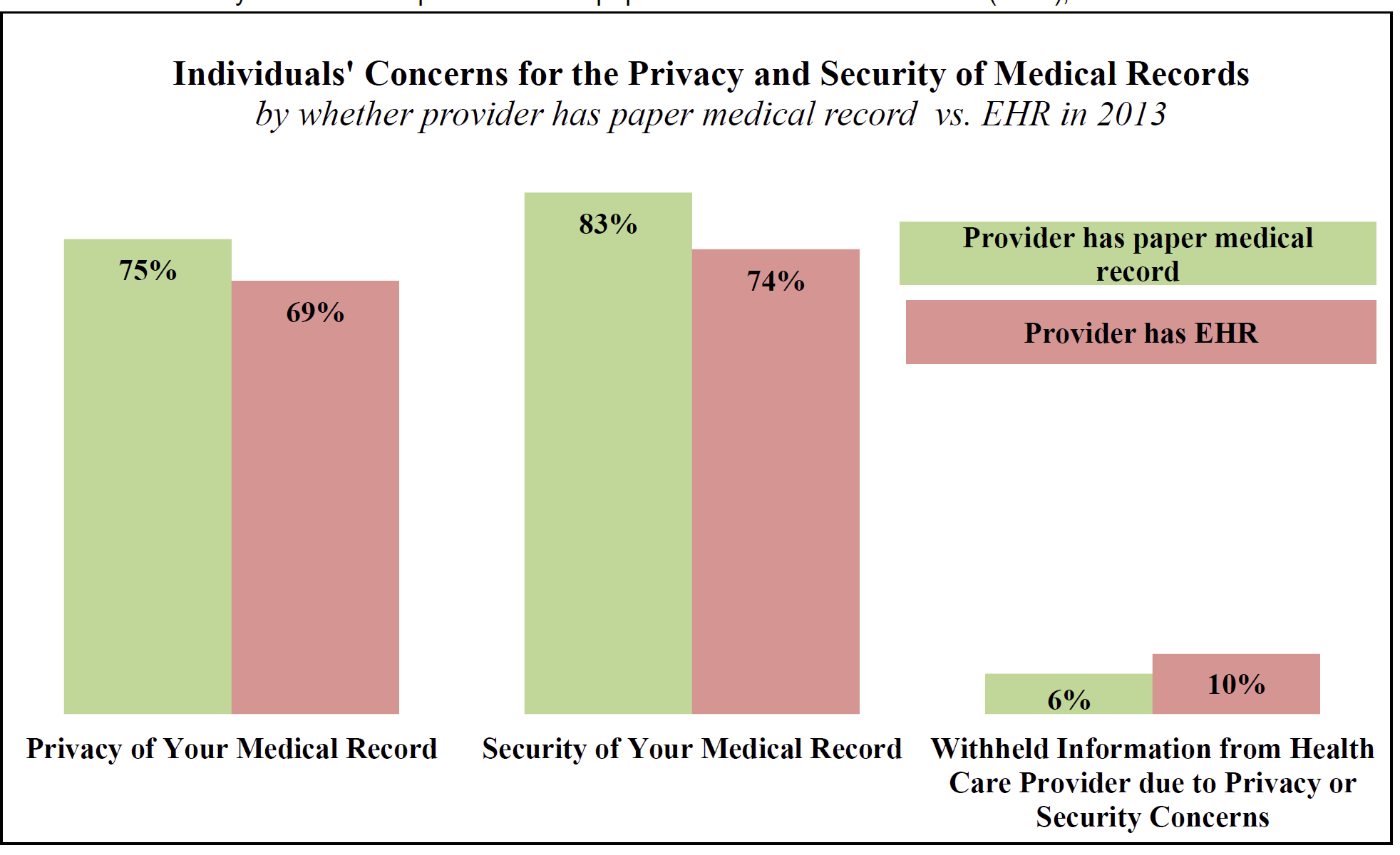
2 Privacy and security concerns are no different between individuals whose providers have paper medical records and those whose providers have an EHR. Figure 2: National levels of privacy and security concerns and withholding information from healthcare providers due to those concerns by whether their provider had a paper or electronic health record (EHR), NOTE: The number of respondents for the above items ranged from n= 1772 to n=1767. Differences between paper medical record vs. EHRs are not statistically significant. SOURCE: 2013 Consumer Survey of Attitudes Toward the Privacy and Security Aspects of Electronic Health Records and Health Information Exchange. Although individuals with paper medical records reported slightly higher levels of privacy and security concerns compared to individuals whose provider had an EHR, the difference is not statistically significant. Individuals whose provider uses an EHR had slightly higher rates of withholding information from their provider due to privacy or security concerns. The difference, however, is not statistically significant. 2

3 Individuals concerns regarding sending medical records between health care providers do not differ by whether they are sent electronically or by fax. Figure 3: The proportion of individuals who expressed concerns regarding unauthorized viewing of their medical record when shared between healthcare providers electronically vs. by fax, NOTE: Number of respondents range from n=2035 to n=2094. Differences between fax vs. electronic and between 2012 and 2013 are not statistically significant. Electronically means from computer to computer; not telephone, mail, or fax machine SOURCE: Consumer Survey of Attitudes Toward the Privacy and Security Aspects of Electronic Health Records and Health Information Exchange. In 2013, 6 in 10 individuals indicated they were very or somewhat concerned about unauthorized viewing when their medical records are sent electronically between health care providers; a similar proportion of individuals expressed concerns about unauthorized viewing when their provider sends their medical records via fax. There were no statistically significant changes between 2012 and 2013 in the proportion of individuals who expressed concerns regarding unauthorized viewing of their medical information when their medical records were sent between health care providers electronically or by fax. 3

4 Individuals support for EHRs and HIE is high despite potential privacy or security concerns. Figure 4: The proportion of individuals who support their providers use of an EHR and electronic health information exchange (HIE) despite potential privacy and security concerns, NOTE: The number of respondents for the above items ranged from n= 2009 to n=2048. Differences between 2012 & 2013 are not statistically significant. SOURCE: Consumer Survey of Attitudes Toward the Privacy and Security Aspects of Electronic Health Records and Health Information Exchange In 2013, about 3 out of 4 individuals wanted their provider to use an EHR, despite any potential privacy or security concerns. In 2013, about 7 in 10 individuals supported their providers use of electronic HIE when sharing their medical records with other providers treating them, despite any possible privacy and security concerns. There were no statistically significant differences between 2012 and 2013 in the proportion of individuals who supported EHRs or electronic HIE, despite potential privacy and security concerns. 4
5 Summary Building public trust is vital to ensure that all stakeholders are comfortable engaging in electronic health information exchange (HIE) and the adoption of health IT to achieve the benefits of an interoperable health care system. Findings from national surveys conducted by ONC in 2012 and 2013 show that the privacy and security of medical records are significant and important concerns for individuals nationwide. About 7 in 10 individuals express concerns about privacy and security although less than one in 10 individuals have withheld information from their providers due to these concerns. Evidence from this survey suggests that increased adoption of EHRs is not associated with individuals privacy and security concerns. Levels of privacy and security concerns and rates of withholding have not significantly changed between 2012 and 2013, despite increases in the adoption of any EHR among providers during the same time period. 2 Furthermore, individuals whose providers use an EHR have similar levels of concerns about the privacy and security of their medical records as compared to individuals whose providers use paper records. Continuing to assess this pattern will be important as evidence is still emerging. Two recent analyses using other national surveys have found similar findings but another study found an association between EHRs and rates of withholding (3,4,5). A majority of individuals nationwide also expressed concerns regarding unauthorized viewing of medical records when information is shared between health care providers. In 2013, about 6 in 10 individuals expressed concerns about their provider sharing their health information with other providers. However, this level of concern did not significantly differ by whether the information was sent between health care providers by fax or through electronic means. Additionally, individuals level of concern for sharing of health information through these means did not change significantly between 2012 and Furthermore, we found that individuals support for the use of EHRs and electronic HIE, despite any concerns they may have about the privacy and security of their medical record, continues to remain strong. In 2013, at least three-quarters of individuals wanted their provider to use an EHR, and 7 in 10 wanted to share their medical records electronically with other providers treating them, despite any privacy or security concerns. This suggests consumers awareness that the potential risks associated with electronic health information may be balanced by the significant benefits (4). In summary, we found that the concerns individuals may have about the privacy and security of their medical records are not unique or limited to EHRs. More importantly, in spite of potential concerns, a majority of individuals want their providers to use an EHR and to share appropriate medical information electronically with the individual s other health care providers. 5
6 Definitions The definitions for the items related to security and privacy were developed from the National Committee on Vital and Health Statistics (NCVHS). According to NCVHS, health information privacy is an individual's right to control the acquisition, uses, or disclosures of his or her identifiable health data. Security refers to physical, technological, or administrative safeguards or tools used to protect identifiable health data from unwarranted access or disclosure. Privacy of Medical Record: Privacy concerns were assessed with the question Privacy means you have a say in who can collect, use and share your medical record. How concerned are you about the privacy of your medical record? Individuals were considered concerned if they reported they were either very or somewhat concerned. Security of Medical Record: Security concerns were assessed with the question Security means having safeguards to keep your medical record from being seen by people who aren t permitted to see them. Safeguards may include technology. How concerned are you about the security of your medical record? Individuals were considered concerned if they reported they were either very or somewhat concerned. Withholding of information was assessed by asking: Have you ever kept information from your healthcare provider because you were concerned about the privacy or security of your medical record? Individuals were considered to have withheld information from their healthcare provider if they reported Yes. Electronically was defined as from computer to computer, instead of by telephone, mail, or fax machine. Data Source and Methods Data are from The Office of the National Coordinator for Health Information Technology s (ONC) Consumer Survey of Attitudes Toward the Privacy and Security Aspects of Electronic Health Records and Health Information Exchange. The survey was conducted by NORC at the University of Chicago with MITRE. The respondent universe for the survey was the civilian, non-institutionalized population ages 18 years old and older within the 50 states and the District of Columbia. This survey utilized a dual random digit dialing (RDD) frame of landline phone numbers and wireless/mobile phone numbers developed by Survey Sampling International (SSI). In order to reduce sampling variability and to represent the nation, NORC stratified the landline RDD frame by Census Region. The 2013 survey oversampled Hispanic, Asian and Black populations. From each household with a selected phone number in a given frame only one adult was selected to complete the telephone interview. A total of 2,107 surveys were completed in 2013 and 2,050 surveys were completed in
7 References 1. Health Information Technology for Economic and Clinical Health (HITECH) Act, Title XIII, Division A of the American Recovery and Reinvestment Act (ARRA), Pub. L. No , , 123 Stat. 115, (2009). 2. Report to Congress. Update on the Adoption of Health Information Technology and Related Efforts to Facilitate the Electronic Use and Exchange of Health Information. October, Patel V, Beckjord E, Moser R, Hughes P, Hesse B. The Role of Health Care Experience and Consumer Information Efficacy in Shaping Privacy and Security Perceptions of Medical Records: National Consumer Survey Results. JMIR Medical Informatics Apr-Jun; 3(2) 4. National Partnership for Women and Families. Engaging Patients and Families: How Consumers Value and Use Health IT. Washington, DC: National Partnership for Women and Families, Campos-Castillo C, Anthony DL. The double-edged sword of electronic health records: implications for patient disclosure. Journal of the American Medical Informatics Association. 2014;0:1 7. 7
8 About the Authors The authors are with the Office of the National Coordinator for Health Information Technology, Office of Planning, Evaluation, and Analysis and the Office of the Chief Privacy Officer. Acknowledgements MITRE and NORC at the University of Chicago contributed to the development of the survey instrument, survey administration, and data analysis. Suggested Citation Patel V, Hughes P, Savage L, Barker W. (June 2015). Individuals Perceptions of the Privacy and Security of Medical Records and the Sharing of Medical Records between Health Care Providers. ONC Data Brief no. 27. Office of the National Coordinator for Health Information Technology: Washington DC. 8
9 Appendix Data presented in this data brief are weighted national estimates. Items used for this data brief are listed in Appendix Table A1 below. Appendix Table A1. Selected Items from the ONC Consumer Survey of Attitudes Toward the Privacy and Security Access of Electronic Health Records and Health Information Exchange, 2013, used for this analysis Question Text 1. Privacy means you have a say in who can collect, use and share your medical record. How concerned are you about the privacy of your medical record? 2. Security means having safeguards to keep your medical record from being seen by people who aren't permitted to see them. Safeguards may include technology. How concerned are you about the security of your medical record? 3. Have you ever kept information from your health care provider because you were concerned about the privacy or security of your medical record? 4. If your medical record is sent by fax from one health care provider to another, how concerned are you that an unauthorized person would see it? 5. If your medical record is sent electronically from one health care provider to another, how concerned are you that an unauthorized person would see it? Electronically means from computer to computer, instead of by telephone, mail, or fax machine. 6. I want my health care providers to use an electronic medical record to store and manage my health information despite any concerns I might have about privacy and security. 7. I want my health care providers to use a computer to share my medical record with other providers treating me despite any concerns I might have about privacy and security. 8. As far as you know, do any of your health care providers maintain your medical records in an electronic system? Response Options Very Concerned Somewhat Concerned Not Very Concerned Not Concerned at All Very Concerned Somewhat Concerned Not Very Concerned Not Concerned at All YES/NO Very Concerned Somewhat Concerned Not Very Concerned Not Concerned at All Very Concerned Somewhat Concerned Not Very Concerned Not Concerned at All Strongly Agree Agree Disagree Strongly Disagree Strongly Agree Agree Disagree Strongly Disagree YES/NO 9
Disparities in Individuals Access and Use of Health IT in 2013
 ONC Data Brief No. 26 June 2015 Disparities in Individuals Access and Use of Health IT in 2013 Vaishali Patel, PhD MPH, Wesley Barker, MS, Erin Siminerio, MPH A number of national policies, initiatives
National Perceptions regarding the Privacy and Health Information Exchange
 National Perceptions regarding the Privacy and Security of Medical Records and Health Information Exchange June, 2014 Academy Health Vaishali Patel MPH PhD Collaborators Ellen Beckjord, University of Pittsburgh
Physician Motivations for Adoption of Electronic Health Records Dawn Heisey-Grove, MPH; Vaishali Patel, PhD
 ONC Data Brief No. 21 December 2014 Physician Motivations for Adoption of Electronic Health Records Dawn Heisey-Grove, MPH; Vaishali Patel, PhD In 2009, Congress committed to supporting the adoption and
Adults and Cell Phone Distractions
 Adults and Cell Phone Distractions Mary Madden, Senior Research Specialist Lee Rainie, Director June 18, 2010 http://pewinternet.org/reports/2010/cell-phone-distractions.aspx Pew Internet & American Life
71% of online adults now use video sharing sites
 71% of online adults now use video sharing sites Kathleen Moore, Pew Internet Project 7/25/2011 http://pewinternet.org/reports/2011/video sharing sites.aspx Pew Research Center 1615 L St., NW Suite 700
Americans and text messaging
 Americans and text messaging 31% of text message users prefer texting to voice calls, and young adults stand out in their use of text messaging Aaron Smith, Senior Research Specialist 9/19/2011 http://pewinternet.org/reports/2011/cell-phone-texting-2011.aspx
National perceptions of barriers, benefits, and federal policies impacting EHR adoption in physician offices, 2011
 National perceptions of barriers, benefits, and federal policies impacting EHR adoption in physician offices, 2011 National Center for Health Statistics Eric Jamoom, PhD, MPH, MS, Senior Service Fellow
The HITECH Act: Implications to HIPAA Covered Entities and Business Associates. Linn F. Freedman, Esq.
 The HITECH Act: Implications to HIPAA Covered Entities and Business Associates Linn F. Freedman, Esq. Introduction and Overview On February 17, 2009, President Obama signed P.L. 111-05, the American Recovery
National perceptions of EHR adoption: Barriers, impacts, and federal policies
 National perceptions of EHR adoption: Barriers, impacts, and federal policies National Center for Health Statistics Eric Jamoom, PhD, MPH, MS, Senior Service Fellow In collaboration with the Office of
Online Product Research
 Online Product Research 58% of Americans have researched a product or service online September 29, 2010 Jim Jansen, Senior Fellow, Pew Internet Project http://pewinternet.org/reports/2010/online-product-research.aspx
The Demographics of Social Media Users 2012
 www.pewresearch.org FEBRUARY 14, 2013 The Demographics of Social Media Users 2012 Young adults are more likely than older adults to use social media. Women, African- Americans, and Latinos show high interest
STATISTICAL BRIEF #87
 Agency for Healthcare Medical Expenditure Panel Survey Research and Quality STATISTICAL BRIEF #87 July 2005 Attitudes toward Health Insurance among Adults Age 18 and Over Steve Machlin and Kelly Carper
17% of cell phone owners do most of their online browsing on their phone, rather than a computer or other device
 JUNE 26, 2012 17% of cell phone owners do most of their online browsing on their phone, rather than a computer or other device Most do so for convenience, but for some their phone is their only option
Americans Current Views on Smoking 2013: An AARP Bulletin Survey
 Americans Current Views on Smoking 2013: An AARP Bulletin Survey November 2013 Americans Current Views on Smoking 2013: An AARP Bulletin Survey Report Prepared by Al Hollenbeck, Ph.D. Copyright 2013 AARP
Report to Congress on the Application of EHR Payment Incentives for Providers Not Receiving Other Incentive Payments
 U.S. DEPARTMENT OF HEALTH AND HUMAN SERVICES Report to Congress on the Application of EHR Payment Incentives for Providers Not Receiving Other Incentive Payments (Pub. L. 111 5, Division B, Title IV, Subtitle
Evaluating Connecticut s Health Information Technology Exchange Consumer Survey Report
 2014 Evaluating Connecticut s Health Information Technology Exchange Consumer Survey Report Prepared for Connecticut Department of Public Health Prepared By Minakshi Tikoo, PhD, MBI Darcé Costello, EdD,
Complementary and Alternative Medicine:
 APRIL 2011 AARP and National Center for Complementary and Alternative Medicine Survey Report Complementary and Alternative Medicine: What People Aged 50 and Older Discuss With Their Health Care Providers
Investor Confusion About Brokerage Service & Maintenance Fees
 Investor Confusion About Brokerage Service & Maintenance Fees NORTH AMERICAN SECURITIES ADMINISTRATORS ASSOCIATION APRIL, 2015 SURVEY CONDUCTED BY ORC INTERNATIONAL Table of Contents Objectives and Methodology
Consumer experience with and attitudes toward health information technology: a nationwide survey
 Consumer experience with and attitudes toward health information technology: a nationwide survey Jessica S Ancker, 1,2 Michael Silver, 1,2 Melissa C Miller, 1,2 Rainu Kaushal 1,2,3 < An additional appendix
BY Aaron Smith NUMBERS, FACTS AND TRENDS SHAPING THE WORLD FOR RELEASE NOVEMBER 19, 2015 FOR FURTHER INFORMATION ON THIS REPORT:
 NUMBERS, FACTS AND TRENDS SHAPING THE WORLD FOR RELEASE NOVEMBER 19, 2015 BY Aaron Smith FOR FURTHER INFORMATION ON THIS REPORT: Aaron Smith, Associate Director, Research Dana Page, Senior Communications
GAO ELECTRONIC HEALTH RECORDS. First Year of CMS s Incentive Programs Shows Opportunities to Improve Processes to Verify Providers Met Requirements
 GAO United States Government Accountability Office Report to Congressional Committees April 2012 ELECTRONIC HEALTH RECORDS First Year of CMS s Incentive Programs Shows Opportunities to Improve Processes
Cell Phone Activities 2013
 www.pewresearch.org SEPTEMBER 16, 2013 Cell Phone Activities 2013 50% of cell owners download apps to their phones; 48% listen to music services; video calling has tripled since 2011; texting remains a
ELECTRONIC HEALTH RECORDS. Nonfederal Efforts to Help Achieve Health Information Interoperability
 United States Government Accountability Office Report to Congressional Requesters September 2015 ELECTRONIC HEALTH RECORDS Nonfederal Efforts to Help Achieve Health Information Interoperability GAO-15-817
Americans and their cell phones
 Americans and their cell phones Mobile devices help people solve problems and stave off boredom, but create some new challenges and annoyances Aaron Smith, Senior Research Specialist 8/15/2011 http://pewinternet.org/reports/2011/cell-phones.aspx
How To Improve Health Information Exchange
 United States Government Accountability Office Report to Congressional Committees March 2014 ELECTRONIC HEALTH RECORDS HHS Strategy to Address Information Exchange Challenges Lacks Specific Prioritized
Examining Health Insurance Coverage Gaps among Adults in Southeastern Pennsylvania
 Examining Health Insurance Coverage Gaps among Adults in Southeastern Pennsylvania Pennsylvania s Public Health Association s Annual Conference September 27, 2011 Sarah Ingerman, BA Nicole Dreisbach, MPH
Educational Attainment of Veterans: 2000 to 2009
 Educational Attainment of Veterans: to 9 January 11 NCVAS National Center for Veterans Analysis and Statistics Data Source and Methods Data for this analysis come from years of the Current Population Survey
Privacy and Data Management on Mobile Devices
 SEPTEMBER 5, 2012 Privacy and Data Management on Mobile Devices More than half of app users have uninstalled or avoided an app due to concerns about personal information Jan Lauren Boyles Research Intern,
Epi Research Report New York City Department of Health and Mental Hygiene May 2010
 Epi Research Report New York City Department of Health and Mental Hygiene May 2010 Including New Yorkers Who Can Be Reached Only by Cell Phone in the Community Health Survey: Results from the 2008 Cell
LONG-TERM CARE: The Associated Press-NORC Center for Public Affairs Research. Perceptions, Experiences, and Attitudes among Americans 40 or Older
 The Associated Press-NORC Center for Public Affairs Research Research Highlights LONG-TERM CARE: Perceptions, Experiences, and Attitudes among Americans 40 or Older T. Tompson, J. Benz, J. Agiesta, D.
2012 National Survey. Organ Donation Attitudes and Behaviors
 2012 National Survey of Organ Donation Attitudes and Behaviors Issue Date: September 2013 U.S. Department of Health and Human Services Health Resources & Services Administration Healthcare Systems Bureau
AARP Bulletin Survey on Financial Honesty
 AARP Bulletin Survey on Financial Honesty September 2012 AARP Bulletin Survey on Financial Honesty By: Rebecca Perron, Ph.D. Copyright 2012 AARP 601 E Street, NW Washington, DC 20049 http://www.aarp.org/research
NUMBERS, FACTS AND TRENDS SHAPING THE WORLD FOR RELEASE JULY 16, 2015 MEDIA CONTACT FOR THIS REPORT: Dana Page, Communications Manager
 NUMBERS, FACTS AND TRENDS SHAPING THE WORLD FOR RELEASE JULY 16, 2015 MEDIA CONTACT FOR THIS REPORT: Dana Page, Communications Manager 202.419.4372 RECOMMENDED CITATION: Duggan, M., Lenhart, A., Lampe,
Research. Dental Services: Use, Expenses, and Sources of Payment, 1996-2000
 yyyyyyyyy yyyyyyyyy yyyyyyyyy yyyyyyyyy Dental Services: Use, Expenses, and Sources of Payment, 1996-2000 yyyyyyyyy yyyyyyyyy Research yyyyyyyyy yyyyyyyyy #20 Findings yyyyyyyyy yyyyyyyyy U.S. Department
The Meaningful Use Stage 2 Final Rule: Overview and Outlook
 The Meaningful Use Stage 2 Final Rule: Overview and Outlook Devi Mehta, JD, MPH Cand. 1 Taylor Burke, JD, LLM 2 Lara Cartwright-Smith, JD, MPH 3 Jane Hyatt Thorpe, JD 4 Introduction On August 23, 2012,
Americans Experiences in the Health Insurance Marketplaces: Results from the First Month
 TRACKING TRENDS IN HEALTH SYSTEM PERFORMANCE NOVEMBER 2013 Americans Experiences in the Health Insurance Marketplaces: Results from the First Month Sara R. Collins, Petra W. Rasmussen, Michelle M. Doty,
Issue Brief Findings from HSC
 Issue Brief Findings from HSC NO. 133 JULY 2010 EVEN WHEN PHYSICIANS ADOPT E-PRESCRIBING, USE OF ADVANCED FEATURES LAGS By Joy M. Grossman Physician practice adoption of electronic prescribing has not
After Boston, Little Change in Views of Islam and Violence
 MAY 7, 2013 45% Say Muslim Americans Face A Lot of Discrimination After Boston, Little Change in Views of Islam and Violence FOR FURTHER INFORMATION CONTACT THE PEW RESEARCH CENTER FOR THE PEOPLE & THE
Chapter 15 The Electronic Medical Record
 Chapter 15 The Electronic Medical Record 8 th edition 1 Lesson 15.1 Introduction to the Electronic Medical Record Define, spell, and pronounce the terms listed in the vocabulary. Discuss the presidential
Decrypting the Security Risk Assessment (SRA) Requirement for Meaningful Use
 Click to edit Master title style Decrypting the Security Risk Assessment (SRA) Requirement for Meaningful Use Andy Petrovich, MHSA, MPH M-CEITA / Altarum Institute April 8, 2015 4/8/2015 1 1 Who is M-CEITA?
HIT Workflow & Redesign Specialist: Curriculum Overview
 HIT Workflow & Redesign Specialist: Curriculum Overview Component - Description Units - Description Appx. Time 1: Introduction to Health Care and Public Health in the U.S. Survey of how healthcare and
Educational Attainment in the United States: 2003
 Educational Attainment in the United States: 2003 Population Characteristics Issued June 2004 P20-550 The population in the United States is becoming more educated, but significant differences in educational
RECOMMENDED CITATION: Pew Research Center, April 2014, America s Changing Drug Policy Landscape
 NUMBERS, FACTS AND TRENDS SHAPING THE WORLD FOR RELEASE APRIL 2, 2014 FOR FURTHER INFORMATION ON THIS REPORT: Carroll Doherty, Director, Political Research Juliana Menasce Horowitz, Senior Researcher Rob
NUMBERS, FACTS AND TRENDS SHAPING THE WORLD JANUARY 09, 2015 FOR FURTHER INFORMATION ON THIS REPORT:
 NUMBERS, FACTS AND TRENDS SHAPING THE WORLD JANUARY 09, 2015 FOR FURTHER INFORMATION ON THIS REPORT: Maeve Duggan, Research Analyst, Pew Research Center Nicole B. Ellison, Associate Professor, University
IRS Oversight Board 2014 Taxpayer Attitude Survey DECEMBER 2014
 IRS Oversight Board 14 Taxpayer Attitude Survey DECEMBER 14 The Internal Revenue Service (IRS) Oversight Board was created by Congress under the IRS Restructuring and Reform Act of 1998. The Oversight
On the Road to Meaningful Use of EHRs:
 On the Road to Meaningful Use of EHRs: A Survey of California Physicians June 2012 On the Road to Meaningful Use of EHRs: A Survey of California Physicians Prepared for California HealthCare Foundation
Health Information Technology in Healthcare: Frequently Asked Questions (FAQ) 1
 Health Information Technology in Healthcare: Frequently Asked Questions (FAQ) 1 1. What is an Electronic Health Record (EHR), an Electronic Medical Record (EMR), a Personal Health Record (PHR) and e-prescribing?
Mobile Broadband in Nevada: Access At Home or On the Go
 March 2013 Without a doubt, cell phones and mobile Internet service have changed the way that people stay in touch and access the web. The Brookings Institute anticipates that by 2015 there will be 3.1