
STUDENT PROGRAM HANDBOOK Ph.D. in Educational Psychology - School Psychology Specialization Strand Revised Spring 2015
|
|
|
- Phyllis Richardson
- 10 years ago
- Views:
Transcription
1 STUDENT PROGRAM HANDBOOK Ph.D. in Educational Psychology - School Psychology Specialization Strand Revised Spring 2015 Preface This handbook provides infmation about the Ph.D. in Educational Psychology at UNLV and the special features associated with the School Psychology Specialization strand in the degree. Most questions about rules, procedures and requirements are answered in this document, but it is not a substitute f regular and frequent consultation with faculty advis. Modifications, if any, related to rules, procedures, and/ requirements in this handbook will be immediately posted on our doctal web site ( ) and then updated in future versions of the handbook. Infmation about other Graduate College requirements, including time deadlines, is available here: ( ). Several documents you may use during your program are included f your review as Appendices in this handbook. Most are also available as individual files f download on our doctal fms page: ( ). TABLE OF CONTENTS I. Mission Statement II. Program Overview III. Admission IV. Course Requireme nts V. Suggested Course Sequencing VI. Student Involvement VII. Events Time Line VIII. Clinical Experience IX. Program Faculty Appendices A. Doctal Student Annual Rept B. Fm to Request Advanced Practicum Experience C. Rating Scale f Advanced Practicum Experience D. Guidelines f Requesting Doctal Internship at Current Wk Site. 36 E. Example Rating Scale f Doctal Internship in CCSD F. Doctal Program Course Descriptions

2 I. MISSION STATEMENT The Ph.D. in Educational Psychology with specialization in School Psychology extends our specialist level school psychology training program to doctal studies preparing graduates f research and academic careers and f general practice and health service provider specialty in professional psychology. Our program is based on the scientist-practitioner model with emphasis on theetical and empirical foundations f clinical practice. A primary focus is extending the knowledge base of the profession through scholarly inquiry, and students are expected to generate new knowledge f the psychology profession with particular attention to mental health service in school-based practice. Consistent with standards of the American Psychological Association (APA) and the National Association of School Psychologists (NASP),our program is committed to extending the knowledge base of the discipline in a climate of scholarly inquiry, preparation of practitioners to bridge the gap between practice and research. Our Ph.D. graduates are prepared f wk in diverse settings and roles, including faculty in academic departments of school psychology, psychologists employed by public and private schools, and psychologists in private practice agency settings. Doctal study in the School Psychology Specialization strand is based on a menting model with expectation that much of the learning will occur in activities outside the classroom. Early in the program, students link with one me faculty members on research teams f disciplinerelated studies. Students are expected to produce publishable wk by the end of the second year of their programs and to prepare dissertations that extend the knowledge base in school psychology. 2

3 II. PROGRAM OVERVIEW Administratively housed in the Department of Educational Psychology & Higher Education, School Psychology at UNLV is integrated with a nationally ranked program in educational psychology. Along with advanced school psychology coursewk, our students take required courses with nationally recognized scholars in research, statistics, learning, and development. Specialization in school psychology at the doctal level is one of several strands available in the Ph.D. In Educational Psychology at UNLV. All strands complete a common ce of coursewk in learning and development, research methods and statistics, required courses in the strand specialization, and elective courses in an emphasis area. A minimum of A minimum of 114 post-bachel's degree credits is required to complete the Ph.D. In Educational Psychology - School Psychology Specialization Strand, which includes six credits in required internship completed at the end of the coursewk. The award of a Ph.D. degree rests on individual demonstration of a high level of competence in both foundational and specialization content, and your individual programs will vary in der to provide this demonstration. Most programs of study exceed the minimum coursewk requirement, supplemented by individual study. A minimum of 50 percent of the total credits required to complete the doctal degree, not including transferred and dissertation credits, must be earned at UNLV after admission to the doctal degree program. You must also have one year during which there is full-time residence as a doctal student admitted to the program. You can meet this requirement with two consecutive semesters in which you enroll in a minimum of 9 credits each semester by a consecutive sequence of fall-spring-summer during which enroll in a minimum of 6 credits each semester during the academic year and 6 credits during the summer. There are four maj review points in the program. ñ Each student must satisfy a scholarly paper requirement by the time he she has completed 36 credits (Review I). ñ Each student must take the preliminary examination (Review II) in the last semester of coursewk outlined in his/her program of study. ñ After successfully completing Review I and Review II, students can then submit a dissertation prospectus to their doctal committee. ñ The final review point is the defense of the doctal dissertation. The dissertation may be completed during after the School Psychology Specialization strand student is doing the 1800 hour doctal internship. Details about the internship requirement are in the Clinical Experience section of this handbook. 3

4 III. ADMISSION The admission process requires completion of two application fms: an application f the UNLV Graduate College and a Department application f the Specialization Strand. The Graduate College online admission process is available at Graduate College website. The department application fms are available in the main office of the Department of Educational Research, Cognition, & Development (Carlson Education Building, Room 320) can be downloaded from the Department web site as a pdf file. The Department Application file is not submitted online. It is mailed delivered, along with requested attachments, to the department office. Deadline f receipt of materials is February 1. The criteria f admissions to the School Psychology Specialization Strand differ from the other strands of the Ph.D. in Educational Psychology at UNLV. Students are eligible to apply f admission to the Ph.D. in Educational Psychology after completing a master s degree. However, students are eligible to apply f admission to the School Psychology Specialization Strand after completing a bachel's degree. Admission will be limited to the most qualified applicants based on a combination of the following: ñ An undergraduate grade-point average of 3.00 above ñ A graduate grade-point average of 3.00 above. ñ Preference may be given to student with sces above the 50th percentile on verbal and quantitative sections of the Graduate Recd Examination (GRE). ñ A sce of 600 above on the Test of English as a Feign Language (TOEFL) is also required f students who do not speak English as their first language. ñ Three letters of reference from university faculty other individuals qualified to judge the applicant's academic potential. ñ The applicant's statement of professional interests and goals. Students who have completed are enrolled in a master s educational specialist (Ed.S.) program in School Psychology a related field can apply f admission. Doctal programs of study f students admitted directly from a bachel s degree will include all content required in our EdS program. 4

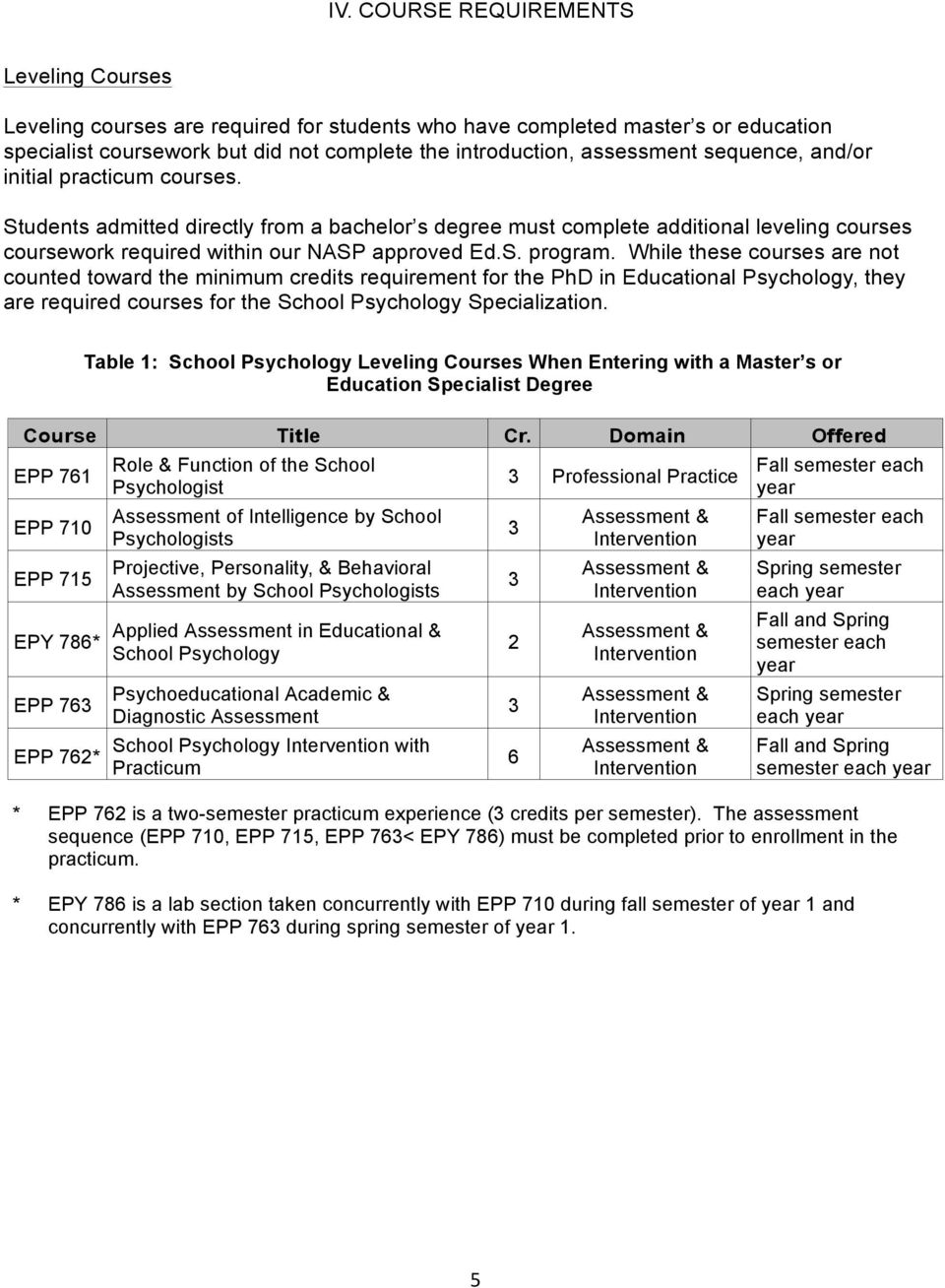
5 IV. COURSE REQUIREMENTS Leveling Courses Leveling courses are required f students who have completed master s education specialist coursewk but did not complete the introduction, assessment sequence, and/ initial practicum courses. Students admitted directly from a bachel s degree must complete additional leveling courses coursewk required within our NASP approved Ed.S. program. While these courses are not counted toward the minimum credits requirement f the PhD in Educational Psychology, they are required courses f the School Psychology Specialization. Table 1: School Psychology Leveling Courses When Entering with a Master s Education Specialist Degree Course Title Cr. Domain Offered EPP 761 EPP 710 EPP 715 EPY 786* EPP 763 EPP 762* Role & Function of the School Psychologist Assessment of Intelligence by School Psychologists Projective, Personality, & Behavial Assessment by School Psychologists Applied Assessment in Educational & School Psychology Psychoeducational Academic & Diagnostic Assessment School Psychology Intervention with Practicum 3 Professional Practice Assessment & Intervention Assessment & Intervention Assessment & Intervention Assessment & Intervention Assessment & Intervention Fall semester each year Fall semester each year Spring semester each year Fall and Spring semester each year Spring semester each year Fall and Spring semester each year * EPP 762 is a two-semester practicum experience (3 credits per semester). The assessment sequence (EPP 710, EPP 715, EPP 763< EPY 786) must be completed pri to enrollment in the practicum. * EPY 786 is a lab section taken concurrently with EPP 710 during fall semester of year 1 and concurrently with EPP 763 during spring semester of year 1. 5
6 Table 2: School Psychology Leveling Courses f Students Entering with a Bachel s Degree Course Title Cr. Domain Offered EPP 761 EPP 710 EPY 786* EPP 715 EPP 763 EPP 762* EPY 711 Role & Function of the School Psychologist Assessment of Intelligence by School Psychologists Applied Assessment in Educational & School Psychology Projective, Personality, & Behavial Assessment by School Psychologists Psychoeducational Academic & Diagnostic Assessment School Psychology Intervention with Practicum Human Growth & Development EPY 702 Methods of Research 3 EPY 721 CED 733 Descriptive and Inferential Statistics: An Introduction Introduction to Counseling in Schools EPY 705 Child Counseling 3 EPY 712 ESP 701 ESP 733 EPP 764 EPY 788 Foundations of Learning & Cognition Introduction to Special Education Management/Modification Special Needs School Psychology Seminar: Mental Health Seminar in Educational Psych.: Legal Clinic 3 Professional Practice Fall semester each year Assessment &Intervention Assessment &Intervention Assessment &Intervention Assessment &Intervention Assessment &Intervention Cognitive Affective Bases of Behavi Research Design & Methodology 3 Statistics 3 3 Assessment & Intervention Assessment & Intervention Cognitive Affective Bases of Behavi 3 Professional Practice 3 1 Assessment & Intervention Assessment & Intervention 3 Professional Practice Fall semester each year Fall and Spring semester each year Spring semester each year Spring semester each year Fall and Spring semester each year Fall semester each year Fall and Spring semester each year Fall and Spring semester each year Spring semester each year Summer semester each year Summer semester each year Summer semester each year Fall semester each year Spring semester each year Fall and Spring semester each year * EPP 762 is a two-semester practicum experience (3 credits per semester). The assessment sequence (EPP 710, EPP 715, EPP 763< EPY 786) must be completed pri to enrollment in the practicum. * EPY 786 is a lab section taken concurrently with EPP 710 during fall semester of year 1 and concurrently with EPP 763 during spring semester of year 1. 6

7 Table 3: PhD in Educational Psychology Orientation- 1 credit Course Title Cr. Domain Offered EPY 701 Proseminar in Educational Psychology (doctal section) 1 Scientific & Professional Ethics & Standards Fall semester each year Table 4: PhD in Educational Psychology Required Learning Ce- 9 credit minimum Course Title Cr. Domain Offered EPY 757* They/Philosophy of Educational Psychology EPY 767 Human Learning and Cognition 3 3 Scientific & Professional Ethics & Standards Cognitive-Affective Bases of Behavi Fall semester each year Spring semester each year Cognitive-Affective Spring semester EPY 777 Cognitive Development 3 Bases of Behavi each year * Students in the School Psychology strand supplement this course with a 1-credit independent study typically completed the following semester summer to add content specific to school psychology. Table 5: PhD in Educational Psychology Required Research Ce- 15 credit minimum Course Title Cr. Domain Offered EPY 718 Qualitative Research Methodologies 3 EPY 722 Inferential Statistics/Experimental Design Research Design & Methodology 3 Statistics EPY 723 Human Measurement I 3 Psychometric They EPY 730 Advanced Research Methods 3 EPP 750 Advanced Test Analysis in School Psychology 3 Research Design & Methodology Research Design & Methodology Fall, spring, and summer terms each year Fall and Spring semester each year Fall semester each year Spring semester each year Fall semester in even-numbered years 7

8 Table 6: Specialization Strand Content Requirement- 24 credit minimum plus internship Course Title Cr. Domain Offered EPP 723 PSY 736 Diagnostic/Prescriptive Strategies- Psychopathology Psychopthology EPP 760* Psychoeducational Issues- Diversity 3 EPP 764* School Psychology Seminars 2 EPP 767* School-Based Neuropsychological Assessment PSY 755 Ethics & Professional Issues 3 PSY 704 Social Psychology 3 EPP 765 Advanced Seminar- Technology 2 EPP 765 Advanced Seminar- Clinic Research Individual Differences Assessment & Intervention Assessment & Intervention Biological Bases of Behavi Spring semester in even-numbered years Fall semester each year Summer term each year Fall and spring semesters each year Spring semester each year Scientific & Summer term Professional Ethics & each year Standards Social Bases of Behavi Assessment & Intervention Assessment & Intervention Fall semester each year Fall semester in odd- numbered years Fall semester in odd- numbered years EPY 784** and/ EPY 793** Teaching Practicum Advanced Doctal Practicum 3 Professional Practice Fall and spring semesters each year EPY 794 Doctal Internship 6 Professional Practice Fall and Spring semesters each year * If credits f these courses have been previously applied to award of a university degree, substitute courses will be selected in consultation with your advis to meet the minimum credit requirement f the Ph.D. ** Students preparing f university faculty and clinical practice employment complete both EPY 784 and EPY 793. Substitutions f required courses request pri approval from the school psychology doctal program codinat and the chair of the student's doctal committee. 8

9 Required Emphasis Area- 12 credit minimum Courses f the emphasis area are selected with consultation and approval of the doctal committee. Students often use the summer term f completion of these courses. Ultimately, the dissertation committee has the final approval f these courses. Guidance from the initial advis is crucial if emphasis area courses are completed befe the dissertation committee is fmed. Examples of possible emphasis areas include: research and evaluation counseling & psychotherapy neuropsychology learning disabilities technology in assessment and consultation 9

10 V. SUGGESTED COURSE SEQUENCING Course sequencing in doctal studies will be contingent on several facts, including your specific area of emphasis, whether you are attending full-time part-time, and course availability. Remember that completion of a doctal program is much me than just picking and choosing from required courses. Your advis will wk with you each semester to insure that you are pursuing an appropriate enrollment pattern f timely completion of your program. Course sequencing will also be contingent on your admission entry point (UNLV M.S. degree in Educational Psychology, master's degree in related field, completion of Ed.S. coursewk). It is NEVER a good idea to self-advise when choosing your courses. Instead, wk with your initial advis and then your doctal advisy committee chair as you plan your schedule each semester. Doctal study in the school psychology specialization strand is based on a menting model, and consultation with your advis is crucial befe selecting courses f any semester. The sequencing infmation that follows is not prescriptive and is included only as a general guideline f course planning. As you move through the program, your advis will often suggest the addition of individual study and research courses to encourage your linking with program faculty f guidance on planning and conducting research studies. IF ENTRY POINT follows completion of Specialist Coursewk in School Psychology Several of the courses (e.g. EPP credits, EPP credits, EPP credits) required f the doctal specialization strand in school psychology are also required f the Ed.S. degree in School Psychology. University regulations preclude counting credits toward meeting me than one degree. These courses, if completed f the Ed.S. degree, are not repeated at the doctal level; elective substitutes will be selected in consultation with the advis. 10

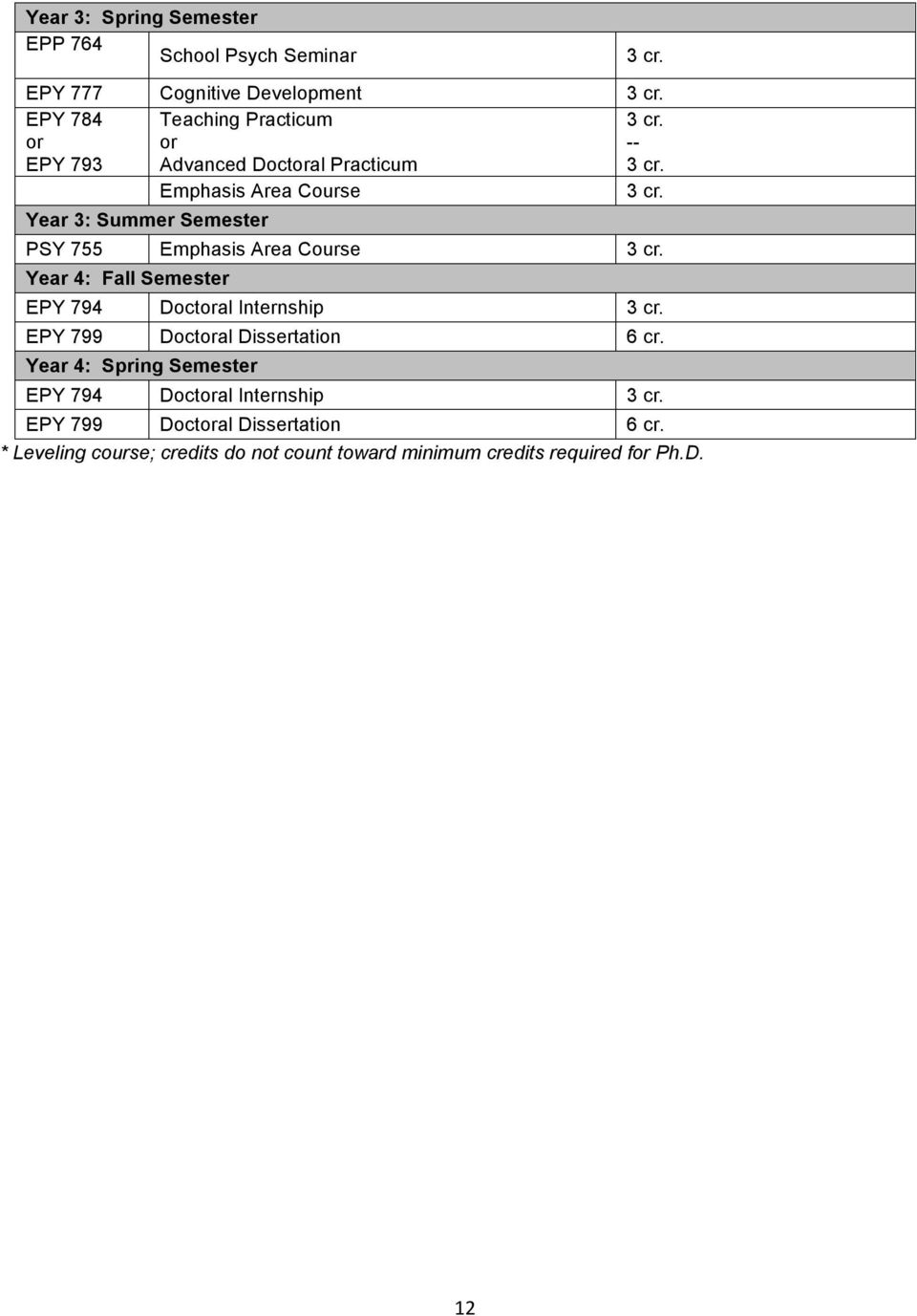
11 Table 7: SUGGESTED SEQUENCE IF ENTRY POINT follows completion of UNLV M.S. Degree in Educational Psychology Year 1: Fall Semester EPY 701 Proseminar (doctal) 1 cr. EPY 723 Human Measurement I EPP 762* School Psych Practicum EPP 765 Adv. Assessment Seminar: Technology EPP 765 Adv. Assessment Seminar: Clinic Research Year 1: Spring Semester EPP 762* School Psych Practicum 2 cr. (odd numbered years) 2 cr. (even numbered years) EPP 767 School-Based Neuropsych Assessment EPY 722 Inferential Statistics/Experiment Design Year 1: Summer Semester PSY 755 Ethics & Professional Issues EPP 760 Psychoeducational Issues: Diversity Year 2: Fall Semester EPY 757 They & Philosophy of Ed. Psych EPP 764 School Psych Seminar 1 cr. EPP 765 EPP 765 Adv. Assessment Seminar: Technology Adv. Assessment Seminar: Clinic Research -- PSY 704 EPP 750 Social Psychology Advanced Test Analysis in School Psych Year 2: Spring Semester EPY 730 Advanced Research Methods -- 3cr. EPY 767 Human Learning & Cognition EPY 718 Qualitative Research Methodologies Year 2: Summer Semester EPY 780 Individual Study: School Psych. Theists Year 3: Fall Semester Emphasis Area Course PSY 734 Psychopathology PSY 704 EPP 750 Social Psychology Advanced Test Analysis in School Psych. -- EPY 784 EPY 793 Teaching Practicum Advanced Doctal Practicum -- 11

12 Year 3: Spring Semester EPP 764 School Psych Seminar EPY 777 Cognitive Development EPY 784 EPY 793 Teaching Practicum Advanced Doctal Practicum -- Emphasis Area Course Year 3: Summer Semester PSY 755 Emphasis Area Course Year 4: Fall Semester EPY 794 Doctal Internship EPY 799 Doctal Dissertation 6 cr. Year 4: Spring Semester EPY 794 Doctal Internship EPY 799 Doctal Dissertation 6 cr. * Leveling course; credits do not count toward minimum credits required f Ph.D. 12
13 Table 8: SUGGESTED SEQUQNCE IF ENTRY POINT follows completion of a Bachel s degree Year 1: Fall Semester EPY 701 Proseminar (doctal) 1 cr. EPP 710 Assessment of Intelligence by School Psych. EPY 786 Applied Assessment in Educational & School Psychology 1 cr. EPY 711 Human Growth & Development EPP 761 Role & Function of the School Psych. EPY 702 Methods of Research Year 1: Spring Semester EPP 715 Projective, Personality, & Behavial Assessment by School Psychologists EPY 786 Applied Systems in EPY 1 cr. EPY 721 Descriptive and Inferential Statistics: An Introduction CED 733 Intro to Group Counseling in the Schools EPP 764 School Psychology Seminar: Ethics 1 cr. EPP 763 Psychoeducational Academic/Diagnostic Assessment Year 1: Summer Semester EPY 705 Child Counseling EPY 712 Foundations of Learning & Cognition ESP 701 Introduction to Special Education Year 2: Fall Semester EPP 750 Advanced Test Analysis in School Psychology EPP 760 Psychoeducational Issues of Diverse Learners EPP 764 School Psychology Seminar: Research Issues 1 cr. EPP 762 School Psychology Interventions with Practicum EPY 788 a Seminar in Educational Psychology: Legal Clinic Year 2: Spring Semester EPP 767 School-Based Neuropsychological Assessment ESP 733 Management/Modification Special Needs EPP 762 School Psychology Interventions with Practicum EPY 788 a Seminar in Educational Psychology: Legal Clinic EPP 764 School Psychology Seminar: Mental Health 1 cr. Year 3: Fall Semester EPY 701 Proseminar (doctal) 1 cr. EPY 723 Human Measurement I EPP 762* School Psych Practicum EPP 765 EPP 765 Adv. Assessment Seminar: Technology Adv. Assessment Seminar: Clinic Research 2 cr. 2 cr. 13

14 a. Year 3: Spring Semester EPP 762* School Psych Practicum EPP 767 School-Based Neuropsych Assessment EPY 722 Inferential Statistics/Experiment Design Year 3: Summer Semester PSY 755 Ethics & Professional Issues EPP 760 Psychoeducational Issues: Diversity Year 4: Fall Semester EPY 757 They & Philosophy of Ed. Psych EPP 764 School Psych Seminar 1 cr. EPP 765 EPP 765 Adv. Assessment Seminar: Technology Adv. Assessment Seminar: Clinic Research -- PSY 704 EPP 750 Year 4: Spring Semester Social Psychology Advanced Test Analysis in School Psych cr. EPY 730 Advanced Research Methods EPY 767 Human Learning & Cognition EPY 718 Qualitative Research Methodologies Year 4: Summer Semester EPY 780 Individual Study: School Psych. Theists Year 5: Fall Semester Emphasis Area Course PSY 734 Psychopathology PSY 704 EPP 750 Social Psychology Advanced Test Analysis in School Psych. -- EPY 784 EPY 793 Year 5: Spring Semester Teaching Practicum Advanced Doctal Practicum -- EPP 764 School Psych Seminar EPY 777 Cognitive Development EPY 784 EPY 793 Teaching Practicum Advanced Doctal Practicum -- Emphasis Area Course Year 5: Summer Semester PSY 755 Emphasis Area Course Year 6: Fall Semester EPY 794 Doctal Internship EPY 799 Doctal Dissertation 6 cr. Year 6: Spring Semester EPY 794 Doctal Internship EPY 799 Doctal Dissertation 6 cr. EPY 788 can be taken during either fall Spring Semester

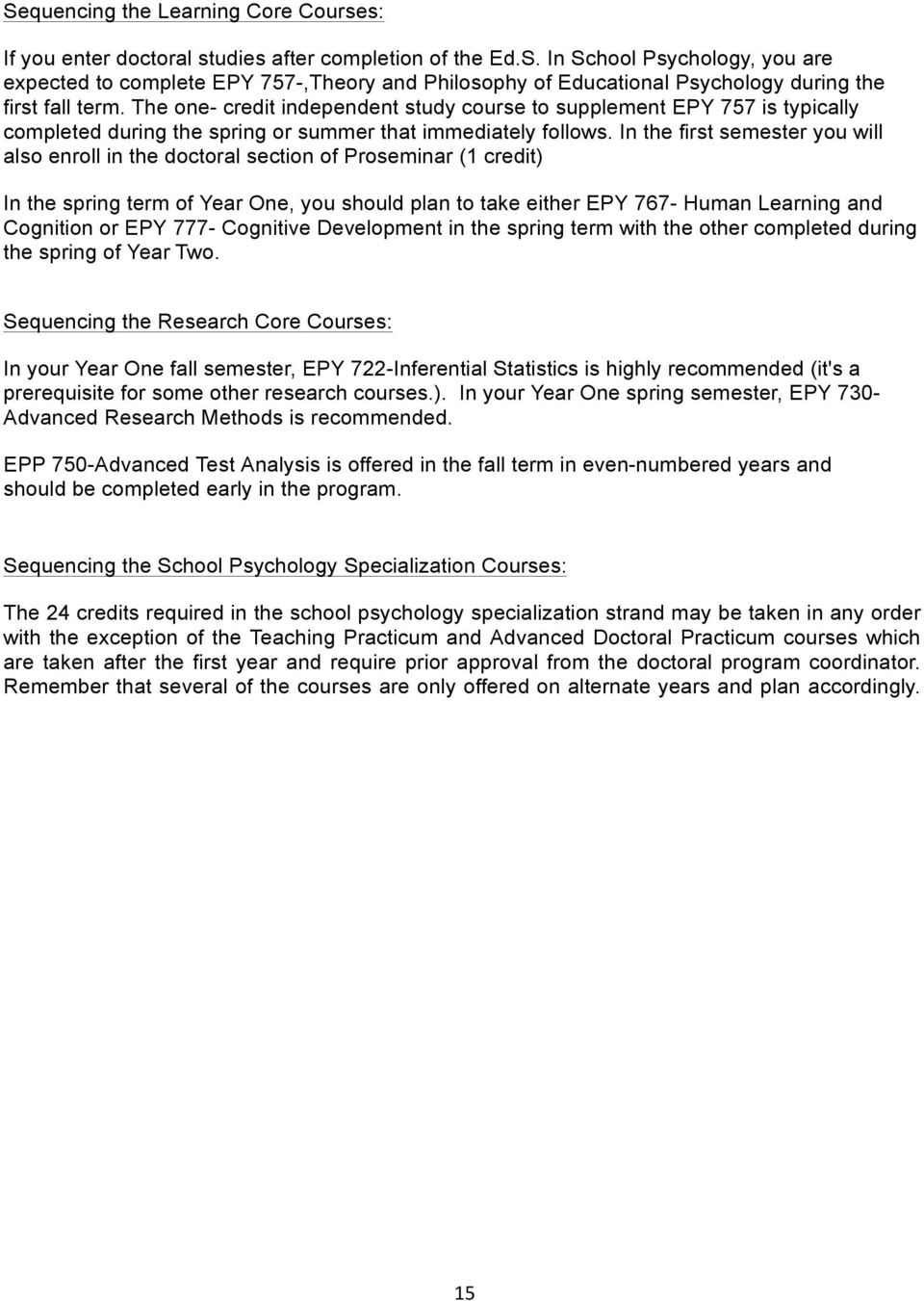
15 Sequencing the Learning Ce Courses: If you enter doctal studies after completion of the Ed.S. In School Psychology, you are expected to complete EPY 757-,They and Philosophy of Educational Psychology during the first fall term. The one- credit independent study course to supplement EPY 757 is typically completed during the spring summer that immediately follows. In the first semester you will also enroll in the doctal section of Proseminar (1 credit) In the spring term of Year One, you should plan to take either EPY 767- Human Learning and Cognition EPY 777- Cognitive Development in the spring term with the other completed during the spring of Year Two. Sequencing the Research Ce Courses: In your Year One fall semester, EPY 722-Inferential Statistics is highly recommended (it's a prerequisite f some other research courses.). In your Year One spring semester, EPY 730- Advanced Research Methods is recommended. EPP 750-Advanced Test Analysis is offered in the fall term in even-numbered years and should be completed early in the program. Sequencing the School Psychology Specialization Courses: The 24 credits required in the school psychology specialization strand may be taken in any der with the exception of the Teaching Practicum and Advanced Doctal Practicum courses which are taken after the first year and require pri approval from the doctal program codinat. Remember that several of the courses are only offered on alternate years and plan accdingly. 15
16 VI. STUDENT INVOLVEMENT Admission to doctal studies in the School Psychology Specialization Strand includes an expectation of extensive interaction with faculty and other students as an active participant in a community of scholars. Whether you are attending on a full-time part-time basis, you will be encouraged to join one me research teams and to enhance your clinical skills in supervised experiences with complex cases in the school psychology clinic. You are strongly encouraged to submit proposals f presentations at national and regional professional conferences. Both the College and the Graduate & Professional Student Association provide menting and venues f campus presentations of your research. Travel suppt to attend conferences f your presentations is available from the department and the Graduate & Professional Student Association. The Student Codinating Committee is comprised of student representatives from each degree program in the Department of Educational Research, Cognition, & Development. Activities of this committee include sponsed colloquia, brown-bag discussions, and social occasions that bring together the faculty and students across the specific disciplines. Your initial doctal advis is appointed 'f you', but you then participate in the selection of the chair and members of your doctal committee. You also participate in identification of a special emphasis area and development of your doctal program of study. At the end of each academic year, you will submit an Annual Student Review document (included in the Appendices of this Handbook and on the program web site). The document is reviewed by the doctal program codinat and your advis to insure that you are making timely progress through the program and to identify any areas of special need. The department and the Graduate College have fmal grievance policies in place to insure that a student's rights are protected. The steps begin with expectation that there will first be an attempt to resolve the issue with the person most directly involved. When that is not possible, you are encouraged to seek assistance through the following chain: advis, doctal program codinat, department chair, college dean, and then, if necessary, the Graduate College. Students are expected to be in compliance with the ethical standards of the American Psychological Association and the National Association of School Psychologist and are expected to familiarize themselves with the infmation available at the links below: Ethical Principles of Psychologists and Code of Conduct NASP Principles f Professional Ethics

17 VII. EVENTS TIME LINE When you begin your doctal studies, one member of the program faculty will be assigned as your initial advis. The responsibilities of the initial advis are to assist you in course selection at the beginning of the program and to guide you through completion of the first benchmark in the doctal program, the Review I Publication Requirement. The initial advis serves as your guide, but, as an advanced graduate student, it is ultimately your responsibility to insure that requirements are met and fms are submitted in a timely fashion. When the Publication Requirement has been satisfied, you then select a chair f your dissertation committee, and, with assistance from the committee chair, select the additional members of your doctal advisy committee. Your doctal committee will guide you the rest of the way through your program, including approval of your Program of Study. At the end of each year, you are required to prepare and submit an annual rept indicating your progress through the program. The fm is in the Appendices of this document and our website. Example Time Line The following is a typical timeline f students entering doctal studies who have completed a Master s Specialist degree. Students entering with a Bachel s degree will follow an extended timeline, reflecting the additional course requirements outlined in Section IV of this document (see Table 2). Year One - ñ Wk with faculty member assigned as your initial advis f course selection; establish links with all program faculty to begin explation of possible dissertation topic and emphasis area. ñ The Graduate College 'Degree Plan Requirements Fm' must be filed pri to completing 15 credits toward your degree. This is a new fm with only generic requirements and is not your Program of Study. The fm f our program is here. ñ APA program accreditation requires that during your program there must be at least one year during which you are in full-time residence ( the equivalent thereof) as a doctal student admitted to the program. You can meet this requirement with two consecutive semesters in which you enroll in a minimum of 9 credits each semester by a consecutive sequence of fall-spring-summer during which you enroll in a minimum of 6 credits each semester during the academic year and 6 credits during the summer. Year Two - Review One- Benchmark Your Review I benchmark, 'scholarly product', is required no later than the term in which you have accumulated 36 credits toward your doctal degree, excluding courses outlined in 17

18 Section IV, Tables 1 and 2. You must be primarily responsible f carrying out and repting a study under the supervision of a program faculty member, often but not necessarily your initial program advis. The requirement may be fulfilled in one of two ways. The study may involve the collection and analysis of some empirical data (f example, a pilot study) resulting in a scholarly paper that is submitted to either a professional journal as a proposal to an annual conference of a national ganization. Or, the paper may consist of a literature review that is submitted f publication in a peer-reviewed journal submitted f presentation at a national conference. Pri to beginning the study paper, the projects must be approved by the supervising faculty member. When completed, you submit to the doctal program codinat: (a) a copy of the paper, (b) a submission acknowledgment, and (c) a completed Review I fm from the supervising faculty member. While co-authship of the product is not explicitly fbidden, this product is intended to allow evaluation of your individual capability f conceptualizing, carrying out an investigation, and repting the results. Because of its intent, it is unlikely that two doctal students could meet this requirement with the same product. If you believe that a given product warrants an exception to this general rule, a strong rationale must be provided in writing when you turn in the product and will be considered by the faculty when the decision is made. The wk f Review I can be completed any time after you are admitted to the doctal program; the product is typically submitted during the second year of your program. The supervising faculty member is primarily responsible f approval of your submission, but feedback on your submission will be solicited from all school psychology program area faculty. Fming Doctal Advisy Committee and Preparing Program of Study The doctal advisy committee will determine your program of study, conduct your preliminary examination, approve your dissertation prospectus, and then oversee and approve your dissertation. In the School Psychology Specialization Strand this committee is fmed after you have successfully passed the Review I scholarly product benchmark. Thus, contingent on when that product is approved by the program area faculty, the doctal advisy committee may be in place befe the end of the second semester of the second year and is expected to be in place no later than the beginning of the first semester of the third year. The doctal committee must also include a graduate college representative from a different department. When you ask someone to serve in this role, however, be prepared to answer questions about the kind of study you have in mind and to get some respectful declines because of the amount of wk that is required. After you have successfully completed Review I, have identified your committee chair, and identified someone willing to serve as the graduate representative on your doctal advisy committee, you then prepare the online fm f submission to the Graduate College: The program of study must be approved by all members of the doctal committee. It is expected by the time that this is prepared that you will have identified the special area of emphasis and its coursewk. The online fm f Part One of the program of study is available at the Graduate College website and on our department fms page. Part two of the program of study fm f the school psychology specialization is available online at the School Psychology web site. 18
19 Year Three- You are eligible to take the preliminary examination during the semester when all coursewk with the exception of internship will be completed. The preliminary exam (sometimes referred to as the 'comps') is designed by and conducted by the doctal advisy committee. In general, it will involve in-depth reading and writing often directly related to your planned dissertation topic and is not a test of mastery of previously learned ce infmation. The wk f this examination will provide infmation that you may later be able to incpate into your dissertation prospectus. After successful completion of the preliminary examination, you prepare and submit your dissertation prospectus. In general what you will prepare and defend is the first three chapters of the dissertation (introduction, review of the literature, and method of inquiry). Successful defense of the dissertation prospectus moves you to the categy of being a doctal candidate. Year Four- In Year Four, you complete the one-year doctal internship, conduct the research f your dissertation, and prepare the dissertation f defense. A dissertation is an iginal contribution to current knowledge in the field and a demonstration of sufficient mastery in the field to pursue independent research and scholarship. 19

20 VIII. CLINICAL EXPERIENCE Initial Practicum Clinical experience f the School Psychology Specialization Strand in the Ph.D. In Educational Psychology begins with completion of the two semester initial practicum sequence of EPP 762 described earlier in this handbook. Advanced practicum experience is obtained through enrollment f 3-6 credits in EPY 793-Advanced Doctal Practicum. Teaching Practicum and Advanced Doctal Practicum We anticipate that many of our doctal graduates will find employment as a university faculty member. EPY 784- Teaching Practicum provides experience in preparation f this role. The objective of the teaching practicum is f the doctal student to gain graduate level teaching experience by assisting school psychology program faculty with delivery of instruction in a course within UNLV s NASP approved Educational Specialist (Ed.S.) school psychology program. You will serve in an apprentice role, attending class sessions, participating in class planning and grading, preparing and/ delivering course lectures, leading class discussions, and so fth, comparable to a team-teaching assignment. Students preparing f university faculty and clinical practice employment complete both the advanced doctal practicum and the teaching practicum courses. Advanced Doctal Practicum experience is obtained through enrollment f 3-6 credits in EPY 793-Advanced Doctal Practicum. In this experience, a student is expected to apply and extend the knowledge, skills and attitudes learned in the program s didactic coursewk. The doctal practicum has become an increasingly imptant step in professional training in profesional psychology, in part because the competition f internship placements is strong, and also in recognition that the revised model licensing act policy adopted by the APA Council of Representatives in 2006 places me emphasis on clinical experience obtained pri to the doctal degree. The fm to request approval of an advanced doctal practicum site is in the Appendices of this handbook and on the School Psychology website. The appropriateness of the site will be evaluated on the extent to which it can provide training to enhance your competencies in key areas including: Professionalism, Reflective Practice/Self- Assessment/Self-Care, Scientific Knowledge and Methods, Relationships, Individual & Cultural Diversity, Ethical/Legal Standards, Interdisciplinary Systems, Assessment, Intervention, Consultation, Research/Evaluation, Supervision, Teaching, and Management/Administration. Off campus supervision in the doctal practicum will be provided by a licensed psychologist a school psychologist holding an appropriate practice credential as required f wk in the placement setting. In instances where off campus supervision cannot be provided by a licensed psychologist, the course instruct will be a licensed psychologist. At the conclusion of the advanced clinical practicum experience, the student is expected to demonstrate the competencies indicating a readiness f Internship. 20
21 The site supervis and campus supervis will assess the student's perfmance using a general rating scale, included in the Appendices of this handbook and on the School Psychology web site. This general scale will be tailed with recognition that not all experiences can be available at a specific setting. It is the student's responsibility to identify potential sites f advanced practicum experience and to make initial contact with the site about potential placement. The student is encouraged to confer with her/his advis and/ the school psychology doctal program codinat befe initiating contact with the site. The fm requesting an advanced practicum experience is submitted to the school psychology doctal program codinat and requires signatures from the student, the site supervis, and a campus supervis. Requests should be submitted well befe the deadline f registration. Doctal Internship Standards of the American Psychological Association and the National Association of School Psychologists require a culminating doctal supervised internship. The doctal internship in school psychology (EPY 794) requires a minimum of 1800 hours completed over no me than a two year period and follows the completion of all doctal coursewk. F doctal students who did not complete a specialist level internship, 1200 of the 1800 hours must be completed in a school-based setting. Enrollment in internship follows completion of all doctal coursewk with exception of the dissertation. Students are encouraged to seek APA-approved internship sites, but APPIC other approved sites are also acceptable. The doctal program codinat and the chair of the student's doctal committee must approve all sites that are not APA-approved listed in the APPIC directy. Potential internship sites can include a variety of settings including schools, hospitals, mental health centers, residential settings, and others, and out of state placements. It is the student's responsibility to identify and make initial contact with potential internship sites. Criteria f approval of an internship site are the extent to which the proposed site mirrs the guidelines f the doctal internship prepared by the Council of Directs of School Psychology Programs ( ). Doctal students who are currently employed as a school psychologist in the Clark County School District may apply f permission to complete all a substantial ption of the 1800 hour doctal internship at the current wk site(s). The guidelines f requesting this internship setting are in the Appendices of this handbook. 21
22 IX. PROGRAM FACULTY Your doctal committee will be chaired by one of the three faculty members in the School Psychology content area in the Department of Educational Research, Cognition, & Development: Dr. Scott Loe directs doctal studies f the School Psychology Specialization strand in the Ph.D. in Educational Psychology. Dr. Joe Crank directs specialist level studies f the Ed.S. in School Psychology Dr. Tara Raines directs clinical training f the specialist and doctal programs in school psychology. Dr. Don Blagg and Dr. Keri Altig are adjunct/auxiliary faculty members in our school psychology program. 22
23 APPENDIX A Doctal Student Annual Rept 23
24 PhD in Educational Psychology- School Psychology Specialization Strand Doctal Program Annual Student Rept This progress and infmation rept must be submitted f your file by June 30 of each year. Submit as attachment to Dr. Scott Loe ([email protected]) General Infmation: Name: Advis: Date Prepared: Coursewk: The coursewk rept is now ganized by required APA content domains. Indicate your grade f each course and the term in which it was completed (leave blank if not yet completed; mark as IP if you are taking the course this summer). The superscripts LC, RC, and SC are added after course numbers to indicate how these courses are integrated in PhD in Educational Psychology program requirements, representing Learning Ce, Research Ce, and Specialization Ce. Leveling Courses (If Not Completed at M.S. Level Ed.S. Level) EPP 761 Role & Function of School Psychologist EPP 710 Assessment of Intelligence EPP 715 Projective, Personality, Behavial Assessment EPP 763 Psychoeducational Academic/Diagnostic EPP 762 School Psychology Intervention with Practicum (fall) EPP 762 School Psychology Intervention with Practicum (spring) EPY 786 Applied Systems in EPY EPY 711 Human Growth & Development EPY 702 Methods of Research EPY 721 Descriptive Statistics CED 733 Introduction to Counseling in the Schools EPY 705 Child Counseling EPY 712 Foundations of Learning & Cognition ESP 701 Introduction to Special Education ESP 733 Management/Modification Special Needs EPP 764 School Psychology Seminar: Mental Health EPY 788 Seminar in Educational Psych: Legal Clinic sem/year/grade Research Design and Methodology EPY 718 RC Qualitative Methods EPY 730 RC Advanced Research Methods EPP 750 RC Advanced Test Analysis in School Psychology 24
25 sem/year/grade Psychometric They EPY 723 RC Human Measurement I Statistics EPY 722 RC Inferential Statistics & Experimental Design Cognitive-Affective Bases of Behavi EPY 767 LC Human Learning & Cognition EPY 777 LC Cognitive Development Biological Bases of Behavi EPP 767 SC School-Based Neuropsychological Assessment Social Bases of Behavi PSY 704 SC Social Psychology Individual Differences PSY 736 S Psychopathology EPP 723 SC Diagnostic/Prescriptive Strategies: Psychopathology Scientific & Professional Ethics & Standards EPY 701 Proseminar in Educational Psychology EPY 757 LC They/Philosophy Ed. Psych. EPY credit Independent Study Supplement to EPY 757 PSY 755 SC Ethics & Professional Issues Specialization Strand EPP 760 SC Psychoeducational Issues: Diversity EPP 764 SC School Psychology Seminars (two 1-credit seminars) EPP 765 SC Adv Assessment Seminar: Technology EPP 765 SC Adv Assessment Seminar: Clinic Research EPY 764 SC Teaching Practicum EPY 793 SC Advanced Doctal Practicum Other School Psychology Courses Required F Your Individual Program (including substitutes if any of the courses above were completed at specialist level) 25
26 Emphasis Area: (12 credits) sem/year/grade Doctal Internship: (6 credits-1800 hours) First milestone: Have you completed the Degree Plan Requirements fm? YES NO N/A (new requirement submitted to Graduate College pri to completing 15 credits) Have you completed the Benchmark I publication requirement? YES NO If YES, please indicate title and the conference journal where it was submitted? If NO, please describe where you are in the process: After first milestone: Have you filed your course of study with Graduate College? YES NO Have you fmed your program/dissertation committee? YES NO Next milestone (during semester when course wk is complete): Have you completed and passed your qualifying exam? YES NO If so, have you successfully defended your dissertation prospectus? YES NO If yes, title of proposed dissertation: In the space below, please rept your current thoughts/plans f your doctal internship. 26
27 In the space below, briefly describe your current research interests 27
28 Other Professional Activities in Rept Year 1. Professional associations to which you belong: 2. Journals to which you subscribe: 3. Conferences attended and any papers presented: 4. Publications manuscripts prepared f publication: 5. Graduate Assistantship projects (and f what profess): 6. Other research experiences: 7. Teaching experiences: 8. Awards received (including travel awards): 9. Service to the profession, department, broader community: 10. Grants submitted received: 11. Other creative activities such as development of software, media, curricular materials: 12. Other comments reflections. (You may indicate any thoughts suggestions that you may have on improving the program.) 28
29 APPENDIX B Fm to Request Advanced Practicum Experience 29
30 Ph.D. in Educational Psychology SCHOOL PSYCHOLOGY SPECIALIZATION STRAND REQUEST FOR APPROVAL OF ADVANCED PRACTICUM Date Submitted: Your Name: Site: Supervision at Site Provided by: Supervis Qualifications: Time Frame of Requested Experience: Briefly describe the activities to be completed f which credit will be requested. If completed where you are currently employed, explain how the clinical activities are in addition to your regular duties and responsibilities. How do these activities relate to your professional interests and goals f your doctal program? Student Signature: Site Supervis: Campus Supervis: Date: Date: Date: Student Affirmation: Your signature above attests to your understanding that you are serving as a representative of the Department of Educational Psychology while wking at the site and that either the site supervis the campus supervis can terminate the placement without advanced notice. While at the site you are expected to confm to management policies at the agency, program, ganization. During the period of the placement, you will provide evidence of professional liability insurance in the amount of $500,000 in coverage. In all instances you will abide by the ethical standards of the American Psychological Association and the laws of the State of Nevada. You will be expected to submit a detailed log at the conclusion of the placement. You will be expected to provide the site supervis with a copy of the Program Advanced Practicum Experience Guidelines. Site Supervis Affirmation: Your signature above attests to your willingness to provide supervision f the activities listed above during the requested time frame. As an advanced 30
31 practicum experience, you have discretion in the frequency/duration of individual supervision sessions with the student. You will be asked to confer with the campus supervis approximately half way through the time period f the placement and again at the end of the placement f detailed assessment of the student s perfmance. Campus Supervis Affirmation: Your signature above attests to your willingness to provide suppt and general oversight f the requested experience, to respond quickly to any requests from the site supervis, and to confer with site supervis approximately half way through the time period f the placement and again at the end of the placement f detailed assessment of the student s perfmance. 31
32 APPENDIX C Rating Scale f Advanced Practicum Experience 32
33 Trainee s Name: Field Experience Site: SUPERVISOR EVALUATION OF ADVANCED PRACTICUM TRAINEE FORM* Instructions: We appreciate your use of this fm as a site supervis to provide feedback about the perfmance of the trainee. Your answers and comments will be much appreciated. This fm will become part of the student s recd f this course and may be considered in assigning grades. Answer Code f Evaluation Items NA -- Not Applicable not enough infmation to fm a judgment 1 -- Far Below Expectations--needs much improvement, a concern 2 -- Below Expectations-- needs some improvement to meet standards 3 -- Acceptable--meets standards at average level f doctal students Above Expectations--perfms above average level f doctal students 5 -- Far Above Expectations--a definite strength, perfms well beyond average levels f doctal students I. Basic Wk Requirements Arrives on time consistently Uses time effectively Infms supervis and makes arrangements f absences Completes required total number of hours days on site Is responsive to nms about clothing, language, etc., on site Comments: Suggested areas f further study: II. Ethical Awareness and Conduct Knowledge of general ethical guidelines Knowledge of ethical guidelines of specific placement Demonstrates awareness and sensitivity to ethical issues Personal behavi is consistent with ethical guidelines Consults with others about ethical issues if necessary Comments: Suggested areas f further study: III. Knowledge and learning A. Knowledge of Client Population Knowledge level of client population at beginning of placement Knowledge level of client population at end of placement 33
34 B. Knowledge of Assessment & Approaches Knowledge of treatment approach at beginning of placement Knowledge of treatment approach at end of placement C. Knowledge of Assessment & Treatment Knowledge of specific treatment settings at beginning of placement Knowledge of specific treatment settings at end of placement D. Learning Receptive to learning when new infmation is offered Actively seeks new infmation from staff supervis Ability to learn and understand new infmation Understanding of concepts, theies and infmation Ability to apply new infmation in clinical setting Comments: Suggested areas f further study: IV. Response to Supervision Actively seeks supervision when necessary Receptive to feedback and suggestions from supervis Understands infmation communicated in supervision Successfully implements suggestions from supervis Aware of areas that need improvement Willingness to exple personal strengths and weaknesses Comments: Suggested areas f further study: V. Interactions with Clients Appears comftable interacting with clients Initiates interactions with clients Communicates effectively with clients Builds rappt and respect with clients Is sensitive and responsive to client?fs needs Is sensitive to cultural/group differences Is sensitive to within-group differences Comments: Suggested areas f further study: VI. Interactions with Cowkers Appears comftable interacting with other staff members Initiates interactions with staff Communicates effectively with staff 34
35 Effectively conveys infmation and expresses own opinions Effectively receives infmation and opinions from others Comments: Suggested areas f further study: VII. Paperwk Reliably and accurately keeps recds Written verbal repts are accurate and factually crect Written verbal repts are presented in professional manner Repts are clinically administratively useful Comments: Suggested areas f further study: Overall, what would you identify as this trainee s strong points? What would you identify as areas in which this trainee should improve? What grade f the field experience would you recommend be given to this student? A B C D F INC Supervis: Date: Thank you f your time in supervising this student and in completing this evaluation. *Evaluation Fm adapted from: Baird, B. N. (1996). The internship, practicum, and field placement handbook. Saddle River, NJ: Prentice Hall. 0
36 APPENDIX D Guidelines f Requesting Doctal Internship at Current Wk Site 1
37 Guidelines f Proposing School Psychology Doctal Internship Placement at Current Wk Site A student currently employed as school psychologist in the Clark County School District may apply f permission to complete all a substantial ption of the 1800 hour doctal internship at the current wk site(s) by preparing a written statement addressing each of the following: 1. Provide a detailed description of activities required in your assignment as a CCSD school psychologist, including an approximate number of hours spent with various functions and an appropriate estimate of the relative percentage of time that has been affded to each function. 2. Provide a detailed description of the proposed internship. Estimate the hours per week per function and estimate the relative percentage of time that will be affded to each function if the doctal internship proposal is approved. A doctal intern may spend time in research activity, including evaluating the outcomes of services delivered and the effectiveness of the intern s own training. This time shall not exceed 25% of the internship. A doctal intern must spend at least 25%of his her time in direct (face-toface) psychological services to clients/students/patients. Include the proposed dates of initiation and completion f the proposed internship. 3. Provide a a statement acknowledging that you understand and accept the requirement that you will: a) conduct a minimum of two therapy and/ behavi modification projects using a single-case study design and submit written repts involving these projects, b) submit a minimum of two psychological repts per semester, c) prepare two review papers involving school psychology related books tests, and d) maintain a daily log of activities perfmed throughout the internship. 4. Explain how the proposed and current activities differ. Be sure to provide a clear description of the differences in terms of the actual activities that are currently being provided relative to the proposed activities. 5. Provide the name, a photocopy of the state psychologist license, and vitae of the proposed internship field supervis. The field supervis must be a Nevada licensed psychologist and an employee of the Clark County School District. He she may have other intern supervision responsibilities but must limit doctal supervision to no me than two doctal interns per year. 6. It is expected that the intern will receive at least two hours per week of individual supervision with at least one of those hours provided by the psychologist identified in #5 above. Provide a letter from your proposed internship field supervis stating that he she is prepared to provide this supervision, that he she will be available f site visits from the faculty member assigned as instruct of the doctal internship course, that he she will receive telephone calls from the faculty member assigned as instruct of the doctal internship course, and that he she will complete rating sheets in a timely manner that reflect the perfmance of the intern. 2
38 7. Provide a statement acknowledging that you understand and accept a requirement that in addition to the individual supervision, you will be required to participate in other scheduled learning activities, such as case conferences, seminars, and/ observation of service delivery by others. 8. Provide a statement acknowledging that you understand and accept a requirement to complete a minimum of 50 hours of in-service training during the internship. In-service training may occur at national, state, local conferences at the actual internship site, and a minimum of 10 hours shall consist of APA-approved training progams. 9. Provide evidence at the time of registration f the internship (in the fm of a photocopied contract) that you have obtained professional liability insurance f the internship period. This insurance must provide $500,000 wth of coverage me State that in all instances you will abide by the ethical standards of the American Psychological Association and the laws of the State of Nevada. The infmation above should be gathered into a single packet and submitted to the Codinat of the School Psychology Doctal Program f approval pri to the initiation of the internship. July 28,
39 APPENDIX E Example Rating Scale f Doctal Internship in CCSD 4
40 INTERNSHIP EVALUATION Doctal Internship: Ph.D. In Educational Psychology- School Psychology Specialization Strand Name of intern: Organization: Clark County School District Supervis: Dr. Donald Blagg Supervis s signature: Date: This assessment requests your rating of the intern on behavial dimensions related to placement perfmance. Definitions of the dimensions are on the following page. A sce of one two indicates failure to perfm in any acceptable way on the dimension. Sces of three to five indicate that the intern needs further development in that dimension. A sce of six indicates satisfacty perfmance on the dimension. A sce of seven should only be used when the intern has perfmed at a level exceeding that which could be expected of an intern; that is, perfmance at a level which might be typical of an established practitioner. It is expected that few interns will achieve this level of perfmance. 1 very po 2 ineffective adequate but needs development 6 sa tisfacty 7 excellent Behavial Dimension Job Knowledge Rating Unable to Assess 0 Research Skills Attention to Detail Oral Communication Written Communication Initiative Wk Standards Tolerance of Stress Interpersonal Sensitivity Impact Behavial Flexibility Judgment Planning and Organizing
41 Overall Assessment Comments/Suggestions: DEFINITIONS OF BEHAVIORAL DIMENSIONS JOB KNOWLEDGE: Acquaintance with, and effective use of, the theies, techniques, procedures and methods associated with assessment and intervention. RESEARCH SKILLS: Gathers relevant infmation data; relates and compares infmation data from several sources f the purpose of identifying issues, relationships, problems possible causes of problems. ATTENTION TO DETAIL: Though and careful in the perfmance of a task part of a task. ORAL COMMUNICATION: Effective expression in individual group situations during questions and answers, conversation, discussion (includes non-verbal communication and listening). WRITTEN COMMUNICATION: Clearly expresses infmation, facts, data, conclusions and recommendations in writing; includes good grammatical fm. INITIATIVE: Originates actions; active effts to influence events rather than passive acceptance; takes action beyond basic requirements f completion of task; self starting; tackles problems issues without awaiting instructions. WORK STANDARDS: Remains on task with minimal direction supervision; sets and maintains high standards of perfmance; sets and maintains deadline f the task at hand; accepting rather than avoiding job responsibilities. TOLERANCE OF STRESS: Maintains composure and effective perfmance while under pressure and/ opposition. INTERPERSONAL SENSITIVITY: Reacts sensitively, with empathy and sincerity, and communicates tactfully; acts in a way that indicates consideration of the needs of others. IMPACT: Commands attention and respect; displays confidence; asserts him herself when appropriate. BEHAVIORAL FLEXIBILITY: Modifies approach to task, individual group to effectively deal with different personalities and situations so as to achieve goals. JUDGMENT: Considers alternative courses of action and makes realistic and rational decisions based on logical assumptions suppted by factual evidence. PLANNING AND ORGANIZING: Establishes a course of action f self and/ others to accomplish a specific goal; assigns and structures the use of personnel and resources to achieve objectives. 1
42 APPENDIX F Doctal Program Course Descriptions 2
43 DOCTORAL PROGRAM COURSE DESCRIPTIONS (From UNLV Graduate Catalog ) Leveling (Required if Not Completed Pri to Doctal Admission) EPP Assessment of Intelligence by School Psychologists They and practice in the use of assessment measures f evaluating intellectual abilities of children, youth, and adults. Admission to program consent of instruct. EPY Applied Assessment in Educational and School Psychology Credits 1 4 Application of assessment approaches used f the evaluation of students in school settings. Notes May be repeated to a maximum of four credits. EPP Projective, Personality, and Behavial Assessment by School Psychologists Assessment devices used by school psychologist to evaluate student s emotional and behavial status. Admission to program consent of instruct. EPP Role and Function of the School Psychologist Primarily designed f prospective school psychologists but also f those interested in field of school psychology. In-depth survey of field with its related problems and issues. Local, regional, and national issues studied from a practical field perspective. Consent of instruct. EPP School Psychology Intervention with Practicum Supervised practice with children in school and clinic settings with intervention recommendations. Notes May be repeated up to a maximum of nine credits. Admission to program and consent of instruct. 0
44 EPP Psychoeducational Academic and Diagnostic Assessment Teaches students how to effectively perfm psychological, academic, and diagnostic testing as part of a general psychoeducational evaluation. Students will also be given skills in diagnosing educational and psychological disders. Admission to program consent of instruct. EPP School Psychology Seminar Credits 1 Review of issues and research in the field of school psychology. Notes May be repeated to a maximum of four credits. Consent of instruct. EPY Human Growth and Development Emphasis on implications of human growth and life-span development (childhood through adulthood) f counseling, research and instruction. Topics include prenatal development and birth, death and dying, and physical, perceptual, cognitive, mal, personality, and language development. EPC 701 consent of instruct. EPY Research Methods Early entry graduate-level survey of research methods with emphasis on comprehension of educational research literature. Includes scientific method, locating and summarizing published research, sampling, measurement, statistics, research design, and critique of published research EPY Descriptive and Inferential Statistics: An Introduction Descriptive indices of central location and dispersion, crelation and regression, hypothesis testing and basic inferential techniques. Emphasis on intuitive understanding and applications in educational/behavial measurement and research. 1
45 EPY Child Counseling Credits 2 Focuses on children s position in and impact upon the family, emotional development, assessment of behavial and emotional problems, adjustment issues at school and social/developmental situations. Models of counseling children, models of parent education, and models of parent and school interaction, ethical and legal responsibilities in regard to children, and current research presented. Graduate standing consent of instruct. EPY Foundations of Learning and Cognition Systematic analysis of concepts and principles of human learning with emphasis on their application to instruction and counseling. Topics include classical and operant conditioning, infmation-processing and memy, the neurophysiology of learning, and personality and social facts in learning. EPY Seminar in EPY Credits 1 6 Selected topics in counseling and human development services. a) Principles and practices. b) Individual analysis. c) Occupational infmation. d) Placement. e) Follow-up evaluation. f) Research. Notes May be repeated to a maximum of six credits. Consent of instruct. ESP Introduction to Special Education and Legal Issues Survey of the characteristics, training, and educational needs of students with disabilities. Designed f graduate students in special education, general education, nursing, counseling, psychology and related fields. Notes Required of all students in the Generalist Program who do not have a bachel s degree in special education. ESP Management and Modification of Students with Special Needs Provides introduction to applied behavi analysis as it relates to teaching and managing students with special needs. Focuses on teaching new skills and managing inappropriate behavi, both academic and social. Strengths and weaknesses of common school practices f controlling students inappropriate behavis described. 2
46 CED Introduction to Group Counseling Study and practice of basic approaches to group procedures in relation to group goals, group dynamics and group leadership. CED 701 and EPY 723 Orientation EPY Proseminar in Educational Psychology Credits 1 2 Introduction to graduate studies in educational psychology. Topics may include, but are not limited to: teaching apprenticeship, professional ganizations, creating a vita, evaluation and assessment, institutional review board training, peer review process, use of PsychInfo and other topics relevant to graduate studies. EPY 702 (may be taken concurrently) equivalent. Learning & Development Ce EPY They and Philosophy of Educational Psychology Evolution of psychological learning theies, from their philosophical foundations to the present. Central issues include how psychological constructs such as the mind, knowledge representation, and attention impact learning and changes in our understanding of the nature of these constructs over time. Graduate standing. EPY Human Learning and Cognition Components of human memy and how these components affect learning. Emphasis placed on recent research and they in wking memy and long-term stage. Instructional implications of research discussed, especially with respect to skill acquisition, development of expertise, and cognitive strategy instruction. Graduate standing. EPY Cognitive Development Overview of maj theies, issues, and research in cognitive development. Primary emphasis on development of thinking and learning from childhood through adulthood. Graduate standing. 3
47 Research Ce EPY Qualitative Research Methodologies Qualitative approaches to expling phenomena related to educational and other social contexts. Attention given to theetical and practical considerations of case studies, ethnographies, participant observation and narrative repts; discussion of criteria f establishing goodness of qualitative studies. Notes Field wk using qualitative methods required. EPY 702 EPY Inferential Statistics and Experimental Design Intermediate- level coverage of inferential statistics and experimental design analysis covering commonly used techniques in educational and behavial research with computer applications. EPY 721 EPY They and Practice of Human Measurement I Measurement of human characteristics using applications of classical measurement they and introduction to the me recent item response they models. Topics include test planning, scaling, item and test construction, item analysis, reliability and validity. EPY 721 (EPY 721 may be taken concurrently). EPY Advanced Research Methods Compares strengths and weaknesses of experimental research designs, using this knowledge to improve design sensitivity. Includes hypothesis testing, threats to validity, power, and effect size. Considers controversies in quantitative research literature. EPY 702, EPY 721, and EPY 722 (EPY 722 may be taken concurrently). 4
48 EPP Advanced Test Analysis in School Psychology Functional and theetical approach f interpretation and inquiry applications with cognitive and affective scales typical in school-based practice. Emphasis on advanced statistical analysis f synthesizing data in diagnostic and validation studies. Admission to doctal program consent of instruct. Specialization Courses (Including Approved Alternatives) EPP Diagnostic and Prescriptive Strategies: Psychopathology Designed to exple variables and intervention strategies with emphasis on assessment-based interventions and focus on brief counseling theies and techniques f school psychologists and other school-based practitioners. Admission to doctal program consent of instruct. PSY Psychopathology Advanced treatment of psychopathology covering description, diagnosis, classification, physiological facts, and psychodynamics. Consent of instruct. EPP Psychoeducational Issues of Diverse Learners Provides skills needed to wk with diverse learners in a psychoeducational setting. The learner will be expected to understand multicultural issues concerning assessment, counseling, second- language acquisition, and/ general cultural diversity. Admission to program consent of instruct. EPP School Psychology Seminar Credits 1 Review of issues and research in the field of school psychology. May be repeated to a maximum of four credits. Consent of instruct. 5
49 EPP Advanced Assessment Seminar: Credits 1 9 Designed to provide functional skills in assessment in the diagnosis and evaluation phase of counseling to provide skills in the administration, scing, and interpretation of clinical instruments. Admission to program consent of instruct. EPP 767 School-Based Neuropsychological Assessment Provides functional skills in neuropsychological assessment f school psychologists with attention to ganization of the human nervous system, brain-behavi relationships, and developing recommendations f instructional interventions based on neurocognitive strengths and weaknesses. credits. Admission to Program Consent of instruct. PSY Social Psychology Overview of current they and research in social psychology. Both the limitations and implications of social psychological they expled using current research evidence. Topics include attitude change, social influence, attribution they, social cognition, and cross-cultural perspectives. PSY 460 and consent of instruct. PSY Ethics and Professional Issues Examination of ethical and professional issues related to the practice of psychology. Consent of instruct. EPY Teaching Practicum Individual study under the direction of a faculty member focusing on preparing to teach at the college level. EPY 723 EPY 767 and consent of instruct. 6
50 EPY Advanced Doctal Practicum 6 Advanced practice supervised experience f doctal students in school psychology and counseling. Notes May be repeated to a total of six credits. Consent of instruct. EPY Internship 6 Final activity intended to provide on-the-job experience in developing related competencies. Notes May be repeated to a maximum of six credits. Consent of instruct. EPY Dissertation 24 Culminating experience that may be: a) traditional, iginal research, b) field iented and problem solving, c) explaty generative research. Limited to doctal candidates credits in increments of three. Notes May be repeated but only a maximum of 24 credits may be applied towards degree. Grading S/F grading only. 7
PRACTICUM-INTERNSHIP HANDBOOK Ph.D. in Educational Psychology School Psychology Specialization Strand Fall 2011
 PRACTICUM-INTERNSHIP HANDBOOK Ph.D. in Educational Psychology School Psychology Specialization Strand Fall 2011 This handbook, including materials drawn from the Doctoral Student Handbook, provides information
UAF-UAA Joint PhD Program in Clinical-Community Psychology with Rural, Indigenous Emphasis Outcomes Assessment Goals, Objectives, and Benchmarks
 Page 1 of 16 UAF-UAA Joint PhD Program in Clinical-Community Psychology with Rural, Indigenous Emphasis Outcomes Assessment Goals,, and Benchmarks Mission The PhD Program in Clinical-Community Psychology
School Psychology Area Requirements
 School Psychology Area Requirements Graduate study in the School Psychology Program at the University of Wisconsin-Madison is a degree program leading to a Doctor of Philosophy (PhD) in Educational Psychology.
Gatton College of Business and Economics
 Gatton College of Business and Economics David Blackwell, Ph.D., is Dean of the Gatton College of Business & Economics; Scott Kelley, D.B.A, is Associate Dean f Undergraduate Affairs. The College of Business
Academic Program: Doctoral Program in Clinical Psychology. Graduate or Undergraduate: Graduate Date: October 10, 2003
 Academic Program: Doctoral Program in Clinical Psychology Graduate or Undergraduate: Graduate Date: October 10, 2003 Coordinator of the Program: Kenneth W. Sewell Person completing this form: Kenneth W.
Counseling, Educational Psychology, and Foundations
 Mississippi State University 1 Counseling, Educational Psychology, and Foundations Department Head: Dr. David Morse Graduate Coordinator (COE): Dr. Charles Palmer Graduate Coordinator (EPY): Dr. Carlen
PHD NURSING PROGRAM INFORMATION
 PHD NURSING PROGRAM INFORMATION INTRODUCTION The PhD Program is designed for MSN or BSN graduates who are interested in earning a doctoral degree in nursing. The primary focus of the PhD Program is scientific
Requirements for Graduate Students in the Vanderbilt Psychological Sciences Program. April 2015
 Requirements for Graduate Students in the Vanderbilt Psychological Sciences Program April 2015 Table of Contents I. Overview... 3 II. Areas of Specialization... 3 III. Accreditation... 3 IV. Training Objectives
Wichita State University School Psychologist, Narrative Describing the Operation of the Program Assessment Plan Approved 11-15-05
 School Psychologist, Narrative Describing the Operation of the Program Assessment Plan Approved 11-15-05 Program evaluation in the Program occurs both (a) to make decisions about individual candidates
Applied Behavior Analysis, M.S.Ed.
 Applied Behavior Analysis, M.S.Ed. 1 Applied Behavior Analysis, M.S.Ed. COLLEGE OF EDUCATION (http://education.temple.edu) About the Program The mission of the Master of Science in Education program in
GRADUATE DEGREE REGULATIONS
 Graduate Regulations-Spring 2014 1 GRADUATE DEGREE REGULATIONS DEPARTMENT OF PSYCHOLOGY UNIVERSITY OF FLORIDA GRADUATE DEGREE REGULATIONS 1 I. GENERAL INFORMATION 2 A. Graduate Advisor/Supervisory Committee.
Master of Science in Computer Science
 University of Missouri - Kansas City 1 Master of Science in Computer Science Program Description The University of Missouri-Kansas City has created an exciting and uniquely designed program of graduate
Psychology. Forensic Psychology Master of Science (M.S.)
 University of North Dakota 1 Psychology http://www.und.edu/dept/psych/ Bradley, Derenne, De Young, Ferraro, Grabe, Holm, Kehn, Kelly, King, Legerski, Looby, McDonald, Miller, Peters, Petros, Plumm, Poltavski,
RULES, REGULATIONS AND FORMS PERTAINING TO GRADUATE PROGRAMS IN PSYCHOLOGY DEPARTMENT OF PSYCHOLOGY UNIVERSITY OF NEW ORLEANS 2015-2016
 RULES, REGULATIONS AND FORMS PERTAINING TO GRADUATE PROGRAMS IN PSYCHOLOGY DEPARTMENT OF PSYCHOLOGY UNIVERSITY OF NEW ORLEANS 2015-2016 Revised, August 2008 1 TABLE OF CONTENTS I. Admission 4 A. Criteria
Texas State University. Sociology Department. Handbook. MA with a Major in Sociology. MS with a Major in Applied Sociology. 7 th Edition (2015)
 Texas State University Sociology Department Handbook MA with a Major in Sociology MS with a Major in Applied Sociology 7 th Edition (2015) Chair: Dr. Susan Day Director of Graduate Programs: Dr. Patti
III. THE CLINICAL DEVELOPMENTAL PSYCHOLOGY PH.D. PROGRAM
 III. THE CLINICAL DEVELOPMENTAL PSYCHOLOGY PH.D. PROGRAM A. PROGRAM REQUIREMENTS 16 courses (80 credit hours) Predissertation research Ph.D. Preliminary Examinations in three fields Major Area Paper Assessment
UNIVERSITY FACULTY SENATE FORMS
 UNIVERSITY FACULTY SENATE FORMS Academic Program Approval This fm is a routing document f the approval of new and revised academic programs. Proposing department should complete this fm. F me infmation,
Ph.D. in Communication Sciences and Disorders (Audiology or Speech and Language Pathology), including a joint M.S./Ph.D.
 Ph.D. in Communication Sciences and Disorders (Audiology or Speech and Language Pathology), including a joint M.S./Ph.D. option in SLP Introduction The Doctor of Philosophy (Ph.D.) degree in Communication
Web: http://www.emporia.edu/psych Visser Hall 327, Campus Box 4031, Phone: (620)341-5317, Fax: (620) 341-5801
 PSYCHOLOGY Web: http://www.emporia.edu/psych Visser Hall 327, Campus Box 4031, Phone: (620)341-5317, Fax: (620) 341-5801 Brian W. Schrader, Chair Graduate Faculty Professors: James D. Persinger, Brian
Doctorate of Education (Ed.D.) in Counselor Education and Supervision. Admission to the Program
 Minnesota State University, Mankato Department of Counseling and Student Personnel Doctorate of Education (Ed.D.) in Counselor Education and Supervision ADMISSIONS INFORMATION AND FORMS The Doctorate of
OVERVIEW AND ADMISSION REQUIREMENTS
 PH.D. PROGRAM IN SPECIAL EDUCATION EMPHASIS IN APPLIED BEHAVIOR ANALYSIS AND POSITIVE BEHAVIORAL SUPPORT (ABA/PBS; INCLUDING BCBA) (THIS IS A SPECIAL FEDERALLY FUNDED PROJECT) OVERVIEW AND ADMISSION REQUIREMENTS
GRADUATE COUNSELING PROGRAM INTERNSHIP MANUAL (Policies and Procedures) DEPARTMENT OF HUMAN RESOURCES EAST CENTRAL UNIVERSITY
 GRADUATE COUNSELING PROGRAM INTERNSHIP MANUAL (Policies and Procedures) DEPARTMENT OF HUMAN RESOURCES EAST CENTRAL UNIVERSITY Empowering clients to meet their potential... Paige N. Williams, Ph.D, LPC
Program Overview. General Training Approach and Specialization: Both MA and Ph.D programs have four broad training objectives:
 Program Overview The M.A. and Ph.D. programs in Clinical Psychology at The University of Tulsa train students to do what psychologists actually do in today s society: ethically apply knowledge of psychological
WEST CHESTER UNIVERSITY COLLEGE OF HEALTH SCIENCES DEPARTMENT OF HEALTH MPH PROGRAM GUIDELINES FOR APPLIED LEARNING EXPERIENCE I AND II
 WEST CHESTER UNIVERSITY COLLEGE OF HEALTH SCIENCES DEPARTMENT OF HEALTH MPH PROGRAM GUIDELINES FOR APPLIED LEARNING EXPERIENCE I AND II For All MPH Program Tracks Community Health Health Care Management
Doctoral Study in Applied Developmental Psychology
 Doctoral Study in Applied Developmental Psychology Department of Psychology University of New Orleans College of Sciences New Orleans, LA With a Ph.D. in Applied Developmental Psychology from the University
School Psychologist Graduate Program: Frequently Asked Questions by Applicants
 Brooklyn College of the City University of New York Department of School Psychology, Counseling and Leadership School Psychologist Graduate Program Room 1107 James Hall 2900 Bedford Avenue Brooklyn, New
Information and requirements for the Global Scholars certificate are listed on pages 195-196. ADMISSION POLICY
 Gatton College of Business and Economics David Blackwell, Ph.D., is Dean of the Gatton College of Business & Economics; Scott Kelley, D.B.A, is Associate Dean f Undergraduate Affairs. The College of Business
August 2014. Doctor of Philosophy Counselor Education and Supervision
 August 2014 Doctor of Philosophy Counselor Education and Supervision Doctor of Philosophy in Counselor Education and Supervision Kansas State University College of Education The official title of this
OKLAHOMA STATE UNIVERSITY. School of Applied Health and Educational Psychology. Ed.S. in Education Specialist in School Psychology Program
 OKLAHOMA STATE UNIVERSITY School of Applied Health and Educational Psychology Ed.S. in Education Specialist in School Psychology Program Introduction Thank you for your interest in the School Psychology
School Psychology Program Department of Educational Psychology 2014-2015. Description of Internship in School Psychology
 EPSY 5491 - School Psychology Internship EPSY 6491 - Doctoral Internship in School Psychology Credit Hours - 3 to 6 Director of Internship - Thomas J. Kehle, Ph.D. School Psychology Program Department
Counseling Psychology, M.Ed.
 Counseling Psychology, M.Ed. 1 Counseling Psychology, M.Ed. COLLEGE OF EDUCATION (http://www.temple.edu/education) About the Program The Counseling Psychology program offers a 60-credit master's degree
Psychology. Forensic Psychology Master of Science (M.S.)
 University of North Dakota 1 Psychology http://www.und.edu/dept/psych/ Bradley, Derenne, De Young, Ferraro, Grabe, Holm, Kehn, Kelly, King, Legerski, Looby, McDonald, Miller, Peters, Petros, Plumm, Poltavski,
ADMISSION REQUIREMENTS PROGRAM REQUIREMENTS. Of interest to PH.D. IN COMPUTER SCIENCE PROGRAM DEGREE PROGRAMS APPLICATIONS REGISTRATION
 PH.D. IN COMPUTER SCIENCE PROGRAM ADMISSION REQUIREMENTS PROGRAM REQUIREMENTS ADMISSION REQUIREMENTS FOR THE PH.D. IN COMPUTER SCIENCE A student can be admitted into one of the following graduate degree
OKLAHOMA STATE UNIVERSITY. School of Applied Health and Educational Psychology
 OKLAHOMA STATE UNIVERSITY School of Applied Health and Educational Psychology Doctorate in Educational Psychology Option: Counseling Psychology Overview The Counseling Psychology Program leading to the
CLINICAL PSYCHOLOGY HANDBOOK
 College of Humanities and Social Sciences Department of Psychology CLINICAL PSYCHOLOGY HANDBOOK 1 Table of Contents Introduction... 3 Training Objectives and Evaluation Tools... 3 General Rules and Guidelines...
DEPARTMENT OF PSYCHOLOGY Ph.D. in Clinical Psychology 90 SEMESTER HOURS
 DEPARTMENT OF PSYCHOLOGY Ph.D. in Clinical Psychology 90 SEMESTER HOURS Program Coordinator: Ellen Koch, Ph.D. 301G Science Complex Ypsilanti, MI 48197 Ph: 734-487-0189 [email protected] Objectives The
Department of School Psychology Field Placement Manual
 I. INTRODUCTION his manual includes pertinent information regarding requirements for practicum/field experience/internship in the School Psychology program. Be sure to read it over carefully as you are
Master of Arts in Higher Education (both concentrations)
 Higher Education Dickinson Hall, Room 419 (501) 569-3267 Master of Arts and Doctor of Education The Master of Arts in Higher Education is designed for those individuals who are interested in entering or
THE MASTER OF HEALTH SERVICES ADMINISTRATION
 We want great things f you y ou. MASTER OF HEALTH SERVICES ADMINISTRATION Chair: Dr. Renady Hightower Office: College of Health Professions, Rm 335 Telephone: 313 993-1695 Fax: (313) 993-1271 E-mail: [email protected]
academic programs Program Description Special Admissions Requirements Career Opportunities
 academic programs Psychology Department Associate of Arts Degree (A.A.) (94 credits) Bachel of Arts Degree (B.A.) (184 credits) Program Description The SKC Psychology department offers two degrees, the
First-Time Licensure. SECONDARY EDUCATION Master s Degree Program M.Ed.
 SECONDARY EDUCATION Master s Degree Program M.Ed. First-Time Licensure College of Education Secondary Ed. Program University of Nevada, Reno 1664 N. Virginia St. Mailstop 280 Reno, NV 89557 The M.Ed. program
Masters of Science in Clinical Psychology: MFT & LPCC Program Information Packet
 Masters of Science in Clinical Psychology: MFT & LPCC Program Information Packet Department of Psychology One Washington Square San Jose CA 95192-0120 psych.sjsu.edu/grad/clinical Dear Prospective Student,
Instructional Technology Master of Education Program Handbook 2014-2015
 Instructional Technology Master of Education Program Handbook 2014-2015 College of Education Graduate Education and Research Texas Tech University Box 41071 Lubbock, TX 79409-1071 (806) 742-1997 Fax (806)
WASHINGTON STATE UNIVERSITY Counseling Psychology Ph.D. Program. Program Planning Guide. Last First MI
 WASHINGTON STATE UNIVERSITY Counseling Psychology Ph.D. Program Proposed Program for: Program Planning Guide Last First MI Prior Education: Dates Degree Major Prior Education: Dates Degree Major Undergraduate
Iowa State University Department of Psychology Counseling Psychology Ph.D. Program Requirements (October, 2006)
 Iowa State University Department of Psychology Counseling Psychology Ph.D. Program Requirements (October, 2006) The APA accredited Counseling Psychology Program is one of several areas of doctoral study
Curriculum and Instruction
 20 Curriculum and Instruction The Master of Science in Education in Curriculum and Instruction has been designed to meet the needs of three groups of candidates: A. Professionals with Initial New Yk certification
INFORMATION PACKET FOR PROSPECTIVE STUDENTS
 SPECIALIST-LEVEL PROGRAM IN SCHOOL PSYCHOLOGY INFORMATION PACKET FOR PROSPECTIVE STUDENTS Updated: October 2013 College of Social Justice and Human Service Department of School Psychology, Higher Education
School Psychology: Doctoral Study at Howard University
 School Psychology: Doctoral Study at Howard University Rev 8/14 The Howard University School Psychology Program (HUSP) is structured to meet the requirements for licensure as a school psychologist (Nationally
Graduate Student Handbook Supplement Department of Computer Science Tufts University Fall 2015
 Graduate Student Handbook Supplement Department of Computer Science Tufts University Fall 2015 Details Last Updated: July 13, 2015. If you need any further clarifications please contact the Director of
Developmental Psychology Program Graduate Degree Requirements: Outline Revised 10/21/14 REQUIRED DEVELOPMENTAL COURSEWORK
 1 Developmental Psychology Program Graduate Degree Requirements: Outline Revised 10/21/14 The doctoral program in developmental psychology is structured so that all requirements for the degree can be completed
HAWAII PACIFIC UNIVERSITY
 HAWAII PACIFIC UNIVERSITY PROGRAM OVERVIEW DEPARTMENT OF PSYCHOLOGY MASTER OF ARTS IN CLINICAL MENTAL HEALTH COUNSELING The Clinical Mental Health Counseling Master s Degree Program (CMHC-MA) is a post-baccalaureate
School Psychology Program Goals, Objectives, & Competencies
 RUTGERS SCHOOL PSYCHOLOGY PROGRAM PRACTICUM HANDBOOK Introduction School Psychology is a general practice and health service provider specialty of professional psychology that is concerned with the science
Psychology. Program: Major: Psychology - Counseling. College: Education and Professional Studies
 Psychology Psychology - Counseling Major Code: 3710 Degree: Master of Arts (M.A.) Department Psychology College Education & Professional Studies Program Coordinator/Advisor: Dr. Lorry Youll [email protected]
Doctor of Education Higher Education with Concentration in Community College Administration Program Handbook
 Doctor of Education Higher Education with Concentration in Community College Administration Program Handbook College of Education Graduate Education and Research Texas Tech University Box 41071 Lubbock,
PROGRAM HANDBOOK Doctor of Education Higher Education Community College Administration
 PROGRAM HANDBOOK Doctor of Education Higher Education Community College Administration College of Education Graduate Education and Research Texas Tech University Box 41071 Lubbock, TX 79409-1071 (806)
Western Carolina University Program Assessment Plan Program: School Psychology College of Education and Allied Professions
 Western Carolina University Program Assessment Plan Program: School Psychology College of Education and Allied Professions Assessment Plan for 2006-2007 Primary Contact: Candace H. Boan, Ph.D. Associate
Psychology. Admission Criteria. Academic Performance. Provisional Admission. Mississippi State University 1
 Mississippi State University 1 Psychology Department Head: Dr. Mitchell Berman Graduate Coordinator: Dr. Deborah Eakin 110 Magruder Hall Drawer 6161 Mississippi State, MS 39762 Telephone: 662-325-3202
College of Social Justice and Human Service
 College of Social Justice and Human Service Graduate Programs The College of Social Justice and Human Service offers flexible programs leading to a range of master s, educational specialist, and doctoral
DOCTORAL PROGRAM HANDBOOK DELTA STATE UNIVERSITY CLEVELAND, MISSISSIPPI 38733
 DSU Doctoral Program Handbook 1 DOCTORAL PROGRAM HANDBOOK DELTA STATE UNIVERSITY CLEVELAND, MISSISSIPPI 38733 NONDISCRIMINATION Delta State University is committed to a policy of equal employment and educational
PSYCHOLOGY 375000BA. 4 or 3. 3 Beginning Language II or 7700:102 Psychology Content Course (Note e) 4 3750:100 Total 15. 3 or 3 2
 PSYCHOLOGY 75000BA 6/0/15 Attention students who were admitted to this program pri to Fall 2015, please refer to the curriculum guide found on page 5. The curriculum guide below on this page is f students
Department of Bioinformatics and Computational Biology College of Science Student Handbook
 Department of Bioinformatics and Computational Biology College of Science Student Handbook Introduction This handbook describes policies and procedures for the Certificate, M.S., and Ph.D. Bioinformatics
Virginia Tech Department of Accounting and Information Systems Ph.D. Program GENERAL INFORMATION
 Virginia Tech Department of Accounting and Information Systems Ph.D. Program GENERAL INFORMATION Virginia Tech's Doctoral Program in Accounting and Information Systems is a Ph.D. degree in Business Administration
Outcomes Data School Psychology EdS Program
 Outcomes Data School Psychology EdS Program Programs goals and their associated objectives of the program were designed to be consistent with our philosophy and the 2010 approved National Association of
Graduate Programs in Education and Human Development
 Graduate Programs in Education and Human Development Department of Curriculum and Instruction Two master s degree options and a doctorate degree are offered in Curriculum and Instruction. The Master of
Components of Handbook for Doctoral Students in Education with A Concentration in Special Education
 Components of Handbook for Doctoral Students in Education with A Concentration in Special Education 1. Introduction 2. Mission Statement 3. Program Outcomes/Student Competencies: Doctoral Plan of Action
M.Ed. COUNSELING AND GUIDANCE School Counseling and Community Counseling
 College of Education M.Ed. COUNSELING AND GUIDANCE School Counseling and Community Counseling The Counseling and Guidance Program prepares qualified counselors who can work with diverse populations and
Higher Education & Student Affairs
 Higher Education & Student Affairs The Ph.D. program prepares students for careers in higher education emphasizing research and related scholarly activities. Toward this end, coursework emphasizes research
Business Psychology Department 2014 2015 Program Guidebook
 Business Psychology Department 2014 2015 Program Guidebook PhD Business Psychology (IO and Consulting Track) MA Industrial/Organizational Psychology (Internship, Thesis, and ARP Tracks) PhD Organizational
Department of Family Studies. Graduate Student Handbook Master s Degree in Family Studies 2006-2007
 Department of Family Studies Graduate Student Handbook Master s Degree in Family Studies 2006-2007 School of Human Environmental Sciences College of Agriculture University of Kentucky MASTER S DEGREE STUDENT
American International College PSYCHOLOGY. Doctor of Education in Educational
 American International College 1 PSYCHOLOGY Doctor of Education in Educational cognition Doctor of Education in Educational Psychology The Doctor of Education in Educational Psychology (EdD) program provides
www.usc.edu/dept/ise Ph.D. Handbook 2013-2014
 www.usc.edu/dept/ise Ph.D. Handbook 2013-2014 DISCLAIMER This handbook is produced by the Daniel J. Epstein Department of Industrial and Systems Engineering as an unofficial guide to graduate studies in
Planning your Program- PhD
 Planning your Program- PhD Students in the Rehabilitation Counselor Education program complete the following coursework toward their doctoral degrees. Additional information on these courses, elective
COUNSELING PRACTICUM HANDBOOK
 COUNSELING PRACTICUM HANDBOOK Educational Leadership and Counseling Whitlowe R. Green College of Education Prairie View A&M University P.O. Box 519; MS 2430 Prairie View, TX 77446-0519 936-261- 3645 936-261-
M.A. Counseling Psychology 2015 2016 Program Guidebook
 M.A. Counseling Psychology 2015 2016 Program Guidebook NOTE: 1) This guidebook is subject to change. If it does, students will be notified via email and will be provided with the revised version. 2) Policies
School Psychology PsyD Program Information for Applicants
 School Psychology PsyD Program Information for Applicants PROGRAM OVERVIEW William James College offers a doctoral degree (PsyD) in school psychology that prepares practitioners to assume leadership roles
DEPARTMENT OF EDUCATIONAL PSYCHOLOGY GRADUATE STUDENT / ADVISOR HANDBOOK DOCTORAL DEGREE PROGRAM. College of Education. University of Arizona
 1 DEPARTMENT OF EDUCATIONAL PSYCHOLOGY GRADUATE STUDENT / ADVISOR HANDBOOK DOCTORAL DEGREE PROGRAM College of Education University of Arizona Revised March 2014 2 DOCTORAL PLAN OF STUDY AND DEGREE FORMS
MASTER OF SCIENCE DEGREE: COMMUNITY HEALTH PROMOTION DEPARTMENT OF HEALTH, HUMAN PERFORMANCE, & RECREATION
 MASTER OF SCIENCE DEGREE: COMMUNITY HEALTH PROMOTION DEPARTMENT OF HEALTH, HUMAN PERFORMANCE, & RECREATION The Community Health Promotion Program at the University of Arkansas Page 1 Welcome to the Master
Rowan University Clinical Psychology PhD Program Frequently Asked Questions
 Rowan University Clinical Psychology PhD Program Frequently Asked Questions SUMMARY OF FAQs I. CLINICAL PSYCHOLOGY PHD PROGRAM FAQs 1. Is the program APA Accredited? 2. Who is the Director of Clinical
Counseling Program Student Handbook:Policies and Procedures Department of Psychology University of West Florida
 Counseling Program Student Handbook:Policies and Procedures Department of Psychology University of West Florida (Revised 2014) Overview and General Issues A. This review of the Counseling Program s graduate
REGULATIONS GOVERNING THE DEGREE OF MASTER OF EDUCATION
 REGULATIONS GOVERNING THE DEGREE OF MASTER OF EDUCATION May 27, 2013 NOTES: 1) Students who are admitted to the Master of Education Degree programs as of Spring Semester 1994 will be governed by the following
conceptualization, integration, and quantification;
 Jane M. Kirschling, D.N.S., R.N., F.A.A.N., is Dean of the. Patricia V. Burkhart, Ph.D., R.N., is Associate Dean f Undergraduate Studies. Patricia B. Howard, Ph.D., R.N., C.N.A.A., F.A.A.N., is Associate
Curriculum, Instruction, and Special Education
 Curriculum, Instruction, and Special Education Dr. Susie Burroughs, Interim Department Head Dr. Kent Coffey, Graduate Coordinator 310 Allen Hall PO Box 9705 Mississippi State, MS 39762 Telephone: 662-325-3703
Clinical Psychology Doctoral Program. Handbook
 Clinical Psychology Doctoral Program Handbook Table of Contents Preface... 3 I. Program Overview... 4 A. Mission Statement... 4 B. Goals and Competencies... 4 C. Education and Training Philosophy... 5
MASTER S IN PROFESSIONAL COUNSELING 2007-2008
 MASTER S IN PROFESSIONAL COUNSELING 2007-2008 THE COUNSELING PROFESSION Professional mental health counselors facilitate the growth and development of individuals, families, and groups. The helping relationship
Special Education Doctoral Student Handbook
 Special Education Doctoral Student Handbook Department of Teacher Education College of Professional Education This Doctoral Handbook does not constitute a contract between current or prospective students
SCHOOL PSYCHOLOGY PROGRAM
 SCHOOL PSYCHOLOGY PROGRAM THE UNIVERSITY OF ALABAMA Handbook of General Program Policies and Procedures ON-CAMPUS PROGRAM ONLY * For new students entering the on-campus program in 2015 School Psychology
Howard University Clinical Psychology PhD Program Frequently Asked Questions
 Howard University Clinical Psychology PhD Program Frequently Asked Questions SUMMARY OF FAQs I. CLINICAL PSYCHOLOGY PHD PROGRAM FAQs 1. Is the program APA Accredited? 2. Who is the Director of Clinical