
EPO Online Filing. Advanced tutorials. Version 5.00 (Release 5.00) Copyright European Patent Office All rights reserved
|
|
|
- Dorothy Lloyd
- 10 years ago
- Views:
Transcription
1 EPO Online Filing Advanced tutorials Version 5.00 (Release 5.00) Copyright European Patent Office All rights reserved Last Update: 16/11/2009 Document Version: OLF5_TutorialAdv_EN_ doc
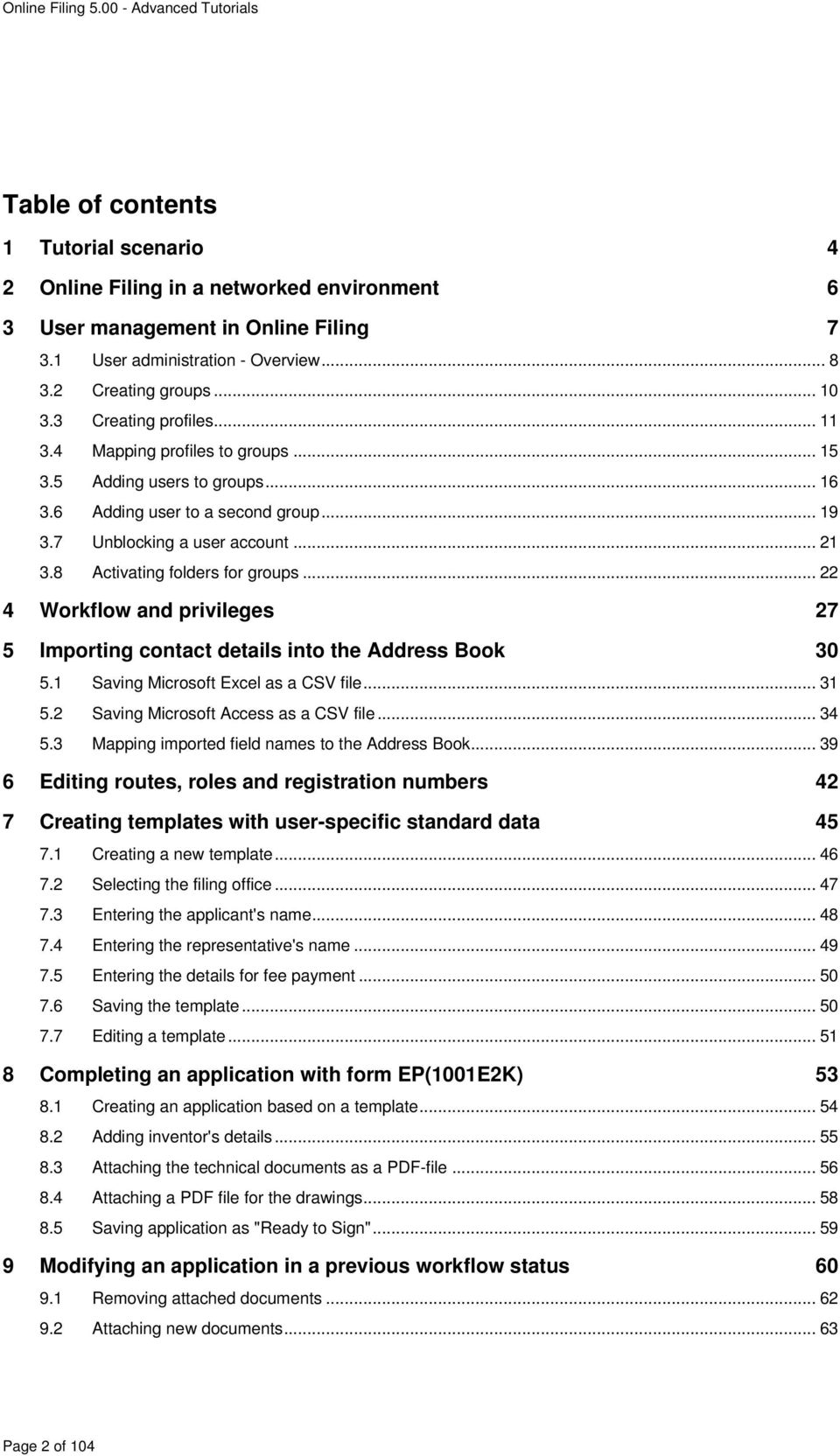
2 Table of contents 1 Tutorial scenario 4 2 Online Filing in a networked environment 6 3 User management in Online Filing User administration - Overview Creating groups Creating profiles Mapping profiles to groups Adding users to groups Adding user to a second group Unblocking a user account Activating folders for groups Workflow and privileges 27 5 Importing contact details into the Address Book Saving Microsoft Excel as a CSV file Saving Microsoft Access as a CSV file Mapping imported field names to the Address Book Editing routes, roles and registration numbers 42 7 Creating templates with user-specific standard data Creating a new template Selecting the filing office Entering the applicant's name Entering the representative's name Entering the details for fee payment Saving the template Editing a template Completing an application with form EP(1001E2K) Creating an application based on a template Adding inventor's details Attaching the technical documents as a PDF-file Attaching a PDF file for the drawings Saving application as "Ready to Sign" Modifying an application in a previous workflow status Removing attached documents Attaching new documents Page 2 of 104
3 10 Signing and sending the application Checking your smart card Signing the application Sending the applications Viewing and saving receipts Exporting and importing individual applications Exporting applications to ZIP files Importing an application from a ZIP file Managing servers and services Server Manager - Overview Services management Settings for file locations Setting up Live Update Managing databases Backing up databases Restoring databases Emptying databases Exporting and importing applications with the Server Manager Exporting applications and templates Importing applications or templates Managing user sessions and connections Managing and terminating user sessions Unlocking records Viewing the user sessions log (History) Page 3 of 104

4 1 Tutorial scenario Using the Online Filing software in a firm of patent attorneys Our scenario uses the British patent attorneys' firm, IP Partners, as an example. The firm acts as European representative for companies in several different countries and is based in Cambridge, United Kingdom. IP Partners have recently decided to start using the Online Filing software in their office. The team at IP Partners is made up of patent attorney David Kilburn, two paralegals Jennifer Hancock and Oliver Barber, attorney's assistant Elizabeth Miners and an administrator (unnamed). In the course of our exercises, David Kilburn will be replaced as patent attorney by his colleague Jennifer Hancock and two American trainees, Patricia Baxter and Alex Haselmere, will join the IP Partners team. User privileges At IP Partners, different staff members have different privileges in the system, depending on their role. In Online Filing, these user privileges are assigned by the system administrator. Paralegals may draft and check applications when they are ready for signing, they may also make any necessary corrections and attach documents. Attorneys may perform all business functions such as drafting, signing and sending. Assistants may send applications to the European Patent Office and maintain the Address Book. Electronic transmission of data IP Partners have recently taken on a new client, an American company called Universal Engineering, based in Los Angeles, California. Universal Engineering sends him all its documents electronically. Online Filing accepts files prepared in PDF-Format. It also accepts files prepared in XML-Format. Application templates and filing of data IP Partners anticipate that the filing office, names and payment details will be the same for every application they submit on behalf of Universal Engineering. IP Partners create a template with the relevant data in order to save time when completing the forms. The applications are filed in a folder labelled by the company's name, with subfolders for each year. Request for grant of a European patent IP Partners prepare applications in the Online Filing software using Form EP(1001E2K) Request for Grant of a European Patent (EPC 2000). Page 4 of 104

5 Sending applications to the EPO via a secure Internet connection For the purposes of this scenario, the team is going to use the "batch send" functionality, that is, they will send multiple applications to the EPO at the same time for filing. The assistant will use her personal smart card to transfer the applications that are ready to send to the OLF server at the EPO. The data will be encrypted and transmitted over a secure Internet link. Figure 1: Inserting smart card into card reader Confirmation of receipt by the EPO Applications are received and stored on the EPO server in The Hague. The EPO server issues a receipt, showing the exact date and time of receipt, down to the second. The receipt is stored in the Online Filing software together with the sent application. IP Partners also make a copy and store it in a local folder. Page 5 of 104

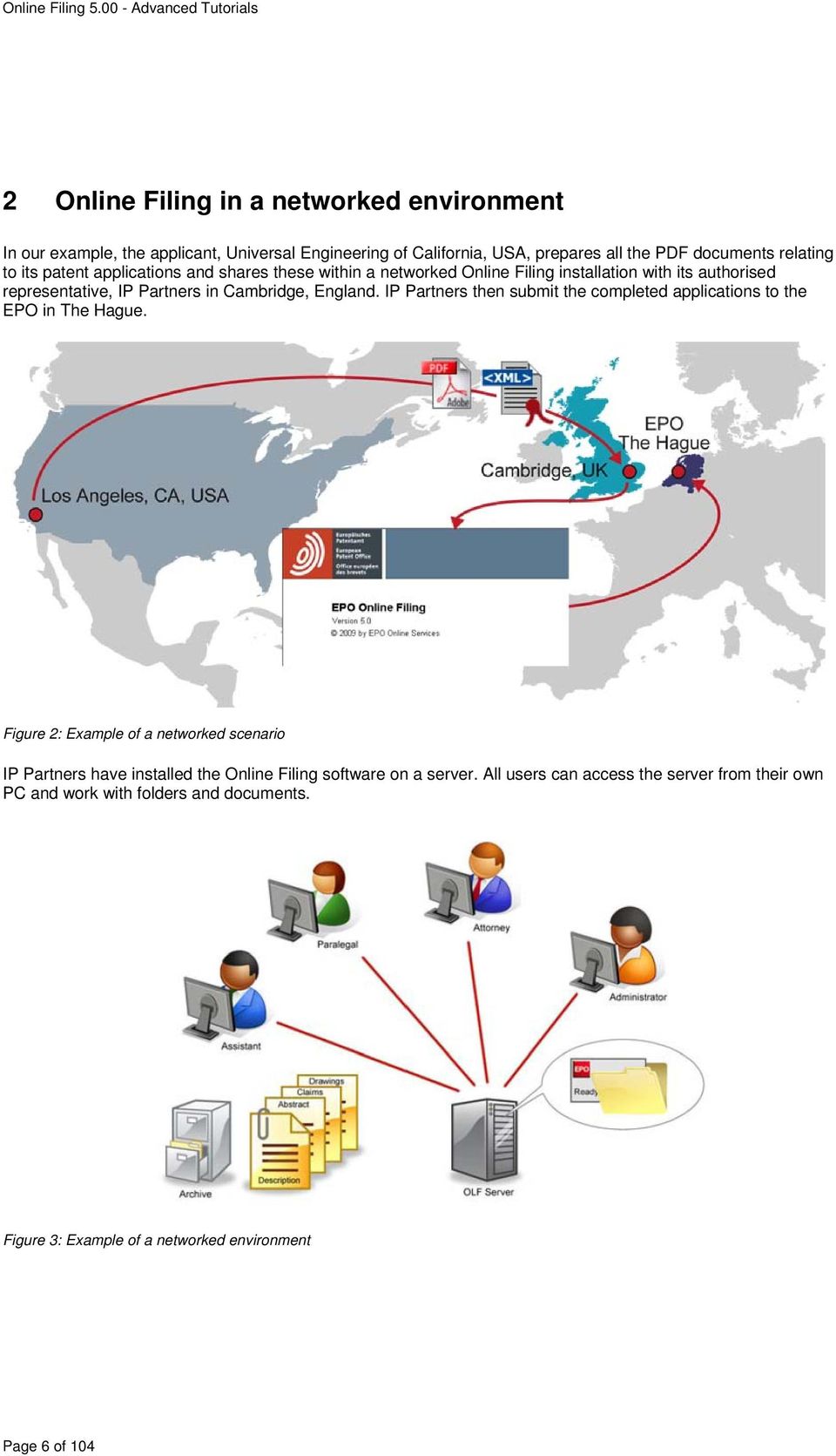
6 2 Online Filing in a networked environment In our example, the applicant, Universal Engineering of California, USA, prepares all the PDF documents relating to its patent applications and shares these within a networked Online Filing installation with its authorised representative, IP Partners in Cambridge, England. IP Partners then submit the completed applications to the EPO in The Hague. Figure 2: Example of a networked scenario IP Partners have installed the Online Filing software on a server. All users can access the server from their own PC and work with folders and documents. Figure 3: Example of a networked environment Page 6 of 104
7 3 User management in Online Filing Objective We want to assign privileges to Online Filing users according to their roles in the company. Step by step We are going to assign privileges for an attorney, a paralegal and an attorney's assistant. In our example the company's policy specifies that all users must log in with a user name and password. We will start with a tour of what is available. After that we are going to define groups, create profiles to assign privileges, map the profiles to the groups, add individual users to the groups, re-activate blocked users, activate folders for specific groups. Page 7 of 104
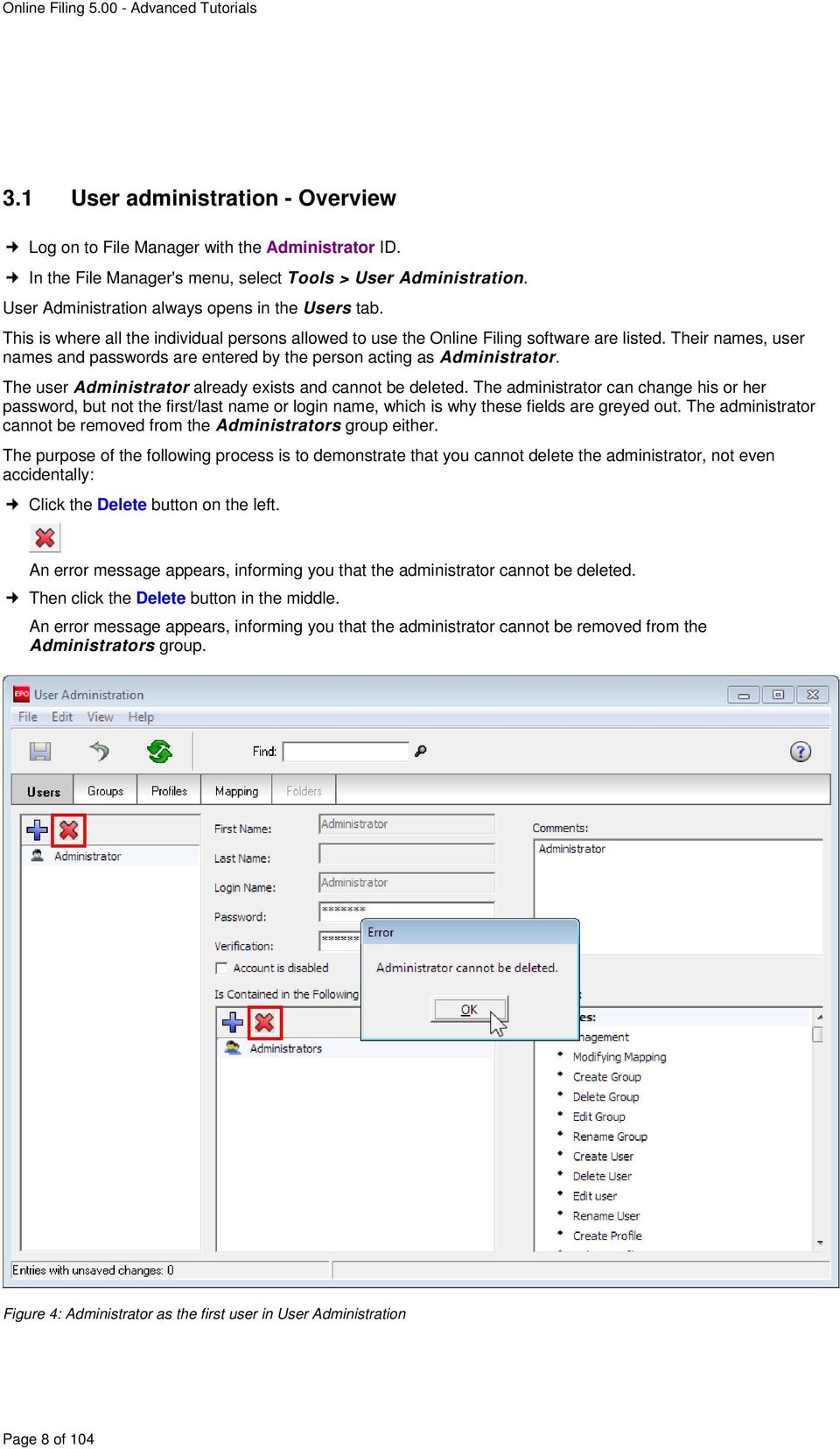
8 3.1 User administration - Overview Log on to File Manager with the Administrator ID. In the File Manager's menu, select Tools > User Administration. User Administration always opens in the Users tab. This is where all the individual persons allowed to use the Online Filing software are listed. Their names, user names and passwords are entered by the person acting as Administrator. The user Administrator already exists and cannot be deleted. The administrator can change his or her password, but not the first/last name or login name, which is why these fields are greyed out. The administrator cannot be removed from the Administrators group either. The purpose of the following process is to demonstrate that you cannot delete the administrator, not even accidentally: Click the Delete button on the left. An error message appears, informing you that the administrator cannot be deleted. Then click the Delete button in the middle. An error message appears, informing you that the administrator cannot be removed from the Administrators group. Figure 4: Administrator as the first user in User Administration Page 8 of 104
9 Click the Groups tab. This is where groups defined by the Administrator are listed. The Administrators and Users groups are already set by default and should not be changed. Figure 5: User administration - Groups tab Click the Profiles tab. This is where the privileges are listed that can be assigned to each group. They can be grouped into four headings: Address Book Management Application Workflow Folder/Data Management User Management. At the moment we cannot see any privileges under these headings. We will look at the full list once we have assigned one or more profiles to a group. Click the Mapping tab. Here you can assign the profiles to groups. To start the exercise, return to the Groups tab. Page 9 of 104

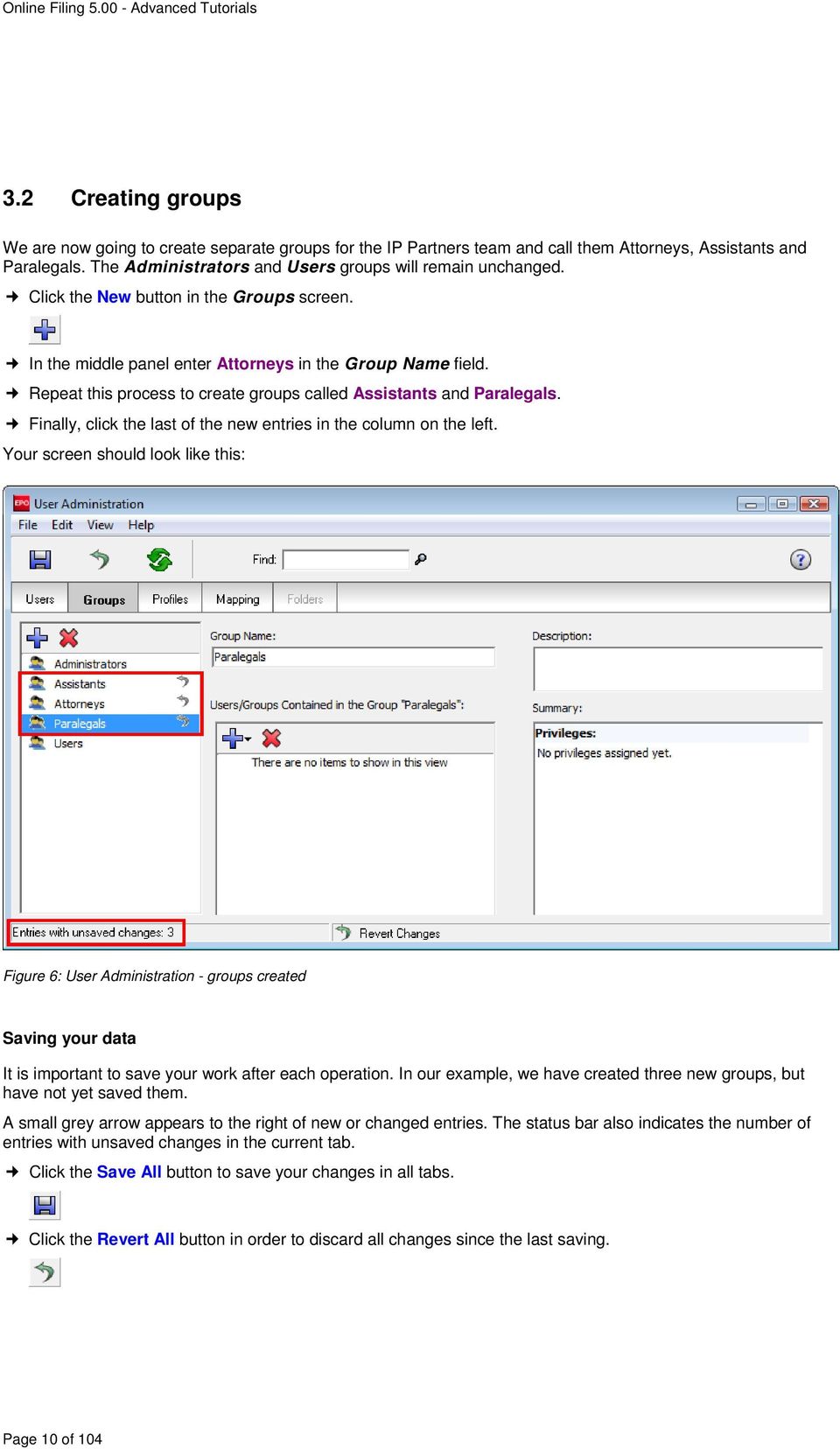
10 3.2 Creating groups We are now going to create separate groups for the IP Partners team and call them Attorneys, Assistants and Paralegals. The Administrators and Users groups will remain unchanged. Click the New button in the Groups screen. In the middle panel enter Attorneys in the Group Name field. Repeat this process to create groups called Assistants and Paralegals. Finally, click the last of the new entries in the column on the left. Your screen should look like this: Figure 6: User Administration - groups created Saving your data It is important to save your work after each operation. In our example, we have created three new groups, but have not yet saved them. A small grey arrow appears to the right of new or changed entries. The status bar also indicates the number of entries with unsaved changes in the current tab. Click the Save All button to save your changes in all tabs. Click the Revert All button in order to discard all changes since the last saving. Page 10 of 104
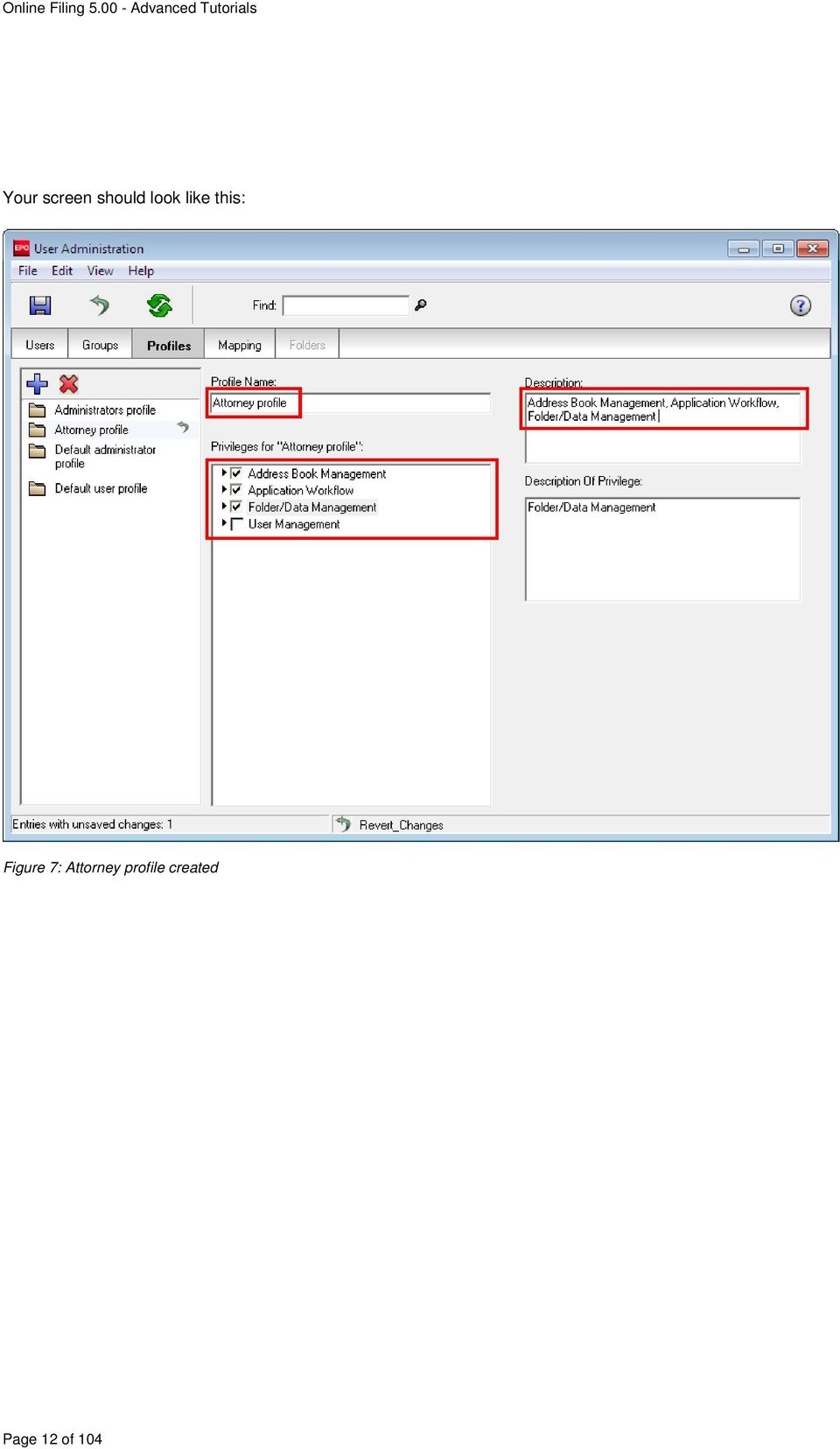
11 3.3 Creating profiles The Profiles tab allows you to edit the list of privileges to be assigned to each group. Three standard profiles are created when you install the Online Filing software: Administrators profile - this profile is mapped to the Administrators group. This assignment cannot be modified. You cannot deactivate the privileges under User Management nor can you delete the Administrators profile. Default administrator profile - this profile can be used as a template to provide additional user groups with administrator rights as well as to set specific rights restrictions. The settings under User Management can therefore be edited. Default user profile - this profile is suitable for user groups mainly involved in processing applications. The Edit Maintenance Fees privilege under Folder/Data Management is deactivated. We are now going to create three suitable profiles for the user groups we just created. We will not make any changes to the three default profiles. Attorneys In our example, the attorneys' group will have all privileges for the Address Book management, application workflow and folder/data management, but NOT for the user management. Click the New button in the Profiles tab in order to create a new profile. In the middle panel enter Attorney profile in the Profile Name field. Click the Save All button. Tick the check boxes for Address Book Management, Application Workflow and Folder/Data Management in the Privileges for "Attorney profile" panel. User Management is NOT selected. In the Description field enter Address Book Management, Application Workflow and Folder/Data Management and click the Save All button. Page 11 of 104

12 Your screen should look like this: Figure 7: Attorney profile created Page 12 of 104
13 Paralegals In our example, paralegals will have privileges for the Address Book management and most privileges for the application workflow, but will NOT have privileges relating to signing or sending applications. They will NOT have privileges for the user management. Click the New button in the Profiles tab. In the middle panel enter Paralegal profile in the Profile Name field. Click the Save All button. Tick the check boxes for Address Book Management and Folder/Data Management. User Management is NOT selected. Under Application Workflow double-click the Application sub-heading to open the list. Clear the check boxes for Remove Signature/Signatures, Send Application and Sign Application. This removes these privileges from this profile. In the Description field enter Not remove signature(s) / not send application / not sign application. Click the Save All button. Your screen should look like this: Figure 8: Paralegal profile created Page 13 of 104

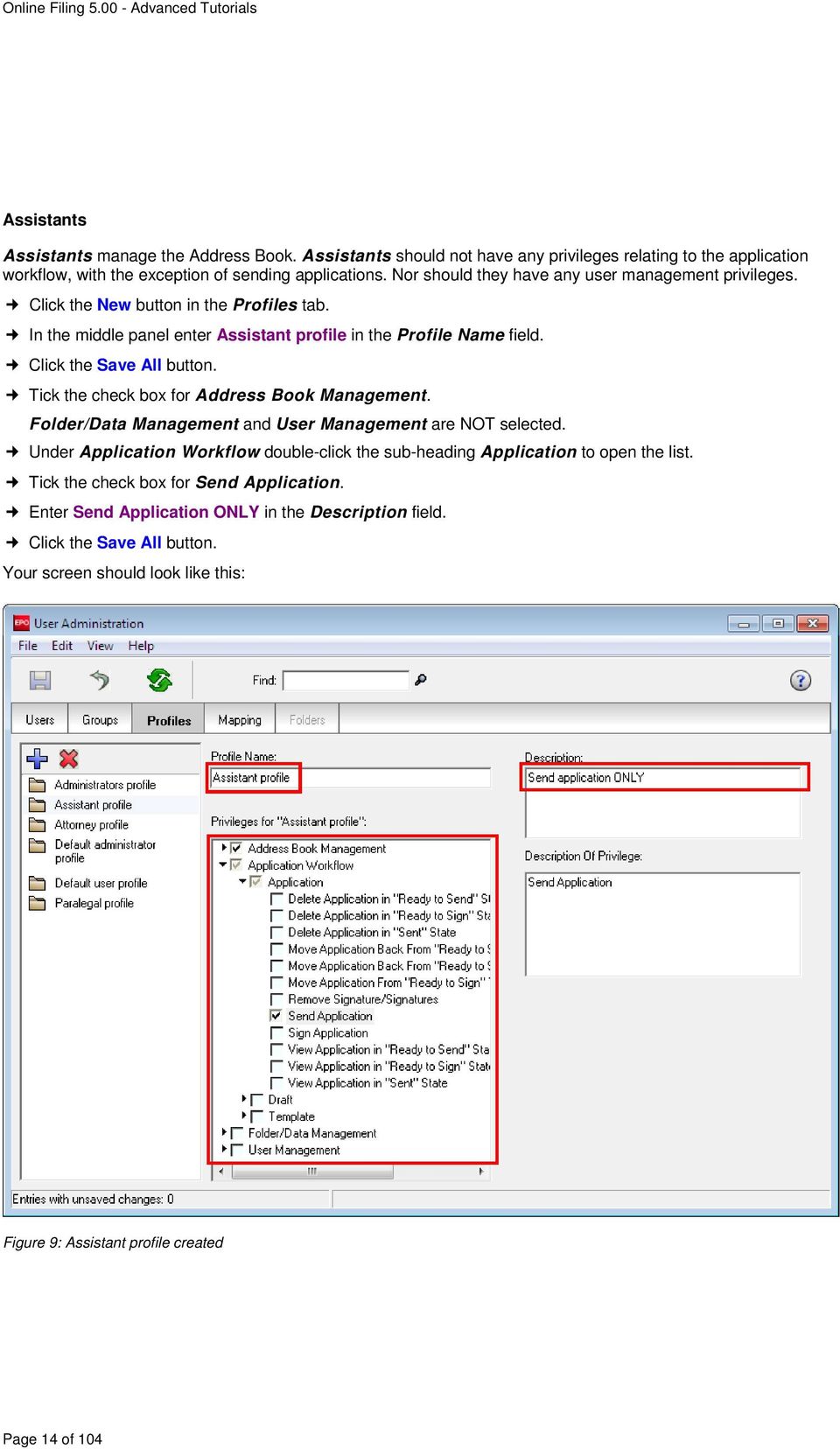
14 Assistants Assistants manage the Address Book. Assistants should not have any privileges relating to the application workflow, with the exception of sending applications. Nor should they have any user management privileges. Click the New button in the Profiles tab. In the middle panel enter Assistant profile in the Profile Name field. Click the Save All button. Tick the check box for Address Book Management. Folder/Data Management and User Management are NOT selected. Under Application Workflow double-click the sub-heading Application to open the list. Tick the check box for Send Application. Enter Send Application ONLY in the Description field. Click the Save All button. Your screen should look like this: Figure 9: Assistant profile created Page 14 of 104
15 3.4 Mapping profiles to groups We have defined our groups and profiles. Now we are going to associate them with one another. Click the Mapping tab. Click a group name on the left and then tick the check box to assign the associated profile in the middle panel. In the example below, the Paralegal profile is selected as an assigned profile for the Paralegals group. Continue in the same manner to assign the Attorney profile to the Attorneys group and the Assistant profile to the Assistants group. Click the Save All button. To make sure that each group has the privileges you intend it to have, click each group name in turn and scroll down the Summary of privileges on the right. You can assign multiple profiles to a group. This gives the group all the rights of both profiles. Your screen should look like this (Paralegals selected): Figure 10: Mapping privileges to Paralegal Profile Page 15 of 104

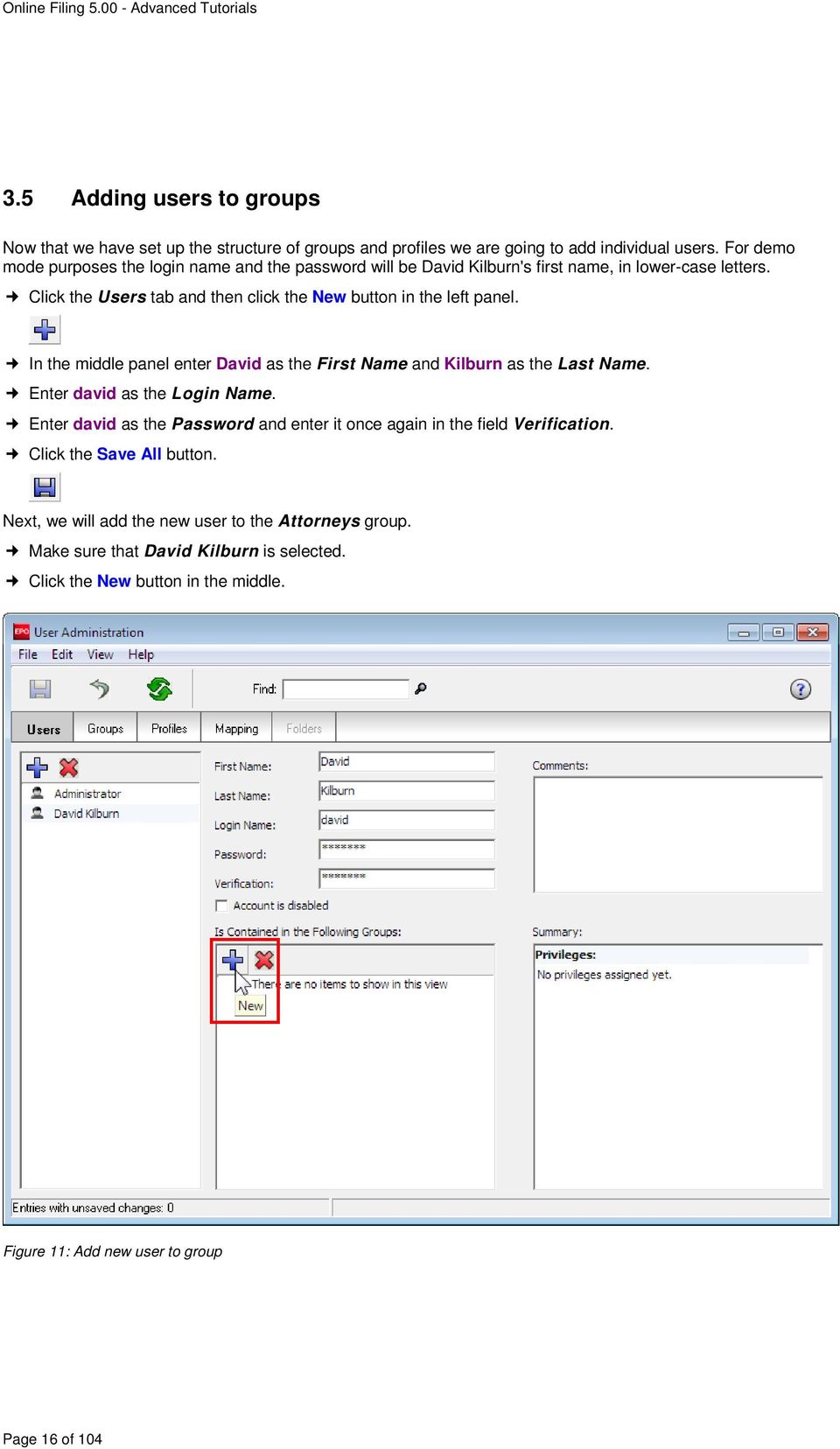
16 3.5 Adding users to groups Now that we have set up the structure of groups and profiles we are going to add individual users. For demo mode purposes the login name and the password will be David Kilburn's first name, in lower-case letters. Click the Users tab and then click the New button in the left panel. In the middle panel enter David as the First Name and Kilburn as the Last Name. Enter david as the Login Name. Enter david as the Password and enter it once again in the field Verification. Click the Save All button. Next, we will add the new user to the Attorneys group. Make sure that David Kilburn is selected. Click the New button in the middle. Figure 11: Add new user to group Page 16 of 104
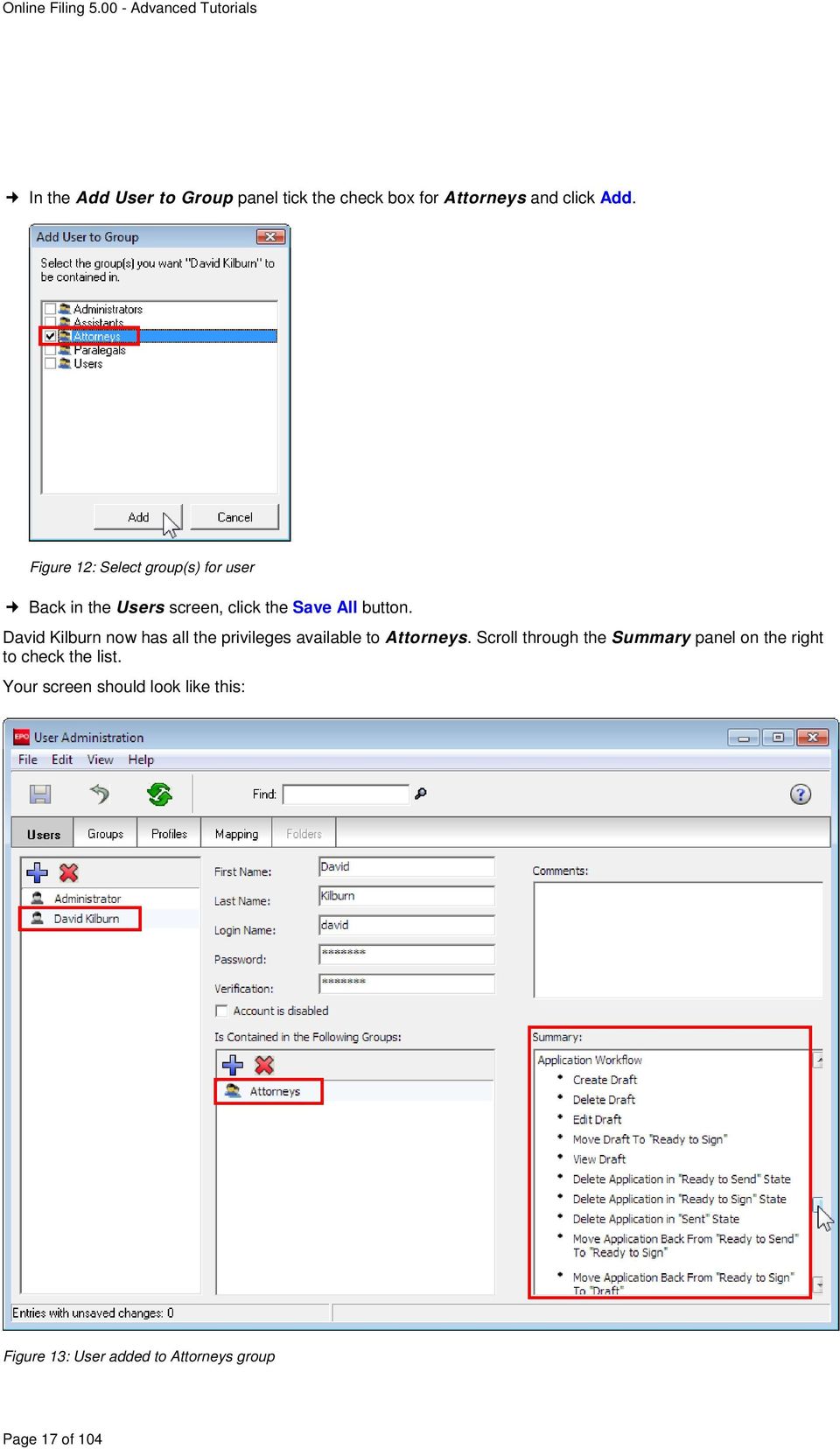
17 In the Add User to Group panel tick the check box for Attorneys and click Add. Figure 12: Select group(s) for user Back in the Users screen, click the Save All button. David Kilburn now has all the privileges available to Attorneys. Scroll through the Summary panel on the right to check the list. Your screen should look like this: Figure 13: User added to Attorneys group Page 17 of 104
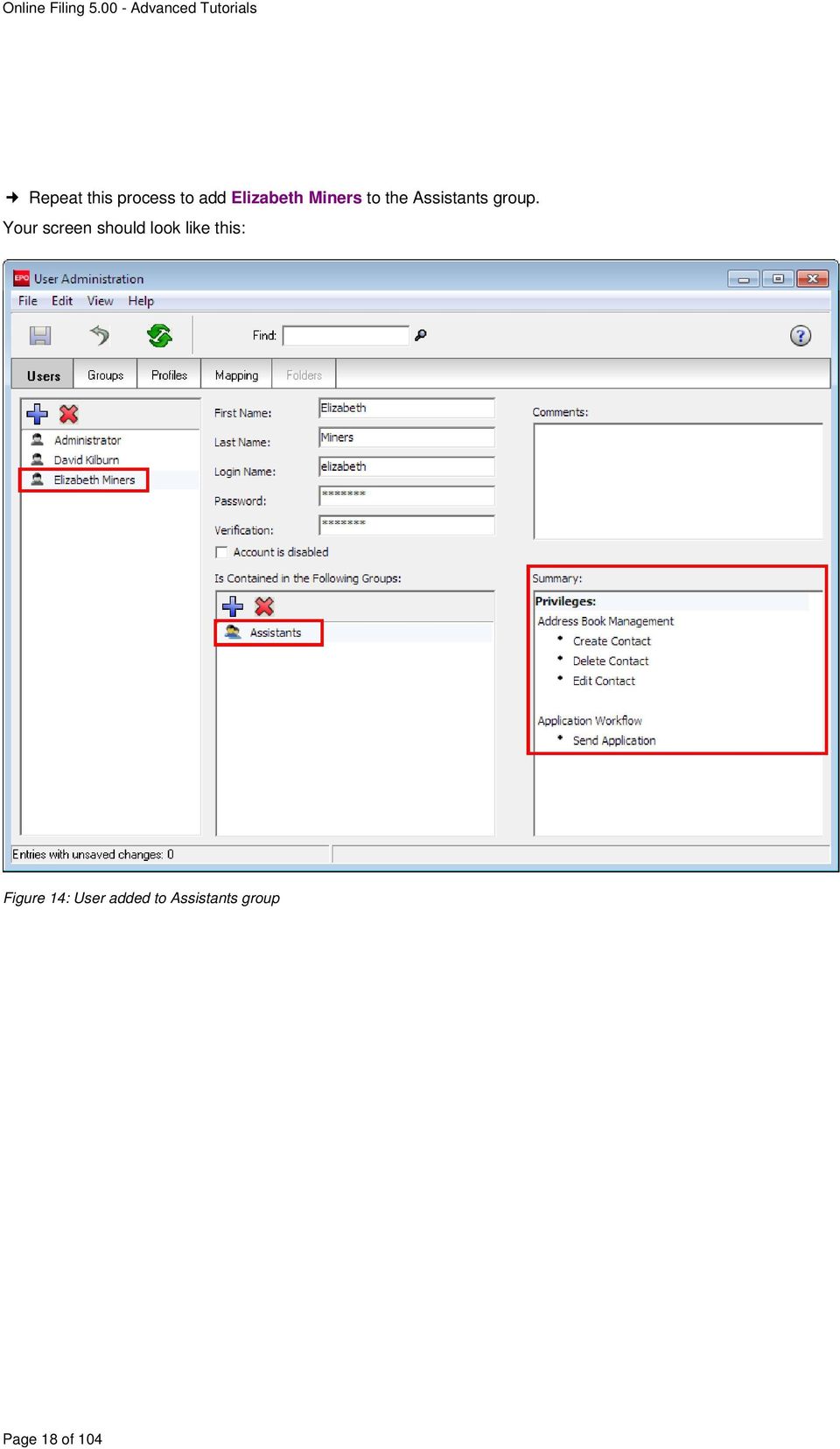
18 Repeat this process to add Elizabeth Miners to the Assistants group. Your screen should look like this: Figure 14: User added to Assistants group Page 18 of 104
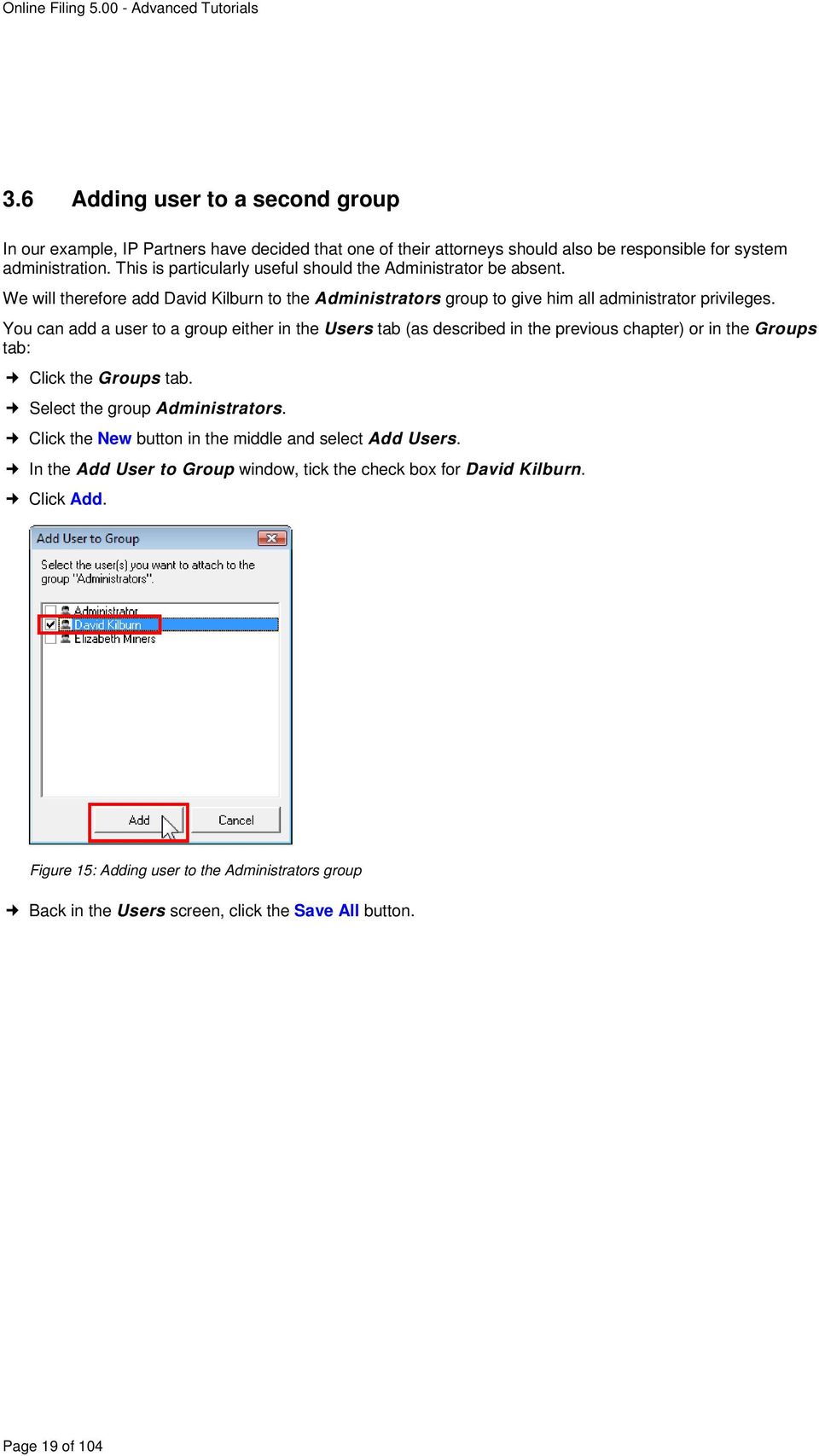
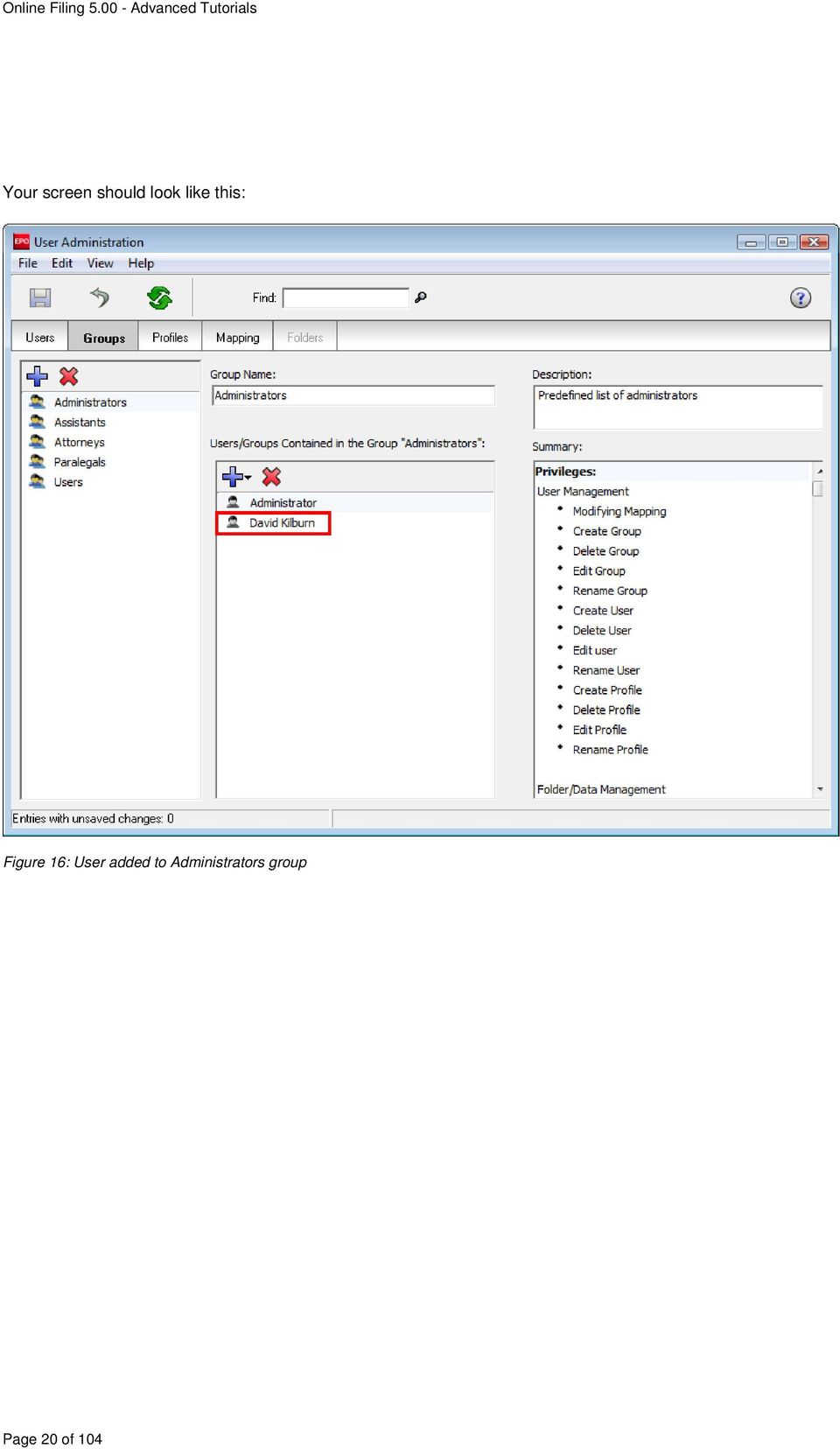
19 3.6 Adding user to a second group In our example, IP Partners have decided that one of their attorneys should also be responsible for system administration. This is particularly useful should the Administrator be absent. We will therefore add David Kilburn to the Administrators group to give him all administrator privileges. You can add a user to a group either in the Users tab (as described in the previous chapter) or in the Groups tab: Click the Groups tab. Select the group Administrators. Click the New button in the middle and select Add Users. In the Add User to Group window, tick the check box for David Kilburn. Click Add. Figure 15: Adding user to the Administrators group Back in the Users screen, click the Save All button. Page 19 of 104
20 Your screen should look like this: Figure 16: User added to Administrators group Page 20 of 104
21 3.7 Unblocking a user account The assistant Elizabeth Miners mistyped her password three times in succession when logging on to File Manager. A message appears informing her that her user account is now blocked and advising her to contact her administrator. As the system administrator is currently out of the office, she contacts her colleague, David Kilburn, who is also a member of the Administrators group in Online Filing. Figure 17: User is blocked after three successive attempts to log on with the wrong password The user account can be re-activated by any user with a profile that is authorised for user administration. In the role of patent attorney David Kilburn, we are now going to re-activate Elizabeth Miners' user account. Log on to File Manager as david with the password david. Open User Administration. Click the name Elizabeth Miners in the Users tab. The Account is disabled check box is ticked. Clear the check box to remove the tick. Click the Save all button. Elizabeth Miners' user account is active once more and she can log on to File Manager with her old password. Figure 18: Unblocking the user account Page 21 of 104
22 3.8 Activating folders for groups We want to enable folder management and activate specific File Manager folders for the Paralegals group to give all users in the group access to the same folders. Folder management is not enabled by default when you install Online Filing. The Folders button on the navigation bar in User Administration is not active. Figure 19: The "Folders" button is inactive by default in User Administration Enabling folder management Close the User Administration window. Click the System Preferences button in File Manager. -OR- Select Tools > Preferences > System Preferences in the Tools menu. Select the check box Enable Folder Management. Click Save. Close and restart File Manager to activate the new settings. Figure 20: Enabling folder management under System Preferences Page 22 of 104
23 Creating folders Next, we will create some folders in File Manager. In our example, there are three clients with patent applications that require administration in Online Filing. Log on to File Manager with the Administrator ID. Create three new folders and name them after the companies Nano Enterprise, TechEurope and Universal Engineering. Create separate subfolders for these companies, named after specific years or individual team members, for instance. Now create separate template folders for the three companies. Your screen should look like this: Figure 21: New folders created in File Manager Page 23 of 104
24 Overview of all folders Open User Administration again. Click the Folders button, which is now active. All folders that we just created in File Manager are now displayed on the right. All folders for the Administrators group are selected by default in the middle panel because they were created by the actual administrator. The Templates folder is always enabled for all users, which is why it cannot be deselected. However, you can select or exclude individual subfolders under Templates. The Default Folder is also always enabled for all users and is therefore not displayed for editing in Folder Management. Figure 22: Folders assigned to the "Administrators" group Page 24 of 104
25 Assigning folders to a group We are now going to assign specific folders and subfolders to the paralegals. In this example, we will authorise the paralegals to use the Nano Enterprise folder with all subfolders, the Hancock subfolder and the two template folders Nano Enterprise and Universal Engineering. At the same time, we will disable all TechEurope folders for this group. Select the Paralegals group. Select the folders that the paralegals should be authorised to access. Subfolders can be displayed by double-clicking the relevant parent folder. Selecting a subfolder automatically assigns the relevant parent folder as well. Assigning a parent folder automatically enables all of its subfolders, including any subfolders subsequently created. Click the Save All button. The folders assigned to paralegals are now displayed on the right. Figure 23: Folders assigned to paralegals Page 25 of 104
26 Folders activated in File Manager Create a new user with the name Jennifer Hancock. Add Jennifer Hancock to the Paralegals group. Log on to File Manager as Jennifer Hancock. The folders and subfolders assigned to paralegals as well as the Default Folder and the Templates folder are now displayed. The TechEurope folder and the Kilburn subfolder, however, are no longer visible. Paralegals are authorised by the User Administration settings to create new folders. Create a new subfolder called Hancock_2008 in the Universal Engineering folder. All other users who are already authorised to access the Universal Engineering folder will subsequently also be able to access this new folder. Figure 24: New folder created by a user from the Paralegals group Page 26 of 104
27 4 Workflow and privileges Objective We are going to log on to Online Filing in various user roles to see which operations are permitted by the relevant profiles. Step by step We will create a new application as a paralegal and save it as a draft. We will try to change the status of this application as an assistant. Workflow concept The Online Filing software tracks the workflow. In other words, it checks all tasks relating to the processing of an application for correctness and completeness. Depending on which tasks have been completed, applications are automatically assigned to one of the following statuses: Draft, Ready to Sign, Ready to Send or Sent. User privileges for workflow operations Users may only change the status of a selected application if they have been assigned sufficient privileges in the User Administration. In this example the Assistant Profile has been assigned the Send Application privilege. Sending the application to the EPO server changes the status of the file from Ready to Send to Sent. Figure 25: Assistant with "Send Application" privilege Page 27 of 104
28 However, according to the privileges shown in the above profile, assistants are not authorised to move an application from Draft to Ready to Sign status. This is what we are going to demonstrate in this exercise. Log on as paralegal Jennifer Hancock and create a new application with Form EP(1038E). Select Default Folder as the storage location because this is the only location activated for assistants. Process the application further and save it. For example, just enter an EP application number such as and an annotation to the EPO. Log on in the role of assistant Elizabeth Miners. Click Default Folder and select the application created by Jennifer Hancock. Click the Next workflow button, which is now active. An appropriate message appears. Figure 26: Message that appears after a user tries to perform an action without appropriate rights Page 28 of 104
29 Workflow stages for application submission This example shows the application passing through all the workflow stages, from the initial Draft status to the final Sent status. The paralegal creates a new application, processes it and moves it to Ready to Sign status. As the paralegal does not have signing privileges, an attorney digitally signs the application with his or her smart card and then moves the application to Ready to Send status. The assistant is then allowed to send the applications to the EPO. This is only possible after the patent attorney has moved the applications to a folder assigned to the assistants. Online Filing automatically saves the acknowledgment of receipt in the database without any further user intervention. Figure 27: Workflow stages for application submission Page 29 of 104
30 5 Importing contact details into the Address Book Objective In this section we are going to import contact details from an Office application into the Online Filing Address Book. In our office, it is the assistant Elizabeth Miners who manages the Address Book. We will therefore log back on to Online Filing in this role. In our example we will use Microsoft Excel 2007 and Microsoft Access 2007 with the Windows Vista operating system to create a CSV file (CSV = comma separated values). You can of course use any previous versions of Excel or Access as well as any other commercially available spreadsheet software to export your data in CSV format. Step by step We will save our contact addresses from a Microsoft Excel table as a CSV file. From our address database in Microsoft Access we will export a specific table and save it as a CSV file. We will import the CSV file into the Online Filing Address Book and assign the field names from the CSV file to the field names in the Address Book. Sample CSV file In a CSV file each address is stored in a new row. The individual data fields - e.g. surname and first name - are separated by delimiters (e.g. commas or semi-colons). The column headings or field names are entered in the first row of the CSV file and are also separated by delimiters. In this example the Type field is used to distinguish between natural and legal persons. The English terms "natural" for natural person and "legal" for legal person should be used so that the data can be imported into Online Filing. If a row in the address file does not contain such a standardised term in the Type field, the default when importing into the Online Filing Address Book is "legal". In Windows Notepad you can show a CSV file as simple text. In our example commas are used as separators. Figure 28: CSV file in Windows Notepad In Microsoft Excel the same data fields appear as cells in a table. Figure 29: CSV file opened in Microsoft Excel in table view Page 30 of 104
31 5.1 Saving Microsoft Excel as a CSV file The XLS file format is compatible with earlier versions of Microsoft Excel (Excel ). The XLSX format, however, can only be read by Office Suite 2007 applications. If you use different versions of Microsoft Office in your company, we therefore recommend that you save your files in XLS format. Open the Excel file, which in our example is contacts.xls. The workbook contains three sheets: contacts_2008, contacts_2007 and contacts_2006. Select the sheet you want to export, in our example contacts_2008. Select Save As > Other Formats from the main menu. Figure 30: "Save As" menu in Microsoft Excel In the Save As window locate the folder where you want to store your file. Change the file name to contacts_2008.xls. Page 31 of 104
32 Scroll down the Save as type list and select CSV (Comma delimited) (*.csv). Figure 31: Saving Excel table in CSV format Click Save. Click OK in the ensuing message to save the selected sheet in CSV format (contacts_2008 in this example). Figure 32: Only the active sheet in the workbook is saved Click Yes to confirm that you wish to change the file format to CSV. Figure 33: Saving the CSV file in Microsoft Office Excel - confirmation of save Page 32 of 104
33 The file is now saved as contacts_2008.csv. The other sheets are still visible at this point but will have disappeared the next time you open the CSV file. Figure 34: File saved in CSV format Page 33 of 104
34 5.2 Saving Microsoft Access as a CSV file The MDB file format is compatible with earlier versions of Microsoft Access (Access 2000 to 2003). The ACCDB file format, on the other hand, can only be read by Office Suite 2007 applications. We therefore recommend saving in MDB format as Access 2000 or Access database if you use different versions of Microsoft Office in your company. Open the Microsoft Access database (file format MDB). In our example this is clients.mdb in Access file format Access databases normally contain multiple tables. Open the table clients_2008. Click External Data in the toolbar, then select the option Text file in the tool set for Export. Figure 35: Exporting from Microsoft Access into a text file Page 34 of 104
35 The Export - Text File window opens. Click Browse next to File name to change the destination folder and file name for the save. Figure 36: Entering name for export of CSV file Page 35 of 104
36 The File Save window opens. Select the folder you require from the list under Save in. In the File name field type in the file name required together with the file suffix.csv. In this example you should enter clients_2008.csv. Click Save. Figure 37: Selecting folder and file name for export file Page 36 of 104
37 In the Export - Text file window click OK. The Export Text Wizard opens. Tick the Delimited option. In the preview you will see that commas are being used as delimiters. You can change the type of delimiter in the following step. Click Next. Figure 38: Export Text Wizard in Microsoft Access - selecting the "delimited" option Page 37 of 104
38 Select Semicolon as the delimiter that separates your fields. Select the option Include Field Names on First Row. Select {none} from the list in the Text Qualifier field. Note how the data in the preview field change. Click Finish. Figure 39: Finishing the Export Text Wizard The file has now been saved in CSV format and can be imported into the Online Filing Address Book. Page 38 of 104
39 5.3 Mapping imported field names to the Address Book In this exercise we will import the data for our contact addresses which we previously stored in the CSV file contacts_2008.csv. When CSV files are imported into the Address Book, column headings which are exact matches for the field names in Online Filing are automatically mapped to one another, provided that the column headings are in English. Click the Address Book button in the toolbar. Select File > Import in the Address Book. Select the file contacts_2008.csv and click Open. Online Filing numbers the heading names in the CSV file and maps all exact matches. If Online Filing does not find an exact match for the Address Book field, the CSV File Field indicates None. In the following step we will map the CSV file fields to the fields in the Online Filing Address Book (drag the bottom edge of the window down to see all fields, if required). Figure 40: Fields in CSV file to be imported not yet mapped to fields in the Address Book In our example the Address Book fields First Name, Title, Country and Region are mapped to the corresponding fields in the CSV file because they happen to have the same name. Page 39 of 104
40 We now need to map all the remaining field names. Double-click on the white space containing the word None next to the Address Book Field labelled Person Type in the first row. This will open a drop-down list of available CSV column headings. In the drop-down list select Type for the CSV field. Figure 41: Mapping fields, selecting field in CSV file Repeat this process to map the CSV field name Name to the Address Book field Last Name. Continue for all other fields. If a field in the Address Book does not have a corresponding field in the CSV file, leave it as None. You can always add the data manually at a later date, if required. Click OK when you are done. Figure 42: Mapping field names for Address Book completed Page 40 of 104
41 The import process is now started. If the software finds a duplicate name in the Address Book a prompt appears. Figure 43: Prompt for existing Address Book entry Click Overwrite to replace the existing name with the imported data. If the software finds a further duplicate name, you will be asked again how you wish to proceed. Selecting Overwrite all will replace all existing duplicate names at once. Click Skip if you do not wish to import a particular duplicate name. You will be prompted again if the software finds a further duplicate name. Click Skip all if you do not wish to import any of the duplicate names. Click Add as new Record to import the duplicate name as a new entry in the Address Book. If no person type (either natural or legal) is indicated for a record, a legal person type is assumed by default. At the Import complete prompt click OK. Figure 44: Import of data into Address Book complete Page 41 of 104
42 6 Editing routes, roles and registration numbers Objective In this section we are going to enter data for multiple routes, roles and registration numbers for a natural person whose details are stored in our Address Book. Multiple registration numbers may be entered manually or imported from a CSV file. Step by step We will enter multiple routes, roles and registration numbers as the representative for a person. We will import a person with multiple registration numbers as an applicant. Entering multiple routes and registration numbers manually In this exercise we will log on in the role of assistant Elizabeth Miners and add missing data for Jennifer Hancock. 1st role: Route = EP, Role = Representative, Registration No. = nd role: Route = PCT, Role = Agent, Registration No. = rd role: Route = UK, Role = Party, Registration No. = Please bear in mind that this is only an example. For more information about roles and registration number formats contact the relevant national office. Page 42 of 104
43 From File Manager, open the Address Book by clicking the Address Book button. Select the Address Book entry you wish to add data to, in this example Hancock, Jennifer. Click the New button above the Route Role Registration No. headings. When you click the New button EP automatically appears under Route, and Applicant under Role. The role needs to be changed. Double-click the Role and change it to Representative. Double-click the Registration No. field and enter the registration number Click the New button again to create the second line. Select PCT as the Route and Representative as the Role. Enter the registration number Click the New button to create the third line. Select UK as the Route and Party as the Role. Enter the registration number Click the Save All button. Figure 45: Multiple registration numbers entered manually Page 43 of 104
44 Importing route and registration numbers from a CSV file In our example, there are two data sets in the CSV file for Salvatore Manzoni, a natural person. One is EP Applicant and the other is PCT Applicant only Both sets of data are contained in the Role field and separated from one another by vertical bars. Please bear in mind that the CSV file uses different names for roles depending on the route, in other words, it uses Representative in the EP procedure, Agent in the PCT procedure, Applicant in the EP procedure and Applicant only in the PCT procedure. Figure 46: Multiple registration numbers in the Procedure - Role field in an Excel table Log on to File Manager as an administrator. Import the CSV file into the Address Book as described in the last section's exercises. The imported data for Salvatore Manzoni looks like this in the Address Book: Figure 47: Example of an imported Address Book entry with multiple registration numbers Page 44 of 104
45 7 Creating templates with user-specific standard data Objective In this exercise we are going to create and modify a template for our applications. For this operation, we will log on to Online Filing in the role of patent attorney David Kilburn. Step by step We start by creating a new template for the procedure EP(1001E2K). We enter all the details for reuse. In our example these are the Filing Office, Applicant, Representative and Fee Payment details. The data for our applicant, Universal Engineering, is already stored in the Address Book, so we can use it for our draft. We can also use the data on the representative, David Kilburn, that is stored in the Address Book. We change the fees selected and provide information about the mode of payment and the deposit account. We save the template. We will then open the template in order to change the name of the representative. Page 45 of 104
46 7.1 Creating a new template We have already created an individual template folder for Universal Engineering's templates. We are going to use this subfolder for our new template. Log on to File Manager in the role of patent attorney David Kilburn. Select New Template in the File menu or press SHIFT+CTRL+N. Enter UnivEng_EP as the template name. You can use the Group field to assign the template to the possible procedure groups. These are EP and PCT in the default installation. Select EP(1001E2K) from the Procedure list. Select English as the Language of proceedings. Select the Universal Engineering subfolder. Enter the following brief description: EP filings for Universal Engineering. Your screen should look like this: Figure 48: Creating a new template Click Create. An empty Form EP(1001E2K) opens with the new template. Page 46 of 104
47 7.2 Selecting the filing office In the Request tab, enter EP in the Filing Office field. The full name for the European Patent Office is completed automatically. We do not enter a Title of Invention. Your screen should look like this: Figure 49: Selecting the filing office Page 47 of 104
48 7.3 Entering the applicant's name In the Names tab click the Add button and select Applicant, Legal. In our example the applicant is Universal Engineering. The company's data are already in the Address Book, so in the Names tab click the Copy from address book button. In the Address Book select the name and click the Copy records to form button. Note that legal persons are indicated by the icon. Your screen should look like this: Figure 50: Applicant (legal person) data copied from Address Book Page 48 of 104
49 7.4 Entering the representative's name In the Names tab click the Add button and select Representative, Authorised. In our example the representative is David Kilburn. David Kilburn s data are already in the Address Book, so in the Names tab click the Copy from address book button. In the Address Book select the name David Kilburn and click the Copy records to form button. Note that natural persons are indicated by the icon. Your screen should look like this: Figure 51: Representative data copied from Address Book Page 49 of 104
50 7.5 Entering the details for fee payment In this section we are going to enter the payment details for IP Partners, but without specifying the fees. In the Fee Payment tab click the Fee selection sub-tab and clear all the check boxes. Click the Payment Details sub-tab and select Debit from deposit account as the Mode of payment. Enter the deposit account information, e.g for the Deposit account number and IP Partners for Account holder. Your screen should look like this: Figure 52: Selecting mode of payment and providing details of deposit account 7.6 Saving the template Select File > Save from the menu. The template is kept opened in the form view. Close the template and select the option Exit without saving. The template now appears in the Universal Engineering folder under Templates in File Manager. Page 50 of 104
51 7.7 Editing a template In this example the previous representative, David Kilburn, has left the company. We will log on as an administrator and add the former paralegal Jennifer Hancock to the Attorneys group. We will leave David Kilburn's username but we will change his password as a precaution and remove this user from all groups, leaving him without any user rights in Online Filing. We will then change the template to reflect Jennifer Hancock as the new representative for future operations. We will transfer Jennifer Hancock's data from the Address Book. Double-click the Templates folder in the File Manager in order to display the subfolders. Select the templates folder Universal Engineering. Right-click the template UnivEng_EP and select Edit template from the shortcut menu. The template opens in the form view, ready for editing. Figure 53: Opening template for editing Page 51 of 104
52 In the Names tab select the current representative, David Kilburn. Click the Copy from address book button. In the Address Book select the name Hancock, Jennifer and click the Copy records to form button. Your screen should look like this: Figure 54: Changing representative data in template and copying to Address Book Close the template and select the option Save and exit. The template has been saved together with the new data. Applications drafted using the previous template with David Kilburn as the representative are not affected by these changes. You will have to change the name in these applications if they are not yet in Sent status. It is not possible to edit the type of procedure in the template. Page 52 of 104
53 8 Completing an application with form EP(1001E2K) Objective In this section we will use the Online Filing software to create a new application based on Form EP(1001E2K), enter the mandatory data and move the application from Draft to Ready to Sign status. We are going to use the role of paralegal Oliver Barber for this. Step by step In our example, the paralegal uses the template created for Universal Engineering to create a new EP(1001E2K) application. The title of the invention is Engine Filter. The template already contains details of the applicant and representative, but the paralegal still needs to add the inventor. The paralegal also has to attach the mandatory documents provided by the applicant. These consist of two files: a combined PDF file for the description, claims and abstract, and a separate file for the drawings. Once the application is complete, the paralegal saves the work as Ready to Sign. The patent attorney Jennifer Hancock will sign the application later. Page 53 of 104
54 8.1 Creating an application based on a template Create a new draft Log on in the role of paralegal Oliver Barber. Double-click the Templates folder in the File Manager and select the Universal Engineering subfolder. Double-click the template UnivEng_EP. The window Create a New Application opens. In the User Reference field enter UE Double-click the folder Universal Engineering, select the subfolder Hancock_2008 and then click Create. Figure 55: Creating a new application using a template Entering the title of the invention In the Request tab, enter Engine Filter in the field Title of Invention in English. Enter the relevant terms in the fields Translation into French and Translation into German. If you omit these entries, the yellow validation icon remains in the Request button. You can still file the application with the EPO but will have to submit the translations at a later point in time. Page 54 of 104
55 8.2 Adding inventor's details The inventor in our example is called Harold Stockton. Harold Stockton works for Universal Engineering. In the Names tab click the Add button and select Inventor. Enter the details for Harold Stockton. The lower part of the form contains information on the legal relationship between the applicant and inventor. The As employer option is selected by default. Select the options Waiver by inventor of notification of information and/or Renunciation of title by inventor, if required. Click the Copy to address book button. This creates a new entry for Harold Stockton in the Address Book. This is shown in the status bar at the bottom of the screen. Figure 56: Information entered on the inventor Page 55 of 104
56 8.3 Attaching the technical documents as a PDF-file In the Documents tab on the left there is a list of all the attached files. Our example currently contains no documents in this list. We will add technical documents in the form of a PDF file. The file contains the description, the claims and the abstract. The drawings are not included in this combined file, but rather are attached in a separate step. In the Documents tab, click the Specification sub-tab and then click the Add button. Select the option Technical document(s) in English and in the Open window navigate to the file called Engine filter.pdf. Click Open. The file is renamed to SPECEPO-1.pdf. The original file name is also shown, for reference purposes. Tick the check boxes for the Description, Claims, Abstract and Drawings. This unlocks the associated fields for editing. In the Specification sub-tab next to Description enter the page numbers for the description in the PDF file (From page and to). In our example the description starts on page 1 and finishes on page 7. Enter 10 as the Number of Claims and 8 to 9 as the page numbers for the claims. In the Figure to be Published with Abstract field enter the number 1. Enter the page numbers 10 to 10 to indicate where the abstract is located in the document. All pages must be accounted for, and there must be no overlaps. In other words, the texts for the description, the claims and the abstract should each start on a new page in your combined file. Page 56 of 104
57 Your screen should look like this: Figure 57: Technical documents attached as PDF file Page 57 of 104
58 8.4 Attaching a PDF file for the drawings In the Documents tab, click the Specification sub-tab and then click the Add button. Select the Technical Document(s) in English option once again, navigate to where the Engine filter drawings.pdf is stored and select it. Click Open to attach the file. In the Documents tab, the check boxes for Description, Claims and Abstract are deactivated because you have already attached these components of the technical documents. Select the Drawings check box. The file is renamed to SPECEPO-2.pdf. Enter 2 in the Number of drawings field. Your screen should look like this: Figure 58: PDF file for drawings attached Page 58 of 104
59 8.5 Saving application as "Ready to Sign" The application for Universal Engineering is now complete and all red and grey validation icons have disappeared. A yellow validation icon only remains now in the Priority button, indicating that data is missing. Click the Priority tab. Select the option It is not intended to file a (further) declaration of priority. The yellow validation icon then also disappears. Select File > Close in the menu. At the prompt select the option Move to Ready to Sign and exit. In the File Manager the file is displayed with Ready to sign status. Your screen should look like this: Figure 59: Application in "Ready to Sign" status Page 59 of 104
60 9 Modifying an application in a previous workflow status Objective In this section we will modify an application in Online Filing. For this operation, we will log back on in the role of paralegal Oliver Barber. Step by step In our example, a paralegal has prepared a Form EP(1001E2K) application entitled Engine Filter, attached all documents and moved the form to Ready to sign. However, the applicant has now amended the description, claims and abstract and provided them in separate files. We will therefore remove the existing technical documents and attach the new files. The file containing the drawings is correct, so we do not have to make any changes here. In the File Manager the ToolTip on the Next button says "Sign". Opening the application would therefore automatically launch the signing process. The paralegal must therefore return the application to Draft status in order to be able to amend it. Figure 60: Application can be signed but not modified Page 60 of 104
61 In the File Manager click the Previous button. The ToolTip indicates "Draft". Figure 61: Clicking the "Previous" workflow button changes the status to "Draft" The application is reset to Draft status. Figure 62: The application is back in "Draft" status and may be moved to "Ready to sign" Page 61 of 104
62 9.1 Removing attached documents Before we can attach new documents, we must first remove the existing technical documents. In the File Manager, double-click the application to open it in Draft status. Click the Documents tab and then select the Specification sub-tab. Select the file SPECEPO-1.pdf. Click the Delete button. The combined file SPECEPO-1.pdf is removed. Figure 63: Removing technical documents file Page 62 of 104
63 9.2 Attaching new documents Now that the previous combined file has been removed, the new files can be attached. We will attach one file each for the description, the claims and the abstract. Attaching a new description In the Documents tab, click the Specification sub-tab and then click the Add button. Select the Technical document(s) in English option, navigate to the file called Engine filter description.pdf and select it. Click Open to attach the file. Tick the check box for Description. The file is renamed as SPECEPO-2.pdf. Your screen should look like this: Figure 64: PDF file for description attached Page 63 of 104
64 Attaching new claims Repeat this process to attach the claims file and select the check box for Claims. The file is renamed as SPECEPO-3.pdf. Enter 10 in the Number of Claims field. Claims may be filed later if required. In this case you should select the check box The claims will be filed later, which is below the list of attached documents (see above). This deactivates the check box for the claims. Attaching a new abstract Repeat this process to attach the abstract file and select the check box for Abstract. The file is renamed as SPECEPO-4.pdf. Enter 1 in the Figure to be published with abstract field. Adding an internal note Before we finish we are going to add an internal note to let the attorney know that the corrections have been made. Click the Internal Note button. Click the New button and enter Oliver Barber in the Author field. Enter Revised documents in the Subject field. Enter The applicant's revised documents are now attached in the Note field. Figure 65: Adding an internal note for the attorney Saving the application as "Ready to Sign" Now we will return the application to Ready to sign status. Select File > Close from the menu. At the prompt select the option Move to Ready to sign and exit. In the File Manager the file is displayed with Ready to sign status. The author, date and subject of the internal note are shown in a summary on the lower part of the screen. Page 64 of 104
65 10 Signing and sending the application Objective The application now contains all the mandatory information and is ready for signing. In our example, we are going to apply a digital signature in the role of patent attorney Jennifer Hancock. We will then switch to the role of assistant Elizabeth Miners and send a number of completed applications to the demo server in The Hague, using the "batch send" functionality. Step by step We will apply a digital signature to our application. Before we sign the application we will check our personal smart card. We will send all our applications with Ready to send status to the demo server in The Hague Checking your smart card Log on to File Manager in the role of patent attorney Jennifer Hancock. The Smart Card Checker tool is automatically installed together with the File Manager or the Online Filing client. It starts automatically when the File Manager is running. The Smart Card Checker icon and the icon for the smart card reader are displayed in the Windows system tray. The Smart Card Checker is only available in English. Figure 66: Programme icons in the Windows system tray The Smart Card Checker automatically locates the correct smart card driver software on the computer and checks registered certificates, so that when you change from one smart card to another you do not have to carry out any manual changes. Checking your smart card Insert your smart card into the reader. If the green light flashes this indicates that either the card was not inserted properly or it cannot be read. Right-click on the smart card checker symbol in the system tray and select Check Smartcard. Figure 67: Check smart card Page 65 of 104
66 The smart card is checked. If there is no reader connected to the PC, if no smart card is inserted, if the smart card has not been inserted properly, or if it is invalid, the smart card checker indicates that the card is not recognised. Figure 68: Smart card not recognized If the smart card is valid and was correctly inserted into the reader, the smart card checker checks the data and indicates that the smart card is recognised. The green LED on the reader indicates that the smart card is valid and inserted correctly by shining steadily, otherwise it flashes. Figure 69: Smart card recognized In the next step we use the smart card to sign the application Signing the application In the File Manager our application has Ready to sign status. The ToolTip on the Next button now displays "Sign", so we can sign the application in the next stage of the workflow. Click the Next button. The application is displayed in the PDF-Viewer. The documents attached are listed on the left. Click Sign now in the lower right-hand corner to proceed. For the purposes of this tutorial, select Jennifer Ashcroft as the Representative. Select Smart Card as the Type of signature. If you normally use your smart card to sign applications, you can tick the Save settings as default check box. Enter your PIN Code. Enter Cambridge as the Place of Signing. The place of signing is optional. To finish, click Sign. Page 66 of 104
67 Your screen should look like this: Figure 70: Signing details completed The software checks the smart card data and generates XML files using the data from the form. This may take a while. The following message box is displayed while the process is running. Figure 71: Processing the electronic signature The Sign application window then closes automatically and the status of our application changes to Ready to send in File Manager. At least one signature is required on each application. Whether or not you are authorised to sign forms depends on the user rights you were assigned by the Online Filing administrator. Page 67 of 104
68 10.3 Sending the applications To complete this exercise using the "batch send" functionality, we need at least two applications with Ready to send status. We will send all applications with Ready to send status to the demo server in The Hague. Log on in the role of patent attorney Jennifer Hancock to create another application such as EP(1038E) and sign it. As soon as the application receives a digital signature, it moves to Ready to send status. Finally, move the signed applications to the Default Folder because personal folders are not activated for assistants in File Manager. Log on in the role of assistant Elizabeth Miners to send the applications. Select Default Folder and click Ready to Send in the navigation bar. Create a multiple selection list of the applications you want to send with CTRL+click. Click the Next button to proceed. The ToolTip indicates "Send". Figure 72: Applications with "Ready to send" status selected Page 68 of 104
69 At the warning prompt, ensure that the transmission is going to the location you intend - in this case the demo server. Click Continue Sending. Figure 73: Sending application to demo server Enter your PIN code and click OK. Figure 74: Entering PIN code before sending As each application is sent, a progress indicator informs you of the current stage of the transmission. Figure 75: Progress indicator Page 69 of 104
70 10.4 Viewing and saving receipts Objective In this section we will view and save copies of receipts. The assistants in our patent attorneys' firm are not authorised to open an application or the documents attached to it, which is why we will now log on again in the role of patent attorney Jennifer Hancock to check the acknowledgment of receipt. Step by step Once the transmission is complete, the applications are displayed in the File Manager with Sent status. To view the attached documents (including the receipt), select an application and click the View... button. Figure 76: Applications with "Sent" status Page 70 of 104
71 In the PDF-Viewer select the document receipt.pdf from the list of files. Click the Save copy button and enter a file name for the PDF document. Figure 77: Storing receipt from the PDF Viewer. Page 71 of 104
72 11 Exporting and importing individual applications Objective In this section we will export an application into an external folder on our PC and import another application for processing in the Online Filing software. Step by step We will export all sent applications as ZIP files, including all attached files, into a storage location elsewhere in our company's network. We will import an application that was exported earlier back into File Manager to use it as a basis for a new application. Further exercises The chapter Exporting and importing applications with the Server Manager (p. 95) deals with exporting and importing applications in more detail. Managing and backing up databases is dealt with in the chapter Managing databases (p. 88). User rights for import and export Although Server Manager offers a comprehensive range of data management features, they can only be used by members of the Administrators group. A user with Administrator ID can add other users to the Administrators group in User Administration to grant them access to the same rights. Administrators in a company are responsible for managing the database as well as for exporting and archiving data. All other users can use File Manager functions to export or import individual applications as required, provided they belong to a group with an appropriate profile of privileges. Page 72 of 104
73 11.1 Exporting applications to ZIP files In this exercise, we will archive all sent applications in the role of patent attorney Jennifer Hancock. The Export Forms function generates a compressed ZIP archive for every application and at the same time enables you to delete the applications in the database. In File Manager, select File > Export > Forms. Click the sent Sent folder on the left. Only sent applications are displayed. Click the icon in the table header. This selects all applications. Tick the check-box next to Delete items from database after archiving. Click OK. Figure 78: Selecting the forms you want to export Online Filing automatically opens the directory selected in User Preferences for exporting files. In this example the default directory is EPO_data/Export on drive G. We will create a new subfolder for Universal Engineering in the Export folder. Page 73 of 104
74 Click the Make New Folder button. Figure 79: Selecting the folder for export A new folder is created. Enter Universal Engineering as the name of the new folder. Figure 80: New folder renamed in export destination Click OK to start the export process. Close the Export complete message by clicking OK. The applications are then deleted in File Manager. The new Universal Engineering folder can now be found in the Export folder and contains the ZIP files that Online Filing created and that were automatically renamed by the software as UE2008_08D.zip and UE2008_09.zip based on the file reference of the applications. Page 74 of 104
75 The ZIP file UE2008_09.zip contains multiple PDF and XML files. The file ep_request.pdf contains Form EP(1001E2K) and the application. SPECEPO-1.pdf contains the description, SPECEPO-2.pdf the drawings, SPECEPO-3.pdf the claims and SPECEPO-4.pdf the abstract. The acknowledgement of receipt is saved as receipt.pdf and the designation of inventor as F pdf. Figure 81: Applications and all associated files in the exported ZIP archives Page 75 of 104
76 11.2 Importing an application from a ZIP file The team at IP Partners regularly archives sent applications and deletes them from the database. The system administrator moves the ZIP files from the Export folder to an archive folder. In this example, patent attorney Jennifer Hancock is going to use Form EP(1038E) to submit other documents for the Universal Engineering application already sent. She needs data from the archived application for this and will import it back into File Manager. Select the folder Hancock_2008 as the exact location in File Manager where you want to place the imported application. In the menu select File > Import > XML from File. The software automatically opens the directory selected for import in User Preferences, which in our example is the EPO_data/Import folder on the G drive. Go to the Archives folder and open it with a double-click. Select the file UE2008_09.zip then click Open. Figure 82: Selecting ZIP file containing application to be imported Page 76 of 104
77 The Create a New Application window opens. Enter a UE2008_09A as the User Reference for the new application. The subfolder Hancock_2008 should already be selected. Click Create. Figure 83: Creating a new application from imported data The new application opens in the form view as a draft. Close the application using the Save and exit option. Page 77 of 104
78 The application is now stored in Draft status in the subfolder Hancock_2008, within the Universal Engineering folder and can be processed further as required. Figure 84: Imported application in "Draft" status in the File Manager Page 78 of 104
79 12 Managing servers and services Objective We are going to log on in the role of administrator to use Server Manager to manage the server and Online Filing's active services. Step by step We will familiarise ourselves with the functions of the Server Manager. We will use the Server Manager to start and stop services for the File Manager and the various Online Filing procedures. We will determine which directories in our computer network can be accessed by the Server Manager. We will define settings for the Live Update mechanism Server Manager - Overview The Server Manager allows Online Filing users to administer and manage the Online Filing servers, services and databases in their office network. The Server Manager is automatically installed together with Online Filing (Version 4.00) when Local Installation or Server Installation is selected during the setup. Starting Server Manager Like the Online Filing client (File Manager), Online Filing Server Manager is started in Windows XP, Windows 2000 or Windows 2003 Server by simply clicking the link in the Program menu. Proceed as follows in Windows Vista: Go to the Windows Start menu and select: Programs > EPO Online Filing > Online Filing Server Manager. Right-click the link Online Filing Server Manager. Select Run as administrator in the shortcut menu. If you are not the Windows administrator, you must now enter his or her Windows password. Click Allow in the User Account Control window (Windows Vista). The Server Manager login window appears. Page 79 of 104
80 User mode in Server Manager Production mode is the only option available when you log on to Server Manager. You can only log on to Server Manager if you are the user named Administrator or a user from the Administrators group. Figure 85: Logging into Server Manager in production mode Server Manager - Overview The Server Manager's most important features can be accessed via the following eight tabs. Server Manager always opens in the Services tab. Feature Services Backup Export Import Users Unlock History Settings Comments Control services: monitor, stop and start Online Filing services. Backup, restore and clear the complete database. Export items from the database, e.g. applications or templates, and store them as ZIP files. Deleting items after export is optional. Import items into the database that have been previously exported, e.g. applications or templates, to use them in File Manager. Monitor and manage users logged in to Online Filing. Disconnect users from items in the database, so that the respective record (application) in the database becomes unlocked and, hence, editable for other users. List of user activities in File Manager and the other services, with IP addresses, Windows account names and OLF user names. Define default file locations for backup, import and export. Define settings for Live Update and perform a live update. The Export, Import and Unlock functions are not available for data in the demo mode database. Page 80 of 104
81 12.2 Services management The Services tab allows users to monitor and manage Online Filing services. The list shows all installed services by Plugin name, Exe file name (path to the programme file), Service name, Status, CORBA port, SOAP port and Connections (number of active user connections). Click the Refresh button. This will display the current status of all services in the Server Manager. In the example below, the service EPO OLF EP122K has been stopped. We will restart the EPO OLF EP122K service and then stop the EPO OLF EP2000 service. Stopping/starting the File Manager (EPO OLF File Manager) will stop/start all other online services at the same time. Figure 86: Services in active state Page 81 of 104
82 Starting a service Select the EPO OLF EP122K service - the current status is Stopped. Click the Start as service button. The EPO OLF EP122K service is started, and users can once again work with the procedure Euro- PCT(1200E2K). Figure 87: Restarting service in Server Manager Stopping a service Select the EPO OLF EP2000 service - the current status is Running. Click the Stop button. The EPO OLF EP2000 service is stopped and all active users are disconnected. Figure 88: Stopping a service Page 82 of 104
83 12.3 Settings for file locations The Settings tab allows you to define default directories for Backup and Restore, Export and Import. Only files located in these specific directories are offered for the selected function. Setting Backup and restore directory Export directory Import directory - source Import directory - destination Comment Location for storing database backup files. Location for exporting applications as ZIP files. For production mode only. Default location from which ZIP files are imported as new applications. For production mode only. Default folder in the File Manager where imported applications are created. For production mode only. Changing directory settings We will change the directory settings, so that data are no longer stored in the directory EPO_OLF5\tools\smanager\data. The default setting uses the path created when the Online Filing programme files were installed. Click the folder button to the right of the directory path for Backup and restore. Figure 89: Default settings in the Server Manager Page 83 of 104
84 Navigate to the new directory in your computer/network drive. Click OK. Figure 90: Setting backup and restore directory Repeat this procedure for the Export and Import directories. Then change the default folder for imported applications in the File Manager. Figure 91: Setting default folder for imported applications The new directory paths are now displayed in the Settings tab. Figure 92: Folder settings in Server Manager changed Page 84 of 104
85 12.4 Setting up Live Update Objective We are going to set up the Live Update and check whether there are any changes on the EPO's update server that are relevant to our installation of the Online Filing software. Step by step We will enter the settings for connection to the Live Update server. We will activate the automatic Live Update mechanism. We will check if there are any updates available in manual mode. We will select the specific countries for which Live Update should search for updates of national procedures. Update types Live Update performs three different types of update. Maintenance: Changes in the maintenance tables, such as countries, languages, fees, URLs, addresses. The relevant maintenance tables are automatically updated as soon as you download the update when starting File Manager. Patch: Changes to the existing software, new features, new national routes. Installation: New version of the Online Filing software released following a complete revision. Instead of installation via Live Update, you can also download all updates as installation files (EXE files) via the Download Centre on the EPO Online Services website ( Network settings for Live Update If your networked workstation is connected to the Internet via a proxy server, you can enter the settings required for connection to the EPO server under Live Update proxy. Contact your system or network administrator for information about the correct setting. Open the Settings tab in Server Manager. The Live Update options are on the lower part of the screen. Enter the IP address or the computer name of the proxy server in the Server field. Enter the port number assigned to Live Update in the proxy server in the Port field. Enter a username in the Username field and the associated password in the Password field if this is required by your proxy server. Page 85 of 104
86 ! Warning: The username and password for the proxy user are saved in unencrypted form in the file OLFfm.conf. As a result, these credentials should NOT be identical to your Windows access. Figure 93: Settings for Live Update Activating automatic Live Update Select the check box Enable software update system in the Settings tab. This option is normally selected by default. The option Check for update every... day(s) is set to 1 (day). You may change this if you wish. From now on, the Online Filing software will always run searches at the set intervals. Running Live Update manually To run Live Update immediately, click Check now. If new updates are found, a prompt appears with a list of the updates available. Select the updates you wish to install and click Download. Online Filing verifies the downloaded data. Click OK in the message. The Install button activates. Stop all Online Filing services in Server Manager before you install the updates. Page 86 of 104
87 Selecting countries for Live Update The countries for Live Update are selected in File Manager. Log on to File Manager as an administrator. Click the System Preferences button. -OR- Select Tools> Preferences > System Preferences. In the Online Services File Manager section to the left click Countries. Tick or clear the check boxes for the countries you wish to include in/exclude from Live Update. Click Save. The File Manager must be closed and restarted in order to activate the new settings. Figure 94: System Preferences - selecting countries for Live Update Page 87 of 104
88 13 Managing databases Objective In this section we will create backups of the Online Filing databases and restore a database from a backup file. We will then delete old applications from a database. Step by step We will create a backup copy of the demo database and a backup of the production database. We will restore the demo database using an old backup copy. We will empty the production database, whilst retaining important data. Overview of database and backup functionalities The Server Manager's backup functionalities allow you to back up, restore and clear the entire database. The Backup tab displays a list of all existing backup files stored in your default backup directory (see "Settings for file locations" p. 83). The list also includes the database Type (Demo or Production), plus the File name and File date of the backup files. Backup Restore Delete file Empty database Refresh Back up the complete Online Filing database to a ZIP file. Restore the database from a selected backup file. Delete a backup file. Empty the database and create a new one. Update list of backup files from the default backup directory. Figure 95: List of backup files in the backup folder Page 88 of 104
89 13.1 Backing up databases The backup function should be used regularly to save all users' data in a physical location other than the hard drive used by the server. Backup is available for both demo and production mode. We will now create a backup copy of the demo and production databases and store it in the backup directory. Click the Backup tab. Click the Backup button to start the backup process. If users are connected to the system, you will be prompted to disconnect them first. Figure 96: Prompt to disconnect all users Select the Demo database option. Click Start. Figure 97: Selecting demo database for backup The database will be backed up and stored in the default backup directory. Click OK when the Backup complete prompt appears. Repeat the process for the Production database. Page 89 of 104
90 Your screen should look like this: Figure 98: New backup files created from demo database and production database Backup files are stored in ZIP format. The file names consist of the date on which they were created, the exact time (down to the second) and the database mode (demo or prod) as follows: YYYYMMTT_hhmmss.mode.zip. For example, the file name _ demo.zip indicates that the backup file was created on at 17:08:04 hrs from the demo database. Applications previously moved to the Trash folder in the File Manager will not be included in the database backup. They therefore cannot be restored at a later date. Deleting backup files From time to time you should delete any backup files that you no longer require, in order to clear disk space. Click the backup file in the list that you want to delete. Click the Delete button. Confirm that you want to delete the file by clicking Yes. Figure 99: Prompt to delete backup file Page 90 of 104
91 13.2 Restoring databases If you have to reinstall the Online Filing software, for example following a system crash, you can restore your data from a backup copy of the database. Backup copies of the production database can only be restored to the production database, and backups of the demo database can only be restored to the demo database. The software only ever offers suitable options. In other words, it will never let you restore a backup of the production database to the demo database or vice versa.! Caution: The Restore function completely overwrites the selected database and restores the status that existed when the backup copy was created. All applications created in the meantime and all changes in applications and templates, the Address Book and User Administration are lost. Restoring the demo database We are now going to restore the demo database of September 09, Click the Backup tab. Select the required backup file from our list. In this example we will use _ demo.zip. Click the Restore button. Figure 100: Selecting backup file to restore the demo database Page 91 of 104
92 In the Restore logging prompt, click Start. Figure 101: Restore logging prompt Once the restore process is finished successfully, the following message appears. Click OK to continue. Figure 102: Restoring of demo database done successfully Restoring the demo database When restoring the production database, the Restore logging window is followed by an additional prompt asking if you are sure you want to overwrite the existing database. Click Yes to overwrite all data in the database. Figure 103: Warning before restoring the production database Page 92 of 104
93 13.3 Emptying databases Emptying the database creates a new database and deletes any data in the existing database. When emptying the production database, you can specify which data should be transferred from the old database: All users, groups, profiles and mappings Templates Address Book All applications in Draft, Ready to sign and Ready to send status, i.e. all applications which are NOT in Sent status.! Warning: Sent applications are always deleted when you empty the database. Use the Export function if you want to archive sent applications before you empty the database. Select all sent applications for export. We will empty the production database and transfer all data, excluding sent applications, into the new database. Click the Backup tab. Click the Empty button. If other users are currently logged on to Online Filing, a message appears prompting you to terminate these user connections before proceeding. Select the Production database option. The extended options are selected as default. All extended options apply to the demo database by default. Click OK to continue. Figure 104: Selecting data to transfer to new database Page 93 of 104
94 Click Yes in the Question prompt to confirm that you want to empty the database. Figure 105: Prompt to confirm that the production database should be emptied The active services are terminated and the database is compressed. Figure 106: Compressing the database The services are restarted after you create the new database. Figure 107: Restarting services after emptying the database A message finally appears and confirms the production database was successfully emptied. Click OK. Figure 108: The production database was successfully emptied Page 94 of 104
95 14 Exporting and importing applications with the Server Manager Objective We will export all applications which have a particular workflow status in the File Manager. We will then re-import other applications which have previously been exported with a particular status, for further processing in the File Manager. Step by step We will export from the Server Manager all applications with Draft status. We will import with Server Manager all the applications with Ready to send status which are already in our default import directory. We will then open the File Manager to work on these imported applications Exporting applications and templates The Export tab shows all the applications and templates stored in the Online Filing database by all the users in your system. Export stores applications and templates as individual ZIP files that contain the XML files and PDF documents generated by the Online Filing software. The export functions in the Server Manager correspond to the export functions in the File Manager and can only be used for data created in production mode. Exporting all applications from a selected folder In this exercise we are going to export all applications with Draft status. Click the Export tab. The All Applications and Templates folders from File Manager are shown on the left. The folders Drafts, Ready to sign, Ready to send and Sent filter the list of applications based on the relevant workflow status. The list on the right shows the content of the selected folder or all applications in the selected workflow status, just like in File Manager. Click the Drafts folder on the left. Click the icon in the list header to select all applications. Page 95 of 104
96 Click the Export button to start exporting files. Figure 109: Selecting all applications with status "Draft" for export Each application is stored as a separate ZIP file in the default export directory which you specified in Settings. If an application named with an identical user reference has already been exported at an earlier date, you will be asked if you want to overwrite the existing ZIP file. Click Yes to confirm. Figure 110: Prompt for overwriting existing ZIP files during export Deleting items from the database During the export process you can opt to delete exported items from the database. Tick the check box for the Delete items from database after archiving option. Click the Export button. The selected items will be permanently deleted from the database. If you need to retrieve them, use the Import function in the File Manager or in the Server Manager. Page 96 of 104
97 14.2 Importing applications or templates The Import tab shows all the applications and templates available in the default import directory. The Server Manager reads the ZIP files that have been created during export by the File Manager or the Server Manager, including the original attachments. Like Export, Import works for applications and templates created in production mode only. Importing all applications from a selected folder We are going to select and import all applications with Ready to sign status from our default import directory. Click the Import tab. Click the Ready to sign folder on the left in order to display only applications with this status. Click the icon in the list header to select all applications in the folder. Click the Import button. Figure 111: Selecting all applications with "Ready to send" status for import The ZIP files are unzipped and imported into the database. This may take a few moments.! Warning: All imported applications are placed in Draft status. A special warning is not output if the applications imported have the same user reference as applications already in the database. Page 97 of 104
98 Click OK in the message that confirms the import is complete. Figure 112: Import complete, imported applications have "Draft" status In the File Manager you will find the imported applications in the default import directory specified in Settings. In our example this is Applications_2008. Click the Applications_2008 folder. Click the Draft button to view the applications you have imported. You can open these applications to work on them and then move them to the required status. Figure 113: Imported applications in the File Manager in "Draft" status Page 98 of 104
99 15 Managing user sessions and connections Objective We will monitor which users are logged into Online Filing and we will disconnect user sessions. We will then unlock an application which has been locked by a particular user. Step by step We will log on to Online Filing in several roles simultaneously. We will check user connections to the various services in the Server Manager. We will terminate user sessions. We will unlock a locked data record. We will review the session log Managing and terminating user sessions The Users tab shows the users who are currently connected to the Online Filing server. Individual users can open multiple connections to the server: starting the File Manager, opening applications and processing templates. In a server installation, all Online Filing plug-ins, e.g. EP(1001E2K), run as individual services to which users can connect when working on an application in the relevant procedure. Viewing user connections In our scenario, two young representatives from the USA - Patricia Baxter and Alex Haselmere - are on a placement with IP Partners. Both want to specialise in European patent law and are therefore also going to work with Online Filing. We will create usernames for the two trainees and log on to Online Filing in their role. Log on to File Manager as an administrator. Create a new username for Patricia Baxter and Alex Haselmere. Add the two users to the Paralegals group. Log on to Online Filing as Alex Haselmere and Patricia Baxter at the same time - where possible at different client PCs in your network. Create and save a new application using a procedure of your choice in both of these roles. Do not close these applications. Now, log on to Server Manager as an administrator (leaving all other Online Filing windows open). Click the Users tab. Page 99 of 104
100 The list on the left shows all individual connections with the services' plugin name and the user's session ID. The User info column shows the IP addresses of the computers and the Windows user accounts that the networked users entered to log on (Windows domain) as well as their usernames in Online Filing (OLF login). Active is shown in the State column, indicating that the user connection is live. Figure 114: Users logged in to Online Filing services Functionalities for user sessions Button Function Description Get user log Get full user log Terminate user Refresh Display login information for a selected user in the right-hand panel. Display more detailed information about the logged-in user. Disconnect user from server. Update current user list of connected users. Page 100 of 104
101 Terminating user sessions Before creating a backup copy of the database we will disconnect active users from the Online Filing server. We will start by terminating user Patricia Baxter's connection to the File Manager. On the left, click the user session EPO OLF File Manager with Patricia Baxter as OLF login. Click the Terminate user button. Figure 115: Terminating user session In the file manager, user Patricia Baxter receives a message from Online Filing informing her that she has been disconnected from the server.! Warning: All changes since the last save are lost. Click OK. File Manager then closes and can be restarted. Figure 116: Message in the File Manager - Connection to server lost Closing File Manager does not clear down the user connections to the individual services, e.g. for the procedures EP(1001E2K) and EP(1200E2K). Terminate all other user connections one at a time, including the administrator's connections. Page 101 of 104
102 15.2 Unlocking records The Unlock tab displays a list of all database records currently blocked by the users. Unlocking database records User Alex Haselmere has opened an application to work on, but has had to leave his desk. In the meantime, another employee of IP Partners wants to open the application in the File Manager but gets the following warning: Figure 117: Form locked by user Click the Unlock tab. The Server Manager lists information for each record about the Plugin name (service for selected procedure), Session ID (internal user number), Table (table in database) and Record (internal number of data record). The User info column shows the IP address of the computer and the Windows user account that the networked user entered to log on (Windows domain) as well as his or her username in Online Filing (OLF login). In our example, Alex Haselmere is logged in to Form EP(1038E) and the Administrator is logged in to Form EP(1001E2K). Select the data record with Form EP(1038E) which is blocked by Alex Haselmere. Click the Unlock button. Figure 118: Unlock form blocked by user Page 102 of 104
103 Unlocking a data record always clears down the active user connection.! Warning: All changes in the application since the last save are lost. Confirm the message with Yes. Figure 119: Prompt to disconnect user from form When Alex Haselmere returns to his desk to work on the application in Form EP(1038E), he sees the following message: Click OK. The form closes and can be reopened. Figure 120: Connection to server lost in Form EP(1038E) Page 103 of 104
104 15.3 Viewing the user sessions log (History) The History tab provides a chronological list of all user logon and logoff actions as well as the status of services in Online Filing. A separate log is available for each service. Older entries are automatically hidden. This enables the administrator to check user activities, perform troubleshooting and prevent any unauthorised activities. Click the Refresh button to display the latest status. Click a service (Plugin name) to display the associated log on the right. Figure 121: User activities log for File Manager Page 104 of 104
Online Filing version 5.0. Quick reference guide
 Online Filing version 5.0 Quick reference guide 1 Contents 1 Getting started 1 Creating a new application 2 Filling in the Form 2 Entering the names of the applicant, representative and inventor 3 Attaching
Fairfield University Using Xythos for File Sharing
 Fairfield University Using Xythos for File Sharing Version 7.0 Table of Contents I: Manage your Department Folder...2 Your Department Folder... 2 II: Sharing Folders and Files Inside of Fairfield U...3
File Management Utility User Guide
 File Management Utility User Guide Legal Notes Unauthorized reproduction of all or part of this guide is prohibited. The information in this guide is subject to change without notice. We cannot be held
Strategic Asset Tracking System User Guide
 Strategic Asset Tracking System User Guide Contents 1 Overview 2 Web Application 2.1 Logging In 2.2 Navigation 2.3 Assets 2.3.1 Favorites 2.3.3 Purchasing 2.3.4 User Fields 2.3.5 History 2.3.6 Import Data
WorldShip Import Customer Addresses
 Go to the appropriate page for a discussion of the following import customer addresses procedures: Procedure using the Import/Export Wizard using the Connection Assistant Page 2 9 Copyright 2015, United
Infoview XIR3. User Guide. 1 of 20
 Infoview XIR3 User Guide 1 of 20 1. WHAT IS INFOVIEW?...3 2. LOGGING IN TO INFOVIEW...4 3. NAVIGATING THE INFOVIEW ENVIRONMENT...5 3.1. Home Page... 5 3.2. The Header Panel... 5 3.3. Workspace Panel...
16.4.3 Lab: Data Backup and Recovery in Windows XP
 16.4.3 Lab: Data Backup and Recovery in Windows XP Introduction Print and complete this lab. In this lab, you will back up data. You will also perform a recovery of the data. Recommended Equipment The
Chapter 15: Forms. User Guide. 1 P a g e
 User Guide Chapter 15 Forms Engine 1 P a g e Table of Contents Introduction... 3 Form Building Basics... 4 1) About Form Templates... 4 2) About Form Instances... 4 Key Information... 4 Accessing the Form
Secure Website and Reader Application User Guide
 Secure Website and Reader Application User Guide February 2005 IMPORTANT NOTICE Copyright Medibank Private Limited All rights reserved. No part of this document (including its appendices and Schedules)
Decision Support AITS University Administration. Web Intelligence Rich Client 4.1 User Guide
 Decision Support AITS University Administration Web Intelligence Rich Client 4.1 User Guide 2 P age Web Intelligence 4.1 User Guide Web Intelligence 4.1 User Guide Contents Getting Started in Web Intelligence
Offline Remittance Processing Standalone, Service-Based, Multi-Client, Attorney Options
 Offline Remittance Processing Standalone, Service-Based, Multi-Client, Attorney Options User Manual 911 Central Parkway North, Suite 200 San Antonio, Texas 78232 (210) 403-8670 www.acttax.com Contents
Instructions for Creating an Outlook E-mail Distribution List from an Excel File
 Instructions for Creating an Outlook E-mail Distribution List from an Excel File 1.0 Importing Excel Data to an Outlook Distribution List 1.1 Create an Outlook Personal Folders File (.pst) Notes: 1) If
Council of Ontario Universities. COFO Online Reporting System. User Manual
 Council of Ontario Universities COFO Online Reporting System User Manual Updated September 2014 Page 1 Updated September 2014 Page 2 Table of Contents 1. Security... 5 Security Roles Defined in the Application...
MS Excel Template Building and Mapping for Neat 5
 MS Excel Template Building and Mapping for Neat 5 Neat 5 provides the opportunity to export data directly from the Neat 5 program to an Excel template, entering in column information using receipts saved
Intellect Platform - Tables and Templates Basic Document Management System - A101
 Intellect Platform - Tables and Templates Basic Document Management System - A101 Interneer, Inc. 4/12/2010 Created by Erika Keresztyen 2 Tables and Templates - A101 - Basic Document Management System
Creating and Managing Online Surveys LEVEL 2
 Creating and Managing Online Surveys LEVEL 2 Accessing your online survey account 1. If you are logged into UNF s network, go to https://survey. You will automatically be logged in. 2. If you are not logged
BulkSMS Text Messenger Product Manual
 BulkSMS Text Messenger Product Manual 1. Installing the software 1.1. Download the BulkSMS Text Messenger Go to www.bulksms.com and choose your country. process. Click on products on the top menu and select
Using Microsoft Office to Manage Projects
 (or, Why You Don t Need MS Project) Using Microsoft Office to Manage Projects will explain how to use two applications in the Microsoft Office suite to document your project plan and assign and track tasks.
10.3.1.6 Lab - Data Backup and Recovery in Windows XP
 5.0 10.3.1.6 Lab - Data Backup and Recovery in Windows XP Introduction Print and complete this lab. In this lab, you will back up data. You will also perform a recovery of the data. Recommended Equipment
MAS 500 Intelligence Tips and Tricks Booklet Vol. 1
 MAS 500 Intelligence Tips and Tricks Booklet Vol. 1 1 Contents Accessing the Sage MAS Intelligence Reports... 3 Copying, Pasting and Renaming Reports... 4 To create a new report from an existing report...
FrontDesk Installation And Configuration
 Chapter 2 FrontDesk Installation And Configuration FrontDesk v4.1.25 FrontDesk Software Install Online Software Activation Installing State Related Databases Setting up a Workstation Internet Transfer
Table of Contents. Welcome... 2. Login... 3. Password Assistance... 4. Self Registration... 5. Secure Mail... 7. Compose... 8. Drafts...
 Table of Contents Welcome... 2 Login... 3 Password Assistance... 4 Self Registration... 5 Secure Mail... 7 Compose... 8 Drafts... 10 Outbox... 11 Sent Items... 12 View Package Details... 12 File Manager...
Qualtrics Survey Tool
 Qualtrics Survey Tool This page left blank intentionally. Table of Contents Overview... 5 Uses for Qualtrics Surveys:... 5 Accessing Qualtrics... 5 My Surveys Tab... 5 Survey Controls... 5 Creating New
OPTAC Fleet Viewer. Instruction Manual
 OPTAC Fleet Viewer Instruction Manual Stoneridge Limited Claverhouse Industrial Park Dundee DD4 9UB Help-line Telephone Number: 0870 887 9256 E-Mail: [email protected] Document version 4.0 Part Number:
Introduction to MS WINDOWS XP
 Introduction to MS WINDOWS XP Mouse Desktop Windows Applications File handling Introduction to MS Windows XP 2 Table of Contents What is Windows XP?... 3 Windows within Windows... 3 The Desktop... 3 The
Decision Support AITS University Administration. EDDIE 4.1 User Guide
 Decision Support AITS University Administration EDDIE 4.1 User Guide 2 P a g e EDDIE (BI Launch Pad) 4.1 User Guide Contents Introduction to EDDIE... 4 Log into EDDIE... 4 Overview of EDDIE Homepage...
SAS Business Data Network 3.1
 SAS Business Data Network 3.1 User s Guide SAS Documentation The correct bibliographic citation for this manual is as follows: SAS Institute Inc. 2014. SAS Business Data Network 3.1: User's Guide. Cary,
1. Online help for WorkZone Client 2016 4. 2. What's new 5. 3. Getting started with WorkZone Client 13. 4. Working with the user interface 15
 2016 Online help WorkZone Client 2016 Contents 1. Online help for WorkZone Client 2016 4 2. What's new 5 3. Getting started with WorkZone Client 13 4. Working with the user interface 15 4.1 Navigate the
Novell ZENworks Asset Management 7.5
 Novell ZENworks Asset Management 7.5 w w w. n o v e l l. c o m October 2006 USING THE WEB CONSOLE Table Of Contents Getting Started with ZENworks Asset Management Web Console... 1 How to Get Started...
emobile Bulk Text User Guide Copyright Notice Copyright Phonovation Ltd
 emobile Bulk Text User Guide Copyright Notice Copyright Phonovation Ltd Important Notice: The Information contained in this document is subject to change without notice and should not be construed as a
Importing Contacts to Outlook
 Importing Contacts to Outlook 1. The first step is to create a file of your contacts from the National Chapter Database. 2. You create this file under Reporting, Multiple. You will follow steps 1 and 2
Transitioning from TurningPoint 5 to TurningPoint Cloud - NO LMS 1
 Transitioning from TurningPoint 5 to TurningPoint Cloud - NO LMS 1 A Turning Account is a unique identifier that is used to tie together all software accounts and response devices. A Turning Account is
How to Manage Email. Guidance for staff
 How to Manage Email Guidance for staff 1 Executive Summary Aimed at Note Purpose Benefits staff Necessary skills to All staff who use email This guidance does NOT cover basic IT literacy skills. Staff
Creating an Excel Spreadsheet for Mail Merge. Excel Spreadsheet Mail Merge. 1 of 9 Design & Print Offline: Mail Merge
 Creating an Excel Spreadsheet for Mail Merge Excel Spreadsheet Mail Merge 1 of 9 Creating an Excel Database for a Mail Merge 1. To create a database for a mail merge you will first need to open Microsoft
PortfolioCenter Export Wizard in Practice: Evaluating IRA Account Holder Ages and Calculating Required Minimum Distribution (RMD) Amounts
 PortfolioCenter Export Wizard in Practice: Evaluating IRA Account Holder Ages and Calculating Required Minimum Distribution (RMD) Amounts One way you can apply the PortfolioCenter Export Wizard in your
TimeValue Software Due Date Tracking and Task Management Software
 User s Guide TM TimeValue Software Due Date Tracking and Task Management Software File In Time Software User s Guide Copyright TimeValue Software, Inc. (a California Corporation) 1992-2010. All rights
Xythos on Demand Quick Start Guide For Xythos Drive
 Xythos on Demand Quick Start Guide For Xythos Drive What is Xythos on Demand? Xythos on Demand is not your ordinary online storage or file sharing web site. Instead, it is an enterprise-class document
Does the GC have an online document management solution?
 This FAQ contains: Web File Services definition Access web file services Create a WFS folder Upload a document Email a link to a document folder Create WFS subscription Cancel existing subscription Create
Using. - Training Documentation -
 Using - Training Documentation - Table of Contents 1. Overview of Argos..1 2. Getting started.....1 Accessing Argos...1 Login to Argos... 1 Log-off.... 2 Password reset or change... 2 3. Understanding
Webmail Instruction Guide
 Webmail Instruction Guide This document is setup to guide your through the use of the many features of our Webmail system. You may either visit www.safeaccess.com or webmail.safeaccess.com to login with
Vodafone Bulk Text. User Guide. Copyright Notice. Copyright Phonovation Ltd
 Vodafone Bulk Text User Guide Copyright Notice Copyright Phonovation Ltd Important Notice: The Information contained in this document is subject to change without notice and should not be construed as
What s New in Version 10 Details for Web Essentials
 What s New in Version 10 Details for Web Essentials TABLE OF CONTENTS Overview... 3 Dashboard Module... 3 General Changes... 3 New Proposal... 3 Create Proposal in Word... 5 Create New Proposal in Excel...
MicroStrategy Desktop
 MicroStrategy Desktop Quick Start Guide MicroStrategy Desktop is designed to enable business professionals like you to explore data, simply and without needing direct support from IT. 1 Import data from
Results CRM 2012 User Manual
 Results CRM 2012 User Manual A Guide to Using Results CRM Standard, Results CRM Plus, & Results CRM Business Suite Table of Contents Installation Instructions... 1 Single User & Evaluation Installation
PROPHIX Reporting What is PROPHIX?
 ALA Financial System PROPHIX Reporting What is PROPHIX? ALA s Financial System upgrade is comprised of three new software solutions: 1. Bill Payment Process (BPP), a Microsoft SharePoint web-based platform
OPTAC Fleet Viewer. Instruction Manual
 OPTAC Fleet Viewer Instruction Manual Stoneridge Limited Claverhouse Industrial Park Dundee DD4 9UB Help-line Telephone Number: 0870 887 9256 E-Mail: [email protected] Document version 3.0 Part Number:
Microsoft Access 2010 Part 1: Introduction to Access
 CALIFORNIA STATE UNIVERSITY, LOS ANGELES INFORMATION TECHNOLOGY SERVICES Microsoft Access 2010 Part 1: Introduction to Access Fall 2014, Version 1.2 Table of Contents Introduction...3 Starting Access...3
Legal Notes. Regarding Trademarks. 2011 KYOCERA MITA Corporation
 Legal Notes Unauthorized reproduction of all or part of this guide is prohibited. The information in this guide is subject to change without notice. We cannot be held liable for any problems arising from
Using Webmail. Technical Manual: User Guide. Document Updated: 1/07. The Webmail Window. Displaying and Hiding the Full Header.
 Using Webmail Technical Manual: User Guide The Webmail Window To save an attachment: 1. Click once on the attachment name. Or, if there are multiple attachments, click the Save icon to save all attachments
U S E R S G U I D E Last Modified: 12/06/2012 1
 USER S GUIDE Last Modified: 12/06/2012 1 Contents 2 Welcome 3 User Service Activation 4 Introduction 4 Purpose 5 Key Features 6 Activate 8 Using the System 8 Login 9 Credit Sale 10 For Swipe Capable Devices
EMAIL QUICK START GUIDE
 IT Services Microsoft Outlook 2010 EMAIL QUICK START GUIDE Contents What is Outlook?...2 Quick Guide to Email...2 Create a new e-mail message...2 Forward or reply to an e-mail message...2 Creating new
Crystal Reports Payroll Exercise
 Crystal Reports Payroll Exercise Objective This document provides step-by-step instructions on how to build a basic report on Crystal Reports XI on the MUNIS System supported by MAISD. The exercise will
Microsoft Access 2010 handout
 Microsoft Access 2010 handout Access 2010 is a relational database program you can use to create and manage large quantities of data. You can use Access to manage anything from a home inventory to a giant
How To Create A Powerpoint Intelligence Report In A Pivot Table In A Powerpoints.Com
 Sage 500 ERP Intelligence Reporting Getting Started Guide 27.11.2012 Table of Contents 1.0 Getting started 3 2.0 Managing your reports 10 3.0 Defining report properties 18 4.0 Creating a simple PivotTable
DCA. Document Control & Archiving USER S GUIDE
 DCA Document Control & Archiving USER S GUIDE Decision Management International, Inc. 1111 Third Street West Suite 250 Bradenton, FL 34205 Phone 800-530-0803 FAX 941-744-0314 www.dmius.com Copyright 2002,
Table of Contents 1. Contents...1
 Table of Contents 1. Contents...1 1.1 Introduction/Getting Started...1 1.1.1 Creating an Account...1 1.1.2 Logging In...2 1.1.3 Forgotten Password...2 1.1.4 Creating a New Project...3 1.2 My Projects...3
FaxFinder Fax Servers
 FaxFinder Fax Servers Models: FF130 FF230 FF430 FF830 Client User Guide FaxFinder Client User Guide Fax Client Software for FaxFinder Series PN S000460B, Version B Copyright This publication may not be
F9 Integration Manager
 F9 Integration Manager User Guide for use with QuickBooks This guide outlines the integration steps and processes supported for the purposes of financial reporting with F9 Professional and F9 Integration
FEDEX DESKTOP CUSTOMER TOOLS USER GUIDE
 FEDEX DESKTOP CUSTOMER TOOLS USER GUIDE Revision No. 2.1 Last Revised August 2, 2011 Copyright 2011, FedEx. All rights reserved. No portion of this document may be copied, displayed, reproduced or used
Appendix A How to create a data-sharing lab
 Appendix A How to create a data-sharing lab Creating a lab involves completing five major steps: creating lists, then graphs, then the page for lab instructions, then adding forms to the lab instructions,
ProjectWise Explorer V8i User Manual for Subconsultants & Team Members
 ProjectWise Explorer V8i User Manual for Subconsultants & Team Members submitted to Michael Baker International Subconsultants & Team Members submitted by Michael Baker International ProjectWise Support
Transitioning from TurningPoint 5 to TurningPoint Cloud - LMS 1
 Transitioning from TurningPoint 5 to TurningPoint Cloud - LMS 1 A Turning Account is a unique identifier that is used to tie together all software accounts and response devices. A Turning Account is required
Virtual Communities Operations Manual
 Virtual Communities Operations Manual The Chapter Virtual Communities (VC) have been developed to improve communication among chapter leaders and members, to facilitate networking and communication among
Note: With v3.2, the DocuSign Fetch application was renamed DocuSign Retrieve.
 Quick Start Guide DocuSign Retrieve 3.2.2 Published April 2015 Overview DocuSign Retrieve is a windows-based tool that "retrieves" envelopes, documents, and data from DocuSign for use in external systems.
CMS Training. Prepared for the Nature Conservancy. March 2012
 CMS Training Prepared for the Nature Conservancy March 2012 Session Objectives... 3 Structure and General Functionality... 4 Section Objectives... 4 Six Advantages of using CMS... 4 Basic navigation...
Simply Accounting Intelligence Tips and Tricks Booklet Vol. 1
 Simply Accounting Intelligence Tips and Tricks Booklet Vol. 1 1 Contents Accessing the SAI reports... 3 Running, Copying and Pasting reports... 4 Creating and linking a report... 5 Auto e-mailing reports...
Excel Reports and Macros
 Excel Reports and Macros Within Microsoft Excel it is possible to create a macro. This is a set of commands that Excel follows to automatically make certain changes to data in a spreadsheet. By adding
Affiliated Provider Billing/Coding
 Affiliated Provider Billing/Coding ED BILLING USING FIRSTNET Table of Contents Affiliated Provider ED Billing...2 icentra FirstNet...2 Accessing FirstNet...2 To access FirstNet:...2 Checking In as a Provider...2
Baylor Secure Messaging. For Non-Baylor Users
 Baylor Secure Messaging For Non-Baylor Users TABLE OF CONTENTS SECTION ONE: GETTING STARTED...4 Receiving a Secure Message for the First Time...4 Password Configuration...5 Logging into Baylor Secure Messaging...7
PTPhoneManager II. User guide
 COMMUNICATION AT ITS BEST PTPhoneManager II User guide Communications A member of PEIKER group DOCUMENT PEI TEL Communications GmbH - PTPhoneManager II - 2 - T ABLE OF CONTENTS Table of contents Table
Chapter 7: Historical and manual data entry
 Chapter 7: Historical and manual data entry Historical data is comprised of transactions that are dated before the first transaction downloaded for a bank account. You can only enter historical data for
Outlook Web App. in Office 365. The Outlook Window. Signing In. (Outlook Exchange Faculty & Staff) Getting Started
 Outlook Web App in Office 365 (Outlook Exchange Faculty & Staff) Getting Started The Outlook Window Navigation Bar Settings Navigation Pane View Pane Reading Pane Navigation Bar switch between Outlook,
Turnitin Blackboard 9.0 Integration Instructor User Manual
 Turnitin Blackboard 9.0 Integration Instructor User Manual Version: 2.1.3 Updated December 16, 2011 Copyright 1998 2011 iparadigms, LLC. All rights reserved. Turnitin Blackboard Learn Integration Manual:
Introduction to Microsoft Access 2003
 Introduction to Microsoft Access 2003 Zhi Liu School of Information Fall/2006 Introduction and Objectives Microsoft Access 2003 is a powerful, yet easy to learn, relational database application for Microsoft
Query 4. Lesson Objectives 4. Review 5. Smart Query 5. Create a Smart Query 6. Create a Smart Query Definition from an Ad-hoc Query 9
 TABLE OF CONTENTS Query 4 Lesson Objectives 4 Review 5 Smart Query 5 Create a Smart Query 6 Create a Smart Query Definition from an Ad-hoc Query 9 Query Functions and Features 13 Summarize Output Fields
1 P a g e. User Guide. 0845 456 3103 support.keytime.co.uk
 1 P a g e User Guide 2 P a g e Contents Introduction to Client Manager... 4 Configuring Client Manager... 4 Register your Software... 4 Manage Software Updates... 5 Maintain Staff Grades and Charge-out
email-lead Grabber Business 2010 User Guide
 email-lead Grabber Business 2010 User Guide Copyright and Trademark Information in this documentation is subject to change without notice. The software described in this manual is furnished under a license
Terminal Four (T4) Site Manager
 Terminal Four (T4) Site Manager Contents Terminal Four (T4) Site Manager... 1 Contents... 1 Login... 2 The Toolbar... 3 An example of a University of Exeter page... 5 Add a section... 6 Add content to
Adobe Acrobat X Pro Forms
 Adobe Acrobat X Pro Forms Course objectives: Create interactive forms Manage form fields and properties Use forms in Adobe Reader Use PDF Actions Digital Signatures This course does not cover LiveCycle.
Almyta Control System Advanced Reference Contents
 Almyta Control System Advanced Reference Contents Almyta Control System Advanced Reference... 1 Software Maintenance... 2 Sharing Your Local Company with Other Users. Networked Installation.... 5 Connecting
USING STUFFIT DELUXE THE STUFFIT START PAGE CREATING ARCHIVES (COMPRESSED FILES)
 USING STUFFIT DELUXE StuffIt Deluxe provides many ways for you to create zipped file or archives. The benefit of using the New Archive Wizard is that it provides a way to access some of the more powerful
Colligo Email Manager 6.0. Offline Mode - User Guide
 6.0 Offline Mode - User Guide Contents Colligo Email Manager 1 Key Features 1 Benefits 1 Installing and Activating Colligo Email Manager 2 Checking for Updates 3 Updating Your License Key 3 Managing SharePoint
University of Minnesota Voucher and Journal Imaging Guide for ImageNow 6.2
 University of Minnesota Voucher and Journal Imaging Guide for ImageNow 6.2 INTRODUCTION... 2 LAUNCHING IMAGENOW AND LOGGING IN... 2 IMAGENOW TOOLBAR... 3 VENDOR PAYMENT OR JOURNAL ENTRY WORKFLOW... 3 OPENING
Web Mail Classic Web Mail
 April 14 Web Mail Classic Web Mail Version 2.2 Table of Contents 1 Technical Requirements... 4 2 Accessing your Web Mail... 4 3 Web Mail Features... 5 3.1 Home... 5 3.1.1 Mailbox Summary... 5 3.1.2 Announcements...
Basics Series-4004 Database Manager and Import Version 9.0
 Basics Series-4004 Database Manager and Import Version 9.0 Information in this document is subject to change without notice and does not represent a commitment on the part of Technical Difference, Inc.
How To Use Standard Pos On A Pc Or Macbook Powerbook 2.5.2.2 (Powerbook 2)
 Integrated Point of Sales System for Mac OS X Program version: 6.3.22 110401 2012 HansaWorld Ireland Limited, Dublin, Ireland Preface Standard POS is a powerful point of sales system for small shops and
Creating a Participants Mailing and/or Contact List:
 Creating a Participants Mailing and/or Contact List: The Limited Query function allows a staff member to retrieve (query) certain information from the Mediated Services system. This information is from
Software Application Tutorial
 Software Application Tutorial Copyright 2005, Software Application Training Unit, West Chester University. No Portion of this document may be reproduced without the written permission of the authors. For
ENTERPRISE DATA WAREHOUSE PRODUCT PERFORMANCE REPORTS USER GUIDE EXTERNAL. Version: 1.0
 ENTERPRISE DATA WAREHOUSE PRODUCT PERFORMANCE REPORTS USER GUIDE EXTERNAL Version: 1.0 September 2004 Table of Contents 1.0 OVERVIEW...1 1.1 Product Performance Overview... 1 1.2 Enterprise Data Warehouse
Radius Maps and Notification Mailing Lists
 Radius Maps and Notification Mailing Lists To use the online map service for obtaining notification lists and location maps, start the mapping service in the browser (mapping.archuletacounty.org/map).
Recruiter s Resource Guide
 Recruiter s Resource Guide First Edition 1.29.2015 Contents Section One Recruiting... 3 Accessing Team Georgia Careers... 4 My Setup Preferences... 5 Creating a Requisition... 6 Approving a Requisition...
User Guide for TASKE Desktop
 User Guide for TASKE Desktop For Avaya Aura Communication Manager with Aura Application Enablement Services Version: 8.9 Date: 2013-03 This document is provided to you for informational purposes only.
Time & Expense Entry WalkThrough
 PRACTICE CS Time & Expense Entry WalkThrough Version 2014.x.x TL 27573a (01/16/2015) Copyright Information Text copyright 2004-2015 by Thomson Reuters. All rights reserved. Video display images copyright
Qbox User Manual. Version 7.0
 Qbox User Manual Version 7.0 Index Page 3 Page 6 Page 8 Page 9 Page 10 Page 12 Page 14 Page 16 Introduction Setup instructions: users creating their own account Setup instructions: invited users and team
Microsoft Outlook. KNOW HOW: Outlook. Using. Guide for using E-mail, Contacts, Personal Distribution Lists, Signatures and Archives
 Trust Library Services http://www.mtwlibrary.nhs.uk http://mtwweb/cgt/library/default.htm http://mtwlibrary.blogspot.com KNOW HOW: Outlook Using Microsoft Outlook Guide for using E-mail, Contacts, Personal
Custom Reporting System User Guide
 Citibank Custom Reporting System User Guide April 2012 Version 8.1.1 Transaction Services Citibank Custom Reporting System User Guide Table of Contents Table of Contents User Guide Overview...2 Subscribe
Search help. More on Office.com: images templates
 Page 1 of 14 Access 2010 Home > Access 2010 Help and How-to > Getting started Search help More on Office.com: images templates Access 2010: database tasks Here are some basic database tasks that you can
ithenticate User Manual
 ithenticate User Manual Version: 2.0.2 Updated March 16, 2012 Contents Introduction 4 New Users 4 Logging In 4 Resetting Your Password 5 Changing Your Password or Username 6 The ithenticate Account Homepage
WSDOT ProjectWise V8i Training 101
 WSDOT PROJECTWISE V8I TRAINING 101 ABOUT THIS TRAINING This training is intended to give a user the ability to open ProjectWise and access working files. Once you become comfortable working within the