
Symantec Endpoint Protection Small Business Edition cloud Administrator's Guide
|
|
|
- Daniela Lloyd
- 10 years ago
- Views:
Transcription
1 Symantec Endpoint Protection Small Business Edition cloud Administrator's Guide

2 Symantec Endpoint Protection Small Business Edition cloud Administrator's Guide Documentation version:january 2015 Legal Notice Copyright 2015 Symantec Corporation. All rights reserved. Symantec, the Symantec Logo, the Checkmark Logo are trademarks or registered trademarks of Symantec Corporation or its affiliates in the U.S. and other countries. Other names may be trademarks of their respective owners. This Symantec product may contain third party software for which Symantec is required to provide attribution to the third party ( Third Party Programs ). Some of the Third Party Programs are available under open source or free software licenses. The License Agreement accompanying the Software does not alter any rights or obligations you may have under those open source or free software licenses. Please see the Third Party Legal Notice Appendix to this Documentation or TPIP ReadMe File accompanying this Symantec product for more information on the Third Party Programs. The product described in this document is distributed under licenses restricting its use, copying, distribution, and decompilation/reverse engineering. No part of this document may be reproduced in any form by any means without prior written authorization of Symantec Corporation and its licensors, if any. THE DOCUMENTATION IS PROVIDED "AS IS" AND ALL EXPRESS OR IMPLIED CONDITIONS, REPRESENTATIONS AND WARRANTIES, INCLUDING ANY IMPLIED WARRANTY OF MERCHANTABILITY, FITNESS FOR A PARTICULAR PURPOSE OR NON-INFRINGEMENT, ARE DISCLAIMED, EXCEPT TO THE EXTENT THAT SUCH DISCLAIMERS ARE HELD TO BE LEGALLY INVALID. SYMANTEC CORPORATION SHALL NOT BE LIABLE FOR INCIDENTAL OR CONSEQUENTIAL DAMAGES IN CONNECTION WITH THE FURNISHING, PERFORMANCE, OR USE OF THIS DOCUMENTATION. THE INFORMATION CONTAINED IN THIS DOCUMENTATION IS SUBJECT TO CHANGE WITHOUT NOTICE. The Licensed Software and Documentation are deemed to be commercial computer software as defined in FAR and subject to restricted rights as defined in FAR Section "Commercial Computer Software - Restricted Rights" and DFARS , et seq. "Commercial Computer Software and Commercial Computer Software Documentation," as applicable, and any successor regulations, whether delivered by Symantec as on premises or hosted services. Any use, modification, reproduction release, performance, display or disclosure of the Licensed Software and Documentation by the U.S. Government shall be solely in accordance with the terms of this Agreement.
3 Symantec Corporation 350 Ellis Street Mountain View, CA
4 Contents Chapter 1 Deploying agents to your computers... 6 System requirements... 6 Internet access requirements... 9 Removing existing antivirus and firewall products Uninstalling antivirus and firewall products Downloading and installing the Symantec.cloud agent Deploying with the Redistributable Installer Deploying Symantec Endpoint Protection Small Business Edition using Active Directory Downloading the package Setting up a domain controller for deployment Managing agent download invitations Sending users a procedure explaining their download invitations Chapter 2 Customizing Endpoint Protection Understanding Endpoint Protection policies Configuring Endpoint Protection to your needs About USB Device Control Configuring USB Device Control Overriding USB Device Control on an endpoint Using custom exclusions Configuring Smart Firewall Using Firewall Rules Configuring Firewall Rules Using Program Control Scanning computers remotely Installing the on-premises Endpoint Protection Chapter 3 Implementing the Local Update Service About the Local Update Service Deciding if the Local Update Service can work for you Choosing local update hosts Configuring a local update host Managing a local update host... 57

5 Contents 5 Understanding local update host vulnerabilities Chapter 4 Managing your computers Performing group actions Using global policies Using the local agent's proxy settings Creating alerts Chapter 5 Finding help Getting help with Symantec Endpoint Protection Small Business Edition cloud Symantec Endpoint Protection Small Business Edition videos... 68

6 Chapter 1 Deploying agents to your computers This chapter includes the following topics: System requirements Internet access requirements Removing existing antivirus and firewall products Uninstalling antivirus and firewall products Downloading and installing the Symantec.cloud agent Deploying with the Redistributable Installer Deploying Symantec Endpoint Protection Small Business Edition using Active Directory Managing agent download invitations Sending users a procedure explaining their download invitations System requirements You manage your Symantec Endpoint Protection Small Business Edition (SEP SBE) cloud account through your web browser. For the computers that you use to manage your account, you can use most Windows, Linux or Macintosh computers. Computers running the Endpoint Protection agent require a Windows operating system. Management console browser access requirements Cookies enabled
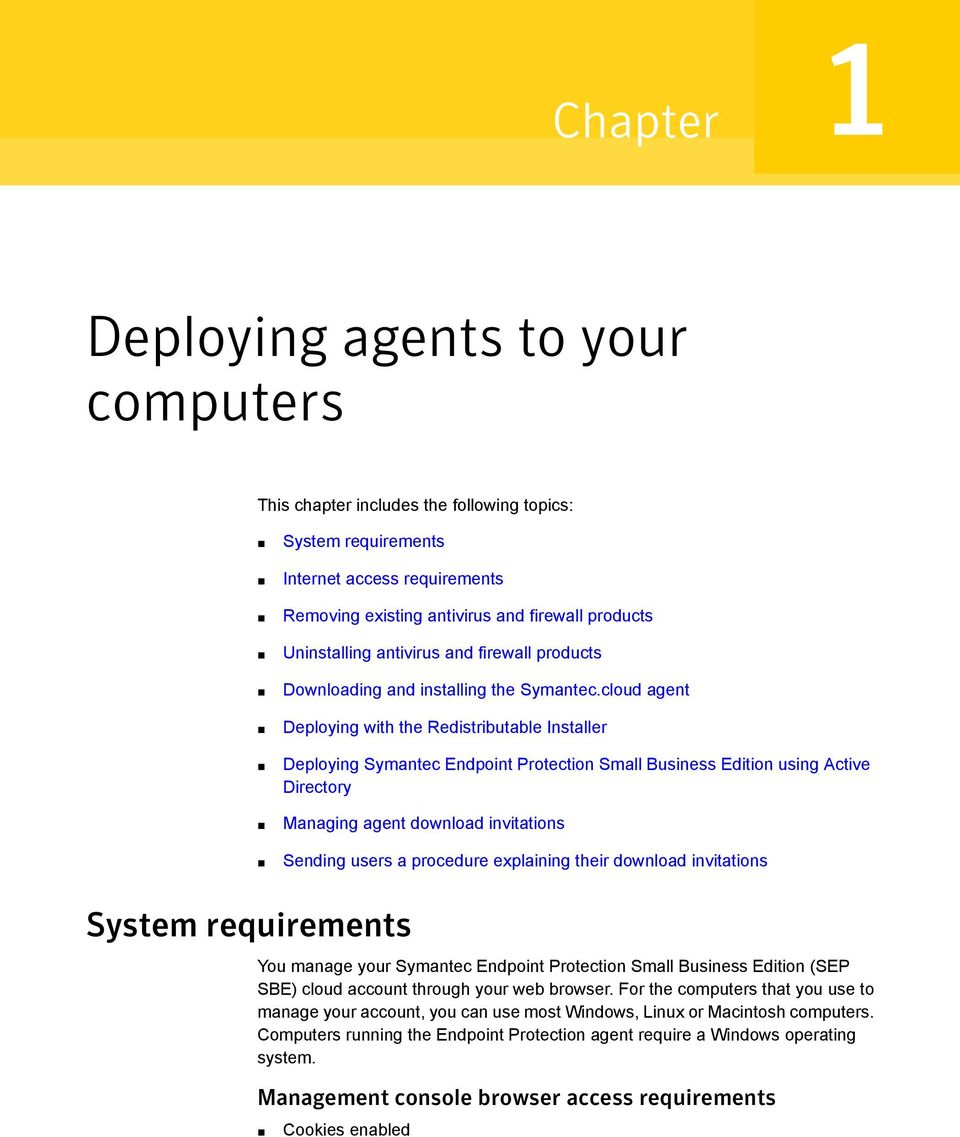
7 Deploying agents to your computers System requirements 7 JavaScript enabled SSL enabled Firewall ports 80 and 443 permitted address for user accounts, alerts, and reports Table 1-1 Browser Browser requirements Version(s) Microsoft Internet Explorer Mozilla Firefox Google Chrome Other browsers 8 or later (For best results use IE 10+) Only the latest version is supported Only the latest version is supported May work but not supported Cloud Service Agent and Symantec Endpoint Protection Small Business Edition client requirements AMD or Intel-based hardware Disk space Desktops and laptops: 800 MB Servers: 1000 MB Table 1-2 Operating system (OS) requirements Operating system Edition Service pack (SP) Architecture Endpoint Protection Local Update Host Microsoft Windows 7 Enterprise SP1 x64 and x86 Microsoft Windows 7 Professional SP1 x64 and x86 Microsoft Windows 7 Ultimate SP1 x64 and x86 Microsoft Windows 8 x64 and x86 Microsoft Windows 8 Enterprise x64 and x86 Microsoft Windows 8 Pro x64 and x86 Microsoft Windows 8.1 x64 and x86 Microsoft Windows 8.1 Enterprise x64 and x86
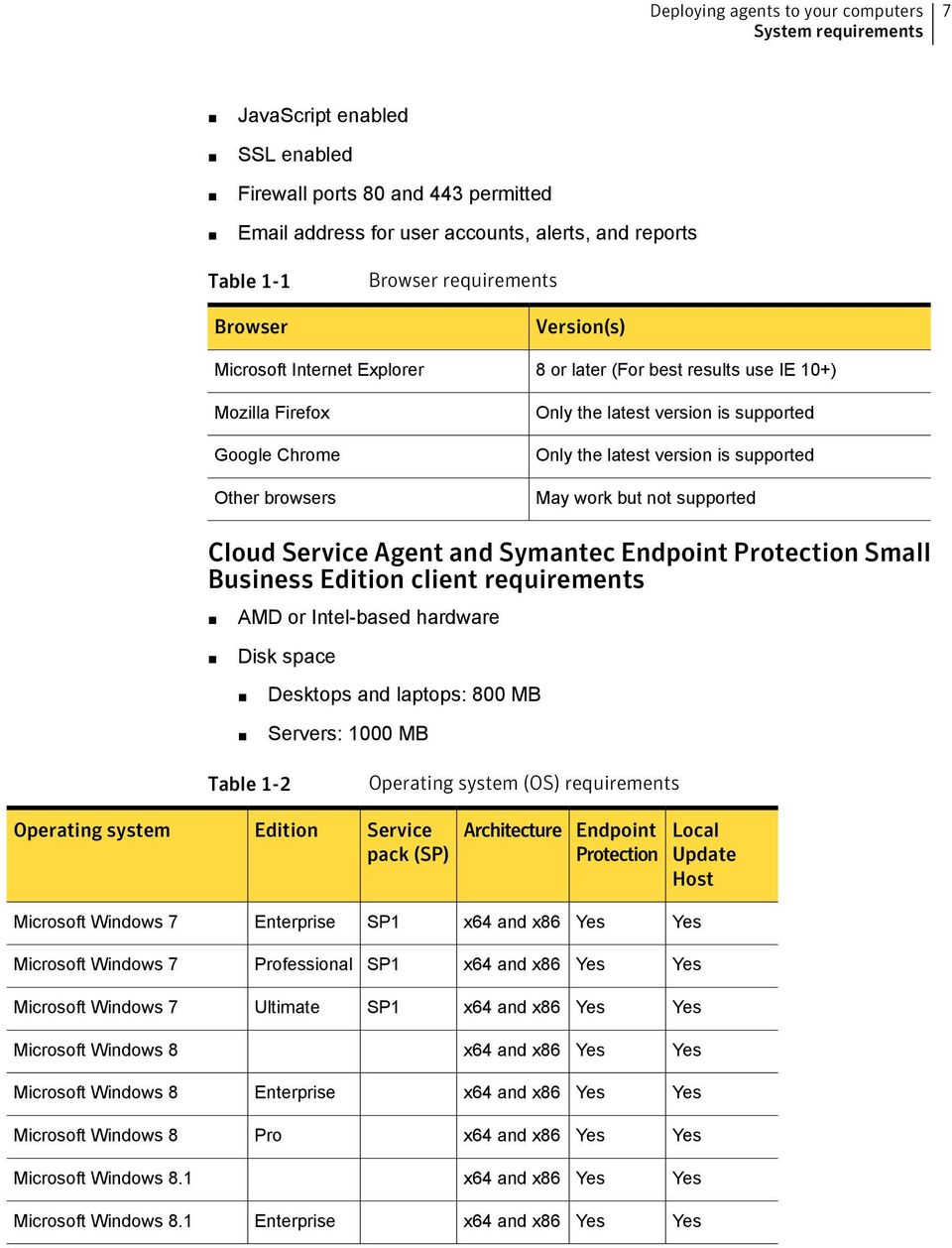
8 Deploying agents to your computers System requirements 8 Table 1-2 Operating system (OS) requirements (continued) Operating system Edition Service pack (SP) Architecture Endpoint Protection Local Update Host Microsoft Windows 8.1 Pro x64 and x86 Microsoft Windows Server 2003 Enterprise SP2 x64 and x86 Microsoft Windows Server 2003 Standard SP2 x64 and x86 Microsoft Windows Server 2003 R2 Standard SP2 x64 and x86 Microsoft Windows Server 2008 Enterprise SP2 x64 and x86 Microsoft Windows Server 2008 Standard SP2 x64 and x86 Microsoft Windows Server 2008 R2 Datacenter SP1 x64 Microsoft Windows Server 2008 R2 Enterprise SP1 x64 Microsoft Windows Server 2008 R2 Standard SP1 x64 Microsoft Windows Server 2012 Datacenter x64 Microsoft Windows Server 2012 Standard x64 Microsoft Windows Server 2012 R2 Standard x64 Microsoft Windows Small Business Server 2008 Standard SP2 x64 Microsoft Windows Vista Business SP2 x64 and x86 Microsoft Windows Vista Enterprise SP2 x64 and x86 Microsoft Windows Vista Ultimate SP2 x86 Microsoft Windows XP Professional SP2 x64

9 Deploying agents to your computers Internet access requirements 9 Table 1-2 Operating system (OS) requirements (continued) Operating system Edition Service pack (SP) Architecture Endpoint Protection Local Update Host Microsoft Windows XP Professional SP3 x86 See Internet access requirements on page 9. Internet access requirements For networks using proxies such as the Microsoft ISA or Linux Squid, it may be necessary to add Endpoint Protection URLs to the proxy whitelist. These are the servers contacted by the Symantec.cloud agent for different tasks: hb.lifecycle.norton.com liveupdate.symantecliveupdate.com ratings-wrs.symantec.com stats.qalabs.symantec.com shasta-rrs.symantec.com sasmain.symantec.com sas1alt.symantec.com ssaw.symantec.com siaw.symantec.com heartbeat.s2.spn.com message.s2.spn.com hostedendpoint.spn.com ins.spn.com Adding these URLs to your proxy whitelist allows all necessary agent communications.

10 Deploying agents to your computers Removing existing antivirus and firewall products 10 See System requirements on page 6. Removing existing antivirus and firewall products To get the best performance from Symantec Endpoint Protection Small Business Edition cloud, you must remove any Symantec or other antivirus or firewall product before installing your agents. These programs intercept risky communications with your computers. The programming mechanisms intercepting these risky communications might interfere with the proper functioning of your Symantec.cloud agents. To ensure that these products are removed from your endpoints, the installation program blocks the agent install until those applications are removed. The installation program automatically removes other Symantec and Norton AntiVirus or firewall products as well as tested, antivirus, or firewall product removal tools. The identified applications appear on an Incompatible Applications page where you are prompted to remove them. With user authorization, the installation program launches that product's own Windows Add/Remove Programs tool. Note: The automatic removal of an incompatible application manages that program's removal tool. If you encounter difficulty with the uninstall of that application, please contact customer support group for that product. Whenever the installation program encounters an antivirus or a firewall application with an untested Windows Add/Remove Programs tool, the program is identified as incompatible. You must intervene to remove these applications. The installation program s automatic removal tool and incompatible program identification feature is only available in attended or full UI mode. Once the automatic uninstall operation is finished, the endpoint computer restarts and the agent installation continues. If you manually uninstalled the incompatible product, you must manually restart the agent install program. Please uninstall any antivirus program or firewall program from your computer before installing Endpoint Protection. Uninstalling such programs is important even if the install program fails to detect the program or identifies it as incompatible. Running multiple antivirus or firewall programs simultaneously is inherently dangerous; the potential for interference between the applications is too risky to ignore. We encourage you to report these cases to Symantec Endpoint Protection Small Business Edition cloud by clicking the Support link in the Management Console banner. In larger environments, you may prefer to use your customary techniques to uninstall software from your endpoints. If you perform these operations using Microsoft Active Directory, ensure that the application you remove is also removed from the policy

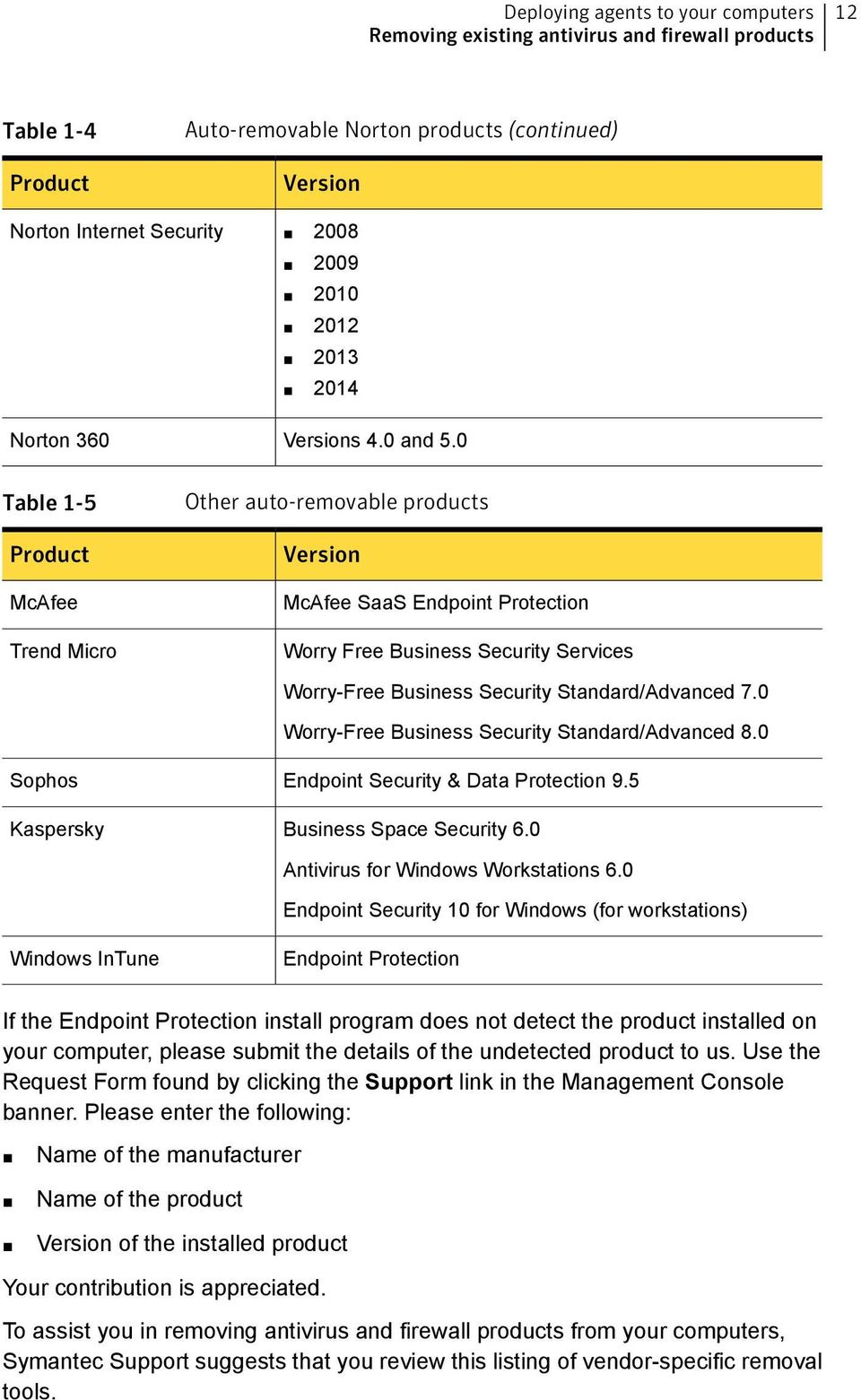
11 Deploying agents to your computers Removing existing antivirus and firewall products 11 governing these endpoints. This precaution prevents the reinstallation of an application based on your Active Directory policy. When endpoints run less common antivirus or firewall products, or unrecognized versions of a product, install program may not detect the potentially conflicting product. Potentially incompatible products must always be removed for best results with Symantec Endpoint Protection. We provide automatic removal of antivirus or firewall software for these products: Table 1-3 Auto-removable Symantec Endpoint Protection, Endpoint Protection Small Business Edition versions Version Endpoint Protection Small Business Edition N/A N/A N/A N/A SEP SBE 12.0 SEP SBE 12.0 RU1 SEP SBE 12.1 SEP SBE 12.1 RU1 SEP SBE 12.1 RU1-MP1 SEP SBE 12.1 RU2 SEP SBE 12.1 RU2 MP1 SEP SBE 12.1 RU3 Symantec Endpoint Protection SEP 11.0 RU7 MP2 SEP 11 RU7 MP3 SEP 11 MR3 SEP 11 MR4 N/A N/A SEP 12.1 SEP 12.1 RU1 SEP 12.1 RU1-MP1 SEP 12.1 RU2 SEP 12.1 RU2 MP1 SEP 12.1 RU3 Table 1-4 Product Norton AntiVirus Auto-removable Norton products Version

12 Deploying agents to your computers Removing existing antivirus and firewall products 12 Table 1-4 Product Auto-removable Norton products (continued) Version Norton Internet Security Norton Versions 4.0 and 5.0 Table 1-5 Product McAfee Trend Micro Other auto-removable products Version McAfee SaaS Endpoint Protection Worry Free Business Security Services Worry-Free Business Security Standard/Advanced 7.0 Worry-Free Business Security Standard/Advanced 8.0 Sophos Kaspersky Endpoint Security & Data Protection 9.5 Business Space Security 6.0 Antivirus for Windows Workstations 6.0 Endpoint Security 10 for Windows (for workstations) Windows InTune Endpoint Protection If the Endpoint Protection install program does not detect the product installed on your computer, please submit the details of the undetected product to us. Use the Request Form found by clicking the Support link in the Management Console banner. Please enter the following: Name of the manufacturer Name of the product Version of the installed product Your contribution is appreciated. To assist you in removing antivirus and firewall products from your computers, Symantec Support suggests that you review this listing of vendor-specific removal tools.
13 Deploying agents to your computers Uninstalling antivirus and firewall products 13 See Uninstalling antivirus and firewall products on page 13. See Downloading the package on page 21. Uninstalling antivirus and firewall products The website that you are about to access has an extensive list of product removal tools. Some links on the page directly download executable files. Removal tools always carry the risk of damage to your computers, please ensure that you have a recent backup before using any of these tools. Note: Symantec is not responsible for the linked content and has not verified the safety of the sites listed. Antivirus and firewall product removal tool list See Removing existing antivirus and firewall products on page 10. Downloading and installing the Symantec.cloud agent Before you can protect your computers with Symantec Endpoint Protection Small Business Edition (SEP SBE) cloud, you must download the agent and install it onto the computers you want to protect. The agent delivers services to your computers and communicates with the management console in your account. You must install the agent on every computer you want to protect. Make sure that your computers meet the system requirements and Internet access requirements. See System requirements on page 6. See Internet access requirements on page 9. Administrator rights are necessary to install the agent. This requirement poses no difficulty for organizations where users are administrators on their local computer. When an organization's security policy prohibits local admin rights for computer users, systems management tools like Altiris can be used to push out the agents. Note: By default, new agents are automatically confirmed into your account. If your Account Administrator disabled Auto-confirm new agents in your organization's settings, new agents must be confirmed before they become active. Three deployment options are available to install agents on to your computers: The standard download and install.

14 Deploying agents to your computers Downloading and installing the Symantec.cloud agent 14 invitations to install. Download and build a portable install package. These different methods can be used to fulfill the needs of varying circumstances. Standard Install This installation method downloads a small installer that manages the full installation of the agent. It requires: A user login for your SEP SBE cloud account Your physical presence at the computer or a remote connection to it invitation Enables you to send invitations to download the agent to computer users in your organization: Up to 50 addresses that are separated by semicolons can be submitted Invitation contains a URL valid for 30 days unless withdrawn by the administrator Allows a computer user to perform the installation themselves without administrator intervention An Administrator can revoke the invitation, if necessary. Redistributable installer package Enables a network administrator to push out agents to the computers requiring protection. It provides a silent install of the agent and the services that are selected for use in the package. Note: The Redistributable Package can also be configured for deployment using Microsoft Active Directory. Note: All antivirus products or firewall products must be removed from your computers before you install Symantec Endpoint Protection. See Removing existing antivirus and firewall products on page 10. If you are running Windows Vista, User Account Control allows only your computer administrator to install a program that runs for every user account. Even if you have disabled User Account Control, administrative rights are required to install the Agent. When you upgrade a protected computer from Windows XP to Windows Vista you must remove the Agent and restart the computer. When the computer restarts you can begin the upgrade to Windows Vista.

15 Deploying agents to your computers Downloading and installing the Symantec.cloud agent 15 To prepare to download the agent 1 In Internet Explorer, navigate to Tools > Internet Options > Advanced. 2 On the Advanced tab, scroll down to Security. 3 Verify Do not save encrypted pages to disk is unchecked and click OK. To install the agent onto an individual computer 1 Log into your Management Console. 2 Click Add computer in your Home page Quick Tasks widget or Add Computers on the Computers page. 3 On the Protect Computer(s) page, select the service or services you want to install on the computer. 4 If you want to add the new computer to a group other than the default group, select that group from the Choose Your Group drop-down. 5 Under Download Your Installer, click Install Now and run the SymantecExtractor.exe. It's also possible to save the file if required. 6 The File Download dialog box gives you the option to Run or Save the file. Click Run. 7 When the SymantecExtractor.exe file download is complete, you are asked for permission to Run the software. Click Run. 8 The Symantec Endpoint Protection Small Business Edition installer opens. From the welcome screen, click Next. 9 The component configuration screen appears showing the status the components comprising your installation. You may also configure your Proxy Settings or change the destination folder if required. Click Install. 10 When the success screen appears, click Finish. To use the redistributable installer package for silent installation 1 Log into your Management Console. 2 Click Add computer in your Home page Quick Tasks widget or Add Computers on the Computers page. 3 On the Protect Computer(s) page, select the service or services you want to install on the computer. 4 If you want to add the new computer to a group other than the default group, select that group from the Choose Your Group drop-down.

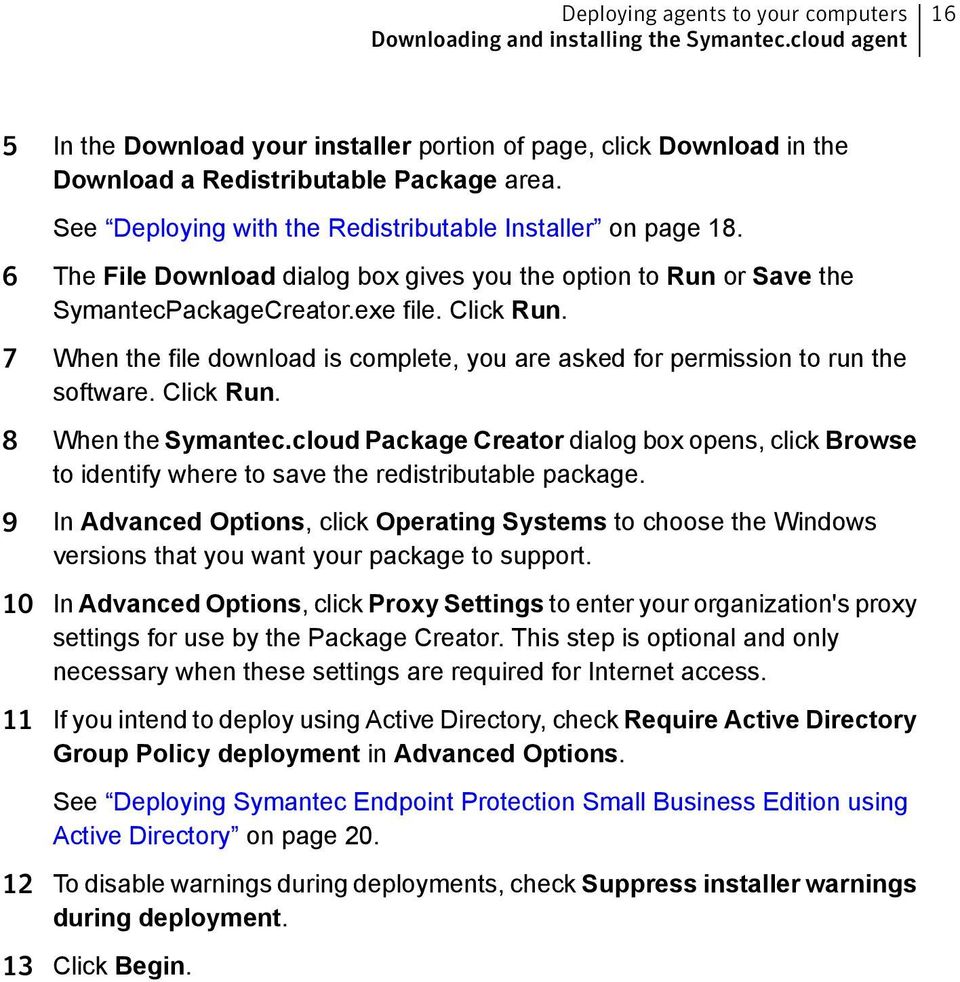
16 Deploying agents to your computers Downloading and installing the Symantec.cloud agent 16 5 In the Download your installer portion of page, click Download in the Download a Redistributable Package area. See Deploying with the Redistributable Installer on page The File Download dialog box gives you the option to Run or Save the SymantecPackageCreator.exe file. Click Run. 7 When the file download is complete, you are asked for permission to run the software. Click Run. 8 When the Symantec.cloud Package Creator dialog box opens, click Browse to identify where to save the redistributable package. 9 In Advanced Options, click Operating Systems to choose the Windows versions that you want your package to support. 10 In Advanced Options, click Proxy Settings to enter your organization's proxy settings for use by the Package Creator. This step is optional and only necessary when these settings are required for Internet access. 11 If you intend to deploy using Active Directory, check Require Active Directory Group Policy deployment in Advanced Options. See Deploying Symantec Endpoint Protection Small Business Edition using Active Directory on page To disable warnings during deployments, check Suppress installer warnings during deployment. 13 Click Begin.
17 Deploying agents to your computers Downloading and installing the Symantec.cloud agent When the download is complete, click Finish. 15 The selected files are downloaded and then the package is created. Browse to the location where SymRedistributable.exe and package files are saved. You may want to copy the redistributable installer package to a directory of your choice. This command-line application can be used to perform a silent install at user login or in other network push processes. The following parameters can be passed to the application: Usage: SymRedistributable.exe [options] Options -silent -suppresswarnings -installpath <path> Description Orders silent operation Suppresses the installer warnings, requires -silent to be present Specifies install path as: "c:\path\to\install\to", requires -silent The -installpath parameter defaults to %programfiles% -proxyhost <host> -proxyport <port> -proxytype [HTTP SOCKS] -proxyauthpassword <password> -help, -h, -? Specifies the HTTP proxy IP address or host name, requires -silent and -proxyport to be present Specifies the HTTP proxy network port number, requires -silent, and -proxyhost to be present Specifies the HTTP proxy or SOCKS proxy type, the default proxy type is HTTP, requires -silent and -proxyhost to be present Specifies the proxy authentication password, requires -silent, and -proxyhost to be present Prints help menu to screen See Deploying with the Redistributable Installer on page 18. To send invitations to download the agent 1 Log into your Management Console account. 2 Click Add computer in your Home page Quick Tasks widget or Add Computers on the Computers page. 3 On the Protect Computer(s) page, select the service or services you want to install on the computer.

18 Deploying agents to your computers Deploying with the Redistributable Installer 18 4 If you want to add the new computer to a group other than the default group, select that group from the Choose Your Group drop-down. 5 In the Download your installer section, enter up to 50 user addresses in the Send Download Invites text box. The specified users receive invitations with a download link to the agent. Multiple addresses must be delimited with a semicolon. Click Send Invites. Your users receive an saying that you have invited them to download and install the agent onto their computer. It provides a link enabling them to download the agent without a login account to your organization's SEP SBE cloud account. See Sending users a procedure explaining their download invitations on page 25. Deploying with the Redistributable Installer The Redistributable Install Package enables you to deploy Symantec Small Endpoint Protection Small Business Edition (SEP SBE) cloud throughout your organization with a silent install. The package is an executable that runs silently, without any user interface, and installs the Symantec.cloud agent to any computer running a supported operating system. Larger organizations may distribute the package with a specialized tool; smaller organizations can distribute it using a network share available in Explorer. Administrative rights are required to install the Symantec.cloud agent onto a computer. Note: Accounts that are provisioned through Symantec estore must verify that there are adequate licenses before you deploy agents using the Redistributable Install Package. Note: All antivirus products and firewall products must be removed from your computers before you install Symantec Endpoint Protection. See Removing existing antivirus and firewall products on page 10. This command-line application can be used to perform a silent install at user login or in other network push processes. The following parameters can be passed to the application: Usage: SymRedistributable.exe [options]

19 Deploying agents to your computers Deploying with the Redistributable Installer 19 Table 1-6 Command -silent -suppresswarnings -installpath <path> Command-line flags for Redistributable Package Description Orders silent operation Suppresses the installer warnings, requires -silent to be present Specifies install path as: "c:\path\to\install\to", requires -silent The -installpath parameter defaults to %programfiles% -proxyhost <host> -proxyport <port> -proxytype [HTTP SOCKS] -proxyauthuser <user> -proxyauthpassword <password> -help, -h, -? Specifies the HTTP proxy IP address or the host name, requires -silent and -proxyport to be present Specifies the HTTP proxy network port number, requires -silent, and -proxyhost to be present Specifies the HTTP proxy or SOCKS proxy type, the default proxy type is HTTP, requires -silent and -proxyhost to be present Specifies the proxy authentication user, requires -silent, and -proxyhost to be present Specifies the proxy authentication password, requires -silent, and -proxyhost to be present Prints help menu to screen To download a redistributable install package 1 Log on to your SEP SBE cloud account and click Add Computer in the Quick Tasks widget. 2 From the Protect Computer(s) page, select the services that you want to be included in the package. 3 In the Choose Your Group section, use the drop-down to select a computer group to populate with this install package. 4 From the Download Your Installer section under Download a Redistributable Package, click Download. 5 The File Download dialog box gives you the option to Run or Save the SymantecPackageCreator.exe file. Click Run. 6 When the file download is complete, you are asked for permission to run the software. Click Run. 7 When the Symantec.cloud Package Creator dialog box opens, click Browse to identify where to save the redistributable package.
![defaults to %programfiles% -proxyhost <host> -proxyport <port> -proxytype [HTTP SOCKS] -proxyauthuser <user> -proxyauthpassword <password> -help, -h, -?](/docs-images/40/630878/images/page_19.jpg "Specifies the HTTP proxy IP address or the host name, requires -silent and -proxyport to be present Specifies the HTTP proxy network port number, requires -silent, and -proxyhost to be present")
20 Deploying agents to your computers Deploying Symantec Endpoint Protection Small Business Edition using Active Directory 20 8 In Advanced Options, click Operating Systems to choose the Windows versions that you want your package to support. Click Save. 9 In Advanced Options, click Proxy Settings to enter your organization's proxy settings for use by the Package Creator. This step is optional and only necessary when these settings are required for Internet access. Click Save Note: You may create a number of distribution packages to fit the needs of your organization's different network locations. 10 If you intend to deploy using Active Directory, check Require Active Directory Group Policy deployment in Advanced Options. See Deploying Symantec Endpoint Protection Small Business Edition using Active Directory on page Click Begin. The selected files are downloaded and then the package is created. The Redistributable Package files are associated with a specific organization and should not be used outside of that organization. When the download is complete, click Finish. Deploying Symantec Endpoint Protection Small Business Edition using Active Directory Deploying with Microsoft Active Directory involves a number of steps: Downloading the package See Downloading the package on page 21. Setting up a domain controller for deployment Creating a distribution point Creating a group policy object. Assigning a package. See Setting up a domain controller for deployment on page 23. The Microsoft documentation for deploying with Active Directory is available for: Windows 2008, Windows Server 2008 R2, or Windows Server 2012 Windows 2003 Another Microsoft article that may be useful in preparing for an Active Directory deployment is:
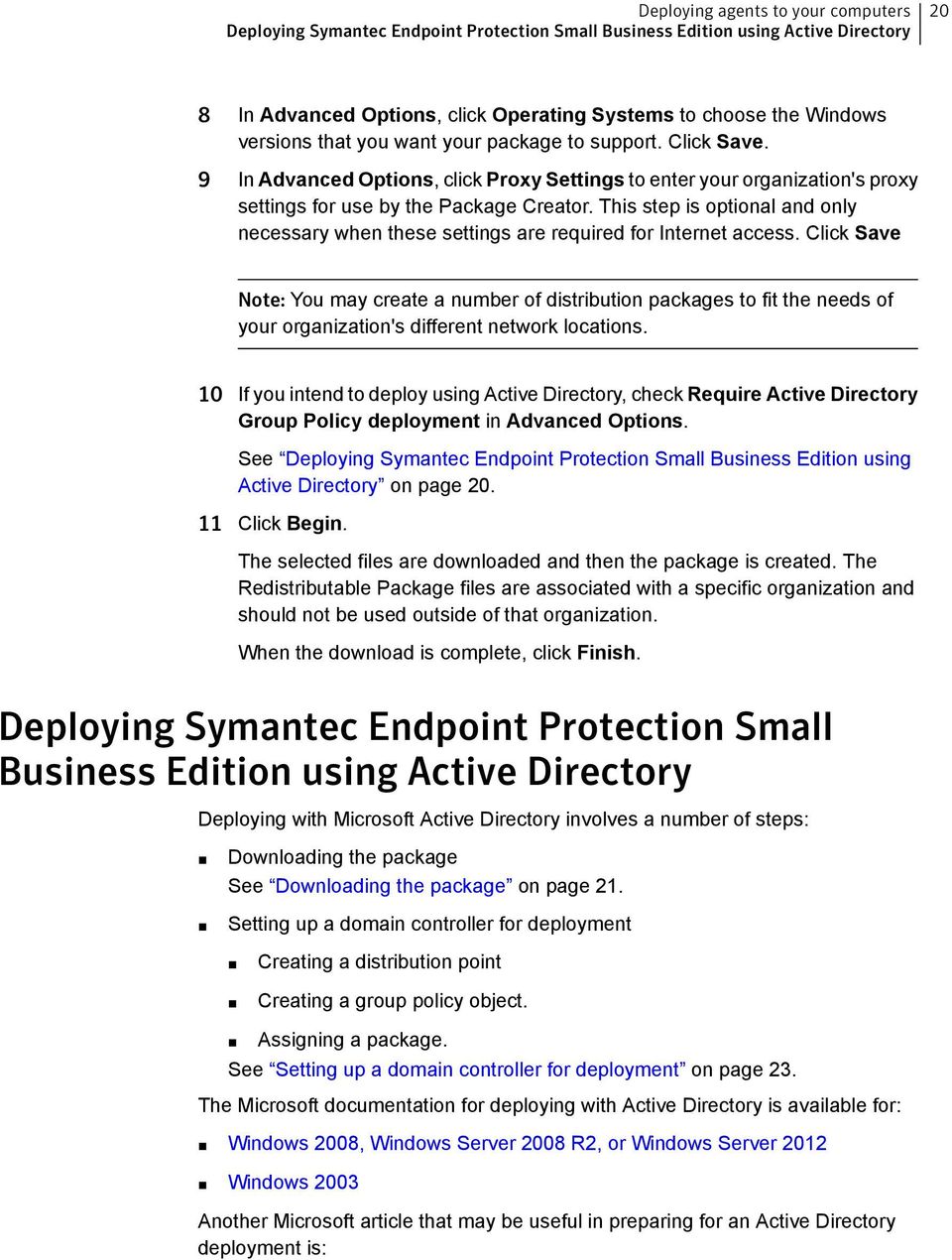
21 Deploying agents to your computers Deploying Symantec Endpoint Protection Small Business Edition using Active Directory 21 How to assign software to a specific group by using Group Policy Note: All antivirus products and firewall products must be removed from your computers before you install Symantec Endpoint Protection. See Removing existing antivirus and firewall products on page 10. Note: Administrators of the SEP SBE cloud accounts that are provisioned through estore, must ensure that they have adequate licenses for the number of computers targeted in the Active Directory deployment. If you run out of licenses during your Active Directory deployment, the installations fail for computers without licenses. Active Directory reports a successful install, but that is a false-positive. Downloading the package During the download of the Active Directory-ready Redistributable Install Package, three files are compiled for use by the organization's IT department: SYMRedistributable.exe SYMGroupPolicyDeployment.msi SYMGroupPolicyDeployment.mst These files must always reside in the same folder to function properly and should not be mixed with different downloads of the Redistributable Package. For more information about using MST files see, the Microsoft documentation for: Windows 2008, Windows Server 2008 R2, or Windows Server 2012 Windows 2003 Note: All antivirus products and firewall products must be removed from your computers before you install Symantec Endpoint Protection. See Removing existing antivirus and firewall products on page 10. Note: Administrators of SEP SBE cloud accounts that are provisioned through estore, must ensure that they have adequate licenses for the number of computers targeted in the Active Directory deployment. If you run out of licenses during your Active Directory deployment, the installations fail for computers without licenses. Active Directory reports a successful install, but that is a false-positive.
22 Deploying agents to your computers Deploying Symantec Endpoint Protection Small Business Edition using Active Directory 22 To download a Redistributable Install Package for Active Directory deployment 1 Log on to your SEP SBE cloud and click Add Computer in the Quick Tasks widget. 2 From the Protect Computer(s) page, select the services that you want to be included in the package. 3 In the Choose Your Group section, use the drop-down to select a computer group to populate with this install package. 4 From the Download Your Installer section under Download a Redistributable Package, click Download. 5 The File Download dialog box gives you the option to Run or Save the SymantecPackageCreator.exe file. Click Run. 6 When the file download is complete, you are asked for permission to run the software. Click Run. 7 When the Symantec.cloud Package Creator dialog box opens, click Browse to identify where to save the redistributable package. 8 In Advanced Options, click Operating Systems to choose the Windows versions that you want your package to support. Click Save. 9 In Advanced Options, click Proxy Settings to enter your organization's proxy settings for use by the Package Creator. This step is optional and only necessary when these settings are required for Internet access. Click Save Note: You may create a number of distribution packages to fit the needs of your organization's different network locations. 10 In Advanced Options, check Require Active Directory group policy deployment. 11 To disable warnings during deployments, check Suppress installer warnings during deployment. This option is only available when the Require Active Directory group policy deployment option is selected. 12 Click Begin. 13 The selected files are downloaded and then the package is created. The Redistributable Package files are associated with a specific organization and should not be used outside of that organization.
23 Deploying agents to your computers Deploying Symantec Endpoint Protection Small Business Edition using Active Directory When the download is complete, click Finish. 15 The files: SYMRedistributable.exe, SYMGroupPolicyDeployment.msi, and SYMGroupPolicyDeployment.mst are in the destination directory. These files must be kept together as a single package; mixing different versions of these files breaks the Redistributable Package. See Deploying Symantec Endpoint Protection Small Business Edition using Active Directory on page 20. Setting up a domain controller for deployment When the download is complete, the domain controller must be set up for the SEP SBE cloud deployment. Three steps are involved in this process: Creating a distribution point Creating a group policy object Assigning a package The procedures for accomplishing these tasks are well documented in Microsoft the support knowledge base. The knowledge base article : How to use group policy to remotely install software in Windows Server 2003 and in Windows Server 2008 The article covers how to: Create a distribution point. Create a group policy object. Assign a package. Publish a package. Note: The Redistributable Install Package does not support publishing a package. Redeploy a package. Remove a package. Note: The administrator must complete the removal of an installation within the SEP SBE cloud management console. Troubleshoot.
24 Deploying agents to your computers Managing agent download invitations 24 Another Microsoft article that may be useful in preparing for an Active Directory deployment is: How to assign software to a specific group by using group policy See Deploying Symantec Endpoint Protection Small Business Edition using Active Directory on page 20. Managing agent download invitations You manage your agent download invitations from the Agent Download Invitation page. You can: Invite members of your organization to download the Symantec.cloud agent. View your download invitation history. Deactivate download invitations. The Send Invites portion of the page lets you send new download invitations by . You can enter up to 50 semicolon delimited, addresses. The Deactivate Invites/History section displays when, to whom and how many download invitations you have sent. It also enables you to revoke an invitation with the Deactivate Action. When you deactivate an invitation, the download link in the invitation, which is normally active for 30 days, is shut down. Download invitations expire 30 days after issuance. To send download invitations and view your invitation history 1 Log into your Management Console account. 2 In the Quick Task box on your Home page, click View Invitation History. 3 Send invitations by adding semicolon delimited addresses to the Send Invites box and clicking Send Invites. 4 View your invitation history at the bottom of the page. To deactivate an invitation to install the Symantec.cloud agent 1 Log into your Management Console account. 2 In the Quick Task box on your Home page, click View Invitation History. 3 Identify the invitation you want to deactivate in Deactivate Invites/History and click Deactivate in the associated Actions column. Note: Deactivating an invitation revokes the invitation for all of the addresses listed in the invitation.
25 Deploying agents to your computers Sending users a procedure explaining their download invitations 25 Sending users a procedure explaining their download invitations SEP SBE cloud provides a method for you to allow your users to download and install the Symantec.cloud agent themselves. Users are authorized for the download by the address they enter during installation. The download invitation does not give them access to your SEP SBE cloud account. The invitation that is delivered to users provides only a link to the download and no explicit instructions. We encourage you to: Inform the users receiving download invitations of the importance of your endpoint protection strategy. Provide invited users with the proxy information necessary for a successful installation (if necessary). Include this procedure to minimize the number of questions you receive about the installation. To install SEP SBE cloud on to your computer 1 Open your application and look for an from Symantec alerting service with the subject line: Symantec.cloud agent download. Download and open it. Note: If you cannot find the , check your application's Spam folder. 2 Click the link in the invitation . The file download process begins. Note: The antivirus products and firewall products that are installed on your computer must be removed from your computer before you install Symantec Endpoint Protection. See Removing existing antivirus and firewall products on page The dialog box gives you the option to Run or Save the file. Click Run. 4 When the SymantecExtractor.exe file download is complete, you are asked for permission to Run the software. Click Run. 5 The Symantec Endpoint Protection Small Business Edition installer opens. It gives you the status of the installer and permits you to change the installation folder. Click Next. 6 Configure your proxy settings if required. Click Next.
26 Deploying agents to your computers Sending users a procedure explaining their download invitations 26 7 When the installation progress screen appears, click Install. 8 When the overall progress is complete, the SEP SBE cloud components are installed. Click Next. 9 When the success screen appears, uncheck the Launch Website check box and click Finish. 10 In most cases, your SEP SBE cloud installation is automatically added to your organization's list of protected computers.
27 Chapter 2 Customizing Endpoint Protection This chapter includes the following topics: Understanding Endpoint Protection policies Configuring Endpoint Protection to your needs About USB Device Control Configuring USB Device Control Overriding USB Device Control on an endpoint Using custom exclusions Configuring Smart Firewall Configuring Firewall Rules Using Program Control Scanning computers remotely Installing the on-premises Endpoint Protection Understanding Endpoint Protection policies When any computer is added as an Endpoint Protection computer, it is immediately added to the default group and the default policy for immediate protection. The default group is only modified when computers are added or deleted; the default policy cannot be modified. The default configuration may serve your organization well, however, you can configure groups and policies that are tailored to your needs.
28 Customizing Endpoint Protection Understanding Endpoint Protection policies 28 Symantec Endpoint Protection enables you to create and impose policies to protect your computers based on the security requirements of the computers. Four categories of protection that can be used in a policy: Computer protection USB device control Web protection Network protection These categories of protection offer a defense in-depth security solution. Computer Protection features focus on the high risk communications reaching a computer. Note: Different agents are installed for desktops & laptops than for servers. The protection settings available for servers differ from the protection settings available for desktops & laptops.
29 Customizing Endpoint Protection Understanding Endpoint Protection policies 29 Table 2-1 Computer Protection Protection Setting Description Desktops & Laptops Servers Antivirus Virus and security risk protection features provide comprehensive virus prevention and security risk detection for your computer. Known viruses are automatically detected and repaired. Instant messenger attachments, message attachments, Internet downloads, and other files are scanned for viruses and other potential risks. In addition, the definition updates that Automatic LiveUpdate downloads when your computer is connected to the Internet keeps you prepared for the latest security risks. X X User can disable Antivirus - Enables users to turn off Antivirus protection for: 15 minutes one hour five hours Until the system restarts Note: The disable function only works on desktops & laptops. Exclude Mapped network drives - Prevents scanning of the network drives mapped on desktops or laptops. Option not available for servers. Exclude Removable Drives - Prevents scanning of the removable media that is attached to desktops or laptops. Option not available for servers. Custom Exclusions - Enables administrators to exclude specific files, folders, or file types from antivirus scanning. See Using custom exclusions on page 41. Note: LiveUpdate requires adequate disk space to run successfully. Please ensure that your computers have 1 GB of available disk space to avoid LiveUpdate failures.
30 Customizing Endpoint Protection Understanding Endpoint Protection policies 30 Table 2-1 Computer Protection (continued) Protection Setting Description Desktops & Laptops Servers SONAR Symantec Endpoint Protection SONAR, Symantec Online Network for Advanced Response, to provide real-time protection against threats and proactively detects unknown security risks on your computer. SONAR identifies emerging threats based on the behavior of applications. It also identifies threats more quickly than the traditional signature-based threat detection techniques. SONAR detects and protects you against malicious code even before virus definitions are available through LiveUpdate. X X SONAR monitors your computer for malicious activities through heuristic detections. SONAR automatically blocks and removes high-certainty threats. Norton Internet Security notifies you when high-certainty threats are detected and removed. SONAR provides you the greatest control when low-certainty threats are detected. The View Details link in the notification alert lets you view the summary of the resolved high-certainty threats. You can view the details under Resolved security risks category in the Security History window. Note: LiveUpdate requires adequate disk space to run successfully. Please ensure that your computers have 1 GB of available disk space to avoid LiveUpdate failures. Antispyware Antispyware protects your computer against the security risks that can compromise your personal information and privacy. X X Symantec Endpoint Protection Antispyware detects these major categories of spyware: Security risk Hacking tool Spyware Trackware Dialer Remote access Adware Joke programs Security assessment tools Misleading Applications
31 Customizing Endpoint Protection Understanding Endpoint Protection policies 31 USB Device Control enables administrators to prevent malicious code injection and intellectual property theft by controlling employee use of USB removable storage devices. USB mice and keyboards are unaffected by USB Device Control because they do not provide data storage. Table 2-2 USB Device Control Protection Setting Description Desktops & Laptops Servers USB device access The drop-down enables a policy configuration to either allow or to block access to a USB device. Blocking events are logged for review and reporting. X X Read only access The check box allows USB device access to be restricted to read-only access. X Note: This function is not available for servers. Enable user notifications Enables toast messages on the endpoint alerting the user to USB device blocking. X X Web Protection defends Internet Explorer and Firefox from attack; presents website safety ratings; and evaluates downloads from the web.
32 Customizing Endpoint Protection Understanding Endpoint Protection policies 32 Table 2-3 Web Protection Protection Setting Description Desktops & Laptops Servers Browser Protection With increasing Internet use, your web browser is prone to attack by malicious websites. These websites detect and exploit the vulnerability of your web browser to download malware programs to your system without your consent or knowledge. These malware programs are also called drive-by downloads. Norton Internet Security protects your web browser against drive-by downloads from malicious websites. X Norton Internet Security proactively blocks new or unknown malware programs before they attack your computer. By protecting your web browser, Norton Internet Security secures your sensitive information and prevents the attackers from controlling your system remotely. The Browser Protection feature checks for browser vulnerabilities in the following browsers: Internet Explorer 7.0 or later Firefox 10.0 or later Chrome 17.0 or later You must turn on the Browser Protection option to enable this feature. Note: This feature applies only to desktops and laptops.
33 Customizing Endpoint Protection Understanding Endpoint Protection policies 33 Table 2-3 Web Protection (continued) Protection Setting Description Desktops & Laptops Servers Download Intelligence X
34 Customizing Endpoint Protection Understanding Endpoint Protection policies 34 Table 2-3 Web Protection (continued) Protection Setting Description Desktops & Laptops Servers Download Intelligence provides information about the reputation of any executable file that you download from the supported portals. The reputation details indicate whether the downloaded file is safe to install. You can use these details to decide the action that you want to take on the file. Some of the supported portals are: Internet Explorer (Browser) Opera (Browser) Firefox (Browser) Chrome (Browser) AOL (Browser) Safari (Browser) Yahoo (Browser) MSN Explorer (Browser, & Chat) QQ (Chat) ICQ (Chat) Skype (Chat) MSN Messenger (Chat) Yahoo Messenger (Chat) Limewire (P2P) BitTorrent (P2P) Thunder (P2P) Vuze (P2P) Bitcomet (P2P) utorrent (P2P) Outlook ( ) Thunderbird ( ) Windows Mail ( ) Outlook Express ( ) FileZilla (File Manager) UseNext (Download Manager) FDM (Download Manager) Adobe Acrobat Reader (PDF viewer) The reputation levels of the file are safe, unsafe, and unknown. You can install safe files. Norton Internet Security removes the unsafe files. In the case of unknown files, Download Intelligence prompts you to take a suitable action on the file. You can run the
35 Customizing Endpoint Protection Understanding Endpoint Protection policies 35 Table 2-3 Web Protection (continued) Protection Setting Description Desktops & Laptops Servers installation of the file, stop the installation, or remove a file from your computer. When you downloaded a file, Download Intelligence processes the file for analysis of its reputation level. Auto-Protect analyzes the reputation of the file. Auto-Protect uses the threat signatures that Norton Internet Security receives during definitions updates and other security engines to determine the safety of an executable file. If the file is unsafe, Auto-Protect removes it. Auto-Protect notifies the results of file analysis to Download Intelligence. Download Intelligence then triggers notifications to inform you whether the file is safe to install or needs attention. You must take a suitable action on the files that need attention. In case of an unsafe file, Download Insight informs you that Norton Internet Security has removed the file. Security History logs details of all events that Download Intelligence processes and notifies. It also contains information about the actions that you take based on the reputation data of the events. You can view these details in the Download Intelligence category in Security History. Network Protection defends your computer by detecting and preventing attacks through your network connection and evaluating the safety attachments.
36 Customizing Endpoint Protection Understanding Endpoint Protection policies 36 Table 2-4 Network Protection Protection Setting Description Desktops & Laptops Servers Intrusion Prevention Intrusion Prevention scans all the network traffic that enters and exits your computer and compares this information against a set of attack signatures. Attack signatures contain the information that identifies an attacker's attempt to exploit a known operating system or program vulnerability. Intrusion prevention protects your computer against most common Internet attacks. X For more information about the attacks that intrusion prevention blocks, visit: If the information matches an attack signature, intrusion prevention automatically discards the packet and breaks the connection with the computer that sent the data. This action protects your computer from being affected in any way. Intrusion prevention relies on an extensive list of attack signatures to detect and block suspicious network activity. You should run LiveUpdate regularly to ensure that your list of attack signatures is up to date. Note: LiveUpdate requires adequate disk space to run successfully. Please ensure that your computers have 1 GB of available disk space to avoid LiveUpdate failures. Protection Protection protects your computer against the threats that you might receive through attachments. It automatically configures your program for protection against viruses and other security threats. X Note: This feature applies only to desktops and laptops.
37 Customizing Endpoint Protection Understanding Endpoint Protection policies 37 Table 2-4 Network Protection (continued) Protection Setting Description Desktops & Laptops Servers Smart Firewall The Smart Firewall monitors the communications between your computer and other computers on the Internet. It also protects your computer and alerts you to such common security problems as: X Improper connection attempts from other computers and of attempts by programs on your computer to connect to other computers Port scans by unauthorized computers Intrusions by detecting and blocking malicious traffic and other attempts by outside users to attack your computer A firewall blocks hackers and other unauthorized traffic, while it allows authorized traffic to pass. Turning off Smart Firewall reduces your system protection. Always ensure that the Smart Firewall is turned on. The Smart Firewall provides two configurable options: User can disable Firewall - Enables a local computer user to override the Smart Firewall for a certain period of time. This option permits an installation or other administrative function. The firewall can be disabled for: 15 minutes one hour five hours Until the system restarts Report Blocked Events - Uploads blocked firewall events from the computer to your Endpoint Protection account. The blocked events are added to the computer history page and the statistical data that is displayed on the Home page. Blocked events are also available within the Security History page of the local Norton Internet Security interface. No alerts are issued based on this data as they are low risk events. Firewall Rules - Enables administrators to customize firewall rules for their organization. Program Control - Enables administrators to allow or block Internet access for agent-discovered programs. Note: This feature applies only to desktops and laptops.
38 Customizing Endpoint Protection Configuring Endpoint Protection to your needs 38 Configuring Endpoint Protection to your needs Configuring Endpoint Protection to best suit the security needs of your organization requires only that you: Make logical groups for your computers. Decide which policies are best suited for each group By default all new computers are added to the Default Group and are assigned the Endpoint Security default policy for each agent's installed service or services. No further configuration required. To create computer groups 1 Log into your account and click the Computers page. 2 On the left pane, click the Add Group link in the Groups section. 3 Enter a Name and Description for the group in the screen. Click Save. 4 On the left pane, under Groups, select the group you created. 5 On the right side of the page, in the header with group information, click the Move Computers link to add computers to the group. 6 In the Move Computers screen, filter and select the computers you want to add to the group. Click Save. The selected computers are moved out of the Default Group (or other assigned group) into your new computer group. To create policies 1 Log into your account and click the Policies page. 2 On the left pane, under Services, select the service for which you want to create a policy and click Add Policy. 3 On the Policies page, do the following: Enter a Name and Description for the policy. Assign the appropriate protection settings using the checkboxes. Consider and set exclusions for your scans using the checkboxes. To exclude specific files, folders, or file types, click Custom Exclusions. See Using custom exclusions on page 41. Set a Scan Schedule by designating the scan frequency, time to start, and the computers to scan. Assign the policy to the appropriate groups in the Groups section of the page. 4 Click Save & Apply. The policy is applied to the computers in the selected group or groups.
39 Customizing Endpoint Protection About USB Device Control 39 About USB Device Control USB Device Control enables administrators to prevent malicious code injection and intellectual property theft by controlling employee use of USB removable storage devices. USB mice and keyboards are unaffected by USB Device Control because they do not provide data storage. The control provides the following levels of security enforced through policy at the endpoint: Allow Block Note: Device control restrictions do not apply to servers. When your policy allows USB devices, all computers in the groups to which the policy applies have complete access to USB storage devices. Allow is the default setting. You may specify read-only access for USB storage devices. When your policy blocks USB devices, you may enable notifications on the endpoint. The notifications appear as small pop-up messages in the bottom, right-side corner of the endpoint computer. Notifications are off by default. All blocking events are logged for review and reporting. The blocking events are recorded in a number of locations: As a line item in the Endpoint Protection widget on the Home page. As line items on the Computer Profile > Services tab As individual events recorded on Computer Profile > History tab In the USB Device Control portion of the Endpoint Protection Security Overview report Configuring USB Device Control Endpoint Protection policies enable you to create suitable controls over USB storage devices based on groups. Device control affects USB thumb drives and hard drives, but not USB mice and keyboards because they do not provide data storage. USB Device Control configuration is part of either a new policy or an existing Endpoint Protection policy. Allow The default Endpoint Protection policy setting for device control allows full access to USB storage devices. Block
40 Customizing Endpoint Protection Overriding USB Device Control on an endpoint 40 By default, small pop-up notifications on the endpoint are disabled. To configure USB device control in an existing Endpoint Protection policy 1 From any page, click Policies. 2 On the Policies page, locate the Endpoint Protection policy to modify and double-click it. 3 In the USB Device Control section, use the drop-down to Allow or to Block access to USB devices. 4 Use the checkboxes to: Disable or enable read-write access to the USB storage device. Note: Only active for the Allow option. Enable or disable user notification of USB blocking. Note: Only active for the Block option. 5 When you are done, click Save and Apply. Overriding USB Device Control on an endpoint USB Device Control can prevent the insertion of a USB thumb drive into a computer. This capability reduces the risk of malicious code injection or theft of an organization's intellectual property. This security service can thwart the legitimate efforts of network administrators. Many administrators carry USB storage devices containing management software with them to service the computers on their network. The Computer Settings portion of the Settings tab enables administrators a way to override the block action set by an Endpoint Protection policy. Note: Best practices suggest that the use of USB devices for software installation is a security risk. To configure an override password for Agent administrators 1 From any page, click Settings and then Computer Settings. 2 Under Agent Administrator Password, select Use this password for features displaying the lock icon.
41 Customizing Endpoint Protection Using custom exclusions 41 3 Enter the new password and confirm the password. 4 The agent administrator password can now override USB device controls or uninstall password protection on an endpoint. This feature enables a trusted administrator to insert and use a USB device in endpoint computers. To override USB Device Controls on an endpoint 1 From the system tray on the endpoint computer, open Symantec.cloud Agent. 2 From the main interface page, click Endpoint Protection. 3 When the main Endpoint Protection page opens, click the Override USB Device Control option in the right side menu. 4 Enter the administrator password into the USB Device Control password box when it opens and click OK. The agent Administrator password provides full access to the inserted USB storage device until you restart the computer. Note: The administrator's password must be entered and confirmed before the USB device is inserted into the computer. If the USB device is inserted before the password is entered, remove the USB device, reenter the administrator password, then reinsert the USB device. Using custom exclusions Endpoint Protection policies exclude any network drives mapped for desktops and laptops by default but permit scanning of removable drives on those computers. Checkboxes enable easy configuration of those two options. Custom Exclusions make it possible to exclude specific files, folders and-or file types. As a convenience in configuring file and folder locations, the interface enables you to pick a predefined path variable for common Windows locations. Use the... drop down portion of the path entry box to make your selection. You may append path statements to the variable. Table 2-5 Predefined path variables Predefined path variables [COMMON_APPDATA] Variable path in default Windows install C:\Documents and Settings\All Users\Application Data
42 Customizing Endpoint Protection Using custom exclusions 42 Table 2-5 Predefined path variables (continued) Predefined path variables [PROGRAM_FILES] [PROGRAM_FILES_COMMON] [COMMON_PROGRAMS] [COMMON_STARTUP] [COMMON_DESKTOPDIRECTORY] [COMMON_DOCUMENTS] [SYSTEM] [WINDOWS] Variable path in default Windows install C:\Program Files C:\Program Files\Common C:\Documents and Settings\All Users\Start Menu\Programs C:\Documents and Settings\All Users\Start Menu\Programs\Startup C:\Documents and Settings\All Users\Desktop C:\Documents and Settings\All Users\Documents C:\Windows\System32 C:\Windows The accepted formats for a File exclusion path include: [drive letter]:\path\filename [path_macro]\path\filename Wildcards and trailing "\" are not accepted The accepted formats for a Folder exclusion path include: [drive letter]:\path to directory\ [path_macro]\path to directory\ Wildcards are not accepted The trailing "\" is recommended, but not required Activate the Subfolders check box to add all files and child directories to the exclusion rule In manually configuring an Extension exclusion the accepted format requires: Use only the characters in the extension, such as mdb Each extension must be used in a unique rule Wildcards and dot-characters are ignored
43 Customizing Endpoint Protection Using custom exclusions 43 To exclude a file in a policy 1 From the Policies page, click Add Policy. 2 In the Computer Protection section of the policy configuration page, click Custom Exclusions. 3 Select File from the drop-down menu. 4 Enter the file you want to exclude using the format: [drive_letter]:\path_to_file\filename 5 Click Add and the exclusion appears in the Current Exclusions list. 6 To finish, click Save & Apply at the bottom of the policy configuration page. To exclude a file in a common location 1 From the Policies page, click Add Policy. 2 In the Computer Protection section of the policy configuration page, click Custom Exclusions. 3 Select File from the drop-down menu. 4 Using the... drop down, select [PROGRAM_FILES]. 5 Add the directory you want to exclude to the predefined path variable. It should appear as: [PROGRAM_FILES]\Directory_Path_to_file_to_be_excluded\name_of_file_to_exclude. In actual use it might appear as [PROGRAM_FILES]\W2_v3\Word2WAV_v3.exe 6 Click Add and the exclusion appears in the Current Exclusions list. 7 To finish, click Save & Apply at the bottom of the policy configuration page. To exclude a folder 1 From the Policies page, click Add Policy. 2 In the Computer Protection section of the policy configuration page, click Custom Exclusions. 3 Select Folder from the drop-down menu. 4 Enter the directory you want to exclude using the format: [drive_letter]:\path_to_folder\ 5 If you want to exclude all subdirectories within the excluded folder, click the Subfolders check box. 6 Click Add and the exclusion appears in the Current Exclusions list. 7 To finish, click Save & Apply at the bottom of the policy configuration page.
44 Customizing Endpoint Protection Configuring Smart Firewall 44 To exclude a folder in a common location 1 From the Policies page, click Add Policy. 2 In the Computer Protection section of the policy configuration page, click Custom Exclusions. 3 Select Folder from the drop-down menu. 4 Using the... drop down, select [PROGRAM_FILES]. 5 Add the directory you want to exclude to the predefined path variable. It should appear as: [PROGRAM_FILES]\Directory_Path_to_folder_to_be_excluded\. In actual use it might appear as [PROGRAM_FILES]\W2_v3\ 6 If you want to exclude all subdirectories within the excluded folder, click the Subfolders check box. 7 Click Add and the exclusion appears in the Current Exclusions list. 8 To finish, click Save & Apply at the bottom of the policy configuration page. To exclude a file type 1 In the policy configuration page, click Custom Exclusions. 2 Select Extension from the drop-down menu. 3 Using the... drop down, you can pick from commonly used file types, or you can enter the file extension directly without the leading period. File type exclusions are system-wide; specifying a drive letter is unnecessary. Note: File type exclusions must be entered singly; delimited lists of extensions are not accepted. 4 To finish, click Save & Apply at the bottom of the policy configuration page. Configuring Smart Firewall Smart Firewall is part of the Network Protection settings for desktops & laptops in any policy you create for your organization. It monitors the communications between your computer and other computers on the Internet. It also protects endpoint computers from common security problems such as: Improper connection attempts Warns you of connection attempts from other computers and of attempts by programs on your computer to connect to other computers
45 Customizing Endpoint Protection Configuring Smart Firewall 45 Port scans Intrusions Cloaks the inactive ports on your computer thereby providing protection against attacks through hacking techniques such as port scanning Monitors the network traffic to or from your computer for suspicious behavior and stops any attack before they threaten your system Smart Firewall has four configuration controls: User can disable Firewall to allow users to disable the firewall a specified time period 15 minutes one hour 5 hours Until the system restarts Report Blocked Events to deliver firewall activity to your reporting database Firewall Rules to enable administrators to create rules suitable for their organization Program Control to simplify rule making for Agent-discovered programs. The User can disable Firewall and Report Blocked Events check boxes turn a control on or off. Firewall Rules and Program Control provide additional configuration options. Using Firewall Rules Smart Firewall rules enable an administrator to tailor firewall security to the needs of their organization through custom policies. The smart firewall is not a boundary firewall device at the edge of an organization's network. Smart firewall resides on and defends endpoint computers individually based on policies for groups of computers. Endpoint Protection uses default rules to ensure the proper operation of the service. The default rules also provide essential network functionality and protection from known Internet risks. Examples of default firewall rules include the following: Default Allow Specific Inbound ICMP Default Allow Specific Outbound ICMP Permit all types of outbound and safe types of inbound ICMP (Internet Control Message Protocol) messaging. ICMP messages provide status and control information.
46 Customizing Endpoint Protection Configuring Firewall Rules 46 Default Block EPMAP Default Allow Inbound Bootp Default Allow Outbound Bootp The Endpoint Mapper protocol enables one computer to change the configuration of services that are running at another computer. Permit the use of the Bootp service. Bootp is short for Bootstrap Protocol, which enables a computer to discover its own IP address. The firewall rules that are used in the default Endpoint Protection policy meets the needs of most organizations. The default policy disables file and printer sharing and the default firewall rules cannot be modified, deleted, or re-ordered. However, administrators can add rules to the smart firewall that serve the needs of their organization. To view the default firewall rules 1 From the Policies page, click Add Policy. 2 In the Network Protection portion of the policy configuration page, click Firewall Rules and then click Show Default Rules. The default rules cannot be modified, deleted, or re-ordered. To use the default policy with file and printer sharing enabled 1 From the Policies page, click Endpoint Protection > Endpoint Protection Default Policy. 2 At the top of the Endpoint Protection policy configuration page, click Save a Copy. 3 Change the Name and Description to identify the policy as the default policy with file and printer sharing enabled. 4 In the Network Protection portion of the policy configuration page, click Firewall Rules. 5 Click the Enable File and printer sharing policy option so that it is green, or active. 6 In the Groups portion of the policy configuration page, select the groups that should use the modified, default policy. Click Save & Apply. Configuring Firewall Rules A firewall is a barrier protecting a network or, in the case of Smart Firewall, an endpoint computer from dangerous or unwanted communications. Communications occur between source and destination IP addresses using a transport protocol and port number to access a service. Commands are sent to the service port number
47 Customizing Endpoint Protection Configuring Firewall Rules 47 of the offered service. Responses are returned to the port specified by the computer initiating the communication. Firewall administrators can block or allow traffic between two computers using: IP addresses only Port number of the needed service Both IP address and service port number While this capability is available within Endpoint Protection, manual configuration of firewall rules is risky for administrators without training and-or experience. We recommend thorough testing of any rules that you create. The Smart Firewall of Endpoint Protection configures a rule based on three characteristics: Connections Computers Communications These rules are then applied to a group or groups of computers which represent internal IP addresses for the firewall rule. The first step in defining a firewall rule is to declare what should be done with a connection meeting the criteria defined by the rule. Two actions are possible: Allow Block Allows the communication of this type to take place Prevents the communication of this type to take place The direction of the connection is the next element identified for the connection: Inbound Outbound Inbound and Outbound Inbound connections include communications from another computer to your computer. Outbound connections include communications from your computer to another computer. Inbound and outbound connections include the incoming and the outgoing communications to and from your computer. Specify the computers to which the rule should apply: Any computer Any computer in the local subnet The rule applies to all computers The rule applies only to computers in the local subnet
48 Customizing Endpoint Protection Configuring Firewall Rules 48 Choose computers The rule applies only to the computers, sites, or domains that are listed. The options include: Individually - by entering a computer name or URL Using Range - by entering a range of IP addresses Using Network Address - by entering an IP address and its subnet mask The computer identification options can be mixed within the defined addresses. The final step in creating a new firewall rule is to define the communications protocols used for the connection. You can specify these protocols: TCP UDP TCP and UDP ICMP ICMPv6 All When a protocol other than All is selected, communications of all types of the selected protocol are allowed. Whenever you need to be more restrictive build a Custom List. A Custom List lets you build the list by: Known Ports from List The rule applies to the ports that are selected using Click to view list. Known Ports offer well-known services. Less common or proprietary applications require that you identify the ports used by the application. Individual specified ports The rule applies to the ports that you enter. Delimit multiple ports with spaces. Port Range The rule applies to all of the ports between the lowest to highest port number. Enter the Port Range from lowest to highest port number. Finally, you must identify the ports in the list as Local or Remote. Local Local ports refer to a port on an Endpoint Protection protected computer. These are usually used for inbound connections.
49 Customizing Endpoint Protection Configuring Firewall Rules 49 Remote Remote ports are on the computer with which your computer communicates. They are usually used for outbound connections. Warning: Badly conceived or misconfigured firewall rules can expose an organization's network to penetration and-or loss of mission critical services. Safely test all new firewall rules before deploying to your organization. To configure a computer group for testing policies and firewall rules 1 Create a computer group for testing firewall rules. 2 Move several test computers into the test group. 3 Create a test policy and apply it to the test group. 4 Create a new firewall rule and save & apply the policy with the new rule. 5 Test the rule using the computers in the test group. 6 Repeat the process and test the policy for each new rule added. 7 Verify that your rules are entered in the correct order. 8 Deploy the rule to your organization only after thorough testing. To allow access to a well-known program (Post Office Protocol v3) 1 From the Network Protection portion of a policy configuration page, click Firewall Rules. 2 Click Add Rule to open the rule configuration page. 3 Enter a Rule Name: Allow POP In the Connections section, set the Connection drop-down to Allow and the Connection Type to Outbound. 5 In the Computers section, set the drop-down to Choose Computer, Individually and (URL or IP address). 6 Click the >> button to add the computer to the list. 7 In the Communications section, set the drop-down to TCP, Custom List and Known Ports from List. Skip down to the Local/Remote drop-down and set it to Remote. 8 Click Click to View List to see the list of well-known TCP ports, check 110 for the POP 3 protocol, and then click Apply. Note: Most modern POP mail servers use SSL/TLS security for communications so additional rules may be necessary to make a service accessible.
50 Customizing Endpoint Protection Configuring Firewall Rules 50 9 Click OK to complete the rule. 10 When you are finished creating or modifying the policy, click Save & Apply at the bottom of the policy configuration page. This action pushes out the policy and any new or any modified firewall rules to groups using the policy. To allow access to a specific port at a specific address 1 From the Network Protection portion of a policy configuration page, click Firewall Rules. 2 Click Add Rule to open the rule configuration page. 3 Enter a Rule Name: Allow service on port from OurVendor.com. 4 In the Connections section, set the Connection drop-down to Allow and the Connection Type to Outbound. 5 In the Computers section, set the drop-down to Choose Computer, Individually and enter (URL or IP address). 6 Click the >> button to add the computer to the list. 7 In the Communications section, set the drop-down to TCP, Custom List and Individual Specified Ports. 8 Change the Local/Remote drop-down to Remote. 9 Enter the Port number: 54321, and then click the >> button to add the port to the communications list. 10 Click OK to complete the rule. 11 When you are finished creating or modifying the policy, click Save & Apply at the bottom of the policy configuration page. This action pushes out the policy and any new or any modified firewall rules to groups using the policy. To allow a trusted, external network access to a service on an internal computer 1 From the Network Protection portion of a policy configuration page, click Firewall Rules. 2 Click Add Rule to open the rule configuration pop-up. 3 Enter a Rule Name: Allow access to internal service from trusted, external network. 4 In the Connections section, set the Connection drop-down to Allow and the Connection Type to Inbound. 5 Under Computers, select Choose Computers, Using Network Address, and enter the trusted Network Address/Subnet Mask. Click the >> button to add the computer to the computers list.
51 Customizing Endpoint Protection Using Program Control 51 6 Under Communications, select TCP, Custom List, Port Range, Local, and enter the port 6000 to Click the >> button to add the port to the communications list. 7 Click OK to complete the rule. 8 When you are finished creating or modifying the policy, click Save & Apply at the bottom of the policy configuration page. This action pushes out the policy and any new or any modified firewall rules to groups using the policy. Using Program Control The Endpoint Protection Agent detects the well-known programs running on each endpoint and adds the programs to an organization's database. The Smart Firewall allows these programs to run safely. However, an administrator can prevent the discovered programs from connecting to the Internet, an organization's security policy prohibits it. To block a program discovered using Program Control 1 From the Network Protection portion of a policy configuration page, click Program Control, and then click Add Discovered Program. To display the Agent-discovered programs. 2 Select the prohibited programs and click OK. 3 The selected programs appear in a Discovered Program list. Use the drop-down box that is associated with the program to Block it. 4 When you are finished click Save & Apply. Scanning computers remotely Endpoint computers can be scanned from a computer's profile page or an entire group of computers can be scanned from the computer group page. Note: Agents that are installed on Windows 2008 do not support the management console fix, restore, and delete files feature. Note: Agents that are installed on Windows Server 2012 do not support the management console restore of quarantined files.
52 Customizing Endpoint Protection Installing the on-premises Endpoint Protection 52 To remotely scan a computer 1 Log into your Management Console. 2 From the Computers page, click the name of the computer you want to scan. 3 From the Computer Profile page Services tab, locate the Task menu and click Scan Now. 4 Confirm your intention to scan a computer remotely by clicking Scan Now again. The scan runs silently on the remote computer. 5 When the first scan is completed, the Tasks menu provides options to View Quarantine and View Unresolved Risks. To remotely scan a group of computers 1 Log into your Management Console. 2 From the Computers page, click a group name in the Groups section on the left pane. 3 From the Computer Group page, click Group Scan. 4 The Group Scan dialog box opens. Select Quick Scan or Full System Scan, and then click Scan Now. 5 Confirm your intention to scan a computer remotely by clicking Scan Now again. The scan runs silently on the remote computers. 6 When the first scan is completed, the Tasks menu provides options to View Quarantine and View Unresolved Risks. Installing the on-premises Endpoint Protection Your license for Symantec Endpoint Protection entitles you to either the cloud or the on-premises version of Endpoint Protection. The on-premises version of Endpoint Protection offers support for Mac OS X. To download the on-premises version of Endpoint Protection 1 From any page, click Subscriptions. 2 If you do not have your serial number written down, click Subscription Details under Endpoint Protection Small Business Edition, to retrieve it. You must have your serial number information to both access and download your on-premises software.
53 Customizing Endpoint Protection Installing the on-premises Endpoint Protection 53 3 Under Endpoint Protection Small Business Edition, locate and click Download On-Premise Manager. 4 A separate window opens enabling you to both access and download your software. 5 Install the downloaded software using your serial number to activate it.
54 Chapter 3 Implementing the Local Update Service This chapter includes the following topics: About the Local Update Service Deciding if the Local Update Service can work for you Choosing local update hosts Configuring a local update host Managing a local update host Understanding local update host vulnerabilities About the Local Update Service The Local Update Service enables you to designate computers to serve as local update hosts. The local update hosts efficiently share software updates and definition files with other computers on the same network. This feature reduces Internet traffic to SEP SBE cloud by directing agents to download needed updates from the designated local update host. The conservation of Internet bandwidth by using Local Update Services may be substantial. Deciding if the Local Update Service can work for you The Local Update Service provides a tremendous benefit to networks with limited bandwidth for Internet access. The service enables you to configure local update hosts for each network segment. The local update hosts check for definition and
55 Implementing the Local Update Service Choosing local update hosts 55 software updates every four hours and downloads when updates are available. The rough download math for a local update host is: (35MB*30 days)+170mb/month for additional files=1220mb/month Without local update hosts, each of your Endpoint Protection computers do the same thing, consuming your Internet bandwidth. The heavy network load can be complicated when workers turn on their computers in the morning and agents look to the Cloud for updates. Even when you deploy local update hosts, Endpoint Protection computers still consume local network bandwidth to download updates and definition files. However, the downloads consume only local network bandwidth rather than Internet bandwidth. Your strategy for local update host placement can mitigate heavy network loads by spreading out local update hosts by network segment. To successfully deploy local update hosts to your network, planning and forethought are essential. However, there is no configuration required once you determine the best candidates to be your local update hosts. Choosing local update hosts Knowledge of your network topology and network utilization are important to developing a local update host deployment strategy. The question that you must answer is: Should local update hosts be deployed per local network or per network segment? Among the matters to consider are: How many agents exist on your network? What is the capacity of your Internet connection? Is your organization's network routed or bridged between locations? What is the capacity of the connection between locations? Does your organization support multiple networks at each location? What is the network utilization on each network segment? As a general rule, small to medium sized businesses using a switched gigabit ethernet network are unlikely to have local network utilization problems. The key topology concern is likely to be a remote office that is bridged to the main network and accesses the Internet over the connection. In such cases, software and definition updates for your agents may clog the network connection between the remote network and the main network. Whether agents seek updates from a local update host on the main network or go to the Internet for updates, the remote office
56 Implementing the Local Update Service Configuring a local update host 56 connection suffers. In this case, deploying a local update host to a computer in the remote office relieves the strain on the remote network connection. When remote offices are routed to the main organization's network and support a local connection to the Internet, the concerns are different. In this case you must consider: The capacity of the Internet connection The number of computers supported If the remote office is small, the potential benefit is small. However, as the number of agents increases so do the benefits. A single local update host can support about 100 agents, 50 agents concurrently. After considering your network topology and network utilization, you must delegate computers to be local update hosts. Some key requirements are: Microsoft server operating system preferred Extended uptime; 24-7 is preferred Computer name must be unique VMware hosts are not recommended Symantec recommends using a dedicated server for the best performance. A local update host reserves 1 GB for cache. This memory consumption makes a few specific computer hardware requirements important: At least 4GB RAM to enable a local update host on a 32-bit computer. A fast hard drive; at least 7200 rpm. Configuring a local update host Within the Computers page of the SEP SBE Management Console, you designate the computers best suited for the role of local update hosts. You designate local update hosts on the Profile page of the selected computers. In the absence of a System Policy assigning local update hosts to groups, Endpoint Protection computers discover their host during the regular Agent home call. The Agent home call is every 12 hours. From then on, local update host clients receive software updates and definition files from their local update host, reducing the load on the Internet connection. When a local update host goes offline for any sort of problem, the local update host clients automatically failover to SEP SBE cloud. When a worker's laptop goes on the road, the agent fails over to SEP SBE cloud when it cannot find its local update host.
57 Implementing the Local Update Service Managing a local update host 57 The Local Update Service is designed to reduce network and Internet bandwidth consumption without the complexity usually associated with caching proxy configurations. Note: Local update hosts use port 3128 so it must be accessible. To designate a computer to be a local update host 1 From any page, click the Computers tab. 2 Click on the computer name of the computer that you want to designate as a local update host. 3 On the Computer Profile page, in the list of actions on the right side, click Enable as Local Update Host. 4 Confirm the local update host promotion. 5 As Agents update Global System policy or learn of a local update host on their network, the Agent begins downloading updates from the local update host Note: It may take up to 12 hours for Agents to connect to new local update hosts. Managing a local update host You manage local update hosts from the Computer Profile page of the local update host that requires attention. In the absence of a System Policy assigning local update hosts to groups, the Local Update Service is dynamically configured. From the Computer Profile page of a designated host, you can: View the computers that are assigned to a local update host. Disable a local update host. Global System Policies can be administered from the Management Console Policies page. See Using global policies on page 61.
58 Implementing the Local Update Service Understanding local update host vulnerabilities 58 To view the computers assigned to a local update host 1 From any page, click the Computers page. 2 On the Computers page, click on the computer name of the local update host. 3 On the Computer Profile page, in the Local Update Host section, click the number link next to Assigned Computers to view a listing of the assignments. To disable a local update host 1 From any page, click the Computers page. 2 On the Computers page, click on the computer name of the local update host that you want to decommission. 3 On the Computer Profile page, in the list of actions on the right side, click Disable as Local Update Host 4 Confirm that you want to decommission the local update host. 5 As other computers on the network communicate with SEP SBE cloud, the computers either resume getting updates from the cloud or are assigned to a new local update host on their network. Understanding local update host vulnerabilities A vulnerability scan on a local update host may present a number of new vulnerabilities for the computer serving as the local update host. Among the vulnerabilities you might find are: High risk vulnerabilities: PHP Built-in web server 'Content-Length' denial of service Vulnerability HTTP TRACE XSS attack Apache chunked encoding Cisco VoIP phones denial of service NT IIS 5.0 Malformed HTTP Printer Request Header buffer overflow Vulnerability Squid information-disclosure vulnerability Medium risk vulnerabilities: Squid HTCP Packets Processing denial of service Vulnerability Squid External Auth Header Parser DOS Vulnerabilities Squid Header-Only Packets Remote denial of service Vulnerability Low risk vulnerabilities:
59 Implementing the Local Update Service Understanding local update host vulnerabilities 59 Clock accuracy checker (by HTTP) Relative IP Identification number change Note: The vulnerability names come from a customer-provided Security Space Security Audit. Different vendors use different names to describe similar vulnerabilities. These vulnerabilities cannot be ignored. We mitigate the issues presented by the vulnerabilities in several ways: Anonymous access to the Squid proxy is not permitted. All communications with the proxy are limited to customer agents. Symantec recommends that a local update host be placed in inside of network perimeters on a stationary computer. Symantec also recommends blocking access from untrusted networks to local update host service port However, the firewall must permit communications between the local update host and Symantec services. These mitigation factors protect the local update host from external attack. Administrators must, however, be alert for possible internal threats.
60 Chapter 4 Managing your computers This chapter includes the following topics: Performing group actions Using global policies Using the local agent's proxy settings Creating alerts Performing group actions The Perform Group Actions option on the Computers page enables an administrator to run scans and trigger LiveUpdate simultaneously. The administrator can run a Quick Scan or a Full Scan as well as Run LiveUpdate on any or all of an organization's groups. Note: LiveUpdate requires adequate disk space to run successfully. Please ensure that your computers have 1 GB of available disk space to avoid LiveUpdate failures. To perform group actions 1 Log into your Management Console account. 2 On the Computers page, on the left pane, under Quick Tasks, click Perform Group Actions. 3 In the Group Action dialog box, select the groups you want the actions to apply to. 4 In the Group Scan area, select Quick Scan or Full Scan. 5 If you want the endpoints to check for the latest virus definitions, check Run LiveUpdate.
61 Managing your computers Using global policies 61 6 Click Perform Action. Using global policies 7 SEP SBE cloud then dispatches the action to all of the endpoints that are connected when the action is performed. The Group Action Dispatch Completed! dialog summarizes the success of the dispatched action. Global policies are assigned to groups in addition to the already assigned service policies. The policies can be used to: Configure proxy settings. Assign local update hosts. Set a LiveUpdate schedule A global policy can simplify proxy settings and local update host assignments for organizations with several offices. The proxy settings that are assigned through the local agent, override global proxy settings. See Using the local agent's proxy settings on page 64. In the absence of globally-assigned local update hosts, agents still discover a local update host. See Configuring a local update host on page 56. The global policy for scheduling LiveUpdate also enables the management of agent software updates. Whenever software updates are more than 30 days old, the updates are delivered without regard to the global policy schedule. Note: The LiveUpdate schedule does not affect delivery of virus definitions. To configure a global System Policy 1 From any page in the Management Console, click Policies. Ensure that System is selected. The System selection is under Global. 2 To set up a new System Policy, click Add Policy.
62 Managing your computers Using global policies 62 3 Type a descriptive Name and Description to document the purpose of your System Policy. 4 You can now configure proxy settings and assign local update hosts. To configure global system proxy settings To assign local update hosts To configure a LiveUpdate schedule To configure global system proxy settings 1 Under Proxy Settings, activate the Enable Proxy check-box to configure the proxy on your agents. Note: The proxy type is set to HTTP by default and cannot be changed. 2 Enter the Host and Port addresses for the proxy. 3 Activate the Authenticated check-box if authentication to the proxy is required and enter a User name and Password. 4 In the Groups section, assign the proxy settings to the groups that need them. Note: You can assign local update hosts in the Local Update Service section. The next procedure describes the process. 5 When you are finished, click Save & Apply. Computers in the selected groups receive the new proxy settings when the policy change is dispatched.
63 Managing your computers Using global policies 63 To assign local update hosts 1 Under Local Update Service choose the correct approach for this System Policy. Connect to any available local update host(s) Do not connect to any available local update host(s) Specify the local update host(s) for this group This option permits an agent to discover its local update host. This option disables the Local Update Service for this System Policy. This option enables you to select suitable local update hosts for this System Policy. If you select either of the first two options, skip to step 3. If you selected the third option, continue to step 2. 2 When you select Specify the local update host(s) for this group, the host selection interface opens. Select the local update host(s) to assign for this System Policy and click Add. All of the local update hosts maybe selected at once with Add All. 3 In the Groups section, assign the Local Update Service configuration to the groups that need them. 4 When you are finished, click Save & Apply. Computers in the selected groups receive the new proxy settings when the policy change is dispatched.
64 Managing your computers Using the local agent's proxy settings 64 To configure a LiveUpdate schedule 1 Carefully consider the scheduling option that best serves your needs. Anytime During business hours During non-business hours Weekends only Disable This option is the default setting and is recommended. Business hours are Monday through Friday from 0800 to 1700 local time. Non-business hours are after 1700 local time and before 0800 local time. Weekends are defined as Saturday and Sunday. This setting is automatically overridden after a software update is more than 30 days old. Note: LiveUpdate requires adequate disk space to run successfully. Please ensure that your computers have 1 GB of available disk space to avoid LiveUpdate failures. 2 Under Live Update Schedule choose the correct option for LiveUpdate agent software updates. 3 In the Groups section, assign the Live Update Schedule configuration to the groups that need them. 4 When you are finished, click Save & Apply. Computers in the selected groups receive the new proxy settings when the policy change is dispatched. Using the local agent's proxy settings You can configure proxy settings on the local agent. The local agent proxy settings override the proxy settings in a global System Policy. The global policies are configured in the Management Console Policies page. The policy-controlled proxy settings that are configured within the Management Console are applied to selected groups in your organization. Before you implement proxy settings from the Management Console, Symantec recommends testing the intended configuration on a number of test computers first. Incorrectly configuring Proxy Settings in the Management Console risks locking out all of your
65 Managing your computers Creating alerts 65 Creating alerts Symantec.cloud agents. Fortunately, the Endpoint Protection agent interface can override an errant configuration, but the correction requires manual intervention. To configure proxy settings for a computer using the Endpoint Protection agent user interface 1 Double-click the Symantec.cloud icon in the notification area. 2 When the user interface opens, click Settings in the banner bar. 3 Click Proxy Settings from the Settings menu. 4 Activate the Override Proxy Settings check-box. 5 Activate the Enable Proxy check-box in the proxy configuration portion of the window. 6 Enter the Host and Port addresses for the proxy. 7 Activate the Authenticated check-box if authentication to the proxy is required and enter a User name and Password. 8 When you are finished, click Apply and Close to save your configuration. You create alerts by creating rules to determine when to alert. You set up your alerts according to: Which events you want to receive alerts for Where you want to be notified of alerts Note: Your default contact method is already set up using the address that is associated with your account. You can receive alerts at another address or an SMS device. To create an alert 1 In the top-right of the management console banner, in your address drop-down, click My Profile. To create an alert for another user, click the Users tab and the user's name to create the alert. 2 Click Alert Preferences, and then expand the contact method you want to create an alert for by clicking "+". If you want to receive alerts at a contact method other than the ones shown, you must first add a new contact method.
66 Managing your computers Creating alerts 66 3 Click the Add Rule link for the contact method you want to create an alert for. The Add a new rule dialog box appears. 4 In the Rule Name box, enter a useful name for the alert rule. 5 Select at least one of these settings: Service Category Select from your subscribed services Endpoint Protection: General Detected Risks Severity Informational+ Informational+ delivers informational, warning, and error messages. Warning+ Warning+ delivers warning and error messages. Error This selection delivers only error alerts. Computers By default the rule applies to all computers. Select the Apply rule to selected computers to create an alerting rule for specific computers. 6 Click Save. To edit an alert rule, click the name of the rule for the alert and make the changes.
67 Chapter 5 Finding help This chapter includes the following topics: Getting help with Symantec Endpoint Protection Small Business Edition cloud Symantec Endpoint Protection Small Business Edition videos Getting help with Symantec Endpoint Protection Small Business Edition cloud Symantec Endpoint Protection Small Business Edition cloud provides a number of resources for customers to get help with: Using the services Technical assistance Customer care Symantec sales Table 5-1 Resource type User assistance resources Resource location Online user assistance Online Help FAQ Getting Started Guide Administrator's Guide See Symantec Endpoint Protection Small Business Edition videos on page 68.
68 Finding help Symantec Endpoint Protection Small Business Edition videos 68 Table 5-1 Resource type Technical support Customer care User assistance resources (continued) Resource location US/Canada: +1 (866) EMEA: +44 (0) Australia: 1 (800) Hong Kong: 1 (800) Asia Pacific: [email protected] (800) Customer care team can help with credit card-free trials, billing, invoices, renewals, licensing, and other concerns. Symantec sales (800) opt 3 Note: Customers of Symantec partners should contact their partner directly for prompt assistance. Symantec Endpoint Protection Small Business Edition videos Here are the links to the Symantec Endpoint Protection Small Business Edition cloud managed service videos: Using the Symantec Endpoint Protection Small Business Edition Wizard Removing existing antivirus & firewall products before installing Endpoint Protection Downloading the Agent for Symantec.cloud services Conserving your Internet bandwidth with Symantec cloud services Creating policies to manage endpoint computers Creating and using groups in your Symantec.cloud account Configuring an Endpoint Protection Firewall rule Configuring and using Program Control with Endpoint Protection
69 Finding help Symantec Endpoint Protection Small Business Edition videos 69 Deploying Symantec Endpoint Protection Small Business Edition with Active Directory Windows Server 2003 Deploying Symantec Endpoint Protection Small Business Edition with Active Directory Windows Server 2008
Symantec Endpoint Protection Small Business Edition cloud Getting Started Guide
 Symantec Endpoint Protection Small Business Edition cloud Getting Started Guide Symantec Endpoint Protection Small Business Edition cloud Getting Started Guide Documentation version: January 2015 Legal
Symantec.cloud Getting Started Guide
 Symantec.cloud Getting Started Guide Symantec.cloud Getting Started Guide The software described in this book is furnished under a license agreement and may be used only in accordance with the terms of
Getting Started with Symantec Endpoint Protection
 Getting Started with Symantec Endpoint Protection 20983668 Getting Started with Symantec Endpoint Protection The software described in this book is furnished under a license agreement and may be used only
Symantec Mail Security for Microsoft Exchange Management Pack Integration Guide
 Symantec Mail Security for Microsoft Exchange Management Pack Integration Guide Symantec Mail Security for Microsoft Exchange Management Pack Integration Guide The software described in this book is furnished
Best Practices for Running Symantec Endpoint Protection 12.1 on the Microsoft Azure Platform
 TECHNICAL BRIEF: BEST PRACTICES GUIDE FOR RUNNING SEP ON.... AZURE.................................... Best Practices for Running Symantec Endpoint Protection 12.1 on the Microsoft Azure Platform Who should
Symantec Mail Security for Microsoft Exchange Management Pack Integration Guide
 Symantec Mail Security for Microsoft Exchange Management Pack Integration Guide Symantec Mail Security for Microsoft Exchange Management Pack Integration Guide The software described in this book is furnished
Altiris IT Analytics Solution 7.1 SP1 from Symantec User Guide
 Altiris IT Analytics Solution 7.1 SP1 from Symantec User Guide Altiris IT Analytics Solution 7.1 from Symantec User Guide The software described in this book is furnished under a license agreement and
Backup Exec 15. Quick Installation Guide
 Backup Exec 15 Quick Installation Guide 21344987 Documentation version: 15 PN: 21344987 Legal Notice Copyright 2015 Symantec Corporation. All rights reserved. Symantec, the Symantec Logo, the Checkmark
Symantec Mail Security for Microsoft Exchange
 Symantec Mail Security for Microsoft Exchange Getting Started Guide v7.0.2 Symantec Mail Security for Microsoft Exchange Getting Started Guide The software described in this book is furnished under a license
Symantec Endpoint Protection Small Business Edition 12.1.2 Getting Started Guide
 Symantec Endpoint Protection Small Business Edition 12.1.2 Getting Started Guide Symantec Endpoint Protection Small Business Edition Getting Started Guide The software described in this book is furnished
Best Practices for Running Symantec Endpoint Protection 12.1 on Point-of- Sale Devices
 TECHNICAL BRIEF: BEST PRACTICES GUIDE FOR PROTECTING RETAIL....... POS.... SYSTEMS............................. Best Practices for Running Symantec Endpoint Protection 12.1 on Point-of- Sale Devices Who
Symantec AntiVirus Corporate Edition Patch Update
 Symantec AntiVirus Corporate Edition Patch Update Symantec AntiVirus Corporate Edition Update Documentation version 10.0.1.1007 Copyright 2005 Symantec Corporation. All rights reserved. Symantec, the Symantec
Symantec Endpoint Protection Small Business Edition 12.1.2 Installation and Administration Guide
 Symantec Endpoint Protection Small Business Edition 12.1.2 Installation and Administration Guide Symantec Endpoint Protection Small Business Edition Installation and Administration Guide The software described
Symantec Endpoint Protection Getting Started Guide
 Symantec Endpoint Protection Getting Started Guide 12167130 Symantec Endpoint Protection Getting Started Guide The software described in this book is furnished under a license agreement and may be used
Symantec Endpoint Protection Shared Insight Cache User Guide
 Symantec Endpoint Protection Shared Insight Cache User Guide Symantec Endpoint Protection Shared Insight Cache User Guide The software described in this book is furnished under a license agreement and
Norton Small Business. Getting Started Guide
 Norton Small Business Getting Started Guide The software described in this book is furnished under a license agreement and may be used only in accordance with the terms of the agreement. Copyright 2015
Symantec Mail Security for Microsoft Exchange
 Symantec Mail Security for Microsoft Exchange Getting Started Guide v7.0 Symantec Mail Security for Microsoft Exchange Getting Started Guide The software described in this book is furnished under a license
Client Guide for Symantec Endpoint Protection and Symantec Network Access Control
 Client Guide for Symantec Endpoint Protection and Symantec Network Access Control Client Guide for Symantec Endpoint Protection and Symantec Network Access Control The software described in this book is
Getting Started Guide for Symantec On-Demand Protection for Outlook Web Access 3.0
 Getting Started Guide for Symantec On-Demand Protection for Outlook Web Access 3.0 PN: 12199694 Getting Started Guide for Symantec On-Demand Protection for Outlook Web Access 3.0 The software described
Norton Family Product Manual
 Norton TM Family Product Manual Care for our Environment; It's the right thing to do. Symantec has removed the cover from this manual to reduce the Environmental Footprint of our products. This manual
Symantec Backup Exec 2010 R2. Quick Installation Guide
 Symantec Backup Exec 2010 R2 Quick Installation Guide 20047221 The software described in this book is furnished under a license agreement and may be used only in accordance with the terms of the agreement.
Symantec Protection for SharePoint Servers 6.0.4 Implementation Guide
 Symantec Protection for SharePoint Servers 6.0.4 Implementation Guide for Microsoft SharePoint 2003/2007 Symantec Protection for SharePoint Servers Implementation Guide The software described in this book
Symantec Backup Exec System Recovery Granular Restore Option User's Guide
 Symantec Backup Exec System Recovery Granular Restore Option User's Guide Symantec Backup Exec System Recovery Granular Restore Option User's Guide The software described in this book is furnished under
Symantec LiveUpdate Administrator. Getting Started Guide
 Symantec LiveUpdate Administrator Getting Started Guide Symantec LiveUpdate Administrator Getting Started Guide The software described in this book is furnished under a license agreement and may be used
Policy Based Encryption Essentials. Administrator Guide
 Policy Based Encryption Essentials Administrator Guide Policy Based Encryption Essentials Administrator Guide Documentation version: 1.0 Legal Notice Copyright 2015 Symantec Corporation. All rights reserved.
Symantec Event Collector 4.3 for Microsoft Windows Quick Reference
 Symantec Event Collector 4.3 for Microsoft Windows Quick Reference Symantec Event Collector for Microsoft Windows Quick Reference The software described in this book is furnished under a license agreement
ez Agent Administrator s Guide
 ez Agent Administrator s Guide Copyright This document is protected by the United States copyright laws, and is proprietary to Zscaler Inc. Copying, reproducing, integrating, translating, modifying, enhancing,
Symantec Backup Exec TM 11d for Windows Servers. Quick Installation Guide
 Symantec Backup Exec TM 11d for Windows Servers Quick Installation Guide September 2006 Symantec Legal Notice Copyright 2006 Symantec Corporation. All rights reserved. Symantec, Backup Exec, and the Symantec
Technical Product Overview. Employing cloud-based technologies to address security risks to endpoint systems
 Symantec Endpoint Protection.cloud Employing cloud-based technologies to address security risks to endpoint systems White Paper: Endpoint Protection.cloud - Symantec Endpoint Protection.cloud Contents
Enabling Windows Management Instrumentation Guide
 Enabling Windows Management Instrumentation Guide Enabling Windows Management Instrumentation Guide The software described in this book is furnished under a license agreement and may be used only in accordance
Configuring Symantec AntiVirus for Hitachi High-performance NAS Platform, powered by BlueArc
 Configuring Symantec AntiVirus for Hitachi High-performance NAS Platform, powered by BlueArc Configuring Symantec AntiVirus for Hitachi High-performance NAS Platform, powered by BlueArc The software described
Enterprise Vault Installing and Configuring
 Enterprise Vault Installing and Configuring Enterprise Vault 6.0 Legal Notice Copyright 2005 Symantec Corporation. All rights reserved. Symantec, the Symantec Logo, VERITAS, the VERITAS Logo, and Enterprise
Getting Started. Symantec Client Security. About Symantec Client Security. How to get started
 Getting Started Symantec Client Security About Security Security provides scalable, cross-platform firewall, intrusion prevention, and antivirus protection for workstations and antivirus protection for
Symantec Mail Security for Microsoft Exchange Getting Started Guide
 Symantec Mail Security for Microsoft Exchange Getting Started Guide The software described in this book is furnished under a license agreement and may be used only in accordance with the terms of the agreement.
Symantec Client Firewall Policy Migration Guide
 Symantec Client Firewall Policy Migration Guide Symantec Client Firewall Policy Migration Guide The software described in this book is furnished under a license agreement and may be used only in accordance
Portal Administration. Administrator Guide
 Portal Administration Administrator Guide Portal Administration Guide Documentation version: 1.0 Legal Notice Legal Notice Copyright 2013 Symantec Corporation. All rights reserved. Symantec, the Symantec
Cyber Security: Software Security and Hard Drive Encryption
 Links in this document have been set for a desktop computer with the resolution set to 1920 x 1080 pixels. Cyber Security: Software Security and Hard Drive Encryption 301-1497, Rev A September 2012 Copyright
Symantec Endpoint Protection and Symantec Network Access Control Client Guide
 Symantec Endpoint Protection and Symantec Network Access Control Client Guide Symantec Endpoint Protection and Symantec Network Access Control Client Guide The software described in this book is furnished
Charter Business Desktop Security Administrator's Guide
 Charter Business Desktop Security Administrator's Guide Table of Contents Chapter 1: Introduction... 4 Chapter 2: Getting Started... 5 Creating a new user... 6 Recovering and changing your password...
Veritas Cluster Server Getting Started Guide
 Veritas Cluster Server Getting Started Guide Windows Server 2003, Windows Server 2008 5.1 Service Pack 2 21101490 Veritas Cluster Server Getting Started Guide The software described in this book is furnished
http://docs.trendmicro.com/en-us/smb/hosted-email-security.aspx
 Trend Micro Incorporated reserves the right to make changes to this document and to the product described herein without notice. Before installing and using the product, review the readme files, release
Symantec Backup Exec System Recovery Exchange Retrieve Option User's Guide
 Symantec Backup Exec System Recovery Exchange Retrieve Option User's Guide Symantec Backup Exec System Recovery Exchange Retrieve Option User's Guide The software described in this book is furnished under
Email Encryption. Administrator Guide
 Email Encryption Administrator Guide Email Encryption Administrator Guide Documentation version: 1.0 Legal Notice Copyright 2015 Symantec Corporation. All rights reserved. Symantec, the Symantec Logo,
Configuring Symantec Protection Engine for Network Attached Storage 7.5 for NetApp Data ONTAP
 Configuring Symantec Protection Engine for Network Attached Storage 7.5 for NetApp Data ONTAP Configuring Symantec Protection Engine for Network Attached Storage 7.5 for NetApp Data ONTAP. The software
Altiris Patch Management Solution for Linux 7.1 SP2 from Symantec User Guide
 Altiris Patch Management Solution for Linux 7.1 SP2 from Symantec User Guide Altiris Patch Management Solution for Linux 7.1 SP2 from Symantec User Guide The software described in this book is furnished
Symantec Patch Management Solution for Windows 7.5 SP1 powered by Altiris User Guide
 Symantec Patch Management Solution for Windows 7.5 SP1 powered by Altiris User Guide Altiris Patch Management Solution for Windows 7.5 SP1 from Symantec User Guide The software described in this book is
Symantec Security Information Manager 4.8 Release Notes
 Symantec Security Information Manager 4.8 Release Notes Symantec Security Information Manager 4.8 Release Notes The software described in this book is furnished under a license agreement and may be used
Quick Install Guide. Lumension Endpoint Management and Security Suite 7.1
 Quick Install Guide Lumension Endpoint Management and Security Suite 7.1 Lumension Endpoint Management and Security Suite - 2 - Notices Version Information Lumension Endpoint Management and Security Suite
Backup Exec Cloud Storage for Nirvanix Installation Guide. Release 2.0
 Backup Exec Cloud Storage for Nirvanix Installation Guide Release 2.0 The software described in this book is furnished under a license agreement and may be used only in accordance with the terms of the
Symantec Protection Engine for Cloud Services 7.0 Release Notes
 Symantec Protection Engine for Cloud Services 7.0 Release Notes Symantec Protection Engine for Cloud Services Release Notes The software described in this book is furnished under a license agreement and
Symantec Endpoint Protection Small Business Edition Implementation Guide
 Symantec Endpoint Protection Small Business Edition Implementation Guide Symantec Endpoint Protection Small Business Edition Implementation Guide The software described in this book is furnished under
Symantec System Recovery 2013 Management Solution Administrator's Guide
 Symantec System Recovery 2013 Management Solution Administrator's Guide Symantec System Recovery 2013 Management Solution Administrator's Guide The software described in this book is furnished under a
Sophos for Microsoft SharePoint startup guide
 Sophos for Microsoft SharePoint startup guide Product version: 2.0 Document date: March 2011 Contents 1 About this guide...3 2 About Sophos for Microsoft SharePoint...3 3 System requirements...3 4 Planning
Symantec Mail Security for Domino
 Getting Started Symantec Mail Security for Domino About Symantec Mail Security for Domino Symantec Mail Security for Domino is a complete, customizable, and scalable solution that scans Lotus Notes database
Symantec Mobile Management for Configuration Manager
 Symantec Mobile Management for Configuration Manager Replication Services Installation Guide 7.5 Symantec Mobile Management for Configuration Manager: Replication Services Installation Guide The software
Symantec NetBackup Backup, Archive, and Restore Getting Started Guide. Release 7.5
 Symantec NetBackup Backup, Archive, and Restore Getting Started Guide Release 7.5 Symantec NetBackup Backup, Archive, and Restore Getting Started Guide The software described in this book is furnished
McAfee Endpoint Security 10.0.0 Software
 Installation Guide McAfee Endpoint Security 10.0.0 Software For use with epolicy Orchestrator 5.1.1 5.2.0 software and the McAfee SecurityCenter COPYRIGHT Copyright 2014 McAfee, Inc. Do not copy without
SYMANTEC ENDPOINT PROTECTION SMALL BUSINESS EDITION
 SYMANTEC ENDPOINT PROTECTION SMALL BUSINESS EDITION Frequently Asked Questions WHAT IS SYMANTEC ENDPOINT PROTECTION SMALL BUSINESS EDITION 1? Symantec Endpoint Protection Small Business Edition is built
Symantec Endpoint Protection and Symantec Network Access Control Client Guide
 Symantec Endpoint Protection and Symantec Network Access Control Client Guide Symantec Endpoint Protection and Symantec Network Access Control Client Guide The software described in this book is furnished
Symantec Endpoint Protection Getting Started Guide
 Symantec Endpoint Protection Getting Started Guide Symantec Endpoint Protection Getting Started Guide The software described in this book is furnished under a license agreement and may be used only in
Symantec System Recovery 2011 Management Solution Administrator's Guide
 Symantec System Recovery 2011 Management Solution Administrator's Guide Symantec System Recovery 2011 Management Solution Administrator's Guide The software described in this book is furnished under a
formerly Help Desk Authority 9.1.3 Upgrade Guide
 formerly Help Desk Authority 9.1.3 Upgrade Guide 2 Contacting Quest Software Email: Mail: Web site: [email protected] Quest Software, Inc. World Headquarters 5 Polaris Way Aliso Viejo, CA 92656 USA www.quest.com
Getting started. Symantec AntiVirus Corporate Edition. About Symantec AntiVirus. How to get started
 Getting started Corporate Edition Copyright 2005 Corporation. All rights reserved. Printed in the U.S.A. 03/05 PN: 10362873 and the logo are U.S. registered trademarks of Corporation. is a trademark of
Configuring Symantec AntiVirus for NetApp Storage system
 Configuring Symantec AntiVirus for NetApp Storage system Configuring Symantec AntiVirus for NetApp Storage system The software described in this book is furnished under a license agreement and may be used
GFI Product Manual. Web security, monitoring and Internet access control. Administrator Guide
 GFI Product Manual Web security, monitoring and Internet access control Administrator Guide The information and content in this document is provided for informational purposes only and is provided "as
Copyright 2012 Trend Micro Incorporated. All rights reserved.
 Trend Micro Incorporated reserves the right to make changes to this document and to the products described herein without notice. Before installing and using the software, please review the readme files,
Symantec Integrated Enforcer for Microsoft DHCP Servers Getting Started Guide
 Symantec Integrated Enforcer for Microsoft DHCP Servers Getting Started Guide Legal Notice Copyright 2006 Symantec Corporation. All rights reserved. Federal acquisitions: Commercial Software - Government
Symantec Endpoint Protection Small Business Edition Client Guide
 Symantec Endpoint Protection Small Business Edition Client Guide Symantec Endpoint Protection Small Business Edition Client Guide The software described in this book is furnished under a license agreement
Policy Based Encryption E. Administrator Guide
 Policy Based Encryption E Administrator Guide Policy Based Encryption E Administrator Guide Documentation version: 1.2 Legal Notice Legal Notice Copyright 2012 Symantec Corporation. All rights reserved.
Policy Based Encryption E. Administrator Guide
 Policy Based Encryption E Administrator Guide Policy Based Encryption E Administrator Guide Documentation version: 1.2 Legal Notice Legal Notice Copyright 2012 Symantec Corporation. All rights reserved.
Symantec Endpoint Protection Getting Started Guide
 Symantec Endpoint Protection Getting Started Guide 13740352 Symantec Endpoint Protection Getting Started Guide The software described in this book is furnished under a license agreement and may be used
Symantec Protection for SharePoint Servers 6.0.4. Getting Started Guide
 Symantec Protection for SharePoint Servers 6.0.4 Getting Started Guide Symantec Protection for SharePoint Servers Getting Started Guide The software described in this book is furnished under a license
Wise Package Studio 8.0 MR1 Release Notes
 Wise Package Studio 8.0 MR1 Release Notes Wise Package Studio 8.0 MR1 Release Notes The software described in this book is furnished under a license agreement and may be used only in accordance with the
Getting started. Symantec AntiVirus Corporate Edition 8.1 for Workstations and Network Servers
 Getting started Symantec AntiVirus Corporate Edition 8.1 for Workstations and Network Servers Copyright 2003 Symantec Corporation. All rights reserved. Printed in the U.S.A. 03/03 Symantec and the Symantec
Symantec Mobile Management 7.2 MR1Quick-start Guide
 Symantec Mobile Management 7.2 MR1Quick-start Guide Symantec Mobile Management 7.2 MR1 Quick-start Guide The software described in this book is furnished under a license agreement and may be used only
System Administration Training Guide. S100 Installation and Site Management
 System Administration Training Guide S100 Installation and Site Management Table of contents System Requirements for Acumatica ERP 4.2... 5 Learning Objects:... 5 Web Browser... 5 Server Software... 5
Client Guide for Symantec Endpoint Protection and Symantec Network Access Control
 Client Guide for Symantec Endpoint Protection and Symantec Network Access Control Client Guide for Symantec Endpoint Protection and Symantec Network Access Control The software described in this book is
K7 Business Lite User Manual
 K7 Business Lite User Manual About the Admin Console The Admin Console is a centralized web-based management console. The web console is accessible through any modern web browser from any computer on the
Sharp Remote Device Manager (SRDM) Server Software Setup Guide
 Sharp Remote Device Manager (SRDM) Server Software Setup Guide This Guide explains how to install the software which is required in order to use Sharp Remote Device Manager (SRDM). SRDM is a web-based
Symantec Data Center Security: Server Advanced v6.0. Agent Guide
 Symantec Data Center Security: Server Advanced v6.0 Agent Guide Symantec Data Center Security: Server Advanced Agent Guide The software described in this book is furnished under a license agreement and
Product Manual. Administration and Configuration Manual
 Product Manual Administration and Configuration Manual http://www.gfi.com [email protected] The information and content in this document is provided for informational purposes only and is provided "as is" with
Sage HRMS 2014 Sage Employee Self Service
 Sage HRMS 2014 Sage Employee Self Service Pre-Installation Guide October 2013 This is a publication of Sage Software, Inc. Document version: October 17, 2013 Copyright 2013. Sage Software, Inc. All rights
Altiris Patch Management Solution for Windows 7.1 from Symantec Release Notes
 Altiris Patch Management Solution for Windows 7.1 from Symantec Release Notes Altiris Patch Management Solution for Windows 7.1 from Symantec Release Notes The software described in this book is furnished
Symantec Managed PKI. Integration Guide for ActiveSync
 Symantec Managed PKI Integration Guide for ActiveSync ii Symantec Managed PKI Integration Guide for ActiveSync The software described in this book is furnished under a license agreement and may be used
http://docs.trendmicro.com
 Trend Micro Incorporated reserves the right to make changes to this document and to the products described herein without notice. Before installing and using the product, please review the readme files,
AVeS Cloud Security powered by SYMANTEC TM
 Protecting your business from online threats should be simple, yet powerful and effective. A solution that secures your laptops, desktops, and servers without slowing down your systems and distracting
Getting started. Symantec AntiVirus Business Pack. About Symantec AntiVirus. Where to find information
 Getting started Symantec AntiVirus Business Pack Copyright 2004 Symantec Corporation. All rights reserved. Printed in the U.S.A. 03/04 Symantec and the Symantec logo are U.S. registered trademarks of Symantec
Recovering Encrypted Disks Using Windows Preinstallation Environment. Technical Note
 Recovering Encrypted Disks Using Windows Preinstallation Environment Technical Note Preface Documentation version Documentation version: 11.0, Release Date: Legal Notice Copyright Symantec Corporation.
Veritas Cluster Server Database Agent for Microsoft SQL Configuration Guide
 Veritas Cluster Server Database Agent for Microsoft SQL Configuration Guide Windows 2000, Windows Server 2003 5.0 11293743 Veritas Cluster Server Database Agent for Microsoft SQL Configuration Guide Copyright
Email Data Protection. Administrator Guide
 Email Data Protection Administrator Guide Email Data Protection Administrator Guide Documentation version: 1.0 Legal Notice Legal Notice Copyright 2015 Symantec Corporation. All rights reserved. Symantec,
Symantec Mail Security for Microsoft Exchange Getting Started Guide
 Symantec Mail Security for Microsoft Exchange Getting Started Guide The software described in this book is furnished under a license agreement and may be used only in accordance with the terms of the agreement.
SecuraLive ULTIMATE SECURITY
 SecuraLive ULTIMATE SECURITY Home Edition for Windows USER GUIDE SecuraLive ULTIMATE SECURITY USER MANUAL Introduction: Welcome to SecuraLive Ultimate Security Home Edition. SecuraLive Ultimate Security
Policy Based Encryption Z. Administrator Guide
 Policy Based Encryption Z Administrator Guide Policy Based Encryption Z Administrator Guide Documentation version: 1.2 Legal Notice Legal Notice Copyright 2012 Symantec Corporation. All rights reserved.
VERITAS Backup Exec TM 10.0 for Windows Servers
 VERITAS Backup Exec TM 10.0 for Windows Servers Quick Installation Guide N134418 July 2004 Disclaimer The information contained in this publication is subject to change without notice. VERITAS Software
Smart Connect. Deployment Guide
 Smart Connect Deployment Guide Smart Connect Deployment Guide Documentation version: 1.0 Legal Notice Legal Notice Copyright 2013 Symantec Corporation. All rights reserved. Symantec, the Symantec Logo,
DameWare Server. Administrator Guide
 DameWare Server Administrator Guide About DameWare Contact Information Team Contact Information Sales 1.866.270.1449 General Support Technical Support Customer Service User Forums http://www.dameware.com/customers.aspx
Altiris Patch Management Solution for Windows 7.1 SP2 from Symantec User Guide
 Altiris Patch Management Solution for Windows 7.1 SP2 from Symantec User Guide Altiris Patch Management Solution for Windows 7.1 SP2 from Symantec User Guide The software described in this book is furnished
Web Security Firewall Setup. Administrator Guide
 Web Security Firewall Setup Administrator Guide Web Security Firewall Setup Guide Documentation version: 1.0 Legal Notice Legal Notice Copyright 2013 Symantec Corporation. All rights reserved. Symantec,
Getting started. Symantec AntiVirus Corporate Edition. About Symantec AntiVirus. How to get started
 Getting started Symantec AntiVirus Corporate Edition Copyright 2004 Symantec Corporation. All rights reserved. Printed in the U.S.A. 03/04 10223881 Symantec and the Symantec logo are U.S. registered trademarks