
School District of Denmark Information Technology Literacy Plan
|
|
|
- Crystal Simon
- 10 years ago
- Views:
Transcription
1 School District of Denmark Information Technology Literacy Plan June 30, June 30, 2012 Tony Klaubauf District Administrator Board Approval Date: April 20, 2009 Contact Person: Tony Klaubauf [email protected] (920)

2 Executive Summary In the School District of Denmark, our Professional Learning Community will be technologically literate life-long learners who are able to interact successfully in a technological environment to achieve their personal, educational and workplace goals by skillfully using information and communication technology tools to access, retrieve, and use information school-wide, community-wide, nationally, and internationally. District stakeholders on the Information Technology Committee met to review district TAGLIT (Taking A Good Look at Instructional Technology) Data and review relevant educational research to create this plan. Research shows that it takes 32 hours over three years for a teacher to feel prepared to teach with technology. 1 The district will offer increased professional development on effective integration of information and technology skills through the district PDT (Professional Development Time) Model. The district will continually look for ways to improve efficiency and cost effective methods of implementing information and technology. The district has moved away from stand-alone printers to centralized network printers. The district has adopted a new software adoption process. The district will continually study the needs of students and staff for access to information and technology resources. The district has improved the network infrastructure to increase bandwidth and speed of the network. The district has worked on developing local assessments of the district ITCL (Information Technology Communication Literacy) Standards and benchmarks. The district has provided more LCD projectors to meet standards and allow students to become more involved in project-based learning. Currently the district has two certified library media specialists. Research shows that School library media centers can contribute to improved student achievement by providing instructional materials aligned to the curriculum; by collaborating with teachers, administrators and parents; and by extending their hours of operation beyond the school day. 2 The current Library Media Program in Denmark: 1 Taking the Total Cost of Ownership to the Classroom, A School Administrator s Guide To Planning for the Total Cost of New Technology Consortium of School Networking, July Close Up: NCLB- Improving Literacy through School Libraries.: NCLB The Achiever, September 15,2004, Vol. 3, No. 13. Denmark Information & Technology Literacy Plan 1

3 Provides accessible reading materials for a wide range of interests on a wide range of topics Supports reading across the curriculum Provides access to computers and other information technologies for all students, especially for those who do not have home access Teams with teachers whenever possible to teach information technology skills in projects tied to the curriculum Serves on building leadership teams, curriculum committees, and in other leadership functions Communicates regularly with parents and the community about the library program and participates in public relations efforts of the district Providing certified library media staff is key in maintaining the quality of these programs. In addition, the district will explore ways to have more flexible scheduling at the elementary school to increase time for collaboration with teachers on projects, possibly holding grade level instructional sessions for teachers on how to use the media center. The district will also share resources and information with the community. Denmark Information & Technology Literacy Plan 2
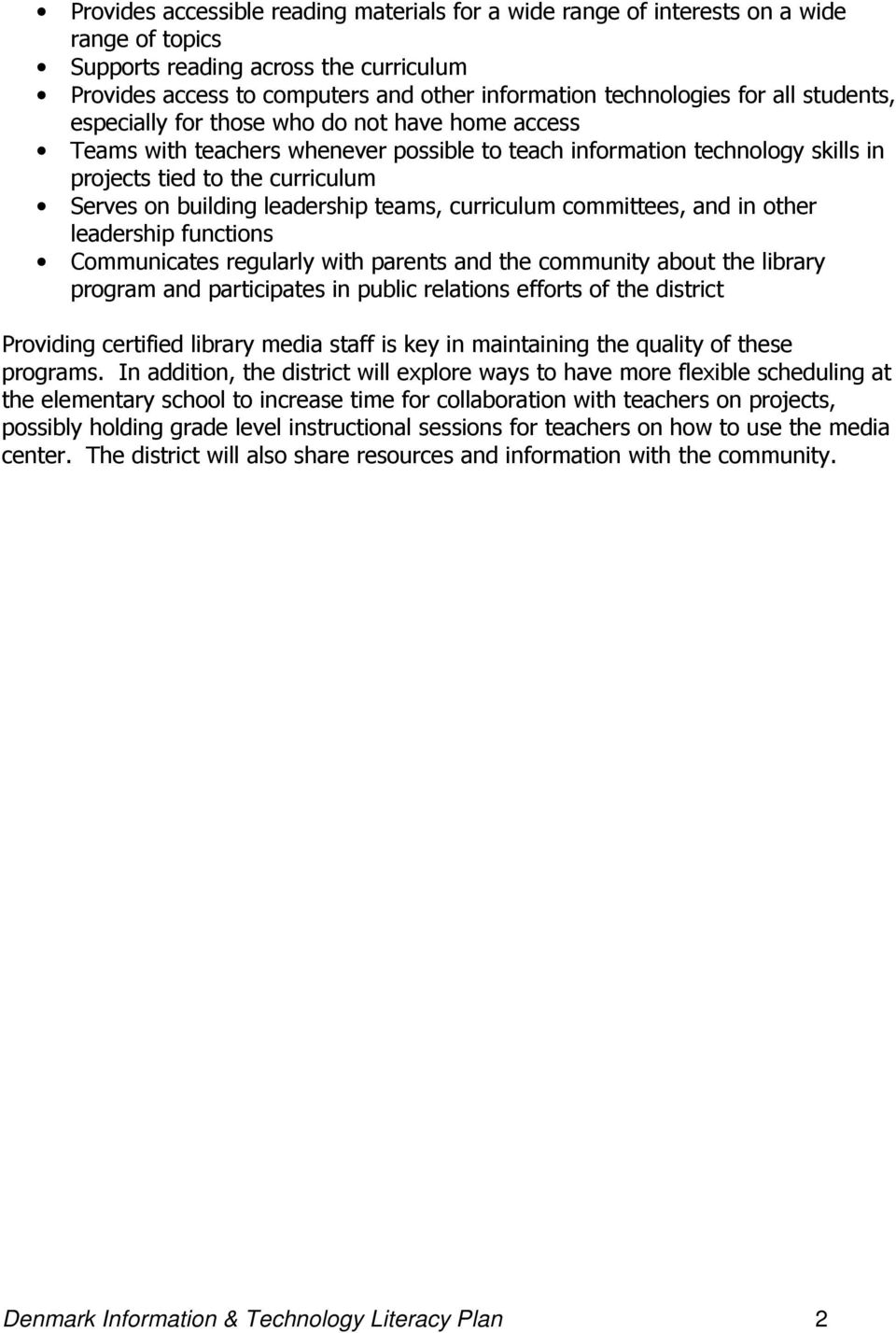
4 Table of Contents EXECUTIVE SUMMARY... 1 INTRODUCTION... 5 Research that Supports This Plan... 5 District Information & Technology Vision Statement... 8 District Information & Technology Mission Statement... 8 BACKGROUND... 8 Student Demographics:... 9 History of Technology:... 9 History of the Library Media Program: Planning Process: COMMUNITY RESOURCES AND ADULT LITERACY PROVIDERS: NEEDS ASSESSMENT/CURRENT STATUS Identification of Underserved Populations: Monitoring, Evaluation and Revision Analysis and Assessment of Progress Toward Previous Plan's Goals ANALYSIS OF STUDENT PROFICIENCY Identification of Underserved Populations Concerning Information and Technology Literacy, Access and/or Equity Analysis of Educator Proficiency Analysis of Effective Teaching & Learning Practices Analysis of Access to Information and Technology Resources Analysis of Support Systems & Leadership IMPLEMENTATION ACTION PLANS BUDGET SUMMARY DISSEMINATION TO STAKEHOLDERS Denmark Information & Technology Literacy Plan 3
5 MONITORING, EVALUATION AND REVISION APPENDICES Denmark Information & Technology Literacy Plan 4
6 Introduction Research that Supports This Plan The digital age is no longer in the future; rather, it is here and now. Students and staff members alike are faced with interacting with technology in a variety of ways. Providing the appropriate learning opportunities for them that require applications that focus on problem solving and increase student learning through inquiry-based, constructivist approaches are necessary if technology is to become a learning tool rather than just a productivity tool. It is within this framework that the Information Technology Plan was revised to better reflect current and future practices that link the technology department to the library/media centers and ultimately to students and achievement. A recent report by The Partnership for 21 st Century Skills (2008) entitled, 21 st Century Skills, Education & Competitiveness, provides three reasons why technology is important to our nation s economy: Reason # 1: Fundamental Changes in the Economy, Jobs and Business- Over the last several decades, the industrial economy based on manufacturing has shifted to a service economy driven by information, knowledge and innovation (p. 2). Reason # 2: New, Different Skill Demands- Advanced economies, innovative industries and firms, and high-growth jobs require more educated workers with the ability to respond flexibly to complex problems, communicate effectively, manage information, work in teams and produce new knowledge (p. 6) Reason # 3: Two Achievement Gaps- For the past decade, the United States has focused nationally on closing achievement gaps between the lowest- and highest performing students- a legitimate and useful agenda, but one that skirts the competitive demand for advanced skills (p. 8). Students and staff members alike are faced with interacting with technology in a variety of ways. Providing the appropriate learning opportunities for them that require applications that focus on problem solving and increase student learning through inquiry-based, constructivist approaches are necessary if technology is to become a learning tool rather than just a productivity tool. In constructivist teaching pedagogy, the roles of teachers and students change. Teachers facilitate learning environments in which students construct deep meaning through solving problems by building on prior knowledge structures. The following table shows the differences between transmission and constructivist teaching styles. Denmark Information & Technology Literacy Plan 5
7 Table 1 Transmission Pedagogy Constructivist Pedagogy Classroom Activity Teacher-Centered Didactic Student-Centered Interactive Teacher Role Fact Teller Always Expert Collaborator Sometimes Learner Student Role Listener Always Learner Collaborator Sometimes Expert Instructional Emphasis Facts Memorization Relationships Inquiry & Invention Concept of Knowledge Accumulation of Facts Relationships Inquiry & Invention Demonstration of Quantity Quality Success Assessment Multiple-Choice Items Portfolios and Performances Technology Use Drill and Practice Communication, Collaboration, Information Access, Expression Sandholtz, Ringstaff, & Dwyer (1997) 21 st Century Learning experiences require 21 st Century Tools. Tools such as wikis, blogs and podcasts, also called collaborationware allow users to deepen levels of learners' engagement and collaboration within digital learning environments (Kamel Boulos, Maramba, & Wheeler, 2006). In an increasing global society, students will need to be able to collaborate with people they have never met before. If students are to be successfully prepared for the demands of higher education and the increasingly competitive work environment, they must have access to the right coursework. As students move through secondary school, they must be provided with greater rigor in their core classes; that is, the basic courses needed for graduation. But students also must have access to courses beyond the basic core, courses that push them even harder intellectually, deepening their knowledge and understanding in key content areas and helping them to hone high level research and thinking skills. In short, students need access to advanced coursework (US Department of Education, 2007). Providing options for advanced coursework using technology can be one way to provide these opportunities. Denmark Information & Technology Literacy Plan 6

8 These Wisconsin Information Technology Literacy Standards connect and inter-relate current perspectives in information literacy, media literacy, and technology literacy into a unified conceptual framework (Instruction, 1998). In order to effectively integrate these standards into core curriculum there need to be strong working connections between library media specialists, regular education teaching staff and the technology department. A recent study on Wisconsin Library Media Centers shows the importance of a strong library media program on student achievement. Key Finding #1: Schools with full-time certified library media specialists and fulltime library aides have higher performance on the WKCE. Key Finding #2: Schools where the library media specialist spends more time on instructionally-related student and teacher activities have higher WKCE scores. Key Finding #3: Teachers who aligned WMAS for Information and Technology Literacy to their lessons found school library media programs more helpful to student performance. Key Finding #4: Schools with greater library media program resources for collections and technology have higher performance on the WKCE. Key Finding #5: Library media specialists help students acquire unique skills not taught in the classroom and information and technology skills essential for students in the 21st century (Smith, 2006). This research provides the basis by which this Information Technology Plan was revised to better reflect current and future practices that linked the technology department to the library/media centers and ultimately to students and achievement. References: US Department of Education (2007). Innovations in Education: Connecting Students to Advanced Courses Online. Retrieved December 28, 2008, from Wisconsin Department of Public Education (1998). Wisconsin Model Academic Standards. Kamel Boulos, M., Maramba, I., & Wheeler, S. (2006). Wikis, blogs and podcasts: a new generation of Web-based tools for virtual collaborative clinical practice and education. Retrieved September 8, 2008, from The Partnership for 21 st Century Skills (2008). 21st century skills, education & competitiveness: A resource and policy guide: The Partnership for 21st Century Skills. Smith, E. (2006). Student learning through Wisconsin school library media centers Denmark Information & Technology Literacy Plan 7

9 District Information & Technology Vision Statement In the School District of Denmark, our Professional Learning Community will be technologically literate life-long learners who are able to interact successfully in a technological environment to achieve their personal, educational and workplace goals by skillfully using information and communication technology tools to access, retrieve, and use information school-wide, community-wide, nationally and internationally. District Information & Technology Mission Statement Integration of the Information and Technology Literacy standards throughout the curriculum will enhance independent learning by preparing today s learners to gather, evaluate and process information to make informed decisions in a knowledge-based digital society. Teachers, library/media specialists and technology specialists will function as a coordinated unit to make curriculum linkages for the development of 21 st Century Skills for all learners. Background The School District of Denmark serves all or portions of the Village of Denmark; the Towns of Eaton, Glenmore, Ledgeview, Morrison and New Franken in Brown County; the Town of Franklin in Kewaunee County; and the Village of Maribel and the Towns of Cooperstown and Gibson in Manitowoc County. It encompasses approximately 165 square miles and is situated along Interstate Highway 43. Many of the residents work in the Green Bay metro area. The district is comprised of six schools including a charter school, which is located on the second floor of the middle school. Approximately 1,574 students and 200 staff members utilize technology in a variety of ways to enhance everyone s performance as part of the District Team. It is made up of six schools: Denmark Early Childhood Center Denmark Elementary School Denmark Middle School Denmark High School Denmark Empowerment Charter School Northeast WI Online Charter School Denmark Information & Technology Literacy Plan 8

10 Student Demographics: Number of Students % of Students White % of Students African American % of Students Hispanic % of Students Asian % of Students Native American % of Students Receiving F/R Lunch 1, % 0.5% 1.8% 1.7% 1.2% 11.1% * data History of Technology: Approximately fifteen years ago, the district started to invest in technology. Prior to 1998, the middle school and elementary school had computers in the classrooms, some network printers, and selected locations had dial-up Internet connections. In 1998, the district renovated the high school. At the same time, the district got Internet and access. The district hired an Educational Support Coordinator to assist with the new technology. In the past five years, the district has worked on continually streamlining technology processes and making them more cost effective. The district purchased PowerSchool as its student management system. The district started to change from workstations connecting to hubs to dedicated switch ports. The district purchased Eclipse, a curriculum mapping software. The district moved to Voice Over IP for its phone system. The district cut the IT staffing by ¾ of a position. The district has improved and increased its commitment to anti-virus/anti-spam software. The district has done a good job of upgrading the infrastructure to meet increasing user demands. Access has steadily improved especially with the addition of laptop computers. Zen Works has been added which allows IT staff to manage and work on computers remotely. E-SPED, an Internet system that allows special education staff to do their IEP s, has been added. Plato GW-Extranet GW-Archive AlertNow Aristotle Parent Access to PowerSchool Denmark Information & Technology Literacy Plan 9
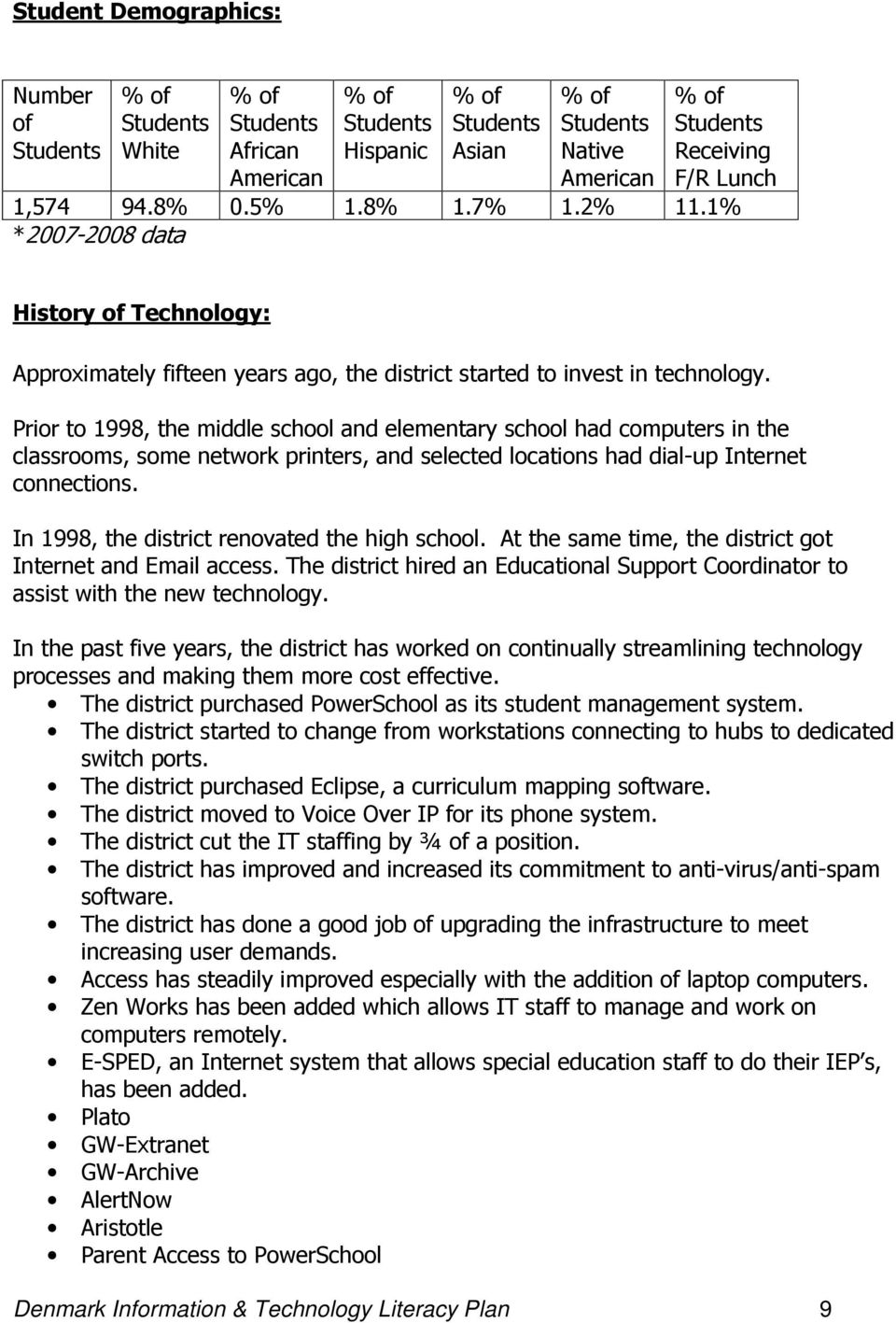
11 Lunch Monies Program On-Line Moodle Gaggle Customized Local Filtering of Websites Net-Op (Teacher Access to Student Computer Monitors) Use of SmartBoards Technology University Summer Academy Big 6 Learn 360 Neos and Alpha-Smarts Denmark Information & Technology Literacy Plan 10
12 History of the Library Media Program: The district has had a library media program since its conception. Over the history of the program, the district has shown a strong commitment to the library media program and has strived to provide information resources to its constituents. When the middle school was built, the library facility was a vast improvement over the existing facility. At that time, the sixth grade was moved to the middle school. The elementary school library shared their collection with the middle school based on their curricular needs. In 1998, the high school administrator, the library media specialist, and the director of the Brown County Library worked to create a combined library as part of the new high school building plan. District students/staff, as well as community members, now have access to inter-library loans. Research also shows that strong library media programs with appropriate staffing guidelines improve student achievement. 3 Currently the district has two certified library media specialists; one library media specialist works at the high school and one works at the elementary school. The middle school has a certified teacher who oversees the program. The elementary program has always included grades K-5. More recently, early childhood was added to their schedule. In addition, kindergarten students walk to the high school library once per month for story time with the Brown County Library clerks and for book checkout. The elementary library media specialist meets with students on a weekly basis. The elementary school PTO has contributed significant funds toward a new library media center at the Early Childhood Center, and to both the elementary school Book Room and Parent Place. All district library media specialists and media center staff personnel have been trained in the Big 6 Research/Problem-Solving Model through an EETT Grant. The elementary and middle school libraries use Follett to Lexile new materials. Their current catalog can be run through a system analysis to maintain current materials and to help evaluate and guide future purchases. 3 Ratzer, Mary Student Acheivement and School Libraries: Empeirical Evidence from 15 State Studies (AASL) Denmark Information & Technology Literacy Plan 11

13 Planning Process: The District took the TAGLIT (Taking a Good Look at Instructional Technology) online survey to use as needs assessment data to help in the planning process in November One hundred percent of teachers and one hundred percent of eighth grade students took the survey. The District had a variety of stakeholders participate in the planning process. The following individuals served on the planning committee: Tony Klaubauf Dave Harper Joan Langenberg Theresa Olsen Denise Flickinger Katie Dowling Diane Randerson Superintendent Early Childhood Center Principal; Director of Curriculum Technology Network Coordinator Technology Educational Support Coordinator High School Library Media Specialist Middle School Media Center Coordinator (Certified Teacher) Elementary School Library Media Specialist The committee reviewed TAGLIT data, relevant education research, and worked on developing the mission and vision for the plan, and action plans based on identified needs. Community Resources and Adult Literacy Providers: The Denmark Branch of the Brown County Library System is housed in the High School Library Media Center. This collaboration model has successfully met the needs of both the school community and area patrons. Staff members from both institutions work together to better serve their constituents. Partners in Collaborative Efforts: As part of the Bay Area Consortium, which has received EETT (Enhancing Education Through Technology) funding, the district has effectively collaborated with area school districts in implementing both staff development programs and using information and technology to support the Big 6 research model. The four districts (Seymour, Pulaski, Green Bay and Denmark) have maximized time and talents through this partnership. The district is actively involved in the Greater Green Bay Area Chamber of Commerce Partners in Education program. Partnerships are often developed through this program since the Chamber serves as a primary resource link to area school districts. Additionally, by having the Brown County Library housed in the high school library, additional community resources can be easily identified for working with both students Denmark Information & Technology Literacy Plan 12

14 and staff. The district also informs teachers about staff development opportunities that are offered through CESA #7 and area districts. Computers in the high school are available to the general public during the day while high school classes are in session and during the evening hours in which the Brown County Library operates. In addition, wireless Internet access is now available. The Brown County Sheriff s Department utilizes this service. Parents and community members are invited to presentations that students create using multimedia resources, such as DESK News (Denmark Elementary School Kids) at the elementary school. This practice helps to create an awareness of how technology is used in the classroom. The local business association (DCBA) is also a resource that can be tapped when needs are identified. These activities are conducted on an as needed basis. The district has recently joined the Eastern Wisconsin Instructional Technology Consortium (EWITC). The EWITC Coordinator for this area is a member of the School District of Denmark staff. Denmark Information & Technology Literacy Plan 13
15 Needs Assessment/Current Status Identification of Underserved Populations: While NCLB (No Child Left Behind) focuses only on reading and math, the district s goal is to educate the whole child; consequently, resources also reflect the other content areas including specialty areas. The special education staff uses E-SPED, an Internet-based software application, to do all of their IEP s. PLATO is used by students for remediation and for credit recovery. Students participating in homebound instruction also use PLATO. The district also uses NWEA Map Testing in Grades 5-8 to help identify student progress and needs. The district uses Fast ForWord as a reading intervention program in Grades 2-5. In addition, the district uses the SRI (Scholastic Reading Inventory) in Grades 2-5. Kindergarten and Grade 1 use Star Early Literacy. The middle school and high school use the SRI for a small number of students. The district is continuing to categorize their library collections by Lexile levels. The Northeast Wisconsin Online Charter School is available to any student in the school. It is most often used by students taking Advanced Placement courses and any students who have unique needs that cannot be met by a particular term s schedule. Denmark Information & Technology Literacy Plan 14
16 Monitoring, Evaluation and Revision Analysis and Assessment of Progress Toward Previous Plan's Goals Educator Proficiency Action Plan: Goal: Student achievement will improve through effective integration of the information technology standards into the curriculum Objectives: By June 2009, teachers will show increased proficiency in integrating information technology benchmarks into the curriculum. Action: Data retreat group will identify professional development needs and planning professional development opportunities Offer at least one PDT day a year where teachers rotate or have breakout sessions (i.e. printers/copiers, PowerGrade for new staff) Add time for collaboration between library media specialists and teachers during PDT days Encourage teachers to participate in CESA #7 training events Indicator of Success Professional development needs identified. PDT day agenda Increased collaboration between library media specialists and teachers Increased participation in offerings Status Completed/ Completed/ (Tech. University) Effective Teaching & Learning Practices Action Plan Goal: Student achievement will improve through effective integration of the information technology standards into the curriculum Objectives: By June 2009, the district will have an assessment strategy in place to measure student achievement on information technology literacy skills Action Identify main benchmarks of what we want students to know and be able to do at each grade level through curriculum mapping process Communicate expected ICTL for their grade level to teachers and provide professional development Curriculum maps should be incorporate ICTL Standards using Eclipse. Create assessments related to ICTL benchmarks developed by teachers Provide staff development opportunities that encourage teacher examples, sharing at their levels Indicator of Success Grade level benchmarks identified Teachers are informed of ICTL benchmarks for their grade level, Revised Matrix ICTL benchmarks are aligned to core curriculum Common assessments developed, implemented and reviewed PDT agendas, teacher and student technology proficiency Status Completed Completed Completed/ at all Grade Levels Denmark Information & Technology Literacy Plan 15

17 Study flexible scheduling options at the elementary school Increased collaboration between library media specialists and teachers Continual Process Access to Information Resources & Learning Tools Action Plan Goal: The District will continually look for ways to improve efficiency and cost effective methods of implementing information and technology Objectives: By June 2009, 100% of the district will be using centralized printing Action Move to centralized printing: NEP cost proposal to printing task force, three other companies will do proposals Committee may explore selling existing supplies on e-bay or phase in Committee will look at existing equipment and decide how implementation will happen Indicator of Success Centralized printing implemented Status Completed Goal: The District will provide the resources necessary to effectively integrate information technology into the curriculum Objectives: By June 2009, the number of LCD Projectors in each building will increase. Action Purchase mobile LCD projectors cart to use with computer availability Purchase more digital still and video cameras at each school to help meet standards Indicator of Success More LCD s purchased for instruction Buildings have enough access to meet information technology benchmarks Status Completed Goal: The District will continually look for ways to improve efficiency and cost effective methods of implementing information and technology Objectives: By June 2009, the district will have adopted and implemented a new software adoption process Action Streamline the software adoption process Indicator of Success New process adopted Status Completed Communicate and educate staff on the process for Process communicated adopting software in the district to staff Explore resources such as United Streaming United Streaming studied Completed Update software inventory in every building Building software Completed/ inventories Identify experts in software in the district. Have them provide breakout sessions at PDT breakout day PDT Day Completed/ Denmark Information & Technology Literacy Plan 16

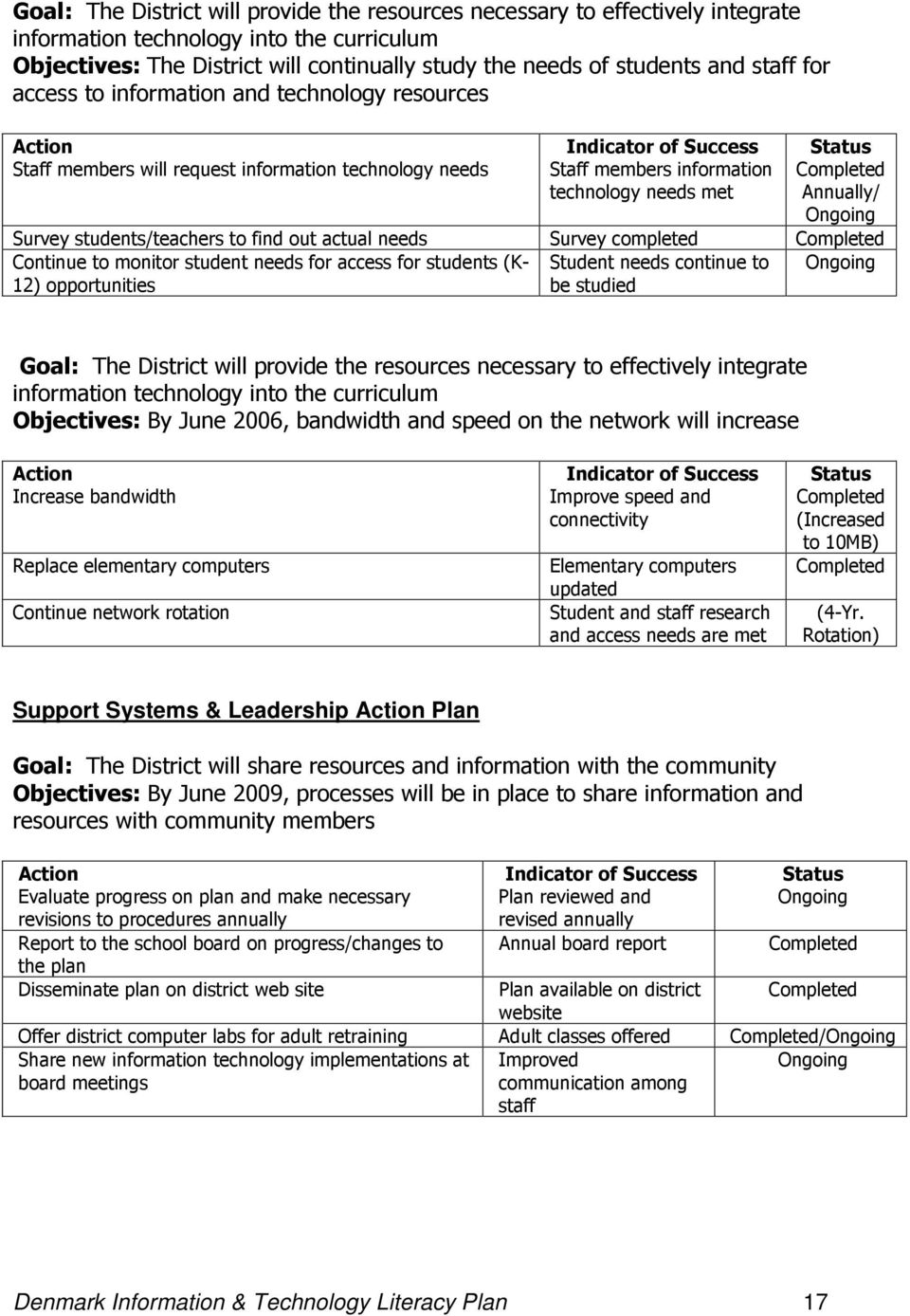
18 Goal: The District will provide the resources necessary to effectively integrate information technology into the curriculum Objectives: The District will continually study the needs of students and staff for access to information and technology resources Action Staff members will request information technology needs Indicator of Success Staff members information technology needs met Status Completed Annually/ Survey students/teachers to find out actual needs Survey completed Completed Continue to monitor student needs for access for students (K- 12) opportunities Student needs continue to be studied Goal: The District will provide the resources necessary to effectively integrate information technology into the curriculum Objectives: By June 2006, bandwidth and speed on the network will increase Action Increase bandwidth Replace elementary computers Continue network rotation Indicator of Success Improve speed and connectivity Elementary computers updated Student and staff research and access needs are met Status Completed (Increased to 10MB) Completed (4-Yr. Rotation) Support Systems & Leadership Action Plan Goal: The District will share resources and information with the community Objectives: By June 2009, processes will be in place to share information and resources with community members Action Evaluate progress on plan and make necessary revisions to procedures annually Report to the school board on progress/changes to the plan Disseminate plan on district web site Indicator of Success Plan reviewed and revised annually Annual board report Status Completed Plan available on district Completed website Offer district computer labs for adult retraining Adult classes offered Completed/ Share new information technology implementations at board meetings Improved communication among staff Denmark Information & Technology Literacy Plan 17
19 Analysis of Student Proficiency The following charts show student proficiency on information technology skills measured on the TAGLIT online survey. Data indicates that the district is in the PROGRESSING stage of using information technology, meaning that the schools are making some effort and showing some progress with this aspect of using technology for teaching and learning. The following chart shows student proficiency measured on the online TAGLIT survey. Students' Technology Skills 1 I don t know how to do this 2 I can do this, but sometimes I need help 3 I can do this by myself 4 I can teach others how to do this 3a.1 Students Tech Skills Basic Tools How far along are you in learning to... (responses given as percent) n Score use a word processor to create documents? use a spreadsheet to enter and calculate numbers? use a spreadsheet to create graphs? use a database to enter information? l use a database to search for and sort information and create reports? Section Average Score a.2 Students Tech Skills Multimedia Tools How far along are you in learning to...(responses given as percent) n Score use drawing or painting software to create pictures? use a video camera to make a video? use video editing software to edit a video? use a digital camera and/or scanner to get pictures into a computer? use image-editing software to enhance pictures? use presentation software to create a presentation? use multimedia software to create a product? Section Average Score a.3 Students Tech Skills Communication Tools [How far along are you in learning to...(responses given as percent) n Score use to send and receive messages? l 101 use online discussions to gather information? use a web authoring tool to create a web page? Section Average Score 2.42 Denmark Information & Technology Literacy Plan 18

20 3a.4 Students Tech Skills Research/Problem-Solving Tools How far along are you in learning to... (responses given as percent) n Score use CD-ROMs to gather information? use online reference software to gather information? use a search engine to find information on the World Wide Web? narrow World Wide Web searches using Boolean operators? use graphing calculators to solve mathematical problems? use probes to collect and study information? use graphic organizer andlor s) stems thinking software to solve problems? Section Average Score 2.21 Identification of Underserved Populations Concerning Information and Technology Literacy, Access and/or EquityA Assistive technology options are considered as part of the IEP process. The special education staff has broad knowledge of how different software applications can be used to make accommodations for students. Accommodations include options such as the use of Dragon Naturally Speaking, AlphaSmarts, and, voice output devices and large print texts. Technologies currently used by all students offer a greater range of accommodations for students with assistive needs requiring less need for specialized programs. The Elementary School utilizes Fast ForWord in their building to help improve literacy. Plato is used at all other building levels. The Fast ForWord program has been used to provide programming for selected students as Response To Intervention programming Analysis of Educator Proficiency The district is currently involved in an EETT (Enhancing Education Through Technology) Grant through a consortium. The grant focuses on using technology strategies to support the Big 6 research model. TAGLIT data indicates there is range in teacher technology proficiency levels. Teacher comments on the TAGLIT online survey indicate that teachers would like professional development opportunities tied to integration of information technology into the curriculum. The following charts show teacher proficiency levels in different technology skills by school as reported on the TAGLIT online survey: Denmark Information & Technology Literacy Plan 19

21 Denmark Early Childhood Center Denmark Elementary School Denmark Middle School Denmark Information & Technology Literacy Plan 20
22 Denmark High School Analysis of Effective Teaching & Learning Practices The district has adopted its own set of ITL benchmarks for grades K-10 (included in Appendix A). Keyboarding is taught in all content areas. In the middle school all 6 th grade students take a Keyboarding class; 7 th grade students take a Computer Applications class; and 8 th grade students take a Technology Literacy & Careers class. The district is currently working on integrating the ITL benchmarks as part of their curriculum mapping process. The High School Business courses include the Wisconsin ITL Standards as part of their curriculum maps. Currently the district does not have a process in place for measuring progress on the benchmarks. TAGLIT data indicates that video-editing software, hardware and teacher training in this area are needed to meet all of the standards. The following charts show how teachers report they are using technology in the classroom on the TAGLIT survey. Denmark Information & Technology Literacy Plan 21
23 Denmark Early Childhood Center Denmark Elementary School Denmark Information & Technology Literacy Plan 22
24 Denmark Middle School Denmark High School Denmark Information & Technology Literacy Plan 23
25 Analysis of Access to Information and Technology Resources All of the main buildings are on the same network and the Early Childhood Center has remote site access. All computers are connected to a dedicated switch instead of hubs. In July 2007 upgrades to the infrastructure increased the Internet bandwidth to 10 MB. The district has eleven servers, has a network rotation cycle, and replaces servers every 4-5 years. The district has made progress and increased its commitment for antivirus/anti-spam. Servers and work stations continually check for updates as they are available. The district currently uses GroupWise as its system. Summer 2009 the district is planning to migrate from GroupWise to Microsoft Outlook for the system. The district changed its phone system to Voice Over IP the summer of The district uses PowerSchool as its student management system and PowerSchool and Web Gradebook for student grades. The district has recently implemented Skyward as its financial system. The district uses Eclipse for curriculum mapping. The district implemented NetStorage to allow staff members remote access to their files. The District also added an AlertNow Program which is used for emergency and student attendance notification. The Education Support Coordinator maintains the district web site at The Education Support Coordinator works with teachers in creating and developing their own web pages using CMS4Schools. Parents, students and teachers can access PowerSchool through a link located on the district web page. Currently the district has approximately 605 computers and 90 laptops. In the past, the district purchased its own computers. The district is now leasing computers on a fouryear rotation (Approximately 145 computers every year). An inventory of hardware in the district is included in Appendix B. Denmark Information & Technology Literacy Plan 24
26 The district has the following peripherals: School Type of Peripheral # in District High School Digital Cameras 4 Digital Video Cameras 6 LCD Projectors 23 Middle School Digital Cameras 8 Video Camera 1 Digital Video Cameras 4 LCD Projectors 20 Elementary School Digital Cameras 3 Digital Video Cameras 3 LCD Projectors 10 Early Childhood Center Digital Cameras 1 Digital Video Cameras 1 LCD Projectors 2 Denmark Empowerment Charter School Digital Cameras 1 Digital Video Cameras 1 LCD Projectors 2 The district has approximately 50 printers/multi-purpose copy machines. They are a combination of stand-alone and network printers. An inventory of software is included in Appendix C. The district has a Technology Network Support Coordinator and a Technology Educational Support Coordinator. The district also has one aide who assists teachers in computer labs at the elementary school. In addition, the library media specialists assist with minor technology support issues. The district contracts support services for a Network Engineer through a company called Tushaus. Access to Library Media Resources The district houses the Denmark branch of the Brown County Public Library in the high school. The public library and high school library collections are combined for access by the community and district students. A contract between the school district and the Brown County Public Library is renewed every five years. It states in the contract that a certified library media specialist is to be hired by the district for the combined libraries. Two Brown County library clerks share a full-time position. The clerks take care of a weekly children's story time, monthly visits from district kindergarten students, and supervise the library when it is open after school hours. A full-time library clerk is employed by the school district. Duties include library media tasks as well as computer lab supervision and scheduling. Having a clerk in the library allows the library media specialist the accessibility to work with teachers and students in classrooms throughout the school day. Denmark Information & Technology Literacy Plan 25
27 Currently, the K-5 library media specialist works on a fixed schedule with the ability to have flexible scheduling to meet the needs of the students. The elementary school library facility is in need of upgrading. More space is needed to accommodate the 500 students it serves. There are five computers in the media center reference area that students can use for Internet research. Teachers send students to the library individually to work on projects. The district has two certified library media specialists and certified teacher at the middle school. The elementary school library media specialist oversees the facilities in both the elementary school and the early childhood center, with the help of a para-professional. While the district understands the importance of staffing libraries with certified media specialists so that support of teachers in the integration of information skills into the curriculum continues, adjustments to staffing due to budget constraints may be necessary. The district subscribes to a variety of online databases including Contemporary Authors, EbscoHost and other resources provided by BadgerLink through CESA #7. The WISCAT regional library catalog is also available to library patrons. The goal of the library is to maintain an up-to-date collection of materials to support the curriculum and instructional programs as well as the broad range of interests and reading levels of the students. The School District of Denmark uses Common School Funds to maintain and update the library media center collections and to purchase new materials. Starting in the school year, designated Common School Funds will be allocated to cover a portion of the costs for district-wide online databases for student use. A collection analysis of individual schools is being completed by the Follett TitleWise system during the end of the school year. The district library media specialists spent time analyzing the data for the high school, middle school, and elementary school and discussed how it would impact collection development in the future. All school reference collections are current and adequate. The media center specialist at each building will continue to update collections as funds are available. The district is currently working on adding Lexile scores to books in the collections. Analysis of Support Systems & Leadership The district has a District Technology Committee. The committee is made up of the technology department members, library media specialists, building principals, the superintendent, the director of curriculum, a special education teacher, one teacher from each building, and a technology para-professional. This committee makes decisions related to implementing technology. The committee reviews technology requests and helps decide what the district should purchase. Denmark Information & Technology Literacy Plan 26
28 Implementation Action Plans Target Area: Educator Proficiency Effective Teaching and Learning Practices Needs: In order for students to survive and thrive in a global society, they need to graduate with 21 st Century Skills. Goal: To implement 21 st Century Skills and Information & Communication Technology Literacy in Units and/or Daily Lesson Design. Objective: By June 2011, units that integrate 21 st Century Skills will be implemented Actions: 1. Provide staff development on what 21 st Century Skills actually are. Persons Responsible: Curriculum Coordinator Dist. Admin. Teaching Staff Timeline: Beginning of School Year Resources Needed: District Staff Outside Agencies Credit Options through EWITC and/or Ed Tech Grant Indicators of Success: Staff Dev. Provided 2. Provide staff development on how to utilize 21 st Century Skills in units/lessons. 3. Create units and lessons designed to incorporate 21 st Century Skills into literacy instruction. 4. Sharing/demonstrations of actual lessons incorporating 21 st Century Skills at building staff meetings District Staff Outside Agencies Teaching Staff Curriculum Coordinator Bldg. Principals Teaching Staff Teaching Staff Bldg. Principals January School Year School Year District Staff Outside Agencies PDT Days Ten-Minute Tech. Tips at Staff Mtgs. Credit Options through EWITC and/or Ed Tech Grant Curriculum Coordinator Bldg. Principals Release Time PDT Days Summer Work Teacher Personal Growth Plans Credit Options through EWITC and/or EdTech Grant Staff Meetings PDT Days Accessible Technology Staff Dev. Provided Documented Lessons and Units in Curriculum Staff Meeting and/or PDT Day Agendas Denmark Information & Technology Literacy Plan 27
29 Target Area: Educator Proficiency Needs: Currently, some members of the educational staff are exploring the use of Web 2.0 tools for instructional purposes, however use is not yet widespread across the district. Goal: The District will work to increase awareness and use of Web 2.0 tools to improve professional staff s ability to help students prepare for increasingly complex life and work environments in the 21st Century. Objective: By June 2011, all educational staff will utilize Web 2.0 tools as a teaching and learning resource to improve learning. Action: 5. Educate staff on the various types of Web 2.0 tools. 6. Provide staff development training on how to solve real-life problems using Web 2.0 skills. 7. Provide time for teachers to share their successful implementation of Web 2.0 tools. Persons Responsible: Teaching Staff Teaching Staff Teaching Staff Administration Timeline: Jan and Jan and Jan and Resources Needed: Outside Agencies Ten-Minute Tech. Tips Sessions Tech. University Credit Options Teachers share their success stories at staff meetings. Staff Meetings PDT Day Indicators of Success: Staff survey will indicate an increased understanding of Web 2.0 tools Staff survey will indicate an increased understanding of Web 2.0 tools Utilization of Web 2.0 tools on a continuing basis Denmark Information & Technology Literacy Plan 28
30 Target Area: Access to Information & Technology Tools Support Systems and Leadership Need: Staff needs an easy way to share information via individual websites with students and parents Goal: The district will provide current information to students, parents, and the community electronically. Objective: By the end of the school year, 80% of district teachers and administrators will have developed a web page with the intent of utilizing the webpage as an interactive instructional tool. Actions: 8. Purchase CMS4Schools 9. Provide training time for teachers on the use of CMS4Schools 10. Provide work time for teachers to create their web pages 11. Provide time for teachers to share the successful implementati on of CMS4Schools 12. Teachers will ensure that their web page information is kept current. Persons Timeline: Resources Indicators Responsible: Needed: of Success: Administration Budget District Funds Completed CMS4Schools Rep. Teaching Staff Administration Teaching Staff Administration Teaching Staff Administration Jan Jan and Jan and PDT Day designed to demonstrate to teachers that web pages are valuable. Prep Time PDT Days Summer Work Staff Meetings PDT Days Staff participation in training Web pages created by 80% of teachers By the end of 2012, 80% of teachers will have met this goal. Teaching Staff Prep Time Accurate and current web pages Denmark Information & Technology Literacy Plan 29
31 Target Area: Access to Information & Technology Tools Needs: In order for students to graduate with 21 st Century Skills they need 21 st Century Learning Environments that include 21 st Century tools Goal: The District will provide the resources necessary to effectively integrate information technology into the curriculum. Objective: By June 2012, wireless options in the district will have increased By June 2012 all essential classrooms will be equipped with a ceiling-mounted LCD wireless projectors. Action: 13. Wireless Options Develop a plan for implementation of permanent wireless solutions in high usage areas throughout the district 14. Continue purchase of ceiling-mounted LCD projectors with wireless presenters for district classrooms. 15. Continue to upgrade wireless laptop options 16. Continue to upgrade printing equipment according to needs. 17. Continue to monitor bandwidth usage and increase as needed. Persons Responsible: Administration Tech. Comm. Library Media Personnel Administration Tech. Comm. Library Media Personnel Administration Tech. Comm. Administration Administration Timeline: Resources Needed: Outside consultation with vendors. Wireless equipment as needed. Funded in part by regular technology budget; will need to obtain additional funding. Ed Tech Grant Funds District AV Budget Tech. Budget Tech. Budget Common School Funds Tech. Budget District Budget Indicators of Success: Successful installation and implementation of wireless solutions. By 2012, all essential classrooms will be equipped with a ceilingmounted LCD wireless projectors All laptops are operational and being utilized productively. Needs of the district are being met in a cost effective manner. Tech. Budget Staff and students are able to utilize the Internet productively. 18. Investigate emerging technology equipment such as document cameras, flip Library Media Personnel Tech. Comm. Tech. Budget Grants AV Budget Staff and students will utilize emerging technologies as purchased. Denmark Information & Technology Literacy Plan 30
32 videos, ipod touch, etc. 19. Investigate storage space solutions 20. Continue fouryear rotation in replacing computers Administration Administration Tech. Comm. Tech. Budget Storage space solutions will be purchased and implemented as needed. Tech. Budget Will continue four-year rotation in replacing computers. Denmark Information & Technology Literacy Plan 31
33 Target Area: Effective Teaching and Learning Practices Need: Currently virtual learning opportunities for students in the district are limited. Goal: Student achievement will be enhanced through an introduction to virtual learning and implementation of 21 st Century skills at every building level. Objective: By June 2012, Virtual learning opportunities for students will have increased Actions: 21. Provide AP On- Line Classes via Northeastern Wisconsin On-Line Charter School 22. Include interaction with virtual learning experiences in Personal Planning class 23. Include interaction with virtual learning experiences in Eighth Grade Business Class 24. Explore options in students early childhood/element ary schools to include virtual learning experiences. Persons Responsible: Guidance Instructor Curriculum Coordinator Teaching Staff Administration Curriculum Coordinator Teaching Staff Administration Curriculum Coordinator Teaching Staff Administration Curriculum Coordinator Timeline: Currently and School Year School Year Resources Needed: Hardware Tech. Equipment Internet Connectivity Staff Dev. Curriculum Time Hardware Tech. Equipment Internet Connectivity Staff Dev. Curriculum Time Hardware Tech. Equipment Internet Connectivity Staff Dev. Curriculum Time Hardware Tech. Equipment Internet Connectivity Indicators of Success: Increased student participation All students will be required to complete this class prior to graduation All students will be required to complete this course prior to eighth grade graduation. Increased participation in virtual learning experiences. Denmark Information & Technology Literacy Plan 32
34 Target Area: Support Systems and Leadership Access to Information & Technology Tools Need: As the web evolves students, staff, and parents need education on safe Internet practices. Goal: School District of Denmark students will develop the proficiencies necessary to become responsible digital citizens. Objective: By June 2012, the district will have established a multi-layered approach to Internet Security including education, filtering, and updated policies. Action: 25. Purchase and train personnel on a security monitoring option, such as Aristotle, to allow staff and students broader access to Internet options. 26. Provide staff development on elements of digital citizenship. 27. Implementation of a curriculum to educate students on the elements of digital citizenship; i.e., etiquette, health & wellness, cyber bullying, social networking, etc. 28. Update Internet Safety and Web 2.0 Tools policies Persons Responsible: Tech. Comm. Administration Library Media Personnel Curriculum Coordinator All Teaching Staff Library Media Personnel Curriculum Coordinator Tech. Comm. Library Media Personnel Administration School Board Timeline: Jan./Feb and Jan and Jan and Resources Needed: Tech. Budget Outside Speaker PDT Days Staff Meetings Outside Speaker Indicators of Success: Program purchased and utilized. Training Completed Curriculum Implemented June 2009 Time Board Approval of Revised Policy Denmark Information & Technology Literacy Plan 33
35 Target Area: Support Systems and Leadership Needs: The district needs efficient means to share resources and interact with community members and outside resources to develop strong school/community relationships. Goal: The School District of Denmark will share resources and interact with community members and outside resources to develop strong school/community relationships. Objective: By June 2012, the district will implement systems to help them interact with community members and outside resources to develop strong school/community relationships. Action: 29. Utilize the new AlertNow service to inform students, staff, parents and community members of cancellations, schedule changes, etc. 30. Maintain gym and field schedules on the District website for use by the public. 31. Work with the Brown County Library to offer basic instruction to the public on technology topics of interest. 32. Provide a page on the District website for the Brown County Library Branch to advertise their activities and events. Persons Responsible: District Administrator And District Administrative Assistant Athletic Director Community/village personnel Brown County Library Staff Brown County Library Staff Timeline: Jan and Jan and Resources Needed: Funding for Annual Renewal Funding for Annual renewal Training Outside Vendors Tech. Equipment Advertisements Tech. Equipment Training Time Indicators of Success: Program utilized for effective communication. Program utilized for effective communication. Community participation Successful implementation of a Brown County Library web page. Denmark Information & Technology Literacy Plan 34
36 Budget Summary Category Alignment to Action Plans EXPENDITURES Maintenance Contracts/Travel/Service $146,000 $146,000 $146,000 Supplies #19 17,300 17,300 17,300 Non Capital #29 4,000 4,000 4,000 Non Instructional Software #8 21,200 21,200 21,200 New Equipment #14, #15, #18, #21, #22, #23, #24 5,000 5,000 5,000 Replacement Equipment #20 12,000 12,000 12,000 Professional Development #1,#2, #3,#5, #6, #7,#10,#11, #26 Infrastructure #13, #17,#21,#22,#23, #24, #25 10,000 10,000 10,000 70,000 80,000 60,000 REVENUES Local Funding 173, , ,725 Common School Fund 15,000 15,000 15,000 E-Rate 5,000 5,000 5,000 Title IID #1,#2,#3 1,775 1,775 1,775 Flow thru 90,000 90,000 40,000 Denmark Information & Technology Literacy Plan 35
37 Dissemination to Stakeholders The District Technology Plan will be reviewed at a public meeting of the Denmark School Board and approved in the spring of It will also be shared with the school community through building level meetings in the first semester of 2009 and will be placed on the district s web site for public access and review. Monitoring, Evaluation and Revision The District Information Technology Committee will serve as the primary panel to review the progress of the plan. In periodic (bi-monthly) meetings, the technology committee will review goals and actions plans and make adjustments as necessary. Each spring the team will look at the district plan and make modifications and develop a budget to support the plan. Adult literacy opportunities will continue to be made available through the Brown County Library and NWTC outreach programs in cooperation with the School District of Denmark as a means of communicating what technology is available in the district and how it is being utilized to support student learning. Denmark Information & Technology Literacy Plan 36
38 Appendices Denmark Information Technology Benchmarks Appendix A o K-5 Benchmarks o 6-8 Benchmarks Hardware Inventory Appendix B o AS/400 o Computers o Fixed Assets o Monitors Fixed Assets o Non-Capital Objects o Notebook Computers Software Inventory Appendix C o ECC Software Inventory o Elementary Software Inventory o Elementary Special Education Inventory o Middle School Software o Middle School Special Education Inventory o Middle School CD Inventory o High School Software Inventory o High School CD Inventory o High School Mac Software Inventory o Microsoft Licenses Library Media Materials Selection Policy Appendix D o Philosophy o Selection Personnel o Materials Selection Criteria o Gifts and Donations o Special Concerns of Selection o Maintenance of Collections o Interlibrary Loan Policy for Challenged Materials Appendix E Copyright Policy Appendix F Acceptable Use Policy Appendix G Assistive Technology for Students with Special Needs Policy Appendix H Library Collection Maps Appendix I o Middle School o High School Denmark Information & Technology Literacy Plan 37
FLORENCE SCHOOL DISTRICT TWO DISTRICT TECHNOLOGY PLAN. 2121 South Pamplico Highway, Pamplico, South Carolina 29583
 FLORENCE SCHOOL DISTRICT TWO DISTRICT TECHNOLOGY PLAN 2010 2015 Robert E. Sullivan Jr., Superintendent Mark A. Parker, Information Technology Coordinator 2121 South Pamplico Highway, Pamplico, South Carolina
North Platte Public School District
 North Platte Public School District Student Learning, Student Achievement, Student Success District Technology Plan 2014-2019 Table of Contents Table of Contents 2 Executive Summary 3 District Description
Instructional Technology Plan
 Okeechobee County School Board 700 SW 2 nd Ave Okeechobee, FL 34974 Phone 863-462-5000 ext. 235 Fax 863-462-5017 Instructional Technology Plan Okeechobee County School Board District Instructional Technology
How To Improve Technology In A District School
 1 of 7 10/21/2008 2:26 PM BURTON ISD Technology Plan for E-Rate Year 11 2008-2011 JAMES PALMER SUPERINTENDENT DISTRICT PROFILE ESC Region: 6 City, State Zip: BURTON, TX 778350037 Phone: (979) 289-3131
Three Year Strategic Technology Plan for. Decatur County School System. For the Period of July 2013 through July 2016.
 Three Year Strategic Technology Plan for Decatur County School System For the Period of July 2013 through July 2016 Prepared by: Linda Graves Technology Coordinator Angela Boggan-Federal Projects Director
2013-2016 Technology Plan
 2013-2016 Technology Plan Technology Planning Process A group of six stakeholders including an administrator, one board member, one parent, a teacher, a technology coordinator and a library media specialist
5. Infrastructure, Hardware, Software, & Technical Support
 5. Infrastructure, Hardware, Software, & Technical Support 5 A & B: Current District Hardware Existing hardware and electronic resources at each of our sites is included in Component 3a: Current Technology
School District of Janesville
 School District of Janesville Background The American Recovery and Reinvestment Act of 2009 (ARRA) included a $650 million allocation in ESEA Title II, Part D, commonly referred to as the Enhancing Education
New Prague Area Schools ISD 721. 2012-2017 Technology Plan
 New Prague Area Schools ISD 721 2012-2017 Plan 0 Table of Contents District Mission, Vision, and Values... 2 Demographics of School District... 2 Organization Leadership and Planning... 3 Needs Assessment...
Monroe County Department of Education. Technology Plan
 Monroe County Department of Education Technology Plan Madisonville Tennessee 2011-2013 Office of Technology Gary Sharp, Director III. SYSTEM-WIDE GOALS AND OBJECTIVES Instructional Technology A. GOAL I:
2010-2016 TECHNOLOGY PLAN
 2010-2016 TECHNOLOGY PLAN Bland County Public Schools 361 Bears Trl. Bastian, VA 24315 www.bland.k12.va.us Six Year Technology Plan for Bland County Public Schools APPROVED BY SCHOOL BOARD MAY 23, 2011
Park Community Charter School Kaukauna Area School District. Information Technology Plan. (July 1, 2011 June 30, 2014)
 Park Community Charter School Kaukauna Area School District Information Technology Plan 2011 2014 (July 1, 2011 June 30, 2014) Park Community Charter School Information Technology Plan 2011-2014 Page 1
Educational Technology Plan for Orion Academy - 000559
 Educational Technology Plan for Orion Academy - 000559 School Years: 2009-10 2010-11 2011-12 etech Ohio Certified on Feb 12, 2009 Certification Period: July 1, 2009 - Jun 30, 2012 *created using the etech
The National Educational Technology Standards. (Upon which our local standards are based)
 The National Educational Standards (Upon which our local standards are based) Students demonstrate a sound understanding of the nature and operation of technology systems. Students are proficient in the
Adams Township School District 43084 Goodell Street Painesdale, Michigan 49955 906-482-0599 District Code 31020
 Adams Township School District 43084 Goodell Street Painesdale, Michigan 49955 906-482-0599 District Code 31020 Start and End Date: July 2012 through June 2015 Contact Person: Tim Keteri - Superintendent
Colonial Heights City Public Schools Educational Technology Plan for 2010 2015
 Colonial Heights Public Schools Educational Technology Plan for 2010 2015 1 Colonial Heights City Public Schools Educational Technology Plan for 2010 2015 http://www.colonialhts.net/division-info/technology-and-learning/educational-
Administrative and Instructional Technology
 Administrative and Instructional Technology Summary The Indian River County School District is using all nine of the administrative and instructional technology best practices. The district acquires technology
CERTIFICATION OF SCHOOL TECHNOLOGY PLAN
 CERTIFICATION OF SCHOOL TECHNOLOGY PLAN PRESENTED TO 4580, Hanover Community School Corp 7/1/2014-6/30/2017 Approved 1st Update The above referenced school corporation's technology plan is hereby certified
Douglas County School System
 Douglas County School System Douglasville, Georgia Three-Year Plan July 1, 2009 June 30, 2012 Creation Date December 10, 2008 Superintendent Don Remillard Todd Hindmon 770-651-2387 [email protected]
2013-2016. Three Year District Technology Plan. Pasco School District #1 July 1, 2013 to June 30, 2016
 2013-2016 Three Year District Technology Plan Pasco School District #1 July 1, 2013 to June 30, 2016 Development History August 2012 November 2012 December 2012 December 2012 February 2013 March 2013 April
TECHNOLOGY PLAN SUMMARY
 IV. TECHNOLOGY PLAN SUMMARY The Oklahoma City Metropolitan Area Public Schools (OCMAPS) Technology Plan serves as a guide for OCMAPS funding of technology into the Oklahoma City Public School District
MORIAH CSD Instructional Technology Plan - Annually - 2015
 LEA Information A. LEA Information 1. What is the total student enrollment based on the most recent BEDS Day submission? 2. 693 What is the student enrollment by grade band based on the latest BEDS Day
Technology Plan Saugus Public Schools 2014-2017 http://www.saugus.k12.ma.us
 Technology Plan Saugus Public Schools 2014-2017 http://www.saugus.k12.ma.us Executive Summary This document contains the Three-Year Technology Plan for the Saugus Public Schools developed by a technology
How To Improve The Long Lake Central School District
 Long Lake Central School 2014 2017 Information Technology Plan Information Technology Mission Statement The Long Lake Central School District will utilize technology to enhance learning and provide 21
Comprehensive Technology Plan for the Clay County School System
 Comprehensive Technology Plan for the Clay County School System Reflecting State, Local, E-Rate, Ed-, & Title II Part D A 3-Year Plan for School Years 2006-2009 (Beginning July 1, 2006 to June 30, 2009)
Planning Process and Methodology
 Executive Summary Our mission is to provide students and staff with technology to meet their instructional and administrative needs. This incorporates all aspects of technology including networking, end
Minnetonka Public Schools Technology Plan
 Minnetonka Public Schools Technology Plan 2012-2015 Table of Contents State Technology Planning Requirements... 1 Summary of Audit Results... 3 Current Technology Reflections... 5 Instructional Overview...
INFORMATION TECHNOLOGY PLAN. THE ENLARGED CITY SCHOOL DISTRICT OF TROY, NEW YORK 2920 Fifth Avenue, Troy, NY 12180 2012-2015
 INFORMATION TECHNOLOGY PLAN for the THE ENLARGED CITY SCHOOL DISTRICT OF TROY, NEW YORK 2920 Fifth Avenue, Troy, NY 12180 2012-2015 Revised by the District Technology Committee TABLE OF CONTENTS Overview:
The library media program enhances student achievement through a systematically, collaboratively planned instructional program.
 21 st Century Library Media Programs in Florida's K-12 Schools ExC 3 EL Expectations for Collaboration, Collections, and Connections to Enhance Learning: A Program Evaluation Rubric Mission: The ExC 3
Library Information Specialist [27.450]
![Library Information Specialist [27.450]](/thumbs/39/19558096.jpg "Library Information Specialist [27.450]") Library Information Specialist [27.450] STANDARD 1 Information Access and Delivery The library information specialist provides equitable intellectual and physical access to information and ideas in support
Library Information Specialist [27.450] STANDARD 1 Information Access and Delivery The library information specialist provides equitable intellectual and physical access to information and ideas in support
2015-2016 Instructional Management Plan
 Greenwood Public School District Dr. Montrell Greene, Superintendent Dr. June Leigh, Director of Curriculum 2015-2016 Instructional Management Plan Greenwood Public School District Academic Education Department
NCLB and the Highly Qualified Teacher
 October 2008 NCLB the Highly Qualified Teacher GENERAL 1. Who must meet the highly qualified teacher requirements? All teachers who teach core academic subjects (provide direct instruction, i.e. are the
Novi Community School District District Technology Plan
 Novi Community School District District Technology Plan July 1, 2012-June 30, 2015 Plan Web Address http://www.novi.k12.mi.us/district/tech/ Oakland Intermediate School District State Code 63 Contact Person:
NETS for Teachers: Achievement Rubric
 NETS for Teachers: Achievement Rubric DRAFT (March 18, 2005) Purpose: This draft version of the NETS for Teachers: Achievement Rubric is available online for educational technology professionals to review
2013 2015 Technology Plan
 Hopkins Public Schools Independent School District 270 Hopkins, Minnesota ORGANIZATION INFORMATION District/Agency/School HOPKINS PUBLIC SCHOOLS (legal name): District Number: 270 IDENTIFIED OFFICIAL WITH
Educational Technology Plan for Columbus City SD - 043802
 Educational Technology Plan for Columbus City SD - 043802 School Years: 2009-10 2010-11 2011-12 etech Ohio Certified on Jun 10, 2009 Certification Period: July 1, 2009 - Jun 30, 2012 *created using the
The Baltimore County Public Schools 2015-2019 Technology Plan
 2015-2019 Technology Plan Prepared by: The Department of Information Technology Plan Origination Date: March 2014 Plan Updated April 2015 Version 2.0 The guiding document of Baltimore County Public Schools
ty School District Digita al Classrooms Plan
 Nassau Count ty School District Digita al Classrooms Plan Nassau County School Districtt Digital Classrooms Plan 1 P age The intent of the District Digital Classroom Plan (DCP) is to provide a perspective
Educational Practices REFERENCE GUIDE. Aligned to the AdvancED Standards for Quality Schools
 Educational Practices REFERENCE GUIDE Aligned to the AdvancED Standards for Quality Schools Table of Contents Introduction... 3 Purpose and Direction... 4 Governance and Leadership... 5 Duties of the Governing
CHARLTON HESTON ACADEMY TECHNOLOGY PLAN, 2012-2015
 CHARLTON HESTON ACADEMY TECHNOLOGY PLAN, 2012-2015 1350 N. St. Helen Rd., St. Helen, MI 48656 989-632-3390-phone 989-632-3393-fax [email protected] www.charltonhestonacademy.com David
NANUET UFSD Instructional Technology Plan - Annually - 2015
 LEA Information A. LEA Information 1. What is the total student enrollment based on the most recent BEDS Day submission? 2. 2,209 What is the student enrollment by grade band based on the latest BEDS Day
Start Date: July 2015 End Date: June 2016. Technology Plan 1. West Michigan Academy of Arts & Academics 7/30/15
 District: West Michigan Academy of Arts & Academics [70902] Building: [08332] ISD: Ottawa Area ISD [70] Address: 17350 Hazel Street, Spring Lake, Michigan 49456 Contact: Cathy Cantu Phone: 616 844 9961
WILLSBORO CSD Instructional Technology Plan - Annually - 2015
 LEA Information A. LEA Information 1. What is the total student enrollment based on the most recent BEDS Day submission? 2. 249 What is the student enrollment by grade band based on the latest BEDS Day
Information and Technology Literacy Framework. PreK-12
 Information and Technology Literacy Framework PreK-12 Approved January 2006 Introduction to the Information and Technology Literacy Framework Background Information In 1998, the State Department of Education
South Washington County Schools World s Best Workforce Summary Report
 South Washington County Schools World s Best Workforce Summary Report This comprehensive plan is intended to serve as a foundational document to align school district educational initiatives that serve
Covington Community Schools Innovative Technology Finalized Planning Grant Report
 Covington Community Schools Innovative Technology Finalized Planning Grant Report Covington Community Schools believes that students learn differently and at individual paces. To ensure that our students
NETS for Students: Achievement Rubric
 NETS for Students: Achievement Rubric DRAFT (March 22, 2005) Purpose: This draft version of the NETS for Students: Achievement Rubric is available online for educational technology professionals to review
Lincoln Public Schools 2015 2018 Technology Plan. Vision for Technology Integration
 Lincoln Public Schools 2015 2018 Technology Plan The introduction of Chromebooks for staff for the 2015-2016 school year will be a game changer for teaching and learning. This cost effective solution will
Educational Technology Plan for Olentangy Local SD - 046763
 Educational Technology Plan for Olentangy Local SD - 046763 School Years: 2007-08 2008-09 2009-10 etech Ohio Certified on Jun 27, 2007 Certification Period: July 1, 2007 - Jun 30, 2010 *created using the
2009-2012. Integrating Technology into Instructional & Professional Practice for Enhanced Student Learning
 2009-2012 Integrating Technology into Instructional & Professional Practice for Enhanced Student Learning Cecelia Amuchastegui, Superintendent Revised March 5, 2009 Klamath Falls City School District
Gadsden City Schools. Page 1. State Educational Technology Directors Association www.setda.org
 Gadsden City Schools Background The American Recovery and Reinvestment Act of 2009 (ARRA) included a $650 million allocation in ESEA Title II, Part D, commonly referred to as the Enhancing Education Through
A Standards-Based Technology Integration Path at Towson University
 Wizer, D., & Ryan, P. (2004). A Standards-based technology integration path at Towson University. Contemporary Issues in Technology and Teacher Education, 4(1), 73-80. A Standards-Based Technology Integration
100-Day Plan. A Report for the Boston School Committee By Dr. Tommy Chang, Superintendent of Schools. July 15
 July 15 2015 100-Day Plan A Report for the Boston School Committee By Dr. Tommy Chang, Superintendent of Schools Boston Public Schools, 2300 Washington Street, Boston, MA 02119 About this plan Over the
LEON COUNTY SCHOOL BOARD DIGITAL CLASSROOM PLAN
 LEON COUNTY SCHOOL BOARD DIGITAL CLASSROOM PLAN The intent of the District Digital Classroom Plan (DCP) is to provide a perspective on what the district considers being vital and critically important in
Pennsylvania Department of Education
 Pennsylvania Department of Education Commonwealth of Pennsylvania Department of Education 333 Market Street Harrisburg, PA 17126-0333 Professional Education Report Thursday, June 04, 2009 (Last Last ApprovedTuesday,
Honeoye Smart Schools Investment Plan (SSIP) Overview Final Plan
 Honeoye Smart Schools Investment Plan (SSIP) Overview Final Plan What is the estimate of the total number of students and staff that will benefit from this Smart Schools Investment Plan based on the cumulative
Blackstone Valley Prep, a Rhode Island Mayoral Academy. Technology Plan
 Blackstone Valley Prep, a Rhode Island Mayoral Academy Technology Plan Amended/Revised January 2012 for Plan Period 1/2012 6/2014 TABLE OF CONTENTS Introduction/Executive Summary... 3 Mission... 4 Goal(s)...
Budget Sub allocations by category that you are submitting for approval at this time.
 Bloomfield Smart Schools Investment Plan (SSIP) Overview What is the estimate of the total number of students and staff that will benefit from this Smart Schools Investment Plan based on the cumulative
Pennsylvania Department of Education
 Pennsylvania Department of Education Commonwealth of Pennsylvania Department of Education 333 Market Street Harrisburg, PA 171260333 Professional Education Report Tuesday, June 07, 2011 (Last Approved:
Standard Seven: Library and Other Information Resources
 Standard Seven: Library and Other Information Resources The institution demonstrates sufficient and appropriate information resources and services and instructional and information technology and utilizes
Atlantis Charter School
 Atlantis Charter School Technology Plan 2013-2017 Background Atlantis Charter School, one of the longest-standing charter schools in Massachusetts, is currently in its 18 th year of operation. The school
Master of Arts in Educational Administration, Principal Endorsement Program Course Sequence and Descriptions
 Master of Arts in Educational Administration, Principal Endorsement Program Course Sequence and Descriptions EDU 615 Principal as School Leader (3 credit hours) In this course, candidates will develop
EMS BYOD Pilot--Frequently Asked Questions
 EMS BYOD Pilot--Frequently Asked Questions How will EMS handle inappropriate use of, damaged, or lost devices by students? Device security is a common concern of parents nation-wide as schools embark on
School Technology Needs Assessement
 www.fi.ncsu.edu/1to1/ School Technology Needs Assessement The School Technology Needs Assessment (STNA, say Stenna ) is intended to help school-level decision makers administrators, technology facilitators,
MASTER OF EDUCATION IN INSTRUCTIONAL TECHNOLOGY Student Handbook
 MASTER OF EDUCATION IN INSTRUCTIONAL TECHNOLOGY Student Handbook Overview The Graduate School Department of Education Online Student Handbook is intended to serve as a general guide for current and prospective
LEE COUNTY SCHOOLS. Leesburg, Georgia THREE-YEAR TECHNOLOGY PLAN JULY 1, 2012 JUNE 30, 2015. Superintendent. Dr. Lawrence T.
 LEE COUNTY SCHOOLS Leesburg, Georgia THREE-YEAR TECHNOLOGY PLAN JULY 1, 2012 JUNE 30, 2015 Superintendent Dr. Lawrence T. Walters Curriculum Director Gail Melvin (229) 903-2100 [email protected] Technology
ANNUAL REPORT ON CURRICULUM INSTRUCTION AND STUDENT ACHIEVEMENT. ADA-BORUP PUBLIC SCHOOLS District #2854. School year 2012-13 Report - October 2013
 ANNUAL REPORT ON CURRICULUM INSTRUCTION AND STUDENT ACHIEVEMENT ADA-BORUP PUBLIC SCHOOLS District #2854 School year 2012-13 Report - October 2013 Mike Kolness approved on October 8, 2013 Ada-Borup Schools
North Carolina Professional Technology Facilitator Standards
 North Carolina Professional Technology Facilitator Standards Every public school student will graduate from high school, globally competitive for work and postsecondary education and prepared for life
Pennsylvania s Statewide System of School Support
 Pennsylvania s Statewide System of School Support The Pennsylvania Department of Education s (PDE) mission is to lead and serve the educational community to enable each individual to grow into an inspired,
Chariho Regional School District. Technology Education Curriculum. Grades K-8
 Chariho Regional School District Technology Education Curriculum Grades K-8 March 13, 2012 Chariho Regional School District Technology Education Curriculum Grades K - 8 Table of Contents Page Section One
Bland County Public Schools. Six-Year Comprehensive School Improvement Plan 2015-2021
 Bland County Public Schools Six-Year Comprehensive School Improvement Plan 2015-2021 Introduction Bland County is located in the southwestern portion of the Commonwealth of Virginia. The County lies within
The Urbana Free Library Technology Plan FY2013 FY2015
 The Urbana Free Library Technology Plan FY2013 FY2015 Approved by the Board August 14, 2012 The Urbana Free Library Technology Plan FY2013 FY2015 (Page 2 of 15) 08/14/12 Table of Contents Page A. Introduction
Colorado Professional Teaching Standards
 Colorado Professional Teaching Standards Standard I: Teachers demonstrate knowledge of the content they teach a. Teachers provide instruction that is aligned with the Colorado Academic Standards and their
Harmony Hill School School Technology Plan School Year 2015/2016
 School Technology Plan School Year 2015/2016 Harmony Hill School 63 Harmony Hill Road Chepachet, RI 02814 Created: September, 2014 Revised: By: William F. Kelley (401) 949-0690 x3360 Submitted to RIDE:
FULL TIME SCHOOL COMPREHENSIVE PROGRAM K12 CURRICULUM POWERED BY
 FULL TIME SCHOOL COMPREHENSIVE PROGRAM POWERED BY K12 CURRICULUM Curriculum, Technology, and Services to Help Your District s Online Learning Program Thrive WE CAN HELP YOU PERSONALIZE LEARNING FOR EACH