
Rockwood School District Technology Education Curriculum Grades 6-8
|
|
|
- Russell Skinner
- 10 years ago
- Views:
Transcription
1 Rockwood School District Technology Education Curriculum Grades 6-8 BOE Approved February, 2006 Reviewed September, 2007 Reviewed September, 2008 Reviewed September, 2009

2 Middle School Technology Education Acknowledgements Writing Team LaDonna Chapman, Wildwood Donna Sanders, Wildwood Gary Fink, LaSalle Cheryl Rock, LaSalle Susie O Connell, Crestview Amanda Bonfanti, Crestview Lindsay Hollrah, Valley Jennifer Cook, Valley Debbie Zwick, South Tim Simpson, Selvidge Mike Anselmo, Selvidge Steve Ayotte, Coordinator of Practical Arts The Writing Team wishes to gratefully acknowledge the helpful and dedicated service of the members of the Review Committee who graciously volunteered their time and energy to attend curriculum meetings, to give advice and to review our curriculum: Review Committee Kathy Peckron, Deputy Superintendent Sharon Sevier, Director of Counseling Will Blaylock, Director of Instructional Technology Joan Baker, South Middle Linda Miller, LasSalle Ed Morris, Wildwood Doug Paley, Parent John Lewis, Parent Connie Connon, Eureka 2
3 Middle School Technology Education Table of Contents Topic Page Acknowledgements 2 Table of Contents 3 Mission Statement 4 Goals for Graduates 5 Learner Expectations 6 Rationale 7 Scope and Sequence 9 Document Guidelines 10 Statement of Technology 11 Differentiation and Acceleration 12 Statement of Equity 13 Technology Courses Technology Course CCOs 15 Technology Course Cross References 16 6 th Grade: Gateway to Technology 18 7 th Grade: Robotics and Modeling 27 8 th Grade: Multimedia and Electronics 43 Materials Processing Courses Materials Processing Course CCOs 64 Materials Processing Cross References 65 6 th Grade: Exploring Materials Processing 67 7 th Grade: Investigating Materials Processing 73 8 th Grade: Materials Processing 79 Materials Processing Scoring Guides 86 Appendix A: Bloom s Taxonomy 92 Appendix B: MO Show Me Standards 94 Appendix C: National Standards in Science, Mathematics, and Technology 99 Appendix D: MITEA Outcomes 103 Appendix E: ITEA Standards 106 3

4 ROCKWOOD SCHOOL DISTRICT MISSION STATEMENT All students, with support from the community, parents, and staff, will be provided a dynamic curriculum within a safe and caring environment so they will develop the skills, abilities, and attitudes to be lifelong learners and citizens of good character who are prepared to contribute to an ever-changing, global society. 4

5 Middle School Technology Education Goals for Graduates This curriculum incorporates the basic skills that lay the foundation for all future learning, those of reading, math, science, problem solving, analytical thinking, effective communication and the ability to work well with others. In addition, the curriculum includes those essential skills, which are vital to future learning within this specific content area, critical for mastery of the course, and specified within the scope and sequence of technology education. Students participating in the Technology program in the Rockwood School District will be able to demonstrate the following performance competencies: 1) Develop strategies to identify and solve basic problems that occur during everyday classroom activities. 2) Use specific tools, software, and simulators to support learning and solve problems. 3) Apply the productivity/multimedia tools, programs, and peripherals to support personal productivity throughout the educational curriculum. 4) Collaborate with others to investigate, develop, and use information for products and presentations both inside and outside the classroom. 5) Demonstrate an understanding of the practical applications to learning and problem solving. 6) Develop attitudes, knowledge and habits relative to personal and environmental safety. 7) Show a knowledge of current changes in technology and the effects those changes have on global societies and cultures. 8) Understand the ethical behaviors that should be used when dealing with technology issues. 5

6 ROCKWOOD STUDENTS ARE LEARNERS: L E A R N E R E X P E C T A T I O N S With positive self-worth Who demonstrate verbal, quantitative, cultural, and technical literacy. Who can utilize community resources to foster continual growth and development. With skills and attitudes necessary to become selfdirected, life-long learners. Who understand the value of effort in realizing their full educational, vocational, civic, and personal potential. Who understand the principles of physical and emotional health and the importance of maintaining them. With effective skills in written and oral communication. Who demonstrate critical thinking and problem-solving skills in all areas. Who demonstrate the adaptability necessary for life in a changing world. Who think and express themselves creatively and appreciate the creativity of others. Who have a broad familiarity with the world of work to develop and enhance their career potentials and opportunities. Who understand and appreciate the elements and principles of the arts and their influence on all areas of life. Who understand and demonstrate individual, social, and civic responsibility, including a global concern, tolerance, and respect for others. Who demonstrate individual and social ethics. 6

7 Middle School Technology Education Rationale for Curriculum The goal of technology education is technological literacy for all students. Technology is about doing and developing solutions to real-world problems or products that address human needs and desires. Technology education provides a vital link to the math/science/ technology triangle to assist with understanding living and working in our advanced technology-driven Information Age. Its interdisciplinary nature and process orientation also helps students to comprehend and apply these concepts in the natural sciences, mathematics, social sciences and humanities. Technology consists of invention, innovations and other creative, engineeringlike activities for producing physical objects and performing technical services through the application of organized knowledge and problem solving techniques. Industrial Technology focuses on a systems approach to develop technological literacy. The systems in material processing, energy and power, and communication provide broad content areas of study. A holistic approach is employed in technology education. Each student is actively involved in activities that develop knowledge, skills and attitudes regarding industry and technology. Emphasis is given to nurturing leadership, communication, social interaction, problem-solving and manipulative skills. Personal and social growth is fostered through interaction with other students in the technology laboratory. The technological method of problem solving is experienced by identifying a problem, collecting and analyzing data, generating alternatives, synthesizing a design or plan, developing a proposed product or service, and evaluating the process and results. Throughout this educational process, students are taught to explore their options and to make wise consumer, citizen, and career decisions. The primary objective of middle school industrial technology is to help students become aware of and explore technology. To be meaningful and effective, the study of the technological world requires an activity-based curriculum that includes the design, development and evaluation of solutions to technological problems. The Missouri Technology Education Goals are: 1. Employ a systematically developed technology knowledge base, research, critical thinking, problemsolving, innovation and creativity in solving technological problems. 2. Use, develop and design the concepts, systems, tools, machines, processes and technological knowledge bases of Energy, Power and Transportation, Communications, and Materials and Processing Technology. 3. Make personal sense of technology and its trends in preparation for integrated and lifelong learning. 4. Engender leadership, teamwork, and pride in quality when engaging in technological activities. 5. Transfer and apply technological knowledge to school, career and societal settings. Each grade level will foster the development of critical thinking and problem-solving skills, teamwork and safe, appropriate use of technology. Gateway to Technology (Sixth Grade course) will focus on the knowledge and use of technology and how it affects the world. Robotics and Modeling (Seventh Grade course) will focus on the basic components of automated, computer-controlled machines, and 3D modeling. Multi Media Technology and Digital Circuitry (Eighth Grade course) will emphasize the basics of multimedia technology, including flight simulation, computer animation, digital editing, and web design. Through hands on activities the students explore how technology uses electricity. 7
8 Middle School Technology Education Rationale for Curriculum (cont.) Materials processing classes align their Core Conceptual Objectives around five major strands of Manufacturing Processes, as identified by the Technology Education Association. Each grade level continues to build and refine skills in all of the five strands. These strands include lab safety, use of tools and machines, measurements, choice of materials, measurements, and project design. The particular skills and talents that each student brings to the class establish the degree of increasing complexity and design for the proposed projects. The emphasis in Exploring Materials Processes (Sixth Grade course) is on understanding and exploring new skills with tools, and learning properties of new materials relevant to the tools identified. The emphasis in Investigating Materials Processing (Seventh Grade course) is focusing these skills as a systemic, sequential approach to solving problems, and to accomplishing the final products. The emphasis in Materials Processing (Eighth Grade course) is on solving real life problems and realizing the impact of choices on final products and solutions while demonstrating proficiency, safety and skill with tools, technology and materials. Standards for assessing product quality, cooperation with others and problem-solving skills remain constant while expectations for proficiency of these skills increase with each grade level and extent of participation in this program. Measurement and accuracy establish standards for the procedures and reinforce similar processes in science classes. Instructional approaches in industrial technology typically include three approaches, or an integration of the three. These approaches include the project approach, the design-under-constraints approach and the modular technology approach. This pedagogy allows for the differentiation and acceleration of students at every level of the industrial technology curriculum. This approach matches extremely well with the middle school philosophy and widely accepted constructivist learning theory, and addresses all three domains of learning: cognitive, affective, and psychomotor (Sanders, 1994). These instructional approaches incorporate authentic assessment. Evaluation is based on products developed and processes used along the way, rather than on paper and pencil tests. Assessments are rarely about the actual appearance of the artifact, but rather what the constructed solution reveals about the student s systemic work in solving the problem. This pedagogy aligns with the recommendation of the National Middle School Association s (hereafter abbreviated, NMSA) to phase out lecturing, rote learning, drill and practice, and the dominance of textbooks and worksheets. Students are almost always actively engaged with their subject matter. Textbooks accompanying the curriculum are used to facilitate work in the labs, not as a primary means of instruction. To insure the maximum application of differentiation and acceleration of Rockwood students, the Middle School Industrial Technology curriculum is designed along the modular technology approach as the primary instructional pedagogy with occasional use of alternative approaches. References: American Association for the Advancement of Science, Science for All Americans, Washington, DC, American Association for the Advancement of Science, Benchmarks for Science Literacy, Washington, DC, International Technology Education Association, Technology for All Americans, Virginia, Sanders, Mark, Technology Education in the Middle Level School: Its Role and Purpose, "National Association of Secondary School Principals Bulletin", September 1999, pages Electronic Privacy Information Center (hereafter abbreviated, EPIC), division of Federal Communications Commission, Report on Privacy Principles and Ethical Review of Internet Use,
9 Middle School Technology Education Scope and Sequence Middle school students may enter and exit the Industrial Technology program at any grade level. Students may be enrolled in these courses for one, two or all three years. Coupled with the range of student abilities and interests, these various combinations elicit a curriculum framework, which must tailor an individual program to meet the needs of each student. Because there is no prerequisite for these courses, facilitating activities for each of the major strands have been organized based on abstractness, open-endedness, complexity and difficulty of tasks involved. All facilitating activities are available at each grade level to allow for students entering the courses at many levels. The correct placement of students within the hierarchy of tasks is accomplished through pre-assessment strategies and teacher observations. Flexible grouping of students is also used to meet individual needs. Within the three-year framework is a comprehensive direction given for student achievement in industrial technology, focused on key processes and skills. Throughout the program, assessments include measures of the students creative and critical thinking skills, teamwork and problem-solving skills, documentation of the technological use, and the quality of the technology products produced. These skills and processes are valued in subsequent educational coursework and businesses. Gateway to Technology (Sixth Grade course) will focus on the knowledge and use of technology and how it affects the world. Robotics and Modeling (Seventh Grade course) will focus on the basic components of automated, computer-controlled machines, and 3D modeling. Multi Media Technology and Digital Circuitry (Eighth Grade course) will emphasize the basics of multimedia technology, including flight simulation, computer animation, digital editing, and web design. Through hands on activities the students explore how technology uses electricity. The Middle School Industrial Technology program is grounded in the precepts and major strands of the Technology Education Associations. These are the same precepts and strands used as the basis for the curriculum developed at the high school level. This curriculum is closely aligned with the Show-Me Standards of Missouri, discovery learning, and the constructivistic approach to learning in the middle school. Rockwood Middle School Industrial Technology curriculum lays the foundation for the seamless curriculum, preparing students for High School Industrial Technology courses, several of which are part of the articulation agreements for related course work at area colleges. 9

10 Middle School Technology Education Document Guidelines The Middle School Industrial Technology curriculum document specifically outlines the Core Conceptual Objectives (hereafter abbreviated CCO) and the necessary skills to be taught at each grade level. Supporting content and skills for each CCO are considered essential. These content and skills lay the foundation for all future learning. These include reading, writing, math, problem solving, working with others, analytical skills, and communicating effectively. There are also content and skills which are vital to future learning and are specific to each content area. These include specific content and skills listed by grade level/course, within scope and sequence, and those critical to mastery of the particular course. Multiple Facilitating Activities (hereafter abbreviated FA) are listed in the document as suggested tasks for teaching each objective. Additional resources are furnished to enhance instruction and integrate the disciples. Although FAs are repeated from one grade to the next, this is in accordance to the Scope and Sequence and Differentiation Strategies as explained earlier. While each FA addresses some, if not all, components of the CCO, not all of the FAs can possibly be completed within the timeframes for the course. Having the complete range of FAs thus allows teachers to more precisely tailor, or differentiate, instruction for each student. All FAs are designated according to the levels of Bloom s Taxonomy of Skill Development (see Appendix A). Additional resources are also included to provide teachers with variety of instructional venues to achieve the CCOs for any given student population. Application Level Assessments (hereafter abbreviated ALA) are used to evaluate student learning. These are supplied along with corresponding scoring guides. All ALAs are designed on application or higher levels of Bloom s Taxonomy of Skill Development. Scoring guides are developed to establish course expectations, to provide precise feedback, and to define strengths and areas for improvement for students. This document is cross-referenced to the guidelines set forth by the Missouri Show-Me Standards, the Missouri International Technology Education Association, National Technology Standards, National Science Standards, and National Math Standards. This document is a dynamic document that will be reviewed and revised annually. Essential to the review process is teacher feedback. Teachers are encouraged to keep records of observations, comments, suggestions, additions and deletions for the document. Throughout the school year, teachers should also be collecting anchor papers for ALAs to be used in the refining of the scoring guides and the development of consistency of scoring. 10

11 Middle School Technology Education Statement of Technology The Technology Education curriculum centers on technology and its uses to solve practical problems. The various forms of technology used are: 1. Computer simulations to represent realistic situations or conditions: a. Engineering processes used to design and build models. b. Realistic flight, aircraft controls and flight situations c. Energy sources and outputs 2. Computer components for enhanced product capabilities: a. Scanners to transport pictures into a publishing program b. Digital and video cameras to take pictures and transport them into a drawing/publishing program c. Zip drives and CD-ROMs for external, expanded memory and storage capacity d. Word processing program to type reports e. Publication software to design publications, brochures f. Paint/draw programs for construction and model designs g. Animation software to design animated text and graphics. h. Interface devices to import physical data. 3. Computers to design construct and test structures and models, such as: a. Glider planes b. Automobiles c. Electricity models 4. Lasers a. Voice transmission to speakers b. Sound transmission from tapes to speakers c. Sound transmission over fiber optic cables d. Optical experiments 5. Tools, equipment, and other computer-driven machines. 11

12 Middle School Technology Education Statement of Differentiation and Acceleration The technology curriculum differentiates and accelerates curriculum and instruction in the following ways: 1. Differentiated Lessons Technology uses appropriate methods of instructional delivery for accelerated learning such as differentiation in content and level of learning material. The content within each level is differentiated and allows for acceleration. 2. Instructional Methods Technology differentiates instruction by using various methods of instruction delivery including direct instruction, non-direct instruction, simulation, advanced organizers, cooperative learning, and the Hunter Method. Information is presented through a multi-sensory approach (written, verbal, computer generated, or hands-on). 3. Differentiated Materials and Products Technology differentiates the materials used and products required by students. Differentiated tests are given in several forms, including essay, short answer/listing, completion, computation/problem solving, matching, or multiple choice. Students complete group or individual projects. Differentiation of products is achieved by allowing students to demonstrate and apply mastery of concepts orally, written, by diagrams, with graphics, through presentations, etc. Differentiation is achieved by varying length, complexity of assignment, or allotted time. 4. Effectiveness of Differentiated Lessons Student achievement is monitored through pre-tests, mastery of current level concepts, teacher observations, parent and/or student input, interest and learning style inventories, and counselor and/or grade level administrators input. Flexible grouping of students is also employed to meet individual needs and cooperative learning. 5. Communication of Differentiation/Acceleration Students are encouraged to realize their potential through communication of differentiation/acceleration possibilities through teacher conversations, parent/teacher conferences, progress reports, report cards, school newsletters, curriculum nights, and web pages. Communication to parents is completed, either in writing or verbally, a minimum of a quarterly basis. 6. Identifying Student Needs Student needs for acceleration are identified by assessing student abilities through pre-testing, mastery of current level concepts, teacher observations, parent and/or student input, interest and learning style inventories, and counselor and/or grade level administrators input. Instructional needs are identified and appropriate curricular and instructional methods implemented. 7. Improvement Recommendations Staff act upon recommendations for improvement in a timely manner. Staff dialogue at designated times throughout the year, regarding best practices for implementation of the acceleration policy. 12

13 Middle School Technology Education Equity Statement The Rockwood School District believes that it is the right of every student to receive equal opportunities in all educational programs and activities conducted by the district. It is the policy of the Board to accord equal considerations and impartial treatment regardless of race, color, national origin, ancestry, religion, socioeconomic status, sex, age or disability. In keeping with this policy, the district strives to ensure equitable programs, course offerings, services, facilities, and educational materials. In addition, the district promotes equal opportunities for educational development by equipping all students with technology, research/information processing, and job-preparedness skills. In order to promote equity, the Rockwood Department of Curriculum and School Leadership use the following codes* to identify equity and readiness in all curriculum documents: GE= Gender Equity RE= Racial/ Ethnic Equity D= Disability Equity T= Technology Skills R= Research/ Information Processing W= Workplace/ Job Preparedness A resource selection committee for each content area will evaluate educational material based on specific criteria including equity and readiness. The criteria checklist for this curriculum adoption is included in the Appendix. *Codes in this document will appear in the Facilitating Activities. 13
14 TECHNOLOGY COURSES 14
15 Middle School Technology Education Technology Course Overview Core Conceptual Objectives 6 th Grade Gateway to Technology 1. Students are introduced to the science of technology, tracing how science has affected technology throughout history. 2. Students will learn about the mechanics of motion. 3. Students will learn how energy is converted from one form to another. 7 th Grade Robotics and Modeling 1. Students will be introduced to automation and robotics, tracing the history and development, and then projecting how this technology will evolve in the future. 2. Students will learn about structures, energy transfer, and machine automation made possible by the introduction of control systems driven by computer programs. 3. Students will identify the educational pathways necessary to be prepared for careers in the engineering fields. 4. Students will learn the basic design process using a solid modeling software package. 5. Students will create models and documentation that represent solutions to problems. 6. Students will understand how modeling software has influenced our society and lives. 8 th Grade Multimedia and Electronics 1 Students will understand the impacts of technology on society and the environment. 2. Students will explore and incorporate the basic aspects of web design. 3. Students will understand and apply the elements of digital editing. 4. Students will understand and apply the elements of flight simulation. 5 Students will understand and apply the elements of computer animation. 6. Students are introduced to electricity and electronics. 7. Students will learn how electrons produce electromotive force. 8. Students will design simple circuits to sense real world conditions. 9. Students will explore the implications of electricity in society. 15

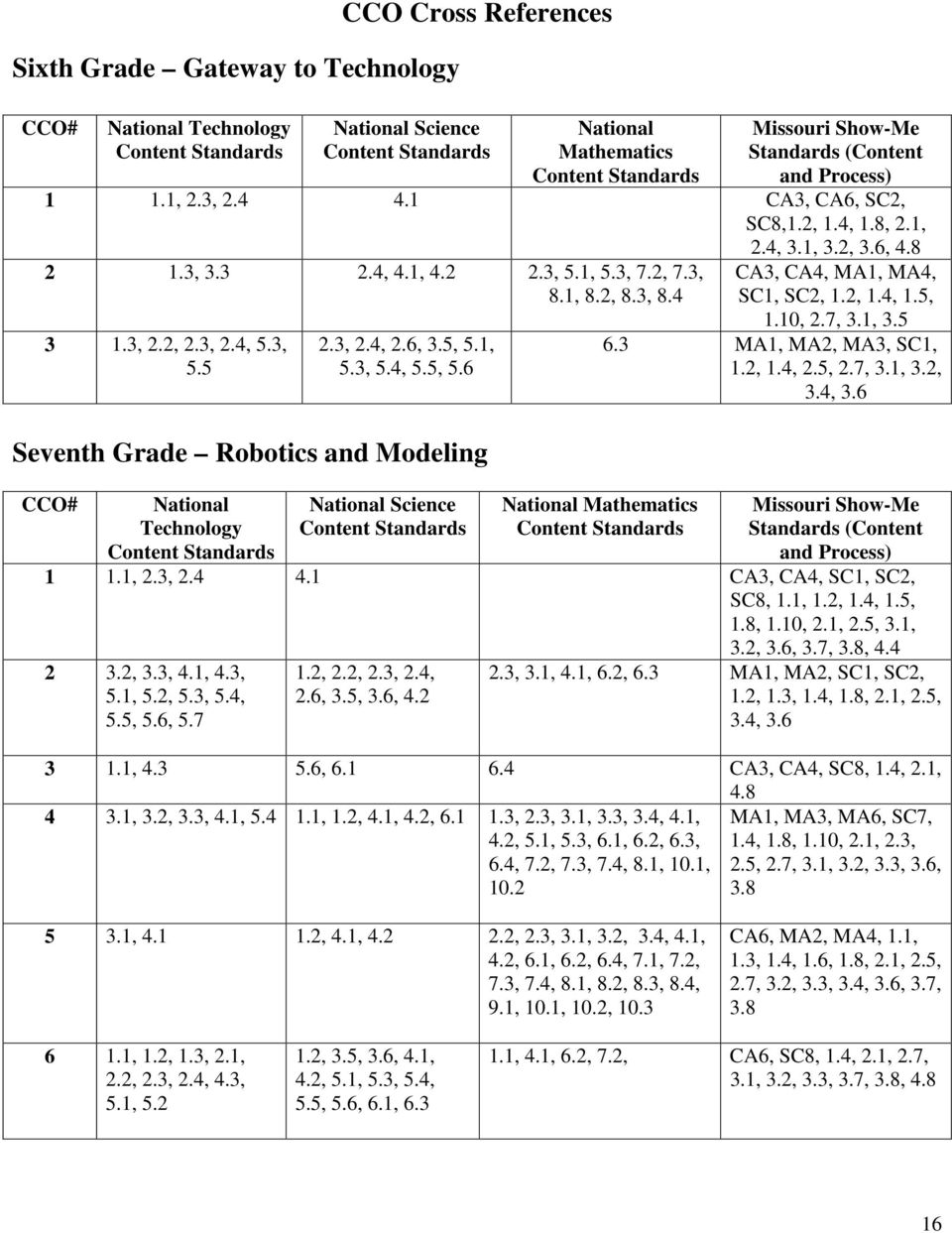
16 Sixth Grade Gateway to Technology CCO# National Technology Content Standards CCO Cross References National Science Content Standards National Mathematics Content Standards Missouri Show-Me Standards (Content and Process) 1 1.1, 2.3, CA3, CA6, SC2, SC8,1.2, 1.4, 1.8, 2.1, 2.4, 3.1, 3.2, 3.6, , , 4.1, , 5.1, 5.3, 7.2, 7.3, 8.1, 8.2, 8.3, , 2.2, 2.3, 2.4, 5.3, , 2.4, 2.6, 3.5, 5.1, 5.3, 5.4, 5.5, 5.6 Seventh Grade Robotics and Modeling CCO# National Technology Content Standards National Science Content Standards National Mathematics Content Standards CA3, CA4, MA1, MA4, SC1, SC2, 1.2, 1.4, 1.5, 1.10, 2.7, 3.1, MA1, MA2, MA3, SC1, 1.2, 1.4, 2.5, 2.7, 3.1, 3.2, 3.4, 3.6 Missouri Show-Me Standards (Content and Process) 1 1.1, 2.3, CA3, CA4, SC1, SC2, SC8, 1.1, 1.2, 1.4, 1.5, 1.8, 1.10, 2.1, 2.5, 3.1, 3.2, 3.6, 3.7, 3.8, , 3.3, 4.1, 4.3, 5.1, 5.2, 5.3, 5.4, 5.5, 5.6, , 2.2, 2.3, 2.4, 2.6, 3.5, 3.6, , 3.1, 4.1, 6.2, 6.3 MA1, MA2, SC1, SC2, 1.2, 1.3, 1.4, 1.8, 2.1, 2.5, 3.4, , , CA3, CA4, SC8, 1.4, 2.1, , 3.2, 3.3, 4.1, , 1.2, 4.1, 4.2, , 2.3, 3.1, 3.3, 3.4, 4.1, 4.2, 5.1, 5.3, 6.1, 6.2, 6.3, 6.4, 7.2, 7.3, 7.4, 8.1, 10.1, 10.2 MA1, MA3, MA6, SC7, 1.4, 1.8, 1.10, 2.1, 2.3, 2.5, 2.7, 3.1, 3.2, 3.3, 3.6, , , 4.1, , 2.3, 3.1, 3.2, 3.4, 4.1, 4.2, 6.1, 6.2, 6.4, 7.1, 7.2, 7.3, 7.4, 8.1, 8.2, 8.3, 8.4, 9.1, 10.1, 10.2, 10.3 CA6, MA2, MA4, 1.1, 1.3, 1.4, 1.6, 1.8, 2.1, 2.5, 2.7, 3.2, 3.3, 3.4, 3.6, 3.7, , 1.2, 1.3, 2.1, 2.2, 2.3, 2.4, 4.3, 5.1, , 3.5, 3.6, 4.1, 4.2, 5.1, 5.3, 5.4, 5.5, 5.6, 6.1, , 4.1, 6.2, 7.2, CA6, SC8, 1.4, 2.1, 2.7, 3.1, 3.2, 3.3, 3.7, 3.8,
17 Eighth Grade Multimedia and Electronics CCO# National Technology Content Standards 1 1.1, 1.2, 1.3, 2.1, 2.2, 2.3, 2.4, 4.3, 5.1, , 2.1, 2.2, 2.3, 2.4, 3.1, 4.2, 5.4 National Science Content Standards 1.2, 3.5, 3.6, 4.1, 4.2, 5.1, 5.3, 5.4, 5.5, 5.6, 6.1, 6.3 National Mathematics Content Standards 1.1, 1.3, 4.1, 5.1, 5.2, 5.3, 5.4, 6.2, 6.3, 6.4, 7.2, 10.3 Missouri Show-Me Standards (Content and Process) CA3, CA4, CA6, SC8, 1.1, 1.2, 1.4, 1.5, 1.8, 1.10, 2.1, 2.5, 3.1, 3.2, 3.6, 3.7, 3.8, , 3.4, 6.3 MA1, 1.4, 1.6, 1.8, 1.10, 2.1, 2.3, 2.5, 2.7, 3.1, 3.2, 3.3, 3.4, 3.7, , 2.2, 2.3, 4.3, , 3.1, 3.3, 3.4 MA1, 1.4, 1.6, 1.8, 1.10, 2.1, 2.3, 2.5, 2.7, 3.1, 3.2, 3.3, 3.4, 3.7, , 1.2, 1.3, 2.1, 2.2, 2.3, 2.4, 3.2, 3.3, 4.2, 5.3, , 2.3, 2.4, 3.1, 4.3, , 2.4, 2.6, 4.1, 4.2, 5.6, 6.1, 6.2, , 2.1, 2.2, 2.3, 3.1, 3.2, 3.4, 4.1, 4.2, 5.1, 5.3, 5.4 MA1, MA2, MA3, SC1, SC2, 1.2, 1.3, 1.4, 1.8, 2.1, 2.5, 3.4, , , 2.1, 3.1, 3.2, 3.4 MA1, MA2, 1.4, 1.6, 1.8, 1.10, 2.1, 2.3, 2.5, 2.7, 3.1, 3.2, 3.3, 3.4, 3.7, , 1.3, 4.1, , 2.3, , 2.1, 2.3, 5.1, 6.1, 10.3 CA3, MA1, SC1, 1.2, 1.3, 1.8, 2.5, 3.1, 3.2, 3.6, , , 2.5, , 2.3, 4.1, 5.1, 5.3, 7.2, 10.3 MA4, SC1, SC7, 1.2, 1.4, 1.5, 1.10, 2.7, 3.1, , 3.3, 4.2, 5.4, , 2.4, 2.6, 4.1, , 1.2, 1.3, 2.1, 2.2, 2.3, 5.1, 5.2, 6.1, 6.2, 6.3, 6.4 MA1, MA2, MA3, MA4, SC1, SC7, 1.1, 1.3, 1.4, 1.6, 1.8, 2.1, 2.5, 2.7, 3.2, 3.3, 3.4, 3.6, 3.7, , , , 8.3, 9.3 CA3, CA4, CA5, CA6, SC8, 1.4, 2.1, 2.7, 3.1, 3.2, 3.3, 3.7, 3.8, 4.8 Note: Copies of each Content Standards are included in the Appendices to this document. 17

18 Middle School Technology Education Sixth Grade Gateway to Technology You will learn how technology affects your world. Hands-on activities may include building simple machines, creating an energy display, constructing a device that shows energy conversion (such as an air racer and a Rube Goldberg machine), and creating a communication presentation. 18

19 Gateway to Technology CCO #1 (Core Conceptual Objective): Students are introduced to the science of technology, tracing how science has affected technology throughout history. Essential Content and Skills: 1. Students will learn the elements of team building: cooperative effort, positive attitude, alternative solutions techniques, willingness to help, and be willing to do what needs to be done for the good of the team. 2. Students will understand the relationship between science and technology. 3. Students will learn and investigate the impact of technology on society. 4. Students will recognize and utilize various technology resources. 5. Students will understand and use the problem-solving process. Facilitating Activities: Students may: 1. Utilizing the internet to research a product (3) (T). 2. List inventors (1). 3. Import graphics (3). 4. Develop a timeline (5). ALA (Application Level Assessment): Students will create presentation depicting the evolution of a chosen product. 19

20 SCORING GUIDE FOR PRESENTATION Outcome Distinguished Proficient Progressing Needs Improvement Category 4 Points 3 Points 2 Points 1 Point Thoroughly and Adequately states the States most of the States few main points Content clearly states the main main points and details main points and details and details that focus points and precise details that are accurately focused on the project. that are accurately focused on the design project. that focus on the design project. May include some unnecessary information. on the design project, or information does not relate to the topic. Organization Delivery Preparation Written Clearly organized into a logical sequence. Excellent use of an outline. Excellent introduction and conclusion. Effectively and creatively delivers the information while staying on the topic and considering the audience. Uses voice variation; Interesting and vivid to hear. Presentation shows detailed preparation and practice in delivery including use of voice, posture, eye contact, gestures, pacing and use of pictures, graphs, computer models, etc. Interesting and vivid. Adequate evidence of a logical sequence of information. Good use of an outline. Satisfactory introduction and conclusion. Adequately delivers the information while staying on the topic and considering the audience. Speaks clearly and confidently. Presentation shows satisfactory preparation as well as practice in delivery including use of voice, posture, eye contact, gestures and pacing. Some use of pictures, graphs, computer models, etc. Clearly and Adequately describes completely describes the design process, the design and the including most of the design process, necessary information including all the in a correct order. necessary information Good use of sections in the most appropriate and divisions. Good order. Excellent use of use of content sections and divisions. vocabulary. Excellent use of content vocabulary. Fair evidence of a logical sequence of information. Some use of an outline. Weak introduction and conclusion. Delivers the information but does not stay on the topic. Little consideration of the audience. Uses incomplete sentences. Presentation shows some preparation as well as some practice in the delivery including marginal use of voice, posture, eye contact, gestures, pacing and marginal use of pictures, graphs, computer models, etc. The design and design process is not clearly described, includes most necessary information but the order is not correct. Few sections and divisions. Fair use of vocabulary. Minimal or no outline followed. No logical organization; some digressions. Unclear, confusing. No introduction or conclusion. Little or no attempt is made to stay on the topic. Does not consider the audience. Difficult to understand. Presentation is lacking in preparation and in practice of the delivery including use of voice, posture, eye contact, gestures, packing and little or no use of pictures, graphs, computer models, etc. Difficult to hear. Appears tense. Fidgets often. The design and design process is not described, includes very few pieces of necessary information. Minimal or no sections and divisions. Weak or no use of content area vocabulary. 20

21 Gateway to Technology CCO #2(Core Conceptual Objective): Students will learn about the mechanics of motion. Essential Content and Skills: 1. Students will identify forces acting on simple machines. 2. Students will illustrate the types of motion used in mechanical systems. 3. Students will describe how simple machines perform work. 4. Students will recognize how simple machines are combined to form complex systems. Facilitating Activities: 1. Students will create a Rube Goldberg machine that incorporates as many different simple machines as possible. The individual Rube Goldberg machine will be combined with the other Rube Goldberg machines to create a class- sized machine. Each machine will have to receive energy from the machine before it, and pass the energy to the machine after it. See Rube Goldberg Problem Sheet in the Resource Guide for Section 3.1 for further explanation (4, 5) (T). 3. Students will develop a presentation to identify the types of simple machines used in their complex system and a checklist of concepts will be maintained (3). 4. Students may develop a Rube Goldberg machine that incorporates as many different mechanisms as possible and explain in a report the mechanics of each movement (2, 5). ALA (Application Level Assessment): Students will create a Rube Goldberg machine that incorporates as many different simple machines as possible while allowing the energy to travel a specific path from start to finish. 21
22 SCORING GUIDE FOR RUBE GOLDBERG Outcome Distinguished Proficient Progressing Needs Improvement Category 4 Points 3 Points 2 Points 1 Point # of Different Simple Machines Operating Time (Optional) 7-8 seconds 5-6 seconds 3-4 seconds Less than 3 seconds Creative Design Quality Design Good Design Fair Design Poor Design Workmanship Quality system Good System Fair System Poor System Receives Energy Always Successful Normally Successful Sometimes Successful Rarely Successful Passes Energy Always Successful Normally Successful Sometimes Successful Rarely Successful Class System Works First Time Works after several attempts Works after many attempts Never Works 22
23 Gateway to Technology CCO #3(Core Conceptual Objective): Students will learn how energy is converted from one form to another. Essential Content and Skills: 1. Students will be able to distinguish between renewable and nonrenewable energy sources and the impacts they have on the environment. 2. Students will be able to trace the development of energy sources. 3. Using available resources (i.e. Internet, CD-ROM s, schools, community and/or family members, local businesses), students, in groups of two, will search for information and report back to the class on occupations in the field of energy. Research and interviews may be conducted outside of class. Students will report their findings on job availability, educational requirements, and salaries to the class. Facilitating Activities: 1. In teams, the students will use available resources to research and create a display for a form of energy. The display will address the energy form chosen or assigned, its development, whether it is renewable or nonrenewable, and its impact on the environment (3, 4, 5) (R). 2. Using the Internet, students in groups of two will search teacher defined sites to locate information and report back to the class on occupations in the field of energy. Students will present their findings on educational requirements, job availability, and salaries to the class (1, 2, 3) (T, R, GE, RE, D). ALA (Application Level Assessment): Students will build a teacher chosen project to demonstrate the conversion of energy to work. 23
24 SCORING GUIDE FOR ENERGY CONVERSION PROJECT Outcome Distinguished Proficient Progressing Needs Improvement Category 4 Points 3 Points 2 Points 1 Point Design & Drawings Construction Teamwork (if applicable) Tool/Machine Use Drawings communicate the final design clearly, with proper views and dimension showing all details. Final product matches the original design exactly. Helps teammates without prompting; willing to do more than their share; takes an active role in all aspects of planning, construction, and problem solving. Always uses safe work habits; uses tools/machines safely and as instructed. Good quality drawings that lack some detail and leave some question as to the final design There is a slight difference between the final product and the final design. Requires some prompting from team member(s) to stay on task; contributes slightly less than what should be their share of the workload. Uses safe work habits most of the time; uses tools/machines safely and as instructed. Fair quality drawings lacking much detail and leaving many questions as to the final design. Significant difference between the final plan and the final product, but an attempt was made to follow the plan. Productive member of the team, but only willing to do their share and no more. Poor quality drawings showing little or no detail about the final design. No match between final product and final design, no attempt made to follow the plan. Not a productive member of the team; requires constant prompting to stay on task; only willing to do the minimum. Uses safe work Requires many habits most of the reminders to work time; uses safely, as well as tools/machines many reminders to safely most of the use tools/machines time; requires safely and some prompting as correctly. to safe and correct operation. 24
25 Middle School Technology Education Seventh Grade Robotics and Modeling To understand how automated, computer-controlled machines and robots work, we will study their basic components. Then we will connect those components together to make a simple computer controlled machine. You will learn basics of 3D-model creation and the design process. You will be designing 3D models using the computer and will assemble a final product.
26 Robotics and Modeling CCO #1 (Core Conceptual Objective): Students are introduced to automation and robotics, tracing the history and development, and then projecting how this technology will evolve in the future. Essential Content and Skills: 1. Students will define the term robotics. 2. Students will list three significant events in the history of robotics. 3. Students will propose the impact of robotics in future settings. Facilitating Activities: 1. The student will know the difference between an open loop and closed loop control system. (1). 2. The student will illustrate the difference between an open loop and closed loop control system (3). 3. Students will view a video on the future of robotics entitled and think of a way that robots could be used in the future (5). 4. Students will read about Robotics and complete a review sheet. ALA (Application Level Assessment): Write and demonstrate a robot code. (Or design a robot for a specific goal) 26
27 SCORING GUIDE FOR ROBOT Outcome Distinguished Proficient Progressing Needs Improvement Category 4 Points 3 Points 2 Points 1 Point Content Thoroughly and clearly states robot code accurately. Adequately states the robot code. Some steps of the code are missing. Has only a few steps of the code. Organization Clearly organized into a logical sequence. Excellent use of an outline. Excellent introduction and conclusion. Adequate evidence of a logical sequence of information. Good use of an outline. Satisfactory introduction and conclusion. Fair evidence of a logical sequence of information. Some use of an outline. Weak introduction and conclusion. Minimal or no outline followed. No logical organization; some digressions. Unclear, confusing. No introduction or conclusion. Working Program Effectively and creatively produces the desired result with no bugs. Adequately produces the desired result with some bugs. Produces a result with many bugs. Does not produce the desired result. Questions Answers all questions in full. Answers most questions in full. Answers some questions in full. Answers some questions, though not in full. Student cannot answer questions. 27
28 Robotics and Modeling CCO #2 (Core Conceptual Objective): Students will learn about structures, energy transfer, and machine automation made possible by the introduction of control systems driven by computer programs. Essential Content and Skills: 1. Students will identify the components of a structural modeling system. 2. Students will demonstrate the effect of forces on structures by building structures that are stable. Facilitating Activities: 1. Through discussion, students will compare the human skeletal system to human-made structures (6). 2. Using a modeling system, students will do rigidity investigations (Focus Book page 12-14) (3). 3. Students will do stability investigation from Focus Book pages 17 and 18. Students will identify rigidity and stability. Using their knowledge of rigidity and stability, student teams will construct a tower of greatest possible height with a standardized packaged set of modeling pieces prepared by instructor (1, 3). 4. Using a modeling system such as Fischertechnik, students in teams will construct systems to demonstrate the following methods of energy manipulation and transfer: See the Resource Guide for handouts (2, 3, 5) (T). Worm and wheel Crown and pinion Universal joint Bevel gears Rack and pinion Lead screw Crank and slider Cam and follower Pulleys and belt Simple gear train with idler gear 5. Student teams will construct a gear or pulley system that multiplies torque [decreases speed] and demonstrate this system to the class (3, 5). 28
29 6. From a list, the student will select and research a machine, then present research results to the class. The report will contain the following information (6): a picture or model of the machine s appearance a detailed description of what the machine does examples of the machine s output 7. The research results can be presented using a variety of mediums including student produced videotape, poster, Power Point and oral presentations with visuals. Suggested activity titled Machine Assignment located in the Resource Guide (4) (R). ALA (Application Level Assessment): Students will complete five computer controlled design briefs. 29
30 SCORING GUIDE FOR COMPUTER CONTROLLED DESIGN BRIEF Outcome Distinguished Proficient Progressing Needs Improvement Category 4 Points 3 Points 2 Points 1 Point Model Working model with full detailed description Working model with some description Model needs developing with a description A picture (sketch) and description, but no model Sketches Neatly drawn, showing details of all mechanisms, matches the model Sketches need improvement, shows use of mechanisms, matches model Sketches need improvement, shows use of mechanisms, but doesn t match model Sketches don t show use of mechanisms; sketches not representative of problem; no sketches Problem Solving Document Typed or neatly written, includes all 6 steps Typed or neatly written, includes at least 4 steps Typed or neatly written, includes at least 3 steps Includes less than 3 steps, hard to read, not completed Demonstrating Understanding Student answers all questions in full Student answers most questions in full Student answers some questions in full Student answers some questions, though not in full; students cannot answer questions 30
31 Robotics and Modeling CCO #3 (Core Conceptual Objective): The students will identify the educational pathways necessary to be prepared for careers in the engineering fields. Essential Content and Skills: 1. Students will explore five careers and compare job outlook 2. Students will prepare a description and investigate the educational preparation required for each career. Facilitating Activities: 1. Class discussion: Students will complete discussion summary sheet found in the Resource Guide on the social implications of automation and robotics in terms of (2, 6) (R, GE, RE, DE): Efficiency Worker Displacement Retraining Relocation Job Orientation 2. Research activity: Students will research job descriptions and salary expectations for three jobs within the technology career cluster based on the following educational attainment. See Resource Guide for specific handout (4) (R, T). High school diploma High school plus two years post secondary High school plus four-five years post secondary ALA (Application Level Assessment): Students will graph job availability in the technology career clusters using the local newspaper and help wanted advertisements. 31
32 SCORING GUIDE FOR JOB AVAILABILITY GRAPH Outcome Distinguished Proficient Progressing Needs Improvement Category 4 Points 3 Points 2 Points 1 Point Content Thoroughly and clearly Adequately states the States two of the States one main point states the three main points and precise details that are accurately focused on the job cluster. three main points and details that are accurately focused on the job cluster. main points and details that focus on the job cluster. May include some unnecessary information. and details that focus on the job cluster, or information does not relate to topic. Organization Clearly organized into a logical sequence. Adequate evidence of a logical sequence of information. Fair evidence of a logical sequence of information. No logical organization. Graphing It is evident that the student has placed a great deal of effort into completing the graphs and they are organized and easy to read. The student has Minimal effort put placed a great deal of forth in graph. effort into completing the graphs with few minor errors. Difficult to visualize graph. Research Students have attached all notes and newspaper articles. Students have attached most of their newspaper articles and their notes. Students have attached only a few notes and not many newspaper articles. Students have not turned in any notes or newspaper articles. 32
33 Robotics and Modeling CCO #4 (Core Conceptual Objective): Students will learn the basic design process using a solid modeling software package. Essential Content and Skills: 1. Students will be able to produce a quality sketch to graphically communicate their ideas. 2. Students will be able to select the most appropriate sketch to communicate their ideas. 3. Students will be able to understand and accurately interpret sketches. 4. Students will be able to identify basic geometric relationships in shapes and solids. 5. Students will be able to utilize descriptive geometry to generate solutions to technological problems. 6. Students will be able to use coordinate systems to express geometric relationships. 7. Students will be able to explain the purpose of measurement. 8. Students will be able to perform simple inquiries and analysis on computer generated models. 9. Students will be able to use simple measuring tools to accurately measure a model. Facilitating Activities: 1. Students will produce a portfolio of sketches. The portfolio should include six thumbnail sketches of possible solutions. Students will select three and produce proportional sketches of each and then will create one detailed, annotated sketch to be used in the creation of a 3D model in Section 1.7 (3, 5). 2. Design teams will calculate the (x,y) coordinates for geometric shapes provided by the instructor. Students will then create the geometry using a CAD system (3, 5). 3. Working in design teams, students will identify basic geometric shapes and relationships (2). 4. Students will use descriptive geometry to design an object. Students will share the design with their design groups, receive feedback, and modify the geometry (3, 5). 5. In design teams, students will describe different objects to teammates without making any reference to measurement. Groups will give a report on the difficulties of describing an object without measurement (2). ALA (Application Level Assessment): 33
34 Students will measure an object (teacher or student provided) and using the design process to create an accurate computer model from their measurements. 34
35 SCORING GUIDE FOR MACHINE ASSIGNMENT Outcome Distinguished Proficient Progressing Needs Improvement Category 4 Points 3 Points 2 Points 1 Point Picture/Model/Description A working model used with full detailed description A picture used with full detailed description. A picture used with little or no description. A simple description is used, but no picture. Process Explained Full detailed and accurate explanation of process with examples Full detailed and accurate explanation of process with no examples. Accurate explanation lacks detail. Inaccurate explanation. Sample Uses Student thoroughly describes two or more places where this operation is used. Student thoroughly describes 1 place where this operation is used. Student explains examples but not thoroughly. Students mentions examples, but does not explain. Students Understand Answers all questions in full. Answers most questions in full. Answers some questions in full. Answers some questions, though not in full. Student cannot answer questions. 35
36 Robotics and Modeling CCO #5 (Core Conceptual Objective): Students will create models and documentation that represent solutions to problems. Essential Content and Skills: 1. Students will be able to apply the design brief to develop an appropriate solution to a technological problem. 2. Students will be able to apply the design elements when creating solutions to technological problems. 3. Students will be able to evaluate different methods of producing, editing, and storing geometry necessary for models. 4. Students will demonstrate the ability to create and manipulate geometry to produce a 3D model. 5. Students will demonstrate the ability to produce various documentation drawings from a 3D model. 6. Students will be able to produce the annotations to document various drawings made from a 3D model. 7. Students will be able to interpret the relationship of orthographic and auxiliary views to their parent 3D model. 8. Students will examine various materials and methods for the production of models. 9. Students will be able to construct a model that communicates a solution to a technological problem. Facilitating Activities: 1. Working in design teams of four, students will select a community problem of their choice and apply the design brief. Teams will present a proposed solution to the class. See the Resource Guide -Design Brief (1, 3) (R). 2. Student will use a design brief in planning for the history activity from Section 1.1 (3, 5) 3. Students will create and maintain all files necessary for storage of model information and data (5). 4. Students will create a 3D cube with labeled sides from a step by step instruction sheet provided by the instructor. See Sketch Plane Cube in the Resource Guide (5). 5. Students will produce a 3D model from a step by step instruction sheet provided by the instructor. See Creating a Working Drawing in the Resource Guide (3). 36
37 6. Students will create a set of working drawings, with annotation, from a 3D model from instructions given by the instructor. Basic 3D Modeling and Creating a Working Drawing located in the Resource Guide (5). 7. Design teams will be given a set of working drawings (Orthographic). From these views teams will create a 3D computer model. See Computer Modeling handout available in the Resource Guide (5). 8. Students in design teams will determine the materials to be used and assembly methods needed in order to produce a model. (3, 6). 9. Students will produce a model of what they believe future improvements will be to a device invented in the past 100 years. Product Research handout available in the Resource Guide (3) (R, T). 10. Students will share the model with their design team and make corrections accordingly (1). ALA (Application Level Assessment): Students will create a 3D model and working drawings for an. Students will assemble a model from their development drawing. 37
38 SCORING GUIDE FOR MACHINE ASSIGNMENT Outcome Distinguished Proficient Progressing Needs Improvement Category 4 Points 3 Points 2 Points 1 Point 3D Working Drawing A 3D working drawing used with full detailed description. A drawing used with full detailed description. A drawing used with little or no description. A simple description is used, but no drawing. Process Explained Full detailed and accurate explanation of process with examples. Full detailed and accurate explanation of process with no examples. Accurate explanation lacks detail. Inaccurate explanation. Sample Uses Student thoroughly describes two or more places where this operation is used. Student thoroughly describes 1 place where this operation is used. Student explains examples but not thoroughly. Student mentions examples, but does not explain. 3D Model Accurately computer drawn and assembled. Computer drawn and assembled with some accuracy. Computer drawn and assembled with little accuracy. Computer drawn and not assembled. Students Understand Answers all questions in full. Answers most questions in full. Answers some questions in full. Answers some questions, though not in full. Student cannot answer questions. 38
39 Robotics and Modeling CCO #6 (Core Conceptual Objective): Students will understand how modeling software has influenced society and daily life. Essential Content and Skills: 1. Students will understand the impacts of technology on society and the environment. 2. Students will understand the evolution of technology. 3. Students will explore careers in technology. 4. Students will work in groups to develop an understanding of resources. Facilitating Activities: 1. Students will form design teams of four. Teams will select and research a product currently produced and evaluate the effects on the environment, society and their personal life. Teams will give a two-minute presentation to the class (1, 4, 6) (R, T, GE, RE, DE). 2. Students working with a partner will select a career in a technological area and prepare a display to meet the criteria set forth in the above problem (3). 3. Students will work in design teams to prepare a poster that demonstrates their material selection process based on the specifications and criteria stated in the above futuristic modeling problem (3). ALA (Application Level Assessment): Students will propose a futuristic model of a device developed within the last 100 years. 39
40 SCORING GUIDE FOR PRESENTATION Outcome Distinguished Proficient Progressing Needs Improvement Category 4 Points 3 Points 2 Points 1 Point Thoroughly and Adequately states the States most of the States few main Content clearly states the main points and main points and details that are main points and details that focus on points and details that focus on the design precise details that accurately focused on the design project. project, or are accurately focused on the project. the design project. May include some unnecessary information. information does not relate to the topic. Organization Delivery Preparation Design Process Clearly organized into a logical sequence. Excellent use of an outline. Excellent introduction and conclusion. Effectively and creatively delivers the information while staying on the topic and considering the audience. Uses voice variation; Interesting and vivid to hear. Presentation shows detailed preparation and practice in delivery including use of voice, posture, eye contact, gestures, pacing and use of pictures, graphs, computer models, etc. Interesting and vivid. Clearly and completely describes the design and the design process, including all the necessary information in the most appropriate order. Excellent use of sections and divisions. Excellent use of content vocabulary. Adequate evidence of a logical sequence of information. Good use of an outline. Satisfactory introduction and conclusion. Adequately delivers the information while staying on the topic and considering the audience. Speaks clearly and confidently. Presentation shows satisfactory preparation as well as practice in delivery including use of voice, posture, eye contact, gestures and pacing. Some use of pictures, graphs, computer models, etc. Adequately describes the design process, including most of the necessary information in a correct order. Good use of sections and divisions. Good use of content vocabulary. Fair evidence of a logical sequence of information. Some use of an outline. Weak introduction and conclusion. Delivers the information but does not stay on the topic. Little consideration of the audience. Uses incomplete sentences. Presentation shows some preparation as well as some practice in the delivery including marginal use of voice, posture, eye contact, gestures, pacing and marginal use of pictures, graphs, computer models, etc. The design and design process is not clearly described, includes most necessary information but the order is not correct. Few sections and divisions. Fair use of vocabulary. Minimal or no outline followed. No logical organization; some digressions. Unclear, confusing. No introduction or conclusion. Little or no attempt is made to stay on the topic. Does not consider the audience. Difficult to understand. Presentation is lacking in preparation and in practice of the delivery including use of voice, posture, eye contact, gestures, packing and little or no use of pictures, graphs, computer models, etc. Difficult to hear. Appears tense. Fidgets often. The design and design process is not described, includes very few pieces of necessary information. Minimal or no sections and divisions. Weak or no use of content area vocabulary. 40
41 Middle School Technology Education Eighth Grade Multimedia and Electronics Students will explore the basics of multimedia technology, including flight simulation, computer animation, digital editing and web design. Through hands-on activities students explore how technology uses electricity. Activities may include constructing a DC Motor, designing and building a Mag Lev vehicle, wiring various circuits. 41
42 Multimedia and Electronics CCO #1 (Core Conceptual Objective): Students will understand the impacts of technology on society and the environment. Essential Content and Skills: 1. Students will learn the elements of team building: cooperative effort, positive attitude, alternative solutions techniques, willingness to help, and be willing to do what needs to be done for the good of the team. 2. Students will understand the relationship between science and technology. 3. Students will learn and investigate the impact of technology on society. 4. Students will recognize and utilize various technology resources. 5. Students will understand and use the problem-solving process. Facilitating Activities: 1. Find and list new uses for an existing product (1). 2. Redesign an existing product (3). 3. Combine two or more products to create a new product (4, 5). 4. Invent a new product that fills a societal need (5) (R). ALA (Application Level Assessment): Working in teams, students will create a design brief. 42
43 SCORING GUIDE FOR DESIGN BRIEF Outcome Distinguished Proficient Progressing Needs Improvement Category 4 Points 3 Points 2 Points 1 Point Content Organization Problem Solving Steps Thoroughly and clearly states the main points and precise details that are accurately focused on the project. Clearly organized into a logical sequence. Excellent use of an outline. Excellent introduction and conclusion. Typed or neatly written and includes all 6 steps Written Information Clearly and completely describes the design and the design process, including all the necessary information in the most appropriate order. Excellent use of sections and divisions. Excellent use of content vocabulary, spelling and grammar. Adequately states the main points and details that are accurately focused on the design project. Adequate evidence of a logical sequence of information. Good use of an outline. Satisfactory introduction and conclusion. Typed or neatly written and includes at least 4 steps. Adequately describes the design process, including most of the necessary information in a correct order. Good use of sections and divisions. Good use of content vocabulary, spelling, and grammar. States most of the main points and details that focus on the design project. May include some unnecessary information. Fair evidence of a logical sequence of information. Some use of an outline. Weak introduction and conclusion. Typed or neatly written and includes at least 3 steps. The design and design process is not clearly described, includes most necessary information but the order is not correct. Few sections and divisions. Fair use of vocabulary, spelling, and grammar. States few main points and details that focus on the design project, or information does not relate to the topic. Minimal or no outline followed. No logical organization; some digressions. Unclear, confusing. No introduction or conclusion. Hard to read and includes less than 3 steps; or not completed. The design and design process is not described, includes very few pieces of necessary information. Minimal or no sections and divisions. Weak or no use of content area vocabulary, spelling, and grammar. 43
44 Multimedia and Electronics CCO #2 (Core Conceptual Objective): Students will explore and incorporate the basic aspects of web design. Essential Content and Skills: 1. Students will understand basic use of web design software. 2. Students will understand basic principles of effective web design. 3. Students will research and lean about the safety and ethics of web publishing on the internet. Facilitating Activities. 1. Students know the basic components of a web site (1) (T). 2. Students create an electronic portfolio (5) (T). 3. Students construct a web site based on famous technological advances (3) (R, T). 4. Students create a web site based on careers and technology (5) (R, T). ALA (Application Level Assessment): Students will design and develop a web page. 44
45 SCORING GUIDE FOR WEB PAGE DESIGN Outcome Distinguished Proficient Progressing Needs Improvement Category 4 Points 3 Points 2 Points 1 Point Layout / Design Graphics Information The pages are well The pages are eyecatching and organized with tables. Text spacing attractive. Text is and alignment make easy to read. The reading easy. The backgrounds are backgrounds subtle and enhance the page. appropriate Photos, icons, and clip art are used creatively and may follow a theme, and download time is minimal. Information is creatively written and cleverly presented. Navigation / Links Links are created with images and icons to enhance the text links. Working Together Partners show respect for one another, get along especially well and work together on all aspects of the project. Photos, icons, and clip art are appropriate, of high quality, and download fairly quickly. Information is well written and interesting to read and is presented in short sections. Links are consistent and easy to find so that the user can easily navigate back and forth through pages. Partners get along well and share equally in responsibilities. The pages appear "busy" or "boring". Text may be difficult to read. The backgrounds are somewhat distracting Photos are blurry or fuzzy; icons and clip art do not "fit" with the topic. Too many pictures make the download time slow. The pages are unattractive. Text is difficult to read. The backgrounds are distracting There are no photos, icons or clip art or they are inappropriate or of low quality. Information could Information is poorly be better written written, inaccurate, and too much or incomplete. information is given in each section. The user may become confused when navigating between pages. Some links may not work. Partners have trouble solving disagreements; one partner does most of work. The user may become lost or links may be missing or not working. Partners argue or fight much of the time and do not share responsibilities. 45
46 Multimedia and Electronics CCO #3 (Core Conceptual Objective): Students will understand and apply the elements of digital editing. Essential Content and Skills: 1. Students will utilize a variety of types of digital equipment. 2. Students will understand the basic principles of digital editing from retrieving through editing and rendering. 3. Students will research and learn about responsibility and ethics of digital imagery. Facilitating Activities: Students may: 1. Identify the basic parts of a digital camera or camcorder (2) (T). 2. Use a digital camera to produce optical illusions (3) (T). 3. Create a one-three minute commercial, advertisement, public service announcement (5). 4. Create a print advertisement, brochure, flyer, etc (5). ALA (Application Level Assessment): Create a multimedia presentation utilizing editing techniques. 46
47 SCORING GUIDE FOR MULTIMEDIA PRESENTATION Outcome Distinguished Proficient Progressing Needs Improvement Category 4 Points 3 Points 2 Points 1 Point Content Thoroughly and clearly states the main points and precise details that are accurately focused on the project. Adequately states the main points and details that are accurately focused on the design project. States most of the main points and details that focus on the design project. May include some unnecessary information. States few main points and details that focus on the design project, or information does not relate to the topic. Organization Delivery Preparation Clearly organized into a logical sequence. Excellent use of an outline. Excellent introduction and conclusion. Effectively and creatively delivers the information while staying on the topic and considering the audience. Uses voice variation; Interesting and vivid to hear. Presentation shows detailed preparation and practice in delivery including use of voice, posture, eye contact, gestures, pacing and use of pictures, graphs, computer models, etc. Interesting and vivid. Written Information Clearly and completely describes the design and the design process, including all the necessary information in the most appropriate order. Excellent use of sections and divisions. Excellent use of content vocabulary. Adequate evidence of a logical sequence of information. Good use of an outline. Satisfactory introduction and conclusion. Fair evidence of a logical sequence of information. Some use of an outline. Weak introduction and conclusion. Adequately delivers Delivers the the information while information but does staying on the topic not stay on the topic. and considering the Little consideration of audience. Speaks the audience. Uses clearly and confidently. incomplete sentences. Presentation shows satisfactory preparation as well as practice in delivery including use of voice, posture, eye contact, gestures and pacing. Some use of pictures, graphs, computer models, etc. Adequately describes the design process, including most of the necessary information in a correct order. Good use of sections and divisions. Good use of content vocabulary. Presentation shows some preparation as well as some practice in the delivery including marginal use of voice, posture, eye contact, gestures, pacing and marginal use of pictures, graphs, computer models, etc. The design and design process is not clearly described, includes most necessary information but the order is not correct. Few sections and divisions. Fair use of vocabulary. Minimal or no outline followed. No logical organization; some digressions. Unclear, confusing. No introduction or conclusion. Little or no attempt is made to stay on the topic. Does not consider the audience. Difficult to understand. Presentation is lacking in preparation and in practice of the delivery including use of voice, posture, eye contact, gestures, packing and little or no use of pictures, graphs, computer models, etc. Difficult to hear. Appears tense. Fidgets often. The design and design process is not described, includes very few pieces of necessary information. Minimal or no sections and divisions. Weak or no use of content area vocabulary. 47
48 Multimedia and Electronics CCO #4 (Core Conceptual Objective): Students will understand and apply the elements of flight simulation. Essential Content and Skills: 1. Students will understand the basics of aerodynamics. 2. Students will understand the forces that affect flight. 3. Students will demonstrate the principles of flight. Facilitating Activities. Students may: 1. Identify the forces that affect flight (2). 2. Identify the parts of an airplane (2). 3. Simulate flight maneuvers using flight simulation software (3) (T). 4. Construct a vehicle (5). 5. Operate a constructed vehicle to demonstrate the principles of flight (3). ALA (Application Level Assessment): Students will demonstrate and execute flight maneuvers. 48
49 SCORING GUIDE FOR FLIGHT Outcome Distinguished Proficient Progressing Needs Improvement Category 4 Points 3 Points 2 Points 1 Point Forces of Flight Can explain in detail all the dynamics of flight, forces of flight, controlling flight, and how the pilot controls the plane. Airplane Parts Can identify and describe in detail the function of all the parts of the airplane. Computer Controls Can identify and describe all the computer controls necessary to operate the flight simulator. Maneuvers Using the flight simulator software students can demonstrate taxiing, takeoff, straight and level flight, turns, stalls, and landing, as well as, 3 aerobatic maneuvers (spins, aileron rolls, loops, Immelmann, splits, hammerhead) Can explain in some detail the dynamics of flight, forces of flight, controlling flight, and how the pilot controls the plane. Can identify and describe in some detail the function of all the parts of the airplane. Can identify and describe some of the computer controls necessary to operate the flight simulator Using the flight simulator software students can demonstrate taxiing, takeoff, straight and level flight, turns, stalls, and landing, as well as, 1 aerobatic maneuvers (spins, aileron rolls, loops, Immelmann, splits, hammerhead) Can explain basic details of some of the dynamics of flight, forces of flight, controlling flight, and how the pilot controls the plane. Can identify and describe basic details of some of the parts of the airplane. Can identify and describe only a few of the computer controls necessary to operated the flight simulator. Using the flight simulator software students can demonstrate taxiing, takeoff, straight and level flight, turns, stalls, and landing. Cannot explain basic details of dynamics of flight, forces of flight, controlling flight, and how the pilot controls the plane. Cannot identify basic parts of the airplane. Cannot identify or describe the basic controls necessary to operate the flight simulator. Using the flight simulator software students cannot demonstrate the basic flight maneuvers. 49
50 Multimedia and Electronics CCO #5 (Core Conceptual Objective): Students will understand and apply the elements of computer animation. Essential Content and Skills: 1. Students will understand how animations and special effects are produced. 2. Students will research and learn about the responsibility and ethics of computer animation. 3. Students will understand the use of computer animation software. 4. Students will understand the design elements of storyboarding. Facilitating Activities. Students may: 1. Create a flipbook (5). 2. Create a thaumatrope (5). 3. Create a storyboard (5). 4. Create computer generated graphics (5) (T). 5. Record/import sounds for the animation (3, 5) (T). 6. Create a stop-motion animation (5) (T). 7. Describe the history of animation (2). ALA (Application Level Assessment): Compose a simple computer generated animation based on a storyboard. 50
51 SCORING GUIDE FOR ANIMATION STORYBOARD Outcome Distinguished Proficient Progressing Needs Improvement Category 4 Points 3 Points 2 Points 1 Point Story/Script Storyboarding and Planning Character and Background Development Final Animation Project has gone above and beyond. All information is clear, appropriate and correct. Story has a beginning, middle and end. Fully developed storyboard that includes dialogue and set changes. Is organized in coherent pieces. Fully developed characters correct size for the set, intricate detailing and appropriate to the story. Animation is very smooth. Story is followed and is very clear. Voices, music and sound effects are a part of the film and are relevant to the story. Storyline is evident in much of the product. Information is clear, appropriate, and correct. Strong storyboard that indicates the dialogue and set changes. The characters aligned with the storyline, matched the scale set and are detailed and appropriate to the story. Animation follows the story. Characters move smoothly. Music and sound effects are a part of the film. Title and credits are added to the film. An attempt at creating a storyline is evident. Some information is confusing. Basic storyboard. Does not indicate the dialogue or set changes. Characters are random not scaled to the size of the set. Sparse set can be viewed from only one side. Story is evident. Animation is choppy movement is not smooth. No sounds or music. Storyline not evident. Is confusing and has no direction. Did not utilize storyboard during process or storyboard is incomplete. No lead characters are defined. Confusing. Did not fit into the storyline. One background that did not meet the needs of the storyline. Not coherent story is not evident. Animation is extremely choppy. 51
52 Multimedia and Electronics CCO #6 (Core Conceptual Objective): Students are introduced to electricity and electronics. Essential Content and Skills: 1. Students will demonstrate the movement of electrons in atomic structure diagrams. 2. Students will identify examples of static electricity and current electricity. 3. Students will classify materials by electrical conductivity. Facilitating Activities: 1. Students will view the video on electricity. 2. Student will observe static electricity and current flowing through a wire. Resource Guide-Static Electricity (1). 3. Students will complete Atomic Structure worksheet available in the Resource Guide (3). 4. Students will complete Valence Electron worksheet. Resource Guide-Electrical Conductivity (3). 5. Students will complete Electrical Conductivity Lab activity by testing common materials. Resource Guide-Electrical Conductors Lab (3, 6) ALA (Application Level Assessment): Test a variety of materials for electrical conductivity using a digital multimeter. 52
53 SCORING GUIDE FOR ELECTRICAL CONDUCTORS LAB Outcome Distinguished Proficient Progressing Needs Improvement Category 4 Points 3 Points 2 Points 1 Point Digital multimeter use Student can accurately test a given material and explain what the output means. Student can test a given material and explain what the output means. Student can test a given material but has difficulty explaining what the output means. Student does not understand how to use a multimeter. Written Records Student completely and accurately records results. Student records results with minor errors. Student records results with many errors. Recorded results are incomplete. Conclusion Based on written records, conclusions are all accurate Based on written records, conclusions are mostly accurate. Based on written records, conclusions are somewhat accurate. Based on written records, conclusions mostly inaccurate and/or missing. 53
54 Multimedia and Electronics CCO #7 (Core Conceptual Objective): Students will learn how electrons produce electromotive force. Essential Content and Skills: 1. Students will correctly define electromotive force. 2. Students will demonstrate a working knowledge of DC motor operation by explaining how electricity flows through each motor part. 3. Students will demonstrate the ability to follow directions in the assembly of a simple motor. Facilitating Activities: 1. Students will define electromotive force (1). 2. Students will complete a worksheet on electron flow and electromotive force. Resource Guide-Electromotive Flow (3) ALA (Application Level Assessment): Assemble a DC motor kit and test motor speed and make modifications to achieve optimal performance. 54
55 SCORING GUIDE FOR DC MOTOR ASSEMBLY Outcome Distinguished Proficient Progressing Needs Improvement Category 4 Points 3 Points 2 Points 1 Point All parts for the Most parts for the Some parts for the DC Motor are DC Motor are DC Motor are identified and identified and identified and collected according collected according collected according to circuit to circuit to circuit schematic. All schematic. Most schematic. Some wires are ready for wires prepared for components are assembly. assembly. Most ready for Components are components assembly. Some ready for adequate for wires prepared for assembly. assembly. assembly. Collect & Identify Components Unable to identify or collect parts for the DC Motor according to circuit schematic. Unable to prepare wires for assembly. Assembly All components properly inserted. All wires inserted Most components properly inserted. Most wires inserted correctly. Some components properly inserted. Some wires inserted correctly. Components not properly inserted. Wires missing or in wrong place. Operation Other Applications Circuit operates correctly. Able to make change in operation smoothly. Has technique to quickly troubleshoot problems. Develop an idea for a modification to achieve maximum performance (i.e., motor speed), and can implement. Circuit operates adequately. Sometimes requires jiggling connections. Has adequate plan to troubleshoot. Develop an idea for a modification to increase performance (i.e., motor speed), but not optimize, and can implement. Circuit operates intermittently. Consistently needs adjustments. Troubleshoots with no plan. Develop an idea for a modification to increase performance (i.e., motor speed), but cannot implement. No parts correctly assembled. Reassembly is necessary. Many marginal errors. No idea how to troubleshoot problems. Develops no idea for a modification to achieve maximum performance (i.e., motor speed). 55
56 Multimedia and Electronics CCO #8 (Core Conceptual Objective): Students will design simple circuits to simulate real world conditions. Essential Content and Skills: 1. Students will design and assemble series, parallel and combination series/parallel circuits. 2. Students will utilize schematic symbols to diagram electric and electronic circuits. 3. Students will test the relationship between voltage, current, and resistance as stated in Ohm s Law. 4. Students will list common electric and electronic load devices, their schematic symbols and describe the function of each device. 5. Students will describe the use of a transistor as a switch and as an amplifier. 6. Students will demonstrate correct use of a digital multimeter. 7. Students will color code translation and resistor resistance metering. 8. Students will compare and contrast the operating characteristics of three sensing circuits. 9. Students will identify real world applications of systems. 10. Students will demonstrate the safe use of tools in the construction of an electronic circuit. Facilitating Activities: 1. Students will design, assemble, and test; series, parallel and combination series/parallel circuits. Resource Guide-Circuit Construction Lab (5, 6) 2. Students will identify schematic symbols. Resource Guide-Schematic Symbols (2). 3. Students will complete Transistor Web Worksheet. Resource Guide-Transistor Web Worksheet (3). 4. Students will observe a doping demonstration as it applies to the manufacture of carbon resistors. Resource Guide-Doping Demonstration (1) 5. Students will identify by color code and measure with a meter the resistance of five resistors. Resource Guide-Resistor Lab (2). 6. Students will assemble and test a series and parallel circuit. Using a multimeter they will take measurements and test validity of Ohm s Law calculation (3, 5, 6). 7. Students will assemble and test on a breadboard a circuit utilizing an LM386 amplifier, microphone and speaker (5, 6). 8. Students will assemble on a breadboard a circuit utilizing a 741 operational amplifier. After assembly, the circuit will be tested with different inputs (5, 6). 56
57 9. Students will assemble on a breadboard a circuit utilizing a 555 Timer. After assembly, the circuit will be tested for pulse operation and timed delay operation with a variety of inputs and outputs (5, 6). 10. Preview with students Transistor Web Worksheet (1). 11. Students will design, assemble and test 10 logic circuits with a digital logical training system (5, 6) 12. Students will be evaluated using circuit construction rubric (3). ALA (Application Level Assessment): Students will assemble an integrated circuit system of their choice. 57
58 SCORING GUIDE FOR INTEGRATED CIRCUIT Outcome Distinguished Proficient Progressing Needs Improvement Category 4 Points 3 Points 2 Points 1 Point All parts for the Most parts for the Some parts for the integrated circuit integrated circuit integrated circuit are identified and are identified and are identified and collected according collected according collected according to circuit to circuit to circuit schematic. All schematic. Most schematic. Some wires are ready for wires prepared for components are assembly. assembly. Most ready for Components are components assembly. Some ready for adequate for wires prepared for assembly. assembly. assembly. Collect & Identify Components Unable to identify or collect parts for the integrated circuit according to circuit schematic. Unable to prepare wires for assembly. Assembly Operation Other Applications All components properly inserted. All wires inserted. Circuit operates correctly. Able to make change in operation smoothly. Has technique to quickly troubleshoot problems. Develop an idea for a new application of the circuit and can implement. Most components properly inserted. Most wires inserted correctly. Circuit operates adequately. Sometimes requires jiggling connections. Has adequate plan to troubleshoot. Develop an idea for a simple variation of basic circuit and can implement. Some components properly inserted. Some wires inserted correctly. Circuit operates intermittently. Consistently needs adjustments. Troubleshoots with no plan. Develop an idea for basic circuit application but cannot implement. Components not properly inserted. Wires missing or in wrong place. No parts correctly assembled. Reassembly is necessary. Many marginal errors. No idea how to troubleshoot problems. Cannot develop any new application or variation of circuit. 58
59 Multimedia and Electronics CCO #9 (Core Conceptual Objective): Students will explore the implications of electricity in society. Essential Content and Skills: 1. Students will explore careers and compare job descriptions (including salaries) with educational preparation required for entry into each career. 2. Students will explore the effects of automation on the workforce. Facilitating Activities: Students may: 1. Class Discussion: social implications of commercial and consumer electronics applications as new technologies emerge (2) (R, T). 2. Research career opportunities within the consumer electronics field (4) (R, T). 3. Organize information related to the future of electronics (5). ALA (Application Level Assessment): Student will research job descriptions and salary expectations for three jobs within an electronics career cluster based on three levels of education. 59
60 SCORING GUIDE FOR ELECTRONICS JOBS Outcome Distinguished Proficient Progressing Needs Improvement Category 4 Points 3 Points 2 Points 1 Point Research Students have Students have Students have Student research is researched all three researched two of the researched only one incomplete and notes educational paths and attached all notes. educational paths and attached all notes. educational path and are not attached. attached notes. Content Organization Information is thorough and clear on the three jobs researched and the following was included: educational path, description, salary expectations, and job outlook for the next 10 years. Clearly organized into a logical sequence. Information is thorough and clear on the two jobs researched and the following was included: educational path, description, salary expectations, and job outlook for the next 10 years. Adequate evidence of a logical sequence of information. Information is thorough and clear on one job researched and the following was included: educational path, description, salary expectations, and job outlook for the next 10 years. Fair evidence of a logical sequence of information. Information is not thorough and not clear on any job researched. Basic information is not included. No logical organization. 60
61 Middle School Technology Education Materials Processing Courses 61
62 Middle School Technology Education Material Processes Course Overview Core Conceptual Objectives 6 th Grade Exploring Materials Processing 1. The student will be able to work safely in the lab by following the safety rules for each lab station. 2. The student will be able to correctly operate and utilize hand tools in product completion. 3. The student will be able to apply correct units to measure objects within specific tolerances. 4. The student will be able to compare and contrast the physical properties of various materials used in the lab. 5. The student will be able to select and use the most appropriate materials, tools and procedures to construct various products. 7 th Grade Investigating Materials Processing 1. The student will be able to work safely and cooperatively with others in the lab by designing an appropriate lab safety guide. 2. The student will be able to operate and utilize power tools and equipment correctly and safely in product completion. 3. The student will be able to utilize global measurement systems to measure within specific tolerances. 4. The student will be able to assess physical properties to select the most appropriate materials to fabricate various products. 5. The student will be able to develop a system of procedures to construct final products within given parameters and specifications. 8 th Grade Materials Processing 1. The student will be able to correct or improve any safety-related issues in the lab by recommending a more appropriate safety procedure. 2. The student will be able to evaluate the most appropriate tools and/or machinery necessary to carry out product designs. 3. The student will be able to determine appropriate measurement systems and tools by appraising product dimensions. 4. The student will be able to project final cost and durability of products, based on materials used in construction. 5. The student will be able to prepare mechanical drawings for product dimensional analyses. 6. The student will be able to solve real-life problems by designing and processing materials to construct dimensional products. 62
63 CCO Cross References Sixth Grade Exploring Materials Processing CCO# MO. International Technology Education Standards (MITEA) International Society for Technology Education (ISTE) Missouri Show-Me Standards (Content and Process) 1 1.4, 2.5, 4.1 1, 2, 3, 5, 7, 8, 9 1.1, 1.2, 1.4, 1.5, 1.6, 1.7, 1.8, 1.10, 2.2, 2.3, 2.5, 2.6, 2.7, 3.1, 3.2, 3.3, 3.4, 3.5, 3.6, 3.7, 3.8, 4.1, 4.2, 4.3, 4.4, 4.5, 4.6, , 1.4, 2.1, 2.5, 2.6, 4.1, 5.1 1, 2, 3, 4, 5, 6, 7, 8, 9, , , , , 1.4, 2.1, 2.6 1, 3, 4, 6, 8, 9, , , , 4.1, , 2.1, 2.6, 5.1, 5.2, 5.6 1, 2, 3, 4, 5, 6, 8, 9, , , , 4.1, , 5.1, 5.2, 5.4, 5.5, 5.6 2, 4, 6, 7, 8, 9, , , , Seventh Grade Investigating Materials Processing CCO# MO. International Technology Education Standards (MITEA) International Society for Technology Education (ISTE) Missouri Show-Me Standards (Content and Process) 1 1.4, 2.4, 2.5, 4.1 1, 2, 3, 4, 5, 6, 7, 8, , , , , 1.4, 2.1, 2.5, 2.6, 4.1, 5.1 1, 2, 3, 4, 5, 6, 7, 8, 9, , , , , 1.4, 2.1, 2.4, 2.6 1, 3, 4, 5, 6, 8, 9, , , 3.1, , , 2.1, 2.6, 5.1, 5.2, 5.3, , 4.1, 5.1, 5.2, 5.3, 5.4, 5.5, 5.6 1, 2, 3, 4, 5, 6, 8, 9, , , , 4.1, , 2, 4, 5, 6, 7, 8, 9, , , ,
64 Eighth Grade Materials Processing CCO# MO. International Technology Education Standards (MITEA) International Society for Technology Education (ISTE) Missouri Show-Me Standards (Content and Process) 1 2.5, 4.1, 5.6 1, 2, 4, 5, 6, 7, 8, 9, , 1.2, , 1.10, , , , 1.4, 2.1, 2.5, 2.6, 4.1, 5.1 1, 2, 3, 4, 5, 6, 7, 8, 9, , , , , 1.4, 2.1, 2.6 1, 3, 4, 6, 8, 9, , , , 4.1, , 2.1, 2.6, 5.1, 5.2, 5.3, 5.5 1, 2, 3, 4, 5, 6, 8, 9, , , , , 5.2, 5.3 1, 2, 4, 5, 6, 7, 8, 9, , , , , 4.1, 5.1, 5.2, 5.3, 5.4, 5.5, 5.6 1, 2, 4, 5, 6, 7, 8, 9, , , , Note: Copies of each Content Standards are included in the Appendices to this document. 64
65 Middle School Technology Education Sixth Grade Exploring Materials Processing This is a hands-on activity class, which provides an opportunity for students to explore design concepts and problem-solving strategies as they create, construct, and build projects. This course will include the safe, proper use of various hand tools and machines as well as the correct procedures and measurements for the fabrication and completion of products. 65
66 Sixth Grade Exploring Materials Processing CCO #1: The student will be able to work safely in the lab by following the safety rules for each lab station. Essential Content and Skills: Student will be able to: 1. Demonstrate safe and proper use of equipment and materials. 2. Wear appropriate apparel to be a safe worker in the classroom. 3. Behave in befitting, orderly manner while working in the laboratory area. 4. Work with others cooperatively in the lab. 5. Define and employ a safety plan as an integral part of the class work. Facilitating Activities: Students may: 1. Observe and study correct safety procedures and rules regarding the classroom, appropriate apparel (glasses, aprons, clothing), and hand tool use (3). 2. Model correct safety procedures and rules regarding the classroom, appropriate apparel (glasses, aprons, clothing), and hand tool use (3). 3. Observe and study the correct safety practices and procedures for cutting, shaping, sanding, finishing, assembling, and fastening (2). 4. Examine the benefits of working cooperatively with other students in the class (4) (GE, RE, DE). 5. Participate in class discussions and activities on safety (2). 6. Watch a video on lab safety (1). 7. Complete the review sheets in preparation for the required safety test (1). 8. Take notes during a teacher-led demonstration of the correct and safe operating procedures of the hand tools (1). ALA: construction. Create a wood sculpture, following the safety rules for the simple hand tools used in its 66
67 Sixth Grade Exploring Materials Processing (cont.) CCO #2: The student will be able to correctly operate and utilize hand tools in product completion. Essential Content and Skills: Student will be able to: 1. Select test and process materials as needed in addressing technological problems. 2. Fabricate a project, using hand tools in an appropriate fashion to cut, shape, sand, finish, assemble, and fasten. 3. Demonstrate basic, safe and proper use of equipment and materials. 4. Use and define appropriate technical terms, concepts and processes of materials processing technology systems. 5. Define and employ a safety plan as an integral part of their technological work. 6. Employ appropriate measurement procedures to technological situations. 7. Gather, analyze and organize and interpret data, using technology. 8. Work with others cooperatively in the lab. Facilitating Activities: Students may: 1. Observe and study correct safety procedures and rules regarding the classroom, appropriate apparel (glasses, aprons, clothing), and hand tool use (3). 2. Model correct safety procedures and rules regarding the classroom, appropriate apparel (glasses, aprons, clothing), and hand tool use (3). 3. Observe and study the correct safety practices and procedures for cutting, shaping, sanding, finishing, assembling, and fastening (3). 4. Examine the benefits of working cooperatively with other students in the class (4) (GE, RE, DE). 5. Participate in class discussions and activities on safety (2). 6. Watch a video on lab safety (1). 7. Complete the review sheets in preparation for the required safety test (1). 8. Take notes during a teacher-led demonstration of the correct and safe operating procedures of the hand tools (1). ALA: Fabricate a given product by correctly operating and utilizing hand tools. 67
68 Sixth Grade Exploring Materials Processing (cont.) CCO #3: The student will be able to apply correct units to measure objects within specific tolerances. Essential Content and Skills: Student will be able to: 1. Identify the different types of units. 2. Identify the different types of measurement tools. 3. Employ appropriate measurement procedures to technological situations. 4. Make measurements with accuracy. 5. Gather, analyze and organize and interpret data, using technology. Facilitating Activities: Students may: 1. Take appropriate measurements of everyday objects, using the most appropriate units (3). 2. Identify and distinguish the fractions of an inch ½, ¼, 1/8, 1/16 (2). 3. Use tanagrams to show the relationship of fractional parts (3). 4. Complete measuring practice handouts (1). 5. Practice measuring various items in the classroom (2). ALA: Make various measurements within specific tolerances, applying the correct units. 68
69 Sixth Grade Exploring Materials Processing (cont.) CCO #4: The student will be able to compare and contrast the physical properties of various materials used in the lab. Essential Content and Skills: Student will be able to: 1. Identify the different types of materials from given samples. 2. Identify the different properties of materials, such as properties described in science. 3. Identify the different uses of materials. 4. Employ appropriate measurement procedures to technological situations. 5. Make measurements with accuracy. 6. Gather, analyze and organize and interpret data, using technology. 7. Research and describe emerging materials and processes. Facilitating Activities: Students may: 1. Distinguish material samples (4). 2. Distinguish different properties (wood) texture (soft, medium, hard, very hard) open grain, closed grain, hardwood, softwood, deciduous, conifer, cost, workability, color, knots (4). 3. Distinguish different properties (plastic) thermoplastic, thermosetting (4). 4. Use correctly the different vocabulary air drying, kiln drying, texture, open grain, closed grain, hardwood, softwood, deciduous, and conifer (3). 5. Distinguish different material usage, according to the different properties (4). 6. Take notes during videos, which explain materials and their properties (1). ALA: Rank samples of materials according to a given physical property. 69
70 Sixth Grade Exploring Materials Processing (cont.) CCO #5: The student will be able to select and use the most appropriate materials, tools and procedures to construct various products. Essential Content and Skills: Student will be able to: 1. Work with others cooperatively in the lab. 2. Select, test, and process materials as needed in addressing technological problems. 3. Select, employ and design appropriate production processes as needed in addressing technological problems. 4. Select and use appropriate machines, tools, processes and materials to construct workable structures within guidelines given. 5. Complete a designed project by cutting, shaping, sanding, finishing, assembling, and fastening. 6. Demonstrate basic safe and proper use of tools, equipment and materials. Facilitating Activities: Students may: 1. Utilize the correct procedures for the completion of a designed project using hand tools (3). 2. Observe the following correct processes for the completion of a designed project cutting, shaping, sanding, finishing, assembling, fasting, working, sharing, and cooperating (2). 3. Practice the correct procedures for the completion of a designed project using hand tools (3). 4. Practice the following correct processes for the completion of a designed project cutting, shaping, sanding, finishing, assembling, fasting, working, sharing, and cooperating (3). ALA: Construct a given product by selecting and using the most appropriate materials, tools and procedures. 70
71 Middle School Technology Education Seventh Grade Investigating Materials Processing This is a hands-on activity class, in which students continue to apply the safe, proper use of additional or advanced hand tools and machines to design and analyze the necessary procedures to complete a fabricated product. Increasing emphasis on accuracy and precision will be implemented in tool use and measurement techniques. 71
72 Seventh Grade Investigating Materials Processing CCO #1: The student will be able to work safely and cooperatively with others in the lab by designing an appropriate lab safety guide. Essential Content and Skills: Student will be able to: 1. Demonstrate safe and proper use of equipment and materials. 2. Wear appropriate apparel to be a safe worker in the classroom. 3. Behave in befitting, orderly manner while working in the laboratory area. 4. Demonstrate teamwork by working cooperatively with groups of other students. 5. Apply, describe, employ and design appropriate contexts systems concepts. 6. Define and employ a safety plan as an integral part of the class work. Facilitating Activities: Students may: 1. Observe and study correct safety procedures and rules regarding the classroom, appropriate apparel (glasses, aprons, clothing), and hand tool use (3). 2. Role-play correct safety procedures and rules regarding the classroom, appropriate apparel (glasses, aprons, clothing), and hand tool use (3). 3. Observe and study the correct safety practices and procedures when working with power tools, particularly, the hand drill, saber saw, buffer, drill press, disc sander, scroll saw, random orbit, finish sander, and router (2). 4. Examine the benefits of working cooperatively with other students in the class (3) (GE, RE, DE). 5. Participate in class discussions and activities on safety (2). 6. Watch a video on lab safety (1). 7. Complete the review sheets in preparation for the required safety test (1). 8. Take notes during a teacher-led demonstration of the correct and safe operating procedures of the equipment for cutting, shaping, sanding, finishing, assembling, and fastening (1). ALA: Design an appropriate lab safety guide to accompany a specified product outlining the procedures for working safely and cooperatively with others in the lab. 72
73 Seventh Grade Investigating Materials Processing (cont.) CCO #2: The student will be able to operate and utilize power tools and equipment correctly and safely in product completion. Essential Content and Skills: Student will be able to: 1. Select, test, and process materials as needed in addressing technological problems. 2. Fabricate a project, using hand tools in an appropriate fashion to cut, shape, sand, finish, assemble, and fasten. 3. Fabricate a project, using power tools, in an appropriate fashion, e.g., hand drill, saber saw, buffer, drill press, disc sander, scroll saw, random orbit, finish sander, and router. 4. Demonstrate basic, safe and proper use of equipment and materials. 5. Use and define appropriate technical terms, concepts and processes of technological systems. 6. Define and employ a safety plan as an integral part of their technological work. 7. Employ appropriate measurement procedures to technological situations. 8. Gather, analyze and organize and interpret data, using technology. 9. Demonstrate teamwork by working cooperatively with groups of other students. Facilitating Activities: Students may: 1. Observe and study correct safety procedures and rules regarding the classroom, appropriate apparel (glasses, aprons, clothing), and hand tool use (3). 2. Role-play correct safety procedures and rules regarding the classroom, appropriate apparel (glasses, aprons, clothing), and hand tool use (3). 3. Observe and study the correct safety practices and procedures when working with power tools, particularly, the hand drill, saber saw, buffer, drill press, disc sander, scroll saw, random orbit, finish sander, and router (2). 4. Examine the benefits of working cooperatively with other students in the class (4) (GE, RE, DE). 5. Participate in class discussions and activities on safety (2). 6. Watch a video on lab safety (1). 7. Complete the review sheets in preparation for the required safety test (1). 8. Take notes during a teacher-led demonstration of the correct and safe operating procedures of the equipment for cutting, shaping, sanding, finishing, assembling, and fastening (1). ALA: Evaluate the most appropriate hand and power tools to complete a given product. 73
74 Seventh Grade Investigating Materials Processing (cont.) CCO #3: The student will be able to utilize global measurement systems to measure within specific tolerances. Essential Content and Skills: Student will be able to: 1. Identify the different types of units. 2. Identify the different types of measurement tools. 3. Employ appropriate measurement procedures to technological situations. 4. Make measurements with accuracy. 5. Gather, analyze and organize and interpret data, using technology. 6. Apply, describe, employ and design appropriate contexts systems concepts. Facilitating Activities: Students may: 1. Utilize the Global Measuring System appropriately (3). 2. Identify and distinguish the fractions of an inch ½, ¼, 1/8, 1/16 (2). 3. Use tanagrams to show the relationship of fractional parts (3). 4. Complete measuring practice handouts (1). 5. Practice measuring various items in the classroom (2). ALA: Design a product within specific tolerances by employing the most appropriate measuring system. 74
75 Seventh Grade Investigating Materials Processing (cont.) CCO #4: The student will be able to assess physical properties to select the most appropriate materials to fabricate various products. Essential Content and Skills: Student will be able to: 1. Identify the different types of materials from given samples. 2. Identify the different properties of materials, such as described in science. 3. Identify the different uses of materials. 4. Employ appropriate measurement procedures to technological situations. 5. Make measurements with accuracy. 6. Gather, analyze and organize and interpret data, using technology. 7. Research and describe emerging materials and processes. 8. Use systemic approaches to design manufacturing situations. Facilitating Activities: Students may: 1. Distinguish material samples (4). 2. Distinguish different properties (wood) texture (soft, medium, hard, very hard) open grain, closed grain, hardwood, softwood, deciduous, conifer, cost, workability, color, knots (4). 3. Distinguish different properties (plastic) thermoplastic, thermosetting (4). 4. Use correctly the different vocabulary air drying, kiln drying, texture, open grain, closed grain, hardwood, softwood, deciduous, and conifer (3). 5. Distinguish different material usage, according to the different properties (4). 6. Take notes during videos, which explain materials and their properties (1). ALA: Evaluate the most appropriate materials to fabricate a given product, according to various physical properties. 75
76 Seventh Grade Investigating Materials Processing (cont.) CCO #5: The student will be able to develop a system of procedures to construct final products within given parameters and specifications. Essential Content and Skills: Student will be able to: 1. Apply, describe, employ and design appropriate contexts systems concepts. 2. Demonstrate teamwork by working cooperatively with groups of other students. 3. Select, test, and process materials as needed in addressing technological problems. 4. Select, employ and design appropriate production processes as needed in addressing technological problems. 5. Use systematic approaches to design processing situations. 6. Select and use appropriate machines, tools, processes and materials to construct workable structures within guidelines given. 7. Complete a designed project by cutting, shaping, sanding, finishing, assembling, and fastening. 8. Make all measurements with precision of 1/8. 9. Demonstrate basic safe and proper use of tools, equipment and materials. Facilitating Activities: Students may: 1. Utilize the correct procedures for the completion of a designed project using hand tools (3). 2. Utilize the following correct processes for the completion of a designed project using the following tools appropriately hand drill, saber saw, buffer, drill press, disc sander, scroll saw, random orbit, finish sander, and router. (3). 3. Practice the correct procedures for the completion of a designed project using hand tools (3). 4. Practice the following correct processes for the completion of a designed project cutting, shaping, sanding, finishing, assembling, fasting, working, sharing, measuring and cooperating (3). 5. Research and design an original project based on specific design brief (5). ALA: Construct a final product within given parameters and specifications, using a procedural system. 76
77 Middle School Technology Education Eighth Grade Materials Processing This is a hands-on activity class, in which students continue to apply safe, proper use of additional or advanced hand tools and machines to design and analyze the necessary procedures to complete a fabricated product. Increasing emphasis on accuracy and precision will be implemented in tool use and measurement techniques. 77
78 Eighth Grade Materials Processing CCO #1: The student will be able to correct or improve any safety-related issues in the lab by recommending a more appropriate safety procedure. Essential Content and Skills: Student will be able to: 1. Demonstrate safe and proper use of equipment and materials. 2. Wear appropriate apparel to be a safe worker in the classroom. 3. Behave in befitting, orderly manner while working in the laboratory area. 4. Demonstrate teamwork by working cooperatively with groups of other students to establish and achieve common goals. 5. Define and employ a safety plan as an integral part of their technological work. Facilitating Activities: Students may: 1. Demonstrate correct safety procedures and rules regarding the classroom, appropriate apparel (glasses, aprons, clothing), and tool use (3). 2. Role-play correct safety procedures and rules regarding the classroom, appropriate apparel (glasses, aprons, clothing), and tool use (3). 3. Practice correct safety practices and procedures for power tools demonstrated hand drill, saber saw, buffer, drill press, disc sander, scroll saw, random orbit, finish sander, router, band saw, chop box, wood lathe, power plain, belt sander, plainer (3). 4. Utilize the correct safety practices and procedures for cutting, shaping, sanding, drilling, turning, routing, finishing, assembling, fasting, working, sharing and cooperating (3). 5. Examine the benefits of working cooperatively with other students in the class (4) (GE, RE,DE). 6. Participate in class discussions and activities on safety (2). 7. Watch a video on lab safety (1). 8. Complete the review sheets in preparation for the required safety test (1). 9. Take notes during a teacher-led demonstration of the correct and safe operating procedures of the equipment (1). ALA: the lab. Recommend a more appropriate safety procedure to correct or improve a safety-related issue in 78
79 Eighth Grade Materials Processing (cont.) CCO #2: The student will be able to evaluate the most appropriate tools and/or machinery necessary to carry out product designs. Essential Content and Skills: Student will be able to: 1. Select, test, and process materials as needed in addressing technological problems. 2. Fabricate a project, using hand tools in an appropriate fashion to cut, shape, sand, finish, assemble, and fasten. 3. Fabricate a project, using power tools, in an appropriate fashion, e.g., hand drill, saber saw, buffer, drill press, disc sander, scroll saw, random orbit, finish sander, and router. 4. Demonstrate basic, safe and proper use of equipment and materials. 5. Use and define appropriate technical terms, concepts and processes of technological informational systems. 6. Define and employ a safety plan as an integral part of their technological work. 7. Employ appropriate measurement procedures to technological situations. 8. Gather, analyze and organize and interpret data, using technology. 9. Demonstrate teamwork by working cooperatively with groups of other students to establish and achieve common goals. Facilitating Activities: Students may: 1. Demonstrate correct safety procedures and rules regarding the classroom, appropriate apparel (glasses, aprons, clothing), and tool use (3). 2. Role-play correct safety procedures and rules regarding the classroom, appropriate apparel (glasses, aprons, clothing), and tool use (3). 3. Practice correct safety practices and procedures for power tools demonstrated hand drill, saber saw, buffer, drill press, disc sander, scroll saw, random orbit, finish sander, router, band saw, chop box, wood lathe, power plain, belt sander, plainer (3). 4. Utilize the correct safety practices and procedures for cutting, shaping, sanding, drilling, turning, routing, finishing, assembling, fasting, working, sharing and cooperating (3). 5. Examine the benefits of working cooperatively with other students in the class (4) (GE, RE,DE). 6. Participate in class discussions and activities on safety (2). 7. Watch a video on lab safety (1). 8. Complete the review sheets in preparation for the required safety test (1). 9. Take notes during a teacher-led demonstration of the correct and safe operating procedures of the equipment (1). ALA: Design a sequence of procedures to construct a given product by determining the most appropriate hand and/or power tools and/or materials necessary. 79
80 Eighth Grade Materials Processing (cont.) CCO #3: The student will be able to determine appropriate measurement systems and tools by appraising product dimensions. Essential Content and Skills: Student will be able to: 1. Identify the different types of units. 2. Identify the different types of measurement tools. 3. Employ appropriate measurement procedures to technological situations. 4. Make measurements with accuracy. 5. Gather, analyze and organize and interpret data, using technology. Facilitating Activities: Students may: 1. Utilize the Global Measuring System appropriately (3). 2. Identify and distinguish the fractions of an inch ½, ¼, 1/8, 1/16 (2). 3. Use tanagrams to show the relationship of fractional parts (3). 4. Complete measuring practice handouts (1). 5. Practice measuring various items in the classroom (2). ALA: tools to use. Evaluate a product s dimensions to determine the most appropriate measurement system and 80
81 Eighth Grade Materials Processing (cont.) CCO #4: The student will be able to project final cost and durability of products, based on materials used in construction. Essential Content and Skills: Student will be able to: 1. Identify the different types of materials from given samples. 2. Identify the different properties of materials, such as described in science. 3. Identify the different uses of materials. 4. Employ appropriate measurement procedures to technological situations. 5. Make measurements with accuracy. 6. Gather, analyze and organize and interpret data, using technology. 7. Research and describe emerging materials and processes. 8. Use systemic approaches to design manufacturing situations. Facilitating Activities: Students may: 1. Distinguish material samples (3). 2. Distinguish different properties (wood) texture (soft, medium, hard, very hard) open grain, closed grain, hardwood, softwood, deciduous, conifer, cost, workability, color, and knots (4). 3. Distinguish different properties (plastic) thermoplastic, thermosetting (4). 4. Use correctly the different vocabulary spring wood, summer wood, annual ring, air drying kiln drying, cambium, texture, open grain, closed grain, hardwood, softwood, deciduous, conifer, roots, trunk, crown, bark, reaction wood, grade, plywood, particle board, lignin, board foot, lineal foot, square foot, plain sawing, quarter sawing, laminating (3). 5. Distinguish different material usage, according to the different properties (4). 6. Take notes during videos, which explain materials and their properties (1). ALA: Make material selections for a given product, based on the cost, durability and availability of materials commonly found in the lab. 81
82 Eighth Grade Materials Processing (cont.) CCO #5: The student will be able to prepare mechanical drawings for product dimensional analyses. Essential Content and Skills: Student will be able to: 1. Draw isometric drawings. 2. Draw three view drawings. 3. Utilize line quality. 4. Demonstrate teamwork by working cooperatively with groups of other students to establish and achieve common goals. 5. Use systemic approaches to design manufacturing situations. Facilitating Activities: Students may: 1. Demonstrate the correct procedures and processes to complete the drawings (3). 2. Practice the correct procedures and processes to complete the drawings (3). 3. Complete the designated drawings (2). 4. Distinguish between the following tools triangle, triangle, T square, drafting board, ruler, mechanical pencil, paper types, and lead types (4). 5. Identify the appropriate use of the following tools: triangle, triangle, T square, drafting board, ruler, mechanical pencils, paper types, and lead types (3). 6. Measure within specific tolerances (2). ALA: Produce mechanical drawings for a product within given design specifications. 82
83 Eighth Grade Materials Processing (cont.) CCO #6: The student will be able to solve real-life problems by designing and processing materials to construct dimensional products. Essential Content and Skills: Student will be able to: 1. Apply, describe, employ and design appropriate contexts systems concepts. 2. Demonstrate teamwork by working cooperatively with groups of other students to establish and achieve common goals. 3. Select, test, and process materials as needed in addressing technological problems. 4. Select, employ, and design appropriate production processes as needed in addressing technological problems. 5. Use systematic approaches to design processing situations. 6. Select and use appropriate machines, tools, processes and materials to construct workable structures within guidelines given. 7. Complete a designed project by cutting, shaping, sanding, finishing, assembling, fastening. 8. Make all measurements with precision of 1/8. 9. Demonstrate basic safe and proper use of tools, equipment and materials appropriate to grade level. Facilitating Activities: Students may: 1. Utilize the correct procedures for the completion of a designed project using the following tool demo information hand drill, saber saw, buffer, drill press, disc sander, scroll saw, random orbit, finish sander, router, band saw, chop box, wood lathe, power plain, belt sander, and planer. (3) 2. Utilize the following correct processes for the completion of a designed project using the following tools appropriately hand drill, saber saw, buffer, drill press, disc sander, scroll saw, random orbit, finish sander, and router. (3) 3. Practice the correct procedures for the completion of a designed project using the demonstrated equipment. (3) 4. Practice the following correct processes for the completion of a designed project cutting, shaping, sanding, drilling, routing, turning, finishing, assembling, fasting, working, sharing, cooperating, and measuring. (3) 5. Research and design an original project to completion, based on specific design brief. (5) (R) ALA: problem. Design and process materials to construct a dimensional product to solve a given, real-life 83
84 Middle School Technology Education Scoring Guides For Materials Processing The same strands are present at every grade level. Therefore, the scoring guides for each strand emphasizes the same basic qualities, with each grade level incorporating increased degrees of complexity, difficulty, and skill development with tools and equipment. Since students may enter and exit Materials Processing courses at any time within their Middle School experience, a sliding scale of previous experience is the value added to each guide when applied to the student s individual assessments. 84
85 MATERIALS PROCESSING SCORING GUIDE for SAFETY & TOOL USE Outcome Distinguished Proficient Progressing Needs Improvement Category 4 Points 3 Points 2 Points 1 Point Knowledge of General Safety Standards Outstanding application of safety standards. 95% > Score on safety test Appropriate apparel. Focused, responsible and considerate participation. Good application of safety standards. 90% > Score on safety test Appropriate apparel with few, if any, reminders. Active, responsible and courteous participation. Basic use of safety standards. >80% Score on safety test, completes review packet, scores 80% > on re-test. Appropriate apparel with some reminders necessary. Active, responsible and/or courteous participation. Inappropriate application of safety standards >80% Score on safety test, incomplete review packet and/or < 80% on re-test Inappropriate apparel despite reminders. Distracting, discourteous participation. General Use of Shop Tools Outstanding use and application of safety standards and shop tools. All equipment returned to its place and in correct order. Consistent use and application of safety standards and shop tools. Equipment returned to its place and in order, with few or no reminders. Basic use and application of safety standards and shop tools. Equipment returned to its place and in order, with some reminders. Inadequate use and/or poor application of safety standards and/or shop types. Equipment returned to its place and/or in order, only with constant or major reminders. Specific Tools and Their Uses (Portable) Excellent use and application of portable tool types. Good use and application of portable tool types. Basic use and application of portable tool types. Inadequate use and/or poor application of portable tool types. Specific Tools and Their Uses (Stationary) Excellent use and application of stationary tool types. Good use and application of stationary tool types. Basic use and application of stationary tool types. Inadequate use and/or poor application of stationary tool types. 85
86 MATERIALS PROCESSING SCORING GUIDE for MATERIALS Outcome Distinguished Proficient Progressing Needs Improvement Category 4 Points 3 Points 2 Points 1 Point Knowledge and Identification of Physical Properties of Materials Excellent identification of physical properties of materials. Good identification of physical properties of materials with little or no assistance. Appropriate identification of physical properties of materials with some assistance. Few facts, little accuracy. Physical properties briefly, vaguely identified. Relies on others for information. Types Thorough understanding of several material types and technical information. Understands basic material types and technical information with minimal help. Understands basic material types and technical information with assistance. Needs regular assistance to understand material types and technical information. Durability and Usage of Materials Outstanding ability to distinguish between different materials for optimal usage on projects. Consistently selects best materials for projects with little, if any, assistance. Usually selects acceptable materials for projects with some assistance. Unable to select acceptable materials for projects without assistance. 86
87 MATERIALS PROCESSING SCORING GUIDE for DRAFTING (8 TH GRADE only) Outcome Distinguished Proficient Progressing Needs Improvement Category 4 Points 3 Points 2 Points 1 Point Knowledge and Use of Content Insightful understanding of Drafting guidelines. Maximizes use of previous knowledge. Good understanding of Drafting guidelines. Uses previous knowledge. Adequate understanding of Drafting guidelines. Uses some previous knowledge Does not follow guidelines. Relies on others for guidelines. No evidence of previous knowledge used. Utilization of Drafting Techniques Follows instructions without help. Proposes more efficient processes Follows instructions with minimal help Uses processes efficiently. Follows instructions with help. Uses processes. Follows instructions with major help or reprimands. Can t use processes. View construction Outstanding line usage. Excellent line quality. No errors. Proper line usage. Proper line quality. Minimal errors. Proper line usage. Proper line quality. Many errors or several reworks. Inappropriate line usage. Poor line quality. Several errors and/or no reworks. View layout Excellent alignment, location and spacing No errors Proper alignment, location and spacing Minimal errors Proper alignment, location and spacing Many errors or several reworks Inappropriate alignment, location and spacing several errors Quality of Product Product or performance is exceptional. Reflects outstanding effort. Product or performance is complete. Reflects good effort. Product or performance is missing component(s). Reflects little effort. Product or performance is incomplete. Reflects almost no effort. 87
88 MATERIALS PROCESSING SCORING GUIDE for PRODUCT DESIGN Outcome Distinguished Proficient Progressing Needs Improvement Category 4 Points 3 Points 2 Points 1 Point Shape / Craftsmanship Workmanship / Safety Excellent shape and appearance made with best choice of materials. Corresponding sides match well. Exemplary safety procedures & gives assistance to others. All equipment returned properly and punctually. Excellent overall quality using efficient sequence of steps with diligent effort. Good shape and appearance made with appropriate choice of materials. Corresponding sides generally match. Good safety procedures. Equipment returned to its place in order with few or no reminders. Good overall quality using correct sequence of steps and consistent effort. Average shape and appearance made with acceptable materials. Corresponding sides may not match. Some assistance is necessary. General safety procedures. Equipment returned to its place in order, with some reminders. Average overall quality using appropriate sequence of steps with some help. Inappropriate shape and appearance and/or made with unacceptable materials. Corresponding sides do not match. Constant assistance or directions needed. Poor safety procedures. Equipment returned to its place and/or in order, only with major reminders. Low overall quality using poor step sequence, needs considerable help. Sanding / Tool Usage Smooth, satiny sanding. No scratches or mill marks. No file or saw marks. General smooth sanding. Minimal scratches, mill marks. Minimal file or saw marks. General sanding attempted. Some scratches, tool marks noticeable, but removed when reminded. Little/no sanding attempted. Scratches, tool marks noticeable, with no corrections despite assistance. Stain / Finish Skillful finish/ feel/ look. Stain covers completely with no smudges, runs, or bubbles. Finish is thick, feels smooth. Appropriate finish/ feel/ look. Stain covers completely with few, if any, smudges, runs, or bubbles. Finish is thick, feels smooth. Average finish/ feel/ look. Gaps in Stain. Some visible smudges, runs, or bubbles, though not disfiguring. Thin finish, uneven surface. Substandard finish/ feel/ look. Stain incorrectly applied. Visible, disfiguring smudges, runs, or bubbles. Finish is thin, feels rough. Difficulty of Product Product is completed on time. Challenging Difficulty Level, may be student-designed. Accurate measurements on completed Shop Bill. Product is completed on time. Complex Difficulty Level. Accurate measurements on completed Shop Bill. Product is completed on time. Appropriate Difficulty Level. Acceptable measurements on completed Shop Bill with some assistance. Product incomplete at time. Substandard Difficulty Level. Few, if any, measurements on/or incomplete Shop Bill despite assistance. 88
89 Middle School Technology Education Appendices 89
90 Knowledge (1) Retrieve facts Middle School Technology Education APPENDIX A Bloom s Taxonomy of Skill Development Comprehension (2) Understand facts Application (3) Use facts Analysis (4) View facts as a whole Synthesis (5) Create new work Evaluation (6) Judge value ask associate apply analyze arrange new appraise cite demonstrate build catalogue assemble argue count describe calculate categorize assume that assess define designate classify code build choose how/when discuss collect combine change conclude indicate explain complete compare compose criticize inquire express compute contrast connect critique know extrapolate consider debate consolidate decide label generalize construct derive construct deduce list give examples demonstrate detect create defend listen hypothesize develop diagnose design determine locate identify discover diagram develop dialogue memorize illustrate do differentiate formulate display name interpret dramatize disassemble hypothesize editorialize observe match draw dissect imagine estimate outline outline employ distinguish incorporate evaluate quote paraphrase find relation divide infer judge read rearrange graph examine integrate justify recall report illustrate experiment invent measure extent recite restate manipulate group make prioritize recognize review model inspect modify rank record rewrite operate inventory morph rate repeat show order investigate organize recommend say/tell specify paint lay out originate revise state stipulate practice line up plan select/tell why tabulate summarize prepare poll predict test trace tell in own words produce probe propose validate what/which translate reconstruct question role play value who relate research set up schedule scrutinize specify simulate segregate suggest why sketch sequence synthesize solve show relation think of a way teach sort transfigure transfer support your visualize use survey write utilize test 90
91 Middle School Technology Education APPENDIX A (cont.) Products Supporting Bloom s Taxonomy of Skill Development Knowledge (1) Retrieve facts Comprehension (2) Understand facts Application (3) Use facts Analysis (4) View facts as a whole Synthesis (5) Create new work Evaluation (6) Judge value books charts attributes advertisement definitions conferences collection charts cartoons court trial events discussion diagrams codes formula & design debate facts explanation diary commercials invention discussion lectures films diorama diagrams machines editorial lists filmstrips drawing experiments magazines evaluation puzzles game illustrations goals & objectives. murals grade recitations lesson interviews graphs new game group sequences models learning centers mind map News article judgment story maps new endings maps outlines pantomime letter worksheets newspapers mobiles plans plays new item radio models questionnaire poems opinions rewrites photographs reports products panels discuss summary puzzles research papers puppet shows ranking scrapbooks survey recipe rating scale sculpture show recommends stitchery songs self-evaluation timeline solutions survey structure value tv and radio verdict Note: All Facilitating Activities are labeled by level of Bloom s Taxonomy (Number at the end of the activity) 91
92 Middle School Technology Education APPENDIX B THE SHOW-ME STANDARDS Authority for the Show-Me Standards: Section , Revised Statutes of Missouri, and the Code of State Regulations, 5 CSR PERFORMANCE (PROCESS) STANDARDS GOAL 1: Students in Missouri public schools will acquire the knowledge and skills to gather, analyze and apply information and ideas. Students will demonstrate within and integrate across all content areas the ability to 1.1 develop questions and ideas to initiate and refine research 1.2 conduct research to answer questions and evaluate information and ideas 1.3 design and conduct field and laboratory investigations to study nature and society 1.4 use technological tools and other resources to locate, select and organize information 1.5 comprehend and evaluate written, visual and oral presentations and works 1.5 discover and evaluate patterns and relationships in information, ideas and structures 1.7 evaluate the accuracy of information and the reliability of its sources 1.8 organize data, information and ideas into useful forms (including charts, graphs, outlines) for analysis or presentation 1.9 identify, analyze and compare the institutions, traditions and art forms of past and present societies 1.10 apply acquired information, ideas and skills to different contexts as students, workers, citizens and consumers GOAL 2: Students in Missouri public schools will acquire the knowledge and skills to communicate effectively within and beyond the classroom. Students will demonstrate within and integrate across all content areas the ability to 2.1 plan and make written, oral and visual presentations for a variety of purposes and audiences 2.2 review and revise communications to improve accuracy and clarity 2.2 exchange information, questions and ideas while recognizing the perspectives of others 2.4 present perceptions and ideas regarding works of the arts, humanities and sciences 2.5 perform or produce works in the fine and practical arts 2.6 apply communication techniques to the job search and to the workplace 2.7 use technological tools to exchange information and ideas 92
93 Middle School Technology Education APPENDIX B THE SHOW-ME STANDARDS PERFORMANCE (PROCESS) STANDARDS (cont.) GOAL 3: Students in Missouri public schools will acquire the knowledge and skills to recognize and solve problems. Students will demonstrate within and integrate across all content areas the ability to 3.1 identify problems and define their scope and elements 3.2 develop and apply strategies based on ways others have prevented or solved problems 3.3 develop and apply strategies based on one s own experience in preventing or solving problems 3.4 evaluate the processes used in recognizing and solving problems 3.4 reason inductively from a set of specific facts and deductively from general premises 3.6 examine problems and proposed solutions from multiple perspectives 3.7 evaluate the extent to which a strategy addresses the problem 3.8 assess costs, benefits and other consequences of proposed solutions GOAL 4: Students in Missouri public schools will acquire the knowledge and skills to make decisions and act as responsible members of society. Students will demonstrate within and integrate across all content areas the ability to 4.1 explain reasoning and identify information used to support decisions 4.2 understand and apply the rights and responsibilities of citizenship in Missouri and the United States 4.3 analyze the duties and responsibilities of individuals in societies 4.3 recognize and practice honesty and integrity in academic work and in the workplace 4.4 develop, monitor and revise plans of action to meet deadlines and accomplish goals 4.5 identify tasks that require a coordinated effort and work with others to complete those tasks 4.6 identify and apply practices that preserve and enhance the safety and health of self and others 4.8 explore, prepare for and seek educational and job opportunities 93
94 Middle School Technology Education APPENDIX B THE SHOW-ME STANDARDS KNOWLEDGE (CONTENT) STANDARDS (cont.) Communication Arts In Communication Arts, students in Missouri public schools will acquire a solid foundation that includes knowledge of and proficiency in CA 1 speaking and writing standard English (including grammar, usage, punctuation, spelling, capitalization) CA 2 reading and evaluating fiction, poetry and drama CA 3 reading and evaluating nonfiction works and material (such as biographies, newspapers, technical manuals) CA 4 writing formally (such as reports, narratives, essays) and informally (such as outlines, notes) CA 5 comprehending and evaluating the content and artistic aspects of oral and visual presentations (such as storytelling, debates, lectures, multimedia productions) CA 6 participating in formal and informal presentations and discussions of issues and ideas CA 7 identifying and evaluating relationships between language and culture Fine Arts In Fine Arts, students in Missouri public schools will acquire a solid foundation that includes knowledge of FA 1 process and techniques for the production, exhibition or performance of one or more of the visual or performed arts FA 2 the principles and elements of different art forms FA 3 the vocabulary to explain perceptions about and evaluations of works in dance, music, theater and visual arts FA 4 interrelationships of visual and performing arts and the relationships of the arts to other disciplines FA 5 visual and performing arts in historical and cultural contexts 94
95 Middle School Technology Education APPENDIX B THE SHOW-ME STANDARDS KNOWLEDGE (CONTENT) STANDARDS (cont.) Health/Physical Education In Heath/Physical Education, students in Missouri public schools will acquire a solid foundation that includes knowledge of HP 1 structures of, functions of, and relationships among human body systems HP 2 principles and practices of physical and mental health (such as personal health habits, nutrition, stress management) HP 3 diseases and methods for prevention, treatment and control HP 4 principles of movement and physical fitness HP 5 methods used to assess health, reduce risk factors, and avoid high-risk behaviors (such as violence, tobacco, alcohol and other drug use) HP 6 consumer health issues (such as the effects of mass media and technologies on safety and health HP 7 responses to emergency situations Mathematics In Mathematics, the students in Missouri public schools will acquire a solid foundation that includes knowledge of MA 1 addition, subtraction, multiplication and division; other number sense, including numeration and estimation; and the application of these operations and concepts in the workplace and other situations MA 2 geometric and spatial sense involving measurement (including length, area, volume), trigonometry, and similarity and transformations of shapes MA 3 data analysis, probability and statistics MA 4 patterns and relationships within and among functions and algebraic, geometric and trigonometric concepts MA 5 mathematical systems (including real numbers, whole numbers, integers, fractions), geometry, and number theory (including primes, factors, multiples) MA 6 discrete mathematics (such as graph theory, counting techniques, matrices) 95
96 Middle School Technology Education APPENDIX B THE SHOW-ME STANDARDS KNOWLEDGE (CONTENT) STANDARDS (cont.) Science In Science, students in Missouri public schools will acquire a solid foundation that includes knowledge of SC 1 SC 2 SC 3 SC 4 SC 5 SC 6 SC 7 SC 8 properties and principles of matter and energy properties and principles of force and motion characteristics and interactions of living organisms changes in ecosystems and interactions of organisms with their environments processes (such as plate movement, water cycle, airflow), and interactions of Earth s biosphere, atmosphere, lithosphere and hydrosphere composition and structure of the universe and the motions of the objects within it processes of scientific inquiry (such as formulating and testing hypotheses) impact of science, technology and human activity on resources and the environment Social Studies In Social Studies, students in Missouri public schools will acquire a solid foundation that includes knowledge of SS 1 SS 2 SS 3 SS 4 SS 5 SS 6 SS 7 principles expressed in the documents shaping constitutional democracy in the United States continuity and change in the history of Missouri, the United States and the world principles and processes of governance systems economic concepts (including productivity and the market system) and principles (including the laws of supply and demand) the major elements of geographical study and analysis (such as location, place, movement, regions) and their relationships to changes in society and environment relationships of the individual and groups to institutions and cultural traditions the use of tools of social science inquiry (such as surveys, statistics, maps, documents) 96
97 Middle School Technology Education APPENDIX C National Standards Science Content Standards 1.0 Science Inquiry 1.1 Ability necessary to do scientific inquiry 1.2 Understandings about scientific inquiry 2.0 Physical Science 2.1 Structure of atoms 2.2 Structure and properties of matter 2.3 Chemical reactions 2.4 Motions and forces 2.5 Conservation of energy and increase in disorder 2.6 Interactions of energy and matter 3.0 Life Science 3.1 The cell 3.2 Molecular basis of heredity 3.3 Biological evolution 3.4 Interdependence of organisms 3.5 Matter, energy, and organization in living systems 3.6 Behavior of organisms 4.0 Science and Technology 4.1 Abilities of technological design 4.2 Understandings about science and technology 5.0 Science in Personal and Social Perspectives 5.1 Personal and community health 5.2 population growth 5.3 Natural resources 5.4 Environmental quality 5.5 Natural and human-induced hazards 5.6 Science and technology in local, national, and global challenges 6.0 History and Nature of Science 6.1 Science as a human endeavor 6.2 Nature of scientific knowledge 6.3 Historical perspectives 97
98 Middle School Technology Education APPENDIX C National Standards Mathematics Content Standards 1.0 Numbers and Operations 1.1 Understand numbers, ways of representing numbers, relationships among numbers, and number systems 1.2 Understand the meaning of operations and how they relate to each other 1.3 Use computational tools and strategies fluently and estimate appropriately 2.0 Patterns, Functions, and Algebra 2.1 Understand various types of patterns and functional relationships 2.2 Use symbolic forms to represent and analyze mathematical situations and structures 2.3 Use mathematical models and analyze change in both real and abstract contexts 3.0 Geometry and Spatial Sense 3.1 Analyze characteristics and properties of two- and three dimensional geometric objects 3.2 Select and use different representational systems, including coordinate geometry and graph theory 3.3 Recognize the usefulness of transformations and symmetry in analyzing mathematical situations 3.4 Use visualization and spatial reasoning to solve problems both within and outside of mathematics 4.0 Measurement 4.1 Understand attributes, units, and systems of measurements 4.2 Apply a variety of techniques, tools, and formulas for determining measurements 5.0 Data Analysis, Statistics, and Probability 5.1 Pose questions and collect, organize, and represent data to answer those questions 5.2 Interpret data using methods of exploratory data analysis 5.3 Develop and evaluate inferences, predictions, and arguments that are based on data 5.4 Understand and apply basic notions of chance and probability 6.0 Problem Solving 6.1 Build new mathematical knowledge through their work with problems 6.2 Develop a disposition to formulate, represent, abstract, and generalize in situations within and outside mathematics 6.3 Apply a wide variety of strategies to solve problems and adapt the strategies to new situations 6.4 Monitor and reflect on their mathematical thinking in solving problems 7.0 Reasoning and Proof 7.1 Recognize reasoning and proof as essential and powerful parts of mathematics 7.2 Make and investigate mathematical conjectures 7.3 Develop and evaluate mathematical arguments and proofs 7.4 Select and use various types of reasoning and methods of proof as appropriate 98
99 Middle School Technology Education APPENDIX C National Standards Mathematics Content Standards (cont.) 8.0 Communication 8.1 Organize and consolidate their mathematical thinking to communicate with others 8.2 Express mathematical ideas coherently and clearly to peers, teachers and others 8.3 Extend their mathematical knowledge by considering the thinking and strategies of others 8.4 Use the language of mathematics as a precise means of mathematical expression 9.0 Connections 9.1 Recognize and use connections among different mathematical ideas 9.3 Recognize, use, and learn about mathematics in contexts of mathematics 10.0 Representation 10.1 Create and use representations to organize, record, and communicate mathematical ideas 10.2 Develop a repertoire of mathematical representations that can be used purposefully, flexibly, and appropriately 10.3 Use representations to model and interpret physical, social, and mathematical phenomena 99
100 Middle School Technology Education APPENDIX C National Standards Technology Content Standards 1.0 The Nature of Technology 1.1 The scope of technology includes the way in which it works in everyday life and how it shapes the world. 1.2 Technology has core principle, which provides an organizing framework. 1.3 There are relationships among technologies and connections to other fields of study. 2.0 Technology and Society 2.1 The use of technology causes cultural, social, economic, and political effects of technology on society. 2.2 The use of technology has positive and negative effects on the environment. 2.3 People shape the development and use of technology. 2.4 Technology has been one of the main driving forces in human history. 3.0 Design 3.1 The attributes of design establish the foundation for the design process. 3.2 Engineering design is a specific problem solving method that is commonly send to solve technological problems. 3.3 Troubleshooting, research and development, invention and innovation, and experimentation are all means for solving design problems. 4.0 Abilities for a Technological World 4.1 Develop the abilities necessary to apply the design process. 4.2 Develop the abilities necessary for using and maintaining technological products and systems. 4.3 Develop the abilities necessary to assess the impact of products and systems. 5.0 The Designed World 5.1 Medical technologies are used to maintain, restore, and improve human health. 5.2 Agricultural and related biotechnologies are used to provide food, fiber, fuel, chemicals, and other goods. 5.3 Energy and power technologies are used to run other technologies. 5.4 Information and communication technologies are used to record, store, manipulate, transmit, and display information. 5.5 Transportation technologies are used to move people and goods. 5.6 Manufacturing technologies are used to produce goods. 5.7 Construction technologies are used to design, build, and maintain the physical infrastructure. 100
101 Middle School Technology Education APPENDIX D Missouri International Technology Education Association (MITEA) Outcomes by Strands Strand 1: Overview of Technology 1.1 Terminology - Students will use and define appropriate technical terms, concepts and processes of communication, energy & power, and materials & processing technology systems. 1.2 Technology s inter-relationships - Students will describe the linkages between technology and disciplines such as mathematics, science, communications, fine arts and social studies. 1.3 Employability Skills and Careers - Students will relate realistic expectations of current and projected work requirements in technology arenas both locally and globally as they affect work-related skills. 1.4 Tool Use - Students will demonstrate basic safe and proper use of tools, equipment, and materials as suitable for his/her grade level. 1.5 Technology Assessment/Impacts/Consumer Effectiveness - Students will compare and contrast the result of technological decisions as they relate to an individual s role in society as an informed citizen, voter, homemaker, consumer and worker. Strand 2: Technological Procedures 2.1 Measurement Students employ appropriate measurement procedures to technological situations. 2.2 Computing Students will identify and use appropriate computer applications in technical situations. 2.3 Problem Solving Students will employ technological and/or other appropriate methods of problem solving, including ethics and social implications of the desired outcome. 2.4 Systems Theory Students will apply, describe, employ and design appropriate contexts systems concepts. 2.5 Safety Students will define and employ a safety plan as an integral part of their technological work. 2.6 Information Utilization/Acquisition Students will employ technology to gather, analyze and organize and interpret technical data. Strand 3: Careers 3.1 Careers Students will identify current careers related to materials and processes, energy and power, and communication technology and project changes in educational and work requirements of the future and link to personal characteristics. Strand 4: Leadership 4.1 Teamwork Students will demonstrate teamwork by working cooperatively with others in groups to establish and achieve common goals. 101
102 Middle School Technology Education APPENDIX D (cont.) Missouri International Technology Education Association (MITEA) Strand 5: Materials and Processes 5.1 Materials Students will select, test and process materials as needed in addressing technological problems. 5.2 Processing Students will select, employ and design appropriate production processes as needed in addressing technological problems. 5.3 Manufacturing Students will use systematic approaches to design manufacturing situations. 5.4 Construction Students will select and use appropriate machines, tools, processes and materials to construct workable structures. 5.5 Emerging Materials and Processes Technology Students will identify, research, project and describe emerging tools, machines, materials and processes. 5.6 Safety Students will demonstrate safe procedures to using tools, machines, materials and processes as appropriate for industrial standards. Strand 6: Energy and Power 6.1 Overview Students will use appropriate terminology to describe and apply EPIC and problem-solving systems, processes and components as they pertain to transportation, energy, power, instrumentation and control systems. 6.2 Power Transmission Students will identify, describe and apply power transmission devices and systems, their applications, and impacts on society. 6.3 Mechanical Students will demonstrate and describe the control and transmission of mechanical power through various technological systems. 6.4 Electrical Transmission Students will use, describe and design the tools, materials, concepts and processes of electrical power transmission components, controls and systems through successful problem solving. 6.5 Fluid Power Students will analyze, describe and design the tools, materials, concepts and processes of fluid power technology. 6.6 Transportation Students will explain the key processes involved with transportation and apply them to the solution of transportation problems. 6.7 Energy and Power Conversions Students will select, identify and analyze systems in terms of their basic EPIC components, energy and power tools, materials, concepts, and processes, available alternatives and how they impact our society. 6.8 Thermal Power Students will define, identify, and describe thermo-power transmission and control principles, and construct devices applying these concepts. 6.9 Emerging Energy and Power Technologies Students will identify and research emerging transportation, energy, power, instrumentation and control technologies and trends and apply such knowledge to the solution of problems. 102
103 Middle School Technology Education APPENDIX D (cont.) Missouri International Technology Education Association (MITEA) Strand 7: Communication 7.1 Electromagnetic Communication Students will analyze, evaluate and apply concepts, processes and materials dealing with electromagnetic communication. 7.2 Engineering Graphics Students will analyze, evaluate, and apply appropriate strategies that distinguish signs, symbols and technical communication. 7.3 Graphics Reproduction Students will identify and demonstrate the ability to use appropriate imaging systems and processes to communicate with a predetermined audience. 7.4 Photography Students will correctly compose, expose and develop photography-based communication vehicles/products. 7.5 Hardwired Telecommunication Students will use and design software and processes used in hardwired telecommunication 7.6 AudioVisual Communications Students will assess, use and design audio-visual communication products and systems. 7.7 Storage System and Retrieval Students will use and describe storage and retrieval systems and equipment. 7.8 Communication Systems Theory Students will define, describe and apply communication systems theory and processes to problems involving technological communication. Strand 8: Futures 8.1 Emerging Materials and Processes Technology Students will identify, research, project and describe emerging tools, machines, materials and processes and apply such knowledge to the solution of problems. 8.2 Emerging Energy and Power Technologies Students will identify, research, project and describe emerging energy and power technologies and trends and apply such knowledge to the solution of problems. 8.3 Emerging Communication Technologies Students will identify, research, project and describe emerging communication technologies and trends and apply such knowledge to the solution of problems. 103
104 Middle School Technology Education APPENDIX E National Educational Technology Standards (NETS), 1999 Adopted by the International Society for Technology in Education (ITEA) Standards for Students in Grades 6-8 All students should have the opportunities to demonstrate the following performances: 1. Apply strategies for identifying and solving routine hardware and software problems that occur during everyday use. 2. Demonstrate knowledge of current changes in information technologies and the effect those changes have on the workplace and society. 3. Exhibit legal and ethical behaviors when using information and technology, and discuss consequences of misuse. 4. Use content-specific tools, software, and simulations (e.g. environmental probes, graphing calculators, exploratory environments, web tools) to support learning and research. 5. Apply productivity/multimedia tools and peripherals to support personal productivity group collaboration, and learning throughout the curriculum. 6. Design, develop, publish, and present products (e.g. web pages, videotapes) using technology resources that demonstrate and communicate curriculum concepts to audiences inside and outside the classroom. 7. Collaborate with peers, experts, and others using telecommunications and collaborative tools to investigate curriculum-related problems, issues, and information, and to develop solutions or products for audiences inside and outside the classroom. 8. Select and use appropriate tools and technology resources to accomplish a variety of tasks and solve problems. 9. Demonstrate an understanding of concepts underlying hardware, software, and connectivity, and of practical applications to learning and problem solving. 10. Research and evaluate the accuracy, relevance, appropriateness, comprehensiveness, and bias of electronic information sources concerning real-world problems. 104
TOOL KIT for RESIDENT EDUCATOR and MENT OR MOVES
 Get to Know My RE Observe Collect Evidence Mentor Moments Reflect Review Respond Tailor Support Provide Provide specific feedback specific Feedback What does my RE need? Practice Habits Of Mind Share Data
CALIFORNIA S TEACHING PERFORMANCE EXPECTATIONS (TPE)
 CALIFORNIA S TEACHING PERFORMANCE EXPECTATIONS (TPE) The Teaching Performance Expectations describe the set of knowledge, skills, and abilities that California expects of each candidate for a Multiple
Section Two: Ohio Standards for the Teaching Profession
 12 Section Two: Ohio Standards for the Teaching Profession 1 Teachers understand student learning and development and respect the diversity of the students they teach. Teachers display knowledge of how
Standards of Quality and Effectiveness for Professional Teacher Preparation Programs APPENDIX A
 APPENDIX A Teaching Performance Expectations A. MAKING SUBJECT MATTER COMPREHENSIBLE TO STUDENTS TPE 1: Specific Pedagogical Skills for Subject Matter Instruction Background Information: TPE 1. TPE 1 is
HACKETTSTOWN, NEW JERSEY. Computer Animation Grades 10-12 CURRICULUM GUIDE FINAL DRAFT. July 2014
 HACKETTSTOWN, NEW JERSEY Computer Animation Grades 10-12 CURRICULUM GUIDE FINAL DRAFT July 2014 Mr. David C. Mango, Superintendent Ms. Nadia Inskeep, Director of Curriculum & Instruction Developed by:
Norfolk Public Schools Teacher Performance Evaluation System
 Norfolk Public Schools Teacher Performance Evaluation System The Norfolk Public Schools does not discriminate on the basis of race, sex, color, national origin, religion, age, political affiliation, veteran
ASU College of Education Course Syllabus ED 4972, ED 4973, ED 4974, ED 4975 or EDG 5660 Clinical Teaching
 ASU College of Education Course Syllabus ED 4972, ED 4973, ED 4974, ED 4975 or EDG 5660 Clinical Teaching Course: ED 4972, ED 4973, ED 4974, ED 4975 or EDG 5660 Credit: 9 Semester Credit Hours (Undergraduate),
Arkansas Teaching Standards
 Arkansas Teaching Standards The Arkansas Department of Education has adopted the 2011 Model Core Teaching Standards developed by Interstate Teacher Assessment and Support Consortium (InTASC) to replace
Colorado Professional Teaching Standards
 Colorado Professional Teaching Standards Standard I: Teachers demonstrate knowledge of the content they teach a. Teachers provide instruction that is aligned with the Colorado Academic Standards and their
MONROE TOWNSHIP PUBLIC SCHOOLS WILLIAMSTOWN, NEW JERSEY. Computer Animation. Grade 8
 MONROE TOWNSHIP PUBLIC SCHOOLS WILLIAMSTOWN, NEW JERSEY Williamstown Middle School Computer Animation Grade 8 September 2010 Written by: Marilyn Kurz Supervisor of Curriculum and Instruction Lesley McGiboney
MILLIKIN TEACHING STANDARDS
 MILLIKIN TEACHING STANDARDS Millikin Teaching Standards are correlated to and modifications of Illinois Professional Teaching Standards. Modifications reflect Millikin s mission and the education unit
Multimedia Applications
 Multimedia Applications Department: CTE Grade Level: 10-12 Length: Two semesters Prerequisite: Computer Literacy or its equivalent. Credit: 10 units PHILOSOPHY This course is designed for students interested
Information and Technology Literacy Framework. PreK-12
 Information and Technology Literacy Framework PreK-12 Approved January 2006 Introduction to the Information and Technology Literacy Framework Background Information In 1998, the State Department of Education
2. SUMMER ADVISEMENT AND ORIENTATION PERIODS FOR NEWLY ADMITTED FRESHMEN AND TRANSFER STUDENTS
 Chemistry Department Policy Assessment: Undergraduate Programs 1. MISSION STATEMENT The Chemistry Department offers academic programs which provide students with a liberal arts background and the theoretical
Teacher Evaluation. Missouri s Educator Evaluation System
 Teacher Evaluation Missouri s Educator Evaluation System Teacher Evaluation Protocol Introduction Missouri s Educator Evaluation System was created and refined by hundreds of educators across the state.
Executive Summary Principles and Standards for School Mathematics
 Executive Summary Principles and Standards for School Mathematics Overview We live in a time of extraordinary and accelerating change. New knowledge, tools, and ways of doing and communicating mathematics
9-12 To study the technology involved in the construction of
 High school (grades 9-12) courses in require 150 contact hours per credit. Course Course Name Grade Description 10091 Individual Technical 11-12 To provide a course for schools who cannot offer other Problems
CHINO VALLEY UNIFIED SCHOOL DISTRICT INSTRUCTIONAL GUIDELINES GATEWAY TO TECHNOLOGY
 CHINO VALLEY UNIFIED SCHOOL DISTRICT INSTRUCTIONAL GUIDELINES GATEWAY TO TECHNOLOGY Course Number 3149 Department Elective Prerequisite Concurrent enrollment in Science 8 and Algebra 1 Length of Course
Elementary and Middle School Technology Curriculum Guidelines
 Elementary and Middle School Technology Curriculum Guidelines Catholic Schools Office Diocese of Erie March, 2007 PHILOSOPHY STATEMENT... 1 TECHNOLOGY CURRICULUM FOUNDATION... 1 TECHNOLOGY FOUNDATION STANDARDS
ADEPT Performance Standards. for. Classroom-Based Teachers
 ADEPT Performance Standards for Classroom-Based Teachers Revised ADEPT Performance Standards for Classroom-Based Teachers Introduction Central to the ADEPT system is a set of expectations for what teaching
Illinois Professional Teaching Standards
 Illinois Professional Teaching Standards Preamble: We believe that all students have the potential to learn rigorous content and achieve high standards. A well-educated citizenry is essential for maintaining
Demonstrating Understanding Rubrics and Scoring Guides
 Demonstrating Understanding Rubrics and Scoring Guides Project-based learning demands a more progressive means of assessment where students can view learning as a process and use problem-solving strategies
Mandan Public Schools
 Mandan Public School District Career & Technical Education 2010 1 Table of Contents Table of Contents...2 Preface...4 Writing Committee Members...5 Vision, Mission, Slogan and Philosophy...5 Philosophy
ISBE 23 ILLINOIS ADMINISTRATIVE CODE 24
 ISBE 23 ILLINOIS ADMINISTRATIVE CODE 24 TITLE 23: EDUCATION AND CULTURAL RESOURCES (Doc. 3b) : EDUCATION CHAPTER I: STATE BOARD OF EDUCATION : PERSONNEL PART 24 STANDARDS FOR ALL ILLINOIS TEACHERS Section
The National Educational Technology Standards. (Upon which our local standards are based)
 The National Educational Standards (Upon which our local standards are based) Students demonstrate a sound understanding of the nature and operation of technology systems. Students are proficient in the
PROGRAM CONCENTRATION: Public Safety and Government COURSE TITLE: Exploring Public Safety and Government Education Sixth Grade
 PROGRAM CONCENTRATION: Public Safety and Government COURSE TITLE: Exploring Public Safety and Government Education Sixth Grade COURSE DESCRIPTION: This course serves as an introduction to a variety of
Pathways in Technology Early College High School (P-TECH) STEM Pathways to College & Careers
 Pathways in Technology Early College High School (P-TECH) STEM Pathways to College & Careers United States and China CTE Meeting Washington, DC August 8-9, 2012 The context for our work: Why P-TECH matters
ENGINEERING, TECHNOLOGY, AND DESIGN
 ENGINEERING, TECHNOLOGY, AND DESIGN The Engineering, Technology and Design Department fosters student learning that will develop 21st century competencies in a constantly changing technological environment.
ENGINEERING AND TECHNOLOGY EDUCATION DEPARTMENT
 ENGINEERING AND TECHNOLOGY EDUCATION DEPARTMENT Advanced Manufacturing I 5608 TEH600, TEH601 Grades 10-12 Dual credit through Ivy Tech Recommended Prerequisite: Introduction to Advanced Manufacturing and
Alignment of the Career and Life Role Common Curriculum Goals with Career-Related Learning Standards Oregon Department of Education October 2002
 Alignment of the Career and Life Role with Oregon Department of Education October 2002 (available on the ODE website at www.ode.state.or.us/cimcam) The Oregon Department of Education hereby gives permission
NEW YORK STATE TEACHER CERTIFICATION EXAMINATIONS
 NEW YORK STATE TEACHER CERTIFICATION EXAMINATIONS TEST DESIGN AND FRAMEWORK September 2014 Authorized for Distribution by the New York State Education Department This test design and framework document
Novice Experienced Expert a. Understands the importance of ABE, ASE, and ESOL at the personal and program level. X X X
 Complete Draft 1 through 5 Rhode Island Adult Education Practitioner Standards for Instructors 9-12-12 Definitions: Expert Teachers Expert teachers have the capacity to teach from the heart as well as
2014/2015 Middle School Exploratory/Elective Course Descriptions
 2014/2015 Middle School Exploratory/Elective Course Descriptions Applied Study Skills (Year Long) Pending Board Approval (Course only offered in lieu of Foreign Language) This year long course focuses
BUILDING CURRICULUM ACCOMMODATION PLAN
 BUILDING CURRICULUM ACCOMMODATION PLAN 2014-2015 ERIC STARK, PRINCIPAL KATE PERETZ, ASSISTANT PRINCIPAL Alone we can do so little; together we can do so much. Helen Keller FRANKLIN PUBLIC SCHOOLS VISION
TEACHER DEVELOPMENT & EVALUATION HANDBOOK
 TEACHER DEVELOPMENT & EVALUATION HANDBOOK College, Career Career & Citizen-Ready! Table of Contents Part 1: Introduction Purpose Part 2: Standards of Effective Teaching Performance Standards Sample Performance
New Hampshire Department of Education Special Education Program Approval and Improvement Process
 New Hampshire Department of Education Special Education Program Approval and Improvement Process The mission of NHDOE Special Education Program Approval is to improve education results for all learners.
FOLSOM CORDOVA UNIFIED SCHOOL DISTRICT COMPUTER GAME DESIGN
 FOLSOM CORDOVA UNIFIED SCHOOL DISTRICT COMPUTER GAME DESIGN Date: January 2016 Proposed Grade Level(s): Grade 6-8 Grading: A-F Prerequisite(s): None Course Length: Year Subject Area: Technology Elective
SmartLab. Welcome to the Elementary SmartLab. Learning s different here...
 SmartLab Learning s different here... Welcome to the Elementary SmartLab. Jasmine and Hannah are exploring platonic solids. Jasmine s sister is learning similar concepts in 9th grade geometry! Taylor and
NEWTOWN GRAPHICS THE COMPANY CURRICULUM
 NEWTOWN GRAPHICS THE COMPANY CURRICULUM Kurt Ryder NEWTOWN PUBLIC SCHOOLS NEWTOWN, CT. Adopted by the Board of Education August 16, 2005 Newtown High School Mission and Learning Expectations Newtown High
MSGP Associated Course Codes with Descriptions
 MSGP Course Codes Current Course Codes 2014-15 Course Codes 2015-16 Math 270201 Sixth Grade Mathematics 270201 Sixth Grade Mathematics 270202 Seventh Grade Mathematics 270202 Seventh Grade Mathematics
MISSION VALLEY REGIONAL OCCUPATION PROGRAM COMPUTER GRAPHICS DESIGN COURSE OUTINE
 MISSION VALLEY REGIONAL OCCUPATION PROGRAM COMPUTER GRAPHICS DESIGN COURSE OUTINE 1. Course Title: Motion Graphics (Selected Studies) 2. CBEDS Title: Graphic Communications 3. CBEDS Number: 5751 4. Job
Prepared by: Stanton Community Schools
 Prepared by: Stanton Community Schools Facilitated by: Michael J. Sieh, Superintendent, Stanton Community Schools Table of Contents ACKNOWLEDGEMENTS... 3 DISTRICT MISSION STATEMENT... 4 GOALS... 4 ART
Associate Degree in Manufacturing Engineering Technology
 General Information An Associate Degree is awarded in both Manufacturing Engineering Technology and Manufacturing Design Technology Department. Both associate programs share the same first four quarters,
ASSOCIATE OF APPLIED BUSINESS IN COMPUTER INFORMATION TECHNOLOGY FOR OFFICE PROFESSIONALS
 ASSOCIATE OF APPLIED BUSINESS IN COMPUTER INFORMATION TECHNOLOGY FOR OFFICE PROFESSIONALS ASSOCIATE OF APPLIED BUSINESS IN COMPUTER INFORMATION TECHNOLOGY FOR OFFICE PROFESSIONALS Program Overview This
Work-Based Learning: Career Practicum
 Work-Based Learning: Career Practicum Work-Based Learning Framework: Executive Director: The Work-Based Learning Framework establishes the requirements for all Work-Based Learning experiences, whether
BROOKLAND PUBLIC SCHOOL GIFTED AND TALENTED EDUCATION HANDBOOK
 BROOKLAND PUBLIC SCHOOL GIFTED AND TALENTED EDUCATION HANDBOOK PROGRAM OVERVIEW Philosophy: The Brookland School District believes that within its boundaries are students for whom the regular classroom
Graduation Requirements
 Graduation Requirements PROGRAMS OF INSTRUCTION The Lone Star College System offers courses and programs to suit the needs of individual students. In keeping with the mission of a community college, the
North Carolina Professional Teaching Standards
 North Carolina Professional Teaching Standards For every student in North Carolina, a knowledgeable, skilled compassionate teacher...a star in every classroom. As Approved by the State Board of Education
2012 VISUAL ART STANDARDS GRADES K-1-2
 COGNITIVE & K Critical and Creative Thinking: Students combine and apply artistic and reasoning skills to imagine, create, realize and refine artworks in conventional and innovative ways. The student will
NC TEACHER EVALUATION PROCESS SAMPLE EVIDENCES AND ARTIFACTS
 STANDARD I: ELEMENT A: Teachers demonstrate leadership Teachers lead in their classroom Developing Has assessment data available and refers to it to understand the skills and abilities of students Accesses
Basic Skills of Marketing Sixth Grade
 PROGRAM CONCENTRATION: COURSE TITLE: Marketing, Sales & Services Basic Skills of Marketing Sixth Grade COURSE DESCRIPITION: The Basic Skills of Marketing is the middle school introductory course to Marketing.
TAMALPAIS UNION HIGH SCHOOL DISTRICT Larkspur, California. Course of Study. Web Design 1, 2, 3, 4, 5 and 6
 I. INTRODUCTION TAMALPAIS UNION HIGH SCHOOL DISTRICT Larkspur, California Course of Study Web Design 1, 2, 3, 4, 5 and 6 These one-semester courses give students the skills and knowledge necessary to design
MATHEMATICS Graduation Requirement Guidance
 MATHEMATICS Graduation Requirement Guidance Table of Contents Executive Summary 3 Page Section 1: Georgia HS Graduation Requirements 5 Section 2: Mathematics Course Sequence Information 7 Section 3: High
Robotics & Automation
 Robotics & Automation Levels: Grades 10-12 Units of Credit: 1.0 CIP Code: 21.0117 Core Code: 38-01-00-00-130 Prerequisite: None Skill Test: 612 COURSE DESCRIPTION Robotics & Automation is a lab-based,
TECHNOLOGY APPLICATIONS STANDARDS FOR ALL BEGINNING TEACHERS
 TECHNOLOGY APPLICATIONS STANDARDS FOR ALL BEGINNING TEACHERS Standard I. Standard II. Standard III. Standard IV. Standard V. Standard VI- Standard XI. All teachers use technology-related terms, concepts,
Network+ Guide To Networks 5e
 Kentucky Department of Education - Consumer Guide for Practical Living, Career Studies, and Career and Technical Education Network+ Guide To Networks 5e Cengage Learning, Inc. BASAL ISBN 9781423902454
Bruce-Guadalupe Community School Bruce-Guadalupe Middle School. Technology Education Curriculum. Program Scope and Sequence
 Bruce-Guadalupe Community School Bruce-Guadalupe Middle School Technology Education Curriculum Program Scope and Sequence Written by Rachel Klug Bruce-Guadalupe Library Media Specialist April 2011 Bruce-Guadalupe
Criteria for Evaluating Instructional Materials in Science, Kindergarten Through Grade Eight
 Criteria for Evaluating Instructional Materials in Science, Kindergarten Through Grade Eight Instructional materials are adopted by the state for the purpose of helping teachers present the content set
Whitnall School District Report Card Content Area Domains
 Whitnall School District Report Card Content Area Domains In order to align curricula kindergarten through twelfth grade, Whitnall teachers have designed a system of reporting to reflect a seamless K 12
Department of Mathematics and Computer Sciences
 Department of Mathematics and Computer Sciences DEGREES Learning Technologies (MS) Instructional Design and Technology (MS) CERTIFICATES Learning Technologies Virtual Worlds in Education Instructional
List all of the program s learning outcomes: (regardless of whether or not they are being assessed this year)
 STUDENT LEARNING ASSESSMENT REPORT SUBMITTED BY: BRIDGET MURPHY DATE: SEPTEMBER 27, 2013 BRIEFLY DESCRIBE WHERE AND HOW ARE DATA AND DOCUMENTS USED TO GENERATE THIS REPORT BEING STORED: The majority of
Academic/Instructional Methodologies and Delivery Systems. Classroom Instruction
 Academic/Instructional Methodologies and Delivery Systems ITT Technical Institutes are institutes of higher learning that are committed to offering quality undergraduate and continuing education locally,
Why is it important to do use your hands and traditional tools to create simple designs before jumping on to the computer?
 Intro to Graphic Design Essential Questions Unit 1: Traditional Tools Why is it important to sketch your ideas away from the computer instead of sketching on the computer and believing your solution is
Morris College Teacher Education Curriculum Changes Elementary Education
 EDU 200 Introduction to Education (3) Introduction to Education provides an introduction to the nature of education and its place in our society. An overview of the historical background of systems of
ILLINOIS CERTIFICATION TESTING SYSTEM
 ILLINOIS CERTIFICATION TESTING SYSTEM FIELD 188: ASSESSMENT OF PROFESSIONAL TEACHING (PK 12) June 2011 ILLINOIS CERTIFICATION TESTING SYSTEM FIELD 188: ASSESSMENT OF PROFESSIONAL TEACHING (PK 12) June
GEORGIA STANDARDS FOR THE APPROVAL OF PROFESSIONAL EDUCATION UNITS AND EDUCATOR PREPARATION PROGRAMS
 GEORGIA STANDARDS FOR THE APPROVAL OF PROFESSIONAL EDUCATION UNITS AND EDUCATOR PREPARATION PROGRAMS (Effective 9/01/08) Kelly Henson Executive Secretary Table of Contents Standard 1: Candidate Knowledge,
Standards for Certification in Early Childhood Education [26.110-26.270]
![Standards for Certification in Early Childhood Education [26.110-26.270]](/thumbs/24/3436110.jpg "Standards for Certification in Early Childhood Education [26.110-26.270]") I.B. SPECIFIC TEACHING FIELDS Standards for Certification in Early Childhood Education [26.110-26.270] STANDARD 1 Curriculum The competent early childhood teacher understands and demonstrates the central
I.B. SPECIFIC TEACHING FIELDS Standards for Certification in Early Childhood Education [26.110-26.270] STANDARD 1 Curriculum The competent early childhood teacher understands and demonstrates the central
NETS for Students: Achievement Rubric
 NETS for Students: Achievement Rubric DRAFT (March 22, 2005) Purpose: This draft version of the NETS for Students: Achievement Rubric is available online for educational technology professionals to review
Science, Technology, Engineering and Mathematics Career Cluster Engineering Concepts Course Number 21.47100
 Science, Technology, Engineering and Mathematics Career Cluster Engineering Concepts Course Number 21.47100 Course Description: Engineering Concepts is the second course in the Engineering and Technology
The Climate of College: Planning for Your Future
 TCCRI College Readiness Assignments The Climate of College: Planning for Your Future Overview Description This activity challenges students to think about life after high school: Where do they hope to
VIDEO PRODUCTION CURRICULUM FRAMEWORK
 VIDEO PRODUCTION CURRICULUM FRAMEWORK This document was prepared by: Office of Career, Technical, and Adult Education Nevada Department of Education 755 N. Roop Street, Suite 201 Carson City, NV 89701
WEB DESIGN AND DEVELOPMENT CURRICULUM FRAMEWORK
 WEB DESIGN AND CURRICULUM FRAMEWORK This document was prepared by: Office of Career, Technical, and Adult Education Nevada Department of Education 755 N. Roop Street, Suite 201 Carson City, NV 89701 The
Section 2: Program Summary Economics (CA): Secondary Major and Minor
 Section 2: Program Summary Economics (CA): Secondary Major and Minor The University Detroit Mercy (UDM), a Catholic institution whose mission flows from the educational traditions of the Sisters of Mercy
M.S. in Education Assessment in the Major Report 2010. By Dr. Renee Chandler, Program Director Submitted: October 2011
 M.S. in Education Assessment in the Major Report 2010 By Dr. Renee Chandler, Program Director Submitted: October 2011 Table of Contents 1. Outcomes of Previous Assessments... 2 2. Questions To Be Answered
Animation Overview of the Industry Arts, AV, Technology, and Communication. Lesson Plan
 Animation Overview of the Industry Arts, AV, Technology, and Communication Lesson Plan Performance Objective Upon completion of this assignment, the student will have a better understanding of career and
TEJEDA MIDDLE SCHOOL 7 TH GRADE COURSE DESCRIPTIONS 2015-2016
 TEJEDA MIDDLE SCHOOL 7 TH GRADE COURSE DESCRIPTIONS 2015-2016 CAREER & TECHNOLOGY 3017 Principles of Information Technology Students develop computer literacy skills to adapt to emerging technologies used
Checklist for Evaluating Online Courses
 Educational Technology Cooperative Checklist for Evaluating Online Courses November 2006 Southern Regional Education Board 592 10th St. N.W. Atlanta, GA 30318 (404) 875-9211 www.sreb.org This publication
The General Education Program at Sweet Briar College
 The General Education Program at Sweet Briar College Introduction The purpose of the General Education Program at Sweet Briar College is to provide all students with a common pattern of skills, experiences
Admission Policies: Minimum
 Our Mission: Alexsander Academy 1090 Powers Place Alpharetta, GA 30009 Maya Mehanna, Education Director: [email protected] Stefanie Smith, Executive Director: [email protected] 404-839-5910
State College Area School District Elementary Curriculum Office. Elementary Mathematics Pilot Plan
 Uniting Talent and Passion! State College Area School District Elementary Curriculum Office Elementary Mathematics Pilot Plan November 8, 2010 Elementary Mathematics Pilot Plan Purpose To select a high-quality
Curriculum Development, Revision, and Evaluation Processes
 Curriculum Development, Revision, and Evaluation Processes Connections Education has substantial resources for curriculum development and instructional support. The company s team of talented, experienced
Steps to Becoming an Inclusive Learning-Friendly Environment
 Steps to Becoming an Inclusive Learning-Friendly Environment Description of tool: This tool suggests steps that school staff (or a dedicated team) might take to create a more inclusive, learning-friendly
INDIANA STANDARDS FOR CAREER AND TECHNICAL PROGRAMS
 INDIANA STANDARDS FOR CAREER AND TECHNICAL PROGRAMS 1 Table of Contents Introduction...1 Accountability System...3 Preface...4 Standards for All Career and Technical Program Areas**...5 Student Safety...6
COURSE OF STUDY OUTLINE BUSINESS GRADE 9/10, BUSINESS, OPEN (BTT10/BTT20)
 COURSE OF STUDY OUTLINE BUSINESS GRADE 9/10, BUSINESS, OPEN (BTT10/BTT20) 2015 PATHWAYS EDUCATIONAL SERVICES INC. DEPARTMENT: BUSINESS COURSE CODE: BTT10/20 COURSE TITLE: GRADE 9/10 BUSINESS, Open MINISTRY
ILLINOIS PROFESSIONAL TEACHING STANDARDS (2013)
 ILLINOIS PROFESSIONAL TEACHING STANDARDS (2013) Standard 1 - Teaching Diverse Students The competent teacher understands the diverse characteristics and abilities of each student and how individuals develop
Faculty Member Completing this Form: Melissa Cummings
 Department Name: Science Middle/Secondary Education Date Submitted and Academic Year: Fall 2011 for AY 2011-2012 Department Mission Statement: All SUNY Potsdam education programs are aligned with our conceptual
... and. Uses data to help schools identify needs for prevention and intervention programs.
 Rubric for Evaluating North Carolina s School Psychologists Standard 1: School psychologists demonstrate leadership. School psychologists demonstrate leadership by promoting and enhancing the overall academic
Standards for Advanced Programs in Educational Leadership
 Standards for Advanced Programs in Educational Leadership for Principals, Superintendents, Curriculum Directors, and Supervisors NATIONAL POLICY BOARD FOR EDUCATIONAL ADMINISTRATION Published January,
K-12 Information and Digital Literacy
 K-12 Information Digital Literacy K-12 Information Digital Literacy It is the goal of the educators of the Burlington Public Schools to foster a dynamic learning environment that promotes engagement, relevant
Computers Understanding Technology Comprehensive Textbook. Provides comprehensive coverage of computer concepts from the basic to the advanced level.
 Kentucky Department of Education - Consumer Guide for Practical Living, Career Studies, and Career and Technical Education Computers Understanding Technology Comprehensive Textbook EMC Publishing, LLC
MASTER OF SCIENCE IN EDUCATION PROGRAM
 DIVISION OF GRADUATE STUDIES Raymond Carty, Graduate/Online Studies The Division of Graduate Studies ensures that its graduates have specialized training that results in a firm grounding in the areas of
Business Management and Administration Career Cluster Business Communications Course Number: 07.45100
 Business Management and Administration Career Cluster Business Communications Course Number: 07.45100 Course Description: What message are you sending when you speak, write, and listen? As one of the most
LITERACY: READING LANGUAGE ARTS
 IMPORTANT NOTICE TO CANDIDATES: The assessment information in this document is aligned with NBPTS Literacy: Reading Language Arts Standards, Second Edition (for teachers of students ages 3 12). If you
A STATISTICS COURSE FOR ELEMENTARY AND MIDDLE SCHOOL TEACHERS. Gary Kader and Mike Perry Appalachian State University USA
 A STATISTICS COURSE FOR ELEMENTARY AND MIDDLE SCHOOL TEACHERS Gary Kader and Mike Perry Appalachian State University USA This paper will describe a content-pedagogy course designed to prepare elementary
Stephanie A. Mungle TEACHING PHILOSOPHY STATEMENT
 Stephanie A. Mungle TEACHING PHILOSOPHY STATEMENT I am a self-directed, enthusiastic college mathematics educator with a strong commitment to student learning and excellence in teaching. I bring my passion
GUIDELINES FOR THE IEP TEAM DATA COLLECTION &
 GUIDELINES FOR THE IEP TEAM DATA COLLECTION & Progress Monitoring Decisions about the effectiveness of an intervention must be based on data, not guesswork. Frequent, repeated measures of progress toward