
2016 Registration Document. Making the difference
|
|
|
- Linda Parsons
- 8 years ago
- Views:
Transcription
1 2016 Registration Document Making the difference
2 KEY FIGURES A group with solid foundations 14 Bn in revenue 12 Bn order book at January 1 st M net profit, Group share, excluding impact of non-recurrent deferred taxation (+ 59 M) A group in motion 63,164 employees in total 13,313 employees outside France 1,731 employees aged under 26 recruited in France An integrated group 4 divisions 7 business lines 100,000 projects per year
3 CONTENTS ANNUAL REPORT Making the difference Eiffage around the world Overview Four commitments Chairman s message Governance 2016 key figures Market information and shareholder structure Employee share ownership Deploying seven world-class business lines with a unified customer-facing model Construction contractor and concession operator Construction division Real estate Infrastructures division Civil engineering Metal Energy division Concessions division Developing commitment by our employees Developing our employees skills Promoting employee share ownership Facilitating work integration Supporting public-interest projects that improve employment, training and housing opportunities Protecting personnel at our worksites Improving the quality of life everywhere we operate Designing sustainable, welcoming neighbourhoods Promoting mobility Developing the energy mix Supporting industry Building today and tomorrow s world Accelerating the digital transformation Providing ever more innovative offerings Using new tools to drive innovation
4 GENERAL INFORMATION AND FINANCIAL HIGHLIGHTS 114 Directors Report 132 Employment, environmental and CSR information for Risk factors 206 Consolidated financial statements 212 Notes to the consolidated financial statements 256 Statutory Auditors Report on the consolidated financial statements 257 Company financial statements 259 Notes to the company financial statements 268 Statutory Auditors Report on the company financial statements 269 Statutory Auditors Special Report on regulated agreements and commitments 270 Report by the Chairman of the Board of Directors 288 Statutory Auditors Report on the report by the Chairman of Eiffage 289 Corporate governance 304 General information 315 Cross-reference table 318 Cross-reference table for the Annual Financial Report and the Directors Report required under the French Commercial Code 321 Glossary
5 MAKING THE DIFFERENCE More than a corporate mission, making the difference is the benchmark that our employees set themselves in all Eiffage activities, particularly at our worksites. This mantra refers to the diversity and excellence of the skills and technical expertise applied to the many projects from small to the most complex operations, carried out by the Group all over the world. It reflects our determination to make our operational processes ever more effective and our synergies ever more efficient, enabling us to listen to our customers needs and take their expectations and intended uses into account at an early stage. Making the difference also means taking part in the changes that are shaping tomorrow s society. It entails striking a balance between heritage and creativeness, between innovation and respect for traditional know-how, between anticipation and pragmatism. It means inventing cities that take better care of people and nature alike. Cities built for today and for future generations. Supporting the transition to a connected, digital world. It also means striving to be a major player in mobility solutions, as both a construction contractor and concession operator. Making the difference means connecting people, whether by facilitating travel in urban environments or by breaking down barriers between areas. Lastly and most importantly, it implies looking after the women and men, keeping them safe at our worksites, passing on our knowledge, securing their future through employee share ownership and striving for harmonious relationships everywhere we operate. <<< CONTENTS Eiffage 2016 Registration Document 1
6 Eiffage around the world Canada United States Mexico Guadeloupe Martinique Colombia French Guiana 65 countries in which Eiffage operates 13,313 employees outside France (at December 31 st 2016) 2.8 Bn in international revenue in 2016, including 400 M outside Europe Peru Chile Argentina Brazil around the world


7 Norway Sweden Finland United Kingdom Denmark Netherlands Germany Poland Belgium Luxembourg Austria Slovakia France Hungary Switzerland Romania Slovenia Georgia Spain Italy Turkey Portugal Greece Kazakhstan Russia South Korea Morocco Algeria China Qatar Mauritania Mali Cape Verde Senegal Burkina Faso Guinea-Conakry Benin Nigeria Sierra Leone Togo Côte d Ivoire Ghana Equatorial Guinea United Arab Emirates Philippines Gabon Indonesia Republic of the Congo Angola Mauritius Mozambique Madagascar Reunion Island Australia Eiffage 2016 Registration Document 3

8 Bretagne-Pays de la Loire high-speed rail line 4 Overview
9 Sidoine Serraj Project Director Eiffage Énergie Systèmes Ferroviaires The BPL high-speed rail line was an exceptional project, and our teams motivation and commitment were among the keys to our success. Eiffage Énergie mobilised nearly 370 people, from craftsmen to engineers, to install electrical equipment and telecommunication and rail signalling systems along the line s full 214 km length. Testifying to our performance, the 120 technicians and management staff tasked with planning, executing and managing the work finished installing 3,000 km of cables and more than 9,000 catenary masts, as well as equipping 18 technical buildings in the spring of 2016, and successfully conducted all the requisite tests on the various technical systems. Eiffage 2016 Registration Document 5


10 Société Générale s Les Dunes Technopôle in Fontenay-sous-Bois, France Antonio Machado Head Master Craftsman Eiffage Construction As a Head Master Craftsman for the works on the Société Générale campus project, which was handed over in the autumn of 2016, I was responsible for supervising 140 of the 900 people working at the site. I also served as the process planning manager. This was an important position for this flagship architectural project featuring five buildings with sloping walls. To rise to this unusual construction challenge, we introduced special techniques and ordered custom formwork. Our professionalism, together with all the painstaking preparatory tasks during the various phases of the worksite were greatly appreciated by the architect, Anne Démians, and the developer, Sogeprom, which praised the exemplary work of our teams. 6 Overview

11 Aneta Krawczyk Works Coordinator Eiffage Polska Budownictwo While working on the Posnania shopping centre in Poznań, which was handed over in the autumn of 2016, I came to truly understand the wisdom of the popular Polish proverb: Alone, we go faster; together, we go further. The scale of this project was exceptional, with 320,000 sq. m of floor space to be built in only twenty-seven months. Completing the task successfully required total dedication by our best employees. Posnania owes its success to their team spirit and ability to overcome numerous technical challenges. We were also able to comply with very strict environmental criteria, by opting for eco-materials and by equipping the building with waste management and pollution reduction systems, resulting in a Very good BREEAM international environmental rating. This structure is both exemplary and ultra-modern, equipped with 22 interactive walls and screens, as well as Europe s first giant transparent circular screen in the atrium. Posnania shopping centre in Poznań, Poland Eiffage 2016 Registration Document 7

12 Eole western extension to the RER E rail line Antoine Cumunel Works Director Eiffage Génie Civil The Eole railway extension to the west of Paris, which Eiffage Génie Civil and Eiffage Fondations are building via a consortium, is one of those projects that are exceptional in terms of both their scale and what is at stake, in this case, providing the Greater Paris region with ultra-modern infrastructure and facilitating travel. Considerable skills and energy will be invested in this venture, during the engineering, planning and works phases alike. Our teams contribution includes digging a 6.1-km tunnel and building the new Porte Maillot station. We will be excavating under the Seine river and will have to manage the complexity of working in ground through which multiple RER and metro underground lines already run. It is an honour for Eiffage to receive orders for such works, and a sign that the Group inspires confidence in its ability to satisfy quality and schedule requirements while also preserving the environment. We will be spending sixty months at the site, following the green light for the execution phase given on January 31 st Overview


13 Over the summer of 2016, we completely resurfaced the Aiguebelle (905 m) and Les Hurtières (1,183 m) tunnels on the A43 motorway. I helped to organise and execute this work, which involved laying 7,200 tonnes of coated aggregate. It took 20 workers thirteen days to place the various layers of aggregate for the base, binder and surface courses. We also used an extensive range of plant, including a finishing machine more than 8 m wide, specially designed for laying coated aggregate. Deadlines were tight and there were strict requirements relating to quality and concurrent working. We are proud that the Voglans office was able to successfully complete these two projects in less than two weeks, leaving a perfectly uniform coated aggregate surface with no joints or warping. Aiguebelle tunnel on the A43 motorway Julien Paulus Assistant Works Supervisor Eiffage Route Managing the Strasbourg courthouse worksite was a real privilege. We formed a consortium with the Energy division to restore this listed building, and in particular the jewels in the crown: its iconic stone façade and the public lobby. We also renovated more than 12,000 sq. m of premises and built more than 6,000 sq. m of new floor space to enable the building to meet the requirements of today s justice system. The project was an architectural challenge, due to the need to reconcile classical style and contemporary design. We used highly-qualified local workers to restore the façade and renovate the gilding and mosaics in the public lobby. It was also a challenge from a logistics perspective. We tailored our approach to comply with urban planning requirements and uphold a series of commitments to minimise inconvenience. Arnaud Kaupp Senior Works Engineer Eiffage Construction Extension and renovation of the Strasbourg courthouse Eiffage 2016 Registration Document 9

14 Installing air handling and air conditioning equipment at Lascaux IV, a full-scale reproduction of Lascaux cave in Montignac 10 Overview

15 We took part in the prestigious project to build a reconstitution of the prehistoric Lascaux cave. We installed air conditioning and air handling equipment that maintains a constant temperature of 16 C and 80% relative humidity, summer and winter alike, recreating the atmosphere of the original cave while protecting the elastomer shell of the replica and the reproduction cave paintings from damage. I have no doubt this project will be one of the most extraordinary in my career. Jean-Luc Bouché Business Manager Eiffage Énergie Thermie Eiffage 2016 Registration Document 11


16 We are proud to have been chosen to build the Hypérion composite wood-and-concrete tower in Bordeaux, the first structure of its kind in France. When completed in 2020, it will stand more than 50 m tall. We also handed over a solid wood-framed building containing 140 social housing units in Ris-Orangis, and are currently working on other projects as well as continuing to develop our wooden construction business. Wood, and the dry construction process more generally, has been singled out as a growth driver in our 2020 strategy plan, which is set to expand our market share in France and, we hope, in Northern Europe. Jacques Bouillot Innovation and Dry Process Director Eiffage Construction The planned Hypérion composite wood-and-concrete tower in Bordeaux Building the A89-A6 motorway link road Developing the 5.5-km link between the A89 and A6 motorways to the northwest of Lyon is my first challenge as operations manager. Teams from Eiffage s Infrastructures division will have only twenty-three months to build three interchanges, a viaduct, a motorway fork, several roundabouts, one new section of motorway and several widened sections. This highly technical project is also a significant human endeavour: our team will be up to 250 strong at its peak. We are investing considerable effort to consult and explain the project to local residents, elected representatives and motorists, and work hard every day to keep our workers safe. Some 37,000 vehicles use the current two-lane road every day. We will be cutting the ribbon in February 2018! Isabelle Lacharme Major Projects Operations Manager APRR 12 Overview

17 Illuminating Mane citadel Stéphane Lale-Castain Department Manager Clemessy We carried out a long-awaited project to illuminate Mane citadel, one of Haute-Provence s most remarkable strongholds. The citadel is visible from almost 8 km away. Its proximity to an astronomical observatory prompted us to mount the 45 LED-based lighting modules on 4 m-tall posts, to advantageously illuminate the citadel walls without interfering with the astronomers activities. Our electrical storyboard was also designed with attention to detail. The citadel s outline is illuminated as dusk falls, giving it the orangey yellow colour associated with sunset, before gradually fading out. We won second prize at the 2016 Lumières awards for this project. Eiffage 2016 Registration Document 13

18 AREA acquires Bouygues stake in Adelac To the satisfaction of all concerned, AREA and its shareholders now own 100% of Adelac, the concession operator of the A41 North motorway. Every day, more than 27,000 vehicles travel along this motorway, which runs from Annecy to Geneva and is a lifeline for cross-border workers. After successfully refinancing Adelac s borrowings in September 2016, a year ahead of schedule, this was a new challenge for the teams from AREA that manage the A41 North s toll revenue from the toll centre in Cruseilles, and organise operations to keep the road open from the maintenance centre in Annecy. A real challenge in winter: despite being only 19.6 km long, this mountain motorway features a 3.3-km tunnel and four viaducts. Michel Vistorky Adelac CEO and Manager in charge of all tunnels in the APRR-AREA network 14 Overview

19 Construction work for the Kamoro bridge, located in remote bushland more than seven hours by road from Madagascar s capital Antananarivo, was completed in April 2017, two months ahead of schedule. This impressive achievement, representing an investment of 10 million, was part of a larger programme to renovate Madagascar s infrastructure. Each stage of the project was a real challenge. To anchor this 280 m-long suspension bridge, we installed 1,000 metres of piling three metres below the river level, cast 35 m-tall piers, and fitted and adjusted 90 km of cables. There was a significant social dimension to this project: more than 100 workers were recruited locally and trained. We would not have achieved our goals without the availability and energy of the whole team. We also renovated the old bridge to ensure that traffic can flow smoothly between Antananarivo and Mahajanga, the main port on the west coast, thereby facilitating Madagascar s economic development. Benoît Turmine Works Director Eiffage Génie Civil Bridge over the river Kamoro in Madagascar Eiffage 2016 Registration Document 15


20 Cogeneration plant in Nantes We installed our first cogeneration plant, fuelled by natural gas, at a market garden in Morlaix in We have since won contracts all over France, and now have 84 cogeneration plants in operation, from Brest to Arles, with a combined capacity of 300 MW. Market gardeners can sell the electricity they generate to the power utility EDF, halving the cost of heating their greenhouses, which is their second-largest operating cost. In 2016, we notably won a contract with one of Nantes region s largest market gardens and received the honours of local elected officials. I am very proud of the development of this business. Gilles Marguerat Office Manager Eiffage Énergie Christèle Million Innovation and Development Project Manager APRR Car-pooling trials on the A43 motorway In November 2016, in partnership with idvroom, we began a six-month programme of trials on the A43 motorway, aimed at facilitating car-pooling for commuters travelling between Lyon and Bourgoin-Jallieu. We created eight stopping points between the two towns, as on a public transport route. The Pop & Vroom mobile app lets drivers and passengers contact each other easily and very flexibly. However modestly, this solution is helping to improve mobility in suburban areas, and in eastern Lyon in particular. The goal is to facilitate access during rush hours, while encouraging the use of car-pooling areas on the approaches to the motorway. By the end of February 2017, the application had more than 350 registered users and more than 500 trips logged. The next step is to form new partnerships to expand public transport services to the stops along this car-pooling route, which will enhance their appeal and increase their use. 16 Overview

21 Renovation of the ventilation system in the Caluire tunnel Our new business centred on ventilation systems for underground structures, launched in 2014, is proving to be a great success. Ventilation in new and existing tunnels is a strategic business. Effective ventilation is crucial in case of fire, and maintains air quality during everyday operation. We won major contracts, with significant safety implications, for the Caluire tunnel and the Fréjus tunnel, France s longest. We also won two projects back-to-back in Belgium, operating in synergy with Clemessy and with Yvan Paque, VSE and Valens (three Belgian subsidiaries of Eiffage), including a 32 million rail project that augurs well for the Grand Paris strategic development programme. Benoît Houseaux Underground Ventilation Business Manager Eiffage Énergie Eiffage 2016 Registration Document 17
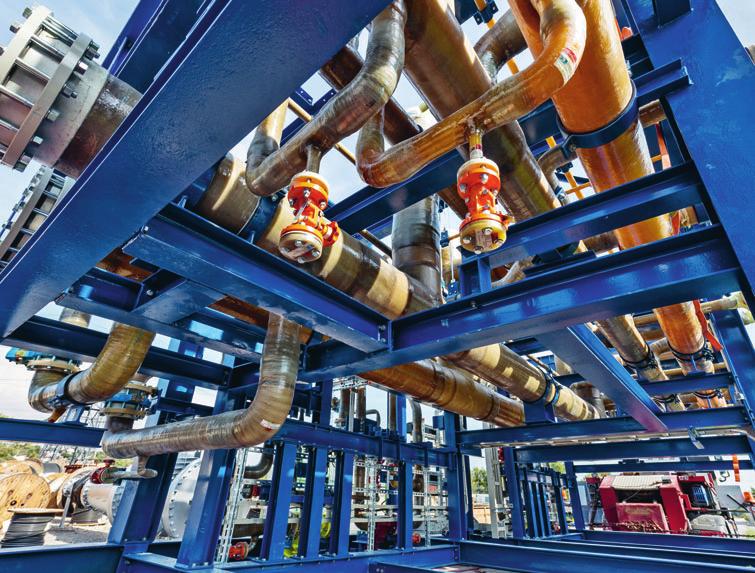
22 Élise Flaquet Cost Controller Clemessy Services Modernisation of the electrolysis unit at the Kem One chemicals plant in Lavéra I am fascinated by industrial endeavours. What I like most is the fact that no two days ever seem the same. From June 2016 to March 2017, I managed the budget for a project for the chemical manufacturer Kem One in the Bouches-du-Rhône department. A consortium of entities from the Energy division, led by Clemessy Services, helped to modernise the electrolysis unit at the plant in Lavéra. This was a real challenge, as we had only four months to prefabricate 13 steel modules and prepare to install the 400 tonnes of structural elements, 40 tonnes of pipes and 2.5 km of electrical cables. These skids were pre-assembled at the Eiffage Métal plant in Fos-sur-Mer. This project is a fine illustration of our ability to work in synergy. 18 Overview


23 After initially providing support to gardens in our organic market gardening-centred employment integration network, in Salles-sur-Garonne and Saint-Just-Saint- Rambert, the Eiffage Foundation agreed to a national partnership with us. We now support 4,000 gardeners on integration programmes at our 120 gardens each year. Unlike many foundations that provide one-off grants, the Eiffage Foundation is with us for the long term. This partnership will help us to develop a national headquarters and a training centre for all our employees, on the Plateau de Saclay. Jean-Guy Henckel National Director of the Jardins de Cocagne gardening network Partnership between the Eiffage Foundation and the Jardins de Cocagne network Cocoon Ages intergenerational residential developments The Cocoon Ages intergenerational residences, that we developed in partnership with the social engineering consultants at Récipro-Cité, are the only properties of their kind. Our aim was to create a caring, friendly environment for residents, with a particular focus on seniors, bearing in mind that by 2050 almost one in three French people will be aged over 60. The apartments are designed to suit an ageing population. Each residence includes a common area with a shared kitchen, patio and garden to foster a vibrant community spanning multiple generations. A Récipro-Cité manager organises leisure activities and watches over the older residents. Through this approach, we do more than just build real estate, instead we help to weave the social fabric and enhance our relationship with communities. Frédéric Henry Île-de-France region Deputy Director Eiffage Immobilier Eiffage 2016 Registration Document 19


24 Deploying fibre optic cable networks When I took charge of the FTTH (Fibre to the Home) department, we had a staff of around 30. Now there are 200 of us. Creating so many jobs in a Group with genuine values is a source of great satisfaction as we build the next-generation telecom network called for by France s ultrabroadband plan. We offer telecom operators and local authorities turnkey solutions covering everything from project design by our design department (with a staff of 146) to installation by our technicians and maintenance carried out by dedicated teams. Wherever possible, we harness the expertise and ability of other Group subsidiaries such as Eiffage Énergie Infrastructures Réseaux and Eiffage Énergie Loire Auvergne to carry out civil engineering and works as part of an end-to-end Eiffage solution. Hicham El Asri FTTH Department Manager Eiffage Énergie Télécom 20 Overview

25 The Eiffage Dakar Motorway Marathon Missira Keita Director of Quality, Health, Safety, the Environment and CSR Eiffage Sénégal On February 13 th and 14 th 2016, we celebrated the 90 th anniversary of the Group s presence in Senegal by staging the Eiffage Dakar Motorway Marathon, a particularly appropriate choice of event given that West Africa s first toll motorway, designed and operated by Eiffage, measures 42 km (26 miles) in length. In all, 20,000 people representing 65 different nationalities entered this event, which was a big first for a private company and a popular festive occasion, featuring races and activities for all ages, art and cultural exhibitions, as well as stands devoted to sustainable development. This celebration, organised in a responsible manner with particular attention paid to waste management, is a source of great satisfaction for Eiffage and for Senegal. Eiffage 2016 Registration Document 21

26 We have fully structured the operation to renovate the Grande Arche in La Défense, an iconic feature of the Grand Paris strategic project, and have been managing the project since September 30 th In entrusting us, via a publicprivate partnership, with the role of client for this operation, the French State could be sure that the schedule would be met and, once handed over, the building would comply with its requirements and meet the agreed performance targets. We have been responsible for orchestrating the project at each stage, from designing the solution to supervising the works, followed by commissioning and the subsequent maintenance phase. The work, which we entrusted to teams from Eiffage Construction, Eiffage Énergie and the façade specialist Goyer, an Eiffage subsidiary, was completed in late March, The work matched the scale of this 112 m-tall glass and steel cube, which had 11,000 sq. m of façades, 70,000 sq. m of offices and 8,000 sq. m of space in the roof of the arch in need of complete renovation. Eiffage Services personnel will now take over and maintain the building until Étienne Housset Operations Director Eiffage Concessions Renovation of the Grande Arche in La Défense 22 Overview

27 Offshore wind farm foundations We are proud to be taking part in the construction of Beatrice, one of the largest offshore wind farms currently under construction off the coast of Scotland. The farm features eighty-four 7 MW turbines, and we have been chosen to manufacture 28 jackets, which are deepwater foundation structures on which turbine towers are mounted. This 160 million contract, awarded in June 2016 by Seaway Heavy Lifting, is an exceptional order for Smulders Group. Be aware that we have only eighteen months in which to deliver these gigantic metal components, each weighing nearly 1,100 tonnes and standing m tall. Meeting this tight schedule requires total commitment from our subsidiaries in Belgium, Poland and the UK. Between 350 and 400 people will be working on the order throughout the production period. Lieven van Hileghem Senior Project Manager Iemants, Smulders Group Eiffage 2016 Registration Document 23

28 Thierry Brossard Project Director Eiffage Construction The Grand Hôtel-Dieu operation in Lyon is the largest listed building conversion project ever undertaken by the private sector in France. This iconic work site is particularly complex, due to its city-centre location, the extensive archaeological excavations carried out, and the plan to build a five-star hotel in the property while restoring the historical parts of the listed buildings. In many cases, it is the period features that dictate what can be done. Having said that, for me this is a fascinating project. We will be breathing new life into a prestigious property located in the heart of the erstwhile Gaulish capital, and opening up this five century-old institution to the general public. Shops, restaurants, offices, a hotel, apartments, the Gastronomy International Centre, a conference complex, ornamental gardens, etc.: all in all, more than 51,000 sq. m of floor space will have been completely renovated by the end of 2018, after three years of work involving more than 800 workers during the busiest period. Grand Hôtel-Dieu in Lyon 24 Overview

29 Worksite facilities for the project to renovate the George V hotel in Paris We are giving a new lease of life to the George V luxury hotel in central Paris. Our craftsmen began by meticulously renovating the Michelin-starred restaurant and the most prestigious hotel suites. We then moved on to the demolition and reconstruction of the 1,800 sq. m spa facility, which includes a treatment room, fitness area and a swimming pool that will be completely redesigned. We are overseeing all aspects of the work, from concrete casting to the final coat of paint. We are working with noble materials such as brass, nickel and precious marble, as well as premium-quality paints and lacquers. Our team is constantly adapting to satisfy our customer s requests. We plan the work, which began in April 2015 and will conclude in the first quarter of 2018, to avoid causing any inconvenience to the hotel s guests. In particular, we set up an appropriatelydecorated site installation through which we remove rubble and unload trucks carrying materials. We are also restoring a listed mansion in Rue de Courcelles to the same standard of luxury and specifications; for this project, we are creating 500 sq. m of floor space, a swimming pool and several basement floors, with a late 19 th century-inspired interior decoration scheme. Julien Guéna Senior Works Director Pradeau Morin Eiffage 2016 Registration Document 25
30 MAKING THE DIFFERENCE Four sustainable commitments in response to social and environmental challenges that are enabling us to build tomorrow s world today Deploying Developing Improving Building 26
31 p. 36 Deploying seven world-class business lines with a unified customer-facing model Whether in construction, real estate, civil engineering, metallic construction, roads, energy or concessions, our strength lies in our ability to effectively marshal an extraordinarily diverse range of technical know-how and businesses for the 100,000 projects that we handle each year and the motorways that we manage. We are experts in project financing and have developed comprehensive financial engineering solutions that enable us to build prestigious and technically highly complex structures, conduct renovation projects that uphold historic traditions, anticipate the challenges facing sustainable cities and promote multiple forms of mobility. p. 58 Developing commitment by our employees We owe the outstanding quality of our structures to the devotion of our 63,000 employees and the 3,000 people who join us each year. Our personalised welcome and induction process, internal mobility and targeted training, backed by a dynamic human resources management policy, ensure that all employees are able to build a career with Eiffage. This creates considerable trust, enhanced by our unwavering focus on safety and our culture of employee share ownership. p. 80 Improving the quality of life everywhere we operate Creating sustainable, intelligent green towns and cities in which people can live together more harmoniously, breaking down barriers between communities and addressing needs locally are among the challenges tackled by our employees in the 65 countries in which we operate. As a preferred partner of local authorities and investors, we adopt an all-round, integrated approach to designing and implementing systemic sustainable development at scale. Whether developing innovative concepts and architecture, restoring urban heritage, producing renewable energy, eco-designing buildings or promoting urban farming, we are already actively inventing tomorrow s world. p. 98 Building today and tomorrow s world Well aware of our role in anticipating and providing support through profound social and economic changes such as the digital revolution, rapid urbanisation, global warming and changing mobility, we innovate to build a sustainable future for the generations to come. The culture of constant innovation that permeates all our businesses is amplified by our sustainable urban development research programme, Phosphore, and by our urban design software solution, Urbainable. Eiffage 2016 Registration Document 27

32 CHAIRMAN S MESSAGE Our Eiffage 2020 strategic plan underscored the importance of balancing our works and concessions activities. It focuses clearly on our customers expectations in each of our businesses and markets. This plan will be the locomotive that drives our success. Benoît de Ruffray Chairman and CEO, Eiffage How would you sum up 2016? We had an excellent year. Our works businesses were particularly resilient, and our concessions are well positioned. Our operating profit and margin increased for the fifth year in succession. Our order book increased by 5.1%, representing 12.6 months of activity for the works divisions. What are Eiffage s strengths and specificities? Eiffage is a compact organisation with very few management levels. This flat structure helps us to remain agile and efficient. Another of our strengths is our dense network of locations in France, which helps us to build strong local relationships with our customers. The success of our integrated offerings and 28 Chairman s message
33 the enhanced dialogue between business lines are delivering mutual benefits and synergies. I would add that the scale of employee share ownership at Eiffage is a powerful cohesive factor that sets us apart from competitors. What are your goals for the future? When I took up this position in 2016, I initiated a strategic plan to set out a clear vision for Eiffage in This plan, which focuses on our customers requirements in each of our business lines and markets, has been adopted across all operational units in France and internationally. This approach supported our solid organisation around seven core businesses. The bedrock of our success, delivering value for us and for our customers, is our expertise in these core businesses, relating to works construction, real estate, civil engineering, metallic construction and energy and concessions (including motorway concessions). Eiffage 2020 also restated our second axis of equilibrium being both a local stakeholder and a global player. Our strong roots in the regions and countries in which we have chosen to operate are hugely important. They provide the necessary resilience to take business cycles in our stride. As a global operator, the Group s agility and compactness, excellent fit between businesses, cuttingedge engineering capabilities and cohesion around a set of strong, uncompromised values put us in a firm position to bid for major projects such as the Bretagne- Pays de la Loire high-speed rail link. The whole Group is heavily committed to harnessing today s profound digital and environmental transitions to leverage performance. Making the difference is Eiffage signature. Can it stimulate innovation? Innovation is a central feature of our strategy. Examples of the many innovative ideas developed for our customers include the Smartseille econeighbourhood, a digital campus in Brittany, applications of the Internet of Things, dynamic bus lane and urban asset management, dynamic car pooling and new service concepts at our motorway areas. The whole Group is heavily committed to harnessing today s profound digital and environmental transitions to leverage performance. Support functions are increasingly using digital solutions. At a time when new technologies are facilitating the industrialisation of construction processes, we have everything we need to move ahead of the field. Another driver for accelerating innovation is to open it to the research community and start-up businesses. We are committed to cross-business innovation as a means of fostering innovative solutions, both within the Group and through partnerships with third parties. Can you describe your international growth strategy? Our priority is to strengthen our roots in Europe, which accounts for 21% of our works revenue (excluding France). We have permanent locations in a number of countries, including Germany, Spain, Belgium, Switzerland and Poland. In these countries, we are looking to develop all of our business, to enhance our visibility and attract top talent. Our priority is to strengthen our roots in Europe. We have also been supporting our customers further afield for many years, and intend to step up our ability to provide our expertise in export markets, building on the areas in which we excel. Eiffage aims to set an example for other companies to follow in the area of risk prevention. How does this translate in practice? We refuse to accept that accidents are inevitable, and make safety a core consideration in all our decisions, when selecting customers and partners, as we work to ensure fair organisational structures, when designing, planning and executing our projects, and in the performance of our motorway monitoring and management missions. Effective risk prevention demands unerring commitment at every level of management. Safety and performance always go hand in hand. Our goal is to achieve zero-risk, zero-accident operation. If you had to single out one of the Eiffage Group s strengths... Eiffage is highly driven. It is vital for us to grow without compromising our exemplary environmental credentials, our commitment to corporate social responsibility or the dedication, loyalty, compassion and solidarity of our employees. Clearly, one of the key challenges is to develop our human potential across all regions and countries in which we operate. The Group s performance depends on our employees satisfaction and ambition. Eiffage must continue to recruit and train for the future. Eiffage University is an essential tool for achieving this development. Last but not least, we must strive to preserve one of our greatest assets: our shared values. Eiffage 2016 Registration Document 29


34 Governance A management team ready to tackle new challenges Executive Committee The Executive Committee defines and implements the Group s overall strategy. The committee meets twice monthly to monitor the performance and results of the various divisions, oversee strategic projects, set consolidated targets, determine priorities and ensure that the Group operates smoothly. 1 Benoît de Ruffray Chairman and Chief Executive Officer of Eiffage, and Chairman of the Energy division 2 Christian Cassayre Chief Financial Officer, Eiffage 3 Olivier Genis Chief Executive Officer and then Chairman of the Construction division from March 1 st Michel Gostoli Chairman of the Construction division until February 28 th Marc Legrand Chairman, Eiffage Rail Express 6 Philippe Nourry Chairman and Chief Executive Officer, APRR and AREA 7 Max Roche Deputy Chief Executive Officer, Eiffage, in charge of Concessions 8 Jean-Louis Servranckx Chairman of the Infrastructures division 30 Governance


35 Board of Directors The Board of Directors defines and oversees implementation of the Group s corporate strategy. It has ten members, appointed for a four-year term, with membership renewed on a rolling basis. The Board meets at least five times a year. Benoît de Ruffray Chairman and Chief Executive Officer, Eiffage Jean-François Roverato Vice-Chairman and Senior Director, Eiffage Thérèse Cornil Independent director Laurent Dupont Director representing employee shareholders Jean-Yves Gilet Independent director Jean Guénard Independent director Marie Lemarié Independent director Dominique Marcel Independent director Isabelle Salaün Independent director Carol Xueref Independent director Bruno Flichy Non-voting member Eiffage 2016 Registration Document 31
36 2016 key figures 14,008 M Revenues Revenues (in millions of euro, excluding IFRIC 12) Actual LFL* Construction 3,514 3, % + 3.4% of which Real Estate Infrastructures 4,374 4, % - 2.5% Energy 3,578 3, % - 4.1% Total Contracting 11,466 11, % - 1.2% Concessions ( excl. IFRIC 12 ) 2,443 2, % + 4.7% Total Group ( excl. IFRIC 12 ) 13,909 14, % - 0.2% Of which: France 11,272 11, % - 0.7% International 2,637 2, % + 2.2% Europe excl. France 2,234 2, % + 3.7% Outside Europe % - 6.2% Construction revenues of Concessions (IFRIC 12) n.s. * At constant scope and exchange rate. Revenues by business line ( in %) Concessions 18% Energy 25% Construction 26% Infrastructures 31% Revenues Operating profit on ordinary activities ( in millions of euro, excl. IFRIC 12) 14,264 14,035 13,987 13, % 14,008 ( in millions of euro) 1,318 1,200 1,347 1, % 1, Net profit, Group share (in millions of euro) % Change in working capital requirements ( in millions of euro ) * * Excluding adjustments for non-recurrent deferred taxation (+ 59 M) : cash generated : cash consumed 32 Key figures
37 Operating margin Steady growth in Group s operating profit (in millions of euro) and operating margin (in %) Cash flow ( in millions of euro) 1, % 1, % 1, % 1, % 1, % Operating cash flow 1,230 1,167 CAPEX flow Free cash flow Acquisitions and disposals Dividends Capital increase Change without flows of funds Change in net financial borrowings* * Excluding fair value of CNA debt and swaps. Contracting Net debt* ( at December 31 st, in millions of euro) ,469 12,579 12,014 11, M 11, % 3.2% 3.3% 3.3% 3.0% * Excluding fair value of CNA debt and swaps. Concessions ,106 1,236 Contracting order book* ( at December 31 st, in billions of euro) % ( + 7.4% excluding BPL ) % 42.2% 41.4% 45.3% 48.4% Eiffage 2016 Registration Document * Unaudited figures. 33
38 Market information and shareholder structure Net earnings and dividends per share ( in euro ) * Net earnings per share (Group share) LISTING Euronext Paris Compartiment A ISIN CODE FR INDICES SBF 120 CAC Next 20 CAC Large 60 Euronext FAS IAS MSCI Europe Dividend per share Eligible for inclusion in French personal equity plans (PEA) and for deferred settlement service (SRD) CODES Bloomberg: FGR FP Reuters: FOUG. PA Shareholder structure ( at December 31 st 2016) * Excluding adjustments for non-recurrent deferred taxation. Number of shares (in millions) Eiffage share price performance since January 2016 (rebased to SBF 120 and Euro Stoxx Construction & Materials) Eiffage share SBF 120 index Euro Stoxx Construction & Materials Shares held in treasury 5.2% BPI 5.7% BlackRock 7.7% Employees 21.1% Free float 60.3% Eiffage share monthly average daily trading volume since January 2016 ( on Euronext Paris ) 400, , , , Key figures
39 Employee share ownership, a sign of trust in the company The 2016 Eiffage employee share ownership subscription campaign, which ran from March 14 th to April 10 th, once again set a new participation record. Some 37,715 Group employees subscribed, representing a take-up rate of 64.15% in France and 50.36% internationally. A total of million was raised, and the average contribution was 3,462 per employee. The take-up rate by craftsmen also increased, further consolidating their adoption of employee share ownership. Participants benefited from preferential terms, including a 20% discount on the reference price, management costs borne by the Group and tax-friendly conditions. Following on from the 2014 opening up of the subscription to the Group s subsidiaries in Belgium, Luxembourg and Senegal, a highlight of the 2016 campaign was the inclusion of the Spanish subsidiaries. The employees concerned by the change made a noteworthy début, with a take-up rate of 43.73%. Online subscription, a lower-cost, more environmentallyfriendly solution was rolled out to a larger population of employees, in This option proved a great success, with 20,657 people (i.e. 45% of eligible employees) using this fast, easy-to-use service. French and international subscription rates in 2016 ( Subscribers as a percentage of active employees) 85% Subscription rates by socio-economic category in France ( Subscribers as a percentage of total) 83% 84.3% % 51% 54% 44% 57% 61.3% 52% 58.3% France Belgium Luxembourg Senegal Spain Managers Technical, clerical and supervisory staff Workers Employee share ownership in 2016 Investment ( by source of funds and by year)* Number of subscribers* 37,715 Proportion of subscribers** (in percentage of eligible employees) 62.81% Amount subscribed* (in millions of euro) Proportion of capital held by employees 21.1% * Solely for the FCPE funds. ** France and international. (in millions of euro) Employee contribution Eiffage advance Incentive schemes Profit-sharing schemes Reinvestment Total * Solely for the FCPE funds. Eiffage 2016 Registration Document 35
40 MAKING THE DIFFERENCE Deploying seven world-class business lines with a unified customer-facing model Eiffage deploys its expertise through seven business lines construction, real estate, roads, civil engineering, metallic construction, energy and concessions structured as four divisions. Deployi 36 Making the difference: Deploying

41 ng 38 Construction contractor and concession operator 40 Construction division 44 Infrastructures division 49 Energy division 53 Concessions division Eiffage 2016 Registration Document 37


42 EIFFAGE Construction contractor and concession operator Construction Infrastructures The Construction division coordinates a range of complementary businesses: urban development, real estate, construction, maintenance and works & services. Through this comprehensive offering, the division supports public and private-sector customers across Europe at every stage of their projects, from land searches to asset maintenance. The Infrastructures division has end-to-end know-how in the design and construction of onshore and offshore infrastructures from foundations to equipment installation. The division also has expertise in engineering and erecting building shells and metal structures, as well as rolling out multi-technical solutions throughout the industrial sector revenue 3.7 Bn ( + 4.3% ) Order book* (at December 31 st 2016) 4.7 Bn ( - 1.8% ) Employees 11, revenue 4.3 Bn ( - 1.1% ) Order book* (at December 31 st 2016) 4.4 Bn ( % ) Employees 22,447 * Unaudited figure. 38 Deploying seven world-class business lines with a unified customer-facing model


43 The Group depends for its great stability on maintaining the balance between its contracting and concessions businesses. In addition to the strong financial fit between short-cycle and long-cycle businesses, this model excels itself when building new greenfield infrastructures (transport networks, educational facilities, etc.), the finest example of which is without doubt the exceptional contract for the Bretagne-Pays de la Loire high-speed rail link, which is to be handed over on May 15 th 2017, after six years of works. Energy Concessions With expertise in all aspects of electrical, mechanical and thermal engineering as well as telecommunications, the Energy division provides customised multi-technical services tailored to the specific requirements of individual projects. The division s teams design, build, operate and maintain socially and environmentally responsible energy and information systems and networks. Eiffage Concessions specialises in concession-based construction and operation of motorways and other large infrastructure projects, public facilities, buildings and urban developments. The division finances, designs, builds, maintains and services such structures. APRR & AREA operate motorways and toll structures under governmentawarded concessions revenue 3.4 Bn ( - 3.3% ) Order book* (at December 31 st 2016) 2.9 Bn ( + 3.8% ) Employees 24, revenue 2.6 Bn ( + 4.6% ) Investment (in 2016) 634 M Employees 4,211 Eiffage 2016 Registration Document 39


44 Construction CONSTRUCTION DIVISION Eiffage Construction is a major player in the building construction sector, operating in France and the rest of Europe. The division has expertise in all aspects of construction, and a proven ability to complete even the most complex projects for public and private-sector clients alike. An all-round offering covering all market segments Eiffage Construction s good activity levels in 2016 were driven in part by major projects and by the integrated offering approach, which harnesses the expertise of all Group business lines from an early stage. Already present in the La Défense business district near Paris, where it is renovating the Grande Arche, Eiffage Construction is intensifying its activity with projects to restructure 38,500 sq. m of Window offices and to renovate and build additional storeys on the Carré Michelet building. In addition to a long tradition of new-build operations, Eiffage Construction has extensive renovation expertise, bolstered by major design-build-operatemaintain (DBOM) projects with related energy performance contracts. The company is now the leading operator in this area, helping it to maintain a high level of activity in the housing sector, which accounts for 40% of revenue. Applying innovation in design and construction methods Eiffage Construction s ability to innovate has regularly been a decisive factor in winning new orders. In particular, the company s expertise in dry construction processes has made it a recognised player in the market for wooden buildings. For example, in 2016, Eiffage Construction won the contract to build the Hypérion tower in Bordeaux, one of the tallest timber-framed housing developments, and handed over Europe s largest-ever solid-wood apartment building, in Ris-Orangis near Paris. Last but not least, Eiffage Construction employees will remember 2016 for the major shift in project management brought about by the rollout of BIM. Outlook In line with the main thrusts of its strategic plan and backed by a solid order book, Eiffage Construction aims to expand all its businesses in step with the potential offered by local markets. Special emphasis will continue to be placed on major projects. It will also carefully examine opportunities in growth markets such as housing construction and renovation and intends to develop its expertise in maintenance and renovation works & services across all regions. 1 1 The La Fleuraye residence in Carquefou, a design-and-build project with Passivhaus energy certification. 2 2 The Health Care training centre built for the campus plan in Lille. 40 Deploying seven world-class business lines with a unified customer-facing model


45 Real estate Eiffage Immobilier is one of the ten largest French real estate developers. The company operates in the housing, commercial, commercial planning and hotel sectors. Adopting a combined construction contractor and developer model ensures that products are optimised at an early stage and enables effective technical management of projects. Eiffage Immobilier regularly bids for complex projects requiring financial engineering. Housing sector in good health Housing was once again Eiffage Immobilier s leading source of business in 2016, setting a new record of 4,134 units booked (+12.6% year-on-year). This strong marketing performance was driven by numerous block sales (totalling 2,104 units), mainly for the social housing sector. A number of large developments were also built, including the Bagnolet Serap project featuring more than 1,000 units, making it the biggest development launched in a single phase anywhere in the Paris region. Fostering the sense of community Together with its partners, Eiffage Immobilier is rethinking real estate development planning with a new, more socially-oriented approach. For example, 2016 saw the launch of Kaps shared student apartments that are let on preferential terms in exchange for taking part in community projects, as well as the completion of the first Cocoon Ages intergenerational residence, in Aubagne. Around ten Cocoon Ages projects are currently at the financial engineering stage, with a similar number at the design stage. Growth in the commercial sector In the commercial sector, Eiffage Immobilier sold almost 100,000 sq. m of office space in The company noted the return of investors willing to purchase properties without tenants in waiting, as was the case with the Opalia office development in Saint-Ouen and the Nework offices in Nanterre. In 2016, ground was broken on the future offices of Orange s regional headquarters at the site of the Pierre-Mauroy stadium in Villeneuve-d Ascq. Eiffage Immobilier also consolidated its presence in one of its strategic growth areas: hotels. Several projects are in progress in this area, including the five-star Intercontinental at the Grand Hôtel-Dieu site in Lyon, and the three-star Mama Shelter hotel in Toulouse s historical city centre. In addition, 2016 saw numerous complex projects in major city centres, such as the renovation and extension of the Debat-Ponsan hall in Bordeaux, which was sold off-plan to Crédit Agricole Assurances. Outlook Eiffage Immobilier has set a target of booking 5,000 homes per year by 2020, representing an increase of more than 20% compared with Ground is scheduled to be broken on 45 developments in 2017, with the combined potential of 27,000 units going a good way towards achieving the stated target. The company will also pursue its multi-product strategy. This diversification ensures steady, significant growth irrespective of the business cycles of the various products. CONSTRUCTION DIVISION 3 3 Renovation and extension of the Debat-Ponsan hall in Bordeaux. 4 4 Le Cœur des Loges, a 150-apartment tourist residence in Les Ménuires. Eiffage 2016 Registration Document 41


46 CONSTRUCTION DIVISION International Eiffage Construction pursued its international development, with particular focus on consolidating and expanding its activities in the countries where it is already established. The company currently has operations in the Benelux countries, Great Britain, Poland and Slovakia. Moving into new markets in the Benelux countries Eiffage Construction is a top-tier player in Belgium, where Eiffage Benelux, which specialises in real estate development and construction, is expanding its activities throughout the country. In 2016, this subsidiary strengthened its base in western Flanders with the acquisition of Vuylsteke, a contractor with revenue of 45 million. Alongside this acquisition, another highlight of the year was the handover of the world s largest ship lock, in the port of Antwerp. Other successfully completed projects included the Waalse Krook cultural centre in Ghent and a phase of the Chirec hospital project in Brussels. Work also continued on the public-private partnership to build 22 schools in Flanders. Regarding real estate, Eiffage Benelux handed over a number of developments in Saint-Gilles, Liège and Antwerp. Marketing operations for the 500-home Greenwood development in Brussels are ongoing, and work is now underway on Galiléo, the company s first development in Luxembourg, following a successful marketing phase. Bold projects in Poland In Poland, Eiffage Polska Budownictwo, an Eiffage Construction subsidiary, handed over one of Central Europe s largest shopping centres, the 320,000 sq. m 5 Posnania development. This oneof-a-kind project was completed in only twenty-seven months, eloquently demonstrating the ability of the company s local teams to handle huge projects on very tight schedules. These teams also have extensive expertise in the construction of mixed-use buildings featuring bold architecture, such as the Ovo mixed-use development in Wroclaw. Eiffage Polska Budownictwo also provides its services to industrial customers, and is currently working on extensions to a Unilever production facility in Pozna and a Michelin plant in Olsztyn. This entity also broke ground on its first real estate development project in Poland, and a 21,500 sq. m mixed-use development is at the financial engineering stage in central Warsaw. Outlook In the coming years, Eiffage Construction s growth in export markets will be driven by the development of targeted high-potential businesses. The company is also studying new acquisition opportunities. Several acquisitions are likely to be made, in keeping with the goals set out in the strategic plan defined at corporate level and adapted within the division. 6 5 The Waalse Krook cultural centre, part of a larger renovation project led by AB, a subsidiary of Eiffage Benelux. 6 The Ovo mixed-use development in Wroclaw, featuring a five-star hotel, offices, homes, a restaurant and shops, with a combined floor area of 48,630 sq. m 42 Deploying seven world-class business lines with a unified customer-facing model


47 7 Reconfiguring the reception areas at the Louvre Carrousel in Paris. 8 A new 39,000 sq. m neighbourhood centred on a marina in L Isle-Adam. 8 7 Specialties Urban development Eiffage Aménagement, a recognised partner of local authorities with locations throughout France, has become one of the leading private-sector urban development stakeholders. The company is currently developing projects totalling 800,000 sq. m, with 650,000 sq. m at the construction or financial engineering stage. Its expertise is increasingly leading it to bid for jointly-managed public-private projects, a new model rapidly gaining in popularity. Smart city projects are another focus area, a good example of which is Eiffage Aménagement s role in the Smartseille econeighbourhood in northern Marseille. Several ambitious operations were conducted over the course of the year. One good example was the signing of a pre-sale agreement for the planned 70,000 sq. m International Gastronomy and Wine Exhibition Centre in Dijon. In the Paris region, the design phase for the 137,000 sq. m Parc d Affaires mixed development area in Asnières was initiated in 2016, and financial engineering continued for the 22,000 sq. m Cour des Marchandises project in Pontoise and the 83,000 sq. m Plaine Sud development in Clamart. In L Isle-Adam, the marketing phase for the first homes built as part of the development project centred on a new marina was launched successfully. Heritage restoration Eiffage Construction, operating in particular through its subsidiaries Pradeau Morin and Eiffage Construction Équipements, confirmed its status as a recognised player in the field of restructuring and renovation projects involving outstanding heritage buildings. Several prestigious projects were completed in The restoration of the stone façades at the Quadrilatère Richelieu, a historic site of the Bibliothèque nationale de France (BNF) in Paris, was undoubtedly among the most iconic. Other highlights from 2016 include the project to renovate the Louvre Carrousel and install a glazed canopy, and the operation to renovate the Maison des Sciences de l Homme in Paris. Additional works are being carried out at the George V hotel, including renovating several suites and creating a spa. The hotel has remained open to guests during the work. On Place Vendôme, work is underway to renovate the 5,000 sq. m LVMH flagship store. CONSTRUCTION DIVISION Eiffage 2016 Registration Document 43


48 Roads INFRASTRUCTURES DIVISION 1 After several years of shrinking markets, the road construction and maintenance business of Eiffage s Infrastructures division experienced a slight upturn in This recovery is attributable to an increase in the number of projects initiated by local authorities, among other factors. Many other medium-sized orders were also won across France, both for road surfacing and for urban development works. Typical examples include the contract for the exterior works at the planned Toulouse exhibition centre, the public-private partnership relating to the construction of three secondary schools in the Var department, the project to develop the approaches to the High Court in Paris or the works relating to the busway in Pau. A number of other signification operations were also launched. The largest of these include the link road between the A6 and A89 motorways north of Lyon, work at the Istres airbase, the earthworks, engineering structures and communication restoration works for the project to widen the RN82 road to dual two-lane between Balbigny and Neulise, and re-routing the A9 motorway to Montpellier. As heavily committed to R&D as ever, scientific research teams at Eiffage Route focussed much of their efforts on designing the Roads of the Future. Responding to the request for proposals issued by Ademe 1 and the Commissariat- General for Investment, they joined with Ifsttar 2 and industrial partners to develop the I-Street innovation programme covering communication, digital integration, connected devices, energy systems and roads. The same teams also received awards in recognition of their work to develop innovative, more environmentally-friendly road construction processes. For example, Aéroprène, a next-generation bituminous concrete for aviation-related applications, received an award from the French road and street innovation committee, CIRR. Processes to bio-regenerate aggregate in coated aggregate (Recytal ) and to treat polluted road surfaces (Recyclean ) were also trialled in several experimental applications. Outlook The economic recovery observed in 2016 is expected to continue, holding out the prospect of a good year for Eiffage Route s various businesses (road surfaces, urban development, exterior works, material production, etc.). R&D teams intend to redouble their efforts. A scientific cooperation framework agreement with Ifsttar was signed on February 1 st 2017, attesting to this focus on R&D. 2 1 Widening a 3.5 km section of the RD 939 road Route de la Mer between Étrun and Haute-Avesnes. 1. Ademe: French environment and energy management agency. 2. Ifsttar: French institute of science and technology for transport, spatial planning, development and networks. 2 Development of the O Gliss aqua park in Moutiers-les-Mauxfaits. 44 Deploying seven world-class business lines with a unified customer-facing model


49 Civil engineering Following the winding-down of the Bretagne-Pays de la Loire high-speed rail link project, the largest ever tackled by Eiffage Génie Civil, the year was spent preparing for the ramp-up of the Grand Paris strategic urban development programme, which is set to be the flagship project for the coming decades. In recent months, Eiffage Génie Civil has also had opportunities to showcase its expertise in tunnel boring and the construction of exceptional engineering structures. Examples of current projects include the extension of line 14 of the Paris Metro, the Chambon and Chat tunnels, the pilot tunnel between Saint-Martin-la-Porte and La Praz in preparation for the planned Tunnel Euralpin Lyon-Turin (TELT), and the Janots tunnel in Marseille. Turning to engineering structures, the most iconic highlights include the development works for the Paris ring road at Quai d Ivry, for the underground railway in Rennes and for the Route du Littoral coastal road on Reunion island. The projects that were completed in 2016 were also representative of Eiffage Génie Civil s broad spectrum of expertise that enables the company to address customers requirements. In addition to the tunnel and stations for the T6 tramway in Viroflay, Eiffage Génie Civil handed over a waste-to-energy plant in the Landes department, a geothermal power plant in Marseille, a penstock for a hydropower plant in Ariège, and BioSav, which is the latest stage of the project to modernise the Seine Aval sewage works in the Paris region. Last but not least, Eiffage Génie Civil was proud to receive an award from the American Concrete Institute. This leading international concrete research organisation awarded the company its ACI Excellence in Concrete Construction Award, for the Notre Dame-de-Lorette memorial in Ablain-Saint-Nazaire, a BSI ultra high-performance fibre-reinforced concrete structure inaugurated in Outlook The new orders booked in 2016 and those expected under the Grand Paris programme should keep Eiffage Génie Civil busy in 2017 and beyond. The company s teams are working on numerous contracts relating to the Eole (RER line E) railway extension project in the Paris region, including platform and station disabled access compliance measures, works along 47 km of track between Nanterre-la-Folie and Mantes-la-Jolie, excavation of a 6.1 km tunnel, construction of a station at Porte Maillot, etc. To the east of Paris, in the ZAC Rive Gauche mixed development area, civil engineers have begun new road covering works, and in the Pyrénées- Orientales department, they are to widen the A9 motorway near Le Boulou for ASF. 3 INFRASTRUCTURES DIVISION 4 3 Spillway at the Record dam. 4 The Grande Chaloupe viaduct on Reunion Island. Eiffage 2016 Registration Document 45


50 Metal INFRASTRUCTURES DIVISION After completing its reorganisation in 2015, Eiffage Métal had strong foundations from which to deliver a combination of excellence and competitiveness. The company is again handling all aspects of clients turnkey metallic construction projects in each of its three businesses: shells and façades, engineering structures and industrial facilities. In 2016, Nexity chose Eiffage Métal to supply the glazed exterior façades for its Smart Side development. This property comprises three interlinked adjacent buildings located on the boundary between Paris, Clichy and Saint-Ouen. The division is also one of the principal industrial partners in the consortium selected by the French environment and energy management agency (Ademe) to build a pilot floating wind turbine farm off the coast of Leucate, the semi-submersible flotation modules for which will be built at the plant in Fos-sur-Mer. The division s teams are still very busy building the LUMA Arles arts complex. In Europe, Smulders, a Belgian subsidiary of Eiffage Métal, scored a number of fine successes. In particular, it won large contracts to manufacture foundations and sub-stations for offshore wind turbines, which will among other things equip the Merkur field off the German coast, and the Aberdeen Bay and Beatrice fields off the coast of Scotland. South of the Pyrenees, Eiffage Métal s Spanish teams further consolidated their status as leaders in the construction of onshore wind turbine towers. In Germany, Eiffage Métal via its subsidiary SEH received the special engineering award for the Botlek lift bridge at the European convention for constructional steelwork (ECCS). This combined road and rail bridge crosses the Meuse in Rotterdam s port area. Featuring two 3,900-tonne steel lifting decks, it is considered not only one of the largest bridges of its type in the world, but also one of the easiest to operate. Outlook The efficiency of the operating procedures implemented by Eiffage Métal has been reflected both in the orders won during the year in France and the rest of Europe, and in the projects being carried out around the world. The division s teams are set to confirm their positioning as complex project integrators and in the area of offshore wind power, via Smulders, as well as particularly technical developments such as the Kattwyk lift bridge in Hamburg, for which SEH won the contract Botlek lift bridge in Rotterdam, Netherlands. 6 Viaduct on the Erasmus line in The Hague, Netherlands. 46 Deploying seven world-class business lines with a unified customer-facing model


51 7 International International projects represent one of the most significant growth vectors for Eiffage s Infrastructure division. In addition to Europe, the division is increasingly active in America, Africa and even Asia. The division has two modus operandi. In export mode, it builds projects for its customers. In Africa, for example, its teams completed the reorganisation of part of the port of Lomé in Togo for a subsidiary of Bolloré Logistics. In Madagascar, following on from the Kamoro bridge, a second engineering structure is to be built on the island: the Mananjeba bridge, further to the north. In Angola, the project to install 104 steel footbridges is continuing in the capital, Luanda. In Asia, Eiffage Rail Deutschland won a major order in Hong Kong, where it is helping to build a section of the Shatin- Central Link underground railway line. As well as carrying out export projects, the division is developing a network of permanent locations. It has numerous subsidiaries across Europe in Germany (Heinrich Walter Bau in civil engineering, Faber in roads, Eiffage Rail and Wittfeld in rail and SEH in metallic construction), in Spain (Eiffage Infraestructuras, a road construction specialist and leading producer of aggregate and coated aggregate, and Eiffage Métal Iberica, which is particularly active in the onshore wind turbine tower market), in Belgium (via the Smulders group, a major European offshore wind power player), and in the Americas (ICCI and Puentes y Torones). In Africa, Eiffage Sénégal celebrated the 90 th anniversary of the subsidiary s creation in 2016, and the opening to traffic of the second section of the Motorway of the Future in Senegal was a highlight of the year. It won a contract to build the Honda bridge, a 407 m-long cable-stayed structure that will facilitate travel between the centre and north of the country, and work continued at the site of the Bucaramanga bridge in the north of the Eastern Ranges of the Andes. In Canada, ICCI saw revenues stabilise after five years of uninterrrupted growth. The company won several orders to build or renovate engineering structures in Ontario and Alberta, as well as leading the works at the Noden Causeway bridge and the Seaway ship lock on the Saint-Laurent river. Lastly, in a major success in French Guiana, work is under way on the multibusiness project to build the launch pad for Ariane 6, the next-generation European space launcher, after winning a contract with CNES in July. 7 Noden Causeway bridge in Ontario, Canada. INFRASTRUCTURES DIVISION 8 In Colombia, Puentes y Torones, a company acquired in 2015, significantly increased its revenues. 8 Breaking ground on the planned Dakar regional railway system in Senegal. Eiffage 2016 Registration Document 47


52 INFRASTRUCTURES DIVISION Specialties On the right track The Infrastructures division maintained its positioning in the rail industry. Following on from the 2015 takeover of Pichenot, which specialises in track maintenance and replacement, the division confirmed its intention to become a major player in the rail market. This prompted two strategic initiatives: the creation of a Catenary Systems department and the establishment of ERS, a subsidiary specialising in rail safety. Backed by the expertise of the German subsidiary Eiffage Rail Deutschland, the Group now has the necessary skills and resources to tackle all types of project. It is able to provide turnkey solutions to rail industry customers in Europe and around the world. Foundations require dedicated expertise With the creation of Eiffage Fondations, Eiffage s Infrastructures division now masters the full spectrum of civil engineering businesses, enabling it to provide comprehensive solutions to even the most complex and technical projects, anywhere in the world, deploying teams specialised in managing such operations. These specialist teams, operating in synergy with their colleagues from the roads and civil engineering businesses, intend to apply their know-how to best effect on the many underground works projects for the upcoming Grand Paris strategic development programme. In the interim, their presence has already been noted during many significant ground improvement (consolidation, sealing, filling, jet grouting, freezing, etc.) and underpinning operations, such as those at the Darse car park in Monaco, the Ariane 6 launch pad in Kourou, French Guiana, or the nuclear power plant in Gravelines, North of France. Focus on Goyer A world of façades Goyer possesses unmatched expertise in the design and installation of aluminium and glazed façades. Already the market leader in France, the company is expanding its operations internationally, supported by an Export department set up in Goyer has tackled its first post-brexit project in the United Kingdom, at Cambridge University. Goyer also obtained OHSAS certification in recognition of its safety and workplace accident prevention policy. Numerous new-build and renovation projects were handed over during the course of the year, including Résonance in Bagneux, the Parc du Millénaire in Paris and the Grande Arche in La Défense. The company also won many new orders: Smart Side in Clichy, the Window building in La Défense, the head office of the Le Monde publishing group in Paris, etc. These new contracts testify to customers confidence in Goyer s capabilities Replacing track equipment in Brétigny-sur-Orge Foundations for the future Ariane 6 launch pad at the Guiana Space Centre in Kourou. 11 The 25,000 sq. m Résonance office building in the Victor-Hugo eco-neighbourhood in Bagneux, built with Eiffage Construction as the prime contractor, with the Eiffage subsidiary Goyer erecting the 9,100 sq. m of façades. 48 Deploying seven world-class business lines with a unified customer-facing model


53 Energy The Energy division serves local authorities, industrial customers and the service sector by building power generation, transmission and distribution facilities, installing networks and integrating energy and data systems. The division s diversified business offering enables it to provide multi-technical expertise ranging from design to operation and maintenance. ELECTRICAL ENGINEERING The challenges associated with smart cities are stimulating the market to adopt innovative solutions. Expercité, a web-based urban asset management application designed and developed exclusively by Eiffage, now includes support for traffic management and has built up a loyal customer base among local authorities. A dynamic bus lane management solution coupled with a dual system of ground markings and traffic lights can be used to reserve a lane for approaching buses and then release it for use by other motorists. The first system of this type in France is currently undergoing trials in Lyon. The solution has now been upgraded to include a smart parking module, featuring a staging system able to guide motorists to free spaces in real time and inform them about maximum stay lengths. Furthermore, concerning the division s traditional activities, despite steep cutbacks in public investment, local offices are still regularly handling networkrelated projects. Eiffage Énergie also remains a leader in France in the market for high-voltage power lines and substations. In the transport sector, construction of the Bretagne-Pays de la Loire high-speed rail link is winding down. The unequivocal results obtained during speed trials reflect Eiffage s ability to conduct engineering and construction works on schedule, including activities requiring comprehensive expertise across all rail-related specialisms, including power supplies and signalling. In the industrial sector, the highlight of 2016 concerned space exploration. Teams from Clemessy, an Energy division subsidiary that has been operating in French Guiana for half a century, have helped to build launch pads ELA1, ELA2, ELA3, and more recently the Soyuz and Vega launch pads. In 2016, the partnership with the European space industry continued with four significant contracts for launch pad ELA4, which will be used by the nextgeneration Ariane 6 launch vehicle. HVAC The goal for this specialist business is to become one of the two market leaders by capitalising on its expanded operational capabilities and reputation for reliability in all activity sectors. In the service sector, the synergies with other Eiffage Group businesses, particularly construction, continue to generate value, as reflected in the iconic projects completed in 2016, such as the Radisson Blu hotel in Lyon, the public-private partnership Campus in Lille and Aix-en-Provence, or the Quadrilatère Richelieu library renovation project in Paris. In a significant project in the art world, this entity carried out the heating, ventilation, air conditioning and technical integration work packages for Lascaux IV, a replica of the legendary cave of the same name, which was officially opened in December. In the industrial sector, the project to renovate the boiler facility at Renault s plant in Cléon was completed, and the cogeneration plant in La Richardière was also handed over. Eiffage Énergie also intends to continue developing in-demand cutting-edge specialist businesses. Illustrating this approach, the division has scored a number of fine successes in the area of ventilation solutions for tunnels and other underground facilities. Teams from Eiffage Énergie, the consortium leader, won the contract for the ventilation system at the Fréjus tunnel. Work on this road tunnel, the world s tenth-largest, is scheduled for completion in As part of phase one of the project to renovate the Quadrilatère Richelieu library in Paris, teams from Eiffage Énergie installed all the necessary electrical and air conditioning systems. 2 Eiffage Énergie installed air conditioning, air renewal and air handling equipment for the new Lascaux IV International Centre for Cave Art, in Montignac. 2 1 ENERGY DIVISION Eiffage 2016 Registration Document 49


54 3 3 Telecommunications-related business grew strongly, driven by multiple orders from local authorities, OEMs and operators, both for conventional copper networks and for fibre optic, mobile, video and indoor networks. 4 Heating installation operation and maintenance by Eiffage Énergie. ENERGY DIVISION TELECOMMUNICATIONS The telecommunications-related business doubled its revenue year-on-year and aims to become one of the sector s five major players by 2020, serving a clientele of local authorities, OEMs and large operators. Highlights include a bandwidth upgrade contract from the utility Syndicat intercommunal d énergies in Aveyron, and an order from Orange to install 55,000 FTTH (Fiber to the Home) connectors in around 30 towns and villages in the Lyon region. As bandwidth requirements increase, the early stages of the Internet of Things (IoT) revolution are already offering promising growth opportunities. In a prestigious example, Paris City Council awarded Eiffage Énergie the contract to roll out the capital s first IoT network. In this major first, which lays the foundations for a connected smart city, the division is to install approximately 10,000 autonomous sensors to collect data from energy meters at city facilities such as schools, crèches, offices, sports centres and swimming pools. Eiffage Énergie is also tasked with providing the data, which when processed can be used to provide new services and applications for Parisians. and industrial customers. In 2016, several major clients, including La Poste and Orange, contracted Eiffage Énergie to operate and maintain their facilities. Two new offerings were launched: Uptimum, a five-pronged energy management solution based on energy audits, system control, energy coaching, asset enhancement and finance brokerage; and a digital signage, solution featuring dynamic display screens installed at customers premises. In industry, the division s teams are totally familiar with the processes of their customers in the petrochemicals, fine chemistry, agri-food and environmental management sectors, for example, enabling them to provide comprehensive offerings covering the full life cycle of customers projects. Through this approach, they enhance the reliability of industrial production facilities, in particular by managing scheduled shutdowns in the power generation and instrumentation sectors. Outlook The service sector continues to drive the HVAC business, particularly in the health care sector, and smart cities, activities relating to the energy mix (including nuclear maintenance) and the boom in renewable energy are maintaining solid growth and overall performance in the electrical engineering business. In telecommunications, the aim is to target turnkey contracts, which generate higher added-value, and to position Eiffage Énergie as a full-spectrum provider of services for new use cases relating to the Internet of Things (IoT) and big data, covering everything from sensor design to data analysis. In the operation and maintenance sector, energy innovation is the key to standing out from competitors and becoming a go-to partner, including in industry; this entails providing ever more cost-effective, high-performance solutions, while maintaining a high level of local service. 4 OPERATION AND MAINTENANCE Eiffage Énergie provides high added-value operation and maintenance solutions to commercial 50 Deploying seven world-class business lines with a unified customer-facing model

55 5 The Punta Palmeras wind farm in Brazil, built by Eiffage Energía. 5 International International development is a key growth lever for Eiffage s Energy division. A two-pronged approach has been adopted. Firstly, by operating in export mode, from France to Africa and Latin America, for example, whether to carry out projects or to support our customers as they grow, and secondly, by establishing permanent locations. For example, in Africa, the infrastructure sector conducted numerous projects, including building a 225 kv transformer sub-station and a 200 km-long 225 kv power line between Ghana and Burkina Faso. The division won a major national dispatching contract in Cape Verde. The Spanish subsidiary Eiffage Energía, which exports its know-how to other European countries as well as Latin America, managed several projects in Peru and Chile, concerning high-voltage power lines, a step-up transformer sub-station and a photovoltaic power plant. Renewable energy accounts for a significant share of the Energy division s export market share. It is helping to build a solar farm in Ouarzazate, Morocco, and in Mauritania, Clemessy and RMT are to build two photovoltaic power plants, one of which ranks among the largest in sub-saharand Africa (50 MWp). Lastly, operating in a consortium with Eiffage Sénégal, RMT is to build a 30 MWp groundarray solar farm in Mekche, in north-east Senegal. The Energy division also has a number of well-established European subsidiaries, in Germany (Elomech, Nat and Schwarz und Grantz), Belgium (Paque, Collignon and Fexim), Italy (Elettromeccanica Galli Italo) and Spain (Eiffage Energía). Electrical engineering, fire safety and heating drove activity in the commercial sector in many European countries in 2016, matching the high level of activity observed the previous year. The most significant projects in progress or handed over in 2016 include the Lateral Towers in Frankfurt, Germany, the 17-storey Torre 4 Porta Firal tower in Barcelona, Spain, and the 50-storey Torre Isozaki building in Milan, Italy. With effect from 2016, the division is also present in Switzerland, via the HVAC specialist, Yerly. This acquisition will enable the division to provide multi-business expert services throughout Switzerland. Outlook The Energy division intends to seize all growth opportunities deriving from the continuous increase in energy demand. Its goal is to double its revenues outside of Europe by It intends to pursue its efforts to expand its footprint in mature economies and target markets in Europe, but also in Africa, and in Latin America via Spain. This will be achieved by exporting specialist expertise available in Europe (in the service sector, industry, infrastructure, renewable energy, etc.) and through acquisitions, among other measures. ENERGY DIVISION Eiffage 2016 Registration Document 51


56 Focus on technological niches 6 ENERGY DIVISION Hydropower expertise cluster Hydrofluid designs, builds and maintains industrial and mobile hydropower plants. This subsidiary of Clemessy serves the offshore energy, steelmaking and public works sectors, as well as national defence, for which it began renovating the hydraulic systems on the Téméraire submarine in Clemessy is also very active in the area of testing systems for assessing the performance of components and equipment for car and aircraft manufacturers, as well as R&D laboratories. In 2016, Airbus contracted Clemessy to set up a test bed on the new A380 and A330 pylon production line, to test the pylon structures that connect jet engines to aircraft wings. Preparing for the Internet of Things Eiffage Énergie Électronique is known in France as a manufacturer of electronic boards and assemblies, covering the full life cycle from design to repair. The company has state-of-the-art industrial facilities, and was among the first to adopt Vacuum technology. In 2016, the company concluded a machinery renewal cycle, significantly increasing its production capacity. Eiffage Énergie Électronique is a trusted supplier to dozens of customers in a wide range of industries, including telecommunications, energy, intelligent transport, home automation, electronic banking, and the service, medical and smart lighting sectors. Its teams focus heavily on technologies relating to the Internet of Things. 7 Bespoke solutions for industrial customers GER2I, a subsidiary of Clemessy Services, has been designing and implementing custom projects for industrial partners in a wide range of activity sectors, including vehicle manufacturing, petrochemicals, industrial chemicals, transportation, aviation, agribusiness and pharmaceuticals, for more than thirty-five years. The company focuses in particular on four businesses: utilities (pipe systems and HVAC 1 ); industrial processes; product integration and fire protection. In 2016, its teams were particularly busy working with car manufacturers. Energy consumption optimisation and air purification systems were installed at the Renault plant in Cléon. Similarly, a system to apply corrosion inhibiting wax to the underbodies of Yaris cars manufactured in Valenciennes was designed, supplied, installed and commissioned for Toyota. 6 Eiffage Énergie Électronique specialises in the industrialisation, manufacture and integration of electronic components, and has industrial facilities equipped with the latest technology. 7 Experts from GER2I s Special Fluids department provide special-purpose pipe solutions to support the cosmetics and pharmaceutical industries. 1. Heating, ventilation and air conditioning 52 Deploying seven world-class business lines with a unified customer-facing model


57 Concessions Building PPPs As in previous years, Eiffage demonstrated the Group s ability to successfully manage complex projects via publicprivate partnerships. Ample proof is provided by the four buildings in the Campus Grand Lille project and an initial complex at the Aix-en-Provence university campus, which were handed over in 2016, and Bretagne Loire University, which was handed over and subsequently inaugurated in January 2017 by the French Prime Minister, Bernard Cazeneuve. Good progress was also made on the work in progress at the University of Lorraine in Metz and Nancy. The signing in early 2016 of the PPP agreement relating to the construction and restructuring of three secondary schools in the Var department is another example of customers confidence in Eiffage Concessions. The Group s proposals for two other public-private partnerships, for an aquacentre in Amiens and an 8,000-seat arena in Tremblayen-France, respectively, were also chosen, offering further evidence of Eiffage s expertise in the design, construction and management of sports and entertainment facilities, as illustrated by the many events (including Euro 2016 football matches and concerts by international stars) successfully staged at the Pierre-Mauroy stadium in Villeneuved Ascq. Orange s decision to move its northern France regional headquarters to the site will further enhance its reputation and appeal. 1 CONCESSIONS DIVISION 1 The new secondary school in Saint-Raphaël will accommodate 800 pupils when it opens at the start of the new school year in The Pierre-Mauroy stadium is a versatile arena that hosted numerous matches and concerts in UBL C@mpus, Europe s first multi-site e-campus, was officially opened in Brest on January 27 th, at a ceremony attended by the French Prime Minister, Bernard Cazeneuve, and by Jean-Yves Le Drian, president of the Regional Council of Brittany. Eiffage 2016 Registration Document 53


58 4 4 Track maintenance train on the Bretagne-Pays de la Loire high-speed rail link. 5 The Ten Merina solar power plant in Senegal. CONCESSIONS DIVISION Rail infrastructure In the area of rail infrastructure, Eiffage operating through its subsidiary Eiffage Rail Express (ERE) completed its work on schedule for the Bretagne-Pays de la Loire high-speed rail link, the largest project ever handled by the Group. The relevant high-speed trials (peaking at 352 km/h) were successfully conducted in late These were followed by signalling and safety testing, which began in early The line is expected to be handed over by the contractual deadline of May 15 th, with the first 1h27-commercial services on the Paris-Rennes route planned for July 2 nd On a less positive note, none of the submitted proposals for debt restructuring at TP Ferro the company responsible for operating the Perpignan- Figueras line in which Eiffage has a 50% interest were approved by the court of Girona, and a decision to wind up the company was handed down on September 29 th All necessary measures were taken, however, to ensure continuity of service pending the takeover of its activities by SNCF Réseau and ADIF. 5 Power generation One of the final highlights of 2016 was the development of a project for a photovoltaic power plant with a capacity of 30 MWp (equivalent to the electricity consumption of 200,000 people) in Ten Merina, Senegal. This is the first project of its kind for Eiffage Concessions. The plant will sell its production to Senelec, the national power distribution utility. 54 Deploying seven world-class business lines with a unified customer-facing model


59 6 UBL which features 54 rooms in four buildings and is rated Excellent under the HQE environmental quality programme, will be maintained by Eiffage Concessions for a period of twenty-five years. 7 Eiffage Concessions is to maintain the Grand Lille Campus, which was handed over in July 2016, under the terms of a 25-year partnership agreement. 6 Operation and maintenance contracting Operation and maintenance For the public-private partnerships agreed by Eiffage in which Eiffage Services has a role, a company in which the Group has a majority interest is created to own the project and finance, design, build, operate and maintain it. When the equity of this project company is sold to a third party after a few years of operation a routine occurrence, of which the disposal in 2016 of Effigen, the company set up for the PPP to build and run the French national police headquarters in Issy-les-Moulineaux, is just one example, Eiffage Services continues to uphold the various clauses of the back-to-back lease, which ensures that customers will benefit from the Group s capabilities and expertise until the end of the PPP. Business consolidation Although this operational approach has delivered exponential growth for Eiffage Services over several years, the focus in 2016 was on consolidating its business and improving its operating margin. Four flagship initiatives were undertaken to achieve this twin objective and optimise customer satisfaction. They relate to staff upskilling (in maintenance, energy management, major maintenance and equipment renewal) to build durable customer relationships; insourcing activities; consolidating the Performance department; and implementing an organisation able to fulfil the quality requirements stipulated in contracts. Eiffage Services also initiated a major programme to enhance the profitability of contracts awarded to it. Significant investment was made at facilities under management in order to improve their reliability and optimise their operation. This strategy has paid dividends, resulting in a marked decrease in penalties payable for non-compliance with performance requirements in PPP agreements. Outlook Eiffage Services intends to continue consolidating its activities and pursue the process initiated in 2016 to open up to new businesses such as operational asset management, major maintenance and renewal of road infrastructure (following on from an initial contract with A Liénor, which operates the A65 motorway), or the operation and maintenance of photovoltaic farms in Africa. Eiffage Services Sénégal, which was created in 2016 and is already active at a 30 MWp plant in Ten Merina, intends to target other power plants built nearby. 7 CONCESSIONS DIVISION Eiffage 2016 Registration Document 55


60 CONCESSIONS DIVISION Motorway concessions Eiffage s Concessions division continued to expand its motorway activities in France, Germany and Senegal throughout 2016, a year marked by several notable events. For example, in April, the Group divested its 36% stake in Norscut (A24) in Portugal. The motorway sections and engineering structures operated by the Concessions division throughout France performed in line with the Group s expectations in Traffic over the Millau Viaduct increased by 2.3% and modernisation works at the viaduct s service area began immediately after the amendment to the concession agreement with the French State was signed. In south-west France, traffic on the A65 motorway grew by 5.2%, aided by heavy goods vehicles adopting it in the wake of a ban on HGV traffic along competing routes in the three departments through which it passes. This motorway also received an award from the French Senate in late 2016, in recognition of the environmental offset measures implemented at the time of construction and subsequently monitored. In Marseille, traffic through the Prado Carénage tunnel was impacted by the opening of the L2 orbital motorway at the end of the year, confirming the decrease in full-year tunnel traffic predicted for Although lower than initially forecast, traffic levels through the Prado Sud tunnel are steadily increasing. The concession operator SMTPC is in ongoing discussions with Marseille Provence Métropole concerning an extension to the tunnel concession in the direction of Boulevard Schloesing. In Germany, work to build a 33-km section of dual two-lane motorway on the A94 is progressing in line with the schedule agreed in the PPP contract awarded by the Southern Bavaria motorway authority in late In Africa, the 16.5-km extension to the Motorway of the Future linking Dakar and Blaise-Diagne international airport opened to traffic in the autumn, after the Senegalese government contracted Eiffage to operate an additional 17 km not covered by the motorway concession. Outlook In 2016, Eiffage continued to develop and extend the maturity of its concession portfolio. The plan developed over the course of the year confirmed this strategy and rolled it out to new structures and services for the Group. In particular, Eiffage is examining opportunities in the area of airport concessions and is interested in above-ground parking management services. The Group has taken into account the French PPP market s recent shift away from hospitals and school, university and government buildings towards sports, art & entertainment and leisure facilities. After moving into Portugal, and more recently Germany, Eiffage is pursuing its efforts in the Benelux countries, as well as taking advantage of its presence in Colombia to examine the many motorway concession projects planned in the country. In Africa, the widely reported success of the Motorway of the Future in Dakar has prompted inquiries from other African countries and multilateral funding partners. With enough time and patience, other concession projects relating to power generation, transmission and distribution infrastructures may be built and operated as the result of Eiffage s expertise in this continent. In all these countries, and for all these projects, the Group s strategy is the same: submit integrated proposals that leverage the Group s compact organisation and synergies between divisions, when designing structures and during their subsequent construction and operation The extension to the Motorway of the Future in Senegal was officially opened on October 24 th Traffic increased 21% year-on-year, reaching an average of 60,000 vehicles per day. 9 Work on a 33-km section of dual two-lane motorway on the A94 in Germany is progressing in line with the schedule agreed in the PPP contract awarded by the Southern Bavaria motorway authority. 56 Deploying seven world-class business lines with a unified customer-facing model


61 Focus on APRR APRR and its subsidiary AREA together form France s second-largest motorway group and the fourth largest in Europe, managing more than 2,300 km of network concessions. Their 3,600 employees spare no effort to provide a constantly expanding clientele with safe, efficient infrastructures. Traffic levels, measured in kilometres travelled, increased by 3.7% in 2016, building on the performance achieved in 2015 (+ 2.7%). A 1.2% decrease in accidents resulting in injuries is another positive sign. Furthermore, AREA seized an opportunity to increase its equity interest in Adelac the concession operator of the A41 Nord motorway between Annecy and the Swiss border following the divestment of AREA s fellow founding shareholders. Improving the motorway network Improvement works were carried out in numerous locations along the network managed by APRR and AREA. One of the biggest operations concerned the 5.5-km link road between the A89 and the A6 motorways to the north of Lyon. Other initiatives included the launch of engineering studies and administrative procedures for the project to widen the A75 motorway south of Clermont-Ferrand and develop the 15-km A48-A480 link on the outskirts of Grenoble. A special effort was also made to renovate rest areas and enhance road safety, with work including modernising traffic management facilities, improving wrong-way driving indicators and treating high-risk areas. Preparing for tomorrow s motorways APRR is at the cutting edge of next-generation motorway research. Current projects include self-driving vehicle testing, the creation of a network of electrical charging points to support the emergence of carbon-free motoring, processing internal data relating to the Smart City concept, and enabling research laboratories to use the motorway network to test their innovations. APRR employees are also encouraged to share their innovative ideas via the Start-Box, a dedicated website made to mesure for the Start-Lab programme, the crowd innovation brand of the Group. Outlook The 220 million investment plan agreed with the French State in January 2017 and currently under assessment provides for around 15 major projects, in some cases in partnership with local authorities across the APRR group networks. These investments will accelerate the network s development and modernisation, with the primary focus on the environment, customer services and local access. The first work under the agreed protocol is likely to begin in CONCESSIONS DIVISION Development work along a 15-km section of the A48-A480 motorway on the outskirts of Grenoble. 11 APRR and AREA are enhancing road safety by modernising traffic management facilities and improving wrong-way driving indicators as shown here on the A432 and treating high-risk areas. Eiffage 2016 Registration Document 57

62 MAKING THE DIFFERENCE Developing commitment by our employees The men and women who carry out nearly 100,000 projects each year are Eiffage s most precious asset. The Group is naturally in favour of anything that protects them and helps them to develop their abilities. Develop 58 Making the difference: Developing

63 ing 60 Developing our employees skills 64 Promoting employee share ownership 68 Facilitating work integration 72 Supporting public-interest projects that improve employment, training and housing opportunities 76 Protecting personnel at our worksites Eiffage 2016 Registration Document 59

64 DEVELOPING Developing our employees skills Challenges Rapidly changing markets and technologies mean that employees especially craftsmen and supervisors are increasingly having to change trades during their working lives. As a result, continuing vocational training is more essential than ever. Solutions Employee skill development and dynamic management can be enhanced and fine-tuned by objectively assessing staffing requirements, optimising organisations and facilitating job mobility. 60 Developing commitment by our employees
65 Developing our human potential across all regions and countries in which we operate is a key challenge. The Group s growth and performance depends on our ability to unlock this human potential and dynamically manage our skills. For a company that generates most of its revenue by carrying out almost 100,000 projects each year, the motivation, competence and aptitude for teamwork of our employees are essential. The Group, which invested the equivalent of 3.84% of payroll costs in training in 2016, has used ambitious tools to develop skills, expertise and qualifications, and support career progression in the context of the digital transformation and environmental transition. Joint courses designed in-house Eiffage University, which was founded in October 2014, is a crucial link in the human resources development chain. It provides joint courses that are designed in-house and address the needs of divisions and employees alike. They aim to pass on experiences and best practices, share common techniques more effectively and develop new skills in areas such as BIM, digital technologies, sustainable cities, etc. This approach enhances the inherent quality of the courses: greater awareness of the realities enables the 500 trainers experienced Eiffage Group managers to provide more practical know-how, better contextualising the theoretical content and emphasising practical applications. This training offering is documented on a website open to all employees, in the form of a portfolio describing more than 500 modules of interest to all divisions. For their part, the divisions are developing more specific courses, including the Master Spé Métiers, more technical and tailored to their respective activities, but also courses for site foremen and team leaders (Master Chef), labourers and craftsmen (Master Prod ) and cross-disciplinary courses for managers, clerical and supervisory staff (Master Spé Essentiels). These training modules, designed by Eiffage for Eiffage, include a mix of advanced theoretical and practical instruction in specific areas: operational management, budget and financial management, subcontracting, employment law, purchasing and sustainable development. Eiffage culture Another non-negligible benefit is that these cross-divisional courses train more than 2,000 people each year, helping to forge Eiffage s corporate culture. Through this initiative, our trainees regardless of their origin or business engage in mutually beneficial discussions with coworkers and build their professional network, explains Louis-Marie Tandeau de Marsac, Director of Human Resources Development and Labour Relations. 1,026,212 hours of training provided in 2016 in France and abroad Eiffage 2016 Registration Document 61


66 DEVELOPING OUR EMPLOYEES SKILLS CLEMESSY A switched-on occupational training institute The electrical and mechanical engineering specialist, Clemessy, which together with its subsidiaries employs 5,000 people, invests 5.7% of payroll costs each year in training for 1,000 to 1,200 trainees, and runs its own 1,000 sq. m occupational training institute and driving school in Mulhouse. Training is not a cost but an investment, stresses Léon Palermiti, Clemessy s Human Resources Director. We provide expert services in fields where qualifications and certifications are often indispensable. The 80 training staff are also Clemessy employees, making them ideally placed to pass on the company s skills, know-how and values. These courses are an excellent melting pot for employees from different business units, regions and generations, from which effective support networks emerge. The institute has branch offices in Épinal, specialising in high-voltage electrical trades, and in Feyzin, for professions relating to chemical and petrochemical analysis. In-house training at the Clemessy Services M Academy Ensuring workers employability, fostering versatility and promoting expertise are the core missions of M Academy, the in-house training institute created by Clemessy Services to provide technical instruction in mechanical engineering, metalworking and pipe systems. A total of 185 people were trained in 2016 at its centres in Lyon and Saint-Nazaire. In 2017, training provision will be rolled out to fitters and welders, raising the total number of trainees to almost 300. This training represents an annual investment approaching 300,000. Passing on know-how and designing custom training is essential if we are to enhance our technical expertise for customers and develop new markets. BPL LGV A training blitz for maintenance technicians Opere, an Eiffage subsidiary, is to provide maintenance services for the Bretagne-Pays de la Loire high-speed rail line until Facilities along the line must be available at all times, with a very high level of safety. To effectively address these requirements, Eiffage University and Opere introduced an unprecedented, specialised recruitment and training programme. This blitz was all the more necessary as the required skills were not available in-house. The ambitious programme, which has required a financial investment of more than 1.5 million, leads to qualifications and certifications. It has received support from several partners, including Constructys (the construction industry training funding organisation), the Regional Council of Pays de la Loire and the Pôle Emploi employment agency. This solution was initially trialled on a voluntary basis, with employees who were recruited locally on work integration contracts and had already worked on the project, but was subsequently rolled out to other job seekers. In all, more than 70 people have been trained for positions as skilled signalling and telecommunications workers, power and catenary technicians or track workers, as train preparation and marshalling agents or as train drivers certified to work on high-speed lines. Some 35,700 hours of training were provided over the period between March 2016 and the end of February 2017, with course lengths ranging from 320 to 980 hours, depending on the career and profession. 62 Developing commitment by our employees


67 APRR A clear roadmap for knowledge transfer at APRR Motorway professions which include motorway workers, toll station operators and safety personnel tasked with keeping the network safe and in good repair are quite specific, and are changing constantly. No custom training programmes exist for such professions. Consequently, APRR has invested in its own classroom-based and online training facilities, in order to organise its internal knowledge and skills transfer, explains Roland Bret, APRR s Human Resources Development Manager. These courses, designed and run by in-house volunteer experts, some but not all of whom are managers, are constantly adapted to suit the company s professions and requirements. They are a vector for sharing experience and good professional practices, and help to optimise the training budget. More than 200 employees work as trainers, providing instruction on topics such as winter network operations, incident response management and cone laying, particularly at the training centre in Bourg-en-Bresse. An e-learning facility has also been set up to supplement other forms of training and facilitate trainee assessment. In all, more than a third of training time is now provided in-house, helping employees to stay on track throughout their careers. Snow-clearing truck driving exercises at APRR in preparation for the winter driving season. EIFFAGE CONSTRUCTION The (EC) 2 job mapper facilitates skills management To manage its human resources effectively, Eiffage Construction has produced a comprehensive map of the professions found within the division. We now have a more precise vision of our professions and an all-round view of the various levels of management responsibility, notes Cécile Becker, Human Resources Development Director. We have also produced a unified directory of the missions and skills required for each position, together with the corresponding training modules. The division created the Eiffage Construction Jobs and Skills development pack, also known by the appropriately scientific-sounding acronym (EC) 2. This strategic tool facilitates the task of forward-looking job and skill management, and enables support positions to be approached in coordination with the Group s other divisions. Eiffage 2016 Registration Document 63

68 DEVELOPING Promoting employee share ownership Challenges Continue to develop employee share ownership, which is a cohesive factor and a growth driver. Solutions Increase the share issue take-up rate to 100% by promoting the system in France and continuing the international rollout. 64 Developing commitment by our employees
69 100% committed 100% shareholders Employee share ownership is in many ways Eiffage s backbone, reflecting our staff s deep attachment to the Group and its performance. This situation is the result of successful management. It is a sign that employees feel at ease within the Group, buy in to its values, are willing to make a shared commitment to the company s success and are confident for the future, notes Sonia Chevalier (who in 2016 became Director in charge of employee share ownership), adding The more united we are, the more effective we will be at our project sites. Subscribing to employee share issues, even for only a few shares, is a way to take part in writing the Group s history. Benoît de Ruffray has set a clear goal of increasing the share ownership rate among active employees to 100%. Employee share ownership offers an excellent means of building loyalty and motivating the company s foot soldiers. A thoroughly overhauled communication approach was introduced at the start of 2017, coinciding with the annual subscription campaign, and Eiffage intends to communicate more regularly on this topic throughout the year. More than 700 messengers representing the Group s employees attended the annual gathering in Paris for the launch of the campaign. Stronger every year New momentum is being built up in terms of employee share ownership, a practice that has been in Eiffage s blood ever since the Group was created and is gaining strength year after year. In 2016, Eiffage employees once again demonstrated their attachment to the system. A total of 37,715 employees subscribed to the share issue, corresponding to a take-up rate of 64.15% in France and 50.36% internationally, with an average investment of 3,460. The take-up rate among craftsmen also increased. Together, the participants contributed a record of million, 13 million more than the previous year, which was already a recordbreaker. Employee share ownership unites existing and former employees, who together own 21.1%* of equity. This model is unmatched in Europe for a group of its size. Offensive profile Employee share ownership gives Eiffage a dual profile, with a longterm investment core and an offensive edge. The amounts raised are available to invest in acquisitions, for example. This system also plays a role in safeguarding Eiffage s independence. International rollout The 2014 campaign marked a new departure by opening the share issue to Eiffage s subsidiaries in Belgium, Luxembourg and Senegal. The 2016 campaign included the Spanish subsidiaries. This international rollout policy is set to continue in 2017, with the share issue being opened up to German employees. * Figure correct at December 31 st Eiffage 2016 Registration Document 65


70 PROMOTING EMPLOYEE SHARE OWNERSHIP BENELUX Steadily increasing take-up The employee share ownership programme was launched in the Benelux countries in 2014, and has since grown consistently, with a take-up rate well in excess of 50% in The increase is in part attributable to the preferential subscription terms and strong share performance. I would also like to emphasise the conviction and dedication of our messengers, stresses Philippe Brulard, Eiffage Benelux s Human Resources Director, adding These individuals are employees who promote the benefits of employee share ownership to their coworkers. The essence of their message and the key to success is to persuade without browbeating. As well as offering financial benefits, the true added value of employee share ownership is to strengthen the feeling of kinship with the Eiffage Group. It helps employees to unite around shared values on which to build a bright future. SPAIN A remarkable maiden campaign The employee share ownership subscription campaign was opened up for the first time in 2016 to Eiffage employees in Spain, via the subsidiaries Eiffage Energía, Eiffage Métal Iberica and Eiffage Infraestructuras % of the 2,500 people concerned took part, a remarkable take-up rate for a maiden campaign. This opening gives these employees an opportunity to play a full role in the Group s international rollout. In spite of the country s challenging economic climate, our Spanish employees were determined to show their respect for the Group, which has stood by its local subsidiaries, and to demonstrate their sense of belonging to the Eiffage community, explains Dominique Chinal, Chief Financial Officer of the Infrastructures division in Spain. 66 Developing commitment by our employees


71 Highly motivated Ever since Eiffage was formed, our craftsmen have been willing employee shareholders, in keeping with a strong working-class tradition permeating the construction industry. In 2016, they once again demonstrated their commitment to achieving this shared goal. Craftsmen contributed 21% of the amounts invested via the share issue, and the number of subscribing craftsmen increased by 12.1%. Our craftsmen s commitment to owning stakes in our company is a source of considerable pride for Eiffage, and a one-of-a-kind model, according to Sonia Chevalier, Director in charge of employee share ownership. In many companies, only managers own company shares. At Eiffage, profitsharing is for everybody, and everybody is constantly working to achieve shared success.... and connected craftsmen Electronic subscription to the employee share ownership programme, which was opened up to managers, technicians, clerical and supervisory workers in 2016, was also a success among craftsmen. These employees spontaneously adopted this practical, environmentally-friendly subscription method, suggesting that it may rapidly become the norm. Eiffage 2016 Registration Document 67

72 DEVELOPING Facilitating work integration Challenges Provide opportunities for many people who are unqualified and excluded from the world of work to earn a vocational qualification and gain long-term experience in a large company. Solutions Operate a sustainable work integration policy, conducting a wide range of field initiatives with support from local integration specialists. 68 Developing commitment by our employees
73 We give everyone a chance through our integration policy based on work-study qualifications and apprenticeships. This helps us prepare for the jobs of the future, while enabling young people to earn vocational qualifications and promoting diversity. Louis-Marie Tandeau de Marsac Director of Human Resources Development and Labour Relations The Eiffage Group was founded and has grown based on values that seek to unite employees, partners and customers. Although these founding principles are aimed in the first instance at the Group s direct employees, they also apply to individuals excluded from employment and company life. True to its values, Eiffage is a signatory to the Diversity and Apprenticeship Charter and has always put work integration at the forefront of its employment policy. Striving for long-term integration The Group aims to give everyone a chance. To this end, it operates a comprehensive integration policy, based on work-study qualifications and apprenticeships. This positioning is made possible by developing a long-term work integration policy that prepares people for the jobs of the future. The main focus is on workers and their local managers. This proactive work-study policy is supported by the initial training centres set up by Eiffage, which cater to all Group businesses. The policy provides an opportunity for young men and women, regardless of their educational background, to earn a recognised vocational qualification, prove their worth in a large company free from any form of discrimination, and then build a career in it. Local presence The Eiffage Group naturally recruits its employees directly whenever possible. However, it also works with independent service providers. These partners support it, for example, for certain large projects that require a special effort, in view of the large number of job seekers to be recruited via the national employment agency. They include integration-focused temporary staffing agencies, SIAE social enterprises and the Cap Emploi network for registered disabled workers. In provincial France, subsidiaries and establishments from all Eiffage divisions work closely with the CREPI network of regional work integration clubs. This organisation, co-founded by Eiffage in 1993, regularly supports Group companies as they implement integration initiatives, always taking care to maintain strong local relationships. Eiffage 2016 Registration Document 69


74 FACILITATING WORK INTEGRATION CONSTRUCTION A proactive approach Construction division companies are fully committed to developing and promoting work integration. In addition to complying with the labour clauses included in certain contracts, the division actively collaborates with local work integration partners all year round, particularly on large projects. The public-private partnership (PPP) agreement concerning the renovation of the Grande Arche in La Défense reflects this approach. It enabled Eiffage Construction to propose a long-term comprehensive work integration project that would be effective in terms of both employment and economic performance; this project assists individuals identified as priority targets for public employment policies. The work integration clause was rolled out in a concerted effort, with support from the Paris jobs and skills association, Ensemble Paris Emploi Compétences (EPEC). Our commitment was to host 110,000 hours of work on integration placements, but thanks to the enthusiasm of our local teams, we were able, among other things, to increase the number to 143,000 by the end of January 2017, notes Paulo Carvalho, a Human Resources Manager with Eiffage Construction. A total of 218 individuals on integration programmes worked at this site, many of whom subsequently received a permanent or fixed-term employment contract or an apprenticeship offer. INFRASTRUCTURES A differentiating factor An increasing number of contracts include work integration clauses. Already a near-ubiquitous feature of public contracts, these provisions are now finding their way into private contracts. Customers treat the inclusion of such clauses as a differentiating factor when considering tenders, particularly for large projects. Regarding the quality of execution of these clauses and the results obtained, Eiffage s Infrastructures division really makes the difference, earning a good reputation among customers. On the project to extend line 14 of the Paris Metro, the target of 45,000 work integration hours has already been exceeded. Working with our network of training academies, we have rolled out work-study training programmes that lead to a recognised professional qualification as a form setter, notes Thomas Parmentier, Human Resources Development Manager for the Infrastructures division. We have also offered to employ nine unemployed people as tunnel boring machine electrical technicians as part of a proactive work integration initiative at the site of the exploratory tunnel for the Tunnel Euralpin Lyon-Turin link. 70 Developing commitment by our employees

75 ENERGY Multiple field-based initiatives Energy division companies operate a wide range of initiatives to integrate job seekers. For example, to counter the shortage of certain categories of personnel (electrical fitters, team leaders, works supervisors, etc.), Clemessy has partnered with the Pôle Emploi employment agency in Mulhouse to provide individualised operational job preparation training. As a result of this measure, five people were trained in the company for three months, three of whom were offered permanent employment at the end of their training, explains Maëlys Chevaux, a Human Resources Technician with Clemessy, which intends to repeat the operation in In Normandy, Clemessy Services ran two initiatives that brought together young workers and entrepreneurs. We organised one of these with the local Crepi work integration club at a rally involving 30 young people, which ended with a job dating session, explains Claire Marchand, Human Resources Officer. The other, run in partnership with the employment opportunities charity 100 Chances/ 100 Emplois, enabled participants, after a week-long preparation process, to pitch their job plans to a committee of economic stakeholders from across the region and receive support with their job seeking. As a result, several of these youngsters were offered traineeships at Clemessy Services, together with personalised vocational support. APRR APRR social initiative for people coping with disabilities The Hors Murs organisation empowers disabled people to work in an ordinary environment, facilitating their gradual integration and providing special support. In 2013, APRR s Human Resources department asked the Customer Relations department to open its doors to a disabled worker, via a staffing contract with Adapt 1. The team at the electronic toll payment customer service unit responded by taking on a disabled employee for slightly longer than a year, and subsequently offered the same opportunity to a second employee in As a result, after an initial placement to assess the suitability of the partnership and identify any aspects requiring special adaptations, a young employee now works part-time updating the customer database, calling customers directly. 1.Adapt: community organisation specialising in social and work integration measures for people with disabilities. Eiffage 2016 Registration Document 71

76 DEVELOPING Supporting public-interest projects that improve employment, training and housing opportunities Challenges Facilitate social and work integration by improving access to employment, training and housing. Solutions The Eiffage Foundation supports projects by community organisations and interest groups. The Foundation is also active in disadvantaged neighbourhoods, and supports organisations sponsored by current and retired Group employees. 72 Developing commitment by our employees
77 The Eiffage Foundation is a source of pride, reflecting the Group s commitment to all areas in which we operate. Benoît de Ruffray President of the Eiffage Foundation A new page in the Eiffage Foundation s history. Benoît de Ruffray became the Foundation s President in December 2016, taking over from Jean Carré, who had led the Foundation since it was formed in The Eiffage Foundation is a cornerstone and a source of pride, reflecting the Group s commitment to all areas in which we operate and is a stakeholder in their future, noted Benoît de Ruffray at the Foundation s annual convention in Paris in November 2016, before telling the audience of 80 current and retired Eiffage employees who sponsor community organisations Dedicated employees are the best guarantors of the Group s performance. Projects sponsored by current and retired Group employees Now more than ever, the Eiffage Foundation strives to make social cohesion a bridge to the future. The sponsors convention held on Thursday November 3 rd 2016 was the perfect occasion on which to restate the virtues of the volunteering efforts of Eiffage employees and retirees in community organisations working to facilitate the social and work integration of marginalised populations by helping them into employment, training and housing. The Foundation subsidises the activities of such organisations. Ambitious three-year projects Since 2013, the Eiffage Foundation has also supported larger projects over a three-year period, backing leading community organisations such as ATD Quart Monde and Habitat et Humanisme. Fighting unemployment and inadequate housing, and supporting training and vocational integration also demand long-term commitment. Projects set up in neighbourhoods identified as priority areas for urban policy With effect from 2016, as part of the Companies and Neighbourhoods Charter, the Foundation is stepping up its support for projects set up in neighbourhoods identified as priority areas for urban policy, explains Xavier Lanthiez, the Foundation s Deputy CEO. These neighbourhoods have high unemployment rates and are found in both urban and rural areas. Supporting multi-year projects, taking action in underprivileged areas and subsidising community organisations are three eminently compatible modes of action. Eiffage 2016 Registration Document 73


78 SUPPORTING PUBLIC-INTEREST PROJECTS Multi-year support for leading community organisations The motto of the Eiffage Foundation is Building a shared world together. In the light of this principle, building a world in which certain sections of society have no place would make no sense. Accordingly, the Foundation is providing significant financial support over several years to ATD Quart Monde (which combats long-term unemployment), Habitat et Humanisme (social housing and integration), the Jardins de Cocagne network (work integration through organic market gardening and catering) and Passeport Avenir (support for promising young students from socially and culturally diverse backgrounds). HABITAT ET HUMANISME Habitat et Humanisme is a housing and integration support organisation that assists very vulnerable households by providing decent housing. The Eiffage Foundation has helped to fund the outfitting and furnishing of a house offering accommodation for up to 80 low-income residents, including some socially marginalised people. This house in Jouy-en-Josas was officially opened in January ATD QUART MONDE The Eiffage Foundation is supporting ATD Quart Monde with its project to combat long-term unemployment. This organisation aims to help job seekers on the road back to work, by giving them opportunities to perform public-interest activities that are not sufficiently lucrative for the conventional market but are very useful to society. On November 21 st 2016, ten urban and rural areas were selected to participate in a trial. In January 2017, four of these areas created social enterprises that take on long-term unemployed workers, and began to hire their first employees. The Eiffage Foundation is supporting the Unit in Meurthe-et-Moselle, in partnership with the Nancy Crepi work integration club and Eiffage s locations in eastern France. 74 Developing commitment by our employees


79 With effect from 2016, the Foundation is stepping up its backing for projects set up in disadvantaged neighbourhoods by contributing to community organisations such as Positive Planet Le Havre, which supports people setting up micro-businesses. Projects set up in neighbourhoods identified as priority areas for urban policy The Eiffage Foundation operates at grassroots level in the areas that need it most, stimulating and coordinating local solidarity efforts in a rational, sustainable approach. The Foundation contributes up to 15,000 per project, to which the relevant regional management of the Group add another 5,000, explains Xavier Lanthiez, Deputy CEO of the Eiffage Foundation. Positive Planet Le Havre (formerly Planet Adam), a community organisation based in the urban tax-exempt area of Le Havre, which supports micro-business creators, has been funded in this way, as has the El Fouad organisation in Avion, which is developing a work integration restaurant. A third project, led by Eiffage Construction s Mediterranean regional division and Eiffage Sénégal, provided an opportunity for 12 young people studying for qualifications in the building trade in the Castellane area of Marseille to visit Senegal and take part in renovating a maternity hospital. This experience broadened their cultural horizons as well as offering a chance to apply their technical training on a real worksite. Projects sponsored by current and retired Group employees The Eiffage Foundation has supported more than 170 projects sponsored by more than 200 current and retired Eiffage Group employees since it was founded. The average grant awarded to projects is 12,000. For example, Le Savoir et le Fer, an organisation that provides training for vulnerable people, who then put their new skills into practice on heritage conservation projects in the west of the Orne department, was sponsored in 2016 by Christian Chantreuil and Jean-Pierre Limin, respectively an Agency Director and a surveyor with the Infrastructures division. Le Savoir et le Fer is working with 20 people on work integration programmes, in a project to restore a mining site. A similar project had already been successfully conducted in partnership with the Afpa training organisation. In that instance, all 27 workers employed at the site qualified as renovation bricklayers and went on to find jobs. Le Savoir et le Fer is working with 20 people on work integration programmes, in a project to restore the Butte Rouge mining site in Dompierre. Eiffage 2016 Registration Document 75

80 DEVELOPING Protecting personnel at our worksites Challenges Set an example for other companies to follow in the area of risk prevention. Ensure that all Eiffage employees are fully committed to a shared safety culture and uphold it in their working lives, both for themselves and for coworkers. Solutions Consider risk prevention as a distinct management activity, requiring exemplary behaviour and unwavering commitment by all levels of management, which must now work towards zero-risk performance. 76 Developing commitment by our employees
81 In the area of safety, Eiffage strives to set an example for others to follow. This is how the Group wants to be identified and recognised by our customers, as effective risk prevention is the clearest leading indicator of a well-led organisation ready for action. Accident prevention and fighting occupational diseases represents a major challenge for Eiffage. This is a key thrust of the Eiffage 2020 Strategic Plan announced during Workplace accidents are never treated as a fact of life. Eiffage s accident prevention commitments underpin all decisions made by the Group, at all management levels. This approach impacts the Group s choice of customers and partners as well as its internal organisation. The design, planning and execution of worksites as well as motorway traffic monitoring and management are systematically approached from a risk prevention angle. For Eiffage, safety and performance go hand in hand. The Group s development is dependent on these co-factors. Act of leadership Eiffage treats preventing risks as an act of leadership in its own right. Exemplary behaviour and an unwavering commitment to risk prevention are also required of managers at all levels in the company. They all need to be fully aware that nothing can be achieved without the men and women who make up their teams; consequently, they have a duty to spare no effort to protect the health and physical safety of their coworkers. Every day, numerous initiatives including training, worksite audits, management inspections, risk prevention challenges and weekly safety briefings are conducted in each Eiffage division, both in the field and in the offices. All serve the same objective of promoting a shared safety culture among employees and encouraging them to play an active role in risk prevention, for their own good and that of their coworkers. Working towards zero-risk operation Eiffage s risk prevention policy has long been based on striving for zero-risk operation. Another step towards that goal was taken in 2016, by highlighting the zero-risk target. Several initiatives have already been taken to that effect in the various divisions, including, for example, the creation of the Safety Force smartphone app, which won the Grand Trophée TP award presented by FNTP (the French public works industry association), and the SafeStart training modules. One thing they all have in common is the goal of maintaining a state of constant watchfulness among employees, to enable them to detect any risky situations at a site and take appropriate action to prevent potential accidents. Eiffage 2016 Registration Document 77


82 PROTECTING PERSONNEL AT OUR WORKSITES CONSTRUCTION Involving all management levels in the Risk Prevention strategy Testing an exoskeleton designed to reduce the risks associated with carrying tools and to facilitate movements, during work to renovate a listed mansion in Rue de Courcelles, Paris. In 2016, Eiffage Construction continued to roll out its safety management and discipline strategy, to involve all levels of management in the division s risk prevention approach, based on specific objectives determined by general management. We also conducted a global review of our basic safety skills, which have morphed into effective safety skills, notes Jean-Louis Marotel, Risk Prevention Manager. These were also rolled out to the temping agencies that have framework agreements with the division. The late-2015 agreement between Eiffage Construction and the risk prevention organisation OPPBTP relating to asbestos risks and the implementation of an effective risk prevention policy among subcontractors resulted in target-based agreements in several French regions. Furthermore, a study of working conditions for form setters was conducted in partnership with OPPBTP in several company establishments. INFRASTRUCTURES Striving for 100% safety with Safety Force The Safety Force mobile application gives Infrastructures division employees a tool with which to assess the appropriate risk prevention measures applicable where they work. All businesses and activities are covered, including worksites, offices, workshops, production plants and quarries. During site inspections carried out by a Group employee, health and safety coordinator, customer or subcontractor or even during weekly safety briefings 20 basic requirements relating to the application of safety instructions are assessed on a scale from 0% to 110%. The rated criteria include the distance from moving plant, workstation tidiness, vehicle driving, etc. Each assessment provides a real-time estimation of workers degree of commitment, enhances our collective risk prevention know-how and most importantly helps us to anticipate potential accidents, asserts Erick Lemonnier, the Infrastructures division s Risk Prevention Director. Safety Force can be downloaded by all employees with a company-issued smartphone and address. 78 Developing commitment by our employees


83 ENERGY Wide-ranging safety initiatives Several teaching videos were filmed on Eiffage Énergie worksites, to inform as many employees as possible about the importance of applying safety measures. One of these videos, made in partnership with a customer, Enedis, prompts supervisors and managers to contribute to an inquiry into an electrical accident and accurately determine its causes. Others featured personal accounts by affected employees, coworkers and customers, explaining the events leading up to an accident and the subsequent response, and describing the consequences in terms of their personal experiences and the accident investigation. The second highlight of 2016 was the production of the 2020 Risk Prevention Strategy Plan. Our working groups comprising a broad spectrum of employees (including risk prevention coordinators, regional and subsidiary managers, etc.) from all countries in which Eiffage Énergie operates performed inventories and benchmarking activities at customers and other stakeholders involved in the business explains Patrick Colin, the Energy division s Quality, Risk Prevention and Environment Director. Based on their research, we established a set of safety-related key issues and best practices, presented in the form of a commitment charter. The result of this effort is to be put into practice starting in Electrical risk prevention exercise at Clemessy s training institute. CONCESSIONS APRR SafeStart for effective risk prevention management 800 employees trained using SafeStart in 2016 APRR rolled out a new approach to workplace accident prevention in The new system, named SafeStart, features five training modules that encourage a shift in safety culture among trainees, from risk prevention by obligation to risk prevention by conviction, both in the workplace and in their everyday lives. By encouraging employees to be watchful at all times and to assume their share of responsibility for their own safety, SafeStart helps to combat the bad habits and involuntary errors that lead to 90% of accidents. In 2016, 800 APRR employees took the various SafeStart modules, at sessions run by in-house trainers with field-based backgrounds, notes Lydie Foissey, APRR s Risk Prevention and Occupational Health department Manager. The impact on workplace accidents was immediate: the accident frequency rate was divided by three by the end of The rollout of SafeStart will continue among APRR personnel in 2017, and will be extended to AREA, with the aim of training all 2,500 operational staff within the next two years. Eiffage 2016 Registration Document 79

84 MAKING THE DIFFERENCE Improving the quality of life everywhere we operate Reducing the ecological footprint of our towns and cities will require profound changes to their metabolism. As an all-round urban contractor, Eiffage is rolling out innovative solutions for a better quality of life. Improvi 80 Making the difference: Improving

85 ng 82 Designing sustainable, welcoming neighbourhoods 86 Promoting mobility 90 Developing the energy mix 94 Supporting industry Eiffage 2016 Registration Document 81

86 IMPROVING Designing sustainable, welcoming neighbourhoods Challenges Revive our town centres and create new neighbourhoods, maintaining a constant focus on quality, whether in terms of urban shape, architecture or public spaces, and striving to set a good example on environmental issues. Solutions The Group harnesses its full range of expertise, in urban development, real estate, construction, roads, civil engineering, metallic construction and sustainable development to create sustainable, welcoming neighbourhoods. 82 Improving the quality of life everywhere we operate
87 At the end of 2016, Eiffage Aménagement had projects totalling 650,000 sq. m either under construction or at the financial engineering stage, including several operations relating to the Grand Paris strategic programme, and more than 800,000 sq. m under development in France. Eiffage operates as a combined land developer, real estate developer and building contractor, a major strength when tackling projects to regenerate brownfield industrial sites, create new neighbourhoods, revive town and city centres or improve urban areas. Eiffage Aménagement has been partnering with local authorities for thirty years, putting the Group in a strong position to bid for large and complex land development projects, stresses its CEO, Nicolas Gravit. For its part, Eiffage Immobilier has the wherewithal to ensure effective financial management and to phase the necessary land acquisitions for real estate programmes. Unlike conventional land developers, Eiffage Aménagement supports local authorities in an all-round, controlled approach, harnessing the Eiffage Group s structure, leveraging the synergies between its businesses and taking advantage of its great capacity for innovation. Maintaining a constant focus on quality, whether in terms of urban shape, architecture or public spaces, Eiffage Aménagement can also count on support from the Group s sustainable development and cross-divisional innovation department as it applies Eiffage s proprietary sustainable urban design methodology, Haute Qualité de Vie, which aims for environmental excellence and social innovation. In addition to these capabilities, the Group can call on planners, architects and landscapers, clients and investors... but also start-up businesses, SMEs, community organisations, business incubators and other sustainable city stakeholders, and is able to orchestrate the participation of all these public and private-sector partners to successfully complete projects lasting several years. Wide-ranging capabilities The current development portfolio illustrates the considerable diversity of its activities. Eiffage Aménagement teams, some working in partnership with their counterparts at Eiffage Immobilier, are breathing new life into the town centre in Joinville-le-Pont, by creating 500 apartments and 5,000 sq. m of shops. Teams are taking part in the urban regeneration programme in Bagnolet, building 400 homes and new public facilities. They are developing a brownfield industrial site in Clamart, in a project that will create 1,000 homes, together with shops, public amenities and hotels. In provincial France, teams are working on around ten developments, including the International Gastronomy and Wine Exhibition Centre in Dijon, the Smartseille eco-neighbourhood in Marseille and a new 25,000 sq. m area in the immediate vicinity of Reims train station. By 2020, Eiffage Aménagement intends to generate 20% of the Group s real estate production in France. Eiffage 2016 Registration Document 83


88 DESIGNING SUSTAINABLE, WELCOMING NEIGHBOURHOODS Smartseille pays dividends With effect from spring 2017, Smartseille is equipped with a geothermal loop system able to draw or return heat to/from sea water energy, providing a degree of heating in winter and cooling the air in summer. Greenhouse gas emissions will also be 70% lower than with fossil energy. Eiffage Énergie built the first sub-station in this coastal geothermal energy network in 2016, for EDF Optimal Solutions. Thanks to local teams from Eiffage Immobilier, Smartseille a ground-breaking 58,000 sq. m eco-neighbourhood and the first phase of the Euromed 2 urban development programme is currently taking shape in northern Marseille. Smartseille, which was chosen by the French government as a showcase for French industrial expertise in the area of sustainable cities, will feature several buildings certified under Mediterranean sustainable building specifications. In a mixeduse development combining a hotel, offices, homes, a crèche, a school, an intergenerational apartment building and shops, this innovationpacked eco-neighbourhood features bioclimatic design, energy efficiency solutions and biodiversified green spaces planted with a wide selection of Mediterranean species. A quarter of this development was handed over in late 2016, and work is well underway or nearing completion for the remaining three quarters. When finished, users will benefit from convenient access to quality services at very reasonable cost. A shared car park serving the apartments and offices and a car-sharing solution are already operational. A digital services offering with a dedicated portal managed by Orange has been designed. Residents and other users will be able to easily hire a car, book a function room or make appointments for services (hairdresser, cobbler, etc.) using the neighbourhood-wide WiFi network. Smartseille is recognised as an industrial demonstrator for sustainable city solutions, and may bring Eiffage new opportunities in France and other countries. Working towards eco-neighbourhood certification at a mixed-use business park in Asnières-sur-Seine The eight-hectare Asnières Bords de Seine mixed-use development area completed in 2016 by Eiffage Aménagement tackles numerous challenges relating to decontamination, waste, water and noise management, mixed-use urban environments and quality landscaping. The new adjacent Parc d Affaires mixed-use development project, for which a consortium of developers in which Eiffage Aménagement is assistant leader won the contract from SEM92, is set to address the same challenges with the aim of achieving eco-neighbourhood certification. Nowadays, we no longer design new neighbourhoods without factoring in sustainable development requirements, and we systematically use the tools developed by the Group s Phosphore research programme, as well as the Astainable sustainable urban development tool, stresses Brigitte Outrey, Urban Development Director. Low-consumption buildings, next-generation energy solutions, biodiversity, urban services and urban farming in public and private spaces will feature heavily in the design of this 137,000 sq. m macrolot, featuring 2,000 homes, 25,000 sq. m of office space, shops and public facilities. 84 Improving the quality of life everywhere we operate


89 Access to drinking water, sewage and storm water drainage in export markets Improving access to drinking water, building sewage and storm water drainage systems and developing the related processes is crucial in emerging nations, for obvious reasons relating to health and the climate. In 2015 and 2016, teams from Eiffage s Infrastructures division carried out the first phase of works to renovate and extend the Storm water drainage system in Brazzaville, Congo. In 2016, they went on to secure an order, in partnership with a local contractor, to develop a settling basin in Lomé, Togo, as well as a 31-km sewage system and 8 km of storm water drains. Our technical approach is greatly appreciated by financial backers. We offer comprehensive solutions that include pipes and treatment works, and opt for efficient prefabrication processes, thereby avoiding the inconvenience caused by protracted site work, explains Nicolas Sureau, who heads the Infrastructures division s Environment and Industry businesses. The division is determined to expand its activities in water and waste treatment, and teams are actively preparing for upcoming tenders in countries such as Senegal, Madagascar and Uganda. Urbainable promotes a multi-criteria approach that enables an innovative response to urban development issues while giving appropriate consideration to climate factors and other specificities. Urbainable Urban design digital tool suitable for all towns and cities With 54% of the global population already living in urban areas and the proportion predicted to reach 66% by 2050, our cities must tackle a host of related challenges such as booming demand for housing and services, unsustainable energy footprints, traffic congestion and atmospheric pollution. In response, Eiffage, the engineering firm Egis and the energy utility Engie teamed up to develop a bespoke urban design digital tool. Going by the name of Astainable from sustainable and Astana, the capital of Kazakhstan this 3D demonstrator was used to simulate 350 French solutions with a role to play in fostering the emergence of sustainable cities, addressing themes such as low-carbon mobility, responsible water and waste management, renewable energy, sustainable construction and smart cities. Building on this success, Eiffage registered the Urbainable brand for a universal version of the tool, suitable for use with any city. Urbainable promotes a multi-criteria approach that enables an innovative response to urban development issues while giving appropriate consideration to climate factors and other specificities. The tool showcases the Group s expertise in the area of sustainable city demonstrators. Eiffage 2016 Registration Document 85

90 IMPROVING Promoting mobility Challenges Facilitate travel in urban areas and improve access to territories by adding missing transport links and creating new arteries. Solutions Roads and motorways, tramways, underground transit systems and railways, docks and ship locks: Eiffage is a major player in the mobility sector, both through its construction activities and as an infrastructure manager. 86 Improving the quality of life everywhere we operate
91 In 2017, Eiffage will set the seal on its largestever project: the Bretagne-Pays de la Loire high-speed rail line. A total of 214 km of new line have been built between Le Mans and Rennes, under the terms of the public-private partnership agreement with SNCF Réseau concluded on July 28 th The Group will maintain the line until At its peak, 4,500 people worked on the huge Bretagne-Pays de la Loire high-speed rail line construction site, in a gigantic shop window for Eiffage s know-how. After the Perpignan-to-Figueras high-speed rail link and the A65 Pau-to-Langon motorway, this exceptional project provides further proof of Eiffage s ability to manage very large turnkey projects. When it enters service on July 2 nd 2017, the BPL rail link will cut journey times between Paris and Rennes to under 90 minutes. Between 2012 and 2014, some 26 million cubic metres of earth were moved, and 227 engineering structures, 11 viaducts, seven covered cuttings and five overpasses were built by teams from the Infrastructures division. Then, over the period from 2014 to 2016, the work to install the railway track (ballast, sleepers and rails) was carried out. This activity concluded in 2016, as the track was raised to its finished level and the 50 switches required for the line s operation were installed, explains Patrick Havard, the Track-laying Project Director. Unwavering commitment Over the same period, Eiffage Énergie mobilised 370 people to install all the necessary non-track equipment two electrical sub-stations and 13 transformers supplying traction power, 18 service buildings, 26 GSMR radio towers for the telecommunications system, the necessary conduits for the fibre optic and utility networks, three track signalling systems (TVM300, ERTMS I and II) and the catenary, CCTV and security systems. Our team s unwavering motivation and commitment were the key to our success, stresses Sidoine Serraj, Project Director for the Energy division. The line was energised on schedule in the autumn of In January 2017, the main section of the line was rated to operate at speeds of up to 352 km/h (maximum commercial speed plus 10%), an essential step in the commercial licensing process. Best environmental cost-benefit profile For the first time on a major infrastructure project, the environmental offset works were completed before the line was commissioned, confirming Eiffage as offering the best environmental cost-benefit profile, as stipulated by SNCF Réseau when the contract was signed. 974 hectares of environmental offset land were developed, 5% more than the target. 218 hectares of woodland were replanted, and 477 hectares of habitats for protected species and 280 hectares of wetlands recreated. Nearly 300 structures were built to allow animals to easily cross the line. Additionally, 1,200,000 trees were planted, equivalent to six per metre of line. Upon obtaining the commercial operating licence, Opere, an Eiffage subsidiary, will maintain the line until Opere will operate from two track maintenance centres located in Auvers-le-Hamon and Saint-Berthevin, the second of which is adjacent to the line s supervision centre. Eiffage 2016 Registration Document 87


92 PROMOTING MOBILITY Grand Paris Super Metro Eiffage in the vanguard The project to extend line E (Eole) of the RER regional railway network to the west of Paris has now been launched. Eiffage Génie Civil and Eiffage Fondations are members of the consortium tasked with digging a 6.1 km-long tunnel and building a new station at Porte Maillot. Ground was broken for this 460 million contract with SNCF in January Eiffage Rail, a subsidiary specialising in track-laying and maintenance, will carry out the track work for a 47-km section running between the planned Nanterre-la-Folie station and the station in Mantes-la-Jolie, via Poissy. Eiffage Génie Civil used the Magaly tunnel-boring machine to excavate an initial 1,590-m tube between the Pont-Cardinet and Gare-Saint-Lazare stations on line 14 of the Paris Metro system. The second tunnel-boring machine, christened Yolène on July 22 nd 2016, is digging the remaining 2,000 m between Pont-Cardinet and the planned Clichy-Saint-Ouen station. Smooth sailing in the mobility market Offshore, coastal and river works carried out by Eiffage facilitate the movement of people and goods in France and around the world. The Eiffage Travaux Maritimes et Fluviaux subsidiary is active along France s principal rivers, including the Yonne and the Seine, where it is modernising locks and dams. It also operates all along the French coastline, conducting a wide range of activities, including building yacht moorings, developing and shoring up docks, or carrying out major renovation work on port infrastructures (including several ship locks at the port of Le Havre). Herbosch-Kiere, a subsidiary of Eiffage Benelux, led the project to create the world s biggest ship lock in a port, which was officially opened in 2016 in Antwerp, Belgium. This major project is a feather in the Group s cap, like those to extend two deepwater container terminals, one already handed over in Lomé, Togo, the other under construction in Freetown, Sierra Leone. 88 Improving the quality of life everywhere we operate


93 APRR has created a special electronic toll payment package for electric vehicle owners and installed more than 50 charging stations across its network. APRR A partner for new mobility solutions APRR and AREA are helping to roll out new forms of mobility, in accordance with French legislation relating to the energy transition. The two motorway operators already provide more than 1,000 car-pooling parking spaces, 394 of which were jointly funded in 2015 and 2016 (i.e., 74 more than the 320 spaces specified in the management contracts). APRR is to fully finance an additional 1,700 spaces under the new motorway investment plan. In the area of electronic toll payments, in February 2016, the two concession operators launched an offering specially designed for car poolers, in partnership with idvroom, a subsidiary of the railway operator SNCF. Since November 2016, AREA has also been conducting trials intended to facilitate car-pooled commuting, with the same partner. APRR has also devised a special electronic toll payment package for electric vehicle owners, and installed more than 50 charging stations across its network. Work to widen a 10.5-km section of the A75 motorway south of Clermont- Ferrand to dual three-lane operation. Motorway stimulus plan: 720 million in capital investment to ease traffic flows and improve accessibility The works carried out by APRR and AREA as part of the motorway stimulus plan began in 2016 and will continue until A total of 720 million will be invested to ease traffic flows on often-saturated sections and to improve interconnections within the motorway network and with the secondary road network. In the context of this effort, APRR took over operation of a 10.5-km section of the A75 motorway south of Clermont-Ferrand in May Almost 170 million is earmarked for work to widen the motorway to dual three-lane operation, to be carried out over the period In another highlight of 2016, AREA signed a memorandum of agreement with the French State, the Isère department and Grenoble-Alpes Métropole in November, relating to the development of the A480 urban motorway in Grenoble. Work to relieve congestion in the Grenoble urban area will begin in 2019, at a cost of 334 million. The two motorway operators are also continuing work on projects arising out of the management contracts. In April 2016, APRR broke ground on a 5.5-km section of motorway north-west of Lyon. The aim of this project is to finalise the link between the A89 and A6 and complete the Bordeaux- Geneva trans-european corridor. A total of 146 million will also be invested to develop a motorway interchange on the A6, build a 208 m-long viaduct, a new motorway section and several roundabouts, with two-thirds of this work being carried out by teams from Eiffage s Infrastructures division. Eiffage 2016 Registration Document 89

94 IMPROVING Developing the energy mix Challenges Remain a cutting-edge provider of maintenance and improvement services for the French nuclear fleet while continuing to develop new energy sources. Solutions Eiffage has a comprehensive offering in the area of power plant development and maintenance. 90 Improving the quality of life everywhere we operate
95 The Group is active in both conventional and renewable energy solutions, providing its expertise in civil engineering, heating, electrical and mechanical engineering at each stage in the project life cycle, from design and construction to commissioning, operation and maintenance. Eiffage has a comprehensive power plant development and maintenance offering spanning thermal and nuclear power plants, wind and solar farms, as well as cogeneration, biogas and geothermal power plants. Day in, day out, customers are supported by 25,000 Eiffage staff in energy-related businesses, operating out of a network of 400 locations. Eiffage has been involved in France s nuclear power development programme since the early 1970s. Drawing on this lengthy experience, the Group is well-placed to fulfil the needs of the traditional major contracting authorities, whether by building turnkey facilities or providing upkeep maintenance services. Eiffage has the requisite technical skills, qualifications and certifications to guarantee the standards of quality, safety and security applicable in this industry. The Group also helps its major clients to install general and safety-related electrical systems, instrumentation 1, pipework and electromechanical systems. The Group is also stepping up its activities relating to new forms of energy. In 2016, the Spanish subsidiary Eiffage Energía, which has already built 32 solar power plants in export markets and helped to install facilities around the world with a combined capacity exceeding 900 MW, completed the 110 MW plant in Quilapilún, Chile, as well as handing over several units in the United Kingdom with a combined capacity of 35 MW. Eiffage Energía is also developing its wind power business, and has already built 70 wind farms, of which 11 in Europe and one in Brazil, handling everything from the foundations to the transformer substations. After building the Cestas solar power plant and forging close relationships with photovoltaic module and current inverter suppliers, Clemessy, via its German subsidiary RMT, was a member of the consortium that beat 24 major competitors to win the contract to build Sub-Saharan Africa s largest-ever solar power plant, a 50 MWp facility in Nouakchott, Mauritania, RMT s CEO, Jean-Martin Meyer, notes with satisfaction. The company is also building a 30 MWp solar power plant in a consortium with Eiffage Sénégal. Lastly, teams from Clemessy in Morocco are equipping the Noor 2 and Noor 3 solar power plants, and will also be installing the 225 kv transmission and interconnection transformer facilities, digging and filling trenches and laying cables. 1. Monitoring the flow rates, pressures, vibration and temperatures of gaseous utilities used in nuclear processes. Eiffage 2016 Registration Document 91


96 DEVELOPING THE ENERGY MIX Clemessy A fifty-year track record in nuclear power In 2016, Clemessy, a longstanding partner of EDF, confirmed its leadership in the area of general electrical installations for the French nuclear fleet, covering instrumentation and control, lighting systems and fire detection and protection equipment. The company, which has 620 employees fully certified for nuclear operations, is a member of the consortium that won a 180 million contract for work on the electrical installations at 15 plant units (more than a third of the total fleet); this work is essential to keep the plants operating smoothly. Clemessy will also be taking part, in a consortium, in a 10 million operation concerning the full range of definition and implementation studies for changes to installations at all plants. We are celebrating the 50 th anniversary of our partnership with EDF; our ability to adapt has been the key to this enduring relationship, notes Philippe Dubuisson, CEO of Clemessy Nucléaire. The company, which also operates in the area of security, automatic control and nuclear instrumentation, is taking part in the project to extend plant service lives and protect their ability to operate by installing ultimate diesel generators. The Vercors mock-up was inaugurated in June 2016, setting the seal on nearly three years of works for Eiffage Génie Civil Nucléaire, with contributions from Eiffage Métal (for the equipment hatch), Eiffage Énergie and Eiffage Route. Eiffage Génie Civil A partner in the major refit programme As part of EDF s Grand Carénage industrial refit programme, which includes work arising out of the post-fukushima assessment, Eiffage Génie Civil is building new infrastructures for EDF and carrying out improvement works on existing facilities. We will finish building the local emergency operation centre at the Flamanville site in 2018, notes Axel Davout, the manager in charge of the nuclear civil engineering business. Working in partnership with Eiffage Fondations, we also secured a master contract for floor strengthening works, resulting in a project at the Gravelines plant in 2016, and another master contract relating to utility infrastructures enabling the new post-fukushima units to be connected to existing infrastructures. In particular, we are carrying out the exterior works for the ultimate diesel generators at the Gravelines, Golfech and Nogent-sur-Seine nuclear power plants. Experts from Eiffage Génie Civil Nucléaire are also heavily involved in research and development activities. We are taking part in the construction studies for the EPR NM (new model) reactor and are in the process of finalising a mock-up with the aim of developing methods for strengthening the foundation rafts at all operational reactors, to enhance their safety, adds Axel Davout. In 2016, Eiffage Génie Civil Nucléaire teams handed over an exceptional project at EDF s R&D facility in Écuelles: a one-third scale mock-up of a nuclear reactor building, known as Vercors. Equipped with 700 sensors and 2 km of fibre optic cable, the purpose of this installation is to test accelerated ageing of the concrete used in nuclear containment structures. 92 Improving the quality of life everywhere we operate


97 Renewable energy Turnkey power generation and distribution solutions Wind and photovoltaic power are two of the Energy division s growth drivers. The division has set a target of increasing revenue fivefold to 240 million by 2020, capitalising on strong growth in these markets worldwide. Operating as an all-round contractor and integrator will also favourably impact sales. We intend to build our business by focussing on large turnkey construction contracts, particularly in Europe, Africa and Latin America, explains Sylvain Bescond, Engineering Director at Eiffage Energía s Renewable Energy department. We will be handling the entire process, from design to handover and maintenance, including civil, electrical and mechanical engineering work. We will also be supported by Eiffage s powerful sales network as we develop the markets for energy storage and onsite consumption for industrial customers. From onshore to floating offshore wind power Operating through its subsidiaries, Eiffage Métal and its own subsidiary Smulders and Eiffage Génie Civil, the Group s Infrastructures division has expertise in all types of wind power onshore or offshore, including floating wind turbines. Smulders ranks among the market leaders, with more than 1,000 steel foundation modules for offshore wind turbines to its credit. Smulders, which designs, engineers and manufactures foundations, transition pieces and grid connection sub-stations, won eight orders to build wind turbine foundations in 2016, as well as three sub-station projects. For its part, the Eiffage Métal plant in Fos-sur-Mer, which is equipped with dock facilities suitable for handling large volumes, is building metal components for use by Smulders in the foundations of three wind farms located off the coast of the United Kingdom and Germany. The Spanish subsidiary Eiffage Métal Iberica manufactured 969 onshore wind turbine tower sections, 98.3% of which were subsequently exported. Future growth in this business is likely to be driven by the development of offshore wind farms and wind farms in emerging nations. For Eiffage Génie Civil, which regularly builds foundation blocks for onshore wind turbines, new perspectives are opening up in the area of offshore wind farms built using gravity foundations consisting of a reinforced concrete structure filled with ballast, like the meteorological tower built in Le Havre and submerged in 2016 off the coast of Fécamp. Floating offshore wind turbines are a next-generation technology offering a production potential three times greater than grounded wind turbines. The pilot floating wind farm in the Gulf of Lions being developed by a consortium in which Eiffage Métal is one of the industrial partners will feature four wind turbines with flotation modules built at the company s plant in Fos-sur-Mer. Eiffage 2016 Registration Document 93

98 IMPROVING Supporting industry Challenges Design, integrate and maintain systems and installations for industrial production, testing, simulation inspection and compliance assessment processes. Solutions Eiffage intends to enhance its industrial dimension, in order to more effectively support the Group s many industrial customers in France and other countries. 94 Improving the quality of life everywhere we operate
99 Jean-Marie Gutleben Industrial Director, Clemessy We are designer, contractor and maintenance provider, all rolled into one. The Renault plant in Maubeuge, the National Centre for Space Studies (CNES) and Arianespace in French Guiana, the LyondellBasell oil refinery and Boiron homeopathy laboratories in Messimy all have one thing in common: teams from Eiffage s Energy division installed or maintained systems and equipment. The Energy division is a longstanding partner to cuttingedge and traditional industries alike, and intends to further develop this aspect of its activity. Turnkey systems Clemessy, which originally specialised in electrical engineering before branching out into mechanical engineering, has for many years been providing its services to a wide range of highly demanding industrial sectors, including energy, space exploration, car manufacturing, nuclear power, aviation and pharmaceuticals. The company s 5,000 employees design and install turnkey systems for production, testing and inspection in industrial environments. They also provide optimisation and maintenance services for these state-of-the-art facilities. We are designer, contractor and maintenance provider, all rolled into one, points out Jean-Marie Gutleben, Clemessy s Industrial Director. For example, Clemessy designs and implements power distribution systems, as well as automated and computerised control systems that play an important role in keeping industrial processes operating smoothly. Clemessy also designs and sells test beds suitable for use in equipment approval procedures, and produces analysers for determining and checking sample compositions. Industrial services Clemessy Services specialises in serving industrial customers, and boasts more than 100 multi-year contracts covering everything from program engineering and design to plant operation. In January 2017, the company retired its former name (Eiffel Industrie) in order to better emphasise this specificity. A longstanding partner to large chemical and petrochemical companies such as Arkema and Total, as well as energy utilities like EDF, Clemessy Services provides a range of custom services to industrial clients in the energy sector (e.g., oil refining, nuclear energy, hydropower and thermal power generation) and traditional industries (such as chemicals, ship-building and paper-making). In addition to its traditional businesses, Clemessy Services has since 2014 been stepping up its growth in so-called clean industries such as pharmaceuticals, cosmetics, scientific research and semiconductors. This work demonstrates our ability to develop new technologies and new integration expertise, comments Philippe Chardonnieras, Sales Director for clean industries. Eiffage 2016 Registration Document 95


100 SUPPORTING INDUSTRY Electrical design and instrumentation and control systems for the aerospace industry Clemessy has had its head in the stars for more than fifty years. In its role as a partner to the French National Centre for Space Studies (CNES) and Arianespace, the company has been operating from the rocket launch centre in Kourou, French Guiana, since We have helped to build four generations of launch pad, and we design and maintain several instrumentation and control systems, including for the sixth generation of Ariane launchers, Jean-Marie Gutleben, Clemessy s Industrial Director, notes with satisfaction. Some 120 Clemessy employees are present onsite at all times, carrying out electrical works, maintaining and operating the third launch pad at the Guiana Space Centre and supporting the CNES and Arianespace with process upgrades. In a sign of its confidence, in July 2016 the CNES awarded the company, as part of an Eiffage-led consortium, the contract to install the energy and lightning protection systems for the ELA4 launch facility, as well as the instrumentation and control system for use with the planned Ariane 6 European space launcher. Meanwhile, in September 2016 Antwerp Space, a company specialising in systems for European space programmes, awarded Clemessy Switzerland a contract to design and develop ground test facilities for the transport module for the ExoMars 2018 mission. Assembly and testing facilities for the car manufacturing industry Clemessy s relationship with the industrial world began with car manufacturing. We have been supporting car-makers since the post-war years and currently employ 450 people in this area, explains Philippe Guedon, Director of Clemessy Ouest- Atlantique. The company works particularly closely with Renault-Nissan, PSA, General Motors and OEMs such as Valéo and Plastic Omnium. Designing and building assembly facilities for vehicle bodies and engine production lines based on robotised islands is the company s leading focus area, followed by the design and implementation of testing facilities for checking the performance of gearboxes and hydraulic and air-handling components for air conditioning systems. In 2016, Clemessy won an order for three robot cells that will install glass parts in the forthcoming Peugeot 2008, as well as a contract for the design and construction of door assembly tooling for all new Renault-Dacia models. The company also won a contract from the German OEM Mahle-Behr to produce test beds for the radiators that it assembles in China. Teams from Clemessy operate permanently at manufacturers and OEMs plants, where they also carry out electrical works, maintenance and mechanical and robotic engineering to keep production processes operating smoothly. 96 Improving the quality of life everywhere we operate


101 Clemessy Services managed two major maintenance shutdowns in The shutdown of the steam cracker in the hot zone at the LyondellBasell oil refinery in Étang de Berre required a full year s upstream preparation, working in integrated teams to define operating procedures and conduct the necessary risk assessment. Nearly 300 people worked on this project. Detailed preparations for the steam cracker in the cold zone of the Versalis petrochemicals plant in Dunkerque were completed in three months, with 150 people taking part. Major maintenance shutdowns at chemical and petrochemical facilities In 2016, Clemessy Services Scheduled Shutdowns department, which has a permanent staff of 25, managed six simultaneous outages at chemical and petrochemical facilities. This type of work requires key skills in our core businesses fitting, mechanical engineering, pipe systems, metal working and industrial cleaning and also requires the ability, as the prime contractor, to manage the other trades involved in the operation, such as scaffolding, lagging and painting, explains Jérôme Mereaud, Scheduled Shutdowns department Manager at Clemessy Services. Successfully conducting this type of one-off operation requires the department to assemble teams of up to 500 people, largely drawn from the company s regional divisions. These services often have to be performed on very tight schedules to minimise production facility down-time while fully complying with safety protocols. The company also carries out modification works to increase production capacities or optimise industrial processes. Joining Eiffage s Energy division has enabled us to expand our service offering to include electricity and instrumentation, he stresses. Clemessy Services is also developing its export business in Europe (conducting shutdown works in Belgium and Switzerland) and further afield, winning its first order in Africa in January 2017, relating to a maintenance outage at the Sonara refinery in Cameroon. Targeting clean industries After winning a contract in 2014 to perform general maintenance at the Sanofi site in Vertolaye, France, Clemessy Services has gone on to secure orders to install the special fluids and contaminated waste collection systems for two laboratories designed for work with potentially highly dangerous micro-organisms known as class 4 pathogens. The first of these laboratories is operated by the French defence procurement agency, DGA, the other by the Inserm research institute in Lyon. These are two major reference projects, given that only 12 equivalent laboratories exist worldwide. In 2016, Clemessy Services also won the contract to extend the Boiron homeopathic remedy production facility in Messimy, as well as the special fluids contract for the planned nanoscience and nanotechnology centre (C2N) at the Paris Saclay research campus. These new contracts enable us to diversify our offering while capitalising on our expertise in industrial maintenance and new-build installations, Philippe Chardonnieras, Clemessy Services Clean Industries Sales Director notes with satisfaction. The contract agreed in June 2016 with the Messimy-based homeopathy specialist Boiron is a major reference, consolidating Clemessy Services growth in the pharmaceutical process segment. This contract concerned the installation of specialty gas and filtered and unfiltered compressed air systems, a purified water loop and equipment including granulation and impregnation turbines required for the plant expansion. Eiffage 2016 Registration Document 97

102 MAKING THE DIFFERENCE Building today and tomorrow s world Embracing the digital transformation and committed to innovation, Eiffage is building tomorrow s world. Building 98 Making the difference: Building

103 100 Accelerating the digital transformation 104 Providing ever more innovative offerings 108 Using new tools to drive innovations Eiffage 2016 Registration Document 99

104 MAKING THE DIFFERENCE Accelerating the digital transformation Challenges Eiffage intends to continue improving the Group s competitiveness and operational efficiency, to better address our customers new uses, applying digital tools to our internal and third party-facing processes. Solutions The transition from paper-based to electronic solutions for numerous management processes was accelerated and improved in 2016, in support functions and at worksites alike. Eiffage s use of BIM was optimised for bidding, design and construction of buildings and other structures. 100 Building today and tomorrow s world
105 Eiffage is fully embracing the digital transformation. The effort to implement the Group s electronic processing transition plan was stepped up in and orders approved online will be implemented in 2017, enabling end-to-end electronic processing, from purchase request to supplier settlement. Every possible lever has been actuated to boost efficiency and reliability by industrialising and automating certain data processing tasks. The tools developed for this purpose enable processes to be managed entirely electronically via a PC, smartphone or tablet interface. BIM In 2016, Eiffage Construction continued to roll out Building Information Modelling (BIM) across all regional entities. This information management system revolutionises the manner in which buildings and other structures can be designed, built and managed. BIM facilitates the design and prefabrication of complex structures. Eiffage Construction has defined processes and tools to optimise the approach for use by various professions (costing engineers, sales engineers, etc.), with the goal of using BIM on all design-and-build projects by e-procurement The rollout of the Operis integrated information system continued in the contracting subsidiaries and in Senegal. The remaining subsidiaries outside France will migrate to this management solution by When it begins operating in 2018, the accounting shared services centre will be able to process 2.4 million supplier invoices, 100,000 expense forms and manage 3,000 active bank accounts used by Eiffage Group companies. Downstream payments are facilitated by issuing electronic payment authorisations. Furthermore, an e-procurement solution enabling purchase requests to be submitted Two new systems will also be introduced in An application named emat will be used to optimise the maintenance, management and use of 150,000 construction site machinery and equipment items, as well as a fleet of 20,000 vehicles. Another software tool improves productivity through the use of a dedicated interface to monitor quality and submit reservations in real time to clients. The solution developed by the start-up Finalcad, which specialises in mobile applications for worksites, is currently being rolled out to field personnel across the Group. The Group is to begin overhauling its human resources management system and the payroll software used for 45,000 employees in France. The goal is for the upgraded system to be operational by Eiffage 2016 Registration Document 101


106 DIGITAL TRANSFORMATION Reinventing our businesses through the digital transformation The digital transformation has four components: digital technologies, new communication channels, cooperation and cross-entity applications. Existing processes may be improved in many ways. For example, we want to act quickly, tangibly and pragmatically to accelerate the digital transformation in the Construction division. We have three basic goals: use the latest available tools and processes and imagine new ones to facilitate the lives of the company s employees; optimise processes to enhance productivity; and adapt to new use cases among our customers. We can reinvent our businesses, explains Bertrand Cahen, the Construction division s Digital Transformation Manager. PRODUCTIVITY BIM A proprietary approach to boost profitability BIM is being rolled out as part of the digital transformation in the building sector and new European regulations on public contracting. This system, based largely on modelling structures and sharing and exchanging electronic data, is revolutionising how even complex buildings and structures are designed and managed. In early 2016, Eiffage Construction began deploying BIM at all regional entities in France and the rest of Europe, and has adapted it to its various businesses. The goal is to manage all design-and-build projects using BIM by In the division s Real Estate business, all new developments will be addressed in a BIM approach with effect from For the infrastructure market, an operations committee is preparing the rollout of this approach, which is being used to design and build infrastructures for the planned Ariane 6 launch facility in French Guiana. The proposal for the HS2 high-speed rail link between London and Birmingham was submitted using BIM, as will be the proposals relating to the construction of stations and tunnels for the planned Grand Paris Metro system. To make best use of these new technologies, the Group has introduced a comprehensive training plan. By the end of 2017, 1,000 Eiffage employees will have received dedicated training, and by 2020, 5,000 people Groupwide will have followed a special course with Eiffage University, featuring a combination of collaborative online training and conventional tuition. 102 Building today and tomorrow s world


107 COMMUNICATION Eiffage on TV Eiffage TV began broadcasting in 2016! Among other things, its animated programme automatically broadcasts company news in real time. Within a few weeks, more than 80 screens were either already operational or in the process of being installed. Local news is published totally independently by teams at each location. Eiffage TV is now available for all Group offices, regional departments and project sites in France and around the world. Eiffage TV is backed by the technical expertise of Eiffage Énergie Services, which supplies dynamic display solutions to large retail chains such as Auchan and Flunch. PROCESSES Digital solutions for more effective resource and risk management In 2016, the Group accelerated its digital transformation in three areas. Eiffage staff developed the emat computerised maintenance management system (CMMS) to optimise the operation of 150,000 construction site machinery and equipment items and 20,000 vehicles in France and Senegal. This software solution, which will begin a phase of tests in June 2017 before being rolled out starting in January 2018, will provide an overview of the fleet covering all divisions, ensure equipment availability and regulatory compliance, and optimise resource utilisation. The Group has also invested in an e-procurement portal, providing easy access to all current framework contracts with service providers, together with prices and relevant documentation. Lastly, the Eiffage Standard Reference Manual, which was introduced in 2006 and identifies the risks to which the Group is exposed, has been revised and digitised. All the aforementioned tools are accessible via PC, smartphone and tablet. Eiffage 2016 Registration Document 103

108 MAKING THE DIFFERENCE Providing ever more innovative offerings Challenges Eiffage weaves constantly-evolving technologies into its many businesses, maintaining the high standard of quality demanded by customers seeking to effectively manage their costs and protect the environment. Solutions The Group remains at the cutting edge of technology. Our divisions and business lines have developed numerous partnerships. These collaborative efforts generate synergies that in turn foster the emergence of new concepts and cross-selling opportunities. 104 Building today and tomorrow s world
109 With the third industrial revolution now underway, Eiffage staff remained highly motivated in 2016, enabling the Group to demonstrate its ability to make the difference and build its future. As environmental requirements become stricter, demand for efficiency and productivity has never been stronger. Low-carbon offering Eiffage Construction has developed a low-carbon offering that harnesses the considerable potential of wood in its many forms. As a result, the company has become one of the leading users of cross-laminated timber in tall buildings in France. Where building 220 apartments in a concrete building requires twelve months, only ten are needed with CLT panels. Eiffage Construction is a founding member of the society for the promotion of low-carbon buildings (BBCA) and the society for the promotion of wooden residential buildings (ADIVbois). Two of its developments (in Ris-Orangis and Cormeilles-en-Parisis) qualified for the demanding BBCA* certification. Digital integrator Faced with the rapid expansion of the Internet of Things (IoT), Eiffage Énergie is positioned as a digital integrator, and is developing a proprietary IoT platform providing 100% Eiffage services in the area of data collection and security. Using connected smart labels and chips, 80 billion objects and devices in Europe are set to become intelligent and communication-enabled by These applications are already revolutionising utility management, urban development, infrastructure and machinery maintenance. Most Eiffage businesses are capitalising on this strategic market while also transforming themselves. Roads of the Future Eiffage Route has heavily focussed its R&D efforts on the Roads of the Future, which it sees as an interactive system reflecting many of the Group s areas of expertise. In the future, road corridors will be informed by digital technologies that turn roads into an intelligent, communication-enabled medium, able to interact with users and operators. For its part, Clemessy, the electrical and mechanical engineering specialist, has sustained its significant R&D effort, taking part in projects by numerous competitiveness clusters, such as the Co-Drive initiative, which focuses on new information exchanges between users, vehicles and infrastructures. Lastly, in a bid to further enhance the quality of its offering, Clemessy Services, which specialises in industrial services, has implemented a comprehensive innovation plan and is providing customers with high added-value services such as predictive maintenance. * BBC low-carbon building certification. Eiffage 2016 Registration Document 105


110 PROVIDING EVER MORE INNOVATIVE OFFERINGS LOW-CARBON BUILDINGS A strategic growth driver for Eiffage Construction Eiffage Construction has become a key player in the booming market for wooden buildings, with a large number of developments either already completed, in progress or at the design stage. Examples of completed projects include the Jean-Jouzel student hall of residence in La Rochelle, the Hypérion composite wood and concrete building in Bordeaux, 140 social housing units in Ris-Orangis (Essonne) and a housing renovation and construction project in Cormeillesen-Parisis. Wood releases four times less carbon dioxide when used as a structural material than an equivalent concrete solution. A major strength of Eiffage Construction s offering is its ability to cover the full market spectrum for buildings from 8 m to 50 m tall. This promising market may grow to represent 5% or more of the total building construction market by Wood is a strategic growth driver that will enable the Group to win market share in France and other European countries, according to Jacques Bouillot, Eiffage Construction s Innovation and Dry Process Director. INTERNET OF THINGS Eiffage Énergie is becoming a digital integrator In the near future, tens of billions of devices will be interconnected via internet. In this strategic marketplace with exponential use cases, Eiffage Énergie is positioned as an all-rounder capable of integrating all types of information and communication technologies and systems, working with all types of operator. The Internet of Things (IoT) will enable energy saving targets associated with new sustainable development requirements to be achieved more easily by enhancing energy efficiency and lean use, stresses Roland Strauss, Director of Eiffage Énergie Télécom. Eiffage Énergie scored an initial success in the form of the contract to deploy the first IoT network in Paris, as part of the Climate and Energy and Paris A smart, sustainable city plans. Nearly 10,000 connected devices will be installed, collecting data from schools, crèches, offices, sports halls and swimming pools. The information collected by these autonomous sensors (relating to consumption, temperature, air quality, etc.) will be sent over a narrowband network covering the whole of the French capital. Eiffage Énergie is to develop a proprietary IoT platform to process the data acquired via this network. 106 Building today and tomorrow s world


111 WORKSITES Noé innovates in Bordeaux Euratlantique To facilitate the management of lengthy urban construction sites, beginning with a programme to renovate five areas of Bordeaux, Eiffage Construction and Eiffage Route created Noé, a next-generation logistics centre that delivers environmental performance and traceability in a circular economy approach. Site accommodation and refuse disposal facilities, spoil and polluted soil management solutions, parking facilities, logistics and staff transport are among the shared services available via subscription to any construction firm working on urban construction sites, including projects not managed by the Group. ROADS OF THE FUTURE Eiffage Route working hard to develop smart roads Eiffage Route is focussing its R&D effort on the Roads of the Future, in response to a call for projects from the French environment and energy management agency (Ademe) aimed at accelerating the emergence of next-generation connected, intelligent roads able to communicate and interact with their environment. We are designing the Roads of the Future as a system rather than a product, explains Hervé Dumont, Eiffage Route s Engineering Director. In order to integrate the necessary new functions, such as generating power, collecting data and decontaminating water, we are working with Eiffage Énergie on the power generation and storage and digital technology aspects, with Eiffage Construction regarding interactions between roads and the built environment, with APRR for matters relating to concessionoperated network management, and with the Group s Sustainable Development and Cross-Divisional Innovation department, regarding forward-looking research and virtual project representations. The resulting synergies are already generating cross-business activity. A good example of this is the Expercité management software solution for urban assets, roads and networks. The 70 th Expercité service agreement, concluded in greater Lyon in late 2016, was the first to concern roads. For its part, Eiffage Aménagement worked on the Roads of the Future demonstrator for the Epamarne project in Marne-la-Vallée. INDUSTRY Clemessy Services strives for innovation and ROI The industrial services specialist, Clemessy Services, has produced a comprehensive innovation plan that aims to deliver profitable growth, with the focus on return on investment. In particular, this will be achieved by harnessing in-house innovations; promoting open innovation; leveraging new digital tools to enhance efficiency and productivity; making the company s industrial businesses and service offerings more attractive; and harnessing cross-divisional innovations implemented by the Group. We systematically conduct a review of potential innovations during the contracting process, assessing their potential return on investment, notes Marie-Catherine Tran, Director of Innovation and Process Planning. The company intends to expand its industrial operation and process service offering further upstream, providing high added-value services such as predictive maintenance, a major consideration for facility operators. Digital solutions are already a performance driver for Clemessy Services and its customers alike. Tablet computers (if necessary specially adapted for use in ATEX zones subject to explosion risks) are making it easier and simpler to send work orders relating to maintenance agreements. Eiffage 2016 Registration Document 107

112 BUILDING Using new tools to drive innovations Challenges Eiffage already has several years experience tackling the challenges associated with digital and environmental transitions in a world in which ever-faster technological progress in areas such as robotics, artificial intelligence and the digital revolution are transforming the Group s businesses, processes, management and relationships with end customers. Solutions Optimising how innovation efforts are coordinated will enable the Group to more effectively leverage its many strengths, including the excellent fit between its businesses, its powerful engineering capabilities, and the ability to work together facilitated by the bond of shared values. 108 Building today and tomorrow s world
113 Valérie David Director of Sustainable Development and Cross-Divisional Innovation Against a backdrop of major digital and environmental transitions, Eiffage is implementing a structured innovation management process. Ambition and bold action have been the common features of milestone achievements throughout the Group s history. Over the years, these traits have enabled the company to demonstrate its ability to make the difference, tackling major technical challenges and successfully completing highly complex, iconic projects such as the Millau viaduct or the opening roof over the Pierre-Mauroy stadium in Villeneuve-d Ascq. Against a backdrop of major digital and environmental transitions, the Group has taken the next step by implementing a structured innovation management process notes Valérie David, Eiffage s Director of Sustainable Development and Cross-Divisional Innovation. Multi-disciplinary internal research programmes Each Eiffage business line is encouraged to participate in multi-disciplinary internal research programmes Start-Lab think tanks together with electronic suggestion boxes known as Start-Boxes in order to imagine how its markets might evolve, in order to design appropriately packaged, stateof-the-art innovative offerings. This approach, which seeks to encourage the emergence of innovations, is backed by a financial fund that enables the financial risks associated with deploying innovations to be shared, and accelerates internal initiatives and external partnerships, including partnerships with start-up businesses. A committee with representatives from all divisions and support functions to ensure a broad base and multiple viewpoints has been set up to assess grant applications submitted to the fund. Innovation devoted to controlling our carbon footprint has not been overlooked. Following the success of the pilot carbon arbitration fund set up for the Bretagne-Pays de la Loire high-speed rail line project, which offset greenhouse gas emissions equivalent to those generated by building 2 km of line, Eiffage has set up an equivalent Group-wide fund named E-face. The purpose of this fund is to finance any difference in cost between high carbon-footprint conventional construction solutions and alternative solutions that deliver superior emissions performance but tend to be more expensive. All Group divisions and businesses have access to the fund. Eiffage 2016 Registration Document 109


114 USING NEW TOOLS TO DRIVE INNOVATION Start-Lab and Start-Box Participatory innovation by APRR The goal of APRR s Horizon 2020 blue-sky thinking and forwardlooking research initiative is to imagine the motorway of the future, in order to continuously better satisfy customer expectations and make the motorway operator a key stakeholder in 21 st century mobility. In 2016, APRR set up Start-Lab, a think tank system including, among other features, an innovation suggestion box named Start-Box. This innovation management strategy has now been rolled out across all Eiffage divisions as well as the parent company. The Start-Box is open to good ideas from all employees. Nowadays, the whole APRR workforce is encouraged to propose innovations, not just managers, notes Alexandre Claude, APRR s Innovation and Development department Manager, adding We organised a Start-Box challenge event in November, In all, 650 people took part and 54 proposals were shortlisted and will be tested. These addressed topics such as digital technology, prepayment offers, car pooling and connected vehicles. APRR will explore how to operate in the future, with the aid of new technologies such as augmented reality, drones, robots, artificial intelligence and new materials. Open Innovation Identifying innovative solutions These days, no companies are able to reliably innovate using only their own resources, observes Valérie David. Accordingly, Eiffage collaborates with innovation ecosystems such as business incubators, which support start-up businesses that already have patents or promising ideas, such as Paris&Co (specialising in digital solutions and real estate), and Impulse Partners (specialising in logistics, mobility, next-generation social housing and disruptive real estate solutions). The goal is to identify the best solutions, products and processes that enable the Group to immediately differentiate its sales offerings. At Open Innovation events such as the one organised in late 2016, selected start-up businesses present their best proposals to managers of operational units; proposals address a wide range of topics relating to the management of sustainable urban development and urban farming, new and renewable energy sources, management of connected devices and intelligent parking solutions, for example Building today and tomorrow s world

115 1 Open Innovation Day held in late 2016 at the Pierre Berger campus in Vélizy-Villacoublay. 2 Real-time immersive 3D technology was applied to the Astainable sustainable urban development demonstrator. Finance Funding to accelerate the rollout of innovative solutions The Group has set up two funds to support and accelerate the deployment of innovative solutions. The first is an innovation seed capital fund named Seed Innov. This fund helps to support all phases of the process inherent to innovations, from patenting to prototype marketing including joint funding for proofs of concept, i.e., small-scale implementations designed to demonstrate the feasibility of an idea or project. This fund will help us to identify differentiating offerings more quickly, whether inspired by internal innovations or partnerships with start-up businesses, comments Valérie David. The purpose of the E-face carbon arbitration fund is to unshackle low-carbon offerings by financing the difference in cost between conventional, high carbonfootprint construction solutions and other technical solutions, processes or materials that generate fewer emissions but tend to be more costly. 2 Applying 3D digital technologies to construction businesses Digital technologies, which naturally have an important role to play in implementing Smart Cities, can be used to more faithfully represent a town or city and enable smoother, more highly integrated management. Technologies originating in video gaming are among the most precious, enabling intuitive, near-instant understanding of urban development projects, regardless of their complexity or the analysis scale. Informed by the systemic approach developed as part of Eiffage s Phosphore research programme, the Astainable sustainable urban development demonstrator uses real-time immersive 3D modelling to enable designers to clearly show harmonious, sustainable multicriteria development schemes that would totally transform Kazakhstan s capital city. Eiffage 2016 Registration Document 111
116 General information and financial highlights 112
117 CONTENTS 114 Directors Report 132 Employment, environmental and CSR information for Risk factors 206 Consolidated financial statements 212 Notes to the consolidated financial statements 256 Statutory Auditors Report on the consolidated financial statements 257 Company financial statements 259 Notes to the company financial statements 268 Statutory Auditors Report on the company financial statements 269 Statutory Auditors Special Report on regulated agreements and commitments 270 Report by the Chairman of the Board of Directors 288 Statutory Auditors Report on the report by the Chairman of Eiffage 289 Corporate governance 304 General information 315 Cross-reference table 318 Cross-reference table for the Annual Financial Report and the Directors Report required under the French Commercial Code 321 Glossary Eiffage 2016 Registration Document 113
118 Directors Report (The Directors Report as submitted to the general meeting includes all documents contained in the 2016 reference document.) 2016 was characterised, as expected, by a further increase in the Group s results, drawing strength from a solid operating performance and a further decrease in finance costs. With the contracting businesses appearing to have bottomed out, 2017 should mark a return to growth at revenue level. Consolidated revenue reported by the Group came to 14 billion, up slightly by 0.7% at current consolidation scope. This growth was fuelled notably by the acquisitions completed over the course of the year, as consolidated revenue declined slightly by 0.2% on a like-for-like basis. When reasoning on a reported basis, activity was just about stable at the contracting businesses, inching down by 0.1%, whereas it increased by 4.6% at the concessions business. Revenue contributed by international operations recorded another increase, up 4.7%. Consolidated revenue by division for the year ended December 31 st 2016 In millions of euros Year ended December 31 st 2015 Year ended December 31 st 2016 % change Actual consolidation scope Like-for-like * Construction 3,514 3, % +3.4% of which Property Infrastructures 4,374 4, % -2.5% Energy 3,578 3, % -4.1% Sub-total contracting 11,466 11, % -1.2% Concessions (excluding IFRIC 12) 2,443 2, % +4.7% Total Group (excluding IFRIC 12) 13,909 14, % -0.2% Of which: France 11,272 11, % -0.7% Rest of world 2,637 2, % +2.2% Europe excluding France 2,234 2, % +3.7% Outside Europe % -6.2% Construction revenue of concessions (IFRIC 12) nm * Constant consolidation scope: calculated by neutralising: the 2016 contribution made by companies consolidated for the first time in 2016; the 2016 contribution made by companies consolidated for the first time in 2015, for the period equivalent to that in 2015 before consolidated for the first time; the 2015 contribution made by companies deconsolidated in 2016, for the period equivalent to that in 2016 after they were deconsolidated; the 2015 contribution made by companies deconsolidated in Constant exchange rates: 2015 exchange rates applied to 2016 local currency revenues. 114 Directors Report
119 Operating profit on ordinary activities having increased to 1,597 million, the operating margin improved to 11.4% in 2016, up from 10.3% in There were increases in operating profit on ordinary activities at both the contracting businesses (+10.2%) and the concessions business (+11.8%). The operating margin of the contracting businesses improved to 3.3% (from 3% in 2015), with all divisions contributing to this overall performance. The operating margin of the concessions business also improved to reach 48.4% (from 45.3% in 2015), mainly as a result of traffic having held well up at motorway concessions (APRR network, Millau viaduct and A65 motorway in France, and Motorway of the Future in Senegal), concurrently with the tight control of operating costs. Consolidated operating profit on ordinary activities by division for the year ended December 31 st 2016 In millions of euros % of revenue In millions of euros % of revenue % change Construction % % +8.1% Infrastructures % % +24.0% Energy % % +4.5% Sub-total contracting % % +10.2% Concessions 1, % 1, % +11.8% Holding (18) (17) - Total Group 1, % 1, % +11.6% Profit attributable to the equity holders of the parent, before the adjustment to non-current deferred tax, increased by 33.3% to 416 million in 2016 (from 312 million in 2015). Net debt (amounts due to banks and bond holders less cash and cash equivalents) declined to 11.2 billion, down 378 million, despite significant investments in concessions and public-private partnerships (PPP) totalling 634 million, notably on the Bretagne-Pays de la Loire high-speed rail line, the renovation of the Grande Arche de la Défense and PPP for university buildings. As regards funding, APRR staged two bond issues in 2016 totalling 1.7 billion. These transactions will lead to a significant reduction in finance costs in coming years and increase the maturity of the Group s debt. The order book of the contracting businesses reached 12 billion at January 1 st 2017, which represents an increase of 5.1% compared with January 1 st In millions of euros % change Construction 4,762 4, % Infrastructures 3,864 4, % Energy 2,814 2, % Total 11,440 12, % Revenue generated by concessions (excluding IFRIC 12) increased by 4.6% to 2,556 million. Motorway infrastructures Revenue contributed by the APRR network increased by 5.1% to 2,328 million. Traffic, as measured by the number of kilometres travelled, recorded another rise in 2016, up 3.7% overall, with increases for both light vehicles and heavy goods vehicles, up 3.6% and 4.5%, respectively. The EBITDA margin improved to 72.4% from 71.8% in 2015, operating profit on ordinary activities reaching 1,260 million in This good operating performance was due to the upbeat traffic and the tight management of operating costs, which declined compared with 2015, if one excludes taxes (other than corporation tax), which increased by 27.4 million (up 9.1%) due notably to the introduction of the exceptional voluntary contribution (Contribution volontaire exceptionnelle CVE) paid to the transport infrastructure financing agency (Agence de financement des infrastructures de transport de France AFITF), which amounted to 16 million. Net profit contributed to Eiffage s consolidated profit by the APRR group (including the contribution of its holding company, Financière Eiffarie, and the amount attributable to non-controlling interests) came to 671 million. Eiffage 2016 Registration Document 115
120 Investments came to 322 million in In addition to the ordinary maintenance of the networks, they include work carried out by APRR and AREA in fulfilment of commitments arising from the contract-based plans for the period 2014 to 2018 and from the motorway regeneration plan. All major infrastructure projects under these contract-based plans are under development or awaiting administrative authorisations: motorway interchange between the A6 and A89 motorways north of Lyon, widening of A6 motorway at Auxerre to 2x3 lanes, of the section of the A71 at Clermont-Ferrand known as the Montée des Volcans, and of the northern section of the A41 motorway at Annecy, and upgrade of the A43/A41 high-speed urban road interchange at Chambéry. Preparatory work is underway or administrative authorisations are pending for the five flagship projects of the motorway regeneration plan (upgrade of three interchanges: between the A36 motorway and RN 1019 main road south of Belfort, between the A71 motorway and Central Europe Atlantic Road at Montmarault, and between the A406 and Central Europe Atlantic Road at Mâcon; and the development of cross-city routes in Clermont-Ferrand and Grenoble). Tariffs were raised on February 1 st 2017, by 0.90% for APRR and 0.93% for AREA, in application of the tariff formulas contained in the latest amendments to the concession agreements. At operational level, APRR has embarked on a major overhaul of its organisation with the Synergie DEX initiative, which targets a common operatorship of APRR and AREA, to promote greater coherence and efficiency. In April 2016, the two companies were awarded the Diversity and Equal Opportunities label by the French Ministry of Labour and Employment in recognition of their proactive policy promoting these values for many years. In the spring of 2016, the Group took over the concession and operation of new motorway sections: on the A75 at Clermont-Ferrand and the A480 at Grenoble, as well as the temporary link between the A6 and A89 north of Lyon pending completion of the construction of the related motorway interchange. The modernisation of toll collection continued, the proportion of automated transactions increasing to 97.5% in 2016, up from 96.3% in The rollout of non-stop toll collection at all toll barriers boosted the development of remote toll collection in general, as a result of which it increased to account for 55.9% of transactions, up from 54.3% in 2015, while the number of active Liber-t badges managed by the Group now stands at almost 2.3 million. Concerning the network s safety record, the situation was much as the year before, with a 2% increase in the number of accidents resulting in bodily injuries, but a very slight decrease in the number of fatalities to 40 (from 41 in 2015). By contrast, there was considerable progress when it came to the prevention of occupational accidents thanks to the mobilisation of management and employees, the workplace accident frequency rate falling to a record low of 4.2 in APRR continued to develop its customer offer, bringing into service a number of new-generation service stations that are more modern and comfortable, pressing ahead with the broad-level rollout of the SOS Autoroute free smartphone application, and preparing the imminent launch of a traffic application for improved links with customers. At financial level, in February 2015 APRR and Eiffarie successfully refinanced their respective credit facilities. Both facilities were extended by another year, which means they will be available until February APRR s credit rating was upgraded from BBB+ to A- (Stable outlook) by the Standard & Poor s credit rating agency. In 2016, APRR completed two bond issues: in June, it issued 700 million of bonds maturing in January 2026 and offering a fixed coupon of 1.125%; in November, it issued 1,000 million of bonds, consisting of two tranches of 500 million each, one maturing in January 2027 and offering a fixed coupon of 1.25%, the other maturing in January 2031 and offering a fixed coupon of 1.875%. At the start of 2017, the French State and the companies APRR and AREA signed a memorandum of understanding for a new motorway investment plan amounting to approximately 220 million. This plan, which will be financed by an additional annual tariff increase from 2019 to 2021, covers some 15 projects, of which some are in association with local authorities. These investments will speed up the network s modernisation, in particular in the fields of environmental protection, customer service and geographical coverage. Subject to the plan s validation by French rail and road regulatory body (Autorité de régulation des activités ferroviaires et routières ARAFER) and its formalisation by way of amendments to existing concession agreements, work on these projects is expected to start at the end of In November 2016, Eiffage and its partner Macquarie acquired a further 46.1% of the capital of Adelac, concession operator of the northern section of the A41 motorway between Annecy and Geneva, from Bouygues group subsidiaries. In December 2016, they acquired a further 2% from SETEC. With AREA already owning 49.9% of Adelac s capital, Eiffage has thus strengthened its control over a motorway that has seen a steady rise in traffic since it was commissioned in December There was another sharp increase in traffic in 2016, up 4.8% compared with Adelac successfully refinanced its original bank financing, arranging a new loan amounting to 750 million and maturing in 14 years, for which the average rate is nearly half the level for the previous credit. Revenue contributed by the Millau viaduct increased by 7% thanks to a 2.7% rise in overall traffic (with increases of 2.3% for light vehicles and 6.5% for heavy goods vehicles) and an increase in toll rates, further to the amendment published 116 Directors Report
121 in the Official Gazette on January 31 st The purpose of this amendment was to offset the increase in the fee for the use of public property decided by the French State in May 2013 and to bring within the scope of the concession the rest of the area adjoining the viaduct, in return for a compensating rise in tariffs spread over 2016 and Work renovating this service area will be completed in the summer of 2017, enabling the operator to offer more services and improve customer comfort. The development of toll automation at the Saint-Germain gate continued in 2016, with the proportion of automated transactions increasing to 83.7% (from 82% in 2015) and that of remote toll collection reaching 36.9% (from 34.7% in 2015). As regards the A65 motorway between Pau and Langon, there was another increase in overall traffic in 2016, up 5.2% mainly because heavy goods vehicles are banned from using the road network in the three departments crossed by the motorway, meaning they have to use the A65. Even though on November 17 th 2016 the Pau administrative court rescinded certain of the decrees published by authorities in the Landes, elected representatives are determined to ban heavy goods vehicles from using the road network, to which end new decrees are expected to be published in The growth in revenue (up 5.8% to 55 million) along with the payment of interest at a reduced rate over a full year (after the extension of the original financing until January 2020) paved the way for an increase in A Liénor s contribution towards the Group s consolidated results. In Senegal, the extension of the Motorway of the Future to link the motorway to Dakar s new international airport was brought into service on October 24 th With the addition of a further 19-kilometre section to the existing motorway, the company now operates 41 kilometres of motorway under the concession granted by the Senegalese State. There was a further increase in traffic in 2016, leading to a 31.8% increase in revenue to 29 million. Société Marseillaise du Tunnel Prado Carénage (SMTPC) (in which Eiffage has a 33% interest) recorded a 0.7% increase in revenue in Traffic exceeded management forecasts because of delays bringing into service the first phase of the L2 orbital motorway, a rival, toll-free route that is expected to lead to an approximately 6% decrease in traffic. Discussions are ongoing with concession owner Aix-Marseille-Provence Métropole over the addition of a new exit giving onto Boulevard Schloessing. Traffic through the Prado Sud Tunnel (TPC) (in which Eiffage has a 41.5% interest), which constitutes the southern extension of the SMTPC concession, increased but is still below management forecasts. Work is proceeding to plan on the A94 motorway in Bavaria, the first motorway public-private partnership (PPP) won by Eiffage in Germany, a project which is being undertaken alongside BAM and Berger Bau. Rail infrastructures Work on the Bretagne-Pays de la Loire (BPL) high-speed rail line was intense in 2016, mobilising teams from the Infrastructures and Energy divisions. Track-laying continued and was completed, while the power supply and signalling systems were installed. The completion of this work meant that trials were able to get underway as scheduled, in particular the high-speed trials, which started on November 21 st These trials will continue until the rail line is handed over on May 15 th 2017, per the project s meticulous timetable. Concerning the concession for a high-speed rail line between Perpignan and Figueras, given the insufficient traffic and since no agreement was reached with parties having granted the concession (namely the French and Spanish States) and with the creditors over the rescue plan proposed by concession holder TP Ferro s shareholders, the insolvency proceedings initiated in July 2015 by Eiffage and its partner Iridium led to the company s liquidation on September 15 th Eiffage and Iridium provided resources to TP Ferro to enable it to maintain in operation the service until its takeover by the French and Spanish States through a company owned by France s SNCF Réseau and its Spanish counterpart ADIF. As regards the calculation of the compensation to be paid to TP Ferro s shareholders and lenders, to be notified by the French and Spanish States within six months of the contract s termination, which took effect on December 20 th 2016, it is likely that this will be referred to international arbitration pursuant to the terms of the concession agreement. The absence of continuity in the rail service for the link with Barcelona was referred to arbitration ongoing back in The Group does not expect the foregoing to have negative financial consequences. Other PPP and concessions As regards the broadband networks developed by Eiffage under public service delegations, these projects have seen a stabilisation in their financial situation. Nonetheless, discussions are under way with the awarding local authorities to restore the projects financial equilibrium or negotiate their termination. The Pierre-Mauroy Stadium hosted three games as part of the Handball World Championship in January 2017, after the Davis Cup final in 2014 and 21 games of the European Basketball Championship in In addition to the fixtures of the Lille Olympique Sporting Club, the resident association football club playing its home games in the stadium, six games of the European Football Championship were hosted, as well as two Top 14 rugby games, confirming the stadium s status as an emblematic sporting venue, thanks to a modularity that is unique in the world. The stadium is also attracting increasing demand from show producers and from companies for private events staged for employees or customers. There was a further increase in 2016 in the contribution of these events to the revenue generated by the stadium. This comes on top of the rent paid by Métropole Européenne de Lille (MEL) under the PPP. The dispute with MEL is still being heard by the Lille administrative court. It concerns notably the interpretation of certain clauses of the contract and the compensation to be paid in respect of cost overruns caused by delays securing the building permit and by Eiffage 2016 Registration Document 117
122 the improvements made to the stadium. Work on the office building that will house Orange s regional headquarters for Northern France got underway in September The 19,000-square metre office complex being developed by Eiffage Immobilier Nord is scheduled for completion in August 2019, when it will be home to 1,300 employees, contributing to enlivening the stadium s esplanade and boosting property values for the hotels and stores located nearby. The buildings for Lille University, developed under a PPP, were delivered to coincide with the start of the university year per the agreed timetable, to the customer s satisfaction, as was one lot at Aix University, the final lot being scheduled for delivery in time for the start of the 2017 university year. Other PPP projects (Metz and Nancy campuses of Lorraine University, Aix-en-Provence campus of Aix-Marseille University and three secondary schools in the Var) are proceeding to schedule. In its role as a partner for the projects of local authorities, Eiffage, in partnership with Mirova, Engie and Swimdoo, was selected as preferred bidder at end-december 2016 for the Amiens Aquatic Centre. Again in partnership with Mirova and Engie, it was selected for the Tremblay-en-France Arena, a project being undertaken on behalf of Paris Terre d Envol. Capitalising on the Group s more than 90-year presence in Senegal, Eiffage Concessions is pressing on with its development in this country, signing a contract to finance, design, build, operate and maintain the Ten Merina solar photovoltaic power plant. The investment in this 30MWc plant is put at 43 million, with the project to be undertaken in partnership with an investor. Work is scheduled for completion mid-2017, the plant s subsequent operation having been entrusted mainly to Eiffage. Eiffage Services, the subsidiary specialised in the operation and maintenance of facilities developed under PPP, recorded a further improvement in its profitability, rewarding its efforts to improve risk management. In 2016, the company generated revenue of 26.8 million. In 2016, Eiffage pressed ahead with the proactive management of its portfolio of PPP: in April, the Group sold its 36% interest in Norscut (PPP for the A24 motorway in Portugal); and, in December, it sold its interest in Eiffigen (PPP for the national police headquarters). Revenue contributed by contracting businesses was just about stable in 2016, inching down by 0.1%. With operating profit on ordinary activities having increased by 10.2%, the operating margin improved to 3.3% in 2016 (from 3% in 2015). As order intake was brisk, the order book of the contracting businesses increased to 12 billion, up by 5.1% year-on-year (and by 0.8% in the last three months of 2016). The order book is equivalent to 12.6 months of activity for the contracting businesses. Eiffage Construction contributed revenue of 3,666 million in 2016, up 4.3% compared with The operating margin improved to 4% (from 3.9% in 2015). Revenue contributed by property increased by 3.4% to 768 million. Bookings for housing units set a new record high of 4,134 (up 12.6% compared with 2015). This sound marketing performance was attributable to further strong block sales of housing units and to numerous property sales to individual investors, taking advantage of the Pinel tax incentive and spurred by still very low interest rate levels. The division s order book held on high at 4.7 billion, which represents more than 15 months of activity. This was due notably to the large projects won over the course of the year and to the growth of Eiffage Immobilier s business. Capitalising on landmark projects such as the Majunga tower and the Grande Arche, Eiffage Construction consolidated its presence at La Défense, with contracts for the restructuring of 38,500 square metres of offices at the Window building under an integrated offering and for the renovation of the Carré Michelet building, which involves the addition of new floors. Other prestigious projects awarded in 2016 include the Maison de la Corée on the Paris Cité Universitaire campus and a new 13,000-square metre headquarters at Créteil for the French Handball Federation. Eiffage Construction s capacity for innovation helped it clinch new contracts, notably for the Hyperion project in Bordeaux, one of the highest wooden towers ever to be built. Property development in France Eiffage Aménagement, a reference in the private sector when it comes to urban development, continued to expand its operations, with 800,000 square metres under development and a further 650,000 square metres at the planning or financing phase. Work on the 137,000-square metre Parc d Affaires mixed development zone in Asnières was launched, for example, and work continued on the 22,000-square metre Cour des Marchandises project in Pontoise and the 83,000-square metre Plaine Sud project in Clamart. As regards the 34,000-square metre Isle-Adam mixed housing and retail development zone around the marina, the marketing of the first housing units got off to a successful start. Work on the Hauts de Joinville mixed development zone in Joinville-le-Pont, the Lénine mixed development zone in Gentilly and the Châteauneuf site in Guyancourt is progressing to plan. In 2016, Eiffage Immobilier confirmed its leadership position in the new housing sector, completing the delivery of 3,611 housing units and launching 75 new programmes. They include the Bagnolet Serap programme for more than 1,000 housing units, the biggest single-phase housing project ever launched in the Île-de-France region. Eiffage Immobilier diversified its offering with new products such as Kaps (student apartment-sharing tied to community projects) and Cocoon Ages (intergenerational residences), with one project going ahead in Aubagne and a further 20 at the study phase. The number of complex city-centre projects, which are very much Eiffage Immobilier s forte, has been rising sharply. Eiffage Immobilier is working on the development 118 Directors Report
123 and renovation of the Halle Debat-Ponsan market hall in Bordeaux, a 23,000-square metre project for offices, shops and a hotel (sold under an off-plan contract to Crédit Agricole Assurances in 2016). Work is continuing on the 51,500-square metre Grand Hôtel-Dieu project in Lyon, with delivery scheduled in stages beginning end In the services sector, Eiffage Immobilier completed the delivery of CRIT s new headquarters in Saint-Ouen, a 14,610-square metre project executed under a property development contract. As regards the main projects for which off-plan contracts were signed in 2016, they included the sale to Infrared of the 11,300-square metre major office development Opalia, also in Saint-Ouen. The hotel sector has been identified as being of strategic importance for Eiffage Immobilier s development. Present across all grades of the hotel market, in the summer of 2016 the company handed over a B&B hotel at the heart of Smartseille, in Marseille s new Euromed II district. It also completed the delivery of a sixth four-star Okko hotel in Bayonne. Several projects are also underway, notably for the Grand Hôtel-Dieu Intercontinental (five-star hotel in Lyon) and the Garden Inn (four-star hotel in Bordeaux, developed as part of the Halle Debat-Ponsan project). Eiffage Immobilier also launched construction of the threestar Mama Shelter hotel in Toulouse s historic centre. Construction in France Eiffage Construction continues to have a significant activity in France s housing sector, which accounts for over 40% of its revenue, with an annual production of 11,000 units. Highlights in 2016 included the delivery in Ris-Orangis of Europe s largest residential building made of crosslaminated timber panels, the project being the first to be awarded the BBCA low-carbon building label. The Fleuriaye housing complex design and build project in Carquefou, which has been Passivhaus certified, also achieves excellent energy performances. Eiffage Construction has also undertaken renovation projects under design, build, operate and maintain contracts bundled with energy performance contracts. This is illustrated none better than by the contract won in November 2016 for the renovation of 950 occupied housing units in Ostwald. All in all, contracts have been signed for the renovation of more than 10,000 units over the next few years. In the services sector, activity was brisk in 2016, marked notably by the handover of the 160,000-square metre Dunes project in Île-de-France, Société Générale s new campus having received HQE certification. Eiffage Construction was also the general contractor for the 25,000-square metre Résonance project in Bagneux, which was handed over in the middle of the year, as was Crédit Agricole s regional headquarters in La Rochelle, this 18,000-square metre project having been completed in eighteen months. The company won a contract to restructure 19,250 square metres of offices located at rue Laborde in Paris for Eurosic and a design and build contract for the DCNS site in Cherbourg. As regards urban commercial property, 2016 was marked by the handover of the Vill Up project in Paris, developed for Apsys, and the award of the contract for the construction of a 55,000-square metre B EST shopping and leisure centre in Farebersviller for Codic. In the hotel sector, in 2016 Eiffage Construction completed the renovation of the Radisson Blu, which takes up the last ten floors of the Crayon tower in Lyon. As regards large public and private infrastructures and buildings, the level of activity held on high, with Eiffage Construction completing several projects including the restructuring of the Strasbourg court of first instance, the extension of Nice airport, and the construction of the Vitrolles media library. New contracts signed in 2016 included the foundations and structural work for the new exhibition centre in Toulouse. The education sector also provides a profitable outlet for Eiffage Construction s expertise. In addition to the public-private partnerships under Eiffage s integrated offering targeting universities and secondary schools completed in 2016 or ongoing at the year-end, Eiffage won a design-build-operate-maintain contract for the renovation of 22 occupied buildings at the Lyon-Tech La Doua university and a design-build contract for the construction of two secondary schools using 3D timber modules, awarded by the Loire-Atlantique departmental council, underscoring the Group s presence in this market segment. Eiffage Construction, thanks notably to the expertise developed by Pradeau Morin, confirmed it is a reference in the restructuring and renovation of heritage buildings, completing several prestigious projects in They included restoration of the stone facades of the Richelieu Quadrangle, renovation of the Carrousel du Louvre, with the installation of a glass ceiling, and refurbishment of the Maison des Sciences de l Homme, all in Paris. Further work is being carried out at the city s George V hotel, involving the renovation of several suites and the creation of a spa facility, during which the hotel will remain open, while not far away, at Place Vendôme, work is in progress renovating LVMH s 5,000-square metre store. International operations In Belgium, 2016 was marked by the acquisition of Chris Vuylsteke, a group generating revenue of around 45 million a year. Specialised in construction and property development, the company will enable Eiffage Benelux to strengthen its positions in West Flanders. As regards key projects completed by Eiffage Benelux in 2016, there was the project undertaken in partnership for the world s largest port lock in Antwerp and the Waalse Krook cultural centre. Work continued on 22 schools in Flanders. As regards property activities, marketing of the 500 units of the Greenwood residential complex in Brussels continued and work is under way on the Galiléo residential complex, the Group s first property development project in Luxembourg, with the marketing phase having been a success. In Poland, the handover of the 320,000-square metre Posnania, one of the biggest shopping centres in Europe, was completed by Eiffage Budownictwo at the end of This ambitious project, undertaken for Apsys, was completed in barely more than two years. The company also completed Ovo Wroclaw, a 48,630-square Eiffage 2016 Registration Document 119
124 metre mixed development project that stands out for its futuristic architecture and smart equipment. The complex comprises a five-star hotel, a restaurant, offices, apartments and shops. Eiffage Budownictwo also launched work on its first property development project in the country. Since 2013, the Energy division is organised around Eiffage Énergie Systèmes, which specialises in integrated systems and turnkey projects, and the regional activities in France, through which the division achieves dense coverage of the entire French territory and thereby offers a reliable, responsive local service. Revenue contributed by Eiffage Énergie amounted to 3,461 million in 2016, down 3.3% year-on-year, as anticipated by management. The significant and unusual level of activity generated by the Cestas solar photovoltaic power plant project in 2015 (when it contributed 184 million in revenue) explains the decrease in revenue in 2016 (which, however, was limited to 117 million). There was a further improvement in the operating margin to 4% in 2016 (from 3.7% in 2015). As for the order book, it increased by 3.8% to 2.9 billion was marked by the development of the Energy division s strategic plan. The avenues of development that have been identified are resolutely customer-oriented, structured around three main markets: infrastructures, industry and services. In the infrastructures sector, and in the case of France, notwithstanding the significant cuts in public-sector investment, traditional network activities continued to sustain the development of the franchises established by local entities. One example was the handover in November 2016 of a new 225KV underground power line running through the heart of the Paris Charles-de-Gaulle airport. Further strong growth was recorded by this activity on the export markets. Installation of a 225KV electrical substation and a 225KV line over a distance of 200 kilometres to serve as an interconnection between Ghana and Burkina Faso was completed, so too a new national distribution contract in Cape Verde in The challenges presented by the connected or smart city are also stimulating the infrastructures market. Expercité, the web-based urban equipment and network management application developed by Eiffage Énergie in 2015, has been a resounding success, currently boasting some 70 customers. This management solution has been perfected in the area of traffic management with the development of a smart parking module featuring a real-time parking guidance system able to direct motorists to available parking spaces and indicate the authorised parking period. The Eiffage Énergie teams have also devised an innovative solution for the dynamic management of bus lanes, restricting lane access only when needed for the circulation of a bus. This system completely new in France is undergoing trials in Lyon and a patent application is in progress. In the transport sector, the Bretagne-Pays de la Loire highspeed rail line project entered the final straight at the end of High-speed trial runs, conducted in increments, got under way on November 21 st 2016, as scheduled. These trials are confirming the quality of the studies and work performed by Eiffage Énergie in all its areas of expertise signalling systems, catenary systems, cable laying, GSM pylon erection, etc., with up to 750 technicians on-site when activity was at its peak. In public transport systems, RATP has renewed its trust in Eiffage, the consortium formed by Eiffage Énergie and Faiveley Transport having been selected to install automatic platform screen doors at the 29 stations of line 4 of the Paris metro. In the industrial sector, 2016 saw some remarkable achievements, the year s main highlight being the award of four major contracts for the future Ariane 6 launch complex. There were also opportunities for the division to showcase its expertise in energy generation. As part of a consortium, Clemessy was awarded two major new contracts for general electrical installations by EDF, while Clemessy Services (formerly Eiffel Industries) won the biggest investment contract awarded by EDF Hydroélectricité for the Gavet hydropower plant. Renewable energies constitute a major avenue of development for the division. Its teams have been working on the new phases of Morocco s solar energy plan at Ouarzazate, and have also won contracts for a further four solar photovoltaic projects in Africa. The division is also developing in the automotive, pharmaceutical, chemical and food processing sectors. In the services sector, synergies with other divisions remain very much to the fore, with the completion of several landmark projects in 2016: Strasbourg Law Courts, Lille and Aix-en-Provence campuses (under publicprivate partnerships), and Richelieu Quadrangle in Paris. Work continued on a series of equally strategic projects: renovation of Hôtel-Dieu in Lyon and Hall 7 of the Paris Exhibition Centre, as well as the Grande Arche and the Window building in La Défense. In the healthcare sector, Eiffage Énergie did particularly well. Besides completion of the restructuring of a building at the Angers teaching hospital, several major projects are under way, including the renovation of the departmental general hospital in La Roche-sur-Yon. The order book is very promising, notably as regards projects for homes for dependent elderly people. Finally, note that high-profile projects were completed in the cultural sector, none more so than the HVAC and technical coordination lots for the International Centre for Cave Art (Lascaux IV) in Dordogne, containing the exact replica of France s most celebrated cave art system. Besides the focus on core markets, the division s strategic plan reaffirms the importance of coordinating, at national level, the work of the different business lines to enhance further their level of expertise and their visibility. The benefits procured by this organisation are starting to be reaped. Amongst the achievements is the very large 120 Directors Report
125 number of underground ventilation projects. Teams from Eiffage Énergie, acting as consortium leader, won the ventilation contract for the Fréjus tunnel, the tenth longest road tunnel in the world. Building on this technical expertise, the company also innovates, for example developing and testing extreme-heat fire protection flaps for pressurised emergency exits, which have now been installed in Monaco s descending tunnel and in the tunnels of Lyon s northern ring road. Another booming sector of activity is telecommunications. Revenue generated by this activity doubled in 2016 to reach 115 million, the ambition being to be recognised by major business originators (local authorities, equipment manufacturers and telecommunication operators) as one of France s five leaders in this field by Several emblematic contracts were won: Eiffage Énergie was chosen by Syndicat Intercommunal d Énergies de l Aveyron (SIEDA) to install a higher bandwidth network in the Aveyron department, and by Orange to roll out 55,000 FTTH connections in some 30 towns in the Lyon region. Furthermore, the ongoing internet of things (IoT) revolution is opening up splendid development opportunities. For example, Eiffage Énergie was chosen by the City of Paris to roll out the French capital s first IoT network. This landmark project, which lays the groundwork for the smart, connected city, involves the installation of some 10,000 autonomous sensors that will collect data from the energy meters at city-operated premises (schools, nurseries, offices, sports centres, swimming pools, etc.). Teams from Eiffage Énergie are also working on the development and rollout of the data management software application. In operation and maintenance, Eiffage Énergie consolidated its leadership in this market. Of the many large accounts to have acknowledged the division s expertise, Orange expanded the multi-technical maintenance contract for the lots awarded in its Northern and Atlantic regions in France to include access control. Two new offerings have been developed. One, through the consortium formed with Manganelli, is in digital signage: amongst the projects undertaken is the rollout of dynamic display systems at Auchan hypermarkets, with the installation of 822 screens having been completed in 2016 and a further 785 scheduled in The other offering, named Uptimum, is an energy management solution structured around five pillars: energy audit, equipment management, energy coaching, asset enhancement, and fundraising. Note also that Eiffage Énergie has secured ISO certification for the energy management of its sustainable design, build, operation and maintenance activities at its plants. Another major growth lever has been a resumption of acquisitions at regular intervals. Over the course of 2016, some 12 companies were acquired that generate around 100 million in revenue over a full year. These acquisitions have enabled Eiffage Énergie to enter niche markets or to round out its geographical coverage in France and in the rest of Europe. The year s most notable acquisition and Eiffage s first in Switzerland was that of the Yerly group. In the rest of Europe, Eiffage Énergie subsidiaries generated revenue of 545 million, down 3.2% at constant consolidation scope. Spanish subsidiary Eiffage Energía pressed ahead with its international development, working on the installation in Peru of the 220KV Azángaro-Juliaca-Puno high-voltage transmission line. In Germany, there were two scope changes involving Schwarz & Grantz, with the disposal of Schwarz & Grantz Rauchmelderdienst at the start of the year, followed by the acquisition of Elektrotechnik Bohn in December. A number of major projects were executed in Europe, which included: Lateral Towers, in Germany, by Elomech group, which is carrying out electrical installation work at Commerzbank s Frankfurt offices; Torre 4 Porta Firal, in Spain, by Conscytec, which carried out electrical installation work on the 17-floor tower for Iberdrola; Construction of a 33/220KV booster substation and a 40-kilometre high-voltage power line in the commune of Sierra Gorda in Chile, for Enel; Torre Isozaki, in Italy, by Elettromeccanica Galli Italo, which installed all the electrical and building automation systems in the 50-floor tower. Eiffage Infrastructures now comprises three business lines: road construction and maintenance, civil engineering and metallic construction. Revenue contributed by Eiffage Infrastructures came to 4,325 million, down slightly by 1.1%, work on the Bretagne-Pays de la Loire high-speed rail line project having come to an end, while the Grand Paris projects as yet make only slight contributions to the top line. The operating margin improved to 2.2% (from 1.7% in 2015). The order book increased to 4.4 billion, up 14.7% year-on-year will remain marked by the completion of the Bretagne- Pays de la Loire high-speed rail line project, which during five years contributed very significantly to all of the division s activities. As regards projects combining the division s varied expertise, work got underway or continued on the Paris ring road at Quai d Ivry, the SNCF track roofing contract at Gare d Austerlitz, the A6-A89 link road and the future Ariane 6 launch complex in French Guyana, contracts won by the Group totalling almost 240 million, with work scheduled out to Road construction and maintenance in France In road construction and maintenance, key projects include the highways and miscellaneous external works for the Toulouse exhibition centre to be undertaken concurrently with the work packages won by Eiffage Métal and Eiffage Construction as well as for the future court of first instance Eiffage 2016 Registration Document 121
126 in the 17 th arrondissement of Paris and for the Soula 2 mixed development zone in French Guyana. Other landmark projects include work on the future Bus Rapid Transit system in Pau and a major logistics centre for Intermarché in Avion (Pas-de-Calais). In 2016, work continued on the Miramas designer shopping village for MacArthurGlen alongside Eiffage Construction and on the Villages Nature in Marnela-Vallée for Euro Disney, Pierre & Vacances and Center Parcs. The road teams completed the handover of the O Gliss leisure park in Vendée, also of the platform of Hennessy s future bottling plant in Salles-d Angles, near Cognac. These recent successes underline the pertinence of the business line s development in the private sector. Civil engineering in France Contracts were exchanged for the Eole project to extend line E of the RER rail network in Paris, covering access to the stations and platforms, track laying over a 47-kilometre section, the drilling of a 6.1-kilometre tunnel (as part of a consortium) and construction of the new Porte Maillot station. Eiffage s civil engineering division will also work on the widening of the Le Boulou section of the A9 motorway. As regards major projects in progress, several involve tunnels: one in connection with the extension of line 14 of the Paris metro, also the Chambon tunnel in Isère, and the base tunnel between Saint-Martin-la-Porte and La Praz in Savoie, on the route of the future Lyon-Turin rail line. As regards civil engineering works, teams worked on the Rennes metro line and, on Reunion Island, the Littoral coastal road, as well as on the conversion to dual lanes of the RN82 highway between Neulise and Balbigny and the rerouting of the A9 in Montpellier (involving earthworks, civil engineering structures, the installation of utility networks and the restoration of existing communication networks). Projects completed in 2016 included Biosav (completing the modernisation of the Seine Aval wastewater treatment plant in Achères), the Pointe des Sables interchange in Martinique, the Albert II descending tunnel in Monaco, the underground section of the T6 tramway line in Viroflay, and Thassalia, France s first marine geothermal power plant. Metal After a difficult year in 2015, when a redundancy plan was implemented, the reorganised teams of Eiffage Métal were selected by Nexity to work alongside Eiffage Construction and Goyer on the Smart Side programme in the communes of Clichy, Saint-Ouen and Paris. Work continued on the foundations of the Luma Arts Resource Centre in Arles and the Galeries Lafayette store in Paris, and on the Citadelle bridge in Strasbourg. Elsewhere in Europe, Eiffage Métal s Belgian subsidiary Smulders, specialised in the production of parts for offshore wind turbines, enjoyed a significant level of activity and picked up sizeable orders, notably for foundations and electrical substations for wind energy projects being developed off the coasts of Germany (Merkur) and Scotland (Aberdeen Bay and Beatrice). In Spain, production remained focused on onshore wind turbine masts. In Germany, Eiffage Métal, via SEH, was selected to work on the Kattwyk vertical-lift bridge in Hamburg and continued to work on the Hochmosel viaduct. International projects and subsidiaries Concurrently, in Germany, two Eiffage subsidiaries Wittfeld and Eiffage Rail were chosen to work on the Oldenburg-Wilhemshafen rail line and the Pforzheim tunnel. Also present in Asia, Eiffage Rail is involved in the construction of the second section of the Shatin-Central Link metro line in Hong Kong. Finally, in Bavaria, work on the A94 motorway is progressing to plan. In Spain, Eiffage Infraestructuras pressed ahead with its international development. It was involved in the Ariane 6 project at the space centre in French Guyana. In Canada, ICCI was awarded several projects for the construction or renovation of civil engineering structures in Ontario and Alberta, while its teams were hard at work on the Noden causeway and Seaway lock. In Colombia, Puentes y Torones worked on Bucaramanga bridge and won the contract to build the Honda bridge, a 407-metre cable-stayed structure that will facilitate travel between the centre and north of country. Eiffage Sénégal opened the second section of the Motorway of the Future, completed the refurbishment of the Bamako presidential place in Mali and was part of the consortium that was awarded the Dakar Express Regional Rail project. On the export market, successes were enjoyed in Togo (development work at a fourth lake, a rainwater drainage system and creation of a technical landfill in Lomé), Sierra Leone (container terminal extension in the port of Freetown), Madagascar (Mananjeba bridge, work already being under way on the Kamoro bridge) and, finally, Angola (installation of 104 steel footbridges in the capital, Luanda, which is ongoing and scheduled for completion in 2018). As regard acquisitions, Chastagner, a family-owned demolition specialist based in Saint-Étienne, joined the Group in Started up in 1967, this company has 35 employees and generates revenue of around 9 million a year. It has been attached to the division s earthmoving, demolition and decontamination business line. Through its German subsidiary, Eiffage Infrastructures acquired MDM, a German company specialising in the design and construction of noise protection systems. Founded over thirty years ago, MDM is Germany s leading independent company in its market. It has around 60 employees and generates revenue of some 20 million a year. Rail network maintenance and renewal specialist Pichenot, acquired in 2015, continued its integration within Eiffage Rail and recorded an increase in activity. Research and innovation Very much at the forefront of research and development, Eiffage Infrastructures efforts were rewarded several times. Eiffage Routes was the winner of the Comité Innovation Routes & Rues (CIRR) trophy for its new-generation aeronautical 122 Directors Report
127 asphaltic concrete, named Aéroprène. Meanwhile, Agence nationale de la recherche (ANR) selected the Algoroute project, involving Eiffage Routes, in connection with the call for national projects to stimulate France s industrial renewal. For its work on the international memorial of Notre-Damede-Lorette, an outstanding BSI concrete structure, Eiffage Génie Civil was presented with the ACI Excellence in Concrete Construction Award by the American Concrete Institute, a leading authority in the field of concrete research. Also, the European Convention for Constructional Steelwork presented the Special Engineering Award to Eiffage Métal s German subsidiary SEH for the Botlek vertical-lift bridge, which is used for both road and rail traffic and considered one of the longest and easiest to manoeuvre lift bridges in the world. Finally, Eiffage Métal is an industrial partner, alongside Principle Power and GE, in the pilot floating wind energy plant project in the Gulf of Lion, led by the consortium formed by Engie, EDP Renewables and Caisse des Dépôts, and which was selected in the recent call for floating wind plant tenders staged by Ademe, the French environment and energy management agency. Consolidated income statement for the year ended December 31 st 2016 In millions of euros % change Revenue 1 13,909 14, % Operating profit on ordinary activities (% of revenue) 1,431 (10.3%) 1,597 (11.4%) % Other income (expenses) from operations (94) (71) Operating profit 1,337 1, % Net finance costs (615) (539) -12.4% Other financial income (expenses) (39) (41) Financial income (expenses) (654) (580) -11.3% Share of profit (loss) of equity-method investments (5) (2) Income tax (220) (167) Profit for the year % Non-controlling interests (146) (302) Profit for the year attributable to the holders of the parent % Earnings per share Net profit for the year attributable to the holders % of the parent before deferred tax adjustments * Earnings per share before deferred tax adjustment * Excluding construction revenue of concessions (IFRIC 12). * Adjustment to non-current deferred tax to reflect the decrease in the French corporation tax rate from 2020 resulted in an additional profit of 59 million. Other expenses from operations amounted to 71 million, down 23 million, which was as expected by management. Net finance costs declined for the second consecutive year, down to 12.4% to 539 million from 615 million in Income tax expense amounted to 167 million in 2016 compared with 220 million in The charge for the year was reduced by 135 million, being the adjustment to deferred tax assets to reflect the decrease in the corporation tax rate in France effective from 2020 (per the 2017 Additional Budget Act). This reduction in the charge for the year, which has no effect on the cash position, led to a 59 million increase in the profit for the year attributable to the holders of the parent. As a result, the profit for the year attributable to the holders of the parent amounted to 475 million. Restated for the corporation tax adjustment mentioned above, the profit for the year attributable to the holders of the parent increased by 33% to 416 million in 2016, from 312 million in Free cash flow reached 417 million in This reflects an increase in working capital requirements (which had a negative impact of 95 million) and an increase in current provisions (which had a positive impact of 50 million). This also reflects further significant investments (amounting to 634 million) to develop concessions, notably by APRR, in the Bretagne-Pays de la Loire high-speed rail line project and in public-private partnerships (PPP) for construction projects. As regards financial investments, the Group increased its stake in Adelac (concession operator of the northern section of the A41 motorway between Annecy and Geneva), acquiring a further 24% of the capital for 66 million. Furthermore, as part of the rotation of its portfolio of PPP, Eiffage sold its interests in Norscut (PPP for the A24 motorway in Portugal) and Eiffigen (PPP for the national police headquarters). Acquisitions by the contracting businesses represent a net investment of 84 million. Eiffage 2016 Registration Document 123
128 Given the foregoing, and after taking into account capital transactions and dividend payments, there was another decrease in the Group s net debt excluding the fair value of debt with Caisse nationale des autoroutes (CNA) and of swaps of 378 million. The holding company and contracting businesses had net cash of 492 million at December 31 st 2016 compared with 334 million at December 31 st As part of the proactive management of its debt and liquidity and in order to lower its finance costs, Eiffage SA completed a number of transactions in 2016: 1 billion credit line extended by one year until September 2021 (with a reduction to 0.92 billion in the final year), no amounts having been drawn against this facility; increase in CICE financing and reduction in the cost of this resource; increase in the average size and decrease in the average cost of the commercial paper programme, with some issues placed at negative interest rates for up to twelve months; renewal in March 2016 of the trade receivables securitisation programme for five years at advantageous conditions, with an increase in the amount available under this facility to 600 million from 400 million previously. Given the 1 billion credit line confirmed until September 30 th 2021 (with the amount reduced to 0.92 billion in the final year) and the 2 billon of cash and cash equivalents at December 31 st 2016, the Group had 3 billion in liquidity at December 31 st 2016 (compared with 2.8 billion at December 31 st 2015). This liquidity is available to: meet seasonal increases in the working capital requirements of its contracting businesses; cover any capital expenditure or investments, notably provide equity financing and shareholder advances for concessions and and PPP; fund at the best conditions the Group s development through organic growth and/or acquisitions. In 2016, the Eiffage share price traded between a high of and a low of to close the year at 66.25, up 11.85% year-on-year, bearing in mind the CAC 40 and SBF 120 recorded increases of 4.86% and 4.69%, respectively, over the same period. In 2016, volumes traded on the NYSE Euronext, which on average accounted for 30% of trading in the Eiffage share, increased sharply, representing 86% of the capital compared with 78% in Pursuant to the authorisations granted by the shareholders s general meetings of April 15 th 2015 and April 20 th 2016, Eiffage purchased 4,723,572 of its own shares (including 1 million shares, representing 1.02% of the capital, from Bpifrance for per share on May 20 th 2016) and sold 3,025,212 shares in 2016, of which respectively 3,015,072 were purchased and 3,025,212 were sold under the liquidity contract entered into on December 6 th 2012, which took effect on January 1 st Of these shares, 1,257,879 were transferred to employees or their beneficiaries in connection with the exercise of stock options. The table below summarises the various transactions completed in 2016: % of capital Number of shares purchased in ,723,572 shares 4.82% Number of shares transferred in ,257,879 shares 1.28% Number of shares sold in ,025,212 shares 3.08% Number of shares cancelled in % Average purchase price Average sale price Transaction fees excluding taxes 101, Number of shares registered on December 31 st ,120,485 shares 5.22% Cost of the shares held in treasury 286,436,312 Nominal value of the shares held in treasury 20,481,940 As part of the Group savings plan, a mutual fund (fonds commun de placement FCP) was set up in the first half of 2016 for the purpose of collecting subscriptions from Group employees under the employee savings scheme. Savings collected by this ad hoc vehicle were fully invested in Eiffage shares through a capital increase reserved for employees, with the application of a 20% discount to the reference share price. There was no employer s contribution on top of investments by employees. The decision to increase the capital was approved by the Board of Directors on February 24 th 2016, further to the authorisation granted to it at the shareholders s general meetings of April 15 th This operation is being renewed in The decision to increase the capital was approved by the Board of Directors on February 22 nd 2017, further to the authorisation granted to it at the shareholders s general meetings of April 20 th Directors Report
129 In its company financial statements, Group parent company Eiffage SA reported a net profit of 148 million for the year ended December 31 st 2016, compared with 322 million for Given the consolidated net profit in 2016 and prospects for 2017, the general meeting is invited to approve the payment of a gross dividend of 1.50 per share. This dividend is to be distributed in respect of all 98,082,265 shares in issue at December 31 st 2016 and of the shares that will be created in connection with the capital increase reserved for employees decided by the Board of Directors on February 22 nd The unpaid dividend corresponding to the shares held in treasury will be carried forward for subsequent appropriation. Details of dividends paid in respect of the three previous financial years are provided in the table below: Number of shares 92,271,466 95,433,991 98,082,265 Revenues eligible to tax allowance 110,725, ,520, ,123, Revenues not eligible to tax allowance Dividend per share Presented below is the section of the Directors Report concerning the resolutions that will be put to the vote at the ordinary and extraordinary general meeting convened on April 19 th The general meeting is invited to approve the company financial statements for the year ended December 31 st 2016, showing a net profit of 148 million, as well as the consolidated financial statements for the year ended December 31 st 2016, showing a net profit attributable to the equity holders of the parent of 475 million. The appropriation of the net profit, such as proposed, would result in the distribution of a gross dividend of 1.50 per share. The coupon would be detached on May 15 th 2017, with payment of the dividend taking place on May 17 th The general meeting is also invited, as applicable, to approve each of the agreements regulated by Article L of the French Commercial Code (Code de commerce) authorised by the Board of Directors, bearing in mind this resolution is limited to new agreements entered into in the year ended December 31 st These agreements are set out in the Statutory Auditors special report contained in the 2016 reference document, as submitted to the general meeting. It is recalled that, following the resignation of two of its members during the course of 2016, the Board of Directors now has ten members: seven independent directors, one director representing employee shareholders, as well as the Chairman and Chief Executive Officer, and the Vice- Chairman. As detailed below, since four directors are women, the Board s composition complies with the provisions of the law of January 27 th 2011 regarding gender parity: Benoît de Ruffray Jean-François Roverato Position Chairman and Chief Executive Officer Vice-Chairman Senior Director Term of office ends Independent director Gender Date of birth Nationality 2019 No Male June 4 th 1966 French 2020 No Male Sept. 10 th 1944 French Thérèse Cornil Director 2017 Yes Female Feb. 27 th 1943 French Laurent Dupont Director, representing 2019 No Male Jan. 29 th 1965 French employee shareholders Jean-Yves Gilet Director 2017 Yes Male March 9 th 1956 French Jean Guénard Director 2020 Yes Male April 11 th 1947 French Marie Lemarié Director 2017 Yes Female Jan. 4 th 1972 French Dominique Marcel Director 2017 Yes Male Oct. 8 th 1955 French Isabelle Salaün Director 2019 Yes Female August 25 th 1961 French Carol Xueref Director 2017 Yes Female Dec. 9 th 1955 British Total Proportion 7/9 or 77.8% of independent directors (not taking into account the director representing employee shareholders) 4/10 or 40% of women (taking into account the director representing employee shareholders) Eiffage 2016 Registration Document 125
130 Additional biographical details concerning board members (notably as regards their main function as well as other positions held or functions performed at other companies in the past five years by members of the Board and/or management bodies at December 31 st 2016) are provided in the 2016 reference document. Note that Mr Bruno Flichy serves as advisory board member (censeur). The terms of office as members of the Board of Directors of Mrs Cornil, Lemarié and Xueref and Messrs Marcel and Gilet are due to expire at the close of the 2017 general meeting. Further to the recommendations of the Appointments and Compensation Committee, the Board of Directors invites the general meeting to: renew the appointment of Mrs Cornil, Lemarié and Xueref and of Mr Marcel; appoint Mr Flichy, currently advisory board member and previously an independent board member from 2002 to 2015, as a non-independent board member, in place of Mr Gilet. It is proposed they serve a four-year term, which will expire in 2021, at the close of the ordinary general meeting held to approve the financial statements for the year ended December 31 st At the close of the general meeting, the Board of Directors will still have ten members: six independent directors (or 66.66%), one non-independent director, one director representing employee shareholders, the Chairman and Chief Executive Officer and the Vice-Chairman. Since four directors are women, the Board s composition will comply with applicable legal requirements. In accordance with the recommendations of Article 26.2 of the AFEP-Medef Code of Corporate Governance for listed companies, as revised in November 2016, by which the company abides, we present below for your consideration information concerning the compensation due or paid in respect of the year ended December 31 st 2016 to Messrs de Ruffray, Roverato and Roche: Annual fixed compensation of the Chairman and Chief Executive Officer, the Chairman and the Deputy Chief Executive Director Fixed annual compensation From January 1 st 2016 until January 17 th 2016 Since January 18 th 2016 Benoît de Ruffray Director Chairman and Chief Executive Officer 900,000 pro rata temporis Jean-François Roverato Max Roche Chairman 580,000 pro rata temporis Chief Executive Officer 900,000 pro rata temporis Vice-Chairman Senior Director Board fees Deputy Chief Executive Officer (not a member of the Board) The above fixed compensation was paid pro rata temporis to the length of service in 2016, as follows: Fixed annual compensation From January 1 st 2016 until January 17 th 2016 Since January 18 th 2016 Total for 2016 Benoît de Ruffray - 860, ,714 Jean-François Roverato 25,317-25,317 Max Roche 39,286-39, Directors Report
131 Concerning Mr Benoît de Ruffray, in his capacity as Chairman and Chief Executive Officer since January 18 th 2016: Elements of the compensation due or paid in respect of the year ended Amount or accounting valuation put to the vote Presentation Fixed compensation 860,714 (paid) Amount is unchanged since the appointment of Mr Benoît de Ruffray Annual variable compensation 651,912 (to be paid)* The variable compensation paid to Mr Benoît de Ruffray is based on quantitative and qualitative criteria** Multi-annual variable compensation in cash N/A No multi-annual variable compensation has been paid or is payable to Mr Benoît de Ruffray Extraordinary compensation N/A No extraordinary compensation has been paid or is payable to Mr Benoît de Ruffray Stock options, performance shares and any other securities awarded 688,950 15,000 bonus shares were awarded to Mr Benoît de Ruffray, said award being subject to performance conditions*** N/A No stock options or any other element of long-term compensation have been awarded to Mr Benoît de Ruffray Board fees N/A No board fees have been paid or are payable to Mr Benoît de Ruffray Benefits in kind 2,790 Mr Benoît de Ruffray was provided with a company car Indemnities payable on termination of office N/A The company had no commitment to pay any indemnities in the event Mr Benoît de Ruffray is removed or resigns from office as Chairman and Chief Executive Officer Non-compete indemnities N/A There was no non-compete agreement Supplementary pension scheme N/A Mr Benoît de Ruffray is not a beneficiary of a supplementary pension scheme * At Mr Benoît de Ruffray s request, in anticipation of legal requirements applicable as from the 2018 general meeting, the variable element of this compensation will be paid only after a resolution is passed by the ordinary and extraordinary general meeting held on April 19 th 2017 concerning the various elements of the compensation of Benoît de Ruffray for ** Details concerning the performance conditions determining the variable element of Benoît de Ruffray s compensation are provided below. *** Details concerning these performance conditions are provided below. Concerning Mr Jean-François Roverato, in his capacity as Chairman from January 1 st 2016 until January 17 th 2016 Elements of the compensation due or paid in respect of the year ended Amount or accounting valuation put to the vote Presentation Fixed compensation 25,317 (paid) Amount is unchanged since the appointment of Mr Jean-François Roverato Annual variable compensation N/A No variable compensation has been paid or is payable to Mr Jean-François Roverato Multi-annual variable compensation in cash N/A No multi-annual variable compensation has been paid or is payable to Mr Jean-François Roverato Extraordinary compensation N/A No extraordinary compensation has been paid or is payable to Mr Jean-François Roverato Stock options, performance shares and any other securities awarded N/A N/A No stock options have been awarded to Mr Jean-François Roverato No performance shares or any other element of long-term compensation have been awarded to Mr Jean-François Roverato Board fees N/A No board fees have been paid or are payable to Mr Jean-François Roverato Benefits in kind N/A Mr Jean-François Roverato has not been provided with a company car Indemnities payable on termination of office N/A The company has no commitment to pay any indemnities in the event Mr Jean-François Roverato is removed or resigns from office as Chairman Non-compete indemnities N/A There is no non-compete agreement Supplementary pension scheme N/A Mr Jean-François Roverato is not a beneficiary of a supplementary pension scheme By way of information, board fees amounting to 274,945 have been paid to Mr Jean-François Roverato in his capacity as Vice-Chairman and Senior Director since January 18 th He received no board fees for the period when he served as Chairman. Eiffage 2016 Registration Document 127
132 Concerning Mr Max Roche, in his capacity as Chief Executive Officer from January 1 st 2016 to January 17 th 2016 Elements of the compensation due or paid in respect of the year ended Amount or accounting valuation put to the vote Presentation Fixed compensation 39,286 (paid) Amount is unchanged since the appointment of Mr Max Roche Annual variable compensation N/A No variable compensation has been paid or is payable to Mr Max Roche Multi-annual variable compensation in cash N/A No multi-annual variable compensation has been paid or is payable to Mr Max Roche Extraordinary compensation N/A No extraordinary compensation has been paid or is payable to Mr Max Roche Stock options, performance shares and any other securities awarded N/A N/A No stock options have been awarded to Mr Max Roche No performance shares or any other element of long-term compensation have been awarded to Mr Max Roche Board fees N/A No board fees have been paid or are payable to Mr Max Roche Benefits in kind N/S Mr Max Roche has been provided with a company car Indemnities payable on termination of office N/A The company has no commitment to pay any indemnities in the event Mr Max Roche is removed or resigns from his position Non-compete indemnities N/A There is no non-compete agreement Supplementary pension scheme N/A Mr Max Roche is not a beneficiary of a supplementary pension scheme Principles and criteria for determining, apportioning and allocating the fixed, variable and extraordinary elements of the compensation and benefits in kind awarded to the Chairman and Chief Executive Officer. This section constitutes the Report of the Board of Directors drawn up in application of Article L of the French Commercial Code. The principles and criteria for the elements composing the compensation and benefits in kind awardable to the Chairman and Chief Executive Officer for the years 2016 to 2018, fixed by the Board of Directors, further to the recommendations made by the Appointments and Compensation Committee, in light notably of the key remuneration principles contained in the AFEP-Medef Code, are as follows: 1 Fixed compensation, currently amounting to 900,000 a year, unchanged for the Chairman and Chief Executive Officer of Eiffage since Variable compensation, based on two financial components and one qualitative component. None of these components may be negative, while the third component shall not exceed 30% of the annual fixed compensation and the three components, when taken in aggregate, shall not exceed the annual fixed compensation for that year: I. The first corresponds to 1.5 of the operating profit on ordinary activities in excess of 1,400 million (basis: December 2015). II. The second corresponds to 4 of the profit attributable to the equity holders of the parent in excess of 10% of average shareholders equity during the year (average per the opening and closing balance sheets)*. III. The third is qualitative and fixed by the Board of Directors in light of various non-financial criteria such as the Group s achievements in various areas: work safety record, personnel motivation, absenteeism, etc.** * When there has been an increase or decrease in consolidated shareholders equity during the year as a result of unusual financial transactions, the effects of these transactions shall be adjusted. ** This component shall also factor in external circumstances outside the control of Mr Benoît de Ruffray having influenced the company s results. It shall be noted that, with effect from 2017, the payment of the variable compensation for the year shall be conditional on the approval by the ordinary general meeting of the elements of this compensation in the conditions set out in Article L of the French Commercial Code. 3 The Chairman and Chief Executive Officer has been provided with a company car. 4 The Chairman and Chief Executive Officer shall be eligible to stock option plans and/or bonus share plans as may be decided by the Board of Directors, in every case subject to performance conditions. 5 The Chairman and Chief Executive Officer is not entitled to: board fees; multi-annual variable compensation in cash; indemnities payable on termination of office; non-compete indemnities; benefits under a supplementary pension scheme or other benefits concerned by Article L Directors Report
133 The criterion for the award of bonus shares to Mr Benoît de Ruffray in 2016 is as follows: To take into account the company s performance, the number of shares that will be definitively awarded on July 5 th 2019 ( number of shares definitively awarded ) shall be calculated by applying to the number of shares initially awarded by the Board Directors on July 4 th 2016 ( number of shares initially awarded ), the percentage change in the Eiffage reference share price as determined on the date of the initial award ( 2016 reference share price ) in relation to a second reference price for the same share determined at the latest on July 5 th 2019 ( 2019 reference share price ). The 2016 reference share price is equal to the average opening price of the Eiffage share for the 100 trading sessions preceding the date the shares were awarded, i.e., July 4 th 2016, amounting to The 2019 reference share price shall be equal to the average opening price of the Eiffage share for the 100 trading sessions prior to July 4 th If the 2019 reference share price is greater than or equal to the 2016 reference share price, the number of shares definitively awarded shall be equal to the number of shares initially awarded. If the 2019 reference share price is lower than the 2016 reference share price, the number of shares definitively awarded shall be equal to the number of shares initially awarded x ((2019 reference share price/2016 reference share price) x 2-1). The number obtained will be rounded to nearest whole number. No floor shall apply. As regards financial matters, the general meeting is invited to pass resolutions delegating powers and authorisations enabling the Board of Directors, should it consider this useful, to repurchase shares, cancel shares held in treasury and make such issues as may be needed in connection with the company s development (see in the appendix a summary of the delegations of authority and authorisations put to the vote). As such, the general meeting is invited to: a. Renew (14 th resolution), for a period of eighteen months, the authorisation given to the Board of Directors to buy back company shares within the limit of 10% of the share capital and for a maximum price of 120 per share, meaning therefore that the maximum amount is set at 1,176,987,180 in total, for the purposes of maintaining the liquidity of the Eiffage share, financing acquisitions, covering employee shareholding needs and those relating to any transferable securities providing access to the capital, and cancelling the acquired shares within the limits and conditions set by applicable regulations. Company shares shall not be repurchased during a takeover. b. Authorise the Board of Directors (15 th resolution), for a period of twenty-six months, to cancel, as and when it sees fit, on one or more occasions, within the limit of 10% of the capital (determined on the date of cancellation, taking into account any shares cancelled during the previous twenty-four months), Company shares that are held or come to be held in treasury in connection with the share buyback programme, and to reduce the share capital accordingly, in accordance with applicable laws and regulations. c. Delegate authority to the Board of Directors (16 th resolution), for a period of twenty-six months, to increase the share capital by capitalising reserves, profits and/or premiums and issuing and allotting bonus shares to the shareholders and/or increasing the nominal value of the shares, within the limit of 80 million (independent ceiling). d. Delegate authority to the Board of Directors (17 th resolution), for a period of twenty-six months, to increase the share capital by issuing ordinary shares giving, when applicable, access to ordinary shares and/or other instruments giving access to ordinary shares to be issued with the application of preferential subscription rights, within a nominal limit of 150 million. This ceiling will be reduced by the nominal amount of any capital increases made pursuant to the 18 th, 19 th and 21 st resolutions. When issuing transferable securities representing claims against the company and giving access to the capital, the nominal value of these transferable securities shall not exceed 1.5 billion. This ceiling will be reduced by the nominal amount of any issues of transferable securities representing claims giving access to the capital made pursuant to the 18 th and 19 th resolutions. e. Delegate authority to the Board of Directors (18 th resolution), for a period of twenty-six months, to increase the share capital by issuing ordinary shares giving, when applicable, access to ordinary shares and/ or other instruments giving access to ordinary shares to be issued via a public offering waiving preferential subscription rights, with the Board of Directors being given the possibility to offer shareholders the possibility to exercise pre-emptive rights. The total nominal value of all capital increases, now or in the future, under the above delegation of authority shall not exceed 39,232,906. All such issues shall count towards the 150 million overall ceiling stipulated in the 17 th resolution. When issuing transferable securities representing claims against the company and giving access to the capital, the nominal value of these transferable securities shall not exceed 1.5 billion. All such issues shall count towards the 1.5 billion overall ceiling stipulated in the 17 th resolution. It is stipulated that, in the event shares are issued with the waiver of preferential subscription rights further to this delegation of authority, the amount paid or to be paid to the company in respect of each of the ordinary shares shall be determined in accordance with applicable Eiffage 2016 Registration Document 129
134 laws and regulations and will therefore be at least equal to the minimum amount required by Article R of the French Commercial Code (weighted average share price during the three preceding trading sessions, possibly reduced by the application of a 5% discount) at the time the Board of Directors exercises the delegation of authority. In the event securities are issued as remuneration for securities tendered to a public exchange offer, the Board of Directors shall be authorised, within the limits fixed above, to draw up the list of securities tendered to the offer, set their issuance conditions, the exchange parity and, when applicable, the amount of the balancing cash payment to be paid, and determine the related terms of issuance. f. Delegate authority to the Board of Directors (19 th resolution), for a period of twenty-six months, to increase the share capital by issuing ordinary shares giving, when applicable, access to ordinary shares and/or other transferable securities giving access to ordinary shares to be issued waiving preferential subscription rights, when making a share offering governed by Section II of Article L of the French Monetary and Financial Code dealing with private placements. The total nominal value of all capital increases, now or in the future, shall not exceed 39,232,906. All such issues shall count towards the 150 million overall ceiling stipulated in the 17 th resolution. When issuing transferable securities representing claims against the company and giving access to the capital, the nominal value of these transferable securities shall not exceed 1.5 billion. All such issues shall count towards the 1.5 billion overall ceiling stipulated in the 17 th resolution. Further to the provisions of paragraph 2 of Article L of the French Commercial Code, the maximum nominal amount of the capital increases that may be made pursuant to this delegation of authority being limited to 10% of the capital, the Board of Directors may resolve that the price at which shall be issued ordinary shares and/or other instruments giving access to ordinary shares will be at least equal to the weighted average share price during the three trading sessions preceding its fixing, possibly reduced by the application of a discount of at most 10%. g. Authorise the Board of Directors (20 th resolution), in connection with the aforementioned delegations of authority for public offerings and private placements, maintaining or waiving preferential subscription rights, to increase the number of securities to be issued within a limit of 15% of the number of securities in the initial issue, under the terms and conditions laid down by applicable laws and regulations at the time of the issue and subject to the ceilings mentioned above. h. Delegate authority to the Board of Directors (21 st resolution), for a period of twenty-six months, to increase the share capital by issuing ordinary shares or other transferable securities giving access to the capital within the limit of 10% of the capital at the time of issue, as remuneration for securities tendered to the company and consisting of equity instruments or transferable securities giving access to the capital. The nominal value of all such capital increases shall count towards the 150 million overall ceiling stipulated in the 17 th resolution. In connection with employee share ownership, the general meeting is invited: i. In accordance with applicable laws, to delegate authority to the Board of Directors (22 nd resolution), for a period of twenty-six months, to increase the capital, on one or more occasions, by issuing ordinary shares or transferable securities giving access to the capital to employees of the company or affiliated companies who are members of employee savings plans, in the conditions set out in Article L of the French Commercial Code and Article L of the French Employment Code (Code du travail), within the nominal limit of 15 million, this ceiling being independent of any other that may be set by the resolutions passed by the general meeting. Such a capital increase is dependent on the shareholders waiving their preferential subscription rights in favour of the employees concerned. The general meeting is informed that the price at which any shares are issued shall be determined in accordance with the conditions and limits set by applicable laws and regulations. j. To authorise the Board of Directors (23 rd resolution), for a period of thirty-eight months, to grant stock options to Group employees and corporate officers, entitling the holders to purchase up to 1,000,000 Eiffage shares, it being stipulated that, within this ceiling, the total number of stock options allocated to the company s executive officers shall not entitle the holders to obtain more than 250,000 shares (this specific ceiling being set in accordance with Article of the AFEP-Medef Code) and that their exercise shall be tied to one or more performance criteria. In accordance with existing plans, which concern a total of nearly 700 employees, the purpose of these options is to allow operational managers, and younger employees in particular, to benefit from the Group s performances. No discount will be applied to the options, which will have a maximum ten-year term, and the Board of Directors will ensure, assisted in this by the Appointments and Compensation Committee and as it did with the most recent stock option plans, that such allocations follow the principles recommended by AFEP-Medef for rewarding performance in a way that is consonant with the total compensation received by each beneficiary and at an appropriate frequency. 130 Directors Report
135 k. The general meeting is also invited (24 th resolution) to amend Articles 4 and 28 of the Articles of Association, so as to bring these into line with the provisions of law no. 2016/1691 of December 9 th 2016 (so-called Sapin II law) dealing with the Board s competence to transfer the registered office to any location in France, subject to approval by the ordinary general meeting, and with the new rules governing the appointment of the statutory auditors and renewal of their term of office. l. Finally, further to Article L as amended by said Sapin II law, the general meeting is invited (25 th resolution) to delegate authority to the Board of Directors to amend the Articles of Association so as to bring them into line with legal and regulatory provisions, subject to these amendments being approved by the next extraordinary general meeting. Summary of currently valid authorisations to increase the capital and to grant stock options as submitted to the general meeting of April 19 th 2017 Nature of the delegation or authorisation submitted to the general meeting of April 19 th 2017 Delegation of authority to increase the share capital by capitalising reserves, profits and/or premiums Delegation of authority to issue ordinary shares and/or transferable securities, maintaining preferential subscription rights Delegation of authority to issue ordinary shares and/or transferable securities, with waiver of preferential subscription rights, by way of a public offering Delegation of authority to issue ordinary shares and/or transferable securities, with waiver of preferential subscription rights, by way of a private placement Authority to increase issue in the event of excess demand Delegation of authority to increase the capital in order to remunerate contributions of shares or transferable securities Delegation of authority to increase the share capital by the issue of shares reserved for members of a company savings plan, with waiver of preferential subscription rights Date of extraordinary general meeting Authorisation expiration date April 19 th 2017 June 18 th million Nominal amount of capital increase authorised April 19 th 2017 June 18 th million ( 1.5 billion for transferable securities representing claims against the company and giving access to the capital*) April 19 th 2017 June 18 th ,232,906* ( 1.5 billion for transferable securities representing claims against the company and giving access to the capital*) April 19 th 2017 June 18 th ,232,906* ( 1.5 billion for transferable securities representing claims against the company and giving access to the capital) April 19 th 2017 June 18 th % of the amount of the initial issue, within the limit of the ceiling for the delegation of authority April 19 th 2017 June 18 th % of the share capital * April 19th 2017 June 18 th million Authorisation to issue stock options April 19 th 2017 June 18 th ,000,000 (maximum number of shares that stock option holders may subscribe to) / 250,000 (maximum number of shares that stock option holders may subscribe to, when these are the company s executive officers) * Counts towards the ceilings for the delegation of authority to issue shares with the application of preferential subscription rights. The general meeting of April 19 th 2017 is invited to renew all these delegations of authority and authorisations. The Statutory Auditors having submitted their reports on these various matters as presented to you, the Board duly invites you to approve the resolutions put to you. The Board of Directors Eiffage 2016 Registration Document 131
136 Employment, environmental and corporate social responsibility information for Employment, environmental and corporate social responsibility information for 2016
137 Note to the reader The employment, environmental and CSR information provided in this chapter meets the requirements of Articles L , R and R of the French Commercial Code (Code de commerce). This CSR report represents the Group s response to the implementation decree of April 24 th 2012 concerning social and environmental data transparency requirements for companies, and decree of August 19 th The decree s application thresholds for 2016 require the publication of CSR data for the Group and its divisions, and for APPR SA, AREA SA and Clemessy SA. It should be noted that the actions and policies applicable to the Group scope include the scope of the subsidiaries. In addition to the publication of this infor mation, an Eiffage sustainable deve lopment website, which can be accessed from Eiffage s general website, offers an expanded digital version of the sustainable development report. It describes, in detail and with numerous examples, the Group s employment, CSR and environmental policies and commitments, the actions and reviews implemented during the previous year and its strategic sustainable development objectives. The information published in this chapter covers the initiatives implemented by the Group during the current year as well as in previous years where relevant. Performance indicators relate to calendar years. A methodology note concerning the reporting of qualitative and quantitative data is available in an appendix. 1. Strategy, values and organisation: a firm commitment to sustainable development The Group s sustainable development strategy Eiffage s commitment to sustainable development has been confirmed by the Sustainable Development Charter, signed by Benoît de Ruffray in July The Charter states in particular that in a global context of massive urbanisation and stress on natural resources and the climate, Eiffage combines both profitable growth and respect of environmental and social developments. The Sustainable Development Charter signed by Benoît de Ruffray in July 2016 confirms the Group s strategy. Find out more at: www. developpementdurable.eiffage.com Eiffage, a key player in urban construction, infrastructure and sustainable urban development Eiffage s sustainable urban development strategy, launched in 2007 and supported by Phosphore, the prospective research programme on sustainable cities, is now coming to fruition with the roll-out of innovative alternative construction solutions that take on board environmental, social and economic issues and are the result of a systemic and holistic approach. The Smartseille eco-district in Marseille is a striking illustration, combining sustainable city innovations and showcasing the most recent work on the road of the future, which will transform our roads from simple products into mobility and services networks. The Group deploys a number of tools to support these initiatives: the Haute Qualité de Vie (high quality of life) sustainable construction standard, which reflects the complexity of sustainable urban development and sets ambitious performance targets covering a wide range of topics for urban projects at building, city block and neighbourhood levels; a carbon offset scheme to support alternative solutions as part of the low carbon strategy; the development of partnerships and open innovation financing with with start-up businesses; an exemplary biodiversity policy, with formal commitments within the framework of the National Biodiversity Strategy in France, and also of the BBOP internationally. Developing our human potential: protecting and supporting change In a rapidly changing society, Eiffage strives to take on board new work practices while continuing to enrich its offer. It also regularly renews its prevention policies. The development of human potential is based on four closely linked core objectives: Eiffage 2016 Registration Document 133
138 Protect: preventing workplace accidents is a priority for the Group. New policies have been introduced to complement the efforts made in this area over a great many years, both internally and to encourage good practices by its stakeholders. The Chairman and Chief Executive Officer has set a target frequency rate of 6 by 2020 for all Group divisions. Train: ambitious training programmes build expertise and help employees at every level of the Group to gain additional qualifications. Innovate: equipping employees to pursue opportunities for professional and business development in the current context of ecological and digital transition; Integrate: the Eiffage Group has a long-standing tradition of forming local partnerships to promote integration into employment. Protecting natural resources and managing environmental risks Eiffage has a proven track record of initiatives to protect the environ ment: reducing its carbon footprint, protecting natural environments and biodiversity and optimising use of natural resources are the cornerstones of an environmental policy rolled out throughout the Group as part of an approach based on eco-design and the circular economy. These policies are often combined with internal efforts to improve productivity, and underpin the strategy to develop innovative and effective offers. Specifically: Group divisions continue to secure and renew ISO certification for all entities, and ISO certification for industrial, maintenance and building energy management activities, with the aim of developing improved environmental and energy performance standards; training is provided for managers and site workers on specific issues such as analysing lifecycles, legislation on water, updating information on environmental offences, etc.; local facilitators raise awareness among site workers; operational tools are made available to staff (biodiversity pack, GEODE environmental management software, eco-design tool); internal innovation is encouraged through programmes to identify and reward initiatives (pilot projects, the Innovation Awards). Contributing to local development: dialogue and involvement of Group employees Eiffage s multifaceted social policy is organised on the basis of the impacts its activities are seen to have on civil society and the solutions to be adopted when those impacts are negative, and also around structuring actions involving all its employees. Specifically, it: contributes to regional territorial and economic development in France and internationally, and enhances local assets; boosts the local economic fabric with active multi-partner employment and integration policies, aimed at providing training for locally-sourced workers and improving their chances of finding further employment after completion of the project; organises initiatives for dialogue and consultation with local residents to develop territories harmoniously; sponsors initiatives proposed by Eiffage employees to help the longterm unemployed and particularly vulnerable members of society; continuously improves the Group s purchasing policy to further integrate environmental and sustainable development components into selection criteria, prioritise virtuous suppliers and guarantee fair practices and respectful treatment of customers A common charter and shared values The values of the Eiffage Group The Charter of Values and Objectives The Charter of Values and Objectives is one of the cornerstones of the Eiffage corporate culture, and sets out the Group s intangible principles that every employee must know and respect. All new employees receive a copy, and all employees are expected to be familiar with it. The Charter clearly sets out the Group s values: responsibility towards employees and management and towards customers and partners; trust in every employee, between the Group s business lines, and between operational staff and support functions; transparency, indispensable to the values of trust and responsibility, the basis for the whistleblowing res ponsibility of every employee and warranting strengthened audit and control procedures as well as the assistance that every employee must provide to them; leadership by example; respect owed to customers, employees, suppliers and every partner; prohibition of conflicts of interest and moderation in operating expenditures and reimbursement of expenses; lucidity concerning the growth and growth prospects of Eiffage s markets; courage and tenacity, values necessary to weathering periods of slower business. Employee shareholding encourages employee loyalty The importance of employee shareholding is one of the hallmarks of the Eiffage Group. Since its launch in 1992, the employee shareholding programme has been an indispu table success, giving the Group s employees a direct stake in their company s economic and financial performance. In 2016, it accounted for more than 20% of the Group s capital a level rarely seen in listed companies. The 2016 employee shareholding data can be found on page 35. The Group Ethics and Commitments Guide In 2011, the fundamental elements of Eiffage s ethical approach were compiled in the Ethics and Commitments Guide, which is available on the Group s website. It sets out the rights and duties of all Group employees, and the Group s commitments to its external stakeholders. This seminal document also includes summaries of specific policies, such as the sustainable development and environment policies. 134 Employment, environmental and corporate social responsibility information for 2016
139 A CSR strategy in line with international standards Eiffage s core values apply to all Group establishments and guarantee compliance with the Group s international CSR commitments. Almost all the countries in which the Group operates have ratified the International Labour Organisation s (ILO) fundamental conventions. Eiffage is therefore fully committed to upholding these rules on: forced labour (C29 C105); child labour (C138 C182); discrimination (C100 C111); freedom of association and right to organise (C87 98). In addition, by joining the Global Compact, Eiffage made a commitment to take into account, disseminate and promote the major UN principles. The Global Compact encourages companies to adopt, support and implement a set of core values in their sphere of influence in the areas of human rights, working conditions, the environment and anti-corruption. Every year since 2005, the Group has renewed its commitment to the UN Secretary General in its Communication on Progress, which details all Group actions aimed at achieving the objectives defined in accordance with the Global Compact principles. Eiffage s commitment to the UN s Global Compact Effective implementation of the principles of the Global Compact requires a number of measures, which the Group incorporates into its corporate strategy and that are carried out through the commitments and actions of its divisions. Berger campus in Vélizy-Villacoublay in September 2015, the various Sustainable Development departments, previously distributed across the divisions and the holding compa ny, have been merged into a single department to enhance synergies and to strengthen operational links. The new department brings together the coordina - tors from all of the Group s business lines. The CSR section is tasked with assessing the Group s non-financial performance and helping to promote CSR initiatives. It works with the business sections to support operational departments with regulatory watch and joint development of training materials relating to sustainable development issues such as carbon, biodiversity, the sustainable construction methodology, etc. The Business sections (infrastructure activities section and construction/energy business deployment section) are responsible for environmental and sustainable development aspects of their respective divisions commercial activities, as well as disseminating Group policies and training and leading division-level environment networks. The Sustainable Engineering section provides expertise in the area of environmental risk management for complex projects. It also specialises in measures to prevent/reduce/offset adverse environmental effects, biodiversity and carbon strategies for projects, and knowledge management. The Development section is in charge of innovations directly relating to operational sustainable development. For example, it marshals the Group s offering based on the Sustainable city 3D digital demonstrator, integrates and develops 3D modelling expertise and manages industrial partnerships connected with emerging markets. attends the Group Management Council, which meets four times a year; when requested by the Chairman and CEO, attends specific Group Executive Committee meetings along with the Chairman and CEO, the division chairs, the deputy CEO in charge of Concessions and the Chief Financial Officer; works in close collaboration with the Human Resources department on labour-related topics, the Purchasing department, the technical and innovation functions, the Quality departments, internal audit, etc. cf Cross-reference table comparing the Global Compact principles and Eiffage data A compact organisation and a clear strategy for 2020 Following the relocation of the head offices of the various divisions and the holding company to the Pierre The unified Sustainable Development department consists of 24 experts working in the various sections, whose collective training and experience is sufficiently diverse to implement a systemic, integrated sustainable development strategy. In terms of governance, the Sustainable Development Department: reports directly to the Chairman and Chief Executive Officer; Further information is available at: www. developpementdurable.eiffage.com/en/ Eiffage 2016 Registration Document 135
140 2. Developing Human Potential An employment policy based on the anticipation of needs and real-time skills management After a number of difficult years, the outlook for the construction and public works industry was more encouraging in 2016, although it remains fragile and certain sectors continue to suffer more than others. In this economic context, Eiffage pursues employment policies that primarily aim to foster mobility within the Group and to support employees professional development at every level of the Group. Breakdown of number of employees Per age bracket in ,692 under 26 6,546 6,043 5,836 5, to 30 years 18% 31 to 35 years 36 to 40 years 41 to 45 years 53% 7, to 50 years 7, to 55 years 5, to 60 years to 65 years 29% 66 Over 65 These policies aim to optimise management of fluctuations in levels of activity and to help employees build their skills in preparation for future opportunities and the careers of tomorrow. They also aim to support young people in initial training and people excluded from work through specific employment integration initiatives. The recruitment and employment strategies seek to diversify candidate search methods in order to attract specialist profiles and alleviate the shortage of candidates for certain positions, thus anticipating and accompanying the Group as it continues to evolve. More specifically, the Group has put in place a number of workforce and skills planning agreements ( GPEC agreements), action plans and agreements for the continued employment of older staff members, the sustainable employment integration of young people and the transmission of knowledge (contrats de génération), training programmes and mobility charters. The divisions employment policies are based on a set of common objectives: A carefully targeted recruitment policy, focusing on the specific needs of the divisions. This includes the development of work-study programmes, which help to identify promising candidates with potential to become quickly operational. Note that a considerable proportion of our workforce will be retiring in the next few years, hence the need for effective recruitment policies to attract young people for every area of the Group s business activities. Anticipate and keep pace with changes impacting our business, and take on board technical, technological and organisational changes to ensure the continued employability of our workforce. One initiative is to provide employees in jobs in structural decline with opportunities to transfer to more sustainable positions. One example of this is the Energy Skills Prospects programme introduced at Eiffage Énergie in 2015, and pursued in One of the programme s objectives is to create bridges to enable employees to retrain in more promising areas. In 2016, three new retraining schemes were developed to allow employees working in the tertiary sector to gain telecoms skills. Support employees internal mobility initiatives by implementing information campaigns and mobility guides and systematically posting opportunities on the Group s job boards. In 2016, Eiffage Énergie launched a new digital platform in three pilot regions, called e-pce (e-energy Skills Prospects), to facilitate the organisation of individual interviews with a view to inter-divisional transfers. Eiffage Construction launched its Pack Evolution EC 2, which offers training modules to match employee profiles with the needs of the company. The Human Resources departments are also actively working to introduce practical improvements to encourage mobility concerning trial periods, housing searches, an allowance for removal costs, skills building support and guidance, assistance for spouses seeking new employment and payment of a temporary relocation allowance over a transitional period. Key figure: Moving forward with mobility! The internal magazine Opportunités, a joint creation by Clemessy and Eiffage Énergie, has already resulted in 14 transfers entailing a relocation or change in occupation, and 57 other transfers. Career development. The internal promotion policy acts as a social ladder, which has been particularly effective at Clemessy thanks to its large-scale career development programme implemented in The initial objective was to increase levels of responsibility over a threeyear period. The programme targeted over 1,000 employees with varying levels of qualification, across every profession. The programme was deployed alongside the broader Company Plan, and was a natural extension of the GPEC workforce and skills planning agreement. Clemessy pursued this dynamic career development plan Improve information on employment opportunities within the Group and improve access to internal continuous professional development. Several divisions, including Energy and Concessions, have introduced information tools to relay job opportunities elsewhere within the Group. The online platform created by APRR and AREA displays information posted by and for Human Resources departments, managers and employees. The training courses offered by these companies and more generally by the Eiffage Group are also displayed, and each employee can view his or her training history. The Energy division also publishes a monthly magazine, Opportunités, containing job offers at Clemessy and Eiffage Énergie. At Group level, the Eiffage University Book gives details of all training courses available to employees. 136 Employment, environmental and corporate social responsibility information for 2016
141 e-pce: Eiffage Énergie s new digital platform to promote intra-group mobility This platform enables employees to manage their career in a more proactive manner. Each employee has their own secure and confidential personal area. The platform keeps them updated in real time about individual review campaigns and allows them to prepare throughout the year. Seek solutions that are not detrimental to employees in case of a short-term slowdown in business. Regional entities can pool skills so as to enable the loan of personnel from entities working below capacity to those in need of more workers, and expand these personal loans to all Group entities. Implement commitments with regard to equal opportunity and diversity, and support individuals with disabilities. See the section entitled Employee training and awareness of equal opportunities. Workforce 97.5% of the workforce is employed in the European entities, and 80.3% in the French entities. Table no. 1: Workforce as at December 31 st 2016 Eiffage Construction launches the Pack Evolution EC 2 for its employees Eiffage Construction has carried out a national project to facilitate career management and mobility, with the more specific aim of matching the necessary skills for a position, employees profiles and training offers. This new tool was jointly developed by all the Construction entities to produce a coherent and operational tool. the increasing number of jobs in the environmental sectors account in part for the changing needs in terms of qualified candidates. In 2016, 41.39% of all hires were aged under 26. Table no. 2: Hires and dismissals Group divisions have all developed and documented recruitment policies set out in internal documents e.g. APRR-AREA uses a document entitled Trajectoires or in specific action plans such as the Horizons programmes for young or more experienced employees (Horizons Juniors and Horizons Confirmed) at Eiffage Construction, which aim to detect and assess employees with high poten - tial who could subsequently be promoted to a managerial position. The recruitment policies are based on common objectives and principles tailored in each division to the specificities of their business: recruit the required skills without discrimination; foster vocational and geographic mobility; continue to prioritise recruitment via work-study and traineeship pro - grammes; expand sourcing practices, notably to social networks. Eiffage Énergie encourages co-opting Under the Co-opting Charter, any employee can propose motivated candidates from their own network of relations. To encourage co-opting, a 1,000 bonus is paid to the co-optor if both the co-opter and the co-optee are still on the workforce two years after the co-optee is hired. In 2016, the Energy division hired a dozen people in this way. Eiffage Énergie has developed a website specifically for the publication of its job offers and has launched a communication campaign on the social networks to raise awareness of its business activities and job opportunities by the general public, and specifically young graduates and school leavers. In 2016, all its communication materials (website, videos, social networking, stands, etc.) were updated. All now display the division s new graphics, with a revised editorial approach and new content. A long-term partnership with engineering and management schools, universities and technical schools For several years, Eiffage has collaborated actively with academic institutions to attract the best talent at every level. The Group has improved its profile among young graduates by forming long-term partnerships with engineering and management schools (École polytechnique, ENSAM, École centrale de Paris, École centrale des ponts et chaussées, ESSEC) and has sponsored classes, namely with the ESTP construction engineering school, since The divisions also take part in events organised by these schools to provide career information and present opportunities for traineeships or first jobs. Eiffage offers end-of-course training to identify future talents The Construction division organised the fifth inter-regional training course for 13 trainees from different regions and from other divisions (Concession, Energy, Infrastructures and ESI). The trainees work alongside mentors for several months, and prepare a joint end-of-course project on a topic of strategic interest to the company. In 2016, the project was on BIM. A recruitment policy to attract the best candidates Although growth in the sector remains slow, Eiffage needs to continue its recruitment of young candidates to meet new needs for workers, managers and engineers. The growth of digital technology, including BIM, and Using social networks to develop Group visibility and improve attractivity To improve the effectiveness of the recruitment process, the divisions have strengthened their presence on the social networks, which have become key vectors for communicating and publishing job offers. Eiffage 2016 Registration Document 137
142 Key figures: In 2016, Eiffage offered 2,739 trainee positions 2,603 work-study positions Table no. 3: Trainees and Work-Study Individualised remuneration and incentive programmes The divisions remuneration policy is based on individualised remuneration and vested employee interest in the success of the companies: salaries, incentive bonuses, profit-sharing and, of course, employee shareholding, which is one of the hallmarks of the Group. Remuneration and benefits policies are naturally adapted to the context and legislation of each country. Each establishment is responsible for ensuring there are no discrepancies in pay for equivalent positions and potential. Gross annual averages are shown for France by employment category mana gers, workers and technical, clerical and supervisory staff and by gender. Table no. 4: Gross remuneration excluding leave (annual average) Work schedules: priority to full-time contracts Work is organised in accordance with the legal and statutory working hours in the countries where Group companies are established. Worktime organisation may be adapted within the framework of agreements with labour partners, when this is relevant in a given context. The Group gives priority to full-time employment contracts. The ratio of employees on part-time contracts in the Group has remained consistently low (2.7%). Table no. 5: Organisation of working time Absenteeism In France, the absenteeism rate is 6.33% of days worked in Table no. 6: Absenteeism Organisation of labour relations in the Group Eiffage seeks to maintain and develop labour dialogue based on open communication and respect for its internal stakeholders. In France and the countries where the Group is located, the institutions representing employees operate in accordance with the regulations in force in that country. European Works Council The 2011 agreement creating a European Works Council was ex ten d- ed in 2015, and was then renewed on December 30 th 2016 for a further term of four years, following negotiations conducted during five meetings with a specially formed negotiating group. The agreement was signed by management and all the trade union organisations at European level. It assigns additional resources to the Council and confirms and clarifies its role and responsibilities. The full Council meets at least twice a year, and partial Council meetings are held at least four times a year. It has 22 members, who are appointed by the trade unions from among their elected or designated representatives on the employee representative bodies in the French and European subsidiaries. On June 16 th 2016, Group ma nagement and the European Works Council jointly presented a project to the European Commission to strengthen pan-european labour dialogue on CSR matters within the Group. Group Works Council The agreement on the renewal of the Group Works Council, signed by management and the trade unions in December 2013, strengthened the body s operating resources and placed particular emphasis on the training of new members. The Group Works Council comprises 30 members appointed by the trade unions from among the elected representatives to the French subsidiaries company level and local works councils. It also meets twice a year. In 2016, all the members of the Group Works Council received two days training. Employee protection The 2008 Group agreement implemented a healthcare insurance system for the majority of the French subsidiaries, as well as providing long-term care coverage for retiring employees and their spouses. This cover is based on an accidental death and disability plan that supplements the existing employee protection system. The agreement is regularly amended, in particular to adapt the level of cover offered to employees and to integrate the new companies acquired by the Group. An amendment was signed on December 2 nd A committee to monitor the mutual medical insurance plan, comprising management representatives and three representatives per trade union, examines the elements related to the system s management and operation with the help of an audit firm, independent of the bargaining meetings. It met twice in Another plan also applying to the majority of the French subsidiaries provides employees and their beneficiaries with substantial cover in the event of extended sick leave, disability or death. In 2016, this plan was modified following three meetings with the trade union organisations. Psychosocial risk prevention agreement The stress and psychosocial risk prevention agreement covering all French subsidiaries except APRR and AREA, which have had their own agreements since 2013 and 2011, respectively was renewed in A committee of management and trade union representatives meets annually at Group level to monitor the 138 Employment, environmental and corporate social responsibility information for 2016
143 agreement. Monitoring groups with a similar composition and purpose have also been formed in the divisions. At the heart of the system, the health, safety and working conditions committees (CHSCT) track the defined indicators on an annual basis to enable the earliest possible detection of problems. These committees have also designated from among their members an adviser trained in issues relating to stress and psychosocial risks. As the approach was being implemented, training sessions (from the programme developed by ANACT, the French agency for improved working conditions) were held for more than 300 adviser members of the health, safety and working conditions committees, committee chairs, human resources managers and risk prevention managers. New sessions have since been organised periodically, to train all new adviser members. 17 training sessions were held in 2016, for approximately 150 individuals. Remuneration Following a process of labour dialogue, company-wide and establishment-wide agreements are signed that take particular account of the working conditions of their employees. These exist alongside division-wide agreements applying to all subsidiaries when this is justified by the topics and issues addressed. Remuneration also depends on agreements signed as a result of the mandatory annual salary negotiations, and the agreements on profit-sharing and incentive schemes. In France, 116 salary negotiation processes took place with the trade union organisations in 2016, covering over 93% of the salaried workforce. Over half of these negotiations (59) resulted in a salary agreement. This means that almost 60% of the Group s workforce in France is covered by a salary agreement. When an agreement cannot be reached with the trade union organisations after negotiation, the remuneration measures unilaterally decided by the company will apply. Other agreements As required by law, the Group s French subsidiaries, depending on their organisation, in principle have works councils or central works councils and local works councils, employee representatives, health, safety and working conditions committees, and in most cases union delegates, to provide representation for employees at all levels. The organisation and nature of their activities have led several divisions to set up coordination, consultation and discussion bodies, such as division committees, which supplement the statutory system of employee representative institutions defined by law. The Group does not currently have a systematic, harmonised procedure for escalating information about its entities collective bargaining agreements. At APRR-AREA, labour dialogue is based on the negotiation and signature of conventions or collective labour agreements, as well as on periodic meetings between management and employee representatives within several bodies, each of which has specific responsibilities. Collective bargaining involves management and union delegates who are designated at the company level (AREA) or at central level and for each establishment (APRR). The company or local works councils and the central works council are consulted regarding the application of economic and business decisions concerning the general management of the company (AREA works council or APRR central works council) or of the establishments (APRR local works councils), as well as on specific company or establishment projects in these areas. The central works council exercises the economic powers that concern the company s general management and exceed the scope of the powers of the establishment managers. It must be informed and consulted with regard to all the company s major economic and financial projects. At the end of 2016, APRR renewed and reinforced its agreement on the hiring of people with disabilities and their continued employment for at least three years, in line with its diversity and equal opportunities policy. It also renewed and supplemented its threeyear action plan on the continued employment of older staff members, the sustainable employment integration of young people and the transmission of knowledge (contrats de génération). AREA updated and clarified its company-wide agreement on work time savings accounts (compte épargne temps) mid-year. It also signed a new agreement, updating its management of the automation of toll collections and the resulting impact on its organisation and workforce. APRR s employee representative bodies (works council, employee representatives, health, safety and working conditions committee and trade union delegates and representatives) were not re-elected in the autumn of 2016, as initially planned, but elections will be held in the first quarter of At Clemessy, labour dialogue takes the form of periodic meetings between management and employee representatives, in particular via negotiations with union delegates and regular meetings with the various representative bodies: local works councils, employee representatives, health, safety and working conditions committee, central works council and its different committees. In 2016, the committee in charge of monitoring the GPEC workforce and skills planning agreement met once. The amendment to the GPEC agreement in force within Clemessy Group companies, which was signed at the end of 2015 for the period, provides for a review of actions completed under the GPEC agreement and of the impact of the medium-term business plan on human resources, so as to define upcoming initiatives. The psychosocial risk prevention committee met once. A review of the second year of application of the agreement for the continued employment of older staff members, the sustainable employment integration of young people and the transmission of knowledge (contrat de génération) was conducted. Sub-committees also worked on the following topics: training, housing, workplace gender equality, incentive bonuses, and monitoring the work time savings plan. A new single database for members of all the health, safety and working conditions committees was rolled out in In addition to the statutory employee representative bodies, Clemessy also has a discussion and Eiffage 2016 Registration Document 139
144 consultation group, covering both Clemessy SA and its subsidiaries. This group met once in Eiffage confirms its commitment to safety and prevention Protecting the health and physical safety of employees and independent contractors remains a fundamental objective for the Group, expressed in the zero accidents target in the Eiffage Charter of Values and Objectives. Although progress has been made, safety and risk prevention remain key concerns and a priority for the Chairman and Chief Executive Officer, who wants the Group to be an example to others in the industry. This will be achieved by maintaining a heightened level of vigilance at all times, which entails detecting any error in conduct that results in a near miss. The Group has developed a prevention strategy to ensure line managers throughout all the divisions remain alert. Frequency rate of workplace accidents Severity rate of workplace accidents 1,05 1 0,95 0,9 0,85 0,8 0, Note that non-french subsidiaries have also introduced safety and prevention tools and training, tailoring them to their business practices and national legislation when necessary. For example, the Infrastructures division issues an annual Prevention policy document setting out the security requirements that apply to all the division s businesses, all French and international sites and all its employees and other non- Group workers and service providers. The divisions monitor safety data for all their French and international entities. Key figure 4.21: the frequency rate for APRR and AREA combined. The rate fell below 5 for the first time in Accident frequency rates continue to fall in all the contracting businesses (Infrastructures, Construction and Energy divisions) and at APRR-AREA. The frequency rate for the Group as a whole has fallen below the threshold of 10, to stand at 9.88 in 2016 compared to in 2015, while the severity rate remains stable at The number of recognised occupational diseases was 248 in Also note that 52% of the Infrastructures division s establishments achieved the zero accident target in Table no.7: Health and Safety Innovative and collaborative tools to win the safety battle The divisions implement targeted actions based on the specific needs of their businesses: systematic audits to analyse workplace accidents and determine their causes; regular worksite inspections by prevention officers to check that safety rules are followed; input from prevention specialists in technical training courses, to integrate safety into all aspects of site work; diversification and regular distribution of awareness tools. All safety policies require preliminary on-site audits to identify the risks and recommendations. With a view to involving its departments as early in the process as possible, Eiffage Énergie and Clemessy tasked the management committees of their establishments to perform the audits. The Infrastructures division has rolled out a new Safety Performance prevention programme, with the objective of transitioning from a responsive culture to a preventive culture. This will be achieved by focusing on incidents that seem insignificant but that may, in practice and under certain circumstances, result in accidents. Employees currently struggle to make the connection between minor incidents and the probability of an accident. The programme uses awareness raising and newly developed tools, such as the Safety Force smartphone application, to get across the 100% safety message on a daily basis. This clear target challenges and encourages employees to anticipate and to promote innovative practices, by constantly improving the reliability of the prevention measures. Safety Force: a self-assessment application to assess safety on worksites The Safety Force application can be used to assess on a real-time basis safety performance, the effectiveness of measures and proper application of the 20 fundamental safety requirements. This tool facilitates direct and concerted action by all employees to address problems and incidents encountered on a daily basis and breaches of the rules, however minor they may seem. The application has been available since February By the end of the year, 2,000 active members were uploading daily assessments. The application constitutes a safety dashboard which measures safety performance in real time on all sites throughout the world. The Infrastructures division also asks visitors to its worksites for a qualitative assessment of safety observed in situ during their visit. The Live Life Safely campaign was renewed in 2016 to allow employees, and above all external visitors, to provide a fresh perspective on the company s safety practices. The Construction division has developed a specific tool, ORTENSE, for the on-site detection of incidents, their review, notification and monitoring. The Construction division s prevention teams use this platform to exchange data on, report and monitor incidents, and to trace them 140 Employment, environmental and corporate social responsibility information for 2016
145 using a single risk assessment document. Worksite managers can also follow up on prevention issues and incidents detected by prevention officers during site visits. Employee safety is a particular concern for APRR and AREA, especially that of their operational staff, who account for 85% of all employees. When working on the motorway networks, employees are exposed to multiple and at times complex risk situations. To improve effectiveness and the dissemination of feedback, APRR and AREA merged their prevention policies in 2016 to create a single body, which now coordinates all actions and shares practices, knowledge and methods. Eiffage Énergie has released a report analysing the accidents that occurred in the summer of 2016 Following five serious accidents during the summer of 2016, the management team took immediate action to prevent similar situations from occurring in the future. The accidents were carefully analysed to establish the exact facts that led to them and the measures to be taken to prevent any repetition. Each Eiffage Énergie entity organised meetings with works supervisors and prevention officers in France and other countries to educate and change mentalities at the most local level. Specific training to improve safety and prevention Training on safety issues is mandatory for all Group teams and independent contractors working on site. Dedicated training processes have been implemented in each division, and a range of tools sets out the safety instructions and highlight the importance of continued vigilance: the Basic Safety Skills training programme, 15 minutes-safety sessions on the worksites, modules on the prevention of risks associated with physical activities, training on movement and posture, electrical certification, preventive videos, etc. New employees receive safety instructions, safety sheets and induction handbooks, and must follow an integration process. Several different safety training programmes are ongoing: the Safety Management and Discipline programme, which moved up another gear in Eiffage Construction launched the second phase of the programme, with entity heads conducting work meetings for managers (section managers, works supervisors and foremen). One objective of this initiative is to demonstrate that entity management teams are on the front line when it comes to fostering a culture of prevention; the Safety Performance programme in the Infrastructures division represented 40 study days in 2016, organised in conjunction with OPPBTP, an organisation for the prevention of occupational hazards in the construction industry, for 500 of the division s managers and prevention officers; APRR s Safestart safety and prevention training programme provided training for approximately 800 employees in its first year of existence. Its purpose is to prevent workplace accidents caused by lack of attention and routine behaviour, by changing mindsets to make safety considerations automatic, with every employee using techniques to reduce critical errors. Between 2016 and 2018, all APRR s operational staff (i.e., 1,800 employees) will be trained by 50 of their colleagues who have volunteered as instructors. Key figure The Infrastructures Division is aiming for 100% safety with the Safety Performance programme, and has organised 40 training sessions in conjunction with OPPBTP, which were attended by 562 employees. Raising awareness among temporary staff and independent contractors APRR and AREA have introduced a new procedure to improve the safety of employees of independent contractors working on motorways. The procedure has been in place for two years, and the corresponding reference documents are circulated within the operational entities, which all have employees who have obtained prevention plan certification. At the end of 2015, Eiffage Cons truction signed a partnership agreement with OPPBTP to improve risk prevention by its employees and subcontractors. The objectives and content of the agreement were distributed with in all the division s entities in 2016, so that management teams could take them on board and organise safety prevention training sessions in close collaboration with OPPBTP. Actions focused on training on asbestos risks (see below), recommendations on working conditions for formworkers, and the introduction of specific prevention measures for subcontractors. Both parties are committed to an active collaboration with a view to establishing a sustainable prevention culture in the sector. Eiffage and OPPBTP have also developed specific awareness campaigns in partnership with subcontractors, through tripartite agreements providing for the pool ing of resources with subcontractors. Tangible actions to combat physical strain, new forms of addiction and the replacement of potentially toxic products The protection of employee health and physical safety is organised around several priorities, in particular: prevention of physical strain, gradual replacement of toxic products whenever possible, and prevention of psychosocial risks and addictions. Temporary workers must comply with the same safety rules as Group employees, and benefit from the same training and awareness programmes, or attend sessions specifically designed for them. The prevention of physical strain and occupational disease is covered by arduous work agreements and action plans signed in the divisions. This has also been a major component of the APRR and AREA prevention programmes for a number of years, with training on posture while working, the modification of workstations to reflect new working methods and the adaptation of equipment. For example, both companies made further safety improvements to their response and marking vehicles in The Infrastructures division is continuing to roll out its arduous work action plan. This plan, which aims Eiffage 2016 Registration Document 141
146 to prevent physical strain, was developed on the basis of proposals by the health, safety and working conditions committees (CHSCT), which were consulted in These constitute best practices that are shared by all the division s businesses. Reducing physical strain while increasing productivity thanks to the loosening kit Eiffage Construction s Equipment department is speeding up the distribution of a new technical solution developed by the Research and Innovation group which helps to loosen pipes. This lightweight kit considerably reduces the physical effort needed to tighten and loosen parts, and thus improves productivity on worksites. The tool can be used onehanded, and does not require any cables or wires. The response has been immediate: all the teams who have tested it have adopted it and a number of other project teams have already enquired about obtaining it. When reliable alternatives exist, the divisions prohibit the use of toxic products in favour of products with a lower risk. One of Clemessy s goals is to replace 80% of CMR products. In 2016, it replaced three such CMR products. In terms of motorway maintenance, APRR is currently testing an alternative product for salting road surfaces in winter that does not contain any CMR products. Pooling information about these products is a key priority. The ACCESS database contains product health assessments for 5,800 products and lists possible substitutes when there is a high health impact. It is now used by the Construction, Energy and Infrastructures divisions. As part of its agreement with OPPBTP, Eiffage Construction organises sessions to raise awareness of asbestos risks for its prevention officers. Training for works supervisors, pricing analysts and property managers is also provided when asbestos is present on a worksite. Various agreements and programmes developed in the divisions involve actions to combat stress and psychosocial risks. Management works with the labour partners to address these issues, assessing risks and taking them into consideration in the occupational setting. Training, including a Wellbeing module, is provided in certain divisions. In 2016, Eiffage Énergie organised seven training sessions on psychosocial risks for its health, safety and working conditions committee (CHSCT) members and four sessions for its human resources managers, prevention officers and the chairmen of its health, safety and working conditions committees Training, a commitment to employees A structured training offer through Eiffage University The training portfolio proposed by Eiffage University has five objectives: improve the readability and visibility of training in the Group, to enable employees to take control of their own train ing, professional development and career; favour internal training, to propose courses specifically adapted to employee needs and to ensure proper transmission of skills and experience; pool the training offer to promote shared methods across all divisions; make training a tool for internal mobility and skills building; contribute to developing new skills (BIM, digital, sustainable cities, etc.). For some divisions, beyond considerations of professional development goals, the aim is to keep employees in employment by improving their skills and adapting them to the new needs: for example by reinforcing the management skills of Group managers, or by developing expertise in digital technology or in energy efficiency. Businesses need to adapt in response to the structural and economic changes within their sectors as a matter of priority; to achieve this, the divisions are committed to improving their employees skills or helping them obtain new qualifications. They also encourage geographic and functional mobility, and the integration of young people into employment. To propose a clear, shared and streamlined offer, Eiffage University has published a catalogue of more than 500 training modules proposed within the divisions, on a website open to all employees and accessible from all digital devices. Shared training platforms are dedicated to management in Vélizy and Lyon. The Human Resources departments of the divisions organise their own training initiatives, which they share in the catalogue presented by Eiffage University. Key figure 2016: 874,618 hours of training 2.34% total training cost Table no. 8: Training Internal training for all levels Annual orientation memos in the divisions define the priority actions to be addressed in training plans, based on the companies strategic objectives and the needs expressed by employees and managers. The Group has developed a training offer for its core businesses, covering all trades and levels of qualification. Training for blue-collar workers Prod masters is primarily organised around job-specific expertise, with the exception of risk prevention and occupational health aspects. Some divisions, such as Eiffage Construction, organise training courses leading to certification for employees without formal qualifications. These initiatives help the divisions meet market requirements by expanding their capabilities and contribute to employees professional development. Strengthening basic occupational skills called Foundational Masters at the University is an essential prerequisite for career development. The divisions organise appropriate training, including inter alia language classes to improve employees capability for international interaction. The Master Chef courses for local managers team leaders, foremen, 142 Employment, environmental and corporate social responsibility information for 2016
147 site supervisors and shop supervisors are available through out the Group. These courses constitute the Group s backbone, and are essential to its efforts to improve efficiency and consolidate expertise. Their aim is to offer training at every level of the Group that supports professional practices, team autonomy and worksite productivity. The primary objective is to develop leadership skills and expertise in new areas (environment, energy, digital technology) and to optimise production time management. For example, Clemessy is training its works supervisors in the organisation and oversight of worksites, with some employees following a course which will give them a professional qualification (CQP). Within Eiffage Énergie, 2016 was devoted to developing and redesigning courses for site managers: creation of a new Energy Division Manager course, consisting of eight modules and an initial individual assessment, intended for managers with responsibility for activities, sites, agencies or equivalent; roll-out of the Master Chef Works Supervision Cycle course, and redesign of the Master Chef Site Manager Cycle course, intended for all site managers who have not been trained and all team leaders who are promoted site manager; creation of two Specialised Masters structuring training courses to improve the skills of its contract managers in contract management and supervision. 400 employees received training in The Essentials Specialised Masters courses are intended for operational and support function managers and clerical, technical and supervisory staff. The Eiffage University also runs Essentials training sessions for managers to give them an all-round view and a sense of the cross-cutting skills needed for all the businesses, such as Contract Management, Studies and Variants and Worksite Budget Management. Specific courses, known as the Master Sup courses, aim to im prove the managerial skills of project management, operational management and site management executives and to prepare employees with high potential for promotion. The Eiffage University offers experienced managers with identified potential an opportunity to hone their professional skills during two one-year courses. In partnership with Ponts Conseil Formation (the CPD arm of the École nationale des ponts et chaussées engineering school) and the Essec business school, the Eiffage University organises two courses every year for 24 trainees each, one on project management ( Turnkey Projects ) and one on contract management ( Profit Centre Management ). Both courses focus on change management and performance, with the objective of helping trainees to take on more responsibility. Eiffage Construction, with its Horizons programme, enables experienced, high-potential employees to receive an individual assessment and guidance over a two-year period to develop their management skills for the benefit of the Group and its businesses. Since its start in 2014, two Confirmed Horizons courses have been held for a total of 40 employees, and a third is due to start in Supporting skills building The Group s activities are relying increasingly on digital technology, be it in project design or the inclusion of digital objects and services in commer cial offers. Clemessy has included BIM in its toolbox for project managers, designers and developers. Employees can complete two training modules, on BIM Basics and Electrical BIM, via Eiffage University as and when necessary. Clemessy is currently preparing an innovative training offer, Factory 4.0, on industry of the future, which covers the use of digital technology by all functions on an industrial site (project production, logistics, maintenance). In addition, to satisfy the growing needs of the nuclear industry, 122 new staff hired by Clemessy in 2016 (in the business, project, research and construction sectors) received nuclear accreditation training. A work-study and voluntary mentoring policy The Group has a dedicated workstudy policy, which is an important pre-recruitment source. For example, the Infrastructures division made work-study contracts a priority for Eiffage Énergie signed an agreement with the trade unions on mentoring at the end of 2016, also with a view to providing a structured framework to develop work-study programmes and optimise integration within the division. As part of its diversity and equal opportunity policy, APRR is committed to facilitating the employment integration of young people by offering an average of at least 40 work-study contracts each year. The trainees can then apply for jobs within the division. Lastly, the Group prioritises the integration of new employees: induction handbooks, sponsors, mentors, training, rotations in the various departments, orientation days for new hires or young managers, forums for new executives, information sharing, an integration review, the systematic distribution of safety rules, etc. The divisions are continually improving their onboarding practices to ensure longterm retention. Special orientation courses with support from networks of in-house trainers and trained mentors make it easier for new recruits to quickly acclimatise to the new work environment. The Infrastructures division s internal schools: a model for training and employment integration Launched in 2006 in partnership with AFPA, the Infrastructures division s school model has resulted in the creation of eight schools in France. The schools accept 200 students every year, most of whom are unemployed, and offer specially adapted training (essentially in the form of work-study contracts). Students alternate classroom learning at the training centre and practical experience on worksites, where they are mentored by company employees, with a view to becoming road and utility network construction workers, pipe layers, formworkers in civil engineering or construction, or machine drivers/operators, depending on the needs of the company. At the end of the training period, they may obtain a qualification or professional diploma recognised by the French Ministry of Employment, and may be offered a permanent contract. Eiffage 2016 Registration Document 143
148 2. 5. Equal opportunities and anti-discrimination policies The Eiffage Charter of Values recognises diversity and equal opportunity, irrespective of gender, age, nationality, religious beliefs, social background or health, as fundamental principles of life and community within the Group. The diversity and equal opportunity agreements and action plans implemented throughout the divisions in response to the Group s commitments and to changing regulations are regularly renewed and objectives are updated. Note that the Group s diversity and equal opportunities policy is based on strictly professional criteria and objective processes, to guarantee genuine equality of treatment. APRR and AREA have earned the AFNOR diversity label Thanks to a long-term, proactive action plan developed in 2008 and positioned at the heart of its human resources policy, APRR and AREA obtained the AFNOR diversity label in 2016 in recognition of their commitment. As well as being a recognition of its achievements to date, the label is a sign of the companies continuous improvement process and commitment to further progress. In October, a network of ambassadors was set up to involve a greater number of employees in local actions. In a very tangible way, alongside management, the network will be a driving force for diversity and equal opportunity within each APRR and AREA unit. Employee training and awareness of diversity and equal opportunities Changing attitudes and behaviours around diversity requires better communication and enhanced employee awareness of the social issues. A number of internal communication initiatives are in place: charters, awareness leaflets, production and screening of films, personal accounts in internal magazines, and regular events organised at national or regional level in partnership with community organisations, other companies or local authorities. A proactive training policy is also deployed for management in the form of modules addressing diversity, equal opportunity, and overcoming risks of discrimination. These courses seek to integrate awareness of these topics into the company s usual processes such as employee annual reviews and management and labour relations, in order to create proactive leadership that fosters greater diversity in the Group. The Group and its partners actively seek to integrate marginalised unemployed populations The Group participates in partnerships and sponsorships to support the integration of disadvantaged populations. A key tool for the Group in this area is the Eiffage Foundation, which supports projects that foster employment integration for people in situations of exclusion, irrespective of the reason. In 2016, the Foundation supported 24 integration projects with 30 sponsors; a total of more than 200 employees were involved. Nine multi-year projects are underway or have been completed with a range of community organisations that seek to help disadvantaged populations in areas such as housing, education and employment integration: Association Solidarités Nouvelles pour le Logement, Compagnons Bâtisseurs, les Jardins Garonne, la Voûte Nubienne, la Fondation du BTP, ATD Quart Monde, Passeport Avenir, Habitat et Humanisme and the Jardins de Cocagne network. The integration of young people from disadvantaged neighbourhoods is addressed through a specific Group policy and supported by the French Minister in charge of Urban Affairs through the Companies and Neighbourhoods Charter. In 2016, the Group renewed its commitment to the Companies and Neighbourhoods Charter through its Foundation. The Foundation s current objective is to finance between five and seven projects to improve access to employment or training in neighbourhoods recognised by the Government as priority areas, with contributions from the regional departments of the relevant Eiffage divisions. During the second half of 2016, three projects were supported in partnership with the Group s regional departments and the local CREPI (regional clubs of companies supporting integration efforts). This policy entails, inter alia, active partnerships between the Group, Pôle emploi (the French job centre) and local employment integration agencies, which shortlist candidates, after which the divisions determine the appropriate training solutions with the candidates. The divisions also provide financial and logistical assistance to the CREPI Federation, which brings together companies carrying out practical voluntary actions to support the integration of disadvantaged populations. For example, in 2016 beneficiaries registered with the Alsace CREPI club, all of whom had higher education qualifications (of at least degree level), were unemployed and living in a disadvantaged neighbourhood, were able to get to know their sponsors through various events, including Brazilian jujitsu classes. Combating illiteracy to better integrate some of our employees Overcoming illiteracy is an important issue for the company. Insufficient proficiency in basic educational skills is an obstacle to social integration and career progression, as well as a risk factor in jobs where understanding instructions is a crucial requirement, particularly when it comes to safety. Specific courses are offered to employees on a voluntary basis. Eiffage Énergie has integrated this sensitive topic into its Energy Skills Focus bridge training schemes, by offering each trainee an assessment of key skills (reading, writing, maths, etc.) and implementing support programmes when necessary. The assessment is conducted during interviews with an organisation specialised in illiteracy. Measures to support gender equality The construction and public works sectors have evolved and are increasingly open to women. Mechanisation and lighter materials and equipment 144 Employment, environmental and corporate social responsibility information for 2016
149 mean that exercising these professions requires less physical strength. However, there is still progress to be made in terms of changing mentalities and integrating women into the diversity of jobs within the Group. In 2016, 12.57% of the total workforce were women. Table no. 9: Employment of women A number of actions are being carried out in what remains a predominantly male work environment, to increase the number of women in operational management positions and achieve parity in training, remuneration and promotion. The Group is also working on work-life balance (meeting times, part-time work options, etc.). However, such measures are easier to arrange for employees working in offices than those on worksites, where specific constraints need to be taken into consideration. Agreements and action plans govern gender equality in the divisions. Clemessy has signed a new gender equality agreement for the period. A Gender Equality dashboard has been developed and the predetermined indicators are presented to the Professional Equality commission every year. A specific promotional budget has been assigned to these initiatives. The objective is to increase the number of female employees and achieve parity in terms of training and salaries. At APRR and AREA, implementation of the remuneration policy has achieved parity between men and women with equivalent positions and experience. Other watch points, such as career development, are covered by company-wide agreements, which were renewed in An annual budget representing 1% of the payroll is allocated within the Infrastructures division to remedy salary inequalities affecting female employees. Some of the unused part of this budget has been specifically allocated to increase salaries paid to young employees aged under 30. Initiatives to integrate and employ people with disabilities The divisions action plans integrate disability issues by: raising management and employee awareness to change perceptions of disability; recruiting people with disabilities for long-term positions, possibly on work-study programmes; taking on trainees and creating partnerships with vocational retraining centres; maintaining people with disabilities in employment, in particular if the disability was caused by a workplace accident; encouraging professional development and employability for people with disabilities; creating partnerships with the sheltered sector to support specialised organisations via the purchasing policy; initiatives to provide continued employment for any existing employee who becomes disabled. The divisions conduct regular communication and awareness initiatives for employees, which aim to improve their knowledge of disabilities and improve the integration of people with disabilities in the workplace. For example, at the beginning of 2017, distributed an educational booklet on disabilities, while Eiffage Énergie deployed an employee awareness campaign on all its sites in 2016, in conjunction with the national disabilities awareness and integration programme. National disabilities awareness and integration programme (PNSIPSH) The employee awareness initiative launched by Eiffage Énergie is based on the national disabilities awareness and integration programme, and consists of a poster campaign, a film to raise awareness, and a hotline that employees can call in complete confidentiality if they have any questions on disabilityrelated matters. The objective is to change the perception of disability, which is still all too often subject to prejudice, and to maintain in employment and better integrate disabled employees. In addition to these necessary communication initiatives, specific actions also aim to facilitate the employment of people with disabilities in more practical ways. As part of its disability action plan, Eiffage Construction formed partnerships with retraining centres and engineering schools, and created a study grant for students with disabilities. The Diversity plan implemented by APRR and AREA contains a number of initiatives in favour of people with disabilities, such as a system to help employees who need to declare a new disability or disabling illness in order to improve their working conditions and ensure they can remain in employment. Both companies have a Disability commission, which examines all cases referred to it. Lastly, some divisions form relationships with the sheltered sector, generally via the Human Resources or Purchasing departments, to develop their activities in the areas of outsourcing or delivery of supplies. Responsible purchasing initiatives include training and awareness for buyers to encourage them to include the sheltered organisations in their calls for tender. Another initiative rolled out by AREA with the ESAT Hors Murs, organisation for employment of people with disabilities, provides workers with disabilities with jobs in the regular workplace, with a gradual integration process and targeted support in the company. More generally, AREA has confirmed that its efforts in favour of employment for people with disabilities have enabled the company to meet its employment obligation without paying any penalties. Table no. 10: People with disabilities Measures in support of older workers The Group has implemented an active policy to maintain older workers in employment, in particular via training and the possible adaptation of workstations. The divisions Eiffage 2016 Registration Document 145
150 have signed generational plans and agreements for the continued employment of older staff members, the sustainable employment integration of young people and the transmission of knowledge (contrats de génération), with a view to: keeping employees aged over 55 in employment; positioning seniors as trainee instructors and mentors; supporting their continued professional development and providing training; developing systems favourable to their recruitment; considering age and physical strain in the arduous work action plans, to tailor position to their capabilities and better manage later career stages. Where employees are equally competent, age is not considered to be a discriminatory criterion in terms of employment, promotion or career development. Clemessy set itself the objective of taking on 5% of new hires in 2016 aged 50 or over. APRR and AREA offer senior fixed-term contracts to unemployed candidates aged over 55 who have not accrued sufficient pension rights, so that they can end their career within the motorway concession sector. As part of its diversity and equal opportunity policy, at the end of 2016 APRR renewed its generational agreement action plan for a further three-year period. The objective is to keep older workers in employment and guarantee the transfer of knowledge and skills, by undertaking to maintain the percentage of employees aged 55 or over at least equal to the percentage at December 3 rd 2015, i.e., 21%, while rolling out training to help employees prepare for retirement and hiring at least five new employees aged 55 or older. Table no. 11: Breakdown by age 146 Employment, environmental and corporate social responsibility information for 2016
151 3. Reducing our environmental footprint Eiffage s General Management has set out its commitment to reducing the environmental footprint of the Group s activities in widely-distributed policy documents; these include charters defining Eiffage s positions on biodiversity protection and preserving water resources and aquatic environments, published in the form of posters displayed in all Group entities. Division Chairmen have also adopted action plans relating to CSR and environmental performance. The Group s organisation enables us to address the principal environmental issues: preserving resources by managing our impacts and contributing to the circular economy; reducing our carbon energy foot - print by controlling our energy consumption and rolling out our Build differently offering; pursuing a proactive biodiversity conservation policy An organisation for addressing environmental issues The Environment network Experts supporting the divisions From an operational perspective, environmental matters are addressed by teams in the Sustainable Development department (cf. Part 1 Strategy, values and organisation ) and by a network of environment coordinators and correspondents across the Group s divisions and companies. Representatives from the Construction and Energy divisions and Infrastructures businesses are regular contributors to the regional environmental expert networks serving the Group s operational entities, providing knowledge, coordinating initiatives, maintaining a high level of commitment and providing regulatory and technical support during business negotiations. In 2016, the divisional networks were as follows: Infrastructures division: a Quality and Performance department, five coordinators covering the division s business lines, 34 regional quality, environment and sustainable development managers, and a dense network of local correspondents, making a total population of around 150 employees; Construction division: 16 regional quality and environment managers, and a total of around 50 employees with missions relating to quality and the environment; Energy division: a Quality, Risk Prevention and Environment director supported by a network of risk prevention coordinators including around 30 environmental experts. The subsidiaries Clemessy and APRR & AREA also operate networks: Clemessy s Quality, Safety and Environment network meets five times per year; APRR and AREA s network has around 15 members, who meet four times a year. Tools and training relating to management of environmental issues Geode operational management software for environmental issues The Eiffage Sustainable Development department has introduced GEODE, a software tool for operational environmental management, to provide establishments with the means to inventory, measure and manage their environmental impacts. GEODE includes an Environmental Analysis section and an Environmental Accidents section, which provides the necessary visibility and traceability to monitor accidents that impact the environment. It has been deployed across all divisions to support the 500 staff in charge of environmental issues in the operational entities. Environmental and sustainable development training to support changing businesses and practices The divisions strategies include environmental and sustainable development training courses related to their core businesses: training courses in energy efficiency, green building design, the new materials/processes used in BBC or BEPOS energyefficient building projects, and in the Group s tools, all of which contribute to providing practical means of better integrating environmental risk issues in tender preparation and project management. Special training in the management of certification application procedures is being provided as part of the drive for ISO compliance at the Infrastructures division s industrial facilities and among Energy division personnel. Training courses addressing the HQVie ( high quality of life ) sustainable construction methodology developed by the Phosphore programme have been implemented, enabling project teams to apply this differentiating approach from the tender preparation phase. The drive to revise and standardise the Group s internal environmental and sustainable development training documentation, which was initiated in 2016 and continues in 2017, has updated the teaching resources available to address new requirements in areas such as the digital transformation, massification, rollout across the various management tiers and diversification of student profiles. The Eiffage/Paris I Panthéon- Sorbonne Bioterre Master II degree course (Biodiversity, Territory, Environment) is proposed each year for initial and continuing education. In 2016, the Bioterre Master course ranked second in France, and no. 46 in the world, in the Sustainable development and environmental management category of the Eduniversal ratings. Four Eiffage employees graduated in 2016, raising the total number of employees trained since the course was created in 2010 to 29, including four students who were hired upon completing the syllabus. Eiffage 2016 Registration Document 147
152 Environmental certification policy for structured environmental management The Group's strategy is underpinned by a set of fundamental commitments and by dedicated resources provi ded to or used by the various companies. Consideration for environmental issues is officially included in the Group's businesses via the divisions' action plans, which include implementing and maintaining environmental management (ISO certification) and energy management (ISO 50001) systems. The rollout of ISO and ISO 9001 certification across the Group's divisions has progressed steadily in recent years. Table I: certification In the interest of consistency, efficiency and cost-effectiveness, certain divisions have migrated their management systems to a centralised, integrated quality and environmental management system. The aim is to: facilitate employee mobility and induction in entities sharing the same management system; enhance the organisation's cohesion and performance; make the organisation and its activities more visible to customers and partners. In 2016, APRR and AREA launched a joint plan to migrate to unified cer tification for all aspects of their motorway operation activities. Across the full scope of the Infrastruc tures division, all operational entities have been certified under a combined ISO certificate since April Only the road industry entities and international subsidiaries with proprietary management systems were not concerned by this unified certification initiative in At Eiffage Énergie, the environmental and ener gy management systems are operated at regional level. To date, 77% of regional departments are certified. For several years, Clemessy has held a unified certificate (ISO 9001, ISO and ISO 14001) and the manage ment team reviews the integrated management system annually, to ensure that it remains appropriate, adequate and effective. Eiffage Construction's development and real estate activities are covered by an integrated quality and environment management system that includes risk management and responsible purchasing measures. Eiffage Sénégal wins another award for environmental excellence Eiffage Sénégal once again won recognition for its leadership on quality issues in the West African Economic and Monetary Union (UEMOA). In addition to winning the UEMOA Quality competition, Eiffage Sénégal maintained dual certification for its quality and environmental management systems (ISO 9001 and ISO 14001, respectively), as well as obtaining approval for its sustainable development organisation under the ISO terms of reference. In response to the increasing presence of Asian contractors, it is important for well-established firms like Eiffage Sénégal, which celebrated its 90 th anniversary in 2016, to develop its skills and pursue the move upmarket in its customer offerings. Provisions and guarantees relating to environmental risks Each year, establishments invest in measures to limit their activities' environmental impacts, including impact prevention equipment, lowerimpact facilities and decontamination equipment. Operational spending on preventive measures such as staff training, environmental assessments and equipment purchasing has also been approved. Such investments are made and followed up via ISO procedures. More specifically, the Group has been investing in its own real estate and industrial facilities for several years, in particular with the aim of reducing energy costs and cutting greenhouse gas emissions. In late 2016, the E-FACE carbon-energy arbitrage fund was implemented at corporate level. This fund aims to support the development of lowcarbon solutions, in an extension to the Phosphore research programme. Table II: provisions and guarantees relating to environmental risks Preserving resources and contributing to the circular economy The goal of the Group's environmental policy is to decrease the ecological foot print of its activities, to conserve resour ces and limit emissions. Eiffage has launched multiple initiatives to limit impacts on the soil and atmosphere. It is important to control our consumption of raw materials and non-renewable energy, giving preference to more sustainable solutions such as the circular economy. The Group participates in the circular economy by seeking either with in the company or in partnership with local third-party organisations outlets enabling existing materials to be re-used, recycled or transformed in production processes. The aim is to roll out projects in the areas in which we operate, based on local opportunities and affordability criteria. Measures to preserve resources and limit environmental impacts The divisions record their impact management commitments in environmental policy documents and quality and environment charters. Furthermore, environmental management systems, particularly within the ISO framework, are being implemented to ensure effective environmental impact management. At Clemessy, environmental impacts are analysed and preventive measures are proposed via a worksite or customer facility environmental assessment. A company procedure defines the process for conducting such assessments. In 2016, 36 worksite environmental assessments were carried out. 60 worksite environmental compliance, customer facility and workshop environmental compliance flash audits were performed in the field. Preserving water resources more effectively The Water and Aquatic Habitats Charter sets out the Group s environmental and water policy. The charter was revised in 2016 and will be the centrepiece of a new environmental awareness campaign led by the Sustainable Development department in Employment, environmental and corporate social responsibility information for 2016
153 The new charter aims to: measure, monitor and relieve pressure on water resources, in terms of water extraction, use and discharge; avoid impacts on wetlands and take precautions to prevent water pollution risks; generalise best practices; factor in and adapt to local constraints. Table III: water consumption Key figure 300 standalone waste water drainage systems, mainly at rest areas. 1,200 stormwater ponds, in which runoff water from road surfaces is treated to protect water resources against the risk of chronic or accidental pollution. APRR counts on these facilities to protect tap water extraction points and to preserve water quality in certain waterways. The aims of the charter are addressed in the various businesses, and the ISO processes operated by subsidiaries also reflect this issue. Eiffage Construction and the Infrastructures division issue their operational teams with water toolkits and/or a guide to temporary drainage systems, designed to optimise the technical response to regulatory obligations and make systematic use of best practices. In 2016, APRR and AREA continued to implement the multi-year water resource protection programmes specified in the management contracts. Work to create eight multi-purpose ponds along the Beaune motorway node on the A6 in Côted Or began in Furthermore, employees strive every day to limit the risk of spillage-related water pollution and keep drainage facilities in good working order. Preventing pollution at worksites Treatment before discharge of water used to wash concrete-soiled equipment is a key factor in preventing pollution at worksites. The use of dry ice to treat water used to wash concrete-soiled tools is being rolled out at Group worksites. Following trials during the work for the Lille stadium and the Bretagne-Pays de la Loire high-speed rail link, the technique was applied at several Eiffage Construction worksites in Dry ice is used to decrease the ph of waste water from concreting sites from 12.5 to 7 in order to comply with regulatory requirements relating to discharges into the drainage system or natural environment, thereby helping to uphold the commitments in Eiffage's Water and Aquatic Habitats Charter. Rotaclean, a painting accessory cleaning unit that protects the environment and saves resources Eiffage Construction subsidiaries are using a new type of cleaning unit to clean paint-soiled rollers, brushes and buckets. The process uses a mixer-and-settler system to separate paint from the cleaning water. Sludge is trapped in the filter and the processed water returns to the clean water container. The following day, the purified water is ready to be used again to clean tools. As well as decontaminating water, this system conserves resources by minimising water consumption. Management of air and soil pollution risks and nuisances Air pollution In addition to compliance with defined air pollution regulations for hazardous facilities, efforts to combat air pollution are expressed in commitments leading to the implementation of prevention procedures (such as instructing earthworks teams and carriers to damp down worksite tracks, to prevent or mitigate dust-raising by passing machinery) and the development of less polluting processes. Aggregate coating plants are a good example of processes that have been significantly improved over the years, and the potential health effects of their atmospheric emissions are managed. These facilities are also part of a national approach including the French road industry association (USIRF), supported by the Infrastructures division s Engineering and Equipment departments. In 2016, Secauto, a Clemessy subsidiary, was accredited by COFRAC to conduct environmental analysis, testing and calibration activities relating to air quality monitoring measurements. Concerning motorway operation, teams from APRR and AREA work daily to keep traffic flowing smoothly and safely, thereby limiting congestion, which would otherwise be a source of increased atmospheric pollution. Dynamic speed control measures have been introduced along certain sensitive sections, and there are plans to develop infrastructures to improve flow capacity on the A71, A75, A6, A41 and A480 motorways. Air pollution inside buildings Eiffage Construction Grands Projets Île-de- France performed an indoor air quality assessment consistent with the aims of the HQE Construction methodology while working on the Société Générale campus project in Valde-Fontenay. This initiative not only revealed that the building delivered very good results on several criteria (carbon monoxide, benzine and VOC), but also served to develop in-house expertise. Limiting noise and unpleasant odours As part of the management contracts with the French State, APRR is committed to multi-year programmes to protect nearby residents from noise pollution, and in 2016 began work to improve living conditions for the local population at two sites near the A40-42 motorway interchange in the Ain department. The Group also favours innovative technologies (reduction of pollutant emissions and odours at coating plants, use of noise-abating coated aggregate such as Nanophone or Microphone ), combined with streamlined project planning (reduced travel, efficient equipment delivery logistics, etc.) for smoother, more efficient worksite management. More effective soil preservation The risk of soil pollution as a consequence of the divisions activities is addressed not only by providing protective and emergency response equipment (spill retaining tanks, absorbent material kits, washing stations, etc.) and installing monitoring Eiffage 2016 Registration Document 149
154 and detection systems, but also by applying dedicated procedures to ensure appropriate behaviour by personnel. On the motorways, the measures adopted to protect water resources also play a role in protecting the ground, although the primary goal is to prevent accidents resulting in pollutant spillages. APRR and AREA have for several years operated a policy of rational use of plant health products, to avoid pollution, in keeping with the Ecophyto 2018 national plan. More generally, the Infrastructures division marshals most of the Group s expertise in demolition, decontamination and asbestos removal, with many of the acknowledged specialists in this sector such as Gauthey, Boutté, Forézienne d Entreprise and Budillon-Rabatel. A waste and resource management strategy focussed on reduction at source and the circular economy Eiffage strives to use natural resources sparingly, to minimise extraction of virgin raw materials, which are by nature rare and limited. This effort is part of a broader drive to develop a circular economy-based strategy and to invest in reversibility techniques and expertise, by: limiting extraction from natural habitats; professionalising demolition and on-site recycling; developing decontamination techniques, including solutions suitable for occupied sites, to facilitate brownfield urban regeneration; decreasing waste production at source, recovering waste and incorporating it into construction and renovation processes; developing skills in natural habitat restoration and ecological engineering, including ground-breaking techniques to restore ecosystem services in urban environments. Managing waste (including customers' waste) held at Group facilities is a major environmental and economic challenge. In 2016, the Group handled more than 5.3 million tonnes of waste. All divisions operate a longterm waste management policy and regularly remind subcontractors and partners of their requirements in this area (see Responsible Purchasing section). Table IV: waste Reducing waste at source and improving recovery solutions A few initiatives across the Group have led to ongoing development: waste inventories (covering waste types, quantities, hazardousness and management costs) are conducted in some divisions to identify the main sources, along with possible improvements and best practices. Employee awareness campaigns are conducted regularly, to limit waste and encourage waste sorting in the workplace; at worksites, waste management is systematic and takes advantage of the recycling facilities available in the area (departmental plans in France) and any scope for re-use on-site or at other worksites, in an approach consistent with the circular economy; at motorway areas, where the goal is to provide waste sorting similar to what motorists do at home, APRR and AREA use containers in which customers deposit glass, packaging and mixed household waste on a voluntary basis. Ongoing user awareness efforts focus on keeping areas clean and sorting waste properly. All operational facilities are equipped and organised for selective sorting of waste from commercial activities, mechanical workshops, etc. Sorting is not just for worksites but for commercial activities too Clemessy's staff cafeteria in Mulhouse has introduced waste sorting (organic waste, plastic bottles, cans, etc.) and a contract agreed with Agrivalor to recover organic waste in an anaerobic digestion process. This canteen serves an average of 400 meals per day, and up to 650 during busy periods. Managing material use in the manufacturing cycle As recycled inert waste represents a significant source of raw materials, Eiffage develops technical and industrial solutions to increase the share of such materials included in our products: demolition concrete and inert waste from road deconstruction is pro cess ed at crushing and grinding plants to produce re-usable aggregate; on-site road surface recycling preserves the existing right of way as well as recovering and recycling all materials, generating savings on new materials and transportation; Eiffage Route pursued its innovative partnership with Siplast, recovering up to 800 tonnes of previously-scrapped bitumen production per year. To this end, a team was set up to inject this scrapped material into the industrial process and has so far been able to incorporate up to 10% recovered bitumen into its high-value GB5 coated aggregate. APRR and AREA operate a roadway materials recycling policy to harmonise practices in the drafting of tender preparations. In particular, proposals must include a recycling variant, and target rates are defined for recycled coated aggregate. Eiffage Route signed the voluntary engagement by road professionals convention in 2009, implementing the resulting commitments via its Roads Plan. The proportion of recycled coated aggregate in surfacing materials has steadily increased, from 7.2% in 2010 to 15.6% by 2015, prompting Eiffage Route to extend its Roads Plan for the period and agree to pursue its material and process-related efforts, with a particular focus on: steadily increasing the proportion of recycled coated aggregate; rolling out road surface reprocessing solutions, and the Recyclean process in particular, across all regions; optimising the recovery of materials produced in quarries, by seeking new outlets (aggregate for concrete, in particular) and by recovering marketable surplus stocks as variants. Clemessy, in partnership with Veolia, has developed the AEROcontrol instrumentation and control system for organic matter recovery. This innovation accelerates composting times (fermentation times are halved) and improves the quality of 150 Employment, environmental and corporate social responsibility information for 2016
155 the end product by managing every step in the process and controlling aeration. Three facilities have been built to date, and Clemessy is working on a project in Australia that will be able to generate more than 200,000 tonnes of compost from organic waste from the city of Sydney and its suburbs. Table V: raw materials Making green design a competitive advantage By rationalising design processes and industrialising products, the green design approach is helping Eiffage Construction to improve its raw materials consumption. The division also factors in the ease of dismantling and subsequent separation of end-of-life materials. The green design approach is leading to the implementation of a variety of solutions, such as optimising worksite procurement phases, including a minimum volume of FSC or PEFC-certified wood, and considering factors such as building adaptability and the ease of dismantling and subsequent separation of end-of-life materials. Eiffage Construction has developed a structured, innovative and clearly identifiable offer, organised around concepts that combine energy performance and stream - lined costs, via the industrialisation of green products and construction processes. These include Concept Lignum, combining the benefits of concrete and engineered hardwood, the core feature of the division s dry process technology. Community-oriented and industrial ecology initiatives Since 2016, Clemessy has been taking part in the Collaborative action for industry initiative organised by the Alsace Chamber of Commerce and Industry, which aims to pool the resources, equipment, purchasing and waste and energy management efforts of its members. This collaborative group approach is able to better identify waste held by certain members and match it to the requirements of other members, enabling it to be reinjected into production systems. It also enables underused equipment and facilities (washing stations, paint booths, etc.) to be pooled in order to optimise their use. This project will enable Clemessy to implement its circular economy strategy via an approach based on local partnerships. AREA has maintained its partnership with a factory close to one of its facilities in Savoie, using salt fines, a natural residue of the industrial brine production process, for wintertime road salting. This is a resource-intensive activity for the Group, which consumes 60,000 tonnes of salt annually. As a result of the partnership, this waste is being used instead of coarse salt extracted from Mediterranean salt marshes. This partnership is featured in the Auvergne Rhône- Alpes directory of circular economy initiatives, which was published in late Eiffage is a partner of the Noé project, which provides construction firms with a system of shared services for worksites. By offering a very broad range of services (including site accommodation, worksite refuse disposal facilities, contaminated earth and spoil management, parking and employee transport from site accommodation to worksites, and material storage and transportation), this solution will make it possible to provide shared services with a short supply chain. Eiffage has used the Noé facility for several current and planned projects in the EPA Bordeaux-Euratlantique areas, and the solution will be rolled out to worksites in other cities in Land use The Group is aware of its activities' impact on the ground, whether as a result of building infrastructures or extracting raw materials, or due to the risk of contamination during works. Effective management of these impacts requires exemplary com - pliance with environmental offset regulations (see Proactive biodiversity protection ), pollution risk prevention initiatives and an opti mi sed quarry management programme. Along their 2,300 km of motorways, APRR and AREA manage a natural heritage extending over more than 10,000 ha of verges, embankments, central reservations and motorway areas, covered by a specific operating policy. This policy embraces an extensive approach to vegetation management that reconciles regula tory compliance and the safety of employees, local residents and custo mers. During motorway development projects, the ground area allocated for the work is minimised and land is temporarily occupied only if it is possible to restore it to its original state. For the A89-A6 link road currently being built to the north of Lyon, the decision was made to redevelop nearly 4 km of main road on-site, out of the total 5.5 km length of the project, thereby limiting the developed surface area in this already dense urban fabric. The Group's businesses, particularly in Roads and Construction, have a very direct connection with quarry activity. As part of the drive to manage performance at all quarries, many best practices have been shared since 2014, particularly in terms of end-oflife management and landscape restoration. In 2016, standardised key performance indicators were used to monitor 90% of quarries (and output volumes) managed by the Group Reducing our carbon energy footprint The Eiffage carbon energy reduction strategy addresses long-term goals through the Group's everyday operation: reducing the carbon footprint of the Group's own activities by rolling out a proactive and exemplary energy management policy; enhancing our technical and business offering by applying our expertise and capacity for innovation to the task of building differently. Global commitments and targeted programmes Since 2011, the Group has been identifying and measuring its activities' greenhouse gas emissions, a prerequisite for effective change management in this area. The Group reports its emissions annually to the Carbon Disclosure Project. In the light of the climate conferences COP 21 and COP 22 (which was held in Marrakesh in 2016), Eiffage has set a target of reducing its greenhouse gas emissions by 5% over the period The Group believes that Eiffage 2016 Registration Document 151
156 its proactive positioning on this set of issues represents a competitive advantage as it supports customers with their energy and environmental transition. The very ambitious energy performance and greenhouse gas emissions reduction targets encourage projects to exceed existing construction standards, for example by applying the HQVie ( high quality of life ) sustainable construction methodology. This approach is based on the use of renewable energy, developing a sustainable energy mix and creating energy-efficient passive or positive-energy buildings and city blocks. The divisions also provide expert solutions and know-how. For buildings, this includes lean construction processes, multi-technical and multi-site energy performance offerings, as well as facility management for roads and real estate, based on appropriate processes and optimised energy management. In late 2016, the Group prepared to launch a carbon energy fund to support this strategy and encourage adoption of low-carbon solutions. This fund replicates the carbon arbitrage fund trialled on the BPL high-speed rail link, which enabled the emission of 14,000 tonnes of equivalent carbon dioxide to be avoided over the course of the project. By this means, Eiffage aims to eliminate obstacles to the adoption of new low-carbon technologies and encourage voluntary efforts to decrease greenhouse gas emissions. Other goals include working more closely with suppliers that promote lowcarbon solutions and pooling resources and arbitrage decisions across the Group. The carbon arbitrage fund for the Bretagne-Pays de la Loire highspeed rail project Proposed for the first time in France in 2010, in Eiffage's bid for the BPL rail project, a carbon arbitrage fund was set up in 2012 to cover the works period. The purpose of this fund was to finance any difference in cost between traditional solutions and alternatives with superior emissions performance. It also provided an opportunity to initiate collaboration between technical, structural and process engineers, purchasers and environmentalists, opening up the debate on carbon issues and paving the way for low-carbon variants and innovations. The key commitments defined by the Group are addressed by action plans within its constituent businesses and regional entities. Eiffage Énergie energy policy Eiffage Énergie regards its activities as levers for the energy and environmental transition, and the division is committed to rolling out the necessary resources to achieve its targets of a 10% decrease in energy consumption by its buildings and 2% by its vehicle fleet. The division aims to make it easier to measure and verify consumption, support the provision of energy services for its own buildings, commit to purchasing energy-efficient products and services and develop energy engineering in its customer offering for both new-build and renovation projects. APRR APRR-AREA's greenhouse gas emissions reduction action plan for the period defined nine key focus areas, with designated coordinators tasked with implementing practical initiatives. For example: streamline the vehicle fleet by moder nising it, optimising vehiclemission matching and trialling new, lower-emission engines; rally teams around Behaviour Guidelines intended to limit greenhouse gas emissions and provide a self-survey tool for assessing individual and collective requirements as a stepping-stone toward leaner energy use; use proven techniques to cool plant room buildings along the motorway network; implement the multi-year programme to replace existing motorway operating facilities with energy-efficient solutions. Clemessy In the context of the continuous improvement process featuring in its environment and energy integrated management system based on the requirements of ISO and ISO 50001, Clemessy set a target of a 3% reduction in greenhouse gas emissions (scopes 1 and 2) for the period Goals include optimising consumption by buildings and other facilities, streamlining travel, giving preference to renewable energy and raising employee awareness to encourage them to contribute to the effort. Infrastructure division Roads Plan The carbon energy component of the Infrastructures division's Roads Plan sets out new objectives to be achieved by 2020: cut carbon dioxide emissions by 10%; improve energy performance by more effectively monitoring consumption by industrial facilities and the construction site machinery fleet; increase the proportion of low temperature coated aggregate. The plan also renews the existing eco-driving initiatives. Exemplary, proactive energy management initiatives The Group is committed to sustained action to reduce carbon emissions across its internal scope. In 2016, scopes 1 and 2 greenhouse gas emissions totalled slightly more than 400,000 teq. CO 2 for France, and nearly 129,000 teq. CO 2 outside France. Table VI: energy Table VII: greenhouse gas emissions assessment Eiffage focuses its efforts in four main areas: encouraging commitment by employees, achieved through a sustained training and awareness-raising policy; streamlining travel; optimising energy consumption by buildings and other facilities; promoting renewable energyrelated techniques. Fostering an energy efficiency culture within the Group The training and awareness initiatives implemented in recent years have enhanced our expertise and built a shared energy performance culture. 152 Employment, environmental and corporate social responsibility information for 2016
157 The divisions have networks of energy specialists operating via the regional departments. Some have plans to roll out ISO certification across their real estate assets (Energy division) or industrial sites. Eiffage Route's 69 aggregate coating and binder plants, which have been certified since November 2015, have disseminated their best practices through energy action plans and energy reviews not only at their wholly-owned coating and binder plants but also at coating plants in which the division has a participating interest. Managing employee travel In 2016, after conducting energy audits that included travel (fuel consumption) in their scope, several consumption improvement actions were identified. In response to the wide variety of operating contexts across the Group, the decision was made in 2016 to implement a unified fuel consumption tracking system, and to review the commercial vehicle management policy. The Infrastructures division achieved a 100% take-up rate for eco-driving training among the target population in As a result, this initiative is henceforth complete and has transitioned to the upkeep phase. Driving down fuel consumption In 2016, the principal improvements at Clemessy relate to energy review and consumption monitoring reliability improvements, and the development of a comprehensive energy policy supported by fleet managers and building technical managers (RTB). This policy has several objectives: increase the number and frequency of vehicle flash audits; ensure that technical inspections and servicing operations are performed correctly; audit fleet managers; identify a sustainable, reliable means of minimising fuel card misuse; continue to promote electric vehicle use by Clemessy. Optimising energy consumption by buildings and other facilities Solutions to improve the energy performance of buildings and processes are a feature of the divisions' energy action plans. For example: APRR and AREA are continuing to improve their internal organisation and streamline their energy procurement contracts; in particular, unified contracts for natural gas and propane came into full effect in Furthermore, the operating equipment renewal programme for the period aims, among other things, to upgrade the energy performance of facilities; the Infrastructures division continues to roll out practical initiatives at its industrial facilities, in particular as part of the ISO certification effort. Measures include systematically covering exposed materials, insulating binder tanks, optimising power consumption by training plant operators in eco-driving and installing variable-frequency drives. Eiffage Route has set energy consumption monitoring improvement targets in its Roads Plan (see above); Clemessy has drawn up a plan to reduce energy consumption by its own buildings. In 2015, Clemessy obtained its first ISO energy management certification. In 2016, Clemessy conducted a comprehensive energy review resulting in an action plan to achieve reductions on the main consumption items (namely buildings and travel) through a series of targeted measures (installing speed controllers and other energy-saving equipment, eco-driving, installing photovoltaic panels, purchasing electric vehicles, etc.). Clemessy has set a target of reducing energy consumption by 1% per year for each energy performance indicator. Quarry energy performance monitoring Managing performance at individual quarries is an extremely important issue for the Group. Key performance indicators have been used at each site since 2015, covering items such as electricity consumption and fuel consumption per tonne of aggregate produced. These indicators are monitored in a tracking process overseen by the Infrastructures division's Quarries director. Promoting renewable energyrelated techniques Eiffage boasts wide-ranging expertise in the area of renewably energy (see below). Complementing the Group's sales strategy, establishments regularly promote innovative systems. For example, Clemessy began work on a major project installing 1,400 sq. m of photovoltaic panels on the roof of its C3 headquarters in Mulhouse. The aim is to save 7% on the C3 building's energy spending and avoid producing 132,000 kg of carbon dioxide per year. Some 30% of the cost of this project, which is backed by Clemessy's expertise, was funded through subsidies from Alsace Regional Council arising out of a call for projects that support the installation of photovoltaic panels generating power for on-site consumption. Transforming used food oil into biodiesel At its facility in Saint-Étienne, Forézienne (operating in partnership with the Ondaine Agro association) has built a new used vegetable oil refining unit specialised in recovering organic fatty waste for energy. This technology was used during the 2016 UEFA Euro football championship, helping to light the Geoffroy Guichard Stadium via a biodiesel-fuelled generator. This project is innovative inasmuch as its oil-to-biofuel processing model could be reproduced in other areas, including relatively small communities. Building differently to reduce the carbon energy footprint of cities and communities As well as reducing its own greenhouse gas emissions, the Group is positioned as an all-rounder in city facilities, infrastructures and sustainable urban development, providing appropriate, contextualised solutions to address the challenges associated with adapting to the consequences of climate change and ongoing sociological change. Eiffage 2016 Registration Document 153
158 The Group's strategy combines: promoting systemic analysis of requirements and seeking solutions that transcend barriers between urban themes (mobility, energy, new-build and renovation, urban ecosystem services, etc.), informed in particular by the HQVie methodology and life cycle analyses; developing proven solutions and orienting R&D towards products and services that consume fewer natural resources, require less energy and decrease greenhouse gas emissions; forward-looking analysis that considers the impacts on businesses of the digital age, including in particular research into the roads of the future and sustainable road construction more generally. The aim is to imagine an intelligent road or indeed a connected network that is ultimately able to store, generate and transmit energy and information. The underlying purpose of this strategy is to reduce greenhouse gas emissions generated by the use of products and services provided by the Group. Due to the diversity of these goods and services, the quantification methods for the broader scope have not yet been stabilised, complicating the task of publishing scope 3 carbon dioxide emissions values. However, APRR-AREA applies the ASFA methodology and has assessed the carbon dioxide emissions generated by motorway traffic on its network at 6,143,893 teq. CO 2 for Look ing ahead, the Group intends to publish scope 3 quantitative data for each activity segment as the methodologies are consolidated. Solutions for sustainable urban planning The HQVie high quality of life design methodology created in 2009 based on the work of the Phosphore research programme reflects a systemic approach to sustainable development issues in Eiffage development projects. It provides fertile ground for urban innovation through synergies between Eiffage Group businesses, in particular in areas such as the development of local and renewable energy mixes, ecomobility solutions, new digital and non-digital use cases, incorporating nature into cities and urban farming. As well as factoring in technical aspects of environmental innovation, it promotes the development of innovation in terms of uses that benefit social cohesion and support new lifestyles and work habits. It is based on a creative, multidisciplinary operating procedure, and fosters an ecosystem of proactive urban innovation partners (including large companies and SME, start-up incubators, non-profit organisations and research organisations). Eiffage Construction and Eiffage Énergie have incorporated the methodology in a range of tenders, including development projects under the Écocité banner, sports facilities, hospitals, schools and university campuses, as well as housing, office and service-sector developments. The Smartseille eco-neighbourhood Eiffage's living lab for sustainable development This is the first milestone in the Euroméditerranée expansion, and the largest urban regeneration site in Europe. The project, which is part of a larger, 170-ha operation, aims to create an exemplary green neighbourhood qualifying for the EcoCité label part of Marseille's contribution to the city of tomorrow. The aim of the project, which bears the Eiffage hallmark and is led by Eiffage Immobilier, is to create a neighbourhood that will serve as a demonstrator with regard to Mediterranean sustainable development while fully serving the needs of its residents and users. Designed using the HQVie methodology, Smartseille is an innovation-rich project. Features include a coastal geothermal energy system (known as Massiléo) for which the sub-station was commissioned in 2016, electric car-sharing and neighbourhood concierge services that began operating in time to serve the first residents and users, volunteer landfill waste disposal points and an experimental green roof with integrated storage. This is a multi-partner approach, and the project is designed to address cross-cutting challenges associated with sustainable development, combining exemplary energy and environmental performance (enabling more than 70% of heating requirements to be covered by renewable energy) and creating new local services. The goal is for the neighbourhood to have a good functional and generation mix that fosters community spirit. The constituent elements of this pilot development are scheduled for handover during the period Eiffage Construction collects two awards at the COP 22 climate conference in Marrakesh Organised by the building industry's Construction 21 social network, the Sustainable Construction award was presented to Eiffage Construction, for the secondary school in Les Mauges. The Smartseille project in Marseille received awar ds from users and consumers, and for producing a connected intelligent city project. Design choices informed by life-cycle analysis Eiffage includes the carbon criterion in its sales offering, both by systematically proposing life cycle analyses for buildings and by developing a comprehensive eco-design offering. The Group has been using lifecycle analysis tools for several years on projects with environmental implications. Examples include the SEVE ecocomparison tool used in the Public Works division, the Elodie software solution developed by CSTB, or the ADEME carbon assessment method; they are used to ensure that projects minimise their impacts over the full life cycle. Such tools are also useful for proposing green variants where contracting processes permit. In 2016, Eiffage Construction took part in the working group that tested the initial version of the E+C label. This new government certification, based on a life-cycle analysis, is a forerunner to the incoming RT 2018 thermal regulation applicable to new buildings. Expanding the role of environmental certification in construction offering The Construction division has consolidated its organisation and expertise in the area of environmental certification in the building sector. Furthermore, Eiffage Immobilier is entitled to use the NF Habitat mark and the NF Habitat HQETM maturity 3 mark, which is the highest recognised standard for all of the company's housing developments across France. This standard covers the company's internal operation as well as its monitoring of real estate development and, in particular, the success rate of its 154 Employment, environmental and corporate social responsibility information for 2016
159 applications for environmental certifications and energy efficiency labels; activities relating to this standard are coordinated by a dedicated Quality and Environment department. Eiffage Immobilier also seeks NF Bâtiments Tertiaires-Démarche HQE or comparable environmental certifications for most of its office developments in the Paris region. Furthermore, a growing number of Eiffage Construction commercial buildings are being handed over with dual French and international certi fication. Additionally, over 20 completed or ongoing new-build and renovation projects are being conducted using the BREEAM or LEED methodologies. Examples include Société Générale's new head office at Les Dunes building in Val-de- Fontenay, which was handed over in Since 2015, Eiffage Immobilier has been taking part in trials of a new Franco-Chinese standard for sustainable business districts in the Inovel Parc business park where Eiffage's headquarters are located. This organisational foundation has given Eiffage Aménagement a springboard for more ambitious processes such as HQE Aménagement certification. The aim of this methodology is to promote development projects that integrate seamlessly into their host environments, with carefullycontrolled environmental impacts (assessed over the full life cycle) while encouraging economic and social development and improving quality of life. Two projects carried out by Eiffage Aménagement satisfy these twin requirements: the Cours des marchandises neighbourhood in Pontoise and the Plaine Sud development in Clamart. Eiffage Aménagement is aiming to qualify for the Ecoquartier green neighbourhood label at the Parc d affaires mixed-use development area in Asnières, for which it won the contract in Lean products and processes Low-emission road surfacing products The Group also uses proven lowemission solutions, such as EBT lowtemperature aggregate, used by Eiffage Route since In 2016, production was relatively stable at 863,739 tonnes; the Biocold range of low-temperature coated aggregates for road maintenance is another such solution. Developing wood-based construction processes With nearly ten wooden building projects either already completed, under construction or signed, and many others at the design stage, Eiffage Construction is demonstrating its commitment to researching and building low-carbon structures for our future cities. This renewable material releases four times less carbon dioxide than an equivalent concrete solution during the shell construction phase, which accounts for around half of the total carbon assessment. It was used for the Jean Jouzel student residence in La Rochelle, the Hyperion composite wood-and-concrete tower in Bordeaux (which will be commissioned in 2019), a 140-apartment timber-framed social housing building in Ris-Orangis, a project comprising energy renovation work in 261 apartments and the construction of 60 new apartments in Cormeilles-en-Parisis. Developing renewable energy use for a more balanced energy mix The divisions specialising in energy production and maintenance provide their expertise to promote renewable energy, designing and building state-of-the-art technical solutions such as wind farms, photovoltaic power plants, co- and tri-generation plants, or biomass and waste-toenergy power plants. In 2016, several projects illustrated the Group's leadership in the development of fossil energy alternatives, both in France and internationally: Clemessy developed solar projects in Morocco: as part of the work for the Noor II and Noor III phases of the Moroccan solar power plan in Ouarzazate, Clemessy Maroc and RMT launched three new projects for the Moroccan Agency for Solar Energy (MASEN) and the Saudi industrial group Acwa Power in Clemessy Maroc was selected by the EPC formed by the Spanish-Chinese consortium Sepco III-Sener to build the core electrical projects for the two new plants, Noor II and Noor III. Note that the Noor II solar power plant uses concentrating solar power (CSP) techno logy, features a capacity of 200 MW and combines parabolic mirrors with a 7.2-hour, molten salt-based heat storage system. in 2016, following a competitive bidding process, Eiffage Métal and other partners (ENGIE, EDP Renewables and Caisse des Dépôts) was selected by the French environment and energy management agency (ADEME) to build offshore floating wind turbines in the Mediterranean. The advantage of floating wind turbines is the ability to install them in very windy, deepwater locations far offshore. Wind power development projects and partnerships in 2016 The offshore works for the Rampion wind farm, located 13 km of the coast of Sussex in the United Kingdom, are proceeding swiftly. When completed, this wind farm will have a power generating capacity of 400 MW, and should generate 1,300 GW of renewable energy, enough to supply 300,000 homes. It will decrease carbon dioxide emissions by 600,000 t per year. Eiffage Métal Espagne invested more than 1 million to expand production capacity to keep pace with growing demand. Eiffage Métal Espagne formed a partnership with Vestas, the world leader in wind power, resulting in joint projects in France, Poland, the Czech Republic, South Africa, Canada and the United States. Energy performance management offering In 2016, Eiffage Énergie honed its energy management customer offering with the introduction of Uptimum services. In response to the realisation that a growing number of Eiffage customers were seeking to make energy performance part of their growth strategy, a new all-round service was designed to empower asset managers and facility owners to reduce their energy consumption. This modular solution is structured in five phases: energy audit; system control with support for local or remote monitoring; employee awareness initiatives; multi-year works programmes to enhance asset values; support with applications for financ ing. To support growth in electric mobility, following on from the Seesolar experimental project, Eiffage Énergie's Eiffage 2016 Registration Document 155
160 infrastructures net work has been building a turnkey business specialising in electric charging stations since Drawing on the special qualifications of its offices across France, Eiffage Énergie sells, integrates, installs and maintains charging facilities for electric vehicles nationwide. This offering, which is aimed at businesses and private citizens alike, with particular emphasis on motorway network users, is helping to cut greenhouse gas emissions and reduce transport-related atmospheric and noise pollution. As part of this drive, Eiffage Énergie installed nearly 560 charging stations in France in 2016, including 14 Autolib stations in the Paris region and eight supercharger facilities for Tesla vehicles in hotel and restaurant car parks. A systemic vision of our roads Road structures are set to become increasingly active and interactive. Recently, every aspect of the road industry has experienced renewal, from the refinery to the construction site, with particularly radical changes in terms of new road uses and functionality. Among other things, these technological changes have resulted in: enhanced safety; connectivity with the surrounding community, managers, operators and users; roads harnessed for use as energy or information sources. Furthermore, newly-developed embedded sensors can be used to monitor transport infrastructures, providing a promising option for preventing risks associated with ageing structures. Such sensor systems are a component of the Fifth-Generation Road concept ( Road of the Future ). In the context of the Group's road infrastructure management activities, sustainable roads may see broader adoption, at city scale for example, with a key role in interactions between urban systems: transportation, energy, lighting, water, waste, buildings, etc. Such roads would make allowance for users and their varied means of transport, and would themselves be sources of energy or information. AREA partners with an experimental application to encourage car pooling Car pooling is a new form of mobility that streamlines vehicle use (average car occupancy is 1.2 people for commuting trips (source: AIE). idvroom, a pioneer in shorttrip daily car pooling, and AREA launched the POP& VROOM my car-pooling route application in late This new motorway mobility concept is currently in the experimental phase. This dynamic car-pooling solution is designed for daily users of the A43 motorway between Bourgoin-Jallieu and Lyon, which carries dense commuter traffic. It provides customers of the car-pooling route with real-time information regarding drivers and passengers travelling toward previously identified meeting points, enabling them to use car-pooling as a form of public transport. Extreme weather events Extreme weather events are becoming increasingly frequent, prompting APRR and AREA to address their consequences in designing, building and operating its network, for example tripling storm-water basin capacities or including larger flood plains in planning. A partnership with the Météo France meteorological service was stepped up to better anticipate impactful events, as was the cooperation with the Red Cross organisation, in order to provide additional support to users in the event of an emergency. Motorways are technical assets subject to a wide variety of loads; fitting sections with instruments can help to monitor fatigue in the various road courses more precisely and hence anticipate the effects of heat waves on bitumen ageing, in particular Proactive policy to preserve biodiversity Eiffage Biodiversity policy Addressing biodiversity issues is an integral part of construction businesses, and the Eiffage Group accepts that protecting biodiversity is not only a prerequisite for obtaining administrative permits, but increasingly, also a competitive advantage, particularly for high environmental-value projects. Eiffage is conscious of the impact of its activities on biodiversity, and constantly develops new expertise, introduces innovative design and construction techniques and shares its experience with the environmental community. Issues relating to the living world are addressed at every step in the activity chain. Reflecting this, Eiffage has been committed to a very proactive biodiversity protection policy since 2009, based in particular on the Biodiversity Charter signed in 2009, before being taken to the next level in 2011 via a sister charter devoted to water and aquatic habitats. These two charters, combined with company rules, constitute a formal commitment by the Group, both internally and to the outside world. In motorway concessions, projects to build new sections apply the avoid, mitigate, offset sequence of biodiversity priorities; in some cases, this results in significant offset measures that must be monitored by a scientific committee. This was the case of the A406 motorway in Val de Saône, which remains the subject of scientific monitoring. Similar monitoring is soon to begin for the project to restore the natural habitat of the southern damselfly, a nationally-protected species found in farm ditches near the A406- RN 79 link road development south of Mâcon. Furthermore, APRR and AREA operate differentiated management strategies for the more than 10,000 ha of natural spaces at motorway areas and extending along motorway banks and verges. The natural spaces policy aims to preserve biodiversity without compromising the safety of customers, local residents and motorway operators. Extensive management is applied to nearly half of the total area. Commitments assessed by independent third parties Eiffage sought to deepen its practical commitment to biodiversity protection by renewing its programme of initiatives within the framework of France's national biodiversity strategy (SNB). After signing up to the SNB in 2011, Eiffage and its divisions received official recognition for their initial commitment from the French Ministry of Ecology, 156 Employment, environmental and corporate social responsibility information for 2016
161 Sustainable Development and Energy in 2012, and again in 2015 when the Group extended and expanded its commitments. Eiffage is one of only a handful of economic stakeholders to have published (on its website) full details of its commitments under France's national biodiversity strategy (SNB), and to have the results of 23 related initiatives assessed by a trusted third party, the non-profit organisation Humanité et Biodiversité. The new action plan presented by Eiffage for the period aims to enhance the proportional, cumulative and innovative dimension of Eiffage's commitments arising out of the national biodiversity strategy. This move underscores the operational focus of Eiffage's initiatives, in order to more effectively address biodiversity issues in all Group businesses. Eiffage's efforts concern not only the Group's internal management and operational activities, but also its customers and outside partners: increase average skill levels and foster broad awareness of biodiversity; take part in fundamental and applied science relating to biodiversity; take an innovative approach to biodiversity issues in core businesses; share biodiversity-related knowledge and collaborate with progress circles. Sustained employee awareness effort Eiffage and its divisions inform and motivate their employees, acquire new expertise, develop methods to address biodiversity-related challenges, rethink their design and construction approaches, and share their experience with the environmental community. The Sustainable Development department creates and regularly updates operational and awareness tools in partnership with the divisions, including the biodiversity risk prevention and management kit, the biodiversity archive and a website devoted to the butterfly effect in Eiffage businesses, which enables employees to learn about biodiversity risks and integrate the prevention and management of such risks into all aspects of their everyday work, from designing offerings to operating structures. Using comedy to raise awareness of local biodiversity issues Eiffage Route Sud-Ouest, FRTP Poitou- Charentes and Ré Travaux Public received a joint award from the roads institute IDRRIM at its annual Infrastructures for Mobility, Biodiversity & Landscape contest. The award was presented in the Awareness and Communication category, in recognition of a joint project to inform employees about environmental action. For Les Doreaux dyke reconstruction project in Saint-Clément-des- Baleines on the île de Ré a particularly sensitive location from a biodiversity and seashore protection perspective the consortium decided to commission a theatrical company to raise employee awareness of environmental topics in a light-hearted, humorous approach. This novel angle proved effective and was greatly appreciated by staff. The Eiffage Group headquarters at the Pierre Berger campus sets an example for others to follow. In the campus' nature garden, which was handed over in 2015, a series of nature activities aimed at employees working at the site were organised during the spring and summer of Workshops devoted to pollinating insects and edible plants were held, together with a birdspotting walk and a tour of the green roof and beehive. The garden provided the backdrop to the first national meeting of the Eiffage Biodiversity Ambassadors network, which now has around 30 members. Lastly, work to prepare a participatory vegetable garden is well under way; the garden will be ready for use in As a result of awareness-raising initiatives and the consolidating effect of the Biodiversity Act on the regulatory framework, best practices continue to spread across the Group, particularly in the real estate and construction businesses. The tools implemented in this area the biodiversity risk prevention kit and the Butterfly Effect website are continuously enriched with operational feedback and new tools are being rolled out. In 2016, new guidelines relating to ecological offset measures for French and international projects were issued by the Sustainable Development department. These guidelines were distributed Groupwide in order to capitalise the expertise acquired during projects. The eco-grazing alternative APRR trialled eco-grazing as a solution for maintaining land adjoining motorways in 2016, specifically using goats and ibexes to control inva sive plant species in an environmentallyfriendly manner and reduce the risk of occupational accidents involving manual mowing on certain steep banks inaccessible to mowing machinery. For four months in 2016, Solognote sheep also grazed areas adjoining the Lavaret motorway area overlooking Aiguebelette lake on the A43. These trials helped to identify the success conditions for such alternative solutions, in terms of flocks and the effects of grazing on vegetation. Sharing mature know-how The Group is actively developing expertise in protecting and promoting biodiversity, through its ongoing partnership with the non-profit organisation Humanité et Biodiversité and its contribution to progress circles, such as the biodiversity working group set up by the public works federation FNTP and the HQE association, the linear infrastructure and biodiversity club (CILB), the Business & Biodiversity Offset Program (BBOP), the Inspire institute and the International Biodiversity and Property Council (IBPC), of which Eiffage became a board member in May Eiffage deepened its partnership with the European Centre of Excellence in Biomimicry (CEEBIOS) in Senlis, taking part in the Biomim expo event in July 2016, and contributing to the bio-inspired living strategic innovation group. APRR organised a conference, attended by around 40 people, on the theme Small steps to help small wildlife. This event provided an opportunity to discuss experience gained in recent years relating in particular to amphibians, reptiles and bats on and around motorways. Employees from APRR, AREA and Eiffage discussed these initiatives with experts from varied backgrounds, including nature-oriented design consultancies, academia and the motorway sector, as well as the Bourgogne nature conservation agency, the Bourgogne-Franche-Comté Regional Environment, Development and Housing department (DREAL) and the national forestry office (ONF). Eiffage 2016 Registration Document 157
162 Volume 8 of the Motorway Guides series was presented at the conference. This edition, published by APRR in mid-2016, focuses on green spaces on and around motorways, and biodiversity in an enclosed environment. Furthermore, Eiffage published and distributed a technical appendix for inventory services, effective from January This step was taken in anticipation of incoming regulations (decree of November 30 th 2016) in order to ensure that collected data is transferred to the National Inventory of Natural Heritage (INPN). More than 2,000 items of information were submitted to INPN in 2016, drawn from naturalists' observations of the Bretagne-Pays de la Loire highspeed rail line, a number of APRR- AREA projects and the Isle-Adam port development. around the line, representing more than 800 hectares of natural habitat that must be managed and maintained until Infra Eco Network Europe (IENE) held the fifth International Conference on Ecology and Transportation in Lyon in Eiffage, APRR and AREA took part, with the Linear Infrastructures and Biodiversity Club, organising a tour of a shared offset measures site on the A48 in the Isère department, and providing the 400 participants with copies of Towards Ecological Engineering, a guide published by Eiffage, and two recent Motorway Guides devoted to biodiversity in wetlands and green spaces. Eiffage has widely-acknowledged expertise in the area of ecological offset, and feedback from initiatives relating to the Group's projects is regularly reported to national and international experts. This helps to share best practices and gauge the Group's approach. For example, Eiffage, representing the national public works' federation (FNTP), has co-chaired a biodiversity research foundation (FRB) working group on ecological offset-related research topics since The Group is also committed to the Business and Biodiversity Offsets Programme (BBOP), an international programme led by Forest Trends, an environmental NGO formed by more than 80 public and private-sector stakeholders (businesses, governments, financial institutions, non-profit organisations, scientists, etc.) with the aim of developing best practices in the area of biodiversity preservation and ecological offsets. At the BBOP annual conference, Eiffage presented a practical application of ecological offset relating to a major land development project (the construction of the Bretagne-Pays de Loire high-speed rail line), highlighting the Group's commitment to environmental responsibility in a presentation focussed on the 20-year operational management cycle of an offset programme. The BPL offset measures, managed by ERE and implemented by the Dervenn Compensation consortium, concern 223 sites at locations 158 Employment, environmental and corporate social responsibility information for 2016
163 4. Enlarging our social footprint The Eiffage Group actively contri butes to the social and economic vitality of regions via its many worksites and projects, the variety of its constructions, its strong commitment to training and integration into employment and ongoing dialogue with external partners. As a builder of cities and a territorial stakeholder, the Group seeks to set the example through its development and support choices, its respect for the environment and each individual s surroundings, and through all-round involvement by means of initiatives for dialogue. Impact on territorial development Impacts Investments, development of infrastructures including in emerging countries Heritage enhancement Purchasing Employment Integration Training Resources Customer focus Industrial partnerships Partnerships Sponsorship Knowledge sharing CSR assessment/audits Local development Certification support Support for innovation Partnerships/Interaction Partnerships Sponsorship Job creation Skills development In-house training Stakeholders Government Local authorities Customers Government Local authorities NGOs Public Suppliers Subcontractors Customers Local authorities Integration players Working population Young people The Group s social footprint includes the impacts of its activities on territorial development (investments, infrastructure development, heritage enhancement, and contribution to employment and integration policies) as well as the risks that need to be managed (user safety, work in occupied environments, noise and odour nuisance, impacts on ownership for new infrastructures). The Group takes action to reduce the potentially negative impacts of its activities, particularly by developing consultation in the field. Eiffage also develops many sponsorship programmes, notably through the corporate foundation, or based on local initiatives. Most of these initiatives relate to matters of integration into employment and society, which are priorities for the Group, but also culture and sport, two effective vehicles for social bonding. Eiffage always aims to operate in harmony with local ecosystems, remaining a committed and responsible stakeholder at all times. The Group strives to set a good exam ple and demonstrate its commitment to: contribute to regional territorial and economic development in France and internationally, and enhance local assets; boost the local economic fabric through multi-partner employment and integration policies; maintain a policy of dialogue and consultation with local residents in order to develop territories harmoniously and limit impacts on health and the environment; maintain relationships based on dialogue and consultation with partners; develop sponsorships to support vulnerable sections of society and boost activities and employment; use the Group s purchasing policy to integrate environmental and sustainability criteria into decision processes; apply practices that are fair and respectful of our customers Contributing to regional economic development and enhancing local assets Committed to territorial development in France and internationally The Eiffage Group is a key player in sustainable territorial development via its many and diverse worksites and projects, whether to expand the motorway network, build or renovate infrastructures and buildings, develop sustainable energy grids, or design the city as a dynamic network for interaction and expansion. Socio-economic and environmental observatory for the Bretagne- Pays de la Loire high-speed rail line (BPL LGV) Within the framework of its partner ship with SNCF Réseau for the construction of the BPL LGV, ERE set up an Observatory involving the French go vernment and the high-speed line s other financial backers, representatives of corridor regions, economic stakeholders, urban planning agencies Eiffage 2016 Registration Document 159
164 and community organisations, for a ten-year period ( ). In addition to mandatory regulatory monitoring, the observatory analyses the issues and opportunities associated with the line, in terms of territorial development, employment opportunities and local economic dynamics. It also aims to advance scientific knowledge of the behaviour of certain species and the line s ecological footprint. A study conducted between May 2012 and June 2015 measured the indirect economic benefits (except for subcontracts) of local spending by staff involved in the project. Fostering access to fast, safe transport networks As use of the existing network intensifies, motorway links and motorway access roads are a central focus of APRR-AREA s investment and development policy. Motorways contribute to improving the daily lives of users, by combining reduced travel times compared with existing roads and road safety the motorway is five times safer than secondary road networks. They also contribute to regional tourism and economic development by facilitating access to a rapid and flexible transportation network. Emblematic of this approach are the stimulus plan projects rolled out by the French government in 2015 following the agreement of the European Commission, which will make user mobility easier. New Eiffage concession on the A75 to improve traffic east of Clermont-Ferrand By 2020, the A75 motorway will be widened to dual three-lane status south-east of Clermont- Ferrand. APRR won this project as part of the stimulus plan. There is strong local demand for this approximately 11 km-section of road, which will require three years of work and an investment of 170 million to complete. Traffic peaks considerably at rush hours, however it can exceed 90,000 vehicles a day during the summer holidays in the busiest areas. This project will help to open up the area, facilitating its economic and tourism development. The extension of the Motorway of the Future in Senegal, which opened in October 2016, was built by Eiffage via an integrated offering. The project opened up the country s capital city, enabling the development of hitherto isolated urban areas and fostering economic expansion throughout the Dakar region. Enhancing territorial value APRR and AREA develop responsible motorway projects, giving proper consideration to the geographic, historical and cultural context of impacted regions from the earliest stages. APRR is continuing, for example, along with 12 other public and private organisations in the Bourgogne- Franche-Comté region, to implement the Destination Bourgogne contract to spur tourist traffic in the Burgundy region. APRR is also pursuing its cooperation with local and regional authorities to install tourist-oriented signage. In 2016, the Aube department of France was showcased via Indirect economic benefits of the BPL LGV construction project Breakdown of local economic activity generated by type of work and by department 27M Junctions and remote control stations (SNCF Réseau) 467M Engineering phase 25M Railway facilities phase Mayenne Ille-et-vilaine 153M 152M Sarthe 106M Other departments Spending by project staff: 195M Accommodation 27% Food 22% Other expenses Fuel Recreation 16% 13% 13% Non-food products 9% 160 Employment, environmental and corporate social responsibility information for 2016
165 a gallery of 23 promotional boards inspired by 11 themes, featuring pop art graphics by the artist Tino. Eiffage also contributes to improving natural and urban surround - ings by building specific structures that positively showcase sites or blend infrastructure into the landscape. For example, Eiffage Énergie helped to build the International Centre for Cave Art, which features a reconstruction of the well-known Lascaux cave. Eiffage contributes to the development of France s wood industry The Hyperion tower block in Bordeaux, due for completion in 2019, uses mostly PEFC-certified wood from the Nouvelle-Aquitaine region. This showcase project should help the local wood industry to expand into the construction sector. Lastly, work done by multi-disciplinary teams to develop assembly solutions for buildings taller than ten storeys, particularly for prefabricated insulated wall systems, will contribute to improving skills among the industry s professionals thanks to these new areas of expertise. Upskilling for the local workforce When working on construction projects in developing countries, the divisions support the host countries economic development and promote technical skills training for local staff. The renovation of the stormwater drainage system in Brazzaville (Congo) by Eiffage Infrastructures with funding from the French Development Agency, includes a major social and environmental component. Locallyhired workers and supervisors in a number of construction trades are trained in the building methods specific to this kind of project by experts in engineering, excavation and wastewater drainage from Eiffage Génie Civil, giving them experience in the latest building techniques. Work done by RMT, a Clemessy subsidiary specialised in the African continent, contributes to improving local people s access to drinking water. This is the case of a project in Benin to equip seven water wells and renovate a water treatment plant. The project includes the design, supply, installation and commissioning of electrical and remote management equipment for the wells and the water treatment plant. RMT contributes to local employment by hiring local workers where possible and providing prior technical training in addition to supplemental or on-the-job training. In 2016, RMT was required to carry out an environmental and social impact study as part of a project for electrical distribution and construction of drinking water treatment plants in the Cuvette, Plateaux, Pool and Niari departments of Congo. The primary goal is to improve the living conditions of supplied populations through an environmentally-sound project. It is being managed by Clemessy s subsidiary RMT, which drew on the expertise of the Egis and CAERD International design offices to carry out the impact study. Construction projects to meet inhabitants new needs The Group s construction and urban development projects impact regions directly by giving them new vitality. Eiffage must also respond to changes in society in which a growing number of people live in isolation or face energy insecurity. It must therefore adapt its sales offering to encourage social diversity, intergenerational balance and local solidarity initiatives. Eiffage Immobilier launches Cocoon Ages accommodation and Kaps solidarity student residences Anticipating demographic changes and people s needs, Eiffage Immobilier and Récipro-Cité, a social en gineer ing firm specialised in intergenerational balance, have teamed up to develop Cocoon Ages, an intergenerational family accommodation programme featuring appropriate architecture and a range of services and activities. Solidarity student accommodation Eiffage Immobilier has partnered with the Association de la fondation étudiante pour la ville (Afev) to develop Kaps residences (Kolocations à Projets Solidaires). These solidarity project residences are based on student flat-sharing in working-class neighbourhoods, coupled with a social project implemented with and for local residents. Eiffage Immobilier contributes its methodology and expertise to assist with the rollout of these residences, including design, organisation, operational set-up, and finding potential letting agents and managers. Kaps residences are developed in partnership with regional student organisations (Crous), local authorities, universities and social housing providers. These projects are reinventing student accommodation in many parts of France by giving students an opportunity to play an active role in building social bonds and fighting inequality Boosting the local economic fabric with action for employment and integration The projects executed by Eiffage Group companies are significant local job creators. The construction sector has always been a powerful integrator offering scope for employment and self-fulfilment to people with highly diverse profiles, particularly workers with few qualifications, who find real opportunities to enter the world of work. Beyond compliance with the labour clauses included in some contracts reserving a specific volume of work hours for unemployed individuals, Eiffage s internal policies encourage active collaboration by the divisions with local integration partners. This approach is common for major projects. An active employment integration policy on major projects For the work to extend line 14 of the Paris Metro, the Infrastructures division expects more than 5% of the total number of production hours (45,000 hours in all) to be dedicated to the integration of unemployed individuals through to The BPL LGV construction project included a voluntary commitment to work integration representing 8% of total hours worked. The project ultimately led to hiring 1,315 job-seekers from Brittany and the Loire, 60% of whom Eiffage 2016 Registration Document 161
166 met at least one integration criterion, resulting in a work integration rate of 13.5%. The initiative was run in coordination with the local Pôle emploi (the public employment agency) and placed particular emphasis on anticipating and supporting end-of-contract transitions. Thanks to this initiative, 206 job-seekers re-entered work outside the Eiffage Group, including 63 in the construction sector. Considering staff kept on the project and workers identified as having found alternative employment, a total of 43.4% of locally-hired personnel returned to paid work. Other initiatives conducted with CREPI job clubs or under the Companies and Neighbourhoods Charter are described in the section on integrating populations marginalised from employment (see Integrating marginalised unemployed populations). Solidarity initiative to help young graduates from disadvantaged districts of Mulhouse The Helping Hand employment initiative in the Drouot neighbourhood of Mulhouse was initiated by Clemessy and the Alsace CREPI job club to hire job-seekers from a disadvantaged neighbourhood. Ten private and public sector managers assisted ten young graduates from priority neighbourhoods in Mulhouse with their job search. One aim is to help them develop their career project while giving them concrete experience of the world of work, to familiarise them with codes of the company. Solidarity projects supported by the Eiffage foundation The Group, through the Eiffage Foundation, places high priority on social and employment integration projects. Since 2008, the Eiffage Foundation has supported projects fostering the integration of people experiencing social exclusion, whatever their specific difficulty (lack of access to vocational training, disruptive life event, housing issues, illiteracy, disability, etc.). The Foundation aims to promote community service by Group employees and retirees, primarily by supporting solidarity projects in which they volunteer. Eiffage does not therefore operate a systematic community service programme, but rather supports its employees in their own volunteer initiatives. For example, since September 2015, employees have volunteered (outside their work time) to tutor students from diverse backgrounds with the association Passeport Avenir all over France Encouraging dialogue and consultation with local residents to develop territories harmoniously Proper execution of projects entails taking into account their impacts on local residents at every stage. Consultations are systematically carried out in advance, to facilitate land purchase procedures. While work is underway, the Group implements technical solutions and consults with local residents to reduce any nuisances caused by the work. Fostering consultation and dialogue to facilitate land transactions Land transactions are a key element of motorway construction, and APRR and AREA take a very active consultative approach with all parties involved by holding regular public meetings to address economic, agricultural and habitat-related issues, and take appropriate measures on a case-by-case basis. A dedicated, permanent information system is in place, with priority always given to voluntary agreements, whether for acquisitions subject to eminent domain or to determine compensation. Minimising nuisances to communities through better communication Creation of a nature trail at the Grands Caous quarry The purpose of this nature trail is twofold: firstly, it seeks to foster local ownership and present the little known profession of quarriers; and secondly, it aims to raise awareness of the wealth of biodiversity found at this exceptional site. The project allows the quarry to be shown to visitors, elected representatives and community organisations via a safe learning trail featuring a series of educational materials recounting the history of the quarry and describing the species found. Designed by the quarry s staff, the trail was created by teams from Eiffage Route in partnership with the National Forests Office with the goal of obtaining industrial tourism certification. During standard projects, external communication is conducted directly by the project director and his or her team. For some larger projects, a dedicated Communication department is formed to coordinate and initiate non-corporate communication with stakeholders (residents, local and regional authorities, community organisations, etc.). Projects like the Bretagne-Pays de Loire high-speed rail (LGV-BPL in french), the T4-T5-T6 projects to install roofs over SNCF tracks near Saint-Lazare train station in Paris, and the LUMA Foundation in Arles continue to demonstrate Eiffage s focus on communication with residents and local and regional authorities during active projects. On T4-T5-T6, communication on social media and information about restrictions on movement on Waze were successfully deployed and are becoming a voluntary offer at Eiffage Infrastructures. Noé logistics platform for more peaceful projects Noé is a shared services platform designed to improve management of project impacts on local populations and citizens (traffic disruptions, temporary deviations, worksite supply operations, respect for environmental constraints). The goal is also to rationalise land use in time and space (management of site accommodation, temporary car parks, excavated earth, materials storage and transport, food truck, etc.). The services will be available for current or future projects on the territory of the Bordeaux-Euratlantique public authority and this pilot project will be reproduced on other Eiffage worksites in other cities Relationships with stakeholders: listening, consultation and dialogue Knowing and taking account of the needs and expectations of stakeholders, controlling the impacts of activities on civil society, and preventing risks arising from reciprocal misunderstandings are key issues for the Group s businesses, which by nature are carried out close to local populations. The social acceptability of Eiffage s activities is crucial to development that can be sustained over the long term. 162 Employment, environmental and corporate social responsibility information for 2016
167 Relationships with the public based on consultation, information and service quality Consulting and communicating with the general public is standard practice in the divisions, and a crucial factor in the acceptability of projects and activities of all types: linear infrastructure, construction, renovation in occupied sites or quarry operations. All APRR and AREA motorway projects involve an extensive information programme across multiple media aimed at a broad audience: posters, specific construction signage, printed newsletters, dedicated websites and addresses, etc. In 2016, for example, APRR launched the SMART website to provide temporary mobility support during the A89-A6 motorway project in the north of Lyon. The site presents the project goals, construction schedule, deviations, key phases and progress updates. Registered SMART users can also receive personalised information about traffic disruptions and deviations in the area. Consultation with customers and users Customer satisfaction surveys are also used in the divisions, in particular within the framework of ISO 9001 certification. The survey conducted by Clemessy in 2016 showed that 43% of customers declare that eco-design criteria are already or are becoming decisive factors in their choices. APRR regularly conducts surveys concerning motorway operation to assess customer perceptions of service. However, points requiring improvement or corrective measures are mainly detected through written complaints or verbal requests received. In 2016, over 98% of customer complaints or requests were processed within ten days. Data flows are monitored throughout the year, and any increases in volume are investigated. The Group and its subsidiaries are regularly assessed by their customers and investors. Responding to CSR questionnaires is an opportunity for dialogue and review with the requesting party. Clemessy replies to CSR assessments on behalf of its customers. Following the EcoVadis survey assessment, the company scored 68/100 and received a Gold level of recognition, placing it among the top 5% of EcoVadis ratings. Clemessy was also assessed via the AFNOR ACESIA web-based platform, obtaining a self-reported score of 89/100. Lastly, in 2016, the Group had several opportunities to dialogue with customers, partners and the general public, through its participation in trade fairs such as Futurapolis and Biomim expo at which the Group s Sustainable Development department gave a presentation on the role of biomimetics in its Building differently offering. The Infrastructures division rethinks its customer focus policy Following its reorganisation and the unification of the environmental quality management system, the Infrastructures division conducted a review of its customer focus methods as the growing number of tools and media had made it difficult to compare the efficiency of the different means used to collect information. The division therefore created a smartphone application to collect and centralise information in a single file, including questions on environmental topics in particular. The new application can be used to efficiently and objectively log customers comments and expectations on topics such as execution quality, preservation of natural habitats and employee safety. Work in occupied areas: active dialogue throughout projects to minimise disruption to occupants activity Working at occupied sites requires special consideration for the needs and restrictions of the customer or occupants, excellent responsiveness and flawless organisation. Such activities lead to particularly active dialogue. On the mammoth Porte de Versailles exhibition park project, Eiffage teams plan microphases of work compatible with the park s many activities, proceeding in close coordination with managers to avoid interfering with activity. This ongoing, structured dialogue enables work to progress smoothly. At Eiffage Construction in particular, as energy renovation projects grow more common, direct interaction is increasingly becoming a prerequisite for carrying out work in residential units. The division deploys dedicated consultation systems to gather feedback and questions from residents and local populations. At worksites in residential areas, for example, stakeholders greatly appreciate direct contact above and beyond poster campaigns and brochures. The division can provide a full-time public relations manager to respond to inquiries from residents. This individual runs meetings and pilots communication relating to the project (website, posters, communication in the daily regional press), thus serving as a project facilitator. Through this approach, Eiffage Construction has developed expertise in luxury hotel accommodation and works with the greatest discretion for the tranquillity of clients. This was demonstrated through renovation projects at two iconic Parisian hotels, the Lutetia and the Georges V. Listening to road users to facilitate mobility Protecting users, informing them and offering them quality services are the three goals pursued by APRR and AREA via their network of accessible and responsive employees. Particular attention is paid to integrating and using digital tools in customer relationship management, to provide personalised support before and during customers journeys (e.g. the SMART website on the A89-A6 link mentioned above). The quality programme for motorway service areas is also continuing, for example with new improved sheltered and outdoor spaces at rest areas to favour relaxation. Service areas are also undergoing renovation and offer a range of spaces and facilities for easier mobility. Alongside a larger number of charging stations for electric vehicles and car-pooling car parks, dedicated sales offerings are being rolled out to encourage new forms of mobility. Within the framework of their certified Diversity initiative, APRR and AREA provided a new service in 2016 for deaf and hearing-impaired customers. Access to information is facilitated by means of a translation platform developed by the specialised company Acceo. The Eiffage 2016 Registration Document 163
168 platform puts customers in contact with a helpdesk agent trained in sign language or in direct speech transcription. This new channel now means a hearing-impaired person can obtain information like any other customer. Bespoke partnerships with NGO and community organisations The divisions and entities of Eiffage build partnerships with NGO on a local or broader scale to support local or Group social initiatives (for instance for employment integration with Les Cravates solidaires, or for housing with Humanisme et Habitat) and environmental action (LPO, Humanité et Biodiversité, etc.). (See Developing partnerships and sponsorship initiatives to connect projects to territories.) Eiffage Sénégal, longstanding community service Eiffage Sénégal is a 2012 signatory to the Charter for CSR and sustainable development of Senegalese companies and has been assisting employees and local populations for many years, in particular by providing logistics support to NGO. In 2016, through a partnership with two NGO, Village Pilote and ASEDEME (Senegalese association for the protection of mentally handicapped children), street children were provided with training in an innovative construction technique using local materials (clay bricks). Eiffage Sénégal also stands out for its regular initiatives since 2003 to raise awareness of the risk of AIDS among employees, subcontractors and populations near its project sites, in partnership with public and private-sector organisations. It also operates programmes to provide suitable academic infrastructures, school supplies, signage, etc., to populations in disadvantaged regions, in synergy with employees, who are partners in this community action. Eiffage active in industry associations Eiffage is a member of numerous national and local industry asso cia - tions (FNTP, FRTP, EGFBTP, SERCE, USIRF, UNICEM, UNPG FGC, CNCT, CIAN, Centre technique des industries mécaniques, ConstruirAcier, etc.) and also holds offices to represent the profession, in particular in the MEDEF and the MEDEF International group. In particular, Eiffage representatives make an active contribution to the work of the technical, risk prevention and sustainable development commissions. The USIRF Environment commission is, for example, currently chaired by the CEO of Eiffage Route. Partnerships with SME to support innovation In line with its responsible purchasing policy, the Group is committed to taking the local and regional workforce into account, notably by including SME in its sourcing activities. Eiffage has also developed an open-innovation programme implemented in specific projects as well as long-term initiatives. For example, the Astainable project identified and promoted the offering of 54 SME and start-up businesses proposing sustainable urban planning solutions. And the construction of the Smartseille eco-neighbourhood serves as a laboratory where shared parking and urban faming solutions developed by two start-up businesses have been deployed. Eiffage Group entities regularly implement a variety of innovative solutions via partnerships with startup businesses (such as the car-pooling offer by APRR). APRR also signed a partnership in 2016 with TUBA, the collaborative urban laboratory of Lyon, in order to share data with other service companies and thereby create value in the smart city. An Open-Innovation Day organised in 2016 gave eight start-up businesses the opportunity to present their innovative offers to 80 managers from all Group divisions with a view to including them in Eiffage s offers. The event was organised by the Sustainable Development department within the framework of a partnership with the Paris & Co business incubator and will be held again in Lastly, the Group s open innovation policy will be implemented in 2017 via a fund created particularly to co-finance innovations proposed in partnership with a start-up business Developing partnerships and sponsorship initiatives to connect projects to territories As well as being recognised local economic partners, Eiffage Group companies are involved in cultural and social partnerships and philanthropy initiatives. These initiatives are often supported by the corporate foundation in close coordination with the entities in the field. Other, one-off initiatives emerge from the close relationships the entities have with their local ecosystem. Among the highlights of 2016: The Group worked with Cravates Solidaires, a solidarity organisation that was able to collect 136 kg of clothes and objects at the Pierre Berger campus in Vélizy. Founded by three business school students, the organisation helps job-seekers with their dress the day before their job interview, thus helping to fight discrimination based on appearance. Volunteer image consultants and recruiters are also involved via the organisation, helping to prepare job applicants for their interviews. This operation has also been organised in several Group divisions. Eiffage Infrastructures took part in 2016 in «La Ronde des Carrières» (quarry tour). With support from the towns of Martot and Criquebeuf-sur- Seine, this first quarry tour is a novel trail that passes through several quarry sites. All registration fees collected by Eiffage were paid to the organisation TI TOINE, which helps children suffering from cancer. Eiffage Immobilier signed an agreement with the French Ministry of Culture and Communication in 2015, in which the division undertakes to accommodate a work of art in each new building completed. In 2016, this agreement resulted in the production of the EC876, an artwork created from 876 pictures of Eiffage Construction employees taken at a company event celebrating Our buildings, our regions, our values Our work. 164 Employment, environmental and corporate social responsibility information for 2016
169 Support to the Pavillon de l Arsenal, a unique venue for the promotion of construction and architecture The Pavillon de l Arsenal in Paris contributes to outreach and public dissemination of knowledge of urban planning and architectural heritage in Paris and the surrounding region. Eiffage Immobilier signed a cooperation agreement with the Pavillon de l Arsenal in 2016 to co-fund exhibition and publishing projects on sustainable construction and urban planning. Eiffage Sénégal participates in numerous community initiatives in sports and education, donating equipment, business creation assistance or financial support for social and environmental projects: financial support for the creation of the DEGGO economic interest grouping, a beneficiary of the reforesting/market gardening programme, constructions to restructure the flooded areas of Dalifort, donation of materials for the Diogo mosque, donation of materials to the association NEBEDAY (Senegalese NGO dedicated to resource conservation/development) and to various local associations of working women. In the Casamance region, the eco-park, the country s main protected natural reserve created in 2010, and its new eco-lodge were opened in November 2015 at a ceremony attended by Eiffage Senegal, which took part in their rehabilitation and contributed financially to the project. For its part, the Eiffage Foundation is involved in many educational and cultural projects as well as actions involving integration into employment. It develops multi-year partner - ships to support these actions, such as with the network of Jardins de Cocagne, which employs 4,000 people in integration programmes centred on organic market gardening activities, Habitat et Humanisme Île-de-France, which supports vulnerable people to prepare for independent living, ATD Quart- Monde for its projects dedicated to the long-term unemployed, and with Passeport Avenir, which helps underprivileged youths pursue engineering careers with their volunteer tutors (Eiffage employees). All these actions strengthen the Group s local roots and relations with host communities. A new socially-oriented partnership was also set up in 2016 with a Fondation INSA Lyon Eiffage sponsorship agreement devoted to social responsibility among engineers. Under this agreement, Eiffage is funding a PhD thesis in sociology on CSR and engineering practices Including sustainable development in selection criteria via the Group s purchasing policy Directions of the Purchasing department The Group s purchasing is widely varied and breaks down as follows: Outsourcing and supplies account for 50% of total 2016 expenditures. The other half of expenditure goes to: equipment, materials, services (30%); overheads, labour, energy and fluids, real estate, works, equipment and telecommunications (these four final categories represent less than 5% of total expenses). Within the framework of Eiffage s 2020 strategic plan, the Purchasing department defined its roadmap based on the following main focuses: Strenghten supplier relationship management: identify the business lines strategic suppliers and build a special relationship; include suppliers in supplier relationship management (SRM) programmes; involve sponsors from the operational departments in the relationship. Involve suppliers and purchasing in innovation: define a shared open-innovation mana gement system with the Sustainable Development department; foster collaboration with start-up businesses; capture and disseminate supplier innovations implemented in the field; organise supplier challenges on innovation-related themes. Foster employee development: improve visibility and provide a framework for job descriptions and advancements for the whole purchasing organisation; train all operators in the basics of purchasing ; encourage buyer involvement in cross-company projects and mentoring; continue training: at the end of 2016, 280 trainees had attended the curriculum of the Eiffage University specialised master s course in purchasing. Facilitate the work of operational staff by introducing purchasing communication tools (access to framework agreements, directory of buyers by family and region, etc.). Responsible purchasing The responsible purchasing policy developed in collaboration with the Group s environment managers is applied to product categories such as office supplies, telephony, waste, site accommodation and work clothes. Paper printing and consumption In 2015, the Purchasing department ran a specific campaign on paper printing and consumption. Its goal of reducing the Group s volume of printed matter by 44% is designed to get employees to rethink their daily habits in this area, which can seem insignificant whereas in fact it represents an important source of savings. The project was rolled out throughout 2016 and by the end of the year more than 2,000 machines had been installed: 80% at permanent facilities, 14% on worksites, and 6% for the business lines. Clemessy and APRR have already achieved their target of saving 44% on printing. Carbon emissions Reducing carbon emissions from employee travel remains another key focus of corporate and division-level greenhouse gas emissions reduction plans. Purchasing contributes to this goal: average CO 2 emissions for the corporate fleet totalled g CO 2 per km in 2017, and the fleet currently includes 40 hybrid vehicles and 62 electric vehicles. Waste management A new request for proposals on waste was launched in 2016 with the aim of having specialised suppliers for each type of waste across the entire Group, as well as tightening traceability and reporting requirements. Eiffage 2016 Registration Document 165
170 The Purchasing and Sustainable Development departments sent out a survey to regional QSE to find out about needs and assess the expectations of internal opinion leaders. A market analysis was then done to detect innovations and new opportunities. Tar removers The Purchasing department and the Risk Prevention and Safety department at the Infrastructures division launched a joint initiative in 2016 to assess the hazardousness of tar removers available from our current suppliers. The goal for mid-2017 is to select a range of products more suited to the Group s requirements as regards protecting Eiffage employees. Responsible purchasing policy on the BPL LGV project As part of the BPL project, ERE made a commitment to implement a responsible purchasing policy in accordance with the Group s general policy. To fulfil this commitment, CLERE set up an investment fund which pursues two objectives: identify and assess subcontractors on their CSR performance via a platform which referenced 1,883 suppliers; support SME with improvement initiatives (environmental and social audits) through a CSR fund. Using the supplier portal, around 20 companies were selected to test the approach and one company received financial aid to implement its CSR programme. Including supplier and subcontractor social and environmental responsibility in supplier relations Purchasing code of conduct The purchasing code of conduct was updated in December 2016 and communicated to all Group buyers who confirmed they had read it. It highlights specific aspects of the purchasing function s practices, behavioural rules and ethical standards, as well as Eiffage s expectations of its suppliers and subcontractors. Contract coverage The Group s Purchasing department is committed to a goal of 50% coverage of suppliers under framework contracts by 2017, in particular via deployment of its new Group strategy. Sheltered work organisations Buyers also seek to support the recourse to workers with disabilities, in particular from the sheltered sector. Eiffage outsources a portion of building and green space maintenance and cleaning services to 110 sheltered work organisations. CSR All contracts signed by our suppliers include CSR clauses reminding them that Eiffage has joined the Global Compact and requiring suppliers to uphold its principles. Fraud alert To inform our suppliers of the risks of fraud and identity theft in purchase orders, a warning message has been posted on the Eiffage website Our commitments to fair and responsible business practices Anti-corruption initiatives The Group s Ethics & Commitments Guide contains guidelines relating to competition rules, insider trading, conflicts of interest, bribes and gifts, and is accessible to all employees and posted on the Group s websites. Eiffage also has a whistleblowing system which enables any employee aware of anticompetitive practices, acts of corruption or abuse of confidence to report these to management bodies. The procedures introduced by the Group provide concrete tools for managing the risk of irregular practices which might cause a genuine threat to the company s image and reputation. This procedure has a limited scope and is subject to strict implementation conditions that ensure respect for employees freedom and basic rights and prevent anonymous accusations. Measures in favour of consumer health and safety The Group s activities can have two types of impact on consumer health and safety: direct for APRR and AREA which manage user safety on their road network, and more indirect for the other divisions in energy, construction and infrastructures. Protecting users is therefore a core policy focus for APRR and AREA They pursue this major goal via actions to contribute to optimised risk management: safety installations, attractive activities at motorway areas to encourage drivers to stop more often and for longer periods, prevention of drowsiness with rest rooms or partnerships with hotels for naps, and safety events organised with the national police. The section of the A75 motorway under concession to APRR is another example. Safety equipment, including six surveillance cameras, five traffic counting systems and two variable message signs, is already in place. This equipment is checked to ensure that it works correctly when operation is taken over and it will be supplemented with new provisions, including technical parking areas created every 500 metres for response team safety, special marking for reduced hard shoulders and specific road markings with additional signage to prevent wrong-way driving. Vehicles driving in the wrong direction are a genuine safety concern. APRR has initiated a shared information system in partnership with ASFA and Autoroute Info to alert the authorities and users as quickly as possible (information signs, radio and digital apps). APRR and AREA are also continuing to test tools to detect wrongway vehicles on the A432, the major bypass east of Lyon. APRR and AREA apply a continuous improvement approach to managing road risks. Traffic management and emergency services are coordinated by central control centres that can be contacted 24/7 via roadside call stations or the SOS Autoroute smartphone app. Tunnels are the subject of particular efforts, with the implementation of specific safety systems and procedures. As the APRR-AREA network is located in areas exposed to inclement weather, the two companies deploy a winter road clearance programme every year to ensure quality of service and user safety in all weather conditions. AREA works in 166 Employment, environmental and corporate social responsibility information for 2016
171 partnership with Météo France for 48-hour weather forecasts, targeted according to the geographic specificities of its network (lakes, mountains, frigid regions, etc.). The two companies use new information techno logies to improve and facilitate communication with users, transmitting updates on traffic conditions, weather and accidents in real time. A road service text system is now available on the APRR network to inform users directly and easily while incidents are managed. The partnership formed with the Red Cross to support and care for users in case of extreme weather conditions is a final component of the user safety and protection policy. For the other Group businesses, consumers ultimately benefit from the reliability of structures and the safety of facilities that they frequent, even if they were not the commissioning client. Eiffage is committed, via the use of more responsible materials, its divisions eco-design processes, and the reduction of impacts and pollution from its activities including industrial activities to enhancing safety at its own locations, worksites and the facilities it builds. Usage and quality of life are key focuses of the sustainable city offering More broadly, through the French sustainable city offer embodied by the Astainable project, as well as on the Smartseille worksite, Eiffage focuses on usage and quality of life, and using new technologies to serve residents. The sustainable city is centred on residents quality of life, rather than promoting technical solutions for their own sake. The urban response to the challenges of sustainable development must necessarily include the behavioural dimension and solutions that foster social cohesion. To learn more, additional information is available at: www. developpementdurable.eiffage.com/en/ Eiffage 2016 Registration Document 167
172 5. Appendices Cross-reference table comparing the principles of the Global Compact and Eiffage data Principles of the Global Compact Eiffage response Pages Human Rights 1 Support and respect the protection of internationally proclaimed human rights Strategy, values and organisation / A common charter and shared values / A CSR approach that meets international standards Developing human capital / Employment Labour relations Health and safety Training Equal opportunities Ethics & Commitments Guide Internet 2 Ensure that the company is not complicit in human rights abuses Strategy, values and organisation / A common charter and shared values Ethics & Commitments Guide 134 Internet Labour standards 3 Uphold the freedom of association and the effective recognition of the right to collective bargaining 4 Support the elimination of all forms of forced and compulsory labour Strategy, values and organisation / A common charter and shared values 134 Developing human capital / Labour relations 138 Ethics & Commitments Guide Internet Strategy, values and organisation / A common charter and shared values Ethics & Commitments Guide 134 Internet 5 Support the effective abolition of child labour Strategy, values and organisation / A common charter and shared values Ethics & Commitments Guide 134 Internet 6 Support the elimination of discrimination in respect of employment and occupation Environment 7 Support a precautionary approach to environmental challenges 8 Undertake initiatives to promote greater environmental responsibility 9 Encourage the development and diffusion of environmentally friendly technologies contributing Anti-corruption 10 Work against corruption in all its forms, including extortion and bribery Strategy, values and organisation / A common charter and shared values Developing human capital / Employment Equal opportunities Ethics & Commitments Guide Strategy, values and organisation / The Group's sustainable development strategy Reducing the environmental impact / Organisation protecting resources and contributing to the circular economy Reducing the carbon footprint Protecting biodiversity Ethics & Commitments Guide Reducing the environmental impact / Organisation Protecting resources and contributing to the circular economy Reducing the carbon footprint Protecting biodiversity Enlarging our social footprint / Including sustainable development in selection criteria via the purchasing policy Ethics & Commitments Guide Reducing the environmental impact / Organisation Protecting resources and to the circular economy Reducing the carbon footprint Protecting biodiversity Ethics & Commitments Guide Enlarging our social footprint / Fair business practices Ethics & Commitments Guide Internet Internet Internet 146 Internet 167 Internet Additional information is available at: and Employment, environmental and corporate social responsibility information for 2016
173 5. 2. Quantitative report on employment information Table no. 1 Workforce at 12/31/2016 France Construction Infrastructures Energy APRR Other Concessions Holding Total France Total Managers ,515 2,797 3, , ,499 2,715 3, , ,513 2,685 3, ,667 Total technical, clerical and supervisory staff ,886 5,072 8,279 1, , ,755 4,691 8,063 1, , ,629 4,558 8,002 1, ,367 Total blue-collar workers ,608 10,439 9,028 1, , ,106 9,716 8,421 1, , ,701 9,272 8,041 1, ,405 Total workforce ,009 18,308 20,823 3, , ,360 17,122 20,002 3, , ,843 16,515 19,555 3, ,439 Limited companies (SA) impacted by the Grenelle II Decree APRR (SA) AREA (SA) Clemessy (SA) Total Managers Total technical, clerical and supervisory staff , , , , , ,966 Total blue-collar workers Total workforce ,785 1,127 3, ,698 1,082 3, ,657 1,043 3,613 International Germany Benelux Spain Poland Others Europe Senegal Others International Total workforce ,285 3,395 2, ,315 NC ,515 3,383 2, , ,724 3,196 2, Others Europe = United Kingdom, Italy, Portugal, Romania, Slovakia, Switzerland. 91% of the workforce outside France is included in the reporting scope. Others International = Canada, Colombia, India. Eiffage 2016 Registration Document 169
174 Table no. 2 Hires and dismissals France Construction Infrastructures Energy APRR Hires of fixed-term + permanent managers Other Concessions Holding Total France Ratio of female fixedterm and permanent managers hired % 20.55% 15.72% 53.85% 16.67% 43.33% 21.60% % 19.49% 14.95% 0.00% 16.67% 44.44% 19.73% % 18.51% 16.71% 50.00% 25.00% 40.00% 21.84% Hires of fixed-term + permanent technical, clerical and supervisory staff Ratio of female fixedterm + permanent technical, clerical and supervisory staff hired Hires of fixed-term + permanent blue-collar workers , , , % 38.33% 20.35% 37.35% 63.64% 37.50% 31.50% % 30.90% 20.60% 38.03% 16.00% 66.67% 28.38% % 29.49% 17.12% 36.00% 26.19% 44.44% 25.76% , , ,564 Ratio of female fixedterm and permanent blue-collar workers hired Hires of fixed-term + permanent % 0.96% 0.72% 10.29% N/A N/A 1.31% % 2.08% 0.96% 12.50% N/A N/A 2.21% % 0.92% 1.24% 6.58% 0% N/A 1.34% ,312 1, , , , ,448 1, ,182 Hires of young people under the age of , , ,731 Hires of seniors (age 50 and above) Dismissals of permanent employees excluding termination by mutual agreement , , , Employment, environmental and corporate social responsibility information for 2016
175 Table no. 2 Hires and dismissals Limited companies (SA) impacted by the Grenelle II Decree APRR (SA) AREA (SA) Clemessy (SA) Hires of fixed-term + permanent managers Ratio of female fixedterm and permanent managers hired % 100% 15.28% % 0% 8.77% % 100% 6.15% Hires of fixed-term + permanent technical, clerical and supervisory staff Ratio of female fixedterm + permanent technical, clerical and supervisory staff hired Hires of fixed-term + permanent blue-collar workers % 19.44% 18.31% % 39.29% 20.66% % 23.08% 16.78% Ratio of female fixedterm and permanent blue-collar workers hired Hires of fixed-term + permanent % 0% 0% % 0% 0% % 0% 1.03% Hires of young people under the age of Hires of seniors (age 50 and above) Dismissals of permanent employees excluding termination by mutual agreement International Germany Benelux Spain Poland Hires of fixed-term + permanent Others Europe Senegal Others International ,097 NC , Dismissals NC Eiffage 2016 Registration Document 171
176 Table no. 3 Trainees and work-study France Construction Infrastructures Energy APRR Other Concessions Holding Total France Active mentors N/A N/A , , ,210 Trainees during the year , , , , , ,739 Work-study students at 12/ , , ,735 Work-study students during the year ,084 1, , , , , ,603 Limited companies (SA) impacted by the Grenelle II Decree APRR (SA) AREA (SA) Clemessy (SA) Active mentors Trainees during the year Work-study students at 12/ Work-study students during the year Employment, environmental and corporate social responsibility information for 2016
177 Table no. 4 Gross remuneration excluding leave (annual average) France Construction Infrastructures Energy APRR Other Concessions Holding Total France Female managers ,619 48,098 46,091 53,981 49,949 61,371 48, ,950 48,585 46,336 53,414 51,367 60,200 48, ,996 48,727 47,620 54,288 49,166 59,130 49,485 Male managers ,564 62,155 54,858 65,299 81,487 93,468 60, ,039 62,272 55,150 65,791 71,042 92,254 60, ,339 61,889 56,096 66,525 67,842 88,262 60,565 Managers ,702 60,134 53,794 62,117 71,166 84,921 58, ,414 60,251 54,047 62,196 66,764 83,136 58, ,797 59,987 55,049 62,937 64,355 78,700 58,750 Female technical, clerical and supervisory staff ,723 28,975 28,043 31,758 26,710 33,719 29, ,937 29,413 28,320 31,730 27,980 33,722 29, ,974 29,878 28,812 31,964 28,849 32,148 29,949 Male technical, clerical and supervisory staff ,231 35,610 33,073 34,997 30,450 36,441 34, ,529 35,843 33,303 35,182 30,964 36,782 34, ,629 36,356 33,625 35,680 30,301 35,390 34,745 Technical, clerical and supervisory staff ,298 34,093 32,096 33,520 28,260 35,702 32, ,493 34,399 32,348 33,586 29,691 35,958 33, ,508 34,945 32,736 33,945 29,820 33,993 33,559 Female blue-collar workers ,306 23,698 22,309 30,526 N/A N/A 28, ,125 23,493 22,408 31,024 N/A N/A 28, ,622 23,564 23,019 31,257 N/A N/A 28,718 Male blue-collar workers ,434 27,211 26,952 30,368 N/A N/A 27, ,974 27,397 27,190 31,127 N/A N/A 28, ,445 28,441 27,592 30,732 23,799 N/A 28,643 Blue-collar workers ,393 27,192 26,893 30,422 N/A N/A 27, ,931 27,379 27,129 31,092 N/A N/A 28, ,399 28,419 27,535 30,897 23,799 N/A 28,645 Eiffage 2016 Registration Document 173
178 Limited companies (SA) impacted by the Grenelle II Decree APRR (SA) AREA (SA) Clemessy (SA) Female managers ,441 55,879 45, ,292 53,800 45, ,120 51,519 46,712 Male managers ,583 61,175 53, ,785 65,812 53, ,004 65,003 54,721 Managers ,832 59,761 52, ,161 62,305 52, ,493 61,145 53,968 Female technical, clerical and supervisory staff ,116 34,365 29, ,071 34,348 29, ,152 35,120 30,136 Male technical, clerical and supervisory staff ,037 38,948 33, ,004 39,921 33, ,427 40,658 33,510 Technical, clerical and supervisory staff ,707 36,845 32, ,649 37,330 32, ,901 38,047 32,998 Female blue-collar workers ,554 31,911 22, ,603 32,997 22, ,859 33,189 23,325 Male blue-collar workers ,961 31,042 25, ,546 32,147 25, ,193 31,689 25,479 Blue-collar workers ,827 31,359 25, ,252 32,456 25, ,095 32,213 25, Employment, environmental and corporate social responsibility information for 2016
179 Table no. 5 Organisation of working time France Construction Infrastructures Energy APRR Ratio of male managers working part-time Other Concessions Holding Total France % 0.38% 0.59% 0.77% 0.00% 1.50% 0.53% % 0.43% 0.62% 0.79% 0.00% 1.54% 0.56% % 0.26% 0.65% 0.54% 0.00% 1.30% 0.52% Ratio of female managers working part-time % 6.80% 6.82% 11.95% 0.00% 6.41% 7.69% % 6.20% 6.47% 12.03% 0.00% 4.94% 7.12% % 5.03% 7.16% 12.58% 0.00% 4.39% 7.03% Ratio of managers working part-time % 1.32% 1.37% 4.02% 0.00% 2.88% 1.67% % 1.29% 1.36% 4.09% 0.00% 2.54% 1.69% % 0.97% 1.45% 4.14% 0.00% 2.32% 1.61% Ratio of male technical, clerical and supervisory staff working part-time Ratio of female technical, clerical and supervisory staff working part-time Ratio of technical, clerical and supervisory staff working part-time % 0.31% 0.96% 1.59% 10.34% 0.00% 0.76% % 0.38% 0.93% 1.53% 4.49% 0.00% 0.78% % 0.42% 0.95% 1.25% 2.75% 1.06% 0.81% % 10.30% 17.29% 13.05% 19.05% 3.57% 13.84% % 9.66% 16.29% 13.00% 15.56% 10.00% 13.39% % 9.38% 16.03% 12.14% 15.38% 7.22% 12.92% % 2.64% 4.17% 6.93% 15.49% 0.98% 4.13% % 2.43% 3.93% 6.93% 8.21% 3.03% 3.99% % 2.37% 3.76% 6.41% 6.83% 4.19% 3.86% Ratio of male blue-collar workers working part-time % 0.22% 0.70% 5.71% N/A N/A 0.59% % 0.32% 0.76% 4.51% N/A N/A 0.63% % 0.30% 0.69% 4.10% N/A N/A 0.58% Ratio of female blue-collar workers working part-time % 33.85% 22.22% 36.24% N/A N/A 32.61% % 26.92% 20.17% 34.71% N/A N/A 30.76% % 26.53% 25.00% 35.15% N/A N/A 31.90% Ratio of blue-collar workers working part-time % 0.43% 1.00% 16.75% N/A N/A 1.49% % 0.46% 1.04% 14.99% N/A N/A 1.47% % 0.44% 1.02% 14.30% N/A N/A 1.42% Ratio of employees working part-time % 1.18% 2.32% 10.14% 9.40% 2.37% 2.38% % 1.13% 2.26% 9.50% 5.12% 2.67% 2.32% % 1.06% 2.22% 8.95% 3.79% 2.99% 2.27% Eiffage 2016 Registration Document 175
180 Limited companies (SA) impacted by the Grenelle II Decree APRR (SA) AREA (SA) Clemessy (SA) Ratio of male managers working part-time % 0.00% 0.81% % 1.08% 0.39% % 0.00% 0.39% Ratio of female managers working part-time % 2.70% 7.23% % 5.26% 8.33% % 10.81% 11.54% Ratio of managers working part-time % 0.00% 2.88% % 2.29% 1.18% % 3.17% 1.41% Ratio of male technical, clerical and supervisory staff working part-time Ratio of female technical, clerical and supervisory staff working part-time Ratio of technical, clerical and supervisory staff working part-time % 2.82% 0.94% % 1.91% 0.69% % 2.51% 0.78% % 13.48% 23.62% % 13.26% 22.98% % 12.64% 22.08% % 7.67% 4.63% % 7.18% 4.30% % 7.35% 4.12% Ratio of male blue-collar workers working part-time % 11.11% 1.34% % 9.73% 1.30% % 8.96% 1.14% Ratio of female blue-collar workers working part-time % 55.08% 25.00% % 54.05% 9.09% % 53.23% 11.11% Ratio of blue-collar workers working part-time % 28.79% 1.65% % 27.27% 1.41% % 25.56% 1.25% Ratio of employees working part-time % 18.10% 3.16% % 17.01% 2.88% % 16.20% 2.85% International Germany Benelux Spain Poland Ratio of employees working part-time Others Europe Senegal Others International % 9.34% 4.55% 0.72% 6.46% 0.00% NC % 8.10% 4.40% 1.09% 1.42% 0.00% 0.14% % 7.82% 3.31% 1.88% 2.04% 0.00% 0.00% 176 Employment, environmental and corporate social responsibility information for 2016
181 Table no. 6 Absenteeism France Construction Infrastructures Energy APRR Net rate of absenteeism Other Concessions Holding Total France % 6.33% 5.12% 5.24% 3.34% 1.94% 5.80% % 6.80% 5.71% 5.47% 3.80% 3.24% 6.18% % 7.13% 5.77% 5.24% 2.60% 3.55% 6.33% Limited companies (SA) impacted by the Grenelle II Decree APRR (SA) AREA (SA) Clemessy (SA) Net absenteeism rate % 6.06% 3.74% % 6.53% 4.06% % 6.34% 4.10% International Germany Benelux Spain Poland Others Europe Senegal Others International Net absenteeism rate % 6.85% 2.84% 10.17% 1.93% 0.92% NC % 8.33% 3.04% 6.68% 1.61% 0.78% 2.17% % 7.25% 4.18% 8.25% 4.17% 0.75% 3.53% Table no. 7 Health & Safety France Construction Infrastructures* Energy APRR Frequency rate of workplace accidents Other Concessions Holding Total France Frequency rate for temporary staff N/A N/A Statutory severity rate , Occupational illnesses identified during the year and attributable to the company N/A N/A * Excluding Goyer (FR: SR: 0.90 in 2016) Eiffage 2016 Registration Document 177
182 Limited companies (SA) impacted by the Grenelle II Decree APRR (SA) AREA (SA) Clemessy (SA) Frequency rate of workplace accidents , Frequency rate for temporary staff Statutory severity rate , Occupational illnesses identified during the year and attributable to the company Accident frequency rate and statutory severity rate are defined as follows: Frequency rate: total number of lost-time workplace accidents x 1,000,000 divided by the total number of hours worked; Statutory severity rate: number of days lost due to workplace accidents over the past three years x 1,000 divided by the total number of hours worked. Only data for France is published. It is not currently possible to consolidate harmonised International data, due to regulatory differences between the various countries in which the Group operates. Table no. 8 Training France Construction Infrastructures Energy APRR Total hours of training Other Concessions Holding Total France , ,982 83, , , , , ,632 78,117 3,286 6, , , , ,536 74,689 2,977 9, ,618 Total training cost (%) % 1.85% 2.69% 3.76% 0.98% 1.94% 2.29% % 1.50% 2.69% 3.94% 2.51% 2.27% 2.17% % 1.68% 2.92% 3.91% 1.08% 2.49% 2.34% Limited companies (SA) impacted by the Grenelle II Decree APRR (SA) AREA (SA) Clemessy (SA) Total hours of training ,389 20,358 70, ,635 20,482 73, ,947 19,742 84,598 Total training cost (%) % 3.66% 5.12% % 3.68% 5.26% % 3.76% 5.32% International Germany Benelux Spain Poland Total hours of training Others Europe Senegal Others International ,377 60,179 28,566 12,053 7,634 4,221 NC ,555 62,133 33,063 8,061 7,522 7,231 2, ,450 52,982 32,430 9,176 6,553 5,256 2, Employment, environmental and corporate social responsibility information for 2016
183 Table no. 9 Employment of women France Construction Infrastructures Energy APRR Percentage of female managers Other Concessions Holding Total France % 14.73% 12.51% 29.07% 28.26% 28.06% 16.22% % 14.84% 12.73% 29.37% 18.52% 29.35% 16.34% % 14.82% 12.33% 29.94% 18.52% 33.04% 16.78% Percentage of female technical, clerical and supervisory staff % 23.36% 19.63% 46.61% 59.15% 27.45% 25.73% % 22.06% 19.57% 47.02% 33.58% 30.30% 25.42% % 21.74% 18.63% 47.37% 32.30% 50.79% 25.20% Percentage of female blue-collar workers % 0.62% 1.40% 36.16% N/A N/A 2.80% % 0.54% 1.41% 34.72% N/A N/A 2.78% % 0.53% 1.34% 32.84% 0.00% N/A 2.69% Percentage of female employees % 9.08% 10.52% 40.27% 47.01% 27.89% 12.65% % 8.70% 10.72% 39.97% 27.91% 29.60% 12.74% % 8.71% 10.39% 39.59% 23.10% 39.37% 12.90% Limited companies (SA) impacted by the Grenelle II Decree APRR (SA) AREA (SA) Clemessy (SA) Percentage of female managers % 29.13% 10.02% % 29.01% 9.93% % 29.37% 9.18% Percentage of female technical, clerical and supervisory staff % 45.52% 16.26% % 46.41% 16.21% % 47.77% 15.67% Percentage of female blue-collar workers % 40.20% 1.32% % 39.57% 1.29% % 37.50% 1.13% Percentage of female employees % 40.81% 11.11% % 40.76% 11.20% % 40.27% 10.93% International Germany Benelux Spain Poland Percentage of female employees Others Europe Senegal Others International % 8.72% 6.61% 23.66% 10.55% 4.18% NC % 9.03% 7.16% 25.67% 9.49% 4.73% 8.11% % 9.47% 7.97% 25.00% 11.77% 5.53% 10.80% Eiffage 2016 Registration Document 179
184 Table no. 10 People with disabilities* France Construction Infrastructures Energy APRR Number of people with disabilities (DOETH form, section C) Number of units under contracts with sheltered, supported and employment integration centres (DOETH form, section D2) Eligible employee shortfall after above initiatives (DOETH form, section G) Penalties paid (DOETH form, section P) ( ) Other Concessions Holding Total France , , , , , ,254 1,139, , , , ,920 5,870 61,926 1,237, , , ,005 55, ,836 1,047,438 Hires of people with disabilities * Published data based on the DOETH form is for the previous year (N-1). Limited companies (SA) impacted by the Grenelle II Decree APRR (SA) AREA (SA) Clemessy (SA) Number of people with disabilities (DOETH form, section C) Number of units under contracts with sheltered, supported and employment integration centres (DOETH form, section D2) Eligible employee shortfall after above initiatives (DOETH form, section G) Penalties paid (DOETH form, section P) ( ) ,839 2, , , , , ,970 Hires of people with disabilities Employment, environmental and corporate social responsibility information for 2016
185 Table no. 11 Breakdown by age France Construction Infrastructures Energy APRR Number of employees aged under 26 Other Concessions Holding Total France ,756 1, , ,468 1, , ,418 1, ,692 Number of employees aged between 26 and ,462 2,216 2, , ,326 1,973 2, , ,163 1,850 2, ,238 Number of employees aged between 31 and ,385 2,197 2, , ,344 2,122 2, , ,306 2,022 2, ,043 Number of employees aged between 36 and ,237 2,049 2, , ,170 1,943 2, , ,110 1,887 2, ,836 Number of employees aged between 41 and ,356 2,437 2, , ,285 2,244 2, , ,182 2,132 2, ,546 Number of employees aged between 46 and ,488 2,903 3, , ,401 2,745 3, , ,322 2,585 3, ,882 Number of employees aged between 51 and ,247 2,522 3, , ,213 2,538 3, , ,209 2,571 3, ,747 Number of employees aged between 56 and ,886 2, , ,863 2, , ,743 2, ,482 Number of employees aged between 61 and Number of employees aged over Eiffage 2016 Registration Document 181
186 Limited companies (SA) impacted by the Grenelle II Decree APRR (SA) AREA (SA) Clemessy (SA) Number of employees aged under Number of employees aged between 26 and Number of employees aged between 31 and Number of employees aged between 36 and Number of employees aged between 41 and Number of employees aged between 46 and Number of employees aged between 51 and Number of employees aged between 56 and Number of employees aged between 61 and Number of employees aged over Employment, environmental and corporate social responsibility information for 2016
187 International Germany Benelux Spain Poland Number of employees aged under 26 Others Europe Senegal Others International NC Number of employees aged between 26 and NC Number of employees aged between 31 and NC Number of employees aged between 36 and NC Number of employees aged between 41 and nc Number of employees aged between 46 and NC Number of employees aged between 51 and NC Number of employees aged between 56 and nc Number of employees aged between 61 and NC Number of employees aged over NC Eiffage 2016 Registration Document 183
188 5. 3. Quantitative environmental reporting Table I Certification France Construction Infrastructures Energy APRR ISO certified revenue (%) Other Concessions Holding Total France % 100% N/A N/A 90% % 79.35% 87.00% 100% N/A N/A 89.74% % 92.00% 88.00% 100% N/A N/A 94.82% ISO 9001 certified revenue (%) % 100% N/A N/A 93.09% % 81.42% 95.20% 100% N/A N/A 92.44% % 94.00% 96.00% 100% N/A N/A 97.25% Safety-certified revenue (%) % 24.98% N/A N/A 44.26% % 23.85% 53.70% 25.00% N/A N/A 44.51% % 29.00% 62.00% 24.99% N/A N/A 52.43% Data for 2014 has not been restated to reflect the scope of the Infrastructures and Energy divisions. Limited companies (SA) impacted by the Grenelle II Decree APRR (SA) AREA (SA) Clemessy (SA) ISO certified revenue (%) % 100% 68% % 100% 98% % 100% 100% ISO 9001 certified revenue (%) % 100% 68% % 100% 98% % 100% 100% Safety-certified revenue (%) % 100% 67% % 100% 51% % 100% 72% The Infrastructures and Energy divisions are continuing to roll out ISO certification. In 2016, 67% of Energy division revenue in France was covered by this certification. A total of 24% of energy consumption in the Infrastructures division was covered by ISO certification. 184 Employment, environmental and corporate social responsibility information for 2016
189 Table II Provisions and guarantees relating to environmental risks France Construction Infrastructures Energy APRR Posted environmental provisions ( ) Other Concessions Holding Total France ,000 12,931,891 63, ,110, ,000 11,921,744 78, ,114, ,000 11,911, , ,158,489 Environment-related guarantee bonds ( ) ,147, , ,521, ,507, , ,881, ,905, ,905,571 Preventive environment investments ( ) ,086 24,142, ,737, ,914 4,615, ,286 15,904,383 14, ,280, ,977 2,249, ,682 17,171, ,599,340 Preventive expenditure for environmental operations ( ) ,753 18,609, ,470, ,159 3,785, ,033 17,704, ,396, ,976 3,267, ,769 18,131, ,570,714 Expenditure for environmental operations ( ) % 0.77% 0% N/A 0.18% % 0.71% 0.01% 0.80% 0% N/A 0.16% % 0.11% 0.02% 0.78% 0% N/A 0.20% Cost of court-ordered remedial action ( ) ,000 76, , ,000 80,500 31, , ,000 35,650 34, ,108 Limited companies (SA) impacted by the Grenelle II Decree APRR (SA) AREA (SA) Clemessy (SA) Posted environmental provisions ( ) Environment-related guarantee bonds ( ) , , Preventive environment investments ( ) ,098,923 5,043,555 29, ,435,694 5,468,689 23, ,478,482 1,693,231 46,337 Preventive expenditure for environmental operations ( ) ,802,255 3,807, ,787,113 3,917, ,079,644 4,051,765 0 Expenditure for environmental operations ( ) % 0.65% 0 % % 0.71% 0% % 0.70% 0% Cost of court-ordered remedial action ( ) Posted environmental provisions ( ) = amount of provisions booked for environmental risks. Environment-related guarantee bonds ( ) = amount of bank or insurance bonds for guarantees relating to environment-related commitments (financial guarantees for quarries, etc.). Cost of court-ordered remedial action ( ) = cost of court-ordered environmental remediation actions. Eiffage 2016 Registration Document 185
190 Table III Water consumption France Construction Infrastructures Energy APRR Other Concessions Holding Total France Mains water (cu. m) , , , ,829 9,831 2,584 1,804, , ,334 76, , ,592 7,840 1,588, , ,689 75, ,762 4,197 13,103 1,295,583 Extracted water (cu. m) ,759, N/A N/A 1,760, ,920 2,261, ,334 N/A N/A 2,294, ,209, ,581 N/A N/A 3,211,743 Recovered water (cu. m) , ,474 N/A N/A N/A N/A 465, ,504 N/A N/A N/A N/A 263, ,410 N/A N/A N/A N/A 159,505 Limited companies (SA) impacted by the Grenelle II Decree APRR (SA) AREA (SA) Clemessy (SA) Mains water (cu. m) , ,150 16, ,740 69,132 14, ,000 90,762 14,018 Extracted water (cu. m) N/A ,334 N/A ,581 N/A International Germany Benelux Spain Poland Others Europe Senegal Others International Mains water (cu. m) ,851 40, ,380 14,077 3,069 53,721 NC ,969 54,548 90,532 14,474 2,738 42,840 1, ,470 62,410 80,147 17,023 1,865 53,309 2,106 Extracted water (cu. m) , , Recovered water (cu. m) , , , , Employment, environmental and corporate social responsibility information for 2016
191 Table IV Waste France Construction Infrastructures Energy APRR Hazardous waste (t) Other Concessions Holding Total France N/A N/A 1,236 0 N/A 5, ,101 0 N/A 6, , N/A 4,762 Non-hazardous waste (t) ,028 N/A N/A 8,257 0 N/A 120, ,066 55,664 9,079 7,932 2,152 N/A 142, ,175 16,561 39,840 8,338 N/A N/A 133,913 Inert waste (t) ,225 1,437,818 63, N/A 1,554, , ,368 79, N/A 508, ,299 5,026,910 72, N/A 5,148,135 Waste-related expenditure ( ) ,928,049 6,345,739 2,134,664 2,394,779 NC 0 22,120, ,741,343 5,316,326 2,151,507 2,534, , ,036, ,413,093 4,036,165 1,973,224 2,362,320 NC 43,136 20,827,938 Limited companies (SA) impacted by the Grenelle II Decree APRR (SA) AREA (SA) Clemessy (SA) Hazardous waste (t) ,952 1, Non-hazardous waste (t) ,371 1, ,506 1,426 2, ,971 1, Inert waste (t) Waste-related expenditure ( ) ,223, ,700 73, ,312, , , ,181, , ,493 The Group's activities outside France generated 8,043 tonnes of hazardous waste. Table V Raw materials France Aggregate consumption (t) Infrastructures ,152, ,009, ,312,086 International Germany Benelux Spain Poland Aggregate consumption (t) Others Europe Senegal Others International 2014 NC NC 3,703, ,171 NC ,987 45,311 3,875, , , ,084 5,227, ,047 0 France ARC 1000 or similar (sq. m) Infrastructures , , ,516 Eiffage 2016 Registration Document 187
192 Table VI Energy France Construction Infrastructures Energy APRR Electricity consumption (GWh) Other Concessions Holding Total France N/A N/A Renewable energy production sold to EDF (kwh) ,935 N/A N/A 54,458 0 N/A 347, ,684 82,915 89,594 58,574 0 N/A 400, ,055 76,073 88,287 54, , ,714 Petrol consumption (l) , ,156 67,176 29,342 0 N/A 484, , ,478 75,738 18,001 1,397 N/A 321, , ,255 71,454 6,589 0 N/A 301,239 Kerosene consumption (l) 2014 N/A 330,000 N/A N/A N/A N/A 330, N/A 227,000 N/A N/A N/A N/A 227, N/A 281,000 N/A N/A N/A N/A 281,000 Domestic fuel oil consumption (l) ,606 3,532, , ,811 0 N/A 4,781, ,355 1,370, , ,797 33,000 N/A 2,341, ,551 1,100, , ,842 2,977 N/A 2,069,784 Diesel consumption (l) ,861,273 35,454,637 18,819,395 5,515,135 25, ,491 69,563, ,983,315 34,642,207 19,783,185 5,406,342 78,129 NC 65,893, ,967,245 32,380,061 19,492,258 5,013,287 15, ,638 62,991,345 Non-road diesel consumption (l) ,069 56,901, , N/A 58,444, ,797 38,642,384 1,433, ,515 0 N/A 40,399, ,677 41,924,323 1,345, ,525 0 N/A 43,747,474 Heavy fuel oil consumption (l) ,537 12,451,172 0 N/A 21,703 N/A 12,640, ,817 8,391,512 0 N/A 0 N/A 8,496, ,693 7,901,268 34,748 N/A 0 N/A 7,942,709 Butane and propane consumption (kwh) ,881 9,289, , ,724 N/A N/A 12,227, ,490 1,105,794 1,556, ,737 N/A N/A 3,277, , ,905 1,383, ,629 N/A N/A 2,873,898 Natural gas consumption (kwh) ,334, ,657,087 58,210,206 5,184,194 N/A N/A 967,154, ,896, ,904,214 16,243,385 6,423,070 38,343,651 N/A 897,810, ,101, ,962,116 16,273,531 5,338,149 N/A 1,263, ,938,755 Lignite consumption (t) 2014 N/A 3,119 N/A N/A N/A N/A 3, N/A 2,908 N/A N/A N/A N/A 2, N/A 3,004 N/A N/A N/A N/A 3, Employment, environmental and corporate social responsibility information for 2016
193 Limited companies (SA) impacted by the Grenelle II Decree APRR (SA) AREA (SA) Clemessy (SA) Electricity consumption (kwh) ,097,436 20,658,369 7,997, ,469,258 19,694,879 8,263, ,113,128 20,026,169 7,552,308 Renewable energy production sold to EDF (kwh) ,458 36,000 3, ,074 39,500 2, ,335 38,092 4,065 Petrol consumption (l) , , , , ,891 Domestic fuel oil consumption (l) ,351 91,460 N/A , ,484 N/A , ,678 N/A Diesel consumption (l) ,225,772 1,289,363 1,550, ,164,027 1,242,315 1,567, ,819,370 1,193,917 1,447,204 Non-road diesel consumption (l) N/A , ,746 N/A , ,151 N/A Butane and propane consumption (kwh) ,703 30,444 N/A ,530 43,207 N/A ,621 45,008 N/A Natural gas consumption (kwh) ,230, ,291 5,933, ,846, ,452 6,138, ,881, ,593 6,599,159 Eiffage 2016 Registration Document 189
194 International Germany Benelux Spain Poland Electricity consumption (GWh) Others Europe Senegal Others International NC Renewable energy production (kwh) ,389 N/A 613, N/A NC ,000 N/A 674,452 0 N/A ,879 1,030, , On-site consumption of generated power (kwh) Petrol consumption (l) , ,008 N/A N/A N/A N/A N/A , , , ,886 10,379 17,217 33,515 93, ,000 NC ,341 12,792 28,297 18,310 39,884 53,753 18, , ,309 39,735 13,332 20,863 16,328 15,453 Kerosene consumption (l) 2014 N/A N/A N/A N/A N/A 80,000 NC 2015 N/A N/A N/A N/A N/A 20,000 N/A 2016 N/A N/A N/A N/A N/A 160,000 N/A Diesel consumption (l) ,022,697 3,377,385 7,413, , ,956 8,114,571 NC ,711,582 4,085,122 6,002, , ,839 7,409, , ,448,013 4,588,565 7,609, , ,483 5,933,000 91,540 Domestic fuel oil consumption (l) ,972,343 1,095,350 1,737,297 N/A N/A N/A NC ,572 1,062,961 2,997,470 N/A N/A N/A 2, , ,848 1,500,434 N/A N/A N/A 200 Heavy fuel oil consumption (l) , ,962 4,905,523 8,700 N/A 445,000 NC , ,305 8,754,031 10,360 N/A 808,800 N/A , ,013 5,007,048 13,577 N/A 25,556 N/A Butane and propane consumption (kwh) 2014 NC 4,856,277 NC NC N/A N/A NC ,737 2,383,339 15, ,060 N/A N/A N/A ,803 3,191, ,822 N/A 11,868 N/A Natural gas consumption (kwh) ,554,513 7,392,967 11, ,508 94,731 N/A NC ,489,146 9,185,110 12, , ,014 N/A 95, ,583,254 10,103,590 11,813, , ,473 N/A 106,500 France Low temperature coated aggregate, EBT (t) , , , Employment, environmental and corporate social responsibility information for 2016
195 Table VII Greenhouse gas emissions assessment France Construction Infrastructures Energy APRR Greenhouse gas emissions (teqco2) Greenhouse gas emissions (teqco2) Greenhouse gas emissions (teqco2) Other Concessions Holding Total France ,894 23, , , ,976 63,722 24,067 12, , , ,206 60,828 23, , ,389 Limited companies (SA) impacted by the Grenelle II Decree APRR (SA) AREA (SA) Clemessy (SA) Greenhouse gas emissions (teqco2) Greenhouse gas emissions (teqco2) Greenhouse gas emissions (teqco2) ,893 5,563 6, ,304 5,762 6, ,224 5,772 6,084 In 2016, emissions factors were updated on the Enablon platform to include changes to the carbon base (Base carbone ) and in particular the March 2015 update by the French environment and energy management agency (ADEME). Note that the selected emission factor for electricity consumption corresponds to scope 2. Carbon dioxide emissions outside France (scopes 1 and 2) totalled 128,961 teq CO Sustainable development reporting methodology note The Eiffage Sustainable Development Report meets the requirements of articles L , R and R of the French Commercial Code. Eiffage does not follow a particular social or environmental benchmark in preparing this report. Measures to combat food waste are beyond the reporting scope as food waste is not a significant issue in the context of the Group's activities. The supplier CSR commitment monitoring process will in 2017 yield information relating to initiatives by Eiffage's catering contractors at the small number of service-sector establishments concerned by this issue. Regarding training, note that the reporting methodology was revised in 2016, and the training session threshold changed to three hours. Quantitative data Reporting scope The social and environmental re porting encompasses France and the international entities, and is based on consolidated financial information with the aim of providing exhaustive coverage. Unless otherwise stated, 97.5% of the Group workforce is covered, rising to 100% in France. The contribution rate for environmental reporting via the Enablon software application was 99% for France and 95% outside France. This contribution rate was calculated based on the response rate by Group entities to Enablon questionnaires issued as part of the annual environmental reporting campaign. Note that France accounts for 85% of global revenue. Indicators The social and environmental indicators are defined to meet the requirements of article R of the French Commercial Code. Additional indicators viewed as relevant to the Group s businesses are also defined. To ensure a uniform approach, the individuals contributing and approving data have a reporting guide that presents, for each indicator, its designation, its definition (if needed), its calculation formula (if needed), the list of calculation details and a note detailing the elements to be included. The reporting guide is available in the reporting application and is sent to foreign subsidiaries. Consolidation of quantitative data Data collection takes place through various channels: Sextant, the human resources management application developed by Eiffage, supplies employment data for all the French subsidiaries, except data concerning workplace accident statistics, occupational diseases and people with disabilities; Workplace accident statistics are generated by the divisions workplace accident management applications (Acciline and SAGA for APRR), and Group results are calculated based on the data submitted by the divisions; Data concerning workplace accidents for temporary workers, occupational diseases and people with disabilities is collected using the Enablon tool; Indicators concerning people with disabilities are consolidated in Enablon, with data drawn from the DOETH forms (for declaring workers with disabilities in France) completed at the start of the reporting year; All environmental indicators are consolidated in Enablon. The 2012 up - grade to version 6.0 of this software included a greenhouse gas management module, the emission factors for which were updated in This change enables the Group to calculate its statutory greenhouse gas emissions assessment and lets establishments determine their individual greenhouse gas emissions situation. Verification of quantitative data Sextant employment data is generated directly by payroll applications, without human intervention. Eiffage 2016 Registration Document 191
196 Consistency checks were performed when the interface providing the indicators was created, and the interface results were verified by the relevant Human Resources departments. Consistency checks are nonetheless systematically performed when reports are prepared by the Sustainable Development department and the teams in charge of Sextant. Workplace accident statistics are approved by the divisions risk prevention managers and checked by the Director of Labour Relations, who establishes the Group statistics. The other data consolidated in Enablon is entered by more than 580 contributors and approved by 380 referee across all divisions. Seven administrators supervise data entry and consistency checks. Qualitative data Qualitative data is provided by the relevant divisions and central departments. It is consolidated by the Corporate Sustainable Development department, which selects and formats the information. The final draft is submitted for approval before publication to the sustainable development correspondents in each division and to general management. 192 Employment, environmental and corporate social responsibility information for 2016
197 5. 5. Statutory Auditors' reports Report by the independent third party on the consolidated employment, environmental and CSR information presented in the management report Financial year ended December 31 st 2016 Eiffage SA Registered office: 3-7, place de l Europe Vélizy-Villacoublay Share capital: 392,329,060 To the Shareholders, In our capacity as independent third party for Eiffage SA, accredited by the French national accreditation body COFRAC (reference number ) 1, and a member of the KPMG International network as one of your statutory auditors, we hereby report to you on the consolidated employment, environmental and CSR information for the year ended December 31 st 2016, presented in the management report (hereinafter CSR Information ), in accordance with Article L of the French Commercial Code (Code de commerce). Responsibility of the company The Board of Directors is responsible for preparing a management report including the CSR information required by Article R of the French Commercial Code, prepared in accordance with the reporting guidelines used by the company (hereinafter the Guidelines ), summarised in the management report and available on request from the company's registered office. Independence and quality control Our independence is defined by regulatory texts, our profession's code of ethics and the provisions of Article L of the French Commercial Code. In addition, we have implemented a quality control system including documented policies and procedures to ensure compliance with ethical requirements and the applicable laws and regulations. Responsibility of the independent third party On the basis of our work, our responsibility is to: certify that the required CSR information is present in the management report or that any omissions are explained in accordance with Article R , paragraph 3 of the French Commercial Code (Statement of completeness of CSR information); express limited assurance that the CSR information, taken as a whole, is fairly presented in all material respects, in accordance with the Guidelines (Reasoned opinion on the fairness of the CSR Information). Our review was conducted by a team of six people between November 2016 and March 2017, over a total period of around 12 weeks. We were assisted in our work by our CSR specialists. We conducted the review described below in accordance with the decree of May 13 th 2013 defining the conditions under which the independent third party performs its engagement and with the professional guidance issued by the French Institute of Statutory Auditors (Compagnie Nationale des Commissaires aux Comptes) relating to this engagement and, for the reasoned opinion on fairness, in accordance with international standard ISAE Statement of completeness of CSR Information Nature and scope of work We conducted interviews with the relevant heads of department to obtain an understanding of the company's sustainable development strategy regarding the impact of its business on employment and the environment and its CSR commitments and, where applicable, any actions or programmes related thereto. We compared the CSR Information presented in the management report with the list referred to in Article R of the French Commercial Code. For any consolidated information that was not disclosed, we verified that the explanations provided complied with the provisions of Article R , paragraph 3 of the French Commercial Code. We ensured that the CSR Information covers the scope of consolidation, i.e., the company, its subsidiaries as defined by Article L and the companies it controls as defined by Article L of the French Commercial Code, within the limitations set out in the methodological information provided in section 5-4 of the management report. Conclusion Based on this work and subject to the limitations mentioned above, we certify that the required CSR Information has been disclosed in the management report. 2. Reasoned opinion on the fairness of the CSR Information Nature and scope of work We conducted around 60 interviews with individuals responsible for preparing the CSR Information in the departments tasked with collecting the information and, where appropriate, individuals responsible for internal control and risk management procedures, in order to: assess the suitability of the Guidelines in terms of their relevance, completeness, reliability, impartiality and comprehensibility, taking into account industry best practices when necessary; verify the implementation of a data collection, compilation, processing and control procedure designed to produce CSR Information that is exhaustive and consistent, and gain an understanding of the internal control and risk management procedures involved in preparing the CSR Information. We determined the nature and scope of our tests and controls based on the nature and importance of the CSR Information, given the company's characteristics, its social and environmental challenges, its sustainable development policy and industry best practices. Eiffage 2016 Registration Document 193
198 With regard to the CSR Information that we considered to be the most important, as shown in the following tables: at the level of the consolidating entity and divisions, we consulted the documentary sources and conducted interviews to corroborate the qualitative information (organisation, policies, actions), we implemented analytical procedures for the quantitative information and verified, using sampling techniques, the calculations and data consolidation, and also checked data consistency and concordance with the other information contained in the management report; for a representative sample of entities listed in Appendix 1, which we selected based on their business activities, their contribution to the consolidated indicators, their location and a risk analysis, we conducted interviews to verify the correct implementation of procedures and to identify any omissions and we performed detailed tests based on samples, consisting in verifying the calculations and reconciling the data with the supporting documents. The selected sample represented 20% of the workforce considered to be representative of the employment component and between 19% and 34% of the environmental data considered to be representative of the environmental component (see list of environmental indicators below). Employment indicators Total workforce (permanent and fixed-term contracts) at 12/31/2016 and breakdown by gender and age Number of hires Number of dismissals Absenteeism rate Total hours of training Frequency rate of lost-time workplace accidents Statutory severity rate Number of people with disabilities (DOETH form, section C) Environmental indicators ISO certified revenue Electricity consumption Natural gas consumption Fuel consumption Total water consumption Quantity of hazardous waste Qualitative information Employment Environment CSR Health and safety in the workplace Measures to reduce noise pollution and other types of pollution generated by the business Land use Significant greenhouse gas emissions generated by the company's business, in particular through the use of the goods and services it produces Measures to preserve or enhance biodiversity Regional, economic and social impact of the company's business on local or resident populations in terms of employment and regional development Dialogue with stakeholders Importance of subcontracting and consideration of subcontractors and suppliers corporate social and environmental responsibility Anti-corruption measures For the other CSR information, we assessed consistency based on our understanding of the company. We also assessed the relevance of explanations given for any information that was not disclosed, either in whole or in part. We believe that the sampling methods and sample sizes used, based on our professional judgement, allow us to express limited assurance; a higher level of assurance would have required us to carry out more extensive work. Due to the use of sampling techniques and other limitations inherent in the operation of any information and internal control system, we cannot completely rule out the possibility that a material irregularity in the CSR information may have gone undetected. Conclusion Based on this work, nothing has come to our attention that causes us to believe that the CSR Information, taken as a whole, is not presented fairly, in all material respects, in accordance with the Guidelines. Paris La Défense, March 28 th 2017 KPMG SA Anne Garans Partner Sustainability Services Baudouin Griton Partner 1- Scope details available on: 2- ISAE 3000 Assurance engagements other than audits or reviews of historical financial information. 194 Employment, environmental and corporate social responsibility information for 2016
199 Appendix 1 Selected sample of entities Employment and environmental information Concessions Construction Infrastructures AREA SA (France) Eiffage Construction Provence (France) Eiffage Route Centre-Est Andrézieux (France) Eiffage Infraestructuras (Spain) CALCA (Spain) Faber Bau (Germany) Employment information Environmental information Energy Infrastructures Energy Concessions Construction Infrastructures Energy Clemessy SA (France) Eiffel Industrie South East Regional Division (France) Eiffage Route Centre-East (France) Eiffage Infraestructuras (Spain) Los Serranos (Spain) Eiffage Deutschland (Germany) Groupe Clemessy (France) Clemessy Services (France) APRR Paris (France) APRR Rhin (France) APRR Rhône (France) EC Résidentiel (France) Valens SA (Benelux) Duchêne SA (Benelux) Route Nord-Est Mont Saint Eloi Matériel 1330 & Industrie 1333 (France) Bocahut Haut-Lieu (France) Matériaux Enrobés du Nord Annay sous Lens (France) Hainaut Enrobés (France) Forezienne Sud (France) Eiffage Rail BPL (France) Eiffage GC Pipeline (France) Est Granulats Gerstheim (France) Heinrich Walter Bau (Germany) Wittfeld (Germany) Smulders Projects (Benelux) Eiffage Sénégal (Senegal) Eiffage Énergie IDF Dammarie Les Lys (France) Eiffage Énergie Basse Normandie Giberville (France) Eiffage Énergie Telecom Ambérieux (France) Eiffage 2016 Registration Document 195
200 Report by one of the statutory auditors, appointed as independent third party, on the consolidated employment, environmental and corporate social responsibility information contained in the management report Financial year ended December 31 st 2016 APRR SA Registered office: 36 rue du Docteur Schmitt Saint-Apollinaire Share capital: 33,911,447 To the Shareholders, In our capacity as independent third party for APRR SA, accredited by the French national accreditation body COFRAC (reference number ) 1, we hereby report to you on the consolidated employment, environmental and corporate social responsibility information for the year ended December 31 st 2016, presented in the management report (hereinafter CSR Information ), in accordance with Article L of the French Commercial Code (Code de commerce). Responsibility of the company The Board of Directors is responsible for preparing a management report including the CSR information required by Article R of the French Commercial Code, prepared in accordance with the reporting guidelines used by the company (hereinafter the Guidelines ), summarised in the management report and available on request from the company's registered office. Independence and quality control Our independence is defined by regulatory texts, our profession's code of ethics and the provisions of Article L of the French Commercial Code. In addition, we have implemented a quality control system including documented policies and procedures to ensure compliance with ethical requirements and the applicable laws and regulations. Responsibility of the independent third-party On the basis of our work, our responsibility is to: certify that the required CSR information is present in the management report or that any omissions are explained in accordance with Article R , paragraph 3 of the French Commercial Code (Statement of completeness of CSR information); express limited assurance that the CSR information, taken as a whole, is fairly presented in all material respects, in accordance with the Guidelines (Reasoned opinion on the fairness of the CSR Information). Our review was conducted by a team of six people between November 2016 and March 2017, over a total period of around one week. We were assisted in our work by our CSR specialists. We conducted the review described below in accordance with the decree of May 13 th 2013 defining the conditions under which the independent third party performs its engagement and with the professional guidance issued by the French Institute of Statutory Auditors (Compagnie Nationale des Commissaires aux Comptes) relating to this engagement and, for the reasoned opinion on fairness, in accordance with international standard ISAE Statement of completeness of CSR Information Nature and scope of work We conducted interviews with the relevant heads of department to obtain an understanding of the company's sustainable development strategy regarding the impact of its business on employment and the environment and its CSR commitments and, where applicable, any actions or programmes related thereto. We compared the CSR Information presented in the management report with the list referred to in Article R of the French Commercial Code. For any consolidated information that was not disclosed, we verified that the explanations provided complied with the provisions of Article R , paragraph 3 of the French Commercial Code. We ensured that the CSR Information covers the scope of consolidation, i.e., the company, its subsidiaries as defined by Article L and the companies it controls as defined by Article L of the French Commercial Code. Conclusion Based on this work, we certify that the required CSR Information has been disclosed in the management report. 2. Reasoned opinion on the fairness of the CSR Information Note that as this is the first year that a reasoned opinion on the fairness of the company's CSR Information has been issued, the CSR information for the financial year ended December 31 st 2015, provided for comparative purposes, was not reviewed. Nature and scope of work We conducted around ten interviews with individuals responsible for preparing the CSR Information in the departments tasked with collecting the information and, where appropriate, individuals responsible for internal control and risk management procedures, in order to: assess the suitability of the Guidelines in terms of their relevance, completeness, reliability, impartiality and comprehensibility, taking into account industry best practices when necessary; verify the implementation of a data collection, compilation, processing and control procedure designed to produce CSR Information that is exhaustive and consistent, and gain an understanding of the internal control and risk management procedures involved in preparing the CSR Information. We determined the nature and scope of our tests and controls based on the nature and importance of the CSR Information, given the company's characteristics, its social and environmental challenges, its sustainable development policy and industry best practices. 196 Employment, environmental and corporate social responsibility information for 2016
201 With regard to the CSR Information that we considered to be the most important, as shown in the following tables: at the level of the consolidating entity, we consulted the documentary sources and conducted interviews to corroborate the qualitative information (organisation, policies, actions), we implemented analytical procedures for the quantitative information and verified, using sampling techniques, the calculations and data consolidation, and also checked data consistency and concordance with the other information contained in the management report; for a representative sample of the entities that we selected 3 on the basis of their business activities, their contribution to the consolidated indicators, their location and a risk analysis, we conducted interviews to verify the correct implementation of procedures and to identify any omissions and we performed detailed tests based on samples, consisting in verifying the calculations and reconciling the data with the supporting documents. The selected sample represented 28% of the workforce considered to be representative of the employment component and between 29% and 99% of the environmental data considered to be representative of the environmental compo nent (see list of environmental indicators below). Employment indicators Total workforce (permanent and fixed-term contracts) at 12/31/2016 and breakdown by gender and age Number of hires Number of dismissals Absenteeism rate Total hours of training Frequency rate of lost-time workplace accidents Statutory severity rate Number of people with disabilities (DOETH form, section C) Environmental indicators ISO certified revenue Electricity consumption Natural gas consumption Fuel consumption Total water consumption Quantity of hazardous waste Qualitative information Employment Environment CSR Health and safety in the workplace Anti-discrimination policy Measures to reduce noise pollution and other types of pollution generated by the business Significant greenhouse gas emissions generated by the company's business, in particular through the use of the goods and services it produces Measures to preserve or enhance biodiversity Regional, economic and social impact of the company's business on local or resident populations in terms of employment and regional development Dialogue with stakeholders Measures to protect the health and safety of users For the other consolidated CSR information, we assessed consistency based on our understanding of the company. We also assessed the relevance of explanations given for any information that was not disclosed, either in whole or in part. We believe that the sampling methods and sample sizes used, based on our professional judgement, allow us to express limited assurance; a higher level of assurance would have required us to carry out more extensive work. Due to the use of sampling techniques and other limitations inherent in the operation of any information and internal control system, we cannot completely rule out the possibility that a material irregularity in the CSR information may have gone undetected. Conclusion Based on this work, nothing has come to our attention that causes us to believe that the CSR Information, taken as a whole, is not presented fairly, in all material respects, in accordance with the Guidelines. Paris La Défense, March 28 th 2017 KPMG SA Anne Garans Partner Sustainability Services Baudouin Griton Partner 1 Scope details available on: 2 ISAE 3000 Assurance engagements other than audits or reviews of historical financial information. 3 Environmental and employment information: AREA SA. Environmental information: APRR Direction Régionale Paris, APRR Direction Régionale Rhin, APRR Direction Régionale Rhône. Eiffage 2016 Registration Document 197
202 Report by the independent third party on the consolidated employment, environmental and corporate social responsibility information contained in the management report Financial year ended December 31 st 2016 AREA SA Registered office: 260, avenue Jean Monnet Bron Share capital: 82,900,000 To the Shareholders, In our capacity as independent third party for AREA SA, accredited by the French national accreditation body COFRAC (reference number ) 1, we hereby report to you on the employment, environmental and corporate social responsibility information for the year ended December 31 st 2016, presented in the management report (hereinafter CSR Information ), in accordance with Article L of the French Commercial Code (Code de commerce). Responsibility of the company The Board of Directors is responsible for drafting a management report including the CSR Information required by Article R of the French Commercial Code, prepared in accordance with the reporting guidelines used by the company (hereinafter the Guidelines ), summarised in the management report and available on request from the company's registered office. Independence and quality control Our independence is defined by regulatory texts, our profession's code of ethics and the provisions of Article L of the French Commercial Code. In addition, we have implemented a quality control system including documented policies and procedures to ensure compliance with ethical requirements and the applicable laws and regulations. Responsibility of the independent third party On the basis of our work, our responsibility is to: cerify that the required CSR Information is present in the management report or that any omissions are explained in accordance with Article R , paragraph 3 of the French Commercial Code (Statement of completeness of CSR information); express limited assurance that the CSR Information, taken as a whole, is fairly presented in all material respects, in accordance with the Guidelines (Reasoned opinion on the fairness of the CSR Information). Our review was conducted by a team of six people between November 2016 and March 2017, over a total period of around one week. We were assisted in our work by our CSR specialists. We conducted the review described below in accordance with the decree of May 13 th 2013 defining the conditions under which the independent third party performs its engagement and with the professional guidance issued by the French Institute of Statutory Auditors (Compagnie Nationale des Commissaires aux Comptes) relating to this engagement and, for the reasoned opinion on fairness, in accordance with international standard ISAE Statement of completeness of CSR Information Nature and scope of work We conducted interviews with the relevant heads of department to obtain an understanding of the company's sustainable development strategy regarding the impact of its business on employment and the environment and its corporate social responsibility commitments and, where applicable, any actions or programmes related thereto. We compared the CSR Information presented in the management report with the list referred to in Article R of the French Commercial Code. For any information that was not disclosed, we verified that the explanations provided complied with the provisions of Article R , paragraph 3 of the French Commercial Code. We ensured that the CSR Information covers the scope of the company. Conclusion Based on this work, we certify that the required CSR Information has been disclosed in the management report. 2. Reasoned opinion on the fairness of the CSR Information Note that as this is the first year that a reasoned opinion on the fairness of the company's CSR Information has been issued, the CSR information for the financial year ended December 31 st 2015, provided for comparative purposes, was not reviewed. Nature and scope of work We conducted around ten interviews with individuals responsible for preparing the CSR Information in the departments tasked with collecting the information and, where appropriate, individuals responsible for internal control and risk management procedures, in order to: assess the suitability of the Guidelines in terms of their relevance, completeness, reliability, impartiality and comprehensibility, taking into account industry best practices when necessary; verify the implementation of a data collection, compilation, processing and control procedure designed to produce CSR Information that is exhaustive and consistent, and gain an understanding of the internal control and risk management procedures involved in preparing the CSR Information. We determined the nature and scope of our tests and controls based on the nature and importance of the CSR Information, given the company's characteristics, its social and environmental challenges, its sustainable development policy and industry best practices. 198 Employment, environmental and corporate social responsibility information for 2016
203 With regard to the CSR Information that we considered to be the most important, as shown in the following tables: at the level of the company's registered office, we consulted the documentary sources and conducted interviews to corroborate the qualitative information (organisation, policies, actions), we implemented analytical procedures for the quantitative information and verified, using sampling techniques, the calculations and data consolidation, and also checked data consistency and concordance with the other information contained in the management report; we conducted interviews to verify the correct implementation of procedures and to identify possible omissions, and we performed detailed tests based on samples, consisting in verifying the calculations and reconciling the data with the supporting documents. Our review covered 100% of the workforce considered to be representative of the employment component and 100% of the environmental data considered to be representative of the environmental component (see list of environmental indicators below). Employment indicators Total workforce (permanent and fixed-term contracts) at 12/31/2016 and breakdown by gender and age Number of hires Number of dismissals Absenteeism rate Total hours of training Frequency rate of lost-time workplace accidents Statutory severity rate Number of people with disabilities (DOETH form, section C) Environmental indicators ISO certified revenue Electricity consumption Natural gas consumption Fuel consumption Total water consumption Quantity of hazardous waste Qualitative information Employment Environment CSR Health and safety in the workplace Anti-discrimination policy Measures to reduce noise pollution and other types of pollution generated by the business Significant greenhouse gas emissions generated by the company's business, in particular through the use of the goods and services it produces Measures to preserve or enhance biodiversity Regional, economic and social impact of the company's business on local or resident populations in terms of employment and regional development Dialogue with stakeholders Measures to protect the health and safety of users For the other CSR information, we assessed consistency based on our understanding of the company. We also assessed the relevance of explanations given for any information that was not disclosed, either in whole or in part. We believe that the sampling methods and sample sizes used, based on our professional judgement, allow us to express limited assurance; a higher level of assurance would have required us to carry out more extensive work. Due to the use of sampling techniques and other limitations inherent in the operation of any information and internal control system, we cannot completely rule out the possibility that a material irregularity in the CSR information may have gone undetected. Conclusion Based on this work, nothing has come to our attention that causes us to believe that the CSR Information, taken as a whole, is not presented fairly, in all material respects, in accordance with the Guidelines. Paris La Défense, March 28 th 2017 KPMG SA Philippe Arnaud Partner Sustainability Services Baudouin Griton Partner 1 Scope details available on: 2 ISAE 3000 Assurance engagements other than audits or reviews of historical financial information. Eiffage 2016 Registration Document 199
204 Report by one of the statutory auditors, appointed as independent third party, on the consolidated employment, environmental and corporate social responsibility information contained in the management report Financial year ended December 31 st 2016 Clemessy SA Registered office: 18 rue de Thann Mulhouse Share capital: 19,281,029 To the Shareholders, In our capacity as independent third party for Clemessy SA, accredited by the French national accreditation body COFRAC (reference number ) 1, we hereby report to you on the employment, environmental and corporate social responsibility information for the year ended December 31 st 2016, presented in the management report (hereinafter CSR Information ), in accordance with Article L of the French Commercial Code (Code de commerce). Responsibility of the company The Board of Directors is responsible for preparing a management report including the CSR information required by Article R of the French Commercial Code, prepared in accordance with the reporting guidelines used by the company (hereinafter the Guidelines ), summarised in the management report and available on request from the company's registered office. Independence and quality control Our independence is defined by regulatory texts, our profession's code of ethics and the provisions of Article L of the French Commercial Code. In addition, we have implemented a quality control system including documented policies and procedures to ensure compliance with ethical requirements and the applicable laws and regulations. Responsibility of the independent third party On the basis of our work, our responsibility is to: certify that the required CSR Information is present in the management report or that any omissions are explained in accordance with Article R , paragraph 3 of the French Commercial Code (Statement of completeness of CSR information); express limited assurance that the CSR Information, taken as a whole, is fairly presented in all material respects, in accordance with the Guidelines (Reasoned opinion on the fairness of the CSR Information). Our review was conducted by a team of six people between November 2016 and March 2017, over a total period of around one week. We were assisted in our work by our CSR specialists. We conducted the review described below in accordance with the decree of May 13 th 2013 defining the conditions under which the independent third party performs its engagement and with the professional guidance issued by the French Institute of Statutory Auditors (Compagnie Nationale des Commissaires aux Comptes) relating to this engagement and, for the reasoned opinion on fairness, in accordance with international standard ISAE Statement of completeness of CSR Information Nature and scope of work We conducted interviews with the relevant heads of department to obtain an understanding of the company's sustainable development strategy regarding the impact of its business on employment and the environment and its corporate social responsibility commitments and, where applicable, any actions or programmes related thereto. We compared the CSR Information presented in the management report with the list referred to in Article R of the French Commercial Code. For any information that was not disclosed, we verified that the explanations provided complied with the provisions of Article R , paragraph 3 of the French Commercial Code. We ensured that the CSR Information covers the scope of the company. Conclusion Based on this work, we certify that the required CSR Information has been disclosed in the management report. 2. Reasoned opinion on the fairness of the CSR Information Note that as this is the first year that a reasoned opinion on the fairness of the company's CSR Information has been issued, the CSR information for the financial year ended December 31 st 2015, provided for comparative purposes, was not reviewed. Nature and scope of work We conducted seven interviews with individuals responsible for preparing the CSR Information in the departments tasked with collecting the information and, where appropriate, individuals responsible for internal control and risk management procedures, in order to: assess the suitability of the Guidelines in terms of their relevance, completeness, reliability, impartiality and comprehensibility, taking into account industry best practices when necessary; verify the implementation of a data collection, compilation, processing and control procedure designed to produce CSR Information that is exhaustive and consistent, and gain an understanding of the internal control and risk management procedures involved in preparing the CSR Information. We determined the nature and scope of our tests and controls based on the nature and importance of the CSR Information, given the company's characteristics, its social and environmental challenges, its sustainable development policy and industry best practices. 200 Employment, environmental and corporate social responsibility information for 2016
205 With regard to the CSR Information that we considered to be the most important, as shown in the following tables: at the level of the company's registered office, we consulted the documentary sources and conducted interviews to corroborate the qualitative information (organisation, policies, actions), we implemented analytical procedures for the quantitative information and verified, using sampling techniques, the calculations and data consolidation, and also checked data consistency and concordance with the other information contained in the management report; we conducted interviews to verify the correct implementation of procedures and to identify possible omissions, and we performed detailed tests based on samples, consisting in verifying the calculations and reconciling the data with the supporting documents. Our review covered 100% of the workforce considered to be representative of the employment component and 100% of the environmental data considered to be representative of the environmental component (see list of environmental indicators below). Employment indicators Total workforce (permanent and fixed-term contracts) at 12/31/2016 and breakdown by gender and age Number of hires Number of dismissals Absenteeism rate Total hours of training Frequency rate of lost-time workplace accidents Statutory severity rate Number of people with disabilities (DOETH form, section C) Environmental indicators ISO certified revenue Electricity consumption Natural gas consumption Fuel consumption Total water consumption Quantity of hazardous waste Qualitative information Employment Environment CSR Health and safety in the workplace Policies on training Integration of environmental issues into the organisation of the company Measures to improve energy efficiency Significant greenhouse gas emissions generated by the company's business, in particular through the use of the goods and services it produces Regional, economic and social impact of the company's business on local or resident populations in terms of employment and regional development Dialogue with stakeholders For the other CSR information, we assessed consistency based on our understanding of the company. We also assessed the relevance of explanations given for any information that was not disclosed, either in whole or in part. We believe that the sampling methods and sample sizes used, based on our professional judgement, allow us to express limited assurance; a higher level of assurance would have required us to carry out more extensive work. Due to the use of sampling techniques and other limitations inherent in the operation of any information and internal control system, we cannot completely rule out the possibility that a material irregularity in the CSR information may have gone undetected. Conclusion Based on this work, nothing has come to our attention that causes us to believe that the CSR Information, taken as a whole, is not presented fairly, in all material respects, in accordance with the Guidelines. Paris La Défense, March 28 th 2017 KPMG SA Anne Garans Partner Sustainability Services Baudouin Griton Partner 1 Scope details available on: 2 ISAE 3000 Assurance engagements other than audits or reviews of historical financial information. Eiffage 2016 Registration Document 201
206 Risk factors Operational risks The Group s core activity being mainly to design and execute construction projects, exposure to operational risks exists at each phase of the process. When an order is booked, operational risk may arise because labour costs to complete the construction have been underestimated or because the quantities of materials have been incorrectly estimated. Similarly, a poor assessment of a customer s requirements may result in a significant operational risk. The environment at the construction site (access to the site, neighbourhood constraints, regulatory issues, etc.) is also an important criterion that must be taken into account in the conduct of the project. To mitigate these risks, each contract considered must pass a customer selection process and its feasibility and technical content must be analysed. This process includes a detailed review of the offer in light of legal and financial criteria relating to the project and customer. Each costing goes through a validation process based on materiality levels. The purpose of this validation is to check and approve the costing options selected. A counter-analysis is performed by the Works department for significant projects that represent a major investment in terms of man hours. During the construction phase, hazards may arise linked to the weather conditions or soil composition (foundations, earthmoving, etc.), for example, as may accidents. The quality of the constructions (lead times, delivery, etc.) depends on the ability to master these operational risks. The Group s absolute priority is the safety of its employees and of all other people working on construction sites. To this end, significant resources are devoted to training the personnel, to replacing equipment, and to analysing regularly construction site risk with the supervisors. Work at construction sites proceeds satisfactorily when the teams possess the required expertise, and are fully aware of and alert to the existence of these risks. Similarly, the planning of a construction project is based on the principle that each and every staff member must be adequately prepared and assume responsibility. Progress reports are prepared at regular intervals during the construction to ensure compliance with objectives in terms of deadlines, customer satisfaction and cost. The Group s requirements extend to its partners, i.e., to the subcontractors and suppliers with which it has a business relationship. These partners are assessed at regular intervals based on precise criteria to ensure compliance with the Group s values and principles. Materials purchasing risks The Group is exposed to sporadic fluctuations in the cost of certain materials used in its manufacturing processes, notably petroleum products (fuel, lubricants and bitumen), cement, steel, aluminium and copper. To mitigate this risk, there is a Group Purchasing department that works in coordination with the Purchasing departments in each division. The Group Purchasing department seeks to anticipate possible cost fluctuations by negotiating framework agreements featuring effective price revision clauses so as to provide additional protection to the revision clauses contained in the public procurement contracts. The Group s size and capacity for purchasing in bulk lend it significant clout when negotiating prices as well as supply and payment conditions. Competition risk The heads of each operating unit have been provided with information and individualised training on the risks arising from combinations in restraint of trade between competitors and from arrangements entered into with customers, and each has undertaken formally to comply with the Group s instructions. In accordance with its code of ethics and the demand made to each employee to behave in exemplary fashion, the Group has spelled out its commercial practices to all members of staff and increased sanctions for any breaches. Industrial and environmental risks Given the nature of its activities, the Group has relatively little exposure to industrial risks. There is a risk linked to accidental exposure to hazardous chemical products. There is also the risk that customers will 202 Risk factors
207 experience business interruptions as a result of work carried out by Group companies. At environmental level, particular regulations govern the activities of the Group s various divisions, concerning notably the processing of materials recovered from demolition or building sites and of materials produced for road construction, the protection of the environment and biodiversity during the construction and operation of motorway and rail infrastructures, etc. Measures taken by the Group to manage these risks and the cost of the investments related to preventive measures and to measures to implement applicable standards and regulations are presented in the section of this report dealing with employee and environmental matters. Concerning risks linked to the emission of carbon dioxide and other greenhouse gases, the Sustainable Development department distinguishes between: regulations relating to the European Union Carbon Emissions Trading System, applicable to the Bocahut quarry in Aisne, which is the only entity at Eiffage Infrastructures to have been allocated carbon emission quotas; the publication each year of greenhouse gas emissions in the section of this report dealing with employee and environmental matters, as well as the definition of a threeyear objective for reducing these emissions; the coordination of energy audits at the level of the subsidiaries and regions, as may be required by regulations. Concerning risks associated with biodiversity protection, during the construction phase and later during the operating phase, the Group remains committed to achieving excellence in this area, notably by: receiving recognition from the French Ministry of Ecology, Sustainable Development and Energy for its specific contribution towards the country s National Biodiversity Strategy for the period 2011 to 2020; implementing the Group Biodiversity Charter signed by the Chairman and ensuring its promotion at partner institutions and companies; providing further training in connection with the first Business Chair dedicated to Environment, Biodiversity and Major Infrastructures created in partnership with Paris 1 Panthéon-Sorbonne University; compiling an in-house biodiversity risk prevention and management pack for all the operating departments of the Group s divisions, setting out notably the regulatory requirements arising from the Grenelle I and II laws as well as ecological engineering solutions during the construction and operating phases. Legal risks A significant proportion of the Group s activities is governed by regulations applicable to public contracts in France and, in the case of building works, the ten-year contractors guarantee. Some activities are governed by authorisations granted in respect of classified installations. This concerns notably road construction, for coating stations, binder production plants and quarries (in the latter case with the requirement to provide financial guarantees to cover site rehabilitation). Some contracts may contain confidentiality clauses, notably when pertaining to national defence. Financial risks Information provided in this section forms an integral part of the Annual Financial Report. Exposure to interest rate risk For its concessions and utilities management activities, the Group contracts debt at fixed or variable interest rates depending on the market conditions when the financing is arranged. In respect of variable-rate loans, interest rate hedges are put in place to reduce exposure to changes in interest rates. As regards the Group s other activities, debt contracted bears variable interest rates except for finance lease obligations, which bear fixed interest rates. Not taking into account the non-recourse debt of the concession operators included in its consolidation scope, the Group has no debt (net cash position of 492 million at December 31 st 2016). Of the concessions activity s nonrecourse net debt ( 11,705 million at December 31 st 2016 excluding the fair value of the CNA loans and financial instruments entered into to hedge interest rate risks), part (mainly at fixed rates) is carried by the APRR group and its holding company Eiffarie, part by the holding company controlling concession operator Compagnie Eiffage du Viaduc de Millau (all of this debt being at fixed rates, with the capital indexed to inflation), part by A Liénor, the operator of the Pau-Langon A65 motorway (at mostly fixed rates), and part by companies that are party to public-private partnerships, including for the Bretagne-Pays de la Loire high-speed rail line (nearly all of which is at fixed rates). Exposure to currency risk The Group has little exposure to currency risk in connection with its ordinary activities since its main subsidiaries operate in the euro zone, these companies accounting for 95.8% of consolidated revenue. Export contracts outside the euro zone are negotiated in the same currency as the related costs. Consequently, the currency risk is limited to lags in the cash flow generated by these contracts, to payments made to cover head office costs and to profits transferred to France. As and when conditions require, hedging contracts may be entered into to protect specific balance sheet assets or liabilities against currency fluctuations. Eiffage 2016 Registration Document 203
208 Exposure to liquidity risk In connection with its concessions and utilities management activities, the Group negotiates individual financing agreements specific to each concession or public-private partnership. These financing agreements may require compliance with financial ratios tailored to each situation. The liquidity risk attendant on these agreements is managed by analysing expected cash flows and debt repayments. Meanwhile, in connection with its contracting activities in particular, the Group has defined a policy for arranging and renewing confirmed credit lines. In this respect, at December 31 st 2016, Eiffage had an undrawn credit line confirmed until 2021 amounting to 1 billion ( 0.92 billion in the final year), while the holding company and contracting companies had 2 billion of net cash and cash equivalents. In addition, a programme for the securitisation of trade receivables was renewed in March 2016 for five years, for a maximum amount of 0.6 billion (compared with 0.4 billion previously). Eiffage also has a 1 billion commercial paper programme having given rise to issues totalling 0.3 billion at December 31 st As for APRR, it put into place an EMTN programme in 2007, under which it can issue up to 8 billion of bonds. In 2016, the company completed two bond issues: in June, it issued 0.7 billion of fixed-rate bonds maturing in January 2026; in November, it issued 1 billion of fixed-rate bonds, consisting of two tranches of 0.5 billion each maturing in 2027 and 2031, respectively. At December 31 st 2016, a further 0.85 billion could still be issued under the above programme. To finance its investment programme, APRR arranged a seven-year loan amounting to 275 million with the European Investment Bank (EIB) in 2015, having earlier arranged two seven-year loans of 75 million each in 2012 and Furthermore, in 2015 APRR renegotiated an existing revolving credit facility amounting to 1.8 billion for a fiveyear term (plus two possible extensions of one year each, of which one was exercised in 2016). No amounts have been drawn against this facility, the full amount of which was therefore available at December 31 st Finally, APRR has arranged a commercial paper programme, under which it had issued 0.35 billion at December 31 st 2016, used to improve short-term liquidity. APRR s credit rating was upgraded to A- Stable (from BBB+ Stable) by the Standard & Poor s credit rating agency in November As regards Eiffarie, it successfully refinanced the credit facilities contracted in 2012, which were due to expire in February It arranged a term loan for an initial amount of 1.5 billion, with a five-year term (plus two possible extensions of one year each, of which one was exercised in 2016). This loan amounted to 1.4 billion at December 31 st 2016 given the repayments made since its inception. To the extent that the above debts are the object of covenants, details, including compliance therewith at December 31 st 2016, are provided in Note 8.3 to the consolidated financial statements. The ageing of the Group s financial assets and financial liabilities is provided in Note 8.2 to the consolidated financial statements. Exposure to market risk The Group is not exposed to any equity risk since all surplus cash is held in the form of money market UCITS (invested exclusively in very short-dated money market instruments), bank certificates of deposit or term deposit accounts. Exposure to credit risk With regard to the management of customer risk, the Group s revenue is generated in two main activities. As regards concessions and utilities management activities, the risk of insolvency is extremely slight, being mitigated by the very large number of transactions for small individual amounts settled in cash on the transaction date, or because amounts are settled by local and regional authorities over the long term under the terms of public-private partnerships. As regards the contracting activities, a substantial part of the business is with public-sector enterprises or large private-sector companies, mitigating the non-collection risk. As regards the property activities, sales are largely negotiated under pre-completion development contracts, with the payment of advances on the part of the buyers, which limits the payment default risk. Exposure to the risk of fluctuation in raw material prices As regards the contracting activities, the projects in which the Group is involved are generally covered by price revision clauses linked to a national index that provide a hedge against the risk of fluctuations in raw material prices. As and when conditions require, and exclusively in the case of major projects without a price revision clause, contracts may be entered into as a hedge against fluctuations in raw material prices. This is limited to the sourcing of supplies for which prices on world markets are prone to sharp fluctuations. 204 Risk factors
209 Insurance risk cover The Group s policy with regard to insurance cover is scaled to take into account the size effect. First, certain risks characterised by a high-frequency rate but low severity are covered through self-insurance (e.g. auto insurance and property insurance) or the application of appropriate deductibles (e.g. ten-year contractors guarantee). Second, particular attention is paid to risks presenting high severity by taking out policies providing substantial cover (third-party liability). The construction activity is subject to specific regulations and legal requirements in terms of insurance cover (ten-year contractors guarantee). All these aspects are monitored by the legal departments of each division. The Group insurance manager ensures that the measures taken are appropriate at a global level, notably as regards self-insurance and coverage limits. Description of insurance policies taken out by the Group Various third-party insurance lines provide overall cover of 85 million by claim, and an additional line subscribed since 2003 has raised this to 155 million per claim and per year. This insurance covers APRR and its subsidiaries since their integration into the Group. Insurance in respect of the ten-year contractors guarantee is taken out almost exclusively for the French businesses. Cover complies with Law no of January 4 th 1978 and the relevant implementing decrees, and accordingly provides insurance against damage to buildings for the ten years following delivery within the limit of the costs of any deficiencies detected. Various annual policies have been taken out at Group or subsidiary level, including by APRR and its subsidiaries, to cover the Group s property and operating assets, including contractors all-risks insurance (for damage during construction work), comprehensive property insurance (for offices, housing and workshops) and auto insurance (thirdparty liability, fire and theft). Insurance cover has also been taken out since 2003 for the third-party liability of directors and corporate officers at the level of the company and its subsidiaries. Lastly, risks concerning accidental environmental damage are covered by the third-party liability contracts referred to above. Specific policies have been taken out for classified installations (coating stations, etc.). In total, insurance premiums paid by the Group in respect of the aforementioned policies amounted to 56 million in 2016, unchanged from Eiffage 2016 Registration Document 205
210 Consolidated financial statements Consolidated statement of financial position Assets In millions of euros Notes December 31 st 2016 December 31 st 2015 Non-current assets Property, plant and equipment 6.4 1,585 1,481 Investment property Concession intangible assets ,408 11,701 Goodwill 6.2 2,945 2,904 Other intangible assets Equity-method investments Non-current financial assets in respect of concession service arrangements 6.1 1,886 1,732 Other non-current financial assets Deferred tax assets 10.1, 10.2, Total non-current assets 18,640 18,634 Current assets Inventories Trade and other receivables 6.6 4,292 3,966 Current tax assets Current financial assets in respect of concession service arrangements Other current assets 6.6 1,184 1,116 Cash and cash equivalents 8.7 4,466 3,641 Assets classified as held for sale Total current assets 10,863 9,480 Total assets 29,503 28,114 Notes 1 to 14 form an integral part of the consolidated financial statements. 206 Consolidated financial statements
211 Equity and liabilities In millions of euros Notes December 31 st 2016 December 31 st 2015 Equity Share capital Consolidated reserves 3,012 2,789 All other comprehensive income items (237) (286) Profit for the year Equity attributable to equity holders of the parent company 3,642 3,197 Non-controlling interests Equity 4,265 3,472 Non-current liabilities Borrowings 8.1, 8.2, 8.3, ,706 12,847 Deferred tax liabilities 10.1, 10.2, ,159 Non-current provisions Other non-current liabilities Total non-current liabilities 14,366 14,633 Current liabilities Trade and other payables 6.6 3,041 2,924 Loans and other borrowings 8.1, 8.2, 8.3, 8.4 1,685 1,520 Non-current borrowings due within one year 8.1, 8.2, 8.3, 8.4 1,716 1,468 Current income tax liabilities Current provisions Other liabilities 6.6 3,713 3,468 Liabilities directly associated with assets classified as held for sale Total current liabilities 10,872 10,009 Total equity and liabilities 29,503 28,114 Notes 1 to 14 form an integral part of the consolidated financial statements. Eiffage 2016 Registration Document 207
212 Consolidated income statement In millions of euros Notes December 31 st 2016 December 31 st 2015 Operating income ,307 14,060 Other operating income 3 6 Raw materials and consumables used (2,554) (2,775) Employee benefits expense (3,219) (3,240) Other operating expenses (5,780) (5,463) Taxes (other than income tax) (448) (426) Depreciation and amortisation (820) (833) Net increase (decrease) in provisions (78) (37) Change in inventories of finished goods and work in progress Other operating income (expenses) on ordinary activities Operating profit on ordinary activities 5.2 1,597 1,431 Other income (expenses) from operations 5.3 (71) (94) Operating profit 1,526 1,337 Income from cash and cash equivalents Finance costs (555) (648) Net finance costs 8.5 (539) (615) Other financial income (expenses) 8.5 (41) (39) Share of profit (loss) of equity-method investments 6.3 (2) (5) Income tax 10.3 (167) (220) Profit for the year Holders of the parent company Non-controlling interests Of which construction revenue of concessions (IFRIC 12) Earnings per share attributable to the holders of the parent company (in euros) Basic Diluted Net profit for the year attributable to the holders of the parent company before deferred tax adjustments Diluted earnings per share before deferred tax adjustments Adjustments to non-current deferred tax to reflect the decrease in the French corporation tax rate from 2020 amounted to 59 million. Notes 1 to 14 form an integral part of the consolidated financial statements. 208 Consolidated financial statements
213 Consolidated statement of comprehensive income In millions of euros Notes December 31 st 2016 December 31 st 2015 Profit for the year Items that will not be reclassified subsequently to profit or loss Actuarial gains and losses on defined benefit plans 9.3 (15) 19 Tax on items that will not be reclassified subsequently to profit or loss 5 (7) Share of gains and losses of equity-method investments that will not be reclassified subsequently to profit or loss - - Items that are or may be reclassified subsequently to profit or loss Currency translation differences (3) - Re-measurement of derivative hedging instruments Tax on items that are or may be reclassified subsequently to profit or loss (58) (61) Share of gains and losses of equity-method investments that are or may be reclassified subsequently to profit or loss 12 4 Items of other comprehensive income Comprehensive income for the period Equity holders of the parent company Non-controlling interests Of which amount reclassified to profit or loss in the period. (209) (194) Notes 1 to 14 form an integral part of the consolidated financial statements. Eiffage 2016 Registration Document 209
214 Consolidated statement of changes in equity In millions of euros Equity at January 1 st 2015 Capital increase/ reduction Share capital Share premium Reserves Currency translation difference Financial instruments Employee benefits Attributable to holders of the parent company Noncontrolling interests ,551 4 (317) (46) 2, , Treasury shares - - (99) (99) - (99) Share-based payments Dividends - - (111) (111) (10) (121) Buyouts and other changes in noncontrolling interests - - (4) (4) 1 (3) Transactions with shareholders (208) (91) 13 (78) Profit for the year Items of other comprehensive income Comprehensive income Equity at December 31 st 2015 Capital increase/ reduction ,655 5 (255) (35) 3, , Treasury shares - - (75) (75) - (75) Share-based payments Dividends - - (142) (142) (3) (145) Buyouts and other changes in noncontrolling interests Transactions with shareholders (209) (78) (2) (80) Profit for the year Items of other (3) 60 (9) comprehensive income Comprehensive income Equity at December 31 st 2016 Notes 1 to 14 form an integral part of the consolidated financial statements (3) 60 (9) ,921 2 (195) (44) ,265 Total 210 Consolidated financial statements
215 Consolidated statement of cash flows In millions of euros Notes Cash and cash equivalents at the beginning of the year 3,448 4,120 Effect of foreign exchange rate changes (4) - Restated cash and cash equivalents at the beginning of the year 3,444 4,120 Profit for the year Profit (loss) of equity-method investments Dividends from equity-method investments Depreciation and amortisation Net increase in provisions Other non-cash items 1 14 Gain or loss on disposals (31) (30) Cash-flows from operations before interest and taxes 1,571 1,261 Net interest expense Interest paid (631) (685) Income tax charge Income tax paid (375) (204) Changes in working capital requirement 6.6 (95) 46 Net cash from operating activities (I) 1,167 1,230 Purchases of property, plant and equipment and intangible assets 6.4 (241) (248) Purchases of concession intangible assets 6.1 (284) (231) Purchases of non-current financial assets 6.1 (269) (349) Disposals of property, plant and equipment and intangible assets Net operating investments 1 (750) (748) Purchases of controlling interests 2 (150) (58) Disposals of controlling interests and assets held for sale Cash and cash equivalents of entities bought or sold 2 6 Net financial investments 3.2 (108) (33) Net cash used in investing activities (II) (858) (781) Dividends paid to shareholders (145) (121) Capital increase Purchases/disposals of non-controlling interests - - Repurchase and resale of treasury shares 7.1 (75) (99) Repayments of borrowings 8.4 (1,784) (4,380) New borrowings 8.4 2,439 3,340 Net cash from (used in) financing activities (III) 566 (1,121) Net increase (decrease) in cash and cash equivalents (I + II + III) 875 (672) Cash and cash equivalents at the end of the year 8.7 4,319 3, Of which 94 million of investment subsidies in 2016 and 290 million in Of which 66 million on the acquisition of a further 24% interest in Adelac, the operator of the northern section of the A41 motorway. Notes 1 to 14 form an integral part of the consolidated financial statements. Eiffage 2016 Registration Document 211
216 Notes to the consolidated financial statements (In millions of euros unless otherwise indicated) Contents 1. General information 2. Accounting policies 2.1 Significant accounting estimates and judgements 2.2 Treatment of monetary effects 2.3 Changes in International Financial Reporting Standards (IFRS) up to the balance sheet date 3. Consolidation scope 3.1 Consolidation of the Autoroutes Paris Rhin Rhône (APRR) group 3.2 Changes in the consolidation scope 3.3 Assets classified as held for sale and related liabilities 4. Segment reporting 4.1 Year ended December 31 st Year ended December 31 st Information concerning the income statement 5.1 Revenue recognition 5.2 Operating profit on ordinary activities 5.3 Other operating income and charges 6. Operating assets and operating liabilities 6.1 Concession intangible assets and non-current financial assets in respect of concession service arrangements 6.2 Goodwill 6.3 Equity-method investments 6.4 Other non-current assets 6.5 Finance leases 6.6 Assets and liabilities making up working capital requirements 7. Shareholders equity and earnings per share 7.1 Share capital 7.2 Non-controlling interests 7.3 Dividend 7.4 Earnings per share 8. Financial assets and financial liabilities 8.1 Carrying value and fair value of financial assets and financial liabilities 8.2 Maturity of financial assets and financial liabilities and related interest flows 8.3 Loans, other financings and covenants 8.4 Change in loans and other debt 8.5 Net finance cost and other financial income and financial charges 8.6 Non-current financial assets 8.7 Cash and cash equivalents 9. Provisions 9.1 Change in provisions 9.2 Disputes, arbitration and other commitments 9.3 Retirement indemnities 10. Income tax 10.1 Current and deferred tax assets and liabilities 10.2 Analysis of deferred tax assets and liabilities 10.3 Income tax charge 10.4 Deferred tax relating to items recognised directly to equity 10.5 Reconciliation of theoretical tax charge to actual tax charge 10.6 Unrecognised tax losses 11. Related party transactions 12. Statutory Auditors fees 13. Financial commitments 14. List of main consolidated companies at December 31 st Consolidated financial statements
217 1. General information The registered office of the Eiffage Group is located at 3-7 Place de l Europe, Vélizy-Villacoublay 78140, France. The shares of Eiffage SA are listed in Compartment A of the market organised by Euronext in Paris. The Group employed 62,940 persons on average in 2016 and 64,606 persons on average in The consolidated financial statements for the year ended December 31 st 2016 were approved by the Board of Directors on February 22 nd 2017 and will be submitted for the shareholders approval at the general meeting to be held on April 19 th Significant events in 2016 Eiffage SA staged a capital increase reserved for the Group s employees in France and abroad, which resulted in the issue of 2,648,274 shares with a nominal value of 4 each. Following this increase, the share capital of Eiffage SA amounted to 392,329,060. A new amendment to the APRR concession agreement was approved by Decree no of January 29 th 2016, published in the Official Gazette of January 31 st This amendment provides for the merger of the Maurice Lemaire tunnel (TML) concession into the APRR concession agreement, thereby allowing a significant reduction in TML tariffs in exchange for a ten-month extension to the APRR concession agreement (therefore until November 2035). APRR has also undertaken to reimburse and cancel certain subsidies relating to TML as well as co-fund certain ancillary investments by the French State. Following the extension of the concession, the amortisation of the infrastructures concerned by the concession agreements was revised prospectively from January 1 st Eiffage strengthened its positions in Europe with the acquisition, in the energy sector, of Switzerland s Yerly group, specialised in thermal engineering, and, in the construction sector, of Belgium s Chris Vuylsteke group, specialised in construction and property development. Events since the balance sheet date The French State and the companies APRR and AREA have signed a motorway investment plan with a value of approximately 220 million. This plan which is to be financed by an additional annual tariff increase over the years 2019 to 2021 of 0.287% for APRR and 0.413% for AREA comprises some fifteen projects, with some to be undertaken in association with local authorities. These investments will permit the acceleration of the network s modernisation, in particular in the fields of environmental protection, customer services and geographical coverage. Subject to the opinion of the French rail and road regulatory body (Autorité de régulation des activités ferroviaires et routières ARAFER) and to concession contracts being amended, work on these projects is expected to get under way at the end of Accounting policies The consolidated financial statements have been prepared in accordance with International Financial Reporting Standards (IFRS) as adopted by the European Union. 2.1 Significant accounting estimates and judgements When preparing the consolidated financial statements in accordance with International Financial Reporting Standards, senior management relies on estimates and assumptions that affect the amounts of assets and liabilities reported in the balance sheet, contingent liabilities reported in the notes, and income and charges reported in the income statement. These estimates and assumptions are based on past experience and on various other factors, bearing in mind the current economic and financial environment has lowered visibility as regards business prospects. It is possible that the carrying amounts of the assets and liabilities may be adjusted subsequently because of these estimation uncertainty sources. The estimates and assumptions concern essentially: the stage of completion of construction contracts and the measurement of the profit on completion (trade receivables on the asset side of the balance sheet, other payables on the liability side, and revenue in the income statement) see Note 5.1.2: Construction contracts. Estimates and assumptions regarding the stage of completion and the measurement of the profit on completion are reviewed regularly for each contract on the basis of the information that is available, taking into account technical and contractual constraints specific to each contract. Past costs, future costs and any guarantee costs are analysed, their measurement being based on the best estimate of costs that will be incurred to fulfil the Group s contractual obligations; provisions (see Note 9: Provisions), notably provisions for maintaining concession infrastructures in condition, for which calculations are based on the application of discount rates and indexation clauses contained in works contracts; the valuation of share-based payments (see Note 5.2.1: Employee benefits), which relies on actuarial assumptions (volatility, interest rates, dividend growth); employee benefit calculations, which rely on assumptions (discount rate, inflation, rate of increase in wages and salaries) see Note 9.3: Retirement indemnities ; impairment tests (key assumptions used to determine recoverable amounts: model and discount rate) see Note 6.2: Goodwill ; the recoverability of deferred tax assets (see Note 10: Income tax). Eiffage 2016 Registration Document 213
218 2.2 Treatment of monetary effects The individual financial statements of entities or establishments whose functional currency is not the euro are prepared in the local currency. The financial statements are translated into the presentation currency, i.e., the euro, at the rate of exchange prevailing at the year-end in the case of the balance sheet and at the weighted average monthly exchange rate in the case of the income statement and the cash flow statement. The use of the average monthly exchange rate ensures a value close to the exchange rate on the transaction date in the absence of significant exchange rate fluctuations. Exchange differences arising from these translations are recognised as other comprehensive income items in the comprehensive income statement. Foreign currency transactions are converted into the respective functional currencies of the Group s entities applying the exchange rate ruling on the date of the transactions. At the end of the reporting period, monetary assets and liabilities in a foreign currency are converted into the functional currency applying the exchange rate ruling on that date. Foreign exchange gains and losses resulting from the conversion of monetary items correspond to the difference between amortised cost in the functional currency at the opening of the reporting period, adjusted for the impact of applying the effective interest rate and payments during the period, and amortised cost in the foreign currency converted at the exchange rate ruling at the end of the reporting period. Non-monetary assets and liabilities measured at fair value in a foreign currency are converted into the functional currency applying the exchange rate ruling on the date of determination of the item s fair value. Non-monetary items in a foreign currency that are carried at historical cost are measured applying the exchange rate ruling on the date of the transaction. As a rule, gains and losses arising on conversion are recognised in profit or loss. As an exception, conversion differences arising on the following items are recognised as other comprehensive income items in the comprehensive income statement: equity instruments available for sale (except in the event of an impairment, when exchange differences are reclassified from other comprehensive income items to profit or loss); financial liabilities designated as a hedge of a net investment in a foreign operation, to the extent the hedging relationship is effective; instruments designated as cash flow hedges, for the part that is effective. 2.3 Changes in International Financial Reporting Standards (IFRS) up to the balance sheet date The following new amendments adopted by the European Union were applied with effect from January 1 st 2016: annual improvements process, cycle; amendments to IAS 19, Defined Benefit Plans: Employee Contributions ; amendments to IAS 1, Disclosure Initiative ; amendments to IAS 16 and IAS 38, Clarification of Acceptable Methods of Depreciation and Amortisation ; amendments to IFRS 11, Accounting for Acquisitions of Interests in Joint Operations ; annual improvements process, cycle; amendments to IAS 27, Equity Method in Separate Financial Statements. A number of new standards will be effective for annual periods beginning on January 1 st These were not applied prospectively for the preparation of these financial statements. Are concerned: IFRS 9, Financial Instruments ; IFRS 15, Revenue from Contracts with Customers. An analysis is currently under way of the expected impacts of applying these standards. Concerning IFRS 15, the Group has analysed current accounting methods in light of the new standard s requirements, this analysis covering the different types of contracts entered into in each sector of activity. As regards standards and amendments that have not yet been adopted by the European Union, a study is underway concerning IFRS 16, Leases, which will be effective for annual periods beginning on or after January 1 st Consolidation scope Accounting principles Pursuant to IFRS 10, Consolidated Financial Statements, entities controlled directly or indirectly by Eiffage SA are consolidated under the full consolidation method. Control is established if Eiffage SA has all the following elements: significantly affect the investee s returns; exposure to variable returns from its involvement with the investee; the ability to use its power over the investee to affect the amount of the variable returns. For each company held directly or indirectly, it is assessed whether or not the Group controls the investee in light of all relevant facts and circumstances. IFRS 11, Joint Arrangements, sets out the accounting treatment to be applied when two or more parties have joint control of an investee. Joint control is established if decisions relating to relevant activities require the shareholders unanimous agreement. A joint arrangement falls into one of two categories, generally dependent on the legal form of the investee: joint ventures: parties that have joint control of the arrangement have rights to its net assets, and are consolidated using the equity method; 214 Consolidated financial statements
219 joint operations: parties that have joint control of the arrangement have direct rights to the assets and direct obligations for the liabilities of the arrangement, the joint operator recognising its share of the assets, liabilities, revenue and expenses of the joint operation. Most of the joint arrangements to which the Infrastructures division is party are through jointventure companies (Société en Participation SEP) that, given their characteristics, fall into the category of joint operations. As required by IAS 28 (revised), entities over which Eiffage SA exercises significant influence are consolidated using the equity method. The results of consolidated enterprises acquired or sold during the year are included in the consolidated financial statements, as from the date of acquisition in the first case or until the date of disposal in the second. Business combinations are accounted for applying the acquisition method when the Group obtains control. The purchase consideration transferred to the acquiree is measured at fair value in the same way as the net identifiable assets that have been acquired. Any goodwill arising from a business combination is tested for impairment each year. Any gains resulting from a bargain purchase are recognised immediately in profit or loss as a component of operating profit. Acquisition costs are recognised in profit or loss when incurred, unless they relate to the issue of debt or equity instruments. The purchase consideration excludes any amounts relating to the settlement of pre-existing relationships, which as a rule are recognised in profit or loss. Any contingent consideration to be paid is measured at fair value at the acquisition date. Contingent consideration classified as equity is not re-measured subsequently and its settlement is accounted for in equity. On the other hand, any subsequent changes in the fair value of the contingent consideration are recognised in profit or loss. 3.1 Consolidation of the Autoroutes Paris Rhin Rhône (APRR) group In connection with the privatisation of the French motorway network in 2006, Eiffage teamed up with a financial investor to complete the acquisition of the APRR group through Financière Eiffarie, a holding company. Financière Eiffarie is majority-owned by Eiffage (50% of the capital plus one share). Eiffage is responsible for the operations of the investee; both parties appoint the same number of representatives to the Board of Directors, with the Chairman (who is appointed by Eiffage) having the casting vote for decisions taken by a simple majority, including the following key activities: setting the annual budget and financing plan in accordance with the five-year contract- based plan; the right of veto exercisable by the financial partner with regard to certain decisions further to the shareholders agreement is a protective right only, inasmuch as: negotiations of the five-year contract based plan are led by APRR s executives, who are appointed by Eiffage; the annual budget is prepared and approved by Eiffage alone, with what are considered as very significant variances being tolerated in relation to the business plan; for the execution of this budget, APRR s cost structure, which influences significantly the variable returns, is the responsibility of Eiffage; the thresholds requiring unanimous decisions are high compared with the past, do not form part of the usual activities or exist only to ensure compliance with competition regulations; in the event of a persistent disagreement, the partner s rights are limited chiefly to triggering a liquidity guarantee by initiating an initial public offering. as the majority shareholder, Eiffage has exposure to the variable returns from its involvement in APRR and has power over APRR to affect the amount of the variable returns. Eiffage therefore fulfils each and every one of the three criteria determining control as set out in IFRS 10 in that it has power to direct the relevant activities of APRR, exposure to APRR s variable returns and the ability to affect the amount of these returns. 3.2 Changes in the consolidation scope In 2016, each of the divisions completed acquisitions, in France and in other European countries where the Group is present. The Construction division expanded its presence in Belgium, completing the acquisition of Chris Vuylsteke, a group based in West Flanders, in the second half of In the first half of 2016, the Infrastructures division completed the acquisitions of Chastagner in France and MDM in Germany. The Energy division completed further small in-fill acquisitions as well as more significant ones, notably of the Yerly group in Switzerland and of Barth, Lohner and Meci in France. The Concession division increased its shareholding in Adelac, the operator of the northern section of the A41 motorway, by 24% to 48.9%. In the summary of the impact of consolidation scope changes below, the financial statement lines include the contributions made by these new subsidiaries since their inclusion in the consolidation scope in 2016 as well as the Eiffage 2016 Registration Document 215
220 contribution made by companies consolidated for the first time during the course of 2015 (mainly Pichenot, which comes under the Infrastructures division). The summary below reflects the deconsolidation of four companies, not material, sold by the Energy division, as well the disposal by Eiffage of its 36% interest in Norscut (accounted for by the equity method) and of Eiffigen (public-private partnership for the national police headquarters). TP Ferro (accounted for by the equity method) was deconsolidated from July 1 st following its liquidation. Impacts of changes in the consolidation scope on the financial statements for the year ended December 31 st 2016: Statement of financial position Non-current assets: 49 million decrease; Current assets: 72 million increase; Non-current liabilities: 116 million decrease; Current liabilities: 40 million increase. Income statement Revenue: 129 million increase; Operating profit: 2 million decrease; Net finance costs: 2 million increase; Profit for the year: no impact. The total cost of the acquisitions, net of disposals, completed in 2016 was 108 million, of which 66 million to increase the shareholding in Adelac. 3.3 Assets classified as held for sale and related liabilities Accounting principles Groups of assets whose disposal has been decided are presented separately on the asset and liability sides of the balance sheet when their sale is highly probable and is expected to be completed within one year from the end of the accounting period. Assets classified as held for sale are measured at the lower of their carrying amount and their fair value less costs to sell. Any impairment losses in respect of a group of assets classified as held for sale are allocated first to goodwill, then to other assets and liabilities pro rata to their carrying amount except for inventories, financial assets, deferred tax assets, assets arising from employee benefits and investment properties, which continue to be measured in accordance with the Group s other applicable accounting principles. Impairment losses at the time of classification of an asset or group of assets and liabilities as held for sale as well as gains or losses on subsequent measurement are recognised in profit or loss. After their classification as assets held for sale, intangible assets and property, plant and equipment are no longer depreciated, while investments previously accounted for by the equity method cease to be accounted for applying this method. As at December 31 st 2016, no disposal involving a group of assets had been decided. 4. Segment reporting In accordance with IFRS 8, segment reporting is based on the Group s internal organisation for reporting to senior management. Accordingly, the operating segments are: Construction: urban development, building design and construction, property development, maintenance and facilities management; Infrastructures: civil engineering, road and rail design and construction, drainage, earthworks and metallic construction; Energy: design, construction, integration, operation and maintenance of energy and telecommunication systems and installations; Concessions: construction and operation of infrastructures under concessions and public-private partnerships (PPP); Holding: management of participating interests and services to Group companies. 4.1 Year ended December 31 st 2016 Information by operating segment Construction Infrastructures Energy Concessions Holding Eliminations Total Income statement Gross operating income 3,696 4,437 3,324 2, ,307 Inter-segment sales (449) - Operating income 3,726 4,521 3,491 2, (449) 14,307 Operating profit on ordinary activities ,236 (17) - 1,597 Operating profit ,236 (15) - 1, Consolidated financial statements
221 Information by geographical area France Rest of Europe Rest of the world Operating income 11,719 2, Non-current assets 17, Year ended December 31 st 2015 Information by operating segment Construction Infrastructures Energy Concessions Holding Eliminations Total Income statement Gross operating income 3,437 4,583 3,298 2, ,060 Inter-segment sales (592) - Operating income 3,484 4,684 3,607 2, (592) 14,060 Operating profit on ordinary activities ,106 (18) - 1,431 Operating profit ,106 (23) - 1,337 Information by geographical area France Rest of Europe Rest of the world Operating income 11,565 2, Non-current assets 17, Information concerning the income statement 5.1 Revenue recognition Reconciliation of reported revenue and operating income December 31 st 2016 December 31 st 2015 Revenue Contracting 11,452 11,466 Revenue Concessions 2,556 2,443 Reported revenue 14,008 13,909 Revenue IFRIC Other items 27 (55) Operating income 14,307 14, Construction contracts Accounting principles Construction contracts are accounted for by reference to the stage of completion as required by IAS 11. To measure the stage of completion, the Group uses the approach that is most suitable under the circumstances; i.e., either by measuring the physical level of completion of the work in the case of the Construction and Infrastructures divisions, or by determining the proportion of contract costs incurred for work performed to date relative to the estimated total contract costs in the case of the Energy division. IAS 11 is also applied to construction contracts for facilities or installations that are to be operated by the Group as the concession holder. When it is probable that total contract costs will exceed total contract revenue, the expected loss is provisioned immediately, whatever the stage of completion. These provisions are based on estimates drawn up individually for each contract. When appropriate, these estimates may include amounts in respect of claims that have been filed when it is probable these amounts will be received and when they can be determined reliably. Underlying assumptions are reviewed on an ongoing basis. The effects of changes in estimates are recognised in the period when the changes occurred. Eiffage 2016 Registration Document 217
222 Provisions for losses on completion are detailed in Note 9: Provisions. December 31 st 2016 December 31 st 2015 Revenue from construction contracts recognised during the period 9,345 9,791 For contracts in progress at the balance sheet date: Contract costs incurred plus recognised profits less recognised losses to date 12,076 11,400 Advances received Amounts retained by contract customers 13 9 Amounts due from contract customers 1,324 1,129 Amounts due to contract customers Property development Accounting principles Property under construction is accounted for by reference to the stage of completion upon a sale agreement being evidenced before a notary or upon a property development contract being signed. The stage of completion is determined by performing physical surveys of work performed and the percentage thus determined is applied to the estimated profit for the lots sold. December 31 st 2016 December 31 st 2015 For contracts in progress at the balance sheet date: Contract costs incurred plus recognised profits less recognised losses to date Advances received Concessions and utilities management Accounting principles During the operational phase, revenue from concession intangible assets consists of the tolls paid by the infrastructure users, while revenue from financial assets arising from public-to-private service agreements consists of the remuneration earned on the financial receivable and of maintenance fees received. 5.2 Operating profit on ordinary activities Accounting principles This refers to the operating profit generated by the ordinary activities planned and carried on by the Group s various businesses. This line includes all income generated and expenses incurred by these activities, including amortisation, depreciation and provisions but excluding other income and expenses from operations (see Note 5.3 below), all financial income and expenses, the share of profit of equity-method investments and income tax Employee benefits Defined contribution plans Accounting principles Contributions to defined contribution plans are recognised as expenses in the income statement in the period when incurred. Other obligations towards employees Other than those detailed in Note 9: Provisions, the Group has no obligations towards employees in respect of healthcare cover and therefore has limited exposure to changes in medical expenses. 218 Consolidated financial statements
223 Retirement indemnities December 31 st 2016 December 31 st 2015 A. Charge for the year recognised for accounting purposes Current service cost Past service cost plan amendments Past service cost plan curtailment (1) (Gain)/loss on liquidations - Service cost Net interest on provision (asset) 5 4 Cost of defined benefits recognised in profit or loss Administrative expenses incurred in period Cost of indemnities on termination of employment contracts Immediate recognition of (gains) losses Charge for the year recognised for accounting purposes B. Other comprehensive income items Actuarial (gains) losses due to experience adjustments (3) (5) Actuarial (gains) losses due to changes in actuarial assumptions 16 (15) Actuarial (gains) losses recognised in other comprehensive income 13 (20) (Higher) lower return on plan assets than that based on discounting Effect of plan asset ceiling Total (gain) loss recognised in other comprehensive income 13 (20) C. Cost of defined benefits Recognised in profit and loss Recognised in other comprehensive income 13 (20) Cost of defined benefits 34 Share-based payments Accounting principles In accordance with IFRS 2, Share-based Payment, the issuance to employees of stock purchase or subscription options or bonus shares is treated as an increase in equity, with the offsetting debit entry to profit or loss under employee benefits expense. Capital increases reserved for employees at a discount are analysed to determine any benefit that might result. The fair value of the benefit takes into account the five-year unavailability period for shares acquired under a Group savings plan. The value of stock options is estimated at the grant date. The corresponding charge is spread over the rights vesting period. Bonus shares Plan July 4 th 2016 Number of share allotted 234,030 Spot price of shares on allotment date Expected volatility 24.17% Interest rate -0.35% to -0.38% Expected annual dividend 1.50 Bonus shares at the start of the period - Allotment of bonus shares 234,030 Cancellation of rights (1,655) Bonus shares at the end of the period 232,375 Characteristics of bonus issues of shares: at the end of a three-year vesting period, ownership of the shares is transferred to the beneficiaries on the condition that they are still employed by the Group and that they keep these shares for one year; the charge recognised in respect of this plan is weighted to factor in the probability of the beneficiaries continuing employment when the vesting period ends; the final number of shares allotted will depend on the performance of the Eiffage share from 2016 to This performance was simulated using a Monte Carlo algorithm. Eiffage 2016 Registration Document 219
224 Share purchase options Plan Feb. 24 th 2011 Dec. 14 th 2011 Dec. 13 th 2012 Feb. 26 th 2014 Feb. 25 th 2015 Number of options granted 677, , , , ,750 Option exercise price Expiration date March 9 th 2018 April 29 th 2016 Dec.13 th 2019 Feb. 26 th 2021 Feb.25 th 2022 Expected volatility 26.00% 33.00% 29.63% 25.01% 26.24% Risk-free rate on grant date 2.78% 1.74% 1.15% 1.43% 0.45% Expected annual dividend growth 0.00% 0.00% 0.00% 0.00% 0.00% Fair value of option on grant date Options in issue at start of the period 242, , , , ,050 Options allotted Options exercised 76, , , , ,000 Options cancelled 3,800 3,700 36,900 33,300 29,100 Options in issue at end of the period 162, , , , Fair value determined using the provisioning method at the grant date. Characteristics of options plans: these options have a vesting period of four years; all plans are subject to a condition of continuing employment; the valuation of all these plans is based on the Black and Scholes method. The overall charge in respect of bonus share issues and share purchase plans, included under employee benefits expense, is detailed below: December 31 st 2016 December 31 st 2015 Charge in respect of share subscription and purchase options 6 6 Charge in respect of bonus issues of shares 2 - Total Depreciation and amortisation charges December 31 st 2016 December 31 st 2015 Property, plant and equipment Concession intangible assets Other intangible assets Depreciation and amortisation Income statement Of which finance leases Depreciation and amortisation Statement of cash flows Other operating income (expenses) on ordinary activities December 31 st 2016 December 31 st 2015 Share of profits of joint ventures Other income from property transactions 2 1 Depreciation of current assets 13 4 Profit on sale of equipment Currency translation differences 12 8 Miscellaneous Total Consolidated financial statements
225 5.3 Other operating income and charges Accounting principles Other operating income and charges are items that arise as the result of a major event occurring during the accounting period, when failure to disclose these items separately might give a misleading view of the Group s performance. They therefore concern income and expenditure items that are unusual and infrequent. They are disclosed on a separate line of the income statement so as not to distort operating profit on ordinary activities. These items may include gains or losses on disposals, significant and unusual impairment losses relating to non-current assets, and certain restructuring charges or provisions in respect of liabilities or claims of a specific nature that are material in relation to the Group s ordinary activities. December 31 st 2016 December 31 st 2015 Risks of penalties and other risks (9) (10) Restructuring (58) (85) Closure costs - (2) Proceeds from the sale of land, buildings and/or public-private partnership interests 1 5 Miscellaneous (5) (2) Total (71) (94) 6. Operating assets and operating liabilities 6.1 Concession intangible assets and non-current financial assets in respect of concession service arrangements Accounting principles In accordance with IFRIC 12, the Group recognises: intangible assets representing the right to charge fees to the users of the public service. The fees received are contingent on the extent to which the public uses the service (concession motorways, for instance). This right is measured at the fair value of the infrastructures that are the object of the concession, to which are added borrowing costs incurred while the asset is under construction. The right is amortised on a straight-line basis over the term of the service concession arrangement as from the date the infrastructure is brought into service, to reflect the economic benefits expected to be procured by the arrangement. These assets are recognised on the asset side of the balance sheet and in the statement of cash flows on a specific line, Concession intangible assets ; financial assets, when the operator has an unconditional contractual right to receive a specified or determinable amount of cash. This right, arising from public-private partnership agreements, is recognised by recording in the balance sheet a financial receivable measured initially at the fair value of the cash to be received. This receivable is recognised on the asset side of the balance sheet under Non-current financial assets in respect of concession service arrangements or Current financial assets in respect of concession service arrangements. Subsequently, this financial receivable is measured at amortised cost applying the effective interest rate method, payments made by the grantor being deducted against it. The revenue generated by the financial receivable is recognised as operating income. Certain arrangements may combine characteristics of both models. When this is the case, only that part providing an unconditional contractual right to receive a specified or determinable amount of cash is recorded as a financial receivable, while the other part, which corresponds to the right to charge fees to the user, is recorded as an intangible asset. Property, plant and equipment not controlled by the grantor and required to operate the concession (buildings, toll equipment, service vehicles, etc.) are recognised as such and depreciated over their respective estimated useful life. Eiffage 2016 Registration Document 221
226 Year ended December 31 st 2016 Concession intangible assets Non-current financial assets in respect of concession service arrangements Current financial assets in respect of concession service arrangements Net value at January 1 st 2016 Changes in consolidation scope and currency translation differences Acquisitions Disposals Amortisation and depreciation Net value at December 31 st 2016 Gross value Accumulated amortisation and depreciation 11,701 (50) (543) 11,408 20,667 (9,259) 1,732 (114) ,886 1, (1) Purchases of concession intangible assets reported in the statement of cash flows, amounting to 284 million, correspond to acquisitions totalling 300 million, adjusted for the change in amounts not disbursed at the period end, amounting to 16 million. Purchases of non-current financial assets reported in the statement of cash flows, amounting to 269 million, correspond to acquisitions of non-current financial assets in respect of concession service arrangements totalling 268 million, adjusted for the change in amounts not disbursed at the period end, amounting to 1 million. At December 31 st 2016, concession intangible assets were carried mainly by APRR/AREA ( 9,954 million), A Liénor ( 927 million), CEVM ( 345 million) and SENAC ( 101 million). At December 31 st 2016, current and non-current financial assets in respect of concession service arrangements correspond mainly to the Bretagne-Pays de la Loire highspeed rail line ( 1,033 million), the Lille Métropole Stadium ( 241 million), the Seine-Saint-Denis secondary schools lots 1 and 3 ( 198 million) and the renovation of the Grande Arche de La Défense ( 176 million). With regards to the concession agreements, the Group has the following fi rm investment commitments (exceeding 100 million and not delivered at the end of reporting period): 790 million at the level of APRR for the construction and widening of motorways and the creation of new interchanges between 2017 and 2021; 1,135 million for the construction of the Bretagne-Pays de la Loire high-speed rail line; 184 million for the renovation of the Grande Arche de La Défense. As a rule, companies party to concession agreements or public-private partnerships and having arranged third-party financing for which recourse is limited to the assets of these companies (and which is therefore without recourse against Eiffage SA) have pledged their own shares in favour of the lenders in question. This pledge is generally accompanied by covenants restricting the use to which cash positions can be put and thereby governing dividend payments and capital reductions. Year ended December 31 st 2015 Concession intangible assets Non-current financial assets in respect of concession service arrangements Current financial assets in respect of concession service arrangements Net value at January 1 st 2015 Changes in consolidation scope and currency translation differences Acquisitions Disposals Amortisation and depreciation Net value at December 31 st 2016 Gross value Accumulated amortisation and depreciation 12, (21) (561) 11,701 20,433 (8,732) 1,406 (22) ,732 1, Purchases of concession intangible assets reported in the statement of cash flows, amounting to 231 million, correspond to acquisitions totalling 214 million, adjusted for the change in amounts not disbursed at the period end, amounting to 17 million. Purchases of non-current financial assets reported in the statement of cash flows, amounting to 349 million, correspond to acquisitions of non-current financial assets in respect of concession service arrangements totalling 348 million, adjusted for the change in amounts not disbursed at the period end, amounting to 1 million. 222 Consolidated financial statements
227 List of concessions and utilities management agreements Intangible assets Description Main characteristics Remuneration method Remuneration revision Guarantees (if applicable) Residual interest Concession ends Motorway concessions Autoroutes Paris-Rhin- Rhône (APRR) Motorway network (1,894 kilometres) Payment by users Tariffs defined in concession agreement and validated by grantor None Returned to grantor at end of agreement without compensation November 2035 Autoroutes Rhône- Alpes (AREA) Motorway network (409 kilometres) Payment by users Tariffs defined in concession agreement and validated by grantor None Returned to grantor at end of agreement without compensation September 2036 A'Liénor Motorway network (150 kilometres) Payment by users Tariffs defined in concession agreement and validated by grantor None Returned to grantor at end of agreement without compensation 2066 Compagnie Eiffage du Viaduc de Millau (CEVM) Viaduct operation (2.5 kilometres) Payment by users Tariffs defined in concession agreement and validated by grantor None Returned to grantor at end of agreement without compensation 2079 Société Eiffage de la Nouvelle Autoroute Concédée (SENAC) Motorway network in Senegal (41 kilometres) Payment by users Tariffs defined in concession agreement and validated by grantor None Returned to grantor at end of agreement without compensation 2039 Fibre optic networks Three local agreements (Territoire de Belfort, Côtes d Armor, Aix-en-Provence) Rollout and operation of electronic communications network Payment by users (telecommunication operators) Tariff grid validated with the grantor None Returned to grantor at end of agreement without compensation From 2024 à 2029 Financial assets Description Main characteristics Remuneration method Remuneration revision Guarantees (if applicable) Residual interest Concession ends Public facilities Jarny secondary school Restructuring of buildings Rent paid by grantor None None Returned to grantor at end of agreement without compensation 2033 Seine-Saint-Denis secondary schools Lot 1 Construction and operation of four secondary schools Rent paid by grantor None None Returned to grantor at end of agreement without compensation 2034 Seine-Saint-Denis secondary schools Lot 3 Construction and operation of four secondary schools Rent paid by grantor None None Returned to grantor at end of agreement without compensation 2034 Var secondary schools Construction and operation of three secondary schools Rent paid by grantor None None Returned to grantor at end of agreement without compensation 2043 Grenoble University Grenoble Research and University Education Centre (GreEn-ER) project Rent paid by grantor None None Returned to grantor at end of agreement without compensation 2041 Lille Nord de France University Grand Lille campus training and innovation project Rent paid by grantor None None Returned to grantor at end of agreement without compensation 2041 Eiffage 2016 Registration Document 223
228 Lorraine University in Metz Construction and maintenance of two building complexes at the Metz science park Rent paid by grantor None None Returned to grantor at end of agreement without compensation 2042 Lorraine University in Nancy Construction and maintenance of two building complexes of the Biology Health Cluster at the Brabois campus in Vandoeuvre-lès-Nancy Rent paid by grantor None None Returned to grantor at end of agreement without compensation 2043 Aix-Marseille University Transformation, renovation and construction of a series of university buildings and facilities Rent paid by grantor None None Returned to grantor at end of agreement without compensation 2042 Plessis-Robinson underground car park and market hall Construction and operation of an underground car park and market hall Rent paid by grantor Step rental None Returned to grantor at end of agreement without compensation 2031 Grande Arche de la Défense Renovation and redevelopment of the Grande Arche de La Défense Rent paid by grantor None None Returned to grantor at end of agreement without compensation 2034 High-speed rail line Bretagne-Pays de la Loire high-speed rail line Construction and maintenance of the high-speed rail line from Le Mans to Rennes Rent paid by grantor None None Returned to grantor at end of agreement without compensation 2036 Intangible assets and financial assets (combined model) Description Main characteristics Remuneration method Remuneration revision Guarantees (if applicable) Residual interest Concession ends Sports complex Pierre Mauroy stadium (Lille) Construction and operation of a stadium Fixed rent paid by grantor, revenue from ticket sales and ancillary revenue None Payments to grantor if profit exceeds floor return Returned to grantor at end of agreement without compensation Goodwill Accounting principles The Group has defined cash generating unit groups for each of its operating segments, which correspond to the level at which synergies are generated by business combinations. The definition of these units varies according to the organisation of the operating segment to which the unit belongs, which may be geographical or specific to the operating segment. Goodwill is not amortised but is tested for impairment at least annually and whenever there is any indication of impairment in value, any impairment loss being recognised. For impairment testing purposes, goodwill that cannot be tested individually is included in the cash generating unit group expected to benefit from the synergies produced by the business combination. The recoverable amount of the cash generating unit group in which this goodwill is included is the higher of fair value less costs to sell and value in use. In practice, the recoverable amount of the cash generating unit groups is determined first by reference to their value in use. If the value in use is less than the cash generating unit group s carrying value, fair value less costs to sell is then determined. The value in use is estimated using the discounted free cash flow method, based on the two following elements: expected cash flow at nil debt, namely: earnings before interest, taxes, depreciation and amortisation; changes in working capital; capital expenditure to replace existing property, plant and equipment; and taxes; discount rate (opportunity cost of capital) determined for each cash generating unit group based on its activity and the associated risk profile. 224 Consolidated financial statements
229 The use of after-tax rates to determine recoverable amounts produces the same results as applying pre-tax rates to cash flow before tax. The recoverable value of cash generating unit groups, other than activities operating concessions and managing utilities, is calculated as the sum of discounted cash flows to infinity. The recoverable value of concession cash generating units is calculated as the sum of discounted cash flows expected over the remaining life of the concession agreement. Goodwill is allocated to the cash generating unit (CGU) groups defined by the Group based on the operating segments, as shown below. Acquisitions/ December 31 st 2015 Increases Reclassifications December 31 st 2016 Construction Infrastructures 356 (1) Energy Concessions 1, ,568 Total 2, , Of which a negative amount of 3 million by way of an adjustment to goodwill recognised in The Construction division consolidated its presence in Belgium with the acquisition of Chris Vuylstecke, a group based in West Flanders. The Energy division pressed ahead with the development of its traditional business lines through acquisitions, while strengthening its position in Europe with the acquisition of Yerly, a Swiss group specialised in thermal engineering and plumbing. No capital instruments were issued in connection with the company acquisitions completed in Goodwill is tested for impairment at least annually and whenever there is any indication of impairment in value. In the prevailing environment, with continuing uncertainties about the economy emerging from the recent crisis on the one hand and strong competitive pressures on the other, the Group continues to estimate discount rates (which have been impacted by changes in the risk-free rate) and cash flows conservatively. The main parameters used for the determination of values in use are summarised in the table below: Discount rate CGU groups at the level of the operating segments Construction 5.10% 5.80% Infrastructures 5.10% 5.80% Energy 4.50% 5.00% Concessions 3.90% 3.90% The Group assumed that nil growth would be recorded by CGU groups cash generating unit groups other than concessions. For concessions, the growth rate varies over the term of the concession according to various parameters that are consistent with each of the underlying service concession arrangements. Key parameters are the changes in traffic and in the price components of these arrangements, which are determined applying a conservative approach in what remains an uncertain economic environment. Impairment tests performed on the goodwill did not indicate the need to recognise any impairment losses. Operating segment Reasonable changes of assumptions used for impairment tests performed in respect of each group of cash generating units would not lead to the recognition of goodwill impairment losses. The Group has also carried out sensitivity analyses at the level of the operating segments by modifying assumptions regarding the discount rates and cash flows. If discount rates were increased and/or cash flows decreased, the breakeven points, i.e., the levels at which the carrying value of the operating segment would exceed its value in use, would be as indicated in the table below: Breakeven point discount rate Breakeven point reduction in cash flows Breakeven point revenue Construction 23.1% 20% 1,600 Infrastructures 7.0% 75% 3,800 Energy 12.1% 35% 2,500 At December 31 st 2016, no impairment loss had been recognised against any of the goodwill. Eiffage 2016 Registration Document 225
230 6.3 Equity-method investments Significant joint ventures and associates are those that, when considered individually, have a value recognised applying the equity method in excess of 10 million or total assets in excess of 50 million. They comprise: Adelac (A41 motorway concession operator), Bagnolet Promotion (property developer), Est Granulats (quarry operator), Normalux (naval construction), Prado Sud and SMTPC (operators of tunnel concessions in Marseille), and Axxès (electronic toll collector for heavy goods vehicles and buses). Key financial data concerning these companies is summarised below: Year ended December 31 st 2016 Joint ventures Associates Abridged financial information at 100% Adelac Bagnolet Promotion Est Granulats Normalux Prado Sud SMTPC Axxès Country France France France Belgium France France France % held 48.9% 50% 49% 25% 41.5% 32.9% 17% Dividends paid to the Group Current assets Non-current assets 1, Total assets 1, Shareholders equity (6) Current financial liabilities Other current liabilities Non-current financial liabilities Other non-current liabilities Total liabilities and shareholders equity 1, Revenue from continuing operations Operating profit on ordinary activities 40 - (2) Net profit (loss) for the year (31) - (2) - (5) 13 (2) Items of other comprehensive income Comprehensive income for the period 4 - (2) - (2) 13 (2) Above results are stated after: Amortisation and depreciation charges (13) - (1) - (4) (10) NA Interest receivable NA Interest payable (76) (9) - NA Tax (charge) credit (7) NA Share of investee s profit (loss) recognised by the Group - - (1) - (1) 4 (1) Shares of investee s items of other comprehensive income recognised by the Group Group s share of the investee s shareholders equity Group s share of investments not giving control over the investee Share of investee s profit (loss) not recognised by the Group (2) Shares of investee s items of other comprehensive (22) income not recognised by the Group Value at which investment recognised Stock market value of investment Consolidated financial statements
231 Year ended December 31 st 2015 Abridged financial information at 100% Adelac Est Granulats Joint ventures Normalux St Mandé Prado Commandant Sud Mouchotte SMTPC Associates TP Ferro Axxès Norscut Country France France Belgium France France France Spain France Portugal % held 24.9% 49.0% 25.0% 41.5% 50.0% 32.9% 50.0% 17.0% 36.0% Dividends paid to the Group Current assets Non-current assets Total assets Shareholders equity (4) - 69 (4) 6 33 Current financial liabilities Other current liabilities Non-current financial liabilities Other non-current liabilities Total liabilities and shareholders equity Revenue from continuing operations Operating profit on ordinary activities (6) (10) 2 Net profit (loss) for the year (7) 1 1 (4) - 13 (26) (7) 11 Items of other comprehensive income Comprehensive income for the period (1) - 13 (24) (7) 15 Above results are stated after: Amortisation and depreciation charges (11) (1) - (3) - (10) (5) NA NA Interest receivable NA NA Interest payable (38) - (2) (9) - (1) (20) NA NA Tax (charge) credit 4 (1) (1) 2 - (7) - NA NA Share of investee s profit (loss) recognised by the Group (1) - 4 (13) (2) 4 Shares of investee s items of other comprehensive income recognised by the Group Group s share of the investee s shareholders equity Group s share of investments not giving control over the investee Share of investee s profit (loss) not recognised by the Group Shares of investee s items of other comprehensive income not recognised by the Group (2) - 23 (2) (4) Value at which investment recognised (2) 2 12 Stock market value of investment Eiffage 2016 Registration Document 227
232 Aggregate financial information concerning equity-method investments: Significant entities December 31 st 2016 December 31 st 2015 Nonsignificant entities Total Significant entities Nonsignificant entities Aggregate financial information concerning joint ventures Investments in joint ventures (I) Share of the profit (loss) of joint ventures (II) 2 (5) (3) (9) 2 (7) Share of items of other comprehensive income of joint ventures Share of comprehensive income of joint ventures 7 (5) 2 (7) 2 (5) Aggregate financial information concerning associates Investments in associates (III) Share of the profit (loss) of associates (IV) (1) Share of items of other comprehensive income of associates Share of comprehensive income of associates (1) Total equity-method investments (I + III) Total share of profit (loss) of equity-method investments (II + IV) 1 (3) (2) (7) 2 (5) Total Changes in investments in joint ventures and associates are analysed in the table below: At January 1 st Loss of the year 2015 (5) Dividends distributed (20) Capital increase - Change in fair value of financial instruments 4 Other 1 At December 31 st Loss of the year 2016 (2) Dividends distributed (5) Capital increase 3 Change in fair value of financial instruments 12 Other 1 54 At December 31 st Of which 66 million relates to the acquisition of a further 24% shareholding in Adelac, the operator of the northern section of the A41 motorway. 228 Consolidated financial statements
233 6.4 Other non-current assets Accounting principles Property, plant and equipment Property, plant and equipment are valued at cost less accumulated depreciation and any impairment. They are analysed by component as required by IAS 16. Assets made available under finance leases as defined by IAS 17, Leases, are reported under property, plant and equipment on the balance sheet. The corresponding liability is reported under borrowings on the balance sheet. Property, plant and equipment are depreciated as from the date the asset was brought into service so as to write the asset off over its useful life. The main useful lives used are: Buildings 20 to 40 years Technical installations, plant and tooling 3 to 15 years Other 5 to 10 years Quarries are valued by reference to the total quantity of material that is expected to be extracted. The annual depletion charge is based on the tonnage actually extracted from the quarry. Investment properties The Group owns properties for which it receives rental income. These properties are stated at fair value at the balance sheet date. Gains or losses arising from changes in the fair value of investment properties are included in profit or loss under Other operating income (expenses) on ordinary activities in the period in which they arise. Fair value is determined by applying to the net rental and other income generated by each property a coefficient measuring its expected profitability taking into account such factors as its location and nature. Appraisals are performed at regular intervals by the Property Management department. Other intangible assets Development costs are capitalised if, and only if, these costs can be measured reliably, the technical and commercial viability of the product or process has been demonstrated, future economic benefits are expected to flow to the Group, and the Group has the intention and the resources needed to complete development of and use or sell the asset in question. Development costs concern mainly software (amortised on a straight-line basis over 3 to 15 years) and rights attached to the operation of quarries (amortised by reference to tonnage extracted and the duration of the rights). Impairment losses recognised in respect of non-financial assets Depreciable assets are tested for impairment when, because of particular events or circumstances, their recoverable amount might be less than their carrying value. The impairment loss corresponds to the excess of the carrying value over the recoverable amount. Impairment testing is performed in respect of individual assets or, when assets cannot be measured separately, at the level of the groups of CGU. Year ended December 31 st 2016 Net value at January 1 st 2016 Changes in consolidation scope and currency translation differences Acquisitions Disposals Amortisation and depreciation Net value at December 31 st 2016 Gross value Accumulated amortisation and depreciation Land 382 (4) 8 (1) (8) (103) Buildings (6) (26) (269) Technical installations, equipment and tooling Other property, plant and equipment (36) (110) 487 1,486 (999) 386 (24) 165 (16) (108) 403 1,456 (1,053) Total property, plant 1, (59) (252) 1,585 4,009 (2,424) and equipment 1 Investment properties Other intangible assets (4) (25) (285) Other non-current financial assets 266 (11) 9 - (45) (107) 1 - The impact of restating finance leases in accordance with IAS 17 to reflect changes in property, plant and equipment is summarised in the table below: Net value at January 1 st 2016 Changes in consolidation scope and currency translation differences Acquisitions Disposals Amortisation and depreciation Net value at December 31 st 2016 Gross value Accumulated amortisation and depreciation Property, plant and equipment (35) (83) (271) Eiffage 2016 Registration Document 229
234 Purchases of property, plant and equipment and intangible assets reported in the statement of cash flows, amounting to 241 million, correspond to the acquisition of property, plant and equipment for 355 million and to the acquisition of intangible assets for 31 million, adjusted for amounts involving finance leases, resulting in a 136 million decrease, and for the change in amounts not disbursed at the period end, resulting in a 9 million decrease. Year ended December 31 st 2015 Net value at January 1 st 2015 Changes in consolidation scope and currency translation differences Acquisitions Disposals Amortisation and depreciation Net value at December 31 st 2015 Gross value Accumulated amortisation and depreciation Land 356 (3) 36 - (7) (96) Buildings (3) (24) (254) Technical installations, equipment and tooling Other property, plant and equipment (53) (110) 418 1,370 (952) 371 (22) 162 (15) (110) 386 1,431 (1,045) Total property, 1,463 (11) 351 (71) (251) 1,481 3,828 (2,347) plant and equipment 1 Investment properties (1) Other intangible assets (21) (265) Other non-current financial assets (11) (4) (28) 1 - The impact of restating finance leases in accordance with IAS 17 to reflect changes in property, plant and equipment is summarised in the table below: Net value at January 1 st 2015 Changes in consolidation scope and currency translation differences Acquisitions Disposals Amortisation and depreciation Net value at December 31 st 2015 Gross value Accumulated amortisation and depreciation Property, plant and equipment 337 (1) 99 (37) (82) (238) Purchases of property, plant and equipment and intangible assets reported in the statement of cash flows, amounting to 248 million, correspond to the acquisition of property, plant and equipment for 351 million and to the acquisition of intangible assets for 17 million, adjusted for amounts involving finance leases, resulting in a 99 million decrease, and for the change in amounts not disbursed at the period end, resulting in a 21 million decrease. 6.5 Finance leases Accounting principles When a lease agreement transfers substantially all the risks and rewards of ownership of an asset to the Group, the asset made available under the lease is recorded as plant, property and equipment and depreciated over its estimated useful life when there is a reasonable assurance that ownership will be transferred to the Group at the end of the agreement, or over the agreement s duration if there is no such assurance. The offsetting credit entry is to borrowings, the obligation being amortised over the duration of the lease agreement. 230 Consolidated financial statements
235 The amounts concerned are detailed below: December 31 st 2016 December 31 st 2015 Net book value Land 10 7 Buildings Technical installations Other property, plant and equipment Other non-current intangible assets - - Total Obligations under finance leases Up to 1 year to 2 years to 3 years to 4 years to 5 years Over 5 years Total Minimum remaining lease payments Up to 1 year to 2 years to 3 years to 4 years to 5 years Over 5 years Total Assets and liabilities making up working capital requirements Accounting principles Inventories are stated at the lower of cost, determined applying the first-in, first-out method, and net realisable value. Inventories include property stocks, which accordingly are stated at the lower of cost and net realisable value. Trade receivables are recognised initially at fair value, which generally corresponds to nominal value unless the discounting effect is material. Subsequently, they are measured at amortised cost, an impairment loss being recognised when applicable to take irrecoverable amounts into account. Gross receivables due from customers arising from the application of the percentage of completion method to long-term contracts are reported under trade receivables. Working capital relating to operating activities comprises current assets and liabilities linked to the normal operating cycle other than current tax assets and liabilities and other current assets and liabilities of a financial nature. December 31 st 2016 December 31 st 2015 Relating to operating activities Movements Due to fixed asset suppliers Changes in consolidation scope and other Inventories Trade and other receivables 4,292 3, Other assets 1,184 1, Sub-total Operating assets 6,204 5, Trade and other payables 3,041 2, Other liabilities 3,713 3, Sub-total Operating liabilities 6,754 6, Working capital surplus (requirements) (142) 29 (47) Eiffage 2016 Registration Document 231
236 The change in working capital requirements reported in the statement of cash flows, amounting to an increase of 95 million, is stated after the change in non-current deferred income relating to operating activities, which reduced working capital requirements by 47 million. Inventories December 31 st 2016 December 31 st 2015 Raw materials and other supplies Property development and services inventories and work in progress Total Impairment losses recognised against inventories represented 2.4% of their gross value at December 31 st 2016 (2.8% at December 31 st 2015). Trade and other receivables December 31 st 2016 December 31 st 2015 Gross Depreciation Net Gross Depreciation Net Construction 1,531 (22) 1,509 1,487 (24) 1,463 Infrastructures 1,313 (53) 1,260 1,216 (53) 1,163 Energy 1,346 (43) 1,303 1,191 (48) 1,143 Concessions 225 (5) (5) 196 Holding Total 4,415 (123) 4,292 4,096 (130) 3,966 Overdue receivables The amounts due reported below relate to a very large number of customers on which the credit risk is extremely diluted. Amounts due for more than three months represent 8% of trade receivables. December 31 st 2016 December 31 st 2015 Due for less than three months Due for between three and six months Due for more than six months Total due Other assets December 31 st 2016 December 31 st 2015 Payments on account French State Staff and social security Amounts due by suppliers, advances and payments on account Current accounts with joint ventures and non-consolidated companies Miscellaneous debtors Prepayments Total 1,184 1,116 Trade and other payables December 31 st 2016 December 31 st 2015 Trade payables 2,921 2,833 Due to fixed asset suppliers Total 3,041 2, Consolidated financial statements
237 Other liabilities December 31 st 2016 December 31 st 2015 Payments on account Taxes due to the French State Staff and social security Amounts due to customers Current accounts with joint ventures and non-consolidated companies Miscellaneous creditors Deferred income 1,389 1,333 Total 3,713 3, Shareholders equity and earnings per share Accounting principles As required by IAS 32, Eiffage shares held by the Group are deducted from equity for the amount at which purchased. 7.1 Share capital The Group pursues an active policy to promote employee share ownership that is intended to encourage the entire personnel to contribute towards the dynamic management of the Group, thereby serving the interests of all the shareholders. Apart from the shares held in treasury, there are no potentially dilutive securities in issue. Out of the profit for the year ended December 31 st 2015 attributable to the equity holders of the parent company, which amounted to 312 million, dividends amounting to 142 million were distributed, the balance being transferred to consolidated reserves. Composition of and changes in share capital The capital is composed of 98,082,265 fully paid-up shares of 4 each, all ranking pari passu. The capital does not include any hybrid instruments, all instruments making up the capital being equity instruments conferring entitlement to dividends. Total number of shares Of which treasury shares Free float At January 1 st ,271,466 (3,139,125) 89,132,341 Capital increase reserved for employees 3,162,525-3,162,525 Purchases, sales and allotments - (1,540,879) (1,540,879) At December 31 st ,433,991 (4,680,004) 90,753,987 Capital increase reserved for employees 2,648,274-3,162,525 Purchases, sales and allotments - (440,481) (1,540,879) At December 31 st ,082,265 (5,120,485) 92,375,633 In 2015, in connection with plans for the allocation of options, the Group purchased 2,296,969 Eiffage shares and allotted 704,453 Eiffage shares. As part of the liquidity agreement, Eiffage purchased 3,318,073 of its own shares and sold 3,369,710 shares. In 2016, in connection with plans for the allocation of options and bonus shares, the Group purchased 1,708,500 Eiffage shares and allotted 1,257,879 Eiffage shares. As part of the liquidity agreement, Eiffage purchased 3,015,072 of its own shares and sold 3,025,212 shares. Changes in the carrying value of treasury shares At January 1 st Purchases Sales (232) (193) At December 31 st Eiffage 2016 Registration Document 233
238 7.2 Non-controlling interests Given their impacts on the assets and the debt, companies or groups of companies in which there are significant noncontrolling interests are: Financière Eiffarie (APRR motorway concession operator), VP1 (Millau viaduct concession operator) and A Liénor (A65 motorway concession operator). Key financial data concerning these companies or groups of companies is summarised below: Year ended December 31 st 2016 Abridged financial information at 100% Financière Eiffarie VP 1 A Liénor Country France France France % held by non-controlling interests 50% 49% 35% Profit for the year attributable to non-controlling interests Total non-controlling interests at the end of the period 655 (106) 64 Dividends paid to non-controlling interests Current assets 2, Non-current assets 11, ,034 Current liabilities 2, Non-current liabilities 10, Net assets 1,309 (216) 182 Operating income 2, Net profit for the year Comprehensive income for the year Cash and cash equivalents at January 1 st 1, Net cash from (used in) operating activities Net cash from (used in) investing activities (341) - (1) Net cash from (used in) financing activities Cash and cash equivalents at December 31 st 2, Year ended December 31 st 2015 Abridged financial information at 100% Financière Eiffarie VP 1 A Liénor Country France France France % held by non-controlling interests 50% 49% 35% Profit for the year attributable to non-controlling interests Total non-controlling interests at the end of the period 308 (108) 63 Dividends paid to non-controlling interests Current assets 1, Non-current assets 12, ,064 Current liabilities 2, Non-current liabilities 11, Net assets 617 (221) 180 Operating income 2, Net profit for the year Comprehensive income for the year Cash and cash equivalents at January 1 st 2, Net cash from (used in) operating activities (50) Net cash from (used in) investing activities (233) (1) (1) Net cash from (used in) financing activities (1,457) (10) 42 Cash and cash equivalents at December 31 st 1, Consolidated financial statements
239 7.3 Dividend The general meeting will be invited to approve the distribution of a dividend of 1.50 per share in respect of the 98,082,265 shares of a nominal value of 4 each in issue at December 31 st 2016 as well as any shares that will be issued in connection with the capital increase reserved for employees decided by the Board of Directors on February 22 nd 2017, apart from the shares held in treasury. Reserves distributable by Eiffage SA December 31 st 2016 December 31 st 2015 Share premium account Other reserves 1 1 Retained earnings Profit for the year Minimum transfer to the legal reserve (1) (1) Total 4,100 3, Earnings per share Accounting principles Basic earnings per share are calculated by reference to the average number of shares in issue, having deducted the weighted average number of shares held in treasury. This average number is obtained by weighting new shares created as a result of share subscription or purchase options being exercised during the period, taking into account share cancellations. Diluted earnings per share are calculated by reference to the weighted average number of shares determined above, adjusted to include all shares that could be created were all potentially dilutive instruments to be exercised. Year ended December 31 st 2016 Average number of shares Profit for the year attributable to holders of the parent company ( million) Earnings per share ( ) Total number of ordinary shares 98,082, Weighting for capital increase reserved for employees (969,587) - - Treasury shares (4,417,456) - - Before dilution 92,695, Dilution resulting from option exercises 2,665, After dilution 95,360, Year ended December 31 st 2015 Average number of shares Profit for the year attributable to holders of the parent company ( million) Earnings per share ( ) Total number of ordinary shares 95,433, Weighting for capital increase reserved for employees (1,169,701) - - Treasury shares (3,257,145) - - Before dilution 91,007, Dilution resulting from option exercises 3,257, After dilution 94,264, Eiffage 2016 Registration Document 235
240 8 Financial assets and financial liabilities Accounting principles Financial assets comprise available-for-sale financial assets, financial assets measured at fair value through profit and loss, derivative instruments, operating loans and receivables, as well as cash and cash equivalents. Financial liabilities comprise borrowings, other financing and bank facilities, derivative instruments and operating payables. That part of loans that is expected to be settled within 12 months after the balance sheet date is reported under current liabilities, as are borrowings corresponding to the trade receivables securitisation programme. The financial assets and financial liabilities indicated above are recognised and subsequently measured in accordance with IAS 39, Financial Instruments: Recognition and Measurement. Loans and receivables are financial assets with fixed or determinable payments that are not quoted in an active market. They are recognised initially at fair value plus directly attributable transaction costs. Subsequently, they are measured at their amortised cost using the effective interest rate method, less any impairment losses. Cash and cash equivalents comprise cash on hand and demand deposits. They are measured at fair value through profit or loss. They comprise cash on hand, shortterm deposits on inception and money market UCITS that, pursuant to the Group s investment policy, are not exposed to the risk of a significant change in value. Available-for-sale financial assets comprise mainly nonconsolidated participating interests, as well as securities not meeting definitions for other categories of financial assets. After initial recognition, they are measured at fair value, with changes in fair value being recognised as Other comprehensive income items. The carrying value of non-consolidated interests corresponds to their fair value, in respect of which impairment losses are recognised when it is expected there will be a significant and lasting deterioration in profitability. When these assets are derecognised, accumulated gains and losses recognised directly to equity are reversed to the income statement. Financial assets and financial liabilities measured at fair value through profit or loss comprise assets and liabilities that are held for trading. Financial income and charges on these assets correspond to interest, dividends, changes in fair value and gains or losses on disposal. Bank balances repayable on demand form an integral part of the Group s treasury management and are a component of cash and cash equivalents for the purpose of the consolidated cash flow statement. Borrowings and other financial liabilities are recognised initially at fair value less transaction costs, and subsequently at amortised cost using the effective interest rate method. Commitments to buy out non-controlling interests are treated as a debt, being measured at present value and reported as a financial liability. Subsequent changes in value resulting from the reversal of discounting are recognised in the income statement under finance costs. Changes in the value of these commitments arising from adjustments to the assumptions underpinning their valuation are recorded as financial liabilities, the offsetting entry being to goodwill for commitments arising from acquisitions prior to the date of application of IFRS 3 (revised) by the Group and to profit or loss for commitments arising from acquisitions completed on or after January 1 st Derivative financial instruments used by the Group to hedge exposure to changes in interest rates on some of its variable-rate loans are recognised initially at fair value. Fair value includes the credit risk or the entity s own risk as required by IFRS 13, these risks being estimated by reference to observable market data. Attributable transaction costs are recognised to the income statement as and when incurred. For the effective portion of derivative instruments qualifying as cash flow hedges, subsequent changes in fair value (obtained from the financial institutions having issued the instruments) are recorded under Other comprehensive income items in the consolidated statement of comprehensive income. Any change in the fair value of the ineffective portion is recognised in profit or loss. The gain or loss on the effective portion of the hedge is recognised under finance costs in the income statement in the period in which the hedged item has an impact thereon. As required by IFRS 13, the valuation linked to the credit risk of derivative instruments is calculated by reference to market data. In connection with its financing, the Group has arranged a programme for the securitisation of trade receivables in order to obtain access to financing at a preferential rate. The receivables securitised continue to be reported as trade receivables in the consolidated statement of financial position. The corresponding financing is reported under current liabilities. 236 Consolidated financial statements
241 Management of financial risk, which forms an integral part of the Annual Financial Report, is described in the section of the Annual Financial Report devoted to risk factors. 8.1 Carrying value and fair value of financial assets and financial liabilities Year ended December 31 st 2016 Accounting category 1 Method for determining fair value Level 1 Level 2 Level 3 Financial assets Non-current financial assets Current financial assets Cash and cash equivalents Carrying value Financial assets available for sale Financial assets at fair value through P&L Loans and receivables Hedging financial instruments Fair value Quoted price on active market Internal model using observable market data 2, , ,105 2, ,466-4, ,466 2,685 1,781 Total 6, ,466 1, ,590 2,685 3,905 Internal model using nonobservable market data 1 - There was no reclassification between financial asset categories in Note that there are no assets falling to be accounted for as held to maturity. Accounting category Method for determining fair value Level 1 Level 2 Level 3 Financial liabilities Carrying value Liabilities at amortised cost Financial liabilities at fair value through P&L Hedging financial instruments Fair value Quoted price on active market Internal model using observable market data Non-current loans 12, , ,226 13,226 Current loans and 3, , ,401 3,401 other debts Total 16,107 15, ,627 16,627 Internal model using nonobservable market data 1 - Of which 11,130 million representing 100% of the debt of the Financière Eiffarie group. 2 - No ineffectiveness was observed in respect of hedging instruments. Taking into account the credit risk and own risk of the entity in the fair valuation of derivative instruments as required by IFRS 13 did not have a material impact. In 2016, hedging financial instruments were valued at a total notional amount of nearly 5.6 billion, corresponding to interest rate swaps in respect of concessions and public-private partnerships (mainly Eiffarie/APRR, BPL high-speed rail line, A Liénor, and the Pierre Mauroy stadium) with maturities ranging from 2018 to 2043, a significant portion maturing in Year ended December 31 st 2015 Accounting category 1 Method for determining fair value Level 1 Level 2 Level 3 Financial assets Non-current financial assets Current financial assets Cash and cash equivalents Carrying value Financial assets available for sale Financial assets at fair value through P&L Loans and receivables Hedging financial instruments Fair value Quoted price on active market Internal model using observable market data 1, , ,998 1, ,641-3, ,641 1,787 1,854 Total 5, ,641 1, ,659 1,787 3,872 Internal model using nonobservable market data 1 - There was no reclassification between financial asset categories in Note that there are no assets falling to be accounted for as held to maturity. Eiffage 2016 Registration Document 237
242 Accounting category Method for determining fair value Financial liabilities Carrying value Liabilities at amortised cost Financial liabilities at fair value through P&L Hedging financial instruments Fair value Level 1 Level 2 Level 3 Quoted price on active market Internal model using observable market data Non-current loans 12, , ,354 13,354 Current loans and 2, , ,988 2,988 other debts Total 15,835 15, ,342 16,342 Internal model using nonobservable market data 1 - Of which 10,991 million representing 100% of the debt of the Financière Eiffarie group. 2 - No ineffectiveness was observed in respect of hedging instruments. Taking into account the credit risk and own risk of the entity in the fair valuation of derivative instruments as required by IFRS 13 did not have a material impact. In 2015, hedging financial instruments were valued at a total notional amount of nearly 5.7 billion, corresponding to interest rate swaps in respect of concessions and public-private partnerships (mainly Eiffarie/APRR, BPL high-speed rail line, A Liénor, and the Pierre Mauroy stadium) with maturities ranging from 2015 to 2043, a significant portion maturing in Maturity of financial assets and financial liabilities and related interest flows Year ended December 31 st 2016 Carrying value Capital and interest flows Under 1 year 1 to 2 years 2 to 3 years 3 to 4 years 4 to 5 years Over 5 years Marketable securities 2,685 2,685 2,685 Cash at bank and in hand 1,781 1,781 1,781 Sub-total Financial assets (I) 4,466 4,466 4, Bank loans and bonds and equivalent 1 13,994 14,075 1,724 1,559 1,371 1,348 1,775 6,298 Current loans and other debts 1,685 1,685 1,685 Interest rate hedging instruments (fixed/variable-rate) Debt revaluation Sub-total Financial liabilities (II) 16,107 15,760 3,409 1,559 1,371 1,348 1,775 6,298 Net debt (II I) 11,641 11,294 (1,057) 1,559 1,371 1,348 1,775 6,298 Interest in respect of financial liabilities - 2, ,521 Total cash flows linked to net debt - 14,005 (749) 1,914 1,586 1,523 1,912 7, Reported on the balance sheet under non-current loans and portion of non-current loans maturing in less than one year. 2 - Resulting from the allocation of the valuation adjustment on the acquisition of APRR. The capital and interest flows presented above concern the debt such as reported in the balance sheet at December 31 st The amounts as analysed above do not take into account any early loan repayments or new loans likely to be entered into in the future. Interest payments include cash flows in respect of derivative instruments, both assets and liabilities, which have not been restated at their present value. These instruments consist in interest rate swaps. Interest payments on variable-rate loans are based on interest rates in force as at December 31 st For loans bearing fixed interest on a nominal value indexed to inflation, the assumption was that inflation would be 1.50% per annum in the future. In connection with its contracting activities in particular, the Group has defined a policy for arranging and renewing confirmed credit lines. In this respect, at December 31 st 2016, Eiffage had a 1 billion confirmed credit line, unused and available until 2021 (within the limit of 0.92 billion in the final year), while the holding company and subsidiaries involved in contracting activities had a net cash position of 2 billion. In addition, the Group s programme for the securitisation of trade receivables was renewed in 2016 for five years and for a maximum amount of 0.6 billion. Finally, Eiffage has arranged a 1 billion commercial paper programme, with 0.3 billion outstanding at December 31 st At December 31 st 2016, the Eiffarie/APRR group, the VP1 group (holding company controlling Compagnie Eiffage du Viaduc de Millau), A Liénor and certain public-private partnerships (including the Bretagne-Pays de la Loire highspeed rail line) carried debt amounting to 12.1 billion without recourse against Eiffage. This long-term debt carries almost exclusively fixed rates or rates indexed to inflation. For APRR, the intention is to refinance as and when required, using various sources of financing, including bond issues, bank loans and, on the shorter term, by drawing down against credit lines and issuing commercial paper. For example, since 2007, APRR put into place an EMTN programme for a maximum amount of 8 billion. 238 Consolidated financial statements
243 In 2016, the company completed two bond issues: in June, it issued 0.7 billion of fixed-rate bonds maturing in January 2026; in November, it issued 1 billion of fixed-rate bonds, consisting of two tranches of 0.5 billion each maturing in 2027 and 2031, respectively. At December 31 st December 2016, a further 0.85 billion could still be issued under the above programme. Furthermore, in 2015 APRR renegotiated an existing revolving credit facility amounting to 1.8 billion for a fiveyear term (plus two possible extensions of one year each, of which one was exercised in 2016). No amounts have been drawn against this facility, the full amount of which was therefore available at December 31 st Finally, APRR has arranged a commercial paper programme, with 0.35 million outstanding at December 31 st 2016, used to improve short-term liquidity. As regards Eiffarie, it successfully refinanced the credit facilities contracted in 2012, which were due to expire in February It arranged a term loan for an initial amount of 1.5 billion, with a five-year term (plus two possible extensions of one year each, of which one was exercised in 2016). This loan amounted to 1.4 billion at December 31 st 2016 given the repayments made since its inception. Year ended December 31 st 2015 Carrying value Capital and interest flows Under 1 year 1 to 2 years 2 to 3 years 3 to 4 years 4 to 5 years Over 5 years Marketable securities 1,787 1,787 1,787 Cash at bank and in hand 1,854 1,854 1,854 Sub-total Financial assets (I) 3,641 3,641 3, Bank loans and bonds and equivalent 1 13,712 13,786 1,473 1,553 1,359 1,203 1,188 7,010 Current loans and other debts 1,520 1,520 1,520 Interest rate hedging instruments (fixed/variable-rate) Debt revaluation Sub-total Financial liabilities (II) 15,835 15,306 2,993 1,553 1,359 1,203 1,188 7,010 Net debt (II I) 12,194 11,665 (648) 1,553 1,359 1,203 1,188 7,010 Interest in respect of financial liabilities - 3, ,628 Total cash flows linked to net debt - 14,821 (332) 2,041 1,703 1,411 1,360 8, Reported on the balance sheet under non-current loans and portion of non-current loans maturing in less than one year. 2 - Resulting from the allocation of the valuation adjustment on the acquisition of APRR. 8.3 Loans, other financings and covenants Fixed rate Variable rate Fixed rate on indexed nominal Adjustable rate Bank loans 12, ,706 Interest rate swaps Finance leases Other loans Bank overdrafts Securitisation account Miscellaneous Total financial liabilities at December 31 st ,000 1, ,107 Total financial liabilities at December 31 st ,305 1, ,835 Total A one percentage point increase in interest rates, applied to the balances at December 31 st 2016 net of derivatives and taking into account the terms of the financing agreements, would increase net finance costs by 14 million before taking tax into account. At December 31 st 2016, financial liabilities included a loan denominated in CFA franc and loans denominated in Canadian dollar that, converted at the closing exchange rate, amounting to 63 million and 23 million, respectively. Eiffarie, with regard to the lenders for the credit agreement totalling 1.5 billion arranged in February 2015, and APRR, with regard to Caisse nationale des autoroutes, the European Investment Bank and lending banks, have entered into commitments obliging APRR to comply with the two following ratios: net debt-to-ebitda less than 7; EBITDA-to-net finance costs more than 2.2. Eiffage 2016 Registration Document 239
244 These ratios came to 4.3 and 7.2, respectively, on December 31 st Non-compliance with either of these ratios would be treated as an event of default and trigger the early repayment of all of Eiffarie s debt. VP2, the parent company of Compagnie Eiffage du Viaduc de Millau, has undertaken with regard to the lenders for the financing totalling 573 million arranged in July 2007 to comply with a number of ratios calculated at six-month intervals by reference to a financial model and applying definitions specific to the financing agreement: annual debt service coverage ratio calculated for the year preceding the date of calculation and for each of the next five years, equal to or more than 1.05; debt coverage ratio calculated over the terms of the loans, equal to or more than 1.15; debt coverage ratio calculated over the term of the concession, equal to or more than VP2 complied with all of these ratios when they were last calculated, with values of between 1.17 and 1.67 for the first ratio and of 1.43 and 1.90, respectively, for the second and third ratios. Non-compliance with any of these ratios would be treated as an event of default and trigger the early repayment of all of VP2 s debt. In connection with the debt agreement signed for the concession covering the design, construction, operation, maintenance and repair of the Langon-Pau A65 motorway, A Liénor has undertaken to comply with a number of financial ratios: 20:80 capital ratio, requiring at least 20% of equity for 80% of long-term loans, this ratio reaching 24.3:75.7 on October 30 th 2016; debt service coverage ratio for historical debt (terms that correspond to specific contractual definitions) equal to or more than 1 on each interest payment date; forecast debt service coverage ratio (terms that correspond to specific contractual definitions) equal to or more than 1 on each interest payment date. When these ratios were last calculated on payment of the instalment due on October 26 th 2016, A Liénor complied with the last two covenants, with ratios of 1 in both instances. Non-compliance with any of these ratios would be treated as an event of default and trigger the early repayment of the debt of A Liénor. Eiffigreen is a company specifically incorporated to finance, design, carry out work, repair, maintain and provide facilities management services for the buildings at the Energy School of the Grenoble Research and University Education Centre (GreEn-ER). In connection with a longterm credit agreement dated July 20 th 2012, Eiffigreen undertook with regard to the lenders to comply with the ratios indicated below, as from the date when the buildings were delivered on June 19 th 2015 and subsequently on June 30 th and December 31 st every year: annual debt service coverage ratio equal to or more than 1.10; forecast annual debt service coverage ratio equal to or more than 1.10; debt coverage ratio equal to or more than When these ratios were calculated on December 31 st 2016, they came to 2.06, 1.47 and 1.63, respectively. Non-compliance with any of these ratios on an observation date would be treated as an event of default and trigger the early repayment of all of Eiffigreen s project debt. Eiffly 54 is a company specifically incorporated to finance, design, demolish and reconstruct the Jean Zay secondary school at Jarny, in addition to which it will perform part of the repairs and maintenance. In connection with a longterm credit agreement dated February 11 th 2011, Eiffly 54 undertook with regard to the lenders to comply with the ratios indicated below, as from the date when phase 1 of the project was delivered on October 10 th 2013 and subsequently on June 30 th and December 31 st every year: annual debt service coverage ratio equal to or more than 1.10; forecast annual debt service coverage ratio equal to or more than 1.10; debt coverage ratio equal to or more than When these ratios were calculated on December 31 st 2016, they came to 1.55, 1.35 and 2.21, respectively. Non-compliance with any of these ratios on three consecutive observation dates would be treated as an event of default and trigger the early repayment of all of the debt of Eiffly 54. Eifficol 1 is a company specifically incorporated to provide part of the financing for and to design, build, operate and maintain four secondary schools located in Aubervilliers, Aulnay-sous-Bois, Clichy-sous-Bois and Le Raincy. In connection with a long-term credit agreement dated April 5 th 2012, Eifficol 1 undertook with regard to the lenders to comply with the ratios indicated below, as from the date the project was delivered on August 18 th 2014 and subsequently on June 30 th and December 31 st every year: annual debt service coverage ratio equal to or more than 1.10; forecast annual debt service coverage ratio equal to or more than 1.10; debt coverage ratio (corresponding to the present value of future cash flows for servicing the project s expected debt over the outstanding debt at the observation date) equal to or more than When these ratios were calculated on December 31 st 2016, they came to 1.49, 1.38 and 1.44, respectively. 240 Consolidated financial statements
245 Non-compliance with any of these ratios on an observation date would be treated as an event of default and trigger the early repayment of all of Eifficol 1 s project debt. Eifficol 3 is a company specifically incorporated to provide part of the financing for and to design, build, operate and maintain four secondary schools located in Blanc-Mesnil, Bondy, Noisy-le-Grand and Saint-Denis/Saint-Ouen. In connection with a long-term credit agreement dated April 5 th 2012, Eifficol 3 undertook with regard to the lenders to comply with the ratios indicated below, as from the date the project was delivered on August 18 th 2014 and subsequently on June 30 th and December 31 st every year: annual debt service coverage ratio equal to or more than 1.10; forecast annual debt service coverage ratio equal to or more than 1.10; debt coverage ratio (corresponding to the present value of future cash flows for servicing the project s expected debt over the outstanding debt at the observation date) equal to or more than When these ratios were calculated on December 31 st 2016, they came to 1.67, 1.66 and 1.80, respectively. Non-compliance with any of these ratios on an observation date would be treated as an event of default and trigger the early repayment of all of Eifficol 3 s project debt. Eiffinov is a company specifically incorporated to provide the financing for and to design, build, operate and maintain buildings in connection with the Grand Lille Campus project. In connection with a long-term credit agreement dated December 23 rd 2013, Eiffinov undertook with regard to the lenders to comply with the ratios indicated below, as from the date the project was delivered on July 8 th 2016 and subsequently on June 30 th and December 31 st every year: annual debt service coverage ratio equal to or more than 1.10; forecast annual debt service coverage ratio equal to or more than 1.10; debt coverage ratio equal to or more than When these ratios were calculated on December 31 st 2016, they came to 1.89, 1.20 and 1.32, respectively. Non-compliance with any of these ratios on an observation date would be treated as an event of default and trigger the early repayment of all of Eiffinov s project debt. 8.4 Change in loans and other debts Year ended December 31 st 2016 Non-current loans and portion of non-current loans maturing in less than one year (I) At January 1 st Changes in consolidation scope Other movements Change in fair value of financial instruments Increase Decrease At Dec. 31 st 14,315 (103) (53) (161) 2,041 (1,617) 14,422 Bank overdrafts (55) Other loans and sundry debts 1,327 2 (22) (167) 1,538 Loans and other debts (II) 1, (77) (167) 1,685 New borrowings and repayment of borrowings reported in the statement of cash flows (I+II) 2,439 (1 784) Year ended December 31 st 2015 Non-current loans and portion of non-current loans maturing in less than one year (I) At January 1 st Changes in consolidation scope Other movements Change in fair value of financial instruments Increase Decrease At Dec. 31 st 15,741 (3) (30) (170) 3,153 (4,376) 14,315 Bank overdrafts Other loans and sundry debts 1,192 (1) (51) (4) 1,327 Loans and other debts (II) 1,337 1 (5) (4) 1,520 New borrowings and repayment of borrowings reported in the statement of cash flows (I+II) 3,340 (4,380) Eiffage 2016 Registration Document 241
246 8.5 Net finance cost and other financial income and financial charges Accounting principles Other financial income and financial charges record the impact on financial income of non-consolidated participating interests, gains and losses on the sale of financial assets and the effect of discounting employee benefit obligations and other assets and liabilities. December 31 st 2016 December 31 st 2015 Finance costs (539) (615) Of which Eiffarie group (423) (505) In 2016, net interest expense reported in the statement of cash flows, amounting to 530 million, corresponds to net finance costs of 539 million, from which have been deducted items not involving the movement of funds (revaluation of debts, accrued interest not due, etc.) totalling 9 million. In 2015, net interest expense reported in the statement of cash flows, amounting to 592 million, corresponds to net finance costs of 615 million, from which have been deducted items not involving the movement of funds totalling 23 million. December 31 st 2016 December 31 st 2015 Effect of discounting (17) (9) Change in the fair value of financial instruments 5 5 Change in provisions and value of receivables (31) (21) Arrangement fees for public-private partnership financing (5) (8) Profit (loss) on the disposal of participating interests 15 (2) Other income of building material companies 3 3 Other financial charges (11) (7) Other financial income (expenses) (41) (39) 8.6 Other non-current financial assets December 31 st 2016 December 31 st 2015 Unlisted investments Receivables relating to participating interests Loans Other financial assets Total Cash and cash equivalents Cash and cash equivalents comprise: December 31 st 2016 December 31 st 2015 Assets Marketable securities 1 2,685 1,787 Cash at bank and in hand 1 1,781 1,854 (I) 4,466 3,641 Liabilities Bank overdrafts (II) Cash and cash equivalents at December 31 st (I - II) 4,319 3, Investments in money market UCITS (exclusively very short-dated money market instruments) and sight bank certificates of deposit. 242 Consolidated financial statements
247 9. Provisions 9.1 Change in provisions Non-current provisions Non-current provisions include the non-current portion i.e., liability in excess of one year in respect of the following: Provisions for maintaining concession infrastructures in condition. Given the obligation, under the service concession arrangements, to maintain to a specified condition the infrastructures represented by intangible assets as explained in Note 6.1: Concession intangible assets and non-current financial assets in respect of concession service arrangements, provisions are determined by reference to the replacement cost of certain parts of motorway infrastructures and are set aside over the estimated useful life of the assets to be replaced. The amounts obtained are then restated at their balance sheet date value applying the rate for the ten-year OAT. Retirement benefit obligations These concern long-term employee benefits in respect of indemnities payable upon the employee s voluntary retirement. By nature, this is a defined benefit plan. For French subsidiaries, which account for the majority of these obligations, these are contractual retirement benefit obligations (generally calculated as a percentage of the employee s last salary based on the length of service and applicable collective bargaining agreements). Eiffage Group uses the projected unit credit method to measure the present value of plan obligations arising from past service and the cost of the services rendered during the period under review. Under this method, the projected value of the accumulated retirement benefits is calculated at the measurement date in respect of employee service in prior periods and, for current employees, service in the period ended. The projected value of accumulated benefits is based on the vesting formula for the plan and the length of service at the measurement date, taking into account remuneration, social security contributions, etc. as projected on the date it is estimated benefits will start to be paid to the beneficiary. Retirement benefit obligations represent the actuarial present value of the projected value of vested benefits at the measurement date, including all benefits payable to active or inactive beneficiaries. The current period service cost is the actuarial present value of the difference between the projected value of vested benefits at the start and at the end of the period. Retirement benefit obligations are stated at their actuarial present value, which is then pro rated by comparing the length of service at the measurement date to the projected length of service. The calculation takes into account: the grade, age and length of service of each employee; the expected age on retirement (63 years); turnover calculated by business line, age band and category; the individual average monthly salary including bonuses and other incentive payments, increased to include the employer s statutory contributions; the expected rate of salary increases; the discount rate applicable to the expected obligation on the retirement date, determined based on the iboxx Corporates AA 10 index; official actuarial tables for France (source: TH/TF Insee 11-13); the application of the voluntary retirement scheme (only). Actuarial gains and losses result from experience adjustments and the effects of changes in actuarial assumptions as regards interest rates, staff turnover and conditions under which employees will retire. They are recognised in equity under Other comprehensive income items. The past service cost results from changes to existing schemes or the introduction of new schemes. As regards the Group, it results notably from changes to the collective bargaining agreements in the construction, public works and metallurgy sectors and from statutory changes arising from amendments to the law on the financing of the social security system. As required by IAS 19 (revised), the past service cost is recognised immediately in profit or loss. Long-service awards Long-service awards are granted to employees on certain anniversary dates during the career of the beneficiary or after a number of years of service. They are treated as other long-term employment benefits and are recognised and measured applying the same principles as for defined benefit plans. All changes in value are recognised directly in the income statement. Current provisions In addition to the current portion of the provisions mentioned above, current provisions comprise provisions relating to the normal operating cycle: provisions for disputes and penalties; provisions for guarantees given. At the Infrastructures division, provisions for guarantees are recognised to cover instances when reservations have been notified and/or instances of non-compliance identified, arising from unforeseen disruptions in the project s execution. Eiffage 2016 Registration Document 243
248 At the Construction division, provisions concern mainly disputes arising after completion and falling within the scope of the ten-year contractor s guarantee, which are covered by insurance policies covering claims exceeding defined deductibles. The events triggering recognition are the notification of an appraisal and the amount of the deductible. As regards the Concessions division, in the particular case of public-private partnerships, part of the straightline rental income stream is intended to cover the replacement and heavy maintenance work. This gives rise to the recognition of a provision for that part not expensed in period, when applicable. provisions for construction risks; provisions for restructuring; provisions for losses on the completion of construction contracts estimated based on economic and financial projections drawn up for each individual contract; these estimates may include amounts likely to be obtained from claims that have been filed. Year ended December 31 st 2016 Provisions for maintaining in condition infrastructures held under concessions Provisions for retirement benefit obligations At January 1 st Changes in consolidation scope and currency translation differences Addition Utilisation Reversal Other At Dec. 31 st (48) - (6) (17) Provisions for long-service awards 31-3 (2) (1) (1) 30 Other non-current provisions (3) (1) - 3 Non-current provisions (70) (2) Provisions for maintaining in condition infrastructures held under concessions Provisions for losses at completion (23) Provisions for restructuring (26) (2) - 24 Provisions for property risks Provisions for guarantees given (30) (7) Provisions for disputes and penalties (20) (7) 1 77 Provisions for retirement benefit obligations (2) 16 Provisions for long-service awards Provisions for other liabilities (77) (8) (1) 241 Current provisions (176) (24) Including actuarial differences for the period. Each of the current provisions above represents the aggregate of various disputes linked mainly to construction contracts that, taken individually, are not for a material amount. The maturity of these provisions, linked to the operating cycle, is less than one year as a rule. No reimbursements are expected. 244 Consolidated financial statements
249 Year ended December 31 st 2015 Provisions for maintaining in condition infrastructures held under concessions Provisions for retirement benefit obligations At January 1 st Changes in consolidation scope and currency translation differences Addition Utilisation Reversal Other At Dec. 31 st (34) (23) - (21) Provisions for long-service awards 33-1 (3) (1) 1 31 Other non-current provisions 3 4 (1) Non-current provisions (61) (1) (17) 581 Provisions for maintaining in condition infrastructures held under concessions (2) 32 Provisions for losses at completion (28) - (1) 27 Provisions for restructuring (8) (1) 3 35 Provisions for property risks Provisions for guarantees given (26) (10) Provisions for disputes and penalties (13) (10) 1 69 Provisions for retirement benefit obligations Provisions for long-service awards Provisions for other liabilities (51) (24) (4) 212 Current provisions (126) (45) Including actuarial differences for the period. 9.2 Disputes, arbitration and other commitments In the ordinary course of its activities, the Group is involved in various disputes. The matters referred to below have, when appropriate, given rise to provisions considered as adequate in the light of current circumstances. Given the nature of its road building and maintenance activities, the Group uses products sourced from the petroleum industry for the production of materials. For this reason, and also because activities may be carried on at old industrial sites, suits for environmental pollution could be brought against the Group. In connection with the Group s building activity, there is a risk that any defects may be reported out to ten years after project completion, and such defects can result in significant repair costs. The Group has therefore taken out ten-year contractors guarantee insurance policies covering claims exceeding defined deductibles. The necessary provisions have been constituted and the Group does not expect this risk exposure to have material consequences. Concerning the disputes over the commissioning date of the Pierre Mauroy stadium in Lille between the Eiffage subsidiary operating the stadium and Lille European Métropole, an appeal was filed before the administrative court at the end of July 2015, since when there has been no significant development. Concerning the concession for a high-speed rail line between Perpignan (France) and Figueras (Spain), given the insufficient traffic and since no agreement was reached with the parties having granted the concession, namely the French and Spanish States, or with the creditors, over the rescue plan proposed by concession holder TP Ferro s shareholders, the insolvency proceedings initiated in July 2015 by Eiffage and its partner Iridium led to the company s liquidation on September 15 th Eiffage and Iridium provided resources to TP Ferro to enable it to maintain in operation the service until its takeover by the French and Spanish States through a company owned by France s SNCF Réseau and its Spanish counterpart ADIF. As regards the calculation of the compensation to be paid to TP Ferro s shareholders and lenders, to be notified by the French and Spanish States within six months of the contract s termination, which took effect on 20 December 2016, it is likely that this will be referred to international arbitration pursuant to the terms of the concession agreement. The absence of continuity in the rail service for the link with Barcelona was referred to arbitration ongoing back in The Group does not expect the foregoing to have negative financial consequences. In connection with the construction of a stadium in Poland, legal proceedings were initiated in 2015 against an Eiffage subsidiary over its decision to halt construction work, faced as it was with the inability to execute the contract per the initial design. These proceedings are ongoing. There are no government, legal or arbitration proceedings in progress, nor is the company aware of any proceedings in abeyance or that could be initiated, that could have or that in the last twelve months have had a material impact on the Group s financial situation or profitability. Eiffage 2016 Registration Document 245
250 9.3 Retirement indemnitiese Assumptions used Employees of the Group in France are paid indemnities as a lump sum when they leave on retirement. Key assumptions: December 31 st 2016 December 31 st 2015 Discount rate 1.50% 2.00% Rate of price inflation 1.75% 1.75% Expected return on plan assets 1.50% 2.00% Rate of wage and salary increases 2.75% 2.75% Social security charges 45.00% 45.00% Assumptions regarding staff turnover are determined by sector of activity and by age band. The weighted average duration for retirement benefit obligations is 10.5 years Reconciliation of asset (provision) December 31 st 2016 December 31 st 2015 A. Analysis of provision recognised for accounting purposes Actuarial value of obligation (294) (277) Fair value of plan assets 3 4 Net financial situation: (deficit) surplus (291) (273) Effect of asset ceiling - - Supplementary pensions (1) (1) Foreign subsidiaries (21) (19) Asset (provision) at end of period (313) (293) B. Reconciliation of provision recognised for accounting purposes Asset (provision) at start of period (273) (290) Charge for period recognised for accounting purposes (21) (20) Gain (loss) recognised in other comprehensive income (13) 20 Employer contributions - - Benefits paid directly by the company Acquisitions - - Transfers - - Supplementary pensions (1) (1) Foreign subsidiaries (21) (19) Asset (provision) at end of period (313) (293) 246 Consolidated financial statements
251 9.3.3 Reconciliation of obligation and plan assets December 31 st 2016 December 31 st 2015 A. Reconciliation of defined benefit obligation Obligation at start of period Current service cost Net interest on provision 5 4 Employee contributions - - Actuarial losses (gains) experience adjustment (3) (5) Actuarial losses (gains) demographic assumptions - 1 Actuarial losses (gains) financial assumptions 16 (16) Benefits paid by active participants (1) - Benefits paid by the company (16) (17) Plan amendments - - Plan curtailments - (1) Acquisitions - - Disposals - - Liquidations - - Indemnities on termination of employment contracts - - Obligation at end of period B. Reconciliation of plan assets Fair value of assets at start of period 4 5 Net interest on plan assets - - Higher (lower) return on plan assets than that based on discounting - - Employer contributions - - Employee contributions - - Benefits paid (1) (1) Acquisitions - - Disposals - - Liquidations - - Fair value of assets at end of period Additional information A. Future benefits expected to be settled in the year ending December 31 st B. Maturity profile of defined benefit obligation Benefit payments expected in the year ending December 31 st Benefit payments expected in the year ending December 31 st Benefit payments expected in the year ending December 31 st Benefit payments expected in the year ending December 31st Benefit payments expected from 2021 to Sensitivity analysis A 0.5 percentage point decrease in the discount rate would lead to a 5.95% increase in the actuarial liability in respect of retirement indemnities. Eiffage 2016 Registration Document 247
252 10. Income tax Accounting principles Current income tax is calculated in accordance with the tax legislation of the country where each Group entity is based. Deferred tax is recognised on differences between the carrying value of assets and liabilities in the consolidated balance sheet and the corresponding tax bases used in the computation of taxable profit, with the notable exception of goodwill. Deferred tax is calculated under the liability method, therefore at the tax rates that are expected to apply in the period when the asset is realised or the liability settled and to the extent these rates are known at the year-end. Tax liabilities are netted off against tax assets when there is a legally enforceable right to do so, namely when a company, acting as the head of a tax group, is able to assume sole responsibility for the payment of tax on behalf of the other companies belonging to the tax group. Deferred tax assets are recognised to the extent that it is more probable than improbable that relief can be obtained in later years. Deferred tax assets and liabilities are not discounted to their present value Current and deferred tax assets and liabilities Taxes reported in the income statement and in the comprehensive income statement comprise both current and deferred taxes. December 31 st 2016 December 31 st 2015 Current taxes Reported as assets Reported as liabilities Net asset Deferred taxes Reported as assets Reported as liabilities 984 1,159 Net liability Analysis of deferred tax assets and liabilities December 31 st 2016 December 31 st 2015 Assets arising from: Retirement indemnities Timing differences Valuation differences - - Tax losses Financial instruments at fair value Restatement of concession and public-private partnership agreements Other - - Deferred tax assets and liabilities netted off within same tax entities (236) (259) Deferred tax assets Liabilities arising from: Timing differences Valuation differences Financial instruments at fair value - - Finance leases 7 7 Deferred tax assets and liabilities netted off within same tax entities (236) (259) Deferred tax liabilities 984 1, Consolidated financial statements
253 10.3 Income tax charge December 31 st 2016 December 31 st 2015 Current tax (378) (211) Deferred tax 211 (9) Total (167) (220) 10.4 Deferred tax relating to items recognised directly to equity Assets 1 (3) (17) Liabilities 1 (50) Deferred taxes on change in value of derivatives used for hedging and on retirement benefit obligations Reconciliation of theoretical tax charge to actual tax charge December 31 st 2016 December 31 st 2015 Net profit for the year Income tax Share of profit (loss) of associates 2 5 Profit before tax Tax rate applicable to the parent company (domestic income tax rate) 34.43% 38.0% Tax on the profit before tax as determined above Permanent differences (14) (38) Effect of different tax rates applicable to subsidiaries operating in other countries (2) (1) Income taxed at lower rates (8) - Effect of change in future tax rates on non-current deferred tax items (135) - Income tax as reported Unrecognised tax losses No deferred tax asset was recognised in respect of the following tax losses because of uncertainties that relief would be obtained: December 31 st 2016 December 31 st 2015 Unrecognised tax losses Eiffage 2016 Registration Document 249
254 11. Related party transactions Transactions with related parties are carried out on an arm s length basis. Transactions with equity-method entities Material transactions with equity-method entities are summarised in the table below: Company Financial transactions Type of transaction Balance at December 31 st 2016 Receivable (payable) Amount recognised in profit or loss Income (charge) Adelac Loan 82 5 Bagnolet Promotion Current account (13) - Clow Current account 2 - Normalux Current account (3) - Rueil Albert 1 er Current account (4) - Saint-Mandé Commandant Mouchotte Current account 2 - Société Prado Sud Loan 9 Commercial transactions Adelac Sundry services (5) 6 Axxès Heavy goods vehicle tolls 27 (1) Bagnolet Promotion Sundry services 1 3 Rueil Albert 1 er Sundry services 1 2 Saint-Mandé Commandant Mouchotte Sundry services 4 8 Remuneration of management bodies * The remuneration of management bodies (i.e., the Chairman and Chief Executive Officer and the other members of the Board of Directors) is decided by the Board of Directors based on the proposals made by the Appointments and Compensation Committee. Remuneration and other benefits granted to members of management bodies are summarised in the table below: In thousands of euros Remuneration 1,608 1,688 Benefits in kind 3 2 Employer's social security contributions Share-based payments Board fees Indemnities on termination of employment contracts - - Other long-term benefits - - Total 3,339 3,414 * The Chairman and Chief Executive Officer and the other members of the Board of Directors. Other related parties BPI France, which owned 5.7% of the capital of Eiffage SA at December 31 st 2016, is a subsidiary of Caisse des Dépôts and BPI Groupe. BPI France is also a shareholder of many other French companies. Group companies are likely to have commercial relations with companies in which BPI France or its shareholders are stakeholders. Furthermore, Caisse des Dépôts and Eiffage are shareholders of VP1, the holding company controlling Compagnie Eiffage du Viaduc de Millau. 250 Consolidated financial statements
255 12. Statutory Auditors fees The table below details the fees paid to the Board of Auditors in respect of services rendered, analysed by reference to the year when recognised to the income statement. In thousands of euros Statutory audit, certification, review of company and consolidated financial statements 1 TOTAL Amount (excluding VAT) % Issuer % 2.7% Fully consolidated subsidiaries 5,795 5, % 88.3% Other reviews and services directly linked to the statutory audit assignment 2 Issuer % Fully consolidated subsidiaries % 0.9% Sub-total 6,158 5, % 92.2% Other services provided by the networks 3 Issuer % - Fully consolidated subsidiaries % 6.5% Sub-total % 7.8% Total 6,650 6, % 100.0% In thousands of euros Statutory audit, certification, review of company and consolidated financial statements 1 KPMG Audit IS Amount (excluding VAT) % Issuer % 2.5% Fully consolidated subsidiaries 2,941 2, % 84.2% Other reviews and services directly linked to the statutory audit assignment 2 Issuer Fully consolidated subsidiaries % 0.8% Sub-total 3,100 2, % 87.8% Other services provided by the networks 3 Issuer % - Fully consolidated subsidiaries % 9.7% Sub-total % 12.2% Total 3,443 3, % 100.0% Eiffage 2016 Registration Document 251
256 In thousands of euros Statutory audit, certification, review of company and consolidated financial statements 1 PricewaterhouseCoopers Audit Amount (excluding VAT) % Issuer % 2.9% Fully consolidated subsidiaries 2,854 2, % 92.9% Other reviews and services directly linked to the statutory audit assignment 2 Issuer Fully consolidated subsidiaries % 1.0% Sub-total 3,058 2, % 97.1% Other services provided by the networks 3 Issuer Fully consolidated subsidiaries % 2.9% Sub-total % 2.9% Total 3,207 2, % 100.0% 1 - This includes services rendered by independent experts or by members of the Statutory Auditor s network in connection with the certification of the financial statements. 2 - This includes due diligence and directly related services performed for Eiffage or its subsidiaries by the Statutory Auditor (in compliance with the provisions of Article 10 of the French Code of Professional Conduct) or by a member of the network (in compliance with the provisions of Articles 23 and 24 of the French Code of Professional Conduct). 3 - This includes services other than auditing rendered in compliance with the provisions of Article 24 of the French Code of Professional Conduct by a member of the network to subsidiaries of Eiffage whose financial statements are certified. 13. Financial commitments Commitments given Off-balance sheet commitments linked to investing activities With partnerships (SNC), non-trading real estate investment companies (SCI) and economic interest groupings (GIE) December 31 st 2016 December 31 st Commitments to purchase participating interests - - Off-balance sheet commitments linked to financing activities Securities pledged in connection with credit transactions Other commitments given in connection with credit transactions - 1 Off-balance sheet commitments linked to operating activities Future payments in respect of long-term rental agreements Up to 1 year to 5 years 9 12 Over 5 years - - Future payments in respect of commercial property leases Up to 1 year to 5 years Over 5 years Guarantees, sureties and pledges given in connection with contracts 4,012 3,522 Commitments given to employees - - Other commitments given in connection with operating activities Total commitments given 5,007 4,683 The significant commitments given in the form of contract guarantees, sureties and pledges are attributable to bid bonds and performance bonds given in connection with large contracts. 252 Consolidated financial statements
257 Commitments received December 31 st 2016 December 31 st 2015 Off-balance sheet commitments linked to financing activities Unused confirmed credit lines 2,800 2,800 Off-balance sheet commitments linked to operating activities Guarantees, sureties and pledges received in connection with contracts Other commitments received in connection with operating activities Total commitments received 3,511 3,457 Assets pledged In 2002, the Group arranged a trade receivables securitisation programme to provide a source of mediumterm financing, which it renewed in As a rule, project financing for concessions or publicprivate partnerships is provided on the condition that the shares of the ad hoc entities party to the concession or PPP agreements are pledged to the lenders and their guarantors. This applies notably in the case of APRR, A Liénor (A65), Adelac (A41), SMTPC, Prado Sud, SENAC (Autoroute de l Avenir in Senegal) and Eiffage Rail Express (BPL). 14. List of main consolidated companies Main consolidated companies at December 31 st Companies mentioned below are consolidated under the full method unless indicated otherwise. Eiffage and its subsidiaries 100.0% Adelac* 24.0% A Liénor 65.0% Alliance Connectic 81.0% Armaneo 100.0% Armor Connectic 81.0% Capaix Connectic 81.0% Cologen 100.0% Dervaux Participations % Efi 100.0% Efitrez 100.0% Eifaltis Sas 100.0% Eifaltis Snc 100.0% Eiffage GmbH 100.0% Eiffage Rail Express 100.0% Eiffage Services 100.0% Eiffage Systèmes d Information 100.0% Eifficol % Eifficol % Eiffigreen 100.0% Eiffinov 100.0% Eiffly % Elisa 100.0% Elisa Gestion 100.0% Faber Bau GmbH 100.0% Faber Infra Bau Gmbh 100.0% Financière Laborde 100.0% Laborde Gestion 100.0% Melaudix 100.0% Melotech 100.0% NAT Neuberger Anlagen-Technik AG 100.0% NPBS 100.0% Opere 100.0% Schwarz & Grantz Hamburg GmbH 100.0% Schwietelsky Faber GmbH Kanalsanierung* 50.0% Senac 100.0% Socfi 100.0% Société marseillaise du Tunnel Prado Carénage* 32.9% Société Prado Sud* 41.5% Soprano 100.0% Verdun Participation 1 and its subsidiaries 51.0% Verdun Participation % Compagnie Eiffage du Viaduc de Millau 51.0% Financière Eiffarie and its subsidiaries 50.0% Eiffarie 50.0% Autoroutes Paris Rhin Rhône 50.0% Autoroutes Rhône Alpes 49.9% Area Participation 50.0% Adelac* 24.9% Axxès* 17.0% Eiffage Construction and its construction subsidiaries 100.0% Antwerpse Bouwwerken 100.0% Cecom Center SA 100.0% Chris Vuylsteke Aanemingen 100.0% Chris Vuylsteke Groep 100.0% Combined Marine Terminal Operations Worldwide* 25.0% De Graeve Entreprises Générales 100.0% Eiffage Bénélux 100.0% Eiffage Construction Alpes Dauphiné 100.0% Eiffage Construction Alsace Franche Comté 100.0% Eiffage Construction Amélioration de l habitat 100.0% Eiffage Construction Auvergne 100.0% Eiffage Construction Basse Normandie 100.0% Eiffage Construction Bourgogne 100.0% Eiffage Construction Bretagne 100.0% Eiffage Construction Centre 100.0% Eiffage Construction Centre Est 100.0% Eiffage Construction Champagne-Ardenne 100.0% Eiffage Construction Confluences 100.0% Eiffage 2016 Registration Document 253
258 Eiffage Construction Côte d Azur 100.0% Eiffage Construction Equipements 100.0% Eiffage Construction Finance 100.0% Eiffage Construction Gestion et Développement 100.0% Eiffage Construction Grands Projets 100.0% Eiffage Construction Habitat 100.0% Eiffage Construction Haute Normandie 100.0% Eiffage Construction Industries Fresnay/Sarthe 100.0% Eiffage Construction Languedoc Roussillon 100.0% Eiffage Construction Limousin 100.0% Eiffage Construction Lorraine 100.0% Eiffage Construction Matériel 100.0% Eiffage Construction Midi Pyrénées 100.0% Eiffage Construction Nord 100.0% Eiffage Construction Nord Aquitaine 100.0% Eiffage Construction Pays de la Loire 100.0% Eiffage Construction Picardie 100.0% Eiffage Construction Poitou Charentes 100.0% Eiffage Construction Provence 100.0% Eiffage Construction Réhabilitation Centre Est 100.0% Eiffage Construction Résidentiel 100.0% Eiffage Construction Rhône Loire 100.0% Eiffage Construction Sud Aquitaine 100.0% Eiffage Construction Tertiaire 100.0% Eiffage Gabon SA 100.0% Eiffage Polska Budownictwo SA 100.0% Entreprises Générales Louis Duchêne 100.0% Fougerolle 100.0% Herbosch-Kiere 100.0% Normalux* 25.0% Oostvlaams Milieubeheer 100.0% Perrard 100.0% PIT Antwerpen 100.0% Reynders B & I 100.0% Scaldis Salvage & Marine Contractors* 25.0% Société Nouvelle Pradeau Morin 100.0% Sodemat 100.0% Valens 100.0% Eiffage Construction and its property subsidiaries Eiffage Immobilier. its subsidiaries and the regional property subsidiaries 100.0% Asnières Grésillions 80.0% Bagnolet Promotion* 50.0% Eiffage Aménagement 100.0% Hotel Dieu 80.0% Jdml 100.0% Paris Albert* 50.0% Rueil Albert 1 er * 40.0% Saint Mandé Commandant Mouchotte* 50.0% Eiffage Development and its subsidiaries 100.0% Seop and its subsidiaries 100.0% Eiffage Infrastructures and its subsidiaries 100.0% AER 100.0% Aglomerados Los Serranos 100.0% Bocahut 100.0% Budillon Rabatel 100.0% Carrière de la Roche Blain 99.3% Carrière des Grands Caous 100.0% Carrière des Roches Bleues 100.0% Chastagner 100.0% Clere 100.0% Contratas y Aglomerados Las Cabezuelas 100.0% Dle Ouest 100.0% Dle Outre-Mer 100.0% Durance Granulats* 47.0% Eiffage Fondations 100.0% Eiffage Génie Civil 100.0% Eiffage Génie Civil Antilles 100.0% Eiffage Génie Civil Réseaux 100.0% Eiffage Infra BAU GmbH 100.0% Eiffage Infraestructuras 100.0% Eiffage Infraestructuras Gestion y Desarrollo 100.0% Eiffage Infrastructures Canada 100.0% Eiffage Infrastructures Gestion et Développement 100.0% Eiffage International 100.0% Eiffage Métal 100.0% Eiffage Rail 100.0% Eiffage Route Centre Est 100.0% Eiffage Route IdF Centre 100.0% Eiffage Route Méditerranée 100.0% Eiffage Route Nord Est 100.0% Eiffage Route Ouest 100.0% Eiffage Route Sud Ouest 100.0% Eiffage Sénégal 100.0% Eiffage Travaux Maritimes et Fluviaux 100.0% Eiffel Deutschland Stahltechnologie GmbH 100.0% Est Granulats* 49.0% Extraccion de Aridos Sierra Negra 100.0% Faber Viam 100.0% Forézienne 100.0% Heinrich Walter Bau GmbH 100.0% Hormigones Los Serranos 100.0% Hormigones y Morteros Serrano 100.0% Hydrotech 100.0% Lemants VN 87.0% Innovative Civil Constructors Inc 70.0% Lonete 87.0% Pichenot 100.0% Prefernord* 49.0% Puentes y Torones 70.0% Roland 100.0% Serrano Aznar Obras Publicas 100.0% 254 Consolidated financial statements
259 Sitren 99.5% Smulders Group NV 87.0% Smulders Projects Belgium 87.0% Société Matériaux de Beauce* 50.0% Spomasz 84.3% Stinkal 65,0% Travaux Publics de Provence 100.0% Wittfeld GmbH 100.0% Zomby* 29.0% Eiffage Participations and its subsidiaries 100.0% Ambitec S,a,u 100.0% Clemessy 99.9% Clemessy I&E GmbH 99.9% Clemessy Maroc 99.9% Collignon Eng 100.0% Defor 100.0% Eiffage Energía 100.0% Eiffage Energía Chile Limitada 100.0% Eiffage Énergie 100.0% Eiffage Énergie Alsace Franche Comté 100.0% Eiffage Énergie Aquitaine 100.0% Eiffage Énergie Basse Normandie 100.0% Eiffage Énergie Bourgogne Champagne 100.0% Eiffage Énergie Bretagne Pays de la Loire 100.0% Eiffage Énergie Centre de la Loire 100.0% Eiffage Énergie Ferroviaire 100.0% Eiffage Énergie Gestion & Développement 100.0% Eiffage Énergie Haute Normandie 100.0% Eiffage Énergie Île-de-France 100.0% Eiffage Énergie Industrie Nord 100.0% Eiffage Énergie Industrie Tertiaire Loire Auvergne 100.0% Eiffage Énergie Industrie Tertiaire Rhône Alpes 100.0% Eiffage Énergie Infrastructures Loire Auvergne 100.0% Eiffage Énergie Infrastructures Nord 100.0% Eiffage Énergie Infrastructures Réseaux 100.0% Eiffage Énergie Infrastructures Rhône Alpes 100.0% Eiffage Énergie Loire Océan 100.0% Eiffage Énergie Lorraine Marne Ardennes 100.0% Eiffage Énergie Maine Bretagne 100.0% Eiffage Énergie Méditerranée 100.0% Eiffage Énergie Poitou-Charentes 100.0% Eiffage Énergie Quercy Rouergue Gevaudan 100.0% Eiffage Énergie Service Île-de-France 100.0% Eiffage Énergie Sud Ouest 100.0% Eiffage Énergie Telecom Sud Est 100.0% Eiffage Énergie Tertiaire Nord 100.0% Eiffage Énergie Thermie Centre Est 100.0% Eiffage Énergie Thermie Île-de-France 100.0% Eiffage Énergie Thermie Nord 100.0% Eiffage Énergie Thermie Normandie 100.0% Eiffage Énergie Thermie Ouest 100.0% Eiffage Énergie Thermie Sud Ouest 100.0% Eiffage Énergie Transport & Distribution 100.0% Eiffage Énergie Val de Loire 100.0% Eiffel Industrie 100.0% Elettromeccanica Galli Spa 51.0% Elomech Elektroanlagen GmbH 90.0% Entreprise Barth 100.0% Fontanie 100.0% Forclum Grands Travaux Tertiaires 100.0% Ger2i 100.0% Goyer 77.5% Inelbo 100.0% JJ Tome 55.8% Rmt I&E GmbH 99.9% Secauto 99.8% Vse 100.0% Yerly Installations 100.0% Yvan Paque 100.0% * Companies accounted for under the equity method. Note 1: The percentages given above correspond to the direct and indirect interests of parent company Eiffage SA in the company concerned. Note 2: A complete list of these companies together with their addresses and SIREN numbers is available upon request. Eiffage 2016 Registration Document 255
260 Statutory Auditors Report on the consolidated financial statements (Year ended December 31 st 2016) To the Shareholders, In fulfilment of the assignment entrusted to us by your shareholders general meeting, we hereby present our report for the year ended December 31 st 2016 on: the audit of the accompanying consolidated financial statements of Eiffage, as attached to this report; the basis for our opinion; the specific verifications required by law. The consolidated financial statements have been prepared under the responsibility of the Board of Directors. It is our responsibility, based on our audit, to express an opinion on these financial statements. 1. Opinion on the consolidated financial statements We conducted our audit in accordance with auditing standards applicable in France. Those standards require that we plan and perform the audit to obtain reasonable assurance as to whether the consolidated financial statements are free of material misstatement. An audit includes examining, on a sample basis or via other means of selection, the evidence supporting the amounts and disclosures in the consolidated financial statements. An audit also includes assessing the accounting principles used and the significant estimates made by management, as well as evaluating the overall presentation of the financial statements. We believe that the information we have obtained provides an adequate and reasonable basis for our opinion. In our opinion, and in light of International Financial Reporting Standards (IFRS) as adopted by the European Union, the consolidated financial statements give a true and fair view of the Group s financial position and its assets and liabilities at December 31 st 2016, and of the results of operations of the entities included in the consolidation for the year then ended. 2. Basis for our opinion Pursuant to the provisions of Article L of the French Commercial Code requiring that we indicate the basis for our opinion, we draw your attention to the following elements: Notes 5, 6 and 9 to the consolidated financial statements set out the accounting principles applied by the Group, notably as regards construction contracts, public service concession arrangements and current provisions: when assessing the accounting principles used by the Group, we ensured that the percentage of completion method used to account for revenue and profit from contracting activities as described in Note had been applied properly and consistently; notes 6.1 and 9.1 to the consolidated financial statements describe the accounting methods applied by the Group to its concessions activity. When assessing the accounting policies used by the Group, we ensured that these accounting methods and the information disclosed in the notes to the consolidated financial statements were appropriate and we checked that these methods were applied properly; based on the information available to us on the date of this report, our assessment of current provisions detailed in Note 9.1 to the consolidated financial statements was based on an analysis of the risk identification and quantification procedures implemented by the Group for the risks relating to the main provisions that have been set aside. As part of our work, we determined that management s estimates were reasonable. Furthermore, the Group systematically carries out goodwill impairment tests at the end of each financial year using the methods described in Note 6.2 to the consolidated financial statements. In the context of the current economic and financial environment such as described in Notes 2.1 and 6.2 to the consolidated financial statements, we examined the conditions under which impairment tests were performed as well as the assumptions used, and verified that the information provided in Note 6.2 was appropriate. These assessments were made as part of our audit of the consolidated financial statements taken as a whole, and therefore contributed to determining the opinion expressed in the first part of this report. 3. Specific verifications We also verified, in accordance with auditing standards applicable in France and pursuant to French law, the information on the Group contained in the Directors Report for the parent company. We have no comment to make as to its fair presentation and its consistency with the consolidated financial statements. Paris La Défense and Neuilly-sur-Seine, March 28 th 2017 PricewaterhouseCoopers Audit Gérard Morin Partner KPMG Audit IS Baudouin Griton Partner 256 Statutory Auditors Report
261 Company financial statements Balance sheet Assets 2016 In thousands of euros Notes Gross Amortisation, depreciation and provisions Net 2015 Non-current assets 2 1,505 1, Participating interests 3 3,495,534 30,246 3,465,288 3,418,333 Other investments 3, 4, ,036 49, , ,603 Total non-current assets 4,122,075 81,399 4,040,676 4,299,166 Trade debtors 4, 11 18,569-18,569 5,205 Other debtors 4, , , ,514 Current assets other than cash and cash equivalents 753, , ,719 Marketable securities 5 1,281,133-1,281,133 1,275,463 Cash at bank and in hand 5 516, , ,183 Cash and cash equivalents 1,798,115-1,798,115 1,606,646 Prepayments and accrued income 2,990-2,990 3,628 Total assets 6,676,999 81,482 6,595,517 6,587,159 Liabilities and shareholders equity In thousands of euros Notes Share capital 6 392, ,736 Share premium account 565, ,467 Revaluation reserve 3,415 3,415 Reserves 39,309 38,044 Retained earnings 3,386,345 3,207,803 Net profit for the year 148, ,755 Regulated provisions 1,446 1,446 Capital and reserves 7 4,536,511 4,399,666 Provisions for liabilities and charges 8 47,560 55,490 Loans and other borrowings 9, , ,317 Trade creditors 9, 10 13,413 18,412 Other creditors 9, 10 1,036,272 1,176,680 Debts 2,011,408 2,131,409 Bank overdrafts and credit balances 9, Accruals and deferred income 30 - Total liabilities and shareholders' equity 6,595,517 6,587,159 Eiffage 2016 Registration Document 257
262 Income statement In thousands of euros Notes Operating income Sales of goods and services 9,468 8,676 Other income Provisions reversed 6, Total operating income 16,660 9,728 Operating charges External charges (26,123) (26,845) Taxes (other than income tax) (464) (1,101) Staff costs (2,223) (2,581) Depreciation and provisions (12,202) (3,702) Total operating charges (41,012) (34,229) Share of profit (loss) of joint ventures 22 (9) Operating profit (24,330) (24,510) Income from participating interests 136, ,961 Net interest payable and similar charges 36,208 39,001 Provisions (69,075) (13,307) Net financial income , ,655 Profit on ordinary activities 79, ,145 Profit (loss) on the disposal of non-current assets 26,582 67,175 Other exceptional income and charges (4,046) (188) Provisions 5,500 (5,300) Exceptional income (charges) 15 28,036 61,687 Income tax credit 16 40,961 76,923 Net profit 148, , Company financial statements
263 Notes to the company financial statements (In thousands of euros unless otherwise indicated) 1. Accounting principles and methods The company financial statements have been prepared in accordance with the General Chart of Accounts adopted by the French Accounting Standards Authority (Autorité des normes comptables) in Regulation of June 5 th 2014 (published in the Official Gazette of October 15 th 2014). The main accounting methods are presented below: 1.1 Property, plant and equipment With the exception of assets having given rise to a legal revaluation, property, plant and equipment are valued at cost. Depreciation is calculated using the straight-line method so as to write off the assets over their estimated useful lives: Buildings Industrial buildings Fittings 40 years 20 years 10 years The depreciation period is reduced by half for second-hand items. 1.2 Investments Participating interests are recorded on the balance sheet at their gross value, i.e. at their acquisition cost plus any additional costs or their revalued amount as at December 31 st When their carrying value is lower than their gross value, a provision is recorded for the difference. The carrying value of participating interests is determined by reference to the share of the company s net book value adjusted, where appropriate, to take into account future capital gains on its assets as well as its projected development and earnings prospects. These estimates and assumptions are based on past experience and on various other factors, bearing in mind the current unsettled economic environment, which has lowered visibility as regards business prospects. 1.3 Receivables Receivables are reported in the balance sheet at their nominal value. Provisions are recognised to write down these receivables when there are difficulties collecting amounts due. 1.4 Marketable securities Marketable securities are recorded at acquisition cost. Provisions are recorded when market value at the yearend is lower than acquisition cost. Interest is accrued at the year-end in respect of securities bearing a guaranteed interest rate. 1.5 Provisions for liabilities and charges Provisions are set aside whenever there is a probable risk that resources will be expended without any likely return. Provisions are reviewed at the balance sheet date and adjusted on the basis of the best estimates available at that date. Certain provisions cover liabilities linked to the execution and completion of construction projects in France and abroad. In such cases they cover any direct costs and ancillary expenses to rehabilitate the construction site as well as charges arising from seeing projects through to completion. 1.6 Foreign currency transactions Amounts receivable and payable denominated in foreign currencies are converted at the exchange rate on the balance sheet date. The balance sheets and income statements of establishments located outside the euro zone are translated in the same way. 1.7 Joint ventures In accordance with industry accounting standards, French joint ventures are accounted for under the full consolidation method when Eiffage SA is responsible for their management. When Eiffage SA is not responsible for management or the joint venture is undertaken outside France, only the company s share of earnings is recorded in the income statement. Eiffage 2016 Registration Document 259
264 1.8 Long-term contracts Profits arising on long-term construction projects are accounted for under the percentage of completion method. Provisions for liabilities are recorded to cover any foreseeable losses on completion. The latter are determined based on an analysis of projected economic and financial data for each contract. When appropriate, projections take into account amounts likely to be obtained from claims that have been filed. 1.9 Revenue Revenue as referred to in the various reports and management documents produced by the company, notably in any comments on the activities of Group companies, corresponds to the year s production. It includes work and services performed directly by Eiffage SA as well as its attributable share when the work is performed in partnership with third parties Share of results of partnerships The results of partnerships are recorded in the year to which they relate, as accrued income when a profit, and as accrued expenses when a loss Treasury shares Treasury shares earmarked for stock option plans are reported under marketable securities. As required by CRC Regulation , a provision for financial risks is recorded over the vesting period of the beneficiaries rights when it becomes probable a charge will be incurred. Treasury shares not earmarked for stock option plans are recognised at their acquisition cost under Other investments. A provision for financial impairment losses is recognised if the average share price in the last month preceding the balance sheet date is less than the unit cost of these shares. 2. Non-current assets 2.1 Cost At January 1 st Additions Diminutions At December 31 st Land Buildings 1, ,280 Other property, plant and equipment Total 1, , Depreciation At January 1 st Provisions Decrease At December 31 st Buildings 1, ,228 Other property, plant and equipment Total 1, , Company financial statements
265 3. Investments 3.1 Cost At January 1 st Additions Diminutions At December 31 st Participating interests 3,421,834 87,090 (13,390) 3,495,534 Treasury shares liquidity contract 2, ,038 (196,400) 1,899 Other investments 878,741 60,251 (315,855) 623,137 Total 4,302, ,379 (525,645) 4,120, Provisions At January 1 st Increase Decrease At December 31 st Participating interests 3,500 26,746-30,246 Other investments ,458-49,858 Total 3,900 76,204-80,104 Provisions recognised in 2016 include an amount of 25,718 thousand against the participating interest in TP Ferro Concesionaria and an amount of 49,122 thousand against the loan extended to this same company. 4. Amounts receivable 4.1 Analysis by maturity Net amount Within one year More than one year Included under non-current assets 1 545, ,874 Included under current assets 2 - Trade debtors 18,569 18, Other debtors 3 735, , Total 1,299, , , Of which 533,723 thousand concerns Group companies. 2 - Of which 120,228 thousand concerns Group companies. 3 - Of which 466,509 thousand from the debt securitisation mutual fund serving as a vehicle for the securitisation programme arranged by the Group in The corresponding liability, for the same amount, is recorded under Other creditors. 4.2 Provisions At January 1 st Increase Decrease At December 31 st Trade debtors Other debtors - Due from Group companies Total Eiffage 2016 Registration Document 261
266 5. Marketable securities 5.1 Held in portfolio Number of shares At January 1 st At December 31 st Net book value Treasury shares 4,641,088 5,091, ,537 Money market UCITS ,596 Total 4,641,088 5,091,709 1,281,133 Marketable securities comprise mainly UCITS whose market value is not materially different to their net book value. 5.2 Cash at bank and in hand Cash at bank and in hand includes term deposit accounts amounting to 350,100 thousand remunerated at market conditions. 6. Share capital At December 31 st 2016, the share capital consisted of 98,082,265 shares of 4 each. Number Shares in issue at December 31 st ,433,991 Capital increase reserved for employees 2,648,274 Shares in issue at December 31 st ,082, Changes in shareholders equity Capital Share premium account Revaluation reserve Reserves Retained earnings Net profit for the year Regulated provisions At December 31 st , ,467 3,415 38,044 3,207, ,755 1,446 4,399,666 Appropriation of 2015 net profit , ,490 (321,755) - - Dividends paid (141,948) - - (141,948) Capital increase 10, , ,560 Capital reduction Other net profit , ,233 At December 31 st , ,434 3,415 39,309 3,386, ,233 1,446 4,536,511 Total 262 Company financial statements
267 8. Provisions for liabilities and charges At January 1 st Increase Corresponding to a charge in the year Decrease Not corresponding to a charge in the year At Dec. 31 st Subsidiaries 23,530 7,000-14,330 16,200 Future charges on long-term contracts 13, ,000 Options on Eiffage shares and bonus shares 9,600 16,800 1,164 8,436 16,800 Fines 4,800-4, Restructuring 3,500-3, Tax Abroad Total 55,490 23,800 8,964 22,766 47,560 Each of the above provisions represents the addition of a certain number of disputes arising essentially out of construction contracts, in addition to which some provisions have been set aside because of the financial situation of certain subsidiaries. 9. Borrowings and bank overdrafts 9.1 Analysis by maturity Total Within one year More than one year Loans and other borrowings Other 961, ,723 - Total 961, ,723 - Other creditors Amounts due to Group companies 1 1,034,202 1,034,202 - Miscellaneous debt 2,070 2,070 - Total 1,036,272 1,036,272 - Bank overdrafts Total See Note 4.1 concerning the impact arising from the securitisation programme. 9.2 Trade creditors At December 31 st 2016, trade creditors totalled 13,413 thousand. They comprised amounts due to suppliers other than Group companies of 3,423 thousand, consisting nearly entirely of amounts payable 30 days from the date of issue of the invoice. At December 31 st 2016, there were no significant past due amounts. Eiffage 2016 Registration Document 263
268 10. Accruals are included under the following balance sheet headings for the amounts indicated At December 31 st 2016 At December 31 st 2015 Loans and other borrowings Trade creditors 9,625 7,336 Other creditors Bank overdrafts and credit balances 8 8 Total 9,752 7, Accrued income is included under the following balance sheet headings for the amounts indicated At December 31 st 2016 At December 31 st 2015 Other investments 19,735 14,780 Trade debtors 16, Other debtors - 2,859 Cash and cash equivalents Total 36,286 18, Treasury shares At December 31 st 2016, Eiffage held in treasury 5,120,485 of its own shares (equivalent to 5.22% of the capital) for a total amount of million. Of these, 5,091,709 shares ( million) were earmarked for the stock option plans, the remaining 28,776 shares ( 1.9 million) being held to provide liquidity for market transactions in the company s shares. 13. Information on related undertakings and participating interests All transactions with related parties are either immaterial or concluded on an arm s length basis. 14. Financial income and charges Interest income and expenses are analysed below: At December 31 st 2016 At December 31 st 2015 Financial income: - Interest received from related undertakings 22,843 32,794 - Other financial income from related undertakings 16, Other interest and financial income 5,462 5,769 - Net proceeds on the sale of marketable securities 4,501 10,529 Financial charges: - Interest paid to related undertakings (3,232) (2,817) - Other interest and financial charges (4,058) (7,264) - Net charge on the sale of marketable securities (5,431) (10) Net financial income 36,208 39, Company financial statements
269 15. Exceptional income and charges 16. Income tax Net exceptional income amounted to 28 million in 2016 and consisted mainly of profits on the disposal of participating interests. Eiffage SA is the head of a tax group that comprised 245 subsidiaries in The 41 million tax credit is the difference between the amount of tax payable by the Group and the amount of tax receivable from members of the tax group. Timing differences specific to Eiffage SA amounted to 8 million in terms of tax base and correspond to relief that will be obtained in the future. 17. Financial commitments Commitments given At December 31 st 2016 At December 31 st 2015 Guarantees and sureties 2,463,302 1,804,978 Non-trading real estate investment companies (SCI), partnerships (SNC) and economic interest groupings (GIE) 771,010 1,317,313 Other commitments given 2,050 2,050 Total 3,236,362 3,124,341 Commitments received At December 31 st 2016 At December 31 st 2015 Confirmed credit lines not used at the year-end 1,000,000 1,000,000 Other commitments Total 1,000,367 1,000, Average number of employees Eiffage SA employed an average of one manager, in France, in Corporate officers compensation Total fixed and variable compensation, including benefits in kind, payable by Eiffage to its corporate officers for the year ended December 31 st 2016 totalled 1,608 thousand. Board fees paid to directors totalled 796 thousand in Statutory Auditors feess Details regarding the Statutory Auditors fees, as charged to income for the period, are provided in the notes to the consolidated financial statements. Eiffage 2016 Registration Document 265
270 Additional notes Five-year financial summary Nature of indications Share capital at December 31 st (in thousands of euros) Share capital 348, , , , ,329 Number of ordinary shares in issue 87,162,131 89,438,630 92,271,466 95,433,991 98,082,265 Maximum number of shares to be created in the future: through the exercise of share options Results for the year ended (in thousands of euros) Revenue excluding VAT Profit before depreciation, provisions, employee profit-sharing and tax 171,614 82, , , ,249 Income tax 34,768 54,275 56,433 76,923 40,961 Employee profit-sharing for the year ended Profit after depreciation, provisions, employee profit-sharing and tax 177, , , , ,233 Dividends 104, , , , , Earnings per share (in euros) Profit after employee profit-sharing and tax, but before depreciation and provisions Profit after depreciation, provisions, employee profit-sharing and tax Dividend per share Employees Average number of employees during the year Salaries and wages 1,848 1,375 1,611 1,718 1,636 Staff benefits (social security and other benefits) As laid down in law, shareholders have five years to claim dividends as from the date of their payment. Past this delay, any unclaimed dividends are paid to the French Treasury. Total and per-share results Profit on ordinary activities Profit on ordinary activities Total (in millions of euros) Per share (in euros) Profit before tax Total (in millions of euros) Per share (in euro) Net profit Total (in millions of euros) Per share (in euros) 1,5 3,4 266 Company financial statements
271 Subsidiaries and participating interests at December 31 st 2016 A - Detailed information on subsidiaries and participating interests Capital Reserves (including 2016 net profit) % of capital held Gross bookvalue of shares held Net book value of shares held 1. Subsidiaries (more than 50% of the capital controlled by Eiffage SA) Loans and advances granted and not yet repaid Commitments given Revenue excluding VAT in last financial year Group share of net profit (loss) for the last financial year Dividends paid to Eiffage during the financial year Eiffage Construction 1 204, , ,114,706 1,114, ,703 3,726,251 72,237 65,858 Eiffage Participations 1 126, , , ,371-11,555 3,257,397 76,249 54,108 Eiffage Infrastructures 1 282, , , ,570-4,700 4,248,603 (2,065) - Financière Eiffarie 1 200,174 1,108, , , ,583, ,565 - A'Liénor 275,632 (28,143) , , ,048 56,199 8,822 - Senac 30, , ,571 30, ,248 6,713 - Verdun Participations 1 4,185 (219,733) ,410 20, ,527 5,758 - Eiffage GmbH 1 16,214 2, ,317 19,317 34, ,316 6,934 5,467 Eiffage Rail Express 19,200 1,643, ,200 19,200 96,101 1,322, Eifaltis 13,636 (14) ,636 13,636 47, Eiffage Services 390 2, ,300 6, ,624 2,923 1, Participating interests (between 10% and 50% of the capital controlled by Eiffage SA) Adelac 6,000 8,750 24,00 65,835 65, ,410 (16,075) - TP Ferro Concesionaria 51, ,752 50,00 25,718-49,122 1,510 8,355 3,104 - Efi 53,317 27,856 23,73 19,420 19, ,277 1, Smtpc 17,804 40,994 32,92 16,221 16, ,011 14,136 3,651 Société Prado Sud 16,093 11,810 41,49 6,676 6,676 8,702-7,472 (5,821) Information provided on a consolidated basis. B - Overall information on subsidiaries and participating interests French subsidiaries Foreign subsidiaries French participating interests Foreign participating interests Book value of the shares held: Gross 3,308,427 49, ,573 26,625 Net 3,304,300 49, , Loans and advances granted 603,288 34,577 11,750 51,194 Guarantees and sureties given 2,541,301 3,000 28,426 1,510 Dividends collected 126,373 5,467 4, Eiffage 2016 Registration Document 267
272 Statutory Auditors Report on the company financial statements (Year ended December 31 st 2016) To the Shareholders, In fulfilment of the assignment entrusted to us by your shareholders general meeting, we hereby present our report for the year ended December 31 st 2016 on: the audit of the accompanying company financial statements of Eiffage; the basis for our opinion; the specific verifications and information required by law. The company financial statements have been prepared under the responsibility of the Board of Directors. It is our responsibility, based on our audit, to express an opinion on these financial statements. 1. Opinion on the company financial statements We conducted our audit in accordance with auditing standards applicable in France. Those standards require that we plan and perform the audit to obtain reasonable assurance that the company financial statements are free of material misstatement. An audit includes examining, on a sample basis or via other means of selection, the evidence supporting the amounts and disclosures in the company financial statements. An audit also includes assessing the accounting principles used and significant estimates made by management, as well as evaluating the overall presentation of the financial statements. We believe that the information we have obtained provides an adequate and reasonable basis for our opinion. In our opinion, and in light of French generally accepted accounting principles, the company financial statements give a true and fair view of the company s financial position and its assets and liabilities at December 31 st 2016, and of the results of its operations for the year then ended. 2. Basis for our opinion Pursuant to the provisions of Article L of the French Commercial Code requiring that we indicate the basis for our opinion, we draw your attention to the following elements: The accounting policies and methods applied by the company to participating interests are described, inter alia, in Note 1.2 to the financial statements. We checked that these methods were appropriate. We also assessed the methods used by the company to determine the carrying value of these participating interests, as described in the notes, taking into account the fluctuating economic environment, as described in the paragraph of Note 1.2 to the financial statements dealing with non-current financial assets, and based on the information available on the date of this report, and we checked on a sample basis that these methods had been applied properly. This assessment was made as part of our audit of the company financial statements taken as a whole, and therefore contributed to determining the opinion expressed in the first part of this report. 3. Specific verifications and information We also performed, in accordance with auditing standards applicable in France, the specific verifications required by French law. We have no comment to make as to the truth, fairness and consistency with the company financial statements of the information given in the Directors Report and in the documents sent to the shareholders concerning the company s financial position and the company financial statements. Concerning the information disclosed pursuant to the provisions of Article L of the French Commercial Code on the remuneration and benefits in kind paid to corporate officers and on the commitments made to them, we checked its consistency with the financial statements or with the data used in preparation of those financial statements and, where applicable, with the information obtained by the company from companies controlling it or controlled by it. On the basis of this work, we certify the accuracy, truth and fairness of such information. As required by law, we verified that the Directors Report contains the appropriate disclosures as to equity investments, the acquisition of controlling interests and the identity of the shareholders and holders of voting rights. Paris La Défense, March 28 th 2017 The Statutory Auditors KPMG Audit IS Baudouin Griton Partner Neuilly-sur-Seine, March 28 th 2017 The Statutory Auditors PricewaterhouseCoopers Audit Gérard Morin Partner 268 Statutory Auditors Report
273 Statutory Auditors special report on regulated agreements and commitments (Financial year ended December 31 th 2016) To the shareholders, Ladies and Gentlemen, As the Statutory Auditors of your company, we hereby present our report on regulated agreements and commitments. It is our duty to provide you, on the basis of the information given to us, with details of the main features and conditions of the regulated agreements and commitments reported to us or that have come to our attention in the course of our assignment and the reasons why they are in the company s interests. We are not required to express an opinion on their usefulness or appropriateness, or to actively search for any other regulated agreements or commitments. Under the terms of Article R of the French Commercial Code (Code de commerce), you must assess the company s interest in entering into these agreements and commitments when they are submitted for approval. It is also our duty to provide you with the information required by Article R of the French Commercial Code on the performance throughout the past financial year of those agreements and commitments already approved by the shareholders at a general meeting. We performed such procedures as we considered necessary having regard to the professional standards established by the French National Association of Statutory Auditors (Compagnie nationale des commissaires aux comptes) in this respect. These procedures consisted of verifying that the information we received was consistent with the source documents from which it was extracted. Agreements and commitments submitted for approval by the shareholders As required by Article L of the French Commercial Code, we were informed of the following agreements and commitments that have been authorised by your Board of Directors. Paris La Défense, March 28 th 2017 The Statutory Auditors KPMG Audit IS Baudouin Griton Partner Acquisition of Eiffage shares from Bpifrance Pursuant to the eleventh resolution adopted by the shareholders at the general meeting of April 20 th 2016 authorising the company to buy back shares as provided for under Article L of the French Commercial Code, on May 19 th 2016 your company purchased 1,000,000 Eiffage shares from Bpifrance at per share. In view of the current coverage of stock option plans explained by Eiffage management and of the current and possible future needs, the Board of Directors authorised the agreement on May 19 th This agreement concerns Bpifrance, which held more than 10% of the voting rights, Mr Marcel and Mr Gilet. Shareholder Securities Account Pledge Agreement covering all the shares that Eiffage holds or will hold in Prado Sud As the company that operates the concession for the Prado Sud Tunnel in Marseille transferred its account to another bank, Eiffage has entered into a Shareholder Securities Account Pledge Agreement covering all the shares that Eiffage holds or will hold in Prado Sud, which replaces the previous pledge agreement. Your Board of Directors approved this agreement on December 14 th It concerns Mr Benoît de Ruffray, Chairman and Chief Executive Officer of your company, and the legal representative of Eiffage, which in turn has a seat on Prado Sud s Supervisory Board. Agreements and commitments already approved by the shareholders We have not been informed of any agreements or commitments that were approved in previous financial years and were still in continuance during the last financial year. Neuilly-sur-Seine, March 28 th 2017 The Statutory Auditors PricewaterhouseCoopers Audit Gérard Morin Partner Eiffage 2016 Registration Document 269
274 Report by the Chairman of the Board of Directors On the preparation and organisation of the Board s work, internal control and risk management This report was prepared by the Chairman in conjunction with Group general management and the Financial division (including Management Control), with contributions from other Group divisions and business lines. Information was obtained from the main relevant internal control and risk management managers. The section on corporate governance was prepared after consulting the relevant persons. This report was submitted to the Audit Committee on February 20 th 2017 and was then approved by the Eiffage Board of Directors on February 22 nd Introduction This report has been prepared in compliance with Article L of the French Commercial Code (Code de commerce). Its purpose is inter alia to report on the conditions for the preparation and organisation of the work performed by the Board of Directors and on the internal control procedures implemented within the Eiffage Group. The Eiffage Group is headed by a holding company, Eiffage SA, which directly or indirectly controls a number of companies operating in four divisions encompassing seven business lines: Eiffage Construction for construction and property development, Eiffage Infrastructures for roads, civil engineering and metallic construction, Eiffage Énergie for energy and Eiffage Concessions for motorway concessions and PPP. 2. Corporate governance preparation and organisation of the Board of Directors work Corporate governance In the matter of corporate governance the company refers to the Code of Corporate Governance for listed companies published by the French Association of Private Companies (Association française des entreprises privées AFEP) and the French Confederation of Business Enterprises (Mouvement des entreprises de France Medef), as updated in November 2016, which is available on the Medef website ( However, the following recommendations are not applied: AFEP-Medef Code recommendation not applied It is recommended that the lead director be independent (recommendation no. 6.3). It is recommended that a meeting not attended by the executive officers be organised each year (recommendation no. 10.3). Reason and/or corrective action Jean-François Roverato was appointed lead director (known as Senior Director within the Group) on January 18 th 2016, but does not satisfy the independence criteria contained in the AFEP-Medef Code. The Board considers that his long-standing role within the Group and his contribution to its success make his continued presence essential. The Board also considers that his position as Senior Director has been as was proved in Autumn 2015 and is still a guarantee of stable corporate governance and of a proper balance between the powers of general management and of the Board. The date of publication of the updated 2016 version of the AFEP-Medef Code (November 2016) did not provide the company with sufficient time to implement this recommendation in 2016, but this will be done in Report by the Chairman of the Board of Directors
275 Information that may be relevant in the event of a public offering This information is detailed in the chapter entitled General Information. Shareholder attendance at general meetings The conditions governing shareholder attendance at general meetings are detailed in Article 30 of the Memorandum and Articles of Association. Composition of the Board of Directors As at the date of this report the Board of Directors is composed of ten directors, seven of whom are independent directors and one of whom represents employee shareholders, together with the Chairman and Chief Executive Officer and the Vice-Chairman. The Board has four female members. This means that the company complies with the gender parity requirements laid down in the law of January 27 th 2011, as well as with the AFEP-Medef recommendation that half of the members of a board should be independent. Composition of the Board of Directors as at February 22 nd 2017 Benoît de Ruffray Jean-François Roverato Position Chairman and Chief Executive Officer Vice-Chairman, Senior Director Term of office ends Independent director Gender Date of birth Nationality 2019 No Male 04/06/1966 French 2020 No Male 10/09/1944 French Thérèse Cornil Director 2017 Yes Female 27/02/1943 French Laurent Dupont Director, representing 2019 No Male 29/01/1965 French employee shareholders Jean-Yves Gilet Director 2017 Yes Male 09/03/1956 French Jean Guénard Director 2020 Yes Male 11/04/1947 French Marie Lemarié Director 2017 Yes Female 04/01/1972 French Dominique Marcel Director 2017 Yes Male 08/10/1955 French Isabelle Salaün Director 2019 Yes Female 25/08/1961 French Carol Xueref Director 2017 Yes Female 09/12/1955 British Number Total 7/9, i.e., 77.8% independent directors (excluding directors representing employee shareholders) 4/10, i.e., 40% female members (including directors representing employee shareholders) The Board also has an advisory member (censeur), Bruno Flichy. The table below summarises changes to the composition of the Board during the last financial year and up to the date of this report: Members of the Board Type of change Entry into effect Béatrice Brénéol Resignation August 31 st 2016 Demetrio Ullastres Resignation August 31 st 2016 The table below summarises changes to the individuals holding office as Chairman of the Board or as members of general management during the last financial year and up to the date of this report: January 1 st to 17th 2016 From January 18 th 2016 Benoît de Ruffray Director Chairman and Chief Executive Officer Jean-François Roverato Chairman Vice-Chairman, Senior Director Max Roche Chief Executive Officer Deputy Chief Executive Officer (not a corporate officer) Eiffage 2016 Registration Document 271
276 The company has appointed a Vice-Chairman and Senior Director. His duties are defined in an appendix to the Board s internal regulations, and consist of: ensuring there is a proper balance of power between the Board and the Chairman and Chief Executive Officer; assisting the Chairman with his duties, including in particular the organisation and proper functioning of the Board and its committees, and the supervision of application of corporate governance and internal control rules and recommendations; chairing meetings of the Board of Directors if the Chairman is absent; advising directors who find themselves in a conflict of interest or potential conflict of interest situation, and informing the Board of any conflict of interest situations he may have identified; contributing to the annual assessment of the functioning of the Board. The Vice-Chairman and Senior Director may ask the Chairman to call a meeting of the Board of Directors to discuss a specific agenda, and meets with the non-executive directors at least once a year. He must report to the Board on any such meetings and any suggestions made. The Board of Directors may also entrust him with special assignments, including representing the company, in compliance with the French Commercial Code. The Vice-Chairman and Senior Director has access to all information necessary to carry out his duties, and is kept regularly informed by the Chairman and Chief Executive Officer of all material events and situations concerning the Group s business, including in particular those concerning strategy, organisation, financial reporting, major investment and divestment projects and major financial transactions, capital ownership and contacts with the current or potential main shareholders. He may attend meetings of all the specialised committees and, if agreed by the Chairman and Chief Executive Officer, meet with the Group s senior managers and executives and the Statutory Auditors. The Vice-Chairman and Senior Director attends Board committee meetings and, as an auditor, meetings in divisions and at Group level. This allows him to remain informed about existing contracts and the economic situation and to meet key Group players. He submits any opinions and suggestions he may have to the Chairman and Chief Executive Officer, with whom he meets frequently, and to the Board of Directors and Board committees. He maintains contacts with each director, including in particular the independent directors and the director representing employee shareholders. He represents the Group if the Chairman and Chief Executive Officer is not available, and attends events both within and outside the Group. The Vice-Chairman and Senior Director attended approximately 40 meetings in The terms of office as members of the Board of Directors of Thérèse Cornil, Marie Lemarié, Carol Xueref, Dominique Marcel and Jean-Yves Gilet are due to expire at the date of this meeting. Following the Board s vote on the proposal made by the Appointments and Compensation Committee, the shareholders will be asked to: renew the appointments of Thérèse Cornil, Marie Lemarié, Carol Xueref and Dominique Marcel; appoint Bruno Flichy, who is currently an advisory member of the Board and who previously served as an independent member of the Board between 2002 in 2015, as a non-independent director replacing Jean-Yves Gilet. They will be appointed for a four-year term of office to expire in 2021, at the close of the ordinary general meeting called to vote on the financial statements for the previous financial year. Following the general meeting, the Board of Directors will still have ten members: six independent directors (i.e., 66.66%), one non-independent director, one director representing the employee shareholders, the Chairman and Chief Executive Officer and the Vice-Chairman. The Board will still have four female Board members, in compliance with the applicable legal requirements. 272 Report by the Chairman of the Board of Directors
277 Independence of the Board members Following a proposal by the Appointments and Compensation Committee, the Board of Directors decided that Marie Lemarié, Thérèse Cornil, Isabelle Salaün, Carol Xueref, Jean-Yves Gilet, Dominique Marcel and Jean Guénard could be considered independent, as they satisfy the independence criteria set out in the AFEP-Medef Code, used as a reference document by the company. The following table shows the situation of the independent directors with regard to the AFEP-Medef Code independence criteria applied by the company: Independence criteria The director is not and has not been in the past five years: an employee or executive officer of the company, an employee, executive corporate officer or director of a company that is a consolidated subsidiary of the company, an employee, executive corporate officer or director of the company s parent company or a company consolidated by the parent company. The director is not an executive corporate officer of a company in which the company holds office as a director or in which an employee designated as an employee or an executive corporate officer of the company (currently or in the past five years) holds office as a director. The director is not a significant customer, supplier, investment banker or commercial banker of the company or its Group or for which the company or its Group represents a significant share of his, her or its business. The director does not have any close family ties with a corporate officer. The director has not been the company s Statutory Auditor during the past five years. The director has not been a member of the company s Board for more than twelve years (directors lose independent status after twelve years). The director is not one of the shareholders controlling the company or its parent company (maximum of 10% of the capital or voting rights). Marie Lemarié Thérèse Cornil Carol Xueref Isabelle Salaün Jean-Yves Gilet Dominique Marcel Jean Guénard Conclusion: Independent Independent Independent Independent Independent Independent Independent To the best of the company s knowledge, the independent directors do not have any type of business relationship with the Group. Eiffage 2016 Registration Document 273
278 Preparation and organisation of the Board of Directors work Table showing attendance of directors at Board and committee meetings: Office Independence Board Audit Committee Appointments and Compensation Committee Strategy and CSR Committee Benoît de Ruffray Jean- François Roverato Thérèse Cornil Laurent Dupont Jean-Yves Gilet Jean Guénard Marie Lemarié Dominique Marcel Isabelle Salaün Carol Xueref Bruno Flichy Béatrice Brénéol * Total number of meetings = 7 Total number of meetings = 4 Number of attendees (%) Total number of meetings = 4 Number of attendees (%) Total number of meetings = 5 Number of attendees (%) Chairman and CEO No 7 (100%) Member 5 (100%) Vice-Chairman, Senior Director No 6 (86%) Member 5 (100%) Director Yes 7 (100%) Chair 4 (100%) Director, representing employee shareholders No 7 (100%) Member 4 (100%) Member Appointed on December 14 th after the last meeting of the year Director Yes 7 (100%) Member 4 (100%) Chair 5 (100%) Director Yes 7 (100%) Member Appointed on December 14 th after the last meeting of the year Director Yes 4 (57%) Member 2 (50%) Director Yes 5 (71%) Member 3 (75%) Director Yes 7 (100%) Chair 4 (100%) Member 5 (100%) Director Yes 7 (100%) Member 4 (100%) Membre 4 (80 %) Advisory member No 7 (100%) Attends 4 (100%) Présent 5 (100 %) Director, representing employee shareholders No 6 (100%) Member 3 (100%) Demetrio Director Yes 6 (100%) Chair 2 (100%) Member 3 (100%) Ullastres * * Béatrice Brénéol and Demetrio Ullastres resigned from the Board on August 31 st Report by the Chairman of the Board of Directors
279 The Board met seven times in Examples of the Board s work include: 1. Financial statements and everyday management: examination and approval of the annual consolidated and company financial statements as at December 31 st 2015 and the interim consolidated financial statements, and review of the Statutory Auditors reports; approval of the sustainable development report; approval of the report on transparency of extractive industries; examination of the effectiveness of the whistle blower procedure; approval of the contents of its various reports to the shareholders, preparation and convocation of the ordinary and extraordinary general meeting of April 20 th 2016, approval of the agenda and resolutions to be put to the shareholders, and approval of the reports to be put to the general meeting; review of the work of the Audit Committee, the Appointments and Compensation Committee and the Strategy and CSR Committee; approval of the principle that the Statutory Auditors may provide services other than the statutory auditing of the financial statements, and delegation of authority to ratify such arrangements to the Audit Committee; approval of renewal of the powers granted to the Chairman and Chief Executive Officer concerning sureties, endorsements and guarantees, and approval of guarantees; approval of the renewal of the programme for the securitisation of trade receivables; approval of a number of contracting and concessions external growth transactions; regular review of the Group s activities, current developments, financial situation, plans and indebtedness. 2. Corporate governance and compensation: assessment of the independence of its members in line with the AFEP-Medef Code criteria; approval of modifications to its Internal Regulations in line with legal and regulatory changes; modification of the composition of the Audit Committee, the Appointments and Compensation Committee and the Strategy and CSR Committee; definition of Pierre Berger s variable compensation for the 2015 financial year; definition of Benoît de Ruffray s variable compensation criteria for the 2016, 2017 and 2018 financial years; definition of the timetable for Board and Board committee meetings in Employee savings: definition of the subscription price for shares to be issued under the Group savings plan; review of the results of the 2016 employee shareholding programme; definition of the price and terms and conditions of a bonus share plan. 4. Additional work: review of Group strategy; review of changes to share capital and the share buyback programme; definition of the terms and conditions of the purchase of company shares from Bpifrance. Two of the Board s meetings in 2016 in April and in December were not held at head office. The December meeting was preceded by a site visit. At its meeting on December 14 th 2016, the Board carried out an assessment of its work, including an assessment of the effective contribution of each director to the Board s work. An analysis of the questionnaires completed by the directors revealed that: the composition of the Board is consistent with the AFEP-Medef recommendations followed by the company; recommendations made following previous assessments of the Board (directors terms of office, increased number of female Board members, minutes of committee meetings) have been implemented; the Board members are globally very satisfied or satisfied with the Board and its functioning, although they have suggested certain improvements: strategy: they would like a more detailed annual review of strategic orientations; CSR and innovation: they would also like a more detailed annual review of Group initiatives in this area; directors liability: they would like more information and perhaps training on this topic. At its meeting of April 15 th 2015, the Board of Directors appointed Bruno Flichy as an advisory member of the Board (censeur) for a four-year term of office to expire at the close of the general meeting called to vote on the financial statements for the previous financial year that is held in the year in which his term of office expires. The advisory Board member is invited to all Board meetings, which he attends in an advisory capacity only. He may also attend Board committee meetings. He has the same right to information and documents as the directors, and is bound by the same confidentiality obligation. The advisory Board member is tasked with monitoring compliance with the Memorandum and Articles of Association, the laws and the regulations, and is free to express opinions and give advice as he sees fit. Eiffage 2016 Registration Document 275
280 The Board is assisted by three specialist committees. The Board and its committees each have their own sets of rules and regulations, which broadly define, inter alia, the frequency of meetings, their main purpose, and the information to be presented at such meetings. The Board reviews these rules and regulations from time to time, to ensure they remain compliant with industry practices and recommendations. They were last updated at the Board meeting held on December 14 th The Board of Directors internal regulations are available on the Eiffage website ( The Board s internal regulations also contain rules on attendance and confidentiality, together with rules on directors ownership of and trading in the company s shares and other securities. They also list the decisions and commitments that require prior approval by the Board (major projects falling outside of the scope of the company s announced strategy, execution of any external growth project involving an investment of more than 30 million although investments of less than 150 million may be approved by the Strategy and CSR Committee instead of the Board and of any smaller acquisition project when the target company s type of business, revenue, number of employees, level of indebtedness or potential associated risks could have a material impact on the Group s business and profitability). The internal regulations also stipulate that the following information must be regularly submitted to Board meetings or, if need be, to directors outside of the framework of a Board meeting: annual budgets and periodic plans; reviews of business activities, order books, revenue and results; financial situation, including in particular cash flow and commitments; occurrence of any event that may have a material impact on the Group s consolidated results; any document released to the general public, including in particular information for shareholders; developments in the markets and competitive environment and the main associated challenges, including in the areas of corporate social and environmental responsibility. Each director may ask to meet with senior managers within the Group, without the presence of the Group management team if appropriate. With regard to the management of conflict of interest situations, the Board regulations stipulate that whenever there is or may be a conflict between the company s interest and a director s direct or indirect personal interest or that of the shareholder or group of shareholders he/she represents, the director must: inform the Board as soon as he becomes aware thereof; take the appropriate action with regard to his office. Accordingly, if need be, he/she must either: refrain from voting on any related matters; not attend meetings of the Board of Directors for so long as he/she is in a conflict of interest situation; resign from his/her office as a director. The director may be found liable if he/she fails to comply with these rules to abstain or withdraw. In addition, the Chairman of the Board of Directors may choose not to disclose to any director that he/she has serious reasons to believe may be in a conflict of interest situation any information or documents relating to involvement in or signature of the agreement resulting in the conflict of interest, and will inform the Board of Directors of this non-disclosure. General management The functions of Chairman and Chief Executive Officer were once again separated between October 26 th 2015 and January 17 th 2016, pursuant to decisions of the Board of Directors dated October 26 th 2015 and December 9 th 2015, following Pierre Berger s sudden death, thus re-establishing the method of general management existing before the transitional period during which the succession of the former Chairman and Chief Executive Officer was organised and the two functions were temporarily separated. In line with the situation that existed before Pierre Berger s death, the Board decided at its meeting on December 9 th 2015 to once again combine the functions of Chairman and Chief Executive Officer with effect from January 18 th 2016, on which date Benoît de Ruffray took up office. The reasoning behind this decision is the simplification of Group operational management following Benoît de Ruffray s appointment. Concomitantly with the combination of the functions of Chairman and Chief Executive Officer, the Board decided at its August 29 th 2012 meeting to create the office of Senior Director, with the title Vice-Chairman, with the tasks described above. During the temporary separation of functions, the office of Senior Director was suspended and was then reinstated on January 18 th Mr Roverato is the Senior Director. The internal regulations provide that certain decisions require prior authorisation, as explained above. 276 Report by the Chairman of the Board of Directors
281 Board committees On December 17 th 1997, the Board of Directors set up two specialist committees to prepare the resolutions put to the Board, express opinions and make recommendations. Each committee chairperson reports on its work, findings and recommendations to the Board. The Appointments and Compensation Committee makes proposals concerning the appointment of, and fixed and variable compensation to be paid to, the Chairman of the Board of Directors, the Chief Executive Officer and the Deputy Chief Executive Officer(s), if any. Lists detailing plans to allot share purchase or subscription options and to award bonus shares are submitted to this Committee before being presented to the Board of Directors. The Committee vets applicants and makes proposals to the Board of Directors regarding the reappointment or appointment of Board members, in particular concerning the choice of independent directors and their independent status. The members of the Appointments and Compensation Committee are: Thérèse Cornil (Chairperson, independent); Jean Guénard (independent); Laurent Dupont (director representing employee shareholders); Carol Xueref (independent); Jean-Yves Gilet (independent). All the members of the Committee are therefore independent, as recommended by the AFEP-Medef Code, given that Laurent Dupont is not included in the calculation because he is a director representing the employee shareholders. The Committee met four times in At these meetings it reviewed compensation (including performance conditions associated with the allotment of bonus shares to the executive corporate officer), applications by candidates for seats on the Board of Directors and senior management positions within the Group, and the independence of directors and candidates for directors in light of the criteria laid down in the AFEP-Medef Code on corporate governance. Prior to their submission to the Board of Directors, the Audit Committee examines the company and consolidated financial statements, the internal procedures for compiling and checking accounting information, and the terms and conditions of any assignments carried out by external auditors. To this end, it meets with the Statutory Auditors independently of management at least once a year. It oversees the procedure for selecting and reappointing the Statutory Auditors, and makes recommendations regarding their appointment and reappointment. It ratifies the provision by the Statutory Auditors of services other than the statutory auditing of the financial statements, after the Board has agreed to this in principle. It has specific responsibility for monitoring the effectiveness of internal control and risk management systems, and periodically reviews the Group s audit and internal control policies as well as validating the related plans and resources. Twice a year it examines the work and findings of Internal Audit and the management chart used to monitor implementation of said department s recommendations. The Committee is composed of four directors, three of whom, including the Chairman, are independent directors who are skilled in financial or accounting matters or in statutory auditing given their qualifications and/or professional experience (see comment under Corporate Governance above). The members of the Audit Committee as at December 31 st 2016 were: Isabelle Salaün (Chairperson, independent) ; Laurent Dupont (director representing employee shareholders) ; Marie Lemarié (independent) ; Dominique Marcel (independent). Bruno Flichy, an advisory Board member, also attends Audit Committee meetings. The Audit Committee complies with the recommendation concerning the proportion of independent members sitting on the committee, as all of its members are independent directors, given that Laurent Dupont is not included in the calculation because he is a director representing the employee shareholders. The Audit Committee met four times in Meetings are held at least two calendar days before the Board meets. The main purpose of the meetings was to test goodwill and review the accounting methods, internal control and the preparation of the annual and interim financial statements to be presented to the Board of Directors. The Statutory Auditors attended meetings to explain the main findings of the statutory audit and the accounting options used, and representatives of the Group s financial, accounting, tax and audit departments also attended. The Audit Committee also specifically reviewed the following issues: 1. Financial statements: modifications to the accounting principles and methods used in 2015, and new standards introduced in 2016; the presentations by the Statutory Auditors explaining the main findings of the statutory audit and the accounting options selected. Eiffage 2016 Registration Document 277
282 2. Commitments: the Group s real property commitments; the budget for the BPL project; the consequences of the TP Ferro situation; refinancing and hedging transactions; a review of provisions in excess of 1 million and major disputes; compliance with financial covenants; reorganisation of the accounting front and back offices. 3. Financial communication: the 2017 financial communication calendar; the Group s financial communication materials. 4. Regulatory watch: consequences of the audit reform; validation of the Statutory Auditors duties other than the statutory auditing of the financial statements; legal and regulatory changes. 5. Risk management: review of Internal Audit actions, 2016 results and 2017 programme; risk management, with Internal Control and the Risks Committee; the effectiveness of the New Business Risks Committee; on-going initiatives to prevent fraud, training on good practices. The Committee may also retain the services of independent auditors. On September 8 th 2004, the Board of Directors set up a Strategy Committee. This was renamed the Strategy and CSR Committee by the Board of Directors on February 22 nd The Strategy and CSR Committee has responsibility for examining projects involving major acquisitions, investments and divestments. This Committee is also consulted about major restructuring measures within the Group. Finally, it examines the management accounts prepared periodically by the Group as well as budgets and forecasts. This Committee is composed of five members, three of whom are independent directors. The chairperson reports to the Board on the Committee s work, findings and recommendations. The members of the Strategy and CSR Committee in 2016 were: Benoît de Ruffray; Jean-François Roverato; Jean-Yves Gilet (Chairperson, independent); Jean Guénard (independent); Carol Xueref (independent). Bruno Flichy, an advisory Board member, also attends Strategy and CSR Committee meetings. The Committee met five times in 2016, and more specifically considered the following topics: the 2016 draft budget; merger and acquisition plans; the Group s strategic plan; the Group s sustainable development strategy; the Group s strategy concerning Grand Paris projects. 3. Principles and criteria relating to compensation paid to corporate officers in respect of 2016 At the general meeting of April 17 th 2013, the shareholders set the annual amount of board fees at 900,000. Board fees are paid on a pro rata basis to reflect attendance; further details can be found in the chapter on Corporate Governance. The principles and rules governing the compensation paid to the executive officers, and the board fees paid to the members of the Board of Directors in respect of 2016 are detailed in the Corporate Governance chapter of the reference document filed with the AMF, of which this report forms a part. In 2016, Benoît de Ruffray was awarded 15,000 bonus shares subject to performance conditions; he does not benefit from a supplementary pension plan. Note that with regard to stock options and bonus shares, the currently valid authorisations place a specific cap on awards to executive officers and prohibit use of hedging techniques, in line with the most recent recommendations set out in the AFEP-Medef Code. The components of the compensation due or awarded to Benoît de Ruffray, Chairman and Chief Executive Officer from January 18 th 2016, for the financial year ended December 31 st 2016, as presented in the report by the Board of Directors on the resolutions put to the general meeting, will be put to the shareholders for their opinion at the ordinary and extraordinary general meeting of April 19 th 2017, in line with the recommendations set out in Article 26.2 of the AFEP-Medef Code on the corporate governance of listed companies, as updated in November 2016, which the company uses as a reference document. At Benoît de Ruffray s request, and in anticipation of the legislation that will apply at the 2018 general meeting, his variable compensation for 2016 will only be paid if the shareholders vote in favour thereof at the ordinary and extraordinary general meeting of April 19 th The shareholders will also be asked to approve the principles and criteria applied to determine Benoît de Ruffray s compensation as Chairman and Chief Executive Officer in 2017, at the ordinary and extraordinary general meeting of April 19 th The components of the compensation awarded to Jean- François Roverato, Chairman of the Board of Directors, and Max Roche, Chief Executive Officer from January 1 st to 17 th 2016, will also be put to the shareholders for their opinion at the ordinary and extraordinary general meeting of April 19 th Report by the Chairman of the Board of Directors
283 4. Internal control and risk management procedures Risk-taking is an inherent trait of any enterprise. There can be no growth or creation of value in a company without risk-taking. However, if risks are not properly managed and controlled, they can affect the company s ability to attain its objectives. Risk management and internal control systems play a key role in directing and guiding the company s various activities by continually preventing and managing risks. AMF reference framework July 2010 The internal control and risk management systems put in place within the Group are based on the principles set out in the report issued by the Committee of Sponsoring Organizations of the Treadway Commission (COSO) and comply with the reference framework published by the AMF. 4.1 Scope of internal control and risk management The Group s activities are organised into divisions, which are coherent sub-groups within the business lines. For contracting activities, each division is controlled by a company that is wholly-owned by Eiffage. Public service concession companies are owned directly by Eiffage or through holding companies. The percentage of the capital owned by Eiffage varies. Group internal control procedures cover all the companies consolidated under the full method as well as all permanent or temporary joint ventures, whether consolidated or not. 4.2 Internal control and risk management objectives Internal control is a process put in place by the Group, defined and implemented under its responsibility, to which a range of resources is assigned. Its objectives are: compliance with applicable laws and regulations; application of directives and policies defined by general management; proper functioning of the company s internal processes, particularly those contributing to the safeguarding of its assets; reliability of financial information. Risk management is a Group management tool that helps to: create and preserve value and the Group s assets and reputation; secure the Group s decision-making and processes, contributing to the achievement of its objectives; ensure actions are consistent with the Group s values; focus the Group s employees on a shared vision of the main risks. By helping prevent and minimise the risks that the Group will not achieve its objectives, the internal control system plays a key role in the management and steering of its activities. Limitations of internal control and risk management As with any control system, these systems cannot provide an absolute guarantee that the company will always achieve its objectives, but do provide a reasonable assurance that this will be the case. 4.3 Organisation of the internal control and risk management functions The organisational structure put in place to achieve the objectives defined above is based on the accountability of each employee, along with rules on conduct and integrity. The decentralisation of responsibilities within the Group is achieved through a network of moderately-sized subsidiaries and entities, which facilitates monitoring and minimises risk. The majority of the Group s contracting business consists of small, short-term projects (or contracts). The internal control function is organised on the basis of the allocation of roles and responsibilities between four management levels: the project (or contract), which is the basic unit. The project manager has full responsibility and is personally accountable for the accuracy of his/her accounts; the operating managers (the heads of entities or subsidiaries), whose powers are defined by delegations of authority granted by their superiors. The entity or subsidiary manager is responsible for commercial activities and contract decisions, and sets the profit margins when tendering for contracts;. the regional manager, who supervises the entities and/or subsidiaries in his/her area and coordinates their activities. He/she is responsible for ensuring optimum use of human and material resources and for fostering exchanges and the free circulation of information (vertically and horizontally). His/her role is to guide and oversee; each division s general management, which has responsibility for: cash management; monitoring of compliance with accounting and management rules; career management for management level employees; determining investments in real property, equipment as well as mergers and acquisitions. Within the organisational structure, there are also divisional internal controllers, who are responsible for: defining internal control priorities on the basis of risk assessments carried out by the division; assisting operational managers; appraising the implementation of action plans following internal audits; carrying out first-level controls to ensure compliance with procedures; taking part in the regular updating of internal control and risk management tools. Eiffage 2016 Registration Document 279
284 Divisional internal controllers work in coordination with correspondents within the regions and/or subsidiaries, and present a consolidated quarterly report on progress with regard to the action plans to the Internal Audit and Risks department. Internal control within APRR and AREA is organised at several different operational levels. In addition to controls by general management and the relevant governing bodies, internal control has been entrusted to the functional departments, within the framework of specific delegations of authority. The operating departments also function on the basis of delegations of authority granted by higher-level management. The basic operating units are the districts and agencies (APRR) or the maintenance centres or toll stations (AREA), which ensure, for the portion of motorway they cover, the collection of tolls and the operation, upkeep and security of the network. These tasks are performed under the responsibility of the regional department to which the districts and agencies are attached. 5. Responsibility for internal control and risk management As stated above, risk management and internal control is everybody s business. Accordingly, all governing and management bodies have a role to play. 5.1 General management Group general management is responsible for strategy, in other words, for determining major financial investments. It also manages the careers of senior executives and coordinates the labour policy of all divisions. It has authority for: finance; relations with the financial community and shareholders; accounting, tax and management methods and rules. With regard to internal control, it is involved in all the validation stages, and receives all the reports on audits conducted by the Internal Audit and Risks department. The central support functions at the head office are staffed by experts whose task is to assist the company managers and the regional managers, who may consult these functions irrespective of the lines of authority. General management ensures that the Board of Directors and the Audit Committee receive all necessary information in a timely manner. 5.2 Board of Directors As required by Article L of the French Commercial Code, the Board of Directors reports on risks in its directors report, notably describing the risk management policy and how the main risk factors are handled. Accordingly, the Board of Directors checks with general management that the internal control system is capable of ensuring that the financial information published by the Group is reliable and gives a true and fair view of its results and financial situation. 5.3 Audit Committee The Audit Committee is responsible for monitoring: the process for preparing financial information; the effectiveness of the internal control and risk management systems; statutory auditing of the company financial statements and the consolidated financial statements; the independence of the Statutory Auditors. The Audit Committee may request any additional information or explanations at any time, to supplement the regular information updates it receives. It ensures that action is taken to correct any weak points identified in the risk management and internal control system. It reports to the Board of Directors on its work carried out at its meetings and the recommendations it wishes to make to Group management. It liaises with the Internal Audit and Risks department in accordance with AMF and IFACI standards. 5.4 Internal Audit department The Internal Audit and Risks department s role is to regularly assess the functioning of the risk management and internal control system. It verifies that directives issued by general management are properly implemented. To do this, it organises internal audits following which it recommends improvements and corrective action. The recommendations are then transposed into detailed action plans, with quarterly progress reviews. The Internal Audit and Risks department works according to an annual audit plan approved by general management and the Audit Committee. The Head of Internal Audit and Risks may liaise with the Chairman of the Audit Committee whenever necessary. At the end of 2016, the Internal Audit and Risks department s accreditation with IFACI Certification, a member of the Institute of Internal Auditors (IA), was renewed. 280 Report by the Chairman of the Board of Directors
285 5.5 Group employees Each employee is accountable for his/her actions. This principle can be found in the Eiffage Charter of Values and Objectives (Charte des valeurs et finalités), a code of conduct distributed at all levels of the Group. It is on permanent display on Group sites and is available on the Group intranet, so that it can be consulted by all employees. The Charter s objectives respect for customers, employees, shareholders, partners, suppliers and subcontractors and other stakeholders, including public authorities, and commitment to human progress as well as the Group s values responsibility, trust, transparency, lucidity, exemplary conduct, determination and resilience underpin the internal control system that has been put into place. First-level controls of employees activities are exercised by the line managers, with the assistance of the internal controllers. 6. Internal control procedures The duties of the divisions central departments include, inter alia: preparing, distributing and explaining to correspondents in French and foreign regions and subsidiaries (or entities) all directives and recommendations concerning changes in laws and regulations or in the Group s or divisions internal rules; providing and updating guidelines and other manuals for operational and sales managers; organising regular meetings with correspondents in the regions and subsidiaries (or entities) to discuss problems in interpreting or applying instructions and ensure that messages have been properly understood and instructions are complied with. The internal control procedures can be broken down into eight main areas: 1. Management rules; 2. Ex-ante checks; 3. Warning systems; 4. The Eiffage Handbook; 5. Fraud prevention; 6. Preventive audits; 7. Self-assessment; 8. Information systems. 6.1 Management rules The management rules applied by Eiffage are based on four general principles: a. Forecasts and performance reports must come from the field; b. The quality of forecasting is essential; c. Management must be consistent with the accounts; d. APRR and AREA must be treated as special cases. a. Forecasts and performance reports must come from the field The monthly operating accounts and the quarterly forecasts are the core management tools. The operating accounts are generated directly by the accounting software. Expenses are input by the Accounts departments, while each project or contract manager is responsible for inputting accrued revenue items and expenses. Each employee is responsible for the figures he/she provides. The same applies to the quarterly forecasts, which are, by analogy, estimates of the operating accounts at the end of the project or the accounting period. b. The quality of forecasting is essential As a minimum requirement, forecasts are prepared for each project (or contract): before its launch or at the launch date; at each quarterly review. The purpose of forecasts is to estimate as accurately as possible, for each project (or contract), the income and result: for the next three months; for the current financial year; at the end of the project (or contract). An annual budget is set for each support function, service provider and cost centre. This is reviewed quarterly. All forecasts are structured in the same way as the operating accounts so as to highlight any variances. Any emerging variances between forecasts and actual figures are analysed and commented on, and taken into consideration when the next forecast is prepared. c. Management must be consistent with the accounts The accounts must be the sole guideline for management. Therefore, the only figures that count ultimately are those recorded in the accounts. It is the operators responsibility to determine the revenue that represents fairly the percentage of the contract that has been completed. It is therefore the concept of revenues earned that takes precedence over the actual amounts billed, the timing and basis of which may be different. Eiffage 2016 Registration Document 281
286 Information must travel up from the lowest unit (the project or contract) to the Group holding company without any adjustments or additions, so that accounts are consistent at all levels, and the person who originally provided the data remains fully accountable for it. While essential information must be passed up through all levels of the organisation, other information can be sent to a particular person or department directly but must be allowed to circulate freely. Certain principles, which are easy to apply, ensure information is consistent: Principle of comprehensiveness: all projects and contracts must be included; all the cost centres must be included; all the subsidiaries and all the entities must be included in the summary documents of the relevant division; no account, structure or entity must be left out. Principle of consistency: neither the methods nor the scope can be modified except as decided and instructed at Group level; past records cannot be altered: they are useful for understanding a situation and drawing lessons; all figures are reported on a cumulative basis. Principle of uniformity: a common language must be used throughout; standard document formats. d. APRR and AREA must be treated as special cases APRR and AREA adapted their reporting system early in 2006 so as to conform to the Eiffage Group s management rules. Their management charts comprise a series of monthly operating and financial indicators relating in particular to traffic, revenue, operating productivity ratios, general overheads, capital expenditure, cash flows, workforce and the calculation of aggregate monthly EBITDA. The Chairman and CEO of APRR and AREA and the Group s Chief Financial Officer ensure at the time of the initial and various quarterly revised budgets that decisions taken are consistent with the management contract and operating and financial objectives. 6.2 Main ex-ante checks Delegations of authority These define the nature and scope of delegated duties and powers, in accordance with the function occupied by the party to whom authority is delegated. The Chairman of each division s lead company delegates to his/her regional managers, subsidiary managers and entity managers broad powers to represent the company, negotiate contracts within certain limits, manage nonexecutive employees, and deal with health and safety issues. Banking powers and rules relating to cash management Powers to operate bank accounts are codified, with persons authorised to operate an account being required systematically to act under a joint signature. A strict procedure must be followed when opening bank accounts. Detailed directives set out the rules for cash management, the provision of surety and other guarantees, the arrangement of financing, and security measures. Procedures relating to investments Investment decisions are taken at the level of each division s general management. Prior authorisation from Group general management is required systematically for financial investments (acquisitions). This also applies for new concession projects. Moreover, the Board s internal regulations provide that when financial investments or new concessions exceed 30 million the projects must be discussed by the Strategy and CSR Committee and then referred to the Board. Projects involving investments of less than 150 million may also be referred to the Strategy and CSR Committee instead of the Board. The same rules apply to divestments. With regard to property, plant and equipment, the size and type of investment will dictate whether it is managed directly by the subsidiaries and regions or at division level. Budget forecasts are prepared for capital expenditure (of any kind); the divisions central procurement departments monitor spending in relation to these budgets. In 2016, the rules governing contracts with motorway concession companies were reformed following the entry into force of law no of August 6 th Since May 5 th 2016, any works contract with a value that is greater than either of the maximum limits stipulated below that does not benefit from any of the derogations allowed by the regulations is subject to the regulated procedure defined in the French Public Highways Code (Code de la voirie routière) (Articles L et seq. and R et seq.): contracts for works: 500,000, excluding VAT (previously 1,000,000); contracts for services: 240,000, excluding VAT. Such contracts (and amendments thereto, when certain maximum limits are exceeded) must be submitted to the motorway concession company s contract award commission. The commissions are also responsible for defining internal regulations for negotiating and performing contracts. The regulatory authority for railways and roads (Autorité de régulation des activités ferroviaires et routières ARAFER) is now responsible for ensuring the existence of effective and fair competition when contracts are negotiated. The regional manager in turn sub-delegates more limited powers to subsidiary or entity managers regarding health and safety. 282 Report by the Chairman of the Board of Directors
287 In 2016, the APRR and AREA contract award commissions examined 44 referrals, which can be broken down as follows: Number of referrals APRR AREA Total Contracts for services Works contracts Total Number of referrals APRR AREA Total Limited tender procedure Open procedure Competitive dialogue Negotiated procedure (Decree of May 30 th 2005) Amendments Total The contract award commissions issued favourable opinions on all the contracts referred to them, although in some cases these were subject to the satisfaction of certain conditions. Each year the contract award commissions prepare a report on their activities during the previous year and send it to the national contract award commission. Insurance The Group has adopted a policy of insurance cover that takes into account the size and development of the business lines in order to increase the level of cover per claim and ensure all its activities are insured. Certain high-frequency, low-intensity risks are self-insured (vehicle insurance policies) or subject to appropriate excess levels, while higher intensity risks are covered by large insurance policies (civil liability). Divisions with specific insurance obligations (constructor s ten-year liability) are monitored by each division s legal department. The Group s Head of Insurance ensures overall consistency throughout the Group. 6.3 Warning systems Whistle blowing The whistle blowing system was put in place by the Board of Directors in April 2009 and authorised by CNIL, the French data protection authority, on July 23 rd The system enables Eiffage Group employees to report compliance and ethics-related problems (unfair competition, corruption or abuse of trust) on a confidential basis. No problems were reported in Management chart In addition to any warning systems that may be introduced at Group entities to meet specific requirements, the main monitoring and warning tool used in the Group is the management chart. Its main function is to summarise key information needed for monitoring and steering the Group s various entities. The management chart centralises information received on projects (or contracts) at successive organisational levels: entity (or subsidiary); region and/or business line; division; Group. Using a standard layout common to all the divisions. It contains past performance indicators (revenue, earnings, cash flow, etc.), trend indicators (order book, cash flow, number of employees, etc.) and future performance indicators (forecasts). Certain other indicators specific to the various business lines are included in the management chart. Major projects are monitored centrally when at least two divisions are involved, using a dedicated management chart intended for Group general management. Past performance and trend indicators are monitored on a monthly basis, while future performance indicators are monitored quarterly. The rules governing the preparation of the management chart and forecasts were compiled and summarised in a reference document which was distributed throughout the Group in February 2010, entitled Management Control & Reporting (Contrôle de Gestion et Reporting). Priority is given to prompt distribution of documents and quick response times. A mandatory timetable for the distribution of the management chart and forecasts is prepared at the beginning of each year. Each month, members of the Board of Directors are provided with a summary of the management chart at the level of the Group, together with the Group s cash position. The Management Control Committee composed of all the divisional management controllers meets five times a year, under the supervision of the Group Management Control department. Eiffage 2016 Registration Document 283
288 The Committee s work consists essentially of: checking that information received from divisions is consistent and coherent; verifying compliance with the rules on preparing reports and forecasts; coordinating centralised monitoring of major projects, and in particular the Bretagne-Pays de la Loire high-speed rail line; sharing management control good practices; regularly reviewing the situation particularly in terms of orders, revenue, cash flow, overheads and earnings for each division and the Group as a whole. Group Management Control, assisted by the divisional management controllers, is closely involved in preparing Eiffage University training materials and conducting training sessions on the basic principles of contract budget and financial management for the Group s young works supervisors and project managers. The property development business is closely monitored because of the specific types of risk involved A Property Commitments Committee, which brings together Eiffage general management (represented by the Chief Financial Officer) and the Eiffage Construction division s general management (represented by its Chairman, its Chief Financial Officer and a specialist lawyer) meets once a week. Each of the division s regions conducts a detailed review of all aspects of the property development projects (administrative, commercial, technical and financial). The Committee considers each stage in the launch and development of a property development project. In addition to the monthly management chart, a separate chart is prepared each quarter to monitor operations, project by project. Cash flow monitoring In the Eiffage Group s business lines, the company cash position is a key indicator of financial health. Accordingly, this is analysed at least once a month based on the various consolidated cash statements prepared at each level of the organisation. Eiffage is responsible for centralised management of the production of the daily cash position, which shows daily changes and is sent to the Group s general management. APRR s cash positions are monitored through weekly reports and monthly cash flow reports and budgets prepared by the various APRR and AREA entities and at the consolidated level as well as using more specific reports during budget reviews or at accounts closing. Debt collection The programme for the securitisation of trade receivables concerns almost all the French contracting subsidiaries. This form of financing has resulted in more formally documented procedures for monitoring trade receivables. A management chart summarising securitisation transactions is prepared monthly for each division by the Eiffage Cash Management department. 6.4 The Eiffage Handbook Initially called the Eiffage Code of Good Practice, the Eiffage Handbook addresses Group risk mapping issues in a practical format. It identifies risks, describes the control procedures and proposes solutions, while also containing useful remarks from users and feedback from Internal Control and Audit. The rules set out in the Handbook apply to all business lines and subsidiaries. The Handbook is organised into seven processes: Organisation; New projects/project monitoring; Human resources; Prevention; Procurement; Environment; Accounting, Management, Finance. The Handbook, which is a useful reference tool for managers, summarises the main checks and controls. It is designed to increase individual accountability and encourage managers at all levels to remain constantly vigilant. It is a common reference document for the Group that is of particular use to newcomers (newly recruited employees or newly acquired entities). It is available to all employees with access to the Group network, even when they are out of the office, as in 2016 it was published in digital format for tablets and smartphones. 6.5 Fraud prevention Fraud-related issues are discussed at Audit Committee meetings and passed on to the Board of Directors if necessary. Eiffage has developed a training module on the Group s good practices entitled Essentiel Commerce et Éthiques (Basics of Ethical Business Practices), offered by Eiffage University, which is more specifically designed for managers and supervisors whose tasks include sales and marketing or 284 Report by the Chairman of the Board of Directors
289 price studies. Specific instructions relating to the application of banking reconciliation procedures, the use of payment instruments and expense statement procedures are communicated at regular intervals to all of the Group s operating entities, and compliance therewith is systematically verified during internal audits. Secure electronic payment systems have been rolled out at all Group entities with the aim of limiting the use of cheques and manual transfers and thereby minimising the possibility of fraud. The functional link within the Group s financial and control unit has been strengthened to facilitate warnings as regards possible cases of fraud. Regular meetings are held by the administrative and financial managers at division level under the responsibility of the Chief Financial Officers. The divisions chief financial officers in turn meet three times a year under the coordination of the Group s Chief Financial Officers. These meetings are aimed notably at raising awareness of fraud prevention, and have resulted in broader internal disclosure of proven cases of fraud and dissemination of ways of preventing their recurrence. In 2016, Eiffage was the victim of a considerable number of attempts of fraud from outside the Group, including in particular so-called social engineering fraud involving the theft of a company director s or senior executive s identity in order to obtain Eiffage s bank details from its customers, and false orders using Eiffage s name in an attempt to defraud Group suppliers. A warning is now displayed on the Eiffage website with a link to the address [email protected], which third parties can use if they have any suspicions. 6.6 Preventive audits of entities or procedures Specific audits are organised by the general management teams within the divisions or at Group level. On these occasions, the Internal Audit and Risks department issues recommendations with a view to improving procedures, ensures these recommendations are acted upon and, lastly, performs follow-up audits to control and assess their consequences. The findings of the Statutory Auditors reports are examined and acted upon by each division s general management team, the Internal Audit and Risks department and the Group Management Control department. 6.7 Internal control self-assessment Based on the inventory of existing procedures, the mapping of risks and an internal control analysis grid, the Group embarked on a process of self-assessment for its contracting activity using questionnaires. These questionnaires which are updated by the Internal Audit and Risks department are broken down by process, sub-process and risk factor and allocated to the various hierarchical levels concerned by these risk factors (subsidiary, region, division, Group) so as to determine as precisely as possible how internal control procedures within the Group are being applied in practice. In addition to these core questions, each division can also tailor the questionnaires to specific aspects of its business and its risk management procedures, it if so wishes. 433 questionnaires were sent out in 2016, with a 100% response rate. 6.8 Information systems All information systems are steered by a central IT department that pools the Group s resources in this area. This has made it possible to increase the resources devoted to the reliability and security of networks and data. The function of IT security manager was created in 2008, and comes with Group-wide responsibility. The Group has rolled out the following common modules: general and management accounting, sales administration, procurement and outsourcing, inventory management and reporting (including forecasts and order books). Each division or business line has its own management tools that are adapted to its activities and take into account their specificities. The use of these tools is extended to new entities as and when acquisitions are completed to ensure the proper control and consistency of data. User access controls are used to implement the fundamental internal control principal of separation of incompatible functions. Within APRR and AREA, the Information Systems department supplies and maintains the necessary tools. The architecture of the toll and traffic systems is highly decentralised so as to avoid any risk of operating disruptions in the event of a problem. The toll gates and plazas are independent of each other, and the channelling of information from the toll gates is staggered so as to limit the knock-on effect of a malfunction at a given point in the information system. A business continuity plan (BCP) exists for the information systems. Eiffage 2016 Registration Document 285
290 7. Risk management procedures The Group s risk management system is based on the policy defined by Group general management and is the responsibility of the Internal Audit and Risks department, which is under the direct supervision of Eiffage s Chairman and Chief Executive Officer and reports to the Audit Committee. As such, this department is responsible for the quality of the risk management systems. The purpose of its continuous oversight is to preserve their integrity and to improve them, in particular by adapting them in light of organisational and environmental changes. It arranges for action to be taken to correct any problems that have been identified and to ensure that risks remain within the prescribed limits. It oversees implementation of such action within the divisions. In parallel, the Sustainable Development department, which reports directly to Eiffage s Chairman and Chief Executive Officer, reviews the mapping of non-financial risks, notably environmental risks, at the Group level. It asks each division to provide an up-to-date list of these risks and to ensure compliance as and when regulations change. A description of the risks to which the Group is exposed can be found in the Risk factors chapter of the reference document. 7.1 Group Risks Committee The Group Risks Committee has three permanent members: the Chairman and Chief Executive Officer, the Chief Financial Officer and the Head of Internal Audit and Risks. Members of other departments and independent specialists may also attend meetings if need be. The Committee meets at least once a year to review the main risks and identify any changes to their criticality and management. Group risks identified include organisational risks (information systems, etc.), new business and project monitoring, human resources, prevention, procurement, the environment and accounting, management and finance. The risk mapping process was modified in Detailed risk mapping is carried out at division level; the Internal Audit and Risks department uses this as a basis to conduct its assignments. 7.2 New Business Risks Committee The New Business Risks Committee was created in 2011 in order to examine and validate the terms and conditions of the company s commitments when submitting offers with a view to entering into public procurement contracts, concession agreements or public-private partnerships. It met 97 times in Transactions above trigger thresholds, defined for each division s business lines, are reviewed in light of criteria covering all identified risks (financial, organisational, contractual and technical). A detailed risk analysis chart is used to formally establish the Group s terms of engagement. The Committee is composed of Eiffage s Chairman and Chief Executive Officer, the Chairman of the relevant division, the Head of Internal Audit and Risks and representatives from the operational departments involved in the projects under review. The same authorisation procedure is applied to commitments in respect of service concessions, PPP and acquisitions. 8. Low carbon strategy 8.1 Financial risks associated with climate change and measures the company has put in place to reduce them through a low carbon strategy Eiffage was the first construction group in France to publish its global carbon footprint in 2009 and it has consistently implemented a low-carbon strategy over a number of years, which combines internal measures with ambitious low carbon offers for its customers. The Group is aware of the risk of fluctuating costs associated with the purchase of carbon-based materials and energy resources, and also of customers changing perception regarding their own exposure to climate risk. The recurrent demand for buildings and city developments with a low carbon design and low carbon operation testifies to a radical and permanent change in the Group s traditional markets. Internally, since the publication of its first greenhouse gas emissions assessment, Eiffage has implemented a number of action plans, with the priority ambition of optimising energy consumption by its industrial divisions (controlling loss of heat, reducing GHG emissions at aggregate coating 286 Report by the Chairman of the Board of Directors
291 units, etc.). Moreover, at COP21 in 2015 the Group also officially reconfirmed its objective to reduce GHG emissions by 5% by New actions were defined in 2016 to improve management of GHG emissions by the Group s vehicle fleets (construction machinery and company cars) while continuing to invest in order to improve industrial operations and buildings. The Group continues to develop its low carbon offer to accompany the emergence of sustainable, low emission cities and infrastructures. This remains a priority for the Group s Innovation and R&D divisions, which are pursuing the work achieved by its Phosphore laboratory since The Eiffage 2020 strategic plan, drawn up in 2016, gives further impetus to this project by tasking the Sustainable Development division with the coordination of crossfunctional innovation and allocating internal financial resources to the roll-out of the Group s low carbon offer. For example, the E-FACE fund, which was created in 2016 and receives 2 million each year, will finance the cost differential between a traditional solution and an alternative, low-carbon solution for all the Group s eligible commercial projects from This fund constitutes an important source of financing for Group efforts to reduce the carbon footprint of its projects. Other benefits include the detailed identification of low carbon materials, products and processes that can easily replace carbon solutions, and the monitoring of carbon levels in purchases for accounting purposes. This fund was launched on the back of a trial carbon arbitrage fund set up for the BPL high-speed rail link project between 2012 and 2015, which saved 14,000 tons of CO 2 equivalent during the project thanks to 23 innovative low carbon technical solutions. This innovative project received international recognition at the Conference of the International Union of Railways held in Vienna in October Eiffage 2016 Registration Document 287
292 Statutory Auditors report prepared in accordance with Article L of the French Commercial Code (Code de commerce) on the report by the Chairman of the Board of Directors of Eiffage (Financial year ended 31 st December 2016) To the Shareholders, As the Statutory Auditors of Eiffage and as required by Article L of the French Commercial Code (Code de commerce), we present to you our report on the report prepared by the Chairman of your company for the financial year ended December 31 th 2016, in accordance with the requirements of Article L of the French Commercial Code. The Chairman must prepare and submit for approval by the Board of Directors a report describing the internal control and risk management procedures implemented by the company and providing the other information required by Article L of the French Commercial Code relating in particular to the corporate governance system. It is our duty to: inform you of any observations we may have on the information in the Chairman s report on internal control and risk management procedures relating to the preparation and processing of accounting and financial information; certify that this report contains the other information required by Article L of the French Commercial Code, bearing in mind that we are not required to verify the truth and fairness of this other information. We performed our work in compliance with auditing standards applicable in France. Information concerning the internal control and risk management procedures relating to the preparation and processing of accounting and financial information Auditing standards require that we perform such procedures as will establish the truth and fairness of the information in the Chairman s report on internal control and risk management procedures relating to the preparation and processing of accounting and financial information. These procedures consist notably in: reviewing the internal control and risk management procedures relating to the preparation and processing of accounting and financial information underpinning the information disclosed in the Chairman s report, and the existing documentation; reviewing the work undertaken to draw up this information and the existing documentation; determining if any major deficiencies in the internal control procedures relating to the preparation and processing of accounting and financial information identified as part of our audit were properly disclosed in the Chairman s report. On the basis of this work, we have no observation to make concerning the information provided relating to the internal control and risk management procedures applied by the company for the preparation and processing of accounting and financial information contained in the report prepared by the Chairman of the Board of Directors, in compliance with the requirements of Article L of the French Commercial Code. Other information We certify that the report by the Chairman of the Board of Directors contains the other information required by Article L of the French Commercial Code. Neuilly-sur-Seine and Paris La Défense, March 28 th 2017 PricewaterhouseCoopers Audit Gérard Morin Partner KPMG Audit IS Baudouin Griton Partner 288 Statutory Auditors report
293 Corporate governance The report by the Chairman of the Board of Directors on the preparation and organisation of the Board s work and on internal control can be found on page of this document. Board of Directors Changes to the composition and governance of the Board since January 1 st 2016: January 1 st 2016 to January 17 th 2016 From January 18 th 2016 Benoît de Ruffray Director Chairman and CEO Jean-François Roverato Max Roche Chairman Chief Executive Officer Vice-Chairman Senior Director Deputy Chief Executive Officer (not a corporate officer) Additional changes to the composition of the Board in 2016: Board members Change Entry into effect Béatrice Brénéol Resignation August 31 st 2016 Demetrio Ullastres Resignation August 31 st 2016 The Board does not plan to replace those members who have resigned. This means that the number of Board members has fallen from 12 to 10. Eiffage 2016 Registration Document 289
294 As at 22 nd February 2017, the Board was composed of these ten members: Benoît de Ruffray Jean- François Roverato Position Chairman and Chief Executive Officer Vice-Chairman, Senior Director Term of office ends Independent director Gender Date of birth Nationality Audit Committee Appointments and Compensation Committee Strategy and CSR Committee 2019 No Male 04/06/1966 French Member 1,000 Number of shares owned 2020 No Male 10/09/1944 French Member 78,465 1 Thérèse Cornil Director 2017 Yes Female 27/02/1943 French Chair 100 Laurent Dupont Director, representing employee shareholders 2019 No Male 29/01/1965 French Member Member 1,894 Jean-Yves Gilet Jean Guénard Marie Lemarié Dominique Marcel Isabelle Salaün Carol Xueref Director 2017 Yes Male 09/03/1956 French Member Chairperson 100 Director 2020 Yes Male 11/04/1947 French Member Member 45,807 Director 2017 Yes Female 04/01/1972 French Member 1,000 Director 2017 Yes Male 08/10/1955 French Member 100 Director 2019 Yes Female 25/08/1961 French Chair 1,000 Director 2017 Yes Female 09/12/1955 British Member Member 300 Number Compliance Total 7/9, i.e., 77.8% independent directors (excluding directors representing employee shareholders) Bruno Flichy Advisory member (censeur) 4/10, i.e., 40% female members, 3/5, i.e., 60% independent female members (including directors representing employee shareholders) 3/3; i.e., 100% independent directors (excluding directors representing employee shareholders) 4/4; i.e., 100% independent directors (excluding directors representing employee shareholders) 3/5; i.e., 60% independent directors (excluding directors representing employee shareholders) 2019 Yes Male 25/08/1938 French Attends Attends 1- Taking into account his participating interests in Eiffage and Eiffage 2000, Jean-François Roverato owns directly and indirectly 0.19% of the capital of Eiffage, and 0.44% taking into account his beneficial interest in split ownership shares of one of these companies. According to the company s Articles of Association each director must hold at least one share in the company, although the internal regulations recommend that they each hold 100. The internal regulations require that executive corporate officers keep at least 1,000 Eiffage shares in registered form until they cease to hold office. 290 Corporate governance
295 Table showing attendance of directors at Board and committee meetings in 2016 Office Independence Board Audit Committee Appointments and Compensation Committee Strategy and CSR Committee Benoît de Ruffray Jean- François Roverato Thérèse Cornil Laurent Dupont Jean-Yves Gilet Jean Guénard Marie Lemarié Dominique Marcel Isabelle Salaün Carol Xueref Bruno Flichy Béatrice Brénéol * Total number of meetings = 7 Total number of meetings = 4 Number of attendees (%) Total number of meetings = 4 Number of attendees (%) Total number of meetings = 5 Number of attendees (%) Chairman and CEO No 7 (100%) Member 5 (100%) Vice-Chairman, Senior Director No 6 (86%) Member 5 (100%) Director Yes 7 (100%) Chair 4 (100%) Director, representing employee shareholders No 7 (100 %) Member 4 (100 %) Member Appointed on 14 th December after the last meeting of the year Director Yes 7 (100%) Member 4 (100%) Chair 5 (100%) Director Yes 7 (100%) Member Director Yes 4 (57%) Member 2 (50%) Director Yes 5 (71%) Member 3 (75%) Director Yes 7 (100%) Chair 4 (100%) Appointed on 14 th December after the last meeting of the year Member 5 (100 %) Director Yes 7 (100%) Member 4 (100%) Member 4 (80%) Advisory member No 7 (100%) Attends 4 (100%) Attends 5 (100%) Director, representing employee shareholders No 6 (100%) Member 3 (100%) Demetrio Director Ullastres * Yes 6 (100%) Chair 2 (100%) Member 3 (100%) * Béatrice Brénéol and Demetrio Ullastres resigned from the Board on August 31 st On the basis of a proposal by the Appointments and Compensation Committee, the Board of Directors found that Marie Lemarié, Thérèse Cornil, Isabelle Salaün, Carol Xueref, Jean-Yves Gilet, Dominique Marcel and Jean Guénard qualify as independent directors as they satisfy the independence criteria set out in the AFEP-Medef Code applied by the company. The table showing the position of the independent directors as regards the criteria set out in the AFEP-Medef Code applied by the company is included in the report by the Chairman of the Board of Directors. Appointments to the Board submitted for approval by the shareholders at a general meeting are decided by the Board of Directors based on proposals made by the Appointments and Compensation Committee or, as regards the directors representing employee shareholders, proposals made by the board of directors of the Sicavas employee investment vehicle and the supervisory boards of the FCPE funds. The terms of office as members of the Board of Directors of Thérèse Cornil, Marie Lemarié, Carol Xueref, Dominique Marcel and Jean-Yves Gilet are due to expire at the close of this general meeting. Eiffage 2016 Registration Document 291
296 Following the vote by the Board on the proposals made by the Appointments and Compensation Committee, the shareholders are asked to: renew the appointments of Thérèse Cornil, Marie Lemarié, Carol Xueref and Dominique Marcel; appoint Bruno Flichy, who is currently an advisory member of the Board and previously served as an independent member of the Eiffage Board between 2002 in 2015, as a non-independent director replacing Jean-Yves Gilet. They will be appointed for a four-year term of office to expire in 2021, at the close of the ordinary general meeting called to vote on the financial statements for the previous financial year. The report by the Chairman of the Board of Directors and the directors report contain further information on governance. The main function and any other functions and offices held by members of the Board and the general management team in other companies as at December 31 st 2016 and during the past five years are shown in the following table. Name & main function of director/general management member Benoît de Ruffray 1 Chairman and Chief Executive Officer of Eiffage since January 18 th 2016 Board member since December 9 th 2015 Jean-François Roverato Chairman of the Board from January 1 st to 17 th 2016 Vice-Chairman, Senior Director of Eiffage since January 18 th 2016 Other offices held as at December 31 st 2016 Intra-Group, Director of: APRR AREA Eiffarie (SAS) Financière Eiffarie (SAS) Intra-Group, Director of: APRR AREA Eiffarie (SAS) Other offices held (excluding at Eiffage subsidiaries) over the past five years, now expired Chairman of: BOUYGUESSTROI BYPOLSKA PROPERTY DEVELOPMENT S.A. KARMAR S.A. TERRE ARMÉE INTERNATIONALE Director of: BMP PROJECT CONSULTING BOUYGUES BÂTIMENT INTERNATIONAL AL MONTAZAHAH CONTRACTING COMPANY LIMITED ASIAWORLD-EXPO MANAGEMENT LTD BMP HOLDING LIMITED BOUYGUES CONSTRUCTION AUSTRALIA PTY Ltd BOUYGUES CONSTRUCTION QATAR LLC BOUYGUES HUNGARIA FOVALLALKOZASI KFT BOUYGUES SHANGHAI ENGINEERING CO. Ltd BOUYGUES THAI LTD BYMA PTE LTD BYMA MYANMAR LIMITED BYME ENGINEERING HONG KONG LIMITED BYME ENGINEERING HUB PTE LTD BYME SINGAPORE PRIVATE COMPANY LIMITED BYSOLAR ASIA LIMITED DRAGAGES HONG KONG LIMITED DRAGAGES INVESTMENTS HOLDINGS LIMITED DRAGAGES INVESTMENTS LTD DRAGAGES MACAU LIMITADA EQUIBY IEC INVESTMENTS Ltd MEDUNARODNA ZRACNA LUKA ZAGREB d.d. PT DRAGAGES INDONESIA VCES a.s VCES a.s VCES HOLDING s.r.o ZAIC A Limited FREYROM FREYSSINET ASIA PACIFIC LIMITED FREYSSINET PSC (M) Sdn Bhd THE REINFORCED EARTH COMPANY NUVIA Limited BERMINGHAM FOUNDATION SOLUTIONS LTD Chairman of: Eiffage (SA) Eiffarie (SAS) Financière Eiffarie (SAS) Apollinaire Participation (SAS) AREA 1- Benoît de Ruffray does not hold any other office in a listed company. 292 Corporate governance
297 Name & main function of director/general management member Max Roche (not a Board member) Chief Executive Officer from January 1 st to 17 th 2016 Deputy Chief Executive Officer since January 18 th 2016 Other offices held as at December 31 st 2016 Intra-Group, Chairman of: Financière Eiffarie (SAS) Eiffarie (SAS) ELISA (SAS) and ELISA GESTION (SAS) HEVEIL (SAS) Intra-Group, Director of: APRR CEVM, VP1 (SAS) and VP2 (SAS) Other offices held (excluding at Eiffage subsidiaries) over the past five years, now expired Chairman of: IGC TP Ferro Norscut Permanent representative of: Eiffage TP on the board of SMTPC APRR on the board of AREA Outside Group, Chairman of: EGF - BTP Outside Group, Director of: SMABTP Outside Group, Member of the supervisory board of: PRO BTP Finance Thérèse Cornil Independent Director - Chairman of CNVF Laurent Dupont Director representing employee shareholders Bruno Flichy (Advisory) Advisory Board member Jean-Yves Gilet Independent Director Chairman of Gilet Trust Invest SAS Jean Guénard Independent Director Chairman of Fondation INSA (Lyon) Chairman of: Sicavas d Actionnariat Salarié Eiffage 2000 FCPE Eiffage Actionnariat Director and Honorary Chairman of: Crédit Du Nord Director of: Orange listed on Euronext Eramet listed on Euronext Honorary Deputy Chairman of FNTP Chairman of FCPE Eiffage 2011 Director of: Aviva Participations Aviva France Eiffage Association Ecole-Sainte-Geneviève Chairman of: L Association du Grand Montreuil Director of CDC Entreprises Corporate officer of FSI Director of FSI PME-Portefeuille Director of CGG, listed on Euronext Secretary of the Syndicat des Entrepreneurs des Travaux Publics de France (union representing public works firms) Chairman of Eiffaime Eiffage 2016 Registration Document 293
298 Name & main function of director/general management member Marie Lemarié Independent Director Head of Investments, Groupama Other offices held as at December 31 st 2016 Chairperson of: SCEPAR (Société Centrale d Études et de Participations) Director of: Gan Assurances Gan Patrimoine Gan Prévoyance Permanent representative of: Groupama Gan Vie on the board of Compagnie Foncière Parisienne Groupama Investissements on the boards of: - Assu-Vie - Le Monde Entreprises Groupama SA on the boards of: - Groupama Investissements - Scima-GFA Astorg 2 on the boards of: - Groupama Immobilier - Groupama Asset Management Other offices held (excluding at Eiffage subsidiaries) over the past five years, now expired Permanent representative of Aviva Assurances on the boards of: Aviva Investors Real Estate France Aviva Europe Permanent representative of Aviva Vie on the boards of: Afer-Sfer Aviva Investors Britannia Betelgeuse Member of the investment committee on the board of Aviva Investissements Chairperson of the board of directors, Victoire Sirius Permanent representative of Groupama Gan Vie on the boards of: Groupama Private Equity Assu-vie Groupama Gan Paris La Défense Office OFI GB2 Permanent representative of Groupama Investissements on the board of Gan Outre-mer IARD Director of: Groupama Immobilier Cegid Group Dominique Marcel Independent Director, Chairman and CEO, La Compagnie des Alpes, listed on Euronext Chairman of La Compagnie des Alpes Domaines Skiables (CDA-DS) Chairman of the Board of Directors of Grévin et Compagnie SA Permanent representative of CDA on the board of La Compagnie du Mont Blanc (CMB) Chairman of the supervisory board of Société du Parc du Futuroscope Permanent representative of Gan Prévoyance on the board of Groupama Asset Management Chairman and CEO and Director of: CDC Entreprises Capital Investissement CDC Infrastructures Chairman and CEO of: Financière Transdev Chairman of the supervisory board of: CDC DI (Germany) Chairman of the board of directors of: BAC Participations (SA) Deputy Chairman of the board of directors of: Dexia Crédit Local Director of: Accor Dexia Belgium Icade CNP Assurances CDC Entreprises Portefeuille Société Forestière de la CDC Member of the supervisory board of: CDC Entreprises Compagnie des Alpes CNP Assurances Permanent representative of CDC: on the board of directors of Transdev on the supervisory board of La Société Nationale Immobilière Isabelle Salaün Independent Director Chairperson of Nirine Conseil Director of SMTPC 294 Corporate governance
299 Name & main function of director/general management member Carol Xueref Independent Director Chairperson of Floem SAS Directors who resigned on August 31 st 2016 Other offices held as at December 31 st 2016 Director of Ipsen, listed on Euronext Director of foreign subsidiaries in the Essilor International SA group, listed on Euronext Other offices held (excluding at Eiffage subsidiaries) over the past five years, now expired Director of French and foreign subsidiaries in the Essilor International SA group Demetrio Ullastres Llorente Independent Director Chairman of Ullastres SA - Chairman of: Abertis Airports SA TBI plc MBJ Accesos de Madrid SA Infraestructura y Radiales SA Autopista del Henares SA Autopista Trados 45 SA Alazor SA Director of: Grupo Aeroportuario del Pacifico SAB de CV Aeropuertos Mexicanos del Pacifico SA Béatrice Brénéol Director representing employee shareholders - Member of the supervisory board of FCPE Eiffage 2011 Chairperson of the board of directors of Sicavas d Actionnariat Salarié Eiffage 2000 Chairperson and member of the supervisory board of FCPE Eiffage Actionnariat Additional information on the corporate officers There are no family ties between the company s corporate officers. For the performance of their duties, the members of the Board of Directors and general management have elected domicile at the company s registered office, 3-7 Place de l Europe, Vélizy-Villacoublay. As at the date of preparing this document, the company is not aware that, over the last five years, any of the members of the Board of Directors or general management team have been convicted for fraud or associated with a bankruptcy, seizure of assets or liquidation, the object of any charge or official public sanctions ordered by a corporate body or regulatory authority, or prevented by a court from acting as a member of a management, governing or supervisory body or from participating in the management or running of the business of any issuer. Conflicts of interest involving directors As far as the company is aware, as at the date of preparing this document: No conflict of interest has been identified between the duties of the members of the Board of Directors or general management team in their capacity as corporate officers of Eiffage and their private interests or other duties. The Board s internal regulations expressly provide that each director must inform the Chairman of the Board of any conflict of interest and must agree not to take part in the voting on any related resolutions. No service contracts or agreements exist between members of the governing or general management bodies and Eiffage or any of its subsidiaries. No arrangements or agreements have been entered into with any of the main shareholders, customers or suppliers by virtue of which any of the directors or any member of general management has been identified as being in such a situation. The directors and members of general management are not bound by any restrictions regarding the sale of their interests in Eiffage at the end of their term of office (save for the shares to be kept in registered form until they cease to hold office). Special agreements The agreements entered into by Eiffage with companies having the same management concern such transactions as are standard between companies belonging to the same group. This also applies to new agreements entered into since the end of the 2015 financial year, except for one concerning the company s purchase of one million Eiffage shares from Bpifrance at the market price at that time, and one concerning the change of the bank with which the company that operates the concession for the Prado Sud Tunnel in Marseille holds an account. These regulated agreements are reviewed in the Statutory Auditors special report. Eiffage 2016 Registration Document 295
300 Functioning of the Board of Directors A description of the functioning of the Board of Directors is included in the Chairman s report, in the chapter entitled Preparation and organisation of the Board of Directors work. Internal control The Group s Internal Audit department assesses and oversees the internal control function in line with the five factors defined in the COSO report, under the supervision of the Chairman and Chief Executive Officer. (See report by the Chairman of the Board of Directors on Internal Control.) Contracting business The vast majority of the Group s business concerns small, short-term projects (or contracts). To manage them effectively, the individuals in charge of each project or contract must have the relevant authority and powers. The decentralisation of responsibilities within the Group is achieved through a network of modestly-sized subsidiaries and entities, which facilitates monitoring and minimises risk. The internal control function is organised on the basis of the separation of roles and responsibilities between five hierarchical levels: project, entity or subsidiary, regional management, division management, and Group holding company. The organisation of large projects is adapted and certain hierarchical levels between those of the project and the division s general management may be eliminated. In these cases, specific functional and control resources are allocated to the project, in light of its size. In compliance with the principle of subsidiarity, decisions are made at the lowest possible level. Controls are performed upstream and on an ex-post basis. Concession business The Group s concession activities are essentially carried out within APRR, which has the same internal control organisation as the Group. Corporate officers compensation and benefits Compensation On December 10 th 2008, Eiffage s Board of Directors resolved to follow the recommendations issued by AFEP and Medef concerning the compensation of executive officers. The compensation paid to the executive officers, and the Board fees allocated to the members of the Board of Directors for the 2015 financial year are shown in the tables below. In view of the changes to executive management and the composition of the Board, the compensation paid to Jean- François Roverato, Max Roche and Benoît de Ruffray is described in turn. Fixed annual compensation paid to the Chairman and Chief Executive Officer. In each case, compensation was paid pro rata their time in office: Fixed annual compensation January 1 st to 17 th 2016 From January 18 th 2016 Benoît de Ruffray Jean-François Roverato Max Roche Director Chairman 580,000 pro rata temporis Chief Executive Officer 900,000 pro rata temporis Chairman and Chief Executive Officer 900, 000 pro rata temporis Vice-Chairman Senior Director Board fees Deputy Chief Executive Officer (not a corporate officer) Benoît de Ruffray s gross annual fixed compensation as Chairman and Chief Executive Officer was set at 900,000. It is reviewed every year, although Eiffage s Chairman and Chief Executive Officer has received the same amount of compensation since Details of Benoît de Ruffray s compensation for 2016 are set out below. It consists of two economic components and one qualitative component. None of the components may correspond to a negative amount, and the third must not exceed 30% of the fixed annual compensation. Total variable compensation may not exceed the fixed annual compensation received for the same year. I. The first corresponds to 1.5 of the operating profit on ordinary activities in excess of 1,400 million (basis: December 2015). II. The second corresponds to 4 of the profit attributable to the equity holders of the parent in excess of 10% of average shareholders equity during the year (average per the opening and closing balance sheets)*. III. The third is qualitative and fixed by the Board of Directors in light of various non-financial criteria such as the Group s achievements in various areas: work safety record, personnel motivation, absenteeism, etc.** * When there has been an increase or decrease in consolidated shareholders equity during the year as a result of unusual financial transactions, the effects of these transactions shall be adjusted. ** This component shall also factor in external circumstances outside the control of Mr Benoît de Ruffray having influenced the company s results. 296 Corporate governance
301 In accordance with the principles set out above and after a discussion and vote on the proposal by the Appointments and Compensation Committee, based on his achievement of the performance-related objectives, at its meeting of February 22 th 2017 the Board set Benoît de Ruffray s variable compensation for the 2016 financial year, as Chairman and Chief Executive Officer from January 19 th 2016, at 651,912 (compared to 680,000 paid to his predecessor for the 2015 financial year). At Benoît de Ruffray s request, and in anticipation of the legislation that will apply at the 2018 general meeting, his variable compensation will only be paid if the Eiffage shareholders vote in favour of the resolution to approve the components of his compensation for the 2016 financial year at the general meeting of April 19 th Jean-François Roverato received no variable compensation for his office as Chairman between January 1 st and 17 th Max Roche received no variable compensation for his office as Chief Executive Officer between January 1 st and 17 th The Group does not offer its executive officers or other employees any type of signing bonus, departure package or specific supplementary pension plans. Shares and stock purchase options Benoît de Ruffray is the only corporate officer to have received bonus shares as at December 31 st 2016 under the bonus share plans introduced by Eiffage SA. There are no bonus share plans in place in any of the other Group companies (see below). The performance criterion applying to Benoît de Ruffray s bonus shares is described below. To take into account the company s performance, the number of shares that will be definitively awarded on July 5 th 2019 ( number of shares definitively awarded ) shall be calculated by applying to the number of shares initially awarded by the Board Directors on July 4 th 2016 ( number of shares initially awarded ), the percentage change in the Eiffage reference share price as determined on the date of the initial award ( 2016 reference share price ) in relation to a second reference price for the same share determined at the latest on July 5 th 2019 ( 2019 reference share price ). The 2016 reference share price is equal to the average opening price of the Eiffage share for the 100 trading sessions preceding the date the shares were awarded, i.e., July 4 th 2016, amounting to The 2019 reference share price shall be equal to the average opening price of the Eiffage share for the 100 trading sessions prior to July 4 th If the 2019 reference share price is greater than or equal to the 2016 reference share price, the number of shares definitively awarded shall be equal to the number of shares initially awarded. If the 2019 reference share price is lower than the 2016 reference share price, the number of shares definitively awarded shall be equal to the number of shares initially awarded x ((2019 reference share price/2016 reference share price) x 2-1). The number obtained will be rounded to nearest whole number. No floor shall apply. Benoît de Ruffray was not awarded any stock options in Max Roche was not awarded any stock options or bonus shares in Jean-François Roverato was not awarded any stock options or bonus shares in Board fees At the Eiffage general meeting of April 17 th 2013 the shareholders raised the total amount of Board fees to 900,000. Total Board fees are allocated as follows: Director Committee Chairman Committee member 1 unit 1 unit 1/2 unit Advisory member Attendance at a committee meeting 2/3 unit 1/3 unit Vice-Chairman Senior Director 9.67 units Actual attendance of directors, advisory members and committee members is the only criterion applied to determine the fees paid. One Board fee unit corresponds to 30,000. This amount has remained unchanged for more than six years. None of the Group s subsidiaries distribute Board fees. Eiffage 2016 Registration Document 297
302 Tables summarising compensation received by executive officers and other corporate officers in 2015 and 2016 Summary of compensation, stock options and shares received by each executive officer In euros Pierre Berger until 22/10/2015 Benoît de Ruffray since 18/01/2016 Chairman and Chief Executive Officer Pierre Berger 01/01/15 to 22/10/15 Benoît de Ruffray 18/01/16 to 31/12/16 Compensation payable for the financial year (detail in table 2) 1,414,487 1,515,416 Value of multi-annual variable compensation awarded during the year - - Value of stock options awarded during the year (detail in table 4) 916,575 - Value of bonus shares awarded during the year (detail in table 6) - 688,950 Total 2,331,062 2,204,366 In euros Max Roche Chief Executive Officer from 26/10/2015 to 17/01/ /10/15 to 31/12/15 01/01/16 to 17/01/16 Compensation payable for the financial year (detail in table 2) 167,389 39,286 Value of multi-annual variable compensation awarded during the year - - Value of stock options awarded during the year (detail in table 4) - - Value of bonus shares awarded during the year (detail in table 6) - - Total 167,389 39,286 In euros Jean-François Roverato Chairman from 26/10/2015 to 17/01/ /10/15 to 31/12/15 01/01/16 to 17/01/16 Compensation payable for the financial year (detail in table 2) 107,651 25,317 Value of multi-annual variable compensation awarded during the year - - Value of stock options awarded during the year (detail in table 4) - - Value of bonus shares awarded during the year (detail in table 6) - - Total 107,651 25,317 Summary of compensation received by each executive officer In euros Pierre Berger Chairman and Chief Executive Officer from 01/01/2015 to 22/10/2015 For /01/2015 to 22/10/2015 For 2016 Due Paid Due Paid Annual fixed compensation 732, , Variable compensation 680, , ,000 Multi-annual variable compensation Exceptional compensation Board fees Benefits in kind (company car) 1,532 1, Total 1,414,487 1,414, , Corporate governance
303 In euros Benoît de Ruffray Chairman and Chief Executive Officer from 18/01/2016 For 2015 For 2016 from 18/01/2016 Due Paid Due Paid Annual fixed compensation , ,714 Variable compensation ,912* - Multi-annual variable compensation Exceptional compensation Board fees Benefits in kind (company car) - - 2,790 2,790 Total - - 1,515, ,504 * At Benoît de Ruffray s request, and in anticipation of the legislation that will apply at the 2018 general meeting, his variable compensation will only be paid if the Eiffage shareholders vote in favour of the resolution to approve the components of his compensation for the 2016 financial year at the general meeting of April19 th In euros Max Roche Chief Executive Officer from 01/01/2016 to 17/01/2016 For /10/15 31/12/15 For /01/16 17/01/2016 Due Paid Due Paid Annual fixed compensation 167, ,045 39,286 39,286 Variable compensation Multi-annual variable compensation Exceptional compensation Board fees Benefits in kind (company car) Total 167, ,389 39,286 39,286 In euros Jean-François Roverato Chairman from 01/01/2016 to 17/01/2016 For /10/15 31/12/15 For /01/16 17/01/2016 Due Paid Due Paid Annual fixed compensation 107, ,652 25,317 25,317 Variable compensation Multi-annual variable compensation Exceptional compensation Board fees Benefits in kind (company car) Total 107, ,652 25,317 25,317 Eiffage 2016 Registration Document 299
304 Board fees In euros Director Fees paid for 2015 (paid in 2016) in Fees paid for 2016 (to be paid in 2017) in Pierre Berger - - Benoît de Ruffray - - Béatrice Brénéol 28,575 23,472 Thérèse Cornil 38,100 38,100 Laurent Dupont 28,575 28,575 Bruno Flichy 28,726 25,400 Jean-Yves Gilet 43,316 47,625 Jean Guénard 28,575 28,575 Marie Lemarié 28,575 15,648 Dominique Marcel 23,472 20,751 Jean-François Roverato 150, ,590 Isabelle Salaün 23,472 33,338 Demetrio Ullastres 51,350 41,052 Carol Xueref 34,925 36,195 Total 508, ,321 No non-executive officers received any compensation other than the Board fees in 2015 and 2016, except for the representatives of the employee shareholders and, in his capacity as Chairman of the Board for the period from October 26 th 2015 to December 31 st 2015 and from January 1 st to 17 th 2016, Jean-François Roverato. Stock subscription or purchase options awarded to each executive officer by the issuer and by any Group company during the financial year Name of executive officer Plan number and date Type of options (purchase or subscription) Value of options using same method as in consolidated financial statements Number of options awarded during financial year Exercise price Exercise period Benoît de Ruffray Stock subscription or purchase options exercised during the financial year by each executive officer Name of executive officer Plan number and date Number of options exercised during financial year Exercise price Benoît de Ruffray Max Roche POA of 14/12/ , Bonus shares awarded to each executive officer by the issuer and by any Group company during the financial year Name of executive officer Benoît de Ruffray Plan number and date 2016 Plan Date: 04/07/2016 Type of options (purchase or subscription) Value of options using same method as in consolidated financial statements * Subject to satisfaction of the presence and performance criteria described in this document on that date. Number of options awarded during financial year Exercise price Effective award date* End of lock-in period: Bonus shares 688,950 15, from 05/07/ from 08/07/ Corporate governance
305 Vested bonus shares awarded to each corporate officer Vested bonus shares awarded to each corporate officer Plan no. and date Number of options awarded during the financial year Vesting conditions Benoît de Ruffray Max Roche Total Summary of existing stock purchase or subscription option plans 2011 plan 2012 plan 2014 plan 2015 plan Type of plan Purchase Purchase Purchase Purchase Date of Board meeting at which options were awarded 24/02/ /12/ /02/ /02/2015 Number of shares that can be subscribed for or purchased 1 242, , , ,050 of which: per corporate officer 2 100, , , ,000 ten employees allocated the most options 47, , , ,000 Expiry date 09/03/ /12/ /02/ /02/2022 Subscription or purchase price (average of 20 opening prices preceding the date of the Board meeting at which the plan was approved) Number of shares purchased as at 31/12/ , , , ,000 Options cancelled in ,800 36,900 33,300 29,100 Outstanding options as at 01/12/ , , , ,950 NB: all figures have been adjusted to take into account bonus share issues and the division of the par value of shares since the creation of the plans. 1 - Adjusted to reflect options cancelled as at 01/01/ Pierre Berger, Chairman and CEO until October 22nd Max Roche, CEO from October 26 th Following Pierre Berger s death, and pursuant to the laws and regulations applying to the 2011, 2012, 2014 and 2015 plans, his beneficiaries were entitled to exercise his stock options within six months of his death. Furthermore, on October 26 th 2015 the Board of Directors decided, on the basis of a proposal by the Compensation Committee, to waive the performance condition for his stock options. 3 - At its meeting of February 25 th 2015, the Board of Directors extended the exercise period for the February 2011 plan to March 9th Table summarising options to subscribe for or purchase shares awarded to the ten employees who are not corporate officers who were awarded the greatest number of options, and options exercised by them Options awarded during the financial year by the issuer or any company concerned by the option plan to the ten employees of the issuer or any of these companies who received the greatest number of options Options issued by the issuer and the above-mentioned companies exercised during the financial year by the ten employees of the issuer and or any of these companies who purchased or subscribed for the greatest number of options (aggregate information) Total number of options awarded/ shares subscribed for or purchased Weighted average price _POA 2015 plan , ,671 8,500 Eiffage 2016 Registration Document 301
306 History of bonus share plans Information on bonus shares awarded Date of general meeting 20/04/2016 Date of Board of Directors meeting 04/07/2016 Total number of bonus shares awarded 234,030 15,000 Vesting date 05/07/2019 Date of end of lock-in period 08/07/2020 Number of shares subscribed for as at December 31 st Aggregate number of shares cancelled or lapsed 1,655 Outstanding bonus shares awarded as at end of financial year 232,375 Employment contracts, specific pension plans, severance pay and covenants not to compete Executive officer Employment contract Supplementary pension plan Severance pay or other payment or possible payment upon departure or change of function Compensation under a covenant not to compete Yes No Yes No Yes No Yes No Benoît de Ruffray Chairman and Chief Executive Officer since 18/01/2016 First appointed on 18/01/2016 End of office: 2019 Max Roche Chief Executive Officer from January 1 st to 17 th 2016 First appointed on 26/10/2015 Office expired on: 17/01/2016 Jean-François Roverato Chairman from January 1 st to 17 th 2016 First appointed on 26/10/2015 Office expired on: 17/01/2016 X X X X X * X X X X X X X * Max Roche was appointed Chief Executive Officer by the Board of Directors on October 26 th 2015 following the death of Pierre Berger, to organise the transitional period and pending the appointment of his successor. His employment contract was therefore suspended during his term of office as Chief Executive Officer, and was reactivated on January 18 th Transactions involving securities issued by the company carried out by each corporate officer or other individual required by the AMF s General Regulation to report such transactions Person reporting a transaction Office Financial instrument Type of transaction Unit price ( ) Amount of the transaction ( ) Benoît de Ruffray Chairman of the Board since 18/01/2016 FCPE Eiffage Shares Subscription Purchase ,000 57,930 Jean-Francois Roverato Chairman of the Board until 17/01/2016 Senior Director since 18/01/2016 Shares Shares Shares Shares Sale Sale Sale Sale ,287, ,465 93, ,135 Max Roche Chief Executive Officer until 17/01/2016 Deputy Chief Executive Officer since 18/01/2016 FCPE Eiffage Sicavas FCPE Eiffage FCPE Eiffage Stock options Subscription Sale Sale Sale Exercise , ,000 90, , ,000 Christian Cassayre Chief Financial Officer FCPE Eiffage FCPE Eiffage Stock options Subscription Sale Exercise , , ,000 Jean Guénard Director Shares Sale ,664 Laurent Dupont Director FCPE Eiffage Subscription 50 5,907 Demetrio Ullastres Director until Shares Sale ,495 31/08/2016 Béatrice Brénéol Director until 31/08/2016 FCPE Eiffage Subscription 50 14, Corporate governance
307 Executive officers loans and guarantees None. Employee profit-sharing Most Group companies have discretionary employee profitsharing plans. These plans, which are governed by the Decree of October 21 st 1986 on employee profit-sharing, underline Eiffage s desire for employees to be closely involved in the development of the company they work for and, when the company prospers, that they receive part of the profit for the year over a predetermined level. In addition to the above, the employees benefit from mandatory employee profit-sharing plans under the conditions laid down by law. These are applied on an individual company basis. A collective agreement has not been negotiated at Group level. Employee investment funds (Plans d épargne entreprise) have existed in each company for many years. Amounts due in respect of the employee profit-sharing plans may be invested, at the employee s discretion, in investment funds or Group employee share ownership vehicles, namely Sicavas Eiffage 2000 (the open-end employee investment trust) or the company investment funds set up in the form of Fonds communs de placement d entreprise (FCPE Eiffage Actionnariat) to enable employees to subscribe for shares available under capital increases reserved for them (see Ownership of Capital and Voting Rights ). Amounts paid by the Group to its employees under the employee profit-sharing plans amounted to 77 million in respect of the 2016 financial year, compared to 76 million in respect of 2015 and 80 million in respect of Share purchase option plans Bonus share awards At the ordinary and extraordinary general meeting of April 17 th 2013 the shareholders authorised the Board of Directors to grant the Group s employees and corporate officers options entitling holders to purchase existing Eiffage shares. The maximum number of shares that could be purchased was set at 1,000,000. The Board of Directors used this authorisation in part on February 26 th 2014, granting 538,750 options, and again on February 25 th 2015, granting 461,250 options. At the ordinary and extraordinary general meeting of April 16 th 2014 the shareholders authorised the Board of Directors to grant the Group s employees and corporate officers options entitling holders to purchase existing Eiffage shares. The maximum number of shares that could be purchased was set at 1,000,000. The Board of Directors used this authorisation in part on February 25th 2015, granting 473,500 options. At the ordinary and extraordinary general meeting of April 20 th 2016 the shareholders authorised the Board of Directors to grant the Group s employees and corporate officers options entitling holders to purchase existing Eiffage shares. The maximum number of shares that could be purchased was set at 1,000,000 (including 250,000 for the company s executive corporate officers). This authorisation was granted for 38 months; as at the date of this document the Board has not made use of it. At the ordinary and extraordinary general meeting of April 20 th 2016 the shareholders authorised the Board of Directors to award to the Group s employees and corporate officers existing Eiffage shares as bonus shares. The maximum number of shares that could be awarded was set at 1,000,000 (including 250,000 for the company s executive corporate officers). This authorisation was granted for 38 months; as at the date of this document the Board has used it in part, awarding 234,030 shares. Other information on awards of bonus shares: Options granted to each corporate officer during the financial year Benoît de Ruffray, Chairman and CEO 15,000 Shares effectively acquired by each corporate officer during the financial year - Bonus shares awarded by Eiffage during the financial year to the ten Group employees who are not corporate officers who were awarded the greatest number of shares 37,200 Eiffage 2016 Registration Document 303
308 General Information Name and Registered Office Eiffage 3-7, place de l Europe ; Vélizy-Villacoublay Telephone +33(0) Legal Form and Applicable Legislation Société Anonyme (public limited company) governed by French law. Duration The company was incorporated on June 12 th It will remain in existence until December 31 th 2090 unless it is dissolved before then or its period of incorporation is extended. any industrial, commercial, financial or property (personal and real) transactions related directly or indirectly to its corporate purpose or similar or related purposes; the involvement in any undertakings, economic interest groupings or companies in France or abroad, whether existing or to be created, related directly or indirectly to its corporate purpose or any similar or related purposes, notably undertakings, economic interest groupings or companies likely to facilitate or promote the company s corporate purpose, by any means whatsoever, notably via the contribution of, subscription to or purchase of shares or other ownership interests, mergers, joint ventures, groupings, alliances or partnerships. Company Registration The company is registered with the Versailles Trade and Companies Registry under number Its APE business code is 7010 Z. Corporate Purpose (Article 3 of the Memorandum and Articles of Association) The company s purpose, directly or indirectly, in France and in all other countries, is: execution of any operations related to and undertakings involved in public works, private civil engineering contracts or the construction of buildings; the acquisition, utilisation and sale of processes, patents and licences of any kind; the design, construction, purchase, operation and sale of plants and quarries of any kind; the manufacture, use and sale of products of any kind necessary to achieve its corporate purpose; Company Reports and Documents The Memorandum and Articles of Association and other mandatory documents are available from the registered office: 3-7 Place de l Europe Vélizy-Villacoublay France The reference documents and regulated information are available from the registered office, the company s website, and the website General Information
309 Implified organisational chart showing companies within the consolidation scope Eiffage SA 1 Eiffage Construction and subsidiaries Eiffage Infrastructures and subsidiaries Eiffage Énergie and subsidiaries Concessions Eiffage Construction Eiffage Route Eiffage Énergie Motorway concessions : APRR & AREA 2 A Liénor 2 Millau Viaduc 2 Adélac 3 SMTPC 3 Prado Sud Tunnel 3 Motorway of the Future Eiffage Immobilier Eiffage Génie Civil Eiffage Métal PPP : BPL Pierre-Mauroy Stadium Grande Arche de la Défense Universities Schools Others List of subsidiaries and holdings: pages 253 to A summary of the main minority investors in motorway concessions is provided below. 3 - The main co-investors in PPP in which Eiffage is a minority investor tend to be financial investors. Name Percentage held Names of other investors Company website APRR & AREA 50% + 1 hare Macquarie Autoroutes de France A Liénor / A65 65% SANEF Adélac /A % Macquarie Autoroutes de France 2 Millau Viaduc 51% Caisse des dépôts et consignations SMTPC 32.9% Vinci and free float Prado Sud Tunnel 41.5% Vinci APRR also has an EMTN bond programme. The corresponding prospectus, which is available on APRR s website and on the Luxembourg stock exchange website ( contains detailed information on its financing and economic model. Parent subsidiary relationships Eiffage SA, as the Group s parent company, provides the following services to its divisions through a dedicated management structure which is wholly-owned by Eiffage: Group general management, internal audit and risk management, financial (cash and financing, bookkeeping and consolidation, management control, tax, legal affairs, employee shareholding, investor relations), communications, employee relations and HR development, procurement, sustainable development and innovation, and concessions. The IT department has a dedicated structure that manages all the Group s IT assets (hardware and software), networks and systems to ensure the highest level of service and security. It is also responsible for OS developments and maintenance. Other functional tasks are carried out by and within each division. The parent company s dedicated management structure is remunerated by the payment of proportional fees based on each division s revenue. Eiffage 2016 Registration Document 305
310 Competition Overview of the Group s main competitors per geographic area and contracting division Eiffage Construction Eiffage Infrastructures Eiffage Énergie A leader on the construction market, which is occupied by a few major players, some medium-sized regional companies and a lot of small companies. Eiffage Construction is also one of the top French property development companies, alongside Eiffage Immobilier. A leader on the infrastructure market (road and rail, civil engineering and metallic construction). This market is occupied by a few major players and a large number of regional and local companies. Eiffage Infrastructures is also present on the aggregates market, alongside road construction groups, cement manufacturers and hundreds of local contractors. A leader on a fragmented market. France Bouygues Construction, Demathieu Bard, Fayat, Léon Grosse, Spie Batignolles, Vinci Construction, and medium-sized regional companies. Bouygues Immobilier, Cogedim, Icade, Nexity, Kaufman & Broad, Vinci Immobilier and a large number of property developers. Roads and aggregates: Cemex, Ciments Français, Colas, Eurovia, Fayat, LafargeHolcim and mediumsized regional companies. Civil engineering: Bouygues Construction, Demathieu Bard, Fayat, NGE, Spie Batignolles, Vinci Construction and medium-sized regional companies. Bouygues Énergies & Services, Dalkia, Engie Services, Snef, Spie, Vinci Énergies and medium-sized regional companies. Metal: Baudin-Chateauneuf, Matière and Fayat and foreign companies established in France. International Besix, Bouygues Construction, CFE, Vinci Construction, mediumsized regional companies and Asian and European companies. Besix, Bouygues Construction Cemex, CFE, Colas, Eurovia, LafargeHolcim, Strabag, Vinci Construction, ACS Dradados, medium-sized regional companies and Asian and European companies Engie Services, Spie, Vinci Énergies, medium-sized regional companies and Spanish companies. Overview of the Group s main competitors per geographic area and type of concession France International Motorway concessions A leader on the motorway concessions market in France and Europe, which is occupied by a few large industrial and financial players. Abertis/SANEF, Bouygues, Demathieu Bard, Egis, Fayat, NGE, Vinci, Spie Batignolles and financial investors AXA, Ardian, CDC, DIF, OFI, PGGM, Macquarie, Mirova and IIC. Abertis/SANEF, Atlantia, BAM, Bouygues, Ferrovial, Strabag, Vinci and European players as well as financial investors AXA, Ardian, CDC, DIF, OFI, PGGM, Macquarie, Meridiam, Mirova and TIIC, and Canadian, Asian and Australian players. Other concessions and PPP A leader on the concessions and PPP market in France and Europe, which is occupied by a few large industrial and financial players. Bouygues, Demathieu Bard, Egis, Fayat, NGE, Vinci, Spie Batignolles and financial investors AXA, Ardian, CDC, Demeter, DIF, OFI, PGGM, Meridiam, Macquarie, Mirova and TIIC. ACS, BAM, Bouygues, Strabag, Vinci and European players as well as financial investors AXA, Ardian, CDC, DIF, OFI, PGGM, Macquarie, Meridiam, Mirova and TIIC, and European, Canadian, Asian and Australian players. 306 General Information
311 Financial Year The financial year starts on January 1 st and ends on December 31 th. Appropriation of profit (Article 32 of the Memorandum and Articles of Association) The net profit is appropriated in the following manner: first, at least 5% of the net profit is transferred to the legal reserve after deduction of any losses carried forward, in accordance with legal requirements, until this reserve represents one-tenth of the share capital. an interim dividend is then distributed to the shareholders that represents 6% of the outstanding paid-in capital out of the remaining profit, plus any unappropriated earnings and any amounts drawn from available reserves for the purpose of distribution as may be decided by the shareholders, without any shortfall arising in one year leading to an additional deduction from the profits of the subsequent year(s). The shareholders may decide at an ordinary general meeting to appropriate what amounts they deem reasonable out of any balance then remaining, either by carrying such amounts forward or transferring them to one or more optional, ordinary or extraordinary reserves, for or without a designated purpose. An extra dividend is distributed to shareholders out of any amount remaining after that. The general meeting may offer shareholders the choice, for all or part of the amount being distributed, between payment of the dividend in cash and payment in shares. This option may also be offered in respect of any interim dividend. General meetings (Articles 29 and 30 of the Memorandum and Articles of Association) All shareholders are entitled to attend ordinary and extraordinary general meetings, regardless of the number of shares they own, provided all called-up capital relating to their shares has been paid in. general meetings are convened and held in accordance with the provisions laid down by law. the rules governing attendance at general meetings are those laid down by law. Identity of shareholders (Article 9 of the Memorandum and Articles of Association) The company may, at any time and in accordance with the terms and conditions laid down in the applicable legislation and regulations, request that the identity of holders of securities conferring an immediate or future right to vote at its general meetings be disclosed. Statutory thresholds (Article 9 of the Memorandum and Articles of Association) Pursuant to the decision taken by the extraordinary general meeting of June 26 th 2001, any shareholder holding more than 1% of the capital or voting rights, or any multiple thereof, must disclose this situation to the company on crossing the threshold. Article 9 of the Memorandum and Articles of Association, which contains this obligation, is reproduced below: Article 9 : Any individual or legal entity, acting singly or in concert, who/which directly or indirectly holds 1% of the capital or voting rights, or any multiple thereof, must disclose this situation to the company in a letter sent by recorded delivery (signed for), stating the number of shares held, within fifteen days of crossing any of these thresholds. In the event a shareholder fails to comply with the disclosure requirements laid down in paragraph 4 of this article, those shares over and above the threshold that should have been disclosed shall be stripped of their voting rights at general meetings if non-disclosure is recorded by a general meeting and if one or more shareholders individually or collectively holding 5% or more of the capital request(s) this measure at said general meeting. These shares shall not have voting rights at any general meeting for a further two years after the crossing of the threshold has been duly and properly disclosed. Shareholders must also inform the company, by the deadlines and under the conditions specified in paragraph 4 above, whenever their holding falls below any of the thresholds referred to in said paragraph. Board of Directors (Articles 17 to 21 and 23 to 26 of the Memorandum and Articles of Association) The company is governed by a Board consisting of at least three and no more than fifteen members. The Board of Directors also includes one director appointed from among employees who are members of the Supervisory Board of the Eiffage Actionnariat FCPE investment fund or of the Board of Directors of the Sicavas holding company shares. Directors are appointed for a term of four years. Article 18 of the Memorandum and Articles of Association provides for the partial renewal of the members of the Board every year. No more than one-third of the members of the Board of Directors may be aged over 75. The Board of Directors defines the company s business strategy and oversees its implementation. It meets as often as the company s needs require. The Board of Directors shall elect one of its members as Chairman for a term which must not exceed his term of Eiffage 2016 Registration Document 307
312 office as a director. The Chairman of the Board of Directors shall organise and supervise its work and report thereon to the shareholders at general meetings. The age limit for the Chairman is 70. If the incumbent Chairman reaches the age of 70 the Board of Directors may extend his appointment for a maximum period of three years. At its meeting of August 29 th 2012, the Board decided to create the office of a senior director, with the title Vice-Chairman. The ordinary and extraordinary general meeting of April 15 th 2015 authorised the appointment of one or more advisory members of the Board of Directors (censeurs). Advisory Board members are appointed by the Board of Directors for a renewable four-year term of office. General management (Articles 22 and 27 of the Memorandum and Articles of Association) The general management of the company shall be the responsibility of either the Chairman of the Board of Directors or another individual appointed by the Board of Directors and given the title of Managing Director or Chief Executive Officer. The Board of Directors shall decide which method of general management it wishes to implement and for what duration. The Board of Directors, voting on a proposal by the Managing Director/CEO, may appoint one or more individuals to assist him, who shall be given the title of Deputy Managing Director or Deputy Chief Executive Officer. The age limit for the Managing Director/CEO and any Deputy Managing Directors/CEO is 70. If the incumbent officer reaches the age of 70, the Board of Directors may extend his appointment for a maximum period of three years. The Managing Director/CEO shall have the broadest powers to act in all circumstances in the name of the company, within the limits of the corporate purpose and subject to any powers that the law expressly reserves for general meetings and the Board of Directors. Share capital Amount of share capital At December 31 th 2016, the share capital amounted to 392,329,060, divided into 98,082,265 shares with a nominal value of 4 each, and 113,653,511 theoretical voting rights (including double voting rights). Information on securities giving access to the capital and on share ownership is provided below. Voting rights (Article 30 of the Memorandum and Articles of Association) The voting right attached to each share is determined in accordance with Article L of the French Commercial Code. As required by law, all fully paid-up shares for which proof is produced that they have been held in registered form in the name of the same shareholder for at least two years will enjoy double voting rights. Beneficial owners of shares will validly represent legal owners vis-à-vis the company. However, voting rights are exercised by the beneficial owner at ordinary general meetings and the legal owner at extraordinary general meetings. Changes to capital and shareholders voting rights The share capital and the rights attached to the shares that make up the capital may be modified in accordance with the law, as the company s Memorandum and Articles of Association do not contain any stricter conditions. Provisions that may delay, postpone or prevent a change of control. The Memorandum and Articles of Association do not contain any provisions that may delay, postpone or prevent a change in the control of the company. 308 General Information
313 Authorised unissued share capital Summary of financial delegations that may result in a capital increase and currently valid authorisations to issue stock options and bonus shares Nature of the delegation or authorisation Delegation of authority to increase the share capital by capitalising reserves, profits and/or premiums Delegation of authority to issue ordinary shares and/ or transferable securities, maintaining preferential subscription rights Delegation of authority to issue ordinary shares and/ or transferable securities, with waiver of preferential subscription rights, by way of a public offering Delegation of authority to issue ordinary shares and/ or transferable securities, with waiver of preferential subscription rights, by way of a private placement Authority to increase issue in the event of excess demand Delegation of authority to increase the capital in order to remunerate contributions of shares or transferable securities Delegation of authority to increase the share capital by the issue of shares reserved for members of a company savings plan, with waiver of preferential subscription rights Authorisation to issue stock purchase options Date of extraordinary general meeting Authorisation expiry date Nominal amount of capital increase authorised Use in 2016 April 20 th 2016 June 19 th million None 80 million April 20 th 2016 June 19 th million April 20 th 2016 June 19 th ,173,596* April 20 th 2016 June 19 th ,173,596* ( 1.5 billion for transferable securities representing claims against the company and giving access to the capital) ( 1.5 billion for transferable securities representing claims against the company and giving access to the capital) ( 1.5 billion for transferable securities representing claims against the company and giving access to the capital) April 20 th 2016 June 19 th % of the amount of the initial issue, within the limit of the ceilings for the delegation of authority None Remaining nominal amount by which the capital may be increased at December 31 th million None 38,173,596* None 38,173,596* None ( 1.5 billion for transferable securities representing claims against the company and giving access to the capital) ( 1.5 billion for transferable securities representing claims against the company and giving access to the capital) ( 1.5 billion for transferable securities representing claims against the company and giving access to the capital) 15% of the amount of the initial issue, within the limit of the ceilings for the delegation of authority April 20 th 2016 June 19 th % of the share capital* None 10% of the share capital* April 20 th 2016 June 19 th million None 15 million April 20 th 2016 June 19 th ,000,000 (maximum number of shares that stock option holders may subscribe to) 250,000 (maximum number of shares that stock option holders may subscribe to, when these are the company s executive officers) None 1,000,000 (maximum number of shares that stock option holders may subscribe to) 250,000 (maximum number of shares that stock option holders may subscribe to, when these are the company s executive officers) Authorisation to grant existing shares as bonus shares April 20 th 2016 June 19 th ,000,000 (maximum number of shares that may be granted for a nil consideration) 250,000 (maximum number of shares that may be granted for a nil consideration to the company s executive officers) 234, ,970 (maximum number of shares that may be granted for a nil consideration) 235,000 (maximum number of shares that may be granted for a nil consideration to the company s executive officers) * Counts towards ceilings for the delegation of authority to issue shares maintaining preferential subscription rights. Eiffage 2016 Registration Document 309
314 Securities giving access to the capital No securities have been issued that give access to the capital, other than the 98,082,265 shares issued and outstanding. Changes in the capital Year Nature of the transaction Increase in capital Share premium/ Reserves Total capital Number of shares Number of shares Nominal value 2011 Cancellation of shares (2,837,869) (11,351,476) (37,161,895) 348,648,524 87,162, ,648,524 87,162, Capital increase reserved for employees 2014 Capital increase reserved for employees 2015 Capital increase reserved for employees 2016 Capital increase reserved for employees 2,276,499 9,105,996 50,538, ,754,520 89,438,630 2,832,836 11,331, ,973, ,085,864 92,271,466 3,162,525 12,650, ,774, ,735,964 95,433,991 2,648,274 10,593, ,966, ,329,060 98,082,265 Amount of capital and voting rights Potential capital At December 31 th 2016, the share capital amounted to 392,329,060, divided into 98,082,265 shares representing 113,653,511 theoretical voting rights on that date, including double voting rights. There was no potential capital on that date. Ownership of capital and voting rights There are no provisions in the Memorandum and Articles of Association limiting voting rights. At December 31 th 2016, the share capital amounted to 392,329,060, divided into 98,082,265 shares representing 113,653,511 theoretical voting rights on that date, including double voting rights. At January 31 th 2017, the share capital amounted to 392,329,060, divided into 98,082,265 shares representing 119,127,014 theoretical voting rights on that date, including double voting rights. The following table shows changes in share ownership and theoretical voting rights over the last three years: As at December 31 th 2014 As at December 31 th 2015 As at December 31 th 2016 Known shareholders Number of shares % of capital Number of shares % of capital Number of shares % of capital % of voting rights 1 % of exercisable voting rights 2 Public 36,918, ,895, ,198, Employee shareholders: Eiffage ,805, ,478, ,044, FCPE Eiffage Actionnariat 3 4,978, ,558, ,479, FCPE Eiffage Classique 148, Held directly 379, ,602, ,134, BlackRock 6,024, ,024, ,550, Bpifrance Participations SA 17,965, ,194, ,559, Treasury shares 3,139, ,680, ,115, Eiffaime 4,911, TOTAL 92,271, % 95,433, % 98,082, % 100% 100% 1 - Voting rights, including double voting rights (113,653,511 voting rights). 2 - Voting rights that can be exercised at general meetings, including double voting rights (113,653,511 voting rights) after elimination of treasury shares. 3 - Including 52,080 shares held by FCPE Eiffage Classique in 2015 and General Information
315 After Bpifrance declared on February 3 rd 2017 that it held 9.33% of Eiffage voting rights following the allocation of double voting rights, the following table shows the pro forma ownership of capital and voting rights as at January 31 th Pro forma as at January 31 th 2017 Number of shares % of capital % of exercisable voting % of voting rights 1 rights 2 Public 59,337, Employee shareholders: Eiffage ,964, FCPE Eiffage Actionnariat 3 9,420, FCPE Eiffage Classique Held directly 1,134, BlackRock 7,550, Bpifrance Participations SA 5,559, Treasury shares 5,115, Eiffaime TOTAL 98,082, % 100 % 100 % 1 - Voting rights, including double voting rights (119,127,014 voting rights). 2 - Voting rights that can be exercised at general meetings, including double voting rights (119,127,014 voting rights) after elimination of treasury shares. 3 - Including 52,080 shares held by FCPE Eiffage Classique in 2015 and Eiffage Group employees hold Eiffage shares through the Sicavas Eiffage 2000 investment fund. A capital increase reserved for employees was carried out in December 2006, subscribed via an FCPE investment fund called Eiffage 2011, which merged with FCPE Eiffage Actionnariat in FCPE Eiffage Classique, which held APRR securities, sold them to purchase Eiffage shares. Lastly, FCPE Eiffage Actionnariat was created specifically for the capital increases reserved for current and retired employees which were completed in April 2013, May 2014, May 2015 and May In accordance with its policy on employee share ownership, which has been one of the hallmarks of the Group over the past twenty-five years and more, and in order to reinforce such share ownership, Eiffage decided to carry out a capital increase in May 2017 reserved for employees, without any company contribution but with a 20% discount, via an FCPE investment fund specifically created for that purpose, called FCPE Eiffage Actionnariat Relais 2017, which will be merged with FCPE Eiffage Actionnariat. Crossing of ownership thresholds in the past financial year Bpifrance, an industrial and commercial public company (known as EPIC Bpifrance), declared that it had indirectly, through Bpifrance Participations SA, fallen below the 10% (capital) and 5% (voting rights) ownership thresholds on May 20 th 2016, and indirectly held 5,559,781 Eiffage shares representing the same number of voting rights, i.e., 5.67% of the company s capital and 4.94% of the voting rights (AMF notice 216C1209 of May 25 th 2016). La Caisse des dépôts et consignations (CDC) made an identical declaration (AMF notice 216C1212 of May 25 th 2016). Bpifrance, an industrial and commercial public company (known as EPIC Bpifrance), declared that it had indirectly, through Bpifrance Participations, risen above the 5% ownership threshold (voting rights) on January 30 th 2017, and indirectly held 5,559,781 Eiffage shares representing 11,119,462 voting rights, i.e., 5.67% of the company s capital and 9.33% of the voting rights (AMF notice 217C0361 of February 3 rd 2017). La Caisse des dépôts et consignations (CDC) made an identical declaration (AMF notice 217C0359 of February 3 rd 2017). The threshold was crossed due to its receipt of double voting rights. PRO BTP Finance, a société anonyme (French public limited company) acting on behalf of Sicavas Eiffage 2000, which it manages, declared that it had: risen above the 15% and 20% ownership thresholds of voting rights on April 1 st 2016 as a result of the receipt of double voting rights and that, on that date, it held on behalf of Sicavas Eiffage ,214,834 Eiffage shares representing 24,429,668 voting rights, i.e., 12.80% of the company s capital and 22.08% of its voting rights; fallen below the 20% ownership threshold of voting rights on May 13 th 2016 as a result of the sale of Eiffage shares on the market and that, on that date, it held on behalf of Sicavas Eiffage ,973,642 Eiffage shares representing 21,947,284 voting rights, i.e., 11.50% of the company s capital and 19.95% of its voting rights. PRO BTP Finance also stated that on June 22 nd 2016 it held on behalf of Sicavas Eiffage ,739,642 shares representing 21,479,284 voting rights, i.e., 10.95% of the capital and 19.18% of the voting rights (AMF notice 216C1454-FR FS0721). Eiffage 2016 Registration Document 311
316 At the same time, PRO BTP Finance stated in a declaration of intent that it had not actively crossed the threshold as this was due to the receipt of double voting rights attached to registered shares on April 1 st 2016, in application of the Florange Act. It had not purchased any shares and had not contracted any debts or borrowed any funds. PRO BTP Finance stated that it had acted alone, was not planning to continue to purchase shares, was not planning to take control of the company, did not have a strategy concerning the company, did not plan to carry out any of the transactions listed in Article I 6 of the AMF s General Regulation, did not hold any instruments and had not entered into any agreements listed in Article L and 4 bis of the Commercial Code, was not party to a temporary sale agreement concerning company shares and/or voting rights, and did not plan to request the appointment of one or more individuals as members of the Board of Directors, management board or supervisory board (AMF notice 216C1454 of June 22 th 2016). Société Générale Gestion, acting on behalf of FCPE Eiffage Actionnariat, which it manages, declared that it had: risen above the 10% ownership threshold of capital on June 6 th 2016, and that it held on behalf of said investment fund 9,896,282 Eiffage shares representing the same number of voting rights, i.e., 10.09% of the company s capital and 8.84% of its voting rights. The threshold was crossed as a result of the merger of FCPE Eiffage Actionnariat Relais 2016 into FCPE Eiffage Actionnariat. At the same time, Société Générale Gestion also stated in a declaration of intent that the acquisition of the company shares formed part of its usual business as a portfolio management company, that it did not have a particular strategy concerning the company and did not exert any specific influence over its management. Société Générale Gestion also stated that it had not acted in concert with another party, did not intend to take control of the company and did not plan to request the appointment of itself or one or more individuals as members of the Board of Directors, management board or supervisory board (AMF notice 2016C1320 of June 9 th 2016); fallen below the 10% ownership threshold of capital on July 4 th 2016, and that it held on behalf of the abovementioned investment fund 9,804,623 Eiffage shares representing the same number of voting rights, i.e., 9.996% of the company s capital and 8.76% of its voting rights (AMF notice 216C1580 of July 5 th 2016). In view of the declarations received by Eiffage relating to the crossing of the ownership thresholds set by the Memorandum and Articles of Association, the shareholders who held more than 1% of the capital as at December 31 st 2016 other than those listed in the above table or mentioned above are, to the best of the company s knowledge: Alken, Amundi, AXA Investment Managers, Natixis AM, Crédit Mutuel and Norges Bank. To the Board of Directors knowledge, no other shareholder has disclosed that it directly or indirectly holds more than 1% of the capital or voting rights, either singly or in concert. Information that may be relevant in the event of a public offering The capital ownership structure and all direct or indirect shareholders known to the company are set out above, together with all relevant information. The Memorandum and Articles of Association do not place any restrictions on the exercise of voting rights, other than that voting rights may be stripped if the shareholder fails to declare the crossing of an ownership threshold. The company is not aware of any agreements or other arrangements between shareholders. No shares or securities give their holders any special controlling rights. The voting rights attached to shares held by employees through the Sicavas Eiffage 2000 and FCPE Eiffage Actionnariat investment funds are all exercised at general meetings by the authorised representatives appointed by the board of directors of the Sicavas and the supervisory boards of FCPE funds. The rules governing the appointment and dismissal of the members of the Board of Directors are the rules laid down by law and those set out in Articles 17 to 20 of the Memorandum and Articles of Association. Powers currently delegated to the Board of Directors are described in the directors report and in the table summarising authorisations to increase the capital. The company s Memorandum and Articles of Association are amended in accordance with the applicable laws and regulations. The credit facilities described in this document (in the section Liquidity risks ) may be cancelled in the event of a change to the control of the company. No specific agreements provide for the payment of compensation to corporate officers when they leave office. Note that, as required by law, all fully paid-up shares for which proof is produced that they have been held in registered form in the name of the same shareholder for at least two years will enjoy double voting rights. Other Information Pledge of shares The company has not been advised that any of its shares have been pledged as collateral. Trading in the company s own shares In 2016, Eiffage acquired through a cash transaction 4,723,572* shares pursuant to the authorisations given by the shareholders, and disposed of 3,025,212 shares. 1,257,879 shares were transferred to employees who exercised stock options. As a result, at the end of the financial year, Eiffage held 5,120,485 of its own shares (5.22% of the capital), purchased at an average price of (nominal value: 4). * Note that Eiffage acquired 1 million shares, i.e., 1.02% of the capital, from Bpifrance at a price per share of on May 20 th Share listing Eiffage s shares are listed on Euronext-Paris (compartment A). 312 General Information
317 Statutory Auditors Primary Statutory Auditors KPMG AUDIT IS 2, avenue Gambetta Paris La Défense Member of the Compagnie Régionale des Commissaires aux Comptes de Versailles Represented by Mr Baudouin Griton First appointed by the ordinary and extraordinary general meeting of April 18 th 2007 Current appointment by the ordinary and extraordinary general meeting of April 17 th 2013 Term of office expires at the close of the ordinary general meeting held to approve the financial statements for the year to end on December 31 st 2018 PricewaterhouseCoopers Audit 63, rue de Villiers Neuilly-sur-Seine Member of the Compagnie Régionale des Commissaires aux Comptes de Versailles Represented by Mr Gérard Morin First appointed by the ordinary general meeting of April 25 th 2001 Current appointment by the ordinary and extraordinary general meeting of April 17 th 2013 Term of office expires at the close of the ordinary general meeting held to approve the financial statements for the year to end on December 31 th 2018 Deputy Statutory Auditors KPMG Audit ID 2, avenue Gambetta Paris La Défense First appointed by the ordinary and extraordinary general meeting of April 20 th 2005 Current appointment by the ordinary and extraordinary general meeting of April 17 th 2013 Term of office expires at the close of the ordinary general meeting held to approve the financial statements for the year to end on December 31 th 2018 Ms Anik Chaumartin 63, rue de Villiers Neuilly-sur-Seine First appointed by the ordinary general meeting of April 25 th 2001 Current appointment by the ordinary and extraordinary general meeting of April 17 th 2013 Term of office expires at the close of the ordinary general meeting held to approve the financial statements for the year to end on December 31 th 2018 A table showing fees paid for 2016 and 2015 to the auditors who certified the consolidated financial statements can be found in the notes to the consolidated financial statements, on page 251 and 252 of this document. Person Responsible for Information Mr Christian Cassayre, Chief Financial Officer Eiffage 3-7, place de l Europe Vélizy-Villacoublay France Telephone +33(0) Appended Information (documents available to the public) During the period of validity of this reference document, the Memorandum and Articles of Association, the Statutory Auditors reports and the financial statements for the past three financial years, together with all the reports, correspondence and other documents and financial records concerning the company and its subsidiaries in connection with the past three financial years, any valuations or statements prepared by experts, when such documents are provided for by law, and any other document provided for by law may be consulted at the company s registered office. Pursuant to Article 28 of European Regulation 809/2004, the following information is deemed to form part of this reference document: the consolidated financial statements and the report of the Statutory Auditors on such consolidated financial statements as at December 31 th 2014, appearing on pages 136 to 183 and 184 respectively of the French version of the reference document no. D filed with the AMF on March 25 th 2015; the consolidated financial statements and the report of the Statutory Auditors on such consolidated financial statements as at December 31 th 2015, appearing on pages 127 to 179 of the French version of the reference document no. D filed with the AMF on March 30 th Other documents The following documents have been included in this reference document and thus do not need to be published separately, in accordance with the AMF s General Regulation: Annual financial report: company financial statements for the financial year ended December 31 st 2016 Page 257 Report by the Statutory Auditors on the company financial statements Page 268 Consolidated financial statements for the financial year ended December 31 st 2016 Page 206 Report by the Statutory Auditors on the consolidated financial statements Page 256 Directors report Article of the AMF s General Regulation Page 114 Declaration by the individuals accepting responsibility for the annual financial report Page 314 Fees paid to each of the Statutory Auditors and to members of their networks: pages 251 and 252 of this reference document. Chairman s report on corporate governance and internal control: page 270 et seq. of this reference document. Eiffage 2016 Registration Document 313
318 Certification by the person responsible for the reference document I certify that, to the best of my knowledge and as far as I can reasonably ascertain, the information provided in this reference document is accurate and no information has been omitted that might alter the interpretation thereof. I certify that, to the best of my knowledge, the financial statements were prepared in accordance with the applicable accounting standards and give a true and fair view of the assets, financial situation and results of the company and all the companies consolidated by it, and that the directors report reproduced on pages 114 to 131 gives a true and fair account of the state of the business, results and financial situation of the company and all the companies consolidated by it, together with a description of the main risks and uncertainties to which they are exposed. The Statutory Auditors have provided me with a sign off document, in which they state that they have verified the information on the financial situation and financial statements included in this reference document and have read the entire document. Vélizy-Villacoublay, March 29 th 2017 Benoît de Ruffray Chairman and Chief Executive Officer 314 General Information
319 Cross-reference table To assist readers of this reference document, the cross-reference table below indicates the pages on which can be found the main information required by European Commission Regulation (EC) no. 809/2004 of April 29 th 2004 implementing Directive 2003/71/EC of the European Parliament and of the Council. Information Pages 1. RESPONSIBLE PERSONS 1.1 Person responsible for the information Certification by the responsible person STATUTORY AUDITORS 2.1 Primary and deputy statutory auditors Changes SELECTED FINANCIAL INFORMATION Key figures, Historical financial information 32, Interim financial information N/A 4. RISK FACTORS 134, 148, 149, 185, , 257, 259, 263, , 283, 286, INFORMATION ON THE ISSUER 5.1 company history and developments Name company registration Date of incorporation and duration Registered office, legal form and applicable legislation Significant events in the development of the company s activities 5-26, 28, 29, Principal investments Completed 33, 39, 89, 115, 116, 123, 185, 211, In progress 39, 89, 222, Scheduled 39, 89, 213, PRESENTATION OF BUSINESS ACTIVITIES 6.1 Main activities 38, 39, 118, Main operation and activities 38-58, New products 29, 122, 134, 164, Principal markets 36-39, Exceptional factors Possible dependency Competitive position ORGANISATION CHART 7.1 Description of the Group 28-31, 36-39, List of major subsidiaries 253 à 255 Eiffage 2016 Registration Document 315
320 Information Pages 8. PROPERTY, PLANT AND EQUIPMENT 206, 229, 230, Existing or planned material tangible fixed assets and major encumbrances 132, 148, 149, 151, 161, 167, Environmental impact of the utilisation of these tangible fixed assets 82, 83, REVIEW OF CONSOLIDATED FINANCIAL SITUATION AND RESULTS 9.1 Financial situation 32, 33, 115, Results of operations 32, 33, 115, 118, 123, 208, 216, Key factors 38, Significant changes in net revenue or net operating income 32, 33, 114, 123, External factors CASH FLOWS AND EQUITY 10.1 Information regarding equity 34, 207, 210, 233, Sources and amounts of cash flows 33, 211, 238, Information regarding issuer s borrowing conditions and financing structure 123, Information regarding any restriction on the use of capital resources Information concerning anticipated sources of funding 123, R&D, PATENTS AND LICENCES 12. INFORMATION ON TRENDS 12.1 Significant trends 28, 29, 115, 118, 119, Factors likely to influence materially the issuer s prospects 40-47, 51, 55, 57, INCOME FORECASTS OR ESTIMATES 13.1 Principal assumptions 33, 40-47, 51, 55, Statutory auditors reports 256, GOVERNING, MANAGEMENT AND SUPERVISORY BODIES, AND GENERAL MANAGEMENT 14.1 Information concerning members of the company s governing and management bodies 30, 31, 125, Conflicts of interest involving governing and management bodies and general management REMUNERATION AND BENEFITS 15.1 Amount of remuneration and benefits in kind , 173, 250, 265, 296, Total amounts provisioned or recognised in respect of pension, retirement and other benefits FUNCTIONING OF THE GOVERNING AND MANAGEMENT BODIES 16.1 Date of expiry of current terms of office 125, Service agreements with members of the governing bodies Information regarding the committees Compliance with corporate governance rules EMPLOYEES 17.1 Breakdown of employees 38, 39, 137, 169, Shareholdings and stock options 35, Agreement providing for employee ownership of the issuer s capital 34, MAIN SHAREHOLDERS 18.1 Breakdown of capital 34, 310, Existence of different voting rights 308, 310, Ownership or control of issuer 308, Shareholders agreements RELATED PARTY TRANSACTIONS FINANCIAL INFORMATION ON THE COMPANY S ASSETS, FINANCIAL SITUATION AND RESULTS 20.1 Historical financial information 32, Pro-forma financial information N/A 20.3 Financial statements Cross-reference table
321 Information Pages 20.4 Auditing of historical annual financial information Statements 312, Other audited information N/A Other unaudited information N/A 20.5 Dates of most recent financial information N/A 20.6 Interim financial information and sundry items N/A 20.7 Dividend policy 124, Legal and arbitration procedures 245, Significant change in the issuer s financial or trading position since N/A the end of the last financial year 21. ADDITIONAL INFORMATION 21.1 Share capital Number of shares authorised and issued 233, Shares not representing capital N/A Shares in the issuer held by or on behalf of the issuer itself 34, 310 or by subsidiaries of the issuer Marketable securities N/A Information about and terms of any acquisition rights Options and agreements N/A History of share capital 34, Incorporation documents and Memorandum and Articles of Association Issuer s objects and purposes Provisions with respect to the management and supervisory bodies 276, Rights, preferences and restrictions attaching to the shares Change in the rights of the holders of the shares N/A General meetings Change in control of the issuer Shareholder ownership thresholds Conditions governing changes to the Memorandum and Articles of Association N/A 22. MATERIAL CONTRACTS 23. INFORMATION FROM THIRD PARTIES, STATEMENTS BY EXPERTS AND DECLARATIONS OF INTERESTS 23.1 Statements by experts N/A 23.1 Other statements DOCUMENTS AVAILABLE TO THE PUBLIC INFORMATION ON EQUITY INTERESTS 253 Eiffage 2016 Registration Document 317
322 Cross-reference table for the Annual Financial Report and the Directors Report required under the French Commercial Code To assist readers of the Annual Financial Report (AFR) and the Directors Report, the cross-reference table below shows the sections of the reference document where key information required under the French Commercial Code can be found. Information Information required for Pages 1. COMPANY FINANCIAL STATEMENTS AFR CONSOLIDATED FINANCIAL STATEMENTS AFR DIRECTORS REPORT Information concerning the company s activities Description of activity (notably progress accomplished and difficulties encountered) and earnings of the company, its subsidiaries and the Group Art. L , L , R and/or L , L of the Commercial Code 28, 29, 114 Analysis of changes in the business, earnings and financial situation, in particular the borrowings, of the company and the Group Art. L , L , para. 3, L and/or L of the Commercial Code Outlook for the company and/or the Group Art. L , R and/or L , R of the Commercial Code Key financial and non-financial indicators for the company and the Group Art. L , paras. 3 and 5, L L and/or L of the Commercial Code Significant events since the balance sheet date concerning the company and the Group Art. L and/or L of the Commercial Code Information on the use of financial instruments, including the company s and Group s exposure to financial, price, credit, liquidity and cash-flow risks Art. L , para. 6, L and/or L , L of the Commercial Code Main risks and uncertainties that the company and the Group face Art. L paras. 4 and 6, L and/or L paras. 2 and 4 of the Commercial Code Information on research and development activities of the company and the Group Art. L and/or L of the Commercial Code 3.2. Legal, financial and tax information on the company Choice between the two methods of general management when a change has occurred Art. R of the Commercial Code AFR 32, 33, AFR 32, 33, AFR 236 AFR 29, , 286 Shareholder structure and changes thereto in the year ended 33, 311 Names of the controlled companies and the percentage of the company s capital held by them Art. L of the Commercial Code Acquisitions during the year of significant holdings in companies whose registered office is in France Art. L , para. 1 of the Commercial Code N/A N/A 14, 121, 213, Cross-reference table
323 Information Information required for Pages Purchase and sale by the company of its own shares (share buybacks) Art. L of the Commercial Code Employee ownership of the share capital Art. L , para. 1, L of the Commercial Code Disclosure of factors likely to have an impact in the event of a tender offer: Art. L of the Commercial Code Structure of the company s capital Restrictions provided for in the Memorandum and Articles of Association on the exercise of voting rights and share transfers or the clauses of agreements brought to the company s notice pursuant to Article L of the Commercial Code Direct and indirect interests in the company s capital of which it has knowledge by virtue of Articles L and L of the Commercial Code List of holders of any securities conferring special rights of control and description of these securities Control procedures provided for any employee share-ownership plans when the employees do not exercise this control themselves Shareholder agreements of which the company is aware that could restrict share transfers and the exercise of voting rights Rules applicable to the appointment and replacement of members of the Board of Directors or the management board and to the amendment of the company s Memorandum and Articles of Association The powers of the Board of Directors or the management board, in particular regarding share issues or buybacks Agreements to which the company is party that are amended or terminated in the event of a change of control of the company, save if this disclosure, except in the case of a legal obligation of disclosure, would cause serious harm to its interests Agreements providing for the payment of compensation to members of the Board of Directors or management board or employees in the event of their resignation or dismissal without real and serious cause or if their employment were to be terminated as a result of a tender offer Summary table of the powers granted to the Board of Directors or the management board by the general meeting of shareholders in connection with capital increases Art. L , para. 7 of the Commercial Code AFR AFR AFR 309 Mention of potential adjustments: 309 for securities giving access to equity and stock options in the event of share buybacks for securities giving access to equity in the event of financial operations Art. R , R and R of the Commercial Code Amount of dividends distributed in the three previous financial years Art. 243 bis of the General Tax Code Amount of the expenses and charges not deductible for taxation purposes Art. 223 quater of the General Tax Code Payment terms and breakdown of amounts of trade payables and trade receivables by due date Art. L , D of the Commercial Code Payment terms and breakart of suppliers and clients payment balances Art. L , D of the Commercial Code Agreements between a director, corporate officer or shareholder controlling more than 10% of voting rights and a subsidiary (other than agreements entered into in the ordinary course of business) Art. L para. 13 of the Commercial Code 34, 125 N/A 257, 263, , Information on corporate officers List of all of the appointments and functions performed in any company by each corporate officer in the year ended Art. L , para. 4 of the Commercial Code Remuneration and benefits of all kinds paid during the year to each corporate officer by the company, by companies it controls and by the company that controls the company Art. L , paras. 1, 2 and 3 of the Commercial Code , 298, 299 Eiffage 2016 Registration Document 319
324 Information Commitments in favour of corporate officers related to the taking up, termination or changing of functions Art. L , para. 3 of the Commercial Code In the event stock options are granted, disclosure of the information whereby the Board of Directors has decided: either that the options cannot be exercised by the interested corporate officers prior to the termination of their functions; or to require them to hold some or all of any shares already obtained as a result of the exercise of options in registered form until the termination of their functions, and to specify the corresponding proportion to be held Art. L , para. 4 of the Commercial Code Summary table of transactions in the company s shares by corporate officers and related parties Art. L , R of the Monetary and Financial Code and Art and of AMF s General Regulation In the event bonus shares are awarded, disclosure of the information whereby the Board of Directors has decided: either that the bonus shares cannot be sold by the interested corporate officers prior to the termination of their functions; or to require them to hold some or all of any shares awarded in registered form until the termination of their functions, and to specify the corresponding proportion to be held Art. L , para. 4 of the Commercial Code 3.4. Information concerning the company s corporate social responsibility How the company addresses the social and environmental consequences if its activity and social commitments in favour of sustainable development and to combat all discrimination and promote diversity in its different forms Art. L , paras. 5 to 8, R , R and R II of the Commercial Code Information concerning hazardous activities Art. L of the Commercial Code Information required for Pages 127, 129, 298 N/A , 75, , 187, STATEMENT BY PERSONS ASSUMING RESPONSIBILITY FOR THE ANNUAL FINANCIAL REPORT 5. STATUTORY AUDITOR S REPORT ON THE COMPANY FINANCIAL STATEMENTS 6. STATUTORY AUDITOR S REPORT ON THE CONSOLIDATED FINANCIAL STATEMENTS AFR 314 AFR 268 AFR RISK FACTORS AFR Cross-reference table
325 Glossary Term Contraction activities order book Fair value of the debt with Caisse nationale des autoroutes (CNA) and of swaps Current operating margin Like-for-like Definition Portion of signed contracts not executed Fair value of loans provided by Caisse nationale des autoroutes (CNA) and of derivative instruments Current operating profit expressed as a percentage of revenue Constant consolidation scope: calculated by neutralising: the 2016 contribution made by companies consolidated for the first time in 2016; the 2016 contribution made by companies consolidated for the first time in 2015, for the period equivalent to that in 2015 before consolidated for the first time; the 2015 contribution made by companies deconsolidated in 2016, for the period equivalent to that in 2016 after they were deconsolidated; the 2015 contribution made by companies deconsolidated in Constant exchange rates: 2015 exchange rates applied to 2016 local currency revenues. Eiffage 2016 Registration Document 321
326
327 Design and production M&C Saatchi Little Stories Photo credits Actophoto Régis Bouchu Air explorer.pl AlexX APRR photo library Gaël Arnaud Jérôme Balleydier Balloïde photos Carole Barriquand-Treuille Thierry Beaucap Bertrand Béchard Laurent Blossier BBG Architectes Associés Archi Graphi Benjamin Boccas Bocquet Carbone Café Pedro Castellano LL28 Photography Clemessy positif Xavier Chabert Joël Damase DDA architectes Guy Dentan Un autre regard Benjamin Deroche Stéphane Desneiges Cyrille Dupont Olivier Dupont Jean-Marie Duthilleul, Jean-Luc Salama, SNCF Bernard de Keyzer Eiffage photo library Eiffage Energía photo library Eiffage Sénégal photo library Eiffage photo library / Project management: SCI du avenue Aristide Briand, Feral & Associés / Architectes: Scau Macary Delamain Eduardo Trigo/Endesa ESA David Ducros Eiffage, Egis, Engie, Enodo : Pierre Gautier Architecture Atelier Villes & Paysages Hervé Fabre Photographies Thierry Favatier Feng Shang Hatat Fondation-Bettencourt-Schuller Tommaso Giuntini Jean-Yves Govin Sorel Denis Grudet Habitat et Humanisme Bart van Hoek Isentalautobahn GmbH & Co KG istock Jean-Paul Viguier et Associés Jonas Jacquel La France vue du ciel L autre image Layepro.com Association Le Savoir et le Fer Thierry Lavernos Laura Leclair Delord Max Lerouge Jean-Michel Libion Alexandre Maître Benoît Martin Le petit atelier photos Samuel Moraud Guillaume Maucuit-Lecomte Véronique Paul Patriarche & Co Asylum Hervé Piraud Cédric Pelletier Positive Planet Le Havre Przemyslaw Andruk Gaudin Ramet, Albert Constantin, Didier Repellin Nicolas Robin Seaway Heavy Lifting Léonard de Serres Olivier Seignette/Mickaël Lafontan Studio Chlorophylle Studio Maya Alexis Toureau Gérard Uféras Valode et Pistre Karine Warny Lokman Zakaria All rights reserved This reference document was registered on March 29 th 2017 with the Autorité des Marchés Financiers (AMF), the French financial markets supervisory authority, under reference number D , in compliance with Articles of the AMF s General Regulation. It may only be used in connection with a financial transaction if accompanied by an official memorandum approved by the AMF. This document was prepared by the issuer and is binding on its signatories.
328
329

330 Eiffage Campus Pierre Berger 3 7, place de l Europe Vélizy-Villacoublay France T +33 ( 0 )
THE REGION S PREMIER PARTNER FOR HOTELS RESIDENTIAL SERVICED OFFICES & RETAIL VENTURES.
 THE REGION S PREMIER PARTNER FOR HOTELS RESIDENTIAL SERVICED OFFICES & RETAIL VENTURES. www.tfgassetmanagement.com +971 4 455 0100 APPRECIATING PROPERTIES TFG ASSET MANAGEMENT MANAGES OVER 3,000 UNITS
EMEA BENEFITS BENCHMARKING OFFERING
 EMEA BENEFITS BENCHMARKING OFFERING COVERED COUNTRIES SWEDEN FINLAND NORWAY ESTONIA R U S S I A DENMARK LITHUANIA LATVIA IRELAND PORTUGAL U. K. NETHERLANDS POLAND BELARUS GERMANY BELGIUM CZECH REP. UKRAINE
Presentation of Grupo ACS. September 2009
 Presentation of Grupo ACS September 2009 Strategic vision A global leader in infrastructure development In the fields of civil and industrial engineering activities With sustainable and profitable growing
Far more than finance
 Far more than finance Do you want to expand your business? Increase your sales? Do you have any investment projects? Together, we can quicken the pace of your development... If you are a manufacturer or
Early Childhood Education and Care
 Early Childhood Education and Care Participation in education by three- and four-year-olds tends now to be high, though coverage is a third or less of the age group in several OECD countries. Early childhood
DSV Air & Sea, Inc. Aerospace Sector. DSV Air & Sea, Inc. Aerospace
 DSV Air & Sea, Inc. Aerospace Sector DSV Air & Sea, Inc. Aerospace Introduction to DSV DSV is a global supplier of transport and logistics services. We have offices in more than 70 countries and an international
PRESS RELEASE Paris, 20 February 2014
 DIRECTION DE LA COMMUNICATION SERVICE DE PRESSE PRESS RELEASE Paris, 20 February 2014 LE GROUPE LA POSTE 2013 2 ANNUAL RESULTS Consolidated revenue: 22,084 million up 2 % (+1 % at constant structure and
1. Dream, Mission, Vision and Values
 1. Dream, Mission, Vision and Values This document constitutes Chapter 1 of the Fundamental Texts of CGI Group Inc. It begins with the mission statement of the company and is followed by the vision, the
Shell Global Helpline - Telephone Numbers
 Shell Global Helpline - Telephone Numbers The Shell Global Helpline allows reports to be submitted by either a web-based form at https://shell.alertline.eu or by utilising one of a number of telephone
World Solution Provider
 GE Consumer & Industrial World Solution Provider GE imagination at work GE Six businesses aligned with our customers needs, acting as one company. Harnessing the imaginations of more than 300,000 people
Address by CEO Karl-Johan Persson at H&M s AGM 2015
 Address by CEO Karl-Johan Persson at H&M s AGM 2015 Good afternoon everybody, and a warm welcome to H&M s annual general meeting 2015. I am very pleased to see so many of you here today. As always, lots
EXECUTIVE SEARCH, INTERIM MANAGEMENT, NON-EXECUTIVE DIRECTORS & CONSULTING
 EXECUTIVE SEARCH, INTERIM MANAGEMENT, NON-EXECUTIVE DIRECTORS & CONSULTING division one FACTS & FIGURES With offices in Stuttgart, Munich and Dusseldorf along with our 43 ENEX partner offices all over
Building on +60 GW of experience. Track record as of 31 December 2013
 Building on +60 GW of experience Track record as of 31 December 2013 Can data and analysis make a difference on turbine performance? Proven technology. For Vestas, it is more than a saying it is something
Press Release. FY 2012/13 Alstom achieves a solid commercial and operational performance and free cash flow turns positive
 Press Release 7 May 2013 FY 2012/13 Alstom achieves a solid commercial and operational performance and free cash flow turns positive Between 1 April 2012 and 31 March 2013, Alstom booked 23.8 billion of
Overview of the OECD work on transfer pricing
 Overview of the OECD work on transfer pricing Written contribution to the Conference Alternative Methods of Taxation of Multinationals (13-14 June 2012, Helsinki, Finland) by Marlies de Ruiter, Head of
Mobile business: 15% market share just three years after launch
 2014 RESULTS Paris, March 12, 2015 16 million subscribers (landline and mobile) Mobile business: 15% market share just three years after launch Revenues of 4.2 billion, topping the 4 billion mark for the
Ageing OECD Societies
 ISBN 978-92-64-04661-0 Trends Shaping Education OECD 2008 Chapter 1 Ageing OECD Societies FEWER CHILDREN LIVING LONGER CHANGING AGE STRUCTURES The notion of ageing societies covers a major set of trends
Euler Hermes the world leader in credit insurance RISK ASSESSMENT CREDIT INSURANCE DEBT COLLECTION
 Euler Hermes the world leader in credit insurance RISK ASSESSMENT CREDIT INSURANCE DEBT COLLECTION Agenda 1 The Euler Hermes group 2 Our business 3 Our products and solutions 4 Our added value 2 The Euler
360 o View of. Global Immigration
 360 o View of Global Immigration In a fast moving global economy, remaining compliant with immigration laws, being informed and in control is more challenging than ever before. We are a globally linked
Appendix 1: Full Country Rankings
 Appendix 1: Full Country Rankings Below please find the complete rankings of all 75 markets considered in the analysis. Rankings are broken into overall rankings and subsector rankings. Overall Renewable
Sustainable Solutions. Switch to future thinking
 Switch to future thinking Increased global competition, rapid advances in technology, risks from natural disasters, resource shortages today s business leaders must adapt to operating in a changing world,
Skanska Residential UK
 Skanska Residential UK Skanska Residential UK Skanska Residential UK Skanska Residential UK Local presence global strength Norway United States United Kingdom Denmark Czech Republic Finland Estonia Sweden
UNHCR, United Nations High Commissioner for Refugees
 Belgium 22 Jul 1953 r 08 Apr 1969 a Belize 27 Jun 1990 a 27 Jun 1990 a Benin 04 Apr 1962 s 06 Jul 1970 a Bolivia 09 Feb 1982 a 09 Feb 1982 a Bosnia and Herzegovina 01 Sep 1993 s 01 Sep 1993 s Botswana
FDI performance and potential rankings. Astrit Sulstarova Division on Investment and Enterprise UNCTAD
 FDI performance and potential rankings Astrit Sulstarova Division on Investment and Enterprise UNCTAD FDI perfomance index The Inward FDI Performance Index ranks countries by the FDI they receive relative
The Paris Declaration On heritage as a driver of development Adopted at Paris, UNESCO headquarters, on Thursday 1st December 2011
 The Paris Declaration On heritage as a driver of development Adopted at Paris, UNESCO headquarters, on Thursday 1st December 2011 Preamble The 1 150 participants from 106 countries gathered in Paris at
Pascal Quiry July 2010
 Please send any questions on this case study to the author via the mail box on the web site www.vernimmen.net Pascal Quiry July 2010 This document may not be used, reproduced or sold without the authorisation
Introducing GlobalStar Travel Management
 Introducing GlobalStar Travel Management GlobalStar is a worldwide travel management company owned and managed by local entrepreneurs. In total over 80 market leading enterprises, representing over US$13
The big pay turnaround: Eurozone recovering, emerging markets falter in 2015
 The big pay turnaround: Eurozone recovering, emerging markets falter in 2015 Global salary rises up compared to last year But workers in key emerging markets will experience real wage cuts Increase in
EU Supply Plc ( EU Supply, the Company or the Group ) Interim results for the six months ended 30 June 2015
 9 September EU Supply Plc ( EU Supply, the Company or the Group ) Interim results for the six months ended EU Supply, the e-procurement SaaS provider, is pleased to announce its unaudited interim results
Global payments trends: Challenges amid rebounding revenues
 34 McKinsey on Payments September 2013 Global payments trends: Challenges amid rebounding revenues Global payments revenue rebounded to $1.34 trillion in 2011, a steep increase from 2009 s $1.1 trillion.
Competition in the financial sector and its impact on financial intermediation. Dr Mamiko Yokoi-Arai
 International Conference on Asian Market Integration and Financial Innovation February 10, 2012 Competition in the financial sector and its impact on financial intermediation Dr Mamiko Yokoi-Arai Evolution
SUPPLY, DEMAND, ENERGY AND LOCATION: THE FOUR PILLARS TO SUCCESS
 SUPPLY, DEMAND, ENERGY AND LOCATION: THE FOUR PILLARS TO SUCCESS DC RADAR The second edition of the Arcadis European Data Centre Radar, produced in conjunction with ixconsulting, is based upon extensive
Public Offer on Eiffage
 Public Offer on Eiffage Creation of a leading Group in the Construction sector Important notice This presentation has been prepared by Sacyr Vallehermoso solely for the purpose of presenting the proposed
Bangladesh Visa fees for foreign nationals
 Bangladesh Visa fees for foreign nationals No. All fees in US $ 1. Afghanistan 5.00 5.00 10.00 2. Albania 2.00 2.00 3.00 3. Algeria 1.00 1.00 2.00 4. Angola 11.00 11.00 22.00 5. Argentina 21.00 21.00 42.00
Dial 00-800-0010, when prompted to enter calling number, enter 800-544-6666 American Samoa 1-800-544-6666 Number can be dialed directly Angola 0199
 National Financial Services International Calling Instructions Albania 00-800-0010 Dial 00-800-0010, when prompted to enter American Samoa 1-800-544-6666 Number can be dialed directly Angola 0199 Dial
Accident Management Reducing cost, time and worry
 Accident Management Reducing cost, time and worry Accident Management 02 Reducing cost, time and worry Accident management is an integral part of ALD s DriveSafe risk management programme. Operated in
ACE: Leader in the European Automotive Components Market
 ACE: Leader in the European Automotive Components Market ACE 2012-2015 Strategy 21/12/2011 Following on from our Current Report in December 2010, ACE s management herein presents its 2011 update on the
Flexible Cloud Services to Compete
 white paper Service Providers Need Flexible Cloud Services to Compete Enterprise Customers Demand Flexible Cloud Solutions When the concept of cloud services first came about, there was a great deal of
The Palace of Versailles Goes Digital, Increasing Revenue and Enhancing Overall Visitor Experience
 CUSTOMER CASE STUDY The Palace of Versailles Goes Digital, Increasing Revenue and Enhancing Overall Visitor Experience Executive Summary CUSTOMER NAME Palace of Versailles, France INDUSTRY Public Sector
States Parties to the 1951 Convention relating to the Status of Refugees and the 1967 Protocol
 States Parties to the 1951 Convention relating to the Status of Refugees and the 1967 Protocol Date of entry into force: 22 April 1954 (Convention) 4 October 1967 (Protocol) As of 1 October 2008 Total
First quarter 2015 revenue
 First quarter 2015 revenue Start of the year well on track to 2015 objectives Revenue: 2,427 million +17.6% year-on-year Order entry: 2,198 million +31.5% year-on-year All 2015 objectives confirmed Bezons,
Bostik International Presence
 TOTAL Group Fourth largest international oil and gas company and a world-class chemicals manufacturer Chemical industry Petro chemicals Speciality chemicals Holding company located in France, Paris La
Schedule of Accreditation issued by United Kingdom Accreditation Service 21-47 High Street, Feltham, Middlesex, TW13 4UN, UK
 Schedule of United Kingdom Service 21-47 High Street, Feltham, Middlesex, TW13 4UN, UK ISO/IEC 17021:2011 to provide environmental management systems certification Kitemark Court Davy Avenue Knowlhill
An introduction to the World Federation of Occupational Therapists (WFOT)
 An introduction to the World Federation of Occupational Therapists (WFOT) WHAT IS THE WORLD FEDERATION OF OCCUPATIONAL THERAPISTS? The key international representative for occupational therapists and occupational
Consumer Credit Worldwide at year end 2012
 Consumer Credit Worldwide at year end 2012 Introduction For the fifth consecutive year, Crédit Agricole Consumer Finance has published the Consumer Credit Overview, its yearly report on the international
Accuracy counts! SENSORS WITH ANALOG OUTPUT
 Accuracy counts! SENSORS WITH ANALOG OUTPUT OTHER APPLICATIONS: KEY ADVANTAGES: Distance measurement Positioning Profile detection Deformation monitoring Vibration monitoring Process monitoring Detection
Your Multimodal Partner. IBS, the 08/10/10
 GEFCO Your Multimodal Partner IBS, the 08/10/10 Summary 1. GEFCO some figures 2. GEFCO strategy and Know-how 3. GEFCO concept 4. GEFCO multimodal corridors 1. GEFCO some figures GEFCO key figures One of
Essentials2020, Orange s new strategic plan
 Press release Paris, 17 March 2015 Essentials2020, Orange s new strategic plan Orange presented its new strategic plan to 2020 today, called Essentials2020 building on the Conquests 2015 plan launched
P r o j e c t C a s e S t u d y
 P r o j e c t C a s e S t u d y Mangrove Place Project: Mangrove Place Start Date: 2009 Completion Date: Ongoing Location: Al Reem Island, Abu Dhabi, UAE Industry: Residential Developer: Luxury Real Estate
The place that consumers turn to first and engage with most when searching and researching property
 STRATEGIC REPORT - Chief Executive s review 15 SUCCESSIVE YEARS OF GROWTH Rightmove celebrated its 15 th birthday in 2015 delivering both another record year of results and our 15 th successive year of
EURO DISNEY S.C.A. Reports Fiscal Year 2015 Results
 EURO DISNEY S.C.A. Reports 2015 Results Resort revenues increased 9% due to higher volumes and guest spending in both theme parks and hotels, reflecting the success of the Group's long term strategy Real
Investors day. Investors Day. Marketing and economics Vice President Benoit CARON. January 8 th, 2004. January 8th, 2004 Page 29
 Investors Day Marketing and economics Vice President Benoit CARON January 8 th, 2004-29 - January 8th, 2004 Page 29 Products: Renault Trucks in the future - 30 - January 8th, 2004 Page 30 Renault Trucks
Net attributable income totaled 64.7million in first-half 2015 compared with 69.0 million in firsthalf
 HALF-YEAR RESULTS 2015 H1 2015: FURTHER STRONG GROWTH FOR COMMUNICATION AND SHIPPING SOLUTIONS Sales up 10.4%, or -1.1% organically 1 CSS activities: organic growth of 16.0% Current operating margin 2
Global AML Resource Map Over 2000 AML professionals
 www.pwc.co.uk Global AML Resource Map Over 2000 AML professionals January 2016 Global AML Resources: Europe France Italy Jersey / Guernsey 8 Ireland 1 Portugal 7 Luxembourg 5 United Kingdom 1 50 11 Spain
INVESTMENT AND LEASING OPPORTUNITIES AT MASDAR CITY
 INVESTMENT AND LEASING OPPORTUNITIES AT MASDAR CITY A PIONEERING HUB OF KNOWLEDGE AND COMMERCE MASDAR CITY CREATES AN ECOSYSTEM OF INNOVATION BY CONNECTING EDUCATION, RESEARCH AND BUSINESS IN A MUTUALLY
FOCUS MONASH. Strategic Plan 2015 2020
 F CUS FOCUS MONASH Strategic Plan 2015 2020 2 Vice-Chancellor s Introduction 4 Over the last half century, Monash University has forged a path that reflects the ambitions of its beginnings and signals
Faster voice/data integration for global mergers and acquisitions
 Global agility in technology solutions. sm Faster voice/data integration for global mergers and acquisitions >The InTech Group, Inc. Worldwide in-country technical resources for newly merged companies
SUPPLY, DEMAND, ENERGY AND LOCATION: THE FOUR PILLARS TO SUCCESS
 SUPPLY, DEMAND, ENERGY AND LOCATION: THE FOUR PILLARS TO SUCCESS DC RADAR The second edition of the Arcadis European Data Centre Radar, produced in conjunction with ixconsulting, is based upon extensive
SUMMARY OF THE PROSPECTUS A. KEY ASPECTS OF THE ISSUE OF CONVERTIBLE BONDS AND PROVISIONAL TIMETABLE
 Société anonyme (joint stock company) Registered Office: 48, boulevard Grande-Duchesse Charlotte L-1330, Luxembourg Registration number Luxembourg B 44996 SUMMARY Issue of a convertible Bond in a nominal
Helping you meet your global objectives. Helping you grow PRECISE. PROVEN. PERFORMANCE.
 Helping you meet your global objectives Helping you grow PRECISE. PROVEN. PERFORMANCE. Moore Stephens member firms across the globe share common values: integrity, personal service, quality, knowledge
TRADING STATEMENT FINANCIAL YEAR 2014/15
 METRO GROUP TRADING STATEMENT FINANCIAL YEAR 2014/15 P. 1 TRADING STATEMENT FINANCIAL YEAR 2014/15 METRO GROUP achieves sales target and confirms EBIT guidance Like-for-like sales growth of 1.5% in financial
2015 Results and Prospects
 PRESS RELEASE Paris, 23 March 2016 2015 Results and Prospects Revenues: 2,579.3 million, up 3.2% EBITDA: 342.0 million, an operating margin of 13.3% 2016 Objectives: revenues close to 3 billion and an
What Proportion of National Wealth Is Spent on Education?
 Indicator What Proportion of National Wealth Is Spent on Education? In 2008, OECD countries spent 6.1% of their collective GDP on al institutions and this proportion exceeds 7.0% in Chile, Denmark, Iceland,
ENGINEERING TOMORROW...TODAY
 ENGINEERING TOMORROW...TODAY Meeting national needs through the delivery of integrated consulting, project delivery and operational solutions MEETING CUSTOMERS NEEDS The secret to building long-lasting
Rencontres des professionnels du génie civil, français et serbes, Paris, le 5 mars 2015
 Rencontres des professionnels du génie civil, français et serbes, Paris, le 5 mars 2015 BARBOT FAYAT www.barbot.fayat.com Subsidary of FAYAT Group http://en.fayat.com/fayat-group Represented by Philippe
International Health Solutions. Worldwide Healthcare Plan
 Worldwide Healthcare Plan 37 subsidiaries Argentina, Austria, Bahamas, Belgium, Brazil, Canada, Chad, Chile, China, Congo, Czech Republic, France, French Polynesia, Germany, Greece, Hungary, India, Ireland,
BELRON FLEXIBLE RESPONSES TO CUSTOMER NEEDS
 BELRON FLEXIBLE RESPONSES TO CUSTOMER NEEDS BELRON FLEXIBLE RESPONSES TO CUSTOMER NEEDS Vehicle glass repair and replacement markets around the world continued to exhibit significant variability during
Region Country AT&T Direct Access Code(s) HelpLine Number. Telstra: 1 800 881 011 Optus: 1 800 551 155
 Mondelēz International HelpLine Numbers March 22, 2013 There are many ways to report a concern or suspected misconduct, including discussing it with your supervisor, your supervisor s supervisor, another
Big Gets Bigger, Smaller Gets Smaller
 latest thinking Big Gets Bigger, Smaller Gets Smaller The data centre market is entering a period of unprecedented transition. With this shift comes a number of significant and perhaps surprising changes.
Global Strategic Management Mini Cases Series
 CEMEX Global Expansion From a relatively modest Mexican family-owned conglomerate, CEMEX was since 1996, the 3 rd largest cement company in the world measured by cement production capacity. Having completed
Sulfuric Acid 2013 World Market Outlook and Forecast up to 2017
 Brochure More information from http://www.researchandmarkets.com/reports/2547547/ Sulfuric Acid 2013 World Market Outlook and Forecast up to 2017 Description: Sulfuric Acid 2013 World Market Outlook and
SuccessFactors Employee Central: Cloud Core HR Introduction, Overview, and Roadmap Update Joachim Foerderer, SAP AG
 Orange County Convention Center Orlando, Florida June 3-5, 2014 SuccessFactors Employee Central: Cloud Core HR Introduction, Overview, and Roadmap Update Joachim Foerderer, SAP AG SESSION CODE: 1812 Cloud
Introduction to. Aalborg s Sustainability Strategy 2013-2016
 Introduction to Aalborg s Sustainability Strategy 2013-2016 2 Foreword Aalborg should be a sustainable municipality, which will be to the benefit of local citizens, businesses and the environment. With
Office Rents map EUROPE, MIDDLE EAST AND AFRICA. Accelerating success.
 Office Rents map EUROPE, MIDDLE EAST AND AFRICA Accelerating success. FINLAND EMEA Office Rents H2 212 NORWAY Oslo 38.3 5.4% 7.% 295, SWEDEN Stockholm 44.7 4.5% 3.% 5, Tallinn 13.4 44,2 21. 5.25% 1.% 12,
Energy Efficiency Indicators for Public Electricity Production from Fossil Fuels
 international energy agency agence internationale de l energie Energy Efficiency Indicators for Public Electricity Production from Fossil Fuels IEA Information paper In Support of the G8 Plan of Action
Q1 2013 Q1 2012 1 Change Change LFL
 At March 31, 2013: Strong revenue growth of 12.5% to 2.279bn (+15.5% like for like) Stable backlog year on year: 44.9bn (-1.0% over the quarter) Paris, April 25, 2013 Luc Oursel, Chief Executive Officer,
The Borderless Workforce 2011. Australia and New Zealand Research Results
 The Borderless Workforce 2011 Australia and New Zealand Research Results Introduction Given the fact that neither Australia or New Zealand are facing problems, like high unemployment rates during the labour
Future of European Consumer Finance A joint Eurofinas Roland Berger Survey
 Future of European Consumer Finance A joint Eurofinas Roland Berger Survey Highlights of 1st Edition Cascais 15 October 2015 118 companies participated to the first Eurofinas - Roland Berger Survey - representing
France Telecom Orange investor day conquests 2015
 France Telecom Orange investor day conquests 2015 adapt to conquer Stéphane Richard Chairman & CEO May 31 st, 2011 cautionary statement This presentation contains forward-looking statements about France
Europe: Growth of +7.8% in Recurring Operating Income France: New half of improved profitability
 2014 FIRST HALF RESULTS: CONTINUED GROWTH Organic sales growth of 4.3% Increase in Recurring Operating Income of +13.8% Strong increase in adjusted net income, Group share of +16.7% Strong profit growth
STAR CONFERENCE 2015 Milan
 STAR CONFERENCE 2015 Milan Elica Corporation Today N#1 Player Worldwide in Hoods 2014 Turnover 391.9 M > 3500 Employees 2 19 Mln Hoods + Motors Cooking Net Sales: Own Brand 41% Client Brand 59 % 2 & 3
Council of the European Union Brussels, 20 May 2016 (OR. en)
 Council of the European Union Brussels, 20 May 2016 (OR. en) 8673/1/16 REV 1 ER 141 CLIMA 43 NOTE From: To: Subject: General Secretariat of the Council Delegations Political declaration on energy cooperation
PRESS RELEASE. Ana Botín: Santander is well positioned to face the challenges. We will lead change GENERAL SHAREHOLDERS MEETING
 PRESS RELEASE GENERAL SHAREHOLDERS MEETING Ana Botín: Santander is well positioned to face the challenges. We will lead change Banco Santander has room for growth within our customer base and in our ten
MEDIA RELEASE SIKA WITH STRONG GROWTH IN EMERGING MARKETS
 DATUM 1 / 6 Zugerstrasse 50 6341 Baar, Switzerland www.sika.com CONTACT TELEPHONE E MAIL Dominik Slappnig Corporate Communications & Investor Relations +41 58 436 68 21 [email protected] SIKA
Press release first quarter figures 2010
 Press release first quarter figures 2010 VASTNED RETAIL REALISES DIRECT INVESTMENT RESULT OF 17.1 MILLION IN SPITE OF DIFFICULT LETTING MARKET; VALUE MOVEMENTS IN PROPERTY PORTFOLIO BACK INTO BLACK AFTER
International Call Services
 International Call Services Affordable rates for business calls. Wherever you are in the world. We ve got plenty to say when it comes to staying in touch when you re overseas. We have agreements with 443
Mobile in-market consolidation in Western Europe: impact of recent mergers on margins and market share
 About Analysys Mason 1 Mobile in-market consolidation in Western Europe: impact of recent mergers on margins and market share August 2013 Pablo Iacopino Executive summary Mobile in-market consolidation
CISCO METRO ETHERNET SERVICES AND SUPPORT
 SERVICES OVERIVEW CISCO METRO ETHERNET SERVICES AND SUPPORT In the ever-changing communications market, incumbent service providers are looking for ways to grow revenue. One method is to deploy service
"Description of the urban and architectural development conceptual design of the historical city centre of Gorzow Wlkp. R3DC4T
 "Description of the urban and architectural development conceptual design of the historical city centre of Gorzow Wlkp. R3DC4T Gorzów Wielkopolski Gorzów Wielkopolski is an important regional city centre
What Is the Total Public Spending on Education?
 What Is the Total Public Spending on Education? Indicator On average, OECD countries devote 12.9% of total public expenditure to, but values for individual countries range from less than 10% in the Czech