
Highlights of the 2014 JPMorgan Chase U.S. Benefits Program
|
|
|
- Lilian Green
- 10 years ago
- Views:
Transcription
1 EFFECTIVE January 1, 2014 Highlights of the 2014 JPMorgan Chase U.S. Benefits Program WHAT S INSIDE: JPMorgan Chase Benefits at a Glance...3 The Health Care and Insurance Plans...7 Medical Plan... 7 Dental Plan Vision Plan Spending Accounts Health Care, Child/Elder Care, Transportation (Transit/Parking) Long-Term Disability (LTD) Plan Life and Accident Insurance Plans Group Personal Excess Liability Insurance Plan Group Legal Services Plan About the JPMorgan Chase U.S. Retiree Benefits Program...27 The Retirement Savings Program (k) Savings Plan Retirement Plan Employee Stock Purchase Plan Additional Employee Programs and Services...31 Important Definitions...32 Additional Reminders...33 Your Privacy Is Important Appendix...34 Special Notice for Employees Who Have Been Reinstated by JPMorgan Chase Within 31 Days... 34
2 About the JPMorgan Chase U.S. Benefits Program Making Changes During the Year Generally, your Health Care and Insurance Plan benefits elections remain in effect throughout the calendar year. In the case of most benefits plans, you re not allowed to make changes to your elections until the next annual enrollment period unless you experience a qualified change in status. If you experience a qualified status change (such as marriage, divorce, the birth or adoption of a child, or change in work status), you must make any eligible Health Care and Insurance Plan benefits changes within 31 days of the qualifying event. If you miss the 31-day deadline, coverage for certain benefits (i.e., medical, dental, vision, and the Health Care Spending Account) will be effective as of the date you contact the Benefits Call Center, and you may be required to pay for your coverage on an after-tax basis for the period prior to the date you first contact the Benefits Call Center in order to have retroactive coverage. Otherwise, you will not be able to make the change in coverage until an annual benefits enrollment period. JPMorgan Chase is committed to providing a comprehensive set of benefits choices to meet different employee needs and lifestyles. In return, we ask our employees to take an active role in designing a personal strategy to help meet their short-term and long-term health care and insurance and retirement savings objectives. This brochure provides an overview of the JPMorgan Chase U.S. Benefits Program. For more detailed information about the benefits described here, please refer to the summary plan descriptions Your Guide to Benefits at JPMorgan Chase available at HR & Personal > Benefits & Services > My Benefits > Resources. JPMorgan Chase is committed to your wellness, which is why we offer a Wellness Program to help you and your family get healthy and stay healthy. Because wellness is so much a part of our culture, we ve integrated it with our Medical Plan. Your Wellness Program will be administered by your health care company and will provide access to programs such as health coaching, condition management, treatment decision support, and maternity support. You ll also have access to onsite support from JPMorgan Chase to help you get the health care you need when you re at work to supplement the direction you receive from your doctor. Learn more about the Wellness Program in this brochure and on My Health. For the definitions used in the tables on the following pages and throughout this brochure, please see page 32. About Eligibility The JPMorgan Chase U.S. Benefits Program described in this brochure is generally available in whole or in part to most employees on a U.S. payroll who are: Paid salary, draw, commissions, or production overrides; Employed by JPMorgan Chase & Co. or one of its subsidiaries to the extent that such subsidiary has adopted the JPMorgan Chase U.S. Benefits Program; and Regularly scheduled to work 20 or more hours per week. You are considered a full-time, U.S. benefits-eligible employee if you are regularly scheduled to work 40 hours per week. You are considered a part-time, benefits-eligible employee if you are regularly scheduled to work at least 20 but less than 40 hours per week. Have You Worked... for JPMorgan Chase or any of its predecessor organizations in the past? If yes, then your prior service may count toward your eligibility and vesting for certain JPMorgan Chase benefits plans. For more specific information, please see page 27. The JPMorgan Chase U.S. Benefits Program is available to most employees on a U.S. payroll who are regularly scheduled to work 20 hours or more a week and who are employed by JPMorgan Chase & Co. or one of its subsidiaries to the extent that such subsidiary has adopted the JPMorgan Chase U.S. Benefits Program. This information does not include all of the details contained in the applicable insurance contracts, plan documents, and trust agreements. If there is any discrepancy between this information and the governing documents, the governing documents will control. JPMorgan Chase & Co. expressly reserves the right to amend, modify, reduce, change, or terminate its benefits and plans at any time. The JPMorgan Chase U.S. Benefits Program does not create a contract or guarantee of employment between JPMorgan Chase and any individual. JPMorgan Chase or you may terminate the employment relationship at any time. 2 Highlights of the 2014 JPMorgan Chase U.S. Benefits Program
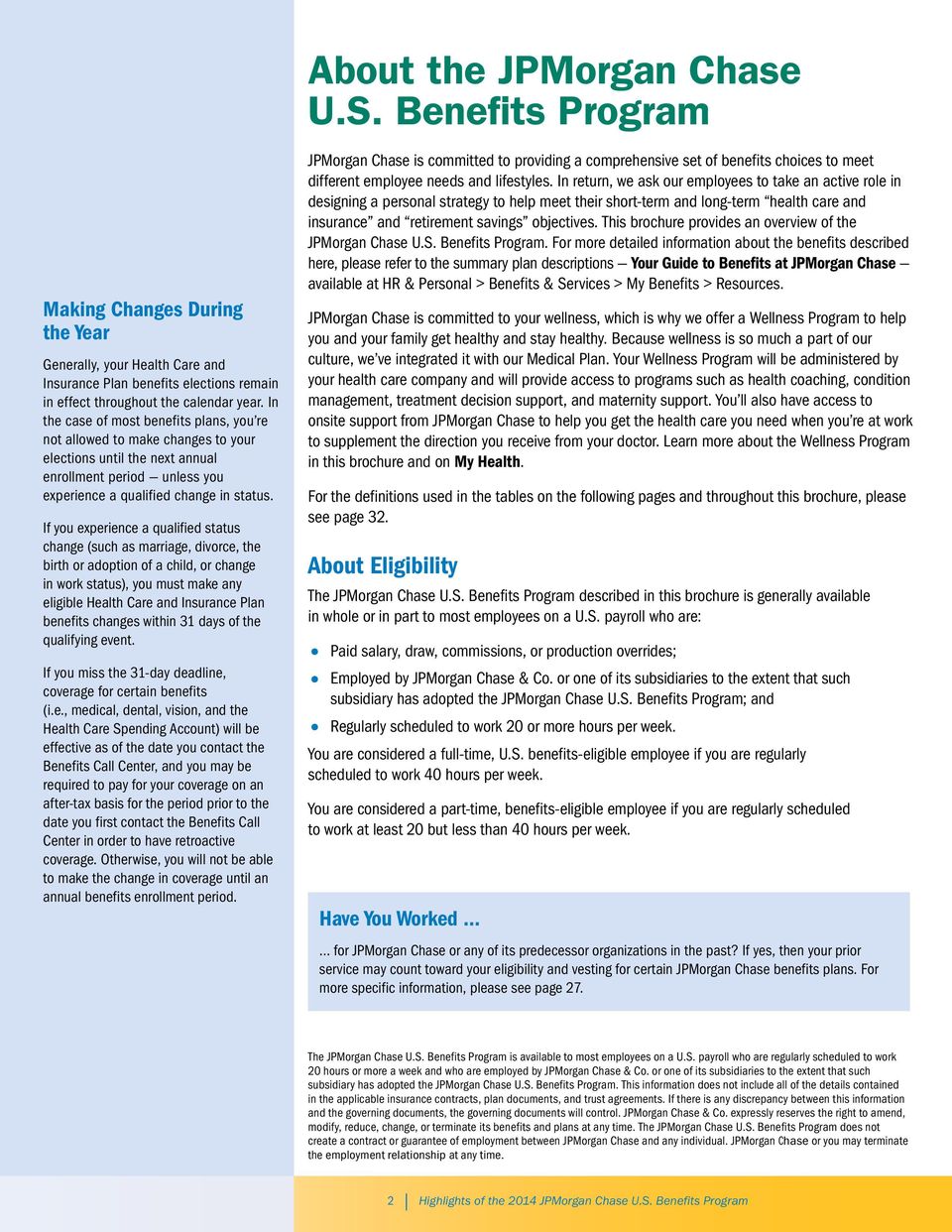
3 JPMorgan Chase Benefits at a Glance Health Care and Insurance Plans Benefit Medical Dental Vision Spending Accounts Health Care Child/Elder Care Transportation (Transit/Parking) Long-Term Disability (LTD) benefits Coverage Summary Two Consumer Driven Health Plan (CDHP) coverage options with a Medical Reimbursement Account (MRA) feature: Option 1 (has higher payroll contributions but lower deductibles and coinsurance maximums) Option 2 (has lower payroll contributions but higher deductibles and coinsurance maximums) Both options are offered by Cigna and UnitedHealthcare Prescription drug coverage (retail and mail-order) Prescription drug coverage has a completely different plan design than the other Medical Plan features and is not subject to the same deductibles. The MRA helps you pay your share of out-of-pocket medical and prescription drug expenses. All employees who are enrolled in the plan can earn funding by participating in certain wellness activities. When your covered spouse/domestic partner completes certain wellness activities, you earn additional MRA funding. No exclusions for pre-existing conditions In-network preventive care covered at 100% In-network primary care office visits covered at 90% with no deductible Employee and dependent coverage JPMorgan Chase and employee cost sharing Employee contributions on a before-tax basis are generally determined based on your level of Total Annual Cash Compensation (excluding overtime), the Medical Plan option chosen, your geographic location, number and type of dependents you cover, and whether you and/ or your covered spouse/domestic partner uses tobacco. You will pay for medical coverage for each covered family member individually (i.e., employee, spouse/domestic partner, and/or each child). Three coverage options depending on your home zip code: Preferred Dentist Program (PDP) Option Dental Maintenance Organization (DMO) Option Dental Health Maintenance Organization (DHMO) Option Employee and dependent coverage JPMorgan Chase and employee cost sharing Employee contributions on a before-tax basis Coverage for eligible vision expenses, such as eye exams, lenses (including contacts), and eyeglass frames Employee and dependent coverage You pay the full cost of coverage on a before-tax basis Health Care Spending Account Contributions up to $2,500 annually Child/Elder Care Spending Account Contributions generally up to $5,000 annually Transportation Spending Accounts Contributions for work commuting expenses for transit and parking. For 2014 contribution limits, go to My Work You pay the full cost of coverage on a before-tax basis For employees earning less than $60,000 in Total Annual Cash Compensation: Company-provided coverage of 60% of your Total Annual Cash Compensation Fully paid for by JPMorgan Chase For employees whose Total Annual Cash Compensation is $60,000 or more: Replacement of 50% of Total Annual Cash Compensation; or Replacement of 60% of Total Annual Cash Compensation $20,000 maximum monthly LTD benefit Tobacco user rates apply You pay the full cost of coverage on an after-tax basis For employees whose Total Annual Cash Compensation is greater than $400,000 and have met the $20,000 maximum monthly group benefit: Ability to purchase additional LTD coverage under an Individual Disability Insurance (IDI) policy IDI policy provides an additional maximum monthly LTD benefit of up to $15,000 Fully portable Tobacco user rates apply You pay the full cost of coverage on an after-tax basis 3 Highlights of the 2014 JPMorgan Chase U.S. Benefits Program When Participation begins for new hires* Full-time employees: First day of the month following your date of hire Part-time employees: First day of the month following 60 days from your date of hire See Medical See Medical See Medical See Medical * Indicates when participation begins if you enroll when first eligible. If you do not enroll when you are first eligible, your participation will not begin unless you enroll due to a qualified status change or during subsequent annual benefits enrollment periods. However, you are able to elect to participate at any time under the Transportation Spending Accounts and 401(k) Savings Plan.

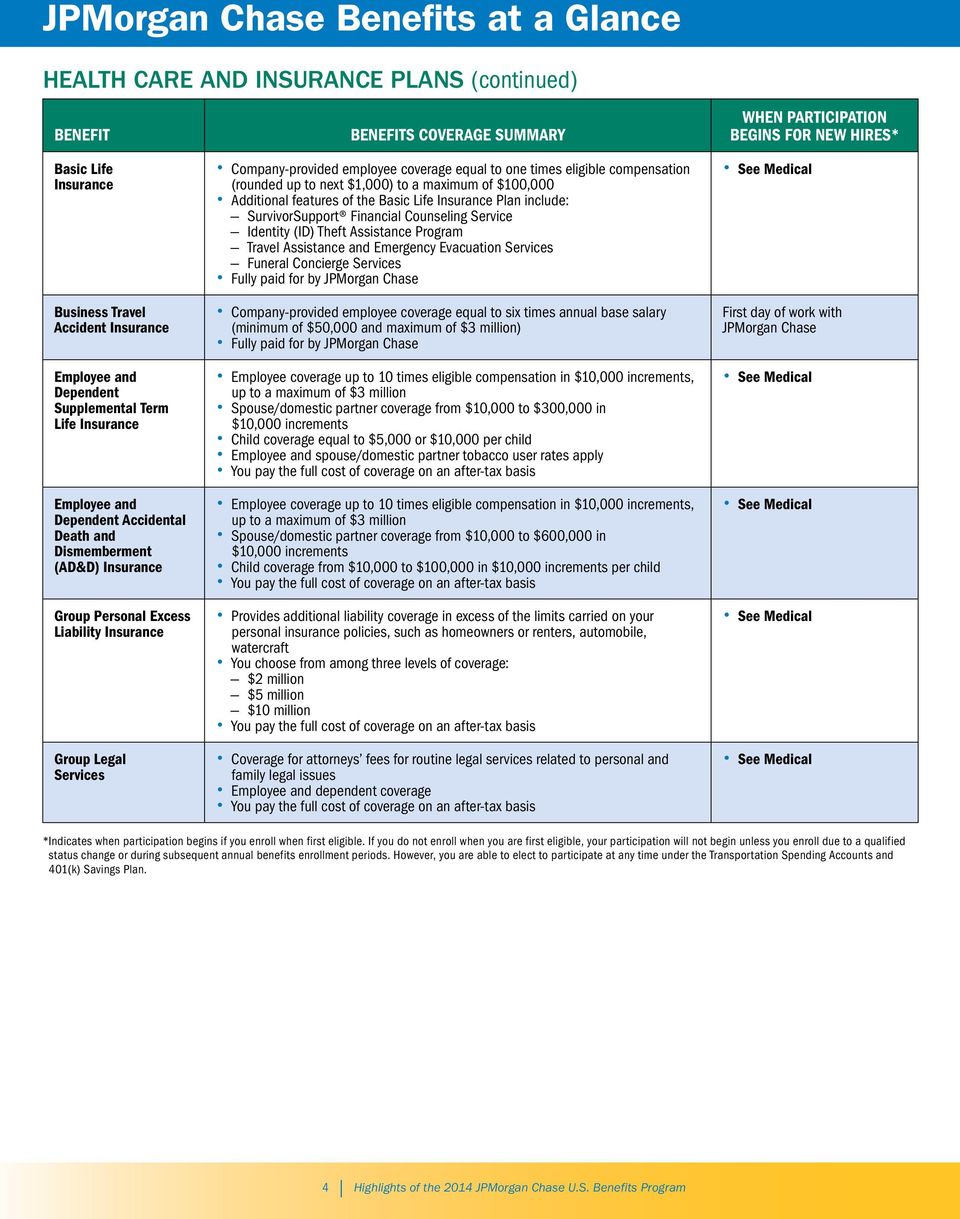
4 JPMorgan Chase Benefits at a Glance Health Care and Insurance Plans (continued) Benefit Basic Life Insurance Business Travel Accident Insurance Employee and Dependent Supplemental Term Life Insurance Employee and Dependent Accidental Death and Dismemberment (AD&D) Insurance Group Personal Excess Liability Insurance Group Legal Services benefits Coverage Summary Company-provided employee coverage equal to one times eligible compensation (rounded up to next $1,000) to a maximum of $100,000 Additional features of the Basic Life Insurance Plan include: SurvivorSupport Financial Counseling Service Identity (ID) Theft Assistance Program Travel Assistance and Emergency Evacuation Services Funeral Concierge Services Fully paid for by JPMorgan Chase Company-provided employee coverage equal to six times annual base salary (minimum of $50,000 and maximum of $3 million) Fully paid for by JPMorgan Chase Employee coverage up to 10 times eligible compensation in $10,000 increments, up to a maximum of $3 million Spouse/domestic partner coverage from $10,000 to $300,000 in $10,000 increments Child coverage equal to $5,000 or $10,000 per child Employee and spouse/domestic partner tobacco user rates apply You pay the full cost of coverage on an after-tax basis Employee coverage up to 10 times eligible compensation in $10,000 increments, up to a maximum of $3 million Spouse/domestic partner coverage from $10,000 to $600,000 in $10,000 increments Child coverage from $10,000 to $100,000 in $10,000 increments per child You pay the full cost of coverage on an after-tax basis Provides additional liability coverage in excess of the limits carried on your personal insurance policies, such as homeowners or renters, automobile, watercraft You choose from among three levels of coverage: $2 million $5 million $10 million You pay the full cost of coverage on an after-tax basis Coverage for attorneys fees for routine legal services related to personal and family legal issues Employee and dependent coverage You pay the full cost of coverage on an after-tax basis When Participation begins for new hires* See Medical First day of work with JPMorgan Chase See Medical See Medical See Medical See Medical * Indicates when participation begins if you enroll when first eligible. If you do not enroll when you are first eligible, your participation will not begin unless you enroll due to a qualified status change or during subsequent annual benefits enrollment periods. However, you are able to elect to participate at any time under the Transportation Spending Accounts and 401(k) Savings Plan. 4 Highlights of the 2014 JPMorgan Chase U.S. Benefits Program
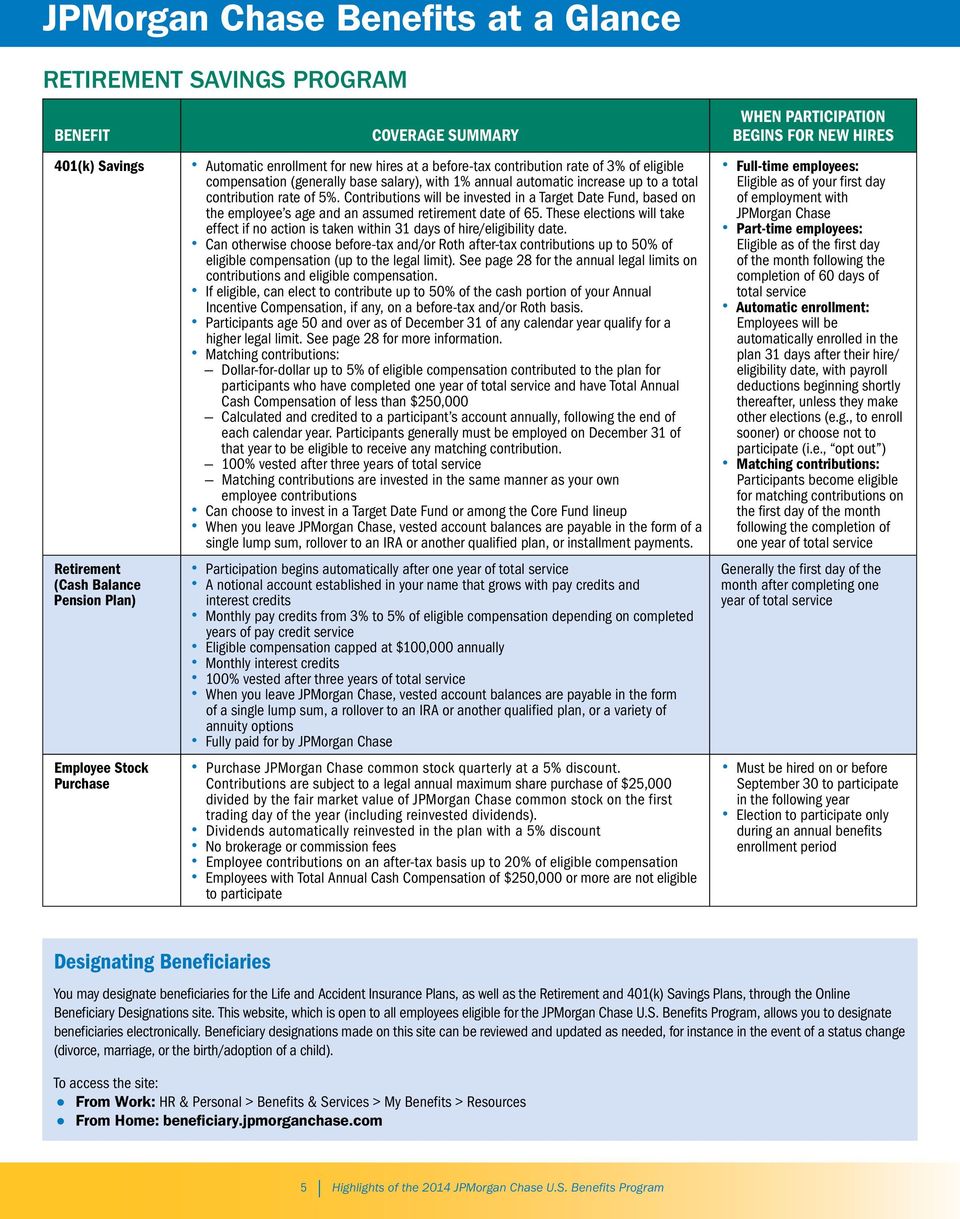
5 JPMorgan Chase Benefits at a Glance Retirement Savings Program Benefit 401(k) Savings Retirement (Cash Balance Pension Plan) Employee Stock Purchase Coverage Summary Automatic enrollment for new hires at a before-tax contribution rate of 3% of eligible compensation (generally base salary), with 1% annual automatic increase up to a total contribution rate of 5%. Contributions will be invested in a Target Date Fund, based on the employee s age and an assumed retirement date of 65. These elections will take effect if no action is taken within 31 days of hire/eligibility date. Can otherwise choose before-tax and/or Roth after-tax contributions up to 50% of eligible compensation (up to the legal limit). See page 28 for the annual legal limits on contributions and eligible compensation. If eligible, can elect to contribute up to 50% of the cash portion of your Annual Incentive Compensation, if any, on a before-tax and/or Roth basis. Participants age 50 and over as of December 31 of any calendar year qualify for a higher legal limit. See page 28 for more information. Matching contributions: Dollar-for-dollar up to 5% of eligible compensation contributed to the plan for participants who have completed one year of total service and have Total Annual Cash Compensation of less than $250,000 Calculated and credited to a participant s account annually, following the end of each calendar year. Participants generally must be employed on December 31 of that year to be eligible to receive any matching contribution. 100% vested after three years of total service Matching contributions are invested in the same manner as your own employee contributions Can choose to invest in a Target Date Fund or among the Core Fund lineup When you leave JPMorgan Chase, vested account balances are payable in the form of a single lump sum, rollover to an IRA or another qualified plan, or installment payments. Participation begins automatically after one year of total service A notional account established in your name that grows with pay credits and interest credits Monthly pay credits from 3% to 5% of eligible compensation depending on completed years of pay credit service Eligible compensation capped at $100,000 annually Monthly interest credits 100% vested after three years of total service When you leave JPMorgan Chase, vested account balances are payable in the form of a single lump sum, a rollover to an IRA or another qualified plan, or a variety of annuity options Fully paid for by JPMorgan Chase Purchase JPMorgan Chase common stock quarterly at a 5% discount. Contributions are subject to a legal annual maximum share purchase of $25,000 divided by the fair market value of JPMorgan Chase common stock on the first trading day of the year (including reinvested dividends). Dividends automatically reinvested in the plan with a 5% discount No brokerage or commission fees Employee contributions on an after-tax basis up to 20% of eligible compensation Employees with Total Annual Cash Compensation of $250,000 or more are not eligible to participate When Participation begins for new hires Full-time employees: Eligible as of your first day of employment with JPMorgan Chase Part-time employees: Eligible as of the first day of the month following the completion of 60 days of total service Automatic enrollment: Employees will be automatically enrolled in the plan 31 days after their hire/ eligibility date, with payroll deductions beginning shortly thereafter, unless they make other elections (e.g., to enroll sooner) or choose not to participate (i.e., opt out ) Matching contributions: Participants become eligible for matching contributions on the first day of the month following the completion of one year of total service Generally the first day of the month after completing one year of total service Must be hired on or before September 30 to participate in the following year Election to participate only during an annual benefits enrollment period Designating Beneficiaries You may designate beneficiaries for the Life and Accident Insurance Plans, as well as the Retirement and 401(k) Savings Plans, through the Online Beneficiary Designations site. This website, which is open to all employees eligible for the JPMorgan Chase U.S. Benefits Program, allows you to designate beneficiaries electronically. Beneficiary designations made on this site can be reviewed and updated as needed, for instance in the event of a status change (divorce, marriage, or the birth/adoption of a child). To access the site: From Work: HR & Personal > Benefits & Services > My Benefits > Resources From Home: beneficiary.jpmorganchase.com 5 Highlights of the 2014 JPMorgan Chase U.S. Benefits Program
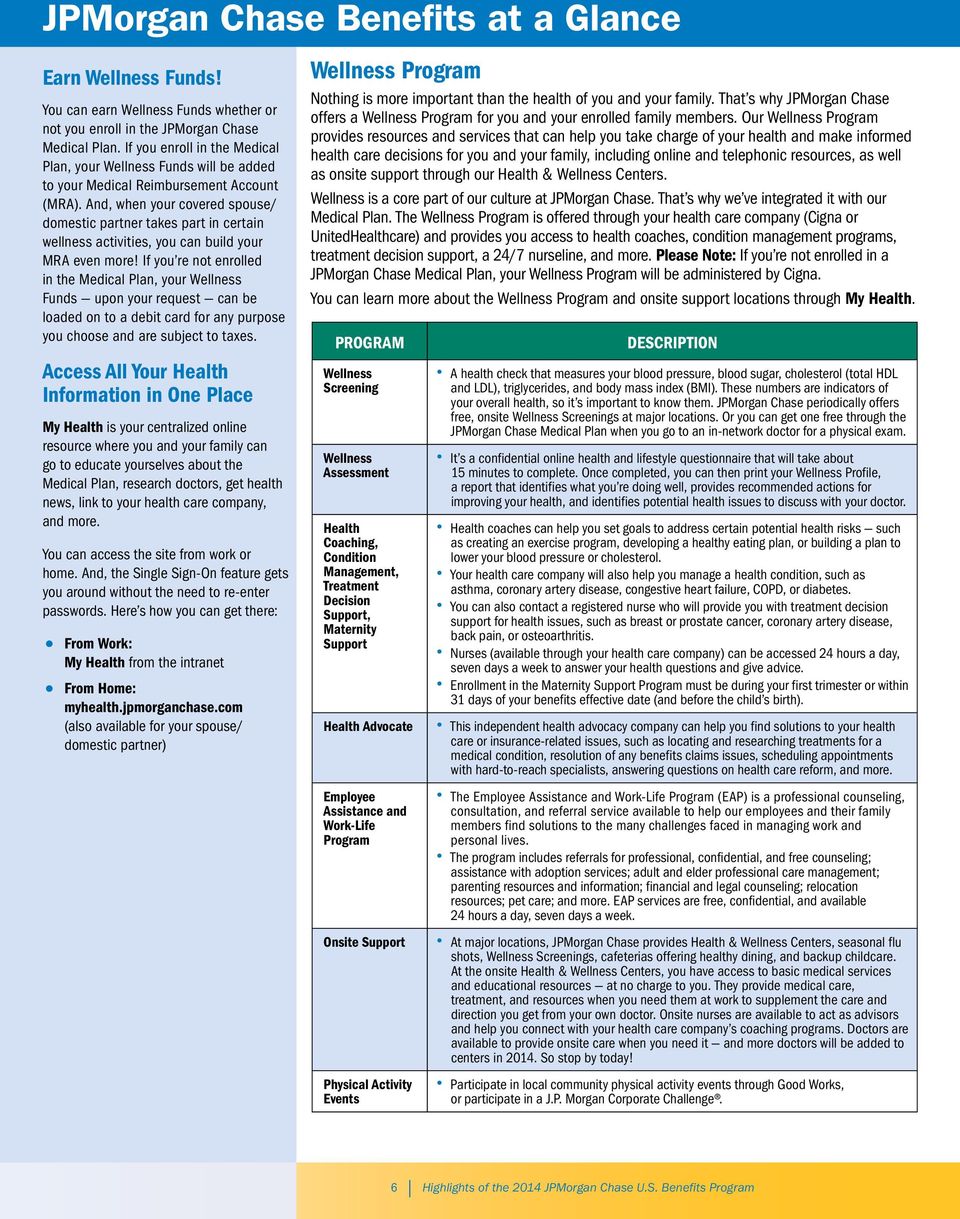
6 JPMorgan Chase Benefits at a Glance Earn Wellness Funds! You can earn Wellness Funds whether or not you enroll in the JPMorgan Chase Medical Plan. If you enroll in the Medical Plan, your Wellness Funds will be added to your Medical Reimbursement Account (MRA). And, when your covered spouse/ domestic partner takes part in certain wellness activities, you can build your MRA even more! If you re not enrolled in the Medical Plan, your Wellness Funds upon your request can be loaded on to a debit card for any purpose you choose and are subject to taxes. Access All Your Health Information in One Place My Health is your centralized online resource where you and your family can go to educate yourselves about the Medical Plan, research doctors, get health news, link to your health care company, and more. You can access the site from work or home. And, the Single Sign-On feature gets you around without the need to re-enter passwords. Here s how you can get there: From Work: My Health from the intranet From Home: myhealth.jpmorganchase.com (also available for your spouse/ domestic partner) Wellness Program Nothing is more important than the health of you and your family. That s why JPMorgan Chase offers a Wellness Program for you and your enrolled family members. Our Wellness Program provides resources and services that can help you take charge of your health and make informed health care decisions for you and your family, including online and telephonic resources, as well as onsite support through our Health & Wellness Centers. Wellness is a core part of our culture at JPMorgan Chase. That s why we ve integrated it with our Medical Plan. The Wellness Program is offered through your health care company (Cigna or UnitedHealthcare) and provides you access to health coaches, condition management programs, treatment decision support, a 24/7 nurseline, and more. Please Note: If you re not enrolled in a JPMorgan Chase Medical Plan, your Wellness Program will be administered by Cigna. You can learn more about the Wellness Program and onsite support locations through My Health. program Wellness Screening Wellness Assessment Health Coaching, Condition Management, Treatment Decision Support, Maternity Support Health Advocate Employee Assistance and Work-Life Program Onsite Support Physical Activity Events description A health check that measures your blood pressure, blood sugar, cholesterol (total HDL and LDL), triglycerides, and body mass index (BMI). These numbers are indicators of your overall health, so it s important to know them. JPMorgan Chase periodically offers free, onsite Wellness Screenings at major locations. Or you can get one free through the JPMorgan Chase Medical Plan when you go to an in-network doctor for a physical exam. It s a confidential online health and lifestyle questionnaire that will take about 15 minutes to complete. Once completed, you can then print your Wellness Profile, a report that identifies what you re doing well, provides recommended actions for improving your health, and identifies potential health issues to discuss with your doctor. Health coaches can help you set goals to address certain potential health risks such as creating an exercise program, developing a healthy eating plan, or building a plan to lower your blood pressure or cholesterol. Your health care company will also help you manage a health condition, such as asthma, coronary artery disease, congestive heart failure, COPD, or diabetes. You can also contact a registered nurse who will provide you with treatment decision support for health issues, such as breast or prostate cancer, coronary artery disease, back pain, or osteoarthritis. Nurses (available through your health care company) can be accessed 24 hours a day, seven days a week to answer your health questions and give advice. Enrollment in the Maternity Support Program must be during your first trimester or within 31 days of your benefits effective date (and before the child s birth). This independent health advocacy company can help you find solutions to your health care or insurance-related issues, such as locating and researching treatments for a medical condition, resolution of any benefits claims issues, scheduling appointments with hard-to-reach specialists, answering questions on health care reform, and more. The Employee Assistance and Work-Life Program (EAP) is a professional counseling, consultation, and referral service available to help our employees and their family members find solutions to the many challenges faced in managing work and personal lives. The program includes referrals for professional, confidential, and free counseling; assistance with adoption services; adult and elder professional care management; parenting resources and information; financial and legal counseling; relocation resources; pet care; and more. EAP services are free, confidential, and available 24 hours a day, seven days a week. At major locations, JPMorgan Chase provides Health & Wellness Centers, seasonal flu shots, Wellness Screenings, cafeterias offering healthy dining, and backup childcare. At the onsite Health & Wellness Centers, you have access to basic medical services and educational resources at no charge to you. They provide medical care, treatment, and resources when you need them at work to supplement the care and direction you get from your own doctor. Onsite nurses are available to act as advisors and help you connect with your health care company s coaching programs. Doctors are available to provide onsite care when you need it and more doctors will be added to centers in So stop by today! Participate in local community physical activity events through Good Works, or participate in a J.P. Morgan Corporate Challenge. 6 Highlights of the 2014 JPMorgan Chase U.S. Benefits Program
7 The Health Care and Insurance Plans Maintaining good health and protecting your income in case you re unable to work are important priorities in your life. That s why JPMorgan Chase offers a variety of options under our Health Care and Insurance Plans such as the Medical, Dental, Vision, Spending Accounts, Long-Term Disability, Life and Accident Insurance, Group Personal Excess Liability, and Group Legal Services Plans to provide you with the opportunity to select health care and insurance benefits that best suit your needs and those of your eligible dependents. Medical Plan JPMorgan Chase offers a type of Medical Plan known as a Consumer Driven Health Plan, or CDHP. This plan consists of two Medical Plan options: Option 1 and Option 2. Both options are offered through Cigna and UnitedHealthcare and both cover the same medically necessary services and supplies, including prescription drugs. The key differences between these options are: Option 1 has higher payroll contributions but lower deductibles and coinsurance maximums. Option 2 has lower payroll contributions but higher deductibles and coinsurance maximums. In-network preventive care services are fully covered (there is no annual deductible or coinsurance; subject to age and frequency guidelines). A brief overview of the Medical Plan provisions can be seen on the following page. In addition to providing coverage for your medical expenses, the Medical Plan includes wellness features that help you get and stay healthy by offering tools, resources, and financial incentives to help you improve your health and become an informed consumer of medical care. How the Plan Works Plan benefits are offered through a network of participating health care providers (for example, doctors, hospitals, labs, and outpatient facilities). While the most cost-effective care will always be available through in-network providers, you can choose to go in- or out-of-network each time you need care. Out-of-network charges do not apply toward the in-network annual deductible or coinsurance maximum. The same applies with in-network charges they do not apply toward the out-of-network deductible or coinsurance maximum. You generally must meet an annual deductible a set amount that you pay out of pocket before the plan shares in the costs for care. (Note that there are separate deductibles for in-network and out-of-network care.) Importantly, however, in-network preventive care, including physical exams and recommended preventive screenings, is covered at 100% with no deductible, coinsurance, or copayments; and in-network primary care office visits are covered at 90% with no deductible. (Primary care includes family practitioners, internists,* pediatricians, OB/GYNs, and convenience care clinics.) Committed to Your Health Our Medical Plan is built on the principle of a shared commitment to health. JPMorgan Chase demonstrates its commitment by providing valuable benefits, programs, and access to a suite of tools and resources. These are all designed to help you get and pay for the treatment you need, manage your health care expenses, and most importantly, take care of yourself. Your commitment is required, too. Your role is to take responsibility for the controllable aspects of your health care and health care spending. You can do this by getting preventive care, maintaining a proper diet and exercise regimen, carefully selecting your doctors and hospitals, as well as understanding your treatment alternatives and their costs. Go to My Health to research quality ratings of medical providers, connect to your health care company, find out about ways to lower your prescription drug costs, and more. In addition, when you take the right steps, such as participating in Wellness Programs, you get funds from JPMorgan Chase added to your MRA to help pay your out-of-pocket medical and prescription drug expenses (deductibles, coinsurance, and copayments) tax-free. Important Note You must contact a coach/nurse at your health care company (Cigna or UnitedHealthcare) before you receive infertility services or have bariatric surgery to be eligible for benefits under the Medical Plan. Contact your health care company for details. For other services, the plan pays a percentage (generally 80% in-network and 60% out-of-network) of the cost once you meet the annual deductible. Your share called coinsurance, which is the amount you and the plan share for certain expenses after the deductible is typically 20% of the cost of in-network care and 40% of the cost for out-of-network care. The plan s coinsurance maximum your financial safety net limits the amount you are required to pay in coinsurance each year. There are separate coinsurance maximums for in-network and out-of-network charges. Prescription drugs are subject to an entirely separate plan design (see page 9 for details). * Internists must be contracted with Cigna or UnitedHealthcare as a primary care physician (PCP). Go to the Cigna or the UnitedHealthcare website through My Health to search for PCPs/primary care. 7 Highlights of the 2014 JPMorgan Chase U.S. Benefits Program

8 Both plan options come with a Medical Reimbursement Account (MRA) fully funded by JPMorgan Chase that you can use to help pay for out-of-pocket medical and prescription drug expenses, such as deductibles and coinsurance. See page 11 for more information on the MRA. Our Health Care Companies JPMorgan Chase partners with Cigna and UnitedHealthcare to administer our Medical Plan. You can choose to have one of these health care companies administer your Medical Plan, regardless of whether you choose Option 1 or Option 2. Both are large, established companies that offer broad nationwide provider networks. They also offer strong, well-established clinical programs and provide tools and resources to help you research and understand your health treatment alternatives. Important Note About Providers Leaving Networks When considering your options under the Medical Plan, remember that if your doctor leaves a network, it does not qualify as an event that allows you to change coverage during the year. You may want to check with your provider to ensure that he or she plans to continue to participate in the network of the health care company you decide to choose. Coverage Levels Option 1 Option 2 In-Network Out-of-Network In-Network Out-of-Network ANNUAL DEDUCTIBLE Employee* $1,500 $2,500 $2,500 $4,500 Employee + Spouse/Domestic Partner $2,250 $3,750 $3,750 $6,750 or Child(ren) Family $3,000 $5,000 $5,000 $9,000 ANNUAL COINSURANCE MAXIMUM (DOES NOT INCLUDE DEDUCTIBLE) Total Annual Cash Compensation: < $60,000 Employee* $750 $4,000 $2,500 $6,000 Employee + Spouse/Domestic Partner $1,125 $6,000 $3,750 $8,000 or Child(ren) Family $1,500 $8,000 $5,000 $12,000 Total Annual Cash Compensation: $60,000 $149,999 Employee* $1,250 $4,000 $3,500 $6,000 Employee + Spouse/Domestic Partner $1,875 $6,000 $5,250 $8,000 or Child(ren) Family $2,500 $8,000 $7,000 $12,000 Total Annual Cash Compensation: $150,000+ Employee* $2,000 $4,000 $3,500 $6,000 Employee + Spouse/Domestic Partner $3,000 $6,000 $5,250 $8,000 or Child(ren) Family $4,000 $8,000 $7,000 $12,000 * Also serves as a per person deductible or coinsurance maximum under other coverage levels. For more details on the per person rule, please see the Medical Plan Overview available on My Health. Medical Benefit Provisions Coverage for Option 1 and Option 2 In-Network Out-of-Network Preventive Care 100% before deductible 60% after deductible Primary Care Office Visit 90% before deductible 60% after deductible (Primary care includes family practitioners, internists,** pediatricians, OB/GYNs, and convenience care clinics.) Specialist Office Visit 80% after deductible 60% after deductible Other Medical Costs 80% after deductible 60% after deductible (Hospitalizations, Labs, etc.) Emergency Care 80% after deductible (60% after deductible for non-emergencies) ** Internists must be contracted with Cigna or UnitedHealthcare as a primary care physician (PCP). Go to the Cigna or the UnitedHealthcare website through My Health to search for PCPs/primary care. Please Note: This chart presents an overview of plan design features for more detailed information, please contact your health care company or use the Health Plan Comparison Charts on the Benefits Web Center, which you can access through My Health. With the Health Plan Comparison Charts, you can easily compare specific features (e.g., costs, deductibles, coinsurance) of the two Medical Plan options. Don t forget: You have your Medical Reimbursement Account (MRA) to help pay your annual deductible and coinsurance. See page 11 for details. 8 Highlights of the 2014 JPMorgan Chase U.S. Benefits Program

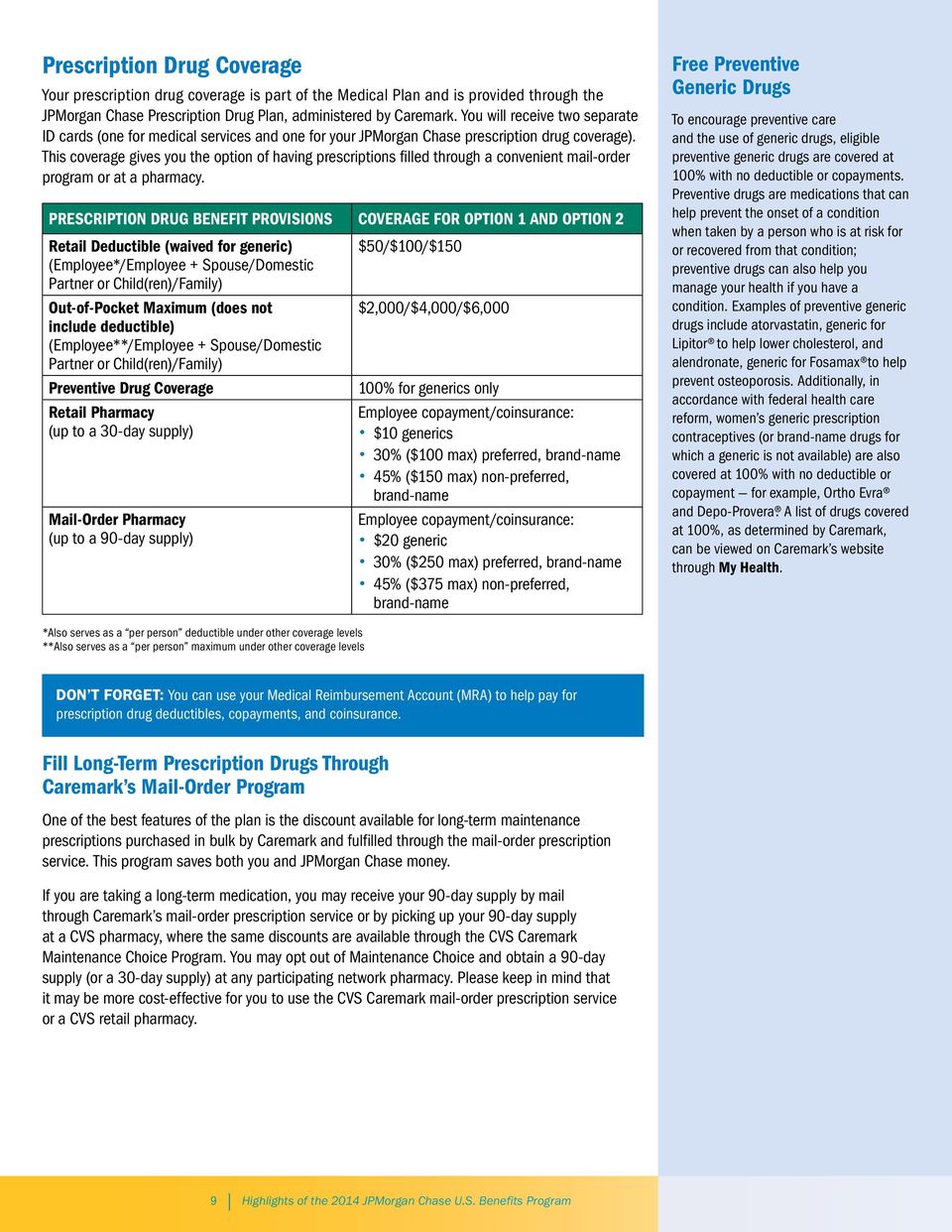
9 Prescription Drug Coverage Your prescription drug coverage is part of the Medical Plan and is provided through the JPMorgan Chase Prescription Drug Plan, administered by Caremark. You will receive two separate ID cards (one for medical services and one for your JPMorgan Chase prescription drug coverage). This coverage gives you the option of having prescriptions filled through a convenient mail-order program or at a pharmacy. Prescription Drug Benefit Provisions Coverage for Option 1 and Option 2 Retail Deductible (waived for generic) $50/$100/$150 (Employee*/Employee + Spouse/Domestic Partner or Child(ren)/Family) Out-of-Pocket Maximum (does not $2,000/$4,000/$6,000 include deductible) (Employee**/Employee + Spouse/Domestic Partner or Child(ren)/Family) Preventive Drug Coverage 100% for generics only Retail Pharmacy (up to a 30-day supply) Mail-Order Pharmacy (up to a 90-day supply) Employee copayment/coinsurance: $10 generics 30% ($100 max) preferred, brand-name 45% ($150 max) non-preferred, brand-name Employee copayment/coinsurance: $20 generic 30% ($250 max) preferred, brand-name 45% ($375 max) non-preferred, brand-name Free Preventive Generic Drugs To encourage preventive care and the use of generic drugs, eligible preventive generic drugs are covered at 100% with no deductible or copayments. Preventive drugs are medications that can help prevent the onset of a condition when taken by a person who is at risk for or recovered from that condition; preventive drugs can also help you manage your health if you have a condition. Examples of preventive generic drugs include atorvastatin, generic for Lipitor to help lower cholesterol, and alendronate, generic for Fosamax to help prevent osteoporosis. Additionally, in accordance with federal health care reform, women s generic prescription contraceptives (or brand-name drugs for which a generic is not available) are also covered at 100% with no deductible or copayment for example, Ortho Evra and Depo-Provera. A list of drugs covered at 100%, as determined by Caremark, can be viewed on Caremark s website through My Health. *Also serves as a per person deductible under other coverage levels **Also serves as a per person maximum under other coverage levels Don t forget: You can use your Medical Reimbursement Account (MRA) to help pay for prescription drug deductibles, copayments, and coinsurance. Fill Long-Term Prescription Drugs Through Caremark s Mail-Order Program One of the best features of the plan is the discount available for long-term maintenance prescriptions purchased in bulk by Caremark and fulfilled through the mail-order prescription service. This program saves both you and JPMorgan Chase money. If you are taking a long-term medication, you may receive your 90-day supply by mail through Caremark s mail-order prescription service or by picking up your 90-day supply at a CVS pharmacy, where the same discounts are available through the CVS Caremark Maintenance Choice Program. You may opt out of Maintenance Choice and obtain a 90-day supply (or a 30-day supply) at any participating network pharmacy. Please keep in mind that it may be more cost-effective for you to use the CVS Caremark mail-order prescription service or a CVS retail pharmacy. 9 Highlights of the 2014 JPMorgan Chase U.S. Benefits Program
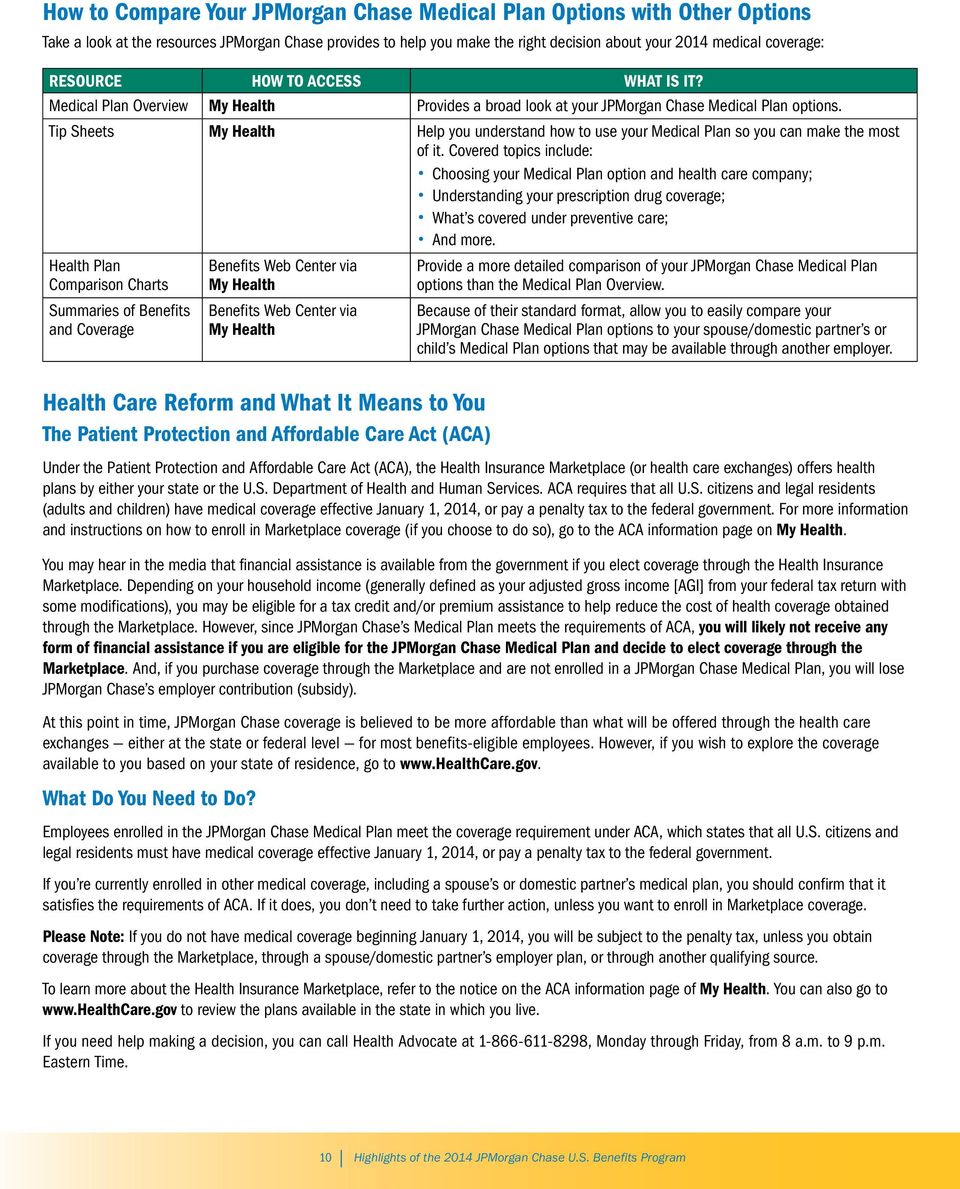
10 How to Compare Your JPMorgan Chase Medical Plan Options with Other Options Take a look at the resources JPMorgan Chase provides to help you make the right decision about your 2014 medical coverage: Resource How to Access What Is It? Medical Plan Overview My Health Provides a broad look at your JPMorgan Chase Medical Plan options. Tip Sheets My Health Help you understand how to use your Medical Plan so you can make the most of it. Covered topics include: Choosing your Medical Plan option and health care company; Understanding your prescription drug coverage; What s covered under preventive care; And more. Health Plan Comparison Charts Summaries of Benefits and Coverage Benefits Web Center via My Health Benefits Web Center via My Health Health Care Reform and What It Means to You The Patient Protection and Affordable Care Act (ACA) Provide a more detailed comparison of your JPMorgan Chase Medical Plan options than the Medical Plan Overview. Because of their standard format, allow you to easily compare your JPMorgan Chase Medical Plan options to your spouse/domestic partner s or child s Medical Plan options that may be available through another employer. Under the Patient Protection and Affordable Care Act (ACA), the Health Insurance Marketplace (or health care exchanges) offers health plans by either your state or the U.S. Department of Health and Human Services. ACA requires that all U.S. citizens and legal residents (adults and children) have medical coverage effective January 1, 2014, or pay a penalty tax to the federal government. For more information and instructions on how to enroll in Marketplace coverage (if you choose to do so), go to the ACA information page on My Health. You may hear in the media that financial assistance is available from the government if you elect coverage through the Health Insurance Marketplace. Depending on your household income (generally defined as your adjusted gross income [AGI] from your federal tax return with some modifications), you may be eligible for a tax credit and/or premium assistance to help reduce the cost of health coverage obtained through the Marketplace. However, since JPMorgan Chase s Medical Plan meets the requirements of ACA, you will likely not receive any form of financial assistance if you are eligible for the JPMorgan Chase Medical Plan and decide to elect coverage through the Marketplace. And, if you purchase coverage through the Marketplace and are not enrolled in a JPMorgan Chase Medical Plan, you will lose JPMorgan Chase s employer contribution (subsidy). At this point in time, JPMorgan Chase coverage is believed to be more affordable than what will be offered through the health care exchanges either at the state or federal level for most benefits-eligible employees. However, if you wish to explore the coverage available to you based on your state of residence, go to What Do You Need to Do? Employees enrolled in the JPMorgan Chase Medical Plan meet the coverage requirement under ACA, which states that all U.S. citizens and legal residents must have medical coverage effective January 1, 2014, or pay a penalty tax to the federal government. If you re currently enrolled in other medical coverage, including a spouse s or domestic partner s medical plan, you should confirm that it satisfies the requirements of ACA. If it does, you don t need to take further action, unless you want to enroll in Marketplace coverage. Please Note: If you do not have medical coverage beginning January 1, 2014, you will be subject to the penalty tax, unless you obtain coverage through the Marketplace, through a spouse/domestic partner s employer plan, or through another qualifying source. To learn more about the Health Insurance Marketplace, refer to the notice on the ACA information page of My Health. You can also go to to review the plans available in the state in which you live. If you need help making a decision, you can call Health Advocate at , Monday through Friday, from 8 a.m. to 9 p.m. Eastern Time. 10 Highlights of the 2014 JPMorgan Chase U.S. Benefits Program
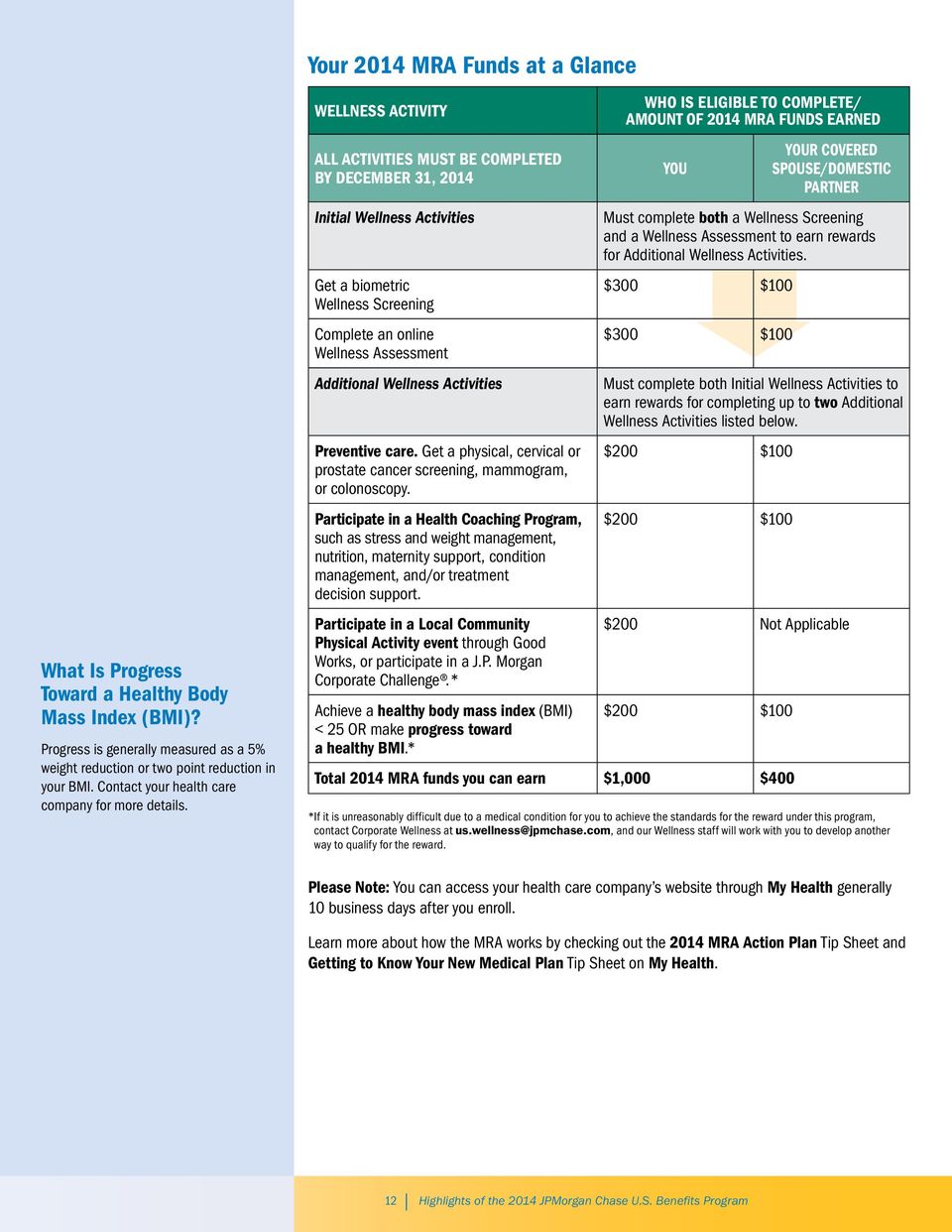
11 The Medical Reimbursement Account (MRA) A key feature of the Medical Plan is the Medical Reimbursement Account (MRA). JPMorgan Chase contributes money to your MRA to help you pay for out-of-pocket medical and prescription drug expenses. JPMorgan Chase wants to reward you for taking healthy action and leading a healthier lifestyle. That s why we contribute money to your MRA when you complete certain wellness activities, including a Wellness Assessment and Wellness Screening. When you do, you ll get a snapshot of important indicators of your health, as well as any potential risk factors you may have. This information can help you take steps to either keep up the good work or make changes so you can be the best you can be. Here s how you can earn MRA funds for 2014: Complete Initial Wellness Activities (Wellness Screening and Wellness Assessment) and earn $300 for each for a total of $600. Please Note: You must complete Initial Wellness Activities to be able to earn funds for completing Additional Wellness Activities. There are three ways to get a Wellness Screening: 1. Employees can sign up for an onsite Wellness Screening, available at more than 100 larger JPMorgan Chase locations at various times throughout the year. 2. Schedule a screening at a participating local lab (get lab screening information and forms on My Health). 3. Visit your in-network doctor (download a Wellness Screening Results Form from My Health and bring it with you). Please Note: Your covered spouse/domestic partner can get a free Wellness Screening too through a participating local lab or in-network doctor. Understand How the Wellness Screening and Wellness Assessment Work A Wellness Screening provides overall key indicators of your health. Screenings give you your blood pressure, blood sugar, cholesterol, triglycerides, and body mass index (BMI) numbers. And the Wellness Assessment is a simple, online health and lifestyle questionnaire that takes about 15 minutes to complete. Together, your Wellness Screening and Wellness Assessment results provide you with helpful information about what you re doing well, recommendations for improving your health, and potential issues to discuss with your doctor. Please Note: All Wellness Activities must be completed by December 31, 2014, to earn funds for your MRA. Go to My Health for full details. Complete up to two Additional Wellness Activities, and earn $200 each for a total of $400. So, when you complete these activities, you can earn $1,000 in your MRA for You can use the funds to pay for eligible out-of-pocket medical and prescription drug expenses you ll have in 2014, or in future years! Covered Spouses/Domestic Partners Can Take Action, Too Since we also believe it s important to help your covered spouse/domestic partner be the best he or she can be, you will earn $100 for each Initial Wellness Activity (Wellness Screening and Wellness Assessment) that he or she completes. Then, you can go on to earn another $200 for two Additional Wellness Activities ($100 each) that he or she completes in That s $400 more that you can earn when your covered spouse/domestic partner takes action for his or her health! If You Don t Enroll in a JPMorgan Chase Medical Plan for 2014 You ll still be able to earn up to $600 in Wellness Rewards that can be loaded on to a debit card. You can earn rewards by getting a Wellness Screening and completing an online Wellness Assessment ($300 for each). These activities must be completed by December 31, 2014, to earn Wellness Rewards. 11 Highlights of the 2014 JPMorgan Chase U.S. Benefits Program
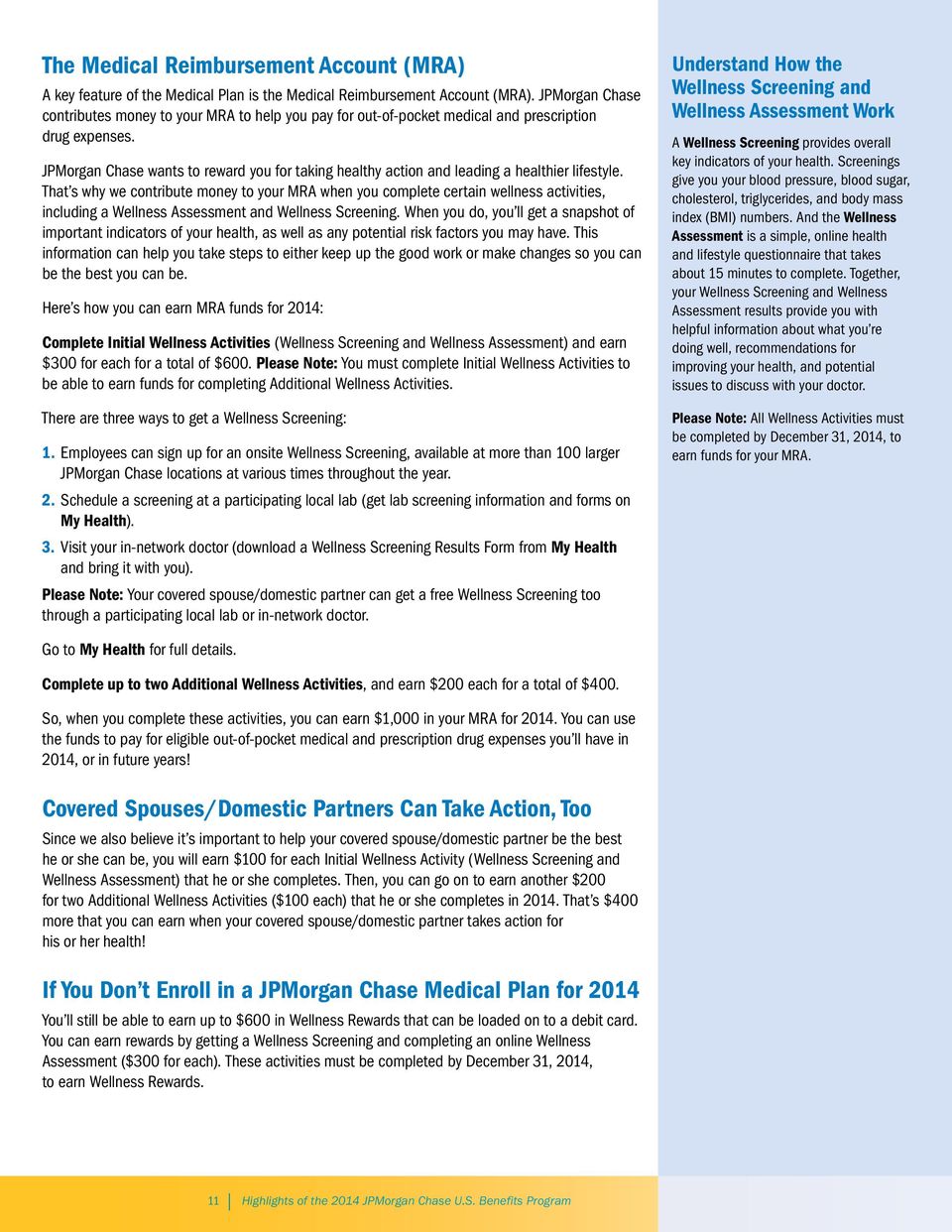
12 Your 2014 MRA Funds at a Glance What Is Progress Toward a Healthy Body Mass Index (BMI)? Progress is generally measured as a 5% weight reduction or two point reduction in your BMI. Contact your health care company for more details. Wellness Activity All activities must be completed by December 31, 2014 Initial Wellness Activities Get a biometric Wellness Screening Complete an online Wellness Assessment Additional Wellness Activities Preventive care. Get a physical, cervical or prostate cancer screening, mammogram, or colonoscopy. Participate in a Health Coaching Program, such as stress and weight management, nutrition, maternity support, condition management, and/or treatment decision support. Participate in a Local Community Physical Activity event through Good Works, or participate in a J.P. Morgan Corporate Challenge. * Achieve a healthy body mass index (BMI) < 25 OR make progress toward a healthy BMI.* Who is Eligible to Complete/ Amount of 2014 MRA Funds earned You Your Covered Spouse/Domestic Partner Must complete both a Wellness Screening and a Wellness Assessment to earn rewards for Additional Wellness Activities. $300 $100 $300 $100 Must complete both Initial Wellness Activities to earn rewards for completing up to two Additional Wellness Activities listed below. $200 $100 $200 $100 $200 Not Applicable $200 $100 Total 2014 MRA funds you can earn $1,000 $400 * If it is unreasonably difficult due to a medical condition for you to achieve the standards for the reward under this program, contact Corporate Wellness at [email protected], and our Wellness staff will work with you to develop another way to qualify for the reward. Please Note: You can access your health care company s website through My Health generally 10 business days after you enroll. Learn more about how the MRA works by checking out the 2014 MRA Action Plan Tip Sheet and Getting to Know Your New Medical Plan Tip Sheet on My Health. 12 Highlights of the 2014 JPMorgan Chase U.S. Benefits Program
13 Paying Expenses Through Your MRA Benefits enrollment is the time you ll choose how you want expenses to be paid by your MRA through automatic claim payment or debit card. Learn more about paying your expenses through your MRA by accessing the Differences Between MRA and HCSA and Automatic Claim vs. Debit Card Tip Sheets through My Health. Please Note: If you elect to participate in the Health Care Spending Account (HCSA), the payment method you choose for your MRA will also be used for your HCSA. In addition, if you don t make an election, your payment method will default to automatic claim payment and generally cannot be changed until the next annual benefits enrollment. For claim forms or to check your MRA and HCSA balances, go to My Health. Payment Method Automatic Claim Payment Debit Card HOW IT WORKS After your health care company pays its share of the cost of care, your health care company will pay your doctor/pharmacy your share of the cost. They ll use your MRA funds first, then your HCSA funds (if applicable). Once both MRA and HCSA funds are gone, you ll pay any remaining expenses out of your pocket when billed by your doctor. If you re filling a prescription, you ll pay any remaining balance not covered by funds in your MRA and/or HCSA at the time you purchase the drug. The pharmacy will let you know about any amount you owe. If you re using your HCSA to pay for eligible dental and vision expenses not payable under your plans (e.g., coinsurance for dental services, eyeglasses), you ll need to pay out of your own pocket, then submit a paper claim form (via mail or fax) to access your HCSA balance. After your health care company pays its share of the cost of care, you can use your debit card to pay your share of the cost of eligible out-of-pocket medical care and prescription drugs from your MRA and then your HCSA. (Give your debit card number to your doctor when you are billed for services or your pharmacy when you purchase a prescription drug, and your share of the expenses will automatically be taken out of your accounts.) You can also use your debit card to pay for eligible out-of-pocket dental and vision expenses out of your HCSA, as long as your provider accepts debit cards. You can also pay out of pocket and later submit a paper claim form to Cigna or UnitedHealthcare, available on My Health > Claim Forms. Deciding Which Payment Method to Choose In some cases, choosing the debit card over automatic claim payment may be better for you, and vice versa. Here are some examples: AUTOMATIC CLAIM PAYMENT MAY BE BETTER FOR YOU IF YOU Have doctors and providers who don t accept credit cards. Want to avoid the substantiation process, which requires you to provide receipts when your health care company can t match expenses to a claim. Don t have coverage through another medical plan. Please Note: You are not able to apply any other form of payment at the time of your transaction if you elect the automatic claim payment option. THE DEBIT CARD MAY BE BETTER FOR YOU IF YOU Also have coverage through another medical plan, such as your spouse s plan, Medicare, or Medicaid. Use a prescription drug discount card provided by a drug manufacturer or foundation. Elect the HCSA and want to use that account at the time of service to pay for dental and vision expenses. 13 Highlights of the 2014 JPMorgan Chase U.S. Benefits Program

14 Be Sure Your Dependents Are Eligible You are responsible for understanding the dependent eligibility rules and abiding by them as well as providing acceptable documentation when requested. When you first enroll and each year during your designated enrollment period, or within 31 days following a qualified status change, it is important that you review both the dependent eligibility rules and the status of your covered dependents to ensure that you cover only eligible dependents. Review dependent eligibility requirements on My Health, and do not enroll any ineligible dependents. Eligible Dependents In addition to employee coverage, your dependents are also generally eligible for coverage under the JPMorgan Chase Medical Plan. When you enroll for coverage, you need to certify online that your dependent meets the eligibility requirements. You will then be asked to provide acceptable documentation supporting eligibility. Eligible dependents generally include: Your spouse* or domestic partner; and You and/or your spouse/domestic partner s children Up to the end of the month in which they turn 26 Can be covered regardless of student or marital status, financial dependence on parents, residency with parents, or eligibility for coverage under another health plan * The U.S. Supreme Court and federal regulatory agencies recently ruled that same-sex couples who are legally married under state or foreign law will be treated as married for federal tax purposes. This means that JPMorgan Chase benefits will consider you as married, regardless of the sex of your spouse. Please Note: You may continue coverage beyond age 26 for an unmarried child who is not capable of supporting himself or herself due to a mental or physical disability that began before the age limits described above and who is fully dependent on you for financial support. Domestic Partners To qualify as an eligible dependent under the JPMorgan Chase U.S. Benefits Program, you and your domestic partner must meet all the following conditions: 1. Be age 18 or older; and 2. Not be legally married to, or the domestic partner of, anyone else; and 3. Have lived together for at least six months; are currently living together; and have a serious, committed, romantic relationship; and 4. Be financially interdependent (share responsibility for household expenses); and 5. Not be related to each other in a way that would prohibit legal marriage; OR Have registered as domestic partners pursuant to a domestic partnership ordinance or law of a state or local government, or under the laws of a foreign jurisdiction. For additional information on covering domestic partners, please review the information on My Health. 14 Highlights of the 2014 JPMorgan Chase U.S. Benefits Program

15 Coverage Categories The JPMorgan Chase Medical Plan offers four coverage categories to help match your coverage needs: Employee Only Employee Plus One Adult (spouse or domestic partner) Employee Plus Child(ren) Employee Plus Family (spouse or domestic partner plus child[ren]) Cost for Coverage You and JPMorgan Chase share the cost of coverage under the Medical Plan. Your contributions are deducted from your pay on a before-tax basis before federal (and, in most cases, state and local) income taxes are withheld. The amount you pay depends on the level of your Total Annual Cash Compensation (excluding overtime), the medical option you choose, where you live, the number and type of eligible dependents you cover, and if you and your covered spouse/domestic partner use tobacco. You will have a higher cost for coverage if your Total Annual Cash Compensation is higher, you cover more dependents under your Medical Plan option, and/or costs in your geographic area are higher than average. The following chart shows the Total Annual Cash Compensation levels currently used to determine employee before-tax contributions under the Medical Plan. (Specific contribution rates for each of your available Medical Plan options will be communicated during your designated enrollment period.) Please see page 32 for the definition of Total Annual Cash Compensation. Total Annual Cash Compensation Levels Used to Determine Medical Plan Contributions Level Total Annual Cash Compensation (excluding overtime) < $35,000 $35,000 $59, $60,000 $79, $80,000 $149, $150,000 $249, $250,000 $349, $350,000 and above Employee Pays Least Most 15 Highlights of the 2014 JPMorgan Chase U.S. Benefits Program

16 Contribution Costs for Each Covered Family Member To more accurately reflect the true cost of coverage and to fairly distribute that cost among employees, you will pay for each family member that you cover under a JPMorgan Chase Medical Plan option, including each child. You will be charged for a maximum of four children, even if you cover more than that under your plan. (You can cover all of your children, as long as they meet eligibility requirements. You will only pay the per-child costs for the first four children you choose to cover.) This itemized pricing will not only help you evaluate the cost of each family member s coverage, but will also give you information to more accurately compare your Medical Plan options and costs. Contributions will also vary based on your Total Annual Cash Compensation, geographical location, option you select, and if you and your covered spouse/domestic partner use tobacco. Here s how it works: Example 1* Jack wants to cover himself, his wife, and their three children under Medical Option 1. He will pay one price for himself, one price for his wife, and one price for each of his three children. When combined, this will equal his total contribution for medical coverage. Jack s employee-only rate + wife s rate + (per child rate 3) = Jack s total monthly contribution for medical coverage [$71 + $160 + ($49.75 x 3)] = $ Example 2* Barbara wants to cover herself, her husband, and their five children under Medical Option 1. She will pay one price for herself, one price for her husband, and one price for each of four of her children. She will not pay an additional per-child price for her fifth child because per-child costs apply only up to four children, even though she will have coverage for her five children. Barbara s employee-only rate + husband s rate + (per child rate 4) = Barbara s total monthly contribution for medical coverage [$71 + $160 + ($49.75 x 4)] = $430 * These examples are for illustrative purposes only and represent participation in Medical Option 1, average geographical price region, and Total Annual Cash Compensation of < $35,000. Your actual rates could be different from those represented here. Higher Rates for Tobacco Users for Certain Benefits Coverage All U.S. benefits-eligible employees (and their covered spouses/ domestic partners, where applicable) who use tobacco will pay higher rates under the following Health Care and Insurance Plans: Medical Plan (employee and spouse/domestic partner coverage); Supplemental Term Life Insurance Plan (employee and spouse/ domestic partner coverage); and Long-Term Disability Plan (employee coverage). If you use tobacco, you will pay an additional $60 per month under the Medical Plan. If your covered spouse/domestic partner also uses tobacco, you will pay an additional $120 per month under the Medical Plan. Under the JPMorgan Chase U.S. Benefits Program, a tobacco user (for a plan year) is any person who has used any type of tobacco products (i.e., cigarettes, cigars, chewing tobacco, snuff, or a pipe) regardless of the frequency or location (this includes daily, occasionally, socially, at home only, etc.) in the 12 months preceding January 1 of the plan year. When you enroll as a newly eligible employee or during a subsequent annual enrollment period, you will declare a non-tobacco user/ tobacco user status for yourself and your covered spouse/domestic partner. The status you report will remain in effect for the calendar year. After you (and/or your covered spouse/domestic partner) have been tobacco-free for 12 months (as of January 1 each year) or completed a pre-approved tobacco cessation course and certified attendance by the applicable deadline (as part of the annual benefits enrollment process), you ll be eligible for lower non-tobacco user rates beginning January 1 of the following year. If you are hired before October 1, you will be assigned non-tobacco user rates for the current calendar year for you and your covered spouse/domestic partner even if you declare yourself and/or your spouse/domestic partner a tobacco user, because you and/or your spouse/domestic partner may not have had an opportunity to complete a Tobacco Cessation Program in order to qualify for the lower non-tobacco user rates. You ll receive more information regarding the opportunity to update your tobacco user status during the annual benefits enrollment period. More information on Tobacco Cessation Programs and requirements is available on My Health > Take Action. If you are hired on or after October 1, for the current plan year and the following plan year you will be assigned non-tobacco user rates for your and your spouse/domestic partner s coverage for certain benefits. 16 Highlights of the 2014 JPMorgan Chase U.S. Benefits Program

17 Dental Plan JPMorgan Chase offers three dental coverage options based on where you live. All options provide coverage for preventive care, basic and major restorative care, as well as orthodontia services for dependent children (up to age 19). Here s a brief overview of each Dental Plan option: Dental Options at a Glance Provision Preferred Dentist Program (PDP) Option MetLife In-Network Out-of-Network Dental Maintenance Organization (DMO) Option Aetna Dental Health Maintenance Organization (DHMO) Option CIGNA Annual Deductible Preventive None None None None Restorative (basic and major) $50 individual, $150 family $100 individual, $300 family None None Covered Services Preventive (exams, cleanings, X-rays, sealants) (no deductible) 100% coverage 90% coverage 100% coverage 100% coverage* with $0 copayment Basic restorative (fillings, extractions, periodontal, oral surgery, anesthesia) 80% coverage after deductible 70% coverage after deductible 80% coverage Approximately 80% coverage* with copayments ranging from $0 to $250 Major restorative (dentures, bridges, root canals, inlays, onlays, crowns) 60% coverage after deductible 50% coverage after deductible 60% coverage Approximately 60% coverage* with copayments ranging from $15 to $325 Orthodontia Child (up to age 19) 50% coverage after deductible 50% coverage after deductible 50% coverage $2,400 copayment Adult None None 50% coverage $2,900 copayment Maximum Benefits Combined annual for preventive and restorative Maximum $2,000** Maximum $1,500** No maximum No maximum Lifetime for orthodontia Maximum $2,500** Maximum $2,000** Limited to one course of treatment per lifetime 24 months of interceptive and/or comprehensive treatment (cases beyond 24 months or atypical cases require additional payment by the patient) All in-network percentages above apply to dentists negotiated fees. All other percentages generally apply to reasonable and customary charges. Frequency limits may apply to certain services. * The Cigna DHMO Option is based on a copayment structure per procedure. This coinsurance percentage reflects an approximation of copayments; the actual copayment will vary. More information will be available to you at the time of your benefits enrollment period. **Combined in- and out-of-network. 17 Highlights of the 2014 JPMorgan Chase U.S. Benefits Program

18 Providers Leaving Networks When considering your options under the Dental Plan, please remember that if your dentist leaves a network, it does not qualify as an event that allows you to change coverage during the year. You may want to check with your provider to ensure that he or she plans to continue participation in the option of your choice. Preferred Dentist Program Option The Preferred Dentist Program (PDP) Option, administered by MetLife, offers you the flexibility to choose between in-network and out-of-network dental care. Under this option, networks of participating dental providers offer their services for lower, prenegotiated rates. Here s how it works: When you need care, you can choose to visit a network provider or go out of network. In general, when you obtain care from an in-network dentist, your out-of-pocket costs will be lower; when you receive out-of-network care, your out-of-pocket costs will be higher. Once you pay a deductible, you and the Company share the discounted costs for in-network covered expenses, subject to plan maximums. In the case of out-of-network covered expenses, a higher deductible applies and the plan pays a lower level of benefits up to reasonable and customary limits and plan maximums. No deductibles apply to in-network or out-of-network preventive services. Dental Maintenance Organization/ Dental Health Maintenance Organization Option When you enroll in the Dental Maintenance Organization (DMO)/Dental Health Maintenance Organization (DHMO) Option, administered by Aetna and Cigna, respectively: You receive care solely from dentists who are associated with the DMO/DHMO network. All of your care within the network is coordinated through a primary dentist. You must go through your primary dentist to receive benefits from the plan and for specialist referrals. There are no deductibles. You pay nothing for preventive care and share in the cost of care for basic and restorative care. You pay a percentage of discounted costs under the DMO, but generally you have a fixed copayment under the DHMO Option. Eligible Dependents You can cover the same eligible dependents under the Dental Plan as under the JPMorgan Chase Medical Plan (please see page 14). Cost for Coverage You and JPMorgan Chase share the cost of coverage under the Dental Plan. Your contributions are deducted from your pay on a before-tax basis. The amount you pay depends on the option you choose and the type of eligible dependents you cover. 18 Highlights of the 2014 JPMorgan Chase U.S. Benefits Program

19 Vision Plan The JPMorgan Chase Vision Plan, administered by VSP Vision Care (VSP), helps you pay for covered vision expenses, such as eye examinations, lenses (including contact lenses), and eyeglass frames. When you seek care from a vision care professional within the plan s network, you will generally have no copayment for your vision exam. If you choose to seek care outside the network, you will be reimbursed up to a specified dollar limit. VSP offers vision care coverage through 30,000 vision care providers nationwide at 52,000 locations, including retail chains, such as Cohen s Fashion Optical, Costco, Wisconsin Vision, Heartland Vision, and Rx Optical. Eligible Dependents You can cover the same eligible dependents under the Vision Plan as under the JPMorgan Chase Medical Plan (please see page 14). Vision Plan at a Glance In-Network Care Service Provision Copayment Frequency WellVision Exam Exam is available once every calendar year $0 Frames $150 allowance Lenses Single vision, lined bifocals or lined trifocals, plus tints, scratch resistant $10 coatings, and Polycarbonate lenses are Every covered in full calendar year Contact Lenses $150 allowance (in lieu of eyeglass lenses) $0 Contact Lens Exam Covered in full, after copayment Retinal Screening An enhancement to your WellVision Exam $39 No more than $55 Get Preventive Care! We believe preventive care is so important that it s covered 100% when you receive in-network care under the JPMorgan Chase Medical Plan, Dental Plan, and Vision Plan. Plus, you can earn MRA funds when you get certain preventive care services under the Medical Plan. Please Note: You can also receive care outside the VSP network, but you ll receive a lower level of benefits and be reimbursed up to a specified dollar amount. For details, check out the Vision Plan Comparison Chart on the Benefits Web Center. Cost for Coverage Your contributions for Vision Plan coverage are deducted from your pay on a before-tax basis. Your cost for coverage depends on the type of dependents you cover. 19 Highlights of the 2014 JPMorgan Chase U.S. Benefits Program

20 Important Details About Participation in the Health Care Spending Account Carry Over Funds: If you elect to participate in the Health Care Spending Account, you can carry over up to $500 of unused 2014 Health Care Spending Account funds from year to year to continue to pay for eligible expenses. Please plan carefully if you are enrolled in the JPMorgan Chase Medical Plan, MRA funds are used first prior to paying any claims from your Health Care Spending Account for eligible out-of-pocket medical and prescription drug expenses. You have until March 31 of the following year to submit eligible claims for reimbursement. Eligible Tax Dependents: You can pay expenses from your Health Care Spending Account for eligible tax dependents only, including your spouse, a tax-qualified domestic partner, parents, and your dependent children, including the children of your domestic partner if they are your tax dependents. Coordinating with Your Spouse: If your spouse has a Health Care Spending Account at JPMorgan Chase or at another employer, by law you cannot claim reimbursement for any expense your spouse has claimed. Estimate Your Contributions: Use the Health Care Spending Account Contribution Estimator and MRA Value Estimator on the Benefits Web Center to model your expenses, so that you can estimate the amount of before-tax dollars to contribute to the Health Care Spending Account in (The MRA Value Estimator will show how much you can earn by completing certain wellness activities.) Please Note: If you enroll in Medical Plan Option 1 or Option 2, your MRA funds can be used to pay for eligible out-of-pocket medical and prescription drug expenses before your Health Care Spending Account funds. So, be sure to plan your contribution amount carefully. Spending Accounts Spending accounts allow you to set aside before-tax money to help pay for eligible health care, dependent care, and transportation expenses. JPMorgan Chase offers three spending accounts the Health Care Spending Account, the Child/Elder Care Spending Account, and the Transportation Spending Accounts (Transit/Parking). Health Care Spending Account You can generally contribute up to $2,500 a year on a before-tax basis to pay for eligible out-of-pocket health care expenses. You may use your Health Care Spending Account for eligible expenses such as: Medical and prescription drug deductibles, copayments, and coinsurance after your MRA funds are used; Costs for non-covered prescription drugs, such as non-sedating antihistamines (e.g., Clarinex, Allegra) with a prescription from your doctor; Dental deductibles and coinsurance not covered under any Dental Plan you may be enrolled in; and Eyeglasses and contact lenses for amounts not covered under any Vision Plan you may be enrolled in. Certain expenses, such as those for cosmetic surgery or health care premiums, are not reimbursable under the Health Care Spending Account. Your health care company will be the administrator of your Health Care Spending Account. If you waive medical coverage through JPMorgan Chase, ADP will administer your Health Care Spending Account. Coordinating Your MRA and Health Care Spending Account Keep in mind that you have to use all the funds in your MRA before you can use the money in your Health Care Spending Account for eligible out-of-pocket medical and prescription drug expenses. However, you can also use your Health Care Spending Account to reimburse yourself for eligible out-of-pocket dental and vision expenses, which are not eligible for reimbursement under the MRA. Here s a look at how your eligible expenses are paid from your MRA and Health Care Spending Account: Your MRA pays first for eligible out-of-pocket medical and prescription drug expenses. Your Health Care Spending Account pays for eligible out-of-pocket medical and prescription drug expenses after MRA funds are depleted. Your Health Care Spending Account pays for eligible out-of-pocket dental and vision care expenses, as well as over-the-counter medicines for which you have a prescription and all forms of insulin even if available without a prescription (cannot be paid by your MRA). Over-the-counter supplies are covered without a prescription. For more details about how your eligible expenses are paid from your MRA and Health Care Spending Account, take a look at the Differences Between MRA and HCSA Tip Sheet on My Health. A listing of eligible expenses under the Health Care Spending Account is available on your health care company s website. Keep in mind that how you choose to have your expenses paid through your Health Care Spending Account will be the same way you choose to have your expenses paid through your MRA: through automatic claim payment or debit card. See page 13 for details. 20 Highlights of the 2014 JPMorgan Chase U.S. Benefits Program

21 Child/Elder Care Spending Account You can generally contribute up to $5,000 a year on a before-tax basis to pay for eligible out-of-pocket expenses to provide care during working hours for eligible dependents. Eligible expenses are those that provide care so that you and your spouse (if you are married) can work outside the home or so your spouse can attend school full time. You must provide the Social Security number or tax identification number of the care provider when filing for reimbursements. You may use your Child/Elder Care Spending Account for eligible expenses including: Child care expenses for dependent children under age 13, and Adult care expenses for your dependent spouse or parents who are your tax dependents. The JPMorgan Chase Child/Elder Care Spending Account, which is administered by ADP, covers eligible expenses only up to the balance credited to your account through payroll deductions at the time you request reimbursement. As your contributions are deducted from your pay throughout the year, you ll automatically be reimbursed for any outstanding expenses you ve submitted, up to the year-to-date amount already contributed (minus any previous reimbursements). Your account will only cover expenses for services that have actually been incurred, not for future expected services. Please Note: Internal Revenue Service (IRS) rules impose limits on contributions to the Child/ Elder Care Spending Account in certain situations that involve highly compensated employees to help ensure that the plan doesn t unfairly favor these employees. As a result, it may be necessary to reduce contributions for some participants under these rules. You ll be notified if you re affected. For 2013, the contribution limit was $2,400. Important Details About Participation in the Child/Elder Care Spending Account Don t Lose Out: If you elect to participate in the Child/Elder Care Spending Account, you will lose any balance remaining in your account at the end of the plan year (December 31). You have until March 31 of the following year to submit eligible claims for reimbursement. Eligible Tax Dependents: You can pay expenses from your Child/Elder Care Spending Account for eligible tax dependents only, including your disabled spouse; a tax-qualified disabled domestic partner; your dependent children, including the children of your domestic partner if they are your tax dependents, as well as parents if they are your tax dependents. Coordinating with Your Spouse: If your spouse s employer offers a similar Child/Elder Care Spending Account, the most you and your spouse can be reimbursed during a tax year is $5,000 on a combined basis. If you are married, but file separate income tax returns, your maximum contribution amount is $2,500 a year. Federal Income Tax Credit: The Internal Revenue Code prevents you from taking the federal dependent care tax credit on your personal income tax form for expenses reimbursed through your Child/Elder Care Spending Account. You may wish to consult with your personal financial advisor to determine which is better given your personal financial situation. 21 Highlights of the 2014 JPMorgan Chase U.S. Benefits Program
22 Transportation Spending Accounts (Transit/Parking) Under the JPMorgan Chase Transportation Spending Accounts, you pay for eligible commuter and/or parking expenses related to commuting to and from work through before-tax payroll deductions up to the legal limits. You may contribute before-tax dollars to two different accounts the Transit Account and/or the Parking Account. Limits for before-tax deductions for eligible transportation and parking expenses change from year to year. For information on 2014 before-tax limits, please go to My Work. After-tax contributions are applicable to commuting and/or parking expenses that exceed before-tax monthly limits. Important Details About Participation in the Transportation Spending Accounts Important Note for Metro-North Railroad and Long Island Railroad (LIRR) Commuters If you live in the metro New York area and commute to work using either the Metro-North Railroad or Long Island Railroad, there are two steps you need to take when setting up your account: 1. First, set up a Mail & Ride Account through the website. 2. Once you ve set up your Mail & Ride Account, you can then set up your election by logging into the Transportation Spending Accounts Web Center. You can elect an amount up to the before-tax legal monthly limit or the full amount of your commuting cost. Your deductions will then be forwarded directly to the agency to pay for your ticket. For more detailed information on this benefit, please refer to the Spending Accounts section of the summary plan descriptions Your Guide to Benefits at JPMorgan Chase available at HR & Personal > Benefits & Services > My Benefits > Resources. How Transit Expenses Are Paid: If you participate in the Transit Account, you simply order your commuter passes, tickets, or vouchers through WageWorks, Inc., the plan administrator. You will be asked to specify whether your elections should carry over month to month, or if you d prefer, you may initiate a new election each month. Your commuter passes, tickets, or vouchers are then sent to your home address by the first of the month. If Your Commuter Pattern Varies, the Transit Account Also Offers the Convenience of a Commuter Card for Your Transit Expenses: This card can be used to purchase a pass and is available to participants in a location where the associated transit agency (i.e., MetroCard, NJ Transit Rail) accepts a debit card and/or credit card. How Parking Expenses Are Paid: If you participate in the Parking Account, you must indicate how much you pay for parking, and that amount will be paid to the parking lot directly for you. You can change or cancel your participation on a monthly basis at any time during the year. If your monthly parking expenses are unpredictable, you can pay for them each month and then get reimbursed by submitting a claim. When You Can Enroll: You may enroll for participation in the Transportation Spending Accounts on a monthly basis at any time during the year. You must make your elections, changes, or cancellations by the first day of the month prior to the month in which expenses will be incurred. For example, if you make your enrollment elections between June 2 and July 1, your payroll deductions will begin in July for the expenses you will incur in August. For more information about the enrollment timing and payroll deductions, please refer to the Spending Accounts section of the summary plan descriptions Your Guide to Benefits at JPMorgan Chase available at HR & Personal > Benefits & Services > My Benefits > Resources. Unused Before-Tax Dollars: The Transportation Spending Accounts are subject to different rules under the Internal Revenue Code than the Health Care Spending Account and the Child/Elder Care Spending Account. So, you may enroll in one or both of the Transportation Spending Accounts at any time and change or stop your contributions on a monthly basis. If your account has a credit, it will be used to offset future payroll deductions. 22 Highlights of the 2014 JPMorgan Chase U.S. Benefits Program
23 Long-Term Disability (LTD) Plan The JPMorgan Chase Disability Leave Policy provides eligible employees with up to 26 weeks of time off (consisting of a one week wait period and up to 25 weeks of full or partial pay, if applicable) if you are ill or injured. If you are out of work for an extended period of time (beyond 26 weeks), coverage is available under the LTD Plan as follows: If your Total Annual Cash Compensation is less than $60,000, you will automatically receive LTD coverage of 60% of your Total Annual Cash Compensation (TACC) fully paid by JPMorgan Chase. If your Total Annual Cash Compensation is $60,000 or more, you can elect employee-paid LTD coverage of 50% or 60% of your Total Annual Cash Compensation. The premiums you pay for coverage will be made on an after-tax basis. As a result, any benefits you receive if you become disabled are tax-free. Keep in mind that if your TACC decreases to less than $60,000, you will be defaulted into the Company-paid 60% Option. The maximum monthly LTD benefit is $20,000 (which generally limits the benefit available to employees earning more than $400,000 per year if they elect the 60% Option and $480,000 per year if they elect the 50% Option). If you are newly eligible for coverage in 2014 and do not elect LTD coverage, you will be assigned No Coverage for the 2014 benefits plan year and will need to satisfy evidence of good health if you enroll in the future. Understand the Individual Disability Insurance (IDI) Enrollment Process Generally, if your TACC is more than $400,000, you are subject to the LTD Plan s maximum coverage limits and can purchase additional LTD coverage under a fully portable Individual Disability Insurance (IDI) Policy insured by Unum (for which Covala is the administrative service provider). This would provide an additional maximum monthly long-term disability benefit of up to $15,000. If you are eligible for the IDI benefit, you will receive information separately. Important Details About Participation in the Long-Term Disability (LTD) Plan When You Can Enroll: You may only enroll in this benefit as a new employee or during annual benefits enrollment. You may not enroll due to a qualified status change. Evidence of Insurability (EOI): If you are provided or enroll for coverage as a newly hired employee, no EOI is required. If you have Total Annual Cash Compensation of $60,000 or more and don t enroll as a new hire or choose to increase coverage after your initial election, all new coverage will be subject to EOI requirements.* Actively at Work: You must be actively at work on the date your new coverage takes effect. Tobacco User Rates for Coverage: Your tobacco user status will affect your contributions under the LTD Plan. For more information on tobacco user premiums, please see page 16. Pre-Existing Condition Exclusion: Long-term disability benefits will not be paid if: During the first 12 consecutive months of your coverage, you become disabled; and You received treatment for that disabling condition during the six months before your most recent coverage effective date. A similar rule applies if you are increasing coverage, except that LTD benefits may be paid at the original (lower) coverage level you had before making your election increase. Why LTD Coverage Is So Important If you become disabled, you may be eligible for Short-Term Disability benefits or for unpaid short-term disability leave for up to 26 weeks (including the one-week waiting period). If your disability continues beyond 26 weeks, LTD coverage can provide you with valuable income protection you may need for you and your family. LTD coverage also allows you to continue your JPMorgan Chase Medical Plan and certain other benefits coverage for up to 24 months after your LTD benefits effective date. When you receive LTD benefits, you can also continue participation in the Retirement Plan. Did You Know? Over 3.2 million working-age Americans have experienced a disabling injury or illness in If you do not enroll in the LTD Plan, do you have enough money saved to last 31.2 months, which is the average length of a long-term disability claim? Now is the time to enroll for coverage under the LTD Plan and have peace of mind knowing that you have the financial security you need in case you become disabled. Source: Council for Disability Awareness, 2013 * You can complete an EOI form online through Prudential s website (via the Benefits Web Center), which you can access through My Health. Just click Enroll now. 23 Highlights of the 2014 JPMorgan Chase U.S. Benefits Program
24 Life and Accident Insurance Beneficiaries The Online Beneficiary Designation site provides a convenient way to name, review, and update your beneficiary information for your Life and Accident Insurance Plan benefits [as well as your 401(k) Savings Plan and JPMorgan Chase Retirement Plan benefits]. You can access the site: From Work: HR & Personal > My Benefits > Resources From Home: beneficiary.jpmorganchase.com Life and Accident Insurance Plans JPMorgan Chase offers different types of life and accident insurance so you can choose the most appropriate coverage and survivor protection for your personal situation. The Company automatically provides you with basic life insurance that pays benefits to your designated beneficiary(ies) if you die and business travel accident insurance if you die or are injured while traveling on business for the Company. Company-Paid Life and Accident Insurance Plans JPMorgan Chase automatically provides the following protection at no cost to you: Basic Life Insurance: The Company provides basic life insurance equal to one times your eligible compensation (rounded up to the next $1,000), up to a maximum of $100,000. In the event of your death as an active employee, benefits are paid to your designated beneficiary. Additional benefits of the Basic Life Insurance Plan include: SurvivorSupport Financial Counseling Service: Provides telephonic financial counseling services to a surviving spouse or key adult survivor for six months after an employee s death. Identity (ID) Theft Assistance Program: Provides identity theft protection education and assistance to help guide you through the recovery process if your identity or that of your dependents is compromised. Travel Assistance and Emergency Evacuation Services: Provides travel assistance and emergency evacuation services for employees and their family members in the event of an unexpected medical emergency when traveling 100 miles or more from home. Funeral Concierge Services: Provides information and assistance to employees and their immediate family members for funeral-related issues anywhere in the United States. Business Travel Accident Insurance: The Company provides business travel accident insurance equal to six times your annual base salary (minimum of $50,000 and maximum of $3 million). This coverage offers financial protection in the event of your accidental death or certain accidental injuries sustained while traveling on business for JPMorgan Chase. In the event of your death as an active employee, benefits are paid to your designated beneficiary. 24 Highlights of the 2014 JPMorgan Chase U.S. Benefits Program
25 Supplemental Life and Accident Insurance Plans In addition to the Company-provided insurance described on the previous page, you can elect to purchase supplemental term life and accident insurance for yourself and/or your eligible dependents. You may have to provide evidence of insurability (EOI) before certain levels of life insurance become effective. Your choices for supplemental life and accident insurance include: Employee Supplemental Term Life Insurance: You can purchase supplemental term life insurance on an after-tax basis up to 10 times your eligible compensation (in $10,000 increments) to a maximum of $3 million. Dependent Supplemental Term Life Insurance: You can also purchase supplemental term life insurance for your eligible dependents on an after-tax basis. You can buy coverage for your spouse/domestic partner from $10,000 to $300,000 (in $10,000 increments) subject to approval by Prudential, the insurance carrier. In addition, you can buy $5,000 or $10,000 in coverage for each dependent child through Prudential, the insurance carrier. Please Note: To purchase supplemental term life insurance for your dependent child(ren), you must elect coverage for you and/or your spouse/domestic partner. Employee Accidental Death and Dismemberment (AD&D) Insurance: You can purchase AD&D insurance on an after-tax basis for financial protection in case of accidental death or certain accidental injuries. Coverage is available up to 10 times your eligible compensation (in $10,000 increments) to a maximum of $3 million. Dependent Accidental Death and Dismemberment (AD&D) Insurance: You can purchase AD&D insurance for your eligible dependents on an after-tax basis. Coverage is available for your spouse/domestic partner to a maximum of $600,000 (in $10,000 increments). Please Note: Reduced coverage amounts apply to dependents age 75 and older. In addition, you can buy coverage for a child from $10,000 to $100,000 (in $10,000 increments) as long as the child meets the eligibility requirements for dependent coverage. To purchase AD&D insurance for your dependent child(ren), you must elect either employee coverage and/or spouse/ domestic partner coverage. If you leave JPMorgan Chase, generally employee and dependent supplemental term life and AD&D insurance coverage is portable meaning you can continue coverage through a direct billing arrangement with the insurance carrier at a higher rate. Important Details About Participation in the Life and Accident Insurance Plans Evidence of Insurability (EOI): If you enroll in employee supplemental term life insurance when you are newly hired, you are allowed to enroll for an amount up to the lesser of three times eligible compensation or $500,000 without having to submit EOI. You can initially enroll a spouse/domestic partner for an amount up to $50,000 without having to submit EOI. Elected amounts above these guaranteed issue amounts will be subject to EOI. If you do not enroll as a new hire or if you subsequently increase coverage at a later date, all new coverage will be subject to EOI requirements at the time you make the new election. Non-Tobacco User Rates for Coverage: You pay for supplemental term life insurance and AD&D insurance on an after-tax basis. In addition, as explained on page 16, if you and/or your covered spouse/domestic partner enroll as a non-tobacco user or complete an approved tobacco cessation course, you will pay lower, non-tobacco user rates for any supplemental term life insurance you elect. For more information on non-tobacco user rates under the Supplemental Term Life Insurance Plan, please see page 16. Actively at Work: You must be actively at work on the date your new or newly approved coverage takes effect. 25 Highlights of the 2014 JPMorgan Chase U.S. Benefits Program
26 Group Personal Excess Liability Insurance Plan The JPMorgan Chase Group Personal Excess Liability Insurance Plan provides additional liability protection for up to $10 million in coverage for damages and costs you or a covered family member has to pay beyond the limits of liability provided by your primary auto, homeowners, renters, recreational vehicle, motorcycle, and watercraft insurance policies. Plan highlights include: Coverage Categories: If you elect to enroll, the plan automatically covers you, your spouse/domestic partner, and all eligible dependent children. Coverage Options and Costs: You pay for coverage with after-tax dollars. Your cost depends on the coverage level you choose. There is a flat rate for coverage under this plan your cost is the same regardless of how many dependents you cover. You can choose from coverage of: $2 million $5 million $10 million Important Details About Participation in the Group Personal Excess Liability Insurance Plan When You Can Enroll: You may only enroll in this benefit as a new employee or during annual benefits enrollment. You may not enroll due to a qualified status change. Required Primary Underlying Liability Insurance Policies: There are certain minimum limits you must carry on your combined primary underlying liability insurance policies in order to meet the eligibility requirements for this benefit. Please refer to the summary plan descriptions Your Guide to Benefits at JPMorgan Chase available on HR & Personal > Benefits & Services > My Benefits > Resources. How It Works: Coverage under this type of policy is always in excess of any other underlying insurance and is also known as an umbrella policy. For example, in the case of a car accident, your primary auto insurance policy would provide the first level of coverage, and the JPMorgan Chase Group Personal Excess Liability Insurance Plan would be available once primary limits are exhausted. 26 Highlights of the 2014 JPMorgan Chase U.S. Benefits Program
27 Group Legal Services Plan The JPMorgan Chase Group Legal Services Plan offers you and your family access to an affordable network of attorneys for routine legal services related to personal and family legal issues, such as wills and estate planning; real estate matters; family law; juvenile matters; name changes; consumer protection; property protection; traffic matters; and issues of incompetence, insanity, and infirmity defense. Most services are covered at 100% when you use network attorneys. A reimbursement schedule applies to fees charged by out-of-network attorneys. Coverage Categories: If you elect to enroll, the plan automatically covers you, your spouse/ domestic partner, and all eligible dependent children. Coverage Costs: You pay for coverage on an after-tax basis. Your cost is the same regardless of how many dependents you cover under the plan. Important Details About Participation in the Group Legal Services Plan When You Can Enroll: You may only enroll in this benefit as a new employee or during annual benefits enrollment. You may not enroll due to a qualified status change. Pre-Existing Legal Matters: Any legal matter for which an attorney-client relationship existed prior to you becoming eligible for services under the JPMorgan Chase Group Legal Services Plan will be excluded and no benefits will apply. Network Attorneys: The JPMorgan Chase Group Legal Services Plan offers access to a network of U.S. attorneys who provide a wide range of legal services. In-network services are available only in the continental United States, U.S. Virgin Islands, Puerto Rico, and Hawaii, and attorneys will only provide services for U.S.-related issues. About the JPMorgan Chase U.S. Retiree Benefits Program In addition to the JPMorgan Chase U.S. Benefits Program for active employees, the following benefits plans are available under the JPMorgan Chase retiree benefits program for those eligible to retire from the Company: Retiree Medical* Retiree Dental Retiree Vision Retiree Life Insurance Retiree Group Legal Services *Provided you don t enroll in Medicare Part D Generally, you are eligible to participate in the retiree benefits program if you are at least age 55 and have 15 or more years of total service as of the date your employment with the Company ends. (Please see page 32 for the definition of total service.) Coverage is available on an access-only basis. Additional special criteria apply for individuals affected by a position elimination that qualifies for severance pay and related benefits, and for certain rehired employees who were part of heritage JPMorgan Chase. (See the As You Retire Guide for additional information. The Guide is available on HR & Personal > Benefits & Services > My Benefits.) The retiree benefits program may be changed or terminated at any time. 27 Highlights of the 2014 JPMorgan Chase U.S. Benefits Program
28 Rolling Over from Another Plan Having multiple 401(k) plan accounts can make tracking and monitoring of your total savings difficult. Consider a rollover to consolidate your retirement assets into one account. The JPMorgan Chase 401(k) Savings Plan accepts rollovers from most employers 401(k) and other qualified plans, as well as IRAs. Additionally, your total account balance will be automatically factored into the plan s Retirement Dream Machine forecasting tool as described on the following page. To learn more about conducting a rollover into the plan, contact the 401(k) Savings Plan Call Center. Know the 401(k) Savings Plan Limits for 2014 Combined Before-Tax and Roth 401(k) Contributions: Under Age 50: $17,500 Age 50 and Over: $23,000 Please Note: These annual contribution limits apply across the JPMorgan Chase 401(k) Savings Plan and any prior employer s plan in which you participated during the calendar year. If you participated in another employer s plan before joining JPMorgan Chase, it is your responsibility to ensure that your total contributions to all plans do not exceed the annual legal limit for 401(k) contributions. The Retirement Savings Program Building a financially secure future is a partnership between you and JPMorgan Chase. To help you achieve your retirement goals, we offer meaningful retirement benefits including the 401(k) Savings Plan, company-paid pension plan, and Employee Stock Purchase Plan to help you build your retirement income. 401(k) Savings Plan JPMorgan Chase believes that saving for retirement is important, and what better incentive to start saving than the dollar-for-dollar matching contribution offered to most employees. To take advantage of this benefit, begin by enrolling. It s easy whether you re automatically enrolled or you enroll on your own. Beyond that step, you can make the most of the plan by saving and investing. Enrolling If you take no action to enroll within the first 31 days after your hire/eligibility date, you will be automatically enrolled at a before-tax contribution rate of 3% of eligible compensation (generally base salary). You may wish to consider whether this contribution rate will be enough to meet your financial goals, and if not, choose a contribution rate that suits your needs. Keep in mind that the plan offers two ways to save on a tax-advantaged basis. Please Note: If you take no action to enroll within the 31-day grace period, your 3% before-tax contributions will be invested in a Target Date Fund based on your age and an assumed retirement age of 65. Your contributions will increase by 1% annually, up to a total contribution rate of 5%. If you don t want to be enrolled automatically, you can either enroll yourself or you can opt out of automatic enrollment via the 401(k) Savings Plan Call Center or Web Center prior to the end of your grace period. Saving Your Contributions The plan offers the flexibility to contribute up to 50% of eligible compensation (generally base salary) on a before-tax and/or Roth basis (up to the annual legal limit) per pay period. Before-tax contributions allow you to contribute to the plan before federal and, in many cases, state and local taxes are withheld, which may help you lower your taxable income. Roth contributions, which are made after federal, state, and local taxes are withheld and do not lower your current taxable income, may be right for you if you think your taxes may be higher in retirement or at the time you take a withdrawal. However, Roth contributions and any associated earnings can be withdrawn tax-free, assuming certain requirements are met. In addition to, or instead of, your per-pay-period deductions, you also have the ability to contribute to the 401(k) Savings Plan from the cash portion of any annual incentive compensation* award you receive. If eligible, you can contribute up to 50% of the cash portion of any annual incentive compensation on a before-tax and/or Roth basis, subject to IRS legal limits. * Annual incentive compensation is awarded at the discretion of the firm; your election under the 401(k) Savings Plan to defer all or a portion of the cash component of such an award is not a guarantee or promise that you will receive an annual incentive compensation award for any performance year. 28 Highlights of the 2014 JPMorgan Chase U.S. Benefits Program
29 Saving JPMorgan Chase Matching Contributions JPMorgan Chase offers most employees who complete one year of service the opportunity to boost their contributions with a dollar-for-dollar matching contribution up to 5% of eligible compensation (generally base salary) that you contribute to the 401(k) Savings Plan. You will become 100% vested in (meaning you have a non-forfeitable right to) the value of any matching contributions you receive after completing three years of total service. Matching contributions are calculated and credited annually following the end of the calendar year. To be eligible to receive the annual matching contributions for a given year, you generally need to be employed as of December 31 that year. Please Note: Employees whose Total Annual Cash Compensation is $250,000 or more are not eligible to receive matching contributions. Investing The plan offers two ways to invest to give you flexibility to choose how you make your investment decisions and the tools you ll need to build a balanced retirement portfolio. Contact Information You can obtain information and conduct plan transactions by accessing the 401(k) Savings Plan Web Center through My Work. If you have questions about the plan, please contact the 401(k) Savings Plan Call Center at JPMC401k ( ). (The TDD number for participants with a hearing impairment is ) Participant Service Representatives are available Monday through Friday, from 8 a.m. to 9 p.m. Eastern Time, except New York Stock Exchange holidays. No Assembly Required: If you lack the time, interest, or expertise to research, manage, and monitor your investments in the plan, you only need to select one of the Target Date Funds offered under the plan. Each Target Date Fund corresponds to an expected target year the year that you plan to start withdrawing from your account (generally your retirement date). The funds are already diversified with an asset mix that automatically becomes more conservative over time. Do It Yourself: If you want a more hands-on approach, you can create your own diversified investment mix by choosing a combination of the plan s Core Funds. To learn more about the Plan s investment options, visit the 401(k) Savings Plan Web Center. You can find detailed fund information, including fund performance, fund fact sheets, and prospectuses for the common stock fund and those funds with underlying mutual funds. You will also find the Investment Fund Profiles brochure, which explains the investment risks and strategies for each investment option within the Plan and provides a glossary of important investment terms. To receive paper copies of the information provided online, free of charge, please call the 401(k) Savings Plan Call Center. Past performance does not guarantee how any investment will perform in the future. The Plan s investment funds are not deposits or obligations of nor guaranteed by JPMorgan Chase & Co., JPMorgan Chase Bank, N.A. (or any of their subsidiaries). Nor are they insured by the Federal Deposit Insurance Corporation (FDIC) or any other governmental agency. Investments in the funds involve risks, including the possible loss of principal. Therefore, it s important that you make informed investment decisions only after carefully reading all Plan information (including the mutual fund prospectuses). You may also want to consult a financial planner regarding an investment strategy that s right for you. Personalized Planning Tool Once you join the 401(k) Savings Plan, you ll have access to Retirement Dream Machine a valuable, online retirement planning tool, which allows you to see how much your individual 401(k) Savings Plan, Retirement Plan (the cash balance pension plan), and Social Security benefits might provide in retirement. You can also see how long that income might last and how your personal financial forecast could be affected by decisions you make today about saving and investing. Retirement Dream Machine is an investment education tool offered by J.P. Morgan Retirement Plan Services pursuant to the Department of Labor s Interpretive Bulletin Highlights of the 2014 JPMorgan Chase U.S. Benefits Program
30 My Pension Once you become eligible for the Retirement Plan, you can go to My Pension for convenient access to information about your plan benefit. Go to My Pension from work or home via My Work: From Work: HR & Personal > My Work From Home: MyRewardsAtWork.com Contact Information If you have questions, call the accesshr Contact Center at JPMChase ( ) or if calling from outside the United States. (The TDD number for individuals with a hearing impairment is ). Quick Path: Enter your Standard ID or Social Security number; press 3; enter your PIN. Participant Service Representatives are available Monday through Friday, from 8 a.m. to 9 p.m. Eastern Time, except New York Stock Exchange holidays. Access to Your Savings Should a need arise requiring you to borrow or withdraw from the plan, the plan has options to take a loan or withdrawal in certain circumstances. For more information, refer to the Plan Highlights available on the 401(k) Savings Plan Web Center or contact the 401(k) Savings Plan Call Center. Retirement Plan Fully paid for by JPMorgan Chase, the Retirement Plan provides you with a foundation for your retirement income. Your participation in the plan is automatic after you complete one year of total service. Your JPMorgan Chase Retirement Plan benefit is expressed as a cash balance benefit that grows in a notional bookkeeping account over time through pay credits and interest credits, as described below. Pay Credits. Each month your account will be credited with a percentage of your eligible compensation, which is capped at $100,000 annually. The pay credit percentage ranges from 3% to 5% of eligible compensation (generally base pay) depending on your completed years of pay credit service as shown in the chart below: Completed years of pay credit service Pay credit percentage 1 9 3% % 20 or more 5% Interest Credits. Your Retirement Plan account balance also grows by receiving interest credits each month. The rate of the interest credit will be based on a one-year Treasury bill rate plus 1% with a minimum interest credit rate of 4.5%. Vesting. You become 100% vested in (meaning you have the non-forfeitable right to) the value of your Retirement Plan benefit after completing three years of total service. Payment Options. When you leave JPMorgan Chase, you have several payment options available to you. You can take your vested account balance in a single lump sum, roll it over to an individual retirement account or another qualified plan, or elect to receive an annuity from the plan. 30 Highlights of the 2014 JPMorgan Chase U.S. Benefits Program
31 Employee Stock Purchase Plan You are only eligible to enroll in the plan during each annual benefits enrollment period that occurs in October mid-year enrollment is not available provided that you are a U.S. benefits-eligible employee and you were hired on or before September 30 and your Total Annual Cash Compensation is less than $250,000. (For the definition of Total Annual Cash Compensation, please see page 32.) Payroll Deductions: Contributions are deducted on an after-tax basis from each paycheck based on your election of up to 20% of your eligible compensation per pay period. In addition, contributions are subject to a legal annual maximum share purchase of $25,000 divided by the fair market value of JPMorgan Chase common stock on the first trading day of the year (including reinvested dividends). Purchase Dates: Purchases take place on the last day of March, June, September, and December on which trading in JPMorgan Chase common stock is conducted on the New York Stock Exchange. 5% Discount and No Broker Fees: Your payroll deductions are used to purchase JPMorgan Chase common stock at a 5% discount without brokerage commissions or fees. Dividends: Active employees participating in the plan have the option to either have dividends reinvested in the plan at the 5% discounted rate or paid in cash. New participants will automatically have their dividends reinvested. Understand the Risks: Participation in the Employee Stock Purchase Plan is optional and does carry risk, including potential loss of your investment due to market fluctuations. You decide whether or not to participate in the plan and the level of your participation. Before you elect to participate, carefully read the Employee Stock Purchase Plan Prospectus (HR & Personal > Benefits & Services > My Benefits > Resources) for additional information on the rewards and risks of participation. This document constitutes part of a prospectus covering securities that have been registered under the Securities Act of Additional Employee Programs and Services As a complement to the benefits plans described in this brochure, JPMorgan Chase offers a variety of additional programs and services to help meet the diverse needs of our employees. Some of the programs that may be available to you include: Adoption Assistance Back-Up Child Care Career Management Business Resource Groups Disability Leave Policy (Short-Term Disability) Elder and Adult Care Program Emergency Financial Assistance Flexible Work Options Lactation Support Work-Life Seminars Matching Gifts Program Time Off Policies (paid and unpaid) Tuition Assistance Program Volunteerism and Grants For more information on these programs and services, please go to HR & Personal. Employee Financial Services Employees are eligible for special savings and discounts on a variety of JPMorgan Chase financial products, such as checking and savings accounts, mortgages and home equity loans, and more. Military service personnel qualify for even more benefits. For more information, please go to the Employee Financial Services website. Employee Discount Programs As an active employee, you can also take advantage of discounts on: Arts and cultural events Full-time child care Travel Fitness programs and equipment For more discount programs and further details, go to HR & Personal. 31 Highlights of the 2014 JPMorgan Chase U.S. Benefits Program
32 Important Definitions Throughout this brochure, there are references to terms such as Annual Incentive Compensation, eligible compensation, pay credit service, Total Annual Cash Compensation, and total service. These terms are used to determine eligibility for benefits, benefits contributions, and/or coverage levels under certain benefits plans. The definitions below describe these terms. Annual Incentive Compensation For the purpose of making an election to contribute to the 401(k) Savings Plan, Annual Incentive Compensation means the cash component of the incentive compensation award for a performance year under the Company s Performance-Based Incentive Plan. Eligible Compensation Generally your annual base salary plus applicable job differential pay (e.g., shift pay). It does not include any annual bonus, overtime, special recognition, or other incentive awards you might receive. In certain situations, your eligible compensation may include other cash earnings (e.g., commissions, draws, and overrides) paid under certain non-annual incentive plans that provide compensation in lieu of base salary. You will be notified if this applies to you. For most benefits plans, your eligible compensation is updated as changes occur throughout the year. Pay Credit Service Generally the period beginning on your first business day actively at work as an employee of JPMorgan Chase or an affiliate and ending when your employment ends. Service with a company at the time of its merger generally counts toward pay credit service. However, only service with the company employing you at the time of the merger will generally count. (In other words, if you worked for two companies that later merged, only service with the company employing you on the merger date will be recognized.) Service with a company at the time of its acquisition may or may not count toward pay credit service, depending on the terms of the purchase agreement and the plan. For a full definition of pay credit service, please see JPMorgan Chase U.S. Retirement Savings Plan Definitions on HR & Personal > Benefits & Services > My Benefits > Resources > Legally-required notices and other resources. Total Annual Cash Compensation Your annual rate of base salary plus any applicable job differential pay (e.g., shift pay) as of each August 1, plus any cash earnings from any incentive plans (e.g., annual bonus, commissions, draws, overrides, and special recognition payments or incentives) that are paid to or deferred by you for the previous 12-month period ending each July 31. Overtime is not included. For purposes of determining your eligibility to receive Company-matching contributions under the 401(k) Savings Plan, the Medical Plan contribution pay tier level that applies to you, coinsurance maximum, Long-Term Disability Plan coverage, and eligibility to participate in the Employee Stock Purchase Plan, your Total Annual Cash Compensation is recalculated as of each August 1 to take effect the following January 1 and will remain unchanged throughout the year. For most employees, Total Annual Cash Compensation will be equal to base salary plus job differentials in the year of hire. Your Total Annual Cash Compensation will be available on the Benefits Web Center via My Health. Separate definitions may apply to employees in certain sales positions who are paid on a draw-and-commission basis. If this applies to you, you will be notified in writing. Total Service Generally the period beginning on your first business day actively at work as an employee of JPMorgan Chase or an affiliate and ending when your employment ends. This generally includes all periods of employment with JPMorgan Chase or any of the merged companies that have become part of JPMorgan Chase. 32 Highlights of the 2014 JPMorgan Chase U.S. Benefits Program
33 Additional Reminders Enrolling During Your 31-Day New Hire Health Care and Insurance Plans Enrollment Period and Qualified Status Changes Throughout the Year. If you do not elect coverage during your 31-day new hire Health Care and Insurance Plans enrollment period or any prehire enrollment period, you will not have coverage for the remainder of the year. Your next opportunity to enroll for coverage will be during an annual benefits enrollment period. You cannot change your health care company or payment method during the year even if you have a qualified status change. If you experience a qualified status change (such as marriage, divorce, or the birth or adoption of a child), you must make eligible benefits changes through the Benefits Web Center or by contacting the JPMorgan Chase Benefits Call Center within 31 days of the qualifying event. If you miss the 31-day deadline, coverage for certain benefits (i.e., medical, dental, vision, and the Health Care Spending Account) will be effective as of the date you contact the Benefits Call Center, and you may be required to pay for your coverage on an after-tax basis for the period prior to the date you first contact the Benefits Call Center in order to have retroactive coverage. Newborns and Mothers Health Protection Act. In accordance with the Newborns and Mothers Health Protection Act, group medical plans and health insurance issuers may not, under federal law, restrict benefits for any hospital length of stay in connection with childbirth for the mother or newborn child to less than 48 hours following a normal delivery, or to less than 96 hours following a cesarean section. Further, the plan cannot require that any medical provider obtain authorization from the plan or any insurance issuer for prescribing a length of stay not in excess of these periods. Medical Plan Post-Mastectomy Benefits. All options under the JPMorgan Chase Medical Plan cover certain breast reconstructive benefits in conjunction with a mastectomy for eligible participants. Coverage under the Medical Plan is available for: Reconstruction of the breast on which the mastectomy was performed; Surgery and reconstruction for the other breast to produce a symmetrical appearance; and Prosthesis and treatment of physical complications for all stages of mastectomy, including lymphedema. This coverage is subject to all the terms of the Medical Plan option in which you participate, including relevant deductibles and coinsurance provisions. For more information, please contact your health care company. HIPAA Privacy Rights and Protected Health Information. Federal legislation under the Health Insurance Portability and Accountability Act (HIPAA) legally requires employers to periodically communicate how certain protected health information under employee and retiree health care plans may be used and disclosed, as well as how plan participants can get access to their protected health information. Accordingly, JPMorgan Chase will make available a Privacy Notice of Protected Health Information Under the JPMorgan Chase Health Care Plans to you that describes in detail how your personal health information may be used and your rights with regard to this information. You can access a copy of this notice on My Health. Your Privacy Is Important The privacy of your health information is important to you and to JPMorgan Chase. We are committed to ensuring your personally identifiable health information is protected and secure, and that our practices comply with privacy laws, including the Health Insurance Portability and Accountability Act (HIPAA). This means that when you complete a Wellness Screening or a Wellness Assessment, participate in any health coaching activities through your health care company, or receive health care treatment of any kind, your personal health information is not disclosed to anyone, including to JPMorgan Chase, without your authorization and except as permitted by HIPAA. Wellness Screenings If you decide to have a Wellness Screening, your screening results will be uploaded by your health care company Cigna or UnitedHealthcare on to your Wellness Assessment and your medical records on a secure site that only you can access. A medical professional at your health care company will review the results and may contact you to discuss ways to improve your health. You will also receive $300 in Initial Wellness Funds to your Medical Reimbursement Account (MRA) for having a screening during 2014.* JPMorgan Chase Health & Wellness Centers While the JPMorgan Chase Health & Wellness Centers are staffed with nurses who are employed by JPMorgan Chase, they are medical professionals and do not disclose your personally identifiable health information to anyone outside the Center without your permission. If you choose to visit one of our onsite Health & Wellness Centers, and/or share your screening results or any other health information with staff in the Centers, that information will be kept private and will not be shared with management, Human Resources, or any other individual or group within JPMorgan Chase without your permission. *Please Note: If you waive coverage in the JPMorgan Chase Medical Plan, you are eligible to receive Wellness Funds loaded on to a debit card for completing certain activities such as a Wellness Screening and Wellness Assessment. If you choose to participate in these programs and receive these Funds, JPMorgan Chase will designate a third party to administer the program (currently Cigna). Similar to the description above, if you choose to participate in the Wellness Activities, no personally identifiable health information will be shared with JPMorgan Chase. 33 Highlights of the 2014 JPMorgan Chase U.S. Benefits Program
34 Appendix Special Notice for Employees Who Have Been Reinstated by JPMorgan Chase Within 31 Days If your employment has been reinstated with JPMorgan Chase within 31 days of your termination date, your coverage for certain benefits under the JPMorgan Chase Benefits Program may be affected, as highlighted in the following chart: Medical, Dental, and Vision Plans Health Care Spending Account Child/Elder Care Spending Account Transportation Spending Accounts (Transit/Parking) Long-Term Disability (LTD) Plan Supplemental Term Life (STL) Insurance Plan Accidental Death and Dismemberment (AD&D) Insurance Plan Group Personal Excess Liability Insurance Plan Group Legal Services Plan 401(k) Savings Plan You and your dependents will be assigned the same coverage you had prior to your termination date. Your previously elected annual contribution amount will be reinstated and prorated accordingly for the balance of the plan year. Your previously elected annual contribution amount will be reinstated and prorated accordingly for the balance of the plan year. There are no reinstatement provisions for these accounts. You will need to make a new enrollment election. You will be assigned the coverage level you had prior to your termination date. Long-term disability benefits will not be paid if: During the first 12 consecutive months of your coverage, you become disabled; and You received treatment for that disabling condition during the six months before your most recent coverage effective date. Please Note: The 12 months of coverage will be reviewed based on the date you were reinstated. You and your dependents will be assigned the same coverage amount in effect prior to your termination date. You and your dependents will be assigned the same coverage amount in effect prior to your termination date. You will be assigned the same coverage amount in effect prior to your termination date. You will be assigned the same coverage amount in effect prior to your termination date. Your contribution rate and investment elections (if any) will be reinstated as of your first pay period. Please Note: Any assigned coverage cannot be changed unless you experience a qualified status change. For more information, please see the Benefits Status Change Guide on My Health. If you are rehired after 31 days of your termination date, you will need to make new benefits elections for most plans in which you would like to participate. In all cases, the period during which you are not working will result in a break in coverage (unless you elect coverage through COBRA or plan portability features, as applicable). 34 Highlights of the 2014 JPMorgan Chase U.S. Benefits Program
35 Notes 35 Highlights of the 2014 JPMorgan Chase U.S. Benefits Program
36 134406
Open Enrollment. and Summary of Material Modifications. prepared for
 2016 Open Enrollment and Summary of Material Modifications prepared for Medical/Vision, Dental, Disability, Life/AD&D, Flexible Spending Accounts, Employee Assistance Program 2016 Open Enrollment and Summary
2015 Benefits Highlights
 FEDERAL RESERVE BANKS www.federalreservebenefits.org 2015 Benefits Highlights What Employee Benefits Do the Federal Reserve Banks Offer?.... 2 Thrift and Retirement Benefits.... 3 Thrift Plan (401(k)
FEDERAL RESERVE BANKS B E N E F I T S
 BENEFITS HIGHLIGHTS F E D E R A L R E S E RV E B A N K S B E N E F I T S Table of Contents WHAT ARE THE EMPLOYEE BENEFITS AT THE FEDERAL RESERVE BANKS?....2 RETIREMENT BENEFITS....3 Thrift Plan (401(k)
ACE Advantage at a Glance ACE Center & ACE Club. Achieve
 ACE Advantage at a Glance ACE Center & ACE Club Achieve ACE Advantage at a Glance ACE Center & ACE Club At ACE, we boast a strong, talented workforce featuring individuals who are among the best and brightest
Consumer Guide to. Health Insurance. Oregon Insurance Division
 Consumer Guide to Health Insurance Oregon Insurance Division The Department of Consumer and Business Services, Oregon s largest business regulatory and consumer protection agency, produced this guide.
inside LIVE SMART. PLAN SMART. HEALTH AND WELLNESS PROGRAM...8 mynurseline SM Service...8 Health-support Resources...8
 2014 BENEFITS HIGHLIGHTS F E D E R A L R E S E RV E B A N K S > WWW. FE D E R A LR E S E R V E B E N E FI T S. O R G B E N E F I T S inside WHAT EMPLOYEE BENEFITS DO THE FEDERAL RESERVE BANKS OFFER?...2
NEW HIRE BENEFITS GUIDE 2014
 NEW HIRE BENEFITS GUIDE 2014 Choose the coverage that s right for you Click here to get started WELCOME TO FARMERS Farmers values the contributions of every employee. Without employees like you, we would
OVERVIEW OF 2015 TEAMMATE BENEFITS PACKAGE
 Page 1 CHS LiveWELL Health Plan OVERVIEW OF 2015 TEAMMATE BENEFITS PACKAGE CHOICE 30 with HEALTH SAVINGS ACCOUNT Eligibility: 24 or more standard hours per week The Choice 30 health plan offers you control
How To Get A Health Care Plan From Kfhp
 Resident Physicians Southern California Region For prospective employees 2015 Kaiser Permanente is committed to providing its employees with a competitive total compensation package that includes more
CHI Mercy Medical Center revised as of 1/1/15 CHI. Benefits at a Glance. Healthy CHI SPIRIT. Physical and financial health and wellness
 CHI Mercy Medical Center revised as of 1/1/15 CHI Benefits at a Glance CHI Healthy SPIRIT Physical and financial health and wellness SM Our mission to create healthier communities extends to our own workplace.
your Benefits in Brief
 your Benefits in Brief Salaried and Non-Union Non-Exempt Employees of Kaiser Foundation Health Plan, Inc. and Kaiser Foundation Hospitals Northern California Kaiser Permanente is committed to providing
How To Get A Good Health Care Plan At Rochester General
 Welcome to Rochester Regional Health! This online presentation on the Rochester General Health Benefits Program is designed to provide you an overview of the comprehensive benefits package Rochester Regional
The Benefits of Nielsen
 2014 Highlights The following pages provide an overview of The Benefits of Nielsen Health, Insurance and Retirement Plans. Visit www.netbenefits.com/nielsen to: Learn about the Nielsen Health Fund Premium
Take the Wheel Benefits for the Road Ahead
 Take the Wheel Benefits for the Road Ahead Ithaca Hourly Benefis Highlights 2015 Welcome Center. It s time again to Take the Wheel as you head out on your benefits enrollment journey. BorgWarner s annual
RUSH BENEFITS GUIDE. grow WEALTH. choose HEALTH. develop CAREER
 2015 RUSH BENEFITS GUIDE choose HEALTH grow WEALTH develop CAREER PUTTING RUSH BENEFITS TO WORK FOR YOU Rush is committed to having the best people, the best quality and the highest value. Your employee
CHI Franciscan Health revised as of 1/1/15 CHI. Benefits at a Glance. Healthy CHI SPIRIT. Physical and financial health and wellness
 CHI Franciscan Health revised as of 1/1/15 CHI Benefits at a Glance CHI Healthy SPIRIT Physical and financial health and wellness SM Our mission to create healthier communities extends to our own workplace.
Health Care Plans at a Glance. Welcome to Our Benefit Overview. Medical BlueCross BlueShield of SC: All Employees (except Joplin)
 Benefit Overview Health Care Plans at a Glance At Schaeffler the health of our employees and their families are a priority to us. Our benefits are designed to help them manage their physical and financial
Effective Jan. 1, 2015. STRS Ohio Health Care Program Guide
 Effective Jan. 1, 2015 2015 STRS Ohio Health Care Program Guide 2 www.strsoh.org Welcome Thank you for your interest in the STRS Ohio Health Care Program. We understand that choosing a health care plan
Cornerstone Benefits Highlights. MEDICAL DENTAL VISION and MORE
 Cornerstone Benefits Highlights 015 MEDICAL DENTAL VISION and MORE Welcome to Your 2015 Cornerstone Benefit Guide Your Benefits Package As a Cornerstone employee, you are eligible for a number of great
Westinghouse Electric Company Benefits Summary
 Electric Company Benefits Summary Health and Well Being Financial Protection Retirement Benefits Vacation and Holidays Other Company-Provided Benefits Revised April 2015 MEDICAL BENEFITS Carriers: HEALTH
RUSH BENEFITS GUIDE. grow WEALTH. choose HEALTH. develop CAREER
 2014 RUSH BENEFITS GUIDE choose HEALTH grow WEALTH develop CAREER CHANGES TO RUSH EMPLOYEE BENEFITS FOR 2014 Rush provides you with a full range of affordable employee benefits to enhance your health,
Overview of Benefits and Compensation for prospective employees. 2015 Total Rewards at a Glance
 Overview of Benefits and Compensation for prospective employees 2015 Total Rewards at a Glance This pamphlet is intended to provide prospective employees an overview of the many benefits offered by the
Frequently Asked Questions Lumenos HSA Plan
 Frequently Asked Questions Lumenos HSA Plan Lumenos HSA Plan Overview The Lumenos HSA plan gives you medical coverage coupled with a health Savings Account (HSA). Henrico County will provide HSA funds
Changing Your Benefits Status
 My Benefits GUIDE Changing Your Benefits Status Learn what life events allow you to adjust your benefits coverage Understand the eligibility requirements to cover your dependents Determine what are allowable
2016 Open Enrollment: November 2 20
 2016 Open Enrollment: November 2 20 Important Dates Monday, November 2: Open Enrollment Begins Friday, November 13: Benefits Fair, Administrative Campus Center Friday, November 20: Last Day of Open Enrollment
2014 BENEFITS HIGHLIGHTS
 2014 BENEFITS HIGHLIGHTS Your Life. Live Well. At Allergan, benefits are designed to support your health and your retirement goals, and to protect your income and the welfare of your family. In combination,
M&T Bank offers a CDHP that combines traditional medical coverage with a health savings account feature that provides certain tax benefits.
 Benefits Overview M&T Bank understands how important benefits are to you and your family. The benefit plans are designed to meet the varying benefit needs of each employee. Since benefits are a significant
Employee Benefits. Department of Human Resources
 Employee Benefits Medical Options Point of Enrollment-Gated (POE-G) Network-based care only except in emergencies Primary care physician referrals required Point-of-Enrollment (POE) Network-based care
Annual Enrollment 2013. Plan Design and Rates
 Annual Enrollment 2013 Plan Design and Rates Today s Meeting Enrollment Dates and Assistance What s New for 2013? Medical Plans Flexible Spending Accounts Dental Plans Vision Plan Disability Life Insurance
We recognize that employees are our greatest asset and take pride in offering a highly competitive, comprehensive & affordable benefits plan.
 It s About You All We recognize that employees are our greatest asset and take pride in offering a highly competitive, comprehensive & affordable benefits plan. We recognize that employees are our greatest
The Benefits of Working at Great-West Financial and Empower Retirement
 The Benefits of Working at Great-West Financial and Empower Retirement From health and well-being to income protection, long-term financial planning and work-life balance, Great-West Financial and Empower
Understanding Group Health Insurance Anthem KeyCare 15+ Plan
 Understanding Group Health Insurance Anthem KeyCare 15+ Plan January 12, 2010 Although it is the intent of the University to continue current benefit plans, the University reserves the right to modify,
St. Louis Community College Summary of Insurance Benefits Effective June 1, 2013
 St. Louis Community College Summary of Insurance Benefits Effective June 1, 2013 Employees are eligible to enroll on the first day of employment and coverage becomes effective on the date the enrollment
2015 Benefits Enrollment Guide
 2015 Benefits Enrollment Guide TOTAL REWARDS...PAY AND BENEFITS FOR YOUR JOURNEY 2015 BENEFITS Facts, tips and tools to help you get the most from your 2015 benefits, plus valuable health and wellness
AT&T New-Hire Benefits Guide H000075616. Welcome to AT&T
 AT&T New-Hire Benefits Guide H000075616 Welcome to AT&T We re pleased to have you with us and to introduce you to the benefits offerings available to you. What s Inside Getting Started............................................
Summary. of Benefits. for salaried employees. January 1, 2014
 Summary of Benefits for salaried employees January 1, 2014 Wherever you are in your career just starting out or a seasoned professional your benefits represent an important part of your overall compensation.
NJ State Health Benefits Program 2015 Open Enrollment LOCAL GOVERNMENT Employers
 NJ State Health Benefits Program 2015 Open Enrollment LOCAL GOVERNMENT Employers Presented by Roseann Whypp Pensions Benefits Specialist www.state.nj.us/treasury/pensions 2015 Open Enrollment Overview
Benefits Summary UNUM - Group Term Life/AD&D & Voluntary Life/AD&D Plan
 UNUM - Group Term Life/AD&D & Voluntary Life/AD&D Plan Benefits Summary Basic employee life insurance 1x base annual earnings rounded to the next higher $1,000 to a maximum benefit of $300,000 Supplemental
Employee Benefits Open Enrollment 2014
 Employee Benefits Open Enrollment 2014 Enroll November 10 to November 21 www.navientbenefits.com The Enrollment Process This year we are conducting a PASSIVE enrollment which means that eligible employees
2015 HSA Plan Quick Guide
 2015 HSA Plan Quick Guide The HSA Plan consists of two parts that work together to give you more control over how you receive and pay for medical care and services, both now and in the future: the Health
2015 Annual Enrollment Guide
 YOUR BENEFITS 2015 Annual Enrollment Guide Enrollment Period October 22 November 4 Inside This Guide Key Dates October 22 November 4, 2014 Annual Enrollment period Changes for 2015...3 What You Need to
TIAA 2015 Benefits AT A GLANCE
 TIAA 2015 Benefits AT A GLANCE TIAA is committed to making financial well-being possible for its clients, and the company is equally committed to the well-being of its employees. That s why we offer a
IEEE BENEFITS SUMMARY
 IEEE BENEFITS SUMMARY January 2009 DEFINED CONTRIBUTION RETIREMENT PLAN ELIGIBILITY All regular full-time and part-time employees are eligible on their date of hire. CONTRIBUTIONS All contributions are
Employee Benefits Summary
 2015 Employee Benefits Summary 1 The benefits of work worth doing Quintiles cares about its employees and invests in them with resources and incentives that allow them to establish and maintain comfortable
SIMNSA Health Plan & Other Benefits Summary of Coverage For Salaried TEAM Members Effective January 1, 2016
 SIMNSA Health Plan & Other Benefits Summary of Coverage For Salaried TEAM Members Effective January 1, 2016 This Summary of Coverage contains only the highlights of the employee welfare benefit plans available
Benefits At A Glance. July 1, 2012 - June 30, 2013. Eligibility. Our Plan Year. ADP s Enrollment Module. Benefit Programs.
 Benefits At A Glance July 1, 2012 - June 30, 2013 ERCOT is committed to assisting employees in maintaining a healthy, productive lifestyle for themselves and their families. We are proud to offer employees
Sherwin-Williams Medical, Prescription Drug and Dental Plans Plan Comparison Charts
 Sherwin-Williams Medical, Prescription Drug and Dental Plans Plan Comparison Charts You and Sherwin-Williams share the cost of certain benefits including medical and dental coverage and you have the opportunity
SUMMARY OF EMPLOYEE BENEFITS
 SUMMARY OF EMPLOYEE BENEFITS The City of Gaithersburg offers a competitive and comprehensive employee benefit package to eligible employees. This summary of benefits highlights general information about
2016 Annual Enrollment Benefits Snapshot
 Farm Credit Foundations 2016 Annual Enrollment Benefits Snapshot Go to FarmCreditFoundations.com to see all 2016 changes including a unique opportunity for some employees to increase their Group Universal
Copayment: The amount you must pay for each medical visit to a participating doctor or other healthcare provider, usually at this time service.
 Basic Terms How to calculate Out of Pocket Costs on a Hospital Stay: If you have a $2000 deductible and 30% coinsurance health insurance plan. If you have a $10,000 emergency room or hospital stay your
Your Fermilab Benefit Plans. Ann Marie Matthei 2015 New Hire Orientation
 Your Fermilab Benefit Plans Ann Marie Matthei 2015 New Hire Orientation Your Fermilab Benefits Medical and Prescription Drug Coverage Dental Plans Medical and Dental Plan Rates Additional Programs from
Benefits Highlights. Health Care Disability Benefits Retirement Life & Other Insurance Programs Work & Family and Other GE Benefits
 Benefits Highlights Health Care Disability Benefits Retirement Life & Other Insurance Programs Work & Family and Other GE Benefits GE Benefits: Adding value beyond your paycheck The Company offers a wide
Retiree Health Care Plan Benefits 2012 Enrollment Guide. Medical Coverage: Pre-Medicare Retirees
 Retiree Health Care Plan Benefits 2012 Enrollment Guide Medical Coverage: Pre-Medicare Retirees You ll choose from four medical plans: Basic, Comprehensive, Health Reimbursement Arrangement (HRA) and Health
Benefits Highlights. Health Care Disability Benefits Retirement Plans Life & Other Insurance Programs Work & Family and Other GE Benefits.
 Benefits Highlights Health Care Disability Benefits Retirement Plans Life & Other Insurance Programs Work & Family and Other GE Benefits HC Option 5 GE Benefits: Adding value beyond your paycheck The Company
Summary of Employee Benefits Full-time Regular Employees
 Tooele City s Benefit Package It s About Your Health Your Lifestyle and Your Future! Summary of Employee Benefits Full-time Regular Employees Your benefit package is a large component of your total compensation
Affordable Care Act Employee Education Packet
 Affordable Care Act Employee Education Packet Your Health Plan Options under the Affordable Care Act The Affordable Care Act (ACA) requires that most Americans be covered under a health plan by January
Duke University Health System Benefits Overview: Non-Exempt 2015
 Duke University Health System Benefits Overview: Non-Exempt 2015 We are pleased to provide you with information about your benefits at Duke. Our organization is rich in heritage and is proud of its work.
University of Maine System Employee Benefits Overview
 University of Maine System Employee Benefits Overview OUR COMMITMENT TO YOU Comprehensive, Quality Programs The University of Maine System is proud to offer a comprehensive and competitive benefits program.
Duke University Health System Benefits Overview: Exempt 2015
 Duke University Health System Benefits Overview: Exempt 2015 We are pleased to provide you with information about your benefits at Duke. Our organization is rich in heritage and is proud of its work. While
It pays to be healthy. COVA HealthAware
 It pays to be healthy. COVA HealthAware Presented by the Commonwealth of Virginia www.covahealthaware.com 00.02.434.1 (4/13) COVA HealthAware is a new plan option from the Commonwealth of Virginia. This
your Benefits in Brief
 your Benefits in Brief Southern California Employees: Non-Union Non-Exempt Salaried Salaried Patient Care Providers For Employees of Kaiser Foundation Hospitals, Kaiser Foundation Health Plan, Inc., KP
This summary contains an overview of the benefits provided to eligible employees of ASME. HEALTH CARE OPTIONS PICK WHAT S BEST FOR YOU!
 This summary contains an overview of the benefits provided to eligible employees of ASME. Eligibility: HEALTH CARE OPTIONS PICK WHAT S BEST FOR YOU! Full-time employees and part-time employees who work
Flexible. The. benefits plan YOUR HEALTH CARE ADVANTAGE SPD. Summary Plan Description
 The Flexible benefits plan YOUR HEALTH CARE ADVANTAGE SPD Summary Plan Description Table of Contents Overview of the Plan................................................ 1 Eligibility...........................................................
SIMNSA Health Plan & Other Benefits Summary of Coverage For Hourly TEAM Members Effective January 1, 2016
 SIMNSA Health Plan & Other Benefits Summary of Coverage For Hourly TEAM Members Effective January 1, 2016 This Summary of Coverage contains only the highlights of the employee welfare benefit plans available
It's Your Fund - Your Money - Your Choice You can earn up to $2,400 per year
 UFCW Local 1776 and Participating Employers Health and Welfare Fund 3031 B Walton Road, Plymouth Meeting, PA 19462 Phone (610) 941-9400 Fax (610) 941-5325 www.ufcw1776benefitfunds.org [email protected]
Healthy Directions. Information for Employees
 Healthy Directions Information for Employees U.S. Employees with Salaried Health Care Benefits Healthy Directions is our company s approach to health and health care. Healthy Directions provides two medical
MUNICIPALITY OF ANCHORAGE. Benefit and Retirement Plans For 2012
 MUNICIPALITY OF ANCHORAGE Benefit and Retirement Plans For 2012 Table of Contents 2012 Health Plan Summary... 3 Opt-out Program FAQs... 4 2012 Premium Rate Table... 5 Benefits:... 6 Retirement:... 8 MOA
EMPLOYEE BENEFITS PROGRAM
 EMPLOYEE BENEFITS PROGRAM YOUR HEALTH. YOUR LIFE. YOUR FUTURE. 2014 CRC s benefit plans and programs are designed to provide you and your family with the protection you need today and the opportunity to
Consumer Driven Health Plan (CDHP) with Health Savings Account (HSA)
 Consumer Driven Health Plan (CDHP) with Health Savings Account (HSA) Interact with this ebrochure. Here s how. This ebrochure is designed for onscreen viewing, allowing you to navigate through the document
Caring for those who Care. A Look at the 2015 Benefits and Rewards of Being an HCR ManorCare Employee
 Caring for those who Care A Look at the 2015 Benefits and Rewards of Being an HCR ManorCare Employee BENEFITS Your Wellness Matters HCR ManorCare s benefits are a shared investment in your health and well-being.
Employee Benefits. from. I felt rewarded for my efforts. Take Advantage of Competitive Benefits WEALTH ACCUMULATION. 401(k) Plan
 day from one I felt rewarded for my efforts. Employee Benefits Take Advantage of Competitive Benefits At Fifth Third Bank, we want to create an environment where you will want to stay and build your career.
Kraft Foods Group, Inc. Retiree Medical and Prescription Plan Summary High Deductible Health Plan
 General Provisions Deductible (eligible medical and prescription drug expenses apply to the deductible) Kraft Foods Group, Inc. Retiree Medical and Prescription Plan Summary Care can be obtained in-network
2015 Benefits at a Glance PART-TIME EMPLOYEES
 2015 Benefits at a Glance Important Note CNA Benefits at a Glance provides highlights of the employee benefit programs available to you as a CNA employee. Neither this document nor Company policies and
YOUR CIGNA CHOICE FUND HEALTH SAVINGS ACCOUNT
 YOUR CIGNA CHOICE FUND HEALTH SAVINGS ACCOUNT Your health plan plus a Health Savings Account PLAN YEAR: January 1,2014 838559 d Offered by: Connecticut General Life Insurance Company or Cigna Health and
MUNICIPALITY OF ANCHORAGE. Benefit and Retirement Plans For 2014 APDEA and IAFF. MOA Benefits Plan Book (Rev 12/20/2013) Page 1
 MUNICIPALITY OF ANCHORAGE Benefit and Retirement Plans For 2014 APDEA and IAFF Page 1 Table of Contents 2014 Health Plan Summary...Error! Bookmark not defined. Opt-out Program FAQs... 4 2013 Premium Rate
Human Resources. Benefits. at a Glance
 Human Resources Benefits at a Glance 2015 2016 The information in this guide is only a summary of plan benefits and Haverford College s policies and is not intended to be a complete description. More details
Your employee benefits... at a glance. Contact Information. Medical/Rx Insurance Dental Insurance Health Savings Account. Health Reimbursment Account
 Contact Information Coverage Contact Web 1-800-642-8516 www.bcbs.com 1-800-403-5889 www.ebs-tpa.com Bruning State Bank 1-308-995-3880 www.bruningbank.com Employee Benefit Systems 1-800-403-5889 www.ebs-tpa.com
Take a Closer Look Sentara Healthcare Benefits 2016
 Take a Closer Look Sentara Healthcare Benefits 2016 Information provided in this document is an overview of benefits provided by Sentara Healthcare. Benefits eligibility is determined by employment status
ARCHDIOCESE OF ST. LOUIS. Employee Benefit Plan 2015 2016. Employee Benefits Guide
 ARCHDIOCESE OF ST. LOUIS Employee Benefit Plan 2015 2016 Employee Benefits Guide Office of Human Resources Cardinal Rigali Center 20 Archbishop May Drive St. Louis, MO 63119-5004 314.792.7546 314.792.7548
Health and Insurance Highlights Powering You to Live Well
 Health and Insurance Highlights Powering You to Live Well Eaton recognizes how important health and insurance benefits are in meeting the varying needs of today s employees and their families. Please read
TIAA 2016 Benefits AT A GLANCE
 TIAA 2016 Benefits AT A GLANCE TIAA is committed to making financial well-being possible for its clients, and the company is equally committed to the well-being of its employees. That s why we offer a
Graduate Student Insurance Comparison Summary Student Insurance Plan vs. Employer Group Insurance Program
 Graduate Student Insurance Comparison Summary Student Insurance Plan vs. Employer Group Insurance Program Revised 08/20/2015 Graduate Student employees may choose between the Student Insurance Plan administered
Compass Group Benefits Department 800-341-7763 [email protected] Online Benefits Center at www.altogethergreat.
 Compass Group Benefits Department 800-341-7763 [email protected] Online Benefits Center at www.altogethergreat.com Look Beyond Your Paycheck To be an employer of choice, Compass Group
Insurance and Perks 1
 Insurance and Perks 1 People First Responsibilities include, but are not limited to: Process Enrollments of State Benefits Process Qualifying Status Changes (QSC) Verification of dependent eligibility
Blue Shield of California Consumer Directed Health Plan with Health Savings Account (CDHP with HSA) Frequently Asked Questions
 Blue Shield of California Consumer Directed Health Plan with Health Savings Account (CDHP with HSA) Frequently Asked Questions What is the Blue Shield of California CDHP with HSA? The Blue Shield of California