
The KmPlot Handbook. Klaus-Dieter Möller Philip Rodrigues David Saxton
|
|
|
- Alvin Hardy
- 10 years ago
- Views:
Transcription
1 Klaus-Dieter Möller Philip Rodrigues David Saxton

2 2

3 Contents 1 Introduction 6 2 First Steps With KmPlot Simple Function Plot Edit Properties Using KmPlot Function Types Cartesian Functions Parametric Functions Functions in Polar Coordinates Implicit Functions Differential Functions Combining Functions Changing the appearance of functions Popup menu Configuring KmPlot General Configuration Diagram Configuration Colors Configuration Fonts Configuration KmPlot Reference Function Syntax Predefined Function Names and Constants Trigonometric Functions Hyperbolic Functions Other Functions Predefined Constants Extensions Mathematical Syntax Plotting Area

4 5.6 Crosshair Cursor Coordinate System Configuration Axes Configuration Constants Configuration Command Reference Menu Items The File Menu The Edit Menu The View Menu The Tools Menu The Help Menu Scripting KmPlot 26 8 Developer s Guide to KmPlot 30 9 Credits and License 31 A Installation 32 4

5 Abstract KmPlot is a mathematical function plotter for the KDE Desktop. KmPlot is part of the KDE-EDU Project:

6 Chapter 1 Introduction KmPlot is a mathematical function plotter for the KDE Desktop. It has a powerful built-in parser. You can plot different functions simultaneously and combine them to build new functions. KmPlot supports several different types of plots: Explicit cartesian plots of the form y = f(x). Parametric plots, where the x and y components are specified as functions of an independent variable. Polar plots of the form r = r(θ). Implicit plots, where the x and y coordinates are related by an expression. Explicit differential plots. KmPlot also provides some numerical and visual features like: Filling and calculating the area between the plot and the first axis 6

7 Finding maximum and minimum values Changing function parameters dynamically Plotting derivatives and integral functions. These features help in learning the relationship between mathematical functions and their graphical representation in a coordinate system. 7

8 Chapter 2 First Steps With KmPlot 2.1 Simple Function Plot In the sidebar on the left, there is the Create button with a drop down menu for creating new plots. Click on it, and select Cartesian Plot. The text box for editing the current equation will be focused. Replace the default text with y = x^2 and press Enter. This will draw the plot of y = x 2 in the coordinate system. Clicking on the Create button again, select Cartesian Plot, and this time enter the text y = 5sin(x) to get another plot. Click on one of the lines you have just plotted. Now the crosshair becomes the color of the current plot and is attached to the it. You can use the mouse to move the crosshair along the plot. In the status bar at the bottom of the window the coordinates of the current position is displayed. Note that if the plot touches the horizontal axis the root will be displayed in the status bar, too. Click the mouse again and the crosshair will be detached from the plot. 2.2 Edit Properties Let us make some changes to the function and change the color of the plot. The Functions sidebar lists all the functions that you have plotted. If y = xˆ2 isn t already selected, select it. Here you have access to a lot of options. Let us rename the function and move the plot 5 units down. Change the function equation to parabola (x) = x^2-5 and hit enter. To select another color for the plot, click the Color button in the section Appearance at the bottom of the function sidebar and select a new color. NOTE All changes can be undone via Edit Undo. 8

9 Chapter 3 Using KmPlot KmPlot deals with several different types of functions, which can be written in function form or as an equation: Cartesian plots can either be written as e.g. y = xˆ2, where x has to be used as the variable; or as e.g. f(a) = aˆ2, where the name of the variable is arbitrary. Parametric plots are similar to Cartesian plots. The x and y coordinates can be entered as equations in t, e.g. x = sin(t), y = cos(t), or as functions, e.g. f_x(s) = sin(s), f_y(s) = cos(s). Polar plots are also similar to Cartesian plots. They can be either be entered as an equation in θ, e.g. r = θ, or as a function, e.g. f(x) = x. For implicit plots, the name of the function is entered separately from the expression relating the x and y coordinates. If the x and y variables are specified via the function name (by entering e.g. f(a,b) as the function name), then these variables will be used. Otherwise, the letters x and y will be used for the variables. Explicit differential plots are differential equations whereby the highest derivative is given in terms of the lower derivatives. Differentiation is denoted by a prime ( ). In function form, the equation will look like f (x) = f f. In equation form, it will look like y = y y. Note that in both cases, the (x) part is not added to the lower order differential terms (so you would enter f (x) = f and not f (x) = f(x) ). All the equation entry boxes come with a button on the right. Clicking this invokes the advanced Equation Editor dialog, which provides: A variety of mathematical symbols that can be used in equations, but aren t found on normal keyboards. The list of user constants and a button for editing them. The list of predefined functions. Note that if you have text already selected, it will be used as the function argument when a function is inserted. For example, if 1 + x is selected in the equation y = 1 + x, and the sine function is chosen, then the equation will become y = sin(1+x). 9


10 3.1 Function Types Cartesian Functions To enter an explicit function (i.e., a function in the form y=f(x)) into KmPlot, just enter it in the following form: f(x) = expression where: f is the name of the function, and can be any string of letters and numbers. x is the horizontal coordinate, to be used in the expression following the equals sign. It is a dummy variable, so you can use any variable name you like to achieve the same effect. expression is the expression to be plotted, given in the appropriate syntax for KmPlot. See Section Parametric Functions Parametric functions are those in which the x and y coordinates are defined by separate functions of another variable, often called t. To enter a parametric function in KmPlot, follow the procedure as for a Cartesian function for each of the x and y functions. As with Cartesian functions, you may use any variable name you wish for the parameter. As an example, suppose you want to draw a circle, which has parametric equations x = sin(t), y = cos(t). After creating a parametric plot, enter the appropriate equations in the x and y boxes, i.e., f_x(t)=sin(t) and f_y(t)=cos(t). You can set some further options for the plot in the function editor: Min, Max These options control the range of the parameter t for which the function is plotted. 10

11 3.1.3 Functions in Polar Coordinates Polar coordinates represent a point by its distance from the origin (usually called r), and the angle a line from the origin to the point makes with the horizontal axis (usually represented by θ the Greek letter theta). To enter functions in polar coordinates, click the Create button and select Polar Plot from the list. In the definition box, complete the function definition, including the name of the theta variable you want to use, e.g., to draw the Archimedes spiral r = θ, enter: r(θ) = θ Note that you can use any name for the theta variable, so r(t) = t or f(x) = x will produce exactly the same output Implicit Functions An implicit expression relates the x and y coordinates as an equality. To create a circle, for example, click the Create button and select Implicit Plot from the list. Then, enter into the equation box (below the function name box) the following: x^2 + y^2 = Differential Functions KmPlot can plot explicit differential equations. These are equations of the form y (n) = F(x,y,y,...,y (n 1) ), where y k is the k th derivative of y(x). KmPlot can only interpret the derivative order as the number of primes following the function name. To draw a sinusoidal curve, for example, you would use the differential equation y = y or f (x) = f. However, a differential equation on its own isn t enough to determine a plot. Each curve in the diagram is generated by a combination of the differential equation and the initial conditions. You can edit the initial conditions by clicking on the Initial Conditions tab when a differential equation is selected. The number of columns provided for editing the initial conditions is dependent on the order of the differential equation. You can set some further options for the plot in the function editor: Step The step value in the precision box is used in numerically solving the differential equation (using the Runge Kutta method). Its value is the maximum step size used; a smaller step size may be used if part of the differential plot is zoomed in close enough. 3.2 Combining Functions Functions can be combined to produce new ones. Simply enter the functions after the equals sign in an expression as if the functions were variables. For example, if you have defined functions f(x) and g(x), you can plot the sum of f and g with: sum(x) = f(x) + g(x) 11


12 3.3 Changing the appearance of functions To change the appearance of a function s graph on the main plot window, select the function in the Functions sidebar. You can change the plot s line width, color and many other aspects by clicking on the Color or Advanced... button at the bottom of the section Appearance. If you are editing a Cartesian function, the function editor will have three tabs. In the first one you specify the equation of the function. The Derivatives tab lets you draw the first and second derivative to the function. With the Integral tab you can draw the integral of the function. 3.4 Popup menu When right-clicking on a plot function or a single-point parametric plot function a popup menu will appear. In the menu there are three items available: Edit Selects the function in the Functions sidebar for editing. Hide Hides the selected graph. Other plots of the graph s function will still be shown. Remove Removes the function. All its graphs will disappear. Animate Plot... Displays the Parameter Animator dialog. Calculator Opens the Calculator dialog. Depending on the plot type, there will also be up to four tools available: Plot Area... Select the minimum and maximum horizontal values for the graph in the new dialog that appears. Calculates the integral and draws the area between the graph and the horizontal axis in the selected range in the color of the graph. 12

13 Find Minimum... Find the minimum value of the graph in a specified range. The selected graph will be highlighted in the dialog that appears. Enter the lower and upper boundaries of the region in which you want to search for a minimum. Note: You can also tell the plot to visually show the extreme points in the Plot Appearance dialog, accessible in the Functions sidebar by clicking on Advanced... Find Maximum... This is the same as Find Minimum... above, but finds the maximum value instead of the minimum value. 13

14 Chapter 4 Configuring KmPlot To access the KmPlot configuration dialog, select Settings Configure KmPlot... The settings for Constants... can only be changed from the Edit menu and the Coordinate System... only from the View menu. 4.1 General Configuration Here you can set global settings which automatic will be saved when you exit KmPlot. you can set angle-mode (radians and degrees), zoom in and zoom out factors, and whether to show advanced plot tracing. 14

15 4.2 Diagram Configuration You can set the Grid Style to one of four options: None No gridlines are drawn on the plot area Lines Straight lines form a grid of squares on the plot area. Crosses Crosses are drawn to indicate points where x and y have integer values (e.g., (1,1), (4,2) etc.). Polar Lines of constant radius and of constant angle are drawn on the plot area. Other options for the diagram appearance can also be configured: Axis Labels Sets labels for the horizontal and vertical axes. Axis width: Sets the width of the lines representing the axes. Line width: Sets the width of the lines used for drawing the grid. Tic width: Sets the width of the lines representing tics on the axes. Tic length: Sets the length of the lines representing tics on the axes. 15

16 Show labels If checked, the names of the axes are shown on the plot and the axes tics are labeled. Show axes If checked, the axes are visible. Show arrows If checked, the axes are displayed with arrows at their ends. 4.3 Colors Configuration In the Coords section of the Colors configuration dialog, you can change the colors of the axes, the grid and the background of the main KmPlot area. The Default Function Colors control which colors are cycled through when creating new functions. 16

17 4.4 Fonts Configuration Axis labels The font used for drawing the axis numbers and x/y labels. Diagram label The font used for drawing diagram labels (e.g., those showing the plot name or extreme points). Header table The font used for drawing the header when printing a plot. 17

18 Chapter 5 KmPlot Reference 5.1 Function Syntax Some syntax rules must be complied with: name(var1[, var2 ])=term [; extensions ] name The function name. If the first character is r the parser assumes that you are using polar coordinates. If the first character is x (for instance xfunc ) the parser expects a second function with a leading y (here yfunc ) to define the function in parametric form. var1 var2 The function s variable The function group parameter. It must be separated from the function s variable by a comma. You can use the group parameter to, for example, plot a number of graphs from one function. The parameter values can be selected manually or you can choose to have a slider bar that controls one parameter. By changing the value of the slider the value parameter will be changed. The slider can be set to an integer between 0 and 100. term The expression defining the function. 5.2 Predefined Function Names and Constants All the predefined functions and constants that KmPlot knows can be shown by selecting Help Predefined Math Functions, which displays this page of KmPlot s handbook. These functions and constants and even all user defined functions can be used to determine the axes settings as well. See Section Trigonometric Functions By default, the trigonometric functions work in radians. However, this can be changed via Settings Configure KmPlot. 18

19 sin(x), arcsin(x), cosec(x), arccosec(x) The sine, inverse sine, cosecant and inverse cosecant respectively. cos(x), arccos(x), sec(x), arcsec(x) The cosine, inverse cosine, secant and inverse secant respectively. tan(x), arctan(x), cot(x), arccot(x) The tangent, inverse tangent, cotangent and inverse cotangent respectively Hyperbolic Functions The Hyperbolic Functions. sinh(x), arcsinh(x), cosech(x), arccosech(x) The hyperbolic sine, inverse sine, cosecant and inverse cosecant respectively. cosh(x), arccosh(x), sech(x), arcsech(x) The hyperbolic cosine, inverse cosine, secant and inverse secant respectively. tanh(x), arctanh(x), coth(x), arccoth(x) The hyperbolic tangent, inverse tangent, cotangent and inverse cotangent respectively Other Functions sqr(x) The square xˆ2 of x. sqrt(x) The square root of x. sign(x) The sign of x. Returns 1 if x is positive, 0 if x is zero, or 1 if x is negative. H(x) The Heaviside Step Function. Returns 1 if x is positive, 0.5 if x is zero, or 0 if x is negative. exp(x) The exponent eˆx of x. ln(x) The natural logarithm (inverse exponent) of x. log(x) The logarithm of x to base 10. abs(x) The absolute value of x. floor(x) Rounds x to closest integer less than or equal to x. ceil(x) Rounds x to the closest integer greater than or equal to x. 19

20 round(x) Rounds x to the closest integer. gamma(x) The gamma function. factorial(x) The factorial of x. min(x 1,x 2,...,x n ) Returns the minimum of the set of numbers {x 1,x 2,...,x n }. max(x 1,x 2,...,x n ) Returns the maximum of the set of numbers {x 1,x 2,...,x n }. mod(x 1,x 2,...,x n ) Returns the modulus (Euclidean length) of the set of numbers {x 1,x 2,...,x n } Predefined Constants pi, π e Constants representing π ( ). Constant representing Euler s Number e ( ). 5.3 Extensions An extension for a function is specified by entering a semicolon, followed by the extension, after the function definition. The extension can be entered by using the D-Bus method parser addfunction. None of the extensions are available for parametric functions but N and D[a,b] work for polar functions too. For example: f(x)=x ^2; A1 will show the graph y=x 2 with its first derivative. Supported extensions are described below: N The function will be stored but not be drawn. It can be used like any other user-defined or predefined function. A1 A2 D[a,b] The graph of the derivative of the function will be drawn additionally with the same color but less line width. The graph of the second derivative of the function will be drawn additionally with the same color but less line width. Sets the domain for which the function will be displayed. 20

21 P[a{,b...}] Give a set of values of a group parameter for which the function should be displayed. For example: f(x,k)=k*x;p[1,2,3] will plot the functions f(x)=x, f(x)=2*x and f(x)=3*x. You can also use functions as the arguments to the P option. Please note that you can do all of these operations by editing the items in the Derivates tab, the Custom plot range section and the Parameters section in the Functions sidebar too. 5.4 Mathematical Syntax KmPlot uses a common way of expressing mathematical functions, so you should have no trouble working it out. The operators KmPlot understands are, in order of decreasing precedence: ˆ *, / +, The caret symbol performs exponentiation. e.g., 2ˆ4 returns 16. The asterisk and slash symbols perform multiplication and division. e.g., 3*4/2 returns 6. The plus and minus symbols perform addition and subtraction. e.g., returns 2. <, >,, Comparison operators. They return 1 if the expression is true, otherwise they return 0. e.g., 1 2 returns 1. The square root of a number. e.g., 4 returns 2. x ±, The absolute value of x. e.g., 4 returns 4. Each plus-minus sign gives two sets of plots: one in which the plus is taken, and one in which the minus is taken.e.g.. y = ±sqrt(1 xˆ2) will draw a circle. These, therefore, cannot be used in constants. Note the precedence, which means that if parentheses are not used, exponentiation is performed before multiplication/division, which is performed before addition/subtraction. So 1+2*4ˆ2 returns 33, and not, say 144. To override this, use parentheses. To use the above example, ( (1+2)*4)ˆ2 will return Plotting Area By default, explicitly given functions are plotted for the whole of the visible part of the horizontal axis. You can specify an other range in the edit-dialog for the function. If the plotting area contains the resulting point it is connected to the last drawn point by a line. Parametric and polar functions have a default plotting range of 0 to 2π. This plotting range can also be changed in the Functions sidebar. 21
22 5.6 Crosshair Cursor While the mouse cursor is over the plotting area the cursor changes to a crosshair. The current coordinates can be seen at the intersections with the coordinate axes and also in the status bar at the bottom of the main window. You can trace a function s values more precisely by clicking onto or next to a graph. The selected function is shown in the status bar in the right column. The crosshair then will be caught and be colored in the same color as the graph. If the graph has the same color as the background color, the crosshair will have the inverted color of the background. When moving the mouse or pressing the keys Left or Right the crosshair will follow the function and you see the current horizontal and vertical value. If the crosshair is close to vertical axis, the root-value is shown in the statusbar. You can switch function with the Up and Down keys. A second click anywhere in the window or pressing any non-navigating key will leave this trace mode. For more advanced tracing, open up the configuration dialog, and select Draw tangent and normal when tracing from the General Settings page. This option will draw the tangent, normal and oscillating circle of the plot currently being traced. 5.7 Coordinate System Configuration To open this dialog select View Coordinate System... from the menubar Axes Configuration Horizontal axis Range Sets the range for the horizontal axis scale. Note that you can use the predefined functions and constants (see Section 5.2) as the extremes of the range (e.g., set Min: to 2*pi). You can even use functions you have defined to set the extremes of the axis range. For example, if you have defined a function f(x) = xˆ2, you could set Min: to f(3), which would make the lower end of the range equal to 9. 22
23 Vertical axis Range Sets the range for the vertical axis. See Horizontal axis Range above. Horizontal axis Grid Spacing This controls the spacing between grid lines in the horizontal direction. If Automatic is selected, then KmPlot will try to find a grid line spacing of about two centimeters that is also numerically nice. If Custom is selected, then you can enter the horizontal grid spacing. This value will be used regardless of the zoom. For example, if a value of 0.5 is entered, and the x range is 0 to 8, then 16 grid lines will be shown. Vertical axis Grid Spacing This controls the spacing between grid lines in the vertical direction. See Horizontal axis Grid Spacing above. 5.8 Constants Configuration To open this dialog select Edit Constants... from the menubar. Constants can be used as part of an expression anywhere inside of KmPlot. Each constant must have a name and a value. Some names are invalid, however, such as existing function names or existing constants. There are two options that control the scope of a constant: Document If you select the Document checkbox, then the Constant will be saved along with the current diagram when you save it to file. However, unless you have also selected the Global option, the constant will not be available between instances of KmPlot. Global If you select the Global checkbox, then the Constant s name and value will be written to KDE settings (where it can also be used by KCalc). The constant will not be lost when KmPlot is closed, and will be available again for use when KmPlot is started again. 23
24 Chapter 6 Command Reference 6.1 Menu Items Apart from the common KDE menus described in the Menu chapter of the KDE Fundamentals documentation KmPlot has these application specific menu entries: The File Menu File Export... Exports the plotted graphs to an image file in all formats supported by KDE The Edit Menu Edit Constants... Displays the Constants dialog box. See Section The View Menu The first three items in the menu are related to zooming. View Zoom In (Ctrl+1) This tool can be operator in two different manners. To zoom in on a point on the graph, click on it. To zoom in on a specific section of the graph, hold and drag the mouse to form a rectangle, which will be the new axes ranges when the mouse button is released. View Zoom Out (Ctrl+2) The tool can also be used in two different manners. To zoom out and center on a point, click on that point. To fit the existing view into a rectangle, hold and drag the mouse to form that rectangle. View Fit Widget to Trigonometric Functions The scale will be adapted to trigonometric functions. degrees. This works both for radians and 24
25 View Reset View Resets the view. View Coordinate System... Displays the Coordinate System dialog box. See Section 5.7. View Show Sliders Toggles the visibility of the slider dialog. In the dialog move a slider to change the parameter of the function plot connected to it. Enable this on the Function tab and select one of the sliders to change the parameter value dynamically. The values vary from 0 (left) to 10 (right) by default, but can be changed in the slider dialog. For a small tutorial see Using Sliders The Tools Menu This menu contains some tools for the functions that can be useful: Tools Calculator Opens the Calculator dialog. Tools Plot Area... Select a graph and the values of the horizontal axis in the new dialog that appears. Calculates the integral and draws the area between the graph and the horizontal axis in the range of the selected values in the color of the graph. Tools Find Minimum... Find the minimum value of the graph in a specified range. Tools Find Maximum... Find the maximum value of the graph in a specified range The Help Menu KmPlot has a standard KDE Help with one addition: Help Predefined Math Functions... Opens this handbook with a list of the predefined function names and constants that Km- Plot knows. 25
26 Chapter 7 Scripting KmPlot A new feature in KDE 3.4 is that you can write scripts for KmPlot using D-Bus in KDE 4. For example, if you want to define a new function f(x)=2sin x+3cos x, set its line width to 20 and then draw it, you type in a console: qdbus org.kde.kmplot-pid /parser org.kde.kmplot.parser.addfunction f(x)=2sin x+3cos x As a result, the new function s id number will be returned, or -1 if the function could not be defined. qdbus org.kde.kmplot-pid /parser org.kde.kmplot.parser.setfunctionflinewidth ID 20 This command sets the function with the id number ID the line width to 20. qdbus org.kde.kmplot-pid /view org.kde.kmplot.view.drawplot This command repaints the window so that the function get visible. A list of the available functions: /kmplot org.kde.kmplot.kmplot.fileopen url Load the file url. /maindlg org.kde.kmplot.maindlg.ismodified Returns true if any changes are done. /maindlg org.kde.kmplot.maindlg.checkmodified If there are any unsaved changes, a dialog appears to save, discard or cancel the plots. /maindlg org.kde.kmplot.maindlg.editaxes Opens the coordinate system edit dialog. /maindlg org.kde.kmplot.maindlg.toggleshowslider Shows/hides parameter slider window. /maindlg org.kde.kmplot.maindlg.slotsave Saves the functions (opens the save dialog if it is a new file). /maindlg org.kde.kmplot.maindlg.slotsaveas The same as choosing File Save As in the menu. /maindlg org.kde.kmplot.maindlg.slotprint Opens the print dialog. /maindlg org.kde.kmplot.maindlg.slotresetview The same as choosing View Reset View in the menu. 26
27 /maindlg org.kde.kmplot.maindlg.slotexport Opens the export dialog. /maindlg org.kde.kmplot.maindlg.slotsettings Opens the settings dialog. /maindlg org.kde.kmplot.maindlg.slotnames Shows the predefined math functions in the handbook. /maindlg org.kde.kmplot.maindlg.findminimumvalue The same as choosing Tools Minimum Value... in the menu. /maindlg org.kde.kmplot.maindlg.findmaximumvalue The same as choosing Tools Maximum Value... in the menu. /maindlg org.kde.kmplot.maindlg.grapharea The same as choosing Tools Plot Area in the menu. /maindlg org.kde.kmplot.maindlg.calculator The same as choosing Tools Calculator in the menu. /parser org.kde.kmplot.parser.addfunction f_str0 f_fstr1 Adds a new function with the expressions f_str0 and f_str1. If the expression does not contain a function name, it will be auto-generated. The id number of the new function is returned, or -1 if the function could not be defined. /parser org.kde.kmplot.parser.removefunction id Removes the function with the id number id. If the function could not be deleted, false is returned, otherwise true. /parser org.kde.kmplot.parser.setfunctionexpression id eq f_str Sets the expression for the function with the id number id to f_str. Returns true if it succeed, otherwise false. /parser org.kde.kmplot.parser.countfunctions Returns the number of functions (parametric functions are calculated as two). /parser org.kde.kmplot.parser.listfunctionnames Returns a list with all functions. /parser org.kde.kmplot.parser.fnametoid f_str Returns the id number of f_str or -1 if the function name f_str was not found. /parser org.kde.kmplot.parser.functionfvisible id Returns true if the function with the ID id is visible, otherwise false. /parser org.kde.kmplot.parser.functionf1visible id Returns true if the first derivative of the function with the ID id is visible, otherwise false. /parser org.kde.kmplot.parser.functionf2visible id Returns true if the second derivative of the function with the ID id is visible, otherwise false. /parser org.kde.kmplot.parser.functionintvisible id Returns true if the integral of the function with the ID id is visible, otherwise false. 27
28 /parser org.kde.kmplot.parser.setfunctionfvisible id visible Shows the function with the ID id if visible is true. If visible is false, the function will be hidden. True is returned if the function exists, otherwise false /parser org.kde.kmplot.parser.setfunctionf1visible id visible Shows the first derivative of the function with the ID id if visible is true. If visible is false, the function will be hidden. True is returned if the function exists, otherwise false. /parser org.kde.kmplot.parser.setfunctionf2visible id visible Shows the second derivative of the function with the ID id if visible is true. If visible is false, the function will be hidden. True is returned if the function exists, otherwise false. /parser org.kde.kmplot.parser.setfunctionintvisible id visible Shows the integral of the function with the ID id if visible is true. If visible is false, the function will be hidden. True is returned if the function exists, otherwise false. /parser org.kde.kmplot.parser.functionstr id eq Returns the function expression of the function with the ID id. If the function not exists, an empty string is returned instead. /parser org.kde.kmplot.parser.functionflinewidth id Returns the line width of the function with the ID id. If the function not exists, 0 is returned. /parser org.kde.kmplot.parser.functionf1linewidth id Returns the line width of the first derivative of the function with the ID id. If the function not exists, 0 is returned. /parser org.kde.kmplot.parser.functionf2linewidth id Returns the line width of the second derivative of the function with the ID id. If the function not exists, 0 is returned. /parser org.kde.kmplot.parser.functionintlinewidth id Returns the line width of the integral of the function with the ID id. If the function not exists, 0 is returned. /parser org.kde.kmplot.parser.setfunctionflinewidth id linewidth Sets the line width of the function with the ID id to linewidth. True is returned if the function exists, otherwise false. /parser org.kde.kmplot.parser.setfunctionf1linewidth id linewidth Sets the line width of the first derivative of the function with the ID id to linewidth. True is returned if the function exists, otherwise false. /parser org.kde.kmplot.parser.setfunctionf2linewidth id linewidth Sets the line width of the second derivative of the function with the ID id to linewidth. True is returned if the function exists, otherwise false. /parser org.kde.kmplot.parser.setfunctionintlinewidth id linewidth Sets the line width of the integral of the function with the ID id to linewidth. True is returned if the function exists, otherwise false. /parser org.kde.kmplot.parser.functionparameterlist id Returns a list with all the parameter values for the function with the ID id. /parser org.kde.kmplot.parser.functionaddparameter id new_parameter Adds the parameter value new_parameter to the function with the ID id. True is returned if the operation succeed, otherwise false. 28
29 /parser org.kde.kmplot.parser.functionremoveparameter id remove_parameter Removes the parameter value remove_parameter from the function with the ID id. True is returned if the operation succeed, otherwise false. /parser org.kde.kmplot.parser.functionminvalue id Returns the minimum plot range value of the function with the ID id. If the function not exists or if the minimum value is not defined, an empty string is returned. /parser org.kde.kmplot.parser.functionmaxvalue id Returns the maximum plot range value of the function with the ID id. If the function not exists or if the maximum value is not defined, an empty string is returned. /parser org.kde.kmplot.parser.setfunctionminvalue id min Sets the minimum plot range value of the function with the ID id to min. True is returned if the function exists and the expression is valid, otherwise false. /parser org.kde.kmplot.parser.setfunctionmaxvalue id max Sets the maximum plot range value of the function with the ID id to max. True is returned if the function exists and the expression is valid, otherwise false. /parser org.kde.kmplot.parser.functionstartxvalue id Returns the initial x point for the integral of the function with the ID id. If the function not exists or if the x-point-expression is not defined, an empty string is returned. /parser org.kde.kmplot.parser.functionstartyvalue id Returns the initial y point for the integral of the function with the ID id. If the function not exists or if the y-point-expression is not defined, an empty string is returned. /parser org.kde.kmplot.parser.setfunctionstartvalue id x y Sets the initial x and y point for the integral of the function with the ID id to x and y. True is returned if the function exists and the expression is valid, otherwise false. /view org.kde.kmplot.view.stopdrawing If KmPlot currently is drawing a function, the procedure will stop. /view org.kde.kmplot.view.drawplot Redraws all functions. 29
30 Chapter 8 Developer s Guide to KmPlot If you want to contribute to KmPlot feel free to send a mail to [email protected], [email protected] or [email protected]. 30
31 Chapter 9 Credits and License KmPlot Program copyright Klaus-Dieter Möller [email protected] CONTRIBUTORS CVS: Robert Gogolok [email protected] Porting GUI to KDE 3 and Translating: Matthias Messmer [email protected] Various improvements: Fredrik Edemar [email protected] Porting to Qt 4, UI improvements, features: David Saxton [email protected] Documentation copyright by Klaus-Dieter Möller [email protected]. Documentation extended and updated for KDE 3.2 by Philip Rodrigues [email protected]. Documentation extended and updated for KDE 3.3 by Philip Rodrigues [email protected] and Fredrik Edemar [email protected]. Documentation extended and updated for KDE 3.4 by Fredrik Edemar [email protected]. Documentation extended and updated for KDE 4.0 by David Saxton [email protected]. This documentation is licensed under the terms of the GNU Free Documentation License. This program is licensed under the terms of the GNU General Public License. 31
32 Appendix A Installation KmPlot is part of the KDE project KmPlot can be found in the kdeedu package on ftp://ftp.kde.org/pub/kde/, the main FTP site of the KDE project. KmPlot itself can be found on the KmPlot home page and is part of the KDE-Edu project For detailed information on how to compile and install KDE applications see Building and Running KDE Software From Source Since KDE uses cmake you should have no trouble compiling it. Should you run into problems please report them to the KDE mailing lists. 32
User Guide. facebook.com/desmosinc @desmos [email protected]
 User Guide Learn more about graphing functions, plotting tables of data, evaluating equations, exploring transformations, and more! If you have questions that aren t answered in here, send us an email
Intro to Excel spreadsheets
 Intro to Excel spreadsheets What are the objectives of this document? The objectives of document are: 1. Familiarize you with what a spreadsheet is, how it works, and what its capabilities are; 2. Using
GeoGebra. 10 lessons. Gerrit Stols
 GeoGebra in 10 lessons Gerrit Stols Acknowledgements GeoGebra is dynamic mathematics open source (free) software for learning and teaching mathematics in schools. It was developed by Markus Hohenwarter
Quickstart for Desktop Version
 Quickstart for Desktop Version What is GeoGebra? Dynamic Mathematics Software in one easy-to-use package For learning and teaching at all levels of education Joins interactive 2D and 3D geometry, algebra,
http://school-maths.com Gerrit Stols
 For more info and downloads go to: http://school-maths.com Gerrit Stols Acknowledgements GeoGebra is dynamic mathematics open source (free) software for learning and teaching mathematics in schools. It
0 Introduction to Data Analysis Using an Excel Spreadsheet
 Experiment 0 Introduction to Data Analysis Using an Excel Spreadsheet I. Purpose The purpose of this introductory lab is to teach you a few basic things about how to use an EXCEL 2010 spreadsheet to do
Getting Started with MasteringPhysics
 Getting Started with MasteringPhysics POWERED BY MYCYBERTUTOR STUDENT EDITION MasteringPhysics helps you when you need it most when you are stuck working out a problem. Designed specifically for university
Maple Quick Start. Introduction. Talking to Maple. Using [ENTER] 3 (2.1)
![Maple Quick Start. Introduction. Talking to Maple. Using [ENTER] 3 (2.1)](/thumbs/19/376447.jpg "Maple Quick Start. Introduction. Talking to Maple. Using [ENTER] 3 (2.1)") Introduction Maple Quick Start In this introductory course, you will become familiar with and comfortable in the Maple environment. You will learn how to use context menus, task assistants, and palettes
Introduction Maple Quick Start In this introductory course, you will become familiar with and comfortable in the Maple environment. You will learn how to use context menus, task assistants, and palettes
GeoGebra Help Official Manual 3.2
 GeoGebra Help Official Manual 3.2 Markus Hohenwarter and Judith Hohenwarter www.geogebra.org GeoGebra Help 3.2 Last modified: April 22, 2009 Authors Markus Hohenwarter, [email protected] Judith Hohenwarter,
Calculator Notes for the TI-Nspire and TI-Nspire CAS
 CHAPTER 13 Calculator Notes for the Note 13A: Unit Circle Complete the following steps to graph the unit circle using parametric equations. a. Make sure your handheld is in Degree mode. If you need help
Excel 2007 Basic knowledge
 Ribbon menu The Ribbon menu system with tabs for various Excel commands. This Ribbon system replaces the traditional menus used with Excel 2003. Above the Ribbon in the upper-left corner is the Microsoft
TI-Nspire Technology Version 3.2 Release Notes
 TI-Nspire Technology Version 3.2 Release Notes Release Notes 1 Introduction Thank you for updating your TI Nspire products to Version 3.2. This version of the Release Notes has updates for all of the following
KaleidaGraph Quick Start Guide
 KaleidaGraph Quick Start Guide This document is a hands-on guide that walks you through the use of KaleidaGraph. You will probably want to print this guide and then start your exploration of the product.
Introduction to the TI-Nspire CX
 Introduction to the TI-Nspire CX Activity Overview: In this activity, you will become familiar with the layout of the TI-Nspire CX. Step 1: Locate the Touchpad. The Touchpad is used to navigate the cursor
The Center for Teaching, Learning, & Technology
 The Center for Teaching, Learning, & Technology Instructional Technology Workshops Microsoft Excel 2010 Formulas and Charts Albert Robinson / Delwar Sayeed Faculty and Staff Development Programs Colston
WEB TRADER USER MANUAL
 WEB TRADER USER MANUAL Web Trader... 2 Getting Started... 4 Logging In... 5 The Workspace... 6 Main menu... 7 File... 7 Instruments... 8 View... 8 Quotes View... 9 Advanced View...11 Accounts View...11
Applying a circular load. Immediate and consolidation settlement. Deformed contours. Query points and query lines. Graph query.
 Quick Start Tutorial 1-1 Quick Start Tutorial This quick start tutorial will cover some of the basic features of Settle3D. A circular load is applied to a single soil layer and settlements are examined.
GelAnalyzer 2010 User s manual. Contents
 GelAnalyzer 2010 User s manual Contents 1. Starting GelAnalyzer... 2 2. The main window... 2 3. Create a new analysis... 2 4. The image window... 3 5. Lanes... 3 5.1 Detect lanes automatically... 3 5.2
Microsoft Excel 2010 Part 3: Advanced Excel
 CALIFORNIA STATE UNIVERSITY, LOS ANGELES INFORMATION TECHNOLOGY SERVICES Microsoft Excel 2010 Part 3: Advanced Excel Winter 2015, Version 1.0 Table of Contents Introduction...2 Sorting Data...2 Sorting
Basic Excel Handbook
 2 5 2 7 1 1 0 4 3 9 8 1 Basic Excel Handbook Version 3.6 May 6, 2008 Contents Contents... 1 Part I: Background Information...3 About This Handbook... 4 Excel Terminology... 5 Excel Terminology (cont.)...
Classroom Tips and Techniques: The Student Precalculus Package - Commands and Tutors. Content of the Precalculus Subpackage
 Classroom Tips and Techniques: The Student Precalculus Package - Commands and Tutors Robert J. Lopez Emeritus Professor of Mathematics and Maple Fellow Maplesoft This article provides a systematic exposition
13-1. This chapter explains how to use different objects.
 13-1 13.Objects This chapter explains how to use different objects. 13.1. Bit Lamp... 13-3 13.2. Word Lamp... 13-5 13.3. Set Bit... 13-9 13.4. Set Word... 13-11 13.5. Function Key... 13-18 13.6. Toggle
Understand the Sketcher workbench of CATIA V5.
 Chapter 1 Drawing Sketches in Learning Objectives the Sketcher Workbench-I After completing this chapter you will be able to: Understand the Sketcher workbench of CATIA V5. Start a new file in the Part
SAMPLE. Computer Algebra System (Classpad 330 using OS 3 or above) Application selector. Icolns that access working zones. Icon panel (Master toolbar)
 A P P E N D I X B Computer Algebra System (Classpad 330 using OS 3 or above) B.1 Introduction For reference material on basic operations of the calculator, refer to the free downloadable documentation
TI-Nspire CAS Graphing Calculator
 TI-Nspire CAS Graphing Calculator Contents Opening a New Document 2 Setting Auto/Approximate Mode 2 Setting Degree Mode 2 Copying and Pasting a Expression or Equation 3 Accessing the Catalogue 3 Defining
Decision Support AITS University Administration. Web Intelligence Rich Client 4.1 User Guide
 Decision Support AITS University Administration Web Intelligence Rich Client 4.1 User Guide 2 P age Web Intelligence 4.1 User Guide Web Intelligence 4.1 User Guide Contents Getting Started in Web Intelligence
STATGRAPHICS Online. Statistical Analysis and Data Visualization System. Revised 6/21/2012. Copyright 2012 by StatPoint Technologies, Inc.
 STATGRAPHICS Online Statistical Analysis and Data Visualization System Revised 6/21/2012 Copyright 2012 by StatPoint Technologies, Inc. All rights reserved. Table of Contents Introduction... 1 Chapter
Excel Guide for Finite Mathematics and Applied Calculus
 Excel Guide for Finite Mathematics and Applied Calculus Revathi Narasimhan Kean University A technology guide to accompany Mathematical Applications, 6 th Edition Applied Calculus, 2 nd Edition Calculus:
TABLE OF CONTENTS. INTRODUCTION... 5 Advance Concrete... 5 Where to find information?... 6 INSTALLATION... 7 STARTING ADVANCE CONCRETE...
 Starting Guide TABLE OF CONTENTS INTRODUCTION... 5 Advance Concrete... 5 Where to find information?... 6 INSTALLATION... 7 STARTING ADVANCE CONCRETE... 7 ADVANCE CONCRETE USER INTERFACE... 7 Other important
Microsoft Excel 2010 Tutorial
 1 Microsoft Excel 2010 Tutorial Excel is a spreadsheet program in the Microsoft Office system. You can use Excel to create and format workbooks (a collection of spreadsheets) in order to analyze data and
Design document Goal Technology Description
 Design document Goal OpenOrienteering Mapper is a program to draw orienteering maps. It helps both in the surveying and the following final drawing task. Support for course setting is not a priority because
Excel 2003 Tutorial I
 This tutorial was adapted from a tutorial by see its complete version at http://www.fgcu.edu/support/office2000/excel/index.html Excel 2003 Tutorial I Spreadsheet Basics Screen Layout Title bar Menu bar
How to make a line graph using Excel 2007
 How to make a line graph using Excel 2007 Format your data sheet Make sure you have a title and each column of data has a title. If you are entering data by hand, use time or the independent variable in
Excel. Microsoft Office s spreadsheet application can be used to track. and analyze numerical data for display on screen or in printed
 Excel Microsoft Office s spreadsheet application can be used to track and analyze numerical data for display on screen or in printed format. Excel is designed to help you record and calculate data, and
GeoGebra Statistics and Probability
 GeoGebra Statistics and Probability Project Maths Development Team 2013 www.projectmaths.ie Page 1 of 24 Index Activity Topic Page 1 Introduction GeoGebra Statistics 3 2 To calculate the Sum, Mean, Count,
Below is a very brief tutorial on the basic capabilities of Excel. Refer to the Excel help files for more information.
 Excel Tutorial Below is a very brief tutorial on the basic capabilities of Excel. Refer to the Excel help files for more information. Working with Data Entering and Formatting Data Before entering data
Welcome to CorelDRAW, a comprehensive vector-based drawing and graphic-design program for the graphics professional.
 Workspace tour Welcome to CorelDRAW, a comprehensive vector-based drawing and graphic-design program for the graphics professional. In this tutorial, you will become familiar with the terminology and workspace
Pre-Calculus Graphing Calculator Handbook
 Pre-Calculus Graphing Calculator Handbook I. Graphing Functions A. Button for Functions This button is used to enter any function to be graphed. You can enter up to 10 different functions at a time. Use
By Clicking on the Worksheet you are in an active Math Region. In order to insert a text region either go to INSERT -TEXT REGION or simply
 Introduction and Basics Tet Regions By Clicking on the Worksheet you are in an active Math Region In order to insert a tet region either go to INSERT -TEXT REGION or simply start typing --the first time
Algebra and Geometry Review (61 topics, no due date)
 Course Name: Math 112 Credit Exam LA Tech University Course Code: ALEKS Course: Trigonometry Instructor: Course Dates: Course Content: 159 topics Algebra and Geometry Review (61 topics, no due date) Properties
How to Graph Trigonometric Functions
 How to Graph Trigonometric Functions This handout includes instructions for graphing processes of basic, amplitude shifts, horizontal shifts, and vertical shifts of trigonometric functions. The Unit Circle
Prentice Hall Mathematics: Algebra 2 2007 Correlated to: Utah Core Curriculum for Math, Intermediate Algebra (Secondary)
 Core Standards of the Course Standard 1 Students will acquire number sense and perform operations with real and complex numbers. Objective 1.1 Compute fluently and make reasonable estimates. 1. Simplify
Final Exam Review: VBA
 Engineering Fundamentals ENG1100 - Session 14B Final Exam Review: VBA 1 //coe/dfs/home/engclasses/eng1101/f03/ethics/en1.e05.finalcoursewrapup.sxi Final Programming Exam Topics Flowcharts Assigning Variables
Tutorial 2: Using Excel in Data Analysis
 Tutorial 2: Using Excel in Data Analysis This tutorial guide addresses several issues particularly relevant in the context of the level 1 Physics lab sessions at Durham: organising your work sheet neatly,
UNIVERSITY OF CALGARY Information Technologies WEBFORMS DRUPAL 7 WEB CONTENT MANAGEMENT
 UNIVERSITY OF CALGARY Information Technologies WEBFORMS DRUPAL 7 WEB CONTENT MANAGEMENT Table of Contents Creating a Webform First Steps... 1 Form Components... 2 Component Types.......4 Conditionals...
Plotting: Customizing the Graph
 Plotting: Customizing the Graph Data Plots: General Tips Making a Data Plot Active Within a graph layer, only one data plot can be active. A data plot must be set active before you can use the Data Selector
LAYOUT OF THE KEYBOARD
 Dr. Charles Hofmann, LaSalle [email protected] Dr. Roseanne Hofmann, MCCC [email protected] ------------------------------------------------------------------------------------------------- DISPLAY CONTRAST
Higher Education Math Placement
 Higher Education Math Placement Placement Assessment Problem Types 1. Whole Numbers, Fractions, and Decimals 1.1 Operations with Whole Numbers Addition with carry Subtraction with borrowing Multiplication
This activity will guide you to create formulas and use some of the built-in math functions in EXCEL.
 Purpose: This activity will guide you to create formulas and use some of the built-in math functions in EXCEL. The three goals of the spreadsheet are: Given a triangle with two out of three angles known,
Plots, Curve-Fitting, and Data Modeling in Microsoft Excel
 Plots, Curve-Fitting, and Data Modeling in Microsoft Excel This handout offers some tips on making nice plots of data collected in your lab experiments, as well as instruction on how to use the built-in
Preface of Excel Guide
 Preface of Excel Guide The use of spreadsheets in a course designed primarily for business and social science majors can enhance the understanding of the underlying mathematical concepts. In addition,
Ohio University Computer Services Center August, 2002 Crystal Reports Introduction Quick Reference Guide
 Open Crystal Reports From the Windows Start menu choose Programs and then Crystal Reports. Creating a Blank Report Ohio University Computer Services Center August, 2002 Crystal Reports Introduction Quick
Abstract. For notes detailing the changes in each release, see the MySQL for Excel Release Notes. For legal information, see the Legal Notices.
 MySQL for Excel Abstract This is the MySQL for Excel Reference Manual. It documents MySQL for Excel 1.3 through 1.3.6. Much of the documentation also applies to the previous 1.2 series. For notes detailing
FluidDraw 5 User s Guide
 FluidDraw 5 User s Guide 04/08 FluidDraw is an application for creating pneumatic circuit diagrams. Not only the standard circuit symbols are available but also all of the components contained in the Festo
Engineering Problem Solving and Excel. EGN 1006 Introduction to Engineering
 Engineering Problem Solving and Excel EGN 1006 Introduction to Engineering Mathematical Solution Procedures Commonly Used in Engineering Analysis Data Analysis Techniques (Statistics) Curve Fitting techniques
Writer Guide. Chapter 15 Using Forms in Writer
 Writer Guide Chapter 15 Using Forms in Writer Copyright This document is Copyright 2005 2008 by its contributors as listed in the section titled Authors. You may distribute it and/or modify it under the
The KPager Handbook. Dirk Doerflinger Antonio Larrosa Jiménez Pino Toscano Matthias Elter Matthias Ettrich
 Dirk Doerflinger Antonio Larrosa Jiménez Pino Toscano Matthias Elter Matthias Ettrich 2 Contents 1 Introduction 5 2 Using KPager 6 2.1 More KPager features.................................... 6 3 Command
SOME EXCEL FORMULAS AND FUNCTIONS
 SOME EXCEL FORMULAS AND FUNCTIONS About calculation operators Operators specify the type of calculation that you want to perform on the elements of a formula. Microsoft Excel includes four different types
Data Tool Platform SQL Development Tools
 Data Tool Platform SQL Development Tools ekapner Contents Setting SQL Development Preferences...5 Execution Plan View Options Preferences...5 General Preferences...5 Label Decorations Preferences...6
Basic 2D Design Be sure you have the latest information!
 Basic 2D Design mastercam x getting started tutorials Basic 2D Design December 2011 Be sure you have the latest information! Information might have been changed or added since this document was published.
Using an Access Database
 A Few Terms Using an Access Database These words are used often in Access so you will want to become familiar with them before using the program and this tutorial. A database is a collection of related
Access 2007 Creating Forms Table of Contents
 Access 2007 Creating Forms Table of Contents CREATING FORMS IN ACCESS 2007... 3 UNDERSTAND LAYOUT VIEW AND DESIGN VIEW... 3 LAYOUT VIEW... 3 DESIGN VIEW... 3 UNDERSTAND CONTROLS... 4 BOUND CONTROL... 4
Introduction to Autodesk Inventor for F1 in Schools
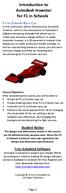 Introduction to Autodesk Inventor for F1 in Schools F1 in Schools Race Car In this course you will be introduced to Autodesk Inventor, which is the centerpiece of Autodesk s digital prototyping strategy
Chapter 5 Functions. Introducing Functions
 Chapter 5 Functions 1 Introducing Functions A function is a collection of statements that are grouped together to perform an operation Define a function Invoke a funciton return value type method name
Creating HTML5 Apps with Geometry Expressions. A Guide to Making Interactive Math Apps
 Creating HTML5 Apps with Geometry Expressions A Guide to Making Interactive Math Apps Marissa Miller 6/9/2014 CONTENTS Introduction... 3 The Basics... 4 JavaScript Applet Generator... 5 UI Types: Making
BD CellQuest Pro Software Analysis Tutorial
 BD CellQuest Pro Analysis Tutorial This tutorial guides you through an analysis example using BD CellQuest Pro software. If you are already familiar with BD CellQuest Pro software on Mac OS 9, refer to
Expense Management. Configuration and Use of the Expense Management Module of Xpert.NET
 Expense Management Configuration and Use of the Expense Management Module of Xpert.NET Table of Contents 1 Introduction 3 1.1 Purpose of the Document.............................. 3 1.2 Addressees of the
Create Charts in Excel
 Create Charts in Excel Table of Contents OVERVIEW OF CHARTING... 1 AVAILABLE CHART TYPES... 2 PIE CHARTS... 2 BAR CHARTS... 3 CREATING CHARTS IN EXCEL... 3 CREATE A CHART... 3 HOW TO CHANGE THE LOCATION
Tutorial: Biped Character in 3D Studio Max 7, Easy Animation
 Tutorial: Biped Character in 3D Studio Max 7, Easy Animation Written by: Ricardo Tangali 1. Introduction:... 3 2. Basic control in 3D Studio Max... 3 2.1. Navigating a scene:... 3 2.2. Hide and Unhide
Microsoft Excel Tutorial
 Microsoft Excel Tutorial by Dr. James E. Parks Department of Physics and Astronomy 401 Nielsen Physics Building The University of Tennessee Knoxville, Tennessee 37996-1200 Copyright August, 2000 by James
II-13Category Plots. Chapter II-13
 Chapter II-13 II-13Category Plots Overview... 316 Creating a Category Plot... 316 Combining Category Plots and XY Plots... 317 Modifying a Category Plot... 317 Bar and Category Gaps... 317 Tick Mark Positioning...
Using Microsoft Excel 2010
 Unit 5 Using Microsoft Excel 2010 Unit Objectives This unit includes the knowledge and skills required to analyze information in an electronic worksheet and to format information using functions specific
WHAT S NEW IN WORD 2010 & HOW TO CUSTOMIZE IT
 WHAT S NEW IN WORD 2010 & HOW TO CUSTOMIZE IT The Ribbon... 2 Default Tabs... 2 Contextual Tabs... 2 Minimizing and Restoring the Ribbon... 3 Customizing the Ribbon... 3 A New Graphic Interface... 5 Live
Q&As: Microsoft Excel 2013: Chapter 2
 Q&As: Microsoft Excel 2013: Chapter 2 In Step 5, why did the date that was entered change from 4/5/10 to 4/5/2010? When Excel recognizes that you entered a date in mm/dd/yy format, it automatically formats
What is a piper plot?
 What is a piper plot? A piper plot is a way of visualizing the chemistry of a rock, soil, or water sample. It s comprised of three pieces: a ternary diagram in the lower left representing the cations,
macquarie.com.au/prime Charts Macquarie Prime and IT-Finance Advanced Quick Manual
 macquarie.com.au/prime Charts Macquarie Prime and IT-Finance Advanced Quick Manual Macquarie Prime Charts Advanced Quick Manual Contents 2 Introduction 3 Customisation examples 9 Toolbar description 12
Configuration Manager
 After you have installed Unified Intelligent Contact Management (Unified ICM) and have it running, use the to view and update the configuration information in the Unified ICM database. The configuration
Hierarchical Clustering Analysis
 Hierarchical Clustering Analysis What is Hierarchical Clustering? Hierarchical clustering is used to group similar objects into clusters. In the beginning, each row and/or column is considered a cluster.
Linkage 3.2. User s Guide
 Linkage 3.2 User s Guide David Rector Wednesday, April 06, 2016 Table of Contents Table of Contents... 2 Installation... 3 Running the Linkage Program... 3 Simple Mechanism Tutorial... 5 Mouse Operations...
Introduction to Autodesk Inventor for F1 in Schools
 F1 in Schools race car Introduction to Autodesk Inventor for F1 in Schools In this course you will be introduced to Autodesk Inventor, which is the centerpiece of Autodesk s Digital Prototyping strategy
Portal Connector Fields and Widgets Technical Documentation
 Portal Connector Fields and Widgets Technical Documentation 1 Form Fields 1.1 Content 1.1.1 CRM Form Configuration The CRM Form Configuration manages all the fields on the form and defines how the fields
Scientific Graphing in Excel 2010
 Scientific Graphing in Excel 2010 When you start Excel, you will see the screen below. Various parts of the display are labelled in red, with arrows, to define the terms used in the remainder of this overview.
How To Use Query Console
 Query Console User Guide 1 MarkLogic 8 February, 2015 Last Revised: 8.0-1, February, 2015 Copyright 2015 MarkLogic Corporation. All rights reserved. Table of Contents Table of Contents Query Console User
Excel 2007: Basics Learning Guide
 Excel 2007: Basics Learning Guide Exploring Excel At first glance, the new Excel 2007 interface may seem a bit unsettling, with fat bands called Ribbons replacing cascading text menus and task bars. This
Creating Drawings in Pro/ENGINEER
 6 Creating Drawings in Pro/ENGINEER This chapter shows you how to bring the cell phone models and the assembly you ve created into the Pro/ENGINEER Drawing mode to create a drawing. A mechanical drawing
Finance Reporting. Millennium FAST. User Guide Version 4.0. Memorial University of Newfoundland. September 2013
 Millennium FAST Finance Reporting Memorial University of Newfoundland September 2013 User Guide Version 4.0 FAST Finance User Guide Page i Contents Introducing FAST Finance Reporting 4.0... 2 What is FAST
Working with Excel in Origin
 Working with Excel in Origin Limitations When Working with Excel in Origin To plot your workbook data in Origin, you must have Excel version 7 (Microsoft Office 95) or later installed on your computer
Topography of an Origin Project and Workspace
 Origin Basics Topography of an Origin Project and Workspace When you start Origin, a new project opens displaying a worksheet window in the workspace. The worksheet is one type of window available in Origin.
Chapter 9 Slide Shows
 Impress Guide Chapter 9 Slide Shows Transitions, animations, and more Copyright This document is Copyright 2007 2013 by its contributors as listed below. You may distribute it and/or modify it under the
correct-choice plot f(x) and draw an approximate tangent line at x = a and use geometry to estimate its slope comment The choices were:
 Topic 1 2.1 mode MultipleSelection text How can we approximate the slope of the tangent line to f(x) at a point x = a? This is a Multiple selection question, so you need to check all of the answers that
Avaya Network Configuration Manager User Guide
 Avaya Network Configuration Manager User Guide May 2004 Avaya Network Configuration Manager User Guide Copyright Avaya Inc. 2004 ALL RIGHTS RESERVED The products, specifications, and other technical information
SEMTech Solutions. Leaders in Refurbished SEMs. SEMTech Solutions Windows 7 SOFTWARE CONTROL SYSTEM
 SEMTech Solutions Leaders in Refurbished SEMs SEMTech Solutions Windows 7 SOFTWARE CONTROL SYSTEM Recertification Process Our Goal: Value Added Technologies Demo Outgoing Inspection Can Include: New PC
Chapter 15 Using Forms in Writer
 Writer Guide Chapter 15 Using Forms in Writer OpenOffice.org Copyright This document is Copyright 2005 2006 by its contributors as listed in the section titled Authors. You can distribute it and/or modify
Petrel TIPS&TRICKS from SCM
 Petrel TIPS&TRICKS from SCM Maps: Knowledge Worth Sharing Map Annotation A map is a graphic representation of some part of the earth. In our industry, it may represent either the surface or sub surface;
Excel -- Creating Charts
 Excel -- Creating Charts The saying goes, A picture is worth a thousand words, and so true. Professional looking charts give visual enhancement to your statistics, fiscal reports or presentation. Excel
Tutorials. If you have any questions, comments, or suggestions about these lessons, don't hesitate to contact us at [email protected].
 Tutorials The lesson schedules for these tutorials were installed when you installed Milestones Professional 2010. They can be accessed under File Open a File Lesson Chart. If you have any questions, comments,
INTRODUCTION TO EXCEL
 INTRODUCTION TO EXCEL 1 INTRODUCTION Anyone who has used a computer for more than just playing games will be aware of spreadsheets A spreadsheet is a versatile computer program (package) that enables you
Basic Microsoft Excel 2007
 Basic Microsoft Excel 2007 The biggest difference between Excel 2007 and its predecessors is the new layout. All of the old functions are still there (with some new additions), but they are now located