
QUARTERLY SURVEY OF FINANCIAL STATEMENTS ADDENDUM AND REPORTING GUIDE FOR FINANCIAL SERVICES
|
|
|
- Susanna Bond
- 10 years ago
- Views:
Transcription
1 QUARTERLY SURVEY OF FINANCIAL STATEMENTS ADDENDUM AND REPORTING GUIDE FOR FINANCIAL SERVICES F06 - E:

2 1

3 2 QUARTERLY SURVEY OF FINANCIAL STATEMENTS Addendum to the Reporting Guides for Financial and Non-Financial Enterprises The questionnaires used in the Quarterly Survey of Financial Statements have been modified as of the second quarter of The principal changes to the questionnaires are summarized below. These changes were implemented in response to evolving financial reporting standards as outlined by the Canadian Institute of Chartered Accountants as well as requirements of the System of National Accounts. The full reporting guide will be updated shortly. ADDENDDUM TABLE OF CONTENTS Page Additions... 2 Balance Sheet... 2 Assets... 2 Liabilities and Equity... 3 Income Statement... 3 Disclosure of Selected Accounts... 4 Deletions... 5 Modifications... 5 Balance Sheet... 5 Assets... 5 Liabilities and Equity... 6 Income Statement... 6 Format Changes... 6 Items appear in the same order as on the actual questionnaires ADDITIONS Balance Sheet Assets ITEM 19900: DERIVATIVES A derivative is a financial security whose value is dependent upon or derived from the value of one or more underlying assets. The derivative itself is a contract between two or more parties. Its value is determined by fluctuations in the underlying asset. The most common underlying assets include stocks, bonds, commodities, currencies, interest rates and market indexes. Futures contracts, forward contracts, options and swaps are the most common types of derivatives. Since derivatives are contracts, just about anything can be used as an underlying asset. Derivatives are generally used to protect against financial risk, interest rates or the levels of financial indices but can also be used for speculative purposes. For a derivative asset to be recognized, it must provide future benefits that your enterprise controls and for which a transaction has occurred. ITEM 69100: REVERSE REPURCHASE AGREEMENTS Reverse repurchase agreements are the purchase of securities with the agreement to sell them at a higher price at a specific future date. For the party selling the security (and agreeing to repurchase in the future) it is a repurchase agreement also known as a repo; for the counterparty (buying the security and agreeing to sell in the future) it is a reverse repurchase agreement. A reverse purchase agreement is the same transaction as represented below in item (Obligation Related to Repurchase Agreement), but viewed from the perspective of the transferee.

4 3 Liabilities and Equity ITEM 29900: DERIVATIVES Same definition of derivatives as above (item 19900). For a derivative liability to be recognized, it must represent an obligation to transfer value to a third party and there must be no way for your enterprise to circumvent its obligation. ITEM 69200: OBLIGATIONS RELATED TO REPURCHASE AGREEMENTS A repurchase agreement is an agreement with a commitment by the seller (dealer) to buy a security back from the purchaser (customer) at a specified price at a designated future date. Also called a repo, it represents a collateralized short-term loan for which, where the collateral may be a Treasury security, money market instrument, federal agency security, or mortgage-backed security. From the purchaser's (customer's) perspective, the deal is reported as a reverse repo. Repos are classified as a money-market instrument and are usually used to raise short-term capital. ITEM 29950: EQUITY SECURITIES CLASSIFIED AS LIABILITIES Include equities classified as liabilities as required in section 3861 of the CICA handbook outlining the accounting treatment for financial instruments. In essence, they are convertible preferred shares. ITEM 32300: UNITHOLDERS' CAPITAL Unitholders' capital represents the investment in the trust, fund or partnership by the owners. ITEM 36000: ACCUMULATED OTHER COMPREHENSIVE INCOME Comprehensive income is the change in the company's net assets that result from transactions, events and circumstances from sources other than the company shareholders. It includes items that would not normally be included in net income. The accumulated other comprehensive income account includes the accumulated balance of amounts reported on the income statement under items 56500, and ITEM 38000: RETAINED EARNINGS The statement of retained earnings has been integrated in to the balance sheet. Item 38880, other additions and deductions is removed. ITEM 38300: INCOME TRUST DISTRIBUTIONS Distributions of funds to the owners of the trust, fund or partnership. ITEM 38400: TRANSFERS FROM/TO SHARE CAPITAL Transfers between the retained earnings account and share capital accounts of the reporting unit. Also includes transfers between a reporting unit which is a branch of a company and its head office, or between two branches, each of which is a reporting unit. Income Statement ITEM 45400: INTEREST REVENUE FROM CANADIAN SOURCES FINANCIAL LEASES Include all interest revenue earned through financial leases. ITEM 56400: DERIVATIVE GAIN (LOSSES) Same definition of derivatives as above (item 19900). Impairments of derivatives are recognized in net income immediately and should be reported in item For more information on how financial instruments should be presented in financial statements please refer to Section 3861 of the CICA Handbook.
5 4 ITEM 62310: PENSION EXPENSE Include pension expense incurred by the reporting entity per CICA handbook section Report other benefits expenses under item (Employer Portion of Employee Benefits) ITEM 62340: STOCK OPTIONS EXPENSED Include employee stock options that were expensed during the current period per CICA handbook section ITEM 53400: DIVIDENDS PAID ON EQUITY SECURITIES CLASSIFIED AS LIABILITIES Include dividends paid on equity securities classified as liabilities as required in section 3861 of the CICA handbook outlining the accounting treatment for financial instruments. These financial instruments are shown under item no on the balance sheet. ITEM 55600: BAD DEBTS EXPENSE AND CHARITABLE DONATIONS Include bad debt expense and charitable donations for the period. These amounts were previously included in item 55003, other expenses. ITEM / / 57300: OTHER COMPREHENSIVE INCOME Comprehensive income is the change in the company's net assets that result from transactions, events and circumstances from sources other than the company shareholders. It includes items that would not normally be included in net income. Report as per CICA section 1530 (Comprehensive Income). Report realized and unrealized gains and losses available-for-sale financial assets. If impaired, report in item Derivatives Gains (Losses) ITEM 56500: UNREALIZED GAINS (LOSSES) Include unrealized gains and (losses) on derivatives designated as cash flow hedges, non-derivative investments and unrealized translation gains and losses from integrated self-sustaining entities (if applicable). ITEM 56600: REALIZED GAINS (LOSSES) Report the realization of (gains) losses previously reported in item ITEM 57300: INCOME TAXES Related to other comprehensive income. Disclosure of Selected Accounts ITEM 55700: SOFTWARE COSTS EXPENSED Include all computer software costs expensed directly in the current period. Report only the cost of own-use software whether purchased or licensed. Exclude any amounts deferred and amortized. ITEM 66000: PENSION PLAN FUNDING Report the closing balance for pension plans held through a trustee at the end of the quarter. Exclude other benefits plans. ITEM 66100: PLAN ASSETS Assets held by the trustee at market (fair) value ITEM 66200: BENEFIT OBLIGATION Actuarial obligation at the end of the quarter

6 5 ITEM 66300: FUNDED STATUS Report the (deficit) or surplus net position (66100 minus 66200) ITEM 66500: ACCRUED BENEFITS (LIABILITY) OR ASSET Funded status adjusted for the unamortized amounts of transitional obligation, past service cost and net actuarial gain. ITEM 81000: MATCHING OF INCOME STATEMENT GAINS (LOSSES) WITH THE RELATED ASSETS AND LIABILITIES This statement is revamped to match the asset and liability items on the revised balance sheet. DELETIONS Item Appraisal increase credits (debits) Item Retained earnings Item Amounts owing to parents, subsidiaries and affiliates - Interest bearing debt Item Amounts owing to parents, subsidiaries and affiliates - Non-interest bearing debt Item Retained earnings - Total cash dividends declared Item Retained earnings - Other Item Amortization - Other Item Other expenses Item Unusual revenues, expenses, gains/losses from continuing business operations Item Interest expense on debt owing to parent, subsidiaries and affiliates Item Average number of people employed during the reporting period Item Revenue between divisions that are eliminated upon consolidation of accounts MODIFICATIONS Balance Sheet Assets ITEMS and 11400: CASH AND DEPOSITS Cash and deposits are now requested in two cells: Canadian Currency Foreign Currency These cells include both demand and term deposits. Previously cash and demand deposits were requested separately from term deposits ITEMS and 17117: NON-MORTGAGE LOANS TO NON-AFFILIATES a) loans to individuals, unincorporated businesses and non-profit institutions: 1) credit card receivables 2) lines of credit
7 6 These two variables were previously combined. Liabilities and Equity ITEMS and 25800: BORROWING FROM NON-AFFILIATES a) loans and overdrafts: 1) from lenders in Canada 2) from lenders outside of Canada Previously loans and overdrafts were requested separately for chartered bank branches in Canada and with others. Income Statement ITEM 52100: DEPRECIATION This item was previously requested in two parts: a) depreciation on construction, buildings, structures and leasehold improvements b) depreciation on machinery and equipment. FORMAT CHANGES Many cell names have been altered or shortened. For example, Investments in and claims on parent, subsidiaries and affiliates has been replaced with Investments in affiliates. In such cases, as long as the SICA box number has not changed, the same definitions and reporting methods apply as before. All Supplementary questions have now been placed in the last section of the questionnaire, rather than at the end of each individual section.
8 7 REPORTING GUIDE - TABLE OF CONTENTS Page Introduction Authority...11 Confidentiality...11 Purpose of the Quarterly Survey...11 Timeliness of the Statistics...11 Reporting Entity...11 Reporting Entity Profile...12 Joint Ventures and Partnerships...12 Foreign Operations of Canadian Enterprises...12 Foreign Subsidiaries of Canadian Enterprises...12 Classification of Capital and Head Office Accounts of Unincorporated Reporting Entities...12 Comparability and Predictive Value of Quarterly Financial Statistics...13 Year-End and Prior Year's Adjustments...13 Accounting Principles - Financial Statement Presentation and Disclosure...13 s Cash and Demand Deposits Term Deposits Accounts Receivable and Accrued Revenue Allowance for Doubtful Accounts Investments in and Claims on Parent Subsidiaries and Affiliates Investments in Non-Affiliates Government of Canada Treasury Bills Bankers' Acceptances and Finance and Other Short-Term Paper Government of Canada Debt Provincial and Municipal Government Debt Corporate Bonds and Debentures Corporate Shares Other Canadian Investments Foreign Investments Mortgage Loans to Non-Affiliates Non-Mortgage Loans to Non-Affiliates Land and Depreciable Assets - Gross Real Estate Held for Income - Gross Accumulated Depreciation Intangible Assets Other Assets Accounts Payable and Accrued Liabilities Income Taxes Payable Amounts Owing to Parent, Subsidiaries and Affiliates Loans and Overdrafts with Chartered Bank Branches in Canada Loans and Overdrafts with Others Bankers' Acceptances and Short-Term Notes and Paper Bonds and Debentures Mortgage Loans...28

9 Future Income Taxes Minority Interest in Consolidated Subsidiaries...28 REPORTING GUIDE - TABLE OF CONTENTS Page s - Concluded Other Liabilities Share Capital Contributed Surplus Appraisal Increase Credits/Debits Retained Earnings Retained Earnings - Closing Balance Retained Earnings - Opening Balance Net Income/Loss Other Additions/Deductions Dividends Declared Inter-Corporate Revenue (Eliminated on Consolidation) Commissions and Fees Interest Revenue Form Canadian Sources Dividends Received from Canadian Corporations Foreign Dividend and Interest Revenue Gains/Losses on the Sale of Assets (Operating) Other Revenue Depreciation Depreciation/Amortization of Buildings Depreciation/Amortization of Machinery and Equipment Amortization Interest Expense Purchased Goods, Materials and Services Indirect Taxes Other Expenses Wages and Salaries Employer Portion of Employee Benefits Gains/Losses on the Translation of Foreign Currency Write-Offs and Adjustments Canadian Income Taxes Equity in Net Income/Loss of Unconsolidated Affiliates Minority Shareholders' Portion of Net Income/Loss Extraordinary Gains/Losses - Net Income/Loss before Income Taxes Income/Loss after Income Taxes Net Income/Loss Interest Bearing Debt Non-Interest Bearing Debt Interest Expense on Debt Owing to Parent, Subsidiaries and Affiliates Unusual Revenues, Expenses, Gains/Losses from Continuing Business Operations Dividends Received from Corporations Accounted for on the Equity Method Average Number of People Employed during the Reporting Period...32
10 9 REPORTING GUIDE - TABLE OF CONTENTS Page Annual Supplement to the Quarterly Survey of Financial Statements Capital Leases...43 Deferred Charges and Provision for Future Obligations...43 Questions Three and Four - Deferred Charges...43 Questions Five and Six - Provision for Future Obligations...44 Provisions for Losses, Write-Downs, and Write-Offs...45

11 10

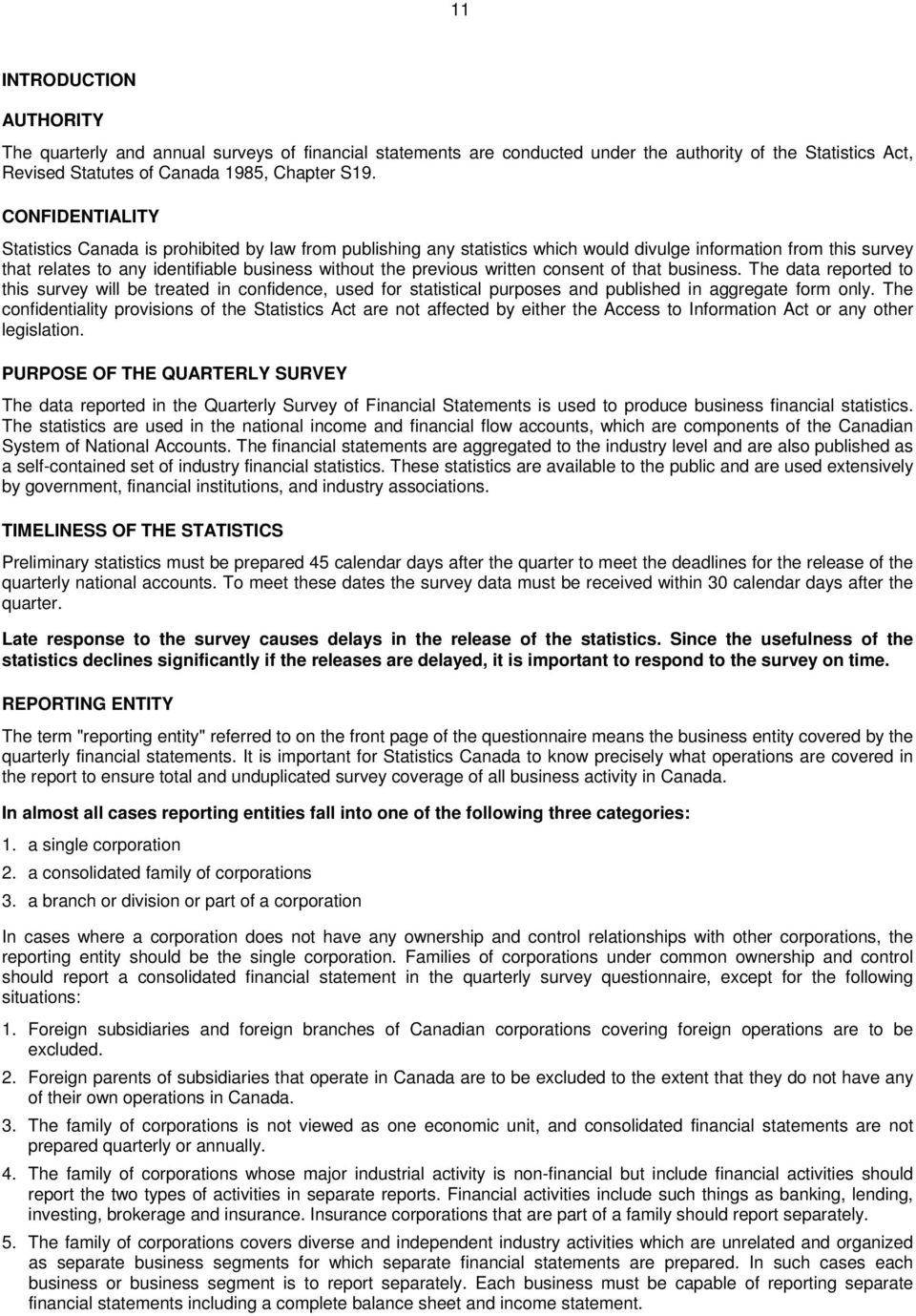
12 11 INTRODUCTION AUTHORITY The quarterly and annual surveys of financial statements are conducted under the authority of the Statistics Act, Revised Statutes of Canada 1985, Chapter S19. CONFIDENTIALITY Statistics Canada is prohibited by law from publishing any statistics which would divulge information from this survey that relates to any identifiable business without the previous written consent of that business. The data reported to this survey will be treated in confidence, used for statistical purposes and published in aggregate form only. The confidentiality provisions of the Statistics Act are not affected by either the Access to Information Act or any other legislation. PURPOSE OF THE QUARTERLY SURVEY The data reported in the Quarterly Survey of Financial Statements is used to produce business financial statistics. The statistics are used in the national income and financial flow accounts, which are components of the Canadian System of National Accounts. The financial statements are aggregated to the industry level and are also published as a self-contained set of industry financial statistics. These statistics are available to the public and are used extensively by government, financial institutions, and industry associations. TIMELINESS OF THE STATISTICS Preliminary statistics must be prepared 45 calendar days after the quarter to meet the deadlines for the release of the quarterly national accounts. To meet these dates the survey data must be received within 30 calendar days after the quarter. Late response to the survey causes delays in the release of the statistics. Since the usefulness of the statistics declines significantly if the releases are delayed, it is important to respond to the survey on time. REPORTING ENTITY The term "reporting entity" referred to on the front page of the questionnaire means the business entity covered by the quarterly financial statements. It is important for Statistics Canada to know precisely what operations are covered in the report to ensure total and unduplicated survey coverage of all business activity in Canada. In almost all cases reporting entities fall into one of the following three categories: 1. a single corporation 2. a consolidated family of corporations 3. a branch or division or part of a corporation In cases where a corporation does not have any ownership and control relationships with other corporations, the reporting entity should be the single corporation. Families of corporations under common ownership and control should report a consolidated financial statement in the quarterly survey questionnaire, except for the following situations: 1. Foreign subsidiaries and foreign branches of Canadian corporations covering foreign operations are to be excluded. 2. Foreign parents of subsidiaries that operate in Canada are to be excluded to the extent that they do not have any of their own operations in Canada. 3. The family of corporations is not viewed as one economic unit, and consolidated financial statements are not prepared quarterly or annually. 4. The family of corporations whose major industrial activity is non-financial but include financial activities should report the two types of activities in separate reports. Financial activities include such things as banking, lending, investing, brokerage and insurance. Insurance corporations that are part of a family should report separately. 5. The family of corporations covers diverse and independent industry activities which are unrelated and organized as separate business segments for which separate financial statements are prepared. In such cases each business or business segment is to report separately. Each business must be capable of reporting separate financial statements including a complete balance sheet and income statement.
13 12 If a family of corporations does not consolidate the financial statements of the parent corporation, and the parent has operations in Canada or is resident in Canada, it will have to submit a separate financial statement report to the quarterly survey. REPORTING ENTITY PROFILE You may find a separate document enclosed with the questionnaire listing the corporations included in the reporting entity. This document should be reviewed carefully, corrected if necessary, and returned with the completed questionnaire to Statistics Canada. Subsidiaries and affiliates that are accounted for in the financial statements as a one-line consolidation or net investment, using the equity method, should be excluded from the list of corporations on the reporting entity profile. The register of all businesses maintained by Statistics Canada includes a list of corporations which are referred to as legal entities. To facilitate the matching of the reporting entities to the list of legal entities on the business register, the quarterly survey describes the reporting entities in the profile document in terms of the legal names of the corporations included in the report. JOINT VENTURES AND PARTNERSHIPS The survey covers the activities of joint ventures and partnerships as separate businesses from those of the venturers or partners. Therefore, these businesses are surveyed as separate reporting entities. To avoid double counting of these businesses the investors, venturers, and partners should account for their investments using the cost or equity method. Complete or proportionate consolidations of joint ventures and partnerships should not be done for the quarterly survey of financial statements. However, it is recognized in some cases that separate financial statements for the joint venture are not produced quarterly or annually and it is the practice of the venturers to account for their investment by consolidating their portion of the joint venture in their financial statements. In such cases the joint venture is not reported as a separate entity, but it is covered in the reports of the venturers. FOREIGN OPERATIONS OF CANADIAN ENTERPRISES : Foreign operations of Canadian enterprises include all business conducted by establishments that are situated outside Canada, including foreign branches, foreign divisions and foreign offices. Report income from foreign operations as a net amount in item number 58100, "Equity in Net Income of Unconsolidated Affiliates." The assets of the foreign operations should not be reported on a line-by-line basis, but rather as a net amount in item number 14120, "Investments in Subsidiaries and Affiliates Outside Canada." FOREIGN SUBSIDIARIES OF CANADIAN ENTERPRISES Foreign subsidiaries should always be excluded from line-by-line consolidation and should be reported in either item 14120, "Investments in Subsidiaries and Affiliates Outside Canada," where control or significant influence exists, or in item 15200, "Foreign Investments in Non-Affiliates" for portfolio investments. Income from foreign investments reported on the cost basis, i.e., portfolio investments, should be reported in item 47000, "Foreign Dividend and Interest Revenue." Investments reported on the equity basis should include the investor's share of earnings in item 58100, "Equity in Net Income of Unconsolidated Affiliates," with the corresponding adjustment to the investment account in item 14200, "Accumulated Earnings Less Dividends Received." Dividends received from foreign investments reported on the equity basis are excluded from the income statement and should be reported as supplementary item 75200, "Dividends Received from Corporations Accounted for on the Equity Method." CLASSIFICATION OF CAPITAL AND HEAD OFFICE ACCOUNTS OF UNINCORPORATED REPORTING ENTITIES : Unincorporated entities include partnerships, joint ventures and Canadian branch operations of foreign corporations. Temporary loans and advances that are intended to be repaid should be classified as a liability in item 24000, "Amounts Owing to Parent, Subsidiaries and Affiliates." Investments of capital of a permanent nature should be classified as owner's capital in item 31000, "Share Capital." Undistributed profits of the entity should be reported separately in item 38000, "Retained Earnings."

14 13 Summary: Loans and advances to be repaid - item Permanent capital investment - item Undistributed profits - item COMPARABILITY AND PREDICTIVE VALUE OF QUARTERLY FINANCIAL STATISTICS The quarterly statistics produced from this survey are used to analyze short- and long-term cyclical trends. They are also used as leading indicators to forecast future economic activity and business profits. In order for the statistics to be useful they should be free of volatile quarter to quarter changes which are caused by year-to-date bookkeeping adjustments included in the current quarter estimates. As well, changes in accounting policies and methods, changes in the corporations included in the financial statements, and changes resulting from mergers or amalgamations and other structural adjustments affect quarter to quarter comparability of the statistics. Quarter to quarter changes in items such as depreciation, amortization, interest expense, income taxes and capital expenditures caused by year-to-date adjustments included in the current quarter should be documented in the questionnaire and brought to the attention of the Statistics Canada survey staff. These adjustments are reallocated to previous quarters in the current year to produce a better estimate of quarterly trends. As well, any other changes in the current quarter's financial statements that would render them incomparable with those of the previous quarter should be documented either in the reporting entity section on the front page of the questionnaire or on an insert. YEAR-END AND PRIOR YEAR'S ADJUSTMENTS One of the objectives of the statistical program is to get as accurate as possible a measurement of quarterly revenues, expenses, and profits. It is recognized that interim financial statements do in fact contain a number of estimates that are revised at year-end to actual amounts. Because of the preliminary nature of the interim financial statements, the quarterly statistical program provides for revisions to the statistics on an on-going basis. Revenues and expenses reported in the fourth fiscal quarter could include year-end adjustments from preliminary estimates to actual amounts for the year. The accounts could also include year-end accruals and reclassifications that are not made during the year in the interim financial statements. The adjustments can materially affect the fourth quarter revenue and expense accounts, which in turn could distort the fourth quarter profits. To eliminate the distortions respondents are asked to report year-end adjustments in excess of $500 thousand in the appropriate section of the fourth quarter questionnaire. Statistics Canada's annual financial statistics program uses the quarterly revenues, expenses, and profit accounts as reported to the quarterly survey to produce annual accounts. This eliminates the need to conduct an annual survey in addition to the quarterly survey. The sum of the accounts of the four quarters should agree with the annual accounts as published in the annual financial statements. Therefore, it is important to know about all year-end adjustments. There are situations where year-end adjustments have not been entered in the company books prior to the preparation of the Statistics Canada fourth quarter financial statement report. In these cases the reported fourth quarter closing balance of retained earning will not agree with the year-end balance in the company's financial statements. In the report of the first quarter of the following fiscal year this imbalance will appear as an adjustment to retained earnings. This prior year's adjustment should be reported in the appropriate section of the first quarter questionnaire in the year-end and prior year's adjustments statement. In some cases the year-end adjustments may not be finalized until the second quarter subsequent to the year-end. In these cases the applicable information will be reported in the questionnaire for the second fiscal quarter. ACCOUNTING PRINCIPLES - FINANCIAL STATEMENT PRESENTATION AND DISCLOSURE The quarterly financial statements questionnaire is designed to collect structured information required for the industry financial statistics program, and the system of national economic accounts. The financial statements detail and supplementary questions and schedules which are not normally found in published business financial statements are required to make the necessary conceptual adjustments and to calculate the Statement of Change in Financial Position as prescribed by the program. Generally, the financial statements should be prepared in accordance with the codified generally accepted accounting principles (GAAP) as set out in the Canadian Institute of Chartered Accountants (C.I.C.A.) Handbook. Specific requirements of the survey that depart from the C.I.C.A. Handbook, other industry specific accounting principles, and financial statement disclosure standards are as follows: Balance Sheet i) Bank account credit balances (overdrafts) should not be offset against bank account debit balances. All credit balances should be shown as liabilities.

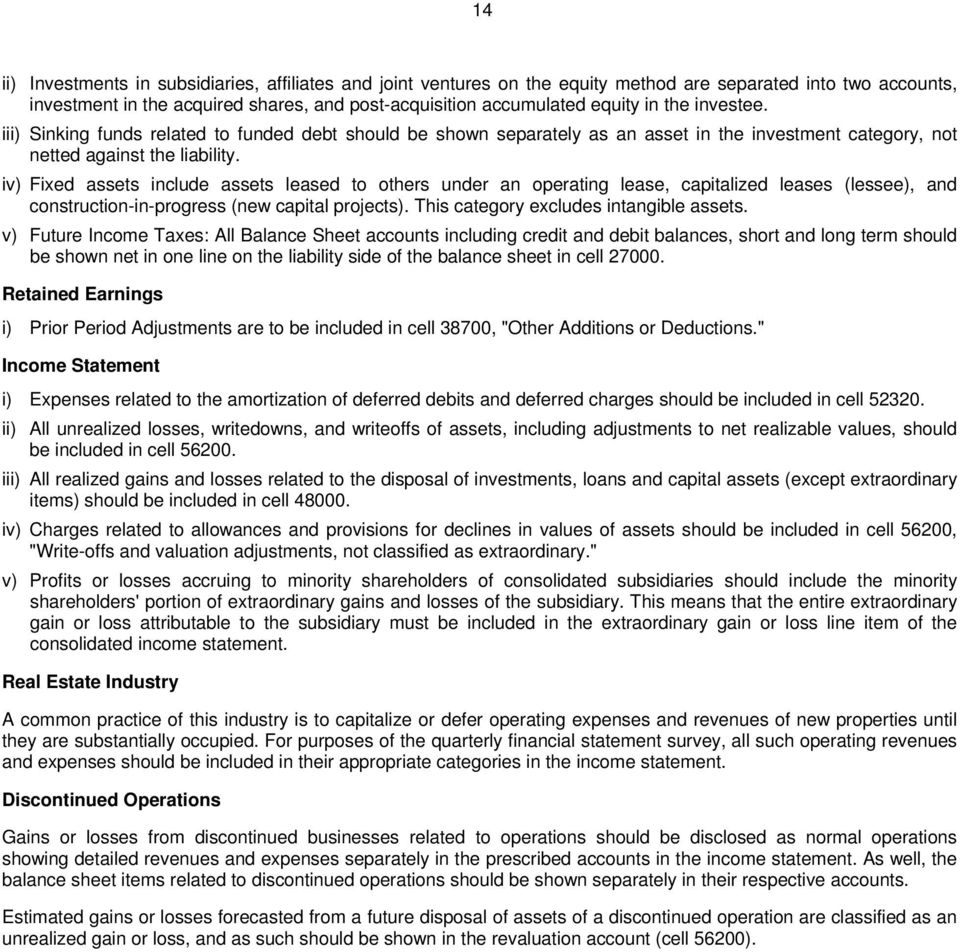
15 14 ii) Investments in subsidiaries, affiliates and joint ventures on the equity method are separated into two accounts, investment in the acquired shares, and post-acquisition accumulated equity in the investee. iii) Sinking funds related to funded debt should be shown separately as an asset in the investment category, not netted against the liability. iv) Fixed assets include assets leased to others under an operating lease, capitalized leases (lessee), and construction-in-progress (new capital projects). This category excludes intangible assets. v) Future Income Taxes: All Balance Sheet accounts including credit and debit balances, short and long term should be shown net in one line on the liability side of the balance sheet in cell Retained Earnings i) Prior Period Adjustments are to be included in cell 38700, "Other Additions or Deductions." Income Statement i) Expenses related to the amortization of deferred debits and deferred charges should be included in cell ii) All unrealized losses, writedowns, and writeoffs of assets, including adjustments to net realizable values, should be included in cell iii) All realized gains and losses related to the disposal of investments, loans and capital assets (except extraordinary items) should be included in cell iv) Charges related to allowances and provisions for declines in values of assets should be included in cell 56200, "Write-offs and valuation adjustments, not classified as extraordinary." v) Profits or losses accruing to minority shareholders of consolidated subsidiaries should include the minority shareholders' portion of extraordinary gains and losses of the subsidiary. This means that the entire extraordinary gain or loss attributable to the subsidiary must be included in the extraordinary gain or loss line item of the consolidated income statement. Real Estate Industry A common practice of this industry is to capitalize or defer operating expenses and revenues of new properties until they are substantially occupied. For purposes of the quarterly financial statement survey, all such operating revenues and expenses should be included in their appropriate categories in the income statement. Discontinued Operations Gains or losses from discontinued businesses related to operations should be disclosed as normal operations showing detailed revenues and expenses separately in the prescribed accounts in the income statement. As well, the balance sheet items related to discontinued operations should be shown separately in their respective accounts. Estimated gains or losses forecasted from a future disposal of assets of a discontinued operation are classified as an unrealized gain or loss, and as such should be shown in the revaluation account (cell 56200).
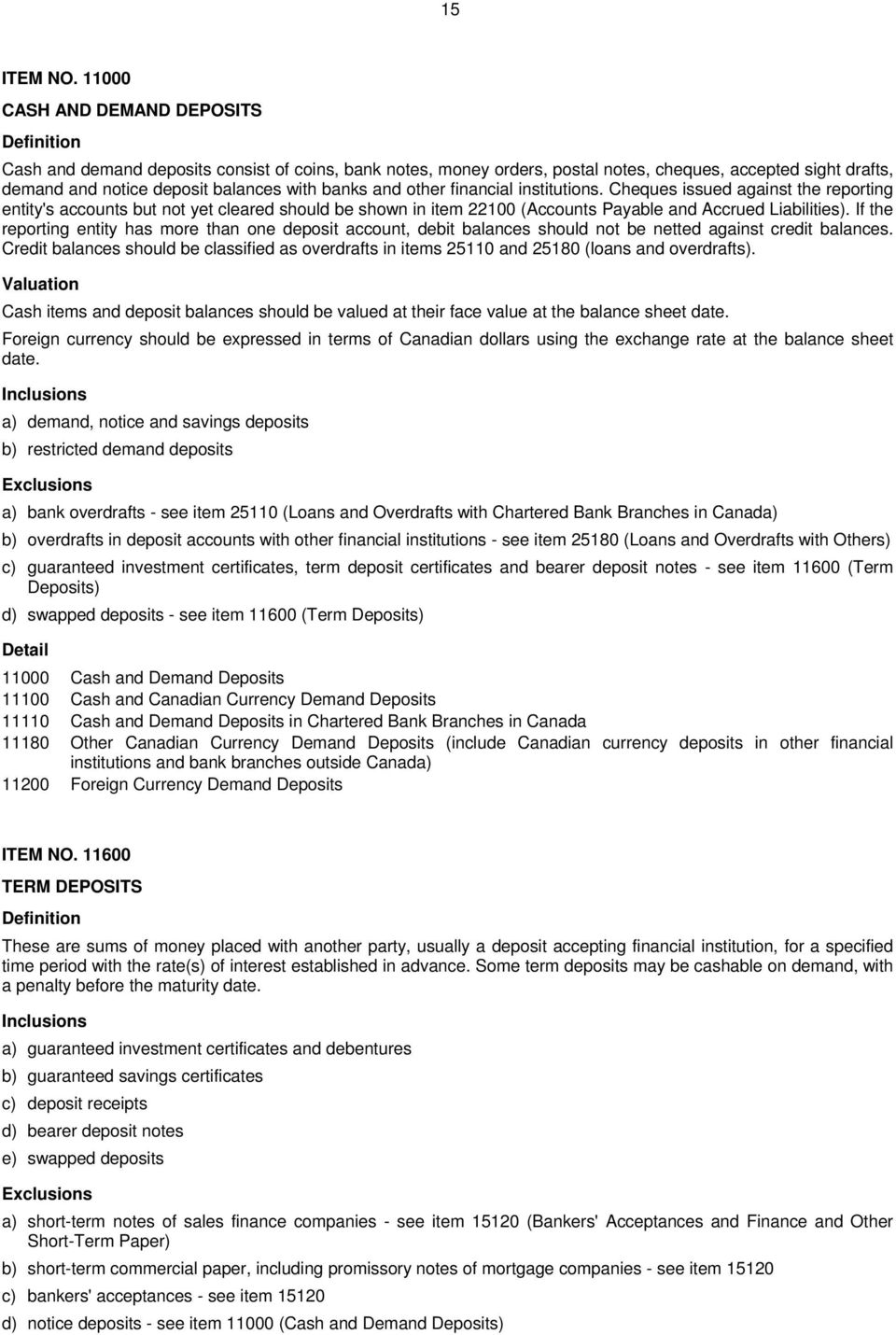
16 15 ITEM NO CASH AND DEMAND DEPOSITS Cash and demand deposits consist of coins, bank notes, money orders, postal notes, cheques, accepted sight drafts, demand and notice deposit balances with banks and other financial institutions. Cheques issued against the reporting entity's accounts but not yet cleared should be shown in item (Accounts Payable and Accrued Liabilities). If the reporting entity has more than one deposit account, debit balances should not be netted against credit balances. Credit balances should be classified as overdrafts in items and (loans and overdrafts). Cash items and deposit balances should be valued at their face value at the balance sheet date. Foreign currency should be expressed in terms of Canadian dollars using the exchange rate at the balance sheet date. a) demand, notice and savings deposits b) restricted demand deposits a) bank overdrafts - see item (Loans and Overdrafts with Chartered Bank Branches in Canada) b) overdrafts in deposit accounts with other financial institutions - see item (Loans and Overdrafts with Others) c) guaranteed investment certificates, term deposit certificates and bearer deposit notes - see item (Term Deposits) d) swapped deposits - see item (Term Deposits) Detail Cash and Demand Deposits Cash and Canadian Currency Demand Deposits Cash and Demand Deposits in Chartered Bank Branches in Canada Other Canadian Currency Demand Deposits (include Canadian currency deposits in other financial institutions and bank branches outside Canada) Foreign Currency Demand Deposits ITEM NO TERM DEPOSITS These are sums of money placed with another party, usually a deposit accepting financial institution, for a specified time period with the rate(s) of interest established in advance. Some term deposits may be cashable on demand, with a penalty before the maturity date. a) guaranteed investment certificates and debentures b) guaranteed savings certificates c) deposit receipts d) bearer deposit notes e) swapped deposits a) short-term notes of sales finance companies - see item (Bankers' Acceptances and Finance and Other Short-Term Paper) b) short-term commercial paper, including promissory notes of mortgage companies - see item c) bankers' acceptances - see item d) notice deposits - see item (Cash and Demand Deposits)
17 16 Detail Term Deposits Canadian Currency Chartered Bank Branches in Canada Other Institutions Foreign Currency ITEM NO ACCOUNTS RECEIVABLE AND ACCRUED REVENUE All claims against debtors arising from the sale of goods and services. Also included are accrued revenue receivable and accrued government grants receivable. Trade receivables are claims against customers for goods and services sold in the ordinary course of business. All accounts receivable should be shown gross before deducting allowance for doubtful accounts (item 12800). a) Trade Receivables - from affiliates arising from the sale of goods and services b) Other Accounts Receivable i) interest, dividend and other investment income receivable ii) grants, subsidies and royalties receivable iii) receivables in connection with the sale of investments and fixed assets iv) income taxes recoverable v) insurance claims vi) patronage dividends receivable vii) balance recoverable represented by the excess of GST input tax credits claimed over GST collections a) other accounts receivables from affiliates - see items and (Loans, Advances, Mortgages, Notes, Bonds and Other Claims of Affiliates) b) loans receivable - see items (Mortgage Loans to Non-Affiliates) or (Non-Mortgage Loans to Non- Affiliates) c) balance owing represented by the excess of GST collections over GST input tax credits claimed - see item (Accounts Payable and Accrued Liabilities) ITEM NO ALLOWANCE FOR DOUBTFUL ACCOUNTS The allowance for doubtful accounts is a deduction from the book value of accounts receivable to reduce them to the estimated realizable value. ITEM NO INVESTMENTS IN AND CLAIMS ON PARENT SUBSIDIARIES AND AFFILIATES This category covers all investments in and claims, other than trade accounts receivable, on non-consolidated parent, affiliated and subsidiary corporations, affiliated joint ventures and partnerships, head office, directors, officers and individual shareholders.

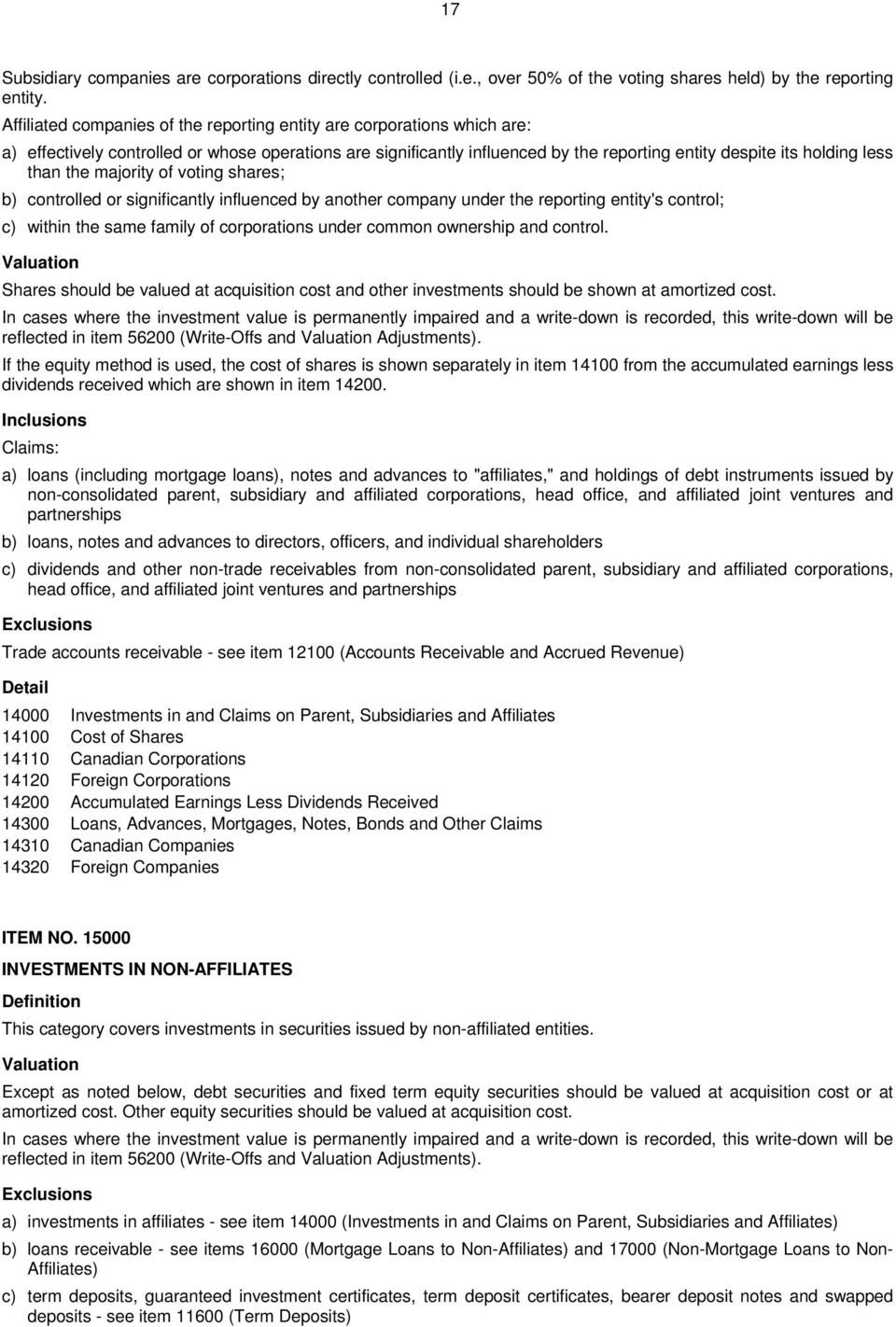
18 17 Subsidiary companies are corporations directly controlled (i.e., over 50% of the voting shares held) by the reporting entity. Affiliated companies of the reporting entity are corporations which are: a) effectively controlled or whose operations are significantly influenced by the reporting entity despite its holding less than the majority of voting shares; b) controlled or significantly influenced by another company under the reporting entity's control; c) within the same family of corporations under common ownership and control. Shares should be valued at acquisition cost and other investments should be shown at amortized cost. In cases where the investment value is permanently impaired and a write-down is recorded, this write-down will be reflected in item (Write-Offs and Adjustments). If the equity method is used, the cost of shares is shown separately in item from the accumulated earnings less dividends received which are shown in item Claims: a) loans (including mortgage loans), notes and advances to "affiliates," and holdings of debt instruments issued by non-consolidated parent, subsidiary and affiliated corporations, head office, and affiliated joint ventures and partnerships b) loans, notes and advances to directors, officers, and individual shareholders c) dividends and other non-trade receivables from non-consolidated parent, subsidiary and affiliated corporations, head office, and affiliated joint ventures and partnerships Trade accounts receivable - see item (Accounts Receivable and Accrued Revenue) Detail Investments in and Claims on Parent, Subsidiaries and Affiliates Cost of Shares Canadian Corporations Foreign Corporations Accumulated Earnings Less Dividends Received Loans, Advances, Mortgages, Notes, Bonds and Other Claims Canadian Companies Foreign Companies ITEM NO INVESTMENTS IN NON-AFFILIATES This category covers investments in securities issued by non-affiliated entities. Except as noted below, debt securities and fixed term equity securities should be valued at acquisition cost or at amortized cost. Other equity securities should be valued at acquisition cost. In cases where the investment value is permanently impaired and a write-down is recorded, this write-down will be reflected in item (Write-Offs and Adjustments). a) investments in affiliates - see item (Investments in and Claims on Parent, Subsidiaries and Affiliates) b) loans receivable - see items (Mortgage Loans to Non-Affiliates) and (Non-Mortgage Loans to Non- Affiliates) c) term deposits, guaranteed investment certificates, term deposit certificates, bearer deposit notes and swapped deposits - see item (Term Deposits)
19 18 Detail Investments in Non-Affiliates Canadian Investments in Non-Affiliates Government of Canada Treasury Bills (see separate definition) Bankers' Acceptances and Finance and Other Short-Term Paper (see separate definition) Government of Canada Debt (see separate definition) Provincial and Municipal Government Debt (see separate definition) Corporate Bonds and Debentures (see separate definition) Corporate Shares (see separate definition) Other Canadian Investments (see separate definition) Foreign Investments (see separate definition) ITEM NO GOVERNMENT OF CANADA TREASURY BILLS This item covers investments in short-term Government of Canada obligations issued at a discount in lieu of interest. These obligations may be issued in Canadian or other currencies. Canada treasury bills should be shown at acquisition cost. Some investors, however, record this item at amortized cost. Foreign currency should be expressed in terms of Canadian dollars using the exchange rate at the balance sheet date. Canada bills (bills issued in U.S. currency) ITEM NO BANKERS' ACCEPTANCES AND FINANCE AND OTHER SHORT-TERM PAPER This category covers investments in short-term debt securities issued by provincial and municipal governments, financial institutions and industrial corporations resident in Canada. Short-term securities are generally those with an original term to maturity of less than one year. These investments should be shown at acquisition cost. However, since short-term paper is generally purchased at a discount or premium and recorded at amortized cost, amortized cost is also acceptable. a) Canadian provincial and municipal government short-term bills and notes b) financial and commercial paper c) bankers' acceptances a) Government of Canada treasury bills - see item (Government of Canada Treasury Bills) b) term deposits, swapped deposits, guaranteed investment certificates, deposit certificates and collateral deposits - see item (Term Deposits) c) demand and notice deposits - see item (Cash and Demand Deposits) d) share options and warrants - see items and (Corporate Shares) e) foreign finance and other short-term paper - see item (Foreign Investments) f ) bearer deposit notes - see item (Term Deposits)
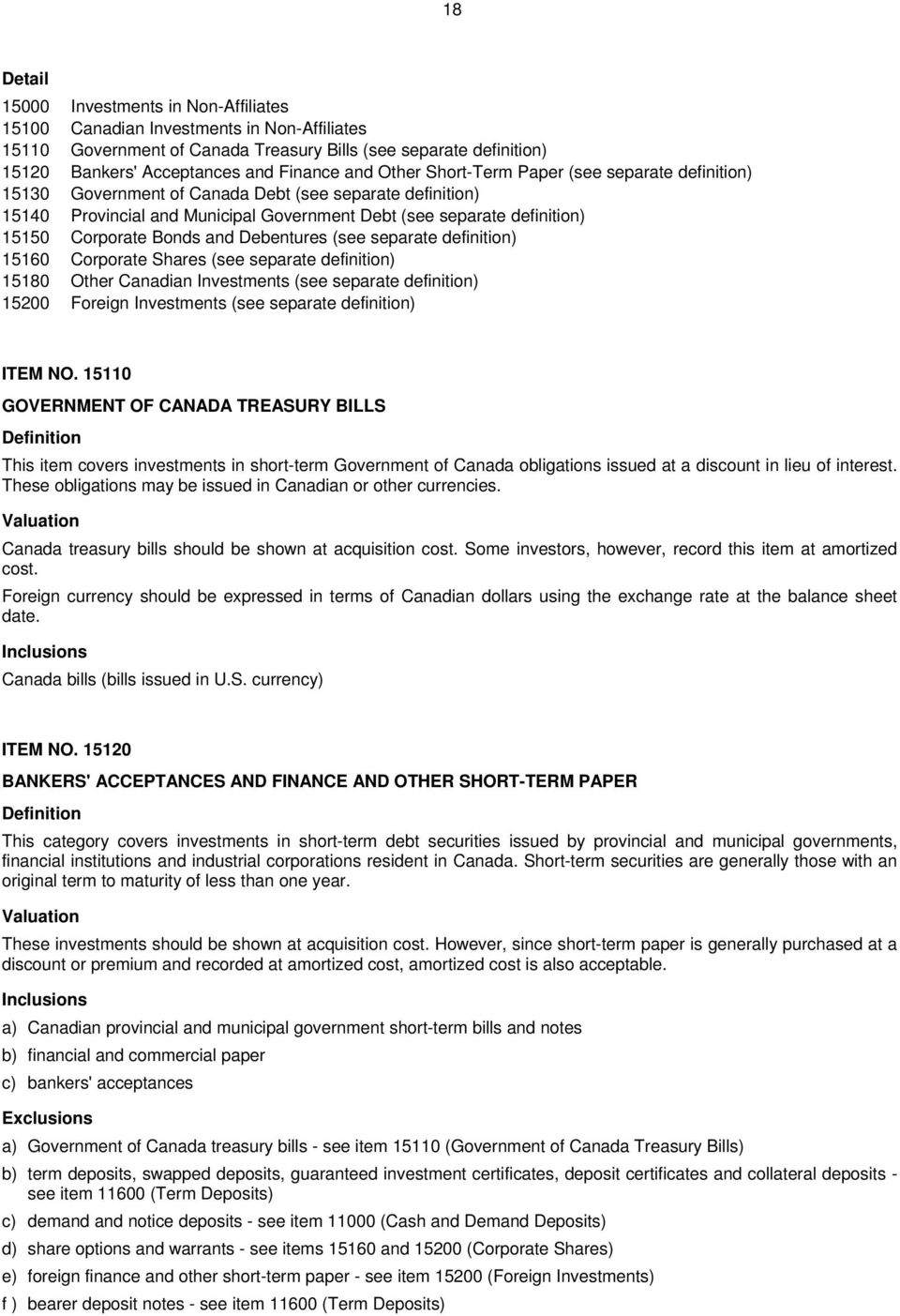
20 19 ITEM NO GOVERNMENT OF CANADA DEBT This item covers investments in debt securities, other than treasury bills, issued by the Government of Canada. These investments should be shown at amortized cost. Government Business Enterprises' debt guaranteed by the Government of Canada a) debt issued by government enterprises and not guaranteed by the Government of Canada - see item (Corporate Bonds and Debentures) b) Government of Canada treasury bills and short-term notes - see item (Government of Canada Treasury Bills) c) debt issued by private sector enterprises and guaranteed by the Government of Canada - see item (Corporate Bonds and Debentures) d) debt issued by provincial and municipal governments and guaranteed by the Government of Canada - see item (Provincial and Municipal Government Debt) e) accrued interest receivable - see item (Accounts Receivable and Accrued Revenue) ITEM NO PROVINCIAL AND MUNICIPAL GOVERNMENT DEBT This item covers investments in debt securities, except treasury bills and notes with original terms to maturity of less than one year, issued by Canadian provincial and municipal governments. Also included are debt securities issued by provincial and municipal government business enterprises guaranteed by provincial or municipal governments. These investments should be shown at amortized cost. a) provincial and municipal government business enterprise debt guaranteed by provincial and/or municipal governments b) debt issued by school boards, commissions and districts c) provincial and municipal debt securities guaranteed by the Government of Canada a) debt issued by government enterprises and not guaranteed by a provincial or municipal government - see item (Corporate Bonds and Debentures) b) treasury bills and short-term notes - see item (Bankers' Acceptances and Finance and Other Short-Term Paper) c) debt issued by private sector enterprises and guaranteed by provincial or municipal governments - see item (Corporate Bonds and Debentures) d) accrued interest receivable - see item (Accounts Receivable and Accrued Revenue)
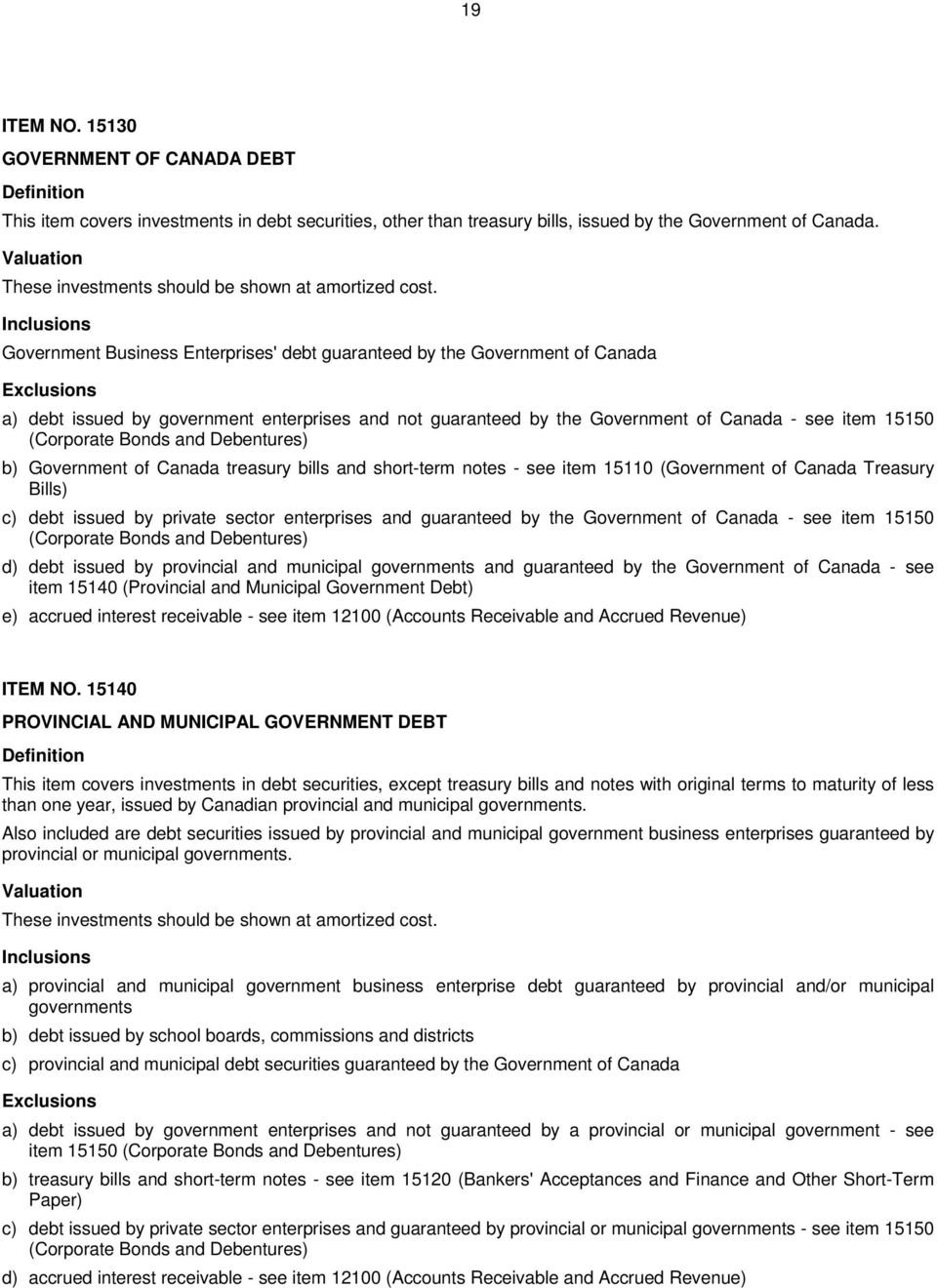
21 20 ITEM NO CORPORATE BONDS AND DEBENTURES This item covers all debt securities issued by Canadian corporations, other than debt issued by government business enterprises and guaranteed by Canadian governments, and short-term paper. These investments should be shown at amortized cost. In cases where the investment value is permanently impaired and a write-down is recorded, this write-down will be reflected in item (Write-Offs and Adjustments). a) income debentures, mortgage bonds, small business development bonds and small business bonds b) notes with an original term to maturity of one year or over, except promissory notes arising from the sale of goods and services c) own debt securities held but not retired d) debt securities issued by separately constituted government enterprises and not guaranteed by a Canadian government e) government guaranteed debt securities of private sector enterprises a) short-term paper - see item (Bankers' Acceptances and Finance and Other Short-Term Paper) b) government business enterprise debt guaranteed by a Canadian government - see items (Government of Canada Debt) and (Provincial and Municipal Government Debt) c) debt securities of foreign governments and corporations - see item (Foreign Investments) d) accrued interest receivable - see item (Accounts Receivable and Accrued Revenue) e) debt securities of affiliates - see item (Investments in and Claims on Parent, Subsidiaries and Affiliates) f ) promissory notes arising from the sale of goods and services - see item (Accounts Receivable and Accrued Revenue) ITEM NO CORPORATE SHARES Investments in shares covers all holdings of common and preferred shares issued by non-affiliated Canadian corporations. Investments in shares should be shown at acquisition cost after adjustments to reflect permanent impairment in the underlying values. Fixed term equity securities should be carried at amortized cost. a) common and preferred shares of non-affiliated Canadian corporations b) fixed term equity securities c) closed-end and open-end funds d) credit union shares e) stock warrants and options a) shares of affiliates - see item (Cost of Shares - Canadian Corporations) b) shares in foreign corporations - see item (Foreign Investments) c) dividends receivable - see item (Accounts Receivable and Accrued Revenue)
22 21 ITEM NO OTHER CANADIAN INVESTMENTS This item covers Canadian investments not elsewhere classified. These investments should be valued at acquisition or amortized cost. a) precious metals (except for mining companies, where these should be part of inventory) b) gold and silver certificates a) cash surrender value of life insurance policies - see item (Other Assets) b) goodwill, trademarks, patents, franchises, licences, rights and like items - see item (Intangible Assets) c) loans receivable - see items (Mortgage Loans to Non-Affiliates) and (Non-Mortgage Loans to Non- Affiliates) ITEM NO FOREIGN INVESTMENTS This item covers investments in foreign securities other than securities issued by, and loans to, foreign affiliates. Marketable and equity securities should be valued at acquisition cost. Some investors, however, record marketable securities at amortized cost. This method is acceptable. Debt securities should be valued at amortized cost. In cases where the investment value is permanently impaired and a write-down is recorded, this write-down will be reflected in item (Write-Offs and Adjustments). Foreign investments should be expressed in Canadian dollars using the rate of exchange in effect on the balance sheet date. a) foreign marketable securities b) foreign debt securities c) foreign equity securities a) claims on and investments in foreign affiliates - see items (Cost of Shares - Foreign Corporations) and (Loans, Advances, Mortgages, Notes, Bonds and Other Claims - Foreign Corporations, Officers and Shareholders) b) accrued interest and dividends receivable - see item (Accounts Receivable and Accrued Revenue) c) term deposits, bearer deposit notes, deposit receipts and like instruments in foreign financial institutions - items and (Term Deposits in Other Institutions) d) foreign mortgage loans - see item (Mortgage Loans to Non-Affiliates ITEM NO MORTGAGE LOANS TO NON-AFFILIATES Mortgage loans and sales agreements receivable are loans made to purchase real estate contingent upon the borrowers' conveying title to the underlying real property to the lender as security for the loan.
23 22 Mortgages and sales agreements should be shown at amortized cost before deducting provision for mortgage loan losses (item 19810). a) advances or draws as well as completed loans b) mortgages purchased from another investor c) mortgages assumed by seller of real estate a) mortgage loans to affiliates - see item (Loans, Advances, Mortgages, Notes, Bonds and Other Claims to Affiliates) b) chattel or collateral mortgages - loans made for purposes other than the purchase of real estate but secured by real estate - see item (Non-Mortgage Loans to Non-Affiliates) c) mortgage bonds and debentures - see item (Corporate Bonds and Debentures) d) advances made to finance real estate development and construction which are not secured by a mortgage, i.e., bridge financing - see item (Non-Mortgage Loans to Non-Affiliates) e) accrued interest receivable - see item (Accounts Receivable and Accrued Revenue) ITEM NO NON-MORTGAGE LOANS TO NON-AFFILIATES Non-mortgage loans receivable refers to funds lent to borrowers, other than through mortgage loan contracts or the purchase of debt securities issued by borrowers. Loans may be demand or time loans and, within these categories, secured or unsecured. Non-mortgage loans receivable should be shown at amortized cost before deducting the loan loss provision (item 19810). Loans denominated in foreign currency should be expressed in Canadian dollars using the exchange rate at the balance sheet date. a) day and call loans b) short-term and long-term loans c) collateral or chattel mortgages a) bills, serial notes, bonds and like evidence of indebtedness - see items in series (Investments in Non- Affiliates) b) loans receivable from affiliates - see item (Loans, Advances, Mortgages, Notes, Bonds and Other Claims from Affiliates) c) mortgage loans receivable and funds lent to purchase real estate - see item (Mortgage Loans to Non- Affiliates) d) accrued interest receivable - see item (Accounts Receivable and Accrued Revenue) ITEM NO LAND AND DEPRECIABLE ASSETS - GROSS Property, plant and equipment are tangible assets that are:
24 23 1. held by a corporation for use in the production or supply of goods and services, for rental to others, or for administrative purposes and may include items held for the maintenance or repair of such assets; 2. have been acquired or constructed with the intention of being used on a continuing basis; 3. not intended for sale in the ordinary course of business. Also included are assets acquired under capital leases which are leases where all the benefits and risks of ownership of leased property are transferred from the lessor to the lessee. Leased properties include land, buildings, machinery and equipment. Also included are properties which the reporting entity has classified as non-productive or non-operating (i.e., not part of its fixed assets) and is in the process of divesting itself of them. This item covers the accumulated depreciation and amortization on "real estate held for income " and "fixed assets." Land and depreciable assets should be valued at acquisition cost including interest capitalized, or allowance for funds used for construction, plus the cost of betterments, less write-downs to reflect permanent impairment. Depreciable assets should be reported before deducting depreciation. a) land, roads, bridges and towers b) buildings and other structures c) inventories of assets held for leasing d) leasehold improvements e) machinery and equipment ITEM NO REAL ESTATE HELD FOR INCOME - GROSS Investments in land, buildings and leaseholds for the production of income. Properties held for both own use and production of income should be apportioned between real estate investment and fixed assets according to the actual use of the property. If amounts are not material, however, such properties may be classified in their entirety as investment or fixed assets according to their major use. Real estate investment should be valued at acquisition cost including interest capitalized and cost of betterments, less write-downs to reflect permanent impairment. Amounts reported should be before deducting depreciation. Also, do not net encumbrances from the value of real estate - report encumbrances under account (Mortgage Loans). ITEM NO ACCUMULATED DEPRECIATION This is the accumulated periodic allocations of the cost of rental properties and fixed assets to expense. ITEM NO INTANGIBLE ASSETS Long-term assets that lack physical substance. All such assets will be valued at cost less accumulated amortization.
25 24 a) goodwill b) trademarks c) licences d) rights e) patents f ) franchises ITEM NO OTHER ASSETS This item covers all assets not elsewhere classified. Other assets should be valued at acquisition or amortized cost. a) prepaid expenses and deferred charges - expenditures which are expected to yield benefits in the future and are carried forward to be allocated to current operations in subsequent periods, e.g., amounts paid for goods and services not yet received, prepaid insurance and rents, discount and expense on bond issues, organizational expense, preproduction costs and deferred pension costs b) deposits and advances - amounts lodged with or payments made to others to be either charged to expense or refunded at a later period, e.g., downpayments and advances to suppliers c) cash surrender value of life insurance policies d) other unamortized deferred debits e) accumulated provisions and allowances for losses and write-downs of investments a) intangible assets - see item (Intangible Assets) b) allowance for doubtful accounts - see item (Allowance for Doubtful Accounts) c) reserves for losses which are appropriations of retained earnings ITEM NO ACCOUNTS PAYABLE AND ACCRUED LIABILITIES Accounts payable covers all claims by creditors arising from the purchase of goods and services. Also included are accrued liabilities and amounts owing to governments, except corporate income tax. Trade Payables are amounts claimed by creditors arising from the purchase of goods and services used in the ordinary course of business. Claims Payable and Provision For Unreported Claims covers all amounts necessary to pay all approved but unpaid claims and estimated amounts for insured risks that have occurred but are not yet reported by the statement date. This should be net of amounts associated with reinsurance ceded. Conversely, it should include amounts associated with reinsurance assumed. a) trade payables i) trade accounts payable to affiliates b) claims payable and provision for unreported claims, amounts due to agents and other insurance companies, and return premiums payable (insurance carriers) c) other accounts payable
26 25 i) interest, dividends and rent payable ii) accrued expenses such as salaries, wages, payroll taxes, employee benefits, indirect taxes, capital taxes iii) debt arising from the purchase of fixed assets and investments iv) outstanding cheques v) balance owing represented by the excess of GST collections over GST input tax credits claimed a) income taxes payable - see item (Income Taxes Payable) b) advances and unearned income - see item (Other Liabilities) c) lease contracts payable - see item (Loans and Overdrafts with Others) d) other accounts payable to affiliates - see item (Amounts Owing to Parent, Subsidiaries and Affiliates) e) loans payable - see item series (Loans and Overdrafts) and (Mortgage Loans) f ) balance recoverable represented by the excess of GST input tax credits claimed over GST collections - see item (Accounts Receivable and Accrued Revenue) ITEM NO INCOME TAXES PAYABLE This item covers income taxes payable to provincial and federal governments. a) other taxes such as municipal taxes, business taxes, payroll taxes, sales taxes, royalties, licences and fees payable to provincial and municipal governments - see item (Accounts Payable and Accrued Liabilities) b) capital taxes - see item (Accounts Payable and Accrued Liabilities) c) income taxes recoverable - see item (Accounts Receivable and Accrued Revenue) ITEM NO AMOUNTS OWING TO PARENT, SUBSIDIARIES AND AFFILIATES This category covers debt other than trade payables owed by the reporting entity to non-consolidated parent, subsidiary, and affiliated corporations, affiliated joint ventures and partnerships, head office, directors, officers and individual shareholders (cf. item 14000). Claims of affiliates should be shown at amortized value. a) all loans, advances, mortgages, bonds, debentures and notes held by non-consolidated parent, subsidiaries and affiliated corporations, affiliated joint ventures and partnerships, head office, directors, officers and individual shareholders b) dividends and other non-trade accounts payable to non-consolidated parent, subsidiaries and affiliated corporations, affiliated joint ventures and partnerships, head office, directors, officers and individual shareholders Trade payables - see item (Accounts Payable and Accrued Liabilities) Detail Amounts Owing to Parent, Subsidiaries and Affiliates In Canada Outside Canada
27 26 ITEM NO LOANS AND OVERDRAFTS WITH CHARTERED BANK BRANCHES IN CANADA Bank loans refer to funds lent by chartered banks to the reporting entity other than through mortgage loan contracts or the banks' purchase of the reporting entity's securities. These loans may be demand or time loans and, within these categories, secured or unsecured. Loans denominated in foreign currency should be expressed in Canadian dollars using the exchange rate in effect on the balance sheet date. a) overdrafts on deposit accounts as shown in the banks' records b) chattel or collateral mortgages c) exercised lines of credit a) mortgage loans - see item (Mortgage Loans) b) outstanding cheques - see item (Accounts Payable and Accrued Liabilities) c) loans from a parent, subsidiary or affiliates - see item (Amounts Owing to Parent, Subsidiaries and Affiliates) d) accrued interest payable - see item (Accounts Payable and Accrued Liabilities) e) loans from foreign branches of Canadian chartered banks - see item (Loans and Overdrafts with Others) f ) bankers' acceptances (drawers) - see item (Bankers' Acceptances and Short-term Notes and Paper) ITEM NO LOANS AND OVERDRAFTS WITH OTHERS This item covers funds borrowed from lenders other than chartered bank branches in Canada and affiliates. Loans denominated in foreign currency should be expressed in Canadian dollars using the exchange rate in effect on the balance sheet date. a) chattel or collateral mortgages b) overdrafts on deposit accounts as shown in the financial institution records c) exercised lines of credit d) capital lease obligations e) loans from foreign branches of Canadian chartered banks and foreign banks a) outstanding cheques - see item (Accounts Payable and Accrued Liabilities) b) accrued interest payable - see item (Accounts Payable and Accrued Liabilities) c) loans from parent, subsidiaries and affiliates - see item (Amounts Owing to Parent, Subsidiaries and Affiliates) d) finance and other short-term paper - see item (Bankers' Acceptances and Short-term Notes and Paper) e) funds raised through mortgage loan contracts and the issuance of securities - see items (Mortgage Loans), (Bankers' Acceptances and Short-term Notes and Paper) and (Bonds and Debentures) f ) bonds and debentures - see item (Bonds and Debentures) g) mortgage loans - see item (Mortgage Loans)
28 27 ITEM NO BANKERS' ACCEPTANCES AND SHORT-TERM NOTES AND PAPER This item covers short-term notes and paper issued and outstanding. This liability should be valued at proceeds of the issue before deducting fees or commissions. However, many issues are issued at a discount and may be recorded at amortized value. If data on actual proceeds are not available, amortized values are acceptable. Loans denominated in foreign currency should be expressed in Canadian dollars using the exchange rate in effect on the balance sheet date. a) finance and commercial paper b) promissory notes not insurable under a deposit insurance act in Canada c) demand or call notes d) bankers' acceptances - Bankers' acceptances is short-term money market financing that is guaranteed by a bank. It is a commercial draft or bill of exchange drawn by a corporate borrower for payment of a certain sum (usually a minimum of $100,000) on a specified date and guaranteed by the borrower's bank. The acceptance must be drawn to finance the manufacture or marketing of a tangible good. In practice the maximum term has been 90 days, since the Bank of Canada will accept bankers' acceptances as collateral only for a term not exceeding 90 days. However there have been acceptances issued for longer than 90 days. Once a bank accepts or guarantees the draft, the draft is usually sold to a money market dealer, but banks have been known to provide the funds in a few cases ITEM NO BONDS AND DEBENTURES This item covers bonds and debentures which represent long-term obligations. The instruments include a written promise to pay a specified sum of money at a fixed time in the future and to pay interest at a specified rate, and are usually secured by a pledge of assets. These debt instruments are usually marketable. This liability should be valued at proceeds of the issue before deducting fees or commissions. However, many issues are issued at a discount and may be recorded at amortized value. If data on proceeds are not available, amortized values are acceptable. Sinking funds consisting of investments may be established by the debtor under the terms of the bond agreement. The value of these investments should not be deducted from the value of the bonds outstanding but, rather, be shown in the appropriate asset category and the amount of debt shown at the actual amount outstanding. Bonds and debentures retired through the use of sinking funds or other resources should be deducted from the total debt outstanding. Investments in own bonds and debentures should not be netted against the corresponding liabilities but, rather, be shown in the appropriate investment category. Bonds and debentures denominated in foreign currency should be expressed in Canadian dollars using the exchange rate in effect on the balance sheet date. a) mortgage bonds b) collateral trust bonds c) own bonds held but not retired d) equipment trust certificates e) small business bonds and small business development bonds f ) income bonds
29 28 a) mortgage loans - see item (Mortgage Loans) b) bonds held by affiliates - see item (Amounts Owing to Parent, Subsidiaries and Affiliates) c) finance and other short-term paper - see item Bankers' Acceptances and Short-Term Notes and Paper) d) bank or other loans secured by bonds and debentures - see items (Loans and Overdrafts with Chartered Bank Branches in Canada) or (Loans and Overdrafts with Others), respectively ITEM NO MORTGAGE LOANS Mortgage loans payable are funds borrowed under a mortgage contract to purchase real estate. Loans denominated in foreign currency should be expressed in Canadian dollars using the exchange rate in effect on the balance sheet date. a) chattel or collateral mortgages - see items (Loans and Overdrafts with Chartered Bank Branches in Canada) and (Loans and Overdrafts with Others) b) mortgages due to affiliates - see item (Amounts Owing to Parent, Subsidiaries and Affiliates) c) accrued interest payable - see item (Accounts Payable and Accrued Liabilities) d) mortgage bonds - see item (Bonds and Debentures) ITEM NO FUTURE INCOME TAXES The excess or deficiency of income taxes payable based on taxable income in comparison to income taxes based on accounting income. The differences in income measurement between taxable income and accounting income are related to the timing of recognition of revenues and expenses. This account represents the accumulated amount by which income taxes charged in the accounts have been increased or decreased as a result of timing differences. All future income tax debits and credits arising from use of the income tax allocation method' Income taxes payable based on taxable income - see item (Income Taxes Payable) ITEM NO MINORITY INTEREST IN CONSOLIDATED SUBSIDIARIES This covers the equity in subsidiaries consolidated in a reporting unit's return that is applicable to shares not owned by the parent company or any other company that is included in the consolidated report. ITEM NO OTHER LIABILITIES This item covers liabilities not elsewhere classified.
30 29 a) advances received, deferred income and unearned revenue b) provision for future expenditures recognized in current operations as a charge against current income, e.g., retroactive increases in wages, provision for pension costs, provision for warranty claims, and retroactive adjustments c) unamortized deferred credits/debits such as unamortized foreign exchange gains/losses d) unrealized gains/losses on the translation of foreign currency a) trade and other accounts and notes payable - see item (Accounts Payable and Accrued Liabilities) b) accrued expenses - see item (Accounts Payable and Accrued Liabilities) c) accounts, notes, loans and all other claims owing to affiliates - see item (Amounts Owing to Parent, Subsidiaries and Affiliates) d) unrealized gains may be recognized as income (item Gains/Losses on the Translation of Foreign Currency; item Write-Offs and Adjustments; item Extraordinary Gains/Losses - Before Taxes; or part of item Appraisal Increase Credits/Debits) ITEM NO SHARE CAPITAL Share capital represents the ownership interest in a company as authorized by its instrument of incorporation. It covers all classes of share capital. Share capital issued and outstanding should be stated at par value or, if there is no par value, their stated value. a) common or ordinary shares b) preferred shares: cumulative, participating, non-cumulative, term, redeemable a) retained earnings - see item (Retained Earnings) b) appraisal increase credits/debits - see item (Appraisal Increase Credits/Debits) c) head office accounts - see item (Retained Earnings) d) contributed surplus - see item (Contributed Surplus) Detail Share Capital Preferred Shares Common Shares ITEM NO CONTRIBUTED SURPLUS Contributed surplus represents that portion of paid-in capital (i.e., contributed capital) arising from: a) premiums received on the issue of par value shares b) that portion of no par value shares issued that have not been classified as part of share capital c) proceeds of sale of donated shares d) profit on forfeited shares e) redemption or conversion of shares at an amount different from that set up as share capital
31 30 f ) donations of capital a) undistributed earnings - see item (Retained Earnings) b) appraisal increase credits/debits - see item (Appraisal Increase Credits/Debits) c) share capital - see item (Share Capital) ITEM NO APPRAISAL INCREASE CREDITS/DEBITS This refers to unrealized increases in the value of fixed assets arising from an appraisal. It represents the difference between the appraised value of the asset and its cost or depreciated cost. Gains/losses resulting from the disposal of assets - these are recognized as income and flowed through the income statement under item (Gains/Losses on the Sale of Assets) or item (Extraordinary Gains/Losses - Net) ITEM NO RETAINED EARNINGS Retained earnings refers to the accumulated undistributed earnings derived from all sources, including capital or extraordinary gains and losses. Retained earnings may be appropriated (i.e., set aside at the discretion of management or in accordance with the requirements of a statute, by-law, trust indenture or other agreement for a specific or general purpose) or unappropriated. Both are included here. In general, the unappropriated portion of retained earnings is usually labelled simply as "retained earnings." Thus, if an industry's questionnaire contains separate accounts for appropriated retained earnings, the "retained earnings" covered by the Statement of retained earnings, the "retained earnings" covered by the Statement of Retained Earnings refers only to unappropriated retained earnings. Head office account represents the undistributed profits a foreign company has left in an unincorporated branch operating in Canada. Also other unincorporated entities such as partnerships and joint ventures, branches and divisions of corporations should include their undistributed profits in this account. The undistributed profits portion of the head office accounts and capital accounts of unincorporated entities a) contributed surplus - see item (Contributed Surplus) b) appraisal surplus or appraisal increase credits - see item (Appraisal Increase Credits/Debits) c) share capital - see item (Share Capital) d) permanent capital of unincorporated entities - see item (Share Capital) ITEM NO RETAINED EARNINGS - CLOSING BALANCE This item is the balance at the end of the period and should be equal to and as defined in item (Retained Earnings).
32 31 ITEM NO RETAINED EARNINGS - OPENING BALANCE Retained earnings is the accumulated balance of income less losses of a reporting entity, after taking into account dividends and other appropriate charges or credits. The amount here is the balance at the beginning of the period. ITEM NO NET INCOME/LOSS This represents the current period net income as reported in the Income Statement - see item (Net Income/Loss). ITEM NO OTHER ADDITIONS/DEDUCTIONS These are changes in retained earnings arising from events other than those described or through dividends paid. a) adjustments resulting from the changes in accounting methods and basis of reporting b) prior period adjustments c) Part IV Refundable Taxes ITEM NO DIVIDENDS DECLARED An amount declared by the board of directors for distribution to shareholders in proportion to their holdings, having regard for the respective rights of various classes of stock. a) cash dividends declared i) cash dividends declared on all common and preferred shares b) other dividends i) stock dividends declared on common or preferred shares ii) premium paid on redemption of any class of shares of corporations iii) liquidating dividends Interest expense on small business development bonds, small business bonds, income bonds and debentures - see item (Interest Expense) Detail Dividends Declared Cash Preferred shares Common shares Other
33 32 ITEM NO INTER-CORPORATE REVENUE (ELIMINATED ON CONSOLIDATION) This item represents the amount of inter-corporate revenue eliminated when reporting consolidated revenues. If your enterprise has revenue between plants, divisions, or companies that are eliminated upon the consolidation of your accounts, the value of that transaction is reported here. ITEM NO COMMISSIONS AND FEES Commissions are remuneration to an agent or middleman for providing the service to the vendor or purchaser of bringing together the two parties to a transaction. Commission revenue should be shown before deductions for commissions paid. a) commissions earned on sales of real estate, and securities b) commissions earned by: insurance agents, travel agents, sales representatives and grain dealers Detail Commissions and Fees Sale of Real Estate Securities Brokerage Insurance and Pension Business Other ITEM NO INTEREST REVENUE FORM CANADIAN SOURCES Interest represents revenue earned with respect to the lending of money through loans and the holding of debt instruments such as bonds, mortgages and other financial claims. Interest revenue should not be netted against interest expense. a) amortization of discounts and premiums on the purchase of fixed income securities and the lending of money b) interest on deposits c) interest on income bonds and debentures d) finance charges on accounts receivable e) interest on small business development bonds f ) interest on small business bonds g) imputed interest or discounts from commercial paper, financial paper, and treasury bills h) interest from affiliates (put entirely under item 45800) a) dividends on term and retractable preferred shares - see items (Dividends Received from Canadian Corporations) or (Dividends Received from Foreign Corporations) b) interest revenue from foreign sources - see item (Interest Revenue from Foreign Sources)
34 33 Detail Interest Revenue from Canadian Sources Bonds and Debentures Other ITEM NO DIVIDENDS RECEIVED FROM CANADIAN CORPORATIONS Receipts of cash arising from the reporting entity's shareholdings in corporations incorporated in Canada. This item excludes dividends received when the equity method of accounting for investments is used. a) cash dividends on all common and preferred shares b) liquidating dividends a) patronage dividends - see item (Other Revenue) b) stock dividends - common or preferred - see item (Other Revenue) c) interest on small business bonds, small business development bonds and income bonds - see items (Interest Revenue on Bonds and Debentures) or (Interest Revenue from Foreign Sources) d) cash dividends from affiliates accounted for on the equity method - see item (Dividends Received from Corporations - Equity Method) ITEM NO FOREIGN DIVIDEND AND INTEREST REVENUE This item covers all cash dividends received from corporations incorporated outside Canada and interest revenue from foreign sources. Interest and dividend income received from foreign sources should be shown before deduction of interest expenses and foreign withholding taxes. See items (Interest Revenue from Canadian Sources) and (Dividends Received from Canadian Corporations) a) patronage dividends - see item (Other Revenue) b) stock dividends - see item (Other Revenue) Detail Foreign Dividend and Interest Revenue Dividends Received from Foreign Corporations Interest Revenue from Foreign Sources
35 34 ITEM NO GAINS/LOSSES ON THE SALE OF ASSETS (OPERATING) This item covers realized gains or losses on the sale of assets that are not considered extraordinary items - see item (Extraordinary Gains/Losses - Before Taxes). The assets in this category are not considered part of stockin-trade purchased or produced for sale from the normal operations of the business. They are considered to be of a capital nature such as fixed assets, investments, loans and securities. The accounting measure of the gain or loss on the sale of an asset represents the difference between its book value and the proceeds of disposition before the deduction of incidental costs and income taxes applicable. a) incidental costs, e.g., legal fees, commissions - see item (Purchased goods,materials and services) b) unrealized gains/losses - see item (Write-Offs and Adjustments) ITEM NO OTHER REVENUE Receipts and inflows of cash, receivables or other considerations that are: 1. not elsewhere classified; 2. not related to income of prior periods; 3. not of a capital nature. a) patronage dividends b) stock dividends c) royalties and franchise fees a) commission revenue - see item (Commissions and Fees) b) liquidating dividends - see items (Dividends Received from Canadian Corporations) and (Dividends Received from Foreign Corporations) c) realized and unrealized gains/losses - see items 48000, 56100, and ITEM NO DEPRECIATION Depreciation is the accounting process whereby the cost of fixed assets is systematically allocated over the term of their useful life to current operations. This process recognizes the gradual exhaustion of the service capacity of the fixed asset. Depreciation relates to fixed assets - items (Land and Depreciable Assets) and (Real Estate Held for Income). a) depreciation of buildings and structures b) depreciation of machinery and equipment c) amortization of leasehold improvements a) amortization of intangible assets and deferred charges - see item (Amortization)
36 35 b) one-time nature write-offs or write-downs - see item (Write-Offs and Adjustments) ITEM NO DEPRECIATION/AMORTIZATION OF BUILDINGS Depreciation is the accounting process whereby the cost of capital assets is systematically allocated to current operations over the term of its useful life. This process recognizes the gradual exhaustion of the service capacity of the capital assets. ITEM NO DEPRECIATION/AMORTIZATION OF MACHINERY AND EQUIPMENT Depreciation is the accounting process whereby the cost of capital assets is systematically allocated to current operations over the term of its useful life. This process recognizes the gradual exhaustion of the service capacity of the capital assets. ITEM NO AMORTIZATION Amortization is the gradual writing off of a balance in an asset account over an appropriate period. This balance usually arises from the capitalization of expenditures made to benefit future periods and includes intangible assets and other deferred charges. a) amortization of goodwill, patents, franchises, copyrights, organization expense, trademarks b) amortization of set-up costs, financing costs of issuing debt and share capital, deferred compensation and pension costs c) amortization of deferred gains and losses on investments a) amortization of leasehold improvements - see item (Depreciation) b) amortization of premiums and discounts on investments - see appropriate interest income or expense item c) amortization of deferred losses on the translation of foreign currency - see item (Gains/Losses on the Translation of Foreign Currency) Detail Amortization of Intangible Assets Deferred Charges Other ITEM NO INTEREST EXPENSE Interest expense represents payments for the use of funds raised through loans, bonds, short-term paper, notes and other debt instruments. Interest expense should be net of interest capitalized.
37 36 Interest expense should not be netted against interest revenue. a) amortization of bond discounts b) discount expense c) imputed interest expense on commercial and financial paper and treasury bills d) interest payments on capital leases e) finance charges f ) interest on small business development bonds g) interest on small business bonds h) interest on income bonds and debentures i ) interest paid on all other borrowing a) dividends on term and retractable preferred shares - see item (Dividends Declared - Cash) b) amortization of debt issue expenses - see item (Amortization - Deferred Charges) c) debt issue expenses - see item (Purchased goods, materials and services) ITEM NO PURCHASED GOODS, MATERIALS AND SERVICES a) direct cost of sales including the cost of goods purchased for resale and the cost of materials included in the cost of goods manufactured and sold b) supplies, parts, small tools and equipment and materials purchased and consumed in the production, distribution, marketing and administrative functions c) contractors and sub-contractors d) agents and self-employed persons (personal service contracts) e) professional, technical, administrative and security services f ) information and data processing services g) repairs, maintenance and cleaning services h) water and sewer charges levied by municipalities i ) rent and leasing of land, buildings and equipment j ) advertising, promotion and marketing services k) insurance l ) telephone and other communication services m) travel services n) memberships, licenses and fees Bad debt expense, write-down of accounts receivable and inventory, charitable donations and resource royalties (Please report on line 9, Other Operating Expenses) ITEM NO INDIRECT TAXES Salary Related a) Ontario Employer Health Tax b) Quebec Contribution des employeurs au fonds des services de santé
38 37 c) Manitoba Levy for Health and Education and the Newfoundland Payroll Tax Other a) property taxes, business taxes and other fees b) licenses for which no goods or services are received from municipal, provincial and federal governments c) provincial capital taxes ITEM NO OTHER EXPENSES Include Only a) bad debt expense b) write-down of accounts receivable and inventory c) charitable donations d) resource royalties ITEM NO WAGES AND SALARIES Reported wages and salaries (including commissions) before deductions. An employee is defined as a worker for whom a Revenue Canada T4 Supplementary Form was completed. a) vacation pay b) director's fees c) bonuses (including profit sharing) d) commissions e) gratuities f ) taxable allowances (e.g., room and board) g) retroactive wage payments h) amounts deposited into foreign accounts ITEM NO EMPLOYER PORTION OF EMPLOYEE BENEFITS a) employee life and extended health care insurance plans (e.g., medical, dental, drug, vision care plans) b) CPP/QPP contributions c) employer pensions contributions d) Workers' Compensation contributions e) Employment Insurance premiums (E.I.) f ) retiring allowances or lump sum payments to employees at time of termination or retirement g) all other employee benefits such as childcare or supplementary unemployment benefit (SUB) plans Ontario Employer Health Tax (Please report on line 4, Indirect Taxes)
39 38 ITEM NO GAINS/LOSSES ON THE TRANSLATION OF FOREIGN CURRENCY Gains or losses will occur on the translation of foreign currency because of fluctuating exchange rates over time. This item will include unrealized gains and losses on foreign currency denominated monetary assets and liabilities. This item will also include amortization of deferred exchange gains and losses on monetary assets and liabilities that have a fixed or ascertainable life extending beyond the end of the following fiscal year. Also included are realized exchange gains and losses arising from the settlement of foreign currency denominated monetary items. Unrealized gains/losses on the translation of financial statements of self-sustaining foreign operations - see item (Other Liabilities) ITEM NO WRITE-OFFS AND VALUATION ADJUSTMENTS This item covers unrealized gains or losses resulting from the adjustment of book values on the revaluation of assets which are not treated as extraordinary items on the income statement. Any gains or losses should be shown before the deduction of income taxes applicable. a) write-offs or write-downs of investments and loans in circumstances where their values are permanently impaired b) write-offs or write-downs of other assets a) realized gains/losses on sale of assets - see item (Gains/Losses on the Sale of Assets) b) extraordinary gains/losses - see item (Extraordinary Gains/Losses - Before Taxes) c) current period provision for losses with respect to bad debts - see item (Other Expenses) d) amortization of deferred gains/losses on investments - see item (Amortization - Other) e) amortization of deferred charges and deferred debits - see item (Amortization - Deferred Charges) f ) revaluations resulting from appraisal increases/decreases in real estate - see item (Appraisal Increase Credits/Debits) ITEM NO CANADIAN INCOME TAXES This item includes corporate income taxes including both current and future taxes which are based on the tax allocation method of accounting. Refundable taxes such as tax on capital gains under Part I and tax on taxable dividends under Part IV are to be included in item (Other Assets). a) current income taxes - the amount currently payable based on taxable income b) large corporations Federal capital tax (implemented July 1989) c) taxes related to all gains/losses except taxes on extraordinary items d) future income taxes - arises from timing differences in the recognition of revenue and expenses in the measurement of accounting and taxable income
40 39 e) tax benefit from loss carry forward a) taxes related to extraordinary items - see item (Income Taxes on Extraordinary Items and Tax Benefits from Loss Carryforwards) b) indirect taxes - see item (Indirect Taxes) c) provincial capital taxes - see item (Indirect Taxes) d) income taxes paid to foreign governments - see item (Purchased goods, materials and services) Detail Canadian Income Taxes Current Future ITEM NO EQUITY IN NET INCOME/LOSS OF UNCONSOLIDATED AFFILIATES This item is applicable only to reporting entities employing the equity method of accounting for investment in unconsolidated parent, affiliated and subsidiary corporations, affiliated joint ventures and partnerships. It covers the reporting entity's portion of the profit or loss for the current period of affiliates. Under the equity method of accounting for investments, dividends received from affiliates that are credited directly to the investment account will not appear in this item, nor will they be included in the measurement of net income - see items and (Dividends Received from Corporations Accounted for on the Equity Method) ITEM NO MINORITY SHAREHOLDERS' PORTION OF NET INCOME/LOSS In cases where reporting entities consolidate a subsidiary which is not wholly owned, the portion of the subsidiary's profit or loss for the current period accruing to the minority shareholders will be shown in this item. Contrary to C.I.C.A. treatment, which requires the exclusion of the minority shareholders' portion of extraordinary gains and losses of consolidated subsidiaries, the IOFD definition requires that this item include the minority shareholders' interest in all revenues, expenses, gains and losses, including extraordinary gains and losses. The consolidated accounts should include 100% of the subsidiary's revenues, expenses, gains and losses, including extraordinary gains and losses. ITEM NO EXTRAORDINARY GAINS/LOSSES - NET Gains, losses and provision for losses which are not typical of the normal business activities of the reporting entity. In a business, the events giving rise to extraordinary gains/losses are not expected to occur regularly over a period of years, and are not considered as recurring factors in ordinary business operations. In the case of consolidated financial statements, the parent's portion as well as the minority shareholders' share of extraordinary items (i.e., 100% of the gains or losses) should be included in this item. This treatment is contrary to C.I.C.A. guidelines which recommend that only the parent's portion of a subsidiary's extraordinary item be reported. a) events and circumstances that do not depend primarily on decisions or determinations by management or owners b) intervention by government or other regulatory bodies such as expropriations of property c) acts of God such as floods or earthquakes
41 40 d) losses resulting from fires or other catastrophes a) tax benefit of a loss carried forward - see item (Canadian Income Taxes) b) gains/losses from discontinued operations i) results of current operations should be reflected in appropriate revenue and expense items ii) recognition of future gains or losses - see item (Write-offs and Adjustments) iii) realized gains/losses - see item (Gains/Losses on the Sale of Assets) c) unusual and non-recurring items that do not meet the criteria set out in the definition of extraordinary gains/losses i) asset valuation adjustments such as write-downs and write-offs to net realizable values - see item (Write-offs and Adjustments) ii) gains and losses on the disposal of investments, fixed assets and loans - see item (Gains/Losses on the Sale of Assets) iii) provisions for future liabilities for estimated costs that will be paid in the future - see item (Purchased goods, materials and services) ITEM NO INCOME/LOSS BEFORE INCOME TAXES Net income before provision for income taxes, equity in net income of unconsolidated affiliates, minority shareholder's portion of net income, and extraordinary gains/losses. ITEM NO INCOME/LOSS AFTER INCOME TAXES Net income after income taxes but before equity in net income of unconsolidated affiliates, minority shareholders' portion of net income/loss and extraordinary gains/losses. ITEM NO NET INCOME/LOSS Net income represents the difference between all revenue and expenses, gain and loss items for the reporting period. ITEM NO INTEREST BEARING DEBT This item covers both short and long term debt other than trade payables owed by the reporting entity to nonconsolidated parent, subsidiary and affiliated corporations, affiliated joint ventures and partnerships, head office, directors, officers and individual shareholders in Canada and outside Canada (see item Amounts Owing to Parent, Subsidiaries and Affiliates). The debt is interest bearing. Loans denominated in foreign currency should be expressed in Canadian dollars using the exchange rate in effect on the balance sheet date. Claims of affiliates should be shown at amortized value.
42 41 a) loans and advances from affiliates b) dividends and other non-trade accounts and notes payable to affiliates Trade payables - see item (Accounts Payable and Accrued Liabilities) ITEM NO NON-INTEREST BEARING DEBT This item covers both short and long term debt other than trade payables owed by the reporting entity to nonconsolidated parent, subsidiary and affiliated corporations, affiliated joint ventures and partnerships, head office, directors, officers and individual shareholders in Canada and outside Canada (see item Amounts Owing to Parent, Subsidiaries and Affiliates). The debt does not bear interest. Loans denominated in foreign currency should be expressed in Canadian dollars using the exchange rate in effect on the balance sheet date. Claims of affiliates should be shown at amortized value. a) loans and advances from affiliates b) dividends and other non-trade accounts and notes payable to affiliates Trade payables - see item (Accounts Payable and Accrued Liabilities) ITEM NO INTEREST EXPENSE ON DEBT OWING TO PARENT, SUBSIDIARIES AND AFFILIATES This covers that portion of interest expense reported in item that is paid to parent, subsidiaries and affiliates. ITEM NO UNUSUAL REVENUES, EXPENSES, GAINS/LOSSES FROM CONTINUING BUSINESS OPERATIONS Transactions, events or circumstances recognized in the income statement that are not classified as extraordinary gains/losses but are not expected to occur frequently over several years, or do not typify normal business activities, and have a material impact on the current period's profits. a) transactions, events or circumstances recognized in the income statement that are reported as operating revenues (40,000's accounts) operating expenses (50,000's accounts) gains/losses on disposal of assets (account 56300) b) unrealized gains/losses, write-downs, write-offs and valuation adjustments included in account c) non-operating gains and losses on the disposal of investments and capital assets (account 56300) Extraordinary gains and losses (see accounts 58300, 58310, 58320)
43 42 ITEM NO DIVIDENDS RECEIVED FROM CORPORATIONS ACCOUNTED FOR ON THE EQUITY METHOD Dividends received from unconsolidated subsidiaries and affiliates accounted for on the equity method. Such dividends received are credited to the balance sheet investment account and do not appear as dividend income reported on the income statement. Dividends received from corporations where the investment is accounted for on the cost method - see items (Dividends from Canadian Corporations) and (Dividends Received from Foreign Corporations) Detail Dividends Received from Corporations Accounted for on the Equity Method Canadian Foreign ITEM NO AVERAGE NUMBER OF PEOPLE EMPLOYED DURING THE REPORTING PERIOD Full-time, part-time, and temporary employees and employees absent with pay Contract workers who are not part of your payroll
44 43 ANNUAL SUPPLEMENT TO THE QUARTERLY SURVEY OF FINANCIAL STATEMENTS CAPITAL LEASES Explanation and s for questions 1, 2 and 9 The classification of a lease depends on whether substantially all the benefits and risks of ownership are transferred from the lessor to the lessee. If they are not transferred, the lease is termed an "operating lease"; if they are, it is called a "capital lease" from the lessee's viewpoint, and a "sales-type" or "direct financing" lease for the lessor. Under an operating lease, the lessor retains the leased assets on its books, depreciates it, and recognizes rental revenue as it becomes due. The lessee charges lease rentals to expense as incurred and its balance sheet is unaffected. Under a capital lease, the lessor recognizes, in essence, a loan receivable (a sale and then a loan receivable for a sales-type lease) and records finance income. The lessee records the acquisition of an asset, which is then depreciated on a basis consistent with assets of a similar nature, and the incurrence of an obligation similar to a loan. Lease payments are shown as a blend of interest expense and repayment of principal. Questions 1, 2 and 9 relate only to those accounts maintained by a lessee for capital leases: 1. Assets acquired under capital leases - year-end balance: The amount requested is the depreciated book value of assets acquired under capital leases. (In the quarterly survey of financial statements, this amount should have been reported as part of fixed assets in account ) 2. Capital lease obligations - year-end balance: This amount represents the year-end balance of the present value of the obligation under capital leases. (In the quarterly survey of financial statements, this amount should have been reported as part of non-mortgage loans or "other loans" - account ) 9. (a) Rental or lease payments for the year: This is the total payments made by the lessee to the lessor under a capital lease. The payments consist of two components, interest expense and reductions of principal. Expenses related to the operation and maintenance of leased machinery and equipment are not to be included here. 9. (b) Interest expense charged to current operations: This represents that portion of the rental or lease payments charged to interest expense for the year. 9. (c) Depreciation charged to current operations: This represents the depreciation expense related to assets acquired under capital leases. DEFERRED CHARGES AND PROVISION FOR FUTURE OBLIGATIONS Explanation and s for questions three to six Purpose Business profits as reported on the quarterly survey of financial statements are used in the estimate of National Income. National Income is one of the ways that economic production for all of Canada is measured. The System of National Accounts (SNA) has a conceptual framework and set of definitions which are standardized for all sectors of the economy. Thus, the measurement of business income or profits is governed by the definitions of capital and current expenditures in the SNA. Capital expenditures relate to the purchases of fixed assets such as structures, buildings, machinery and equipment. All other expenditures are classified as current and, as such, are deducted from revenues in the measurement of profits. However, accounting policies used by business recognize what is sometimes referred to as allocation accounting. Under this concept, expenditures which are not capital in nature can be deferred and appear as balance sheet assets. These deferred charges and debits will be charged to operations in future periods. To comply with the SNA concepts of profit measurement, Statistics Canada annually adjusts reported profits by adding back to profits expenditures that are booked during the year as deferred charges or debits. This, in effect, transfers the original expenditure from the balance sheet to the income statement to become a charge against profits in the period in which they were incurred. QUESTIONS THREE AND FOUR - DEFERRED CHARGES Questions three and four ask for the necessary information to make the adjustment described above. Question three asks for the amounts booked during the year as deferred charges or deferred debits. Question four asks for the
45 44 amounts charged to current operations during the year, except amounts charged to current operations and reported in the quarterly questionnaires in the following expense accounts: Account Amortization of deferred charges Account Write-offs and valuation adjustments Account Extraordinary gains and losses The reason for the exclusion of the above accounts is that the amounts reported in these accounts on the quarterly reports are already added back to profits on a quarterly basis. If the amounts were included in the answer to question four, the add-back to profits would be duplicated. a) Deferred financing costs of new securities issues - Accounts 62110, Included in these accounts would be costs recognized in connection with the issuance of securities on the public market, such as bonds, debentures, and shares booked during the year as deferred charges/debits. Such costs usually include items such as underwriters' fees and commissions, advertising, issuing a prospectus, and legal and accounting fees. b) Deferred preproduction costs - Accounts 62120, Included in these accounts would be costs incurred in developing and preparing a facility or a business for operations booked during the year as deferred charges/debits. Items that should be excluded from deferred preproduction costs (accounts and 62220) are: 1. Deferred charges related to the purchase of machinery and equipment that will eventually be transferred to a fixed asset account and classified as a capital expenditure 2. Prepaid expenses 3. Deferred research and development costs - see item (c) c) Deferred research and development costs - Accounts 62130, Research and development costs relate to costs incurred in the following activities: Research involves planned investigation undertaken with the hope of gaining new scientific or technical knowledge and understanding. Such investigation may or may not be directed towards a specific practical aim or application. Development is the translation of research findings or other knowledge into a plan or design for new or substantially improved materials, devices, products, processes, systems or services prior to the commencement of commercial production or use. QUESTIONS FIVE AND SIX - PROVISION FOR FUTURE OBLIGATIONS Questions five and six relate to liabilities established to recognize costs and charges against the current period's profits. The obligation to pay such costs or the incurring of such expenditures will not take place until sometime in the medium- to long-term future. Question five asks for amounts credited to the liability accounts and charged to the current year's profits. The recognition of this event does not involve a cash transaction. Question six asks for amounts actually paid during the year related to costs that were previously recognized and expensed when the liabilities were booked in earlier periods. Amounts actually paid include cash paid and accounts payable. Amounts reported in item 5 will be added back to reported profits, while amounts reported in item 6 will be deducted from profits to comply with SNA accounting concepts. Provision for pension costs, retirement benefits, deferred compensation related to current and former employees - Accounts 62310, Included in these accounts are costs associated with all types of formal or informal deferred compensation plans for current and former employees credited to the liability accounts and changed to the current year's profits. The recognition of this obligation does not involve a cash transaction. Deferred compensation is restricted to retirement income and post-employment compensation. This account does not include accruals and accounts payable classified as current liabilities. Rental Revenue Explanation and for question seven
46 45 Rental revenue is required on an annual basis for the System of National Accounts. Accordingly, this question requests a split between rental revenue from all real estate properties (7 a), and rental revenue generated by other assets (7 b). PROVISIONS FOR LOSSES, WRITE-DOWNS, AND WRITE-OFFS Explanation and s for question eight Purpose According to the definitions and concepts of business profits in the System of National Accounts (SNA), provision for losses related to financial assets such as accounts receivable, investments and loans are not recognized as charges against profits. Similarly, a provision for losses on discontinued operations is not considered a charge against profits. Therefore, to enable Statistics Canada to add these amounts back to profits annually, these charges are requested in column A. The actual write-offs of accounts previously set up as a provision or allowance are requested in column B. Column A Provisions charged to current operations during the year - Accounts 55400, 55873, 55871, The amounts requested in these accounts relate to all provisions for losses charged to current operations related to the uncollectability or the decline in value of accounts receivable, discontinued operations, investments, and loans. These charges to current operations are established by crediting a balance sheet valuation account. Do not include in these accounts amounts that were reported in the following quarterly questionnaire expense accounts: Account Write-offs and valuation adjustments Account Extraordinary gains and losses The reason for the exclusion of the above accounts is that the amounts reported in these accounts on the quarterly reports are already added back to profits. Column B Write-offs charged to balance sheet contra or valuation accounts - Accounts 71100, 71400, 71200, The amounts requested in these accounts relate to all write-offs of the categories of assets listed in 8(a), (b), (c) and (d) which cover accounts receivable, assets of discontinued operations, investments, and loans. These write-offs do not flow through the income statement as charges against profits. They represent a reduction in the asset account and an offsetting reduction in the related balance sheet valuation account.
INDUSTRIAL-ALLIANCE LIFE INSURANCE COMPANY. FIRST QUARTER 2000 Consolidated Financial Statements (Non audited)
 INDUSTRIAL-ALLIANCE LIFE INSURANCE COMPANY FIRST QUARTER 2000 Consolidated Financial Statements (Non audited) March 31,2000 TABLE OF CONTENTS CONSOLIDATED INCOME 2 CONSOLIDATED CONTINUITY OF EQUITY 3 CONSOLIDATED
HARMONIC DRIVE SYSTEMS INC. AND CONSOLIDATED SUBSIDIARIES CONSOLIDATED FINANCIAL STATEMENTS MARCH 31, 2013
 HARMONIC DRIVE SYSTEMS INC. AND CONSOLIDATED SUBSIDIARIES CONSOLIDATED FINANCIAL STATEMENTS MARCH 31, 2013 HARMONIC DRIVE SYSTEMS INC. AND CONSOLIDATED SUBSIDIARIES CONSOLIDATED BALANCE SHEETS ASSETS
Financial Statements
 Financial Statements Years ended March 31,2002 and 2003 Contents Consolidated Financial Statements...1 Report of Independent Auditors on Consolidated Financial Statements...2 Consolidated Balance Sheets...3
The Kansai Electric Power Company, Incorporated and Subsidiaries
 The Kansai Electric Power Company, Incorporated and Subsidiaries Consolidated Financial Statements for the Years Ended March 31, 2003 and 2002 and for the Six Months Ended September 30, 2003 and 2002 The
SUMITOMO DENSETSU CO., LTD. AND SUBSIDIARIES. Consolidated Financial Statements
 SUMITOMO DENSETSU CO., LTD. AND SUBSIDIARIES Consolidated Financial Statements Report of Independent Public Accountants To the Board of Directors of Sumitomo Densetsu Co., Ltd. : We have audited the consolidated
Consolidated Financial Statements
 Consolidated Financial Statements For the year ended February 20, 2016 Nitori Holdings Co., Ltd. Consolidated Balance Sheet Nitori Holdings Co., Ltd. and consolidated subsidiaries As at February 20, 2016
Consolidated Balance Sheets
 Consolidated Balance Sheets March 31 2015 2014 2015 Assets: Current assets Cash and cash equivalents 726,888 604,571 $ 6,057,400 Marketable securities 19,033 16,635 158,608 Notes and accounts receivable:
Cathay Life Insurance Co., Ltd. Financial Statements As of December 31, 2006 and 2007 With Independent Auditors Report
 Financial Statements With Independent Auditors Report The reader is advised that these financial statements have been prepared originally in Chinese. These financial statements do not include additional
PART III. Consolidated Financial Statements of Hitachi, Ltd. and Subsidiaries: Independent Auditors Report 47
 PART III Item 17. Financial Statements Consolidated Financial Statements of Hitachi, Ltd. and Subsidiaries: Schedule: Page Number Independent Auditors Report 47 Consolidated Balance Sheets as of March
FINANCIAL STATEMENT 2010
 FINANCIAL STATEMENT 2010 CONTENTS Independent Auditors Report------------------------------ 2 Consolidated Balance Sheets ------------------------------ 3 Consolidated Statements of Operations ----------------
VII. Consolidated financial statements Credit Suisse (Bank) 281 Report of the Group Auditors. 283 Consolidated statements of income
 VII Consolidated financial statements Credit Suisse (Bank) 281 Report of the Group Auditors 283 Consolidated statements of income 284 Consolidated balance sheets 286 Statements of changes in shareholder
Consolidated Balance Sheets March 31, 2001 and 2000
 Financial Statements SEIKAGAKU CORPORATION AND CONSOLIDATED SUBSIDIARIES Consolidated Balance Sheets March 31, 2001 and 2000 Assets Current assets: Cash and cash equivalents... Short-term investments (Note
Ricoh Company, Ltd. INTERIM REPORT (Non consolidated. Half year ended September 30, 2000)
 Ricoh Company, Ltd. INTERIM REPORT (Non consolidated. Half year ended September 30, 2000) *Date of approval for the financial results for the half year ended September 30, 2000, at the Board of Directors'
(Amounts in millions of Canadian dollars except for per share amounts and where otherwise stated. All amounts stated in US dollars are in millions.
 Notes to the Consolidated Financial Statements (Amounts in millions of Canadian dollars except for per share amounts and where otherwise stated. All amounts stated in US dollars are in millions.) 1. Significant
MITSUI SUMITOMO INSURANCE COMPANY, LIMITED AND SUBSIDIARIES. CONSOLIDATED BALANCE SHEETS March 31, 2005 and 2006
 CONSOLIDATED BALANCE SHEETS March 31, 2005 and 2006 2005 2006 ASSETS Investments - other than investments in affiliates: Securities available for sale: Fixed maturities, at fair value 3,043,851 3,193,503
Consolidated Balance Sheet
 Consolidated Balance Sheet (As of March 31, 2010) Item Amount Item Amount [Assets] million yen [Liabilities] million yen Current assets 12,277Current liabilities 7,388 Notes payable and accounts 2,449
Brief Report on Closing of Accounts (connection) for the Term Ended March 31, 2007
 MARUHAN Co., Ltd. Brief Report on Closing of (connection) for the Term Ended March 31, 2007 (Amounts less than 1 million yen omitted) 1.Business Results for the term ended on March, 2007 (From April 1,
The Awa Bank, Ltd. Consolidated Financial Statements. The Awa Bank, Ltd. and its Consolidated Subsidiaries. Years ended March 31, 2011 and 2012
 The Awa Bank, Ltd. Consolidated Financial Statements Years ended March 31, 2011 and 2012 Consolidated Balance Sheets (Note 1) 2011 2012 2012 Assets Cash and due from banks (Notes 3 and 4) \ 230,831 \
Principal Accounting Policies
 1. Basis of Preparation The accounts have been prepared in accordance with Hong Kong Financial Reporting Standards ( HKFRS ). The accounts have been prepared under the historical cost convention as modified
1 CONSOLIDATED FINANCIAL STATEMENTS (1) Consolidated Balance Sheets
 1 CONSOLIDATED FINANCIAL STATEMENTS (1) Consolidated Balance Sheets As of March 31,2014 As of March 31,2015 Assets Cash and due from banks 478,425 339,266 Call loans and bills bought 23,088 58,740 Monetary
Statement of Cash Flows
 STATUTORY BOARD FINANCIAL REPORTING STANDARD SB-FRS 7 Statement of Cash Flows This version of SB-FRS 7 does not include amendments that are effective for annual periods beginning after 1 January 2014.
KIRIN HOLDINGS COMPANY, LIMITED
 KIRIN HOLDINGS COMPANY, LIMITED CONSOLIDATED FINANCIAL STATEMENTS FOR THE YEARS ENDED DECEMBER 31, 2013 AND 2012 TOGETHER WITH INDEPENDENT AUDITOR S REPORT Consolidated Balance Sheets Kirin Holdings Company,
Note 2 SIGNIFICANT ACCOUNTING
 Note 2 SIGNIFICANT ACCOUNTING POLICIES BASIS FOR THE PREPARATION OF THE FINANCIAL STATEMENTS The consolidated financial statements have been prepared in accordance with International Financial Reporting
Consolidated financial statements
 Summary of significant accounting policies Basis of preparation DSM s consolidated financial statements have been prepared in accordance with International Financial Reporting Standards (IFRS) as adopted
ASPE AT A GLANCE Section 3856 Financial Instruments
 ASPE AT A GLANCE Section 3856 Financial Instruments December 2014 Section 3856 Financial Instruments Effective Date Fiscal years beginning on or after January 1, 2011 1 SCOPE Applies to all financial instruments
A&W Food Services of Canada Inc. Consolidated Financial Statements December 30, 2012 and January 1, 2012 (in thousands of dollars)
 A&W Food Services of Canada Inc. Consolidated Financial Statements December 30, and January 1, (in thousands of dollars) February 12, 2013 Independent Auditor s Report To the Shareholders of A&W Food Services
1. Basis of Preparation. 2. Summary of Significant Accounting Policies. Principles of consolidation. (a) Foreign currency translation.
 Nitta Corporation and Subsidiaries Notes to Consolidated Financial Statements March 31, 1. Basis of Preparation The accompanying consolidated financial statements of Nitta Corporation (the Company ) and
Summary of significant accounting policies
 1 (14) Summary of significant accounting policies The principal accounting policies applied in the preparation of Neste's consolidated financial statements are set out below. These policies have been consistently
International Accounting Standard 7 Statement of cash flows *
 International Accounting Standard 7 Statement of cash flows * Objective Information about the cash flows of an entity is useful in providing users of financial statements with a basis to assess the ability
Sri Lanka Accounting Standard-LKAS 7. Statement of Cash Flows
 Sri Lanka Accounting Standard-LKAS 7 Statement of Cash Flows CONTENTS SRI LANKA ACCOUNTING STANDARD-LKAS 7 STATEMENT OF CASH FLOWS paragraphs OBJECTIVE SCOPE 1 3 BENEFITS OF CASH FLOW INFORMATION 4 5 DEFINITIONS
Indian Accounting Standard (Ind AS) 7 Statement of Cash Flows
 Contents Indian Accounting Standard (Ind AS) 7 Statement of Cash Flows Paragraphs OBJECTIVE SCOPE 1 3 BENEFITS OF CASH FLOW INFORMATION 4 5 DEFINITIONS 6 9 Cash and cash equivalents 7 9 PRESENTATION OF
Cathay Life Insurance Co., Ltd. Financial Statements For The Three Months Ended March 31, 2012 and 2011 With Independent Auditors Review Report
 Financial Statements For The Three Months Ended March 31, 2012 and 2011 With Independent Auditors Review Report The reader is advised that these financial statements have been prepared originally in Chinese.
TAKASHIMAYA FINANCIAL STATEMENTS
 TAKASHIMAYA FINANCIAL STATEMENTS Years ended February 29, and February 28, 2011 CONSOLIDATED BALANCE SHEETS Takashimaya Company, Limited and Consolidated Subsidiaries February 29, and February 28, 2011
Notes to the Consolidated Financial Statements for the 92nd Fiscal Term. Notes to the Non-Consolidated Financial Statements for the 92nd Fiscal Term
 To Those Shareholders with Voting Rights Notes to the Consolidated Financial Statements for the 92nd Fiscal Term Notes to the Non-Consolidated Financial Statements for the 92nd Fiscal Term The above documents
VANCOUVER COMMUNITY COLLEGE
 Financial Statements of VANCOUVER COMMUNITY COLLEGE KPMG Enterprise Metrotower II 4720 Kingsway, Suite 2400 Burnaby, BC V5H 4N2 Canada Telephone (604) 527-3600 Fax (604) 527-3636 Internet www.kpmg.ca/enterprise
Investments and advances... 313,669
 Consolidated Financial Statements of the Company The consolidated balance sheet, statement of income, and statement of equity of the Company are as follows. Please note the Company s consolidated financial
Notes to Consolidated Financial Statements Year ended March 31, 2014
 Notes to Consolidated Financial Statements Year ended March 31, 2014 Mitsui Oil Exploration Co., Ltd. and Consolidated Subsidiaries 1. Basis of Presenting Consolidated Financial Statements The accompanying
Audit Report of Independent Certified Public Accountants
 Audit Report of Independent Certified Public Accountants The Board of Directors Acer Incorporated: We have audited the non-consolidated balance sheets of Acer Incorporated (the Company ) as of June 30,
Data Compilation Financial Data
 Data Compilation Financial Data CONTENTS 1. Transition of Significant Management Indicators, etc. Japan Post Group (Consolidated) 122 Japan Post Holdings Co., Ltd. (Non-consolidated) 122 Japan Post Co.,
Data Compilation Financial Data
 Data Compilation Financial Data CONTENTS 1. Transition of Significant Management Indicators, etc. Japan Post Group (Consolidated) 124 Japan Post Service Co., Ltd. (Non-consolidated) 125 Japan Post Holdings
NEPAL ACCOUNTING STANDARDS ON CASH FLOW STATEMENTS
 NAS 03 NEPAL ACCOUNTING STANDARDS ON CASH FLOW STATEMENTS CONTENTS Paragraphs OBJECTIVE SCOPE 1-3 BENEFITS OF CASH FLOWS INFORMATION 4-5 DEFINITIONS 6-9 Cash and cash equivalents 7-9 PRESENTATION OF A
3. CONSOLIDATED QUARTERLY FINANCIAL STATEMENTS
 3. CONSOLIDATED QUARTERLY FINANCIAL STATEMENTS (1) Consolidated Quarterly Balance Sheets September 30, 2014 and March 31, 2014 Supplementary Information 2Q FY March 2015 March 31, 2014 September 30, 2014
ASPE at a Glance. Standards Included in Topic
 ASPE AT A GLANCE ASPE AT A GLANCE This publication has been compiled to assist users in gaining a high level overview of Accounting Standards for Private Enterprises (ASPE) included in Part II of the CPA
MATRIX IT LTD. AND ITS SUBSIDIARIES CONSOLIDATED FINANCIAL STATEMENTS
 CONSOLIDATED FINANCIAL STATEMENTS AS OF DECEMBER 31, 2013 CONSOLIDATED FINANCIAL STATEMENTS AS OF DECEMBER 31, 2013 NIS IN THOUSANDS INDEX Page Auditors' Reports 2-4 Consolidated Statements of Financial
Notes to Consolidated Financial Statements Note 1: Basis of Presentation
 NOTES TO CONSOLIDATED FINANCIAL STATEMENTS to Consolidated Financial Statements Note 1: Basis of Presentation Bank of Montreal ( the bank ) is a public company incorporated in Canada having its registered
Consolidated Financial Statements. Nippon Unipac Holding and Consolidated Subsidiaries
 Consolidated Financial Statements Nippon Unipac Holding and Consolidated Subsidiaries Period from March 30, 2001 (date inception) to September 30, 2001 Nippon Unipac Holding and Consolidated Subsidiaries
IPSAS 2 CASH FLOW STATEMENTS
 IPSAS 2 CASH FLOW STATEMENTS Acknowledgment This International Public Sector Accounting Standard (IPSAS) is drawn primarily from International Accounting Standard (IAS) 7, Cash Flow Statements published
Japan Vilene Company, Ltd. and Subsidiaries
 - 27 - Japan Vilene Company, Ltd. and Subsidiaries Notes to Consolidated Financial Statements Year Ended March 31, 2015 1. BASIS OF PRESENTATION OF CONSOLIDATED FINANCIAL STATEMENTS The accompanying consolidated
N otes to Consolidated Financial Statements
 N otes to Consolidated Financial Statements Brother Industries, Ltd. and Consolidated Subsidiaries For the Years ended March 31, 2011 and 2010 1. Basis of Presenting Consolidated Financial Statements The
Capital Stock. (units) 9/30/2015 512.362.664 509.842.829 1.022.205.493 6.522.831 13.045.663 19.568.494
 (Convenience translation into English from the original previously issued in Portuguese) ITR QUARTERLY INFORMATION 9/30/2015 SUL AMÉRICA S/A Capital Stock Shares Number (units) Capital Stock Common Preferred
PRINCIPLES FOR PRODUCING AND SUBMITTING REPORTS
 December 2014 PRINCIPLES FOR PRODUCING AND SUBMITTING REPORTS (1) The balance sheet and income statement are in euros, rounded up to integers. Amounts recorded in foreign currencies must be converted into
Notes to Consolidated Financial Statements Notes to Non-consolidated Financial Statements
 This document has been translated from the Japanese original for reference purposes only. In the event of discrepancy between this translated document and the Japanese original, the original shall prevail.
NOTICE OF NO AUDITOR REVIEW OF INTERIM FINANCIAL STATEMENTS
 Condensed Interim Consolidated Financial Statements of THE BRICK LTD. For the three months ended March 31, 2013 NOTICE OF NO AUDITOR REVIEW OF INTERIM FINANCIAL STATEMENTS Under National Instrument 51-102,
$ 2,035,512 98,790 6,974,247 2,304,324 848,884 173,207 321,487 239,138 (117,125) 658,103
 FINANCIAL SECTION CONSOLIDATED BALANCE SHEETS Aioi Insurance Company, Limited (Formerly The Dai-Tokyo Fire and Marine Insurance Company, Limited) and March 31, and ASSETS Cash and cash equivalents... Money
DTS CORPORATION and Consolidated Subsidiaries. Unaudited Quarterly Consolidated Financial Statements for the Three Months Ended June 30, 2008
 DTS CORPORATION and Consolidated Subsidiaries Unaudited Quarterly Consolidated Financial Statements for the Three Months Ended June 30, 2008 DTS CORPORATION and Consolidated Subsidiaries Quarterly Consolidated
Guidelines for Preparing an Error-Free Call Report: FFIEC 002 Common Reporting Errors
 Guidelines for Preparing an Error-Free Call Report: FFIEC 002 Federal Reserve Bank of New York Updated by: Susan Jessop December, 2002 Guidelines for Preparing an Error-Free Call Report (For FFIEC 002
Consolidated Financial Results
 UFJ Holdings, Inc. November 25, 2003 For the Six Months Ended September 30, 2003 UFJ Holdings, Inc. today reported the company's consolidated financial results for the six months ended September 30, 2003.
Consolidated Financial Results for Fiscal Year 2013 (April 1, 2013 March 31, 2014)
 Consolidated Financial Results for Fiscal Year 2013 (April 1, 2013 March 31, 2014) 28/4/2014 Name of registrant: ShinMaywa Industries, Ltd. Stock Exchange Listed: Tokyo Code number: 7224 (URL: http://www.shinmaywa.co.jp
Consolidated Financial Statements. FUJIFILM Holdings Corporation and Subsidiaries. March 31, 2015 with Report of Independent Auditors
 Consolidated Financial Statements FUJIFILM Holdings Corporation and Subsidiaries March 31, 2015 with Report of Independent Auditors Consolidated Financial Statements March 31, 2015 Contents Report of Independent
Consolidated Financial Results for Six Months Ended September 30, 2007
 Consolidated Financial Results for Six Months Ended September 30, 2007 SOHGO SECURITY SERVICES CO., LTD (URL http://ir.alsok.co.jp/english) (Code No.:2331, TSE 1 st Sec.) Representative: Atsushi Murai,
Chart of Accounts for Banks
 Chart of Accounts for Banks ASSETS Cash and Cash Equivalents 1 0 0 1 Cash in vault 1 0 0 2 Cash in ATM 1 0 0 3 Cash in transit 1 0 0 4 Damaged notes 1 0 0 5 Travellers cheques 1 0 0 6 Items for collection:
Investments and Other Assets: Investment Securities 11,145 10,339 135,694 Investments in Unconsolidated Subsidiaries and Associated Companies
 Consolidated Balance Sheets IBJ Leasing Company, Limited and Consolidated Subsidiaries As of March 31, 2012 and 2011 Millions of yen Thousands of U.S. dollars (Note 1) ASSETS Current Assets: Cash and Cash
Summary Comparison of Part II of the CICA Handbook Accounting
 Summary Comparison the CICA Accounting to XFI Version in Part V As December 31, 2009 1. This comparison has been prepared by the staff the Accounting Standards Board (AcSB) and has not been approved by
2 FSA002 Income statement
 2 FSA002 Income statement This data item provides the PRA with information on the main sources of income and expenditure for a firm. It should be completed on a cumulative basis for the firm's current
Interim Consolidated Financial Statements (Unaudited)
 Interim Consolidated Financial Statements (Unaudited) For the Six Months Ended, NTT FINANCE CORPORATION This document has been translated and reclassified from a part of the Japanese
Online Disclosures Relating to Notice of the 101st Annual Shareholders Meeting
 Online Disclosures Relating to Notice of the 101st Annual Shareholders Meeting Notes to Consolidated Financial Statements Notes to Non-Consolidated Financial Statements (From April 1, 2015 to March 31,
Summary of Significant Accounting Policies FOR THE FINANCIAL YEAR ENDED 31 MARCH 2014
 46 Unless otherwise stated, the following accounting policies have been applied consistently in dealing with items which are considered material in relation to the financial statements. The Company and
Acal plc. Accounting policies March 2006
 Acal plc Accounting policies March 2006 Basis of preparation The consolidated financial statements of Acal plc and all its subsidiaries have been prepared in accordance with International Financial Reporting
INSTRUCTIONS FOR COMPLETING INSURANCE COMPANY FINANCIAL STATEMENTS
 INSTRUCTIONS FOR COMPLETING INSURANCE COMPANY "DRAFT VERSION FOR FIRST REVIEW ONLY" Submitted to: Minstry of Finance and Economy Head of Insurance Department Republic of Armenia Submitted by: BearingPoint
Consolidated Statement of Financial Position Sumitomo Corporation and Subsidiaries As of March 31, 2016 and 2015. Millions of U.S.
 Consolidated Statement of Financial Position Sumitomo Corporation and Subsidiaries As of March 31, 2016 and 2015 ASSETS Current assets: Cash and cash equivalents 868,755 895,875 $ 7,757 Time deposits 11,930
Consolidated Financial Statements
 Consolidated Financial Statements Reports 111 Management s responsibility for financial reporting 111 Report of Independent Registered Chartered Accountants 112 Management s report on internal control
Samsung Life Insurance Co., Ltd. Separate Financial Statements March 31, 2013 and 2012
 Separate Financial Statements Index Page(s) Report of Independent Auditors 1-2 Separate Financial Statements Statements of Financial Position 3 Statements of Comprehensive Income 4 5 Statements of Changes
Residual carrying amounts and expected useful lives are reviewed at each reporting date and adjusted if necessary.
 87 Accounting Policies Intangible assets a) Goodwill Goodwill represents the excess of the cost of an acquisition over the fair value of identifiable net assets and liabilities of the acquired company
CONSOLIDATED FINANCIAL STATEMENTS
 CONSOLIDATED FINANCIAL STATEMENTS TABLE OF CONTENTS MANAGEMENT S STATEMENT OF RESPONSIBILITY FOR FINANCIAL REPORTING 65 INDEPENDENT AUDITOR S REPORT 66 CONSOLIDATED FINANCIAL STATEMENTS 67 Consolidated
INSTRUCTIONS QUARTERLY REPORTING (C.B. 40/1 TO 40/4)
 INSTRUCTIONS QUARTERLY REPORTING (C.B. 40/1 TO 40/4) The Quarterly Reports are to be completed by all financial Institutions for the periods January March, April-June, July September and October December
Summary of Significant Differences between Japanese GAAP and U.S. GAAP
 Summary of Significant Differences between Japanese GAAP and U.S. GAAP The consolidated financial statements of SMFG and its subsidiaries presented in this annual report conform with generally accepted
Statutory Financial Statements
 Statutory Financial Statements for the year ended December 31, 2007 by Kardan NV, Amsterdam, the Netherlands Consolidated IFRS Financial Statements Consolidated IFRS Balance Sheet 54 Consolidated IFRS
Overview of Business Results for the 2nd Quarter of Fiscal Year Ending March 31, 2012 (2Q FY2011)
 November 8, 2011 Overview of Business Results for the 2nd Quarter of Fiscal Year Ending March 31, 2012 () Name of the company: Iwatani Corporation Share traded: TSE, OSE, and NSE first sections Company
ATS AUTOMATION TOOLING SYSTEMS INC.
 Interim Consolidated Financial Statements For the period ended June 29, 2014 (Unaudited) (Condensed) Interim Consolidated Statements of Financial Position (in thousands of Canadian dollars unaudited) June
MOUNTAIN EQUIPMENT CO-OPERATIVE
 Consolidated Financial Statements of MOUNTAIN EQUIPMENT CO-OPERATIVE KPMG LLP PO Box 10426 777 Dunsmuir Street Vancouver BC V7Y 1K3 Canada Telephone (604) 691-3000 Fax (604) 691-3031 Internet www.kpmg.ca
(amounts in USD/GBP/CYP/MKD/CSD)
 @CONSOLIDATED COMPANY @ CODE COMPANY NAME 1045 ALPHA ASSET FINANCE C.I. LTD @TABLE : - ASSETS @FOR THE CONSOLIDATED FINANCIAL STATEMENTS OF ALPHA BANK GROUP 31.12.2005 @ACCOUNT CODE ACCOUNT DESCRIPTION
SUMMARY OF CONSOLIDATED BUSINESS RESULTS for the nine months ended December 31, 2012
 SUMMARY OF CONSOLIDATED BUSINESS RESULTS for the nine months ended December 31, 2012 February 8, 2013 ARRK Corporation 2-2-9 Minami Hommachi, Chuo-ku, Osaka, 541-0054, JAPAN 1. Consolidated financial results
Consolidated Financial Statements (For the fiscal year ended March 31, 2013)
 Consolidated Financial Statements (For the fiscal year ended ) Consolidated Balance Sheets Current assets: Cash and deposits Other Assets Notes receivable, accounts receivable from completed construction
DRAFT. Quarterly Savings and Loan Holding Company Report FR 2320. General Instructions Who Must Report. When to Submit the Report
 JOBNAME: No Job Name PAGE: 1 SESS: 378 OUTPUT: Mon Nov 21 10:08:25 2011 /frb/bsr/instructs/fr2320/4_dec11_2320-gen_v3 INSTRUCTIONS FOR PREPARATION OF Quarterly Savings and Loan Holding Company Report General
GUIDE TO THE SURVEY FINANCIAL BALANCE STATISTICS
 1(16) GUIDE TO THE SURVEY FINANCIAL BALANCE STATISTICS 1 GENERAL INFORMATION... 3 2 DEFINITION OF DATA... 3 2.1 Positions... 3 2.2... 3 2.3... 4 3 DEFINITION OF VARIABLES... 4 3.1 Financial assets... 4
AUDIOTECH HEALTHCARE CORPORATION
 Consolidated Financial Statements of AUDIOTECH HEALTHCARE CORPORATION Year ended September 30, 2008 1 CHARTERED ACCOUNTANTS MacKay LLP 1100 1177 West Hastings Street Vancouver, BC V6E 4T5 Tel: (604) 687-4511
G8 Education Limited ABN: 95 123 828 553. Accounting Policies
 G8 Education Limited ABN: 95 123 828 553 Accounting Policies Table of Contents Note 1: Summary of significant accounting policies... 3 (a) Basis of preparation... 3 (b) Principles of consolidation... 3
Notes to Consolidated Financial Statements Notes to Non-Consolidated Financial Statements
 [Translation: Please note that the following purports to be a translation from the Japanese original Notice of Convocation of the Annual General Meeting of Shareholders 2013 of Chugai Pharmaceutical Co.,
West Japan Railway Company
 (Translation) Matters to be disclosed on the Internet in accordance with laws and ordinances and the Articles of Incorporation NOTES TO CONSOLIDATED FINANCIAL STATEMENTS NOTES TO NON-CONSOLIDATED FINANCIAL
FUNDY MUTUAL INSURANCE COMPANY CONSOLIDATED FINANCIAL STATEMENTS
 CONSOLIDATED FINANCIAL STATEMENTS INDEX Page INDEPENDENT AUDITORS' REPORT 1-2 CONSOLIDATED FINANCIAL STATEMENTS Statement 1 - Consolidated Balance Sheet 3 Statement 2 - Consolidated General Reserve and
Consolidated Financial Statements
 Consolidated Financial Statements MODEC, INC. and Consolidated Subsidiaries For the Years ended December 31, 2013 and 2012 Together with Independent Auditor s Report MODEC, INC. and Consolidated Subsidiaries
Financial Statements of RED RIVER COLLEGE. Year ended June 30, 2009
 Financial Statements of RED RIVER COLLEGE KPMG LLP Telephone (204) 957-1770 Chartered Accountants Fax (204) 957-0808 Suite 2000 One Lombard Place Internet www.kpmg.ca Winnipeg MB R3B 0X3 Canada AUDITORS'