
Guidelines for Preparing an Error-Free Call Report: FFIEC 002 Common Reporting Errors
|
|
|
- Anissa Atkins
- 10 years ago
- Views:
Transcription
1 Guidelines for Preparing an Error-Free Call Report: FFIEC 002 Federal Reserve Bank of New York Updated by: Susan Jessop December, 2002

2 Guidelines for Preparing an Error-Free Call Report (For FFIEC 002 Report) Introduction The following guideline serves as a reference for preparing the Report of Assets and Liabilities of U.S. Branches and Agencies of Foreign Banks (FFIEC 002). These guidelines are primarily based on common reporting errors and the edit process developed and used by the Federal Reserve. However, they are not intended to be used as a substitute for the FFIEC 002 instructions. They should be viewed as a supplemental source of information to help ensure data accuracy.

3 General Instructions The FFIEC 002 is completed using U.S. GAAP. Positions with related depository institutions are reported on Schedule M. Positions with nonrelated depository institutions and related nondepository institutions are reported on Schedules RAL, A, C, E, K, L, N, and P. The most common errors to the FFIEC 002 are: General Instructions Post-closing adjustments are not Entries made to general ledger accounts reflected on the FFIEC 002. within 30 days after the report date (e.g., adjustments of accruals, posting of suspense items, and other quarter end adjusting entries) should be reported as if they had actually been posted to the general ledger before the close of business on the report date. Transactions in non-u.s. currencies All transactions denominated in nonare not converted to U.S dollars. U.S. currencies should be reported in U.S. dollars. The rates used for the conversion should be the spot exchange rate on the report date. Balances and contracts between two Intra-branch balances and contracts departments of a branch or agency should be eliminated from the are reported on the FFIEC 002. FFIEC

4 Schedule RAL - Assets and Liabilities Negative entries are not appropriate for most items on Schedule RAL. Assets with credit balances should be reported in the appropriate liability item and liabilities with debit balances should be reported in appropriate asset item. Securities The most common errors for Line 1.b and 1.c are: Securities (Schedule RAL, Line 1.b and 1.c) Held-to-maturity securities are In accordance with FAS 115, reported at fair value. held-to-maturity securities should be reported at amortized cost (which includes the accretion of discounts and amortization of premiums). Securities classified as In accordance with FAS 115, available-for-sale are reported in available-for-sale securities should be Trading assets: Other trading reported at fair value in Line 1.b or assets (Line 1.f(2)). 1.c. U.S. government agency securities U.S. government agency securities collaterized by loans or mortgages collaterized by loans or mortgages are reported in Line 1.c(2)a. should be reported in Line 1.b(2). Securities are reported using Securities should be reported using settlement date accounting. trade date accounting. 3

5 Securities (Schedule RAL, Line 1.b and 1.c) Unaccreted discounts and Unaccreted discounts and unamortized unamortized premiums for premiums for held-to-maturity securities held-to-maturity securities are should be excluded from the FFIEC 002. reported in Other assets, Line 1.h and Other liabilities, Line 4.f. The historical cost of equity The historical cost of equity securities securities that do not have a that do not have a readily determinable readily determinable fair value are fair value should be reported in Other reported in Line 1.c. assets, Line 1.h. Federal funds sold and securities purchased under agreements to resell The most common errors for Line 1.d are: Federal Funds Sold and Repurchase Agreements (Schedule RAL, Line 1.d) Repurchase agreements with brokers Repurchase agreements with brokers should are reported in Trading assets, be reported in Line 1.d(2)b. Line 1.f. Overnight federal funds sold to commercial and industrial customers are reported in Line 1.d(1)b. Federal funds sold to commercial and industrial customers should be reported as a loan on Schedule C, Commercial and industrial loans, Line 4. 4

6 Federal Funds Sold and Repurchase Agreements (Schedule RAL, Line 1.d) Term federal funds sold (unsecured Term federal funds sold should be loans with a maturity of more than reported on Schedule C, according to one day) are reported in counterparty. Line 1.d(1). Trading assets Assets held for trading purposes include: Securities Certificates of Deposit (CDs) Loans Commercial Paper Bankers acceptances The positive fair value of derivative contracts held for trading purposes. The most common errors in Line 1.f are: Trading Assets (Schedule RAL, Line 1.f) Securities classified as Only securities held in the trading available-for-sale are reported as trading assets. The positive fair values of derivative contracts held for trading purposes are excluded. account should be reported on Line 1.f. The positive fair values of derivative contracts held for trading purposes should be reported gross (unless they meet the netting criteria of Financial Accounting Standards Board Interpretation No. 39 (FIN 39)) in Trading assets. In addition, the unrealized gain from these contracts should be included in the 5

7 Accrued interest receivable from derivative contracts held for trading purposes are reported net in Line 1.f(2). Accrued interest payable from derivative contracts held for trading purposes are reported net in Line 1.f. The fair values of derivative contracts held for hedging purposes are reported net in Line 1.f(2). Trading Assets (Schedule RAL, Line 1.f) calculation of the branch or agency s net unremitted profit on Schedule M, Part I, Non-U.S. domiciled offices of related depository institutions: Head office of parent bank, Line 2.a, Column B. Accrued interest receivable from derivative contracts held for trading purposes should be reported gross (unless FIN 39 applies) in Line 1.h, Other assets, if a receivable. Accrued interest payable from derivative contracts held for trading purposes should be reported gross (unless FIN 39 applies) in Line 4.f, Other liabilities. The fair values of derivative contracts held for hedging purposes should be reported gross (unless FIN 39 applies) in Line 1.h, if a gain or Line 4.f, if a loss. Customers' liability to this branch or agency on acceptances outstanding The customer s liability to repay the reporting branch or agency should be reported in: Line 1.g if the customer is a nonrelated institution or related nondepository institution. 6

8 Schedule M, Part I, as a due from, if the customer is a related depository institution. When the branch or agency: Acquires its own acceptance (through initial discounting or subsequent purchase) the acceptance should be reported as a loan on Schedule C, according to counterparty, and excluded from Line 1.g. Purchases or discounts an acceptance drawn on another bank, the acceptance should be reported as a loan on Schedule C, Line 2 according to location of the bank. Sells its own acceptance that it had previously purchased (discounted), the sale of the acceptance should be excluded from Schedule C, and reported on Schedule RAL, Line 1.g and Line 4.d. Purchases or sells participations in acceptances, it should not change the initial reporting of the acceptance in Line 1.g. The sales of participations are reported on Schedule L, Off-Balance Sheet Items, Line 5. The most common errors in Line 1.g are: Bankers Acceptances (Schedule RAL, Line 1.g) Banker s acceptances of the parent Claims from banker s acceptances that bank, held by a branch or agency, are issued by the parent bank and held are reported on Schedule RAL, by the branch or agency should be Line 1.g. reported in the due from head office line on Schedule M, Part I, Non-U.S. domiciled offices of related depository institutions: Head office of parent bank, Line 2.a, Column A. Acceptances executed for Acceptances executed for institutions institutions located outside the located outside the U.S. should be U.S. are reported on Schedule RAL, reported on Schedule RAL, Non-U.S. U.S. addressees (domicile), addressees (domicile), Line 1.g(2). Line 1.g(1). 7

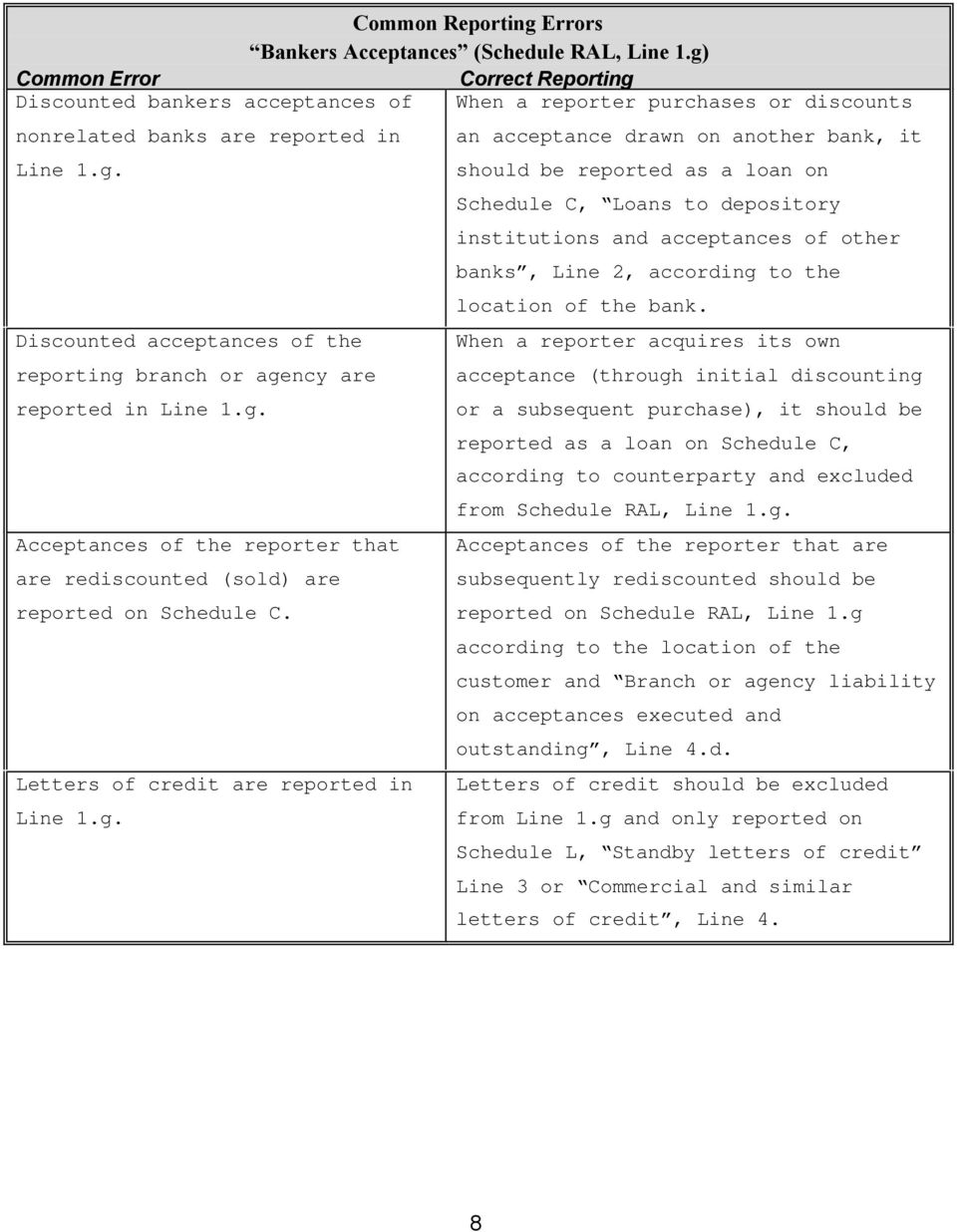
9 Bankers Acceptances (Schedule RAL, Line 1.g) Discounted bankers acceptances of When a reporter purchases or discounts nonrelated banks are reported in an acceptance drawn on another bank, it Line 1.g. should be reported as a loan on Schedule C, Loans to depository institutions and acceptances of other banks, Line 2, according to the location of the bank. Discounted acceptances of the When a reporter acquires its own reporting branch or agency are acceptance (through initial discounting reported in Line 1.g. or a subsequent purchase), it should be reported as a loan on Schedule C, according to counterparty and excluded from Schedule RAL, Line 1.g. Acceptances of the reporter that Acceptances of the reporter that are are rediscounted (sold) are subsequently rediscounted should be reported on Schedule C. reported on Schedule RAL, Line 1.g according to the location of the customer and Branch or agency liability on acceptances executed and outstanding, Line 4.d. Letters of credit are reported in Letters of credit should be excluded Line 1.g. from Line 1.g and only reported on Schedule L, Standby letters of credit Line 3 or Commercial and similar letters of credit, Line 4. 8
10 Other assets (including other claims on nonrelated parties) Other assets include assets that are not classified elsewhere on the balance sheet, such as: Fixed assets Other real estate owned (OREO) Margin accounts Prepaid expenses Precious metals inventory Income earned and not collected (however, accrued interest receivable on loans in nonaccrual status should be excluded from the FFIEC 002) Premiums paid on option contracts not held for trading purposes The positive fair value of derivative contracts qualifying as hedging instruments under FAS 133. Other assets should be reviewed to check if the reporter is including items that should be classified elsewhere in the FFIEC 002 report. The most common errors in Line 1.h are: Other Assets (Schedule RAL, Line 1.h) The fair values of derivative The fair values of derivative contracts not qualifying as hedging contracts not qualifying as hedging instruments are reported net in instruments should be reported gross Line 1.h. (unless FIN 39 applies) in Trading assets: Other trading assets, Line 1.f(2), if a gain or Trading liabilities, Line 4.e, if a loss. The fair values of derivative The fair values of derivative contracts qualifying as hedging contracts qualifying as hedging instruments are reported net in Other instruments should be reported gross liabilities, Line 4.f. (unless FIN 39 applies) in Line 1.h, if gain or Line 4.f, if loss. 9

11 Other Assets (Schedule RAL, Line 1.h) The positive fair values of derivative The positive fair values of contracts qualifying as hedging derivative contracts qualifying as instruments are reported in Trading hedging instruments should be assets: Other trading assets, reported in Line 1.h. Line 1.f(2). Accrued interest receivable on All previously accrued and nonaccrual loans are reported in uncollected interest on loans in Line 1.h. nonaccrual status should be excluded from the FFIEC 002. Tax receivables and prepaid income tax Tax assets (including tax receivables are reported in Line 1.h. and prepaid taxes) should be excluded from the FFIEC 002. An investment in a nonbank subsidiary Investments in nonbank subsidiaries is reported at cost. should be reported using the equity method of accounting. Cash items in the process of collection are reported in Line 1.h. Real estate acquired through foreclosures are excluded from Line 1.h and reported on Schedule C, Loans secured by real estate (Line 1). Depreciation of fixed assets is not deducted from the value of the fixed assets reported in Line 1.h. Margin accounts maintained with brokers are reported in Trading assets: Other trading assets, Line 1.f(2). Cash items in the process of collection should be reported on Schedule A, Cash items in process of collection and unposted debits, Line 1. Real estate acquired from foreclosures should be excluded from Schedule C and N, and the fair value of the real estate should be reported on Schedule RAL, Line 1.h. All fixed assets should be reported at book value (i.e., original cost less accumulated depreciation). Balances held in margin accounts regardless of purpose of the underlying transaction should be reported in Line 1.h. 10

12 Other Assets (Schedule RAL, Line 1.h) Unaccreted discount for Unaccreted discounts should be held-to-maturity securities are excluded from the FFIEC 002. reported in Line 1.h. Total assets Though possible, it would be highly unusual for the branch or agency s Total claims on nonrelated parties, Line 1.I and Total assets Line 3 to be the same amount as the prior quarter's total assets. Federal funds purchased and securities sold under agreements to repurchase The most common errors in Line 4.b are: Federal Funds Purchased (Schedule RAL, Line 4.b) Federal funds purchased from a Federal funds purchased from related related depository institution are depository institutions should reported reported in Line 4.b(1). on Schedule M, according to counterparty. Term federal funds purchased Term federal funds purchased should be (unsecured borrowings with a reported on Schedule P, according to maturity of more than one day) are counterparty. reported in Line 4.b(1). 11

13 Federal Funds Purchased (Schedule RAL, Line 4.b) Federal funds purchased are Federal funds purchased should be reported on Schedule E. reported in Line 4.b(1) (overnight or continuing contract) or Schedule P (maturity more than one day). Securities sold under agreements to Securities sold under agreements to repurchase, collateralized by repurchase, collateralized by assets assets other than securities with other than securities with maturities maturities greater than on day are greater than one day should be reported reported in Line 4.b(2). in Schedule P, according to counterparty. Securities sold under agreements to Securities sold under agreements to repurchase are reported on repurchase should be reported in Schedule P. Line 4.b(2). Branch or agency liability on acceptances executed and outstanding The branch or agency s liability to pay the acceptances is reported in Line 4.d if the customer is a nonrelated institution or a related nondepository institution. When the branch or agency: Sells its own acceptance that it had previously purchased (discounted), the sale of the acceptance should be excluded from Schedule C, and reported on Schedule RAL, Line 1.g and Line 4.d. Purchases or sells participations in acceptances, it should not change the initial reporting of the acceptance in Line 4.d. The sale of the participation should be reported on Schedule L, Off-Balance Sheet Items, Line 5. The most common errors in Line 4.d are: 12

14 Bankers Acceptances (Schedule RAL, Line 4.d) The sale of discounted acceptances The sale of the branch or agency s own of the reporting branch or agency acceptance that it had previously are reported on Schedule C. purchased (discounted) should be excluded from Schedule C and reported on Line 1.g and 4.d. Discounting of a branch or agency Discounting of a branch or agency acceptances are reported on acceptances should be excluded from Line Schedule RAL, in Line 1.g or 4.d. 1.g and 4.d and be reported as a loan on Schedule C, according to counterparty. Trading liabilities Trading liabilities include short sales of securities and the negative fair value of derivative contracts held for trading purposes. The most common errors in Line 4.e are: Trading Liabilities (Schedule RAL, Line 4.e) The negative fair values on derivative The negative fair values on derivative contracts held for trading purposes are excluded. 13 contracts held for trading purposes should be reported gross (unless they meet the netting criteria of the Financial Accounting Standards Board Interpretation No. 39 (FIN 39)) in Trading liabilities. In addition, the unrealized losses from these contracts should be included in the calculation of your institution s net unremitted profit (or loss) on Schedule M, Due from/due to related institutions in the U.S. and in foreign countries Part I, Line 2.a.

15 Trading Liabilities (Schedule RAL, Line 4.e) The fair values of derivative The fair values of derivative contracts held for trading purposes contracts held for trading purposes are reported net in Trading assets: should be reported gross (unless FIN Other trading assets, Line 1.f(2). 39 applies) in Line 1.f(2), if a gain or Line 4.e, if a loss. The negative fair values of derivative The negative fair values of derivative contracts with related depository contracts with related parties should institutions are reported in Line 4.e. be reported on Schedule M, Due from/due to related institutions in the U.S. and in foreign countries according to counterparty. Other liabilities (to nonrelated parties) Line 4.f includes any liabilities that cannot be reported elsewhere on the balance sheet, such as: Expenses accrued and unpaid Accounts payable The negative fair value of derivative contracts qualifying as hedging instruments under FAS 133. Other liabilities should be reviewed to check if the reporter is including items as Other liabilities that should be classified elsewhere in the FFIEC 002 report. The most common errors in Line 4.f are: Other Liabilities (Schedule RAL, Line 4.f.) The fair values of derivative The fair values of derivative contracts contracts qualifying as hedging instruments are reported net in Trading liabilities, Line 4.e. 14 qualifying as hedging instruments should be reported gross (unless FIN 39 applies) in Line 1.h (if gain) or Line 4.f, if loss.

16 Other Liabilities (Schedule RAL, Line 4.f.) Accounts payable are netted against All accounts payable should be reported receivables in Other assets, gross in Line 4.f. Line 1.h. Accrued expenses payable to related Accrued expenses payable to related depository institutions are reported depository institutions should be in Line 4.f. reported on Schedule M, according to counterparty. Suspense accounts are reported in Credits that are posted to the proper Line 4.f. accounts after the report date should be reflected in the appropriate line on Schedule RAL at the time the FFIEC 002 is filed. Unamortized premiums on Unamortized premiums on securities held-to-maturity securities are should be excluded from the FFIEC 002. reported in Line 4.f. Unearned income from loans are Unearned income from loans should be reported in Line 4.f. deducted from the loans reported on Schedule C. Tax payables are reported in Tax liabilities should not be reported Line 4.f. on the FFIEC 002. Reserves held for credit losses Reserves held for credit losses from arising from off-balance sheet credit credit commitments should be reported commitments are excluded. in Line 4.f. Memoranda Section Fair value of held-to-maturity securities 15

17 It would be unusual for the total fair value of a reporter's held-to-maturity securities (or available-for-sale securities) to be equal to their amortized cost. If this occurs, the reporter should confirm the amounts reported on Schedule RAL, 1.b and 1.c. The most common error in Schedule RAL, Memoranda 1 is: Schedule RAL, Memoranda Held-to-maturity securities are The fair value of held-to-maturity reported at amortized cost on Schedule RAL, Memorandum, Line 1. securities should be reported on Schedule RAL, Memorandum, Line M.1. Revaluation gains/losses on interest rate, foreign exchange rate, and other commodity and equity contracts held for trading purposes The most common errors on Schedule RAL, Memoranda 10 and 11 are: Revaluation gains and losses (Schedule RAL, Memoranda 10 and 11) The fair value of derivative The fair value of derivative contracts contracts held for trading held for trading purposes should be purposes are excluded from included in Memoranda 10 and 11. Memoranda 10 and 11. The fair value of derivative The fair value of derivative contracts contracts held for trading held for trading purposes with related purposes with related depository depository institutions should be institutions are included in excluded from Memoranda 10 and 11, and Memoranda 10 and 11. should be reported on Schedule M, Due from/due to related institutions in the U.S. and in foreign countries Part I, Line 2.a. 16

18 Revaluation gains and losses (Schedule RAL, Memoranda 10 and 11) The fair value of spot foreign The fair value of spot foreign exchange exchange contracts are excluded contracts should be included in Line from Line 1.f(2) and 4.e. 1.f(2) and Line 4.e, and be reported in Memoranda 10 and 11. The fair value of derivative The fair value of derivative contracts contracts held for trading held for trading purposes should be purposes are reported net in reported gross (unless FIN 39 applies) in Memoranda 10 and 11. Memoranda 10 and 11. If other assets including other claims on nonrelated parties (item 1.h) exceed 5 percent of total assets (item 3), itemize and describe amounts that exceed 25 percent of item 1.h If the amount reported in Other assets (Schedule RAL, Line 1.h, Column A) divided by the amount reported on Total assets (Schedule RAL, item 3, Column A) exceeds 5 percent, the branch or agency should review the components that comprise Other assets (Schedule RAL, Line 1.h) to ensure that no component is greater than 25% of the total reported in Other assets. If other liabilities to nonrelated parties (item 4.f) exceed 5 percent of total liabilities (item 6), itemize and describe amounts that exceed 25 percent of item 4.f 17

19 If the amount reported in Other liabilities (Schedule RAL, Line 4.f, Column A) divided by the amount reported on Total liabilities (Schedule RAL, Line 6, Column A) exceeds 5 percent, the branch or agency should review the components that comprise Other liabilities to ensure that no component is greater than 25% of the total reported in Other liabilities. Asset maintenance requirement The amount reported should not be greater than Total assets (Schedule RAL, Line 3, Column A). The most common errors in Line S.1 are: Asset Maintenance Requirement (Schedule RAL, Line S.1) The value of assets pledged to The value of assets pledged to meet state meet state and federal requirement is reported at book value. The amount reported for the asset maintenance is the pledge requirement instead of the actual amount pledged. and federal requirement should be reported at the lower of cost or fair value. The amount reported for the asset maintenance should be the lower of cost or fair value of the assets actually pledged. Asset pledge requirement/capital equivalency deposit The amount reported should not be greater than Total assets (Schedule RAL, Line 3, Column A). 18

20 The most common errors in Line S.2 are: Statutory or Regulatory Requirement (Schedule RAL, Line S.2) Collaterized mortgage obligations Collaterized mortgage obligations (CMOs) (CMOs) issued by U.S. government agencies or corporations are reported in Line S.2. Certificates of deposit (CDs) are reported at face value in Line S.2. issued by U.S. government agencies or corporations should be excluded from Line S.2. Assets reported in Line S.2 should be valued at the lower of cost or market (including CDs). FDIC asset maintenance requirement: Average Liabilities for the preceding calendar quarter Average liabilities" should not equal total liabilities as reported on Schedule RAL, Line 6. If the reporting entity is not an FDIC-insured branch, item S.3.a should be left blank. FDIC asset maintenance requirement: Eligible Assets as of the report date "Eligible assets" should be left blank if the reporting entity is not an FDIC-insured branch. If the reporting entity is an FDIC-insured branch, the amount reported on Line S.3.b should be compared to Line S.3.a. If Line S.3.b equals or is greater than Line S.3.a, the accuracy of the data should be confirmed. Schedule A -- Cash and Balances Due from Depository Institutions Cash items in process of collection and unposted debits 19

21 Cash items in the process of collection (CIPC) include instruments that are payable immediately upon presentation, such as: Checks or drafts in process of collection that are drawn on another depository institution (or on a Federal Reserve Bank) Checks drawn on the U.S. Treasury or any other U.S. government agency. The most common errors in Line 1 are: CIPC (Schedule A, Line 1) Cash items in the process of Cash items in the process of collection collection are reported in Other should be reported on Schedule A, Line 1. assets, Line 1.h. Checks returned to the presenting Checks returned to the presenting institution are reported in Other institution should be reported on assets, Line 1.h. Schedule A, Line 1. Checks forwarded for collection Checks in the process of collection for that had not cleared are reported which credit has not been received should on Schedule A, Balances due from be reported in Line 1. depository institutions, Line 3 or Line 4. Currency and coin (U.S. and foreign) Currency and coin include: Currency and coin owned and held in the branch or agency s vaults (include both U.S. and non-u.s. currency). Currency and coin in transit to a Federal Reserve Bank 20
22 or any other depository institution for which the branch or agency has not yet received credit. Currency and coin in transit from a Federal Reserve Bank or any other depository institution for which the branch or agency s account has already been charged. The most common errors in Line 2 are: Currency and Coin (Schedule A, Line 2) Precious metals inventories are Precious metals inventories are excluded included in Line 2. from Line 2 and reported in Schedule RAL, Other assets, Line 1.h. Non-U.S. currency owned and held in Non-U.S. currency held at a branch or a branch or agency s vault is agency should be converted into U.S. excluded from Schedule A. dollar equivalents as of the report date and reported in Line 2. Balances due from banks and foreign central banks Line 3 and 4 includes funds on deposit at other depository institutions. Due from balances include: Demand deposits Placements Savings deposits Certificates of deposit Overdrafts incurred by a branch or agency on deposit accounts held at other depository institutions are raised to zero and are not netted from deposit reported on Schedule A (report these in Schedule P). The most common errors in Line 3 and 4 are: 21
23 Balances Due From Depository Institutions (Schedule A, Line 3 & 4) Checks forwarded for collection Checks in the process of collection for that had not cleared are reported which credit has not been received should in Balances due from depository be reported in Line 1. institutions, Line 3 or Line 4. CDs held for investment purposes CDs held for investment purposes should be are reported in Trading assets, reported in Line 3 or 4 depending on the Line 1.f. issuer. Overdrawn deposit accounts held at Overdrawn due from balances are other depository institutions are borrowings, therefore the amount of the netted against balances due from overdraft should be raised to zero on banks in Line 3 or 4. Schedule A and the amount of the overdraft should be reported on Schedule P. Certificates of deposit (CDs) purchased from depository institutions are reported as securities on Schedule RAL, Line 1.b or 1.c. Balances due from the Federal Reserve Bank are reported in Line 3.b. Balances due from depository institutions (including CDs) not held in trading accounts should be reported in Line 3 or 4 depending on the issuer. Balances due from the Federal Reserve Bank should be reported in Line 5. Balances due from Federal Reserve Banks All balances with a Federal Reserve Bank should be reported in Line 5. 22
24 Schedule C Loans Part. I Loans and Leases Schedule C includes the carrying value all loans and leases before the deduction of general allowance for loans and lease losses. All loans are categorized according to collateral, borrower, or purpose and should be reported net of unearned income (to the extent possible). Selected memoranda items collect information on maturity and repricing. Schedule C is divided into two parts. Part I includes all loans and leases. Part II, to be completed only for the June report date, includes loans to small businesses and small farms. Loans include: The sale of immediately available funds for more than one business day Depositor overdrafts Discounted acceptances Loans held for sale Loans that are past due, in nonaccrual or restructured status Resale agreements involving assets other than securities with a maturity of more than one business day. Loans exclude: The sale of immediately available funds that mature in one business day or continuing contact (report on Schedule RAL, Line 1.d) Deposits held at other depository institutions (report on Schedule A) Accrued interest receivable (report on Schedule RAL, Line 1.h) Loans to related depository institutions (report on Schedule M, according to counterparty) Other real estate owned (OREO) (report on Schedule RAL, Line 1.h). The most common errors on Schedule C relate to specific reserves, unearned income, loans held in trading accounts, loans to related parties, and overdrafts of depositors, such as: 23
25 Common Reporting Error Loans (General Instructions for Schedule C) Loans are reported net of Loans should be reported at full book value specific reserves when there throughout the FFIEC 002 unless there is an is no identified loss. identified loss. Any reserves maintained that are not for identified losses should be reported on Schedule M, Part I, Line 2.a, Column B as a due to head office and on Schedule M, Part IV, Amount of allowance for loan losses, if any, carried on the books of the reporting branch or agency including its IBF, Line 1. Specific reserves held for All loans should be reported net of specific identified loan losses are reserves on the FFIEC 002. In addition, specific not deducted from the value reserves should be excluded from Schedule M, of the individual loans on Part IV, Amount of allowance for loan losses, Schedule C. if any, carried on the books of the reporting branch or agency including its IBF, Line 1. Loans to related depository Loans to related depository institutions should institutions are reported on be reported on Schedule M, according to Schedule C. counterparty. Accrued interest receivable Accrued interest receivable on loans should be on loans are reported on reported on Schedule RAL, Other assets, Schedule C. Line 1.h. Overdrafts of depositors are netted against deposits reported on Schedule E. Overdrafts in deposit accounts are loans, therefore the amount of the overdraft should be raised to zero on Schedule E and the amount of the overdraft should be reported on Schedule C. Unplanned overdrafts (other than overdrafts of depository institutions and foreign governments and official institutions) should be reported on Schedule C, All other loans, Line 8. Planned overdrafts should be reported on Schedule C, according to counterparty. 24
26 Common Reporting Error Loans (General Instructions for Schedule C) Loans held for sale are Loans held for sale should be reported at the reported at historical cost lower of cost or fair value on Schedule C. on Schedule C. Loans held for trading Loans held for trading purposes should be purposes are reported on included on Schedule RAL, Trading assets; Other Schedule C. trading assets", Line 1.f(2). Loan origination fees are Loan origination fees (including management included in the value loans fees) should be deferred, and amortized. The on Schedule C. unamortized loan fees should be deducted from the related loan balances and excluded from Schedule M until the income is amortized. Loans secured by real estate All loans secured, regardless of purpose or counterparty, except loans issued to state and political subdivisions, should be reported in Line 1. The most common errors in Line 1 are: Loans secured by real estate ( Schedule C, Line 1) Loans secured by real estate are All loans (except those that are issued to reported according to borrower. Real estate acquired in satisfaction of a debt or foreclosure is reported on Line 1. state or political subdivisions) secured by real estate should be reported on Line 1. Real estate collateral received in settlement of debts previously contracted should be reported on Schedule RAL, Other assets, Line 1.h. 25
27 Loans to depository institutions and acceptances of other Depository institutions are institutions that can accept deposits. These include: Edge and Agreement corporations Commercial banks Credit unions Thrifts. The common error in Line 2 is: Acceptances of Other Banks (Schedule C, Line 2) Discounted bankers acceptances of When a branch or agency purchases or nonrelated banks are reported on discounts an acceptance drawn on another Schedule RAL, Line 1.g. bank, it should be reported as a loan in Line 2. Loans to other financial institutions Financial institutions are financial intermediaries whose primary business is to extend credit. These include: Investment banks Real estate investment trusts (REITs) Mortgage companies Finance companies Bank holding companies Insurance companies. 26
28 Commercial and industrial loans Commercial and industrial loans may take the form of direct or purchased loans. Commercial and industrial loans also include the reporter s own acceptances and loans to individuals for commercial, industrial and professional purposes but not for investment or personal expenditure purposes. The most common errors in Line 4, are: Common Reporting Error Commercial and Industrial Loans (Schedule C, Line 4) Loans to corporations to lease Loans to corporations to lease equipment equipment are reported on Lease financing receivables, Line 9. Loans to leasing companies are reported in Line 4. Overnight Fed Funds sold to commercial and industrial customers are excluded from Schedule C. Loans to corporations located outside of the U.S. are reported in U.S. addressees, Line 4.a. Loans to corporations secured by real estate are reported in Line 4. should be reported in Line 4. Loans to nondepository financial institutions (including leasing companies) whose primary business is to extend credit for business purposes should be reported in Loans to other financial institutions, Line 3. Overnight Fed Funds sold to commercial and industrial customers should be reported on Schedule C, Line 4. Loans to corporations located outside the U.S. should be reported in To non-u.s. addressees, Line 4.b. All loans secured by real estate should be reported in Loans secured by real estate, Line 1. 27
29 Loans to foreign governments and official institutions Foreign government and official institutions are central, state, provincial, and local governments in foreign countries and their ministries, departments and agencies. The most common errors in Line 6 are: Loans to Foreign Governments and Official Institutions (Schedule C, Line 6) Loans to foreign governmentowned corporations located nonbanking corporations located outside Loans to foreign government-owned outside the U.S. are reported in the U.S. should be reported in Line 3, 4 Line 6. or 8 as appropriate. Brady bonds classified as Brady bonds held in the loan portfolio available-for-sale and held in classified as available-for-sale should the loan portfolio are reported be reported at fair value in Line 6. at cost. Loans for purchasing or carrying securities Loans for purchasing or carrying securities, Line 7 includes all loans to brokers and dealers in securities (other than those secured by real estate) regardless of purpose. Loans to depository institutions for the purpose of purchasing or carrying securities are excluded from Line 7 and reported in Line 2. 28
30 The most common error in Line 7 is: Loans for purchasing or carrying securities (Schedule C, Line 7) Loans issued to investment Loans issued to investment companies for companies for purchasing purchasing securities should be reported securities are reported in in Line 7. Commercial and industrial loans, Line 4. All other loans All other loans, Line 8, includes: Loans to nonprofit organizations Loans to individuals Loans to state and political subdivisions, including loans secured by real estate Federally-sponsored lending agencies Unplanned overdrafts to deposit accounts (except overdrafts which are reported in Lines 2 and 6 above). Less: Any unearned income on loans reflected in items 1-8 above Unearned income, Line 10 includes income received by the branch or agency but not yet earned, such as prepaid interest or fees. The preferred treatment is to report the specific loan categories net of unearned income. Unearned income that cannot be applied to a specific loan should be reported in Line 10. Line 10 should not be reported as a negative number. 29
31 The most common errors in Line 10 are: Unearned Income from Loans (Schedule C, Line 10) Unearned income from loans are Unearned income from loans should reported in Other liabilities, be deducted, to the extend possible, from Line 4.e. the specific loan category on Schedule C, Loans. If unearned income cannot be deducted from the individual loan category, it should be reported on Schedule C, Line 10. The amortized portion of loan The amortized portion of loan origination origination fees are reported in fees should be reported as income as part of Line 10. the net unremitted profit on Schedule M, Part I, Head office of the parent bank, Line 2.a, Column B. Origination fees received by the Unearned income (including origination fees) branch or agency for letters of on letters of credit should be reported on credit are reported in Line 10. Schedule RAL, Other liabilities, Line 4.f. Unearned income for a loan that Once a loan is prepaid any unearned income was prepaid is reported in associated with the loan should be reported Line 10. as income as part of the branch or agency s unremitted profit on Schedule M, Part I, Head office of the parent bank, Line 2.a, Column B. Memoranda Section 30
32 The most common error in the Memoranda section is: Schedule C, Memoranda Loans that are in nonaccrual status Loans in nonaccrual status must be are reported on the Memoranda. excluded from the Memoranda. Schedule E -- Deposit Liabilities and Credit Balances Schedule E categorizes deposits by types of account. Transaction accounts are reported in Column A and B, nontransaction accounts are reported in Column C, and IBF deposit liabilities are reported in Column D. Additional detail on specific deposits are reported on selected memoranda items. Total transaction accounts reported in Column A include demand deposits, NOW accounts, ATS accounts and similar deposits. The total demand deposits reported in Column A are also reported in Line 7, Column B. Therefore, Column B cannot be greater than Column A. The most common errors throughout Schedule E are: Deposits (General Instructions to Schedule E) Overdrafts are netted against Overdrafts in deposit accounts are deposit balances on Schedule E. loans, therefore the amount of the overdraft should be raised to zero on Schedule E and the amount of the overdraft should be reported on Schedule C. Deposits of related depository institutions are reported on Schedule E. Unposted credits (suspense accounts) are reported in Other liabilities, Line 4.f. Deposits of related depository institutions should be reported on Schedule M, according to counterparty. Credits posted to the proper accounts after the report date should be reported in the appropriate line on Schedule E. 31
33 Deposits (General Instructions to Schedule E) Cash collateral portion for letters Cash received as collateral for letters of credit are either excluded from of credit should be reported on the FFIEC 002 or reported on Schedule E, according to counterparty. Schedule P. Individual, partnerships, and corporations (include all certified and official checks) Deposits of individuals, partnerships, and corporations (IPCs), Line 1, include: Nondepository financial institutions U.S. Government agencies and instrumentalities (FHMA, GNMA) Brokers and dealers. Exclude deposits of the U.S. government (e.g., TT&L accounts, U.S. postal accounts), which should be reported in Line 5. The most common errors in Line 1 are: Deposits of Individuals, Partnerships, and Corporations (IPC) (Schedule E, Line 1) Deposits held by a municipality in Deposits held by a municipality in the U.S. are reported in Line 1.a. the U.S. should be reported in All other deposits, Line 5. Deposits held by a foreign government (including local governments) are reported in Line 1. Deposits held by a foreign government (including local governments) should be reported in Foreign governments and official institutions, Line 4. 32
34 Deposits of Individuals, Partnerships, and Corporations (IPC) (Schedule E, Line 1) Foreign government-owned nonbank Foreign government-owned nonbank commercial and industrial commercial and industrial corporations corporations are reported in Line 4. should be reported in Line 1. Deposits of individuals, Deposits of individuals, partnerships, partnerships, and corporations and corporations located outside the located outside the U.S. are U.S. should be reported on Deposits of reported in Line 1.a. individuals, partnerships, and corporations (include all certified and official checks): Non-U.S. addresses, Line 1.b. Depository Institutions Depository institutions include: All other commercial banks U.S. branches and agencies of other foreign banks and their IBFs. The most common error in Lines 2 and 3 is: Deposits of U.S. and Foreign Banks (Schedule E, Lines 2 & 3) Deposits of banks located outside Deposits of banks located outside the the U.S. are reported in Line 2.b. U.S. should be reported in Line 3.b. 33
35 Foreign governments and official institutions Deposits of foreign governments and official institutions, Line 4 includes the following: International organizations Regional organizations Treaty organizations. Deposits from foreign governments and official institutions exclude U.S. branches and agencies of foreign official banking institutions (report in Line 2.a). The most common errors in Line 4 are: Deposits of Foreign Governments & Official Institutions (Schedule E, Line 4) Foreign government-owned nonbank Foreign government-owned nonbank commercial and industrial corporations are reported in Line 4. Deposits held by a foreign government (including local governments) are reported in Line 1. commercial and industrial corporations should be reported in Line 1. Deposits held by a foreign government (including local governments) should be reported in Line 4. Time deposits of $100,000 or more This item cannot contain a value less than $100,
36 The most common error in Line M.1.a is: Common Reporting Error (Schedule E, Memoranda) CDs are aggregated by depositor In determining if a CD has a and reported on Time Deposits of balance of $100,000 or more, CDs $100,000 or More, Line M.1.a. that are represented by separate certificates should not be combined even if they are held by the same depositor. Schedule K -- Quarterly Averages The method for determining these averages is either: The average of the balances as of the close of business for each day of the calendar quarter, or The average of the balances as of the close of business on each Wednesday during the quarter. The method that is selected must be used consistently throughout Schedule K. For those days when the branch or agency is closed, the amount outstanding at the close of the previous day must be used. 35
37 The quarterly averages listed in Table 1 should be compared to their outstanding balances on the FFIEC 002. Since this schedule consists of quarterly averages, it would be unusual for an amount reported on this schedule to equal its outstanding balance. Table 1 (Comparison) Quarterly Average-- Schedule K Compare to: Outstanding Balances-- Corresponding Schedule Line Description Sch Line(s) Description 1 Interest-bearing balances due from depository institutions 2 Federal funds sold and securities purchased under agreements to resell 3 Total loans, net or unearned income 4 Loans to banks in foreign countries 5 Total claims on nonrelated parties 6 Time certificates of deposit of $100,000 or more 7 Intererest-bearing deposits and credit balances 8 Federal funds purchased and securities sold under agreements to repurchase RAL 1, Col A RAL 1.d.1 1.d.2 Col A RAL 1.e, Col A C 2.c.1 2.c.2 Col A RAL 1.i, Col A E Memo 1.a RAL 4.a, Col A RAL 4.b.1 4.b.2 Col A 9 Other borrowed money RAL 4.c, Col A Cash and balances due from depository institutions Federal funds sold and securities purchased under agreements to resell Loans and leases, net of unearned income Loans to banks in foreign countries Total claims on nonrelated parties Time deposits of $100,000 or more Total deposits and credit balances Federal funds purchased and securities sold under agreements to repurchase Other borrowed money 36
38 The most common errors on Quarterly Averages are: Quarterly Averages (General Instructions to Schedule K) Year-to-date average balances are Each item on Schedule K should be used to calculate average calculated by taking the average of the balances. balances as of the close of business for each day of the calendar quarter, or an average of the balances as of the close of business on each Wednesday during the calendar quarter. Transactions with related depository institutions are included in the calculation of the quarterly averages. The quarterly average for total claims in Line 5 is calculated as the total of Lines 1 through 4. Schedule K excludes all transactions with related depository institutions. Line 5 should reflect the quarterly average of total claims included on Schedule RAL, Total claims on nonrelated parties, Line 1.i. Schedule L - Off-Balance-Sheet Items Schedule L includes commitments, contingencies, derivative contracts and other off-balance sheet items with nonrelated parties or related nondepository institutions. The most common error on Schedule L is: Schedule L (General Instructions to Schedule L) Off-balance sheet transactions with Off-balance sheet transactions with related depository institutions are related depository institutions are included on Schedule L. reported on Schedule M, Part V. 37
39 Commitments to make or purchase loans The most common errors in Line 1 are: Commitments to Make or Purchase Loans (Schedule L, Line 1) Schedule L The used portions of letters of Only the unused portion of letters of credit are reported on Line 1. credit should be reported on Line 1. The used portion of letters of credit should be reported on Schedule C, according to counterparty. Cancelled lines of credit and non-legally binding loan commitments are reported in Line 1. Portions of loan commitments participated out to third parties are excluded from Line 1. Only legally binding commitments should be included in Line 1. Cancelled lines of credit and loan commitments should be excluded from the FFIEC 002. Portions of loan commitments participated out to third parties should be included in Line 1. Spot foreign exchange contracts The most common errors in Line 2 are: Spot Foreign Exchange Contracts (Schedule L, Line 2) Cross-currency spot foreign Cross-currency spot foreign exchange exchange contracts are reported as contracts should be reported in Line 2. cross-currency forward foreign exchange contracts in Gross amounts Forward contracts, Line 9.b. 38
40 Spot Foreign Exchange Contracts (Schedule L, Line 2) Cross-currency forward foreign Forward contracts should be exchange contracts are reported in reported in Line 9.b according to Line 2. the original terms of the contract and excluded from Line 2 even when the time left to settlement is two days or less. Standby Letters of Credit The most common errors in Line 3 are: Standby Letters of Credit (Schedule L, Line 3) Standby letters of credit to U.S. Standby letters of credit to U.S. addressees are reported in addressees should be reported in Line 3.a(2). Line 3.a(1). Standby letters of credit to non- U.S. addressees are reported in Line 3.a(1). Standby letters of credit are reported in Commercial and similar letters of credit, Line 4. Standby letters of credit collaterized by cash are excluded from Line 3. Standby letters of credit to non-u.s. addressees should be reported in Line 3.a(2). Standby letters of credit should be reported in Line 3. All standby letters of credit (including those collaterized by cash) should be reported in Line 3. 39
41 Commercial and similar letters of credit The most common errors in Line 4 are: Commercial and Similar Letters of Credit (Schedule L, Line 4) The used portion of letters of Once funds are advanced under a letter of credit are reported in Line 4 and credit, the loan should be reported on in Schedule C, Loans. Schedule C and only the unused portion of the letter of credit should be reported in Line 4. Commercial letters of credit sold for cash are reported in Line 4. Commercial letters of credit collateralized by cash are reported in Line 4. Legally binding commitments to issue commercial letters of credit, including the portions participated out to third parties, are excluded from Line 4. Commercial letters of credit sold for cash should be excluded from the FFIEC 002. Commercial letters of credit that are collateralized by cash should be excluded from Schedule L and reported as a deposit on Schedule E. Only the non-collateralized portion of a partially collateralized commercial letter of credit should be reported in Line 4. All legally binding commitments to issue commercial letters of credit should be reported in Line 4, including those amounts which are participated out to third parties. Participations in acceptances conveyed to others by the reporting branch or agency 40
42 The most common error in Lines 5 and 6 is: Participation in Acceptances (Schedule L, Line 5 & 6) Bankers acceptances issued by a Bankers acceptances issued by a branch or branch or agency are reported in agency should be reported on Schedule RAL, Line 5. Line 1.g and 4.d. All other off-balance-sheet contingent liabilities greater than or equal to ½ percent of total claims on nonrelated parties as reported on Schedule RAL, Item 1.I. The most common errors in Line 7 are: Other Off-Balance Sheet Contingent Liabilities (Schedule L, Line 7) Securities borrowed where there is Securities borrowed where there is no no collateral or collaterized by collateral or collaterized by other other securities are excluded from securities should be reported in Line 7. Line 7. Commitments to purchase or sell Commitments to purchase or sell whenissued securities that are excluded from when-issued securities that are excluded from the scope of FAS 133 the scope of FAS 133 should be reported are reported in Forward in All other off-balance sheet contracts, Line 9. contingent liabilities Line 7, if a purchase or in All other off-balance sheet contingent assets, Line 8 if a sale. 41
43 Other Off-Balance Sheet Contingent Liabilities (Schedule L, Line 7) Commitments to purchase or sell Commitments to purchase or sell whenissued securities that are included in when-issued securities that are included in the scope of FAS 133 the scope of FAS 133 should be reported are reported in Line 7. in Forward contracts, Line 9.b. Commitments to place funds are Commitments to place funds should be reported in Line 1. reported in Line 7. All other off-balance-sheet contingent claims (assets) greater than or equal to ½ percent of total claims on nonrelated parties as reported on Schedule RAL, item 1.I The most common errors in Line 8 are: Other Off-Balance Sheet Contingent Claims (Schedule L, Line 8) Securities lent where there is no Securities lent where there is no collateral or collaterized by other collateral or collaterized by other securities are excluded from securities should be reported in Line 8. Schedule L, Line 8. Commitments to purchase or sell Commitments to purchase or sell when-issued securities that are when-issued securities that are included included in the scope of FAS 133 are in the scope of FAS 133 should be reported in All other off-balance reported in Forward contracts, sheet contingent liabilities, Line 9.b. Line 7. 42
44 Other Off-Balance Sheet Contingent Claims (Schedule L, Line 8) Commitments to purchase or sell Commitments to purchase or sell whenissued securities that are excluded from when-issued securities are excluded from the scope of FAS 133 are the scope of FAS 133 should be reported reported in Forward contracts, in All other off-balance sheet Line 9. contingent liabilities, Line 7, if a purchase or in All other off-balance sheet contingent assets, Line 8 if a sale. Derivative Contracts Contracts that meet the definition of a derivative must be accounted for in accordance with FASB Statement No The notional amount is the par value of the contract and must be reported gross in accordance to the predominant risk and purpose. The most common errors in Line 9 are: Gross Amounts of Off-Balance Sheet Items (Schedule L, Line 9) The notional amount of an exchangetraded purchased equity option traded purchased equity option contract The notional amount of an exchange- contract is reported in Over-thecounter option contracts: Purchased option contracts: Purchased options, should be reported in Exchange-traded options, Line 9.d(2), Column C. Line 9.c(2), Column C. 43
45 Gross Amounts of Off-Balance Sheet Items (Schedule L, Line 9) Over-the-counter written swaptions Over-the-counter written swaptions are excluded from the FFIEC 002. should be reported as options in Line 9.d(1) according to predominant risk characteristics of the contract. The notional amount of foreign The notional amount of an exchangetraded purchased equity option contract exchange purchased options are reported in Written options: Foreign should be reported in Purchased exchange contracts, Line 9.d(1), options: Foreign exchange contracts, Column B. Line 9.d(2), Column B. Cross-currency interest rate swaps are reported in Line 9.e, Column A. The notional amount of interest rate swaps where there is no exchange of principal is included in Line 9.e, Column B. The purchase and sale sides of cross-currency swaps are included in Line 9.e, Column B. Contracts involving the exchange of one or more foreign currencies (e.g., cross-currency swaps) should be reported in Line 9.e, Column B. The notional amount of interest rate swaps where there is no exchange of principal should be included in Line 9.e, Column A. Only the purchase side of the transaction should be reported of cross-currency contracts that involve the purchase and sale of two non-u.s. currencies. In contracts where non-u.s. currencies are bought or sold against U.S. dollars, only the side of the transaction that involves the non-u.s. currency should be reported. 44
46 Total gross notional amount of derivative contracts held for trading The total gross notional amount of derivative contracts held for trading purposes are reported in Line 10. Total gross notional amount of derivative contracts held for purposes other than trading The most common error in Line 11 is: Total Gross Notional Amount of Derivative Contacts Held for Purposes Other Than Trading (Schedule L, Line 11) The notional amount of derivative The notional amount of derivative contracts contracts not meeting FAS 133 hedge criteria are reported in Line 11. that do not meet FAS 133 hedge criteria should be reported in Total gross notional amount of derivative contracts held for trading, Line
47 Derivative Contracts (Fair value) As defined in FASB Statement No. 133, the fair value of a derivative contract is the amount at which an asset (liability) could be bought (incurred) or sold (settled) in a current transaction between willing parties (other than in a forced or liquidation sale). The best indication of fair value for liquid instruments is market quotes. For illiquid instruments, the fair value may need to be estimated using valuation models that take into account various characteristics of these instruments. The most common errors in Line 12 are: Gross Fair Values of Derivative Contracts (Schedule L, Line 12) The fair value of derivative The fair value of derivative contracts contracts is reported net in should be reported gross in Line 12. Line 12. The fair value of derivative contracts is excluded from Line 12. The fair value reported in Line 12 should be determined as of the close of business of the reporting date. 46
48 Schedule M - Due from/due to Related Institutions in the U.S. and in Foreign Countries Schedule M is divided into five parts. All transactions involving related depository institutions should only be reported on Schedule M in Parts I and/or II, and V (with Part I covering the branch or agency including its IBF and Part II covering the IBF only). Part III includes transactions of the reporting branch or agency with related nondepository majority-owned subsidiaries. Part IV includes the amount of general allowance for loan losses carried on the books of the reporting branch or agency and the amount of other real estate owned. Parts I, II, and III require the reporting of the due from/due to relationships on a gross basis (i.e., without netting due from and due to transactions against each other). Amounts reported are classified by location and type of related institution, not by type of claim or liability. All off-balance sheet transactions involving related depository institutions should only be reported on Schedule M, Part V. Schedule M is the only schedule where Puerto Rico and other U.S. territories and possessions are considered non-u.s. domiciled. The most common errors concerning related and nonrelated institutions on Parts I, II, and V are as follows: Balances With Related Institutions (General Instructions to Schedule M) Balances with a related bank Balances with related nondepository holding company are reported on Schedule M, Part I. Off-balance sheet and derivative contracts with related depository transaction institutions are reported on Schedule L. institutions (including bank holding companies) should be excluded from Schedule M, Part I, and reported in the appropriate Schedule. Off-balance sheet and derivative contracts with related depository institutions should be reported on Schedule M, Part V. 47
49 Balances With Related Institutions (General Instructions to Schedule M) Balances with nonrelated depository Balances with nonrelated depository institutions and related institutions and related nondepository nondepository institutions are institutions should be excluded from reported on Schedule M. Schedule M, Part I, II, and V and reported in the appropriate schedule. M, Part I - Transactions of Reporting Institution Including IBF with Related Depository Institutions 48
50 Part I covers transactions of the reporting branch or agency including its IBF with related depository institutions. Unremitted profits and losses are commonly misreported. The most common errors on the reporting of unremitted profits on Line 2.a are: Unremitted Profits (Schedule M, Part I, Line 2.a) Remitted profits are included in Remitted profits are excluded from the Line 2.a, Column B. Unrealized gains and losses from marking-to-market of financial instruments are excluded from the calculation of unremitted profits and losses and are reported gross in Line 2.a, Columns A and B. Net unremitted profit is reported as a loss in Line 2.a, Column A. Unremitted losses from the prior year are excluded from Line 2.a. FFIEC 002. Net unrealized gains and losses from marking-to-market of financial instruments should be included in the calculation of net unremitted profits and losses. Net unremitted profit should be reported in Line 2.a, Column B, as an adjustment to the capital contribution. All unremitted profits and losses (including prior periods) should be netted and reported in Line 2.a. Other common errors on Schedule M, Part I are: Schedule M, Part I Inter-branch accounts of the All inter-branch accounts should be reporting institution are reported excluded from the FFIEC 002. (Interbranch accounts include transactions on Schedule M, Part I. between departments or other entities that are consolidated on the FFIEC 002.) 49
51 Schedule M, Part I Balances with the Cayman Islands Balances with the Cayman Islands branch branch are reported in Other should be reported in Offices in the offices, Line 2.b(2). Caribbean, Line 2.b(1). Balances with non-u.s. offices of Balances with non-u.s. offices of related related depository institutions depository institutions should be are reported on Schedule M, Part I, reported in Other non-u.s. offices of Non-U.S. branches and agencies of related depository institutions, the parent bank: Other offices, Line 2.c. Line 2.b(2). Balances due from and due to the reporting branch or agency s head office are reported net in Line 2. Provision for loan losses are included in Schedule RAL, Other liabilities, Line 4.f. Balances due from or due to the head office of the branch or agency s parent bank should be reported gross in Line 2, Columns A and B. Provision for loan losses should be included in the calculation of net unremitted profit that are reported in Line 2.a. The most common error in the Memorandum section is: Schedule M, Memoranda Unremitted gains and losses from Unremitted gains and losses from trading trading contracts with related contracts with related depository depository institutions are institutions should be reported gross in excluded from Memoranda 3. Memoranda 3. 50
52 M, Part II - Transactions of Reporting Institution s IBF with Related Depository Institutions Part II reflects the gross positions of only the reporting institution s IBF with related depository institutions. The net position between the IBF and the establishing entity is reported only in Line 2. (This amount is excluded from Part I). Lines 1.d, 2 and 3 can be either positive or negative; if negative, a minus sign must be entered preceding the amount. A negative sign represents: IBF net due to related depository institutions other than establishing entity (Line 1.d) IBF net due to establishing entity (Line 2) IBF net due to all related depository institutions (Line 3). The IBF s net profit/loss, if maintained as a separate account, 51
53 should be reported in Line 1.b(1). In addition, this should also be consolidated with the branch or agency s profit/loss and reported in Part I. The most common errors on Schedule M, Part II are: Schedule M, Transactions of reporting institution s IBF with related depository institutions, Part II Balances between the establishing Balances between the establishing entity entity and its IBF are reported on Part I, Line 1.a(1). The net loss of the IBF is excluded from Part I, Line 2.a, Column A. and its IBF should be excluded from Part I and reported only in Part II, IBF net due from establishing entity, Line 2. The net profit or loss of your institution s IBF, if maintained as a separate account on the IBF s books, should be combined with the branch or agency s net profit or loss. M, Part III - Transactions of Reporting Institution Including Its IBF with Related Nondepository Institutions Part III covers the gross balances due from and due to majority-owned related nondepository institutions (this includes wholly-owned nondepository institutions). The amounts included in this part are also reported in other schedules of the FFIEC 002, as transactions with related nondepository institutions are treated similar to third party transactions. 52
54 The most common error on Part III is: Schedule M, Transactions of Reporting Institution Including Its IBF with Related Nondepository Institutions, Part III Balances (e.g., deposits, loans) Balances with majority-owned with related majority-owned nondepository subsidiaries are excluded from Schedule M, Part III. nondepository subsidiaries should be reported on Schedule M, Part III and on Schedule RAL and related Schedules. M, Part IV - Confidential Loan Information The branch or agency should report the allowance for loan losses (i.e., general reserves) carried on its books and its IBF in Line 1. Specific reserves should be excluded from this line.3 Exclude reserves on assets other than loans, loan commitments and letters of credit. The amount of other real estate owned should be reported in Line 2. The most common errors on Part IV are: Schedule M, Confidential Loan Information, Part IV Specific reserves for identified Specific reserves should be deducted loan losses are reported in Part IV, Line 1. Accumulated depreciation is not deducted from other real estate owned in Part IV, Line 2. from the individual loans and only general reserves should be included in Part IV, Line 1. Other real estate owned should be reported net of accumulated depreciation. Real estate acquired through foreclosures is excluded from Part IV, Line 2. All real estate owned by the branch or agency (other than its own premises) should be reported in Part IV, Line 2. 3 SR letter issued on August 2, 1995 provides regulatory reporting treatment on allowance for loan losses. 53
55 M, Part V - Off-balance-sheet items: with related depository institutions The differences between Schedule L and Schedule M, Part V is: 54
56 Schedule L includes off-balance sheet contracts with nonrelated institutions and related nondepository institutions Schedule M, Part V, includes off-balance sheet transactions with related depository institutions. For the most common errors concerning off-balance sheet transactions, refer to the guidelines for Schedule L. Schedule N - Past Due, Nonaccrual, and Restructured Loans 55
57 Loans and lease financing receivables and other assets should be reported as past due when either interest or principal is unpaid for 30 days or more. The branch or agency should report the full outstanding carrying value of loans in past due, nonaccrual and renegotiated status included on Schedule C, not simply the delinquent portion of the loan. All loans reflected on Schedule N should also be reported on Schedule C and on Schedule RAL. Column A includes loans that are 30 to 89 days past due and still accruing. Column B includes loans that are past due 90 days or more and still accruing. Column C includes nonaccrual loans that are past due 90 days or more and are not well secured, or not in the process of collection. A performing loan can be considered nonaccrual if the financial condition of the borrower has deteriorated, or payment in full of interest or principal is not expected. Column D includes restructured loans that are troubled debt that is restored to accrual status because either its principal or interest was reduced to enable the customer to repay the loan. Extending the maturity of a loan does not by itself constitute a restructured loan. The most common errors on Schedule N are: Past Due, Nonaccrual, and Restructured Loans (Schedule N) Specific reserves are excluded All loans reported on Schedule N should from Schedule N. be reported net of specific reserves. Loans that the principal has been repaid are reported on Schedule N. Only loans in which principal is past due and unpaid should be reported on Schedule N. 56
58 Schedule P - Other Borrowed Money Schedule P includes: any borrowing of immediately available funds with a maturity of greater than one day term federal funds purchased total amount borrowed by the branch or agency on its promissory notes and discounted bills overdrawn account balances of the reporting branch or agency borrowings from a Federal Reserve Bank. 57
59 The most common errors on Schedule P are: Other Borrowed Money (Schedule P) Federal funds purchased with Borrowings (including term federal maturity greater than one day (term federal funds) are excluded from Schedule P, Memorandum Line 1. funds) that are immediately available funds with a maturity greater than one day should be included in the appropriate line on Schedule P, (Line 1, 2, or 3) and in Memorandum Line 1. Deposits are reported on Schedule P. Repurchase agreements collateralized by assets other than securities with maturity greater than one day are reported on Schedule RAL, Securities sold under agreements to repurchase, Line 4.b(2). Overdrawn accounts held with other depository institutions (e.g., due from accounts) are netted against due from balances on Schedule A, Line 3 or 4. Deposits should be reported on Schedule E. Repurchase agreements collateralized by assets other than securities with maturity greater than one day should be reported as borrowings on Schedule P, according to counterparty. Overdrawn due from balances are borrowings, therefore the amount of the overdraft should be raised to zero on Schedule A and the amount of the overdraft should be reported on Schedule P. 58
Report of Assets and Liabilities of U.S. Branches and Agencies of Foreign Banks FFIEC 002
 Federal Financial Institutions Examination Council Board of Governors of the Federal Reserve System OMB Number: 7100-0032 Federal Deposit Insurance Corporation Office of the Comptroller of the Currency
Report of Assets and Liabilities of U.S. Branches and Agencies of Foreign Banks FFIEC 002
 Federal Financial Institutions Examination Council Board of Governors of the Federal Reserve System OMB Number: 7100-0032 Federal Deposit Insurance Corporation Office of the Comptroller of the Currency
Report of Assets and Liabilities of U.S. Branches and Agencies of Foreign Banks
 Federal Financial Institutions Examination Council Instructions for Preparation of Report of Assets and Liabilities of U.S. Branches and Agencies of Foreign Banks Reporting Form FFIEC 002 Reissued September
Monica Posen Doug Herold Carolina Reyes Mike Tursi Patricia Maone Henry Castillo Rich Molloy Vadim Tovshteyn
 Monica Posen Doug Herold Carolina Reyes Mike Tursi Patricia Maone Henry Castillo Rich Molloy Vadim Tovshteyn August 9, 2007 Fair Value Measurement Fair Value Option for Assets and Financial Liabilities
SCHEDULE RC-L DERIVATIVES AND OFF-BALANCE SHEET ITEMS
 SCHEDULE ITEMS General Instructions Schedule RC-L should be completed on a fully consolidated basis. In addition to information about derivatives, Schedule RC-L includes the following selected commitments,
SCHEDULE RC-R -- REGULATORY CAPITAL
 SCHEDULE RC-R -- REGULATORY CAPITAL General Instructions The extent to which banks must complete this Schedule RC-R depends on their size and, for smaller banks, their capital level. All banks that reported
Report of Assets and Liabilities of U.S. Branches and Agencies of Foreign Banks
 Federal Financial Institutions Examination Council Instructions for Preparation of the Report of Assets and Liabilities of U.S. Branches and Agencies of Foreign Banks Reporting Form FFIEC 002 Effective
FR Y-9C and FR Y-9LP Reports. Updated: 01/01/2014
 FR Y-9C and FR Y-9LP Reports Updated: 01/01/2014 Agenda Introduction Report Processing Cycle Reporting Requirements Definitions Tiered Holding Company Overview and Schedules of the FR Y-9C Overview and
DIVISION OF BANKING 1511 Pontiac Avenue, Building 69-2 Cranston, RI 02920 Telephone (401) 462-9503 - Facsimile (401) 462-9532
 DIVISION OF BANKING 1511 Pontiac Avenue, Building 69-2 Cranston, RI 02920 Telephone (401) 462-9503 - Facsimile (401) 462-9532 RHODE ISLAND BANK HOLDING COMPANY This Report is required by law: Chapter 6
VII. Consolidated financial statements Credit Suisse (Bank) 281 Report of the Group Auditors. 283 Consolidated statements of income
 VII Consolidated financial statements Credit Suisse (Bank) 281 Report of the Group Auditors 283 Consolidated statements of income 284 Consolidated balance sheets 286 Statements of changes in shareholder
Notes to Consolidated Balance Sheet
 Notes to Consolidated Balance Sheet 1. Amounts less than one million yen have been omitted. 2. Standards for recognition and measurement of trading assets and liabilities are as follows: Recognition: Trading
SECURITIES AND FUTURES ACT (CAP. 289)
 Monetary Authority of Singapore SECURITIES AND FUTURES ACT (CAP. 289) NOTICE ON RISK BASED CAPITAL ADEQUACY REQUIREMENTS FOR HOLDERS OF CAPITAL MARKETS SERVICES LICENCES Monetary Authority of Singapore
Summary Ratios--Page 1
 Summary Ratios--Page 1 1 Interest Income (TE) 1.1 UBPRE001 Interest Income (TE) as a percent of Average Assets All income from earning assets plus the tax benefit on tax-exempt loans, leases, and municipal
READING 1. The Money Market. Timothy Q. Cook and Robert K. LaRoche
 READING 1 The Money Market Timothy Q. Cook and Robert K. LaRoche The major purpose of financial markets is to transfer funds from lenders to borrowers. Financial market participants commonly distinguish
SCHEDULE RC-R REGULATORY CAPITAL
 SCHEDULE General Instructions The instructions for Schedule RC-R should be read in conjunction with the capital guidelines issued by the reporting bank s primary federal supervisory authority. Under the
INSTRUCTIONS FOR COMPLETING INSURANCE COMPANY FINANCIAL STATEMENTS
 INSTRUCTIONS FOR COMPLETING INSURANCE COMPANY "DRAFT VERSION FOR FIRST REVIEW ONLY" Submitted to: Minstry of Finance and Economy Head of Insurance Department Republic of Armenia Submitted by: BearingPoint
INSTRUCTIONS FOR FOREIGN BANK REPORT OF INCOME
 DBO 523 INSTRUCTIONS (Rev. 8-13) INSTRUCTIONS FOR FOREIGN BANK REPORT OF INCOME A1 The amounts of ordinary and recurring income for either 6 months (June) or 1 year (December) Nonaccrual of Interest. No
DRAFT. Quarterly Savings and Loan Holding Company Report FR 2320. General Instructions Who Must Report. When to Submit the Report
 JOBNAME: No Job Name PAGE: 1 SESS: 378 OUTPUT: Mon Nov 21 10:08:25 2011 /frb/bsr/instructs/fr2320/4_dec11_2320-gen_v3 INSTRUCTIONS FOR PREPARATION OF Quarterly Savings and Loan Holding Company Report General
2014 ANNUAL REPORT. Consolidated Financial Statements Interaudi Bank and Subsidiaries INTERPERSONAL INTERNATIONAL INTERACTIVE
 2014 ANNUAL REPORT Consolidated Financial Statements Interaudi Bank and Subsidiaries INTERPERSONAL INTERNATIONAL INTERACTIVE CONSOLIDATED FINANCIAL STATEMENTS New York, New York TABLE OF CONTENTS 2014
SCHEDULE RC-F OTHER ASSETS
 SCHEDULE RC-F OTHER ASSETS General Instructions Complete this schedule for the fully consolidated bank. Eliminate all intrabank transactions between offices of the consolidated bank. Item Instructions
Instructions for Preparation of Consolidated Reports of Condition and Income (FFIEC 031 and 041)
 Instructions for Preparation of Consolidated Reports of Condition and Income (FFIEC 031 and 041) GENERAL INSTRUCTIONS Who Must Report on What Forms 1 Close of Business 1 Frequency of Reporting 2 Differences
CALL REPORT INSTRUCTION BOOK UPDATE
 CALL REPORT INSTRUCTION BOOK UPDATE MARCH 2015 FILING INSTRUCTIONS NOTE: This instruction book update is designed for two-sided (duplex) printing. The pages listed in the column below headed Remove Pages
FDIC-FRB-OCC Banker Teleconference on Proposed Call Report Risk-Weighted Assets Reporting Changes. June 27, 2014
 Page 1 FDIC-FRB-OCC Banker Teleconference on Proposed Call Report Risk-Weighted Assets Reporting Changes Coordinator: Welcome and thank you all for holding. I would like to remind all parties that your
FORM G-405, PART IIA REPORT ON FINANCES AND OPERATIONS OF GOVERNMENT SECURITIES BROKERS AND DEALERS
 FORM G-405, PART IIA REPORT ON FINANCES AND OPERATIONS OF GOVERNMENT SECURITIES BROKERS AND DEALERS GENERAL INSTRUCTIONS This report on the finances and operations of government securities brokers and
Chart of Accounts for Banks
 Chart of Accounts for Banks ASSETS Cash and Cash Equivalents 1 0 0 1 Cash in vault 1 0 0 2 Cash in ATM 1 0 0 3 Cash in transit 1 0 0 4 Damaged notes 1 0 0 5 Travellers cheques 1 0 0 6 Items for collection:
ASPE AT A GLANCE Section 3856 Financial Instruments
 ASPE AT A GLANCE Section 3856 Financial Instruments December 2014 Section 3856 Financial Instruments Effective Date Fiscal years beginning on or after January 1, 2011 1 SCOPE Applies to all financial instruments
Citibank Japan, LTD ( CJL ) 2-3-14 Higashi-shinagawa, Shinagawa-ku, Tokyo Representative Director, President & CEO Darren Buckley
 Financial Publication for Fiscal Year Ended March 31, 2009 June 30, 2009 Citibank Japan, LTD ( CJL ) 2-3-14 Higashi-shinagawa, Shinagawa-ku, Tokyo Representative Director, President & CEO Darren Buckley
GOLDMAN SACHS BANK USA AND SUBSDIARIES
 GOLDMAN SACHS BANK USA AND SUBSDIARIES Consolidated Financial Statements As of and for the years ended December 31, 2014 and December 31, 2013 Financial Statements INDEX Page No. Consolidated Financial
CALL REPORT INSTRUCTION BOOK UPDATE
 CALL REPORT INSTRUCTION BOOK UPDATE DECEMBER 2009 FILING INSTRUCTIONS NOTE: The pages listed in the column below headed Remove Pages are no longer needed in the Instructions for Preparation of Consolidated
UNITED COMMUNITY BANKS, INC. (Exact name of registrant as specified in its charter)
 [X] UNITED STATES SECURITIES AND EXCHANGE COMMISSION Washington, D.C. 20549 FORM 10-Q QUARTERLY REPORT PURSUANT TO SECTION 13 OR 15(d) OF THE SECURITIES EXCHANGE ACT OF 1934 For the Quarterly Period Ended
American International Group, Inc. Financial Supplement Fourth Quarter 2005
 Financial Supplement Fourth Quarter 2005 This report should be read in conjunction with AIG's Annual Report on Form 10-K for the year ended December 31, 2005 filed with the Securities and Exchange Commission.
Consolidated Reports of Condition and Income for A Bank With Domestic and Foreign Offices - FFIEC 031
 Board of Governors of the Federal Reserve OMB Number: 7100-0036 Federal Deposit Insurance Corporation OMB Number: 3064-0052 Office of the Comptroller of the Currency OMB Number: 1557-0081 Federal Financial
Consolidated Financial Results
 UFJ Holdings, Inc. November 25, 2003 For the Six Months Ended September 30, 2003 UFJ Holdings, Inc. today reported the company's consolidated financial results for the six months ended September 30, 2003.
1 CONSOLIDATED FINANCIAL STATEMENTS (1) Consolidated Balance Sheets
 1 CONSOLIDATED FINANCIAL STATEMENTS (1) Consolidated Balance Sheets As of March 31,2014 As of March 31,2015 Assets Cash and due from banks 478,425 339,266 Call loans and bills bought 23,088 58,740 Monetary
Consolidated Financial Statements
 Consolidated Financial Statements Reports 111 Management s responsibility for financial reporting 111 Report of Independent Registered Chartered Accountants 112 Management s report on internal control
VIII. Parent company financial statements Credit Suisse (Bank) 339 Report of the Statutory Auditors. 340 Financial review. 341 Statements of income
 VIII Parent company financial statements Credit Suisse (Bank) 339 Report of the Statutory Auditors 340 Financial review 341 Statements of income 342 Balance sheets 343 Off-balance sheet business 344 Notes
Chapter 1 THE MONEY MARKET
 Page 1 The information in this chapter was last updated in 1993. Since the money market evolves very rapidly, recent developments may have superseded some of the content of this chapter. Chapter 1 THE
INDUSTRIAL-ALLIANCE LIFE INSURANCE COMPANY. FIRST QUARTER 2000 Consolidated Financial Statements (Non audited)
 INDUSTRIAL-ALLIANCE LIFE INSURANCE COMPANY FIRST QUARTER 2000 Consolidated Financial Statements (Non audited) March 31,2000 TABLE OF CONTENTS CONSOLIDATED INCOME 2 CONSOLIDATED CONTINUITY OF EQUITY 3 CONSOLIDATED
RBC Dain Rauscher Inc.
 RBC Dain Rauscher Inc. Consolidated Statement of Financial Condition as of April 30, 2004 Unaudited RBC DAIN RAUSCHER INC. CONSOLIDATED STATEMENT OF FINANCIAL CONDITION APRIL 30, 2004 (IN THOUSANDS, EXCEPT
Report of Independent Auditors and Consolidated Statements of Financial Condition for. Davidson Companies and Subsidiaries
 Report of Independent Auditors and Consolidated Statements of Financial Condition for Davidson Companies and Subsidiaries REPORT OF INDEPENDENT AUDITORS To the Board of Directors Davidson Companies We
Central Bank Survey. General Provisions
 Summary Methodology Central Bank Survey, Credit Institutions Survey, Banking System Survey, Other Financial Institutions Survey, Financial Sector Survey Central Bank Survey, Credit Institutions Survey,
Guidance on Implementing Financial Instruments: Recognition and Measurement
 STATUTORY BOARD SB-FRS 39 FINANCIAL REPORTING STANDARD Guidance on Implementing Financial Instruments: Recognition and Measurement CONTENTS SECTION A SCOPE A.1 Practice of settling net: forward contract
Statement of Cash Flows
 STATUTORY BOARD FINANCIAL REPORTING STANDARD SB-FRS 7 Statement of Cash Flows This version of SB-FRS 7 does not include amendments that are effective for annual periods beginning after 1 January 2014.
SCHEDULE RC-C -- LOANS AND LEASE FINANCING RECEIVABLES
 SCHEDULE RC-C -- LOANS AND LEASE FINANCING RECEIVABLES Part I. Loans and Leases General Instructions for Part I Loans and lease financing receivables are extensions of credit resulting from either direct
Türkiye İş Bankası A.Ş. Separate Financial Statements As at and for the Year Ended 31 December 2015
 Türkiye İş Bankası A.Ş. Separate Financial Statements As at and for the Year Ended 2015 29 April 2016 This report includes 93 pages of separate financial statements together with their explanatory notes.
PRUCO LIFE INSURANCE COMPANY OF NEW JERSEY INDEX TO FINANCIAL STATEMENTS
 PRUCO LIFE INSURANCE COMPANY OF NEW JERSEY INDEX TO FINANCIAL STATEMENTS Statements of Financial Position - December 31, 2010 and 2009 B-1 Statements of Operations and Comprehensive Income Years ended
Indian Accounting Standard (Ind AS) 7 Statement of Cash Flows
 Contents Indian Accounting Standard (Ind AS) 7 Statement of Cash Flows Paragraphs OBJECTIVE SCOPE 1 3 BENEFITS OF CASH FLOW INFORMATION 4 5 DEFINITIONS 6 9 Cash and cash equivalents 7 9 PRESENTATION OF
COMMUNICATING ARTS CREDIT UNION, INC. FINANCIAL STATEMENTS YEARS ENDED DECEMBER 31, 2014 AND 2013 WITH INDEPENDENT AUDITORS REPORT
 FINANCIAL STATEMENTS YEARS ENDED WITH INDEPENDENT AUDITORS REPORT TABLE OF CONTENTS INDEPENDENT AUDITORS REPORT 1 FINANCIAL STATEMENTS Statements of Financial Condition 3 Statements of Income 4 Statements
U.S. SECURITIES AND EXCHANGE COMMISSION WASHINGTON, D.C. 20549
 U.S. SECURITIES AND EXCHANGE COMMISSION WASHINGTON, D.C. 20549 FORM 8-K CURRENT REPORT Pursuant to Section 13 or 15(d) of the Securities Exchange Act of 1934 Date of Report (Date of earliest event reported)
PART III. Consolidated Financial Statements of Hitachi, Ltd. and Subsidiaries: Independent Auditors Report 47
 PART III Item 17. Financial Statements Consolidated Financial Statements of Hitachi, Ltd. and Subsidiaries: Schedule: Page Number Independent Auditors Report 47 Consolidated Balance Sheets as of March
Transactions Reported by U.S. Banks and Securities Brokers
 108 Transactions Reported by U.S. Banks and Securities Brokers In this section: Coverage and definitions Estimation methods overview U.S. claims reported by U.S. banks and securities brokers Own accounts
Northwest Bancshares, Inc. Announces Quarterly Earnings and Dividend Declaration
 EARNINGS RELEASE FOR IMMEDIATE RELEASE Contact: William J. Wagner, President and Chief Executive Officer (814) 726-2140 William W. Harvey, Jr., Executive Vice President and Chief Financial Officer (814)
Consolidated Reports of Condition and Income for A Bank With Domestic Offices Only FFIEC 041
 Federal Financial Institutions Examination Council Board of Governors of the Federal Reserve System OMB Number: 71-36 Federal Deposit Insurance Corporation OMB Number: 364-52 Office of the Comptroller
Consolidated Reports of Condition and Income for A Bank With Domestic and Foreign Offices - FFIEC 031
 Board of Governors of the Federal Reserve OMB Number: 7100-0036 Federal Deposit Insurance Corporation OMB Number: 3064-0052 Office of the Comptroller of the Currency OMB Number: 1557-0081 Federal Financial
QUARTERLY SURVEY OF FINANCIAL STATEMENTS ADDENDUM AND REPORTING GUIDE FOR FINANCIAL SERVICES
 QUARTERLY SURVEY OF FINANCIAL STATEMENTS ADDENDUM AND REPORTING GUIDE FOR FINANCIAL SERVICES F06 - E: 2001-03-14 1 2 QUARTERLY SURVEY OF FINANCIAL STATEMENTS Addendum to the Reporting Guides for Financial
United Federal Credit Union. Consolidated Financial Report with Additional Information December 31, 2014
 Consolidated Financial Report with Additional Information December 31, 2014 Contents Report Letter 1-2 Consolidated Financial Statements Statement of Financial Condition 3 Statement of Income 4 Statement
Arkansas Development Finance Authority, a Component Unit of the State of Arkansas
 Arkansas Development Finance Authority, a Component Unit of the State of Arkansas Combined Financial Statements and Additional Information for the Year Ended June 30, 2000, and Independent Auditors Report
NATIONAL CREDIT UNION ADMINISTRATION
 NATIONAL CREDIT UNION ADMINISTRATION ALEXANDRIA, VA 22314-3428 OFFICIAL BUSINESS TO MUST BE RECEIVED BY: APRIL 23, 2001 TO THE BOARD OF DIRECTORS OF THE CREDIT UNION ADDRESSED: This booklet contains the
GOLDMAN SACHS BANK USA AND SUBSIDIARIES
 Consolidated Financial Statements As of and for the years ended December 31, 2013 and December 31, 2012 Independent Auditor s Report To the Board of Directors and Shareholder of Goldman Sachs Bank USA:
The Awa Bank, Ltd. Consolidated Financial Statements. The Awa Bank, Ltd. and its Consolidated Subsidiaries. Years ended March 31, 2011 and 2012
 The Awa Bank, Ltd. Consolidated Financial Statements Years ended March 31, 2011 and 2012 Consolidated Balance Sheets (Note 1) 2011 2012 2012 Assets Cash and due from banks (Notes 3 and 4) \ 230,831 \
GENWORTH MI CANADA INC.
 Condensed Consolidated Interim Financial Statements (In Canadian dollars) GENWORTH MI CANADA INC. Three and six months ended June 30, 2015 and 2014 Condensed Consolidated Interim Statements of Financial
NATIONAL FINANCIAL SERVICES LLC STATEMENT OF FINANCIAL CONDITION AS OF DECEMBER 31, 2015 AND REPORT OF INDEPENDENT REGISTERED PUBLIC ACCOUNTING FIRM
 STATEMENT OF FINANCIAL CONDITION AS OF DECEMBER 31, 2015 AND REPORT OF INDEPENDENT REGISTERED PUBLIC ACCOUNTING FIRM Report of Independent Registered Public Accounting Firm To the Board of Directors of
Instructions for Preparation of Consolidated Reports of Condition and Income (FFIEC 031, 032, 033, and 034)
 Instructions for Preparation of Consolidated Reports of Condition and Income (FFIEC 031, 032, 033, and 034) CONTENTS CONTENTS GENERAL INSTRUCTIONS Who Must Report on What Forms 1 Close of Business 1 Frequency
GOLDMAN SACHS EXECUTION & CLEARING, L.P. and SUBSIDIARIES
 CONSOLIDATED STATEMENT of FINANCIAL CONDITION PURSUANT to RULE 17a-5 of the SECURITIES and EXCHANGE COMMISSION As of June 30, 2010 30 HUDSON STREET JERSEY CITY, NJ 07302 CONSOLIDATED STATEMENT OF FINANCIAL
Consolidated Balance Sheets March 31, 2001 and 2000
 Financial Statements SEIKAGAKU CORPORATION AND CONSOLIDATED SUBSIDIARIES Consolidated Balance Sheets March 31, 2001 and 2000 Assets Current assets: Cash and cash equivalents... Short-term investments (Note
Summary of Significant Differences between Japanese GAAP and U.S. GAAP
 Summary of Significant Differences between Japanese GAAP and U.S. GAAP The consolidated financial statements of SMFG and its subsidiaries presented in this annual report conform with generally accepted
AMAZON.COM, INC. CONSOLIDATED STATEMENTS OF CASH FLOWS (in millions)
 CONSOLIDATED STATEMENTS OF CASH FLOWS CASH AND CASH EQUIVALENTS, BEGINNING OF PERIOD $ 8,084 $ 5,269 $ 3,777 OPERATING ACTIVITIES: Net income (loss) 274 (39) 631 Adjustments to reconcile net income (loss)
Apex Clearing Corporation
 Statement of Financial Condition (Unaudited) Apex Clearing Corporation is a member of FINRA, Securities Investor Protection Corporation (SIPC), NYSE MKT LLC, NYSE Arca, Inc., BATS Y Exchange, Inc., BATS
UNITED STATES SECURITIES AND EXCHANGE COMMISSION WASHINGTON, DC 20549 FORM 10 - Q
 UNITED STATES SECURITIES AND EXCHANGE COMMISSION WASHINGTON, DC 20549 FORM 10 - Q QUARTERLY REPORT PURSUANT TO SECTION 13 or 15(d) OF THE SECURITIES EXCHANGE ACT OF 1934 FOR THE QUARTER ENDED JUNE 30,
3. Classification of Financial Instruments
 3. Classification of Financial Instruments C lassification of financial instruments and identification of their nature is one of the most important phases for compilation and presentation of monetary statistics.
85.52 Investments. 85.52.10 July 1, 2003. About investments. Short-term investments. 85.52.20 June 1, 2003 85.52.10
 85.52.10 85.52 Investments 85.52.10 July 1, 2003 About investments Investments are made as authorized by law and/or contractual agreement. Investment purchase and sale transactions are to be reported for
NEPAL ACCOUNTING STANDARDS ON CASH FLOW STATEMENTS
 NAS 03 NEPAL ACCOUNTING STANDARDS ON CASH FLOW STATEMENTS CONTENTS Paragraphs OBJECTIVE SCOPE 1-3 BENEFITS OF CASH FLOWS INFORMATION 4-5 DEFINITIONS 6-9 Cash and cash equivalents 7-9 PRESENTATION OF A
The Goldman Sachs Group, Inc.
 UNITED STATES SECURITIES AND EXCHANGE COMMISSION Washington, D.C. 20549 Form 10-Q È QUARTERLY REPORT PURSUANT TO SECTION 13 OR 15(d) OF THE SECURITIES EXCHANGE ACT OF 1934 For the quarterly period ended
MITSUI SUMITOMO INSURANCE COMPANY, LIMITED AND SUBSIDIARIES. CONSOLIDATED BALANCE SHEETS March 31, 2005 and 2006
 CONSOLIDATED BALANCE SHEETS March 31, 2005 and 2006 2005 2006 ASSETS Investments - other than investments in affiliates: Securities available for sale: Fixed maturities, at fair value 3,043,851 3,193,503
FINANCIAL STATEMENT 2010
 FINANCIAL STATEMENT 2010 CONTENTS Independent Auditors Report------------------------------ 2 Consolidated Balance Sheets ------------------------------ 3 Consolidated Statements of Operations ----------------
The Kansai Electric Power Company, Incorporated and Subsidiaries
 The Kansai Electric Power Company, Incorporated and Subsidiaries Consolidated Financial Statements for the Years Ended March 31, 2003 and 2002 and for the Six Months Ended September 30, 2003 and 2002 The
Sri Lanka Accounting Standard-LKAS 7. Statement of Cash Flows
 Sri Lanka Accounting Standard-LKAS 7 Statement of Cash Flows CONTENTS SRI LANKA ACCOUNTING STANDARD-LKAS 7 STATEMENT OF CASH FLOWS paragraphs OBJECTIVE SCOPE 1 3 BENEFITS OF CASH FLOW INFORMATION 4 5 DEFINITIONS
FUNDY MUTUAL INSURANCE COMPANY CONSOLIDATED FINANCIAL STATEMENTS
 CONSOLIDATED FINANCIAL STATEMENTS INDEX Page INDEPENDENT AUDITORS' REPORT 1-2 CONSOLIDATED FINANCIAL STATEMENTS Statement 1 - Consolidated Balance Sheet 3 Statement 2 - Consolidated General Reserve and
VII. Consolidated financial statements Credit Suisse (Bank) 391 Report of the Statutory Auditor. 393 Consolidated financial statements
 389 VII Consolidated financial statements Credit Suisse (Bank) 391 Report of the Statutory Auditor 393 Consolidated financial statements 400 Notes to the consolidated financial statements (see the following
GOLDMAN SACHS EXECUTION & CLEARING, L.P. STATEMENT of FINANCIAL CONDITION PURSUANT to RULE 17a-5 of the SECURITIES and EXCHANGE COMMISSION
 STATEMENT of FINANCIAL CONDITION PURSUANT to RULE 17a-5 of the SECURITIES and EXCHANGE COMMISSION As of June 30, 2012 200 WEST STREET NEW YORK, NY 10282 STATEMENT OF FINANCIAL CONDITION INDEX Page No.
5. Provisions for decrease in value of marketable securities (-)
 Balance sheet ASSETS I. CURRENT ASSETS A. Liquid Assets: 1. Cash. 2. Cheques received. 3. Banks. 4. Cheques given and payment orders (-). 5. Other liquid assets. B. Marketable Securities: 1. Share certificates.
UNIONS TOPICAL INDEX ACCOUNTING MANUAL FOR FEDERAL CREDIT 100-1
 ACCOUNTING MANUAL FOR FEDERAL CREDIT UNIONS TOPICAL INDEX ACCURATE AND CURRENT RECORDS ESSENTIAL 200-3 BASIC ACCOUNTING RECORDS 200-3 Double-Entry System 200-3 Types Of Accounts 200-4 PURPOSE OF RECORDS
INTERACTIVE BROKERS LLC (SEC I.D. No. 8-47257)
 INTERACTIVE BROKERS LLC (SEC I.D. No. 8-47257) STATEMENT OF FINANCIAL CONDITION AS OF DECEMBER 31, 2003 AND INDEPENDENT AUDITORS REPORT AND SUPPLEMENTAL REPORT ON INTERNAL CONTROL ******* Filed pursuant
5300 Call Report Frequently Asked Questions
 General Questions 1. How long must I keep copies of the 5300 Call Report? NCUA Rules and Regulations Part 749 of the NCUA Rules and Regulations requires credit unions to keep either a hard copy or an electronic
Data Compilation Financial Data
 Data Compilation Financial Data CONTENTS 1. Transition of Significant Management Indicators, etc. Japan Post Group (Consolidated) 122 Japan Post Holdings Co., Ltd. (Non-consolidated) 122 Japan Post Co.,
York Business Associates, L.L.C. (d/b/a TransAct Futures) and Subsidiary FINANCIAL STATEMENTS AND INDEPENDENT AUDITORS' REPORT.
 York Business Associates, L.L.C. (d/b/a TransAct Futures) and Subsidiary FINANCIAL STATEMENTS AND INDEPENDENT AUDITORS' REPORT December 31, 2014 CONSOLIDATED STATEMENT OF FINANCIAL CONDITION December