
A NOVEL ARCHITECTURE FOR SDN-BASED CELLULAR NETWORK
|
|
|
- Tyrone Ray
- 10 years ago
- Views:
Transcription
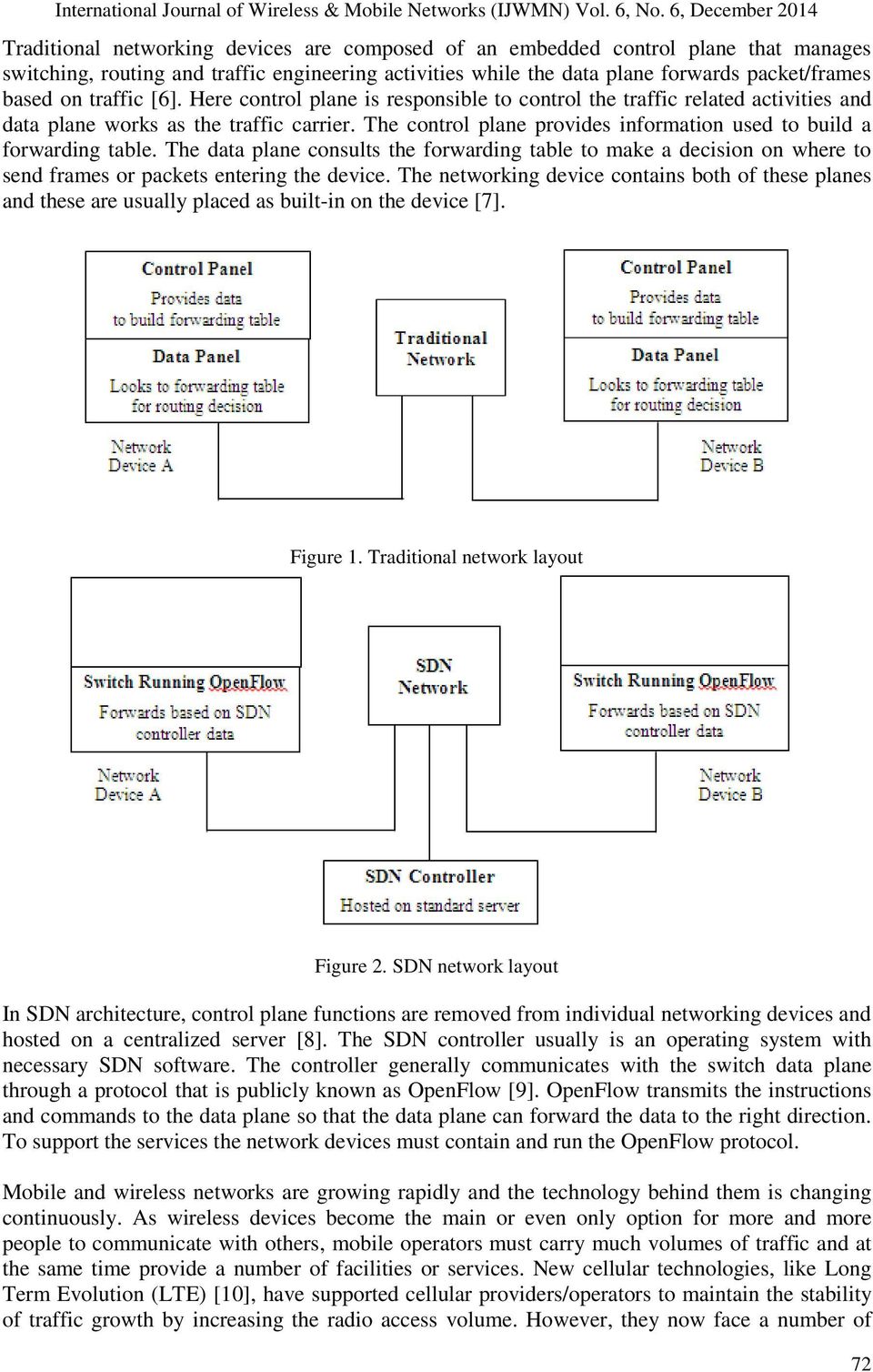
1 A NOVEL ARCHITECTURE FOR SDN-BASED CELLULAR NETWORK Md. Humayun Kabir Department of Computer Science & Engineering,University of Rajshahi, Bangladesh. ABSTRACT In this paper, we propose a novel SDN-based cellular network architecture that will be able to utilize the opportunities of centralized administration of today s emerging mobile network. Our proposed architecture would not depend on a single controller, rather it divides the whole cellular area into clusters, and each cluster is controlled by a separate controller. A number of controller services are provided on top of each controller to manage all the major functionalities of the network and help to make the network programmable and more agile, and create opportunities for policy-driven supervision and more automation. KEYWORDS SDN, OpenFlow, LTE. 1. INTRODUCTION Everyday new technology, policies and smart devices are emerging, todays networking concept is also developing accordingly. The traditional network infrastructure is considered as a single system made by many physical elements, such as routers, switches, and firewalls on which the whole network controlling activities depend for communication and services. A single modification in any part of the network can increase the maintenance effort on the whole network, and sometimes it may cause a miscarriage of the total network. At present, most of the IT related people identify the traditional networking paradigm as very much static and think it require a lot of effort to physically change and laboriously organize and legalize the network [1]. Software Defined Networking (SDN) is a new approach in the networking paradigm that has given the idea to deal efficiently with the emerging network and to better handle the major growth in data traffic, network virtualization, and mobility of user equipment [2] [3]. SDN generally permits network administrators/operators to regulate their network systems programmatically, serving them to improve capabilities and scale without compromising performance, reliability, or user experience [4]. The importance of networking is increasing day-by-day due to the emergent human s need and as a result it has been the key concept in the modern communication system. Now people are very much dependent on advanced technologies and innovative devices that are usually work through various communicating networks. Today s network provides all types communicating services and acts as the common information gateway to the whole world by sending and delivering messages, audios, videos, images and so on. A traditional network layout (shown in Figure 1) as it compares to an SDN network layout (shown in Figure 2) [5] is described in the following. DOI : /ijwmn

2 Traditional networking devices are composed of an embedded control plane that manages switching, routing and traffic engineering activities while the data plane forwards packet/frames based on traffic [6]. Here control plane is responsible to control the traffic related activities and data plane works as the traffic carrier. The control plane provides information used to build a forwarding table. The data plane consults the forwarding table to make a decision on where to send frames or packets entering the device. The networking device contains both of these planes and these are usually placed as built-in on the device [7]. Figure 1. Traditional network layout Figure 2. SDN network layout In SDN architecture, control plane functions are removed from individual networking devices and hosted on a centralized server [8]. The SDN controller usually is an operating system with necessary SDN software. The controller generally communicates with the switch data plane through a protocol that is publicly known as OpenFlow [9]. OpenFlow transmits the instructions and commands to the data plane so that the data plane can forward the data to the right direction. To support the services the network devices must contain and run the OpenFlow protocol. Mobile and wireless networks are growing rapidly and the technology behind them is changing continuously. As wireless devices become the main or even only option for more and more people to communicate with others, mobile operators must carry much volumes of traffic and at the same time provide a number of facilities or services. New cellular technologies, like Long Term Evolution (LTE) [10], have supported cellular providers/operators to maintain the stability of traffic growth by increasing the radio access volume. However, they now face a number of 72
3 challenges of keeping up with the increasing demand in their core networks, which carry the User Equipment (UE) traffic between the Base Station (BS) and the Internet and the increasing number of wireless technologies in use simultaneously. Typical devices today support 3G and 4G cellular services as well as Wi-Fi and Bluetooth connectivity. To support these various types of services mobile operators usually have to manage increasing costs and handle operational headaches. In addition, carriers need flexible deployment choices to migrate from older to newer technologies without hampering the customer services. The cellular and mobile network industry has been fighting to handle the growing data demands of new devices like smartphones and tablets from a number of years [11]. Future cellular networks are faced with the challenge of coping with significant traffic growth without increasing operating costs. SDN is a new networking approach that separates the control and forwarding planes of a networking device in a network [10-12]. This functional separation and the implementation of control plane functions on separate centralized platforms have been of much research interest due to various expected operational benefits [13]. In this article we propose a novel clustering SDN-based cellular network architecture that does not only depend on a single controller, rather it divides the whole cellular area into clusters, and each cluster is controlled by a separate controller. A number of applications or services are kept available on top of the controller that maintains all the controlling functions of the network. The controllers communicate and share information between them through a controller service. Basically, a controlling function is dependent on a number of services. In this way, much of the traffic and single-controller overwhelming could be minimized. To our knowledge, this will be the first work for cellular network that would utilize controller services efficiently by sharing their information rather than depending on only a central controller. The rest of the paper is organized as follows: section 2 briefly describes about the architecture of a generic cellular system, an overview of today s LTE/EPC cellular network architecture is demonstrated in section 3 and the ONF SDN reference model architecture is described in section 4. Related work and background study have been discussed in section 5. We have described our proposed architecture in section 6 and finally section 7 concludes our proposal. 2. CELLULAR NETWORK ARCHITECTURE The architecture of a generic cellular system [14] is described in Figure 3. The schematic provides an idea of the different components in the traditional mobile network. The radio access subsystem is responsible to locate the position of the mobile station (MS). Sometimes these MSs are also called user equipments (UEs). Base stations (BSs also called enodebs) are fixed transmitters that are points of access to the rest of the network. A MS keeps communication with a BS by sending and receiving information during idle period, cellular phone calls or other data transmission. Base stations are controlled by radio network controllers (RNCs) that are also responsible to manage the radio resources of each BS and MS (frequency channels, time slots, spread spectrum codes, transmit powers, and so on). 73
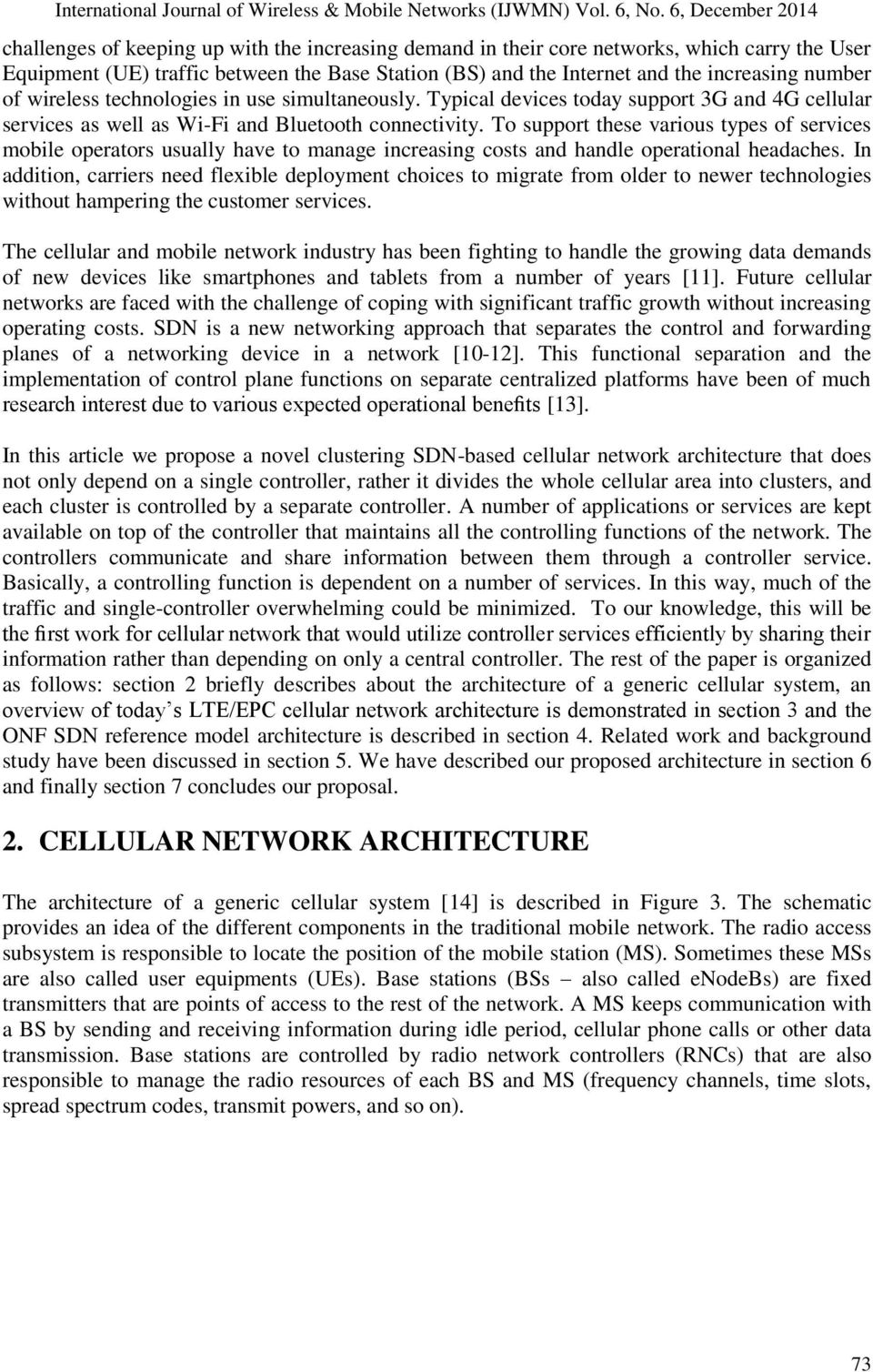
4 Figure 3. Generic cellular network architecture The network subsystem is liable to carry voice and data traffic and also handles routing information of voice calls and data packets. The mobile switching center (MSC) and the serving and gateway GPRS (General Packet Radio Service) support nodes (SGSN and GGSNs) are responsible for handling voice and data respectively. These network entities control the mobility management; locate the cell or group of cells where a MS is positioned and update routing information when a MS makes a handoff. They connect to the public switched telephone network (PSTN) or the Internet. Several databases in the management subsystem are used for keeping track of the entities in the network that are currently serving the MS, security issues, accounting and other operations as shown in the upper part of Figure TODAY S LTE CELLULAR DATA NETWORKS In Long Term Evolution (LTE) cellular networks, a base station (enodeb) generally connects to the Internet using an IP networking equipment [15], as shown in Figure 4. The user equipment (UE) directly makes a connection to a base station, which forwards traffic information through a serving gateway (S-GW) over a GPRS Tunneling Protocol (GTP) tunnel. The S-GW acts as a local mobility anchor point that maintains smooth communication when the user travels from one base station to another. The S-GW stores a large amount of state since users retain their IP addresses when they move from one location to another. The S-GW forwards traffic to the packet data network gateway (P-GW). The P-GW enforces quality of service policies and monitors traffic to perform billing. The P-GW also handles the connections to the Internet and other cellular data networks, and works as a firewall that blocks annoying traffic flow. The P-GW can handle different types of policies based on whether the user is travelling, features of the user equipment, usage caps in the service agreement, parental controls, and so on. 74
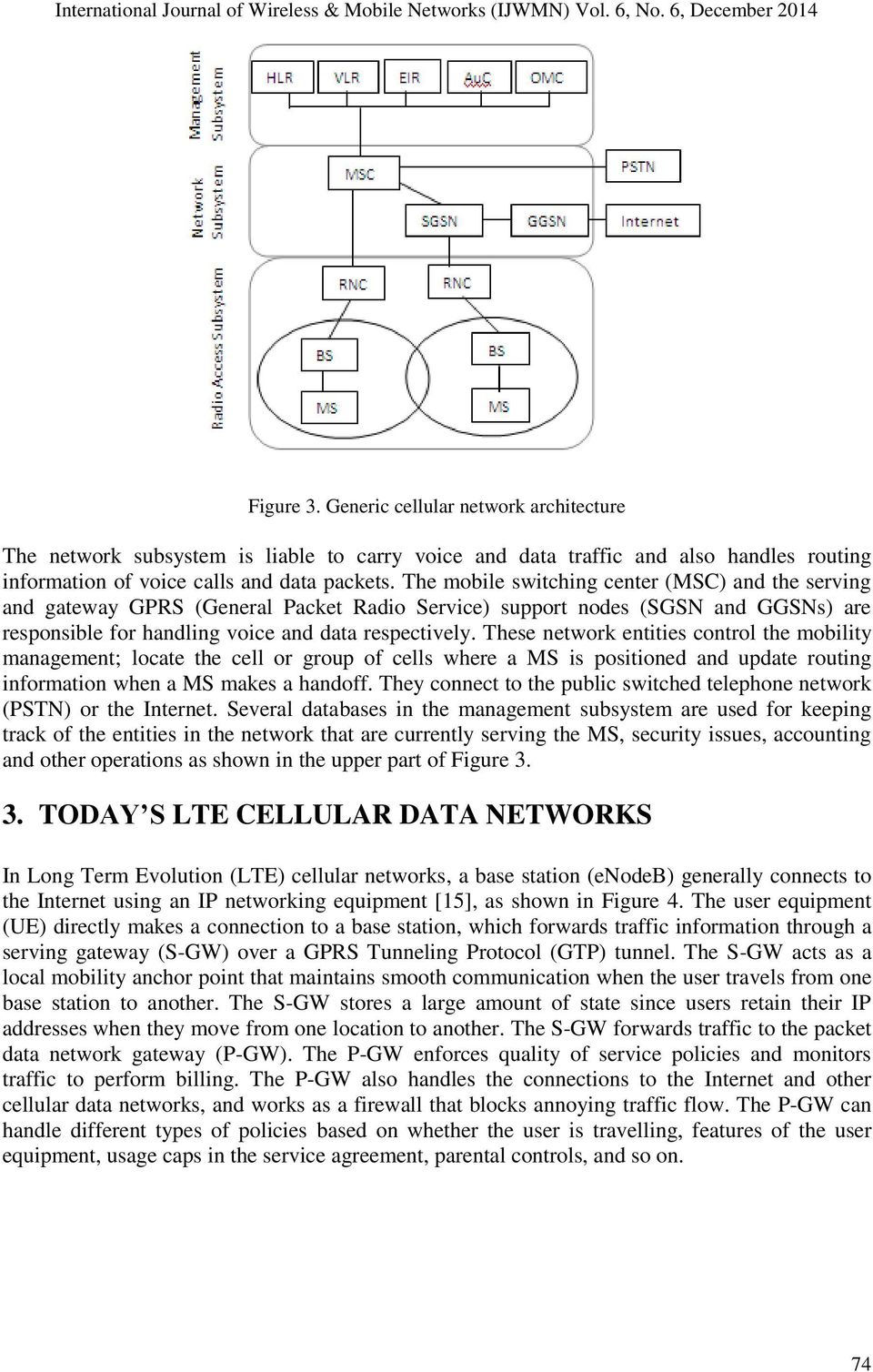

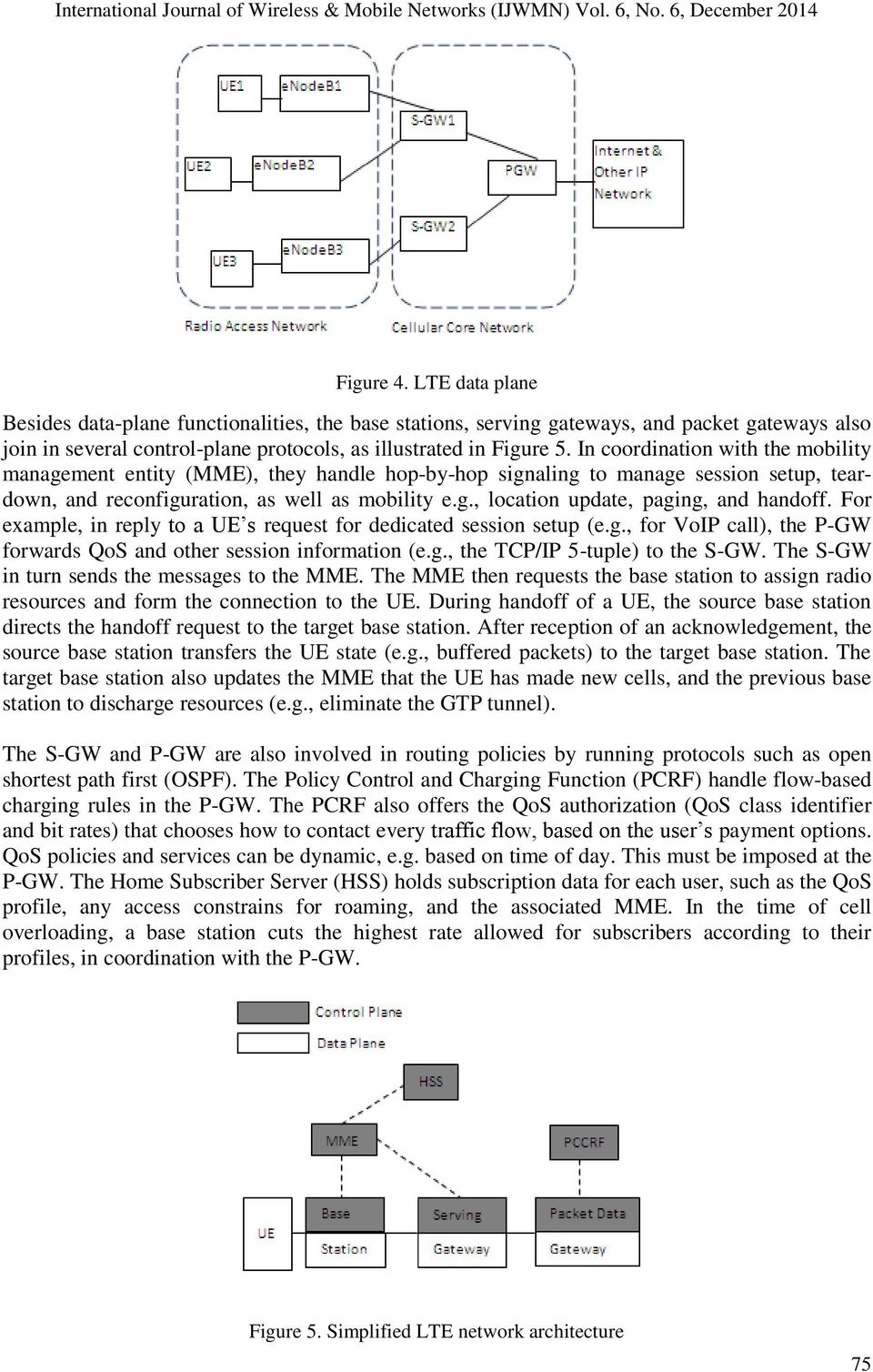
5 Figure 4. LTE data plane Besides data-plane functionalities, the base stations, serving gateways, and packet gateways also join in several control-plane protocols, as illustrated in Figure 5. In coordination with the mobility management entity (MME), they handle hop-by-hop signaling to manage session setup, teardown, and reconfiguration, as well as mobility e.g., location update, paging, and handoff. For example, in reply to a UE s request for dedicated session setup (e.g., for VoIP call), the P-GW forwards QoS and other session information (e.g., the TCP/IP 5-tuple) to the S-GW. The S-GW in turn sends the messages to the MME. The MME then requests the base station to assign radio resources and form the connection to the UE. During handoff of a UE, the source base station directs the handoff request to the target base station. After reception of an acknowledgement, the source base station transfers the UE state (e.g., buffered packets) to the target base station. The target base station also updates the MME that the UE has made new cells, and the previous base station to discharge resources (e.g., eliminate the GTP tunnel). The S-GW and P-GW are also involved in routing policies by running protocols such as open shortest path first (OSPF). The Policy Control and Charging Function (PCRF) handle flow-based charging rules in the P-GW. The PCRF also offers the QoS authorization (QoS class identifier and bit rates) that chooses how to contact every traffic flow, based on the user s payment options. QoS policies and services can be dynamic, e.g. based on time of day. This must be imposed at the P-GW. The Home Subscriber Server (HSS) holds subscription data for each user, such as the QoS profile, any access constrains for roaming, and the associated MME. In the time of cell overloading, a base station cuts the highest rate allowed for subscribers according to their profiles, in coordination with the P-GW. Figure 5. Simplified LTE network architecture 75
6 As today s cellular networks provide a number of services but their architectures have numerous major limitations. Centralizing monitoring activities, access control mechanisms, and quality-ofservice policies at the packet gateway presents scalability challenges. This makes the networking devices or equipment very expensive (e.g., to purchase a Cisco packet gateway it usually requires more than 6 million dollars). Concentrating data plane activities at the cellular-internet frontier forces all traffic related data through the P-GW, containing traffic between users on the same cellular network coverage, making it tough to host popular contents inside the cellular network. In addition, the network devices have vendor-specific configuration interfaces, and make communication through complex control-plane protocols, with a huge and increasing number of parameters under more restrictions (e.g., several thousand parameters for base stations). As such, network administrators or operators have limited control over the operation of their networks, with little ability to create innovative policies as well as to provide up-to-date services. 4. SDN OVERVIEW Software Defined Networking is an innovative architectural approach in the networking arena that has been designed to allow more agile and cost-effective networks to provide network users the recent and future services. The Open Networking Foundation (ONF) is on the top position in SDN standardization, and has defined an SDN architecture model [16] as illustrated in Figure 6. The ONF/SDN architecture model is comprised of three separate layers that are reachable through a number open APIs: The application layer consists of the end-user business applications that provide different communications services. Communications between the application layer and the control layer is managed by the API. The control layer controls and supervises the network forwarding functionality through an open interface. The physical layer usually contains the physical network devices or components (i.e. router, switch, etc.) that are responsible to handle packet switching and forwarding. According to this architectural approach, the model is characterized and described by three key features: 76
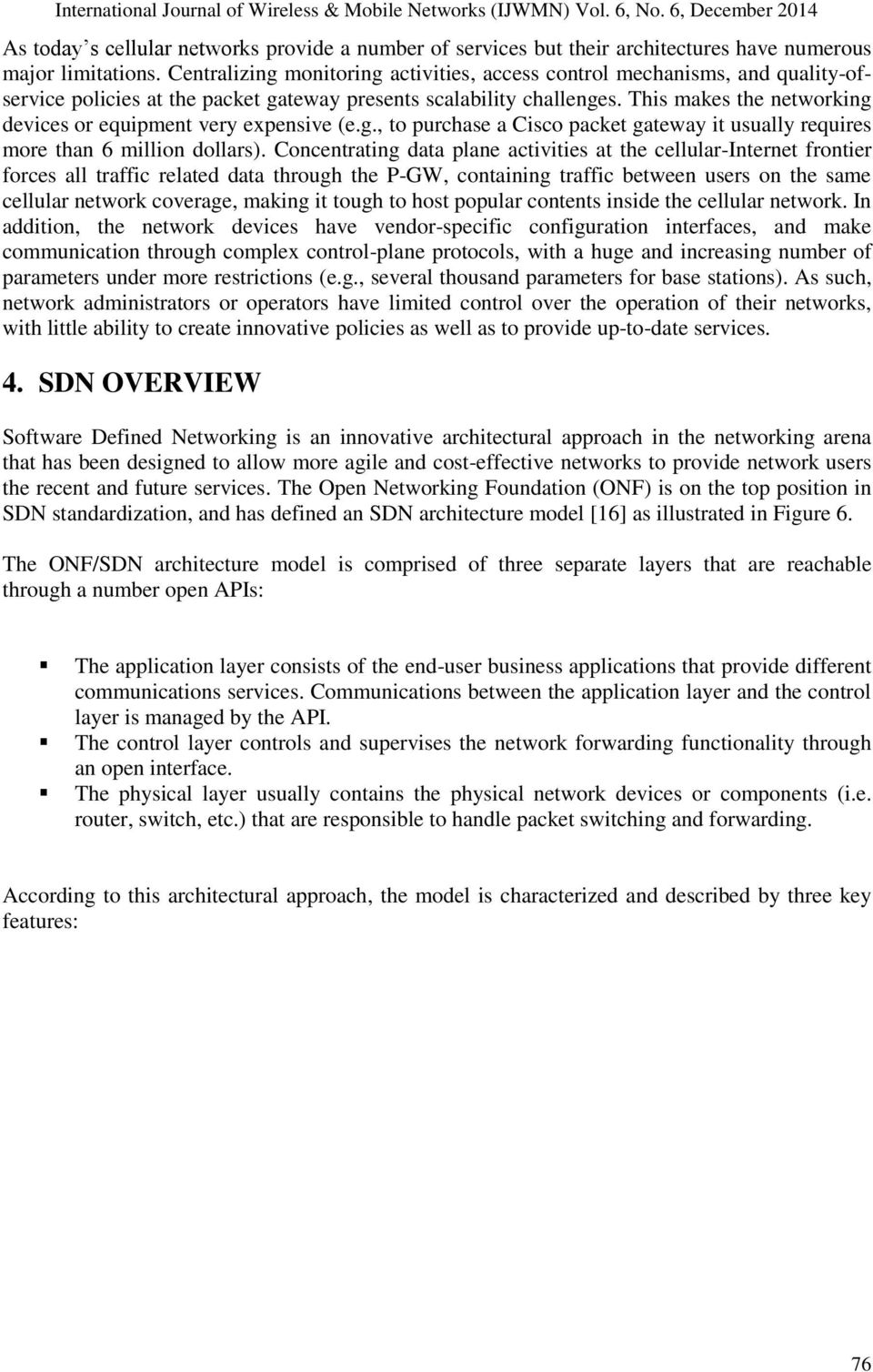
![Figure 6. ONF SDN reference model 1. Logically centralized intelligence An SDN provides the full network overview from a single point of supervision using the standard interface OpenFlow [17].](/docs-images/25/5818190/images/7-0.png "By centralizing network functionalities or intelligence, all types of decision-making are performed based on a global (or domain) view where nodes are ignorant of the overall state of the network. 2.")
7 Figure 6. ONF SDN reference model 1. Logically centralized intelligence An SDN provides the full network overview from a single point of supervision using the standard interface OpenFlow [17]. By centralizing network functionalities or intelligence, all types of decision-making are performed based on a global (or domain) view where nodes are ignorant of the overall state of the network. 2. Programmability An SDN offers programmatic interfaces through different services that can automate and form network fabric configuration. SDN networks can attain revolution and variation from traditional networks by providing open APIs for applications to communicate and interconnect with the networks. 3. Abstraction In an SDN network, the business applications and services are abstracted from the underlying network technologies and mechanisms. Network devices are also abstracted from the SDN control layer to support portability for any application or services from any vendor or manufacturer. 5. RELTED WORK AND BACKGROUND STUDY The ONF has defined an SDN architecture model for cellular network [18]. An SDN provides the overall network functionalities from a single point of administration using the standard interface, OpenFlow. ONF describes two use cases to illustrate the benefit of OpenFlow-based SDN for mobile networks: Inter-cell interference management Mobile traffic management As shown in Figure 7, the logically centralized control layer provides radio resource allocation choices to be performed with global visibility through many base stations, which are more efficient than the distributed radio resource management (RRM), mobility management, and routing applications/protocols in use today. By centralizing network intelligence into the SDN 77
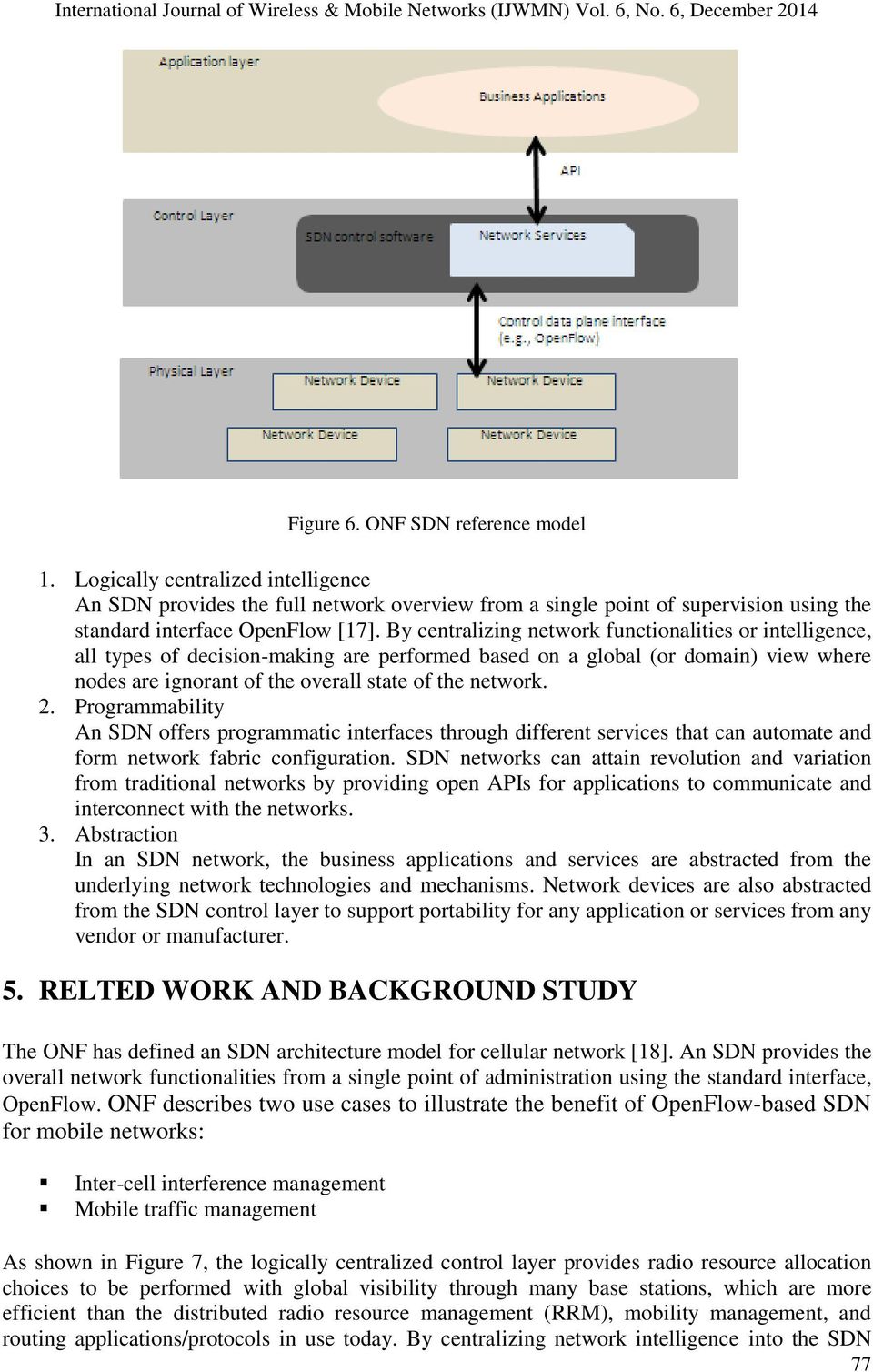
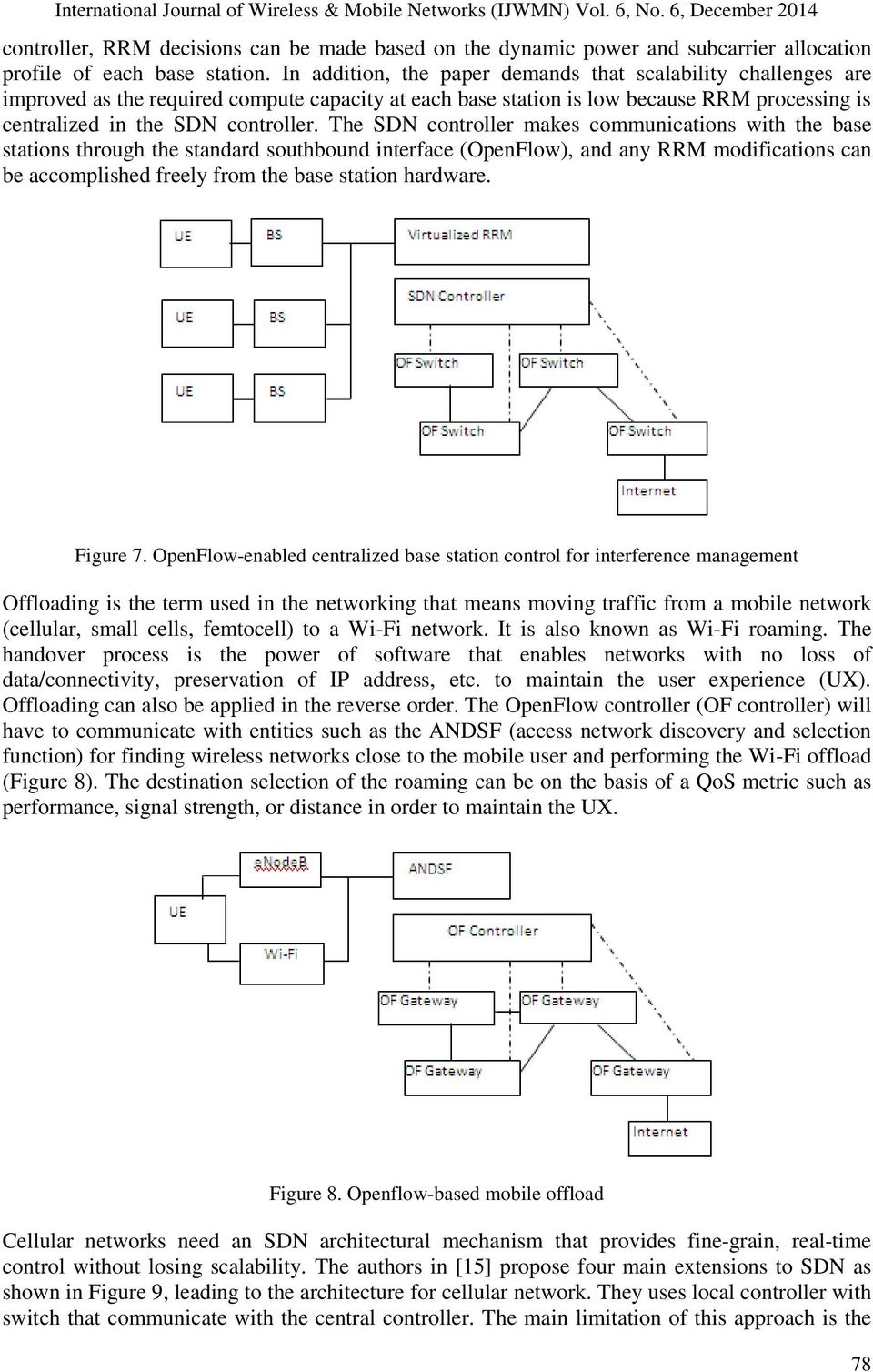
8 controller, RRM decisions can be made based on the dynamic power and subcarrier allocation profile of each base station. In addition, the paper demands that scalability challenges are improved as the required compute capacity at each base station is low because RRM processing is centralized in the SDN controller. The SDN controller makes communications with the base stations through the standard southbound interface (OpenFlow), and any RRM modifications can be accomplished freely from the base station hardware. Figure 7. OpenFlow-enabled centralized base station control for interference management Offloading is the term used in the networking that means moving traffic from a mobile network (cellular, small cells, femtocell) to a Wi-Fi network. It is also known as Wi-Fi roaming. The handover process is the power of software that enables networks with no loss of data/connectivity, preservation of IP address, etc. to maintain the user experience (UX). Offloading can also be applied in the reverse order. The OpenFlow controller (OF controller) will have to communicate with entities such as the ANDSF (access network discovery and selection function) for finding wireless networks close to the mobile user and performing the Wi-Fi offload (Figure 8). The destination selection of the roaming can be on the basis of a QoS metric such as performance, signal strength, or distance in order to maintain the UX. Figure 8. Openflow-based mobile offload Cellular networks need an SDN architectural mechanism that provides fine-grain, real-time control without losing scalability. The authors in [15] propose four main extensions to SDN as shown in Figure 9, leading to the architecture for cellular network. They uses local controller with switch that communicate with the central controller. The main limitation of this approach is the 78
9 management of the local and central controller as both may have dissimilar controlling information or data at the same time for a specific switch to forward packets. Figure 9. Cellular SDN architecture SoftCell [19] is an SDN-based cellular network architectural model that demands to support a number of fine-grained services in a scalable manner for cellular core networks (Figure 10). In this article, the authors used local agents and access switch to each base station to communicate with the controller, they also used OpenFlow switches in the core network rather than EPC/LTE switches. It would be very difficult to deploy new software switches to each base station; also it may suffer same limitation as the above approach. 79

10 Figure 10. SoftCell Architecture SoftRAN [20] is a SDN based centralized control plane architecture for radio access networks that localizes all base stations in a particular geographical area as a virtual big-base station comprised of a central controller and radio elements (individual physical base stations), but it does not apply any technique for cellular core network as depicted in Figure 11. Figure 11. SoftRAN Architecture In [21], the authors propose an SDN-based mobile networking approach integrated with legacy mobility control plane. They simply call this the partially-separated mobile SDN architecture that is compared to the fully-separated mobile SDN architecture where all the control is dominated by a SDN controller without taking the legacy mobility control plane into consideration (Figure 12). This paper is only for controlling the mobility of the user equipment s and they propose mobility control plane to each switch as like as local controller, and the central mobility controller acts as central controller same in the above techniques. 80

11 Figure 12. SDN-based mobility management architecture In the article [22], the authors present a new dynamic tunnel switching technique for SDN-based cellular core networks. This approach is to maximally utilize cloud and implement a virtualized EPC (Evolved Packet Core) serving and packet data network gateway (S/PGW) where control and user plane functions are separated from each other (Figure 13). They demand it would support 5G cellular network. The limitation is that it would not be able to adopt with today s existing network as well as future cellular network. Figure 13. SDN-based virtualized S/P-GW A new architecture for 3GPP LTE/EPC cellular network for on-demand connectivity service has been proposed in [23]. Their proposal also depends on a single SDN-based controller and used the expensive PGW switch to connect to the internet. 81

12 All the above proposals for SDN-based cellular network used only a single controller. As cellular data traffic has exploded in recent years and the rate will also be kept in the coming future, we think it would not be possible for a single controller to handle all the functionalities to manage the network. And hence, we have decided to establish a novel architecture for SDN-based cellular network that would be depended on a number of cluster-based controllers rather than a single controller. 6. PROPOSED ARCHITECTURE To support the services of today s emerging cellular network and at the same time for future network, we propose a novel architecture for SDN-based cellular network. We change the control protocols on the interfaces of S1 (between MME and enodeb), S11 (between MME and SGW) and S5 (between SGW-C and PGW-C) of the LTE/EPC architecture by the OpenFlow protocol. The other two interfaces S1 (from enodeb to SGW-D) and S5 (from SGW-D to PGW-D) are controlled by the existing 3GPP protocol of the LTE/EPC architecture. According to the SDN principle we propose to separate the all controlling activities and place these to the central controller. The central controller is responsible to manage all the controlling functions through its different services that run on top of the OpenFlow controller. Our proposed architecture needs not any change to the radio hardware at the base station; also it does not want extra support to connect to the Internet. The architecture comprises of the following entities as shown in Figure 14: Controller: The SDN controller usually involves a network operating system (NOS) that handles a collection of application modules/services. The handling of a single packet may depend on multiple services. The NOS should be able to support the composition of the outcomes of multiple modules into a single set of packet-handling policies in each switch. Figure 14. Proposed architecture It is the key component of our architecture as it handles all controlling activities related to radio access network (RAN), the forwarding plane services of OpenFlow switches as well as gateways to the Internet. It implements high-level service policies by installing switch-level rules that direct traffic through middleboxes as in LTE/EPC network. The OpenFlow controller is responsible for 82
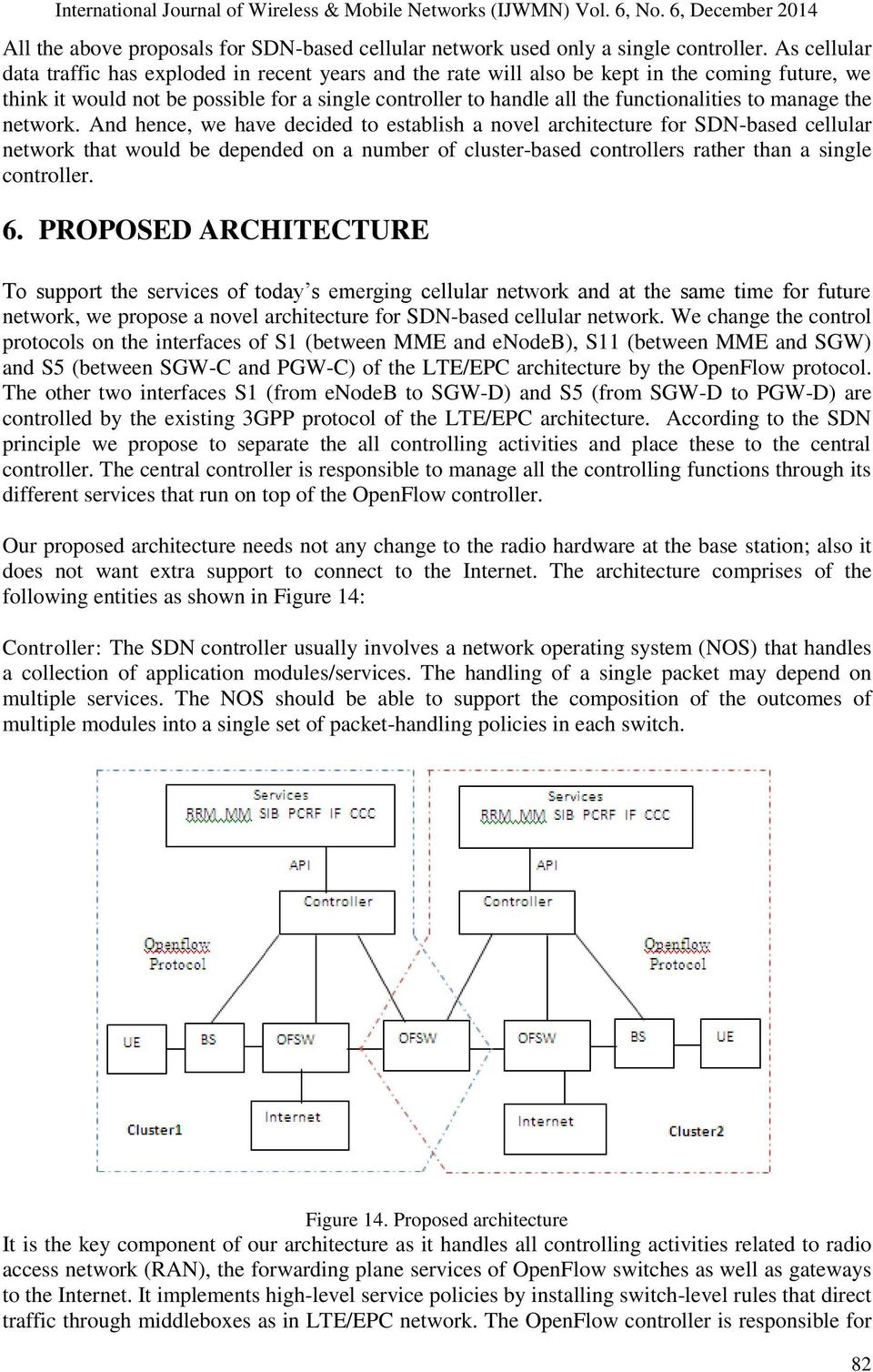
13 user session establishment and load monitoring at the data plane. It controls all the controlling functions provided to the OpenFlow switches (OFSWs that resemble SGW-D and PGW-D in the LTE/EPC architecture) through different services that reside on top of it. In general, it interconnects with the services through the application programming interface (API) and holds the following modules: RRM: It maintains all the radio related functions provided to the base stations through the Openflow protocol rather than GTP tunneling protocol as used in the LTE/EPC architecture. Running radio resource management module (RRM) on top of a logicallycentralized controller lets it much simpler to renovate in admission control, radio resource distribution, and interference management. MM: It is the service that provides UE authentication and authorization, and supports intra-3gpp mobility management (MM). SIB: The controller holds a subscriber information base (SIB) that stores and handles subscriber information, both for relatively static subscriber attributes and dynamic data of the user s current IP address, location, and total traffic consumption. IF: The infrastructure routing (IF) is responsible to identify the routes between pairs of network elements and the flow of traffic through the network depending on the subscriber s location (determined by the mobility manager). PCRF: The policy and charging rule function (PCRF) is responsible for traffic monitoring and packet scheduling activities. CCC: This module is the main part of controlling the clusters of our proposed architecture. When a cluster is heavy loaded, the controller generally sends packet to the switch that is shared between two clusters and search for that cluster which is less loaded by the controller-controller communication (CCC). All cluster that are neighbors, i.e. shared at least one switch, store these information in the CCC service table. Its main function is to update the controller status of the next cluster and share the information between controllers through the shared switch. And it is duty of the visiting cluster controller to forward packets which reached in the shared switch after updating its controller and CCC services. A packet only goes to the shared switch when the controller is extremely overloaded with huge traffic and it ensures only that the traffic is forwarded to another less crowded cluster. So by this way, many traffic as well as controller overwhelming is minimized. OFSW: Today s OpenFlow switches (OFSW) already support many features needed in cellular networks [10]. These are commodity hardware switches that act like a SGW data plane (SGW-D) and are able to encapsulate/decapsulate GTP packets. This switch applies the rules received from the OpenFlow controller. It is responsible for packet forwarding between the enodeb and SGW. Our proposed architecture also contains Openflow enabled a few gateway switches connected to the Internet. These gateway switches are much cheaper than PGW switches; they just perform packet forwarding, and relegate sophisticated controlling functions to the Openflow controller. enodeb: This is the base station that keeps the same radio functions specified by the 3GPP standard. It is enabled with the Openflow protocol for the data forwarding through the S1 (enodeb to SGW-D) interface. Therefore, the data forwarding is based on instructions received from the OpenFlow controller. UE: These are mobile devices also called user equipments (UEs) that are today s LTE supported devices and work smart ways. 83

14 7. DISCUSSION AND CONCLUSION Despite the extraordinary success of the cellular mobile telecommunications industry, many of the underlying design strategies and service assumptions that have served us arguably well over the past few decades may benefit from a fresh new look. Certainly, the LTE network architecture can eliminate a few network components, and simplifies some of the cellular network architectural compositions. Although, it was a change in the right direction, the result appears to provide somewhat constrained enhancements in terms of reduction in complexity and improvement in flexibility, as well as to maintain the heavy traffic of the today s popular cellular network. An innovative SDN-based cellular network architecture has been proposed in this paper that does not only depend on a single controller, rather it splits the whole cellular area into a number of small clusters, and each cluster is managed by a distinct controller. A number of applications are provided on top of the controller that keeps all the controlling activities of the network. The controllers communicate and share information between them through a controller service. Basically, a controlling function is dependent on a number of services. As a result, much of the traffic and single-controller overloading could be minimized. To design and meet the needs of the future mobile cellular network will be more difficult with a few general observations: there will be far smarter and new devices; the more base stations connecting them, and various numbers of applications - ever changing - running over the network. We believe that our proposed architecture would be able to fulfill the demands for today s and future cellular network and at the same time to support the challenges of this inevitability. Our proposed architecture would be simulated in the mininet emulator for future work to establish it as for practical or real world usage. ACKNOWLEDGEMENT The author thanks to the researchers whose research papers are included in this article. REFERENCES [1] IBM Systems and Technology, Software Defined Networking - A new paradigm for virtual, dynamic, flexible networking, October 2012 [2] Kirk Bloede, Software Defined Networking Moving Towards Mainstream, Electronics Banking Research, August 2012 [3] Brocade VCS Fabrics: The Foundation for Software-Defined Networks [4] Network Transformation with Software-Defined Networking and Ethernet Fabrics, Brocade Communications Systems, Inc., 2012 [5] Md. Humayun Kabir, Software Defined Networking (SDN): A Revolution in Computer Network, IOSR Journal of Computer Engineering (IOSR-JCE), Volume 15, Issue 5 (Nov. - Dec. 2013), PP [6] Software Defined Networking: What Is It and Why Do You Need It?, enterasys secure network [7] [8] Open Networking Foundation, Software-Defined Networking: The New Norm for Networks [9] [10] LTE (telecommunication), From Wikipedia, the free encyclopedia. [11] B. Kim & P. Henry, Directions for Future Cellular Mobile Network Architecture, AT&T Labs - Research. 84

15 [12] Philip Bridge, Revolutionizing Mobile Networks with SDN and NFV, Cambridge Wireless Virtual Networks SIG, 8th May, [13] NFV, [14] David Tipper, Prashant Krishnamurthy, and James Joshi, Network architecture and protocols for mobile positioning in cellular wireless systems, Department of Information Science and Telecommunications, University of Pittsburgh, Pittsburgh, PA [15] Li, L. E., Mao Z. M., Rexford J. Toward Software-Defined Cellular Networks, In Proceedings of IEEE EWSDN [16] ONF, [17] OpenFlow Switch Specification, version Open Networking Foundation [18] OpenFlow -Enabled Mobile and Wireless Networks, ONF Solution Brief, September 30, [19] Jin X., Li L. E., Vanbever L., Rexford J. SoftCell: Scalable and Flexible Cellular Core Network Architecture. In Proceedings of ACM CoNEXT [20] Aditya Gudipati, Daniel Perry, Li Erran Li, Sachin Katti, SoftRAN: Software Defined Radio Access Network, HotSDN 13, August 16, 2013, Hong Kong, China. [21] Seil Jeon, Carlos Guimarães, Rui L. Aguiar, SDN-Based Mobile Networking for Cellular Operators, MobiArch 14, September 11, 2014, Maui, Hawaii, USA. [22] Johanna Heinonen, Tapio Partti, Marko Kallio, Kari Lappalainen, Hannu Flinck, Jarmo Hillo, Dynamic Tunnel Switching for SDN-Based Cellular Core Networks, AllThingsCellular'14, August 22, 2014, Chicago, IL, USA. [23] S B H said, M R Sama, K Guillouard, L Suciu, New control plane in 3GPP LTE/EPC Architecture for on-demand connectivity service, Proc. Of IEEE CloudNet Author Md. Humayun Kabir is currently working as Assistant Professor in the Department of Computer Science & Engineering, University of Rajshahi, Rajshahi, Bangladesh. He received B.Sc. (Hons.) and M.Sc. degree in Computer Science & Engineering from University of Rajshahi, Rajshahi, Bangladesh. His research interests include Software Defined Networking (SDN) for Wireless and Mobile Networks, Mobile Ad hoc Networks, Wireless Sensor Networks, Wireless Body Area Network (WBAN), Network Security, Internet and Mobile Computing. 85
![Department of Information Science and Telecommunications, University of Pittsburgh, Pittsburgh, PA 15260. [15] Li, L. E., Mao Z. M., Rexford J.](/docs-images/43/5818190/images/page_15.jpg "Toward Software-Defined Cellular Networks, In Proceedings of IEEE EWSDN. 2012. [16] ONF, https://www.opennetworking.org/ [17] OpenFlow Switch Specification, version 1.3.2. Open Networking Foundation.")
ATCN 2014: SDN - Mobility and SDN: Mobility Management and Mobile Networks
 ATCN 2014: SDN - Mobility and SDN: Mobility Management and Mobile Networks Karin Anna Hummel, ETH Zurich (thanks to Vasileios Kotronis for some material) November 10, 2014 1 Locating and Connecting 2 Wireless
LTE - Can SDN paradigm be applied?
 LTE - Can SDN paradigm be applied? Source of this presentation: Towards Software Defined Cellular Networks Li Erran Li (Bell Labs, Alcatel-Lucent) Morley Mao (University of Michigan) Jennifer Rexford (Princeton
Towards Software Defined Cellular Networks
 Towards Software Defined Cellular Networks Li Erran Li (Bell Labs, Alcatel-Lucent) Morley Mao (University of Michigan) Jennifer Rexford (Princeton University) 1 Outline Critiques of LTE Architecture CellSDN
Long-Term Evolution. Mobile Telecommunications Networks WMNet Lab
 Long-Term Evolution Mobile Telecommunications Networks WMNet Lab Background Long-Term Evolution Define a new packet-only wideband radio with flat architecture as part of 3GPP radio technology family 2004:
Technology Business Unit. White Paper. SDN in Wireless Cellular Networks: Gearing Up to Meet the Growing Bandwidth Demand
 Technology Business Unit White Paper SDN in Wireless Cellular Networks: Gearing Up to Meet the Growing Bandwidth Demand About the Author Thomas Lee Sebastian Dr. Thomas Lee Sebastian works as a Solution
LTE Performance and Analysis using Atoll Simulation
 IOSR Journal of Electrical and Electronics Engineering (IOSR-JEEE) e-issn: 2278-1676,p-ISSN: 2320-3331, Volume 9, Issue 6 Ver. III (Nov Dec. 2014), PP 68-72 LTE Performance and Analysis using Atoll Simulation
Wireless & Mobile. Working Group
 Wireless & Mobile Working Group Table of Contents 1 Executive Summary... 3 2 Mission & Motivation... 3 3 Scope... 3 4 Goals & Non-Goals... 4 5 Deliverables... 5 6 Milestones... 6 7 Example Use Cases Summaries...
Architecture Overview NCHU CSE LTE - 1
 Architecture Overview NCHU CSE LTE - 1 System Architecture Evolution (SAE) Packet core networks are also evolving to the flat System Architecture Evolution (SAE) architecture. This new architecture optimizes
a new sdn-based control plane architecture for 5G
 a new sdn-based control plane architecture for 5G With a Case Study on Connectivity Management m. outline what is sdn? 5G proposed control plane connectivity control software-defined networking The needs
Get the best performance from your LTE Network with MOBIPASS
 Get the best performance from your LTE Network with MOBIPASS The most powerful, user friendly and scalable enodeb test tools family for Network Equipement Manufacturers and Mobile Network Operators Network
New Control Plane in 3GPP LTE/EPC Architecture for On-Demand Connectivity Service
 New Control Plane in 3GPP LTE/EPC Architecture for On-Demand Connectivity Service Siwar Ben Hadj Said, Malla Reddy Sama, Karine Guillouard, Lucian Suciu Gwendal Simon, Xavier Lagrange and Jean-Marie Bonnin
Intel Network Builders Solution Brief. Intel and ASTRI* Help Mobile Network Operators Support Small Cell Networks
 Intel Network Builders Solution Brief Intel and ASTRI* Help Mobile Network Operators Support Small Cell Networks Overview Wireless networks built using small cell base stations are enabling mobile network
On Using a SDN-based Control Plane in 5G Mobile Networks
 On Using a SDN-based Control Plane in 5G Mobile Networks Toktam Mahmoodi, Srini Seetharaman King s College London, Deutsche Telekom Contact author: [email protected] ABSTRACT Today s mobile operators
Software-Defined Networking for Wi-Fi White Paper
 Software-Defined Networking for Wi-Fi Introduction Software-Defined Networking for Wi-Fi The explosion in the number and diversity of wireless devices in today s enterprise networks has increased the pressure
Abstraction of Mobile Network Topology Albert Codes Morales Supervised by: Dr. Toktam Mahmoodi King s College London March 2015
 Albert Codes Morales Supervised by: Dr. Toktam Mahmoodi King s College London March 2015 Abstract Using the concept of Software-defined Networking to re-design the control plane in mobile network has been
Optimization Handoff in Mobility Management for the Integrated Macrocell - Femtocell LTE Network
 Optimization Handoff in Mobility Management for the Integrated Macrocell - Femtocell LTE Network Ms.Hetal Surti PG Student, Electronics & Communication PIT, Vadodara E-mail Id:[email protected] Mr.Ketan
End to End Delay Performance Evaluation for VoIP in the LTE Network
 ENSC 427 COMMUNICATION NETWORKS SPRING 2013 Final Project Presentation End to End Delay Performance Evaluation for VoIP in the LTE Network Dai, Hongxin Ishita, Farah Lo, Hao Hua danield @ sfu.ca fishita
Whitepaper. 10 Metrics to Monitor in the LTE Network. www.sevone.com blog.sevone.com [email protected]
 10 Metrics to Monitor in the LTE Network The deployment of LTE increases dependency on the underlying network, which must be closely monitored in order to avert serviceimpacting events. In addition, the
Practical Security Testing for LTE Networks BlackHat Abu Dhabi December 2012 Martyn Ruks & Nils
 Practical Security Testing for LTE Networks BlackHat Abu Dhabi December 2012 Martyn Ruks & Nils 06/11/2012 1 Today s Talk Intro to LTE Networks Technical Details Attacks and Testing Defences Conclusions
10 METRICS TO MONITOR IN THE LTE NETWORK. [ WhitePaper ]
![10 METRICS TO MONITOR IN THE LTE NETWORK. [ WhitePaper ]](/thumbs/26/7717895.jpg "10 METRICS TO MONITOR IN THE LTE NETWORK. [ WhitePaper ]") [ WhitePaper ] 10 10 METRICS TO MONITOR IN THE LTE NETWORK. Abstract: The deployment of LTE increases dependency on the underlying network, which must be closely monitored in order to avert service-impacting
[ WhitePaper ] 10 10 METRICS TO MONITOR IN THE LTE NETWORK. Abstract: The deployment of LTE increases dependency on the underlying network, which must be closely monitored in order to avert service-impacting
Demo 1. Network Path and Quality Validation in the Evolved Packet Core
 Competence Center NGNI Demo 1 Network Path and Quality Validation in the Evolved Packet Core 1 Fraunhofer Institute FOKUS and TU Berlin AV AV provides education and applied research together with Fraunhofer
How OpenFlow -Based SDN Transforms Private Cloud. ONF Solution Brief November 27, 2012
 How OpenFlow -Based SDN Transforms Private Cloud ONF Solution Brief November 27, 2012 Table of Contents 2 Executive Summary 2 Trends in the Private Cloud 3 Network Limitations and Requirements 4 OpenFlow-Based
Security Testing 4G (LTE) Networks 44con 6th September 2012 Martyn Ruks & Nils
 Security Testing 4G (LTE) Networks 44con 6th September 2012 Martyn Ruks & Nils 11/09/2012 1 Today s Talk Intro to 4G (LTE) Networks Technical Details Attacks and Testing Defences Conclusions 11/09/2012
Delivery of Voice and Text Messages over LTE
 Delivery of Voice and Text Messages over LTE 1. The Market for Voice and SMS! 2. Third Party Voice over IP! 3. The IP Multimedia Subsystem! 4. Circuit Switched Fallback! 5. VoLGA LTE was designed as a
Mobile Wireless Overview
 Mobile Wireless Overview A fast-paced technological transition is occurring today in the world of internetworking. This transition is marked by the convergence of the telecommunications infrastructure
Supporting mobility in the RAN cloud
 Supporting mobility in the RAN cloud Michael Fitch BT 23 rd October 2012 Cloud basics On-Demand Self-Service A consumer can provision computing capabilities, such as server time and network storage, automatically
SDN and NFV in the WAN
 WHITE PAPER Hybrid Networking SDN and NFV in the WAN HOW THESE POWERFUL TECHNOLOGIES ARE DRIVING ENTERPRISE INNOVATION rev. 110615 Table of Contents Introduction 3 Software Defined Networking 3 Network
Technical white paper. Enabling mobile broadband growth Evolved Packet Core
 Technical white paper Enabling mobile broadband growth Evolved Packet Core Contents 3 Enabling mobile broadband growth 4 Enabling migration from current networks to LTE 4 Terminology 5 The demand for cost-effective
Testing Software Defined Network (SDN) For Data Center and Cloud VERYX TECHNOLOGIES
 Testing Software Defined Network (SDN) For Data Center and Cloud VERYX TECHNOLOGIES Table of Contents Introduction... 1 SDN - An Overview... 2 SDN: Solution Layers and its Key Requirements to be validated...
NTT DOCOMO Technical Journal. Core Network Infrastructure and Congestion Control Technology for M2M Communications
 M2M 3GPP Standardization Further Development of LTE/LTE-Advanced LTE Release 10/11 Standardization Trends Core Network Infrastructure and Congestion Control Technology for M2M Communications The number
Improving Network Management with Software Defined Networking
 Improving Network Management with Software Defined Networking Hyojoon Kim and Nick Feamster, Georgia Institute of Technology 2013 IEEE Communications Magazine Presented by 101062505 林 瑋 琮 Outline 1. Introduction
Proposal and evaluation of SDN-based mobile packet core networks
 Nguyen and Kim EURASIP Journal on Wireless Communications and Networking (2015) 2015:172 DOI 10.1186/s13638-015-0395-1 RESEARCH Open Access Proposal and evaluation of SDN-based mobile packet core networks
A Presentation at DGI 2014 Government Cloud Computing and Data Center Conference & Expo, Washington, DC. September 18, 2014.
 A Presentation at DGI 2014 Government Cloud Computing and Data Center Conference & Expo, Washington, DC September 18, 2014 Charles Sun www.linkedin.com/in/charlessun @CharlesSun_ 1 What is SDN? Benefits
SDN- based Mobile Networking for Cellular Operators. Seil Jeon, Carlos Guimaraes, Rui L. Aguiar
 SDN- based Mobile Networking for Cellular Operators Seil Jeon, Carlos Guimaraes, Rui L. Aguiar Background The data explosion currently we re facing with has a serious impact on current cellular networks
How to deal with a thousand nodes: M2M communication over cellular networks. A. Maeder NEC Laboratories Europe andreas.maeder@neclab.
 How to deal with a thousand nodes: M2M communication over cellular networks A. Maeder NEC Laboratories Europe [email protected] Outline Introduction to M2M communications The M2M use case landscape
OpenFlow -Enabled Mobile and Wireless Networks. ONF Solution Brief September 30, 2013
 OpenFlow -Enabled Mobile and Wireless Networks ONF Solution Brief September 30, 2013 Table of Contents 2 Executive Summary 3 SDN Overview 4 Trends and Challenges 6 Mobile Network Use Cases 11 Key Benefits
Telecommunication Services Engineering (TSE) Lab. Chapter III 4G Long Term Evolution (LTE) and Evolved Packet Core (EPC)
 Chapter III 4G Long Term Evolution (LTE) and Evolved Packet Core (EPC) http://users.encs.concordia.ca/~glitho/ Outline 1. LTE 2. EPC architectures (Basic and advanced) 3. Mobility management in EPC 4.
Mobility and cellular networks
 Mobility and cellular s Wireless WANs Cellular radio and PCS s Wireless data s Satellite links and s Mobility, etc.- 2 Cellular s First generation: initially debuted in Japan in 1979, analog transmission
5G Backhauling_. Luis M. Contreras GCTO Unit, Transport, Telefónica 05.11.2015
 5G Backhauling_ Luis M. Contreras GCTO Unit, Transport, Telefónica 05.11.2015 NGMN Whitepaper 5G System Architecture 5G System Requirements and Architecture Performance 1000x higher mobile data volumes
3G/Wi-Fi Seamless Offload
 Qualcomm Incorporated March 2010 Table of Contents [1] Introduction... 1 [2] The Role of WLAN... 2 [3] 3G/Wi-Fi Seamless Offload Pathway... 2 [4] Application-Based Switching... 3 [5] Wi-Fi Mobility...
Diameter in the Evolved Packet Core
 Diameter in the Evolved Packet Core A Whitepaper November 2009 Page 2 DIAMETER in the Evolved Packet Core Mobile broadband is becoming a reality, as the Internet generation grows accustomed to having broadband
Why Service Providers Need an NFV Platform Strategic White Paper
 Why Service Providers Need an NFV Platform Strategic White Paper Network Functions Virtualization (NFV) brings proven cloud computing and IT technologies into the networking domain to help service providers
Module 5. Broadcast Communication Networks. Version 2 CSE IIT, Kharagpur
 Module 5 Broadcast Communication Networks Lesson 9 Cellular Telephone Networks Specific Instructional Objectives At the end of this lesson, the student will be able to: Explain the operation of Cellular
Nationwide Interoperability Framework
 Nationwide Interoperability Framework Emergency Response Interoperability Center (ERIC) Public Safety Homeland Security Bureau Federal Communications Commission PSCR, Boulder, CO Dec 2, 2010 7/9/101 1
A Study on Software Defined Networking
 A Study on Software Defined Networking Yogita Shivaji Hande, M. Akkalakshmi Research Scholar, Dept. of Information Technology, Gitam University, Hyderabad, India Professor, Dept. of Information Technology,
Integrating Lawful Intercept into the Next Generation 4G LTE Network
 Integrating Lawful Intercept into the Next Generation 4G LTE Network All telecommunication providers that currently or plan to provide 4G LTE service to their customers must consider significant changes
SERVICE DISCOVERY AND MOBILITY MANAGEMENT
 Objectives: 1) Understanding some popular service discovery protocols 2) Understanding mobility management in WLAN and cellular networks Readings: 1. Fundamentals of Mobile and Pervasive Computing (chapt7)
Access to GSM and GPRS mobile services over unlicensed spectrum technologies through UMA
 Access to GSM and GPRS mobile services over unlicensed spectrum technologies through UMA Snehlata Barde Sujata Khobragade Rasmiprava Singh NIT Raipur(C.G.) MATS university, Raipur MATS university,raipur
LTE CDMA Interworking
 LTE CDMA Interworking ehrpd - Use of a Common Core and a Stepping Stone to LTE Mike Dolan Consulting Member of Technical Staff Alcatel-Lucent Overview ehrpd (evolved High Rate Packet Data*) ehrpd involves
How To Understand The Gsm And Mts Mobile Network Evolution
 Mobile Network Evolution Part 1 GSM and UMTS GSM Cell layout Architecture Call setup Mobility management Security GPRS Architecture Protocols QoS EDGE UMTS Architecture Integrated Communication Systems
Virtualization, SDN and NFV
 Virtualization, SDN and NFV HOW DO THEY FIT TOGETHER? Traditional networks lack the flexibility to keep pace with dynamic computing and storage needs of today s data centers. In order to implement changes,
White Paper. Requirements of Network Virtualization
 White Paper on Requirements of Network Virtualization INDEX 1. Introduction 2. Architecture of Network Virtualization 3. Requirements for Network virtualization 3.1. Isolation 3.2. Network abstraction
Trends in Mobile Network Architectures 3GPP LTE Mobile WiMAX Next Generation Mobile Networks Dr.-Ing. Michael Schopp, Siemens Networks
 Trends in Mobile Network Architectures 3GPP LTE Mobile WiMAX Next Generation Mobile Networks Dr.-Ing. Michael Schopp, Siemens Networks Outline 1 Next Generation Mobile Networks 2 New Radio Access Network
Network functions virtualization and software management
 ericsson White paper Uen 284 23-3248 December 2014 Network functions virtualization and software management LEVERAGING THE FULL POTENTIAL WITH NETWORK SLICING Network Functions Virtualization technology
Nokia Siemens Networks Flexi Network Server
 Nokia Siemens Networks Flexi Network Server Ushering network control into the LTE era 1. Moving towards LTE Rapidly increasing data volumes in mobile networks, pressure to reduce the cost per transmitted
Delivering Network Performance and Capacity. The most important thing we build is trust
 Delivering Network Performance and Capacity The most important thing we build is trust The Ultimate in Real-life Network Perfomance Testing 1 The TM500 Family the most comprehensive 3GPP performance and
Multi-Service Broadband Network Architecture. NextGen 13 London, October 2013 Robin Mersh CEO
 Multi-Service Broadband Network Architecture NextGen 13 London, October 2013 Robin Mersh CEO 1 Introduction l The BBF has been driving the evolution of Broadband Network Architecture for the last 12 years
Wanderlust: Enabling roaming in the LTE era. Don Troshynski Vice President, Solutions Architecture
 Wanderlust: Enabling roaming in the LTE era Don Troshynski Vice President, Solutions Architecture Acme Packet Trusted, first-class services and applications Apps & services Session delivery network April
Testing Challenges for Modern Networks Built Using SDN and OpenFlow
 Using SDN and OpenFlow July 2013 Rev. A 07/13 SPIRENT 1325 Borregas Avenue Sunnyvale, CA 94089 USA Email: Web: [email protected] www.spirent.com AMERICAS 1-800-SPIRENT +1-818-676-2683 [email protected]
App coverage. ericsson White paper Uen 284 23-3212 Rev B August 2015
 ericsson White paper Uen 284 23-3212 Rev B August 2015 App coverage effectively relating network performance to user experience Mobile broadband networks, smart devices and apps bring significant benefits
Virtualization techniques for redesigning mobile backhaul networks: challenges and issues. Fabrice Guillemin Orange Labs, IMT/IMT/OLN/CNC/NCA
 Virtualization techniques for redesigning mobile backhaul networks: challenges and issues Fabrice Guillemin Orange Labs, IMT/IMT/OLN/CNC/NCA MobiArch 2015 September 7, 2015 Outline 1 2 3 Introduction Convergent
INTERNATIONAL JOURNAL OF PURE AND APPLIED RESEARCH IN ENGINEERING AND TECHNOLOGY
 INTERNATIONAL JOURNAL OF PURE AND APPLIED RESEARCH IN ENGINEERING AND TECHNOLOGY A PATH FOR HORIZING YOUR INNOVATIVE WORK SOFTWARE DEFINED NETWORKING A NEW ARCHETYPE PARNAL P. PAWADE 1, ANIKET A. KATHALKAR
Chapter 6 Wireless and Mobile Networks
 Chapter 6 Wireless and Mobile Networks A note on the use of these ppt slides: We re making these slides freely available to all (faculty, students, readers). They re in PowerPoint form so you see the animations;
White Paper. SDN 101: An Introduction to Software Defined Networking. citrix.com
 SDN 101: An Introduction to Software Defined Networking citrix.com Over the last year, the hottest topics in networking have been software defined networking (SDN) and Network ization (NV). There is, however,
Basic Network Design
 Frequency Reuse and Planning Cellular Technology enables mobile communication because they use of a complex two-way radio system between the mobile unit and the wireless network. It uses radio frequencies
Leveraging SDN and NFV in the WAN
 Leveraging SDN and NFV in the WAN Introduction Software Defined Networking (SDN) and Network Functions Virtualization (NFV) are two of the key components of the overall movement towards software defined
SDN for Wi-Fi OpenFlow-enabling the wireless LAN can bring new levels of agility
 WHITEPAPER SDN for Wi-Fi OpenFlow-enabling the wireless LAN can bring new levels of agility Copyright 2014 Meru Networks, Inc. All rights reserved. Table of Contents Executive summary... 3 Introduction...
Software Defined Networking What is it, how does it work, and what is it good for?
 Software Defined Networking What is it, how does it work, and what is it good for? slides stolen from Jennifer Rexford, Nick McKeown, Michael Schapira, Scott Shenker, Teemu Koponen, Yotam Harchol and David
A survey on Spectrum Management in Cognitive Radio Networks
 A survey on Spectrum Management in Cognitive Radio Networks Ian F. Akyildiz, Won-Yeol Lee, Mehmet C. Vuran, Shantidev Mohanty Georgia Institute of Technology Communications Magazine, vol 46, April 2008,
Advanced SIP Series: SIP and 3GPP Operations
 Advanced S Series: S and 3GPP Operations, Award Solutions, Inc Abstract The Session Initiation Protocol has been chosen by the 3GPP for establishing multimedia sessions in UMTS Release 5 (R5) networks.
An Introduction to Software-Defined Networking (SDN) Zhang Fu
 An Introduction to Software-Defined Networking (SDN) Zhang Fu Roadmap Reviewing traditional networking Examples for motivating SDN Enabling networking as developing softwares SDN architecture SDN components
Building Robust Signaling Networks
 ericsson White paper Uen 284 23-3268 July 2015 Building Robust Signaling Networks MEETING THE CHALLENGES OF THE RISING SIGNALING STORM Distributed signaling network robustness that follows the concept
A Coordinated. Enterprise Networks Software Defined. and Application Fluent Programmable Networks
 A Coordinated Virtual Infrastructure for SDN in Enterprise Networks Software Defined Networking (SDN), OpenFlow and Application Fluent Programmable Networks Strategic White Paper Increasing agility and
SoftRAN: Software Defined Radio Access Network
 SoftRAN: Software Defined Radio Access Network Aditya Gudipati, Daniel Perry, Li Erran Li, Sachin Katti Stanford University Bell Labs, Alcatel-Lucent ABSTRACT An important piece of the cellular network
Nokia Siemens Networks Flexi Network Gateway. Brochure
 Nokia Siemens Networks Flexi Network Gateway Prepare for Mobile Broadband Growth Brochure. 2/14 Brochure Table of Content 1. Towards the flat all-ip Network... 3 2. Preparing the Gateway for Mobile Broadband
EE6390. Fall 1999. Research Report. Mobile IP in General Packet Radio System
 EE6390 Introduction to Wireless Communications Systems Fall 1999 Research Report Mobile IP in General Packet Radio System Kelvin K. W. Wong Ramzi Hamati Date: Dec. 6, 1999 1.0 Abstract Tunneling is one
Evolution of Software Defined Networking within Cisco s VMDC
 Evolution of Software Defined Networking within Cisco s VMDC Software-Defined Networking (SDN) has the capability to revolutionize the current data center architecture and its associated networking model.
Cellular Technology Sections 6.4 & 6.7
 Overview Cellular Technology Sections 6. & 6.7 CSC 9 December, 0 Cellular architecture evolution Cellular telephony and internet terminology Mobility for cellular mobiles 6- Components of cellular architecture
Cooperative Techniques in LTE- Advanced Networks. Md Shamsul Alam
 Cooperative Techniques in LTE- Advanced Networks Md Shamsul Alam Person-to-person communications Rich voice Video telephony, video conferencing SMS/MMS Content delivery Mobile TV High quality video streaming
Voice over IP over LTE (VoLTE) Impacts on LTE access. EFORT http://www.efort.com
 1 Introduction Voice over IP over LTE (VoLTE) Impacts on LTE access EFORT http://www.efort.com IMS (IP Multimedia Subsystems) has been around for some time, and many infrastructure vendors have invested
software networking Jithesh TJ, Santhosh Karipur QuEST Global
 software defined networking Software Defined Networking is an emerging trend in the networking and communication industry and it promises to deliver enormous benefits, from reduced costs to more efficient
Applying Software Defined Networks and Virtualization Concepts for Next Generation Mobile Broadband Networks
 BROADBAND UKRAINE: 12th June 2013, Kiev, Ukraine FOKUS Center for Next Generation Network Infrastructures (NGNI) Applying Software Defined Networks and Virtualization Concepts for Next Generation Mobile
Software Defined Networking and OpenFlow: a Concise Review
 Software Defined Networking and OpenFlow: a Concise Review Stefano Forti [email protected] MSc in Computer Science and Networking Scuola Superiore Sant'Anna - University of Pisa 1. Introduction
Software Defined Networks
 Software Defined Networks Dr. Uttam Ghosh, CDAC, Bangalore [email protected] Outline Networking Planes OpenFlow Software Defined Network (SDN) SDN Origin What is SDN? SDN Architecture SDN Operation Why We
SERVICE CONTINUITY. Ensuring voice service
 SERVICE CONTINUITY FOR TODAY S Voice over LTE SUBSCRIBERS Ensuring voice service with Single Radio Voice Call Continuity (SR-VCC) TECHNOLOGY White Paper Subscribers expectations for mobile data services
Chapter 10 VoIP for the Non-All-IP Mobile Networks
 Chapter 10 VoIP for the Non-All-IP Mobile Networks Prof. Yuh-Shyan Chen Department of Computer Science and Information Engineering National Taipei University Outline 10.1 GSM-IP: VoIP Service for GSM 256
Using SDN-OpenFlow for High-level Services
 Using SDN-OpenFlow for High-level Services Nabil Damouny Sr. Director, Strategic Marketing Netronome Vice Chair, Marketing Education, ONF [email protected] Open Server Summit, Networking Applications
OpenFlow-enabled SDN and Network Functions Virtualization. ONF Solution Brief February 17, 2014
 OpenFlow-enabled SDN and Functions Virtualization ONF Solution Brief February 17, 2014 Table of Contents 2 Executive Summary 3 SDN Overview 4 Introduction to NFV 5 NFV Challenges 6 NFV/SDN Example Use
Network Functions Virtualization in Home Networks
 Network Functions Virtualization in Home Networks Marion Dillon Timothy Winters Abstract The current model of home networking includes relatively low- cost, failure- prone devices, requiring frequent intervention
COnvergence of fixed and Mobile BrOadband access/aggregation networks Work programme topic: ICT 2011.1.1 Future Networks Type of project: Large scale
 COnvergence of fixed and Mobile BrOadband access/aggregation networks Work programme topic: ICT 2011.1.1 Future Networks Type of project: Large scale integrating project Project start: 1 st January 2013
Business aware traffic steering
 Nokia Networks Business aware traffic steering Nokia Networks white paper Business aware traffic steering Contents 1. Executive Summary 3 2. Static load or QoS-based traffic steering alone is no longer
Traffic Management Solutions for Social Innovation Business
 Traffic Management Solutions for Social Innovation Business Hitachi Review Vol. 63 (2014), No. 1 51 Tatsuya Shimizu Yusuke Shomura, Dr. Eng. Hirofumi Masukawa Yukiko Takeda OVERVIEW: The spread of smartphones