
2014 SURVEY. Physician Appointment Wait Times and Medicaid and Medicare Acceptance Rates
|
|
|
- Tracy Jacobs
- 10 years ago
- Views:
Transcription
1 SURVEY Physician Appointment Wait Times and Medicaid and Medicare Acceptance Rates A survey examining the time needed to schedule a new patient appointment with a physician in major metropolitan markets and the rates of physician Medicaid and Medicare acceptance in these markets. Based on 13 data. Merritt Hawkins 1 Statesman Drive Irving, Texas 763 ( ) 876- merritthawkins.com

2 Physician Appointment Wait Times and Medicaid and Medicare Acceptance Rates SURVEY A survey examining the time needed to schedule a new patient appointment with a physician in major metropolitan markets and the rates of physician Medicaid and Medicare acceptance in these markets. Summary Report Key Findings 2 5 Merritt Hawkins Physician Appointment Wait Times and Medicaid and Medicare Acceptance Rates Trends and Observations Conclusion 7 28 For additional information about this survey contact: Phillip Miller () 876- [email protected] 1 Statesman Drive Irving, TX 763 merritthawkins.com
3 Summary Report Survey Of Physician Appointment Wait Times And Medicaid And Medicare Acceptance Rates OVERVIEW Merritt Hawkins is a national healthcare search and consulting firm specializing in the recruitment of physicians in all medical specialties as well as advanced practice clinical professionals. Established in 1987, Merritt Hawkins is a company of AMN Healthcare (NYSE: AHS) the innovator in healthcare workforce solutions and the largest provider of healthcare staffing services in the nation. Merritt Hawkins conducts an ongoing series of surveys on a wide range of physician workforce topics, including physician recruiting incentives, physician practice patterns, hospital recruiting patterns, physician revenue generation and related subjects. This report summarizes the results of Merritt Hawkins Survey of Physician Appointment Wait Times and Medicaid and Medicare Acceptance Rates. The survey was conducted to determine the average time new patients must wait before they can see a physician in a variety of large metropolitan markets. The survey also examines the percentage of physicians willing or able to schedule Medicaid and Medicare patients in these markets. The survey is intended to gauge patient access to medical services and may be taken by healthcare professionals, policy makers, and academics as one indicator of the current state of physician supply and demand in select markets and in select medical specialties. This is third time Merritt Hawkins has conducted a physician appointment wait time survey. The first Survey of Physician Appointment Wait Times was conducted in 4 and the second in 9. These surveys included data on Medicaid rates of acceptance among physicians but not Medicare rates of acceptance. Comparisons to 4 and 9 results are included in this report where relevant. Survey of Physician Appointment Wait Times and Medicaid and Medicare Acceptance Rates 2

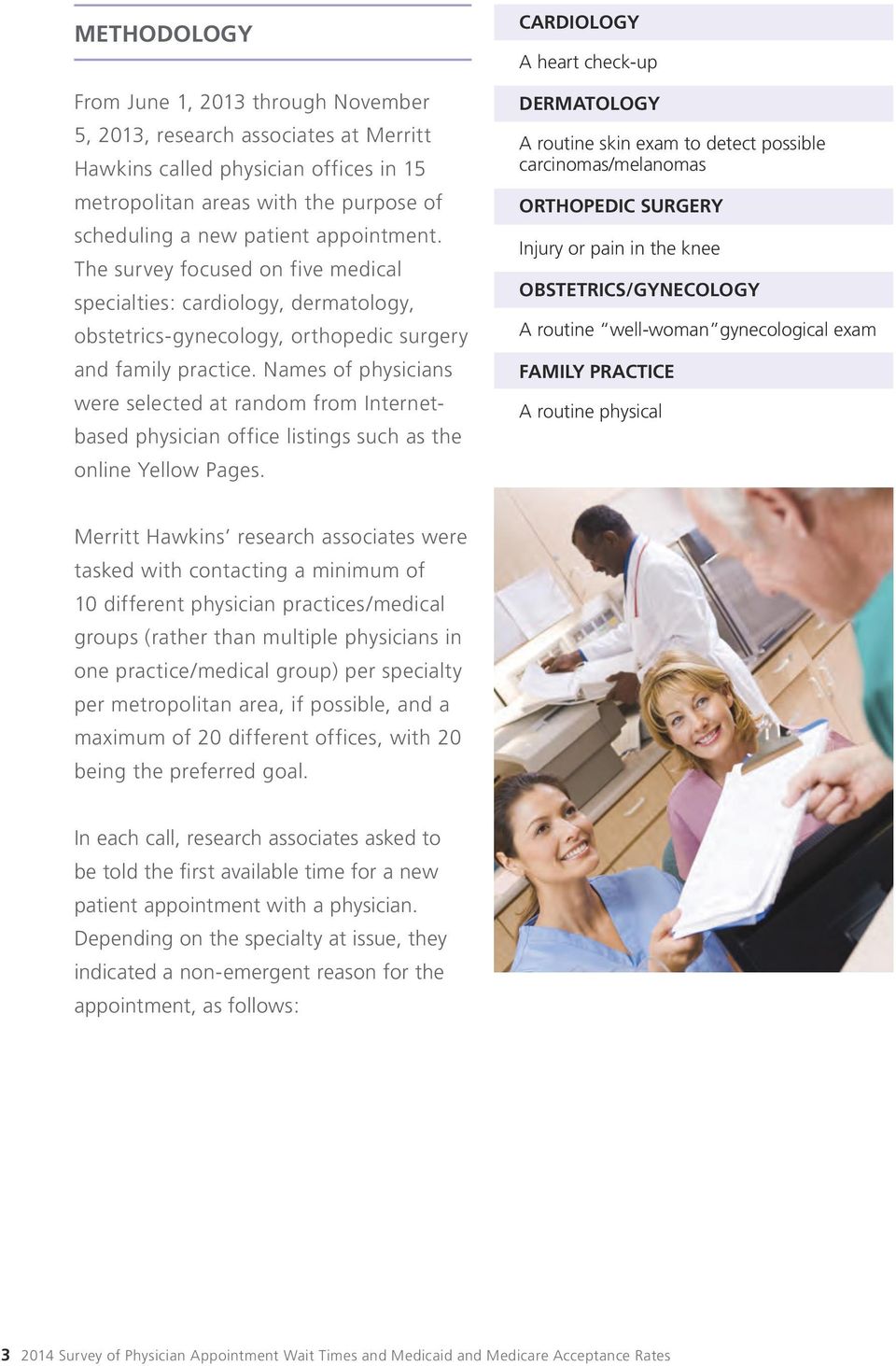
4 METHODOLOGY From June 1, 13 through November 5, 13, research associates at Merritt Hawkins called physician offices in metropolitan areas with the purpose of scheduling a new patient appointment. The survey focused on five medical specialties: cardiology, dermatology, obstetrics-gynecology, orthopedic surgery and family practice. Names of physicians were selected at random from Internetbased physician office listings such as the online Yellow Pages. CARDIOLOGY A heart check-up DERMATOLOGY A routine skin exam to detect possible carcinomas/melanomas ORTHOPEDIC SURGERY Injury or pain in the knee OBSTETRICS/GYNECOLOGY A routine well-woman gynecological exam FAMILY PRACTICE A routine physical Merritt Hawkins research associates were tasked with contacting a minimum of 1 different physician practices/medical groups (rather than multiple physicians in one practice/medical group) per specialty per metropolitan area, if possible, and a maximum of different offices, with being the preferred goal. In each call, research associates asked to be told the first available time for a new patient appointment with a physician. Depending on the specialty at issue, they indicated a non-emergent reason for the appointment, as follows: 3 Survey of Physician Appointment Wait Times and Medicaid and Medicare Acceptance Rates
5 Research associates also asked if the physician in question accepted Medicaid or Medicare as a form of payment. Merritt Hawkins goal was to replicate the experience of someone new to a community, new to an insurance plan, or otherwise in need of a new patient, non-emergent physician appointment seeking to schedule such an appointment through a generally accessible source, including the Internet, the Yellow Pages or a PPO physician directory. Phone research was conducted during an approximate five-month period. The results therefore are a snapshot of physician accessibility at a particular time and in a particular place. A change in timing or approach could yield different results. Merritt Hawkins conducted similar surveys in 4 and 9, and comparisons are made in this survey to results of these prior surveys. It should be noted, however, that no attempt was made to contact the same practices that were contacted in 4 and 9. In addition, in 9, family practice was added to the variety of specialties included in the survey, and therefore no comparison can be made in this specialty to results tabulated in 4. As referenced above, rates of physician Medicaid acceptance were included in the 4 and 9 surveys. marks the first time that rates of Medicare acceptance were included in the survey. Metropolitan service areas in which surveys were conducted: Surveys were conducted in metropolitan areas located in geographically diverse regions of the country, including Atlanta, Boston, Dallas, Denver, Detroit, Houston, Los Angeles, Miami, Minneapolis, New York, Philadelphia, Portland, San Diego, Seattle, Washington, D.C. When survey was conducted: June 1, 13 November 5, 13 Medical specialties surveyed: Cardiology, Dermatology, Obstetrics-Gynecology, Orthopedic Surgery, Family Practice Number of distinct medical offices surveyed: 1,399 Survey of Physician Appointment Wait Times and Medicaid and Medicare Acceptance Rates 4

6 Key Findings Following are some of the key findings resulting from Merritt Hawkins Survey of Physician Appointment Wait Times and Medicaid and Medicare Rates of Acceptance AVERAGE WAIT TIME 45.4 D AYS At 45.4 days, Boston has the highest cumulative average wait time for a physician appointment of the metropolitan markets surveyed. Boston also had the highest average waits times when the survey was conducted in 9 and 4. The average appointment wait time to see a family physician ranged from a high of 66 days in Boston to a low of in Dallas. The average appointment wait time to see an obstetrician/gynecologist ranged from a high of 46 days in Boston to a low of 1 days in Seattle. The average appointment wait time to see a dermatologist ranged from a high of 7 in Boston to a low of in Miami. The average appointment wait time to see a cardiologist ranged from a high of 32 days in Washington, D.C. to a low of 11 days in Atlanta. The average appointment wait time to see an orthopedic surgeon ranged from a high of 1 in San Diego to a low of in Philadelphia, Minneapolis and Houston. The average cumulative wait times to see a cardiologist in all markets was 16., up from. in 9 but down from. in 4. The average cumulative wait time to see a dermatologist in all markets was 28.8 days, up from 22.s in 9 and 24.3 days in 4. The average cumulative wait time to see an obstetrician/gynecologist in all markets was., down from 27. in 9 and 23. in 4. The average cumulative wait time to see an orthopedic surgeon in all markets was 9., down from 16. in 9 and 16. in 4. AVERAGE WAIT TIME 1.2 DAYS At 1., Dallas has the lowest cumulative average wait time for a physician appointment of the markets surveyed. 5 Survey of Physician Appointment Wait Times and Medicaid and Medicare Acceptance Rates

7 The average cumulative wait time to see a family physician in all markets was 19., approximately the same as. in 9 (family practice was not included in the survey in 4). The average cumulative wait time to see a physician for all five specialties surveyed in in all markets was., down from.4 days in 9 and. in 4..5 DAYS WAIT TIME Boston has the highest rate of Medicaid acceptance by physicians in the markets surveyed (73%), while Dallas has the lowest (23%). Of the markets surveyed, Boston has the highest rate of Medicare acceptance by physicians in all five specialties (98%) while Minneapolis has the lowest (38.2%). The cumulative average rate of Medicare acceptance in all 5 specialties and in all markets surveyed was 76% (rates of Medicare acceptance were not included in the 9 and 4 surveys). The longest reported wait time to see a physician was 256 days for a dermatology appointment in Minneapolis. The shortest reported wait time to see a physician was in multiple specialties and multiple markets. MEDICARE ACCEPTANCE 76.% The cumulative average rate of Medicaid acceptance by physicians in all 5 specialties and in all markets surveyed was 45.7%, down from.4% in 9 and 49.9% in 4. MEDICAID ACCEPTANCE 45.7% Survey of Physician Appointment Wait Times and Medicaid and Medicare Acceptance Rates 6

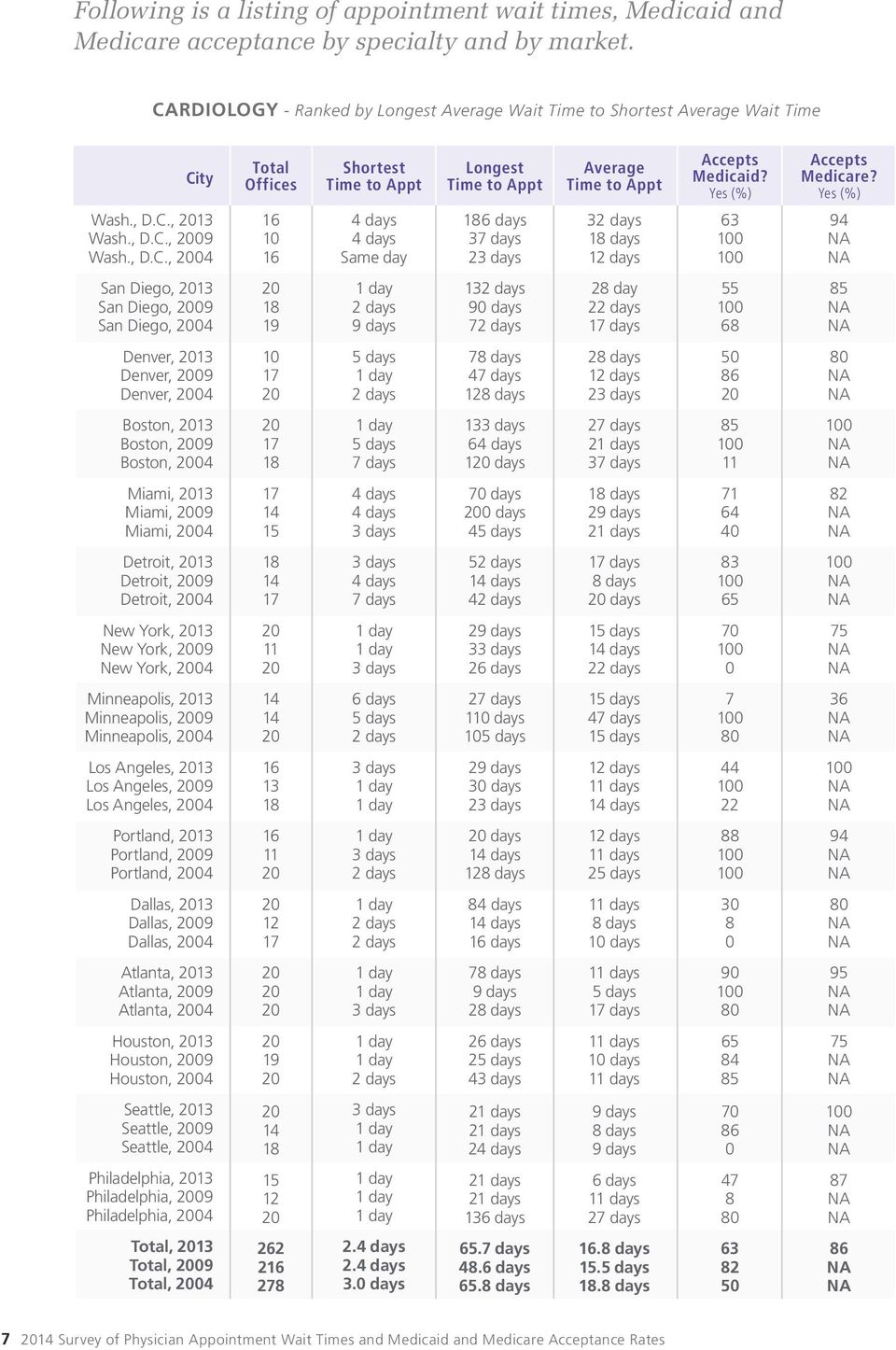
8 Following is a listing of appointment wait times, Medicaid and Medicare acceptance by specialty and by market. CARDIOLOGY - Ranked by Longest Average Wait Time to Shortest Average Wait Time City Total Offices Shortest Time to Appt Longest Time to Appt Average Time to Appt Accepts Medicaid? Yes (%) Accepts Medicare? Yes (%) Wash., D.C., 13 Wash., D.C., 9 Wash., D.C., days 4 days Same day 6 days 37 days San Diego, 13 San Diego, 9 San Diego, day 2 68 Denver, 13 Denver, 9 Denver, days Boston, 13 Boston, 9 Boston, 4 7 days days s 27 days 2s 37 days 11 Miami, 13 Miami, 9 Miami, 4 4 days 4 days 7 days days s Detroit, 13 Detroit, 9 Detroit, 4 4 days 7 days 5 days 4 days New York, 13 New York, 9 New York, days days days Minneapolis, 13 Minneapolis, 9 Minneapolis, 4 6 days 27 days 1 1 days 47 days days 7 36 Los Angeles, 13 Los Angeles, 9 Los Angeles, days 2 1s days Portland, 13 Portland, 9 Portland, days days 12 1s Dallas, 13 Dallas, 9 Dallas, days days 1s 3 8 Atlanta, 13 Atlanta, 9 Atlanta, s 9 95 Houston, 13 Houston, 9 Houston, days 2 4 1s 1s Seattle, 13 Seattle, 9 Seattle, 4 2s 2s 24 days 7 86 Philadelphia, 13 Philadelphia, 9 Philadelphia, s 2s 136 days 6 days 1s 27 days Total, 13 Total, 9 Total, days 2.4 days 3. days 65.7 days 48.6 days Survey of Physician Appointment Wait Times and Medicaid and Medicare Acceptance Rates
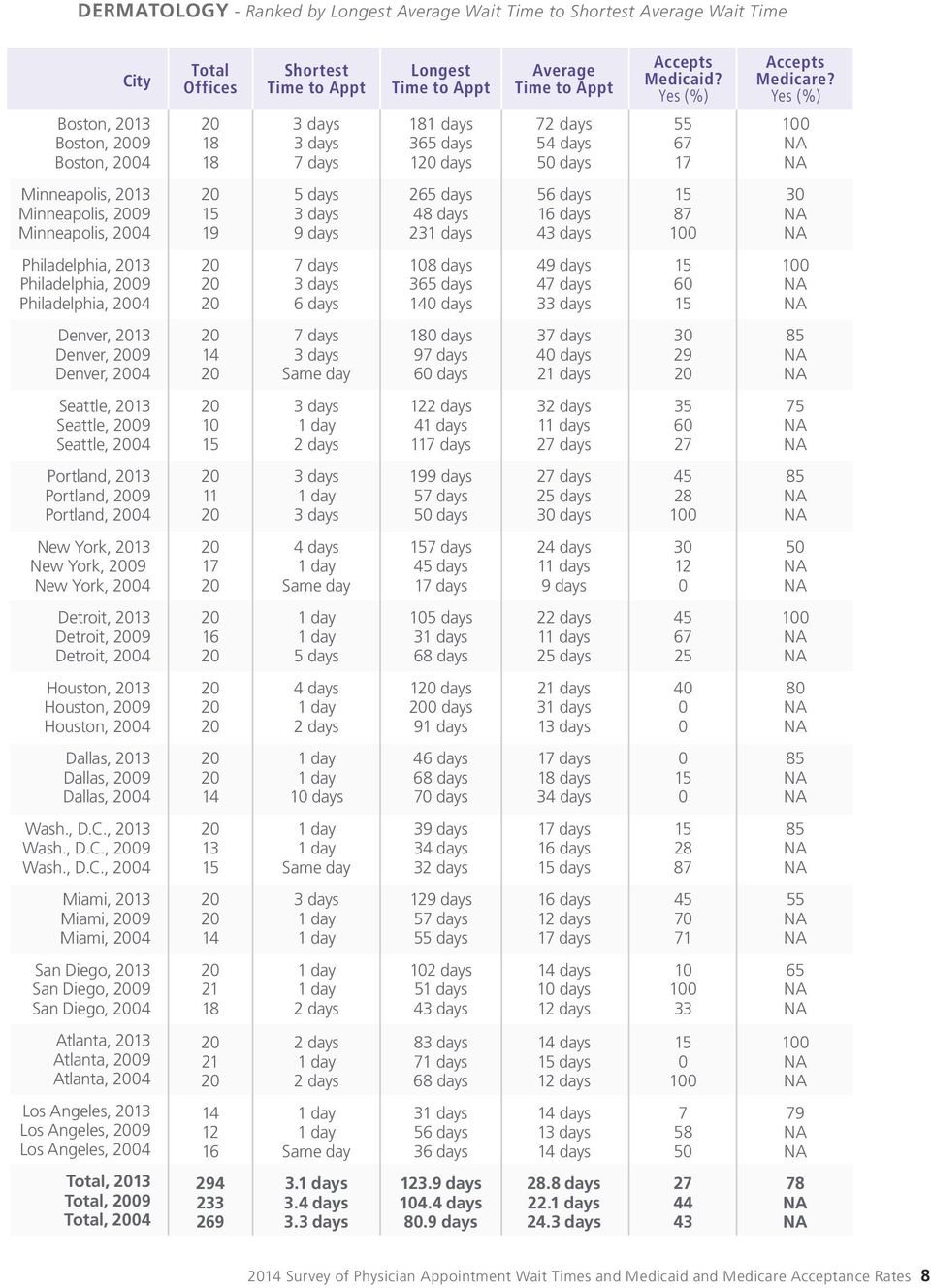
9 DERMATOLOGY - Ranked by Longest Average Wait Time to Shortest Average Wait Time City Boston, 13 Boston, 9 Boston, 4 Total Offices Shortest Time to Appt 7 days Longest Time to Appt s 36 s Average Time to Appt 7 54 days days Accepts Medicaid? Yes (%) 67 Accepts Medicare? Yes (%) Minneapolis, 13 Minneapolis, 9 Minneapolis, s 56 days Philadelphia, 13 Philadelphia, 9 Philadelphia, 4 7 days 6 days 1 36 days 4 47 days 3 6 Denver, 13 Denver, 9 Denver, 4 7 days Same day 1 days 97 days 6 days 37 days 4 days 2s 3 29 Seattle, 13 Seattle, 9 Seattle, s 1 3 1s 27 days Portland, 13 Portland, 9 Portland, days days 27 days 2 3 days New York, 13 New York, 9 New York, 4 4 days Same day 7 days 4 24 days 1s 3 12 Detroit, 13 Detroit, 9 Detroit, s 6 2 1s Houston, 13 Houston, 9 Houston, 4 4 days s days 9s 2s 3s 1 4 Dallas, 13 Dallas, 9 Dallas, 4 46 days 6 7 days 1 34 days Wash., D.C., 13 Wash., D.C., 9 Wash., D.C., 4 13 Same day 3 34 days 3 days Miami, 13 Miami, 9 Miami, days San Diego, 13 San Diego, 9 San Diego, s 4 days Atlanta, 13 Atlanta, 9 Atlanta, s 6 days days Los Angeles, 13 Los Angeles, 9 Los Angeles, Same day 3s 56 days 36 days days 1 days Total, 13 Total, 9 Total, s 3.4 days days s Survey of Physician Appointment Wait Times and Medicaid and Medicare Acceptance Rates 8
10 OBSTETRICS-GYNECOLOGY - Ranked by Longest Average Wait Time to Shortest Average Wait Time City Boston, 13 Boston, 9 Boston, 4 Total Offices 1 16 Shortest Time to Appt days Longest Time to Appt 1 days 126 days Average Time to Appt 46 days 7 days 4 Accepts Medicaid? Yes (%) Accepts Medicare? Yes (%) Portland, 13 Portland, 9 Portland, days days Philadelphia, 13 Philadelphia, 9 Philadelphia, days 9 16s days Denver, 13 Denver, 9 Denver, 4 56 days 3 2 days Detroit, 13 Detroit, 9 Detroit, 4 4 days 84 days days days Atlanta, 13 Atlanta, 9 Atlanta, days 4s 57 days days 24 days Wash., D.C., 13 Wash., D.C., 9 Wash., D.C., days days 3 1s San Diego, 13 San Diego, 9 San Diego, 4 6 days 4s days 96 days days 3 3s 45 Houston, 13 Houston, 9 Houston, days 6 days 4s days Miami, 13 Miami, 9 Miami, days 3 6 days Seattle, 13 Seattle, 9 Seattle, 4 3 days 3 26 days 7 7 New York, 13 New York, 9 New York, days Minneapolis, 13 Minneapolis, 9 Minneapolis, 4 6 days 2 days 6s days Dallas, 13 Dallas, 9 Dallas, days 3 65 Los Angeles, 13 Los Angeles, 9 Los Angeles, days days Total, 13 Total, 9 Total, days 57.7 days 98.7 days 65.s Survey of Physician Appointment Wait Times and Medicaid and Medicare Acceptance Rates

11 ORTHOPEDIC SURGERY - Ranked by Longest Average Wait Time to Shortest Average Wait Time City Total Offices Shortest Time to Appt Longest Time to Appt Average Time to Appt Accepts Medicaid? Yes (%) Accepts Medicare? Yes (%) San Diego, 13 San Diego, 9 San Diego, 4 7 days days 1 1 Detroit, 13 Detroit, 9 Detroit, days 6 days 46 days s Boston, 13 Boston, 9 Boston, days days 4 days 24 days Denver, 13 Denver, 9 Denver, days 36 days days days Wash., D.C., 13 Wash., D.C., 9 Wash., D.C., days 4 2 1s Portland, 13 Portland, 9 Portland, 4 19 Same day 2 26 days Miami, 13 Miami, 9 Miami, 4 7 days 3 days 1 2s 7 days 1s New York, 13 New York, 9 New York, 4 days 47 days 3 days Dallas, 13 Dallas, 9 Dallas, 4 2s Los Angeles, 13 Los Angeles, 9 Los Angeles, s days Atlanta, 13 Atlanta, 9 Atlanta, 4 13 s s Same day days Seattle, 13 Seattle, 9 Seattle, days 6 days Philadelphia, 13 Philadelphia, 9 Philadelphia, days 6 days 76 days Minneapolis, 13 Minneapolis, 9 Minneapolis, 4 7 days 1s 4 9 days Houston, 13 Houston, 9 Houston, days Total, 13 Total, 9 Total, s days Survey of Physician Appointment Wait Times and Medicaid and Medicare Acceptance Rates 1

12 FAMILY PRACTICE - Ranked by Longest Average Wait Time to Shortest Average Wait Time City Total Offices Shortest Time to Appt Longest Time to Appt Average Time to Appt Accepts Medicaid? Yes (%) Accepts Medicare? Yes (%) Boston, 13 Boston, 9 6 days days New York, 13 New York, days 6 days 3 6s 26 days 24 days Atlanta, 13 Atlanta, 9 1 2s 24 days 4 67 Seattle, 13 Seattle, 9 12 days 2 Philadelphia, 13 Philadelphia, 9 9 days 2s Los Angeles, 13 Los Angeles, days 36 days Houston, 13 Houston, Denver, 13 Denver, days 94 Detroit, 13 Detroit, 9 74 days 3s days 59 9 Wash., D.C., 13 Wash., D.C., days 3 days Portland, 13 Portland, Miami, 13 Miami, days 2 7 days Minneapolis, 13 Minneapolis, 9 3 days San Diego, 13 San Diego, days 24 days 86 Dallas, 13 Dallas, 9 27 days 3 Total, 13 Total, days 2.47 days days Survey of Physician Appointment Wait Times and Medicaid and Medicare Acceptance Rates

13 AVERAGE WAIT TIMES BY METROPOLITAN AREA City Cardiology Dermatology OB/GYN Orthopedic Surgery Family Practice Atlanta, 13 Atlanta, 9 Atlanta, 4 1s days days 2s days 24 days 6 days 24 days Boston, 13 Boston, 9 Boston, 4 27 days 2s 37 days 7 54 days days 46 days 7 days 4 4 days 24 days 66 days 6 Dallas, 13 Dallas, 9 Dallas, 4 1s 1 34 days 4 Denver, 13 Denver, 9 Denver, days 4 days 2s 2 days 2 days days 2 days Detroit, 13 Detroit, 9 Detroit, 4 7. days 2 2 days 3 1 1s 1 days Houston, 13 Houston, 9 Houston, 4 1s 1s 1s 2s 3s 1 days 4s days days 1 Los Angeles, 13 Los Angeles, 9 Los Angeles, 4 1s days days 1 days 26 days 1 7 days 4 days 5 Miami, 13 Miami, 9 Miami, s days 1s 7 days Minneapolis, 13 Minneapolis, 9 Minneapolis, 4 days 47 days days 56 days 4 days days 1 New York, 13 New York, 9 New York, 4 days days 2 24 days 1s 1 days days 26 days 24 days Philadelphia, 13 Philadelphia, 9 Philadelphia, 4 6 days 1s 27 days 4 47 days days s Portland, 13 Portland, 9 Portland, 4 1s 2 27 days 2 3 days days 1 1 San Diego, 13 San Diego, 9 San Diego, days days 3 3s days 24 days Seattle, 13 Seattle, 9 Seattle, 4 3 1s 27 days 3 26 days 6 days 2 Wash., D.C. 13 Wash., D.C. 9 Wash., D.C days days 3 1s 1s days 3 days Survey of Physician Appointment Wait Times and Medicaid and Medicare Acceptance Rates 12

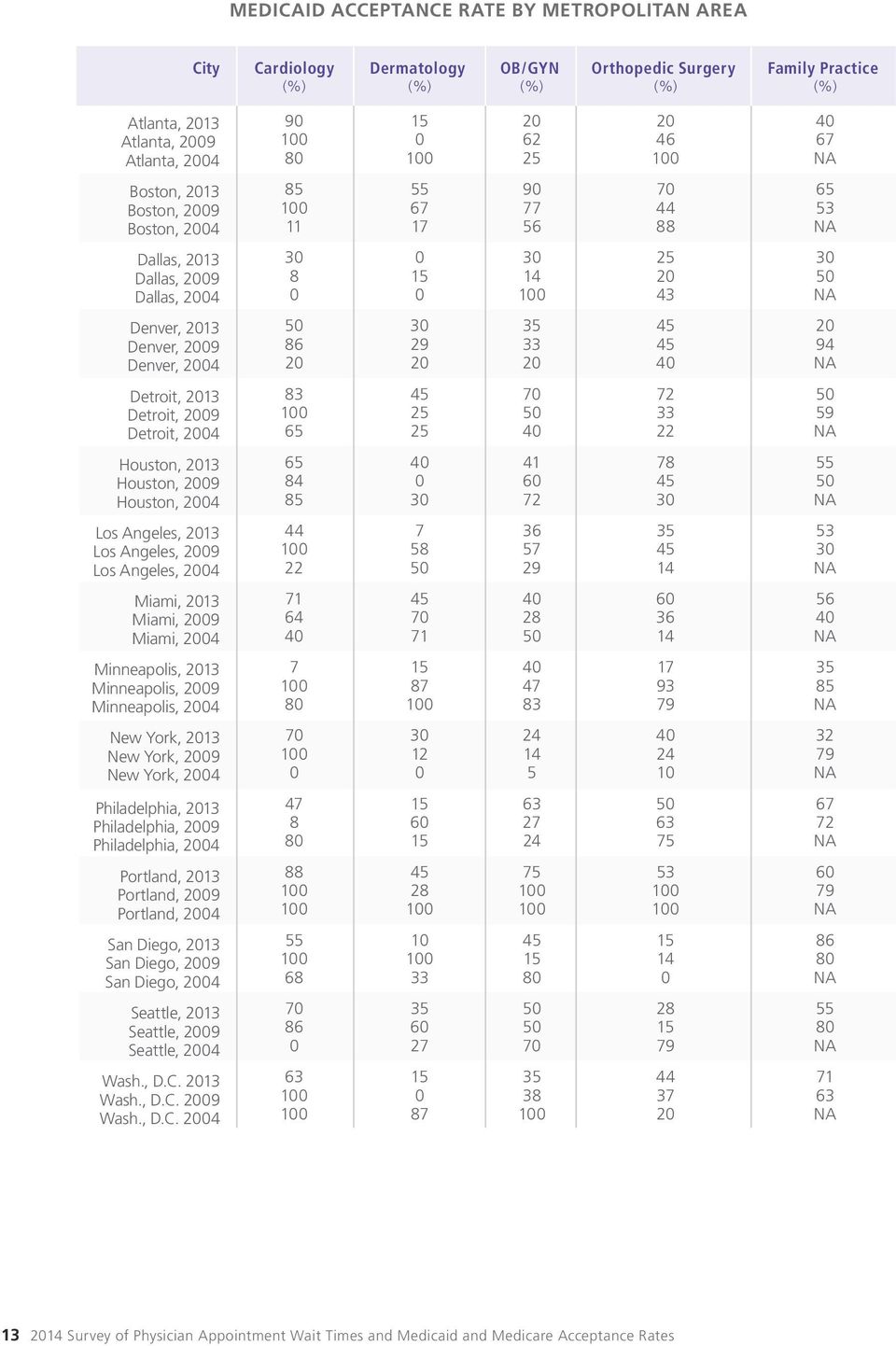
14 MEDICAID ACCEPTANCE RATE BY METROPOLITAN AREA City Cardiology (%) Dermatology (%) OB/GYN (%) Orthopedic Surgery (%) Family Practice (%) Atlanta, 13 Atlanta, 9 Atlanta, Boston, 13 Boston, 9 Boston, Dallas, 13 Dallas, 9 Dallas, Denver, 13 Denver, 9 Denver, Detroit, 13 Detroit, 9 Detroit, Houston, 13 Houston, 9 Houston, Los Angeles, 13 Los Angeles, 9 Los Angeles, Miami, 13 Miami, 9 Miami, Minneapolis, 13 Minneapolis, 9 Minneapolis, New York, 13 New York, 9 New York, Philadelphia, 13 Philadelphia, 9 Philadelphia, Portland, 13 Portland, 9 Portland, San Diego, 13 San Diego, 9 San Diego, Seattle, 13 Seattle, 9 Seattle, Wash., D.C. 13 Wash., D.C. 9 Wash., D.C Survey of Physician Appointment Wait Times and Medicaid and Medicare Acceptance Rates
15 MEDICARE ACCEPTANCE RATE BY METROPOLITAN AREA (Question first asked in 13 no data for 9 & 4 available) City Cardiology (%) Dermatology (%) OB/GYN (%) Orthopedic Surgery (%) Family Practice (%) Atlanta, Boston, Dallas, Denver, 13 Detroit, Houston, Los Angeles, Miami, Minneapolis, New York, Philadelphia, Portland, San Diego, Seattle, Wash., D.C Survey of Physician Appointment Wait Times and Medicaid and Medicare Acceptance Rates

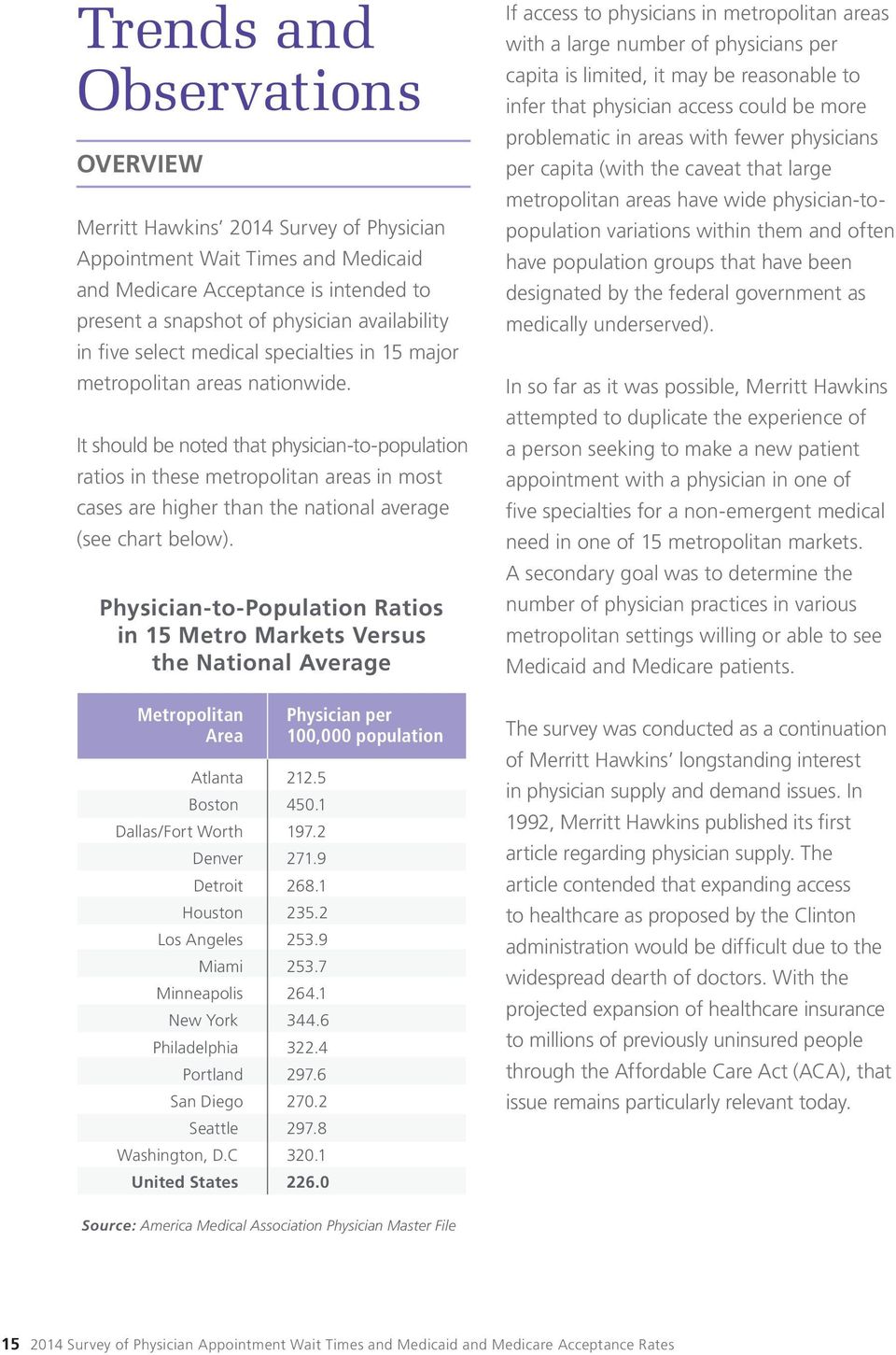
16 Trends and Observations OVERVIEW Merritt Hawkins Survey of Physician Appointment Wait Times and Medicaid and Medicare Acceptance is intended to present a snapshot of physician availability in five select medical specialties in major metropolitan areas nationwide. It should be noted that physician-to-population ratios in these metropolitan areas in most cases are higher than the national average (see chart below). Physician-to-Population Ratios in Metro Markets Versus the National Average If access to physicians in metropolitan areas with a large number of physicians per capita is limited, it may be reasonable to infer that physician access could be more problematic in areas with fewer physicians per capita (with the caveat that large metropolitan areas have wide physician-topopulation variations within them and often have population groups that have been designated by the federal government as medically underserved). In so far as it was possible, Merritt Hawkins attempted to duplicate the experience of a person seeking to make a new patient appointment with a physician in one of five specialties for a non-emergent medical need in one of metropolitan markets. A secondary goal was to determine the number of physician practices in various metropolitan settings willing or able to see Medicaid and Medicare patients. Metropolitan Area Atlanta Boston Dallas/Fort Worth Denver Detroit Houston Los Angeles Miami Minneapolis New York Philadelphia Portland San Diego Seattle Washington, D.C United States Physician per, population The survey was conducted as a continuation of Merritt Hawkins longstanding interest in physician supply and demand issues. In 1992, Merritt Hawkins published its first article regarding physician supply. The article contended that expanding access to healthcare as proposed by the Clinton administration would be difficult due to the widespread dearth of doctors. With the projected expansion of healthcare insurance to millions of previously uninsured people through the Affordable Care Act (ACA), that issue remains particularly relevant today. Source: America Medical Association Physician Master File Survey of Physician Appointment Wait Times and Medicaid and Medicare Acceptance Rates
17 Since 1992, Merritt Hawkins executives have authored dozens of articles on physician supply and demand issues and also have written a book on the physician shortage entitled Will the Last Physician in America Please Turn Off the Lights? In tandem with AMN Healthcare, Merritt Hawkins provided funding to the Council on Physician and Nurse Supply, a group of nationally noted healthcare experts that during its tenure was based at the University of Pennsylvania and was dedicated to addressing the national shortage of nurses and physicians. In 8 and 12, Merritt Hawkins conducted two of the largest physician surveys ever completed in the United States on behalf of The Physicians Foundation ( These surveys, one of which was distributed to 3, physicians and the other to over 6, physicians, were intended in part to determine if physicians are taking steps that would limit patient access to their services. With AMN Healthcare, Merritt Hawkins helps organize and sponsor an annual Healthcare Workforce Summit, a gathering of healthcare workforce experts and medical facility administrators dedicated to tracking and analyzing healthcare workforce challenges and solutions. The Survey of Physician Appointment Wait Times and Medicaid and Medicare Rates of Acceptance is an attempt to bring the physician supply discussion, which often deals in abstract projections of hypothetical physician need, into practical focus by tracking the time it takes patients to schedule physician appointments. Survey results should be approached with several caveats. It can be difficult to gauge a physician s availability through one phone call made to his or her office regarding the physician s next available appointment time. Appointment times can open up unexpectedly, allowing a patient to schedule an appointment earlier than he or she might ordinarily be able to. Should a physician happen to be on vacation or otherwise away from the office, it could take a patient longer to schedule an appointment than ordinarily would be the case. In addition, demand for medical services can fluctuate in various markets during flu season, vacation season and other times when physician utilization is uncharacteristically high or low, and appointment wait times could be uncharacteristically long or short during these periods. Survey of Physician Appointment Wait Times and Medicaid and Medicare Acceptance Rates 16
18 As referenced above, physicians are not evenly distributed across all population groups within large metropolitan areas. Physician appointment wait times therefore may be shorter in those areas of a city where physicians are concentrated and longer in those areas where there are fewer physicians. all specialties, and in the great majority of cases were able to reach practices or more. In some metropolitan areas, physicians in certain specialties have consolidated into large groups and there may be a limited number of groups from which to select. There also are the vagaries of medical practice phone systems to consider. In some cases, Merritt Hawkins researchers could not break through the various automated telephone sequences needed to reach a person able to schedule an appointment. In other cases, researchers encountered answering machines indicating the office was temporarily not taking phone calls. In such cases, researchers moved on to other medical offices. By doing so, researchers attempted to duplicate the experience of a patient new to a community or simply in need of a physician dialing through various medical offices in search of an appointment. Despite these caveats, we believe survey data, which Merritt Hawkins has generated three times over the course of a decade, reflect in general what patients would encounter at a given time when attempting to schedule physician appointments at physician offices in of the largest cities in the United States. The survey therefore provides one indicator of physician availability in five medical specialties in metropolitan areas with a relatively high concentration of physicians. Merritt Hawkins researchers called seeking appointments for non-emergent medical conditions such as exams (though in the case of orthopedic surgery, researchers called seeking appointments for injury or pain to the knee). The survey therefore does not measure physician availability in cases of medical emergency. Merritt Hawkins researchers attempted to reach a minimum of 1 distinct medical offices/medical groups per medical specialty, per metropolitan market, with an optimum target of offices. Researchers were able to contact the minimum of 1 physician offices in all markets and Survey of Physician Appointment Wait Times and Medicaid and Medicare Acceptance Rates

19 Physician Appointment Wait Times by Specialty Merritt Hawkins Survey of Physician Appointment Wait Times and Medicaid and Medicare Acceptance reflects the ability of patients with non-emergent medical needs to access physician services in large metropolitan markets. As non-clinicians, Merritt Hawkins is unable to comment on the clinical effect the appointment wait times indicated in the survey may have on patients reporting non-emergent problems similar to the hypothetical ones stated by its research associates. However, some inferences regarding the general availability of physicians can be made based on the wait times reported for the five specialties included in the survey. In Merritt Hawkins experience, in evaluating physician practices, a physician generally is considered to be busy if his or her practice is booked for new patient appointments two weeks or more in advance. In such cases, the recruitment of a new physician, physician assistant or nurse practitioner may be warranted. days), Boston (27 days) Miami (1), Detroit (), New York ( days) and Minneapolis ( days) By contrast, in 9, average wait times in cardiology equaled or exceeded days in five of the metropolitan markets, and in 4 wait times equaled or exceeded days in 11 of the metropolitan markets surveyed. The cumulative average time to schedule a cardiology appointment in all markets increased in relative to 9, but decreased relative to 4 (see chart below) Average Cardiology Appointment Wait Times, All Markets YEAR DAYS Twelve of the markets showed increased average wait times for cardiology relative to 9, but only five markets showed increased wait times relative to 4, with two markets showing the same average wait times in as in 4. Following is a review of the five specialties included in the survey examining which markets appear to have extended wait times and which do not. Cardiology In cardiology, average appointment wait times exceeded days in seven of the metropolitan markets: Washington, D.C. (3), San Diego (2), Denver (28 Certain markets, including San Diego, Denver, Boston, Miami, Washington, D.C. and New York have exhibited a pattern over the three years the survey has been conducted of relatively high average wait times in cardiology, equaling or exceeding days in most cases (with two exceptions: Denver in 9 with an average wait time of and Washington, D.C. in 4 with an average wait time of ). Survey of Physician Appointment Wait Times and Medicaid and Medicare Acceptance Rates

20 Others, such as Seattle, Houston, Los Angeles, Atlanta, and Dallas, have exhibited a pattern over the years the survey has been conducted of relatively short average wait times in cardiology of days or fewer (with one exception: Atlanta in 4, with an average of ). Several markets, including Philadelphia, Detroit, Portland and Minneapolis, have exhibited a more variable pattern in cardiology. Philadelphia, for example, showed an average wait time for cardiology of six days in 13, 1s in 9 and 27 days in 4; Portland showed average wait times in cardiology of in 13, 1s in 9 and 2 in 4, and Detroit showed average wait times in cardiology of in 13, eight days in 9 and days in 4. Minneapolis showed an average wait time for cardiology of days in 13 and 4 and 47 days in 9. It should be noted that in these markets the average wait times in two of the three survey years are generally consistent, while there is a one year aberration. Given the variation that can exist in physician appointment wait times due to seasonality and other factors referenced above, some year by year inconsistencies are to be expected. However, a general pattern is emerging in which variable markets such as Philadelphia, Detroit, Portland and Minnesota showed average wait times in cardiology of days or less in two out of the three years the survey has been conducted. It is probable, therefore, that these markets exhibit generally moderate wait times for cardiology, though more data will be needed to confirm this conclusion. Dermatology In dermatology, average appointment wait times equaled or exceeded days in all of the metropolitan markets, and equaled or exceeded 2s in 9 of the markets (Boston, Minneapolis, Philadelphia, Denver, Seattle, Portland, New York, Detroit, and Houston). In 9, average wait times in dermatology equaled or exceeded days in 9 of the markets and in 4 average wait times in dermatology equaled or exceeded days in 12 of the markets. The average cumulative wait time to schedule a dermatology appointment in all markets increased in 13 relative to both 9 and 4 (see chart below): Average Dermatology Appointment Wait Times, All Markets YEAR DAYS Eleven of the markets showed increases in average wait times for dermatology in 13 relative to 9, and 11 showed increases in average wait times for dermatology relative to 4 (or the wait times did not change). As in cardiology, some markets have exhibited a pattern of relatively long appointment wait times in dermatology. 19 Survey of Physician Appointment Wait Times and Medicaid and Medicare Acceptance Rates

21 Boston, Minneapolis, Philadelphia, Denver, Portland, Houston, Dallas, Washington, D.C., and Atlanta all equaled or exceeded a day average wait time in dermatology for all years the survey has been conducted (with one exception: Houston in 4 with a wait time of 1). Markets with more moderate wait times in each of the survey years include Los Angeles and San Diego. Other markets, such as Atlanta and Dallas, are more variable, but are generally consistent in two of the three years with a one year aberration, as was seen in cardiology. The average cumulative time to schedule an obstetrics-gynecology appointment in all markets decreased in 13 relative to both 9 and 4 (see chart below) Average Obstetrics-Gynecology Appointment Wait Times, All Markets YEAR DAYS Four of the markets showed an increase in average appointment wait times for obstetrics/ gynecology relative to 9 and four showed increases relative to 4, while 11 showed decreases relative to 9 and 4. Markets showing a pattern of average appointment wait times equaling or exceeding days in each of the years the survey was conducted include Boston, Portland, Philadelphia, Denver, Detroit, Atlanta, San Diego, and Houston. Other markets such as Los Angeles, Dallas, Seattle, and Washington, D.C. show a variable pattern in which average wait times for obstetrics/gynecology exceeded days in two of the three survey years. Obstetrics-Gynecology In obstetrics-gynecology, average wait times equaled or exceeded days in 9 of the markets, compared to 13 of the metropolitan markets surveyed in both 9 and 4: None of the markets have seen average wait times for obstetrics/gynecology of less than days in any of the three years the survey was conducted. Survey of Physician Appointment Wait Times and Medicaid and Medicare Acceptance Rates
22 Orthopedic Surgery In orthopedic surgery, average wait times equaled or exceeded days in four of the markets, compared to 8 markets in 9 and 9 markets in 4. The average cumulative time to schedule an orthopedic appointment in all markets decreased in 13 relative to both 9 and 4 (see chart below): Average Orthopedic Surgery Wait Times, All Markets YEAR 13 DAYS 9.9 conducted, while Dallas, Los Angeles, Atlanta, Portland and Washington, D.C. showed a pattern of wait times less than days in two of the three years the survey was conducted. Family Practice In family practice, average wait times equaled or exceeded days in 1 of the markets, compared to 8 in 9 (the first year family practice was included in the survey). The cumulative average wait time for a family practice appointment in all markets was down slightly in 13 relative to 9 (see chart below) Average Family Practice Appointment Wait Times, All Markets Five of the markets showed an increase in average appointment wait times for orthopedics relative to 9 and two showed increases relative to 4. YEAR 13 9 DAYS Only two markets, Boston and Denver, exhibited average wait times for orthopedics equaling or exceeding days in all three years the survey was conducted. Three markets, Miami, Seattle, and Atlanta, exhibited wait times of less than days in all three years the survey was conducted. The other markets were variable, with Detroit, Philadelphia Minneapolis, New York, and Houston showing a pattern of wait times equaling or exceeding days in two of the three years the survey was Ten of the markets showed an increase in average wait times for family practice relative to 9, four showed a decrease and one market did not change. Seven markets -- Boston, New York, Los Angeles, Houston, Denver, Detroit and Washington, D.C. -- exhibited average wait times of days or more in both of the years the survey included family practice. Four markets -- Dallas, Minneapolis, Miami and Portland -- exhibited average wait times of less than days in the two years the survey has included family practice. 21 Survey of Physician Appointment Wait Times and Medicaid and Medicare Acceptance Rates
23 The remaining four markets, Atlanta, Seattle, Philadelphia, and San Diego, were variable, with family practice wait times exceeding days in one year and less than days in the other. Summary of Specialty Wait Times As the numbers above indicate, average physician appointment wait times in the 13 survey do not show a clear progression or regression in all specialties relative to wait times recorded in the previous physician appointment wait time surveys Merritt Hawkins has conducted the data are more mixed. For example, cumulative average wait times are up in 13 in two specialties (cardiology and dermatology) relative to 9, while in two specialties (obstetrics/gynecology and orthopedic surgery) wait times are down. In one specialty (family practice) wait times are essentially flat. For all five specialties and all markets, cumulative appointment wait times declined in 13 relative to 9 and 4. days. Orthopedic surgery is the only specialty in which average appointment wait times are less than days in the majority of the markets. Protracted wait times persist despite changes that have taken place in most large medical markets to varying degrees since the survey was conducted in 4 and 9. These changes include the incorporation into physician practices of a growing number of advanced practitioners such as physician assistants (PAs) and nurse practitioners (NPs), and the increasing availability of PAs and NPs at some 1, retail sites across the U.S. Though an increasing number of advanced practitioners may be absorbing millions of patient appointments that previously were handled by physicians, the survey indicates wait times in many markets remain extended. Despite these mixed results, cumulative physician appointment wait times equal or exceed days in cardiology and obstetricsgynecology in 9 of the markets surveyed. Cumulative appointment wait times equal or exceed days in family practice in 1 of the markets, and equal or exceed days in dermatology in all of the markets. As stated above, in Merritt Hawkins experience, physicians are considered to be busy and may require the assistance of another physician or advanced practitioner when appointment wait times in their practices equal or exceed Survey of Physician Appointment Wait Times and Medicaid and Medicare Acceptance Rates 22
24 Additional proliferating sites of service where physicians, PAs and NPs are available, such as urgent care centers and community health centers, may have reduced appointment wait times in some markets, contributing to the decline in the overall cumulative average for all five specialties relative to 9 and 4. Nevertheless, the cumulative physician appointment wait time in 13 remains close to days, only slightly less than it was in 9 and 4. Given that the markets examined in the survey generally feature a high ratio of physicians per population relative to the national average, the survey suggests that patient access to medical services often remains problematic for patients wishing to schedule a physician appointment for nonemergent medical needs, even in communities where there are many physicians. Cumulative Average Wait Time in Days, 13 Metro Area Boston Denver Philadelphia Portland Minneapolis Detroit Washington, D.C. New York San Diego Seattle Atlanta Houston Miami Los Angeles Dallas Total Cumulative Average Per 5 Specialties Average Wait Time In Days Per Metro Area Physician Appointment Wait Times by Market Cumulative appointment wait times for the metropolitan markets and average appointment wait times are ranked in the following charts: These charts show total average wait times for the specialties examined in a given market (227 days in the case of Boston) divided by five specialties for the overall average wait time per market. As these numbers indicate, Boston experienced by far the longest average wait times of any of the metropolitan markets in 13, as it did in the 9 and 4 surveys, with average wait times equaling or exceeding in all five specialties surveyed, even though Boston has more physicians per population than any of the other markets included in the survey. In addition, average wait times in Boston increased in three of the five specialties surveyed (dermatology, cardiology and family practice) in 13 relative to Survey of Physician Appointment Wait Times and Medicaid and Medicare Acceptance Rates
25 Cumulative Average Wait Time in Days, 9 Cumulative Average Wait Time in Days, 4 Metro Area Per 5 Specialties Average Wait Time In Days Per Metro Area Metro Area Per 5 Specialties Average Wait Time In Days Per Metro Area Boston Boston Philadelphia Philadelphia Los Angeles Portland Houston Detroit Washington, D.C Minneapolis San Diego 11.2 Denver Minneapolis Los Angeles Dallas Seattle 74.5 New York San Diego 73.3 Denver 77.4 Dallas 71.8 Miami 77.4 Atlanta 7.5 Portland 72.4 New York 61.3 Seattle 71.2 Houston 59.8 Detroit Miami 59.8 Atlanta Washington, D.C Total Cumulative Average Total Cumulative Average Long wait times in Boston may be driven in part by the healthcare reform initiative that was put in place in Massachusetts in 6. The initiative succeeded in covering the great majority of the state s residents. However, it has been reported in the years since that many patients in Massachusetts are encountering difficulty in accessing physicians. The Survey of Patient Appointment Wait Times continues to support these reports, as average appointment wait times in Boston were in excess of three weeks for all of the specialties surveyed except orthopedic surgery. Long appointment wait times in Boston could be a precursor of what is to come nationally should some 25 million people or more eventually obtain health insurance through the ACA. Other markets, such as Detroit and Denver, also are experiencing long appointment wait times across-the-board, with average waits equaling or exceeding in all five specialties. Survey of Physician Appointment Wait Times and Medicaid and Medicare Acceptance Rates 24
26 The survey indicates that some metropolitan markets experience comparatively long appointment wait times in certain specialties, but short wait times in others. In Minneapolis, for example, the average wait time to see a dermatologist is 56 days, while the average wait time to see an orthopedic surgeon is only five days. In San Diego, the average wait time to see a cardiologist is 28 days, while the average wait time to see a family physician is only five days. physicians available, patient demographics, income levels, lifestyle preferences, insurance plans prevalent in the area and others. A relatively high number of physicians per capita does not always ensure ready access to physicians, just as ready access to one type of physician in a given market does not always mean ready access to other types of physicians within the same market. Medicaid Rates of Acceptance However, no market surveyed in 13 is experiencing across-the-board short average appointment wait times of less than days in all five specialties. Interestingly, Dallas shows the shortest cumulative physician appointment wait times in the five specialties surveyed, though it has the fewest physicians per population of the metro markets. This may be the result of the variations within large metro markets referenced above, in which areas that are typically economically robust have a high concentration of physicians relative to areas that are economically challenged. Also as referenced above, some markets have created increased access to medical services through the addition of PAs and NPs to medical staffs and have added various sites of service, such as retail clinics and urgent care centers, that can make physician access easier. We believe Dallas is one such market. Physician access in specific metropolitan markets is a function of a variety of factors, including the number of physicians available per population, the types of Average Medicaid acceptance rates in the metropolitan markets for the five medical specialties surveyed in 13 follow, as do averages included in the 9 and 4 surveys. 13 Average Medicaid Acceptance City Boston Portland Detroit Houston Miami Seattle Philadelphia Washington, D.C. New York San Diego Atlanta Los Angeles Denver Minneapolis Dallas Total Cumulative Average Rate for Five Specialties (%) Survey of Physician Appointment Wait Times and Medicaid and Medicare Acceptance Rates
27 As these numbers indicate, Medicaid acceptance rates among physicians vary greatly by market. In 13, Boston showed the highest rate of Medicaid acceptance (73%) of the markets surveyed, while Dallas showed the lowest rate (23%). Some markets show a high rate of Medicaid acceptance in one specialty and a low rate of acceptance in others. In Seattle, for example, 7% of cardiologists surveyed are accepting Medicaid, while only 28% of the orthopedic surgeons surveyed are doing so. In Atlanta, 9% of cardiologists surveyed are accepting Medicaid while only % of the dermatologists surveyed are doing so. The rate at which physicians accept Medicaid can vary for a number of reasons. In some cases, reimbursement rates provided by Medicaid to particular specialists may be below their cost of providing services. If not actually below costs, Medicaid reimbursement often is relatively low compared to that offered by other payers, and therefore busy physicians may have no economic incentive to see Medicaid patients. In other cases, the process of billing for and receiving Medicaid payment can be problematic and some physicians choose to avoid it. 9 Average Medicaid Acceptance 4 Average Medicaid Acceptance City Rate for Five Specialties (%) City Rate for Four Specialties (%) Minneapolis 82.4 Portland. Portland 81.4 Minneapolis 86. Boston 68.2 Atlanta 76.3 San Diego 61.8 Washington, D.C Seattle 58.2 Houston 53.8 Denver 57.4 Philadelphia 48.1 Atlanta. San Diego 46.8 Detroit 53.4 Miami 43.5 Houston 47.8 Seattle 42.2 Miami 47.6 Boston 41.3 Washington, D.C Detroit 37.3 Philadelphia 46. Dallas 35. New York 45.8 Los Angeles 29. Los Angeles 4.2 Denver 25. Dallas 38.6 New York 3.8 Total Cumulative Average.4 Total Cumulative Average 49.9 Survey of Physician Appointment Wait Times and Medicaid and Medicare Acceptance Rates 26
28 In general it can be observed that Medicaid is not widely accepted in most markets surveyed. The overall rate of Medicaid acceptance in all markets in 13 was 45.7%, lower than in 9, when it was.4%, and lower than 4 when it was 49.9%. Several markets in 9 and 4 had Medicaid acceptance rates higher than Boston s in 13 (including Portland, which had a % Medicaid acceptance rate in 4) and no market in previous years had a lower rate of Medicaid acceptance than Dallas in 13 (23%). Though a form of healthcare coverage, the survey suggests Medicaid does not guarantee access to physicians in many cases. Though millions of currently uninsured patients are expected to qualify for Medicaid through the ACA, it remains to be seen if they will have ready access to physicians, even though the ACA temporarily increases Medicaid reimbursement rates to Medicare levels for some physicians. Medicare Rates of Acceptance Average Medicare acceptance rates in the metropolitan markets for the five medical specialties surveyed are indicated in the chart in the next column: The survey marks the first time Merritt Hawkins has asked physicians about their rate of Medicare acceptance. As the numbers to the right indicate, the rate of Medicare acceptance among physicians in the markets surveyed generally is considerably higher than the rate of Medicaid acceptance, as is the cumulative average acceptance rate for all markets (45.7% Medicaid versus 76.% Medicare). As referenced above, Medicare typically pays higher rates than Medicaid, which is one reason it is more widely accepted by physicians. In addition, many physicians are reluctant to drop longstanding patients when they reach 65 and qualify for Medicare. However, some physicians find that Medicare rates are too low to sustain a viable practice, and limit the number of Medicare patients they see for that reason. Average Medicare Acceptance City Boston Detroit Washington, D.C. Los Angeles Philadelphia Portland Seattle Atlanta Denver Dallas Houston San Diego Miami New York Minneapolis Total Cumulative Average Rate for Five Specialties (%) Survey of Physician Appointment Wait Times and Medicaid and Medicare Acceptance Rates
29 Conclusion Merritt Hawkins Survey of Physician Appointment Wait Times and Medicaid and Medicare Acceptance Rates offers a snapshot of physician availability in large metropolitan markets, many of them with physician-to-population ratios higher than the national average. Despite having a high number of physicians per capita, many of these markets are experiencing physician appointment wait times of days or longer. The survey was conducted during a period of historic change in the healthcare delivery system in which health reform is anticipated to greatly increase the number of people with access to health insurance. residency positions available nationwide, through the use of innovative staffing models that redistribute some of the work previously handled by physicians to other clinicians, through equitable payments to physicians, through the use of online and mobile technology, and through other methods (for a more thorough examination of methods to extend the physician workforce, see the AMN Healthcare book A Guide to Healthcare Staffing). Merritt Hawkins will continue to conduct its Survey of Physician Appointment Wait Times and Medicaid and Medicare Acceptance Rates to determine how health reform and related trends are affecting access to physician services. However, as the example of Boston illustrates, access to health insurance does not always guarantee access to a physician. In addition, the survey demonstrates that many if not most physicians in the markets examined are not accepting Medicaid as a form of payment. For additional information about this or other surveys conducted by Merritt Hawkins and AMN Healthcare, contact: As millions of the previously uninsured obtain healthcare coverage through the ACA, ways will need to be found to ensure access to physicians, through increases in the number of medical 1 Statesman Drive Irving, Texas 763 () 876- MerrittHawkins.com Survey of Physician Appointment Wait Times and Medicaid and Medicare Acceptance Rates 28
30 29 Survey of Physician Appointment Wait Times and Medicaid and Medicare Acceptance Rates
31 Merritt Hawkins and AMN Healthcare Offers Speakers to Address Industry Trends, Staffing, Recruitment, Finance Learn more about key trends and to help you excel in strategic staffing management through an awareness of the current healthcare landscape. The speakers at Merritt Hawkins and AMN Healthcare have diverse expertise in healthcare staffing, recruitment, clinical topics, finance and industry trends, and can offer you the right educational session for your event. Whether your audience wants to learn more about recruitment and retention or is interested in the best ways to find a staffing vendor management company, our speakers can offer the latest data and information as well as their expert advice for successful clinical staffing. Topics include: Physician and Nurse Shortage Issues and Trends New Strategies for Healthcare Staffing Healthcare Reform Initiatives Economic Forecasting for Clinical Staffing Allied Staffing Shortages Vendor Management International Nurse Recruitment and Retention Emerging Trends in the Delivery and Financing of Healthcare Travel Nurses Benefit to Magnet Hospitals Quality Care and Financial Health Recruitment Process Outsourcing Other topics upon request Our speakers have a combined six decades of staffing experience. Each speaker offers a unique perspective to educate your audience and provide new insights into the trends and future of healthcare staffing. For additional information about this survey contact: Phillip Miller () 876- [email protected] Survey of Physician Appointment Wait Times and Medicaid and Medicare Acceptance Rates 3
32 13 Merritt Hawkins 1 Statesman Drive Irving, Texas 763 ( ) 876- merritthawkins.com
2013 Physician Inpatient/ Outpatient Revenue Survey
 Physician Inpatient/ Outpatient Revenue Survey A survey showing net annual inpatient and outpatient revenue generated by physicians in various specialties on behalf of their affiliated hospitals Merritt
HEALTH CARE TODAY& PHYSICIAN RECRUITING RESOURCES MICHIGAN PRIMARY CARE ASSOCIATION
 HEALTH CARE TODAY& PHYSICIAN RECRUITING RESOURCES MICHIGAN PRIMARY CARE ASSOCIATION BY: JEREMY SCHULTZ SENIOR MARKET CONSULTANT 2013 AMN Healthcare, Inc. All rights reserved. Redistribution of these materials
Trend The Growing Use of Locum Tenens Providers as a Supplement To Permanent Medical Staff
 Trend The Growing Use of Locum Tenens Providers as a Supplement To Permanent Medical Staff By Phillip Miller Vice President of Communications Staff Care (866) 871-8519 www.staffcare.com Table of Contents
Survey of Nurse Practitioners: Practice Trends and Perspectives
 Survey of Nurse Practitioners: Practice Trends and Perspectives Advanced Practice An Examination of the Professional Morale, Practice Patterns, Career Plans, and Perspectives of Nurse Practitioners Attending
TREND WHITE PAPER LOCUM TENENS NURSE PRACTITIONERS AND PHYSICIAN ASSISTANTS: A GROWING ROLE IN A CHANGING WORKFORCE
 TREND WHITE PAPER LOCUM TENENS NURSE PRACTITIONERS AND PHYSICIAN ASSISTANTS: A GROWING ROLE IN A CHANGING WORKFORCE The Leader in Locum Tenens Staffing INTRODUCTION Today s Mobile Healthcare Work Force
THE GROWING USE OF LOCUM TENENS DENTISTS
 TREND WHITE PAPER THE GROWING USE OF LOCUM TENENS DENTISTS WE VE EARNED THE JOINT COMMISSION S GOLD SEAL OF APPROVAL The Leader in Locum Tenens Staffing IN THIS WHITE PAPER INTRODUCTION BACKGROUND: PHYSICIANS
Health Care Section Forum
 Name: Phone: Health Care Section Forum Leverage Client Feedback for Continuous Improvement Chris Franklin Executive Vice President LocumTenens.com locumtenens.com When Short Supply Meets Rapid Growth:
The Economic Impact of Physicians
 The Economic Impact of Physicians A Fact Sheet Examining the Economic Contribution Physicians Make to Their Communities and to Their Affiliated Hospitals Prepared by: Merritt Hawkins, the nation s leading
2015 SURVEY OF FAMILY MEDICINE RESIDENTS CERTIFIED BY THE JOINT COMMISSION AND THE NATIONAL COMMITTEE FOR QUALITY ASSURANCE
 CERTIFIED BY THE JOINT COMMISSION AND THE NATIONAL COMMITTEE FOR QUALITY ASSURANCE 2015 SURVEY OF FAMILY MEDICINE RESIDENTS 2015 Staff Care, Inc 8840 Cypress Waters Dr, #300 Dallas, TX 75019 (800) 685-2272
What s fair? Fair healthcare pricing from Healthcare Blue Book
 What s fair? Fair healthcare pricing from Healthcare Blue Book Healthcare Blue Book is a free consumer guide to help you determine fair prices in your area for healthcare services Hysterectomy (CPT code
SUMMARY REPORT 2005 Survey of Hospital Physician Recruitment Trends
 SUMMARY REPORT 2005 Survey of Hospital Physician Recruitment Trends Overview Merritt, Hawkins & Associates (MHA) is a national physician search and consulting firm that periodically conducts surveys regarding
MGMA ACA Exchange Implementation Survey Report. May 2014
 MGMA ACA Exchange Implementation Survey Report May 2014 Overview Medical Group Management Association (MGMA) conducted member research in April 2014 to better understand the impact of the Affordable Care
kaiser medicaid and the uninsured MARCH 2012 commission on
 I S S U E kaiser commission on medicaid and the uninsured MARCH 2012 P A P E R Medicaid and Community Health Centers: the Relationship between Coverage for Adults and Primary Care Capacity in Medically
2009 REVIEW OF PHYSICIAN AND CRNA RECRUITING INCENTIVES
 2009 REVIEW OF PHYSICIAN AND CRNA RECRUITING INCENTIVES 2009 Merritt Hawkins & Associates 5001 Statesman Drive Irving, Texas 75063 (800) 876-0500 MerrittHawkins.com SUMMARY REPORT 2009 REVIEW OF PHYSICIAN
RVU BASED PHYSICIAN COMPENSATION AND PRODUCTIVITY
 RVU BASED PHYSICIAN COMPENSATION AND PRODUCTIVITY Ten Recommendations for Determining Physician Compensation/Productivity Through Relative Value Units 2011 Merritt Hawkins 5001 Statesman Drive Irving,
Narrowing Networks. Are You In or Out? Brett Coldiron, MD, FAAD President, American Academy of Dermatology Association
 Narrowing Networks Are You In or Out? Brett Coldiron, MD, FAAD President, American Academy of Dermatology Association Background The Affordable Care Act Cut Medicare Advantage payments from 114% of Medicare
THE DOCTOR CAN T SEE YOU NOW NEW YORK S PHYSICIAN SHORTAGE GROWS
 THE DOCTOR CAN T SEE YOU NOW NEW YORK S PHYSICIAN SHORTAGE GROWS DECEMBER 2009 KEY FINDINGS HANYS 2009 Physician Advocacy Survey Physician retirements are offsetting recruitment, and little progress is
Understanding and preparing for the impact of the Affordable Care Act
 Understanding and preparing for the impact of the Affordable Care Act Care Management / P. 1 The Affordable Care Act is expected to impact access to care, change the way accountable care organizations
A Consumer Guide to Understanding Health Plan Networks
 A Consumer Guide to Understanding Health Plan Networks Table of Contents steps you can take to understand your health plan s provider network pg 4 What a provider network is pg 8 Many people are now shopping
Top Job Postings in Metro Atlanta: Old Economy Meets New Economy
 Top Job Postings in Metro Atlanta: Old Economy Meets New Economy Atlanta Regional Commission For more information, contact: [email protected] What is Burning Glass- Labor Insight? Burning
AMN Healthcare Investor Presentation
 AMN Healthcare Investor Presentation Q2 2015 The Innovator in Healthcare Workforce Solutions and Staffing Services Forward-Looking Statements This investor presentation contains forward-looking statements
Regulatory and Legislative Action Since the September 2010 Membership Meeting:
 MEMBERSHIP MEETING January 19, 2011 Delivery System Reform: Healthcare Workforce Issue: The passage of health reform will bring millions of newly insured individuals into the system and drive patients
Essential Hospitals VITAL DATA. Results of America s Essential Hospitals Annual Hospital Characteristics Survey, FY 2012
 Essential Hospitals VITAL DATA Results of America s Essential Hospitals Annual Hospital Characteristics Survey, FY 2012 Published: July 2014 1 ABOUT AMERICA S ESSENTIAL HOSPITALS METHODOLOGY America s
Why it is Cost Effective to Use a Physician Search Firm
 January 2010 Why it is Cost Effective to Use a Physician Search Firm Guest Author: Thomas Grimes III, FACHE, retired CEO, Good Samaritan Community Healthcare, Puyallup, Washington. Tom currently leads
Multifamily Market Commentary July 2014 The Nation s Aging Multifamily Housing Stock
 Multifamily Market Commentary July 2014 The Nation s Aging Multifamily Housing Stock Although America s population is rising at its slowest pace in more than 70 years, and it has taken 76 months for employment
THE PRACTICE PROFITABILITY INDEX 2013 Edition
 THE PRACTICE PROFITABILITY INDEX 2013 Edition 1 About The Practice Profitability Index (PPI) The PPI was created to provide a voice to physician practices across the US regarding issues that impact their
PHYSICIANS. 202.420.7896 888 16 th St. NW, Suite 800, Washington DC 20006 www.npalliance.org
 N A T I O N A L PHYSICIANS A L L I A N C E My name is Dr. Valerie Arkoosh. I am an Anesthesiologist at the University of Pennsylvania School of Medicine and the President of the National Physicians Alliance.
ECONOMIC SNAPSHOT. A Summary of the San Diego Regional Economy UNEMPLOYMENT
 A Summary of the San Diego Regional Economy Brought to you by San Diego Regional EDC analyzes key economic metrics that are important to understanding the regional economy and San Diego s standing relative
INDUSTRY PERSPECTIVES
 INDUSTRY PERSPECTIVES Behavioral Health: Staying ahead of the shortage As the demand for behavioral health professionals increases, facilities should consider what implications this may have on facility
B U S I N E S S C O S T S
 Introduction A company s success in today s highly competitive global economy is determined by its ability to produce the highest quality products and services at the lowest costs. This competitive imperative
PRESS RELEASE. Home Prices Continue Upward Trend According to the S&P/Case-Shiller Home Price Indices
 Home Prices Continue Upward Trend According to the S&P/Case-Shiller Home Price Indices New York, August 25, 2015 today released the latest results for the S&P/Case-Shiller Home Price Indices, the leading
New Retirement Mindscape
 New Retirement Mindscape 2012 City Pulse index Abstract Since 2010, Ameriprise Financial has polled Americans in the 30 largest U.S. metropolitan areas to determine where people feel the most prepared
INDUSTRY PERSPECTIVES. Chris McDonald, Regional Vice President, Delta Locum Tenens. As many talented physicians adopt locum
 INDUSTRY PERSPECTIVES Locum Tenens Industry Growing; Where do You Stand on the Spectrum? Chris McDonald, Regional Vice President, Delta Locum Tenens the 2nd Quarter 2015 July 14 - June 15 According to
Florida Statewide and Regional Physician Workforce Analysis: Estimating Current and Forecasting Future Supply and Demand
 Florida Statewide and Regional Physician Workforce Analysis: Estimating Current and Forecasting Future Supply and Demand Prepared for: SAFETY NET HOSPITAL ALLIANCE OF FLORIDA Submitted by: IHS GLOBAL INC.
How To Know The Nursing Workforce
 FAST FACTS The Nursing Workforce 2014: Growth, Salaries, Education, Demographics & Trends RN Job Growth Rate (new and replacement) By State/Region, 2012-2022) 14 states project an annual growth rate of
HEALTH CARE DESIGNED AROUND You.
 HEALTH CARE DESIGNED AROUND You. Health care designed around you means... Access to the best care {where you live and work. What does health care designed around you really mean? In a time when health
uninsured RESEARCH BRIEF: INSURANCE COVERAGE AND ACCESS TO CARE IN PRIMARY CARE SHORTAGE AREAS
 kaiser commission on medicaid and the uninsured RESEARCH BRIEF: INSURANCE COVERAGE AND ACCESS TO CARE IN PRIMARY CARE SHORTAGE AREAS Prepared by Catherine Hoffman, Anthony Damico, and Rachel Garfield The
PRESS RELEASE. Home Prices Grew at Twice the Rate of Inflation in 2014 According to the S&P/Case-Shiller Home Price Indices
 Home Prices Grew at Twice the Rate of Inflation in 2014 According to the S&P/Case-Shiller Home Price Indices New York, February 24, 2015 today released the latest results for the S&P/Case-Shiller Home
Job Market Intelligence:
 March 2014 Job Market Intelligence: Report on the Growth of Cybersecurity Jobs Matching People & Jobs Reemployment & Education Pathways Resume Parsing & Management Real-Time Jobs Intelligence Average #
Practice Michigan Snapshot. Anne Rosewarne, President Michigan Health Council
 Practice Michigan Snapshot Anne Rosewarne, President Michigan Health Council Demographics Physician Shortage Overview Projected national shortage of 200,000 physicians by 2020. 25% of the national physician
Psychiatry: The Silent Shortage
 Psychiatry: The Silent Shortage A resource provided by Merritt Hawkins, the nation s leading physician search and consulting firm and a company of AMN Healthcare (NYSE: AHS), the largest healthcare workforce
Supply & Demand Report
 Supply & Demand Report Job Title: Manufacturing Engineer Location: Phoenix, AZ (within a 50 mile radius) Timeframe: December 2012 to November 2014 Filters Applied: Occupations : Industrial Engineers, Mechanical
Topic: Nursing Workforce Snapshot A Regional & Statewide Look
 Topic: Nursing Workforce Snapshot A Regional & Statewide Look Nursing Workforce in Texas 184,467 registered nurses (2011) Median age of RN is 47 (2011) Gender 89% Female and 11% Male (2011) Race/Ethnicity
HEALTHCARE STAFFING MARKET OVERVIEW. November 2015
 HEALTHCARE STAFFING MARKET OVERVIEW November 2015 HEALTHCARE STAFFING INDUSTRY OVERVIEW Healthcare staffing is an $11.1 billion industry in the United States, with expected growth of 7% per annum through
How to Hire International Medical Graduates with Ease by Ann Massey Badmus, Attorney at Law
 May 2011 How to Hire International Medical Graduates with Ease by Ann Massey Badmus, Attorney at Law According to an American College of Physicians monograph published in 2008, International Medical Graduates
EXECUTIVE SUMMARY. June 2010. Pathways for Physician Success Under Healthcare Payment and Delivery Reforms. Harold D. Miller
 EXECUTIVE SUMMARY June 2010 Pathways for Physician Success Under Healthcare Payment and Delivery Reforms Harold D. Miller PATHWAYS FOR PHYSICIAN SUCCESS UNDER HEALTHCARE PAYMENT AND DELIVERY REFORMS Harold
Kaiser Permanente Southern California Depression Care Program
 Kaiser Permanente Southern California Depression Care Program Abstract In 2001, Kaiser Permanente of Southern California (KPSC) adopted the IMPACT model of collaborative care for depression, developed
The Most Affordable Cities For Individuals to Buy Health Insurance
 The Most Affordable Cities For Individuals to Buy Health Insurance Focusing on Health Insurance Solutions for Millions of Americans Copyright 2005, ehealthinsurance. All rights reserved. Introduction:
U.S. Labour Supply: Recruiting U.S. Workers Engineering Sector
 U.S. Labour Supply: Recruiting U.S. Workers Engineering Sector Alberta Enterprise and Advanced Education Report Government of Alberta 22/11/2012 Page 1 About the Study Alberta Enterprise and Advanced Education
2014 REVIEW OF PHYSICIAN AND ADVANCED PRACTITIONER RECRUITING INCENTIVES
 2014 REVIEW OF PHYSICIAN AND ADVANCED PRACTITIONER RECRUITING INCENTIVES An Overview of the Salaries, Bonuses, and Other Incentives Customarily Used to Recruit Physicians, Physician Assistants and Nurse
Compensation 2013: Evolving Models, Emerging Approaches
 Compensation 2013: Evolving Models, Emerging Approaches Results from the AMGA 2013 Medical Group Compensation and Financial Survey By Bradley S.J. Vaudrey, M.B.A., CPA, and Sara Loos, CCP Findings from
Survey on Medicare Participation Among Neurosurgeons
 Survey on Medicare Participation Among Neurosurgeons Report on the State of Medicare Physician Payment and the Affect on Neurosurgeons and their Patients American Association of Neurological Surgeons Congress
2012 SURVEY OF REGISTERED NURSES AMN HEALTHCARE, INC., 2012 JOB SATISFACTION, CAREER PATTERNS AND TRAJECTORIES
 We ve earned The Joint Commission s Gold Seal of Approval 2012 SURVEY OF REGISTERED NURSES AMN HEALTHCARE, INC., 2012 12400 High Bluff Drive, San Diego, CA 92130 JOB SATISFACTION, CAREER PATTERNS AND TRAJECTORIES
What If Your In-House Physician Recruiting is Not Working? The Benefits of Recruitment Process Outsourcing for Healthcare Organizations
 What If Your In-House Physician Recruiting is Not Working? The Benefits of Recruitment Process Outsourcing for Healthcare Organizations www.practicematch.com What If Your In-House Physician Recruiting
A First Look at Attitudes Surrounding Telehealth:
 A First Look at Attitudes Surrounding Telehealth: Findings from a national survey taking a first look at attitudes, usage, and beliefs of family physicians in the U.S. towards telehealth. OVERVIEW Telehealth
Q1 2011 Utility Rebate Report. Fort Worth, TX
 Q1 2011 Utility Rebate Report A service of the Sustainable Corporate Real Estate Roundtable Fort Worth, TX April 7, 2011 (Captures regulations through March 31, 2011) This Report is one of a series of
2011 Clinical Staffing and Recruiting Survey. Indian Health Service The Reyes Building, 801 Thompson Avenue, Ste 400, Rockville, MD 20852 www.ihs.
 2011 Clinical Staffing and Recruiting Survey A survey of Indian Health program facility administrators examining their clinical staffing needs and recruiting patterns Indian Health Service The Reyes Building,
Emergency department services provided at stand-alone facilities. Zach Gaumer and Jeff Stensland September 11, 2015
 Emergency department services provided at stand-alone facilities Zach Gaumer and Jeff Stensland September 11, 2015 Overview Context of this research Trends in emergency visit use Hospital-based off-campus
Good health happens together
 Good health happens together CITY OF BALTIMORE 2016 HEALTH CARE OPTIONS WHAT S INSIDE BENEFITS OVERVIEW WELLNESS RESOURCES ONLINE TOOLS Thank you for considering UnitedHealthcare. We are proud to again
District of Columbia State Data Center Quarterly Report Summer 2007
 District of Columbia State Data Center Quarterly Report Summer 2007 Commuting to Work: Bike? Walk? Drive? Introduction by Joy Phillips Robert Beasley In 2005, 45 percent of District residents drove to
FILLING THE. reported by. continue...
 FILLING THE 2013 Physician Outlook & PRACTICE TRENDS reported by continue... OVERVIEW Physician discontent appears to be creating a void in the healthcare field. Physicians are preparing to leave medicine
URAC Issue Brief: Best Practices in Network Management
 1220 L Street, NW, Suite 400 Washington, DC 20005 202.216.9010 Best Practices in Network Management Introduction As consumers enroll in health plans through newly formed Health Insurance Marketplaces,
Progress Report. Adequacy of New Mexico s Healthcare Workforce Systems AT A GLANCE
 Progress Report Program Evaluation Unit Legislative Finance Committee Date: August 21, 2015 Adequacy of New Mexico s Healthcare Workforce Systems AT A GLANCE With the full implementation of the Affordable