
TABLE OF CONTENTS PART 1-TRADITIONAL STUDENTS
|
|
|
- Beverly Parker
- 10 years ago
- Views:
Transcription
1 SHORTER UNIVERSITY ACADEMIC CATALOG
2

3 TABLE OF CONTENTS Preface University Overview Accreditation... 1 Statement of Non-Discrimination... 1 Family Educational Rights and Privacy (FERPA)... 1 Mission of Shorter University... 2 University Calendar... 6 Undergraduate and Graduate Degrees offered... 8 PART 1-TRADITIONAL STUDENTS Chapter 1 Educational Enrichment & Global Citizenship... 9 Chapter 2 - Academic Affairs Chapter 3 - Student Affairs Chapter 4 Honor Code: The Honor of the Hawk Chapter 5 Undergraduate Admissions (Traditional Programs) Chapter 6 Academic Policies Chapter 7 Student Financial Aid Chapter 8 Military Friendly Policies Chapter 8 Special Program (Teacher Preparation & Nursing) Chapter 9 Major Sequence Sheets Chapter 10 - Minors PART II ONLINE ACADEMIC PROGRAMS Chapter 11 Overview of Online Programs Chapter 12 Online Undergraduate Admissions Chapter 13 Online Graduate Admissions Chapter 14 Financial Policies Chapter 15 Online Degree Programs and Majors PART III COLLEGE OF ADULT AND PROFESSIONAL PROGRAMS (CAPP) Chapter 16 Introduction to College of Adult and Professional Programs Chapter 17 CAPP Policies and Procedures applying to both Undergraduate and Graduate Students Chapter 19 CAPP Financial Obligations and Financial Aid Chapter 20 CAPP Undergraduate Programs Chapter 21 CAPP Graduate Programs Chapter 22 CAPP Degrees and Majors PART IV COURSE DESCRIPTIONS & INDEX Chapter 23 Course Descriptions Traditional CAPP

4 UNIVERSITY OVERVIEW Accreditation Shorter University is accredited by the Commission on Colleges of the Southern Association of Colleges and Schools to award the associate, baccalaureate, and master s degrees. Contact the Commission on Colleges at 1866 Southern Lane, Decatur, Georgia or call (404) for questions about the accreditation of Shorter University. The music programs at Shorter University are accredited by the National Association of Schools of Music. Teacher education programs are approved by the Georgia Professional Standards Commission. The nursing program is accredited by the Commission on Collegiate Nursing Education. Statement of Non-Discrimination Shorter University admits students of any race, color, national and ethnic origin to all the rights, privileges, programs, and activities generally accorded or made available to students at the University. It does not discriminate on the basis of race, color, national and ethnic origin, physical handicap, or sex in the administration of its educational policies, admission policies, employment policies, scholarship and loan programs, athletic and other University-administered programs. The University provides eligible students or parents with the opportunity to review the student s educational records, to seek corrections of information contained therein, and to limit disclosure of those records. The registration of a student signifies the assumption of definitive obligations between that student and the University. It is an agreement on the student s part and that of the parents to fulfill the terms of the contract for the semester, and indicates acceptance of financial and general regulations of the current catalog. While every effort is made to provide accurate and current information, Shorter University reserves the right to change, without notice, statements in the catalog concerning rules, policies, fees, curricula, courses, calendar, or other matters. Students enrolled at the University agree to comply with the University s rules and regulations and to accommodate to any changes necessary. Statement of Family Educational Rights and Privacy The University respects the rights and privacy of its students and their families. The following is designated Directory Information which may be disclosed upon justifiable request without the student s written permission: Name; birthdate School address; home address School address Campus box number Telephone number (local) Parents names Enrollment status; dates of enrollment Degrees and awards earned; date of degree or award conferment Athletic information Students have the right to withhold the release of Directory Information. To do so, a student must complete a Student Waiver of FERPA Rights Form, available from the Office of the Registrar. It should be noted that if a student asks for Directory Information to be withheld, it will be withheld from a variety of sources, including you - the student, friends, relatives, prospective
5 employers, honor societies, and the news media. Each student is advised to carefully consider the consequences of a decision to withhold Directory Information. All students have records in one or more of the following offices: Business, Campus Security, Dean of Students, Financial Aid, Health Services, and the Registrar. The privacy of student records may be broken at a time of emergency defined in terms of the following considerations: 1. the seriousness of the threat to health or safety 2. the need for access to the records in meeting the emergency 3. whether the person requesting the records is in a position to deal with the emergency. 4. the extent to which time is of the essence in dealing with the emergency. Student academic records are open to school officials, members of the faculty, and staff who have a legitimate need to know their contents. Official copies of an academic record will not be released if the student has financial obligations to the school which have not been met. The records of parents financial status will not be released. The University will not release the educational records of deceased students without the written authorization of the executor/executrix of the deceased student s estate or next of kin, if an executor/executrix has not been appointed. The full text of the Release of Student Information Policy is available in the Registrar s Office. Our Mission The Mission of Shorter University is to provide quality higher education, enabling and encouraging student commitment to active life-long learning, personal spiritual values, responsible citizenship, and community and societal leadership in a global context. The University seeks to accomplish this Mission through quality undergraduate liberal arts programs, specialized professional programs, and select graduate programs. Geographically distant locations and online classes provide educational opportunities to individuals who are unable to attend classes in a traditional setting. The University affirms a commitment to the Christian faith and strives to integrate Christian values within a nurturing community in its whole process of education.

6 Shorter University Statement of Faith A. The Bible. We believe the Bible, consisting of the Old and New Testaments, is the inerrant and infallible Word of God. It was given by inspiration of God and is the only certain and authoritative rule of every aspect of the Christian life. B. The Trinity. We believe there is only one true and living God. The triune God is manifested as God the Father, God the Son, and God the Holy Spirit. In all things we owe Him alone the highest love, reverence, and obedience. Members of the Trinity have distinct individual attributes, but without division of essence, character, nature, or being. C. God the Father. We believe there is only one God, who created, preserves, and rules over the universe. The historical account of creation found in Genesis declares that God is the personal and direct Creator of all that exists, including the first humans Adam and Eve, from whom all human beings have come. D. God the Son: Jesus Christ. We believe Jesus Christ is the second person of the Trinity and is the eternal Son of God. Conceived of the Holy Spirit and born of the virgin Mary, Jesus lived a sinless life, perfectly revealing and doing the will of God. His substitutionary atonement on the cross made provision for the redemption of sinful humanity. He was crucified and rose on the third day and ascended to the Father. He alone is sufficient as Savior and rules as Sovereign of the universe. He sits at the right hand of the Father making intercession for believers, and He is the only mediator between God and humanity. In Him dwells all the fullness of the Godhead bodily (Colossians 2:9 NKJV) and He is over all, the eternally blessed God (Romans 9:5 NKJV). E. Holy Spirit. We believe that the Holy Spirit is the Spirit of God and is fully divine. He convicts individuals of sin, of righteousness, and of judgment, and He enables believers to comprehend God s truth as revealed in Scripture. He indwells and empowers believers for godly service, for worship, and for witness. F. Humanity. We believe God originally created human beings in His own image, and Adam and Eve were created in perfection. Through Satan s temptation, they fell from their original perfection into sin. All humans are sinners, fall short of God s standard of perfection, and are consequently under God s condemnation. The only remedy for sin is personal salvation through faith alone in Jesus Christ, wholly apart from human merit and works. G. Salvation. We believe that salvation involves the redemption of the whole person and is offered as a free gift to all who accept Jesus Christ as personal Lord and Savior by repentance and faith alone. Salvation is entirely of God s grace and cannot be achieved through any human work. To be effective, however, it must Philosophy For Christian Education Shorter University is a Christ-centered liberal arts university dedicated to academic excellence within the context of a biblical worldview. As a Christian university, Shorter is committed to keeping an emphasis upon a biblically sound, integrated, faith-based education that promotes a zeal for academic, spiritual, and professional growth. The educational process of teaching and learning involves the whole person, and Shorter is committed to the principle that all truth comes from God and finds its fullest expression in the person of Jesus Christ. Shorter University deeply cares about the academic and spiritual development of its students and believes that students should be challenged academically and spiritually to impact culture. By providing an educational

7 process intent on transforming lives through Jesus Christ, Shorter University seeks to glorify God through students equipped for lifelong servant leadership. Our organizational brand and educational philosophy are reflective of and permeated by the timeless truths of Jesus Christ. Shorter University is committed to a broad based liberal arts education, believing it is not only a task, but a calling to seek truth and apply that truth in the marketplace of life. Christ-centered scholarship has its foundation in the biblical command to love God with all of our heart, soul, strength, and mind (Mark 12:30) and must be pursued in every field of study. Our quality education is reflective of our founders vision for developing young scholars who will impact the global community as valuable servants of the Lord. As a Christ-centered institution, Shorter affirms its affiliation with and commitment to the Georgia Baptist Convention. Educational Principles Shorter University provides a curriculum and an educational environment that: I. Effectively immerses students in the historical, scientific, and cultural bases for contemporary civilization by combining intellectual discovery with critical thinking. II. Engages students in a discussion of the values that bind together our society in general and the Christian community in particular. III. Ensures that students reach the levels of skill in written and oral communication, mathematics, technology, and information literacy necessary to take full advantage of University coursework and that they continue to exercise and enlarge these skills. IV. Persuades students of the value of integrating knowledge and forming relationships among courses and between acquired knowledge and new ideas. V. Promotes in students the habit of acting on their responsibilities as members of our society and of the world community. VI. Promotes in students the habit of enriching their lives through the arts and religion. VII. Promotes in students the habit of maintaining physical, spiritual, and emotional health and well-being. VIII. Prepares students for careers or further education. Our History Founded in 1873, Shorter University is a Christian university committed to excellence in education. On its hilltop campus in Rome, the Georgia Baptist institution offers a welcoming, nurturing environment where students are educated for life and career. Hallmarks of the Shorter experience include: superior academic programs a caring Christian atmosphere individualized attention opportunities for service and leadership an outstanding program of intercollegiate athletics a comprehensive study-abroad program academic, talent and need-based financial aid Since 2002, U.S. News & World Report has ranked Shorter among the South s top comprehensive colleges that focus on bachelor s degrees. In 2005, Shorter was included for the first time as a Best

8 Southeastern College in the Princeton Review. In addition to its traditional programs, Shorter also offers classes for working adults at sites in Rome, North Atlanta, Gwinnett, and Riverdale. Students in this program work toward degrees at the Associate s, Bachelor s and Master s level. Presidents of Shorter 1873 Luther Rice Gwaltney Alexander S. Townes Rollin D. Mallary Luther Rice Gwaltney Archibald J. Battle Thomas J. Simmons Azor Van Hoose Daniel J. Blocker William D. Furry 1933 Clarence Wilcox Paul M. Cousins Charles W. Burts George Christenberry Randall H. Minor George L. Balentine Austin Moses (acting) James D. Jordan Austin Moses (acting) Larry L. McSwain Ed Schrader Harold E. Newman 2011-Present Donald Dowless Shorter History Timeline 1873 The Cherokee Baptist Female College (a forerunner of Shorter University) is founded by Luther Rice Gwaltney 1877 Name changes to Shorter Female College in honor of the generous contributions of Alfred and Martha Shorter Early 1900s The Chimes literary magazine is established 1910 College moves from downtown Rome to its current site 1910s Shorter s Alma Mater is written, and the Periscope student newspaper is created 1920s Shorter becomes home to the nation s first indoor swimming pool, which still exists in the Fitton Student Union; the Argo student yearbook is established; and the college is first accredited by the Southern Association of Colleges and Schools 1930s Shorter s music programs are accredited by the National Association of Schools of Music, the first school in Georgia to be so honored 1950s Male students are first admitted 1954 Shorter College approved by the Georgia State Department of Education to train teachers 1958 Shorter College begins its affiliation with the Georgia Baptist Convention 1973 Shorter celebrates its Centennial 1990s Shorter begins offering international programs as well as professional studies programs in the Atlanta area; the Hugh Davis Center for Ministry Education is established 2010 Shorter transitions to university status. For a more in-depth look at Shorter s history, see On the Hill by Dr. Robert G. Gardner, published in 1973

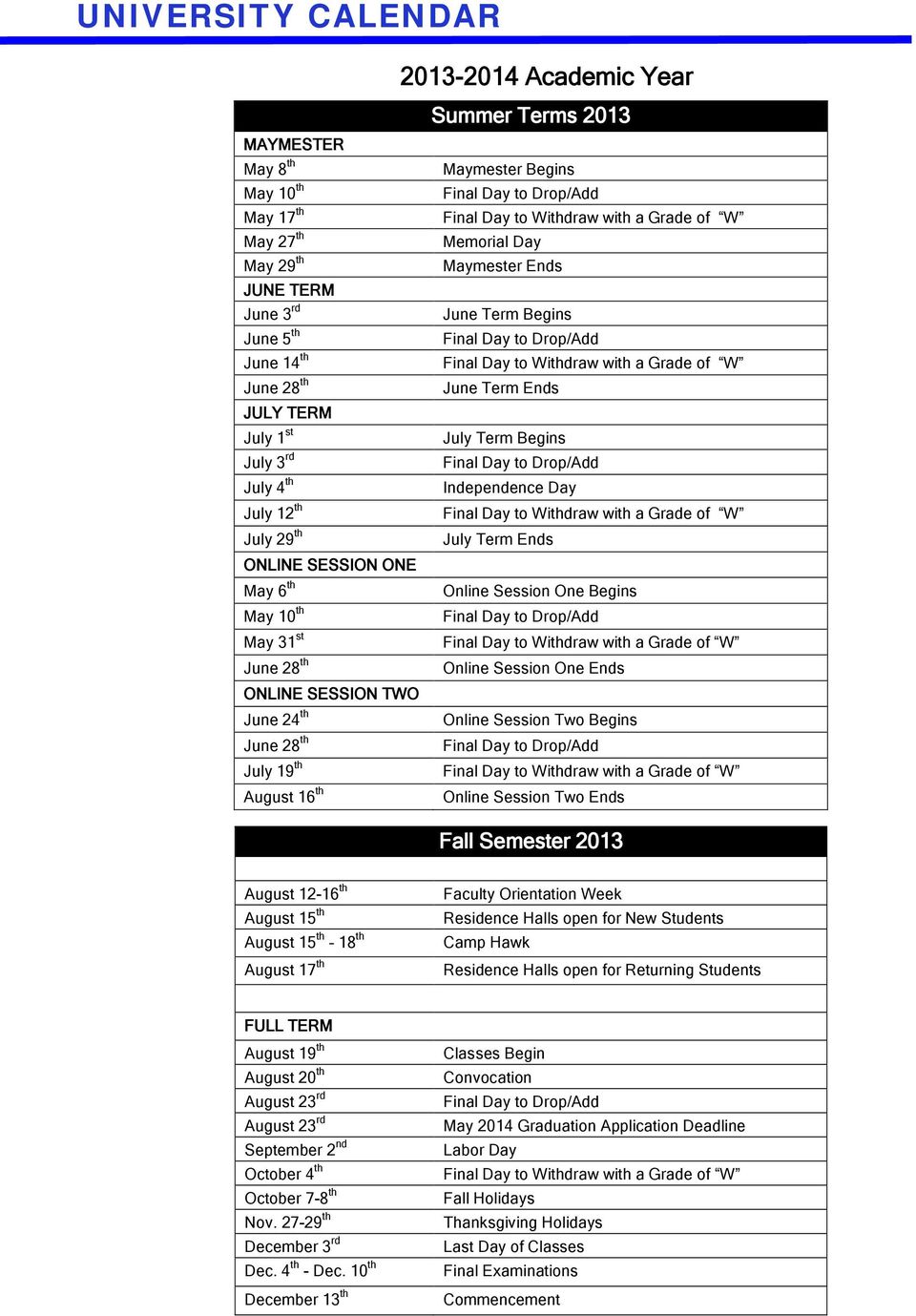
9 UNIVERSITY CALENDAR Academic Year Summer Terms 2013 MAYMESTER May 8 th May 10 th May 17 th May 27 th May 29 th JUNE TERM June 3 rd June 5 th June 14 th June 28 th JULY TERM July 1 st July 3 rd July 4 th July 12 th July 29 th ONLINE SESSION ONE May 6 th May 10 th May 31 st June 28 th ONLINE SESSION TWO June 24 th June 28 th July 19 th August 16 th Maymester Begins Final Day to Drop/Add Final Day to Withdraw with a Grade of W Memorial Day Maymester Ends June Term Begins Final Day to Drop/Add Final Day to Withdraw with a Grade of W June Term Ends July Term Begins Final Day to Drop/Add Independence Day Final Day to Withdraw with a Grade of W July Term Ends Online Session One Begins Final Day to Drop/Add Final Day to Withdraw with a Grade of W Online Session One Ends Online Session Two Begins Final Day to Drop/Add Final Day to Withdraw with a Grade of W Online Session Two Ends Fall Semester 2013 August th August 15 th August 15 th 18 th August 17 th Faculty Orientation Week Residence Halls open for New Students Camp Hawk Residence Halls open for Returning Students FULL TERM August 19 th August 20 th August 23 rd August 23 rd September 2 nd October 4 th October 7-8 th Nov th December 3 rd Dec. 4 th - Dec. 10 th December 13 th Classes Begin Convocation Final Day to Drop/Add May 2014 Graduation Application Deadline Labor Day Final Day to Withdraw with a Grade of W Fall Holidays Thanksgiving Holidays Last Day of Classes Final Examinations Commencement
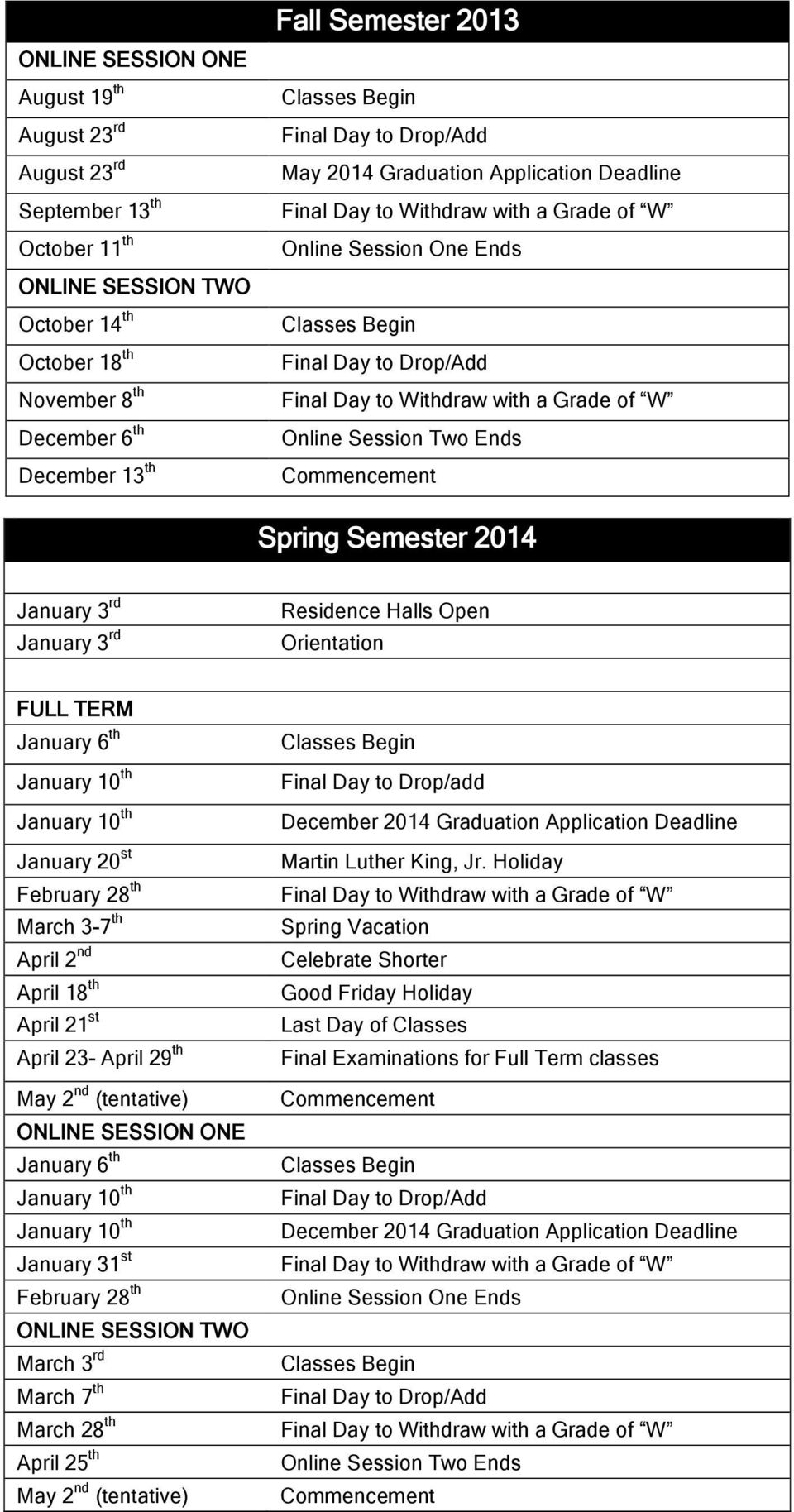
10 Fall Semester 2013 ONLINE SESSION ONE August 19 th August 23 rd August 23 rd September 13 th October 11 th Classes Begin Final Day to Drop/Add May 2014 Graduation Application Deadline Final Day to Withdraw with a Grade of W Online Session One Ends ONLINE SESSION TWO October 14 th October 18 th November 8 th December 6 th December 13 th Classes Begin Final Day to Drop/Add Final Day to Withdraw with a Grade of W Online Session Two Ends Commencement Spring Semester 2014 January 3 rd January 3 rd Residence Halls Open Orientation FULL TERM January 6 th January 10 th January 10 th January 20 st February 28 th March 3-7 th April 2 nd April 18 th April 21 st April 23- April 29 th May 2 nd (tentative) ONLINE SESSION ONE January 6 th January 10 th January 10 th January 31 st February 28 th ONLINE SESSION TWO March 3 rd March 7 th March 28 th April 25 th May 2 nd (tentative) Classes Begin Final Day to Drop/add December 2014 Graduation Application Deadline Martin Luther King, Jr. Holiday Final Day to Withdraw with a Grade of W Spring Vacation Celebrate Shorter Good Friday Holiday Last Day of Classes Final Examinations for Full Term classes Commencement Classes Begin Final Day to Drop/Add December 2014 Graduation Application Deadline Final Day to Withdraw with a Grade of W Online Session One Ends Classes Begin Final Day to Drop/Add Final Day to Withdraw with a Grade of W Online Session Two Ends Commencement
11 UNDERGRADUATE & GRADUATE DEGREES Undergraduate Degrees Bachelor of Arts (BA) Christian Studies Communication Arts Criminal Justice English Education English History History Education Liberal Arts Music Political Science Psychology Spanish Theatre Youth Ministry Bachelor of Business Administration (BBA) Accounting Economics General Business Management Management Information Systems Marketing Sport Management Bachelor of Fine Arts (BFA) Art Musical Theatre Theatre Bachelor of Music (BM) Church Music Music Education (P-12) Piano Piano Pedagogy Voice Bachelor of Science (BS) Biology Chemistry Christian Studies Communication Arts Computer Information Systems Criminal Justice Early Childhood Education (P-5) Ecology & Field Biology History Interdisciplinary Studies Mathematics Mathematics Education Middle Grades Education (4-8) Natural Science Political Science Psychology Youth Ministry Bachelor of Science in Nursing (BSN) Online Degrees Associate of Science (AS) Bachelor of Business Administration (BBA) Business Administration Sport Management Bachelor of Science (BS) Criminal Justice Human Services Master of Accountancy (MACC) Master of Business Administration (MBA) CAPP Degrees BS Business Administration (BSBA) Bachelor of Science (BS) Human Services Bachelor of Science Management (BSM) Master of Arts (MA) Master of Business Administration (MBA) Graduate Degrees Master of Accountancy--Online Programs Master of Arts CAPP program Master of Business Administration Online and CAPP program
12 EDUCATIONAL ENRICHMENT Honors Programs Sigma Eta Alpha or SHA (Shorter Honors Academy) is the official name of Shorter University s prestigious Honors Program. The Shorter Honors Academy offers a challenging environment for talented and intellectually gifted students who seek an enhanced education. The aim of the academy is to challenge students to cultivate strong habits of critical thinking and creativity in a community of scholars. The Shorter Honors Academy provides an enriched curriculum for students who want to go beyond regular undergraduate requirements and creates an intellectually charged and engaged community of students and faculty. It promotes a distinctive educational experience that challenges students to cultivate depth and breadth in critical and creative thought, as well as facilitates students interdisciplinary contributions to intellectual life and the community. No matter what program of study a student desires to pursue, the Shorter Honors Academy can enhance the quality of that educational experience. Preparatory Department The Shorter University Preparatory Department in the Arts offers lessons in piano and voice. Lessons are offered for students of all ages and levels in a variety of settings including classes, group lessons, and private instruction. These lessons do not carry University credit. For further information, please contact the Preparatory Department coordinator. theme of the lectures has not been specifically designated, but the intent is that they will be particularly appropriate to the Christian liberal arts institution. The inaugural lecture was given in April, 1985 by Dr. Gordon Kingsley, President and Professor of Religion and Literature, William Jewell College. Lewis Lipps Ecology Lectureship was established in honor of Dr. Emma Lewis Lipps, Distinguished Professor of Biology and Earth Science, who taught at Shorter from 1944 to The lectureship focuses on ecological issues of contemporary concern. The inaugural lecture was given November 14, 1991, by Dr. Hal R. DeSelm, Professor of Botany/Ecology, Retired, University of Tennessee, Knoxville, Dr. Lipps dissertation advisor. Global Citizenship Global citizenship is the responsibility to participate publicly in the life of the global community in order to make the world a better place. The entire educational experience at Shorter University is established upon the premise that every student should take seriously the opportunities and obligations of global citizenship. For this reason, students engage the world from the very first moment that they set foot on the university s campus. The university s Endowed Lectureships Whitworth-Muldrow Lectureship is a memorial to Sara Whitworth, 1969 alumna of Shorter University and Frances Muldrow, Professor of Languages, Originally established in 1970 as a scholarship in foreign languages, the fund was converted to a lectureship in The
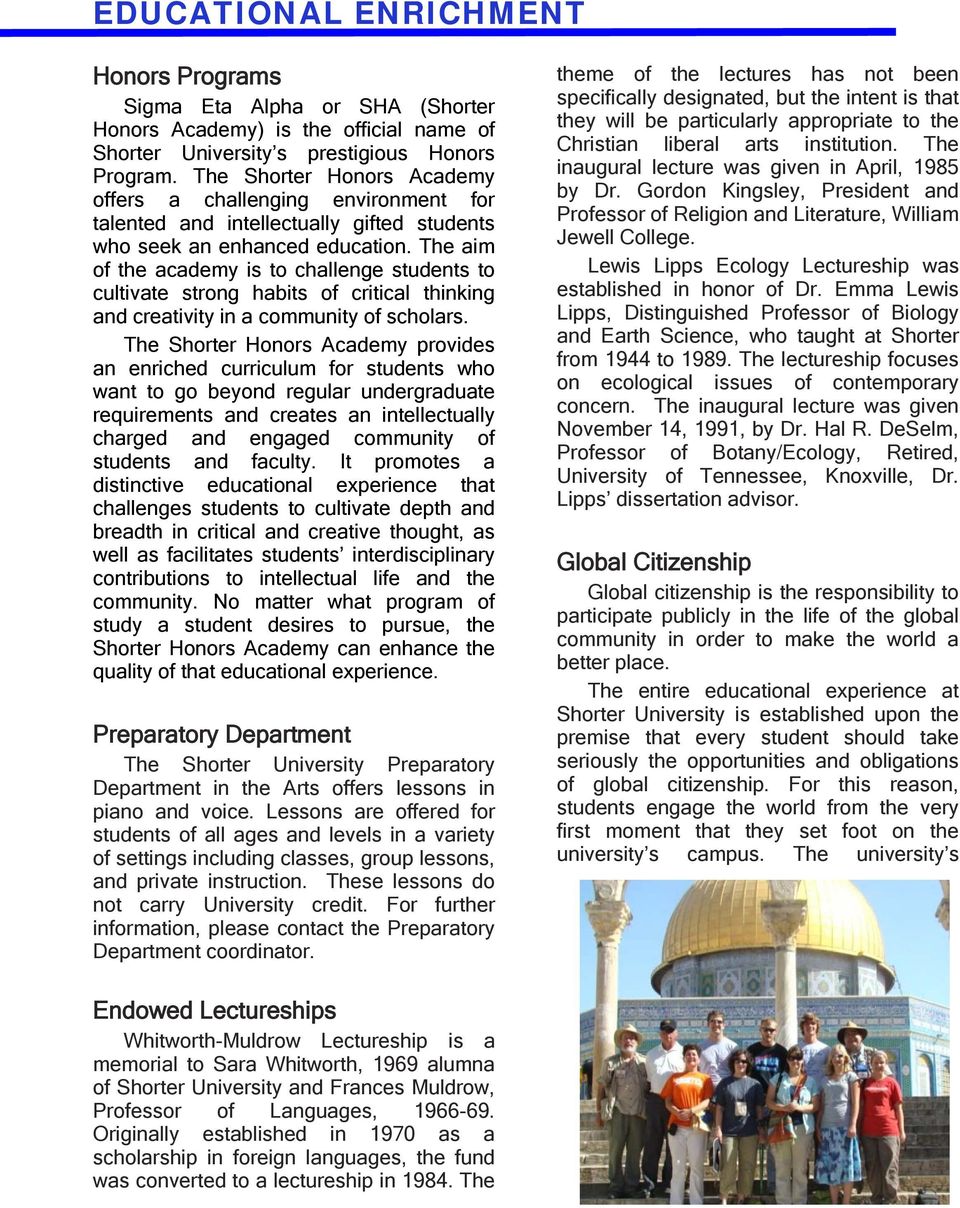
13 curriculum on both the foundation and major levels introduces students to the diversity of cultures that make up the global community. Faculty offer courses that focus upon global issues related to politics, ethics, history, religion, the sciences, literature, communication arts, sociology, and a whole range of other disciplines. Significant numbers of international students and faculty members from Africa, Asia, Europe, and South and Central America study and teach at Shorter University and become conversation partners in expanding the global perspectives of American students. The University supports an extensive array of Christian programs that embrace and promote our institution values by instilling the values of respect and tolerance for differences with a Christ like mindset. Ongoing programs include the Global Perspectives Forum, an International Film Series, and a host of activities during International Education Week. Shorter University students are encouraged to bring a passport with them as they enter school so that they can take advantage of the vast international study opportunities that are available throughout their university careers. All students have the opportunity to participate in a myriad of study abroad opportunities on every continent of the world. They can choose to do an independent program or to travel with Shorter University faculty and other students on summer programs. Faculty advisors and the Office of International Programs work closely together to make sure that a student can take full advantage of these short-term and semester-long experiences. International Students International students are a vibrant component of Shorter s life. We have students from 24 different countries and more are expected as a result of the programs mentioned above. As they pursue their interests in sports or music, and their major degree programs in business, computer information systems, biology, communication, mathematics, or psychology, they find themselves asking and answering many questions in conversations with fellow students. In a recent focus group, the international students commented that their fellow students had been very helpful as well as interested in other cultures. They also noted that the small-university environment helped them to adjust and thrive. International Programs Shorter University develops global citizens by promoting intercultural understanding and encouraging students to study and live abroad. Students may study abroad for a semester or a few weeks in the summer, immersing themselves in the culture and interacting with the local population. Most programs are taught in English, while others offer courses in the host language. The Office of International Programs along with the Global Education Committee can help students who wish to study abroad and evaluate faculty study proposals. Partners SPANISH STUDIES ABROAD This agreement enables students to study at SSA sites in Seville, Alicante, Barcelona Spain, Córdoba, Argentina, Cuba and Puerto Rico during the fall, spring and summer terms. A wide variety of liberal arts, language, and culture courses are taught in Spanish for the beginning, intermediate, or advanced Spanish speaker. English taught classes are also offered in a wide variety of disciplines. Students are housed either with a local family or in a dormitory. This arrangement allows for full immersion in the Spanish language. Integrated programs in local universities are also available. Generally,

14 the SSA programs include excursions to sites of cultural or historical importance. COUNCIL FOR CHRISTIAN COLLEGES & UNIVERSITIES-BEST SEMESTER Through its Best Semester programs, CCCU provides opportunities for authentic engagement of faith, identity, ideas, and worldview within a unique cultural environment. In addition to academic programs, BestSemester offer a variety of internships, service projects, and community involvement. Programs are available in Australia, China, India, Costa Rica, Egypt, England, and Uganda. including a two-week travel section at the end of the semester. Best Semester - Latin American Studies Program (LASP) Based in San José, Costa Rica, students enrolled in this program will study the language, literature, culture, politics, history, economics, ecology and religion of the region. Students will be required to do internships in the community and travel to nearby Central American nations. Best Semester - Australia Studies Centre (ASC) This program is designed to integrate the study of Australian culture, religion, politics, history and Indigenous cultures with service learning and formal instruction in the arts. BestSemester - China Studies Program (CSP) The CSP allows students to study the culture, history, religion, geography and economic reality of China. Students may choose one of two available concentrations (Chinese Studies and Business) and study standard Chinese language. Best Semester - India Studies Program (ISP) Students enrolled in ISP would take two core courses (Contemporary India: Culture, Society and Challenges-India s Religious Landscape) and choose three elective courses (Options: Social Work-Literature- Indian Design-Fine Arts-Culinary Studies- Business). Service opportunities and travel components are included for each course BestSemester - Oxford Summer Program (OSP) This five-week summer program in the University of Oxford allows students to take seminars and tutorials on specialized topics in the areas of English language and literature, history (including history of art and science), philosophy, theology and religion.

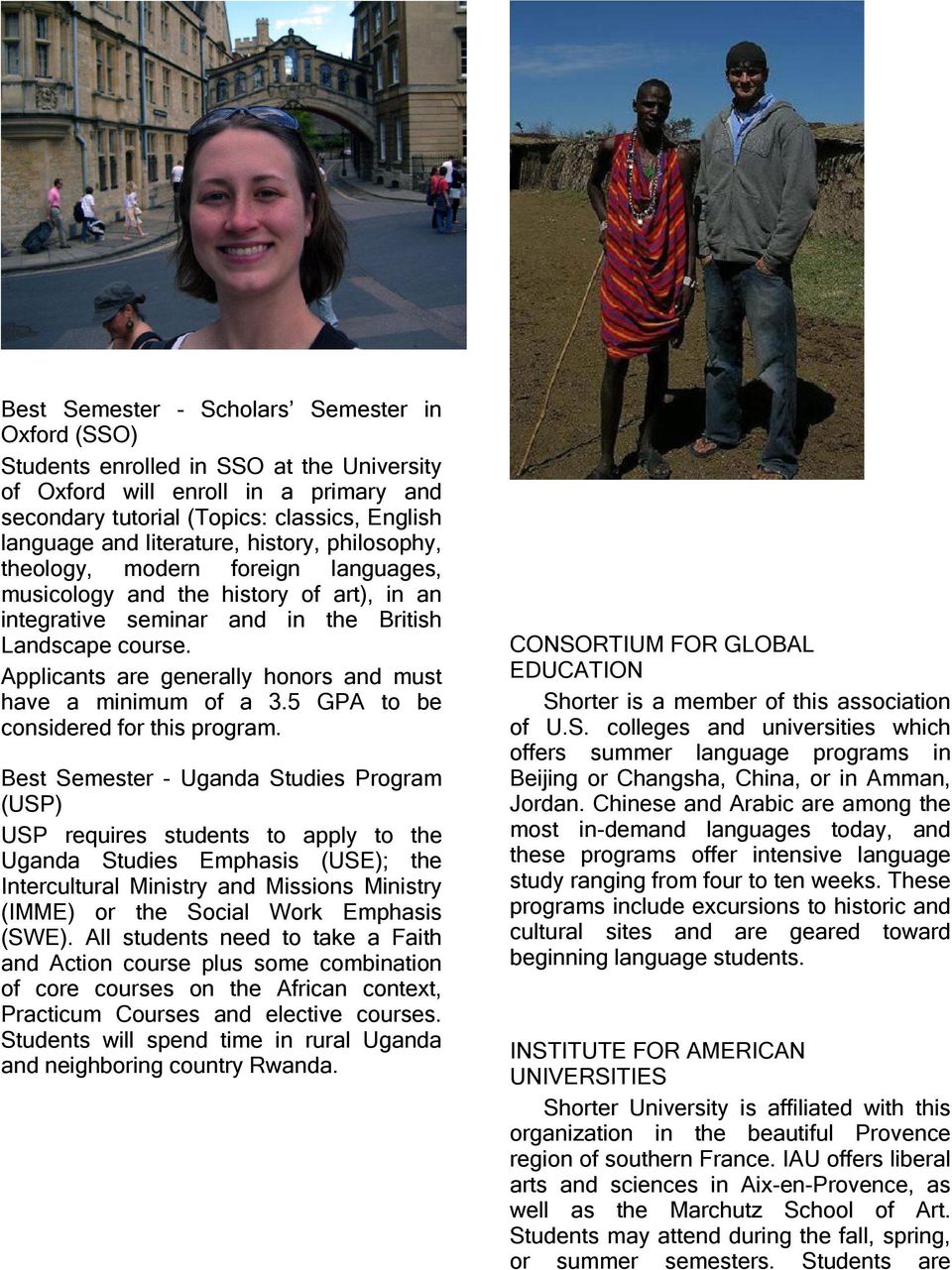
15 Best Semester - Scholars Semester in Oxford (SSO) Students enrolled in SSO at the University of Oxford will enroll in a primary and secondary tutorial (Topics: classics, English language and literature, history, philosophy, theology, modern foreign languages, musicology and the history of art), in an integrative seminar and in the British Landscape course. Applicants are generally honors and must have a minimum of a 3.5 GPA to be considered for this program. Best Semester - Uganda Studies Program (USP) USP requires students to apply to the Uganda Studies Emphasis (USE); the Intercultural Ministry and Missions Ministry (IMME) or the Social Work Emphasis (SWE). All students need to take a Faith and Action course plus some combination of core courses on the African context, Practicum Courses and elective courses. Students will spend time in rural Uganda and neighboring country Rwanda. CONSORTIUM FOR GLOBAL EDUCATION Shorter is a member of this association of U.S. colleges and universities which offers summer language programs in Beijing or Changsha, China, or in Amman, Jordan. Chinese and Arabic are among the most in-demand languages today, and these programs offer intensive language study ranging from four to ten weeks. These programs include excursions to historic and cultural sites and are geared toward beginning language students. INSTITUTE FOR AMERICAN UNIVERSITIES Shorter University is affiliated with this organization in the beautiful Provence region of southern France. IAU offers liberal arts and sciences in Aix-en-Provence, as well as the Marchutz School of Art. Students may attend during the fall, spring, or summer semesters. Students are
16 required to study the French language while at IAU. Housing will be provided with a local French family, enabling students to fully enjoy the traditional French culture. SALZBURG COLLEGE Students may spend one or two semesters of study in Salzburg, Austria, studying a variety of liberal arts and visual/performing arts. Salzburg College is particularly suited for students wanting to further their study of the German language and desiring to live with a host family. Located in the heart of the Old City, the college occupies a 16th century townhouse. The close vicinity of public, education and cultural institutions allows for easy integration of classroom study and onsite experience. Students can also take advantage of travel opportunities across Europe. As with all university programs, all annual summer programs have a strong integration of biblical faith and learning in their educational experiences. In the past, Shorter has led groups to Central or South America (AMERICAS program) and such programs focused on Spanish language and culture. Past locations have included Mexico, Ecuador, and the Galapagos Islands. Exotic destinations are not foreign to Shorter, as we have traveled to Cambodia, Laos, Vietnam, Hong Kong, Myanmar, China, Japan, Thailand, Russia, and the Philippines (ASIA program). Students are eager to know the Old Continent so we lead almost every summer a group to Europe (EUROPE program). The program usually visits England and another European country. Past locations have included Scotland, Ireland, France, Italy, Sweden, Russia, Germany and the Netherlands. We have also ventured to the Middle East and have traveled to Israel and Palestine (MIDEAST program). Annual Summer Programs Every year faculty lead short-term study abroad programs. These programs occur in May, June and July and the number of credit hours awarded for such programs are flexible. The costs of all required activities and most meals are included. Spring Break Programs Occasionally, an international spring break is offered to Shorter students. These 10-day programs provide an opportunity to

17 experience the culture, history, and people of another country for a brief visit, along with Shorter faculty and students. Past programs have visited Israel, England and Austria. CONTACT For more information about studying abroad, costs, academic requirements, etc., please contact the Office of International Programs at or visit ST-210.

18 OFFICES AND BUILDINGS-ROME CAMPUS SHEFFIELD THOMPSON BUILDING Named for Mrs. Evelyn Sheffield Thompson, an alumna, provides space for administrative offices, classrooms, and faculty offices. This building forms the third side of a formal setting with Rome Hall on the west and the Fine Arts Building on the east. The Bailor Suite, honoring Mrs. Jane Galt Bailor of the Class of 1915, occupies part of the second floor. It houses classrooms and faculty offices. ALICE ALLGOOD COOPER FINE ARTS BUILDING & RANDALL H. MINOR FINE ARTS BUILDING, These two buildings are connected and form a unique fine arts complex, provide upto-date facilities for the School of the Arts and the Department of Communication Arts. The Cooper Fine Arts Building, named as a memorial to Mrs. J. P. Cooper, contains classrooms; music faculty offices; a drawing and painting studio; Brookes Chapel, the meeting place for convocations, concerts, and lectures; and the Eubanks Reception Room. The Randall H. Minor Fine Arts Building, completed in April of 1980, is named in honor of Shorter s former president. The facility includes classrooms, music practice rooms, a choral rehearsal room, a recital hall, faculty offices, photography lab, a theatre, a radio studio, and the Arnold Art Gallery which houses the University s permanent art collection and is the location of several art shows annually. ALUMNI HALL Alumni Hall houses the educational materials center, language lab, and faculty offices on the first floor. The second and third floors provide student housing. HIGH ACRES High Acres, formerly the George B. Smith estate, is a beautiful Georgian home, with seven acres adjoining the campus. ROME HALL Rome Hall was named in honor of the citizens of Rome in appreciation of their generous support of the University. It contains classrooms, science laboratories, offices of faculty members, lounges, University museum and archives, and the Robert T. Connor Animal Collection. Rome, Van Hoose, and Alumni halls are joined by a large lobby and sun deck. SPRING HILL ART HOUSE The Art House contains studio facilities for painting, ceramics, and sculpture. The brick structure, contiguous to the main University campus, was purchased by the University in THE LIVINGSTON LIBRARY A gift of the Roy Livingston family, the Livingston Library was dedicated in 1976 as a memorial to Mr. Livingston. Portraits of Mr. and Mrs. Livingston and of their daughter, Mrs. Keller, are displayed in the library. In 2012 a new wing of the library, The Nelson and Trudy Price Learning Center, was opened and added 18,000 square feet of new library space. Access to the collection and to other information resources is facilitated by the online catalog and by online databases in a variety of academic disciplines. The library is an institutional member of OCLC, LYRASIS, GPALS and GALILEO, which provide access to remote databases, the Internet, and interlibrary loan sources.

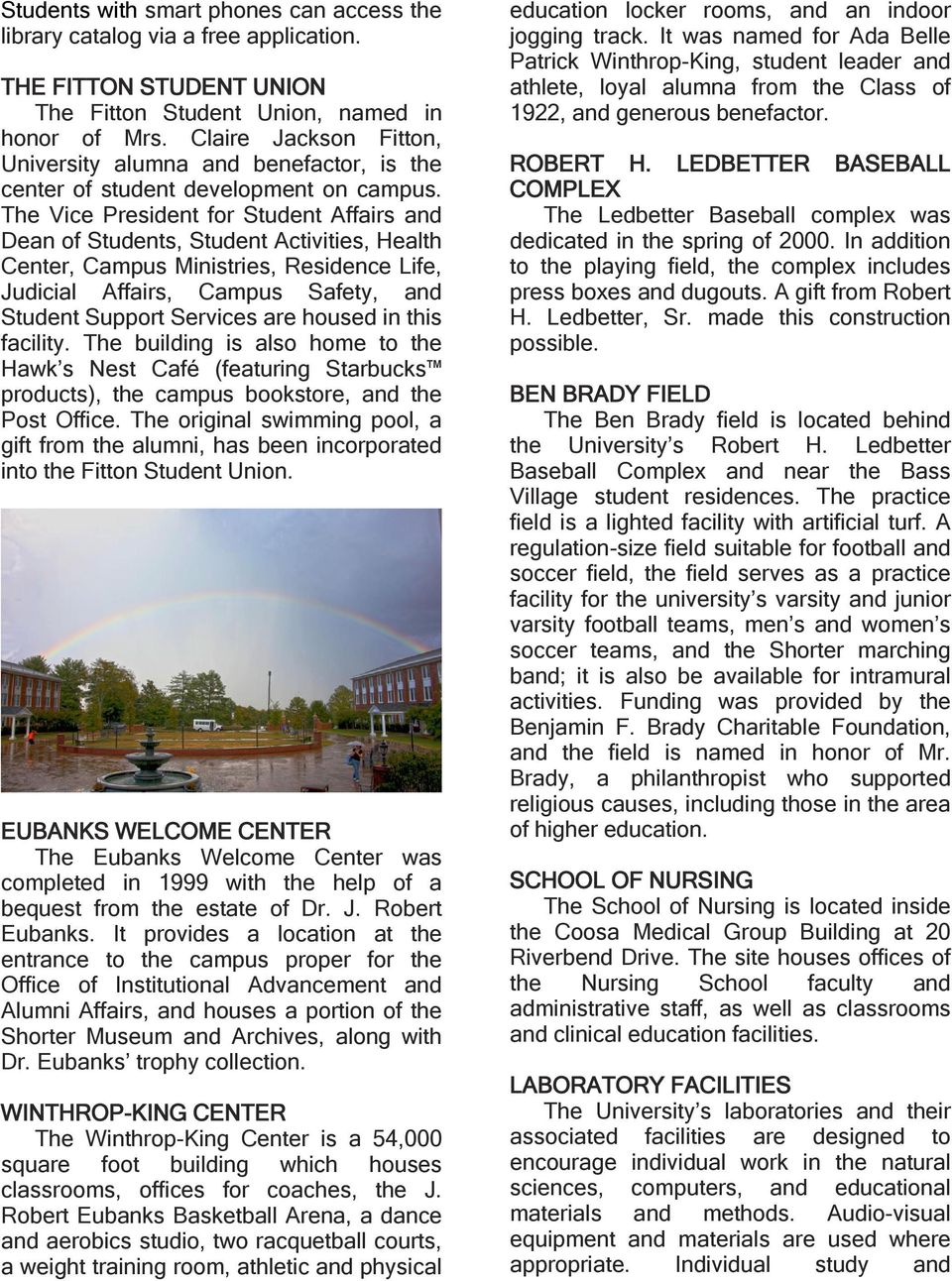
19 Students with smart phones can access the library catalog via a free application. THE FITTON STUDENT UNION The Fitton Student Union, named in honor of Mrs. Claire Jackson Fitton, University alumna and benefactor, is the center of student development on campus. The Vice President for Student Affairs and Dean of Students, Student Activities, Health Center, Campus Ministries, Residence Life, Judicial Affairs, Campus Safety, and Student Support Services are housed in this facility. The building is also home to the Hawk s Nest Café (featuring Starbucks products), the campus bookstore, and the Post Office. The original swimming pool, a gift from the alumni, has been incorporated into the Fitton Student Union. EUBANKS WELCOME CENTER The Eubanks Welcome Center was completed in 1999 with the help of a bequest from the estate of Dr. J. Robert Eubanks. It provides a location at the entrance to the campus proper for the Office of Institutional Advancement and Alumni Affairs, and houses a portion of the Shorter Museum and Archives, along with Dr. Eubanks trophy collection. WINTHROP-KING CENTER The Winthrop-King Center is a 54,000 square foot building which houses classrooms, offices for coaches, the J. Robert Eubanks Basketball Arena, a dance and aerobics studio, two racquetball courts, a weight training room, athletic and physical education locker rooms, and an indoor jogging track. It was named for Ada Belle Patrick Winthrop-King, student leader and athlete, loyal alumna from the Class of 1922, and generous benefactor. ROBERT H. LEDBETTER BASEBALL COMPLEX The Ledbetter Baseball complex was dedicated in the spring of In addition to the playing field, the complex includes press boxes and dugouts. A gift from Robert H. Ledbetter, Sr. made this construction possible. BEN BRADY FIELD The Ben Brady field is located behind the University s Robert H. Ledbetter Baseball Complex and near the Bass Village student residences. The practice field is a lighted facility with artificial turf. A regulation-size field suitable for football and soccer field, the field serves as a practice facility for the university s varsity and junior varsity football teams, men s and women s soccer teams, and the Shorter marching band; it is also be available for intramural activities. Funding was provided by the Benjamin F. Brady Charitable Foundation, and the field is named in honor of Mr. Brady, a philanthropist who supported religious causes, including those in the area of higher education. SCHOOL OF NURSING The School of Nursing is located inside the Coosa Medical Group Building at 20 Riverbend Drive. The site houses offices of the Nursing School faculty and administrative staff, as well as classrooms and clinical education facilities. LABORATORY FACILITIES The University s laboratories and their associated facilities are designed to encourage individual work in the natural sciences, computers, and educational materials and methods. Audio-visual equipment and materials are used where appropriate. Individual study and
20 experimentation is possible in the chemistry, biology, geology, botany, and physics laboratories. LEDBETTER COLLEGE OF BUSINESS The Ledbetter College of Business was completed in 2010 after a generous gift from Robert H. Ledbetter, Sr. It is located in the Midtown Crossing Shopping Center in Rome. In addition to its degree programs, Shorter s School of Business houses the Hopkins Institute for Business Ethics, which hosts an ethics lecture each spring for the Shorter and Rome communities. BAND HALL The Band Hall is located near High Acres and the Ben Brady playing field. It is a spacious facility designed to facilitate color guard and marching band rehearsal. THORNWOOD CAMPUS The Thornwood Campus is adjacent to Shorter s main campus and houses a variety of academic programs. Moreover, its serves as a venue for various athletic activities, intramural sports, etc. A large antebellum house, once owned by Colonel Alfred E. Shorter s (the university s namesake), is also located on the property.

21 ACADEMIC AFFAIRS Academic Affairs The Executive Vice President and Provost of the University is the chief academic officer of the University. Under his direction, a number of offices work to facilitate student learning and complement the work of the faculty in classrooms, laboratories, practice rooms, and the Library. These professionals work closely with the faculty and staff of the University to provide students with every opportunity to accomplish their educational goals. Office of the Executive Vice President and Provost The Provost and his staff manage the academic life of the University. He works closely with Deans, Department Chairs, and faculty committees to ensure the very highest quality of course offerings and instructors. His office is responsible for academic ceremonies, such as Convocation, Celebrate Shorter, and Commencement. Institutional Planning and Research The Office of Institutional Planning and Research collects and analyzes data, reporting the results for both internal and external consumers. The office manages many of the surveys given at various times throughout the year, in addition to overseeing the assessment and quality improvement process for the University. Registrar The mission of the Registrar s Office is to ensure academic integrity through record maintenance and to serve the college, the students, community and other numerous clients, by providing information in an efficient manner with a Christ like approach. The Office maintains academic records for students who enroll at Shorter University. Student Engagement and Success Academic advising and academic support services are housed in The Office of Student Engagement and Success (SES). New students begin their academic career at Hawk Orientation, and academic advising is an important part of that experience. Freshman advisors are specially selected and trained to assist freshmen in the exploration of academic and career areas, and the freshman advising relationship is continued for the remainder of the freshman year. At the end of the freshman year, students are placed with an appropriate major advisor for their chosen field of study. Transition to this new advisor is made in the summer between the freshman and sophomore years. Academic support is available to all students through the peer tutoring and writing centers. The Tutoring Center offers peer tutoring and coordinates study groups for students seeking assistance in foundation classes. Students who have earned top competitive academic scholarships serve as peer tutors. Other peer tutors are selected by department chairs and are outstanding students in their fields of study. Students can also receive help with writing through individual tutoring in the Writing Center. Writing tutors assist with all stages of the writing process for any class, not just English. In addition, SES offers support for students who are Conditionally Admitted, on Academic Probation or on Academic Warning and are designed to help students identify and integrate strategies to improve their grades and enhance their academic success.
22 The Office of Student Engagement and Success is located on the second floor of the Sheffield-Thompson building in the Bailor Suite. Learning Communities The Learning Community (LC) Experience at Shorter University allows first year students to explore an area of personal interest while completing part of Shorter s classes. This is an optional opportunity based on available LC course offerings. Often tied together with common themes and integrated coursework, LCs build connections between a freshman and his/her classmates, professors and Shorter University, as well as between his/her interests and a class schedule. LCs at Shorter usually include at least two classes during the fall semester and at least one class during the spring semester. Each LC includes FCS 1010, where service learning and skills for college success are emphasized. Faculty and a peer mentor work together to ease a student s transition to University coursework. First year students can indicate their interest in LC participation before Hawk Orientation, Shorter s summer orientation. For more information about Learning Communities at Shorter, contact the First-Year Experience Coordinator in the Office of Student Engagement and Success. Learning Community Seminar Courses Academic and personal development is begun in the freshman year through the learning community seminar (First Year Seminar, FCS 1010), a one-credithour course linked to a first-year student s Learning Community (LC) experience. Students will take FCS 1010 and FCS 1020 during their first two semesters at Shorter, whether linked to a LC experience or not. The topics covered in the course are intended to guide students in the transition to higher education and life at Shorter University. For further descriptions of the First Year Seminar courses, see the course description section for FCS 1010 and FCS 1020 presented in this catalog. Transfer Student and Nontraditional-age Freshmen Enrollment in Learning Communities Recognizing that the optional Learning Community environment is designed for first year students with little or no college experience, certain groups of students are partially or complete exempt from the Learning Community opportunity as follows: 1. Transfer students entering the University with a hours of transferable credit (Advanced Freshman status): the student would be eligible to complete both the fall and spring Learning Communities with the accompanying First Year Seminars. b hours of transferable credit (Advanced Freshman status): the student s transferred courses will be evaluated by the Advising Coordinator in consultation with the major advisor, the Registrar, and the First Year Experience Coordinator, as needed, with approval of the chair of Liberal Arts. Based on the type of courses transferred in and the GPA of all completed courses, the student will be exempted from or eligible to complete some Learning Community opportunities.
23 c. 24+ hours of transferable credit: the student is exempt from the First Year Seminar requirements (FCS 1010 and FCS 1020) and thus ineligible for learning community participation. Student Professional Association of Georgia Educators Two organizations in music induct qualified members following successful completion of a new member period: Mu Phi Epsilon, an international professional sorority for the advancement of music; and Phi Mu Alpha Sinfonia, a national professional fraternity, which promotes the cause of music and fosters friendship among those with an interest in music. Student Professional Organizations Many academic areas increase their faculty-student interaction through organizations related to their area. Each group is open to any student interested in increasing understanding and personal and professional development within his/her anticipated field. Such organizations include: Allied Health Club American Chemical Society Art Students League Association for Computing Machinery Eta Pi Sigma (history) Georgia Music Teachers Association Student Chapter Music Educators National Conference Student Chapter Phi Chi Theta (business) Recreation Society Students in Free Enterprise (SIFE) Student National Association of Teachers of Singing Fine Arts Performing Organizations Performing organizations in the fine arts are prominent in Shorter life. Some of those organizations include: Shorter Chorale, a select 50-voice ensemble serving as the University s touring choir. The group performs secular and sacred music from all style periods, and has frequently traveled internationally. Shorter Mixed Chorus, performing sacred and secular music from all historical periods, is open to all students seriously interested in choral singing. Shorter Pep Band joined the ranks of ensembles in Open to all students, the Band performs at athletic events throughout the year. Northwest Georgia Winds perform full band concerts in spring and fall and provide music for a variety of civic and public service functions. Members include University music
24 and non-music majors and community musicians. Shorter University Theatre mounts at least four productions per year, including traditional dramas, musicals and operas. Any student may audition. Honor Societies Groups which recognize excellence and foster achievement, whether in general academics or in a professional field, include: Alpha Chi, National Society admits students from all academic disciplines. The Shorter University chapter, Georgia Theta 304, has been named a Star Chapter, indicating that it is in the top 10% of chapters nationally. Juniors and seniors of good character who rank in the upper 10% of their classes are inducted in Fall and Spring terms. Beta Beta Beta, Kappa Alpha Chapter, is a national honor society for biologists, open to superior students of biology and allied sciences. Lambda Pi Eta, Mu Chi Chapter, is the international communication honors society open to outstanding communication majors and minors. Kappa Delta Pi is an international honor society in the field of Education. Pi Kappa Lambda, Epsilon Beta Chapter, is a national music honor society whose new members are selected each spring by members on the music faculty from the top 20 percent of graduating seniors. Pi Gamma Mu, Georgia Epsilon Chapter, the international social science honorary society, has superior students in the areas of social sciences and business as its elected membership. Sigma Tau Delta, Beta Psi Chapter, is the national honor society for English majors. Members are selected by the English department on the basis of grade-point average and recommendation of faculty. Theta Alpha Kappa, Alpha Beta Omega Chapter, is the honor society for religious studies and theology. To be eligible for membership, students must have completed at least 12 hours in religion with a minimum 3.5 GPA in those courses, and have at least a cumulative GPA and standing in the upper 35 percent of the class. Sigma Beta Delta, Shorter University Chapter, is the honor society for business, management and administration. Members are business students who rank in the top 20% of the junior or senior class. Alpha Psi Omega, Shorter University Chapter, is the honor society for theatre students. Recently reactivated at Shorter, the national organization is one of the largest in the country and sponsors clubs at both the high school and collegiate level. Alpha Chi, Pi Kappa Lambda, Pi Gamma Mu, Sigma Tau Delta, Theta Alpha Kappa, Sigma Beta Delta, and Alpha Psi Omega are members of the Association of College Honor Societies.
25 STUDENT AFFAIRS Student Affairs: Traditional Programs The Student Affairs professionals on campus provide opportunities and programs for the development of Christian and personal values, effective interpersonal relationships, community and social responsibility, and positive health and wellness habits among students. They offer personal and career counseling to individuals and groups. In cooperation with the faculty, they help students gain the skills to make the most of their university experience and to plan for a future career. All Shorter University regulations concerning student life out of class can be found in the Student Handbook, The Pinnacle, revised annually, a publication of the Office of Student Activities. Orientation New students begin their academic career at Hawk Orientation. This one-day campus experience is held several times during the summer to accommodate approximately 70 incoming freshmen at each session. Before meeting a faculty mentor, who are specially selected and trained to assist freshmen in the exploration of academic and career areas, students are introduced to the campus. Students are placed in English and Mathematics based on test scores and high school record. The freshman advising relationship is continued for the remainder of the freshman year, at which time the Advising Coordinator uses freshman advisors recommendations to place these students with an appropriate major professor for their chosen field of study. Transition to this new advisor is made in the summer between the freshman and sophomore years. Hawk Orientation also provides exciting, informative sessions to learn more about campus services. A similar summer program has been developed for new transfer students. Transfer Hawk Orientation allows incoming students who transfer from another institution to meet with their advisor and to register for classes. Not to be confused with Hawk Orientation, Camp Hawk is the next step in a smooth transition to Shorter University for incoming freshmen. Camp Hawk is a great opportunity for new students to experience an off-campus retreat. Upon return from Camp Hawk, campus wide events are sponsored to help incoming students get acquainted with the campus. Student Support Services Student Support Services at Shorter University functions to coordinate and provide supportive services to students so that they may be better equipped for success during their tenure at Shorter University. Support services include personal counseling, disability services, and career development services. The office is located on the Rome campus in the Fitton Student Union. COUNSELING SERVICES Short-term individual counseling services are offered by a Licensed Associate Professional Counselor (LAPC) to assist enrolled students in overcoming personal and academic difficulties. Currently, Shorter University s Director of Student Support Services is an LAPC who provides counseling to students on a part-time basis. Counseling appointments are available
26 throughout the business week (9:00 a.m. - 4:00 p.m.; Monday-Friday). Shorter University Counseling Services is not a substitute for psychiatric or medical intervention, though these may be recommended as adjuncts to, or in lieu of, counseling. Referrals to community professionals will be made for long-term counseling issues. CAREER DEVELOPMENT SERVICES The Career Development Resource Office, located in the suite with Student Support Services, provides material and online resources, as well as one-on-one assistance for Shorter students and alumni. The Career Development Coordinator works with students in choosing majors and minors, exploring career options, finding part- and full-time jobs, applying for internships and graduate schools, and completing necessary documents for such endeavors, such as professional résumés and cover letters. This office works with state consortium groups to put on major job fairs during fall and spring terms, brings recruiters to campus, and holds workshops on job related topics. Jobs postings, as well as personal interest assessments and job search aides, are posted on the Career Center page of the Shorter University website. DISABILITY SERVICES Shorter University strives to provide access to programs and services to all qualified students with disabilities and is committed to adhering to the guidelines of the Rehabilitation Act of 1973 (PL Section 504) and the Americans with Disabilities Act (ADA) of The Student Support Services office is responsible for the coordination of services to students with disabilities. The student is responsible to identify himself/herself voluntarily as disabled to the Director of Student Support Services in order to receive services. Upon presentation of acceptable documentation, the Director will then address the needs of each student on an individual basis. Documentation of disability is kept confidential. Students are encouraged to become self-advocates. Grievance Procedure If a student with a disability feels that he or she has not received the accommodation(s) he or she is entitled to, the following information may be helpful: The ADA requires that accommodations be developed in a give-and-take dialogue process between the institution and the person with a disability. The student might need to meet with the Director of Student Support Services to discuss and explore appropriate, reasonable accommodations more completely. Students may need to meet with their professors, as well. Universities are not required to provide the requested or preferred accommodation. They are required to provide reasonable, appropriate, and effective accommodations for disabilities which have been adequately documented and for which the accommodation has been requested. The question, therefore, should be asked, Is the accommodation that has been offered reasonable and effective? If reasonable accommodations are not implemented in an effective or timely manner: The student should contact the Director of Student Support Services. The Director works with students with disabilities and University personnel to resolve disagreements regarding recommended accommodations. If no resolution is obtained, students who believe they have been discriminated against on the basis of disability may choose to file a written grievance with the Disability Services Committee. Once the Director of Student Support Services receives such a written request, the Director will call a meeting of the Disability Services Committee for such a review and determination. The Director will
27 inform the student in writing of the Committee s decision within 48 hours of the Committee s meeting. If the student believes he or she is entitled to accommodations not approved by the Director of Student Support Services: The student may request in writing to the Vice President for Student Affairs and Dean of Students for the Disability Services Committee to review his or her documentation and the request for accommodation for reconsideration. Once the Vice President for Student Affairs and Dean of Students receives such a written request, a meeting of the Disability Services Committee will be called for such a review and determination. The Vice President for Student Affairs and Dean of Students will inform the student in writing of the Committee s decision within 48 hours of the Committee s meeting. A student may, at any time, choose to file a formal complaint with the Office for Civil Rights (OCR) instead of or in addition to requesting a review by the Director of Student Support Services and/or the Disability Services Committee. The contact information for OCR is below: OCR Atlanta Office U.S. Department of Education 61 Forsyth St., SW, Suite 19T70 Atlanta, GA Voice: TDD: FAX: [email protected] Student Health Services The purpose of the Student Health Services is not only to provide quality firstaid care for students but also to teach awareness of health habits which may help maintain wellness, to work with individual students and groups of students in long- and short-term health plans, and to educate students as consumers of health services. There is no cost for routine treatment; however, there is a nominal fee for screenings and to see the campus physician. The cost of prescription medicine, special treatment, or tests ordered by the physician is the responsibility of the student. Student Health Services will make appointments with physicians, specialists, or make other referrals as needed. FOCUS AND SCOPE OF PRACTICE In an effort to promote health and wellness on our campus, Shorter University became tobacco free on June 1, Shorter University also provides the MyStudentBody.com alcohol program to students in an effort to educate students about the damaging effects and dangers of alcohol use. The Director of Student Health Services is the campus administrator for Shorter University s MyStudentBody.com program. The primary focus of the Student Health Service facility is to promote the health and wellness of each student. This is accomplished by providing a variety of services related to maintaining good health and promoting wellness. Services include, but are not limited to: Consultation with a registered nurse during hours of operation. The well-equipped clinic provides first-aid treatment, a self-care center, health screening by a healthcare professional, specified lab screenings and treatments, off-campus referrals, and medical record keeping. Low cost CLIA-waived screenings including Strep A, mono, blood glucose, HBG, HcG (pregnancy), and urinalysis are available in the clinic. Services free-of-charge include HIV testing and counseling, body mass index analysis, and heat therapy. PPD screening and vaccines for tetanus and influenza can be obtained through the clinic when the serum is available. Students should receive the meningococcal vaccine prior to attending Shorter. A student should also consider receiving the HEP A and HEP B series. The required immunizations to attend Shorter
28 University are: Two (2) MMR and TD/TDAP (Tetanus/Diphtheria/Pertussis) within the past 10 years. A printed verification of current immunizations from a medical facility or health department must accompany the Certificate of Immunization and Health History. The form can be found at choose Campus Life in the menu bar, scroll to Student Health Services, and select the Health Certificate of Immunization and Health form. These should be sent to Admissions prior to registration. Failure to comply with Shorter University s immunization requirements will result in losing your campus housing privileges and delay registration for classes. No immunization exemptions are allowed for either vaccine, but a titer showing immunity to MMR will be accepted. Physicians from Floyd Medical Center s Family Medicine Residency Center conduct clinical rotations one afternoon each week. Students are charged a low fee to see the campus physician. This fee is charged to the student s account in the Business Office. Suture removal, wound care, residence hall first-aid supplies, overthe-counter medications and supplies are available through Student Health Services. Equipment such as crutches and heating pads are available on loan. Health resources available include an annual health fair in association with the Wellness Committee. Educational resources on nutrition, exercise, stress management, disease prevention, self-care information and health-related pamphlets are readily available in the clinic and in the adjacent hallway for the students, faculty and staff. Wellness-education information sheets are made available to patients in an effort to inform the patient on the care of particular illnesses. As previously stated, many of these services are free of charge. However, any off-campus health services or procedure is the student s financial responsibility. To insure confidentiality of health records, a student s written consent is required before releasing information. There is a section on the mandatory Certificate of Immunization and Health History form that the student must sign giving consent. This is especially important when students are seeking immunization records for graduate school. Students should keep a copy of their immunizations in a safe place for easy retrieval. Student Health Services consists of two exam rooms, a workroom, two offices, reception area, file room, screening room, two storage rooms, and a bathroom. There are no overnight accommodations available in Student Health Services. When a student is especially ill and unable to care for his or her own physical needs, it is advised that a parent be called and the student leaves the campus to go home. We believe that the student is better able to make a full and speedier recovery in his or her home environment whenever possible. The staff for Student Health Services includes: Faculty physician from FMC's Family Medicine Residency Clinic (part-time) Resident physician (part-time) Director of Student Health Services (fulltime registered nurse) Certified nursing assistant (part-time) Student workers (nursing majors) Office hours for fall and spring semesters are Monday-Friday, 8:30 AM - 4 PM unless otherwise posted. The clinic is closed at night and on weekends. Student Health Services does not have overnight accommodations. The clinic telephone number is (706) and the confidential fax number is (706)
29 INSURANCE INFORMATION The University recommends that each student have personal health insurance coverage. Regarding international students insurance- All F-1 visa international students are required to purchase the school s international health insurance. The international health insurance is a different policy from the athletic insurance all studentathletes are required to purchase. International student-athletes are required to purchase both the University s health insurance and the athletic insurance. International student insurance information can be found through choose Campus Life from the menu bar, scroll to Health Services, and scroll down to student insurance. Then choose the appropriate link under international insurance. For information on the athletic insurance, please follow the link below and click FAQ: smedicine/index Regarding U.S. students (domestic) insurance - Most U.S. students will have coverage through family insurance policies. For those students who are interested in health insurance coverage, a policy is available through the University. Information concerning both health and athletic insurances can be found through choose Campus Life from the menu bar, choose Health Services, and scroll down to student insurance. Then choose the designated appropriate link. Domestic students can print the health insurance application form and after thoroughly completing it, fax it to Student Health Services, Student Health Services will send this to the insurance broker on your behalf and you will hear from the insurance company shortly thereafter. Further information may be secured from the Business Office at or Student Health Services, It is imperative that all students have health insurance as each student is personally responsible for medical bills incurred as a result of injury or illness. Shorter University is not liable for accidents or injuries occurring anywhere on the University campus. Shorter University will only be financially responsible for the payment of medical bills/expenses that result from injuries occurring during supervised athletic trips, practices, or games. However, Shorter University will pay the balance of these bills only after each bill has been filed with and processed by the primary and/or secondary insurance company of the student-athlete. We will make payment on the balance of these bills only after we receive notification that the primary/secondary insurance company has paid their maximum eligible amount, or that insurance has denied the payment of the bills. The exact procedure for handling these medical bills is outlined on the Medical Expense Payment Procedure page of the Shorter insurance letter found under Shorter University Sports Medicine at Neither the Business Office nor Student Health Services file insurance claims; that is the responsibility of the student and the healthcare provider. Campus Safety The primary responsibility of Campus Safety is to provide a safe and secure environment so that the University community can achieve its purposes. Campus Safety patrols and monitors the campus 24 hours a day, seven days a week.
30 The office supervises emergency procedures, traffic flow, and crowd control. The gatehouse officers monitor vehicles entering the campus. The office is also responsible for enforcing regulations, registering vehicles, the distribution of decals and scheduling the campus shuttles. Campus Safety provides an annual uniform crime report and works closely with local law enforcement officials. Residence Life Residence halls at Shorter provide the opportunity for students to experience living in Christian community, to develop important relationship skills, and assume leadership roles. Because of the value the University places on the residential experience, all fulltime students are required to live on campus unless married, living with parents, or 23 years of age. Rare exceptions to this policy due to special circumstances may be made by the Vice President for Student Affairs and Dean of Students. The Office of Residence Life gives careful consideration to the selection of roommates. Using the information provided by students on the Housing Questionnaire, every effort is made to match students with compatible roommates. Resident students are required to participate in a meal plan. Freshmen are required to purchase the unlimited meal plan. Residents living in apartment-style housing may request a reduced meal plan of 10 meals per week. Other students may choose either a 15-, or unlimited-meal plan. Exemptions are granted only in rare cases where special dietary needs cannot be met by the food service staff. RESIDENCE LIFE STAFF The members of the Residence Life staff report directly to the Director of Residence Life and the Assistant Director of Residence Life. They are responsible for implementing the University s residence life and student conduct policies. Residence Directors (RD s) and Residence Assistants (RA s) in each building are responsible for providing and maintaining a living-learning environment that enhances the growth and development of each resident of Shorter University. Through daily management of the physical environment and through the programming of social, cultural, spiritual, and educational activities, the members of the Residence Life staff intend to create for each student who lives in our residence halls a personal sense of belonging and community. The Residence Life staff is chosen in the spring of each year; its members are rising sophomores, juniors and seniors who have lived on campus for at least two semesters. Students interested in applying for a staff position should possess a minimum 2.5 GPA. Applications are available in January in the Office of Residence Life. Student Life Student organizations at Shorter provide avenues for socializing, learning, and leading. Active membership in student organizations enhances a student s success at Shorter and as a whole person. The wide variety of organizations and activities enables participation in a range of interest areas including music, clubs and honor societies in several academic areas, service groups, fraternities, sororities, religious groups, and student publications. A complete, annually updated list of organizations and their functions is published in the Student Handbook, The Pinnacle.
31 STUDENT GOVERNMENT ASSOCIATION The Student Government Association is composed of all enrolled students at Shorter. Through the Student Senate and its committees, the Student Government Association develops principles of democratic self-government, promotes cooperation among students, faculty and administration, and encourages Christian ethical practices within the University community. SGA serves as the student voice for institutional decision making. FITTON STUDENT BOARD The Fitton Activities Board (FAB) is responsible for providing a wide range of activities for students. FAB sponsors dances, Big Screen Movie Nights, offcampus trips, traditional events, comedians, musicians, and other special events on campus to stimulate and fulfill the social needs of students. CHRISTIAN ORGANIZATIONS The activities of the Christian groups at Shorter are designed to nurture and develop spiritual life. They provide an opportunity for fellowship, service, discussion of religious topics, and expression of faith. The Shorter Christian Association, Baptist Collegiate Ministries, and Fellowship of Christian Athletes present a variety of programs including Christian Focus Week, weekly services, mission trips, programs and service projects. Students of all faiths are encouraged to participate in the life of the church of their choice. GREEK ORGANIZATIONS The fraternities and sororities at Shorter serve a variety of functions: a family away from home, a place to learn leadership skills, an environment for close personal relationships, an atmosphere of academic achievement, an opportunity for community service, and the preservation of traditions. Recruitment and new member activities occur each fall. SPECIAL INTEREST GROUPS Shorter Orientation Staff is comprised of current students who assist new students and parents in their transition to University life. The SOS staff plans and facilitates Hawk Orientation and Camp Hawk. Staff members are selected through an interview process. Shorter Relations Society is a service group whose members are selected on the basis of academic achievement, personality, and leadership at Shorter. SRS members provide guided tours and serve as overnight hosts to student representatives and other campus visitors who attend various Shorter University functions. INTRAMURALS The Office of Student Life sponsors a varied intramural program in both group and individual sports. Intramural Sports is comprised of organized sport leagues, tournaments and other special events for the Shorter University community. All Shorter University students, as well as faculty and staff are encouraged to participate. The program offers activities such as Basketball, Flag Football, Soccer, Tennis, Volleyball, Dodgeball, Ultimate Frisbee, Racquetball, Kickball, and Bowling. Special events are held as well including activities such as Spades and Texas Hold em. The program also facilitates outdoor excursions such as rafting, backpacking, skiing, kayaking, and climbing.
32 VARSITY SPORTS ORGANIZATIONS For Men: Baseball Basketball Cheerleading Cross Country Football Golf Lacrosse Soccer Tennis Track & Field Wrestling For Women: Basketball Cheerleading Cross Country Golf Lacrosse Soccer Softball Tennis Track & Field Volleyball
33 HONOR CODE I. Philosophy Predicated upon the rigorous pursuit of liberal learning and the teachings of the Christian faith, the Shorter University community is dedicated to integrity in the pursuit of truth and honor in the building of community. Individual backgrounds and interests aside, as members of this community, we share a common commitment to keeping the high standards of honesty and honorable conduct required for this pursuit. The Center for Academic Integrity (CAI) defines academic integrity as a commitment, even in the face of adversity, to five fundamental values: honesty, trust, fairness, respect, and responsibility. From these values flow principles of behavior that enable academic communities to translate ideals into action. An academic community flourishes when its members are committed to the five fundamental values. Integrity is built upon continuous conversations about how these values are, or are not, embodied in institutional life. As these conversations connect with institutional mission statements and everyday policies and practices, a climate of integrity is sustained and nurtured. Vigorous academic integrity policies and procedures, with faculty and student support, promote the learning process and the pursuit of truth. This also helps create a stronger civic culture for society as a whole (CAI, p4). In the hope, anticipation, and expectation that students engage the learning process in their quest for truth and knowledge, Shorter University adopts the five fundamental values set forth by CAI. To that end, Shorter University strives to empower students in the development of their character by providing an education within the context of a Christian environment. Shorter University seeks to establish a platform from which all students can succeed. Shorter University, therefore, sets forth the following standards from the CAI publication, The Fundamental Values of Academic Integrity, as the benchmark for the Shorter student. The same integrity that came with being known as a Shorter girl in the early days of the University is now found in being known as a Shorter student. The Shorter University community assumes one is honorable and a person of integrity. It is the goal of this academic community to preserve and enhance that honor and integrity for those who walk these academic halls, as well as to provide avenues to demonstrate and teach those values to those within a student s sphere of influence while a student and as a graduate. 1. Honesty An academic community of integrity advances the quest for truth and knowledge by requiring intellectual and personal honesty in learning, teaching, research, and service. Honesty is the foundation of teaching, learning, research, and service, and the prerequisite for full realization of trust, fairness, respect, and responsibility (CAI, p. 5). If the adage is that one cannot lead where one has never been, then it extends to one cannot expect honesty to be a trait found in society if honesty does not begin with the individual. Cultivating honesty lays the foundation for lifelong integrity, developing in each of us the courage and insight to make difficult choices and accept responsibility for actions and their consequences, even at personal cost (CAI, p. 5). Promoting student moral development requires affirming shared values. More colleges are
34 starting to focus on one value that goes to the heart or the academic enterprise: a commitment to honesty in the pursuit of truth (Pavela, p.6). I hope I shall always possess firmness and virtue enough to maintain what I consider the most enviable of all titles, the character of an honest man. George Washington 2. Trust An academic community of integrity fosters a climate of mutual trust, encourages the free exchange of ideas, and enables all to reach their highest potential. People respond to consistent honesty with trust. Trust is promoted by faculty who set clear guidelines for assignments and for evaluating student work; by students who prepare work that is honest and thoughtful; and by schools that set clear and consistent academic standards and that support honest and impartial research (CAI, p. 6). Shorter University, therefore, seeks to be consistent among all parties to foster an environment that engenders trust among all her participants. In the academy, trust is at the core of all our endeavors. Research findings are valid only to the extent the data that generated the findings is trustworthy; otherwise, the assertions and theories that hinge on the findings lack substantiation. As professors, we make certain assumptions about research findings. Should we not, therefore, make those same assumptions about our colleagues and our students? Few things help an individual more than to place responsibility upon him, and to let him know that you trust him. Booker T. Washington 3. Fairness An academic community of integrity establishes clear standards, practices, and procedures and expects fairness in the interactions of students, faculty, and administrators. Fair and accurate evaluation is essential in the educational process. For students, important components of fairness are predictability, clear expectations, and a consistent and just response to dishonesty. Faculty members also have a right to expect fair treatment, not only from students, but also from colleagues and their administration...a lapse by one member of the community does not excuse misconduct by another. Rationalizations such as everyone does it or the curve was too high do not justify or excuse dishonesty (CAI, p.7). History is replete with civilizations that have made the horrible mistake of treating different peoples differently. Whether it be the color of one s skin, cultural background, religion, or ethnicity in whatever form, society, in general, deplores preferential treatment for some and marginalization or an ignored presence of others. Within the Shorter academic community, the treatment of individuals by differing standards is not tolerated. The community strives to treat all as equals; respecting one another for each one s uniqueness. How should we interpret fairness?
35 Injustice anywhere is a threat to justice everywhere. We are caught in an inescapable network of mutuality, tied in a single garment of destiny. Whatever affects one directly, affects all indirectly. Dr. Martin Luther King, Jr. 4. Respect An academic community of integrity recognizes the participatory nature of the learning process and honors and respects a wide range of opinions and ideas. To be the most rewarding, teaching and learning demand active engagement and mutual respect. Students and faculty must respect themselves and each other as individuals, not just as means to an end. They must also respect themselves and each other for extending their boundaries of knowledge, testing new skills, building upon success, and learning from failure. Students show respect by attending class, being on time, paying attention, listening to other points of view, being prepared and contributing to discussions, meeting academic deadlines, and performing to the best of their ability. Being rude, demeaning, or disruptive is the antithesis of respectful conduct. Members of the faculty show respect by taking students ideas seriously, providing full and honest feedback on their work, valuing their aspirations and goals, and recognizing them as individuals.part of respecting people involves fair and honest treatment, and all of this supports an environment of trust (CAI, p.8). How then does mutual respect play out in the academy? That you may retain your self-respect, it is better to displease the people by doing what you know is right, than to temporarily please them by doing what you know is wrong. William J. H. Boetcker 5. Responsibility An academic community of integrity upholds personal accountability and depends upon action in the face of wrongdoing. Every member of an academic community each student, faculty member, and administrator is responsible for upholding the integrity of scholarship and research. Shared responsibility distributes the power to effect change, helps overcome apathy, and stimulates personal investment in upholding academic integrity standards At a minimum, individuals should take responsibility for their own honesty and should discourage and see to prevent misconduct by others (CAI, p. 9). Shared responsibility has many attributes and conducts itself in the face of adversity and selflessness without shifting shadow. The thorns which I have reap d are of the tree I planted; they have torn me, and I bleed. I should have known what fruit would spring from such a seed. George Gordon, Lord Byron, Childe Harold s Pilgrimage 6. Integrity Defining integrity may be much more difficult than describing it. The CAI defined academic integrity through five attributes. Shorter University offers the following quotes in hopes of finding commonality.
36 Be daring, be different, be impractical; be anything that will assert integrity of purpose and imaginative vision against the play-it-safers, the creatures of the commonplace, the slaves of the ordinary. Cecil Beaton How blessed are his sons after him. Proverbs 20:7 Don t compromise yourself. It s all you ve got. Janis Joplin Integrity When you do the right thing even though no one is watching. Anonymous Integrity is telling myself the truth. And honesty is telling the truth to other people. Spencer Johnson As this system is student-maintained, our agreement contains two parts: first that we personally adopt the standards of conduct as stated in the Honor Code; and second, that we deal responsibly with those of our peers who fail to do so. By holding one another accountable to this commitment, we ensure the integrity of our academic program and community. Our acceptance of this commitment allows us to enjoy an atmosphere of mutual trust and respect among our fellow students, faculty, and administration. The academic and social advantages therein are many: as students we are trusted to work independently; computer labs are available twenty-four hours a day; personal property is generally safe on campus; and one s word may be considered trustworthy, both on and off campus. It is our shared interest in preserving this atmosphere that motivates our commitment to the Honor System. Privilege bears responsibility. Thus, we at Shorter are responsible for knowing the purpose, design, and procedures of our Honor System and are required to exhibit honorable conduct in all areas of life: social as well as academic, off campus as well as on. It is solely through the consistency of this commitment that we may both trust and be trusted, respect and be respected, regardless of place or circumstance. Therefore, each of us is expected to do his or her full part in maintaining the integrity of that commitment at all times. When we join the Shorter University community, we sign the Roll of Honor, and formally enroll under the pledge: On my honor, I will abstain from all deceit. I will neither give, receive, nor use any unauthorized aid in my academic work, nor will I permit such action by any member of this community. I will respect the persons and property of the community and will not condone discourteous or dishonest treatment of these by my peers. In my every act, I will seek to maintain a high standard of honesty and truthfulness for myself and for the University.
37 Academic Integrity Policy II. A Community of Honor As a liberal arts university committed to the Christian faith, Shorter University seeks to develop ethical men and women of disciplined, creative minds and lives that focus on leadership, service and learning. The Honor System of Shorter University is designed to provide an academic community of trust in which students can enjoy the opportunity to grow both intellectually and personally. For these purposes, the following rules and guidelines will be applied. Academic Dishonesty "Academic Dishonesty" is the transfer, receipt, or use of academic information, or the attempted transfer, receipt, or use of academic information in a manner not authorized by the instructor or by university rules. It includes, but is not limited to, cheating and plagiarism as well as aiding or encouraging another to commit academic dishonesty. "Cheating" is defined as wrongfully giving, taking, or presenting any information or material borrowed from another source -including the Internet by a student with the intent of aiding himself or another on academic work. This includes, but is not limited to a test, examination, presentation, experiment or any written assignment, which is considered in any way in the determination of the final grade. "Plagiarism" is the taking or attempted taking of an idea, a writing, a graphic, musical composition, art or datum of another without giving proper credit and presenting or attempting to present it as one's own. It is also taking written materials of one's own that have been used for a previous course assignment and using it without reference to it in its original form. Students are encouraged to ask their instructor(s) for clarification regarding their academic dishonesty standards. Instructors are encouraged to include academic dishonesty/integrity standards on their course syllabi. Procedure A. It is the responsibility of an instructor to certify that academic assignments are independently mastered sufficiently to merit course credit. The responsibility of the student is to master academic assignments independently, refrain from acts of academic dishonesty, and refuse to aid or tolerate the academic dishonesty of others. B. If an instructor determines that the student is guilty of academic dishonesty, the instructor must discuss the matter with the student. In the event the instructor cannot reach the student in a timely manner, such as when the student has gone home at the end of a semester, the instructor may assign a grade of "I" (Incomplete) until the student can be contacted and the matter of academic dishonesty discussed. The instructor then completes the "Academic
38 Violation Form" (see Appendix A) which should include evidence and other necessary documentation. The instructor will determine the appropriate remedy: either to assign a grade of zero on that assignment in question or a grade of "F" in the course. The student will designate whether he/she accepts the remedy for the violation of the dishonesty policy or wishes to appeal the instructor's decision. If a student elects to appeal, the "appeal due date" line must be completed on the Academic Violation Form. (See the Appeals section below for more information regarding the appeals process) C. Upon completion, the instructor forwards the Academic Violation Form to the Registrar's for the placement in the student's permanent record. The Registrar will forward copies of the Academic Violation Form to the student, the faculty member, department chair, academic dean, dean of students, provost, and president. Not appealing when the form is first completed or by the appeal due date will be taken as an admission of guilt, except under compelling circumstances to be determined at the sole discretion of the provost. D. If upon receipt of the Academic Violation Form the Registrar determines that the student is guilty of a second offense, then a grade of FD (Failure Due to Academic Dishonesty) will be assigned by the Registrar for the course regardless of the remedy specified on the Academic Violation Form. Assigning the FD is to be done by the Registrar when the second Academic Violation Form is placed in the student's record, and the Registrar will notify all parties in writing. The student is then permanently disbarred from membership in any honorary society and is permanently ineligible for any SU honor list. The student may petition the Academic Integrity Appeals Committee to have the dishonesty notation removed from the transcript after one year or upon graduating from the University if no additional dishonesty offenses occur and the student satisfactorily completes the Academic Integrity Program. The grade of F remains on the transcript. Upon receipt by the Registrar of a third offense, the Registrar will assign the grade of FD and then notify all parties. After all appeals are exhausted, if the third offense still stands, then the student will be permanently expelled from the University. The notice of expulsion will be forwarded to the student, department chair, appropriate academic dean, dean of students, provost, and president. A copy of the final report with the three offenses will become a part of the student's permanent record. The university reserves the right to expel the student after a first or second offense, depending on the circumstances and at the sole discretion of the provost. Appeals A. The student who wishes to appeal an academic violation charge should submit his/her appeal in writing to the chair of the appropriate department by the appeal due date indicated on the Academic Violation Form, which is normally within ten regularly scheduled class days after the completion date of the Academic Violation Form. This statement should contain the reasons for which the student is appealing the instructor's decision. The burden of proof lies with the student in such a case to show that an error or malfeasance has occurred. Within ten regularly scheduled class days of receiving the written appeal, the
39 department chair will notify in writing both the instructor and the student of the chair's decision. If the department chair is also the instructor who files the Academic Violation Form, then the student must appeal to the appropriate academic dean. B. When, in the opinion of the department chair, the student fails to show reasonable cause for further investigation, the chair may deny the appeal without taking further action. When, in the opinion of the department chair, a student's appeal raises reasonable doubt as to whether a mistake or malfeasance has occurred, the chair will meet with the faculty member and with the student and render a decision within ten regularly scheduled class days of the receipt of the appeal. If the decision favors granting the student's appeal, the department chair may request that the Registrar remove the Academic Violation Form from the student's record. The chair will notify both the student and the instructor of this action. C. If the student files the initial appeal or elects to appeal the chair's decision during May-mester, Summer I, Summer II or during final exam week of the Fall or Spring semesters and if the instructor or department chair is not available during that time, all of the foregoing time requirements begin to run with the first day of class in the next major term. In extreme or unusual circumstances regarding the timeliness of the appeals process, the provost will make the final determination. D. Any student who has exhausted the remedies open under the procedures outlined above may appeal the entire matter to the Academic Integrity Appeals Committee in writing within ten regularly scheduled class days of receiving the response from the department chair. Upon receipt of the appeal, the Academic Integrity Appeals Committee will review the matter and issue a decision within fifteen (15) regularly scheduled class days. The Academic Integrity Appeals Committee has the authority to deny the appeal, reduce the penalties in the event of extenuating circumstances, or direct the registrar to remove the record of the Academic Violation Form from the student's permanent record. The results of the Academic Integrity Appeals Committee are final. E. All results from the proceedings of the Academic Dishonesty Appeals Committee should be reported to the appropriate academic dean, dean of students, provost, and president as information. NOTE: During the appeals process, the student may continue to attend the class in which the violation occurred.
40 UNDERGRADUATE ADMISSIONS-TRADITIONAL Foundations The Foundation courses are the traditional undergraduate general education core. These courses unify the curriculum and support the mission of Shorter University as a Christian liberal arts institution. Every Shorter University graduate should have established the habit of continuous learning within the context of knowledge and values that defines contemporary civilization. The following categories of courses are required in order for students to complete their work for an undergraduate degree. Foundation Categories First Year Seminar Effective Communication English Courses Communication Course An Examined Life Christian Studies Courses Historical and Social Perspective History Courses Social & Behavioral Sciences Artistic Expression Quantitative & Scientific Reasoning Mathematics Natural Science Courses Health and Wellness Total Foundation Hours: Credit Hours 2 hrs 12 hrs 6 hrs 9 hrs 3 hrs 7 hrs 2 hrs 41 hours Undergraduate Admissions: General Admissions Policy and Procedures Shorter University strives to enroll a diverse student body so that the best possible learning environment will be provided. The University does not obligate itself to admit all students who meet admission requirements. In determining admissions, consideration is given to the compatibility of the student s purpose and interests with the basic philosophy of the university as a Christian liberal arts institution, as well as to the student s ability to benefit from a university education at Shorter. The Admissions Staff makes admissions decisions in accordance with the guidelines set by the Admissions Committee at the beginning of each academic year. Each candidate s application is reviewed by a member of the Admissions staff before the final decision is made. Final admissions decisions are made by the Director of Admissions, or if required by policy guidelines, by the Admissions Committee. The application is considered an application for admission and also for basic academic scholarship. Admissions decisions are based on a combination of the following, depending on the candidate s prospective classification (freshman, transfer, etc.): the candidate s academic course curriculum; academic grade-point average; the compatibility of the student s purpose, interests, and character with institutional values; and SAT or ACT scores. Other information which may be considered in individual cases includes class rank, the recommendation of a guidance counselor or other appropriate official, TOEFL scores (international students only), the results of a personal interview if required, and the recommendation of the Shorter Admissions staff. Files are reviewed as soon as all required credentials are collected. Decisions and offers of admission for fall
41 semester will be communicated to applicants beginning October 1 of the year prior to the applicant s enrollment. Rising high school seniors may apply as soon as the junior year is completed. A student who is denied admission by the Admissions Committee may appeal this decision through the Provost s Office. Types of Undergraduate Admission Unconditional Admission When an applicant meets all guidelines as set by the Admissions Committee, he or she is admitted unconditionally. The Admissions Committee reserves the option to offer other types of admission based on the merits of the individual applicant. Conditional Admission Offered to students who do not meet regular admission standards, but who in the opinion of the Committee demonstrate the potential for academic success at Shorter. This is a full admission to the University with the requirement that an academic condition be satisfied; typically, the student is limited to 15 academic semester hours during the first term and must earn no less than a 2.0 grade-point average. The Admissions Committee reserves the right to adjust the conditions for the individual applicant in question. Provisional Admission A student may be admitted on a provisional basis if all credentials have not been received. Students are admitted with the provision that the required documents are received and approved by the Office of Admissions or, if an online student, by the Office of Online Programs, no later than two weeks after the last day of the drop/add period of the student s beginning semester. Failure to provide the necessary documentation will result in the loss of tuition and fees and dismissal from course(s) the provisionally admitted student is attending. Provisional students are not fully admitted, and may not receive institutional, federal, or state funded financial aid until the required documents are received and approved. Early Admission High school students who have completed their junior year and have at least a 3.25 academic GPA (academic units only) with a 21 ACT (composite) or 1500 SAT (Critical Reading, Math, & Writing) may be considered for early admission. Students attending a public or private high school must have a letter of approval from the applicant s high school guidance counselor or administrator sent to the Office of admissions verifying the particular courses in which the student plans to enroll for each term. Degree-Seeking Applicants: Definitions Traditional Freshman An applicant who has had no previous college or university course work, other than courses completed through joint enrollment while still in high school, and who completed high school less than five years before application to Shorter. Non-Traditional Freshman An applicant like the above, with no previous University courses, but who is older than the traditional freshman, typically 23 years old or more, and who completed high school five or more years before application to Shorter. Some of the academic requirements for admission may be waived at the discretion of the Admissions Committee. An interview and placement testing may be required. Home-Schooled Freshman An applicant who has received all or part of his/her secondary schooling at home and who therefore has not received a traditional college preparatory high school diploma. Each applicant will be reviewed individually according to the materials submitted. A personal interview with admissions
42 personnel and/or the Admissions Committee may be required before a decision is reached. Traditional Transfer An applicant who has been enrolled at another institution after high school graduation and wishes to seek a degree at Shorter. Non-Traditional Transfer An applicant who has been enrolled at another institution, but who is older than the typical transfer; at least five years have elapsed since the nontraditional transfer s last college or university enrollment. Some of the academic requirements for admission may be waived at the discretion of the Admissions Committee. An interview may be required. Advanced Freshman A transfer student (see above) who has earned less than 24 transferable University semester hours or equivalent. International Student An applicant who is not a citizen or permanent resident of the United States. The United States government makes special requirements in addition to Shorter s admissions requirements. Readmission Student A student wishing to return to Shorter, who has been absent for one or more semesters, excluding summer must apply for readmission through the Office of Admissions. Students who withdrew or were academically, socially or judicially suspended or administratively withdrawn from the previous semester must also apply for readmission. Admission Requirements and Procedures Traditional Freshmen The applicant must provide: 1. A completed Shorter University application with $25 fee, 2. An official high school transcript or official GED scores, embossed or stamped and signed as official by the high school guidance office. 3. An official SAT or ACT score report, either sent from College Board or ACT at the prospective student s request or included on the official high school transcript. 4. High school students who have completed their junior year must have at least a 2.25 academic GPA ( academic units only) with a 19 ACT ( composite) or 1350 SAT ( Critical Reading, Math, & Writing) to be considered for admission. Applicants that do not meet these requirements will be presented to the Admissions Committee for review. Additional information which may be required at the discretion of the admissions staff or committee: 1. A written personal statement which reflects compatibility between the student s goals and the mission and goals of the University. 2. An essay written by the student discussing topics as determined by the admissions staff or committee. 3. A recommendation from the high school guidance counselor or principal or other appropriate official approved by the admissions staff or committee. 4. Interviews with officials as deemed necessary by the Admissions Committee. High School Transcript Requirements A minimum of 16 academic units, distributed as follows: English 4 units Mathematics 4 units (Algebra I & II, Geometry, an advanced Math beyond Algebra II) History/Social Science 3 units Science 3 units Foreign Language 2 units
43 An academic grade-point average is computed as follows: A s receive 4 points, B s receive 3 points, C s receive 2 points, and D s receive 1 point with 0 points given for F s. Advanced Placement, International Baccalaureate, Gifted, and Honors courses will be given one-half extra quality point per unit when evaluating academic GPA. Before processing the application, Admissions staff will check for a completed application and $25 fee, official high school transcript, SAT or ACT scores, etc., as outlined above. Admissions staff will send special audition forms to the applicant as required for certain majors. After the application is evaluated, a letter will be sent notifying the applicant of his or her status. If the applicant is accepted, an Intent to Enroll/ Deposit form is sent, along with other applicable forms pertaining to financial aid, scholarships, and the like. Non-Traditional Freshmen The applicant must provide: 1. A completed Shorter University application with $25 fee, 2. An official high school transcript or official GED scores, embossed or stamped and signed as official by the high school guidance office. The SAT/ACT requirement is waived for nontraditional freshmen. The computation of academic GPA and the procedure for evaluating applications is the same as described above under Traditional Freshmen, except for SAT/ACT scores. International Freshmen Admission The credentials which are required from an international student include: 1. Official course-by-course evaluation of transcripts completed and submitted to Shorter University by a reputable educational evaluation service, such as World Education Services ( or Josef Silny and Associates ( Shorter University does not independently evaluate foreign credentials for admission or credit towards a degree. It is necessary to secure an evaluation and interpretation of a prospective student s academic credentials from an outside agency. Applicants to Shorter University are responsible for the costs of this service. Note: Students who will complete their secondary education at an institution accredited by a United States accrediting body MAY be permitted to submit official transcripts directly to Shorter University from their secondary school. 2. Official Test Scores a. Scores from approved English proficiency test. An English proficiency test is required of all international students whose native language is not English. Students living in a foreign country, who attended English speaking secondary schools, are NOT exempt from this requirement. If the native language is not English, ONE of the following kinds of evidence of English ability must be provided to Shorter University. i. Official SAT scores with a minimum score of 450 in each section (Critical Reading, Math, and Written Essay). ii. An official Test of English as a Foreign Language (TOEFL) score report showing an internet based score of no less than 61, a paper score of not less than 500 or a computer based score of not less than 173. iii. International English Language Testing System (IELTS) score of 5 or better. iv. An official report showing a Michigan Test Battery score of 80 or better.
44 v. Certification of Level 109 completion from ELS Language Centers. vi. A transcript from a United States high school or equivalent. vii. In unusual cases, a written essay to be reviewed by the English faculty. b. Students whose native language is English are required to submit official SAT scores with a minimum score of 450 in each section (Critical Reading, Math, and Written Essay). 3. Official documentation verified by a banking institution as evidence that the prospective international student, or families or sponsors are financially able to support the student while attending Shorter. This may be in the form of a letter from the sponsor s bank, a statement from the sponsor s employer, a report from a commercial rating concerning the sponsor s business, or an account of investments owned by the sponsor. Acceptability of this documentation is at the discretion of the Primary Designated School Official. If an international student is already in the United States on any visa other than a tourist/business visa (B-1/B-2) the above steps may not be necessary: for example, an F-1 visa used to attend a United States high school, or a nonimmigrant dependent visa. However, if the student holds a nonimmigrant dependent visa as the child of a person with another nonimmigrant visa, he or she must petition for a change of visa status to F-1 Student before reaching age 21. Joint Enrollment High school students entering their senior year may be admitted as joint or dual enrollees. High school students who have completed the junior year (rising seniors) may be admitted as Rising Seniors. Such students should have at least a 3.25 GPA ( academic units only) with a 21 ACT ( composite) or 1500 SAT ( Critical Reading, Math, & Writing).Students attending a public or private high school must have a letter of approval from the applicant s high school guidance counselor or administrator sent to the Office of Admissions verifying the particular courses in which the student plans to enroll for each term. Applicants that are not in this classification should contact the Office of Admissions for specific admission requirements. International Baccalaureate Policy Shorter University recognizes the quality of the International Baccalaureate Program and welcomes applications from students who have taken courses in the IB Program. Credit is given for the IB Higher Level examination passed with grades of 5, 6, or 7. Students are required to provide a certified copy of the IB examination results. No credit is awarded for IB Standard examinations. A maximum of 30 hours may be accepted from alternative sources such as IB, AP and CLEP. Acceptance of IB courses may require evaluation with the Registrar and with the chairs of granting departments to assure that standards have been met and to determine authenticity and equivalency of particular courses. Advanced Placement and CLEP Course credit is awarded on the basis of satisfactory scores on the CLEP and Advanced Placement examinations. Scores of 3 or higher on Advanced Placement are accepted for credit. Contact the Admissions Office for specific information. A maximum of 30 hours may be accepted from alternative sources, such as IB, AP and CLEP. Placement Credit: Mathematics & Foreign Language Mathematics Based off of SAT/ACT scores and High School grades, a student may be recommended to take Calculus. If students
45 are placed in Calculus I and earn an A or B, they may petition the department chair for 3 hours of credit in MAT 1110 (College Algebra). If students complete Calculus II and earn an A or B, they may petition the department chair for 3 hours of credit in MAT 1120 (Pre-calculus) Foreign Language Students who place into a Foreign Language II, III, or above course, by placement exam, and earn an A or B may petition the Department Chair to receive credit for exempted courses. Students who place in a 3000-level course may receive a maximum of eight credit hours. Effective Fall International students who are admitted to Shorter and are fluent in English (based on TOEFL scores) and an additional language are exempt from the foundations foreign language requirement. Admission of Students with Previous University Work Traditional Transfers The applicant must provide: 1. A completed Shorter University application with $25 fee. 2. An official high school transcript or GED transcript, embossed or stamped and signed as official by the high school guidance office, UNLESS the applicant has earned 24 or more transferable University semester hours. 3. An official University transcript from EACH institution previously attended, embossed or stamped and signed by the appropriate official. Failure to inform Shorter University of all institutions previously attended, regardless of status upon leaving those institutions, may result in denial of application, or dismissal from Shorter University. 4. An official SAT or ACT score report, either sent from College Board or ACT at the prospective student s request or included on the official high school transcript, UNLESS the applicant has earned 24 or more transferable University semester hours. Additional information which may be required at the discretion of the admissions staff or committee: 1. A written personal statement which reflects compatibility between the student s goals and the mission and goals of the University. 2. An essay written by the student discussing topics as determined by the admissions staff or committee. 3. A recommendation from the appropriate administrator at the last University attended. For unconditional acceptance as a transfer student, the applicant must have a University grade-point average, based on grades from transferable courses, of not less than 2.0 on a 4-point scale through at least one year (24 or more transferable semester hours) of enrollment at a regionally accredited postsecondary institution. This transfer GPA is computed by the Shorter University Registrar after all official transcripts have been received and evaluated. Acceptance of Transfer Credit If the transfer GPA is 2.0 or above, all University-level passed courses will be accepted for credit, if Shorter has a comparable course and departmental grade standards are not violated. The minimum acceptable grade for a course transferred as ENG 1010 or ENG 1020 is C. If the student is accepted on academic probation, only those courses passed with a grade of C or better will be accepted. Lifting the probation, as described above, does not change the acceptance of credit. Transfer students who have completed an Associate Degree, excluding Associate of Applied Science degrees, from an accredited institution will usually be admitted to Shorter University with Junior class standing. Those students will have
46 met Foundation requirements, with the exception of the two Christian studies courses and any specific general education courses prerequisite to or required for a given major. Shorter University may accept a maximum of 60 credit hours from two-year schools toward a degree. No more than 90 credit hours will be accepted toward a degree from all institutions attended, including four-year universities. Evaluation of transfer credit is provisional until the student enrolls and presents official transcripts from all institutions previously attended. Regulations for calculating the HOPE scholarship GPA may vary from the Shorter University cumulative GPA. Please refer to the HOPE program regulations published by the Georgia Student Finance Commission for more information on the HOPE scholarship GPA. Courses listed in the American Council on Education s national guide may be considered for transfer credit. Before processing the transfer application, Admissions staff will check for a completed application and $25 fee, official transcripts from all colleges and universities attended, official high school transcript (if required; see Advanced Freshman below), recommendation, and SAT or ACT scores (if required). Admissions staff will send special audition forms to the applicant as required for certain majors. The Registrar will evaluate all post-secondary transcripts for transferable credit and will calculate the applicant s Shorter University grade-point average from these transcripts. After the application is evaluated, a letter will be sent notifying the applicant of his or her status. If the applicant is accepted, an Intent to Enroll/Deposit form is sent, along with other applicable forms pertaining to financial aid, scholarships, and the like. Advanced Freshman If an applicant with previous postsecondary work has earned less than 24 semester hours of transferable postsecondary credit, he or she is considered an advanced freshman and must also furnish SAT/ACT scores and high school transcript. Evaluation of the high school transcript is as described under Traditional Freshmen, above. Non-Traditional Transfers The applicant must provide: 1. A completed Shorter University application with $25 fee. 2. An official University transcript from EACH institution previously attended, embossed or stamped and signed as official. As with Non-Traditional Freshmen, Non-Traditional Transfers may not be able to satisfy all the academic requirements for admission. Each case will be handled on its own merits. Aside from this, admissions procedure, including evaluation of University transcripts by the Registrar, is as described under Traditional Transfers. International Transfers International students transferring from another United States postsecondary institution with 24 or more transferrable hours should follow the application process for traditional transfer students. International students transferring from a postsecondary institution outside of the United States will need to have an official course-by-course evaluation of transcripts completed and submitted to Shorter University by a reputable educational evaluation service, such as World Education Services ( or Josef Silny and Associates ( Shorter University does not independently evaluate foreign credentials for admission or credit towards a degree. It is necessary to secure an evaluation and interpretation of a prospective student s academic credentials from an outside agency. Applicants to Shorter University are responsible for the costs of this service. Once the University has received an official copy of that formal
47 evaluation, the Registrar s Office will determine transfer course equivalencies. International students transferring to Shorter University with less than 24 transferrable hours will additionally need to submit the documentation required of international freshman applicants. All international students must submit official documentation verified by a banking institution as evidence that the prospective international student, families or sponsors are financially able to support the student while attending Shorter. This may be in the form of a letter from the sponsor s bank, a statement from the sponsor s employer, a report from a commercial rating concerning the sponsor s business, or an account of investments owned by the sponsor. Acceptability of this documentation is at the discretion of the Primary Designated School Official. If the student holds another United States nonimmigrant visa and is transferring from another United States postsecondary institution, a petition to change visa status may or may not be necessary. The Primary Designated School Official will review such situations. Readmission Students A student wishing to return to Shorter, who has been absent for one or more semesters, excluding summer must apply for readmission through the Office of Admissions. Students who withdrew or were academically, socially or judicially suspended or administratively withdrawn from the previous semester must also apply for readmission. The applicant must provide: 1. A completed Shorter University application for readmission (no application fee is required other fess may apply), which includes a written personal statement indicating a) reasons for returning to Shorter, and b) current activities during the time he or she was not enrolled at Shorter. 2. Official transcripts from ALL colleges and universities attended since leaving Shorter, embossed or stamped and signed by the appropriate official. Students cannot be readmitted if terms of suspension have not been met, whether that suspension was at Shorter or another institution. If a student who was on academic probation or suspension when he or she left Shorter is readmitted, this readmission will be on academic probation regardless of performance at the interim institution. Even though courses from other institutions may count towards graduation requirements, they may not be used for purposes of removal from probation or suspension. All readmitted students must meet the graduation and major sequence requirements in effect for the academic year in which he or she is readmitted. Students may petition the dean of their college/school for an exception. The cumulative University grade-point average, as computed by the Registrar, determines readmission status: 1. If the University GPA is 2.0 or higher, the student will be readmitted unconditionally. 2. If the University GPA is below 2.0 but meets GPA requirements for acceptance on probation, the student may be readmitted on probation. 3. If the University GPA is less than 1.40, the student will not be readmitted unless the Admissions Committee finds that there are circumstances which warrant an exception and acceptance on probation. Admission to Major Specific Programs The following apply to all degreeseeking students, whether freshmen or transfers:
48 Admission to Music Major Shorter University is a member of the National Association of Schools of Music. Entrance requirements are in accordance with the published regulations of that body. Admission to the University does not assure that a student may major in music. In addition to the general requirements for admission to the University, students majoring in music must meet the following requirements: (1) an audition in his or her major medium, and (2) placement tests in music theory, ear training, and keyboard skills. The parameters of the audition will be set by the instructions on the appropriate audition form completed by the student. Students will fulfill these requirements prior to the beginning of classes in August of their freshman year since the music curriculum requires at least four years for completion. Students transferring University credit should contact the School of the Arts about additional audition requirements. In some cases, circumstances make it practical to hold an audition before admissions procedures have been completed for the student in question. In such cases, successful audition does not guarantee admission to the University. Admission to Theatre Major In addition to the general requirements for admission to the University, all students majoring in Theatre must perform an audition or reading, and conform to other requirements of the Theatre faculty. Admission to Teacher Preparation Program Criteria for admission to the Teacher Preparation program may be found in the Special Program section of this catalog. Admission to the Baccalaureate Degree Nursing Program Admission to the Bachelor of Science in Nursing (BSN) program requires a separate application to be mailed to Shorter University School of Nursing. Criteria for admission to the BSN program may be found under the special programs section of this catalog. Non-Degree Seeking Students-- Definitions and Requirements Applicants Not Seeking a Degree from Shorter University All are required to submit a completed application form with $25 application fee. Tuition and fees apply as detailed in this catalog. Transient Student A student enrolled in another postsecondary institution who wishes to take course work at Shorter. Such students are limited to a total of 24 semester hours at Shorter. Required Credentials: 1. Completed application with $25 application fee. 2. Statement of Good Standing from home institution signed by the appropriate academic official. Special/Non-Degree Student (For Credit) A person who wishes to take courses for credit, but who does not plan to seek a degree. Required Credentials: 1. Completed application with $25 application fee. 2. Official transcript from last school attended or from institution issuing degree. In the case of students seeking teaching certification only, transcripts from all schools attended are required. Auditor A person who wishes to take courses on a non-credit basis. Required Credentials: 1. Completed application with $25 application fee. 2. Permission of the faculty member teaching the course.
49 Optional Study Opportunities Berry and Shorter Cross-Registration Full-time students above the freshman level may elect to take a course at Berry College during the fall and spring semesters (Shorter students wishing to take Berry courses in the summer may apply as a transient student). The student must pay any course-specific fees. The student must be in good standing and meet all prerequisites for the course. He/she may take one course per semester (up to 4 hours credit) with a maximum credit of 18 semester hours over the entire program. Courses excluded are capstone courses, internships or practica, student teaching, and graduate courses. Application forms and complete regulations are available in the registrar s office. To ensure financial aid, the student must maintain full-time status between the two institutions. Granting Credit for Study Abroad Students are encouraged to begin their planning early for study abroad. Though the normal time for students to study abroad is sophomore level and above, it is recommended that the process begin with discussions during the freshman year with the student s advisor and with the Director of International Programs. During this time, assistance can be given in helping the student decide on the best locations for study in his/her major field. Acceptance for study abroad is based on a number of factors, including recommendations regarding ability, character, and motivation, and recommended minimum 2.4 GPA. The student preparing for study abroad should take the following steps: 1. Discuss plans with the Director of International Programs and the advisor or major professor. 2. Obtain from the Director of International Programs information about deadlines and required paperwork. 3. Confer with the advisor or major professor to select courses that are needed in his/her curriculum and those that might be adequate substitutes for required courses on the home campus. 4. Complete the appropriate application for the host institution and the necessary paperwork. 5. Work closely with the Director of International Programs to ensure that all paperwork has been completed according to the stated deadlines. Each of the institutions abroad with which Shorter University has formal agreements provides listings of faculty, their credentials, and course descriptions. These help to determine proper courses and credit to be awarded.
50 ACADEMIC POLICIES Academic Policies Registration Students desiring to take courses for university credit or audit must register prior to the beginning of each semester. Academic Advising Students are required to confer with a faculty advisor prior to online registration. Freshmen meet their faculty mentors and receive their schedules at Hawk Orientation sessions during the summer prior to their first enrollment. They will be assigned a freshman advisor during the fall semester. Students enrolled as freshmen remain with the freshman advisor for the entire freshman year. After that, academic advising is arranged with a faculty member in the department or school of the student s major. The Registrar and faculty advisor assist in arranging a program of study, but the student is responsible to become familiar with and fulfill all requirements for his or her degree. At least one Hawk Orientation session for transfer students is scheduled during the summer to facilitate transfer student registration. Transfer students meet with an advisor from their prospective major field and register for classes at this session. Schedule Load and Changes (Full-Time) Twelve to 19 credit hours constitute a normal semester course load. A program of 12 or more semester hours is considered full-time. Students who desire to carry more than 19 credit hours may seek approval from the Provost. There are additional tuition charges for credit hours over 19. Drop/Add Registration changes may be made during the drop/add period. Faculty Advisors should be consulted before making schedule changes. Course Withdrawal Students may withdraw from individual courses after the drop/add period and until the last two weeks of the semester. Proper forms must be filed in the Registrar s office to accompany any withdrawal. All students remaining on the course roster should receive the letter grade they earned in the course at final grade entry. Withdrawal From Shorter University A student choosing to withdraw from the university must complete the necessary paperwork obtained from the Director of Student Engagement and Success. No refund of fees will be calculated until the withdrawal process is complete. Withdrawal becomes effective only when the form is signed by the Registrar. Withdrawal grades are described under the Non-Credit Grades section. The university reserves the right to request, at any time, the withdrawal of a student who does not maintain the required standard of scholarship, or whose continued attendance would be detrimental to the student s health or the health of others, or whose behavior is out of harmony with the Christian philosophy of the university. For regulations regarding nonacademic or disciplinary suspension, see the Shorter University Student Handbook. Student Class Standing Shorter University officially recognizes four classes: freshman, sophomore, junior, and senior. A student s classification is based upon earned hours. FRESHMAN less than 27 earned hours SOPHOMORE earned hours JUNIOR earned hours SENIOR 90 + earned hours Grades, Credit, and Quality Points Shorter University defines the term credit hour as the amount of credit awarded for one hour of classroom instruction and a minimum of two hours of out-of-class student work per week for one semester of approximately fifteen weeks or the equivalent amount of work over a
51 different amount of time. This definition applies to any academic activities for which credit is awarded, including laboratory work, internships, practica, studio work, and independent studies, as well as courses offered in accelerated and/or nontraditional formats. A student s standing in any course is determined according to the following grades: A Excellent 4 points/semester hour B Good 3 points/semester hour C Average 2 points/semester hour D Poor 1 point /semester hour F Failure 0 points/semester hour FA Failure for Absences FD Failure for dishonesty P Passing LAB Laboratory S Satisfactory U Unsatisfactory I Incomplete AU Audit W Withdrawn WA Administrative withdrawal WF Withdrawn, failing WP Withdrawn, passing WIP Work in progress The designation H following a grade denotes a class taken for the Honors Program. The designation R following a grade indicates a course was repeated. Except in cases of clerical error, a faculty member may not change a grade which has been forwarded to the Registrar s Office. Grades may only be changed as the result of an appeals process as described below. Grade-Point Average A student s academic grade-point average (GPA) is obtained by dividing the number of quality points earned by the number of credit hours scheduled (except grades of W, WA, WP, P, S or U ). In the case of transfer students, the Registrar computes a GPA based on transcripts of all college work attempted. For more information about transfer GPA, see Admission of Traditional Transfers. Repeating Courses Students wishing to repeat a Shorter University course may do so. The best grade will be used in calculating the GPA. A student repeating a course for the purpose of counting it towards a degree will have a maximum of two repeats of a course to bring up a grade from a D or an F. Repeating a course may affect a student s financial aid. Non-Credit Grades (W, WP, WA, I, AU) Students may withdraw from a course and receive a grade of W until the midpoint of the term. After the midpoint of the term, students wishing to withdraw may do so, but will receive a grade of WP or WF, assigned by the professor based on the grade in the course at that time. The withdrawal period will end approximately two weeks before the end of the semester. Withdrawals are not accepted after the withdrawal period. All students remaining on the course roster should receive the letter grade they earned in the course at final grade entry. A grade of WA will be assigned in cases in which a university administrator initiates a student withdrawal due to, but not limited to, disciplinary or academic issues. An incomplete grade of I can be assigned by the instructor only when a deficiency exists in a relatively small portion of the course. Students will have until the midpoint of the following semester to complete any outstanding work. All incompletes remaining after the mid-point of the following semester will become a failure and a grade of F will be assigned. The grade of AU denotes a course taken as an audit. Auditors receive no credit, and they participate in the course at the option of the instructor. Institutional-Load Courses Some courses bear institutional load credit only (i.e. ENG 0990/0991, MAT 0990). Credit hours for these courses count toward term totals, but they are not factored into the student s career totals.
52 Pass-Fail Option A limited number of courses may be taken on a Pass-Fail basis; this decision must be made within the first three weeks of the semester. This option allows one course per semester, or a total of eight courses for a degree, to be taken with a Pass-Fail grade. Only elective courses in a student s program are eligible for this option. For purposes of GPA, honors, and rank in class, credits earned under the Pass grade will be eliminated in the computation of final grade point averages. The Pass-Fail option may not be reversed after the third week of the semester. Transcript & Enrollment Verification Requests Shorter University has authorized the National Student Clearinghouse to provide degree and enrollment verification as well as transcript ordering and credit card payment through a secured internet transaction. A $2.25 processing fee will be charged per recipient in addition to Shorter s transcript fee. Transcripts may also be requested in writing with the signature of the student. , fax and telephone requests will not be honored. Transcript request forms are available in the Registrar s Office. All requests must be prepaid with a fee of $5.00 for regular service or $10.00 for immediate service, when available. Transcripts will not be released for individuals who have not met their financial obligations to the university. Enrollment verification letters may also be requested through the Registrar s Office. National Student Clearinghouse may be contacted at: Web: Transcripts: Phone: (703) FAX: (703) [email protected] Mail: National Student Clearinghouse; Sunrise Valley Drive, Suite 300; Herndon, VA Grade Changes/Appeals Based on individual student circumstances, a professor may change a grade within the six-month period following the end of the course. Between six months and one year, both the professor and the department head must approve the grade change. After one year, the Provost must also approve the grade change. A grade change after one year must be due to clerical error. Appealing a Final Course Grade A. The first level of appeal for a student who is dissatisfied with a grade received is to the professor assigning the grade. The student should make contact with the professor to explain the basis of dissatisfaction and the professor should explain the basis for the grade. This meeting should be face to face; however, the professor may allow other forms of communication (via telephone or , for example). The student must request this interview in writing to the professor within 10 days of the posting of the final grade. Once the faculty member has received the request, the interview (or other communication) must be scheduled within normal working hours (8 a.m. - 5 p.m.), Monday through Friday within 10 days of the student s request (unless the request does not fall within a major term; see paragraph D below). Failure by the faculty member to respond to the student's request within the established time will be considered a violation of the University policy. Failure of the student to appear at the scheduled interview ends the appeals procedure. If the student has not been contacted by the professor within 30 days of mailing the appeal, the student should file the appeal directly with the department chairperson. B. If the student wishing to appeal a final course grade is still dissatisfied after an interview (or other agreed upon communication) with the professor, the student should then submit a written
53 statement to the chair of the department within 10 days of the interview. This should contain the reasons for dissatisfaction and the specific changes the student regards as fair and desirable. The burden of proof lies with the student in such a case to show that an error of malfeasance has occurred. Within 10 days of receiving the written appeal, the department chair will notify in writing both the professor and the student of the chair s decision (as noted in Paragraph D, this deadline is extended when the appeal is not lodged during a major semester). When, in the opinion of the department chair, the student fails to show reasonable cause for further investigation, the chair may deny the appeal without taking further action. C. When, in the opinion of the department chair, a student s appeal raises reasonable doubt as to whether a mistake or malfeasance has occurred, the chair shall appoint within 10 days a committee of three faculty members whom the chair considers most nearly competent in the subject matter. This committee will meet and issue a decision in writing to the department chair, professor and student within 10 days of the request. Both the professor and student should be asked to bind themselves in advance to accept the committee s decision. Neither may be required, however, to bind themselves. D. If the student files the initial request at a time other than during a major term (fall or spring semesters) and if the professor or department chair are not available during that time, all of the foregoing deadlines begin to run with the first day of class in the next major term. E. Any student who has exhausted the remedies open under the procedures outlined above may appeal the entire matter to the Faculty Appeals Committee. The student should be advised by the department chair that the Faculty Appeals Committee will not alter a grade under these circumstances, but if the student can show compelling evidence that the procedures outlined above have been violated, the Committee may recommend that a reexamination or other appropriate assignment be given to the student, that the appropriate academic dean investigate the entire matter or other appropriate action be taken. F. All results from these proceedings of the Faculty Appeals Committee should be reported to the appropriate academic dean and Provost as information. Academic Renewal Undergraduate students seeking admission or readmission to complete a degree from Shorter University and who have been out of any post-secondary school for a period of at least five years may petition for Academic Renewal. If approved, Academic Renewal will initiate a new grade point average that will be used to determine academic standing. This policy allows students a second chance to earn a degree. The following general guidelines will apply to students seeking Academic Renewal status: 1. Students must submit requests for Academic Renewal in writing to the Provost or school Dean. The petition must include transcripts from all previous institutions attended. The petition may be submitted at the time of readmission. The Academic Renewal GPA begins the semester of enrollment. 2. Students may be given Academic Renewal status only once. 3. In calculating previous grades, only grades of C and above will be used to determine academic standing and eligibility for graduation; however, all course work remains on the transcript. Eligibility for graduation with honors will continue to be based on the student s cumulative GPA. Any previous grades of D, F, or WF
54 must be repeated if they are required in the student s degree program. 4. Only those students whose previous GPA was below 2.0, are eligible for consideration for Academic Renewal. Transient Study Students may take a limited number of courses at another institution as a transient student, usually during the summer. Transiency does not break a student s affiliation with Shorter University or establish permanent admission to the host institution. To apply to take a course at another institution as a transient student, a student may pick up an application from the Registrar s Office. The academic advisor should be consulted when selecting classes to take as a transient student. Once the completed application is approved in the Registrar s Office, a transient letter is sent from the Registrar to the chosen host institution granting permission to study specific courses and indicating the Shorter University equivalent courses. Transient letters will only be granted to students who are in good academic and financial standing with the university. Any student who completes transient work must request a transcript from the host institution be sent to Shorter University upon completion of the course(s). Any student who does not provide a transcript for transient work will have a hold placed on his or her account prohibiting registration until the transcript is received. A minimum grade of C must be earned for each course taken as a transient student in order to receive academic credit at Shorter. Courses previously taken at Shorter that were not successfully completed may not be taken at another institution as a transient student. Regulations Regarding Special Study Courses Special Study includes the following: Independent Study, Internship or Field Work. Department chairs or deans of schools and the Provost must approve Special Studies. Independent Study Independent Studies are catalog courses taken independently. Three further regulations govern Independent Studies: 1. A student may take no more than two Independent Studies at one time. 2. A student may take a maximum of four Independent Studies in a degree program. 3. A student earning a grade of D or F in a regular classroom course may not repeat it as an Independent Studies. Internship Internships at Shorter are semester-long, supervised work experiences related to a student s major or vocational area for which the student earns academic credit. The internship experience may be paid or unpaid, on or off campus. An internship combines supervised work experiences with academic activities. It allows a student to augment classroom learning by working in a social, business, political, cultural or community organization. By completing suitable academic work under the direction of a faculty member, students may earn course credit for internships. Note: this definition excludes EDU , EDU , and EDU , all of which follow separate guidelines given by the State Department of Education. The following are some of the regulations governing internships: 1. Students must register for internships during the semester in which the internship begins. If an internship extends beyond the semester registered, the hours will be subdivided according to the percentage of the internship scheduled for each semester. A grade for both semesters will be submitted at the
55 conclusion of the second semester after the full internship is completed. 2. Faculty supervision includes advisement on choice of internship, contact with the work supervisor, and assignment of a written report. 3. Students must work in a career field off campus, unless special permission is given by the Provost. 4. Students must have a minimum overall GPA of 2.75 and permission of the department chair to participate in an internship. If the GPA is below 2.75 overall, the student must obtain permission of the dept. chair and dean. 5. Students must have earned at least 60 hours (junior status) to participate in an internship. 6. Students must work a minimum of 112 hours on site. 7. If the work is done in the summer, it must be done over a minimum period of eight weeks. 8. All students requesting an internship must submit an internship form and an internship description to the Registrar s Office no later than the last day of drop/add. Any requests received after drop/add closes will be deferred to the following semester. 9. The number of credit hours that a student may take for an internship is 6. Any exceptions must be approved by the Provost. Class Attendance 1. By the act of enrollment: a. The student is responsible for all coursework. b. The student is expected to attend regularly and punctually all classes, laboratories, and any other academic meetings required by the university. Note: Courses delivered in part or fully online have special requirements. Consult the department and/or the instructor for details. 2. The instructor will automatically drop the student from a class with a grade of FA (Failure for Absences) when the student has missed 25 percent of the class meetings (excluding the Final Exam Period), as listed in the instructor s course syllabus. This includes all classes scheduled during the drop/add period at the beginning of the term, and any classes missed due to late registration. The examples below show the number of absences for typical classes during the fall and spring semesters. The following reflects the number of absences at which you will receive the grade of FA : Classes meeting three times/week: 11 Classes meeting two times/week: 7 Classes meeting one time/week: 4 An absence is defined as nonattendance for any reason, whether illness, emergency or official leave. There are no excused absences. Make-up tests and assignments will be given only upon written explanation of sickness from a physician (or other pertinent documentation related to the particular situation). Students scheduled to represent Shorter at a university sponsored/sanctioned activity (athletic event, musical program, etc.) on the date of an exam must make arrangements with the professor prior to the exam date in order to reschedule the test. 3. Three instances of tardiness are equal to one absence. Should a student arrive to class after the roll has been taken, it is the student s responsibility to inform the professor at the conclusion of the class of his or her presence. If a student arrives more
56 than 10 minutes after the class is scheduled to start, the student will then be considered absent (and not tardy). 4. When the instructor s records indicate that a student s absences have reached 25 percent, the instructor will inform the Office of the Registrar using appropriate form (Notice of Excessive Absences); the student and appropriate university departments will then receive notification regarding the FA. [Note: prior to a student reaching the point of FA, the instructor should make every possible effort to assist the student. This will include notifying the Department of Student Engagement and Success when a student places himself/herself at risk by accruing an inordinate number of absences.] 5. Graduate students taking undergraduate prerequisites are subject to the above attendance policy. 6. Academic areas (such as the School of Education and the School of Nursing) requiring accreditation from organizations/agencies in addition to SACS may have stricter attendance policies in order to comply with the standards demanded by those agencies. 7. In compliance with federal law, professors must notify the Department of Student Engagement and Success (SES) when a student is absent from school for fourteen (14) consecutive calendar days. The SES will in turn inform the Office of Financial Aid (and any other office requiring this information) of the situation. Semester Examinations Two series of examinations are held during the academic year at the end of each semester. Tests within the lecture hour may be held at any time during the session except that major tests may not be scheduled during the calendar week before final examinations. A senior (student with 90 or more semester hours at of the end of the previous semester) who earns a grade of F (or D in the major field) in a course required for the degree may retake the final examination once, provided that the course will not be offered again before the student s normal graduation date and that an approved substitution cannot be made. The repeat exam must be taken at a time designated by the faculty member, but no later than noon of the day following the close of regularly scheduled examinations. A junior (student with 60 semester hours at of the end of the previous semester) who makes an F (or D in the major field) in an upper division, ( level) required course in the major sequence, may retake the final examination once, provided that the course will not be offered again before the student s normal graduation date and that an approved substitution cannot be made. The repeat exam must be taken at a time designated by the faculty member, but no later than noon of the day following the close of regularly scheduled examinations. By order of faculty resolution, no student may be exempted from an end-of-semester examination or experience by any faculty member. No faculty member may hold an examination or experience at other than the scheduled time without the approval of the faculty member s Dean and the Provost. Students must complete examinations or experiences at the scheduled time except in an emergency as approved by the faculty member teaching the class in question, the Dean, and the Provost. Requirements Outside Of Courses Assessment Testing and Surveying Shorter University s commitment to its mission and goals requires conducting regular evaluations of progress in achieving those goals. Testing and surveying of
57 students at matriculation, during studies, and after completion of studies is an essential part of this evaluation program. In addition, students may expect to be asked to cooperate in various surveys, interviews, focus groups, and other data-collection efforts conducted by the Office of Institutional Planning and Research. Since the goals of Shorter University are directed to the education of the whole person, their achievement can be measured only by evidence concerning the whole person. To protect confidentiality of data, the Office of Institutional Research never releases personal information about individuals and, wherever possible, avoids attaching names to personal data during analysis. Convocation Attendance All students may be required to attend special convocations during the academic year. The annual Celebrate Shorter! Day recognizes students for their academic and leadership achievements. New members of Alpha Chi and Alpha Sigma are recognized, as are recipients of major scholarship awards. Academic Progress Regulations Dean s List Any full-time, degree-seeking student who earns a minimum GPA of 3.5 on 12 credit hours or more during the Spring or Fall semesters (without any grades of Incomplete ) will be placed on the Dean s List for that semester. Academic Good Standing Good standing is defined as being eligible to continue as a student at Shorter University the following academic term. Academic Warning Any freshman who has failed to achieve a 2.0 GPA during the first semester of fulltime enrollment, but has received a 1.8 GPA or above for that semester, will be given an Academic Warning. This notation will appear on the student s first semester transcript. However, the student will be limited to a maximum of fifteen hours of course work in the second semester of the freshman year. Academic Probation Probation and suspension regulations apply to any student enrolled for half time or more. All students will be placed on Academic Probation at the end of any semester in which the student s GPA of all hours attempted (cumulative GPA) is below the minimum GPA to avoid probation (see table at top of next column). A student on academic probation is not allowed to participate in any extracurricular activity or represent Shorter University. Even though courses accepted from other institutions may count toward graduation requirements, they may not be used for purposes of removal from probation or suspension. Academic Suspension A student may be subject to suspension from the university for academic deficiencies if his or her GPA falls below the minimum GPA to avoid suspension (see table at top of next column). Attempted Hours at Shorter Min. GPA to Avoid Probation Min. GPA to Avoid Suspension hrs hrs hrs or more hrs A student who has been on Academic Probation for three consecutive semesters will be subject to suspension from the university. A student will not be suspended from the university for academic reasons if he or she earned an average of 2.0 or higher on all hours attempted for the last semester in residence, provided he or she earned a minimum of 12 hours credit for fall or spring
58 semesters, or 6 hours for the summer session. Upon receiving a first academic suspension, a student will be ineligible to enroll at the university for a minimum of one semester. After a second academic suspension, only through written appeal to the Provost can permission to return to the university be granted. This appeal must be received 30 days prior to the registration date of the semester the student wishes to enter. A minimum of one calendar year must elapse before a student on second suspension may be readmitted. No student will be readmitted after his or her third suspension. A readmitted student will have two semesters, or one semester and a summer term, to reestablish the required 2.0 cumulative GPA. The student must be enrolled full-time during these periods. A student who does not fully complete 12 semester hours for each of these semesters, and obtain a 2.0 cumulative GPA after the second semester, will be subject to suspension. Academic Dismissal Academic dismissal may result from repeated failure to make academic progress and/or meet the academic requirements set forth in the catalog. Students will be subject to dismissal if they: 1. Incur a third academic suspension; or 2. Are unable to successfully complete a foundations course or general education course with an acceptable grade within three attempts.* *A grade of WF is considered an attempt. Disciplinary Suspension Students may also be suspended from the university for disciplinary reasons. When a student receives a disciplinary suspension, he or she is automatically withdrawn from all courses, and will be assigned grades of WA for all courses at the time of withdrawal. For other rules regarding disciplinary suspension, see the Shorter University Student Handbook. Graduation Requirements While the distribution of credit hours varies for the different degrees, all have the following consistent elements: 1) foundation courses, 2) a major field, 3) a group of related or supportive courses, and 4) electives. The list of candidates for graduation, after approval by the faculty, shall be recommended to the President and Board of Trustees for the conferring of degrees. By vote of the faculty on December 2, 1993, no student will be allowed to march with a class or participate in any way in the graduation ceremony until all requirements are met. All financial obligations to the university must be cleared before graduation. This includes library fines, all other fines and fees collected by the Business Office, and the graduation fee. Credit Hour and Grade Standards For any degree, a candidate must have earned a minimum of 120 semester hours. Some degrees require hours above the minimum. If a student meets all of their degree requirements and has met the minimum of 120 credit hours, they will be eligible to graduate. In order to graduate, a student must have a minimum cumulative 2.0 GPA. Some degree programs require a GPA above the minimum. All candidates must file an application for graduation with the Registrar early in the first semester of their senior year and meet with the faculty advisor or the Registrar to check progress toward completion. It is the students responsibility to see that all general and special requirements for their respective degrees have been met. The minimum acceptable grade in a junior-senior course required of or applied to the major or minor is C. No courses numbered which meet general
59 education requirements may be counted toward the major or the minor. It is expected that the degree will include a minimum of 42 semester hours at 3000 level or above, and that the major sequence will include 24 semester hours in the major discipline. Transfer students must take at least 12 semester hours at 3000 level or above in the major at Shorter, and at least 6 hours in a minor. Eight semester hours of activity credit in Health and Physical Education is the maximum allowed either to count toward the degree or to be registered for the entire university career. Not more than two semester hours of activity may be registered in a given semester. Not more than two semester hours of transfer activity credit per year may be counted toward the degree. All Health and Physical Education courses except HPE 1010 function as one activity course each for the above purposes. Special Grade Standards In addition to the above, certain degree fields have further requirements: All degrees A minimum grade of C must be earned in ENG 1010 and 1020 or ENG 1030 and Business (B.B.A.) All required ACC, BUS, ECO, MAT, MGT, MKT and SPM courses must be passed with a C or better. All prerequisites must be passed with an acceptable grade before the next level may be registered. Education (B.S.E.) For acceptance into the program, ENG 1010, 1020, and EDU 2900 must be passed with a C or better; a 2.50 GPA and a passing grade on the GACE Program Admission Assessment are required. A passing grade on GACE Content Exams is required for student teaching and graduation. English and Foreign Languages (B.A.) A minimum grade of C must be earned in ENG 1010 and 1020 or ENG 1030 and Music (all degrees) A minimum acceptable grade of C is required in all music courses within a student s degree program, including all applied music and music activities. Natural Sciences All required Mathematics and Natural Sciences courses above 1000 level must be passed with a C or better. Nursing All Science, Math, and English courses must have a C or better and be completed prior to beginning the nursing sequence. Completion Requirements Minimum Residence Requirement A minimum of 25 percent of the credit hours required for any degree must be earned from Shorter University. Thirty-three (33) of the last forty-five (45) semester hours prior to graduation must be taken at Shorter University (exceptions for military service members apply, please see the Shorter University Policies for Military Service Members section of this catalog for more information). At least 12 upper level hours ( level) in the major and, if a minor is chosen, at least 6 upper level hours in the minor must be taken in residence. Any courses taken elsewhere while a student at Shorter University must be approved in advance by the Registrar to guarantee transfer and proper application to the student s program of study. A grade of C or higher is required for transient course credit. Proficiency in Written Communication Educational Goal III of Shorter University states that curriculum and the educational environment ensures that students reach the levels of skill in written and oral communication necessary to take full
60 advantage of university coursework and that they continue to exercise and enlarge these skills. To that end Shorter University has required students to pass the Junior English Exam; however, the Liberal Arts Council has voted to abolish the Junior English Exam. Effective written communication at Shorter University will now be measured using two criteria, for students entering June 1, 2008 or after. 1. Students must successfully complete an end of course grammar/composition exam at the end of ENG Students who do not successfully complete the exam will retake ENG A grade of 60 on the exam constitutes passing. 2. Recognizing that each academic discipline may have writing styles that are specific to the discipline, each academic department will select a course or courses in which to assess students written communication and will create a rubric to use in assessing written work. Each academic discipline will determine what constitutes proficiency, as well as the requirements of any remediation program. Academic departments assume the responsibility to require remediation of all upper level students who do not meet the proficiency standards established by the academic department. Shorter University s Writing Center should be a part of any remediation process, and students must demonstrate proficiency in written work assigned by the academic department once remediation has occurred. Academic departments should be aware that transfer students who completed the freshman English sequence at another accredited institution may be at a greater risk for remediation. 3. Each academic department will have on file in the Provost s Office, Registrar s office, and the respective Dean s office the following: a. The designated courses, b. A brief description of the types of written work required, and c. A copy of the rubric. 4. Appropriate assessment data will be on file with the respective Dean. Majors The Major In contrast to the breadth of study provided by the general education requirements, the major provides a degree of mastery in a particular field of study. A major consists of a course sequence of at least 42 semester hours with a minimum of 24 hours in one discipline. Interdisciplinary majors consist of semester hours in a primary area and 9-12 hours in each of two additional selected areas, and related work to total 42 hours, as approved by a major advisor. Total major sequence requirements are designed by the departments offering the majors, and requirements, which vary by degree and discipline, are described in the Catalog under discipline headings. Declaration of Major A copy of the major program approved by the student s advisor shall be on file in the Office of the Registrar no later than the first semester of the senior year. Students may change their majors at any time upon request. Late changes could easily result in extending the period of time required to complete a degree. Additional Credentials Minors Minors must be earned in most disciplines. A minor consists of at least 17 semester hours in a discipline, with specific requirements set by the department or school offering the minor. Courses taken in the Major AND Minor Students may minor in any area outside of their major, provided that the University offers the minor and that the student meets the prerequisites for and completes the requirements for the minor.
61 Students majoring in one specific area may not also minor in the same area or in a concentration already studied in the major. However, students majoring in one area may minor in other categories within the overall academic discipline of the area; for example, a student majoring in Communication Arts with a concentration in Journalism may minor in Organizational Communication & Leadership but may not minor in Journalism, a student majoring in Marketing may minor in Management but may not minor in General Business or in Marketing, or a student majoring in English may minor in Professional Writing but may not minor in English. The credits awarded toward the major (but not the major area in the B.A. in Liberal Arts/B.S. in Interdisciplinary Studies) can also be used to fulfill the minor, but students must meet the minimum total credit hours for a degree. Where an overlap in specific course requirements occurs in the major and minor, approved substitutions can be taken. Students should consult the requirements for specific minors and any notes concerning the overlap of specific majors and minors in the academic catalog. Courses taken to fulfill the foreign language requirement for a B.A. and the additional math and science requirements for a B.S. may also fulfill the requirements for a minor, provided that students complete approved substitutions to meet the minimum total credit hours for a degree. Second Degrees and Majors A student pursuing two degrees from Shorter University will earn a minimum of 30 semester hours and 60 quality points in the second degree beyond the requirements for the first degree, with any additional general education and all major field requirements satisfied. A second major within the same degree does not require a minimum number of additional hours, only the necessary courses to complete the additional major. With program approval, the second major may apply as the related work required of the first major. A second degree carries a different letter designation. Students with an undergraduate degree from another accredited institution who seek a (second) degree from Shorter University will be treated as transfer students. Posthumous Degrees In the event of a student s death during his or her final term of study, a member of the student s family will be invited to accept the diploma during commencement exercises. In order to receive a posthumous degree, the student must have been in the final semester of study or within 15 credit hours of graduation and expected to graduate. Special Degree Requirements All specific requirements for each degree and major are listed on its page in the Degree Descriptions section. Degrees in Music The following degrees are offered in the Music Department at Shorter University: Bachelor of Music, with majors in Voice, Piano, Piano Pedagogy, Organ, Music Education and Church Music Bachelor of Fine Arts, with majors in Musical Theatre. Bachelor of Arts, with a major in Music Shorter University is a member of the National Association of Schools of Music. Requirements for graduation are in accordance with the published regulations of that body. Although it carries no academic credit, satisfactory recital attendance is a requirement for graduation. Grading for recital attendance will be Satisfactory/Unsatisfactory. Most music majors must attend 80% of all scheduled recitals to receive the grade S ; any student attending less than 80% of all recitals will receive the temporary grade U. Grades of
62 U must be removed the following term by recital attendance in excess of the 80% requirement of that current term until the deficiency from the previous term is satisfied. Most degree programs require that a full-time music major be enrolled in recitals for four years or each semester enrolled at Shorter. See specific requirements in the Catalog under Degree Programs. Degrees with Honors Graduation with Honors Candidates for a bachelor s degree, who were not granted academic renewal, who during their university course maintain high academic standing, and who have not at any time been suspended, may receive recognition on their diplomas in one of the three degrees of honors: (1) cum laude; (2) magna cum laude; (3) summa cum laude. Students who have a career cumulative GPA of will receive their diplomas cum laude; students who have a career cumulative GPA of will receive their diplomas magna cum laude; students who have a career cumulative GPA of will receive their diplomas summa cum laude. also opt to take Add-On classes. In this case, students negotiate with their professors to enhance the class so that it becomes the equivalent of an Honors class. For students to get credit for an Add-On class, they must fill out the Honors Add-On form and secure the proper signatures. Along with completing a total of 18 hours of Honors courses, students must write an Honors Thesis. Honors Thesis courses are required (two to four credit hours) if a student s major does not include a written capstone. If a student s major does include a written capstone paper, then the student must work with the Honors Director to ensure the quality is sufficient to warrant Honors Thesis credit. The thesis must also be defended to the Honors Director and major professor. The student s overall GPA must be at least 3.5 upon graduation. Rescinding a Degree The university reserves the right to rescind any Shorter University degree obtained improperly, including but not limited to, as a result of misrepresentations, incomplete or false information, and/or in violation of university requirements. Sigma Eta Alpha -The Shorter Honors Academy The Shorter Honors Academy offers a challenging environment for talented and intellectually gifted students who seek an enhanced education. In order to receive an Honors Certificate upon graduation, a student must meet the requirements listed below. Students who complete the Honors requirements described below will be recognized at the graduation ceremony. Honors Requirements Shorter Honors Academy students may choose to take regularly offered Honors classes, including ENG 1030, ENG 1040, HON 2000, and HON Other classes that are often rotated in include COM 1010, HIS 2XXX, and ENG 2XXX. Students may
63 FINANCIAL POLICIES Financial Policies: Traditional Programs Tuition and Fees The University is aware that the cost of higher education is a major investment for a family and makes every effort to keep its charges as reasonable as possible, consistent with providing an opportunity for a first-class education. Because of support from earnings on endowment investments and gifts from friends of the University, the individual student is able to attend Shorter University for much less than the real cost of his or her education. Full-Time Charges for Typical Costs for Two Semesters Boarding Students Non-Boarding Students Tuition $19,300 $19,300 *Basic room and Board (unlimited plan) 9,400 (Basic Room-$5,000, Unlimited Meal Plan-$4,400 ) Laundry Fee Student Activity Fee 180 Technology Fee Total $29,130 $19,670 Total does not include Taskstream Fee or Online Course Fee Taskstream: One-time fee Education Majors Only Online Course Fee: $ per course, in addition to tuition Payment Schedule Freshmen & transfers remit by May 31 st. Due on or before August 15, 2013 $14,565 $9,835 Due or before January 6, 2013 $14,565 $9,835 Typical Costs for Students Entering Second Semester #Tuition and Fees $9,865 $9,835 *Basic Room and Board 4,700 Total $14,565 $9,385 Payment due on or before date of second semester registration Room and Board Alternatives 15 Meal per Week Plan $3, Meal per Week Plan $2,900 * Most rooms are designed to be shared by two roommates; basic charge is for such accommodations. For information about availability and cost of other accommodations, which carry a surcharge, inquiry may be made of the Student Life Office. ** This room deposit, required of all incoming students, is refundable (before the student enrolls) until April 10, upon written request; thereafter it is not refundable. The deposit is required regardless of financial aid awarded or anticipated. The Room Deposit fee is refundable after moving out, less any damage charges or other charges incurred. # Financial aid for which the student is eligible will be deducted from stated charges.
64 Other Charges Applied Music: Private instruction in one instrument, or voice, per semester... $250 Voice class instruction, per semester... $125 Computer Information Systems: CIS 2020 Principles of Computer Info Sys.. $75 CIS 2040 Intro to Programming... $75 Graduation Fee: Application Fee... $150 Special Tuition Provisions: Tuition for part-time students (less than 12 hours per semester) each semester hour... $530 Tuition for full-time students enrolled for more than 19 hours credit per semester, each semester hour above $300 Joint enrollment, per credit hour... $265 Senior Citizen-age 65 or older... no charge Summer School: Per hour... $290 Auditing: For part-time students, half the charge for a credit course; no extra charge for full-time students or senior citizens. Studio and laboratory courses may not be audited but may be attended on a noncredit basis upon payment of stated tuition. Transcripts of Academic Record: Regular service (allow 24 hours or more)... $5 Immediate service... $10 Transcripts must be requested in writing and will be issued only if all financial obligations to the University have been met. Official transcripts will not be issued to students. Motor Vehicle Registration: Required of all student vehicles on campus; liability insurance is also mandatory. Annual registration fee... $100 After August 27, $150 Payment Options The University recognizes the desire of many parents to be able to budget educational expenses and makes available the following plans to provide such services: Option 1 Remit payment in full to Shorter University each semester. Payments by Cash, Check, MasterCard, VISA, and Discover are accepted. To pay online, visit us on the web at and select Pay My Bill. Option 2 Shorter University offers a payment plan of three, four or five payments per semester. The total balance must be paid by the end of each semester. The amount due per semester is based on preliminary financial aid and will be adjusted if the awarded amount is different. The website address for the payment plan will be available in the Business Office or online at go to QuickLinks and select Business Office. Room & Board Charges Board Plan: All on-campus residents are required to purchase the board plan unless they have a medically-ordered diet which the food service is unable to accommodate. 1. Unlimited Meal Plan: $4, Meal Plan: $3, Meal Plan: $2,900 (only students living in apartment-style housing are eligible for this plan) Room Charges: All full-time students are required to live in campus residence halls unless married, living with parents, 23 years of age, or having received written authorization from the Vice President for Student Affairs due to extenuating circumstances. 1. Traditional Residence Halls: $5, Bass Housing Complex: $5, Newman Hall Complex: $5, Summer School/Maymester Room: $500 per month; Summer School Tuition, Room charges are subject to change annually
65 Refund Policy In the event of a complete withdrawal, the institution will calculate a refund through the 60% point of the semester. After 60% of the semester has been completed, there will be no refund of tuition. A refund is calculated by dividing the date of withdrawal by the number of federally defined days in the semester. Board fees will be refunded on a pro-rata basis. There is no refund of room after the fifth day of class. Refunds for students receiving federal aid will be calculated using the current federal policy. General Financial Stipulations Students must have settled all financial obligations to the University in order to receive grade reports, have a transcript issued, or be granted a diploma. Because of the uncertainty of economic conditions and changing prices of food and other costs, the University reserves the right to vary charges at any time, including during any session, without prior notice. The registration of a student signifies the assumption of definitive obligations between that student and the University. It is an agreement on the student s part and that of his parents to fulfill the terms of the contract for the semester, and indicates acceptance of financial and general regulations of the current catalog. Accounts for the semester are payable as specified in the schedule of payments and in full before completion of registration. The University may assess interest at the rate of 1.0% per month (an annual rate of 12%) on accounts unpaid according to these terms. Such interest will not be levied, however, on balances which will be settled during the semester by federal, state or college grants and loans providing student and their parents complete all required financial aid documents. Shorter University cannot assume responsibility for loss or damage of personal property on the campus. Ordinarily the insurance coverage of a parent automatically provides for this or can be extended for this purpose. The institution s annual campus security report can be accessed at No salespersons are permitted to canvass on the campus without prior written approval. Book salespersons must secure written approval from the Provost; all other salespersons must secure written approval from the Senior Vice President. Bookstore Purchases Shorter University will allow textbooks and course materials purchased at our University Bookstore to be charged to your Shorter Student account using your Student ID for all students (Traditional, Online, and CAPP). If you choose to use this method for purchasing your books, be aware that by doing so you are authorizing Shorter University to deduct all bookstore charges from any funds posted on your student account, including Title IV financial aid. In the event you do not receive enough funds to cover the balance due, you are responsible to pay these charges in full or a hold will be placed on your account. This service has been made available to you as an alternative to waiting for financial aid funds to post to your account before obtaining your textbooks and course materials. You are not required to use this service. Financial Aid Shorter University has a long-standing tradition of assisting students in financing their college education. Financial aid is available from a variety of sources, including: the university, through its own funds and endowments; the state of Georgia; and the Federal Government. The best source of information regarding financial assistance for educational expenses while enrolled in college is the financial aid office. This office seeks to enable all qualified persons to attend Shorter University by putting together the best financial aid package possible for each student applicant. Guidelines must be observed in order to make the financial aid
66 program equitable and to provide financial assistance for as many students as possible. Please refer to our extensive website at go to QuickLinks and select Financial Aid. General Regulations Students must apply for financial aid each year. The financial aid office will coordinate which documents are required for application and renewal each year. These processes are electronic. For need-based programs, proper need analysis must be used to determine eligibility for those programs by completing the FAFSA at each year. Shorter s ID # for the FAFSA is Once a student has been properly admitted to Shorter University, and the financial aid processes completed, an award package will be available to the student through Shorter University s online financial aid system. Please review the financial aid policies and procedures regarding the receipt of your financial aid. In the Shorter University financial aid office, we use the Shorter University system as our official means of documented communication. If you prefer to receive printed correspondence, please let us know. Upon being awarded, we will a notification to you stating that your financial aid awards are ready for your review. The financial aid will not be disbursed to the student s account until the student is properly enrolled and attending classes for the specific period of enrollment. Financial aid will be credited to the student account one half of the total award each semester. Student work earnings are paid to the student monthly by direct deposit. Most financial aid is based on full-time enrollment status, which is defined as a minimum of 12 credit hours per semester for traditional programs and a minimum of 24 credit hours over a minimum of 30 weeks of instruction for non-term programs (College of Adult Professional Programs). Any deviation from full-time status may result in re-calculation of financial aid awards. A student s eligibility to participate in the financial aid programs is contingent upon the student s academic standing. Regulations regarding Satisfactory Academic Progress for financial aid are found in this section. Students who are receiving institutional scholarships and wish for those scholarships to continue to the following year must complete the necessary financial aid forms and register for fall semester classes during the previous spring semester in order to maintain those scholarships. Institutional Aid Shorter University offers a wide variety of scholarships funded from the University s own resources as well as from endowed contributions. Deadlines and criteria for these scholarship programs vary greatly, so students are advised to check with the financial aid office or the admissions office as far in advance as possible to apply for institutional scholarships. Institutional scholarships include, but are not limited to, competitive academic scholarships, academic excellence scholarships, music department scholarships, athletic scholarships, etc. Students must be enrolled full-time to receive any institutional aid. A student may appeal to the Director of Financial Aid to receive institutional aid if they enrolled less than full-time and in their final semester completing their degree requirements. Institutional aid is available to transfer students based on the difference between the number of transferable credits received and the number of semesters required to complete a degree at Shorter. For example, if a student transfers in 60 semester hours, institutional aid would be available for the remaining four semesters. Generally, no institutional aid is available for summer enrollment. Students enrolled in the non-term and online accelerated programs (Online and CAPP) already receive a special tuition structure, no institutional aid is available for those programs.
67 NOTE: Shorter University reserves the right to adjust institutional aid when that aid in combination with other forms of aid exceeds the cost of tuition plus the federal allowance for books. Shorter University reserves the right to change all policies concerning the awarding of financial aid and scholarships without notice due to financial and regulatory considerations and changes. Academic Scholarships The Application for Admission to Shorter University is also the application for Academic Scholarships (Academic Excellence, Dean s, Faculty, and Shorter University Grant), excluding Competitive Scholarships. If awarded an Academic Excellence or Dean s Scholarship, a student must maintain at least a 3.0 grade point average on a fourpoint scale to be eligible to retain the scholarship. A student may receive Dean s Scholarship for a total of 8 semesters. If awarded a Faculty Scholarship, a student must maintain at least a 2.50 grade point average on a four-point scale to be eligible to retain the scholarship. A student may receive a Faculty Scholarship for a total of 8 semesters. If awarded a Shorter University Grant, a student must maintain at least a 2.0 grade point average on a four-point scale to be eligible to retain the scholarship. A higher grade-point average may be required to maintain Competitive Scholarships. Onehalf of the Academic Scholarship is applied to tuition charges at registration for fall semester, and the other half is applied to tuition charges at registration for spring semester. If a prospective student is eligible for more than one non-underwritten scholarship, scholarships which Shorter University finances from its own resources, only the larger scholarship will be granted, not a combination of the scholarships. Scholarships are awarded for one year at a time. In order to establish eligibility, it is necessary for the student to have been accepted for admission to Shorter University. Renewal eligibility is determined at the end of spring semester each year once a student has re-applied and completed all necessary financial aid applications. Ability and Special Scholarships Shorter University offers scholarships in the areas of athletics, music, and in academic departments. Other scholarships are available to persons with special characteristics: senior citizens, children of church employees, etc. Please contact the financial aid office for more information. Church-Related Grants Students who are active members of churches within the Georgia Baptist Convention may be eligible for the Baptist Appreciation Scholarship. An application including a recommendation from a church pastor is required. Students planning to enter a ministerialrelated vocation may be eligible for the Ministerial Vocation Grant. If the student does not enter a ministerial-related vocation after receiving this grant, the grant turns into a loan which must be repaid to the GBC. Applications for church-related grants must be completed, certified by your minister and submitted to the financial aid office. Applications are available from the financial aid office. State Aid Georgia Tuition Equalization Grant (GTEG) Under current regulations, qualified Georgia residents are eligible to receive the Georgia Tuition Equalization Grant (GTEG) to be applied directly to reduce the costs associated with college for full-time undergraduate students who attend private colleges and universities in Georgia. To receive GTEG the State of Georgia annually requires students to complete the FAFSA. Residency status is checked each year to verify the student s eligibility to renew and maintain the GTEG. GTEG recipients can currently receive the scholarship for up to 127 paid credit hours. GTEG awards are established each year by the legislature of
68 the State of Georgia and are subject to change. HOPE Scholarship Initial HOPE scholarship eligibility is determined by the student s official high school GPA. The GPA must be 3.0 or higher in all core classes. To receive HOPE a student must file a FAFSA. HOPE scholarship recipients are reviewed by Shorter University for continued eligibility in the spring semester each year as well as at the 30th, 60th, and 90th attempted semester hour levels. Continued eligibility is based on the number of hours attempted and cumulative grade point average of 3.0 or higher. HOPE recipients can currently receive the scholarship for up to 127 attempted credit hours. HOPE awards and regulations are established by the legislature of the State of Georgia and are subject to change. For further information about the HOPE Scholarship, go to Zen Miller Scholarship (ZMS) Students graduating from high school with a 3.7 HOPE GPA and 1200 on the math and reading portions of the SAT or 26 on ACT (both are single test scores, not best from multiple testing) and graduate from high school in 2007 or later are eligible. Students who graduated as Valedictorian or Salutatorian, as long as they meet HOPE requirements (NOTE: only 1 each per high school per year) are eligible. Students who entered college between and are currently in college with a 3.3 GPA at the most recent checkpoint (Spring 2013) and met all other high school graduation requirements listed above for the ZMS are eligible. Students must maintain the 3.3 GPA at all usual HOPE checkpoints; end of each spring semester and once completed 30, 60, and 90 attempted credit hours to maintain eligibility. If a student loses ZMS at any checkpoint, the student can still get HOPE, assuming all requirements, including the 3.0 GPA are met. For additional information go to Student Access Loan (SAL) Program The new Student Access Loan (SAL) Program is administered through the Georgia Student Finance Authority (GSFA). Application is made directly thorough GSFA during a limited period of time each year. The SAL loan program is designed to be funding of last resort for college students who have a gap in their college financing. The interest rate on the loan is 1% and the repayment term is ten years after graduation. Interest payments are required while the student is enrolled. Loan funds may be used towards any part of the student s cost of attendance. For additional information go to Federal Aid All Federal Student Aid programs are subject to regulations set forth by the US Department of Education and are subject to change or cancellation by Congressional action. Eligibility for Federal Student Aid programs is determined by a student s submission of the Free Application for Federal Student Aid (FAFSA). The FAFSA must be renewed each year. The FAFSA is available electronically at For current information concerning Federal Student Aid programs, go to home.htm. Pell Grants Pell Grants are federal grants made available to undergraduate students who demonstrate sufficient financial need. As a grant program, the funds do not have to be repaid. Application for Pell grant eligibility is made with the submission of the FAFSA. A student is eligible to receive Pell for a total of 12 semesters or 600%, whichever comes first. Federal Supplemental Educational Opportunity Grants (FSEOG) FSEOG funds are provided by the US Department of Education for undergraduate students with exceptional financial need in
69 connection with college expenses. As a grant program, FSEOG funds do not have to be repaid. FSEOG funds are limited each year. Recipients of FSEOG funds must also be eligible to receive Pell grant funds. Teacher Education Assistance For College and Higher Education Grant (TEACH) The TEACH Grant Program provides grants of up to $4,000 per year to students who intend to teach. In exchange for receiving a TEACH Grant, you must agree to serve as a full-time teacher in a high-need field in a public or private elementary or secondary school that serves low-income students. As a recipient of a TEACH Grant, you must teach for at least four academic years within eight calendar years of completing the program of study for which you received a TEACH Grant. IMPORTANT: If you fail to complete this service obligation, all amounts of TEACH Grants that you received will be converted to a Federal Direct Unsubsidized Stafford Loan. You must then repay this loan to the U.S. Department of Education. You will be charged interest from the date the grant(s) was disbursed. To apply you must complete a Shorter University TEACH grant application, a federal TEACH grant agreement to serve and complete online TEACH counseling. TEACH grant is available at Shorter University to students in the Teacher education program that have successfully passed transition point 1 (typically by your junior year) and are majoring in middle or secondary math education. Certification by the dean of the school of education is required. Federal Work-Study Program (FWS) The FWS program provides job opportunities to students demonstrating financial need so they can earn part of their educational expenses. Eligibility for the work-study program is determined by the financial aid office based on a student s indication of interest, demonstration of financial need, and the availability of campus work-study positions. Work-study funds are limited, but are available to undergraduate, post- baccalaureate teacher certification and graduate students. Students can review available positions and apply for them by contacting the supervisor for an interview at the Shorter financial aid webpage, work study link. Students are paid monthly based on the hours worked. Prior to beginning work a student must submit required employment documents with Financial Aid and Human Resources. Loan Programs Shorter University participates in the Direct Loan program, the Direct PLUS Parent Loan program, and the Perkins Loan Program. Each of these loan programs is regulated by the US Department of Education. As loan programs, the funds must be repaid, and a variety of deferment repayment options exist. Application for these loan programs begins with the submission of the FAFSA each year. Students and parents can apply for the Federal Direct and PLUS Loan funds by completing entrance counseling and a master promissory note (MPN) and parent PLUS loan request form at al_aid/apply.htm. Loan funds are available to undergraduate and graduate students. Post-baccalaureate students returning to Shorter for teacher certification are eligible for Direct loans for one year. Satisfactory Academic Progress for Financial Aid In order for a Shorter University student to receive financial aid from federal assistance programs, the student must demonstrate satisfactory academic progress. Evaluation of satisfactory academic progress will be based on all courses at Shorter University and all previous credits transferred in and applied to the student s degree program at Shorter. Hours attempted at previous colleges but not applied to the student s degree program will not be included in the assessment of Satisfactory
70 Academic Progress for financial aid. At Shorter University, satisfactory academic progress for financial aid will be evaluated by the Offices of the Registrar and Financial Aid according to the following schedule: Semester-based programs at the end of the fall, spring and summer semesters. Non-term programs at the end of each student s financial aid award year (24 credit hours minimum) prior to processing the next award year. Per federal statute, satisfactory academic progress for continued receipt of federal financial aid is measured in terms of three components: a qualitative component (GPA) quantitative component (completion of attempted credit hours) length of time to complete the program. Qualitative Component: Students must have a minimum cumulative grade point average (GPA) of 2.0 for Satisfactory Academic Progress in order to retain federal financial aid. These standards apply to full-time and part-time enrolled students. Education degrees require a GPA of 2.5 and Nursing degrees require a GPA of 2.8. Quantitative Component: Full-time and part-time enrolled students must successfully complete 2/3 (67%) of their attempted coursework for each semester at the appropriate checkpoint for Satisfactory Academic Progress. Successful completion of courses means the student has received a grade of A, B, C, D, S or P. (Exception: some courses require a C or higher) Receipt of grades F, I, W, WF, WA, or NG (except labs) does not constitute successful completion. Timeframe Component Students must complete their degree program within 150% of the normal timeframe. All attempted classes at all colleges that are attributable to your degree at Shorter University must be considered in this calculation. Normally 120 credit hours are required to earn a bachelor s degree at Shorter University. Therefore, an undergraduate student shall be deemed in good standing and eligible to receive federal financial aid for up to 180 credit hours. If the degree requires more than 120 credit hours, the maximum timeframe to receive aid is 150% of the required hours for that program. If a student is seeking 2 concurrent degrees both degrees must be completed within 150% of the degree that requires the most credit hours. If both degrees require 120 credit hours then both degrees must be earned within 180 credit hours. All semesters enrolled and credit hours attempted are counted toward the SAP maximum time allowance, regardless of whether or not a student received financial aid for the period of enrollment. All repeated courses, failed courses, withdrawals and transfer hours will be counted as credit hours attempted toward the maximum time frame. Remedial courses are excluded. An entering freshman will be understood to be maintaining satisfactory academic progress during the first semester of attendance; a transfer student with a GPA below 2.0 will be placed in an initial warning status for their first semester of attendance. They must successfully complete 2/3 or 67% of their attempted course work and achieve a 2.0- semester GPA. If a degree change is necessary, a maximum of one year extension will be granted. These changes must be officially recorded in the Office of the Registrar, and the student must notify the Financial Aid office in writing. Incomplete coursework ( I grades) will be used in calculating hours earned for satisfactory academic progress. In the case of a student who has an incomplete grade, the GPA will be calculated for that enrollment period with the I grade being used. The incomplete, when cleared to a letter grade, will be counted in the cumulative GPA and for completion. A re-evaluation of status will be performed at that point and the student will be notified. If the student then becomes eligible for aid, it will be disbursed at that
71 time. A course that is required to be repeated to fulfill graduation requirements or satisfy major field standards will be used in its repetition to calculate hours. (If a course is repeated which was previously passed successfully, but the student just desires to improve the grade, these hours will not be used in the quantitative calculations for satisfactory academic progress or in calculating the cumulative GPA). Transient work approved by the Provost or Registrar may be used to make up deficiencies. Transcripts of such work must be received by the Office of the Registrar before federal aid will be disbursed. Students not maintaining satisfactory academic progress will have only one warning period of enrollment (one semester or one 12-hour sequence for non-term programs) during which they may receive federal and/or state aid. This is an automatic extension with no appeal required. At the end of the warning period of enrollment, the student must have maintained a 2.0 GPA and successfully completed 2/3 or 67% of their attempted credit hours for that specific term in order to retain financial aid for future terms. If the student does not successfully maintain a 2.0 GPA (Education 2.5 & Nursing 2.8) during the warning period of enrollment, and complete 2/3 or 67% of their attempted credit hours, the student will be placed on financial aid probation. No financial aid will be made available to the student until he/she meets the appropriate requirements for Satisfactory Academic Progress based on GPA and completion OR files an appeal and is approved for continuation. Specific circumstances must exist for an appeal to be considered. Students who experience mitigating circumstances, such as personal illness or injury, injury or death of an immediate family member, fire or violent crime which requires the student to withdraw temporarily from college, drop out, or receive grades of incomplete, may have an extension of time in meeting the foregoing requirements for satisfactory academic progress. To receive the extension, the student must appeal by providing a personal statement and/or other documentation detailing why they did not meet the requirements and what has changed in their situation to allow them to be successful. Specific documentation such as notes from a physician, death certificate, etc. to verify the life event is required. The Financial Aid Committee will have final discretion. The student will be notified of the decision by and by U.S. mail. If approved, the student may continue on a warning status with progress to be evaluated each semester. An academic plan must be implemented with the Director of Student Engagement and Success to ensure the student can meet the required criteria by end of program. The student must achieve a semester GPA of 2.0 or the required GPA for their major and successfully complete 2/3 or 67% of their attempted credit hours in order to continue on the warning status, until which time they have a cumulative GPA of 2.0 or the required GPA for their major and complete the prescribed academic plan. This statement of Satisfactory Academic Progress for financial aid supersedes all previous regulations regarding Satisfactory Academic Progress for financial aid at Shorter University.
72 Shorter University Policies for Military Service Members 1. Military Student Tuition Online Courses Tuition for online classes for all Military Students pursuing an Associate s, Bachelor s, or Master s level program is $250 per credit hour. The following would qualify as Military Students: - Current service members who have completed basic training, - Veterans who have received an honorable/general discharge, - Department of Defense employees, - Spouses of Military students. Pursuant to Article I. Section IV. Paragraph I of the Constitution of the State of Georgia only the union of man and women shall be recognized as marriage. 2. Alternative Credit Policy Military Credit Evaluations Shorter University evaluates credits for prior military experience based on the recommendations of the American Council of Education (ACE) guidebook, Guide to the Evaluation of Educational Experiences in the Armed Services. Military students who want their military work and experience evaluated for possible credit should submit military transcripts, certificates of completion, diplomas, or documentation from their branch of the service. Active-service members should submit Form DD295. Non-active service members should submit form DD214. You can order your military transcript from your branch of the military below: Army AARTS Transcript Requests may be mailed, faxed, or submitted online. Phone: (TOLL-FREE) Fax: Web: Navy/Marine Corps SMART Transcript Requests may be mailed or faxed. Phone: (TOLL-FREE) Fax: Web: Air Force CCAF Transcript Coast Guard USCG Transcript Requests accepted by mail only. Phone: [email protected] Web: Requests accepted by mail only. Phone: Web: Prior Learning and Experience In addition to credit for military training, Shorter University gives credit for other forms of prior learning. August Page 1
73 These forms of credit include the following: College-level examination program (CLEP) DANTES Subject Standardized Test Scores (DSST) [These are accepted by CAPP] Excelsior Exams [These are accepted by CAPP] Credit for Life Experience or Certificate Programs through the Portfolio Process [These are accepted by CAPP] Credit for Military Training [See paragraph 2 above] 3. Military Deployment Policy Students who cannot attend school due to military service should: 1) Contact the instructor to see if they are able to continue and to complete their coursework while deployed. 2) Contact their advisor to discuss how a deployment may impact their education and to provide information on their options. 3) An academic plan will be put into place for the student prior to deployment. Students who are deployed may request an administrative withdrawal that will note the reason of the withdrawal as military. Military personnel that need to repeat a course due to deployment will not be charged for the repeated course. Students who withdrawal for deployment reasons will be guaranteed readmission under the following conditions: - The student must give written or verbal notice of such service to his or her academic advisor, military liaison, or the registrar. This notice may come from the student or from an appropriate officer of the U.S. Armed Forces or from a U.S. Department of Defense official. Notice is not required if precluded by military necessity. This requirement of giving notice can be fulfilled at the time that the student seeks readmission by submitting an attestation that the student performed the service. - The student must give written or verbal notice of their intent to return to Shorter University to his or her academic advisor, military liaison, or the registrar within 3 years after the completion of the period of service. A student who is hospitalized or convalescing due to an illness or injury incurred or aggravated during the performance of service must notify the school within 2 years after the end of the period needed for recovery from the illness or injury. - The cumulative length of the absence and of all previous absences from Shorter University for military service may not exceed 5 years. The student s cumulative length of absences period does not include any period of service that is specified in 34 CFR (e). - The student cannot have received a dishonorable or bad conduct discharge or have been sentenced in a court-martial. Students who meet these conditions will be re-admitted on the following terms: - The student will receive a credit towards the course or courses that they withdrew from in so that they can retake that class without charge. If that class August Page 2
74 is no longer offered, the student will receive a credit towards whatever course is considered by the institution to be most similar to the original course. - The student is eligible to re-enroll in the same program they were enrolled in at the time of the withdrawal. If that program is no longer offered, the student may enroll in whatever program is most similar to the original program or any other program offered at time of readmission, granted program requirements have been met. - If re-admitted to the same program, the student s tuition and fees for the first academic year in which the student returns will be the same as those that would have been charged during the year that the student left the school. - Any re-enrollment fees or deposit requirements will be waived. Military Support Office The Military Liaison Office at Shorter University serves as the point of contact for service members, veterans, and family members seeking information about academic counseling, financial aid counseling, and student support services. The military liaison may be reached at [email protected]. Military and Veteran Benefits Counselor Our benefits counselor provides student guidance on any military and veteran benefits you may qualify and ensures benefits are processed swiftly and smoothly. Our benefits counselor can be reached at [email protected]. Military and Veteran Academic Advising Our online academic advisors can guide military students through their academic career and advise on the specific needs of military students. Our advisors can be reached by calling , or by ing [email protected]. August Page 3
75 SPECIAL PROGRAMS Teacher Preparation Program The Teacher Preparation Program (TPP) at Shorter University offers majors that are competency-based and practicum-based studies of the art and science of teaching. The foundation of the Teacher Preparation Program is the Conceptual Framework with its specific goals and objectives for teacher candidates to achieve. Guidelines and requirements of the program are based on this Conceptual Framework and the continually updated requirements for teacher certification in the State of Georgia. The Shorter University Teacher Preparation Program is accredited by the Professional Standards Commission (PSC) of the State of Georgia to recommend Georgia teacher certification in Early Childhood (P-5), Middle Grades (4-8), English (6-12), History (6-12), Mathematics (6-12), and Music (P-12). Our Mission Reflecting the mission of Shorter, the Conceptual Framework of the School of Education establishes the foundation upon which Shorter prepares teachers to think Learners First. Our mission is to provide exemplary classroom and field experiences for its teacher candidates so that they may become successful teachers dedicated to lifelong learning, personal growth, collaborative effort, responsible citizenship, and community leadership in a global context. Upon successful completion of the program, Shorter graduates are expected to possess content, pedagogical, and curricular. knowledge, but more importantly, it is expected Shorter graduates will demonstrate the professional dispositions to be caring professionals who are concerned for the needs of others, and able to assist others effectively in the learning process. Goals And Objectives Teacher Preparation Program goals and objectives may be found in the program s Conceptual Framework. The program s transition Points may be found in the Teacher Preparation Program Handbook. All documents are available online. GOAL I. Teacher candidates will demonstrate subject matter knowledge appropriate to their grade levels and specializations. Teacher candidates will: 1. demonstrate current knowledge of subject and theories of the discipline, 2. know and utilize diverse viewpoints and perspectives of experts in their field, 3. integrate knowledge across academic disciplines, 4. demonstrate skills required to practice the discipline effectively, 5. use appropriate, available technology for the academic subject, and
76 6. use the following elements of the learning process to master the discipline content: motivation, understanding, contextualizing, reflection, critical thinking, social interaction, performance. GOAL II. Teacher candidates will acquire and demonstrate pedagogical knowledge appropriate to their grade levels and specializations. Teacher candidates will: 1. demonstrate knowledge of instructional strategies, activities, and educational theories for the disciplines taught, 2. implement curricula using their understanding of the learning process: motivation, understanding, contextualizing, reflection, critical thinking, social interaction, performance, 3. develop assessments that consider the developmental stage and needs of the learner, 4. utilize assessment data to determine learning objectives, make instructional decisions, and revise curricula, and 5. employ a variety of technologies in their teaching. GOAL III. Teacher candidates will address the psychological, social, and cultural needs of learners. Teacher candidates will: 1. diagnose learner needs with appropriate assessments, 2. promote self-confidence in learners, 3. encourage cooperation among learners, 4. demonstrate multicultural and global awareness, 5. use community resources, 6. involve parents or guardians, 7. maintain a physical environment conducive to learning, and 8. plan and practice effective classroom management skills. GOAL IV. Teacher candidates will demonstrate professionalism. Teacher candidates will: 1. establish respectful relationships, 2. work collaboratively, 3. display professional demeanor and appearance, 4. base decisions and performance on high moral and ethical standards, 5. develop a teaching philosophy that reflects the ethics of the profession, 6. evaluate their own professional growth through reflection and synthesis of data from multiple sources, 7. demonstrate professional growth, and 8. value life-long learning PROGRAMS OF STUDY Candidates can receive a variety of degrees through traditional programs. See the specific major and degree requirements in the current university catalogue or your advisor for additional information. Early Childhood Education The major in Early Childhood Education provides course work, advisement, practica, and Clinical Practice leading toward the degree of Bachelor of Science in Early Childhood Education and certification in prekindergarten through grade five. Middle Grades Education The major in Middle Grades Education provides course work, advisement, practica, and Clinical Practice leading toward the degree of Bachelor of Science in Middle Grades Education and teacher certification in grades four through eight. Music Education The Music Department of the School of the Arts and the Department of Education provide course work, advisement, practica, and Clinical Practice for candidates in the Bachelor of Music Education degree and
77 teacher certification in music education grades kindergarten through twelve. Secondary Education The program of Secondary Education provides course work, advisement, practica, and Clinical Practice leading toward a Bachelor of Arts or Bachelor of Science degree in either English Education, History Education, or Mathematics Education, and teacher certification in grades six through twelve. Secondary education majors are assigned an education advisor and a primary advisor from the respective academic discipline. Criteria for Admission Candidates for teacher certification must officially be accepted into the Shorter University Teacher Preparation Program through an application process. Application materials are located on the School of Education page of SCHOLAR.
78 SPECIAL PROGRAMS-NURSING School of Nursing The professional baccalaureate degree in nursing (BSN), will qualify graduates to sit for the National Council Licensing Examination for Registered Nurses (NCLEX-RN). The baccalaureate nursing curriculum prepares the graduate to apply knowledge, develop and use critical thinking skills, and demonstrate clinical reasoning in the areas of communication, assessment, cultural sensitivity, and leadership The baccalaureate nursing graduate will build on the foundation of liberal arts courses such as English, Communication, Psychology, Sociology, Growth and Development, History, Religion, and Fine Arts as well as the in-depth knowledge acquired from courses in Physical and Natural Sciences, Mathematics, and Statistics, to provide a foundation for practice in a diverse complex health care environment. The extensive two years of course work will be incorporated and serve as the foundation for the nursing course work. A curriculum plan with a suggested sequence of courses can be found at: School of Nursing Vision Statement The Shorter University School of Nursing will be known as an academic center committed to the pursuit of excellence in Nursing as demonstrated by the development of nursing graduates focused on scholarship, practice excellence, and leadership built on the Christian foundation of service. Mission of the School of Nursing The Mission of the School of Nursing is to in accordance with the Mission of Shorter University and promotes an exemplary undergraduate nursing program that: 1. Integrates a strong curricular foundation infused with liberal arts and science studies. 2. Prepares professional registered nurses who: a. Assume the roles of a nurse generalist who provides patient-centered care that is safe, compassionate, and affirms Christian values. b. Deliver patient-centered care with an emphasis on evidenced-based practice, quality outcomes of care, and resource management. c. Practice nursing safely and compassionately in a variety of settings, with diverse populations, both locally and globally. d. Serve as a community leader, collaborative participant, and leader among disciplines providing care to consumers of health care. e. Participate in life-long learning. 3. Creates and sustains an exemplary learner-centered caring community that:
79 a. Affirms academic and Christian integrity, values, and service. b. Promotes personal accountability in students by maintaining physical, spiritual and emotional health, and well-being. c. Promotes personal accountability for actions and decisions. d. Utilizes integrative strategies for learning. Program Learning Outcomes At the completion of the program, the graduate of Shorter University School of Nursing will be able to: 1. Integrate knowledge from the sciences, arts, humanities, nursing science, and the understanding of human experience from birth to death, while providing patient- centered care. 2. Critically examine and advocate for improved safety and quality outcomes of patientcentered care. 3. Implement evidence-based nursing interventions, utilize critical thinking and clinical reasoning to manage acute and chronic care of patients and promote health across the life span. 4. Manage data, informatics, and technology to communicate effectively and provide safe and effective care, while maintaining confidentiality and right to privacy. 5. Participate in the analysis, critique, and reform of the political, social, cultural, economic, technologic, genetic, and ecologic issues that influence nursing and healthcare environments at the regional, national, and international levels. 6. Communicate effectively with patients, families, groups, population areas and collaborate with interdisciplinary health team members to improve quality, resolve conflict, negotiate change, and maximize positive outcomes of health care. 7. Participate in clinical preventions and population-focused interventions to promote health, prevent disease and injury, taking into account available resources, with attention to effectiveness, efficiency, cost effectiveness, and social justice. 8. Practice nursing within legal and ethical boundaries and accepts personal responsibility and accountability and incorporating altruism, autonomy, human dignity, social justice, patient advocacy, and service. 9. Provide patient-centered care that is safe, compassionate, affirms Christian values, and respects the diversity and uniqueness of the individual s values, cultural, spiritual, and social differences. General Information 1. Shorter University offers a traditional professional baccalaureate degree in nursing (BSN), offering graduates the opportunity to sit for the NCLEX licensing examination for registered nurses (RNs). Students interested in applying to the School of Nursing at Shorter University should apply directly to the Nursing school. 2. Admission to the BSN program is competitive and selective. Space is limited and not all who apply and meet the minimum admission criteria may be accommodated. Applications will be accepted October 28, Review of the applications will begin February 1 in the year prior to fall admission and continue until the class is full. The most qualified students
80 will be accepted based on overall GPA, TEAS scores, letters of reference, student essay, and grades earned in the required math and science courses. Additional consideration is given for current Shorter University students. 3. Global Field Study will be required of all nursing students accepted in the program and is a requirement for graduation. Students will earn six (6) semester hours of credit while advancing their understanding of global diversity including varied cultures, health care delivery systems, public health issues and increased awareness of health care needs of impoverished individuals and families. Students will receive clinical hours for direct patient care in communities of need. 4. Fees: Accepted students will incur fees for assessment evaluation, background screening, and/or drug screening. Fees will also be assessed each semester for supplies, computer learning programs, standardized exams, programs and random drug screening. Admission Criteria 1. Admission to the Nursing program requires a separate application to be mailed to the School of Nursing, Shorter University, 315 Shorter Avenue, Rome, GA The first two years of general education prerequisites may be taken at Shorter University or any accredited college or university. Students may apply and be admitted while prerequisites are in progress toward completion. However, all courses must be successfully completed prior to entry into the Nursing School. The School of Nursing accepts applicants with the highest likelihood of success in the program. 2. Minimum overall university grade point average (GPA) of 3.0 on a 4.0 scale. 3. Completed application must be received by the School of Nursing (SON) no later than February 17, 2014 to be considered for admission for Fall However, early applications may fill all available slots. 4. Completion of 40 semester hours of the BSN core requirements at the time of application and 55 hours at the time of enrollment in the first clinical nursing course. All Science, Math, and English courses must have a C or better and be completed prior to beginning the nursing sequence. 5. Admission to the BSN program is competitive and space is limited. Applicants for admission will be ranked according to number of hours earned at Shorter University, overall GPA, and an adjusted GPA calculated from the Math, Science, and English courses required in the BSN core. (Math 1110, Biology 1010, 3010, 3020, 3030, Chemistry 1020 and English 1010, 1020) * All Science classes must be current within 6 years of application date. 6. Clinical institutions may deny access to the clinical practice area based on the results of background check/drug screening/physical examination. Clinical experience is a required component of the majority of nursing courses. A course cannot be completed without a passing grade in the clinical component of the course. Placement in healthcare facilities will require a background check and a drug screening for admission. Failure to be honest in the completion of the application question (below) regarding prior convictions may result in an honor code violation and could result in dismissal from the program. Results are reported to the clinical agency and the dean s office at Shorter University School of Nursing. If the clinical agency finds the results of the drug screening or criminal background check to be unacceptable, Shorter University School of Nursing may not be able to provide further educational experiences, which could impede the student s progression and completion of the nursing degree.
81 7. Admission and graduation from Shorter University SON does not guarantee eligibility for licensure (See Georgia Board of Nursing Rules and Regulation and Shorter University School of Nursing graduation policies). 8. Satisfactory physical exams completed by a health care provider within 3 months of entering the nursing program. Must be valid from August 1st to June 30th and renewed anually NOTE: The following health documentation must be on file in the School of Nursing prior to June 1 st to remain eligible to progress into the nursing courses: (a) Current physical exam (b) TDAP within the last 10 years (c) Proof of polio series, (d) Two doses of MMR vaccine or proof of positive immune Varicella titers. If Varicella results are negative or Low, then two varicella vaccines are required. Varicella vaccine is due two months after Varicella 1 vaccine. (e) Hepatitis B vaccine positive titer (series of three) or up to six Hep B vaccines and two negative Hep B titers, and immunity (f) Hepatitis A vaccine (g) Tuberculosis (Mantoux) skin test (annually)* negative or positive with normal chest x- ray (h) American Heart Association CPR certification for the health care provider (annually) (i) Proof of current flu vaccine (j) Current health insurance (k) Demonstrate the ability to comply with the Core Performance Standards (see below) Core Performance Standards CORE PERFORMANCE STANDARDS ISSUE STANDARD EXAMPLES OF NECESSARY ACTIVITIES (NOT ALL-INCLUSIVE) Critical thinking, Integrative and Quantitative Abilities Interpersonal, Behavioral and Social Abilities Critical-thinking ability sufficient for clinical judgment. Solve problems involving measurement, calculation, reasoning, memory, analysis and synthesis. Pharmacology, pathophysiology and fundamentals of nursing concepts must be integrated in nursing care. Incorporate data from various patient care sources and integrate quickly for patient best outcomes. Student demonstrates capacity to fully utilize his/her intellectual abilities; maintain emotional stability; adapt to change; respond to the unexpected; maintain objectivity; recognize personal limitations and exercise good judgment under stressful conditions. Student must Identify cause/effect relationships in clinical situations, develop nursing care plans, and calculate medication dosages and IV solution rates. Developing nursing plan of care with a nursing diagnosis, establishing care priority with a plan of action. Rapidly integrating information to identify changes in patient health status. Individual client care must be provided to patient regardless of gender, age, race, religion, political preference, ability to pay or sexual orientation. Student must be willing to provide safe care to patients in a variety of settings, including areas outside of the student s area of
82 CORE PERFORMANCE STANDARDS ISSUE STANDARD EXAMPLES OF NECESSARY ACTIVITIES (NOT ALL-INCLUSIVE) Communication Observation Motor Skills/Physical Mobility/Sensory Ability have the capacity to develop mature, effective relationships with patients and health care professionals. Student is required to provide care in numerous setting to diverse populations. Client safety must be central to delivery of care and student must exhibit a level of consciousness and attentiveness that reflects patient safe outcomes as a priority. Interpersonal abilities sufficient for interaction with individuals, families and groups from various social, emotional, cultural and intellectual backgrounds. Communication includes speech, hearing, reading, writing, nonverbal body language and computer literacy. Functional use of vision, hearing, tactile and somatic senses. Gross and fine motor abilities sufficient for providing safe, effective nursing care. Physical endurance and strength, mobility, vision, hearing, tactile abilities and sense of smell to perform nursing procedures and to operate equipment comfort. Students must not compromise care or learning by being somnolent, unstable emotionally or distracted by other circumstances. Student must adhere to professional standards of nursing at all times. Students must care for patients with communicable illnesses using appropriate guidelines. Students are not required to participate in medical procedures that are not in line with personal values or beliefs. Explain treatment procedures, initiate health teaching, and document and interpret nursing actions and patient/client responses and discharge instructions. English proficiency in written and oral communication is required. Student must be able to share appropriate information with clients, as well as teach, demonstrate and explain to a variety of individuals from diverse populations and cultures. Timely communication, verbal receipt of information and electronic medical records entry required. Observe and participate in lectures, demonstrations, research projects, and practice situations in nursing. Observe health assessments, diagnostic treatments and electronic data to assess patient s condition and response to treatment. Calibrate and use equipment; position patients/clients, open and close containers, manipulate small objects. Hear monitor alarms, emergency signals, auscultory sounds and cries for help; tactile palpation, auscultation using
83 CORE PERFORMANCE STANDARDS ISSUE STANDARD EXAMPLES OF NECESSARY ACTIVITIES (NOT ALL-INCLUSIVE) Health-Related Requirements safely. Student must be able to provide current proof of meeting all health related requirements prior to participating in clinical settings. Mentally and physically able to attend classes, participate in clinicals and simulations, and complete all assignments successfully. stethoscope, direct hand percussion, indirect percussion, lab draws, glucometer use, patient care such as tracheostomy care, wound dressing changes inserting Foley catheters, administration of injections. Student must be able to move rapidly to provide routine and emergency care to patients, such as cardiopulmonary resuscitation, obstructed airway opening, and pressure application to stop bleeding. Visually assess changes in condition of clients such as pallor or bruising. Immunizations must be current. CPR, HIPAA and OSHA documents on file. Background check and drug screen completed. Chronic or recurrent illnesses or problems may interfere with ability of student to be successful in nursing course of study. Student should consider impact of absence from required lectures, clinicals and other coursework. Deficiencies in knowledge, integrity or judgment may jeopardize patient care and could result in dismissal from nursing program. [Adapted from SREB Council on Collegiate Education for Nursing Task Force Publication (Reapproved 2004) source: Students admitted to the nursing program must be able to meet the Southern Regional Education Board s (SREB) Council on Collegiate Education for Nursing s (2004) core performance standards for admission and progression. A student applying to the nursing program with an identified or perceived disability should contact Student Support Services for evaluation. Students who are not able to demonstrate ability to meet the above functional abilities and performance standards may not be able to meet learning objectives related to the clinical component of nursing courses and may be denied progression in the program. In addition, graduates of the BSN program unable to meet the required functional abilities and performance standards may be denied licensure by a state board of nursing.
84 Dismissal Failure to achieve any of these standards shall constitute reason for the student to be dismissed from the program. The faculty and administration of the School of Nursing reserve the right to dismiss any student enrolled in the program for unethical, dishonest, unprofessional, or illegal conduct that is inconsistent with the ANA Code for Nurses. Re-admission The School of Nursing acknowledges the responsibility of readmitting those students who, in the judgment of the faculty, satisfy the requirements of scholarship, health, and professional suitability for nursing. Students requesting readmission must apply in writing to the School of Nursing Admissions and Progression Committee. Each student s situation is reviewed on an individual basis. Requests for readmission for fall must be submitted by February 1 of the year in which readmission would occur in the fall, or by October 1 for readmission that would occur the following spring. Readmission is not guaranteed to any student. Students following the curriculum plan without interruption have priority for course enrollment. Specific guidelines for readmission include the following: 1. Course repetition policies: a. Only one (1) nursing course may be repeated. b. The course must be repeated successfully with a B or better (3.0) prior to taking other nursing courses. c. The course must be repeated within the next academic year. d. Students may appeal decisions based on course repetition policies in writing to the School of Nursing Admission and Progression Committee with the concurrence or recommendation of the academic advisor or course instructor. Decisions on appeal requests are the responsibility of the Admission and Progression Committee and may be approved or denied based on individual circumstances and an evaluation of the request. 2. Any student readmitted to the program will be required to: a. Meet university readmission criteria. b. Demonstrate a satisfactory level of knowledge from pre-requisite nursing courses. c. Successfully validate prior medication calculation competency and clinical skills. 3. A readmitted student must meet graduation requirements in effect at the time of readmission and follow the baccalaureate degree nursing policies in effect for that academic year. 4. A student must have a cumulative grade point average of 3.0 for readmission consideration. 5. Students must complete all program admission requirements prior to readmission. Sequential Progression Policies 1. Enrollment in entry level nursing courses will be permitted only if the student: a. completes all pre-requisite courses (BIO 1010, 1011, CHE 1020, BIO 3010, 3020, 3030 (including labs) ENG 1010, 1020, English Literature Course, CST 1500, MAT 1110, MAT 3180 or PSY 3500, PSY 1010, 3210, 3220, SOC 1010, COM 1010, HIS 1020 or 2060); b. earns a grade of C (2.0) or above in all required natural Science, English, and Mathematics courses; and c. maintains a minimum cumulative grade point average of Students may continue to progress according to the curriculum plan if they:
85 a. complete all pre-requisite courses prior to enrollment in any nursing course; (55 hours) b. earn a grade of C (2.0) or above in all nursing major courses; c. report a cumulative grade point average of 2.80 prior to enrolling 4000 level nursing courses; d. demonstrate satisfactory performance of designated nursing skills; e. earn a satisfactory grade in both the theory and clinical components of the nursing courses; In the event that the earned clinical grade is unsatisfactory, the course grade assigned will not be higher than the letter grade of D ; f. pass the medication calculation competency test at 90% accuracy each semester; g. demonstrate full compliance with all standards of the nursing profession as defined by the ANA standards of practice, the ANA Code for Nurses, and Georgia Nursing Practice Act; and h. maintain current health requirements/cpr. 3. If a student fails or withdraws from any nursing course, they must petition the Admission and Progression Committee of the School of Nursing to be re-admitted. 4. Students having withdrawn from or earned less than a C (2.0) in a nursing course may be re-admitted to the program one time only. 5. Students are accountable to follow all policies in the current handbook. 6. All program requirements must be completed within five (5) years of first enrollment of the program. Due to curriculum changes, a student not progressing in the program in a continuous manner may be required to complete additional courses. Baccalaureate program policies that describe standards for progression are listed in detail in the School of Nursing Student Handbook. The handbook is distributed at the beginning of each academic year. It is the students responsibility to obtain a copy of the policies and to be familiar with the policies. The policies are a guide as the student progresses through the program. Graduation Shorter University grants a Bachelor of Science in Nursing to those candidates who have completed the credit requirements as described in the nursing curriculum course plan and who have met all degree requirements of Shorter University. A cumulative GPA of 2.80 is required to graduate from Shorter University Nursing Program. Students intending to graduate should file an application with the Registrar the semester before they expect to graduate. The student is responsible for assuring that their academic record is in order. Admission to and graduation from the Shorter University School of Nursing does not guarantee eligibility for licensure( see Board of Nursing Policies). Prior to School of Nursing approval for the candidate s licensure (NCLEX) application, an exit interview with the School of Nursing is required. Additionally, all student financial accounts must have a zero balance. The University subscribes to the Family Educational Rights and Privacy Act of 1974 and is committed to a policy of nondiscrimination based on age, color, handicap, race, sex and national origin in all of its programs and offerings. The University does not discriminate against any person or persons based on creed or religion in admissions policies or universityadministered programs. Board of Nursing Policies After completion of the program and graduation, students are eligible to apply for licensure by examination (National Council Licensure Examination for Registered Nurses - NCLEX-RN).
86 Licensure to practice as a Registered Nurse is granted by the Board of Nursing in the state of intended practice (See Georgia Board of Nursing Rules & Regulations Beginning April 15, 2009, all new gradates must submit to a background check process as required by Georgia Law (4) when applying for licensure in Georgia. An applicant who passes the licensing examination and is under investigation for possible violation of the Nurse Practice Act (arrested or convicted of a crime other than a minor traffic violation) may not be issued a license until the matter is resolved to the satisfaction of the Board. If the charges are substantiated, the license may be denied or sanctioned despite the applicant meeting all other criteria for licensure. The Georgia Board of Nursing has the right to refuse to grant a registered nurse license to any individual regardless of his/her educational credentials under circumstances of: a. Falsification of application for licensure. b. Conviction of a felony or crime of moral turpitude. c. Other moral and legal violations specified in Georgia Law. Nursing Program Accreditation: The nursing program is accredited by the Commission on Collegiate Nursing Education.
87 SCHOOLS, DEGREES, & MAJORS School of Fine & Performing Arts The School of Fine & Performing Arts prepares students to become facilitators for the arts, personally and in their community, whether as performers, creators, teachers, or appreciators (consumers). The Edith Lester Harbin Department of Music Bachelor of Arts Music Bachelor of Fine Arts Musical Theatre Bachelor of Music Piano Piano Pedagogy Voice Music Education Church Music Preschool-Grade 12 Education Certification available in Music Department of Art Bachelor of Fine Arts Art Department of Theatre Bachelor of Fine Arts Theatre see Musical Theatre under Department of Music Bachelor of Arts Theatre Ledbetter College of Business The Ledbetter College of Business is committed to providing students with programs leading to meaningful careers in business or further graduate study. These programs are offered in an atmosphere characterized by open inquiry, Christian ethics, and professionalism, within the context of a liberal arts environment, establishing partnerships and providing service to the University and the community. Department of Business Administration Bachelor of Business Administration Accounting Accounting Bridge (Bachelor of Business Administration to the Master of Accounting) Economics Master of Accountancy (Online Program) Department of Sport Management Bachelor of Business Administration Sport Management Department of Management Information Systems Bachelor of Business Administration Management Information Systems Bachelor of Science Computer Information Systems Department of Business Management Bachelor of Business Administration Marketing Management General Business
88 School of Education The School of Education guides students to an understanding of the world in which they live and prepares them for effective practice of their disciplines and professions. Department of Education Bachelor of Science Early Childhood Education Middle Grades Education Preschool-Grade 12 Education Certification available in Music School of Nursing The professional baccalaureate degree in nursing (BSN) will prepare graduates to take the National Council Licensing Examination for Registered Nurses (NCLEX-RN). The baccalaureate nursing graduate will use the liberal arts courses such as English, Communication, Psychology, Sociology, Growth and Development, History, Political Science, Religion, and Fine Arts as well as the in depth knowledge acquired from courses in Physical and Natural Sciences, Mathematics and Statistics, to provide a foundation for practice in a diverse, complex health care environment. The extensive two years of general course work will be incorporated and serve as the foundation for the nursing course work. A curriculum plan with a suggested sequence of courses can be found at Department of Nursing Bachelor of Science in Nursing College of Arts and Sciences Division of Natural Sciences and Mathematics The Division of Natural Sciences and Mathematics provides contemporary education within the context of the Christian liberal arts tradition. This school seeks to equip students with knowledge and skills and to instill in students an appreciation for the value of the sciences and mathematics. Students completing degree programs in this school will be prepared for graduate or professional programs of study or employment in their designated field. These students will learn to understand and act on their community, scientific, and environmental responsibilities in local and global contexts. Department of Mathematics Bachelor of Science Mathematics Mathematics Education Department of Natural Sciences Bachelor of Science Biology Chemistry Ecology and Field Biology Natural Science
89 Division of Humanities and Social Sciences The Division of Humanities and Social Sciences provides Shorter graduates with an intellectual foundation in the liberal arts that promotes critical thinking, civic responsibility, and Christ-like conduct. In addition to housing the foundation courses, it offers concentrated areas of study within traditional liberal arts disciplines, such as communication arts, literature, language, interdisciplinary studies, Christian studies, and social sciences. Department of Communication Bachelor of Arts Communication Arts Bachelor of Science Communication Arts Department of English, Modern Languages, & Liberal Arts Bachelor of Arts English English Education Spanish Liberal Arts Bachelor of Science Interdisciplinary Studies Department of Christian Studies Bachelor of Arts Christian Studies Youth Ministry Bachelor of Science Christian Studies Youth Ministry Department of Social Science Bachelor of Arts Criminal Justice History History Education Political Science Psychology Bachelor of Science Criminal Justice History Political Science Psychology
90 BA, Christian Studies BA Foundation Courses Learning Community Total: 2 hrs FCS 1010 Learning Community Sem. I 1 FCS 1020 Learning Community Sem. II 1 Effective Communication Total: 12 hrs ENG 1010 or 30 Freshman English I 3 ENG 1020 or 40 Freshman English II 3 COM 1010 Oral Communication 3 ENG Intro. to Literature 3 An Examined Life Total: 6 hrs CST 1011 Survey of Old Testament* 3 CST 1012 Survey of New Testament* 3 Historical & Social Perspective Total: 9 hrs Complete the following: 3 LAR 2514 Christ-Centered Critical Thinking Choose one: GROUP 1 3 HIS 1020 Modern Civ. since 1648 HIS 2060 American History II MUS 2150 History & Literature I Choose one: GROUP 2 3 ECO 2100 Microeconomics ECO 2110 Macroeconomics SOC 1010 Intro. to Sociology POS 2110 American Government PSY 1010 Intro. to Psychology Artistic Expression Total: 3 hrs Choose one: 3 ART 1500 Art Fundamentals ART 2010 Art, Culture, & Values DAN 2260 Dance Appreciation THE 2250 Theatre Appreciation MUS 2030 Music Appreciation MUS 2430 World Music and Art Health & Wellness Total: 2 hrs HPE 1010 Health & Fitness 1 HPE Activity HPE course.5 HPE Activity HPE course.5 Quantitative & Scientific Reasoning Total: 7 hrs Choose one: 4 BIO 1010 General Biology I BIO 1020 General Biology II CHE 1030 Chemistry I PHY 1030 General Physics I NAS 1010 Physical Science I NAS 1020 Physical Science II EAS 2010 Physical Geography EAS 2020 Geology Choose one: 3 MAT 1060 Liberal Arts Math MAT 1110 College Algebra MAT 1120 Precalculus MAT 2610 Calculus I BA Foreign Language Requirement 12 hours Choose a language and complete courses: 12 French FRE 1500, 1510, 2500 German GER 1500, 1510, 2500 Spanish SPA 1500, 1510, 2500 Chinese CHI 1500, 1510, 2500 Hebrew/Greek CST 2011, 2012, 2111, 2112 Amer Sign Lang ASL 1500, ASL 1510, ASL 2500 Christian Studies Major: Required Courses Christian Studies Core: 3 CST 1011 Survey of Old Testament Foundations CST 1012 Survey of New Testament - Foundations CST 2200 Evangelism 3 Biblical Studies: 9 CST 3225 Hermeneutics 3 CST 4711 Old Testament Bible Book Study 3 CST 4712 New Testament Bible Book Study 3 Historical Studies: 9 CST 3030 World Religions 3 CST 3111 Church History Survey I 3 CST 3112 Church History Survey II 3 Ministerial Studies: Choose any 2 of the following courses 6 CST 2500 Homiletics 3 CST 2700 Survey of Christian Education 3 CST 2800 Introduction to Youth Ministry 3 CST 3001 Introduction to Christian Leadership 3 CST 3300 Christian Worship 3 CST 3425 Christian Counseling 3 CST 3850 Ministry to Children and Family 3 CST 4050 Supervised Ministry Internship 3 CST 4125 Change/Conflict Mgmt. in Chr. Min. 3 Theological Studies: 6 CST 3725 Systematic Theology I 3 CST 3726 Systematic Theology II 3 Christian Studies Electives: 12 Total Credit Hours Christian Studies Major 45 Required Minor Miscellaneous Electives Minimum Semester Hours in Degree hours 4 hours Other Graduation Requirements: A cumulative 2.0 GPA. All courses used in major must be passed with a C or better. Foundation Hours 41
91 BA, Communication Arts BA Foundation Courses Learning Community Total: 2 hrs FCS 1010 First Year Seminar I 1 FCS 1020 First Year Seminar II 1 Effective Communication Total: 12 hrs ENG 1010 or 30 Freshman English I 3 ENG 1020 or 40 Freshman English II 3 COM 1010 Oral Communication 3 ENG Intro. to Literature 3 An Examined Life Total: 6 hrs CST 1011 Survey of the Old Testament 3 CST 1012 Survey of the New Testament 3 Historical & Social Perspective Total: 9 hrs Complete the following: 3 LAR 2514 Christ-Centered Critical Thinking Choose one: GROUP 1 3 HIS 1020 Modern Civ. since 1648 HIS 2060 American History II MUS 2150 History & Literature I Choose one: GROUP 2 3 ECO 2100 Microeconomics ECO 2110 Macroeconomics SOC 1010 Intro. to Sociology POS 2110 American Government PSY 1010 Intro. to Psychology Artistic Expression Total: 3 hrs Choose one: 3 ART 1500 Art Fundamentals ART 2010 Art, Culture, & Values DAN 2260 Dance Appreciation THE 2250 Theatre Appreciation MUS 2030 Music Appreciation MUS 2430 World Music and Art Health & Wellness Total: 2 hrs HPE 1010 Health & Fitness 1 HPE Activity HPE course.5 HPE Activity HPE course.5 Quantitative & Scientific Reasoning Total: 7 hrs Choose one: 4 BIO 1010 General Biology I BIO 1020 General Biology II CHE 1030 Chemistry I PHY 1030 General Physics I NAS 1010 Physical Science I NAS 1020 Physical Science II EAS 2010 Physical Geography EAS 2020 Geology Choose one: 3 MAT 1060 Liberal Arts Math MAT 1110 College Algebra MAT 1120 Precalculus MAT 2610 Calculus I Foundation Hours 41 Other Graduation Requirements: 2.0 cumulative GPA All courses used in the major must be passed with C or better. BA Foreign Language Requirement 12 hours Choose a language and complete courses: 12 French FRE 1500, 1510, 2500 German GER 1500, 1510, 2500 Spanish SPA 1500, 1510, 2500 Chinese CHI 1500, 1510, 2500 Hebrew/Greek CST 2011, 2012, 2111, 2112 Amer Sign Lang ASL 1500, ASL 1510, ASL 2500 BA Communication Arts Major Courses Communication Core 32 hours Media Labs (COM 1801, 1804,1806, 1811, 1814, 1816, , 2804, 2806, 2811, 2814, 2816) COM 2000 Survey of Mass Media 3 COM 2150 Desktop Publishing 3 COM 2400 Writing for the Media 3 COM 3050 Media Law & Ethics 3 COM 3350 Intercultural Communication 3 COM 3500 Communication Theory 3 COM 4000 Research Methods 3 COM 4050 Internship I 3 COM 4429 Persuasion 3 COM 4900 Sr. Capstone 3 Concentration (choose one): 21 hours Journalism 21 COM 2200 Copy Editing COM 3410 Feature Writing COM 3510 Media Management ART 3470 Photography COM 2110 Digital Media Production I COM 3110 Digital Media Production II COM 3020 Public Relations Advertising/Public Relations 21 COM 3020 Public Relations COM 3300 Visual Communication COM 3600 Foundations of Advertising COM 3650 Prin. of Relationship Marketing COM 4300 PR Cases COM 4350 Conflict Management COM 4600 Adv/PR Campaign Strategies Sports Communication 21 COM 2110 Digital Media Production I COM 2200 Copy Editing COM 3000 Sports Writing COM 3110 Digital Media Production II COM 3130 Sports Broadcasting COM 3410 Feature Writing COM 3510 Media Management Organizational Communication & Leadership 21 COM 3150 Small Group/Teambuilding COM 3315 Interviewing COM 3366 Nonverbal Communication COM 3450 Organizational Communication COM 4100 Business & Prof. Speaking COM 4350 Conflict Management COM Elective Elective Required Minor: Electives 18 hours 2 Hours Minimum Semester Hours 126
92 BA, Criminal Justice BA Foundation Courses Learning Community Total: 2 hrs FCS 1010 First Year Seminar I 1 FCS 1020 First Year Seminar II 1 Effective Communication Total: 12 hrs ENG 1010 or 30 Freshman English I 3 ENG 1020 or 40 Freshman English II 3 COM 1010 Oral Communication 3 ENG Intro. to Literature 3 An Examined Life Total: 6 hrs CST 1011 Survey of the Old Testament 3 CST 1012 Survey of the New Testament 3 Historical & Social Perspective Total: 9 hrs Complete the following: 3 LAR 2514 Christ-Centered Critical Thinking Choose one: GROUP 1 3 HIS 1020 Modern Civ. since 1648 HIS 2060 American History II MUS 2150 History & Literature I Choose one: GROUP 2 3 ECO 2100 Microeconomics ECO 2110 Macroeconomics SOC 1010 Intro. to Sociology POS 2110 American Government PSY 1010 Intro. to Psychology Artistic Expression Total: 3 hrs Choose one: 3 ART 1500 Art Fundamentals ART 2010 Art, Culture, & Values DAN 2260 Dance Appreciation THE 2250 Theatre Appreciation MUS 2030 Music Appreciation MUS 2430 World Music and Art Health & Wellness Total: 2 hrs HPE 1010 Health & Fitness 1 HPE Activity HPE course.5 HPE Activity HPE course.5 Quantitative & Scientific Reasoning Total: 7 hrs Choose one: 4 BIO 1010 General Biology I BIO 1020 General Biology II CHE 1030 Chemistry I PHY 1030 General Physics I NAS 1010 Physical Science I NAS 1020 Physical Science II EAS 2010 Physical Geography EAS 2020 Geology Choose one: 3 MAT 1060 Liberal Arts Math MAT 1110 College Algebra MAT 1120 Precalculus MAT 2610 Calculus I BA Foreign Language Requirement 12 hours Choose a language and complete courses: 12 French FRE 1500, 1510, 2500 German GER 1500, 1510, 2500 Spanish SPA 1500, 1510, 2500 Chinese CHI 1500, 1510, 2500 Hebrew/Greek CST 2011, 2012, 2111, 2112 Amer. Sign Lang ASL 1500, ASL 1510, ASL 2500 Criminal Justice Major Courses Major Courses 36 hours CRJ 2070 Introduction to Criminal Justice 3 CRJ 3090 Theories in Criminal Justice 3 CRJ 3330 Police Systems 3 CRJ 3350 Correctional Systems 3 CRJ 3550 Judicial Systems 3 CRJ 4050 Internship 3 CRJ 4100 Conflict Resolution and Mediation 3 CRJ 4600 Research Methods in Criminal Justice 3 CRJ 4800 Ethics in Criminal Justice 3 Choose 3 of the following courses: 9 CRJ 2050 Private Security CRJ/SOC 3300 Juvenile Delinquency CRJ 3430 Procedural Law CRJ 3600 Prin./Practice of Restorative Justice CRJ 4200 Human Trafficking CRJ 4250 International CRJ and Human Rights CRJ 4300 International Terrorism CRJ/SOC 4500 Drugs, Alcohol, and Society PSY 3100 Abnormal Psychology SOC 3050 Racial and Ethnic Minorities SOC 3400 Cultural Diversity Required Minor Electives 18 hours 13 hours Minimum Semester Hours in Degree 120 Other Graduation Requirements: A cumulative 2.0 GPA All level courses used in the major, must be passed with a C or better. Foundation Hours 41
93 BA, English Education BA Foundation Courses Learning Community Total: 2 hrs FCS 1010 First Year Seminar I 1 FCS 1020 First Year Seminar II 1 Effective Communication Total: 12 hrs ENG 1010 or 30 Freshman English I 3 ENG 1020 or 40 Freshman English II 3 COM 1010 Oral Communication 3 ENG Intro. to Literature 3 An Examined Life Total: 6 hrs CST 1011 Survey of the Old Testament 3 CST 1012 Survey of the New Testament 3 Historical & Social Perspective Total: 9 hrs Complete the following: 3 LAR 2514 Christ-Centered Critical Thinking Choose one: GROUP 1 3 HIS 1020 Modern Civ. since 1648 HIS 2060 American History II MUS 2150 History & Literature I Choose one: GROUP 2 3 ECO 2100 Microeconomics ECO 2110 Macroeconomics SOC 1010 Intro. to Sociology POS 2110 American Government PSY 1010 Intro. to Psychology Artistic Expression Total: 3 hrs Choose one: 3 ART 1500 Art Fundamentals ART 2010 Art, Culture, & Values DAN 2260 Dance Appreciation THE 2250 Theatre Appreciation MUS 2030 Music Appreciation MUS 2430 World Music and Art Health & Wellness Total: 2 hrs HPE 1010 Health & Fitness 1 HPE Activity HPE course.5 HPE Activity HPE course.5 Choose a language and complete courses: 12 French FRE 1500, 1510, 2500 German GER 1500, 1510, 2500 Spanish SPA 1500, 1510, 2500 Chinese CHI 1500, 1510, 2500 Hebrew/Greek CST 2011, 2012, 2111, 2112 Amer Sign Lang ASL 1500, ASL 1510, ASL 2500 English Education Major Courses English Major Core 31 hours ENG 2511 English Seminar I.5 ENG 3060 World Literature I 3 ENG 3070 World Literature II 3 ENG 3100 Young Adult Literature 3 ENG 3110 British Literature I 3 ENG 3115 British Literature II 3 ENG 3050 Advanced Grammar 3 ENG 3190 American Literature I 3 ENG 3200 American Literature II 3 ENG 3280 Advanced Composition 3 ENG 4210 Literary Criticism & Research Methods 3 ENG 4750 Capstone Paper & Exam.5 One of the following two 3 ENG 3030 Shakespeare I ENG 3040 Shakespeare II Additional Major Classes 6 hours ENG Literature Course: ENG 2150 or higher 3 ENG Writing Course: ENG 2900 or higher 3 Education Courses 33 hours EDU 2900 Foundations of Education 3 EDU 2950 Teacher Technology 3 EDU 3100 Exceptional Learners 3 EDU 3240 Human Growth and Learning 3 EDU 3450 Intro. to Secondary Education 3 EDU 3470 Content Area Literacy 3 EDU 3680 Methods in Reading/Language Arts: SE 3 EDU 4130 Student Teaching 12 Quantitative & Scientific Reasoning Total: 7 hrs Choose one: 4 BIO 1010 General Biology I BIO 1020 General Biology II CHE 1030 Chemistry I PHY 1030 General Physics I NAS 1010 Physical Science I NAS 1020 Physical Science II EAS 2010 Physical Geography EAS 2020 Geology Choose one: 3 MAT 1060 Liberal Arts Math MAT 1110 College Algebra MAT 1120 Precalculus MAT 2510 Calculus I Foundation Hours 41 Minimum Semester Hours in Degree 123 *One course of ENG taken in Foundations may be substituted for one of these six courses whose topic is the same. Other Graduation Requirements: Additional graduation requirements apply to all education majors. Requirements are based on state and national guidelines, and education majors must meet all graduation requirements in existence at the time of their graduation. Current requirements may be found in the Teacher Preparation Program Handbook. Cumulative 2.5 GPA at graduation All level courses used in the major passed with a C or better BA Foreign Language Requirement 12 hours
94 BA, English BA Foundation Courses Learning Community Total: 2 hrs FCS 1010 First Year Seminar I 1 FCS 1020 First Year Seminar II 1 Effective Communication Total: 12 hrs ENG 1010 or 30 Freshman English I 3 ENG 1020 or 40 Freshman English II 3 COM 1010 Oral Communication 3 ENG Intro. to Literature 3 An Examined Life Total: 6 hrs CST 1011 Survey of the Old Testament 3 CST 1012 Survey of the New Testament 3 Historical & Social Perspective Total: 9 hrs Complete the following: 3 LAR 2514 Christ-Centered Critical Thinking Choose one: GROUP 1 3 HIS 1020 Modern Civ. since 1648 HIS 2060 American History II MUS 2150 History & Literature I Choose one: GROUP 2 3 ECO 2100 Microeconomics ECO 2110 Macroeconomics SOC 1010 Intro. to Sociology POS 2110 American Government PSY 1010 Intro. to Psychology Artistic Expression Total: 3 hrs Choose one: 3 ART 1500 Art Fundamentals ART 2010 Art, Culture, & Values DAN 2260 Dance Appreciation THE 2250 Theatre Appreciation MUS 2030 Music Appreciation MUS 2430 World Music and Art Health & Wellness Total: 2 hrs HPE 1010 Health & Fitness 1 HPE Activity HPE course.5 HPE Activity HPE course.5 Quantitative & Scientific Reasoning Total: 7 hrs Choose one: 4 BIO 1010 General Biology I BIO 1020 General Biology II CHE 1030 Chemistry I PHY 1030 General Physics I NAS 1010 Physical Science I NAS 1020 Physical Science II EAS 2010 Physical Geography EAS 2020 Geology Choose one: 3 MAT 1060 Liberal Arts Math MAT 1110 College Algebra MAT 1120 Precalculus MAT 2610 Calculus I Foundation Hours 41 BA Foreign Language Requirement 12 hours Choose a language and complete courses: 12 French FRE 1500, 1510, 2500 German GER 1500, 1510, 2500 Spanish SPA 1500, 1510, 2500 Chinese CHI 1500, 1510, 2500 Hebrew/Greek CST 2011, 2012, 2111, 2112 Amer Sign Lang ASL 1500, ASL 1510, ASL 2500 English Major Courses English Major Core 28 hours ENG 2511 English Seminar I.5 ENG 3050 Advanced Grammar 3 ENG 3060 World Literature I* 3 ENG 3070 World Literature II * 3 ENG 3110 British Literature I* 3 ENG 3115 British Literature II* 3 ENG 3190 American Literature I* 3 ENG 3200 American Literature II* 3 ENG 3280 Advanced Composition 3 ENG 4210 Literary Criticism & Research Methods 3 ENG 4750 Capstone Paper & Exam.5 Choose one of the following: 3 ENG 3030 Shakespeare I ENG 3040 Shakespeare II *One course of ENG taken in Foundations may be used for one of these six courses whose topic is the same. Additional Major Courses 18 hours ENG Literature courses (not in Foundations) 6 ENG Writing courses 12 Required Minor Electives 18 hours 3 hours Minimum Semester Hours in Degree 120 Other Graduation Requirements: One term of study abroad or approved intercultural or service learning experience Cumulative 2.0 GPA at graduation All level courses used in the major passed with a C or better
95 BA, History Education BA Foundation Courses Learning Community Total: 2 hrs FCS 1010 First Year Seminar I 1 FCS 1020 First Year Seminar II 1 Effective Communication Total: 12 hrs ENG 1010 or 30 Freshman English I 3 ENG 1020 or 40 Freshman English II 3 COM 1010 Oral Communication 3 ENG Intro. to Literature 3 An Examined Life Total: 6 hrs CST 1011 Survey of the Old Testament 3 CST 1012 Survey of the New Testament 3 Historical & Social Perspective Total: 9 hrs HIS 1020 Modern Civ. since LAR 2514 Christ-Centered Critical Thinking 3 POS 2110 American Government 3 Artistic Expression Total: 3 hrs Choose one: 3 ART 1500 Art Fundamentals ART 2010 Art, Culture, & Values DAN 2260 Dance Appreciation THE 2250 Theatre Appreciation MUS 2030 Music Appreciation MUS 2430 World Music and Art Health & Wellness Total: 2 hrs HPE 1010 Health & Fitness 1 HPE Activity HPE course.5 HPE Activity HPE course.5 Quantitative & Scientific Reasoning Total: 7 hrs Choose one: 4 BIO 1010 General Biology I BIO 1020 General Biology II CHE 1030 Chemistry I PHY 1030 General Physics I NAS 1010 Physical Science I NAS 1020 Physical Science II EAS 2010 Physical Geography EAS 2020 Geology Choose one: 3 MAT 1060 Liberal Arts Math MAT 1110 College Algebra MAT 1120 Precalculus MAT 2610 Calculus I Total Foundation Hours 41 BA Foreign Language Requirement 12 hours Choose a language and complete courses: 12 French FRE 1500, 1510, 2500 German GER 1500, 1510, 2500 Spanish SPA 1500, 1510, 2500 Chinese CHI 1500, 1510, 2500 Hebrew/Greek CST 2011, 2012, 2111, 2112 Amer. Sign Lang ASL 1500, ASL 1510, ASL 2500 History Education Major Courses Major Courses 21 hours ECO 2100 Microeconomics 3 HIS 1020 Modern Civ since Foundations HIS 2010 Development of Civ to HIS 2050 American Civ I 3 HIS 2060 American Civ II 3 HIS 2310 Intro to Historical Methods 3 HIS 3140 Georgia History 3 POS 2110 American Government--Foundations Choose one of the following: 3 GEO 2000 Cultural Geography POS 3250 Geography and World Politics Upper Level Electives 24 hours European History: Choose 9 hours 9 HIS 3020 Classical Culture HIS 3050 Early Modern Europe HIS 3450 Out of Rome: Med, Byz, & Islam 16 th cent HIS 4270 Modern Europe World History: Choose 6 hours 6 HIS 3260 Latin America HIS 3300 Atlantic World HIS 3400 East Asian Civilization HIS 3410 Muslim World U.S. History: Choose 9 hours 9 HIS 3100 Recent American History (since 1945) HIS 3110 U.S to 1824 HIS 3130 American Revolution/Early National Period HIS 3170 Civil War/Reconstruction HIS 4130 U.S. in Transition, Education Courses 30 hours EDU 2900 Foundations of Education 3 EDU 2950 Teacher Technology 3 EDU 3100 Exceptional Learners 3 EDU 3240 Human Growth and Learning 3 EDU 3450 Intro. to Secondary Education 3 EDU 3815 Social Science Education: MGE/SE 3 EDU 4130 Student Teaching 12 Minimum Semester Hours in Degree 128 Additional graduation requirements apply to all education majors. Requirements are based on state and national guidelines, and education majors must meet all graduation requirements in existence at the time of their graduation. Current requirements may be found in the Teacher Preparation Program Handbook.
96 BA, History BA Foundation Courses Learning Community Total: 2 hrs FCS 1010 First Year Seminar I 1 FCS 1020 First Year Seminar II 1 Effective Communication Total: 12 hrs ENG 1010 or 30 Freshman English I 3 ENG 1020 or 40 Freshman English II 3 COM 1010 Oral Communication 3 ENG Intro. to Literature 3 An Examined Life Total: 6 hrs CST 1011 Survey of the Old Testament 3 CST 1012 Survey of the New Testament 3 Historical & Social Perspective Total: 9 hrs Complete the following courses: 9 HIS 1020 Modern Civ. since 1648 POS 2110 American Government LAR 2514 Christ-Centered Critical Thinking Artistic Expression Total: 3 hrs Choose one: 3 ART 1500 Art Fundamentals ART 2010 Art, Culture, & Values DAN 2260 Dance Appreciation THE 2250 Theatre Appreciation MUS 2030 Music Appreciation MUS 2430 World Music and Art Health & Wellness Total: 2 hrs HPE 1010 Health & Fitness 1 HPE Activity HPE course.5 HPE Activity HPE course.5 Quantitative & Scientific Reasoning Total: 7 hrs Choose one: 4 BIO 1010 General Biology I BIO 1020 General Biology II CHE 1030 Chemistry I PHY 1030 General Physics I NAS 1010 Physical Science I NAS 1020 Physical Science II EAS 2010 Physical Geography EAS 2020 Geology Choose one: 3 MAT 1060 Liberal Arts Math MAT 1110 College Algebra MAT 1120 Precalculus MAT 2610 Calculus I Foundation Hours 41 History Major Courses Major Courses 15 hours HIS 1020 Modern Civilization since Foundations HIS 2010 Development of Civilization to HIS 2050 American Civilization I 3 HIS 2060 American Civilization II 3 HIS 2310 Introduction to Historical Methods 3 HIS 4000 Historiography & Senior Thesis 3 HIS 4750 Exit Exam 0 POS 2110 American Government--Foundations Seminar : Two of the following 2 hours HIS 2002 Seminar 1 HIS 3002 Seminar 1 HIS 4002 Seminar 1 History Electives as Advised 24 hours 3000 level or above May include up to 6 hours of POS HIS 3XXX History Elective 3 HIS 3XXX History Elective 3 HIS 3XXX History Elective 3 HIS 3XXX History Elective 3 HIS 3XXX History Elective 3 HIS 3XXX History Elective 3 HIS/POS 3XXX History/Political Science Elective 3 HIS/POS 3XXX History/Political Science Elective 3 Required Minor Electives 18 hours 8 hours Minimum Semester Hours in Degree 120 Other Graduation Requirements: A cumulative 2.0 GPA. HIS 2310 and all level courses used in major must be passed with a C or better. BA Foreign Language Requirement 12 hours Choose a language and complete courses: 12 French FRE 1500, 1510, 2500 German GER 1500, 1510, 2500 Spanish SPA 1500, 1510, 2500 Chinese CHI 1500, 1510, 2500 Hebrew/Greek CST 2011, 2012, 2111, 2112 Amer. Sign Lang ASL 1500, ASL 1510, ASL 2500
97 BA, Liberal Arts BA Foundation Courses Learning Community Total: 2 hrs FCS 1010 First Year Seminar I 1 FCS 1020 First Year Seminar II 1 Effective Communication Total: 12 hrs ENG 1010 or 30 Freshman English I 3 ENG 1020 or 40 Freshman English II 3 COM 1010 Oral Communication 3 ENG Intro. to Literature 3 An Examined Life Total: 6 hrs CST 1011 Survey of the Old Testament 3 CST 1012 Survey of the New Testament 3 Historical & Social Perspective Total: 9 hrs Complete the following: 3 LAR 2514 Christ-Centered Critical Thinking Choose one: GROUP 1 3 HIS 1020 Modern Civ. since 1648 HIS 2060 American History II MUS 2150 History & Literature I Choose one: GROUP 2 3 ECO 2100 Microeconomics ECO 2110 Macroeconomics SOC 1010 Intro. to Sociology POS 2110 American Government PSY 1010 Intro. to Psychology Artistic Expression Total: 3 hrs Choose one: 3 ART 1500 Art Fundamentals ART 2010 Art, Culture, & Values DAN 2260 Dance Appreciation THE 2250 Theatre Appreciation MUS 2030 Music Appreciation MUS 2430 World Music and Art Health & Wellness Total: 2 hrs HPE 1010 Health & Fitness 1 HPE Activity HPE course.5 HPE Activity HPE course.5 Quantitative & Scientific Reasoning Total: 7 hrs Choose one: 4 BIO 1010 General Biology I BIO 1020 General Biology II CHE 1030 Chemistry I PHY 1030 General Physics I NAS 1010 Physical Science I NAS 1020 Physical Science II EAS 2010 Physical Geography EAS 2020 Geology Choose one: 3 MAT 1060 Liberal Arts Math MAT 1110 College Algebra MAT 1120 Precalculus MAT 2610 Calculus I Choose a language and complete courses: 12 French FRE 1500, 1510, 2500 German GER 1500, 1510, 2500 Spanish SPA 1500, 1510, 2500 Chinese CHI 1500, 1510, 2500 Hebrew/Greek CST 2011, 2012, 2111, 2112 Amer. Sign Lang ASL 1500, ASL 1510, ASL 2500 Liberal Arts Major Courses Major course work consists of three areas. Two of the three areas must be from major fields in which the Bachelor of Arts is offered. First Area Second Area Third Area 18 hours 12 hours 12 hours LAR 4900 Capstone 1 hour Additional Electives as Required 24 hours Minimum Semester Hours in Degree 120 Other Graduation Requirements: A cumulative 2.0 GPA At least 42 semester hours in level courses, with 24 hours in major sequence. All level courses used in the major, must be passed with a C or better. Foundation Hours 41 BA Foreign Language Requirement 12 hours
98 BA, Music BA Foundation Courses Learning Community Total: 2 hrs FCS 1010 First Year Seminar I 1 FCS 1020 First Year Seminar II 1 Effective Communication Total: 12 hrs ENG 1010 or 30 Freshman English I 3 ENG 1020 or 40 Freshman English II 3 COM 1010 Oral Communication 3 ENG Intro. to Literature 3 An Examined Life Total: 6 hrs CST 1011 Survey of the Old Testament 3 CST 1012 Survey of the New Testament 3 Music Major Courses Music Courses 28 hours MUS 2430 World Music and Art--Foundations MUS 1011/12 Theory/Ear Training I 4 MUS 1021/22 Theory/Ear Training II 4 MUS 2011 Advanced Theory I 3 MUS 2021 Advanced Theory II 3 MUS 2150 History & Lit. I: Med./Ren./Baroque 3 MUS 3150 History & Lit. II: Classical/Romantic 3 MUS 3160 History & Lit. III: Twentieth Century 3 MUS 3470 Music Tech. Lab 1 MUA 1100/1200 Chorale/Chorus 4 MUA 1700 Recitals (4 semesters) 0 Historical & Social Perspective Total: 9 hrs Complete the following: 3 LAR 2514 Christ-Centered Critical Thinking Choose one: GROUP 1 3 HIS 1020 Modern Civ. since 1648 HIS 2060 American History II Choose one: GROUP 2 3 ECO 2100 Microeconomics ECO 2110 Macroeconomics SOC 1010 Intro. to Sociology POS 2110 American Government PSY 1010 Intro. to Psychology Artistic Expression Total: 3 hrs MUS 2430 World Music and Art 3 Health & Wellness Total: 2 hrs HPE 1010 Health & Fitness 1 HPE Activity HPE course.5 HPE Activity HPE course.5 Quantitative & Scientific Reasoning Total: 7 hrs Choose one: 4 BIO 1010 General Biology I BIO 1020 General Biology II CHE 1030 Chemistry I PHY 1030 General Physics I NAS 1010 Physical Science I NAS 1020 Physical Science II EAS 2010 Physical Geography EAS 2020 Geology Choose one: 3 MAT 1060 Liberal Arts Math MAT 1110 College Algebra MAT 1120 Precalculus MAT 2610 Calculus I Foundation Hours 41 BA Foreign Language Requirement 12 hours Choose a language and complete courses: 12 French FRE 1500, 1510, 2500 German GER 1500, 1510, 2500 Spanish SPA 1500, 1510, 2500 Chinese CHI 1500, 1510, 2500 Hebrew/Greek CST 2011, 2012, 2111, 2112 Amer Sign Lang ASL 1500, ASL 1510, ASL 2500 Choose a Primary Instrument: PIANO hours Applied Piano 8 MUS 1070/80 Accompanying I/II 2 MUS 3270 Piano Pedagogy 2 - OR - ORGAN 12 hours Applied Organ 8 MUS 1070/80 Accompanying I/II 2 MUS 3190 Organ Pedagogy 2 - OR - VOICE hours Applied Voice 8 Applied Secondary: Piano 1-2 MUS 2320 Diction I 1 MUS 4181 Vocal Pedagogy I 2 - OR - INSTRUMENTAL hours Applied Instrument 8 Applied Secondary: Piano 1-2 Choose 3 hours from the following 3 MUS 2610 Marching Band Pedagogy MUS 2630 Percussion Pedagogy MUS 2640 String Pedagogy MUS 2650 Brass Pedagogy MUS 2660 Woodwind Pedagogy Required Minor Electives 18 hours 9 hours Minimum Semester Hours in Degree 120 Other Graduation Requirements: An acceptable 30-minute senior recital All music courses, including music activity an applied music, must be passed with a C or better A cumulative 2.0 GPA All level courses used in major must be passed with a C or better.
99 BA, Political Science BA Foundation Courses Learning Community Total: 2 hrs FCS 1010 First Year Seminar I 1 FCS 1020 First Year Seminar II 1 Effective Communication Total: 12 hrs ENG 1010 or 30 Freshman English I 3 ENG 1020 or 40 Freshman English II 3 COM 1010 Oral Communication 3 ENG Intro. to Literature 3 An Examined Life Total: 6 hrs CST 1011 Survey of the Old Testament 3 CST 1012 Survey of the New Testament 3 Historical & Social Perspective Total: 9 hrs Complete the following courses: 9 HIS 1020 Modern Civ. since 1648 LAR 2514 Christ-Centered Critical Thinking POS 2110 American Government Artistic Expression Total: 3 hrs Choose one: 3 ART 1500 Art Fundamentals ART 2010 Art, Culture, & Values DAN 2260 Dance Appreciation THE 2250 Theatre Appreciation MUS 2030 Music Appreciation MUS 2430 World Music and Art Health & Wellness Total: 2 hrs HPE 1010 Health & Fitness 1 HPE Activity HPE course.5 HPE Activity HPE course.5 Quantitative & Scientific Reasoning Total: 7 hrs Choose one: 4 BIO 1010 General Biology I BIO 1020 General Biology II CHE 1030 Chemistry I PHY 1030 General Physics I NAS 1010 Physical Science I NAS 1020 Physical Science II EAS 2010 Physical Geography EAS 2020 Geology Choose one: 3 MAT 1060 Liberal Arts Math MAT 1110 College Algebra MAT 1120 Precalculus MAT 2610 Calculus I Foundation Hours 41 Political Science Major Courses Major Courses 12 hours HIS 1020 Modern Civilization since Foundations HIS 2050 American Civilization I 3 HIS 2060 American Civilization II 3 POS 2010 Introduction to Political Science 3 POS 2110 American Government Foundations POS 4750 Exit Exam 0 POS 4900 Applied Research Methods 3 One of the following 3 hours POS 3260 International Relations 3 POS 3270 Comparative Politics 3 One of the following 3 hours POS 3180 Western Political Thought 3 POS 3190 Contemporary Political Thought 3 Political Science Electives as Advised 3000 level or above May include up to 6 hours of HIS 24 hours POS 3XXX Political Science Elective 3 POS 3XXX Political Science Elective 3 POS 3XXX Political Science Elective 3 POS 3XXX Political Science Elective 3 POS 3XXX Political Science Elective 3 POS 3XXX Political Science Elective 3 HIS/POS 3XXX History/Political Science Elective 3 HIS/POS 3XXX History/Political Science Elective 3 Required Minor Electives 18 hours 7 hours Minimum Semester Hours in Degree 120 Other Graduation Requirements: A cumulative 2.0 GPA. HIS 2310 and all level courses used in major must be passed with a C or better. BA Foreign Language Requirement 12 hours Choose a language and complete courses: 12 French FRE 1500, 1510, 2500 German GER 1500, 1510, 2500 Spanish SPA 1500, 1510, 2500 Chinese CHI 1500, 1510, 2500 Hebrew/Greek CST 2011, 2012, 2111, 2112 Amer. Sign Lang ASL 1500, 1510, 2500
100 BA, Psychology BA Foundation Courses Learning Community Total: 2 hrs FCS 1010 First Year Seminar I 1 FCS 1020 First Year Seminar II 1 Effective Communication Total: 12 hrs ENG 1010 or 30 Freshman English I 3 ENG 1020 or 40 Freshman English II 3 COM 1010 Oral Communication 3 ENG Intro. to Literature 3 An Examined Life Total: 6 hrs CST 1011 Survey of the Old Testament 3 CST 1012 Survey of the New Testament 3 Historical & Social Perspective Total: 9 hrs Complete the following courses: 6 LAR 2514 Christ-Centered Critical Thinking PSY 1010 Intro. to Psychology Choose one: GROUP 1 3 HIS 1020 Modern Civ. since 1648 HIS 2060 American History II MUS 2150 History & Literature I Artistic Expression Total: 3 hrs Choose one: 3 ART 1500 Art Fundamentals ART 2010 Art, Culture, & Values DAN 2260 Dance Appreciation THE 2250 Theatre Appreciation MUS 2030 Music Appreciation MUS 2430 World Music and Art Health & Wellness Total: 2 hrs HPE 1010 Health & Fitness 1 HPE Activity HPE course.5 HPE Activity HPE course.5 Quantitative & Scientific Reasoning Total: 7 hrs Choose one: 4 BIO 1010 General Biology I BIO 1020 General Biology II CHE 1030 Chemistry I PHY 1030 General Physics I NAS 1010 Physical Science I NAS 1020 Physical Science II EAS 2010 Physical Geography EAS 2020 Geology Choose one: 3 MAT 1060 Liberal Arts Math MAT 1110 College Algebra MAT 1120 Precalculus MAT 2610 Calculus I BA Foreign Language Requirement 12 hours Choose a language and complete courses: 12 French FRE 1500, 1510, 2500 German GER 1500, 1510, 2500 Spanish SPA 1500, 1510, 2500 Chinese CHI 1500, 1510, 2500 Hebrew/Greek CST 2011, 2012, 2111, 2112 Amer Sign Lang ASL 1500, ASL 1510, ASL 2500 BA Psychology Major Courses Major Courses 15 hours PSY 1010 Introduction to Psychology-- foundations PSY 3500 Statistics for PSY/SOC 3 PSY 3800 Descriptive Research/Design 3 PSY 3801 Experimental Research/Design 3 PSY 4080 History of Psychology 3 PSY 4050 Internship 3 Five of the following 15 hours PSY 3210 Child & Adolescent Development 3 PSY 3220 Adult Development & Aging 3 PSY 3060 Social Psychology 3 PSY 3100 Abnormal Psychology 3 PSY 3400 Learning & Behavior Modification 3 PSY 4310 Personality Theories 3 PSY 4170 Cognitive Psychology 3 PSY 4171 Physiological Psychology 3 Two of the following 6 hours PSY 3050 Theory & Practice of Counseling 3 PSY 3055 Counseling Skills 3 PSY 4330 Ethics of Counseling 3 PSY 4140 Group Proc: Theory & Practice 3 Psychology Electives: Any of the above not 12 hours selected or: PSY 3090 Marriage & the Family 3 PSY 3150 Psych Tests & Measurements 3 PSY 3160 Gender Studies 3 PSY 3610 Psychology of Religion 3 PSY 3990 Special Topics 3 PSY 4060 Internship 3 EDU 3200 Educational Psychology 3 Total Semester Hours in Major Required Minor General Electives 50 hours 18 hours 1 hour Minimum Semester Hours in Degree 120 Foundation Hours 41 Other Graduation Requirements: A cumulative 2.0 GPA All level courses used in the major, must be passed with a C or better.
101 BA, Spanish BA Foundation Courses Learning Community Total: 2 hrs FCS 1010 First Year Seminar I 1 FCS 1020 First Year Seminar II 1 Effective Communication Total: 12 hrs ENG 1010 or 30 Freshman English I 3 ENG 1020 or 40 Freshman English II 3 COM 1010 Oral Communication 3 ENG Intro. to Literature 3 An Examined Life Total: 6 hrs CST 1011 Survey of the Old Testament 3 CST 1012 Survey of the New Testament 3 Historical & Social Perspective Total: 9 hrs Complete the following: 3 LAR 2514 Christ-Centered Critical Thinking Choose one: GROUP 1 3 HIS 1020 Modern Civ. since 1648 HIS 2060 American History II MUS 2150 History & Literature I Choose one: GROUP 2 3 ECO 2100 Microeconomics ECO 2110 Macroeconomics POS 2110 American Government PSY 1010 Intro. to Psychology SOC 1010 Intro. to Sociology Artistic Expression Total: 3 hrs Choose one: 3 ART 1500 Art Fundamentals ART 2010 Art, Culture, & Values DAN 2260 Dance Appreciation THE 2250 Theatre Appreciation MUS 2030 Music Appreciation MUS 2430 World Music and Art BA Foreign Language Requirement 12 hours SPA 1500 Spanish Language I 4 SPA 1510 Spanish Language II 4 SPA 2500 Spanish Language III 4 Spanish Major Courses Major Courses 25 hours SPA 2510 Spanish Language IV 1 SPA 3010 Advanced Grammar & Composition 3 SPA 3015 Advanced Conversation 3 SPA 3050 Vocabulary Self-Study 3 ENG 4210 Literary Criticism & Research Methods 3 Choose one of the following: 3 SPA 3300 Spanish-American Civilization & Culture SPA 3110 Spanish Civilization and Culture Choose one of the following: 3 SPA 3020 Selected Readings in Spanish SPA 3030 Introduction to Spanish Literature SPA 3250 Latin American Literature Choose one of the following: 3 SPA 3150 Spanish Literature to 1700 SPA 3160 Spanish Literature from 1700 Choose one of the following: 3 ENG 3060 World Literature I ENG 3070 World Literature II Capstone Project 1 hour SPA 4900 Capstone Project 1 Additional Spanish courses (3000 +) Required Minor Electives 21 hours 18 hours 3 hours Health & Wellness Total: 2 hrs HPE 1010 Health & Fitness 1 HPE Activity HPE course.5 HPE Activity HPE course.5 Quantitative & Scientific Reasoning Total: 7 hrs Choose one: 4 BIO 1010 General Biology I BIO 1020 General Biology II CHE 1030 Chemistry I PHY 1030 General Physics I NAS 1010 Physical Science I NAS 1020 Physical Science II EAS 2010 Physical Geography EAS 2020 Geology Choose one: 3 MAT 1060 Liberal Arts Math MAT 1110 College Algebra MAT 1120 Precalculus MAT 2610 Calculus I Minimum Semester Hours in Degree 121 Other Graduation Requirements: A cumulative 2.0 GPA All level course in the major must be passed with a C or better. See Humanities Department Student Handbook for additional information on senior capstone. One term of study abroad or approved intercultural learning experience. Foundation Hours 41
102 BA, Theatre BA Foundation Courses Learning Community Total: 2 hrs FCS 1010 First Year Seminar I 1 FCS 1020 First Year Seminar II 1 Effective Communication Total: 12 hrs ENG 1010 or 30 Freshman English I 3 ENG 1020 or 40 Freshman English II 3 COM 1010 Oral Communication 3 ENG Intro. to Literature 3 BA Foreign Language Requirement 12 hours Choose a language and complete courses: 12 French FRE 1500, 1510, 2500 German GER 1500, 1510, 2500 Spanish SPA 1500, 1510, 2500 Chinese CHI 1500, 1510, 2500 Hebrew/Greek CST 2011, 2012, 2111, 2112 Amer Sign Lang ASL 1500, ASL 1510, ASL 2500 An Examined Life Total: 6 hrs CST 1011 Survey of the Old Testament 3 CST 1012 Survey of the New Testament 3 Historical & Social Perspective Total: 9 hrs Complete the following: 3 LAR 2514 Christ-Centered Critical Thinking Choose one: GROUP 1 3 HIS 1020 Modern Civ. since 1648 HIS 2060 American History II MUS 2150 History & Literature I Choose one: GROUP 2 3 ECO 2100 Microeconomics ECO 2110 Macroeconomics POS 2110 American Government PSY 1010 Intro. to Psychology SOC 1010 Intro. to Sociology Artistic Expression Total: 3 hrs Choose one: 3 ART 1500 Art Fundamentals ART 2010 Art, Culture, & Values DAN 2260 Dance Appreciation THE 2250 Theatre Appreciation MUS 2030 Music Appreciation MUS 2430 World Music and Art Health & Wellness Total: 2 hrs HPE 1010 Health & Fitness 1 HPE Activity HPE course.5 HPE Activity HPE course.5 Quantitative & Scientific Reasoning Total: 7 hrs Choose one: 4 BIO 1010 General Biology I BIO 1020 General Biology II CHE 1030 Chemistry I PHY 1030 General Physics I NAS 1010 Physical Science I NAS 1020 Physical Science II EAS 2010 Physical Geography EAS 2020 Geology Choose one: 3 MAT 1060 Liberal Arts Math MAT 1110 College Algebra MAT 1120 Precalculus MAT 2610 Calculus I Theatre Major Courses Major Courses 48 hours THE 1010 Theatrical Production I 3 THE 1150 Theatre Lab I 1 THE 1160 Theatre Lab II 1 THE 2150 Theatre Lab III 1 THE 2160 Theatre Lab IV 1 THE 3150 Theatre Lab V 1 THE 3160 Theatre Lab VI 1 THE 2010 Acting I 3 THE 3020 Theatrical Production II 3 THE 3210 Development of Drama I 3 THE 3325 Theatrical Makeup 3 THE 3460 Theatre History I: Classical 3 THE 3470 Theatre History II: Modern 3 Any THE 3000/4000 Design Course, as advised 3 THE 4300 Senior Capstone 3 THE electives (includes HPE dance courses) 9 ENG 3030 Shakespeare I 3 ENG 3040 Shakespeare II 3 Required Minor Electives 18 hours 7 hours Minimum Semester Hours in Degree 126 Other Graduation Requirements: A cumulative 2.0 GPA All level courses used in the major, must be passed with a C or better. Foundation Hours 41
103 BA, Youth Ministry BA Foundation Courses Learning Community Total: 2 hrs FCS 1010 First Year Seminar I 1 FCS 1020 First Year Seminar II 1 Effective Communication Total: 12 hrs ENG 1010 or 30 Freshman English I 3 ENG 1020 or 40 Freshman English II 3 COM 1010 Oral Communication 3 ENG Intro. to Literature 3 An Examined Life Total: 6 hrs CST 1011 Survey of the Old Testament 3 CST 1012 Survey of the New Testament 3 Historical & Social Perspective Total: 9 hrs Complete the following: 3 LAR 2514 Christ-Centered Critical Thinking Choose one: GROUP 1 3 HIS 1020 Modern Civ. since 1648 HIS 2060 American History II MUS 2150 History & Literature I Choose one: GROUP 2 3 ECO 2100 Microeconomics ECO 2110 Macroeconomics SOC 1010 Intro. to Sociology POS 2110 American Government PSY 1010 Intro. to Psychology Artistic Expression Total: 3 hrs Choose one: 3 ART 1500 Art Fundamentals ART 2010 Art, Culture, & Values DAN 2260 Dance Appreciation THE 2250 Theatre Appreciation MUS 2030 Music Appreciation MUS 2430 World Music and Art Health & Wellness Total: 2 hrs HPE 1010 Health & Fitness 1 HPE Activity HPE course.5 HPE Activity HPE course.5 Quantitative & Scientific Reasoning Total: 7 hrs Choose one: 4 BIO 1010 General Biology I BIO 1020 General Biology II CHE 1030 Chemistry I PHY 1030 General Physics I NAS 1010 Physical Science I NAS 1020 Physical Science II EAS 2010 Physical Geography EAS 2020 Geology Choose one: 3 MAT 1060 Liberal Arts Math MAT 1110 College Algebra MAT 1120 Precalculus MAT 2610 Calculus I Foundation Hours 41 BA Foreign Language Requirement 12 hours Choose a language and complete courses: 12 French FRE 1500, 1510, 2500 German GER 1500, 1510, 2500 Spanish SPA 1500, 1510, 2500 Chinese CHI 1500, 1510, 2500 Hebrew/Greek CST 2011, 2012, 2111, 2112 Amer Sign Lang ASL 1500, ASL 1510, ASL 2500 BA Youth Ministry Major Courses Christian Studies Core 3 hrs CST 1011 Survey of the Old Testament --Foundations CST 1012 Survey of the New Testament --Foundations CST 2200 Evangelism 3 Youth Ministry Courses 18 hrs CST 2800 Introduction to Youth Ministry 3 CST 3850 Ministry to Children and Family 3 CST 3875 Youth Ministry Rec., Camp., Ret. 3 CST 3880 Contemporary Youth Problems/Issues 3 CST 3885 Youth Ministry Programming 3 CST 4800 Youth Ministry Theory and Practice 3 Ministerial Studies 9 hrs CST 3001 Introduction to Christian Leadership 3 CST 3425 Christian Counseling 3 CST 4050 Supervised Ministry Internship** 3 Theological Studies 6 hrs CST 3725 Systematic Theology I 3 CST 3726 Systematic Theology II 3 Christian Studies Electives: 9 hrs **Upon approval of the Department Chair, another course may be substituted for this requirement. Required Minor Electives 18 hrs 4hrs Minimum Semester Hours in Degree 120 Other Graduation Requirements: A cumulative 2.0 GPA All level courses used in the major, must be passed with a C or better.
104 BBA, Accounting BBA Foundations Learning Community 2 hours FCS 1010 First Year Seminar I 1 FCS 1020 First Year Seminar II 1 Effective Communication 12 hours ENG 1010 or 30 Freshman English I 3 ENG 1020 or 40 Freshman English II 3 COM 1010 Oral Communication 3 ENG Introduction to Literature 3 An Examined Life 6 hours CST 1011 Survey of the Old Testament 3 CST 1012 Survey of the New Testament 3 Historical & Social Perspective 9 hours Complete the following courses: 6 LAR 2514 Christ-Centered Critical Thinking ECO 2100 Microeconomics Choose one: 3 HIS 1020 Modern Civilization Since 1648 HIS 2060 American History II MUS 2190 History and Literature I Artistic Expression 3 hours Choose one: 3 ART 1500 Art Fundamentals: Design ART 2010 Art, Culture, & Values DAN 2260 Dance Appreciation THE 2250 Theatre Appreciation MUS 2030 Music Appreciation MUS 2430 World Music and Art Quantitative & Scientific Reasoning 7 hours Complete the following course: 3 MAT 1110 College Algebra Choose one: 4 BIO 1010 General Biology I BIO 1020 General Biology II CHE 1030 Chemistry I PHY 1030 General Physics I NAS 1010 Physical Science I NAS 1020 Physical Science II EAS 2010 Physical Geography EAS 2020 Geology Health & Wellness 2 hours HPE 1010 Health and Fitness for Life 1 HPE Activity HPE course.5 HPE Activity HPE course.5 Accounting Major Courses Foundations of Business 31 hours ECO 2100 Microeconomics--Foundations ACC 2010 Principles of Financial Accounting 3 ACC 2020 Principles of Managerial Accounting 3 BUS 1010 Introduction to Business 3 BUS 2001 Sophomore Seminar 1 BUS 2510 Business Computer Applications 3 BUS 3200 Business Finance 3 BUS 3360 Business Communication 3 BUS 3580 Statistics for Business/Economics 3 BUS 4750 Exit Exam: Written 0 ECO 2110 Macroeconomics 3 MGT 3300 Principles of Management 3 MKT 3400 Principles of Marketing 3 Major Courses 36 hours ACC 3030 Cost Accounting & Budgeting 3 ACC 3050 Income Tax I 3 ACC 3110 Intermediate Accounting I 3 ACC 3120 Intermediate Accounting II 3 ACC 4020 Auditing I 3 ACC 4850 Internship 3 ACC Elective (3000 level +) 3 BUS 3520 Legal Environment of Business I 3 BUS 4350 Business Ethics 3 BUS 4500 International Business 3 ECO Elective (3000 level +) 3 MGT 4600 Strategic Mgt./Policy 3 Electives 12 hours Minimum Semester Hours in Degree 120 Other Graduation Requirements: A cumulative 2.0 GPA All level courses used in the major, must be passed with a C or better. MAT 1110 must be passed with C or better. Total Foundation Hours 41 hours
105 BBA, Economics BBA Foundations Learning Community 2 hours FCS 1010 First Year Seminar I 1 FCS 1020 First Year Seminar II 1 Effective Communication 12 hours ENG 1010 or 30 Freshman English I 3 ENG 1020 or 40 Freshman English II 3 COM 1010 Oral Communication 3 ENG Introduction to Literature 3 An Examined Life 6 hours CST 1011 Survey of the Old Testament 3 CST 1012 Survey of the New Testament 3 Foundations of Business 31 hours ECO 2100 Microeconomics--Foundations ACC 2010 Principles of Financial Accounting 3 ACC 2020 Principles of Managerial Accounting 3 BUS 1010 Introduction to Business 3 BUS 2001 Sophomore Seminar 1 BUS 2510 Business Computer Applications 3 BUS 3200 Business Finance 3 BUS 3360 Business Communication 3 BUS 3580 Statistics for Business/Economics 3 BUS 4750 Exit Exam: Written 0 ECO 2110 Macroeconomics 3 MGT 3300 Principles of Management 3 MKT 3400 Principles of Marketing 3 Historical & Social Perspective 9 hours Complete the following courses: 6 LAR 2514 Christ-Centered Critical Thinking ECO 2100 Microeconomics Choose one: 3 HIS 1020 Modern Civilization Since 1648 HIS 2060 American History II MUS 2190 History and Literature I Artistic Expression 3 hours Choose one: 3 ART 1500 Art Fundamentals: Design ART 2010 Art, Culture, & Values DAN 2260 Dance Appreciation THE 2250 Theatre Appreciation MUS 2030 Music Appreciation MUS 2430 World Music and Art Quantitative & Scientific Reasoning 7 hours Complete the following course: 3 MAT 1110 College Algebra Choose one: 4 BIO 1010 General Biology I BIO 1020 General Biology II CHE 1030 Chemistry I PHY 1030 General Physics I NAS 1010 Physical Science I NAS 1020 Physical Science II EAS 2010 Physical Geography EAS 2020 Geology Major Courses 36 hours BUS 3520 Legal Environment of Business I 3 BUS 4350 Business Ethics 3 BUS 4500 International Business 3 ECO 3100 Intermediate Microeconomic Theory 3 ECO 3110 Intermediate Macroeconomic Theory 3 ECO 4190 International Economics 3 ECO Elective (3000 level +) 3 ECO Elective (3000 level +) 3 ECO Elective (3000 level +) 3 ECO Elective (3000 level +) 3 ECO Elective (3000 level +) 3 MGT 4600 Strategic Mgt./Policy 3 Electives 12 Minimum Semester Hours in Degree 120 Other Graduation Requirements: A cumulative 2.0 GPA All level courses used in the major, must be passed with a C or better. MAT 1110 must be passed with a C or better. Health & Wellness 2 hours HPE 1010 Health and Fitness for Life 1 HPE Activity HPE course.5 HPE Activity HPE course.5 Total Foundation Hours 41 hours Economics Major Courses
106 BBA, General Business BBA Foundations Learning Community 2 hours FCS 1010 First Year Seminar I 1 FCS 1020 First Year Seminar II 1 Effective Communication 12 hours ENG 1010 or 30 Freshman English I 3 ENG 1020 or 40 Freshman English II 3 COM 1010 Oral Communication 3 ENG Introduction to Literature 3 An Examined Life 6 hours CST 1011 Survey of the Old Testament 3 CST 1012 Survey of the New Testament 3 General Business Major Courses Foundations of Business 31 hours ECO 2100 Microeconomics--Foundations ACC 2010 Principles of Financial Accounting 3 ACC 2020 Principles of Managerial Accounting 3 BUS 1010 Introduction to Business 3 BUS 2001 Sophomore Seminar 1 BUS 2510 Business Computer Applications 3 BUS 3200 Business Finance 3 BUS 3360 Business Communication 3 BUS 3580 Statistics for Business/Economics 3 ECO 2110 Macroeconomics 3 MGT 3300 Principles of Management 3 MKT 3400 Principles of Marketing 3 Historical & Social Perspective 9 hours Complete the following courses: 6 LAR 2514 Christ-Centered Critical Thinking ECO 2100 Microeconomics Choose one: 3 HIS 1020 Modern Civilization Since 1648 HIS 2060 American History II MUS 2190 History and Literature I Artistic Expression 3 hours Choose one: 3 ART 1500 Art Fundamentals: Design ART 2010 Art, Culture, & Values DAN 2260 Dance Appreciation THE 2250 Theatre Appreciation MUS 2030 Music Appreciation MUS 2430 World Music and Art Quantitative & Scientific Reasoning 7 hours Complete the following course: 3 MAT 1110 College Algebra Choose one: 4 BIO 1010 General Biology I BIO 1020 General Biology II CHE 1030 Chemistry I PHY 1030 General Physics I NAS 1010 Physical Science I NAS 1020 Physical Science II EAS 2010 Physical Geography EAS 2020 Geology Major Courses 36 hours BUS 3520 Legal Environment of Business I 3 BUS 4350 Business Ethics 3 BUS 4500 International Business 3 BUS 4750 Exit Exam: Written 0 MGT 4600 Strategic Management/Policy 3 ECO Elective (3000+ level) 3 ECO Elective (3000+ level) 3 Electives (3000+ level.) 18 Choose from BUS, MGT, MKT, and ACC. Electives 12 hours Minimum Semester Hours in Degree 120 Other Graduation Requirements: A cumulative 2.0 GPA All level courses used in the major, must be passed with a C or better. MAT 1110 must be passed with a C or better. Health & Wellness 2 hours HPE 1010 Health and Fitness for Life 1 HPE Activity HPE course.5 HPE Activity HPE course.5 Total Foundation Hours 41 hours
107 BBA, Management Information Systems BBA Foundations Learning Community 2 hours FCS 1010 First Year Seminar I 1 FCS 1020 First Year Seminar II 1 Effective Communication 12 hours ENG 1010 or 30 Freshman English I 3 ENG 1020 or 40 Freshman English II 3 COM 1010 Oral Communication 3 ENG Introduction to Literature 3 An Examined Life 6 hours CST 1011 Survey of the Old Testament 3 CST 1012 Survey of the New Testament 3 MIS Major Courses Foundations of Business 31 hours ECO 2100 Microeconomics--Foundations ACC 2010 Principles of Financial Accounting 3 ACC 2020 Principles of Managerial Accounting 3 BUS 1010 Introduction to Business 3 BUS 2001 Sophomore Seminar 1 BUS 2510 Business Computer Applications 3 BUS 3200 Business Finance 3 BUS 3360 Business Communication 3 BUS 3580 Statistics for Business/Economics 3 ECO 2110 Macroeconomics 3 MGT 3300 Principles of Management 3 MKT 3400 Principles of Marketing 3 Historical & Social Perspective 9 hours Complete the following courses: 6 LAR 2514 Christ-Centered Critical Thinking ECO 2100 Microeconomics Choose one: 3 HIS 1020 Modern Civilization Since 1648 HIS 2060 American History II MUS 2190 History and Literature I Artistic Expression 3 hours Choose one: 3 ART 1500 Art Fundamentals: Design ART 2010 Art, Culture, & Values DAN 2260 Dance Appreciation THE 2250 Theatre Appreciation MUS 2030 Music Appreciation MUS 2430 World Music and Art Quantitative & Scientific Reasoning 7 hours Complete the following course: 3 MAT 1110 College Algebra Choose one: 4 BIO 1010 General Biology I BIO 1020 General Biology II CHE 1030 Chemistry I PHY 1030 General Physics I NAS 1010 Physical Science I NAS 1020 Physical Science II EAS 2010 Physical Geography EAS 2020 Geology Major Courses 36 hours BUS 3460 e-commerce 3 BUS 3520 Legal Environment of Business I 3 BUS 4350 Business Ethics 3 BUS 4750 Exit Exam 0 CIS 2040 Introduction to Programming 3 CIS 3140 Web Site Development 3 CIS 3500 Data Communications & Networks 3 CIS 4100 Project & Resource Management 3 CIS 4300 Systems Analysis & Design 3 CIS 4550 Database Systems 3 MSY 2000 Intro. to Management Info Systems 3 MSY 3100 Business Process Management 3 MSY 4100 Business Intelligence 3 Electives 12 hours Minimum Semester Hours in Degree 120 Other Graduation Requirements: A cumulative 2.0 GPA All level courses used in the major, must be passed with a C or better. MAT 1110 must be passed with a C or better. Health & Wellness 2 hours HPE 1010 Health and Fitness for Life 1 HPE Activity HPE course.5 HPE Activity HPE course.5 Total Foundation Hours 41 hours
108 BBA, Management BBA Foundations Learning Community 2 hours FCS 1010 First Year Seminar I 1 FCS 1020 First Year Seminar II 1 Effective Communication 12 hours ENG 1010 or 30 Freshman English I 3 ENG 1020 or 40 Freshman English II 3 COM 1010 Oral Communication 3 ENG Introduction to Literature 3 An Examined Life 6 hours CST 1011 Survey of the Old Testament 3 CST 1012 Survey of the New Testament 3 Management Major Courses Foundations of Business 31 hours ECO 2100 Microeconomics--Foundations ACC 2010 Principles of Financial Accounting 3 ACC 2020 Principles of Managerial Accounting 3 BUS 1010 Introduction to Business 3 BUS 2001 Sophomore Seminar 1 BUS 2510 Business Computer Applications 3 BUS 3200 Business Finance 3 BUS 3360 Business Communication 3 BUS 3580 Statistics for Business/Economics 3 ECO 2110 Macroeconomics 3 MGT 3300 Principles of Management 3 MKT 3400 Principles of Marketing 3 Historical & Social Perspective 9 hours Complete the following courses: 6 LAR 2514 Christ-Centered Critical Thinking ECO 2100 Microeconomics Choose one: 3 HIS 1020 Modern Civilization Since 1648 HIS 2060 American History II MUS 2190 History and Literature I Artistic Expression 3 hours Choose one: 3 ART 1500 Art Fundamentals: Design ART 2010 Art, Culture, & Values DAN 2260 Dance Appreciation THE 2250 Theatre Appreciation MUS 2030 Music Appreciation MUS 2430 World Music and Art Quantitative & Scientific Reasoning 7 hours Complete the following course: 3 MAT 1110 College Algebra Choose one: 4 BIO 1010 General Biology I BIO 1020 General Biology II CHE 1030 Chemistry I PHY 1030 General Physics I NAS 1010 Physical Science I NAS 1020 Physical Science II EAS 2010 Physical Geography EAS 2020 Geology Major Courses 36 hours BUS 3520 Legal Environment of Business I 3 BUS 4350 Business Ethics 3 BUS 4500 International Business 3 BUS 4750 Exit Exam: Written 0 ECO Elective (3000+ level) 3 MGT 3390 Organizational Behavior 3 MGT 4190 Applied Management 3 MGT 4310 Human Resource Management 3 MGT 4320 Production & Operations Management 3 MGT 4600 Strategic Management/Policy 3 MGT Electives ( level) 9 Electives 12 hours Minimum Semester Hours in Degree 120 Other Graduation Requirements: A cumulative 2.0 GPA All level courses used in the major, must be passed with a C or better. MAT 1110 must be passed with a C or better. Health & Wellness 2 hours HPE 1010 Health and Fitness for Life 1 HPE Activity HPE course.5 HPE Activity HPE course.5 Total Foundation Hours 41 hours
109 BBA, Marketing BBA Foundations Learning Community 2 hours FCS 1010 First Year Seminar I 1 FCS 1020 First Year Seminar II 1 Effective Communication 12 hours ENG 1010 or 30 Freshman English I 3 ENG 1020 or 40 Freshman English II 3 COM 1010 Oral Communication 3 ENG Introduction to Literature 3 An Examined Life 6 hours CST 1011 Survey of the Old Testament 3 CST 1012 Survey of the New Testament 3 Marketing Major Courses Foundations of Business 31 hours ECO 2100 Microeconomics--Foundations ACC 2010 Principles of Financial Accounting 3 ACC 2020 Principles of Managerial Accounting 3 BUS 1010 Introduction to Business 3 BUS 2001 Sophomore Seminar 1 BUS 2510 Business Computer Applications 3 BUS 3200 Business Finance 3 BUS 3360 Business Communication 3 BUS 3580 Statistics for Business/Economics 3 ECO 2110 Macroeconomics 3 MGT 3300 Principles of Management 3 MKT 3400 Principles of Marketing 3 Historical & Social Perspective 9 hours Complete the following courses: 6 LAR 2514 Christ-Centered Critical Thinking ECO 2100 Microeconomics Choose one: 3 HIS 1020 Modern Civilization Since 1648 HIS 2060 American History II MUS 2190 History and Literature I Artistic Expression 3 hours Choose one: 3 ART 1500 Art Fundamentals: Design ART 2010 Art, Culture, & Values DAN 2260 Dance Appreciation THE 2250 Theatre Appreciation MUS 2030 Music Appreciation MUS 2430 World Music and Art Quantitative & Scientific Reasoning 7 hours Complete the following course: 3 MAT 1110 College Algebra Choose one: 4 BIO 1010 General Biology I BIO 1020 General Biology II CHE 1030 Chemistry I PHY 1030 General Physics I NAS 1010 Physical Science I NAS 1020 Physical Science II EAS 2010 Physical Geography EAS 2020 Geology Major Courses 36 hours BUS 3520 Legal Environment of Business I 3 BUS 4350 Business Ethics 3 BUS 4500 International Business 3 BUS 4750 Exit Exam: Written 0 ECO Elective (3000+ level) 3 MGT 4600 Strategic Management/Policy 3 MKT 3410 Consumer Behavior 3 MKT 3450 International Marketing 3 MKT 4420 Advertising 3 MKT 4470 Marketing Management 3 MKT Electives ( level) 9 Electives 12 hours Minimum Semester Hours in Degree 120 Other Graduation Requirements: A cumulative 2.0 GPA All level courses used in the major, must be passed with a C or better. MAT 1110 must be passed with a C or better. Health & Wellness 2 hours HPE 1010 Health and Fitness for Life 1 HPE Activity HPE course.5 HPE Activity HPE course.5 Total Foundation Hours 41 hours
110 BBA, Sport Management BBA Foundations Learning Community 2 hours FCS 1010 First Year Seminar I 1 FCS 1020 First Year Seminar II 1 Effective Communication 12 hours ENG 1010 or 30 Freshman English I 3 ENG 1020 or 40 Freshman English II 3 COM 1010 Oral Communication 3 ENG Introduction to Literature 3 An Examined Life 6 hours CST 1011 Survey of the Old Testament 3 CST 1012 Survey of the New Testament 3 Historical & Social Perspective 9 hours Complete the following courses: 6 LAR 2514 Christ-Centered Critical Thinking ECO 2100 Microeconomics Choose one: 3 HIS 1020 Modern Civilization Since 1648 HIS 2060 American History II MUS 2190 History and Literature I Artistic Expression 3 hours Choose one: 3 ART 1500 Art Fundamentals: Design ART 2010 Art, Culture, & Values DAN 2260 Dance Appreciation THE 2250 Theatre Appreciation MUS 2030 Music Appreciation MUS 2430 World Music and Art Quantitative & Scientific Reasoning 7 hours Complete the following course: 3 MAT 1110 College Algebra Choose one: 4 BIO 1010 General Biology I BIO 1020 General Biology II CHE 1030 Chemistry I PHY 1030 General Physics I NAS 1010 Physical Science I NAS 1020 Physical Science II EAS 2010 Physical Geography EAS 2020 Geology Health & Wellness 2 hours HPE 1010 Health and Fitness for Life 1 HPE Activity HPE course.5 HPE Activity HPE course.5 Sport Management Major Courses Foundations of Business 31 hours ECO 2100 Microeconomics--Foundations ACC 2010 Principles of Financial Accounting 3 ACC 2020 Principles of Managerial Accounting 3 BUS 2001 Sophomore Seminar 1 BUS 2510 Business Computer Applications 3 BUS 3200 Business Finance 3 BUS 3360 Business Communication 3 BUS 3580 Statistics for Business/Economics 3 BUS 4750 Exit Exam: Written 0 ECO 2110 Macroeconomics 3 MGT 3300 Principles of Management 3 MKT 3400 Principles of Marketing 3 SPM 1500 Introduction to Sport Management 3 Major Courses 36 hours SPM 3520 Legal Aspects of Sport 3 SPM 4050 Internship 12 SPM 4100 Leadership in Sport 3 SPM 4350 Ethics in Sport 3 SPM 4700 Event & Facility Management 3 Choose 4 of the following courses: 12 SPM 3000 Contemporary Issues in Sport SPM 3030 The Olympic Games SPM 3120 Sport Psychology SPM 3200 Sport Finance SPM 3360 Sport Communication SPM 3400 Sport Economics SPM 3500 Sport Coaching SPM 3600 Sport Marketing SPM 3800 Sport Governance SPM 3901 Sport Management Practicum (1-3 hrs) SPM 3990 Special Topics Electives or Minor 12 hours Minimum Semester Hours in Degree 120 Other Graduation Requirements: A cumulative 2.0 GPA All level courses used in the major, must be passed with a C or better. MAT 1110 must be passed with a C or better. Total Foundation Hours 41 hours
111 BBA/MACC Bridge, Accounting BBA Foundations Learning Community 2 hours FCS 1010 First Year Seminar I 1 FCS 1020 First Year Seminar II 1 Effective Communication 12 hours ENG 1010 or 30 Freshman English I 3 ENG 1020 or 40 Freshman English II 3 COM 1010 Oral Communication 3 ENG Introduction to Literature 3 An Examined Life 6 hours CST 1011 Survey of the Old Testament 3 CST 1012 Survey of the New Testament 3 BBA/MACC Bridge Major Courses Foundations of Business 31 hours ECO 2100 Microeconomics--Foundations ACC 2010 Principles of Financial Accounting 3 ACC 2020 Principles of Managerial Accounting 3 BUS 1010 Introduction to Business 3 BUS 2001 Sophomore Seminar 1 BUS 2510 Business Computer Applications 3 BUS 3200 Business Finance 3 BUS 3360 Business Communication 3 BUS 3580 Statistics for Business/Economics 3 ECO 2110 Macroeconomics 3 MGT 3300 Principles of Management 3 MKT 3400 Principles of Marketing 3 Historical & Social Perspective 9 hours Complete the following courses: 6 LAR 2514 Christ-Centered Critical Thinking ECO 2100 Microeconomics Choose one: 3 HIS 1020 Modern Civilization Since 1648 HIS 2060 American History II MUS 2190 History and Literature I Artistic Expression 3 hours Choose one: 3 ART 1500 Art Fundamentals: Design ART 2010 Art, Culture, & Values DAN 2260 Dance Appreciation THE 2250 Theatre Appreciation MUS 2030 Music Appreciation MUS 2430 World Music and Art Quantitative & Scientific Reasoning 7 hours Complete the following course: 3 MAT 1110 College Algebra Choose one: 4 BIO 1010 General Biology I BIO 1020 General Biology II CHE 1030 Chemistry I PHY 1030 General Physics I NAS 1010 Physical Science I NAS 1020 Physical Science II EAS 2010 Physical Geography EAS 2020 Geology Health & Wellness 2 hours HPE 1010 Health and Fitness for Life 1 HPE Activity HPE course.5 HPE Activity HPE course.5 Total Foundation Hours 41 hours Major Courses 36 hours ACC 3030 Cost Accounting & Budgeting 3 ACC 3050 Income Tax I 3 ACC 3110 Intermediate Accounting I 3 ACC 3120 Intermediate Accounting II 3 ACC 4020 Auditing 3 ACC 4850 Internship 3 BUS 3520 Legal Environment of Business I 3 BUS 3530 Legal Environment of Business II 3 BUS 4350 Business Ethics 3 BUS 4500 International Business 3 BUS 4750 Exit Exam 0 ECO Elective (3000 level +) 3 MGT 4600 Strategic Mgt./Policy 3 Graduate Courses 31 hours ACC 5000 Intro. to Online Graduate Studies 1 ACC 5010 Advanced Financial Accounting 3 ACC 5020 Advanced Managerial Accounting 3 ACC 5050 Current Issues in Accounting 3 ACC 5100 Seminar: Auditing & Assurance Serv. 3 ACC 5120 Seminar: Internal Auditing & Fraud 3 ACC 5200 Financial Statement Analysis 3 ACC 5250 Accounting Information Systems 3 ACC 5300 Corporate and Partnership Taxation 3 BUS 5400 Research Methods 3 BUS 5500 Legal/Ethical Issues for Acc. 3 Electives 11 hours Minimum Semester Hours in Degree 150 Other Graduation Requirements: A cumulative 2.0 GPA All level courses used in the major, must be passed with a C or better. MAT 1110 must be passed with a C or better.
112 BFA, Art BFA Foundation Courses Learning Community 2 hours FCS 1010 First Year Seminar I 1 FCS 1020 First Year Seminar II 1 Effective Communication 12 hours ENG 1010 / 30 Freshman English I 3 ENG 1020 / 40 Freshman English II 3 COM 1010 Oral Communication 3 ENG Introduction to Literature 3 An Examined Life 6 hours CST 1011 Survey of the Old Testament 3 CST 1012 Survey of the New Testament 3 Major Courses 37 hours ART 1500 Art Fundamentals--Foundations ART Dimensional Concepts 3 ART 1600 Drawing I 3 ART 1630 Color Theory 3 ART 2655 Drawing II 3 ART 3070 World Art I 3 ART 3075 World Art II 3 ART 3080 World Art III 3 ART 3085 World Art IV 3 ART 3750 Exhibit Procedures I 3 ART 4010 Art Internship 3 ART 4755 Senior Studio 3 ART 4756 Senior Research 3 ART 4990 Professional Portfolio 1 Historical & Social Perspective 9 hours Complete the following: 3 LAR 2514 Christ-Centered Critical Thinking Choose one: GROUP 1 3 HIS 1020 Modern Civilization Since 1648 HIS 2060 American History II MUS 2150 History and Literature I Choose one: GROUP 2 3 ECO 2100 Microeconomics ECO 2110 Macroeconomics POS 2110 American Government PSY 1010 Introduction to Psychology SOC 1010 Introduction to Sociology Art Electives Required Minor 24 hours 18 hours Minimum Semester Hours in Degree 120 Other Graduation Requirements: A cumulative 2.0 GPA The student will plan and present a senior art show. All courses used in the major, must be passed with a C or better. Artistic Expression 3 hours ART 1500 Art Fundamentals: Design 3 Quantitative & Scientific Reasoning 7 hours Choose one: 4 BIO 1010 General Biology I BIO 1020 General Biology II CHE 1030 Chemistry I PHY 1030 General Physics I NAS 1010 Physical Science I NAS 1020 Physical Science II EAS 2010 Physical Geography EAS 2020 Geology Choose one: 3 MAT 1060 Liberal Arts Mathematics MAT 1110 College Algebra MAT 1120 Precalculus MAT 2610 Calculus I Health & Wellness 2 hours HPE 1010 Health and Fitness for Life 1 HPE Activity HPE course.5 HPE Activity HPE course.5 Total Foundation Hours 41 hours Art Major Courses
113 BFA, Musical Theatre BFA Foundation Courses Learning Community 2 hours FCS 1010 First Year Seminar I 1 FCS 1020 First Year Seminar II 1 Effective Communication 12 hours ENG 1010 / 30 Freshman English I 3 ENG 1020 / 40 Freshman English II 3 COM 1010 Oral Communication 3 ENG Introduction to Literature 3 An Examined Life 6 hours CST 1011 Survey of the Old Testament 3 CST 1012 Survey of the New Testament 3 Musical Theatre Major Courses Major Courses 88 hours MUS 2430 World Music and Art--Foundations Applied Voice 15 VOI 4003/04 Vocal Coaching 1 MUS 1051/61 Applied Secondary 2 (or until proficiency met) MUS 1053/63, Musical Theatre Labs /83 (maximum of 8 hours allowed toward degree) MUS 1001 Theory & Ear Training I 3 MUS 1002 Theory & Ear Training II 3 MUS 3490 History of Musical Theatre I 3 MUS 3500 History of Musical Theatre II 3 MUA 1200 Chorus (3 semesters) 3 MUA 1700 Recitals (4 semesters) 0 Historical & Social Perspective 9 hours Complete the following: 3 LAR 2514 Christ-Centered Critical Thinking Choose one: GROUP 1 3 HIS 1020 Modern Civilization Since 1648 HIS 2060 American History II MUS 2150 History and Literature I Choose one: GROUP 2 3 ECO 2100 Microeconomics ECO 2110 Macroeconomics POS 2110 American Government PSY 1010 Introduction to Psychology SOC 1010 Introduction to Sociology Artistic Expression 3 hours MUS 2430 World Music and Art 3 Quantitative & Scientific Reasoning 7 hours Choose one: 4 BIO 1010 General Biology I BIO 1020 General Biology II CHE 1030 Chemistry I PHY 1030 General Physics I NAS 1010 Physical Science I NAS 1020 Physical Science II EAS 2010 Physical Geography EAS 2020 Geology Choose one: 3 MAT 1060 Liberal Arts Mathematics MAT 1110 College Algebra MAT 1120 Precalculus MAT 2610 Calculus I THE 1010 Theatrical Production I 3 THE Theatre Lab s (maximum of 6 hours allowed toward degree) THE 1360 Stage Movement I 3 THE 2010 Acting I 3 THE 2020 Acting II 3 THE 2050 Voice for the Actor I 3 THE 3050 Voice for the Actor II 3 THE 3240 Survey of Dramatic Styles 3 THE 3320 Audition Techniques 3 THE 3370 Stage Movement II 3 THE 3460 Theatre History I 3 THE 4030 Acting III 3 THE 4040 Acting IV 3 HPE 1310 Ballet I--Foundations HPE 1320 Ballet II 1 HPE 1410 Jazz and Tap I 2 HPE 1420 Jazz and Tap II 2 HPE 2310 Ballet III 1 HPE 2320 Ballet IV 1 HPE 2410 Jazz and Tap III 2 HPE 2420 Jazz and Tap IV 2 Minimum Semester Hours in Degree 129 Other Graduation Requirements: A cumulative 2.0 GPA All courses used in the major, must be passed with a C or better (including applied music and musical activities). An acceptable 30-minute senior revue. Health & Wellness 2 hours HPE 1010 Health and Fitness for Life 1 HPE 1310 Ballet I 1 HPE Activity Exempt-met in major by Ballet II 0 Total Foundation Hours 41 hours
114 BFA, Theatre BFA Foundation Courses Learning Community 2 hours FCS 1010 First Year Seminar I 1 FCS 1020 First Year Seminar II 1 Effective Communication 12 hours ENG 1010 / 30 Freshman English I 3 ENG 1020 / 40 Freshman English II 3 COM 1010 Oral Communication 3 ENG Introduction to Literature 3 An Examined Life 6 hours CST 1011 Survey of the Old Testament 3 CST 1012 Survey of the New Testament 3 Historical & Social Perspective 9 hours Complete the following course: 3 LAR 2514 Christ-Centered Critical Thinking Choose one: GROUP 1 3 HIS 1020 Modern Civilization Since 1648 HIS 2060 American History II MUS 2150 History and Literature I Choose one: GROUP 2 3 ECO 2100 Microeconomics ECO 2110 Macroeconomics POS 2110 American Government PSY 1010 Introduction to Psychology SOC 1010 Introduction to Sociology Artistic Expression 3 hours Choose one: 3 ART 1500 Art Fundamentals: Design ART 2010 Art, Culture, & Values DAN 2260 Dance Appreciation THE 2250 Theatre Appreciation MUS 2030 Music Appreciation MUS 2430 World Music and Art Quantitative & Scientific Reasoning 7 hours Choose one: 4 BIO 1010 General Biology I BIO 1020 General Biology II CHE 1030 Chemistry I PHY 1030 General Physics I NAS 1010 Physical Science I NAS 1020 Physical Science II EAS 2010 Physical Geography EAS 2020 Geology Choose one: 3 MAT 1060 Liberal Arts Mathematics MAT 1110 College Algebra MAT 1120 Precalculus MAT 2610 Calculus I Health & Wellness 2 hours HPE 1010 Health and Fitness for Life 1 HPE Activity HPE course.5 HPE Activity HPE course.5 Theatre Major Courses Theatre Major Courses 61 hours THE 1010 Theatrical Production I 3 THE 1150 Theatre Lab 1 THE 1160 Theatre Lab II 1 THE 1360 Stage Movement I 3 THE 2010 Acting I 3 THE 2020 Acting II 3 THE 2050 Voice for the Actor I 3 THE 2150 Theatre Lab III 1 THE 2160 Theatre Lab IV 1 THE 3020 Theatrical Production II 3 THE 3050 Voice for the Actor II 3 THE 3210 Development of Drama I 3 THE 3220 Development of Drama II 3 THE 3320 Audition Techniques 3 THE 3325 Theatrical Makeup 3 THE 3370 Stage Movement II 3 THE 3390 Period Styles 3 THE 3460 Theatre History I: Classical 3 THE 3470 Theatre History II: Modern 3 THE 4010 Directing 3 THE 4030 Acting III 3 THE 4040 Acting IV 3 THE 4300 Senior Capstone 3 Related Courses 8 hours HPE 1410 Jazz & Tap 2 ENG 3030 Shakespeare I 3 ENG 3040 Shakespeare II 3 Required Minor 18 hours Minimum Semester Hours in Degree 128 Other Graduation Requirements: A cumulative 2.0 GPA All level courses used in the major, must be passed with a C or better. Total Foundation Hours 41 hours
115 BM, Church Music Bachelor of Music Foundations Learning Community 2 hours FCS 1010 First Year Seminar I 1 FCS 1020 First Year Seminar II 1 Effective Communication 12 hours ENG 1010 or 30 Freshman English I 3 ENG 1020 or 40 Freshman English II 3 COM 1010 Oral Communication 3 ENG Introduction to Literature 3 An Examined Life 6 hours CST 1011 Survey of the Old Testament 3 CST 1012 Survey of the New Testament 3 Historical & Social Perspective 9 hours Complete the following courses: 6 LAR 2514 Christ-Centered Critical Thinking MUS 2150 History and Literature I Choose one of the following: 3 ECO 2100 Microeconomics ECO 2110 Macroeconomics HIS 1020 Modern Civilization since 1648 HIS 2060 American History II SOC 1010 Introduction to Sociology PSY 1010 Introduction to Psychology POS 2110 American Government Artistic Expression 3 hours MUS 2430 World Music and Art 3 Quantitative & Scientific Reasoning 7 hours Choose one: 4 BIO 1010 General Biology I BIO 1020 General Biology II CHE 1030 Chemistry I PHY 1030 General Physics I NAS 1010 Physical Science I NAS 1020 Physical Science II EAS 2010 Physical Geography EAS 2020 Geology Choose one: 3 MAT 1060 Liberal Arts Mathematics MAT 1110 College Algebra MAT 1120 Precalculus MAT 2610 Calculus I Health & Wellness 2 hours HPE 1010 Health and Fitness for Life 1 HPE Activity HPE course.5 HPE Activity HPE course.5 Church Music Major Courses Major Courses 68 hours MUS 2150 History & Literature I--Foundations MUS 2430 World Music and Art--Foundations Applied Music: Secondary 6 (or until departmental requirements are met) MUS 1011 Elementary Theory I 2 MUS 1012 Elementary Ear Training I 2 MUS 1021 Elementary Theory II 2 MUS 1022 Elementary Ear Training II 2 MUS 2011 Advanced Theory I 3 MUS 2012 Advanced Ear Training I 1 MUS 2021 Advanced Theory II 3 MUS 2022 Advanced Ear Training II 1 MUS 3030 Form and Analysis I 2 MUS 3080 Church Music Education 3 MUS 3110 Church Music in Worship and Renewal 3 MUS 3130 Conducting I 2 MUS 3140 Choral Techniques 2 MUS 3150 History & Literature II 3 MUS 3160 History & Literature III 3 MUS 3350 Keyboard Musicianship 1 MUS 3470 Music Tech. Lab 1 MUS 4120 Church Music Literature 3 MUS 4201/02 Church Music Field Work I/II 2 MUS 4600 Contemporary Worship Design 2 MUS 4610 Church Music 2 Instrumentation/Conducting CST 3300 Christian Worship 3 CST 3850 Ministry to Children and Family 3 MUA Chorale/Chorus /1200 MUA 1700 Recitals (8 semesters) 0 CHOOSE A PRIMARY INSTRUMENT PIANO 22 hours Applied Piano 18 MUS 1070/80 Accompanying I/II 2 MUS 3270 Piano Pedagogy 2 - OR - ORGAN 22 hours Applied Organ 18 MUS 1070/80 Accompanying I/II 2 MUS 3190 Organ Pedagogy 2 - OR - VOICE 22 hours Applied Voice 19 MUS 2320 Diction I: Italian/German 1 MUS 4181 Vocal Pedagogy I 2 Minimum Semester Hours in Degree 128 Total Foundation Hours 41 Other Graduation Requirements: A cumulative 2.0 GPA Acceptable minute senior recital. All music courses used in the major, must be passed with a C or better (including applied music and music activities. Organ/Piano majors must pass proficiency in voice. Voice majors must pass proficiency in piano.
116 BM, Music Education Bachelor of Music Foundations Learning Community 2 hours FCS 1010 First Year Seminar I 1 FCS 1020 First Year Seminar II 1 Effective Communication 12 hours ENG 1010 or 30 Freshman English I 3 ENG 1020 or 40 Freshman English II 3 COM 1010 Oral Communication 3 ENG Introduction to Literature 3 An Examined Life 6 hours CST 1011 Survey of the Old Testament 3 CST 1012 Survey of the New Testament 3 Historical & Social Perspective 9 hours LAR 2514 Christ-Centered Critical Thinking 3 MUS 2150 History and Literature I 3 PSY 1010 Introduction to Psychology 3 Artistic Expression 3 hours MUS 2430 World Music and Art 3 Quantitative & Scientific Reasoning 7 hours Choose one: 4 BIO 1010 General Biology I BIO 1020 General Biology II CHE 1030 Chemistry I PHY 1030 General Physics I NAS 1010 Physical Science I NAS 1020 Physical Science II EAS 2010 Physical Geography EAS 2020 Geology Choose one: 3 MAT 1060 Liberal Arts Mathematics MAT 1110 College Algebra MAT 1120 Precalculus MAT 2610 Calculus I Health & Wellness 2 hours HPE 1010 Health and Fitness for Life 1 HPE Activity HPE course.5 HPE Activity HPE course.5 Total Foundation Hours 41 Other Graduation Requirements: A cumulative 2.5 GPA Acceptable minute senior recital prior to student teaching. All music and education courses must be passed with a C or better (including applied music and music activities). Admission to the Teacher Preparation Program is required before one may take methods classes. See the current Teacher Preparation Program Handbook for admission requirements. Music Education Major Courses Major Courses 56 hours MUS 2150 History & Literature I--Foundations MUS 2430 World Music and Art--Foundations PSY 1010 Introduction to Psychology--Foundations Applied Music Secondary 4 MUS 1011/12 Theory/Ear Training I 4 MUS 1021/22 Theory/Ear Training II 4 MUS 2011/12 Advanced Theory/Ear Training I 4 MUS 2021/22 Advanced Theory/Ear Training II 4 MUS 2500 Foundations of Music Education 3 MUS 2560 Beginning Guitar 1 MUS 2620 Choral Pedagogy 1 MUS 2630 Percussion Pedagogy 1 MUS 2640 String Pedagogy 1 MUS 2650 Brass Pedagogy 1 MUS 2660 Woodwind Pedagogy 1 MUS 3130 Conducting I 2 MUS 3150 History & Literature II 3 MUS 3160 History & Literature III 3 MUS 3350 Keyboard Musicianship 0 MUS 3460 Music Tech. & Orchestration 1 MUA 1700 Recitals (7 semesters) 0 EDU 3100 Exceptional Learners 3 EDU 3240 Human Growth & Learning 3 EDU 4140 Student Teaching 12 For Piano Primary 33 hours Applied Piano 14 MUS 1070 Accompanying I 1 MUS 2320 Diction I: Italian/German 1 MUS 2330 Diction II: French/Adv. IPA 1 MUS 3050 Music Methods in Elementary School 3 MUS 3070 Choral Methods 3 MUS 3140 Choral Techniques 3 MUA 1100/1200 Chorale/Chorus 7 For Voice Primary 33 hours Applied Voice 14 MUS 2320 Diction I: Italian/German 1 MUS 2330 Diction II: French/Adv. IPA 1 MUS 3050 Music Methods in Elementary School 3 MUS 3070 Choral Methods 3 MUS 3140 Choral Techniques 3 VOI 4003 Vocal Coaching 1 MUA 1100/1200 Chorale/Chorus 7 For Brass, Woodwind, or Percussion Primary 33 hours Applied Primary Instrument 14 MUS 1052 Class Voice I 1 MUS 2610 Marching Band Pedagogy 1 MUS 3050 Music Methods in Elementary School 3 MUS 3065 Instrumental Music Methods 3 MUS 3800 Instrumental Conducting 3 MUA 1100/1200 Chorale/Chorus 1 MUA 1800/1900 Marching/Symphonic Band 7 MUA 1150 Small Ensembles (one semester) 0 Minimum Semester Hours in Degree 130
117 BM, Piano Pedagogy Bachelor of Music Foundations Learning Community 2 hours FCS 1010 First Year Seminar I 1 FCS 1020 First Year Seminar II 1 Effective Communication 12 hours ENG 1010 or 30 Freshman English I 3 ENG 1020 or 40 Freshman English II 3 COM 1010 Oral Communication 3 ENG Introduction to Literature 3 An Examined Life 6 hours CST 1011 Survey of the Old Testament 3 CST 1012 Survey of the New Testament 3 Historical & Social Perspective 9 hours Complete the following courses: 6 LAR 2514 Christ-Centered Critical Thinking MUS 2150 History and Literature I Choose one of the following: 3 ECO 2100 Microeconomics ECO 2110 Macroeconomics HIS 1020 Modern Civilization since 1648 HIS 2060 American History II SOC 1010 Introduction to Sociology PSY 1010 Introduction to Psychology POS 2110 American Government Piano Pedagogy Major Courses Major Courses 82 hours MUS 2150 History & Literature I--Foundations MUS 2430 World Music and Art--Foundations Applied Piano 22 Applied Secondary: Voice or Organ 4 MUS 1011/12 Theory/Ear Training I 4 MUS 1021/22 Theory/Ear Training II 4 MUS 2011/12 Advanced Theory/Ear Training I 4 MUS 2021/22 Advanced Theory/Ear Training II 4 MUS 1070/80 Accompanying 2 MUS 3000 Counterpoint 3 MUS 3030 Form and Analysis I 2 MUS 3040 Form and Analysis II 2 MUS 3130 Conducting I 2 MUS 3150 History & Literature II 3 MUS 3160 History & Literature III 3 MUS 3270 Piano Pedagogy I 2 MUS 3280 Piano Pedagogy II 2 MUS 3350 Keyboard Musicianship 3 MUS 3370 Piano Repertoire for Teachers 2 MUS 3470 Music Technology Lab 1 MUS 4010 Composition 2 MUS 4130/40 Piano Literature I, II 4 MUS 4270 Advanced Topics in Piano Pedagogy 2 MUA Chorale/Chorus /1200 (maximum of 8 hours toward degree) MUA 1700 Recitals (8 semesters) 0 Artistic Expression 3 hours MUS 2430 World Music and Art 3 Quantitative & Scientific Reasoning 7 hours Choose one: 4 BIO 1010 General Biology I BIO 1020 General Biology II CHE 1030 Chemistry I PHY 1030 General Physics I NAS 1010 Physical Science I NAS 1020 Physical Science II EAS 2010 Physical Geography EAS 2020 Geology Choose one: 3 MAT 1060 Liberal Arts Mathematics MAT 1110 College Algebra MAT 1120 Precalculus MAT 2610 Calculus I Education: 3 hours Complete one of the following: 3 EDU 3200 Educational Psychology EDU 3350 Human Growth and Development Related Work 6 hours FRE 2300 French for Reading Knowledge 3 GER 2300 German for Reading Knowledge 3 Minimum Semester Hours in Degree 132 Other Graduation Requirements: A cumulative 2.0 GPA An acceptable 15-minute junior recital and an acceptable 30-minute senior recital in piano. All music courses used in the major, must be passed with a C or better (including all applied music and music activities. Health & Wellness 2 hours HPE 1010 Health and Fitness for Life 1 HPE Activity HPE course.5 HPE Activity HPE course.5 Total Foundation Hours 41
118 BM, Piano Bachelor of Music Foundations Learning Community 2 hours FCS 1010 First Year Seminar I 1 FCS 1020 First Year Seminar II 1 Effective Communication 12 hours ENG 1010 or 30 Freshman English I 3 ENG 1020 or 40 Freshman English II 3 COM 1010 Oral Communication 3 ENG Introduction to Literature 3 An Examined Life 6 hours CST 1011 Survey of the Old Testament 3 CST 1012 Survey of the New Testament 3 Historical & Social Perspective 9 hours Complete the following courses: 6 LAR 2514 Christ-Centered Critical Thinking MUS 2150 History and Literature I Choose one of the following: 3 ECO 2100 Microeconomics ECO 2110 Macroeconomics HIS 1020 Modern Civilization since 1648 HIS 2060 American History II SOC 1010 Introduction to Sociology PSY 1010 Introduction to Psychology POS 2110 American Government Artistic Expression 3 hours MUS 2430 World Music and Art 3 Piano Major Courses Major Courses 81 hours MUS 2150 History & Literature I--Foundations MUS 2430 World Music and Art--Foundations Applied Piano 26 Applied Secondary: Voice or Organ 4 MUS 1011/12 Theory/Ear Training I 4 MUS 1021/22 Theory/Ear Training II 4 MUS 2011/12 Advanced Theory/Ear Training I 4 MUS 2021/22 Advanced Theory/Ear Training II 4 MUS 1070/80 Accompanying 2 MUS 3000 Counterpoint 3 MUS 3030 Form and Analysis I 2 MUS 3040 Form and Analysis II 2 MUS 3130 Conducting I 2 MUS 3150 History & Literature II 3 MUS 3160 History & Literature III 3 MUS 3270 Piano Pedagogy I 2 MUS 3350 Keyboard Musicianship 3 MUS 3470 Music Technology Lab 1 MUS 4010 Composition 2 MUS 4130/40 Piano Literature I, II 4 MUA Chorale/Chorus /1200 (maximum of 8 hours toward degree) MUA 1700 Recitals (8 semesters) 0 Related Work 6 hours FRE 2300 French for Reading Knowledge 3 GER 2300 German for Reading Knowledge 3 Minimum Semester Hours in Degree 128 Quantitative & Scientific Reasoning 7 hours Choose one: 4 BIO 1010 General Biology I BIO 1020 General Biology II CHE 1030 Chemistry I PHY 1030 General Physics I NAS 1010 Physical Science I NAS 1020 Physical Science II EAS 2010 Physical Geography EAS 2020 Geology Choose one: 3 MAT 1060 Liberal Arts Mathematics MAT 1110 College Algebra MAT 1120 Precalculus MAT 2610 Calculus I Other Graduation Requirements: A cumulative 2.0 GPA An acceptable 30-minute junior recital and an acceptable 50 minute senior recital in piano. All music courses used in the major, must be passed with a C or better (including musical activities and all applied music). Health & Wellness 2 hours HPE 1010 Health and Fitness for Life 1 HPE Activity HPE course.5 HPE Activity HPE course.5 Total Foundation Hours 41
119 BM, Voice Bachelor of Music Foundations Learning Community 2 hours FCS 1010 First Year Seminar I 1 FCS 1020 First Year Seminar II 1 Effective Communication 12 hours ENG 1010 or 30 Freshman English I 3 ENG 1020 or 40 Freshman English II 3 COM 1010 Oral Communication 3 ENG Introduction to Literature 3 An Examined Life 6 hours CST 1011 Survey of the Old Testament 3 CST 1012 Survey of the New Testament 3 Historical & Social Perspective 9 hours Complete the following courses: 6 LAR 2514 Christ-Centered Critical Thinking MUS 2150 History and Literature I Choose one of the following: 3 ECO 2100 Microeconomics ECO 2110 Macroeconomics HIS 1020 Modern Civilization since 1648 HIS 2060 American History II SOC 1010 Introduction to Sociology PSY 1010 Introduction to Psychology POS 2110 American Government Artistic Expression 3 hours MUS 2430 World Music and Art 3 Quantitative & Scientific Reasoning 7 hours Choose one: 4 BIO 1010 General Biology I BIO 1020 General Biology II CHE 1030 Chemistry I PHY 1030 General Physics I NAS 1010 Physical Science I NAS 1020 Physical Science II EAS 2010 Physical Geography EAS 2020 Geology Choose one: 3 MAT 1060 Liberal Arts Mathematics MAT 1110 College Algebra MAT 1120 Precalculus MAT 2610 Calculus I Health & Wellness 2 hours HPE 1010 Health and Fitness for Life 1 HPE Activity HPE course.5 HPE Activity HPE course.5 Voice Major Courses Major Courses 83 hours MUS 2150 History & Literature I--Foundations MUS 2430 World Music and Art--Foundations Applied Voice 17 VOI Vocal Coaching 3 Applied Secondary: Piano 4 (or until departmental proficiency is met) MUS 1011/12 Theory/Ear Training 4 MUS 1021/22 Theory/Ear Training 4 MUS 2011/12 Theory/Ear Training 4 MUS 2021/22 Theory/Ear Training 4 MUS 2320 Diction I: Italian/German 1 MUS 2330 Diction II: French/Adv IPA 1 MUS 3030 Form and Analysis I 2 MUS 3040 Form and Analysis II 2 MUS 3130 Conducting I 2 MUS 3150 History & Literature II 3 MUS 3160 History & Literature III 3 MUS 3470 Music Technology Lab 1 MUS 4170 Art Song Literature 3 MUS 4180 Opera Literature 3 MUS 4181/82 Vocal Pedagogy 3 MUA 1100/1200 Chorale/Chorus 6 MUA 1700 Recitals (8 semesters) 0 MUA 1510 Opera Theatre (4 semesters) 4 Music Electives 6 Choose one of the following: 3 THE 1360 Stage Movement I 3 THE 2010 Acting I 3 THE 2050 Voice for the Actor 3 THE 3320 Audition Techniques 3 Related Work 6 hours FRE 2300 French for Reading Knowledge 3 GER 2300 German for Reading Knowledge 3 Minimum Semester Hours in Degree 130 Other Graduation Requirements: A cumulative 2.0 GPA An acceptable 30-minute junior recital and an acceptable 50-minute senior recital in voice. All music courses used in the major, must be passed with a C or better, including musical activities and applied music. Total Foundation Hours 41
120 BS, Biology BS Foundation Courses Learning Community Total: 2 hrs FCS 1010 First Year Seminar I 1 FCS 1020 First Year Seminar II 1 Effective Communication Total: 12 hrs ENG 1010 or 30 Freshman English I 3 ENG 1020 or 40 Freshman English II 3 COM 1010 Oral Communication 3 ENG Intro. to Literature 3 Major Courses hrs MAT 1120 Precalculus--Foundations BIO 1010 General Biology I--Foundations BIO 1020 General Biology II 4 BIO 2040 General Botany 4 BIO 2060 General Zoology 4 BIO 3010 Human Anatomy and Physiology 4 BIO 3060 Genetics 4 BIO 4140 Ecology 4 BIO electives (3000 level or above) 5-8 An Examined Life Total: 6 hrs CST 1011 Survey of the Old Testament 3 CST 1012 Survey of the New Testament 3 Historical & Social Perspective Total: 9 hrs Complete the following: 3 LAR 2514 Christ-Centered Critical Thinking Choose one: GROUP 1 3 HIS 1020 Modern Civ. since 1648 HIS 2060 American History II MUS 2150 History & Literature I Choose one: GROUP 2 3 ECO 2100 Microeconomics ECO 2110 Macroeconomics PSY 1010 Intro. to Psychology SOC 1010 Intro. to Sociology POS 2110 American Government Artistic Expression Total: 3 hrs Choose one: 3 ART 1500 Art Fundamentals ART 2010 Art, Culture, & Values DAN 2260 Dance Appreciation THE 2250 Theatre Appreciation MUS 2030 Music Appreciation MUS 2430 World Music and Art Health & Wellness Total: 2 hrs HPE 1010 Health & Fitness 1 HPE Activity HPE course.5 HPE Activity HPE course.5 Quantitative & Scientific Reasoning BIO 1010 General Biology I MAT 1120 Precalculus Total: 7 hrs Statistics 3 hrs Choose one of the following statistic courses: 3 BIO 3100 Biostatistics MAT 3180 Introduction to Statistics PSY 3500 Statistics for the Social Sciences *Chemistry hrs *Chemistry minors are exempt from these requirements. CHE 1030 General Chemistry I BS Requirements CHE 1040 General Chemistry II 4 CHE 3030 Organic Chemistry I 4 CHE 4110 Biochemistry 4 CHE elective 2000 level or above 3-4 Other Major Courses: 13 hrs NAS 2100 Scientific Literacy 3 NAS 1001/02 Science Seminars 1 NAS 2001/02 Science Seminars 1 NAS 3001/02 Science Seminars 2 NAS 4001/02 Science Seminars 2 PHY 1030 General Physics I BS Requirements PHY 1040 General Physics II 4 Required Minor hours *Chemistry minors take 4 additional hours of electives as advised (22-27 hours) Minimum Semester Hours in Degree 130 Other Graduation Requirements: A cumulative 2.0 GPA All level courses used in the major, must be passed with a C or better. Foundation Hours 41 BS Math & Science Requirement Total 11 hrs BS students must complete hours from the following courses not used in their foundations. One course must be a lab science. One course must be a math. Complete the following courses: CHE 1030 General Chemistry I 4 PHY 1030 General Physics I 4 Choose one of the following Math courses 3 MAT 1060 (math) MAT 2620 (math) MAT 1110 (math) MAT 3180 (math) MAT 1120 (math) BUS 3580 (math) MAT 2610 (math) PSY 3500 (math) Biology Major Courses
121 BS, Chemistry BS Foundation Courses Learning Community Total: 2 hrs FCS 1010 First Year Seminar I 1 FCS 1020 First Year Seminar II 1 Effective Communication Total: 12 hrs ENG 1010 or 30 Freshman English I 3 ENG 1020 or 40 Freshman English II 3 COM 1010 Oral Communication 3 ENG Intro. to Literature 3 An Examined Life Total: 6 hrs CST 1011 Survey of the Old Testament 3 CST 1012 Survey of the New Testament 3 Historical & Social Perspective Total: 9 hrs Complete the following: 3 LAR 2514 Christ-Centered Critical Thinking Choose one: GROUP 1 3 HIS 1020 Modern Civ. since 1648 HIS 2060 American History II MUS 2150 History & Literature I Choose one: GROUP 2 3 ECO 2100 Microeconomics ECO 2110 Macroeconomics PSY 1010 Intro. to Psychology SOC 1010 Intro. to Sociology POS 2110 American Government Artistic Expression Total: 3 hrs Choose one: 3 ART 1500 Art Fundamentals ART 2010 Art, Culture, & Values DAN 2260 Dance Appreciation THE 2250 Theatre Appreciation MUS 2030 Music Appreciation MUS 2430 World Music and Art Health & Wellness Total: 2 hrs HPE 1010 Health & Fitness 1 HPE Activity HPE course.5 HPE Activity HPE course.5 Quantitative & Scientific Reasoning Total: 7 hrs BIO 1010 General Biology I 4 MAT 1120 Precalculus 3 Foundation Hours 41 BS Math & Science Requirement Total 11 hrs BS students must complete hours from the following courses not used in their foundations. One course must be a lab science. One course must be a math. Complete the following courses: CHE 1030 General Chemistry I 4 PHY 1030 General Physics I 4 Choose one of the following Math courses 3 MAT 1060 (math) MAT 2620 (math) MAT 1110 (math) MAT 3180 (math) MAT 1120 (math) BUS 3580 (math) MAT 2610 (math) PSY 3500 (math) Chemistry Major Courses Major Courses hours BIO 1010 General Biology--Foundations CHE 1030 General Chemistry I BS Requirements CHE 1040 General Chemistry II 4 CHE 2010 Quantitative Analysis 4 CHE 3030 Organic Chemistry I 4 CHE 3040 Organic Chemistry II 4 CHE 4010 Physical Chemistry I 4 CHE 4020 Physical Chemistry II 4 CHE 4030 Inorganic Chemistry 3 CHE 4110 Biochemistry 4 CHE 4120 Biochemistry II 3 CHE Elective (3000 level or above) 3-4 *Mathematics 8 hrs *Math minors are exempt from these requirements. MAT 1120 Precalculus--Foundations MAT 2610 Analytical Geometry and Calculus I 4 MAT 2620 Analytical Geometry and Calculus II 4 Other Major Courses: 13 hrs PHY 1030 General Physics I BS Requirements PHY 1040 General Physics II 4 NAS 2100 Scientific Literacy 3 NAS 1001/02 Science Seminars 1 NAS 2001/02 Science Seminars 1 NAS 3001/02 Science Seminars 2 NAS 4001/02 Science Seminars 2 Required Minor hours Minimum Semester Hours in Degree 128 Other Graduation Requirements: A cumulative 2.0 GPA All level courses used in the major, must be passed with a C or better.
122 BS, Christian Studies BS Foundation Courses Learning Community Total: 2 hrs FCS 1010 Learning Community Sem. I 1 FCS 1020 Learning Community Sem. II 1 Effective Communication Total: 12 hrs ENG 1010 or 30 Freshman English I 3 ENG 1020 or 40 Freshman English II 3 COM 1010 Oral Communication 3 ENG Intro. to Literature 3 An Examined Life Total: 6 hrs CST 1011 Survey of Old Testament* 3 CST 1012 Survey of New Testament* 3 Historical & Social Perspective Total: 9 hrs Complete the following: 3 LAR 2514 Christ-Centered Critical Thinking Choose one: GROUP 1 3 HIS 1020 Modern Civ. since 1648 HIS 2060 American History II MUS 2150 History & Literature I Choose one: GROUP 2 3 ECO 2100 Microeconomics ECO 2110 Macroeconomics SOC 1010 Intro. to Sociology POS 2110 American Government PSY 1010 Intro. to Psychology Artistic Expression Total: 3 hrs Choose one: 3 ART 1500 Art Fundamentals ART 2010 Art, Culture, & Values DAN 2260 Dance Appreciation THE 2250 Theatre Appreciation MUS 2030 Music Appreciation MUS 2430 World Music and Art Health & Wellness Total: 2 hrs HPE 1010 Health & Fitness 1 HPE Activity HPE course.5 HPE Activity HPE course.5 Quantitative & Scientific Reasoning Total: 7 hrs Choose one: 4 BIO 1010 General Biology I BIO 1020 General Biology II CHE 1030 Chemistry I PHY 1030 General Physics I NAS 1010 Physical Science I NAS 1020 Physical Science II EAS 2010 Physical Geography EAS 2020 Geology Choose one: 3 MAT 1060 Liberal Arts Math MAT 1110 College Algebra MAT 1120 Precalculus MAT 2610 Calculus I Foundation Hours 41 BS Math & Science Requirement Total hrs BS students must complete hours from the following courses not used in their foundations. One course must be a lab science. One course must be a math. BIO 1010 (lab science) EAS 2020 (lab science) BIO 1020 (lab science) EAS 3060 BIO 2040 (lab science) EAS 3100 BIO 2060 (lab science) MAT 1060 (math) BIO 3400 MAT 1110 (math) BIO 3950 MAT 1120 (math) CHE 1030 (lab science) MAT 2610 (math) CHE 1040 (lab science) MAT 2620 (math) PHY 1030 (lab science) MAT 3180 (math) NAS 1010 (lab science) BUS 3580 (math) NAS 1020 (lab science) PSY 3500 (math) EAS 2010 (lab science) Christian Studies Major: Required Courses Christian Studies Core: 3 CST 1011 Survey of Old Testament * CST 1012 Survey of New Testament * CST 2200 Evangelism 3 Biblical Studies: 9 CST 3225 Hermeneutics 3 CST 4711 Old Testament Bible Book Study 3 CST 4712 New Testament Bible Book Study 3 Historical Studies: 9 CST 3030 World Religions 3 CST 3111 Church History Survey I 3 CST 3112 Church History Survey II 3 Ministerial Studies: Choose any 2 of the following courses 6 CST 2500 Homiletics 3 CST 2700 Survey of Christian Education 3 CST 2800 Introduction to Youth Ministry 3 CST 3001 Introduction to Christian Leadership 3 CST 3300 Christian Worship 3 CST 3425 Christian Counseling 3 CST 3850 Ministry to Children and Family 3 CST 4050 Supervised Ministry Internship 3 CST 4125 Change/Conflict Mgmt. in Chr. Min. 3 Theological Studies: 6 CST 3725 Systematic Theology I 3 CST 3726 Systematic Theology II 3 Christian Studies Electives: 12 Total Credit Hours Christian Studies Major 45 Required Minor Miscellaneous Electives Minimum Semester Hours in Degree hours 6 hours Other Graduation Requirements: A cumulative 2.0 GPA. At least 42 semester hours in courses numbered with 24 in major sequence. All courses used in major must be passed with a C or better.
123 BS, Christian Studies
124 BS, Communication Arts BS Foundation Courses Learning Community Total: 2 hrs FCS 1010 First Year Seminar I 1 FCS 1020 First Year Seminar II 1 Effective Communication Total: 12 hrs ENG 1010 or 30 Freshman English I 3 ENG 1020 or 40 Freshman English II 3 COM 1010 Oral Communication 3 ENG Intro. to Literature 3 An Examined Life Total: 6 hrs CST 1011 Survey of the Old Testament 3 CST 1012 Survey of the New Testament 3 Historical & Social Perspective Total: 9 hrs Complete the following: 3 LAR 2514 Christ-Centered Critical Thinking Choose one: GROUP 1 3 HIS 1020 Modern Civ. since 1648 HIS 2060 American History II MUS 2150 History & Literature I Choose one: GROUP 2 3 ECO 2100 Microeconomics ECO 2110 Macroeconomics PSY 1010 Intro. to Psychology SOC 1010 Intro. to Sociology POS 2110 American Government Artistic Expression Total: 3 hrs Choose one: 3 ART 1500 Art Fundamentals ART 2010 Art, Culture, & Values DAN 2260 Dance Appreciation THE 2250 Theatre Appreciation MUS 2030 Music Appreciation MUS 2430 World Music and Art Health & Wellness Total: 2 hrs HPE 1010 Health & Fitness 1 HPE Activity HPE course.5 HPE Activity HPE course.5 Quantitative & Scientific Reasoning Total: 7 hrs Choose one: 4 BIO 1010 General Biology I BIO 1020 General Biology II CHE 1030 Chemistry I PHY 1030 General Physics I NAS 1010 Physical Science I NAS 1020 Physical Science II EAS 2010 Physical Geography EAS 2020 Geology Choose one: 3 MAT 1060 Liberal Arts Math MAT 1110 College Algebra MAT 1120 Precalculus MAT 2610 Calculus I BS Math & Science Requirement Total hrs BS students must complete hours from the following courses not used in their foundations. One course must be a lab science. One course must be a math. BIO 1010 (lab science) EAS 2020 (lab science) BIO 1020 (lab science) EAS 3060 BIO 2040 (lab science) EAS 3100 BIO 2060 (lab science) MAT 1060 (math) BIO 3400 MAT 1110 (math) BIO 3950 MAT 1120 (math) CHE 1030 (lab science) MAT 2610 (math) CHE 1040 (lab science) MAT 2620 (math) PHY 1030 (lab science) MAT 3180 (math) NAS 1010 (lab science) BUS 3580 (math) NAS 1020 (lab science) PSY 3500 (math) EAS 2010 (lab science) BS Communication Arts Major Courses Communication Core 32 hours Media Labs (COM 1801, 1804,1806, 1811, 1814, 1816, , 2804, 2806, 2811, 2814, 2816) COM 2000 Survey of Mass Media 3 COM 2150 Desktop Publishing 3 COM 2400 Writing for the Media 3 COM 3050 Media Law 3 COM 3350 Intercultural Communication 3 COM 3500 Communication Theory 3 COM 4000 Research Methods 3 COM 4050 Internship I 3 COM 4429 Persuasion 3 COM 4900 Sr. Capstone 3 Choose a Concentration: Journalism 21 ART 3470 Photography COM 2110 Digital Media Production I COM 2200 Copy Editing COM 3020 Public Relations COM 3110 Digital Media Production II COM 3410 Feature Writing COM 3510 Media Management - OR - Advertising/Public Relations 21 COM 3020 Public Relations COM 3300 Visual Communication COM 3600 Foundations of Advertising COM 3650 Prin. Of Relationship Marketing COM 4300 PR Cases COM 4350 Conflict Management COM 4600 Adv/PR Campaign Strategies CONTINUED ON NEXT PAGE
125 BS, Communication Arts BS Communication Arts continued - OR - Sports Communication 21 COM 2110 Digital Media Production I COM 2200 Copy Editing COM 3000 Sports Writing COM 3110 Digital Media Production II COM 3130 Sports Broadcasting COM 3410 Feature Writing COM 3510 Media Management - OR - Organizational Communication & Leadership 21 COM 3150 Small Group/Teambuilding COM 3315 Interviewing COM 3366 Nonverbal Communication COM 3450 Organizational Communication COM 4100 Business & Prof. Speaking COM 4350 Conflict Management COM Elective Elective Required Minor Electives 18 hours 3 hours Minimum Semester Hours 125 Other Graduation Requirements: A cumulative 2.0 GPA All level courses used in the major, must be passed with a C or better.
126 BS, Computer Information Systems BS Foundation Courses Learning Community Total: 2 hrs FCS 1010 First Year Seminar I 1 FCS 1020 First Year Seminar II 1 Effective Communication Total: 12 hrs ENG 1010 or 30 Freshman English I 3 ENG 1020 or 40 Freshman English II 3 COM 1010 Oral Communication 3 ENG Intro. to Literature 3 An Examined Life Total: 6 hrs CST 1011 Survey of the Old Testament 3 CST 1012 Survey of the New Testament 3 Historical & Social Perspective Total: 9 hrs Complete the following: 3 LAR 2514 Christ-Centered Critical Thinking Choose one: GROUP 1 3 HIS 1020 Modern Civ. since 1648 HIS 2060 American History II MUS 2150 History & Literature I Choose one: GROUP 2 3 ECO 2100 Microeconomics ECO 2110 Macroeconomics PSY 1010 Intro. to Psychology SOC 1010 Intro. to Sociology POS 2110 American Government Artistic Expression Total: 3 hrs Choose one: 3 ART 1500 Art Fundamentals ART 2010 Art, Culture, & Values DAN 2260 Dance Appreciation THE 2250 Theatre Appreciation MUS 2030 Music Appreciation MUS 2430 World Music and Art Health & Wellness Total: 2 hrs HPE 1010 Health & Fitness 1 HPE Activity HPE course.5 HPE Activity HPE course.5 Quantitative & Scientific Reasoning Total: 7 hrs Choose one: 4 BIO 1010 General Biology I BIO 1020 General Biology II CHE 1030 Chemistry I PHY 1030 General Physics I NAS 1010 Physical Science I NAS 1020 Physical Science II EAS 2010 Physical Geography EAS 2020 Geology Complete the following course: 3 MAT 1120 Precalculus Foundation Hours 41 BS Math & Science Requirement Total hrs BS students must complete hours from the following courses not used in their foundations. One course must be a lab science. One course must be a math. Complete the following course: 3 BUS 3580 Business Statistics Choose two classes (one must be a Lab Science): 7-8 BIO 1010 (lab science) EAS 2010 (lab science) BIO 1020 (lab science) EAS 2020 (lab science) BIO 2040 (lab science) EAS 3060 BIO 2060 (lab science) EAS 3100 BIO 3400 MAT 1060 (math) BIO 3950 MAT 1110 (math) CHE 1030 (lab science) MAT 1120 (math) CHE 1040 (lab science) MAT 2610 (math) PHY 1030 (lab science) MAT 2620 (math) NAS 1010 (lab science) MAT 3180 (math) NAS 1020 (lab science) PSY 3500 (math) CIS Major Courses CIS Major courses 45 hours CIS 2020 Prin. of Computer Information Systems 3 CIS 2040 Introduction to Programming 3 CIS 2050 Introduction to Computer Science I 3 CIS 2060 Introduction to Computer Science II 3 CIS 3130 Web Development and Programming 3 CIS 3300 Computer Organization & Architecture 3 CIS 3500 Data Communications & Networks 3 CIS 3750 Information Security 3 CIS 4100 Project and Resource Management 3 CIS 4300 Systems Analysis and Design 3 CIS 4550 Database Systems 3 CIS 4600 Operating Systems 3 CIS 4750 Integrated Project 3 BUS 3360 Business Communications 3 BUS 3460 e-commerce 3 BUS 3580 Business Statistics--Foundations MAT 1120 Pre-Calculus Foundations Electives or Minor hours Minimum Semester Hours in Degree 122 Other Graduation Requirements: A cumulative 2.0 GPA All level courses used in the major, must be passed with a C or better.
127 BS, Criminal Justice BS Foundation Courses Learning Community Total: 2 hrs FCS 1010 First Year Seminar I 1 FCS 1020 First Year Seminar II 1 Effective Communication Total: 12 hrs ENG 1010 or 30 Freshman English I 3 ENG 1020 or 40 Freshman English II 3 COM 1010 Oral Communication 3 ENG Intro. to Literature 3 An Examined Life Total: 6 hrs CST 1011 Survey of the Old Testament 3 CST 1012 Survey of the New Testament 3 Historical & Social Perspective Total: 9 hrs Complete the following: 3 LAR 2514 Christ-Centered Critical Thinking Choose one: GROUP 1 3 HIS 1020 Modern Civ. since 1648 HIS 2060 American History II MUS 2150 History & Literature I Choose one: GROUP 2 3 ECO 2100 Microeconomics ECO 2110 Macroeconomics PSY 1010 Intro. to Psychology SOC 1010 Intro. to Sociology POS 2110 American Government Artistic Expression Total: 3 hrs Choose one: 3 ART 1500 Art Fundamentals ART 2010 Art, Culture, & Values DAN 2260 Dance Appreciation THE 2250 Theatre Appreciation MUS 2030 Music Appreciation MUS 2430 World Music and Art Health & Wellness Total: 2 hrs HPE 1010 Health & Fitness 1 HPE Activity HPE course.5 HPE Activity HPE course.5 Quantitative & Scientific Reasoning Total: 7 hrs Choose one: 4 BIO 1010 General Biology I BIO 1020 General Biology II CHE 1030 Chemistry I PHY 1030 General Physics I NAS 1010 Physical Science I NAS 1020 Physical Science II EAS 2010 Physical Geography EAS 2020 Geology Choose one: 3 MAT 1060 Liberal Arts Math MAT 1110 College Algebra MAT 1120 Precalculus MAT 2610 Calculus I Foundation Hours 41 BS Math & Science Requirement Total hrs BS students must complete hours from the following courses not used in their foundations. One course must be a lab science. One course must be a math. BIO 1010 (lab science) EAS 2020 (lab science) BIO 1020 (lab science) EAS 3060 BIO 2040 (lab science) EAS 3100 BIO 2060 (lab science) MAT 1060 (math) BIO 3400 MAT 1110 (math) BIO 3950 MAT 1120 (math) CHE 1030 (lab science) MAT 2610 (math) CHE 1040 (lab science) MAT 2620 (math) PHY 1030 (lab science) MAT 3180 (math) NAS 1010 (lab science) BUS 3580 (math) NAS 1020 (lab science) PSY 3500 (math) EAS 2010 (lab science) Criminal Justice Major Courses Major Courses 36 hours CRJ 2070 Introduction to Criminal Justice 3 CRJ 3090 Theories in Criminal Justice 3 CRJ 3330 Police Systems 3 CRJ 3350 Correctional Systems 3 CRJ 3550 Judicial Systems 3 CRJ 4050 Internship 3 CRJ 4100 Conflict Resolution and Mediation 3 CRJ 4600 Research Methods in Criminal Justice 3 CRJ 4800 Ethics in Criminal Justice 3 Choose 3 of the following courses: 9 CRJ 2050 Private Security CRJ/SOC 3300 Juvenile Delinquency CRJ 3430 Procedural Law CRJ 3600 Prin./Practice of Restorative Justice CRJ 4200 Human Trafficking CRJ 4250 International CRJ and Human Rights CRJ 4300 International Terrorism CRJ/SOC 4500 Drugs, Alcohol, and Society PSY 3100 Abnormal Psychology SOC 3050 Racial and Ethnic Minorities SOC 3400 Cultural Diversity Required Minor Electives 18 hours hours Minimum Semester Hours in Degree 120 Other Graduation Requirements: A cumulative 2.0 GPA All level courses used in the major, must be passed with a C or better.
128 BS, Early Childhood Education, P-5 Certification ECE Foundation Courses Learning Community Total: 2 hours FCS 1010 First Year Seminar I 1 FCS 1020 First Year Seminar II 1 Effective Communication Total: 12 hours ENG 1010 or 30 Freshman English I 3 ENG 1020 or 40 Freshman English II 3 COM 1010 Oral Communication 3 ENG Introduction to Literature 3 An Examined Life Total: 6 hours CST 1011 Survey of the Old Testament 3 CST 1012 Survey of the New Testament 3 Historical & Social Perspective Total: 9 hours Complete the following: 3 LAR 2514 Christ-Centered Critical Thinking Choose one: GROUP 1 3 HIS 1020 Modern Civilization Since 1648 HIS 2060 American History II MUS 2150 History and Literature I Choose one: GROUP 2 3 ECO 2100 Microeconomics ECO 2110 Macroeconomics PSY 1010 Introduction to Psychology SOC 1010 Introduction to Sociology POS 2110 American Government Artistic Expression Total: 3 hours Choose one: 3 ART 1500 Art Fundamentals: Design ART 2010 Art, Culture, & Values DAN 2260 Dance Appreciation THE 2250 Theatre Appreciation MUS 2030 Music Appreciation MUS 2430 World Music and Art Quantitative & Scientific Reasoning Total: 7 hours Choose one: 4 BIO 1010 General Biology I BIO 1020 General Biology II CHE 1030 Chemistry I PHY 1030 General Physics I NAS 1010 Physical Science I NAS 1020 Physical Science II EAS 2010 Physical Geography EAS 2020 Geology (Not available to ECE Majors for Foundations Credit) Choose one: 3 MAT 1060 Liberal Arts Mathematics 3 MAT 1110 College Algebra MAT 1120 Precalculus MAT 2610 Calculus I Health & Wellness Total: 2 hours HPE 1010 Health and Fitness for Life 1 HPE Activity HPE course.5 HPE Activity HPE course.5 ECE Major Courses Professional Education Courses 27 hours EDU 2900 Foundations of Education 3 EDU 2950 Teacher Technology 3 EDU 3100 Exceptional Learners 3 EDU 3240 Human Growth and Learning 3 EDU 3250 Measurement and Evaluation 3 EDU 4110* Student Teaching: ECE 12 Early Childhood Education Courses 27 Hours EDU 3300* Introduction to ECE 3 EDU 3430* Children s Literature 3 EDU 3560* Reading and Language Arts 3 EDU 3565* Diagnostic/Corrective Reading 3 EDU 3580* Mathematics Education: ECE 3 EDU 3700* Classroom Management 3 EDU 3755* Creative Arts and Health: ECE 3 EDU 3800* Social Science Education: ECE 3 EDU 3820* Science Education: ECE 3 GACE Content Exams (001, 002) 0 Electives (Choose two) 6 hours EDU 3710 Legal Issues 3 EDU 3720 Diversity/Multiculturalism 3 EDU 3730, 3990 or upper division as advised 3 Additional Foundations 20 Hours EAS HIS HIS MAT 1060 and/or MAT 1110 (not taken in foundations) 3 MAT NAS 1010 or 1020 (not taken in foundations) 4 Minimum Semester Hours in Degree 121 Additional graduation requirements apply to all education majors. Requirements are based on state and national guidelines, and education majors must meet all graduation requirements in existence at the time of their graduation. Current requirements may be found in the Teacher Preparation Program Handbook. Total Foundation Courses 41 hours
129 BS, Ecology and Field Biology BS Foundation Courses Learning Community Total: 2 hrs FCS 1010 First Year Seminar I 1 FCS 1020 First Year Seminar II 1 Effective Communication Total: 12 hrs ENG 1010 or 30 Freshman English I 3 ENG 1020 or 40 Freshman English II 3 COM 1010 Oral Communication 3 ENG Intro. to Literature 3 An Examined Life Total: 6 hrs CST 1011 Survey of the Old Testament 3 CST 1012 Survey of the New Testament 3 Historical & Social Perspective Total: 9 hrs Complete the following: 3 LAR 2514 Christ-Centered Critical Thinking Choose one: GROUP 1 3 HIS 1020 Modern Civ. since 1648 HIS 2060 American History II MUS 2150 History & Literature I Choose one: GROUP 2 3 ECO 2100 Microeconomics ECO 2110 Macroeconomics PSY 1010 Intro. to Psychology SOC 1010 Intro. to Sociology POS 2110 American Government Artistic Expression Total: 3 hrs Choose one: 3 ART 1500 Art Fundamentals ART 2010 Art, Culture, & Values DAN 2260 Dance Appreciation THE 2250 Theatre Appreciation MUS 2030 Music Appreciation MUS 2430 World Music and Art Health & Wellness Total: 2 hrs HPE 1010 Health & Fitness 1 HPE Activity HPE course.5 HPE Activity HPE course.5 Quantitative & Scientific Reasoning BIO 1010 General Biology I MAT 1120 Precalculus Total: 7 hrs Foundation Hours 41 BS Math & Science Requirement Total 11 hrs BS students must complete hours from the following courses not used in their foundations. One course must be a lab science. One course must be a math. Complete the following courses: CHE 1030 General Chemistry I 4 BIO 2040 General Botany 4 Choose one of the following Math courses 3 MAT 1060 (math) MAT 2620 (math) MAT 1110 (math) MAT 3180 (math) MAT 1120 (math) BUS 3580 (math) MAT 2610 (math) PSY 3500 (math) Major Courses 23 hrs BIO 1010 General Biology--Foundations BIO 1020 General Biology II 4 BIO 2040 General Botany BS Requirements BIO 2060 General Zoology 4 BIO 3060 Genetics 4 BIO 3250 Conservation Biology 3 BIO 3900 Field Studies 1 BIO 4140 Ecology 4 BIO 4340 Evolutionary Biology 3 Biology Electives 12 hrs Choose 12 hours from the following courses 12 BIO 3080 (4 hrs) BIO 3200 (3 hrs) BIO 3090 (4 hrs) BIO 3220 (4 hrs) BIO 3110 (4 hrs) BIO 3450 (4 hrs) BIO 3120 (3 hrs) BIO 3990 (1-4hrs) BIO 3190 (4 hrs) BIO 4100 (3 hrs) And no more than one of the following: BIO 3010 (4 hrs) BIO 3180 (4 hrs) BIO 3030 (4 hrs) *Chemistry 12 hrs *Chemistry minors are exempt from these requirements. CHE 1030 General Chemistry I BS Requirements CHE 1040 General Chemistry II 4 CHE 3030 Organic Chemistry I 4 CHE 4110 Biochemistry 4 Statistics 3 hrs Choose one of the following statistic courses: 3 BIO 3100 Biostatistics MAT 3180 Introduction to Statistics PSY 3500 Statistics for the Social Sciences Other Major Courses 16 hrs CIS 3030 Geographic Information Science 3 MAT 1120 Precalculus--Foundations NAS 2100 Scientific Literacy 3 NAS 1001/02 Science Seminars 1 NAS 2001/02 Science Seminars 1 NAS 3001/02 Science Seminars 2 NAS 4001/02 Science Seminars 2 Choose one course from the following 4 EAS 2020 Geology EAS 2010 Physical Geography PHY 1030 General Physics Required Minor hours *Chemistry minors take 4 additional hours of electives as advised (22-27 hours) Minimum Semester Hours in Degree 128 Other Graduation Requirements: A cumulative 2.0 GPA All level courses used in the major, must be passed with a C or better. Ecology and Field Biology Major Courses
130 BS, History BS Foundation Courses Learning Community Total: 2 hrs FCS 1010 First Year Seminar I 1 FCS 1020 First Year Seminar II 1 Effective Communication Total: 12 hrs ENG 1010 or 30 Freshman English I 3 ENG 1020 or 40 Freshman English II 3 COM 1010 Oral Communication 3 ENG Intro. to Literature 3 An Examined Life Total: 6 hrs CST 1011 Survey of the Old Testament 3 CST 1012 Survey of the New Testament 3 Historical & Social Perspective Total: 9 hrs Complete the following courses: 9 HIS 1020 Modern Civ. since 1648 LAR 2514 Christ-Centered Critical Thinking POS 2110 American Government Artistic Expression Total: 3 hrs Choose one: 3 ART 1500 Art Fundamentals ART 2010 Art, Culture, & Values DAN 2260 Dance Appreciation THE 2250 Theatre Appreciation MUS 2030 Music Appreciation MUS 2430 World Music and Art Health & Wellness Total: 2 hrs HPE 1010 Health & Fitness 1 HPE Activity HPE course.5 HPE Activity HPE course.5 Quantitative & Scientific Reasoning Total: 7 hrs Choose one: 4 BIO 1010 General Biology I BIO 1020 General Biology II CHE 1030 Chemistry I PHY 1030 General Physics I NAS 1010 Physical Science I NAS 1020 Physical Science II EAS 2010 Physical Geography EAS 2020 Geology Choose one: 3 MAT 1060 Liberal Arts Math MAT 1110 College Algebra MAT 1120 Precalculus MAT 2610 Calculus I Foundation Hours 41 BS Math & Science Requirement Total hrs BS students must complete hours from the following courses not used in their foundations. One course must be a lab science. One course must be a math. Complete the following course: 3 PSY 3500 Stats. Psychology/Sociology Choose two classes (one must be a Lab Science): 7-8 BIO 1010 (lab science) EAS 2010 (lab science) BIO 1020 (lab science) EAS 2020 (lab science) BIO 2040 (lab science) EAS 3060 BIO 2060 (lab science) EAS 3100 BIO 3400 MAT 1060 (math) BIO 3950 MAT 1110 (math) CHE 1030 (lab science) MAT 1120 (math) CHE 1040 (lab science) MAT 2610 (math) PHY 1030 (lab science) MAT 2620 (math) NAS 1010 (lab science) MAT 3180 (math) NAS 1020 (lab science) BUS 3580 (math) History Major Courses Major Courses 15 hours HIS 1020 Modern Civilization since Foundations HIS 2010 Development of Civilization to HIS 2050 American Civilization I 3 HIS 2060 American Civilization II 3 HIS 2310 Introduction to Historical Methods 3 HIS 4000 Historiography & Senior Thesis 3 HIS 4750 Exit Exam 0 POS 2110 American Government--Foundations Seminar : Two of the following 2 hours HIS 2002 Seminar 1 HIS 3002 Seminar 1 HIS 4002 Seminar 1 History Electives as Advised 24 hours 3000 level or above May include up to 6 hours of POS HIS 3XXX History Elective 3 HIS 3XXX History Elective 3 HIS 3XXX History Elective 3 HIS 3XXX History Elective 3 HIS 3XXX History Elective 3 HIS 3XXX History Elective 3 HIS/POS 3XXX History/Political Science Elective 3 HIS/POS 3XXX History/Political Science Elective 3 Other Graduation Requirements: A cumulative 2.0 GPA All level courses used in the major, must be passed with a C or better. Required Minor 18 hours Electives 9-10 hours Minimum Semester Hours in Degree 120
131 BS, Interdisciplinary Studies BS Foundation Courses Learning Community Total: 2 hrs FCS 1010 First Year Seminar I 1 FCS 1020 First Year Seminar II 1 Effective Communication Total: 12 hrs ENG 1010 or 30 Freshman English I 3 ENG 1020 or 40 Freshman English II 3 COM 1010 Oral Communication 3 ENG Intro. to Literature 3 An Examined Life Total: 6 hrs CST 1011 Survey of the Old Testament 3 CST 1012 Survey of the New Testament 3 Historical & Social Perspective Total: 9 hrs Complete the following: 3 LAR 2514 Christ-Centered Critical Thinking Choose one: GROUP 1 3 HIS 1020 Modern Civ. since 1648 HIS 2060 American History II MUS 2150 History & Literature I Choose one: GROUP 2 3 ECO 2100 Microeconomics ECO 2110 Macroeconomics PSY 1010 Intro. to Psychology SOC 1010 Intro. to Sociology POS 2110 American Government BS Math & Science Requirement Total hrs BS students must complete hours from the following courses not used in their foundations. One course must be a lab science. One course must be a math. BIO 1010 (lab science) EAS 2020 (lab science) BIO 1020 (lab science) EAS 3060 BIO 2040 (lab science) EAS 3100 BIO 2060 (lab science) MAT 1060 (math) BIO 3400 MAT 1110 (math) BIO 3950 MAT 1120 (math) CHE 1030 (lab science) MAT 2610 (math) CHE 1040 (lab science) MAT 2620 (math) PHY 1030 (lab science) MAT 3180 (math) NAS 1010 (lab science) BUS 3580 (math) NAS 1020 (lab science) PSY 3500 (math) EAS 2010 (lab science) Interdisciplinary Studies Major Courses Major course work consists of three areas. Two of the three areas must be from major fields in which the Bachelor of Science is offered. First Area Second Area 18 hours 12 hours Artistic Expression Total: 3 hrs Choose one: 3 ART 1500 Art Fundamentals ART 2010 Art, Culture, & Values DAN 2260 Dance Appreciation THE 2250 Theatre Appreciation MUS 2030 Music Appreciation MUS 2430 World Music and Art Health & Wellness Total: 2 hrs HPE 1010 Health & Fitness 1 HPE Activity HPE course.5 HPE Activity HPE course.5 Quantitative & Scientific Reasoning Total: 7 hrs Choose one: 4 BIO 1010 General Biology I BIO 1020 General Biology II CHE 1030 Chemistry I PHY 1030 General Physics I NAS 1010 Physical Science I NAS 1020 Physical Science II EAS 2010 Physical Geography EAS 2020 Geology Choose one: 3 MAT 1060 Liberal Arts Math MAT 1110 College Algebra MAT 1120 Precalculus MAT 2610 Calculus I Foundation Hours 41 Third Area 12 hours LAR 4900 Capstone 1 hour Additional Electives as Required Minimum Semester Hours in Degree 120 Other Graduation Requirements: A cumulative 2.0 GPA All level courses used in the major, must be passed with a C or better. At least 42 semester hours in level courses, with 24 hours in major sequence.
132 BS, Mathematics Education BS Foundation Courses Learning Community Total: 2 hrs FCS 1010 First Year Seminar I 1 FCS 1020 First Year Seminar II 1 Effective Communication Total: 12 hrs ENG 1010 or 30 Freshman English I 3 ENG 1020 or 40 Freshman English II 3 COM 1010 Oral Communication 3 ENG Intro. to Literature 3 An Examined Life Total: 6 hrs CST 1011 Survey of the Old Testament 3 CST 1012 Survey of the New Testament 3 BS Math & Science Requirement Total 11 hrs BS students must complete hours from the following courses not used in their foundations. One course must be a lab science. One course must be a math. Complete the following courses: 7 MAT 1120 Precalculus Math 3 MAT 2610 Calculus I 4 Complete one of the following: 4 BIO 1010 (lab science) CHE 1040 (lab science) BIO 1020 (lab science) PHY 1030 (lab science) BIO 2040 (lab science) NAS 1010 (lab science) BIO 2060 (lab science) NAS 1020 (lab science) CHE 1030 (lab science) EAS 2010 (lab science) Historical & Social Perspective Total: 9 hrs Complete the following: 3 LAR 2514 Christ-Centered Critical Thinking Choose one: GROUP 1 3 HIS 1020 Modern Civ. since 1648 HIS 2060 American History II MUS 2150 History & Literature I Choose one: GROUP 2 3 ECO 2100 Microeconomics ECO 2110 Macroeconomics PSY 1010 Intro. to Psychology SOC 1010 Intro. to Sociology POS 2110 American Government Artistic Expression Total: 3 hrs Choose one: 3 ART 1500 Art Fundamentals ART 2010 Art, Culture, & Values DAN 2260 Dance Appreciation THE 2250 Theatre Appreciation MUS 2030 Music Appreciation MUS 2430 World Music and Art Health & Wellness Total: 2 hrs HPE 1010 Health & Fitness 1 HPE Activity HPE course.5 HPE Activity HPE course.5 Quantitative & Scientific Reasoning Total: 7 hrs Choose one: 4 BIO 1010 General Biology I BIO 1020 General Biology II CHE 1030 Chemistry I PHY 1030 General Physics I NAS 1010 Physical Science I NAS 1020 Physical Science II EAS 2010 Physical Geography EAS 2020 Geology Complete the following: 3 MAT 1110 College Algebra Mathematics Education Major Courses Mathematics Courses 25 hours MAT 1110 College Algebra--Foundations MAT 1120 Precalculus Math BS requirement MAT 2040 Intro. to Programming 3 MAT 2120 Intro. to Discrete Methods 3 MAT 2610 Calculus I-BS requirement MAT 2620 Calculus II 4 MAT 3010 Modern Algebra 3 MAT 3050 Modern Geometry 3 MAT 3180 Intro. to Statistics 3 MAT 3450 Problem Solving with Computers 3 MAT 4010 Linear Algebra 3 Education Courses 30 hours EDU 2900 Foundations of Education 3 EDU 2950 Teacher Technology 3 EDU 3100 Exceptional Learners 3 EDU 3240 Human Growth and Learning 3 EDU 3450 Intro. to Secondary Education 3 EDU 3851 Mathematical Education; SE 3 EDU 4130 Student Teaching: SE 12 History Course 3 hours HIS 4330 Hx & Philosophy of Science and Math 3 Additional Math, Education, or Foreign Language Electives 12 hours Minimum Semester Hours in Degree 122 Additional graduation requirements apply to all education majors. Requirements are based on state and national guidelines, and education majors must meet all graduation requirements in existence at the time of their graduation. Current requirements may be found in the Teacher Preparation Program Handbook. Foundation Hours 41
133 BS, Mathematics BS Foundation Courses Learning Community Total: 2 hrs FCS 1010 First Year Seminar I 1 FCS 1020 First Year Seminar II 1 Effective Communication Total: 12 hrs ENG 1010 or 30 Freshman English I 3 ENG 1020 or 40 Freshman English II 3 COM 1010 Oral Communication 3 ENG Intro. to Literature 3 An Examined Life Total: 6 hrs CST 1011 Survey of the Old Testament 3 CST 1012 Survey of the New Testament 3 Historical & Social Perspective Total: 9 hrs Complete the following: 3 LAR 2514 Christ-Centered Critical Thinking Choose one: GROUP 1 3 HIS 1020 Modern Civ. since 1648 HIS 2060 American History II MUS 2150 History & Literature I Choose one: GROUP 2 3 ECO 2100 Microeconomics ECO 2110 Macroeconomics PSY 1010 Intro. to Psychology SOC 1010 Intro. to Sociology POS 2110 American Government BS Math & Science Requirement Total 11 hrs BS students must complete hours from the following courses not used in their foundations. One course must be a lab science. One course must be a math. Complete the following courses: 11 MAT 1120 Precalculus 3 PHY 1030 General Physics I 4 PHY 1040 General Physics II 4 Mathematics Major Courses Mathematics Courses 39 hours HIS 4330 Hx & Philosophy of Science & Math 3 MAT 1110 College Algebra Foundations MAT 1120 Precalculus Math BS requirement MAT 2040 Intro. to Programming 3 MAT 2120 Intro. to Discrete Methods 3 MAT 2610 Calculus I 4 MAT 2620 Calculus II 4 MAT 3010 Modern Algebra 3 MAT 3050 Modern Geometry 3 MAT 3180 Intro. to Statistics 3 MAT 3380 Calculus III 4 MAT 3450 Problem Solving with Computers 3 MAT 4010 Linear Algebra 3 MAT 4030 Differential Equations 3 PHY 1030 General Physics I--BS Requirement PHY 1040 General Physics II-- BS Requirement Artistic Expression Total: 3 hrs Choose one: 3 ART 1500 Art Fundamentals ART 2010 Art, Culture, & Values DAN 2260 Dance Appreciation THE 2250 Theatre Appreciation MUS 2030 Music Appreciation MUS 2430 World Music and Art Health & Wellness Total: 2 hrs HPE 1010 Health & Fitness 1 HPE Activity HPE course.5 HPE Activity HPE course.5 Quantitative & Scientific Reasoning Total: 7 hrs Choose one: 4 BIO 1010 General Biology I BIO 1020 General Biology II CHE 1030 Chemistry I PHY 1030 General Physics I NAS 1010 Physical Science I NAS 1020 Physical Science II EAS 2010 Physical Geography EAS 2020 Geology Complete the following course 3 MAT 1110 College Algebra Major/Related work as advised level or above course level or above course 3 Required Minor Electives 18 hours 6 hours Minimum Semester Hours in Degree 121 Other Graduation Requirements: A cumulative 2.0 GPA All level courses used in the major, must be passed with a C or better. Foundation Hours 41
134 BS, Middle Grades Education, 4-8 Certification MGE Foundation Courses Learning Community Total: 2 hours FCS 1010 First Year Seminar I 1 FCS 1020 First Year Seminar II 1 Effective Communication Total: 12 hours ENG 1010 or 30 Freshman English I 3 ENG 1020 or 40 Freshman English II 3 COM 1010 Oral Communication 3 ENG Introduction to Literature 3 An Examined Life Total: 6 hours CST 1011 Survey of the Old Testament 3 CST 1012 Survey of the New Testament 3 Historical & Social Perspective Total: 9 hrs Complete the following: 3 LAR 2514 Christ-Centered Critical Thinking Choose one: GROUP 1 3 HIS 1020 Modern Civ. since 1648 HIS 2060 American History II MUS 2150 History & Literature I Choose one: GROUP 2 3 ECO 2100 Microeconomics ECO 2110 Macroeconomics PSY 1010 Intro. to Psychology SOC 1010 Intro. to Sociology POS 2110 American Government Artistic Expression Total: 3 hours Choose one: 3 ART 1500 Art Fundamentals: Design ART 2010 Art, Culture, & Values DAN 2260 Dance Appreciation THE 2250 Theatre Appreciation MUS 2030 Music Appreciation MUS 2430 World Music and Art Quantitative & Scientific Reasoning Total: 7 hours Choose one: 4 BIO 1010 General Biology I BIO 1020 General Biology II Choose one: 3 MAT 1070 Math for EC and Middle Grades MAT 1110 College Algebra MAT 1120 Precalculus MAT 2610 Calculus I Middle Grades Education Major Courses Professional Education Courses 27 hours EDU 2900 Foundations of Education 3 EDU 2950 Teacher Technology 3 EDU 3100 Exceptional Learners 3 EDU 3240 Human Growth and Learning 3 EDU 3250 Measurement and Evaluation 3 EDU 4120* Student Teaching: MGE 12 Middle Grade Education Courses 24 hours EDU 3400* Introduction to MGE 3 EDU 3470* Content Area Literacy 3 EDU 3700* Classroom Management 3 EDU 3730* Gifted Learners 3 EDU 3815* Social Science Ed: MGE/SE 3 EDU 3830* Science Education: MGE 3 EDU 3840* Lit., Lang. Arts, & Reading 3 EDU 3850* Math Education: MGE 3 Concentration areas (Choose two areas) Hours. Language Arts 12 ENG 2140 or 2145 World Literature I or II 3 ENG 3050 Advanced Grammar 3 ENG 3280 Advanced Composition 3 Any 3000-level Literature course 3 Science 16 CHE 1030 General Chemistry I 4 EAS 2010 or 2020 Geography or Geology 4 NAS 1010 or 1020 Physical Science I or II 4 PHY 1030 General Physics 4 Social Science 12 HIS 2010 Dev. of Civ. to HIS 2050 American Civ. I 3 HIS 3140 Georgia History 3 POS 2510 or EAS Mathematics 12 MAT 1120 Precalculus 3 MAT 2120 Discrete Math. 3 MAT 3050 Modern Geometry 3 MAT 3180 Statistics 3 GACE Content Exams 0 Electives (Choose two) 6 EDU 3710 Legal Issues 3 EDU 3720 Diversity/Multiculturalism 3 EDU upper division as advised 3 Minimum Semester Hours Health & Wellness Total: 2 hours HPE 1010 Health & Fitness for Life 1 HPE Activity HPE course.5 HPE Activity HPE course.5 Total Foundation Courses 41 hours Additional graduation requirements apply to all education majors. Requirements are based on state and national guidelines, and education majors must meet all graduation requirements in existence at the time of their graduation. Current requirements may be found in the Teacher Preparation Program Handbook. * Courses must be taken at Shorter University
135 BS, Natural Science BS Foundation Courses Learning Community Total: 2 hrs FCS 1010 First Year Seminar I 1 FCS 1020 First Year Seminar II 1 Effective Communication Total: 12 hrs ENG 1010 or 30 Freshman English I 3 ENG 1020 or 40 Freshman English II 3 COM 1010 Oral Communication 3 ENG Intro. to Literature 3 An Examined Life Total: 6 hrs CST 1011 Survey of the Old Testament 3 CST 1012 Survey of the New Testament 3 Historical & Social Perspective Total: 9 hrs Complete the following: 3 LAR 2514 Christ-Centered Critical Thinking Choose one: GROUP 1 3 HIS 1020 Modern Civ. since 1648 HIS 2060 American History II MUS 2150 History & Literature I Choose one: GROUP 2 3 ECO 2100 Microeconomics ECO 2110 Macroeconomics PSY 1010 Intro. to Psychology SOC 1010 Intro. to Sociology POS 2110 American Government Artistic Expression Total: 3 hrs Choose one: 3 ART 1500 Art Fundamentals ART 2010 Art, Culture, & Values DAN 2260 Dance Appreciation THE 2250 Theatre Appreciation MUS 2030 Music Appreciation MUS 2430 World Music and Art Health & Wellness Total: 2 hrs HPE 1010 Health & Fitness 1 HPE Activity HPE course.5 HPE Activity HPE course.5 Quantitative & Scientific Reasoning Total: 7 hrs BIO 1010 General Biology I MAT 1120 Precalculus Foundation Hours 41 BS Math & Science Requirement Total 11 hrs BS students must complete hours from the following courses not used in their foundations. One course must be a lab science. One course must be a math. Complete the following courses: CHE 1030 General Chemistry I 4 CHE 1040 General Chemistry II 4 Choose one of the following Math courses 3 MAT 1060 (math) MAT 2620 (math) MAT 1110 (math) MAT 3180 (math) MAT 1120 (math) BUS 3580 (math) MAT 2610 (math) PSY 3500 (math) Other Graduation Requirements: A cumulative 2.0 GPA All level major courses must be passed with a C or better. Natural Science Major Courses Major Courses 13 hrs MAT 1120 Precalculus--Foundations BIO 1010 General Biology--Foundations BIO 1020 General Biology II 4 CHE 1030 General Chemistry I BS Requirements CHE 1040 General Chemistry II BS Requirements NAS 2100 Scientific Literacy 3 NAS 1001/02 Science Seminars 1 NAS 2001/02 Science Seminars 1 NAS 3001/02 Science Seminars 2 NAS 4001/02 Science Seminars 2 Mathematics 3-4 hrs Choose one of the following mathematics courses: MAT 2610 Calculus I MAT 2620 Calculus II MAT 3180 Introduction to Statistics PSY 3500 Statistics for the Social Sciences Physical Science 8 hrs Choose two of the following physical science courses: EAS 2010 Physical Geography EAS 2020 Physical Geology PHY 1030 General Physics I PHY 1040 General Physics II PHY 1500 Astronomy CHOOSE A CONCENTRATION: Concentration I: Human Life Science hrs BIO 2060 General Zoology 4 BIO 3010 Human Anatomy and Physiology I 4 BIO 3030 Microbiology 4 BIO 3060 Genetics 4 CHE Electives level 6-8 Choose three of the following BIO 2040 General Botany BIO 3020 Human Anatomy and Physiology II BIO 3040 Histology BIO 3090 Developmental Biology BIO 3120 Cell Biology BIO 4200 Immunology Concentration II: Environmental Science hrs BIO 2040 General Botany 4 BIO 2060 General Zoology 4 BIO 3250 Intro to Conservation Biology 3 BIO 4140 Ecology 4 BIO Elective level 3-4 CHE Electives level 6-8 Choose one advanced plant science 3-4 BIO 3080 Local Flora & Plant Taxonomy BIO 3190 Plant Anatomy BIO 3200 Plant Physiology Choose one advanced animal science: 4 BIO 3110 Entomology BIO 3180 Parasitology BIO 3450 Freshwater Biology Choose one of the following: 3-4 BIO 3030-Microbiology BIO 3090-Dev. Biology BIO 3060-Genetics BIO 4340-Evol. Biology Required Minor hours Minimum Semester Hours in Degree 126
136 BS, Political Science BS Foundation Courses Learning Community Total: 2 hrs FCS 1010 First Year Seminar I 1 FCS 1020 First Year Seminar II 1 Effective Communication Total: 12 hrs ENG 1010 or 30 Freshman English I 3 ENG 1020 or 40 Freshman English II 3 COM 1010 Oral Communication 3 ENG Intro. to Literature 3 An Examined Life Total: 6 hrs CST 1011 Survey of the Old Testament 3 CST 1012 Survey of the New Testament 3 Historical & Social Perspective Total: 9 hrs Complete the following courses: 9 HIS 1020 Modern Civ. since 1648 LAR 2514 Christ-Centered Critical Thinking POS 2110 American Government Artistic Expression Total: 3 hrs Choose one: 3 ART 1500 Art Fundamentals ART 2010 Art, Culture, & Values DAN 2260 Dance Appreciation THE 2250 Theatre Appreciation MUS 2030 Music Appreciation MUS 2430 World Music and Art Health & Wellness Total: 2 hrs HPE 1010 Health & Fitness 1 HPE Activity HPE course.5 HPE Activity HPE course.5 Quantitative & Scientific Reasoning Total: 7 hrs Choose one: 4 BIO 1010 General Biology I BIO 1020 General Biology II CHE 1030 Chemistry I PHY 1030 General Physics I NAS 1010 Physical Science I NAS 1020 Physical Science II EAS 2010 Physical Geography EAS 2020 Geology Choose one: 3 MAT 1060 Liberal Arts Math MAT 1110 College Algebra MAT 1120 Precalculus MAT 2610 Calculus I Foundation Hours 41 Other Graduation Requirements: A cumulative 2.0 GPA All level courses used in the major, must be passed with a C or better. BS Math & Science Requirement Total hrs BS students must complete hours from the following courses not used in their foundations. One course must be a lab science. One course must be a math. Complete the following course: 3 PSY 3500 Stats. Psychology/Sociology OR MAT 3180 Introduction to Statistics Choose two classes (one must be a Lab Science): 7-8 BIO 1010 (lab science) EAS 2010 (lab science) BIO 1020 (lab science) EAS 2020 (lab science) BIO 2040 (lab science) EAS 3060 BIO 2060 (lab science) EAS 3100 BIO 3400 MAT 1060 (math) BIO 3950 MAT 1110 (math) CHE 1030 (lab science) MAT 1120 (math) CHE 1040 (lab science) MAT 2610 (math) PHY 1030 (lab science) MAT 2620 (math) NAS 1010 (lab science) MAT 3180 (math) NAS 1020 (lab science) BUS 3580 (math) Political Science Major Courses Major Courses 12 hours HIS 1020 Modern Civilization since Foundations HIS 2050 American Civilization I 3 HIS 2060 American Civilization II 3 POS 2010 Introduction to Political Science 3 POS 2110 American Government Foundations POS 4750 Exit Exam 0 POS 4900 Applied Research Methods 3 One of the following 3 hours POS 3260 International Relations 3 POS 3270 Comparative Politics 3 One of the following 3 hours POS 3180 Western Political Thought 3 POS 3190 Contemporary Political Thought 3 Political Science Electives as Advised 24 hours 3000 level or above May include up to 6 hours of HIS POS 3XXX Political Science Elective 3 POS 3XXX Political Science Elective 3 POS 3XXX Political Science Elective 3 POS 3XXX Political Science Elective 3 POS 3XXX Political Science Elective 3 POS 3XXX Political Science Elective 3 HIS/POS 3XXX History/Political Science Elective 3 HIS/POS 3XXX History/Political Science Elective 3 Required Minor 18 hours Electives 8-9 hours Minimum Semester Hours in Degree 120
137 BS, Psychology BS Foundation Courses Learning Community Total: 2 hrs FCS 1010 First Year Seminar I 1 FCS 1020 First Year Seminar II 1 Effective Communication Total: 12 hrs ENG 1010 or 30 Freshman English I 3 ENG 1020 or 40 Freshman English II 3 COM 1010 Oral Communication 3 ENG Intro. to Literature 3 An Examined Life Total: 6 hrs CST 1011 Survey of the Old Testament 3 CST 1012 Survey of the New Testament 3 Historical & Social Perspective Total: 9 hrs Complete the following courses: 6 LAR 2514 Christ-Centered Critical Thinking PSY 1010 Intro. to Psychology Choose one: GROUP 1 3 HIS 1020 Modern Civ. since 1648 HIS 2060 American History II MUS 2150 History & Literature I Artistic Expression Total: 3 hrs Choose one: 3 ART 1500 Art Fundamentals ART 2010 Art, Culture, & Values DAN 2260 Dance Appreciation THE 2250 Theatre Appreciation MUS 2030 Music Appreciation MUS 2430 World Music and Art Health & Wellness Total: 2 hrs HPE 1010 Health & Fitness 1 HPE Activity HPE course.5 HPE Activity HPE course.5 Quantitative & Scientific Reasoning Total: 7 hrs Choose one: 4 BIO 1010 General Biology I BIO 1020 General Biology II CHE 1030 Chemistry I PHY 1030 General Physics I NAS 1010 Physical Science I NAS 1020 Physical Science II EAS 2010 Physical Geography EAS 2020 Geology Choose one: 3 MAT 1060 Liberal Arts Math MAT 1110 College Algebra MAT 1120 Precalculus MAT 2610 Calculus I Foundation Hours 41 BS Math & Science Requirement Total hrs BS students must complete hours from the following courses not used in their foundations. One course must be a lab science. One course must be a math. Complete the following course: 3 PSY 3500 Stats. Psychology/Sociology Choose two classes (one must be a Lab Science): 7-8 BIO 1010 (lab science) EAS 2010 (lab science) BIO 1020 (lab science) EAS 2020 (lab science) BIO 2040 (lab science) EAS 3060 BIO 2060 (lab science) EAS 3100 BIO 3400 MAT 1060 (math) BIO 3950 MAT 1110 (math) CHE 1030 (lab science) MAT 1120 (math) CHE 1040 (lab science) MAT 2610 (math) PHY 1030 (lab science) MAT 2620 (math) NAS 1010 (lab science) MAT 3180 (math) NAS 1020 (lab science) BUS 3580 (math) BS Psychology Major Courses Major Courses 12 hrs PSY 1010 Introduction to Psychology--Foundations PSY 3500 Statistics for PSY/SOC--Foundations PSY 3800 Descriptive Research/Design 3 PSY 3801 Experimental Research/Design 3 PSY 4050 Internship 3 PSY 4080 History of Psychology 3 Five of the following 15 hrs PSY 3060 Social Psychology 3 PSY 3100 Abnormal Psychology 3 PSY 3210 Child & Adolescent Development 3 PSY 3220 Adult Development & Aging 3 PSY 3400 Learning & Behavior Modification 3 PSY 4170 Cognitive Psychology 3 PSY 4171 Physiological Psychology 3 PSY 4310 Personality Theories 3 Two of the following 6 hrs PSY 3050 Theory & Practice of Counseling 3 PSY 3055 Counseling Skills 3 PSY 4140 Group Proc: Theory & Practice 3 PSY 4330 Ethics of Counseling 3 Psychology Electives: Any of the above not selected or: 12 hrs PSY 3090 Marriage & the Family 3 PSY 3150 Psych Tests & Measurements 3 PSY 3160 Gender Studies 3 PSY 3610 Psychology of Religion 3 PSY 3990 Special Topics 3 PSY 4060 Internship 3 EDU 3200 Educational Psychology 3 Required Minor Electives 18 hrs 5-6 hrs Minimum Semester Hours in Degree 120 Other Graduation Requirements: A cumulative 2.0 GPA All level courses used in the major, must be passed with a C or better.
138 BS, Youth Ministry BS Foundation Courses Learning Community Total: 2 hrs FCS 1010 First Year Seminar I 1 FCS 1020 First Year Seminar II 1 Effective Communication Total: 12 hrs ENG 1010 or 30 Freshman English I 3 ENG 1020 or 40 Freshman English II 3 COM 1010 Oral Communication 3 ENG Intro. to Literature 3 An Examined Life Total: 6 hrs CST 1011 Survey of the Old Testament 3 CST 1012 Survey of the New Testament 3 Historical & Social Perspective Total: 9 hrs Complete the following: 3 LAR 2514 Christ-Centered Critical Thinking Choose one: GROUP 1 3 HIS 1020 Modern Civ. since 1648 HIS 2060 American History II MUS 2150 History & Literature I Choose one: GROUP 2 3 ECO 2100 Microeconomics ECO 2110 Macroeconomics SOC 1010 Intro. to Sociology POS 2110 American Government PSY 1010 Intro. to Psychology Artistic Expression Total: 3 hrs Choose one: 3 ART 1500 Art Fundamentals ART 2010 Art, Culture, & Values DAN 2260 Dance Appreciation THE 2250 Theatre Appreciation MUS 2030 Music Appreciation MUS 2430 World Music and Art Health & Wellness Total: 2 hrs HPE 1010 Health & Fitness 1 HPE Activity HPE course.5 HPE Activity HPE course.5 Quantitative & Scientific Reasoning Total: 7 hrs Choose one: 4 BIO 1010 General Biology I BIO 1020 General Biology II CHE 1030 Chemistry I PHY 1030 General Physics I NAS 1010 Physical Science I NAS 1020 Physical Science II EAS 2010 Physical Geography EAS 2020 Geology Choose one: 3 MAT 1060 Liberal Arts Math MAT 1110 College Algebra MAT 1120 Precalculus MAT 2610 Calculus I Foundation Hours 41 BS Math & Science Requirement Total hrs BS students must complete hours from the following courses not used in their foundations. One course must be a lab science. One course must be a math. BIO 1010 (lab science) EAS 2020 (lab science) BIO 1020 (lab science) EAS 3060 BIO 2040 (lab science) EAS 3100 BIO 2060 (lab science) MAT 1060 (math) BIO 3400 MAT 1110 (math) BIO 3950 MAT 1120 (math) CHE 1030 (lab science) MAT 2610 (math) CHE 1040 (lab science) MAT 2620 (math) PHY 1030 (lab science) MAT 3180 (math) NAS 1010 (lab science) BUS 3580 (math) NAS 1020 (lab science) PSY 3500 (math) EAS 2010 (lab science) BS Youth Ministry Major Courses Christian Studies Core 3 hrs CST 1011 Survey of the Old Testament --Foundations CST 1012 Survey of the New Testament --Foundations CST 2200 Evangelism 3 Youth Ministry Courses 18 hrs CST 2800 Introduction to Youth Ministry 3 CST 3850 Ministry to Children and Family 3 CST 3875 Youth Ministry Rec., Camp., Ret. 3 CST 3880 Contemporary Youth Problems/Issues 3 CST 3885 Youth Ministry Programming 3 CST 4800 Youth Ministry Theory and Practice 3 Ministerial Studies 9 hrs CST 3001 Introduction to Christian Leadership 3 CST 3425 Christian Counseling 3 CST 4050 Supervised Ministry Internship** 3 Theological Studies 6 hrs CST 3725 Systematic Theology I 3 CST 3726 Systematic Theology II 3 Christian Studies Electives: 9 hrs **Upon approval of the Department Chair, another course may be substituted for this requirement. Required Minor Electives 18 hrs 6 hrs Minimum Semester Hours in Degree 120 Other Graduation Requirements: A cumulative 2.0 GPA All level courses used in the major, must be passed with a C or better.
139 BSN, Nursing BSN Foundations Learning Community Total: 2 hours FCS 1010 First Year Seminar I 1 FCS 1020 First Year Seminar II 1 Effective Communication Total: 12 hours ENG 1010 or 30 Freshman English I 3 ENG 1020 or 40 Freshman English II 3 COM 1010 Oral Communication 3 ENG Introduction to Literature 3 An Examined Life Total: 6 hours CST 1011 Survey of the Old Testament 3 CST 1012 Survey of the New Testament 3 Historical & Social Perspective Total: 9 hours Complete the following: HIS 1020 or Modern Civ since 1648 HIS 2060 American Civ II 3 PSY 1010 Introduction to Psychology 3 SOC1010 Introduction to Sociology 3 Nursing Major Courses Nursing Major Courses 65 hours NUR 3110 Nursing Practice I: Foundations 6 NUR 3120 Health Assessments 3 NUR 3140 Health Care Delivery Systems 3 NUR 3130 Pharmacology 3 NUR 3210 Nursing Practice II: Family Centered 6 NUR 3220 Nursing Practice III: Vulnerable Pop. 6 NUR 3230 Community/Global Health 3 NUR 3310 Community/Global Health Practicum 6 NUR 3320 Cultural Diversity and Spiritual Care 3 NUR 4110 Nursing Practice IV: Adult Health I 8 NUR 4120 Research/EBP 3 NUR 4130 Leadership Professional Issues 3 NUR 4210 Nursing Practice V: Adult Health II 4 NUR 4220 Senior Practicum 6 NUR 4230 Quality of Care Capstone 2 Minimum Semester Hours in Degree 131 Artistic Expression Total: 3 hours Choose one: 3 ART 1500 Art Fundamentals: Design ART 2010 Art, Culture, & Values DAN 2260 Dance Appreciation THE 2250 Theatre Appreciation MUS 2030 Music Appreciation MUS 2430 World Music and Art Quantitative & Scientific Reasoning Total: 7 hours BIO 1010/1011 General Biology I & Lab 4 MAT 1110 College Algebra 3 Health & Wellness Total: 2 hours HPE 1010 Health & Fitness for Life 1 HPE Activity HPE course.5 HPE Activity HPE course.5 Total Foundation Courses 41 hours Enrollment in entry level nursing courses will be permitted only if the student: a. Completes all pre-requisite courses (BIO 1010, 1011, CHE 1020, BIO 3010, 3020, 3030 (including labs) ENG 1010, 1020, English Literature Course, CST 1510, MAT 1110, MAT 3180 or PSY 3500, PSY 1010, 3210, 3220, SOC 1010, COM 1010, HIS 1020 or 2060); b. Earns a grade of C (2.0) or above in all required Natural Science, English, and Mathematics courses; and c. Maintains a minimum cumulative grade point average of 2.8. For further information on admission requirements, please refer to the Special Programs-Nursing section of this catalog or the School of Nursing website. Other Graduation Requirements: All 2000+courses used in the major must be passed with C or better. Additional Foundation Courses Total: 25 hours Psychology PSY 3210 Child & Adolescent Dev 3 PSY 3220 Adult Development & Aging 3 Lab Science BIO 3010/3011 Anatomy & Physiology I 4 BIO 3020/3021 Anatomy & Physiology II 4 BIO 3030/3031 Microbiology 4 CHE 1020/1021 Pre-Nursing Chemistry I 4 Mathematics Choose one of the following: 3 BUS 3580 Business Statistics MAT 3180 Introduction to Statistics PSY 3500 Statistics for Psych & Soc
140 MINORS (BY DEPARTMENT) In order to obtain a minor, the student must complete all required courses with a minimum grade of C. DEPARTMENT OF ART ART 1500 is a prerequisite for all Art Minors. Art History Minor 18 Hours ART 3070 World Art I 3 ART 3075 World Art II 3 ART 3080 World Art III 3 ART 3085 World Art IV 3 ART Electives as advised 6 Ceramics Minor 18 Hours ART D Concepts 3 ART 1620 Ceramics I 3 ART 2200 Ceramics II 3 ART 3200 Ceramics III 3 ART 4200 Ceramics IV 3 ART Electives as advised 3 Computer Art Minor 18 Hours ART 2500 Computer Art I 3 ART 3500 Computer Art II 3 ART 3600 Computer Art III 3 ART 4500 Computer Art IV 3 ART Electives as advised 6 Drawing Minor 18 Hours ART 1600 Drawing I 3 ART 2655 Drawing II 3 ART 3655 Drawing III 3 ART 4655 Drawing IV 3 ART Electives as advised 6 Illustration Minor 18 Hours ART 1600 Drawing I 3 ART 1640 Painting I 3 ART 2500 Computer Art I 3 ART 3470 Photo I 3 Illustration Minor cont. Choose one of the following: 3 ART 3471 Photo II ART 3500 Computer Art II ART Electives as advised 3 Painting Minor 18 Hours ART 1630 Color Theory 3 ART 1640 Painting I 3 ART 2230 Painting II 3 ART 3235 Painting III 3 ART 3245 Mixed Media IV 3 ART Electives as advised 3 Photography Minor 18 Hours ART 3470 Photo I 3 ART 3471 Photo II 3 ART 4471 Photo III 3 ART 4472 Photo IV 3 ART Electives as advised 6 Sculpture Minor 18 Hours ART D Concepts 3 ART 1580 Sculpture I 3 ART 2580 Sculpture II 3 ART 3580 Sculpture III 3 ART 4580 Sculpture IV 3 ART Electives as advised 3 Visual Communication Minor 18 Hours ART 1630 Color Theory 3 ART 2500 Computer Art I 3 ART 3470 Photo I 3 ART 3471 Photo II 3 ART 3500 Computer Art II 3 ART Electives as advised 3
141 DEPARTMENT OF BUSINESS ADMINISTRATION Accounting Minor 18 Hours ACC 2010 Prin. Financial Accounting* 3 ACC 2020 Prin. Managerial Accounting* 3 ACC 3110 Intermediate Accounting I 3 ACC 3120 Intermediate Accounting II 3 Choose ACC hours, as approved by academic advisor 6 **BBA majors substitute ACC 2010 and ACC2020 by choosing ACC hours as approved by academic advisor Economics Minor 18 Hours ECO 2100 Principles of Micro* 3 ECO 2110 Principles of Macro* 3 ECO 3100 Interm. Micro Theory 3 ECO 3110 Interm. Macro Theory 3 Choose 6 hours from the following: 6 *BBA Majors: Please substitute ECO 2100 and ECO 2110 by choosing 12 hours from the following: ECO 3150 Money and Banking ECO 3160 Managerial Economics ECO 3170 Theory of Games ECO 3210 Personal Finance ECO 3230 Financial Markets & Institutions ECO 3990 Special Topics ECO 4050 Internship ECO 4060 Internship ECO 4130 Public Economics ECO 4190 International Economics Fraud Examination Minor 18 Hours ACC 3160 Macro Fraud Examination 3 ACC 3170 Micro Fraud Examination 3 ACC 4540 Forensic Interviews & 3 Interrogations BUS 4520 Fraud and the Law 3 BUS 4530 White Collar Crime 3 Choose one from the following: 3 ACC 4020 Auditing I BUS 3520 Legal Environment BUS 3530 Legal Environment II Personal Financial Planning 18 Hours ACC 3050 Income Tax* 3 BUS 1500 Intro Per. Financial Planning 3 BUS 4230 Financial Investments 3 Choose 9 hours from the following: 9 *BBA Accounting Majors: Please substitute ACC 3050 by choosing 12 hours from the following: BUS 3240 Principles of Real Estate BUS 3250 Principles of Risk and Insurance BUS 4050 Business Internship (must be in Financial Planning) BUS 4100 Employee Benefits and Retirement Planning BUS 4120 Estate Planning
142 DEPARTMENT OF BUSINESS MANAGEMENT General Business Minor 18 Hours ACC 2010 Prin. Financial Accounting 3 ACC 2020 Prin. Managerial Accounting 3 BUS 3200 Business Finance 3 MGT 3300 Principles of Management 3 MKT 3400 Principles of Marketing* elective as approved by advisor 3 Human Resource Management 18 Hours BUS 3640 Employment Law for HR 3 MGT 3200 HR Selection 3 MGT 3210 Compensation Mgnt 3 MGT 3300 Principles of Management 3 MGT 3390 Organizational Behavior 3 MGT 4310 HR Management 3 Note: BBA students will take additional electives (as advised) to replace MGT courses within the major. Management Minor 18 Hours ACC 2010 Prin. Financial Accounting* 3 ACC 2020 Prin. Managerial Accounting* 3 MGT 3300 Principles of Management* 3 MGT 3390 Organizational Behavior 3 MGT 4190 Applied Management 3 MGT elective (3000+ level) as advised 3 *Note: BBA students will take three additional electives to replace MGT 3300, ACC 2010, and ACC Marketing Minor 18 Hours MKT 3400 Principles of Marketing* 3 MKT 3410 Consumer Behavior 3 MKT 3450 International Marketing 3 MKT 4420 Advertising (or COM 3600) 3 MKT electives (3000+ level) as advised 6 *Note: BBA students will take one additional elective as advised to replace MKT Not-for-Profit Management Minor 18 Hours ACC 2030 Accounting for Non-Business 3 Majors MGT 3300 Principles of Management 3 MGT 3540 Negotiation/Conflict Mgmt 3 MGT 4050 Internship 3 MGT 4310 HR Management 3 MKT 3400 Principles of Marketing 3 Note: The internship must be with a non-profit organization. Organizational Management Minor 18 Hours MGT 3300 Principles of Management 3 MGT 3390 Organizational Behavior 3 MGT 4310 Human Resource 3 Management MGT 4320 Production and Operation 3 Management MGT electives (3000+ level) as approved 6 by advisor Business Law Minor 18 Hours BUS 3520 Legal Environ. of Business I 3 BUS 3530 Legal Environ. of Business II 3 BUS 4520 Fraud and the Law 3 Electives (3000+ above as advised) 9
143 DEPARTMENT OF CHRISTIAN STUDIES Biblical Languages 18 Hours CST 1011 Survey of Old Testament-Foundations CST 1012 Survey of New Testament-Foundations CST 2011 Introductory Hebrew I 3 CST 2012 Introductory Hebrew II 3 CST 2111 Introductory Koine Greek I 3 CST 2112 Introductory Koine Greek II 3 CST 4911 Hebrew Exegesis 3 CST 4912 Greek Exegesis 3 Christian Apologetics/ Philosophy 18 Hours CST 1011 Survey of Old Testament-Foundations CST 1012 Survey of New Testament-Foundations CST 2900 Intro to Phil./Worldview 3 CST 3030 World Religions 3 CST 3625 Philosophy of Religion 3 CST 3725 Systematic Theology I 3 CST 3726 Systematic Theology II 3 CST 4400 Christian Apologetics 3 Christian Worship Minor 19 Hours CST 1011 Survey of Old Testament-Foundations CST 1012 Survey of New Testament-Foundations CST 2200 Evangelism 3 CST 3300 Christian Worship 3 MUS 3110 Church Music in Worship 3 MUS 4240 Music Ministry Admin. 2 MUS 4600 Contemporary Music Design 2 CST electives: 6 Christian Missions 18 Hours CST 1011 Survey of Old Testament-Foundations CST 1012 Survey of New Testament-Foundations CST 2200 Evangelism 3 CST 3030 World Religions 3 CST 3550 His/Practice of Chr. Missions 3 CST 4200 Mission Area Study 3 CST electives: 6 Christian Studies 18 Hours CST 1011 Survey of Old Testament-Foundations CST 1012 Survey of New Testament-Foundations CST 2200 Evangelism 3 CST Electives: 15 Christian Leadership 18 Hours CST 1011 Survey of Old Testament-Foundations CST 1012 Survey of New Testament-Foundations CST 2200 Evangelism 3 CST 3001 Intro to Christian Leadership 3 CST 4125 Conflict MGT in Ministry 3 CST 4600 Christian Ethics 3 CST electives: 6
144 DEPARTMENT OF COMMUNICATION ARTS Advertising/Public Relations 18 Hours COM 2000 Survey of Mass Media* 3 COM 3020 Public Relations 3 COM 3600 Foundations of Advertising** 3 COM 4300 PR Cases 3 COM 4429 Persuasion* 3 COM 4600 Adv/PR Campaign Strategy 3 *Communication Majors: please substitute COM 2000 and COM 4429 with two of the following electives: COM 3300 Visual Communication COM 3650 Prin of Relationship Marketing COM 4350 Conflict Management **Marketing Majors: MKT 4420 may be substituted with a 3-hour Communication elective (as approved by Communication Arts Dept. Chair) to satisfy requirements for this minor. Journalism Minor 18 Hours COM 2000 Survey of Mass Media* 3 COM 2110 or COM 2200 Copy Editing 3 COM 2400 Writing for the Media* 3 COM 3020 Public Relations 3 COM 3410 Feature Writing 3 *Communication Majors: please substitute COM 2000 and COM 2400 with the following electives: ART 3470 Photography COM 3110 Digital Production Organizational Communication & Leadership Minor 18 Hours COM 3150 Small Group/Team Building 3 COM 3450 Org. Communication 3 COM 3500 Communication Theory * 3 COM 4100 Bus./Professional Speaking 3 COM 4350 Conflict Management 3 COM 4429 Persuasion * 3 *Communication Majors: please substitute COM 3500 and COM 4429 with two of the following electives: COM 2100 Interpersonal Communication COM 3315 Interviewing COM 3366 Nonverbal Communication Sports Communication Minor 18 Hours COM 2000 Survey of Mass Media* 3 COM 2110 Digital Production I 3 COM 2200 Copy Editing 3 COM 2400 Writing for the Media* 3 COM 3000 Sports Writing 3 Com 3130 Sports Broadcasting 3 *Communication Majors: please substitute COM 2000 and COM 2400 with two of the following electives: COM 3110 Digital Production II COM 3410 Feature Writing COM 3510 Media Management DEPARTMENT OF EDUCATION Prerequisite for all courses: 2.50 or above GPA; admission to Teacher Preparation Program is not required with the exception of taking EDU 3990*. Sequence listed below is recommended but not required. Education Minor 18 Hours EDU 2900 Foundations of Education 3 Select two course from the following: 6 EDU 2950 Teacher Technology 3 EDU 3710 Legal Issues in Education EDU 3100 Exceptional Learners 3 EDU 3720 Diversity/Multiculturalism EDU 3240 Human Growth and Learning 3 EDU 3990 Special Topics* EDU 3730 Gifted Learners
145 DEPARTMENT OF ENGLISH & MODERN LANGUAGES English Minor 18 Hours ENG 3050 Advanced Grammar 3 ENG 3280 Advanced Composition 3 Choose 9 hours from the following: 9 ENG 3110 British Literature I ENG 3115 British Literature II ENG 3030 Shakespeare I ENG 3040 Shakespeare II ENG 3060 World Literature I ENG 3070 World Literature II ENG 3190 American Literature I ENG 3200 American Literature II ENG Electives as advised 3 (2150 or higher) French Minor 17 Hours FRE 1510 French II 4 FRE 2500 French III 4 FRE 3030 Adv. Convers & Comp. 3 Electives as advised by faculty 6 (at least 3 hours above 3000 level) German Minor 17 Hours GER 1510 German II 4 GER 2500 German III 4 Electives as advised by faculty 9 (at least 6 hours above 3000 level) Spanish Minor 18 Hours SPA 1510 Spanish II 4 SPA 2500 Spanish III 4 SPA 2510 Spanish IV 1 SPA 3010 Adv. Grammar & Comp. 3 SPA 3015 Adv. Conversation 3 Electives as advised by faculty 3 Literature Minor 18 Hours Choose 9 hours from the following: 9 ENG 3030 Shakespeare I ENG 3040 Shakespeare II ENG 3060 World Literature I ENG 3070 World Literature II ENG 3110 British Literature I ENG 3115 British Literature II ENG 3190 American Literature I ENG 3200 American Literature II Literature Electives as advised 9 (ENG 2150 or higher) Professional Writing Minor 18 Hours ENG 3050 Advanced Grammar 3 ENG 3280 Advanced Composition 3 Choose 12 hours from the following: 12 ENG Literary Magazine Lab (1.5) ENG 2901 Writing Center Lab (1.5) ENG 3340 Writing Across the Disciplines ENG 3350 Editing and Publishing ENG 3360 Business Communication ENG 3370 Writing in Electronic Media ENG 3380 Technical Writing ENG 3390 Writing Pedagogy ENG 3273 Creative Writing: Fiction ENG 3274 Creative Writing: Poetry ENG 3275 Creative Writing: Non-Fiction ENG 4273 Creative Writing: Fiction Wkshp ENG 4274 Creative Writing: Poetry Wkshp ENG 4275 Creative Writing Non-Fiction Wk ENG 4300 Classical Rhetoric ENG 4360 Executive Writing ENG 4400 Scholarly Writing ENG 4990 Special Topics in Writing
146 DEPARTMENT OF LIBERAL ARTS No courses numbered which meet a 41-hour Foundation requirement may be counted towards the minor. Character & Leadership 18 Hours Choose 6 hours from the following 6 One CST level course (3 hours) One HON 2/3000 course (3 hours) Choose 12 hours from the following 12 (outside the foundation s requirements) BIO 3400 Bioethics COM 3050 Media Law and Ethics COM 3250 Communication Criticism COM 3315 Interviewing COM 3350 Intercultural Communication COM 3366 Nonverbal Communication COM 3450 Organizational Communication COM 3500 Communication Theory COM 4100 Bus. & Professional Speaking COM 4350 Conflict Management COM 4429 Persuasion CST level course * ENG 3310 American Business Culture, Novel, Film ENG/BUS 3360 Business Communication ENG 4360 Executive Writing HON 2000 Honors Colloquium * HON 3000 Honors Colloquium * LAR 2514 Christ-Centered Critical Thinking POS 3260 International Relations PSY/SOC 3060 Social Psychology PSY 3610 Psychology of Religion *Not taken above Liberal Arts Minor 18 Hours ENG 3000-level course level course (choose one of the 3 following): ART 3010 ART 3020 ART 3060 ART 3070 ART 3075 ART 3080 ART 3085 ART 3090 ART 3093 ART 3095 HON, COM, CRJ, CST, FRE, GER, HIS, POS, PSY, SPA, or SOC level course Choose 12 hours (outside the Foundation 12 requirement) from these programs that offer a Bachelor of Arts Degree: Christian Studies Communication Arts Criminal Justice English History Political Science HON 2000 Music Psychology Sociology Spanish Theatre
147 DEPARTMENT OF MANAGEMENT INFORMATION SYSTEMS Computer Information Systems 18 Hours CIS 2020 Principles of CIS 3 CIS 2040 Intro to Program 3 Electives as advised by faculty 12 Management Information Systems 18 Hours MSY 2000 Intro to MIS 3 MSY 3100 Business Process 3 MSY 4100 Business Intelligence 3 Electives as advised by faculty ( or above) DEPARTMENT OF MATHEMATICS Mathematics Minor 18 Hours MAT 2610 Calculus I 4 MAT 2620 Calculus II 4 MAT 3380 Calculus III 4 Choose 6 hours of electives from the 6 following (2 hours in the level): MAT 2040-Intro to Programming MAT 2120-Discrete Mathematics MAT 3010-Modern Algebra MAT 3050-Modern Geometry MAT 3180-Introduction to Statistics MAT 4010-Linear Algebra MAT 4030-Differential Equations
148 DEPARTMENT OF MUSIC Prerequisite: Audition required for applied and class instruction placement. Applied Music or Class Instruction Minor Applied Music or Class Instruction (Class Keyboard; Class Voice; Applied Secondary as recommended by faculty) MUS 1011 Elementary Theory 2 MUS 1012 Ear Training I 2 MUS 2150 Music History & Literature I 3 Ensemble Choral, Chorus or Band 2 Recitals 0 4 Choose 6 hours(3000 +) from the following: MUS 3150 History & Literature II MUS 3160 History & Literature III MUS 3200: Organ Literature MUS 3490: History of Musical Theatre I MUS 3500: History of Musical Theatre II MUS 4130: Piano Literature I MUS 4140: Piano Literature II MUS 4170: Art Song Literature MUS 4180: Opera Literature Electives as advised by faculty 19 Hours Musical Theatre Minor Applied Voice Secondary or Class Voice (placement in voice studio/class determined by audition) MUS 1001 Mus Theory/Ear Training *may be exempt for advanced students 2 Choose one of the following: MUS 3490 History of Musical Theatre I MUS 3500 History of Musical Theatre II 3 18 Hours 3 MUS 1053/63 Musical Theatre Labs 1 MUS/THE electives as advised by Faculty THE 2010 Acting I 3 *Complete 9 hours of electives if MUS 1001 exempted 6
149 DEPARTMENT OF NATURAL SCIENCES Biology Minor Hours Chemistry Minor Hours BIO 2040 General Botany 4 BIO 2060 General Zoology 4 BIO 3120 Cell Biology 3 Electives as advised by faculty ( or above) CHE 1040 General Chemistry II 4 CHE 3030 Organic Chemistry I 4 CHE 4110 Biochemistry I 4 2 electives as advised by faculty ( or above) DEPARTMENT OF SOCIAL SCIENCE Political Science Minor Criminal Justice Minor 18 Hours CRJ 2070 Intro to Criminal Justice 3 CRJ 3090 Theories in CRJ 3 CRJ 3330 Police Systems 3 CRJ 3350 Correctional Systems 3 CRJ 3430 Procedural Law 3 CRJ 3550 Judicial Systems 3 History Minor 18 Hours Choose one of the following: 3 HIS 2010 World Civilization I HIS 2050 American Civilization I 18 Hours POS 2110 American Government 3 POS Electives as advised 15 NOTE: If POS 2110 is counted toward Foundations requirement, completion of the 18 additional hours in Political Science is required. HIS electives as advised 15 Psychology Minor 18 Hours PSY 3050 Theory/Practice Counsel 3 PSY 3060 Social Psychology 3 PSY 3210 Child/Adol Development 3 PSY 4080 Hx/Systems of Psych 3 Choose 6 hours from the following: 6 PSY 3055 Counseling Skills PSY 3090 Marriage & Family PSY 3110 Abnormal Psychology PSY 3150 Psych Tests/Measures PSY 3160 Gender Studies PSY 3220 Adult Development and Aging PSY 3400 Learning PSY 3610 Psych of Religion PSY 4140 Group Processes PSY 4170 Cognitive Psychology PSY 4171 Physiological Psychology PSY 4300 Ethics in Counseling PSY 4310 Personality Theories
150 DEPARTMENT OF THEATRE Dance Minor 18 Hours DAN 1000 Shorter Dance Ministry 1 DAN 2001 Dance Composition I 3 DAN 2002 Dance History I 3 DAN 2260 Dance Appreciation 3 Theory and Technique courses as 8 advised by faculty: Theatre Minor 18 Hours THE 1010 Theatre Production I 3 THE 2010 Acting I 3 THE 3460 Theatre History I 3 Electives as advised by faculty: 9
151 ONLINE PROGRAMS ACADEMIC CATALOG
152
153 ONLINE ACADEMIC PROGRAMS Application of These Provisions The provisions of this catalog apply to online students. Online students are students who have been accepted into and enrolled in the online program. Online students may be degree- or non-degree seeking students. Online students will be enrolled in classes that are taught in an online format. The provisions of the Shorter University Catalog for traditional students apply to students who are not classified as online students even if they are enrolled in an online class. Contact Information Website: Phone: Fax:
154 STUDENT AFFAIRS Disability Services Shorter University strives to provide access to programs and services to all qualified students with disabilities and is committed to adhering to the guidelines of the Rehabilitation Act of 1973 (PL Section 504) and the Americans with Disabilities Act (ADA) of The Student Support Services office is responsible for the coordination of services to students with disabilities. For more information on Disability Services, on how to apply for accommodations, or on the Disability Grievance procedures, please visit the Shorter University Website at: es/disability_services.htm or the student handbook. Career Development Services This office provides material and on-line resources for online Shorter students and alumni. Jobs postings, as well as personal interest assessments and job search aides, are posted on the Career Center page of the Shorter University website. Health Insurance Shorter University encourages students to have personal health insurance coverage. For those students who do not have health insurance coverage, a student insurance policy is available through the University. Insurance information can be secured from the Student Health Services website at and click on Student Life, click Health Services, scroll down to insurance information and click. You will be guided to the link for the insurance company s website. Further information can also be secured from the Business Office at or Student Health Services office at Each student is personally responsible for medical bills incurred as a result of injury or illness. Shorter University is not liable for accidents or injuries occurring anywhere on the University campus. Neither the Business Office nor Student Health Services files insurance claims. Campus Safety The primary responsibility of Campus Safety is to provide a safe and secure environment so that the university community can achieve its purposes. Campus Safety patrols and monitors the campus 24 hours a day, seven days a week when classes are in session. The office supervises emergency procedures, traffic flow, and crowd control. The gatehouse officers monitor vehicles entering the campus. The office is also responsible for enforcing regulations, registering vehicles, and the distribution of decals. Campus Safety provides an annual uniform crime report and works closely with local law enforcement officials. Principles of Conduct Shorter University encourages positive values of human development, individual freedom with responsibility, and of development of skills in community living in accordance with its commitment to the teachings of the Christian faith. The University affirms and expects behavior consistent with the following values: PRINCIPLE I: Honesty in all personal relationships, academic responsibilities, and use of the property of others. PRINCIPLE II: Concern for the safety and welfare of others. PRINCIPLE III: Recognition of the worth of each individual, including persons who are different in cultural background, attitude and origin. PRINCIPLE IV: Personal responsibility for the care of one s body and for the development of self-discipline and constructive self image. PRINCIPLE V: Obedience to local, state and federal laws.
155 PRINCIPLE VI: Respect and acceptance of community standards of conduct. A complete description of the Principles of Conduct and the judicial process is given in the Student Handbook. Each student should be aware of and responsible for the rules and regulations, as well as the policies stated in the student handbook. ACADEMIC AFFAIRS Office of the Provost The Executive Vice President and Provost of the University is the chief academic officer of the University. He works closely with Deans, Department Chairs, and faculty committees to ensure the very highest quality of course offerings and instructors. His office is responsible for academic ceremonies such as Commencement. Registrar The Office of the Registrar maintains academic records for students who enroll at Shorter. Institutional Planning & Research The Office of Institutional Planning and Research collects and analyzes data, reporting the results for both internal and external consumers. This office manages many of the surveys given at various times throughout the year, in addition to overseeing the assessment and quality Library Facilities and Services The Shorter University library is maintained to support Shorter University s educational mission. The library provides the university with a means to meet its various informational needs for lifelong learning and living by being a pedagogical unit and an intellectual asset of the university. The library provides access to a sufficient range of resources and services in support of the school s curriculum and augments the student s classroom experiences with independent learning. By providing these resources and services, the library attempts to develop the student s understanding of how recorded knowledge is organized and structured so that they become self-directed, information literate, lifelong learners in the liberal arts tradition. Access to the collection and to information is facilitated by the online Catalog and electronic indexes to periodicals and newspapers. The library belongs to Online Computer Library Center (OCLC), Georgia s Private Academic Libraries (GPALS) and Georgia Library Learning Online (GALILEO), which provide access to remote databases, the Internet, and interlibrary loan sources. The circulation system provides immediate information on the availability of resources. The wellqualified staff gladly assists students in their use of the collection.
156 HONOR CODE & ACADEMIC INTEGRITY Honor Code Under the Shorter University Honor Code, students stipulate abstinence from all deceit and dishonorable conduct. By logging into the Shorter Online Campus, each student agrees to abide by Shorter University s Honor Code. All academic work at Shorter University falls under the Honor System. For all quizzes, tests, examinations, projects and papers to be graded the student pledges as follows: On my honor, I will abstain from all deceit. I will neither give nor receive unacknowledged aid in my academic work, nor will I permit such action by any member of this community. I will respect the persons and property of the community, and will not condone discourteous or dishonest treatment of these by my peers. In my every act, I will seek to maintain a high standard of honesty and truthfulness for myself and for the University. Academic Integrity Shorter University considers the principle of academic integrity to be essential to the functioning of the educational programs of the University. Violations of academic integrity are serious offenses, infractions of which can carry academic as well as disciplinary consequences. Violations of academic integrity include, but are not limited to, cheating, plagiarism, and fabrication. Definitions of these violations may be found in the student handbook or the Traditional section of this catalog. Honor Code Actions and Appeals for Online Students Because breaches of academic integrity vary in degree and seriousness, actions taken against violations, in some cases, will be left to the discretion and judgment of the individual faculty member. If requested, the Dean will serve as a mediator in any case. When an instructor discovers a violation of academic integrity but is not convinced that the violation was an intentional act of deception, the instructor will contact the student within ten days to discuss the violation and the action that will be taken. Possible actions that can be taken include, but are not limited to, the following: Resubmission of an equivalent, but not identical exam, paper, project, etc. A grade of F or zero on the exam, paper, project, etc. A grade of F for the course. The instructor will submit to the student, the Department Chair, the appropriate School Dean, and the Provost, in writing, a description of the violation and the action to be taken. All relevant documents will be included. If all parties are satisfied with the outcome, the process ends here. For all serious and substantial violations of academic integrity, in the case of Online Students, the faculty member will submit to the appropriate School Dean, in writing, a description of the violation. The Dean will appoint a Faculty Review Board to review the matter and recommend appropriate disciplinary action, including possible dismissal from the program. Offenses which are considered serious include, but are not limited to, intentional cheating, flagrant plagiarism, fabrication on a project, inappropriate use or possession of exams, etc. Decisions of the Faculty Review Board may be appealed, in writing, to the appropriate Dean. Upon evidence of two serious violations of academic integrity, the student in question will be automatically dismissed from the school. If a student is disciplined for academic dishonesty, a record of the offense shall be included in his or her academic file. The record will be expunged from the file following graduation.
157 In the case of a traditional student s taking an online class, the procedure for all serious and substantial violations of academic integrity will follow the procedures outlined in the Traditional student portion of this Catalog. ADMISSIONS UNDERGRADUATE ONLINE Foundations The Foundation courses are the traditional undergraduate general education core. These courses unify the curriculum and support the mission of Shorter University as a Christian liberal arts institution. Every Shorter University graduate should have established the habit of continuous learning within the context of knowledge and values that defines contemporary civilization. The following categories of courses are required in order for students to complete their work for an Associate s or Bachelor s degree at Shorter University through the Online Programs: Foundation Categories Orientation Effective Communication English Courses Communication Course An Examined Life Christian Studies Courses Historical and Social Perspective History Courses Social & Behavioral Sciences Artistic Expression Quantitative & Scientific Reasoning Mathematics Natural Science Courses Health and Wellness Total Foundation Hours: Credit Hours 3 hrs 12 hrs 6 hrs 9 hrs 3 hrs 6 hrs 3 hrs 42 hours General Admissions Policies Shorter University strives to enroll a diverse student body so that the best possible learning environment will be provided. The University does not obligate itself to admit all students who meet admission requirements. In determining admissions, consideration is given to the compatibility of the student s purpose and interests with the basic philosophy of the University as a Christian liberal arts institution, as well as to the student s ability to benefit from a university education at Shorter. The Office of Online Programs makes admissions decisions in accordance with the guidelines set by the Admissions Committee at the beginning of each academic year. Each candidate s application is reviewed by a member of the Office of Online Programs before the final decision is made. Final admissions decisions are made by the Office of Online Programs, or if required by policy guidelines, by the Admissions Committee. Admissions decisions are based on a combination of the following, depending on the candidate s prospective classification (freshman, transfer, etc.): the candidate s academic course curriculum; academic grade-point average; the compatibility of the student s purpose, interests, and character with institutional values; and SAT or ACT scores. Other information which may be considered in individual cases includes class rank, the personal written statement as recorded in the application, the recommendation of a guidance counselor or other appropriate official, TOEFL scores (international students only), the results of a personal interview if required, and the recommendation of the Office of Online Programs. Files are reviewed as soon as all required credentials are collected. After the
158 application is evaluated, a letter will be sent notifying the applicant of his or her status. If the applicant is accepted, an Intent to Enroll/ Deposit form is sent, along with other applicable forms pertaining to financial aid, scholarships, and the like. If the student is denied admission, he or she may appeal this decision through the Admissions Appeals Committee. Types of Admission Unconditional Admission When an applicant meets all guidelines as set by the Admissions Committee, he or she is admitted unconditionally. The Admissions Committee reserves the option to offer other types of admission based on the merits of the individual applicant. Conditional Admission Conditional admission is offered to students who do not meet regular admission standards, but who in the opinion of the Committee demonstrate the potential for academic success at Shorter. This is a full admission to the University with the requirement that an academic condition be satisfied; typically, the student is limited to 12 academic credit hours during the first semester and must earn no less than a 2.0 grade-point average. The Admissions Committee reserves the right to adjust the conditions for the individual applicant in question. Provisional Admission A student may be admitted on a provisional basis if all credentials have not been received. Students are admitted with the provision that the required documents are received and approved by the Office of Online Programs not later than one week after the last day of the drop/add period of the student s beginning semester. Failure to provide the necessary documentation will result in the loss of tuition and fees and dismissal from course(s) the provisionally admitted student is attending. Provisional students are not fully admitted, and may not receive institutional, federal, or state funded financial aid until the required documents are received and approved. Academic Renewal Undergraduate students seeking admission or readmission to complete a degree from Shorter University and who have been out of any post-secondary school for a period of at least five years may petition for Academic Renewal. This petition must be submitted before enrollment. If approved, Academic Renewal will initiate a new grade point average that will be used to determine academic standing. This policy allows students a second chance to earn a degree. The following general guidelines will apply to students seeking Academic Renewal status: 1. Students must submit requests for Academic Renewal in writing to the Provost or School Dean. The petition must include transcripts from all previous institutions attended. The Academic Renewal GPA begins the semester of enrollment. 2. Students may be given Academic Renewal status only once. 3. In calculating previous grades, only grades of C and above will be used to determine academic standing and eligibility for graduation; however, all course work remains on the transcript. Eligibility for graduation with honors will continue to be based on the student s cumulative GPA. Any previous grades of D, F, or WF must be repeated if they are required in the student s degree program. 4. Only those students whose previous GPA was below 2.0, are eligible for consideration for Academic Renewal. Types of Degree-Seeking Applicants Traditional Freshman An applicant who has had no previous college course work, other than courses completed through joint enrollment in a university or college while still in high school,
159 and who completed high school less than five years before applying to Shorter. Non-Traditional Freshman An applicant, like the above, with no previous college courses, but who is older than the traditional freshman, typically 23 years old or more, and who completed high school five or more years before application to Shorter. Some of the academic requirements for admission may be waived at the discretion of the Admissions Committee. An interview and placement testing may be required. Home-Schooled Freshman An applicant who has received all or part of his or her secondary schooling at home and who therefore has not received a traditional college preparatory high school diploma. Each applicant will be reviewed individually according to the materials submitted. A personal interview with Office of Online Programs personnel and/or the Admissions Committee may be required before a decision is reached. Traditional Transfer An applicant who has been enrolled at another institution after high school graduation and wishes to seek a degree at Shorter. Non-Traditional Transfer An applicant who has been enrolled at another institution, but who is older than the typical transfer; at least five years have elapsed since the nontraditional transfer s last university or college enrollment. Some of the academic requirements for admission may be waived at the discretion of the Admissions Committee. An interview may be required. Advanced Freshman A transfer student (see above) who has earned less than 24 transferable college credit hours or equivalent. International Student An applicant who is not a citizen or permanent resident of the United States. The United States government makes special requirements in addition to Shorter s admissions requirements. Readmission Student A student wishing to return to Shorter, who has been absent for one or more semesters, excluding summer must apply for readmission through the Office of Admissions. Students who withdrew or were academically, socially or judicially suspended or administratively withdrawn from the previous semester must also apply for readmission. Types of Non-Degree Seeking Applicants Transient Students Students who are currently enrolled in another higher education institution and wish to take online General Education courses are considered to be transient students. Transient students are limited to taking a total of 24 college credit hours at Shorter University. Joint-Enrolled Students A joint-enrolled student is a qualified high school student, who may apply as a part-time student at Shorter. The student must have completed his or her junior year in high school in order to apply as a jointenrolled student. High school students applying for joint-enrolled status must have above-average grades and above-average SAT or ACT scores. Applicants who are interested should contact the Office of Online Programs for specific admission requirements. Special/Non-Degree Student (For Credit) A student who wishes to take courses for credit, but who does not plan to seek a degree.
160 Auditor A student who wishes to take courses on a non-credit basis. Admission of Degree-Seeking Students without Previous College Work Traditional Freshman The applicant must: Complete the online application at Submit the $25 application fee. Provide an official high school transcript or official GED scores, embossed or stamped and signed as official by the high school guidance office. Provide an official SAT or ACT score report, either sent from the College Board or ACT at the prospective student s request or included on the official high school transcript. Additional information which may be required at the discretion of the Office of Online Programs staff or the Admissions Committee: An essay written by the student discussing topics as determined by the Office of Online Programs or Admissions Committee. A recommendation from the high school guidance counselor or principal or other appropriate official approved by the Office of Online Programs or Admissions Committee. Interviews with officials as deemed necessary by the Admissions Committee. Before processing the application, Office of Online Programs staff will check for a completed application with a $25 fee, official high school transcript, SAT or ACT scores, etc., as outlined above. High School Transcript Requirements A minimum of 16 academic units, distributed as follows: English 4 units Mathematics 4 units History/Social Science 3 units Science 3 units Foreign Language 2 units An academic grade-point average is computed as follows: A s receive 4 points, B s receive 3 points, C s receive 2 points, and D s receive 1 point, with 0 points given for F s. Advanced Placement courses will only be given one extra quality point per unit when evaluating academic GPA. If quality points have already been factored into the student s grade, the additional point will not be added. Non-Traditional Freshmen The applicant must: Complete the online application at Submit the $25 application fee. Provide an official high school transcript or official GED scores, embossed or stamped and signed as official by the high school guidance office. The SAT/ACT requirement is waived for nontraditional freshmen, but students not submitting acceptable scores will be required to participate in a personal interview and/or placement testing with Office of Online Programs personnel. The computation of academic GPA and the procedure for evaluating applications is the same as described above under Traditional Freshmen, except for SAT/ACT scores. International Freshmen Decisions for Admission for International Students are based on: Academic record and class rank. Above average academic record based on grading scale of country. Each country has a different grading system so a traditional GPA is not calculated.
161 SAT or ACT scores, if available. Above-average SAT or ACT scores. If SAT or ACT scores are not available, a class ranking in the top 50% of the student s graduating class will meet this requirement. English proficiency score. An official Test of English as a Foreign Language (TOEFL) score report showing a paper score of no less than 500 or a computer based score of not less than 173. Ability to pay for expenses. The credentials, which are required from an International Student include: A completed online application which is available at A $25 application fee. Official translated transcripts from secondary school Official translated documentation of graduation from secondary school, showing class rank Official SAT or ACT scores Official scores from approved English proficiency test. An English proficiency test is required of all international students whose native language is not English. Students living in a foreign country, who attended English speaking secondary schools, are NOT exempt from this requirement. If the native language is not English, ONE of the following kinds of evidence of English ability must be provided to Shorter University: o An official Test of English as a Foreign Language (TOEFL) score report showing a paper score of no less than 500 or a computer based score of not less than 173. o Official reports showing a Michigan Test Battery score of 80 or better. o Certification of Level 109 completion from ELS Language Centers. o A transcript from a United States high school or equivalent. o In unusual cases, a written essay to be reviewed by the English faculty, or satisfactory SAT or ACT scores. Official bank statement or letter from a sponsor as evidence that the prospective international student, or families or sponsors are financially able to support the student while attending Shorter. This may be in the form of a letter from the sponsor s bank, a statement from the sponsor s employer, a report from a commercial rating concerning the sponsor s business, or an account of investments owned by the sponsor. Enrollment deposit of $3,000. Once acceptance has been determined, international students are required to submit a $3,000 deposit before an Immigration and Naturalization Service Form I-20 will be issued. This document enables the student to apply for a United States student visa. If an international student is already in the United States on any visa other than a tourist/business visa (B-1/B-2), the above steps may not be necessary: for example, if the student is on an F-1 visa used to attend a United States high school, or is on a nonimmigrant dependant visa. However, if the student holds a nonimmigrant dependant visa as a child of a person with another nonimmigrant visa, he or she must petition for a change of visa status to F-1 Student before reaching age 21. Sometimes it is necessary to secure evaluation and interpretation of a prospective student s academic credentials from an outside agency. If engaging such a service is necessary to determine a student s eligibility to enter Shorter University, the student will be asked to pay for this service. Home-Schooled Students A home-schooled student is an applicant who has received all or part of his or her secondary schooling at home and who therefore has not received a traditional
162 college preparatory high school diploma. A home-schooled applicant must submit the following portfolio: The completed online application at The $25 application fee. Transcripts, listing all classes taken as high school courses, including numeric grades if possible. Reading list, including all required reading for classes such as literature classes and a list of books used (titles and publishers) of all books used for high-school level courses. An official SAT or ACT score report. A resumé listing all extra-curricular, volunteer, and work experience. A written personal statement reflecting compatibility between the student s goals and the mission and goals of the University. Each home-schooled applicant will be reviewed individually according to the materials submitted. A personal interview with online admissions personnel and/or the Admissions Committee may be required before a decision is reached. Admission of Degree-Seeking Students with Previous College Work Traditional Transfers The applicant must: Complete the online application at Submit the $25 application fee. Provide an official high school transcript or GED transcript, embossed or stamped and signed as official by the high school guidance office, UNLESS the applicant has earned 24 or more transferable college credit hours. Provide an official university or college transcript from EACH institution previously attended, embossed or stamped and signed by the appropriate official. Failure to inform Shorter University of all institutions previously attended, regardless of status upon leaving those institutions, may result in denial of application, or dismissal from Shorter University. Provide an official SAT or ACT score report, either sent from the College Board or ACT at the prospective student s request or included on the official high school transcript, UNLESS the applicant has earned 24 or more transferable college credit hours. Additional information which may be required at the discretion of the Office of Online Programs staff or the Admissions Committee: An essay written by the student discussing topics as determined by the Office of Online Programs or the Admissions Committee. A recommendation from the appropriate administrator at the last university or college attended. For unconditional acceptance as a transfer student, the applicant must have a college grade-point average, based on grades from transferable courses, of not less than 2.0 on a 4-point scale through at least one year (24 or more transferable credit hours) of full-time enrollment at a regionally accredited postsecondary institution. This transfer GPA is computed by the Shorter University Registrar after all official transcripts have been received and evaluated. Advanced Freshmen If an applicant with previous college work has earned less than 24 credit hours of transferable college credit, he or she is considered an advanced freshman and must also furnish SAT/ACT scores and high school transcript. Evaluation of the high school transcript is described under Traditional Freshmen, above.
163 Non-Traditional Transfers The applicant must: Complete the online application at Submit a $25 Application fee. Provide an official college transcript from EACH institution previously attended, embossed or stamped and signed as official. As with Non- Traditional Freshmen, Non- Traditional Transfers may not be able to satisfy all the academic requirements for admission. Each case will be handled on its own merits. Aside from this point, the admissions procedure, including evaluation of college transcripts by the Office of Online Programs, is described under Traditional Transfers. International Transfers If the international student is transferring from another United States postsecondary institution, the requirements for ordinary transfers apply, and if the student also holds an F-1 Student visa, no other requirements must be met for admission. If he or she holds another United States nonimmigrant visa and is transferring from another United States postsecondary institution, a petition to change visa status may or may not be necessary. The Foreign Student Advisor will review such situations. In the case of an international student without a United States visa who wishes to transfer credit, the requirements for an international freshman apply. Prospective students who have taken courses at institutions outside of the United States are responsible for having an official course by course evaluation of transcripts completed and submitted to Shorter University by a reputable educational evaluation service, such as their official transcripts evaluated by a reputable educational evaluation service, such as, World Education Services ( or Josef Silny and Associates ( Once the University has received an official copy of that formal evaluation, the Registrar s Office will determine transfer course equivalencies. Readmission Students and Internal Transfers Students who have been absent from classes at Shorter University for one or more semesters should contact the Office of Online Programs to determine whether they need to be readmitted to their chosen program. Students who have not taken a class at Shorter University for more than one academic year have broken their enrollment and will need to complete the admissions process again. Students who are transferring to an online degree program from another degree program at Shorter University will be required to complete the online admissions process. Students who were academically or socially suspended must also apply for readmission. The applicant must: Complete the online application at (no fee is required), which includes a written personal statement indicating a) reasons for returning to Shorter, and b) current activities if not enrolled in school. Provide official transcripts from ALL colleges attended since leaving Shorter, embossed or stamped and signed by the appropriate official. Students cannot be readmitted if terms of suspension have not been met, whether that suspension was at Shorter or at another institution. If a student who was on academic probation or suspension when he or she left Shorter is readmitted, this readmission will be on academic probation regardless of performance at the interim institution. The cumulative college grade-point average, as computed by the Office of
164 Online Programs, determines readmission status: If the college GPA is 2.0 or higher, the student will be readmitted unconditionally. If the college GPA is below 2.0 but meets GPA requirements for acceptance on probation, the student may be readmitted on probation. If the college GPA is less than 1.40, the student will not be readmitted unless the Admissions Committee finds that there are circumstances which warrant an exception and acceptance on probation. Forms of Credit Accepted Transfer Credit If the transfer GPA is 2.0 or above, all college-level passed courses will be accepted for credit, as long as they are not in violation of a departmental grade standard. The minimum acceptable grade for a course transferred as ENG 1010 or ENG 1020 is C. If the transfer GPA is below a 2.0, only those courses passed with a grade of C or better will be accepted. Lifting the probation, as described above, does not change the acceptance of credit. Transfer students who have completed an Associate Degree, excluding Associate of Applied Science degrees, from an accredited institution will usually be admitted to Shorter University with Junior class standing. Those students will have met Foundation requirements, with the exception of the two Christian studies courses and any specific general education courses prerequisite to or required for a given major. Shorter University may accept a maximum of 60 credit hours from two-year schools toward a degree. No more than 90 credit hours will be accepted toward a degree from all institutions attended, including four-year universities. Evaluation of transfer credit is provisional until the student enrolls and presents official transcripts from all institutions previously attended. Regulations for calculating the HOPE scholarship GPA may vary from the Shorter University cumulative GPA. Please refer to the HOPE program regulations published by the Georgia Student Finance Commission for more information on the HOPE scholarship GPA. Before processing the transfer application, the Office of Online Programs staff will check for a completed application and a $25 application fee, official transcripts from all colleges attended, official high school transcript (if required; see Advanced Freshman below), recommendation, and SAT or ACT scores (if required). The Office of Online Programs will evaluate all college transcripts for transferable credit and will calculate the applicant s college grade-point average from these transcripts. After the application is evaluated, a letter will be sent notifying the applicant of his or her status. If the applicant is accepted, an Intent to Enroll/Deposit form is sent, along with other applicable forms. Transfer Work of Foreign Credentials Shorter University does not independently evaluate foreign credentials for credit towards a degree. If an international student wishes to obtain credit, they will need to contact World Education Services via at [email protected] or via phone at (212) After a course by course evaluation has been submitted the Registrar will determine which credits can be used towards a degree at Shorter. Joint-Enrollment Credit Shorter University will accept jointenrolled credit from accredited institutions. A transcript must be submitted from the higher education institution where the jointenrollment credits were earned. International Baccalaureate Policy Shorter University recognizes the quality of the International Baccalaureate Program and welcomes applications from students who have taken courses in the IB Program. Credit is given for the IB Higher Level examination passed with grades of 5, 6, or 7.
165 Students are required to provide a certified copy of the IB examination results. No credit is awarded for IB Subsidiary examinations. Acceptance of IB courses may require evaluation with the Registrar and with the chairs of granting departments to assure that standards have been met and to determine authenticity and equivalency of particular courses. Advance Placement Course credit will be awarded for Advanced Placement courses. Scores of 3 or higher on Advanced Placement are accepted for credit. Contact the Office of Online Programs for specific information. Advanced Placement credit is included in the 30-hour maximum for assessed credit that can be applied to the student s degree program. CLEP & DANTES Students may earn course credit on the basis of satisfactory scores on the University Level Examination Program (CLEP), the Defense Activity for Non-Traditional Education Support (DANTES). CLEP and DANTES tests are administered at testing centers throughout the Atlanta area. There is a fee for each examination administered. Shorter University currently offers DANTES testing opportunities. Examination credit is included in the 30-hour maximum for assessed credit that can be applied to the student s degree program. Transient Credit Students may take a limited number of courses at another institution as a transient student, usually during the summer. Transiency does not break a student s affiliation with Shorter University or establish permanent admission to the host institution. To apply to take a course at another institution as a transient student, a student may pick up an application from the Registrar s Office. The academic advisor should be consulted when selecting classes to take as a transient student. Once the completed application is received in the Registrar s Office, a transient letter is sent from the registrar to the chosen host institution granting permission to study specific courses and indicating the Shorter University equivalent courses. Transient letters will only be granted to students who are in good academic and financial standing with the University. Any student who completes transient work must request a transcript from the host institution be sent to Shorter University upon completion of the course(s). Any student who does not provide a transcript for transient work will have a hold placed on his or her account prohibiting registration until the transcript is received. A minimum grade of C must be earned for each course taken as a transient student in order to receive academic credit at Shorter. Courses previously taken at Shorter that were not successfully completed may not be taken at another institution as a transient student. Special Admission Requirements Some degrees may have other requirements for admissions. These requirements (if any) will be detailed in the Major Sequence Sheet for the degree (see the Online Sequence Sheets section below). Admission of Applicants Not Seeking a Degree From Shorter University All are required to: Complete the online application at Submit the $25 application fee. Tuition and fees apply as detailed in this catalog. Students wishing to take individual courses at Shorter University but who are not seeking a degree must also submit the following dependent on their student category: Transient Students Students who are currently enrolled in another higher education institution and wish to take online General Education courses
166 are considered to be transient students. Transient students are limited to taking a total of 24 college credit hours at Shorter University. Transient students wishing to enroll in a General Education course must submit a Statement for Good Standing from the Registrar or other appropriate academic official at their current higher education institution. Joint-Enrolled A joint-enrolled student is a student entering their senior year in high school, who may apply as a part-time student at Shorter. The student must have completed their junior year in high school to apply as a jointenrolled student. Students applying for jointenrolled status must have above average grades and above average SAT or ACT scores. Applicants who are interested should contact the Office of Online Programs for specific admission requirements. A joint-enrolled applicant must provide 1) A completed Shorter University application with $25 application fee, 2) A written personal statement which reflects compatibility between the student s goals and the mission and goals of the University, 3) An official high school transcript, 4) An official SAT or ACT score report, either sent from the College Board or ACT at the prospective student s request or included on the official high school transcript, and 5) Written permission to be a joint-enrolled student, along with a list of classes approved to take for joint-enrolled credit, from the high school principal. Special/Non-Degree Student (For Credit) A person who wishes to take courses for credit, but who does not plan to seek a degree must provide an official transcript from last school attended or from institution issuing degree. In the case of students seeking teaching certification only, transcripts from all schools attended are required. Auditor A person wishing to take courses on a non-credit basis must have permission of the faculty member teaching the course. ADMISSIONS GRADUATE ONLINE General Admissions Policy and Procedures Shorter University strives to enroll a diverse student body so that the best possible learning environment will be provided. The University does not obligate itself to admit all students who meet admission requirements. In determining admissions, consideration is given to the compatibility of the student s purpose and interests with the basic philosophy of the University as a Christian liberal arts institution, as well as to the student s ability to benefit from a university education at Shorter. Applications are reviewed as soon as all required credentials are collected. Each application is reviewed by the Graduate Admissions Committee, in accordance with the guidelines set by the Graduate Admissions Committee at the beginning of each academic year, before the final decision is made. Final admissions decisions are made by the Graduate Admissions Committee. After the application is evaluated, a letter will be sent notifying the applicant of his or her status. If the applicant is accepted, an Intent to Enroll/ Deposit form is sent, along with other applicable forms pertaining to financial aid, scholarships, and the like. A student who is denied admission by the Graduate Admissions Committee may appeal this decision through the Admissions Appeals Committee. Categories for Graduate Admission Unconditional Admission
167 When an applicant meets all guidelines as set by the Graduate Admissions Committee, he or she is admitted unconditionally. The Graduate Admissions Committee reserves the option to offer other types of admission based on the merits of the individual applicant. Probationary Admission Offered to students who do not meet regular admission standards, but who in the opinion of the Graduate Admission Committee demonstrate the potential for academic success at Shorter. This is a full admission to the University with the requirement that an academic condition be satisfied. Students on probationary admission must earn a grade of B or better in the first two courses. The Graduate Admissions Committee reserves the right to adjust the conditions for the individual applicant in question. Individual departments may set additional requirements for probationary admission. Provisional Admission A student may be admitted on a provisional basis if all credentials have not been received. Students are admitted with the provision that the required documents are received and approved by the Office of Online Programs not later than two week after the last day of the drop/add period of the student s beginning semester. Failure to provide the necessary documentation may result in the loss of fees and dismissal from course(s) the provisionally admitted student is attending. Provisional students are not fully admitted, and may not receive institutional, federal, or state funded financial aid until the required documents are received and approved. Readmission to Program This policy applies to all students, whether voluntarily withdrawn from the program or withdrawn by the school for any reason for a period exceeding one semester. To be readmitted to a program, the student s account must be in good standing. Students must contact Business Office to request a receipt indicating the current status of their account. Any required payments must be received before initiating the readmission process. Students seeking re-entry must talk with an Academic Advisor to work out the specifics for readmission. The application for re-entry must be received by Office of Online Programs at least 30 days prior to start of class. An application to re-enter any program may require the approval of the Graduate Admissions Committee, or the appropriate Program Director. In determining whether or not to readmit a withdrawn student, several aspects will be considered: academic performance, class participation, general attitude, exhibited behavior when previously enrolled, and any extenuating circumstances. The Office of Online Programs will complete the necessary paperwork for readmitting the student and arrange for the placement of the reentered student. Special Admission Requirements Some degrees may have other requirements for admissions. These requirements (if any) will be detailed in the Major Sequence Sheet for the degree (see the Online Sequence Sheets section below). Transfer Credit for Graduate Program On a case-by-case basis, Shorter University may accept courses for transfer credit within the graduate program. For courses to be acceptable for transfer credit, the course content must be deemed equivalent and compatible with the appropriate graduate curriculum, the student must have earned a B or better in the course, and the course must be from a regionally accredited institution of higher education. The appropriate Program Director will evaluate the course content for all courses offered for transfer credit. Each
168 graduate program may specify its own special transfer credit requirements but in general no more than six credit hours will be accepted for transfer credit. ACADEMIC PROGRESS REGULATIONS Undergraduate Program Regulations Dean s List Any full-time, degree-seeking student who earns a minimum GPA of 3.5 on 12 credit hours or more (without any grades of Incomplete ) for a semester will be placed on the Dean s List for that semester. Academic Warning Any freshman who has failed to achieve a 2.0 GPA during the first semester of fulltime enrollment, but has received a 1.8 GPA or above for that semester, will be given an Academic Warning. This notation will appear on the student s first semester transcript. Unlike Academic Probation, the warning imposes no restrictions on the student s activities. However, the student will be limited to a maximum of fifteen hours of course work in the second semester of the freshman year. Academic Probation Probation and suspension regulations apply to any student enrolled for half time or more. A student is placed on Academic Probation at the end of any semester in which the student s GPA of all hours attempted (cumulative GPA) is below 2.0. Students on academic probation may not participate in any extracurricular activity. Even though courses accepted from other institutions may count toward graduation requirements, they may not be used for purposes of removal from probation or suspension. Academic Suspension A student will not be subject to suspension from the University for academic deficiencies until he or she has been enrolled for two or more semesters. A student will be considered enrolled for any semester in which he/she received a grade other than W or WA. A student who has been enrolled in two or more semesters may be suspended from the University if his or her cumulative GPA is below that required for the designated number of semesters or the equivalent in college. Semesters in University Min. GPA to Avoid Probation Min GPA to Avoid Suspension hrs hrs or more A student who has been on Academic Probation for three consecutive semesters will be subject to suspension from the University. A student will not be suspended from the University for academic reasons if he or she earned an average of 2.0 or higher on all hours attempted for the last semester, provided he or she earned a minimum of 12 hours credit for fall or spring semesters, or 6 hours for the summer session. Upon receiving a first academic suspension, a student will be ineligible to enroll at the University for a minimum of one semester. After a second academic suspension, only through written appeal to the Provost
169 and the Academic Policies Committee can permission to return to the University be granted. This appeal must be received 30 days prior to the registration date of the semester the student wishes to enter. A minimum of one calendar year must elapse before a student on second suspension may be readmitted. No student will be readmitted after his or her third suspension. A readmitted student will have two semesters, or one semester and a summer term, to reestablish the required grade point average. The student must be enrolled fulltime during these periods. Academic Dismissal Academic dismissal may result from repeated failure to make academic progress and/or meet the academic requirements set forth in the catalog. Students will be subject to dismissal if they: 1. Incur a third academic suspension; or 2. Are unable to complete a foundations course or general education course with a passing grade within three attempt.* *A grade of WF is considered an attempt Disciplinary Suspension Students may also be suspended from the University for disciplinary reasons. When a student receives a disciplinary suspension, he or she is automatically withdrawn from all courses, and faculty will assign grades of W or WF depending on the student s academic status at the time of withdrawal. For other rules regarding disciplinary suspension, see the Shorter University Student Handbook. Graduate Program Regulations Satisfactory Academic Progress Graduate students are expected to earn a GPA of at least 3.0 (on a 4.0 scale) in the graduate program. While graduate students may occasionally earn a grade of C, this may not occur more than two times during the pursuit of a graduate program at Shorter University. Graduate Students must earn a grade of C or higher in all courses to avoid suspension from the program. The following probation and suspension procedures will apply to all Shorter University graduate students. Individual Schools may set additional requirements for probation and suspension. These requirements (if any) will be detailed in the Sequence Sheet for the degree (see the Online Sequence Sheets section below). Academic Warning Any time graduate students receive a grade of C, they will receive a letter of warning from the appropriate Academic Director. Advisors will receive copies of all warning letters issued and will be required to contact the students to discuss any ramifications of the warning letter as well as the cause of the low grade. The second time a student earns a final course grade of C in a graduate course, the student will be given a letter of warning stating that the next grade below B in any graduate course will result in academic suspension from the graduate program. Probationary Status Whenever a student s cumulative graduate GPA drops below 3.0, that student will be placed on academic probation and advised of the consequences of this action. Students will not be allowed to graduate while on probation. Probationary status may be removed by passing approved graduate courses with grades sufficient to raise the student s cumulative GPA to a minimum 3.0. Graduate students may petition to the Graduate Faculty for permission to repeat a maximum of two graduate courses for credit if necessary to raise their GPA to 3.0 in order to graduate. Only courses in which the student previously earned a grade below B may be retaken for credit. All grades received for graduate work attempted at Shorter University will be used in determining the student s cumulative GPA.
170 Academic Suspension Any graduate student who earns three final course grades of C in their graduate courses will be dismissed from further graduate study at Shorter University and will not be eligible for readmission as a graduate student. The student may appeal this suspension by submitting a letter to the appropriate Graduate Program Director describing the circumstances which resulted in the suspension and stating a valid basis for the appeal. ACADEMIC POLICIES Enrollment Registration All persons who plan to attend any course on a regular basis must complete formal registration. Online students will be registered for their classes by their Academic Advisor. Online students may register for class up until the end of the first day of class. Scheduled changes may be made through their Academic Advisor during the drop/add period. Academic Advising Each online student is assigned an Academic Advisor from the Office of Online Programs. These individuals are trained professionals who can provide students with all necessary information and assistance relative to their success in the educational program. The Advisor will enroll the online student in their course(s) after conferring with the student. Setting an appointment with an Advisor allows the Advisor time to prepare all necessary materials and pertinent information for the advising session. The Advisor will assist the student in arranging their program of study, but the student is responsible to become familiar with and fulfill all requirements for his or her degree. Length of Courses/Program Each online class lasts for 8 weeks. There are six 8-week sessions a year. Two of these 8-week sessions run during the fall semester, two during the spring semester, and two in the summer. Typically a student takes 1-2 three credit hour classes during each 8-week session. Changes (dropping or adding courses) may be made during the drop/add period in consultation with the academic advisor. Withdrawal from courses may be done by the student after the drop/add period and until the last 5 class days of the online session. To withdraw from an online course the student must send an to their instructor and to the Registrar at [email protected] from his or her Shorter account requesting to withdraw. The withdrawal will be effective from the date of the request. An automatic F will be given if a student is not properly withdrawn. Automatic withdrawal from courses occurs if a student fails to log into their online course within the first 9 class days from the start of the session. If a student fails to log into all of the classes they are registered for in an 8-week session during the first 9 class days from the start of the session, the student will be withdrawn from all of the courses they are registered for in for both the current 8- week session and for any subsequent 8-week sessions during that semester. Class Cancellation. Shorter University reserves the right to cancel a class if it deems by the first day of class that there are not a sufficient number of
171 enrolled students to make the class viable. Student Class Standing Shorter University officially recognizes four classes: freshman, sophomore, junior, senior. A student s classification is based upon earned hours toward degree. FRESHMAN less than 27 earned hours SOPHOMORE earned hours JUNIOR earned hours SENIOR 90 + earned hours Withdrawal from University During a Semester An online student leaving the University must formally withdraw by sending an to the Registrar at [email protected] from his or her Shorter account requesting to withdraw. The withdrawal will be effective from the date of the request. Clearances must be obtained from the Financial Aid Office, the Business Office, and the Library. No refund of fees will be calculated until the withdrawal process is complete. Requests for withdrawal from the University after registration but before the beginning of a session must be made in writing to [email protected] sent from the students shorter.edu address. The University reserves the right to request, at any time, the withdrawal of a student who does not maintain the required standard of scholarship, or whose continued attendance would be detrimental to the student s health or the health of others, or whose behavior is out of harmony with the Christian philosophy of the University. For regulations regarding nonacademic or disciplinary suspension, see the Shorter University Student Handbook. Changing a Major If a student desires to change their major, they should contact their academic advisor. Grades Credit & Quality Points Shorter University defines the term credit hour as the amount of credit awarded for one hour of classroom instruction and a minimum of two hours of out-of-class student work per week for one semester of approximately fifteen weeks or the equivalent amount of work over a different amount of time. This definition applies to any academic activities for which credit is awarded, including laboratory work, internships, practica, studio work, independent studies, and tutorials, as well as courses offered in accelerated and/or nontraditional formats. A student s standing in any course is determined according to the following grades: A percent 4 points/credit hour B percent 3 points/credit hour C percent 2 points/credit hour D percent 1 point /credit hour F Failure 0 points/credit hour P Passing LAB Laboratory S Satisfactory U Unsatisfactory I Incomplete AU Audit W Withdrawn WA Administrative withdrawal WF Withdrawn, failing WP Withdrawn, passing WIP Work in progress Except in cases of clerical error, a faculty member may not change a grade which has been forwarded to the Registrar s Office. Grades may only be changed as the result of an appeals process as described below. Grade Point Average A student s academic grade-point average (GPA) is obtained by dividing the number of quality points earned by the number of credit hours scheduled (except grades of W, WA, P or S). In the case of transfer students, the Registrar computes a GPA based on transcripts of all college work attempted. For more information about
172 transfer GPA, see Admission of Traditional Transfers. A student will have a maximum of two repeats of a course to bring up a grade D or F. The last grade will stand. All attempts are used in calculating the GPA. Non-Credit Grades If a student withdraws during the first two weeks of a session, a grade of W will be given. After the first two weeks of the session and until one week before classes end, a grade of WP or WF will be given by the faculty member, depending upon whether the student is passing or failing the course on the date of withdrawal. A grade of F will be given if a student withdraws from a course during the last week of a session. Proper forms must be filed in the Registrar s Office to accompany any withdrawal. An automatic F will be given if a student is not properly withdrawn. An incomplete grade of I can be assigned by the instructor only when a deficiency exists in a relatively small portion of the course. Students will have until the midpoint of the following semester to complete any outstanding work. All incompletes remaining after the mid-point of the following semester will become a failure and a grade of F will be assigned. The grade of AU denotes a course taken as an audit. Auditors receive no credit, and they participate in the course at the option of the instructor. Pass/Fail Option A limited number of courses may be taken on a Pass-Fail basis; this decision must be made within the first two weeks of the session. This option allows one course per semester, or a total of eight courses for a degree, to be taken with a Pass-Fail grade. Only elective courses in a student s program are eligible for this option. For purposes of GPA, honors, and rank in class, credits earned under the Pass grade will be eliminated in the computation of final grade point averages. The Pass-Fail option may not be reversed after the second week of the session. Transcript and Enrollment Verification Requests Shorter University has authorized the National Student Clearinghouse to provide degree and enrollment verification, as well as, transcript ordering and credit card payment through a secured internet transaction. A $2.25 processing fee will be charged per recipient in addition to Shorter s transcript fee. Transcripts may also be requested in writing with the signature of the student. and telephone requests will not be honored. Transcript request forms are available in the Registrar s Office. All requests must be prepaid with a fee of $5.00 for regular service or $10.00 for immediate service, when available. Transcripts will not be released for individuals who have not met their financial obligations to the university. Enrollment verification letters may also be requested through the Registrar s Office. National Student Clearinghouse may be contacted at: Web: Transcripts: Phone: (703) FAX: (703) [email protected] Appeal of Grades A student may begin the grade appeals process by submitting a written statement of appeal to the Provost within two weeks after the grade is recorded. Upon receipt of the written statement, the Provost forwards the document to the professor who registered the grade. At this point, the appeals process has officially begun, and all procedures listed below must be completed within four weeks. A student who feels that he or she has received an unfair or incorrect grade in a course should do the following: Discuss the problem with the professor who awarded the grade.
173 If step one does not resolve the issue, the student should obtain a Grade Appeals Form from the Provost s office. The student should return to the professor and have the Grade Appeals Form initialed and dated. The student should discuss the complaint with the department chair or the dean of the school. If step four does not satisfy the complaint, then the student may discuss the grievance with the Provost. If all the above steps fail to satisfy the student s complaint and the Provost determines that the evidence warrants further consideration, the Provost will appoint a panel of three faculty members to hear the complaint. All parties in the grievance process are obligated to review the student s complaint and the professor s answer. The decision of the panel is final, and any decision or recommendation of this panel will be reported to the Provost, the professor, and the student. Regulations Regarding Special Study Courses Special Study includes the following: Independent Study, Tutorial, and Internship or Field Work. Department chairs or deans of schools and the Provost must approve Special Studies. Independent Study An independent study is designed to enrich the student s academic experience. The student must have at least a 3.5 cumulative GPA (or demonstrate exceptional ability in the applied field) in order to be eligible for an independent study. The study must be approved by the supervising teacher, the chair or dean, the advisor, and the provost. Unless extraordinary and unforeseen circumstances arise (or an exception has been granted as part of the request for the independent study), the student must complete all assignments for the independent study during the semester or term. Internship Internships at Shorter are semester-long, supervised work experiences related to a student s major or vocational area for which the student earns academic credit. The internship experience may be paid or unpaid, on or off campus. An internship combines supervised work experiences with academic activities. It allows a student to augment classroom learning by working in a social, business, political, cultural or community organization. By completing suitable academic work under the direction of a faculty member, students may earn course credit for internships. Note: this definition excludes EDU , EDU , and EDU , all of which follow separate guidelines given by the State Department of Education. The following are some of the regulations governing internships: 1. Students must register for internships during the semester in which the internship begins. If an internship extends beyond the semester registered, the hours will be subdivided according to the percentage of the internship scheduled for each semester. A grade for both semesters will be submitted at the conclusion of the second semester after the full internship is completed. 2. Faculty supervision includes advisement on choice of internship, contact with the work supervisor, and assignment of a written report. 3. Students must work in a career field off campus, unless special permission is given by the Provost. 4. Students must have a minimum overall GPA of 2.75 and permission of the department chair to participate in an internship. If the GPA is below 2.75 overall, the student must obtain
174 permission of the dept. chair and dean. 5. Students must have earned at least 60 hours (junior status) to participate in an internship. 6. Students must work a minimum of 112 hours on site. 7. If the work is done in the summer, it must be done over a minimum period of eight weeks. 8. All students requesting an internship must submit an internship form and an internship description to the Registrar s Office no later than the last day of drop/add. Any requests received after drop/add closes will be deferred to the following semester. 9. The number of credit hours that a student may take for an internship is 6. Any exceptions must be approved by the Provost. Class Attendance Online courses are typically delivered asynchronously, meaning that there are no fixed times when students need to be online. While there is no standard attendance policy for online classes, students are expected to log-in to class several times each week to check for updates and to communicate with the professor and/or with other students. There will also typically be deadlines for the completion of assignments, and there may be requirements that the student participate each week in online chats or forum discussions. In some cases there may be a requirement for the student to log-in at a particular time during the week to participate in a group chat or discussion. As with any traditional course, a student cannot skip several weeks of online classes and expect to succeed! Students should consult each class syllabus for specific requirements. Students who fail to log into their online course within the first 9 class days from the start of the session will be automatically withdrawn from the class. Students who do log in within the first 9 days from the start of the session but who then stop participating in their online class will NOT be automatically withdrawn from the class. To withdraw from the class, the student must send an to his or her instructor and to the Registrar at [email protected], from his or her Shorter account requesting to withdraw. The withdrawal will be effective from the date of the request. An official withdrawal form will be ed to the student who can be returned either by mail, scanned and ed, or faxed back. An automatic F will be given if a student is not properly withdrawn. Semester Examinations A senior (student with 90 or more credit hours as of the end of the previous semester) who makes an F (or D in the major field) in a course required for the degree may retake the final examination once, provided that the course will not be offered again before the student s normal graduation date and that an approved substitution cannot be made. The repeat exam must be taken at a time designated by the faculty member, but no later than noon of the day following the close of regularly scheduled examinations. A junior (student with 60 credit hours as of the end of the previous semester) who makes an F (or D in the major field) in an upper division, ( level) required course in the major sequence, may retake the final examination once, provided that the course will not be offered again before the student s normal graduation date and that an approved substitution cannot be made. The repeat exam must be taken at a time designated by the faculty member, but no later than noon of the day following the close of regularly scheduled examinations. By order of faculty resolution, no student may be exempted from an end-of-semester examination or experience by any faculty member. No faculty member may hold an examination or experience at other than the scheduled time without the approval of the faculty member s Dean and the Provost. Students must complete examinations or experiences at the scheduled time except in an emergency as approved by the faculty
175 member teaching the class in question, the Dean, and the Provost. Maximum Course Load Undergraduate Programs A normal course load for an undergraduate student is two three-credit hour courses per online session. With the approval of their Academic Advisor, an undergraduate student may take up to three three-credit hour courses per online session. Undergraduate students may not take more than three three-credit hour courses per online session without the approval of the Provost. Graduate Programs A normal course load for a graduate student is two three-credit hour courses per online session. A graduate student may not take more than a normal course load. Any exceptions to this policy must be approved by the appropriate Program Director. GRADUATION REQUIREMENTS Associate Degrees Graduation Requirements While the distribution of credit hours varies for the different associate degrees, most have the following constituent elements: a foundations core, and a field of concentration. The list of candidates for graduation, after approval by the faculty, shall be recommended to the President and Board of Trustees for the conferring of degrees. By vote of the faculty on December 2, 1993, no student will be allowed to march with a class or participate in any way in the graduation ceremony until all requirements are met. All financial obligations to the University must be cleared before graduation. This includes library fines, all other fines and fees collected by the Business Office, and the graduation fee. For any associate degree, a candidate must have earned a minimum of 60 credit hours. Some degrees require hours above the minimum. In order to graduate, a student must have a minimum cumulative 2.0 GPA. Some degree programs require a GPA above the minimum. All candidates must file an application for graduation with the Registrar early in the first semester of their sophomore year and meet with the faculty advisor or the Registrar to check progress toward completion. It is the students responsibility to see that all general and special requirements for their respective degrees have been met. Eight credit hours of activity credit in Health and Physical Education is the maximum allowed either to count toward the degree or to be registered for the entire college career. Adult students who are over 22 years old are exempt from the requirement to take Health and Physical Education (HPE) Courses. For any undergraduate degree at least 25% of credits required for the degree must have been earned through instruction offered by Shorter University. Any courses taken elsewhere while a student at Shorter University must be approved in advance by the Registrar to guarantee transfer and proper application to the student s program of study. A grade of C or higher is required for transient course credit.
176 Baccalaureate Degrees Graduation Requirements While the distribution of credit hours varies for the different baccalaureate degrees, most have the following constituent elements: a foundations core, a major field, a group of related or supportive courses, and electives. The list of candidates for graduation, after approval by the faculty, shall be recommended to the President and Board of Trustees for the conferring of degrees. By vote of the faculty on December 2, 1993, no student will be allowed to march with a class or participate in any way in the graduation ceremony until all requirements are met. All financial obligations to the University must be cleared before graduation. This includes library fines, all other fines and fees collected by the Business Office, and the graduation fee. For any baccalaureate degree, a candidate must have earned a minimum of 120 credit hours. Some degrees require hours above the minimum. In order to graduate, a student must have a minimum cumulative 2.0 GPA. Some degree programs require a GPA above the minimum. All candidates must file an application for graduation with the Registrar early in the first semester of their senior year and meet with the faculty advisor or the Registrar to check progress toward completion. It is the students responsibility to see that all general and special requirements for their respective degrees have been met. The minimum acceptable grade in a junior-senior course required of or applied to the major or minor is C. No courses numbered which meet general education requirements may be counted toward the major or the minor. It is expected that the degree will include a minimum of 42 credit hours at 3000 level or above, and that the major sequence will include 24 credit hours in the major discipline. Transfer students must take at least 12 credit hours at 3000 level or above in the major at Shorter, and at least 6 hours in a minor. Eight credit hours of activity credit in Health and Physical Education is the maximum allowed either to count toward the degree or to be registered for the entire college career. Adult students who are over 22 years old are exempt from the requirement to take Health and Physical Education (HPE) Courses. For any undergraduate degree at least 25% of credits required for the degree must have been earned through instruction offered by Shorter University. Any courses taken elsewhere while a student at Shorter University must be approved in advance by the Registrar to guarantee transfer and proper application to the student s program of study. A grade of C or higher is required for transient course credit. Masters Degree Graduation Requirements To graduate with a Master s degree from Shorter University the student must have: Completed of all program requirements with a minimum grade point average of 3.0. Completed all program requirements within 5 years of originally being admitted to the graduate program. To exceed this limit the student must submit a written petition to the graduate faculty. Applied for graduation four months before completion of their degree program by completing and returning to the Registrar an Intent to Graduate Form. Met with the faculty advisor or the Registrar to check progress toward completion. It is the students responsibility to see that all general and special requirements for their respective degrees have been met.
177 The approval by the Shorter University faculty and Board of Trustees of Shorter University. Paid all tuition and fees, including library fines, educational resource fees and any other fines or fees collected by Shorter University. Other Graduation Requirements Some degrees may have other requirements for graduation. These requirements (if any) will be detailed in the Online Sequence Sheet Section. Proficiency in Written Communication Educational Goal III of Shorter University states that curriculum and the educational environment ensures that students reach the levels of skill in written and oral communication necessary to take full advantage of University coursework and that they continue to exercise and enlarge these skills. To that end Shorter University has required students to pass the Junior English Exam; however, the Liberal Arts Council has voted to abolish the Junior English Exam. Effective written communication at Shorter University will now be measured using two criteria, for students entering June 1, 2008 or after. 1. Students must successfully complete an end of course grammar/composition exam at the end of ENG Students who do not successfully complete the exam will retake ENG A grade of 60 on the exam constitutes passing. 2. Recognizing that each academic discipline may have writing styles that are specific to the discipline, each academic department will select a course or courses in which to assess students written communication and will create a rubric to use in assessing written work. Each academic discipline will determine what constitutes proficiency, as well as the requirements of any remediation program. Academic departments assume the responsibility to require remediation of all upper level students who do not meet the proficiency standards established by the academic department. Shorter University s Writing Center should be a part of any remediation process, and students must demonstrate proficiency in written work assigned by the academic department once remediation has occurred. Academic departments should be aware that transfer students who completed the freshman English sequence at another accredited institution may be at a greater risk for remediation. 3. Each academic department will have on file in the Provost s office, Registrar s office, and the respective Dean s office the following: a. The designated courses, b. A brief description of the types of written work required, and c. A copy of the rubric. 4. Appropriate assessment data will be on file with the respective Dean. Additional Credentials Second Degrees and Majors A student pursuing two degrees from Shorter University will earn a minimum of 30 semester hours and 60 quality points in the second degree beyond the requirements for the first degree, with any additional general education and all major field requirements satisfied. A second major within the same degree does not require a minimum number of additional hours, only the necessary courses to complete the additional major. With program approval, the second major may apply as the related work required of the first major. A second degree carries a different letter designation. Students with an undergraduate degree from another accredited institution who seek a (second) degree from Shorter University will be treated as transfer students. Graduation with Honors Candidates for a bachelor s degree, who were not granted academic renewal, who
178 during their University course maintain high academic standing, and who have not at any time been suspended, may receive recognition on their diplomas in one of the three degrees of honors: (1) cum laude; (2) magna cum laude; (3) summa cum laude. Students who have a career cumulative GPA of will receive their diplomas cum laude; students who have a career cumulative GPA of will receive their diplomas magna cum laude; students who have a career cumulative GPA of will receive their diplomas summa cum laude. Posthumous Degrees In the event of a student s death during his or her final term of study, a member of the student s family will be invited to accept the diploma during commencement exercises. In order to receive a posthumous degree, the student must have been in the final semester of study or within 15 credit hours of graduation and expected to graduate. FINANCIAL POLICIES Online Programs Tuition and Fees for Undergraduate Program Costs Undergraduate Tuition Technology Fee Typical First Year Tuition and Fees (Based on taking a full course load of 30 credit hours of courses during the year) Graduate Degree Program Costs Master of Accounting Tuition Technology Fee Typical First Year Tuition and Fees (Based on taking a full course load of 30 credit hours of courses.) Master of Business Administration Tuition Technology Fee Typical First Year Tuition and Fees (Based on taking a full course load of 30 credit hours of courses.) $325 per credit hour $25 per course $10,000 $500 per credit hour $25 per course $15,250 $445 per credit hour $15 per course $13,500 Graduation Fee: Application Fee... $150 Taskstream (One-time Fee) Undergraduate Students... $99 Graduate Students... $36 One year renewal... $25 Tuition Deposit Undergraduate Students... $100 Graduate Students... $200 Students are required to pay a tuition deposit when they confirm their intent to enroll at Shorter University. This fee is
179 refundable if by the first day of classes the student notifies the Online Admissions Office of their decision not to attend Shorter University; otherwise, the deposit is nonrefundable. All notices must be sent to Payment Online students are responsible for paying their student account in full by the last day of drop/add for each 8-week online session. For the academic year, these dates will be as follows: Summer 2012 Term I: Summer 2012 Term II: May 11th 2012 June 29 th 2012 Fall 2012, Term I: August 24 th 2012 Fall 2012, Term II: October 19 th 2012 Spring 2013, Term I: January 11 th 2013 Spring 2013, Term II: March 15 th 2013 Tuition and Fees for Traditional Students Taking Online Classes Fees Online Course Fee... $150 per course (in addition to tuition) Tuition Type Full-Time Tuition (12-19 credit hours) Overload Tuition (> 19 credit hours) Part-Time Tuition Joint Enrollment Auditing Full Time Student Auditing Part Time Student Senior Citizen (age 65 or older) Summer School Amount included in fulltime tuition * $275 per hour $510 per hour $255 per hour no charge ½ the charge for a credit course no charge $280 per hour *Full-time tuition rates can be found under the financial aid section under Part I of this catalog. Refund Policy All charges for tuition and fees for a class are refundable if the student withdraws from the class during the first week; otherwise, the tuition and fees are nonrefundable. To withdraw from a class, the student must send notice to [email protected]. General Financial Stipulations Students must have settled all financial obligations to the University in order to receive grade reports, in order to have a transcript issued, or in order to be granted a diploma. Because of the uncertainty of economic conditions, the University reserves the right to vary charges at any time, including during any session, without prior notice. The registration of a student signifies the assumption of definitive obligations between that student and the University. It is an agreement on the student s part and, in the case of minors, on the part of his parents to fulfill the terms of the contract for the semester, and indicates acceptance of financial and general regulations of the current catalog. Accounts for the semester are payable as specified in the schedule of payments option above. The University may assess interest on unpaid balances. Shorter University cannot assume responsibility for loss or damage of personal property on the campus. The institution s annual campus security report can be accessed at No salespersons are permitted to canvass on the campus without prior written approval. Book salespersons must secure written approval from the Provost; all other salespersons must secure written approval from the Senior Vice President. Financial Aid Shorter University has a long-standing tradition of assisting students in financing their college education. Financial aid is available from a variety of sources,
180 including: the university, its own funds and endowments; the state of Georgia; and the Federal Government. The best source of information regarding financial assistance for educational expenses while enrolled in college is the financial aid office. This office seeks to enable all qualified persons to attend Shorter University by putting together the best financial aid package possible for each student applicant. Guidelines must be observed in order to make the financial aid program equitable and to provide financial assistance for as many students as possible. Please refer to our extensive website at go to QuickLinks and select Financial Aid. General Regulations Students must apply for financial aid each year. The financial aid office will coordinate which documents are required for application and renewal each year. These processes are electronic. For need-based programs, proper need analysis must be used to determine eligibility for those programs by completing the FAFSA at each year. Shorter s ID # for the FAFSA is Shorter University s online financial aid system can be accessed at finaid.shorter.edu. Students can apply for the state grant programs at www. gacollege411.org. Once a student has been properly admitted to Shorter University, and the financial aid processes completed, an award package will be available to the student through Shorter University s online financial aid system. Please review the financial aid policies and procedures regarding the receipt of your financial aid. In the Shorter University financial aid office, we use the Shorter University system as our official means of documented communication. If you prefer to receive printed correspondence, please let us know. Upon being awarded, we will a notification to you stating that your financial aid awards are ready for your review. The financial aid will not be disbursed to the student s account until the student is properly enrolled and attending classes for the specific period of enrollment. Financial aid will be credited to the student account one half of the total award each semester. Student work earnings are paid to the student monthly by direct deposit. Most financial aid is based on full-time enrollment status, which is defined as a minimum of 12 semester hours for traditional semester programs and a minimum of 24 semester hours over a minimum of 30 weeks of instruction for non-term programs (College of Adult Professional Programs). Any deviation from full-time status may result in re-calculation of financial aid awards. A student s eligibility to participate in the financial aid programs is contingent upon the student s academic standing. Regulations regarding Satisfactory Academic Progress for financial aid are found in this section. Students who are receiving institutional scholarships and wish for those scholarships to continue to the following year must complete the necessary financial aid forms and register for fall semester classes in the previous spring semester in order to maintain those scholarships. State Aid Georgia Tuition Equalization Grant (GTEG) Under current regulations, qualified Georgia residents are eligible to receive the Georgia Tuition Equalization Grant (GTEG) to be applied directly to reduce the costs associated with college for full-time undergraduate students who attend private colleges and universities in Georgia. Application for the GTEG is made once by applying online at Residency status is checked each year to verify the student s eligibility to renew and maintain the GTEG. GTEG recipients can currently receive the scholarship for up to 127 paid credit hours. GTEG awards are established each year by the legislature of the State of Georgia and are subject to change.
181 HOPE Scholarship Initial HOPE scholarship eligibility is determined by the student s high school GPA of 3.0 or higher in all core classes. Students apply online once at HOPE scholarship recipients are reviewed by Shorter University for continued eligibility in the spring semester each year as well as at the 30th, 60th, and 90th attempted semester hour levels. Continued eligibility is based on the number of hours attempted and cumulative grade point average of 3.0 or higher. HOPE recipients can currently receive the scholarship for up to 127 attempted credit hours. HOPE awards and regulations are established by the legislature of the State of Georgia and are subject to change. For further information about the HOPE Scholarship, go to Zen Miller Scholarship (ZMS) Students graduating from high school with a 3.7 HOPE GPA and 1200 on the math and reading portions of the SAT or 26 on ACT (both are single test scores, not best from multiple testing) and graduate from high school in 2007 or later are eligible. Students who graduated as Valedictorian or Salutatorian, as long as the meet HOPE requirements (NOTE: only 1 each per high school per year) are eligible. Students who entered college between and are currently in college with a 3.3 GPA at the most recent checkpoint (Spring 2012) and met all other high school graduation requirements listed above for the ZMS are eligible. Students must maintain the 3.3 GPA at all usual HOPE checkpoints; end of each spring semester and once completed 30, 60, and 90 attempted credit hours to maintain eligibility. If a student loses ZMS at any checkpoint, the student can still get HOPE, assuming all requirements, including the 3.0 GPA are met. For additional information go to Student Access Loan (SAL) Program The Student Access Loan (SAL) Program is administered through the Georgia Student Finance Authority (GSFA). Application is made directly thorough GSFA during a limited period of time each year. The SAL loan program is designed to be funding of last resort for college students who have a gap in their college financing. The interest rate on the loan is 1% and the repayment term is ten years after graduation. Interest payments are required while the student is enrolled. Loan funds may be used towards any part of the student s cost of attendance. For additional information go to Federal Aid All Federal Student Aid programs are subject to regulations set forth by the US Department of Education and are subject to change or cancellation by Congressional action. Eligibility for Federal Student Aid programs is determined by a student s submission of the Free Application for Federal Student Aid (FAFSA). The FAFSA must be renewed each year. The FAFSA is available electronically at For current information concerning Federal Student Aid programs, go to /home.htm. Pell Grants Pell Grants are federal grants made available to undergraduate students who demonstrate sufficient financial need. As a grant program, the funds do not have to be repaid. Application for Pell grant eligibility is made with the submission of the FAFSA. Federal Supplemental Educational Opportunity Grants (FSEOG) FSEOG funds are provided by the US Department of Education for undergraduate students with exceptional financial need in connection with college expenses. As a grant program, FSEOG funds do not have to be repaid. FSEOG funds are limited each year. Recipients of FSEOG funds must also be eligible to receive Pell grant funds. Loan Programs Shorter University participates in the Direct Loan program, the Direct PLUS Parent Loan program, and the Perkins Loan Program. Each of these loan programs is
182 regulated by the US Department of Education. As loan programs, the funds must be repaid, and a variety of deferred repayment options exist. Application for these loan programs begins with the submission of the FAFSA each year. Students and parents can apply for the Federal Direct and PLUS Loan funds by completing entrance counseling and a master promissory note (MPN) and parent PLUS loan request form at al_aid/apply.htm. Loan funds are available to undergraduate and graduate students. Post-baccalaureate students returning to Shorter for teacher certification are eligible for Direct loans for one year. Direct loans are available to students enrolled in graduate programs. Satisfactory Academic Progress for Financial Aid In order for a Shorter University student to receive financial aid from federal assistance programs, the student must demonstrate satisfactory academic progress. Evaluation of satisfactory academic progress will be based on all courses at Shorter University and all previous credits transferred in and applied to the student s degree program at Shorter. Hours attempted at previous colleges but not applied to the student s degree program will not be included in the assessment of Satisfactory Academic Progress for financial aid. At Shorter University, satisfactory academic progress for financial aid will be evaluated by the Offices of the Registrar and Financial Aid according to the following schedule: Semester-based programs at the end of the fall, spring and summer semesters. Non-term programs at the end of each student s financial aid award year (24 credit hours minimum) prior to processing the next award year. Per federal statute, satisfactory academic progress for continued receipt of federal financial aid is measured in terms of three components: a qualitative component (GPA) quantitative component (completion of attempted credit hours) length of time to complete the program. Qualitative Component: Students must have a minimum cumulative grade point average (GPA) of 2.0 for Satisfactory Academic Progress in order to retain federal financial aid. These standards apply to full-time and part-time enrolled students. Quantitative Component: Full-time enrolled students must successfully complete 12 credit hours each semester and part-time students must successfully complete 2/3 (67%) of their attempted coursework for each semester at the appropriate checkpoint for Satisfactory Academic Progress. Successful completion of courses means the student has received a grade of A, B, C, D, S or P. (Exception: some courses require a C or higher) Receipt of grades F, I, W, WF, WA, or NG (except labs) does not constitute successful completion. Remedial courses are excluded from this calculation. Successfully complete (earn credit toward your degree) 24 credit hours each award year. Timeframe Component Students must complete their degree program within 150% of the normal timeframe. All attempted classes at all colleges that are attributable to your degree at Shorter University must be considered in this calculation. Normally 120 credit hours are required to earn a bachelor s degree at Shorter University. Therefore, an undergraduate student shall be deemed in good standing and eligible to receive federal financial aid for up to 180 credit hours. If the degree requires more than 120 credit hours, the maximum timeframe to receive aid is
183 150% of the required hours for that program. All semesters enrolled and credit hours attempted are counted toward the SAP maximum time allowance, regardless of whether or not a student received financial aid for the period of enrollment. All repeated courses, failed courses, withdrawals and transfer hours will be counted as credit hours attempted toward the maximum time frame. Remedial courses are excluded. An entering freshman will be understood to be maintaining satisfactory academic progress during the first semester of attendance; a transfer student with a GPA below 2.0 will be placed in an initial warning status for their first semester of attendance. They must successfully complete 12 credit hours if enrolled full-time, 67% if part-time and achieve a 2.0- semester GPA. If a degree change is necessary, a maximum of one year extension will be granted. These changes must be officially recorded in the Office of the Registrar, and the student must notify the Financial Aid office in writing. Incomplete coursework ( I grades) will be used in calculating hours earned for satisfactory academic progress. In the case of a student who has an incomplete grade, the GPA will be calculated for that enrollment period with the I grade being used. The incomplete, when cleared to a letter grade, will be counted in the cumulative GPA and for completion. A re-evaluation of status will be performed at that point and the student will be notified. If the student then becomes eligible for aid, it will be disbursed at that time. A course that is required to be repeated to fulfill graduation requirements or satisfy major field standards will be used in its repetition to calculate hours. (If a course is repeated which was previously passed successfully, but the student just desires to improve the grade, these hours will not be used in the quantitative calculations for satisfactory academic progress or in calculating the cumulative GPA). Transient work approved by the Provost or Registrar may be used to make up deficiencies. Transcripts of such work must be received by the Office of the Registrar before federal aid will be disbursed. Students not maintaining satisfactory academic progress will have only one warning period of enrollment (one semester or one 12-hour sequence for non-term programs) during which they may receive federal and/or state aid. This is an automatic extension with no appeal required. At the end of the warning period of enrollment, the student must have maintained a 2.0 GPA and successfully completed 12 credit hours for that specific term in order to retain financial aid for future terms. If the student does not successfully maintain a 2.0 GPA during the warning period of enrollment, and complete 12 credits if enrolled full-time or 67% if enrolled part-time, the student will be placed on financial aid probation. No financial aid will be made available to the student until he/she meets the appropriate requirements for Satisfactory Academic Progress based on GPA and completion OR files an appeal and is approved for continuation. Specific circumstances must exist for an appeal to be considered. Students who experience mitigating circumstances, such as personal illness or injury, injury or death of an immediate family member, fire or violent crime which requires the student to withdraw temporarily from college, drop out, or receive grades of incomplete, may have an extension of time in meeting the foregoing requirements for satisfactory academic progress. To receive the extension, the student must appeal by providing a personal statement and/or other documentation detailing why they did not meet the requirements and what has changed in their situation to allow them to be successful. Specific documentation such as notes from a physician, death certificate, etc. to verify the life event is required. The Financial Aid Committee will have final discretion. The student will be notified of the decision by and by U.S. mail. If approved, the student may continue on a warning status with progress to be evaluated each
184 semester. An academic plan must be implemented with their Online Academic Advisor to ensure the student can meet the required criteria by end of program. The student must achieve a semester GPA of 2.0 and successfully complete 12 credit hours if full-time enrolled and 67% if part-time enrolled each semester in order to continue on the warning status, until which time they have a cumulative GPA of 2.0 and complete the prescribed academic plan. This statement of Satisfactory Academic Progress for financial aid supersedes all previous regulations regarding Satisfactory Academic Progress for financial aid at Shorter University.
185 AS, Associate of Science Foundations Orientation Total: 3 hrs CIS 1200 Introduction to Online Learning 3 Effective Communication Total: 12 hrs ENG 1010 Freshman English I 3 ENG 1020 Freshman English II 3 COM 1010 Oral Communication 3 ENG Intro. to Literature 3 An Examined Life Total: 6 hrs CST 1011 Survey of the Old Testament 3 CST 1012 Survey of the New Testament 3 Historical & Social Perspective Total: 9 hrs ECO 2100 Principles of Microeconomics 3 ECO 2110 Principles of Macroeconomics 3 Choose one: 3 HIS 1020 Modern Civ. since 1648 HIS 2060 American History II Artistic Expression Total: 3 hrs Choose one: 3 ART 2010 Art, Culture, & Values THE 2250 Theatre Appreciation AS Curriculum-Business Concentration Accounting Total: 6 hrs ACC 2010 Principles of Financial Accounting 3 ACC 2020 Principles of Managerial Accounting 3 Business Total: 6 hrs BUS 1010 Introduction to Business 3 BUS 2510 Business Computer Applications 3 Economics ECO 2100 Principles of Microeconomics-Foundations 3 ECO 2110 Principles of Macroeconomics-Foundations 3 Electives 6 hours Minimum Semester Hours in Degree 60 Other Graduation Requirements: Cumulative GPA of 2.0 ENG 1010/1020 (or ENG 1030/1040) must be passed with a C or better. Health & Wellness Total: 3 hrs HPE 1200 Health & Wellness 3 Quantitative & Scientific Reasoning Total: 6 hrs NAS 1500 Survey of Natural Sciences 3 Choose one of the following: 3 MAT 1060 Liberal Arts Math MAT 1110 College Algebra Total Foundation Hours 42
186 AS, Associate of Science Foundations Orientation Total: 3 hrs CIS 1200 Introduction to Online Learning 3 Effective Communication Total: 12 hrs ENG 1010 Freshman English I 3 ENG 1020 Freshman English II 3 COM 1010 Oral Communication 3 ENG Intro. to Literature 3 An Examined Life Total: 6 hrs CST 1011 Survey of the Old Testament 3 CST 1012 Survey of the New Testament 3 AS Curriculum - Criminal Justice Concentration Criminal Justice Total: 18 hrs CRJ 2070 Intro to Criminal Justice 3 CRJ 3090 Theories in Criminal Justice 3 CRJ 3330 Police Systems 3 CRJ 3350 Correctional Systems 3 CRJ 3430 Procedural Law 3 CRJ 3550 Judicial Systems 3 Minimum Semester Hours in Degree 60 Historical & Social Perspective Total: 9 hrs Choose one: 3 HIS 1020 Modern Civ. since 1648 HIS 2060 American History II Choose one: 3 ECO 2100 Principles of Microeconomics ECO 2110 Principles of Macroeconomics POS 2110 Intro to Political Science PSY 1010 Intro to Psychology SOC 1010 Intro to Sociology Choose one not taken above: 3 Other Graduation Requirements: Cumulative GPA of 2.0 ENG 1010/1020 (or ENG 1030/1040) must be passed with a C or better. Artistic Expression Total: 3 hrs Choose one: 3 ART 2010 Art, Culture, & Values THE 2250 Theatre Appreciation Health & Wellness Total: 3 hrs HPE 1200 Health & Wellness 3 Quantitative & Scientific Reasoning Total: 6 hrs NAS 1500 Survey of Natural Sciences 3 Choose one of the following: 3 MAT 1060 Liberal Arts Math MAT 1110 College Algebra Total Foundation Hours 42
187 AS, Associate of Science Foundations Orientation Total: 3 hrs CIS 1200 Introduction to Online Learning 3 Effective Communication Total: 12 hrs ENG 1010 Freshman English I 3 ENG 1020 Freshman English II 3 COM 1010 Oral Communication 3 ENG Intro. to Literature 3 AS Curriculum - General Electives 18 hours Minimum Semester Hours in Degree 60 Other Graduation Requirements: Cumulative GPA of 2.0 ENG 1010/1020 (or ENG 1030/1040) must be passed with a C or better. An Examined Life Total: 6 hrs CST 1011 Survey of the Old Testament 3 CST 1012 Survey of the New Testament 3 Historical & Social Perspective Total: 9 hrs Choose one: 3 HIS 1020 Modern Civ. since 1648 HIS 2060 American History II Choose one: 3 ECO 2100 Principles of Microeconomics ECO 2110 Principles of Macroeconomics POS 2110 Intro to Political Science PSY 1010 Intro to Psychology SOC 1010 Intro to Sociology Choose one not taken above: Artistic Expression 3 Total: 3 hrs Choose one: 3 ART 2010 THE 2250 Health & Wellness Art, Culture, & Values Theatre Appreciation Total: 3 hrs HPE 1200 Health & Wellness 3 Quantitative & Scientific Reasoning Total: 6 hrs NAS 1500 Survey of Natural Sciences 3 Choose one of the following: 3 MAT 1060 Liberal Arts Math MAT 1110 College Algebra Total Foundation Hours 42
188 AS, Associate of Science Foundations Orientation Total: 3 hrs CIS 1200 Introduction to Online Learning 3 Effective Communication Total: 12 hrs ENG 1010 Freshman English I 3 ENG 1020 Freshman English II 3 COM 1010 Oral Communication 3 ENG Intro. to Literature 3 An Examined Life Total: 6 hrs CST 1011 Survey of the Old Testament 3 CST 1012 Survey of the New Testament 3 Historical & Social Perspective Total: 9 hrs ECO 2100 Principles of Microeconomics 3 ECO 2110 Principles of Macroeconomics 3 Choose one: 3 HIS 1020 Modern Civ. since 1648 HIS 2060 American History II AS Curriculum Sport Management Concentration Sport Management Total: 18 hrs BUS 2510 Business Computer Application 3 SPM 1500 Intro to Sport Management 3 SPM 3000 Contemporary Issues in Sport 3 SPM 3030 Olympic Games 3 SPM 3120 Sport Psychology 3 SPM 3500 Sport Coaching 3 Minimum Semester Hours in Degree 60 Other Graduation Requirements: Cumulative GPA of 2.0 ENG 1010/1020 (or ENG 1030/1040) must be passed with a C or better. Artistic Expression Total: 3 hrs Choose one: 3 ART 2010 Art, Culture, & Values THE 2250 Theatre Appreciation Health & Wellness Total: 3 hrs HPE 1200 Health & Wellness 3 Quantitative & Scientific Reasoning Total: 6 hrs NAS 1500 Survey of Natural Sciences 3 Choose one of the following: 3 MAT 1060 Liberal Arts Math MAT 1110 College Algebra Total Foundation Hours 42
189 BBA, Business Administration Foundations Business Administration Curriculum Orientation Total: 3 hrs CIS 1200 Introduction to Online Learning 3 Effective Communication Total: 12 hrs ENG 1010 Freshman English I 3 ENG 1020 Freshman English II 3 COM 1010 Oral Communication 3 ENG Intro. to Literature 3 An Examined Life Total: 6 hrs CST 1011 Survey of the Old Testament 3 CST 1012 Survey of the New Testament 3 Historical & Social Perspective 9 hours ECO 2100 Microeconomics 3 ECO 2110 Macroeconomics 3 Choose one of the following: 3 HIS 1020 Modern Civilization Since 1648 HIS 2060 American History II Major Courses: 39 hours ACC 2010 Financial Accounting 3 ACC 2020 Managerial Accounting 3 BUS 1010 Introduction to Business 3 BUS 2510 Business Computer Applications 3 BUS 3200 Business Finance 3 BUS 3360 Business Communication 3 BUS 3520 Legal Environment of Business I 3 BUS 3580 Statistics for Business/Economics 3 BUS 4350 Business Ethics 3 BUS 4500 International Business 3 ECO 2100 Microeconomics--Foundations ECO 2110 Principles of Macroeconomics--Foundations MGT 3300 Principles of Management 3 MGT 4600 Strategic Management/Policy 3 MKT 3400 Principles of Marketing 3 Electives Electives (May take 18 hours in a concentration below) 39 hours 39 Artistic Expression Total: 3 hrs Choose one: 3 ART 2010 Art, Culture, & Values THE 2250 Theatre Appreciation Health & Wellness Total: 3 hrs HPE 1200 Health & Wellness 3 Quantitative & Scientific Reasoning Total: 6 hrs NAS 1500 Survey of Natural Sciences 3 Choose one of the following: 3 MAT 1060 Liberal Arts Math MAT 1110 College Algebra Total Foundation Hours 42 Other Graduation Requirements: A cumulative GPA of 2.0. All courses used in the major and MAT 1110 must be passed with a C or better. Optional Concentrations Accounting 18 ACC 3110 ACC 3120 ACC 3030 ACC 3050 ACC 3160 ACC 4020 Intermediate Accounting I Intermediate Accounting II Cost Accounting and Budgeting Income Tax I Macro Fraud Examination. Auditing I Management 18 MGT 3390 Organizational Behavior MGT 3540 Negotiation and Conflict Management MGT 4190 Applied Management MGT 4310 Human Resource Management MGT 4320 Production and Operations Management MGT 4380 Small Business Entrepreneurship Management Information Systems 18 BUS 3460 CIS 3140 CIS 4550 CIS 4100 MSY 3100 MSY 4100 e-commerce Web Site Development and Programming Database Systems Project and Resource Management Business Process Management Business Intelligence Sport Management 18 SPM 1500 SPM 3000 SPM 3120 SPM 3700 SPM 3800 SPM 4100 Introduction to Sport Management Contemporary Issues Sport Psychology Event and Facility Management Sport Governance Leadership in Sport Minimum Credit Hours in Degree 120
190 BBA, Sport Management Foundations Sport Management Curriculum Orientation Total: 3 hrs CIS 1200 Introduction to Online Learning 3 Effective Communication Total: 12 hrs ENG 1010 Freshman English I 3 ENG 1020 Freshman English II 3 COM 1010 Oral Communication 3 ENG Intro. to Literature 3 An Examined Life Total: 6 hrs CST 1011 Survey of the Old Testament 3 CST 1012 Survey of the New Testament 3 Historical & Social Perspective 9 hours ECO 2100 Microeconomics 3 ECO 2110 Macroeconomics 3 Choose one of the following: 3 HIS 1020 Modern Civilization Since 1648 HIS 2060 American History II Artistic Expression Total: 3 hrs Choose one: 3 ART 2010 Art, Culture, & Values THE 2250 Theatre Appreciation Health & Wellness Total: 3 hrs HPE 1200 Health & Wellness 3 Quantitative & Scientific Reasoning Total: 6 hrs NAS 1500 Survey of Natural Sciences 3 Choose one of the following: 3 MAT 1060 Liberal Arts Math MAT 1110 College Algebra Business Core Courses: 24 hours ACC 2010 Financial Accounting 3 ACC 2020 Managerial Accounting 3 BUS 2510 Business Computer Applications 3 BUS 3200 Business Finance 3 BUS 3360 Business Communication 3 BUS 3580 Statistics for Business/Economics 3 ECO 2100 Principles of Microeconomics--Foundations ECO 2110 Principles of Macroeconomics--Foundations MGT 3300 Principles of Management 3 MKT 3400 Principles of Marketing 3 Sport Management Courses: 27 hours SPM 1500 Intro to Sport Management 3 SPM 3520 Legal Aspects of Sport 3 SPM 4100 Leadership in Sport 3 SPM 4350 Ethics in Sport 3 SPM 4700 Event and Facility Management 3 Choose 4 of the following: 12 SPM 3000 Contemporary Issues in Sport SPM 3030 Olympic Games SPM 3120 Sport Psychology SPM 3200 Sport Finance SPM 3360 Sport Communication SPM 3500 Sport Coaching SPM 3600 Sport Marketing SPM 3800 Sport Governance SPM 3901 Practicum SPM 3990 Special Topics in Sport SPM 4050 Internship Total Foundation Hours 42 Electives Electives (May take 18 hours in a concentration below) 27 hours 27 Other Graduation Requirements: A cumulative GPA of 2.0. All courses used in the major and MAT 1110 must be passed with a C or better. Minimum Credit Hours in Degree 120
191 BS, Criminal Justice Foundations Orientation Total: 3 hrs CIS 1200 Introduction to Online Learning 3 Effective Communication Total: 12 hrs ENG 1010 Freshman English I 3 ENG 1020 Freshman English II 3 COM 1010 Oral Communication 3 ENG Intro. to Literature 3 An Examined Life Total: 6 hrs CST 1011 Survey of the Old Testament 3 CST 1012 Survey of the New Testament 3 Historical & Social Perspective Total: 9 hrs Choose one: 3 HIS 1020 Modern Civ. since 1648 HIS 2060 American History II Choose one: 3 ECO 2100 Principles of Microeconomics ECO 2110 Principles of Macroeconomics POS 2110 Intro to Political Science PSY 1010 Intro to Psychology SOC 1010 Intro to Sociology Choose one not taken above: 3 Criminal Justice Curriculum Major Courses Total: 39 hrs CRJ 2070 Introduction to Criminal Justice 3 CRJ 3090 Theories in Criminal Justice 3 CRJ 3330 Police Systems 3 CRJ 3350 Correctional Systems 3 CRJ 3430 Procedural Law 3 CRJ 3550 Judicial Systems 3 CRJ 4100 Conflict Res. and Mediation 3 CRJ 4600 Research Methods in CRJ 3 CRJ 4800 Ethics in Criminal Justice 3 CRJ Electives 12 Electives 39 hours Minimum Semester Hours in Degree 120 Other Graduation Requirements: Cumulative GPA of 2.0 ENG 1010/1020 (or ENG 1030/1040) must be passed with a C or better. All courses used in the major must be passed with a C or better. Artistic Expression Total: 3 hrs Choose one: 3 ART 2010 Art, Culture, & Values THE 2250 Theatre Appreciation Health & Wellness Total: 3 hrs HPE 1200 Health & Wellness 3 Quantitative & Scientific Reasoning Total: 6 hrs NAS 1500 Survey of Natural Sciences 3 Choose one of the following: 3 MAT 1060 Liberal Arts Math MAT 1110 College Algebra Total Foundation Hours 42
192 BS, Human Services Foundations Orientation Total: 3 hrs CIS 1200 Introduction to Online Learning 3 Effective Communication Total: 12 hrs ENG 1010 Freshman English I 3 ENG 1020 Freshman English II 3 COM 1010 Oral Communication 3 ENG Intro. to Literature 3 An Examined Life Total: 6 hrs CST 1011 Survey of the Old Testament 3 CST 1012 Survey of the New Testament 3 Historical & Social Perspective Total: 9 hrs Choose one: 3 HIS 1020 Modern Civ. since 1648 HIS 2060 American History II Choose one: 3 ECO 2100 Principles of Microeconomics ECO 2110 Principles of Macroeconomics POS 2110 Intro to Political Science PSY 1010 Intro to Psychology SOC 1010 Intro to Sociology Choose one not taken above: Artistic Expression 3 Total: 3 hrs Choose one: 3 ART 2010 THE 2250 Art, Culture, & Values Theatre Appreciation Human Services Curriculum Major Courses Total: 39 hrs HUS 3000 Introduction to Human Services 3 HUS 3050 Counseling Skills 3 HUS 3110 Psychopathology 3 HUS 3210 Life-Span Development I 3 HUS 3220 Life-Span Development II 3 HUS 3250 Professional Ethics 3 HUS 4040 Applied Human Services Project 3 HUS 4180 Addictive Behaviors 3 HUS 4220 Case Management 3 HUS 4510 Practicum II 3 HUS 4520 Practicum III 3 PSY/SOC 3410 PSY/SOC 3500 Electives Cultural Diversity 3 Statistics for Social Sciences 3 39 hours Minimum Semester Hours in Degree 120 Other Graduation Requirements: Cumulative GPA of 2.0 ENG 1010/1020 (or ENG 1030/1040) must be passed with a C or better. All courses used in the major must be passed with a C or better. Health & Wellness Total: 3 hrs HPE 1200 Health & Wellness 3 Quantitative & Scientific Reasoning Total: 6 hrs NAS 1500 Survey of Natural Sciences 3 Choose one of the following: 3 MAT 1060 Liberal Arts Math MAT 1110 College Algebra Total Foundation Hours 42
193 ONLINE MINORS (BY DEPARTMENT) In order to obtain a minor, the student must complete all required courses with a minimum grade of C. DEPARTMENT OF SOCIAL SCIENCES Criminal Justice Minor 18 Hours CRJ 2070 Intro to Criminal Justice 3 CRJ 3090 Theories in CRJ 3 CRJ 3330 Police Systems 3 CRJ 3350 Correctional Systems 3 CRJ 3430 Procedural Law 3 CRJ 3550 Judicial Systems 3 Human Services Minor 18 Hours HUS 3000 Intro to Human Services 3 HUS 3050 Counseling Skills 3 HUS 3110 Psychopathology 3 HUS 3250 Professional Ethics 3 HUS 4180 Addictive Behaviors 3 HUS 4220 Case Management 3
194 MASTER OF ACCOUNTANCY Special Admissions Requirements Shorter University s College of Business Administration accepts students in Master of Accountancy program on the basis of their qualifications. The student must have completed an undergraduate degree in Accounting or an undergraduate degree in another discipline with the prerequisite courses required for the M.Acc program, have a GPA of 2.5 or higher and GMAT score of 450 points to be admitted. The GMAT may be waived if the applicant has five years of professional experience, is a graduate of Shorter University, has completed a graduate degree from an accredited institution, or is currently enrolled in the BBA/M.Acc program and has completed at least one graduate level course prior to completing your undergraduate degree. Decisions for admission are based on previous academic records, meaningful work experience and recommendations of individuals qualified to judge the student s potential in a university setting. The specific admission requirements for each degree are spelled out in the Admissions section of the Catalog. Prerequisite Courses Students without an undergraduate degree in accounting will be required to complete any necessary pre-requisite courses before entry to the program. The prerequisites are: Intermediate Accounting I and II, Auditing, and Statistics. Program Goals 1. MAcc candidates will demonstrate the ability to research complex accounting-related issues and develop solutions to problems where needed. (Educational Principles IV, VIII) 2. MAcc candidates will demonstrate a deeper knowledge of the accounting industry and of the accounting skills of professional judgment, regulations, reporting standards, International Financial Reporting, Standards, auditing and assurance services, tax services, research, management, and ethics. (University Mission, Educational Principles II, IV, VIII) 3. MAcc candidates will demonstrate the ability to communicate effectively both orally and in writing in accounting-related issues. (Educational Principles III) 4. MAcc candidates will demonstrate the ability to effectively utilize computer hardware and software applications commonly used in the accounting industry. (Educational Principles III) 5. MAcc candidates will demonstrate the ability to integrate and apply their acquired knowledge and skills to effectively analyze and resolve cross-functional business issues. (Educational Principles I, IV) 6. MAcc candidates will demonstrate the ability to solve problems and present solutions by collaboration. (Educational Principles III, IV, V, VIII) 7. MAcc candidates will demonstrate the ability to use religious and ethical values in order to maintain spiritual, emotional and mental competencies in the accounting profession and industry. (University Mission, Educational Principles VI, VII) 8. MAcc candidates will demonstrate competency in the discipline content and the desire to become lifelong learners. (University Mission, Educational Principles III, IV, VIII) 9. MAcc candidates will understand the ethical and legal responsibilities of their profession. (University Mission, Educational Principles II, III, V, VIII)
195 MACC, Master of Accountancy MACC; Master of Accountancy Curriculum Graduate Courses 31 hours Course # Course Title Hours ACC 5000 Intro. to Online Graduate Studies 1 ACC 5010 Advanced Financial Accounting 3 ACC 5020 Advanced Managerial Accounting 3 ACC 5050 Current Issues in Accounting 3 ACC 5100 Seminar: Auditing & Assurance Serv. 3 ACC 5120 Seminar: Internal Auditing & Fraud 3 ACC 5200 Financial Statement Analysis 3 ACC 5250 Accounting Information Systems 3 ACC 5300 Corporate and Partnership Taxation 3 BUS 5400 Research Methods 3 BUS 5500 Legal/Ethical Issues for Acc. 3 Total Hours in Degree 31 Other Graduation Requirements: To earn a Master of Accountancy degree, students must have: Completion of all course requirements listed in the M.Acc program within four years from the beginning of the program with a minimum grade point average of 3.0. Completion of a graduate survey. Students must apply for graduation four months before completion of their degree program by completing and returning to the Registrar an Intent to Graduate Form. Students are required to have a graduation (degree) audit with the Registrar. An Audit Report will indicate any degree requirement deficiencies. Paid all tuition and fees, including library fines, educational resource fees and any other fines or fees collected by Shorter University. Approval by the faculty and Board of Trustees of Shorter University.
196 MASTER OF BUSINESS ADMINISTRATION - ONLINE MBA Curriculum: 31 Semester Credit Hours Shorter University s accelerated online Masters of Business Administration (MBA) program is offered 100 percent online and can be completed in just one year. The 31-credit-hour MBA includes courses in topics such as accounting, economics, law, finance, international business management, marketing, human resource management and data analysis. Each course is a required component of the program and must be taken in sequence and completed at Shorter University. Course Number Course Title Credit (semester hours) BUS 5000 Introduction to Graduate Studies 1 BUS 5210 Business Research Methods 3 BUS 6750 International Business Management 3 MGT 5310 Human Resource Management 3 BUS 5150 Legal and Ethical Environment of Business 3 ACC 5600 Managerial Accounting 3 ECO 5500 Managerial Economics 3 BUS 5410 Managerial Finance 3 MKT 6920 Marketing Management 3 MGT 6910 Policy and Strategy - Industry 3 MGT 6920 Policy and Strategy Company 3
197 COLLEGE OF ADULT AND PROFESSIONAL PROGRAMS ACADEMIC CATALOG
198
199 COLLEGE OF ADULT & PROFESSIONAL PROGRAMS Introduction to College of Adult & Professional Programs What is now called Shorter University s College of Adult and Professional Programs taught its first courses in October, Beginning initially in the Marietta area of Metropolitan Atlanta, the College of Adult and Professional Programs now has campus locations in Gwinnett, North Atlanta, and College Park, Georgia, as well as near the main campus in Rome. Offering undergraduate and graduate courses in business from as the School of Professional Programs, the non-traditional program format was extended to other schools of the University in December of Since all of its programs could no longer be contained under one school, the School of Professional Programs was renamed the School of Business Management. The College of Adult and Professional Programs currently describes the programs in the nontraditional format and offers courses in a format specifically designed for working adults in business, human services, and leadership. Purpose Statement Shorter University is committed to providing quality accelerated degree programs to working adult students. The curriculum, instruction, and administration of the programs are designed to interrelate theoretical and research knowledge with practical application. The concepts of life long learning are emphasized and taught throughout the curricula.
200 ACADEMIC AFFAIRS-CAPP The Provost of the University is the chief academic officer of the University. Under his direction, a number of offices work to facilitate student learning and to complement the work of the faculty in classrooms, in laboratories, in practice rooms, and in the Library. These professionals work closely with the faculty and staff of the University to provide students with every opportunity to accomplish their educational goals. Provost The Provost and his staff manage the academic life of the University. He works closely with Deans, Department Chairs, and faculty committees to ensure the very highest quality of course offerings and instructors. His office is responsible for academic ceremonies, such as Convocation, Celebrate Shorter, Baccalaureate, and Commencement. The Provost s Office also publishes the Dean s List for the traditional programs in Rome at the conclusion of each semester. Institutional Planning and Research The Office of Institutional Planning and Research collects and analyzes data, reporting the results for both internal and external consumers. That office manages many of the surveys given at various times throughout the year, in addition to overseeing the assessment and quality improvement process for the University. Registrar The office of the Registrar maintains academic records for students who enroll at Shorter This office is responsible for registration, transcripts, enrollment verification, dean s list designations, educational records, graduation audits, and diplomas. This position supervises the transcript evaluation process and collaborates with Admissions. The Registrar, reports to the Provost of the college and is located at the Rome campus. Library Resources/Facilities The Shorter University library is maintained to support Shorter University s educational mission. The library provides the university community with a means to meet its various information needs for lifelong learning and living by being a pedagogical unit and an intellectual asset of the university. The library provides access to a sufficient range of resources and services in support of the school s curriculum and augments the student s classroom experiences with independent learning. By providing these resources and services, the library attempts to develop the students understanding of how recorded knowledge is organized and structured so that they become self-directed, information literate, lifelong learners in the liberal arts tradition. Access to the collection and to information is facilitated by the online Catalog and electronic indexes to periodicals and newspapers. The library belongs to OCLC, GPALS, and GALILEO, which provide access to remote databases, the Internet, and interlibrary loan resources. The circulation system provides immediate information on the availability of resources. The well-qualified staff gladly assists students in their use of the collection.
201 STUDENT AFFAIRS-CAPP Student Support Services Student Support Services at Shorter University functions to coordinate and provide supportive services to students so that they may be better equipped for success during their tenure at Shorter University. Support services include disability services, and career development services. The office is located on the Rome campus in the Fitton Student Union. Career Services This office provides material and on-line resources as well as one-on-one assistance for Shorter students and alumni. The Director of Student Support Services works with students in choosing majors and minors, exploring career options, finding part and fulltime jobs, applying for internships and graduate schools, and completing necessary documents for such endeavors, such as professional résumés and cover letters. This office works with state consortium groups to put on major job fairs during fall and spring terms, brings recruiters to campus, and holds workshops on job related topics. Jobs postings, as well as personal interest assessments and job search aides, are posted on the Career Center page of the Shorter University website. Disability Services Shorter University strives to provide access to programs and services to all qualified students with disabilities and is committed to adhering to the guidelines of the Rehabilitation Act of 1973 (PL Section 504) and the Americans with Disabilities Act (ADA) of The Student Support Services office is responsible for the coordination of services to students with disabilities. The student is responsible to identify himself/herself voluntarily as having a disability to the Director of Student Support Services in order to receive services. Upon presentation of acceptable documentation, the Director will then address the needs of each student on an individual basis. Documentation of disability is kept confidential. Students are encouraged to become self-advocates. Disability Accommodations Grievance Procedure If a student with a disability feels that he or she has not received the accommodation(s) he or she is entitled to, the following information may be helpful: The ADA requires that accommodations be developed in a give-and-take dialogue process between the institution and the person with a disability. The student might need to meet with the Director of Student Support Services to discuss and explore appropriate, reasonable accommodations more completely. Students may need to meet with their professors, as well. Universities are not required to provide the requested or preferred accommodation. They are required to provide reasonable, appropriate, and effective accommodations for disabilities which have been adequately documented and for which the accommodation has been requested. The question, therefore, should be asked, Is the accommodation that has been offered reasonable and effective? If reasonable accommodations are not implemented in an effective or timely manner: The student should contact the Director of Student Support Services. The Director works with students with disabilities and University personnel to resolve disagreements regarding recommended accommodations. If no resolution is obtained, students who believe they have been discriminated against on the basis of disability may choose to file a written grievance with the Disability Services Committee. Once the Director of Student Support Services receives such a written request, the Director will call a meeting of the Disability Services Committee for such a
202 review and determination. The Director will inform the student in writing of the Committee s decision within 48 hours of the Committee s meeting. If the student believes he or she is entitled to accommodations not approved by the Director of Student Support Services: The student may request in writing to the Vice President for Student Affairs and Dean of Students for the Disability Services Committee to review his or her documentation and the request for accommodation for reconsideration. Once the Vice President for Student Affairs and Dean of Students receives such a written request, a meeting of the Disability Services Committee will be called for such a review and determination. The Vice President for Student Affairs and Dean of Students will inform the student in writing of the Committee s decision within 48 hours of the Committee s meeting. A student may, at any time, choose to file a formal complaint with the Office for Civil Rights (OCR) instead of or in addition to requesting a review by the Director of Student Support Services and/or the Disability Services Committee. The contact information for OCR is below: OCR Atlanta Office U.S. Department of Education 61 Forsyth St., SW, Suite 19T70 Atlanta, GA Voice: TDD: FAX: [email protected] Website: x.html
203 ACADEMIC POLICIES & PROCEDURES-CAPP Academic Advising Each student has been assigned to an academic advisor at his/her respective campus. These individuals are trained professionals who can provide students with all necessary information and assistance relative to their success in the educational program. Setting an appointment with an advisor allows the advisor time to prepare all necessary materials and pertinent information for the advising session. Course Registration When a student starts a curricular program at Shorter University through the College of Adult and Professional Programs, the student is registered lock-step for all courses that form that particular curriculum. A student who finds it necessary to withdraw from the program, take a leave of absence, drop and/or add courses, change an address or telephone number, or change his/her name is required to contact his/her advisor and complete the required forms. Prerequisite Courses The first course in each component is a prerequisite for the remaining courses in that component. Other prerequisite courses are listed in the Undergraduate Degree Curricula section. If a student does not successfully complete a prerequisite course by the designated deadline, he/she cannot continue with the cohort. The student must then retake the prerequisite course and earn the required grade. When a student is in this situation, it may become impossible for them to rejoin the original cohort. Students must work with their academic advisor to register for the next available section and to design a plan for reentry. Student Add/LOA/Drop/Withdrawal Procedure The student must complete the appropriate paperwork whether dropping or adding a course. Students should contact their Academic Advisor to begin either process. The forms must be approved and signed the Academic Advisor and cleared by Financial Aid and Accounting to be considered complete. For courses to be added, full payment of the course must be made at least two weeks before class starts. Add Procedure Students may need to add classes with other groups in order to fulfill outstanding credits or to complete classes to finish their degree program. A student enrolled in the Bachelor foundations may request to take an Associate course or a course in the other majors. 1. Students must call or see an Academic Advisor to determine if the course to be added will appropriately fulfill academic requirements. Courses may be added only if space allows. 2. The Academic Advisor will preregister the student for appropriate courses. 3. The student should contact Accounting to arrange payment for courses or contact Financial Aid to acquire funding for the new schedule. Payment for courses added outside of the normal program cannot be deferred, and student accounts must be in good standing to add a course. Payment can be handled by check, money order, or credit card. Payment must be received by Accounting no less than two weeks prior to the course start date. Students who have not completed payment arrangements in time will be dropped from the course. 4.Once Accounting has approved the added course(s), Academic Advisors will complete the Add process by making courses current. 5. Student Services will give a copy of the new schedule to the student and will electronically notify the Financial Aid and Accounting offices.
204 Leave of Absence (LOA) Procedure Students who find that they cannot take a scheduled course within their cohort calendar can submit a written request for a Leave of Absence to their Academic Advisor. 1) Leaves of Absence must be requested in writing by the student before the first night of class for which the leave is requested. 2) Leaves of Absence must be approved before a course begins. Any exceptions to this policy must be first approved by the Dean of Students. 3) LOA requests must include a valid reason for the LOA. 4) A single LOA may not exceed 60 calendar days. 5) The student will not be charged for courses during the LOA. Accounting will reverse any charges associated with the LOA at the time the LOA is approved. If the LOA is not approved the student will be charged according to the refund policy below. 6) In the case where a student has taken multiple Leaves of Absence, the total time out of attendance combined cannot exceed 180 calendar days within a 12 month period. 7) The LOA must be approved by the student s Academic Advisor or the Dean of Students. 8) LOAs will affect the timing of a student s financial aid. Disbursement dates will be delayed until successful completion of the entire payment period in the student s award. If a student s Leave of Absence is not approved or the student fails to return to Shorter at the end of the approved LOA, the student is considered to be withdrawn from school. The last date of attendance prior to the LOA will be used when determining the start of a student s grace period. Submitting an LOA request after the start of the course for which the LOA is requested becomes a course drop or withdrawal from the program if the student breaks the University s attendance policy, unless it is an unforeseen circumstance subject to the approval of the Dean of Students. The signed request form must be received within 14 days of making the request for an unforeseen circumstance LOA. Failure to return at the end of a scheduled Leave of Absence without notifying an advisor will result in a withdrawal from the program as outlined in the Unofficial Withdrawal policy. 45 Day Leave Policy Students are allowed to be out of attendance for up to 45 days without taking an official Leave of Absence from their programs. A student who wants to drop a course he/she has yet to attend, or drop a course that he/she is currently attending, may request a 45 day leave. To request a 45-day leave, a student is required to notify Shorter University in writing of the student s intent to return on a specific night (generally the first night of the next scheduled course) by completing the appropriate form with an advisor. A student request for a leave of 45 days or less is only valid if the student properly notifies the university of his/her intent to remain enrolled. Course Drop Procedure Students who find that they cannot continue in a course must contact their Academic Advisor to officially withdraw from that course. The following grade and tuition charges will be assigned based on the number of class sessions a student attends in a course. Classes Attended Grade Tuition Charged 0 No grade 0% 1 W 25% 2 WP 100% 3+ WF 100% Those students who stop attending classes and do not notify an Academic Advisor to complete the drop form will be withdrawn from the program according to the policy for Unofficial Withdrawal (see below). Students who drop one course are expected to return with the following course,
205 receive approval for an official LOA, or withdraw from the program. Official Withdrawal Official withdrawal from the University requires written notification from the student. A student leaving the University must formally withdraw by contacting his or her Academic Advisor to complete the necessary forms. No refund of fees will be calculated until the withdrawal process is complete. Withdrawal grades are described above under course drop procedures. The University reserves the right to request, at any time, the withdrawal of a student who does not maintain the required standard of scholarship, whose continued attendance would be detrimental to the student s health or the health of others, or whose behavior is out of harmony with the Christian philosophy of the University. For regulations regarding nonacademic or disciplinary suspension, see the Shorter University College of Adult and Professional Programs Student Handbook. Unofficial Withdrawal Unofficial withdrawal from the University will be processed when a student has not completed proper Leave of Absence or drop procedures. Whenever a student is absent from scheduled courses for more than 29 days without official notification, the student will be withdrawn from the University. Readmission to Program This policy applies to all students, whether voluntarily withdrawn from the program or withdrawn by the school for any reason for a period exceeding one course. To be readmitted to a program, the student s account must be in good standing. 1. Students seeking re-entry must talk with an Academic Advisor to work out the specifics for readmission. 2. The application for re-entry must be received by Student Services at least 30 days prior to start of class. 3. An application to re-enter any program may require the approval of the Undergraduate Admissions Committee, Graduate Admissions Committee, or the appropriate Dean. In determining whether or not to readmit a withdrawn student, several aspects will be considered: academic performance, class participation, learning team experience, general attitude, exhibited behavior when previously enrolled, and any extenuating circumstances. Student Services will complete the necessary paperwork for readmitting the student and arrange for the placement of the re-entered student into a new cohort and study group. Grades & Quality Points Shorter University defines the term credit hour as the amount of credit awarded for one hour of classroom instruction and a minimum of two hours of out-of-class student work per week for one semester of approximately fifteen weeks or the equivalent amount of work over a different amount of time. This definition applies to any academic activities for which credit is awarded, including laboratory work, internships, practica, studio work, and independent studies, as well as courses offered in accelerated and/or nontraditional formats. A student s standing in any course is determined according to the following grading system: A percent 4 points/sem. hour B percent 3 points/sem. hour C percent 2 points/sem. hour D percent 1 point /sem. hour F Failure 0 points/sem. hour P Passing S Satisfactory U Unsatisfactory I Incomplete AU Audit W Withdrawn WA Administrative withdrawal WP Withdrawn, passing WF Withdrawn, failing
206 Grades will not be issued to a student who has failed to make payment of the tuition for a course. In accordance with the Family Educational Rights and Privacy Act, grades are confidential information. Under no circumstances will a grade be disclosed over the telephone. The student s official transcript is prepared by the Registrar s Office. The transcript will show the courses, grades, credits and terms of instruction for each course taken at Shorter and a summary of all transferred work. Incomplete Grades Shorter University defines the term credit hour as the amount of credit awarded for one hour of classroom instruction and a minimum of two hours of out-of-class student work per week for one semester of approximately fifteen weeks or the equivalent amount of work over a different amount of time. This definition applies to any academic activities for which credit is awarded, including laboratory work, internships, practica, studio work, and independent studies, as well as courses offered in accelerated and/or nontraditional formats. Students who fail to complete all course requirements on a timely basis due to crisis circumstances or events may petition for the grade of I by completing an Incomplete Grade Contract. The policy/procedure is as follows: 1. Both the student and the instructor must sign and date the Incomplete Grade Contract form. 2. Incomplete grades will normally be awarded only if the student has one assessment, one presentation, or one assignment to complete as a requirement for a final grade. 3. Incomplete grades will not be awarded in lieu of class attendance. 4. If the course is one of the Applied Research Project courses (i.e. BUSA 4700, MGNT 4800, PSYC 4050, LDSP 6820, LDSP 6830, MGNT 6910, MGNT 6920, EDUC 5990), the appropriate Dean s approval is also required. 5. One copy of the signed form must go to the Registrar with the course grade report at the end of the course. One copy goes to the student. One copy goes to the instructor. 6. The Incomplete Completion Date must be no later than ten weeks from the end of the course in which the Incomplete is granted. 7. If the incomplete work is not completed by the Incomplete Completion Date, a grade of F will be recorded as the final grade. 8. In cases of extreme hardship, the student may petition the appropriate Dean for an extension of the completion date, provided such written request is received prior to the expiration of the original 10-week period. Transcripts Transcripts may be requested on-line at Repeating Courses When courses with earned grades of D, F, or WF are repeated with a C or higher grade, the unsatisfactory grades and course attempts will be included in the calculation of the cumulative grade point average. The student s permanent record will retain all course attempts and grades. A course cannot be attempted more than three times. Grade Appeals Students should understand that evaluation in the form of grading is viewed as a contractual relationship between faculty member and student; and although students have the right to protest, actual changes in grades are both rare and at the option of the faculty member. The appropriate Dean will intervene only in extreme circumstances and, even then, only as an intermediary. Should a student believe there is concrete reason to protest a grade for a course, the student should begin the grade appeal process as
207 described below: 1. Students must initiate the Grade Appeal Request within 30 days after receiving the final course grade. 2. The first step must be a face-to-face meeting between the student and the instructor (not via telephone or fax or e- mail). Most grade disputes should be resolved at this level. Both faculty and students are strongly encouraged to make every attempt possible to resolve issues at this point. Students or instructors may request a neutral third party observer provided by the University. 3. If the grade dispute is not resolved at the first step, the student must make a written request for a grade appeal. This request must be addressed to the Dean of Students. There must be a valid reason for appealing a grade (not just disappointment with a grade). The appeal must include a statement of the facts (not just opinions and feelings), a written summary of all conversations with the instructor, and copies of any pertinent supporting documents. 4. Upon receipt of the written request from the student, the Dean of Students will request a response from the instructor. 5. The instructor s response must include a statement of the facts (not just opinions and feelings), a statement of why the instructor believes the grade should not be changed or a statement of the criteria for changing the grade, a summary of all conversations with the student, a copy of the grade detail sheet, a copy of the course syllabus, a copy of the course module, and copies of any other pertinent supporting documents. The instructor should double-check all calculations to be sure they are correct. 6. The Dean of Students will collect all documents and deliver them to the Chair of the Faculty Review Board. If there is a valid basis for a grade appeal, the Chair will convene the Faculty Review Board within a reasonable time period (preferably one week). If the Chair determines that there is not a valid basis for a grade appeal, that decision will be reported in writing to the Dean of Students, who will notify the student. 7. The Faculty Review Board will include three or more full-time faculty members. If three or more full-time faculty members cannot be appointed due to conflict of interest or absence, then adjunct faculty members teaching in an appropriate discipline may be substituted. 8. The Faculty Review Board will review all documents and rule on the grade appeal request. At its discretion, the Faculty Review Board may ask the student and instructor for additional clarification or explanations. Such requests will be handled through the Dean of Students. The student and instructor will not normally be asked to appear before the Faculty Review Board. 9. The Faculty Review Board will report its decision in writing to the Dean of Students, who will notify the student of the decision. 10. In most cases, the decision of the Faculty Review Board will be final. In very extenuating circumstances, the student may send a written appeal of the decision to the appropriate Dean. In such cases, the Dean s decision will be final. Recordings of Educational Activities To maintain the unique free, confidential, and open classroom environment, students may not record classroom lectures, discussions, and/or other classroom activities without explicit written consent of the instructor. Any covert recordings of classroom lectures, discussion, and/or other classroom activities are subject to penalties as outlined under the honor code and/or professional conduct code in the University catalog and the College of Adult and
208 Professional Programs Student Handbook. Class Representative Responsibilities Every cohort of the College of Adult and Professional Programs students selects a class representative. The class representative provides a communication link between Shorter University and the class members. Each cohort during its first course elects a class representative. The representative s duties and responsibilities include but are not limited to: Representing the class to administration and faculty Acting as a liaison and attending quarterly class representative meeting or sending another student to represent the class at the meeting. Distributing and collecting end of course surveys and Dean s List Certificates. Communicating information to and from the class Taking time during class by arrangement with the instructor Organizing a calling chain to facilitate phone communication with class and team leaders. Informing the class of class representative meetings, collecting items for meeting agendas and reporting on the meetings Directing students to appropriate administrative departments for assistance, (i.e. to instructor for course difficulty, to Student Services for advising). Communicating changes in class schedule due to snow days, instructor absence, etc. Contacting instructor prior to class to introduce him/herself and to verify assignment. Attendance and Learning Teams Learning teams form an integral part of the College of Adult and Professional Programs. Furthermore, since learning teams make a big difference on what students learn, the more effective the team, the more valuable the student s school experience. Anything we can do to help increase the effectiveness of learning teams will also increase the quality of our programs. The concept of learning teams is consistent with the principles of educating adults, and the research we have studied bears out its effectiveness. The College of Adult and Professional Programs recognizes the distinction between younger University students and the adult learners who have assumed responsibility for accomplishment in the workplace and for continued professional development. The primary focus of the College of Adult and Professional Programs is to help students learn as much as possible in the least amount of time possible. Learning teams helps us do that better. An ancient proverb states: I hear and I forget. I see and I remember. I do and I understand. In traditional learning environments, students often assumed a relatively passive role. By contrast, the learning team process demands active participation by students in their educational development and places greater responsibility for knowledge and skill acquisition on the learner. Another old proverb states: If you give a person a fish, you feed him for a day. If you teach him how to fish, he ll eat for a lifetime. Our intent is to teach our students how to fish by getting them actively involved in doing and also thinking about what they are doing and how they are doing it. Here are several ways the learning team process enhances our programs. Students gain knowledge and experience from one another. A group brings a wider range of knowledge and experience to each challenge than does any one individual. As a result, new insights and synergism emerge that surpass the collective backgrounds of individual members. In addition, a variety of problem-solving techniques and innovative approaches also emerges. This allows individuals to learn from one another through participation in group inquiry and
209 decision making. This concept of shared learning responsibility and transfer of knowledge comprises an integral element of the adult educational philosophy. Students develop skills in blending individual strengths and weaknesses. Students learn how identify the strengths and weaknesses of each other, and how to draw upon those strengths in positive ways. In the process, they learn to rely on each other and support each other. The result is a blended synergism which is greater than the simple sum of the individual member characteristics. Students develop strong interpersonal communication skills. Working in teams forces students to learn effective ways to work together, argue constructively, and challenge each other s thinking. They develop skills in managing the inherent conflict that occurs when different personalities are brought together. It also helps students practice interaction skills to achieve a common objective. Students learn to rely on each another. As students realize that others are depending on them, there is an increase in their level of motivation and responsibility, in their desire not to let their group down. Students also learn how to teach and support each other, they also enhance their own understanding. Attendance at In-Class Sessions and Learning Team Meetings Class Sessions The accelerated nature of the College of Adult and Professional Programs courses emphasizes group interaction in the classroom and relies on the collaborative effort and shared expertise of peers. Because the class session time has been condensed, prompt arrival at each scheduled in-class session is also mandatory. Students who are absent do not gain the benefit of class involvement, nor do they contribute to the learning of other students in the class. Students who are consistently late in arriving also disrupt the flow of educational activities. Classes meet in session with the instructor once each week for four hours. All students are expected to attend all scheduled class sessions, and they are expected to arrive on time for all class sessions. Class attendance records will be maintained by each instructor and reported to the school at the end of each course. Occasional circumstances may arise which cause students to miss a class session, or to arrive late for a class session. In an effort to maintain reasonable flexibility, the school will allow the following maximum number of absences from scheduled class sessions during a course: Scheduled Class Sessions in Course Maximum Class Session Absences Attendance at class sessions is required of each student. Each student is expected to be present, on time, prepared for each class session. If a student misses more than the maximum allowable absences for class sessions during one course, he/she will be withdrawn from the course and grades will be assigned based on the drop policy. Make-up work will normally be required for missed class sessions (see section below on Make- Up Assignments). Students who get to class 15 minutes after class has begun may be counted absent for that class session. Students who will miss an entire course due to unavoidable circumstances must arrange for a temporary withdrawal prior to the first class session. Students who need to withdraw during a course may do so by arrangement with their Academic Advisor. Learning Team Meetings The accelerated nature of the College of Adult and Professional Programs courses requires an equal emphasis on learning team activity, which is also considered to be
210 instructional time. Students who are absent do not gain the benefit of team learning, nor do they contribute to the learning of other students in the team. Students who are consistently late in arriving also reduce the effectiveness of the learning team. Learning teams must meet for at least four hours each week in addition to class sessions. All students are expected to attend all scheduled learning team meetings, and they are expected to arrive on time for all meetings. Each learning team must maintain records of academic activities and attendance during those activities. Each student is required to certify his or her attendance. Attendance and activity records must be submitted to the faculty on a weekly basis. However, occasional circumstances will arise causing students to miss a learning team meeting, or to arrive late for a learning team meeting. In an effort to maintain reasonable flexibility, the school will allow the following maximum number of absences from learning team meetings during a course: Scheduled Class Sessions in Course Maximum Learning Team Meeting Absenses Attendance at learning team meetings is required of each student. Each student is expected to be present, on time, prepared for each learning team meeting. If a student misses more than the maximum allowable absences for learning team meetings during one course, he/she will be withdrawn from the course. Make-up work will normally be required for missed learning team meetings (see section below on Make-Up Assignments). Also, because of the limited time available, prompt arrival at each learning team meeting is mandatory. If significant, consistent tardiness is observed, instructors should refer the student to an Academic Advisor. Make-Up Assignments Students are expected to complete all class assignments whether or not they are in attendance. Assignments submitted to the instructor by assigned deadlines (whether in person, via a classmate, via , via fax, or via other means) will be acceptable even if the student is not in attendance. Students who are absent from a class session or a learning team meeting must make up any missed work as requested by the faculty member. Such make-up assignments must be relevant to the nature of the work missed (no busy work). However, students must be aware that make-up work is not always possible, and the feasibility of relevant make-up work is left to the discretion of the instructor. In the event that make-up work is not possible, or in the event that it is not done, the student s grade will be reduced accordingly. Summary Students who miss no more than the allowable class sessions or learning team meetings will be allowed to submit make-up work, if at all possible. Students who miss more than the allowable class sessions or learning team meetings will be dropped from the course, receiving the appropriate withdrawal grade according to attendance.. Students who do not comply with the school s attendance requirements are not eligible to receive credit for the course. Required Location for Learning Team Meetings Conducive Learning Environment The College of Adult and Professional Programs requires that students participate in learning teams as an integral part of the academic experience. These learning teams must meet at least four hours each week in addition to the scheduled class sessions. As adult learners, students are expected to choose a site for these meetings that is conducive to learning. As learning teams form, an appropriate faculty member must approve, in advance, the location to be used for learning team meetings. This approval will constitute the faculty member s certification that the
211 proposed site for the learning team meeting is appropriate and conducive to learning. A subsequent changes in the learning team meeting site must be approved by an appropriate faculty member prior to its implementation. Locations that are conducive to learning must have the following characteristics: 1. Individual seating area for each member of the study group. 2. A desk or flat surface writing area for each student. 3. Adequate lighting to ensure the ability of all students to read. 4. A quiet area with no ambient noise, such as loud music. 5. Adequately temperature controlled to allow for student comfort. 6. Electrical and phone service to allow for students to access library services. 7. Adequate restroom facilities for students of both genders. 8. Adequate parking for student convenience. 9. Accessibility to all students. 10. A site consistent with facilitating learning objectives of the specific course. The following types of locations shall be presumed to be conducive to learning: 1. Institution classrooms 2. Institution study group meeting rooms 3. Local city or state libraries 4. University or college libraries 5. Company or corporate dedicated training facilities or meeting rooms. 6. Student residences, if approved by the faculty member who is providing the classroom instruction for the class. Other locations may be deemed to be conducive to learning, but must be specifically approved by the faculty member. Time Requirements Learning teams are required to schedule and complete at least a four hour meeting each week during every course, beginning with the first week of class in the program. The weekly learning team meeting will be in addition to the regularly scheduled class session with the instructor. While faculty are not required to be present at the learning team meeting, faculty will exercise control over the meeting via their review of a Weekly Learning Team Report. Learning Team Reports Each learning team is required to document via a Weekly Learning Team Report the regular scheduled time of their weekly meeting. This report must indicate the date and exact time frame of the meeting. All students are expected to attend all learning team meetings, and they are expected to arrive on time for all meetings. Each student is required to certify his or her attendance, and the actual amount of time attended. The Weekly Learning Team Report must also contain documentation relevant to the objectives, educational activities, and team processes. The Weekly Learning Team Report must be submitted to the faculty on a weekly basis, and will be retained by the school consistent with federal and state retention schedules Learning Team Reports are official University documents and falsification of these official reports constitutes violation of the University s Honor Code and are subject to disciplinary procedures. Communicating Policies The College of Adult and Professional Programs will provide updated information including marketing and promotional materials which accurately represent the time requirements for in-class and learning team time. The College of Adult and Professional Programs will provide training for faculty on learning team policies, expectations, and management procedures. The College of Adult and Professional Programs will also create such internal controls as are necessary to ensure that these policies are being carried out properly.
212 End of Course Surveys for Students In an effort to improve the College of adult and Professional Programs curriculum continually, the Faculty Services office asks cohorts to complete an End of Course Survey. Below is the policy regarding this survey process: 1. The Class Representative distributes the survey to the class and collects the completed forms. The instructor should not be in the classroom while students are responding to the survey. Once the class has completed the process, the Class Representative should locate the faculty member so the class may continue. 2. The Class Representative should place the completed surveys in the provided large envelope, and return them to the Academic Support office. The course instructor should not see or take charge of completed surveys. 3. The data are summarized and tabulated and reviewed by the Program Directors who will report any recommendations for course changes. DEGREES & GRADUATION-CAPP Double Degrees Students occasionally want to know how to receive two different degrees at the same time from Shorter University. To obtain a first degree at the College of Adult and Professional Programs, a student must accumulate a minimum of 126 hours of credit. To obtain a second degree at the College of Adult and Professional Programs on the same level (i.e., first and second undergraduate degrees), a student must accumulate a minimum of 33 additional hours (total of 156 hours minimum), which must include all the unique courses to the second degree program. Courses that fulfill requirements for one degree are not counted toward the requirements for the second degree. Proficiency in Written Communication Educational Goal III of Shorter University states that curriculum and the educational environment ensures that students reach the levels of skill in written and oral communication necessary to take full advantage of University coursework and that they continue to exercise and enlarge these skills. Effective written communication at Shorter University will be measured using two criteria. 1. Associate of Science students must successfully complete (70% or better) ENGL In addition to weekly individual and team writing/grammar assignments, students will be assessed through a mid-term and final exam. A requirement for this course is that students are required to attend the Writing Lab at least one time throughout the ten-week course. 2. Recognizing that each academic discipline may have writing styles that are specific to the discipline, each academic department will select a course or courses in which to assess students written communication and will create a rubric to use in assessing written work. Each academic discipline will determine what constitutes
213 proficiency, as well as the requirements of any remediation program. 3. Academic departments assume the responsibility to require remediation of all upper level students who do not meet the proficiency standards established by the academic department. Shorter University s Writing Center should be a part of any remediation process, and students must demonstrate proficiency in written work assigned by the academic department once remediation has occurred. Academic departments should be aware that transfer students who completed the freshman English sequence at another accredited institution may be at a greater risk for remediation. 4. Each academic department will have on file in the Provost s office, Registrar s office, and the respective Dean s office the following: a. The designated courses, b. A brief description of the types of written work required, and c. A copy of the rubric. Graduation with Honors Candidates for a bachelor s degree, who throughout their University career maintain high academic standing in all attempted collegiate work, and who have not at any time been suspended, may receive recognition on their diplomas in one of the three degrees of honor: Cum laude Magna cum laude Summa cum laude Posthumous Degrees In the event of a student s death after completion of his or her AS, BSBA, BSE, BS, BSM, MA, MEd or MBA component, a member of the student s family will be invited to accept the diploma during commencement exercises. In order to receive a posthumous degree, the student must have completed the AS, BSBA, BSE, BS, BSM, MA, MEd or MBA component or be within fifteen credit hours of graduation, and expected to graduate. FINANCIAL INFORMATION-CAPP Financial Obligations Students receive a payment schedule at registration and are expected to meet their financial obligations according to the published schedule. Students are responsible for maintaining accounts in good standing. Cash-paying students must complete payment for courses at least one week prior to class. Students who do not meet this requirement may be denied entry into courses and/or withdrawn from the program. Documented Learning Fees Documented learning fees are not reflected in the regular payment schedule. Refer to Documented Learning Manual for details on documented learning fee. Refund Policy 1. Application fees are not refundable. 2. Grade and tuition charges will be assigned based on the number of class sessions a student attends in a course. Students are eligible for tuition refund under the conditions as listed under the drop policy. 3. Students who begin class as provisional students pending the completion of their admission file subsequently may be denied admission. Any tuition paid for a
214 course previously completed by the student is not refundable. Provisionally admitted students are not eligible for any form of financial aid until they are fully accepted, at which time financial aid becomes retroactive. 4. In compliance with federal regulations, funds for students receiving financial aid will be returned to the appropriate financial aid sources upon official withdrawal from the program. WARNING: If a student withdraws from the entire program before earning 12 semester hours of credit, the student will not be eligible for state grants. Any federal money for which the student qualifies will be returned to the financial aid source on a prorated scale. The student will be personally responsible for several hundred dollars of costs which otherwise would have been paid by these grants. This is true for each segment of 12 hours during the program. Financial Aid Shorter University has a long-standing tradition of assisting students in financing their University education. Financial aid is available from a variety of sources, including the state of Georgia and the Federal Government. The best source of information about sources of financial assistance for educational expenses while enrolled in University is the Financial Aid Office. This office seeks to enable all qualified persons to attend Shorter University by putting together the best financial aid package possible for each student applicant. Guidelines must be observed in order to make the financial aid program equitable and to provide financial assistance for as many students as possible. General Regulations Students must apply for financial aid each year. The Financial Aid Office will coordinate which documents are required for application and renewal each year. These processes are electronic. For need-based programs, proper need analysis must be used to determine eligibility for those programs. Eligibility for financial aid is first determined by a student s acceptance to Shorter University. Once a student has been properly admitted to Shorter University, a preliminary financial aid award package will be sent to the student. The financial aid will not be disbursed to the student s account until the student is properly enrolled and attending classes for the specific period of enrollment. Most financial aid is based on full-time enrollment status, which is defined as a minimum of 24 semester hours over a minimum of 30 weeks of instruction for nonterm programs. Any deviation from full-time status may result in re-calculation of financial aid awards. A student s eligibility to participate in the financial aid programs listed below is contingent upon the student s academic standing. Regulations regarding Satisfactory Academic Progress for financial aid are found in this section. State Aid Georgia Tuition Equalization Grant (GTEG) Under current regulations, qualified Georgia residents are eligible to receive the Georgia Tuition Equalization Grant (GTEG) to be applied directly to reduce the costs associated with college for full-time undergraduate students who attend private colleges and universities in Georgia. Application for the GTEG is made once (through at the student s intial registration at Shorter University. Residency status is checked each year to verify the student s eligibility to renew and maintain the GTEG. GTEG awards are established each year by the legislature of the State of Georgia and are subject to change. HOPE Scholarship Initial HOPE scholarship eligibility is determined by the student s high school guidance office. HOPE scholarship recipients are reviewed by Shorter University for continued eligibility in the spring semester
215 each year as well as at the 30th, 60th, and 90th attempted semester hour levels. HOPE Scholarship funds are available to eligible undergraduate students only. Continued eligibility is based on the number of hours attempted and cumulative grade point average of 3.0 or higher. HOPE recipients can currently receive the scholarship for up to 127 attempted credit hours. HOPE awards and regulations are established by the legislature of the State of Georgia and are subject to change. For further information about the HOPE Scholarship, go to Zell Miller Scholarship (ZMS) Students will be eligible to receive the Zell Miller Scholarship (ZMS) in place of the HOPE if the following criteria are met. The benefit is that the ZMS is funded at $4,000 annually and HOPE is at $3600 annually for Students graduating from high school with a 3.7 HOPE GPA and 1200 on the math and reading portions of the SAT or 26 on ACT (both are single test scores, not best from multiple testing) and graduate from high school in 2007 or later are eligible. Students who graduated as Valedictorian or Salutatorian, as long as the meet HOPE requirements (NOTE: only 1 each per high school per year) are eligible. Students who entered college between and are currently in college with a 3.3 GPA at the most recent checkpoint (Spring 2011) and met all other high school graduation requirements listed above for the ZMS are eligible. Students who graduated from an ineligible high school may get ZMS retroactively only if they have a 3.3 GPA after 30 semester attempted hours and had the SAT/ACT test score required at the time of graduation or home study completion. Students must maintain the 3.3 GPA at all usual HOPE checkpoints; end of each spring semester and once completed 30, 60, and 90 attempted credit hours to remain eligible. If a student loses ZMS at any checkpoint, the student can still get HOPE, assuming all requirements, including the 3.0 GPA are met. For additional information go to Student Access Loan (SAL) Program The new Student Access Loan (SAL) Program is administered through the Georgia Student Finance Authority (GSFA). Application is made directly thorough GSFA during a limited period of time each year. The SAL loan program is designed to be funding of last resort for college students who have a gap in their college financing. The interest rate on the loan is 1% and the repayment term is ten years after graduation. Interest payments are required while the student is enrolled. Loan funds may be used towards any part of the student s cost of attendance. For additional information go to Federal Aid All Federal Student Aid programs are subject to regulations set forth by the US Department of Education and are subject to change or cancellation by Congressional action. Eligibility for Federal Student Aid programs is determined by a student s submission of the Free Application for Federal Student Aid (FAFSA). The FAFSA must be renewed each year. The FAFSA is available electronically at For current information concerning Federal Student Aid programs, contact the Shorter University Financial Aid office. Pell Grants Pell Grants are federal grants made available to undergraduate students who demonstrate sufficient financial need. As a grant program, the funds do not have to be repaid. Application for Pell grant eligibility is made with the submission of the FAFSA. Federal Supplemental Educational Opportunity Grants (FSEOG) FSEOG funds are provided by the US Department of Education for undergraduate students with special financial problems in connection with University expenses. As a grant program, FSEOG funds do not have to be repaid. FSEOG funds are limited each
216 year and are awarded at the discretion of the Financial Aid office. Recipients of FSEOG funds must also be eligible to receive Pell grant funds unless otherwise determined by the Financial Aid Office. Federal Work-Study Program (FWS) The FWS program provides job opportunities to students demonstrating financial need so they can earn part of their educational expenses. Eligibility for the workstudy program is determined by the Financial Aid office based on a student s indication of interest, demonstration of financial need, and the availability of campus work-study positions. Work-study funds are available to undergraduate and graduate students. Loan Programs Shorter University participates in the Stafford Loan program, the PLUS Parent Loan program, and the Perkins Loan program. Each of these loan programs is regulated by the US Department of Education. As loan programs, the funds must be repaid, and a variety of deferred repayment options exist. Application for these loan programs is made with the submission of the FAFSA each year. Loan funds are available to undergraduate and graduate students. Post-baccalaureate students returning to Shorter for teacher certification are eligible for Stafford loans for one year. Stafford loans are available to students enrolled in graduate programs. Special Circumstances/Professional Judgment Consideration All requests for special condition changes will be reviewed by a committee. Each request will be reviewed on a case by case basis. Students will be notified of the decision in writing. All committee decisions are final. Professional Judgements may be considered for one of the following reasons: 1, loss/reductions of income, 2. Unusual expenses (ex: medical expenses not covered by insurance), 3. Divorce or legal separation (please provide effective dates). Please complete the special circumstance form located at the forms section of the financial aid site at and submit with documentation to the Financial Aid Office. Satisfactory Academic Progress for Financial Aid In order for a Shorter University student to receive financial aid from federal assistance programs, the student must demonstrate satisfactory academic progress. Evaluation of satisfactory academic progress will be based on all courses at Shorter University and all previous credits transferred in and applied to the student s degree program at Shorter. Hours attempted at previous colleges but not applied to the student s degree program will not be included in the assessment of Satisfactory Academic Progress for financial aid. At Shorter University, satisfactory academic progress for financial aid will be evaluated by the Offices of the Registrar and Financial Aid according to the following schedule: Non-term programs at the end of each student s financial aid award year (24 credit hours minimum) prior to processing the next award year. Per federal statute, satisfactory academic progress for continued receipt of federal financial aid is measured in terms of three components: a qualitative component (GPA) quantitative component (completion of attempted credit hours) length of time to complete the program. Qualitative Component: Students must have a minimum cumulative grade point average (GPA) of 2.0 for Satisfactory Academic Progress in order to retain federal financial aid. These standards apply to full-time and part-time enrolled students. Quantitative Component: Full-time enrolled students must successfully complete 12 credit hours each semester and part-time students must successfully complete 2/3 (67%) of their attempted coursework for each semester at the appropriate checkpoint for Satisfactory
217 Academic Progress. Successful completion of courses means the student has received a grade of A, B, C, D, S or P. (Exception: some courses require a C or higher) Receipt of grades F, I, W, WF, WA, or NG (except labs) does not constitute successful completion. Remedial courses are excluded from this calculation. Successfully complete (earn credit toward your degree) 24 credit hours each award year. Timeframe Component Students must complete their degree program within 150% of the normal timeframe. All attempted classes at all colleges that are attributable to your degree at Shorter University must be considered in this calculation. Normally 120 credit hours are required to earn a bachelor s degree at Shorter University. Therefore, an undergraduate student shall be deemed in good standing and eligible to receive federal financial aid for up to 180 credit hours. If the degree requires more than 120 credit hours, the maximum timeframe to receive aid is 150% of the required hours for that program. All semesters enrolled and credit hours attempted are counted toward the SAP maximum time allowance, regardless of whether or not a student received financial aid for the period of enrollment. All repeated courses, failed courses, withdrawals and transfer hours will be counted as credit hours attempted toward the maximum time frame. Remedial courses are excluded. If a degree change is necessary, a maximum of one year extension will be granted. These changes must be officially recorded in the Office of the Registrar, and the student must notify the Financial Aid office in writing. Incomplete coursework ( I grades) will be used in calculating hours earned for satisfactory academic progress. In the case of a student who has an incomplete grade, the GPA will be calculated for that enrollment period with the I grade being used. The incomplete, when cleared to a letter grade, will be counted in the cumulative GPA and for completion. A re-evaluation of status will be performed at that point and the student will be notified. If the student then becomes eligible for aid, it will be disbursed at that time. A course that is required to be repeated to fulfill graduation requirements or satisfy major field standards will be used in its repetition to calculate hours. (If a course is repeated which was previously passed successfully, but the student just desires to improve the grade, these hours will not be used in the quantitative calculations for satisfactory academic progress or in calculating the cumulative GPA). Transient work approved by the Provost or Registrar may be used to make up deficiencies. Transcripts of such work must be received by the Office of the Registrar before federal aid will be disbursed. Students not maintaining satisfactory academic progress will have only one warning period of enrollment (one semester or one 12-hour sequence for non-term programs) during which they may receive federal and/or state aid. This is an automatic extension with no appeal required. At the end of the warning period of enrollment, the student must have maintained a 2.0 GPA and successfully completed 12 credit hours for that specific term in order to retain financial aid for future terms. If the student maintains the 2.0 GPA during the warning term but does not increase his/her cumulative GPA to required 2.0, the warning period may continue at the discretion of the Director of Financial Aid. A meeting with the Director of Financial Aid and Director of Student Engagement and Success will be required at this point. An academic plan must be developed for the student that, if followed, will ensure that the student can make SAP by the end of program. If the student does not successfully maintain a 2.0 GPA during the warning period of enrollment, the student will be placed on financial aid probation. No financial aid will be made available to the student until he/she meets the appropriate requirements for Satisfactory Academic Progress based on GPA and completion OR files an appeal and is approved for continuation. Specific circumstances must exist for an appeal to be
218 considered. Students who experience mitigating circumstances, such as personal illness or injury, injury or death of an immediate family member, fire or violent crime which requires the student to withdraw temporarily from college, drop out, or receive grades of incomplete, may have an extension of time in meeting the foregoing requirements for satisfactory academic progress. To receive the extension, the student must appeal by providing a personal statement and/or other documentation detailing why they did not meet the requirements and what has changed in their situation to allow them to be successful. Specific documentation such as notes from a physician, death certificate, etc. to verify the life event is required. The Financial Aid Committee will have final discretion. The student will be notified of the decision by and by U.S. mail. If approved, the student may continue on a warning status with progress to be evaluated each semester. An academic plan must be reevaluated to ensure the student can meet the required criteria by end of program. The student must achieve a semester GPA of 2.0 and successfully complete 12 credit hours each semester in order to continue on the warning status, until which time they have a cumulative GPA of 2.0 and complete the prescribed academic plan. This statement of Satisfactory Academic Progress for financial aid supersedes all previous regulations regarding Satisfactory Academic Progress for financial aid at Shorter University. Financial Aid Policies Please review the following policies and procedures regarding the receipt of student financial aid. The Shorter University Financial Aid Office uses the Shorter University system as the official means of documented communication. If a student prefers to receive printed correspondence, the student must inform the Financial Aid Office. Upon being awarded, the Financial Aid Office will a notification to the student stating that financial aid awards are ready for student review. Afterwards, the student must accept or decline the awards within 10 days. Should the student not accept or decline the award after 10 days, the Financial Aid Office assumes that the student approves the financial aid awards package. Financial aid is offered subject to the following conditions; 1) Please contact the Shorter University Financial Aid Office with questions. The address is [email protected]. 2) Because of the demand for financial aid, be sure to promptly log on to and accept/decline awards offered to you by the Financial Aid Office. 3) The Financial Aid Office reserves the right on behalf of the University to review and revise or cancel a financial aid offer at any time because of changes in financial, marital, or academic status; changes of academic program; change of residence; or misuses of federal or institutional program guidelines and regulations. 4) Financial assistance is contingent upon students making satisfactory academic progress and remaining in good standing with the University. Students who withdraw from the University may violate the University s Satisfactory Academic Progress Policy and forfeit future financial aid. Check with the Financial Aid office before you add or drop classes. 5) Students must notify the Financial Aid Office of other expected financial assistance not listed on the financial aid notice. The receipt of assistance from other sources may result in an adjustment to this offer. Private scholarships will not be applied to the student account until the funds are received by the University. 6) Financial aid is awarded on an academic year basis. Students must reapply for financial assistance each academic year. 7) If a federal education loan (Stafford) is included as a part of this financial aid offer, a Federal Master Promissory note MUST be submitted for approval before funding is available. These funds are not credited against the student s charges until they are received from the lender and the student s continued eligibility has been verified. The link to the MPN can be accessed through
219 and follow the link under forms to apply for student loans. 8) First-time recipients of Federal Stafford Loan Programs at Shorter must complete entrance counseling before the funds can be disbursed. Go to and follow the link under forms for entrance interview or go to All borrowers must complete exit counseling before leaving the University by going to 9) The University reserves the right to release to the U.S. Department of Education and state agencies, institutional offices, scholarship donors, and university scholarship selection committees any information requested pertinent to this award (i.e., enrollment status, address, grade-point average, and financial need). However, the University believes the application for and the receipt of financial aid is a confidential matter; information will be released only to the above mentioned offices and committees unless written permission is granted by the student for such release. 10) Federal/state awards are contingent upon appropriations for those funds and their receipt by the University. 11) The HOPE scholarship award requires 24 months prior Georgia residency, full-time enrollment and a 3.0 GPA as determined by Georgia Student Finance Commission. All HOPE awards are tentative pending verification of eligibility requirements. HOPE is available for a maximum of 127 total college attempted hours (taken at any college you have ever attended). GTEG awards are established by the state of Georgia and are subject to change. Please note that the HOPE and GTEG programs for the College of Adult and Professional Programs differ from these programs at any other college or university in the state of Georgia. GSFC provided special approval for our non-term program to receive these funds, and special criteria apply. Please refer to the Shorter University website under the CAPP financial aid link, and review the HOPE and GTEG additional information. 12) Shorter University allows textbooks and course materials to be purchased at our University bookstore and to be charged to the Shorter student account using the student ID. 13) Shorter University does not offer any certificate programs that fall under the Gainful Employment requirements. ADMISSIONS TO SPECIFIC PROGRAMS-CAPP Associate of Science (AS) Admission Requirements: 1. Proof of high-school graduation or GED certificate semester hours of transfer credit from a regionally accredited institution. 3. A minimum age of 21years. 4. Current employment with a minimum of two years of significant full-time work experience in an occupation or endeavor related to the degree program. 5. Two letters of recommendation from persons qualified to judge the applicant s professional expertise, character and capacity for University-level study. 6. A cumulative grade point average of all attempted collegiate work of 2.0 on a 4.0 scale. 7. Students are required to complete the appropriate application and submit an application fee for acceptance into the undergraduate programs. Connection to Bachelor s (CB) Component-Admission Requirements: 1. Proof of high-school graduation or GED certificate semester hours of transfer credit from a regionally accredited institution. 3. A minimum age of 21 years.
220 4. Current employment with a minimum of two years of significant full-time work experience in an occupation or endeavor related to the degree program. 5. Two letters of recommendation from persons qualified to judge the applicant s professional expertise, character and capacity for University-level study. 6. A cumulative grade point average of all attempted collegiate work of 2.0 on a 4.0 scale. 7. Students are required to complete the appropriate application and submit an application fee for acceptance into the undergraduate programs. Bachelor of Science (BS) Bachelor of Science in Management (BSM); Bachelor of Science Business Administration (BSBA); Admission Requirements: 1. Proof of high-school graduation or GED certificate semester hours of credit earned from an accredited university or college, professionally recognized college or university or a combination of university credit and credit earned through national testing programs, ACE military training evaluations, ACE- PONSI professional training evaluations or documented learning evaluations. 3. A maximum of 90 credit hours may be accepted from a four-year university or college. A maximum of 66 credit hours may be accepted from a two-year college. A maximum of 30 semester hours may be accepted from a non-collegiate source. 4. A cumulative grade point average of 2.0 on a 4.0 scale. 5. A minimum age of 21 years. 6. Current employment with a minimum of two years of significant full-time work experience in an occupation or endeavor related to the degree program. 7. Two letters of recommendation from persons qualified to judge the applicant s professional expertise, character and capacity for University-level study. 8. Students are required to complete the appropriate application and submit an application fee for acceptance into the undergraduate programs. Master of Business Administration (MBA) Admission Requirements: To be eligible for admission to the MBA program, students must meet the following admission requirements, evidenced by submitting the following documents in an admission portfolio for evaluation: Academic Performance 1. A baccalaureate degree from a regionally accredited college or university with an undergraduate GPA of at least 2.75 for the last 60 hours attempted. 2. Official transcripts from all institutions attended. 3. Demonstration of the ability to perform graduate work in the areas of Accounting, Finance, Economics, and Quantitative Methods. This can be demonstrated by satisfactory completion of the MBA Tutorial, undergraduate courses, CLEP or DANTES exams. 4. Candidates with an insufficient undergraduate GPA may submit the results from the GMAT to bolster their application. For those students who submit the GMAT, the following formula shall apply: GPA x 200 points + total GMAT score must equal 1000 points. Business Performance 1. A current resume documenting at least three years of relevant full-time work experience. 2. Two letters of recommendation from employers, instructors or others in a position to evaluate the applicant s ability to handle graduate work in business administration.
221 3. A personal statement of objectives emphasizing how the completion of the MBA degree would affect the applicant s professional performance and career goals. 4. The applicant may include any additional supporting documents that would help the admissions committee in determining the potential success of the applicant. Final acceptance into the program will be at the discretion of the Graduate Admissions Committee, and its assessment of the candidate s potential to complete the program. Master of Arts (MA) Admission Requirements: To be eligible for admission to the MA program with a Leadership major, students must meet the following admission requirements, evidenced by submitting the following documents in an admission portfolio for evaluation: Academic Performance 1. A baccalaureate degree from a regionally accredited college or university with an undergraduate GPA of at least 2.75 for the last 60 hours attempted. 2. Official transcripts from all institutions attended. 3. Demonstration of the ability to address a relevant organizational issue by completing an essay in which the applicant will address a relevant leadership issue. 4. Candidates with an insufficient undergraduate GPA may submit the results from the GMAT to bolster their application. For those students who submit the GMAT, the following formula shall apply: GPA x 200 points + total GMAT score must equal 1000 points. Business Performance 1. A current resume documenting at least three years of relevant full-time work experience. 2. Two letters of recommendation from employers, instructors or others in a position to evaluate the applicant s ability to handle graduate work in leadership. 3. A personal statement of objectives emphasizing how the completion of the MA degree would affect the applicant s professional performance and career goals. 4. The applicant may include any additional supporting documents that would help the admissions committee in determining the potential success of the applicant. Final acceptance into the program will be at the discretion of the Graduate Admissions Committee, and its assessment of the candidate s potential to complete the program. UNDERGRADUATE PROGRAMS-CAPP Foundation Requirements The Foundations are the general education core that unifies the curriculum and supports the mission of Shorter University as a Christian liberal arts institution. Every Shorter University graduate should have established the habit of continuous learning within the context of knowledge and values that defines contemporary civilization. The following categories of courses are required in order for students to complete their work for an Associate or Bachelor degree at Shorter University through the College of Adult & Professional Programs: Foundation Categories *Orientation *grade of C or higher required Effective Communication *English Composition 6 hours *grade of C or higher required Literature 3 hours Communication Course 3 Credit Hours 1-3 hrs 12 hrs
222 hours An Examined Life Christian Studies Courses Historical and Social Perspective History Courses 3 hours Social & Behavioral Sciences 6 hours Philosophy 3 hours Artistic Expression Quantitative & Scientific Reasoning *Mathematics 3 hours *grade of C or higher required Natural Science 3 hours Health and Wellness Total Foundation Hours: 6 hrs 12 hrs 3 hrs 6 hrs 3 hrs hours MathSMART (Math Saturday Morning Arithmetic Review Time) is designed to prepare non-traditional, returning adult students for MATH 1000 and MATH 1020 Every student in the Associate of Science degree program is required to complete the sessions and achieve a score of 70 percent on the exam prior to taking the course before MATH All Associate of Science degree students must successfully pass the exam before being allowed to proceed in the program. General Admissions Categories for Undergraduate Status Regular/Full students who have met admission requirements as previously stated. Conditional This is a full admission to the University with the requirement that certain prerequisite courses or other academic conditions be satisfied. The Admissions Committee reserves the right to adjust the conditions for the individual applicant in question. Provisional students may be admitted on a provisional basis pending receipt of all documentation. Students are admitted with the provision that the required documents are received and approved by Admissions no later than the end of the STDV 1000, STDV 3000, or EDUC 2800 courses. Provisional students are not fully admitted, and will not receive federal or state-funded financial aid until the required documents are received and approved. Denied students may be denied admission for one or more of the following reasons: 1. Cumulative GPA below Insufficient work experience. 3. Unsatisfactory letters of recommendation 4. Failure to meet the age requirement Students who have been denied admissions may re-apply once the deficiencies have been corrected. Any student may make an appointment with one of the advisors at any campus to discuss options for making up the deficiencies. Applicants whose native language is not English must provide evidence of proficiency in English by scoring a minimum of 61 on the ibt (formerly TOEFL) within the past two years. Academic Renewal Undergraduate students seeking admission or readmission to complete a degree from Shorter University and who have been out of any post-secondary school for a period of at least five years may petition for Academic Renewal. If approved, Academic Renewal will initiate a new grade point average that will be used to determine academic standing. This policy allows students a second chance to earn a degree. 1. Students must submit requests for Academic Renewal. The petition must include transcripts from all previously attended institutions. The petition may be submitted at the time of readmission but no later than the end of one calendar year following enrollment. The Academic Renewal GPA begins the semester of enrollment.
223 2. Students may be given Academic Renewal Status only once. 3. In calculating previous grades, only grades of C and above will be used to determine academic standing and eligibility for graduation; however, all course work remains on the transcript. Eligibility for graduation with honors and for certain financial aid programs will continue to be based on the student s cumulative GPA, not the academic renewal GPA. Any previous courses with grades of D, F, or WF must be repeated if they are required in the student s degree program. Concurrent Course Enrollment A normal load for students is one course at a time (four hours in class plus four hours in the learning team each week-eight hours in class and no learning team hours for BSE students). Any concurrent enrollment will require the approval of an Academic Advisor. The Academic Advisor will work with students to determine the best opportunities for concurrent enrollment, considering each student s academic ability, job responsibilities, and family commitments. The following policies will help in deciding whether or not to allow students to enroll in concurrent courses: 1. Students will not be allowed to take an overload during the first three courses in any component. 2. Students will not be allowed to take an overload during any of the Applied Research courses (BUSA 4700, MGNT 4800, or PSYC 4050). 3. Students with a Shorter University GPA of less than 3.0 will not be allowed to take an overload at any time. 4. Students may not take more than two simultaneous classes at any given time. 5. Students may not take an overload during any quantitative courses. 6. Students will not be allowed to take an overload in the graduate program. 7. Any exceptions to these guidelines must be approved by the Dean of Students or the appropriate Dean. Academic Status Probationary Status A student will be placed on academic probation if his or her cumulative GPA falls below a 2.0 at any time during the program of study. Academic probation will be removed when the student achieves a satisfactory cumulative GPA of 2.50 within the next three courses at Shorter University. Even though courses accepted from other institutions prior to enrollment may count toward graduation requirements, they will not be used for the purpose of removal from probation. Academic Suspension Academic suspension will result if a student fails to meet requirements to remove academic probation within the probationary period of three consecutive courses. Suspended students are not eligible for readmission until six months have passed. In such cases, a formal application must be submitted in accordance with the admissions procedures of Shorter University. In addition, the applicant should explain the reason for the academic deficiencies, the manner in which the intervening time has been spent and why the applicant should be given favorable consideration for readmission. Administrative stops A student who has two grades of incomplete ( I ), two grades of failure ( F ), or a combination of one incomplete ( I ) and one failure ( F ) at one time on an academic record will not be able to continue in the program until both grades of I and/or F are satisfactorily removed or retaken. NOTE: Academic Renewal GPA is used to determine academic status for students admitted under Academic Renewal. Other Forms of Credit Shorter University accepts credit for University-level courses in the following
224 categories: Transfer Credit, Transient Credit, Examination, and Documented Learning. Transfer Credit Transfer credit is evaluated at the point of the student s admission to Shorter University. Only credits earned from regionally accredited institutions of higher education will be considered for transfer credit. Credit for transfer courses may be awarded only in subject areas within Shorter University s regular curricular offerings and must be related to the student s educational goals. The following specific criteria guide the evaluation of transfer credit: 1. Courses with grades of D will be accepted for transfer credit providing the applicant has a grade point average of at least 2.0. However, ENGL 1000, ENGL 1110, ENGL 1100, BUSA/MATH 1020, and ACCT 2010 equivalents require a grade of C or better for transfer credit. 2. Coursework with a grade of F or U will not be accepted for transfer credit. 3. A maximum of 3 semester hours for physical education activity courses will be accepted for transfer credit. 4. A maximum of 3 semester hours for computer application courses earned from regionally accredited institutions of higher education will be accepted for transfer credit. 5. Transfer credit may be granted in lieu of CINS 1750 only if such courses have been taken within the past five years at an accredited institution of higher education. 6. Transfer credit may be granted for courses in the Bachelor s degree component only if such courses have been taken within the past five years at an accredited institution of higher education. If transfer credit is granted, the student must still complete the required number of semester hours of coursework in the BSBA or BSM component at Shorter University. 7. Courses listed in the ACE or PONSI guidebooks may be considered for transfer credit ONLY if they correspond to subject offerings within Shorter University s regular curricular offerings. 8. A maximum of 90 semester hours may be accepted from a four year University. A maximum of 66 semester hours may be accepted from a two year University. The total of transfer credit will not exceed 90 semester hours. A maximum of 30 semester hours may be accepted from non-collegiate sources. Transient Credit Transient credit may be taken at other regionally accredited institutions of higher education during the student s enrollment at Shorter University. An Academic Advisor must give written approval for specific courses prior to the student s enrollment in transient coursework at another institution. Coursework taken for transient credit must receive a minimum grade of C to apply to the student s academic program. Examination Students may take certain course examinations through the College Level Examination Program (CLEP) or DSST. CLEP and DSST exams are administered at testing centers throughout the Atlanta area. There is a fee for each examination administered. Shorter University currently offers DSST testing opportunities. Examination credit is included in the 30-hour maximum for assessed credit that can be applied to the student s degree program. Documented Learning The documented learning portfolio provides the student the opportunity to petition for credit based on life and work experience. Documented learning credit is included in the 30-hour maximum for assessed credit that can be applied to the student s degree program. A student interested in petitioning for documented learning credit should consult with his/her Academic Advisor to obtain a student s guide outlining the policies and procedures for presenting documented
225 learning for credit. The student will then prepare his/her documented learning portfolio in the required format and submit it to the Dean of Students for evaluation. All assessment of items submitted is completed by trained assessors whose knowledge and expertise qualify them to evaluate nontraditional learning. The student s documented learning file is divided into three separate sections: 1. Résumé an outline of personal, educational, military and employment background. 2. Academic records. 3. The Degree Requirements Evaluation form, which outlines credits accepted and credit requirements. Professional Schools and Courses Students who have extensive professional training may be awarded documented learning credit from this section. This section includes workshops and seminars which were attended as a result of the student s job. Verification of completion, length of course and a course syllabus are required to document professional training. Credit is awarded on the basis of course content and length of course in contact hours as well as appropriateness of content. Licenses, Certifications, Apprenticeships Credit for recognized licenses, certifications and apprenticeships may be awarded pending official documentation according to national guidelines established by the American Council on Education or evaluated by experts or organizations in the field of the learning petitioned. Courses from Non-Accredited Colleges and Universities For courses on transcript from nonaccredited Universitys and universities which Shorter University did not accept in transfer, students may petition for course-by-course evaluation based on appropriate documentation. Documentation must include a course syllabus. Privacy of the Documented Learning File Documented learning files will be reviewed only by those who have an official reason for doing so: the assessment staff, faculty evaluators and accrediting association members. Any data that might be made public will be generalized and will in no way be attributed to an individual unless the individual student has given a signed authorization. Students are advised not to include any materials that will violate the legal and moral rights to privacy of other individuals. Documented Learning Fees Undergraduate students petitioning for documented learning are required to remit a processing deposit fee with the submission of their documentation. In addition, students will be charged a per credit hour fee for the transcription of assessed credit. Students are notified of the amount due when the evaluation is completed. Assessed credit fees will be billed after each evaluation is completed and are due within thirty (30) days from that date. Failure to pay within thirty (30) days will result in forfeiture of the credit GRADUATE PROGRAMS-CAPP Graduate Admission Categories Regular/Full students who have met admission requirements as previously stated. Probationary--This Category is for applicants who do not meet all the admissions requirements, but who in the opinion of the Graduate Admissions Committee demonstrate the potential for successful completion of a Shorter graduate program. This is a full admission to the University with the requirement that an academic condition
226 be satisfied. Students on probationary admission must earn a grade of B or better in the first four classes of the MBA or MA program (the Introduction to Graduate Studies course does not count as one of the four). Conditional This is a full admission to the University with the requirement that certain prerequisite courses or other academic conditions be satisfied. The Admissions Committee reserves the right to adjust the conditions for the individual applicant in question. Provisional students may be admitted on a provisional basis pending receipt of all documentation. Students are admitted with the provision that the required documents are received and approved by Admissions no later than the end of the STDV 1000, 3000, EDUC 2800, EDUC 5000, LDSP 5000 or BUSA 5000 courses. Provisional students are not fully admitted, and will not receive federal or state-funded financial aid until the required documents are received and approved. Denied students may be denied admission for one or more of the following reasons: 1. Cumulative GPA below 2.75 during the last 60 hours of undergraduate work. 2. Insufficient work experience. 3. Unsatisfactory letters of recommendation 4. Failure to meet the age requirement Students who have been denied admissions may re-apply once the deficiencies have been corrected. Any student may make an appointment with one of the advisors at any campus to discuss options for making up the deficiencies. Applicants whose native language is not English must provide evidence of proficiency in English by scoring a minimum of 79 on the ibt (formerly TOEFL) within the past two years. Academic Status and Progress Grade Point Average Graduate students are expected to earn a GPA of at least 3.0 (on a 4.0 scale) in the graduate program. While graduate students may occasionally earn a grade lower than a B, this may not occur more than two times during the pursuit of a graduate program at Shorter University. The following probation and suspension procedures will apply to all Shorter University graduate students. Academic Warning Anytime graduate students receive a grade less than B, they will receive a letter of warning from the CAPP Registrar. Advisors will receive copies of all warning letters issued and will be required to contact the student to discuss any ramifications of the warning letter as well as the cause of the low grade. The second time a student earns a final course grade lower than a B in a graduate course, the student will be given a letter of warning stating that the next grade below B in any graduate course will result in academic suspension from the graduate program. Probationary Status Whenever a student s cumulative graduate GPA drops below 3.0, that student will be placed on academic probation and advised of the consequences of this action. Students will not be allowed to graduate while on probation. Probationary status may be removed by passing approved graduate courses with grades sufficient to raise the student s cumulative GPA to a minimum 3.0. Graduate students may petition to the Faculty Review Board for permission to repeat a maximum of two graduate courses for credit if necessary to raise their GPA to 3.0 in order to graduate. Only courses in which the student previously earned a grade below B may be retaken for credit. All grades received for graduate work attempted at Shorter University will be used in determining the student s cumulative GPA.
227 Academic Suspension Any graduate student who earns three final course grades below B in graduate coursework will be dismissed from further graduate study at Shorter University and will not be eligible for readmission as a graduate student. The student may appeal this suspension by submitting a letter to the Faculty Review Board describing the circumstances which resulted in the suspension and stating a valid basis for the appeal. Transfer Credit On a case-by-case basis, Shorter University may accept courses for transfer credit within the graduate program. Requests for transfer credit are initiated by the student and should be submitted to the Program Director of Graduate Studies in writing. The course content must be equivalent and compatible with the appropriate graduate curriculum, the student must have earned a B or better in the course, and the course must be from a regionally accredited institution of higher education. The Director of Graduate Studies will evaluate the course content for all courses offered for transfer credit. If transfer courses meet these criteria, the Registrar is authorized to accept a maximum of six credit hour courses for transfer credit. Concurrent Course Enrollment A normal load for students is one course at a time (four hours in class plus four hours in the learning team each week). In general, students in the graduate programs are not allowed to take more than one graduate course at a time. Any exception to this policy must be approved by the Program Director of Graduate Studies or the Dean of the College of Adult and Professional Programs.
228 ASSOCIATE OF SCIENCE & CONNECTION TO BACHELOR Program Goals 1. AS candidates will communicate effectively. (Educational Principles III, VIII) 2. AS candidates will think critically. (Educational Principles II,V) 3. AS candidates will recognize the role of personal and societal values in ethical issues analyses. (Educational Principles IV, VIII) 4. AS candidates will have knowledge of the core disciplines and integrate the acquired knowledge to analyze contemporary business issues. (Educational Principles I,III,IV) 5. AS candidates will be self managers. (Educational Principles IV,V) 6. AS candidates will use technology to access and utilize credible sources of information. (Educational Principles III, IV, VIII) Graduation Requirements To earn an Associate of Science degree, students must have satisfactorily completed the following: Completion of at least 60 semester hours credit with a minimum cumulative grade point average of 2.0. A grade of C or better in the following AS courses: STDV 1000, ENGL 1100, MATH 1000, and MATH At least 33 hours of course work must be taken in Shorter University s College of Adult and Professional Programs, prior to the bachelor degree core classes (exceptions for military service members may apply, please see the Shorter University Policies for Military Service Members section of this catalog for more information). Satisfaction of all general education courses and requirements. Students must apply for graduation four months before completion of their degree program by completing and returning to the Registrar an Intent to Graduate Form. Students are required to have a graduation (degree) audit with the Registrar. An Audit Report will indicate any degree requirement deficiencies. Payment of all tuition and fees, including library fines, educational resource fees, and any other fines or fees collected by Shorter University. Approval by the faculty and Board of Trustees of Shorter University.
229 Associate of Science: 60 Semester Credit Hours AS, Associate of Science Course Number Course Title Credit (semester hours) STDV 1000 Preparing for Personal and Professional Success 3 (Grade of C or better required to continue in program) CINS 1750 Introduction to Information Technology 3 ENGL 1100 Fundamentals of Quality Writing 6 (Grade of C or better required to continue in program) STDV 1100 Research Methods 3 COMM 1020 Developing Effective Speeches 3 MATH 1000 Applied Math 3 (Grade of C or better required to continue in program) (Prerequisite: MATH 0990/MathSMART) CHST 1011 Survey of the Old Testament 3 ENGL 1150 American Literature 3 HPED 1800 Adult Health and Wellbeing 3 HIST 2080 US History 3 One of the following: 3 HUMN 2111 Introduction to Fine Arts - Art HUMN 2112 Introduction to Fine Arts - Music HUMN 2113 Introduction to Fine Arts - Theatre EASC 2080 Life Science 3 MATH 1020 Introduction to Quantitative Reasoning 3 (Grade of C or better required to continue in program) (Prerequisite: MATH 0990/MathSMART) CHST 1012 Survey of the New Testament 3 SOCY 2100 Thriving in a Diverse Culture 3 INTR 2514 Christ-Centered Critical Thinking 3 HIST 2030 World History 3 PSYC 1010 Introduction to Psychology 3 STDV 2000 The AS Capstone Experience 3
230 Connection to Bachelor All courses within this curriculum must be taken, and all courses must be taken in the prescribed sequence. If attendance is uninterrupted, this curriculum can be completed in approximately 27 months. Shorter University reserves the right to change courses and to revise the course sequence. Connection to Bachelor 24 Semester Credit Hours Course Number Course Title Credit (semester hours) STDV 1000 Preparing for Personal and Professional Success 3 (Grade of C or better required to continue in program) CINS 1750 Introduction to Information Technology 3 ENGL 1100 Fundamentals of Quality Writing 6 (Grade of C or better required to continue in program) STDV 1100 Research Methods 3 COMM 1020 Developing Effective Speeches 3 MATH 1000 Applied Math 3 (Grade of C or better required to continue in program) CHST 1011 Survey of the Old Testament 3 All courses within this curriculum must be taken, and all courses must be taken in the prescribed sequence. If attendance is uninterrupted, this curriculum can be completed in approximately 11 months. Shorter University reserves the right to change courses and to revise the course sequence. Completion of the 24 credit hour CB program will not result in an Associate of Science degree.
231 BACHELOR OF SCIENCE Program Goals Major: Human Services 1. HS candidates will display basic skills in (a) writing, (b) oral communication, (c) computer literary, and (d) statistical data and research skills. 2. HS candidates will exhibit high-quality interpersonal skills. 3. HS candidates will demonstrate an ability to be tolerant, open-minded, and to think critically. 4. HS candidates will demonstrate knowledge of the developmental process in human behavior and multiple perspectives on reality. 5. HS candidates will use diagnostic skills to analyze human behavior. 6. HS candidates will demonstrate knowledge of global and domestic problems, cross-cultural differences, and diversity. 7. HS candidates will demonstrate competency in the discipline content and the desire to become life-long learners. 8. HS candidates will understand the ethical and legal responsibilities of their profession. Graduation Requirements To earn a Bachelor of Science with a Major in Human Services degree, students must have satisfactorily completed the following: A minimum of 120 semester credits with a minimum cumulative (all attempted collegiate work) GPA of 2.0. All courses in the degree component also require a grade of C or better. At least 33 hours of course work must be taken in Shorter University s College of Adult and Professional Programs (exceptions for military service members may apply, please see the Shorter University Policies for Military Service Members section of this catalog for more information). Successful completion of the 49 semester credit hours required in the Human Services major. All required general education courses must be successfully completed. A minimum grade of C must be earned in English Composition courses, the College Math course, and in courses in the major field. An applied research project. Proficiency in Written Communication. Students must apply for graduation four months before completion of their degree program by completing and returning to the Registrar an Intent to Graduate Form. Students are required to have a graduation (degree) audit with the Registrar. An Audit Report will indicate any degree requirement deficiencies. Payment of all tuition and fees, including library fines, educational resource fees and any other fines or fees collected by Shorter University. Approval by the faculty and Board of Trustees of Shorter University.
232 BS Curriculum 43 Semester Credit Hours BS, Bachelor of Science All courses in curriculum must be passed with a minimum grade of C. All core courses must be completed successfully (grade of C or better) prior to taking PSYC 4050 and PSYC Course Number Course Title Credits (semester hours) STDV 3000 Introduction to Professional Studies 1 (Passing grade required to continue in program) ENGL 3000 Academic Writing in the Social Sciences 3 (Grade of C or better required to continue in program) HUSV 3000 Introduction to Human Services 3 HUSV 3210 Lifespan Development I 3 HUSV 3220 Lifespan Development II 3 PSYC 3500 Statistics for Social Sciences 3 HUSV 3250 Professional Ethics 3 SOCY 3400 Cultural Diversity 3 HUSV 4110 Psychopathology 3 HUSV 4130 Understanding Addictive Behaviors 3 HUSV 4200 Case Management 3 HUSV 4160 Beginning Counseling Skills 3 HUSV 4050 Applied Human Services Project 3 HUSV 4500 Practicum I 6 All courses within this curriculum must be taken. If attendance is uninterrupted, this curriculum can be completed in approximately 20 months. Shorter University reserves the right to change the courses and to revise the course sequence.
233 BACHELOR OF SCIENCE BUSINESS ADMINISTRATION Program Goals 1. BSBA candidates will communicate effectively. (Educational Principles III, VIII) 2. BSBA candidates will apply ethical reasoning to business situations.(educational Principles II, V) 3. BSBA candidates will be skilled at locating, evaluating, and utilizing information effectively. (Educational Principles III, IV, VIII) 4. BSBA candidates will consider multiple stakeholder perspectives to address business issues, (Educational Principles II, IV) 5. BSBA candidates will apply their acquired knowledge of core business disciplines and quantitative methods to critically analyze, qualify, and quantify business opportunities. (Educational Principles II, IV) Graduation Requirements To earn a Bachelor of Science in Business Administration degree, students must have satisfactorily completed the following: A minimum of 120 semester credits with a minimum cumulative (all attempted collegiate work) GPA of 2.0. All courses in the degree component also require a grade of C or better. At least 33 hours of course work must be taken in Shorter University s College of Adult and Professional Programs (exceptions for military service members may apply, please see the Shorter University Policies for Military Service Members section of this catalog for more information). Successful completion of the 49 semester credit hours required in the BSBA degree program. All required general education courses must be successfully completed. A minimum grade of C must be earned in English Composition courses, the College Math course, and in courses in the major field. An applied research project that includes both a written and an oral report. Proficiency in Written Communication. Students must apply for graduation four months before completion of their degree program by completing and returning to the Registrar an Intent to Graduate Form. Students are required to have a graduation (degree) audit with the Registrar. An Audit Report will indicate any degree requirement deficiencies. Payment of all tuition and fees, including library fines, educational resource fees and any other fines or fees collected by Shorter University. Approval by the faculty and Board of Trustees of Shorter University.
234 BSBA, Bachelor of Science Business Administration BSBA Curriculum 49 Semester Credit Hours All courses in curriculum must be passed with a minimum grade of C. All core courses must be completed successfully (grade of C or better) prior to taking BUSA Course Number Course Title Credits (semester hours) STDV 3000 Introduction to Professional Studies 1 (Passing grade required to continue in program) MGNT 3370 Professional Presentations 3 ENGL 3360 Professional Communication 3 (Grade of C or better required to continue in program) BUSA 3400 Principles of Marketing 3 ACCT 3000 Fundamentals of Accounting 3 (Grade of C or better required to continue in program) ACCT 3040 Managerial Accounting 3 BUSA 2040 Quantitative Reasoning 3 (Grade of C or better required to continue in program) BUSA 3310 Management and Leadership 3 BUSA 3180 Fundamentals of Statistics 3 FINA 3200 Financial Management 3 ECON 3160 Economics for Managers 3 BUSA 4320 Production and Operations Management 3 MGNT 4500 International Business Management 3 BUSA 4100 Legal and Ethical Environment of Business 3 MGNT 4600 Strategic Management 3 BUSA 4700 Applied Research Project 6 All courses within this curriculum must be taken. If attendance is uninterrupted, this curriculum can be completed in approximately 22 months. Shorter University reserves the right to change the courses and to revise the course sequence. The Applied Research Project The BSBA program includes the requirement for individual student completion of an applied research project. It is an integrated project, which is related to his or her professional responsibilities. The solution of the problem will require the student to draw upon the content subjects that were a part of the core program and demonstrates the ability to apply these concepts and skills. The faculty will evaluate the research project and oral defense.
235 BACHELOR OF SCIENCE MANAGEMENT Program Goals 1. BSM candidates will communicate effectively. (Educational Principles IV, VIII) 2. BSM candidates will apply ethical reasoning to management issues. (Educational Principles II,V) 3. BSM candidates will access and appropriately utilize information and resources to address management issues. (Educational Principles IV,VIII) 4. BSM candidates will apply objective theories, concepts, and tools to manage themselves and others. (Educational Principles II,IV, VII, VIII) 5. BSM candidates will critically analyze organizational situations and apply appropriate management theories, concepts, and decision-making models to effectively solve problems. (Educational Principles IV,VIII) Graduation Requirements To earn a Bachelor of Science in Management degree, students must have satisfactorily completed the following: A minimum of 120 semester credits with a minimum cumulative GPA of 2.0. All courses in the degree component also require a grade of C or better. At least 33 hours of course work must be taken in Shorter University s College of Adult and Professional Programs (exceptions for military service members may apply, please see the Shorter University Policies for Military Service Members section of this catalog for more information). Successful completion of the 46 semester credit hours required in the BSM degree program. All required general education courses must be successfully completed. A minimum grade of C must be earned in English Composition courses, the College Math course, and in courses in the major field. An applied research project that includes both a written and an oral report. Proficiency in Written Communication. Students must apply for graduation four months before completion of their degree program by completing and returning to the Registrar an Intent to Graduate Form. Students are required to have a graduation (degree) audit with the Registrar. An Audit Report will indicate any degree requirement deficiencies. Payment of all tuition and fees, including library fines, educational resource fees and any other fines or fees collected by Shorter University. Approval by the faculty and Board of Trustees of Shorter University.
236 BSM Curriculum 46 Semester Credit Hours BSM, Bachelor of Science Management All courses in curriculum must be passed with a minimum grade of C. All core courses must be completed successfully (grade of C or better) prior to taking MGNT Course Number Course Title Credits (semester hours) STDV 3000 Introduction to Professional Studies 1 (Passing grade required to continue in program) MGNT 3370 Professional Presentations 3 ENGL 3360 Professional Communication 3 (Grade of C or better required to continue in program) MGNT 3000 Management Research Tools and Analysis 3 MGNT 3300 Management Theory and Practice 3 MGNT 3410 Understanding Markets and the Environment 3 MGNT 3420 Understanding the Organization and Process 3 MGNT 3430 Managing Information and Finance 3 MGNT 3440 Understanding Human Behavior in Business Environments 3 BUSA 4100 Legal and Ethical Environment of Business 3 MGNT 4610 Change Strategies in Management 3 PJMT 4010 Fundamentals of Project Management 3 MGNT 4500 International Management 3 MGNT 4640 Critical Analysis and Decision Making 3 MGNT 4800 Applied Management Project 6 All courses within this curriculum must be taken. If attendance is uninterrupted, this curriculum may be completed in approximately 20 months. Shorter University reserves the right to change the courses and to revise the course sequence. The Applied Research Project The BSM program includes the requirement for individual student completion of an applied research project. It is an integrated project, which is related to his or her professional responsibilities. The solution of the problem will require the student to draw upon the content subjects that were apart of the core program and demonstrates the ability to apply these concepts and skills. The faculty will evaluate the research project and oral defense.
237 MASTER OF ARTS Program Goals: Major: Leadership 1. MA candidates will integrate and apply their acquired leadership knowledge and skills to critically analyze, and resolve leadership problems or opportunities. (Educational Principles IV, VIII) 2. MA candidates will communicate leadership issues effectively. (Educational Principles III, IV, VIII). 3. MA candidates will effectively access, evaluate and utilize information from a variety of sources as leaders in the decision-making process. (Educational Principles IV, VIII) 4. MA candidates will apply ethical reasoning. (Educational Principles II, V) 5. MA candidates will incorporate an international perspective when analyzing cross-cultural leadership issues. (Educational Principles V,VIII) Graduation Requirements: To earn a Master of Arts degree, students must have satisfactorily completed the following: Completion of all course requirements as listed in the MA degree program (listed below) within four years from the beginning of the program with a minimum grade point average of 3.0. Students must apply for graduation four months before completion of their degree program by completing and returning to the Registrar an Intent to Graduate Form. Students are required to have a graduation (degree) audit with the Registrar. An Audit Report will indicate any degree requirement deficiencies. Payment of all tuition and fees, including library fines, educational resource fees, and any other fines or fees collected by Shorter University. Approval by the faculty and Board of Trustees of Shorter University
238 MA Curriculum: 31 Semester Credit Hours MA, Master of Arts Each course is a required component of the program and must be taken in sequence and completed at Shorter University. All core courses must be completed prior to taking LDSP 6820 and LDSP Course Number Course Title Credit (semester hours) LDSP 5000 Introduction to Graduate Studies 1 LDSP 5050 Effective Communication for Leaders 3 LDSP 5100 Leadership Research and Analysis 3 LDSP 5200 Leadership Theory and Practice 3 LDSP 5250 Ethical Issues in Leadership 3 LDSP 5430 Organizational Behavior and Management 3 LDSP 5310 Organizational Information 3 LDSP 6110 Leadership in an International Marketplace 3 LDSP 6720 Developing Effective Decision Models 3 LDSP 6820 Defining the Capstone Experience 3 LDSP 6830 Planning the Capstone Experience 3 All courses within this curriculum must be taken, and all courses must be taken in the prescribed sequence. If attendance is uninterrupted, this curriculum can be completed in approximately 16 months. Shorter University reserves the right to change courses and to revise the course sequence.
239 MASTER OF BUSINESS ADMINISTRATION Program Goals: 1. MBA candidates will apply the core business disciplines of economics, accounting, management, quantitative analysis, finance, and marketing to a business problem. (Educational Principles IV, VIII) 2. MBA candidates will be able to evaluate an organization s sustainability. (Educational Principles IV, V) 3. MBA candidates will be able to apply ethical reasoning (Educational Principles II,V) 4. MBA candidates will have an international perspective. (Educational Principles (V,VIII) 5. MBA candidates will communicate effectively. (Educational Principles III, IV, VIII) Graduation Requirements: To earn a Master of Business Administration, students must have satisfactorily completed the following: Completion of all course requirements as listed in the MBA degree program (listed below) within four years from the beginning of the program with a minimum grade point average of 3.0. Completion of a graduate end-of-program survey. Students must apply for graduation four months before completion of their degree program by completing and returning to the Registrar an Intent to Graduate Form. Students are required to have a graduation (degree) audit with the Registrar. An Audit Report will indicate any degree requirement deficiencies. Payment of all tuition and fees, including library fines, educational resource fees, and any other fines or fees collected by Shorter University. Approval by the faculty and Board of Trustees of Shorter University
240 MBA Curriculum: 31 Semester Credit Hours MBA, Master of Business Administration Each course is a required component of the program and must be taken in sequence and completed at Shorter University. All core courses must be completed prior to taking MNGT 6910 and MGNT Course Number Course Title Credit (semester hours) BUSA 5000 Introduction to Graduate Studies 1 QMTD 5215 Business Research Methods 3 BUSA 6750 International Business Management 3 ACCT 5300 Managerial Accounting 3 BUSA 5150 Legal and Ethical Environment of Business 3 ECON 5500 Managerial Economics 3 FINA 6700 Managerial Finance 3 MKTG 6600 Marketing Management 3 MGNT 6100 Human Resource Management 3 MGNT 6910 Policy and Strategy - Industry 3 MGNT 6920 Policy and Strategy Company 3 All courses within this curriculum must be taken, and all courses must be taken in the prescribed sequence. Any exceptions must be approved by the graduate faculty. If attendance is uninterrupted, this curriculum can be completed in approximately 18 months. Shorter University reserves the right to change the courses and to revise the course sequence.
241 COURSE DESCRIPTIONS-TRADITIONAL Course Numbering System and Abbreviations The system of numbering indicates in general the student group for which the courses are designed. Courses numbered 0990 are remedial and are taken by assignment. Other indications are as follows: freshmen and sophomores sophomores and juniors juniors and seniors seniors Not all the courses described will be scheduled in any one year, but adequate provision will be made for completing major work in the departments in which majors are offered. The figure in parentheses to the right of the course title indicates the number of semester hours credit. ABBREVIATIONS Accounting ACC History HIS Art ART Honors Program HON American Sign Language ASL Human Services HUS Biology BIO Management MGT Business Administration BUS Management Information Systems MSY Chemistry CHE Marketing MKT Chinese CHI Mathematics MAT Christian Studies CST Music MUS Communication Arts COM Music Activities MUA Computer Information Systems CIS Natural Science NAS Criminal Justice CRJ Nursing NUR Dance DAN Physics PHY Earth Science EAS Physical Education (see Health Economics ECO and Physical Education) Education EDU Political Science POS English ENG Psychology PSY Foundation of College Success FCS Sociology SOC French FRE Spanish SPA Geography GEO Sport Management SPM German GER Theatre THE Health and Physical Education HPE
242 ACCOUNTING (ACC) ACC 2010: Principles of Accounting (3) The nature of business entities, especially the corporation, and the related financial statements required by Generally Accepted Accounting Principles. Coverage includes steps in the accounting cycle; the accounting treatment for assets, liabilities, and owner s equity; and interpretation of the basic financial statements. Prerequisite: Successful completion of MAT 0990 or placement in MAT 1060 or higher. ACC 2020: Principles of Managerial Accounting (3) How managers use the financial accounting generated to make appropriate business decisions. Builds on the content of ACC 2010 and covers manufacturing and servicerelated businesses. Prerequisite: ACC ACC 2030: Accounting for Non-Business Majors (3) A survey of accounting principles and concepts for non-business majors. Subjects covered include financial statements, business structure, budgets, and accounting as a tool for managerial decision-making. ACC 3000: QuickBooks (3) This course uses the QuickBooks software to demonstrate how computers are used in the field of Accounting. Students also learn how to use the accounting information generated in interpreting the data for decision-making through case analysis. Prerequisite: ACC 2010 or permission of the instructor. ACC 3030: Cost Accounting and Budgeting (3) Topics essential to understanding the proper costing of goods and services. Additional indepth coverage of specific topics related to the preparation and interpretation of financial statements for manufacturing and service-related enterprises is included. Prerequisite: ACC ACC 3040: Managerial Accounting. (3) The interpretation and application of accounting data for planning and controlling business activities. Emphasis is placed on the use of accounting to help solve problems confronting business management. Prerequisite: ACC ACC 3050: Income Tax I (3) A study of the federal income tax system for individuals. Emphasis is placed on income determination, deductions, and tax return preparation. ACC 3060: Income Tax II (3) A survey of federal income taxation applicable to corporations, partnerships, and estates and trusts. Prerequisite: ACC 3050.
243 ACC 3080: Governmental Accounting (3) Special emphasis is given to non-profit organizations such as municipalities, schools, churches. This course covers funds accounting. Prerequisite: ACC ACC 3110: Intermediate Accounting I (3) This course is an in-depth study of accounting theories and their application to decisions affecting the financial statements. Specifically, the course focuses on income and expense recognition, their presentation on financial statements, and an in-depth study of the Assets and Liabilities. A working knowledge of Microsoft Excel is useful. Prerequisite: ACC ACC 3120: Intermediate Accounting II (3) This course is an in-depth study of Equity funding issues and specialized topics such as leases, tax allocation, pensions, and other issues that have an impact on financial statements. A working knowledge of Microsoft Excel is helpful. Prerequisite: ACC ACC 3160: Macro Fraud Examination. (3) This course takes a macro look at fraud by examining the pervasiveness of and the causes of fraud and white-collar crime in our society. Other topics to be explored include financial crime statutes, evidence gathering and admissibility, types and elements of fraud, general investigative methods, and report writing. Prerequisite: A minimum grade of C in ACC ACC 3170: Micro Fraud Examination. (3) This course takes a micro look at fraud by examining about 40 of the most common fraud schemes including how they work and how they can be effectively detected, investigated, and prevented. Prerequisite: A minimum grade of C in ACC ACC 3200: Accounting Information Systems (3) The design, implementation, and internal control of systems to generate business information through manual and computerized formats. Prerequisites: ACC 2010, ACC 3990: Special Topics (1-3) Variable subject content. (Repeatable Course) ACC 4020: Auditing I (3) A study of the principles of internal and independent auditing, the criteria for the establishment of internal controls, and the effect of these controls on examinations and reports. Prerequisite: A minimum grade of C in ACC ACC 4030: Advanced Accounting (3) Topics such as partnerships and branches, as well as the larger area of business combinations and consolidated financial statements; bankruptcy; accounting for estates and trusts; interim financial statements; and financial reporting by multinational companies. Prerequisite: ACC 3120.
244 ACC 4540: Forensic Interviews and Interrogations. (3) This course examines the distinctions between interviews and interrogations and how each can be used in resolving criminal or civil allegations. Other topics to be explored include the verbal and nonverbal cues indicating truth or deception, preparation of interview memoranda, and obtaining and preparing legally-admissible admission statements. Prerequisite: A minimum grade of C in ACC ACC 4600, 4601: CPA Review I, II. (3, 3) This course combines computerized review and testing with professor-led discussions and lecture to prepare the student for the uniform AICPA Exam. This course should be taken within the last two semesters of the degree program. The content of each semester covers two sections of the CPA exam material. Prerequisite: Senior standing and permission of the instructor. ACC 4820: Auditing II. (3) A continuation of ACC Topics covered are systems design, quantitative techniques, and theory. Practice Sets will be utilized to enhance the learning experience. Prerequisite: ACC 4020 with grade of C or better. ACC 4850, 4860: Internship (1-3, 1-3) Prerequisite: Senior standing, by invitation only. (Repeatable Course with Departmental Approval) ACC 5000: Introduction to Graduate Online Learning (1) This course provides students with a strong foundation for understanding the nature of online learning, information technology literacy, and assessing their preparation level for taking online courses at the graduate level. Emphasis is given to developing hands-on skills that will be used in future online graduate courses and experiences. ACC 5010: Advanced Financial Accounting (3) An advanced study of the conceptual framework of accounting, the standard-setting process, asset valuation, and income determination. This course examines major financial accounting issues, with emphasis on accounting for business combinations, including purchase and pooling of interests, consolidations of financial statements, cash flows, foreign currency transactions, and other selected issues. ACC 5020: Advanced Managerial Accounting (3) An advanced study of the applications of managerial accounting, including cost allocation, variance analysis, pricing decisions, transfer pricing, and budgeting. This course will use decision making models, performance measures, benchmarking, forecasting, and measurement techniques to perform analyses and evaluate controls. ACC 5050: Current Issues in Accounting (3) A study of current issues in the field of accounting. This course will use current academic and practitioner literature as well as case studies to cover topics such as FASB Statement implementation.
245 ACC 5100: Seminar in Auditing and Assurance Services (3) A study of the philosophy of the external audit and other assurance services performed by public accountants. The topics covered in the course include planning and performing an audit of financial statements, evaluation of internal controls, auditing standards, applying statistical applications, data mining and other computer applications while performing an audit and assurance services, and current ethical and legal issues in auditing. This course will use current academic and practitioner literature as well as case studies to examine client acceptance, risk analysis, internal control assessments, audit sampling, and audit reports. ACC 5120: Seminar in Internal Auditing and Fraud (3) A study of the duties and responsibilities of the internal auditor. This course will use current academic and practitioner literature as well as case studies to examine fraudulent behavior. ACC 5200: Financial Statement Analysis (3) A study of the fairness and completeness in financial reporting including related footnotes. This course will utilize case studies to examine advanced business reporting topics, profitability analysis, earnings management, industry analysis, and pro. ACC 5250: Accounting Information Systems (3) A study of the design, implementation, control and audit of accounting information systems. The topics covered in the course will include internal controls, EDP systems, the accounting cycle, controls for financial reporting and management's accountability. ACC 5300: Corporate Partnership Tax (3) An analysis of the laws within the US Tax Code that dictate the accounting regulations and transactions necessary to understand federal income taxation of partnerships and corporations. This course addresses both the legal and accounting issues that impact the taxable income of partnerships and corporations. ACC 5600: Managerial Accounting (3) The use of accounting information in making management decisions is the main emphasis of this course. Financial planning, decision-making, and controls are highlighted. Students are made aware of the need for improved stakeholder information systems. *Prerequisite: Demonstration of the ability to perform graduate work, as demonstrated by satisfactory completion of an undergraduate accounting course. ART (ART) Studio courses meet 6 hours per week for 3 semester hours credit. ART 1500: Art Fundamentals: Design (3) Introduction to two-dimensional and three dimensional processes and concepts with emphasis on contemporary and art historical design theory. Topics include line, value, texture, color, form and space. ART 1500 is prerequisite to all studio art courses.
246 ART 1510: 3-D CONCEPTS (3) This study of the elements of line, plane, shape, volume and mass in the design of 3D forms. Texture, transparency, unification, modification, color, and other effects on these elements are also incorporated. The elements are defined, experimented with individually, in combination, and cumulatively. Emphasis will be placed upon the utilization of a wide range of materials and processes to develop a broad three-dimensional experience. ART 1580: Sculpture I (3) An introduction to sculpture methods and materials focusing on direct observation skills and using additive, subtractive, and casting methods. Principles of design applying to threedimensional form will be emphasized, including, but not limited to, line, plane, mass, volume, texture, and positive and negative space. Specific material and tools safety concerns will be addressed. Prerequisite: ART 1500 or instructor permission. ART 1600: Drawing I (3) Introduction to materials and techniques of basic drawing; study of still life, figure and nature to develop perception of line, value, space, and volume. Prerequisite: ART 1500 or permission of instructor. ART 1620: Ceramics I (3) An introduction to tools and material processes for working in three-dimensional form. An introduction to the ceramic processes of forming, glazing, and firing. Principles of design applying to three-dimensional form will be emphasized, including, but not limited to, line, plane, mass, volume, texture, and positive and negative space. Prerequisite: ART 1500 or permission of instructor. ART 1630: Color Theory (3) The exploration of the visual dynamics involved in color perception, expression and application. Emphasis will be placed upon the development of skills utilizing color in a variety of optical effects ART 1640: Painting I (3) Introduction to color theory and painting techniques, with emphasis on the use of acrylic painting media. Prerequisite: ART 1500, or permission of instructor. ART 2010: Art, Culture, and Values: An Introduction to the Visual Arts (3) A comparison of the way different cultures, including African, Asian, Middle Eastern, and Western, think of the purposes of the visual arts. The course will emphasize the relationships between economic, religious, and other social institutions and the arts, and explore varying ways of defining artistic quality. ART 2200: Ceramics II (3) The exploration of problems in three-dimensional form, from functional forms to expressive forms, utilizing modeling, carving, casting, and assembling methods. Prerequisite: ART 1620 or permission of instructor.
247 ART 2230: Painting II (3) Continuation in the exploration of color theory and painting techniques, with emphasis on the use of oil painting media. Prerequisite: ART 1640 or permission of instructor. ART 2500: Computer Art I (3) Introduction to the use of the computer in visual communication. Emphasis will be placed on the use of the design elements of line, shape, texture and color. Prerequisite: ART 1500 or permission of instructor. ART 2580: Sculpture II (3) A continuation of the introduction to sculptural methods and materials focusing on formal design issues using constructive and assemblage methods in various materials. Primary emphasis will be on processes, tools, and techniques. Specific material and tools safety concerns will be addressed. Prerequisite: ART 1580 or instructor permission. ART 2655: Drawing II (3) Exploration of the compositional and technical considerations in a variety of drawing media; emphasis on the analytical and objective investigation of organizational problems utilizing the study of still life, figure and nature. Prerequisite: ART 1600 or permission of instructor. ART 3070: World Art I (3) The study of the major and influential developments in art (architecture, ceramics, drawing, painting, and sculpture) throughout the world from Pre-History to the 12th Century. ART 3075: World Art II (3) The study of the major and influential developments in art (architecture, ceramics, drawing, painting, and sculpture) throughout the world from 12th Century to the 17th Century. ART 3080: World Art III (3) The study of the major and influential developments in art (architecture, ceramics, drawing, painting, photography and sculpture) throughout the world from 17th Century to the 20th Century. ART 3085: World Art IV (3) The study of the major and influential developments in art (architecture, ceramics, drawing, painting, photography and sculpture) throughout the world from 20th Century to the present day. ART 3090: American Art (3) A social history of the arts in America from colonial times to the present. Emphasis on how American historical experiences such as colonialism, the westward expansion, development of regional identities, and changing patterns of immigration have created a uniquely American aesthetic. Topics include architecture, decorative arts, painting, sculpture, and crafts.
248 ART 3093: Multi-Cultural Issues Explored by Contemporary Women Artists (3) This course will incorporate analysis and discussion of multi-cultural issues exhibited through the artwork created by contemporary women artists. ART 3095: Modern African American Artists and the African Cultural Heritage (3) This course will explore how African culture affects the artwork of 20th century African American artists. ART 3200: Ceramics III (3) The exploration of three-dimensional form through the expansion and development of the student s technical knowledge and experience, in familiar as well as new media. The development of the student s personal expression through three-dimensional concepts. Prerequisite: ART 2200 or permission of instructor. ART 3235: Painting III (3) Creative exploration in the development of aesthetic strategies concerning color theory and painting techniques, with emphasis on art historical concepts and methods. Prerequisite: ART 2230 or permission of instructor. ART 3245: Mixed Media (3) Exploration in the utilization of media combinations in personal creative expression. Prerequisite: ART 2230 or permission of instructor. ART 3270: Printmaking (3) Introduction to basic traditional printmaking processes, relief, intaglio, and silkscreen. Preliminary sketch development, relevant tools and materials, studio setup, paper choice and preparation, and print presentation will be covered. Materials may include wood, linoleum, metal, silkscreen, ink, and paper. ART 3400: Commercial Art (3) Preparation of art applicable to two-dimensional or three-dimensional designs for printed materials, logos, packages, displays, and signs. Print industry vocabulary and an introduction to computer art preparation is included. Prerequisites: ART 1500 and ART 3470: Photography I (3) An introduction to the use of photography as an art form. Basic techniques of camera use, composition, film processing, and printing will be covered. A 35mm camera with manual settings is required. Prerequisite: ART 1500 or permission of instructor ART 3471: Photography II (3) A continuation of the introduction to photography as an art form focusing on more advanced technical processes and darkroom techniques. A 35mm manual camera is required. Prerequisites: ART 3470 or instructor permission. ART 3500: Computer Art II (3) Continuation in the use of the computer in visual communication. Emphasis will be placed upon an understanding of the visual dynamics of composition. Prerequisite: ART 2500 or permission of instructor.
249 ART 3580: Sculpture III (3) A further exploration of sculptural processes and concepts through a series of teacher driven assignments based on specific individual student needs and interests. Primary emphasis will be on the development of conceptual and formal aesthetics in sculpture generation. Specific material and tools safety concerns will be addressed. Prerequisites: ART 2580 or instructor permission. ART 3600: Computer Art III (3) Development of an understanding of creative problem solving strategies in utilizing the computer in visual communication. Prerequisite: ART 3500 or permission of instructor. ART 3655: Drawing III (3) Exploration of conceptual and technical considerations in a variety of drawing media; emphasis on the conceptual investigation of individual creative problem-solving strategies utilizing the study of still life, figure and nature. Prerequisite: ART 2655 or permission of instructor. ART 3750: Art Exhibition Procedure I (3) Exploration of the professional procedures in art exhibition coordination and installation. Prerequisite: Junior Standing or permission of instructor. ART 3751: Art Exhibition Procedure II (3) Continued exploration of the professional procedures in art exhibition coordination and installation. Prerequisite: ART 3750 or permission of instructor. ART 3990: Special Topics (1-3) Variable subject content. (Repeatable Course) ART 4010, 4020: Internship (1-3), (1-3) (Repeatable Course with Department Approval) ART 4200: Ceramics IV (3) The exploration of conceptual and technical problems in ceramics; demonstrating a maturing aesthetic and conceptual direction by the student. Prerequisite: ART 3200 or permission of instructor. ART 4235: Painting IV (3) Advanced creative exploration in the development of aesthetic strategies concerning color theory and painting techniques, with emphasis on contemporary art concepts and methods. Prerequisite: ART 3235 or permission of instructor. ART 4270: Advanced Printmaking (3) Individual projects on advanced level. Experimentation and combination of processes are explored. Prerequisite: ART 3270.
250 ART 4400: Advanced Commercial Art (3) Assigned work on projects from local businesses. Course requires advanced level skills in drawing, writing, public relations, and creativity in creation of proposals. Prerequisites: ART 3400 and permission of department. ART 4430: Advanced Ceramics Workshop I (3) Development of creative problem solving in the ceramic medium. Prerequisite: ART 4200 or permission of instructor. ART 4431: Advanced Ceramics Workshop II (3) Advanced creative problem solving with an emphasis on the individual interpretation of three-dimensional form through the ceramic medium and process. Prerequisite: ART 4430 or permission of instructor. ART 4471: Photography III (3) A further exploration of photography as an art form focusing on conceptual and technical issues in the use of various photographic print media. Prerequisites: ART 3471 or instructor permission. ART 4472: Photography IV (3) An exploration of advanced issues in photography as an art form. Each student, in conjunction with the instructor, will design a set of goals to be accomplished during the semester. A journal and evidence of research is required. Prerequisites: ART 4471 or instructor permission ART 4473: Advanced Photography Workshop I (3) Development of the concept of individual strategies in creative problem solving utilizing photographic aesthetics and techniques. The student and the teacher will design a series of thematic goals in the investigation of specific creative problem solving concepts. Appropriate methods, materials, and presentation will be discussed. Proof of research into other artists using similar concepts/materials will be required, as well as research into critical and theoretical text pertaining to the chosen aesthetic path. Prerequisite: ART 4472 or Permission of Instructor ART 4474: Advanced Photography Workshop II (3) Advanced individual creative problem solving strategies utilizing photographic aesthetics and techniques. Students are responsible for designing a series of thematic goals in the investigation of specific creative problem solving concepts. Appropriate methods, materials, and presentation will be discussed. Proof of research into other artists using similar concepts/materials will be required, as well as research into critical and theoretical text pertaining to the chosen aesthetic path. Prerequisite: ART 4473 or permission of Instructor ART 4485: Advanced Painting Workshop I (3) Development of the concept of creative problem solving strategies in relationship to the individual interpretation of color theory and painting techniques. Prerequisite: ART 4235 or permission of instructor.
251 ART 4495: Advanced Painting Workshop II (3) Exploration of advanced creative problem solving strategies; emphasis on individual interpretation of color theory and painting techniques. Prerequisite: ART 4485 or permission of instructor. ART 4500: Computer Art IV (3) Exploration of advanced creative problem solving strategies in utilizing the computer in visual communication. Prerequisite: ART 3600 or permission of instructor. ART 4510: Advanced Computer Art Workshop I (3) Development of the concept of individual strategies in creative problem solving utilizing digital imaging aesthetics and techniques. The student and the teacher will design a series of thematic goals in the investigation of specific creative problem solving concepts. Appropriate methods, materials, and presentation will be discussed. Proof of research into other artists using similar concepts/materials will be required, as well as research into critical and theoretical text pertaining to the chosen aesthetic path. Prerequisite: ART 4500 or Permission of Instructor ART 4511: Advanced Computer Art Workshop II (3) Advanced individual creative problem solving strategies utilizing digital imaging aesthetics and techniques. Students are responsible for designing a series of thematic goals in the investigation of specific creative problem solving concepts. Appropriate methods, materials and presentation will be discussed. Proof of research into other artists using similar concepts/materials will be required, as well as research into critical and theoretical text pertaining to the chosen aesthetic path. Prerequisite: ART 4510 or permission of Instructor. ART 4580: Sculpture IV (3) A further exploration of sculptural processes through student designed and instructor approved assignments. Primary emphasis will be on the development of students aesthetics, planning, and decision making skills. A journal and evidence of research are required. Specific material and tools safety concerns will be addressed. Prerequisites: ART 3580 or instructor permission ART 4581: Advanced Sculpture Workshop I (3) Development of the concept of individual strategies in creative problem solving utilizing sculptural aesthetics and techniques. The student and the teacher will design a series of thematic goals in the investigation of specific creative problem solving concepts. Appropriate methods, materials, and presentation will be discussed. Proof of research into other artists using similar concepts/materials will be required. Specific material and tools safety concerns will be addressed. Prerequisites: ART 4580 or instructor permission.
252 ART 4582: Advanced Sculpture Workshop II (3) Advanced individual creative problem solving strategies utilizing sculptural aesthetics and techniques. Students are responsible for designing a series of thematic goals in the investigation of specific concepts. Appropriate methods, materials, and presentation will be discussed. Proof of research into other artists using similar concepts/materials will be required. Specific material and tools safety concerns will be addressed. Prerequisites: ART 4581 or instructor permission. ART 4665: Drawing IV (3) Exploration of personal expression in a variety of drawing media; emphasis on the development of a personal interpretation of content and media. Prerequisite: ART 3655 or permission of instructor. ART 4750: Senior Research (1-3) Advanced approaches to expression through mixed arts media, including video, film, audio, installation, and performance. ART 4755: Senior Studio (3) Individual studio production that interrelates historical, technical, and aesthetic components of visual art; contract for studio project to be approved by instructor. To be taken in conjunction with ART Prerequisite: Senior Standing and permission of instructor. ART 4756: Senior Research (3) Individual research into the written and oral communication of historical, technical, and aesthetic components of visual art; contract for research project to be approved by instructor. To be taken in conjunction with ART Prerequisite: Senior Standing and permission of instructor. ART 4990: Professional Portfolio (1) The study of professional art processes and the presentation of a professional art portfolio. Emphasis will be placed upon the unified presentation (visual, written and oral) of an artistic philosophy. Prerequisite: Senior Standing. AMERICAN SIGN LANGUAGE (ASL) ASL 1500: American Sign Language I (4) This course introduces students to the fundamentals of signing and interpreting American Sign Language. The course meets for three lecture hours per week, and the student is responsible independently for one lab hour per week. ASL 1510: American Sign Language II (4) This course completes the introduction of the student to the fundamentals of signing and interpreting American Sign Language and begins to prepare the student for language production and comprehension at the intermediate level. The course meets for three lecture hours per week, and the student is responsible independently for one lab hour per week. Prerequisite: ASL 1500 or placement by exam.
253 ASL 2500: American Sign Language III (4) This course prepares the student for sign language production and comprehension at the intermediate level. The course meets for three lecture hours per week, and the student is responsible independently for one lab hour per week. Prerequisite: ASL 1510 or placement by exam. ASL 3200: Deaf Culture (3) This course is a study of the linguistic, cultural, and societal context of the Deaf community in America. Both historical and existing aspects of Deaf identity will be included, with an emphasis on the central role that ASL plays in the lives of Deaf individuals. The objective of this course is to introduce students to the culture of the Deaf community and the role of American Sign Language (ASL) in that culture. Selected basic structures of ASL will be introduced, and the overall structure of ASL will be compared with that of other signed and spoken languages. Students will be exposed to the genres of ASL literature and to its significance. BIOLOGY (BIO) BIO 1010, 1020: General Biology I, II (4, 4) An introduction to the world of living things with emphasis on functional ecosystems augmented by the biology of organisms, cells, and molecules. Three hours lecture, two hours lab (BIO 1011/1012) per week. BIO 2040: General Botany (4) A study of plant form, structure, and function. It includes a survey of major plant groups. Three hours lecture, two hours lab per week. Prerequisite: BIO BIO 2060: General Zoology (4) A thorough survey of the animal kingdom, evolutionary relationships of animal groups, and an introduction to biodiversity issues. Three hours lecture, two hours lab per week. Prerequisite: BIO BIO 2301: Ecology of Barrier Islands See NAS BIO 2990: Selected Topics (1-4) Variable subject content. (Repeatable Course) BIO 3010: Human Anatomy and Physiology I (4) This course is the first portion of a two part series that addresses both the structure and function of the human organism, with an emphasis in anatomy. Some of the topics include musculoskeletal, neuroendocrine, digestive, and cardiovascular systems. Anatomical components and basic physiological mechanisms, including the chemical and physical processes will be explained. Three hours lecture, two hours lab per week. Prerequisites: BIO 1010, CHE 1020 or Exceptions with consent of the instructor.
254 BIO 3020: Human Anatomy and Physiology II (4) This course is a continuation from Human Anatomy and Physiology I, with an emphasis in physiology. Some of the topics include basic histology, excretion, the immune system and the human life cycle. Basic anatomical components and physiological mechanisms, including the chemical and physical processes will be explained. Three hours lecture, two hours lab per week. Prerequisites: BIO 1010, 3010, CHE 1020 or Exceptions with consent of the instructor. BIO 3030: Microbiology (4) An introduction to the biology of bacteria, fungi, and viruses. The ecological importance of these forms to man in industry, agriculture, and medicine is stressed. Three hours lecture, three hours lab per week. Prerequisites: BIO 1010; CHE 1020, Exceptions with consent of instructor. BIO 3040: Histology (4) The study of tissues. Course emphasizes the study of animal tissues, particularly mammalian. Three hours lecture, two hours lab per week. Prerequisites: BIO 1010, 2060; CHE 1030, Exceptions by consent of instructor. BIO 3060: Genetics (4) The study of genetics including mitosis, meiosis, recombination, Mendelian genetics, sex determination, sex-linkage, pedigrees, chromosome mapping, chromosome abnormalities, DNA replication, protein synthesis, a brief introduction to bacterial and viral genetics, gene mutation, and population genetics. There is an emphasis on problem solving and human genetics. Three hours lecture, two hours lab per week. Prerequisites: BIO 1010, 2040, 2060; CHE 1030, Exceptions by consent of instructor. BIO 3080: Local Flora and Taxonomy (4) Study and identification of native plants, including the principles of classification and environment relationships. Three hours lecture, four hours lab per week. Prerequisite: BIO Exceptions with consent of instructor. BIO 3090: Developmental Biology (4) The study of development patterns of the sea urchin, fish, frog, chick, and mammal. Attention is given to the possible means of differentiation at the cellular and molecular levels. Three hours lecture, two hours lab per week. Prerequisites: BIO 1010, 2060; CHE 1030, Exceptions with consent of instructor. BIO 3100: Introduction to Biostatistics (3) An introduction to the statistical methods that are used to analyze medical and biological datasets. Topics covered will include: measures of central tendencies, probabilities, the normal distribution and generalized linear models (GLM) Prerequisite: MAT 1110 or higher BIO 3110: Entomology (4) A field and laboratory study of the morphology, physiology, and life history of insects. Principles of ecology, taxonomy, and pest control mechanisms are considered. Two hours lecture, four hours lab per week. Prerequisites: BIO 1010, Exceptions with consent of instructor.
255 BIO 3120: Cell Biology (3) A study of the structure and function of cells, including physiological and chemical processes at the cellular and molecular levels. Prerequisites: BIO 1010, Exceptions with consent of instructor. BIO 3180: Parasitology (4) A study of the incidence, morphology, life history, control, and pathology of helminths and parasitic protozoa commonly found in man and animals. Three hours lecture, three hours lab per week. Prerequisites: BIO 1010, Exceptions with consent of instructor. BIO 3190: Plant Anatomy (4) A survey of the comparative structures, reproductive biologies, and life histories of major plant groups, including liverworts, mosses, ferns, gymnosperms, and angiosperms. Three hours lecture, three hours lab per week. Prerequisites: BIO 1010, Exceptions with consent of instructor. BIO 3200: Plant Physiology (3) An introduction to the physiological basis of plant phenomena and investigation of the flow of energy and materials through biochemical pathways. Topics will include photosynthesis, secondary compounds, energy budgets and metabolism, transpiration, hormones and mineral nutrition; photoperiodism, vernalization, and dormancy. Three hours lecture per week. Prerequisites: BIO 1010, Exceptions with consent of instructor. BIO 3220: Ichthyology (4) A study of the morphology, classification, ecology, and evolution of fishes with an emphasis on freshwater and brackish-water species of the southeastern United States. Three hours lecture, three hours lab per week. Prerequisites: Junior standing and BIO 2040, 2060, CHE 1030, 1040 or permission of the instructor. BIO 3250: Introduction to Conservation Biology (3) Causes and consequences of extinction of biological species and loss of intact ecosystems. The ways and means for preventing unnecessary loss of life-resources will be discussed. Prerequisites: BIO 1010, 2040, Exceptions with consent of instructor. BIO 3370: Medicinal Chemistry (3) See CHE BIO 3400: Issues in Bioethics (3) A seminar-format examination of the theories and principles of bioethics and a brief survey of the major events in the development of this discipline. The application of these principles to specific issues in reproduction, death and dying, genetics, and biotechnology will be explored through discussions, role playing situations, written case studies, specific reading, oral presentations, and an in-depth, balanced written analysis of a particular issue by each student. Prerequisite: BIO 1010 and junior/senior status or permission of the instructor.
256 BIO 3450: Freshwater Biology (4) A study of the physical, chemical, and biological parameters that affect both freshwater impoundments and flowing waters. Laboratory will emphasize assessment of local sites. Three hours lecture, four hours lab per week. Prerequisites: BIO 1010, 2040, 2060, CHE Exceptions with consent of instructor. BIO 3500: Medical Terminology (2) Utilization of the Damon/Dean Vaughn Teaching System to learn, pronounce, and apply prefixes, roots, and suffixes that combine to form medical terms. BIO 3900: Field Studies (1-4) (Repeatable Course) BIO 3990: Special Topics (1-4) Variable subject content. (Repeatable Course) BIO 4050, 4060: Internship (1-6, 1-6) (Repeatable Course with Departmental Approval) BIO 4100: Molecular Biology (3) A study of the current experimental methods and applications of gene cloning and biotechnology. Applications include examples from medical, pharmacological, agricultural, and industrial fields. Prerequisite: BIO 3060, CHE Exceptions with permission of the instructor. BIO 4110: Biochemistry I (4) See CHE 4110 BIO 4120: Biochemistry II (3) See CHE 4120 BIO 4140: Ecology (4) A study of the dynamics of the interrelationships between animal and plant occupants of communities; field work done in Marshall Forest. Three hours lecture, three hours lab per week. Prerequisites: BIO 1010, 2040, BIO 3080 and EAS 2020 recommended. Exceptions with consent of instructor. BIO 4200: Immunology (3) A systematic survey of the human immune system. Topics include the structure and function, as well as cellular and molecular aspects of the immune system. The course will also include the response of the immune system to disease and disorders. Prerequisites: BIO 3060, CHE 1040; Recommended course(s): BIO 3210
257 BIO 4340: Evolutionary Biology (3) A comprehensive introduction to the field of evolutionary biology as the central unifying theme in biology. Topics covered include the historical development of evolutionary theory, evidence of evolution, Darwinian natural selection, microevolutionary and macroevolutionary patterns of change, adaptation, speciation, sexual selection, kin selection, and life-history evolution. It also examines the applications of evolutionary biology to conservation biology and medicine. Prerequisites: Senior standing and BIO 2040, 2060, 3060, and 4140 or permission of the instructor. BUSINESS ADMINISTRATION (BUS) BUS 1010: Introduction to Business (3) An overview of business as a field of study. Selected topics include the business environment, management and human resources, marketing, finance, international trade, and related fields. Recommended as a general elective for students considering a major in a business field. BUS 1500: Intro to Personal Financial Management An overview of personal finance that introduces realistic ways to manage personal assets effectively. BUS 2000: Enactus. (1) Enactus is a community of student, academia and business leaders committed to using the power of entrepreneurial action to transform lives and shape a better more sustainable world. This course is designed to award elective credit to students who are actively participating with the Shorter University Enactus chapter. BUS 2001: Sophomore Seminar. (3) The seminar covers a wide range of topics common to the School of Business Administration: APA writing style, writing and presentation rubrics, conducting research via the web, research tools, scholarly work, preparing abstracts, and other topics deemed necessary by the faculty. Prerequisite: sophomore standing BUS 2510: Business Computer Applications I (3) An intensive, hands-on study of the business uses of such major application software as spreadsheet, professional presentation, and database management systems. BUS 3200: Business Finance (3) Study of objectives, tools, methods, and problems of financial management, financial analysis, planning, control, sources/uses of funds, and capital budgeting decisions. Prerequisite: ACC BUS 3210: Personal Finance (3) A practical investigation into the principles of managing one s personal financial affairs.
258 BUS 3230: Financial Markets and Institutions (3) See ECO BUS 3240: Principles of Real Estate (3) Fundamentals of real estate including site selection, legal processes and documents, financing, value determination, management, and marketing BUS 3250: Principles of Risk and Insurance (3) A survey of the general principles of risk management and insurance. Includes coverage of life, health, automobile, property, fire, and casualty insurance for both the family and business sectors BUS 3360: Business Communications (3) A study of the techniques available and used for oral and written communication in the business environment as firms relate to the employee, the customer, the public, and others. BUS 3460: E-Commerce (3) A study of the commercial opportunities created by information technology and the Internet. This course examines the key features of electronic commerce, explores its contribution to the improvement of marketing and management efforts, and identifies the requirements for its application to fundamental business processes and strategies. BUS 3520: Legal Environment of Business I (3) An introduction to the foundations of the American legal system and a survey of the public, private, employment, regulatory, and international aspects of modern business law. Prerequisites: ACC 2020, ECO 2100 or 2110, junior standing. BUS 3530: Legal Environment of Business II (3) A continuation of BUS 3520 to include an investigation of additional areas of the law that impact business decision-making. Legal topics included on the CPA exam will be emphasized. Prerequisite: BUS BUS 3580: Business Statistics (3) A study of methods of collecting and analyzing data for business and economic decisionmaking purposes. The course includes sampling, frequency distribution, dispersion, correlation, probability, time series analysis, and statistical inference. Prerequisites: MAT 1110 and BUS BUS 3590: Quantitative Methods (3) Statistical estimation; statistical decision making; regression and correlation; cross-section and time series analysis. Decision theory, mathematical programming, and deterministic and probabilistic models are also included. Prerequisite: BUS BUS 3620: Marketing Law (3) A study of the legal issues relevant to the field of marketing. The course includes the topics of intellectual property, pricing, distribution, commercial speech, consumer protection, warranties, and product liability.
259 BUS 3640: Employment Law for Human Resources (3) A study of the law as it relates to the field of human resources management. The course focuses on the relevant legal issues concerning attracting, developing, and maintaining an effective work force. Topics include fair employment practices, discrimination, compensation, safety and health, privacy, termination, and dispute resolution. BUS 3990: Special Topics (1-3) Variable subject content. (Repeatable Course) BUS 4050, 4060: Internship (1-3, 1-3) Practical experience and training with selected business or government institutions. Prerequisite: Senior standing, by invitation only. (Repeatable Course with Departmental Approval) BUS 4100: Employee Benefits and Retirement Planning (3) This course examines the financial aspects of retirement planning as well as employee benefit planning including group insurance plans and the characteristics of the various types of employee benefit plans: life insurance, medical expense, disability, and retirement income. BUS 4120: Estate Planning (3) Concepts and principles of estate planning for individuals, including goal identification, data gathering, forms of property ownership, documents, probate, and transfer taxes BUS 4230: Financial Investments (3) A study of investment strategies, markets, and instruments used by both businesses and individuals. Attention is focused on financial goals and strategies used to achieve these goals. BUS 4350: Business Ethics (3) A study of the moral dimension of business decision-making and the relevance of Christian ethics in the business environment. Textual material and case analyses are utilized to examine issues useful in balancing the welfare of a business organization with that of society. Prerequisite: Junior or Senior standing. BUS 4500: International Business (3) A survey of the impact of the globalization of our economy on the various fields of business. The course is a combination of lectures, seminars, and case studies. Prerequisite: B.B.A. senior status. BUS 4520: Fraud and the Law (3) Fraud-fighting professionals must understand the laws governing a fraud investigation as it moves through the US legal system. This course examines the numerous legal issues associated with conducting fraud investigations including the federal rules of civil and criminal procedure along with issues involving discovery and evidence admissibility.
260 BUS 4530: White Collar Crime (3) This course examines the US criminal justice system along with its response to the escalating incidence of white-collar crime. Other topics include understanding human behavior, theories of crime causation, organization crime, occupational crime, and the constitutional rights of white-collar criminals. BUS 4750: Written Exit Exam (0) BUS 5000: Introduction to Graduate Studies (1) This course will prepare the student for successful graduate study. Topics covered will include an orientation to the program, online learning etiquette, library research tools, and computer research tools. BUS 5150: Legal and Ethical Environment of Business (3) This course focuses on the legal environment in which business organizations function. The social and moral responsibilities of businesses are explored. BUS 5210: Quantitative & Business Research Methods (3) This course focuses on preparing a business research project. Concepts covered include defining a problem, preparing a research model, and preparing a plan for collecting and analyzing data to resolve a business problem. Appropriate presentation of data will also be covered. *Prerequisite: Demonstration of the ability to perform graduate work, as demonstrated by satisfactory completion of an undergraduate statistics course. BUS 5400: Research Methods (3) A study of advanced statistical methods, quantitative concepts, and other problem-solving and decision making techniques used in research and by accountants. This course will examine electronic databases to access research journals and company and industry data, how to recognize problems and interpret data, and how to use tools such as Microsoft Excel to perform statistical analysis in the decision making process. BUS 5410: Managerial Finance (3) This course includes a study of the concepts of corporate financial administration and their role in the planning, acquisition, and management of funds. Case studies are used to further explore problems associated with the financial management of business firms. *Prerequisite: Demonstration of the ability to perform graduate work, as demonstrated by satisfactory completion of an undergraduate finance course BUS 5500: Legal and Ethical Issues for Accountants (3) A study of legal and ethical issues in business and how they impact the accounting profession and its stakeholders. This course will examine topics such as the agency theory, corporate social responsibility, confidentiality, whistle blowing, corporate law, and ethical issues faced by accountants. BUS 6750: International Business Management (3) This course analyzes the similarities and differences in the management functions, processes, and structures in the international environment. Emphasis is given to the knowledge and attitudes required for the development of effective, intercultural management skills.
261 CHEMISTRY (CHE) CHE 1020: Pre-nursing Chemistry (4) An introductory overview of General, Organic and Biochemistry as it pertains to the nursing field. Atomic and molecular structure, qualitative and quantitative aspects of chemical reactions, drug design and biological interactions are studied. Three hours lecture plus a three hour lab (CHE 1021) per week, equate to the four total hours. Pre-requisite: MAT 1110 or higher CHE 1030: General Chemistry I (4) An introduction to the nature of matter and its trans-formations. Atoms and compounds, qualitative and quantitative aspects of chemical reactions, and the electronic and geometric structures of molecules are studied. Three hours lecture, three hours lab (CHE 1031) per week. Co-Requisite: MAT 1110 CHE 1040: General Chemistry II (4) How far and how fast chemical reactions go. Kinetics and equilibrium are studied and used to make both qualitative and quantitative predictions about acid base, precipitations, and oxidation-reduction reactions. Three hours lecture, three hours lab (CHE 1041) per week. Prerequisite: CHE 1030, MAT 1110 or higher CHE 2010: Quantitative Analysis (4) An introduction to the theory and practice of chemical analysis. Three hours lecture, three hours lab per week. Prerequisite: C or Better in CHE 1040, MAT 1110 or higher CHE 2990: Selected Topics (1-4) Variable subject content. (Repeatable Course) CHE 3030: Organic Chemistry I (4) The chemistry of carbon and its compounds from methane to proteins. Identification, synthesis, reactions, and properties are discussed. Three hours lecture, three hours lab per week. Prerequisite: C or better in CHE 1040, MAT 1110 or higher CHE 3040: Organic Chemistry II (4) The chemistry of carbon and its compounds from methane to proteins. Identification, synthesis, reactions, and properties are discussed. Three hours lecture, three hours lab per week. Prerequisite: C or better in CHE 3030, MAT 1110 or higher CHE 3060: Instrumental Methods of Chemical Analysis (4) A survey of modern chemical instrumentation and applications to chemical analysis; identification and quantification of trace substances especially as related to the environment. Three hours lecture, three hours lab per week. Prerequisite: CHE 2010.
262 CHE 3360: Environmental Chemistry (3) The chemical processes that affect stratospheric ozone, global temperature, air quality, and water quality; the sources, toxicology, and environmental fate of selected pollutants; and human activities that affect human health and environmental quality. Prerequisite: CHE CHE 3370: Medicinal Chemistry (3) The fundamental aspects of drug discovery, structure and function will be discussed. Drug targets, including enzymes, receptors, and nucleic acids will be discussed at the molecular level. Cross-listed with BIO 3370 Prerequisites: CHE 1030 & CHE 1040 CHE 3900: Field Studies (1-4) (Repeatable Course) CHE 3990: Special Topics (1-4) Variable subject content. (Repeatable Course) CHE 4010, 4020: Physical Chemistry I, II (4, 4) A detailed study of the properties of matter in the gaseous, liquid, and solid states through homogeneous and heterogeneous equilibria, kinetics, thermodynamics, the phase rule, electrochemistry, and atomic and molecular structure. Three hours lecture, three hours lab per week. Prerequisites: PHY 1030, 1040; MAT 2510, 2520; CHE CHE 2010 is recommended. CHE 4030: Inorganic Chemistry (3) A detailed study of bonding and structure and their relationship to the observed physical and chemical properties of all types of matter. The solid state and solutions are emphasized. Prerequisite: CHE 3030 CHE 4050, 4060: Internship (1-6, 1-6) (Repeatable Course with Departmental approval) CHE 4110: Biochemistry I (4) An introduction to chemistry of the molecules of life: proteins, nucleic acids, carbohydrates, lipids; protein structure and function; enzyme kinetics; enzyme mechanisms; membrane structure and function; introduction to metabolism. Three hours lecture, three hours lab per week. Prerequisite: a C or better in CHE CHE 4120: Biochemistry II (3) Metabolism of sugars, lipids, amino acids, and nucleic acids; photosynthesis; nucleic acid replication, repair, and recombination; transcription; translation; protein synthesis; gene expression. Prerequisite: a C or better in CHE 4110.
263 CHINESE (CHI) CHI 1500: Chinese Language I (4) This course introduces students to the fundamentals of speaking, hearing, reading, and writing Chinese. The course meets for three lecture hours per week, and the student is responsible independently for one lab hour per week. CHI 1510: Chinese Language II (4) This course completes the introduction of the student to the fundamentals of speaking, hearing, reading, and writing Chinese and begins to prepare the student for language production and comprehension at the intermediate level. The course meets for three lecture hours per week, and the student is responsible independently for one lab hour per week. Prerequisite: CHI 1500 or placement by exam. CHI 2500: Chinese Language III (4) This course prepares the student for language production and comprehension at the intermediate level. The course meets for three lecture hours per week, and the student is responsible independently for one lab hour per week. Prerequisite: CHI 1510 or placement by exam. CHRISTIAN STUDIES (CST) CST 1011: Survey of the Old Testament (3) A survey of the content of the Old Testament in its historical and cultural setting, with a particular emphasis upon its relevance for today. Themes such as canonicity, historicity, inspiration, and textual issues will also be introduced to the student. CST 1012: Survey of the New Testament (3) A survey of the content of the New Testament in its historical and cultural setting. This course will examine the New Testament text, its development and transmission, and its relevance for today. CST 2011: Introductory Biblical Hebrew I (3) This course is an introduction to the basics of biblical Hebrew. Emphasis is placed upon basic forms, grammatical structure, and vocabulary of the Hebrew language. CST 2012: Introductory Biblical Hebrew II (3) This course is a continuation of Introductory Biblical Hebrew I. Emphasis is placed upon grammar, syntax, translation, and exegesis of the biblical Hebrew text. Prerequisite: CST 2011 or permission of the instructor based upon written examination. CST 2111: Elementary Koine Greek I (3) The basic grammar of Koine Greek for understanding, pronouncing, reading, and writing.
264 CST 2112: Elementary Koine Greek II (3) This course is a continuation of Elementary Koine Greek I with emphasis on grammar, pronouncing, reading and writing of biblical Greek. Prerequisite: CST 2111 or permission of the instructor based upon written examination. CST 2200: Evangelism (3) An introduction to evangelism, with reference to its biblical base, personal preparation, practical implications, and its effective application. Emphasis will be placed upon the content of the gospel message and the nature of Christian discipleship. CST 2300: Pentateuch (3) A study of the first five books of the Bible. Prerequisite: CST 1011 or permission of the instructor. CST 2310: Major and Minor Prophets (3) A study of the content and historical background of the prophetic books of the Old Testament. Prerequisite: CST 1011 or permission of the instructor. CST 2400: Life and Teachings of Jesus (3) A study of the life and teachings of Jesus with primary emphasis on the canonical Gospels. Prerequisite: CST 1012 or permission of the instructor. CST 2410: Life and Letters of Paul (3) A study of the life and teachings of Paul with primary emphasis on the Pauline Epistles and the book of Acts. Prerequisite: CST 1012 or permission of the instructor. CST 2500: Homiletics (3) An introduction to the art of developing sermons through extensive biblical exegesis. Attention will be given to biblical and historical backgrounds, as well as primary preaching resources. Students will be required to prepare and to present sermons. CST 2650: Christian Classics (3) A survey of representative Christian literature from the first century through the twentieth century. Works considered will include The Confessions of St. Augustine, The Imitation of Christ, The Pilgrim s Progress, The Journal of John Woolman, Letters and Papers from Prison, and other selected writings. CST 2700: Survey of Christian Education (3) A survey of the theory and practice of Christian education in the local church. CST 2800: Introduction to Youth Ministry (3) This course is a basic survey exploring the theological and practical foundations of Youth Ministry. The student will be introduced to current issues, trends, and resources for Youth Ministry, and will also study the objectives and goals of the total Youth Ministry program of the local church.
265 CST 2900: Introduction to Philosophy and Worldview (3) A study of the major conceptual systems or worldviews that have shaped philosophical thought and history. The major areas of philosophy will be examined including metaphysical, epistemological, and axiological considerations. Moreover, the course will explore the social, moral, and theological implications of philosophical thought as it relates to both collective and individual worldviews. CST 3001: Introduction to Christian Leadership (3) A study of the responsibilities and qualities of the Christian leader. The basic biblical principles of ecclesiastical leadership and the principal themes of effective and successful ministry are examined. CST 3030: World Religions (3) A study of the origins, development, beliefs, and practices of the major religions of the world. Each religion will be examined from a biblical and evangelical perspective in order to prepare the Christian to communicate the Gospel more effectively with the adherents of other belief systems. CST 3111: Church History Survey I (3) A study of the growth and development of Christianity from the New Testament era through the Renaissance and Reformation. CST 3112: Church History Survey II (3) A study of the growth and development of Christianity from the Reformation era to the present. CST 3225: Hermeneutics (3) A study of the basic principles of the interpretation of language, applied particularly to the books of the Old and New Testaments. Prerequisite: CST 1011 or CST 1012 or permission of the instructor. CST 3300: Christian Worship (3) A study of the nature of worship in biblical perspective and a survey of the development and practice of worship in the Christian church. CST 3425: Christian Counseling (3) A study of the principles and techniques of Christian counseling. Emphasis is placed on the importance of a biblical orientation in the counseling process. CST 3550: History and Practice of Christian Missions (3) This course is designed to provide a basic understanding of Christian missions. A historical panorama of world missions is presented, and careful attention is given to the biblical and theological basis of missions. The course investigates and evaluates various missiological models, especially in relation to the establishment of churches in a transcultural context. Moreover, the course orients the student regarding the role of the local church in the field of missions. CST 3625: Philosophy of Religion (3) In this course consideration is given to the logic of religion, theistic realism, the nature of religion, as well as major problems often associated with religious thought.
266 CST 3725: Systematic Theology I (3) This course offers a systematic approach to understanding biblical themes and doctrines. Course content includes a study of the following doctrines: God, Scripture, angels, sin, and Jesus Christ. Prerequisite: CST 1011 or CST 1012 or permission of the instructor. CST 3726: Systematic Theology II (3) This course offers a systematic approach to understanding biblical themes and doctrines. Course content includes a study of the following doctrines: salvation, the Holy Spirit, the church, and eschatology. CST 3850: Ministry to Children and Family (3) This course is a basic overview of the ministry to children and their families in the local church setting. Specific attention will be given to the life cycle and development of the child. In addition, the student will be introduced to the administration and programming aspects, the skills for curriculum development, and future trends affecting ministry to children and families. CST 3875: Youth Ministry Recreation, Camping, and Retreats (3) Methods and principles of Youth Ministry leadership and administration are studied and related to recreational ministry, camping, and retreats. Prerequisite: CST CST 3880: Contemporary Youth Problems and Issues (3) This course will survey current issues and problems facing young people in contemporary culture. Specific attention will be given to the development of skills and methods for counseling adolescents in the ministry setting. Prerequisite: CST CST 3885: Youth Ministry Programming (3) An examination of the skills for effective programming in a contemporary youth ministry setting, including a detailed study of the administrative and management role of the youth minister and the elements for curriculum development. Prerequisite: CST CST 3990: Special Topics in Christian Studies (3) Variable subject content. This course may be taken more than once for credit provided that the student is studying a different topic each time. CST 4050: Supervised Ministry Internship (3) This course requires 112 hours of supervised participation in a church or other approved Christian organization. The internship is designed to provide students with practical experience in their chosen career path. Prerequisites: a minimum cumulative GPA of 2.75, departmental approval, for majors in Christian Studies or Youth Ministry. CST 4125: Change and Conflict Management in Christian Ministry (3) An overview of the leadership dynamics regarding change and conflict management in Christian ministry settings. Students will be introduced to the skills needed for managing conflict and leading organizational change. Prerequisite: CST 3001 or permission of the instructor.
267 CST 4200: Mission Area Study (3) An introduction to a selected region of the world, for the purpose of preparing students for future ministry in that particular geographical area. The course provides both an historical overview of the region and an introduction to key socio-political, cultural, and religious aspects of its current situation. The information presented will be evaluated in consideration of a broader global context. This course may be taken more than once for credit provided that the student is studying a different region each time. CST 4300: Contemporary Theology (3) A review of recent major theological trends with a focus on major representative theologians from the modern era. Prerequisite: CST 1011 or CST CST 4400: Christian Apologetics (3) Various approaches to the apologetic task will be investigated. Attention will be given to the systematic and rational defense of the Christian faith against many serious contemporary challenges. Topics include such areas as tests for truth, a critique of relativism and pluralism, the problem of miracles, and the historicity of the Christian faith. A primary aim of the course will be the practical application of apologetics in the church s ministry. Prerequisites: CST 3725 and CST CST 4500: History of Religion in America (3) A study of the development of religion in America. In particular, the role that Christianity has played in shaping American thought and society will be explored. CST 4525: Baptist History (3) A study of the origin and expansion of the Baptist denomination in the world, including an analysis of its theological development. CST 4600: Christian Ethics (3) An introduction to the major lines of ethical thought in the Christian tradition. Philosophical, theological, and biblical sources will be examined in the light of their relationship to contemporary ethical issues. CST 4711: Old Testament Book Study (3) An exegetical and analytical study of selected Old Testament books. This course may be taken more than once for credit provided that the student is studying a different Old Testament book each time. Prerequisite: CST CST 4712: New Testament Book Study (3) An exegetical and analytical study of selected New Testament books. This course may be taken more than once for credit provided that the student is studying a different New Testament book each time. Prerequisite: CST CST 4800: Youth Ministry in Theory and Practice (3) A study of Youth Ministry in the local church setting, considering the theology and psychology of such ministry, with emphasis on the practical issues of method, technique, and resources. Prerequisites: CST 2800, senior standing, for Youth Ministry majors only.
268 CST 4820: Youth Ministry Methods (3) This course is a concentrated study of the different methods used in ministering to youth. The student will do a major research project (subject to approval from the professor) on a specific methodology in the field of Youth Ministry. Prerequisites: CST 2800 and senior standing. CST 4911: Old Testament Hebrew Exegesis (3) An advanced course in which consideration is given to textual, grammatical, syntactical, literary, and historical issues through a verse-by-verse analysis in a variety of genres in the Hebrew Bible. The course will accentuate proper methods for discovering the meaning of a text and applying it in teaching and preaching. Students may repeat this course if the biblical books or text selections are not duplicated. Prerequisites: CST 2011 and CST CST 4912: New Testament Greek Exegesis (3) An advanced course in which attention is given to textual, grammatical, syntactical, literary, and historical issues through a verse-by-verse analysis of selected passages in the Greek New Testament. The course will emphasize sound exegetical principles employing linguistic tools that will aid in translating and uncovering the meaning of a text and applying it in teaching and preaching. Students may repeat this course if the biblical books or text selections are not duplicated. Prerequisites: CST 2111 and CST COMMUNICATION ARTS (COM) COM 1010: Oral Communication (3) A study of speech as a basic means of communication with informal talks, reports, and discussion. The course emphasizes public speaking, listening, and organizational skills. Attention is given to improvement in voice and diction. COM 1801, 1811: Print Labs: I, II, (1, 1). Includes hands-on experience in newspaper production, including information gathering, writing, editing and producing. Labs will count as 1 hour credit for a maximum of four hours allowed toward major. COM 1804, 1814: Broadcast Labs I, II (1, 1). Includes hands-on experience in televised radio station board operation, including information gathering, script writing, editing, and producing of on-air shows. Labs will count as 1 hour credit for a maximum of four hours allowed toward major. COM 1806, 1816: Yearbook Labs I, II (1,1). Includes hands- on experience in producing the yearbook, including information gathering, writing, editing, photography. Labs will count as 1 hour credit for a maximum of four hours allowed toward major.
269 COM 2000: Survey of Mass Media (3) Survey of the history, theory and process of mass communications, and their relationship to institutions of society. A broad range of media will be analyzed, including newspapers, magazines, books, radio, motion pictures, television, Internet as well as the trend toward convergence of studied media. Some laboratory work in departmental activities may be included. COM 2010: Seminary I: Communication Styles (1) Exploring human behavior as it relates to communication styles and interaction dynamics. COM 2100: Interpersonal Communication (3) A study of the communication process that involves exchanging messages and negotiating meaning to convey information and to establish and maintain relationships. Topics include self-awareness, listening, conversation management, nonverbal and verbal communication skills. Emphasis is given to enhancing interpersonal competence. Prerequisite: COM COM 2110: Digital Media Production I (3) Students will acquire and demonstrate basic skills in pre-production, video production, and post-production. Specific skills acquired will include storyboarding, lighting, audio recording, cinematography, non-linear audio and video production. Students will be primarily responsible producing a bi-monthly newscast for SC49. COM 2150: Desktop Publishing (3) An introduction to page layout and word processing on the Macintosh. Students will produce several projects including certificates, flyers, and a newsletter template. Course includes staff work for The Periscope. Prerequisite: COM COM 2200: Copy Editing. (3) Selecting and preparing written materials and visual images for newspapers, magazines and other print media with an emphasis on advanced style and editing based on the AP Stylebook and Libel Manual. Prerequisite: COM 2400 COM 2400: Writing for the Media (3) News writing for the print media. Course includes in-depth study of the inverted pyramid, Associated Press style, and interview techniques. Course includes staff work for The Periscope. Prerequisite: COM 1801 or permission of instructor. COM 2801, 2811: Print Labs III & IV (1, 1). Includes hands- on experience in producing the yearbook, including information gathering, writing, editing, photography. Labs will count as 1 hour credit for a maximum of four hours allowed toward major. COM 2804, 2814: Broadcast Labs III & IV (1, 1). Includes hands-on experience in televised radio station board operation, including information gathering, script writing, editing, and producing of on-air shows. Labs will count as 1 hour credit for a maximum of four hours allowed toward major.
270 COM 2806, 2816: Yearbook Labs III & IV (1, 1). Includes hands- on experience in producing the yearbook, including information gathering, writing, editing, photography. Labs will count as 1 hour credit for a maximum of four hours allowed toward major. COM 3000: Sports Writing (3) Writing sports stories, features and columns across converging media. A study in sports reporting including analysis of historic sports reporters, sports information specialists and others. Prerequisite: COM 2400 or SPM 1500 COM 3010: Seminar II: Communication Careers and Portfolio Building (2) Selected topics including careers, job-seeking skills, resume writing, interviewing, preparation for internships, and professional portfolio building. Required of all junior Communication Studies and Media Studies majors. COM 3020: Public Relations (3) The fundamental concepts and skills of public relations. Topics to be covered include audiences, ethical and legal concerns, crises, and case studies. Students will design a campaign for a local organization. COM 3050: Media Law and Ethics (3) A survey of freedom of speech and press. Topics include the First Amendment, the legal system, libel, privacy, and copyright law. Self-censorship and ethical concerns also will be discussed. COM 3110: Digital Media Production II (3) This course builds on the basic concepts and techniques from Fundamentals I. Students will acquire and demonstrate skills in news scriptwriting, video storyboarding, budgeting, scheduling lighting, audio recording, cinematography, directing programs and advanced non-linear audio and video production. Students will serve in supervisory roles for news programs, interviews, and special event coverage for SC49, as well as, exploring alternate options for program distribution and exhibition. Prerequisite: COM 2110 COM 3130: Sports Broadcasting (3) This course includes the basics of writing and speaking for broadcast news, commentary, interviewing, play-by-play and color announcing. Voice and diction skills will be developed as well as audio and video editing skills. Students will also announce live events utilizing digital recording equipment to create a digital "demo reel." Prerequisite: COM 3000 Sports Writing COM 3150: Small Group and Teambuilding Communication (3) The theory and techniques of cooperative deliberations in groups to explore and solve problems. Training will be offered in leadership and participant skills and responsibilities, including agenda setting, parliamentary procedure, and evaluation. Emphasis will be placed on sharing leadership to create teamwork, achieve team visions and meet team challenges.
271 COM 3200: Scriptwriting for the Electronic Media (3) Developing the broadcast style of writing for radio commercials, television story boards and shooting scripts, writing broadcast style narration for slide productions, treatment and shooting script for educational, instructional, or promotional non-broadcast television programs. Course includes staff work at WSOS. COM 3250: Communication Criticism (3) Theoretical and critical approaches to understanding public discourse in the forms of speeches, songs, films, television and other such acts of public communication. Instructor and students select a public communication form for greater in-depth analysis. COM 3300: Visual Communication (3) This course focuses on the theoretical and philosophical underpinnings of the contemporary media communication discipline from a visual perspective. COM 3315: Interviewing (3) Examines how individuals in business, research, and media professions seek information from one another through the Socratic interview method, the asking and answering of questions to ascertain truth. Interviewing is a purposeful, planned form of interpersonal communication, where inquiry and response are involved in dyadic interaction that is different than conversation. Employment, counseling, journalistic, disciplinary, and performance appraisal interviews are the focus. Emphasis is on both theory and application of skills needed to be effective whether one s role is as interviewer or interviewee. COM 3350: Intercultural Communication (3) The systematic study of intercultural contacts and interactions the communication process involving culturally diverse people. The goal will be to discover ideas and information that can help students achieve competence in intercultural communication. Discussion will include important ethical and social issues for intercultural communicators. COM 3366: Nonverbal Communication (3) Provides the student with the foundations of nonverbal communication expressed in terms of expectations and unwritten rules. Various subcodes of nonverbal communication are explored and applied, via assignments, to the student s life. COM 3400: Publication Design (3) Principles and theories of layout and design using Macintosh word processing, layout and graphics programs. Students in the class will create a variety of publications, such as brochures, ads and flyers. Course includes advanced staff work for The Periscope. Prerequisite: COM COM 3410: Writing Features and Magazine Articles (3) An in-depth study of diverse forms of written communication, with particular emphasis on feature stories and magazine articles. The special skills and methods required in the writing of editorials, columns, and commentaries are also examined. Course includes staff work for the student newspaper, The Periscope, and/or the yearbook, Argo. Prerequisite: COM 2400 or permission of the instructor.
272 COM 3420: Public Relations Writing (3) Writing for internal and external audiences, news releases in various formats, and other specialized writing done regularly by public relations professionals. Prerequisites: COM 2000, 2400, 3020, COM 3450: Organizational Communication (3) Focused on organizations made up of complex networks of relationships. The course will recognize the centrality of communication to the modern organization and how advancing technology has altered the ways people interact in organizations, fostering the effective communication skills expected in the contemporary organization. An overarching goal will be to isolate characteristics that may contribute to an empowering organizational culture. Through a modified training and consulting model, successful identification of communication problems and appropriate correction of communication failures will result. COM 3500: Communication Theory (3) An in-depth examination of the major mass and speech communication theories that form the basis for the discipline, and stimulation of further curiosity and research in the field. Emphasis is on both social scientific and humanistic study. COM 3510: Media Management (3) Study of management theory and management styles employed in electronic and print media. Topics include ad sales, federal regulation, and responsibilities to society, community and stockholders. The course will also cover media convergence and study of new media and its implications for the future of the arts and entertainment industry. COM 3600: Foundations of Advertising (3) A basic survey of the field of advertising with emphasis upon advertising as communication, as a promotional tool within the marketing realm, and its economic and social effects. The student should gain an understanding of the role the persuasive media play in both professional and private lives. This course will offer a foundation in fundamental concepts and will examine the emerging interactive technology influencing persuasive messages. COM 3650: Principles of Relationship Marketing An exploration of the principles of relationship marketing and their application to marketing communications. Special emphasis is on the development of relationship messages, the use of databases for constituent management, and a review of appropriate marketing communications media. COM 3700: Web Design (3) An introduction to designing and building effective web sites with an emphasis on design theory, structure and content. Prerequisite: COM 2150 and COM 3400 COM 3990: Special Topics (1-3) Variable subject content. (Repeatable Course) COM 4000: Research Methods in Communication (3) An intense study of research methodology used to study mass and speech communication phenomena. Emphasis is on both public and private sector research procedures as well as both quantitative and qualitative approaches.
273 COM 4050: Internship I (3) Prior to signing for the internship, the student should have completed all 2000-level courses in the major work and a minimum of 50% of the 3000-level or above major courses, with particular emphasis on specific skills needed for the internship. Required for all majors. Open to Communication Leadership and Public Relations majors only. (Repeatable Course with Departmental Approval) COM 4060: Internship II (3) Completed at a different site from Internship I. Students will be encouraged to complete a second off-cam-pus, professionally-supervised learning opportunity, where feasible. Up to six hours in Internship may count toward major requirements for graduation. Open to Communication Leadership and Public Relations majors only. (Repeatable Course with Departmental Approval) COM 4100: Business and Professional Speaking (3) Analysis of and practice with the public presentations which play a vital role in sharing information and guiding actions within organizations. The course will teach the skills necessary to speak effectively and to demonstrate communication competence during various kinds of public speaking, including short informative, persuasive, ceremonial and media presentation efforts. COM 4300: Public Relations Cases (3) Strategy and implementation of acquired communication skills for a variety of clients. Emphasis on case studies and projects completed for on- and off-campus groups and organizations. Prerequisites: COM COM 4350: Conflict Management (3) Applied strategies for relationships, groups and organizations faced with working through conflict. This course will focus on process, language use, the structure of discourse, and cultural trends. Emphasis will be on interpersonal and organizational conflict and how to manage it in an appropriate and effective manner. COM 4429: Persuasion (3) Theories and theorists of persuasion and social influence from the Classical Age extended through present day empirical research are studied in great depth. COM 4600: Advertising/PR Campaign Strategies (3) This advanced course explores the cross-functional organization of persuasive messages with special emphasis in the areas of advertising and public relations. It stresses critical thinking skills in the development of a communication strategy within a team environment. The course offers hands-on experience in the development of strategically focused persuasive communication. Prerequisites: COM 3600 Foundations of Advertising or MKTC 4420 Advertising
274 COM 4900: Senior Capstone (3) Designed to assist the senior-level student in executing scholarly research or developing a project in an area of academic and professional interest. Goals of this research/project are to explore a specific aspect of communication in great depth, to experience the formal research process, and to provide the student with tangible proof of his or her research/development capabilities. Required of all Communication Studies and Media Studies majors. Prerequisites: Senior-level status and COM COMPUTER INFORMATION SYSTEMS (CIS) CIS 1200: Introduction to Online Learning (3) This course is designed to introduce the student to effective online learning and research methodologies. In addition, this course provides a broad overview of modern information technology tools related to online learning. A strong emphasis is placed upon hands-on experience with online research tools, basic office software, electronic portfolios, and our learning management system. The content and delivery of the course will assist the student in his/her academic and work environment as well as promote personal satisfaction and lifelong learning. (Enrollment limited to students accepted in the Online Program). CIS 2020: Principles of Computer Information Systems (3) An introduction to the computer information technology profession. Topics include hardware, software, data communications and networks, the Internet, system development, ethical issues, programming logic, algorithms, and structures. CIS 2040: Introduction to Programming (3) Utilizes a high level object oriented language to introduce basic computer programming constructs. Topics include computer organization, programming structure and syntax, graphics, program flow, decision structures, simulations and algorithmic development. Prerequisite: MAT 1110 or departmental consent. Cross-listed with MAT CIS 2050: Introduction to Computer Science I (3) An introduction to problem-solving methods that lead to the development of correct, wellstructured programs in an object oriented environment. Prerequisite: Any core math course or higher. CIS 2060: Introduction to Computer Science II (3) A continuation of programming principles begun in CIS 2050 with emphasis on object oriented methods and data modeling. Topics include analysis of algorithms and important examples of data structures such as strings and lists. Prerequisite: CIS CIS 2130: Introduction to Web Programming (3) A general introduction to the creation of static and dynamic webpages at the core level, without the usage of webpage management software. Topics include a history of the internet, the HTML language, server-wide programming languages, and basic forms processing. The student will complete a final programmed website project on an individual topic of interest.
275 CIS 3030: Geographic Information Science (3) A multidisciplinary course providing an introduction to the concepts, principles and applications of Geographic Information Systems (GIS) technologies in a real world setting. The course will examine the theory and application of geographic information including spatial analysis, data acquisition and synthesis, data management, and information visualization. Emphasis is placed on the interdisciplinary nature of GIS. The course incorporates a hands-on pedagogy, requiring an in-depth comprehension of the hardware and software tools utilized by GIS in real-world problem description and resolution. CIS 3130: Web Site Development and Programming (3) Building upon a working knowledge of HTML and forms processing via server-side scripting, this course will continue the study of web programming via webpage database interaction, programming constructs of variables, conditionals, and loops, and dynamic webpage systems. The student will complete a final programmed website project on an individual topic of interest. Prerequisite: CIS 2130; equivalent or permission of Chair of MIS CIS 3300: Computer Organization and Architecture (3) An introduction to hardware and software components of computer systems. Topics include machine organization, assembly language, and comparative machine architecture. Handson work with modern computer systems is included. Prerequisite: Any core math course or higher. CIS 3500: Data Communications and Networks (3) An introduction to the theory and applications of data communications. Topics include communication media, encoding systems, data security and integrity, network topologies, network protocol concepts, Internet protocols, and routing. Prerequisite: Any core math course or higher. CIS 3750: Information Security (3) An introduction to various technical aspects of information security technology, providing a foundation for understanding the key issues associated with protecting information assets, determining the levels of protection, and response to security incidents. Prerequisite: CIS CIS 3990: Special Topics (1-4) Variable subject content. (Repeatable Course) CIS 4050: Internship (1-3) A supervised work experience program for one semester at a site in business, industry or government. For sophomores, juniors, or seniors who wish to obtain on-the-job experience in conjunction with their academic training. (Repeatable Course with Departmental Approval) Prerequisite: Departmental approval.
276 CIS 4100: Project and Resource Management (3) An introduction to the principles and applications of project management techniques with an emphasis on the design and management of computer information systems projects. Topics include project planning, work team design, project estimation techniques, project reporting, identifying and controlling project risks, budgets, and quality assurance. CIS 4130: Advanced Web Programming (3) This course will investigate higher level programming concepts in application to dynamic webpage programming. Topics include conditional loops, server-side variables, procedural programming, client-side data storage, webpage database interactivity, and customizable webpage systems engineering. The student will complete a final programmed website project on an individual topic of interest. Prerequisite: CIS 3130; equivalent or permission of Chair of MIS CIS 4300: Systems Analysis and Design (3) Software systems development includes project planning and implementation; elicitation and specification of user requirements; graphical modeling of objects, data, and processes; and design of data structures, user interfaces, and system behaviors. A team project with a client in the community is required. Prerequisite: CIS CIS 4550: Database Systems (3) Introduction to the database management systems, database processing, data modeling, database design, development, and implementation. Contrasts alternative modeling approaches. Includes implementation of current DBMS tools and SQL. Prerequisites: CIS CIS 4600: Operating Systems (3) An introduction to fundamental operating systems concepts. Emphasis will be on the interfaces supplied by operating systems. Topics include job scheduling, memory management, and process interactions. Prerequisites: CIS 3300, CIS 4750: Integrated Project (3) A senior capstone project for CIS majors, combining critical content elements from the major core into a substantive implemental solution. Applications should combine multiple technologies into a coherent solution. CRIMINAL JUSTICE (CRJ) CRJ 2050: Private Security (3) This course will examine private security, theories, operations, and practices, with an emphasis on administration and management of security. The course will explore the philosophical background, history and current role of private security, as well as the role and status of the security manager in threat assessment, risk prevention, and the protection of assets. Discusses the functional area security systems; law, science and technology for security, and goals and challenges for the future. Explores security systems, particularly as they relate to criminal justice and the environment.
277 CRJ 2070: Introduction to Criminal Justice (3) An introductory course designed to focus on the history and philosophy of criminal justice, ethical and moral issues, definitions of crime categories, law enforcement, court systems, prosecution and defense, trial and correctional processes. This course will consider various approaches in defining, measuring and controlling crime. Career opportunities will be explored. CRJ 3090: Theories in Criminal Justice (3) This course will investigate the nature and causation of crime. Attention will be given to major sociological theories and research on social deviance and control. The course will explore both causes and consequences of deviance in contemporary culture in the U. S. as well as societal reactions to deviance. CRJ 3130: Crime, Deviance, and Social Control (3) This course explores criminal and non-criminal deviance in society from a sociological perspective as well as criminal and non-criminal sanctions for deviant behavior. Various forms of deviance including crime, mental illness, and drug use/abuse are explored CRJ 3300: Juvenile Delinquency (3) See SOC CRJ 3500: The American Judicial System (3) See POS 3500 CRJ 3330: Police Systems (3) The course will offer a detailed study of the history of police, police authority; responsibility; constitutional constraints; laws of arrest, search, and seizure; and police liability. Emphasis will be placed on police professionalism, organizational structure, police role and discretion and community policing. CRJ 3350: Correctional Systems (3) This course will offer a practical approach to the ideas and practices of modern correctional systems. This history of corrections as well as future trends will be highlighted in the areas of jails and prisons on the federal, state, county, and local levels. CRJ 3420: Constitutional Law (3) An introductory study of the Constitution of the United States and Bill of Rights, and a survey of landmark decisions of the United States Supreme Court. The course will focus on the impact of these decisions on everyday life of the citizen. CRJ 3430: Procedural Law (3) This course will examine the practical aspect of criminal law and procedures. The course covers the nature of criminal liability, elements of various crimes, and defenses to criminal accusations. The course will cover criminal procedure, including the Fourth, Fifth, Sixth, Eighth, and Fourteenth Amendments.
278 CRJ 3550: Judicial Systems (3) This course will offer an in-depth look at the evolution of law and courts from its origins to the structure, personnel, and processes of the criminal and civil courts yesterday and today. This course will include federal and local community level courts as well as exploring the actors who play a role in this process. CRJ 3600: Principles and Practices of Restorative Justice (3) This course examines the philosophies and practicalities of restorative justice from both domestic and international perspective. Students will be given an awareness of the major goals, values, and ethics that are brought about by restorative justice as it relates to crime and conflict. This course will give the student another tool that will aid them in working with those who have committed specific harms, such as murder, domestic violence, and sexual assault. This course will also examine the biblical principles of forgiveness from the offender to the victim and those individuals who are caught in the middle. An international perspective will be examined from the history of restorative whose roots are in New Zealand, Confucian, Buddhist, and the North American Indian. CRJ 3990: Special Topics (1-3) Variable subject content. (Repeatable Course) CRJ 4050: Internship (3-6) (Repeatable Course with Departmental approval) CRJ 4100: Conflict Resolution and Mediation (3) This course provides an introduction into the concepts, theory and practice of community building, peacemaking, and conflict resolution. Topics will include: a) community development theory; b) conflict theory; c) peacemaking; d) negotiations, arbitration, adjudication, conciliation, and mediation; e) the development of mediation skills and a personal style of conflict resolution. This course will focus on how conflict resolvers can productively think about resolution and mediation rather than react under impulse in dealing with offenders, victims, and the general public. CRJ 4200: Human Trafficking (3) This course deals with a very difficult and often unpleasant topic- the traffic in persons for various persons, including manual and domestic labor, sexual exploitation, and other forms of bondage. This means that we will be examining some very depressing and often upsetting topics. At the same time, we will be learning about some of the most uplifting and inspiring aspects of recent global history- the history of those who have fought against the trade in humans and those who are survivors of that trade. This course will investigate the history of human trafficking in a topical, as opposed to a chronological way. The main focus will be on the past years, but will reach back at least to 1900 and perhaps a bit earlier. CRJ 4250: International Criminal Justice and Human Rights (3) Post-authoritarian democracies inherit, among other things, a history of extensive human right violations. What is the best way to prosecute such violations? Is this a matter for the world, in the form of an international criminal court, or one best left to a nation? This course will look at what policies would be best: trial, bureaucratic purges, reparations, general amnesty, or commissions of truth and reconciliation. This course will also examine comparatively the strengths and weaknesses of the criminal justice system.
279 CRJ 4300: International Terrorism (3) This course serves as an introduction to the study of modern international terrorism, or what academics call "terrorism studies". As such, background in the subject is not necessary. Generally, the course centers on conceptually defining terrorism (all types-foreign and domestic, left and right wing, religious, environmental, and political, state and non-state), tracing the history and beginnings of modern international and domestic terrorism, critically examining the various U.S.-global responses to the attacks, as well as generally evaluating and assessing how countries and people around the world try to cope with, prevent and/or respond to attacks by terrorist organizations, groups, or acts of terrorism perpetrated by nation-states or groups working with nation-states. CRJ 4500: Drugs, Alcohol, and Society (3) This course explores the medical, legal, and social aspects of drug and alcohol use in American society. Cross-listed with SOC Prerequisites: Successful completion (C for major, D for non-majors) of two 3000 level CRJ courses. Cross-listed SOC courses can also satisfy this requirement. CRJ 4600: Research Methods in Criminal Justice (3) An introduction to criminal justice research theory and practice. The course will focus on the importance of research into criminal justice, basic research methodologies, lexicon and ethical considerations. Prerequisites: CRJ 2070 and two 3000 level CRJ courses. CRJ 4800: Ethics in Criminal Justice (3) An examination of ethical and moral philosophies and various ethical dilemmas faced by law enforcement, judicial, and correctional personnel. The course is designed to increase the student s awareness, understanding, and exploration of ethical and policy issues in criminal justice as well as ethical dilemmas facing practitioners who work in the field. It will acquaint the student with ethical theories, policy analysis, and with the process of reasoning through real and hypothetical dilemmas. DANCE (DAN) DAN 1000: Shorter Dance Ministry (1) The Shorter Dance Ministry (SDM) is an ensemble course that leads and models the Christian worship experience utilizing dance. Open to the entire student body, this course encourages worshippers to enter into the presence of God in fullness of - body, mind, and soul. Throughout the course, students learn choreographic works composed during the semester based on biblical content: scripture and imagery. DAN 1330: Ballet Dance I (1) Course develops physical proficiency in the performance of basic ballet vocabulary while promoting an understanding of the principles, practices, and vocabulary common to ballet. Cross listed with HPE 1330.
280 DAN 1900: Beginning Modern Dance (1) Beginning modern dance technique is designed to develop the mind, body and spirit. Structured technical exercises will be given to emphasize flexibility, strength, proper alignment and body usage. This class will explore time, shape, energy, space and quality of movement. Improvisation will be used to explore movement concepts. Cross-listed with HPE DAN 1910: Intro to Musical Theatre Dance (1) Cross-listed with HPE DAN 2001: Dance Composition I (3) This course concentrates on the theory and application of dance composition principles. Topics include choreographic design, form, style, theme, motivation, autobiography, and performance. Students will discuss and practice creating choreography with an emphasis placed on solving movement problems, improvisations, and discovering the elements of dance. Works will be shown at "Let's Talk" - audience feedback events and dance workshop series. DAN 2002: Dance History I (3) An in-depth study of the purposes, functions and manifestations of American dance forms from the beginning of the Twentieth century to the present. DAN 2260: Dance Appreciation (3) This is a survey class that will provide an introduction to aspects of dance as cultural, spiritual and aesthetic expression, exploring origins of religious, courtly, social and theatrical dance and the related roles of the dancer, choreographer and spectator. DAN 2330: Ballet Dance II (2) This course builds upon the knowledge gained from Ballet I by reviewing ballet terminology and reinforcing skills learned in Ballet I. Basic anatomical principles and creative experiences will also be addressed. Prerequisite: Ballet I or demonstrated proficiency DAN 2910: Musical Theatre Dance II: Theory and Technique (2) This is a survey class that will provide an introduction to aspects of dance as cultural, spiritual and aesthetic expression, exploring origins of religious, courtly, social and theatrical dance and the related roles of the dancer, choreographer and spectator. DAN 2950: Modern Dance II: Theory and Technique (2) This course is designed to provide students with modern dance theory and technique beyond the introductory level. The course will address the development of proficiency in the following areas: body alignment, centering, kinesthetic awareness, and qualitative nuance, use of breath, focus, dynamics and projection. Studio work will address increasing creativity and aesthetic understanding of dance technique. Prerequisite: DAN/HPE 1900 or demonstrated proficiency at level placement.
281 DAN 3330: Ballet III: Theory and Technique (2) This course is designed to provide students with theory and technique beyond the Ballet II level. The course introduces the complexities of ballet vocabulary and concepts. Ballet dance is placed within its appropriate historical and cultural contexts. Prerequisite: Ballet II or demonstrated proficiency DAN 3910: Musical Theatre Dance III: Theory and Technique (3) This course focuses on the performance of complex works found in musical theatre stage and film dancing. Combined with knowledge gained from DAN 2910, this course contributes to a student's proficiency in technique, choreography and performance. Throughout the course, dance styles will be placed within their appropriate historical and cultural contexts. Prerequisite: DAN 2910 Musical Theatre Dance II or demonstrated proficiency at level placement. DAN 3950: Modern Dance III: Theory and Technique (3) This course is designed to provide students with the theory and technique of modern dance beyond the level I. The course continues the dance student's training in the foundational elements of time, space and energy in the development of technical proficiency and increasing creativity and aesthetic understanding of dance technique. Prerequisite: DAN 2950 Modern Dance II or demonstrated proficiency at level placement. DAN 4330: Ballet IV: Theory and Technique (3) The course will expand the student's knowledge of classical ballet technique beyond the intermediate level. The student will participate in individual tracking of technical and artistic progress. This course also will address basic anatomical principles and creative experiences. Prerequisite: Ballet III or demonstrated proficiency EARTH SCIENCE (EAS) EAS 2010: Physical Geography (4) Man and the quality of the environment, including spatial relations, map reading and making, climate, land forms and the processes that create them. Field trips may be required. Three hours lecture, two hours lab per week. EAS 2020: Geology (4) Introduction to earth materials with emphasis on processes that affect them, internal processes and their effects, geologic time and earth history. Field trips will be required. Three hours lecture, two hours lab per week. EAS 2990: Selected Topics (1-4) Variable subject content. (Repeatable Course) EAS 3060: Environmental Geology (3) Current topics in environmental geology, aspects of mining, groundwater; mineral and fuel resources and conservation, geological engineering, pollution.
282 EAS 3100: Natural Hazards (3) An interdisciplinary course covering natural hazards such as earthquakes, volcanoes, tsunami, tornadoes, and hurricanes. Historical disasters and their consequences will be examined in an effort to understand the processes that cause them and how their effects can be mitigated. EAS 3200: Evolution of the Earth (3) See NAS 3200 EAS 3900: Field Studies (1-4) (Repeatable Course) EAS 3990: Special Topics (1-4) Variable subject content. (Repeatable Course) EAS 4140: Ecology (4) A study of the dynamics of the interrelationships between animal and plant occupants of communities; field work done in Marshall Forest. Three hours lecture, four hours lab per week. Prerequisites: BIO 1010, 2040, BIO 3080 and EAS 2020 recommended. Exceptions with consent of instructor. ECONOMICS (ECO) ECO 2100: Principles of Microeconomics (3) An introduction to the fundamental tools and terms of modern economics, focusing on the individual components of the American economic system: households, firms, and markets. Prerequisites: Successful completion of MAT 0990 or placement in MAT 1060 or higher. ECO 2110: Principles of Macroeconomics (3) An introduction to the study of the aggregate economy, including national income accounting, the theories of consumption and investment, and analyses of the effects of fiscal and monetary policy. Prerequisites: Successful completion of MAT 0990 or placement in MAT 1060 or higher. ECO 3100: Intermediate Microeconomic Theory (3) A course in contemporary theory offering economic analyses of the decision problems facing the individual consumer and the individual firm, with the applications of such analyses to questions of social welfare and public choice. Prerequisite: ECO ECO 3110: Intermediate Macroeconomic Theory (3) The measurement of national income, employment theory, and theories of interest, investment and consumption. Course includes an analysis of government expenditures, revenue, debt, and taxation. Prerequisite: ECO 2110.
283 ECO 3140: Labor Economics (3) A history of the labor movement, problems of unemployment, wage theory, collective bargaining, labor legislation, and proposals for the solution of labor problems. The recent problems of labor are given special consideration. Prerequisite: ECO ECO 3150: Money and Banking (3) A study of money, credit, and banking, financial organizations and operations; the role of money and credit in the total economy. Prerequisite: ECO ECO 3160: Managerial Economics (3) The application of economic analysis to managerial decision problems. Topics include: demand estimation, production theory, cost determination, pricing, linear programming, project analysis, and profit analysis. *Prerequisite: Demonstration of the ability to perform graduate work, as demonstrated by satisfactory completion of an undergraduate economics course ECO 3170: The Theory of Games (3) A systematic, logical analysis of situations sometimes involving chance or skill, but always interaction among rational players. Applications will be discussed from such fields as business and economics, politics, international affairs, military strategy and tactics, literature, sports, biology, and everyday life. Prerequisite: Familiarity with basic high school algebra. ECO 3210: Personal Finance (3) See BUS ECO 3230: Financial Markets and Institutions (3) A study of microeconomic aspects of the structure, regulation, and operation of financial markets and institutions. Prerequisite: ECO ECO 3400: Sport Economics (3) See SPM ECO 3990: Special Topics (1-3) Variable subject content. (Repeatable Course) ECO 4050, 4060: Internship (1-3, 1-3) (Repeatable Course with Departmental Approval) ECO 4130: Public Economics (3) An application of economic analysis to the study of government and collective action in general in a market economy. Topics include economic analysis of law, the contributions of the modern theories of public and social choice to the understanding of political processes, and the principles of taxation. Prerequisite: ECO 1010, ECO 2100, or ECO 2110.
284 ECO 4190: International Economics (3) Mechanism of world trade and balance of payments: common markets in Europe and Latin America; tariffs, quotas, and other impediments. The course considers the economic aspects of the population explosion; providing capital equipment for the undercapitalized nations. Prerequisite: ECO 1010, ECO 2100, or ECO ECO 4300: Health Economics (3) This course will use Health as a vehicle for introducing some basic ideas from economic theory and utilize some of these tools of analysis to study Health as a good, the patient as a consumer, the derived demand for medical care, and the markets and social institutions that influence the production and distribution of medical care. The course will compare and contrast the health care and health insurance industries with other sectors of the American economic system to discover the ways in which those industries may be unique. Prerequisites: ECO ECO 5500: Managerial Economics (3) This course will focus on the application of economic theory to the problems of contemporary management. Emphasis will be given to forecasting, model building, and resource allocation through the application of case studies and the shared management experience of participants. EDUCATION (EDU) Bachelor of Music Education courses are found under Music (MUS), Music Activities (MUA), and Applied Music (ORG, PIA, and VOI) except for EDU 2950, EDU 3100, and EDU EDU 2900: Foundations of Education (3) A study of the historical and philosophical foundations of education; a general overview of the dynamics of teaching and learning; the structure of the American educational system; as well as current educational issues and trends. A minimum of 15 hours of observation in local schools (primary, elementary, middle, and high schools) is required. This course is a prerequisite to all EDU courses except EDU 2950 which may be a corequisite. Prerequisite: GPA 2.50; an acceptable background check; liability insurance. EDU 2950: Teacher Technology (3) This course includes knowledge about and use of computers and related technologies in the integration of technology to support learning and assessment of instruction and to enhance teacher productivity. Prerequisite: GPA 2.50.
285 EDU 3020: K-12 Online Teaching (3) This course surveys best practices and research for teaching online courses in the K-12 arena. Preservice teachers will investigate ways to transform their teaching as they move from traditional face-to-face classrooms to online settings. Topics will include building community, course design, lesson planning and assessment, the power of the learnercentered approach, and technology tools. This course will guide preservice teachers through the changing landscape of education as they modify their instruction to include K- 12 online teaching. Prerequisite: GPA EDU 3100: Exceptional Learners (3) A study of the characteristics by which exceptional learners are identified and of the assessment and instructional strategies used. Prerequisites: EDU 2900 or MUS 2500, GPA EDU 3240: Human Growth and Learning (3) A study of the major leaning theories: behaviorism, cognitivism, and neobehaviorism; the nature of the learning process; the study of the basic concepts and principles of human development and behavior that lead to a better understanding of children and youth from conception through adolescence. A case study is required. Prerequisite: EDU 2900 or MUS 2500, GPA EDU 3250: Measurement and Evaluation (3) Concepts of measurement and evaluation, classroom test construction, creation and use of derived scores, selection and use of published measurement instruments, current issues. Prerequisite: EDU 2900, GPA EDU 3300: Introduction to Early Childhood Education (3) Prerequisite to all methods courses (blocks) in early childhood education. Historical, psychological, and sociological foundations of early childhood education; an analysis of current trends in the field; a study of program models for young children. Emphasis is on curriculum development and instructional planning. A minimum of 20 hours of observation and participation is required. This course is frequently taught in a local primary or elementary school. Prerequisites: EDU 2900, GPA EDU 3400: Introduction to Middle Grades Education (3) Prerequisite to all methods courses (blocks) in middle grades education. An examination of the middle grades/middle school concept. The course introduces the middle school child through an emphasis on current research and curriculum development and instructional planning. A minimum of 16 hours of observation and participation is required. This course is frequently taught in a local elementary or middle school. Prerequisites: EDU 2900, GPA 2.50.
286 EDU 3430: Children s Literature (3) A survey of traditional and contemporary literature appropriate for children in the early childhood years. Guidelines for evaluation and selection of children s literature and studies of authors and illustrators are provided. All juvenile genres are included. Practicum is required. Prerequisites: EDU 2900, EDU 3300, GPA 2.50, Teacher Preparation Program admission. Corequisites: EDU 3560, EDU 3565, EDU EDU 3450: Introduction to Secondary Education (3) Historical, philosophical, and sociological foundations of secondary education; an analysis of curricular trends in secondary education; program models for secondary education. Emphasis is on instructional planning, curriculum development, and current research. A minimum of 20 hours of observation is required. This course is frequently taught in a local high school. Prerequisites: EDU 2900, GPA EDU 3470: Content Area Literacy (3) This course is designed to assist preservice teachers to understand the complexities of literacy in the content areas and to equip them with theory and research that will help them make meaningful decisions regarding the nature of literacy events in their middle or secondary classrooms. Prerequisites: Teacher Preparation Program admission, EDU3400 or EDU3450, GPA EDU 3560: Reading and Language Arts--Early Childhood (3) A study of the teaching materials and techniques used in reading and language arts in the early childhood grades with focus on the interrelatedness of speaking, listening, reading, and writing. Particular attention is given to teaching reading in the early childhood grades through literature and the related topics of reading readiness, program management, assessment, and the relationship between reading and child development. Practicum is required. Prerequisites: EDU 2900, EDU 3300, GPA 2.50, Teacher Preparation Program admission. Corequisites: EDU 3430, EDU 3565, EDU EDU 3565: Diagnostic/Corrective Reading (3) This course will focus not only on beginning reading teaching strategies but the diagnosis of reading problems and how to provide corrective reading skills in the early childhood classroom. Students will observe and practice strategies in the classroom and in actual school settings. Prerequisites: EDU 2900, EDU 3300, GPA EDU 3580: Mathematics Early Childhood (3) The mathematical sciences in the light of modern curricula for early childhood education. The major portion of the course is given to the materials and methods of teaching mathematical concepts at the primary school level. The remainder of the course is devoted to mathematical principles. Additional expenses may be incurred. Practicum is required. Prerequisites: EDU 2900, EDU 3300, GPA 2.50, Admission to the Teacher Preparation Program. Corequisites: EDU 3700, EDU 3800, EDU 3820.
287 EDU 3680: Methods in Reading and Language Arts--Secondary Education (3) An examination of the reading and language arts skills needed by students in grades 7-12 for successful operation within the content areas, with attention given to methods, materials, and the relationship between adolescent development and the reading/language arts process in presecondary and secondary school settings. Practicum is required. Prerequisites: EDU 2900, EDU 3450, GPA 2.50, Teacher Preparation Program admission. EDU 3700: Classroom Management (3) Introduction of primary research and models of classroom management. This course focuses on the development of skills of effective classroom management to create a positive classroom structure that maximizes student learning. Students will develop techniques to increase desired student behaviors and decrease undesired behaviors. Students create an Action Plan of practical strategies to implement in the classroom. Prerequisites: EDU 2900, EDU 3300 or EDU 3400, GPA 2.50, Admission to the Teacher Preparation Program. Corequisites: EDU 3580, EDU 3800, EDU 3820, or EDU 3815, EDU EDU 3710: Legal Issues in Education (3) This course is designed to give preservice teachers an overview of the laws and legal issues that govern boards of education, schools, administrators, teachers, and students. Prerequisites: EDU 2900, GPA EDU 3720: Diversity/Multiculturalism (3) This course will focus primarily on theoretical and practical issues of diversity in classroom settings, especially related to culture, race, gender, ethnicity, language and socio-economic levels. Students will also gain a better understanding of the issues of multiculturalism and its impact on curriculum, instruction, and relationships in the educational community. Prerequisites: EDU 2900, GPA EDU 3730 Gifted Learners (3) Provides the foundational background necessary for understanding and working effectively with gifted learners, including the nature and definition of giftedness; types of giftedness; the relationship of giftedness to intelligence and creativity; the relationship between giftedness and child development; and the special educational needs of gifted learners. Prerequisites: EDU 2900, GPA EDU 3755: Creative Arts and Health--Early Childhood (3) An integrated study of music and the visual arts combined with health and movement appropriate for students in the primary and elementary grades. Prerequisites: EDU 2900, EDU 3300, GPA 2.50, Teacher Preparation Program admission. Corequisites: EDU 3560, EDU 3430, EDU EDU 3800: Social Science Education--Early Childhood (3) A study of the methods of teaching and the development in the social sciences in the elementary grades with attention given to sources of curricula, methods of instruction, and teaching skills that are essential for learning in social studies. Practicum is required. Prerequisites: EDU 2900, EDU 3300, GPA 2.50, Teacher Preparation Program admission. Corequisites: EDU 3580, EDU 3820.
288 EDU 3815: Social Science Education--MGE/SE (3) A study of the methods of teaching and the development of curriculum in the social sciences with attention given to sources of curricula, methods of instruction, and teaching skills which are essential for learning. Practicum is required. Prerequisites: EDU 2900, EDU 3400 or EDU 3450, GPA 2.50, Admission to the Teacher Preparation Program. Corequisite: EDU 3700, EDU EDU 3820: Science Education--Early Childhood (3) A critical survey of objectives, course content, and methods for various fields of science teaching in early childhood education. Practicum is required. Prerequisites: EDU 2900, EDU 3300, GPA 2.50, Teacher Preparation Program admission. Corequisites: EDU 3580, EDU 3700, EDU EDU 3830: Science Education--Middle Grades (3) A critical survey of objectives, course content, and methods for various fields of science teaching in middle grades education including demonstrations and laboratory techniques. Practicum is required. Prerequisites: EDU 2900, EDU 3400, GPA 2.50, Teacher Preparation Program admission. Corequisite: EDU EDU Science Education--Secondary (3) A critical survey of objectives, course content, and methods for various fields of science teaching in secondary education including demonstrations and laboratory techniques. Practicum is required. Prerequisites: EDU 2900, EDU 3450, GPA 2.50, Teacher Preparation Program admission. EDU 3840: Children s Literature, Language Arts and Reading--MGE (3) A study of teaching materials and techniques used in middle grades language arts and literature programs with focus on the use of speaking, listening, reading and writing across the content areas; guidelines for evaluating juvenile literature; and studies of authors and illustrators. Practicum is required. Prerequisites: EDU 2900, EDU 3400, GPA 2.50, Teacher Preparation Program admission. Corequisites: EDU 3470, EDU EDU 3850: Mathematical Education--Middle Grades (3) The mathematical sciences in light of modern curricula for middle grades. The major portion of the course is given to materials and methods of teaching mathematical concepts to middle grades students. A small portion of the course is devoted to mathematical principles. Practicum is required. Prerequisites: EDU 2900, EDU 3400, GPA 2.50, Teacher Preparation Program admission. Corequisites: EDU EDU 3851: Mathematical Education--Secondary (3) The mathematical sciences in light of modern curricula for secondary grades. The major portion of the course is given to materials and methods of teaching mathematical concepts to secondary grades students. A small portion of the course is devoted to mathematical principles. Practicum is required. Prerequisites: EDU 2900, EDU 3450, GPA 2.50, Teacher Preparation Program admission.
289 EDU 3900: Field Studies in Education (1-3) Field studies under the direction of a university supervisor. Local school and community facilities may be used. (Repeatable Course) Prerequisites: EDU 2900, EDU 3300, 3400, or 3450, GPA 2.50, Admission to the Teacher Preparation Program. EDU 3990: Special Topics (1-3) Variable subject content. (Repeatable Course) Prerequisites: EDU 2900, GPA 2.50, Admission to the Teacher Preparation Program. EDU 4050: Curriculum, Methods, and Evaluation Early Childhood (3) A survey of the organization and content of the elementary school curriculum; a study of administrative organization, student grouping practices, effective methods, instructional planning, evaluation techniques, standardized testing procedures, record keeping, and progress reporting. Included in this course is an introduction to statistics necessary for effective analysis of educational practices. Prerequisites: EDU 2900, EDU 3300, GPA 2.50, Teacher Preparation Program Admission and completion of the GACE II. Corequisite: EDU EDU 4060: Curriculum, Methods, and Evaluation Middle Grades (3) A survey of the organization and content of the middle school curriculum; a study of administrative organization, student grouping practices, effective methods, instructional planning, evaluation techniques, standardized testing procedures, record keeping, and progress reporting. Included in this course is an introduction to statistics necessary for effective analysis of educational practices. Prerequisites: EDU 2900, EDU 3400, GPA 2.50, Admission to the Teacher Preparation Program and completion of the GACE II. Corequisite: EDU EDU 4110: Student Teaching--Early Childhood (12) Directed teaching in grades kindergarten through five in nearby public school systems under the supervision of a public school-selected early childhood or primary teacher. Prerequisites: Completion of all requirements for the degree and related certification including EDU 2900, EDU 3300, GPA 2.50, Admission to the Teacher Preparation Program and completion of the GACE II. Corequisite: EDU EDU 4120: Student Teaching--Middle Grades (12) Directed teaching in grades five through eight in nearby public school systems under the supervision of a public school-selected middle grades teacher. Prerequisites: Completion of all requirements for the degree and related certification including EDU 2900, EDU 3400, GPA 2.50, Admission to the Teacher Preparation Program and completion of the GACE II. Corequisite: EDU 4060.
290 EDU 4130: Student Teaching--Secondary Education (12) Directed teaching in grades seven through twelve in nearby public school systems under the supervision of a public school-selected middle grades teacher. Prerequisites: Completion of all requirements for the degree and related certification including EDU 2900, EDU 3450, GPA 2.50, Admission to the Teacher Preparation Program and completion of the GACE II. EDU 4140: Student Teaching--Music (12) Observation, participation, and directed teaching in the public schools. Student must have a minimum GPA of 2.5 in order to register for student teaching. Prerequisites: completion of all requirements for the degree and related certification including MUS 2900; Admission to the Teacher Preparation Program, GPA 2.50, and completion of the GACE II. Corequisite: EDU EDU 4211, 4212: Supervised Teaching--Early Childhood (6,6)* Two semesters of a supervised practicum for persons already engaged in the teaching field of early childhood education. Prerequisites: Completion of all requirements for the degree and related certification including EDU 2900, EDU 3300, GPA 2.50, Admission to the Teacher Preparation Program and completion of the GACE II. Prerequisite or Corequisite: EDU EDU 4221, 4222: Supervised Teaching--Middle Grades (6,6)* Two semesters of a supervised practicum for persons already engaged in the teaching field of middle grades education. Prerequisites: Completion of all requirements for the degree and related certification including EDU 2900, EDU 3400, GPA 2.50, Admission to the Teacher Preparation Program and completion of the GACE II. Prerequisite or Corequisite: EDU EDU 4231, 4232: Supervised Teaching--Secondary Education (6,6)* Two semesters of a supervised practicum for persons already engaged in the teaching field of secondary education. Prerequisites: Completion of all requirements for the degree and related certification including EDU 2900, EDU 3450, GPA 2.50, Admission to the Teacher Preparation Program and completion of the GACE II. *Open to in-service teachers. For in-service courses, contact the Director of Teacher Education. EDU Introduction to Graduate Studies (1) This course will prepare the student for successful graduate study. Topics covered will include an orientation to the program, library research tools, and computer research tools. EDU 5001: Introduction to Graduate Education (1) This course will prepare the graduate education student for successful graduate study. Topics covered will include an orientation to the program, graduate level academic writing, online library resources, electronic portfolio, and college learning management system. Prerequisite: Admission to the M.A.T./ECE Program.
291 EDU 5050: The 21st Century Elementary School (3) A study of the historical and philosophical foundations of education; a general overview of the dynamics of teaching and learning; the structure of the American educational system; as well as current educational issues and trends within the context of the laws and legal issues that govern boards of education, schools, administrators, teachers, and students. Prerequisite: Admission to the M.A.T./ECE Program. EDU 5111: Initial Field Experience (1) Fifteen hours of observation in an accredited public school are required: five (5) hours in grades PK/K, five (5) hours in grades 1-3, and five (5) hours in grades 4-5. Prerequisite: Admission to the M.A.T./ECE Program; EDU5050- The 21st Century Elementary School. EDU 5210: Child Development and Learning (3) The study of the basic concepts and principles of human development, behavior, and learning that lead to a better understanding of children and youth from conception through early adolescence. A case study is required. Prerequisite: Admission to the M.A.T./ECE Program. EDU 5220: Teaching Exceptional Learners (3) This course provides an in-depth study of the characteristics by which exceptional learners, including gifted students, are identified and of the assessment and instructional strategies used. Five hours of observation in an accredited public school inclusive or self-contained classroom are required. Prerequisite: Admission to the M.A.T./ECE Program. EDU 5320: Planning and Organizing Instruction (3) This course is designed to explore the foundations of constructivist teaching and learning, and to provide learners with pedagogical skills to plan, implement, assess instruction. Prerequisite: Admission to the M.A.T./ECE Program. EDU 5420: Children s Literature (3) This course prepares candidates to be literacy teachers in diverse early childhood classrooms. The course includes methods of literacy instruction and exploration of literature from various cultural perspectives. Fifteen hours of practicum in an accredited public school are required. Prerequisite: Admission to the M.A.T./ECE Program. EDU 5430: Managing the Classroom (3) This course will provide teacher candidates with the key principles that highlight effective management of an early childhood classroom. Candidates will investigate how to combine differentiated instruction and meaningful, challenging academic tasks within a caring environment where a sense of community is promoted and students take responsibility for their learning. Fifteen hours of practicum in an accredited public school are required. Prerequisites: Admission to the M.A.T./ECE Program.
292 EDU 5440: The Arts in the Elementary Classroom (3) This course provides teacher candidates with an appreciation and understanding of the arts disciplines of music, visual art, dance, and theater. It allows students the opportunity for personal inquiry experiences and skill development in the arts so that they are prepared to incorporate study of the arts into their classrooms. Prerequisites: Admission to the M.A.T./ECE Program. EDU 5500: Assessing Teaching and Learning (3) This course provides teacher candidates with an appreciation and understanding of the arts disciplines of music, visual art, dance, and theater. It allows students the opportunity for personal inquiry experiences and skill development in the arts so that they are prepared to incorporate study of the arts into their classrooms. Prerequisite: Admission to the M.A.T./ECE EDU 5550: Assessing Pedagogy (3) An examination and application of various assessment strategies relevant to pedagogy in K-12 settings. Emphasis is given to the development of an extensive repertoire of cumulative and formative evaluation techniques for individual and group settings. 6 weeks EDU 5700: Teaching Mathematics in ECE (3) Candidates explore methods, materials, and organizational techniques for providing problem-based mathematics instruction in the early childhood classroom. Fifteen hours of practicum in an accredited public school are required. Prerequisite: Acceptance into the M.A.T./ECE Program. EDU 5710: Teaching Science Through Inquiry (3) Candidates will investigate current curriculum issues in science education and develop an understanding of science in light of the national (NSTA) and state (GPS) educational standards and reform issues. Candidates will explore methods, materials, and organizational techniques for providing science instruction in the early childhood classroom. Fifteen hours of practicum in an accredited public school are required. Prerequisite: Acceptance into the M.A.T./ECE Program. EDU 5720: Social Studies in a Global Context (3) This course presents candidates with curriculum content, materials, instructional strategies, and organizational techniques for integrating social studies into the early childhood classroom. Fifteen hours of practicum in an accredited public school are required. Prerequisite: Acceptance into the M.A.T./ECE Program. EDU 5730: Reading and Language Arts (3) This course will address general and specific guidelines for teaching language arts to early childhood students. Through reading, writing, listening, speaking, and viewing across content areas, teacher candidates will explore content literacy as it relates to the engagement, diversity, and special needs of the child, especially the limited English proficient student. Diagnosing and correcting reading difficulties will be included. Fifteen hours of practicum in an accredited public school are required. Prerequisites: Admission to the M.A.T./ECE Program.
293 EDU 5920: Student Teaching Seminar (1) This course will prepare students for the student teaching field experience. Problems and topics of common concern for student teachers are discussed as well as the development of the completed Professional Presentation E-Portfolio and presentation of the capstone research project. Prerequisite: Acceptance into the M.A.T./ECE Program; all coursework completed except EDU5930 Student Teaching. EDU 5930: STUDENT TEACHING (6) Student teaching is a university-supervised instructional experience lasting 75 days in a P-5 classroom setting. This experience gives the prospective teaching professional an opportunity to teach under the supervision of a permanently-certified teacher. The student is to spend this time to make practical use of the knowledge, principles, methods, and materials which have been developed or acquired in M.A.T./ECE graduate courses. Prerequisite: Acceptance into the M.A.T./ECE Program. ENGLISH (ENG) ENG 0990: Foundations of English Composition (0) This course provides a foundation for students writing through an extensive review of grammar, mechanics, punctuation, spelling, diction, and the construction of effective sentences and paragraphs. Students completing this course will be prepared for English This course carries three hours of institutional load credit, but it does not satisfy degree requirements. Students must pass a comprehensive exam to pass the course. ENG 0991: English for Speakers of Other Languages (0) This course fulfills the needs of students who do not write English with native fluency. This course provides strategies for completing coursework in English at the university level and for understanding potentially new cultural expectations in the classroom. Students completing this course will be prepared for ENG This course carries three hours of institutional load credit, but it does not satisfy degree requirements. Students must pass a comprehensive exam to pass the course. ENG 1010: English Composition I (3) This course introduces students to writing at the university level, beginning with an intensive review of grammar, mechanics, punctuation, spelling, and diction and moving to a survey of techniques of composition. Students will learn to compose well-organized essays from the planning stage to final proofreading. Minimum acceptable grade: C Prerequisite: ENG 0990/0991 or placement. ENG 1020: English Composition II (3) This course increases the breadth and depth of writing skills students develop in ENG 1010 and introduces students to conducting research. Students will learn to compose wellorganized essays requiring complex analyses and syntheses of materials and critical thinking. Students must pass an essay exam to pass the course. Minimum acceptable grade: C. Prerequisite: ENG 1010
294 ENG 1030, 1040: Freshman Honors Course I, II (3, 3) A course in composition and literature for the twenty-five students who make the highest marks in English on placement tests. A research paper is required in ENG These courses replace ENG 1010, 1020 for the selected students. Successful completion of English 1010, 1020 or 1030, 1040 is prerequisite for all of the following English courses: ENG 2090, 2091: LITERARY MAGAZINE LAB I & II (1.5, 1.5) This course is production of The Chimes from concept to outline. It includes hands-on experience in literary magazine production and publication, particularly soliciting and editing submissions and selecting content and themes. Students will also gain experience in marketing, distribution, and other matters related to production management. (Repeatable Course) ENG 2110 Introduction to Literature: American I (3) ENG 2115 Introduction to Literature: American II (3) ENG 2120 Introduction to Literature: British I (3) ENG 2125 Introduction to Literature: British II (3) ENG 2130 Introduction to Literature: Western World I (3) ENG 2135 Introduction to Literature: Western World II (3) ENG 2140 Introduction to Literature: World I (3) ENG 2145 Introduction to Literature: World II (3) ENG 2150 Introduction to Literature: African-American (3) ENG 2155 Introduction to Literature: Asian-American (3) ENG 2160 Introduction to Literature: Hispanic-American (3) ENG 2165 Introduction to Literature: Multi-Ethnic American (3) ENG 2170 Introduction to Literature: Southern American (3) ENG 2175 Introduction to Literature: Colonial and Postcolonial (3) ENG 2180 Introduction to Literature: French and French Colonial (3) ENG 2185 Introduction to Literature: German, Austrian, and Swiss (3) ENG 2190 Introduction to Literature: Spanish and Latin American (3) These courses introduce students to the study of literature in various genres. Students will develop a skill set for interpreting and contextualizing literature and will learn to demonstrate those skills both orally and in writing. Prerequisite: ENG 1010; Prerequisite or Co-requisite: ENG 1020 ENG 2511, 2512: English Seminar (.5,.5) This course will serve as an introduction for majors to the English program, its faculty, and the capstone experience.
295 ENG 2900: Writing Center Lab (1.5) Writing Center Lab 2900 is a repeatable, one-and-a-half-credit-hour course. Students enrolled in this seminar will have a paid peer tutor position in the Shorter University Writing Center, working with student-writers. The course will offer both a theoretical perspective and hands-on experience in the tutoring of students in a writing center setting. Topics for reading and discussion will include writing center practices and pedagogy. This course is repeatable; students who tutor in the Shorter University Writing Center are required to take this course each semester they tutor. (Repeatable Course) ENG 3015: Introduction to Old English Literature (3) An examination of the poetry and earliest non-homiletic prose of the Anglo-Saxon period of English history. ENG 3020: Chaucer (3) Detailed study of the Canterbury Tales and of Troilus and Criseyde, with a reading of the rest of the poetry. ENG 3025: The Vikings and Early English Homiletics (3) A study of the medieval mind as it is manifested in the Old English language and as it in turn appears in sermons, theological writing, manuscript history, and art. ENG 3026: Medieval Women Mystics (3) A study of the Medieval mind as it is manifested in the Middle English language an as it, in turn, appears in the poetry, letters, sermons, biographies, and other theological writings of the Medieval women mystics, as well as in manuscript history and art. ENG 3027: Development of the English Language (3) This course takes a linguistic-analysis approach, focusing on the historical changes in English vocabulary, grammar, and sounds while examining the important historical events, cultural milieus, literary texts, illuminated manuscripts, and earliest books of the periods covered. This course assumes no prior knowledge of linguistic theory. ENG 3030: Shakespeare I (3) A study of selected comedies and romances. Prerequisite: ENG 1010; Prerequisite or Co-requisite: ENG 1020 ENG 3040: Shakespeare II (3) A study of selected histories and tragedies. Prerequisite: ENG 1010; Prerequisite or Co-requisite: ENG 1020 ENG 3050: Advanced Grammar (3) A study of modern English grammar with a brief survey of the history of the English language. Required of English majors. 3060: World Literature I (3) This course is a survey of the major works and movements in world literature from antiquity until the Renaissance.
296 ENG 3070: World Literature II (3) This course is a survey of the major works and movements in world literature from the Enlightenment until the present. ENG 3100: Young Adult Literature (3) A survey of American and global young adult literature. Required for English education majors. ENG 3110: British Literature I (3) This course is a survey of the major works and movements in British literature from the Old English period until the Enlightenment. ENG 3115: British Literature II (3) This course is a survey of the major works and movements in British literature from the Romantic period until the present. ENG 3120: The English Novel (3) A study of the development of the novel from Richardson to the modern period with reading and class discussion of representative novels. ENG 3130: Modern Fiction (3) A study of twentieth century short stories and novels by major English and American writers. ENG 3160: Modern Drama (3) A study of major American, British, and European dramatists of the twentieth century. ENG 3190, 3200: American Literature I, II (3, 3) A study of American literature from Colonial times to the present. Required of English majors. ENG 3210: Expressions of Spirituality: The Medieval World (3) This course will explore aspects of medieval culture by drawing on several disciplines including history, literature, art, architecture, and music. ENG 3220: The American Novel (3) A study of the American novel from its beginning to the modern period with reading and class discussion of representative novels. ENG 3230: The American West (3) This course draws together the disciplines of American history, literature, and art for the purpose of allowing students to find, study and describe a common aspect of the American West as it is described in these three areas. ENG 3250: Word Study (3) A study of Modern English words, their stems, prefixes, and suffixes according to their sources in Greek, Latin, Anglo-Saxon, French, Chinese, Spanish and other languages. ENG 3260: History of the English Language (3) A survey of the evolution of the English language from Anglo-Saxon times to the present.
297 ENG 3272: Introduction to Creative Writing The course is an introduction to creative writing in fiction and poetry. ENG 3273: Creative Writing: Fiction (3) The course is a practice in writing short prose fiction with the study of classical and contemporary methods. ENG 3274: Creative Writing: Poetry (3) This course is a practice in writing both free and formal verse poetry with the study of classical and contemporary methods. Pre-requisite: Pre-requisite: ENG 3272 or permission of the instructor ENG 3275: Creative Writing: Non-Fiction (3) This course is a practice in writing creative non-fiction with the study of contemporary models. Pre-requisite: ENG 3272 or permission of the instructor ENG 3276: Creative Writing: Fiction (3) This course is a practice in writing short prose fiction with the student of classical and contemporary methods. Pre-requisite: ENG 3272 or permission of the instructor ENG 3280: Advanced Composition (3) A writing course taking an intensive approach to nonfictional prose: methods of organization, study of style, and command of language to achieve the clear and forceful communication of ideas; analysis of elements in representative works. Required of English majors. ENG 3310: American Business Culture and the American Novel (3) Students and instructor in the course seek to understand the changing nature of American attitudes toward business by examining the history of business in the United States and the history of the American business novel. Prerequisites: ENG , or ENG 3320: Landscape, Architecture, and British Literature (3) This course will examine the inter-relationships that exist in British literature among landscape, architecture, and major literary trends. Domestic architecture and art and furnishings; gardens and parks; and the social significance of possessions will be related to major literary descriptions in fiction, essay, poetry, and drama. ENG 3340: Writing Across the Disciplines (3) This course enables students to write for different audiences and purposes across various disciplines, such as writing for medicine, business, math-based specifications, historical analyses, descriptive vs. informational documentation, etc. The course will include MLA, APA, and Chicago Style Sheets. ENG 3350: Editing and Publishing (3) This course examines, gives examples of, and allows students to practice the professional process of preparing diverse literary materials for publication and/or for public presentation. No prior knowledge of editing or publishing is required.
298 ENG 3360: Business Communications (3) A study of the techniques available and used for oral and written communication in the professional environment. (See BUS 3360 or COM 3360) ENG 3370: Writing for Electronic Media (3) This course enables students to write for electronic media. With society s new emphasis on the sound byte and visual rhetoric, students will learn how to write and organize for the site vs. the page, be inclusive of the global workplace and handicapped, and strategize for other current challenges in media. Prerequisite: ENG 3280 Advance Composition ENG 3380: Technical Writing (3) This course enables students to write for different technical audiences and purposes. The course will focus on clarity of style and effective communication in the workplace to hone their writing skills for an ever-changing business environment. ENG 3390: Writing Pedagogy (3) This course will explore various teaching methods of writing instruction, such as lecture, workshop, conferencing, and peer review. ENG 3600: Baroque Poetry (3) An examination of the poetry of the seventeenth century, focusing on John Donne and the Metaphysical school, Ben Jonson and the Cavalier school, Andrew Marvell, and John Milton. ENG 3650: The Eighteenth Century (3) An examination of literature in several genres primarily poetry and the novel by English writers of the period ENG 3990: Special Topics (1-3) Variable subject content. (Repeatable Course) ENG 4010: Victorian Poetry (3) A study of the poetry of Browning, Tennyson, and Arnold and a brief examination of others. ENG 4050: Internship (1-3) Students will complete an internship related to the English discipline. Prior approval and submission of documentation is required. Course is repeatable. ENG 4100: Romanticism in Words and Paint (3) The German concept of Romanticism followed through British and American art and literature. Its purpose is to trace the concept from its beginning to the profound culturechanging influence it became in Western thought. ENG 4140: Modern Poetry (3) A study of major American and English poets of the twentieth century. ENG 4170: Southern Literature (3) A study of major southern writers including Faulkner, Welty, O Connor and others, along with samplings of some newer contemporary writers.
299 ENG 4200: Literary Crossroads (3) A course designed to acquaint the student with the traditions and literature of various minority cultures within the United States. The focus of the course may be on African- American literature, native American literature, Hispanic-American literature, or any combination of the literature of these ethnic groups. ENG 4210: Literary Criticism and Research Methods (3) A study of major works, concepts, and movements in the history of literary criticism and the methods for researching them. The focus of the course may be historical or thematic, or a combination of these. Prerequisite: at least junior standing ENG 4273: Creative Writing: Fiction Workshop (3) This course is a writing workshop with peer critique, building on the skills gained in Creative Writing Fiction. Prerequisite: ENG 3273 Creative Writing Fiction ENG 4274: Creative Writing: Poetry Workshop (3) A writing workshop with peer critique, building on the skills gained in Creative Writing Poetry. Prerequisite: ENG 3274 Creative Writing: Poetry ENG 4275: Creative Writing: Non-Fiction Workshop (3) This course is a writing workshop with peer critique, building on the skills gained in Creative Writing Non-Fiction. Prerequisite: ENG 3275 Creative Writing Non-Fiction ENG 4300: Classical Rhetoric (3) An introduction to the classical foundations of the western rhetorical tradition, this course focuses on the traditional rhetoricians of antiquity. To elucidate the classical tradition, course readings may also include persuasive works that go beyond the classical rhetorical models. Although a study of the five canons of rhetoric serves a guiding concern in this course, special emphasis is given to the three canons most applicable to composition: invention, organization, and style. ENG 4320: Environment and the American Mind (3) An interdisciplinary study of the effects on the American mind of Wilderness and its loss to civilization. The study will involve literature, art, history, music, and other intellectual artifacts which reflect the reciprocal effects of Americans and the world they live in. ENG 4360: Executive Writing (3) This course prepares future leaders for executive challenges, including effective models of communication for different purposes, such as layoffs, performance reviews, persuasion/motivation, conflict resolution, and morale/team-building. Prerequisites: ENG/BUS 3360 Business Communication
300 ENG 4400: Scholarly Writing (3) This course is an in-depth study of the writing of formal essays, abstracts, literature reviews, scholarly articles, and theses in order to prepare the student for graduate study and professional scholarship. Prerequisite: ENG 3280, ENG 4210 or with permission of instructor. ENG 4750: Capstone Paper & Exam (.5) In this capstone course, the professor oversees the student s revision and expansion of the fifteen-page paper written the previous semester in ENG 4210 Literary Criticism and Research Methods into the twenty-page capstone paper. The oversight comes from regular one-on-one meetings between the professor and student. Before the end of the semester, the student submits the completed paper for review by and undergoes an oral exam given by three full-time faculty members in the department. See the English Capstone Experience for further details. ENG 4990: Special Topics in Writing (3) This course has variable subject content related to writing. (Repeatable Course) FOUNDATIONS OF COLLEGE SUCCESS (FCS) FCS 1010: First Year Seminar I (1) Seminar designed to facilitate each student s transition to college. The seminar will provide opportunities for students to build personal connections in a classroom environment, to develop the skills necessary to succeed academically, to become proficient in Microsoft Word and applicable online technologies, and to become integrated into the life of Shorter University. The first-semester seminar will focus intentionally on adjusting to college life, time management skills, personal goal setting, understanding diversity, social integration, and mental health. All FCS participants will complete a service learning experience. FCS 1020: First Year Seminar II (1) Seminar designed to continue facilitating each student s transition to college. The seminar will further provide opportunities for students to build personal connections in a classroom environment, to develop the skills necessary to succeed academically, to become proficient in Microsoft Excel and Powerpoint, and to become integrated into the life of Shorter University. The second-semester seminar will focus intentionally upon the development of strategic study skills, critical thinking, information literacy, educational planning and decision-making. All FCS participants will complete a service learning experience. FCS 2000: Foundations of Academic Success (1) This course is designed to enhance the academic performance of students who have been placed on academic probation or are returning from academic suspension. It is a required course to be taken during the first regular (fall/spring) semester of enrollment following probation or suspension. Students must meet contractual requirements of an academic success plan including participation in 1) group workshops on topics such as comprehension, active learning, goal setting, time management, reading strategies, note taking, and learning styles; and 2) individual academic consultations regarding the personal and academic skills needed for success at the college level. (Repeatable Course with Provost approval)
301 FCS 2110: Critical Thinking (3) An introduction to the nature of arguments, their various types (inductive, analogous, and deductive), how they can be evaluated, and what constitutes logical fallacies. The course teaches practical reasoning skills which can be applied to any academic area as well as to living in general. FCS 3000: Peer Mentor Seminar (3) A course designed for the peer mentors of the small group sessions of FCS 1010, First Year Seminar I. Topics include teaching/learning theory, role of a peer mentor, developmental stages of university students, increasing awareness of self and others, and effective mentoring skills, as well as the subject matter of the FCS 1010 sessions. (Repeatable Course) FCS 4000: Career Professionalism (1) Experience in organizational research, résumé writing, and the strategies beneficial to career building and success. Lectures, videotapes, and guest speakers will be utilized. FRENCH (FRE) Native French, Spanish, or German speakers are not allowed to take any courses in their native language below FRE 3040, SPA 3020, or GER 3990, unless otherwise advised by the instructor. Students native in any of these languages may be exempt from the foreign language requirement in foundations. *See policy in the undergraduate admissions portion of the catalog FRE 1500: French Language I (4) This course introduces students to the fundamentals of speaking, hearing, reading, and writing French. The course meets for three lecture hours per week, and the student is responsible independently for one lab hour per week. FRE 1510: French Language II (4) This course completes the introduction of the student to the fundamentals of speaking, hearing, reading, and writing French and begins to prepare the student for language production and comprehension at the intermediate level. The course meets for three lecture hours per week, and the student is responsible independently for one lab hour per week. Prerequisite: FRE 1500 or placement by exam. FRE 2300: French for Reading Knowledge (3) This course will prepare students for reading scholarly and/or creative works in French with the aid of a dictionary. FRE 2500: French Language III (4) This course prepares the student for language production and comprehension at the intermediate level. The course meets for three lecture hours per week, and the student is responsible independently for one lab hour per week. Prerequisite: FRE 1510 or placement by exam.
302 FRE 3030: Advanced Conversation and Composition (3) Speaking and writing French, acquisition of new idioms, review of difficult grammatical points. Prerequisite: FRE FRE 3040: Selected Readings In Literature (3) A study of selected materials from various genres and periods. (Repeatable Course) Prerequisite: FRE FRE 3060: Readings in French (3) A study of cultural readings on contemporary France. (Repeatable Course) Prerequisite: FRE FRE 3100: French Culture and Civilization (3) An introduction to the study of the art, history and geography of France. FRE 3150: French Realism and Naturalism in Nineteenth Century France (3) A course drawing together the disciplines of French Literature, political and social history, and science to allow students to study and understand the importance of the realist and naturalist novel of nineteenth century France in English translation and its influence on other literature. FRE 3200, 3210: Survey of French Literature I, II (3, 3) An introduction to major writings from the Middle Ages through the twentieth century. Prerequisite: FRE 3100 is recommended. FRE 3990: Special Topics (1-3) Variable subject content. (Repeatable Course) FRE 4150: The Nineteenth Century (3) A study of the major literary movements of that period with special emphasis on the development of the novel. FRE 4200: The Twentieth Century (3) A study of major writers, with special emphasis on the works of Proust, Gide, Malraux, Sartre and Camus. GEOGRAPHY (GEO) GEO 2000: Cultural Geography (3) A survey of global population and cultural and developmental issues. GERMAN (GER) Native French, Spanish, or German speakers are not allowed to take any courses in their native language below FRE 3040, SPA 3020, or GER 3990, unless otherwise advised by the instructor. Students native in any of these languages may be exempt from the foreign language requirement in foundations. *See policy in the undergraduate admissions portion of the catalog
303 GER 1500: German Language I (4) This course introduces students to the fundamentals of speaking, hearing, reading, and writing German. The course meets for three lecture hours per week, and the student is responsible independently for one lab hour per week. GER 1510: German Language II (4) This course completes the introduction of the student to the fundamentals of speaking, hearing, reading, and writing German and begins to prepare the student for language production and comprehension at the intermediate level. The course meets for three lecture hours per week, and the student is responsible independently for one lab hour per week. Prerequisite: GER 1500 or placement by exam. GER 2300: German for Reading Knowledge (3) This course will prepare students for reading scholarly and/or creative works in German with the aid of a dictionary. GER 2500: German Language III (4) This course prepares the student for language production and comprehension at the intermediate level. The course meets for three lecture hours per week, and the student is responsible independently for one lab hour per week. Prerequisite: GER 1510 or placement by exam. GER 3990: Special Topics (1-3) Variable subject content. (Repeatable Course) HEALTH AND PHYSICAL EDUCATION (HPE) HPE 1010: Health and Fitness for Life (1) Course designed to teach students how to take control of personal health and lifestyle in order to make a constant and deliberate effort to stay healthy and realize highest potential for well-being. Two hours a week. HPE 1030: Beginning Swimming (½) Two hours a week. HPE 1040: Intermediate Swimming (½) Two hours a week. HPE 1070: Slimnastics (½) Walking, jogging, diet, general exercise, and mental attitudes. Two hours a week. HPE 1080: Individual Exercise (½) Corrective exercises with instruction and participation in individual and dual sports of a modified type. Approval of instructor required. Two hours a week. HPE 1090: Beginning Archery (½) Two hours a week.
304 HPE 1110: Zumba (½) Dance and general exercise, as well as mental attitudes for health. HPE : Physical Activity (½) Study and practice of a personal fitness program. Emphasis may be selected from the following: 1111: Aerobics, 1112: Billiards, 1113: Canoeing, 1114: Soccer, 1115: Modern Dance, 1116: Fitness Swimming, 1117: Racquetball, 1118: Scuba Diving, 1119: Fitness Walking. HPE 1120: Adventure Activities (½) Various adventure activities such as new games, initiatives, survival, climbing; offered on campus or at nearby sites. HPE 1130: Backpacking (½) Two hours a week. HPE 1140: Karate and Basic Self-Defense (½) Includes methods and techniques designed to prepare the student for self-defense and advancing in the study of the martial arts. Each class includes an extensive warm-up complete with stretching exercises and yoga techniques before moving into a technical exploration of self-defense. Two hours a week. HPE 1145: Intermediate Karate (½) Includes methods and techniques designed to prepare the student for self-defense and advancing in the study of the martial arts at the intermediate level. Each class includes an extensive warm-up complete with stretching exercises and yoga techniques before moving into a technical exploration of self-defense. HPE 1160: CPR (½) How to respond in an emergency situation using skills and techniques of CPR and first aid. Students receive American Red Cross Certification. HPE 1200: Health and Wellness (3) Provides knowledge about the behaviors that can maintain or degrade human health to facilitate making healthy decisions throughout life. Content includes: emotions and the body; behavior and drugs; the family and mental health; personal health care; the body and disease; and health in society. HPE 1310: Ballet I (1) (cross listed with DAN 1330) HPE 1410: Jazz and Tap I (2) (Cross listed with DAN 1910) HPE 1411: Self Defense for Women (1) A course designed to teach women to recognize legitimate dangerous situations, evaluate possible options, particularly in the prevention arena, and choose possible course of action based on their evaluations. Although the focus of the course is on prevention and not confrontation, the course does involved physical self-defense training and techniques.
305 HPE 1510: Beginning Modern Dance Techniques (1) Beginning modern dance technique is designed to develop the mind, body and spirit. Structured technical exercises will be given to emphasize flexibility, strength, proper alignment and body usage. This class will explore time, shape, energy, space and quality of movement. Improvisation will be used to explore movement concepts. HPE 1800: Marching Band (1) See MUA (Repeatable Course) HPE 1900: Beginning Modern Dance (1) Beginning modern dance technique is designed to develop the mind, body, and spirit. Structured technical exercises will be given to emphasize flexibility, strength, proper alignment, and body usage. This class will explore time, shape, energy, space, and quality of movement. Improvisation will be used to explore movement concepts. HPE 2011: Beginning Bowling (½) Two hours a week. HPE 2012: Beginning Tennis (½) Two hours a week. HPE : Individual Sports (½) 2021: Badminton, 2022: Riflery, and 2023: Table Tennis. Two hours a week. HPE 2030: Beginning Golf (½) Two hours a week. HPE 2040: Lifeguard Training (1) The skills and techniques necessary to be a lifeguard. Students will earn certification in LGT and CPR/ PR. Prerequisite: Students must pass a swimming test to enroll. HPE 2050: Intermediate Tennis (½) Two hours a week. HPE 2081: Weight Training for Men (½) Two hours a week. HPE 2082: Weight Training for Women (½) Two hours a week. HPE 2091: Team Sports for Men (½) Volleyball and flag football. Two hours a week. HPE 2092: Team Sports for Women (½) Volleyball and flag football. Two hours a week. HPE 2101: Team Sports for Men (½) Basketball and softball. Two hours a week.
306 HPE 2102: Team Sports for Women (½) Basketball and softball. Two hours a week. HPE 2110: Social Dancing (½) Two hours a week. HPE 2120: Folk and Square Dancing (½) Two hours a week. HPE 2130: Rock Climbing (½) Two hours a week. HPE 2140: Climbing Certification (½) Certification in top rope climbing. Two hours a week. Prerequisite: HPE 2130 or equivalent experience. HPE 2150: First Aid (2) Students meeting specific criteria may earn an official certification. Three hours a week. HPE 2200: Water Safety Instructor (2) Instruction in how to teach American Water Safety Instructor and Instructor Candidate Training. Satisfactory completion of course will qualify students for Red Cross Water Safety Instructor (WSI) and Instructor Candidate Training (ICT) certification. Prerequisite: Students must pass a swimming test to enroll. HPE 2240: Lead Climbing (½) Two hours a week. HPE 2305: Yoga (½) This course introduces the student to the fundamentals of yoga and is designed to develop flexibility, balance, and a range of movement through the practice of yoga, while teaching breathing and relaxation techniques. In addition, the student will explore the ways in which physical fitness complements Christian faith. HPE 2500: Flexibility for Athletes (1) This course is designed to address the movement needs of athletes who wish to increase their balance, flexibility, and strength as pertains to their specific sport movement needs. Topics included will be anatomy, kinesiology, principles and exercises for improving performance and sport injury prevention. HPE 2590: Character Education (2) This course will examine individual core values, self-discipline, identity, and emotional security, with particular attention to the role played by these elements of character on the students personal and spiritual relationships. HPE 3120: Camping and Outdoor Education (3) Course designed to prepare the student for worthwhile enjoyment of the out-of-doors. Emphasis is also placed on organized camping programs. Camping trip is required.
307 Varsity Athletics Credit is awarded to varsity athletes who wish to register for it. A maximum of 4 semester hours may be earned in any one sport. (Repeatable Course) VBA 1100 Baseball (Men) (½) VBM 1200 Basketball (Men) (½) VBW 1300 Basketball (Women) (½) VCH 1000 Cheerleading (Men & Women) (½) VCM 1400 Cross Country (Men) (½) VCW 2000 Cross Country (Women) (½) VFO 2500 Football (Men) (½) VGO 1500 Golf (Men) (½) VGW 2100 Golf (Women) (½) VSO 1600 Softball (Women) (½) VLM 1700 Lacrosse (Men) (½) VLW 1800 Lacrosse (Women) (½) VTM 1700 Tennis (Men) (½) VTW 1800 Tennis (Women) (½) VTF 2000 Track & field (Women) (½) VTR 1900 Track & field (Men) (½) VSW 2200 Soccer (Women) (½) VSM 2300 Soccer (Men) (½) VVW 2400 Volleyball (Women) (½) VWR 1600 Wrestling (Men) (½) HISTORY (HIS) HIS 1020: Modern Civilization Since 1648 (3) An examination of the origins of modern civilization and a survey of the development of the modern world since HIS 2002: History Seminar (1) Student and faculty presentations of selected topics in a seminar forum. Open to History majors (or potential majors) in the sophomore year. HIS 2010: Development of Civilization to 1648 (3) A survey of the origins of world civilizations in antiquity and their development to the early modern period. Required of History majors. HIS 2050: American Civilization I (3) A survey of American history from peopling of the continent through Reconstruction. Required of History and Political Science majors. HIS 2060: American Civilization II (3) A survey of United States history since Reconstruction. Required of History and Political Science majors.
308 HIS 2310: Introduction to Historical Methods (3) An introduction to the skills of the historian focusing on critical analysis, research, interpretation, and writing techniques. Required of History majors should take your sophomore year. HIS 3002: History Seminar (1) Student and faculty presentations of selected topics in a seminar forum. Open to History majors in the junior year. HIS 3010: Methods of Public History (3) Practical application of the methods used in public history, emphasizing oral history, archival management, and musicology. HIS 3020: Classical Culture (3) A study of the fundamental ideas and values of classical civilization as expressed by Greek and Roman historians, poets, and philosophers. HIS 3050: Early Modern Europe (3) A survey of European history from the Reformation ( ) through the fall of Napoleon (1815), with special focus on the triumph of individualism, the rise of Protestantism, and the reformation of the Church, the rise of modern science, the Enlightenment, the era of revolutions, and the Napoleonic era. Prerequisite: HIS 1020 HIS 3100: Recent American History (3) A study of America since HIS 3110: American Revolution and Early National Period, (3) A study of the founding of the United States. This course covers the origin, nature, and consequences of the American Revolution, the early years of government under the Articles of Confederation, the adoption of the United States Constitution, and the political, social, and economic development of the new nation through the beginning of the Jacksonian Era. HIS 3130: The United States During the War Years: (3) This course examines the political, military, and social aspects of the United States during World War I and World War II. Furthermore, it will examine the seminal social and political changes of the decades of the interwar years in order to analyze how America changed from HIS 3140: Georgia History and Literature (3) An examination of Georgia history and literature from prehistory to the present. HIS 3160: Southern Culture (3) An examination of the meaning of southern through the literature, history, and folk culture of the southern United States. HIS 3170: The Civil War and Reconstruction Era, (3) This course investigates the causes, course, and consequences of the American Civil War, from the 1840s to The primary goal is to understand this transforming event in American history.
309 HIS 3210: Diversity in America (3) A study of the diversity of American culture, emphasizing minority contributions with special attention to Native Americans and African Americans. HIS 3220: Survey of British History (3) This course examines British history from the Celts to the present exploring the evolving relationship between this island and Europe but also the world as a whole. Students will ready both historical and literary materials as part of the study. Prerequisite: HIS 1020 HIS 3260: Latin-American Studies (3) This course will provide an overview of the history and culture of selected regions of Latin America from pre-columbian times to the present. Special attention will be given to social, political institutions and the daily lives of Latin American civilizations. Students enrolled in this class would be able to study the configuration of different nationalities and identities in this part of the American continent. This course will start by studying the first inhabitants of the region(ex. Mayans, Aztecs, Tainos, etc) and will finalize by analyzing current political, social and economic characteristics of major countries (Chile, Brazil and Argentina among others). HIS 3300: Atlantic World (3) This course examines a combined history of Western Europe, West Africa, and the Americas from the 1400s to around The Atlantic World follows the peoples of these areas from their early encounters with one another to the age of revolutions. The course will examine the evolution of the relationships of various groups while covering topics such as commercial expansion, conquest, colonization, and the slave trade. HIS 3390: Eastern Europe Studies (3) This course is a survey of the modern history of Eastern Europe from the seventeenth century until today. The course will emphasize the history and politics, along with the culture and diplomacy, of Russia from the time of Peter the Great until the present. Additionally, the course will provide an introduction to the modern histories, political institutions, and cultures of the Polish, Czech, Slovak, Hungarian, Romanian, and Lithuanian peoples. HIS 3400: East Asian Civilizations (3) A study of the history, religions, literature and culture of civilizations in China, Japan, and Korea. HIS 3410: The Muslim World (3) A study of the history, religion, literature, and culture of the Islamic world. HIS 3450: Out of Rome: Medieval, Byzantine, and Islam to the 16 th Century (3) This course examines the emergence and development through their interactions of the three civilizations which grew out of the breakdown of the Roman Empire: the Middle Ages in Western Europe including the Renaissance, the Byzantine Empire in the east, and the Muslims to the south. Prerequisite: HIS 2010
310 HIS 3990: Special Topics (1-3) Variable subject content. (Repeatable Course) HIS 4000: Historiography (3) An introductory course in the history of historical writing. The course examines the nature of history as a discipline and introduces students to methods and themes used by historians. Students will demonstrate application of this knowledge by completing an individual research project. Required of History majors. HIS 4002: History Seminar (1) Student and faculty presentations of selected topics in a seminar forum. Open to History majors in the senior year. HIS 4050, 4060: Internship (3, 1-6) (Repeatable Course with Departmental Approval) HIS 4130: The United States in Transition, (3) The decades from the 1880's through the 1920's witnessed massive changes in the United States. Following the Civil War, the U.S. shifted from a largely agrarian country to a society dominated by new urban landscapes. This course examines these seminal years and analyzes the changes that took place in the United States' society and culture. Specifically, this course examines changes in gender, class, race, and politics within the context of industrialization and urbanization. HIS 4270: Modern Europe (3) A survey of European history from 1814 to the present. The course focuses on the main forces that have shaped Europe such as nineteenth century liberal ideologies, the development of mass society, and the Second Industrial Revolution. It examines the causes and consequences of the two World Wars, the impact of the post-wwii era, the collapse of Euro-communism, and the evolution and impact of the European Union. Prerequisite: HIS 1020 HIS 4280: US Foreign Policy (3) See POS HIS 4290: The United States in Vietnam (3) A comprehensive examination of the United States involvement in Vietnam focusing on the reasons for, prosecution of, responses to and consequences of the conflict. HIS 4330: History and Philosophy of Science and Mathematics (3) A study of the history and philosophy of science and mathematics which examines such questions as: What is the relationship between science and mathematics? To what degree are science and mathematics affected by the concepts and ideas of the times? HIS 4750: Exit Exam (0) Required of all History majors.
311 HONORS PROGRAM (HON) HON 2000: Honors Colloquia I (3) A multidisciplinary and multicultural seminar with various subjects drawn from the arts and humanities, social sciences, and natural sciences to develop honors students critical thinking skills along with their ability to integrate information across disciplines and by comparisons with other cultures and/or applying global contexts. (Repeatable Course) HON 3000: Honors Colloquia II (3) Further seminar topics with varying subjects drawn from the arts and humanities, the social sciences, and the natural sciences, the purpose of which is to develop honors students critical thinking skills along with their ability to integrate information across disciplines. (Repeatable Course) HON 4500, 4510: Senior Honors Thesis I, II (2-3, 2-3) Two semester research projects in the student s chosen field. Open to seniors by invitation. HUMAN SERVICES (HUS) HUS 3000: Introduction to Human Services (3) Critical topics that deepen students understanding of the field include: history, theory, helping skills, standards in the profession, group counseling, family counseling, community systems, research and assessment, normal and abnormal development, career issues, and multicultural awareness. HUS 3050: Counseling Skills (3) A study of the concepts, assumptions, and practices of the major theoretical systems of counseling and psychotherapy. Prerequisite: PSY HUS 3110: Psychopathology (3) This course provides an examination of the various psychological disorders, as well as theoretical and clinical study of psychopathology. Emphasis is on terminology, classification, etiology, assessment, and treatment of the major disorders. Upon completion, students should be able to distinguish between normal and abnormal behavior patterns as well as demonstrate knowledge of etiology and symptoms. HUS 3210: Lifespan Development I (3) This course prepares students to understand the physical, social, emotional and intellectual growth and development from conception to adolescence. Instructional content includes child development theories and research, prenatal development, infants and toddlers, preschool years, middle childhood and adolescence. Prerequisite: PSY 1010.
312 HUS 3220: Lifespan Development II (3) This course prepares students to understand the physical, social, emotional and intellectual growth and development from young adulthood to old age. Instructional content includes adult development theories and research, young adulthood, middle adulthood and late adulthood as well as retirement concepts and death and dying. Prerequisite: PSY 1010 HUS 3250: Professional Ethics (3) This course helps students learn how to effectively deal with and apply ethical standards to a variety of situations. Students will study professional codes of ethics and theoretical positions. HUS 4040: Applied Human Services Project (3) This course, which culminates the entire student experience in Human Services, allows students to identify a current human services issue and to find solutions to the issues by applying the key concepts and learning from the Human Services program experience. The course also introduces students to the fundamentals of social research design. Emphasis is placed on methods and skills needed to understand and conduct social science investigations. Prerequisite: Completion of PSY 3000, PSY 3050, PSY3210, PSY 3220, PSY3250, PSY 3410, PSY3500, PSY4180, PSY4220, PSY 4510, and PSY 4520 with grades of C or better. HUS 4180: Addictive Behaviors (3) Course addresses the multiple factors that contribute to addiction with a focus on alcohol and drug use, abuse dependency, treatment, and prevention. HUS 4220: Case Management (3) The purpose of this class is to give students a foundation in case management competencies. Topics and functions to be addressed are: historical perspective, models of case management, planning and assessment, and coordination of services. HUS 4510: Practicum II (3) Human service majors are required to complete 80 clock hours over an 8 weeks period of supervised field experience. Fieldwork provides an environment and context to integrate the knowledge, theory, skills, and professional behaviors that are being learned in the classroom. 8 weeks. Prerequisite: Completion of PSY 3000, PSY 3050, PSY 3100, PSY3210, PSY 3220, PSY3250, PSY 3410, PSY3500, PSY4180, and PSY4220 with grades of C or better. HUS 4520: Practicum III (3) Human service majors are required to complete 80 clock hours over an 8 weeks period of supervised field experience. Fieldwork provides an environment and context to integrate the knowledge, theory, skills, and professional behaviors that are being learned in the classroom. 8 weeks. Prerequisite: Completion of PSY 3000, PSY 3050, PSY 3100, PSY3210, PSY 3220, PSY3250, PSY 3410, PSY3500, PSY4180, and PSY4220 with grades of C or better.
313 LIBERAL ARTS (LAR) LAR 2514: Christ-Centered Critical Thinking (3) Using the Foundation for Critical Thinking s concepts, this course identifies the intellectual standards for critical thinking as they apply to the elements of reasoning in making ethical judgments. In forming these ethical judgments, the question, What difference does it make here, for this aspect of our living or learning, to affirm that Jesus Christ is Lord?, as identified by Arthur Holmes in The Idea of a Christian College, should be answered. Prerequisite: Minimum 12 credit hours. *Note that an $8 course fee is required LAR 4900: Liberal Arts/General Studies Senior Capstone (1) A senior capstone written project for Liberal Arts and General Studies majors in executing scholarly research or developing a project in an area of academic and professional interest, combining critical content elements from the major areas into a substantive portfolio/statement of purpose for a future career. Required of all Liberal Arts and General Studies majors. Writing will be assessed. Prerequisite: Senior-level status. MANAGEMENT-BUSINESS (MGT) MGT 3100: Healthcare Management (3) A survey of the specific managerial issues and concepts of the healthcare environment. Through the examination of management topics and current healthcare situations, the student will explore the skills and knowledge needed to be successful in a diverse healthcare environment. Topics include healthcare leadership, organizational design as it relates to the uniqueness and types of healthcare organizations, managing professionals, healthcare ethics, culture and diversity in the workplace. MGT 3200: Human Resource Selection (3) This course examines how organizations align human resources to maximize organizational effectiveness by the acquisition, selection, training, and development of personnel. Topics will include planning, job analysis methods, recruitment practices, employee selection techniques, and testing procedures that increase employee-job fit. Pre-requisite: MGT 3300 MGT 3210: Compensation Management (3) An investigation of compensation systems and benefit practices used by organizations to recruit, motivate and retain employees. Topics include wage and hour regulations, pay structure development, evaluation systems, incentive systems, merit pay decision making, strategic benefit systems design. Pre-requisite: MGT 3300 MGT 3300: Principles of Management (3) A study of management theory and practice and the role of managers in today s organizations. Topics include an overview of modern management, the historical development of management, and the traditional management functions of planning, organizing, staffing, leading, and controlling.
314 MGT 3390: Organizational Behavior (3) A study of the application of behavioral science toward understanding, predicting, and influencing both individual and group behavior in organizations. Areas of focus include personality, attitudes and values, perception, motivation, and group dynamics. Prerequisite: MGT MGT 3540: Negotiation and Conflict Management (3) Historical overview of conflict management and resolution, with emphasis on contemporary processes, psychodynamics of conflict, cross-cultural aspects, and win-win principles. The course provides an understanding of the evolution of conflict management and applications of its various forms. MGT 3990: Special Topics (1-3) Variable subject content. (Repeatable Course) MGT 4050, 4060: Internship (1-3), (1-3) Practical experience and training with selected business or government institutions. (Repeatable Course with Departmental Approval) Prerequisite: Junior or Senior status, by invitation only. MGT 4190: Applied Management (3) Development of the ability to effectively evaluate critical management issues and make decisions based on situational assessments. This course will follow a case-study format and involve open discussion, written analysis and formal presentations. Prerequisite: MGT 3300, MGT 3390 MGT 4310: Human Resource Management (3) A study of the principles and techniques utilized to effectively manage the human resource/personnel department of a modern organization. Topics include human resource planning, equal employment opportunity, recruitment and selection, training and development, compensation and benefits, safety and health, and employee relations. Prerequisite: MGT 3300, MGT MGT 4320: Production and Operations Management (3) Application of management procedures and techniques to the analysis, operation, and control of production methods and procedures. Prerequisites: MGT 3300, MGT MGT 4380: Small Business Entrepreneurship (3) A study of the creation and management of small firms, with a strong emphasis on entrepreneurial and new venture processes, as well as coverage of managerial activities needed for successful operations of small firms. Prerequisites: MGT 3300, MGT MGT 4470: Marketing Management (3) Integrated senior level course focusing on the analysis, planning, implementation, and control of marketing programs in a competitive environment. Case study methodology will reinforce the development of complete marketing programs and discussion of major marketing problems. Prerequisites: BUS 3200, MGT 3300, MKT 3400, MKT 4400
315 MGT 4600: Strategic Management Policy (3) A study of the strategic management process used to define an overall direction for the business organization. Textual material and case analyses are utilized to provide students the opportunity to integrate and apply knowledge from other business courses toward formulating, implementing, and evaluating a strategy for organizational success. Prerequisites: BUS 3200, MGT 3300, MGT 3390, MKT 3400, and B.B.A. senior status MGT 5310: Human Resource Management (3) This course will provide the student the opportunity to examine the multiple aspects of human resource management including human resources policies, procedures and regulations. The course will also provide students with approaches to attracting, selecting, and retaining qualified job candidates. Also studied will be techniques that allow for the improving of the employee via training and development in order to meet the goals and objectives of the organization. These acquired skills will allow the student, via research, to analyze and resolve human resource issues and challenges facing business today. MGT 6910: Policy and Strategy - Industry (3) This course and the following one provide the student with the opportunity to synthesize the material learned in the previous courses to develop a business plan for a company or a significant project within a business unit. In this course the student will perform an analysis of an industry using the tools provided in previous study. Prerequisite: Introduction to Graduate Studies, Accounting, Finance, Human Resources Management, Marketing, and Economics courses must be completed prior to taking this course. MGT 6920: Policy and Strategy - Company (3) This course continues the work of MGNT Based on the industry analysis developed previously, the student will prepare a comprehensive plan for a specific company to compete within the industry. *Prerequisite: All core courses (including MGNT 6910) must be completed before taking this course. MANAGEMENT INFORMATION SYSTEMS (MSY) MSY 2000: Introduction to Management Information Systems (3) Computer concepts and information technologies in business including hardware and software concepts, provide a firm foundation for the field of management information systems. MSY 3100: Business Process Management (3) This course introduces the latest advances in business process improvement technologies and management techniques. The course will emphasize both theoretical issues and hands-on experiences in business process improvement. Prerequisites: MGT 3300 MSY 4100: Business Intelligence Systems (3) Data and information drive provide the fact based tools used to drive today s businesses. We will use and Oracle platform to study the tools and techniques used to make better and faster decisions. Prerequisites: BUS 3100, CIS 4550
316 MARKETING (MKT) MKT 3400: Principles of Marketing (3) A basic marketing course emphasizing in detail the components of the marketing mix, target marketing, marketing environment, and marketing s role in society. This course also gives an overview of advertising, consumer behavior, marketing research, and retail management. MKT 3410: Consumer Behavior (3) A study of consumer and buyer behavior and the various factors that influence that behavior. The course emphasizes a study of the relevant concepts used to explain consumer behavior. Prerequisite: MKT MKT 3450: International Marketing (3) An advanced marketing class exploring from a strategic marketing management perspective the basic marketing concepts developed in MKT 3400 which pertain to international marketing. Emphasis will be on class discussion and analysis of case problems. Prerequisite: MKT 3400, MKT MKT 3510: Electronic Marketing (3) A study of the integration of internet technology and marketing strategy. The course will examine the marketing mix and its application in a virtual environment, as well as the study of the commercial opportunities created by information technology, social networking, and the Internet. Prerequisite: MKT 3400 and MKT 3410 MKT 3600: Sport Marketing (3) Promotion of events, sport advertising, elements of events planning. Prerequisite: MKT 3400 and SPM 1500 MKT 3620: Marketing Law (3) A study of the legal issues relevant to the field of marketing. The course includes the topics of intellectual property, pricing, distribution, commercial speech, consumer protection, warranties, and products Prerequisite: MKT 3400 MKT 3990: Special Topics (1-3) Variable subject content. (Repeatable Course) MKT 4050, 4060: Internship (1-3), (1-3) Practical experience and training with selected business or government institutions. (Repeatable Course with Departmental Approval) Prerequisite: Junior or Senior status, by invitation only.
317 MKT 4420: Advertising (3) A basic survey of the field of advertising with emphasis upon advertising as communication, as a promotional tool within the marketing realm, and its economic and social effects. Prerequisite: MKT 3400, MKT 3410 MKT 4430: Healthcare Marketing (3) Healthcare marketing is an integral strategic component of the health care institution and is driven by rapid changes in technology, an increased focus on the patient, and regional competition. The course will define marketing and marketing strategy within health care administration and apply marketing tools to this dynamic health environment. Prerequisites: MKT 3400, MKT 3410 MKT 4440: Retailing (3) A comprehensive study emphasizing the specific activities of retail management including the areas of location, pricing, merchandising, personnel selection, promotion, and customer service. Prerequisite: MKT 3400, MKT MKT 4450: Marketing Research (3) A study of research techniques utilized in solving marketing problems encountered by business management. Prerequisites: MKT 3400, BUS 3580, MKT MKT 4470: Marketing Management (3) Integrated senior level course focusing on the analysis, planning, implementation, and control of marketing programs in a competitive environment. Case study methodology will reinforce the development of complete marketing programs and discussion of major marketing problems. Prerequisites: BUS 3200, MGT 3300, MKT 3400, MKT 3410 MKT 6920: Marketing Management (3) This course entails a study of marketing strategy with emphasis on product, price, promotion, distribution, and distribution problem solving. The legal and social environment in which marketing problems occur will be accentuated. MATHEMATICS (MAT) MAT 0990: Foundations of Mathematics (0) A course designed to prepare students for college algebra. Admission is by assignment. This course carries three semester hours institutional load credit, but it does not satisfy degree requirements. MAT 1060: Mathematics for Liberal Arts (3) This course will explore major contributions of mathematics to humanity. Beginning with a brief history of mathematics and mathematical systems, the study will include units on symbolic logic, mathematical functions and graphs, problem solving using basic algebraic equations, and descriptive statistics.
318 MAT 1070: Mathematics for Early Childhood and Middle Grades (3) Set theory, basic operations of arithmetic and their algorithms, properties of counting numbers, fractions, metric system of measurements, and informal geometry. Required for all B.S.E. majors. MAT 1110: College Algebra (3) Properties of real numbers, order and absolute value, complex numbers, scientific notation, factoring polynomials, linear and quadratic equations, systems of equations, linear inequalities, and graphing. Prerequisite: MAT 0990 or exemption. MAT 1120: Precalculus Math (3) The algebra of exponential, logarithmic, and trigonometric functions, including identities, inverse trigonometric functions, and right triangle trigonometry. Prerequisite: MAT 1110, or departmental consent. MAT 1140: Precalculus with Trigonometry (4) Properties of real numbers, order and absolute value, complex numbers, scientific notation, factoring polynomials, linear and quadratic equations, systems of equations, linear inequalities, and graphing, exponential, logarithmic, and trigonometric functions, including identities, inverse trigonometric functions, and right angle trigonometry. Prerequisites: 3 years high school mathematics or departmental consent. MAT 1080: Mathematics for Middle Grades (3) Fraction arithmetic, number theory, geometry of three dimensional shapes, statistics, and probability are covered along with other middle grades mathematics content, with an emphasis on a deeper understanding of these concepts and common student difficulties at the middle school level. MAT 2040: Introduction to Programming (3) Utilizes a high level object oriented language to introduce basic computer programming constructs. Topics include computer organization, programming structure and syntax, graphics, program flow, decision structures, simulations and algorithmic development. Prerequisite: MAT 1110 or departmental consent. Cross-listed with CIS MAT 2100: Applied Calculus (3) An introduction to differential and integral calculus emphasizing applications to business and the life sciences. Topics covered will include limits, rules of differentiation, extreme value problems, curve sketching, exponential and logarithmic functions, techniques of integration, and area between curves. Credit will not be given for both MAT 2100 and MAT Prerequisite: MAT 1110, or departmental consent. MAT 2110: Applied Calculus (4) An introduction to differential and integral calculus emphasizing applications to business and the life sciences. Topics covered will include limits, rules of differentiation, extreme value problems, curve sketching, exponential and logarithmic functions, techniques of integration, and area between curves. Includes a thorough review of high school algebra. Prerequisite: MAT1110, or departmental consent.
319 MAT 2120: Introduction to Discrete Mathematics (3) An introduction to the methods of discrete mathematics. Topics covered will include elementary set theory, symbolic logic, mathematical induction, combinatorics, recurrence relations, and graph theory. Prerequisite: MAT MAT 2610: Calculus I (4) A brief review of algebra and trigonometry; coordinate systems, analytical geometry, the derivative using the definition, limits, continuity, techniques of differentiation; Mean value theorum and its application, applications of differentiation to extreme value problems, curve sketching and related rates problems, the integral and its properties, applications of the integral for finding area under a curve, antiderivatives, and Fundamental Theorem of Calculus. Prerequisite: MAT Precalculus with Trigonometry MAT 2620: Calculus II (4) Further study of the integral, volume of a solid of revolution, length of a curve, area of a surface of revolution, work, moments, and centroids. Applications of differential and integral calculus to improper integrals, infinite series, polynomial approximations of functions, Taylor's Theorum, conics, polar coordinates, and vector analysis. Prerequisite: MAT 2610-Calculus I MAT 3010: Introduction to Modern Algebra (3) An introduction to the study of abstract algebraic systems, covering the elementary theory of groups, rings, and fields. Prerequisite: MAT MAT 3050: Modern Geometry (3) A survey course introducing the student to various modern geometries and geometric concepts. Prerequisite: MAT MAT 3060: Elementary Theory of Numbers (3) A study of theorems on divisibility, prime numbers, simple continued fractions, congruencies, and the theorems of Fermat, Euler, and Wilson. Prerequisite: MAT MAT 3100: Elementary Topology (3) A study of set theory, functions, continuity, metric spaces, topological spaces, connectedness, and compactness. Prerequisite: MAT MAT 3130: Mathematical Modeling: Continuous Methods (3) An introductory course in mathematical modeling with applications drawn from the physical and social sciences. Calculus will be of fundamental importance in the construction of the models that occur in this course. Differential equations, infinite series, and vector analysis will be used. Prerequisites: MAT 2510, 2520.
320 MAT 3150: Fuzzy Mathematics and Logic (3) The principles of fuzzy sets, measures and logic. Problem solving by computational means is emphasized. Prerequisite: MAT MAT 3180: Introduction to Statistics (3) Frequency distributions; their graphic and tabular representations; measures of central tendency, of dispersion and of correlation; sampling; elementary probability theory. Prerequisites: MAT 1060 or Exceptions with departmental consent. MAT 3280: Introduction to Statistics (4) An introduction to statistics (non-calculus based). Frequency distributions; their graphic and tabular representations; measures of central tendency, of dispersion and of correlation; sampling; elementary probability theory; linear regression, the Central Limit Theorum. Prerequisite: MAT 1060 or 1110 MAT 3380: Calculus III (4) Applications of differential and integral calculus to vector-valued functions, partial derivative, multiple integrals, vector field analysis, line and surface integrals, Jacobian transformations, Green, Stokes, and Gauss Theorums. Prerequisite: MAT Calculus II MAT 3450: Introduction to Problem Solving with Computers (3) Problems from calculus and real world applications will be approached through the use of the FORTRAN programming language and various software packages such as DERIVE, MATHEMATICA, MATHCAD, and MAPLE. Prerequisites: MAT 2510, MAT 3852: Secondary Mathematics Content and Technology (3) This course will explore the major concepts of secondary mathematics with the goal of creating a deeper understanding of those concepts. The concepts covered will focus on the Content Standards identified by the National Council of Teachers of Mathematics. Further, the technology designed for enhancing secondary mathematics will be experienced. The technology will include, but not be limited to, Geometer's Sketchpad, Fathom, graphing calculators and accessories, CBRs, PowerPoint, and Excel. MAT 3990: Special Topics (1-4) Variable subject content. (Repeatable Course) MAT 4010: Linear Algebra (3) Covers fields, systems of linear equations, matrices, determinants, vector spaces, and linear transformations. Prerequisite: MAT 2520 and 3010, or departmental consent. MAT 4030: Differential Equations (3) An introductory course in ordinary differential equations with applications. Topics covered include first and second order differential equations, power series solutions, Laplace transforms, linear systems, and numerical methods. Prerequisite: MAT 2520.
321 MAT 4040: Advanced Calculus (3) Infinite series, functions and limits, multiple integrals, vectors, application of integrals. Prerequisite: MAT MAT 4060: Numerical Analysis (3) A course in the numerical methods used in the solution (usually, the approximate solution) of nonlinear equations, systems of equations, and differential equations. Numerical techniques of differentiation, integration, and interpolation will be presented. The basic tool of computation will be the computer. Applications will be drawn from the sciences. Prerequisite: MAT MAT 4070: Introduction to Complex Analysis (3) Includes elementary functions and mappings, power series, conformal maps, residues, poles, integration of complex functions. MAT 4080: Probability Theory (3) An introduction to Calculus-based Probability Theory and statistics. Topics include distributions, Monte-Carlo methods, probabilities, Markov's Inequality, Chebyshev Theorum; discrete and continuous random variables, Central Limit Theorum. Prerequisite: MAT 3070, MAT 3180 (may be taken concurrently) MAT 4080: Probability Theory (3) An introduction to Calculus-based Probability Theory and statistics. Topics include distributions, Monte-Carlo methods, probabilities, Markov's Inequality, Chebyshev Theorum; discrete and continuous random variables, joint distributions, Central Limit Theorum, sampling, confidence intervals. Prerequisite: MAT Multivariable Calculus (may be taken concurrently). MAT 4110 Introduction to Linear Algebra (4) Topics covered include solutions of systems of linear equations, matrices, linear transformations, bases and linear independence, determinants, orthogonality, singular values, eigenvectors and eigenvalues, rank, geometric applications. Prerequisite: MAT Calculus II MAT 4130: Differential Equations (4) An introductory course in ordinary differential equations with applications. Topics covered include first and second order differential equations, power series solutions, Laplace transforms, linear systems, numerical methods, and linearization methods. Prerequisite: MAT Calculus II MAT 4180: Probability Theory (4) An introduction to Calculus-based Probability Theory and statistics. Topics include distributions, Monte-Carlo methods, probabilities, Markov's Inequality, Chebyshev Theorum; discrete and continuous random variables, joint distributions, Central Limit Theorum, sampling, confidence intervals. Prerequisite: MAT Multivariable Calculus (may be taken concurrently).
322 MUSIC (MUS) The Edith Lester Harbin Department of Music MUS 1001, 1002: Elementary Music Theory and Ear Training--Music Theatre Majors I, II (3, 3) Fundamentals of music including key signature, intervals, triads, and seventh chords, rhythmic structure, cadence types, an introduction to song form and phrase structure. Ear training and sight singing exercises will be included. Course materials will be drawn largely from standard Broadway repertoire. Musical Theatre Majors only. MUS 1011, 1021: Elementary Theory I, II (2, 2) A study of basic music skills in listening, reading, and notation through dictation and sightsinging. MUS 1012, 1022: Elementary Ear Training I, II. (2, 2) More advance study through dictation and sight-singing. MUS 1051, 1061: Class Instruction: Keyboard Lab I, II (1, 1) The beginning-level labs initiate the development of functional keyboard skills, which may include but not be limited to sight-reading, technique, harmonization, transposition, improvisation, and performance. The curriculum is progressive, with the second level building upon skills gained in the first. Courses fulfill requirements for piano secondary. MUS 1052, 1062: Class Instruction: Voice I, II (1, 1) A basic knowledge of vocal technique; class demonstration and participation. Course fulfills requirement for voice secondary. MUS 1053, 1063: Musical Theatre Lab I, II (1, 1) The study and performance of musical theatre literature. Required of Musical Theatre majors. Prerequisite: Standing as a musical theatre major or permission of instructor. MUS 1070, 1080: Accompanying I, II (1, 1) Practical training in accompanying: tradition, interpretation, and execution. Two hours a week. MUS 2011: Advanced Theory I (3) A continuation of MUS 1011, 1021, carrying the study of harmonic material through chromatic harmony, including secondary chords, tonicization, modulation, mixed modes, and augmented sixth chords. Supporting skills at the keyboard are also included. Prerequisite: MUS MUS 2012, 2022: Advanced Ear-Training I, II (1, 1) Drill in dictation and sight-singing. Prerequisite: MUS MUS 2021: Advanced Theory II (3) A continuation of MUS 2011 emphasizing extended terminology and techniques pertinent to the analysis and part-writing of examples from the late 19th and 20th centuries, and related keyboard skills. Prerequisite: MUS 2011.
323 MUS 2030: Music Appreciation (3) An introduction to music as an art. The aim is to acquaint students with musical masterpieces as well as their styles and periods. MUS 2040: Hymnology (3) A study of the hymns of the Christian church. Offered in alternate years. MUS 2071, 2081: Class Instruction: Keyboard Lab III, IV (1,1) The intermediate-level labs further the development of functional keyboard skills gained in MUS 1051 and Skill outcomes may include but not be limited to sight-reading, technique, accompanying, open score reading, harmonization, transposition, improvisation, and performance of more advanced keyboard literature. Courses fulfill requirements for piano secondary. Prerequisite: MUS 1061, or permission of instructor. MUS 2072, 2082: Class Instruction: Voice III, IV (1,1) A more advanced study of voice with emphasis on students ability to demonstrate principles of good singing. Course fulfills requirement for voice secondary. May be repeated as 3072, 3082, 4372, 4382 for more advanced study. Course fulfills requirement for piano secondary. MUS 2073, 2083: Musical Theatre Lab III, IV (1, 1) A more advanced study of musical theatre literature. Required of Musical Theatre majors. May be repeated as 3073, 3083, 4373, 4383 for more advanced study. Prerequisite: Standing as a musical theatre major or permission of instructor. MUS 2090: Handbell Techniques (1) Group instruction in the art of handbell ringing in the church with emphasis on methods, techniques, and literature for handbells. MUS 2150: History & Literature I: Medieval, Renaissance, & Baroque (3) In this course, we trace the development of Western music history and literature during the Medieval, Renaissance, and Baroque eras. The principal content starts with early Christian plainchant and culminates with the works and historical significance of J.S Bach and G.F. Handel. We explore all musical genres and styles within the contexts of European religious, political, and social structures and events including the East-West Schism, the Crusades, the Protestant Reformation and Counter-Reformation, the Thirty-Years War, etc. In addition, we consider how philosophical and musical ideals of the ancient Greeks influenced the development of Western art music traditions. MUS 2200: Survey of Jazz (3) An overview of jazz, including its history, style periods, musical forms, major composers and performers, and an exploration of the contemporary scene. MUS 2240: String Techniques (1) Beginning group instruction on violin, viola, cello, and string bass.
324 MUS 2320: Diction for Singers I: Italian/German (1) A study of Italian and German diction in singing through the use of the International Phonetic Alphabet. Students study the sounds of language, focusing on vowels, consonants, glides, and diphthongs. The object of this course is to teach accurate enunciation and pronunciation during the singing process. MUS 2330: Diction for Singers II: French/Advanced IPA Applications (1) A study of French diction in singing through the use of the International Phonetic Alphabet. To a lesser extent, English, Spanish, and Latin will also be covered. Students study the sounds of language, focusing on vowels, consonants, glides, and diphthongs. The object of these courses is to teach accurate enunciation and pronunciation during the singing process. MUS 2340: Diction for Musical Theatre (1) A study of the diction of singing through the use of the International Phonetic Alphabet. Students study the sounds of language as encountered in musical theatre repertoires of various styles, focusing on vowels, consonants, glides, and diphthongs. The object of this course is to teach accurate enunciation and pronunciation during the singing process. MUS 2430: World Music and Art (3) A survey of non-western music and visual arts emphasizing cultural distinctions among the major non-western cultures and aesthetic similarities within each. MUS 2500: Foundations of Music Education (3) A broad overview of the historical, philosophical, political, and social aspects of education, particularly as they relate to the teaching of music. Observation in the public schools is required. Prerequisite: GPA 2.50, an acceptable background check. MUS 2540: Music for Special Populations (2) A study of the methods and materials used in planning and leading musical activities for preschoolers, the elderly, and other special groups. MUS 2560: Beginning Guitar (1) Course designed to acquaint students with the guitar and similar instruments used for folk music; the mastery of chords and their fingering, methods of strumming and plucking strings, and other skills needed to accompany the singing of folk tunes and simple classic songs. MUS 2610: Marching Band Pedagogy (1) Marching Band Pedagogy will encompass basic playing techniques and diagnostic skills for all band instruments, focusing upon the specialized requirements for marching musicians. MUS 2620: Choral Pedagogy (1) Choral Pedagogy for instrumental majors will encompass basic choral singing techniques and diagnostic skills for the teaching of elementary, middle, or high school choral ensembles.
325 MUS 2630: Percussion Pedagogy (1) Percussion Pedagogy will encompass basic playing techniques and diagnostic skills for all major percussion instruments. MUS 2640: String Pedagogy (1) String Pedagogy will encompass basic playing techniques and diagnostic skills for all major string instruments. MUS 2650: Brass Pedagogy (1) Brass Pedagogy will encompass basic playing techniques and diagnostic skills for all major brass instruments. MUS 2660: Woodwind Pedagogy (1) Woodwind Pedagogy will encompass basic playing techniques and diagnostic skills for all major woodwind instruments. MUS 2950: Music Education Technology (3) An introduction to effective technology-based strategies that support and enhance instruction. The course incorporates the use of SmartBoard, Inspiration, Netscape, Communicator, Write: Outloud, Integrade Pro, Microsoft Windows, Office, and Publisher, and various music technology applications. MUS 3000: Counterpoint (3) Approximately half the class comprises a study of sixteenth-century modal polyphony in two, three, and four parts; the other half comprises eighteenth-century style with the writing of invention and chorale-prelude forms in two and three parts. MUS 3030: Music Form and Analysis I (2) Harmonic, structural, and stylistic analysis of the small and large homophonic and contrapuntal forms of music from the Medieval through early Romantic periods. Prerequisite: MUS MUS 3040: Music Form and Analysis II (2) Analysis of small and extended works of the late 19th and 20th centuries. Prerequisite: MUS 2021, MUS 3050: Music Methods in the Elementary School (3) A study of the educational foundations, history, and methods of teaching music in grades K- 5. Emphasis is on group activities and materials for teaching music to elementary school children. Practicum hours required. Required of music education majors. Prerequisite: MUS 2021, 2022, 2150, Admission to Teacher Preparation Program, GPA 2.5. Corequisite: MUS 3350 MUS 3065: Instrumental Music Methods (3) A study of the educational foundations, history, and methods of teaching instrumental music (band and orchestra) in middle and high school. Opportunities are provided for observation of classroom teaching as well as college class demonstration lessons. Practicum hours required. Prerequisite: MUS 2021, 2022, 2150, 3150, 3160, Admission to Teacher Preparation Program and minimum GPA 2.5
326 MUS 3070: Choral Methods (3) A study of the educational foundations, history, and methods of teaching choral music in middle and high school. Practicum hours required. Prerequisite: MUS 2021, 2022, 2050, 3150, 3155, Admission to the Teacher Preparation Program, and GPA 2.5. MUS 3080: Church Music Education (3) Orientation to the ministry of music and its purposes. Emphasis is on music education in the church with particular attention to the organization, rehearsal, and performance of graded choirs and adult choirs. Required of church music majors. MUS 3110: Church Music in Worship and Renewal (3) A study of music and worship, with emphasis on liturgy, the evangelical tradition, worship planning, hymnology, and other congregational music. Required of church music majors. MUS 3120: Choral Arranging (2) A study of the techniques of composing and arranging music for solo voice and vocal ensembles. Principles of composing melodies, voice leading, part writing, notation, and characteristics of various voices will be covered through arrangements of existing music and student compositions. Prerequisite: 2021,2022. MUS 3130: Conducting I (2) The elementary theory and practice of conducting; development of the basic physical skills necessary to function as a conductor; application to instrumental and choral groups. MUS 3140: Choral Techniques (3) Continued study in the art of conducting with special emphasis on choral rehearsal techniques and performance practices. Practicum hours required. Prerequisite: Admission to the Teacher Preparation Program and minimum 2.5 GPA MUS 3150: History & Literature II: Classical & Romantic (3) In this course, we trace the development of Western music history and literature from the mid 18th century to ca Starting with the Enlightenment and culminating with the late Romantics, we explore musical traditions within the contexts of European religious, political, and social structures and events including the Industrial Revolution, the French Revolution, the Risorgimento, etc. Prerequisite: MUS 2150 or by permission from the instructor. MUS 3160: History & Literature III: Twentieth Century (3) In this course, we trace the development of Western music history and literature from ca until ca Starting with the early Impressionist works of Debussy and culminating with the postmodern and neo-romantic trends of the late 20th century, we explore musical traditions within the contexts of European and American religious, political, and social structures and events including the 1st and 2nd World Wars, the Depression, the Vietnam War, the beginning of globalization, etc. Prerequisite: MUS 3150 or by permission from the instructor.
327 MUS 3170: American Music (3) A survey of music in the United States from the Colonial period to the present; special attention to distinctively American developments in music style and forms. MUS 3190: Organ Pedagogy (2) Methods, techniques, and literature involved in the teaching of organ and also in service playing. Offered in alternate years. MUS 3200: Organ Literature (3) A survey of the history of the organ and its literature from the fifteenth century to the present day. Offered in alternate years. MUS 3230: Conducting II (1) Refinement of techniques developed in MUS Continuation of building a functional conducting technique. Emphasis on score preparation, ear training, and musical expression beyond time beating. Nuance, artistic conducting emphasized. One hour individual instruction per week. MUS 3241, 3242: Opera Audition and Role Preparation (1, 1) The study of the fach system, operatic repertoire, audition technique and role preparation in pursuit of a professional career as an operatic performer and teacher. Prerequisites: Successful passing of sophomore barrier MUS 3270: Piano Pedagogy I (2) A survey of teaching materials, including method books and supplementary material, which are widely used in individual and group piano instruction at the beginning level. Supervised teaching of beginning students will be required. MUS 3280: Piano Pedagogy II (2) A survey of teaching materials, including anthologies, leveled keyboard series, and technical studies, which are widely used in individual and group piano instruction at the early to late-intermediate level. Students will also become familiar with books and resources available for the independent music instructor. Supervised teaching will be required. Prerequisite: MUS 3270 MUS 3310, 3320: Advanced Accompanying I, II (1, 1) Further training in accompanying with emphasis on junior and senior recitals. Prerequisites: MUS 1070, MUS 3350: Keyboard Musicianship (1) Designed for keyboard majors and minors, this course includes the development of skill in harmonization, transposition, sight-reading, open score reading, hymn arranging, improvisation, and chord charts for performing popular music. Required of church music majors. MUS 3370: Piano Repertoire for Teachers (2) A survey of available classical teaching literature at the intermediate to early-advanced level. Frequent teaching demonstrations in class and a public master class with an intermediate student will be required.
328 MUS 3380: Ensemble Literature for Pianists (1) Students will examine and perform educational and standard ensemble literature for piano(s). Prerequisite: permission of instructor. MUS 3400: History of American Musical Theatre (3) A study of the development of the American musical theatre as music and as theatre. MUS 3460: Music Arranging, Orchestration, and Technology (1) A study of techniques used in the arranging and orchestration of music for various instrumental and vocal ensembles. Notation software will be utilized to complete a series of arranging and composition projects. MUS 3470: Music Technology Lab (1) Training in the use of basic notation and other music software. MUS 3490: History of Musical Theatre I (3) The history of musical theatre from the recorded beginnings of music and drama in Italy (c. 1600) through the American musical comedies of Rodgers & Hart (c. 1940). Genres explored will include opera, operetta, burlesque, pantomime, vaudeville, Tin Pan Alley, the minstrel show, revue, and musical comedy. Major figures discussed will include composers, lyricists (including librettists/book-writers), producers, directors, choreographers, performers, and conductors. Literature will be explored within a social-historical context. MUS 3500: History of Musical Theatre II (3) The history of musical theatre from 1940 to the present day. Genres explored will include the standard book musicals of Broadway with additional discussion of West End theatre, Off-Broadway musicals, concept musicals, dance revues, jukebox musicals, and throughcomposed mega-musicals. Major figures discussed will include composers, lyricists (including book writers), producers, directors, choreographers, performers, and conductors. Literature will be explored within a social-historical context. MUS 3700: Performance Psychology for Musicians (1) A practical exploration of exercises designed to strengthen a musician s focus and concentration, visualization skills, trust, confidence, and positive automatic responses during performance. Informal, in-class performances will take place. MUS 3800: Instrumental Conducting (3) Continued study in the art of conducting with special emphasis on instrumental rehearsal techniques and performance practices. Practicum hours required. Prerequisite: Admission to Teacher Preparation Program and minimum 2.5 GPA. MUS 3990: Special Topics (1-3) Variable subject content. (Repeatable Course) MUS 4010: Composition (2) Practical composition in small forms for piano, organ, or small instrumental combinations. Offered in alternate years.
329 MUS 4100, 4110: Advanced Conducting and Score Reading I, II (1, 1) Analysis and rehearsal techniques of selected choral compositions by major composers. Music 4100 is prerequisite to Prerequisites: MUS 3130, MUS 4120: Church Music Literature (3) A study of traditional Protestant and evangelical repertories, solo and choral, from the Reformation through the present day. MUS 4130: Piano Literature I (2) Survey of keyboard music from 1700 through the Classical Period. Offered in alternate years. MUS 4140: Piano Literature II (2) A study of piano literature from the Romantic, Impressionist, and Contemporary periods. Offered in alternate years. MUS 4160: Keyboard Literature for the Church (1) A service playing course for the church pianist. Emphasis will be on congregational accompanying, service music, and improvisation. MUS 4170: Art Song Literature (3) A survey of art song literature with particular emphasis on German and French repertoire. Selected British, American, Spanish, Russian, and Scandinavian art songs will also be discussed. Literature will be explored within a social-historical context. MUS 4180: Opera Literature (3) A chronological survey of operatic literature from the Baroque era to the present day with an emphasis on major composers and major works. Literature will be explored within a socialhistorical context. Offered in alternate years. MUS 4181: Voice Pedagogy (2) A study of the principles of vocal technique; survey of practical teaching literature for voice. Offered in alternate years. MUS 4182: Voice Pedagogy: Supervised Teaching (1) * A continued study of the principles of vocal techniques with one hour of supervised teaching. Prerequisite: MUS 4201, 4202: Church Music Field Work I, II (1, 1) Practical experience in the church music program under faculty guidance; critical analysis and discussion of problems. One hour a week. MUS 4230: Informal Keyboard Improvisation (2) A study of the art of hymn, gospel, and sacred solo accompanying. MUS 4240: Music Ministry Administration (2) A discussion of the non-musical responsibilities of the minister of music including the church music budget, the music library, equipment purchase, staff relations.
330 MUS 4270: Advanced Topics in Piano Pedagogy (2) This discussion-based class will address the challenging issues young piano instructors may encounter following graduation. Discussion topics will emerge from assigned weekly readings and from student-generated ideas. Topics to be covered include but are not limited to the following: (1) business development for the independent studio, (2) teaching children with learning disabilities, (3) assessing the potential benefits and pitfalls of competitions and festivals, (4) selecting repertoire that would entice more defiant students and (4) using technology in the private piano studio. MUS 4600: Contemporary Worship Design (2) A study of methods and strategies for the construction of services by incorporating various electronic resources, multi-media, and lighting and sound systems. Required of church music majors. MUS 4610: Church Music Instrumentation/Conducting (2) Practical instruction in arranging for and/or conducting ensembles in church services. Dual emphasis: (1) traditional piano and organ and (2) modern electronic keyboard and percussion instruments. Required of church music majors. MUS Russian Diction for Singers (1) A study of Russian diction in singing through the use of the International Phonetic Alphabet; decoding the Cyrillic alphabet; a study of the sounds of the language; vowels, consonants, glides, and diphthongs. The object of this course is to teach accurate enunciation and pronunciation of Russian during the singing process. Prerequisite: Junior or Senior status; MUS 2320, 2330 APPLIED MUSIC The student earning a degree, major, or minor in music will register for credit in a primary instrument each semester required by the program. In addition, the student will register for a secondary instrument, as required each semester, until the proficiency exam is passed. See the degree outlines for required credit and the Music Department Handbook for guidance in meeting performance standards. Course Numbering System: The first digit indicates the level or year of study and the third digit indicates the purpose of study. 1 = primary, 2 = secondary. Example PIA 1010 is Freshman primary, PIA 1020 is Freshman secondary. All courses are variable credit 1-4 hours. Primary Instrument: Piano (PIA), Voice (VOI) The emphasis of study in the primary instrument is to reach an advanced stage of technical and musical development using literature from all historical periods. (Repeatable Course) Secondary Instrument: Piano (PIA), Voice (VOI), Organ (ORG). The emphasis of study in the secondary instrument is the development of basic techniques and skills on the instrument and a reasonable level of performance. Group Voice class may substitute for private lessons in that secondary. (Repeatable Course)
331 MUSIC ACTIVITIES (MUA) All music majors are required to participate in a music ensemble for credit. Exact requirements are outlined in the degree descriptions. Twelve semester hours of ensemble credit is the maximum allowed to count toward a degree; not more than 2 semester hours of ensemble or music activity credit per year will transfer toward any degree at Shorter. See the Music Department Handbook for specific regulations. Ensemble credit may be registered as an elective by any qualified student. (Repeatable Courses) MUA 1100: Shorter Chorale (1) MUA 1150: Small Ensembles (0) MUA 1200: Chorus (1) MUA 1250: Chorus (1) MUA 1260: Chorus (1) MUA : Show Choir (1) MUA : Madrigal Singers (1) MUA 1500: Opera Workshop (1) MUA 1510: Opera Theatre (1) MUA : Opera Chorus (1) MUA 1700: Recitals (0) MUA 1800: Marching Band (1) See HPE MUA 1810: Winter Guard (1) MUA 1820: Indoor Percussion (1) MUA 1900: Symphonic Band (1) MUA : Vocal Jazz Ensemble (1) MUA 2000: NWGA Winds (1) MUA 2100: Chamber Orchestra (1) MUA : Handbell Choir (1) MUA : Instrumental Ensemble (1) MUA : Women s Chorus (1) MUA 2600: World Music Ensemble (1) MUA 2700: Musical Theatre Workshop (1) MUA : Men s Chorus (1) NATURAL SCIENCE (NAS) NAS 1001/02,2001/02: Science Seminar (.5 each) Student, faculty, and visiting lecturer presentations of scientific topics in a seminar forum. Required for freshman (1001/02) and sophomore (2001/02) students who have declared a major in the Natural Sciences (Biology, Chemistry, or Ecology & Field Biology) or students who are seriously considering such a major. NAS 3001/02,4001/02: Science Seminar (1 each) Student, faculty, and visiting lecturer presentations of scientific topics in a seminar forum. Required of junior (3001/02) and senior (4001/02) science majors. (Senior science majors who are enrolled in the teacher education program will not be required to register for 4002.)
332 NAS 1010: Physical Science I (4) An interdisciplinary course in the physical sciences. Selected topics from physics and chemistry will be considered. Three hours lecture, two hours lab per week. NAS 1020: Physical Science II (4) An interdisciplinary course in the physical sciences. Selected topics from geology, geography, and astronomy will be considered. Three hours lecture, two hours lab per week. NAS 1500: Survey of Natural Sciences (3) A non-laboratory survey across the scientific disciplines, focusing on concepts, scientific literacy and historical perspective on physics, chemistry, earth science, and biology. This course will provide a special emphasis on development of scientific ideas over history, from ancient times to the 20th century. NAS 2100: Scientific Literacy (3) This course teaches students to locate and read peer reviewed journal articles. Students will learn to assess articles and think critically in order to synthesize information to compose scientific papers, abstracts and reviews. Prerequisites: ENG 1010, ENG 1020 NAS 2301: Ecology of Barrier Islands (1) A field course with on-site study in the coastal area of Georgia. This course may be registered as NAS 3301, 3302, 3303 for additional credit. NAS 2990: Selected Topics (1-4) Variable subject content. NAS 3200: Evolution of the Earth (3) A course designed to study the geological and biological evolution of the earth. Includes topics from botany, zoology, geology, and paleontology. Prerequisite: BIO 1010 NAS 3250: Introduction to Conservation Biology (3) See EAS NAS 3900: Field Studies (1-4) (Repeatable Course) NAS 3950: Issues in Biodiversity Conservation (3) Meaning of biodiversity, how it is measured, why it is threatened, what types of conservation strategies and programs exist, and how different cultures and subcultures value it. An emphasis is placed on travel and field experiences to encourage a real comprehension of the complexities and challenges of biodiversity conservation. Prerequisite: BIO Exceptions with consent of instructor. NAS 3990: Special Topics (1-4) Variable subject content. (Repeatable Course)
333 NAS 4050: Environmental Science Internship (6-15) A one-semester work-study experience in measurement, analysis, and problem solving with an industry or governmental agency. (Repeatable Course with Departmental Approval) NAS 4151,4152: Current Topics in Science (2, 2) A discussion course centering around current discoveries in science and their implications. Participants read and abstract articles in professional journals. Open to upper division students from all departments. (Repeatable Course) NURSING (NUR) NUR 3110: Nursing Practice I: Foundation of Care (6) An introduction to the roles of professional registered nurses with an emphasis on the role of direct care giver. Basic concepts related to providing direct care, maintaining patient safety and quality of care will be included. Case study presentations, campus/simulated lab experience and clinical laboratory experiences will be utilized to teach selected knowledge, skills and attitudes needed for this role. Pre-requisite: Admission to the Nursing Program. Co-Requisites: NUR 3120, NUR NUR 3120: Health Assessment (3) An introduction to health assessment and basic nursing skills related to the care of individuals, groups and populations. It is composed of three distinct components: health assessment, basic skill simulation, and laboratory/clinical performance. Pre-requisite: Admission to the Nursing Program. Co-requisites: NUR 3110, NUR NUR 3130: Pharmacology (3) An introduction to the basic principles of pharmacology, pharmokinetics, pharmodynamics, calculation, and the safe administration of medications. The drugs will be presented by classifications; the content will focus on the mechanism of action, appropriate use, toxicities, drug interactions, patient teaching and nursing responsibilities. Pre-requisite: Admission to the Nursing Program. Co-Requisites: NUR 3110, NUR NUR 3140: Health Care Delivery Systems (3) An introduction to the US health care delivery system with a comparison of other health care systems. This course includes an exploration of issues of equity and social justice, as well as health care accessibility. Concepts of patient-centered care, safety of care, resources and finance, quality management and health care outcomes measurement will be identified and discussed. NUR 3210: Nursing Practice II: Family Center Care (6) The course encompasses nursing care of women, infants, children and families during the childbearing and rearing periods. Emphasis is placed on normal pregnancy and common complications, child development, and selected health problems of children. Pre-requisite: NUR 3110, NUR 3120, NUR Co-requisites: NUR 3220, NUR 3230.
334 NUR 3220: Nursing Practice III: Vulnerable Populations (6) An exploration of the nursing care of vulnerable populations, especially frail elderly, those with chronic illness, and persistent, severe mental illnesses. The focus of this course is the role of caregiver and manager of care. Opportunities for clinical laboratory experiences include acute care, long-term care and community health settings. Pre-requisite: NUR 3110, NUR 3120, NUR Co-requisites: NUR 3210, NUR NUR 3230: Community & Global Health (3) A study of community health and professional nursing practice to promote the health populations. Emphasis is placed on partnership development and empowerment of populations for the improvement of a community's health. Knowledge, skills, and attitudes to appreciate individuals and groups from diverse cultural groups, and how beliefs, customs, lifestyles and behaviors impact health care practices will be emphasized. The student will have clinical experiences in community health care settings as well as an intensive international/global community care practicum. Pre-requisites: NUR 3110, NUR 3120, NUR Co-requisites: NUR 3210, NUR NUR 3310: Community/Global Health Mission Practicum (6) This summer practicum combines a two week international health care mission experience and a two week international study of an international health care delivery system. The students will develop an appreciation of global and cultural diversity while participating in a partnership between the school of nursing and a health care service organization. During the two week health care mission, students will work with an international underserved population that has less than ideal health care environments, health care workers, and conditions related to climate and poverty. Interpersonal skills, an appreciation for cultural diversity, and working in areas of discord will be required. The second two week study will be with an international health care system. Students will discuss the health care delivery systems and compare/contrast these two countries with healthcare delivery in the United States. Pre-requisites: NUR 3210, NUR 3220, NUR Co-requisite: NUR NUR 3320: Nursing Practice: Cultural Diversity and Spiritual Dimensions of Care (3) This course focuses on development and understanding of cultural diversity and spiritual dimensions of global populations from a nursing perspective. NUR 4110: Nursing Practice IV: Adult Health (8) A study of the knowledge, skills, and attitudes necessary to plan, implement, and evaluate nursing interventions for adults with commonly occurring health problems. Opportunities for clinical experiences will occur in acute and community health care settings. Pre-requisites: NUR 3210, NUR 3220, NUR Co-requisite: NUR 4130.
335 NUR 4120: Research & Evidence Based Practice (3) A study of basic research principles is introduced as the process to develop an evidenced based practice model. The course will focus on the ability to identify practice issues, evaluate research findings, use research and clinical evidence to make inform practice decisions, and identify potential research problems that may improve patient care outcomes. Pre-requisites: NUR 3210, NUR 3220, NUR NUR 4130: Leadership/Management & Professional Issues (3) A study of basic concepts of nursing leadership and management. This course emphasizes the role of the professional registered nurse as the manager/designer/coordinator of care as well as member of a profession. Pre-requisites: NUR 3210, NUR 3220, NUR Co-requisite: NUR NUR 4210: Nursing Practice V: Adult Health II (0) A continuation of NUR Adult Health I. A study of the knowledge, skills and attitudes necessary to plan, implement, and evaluate nursing interventions for adults with commonly occurring health problems. Pre-requisites: NUR 4110, NUR 4120, NUR Co-requisites: NUR 4210, NUR NUR 4220: Senior Practicum (6) An intensive clinical course which provides an opportunity for students to synthesize and integrate previous learning. Student will work with an instructor and assigned registered professional nurse preceptor as they begin the transition from student to professional nurse. This course will integrate the roles of professional nursing. Pre-requisites: NUR 4110, NUR 4120, NUR Co-requisites: NUR 4210, NUR NUR 4230: Quality of Care-Capstone Course (2) A capstone course focusing on the synthesis of prior knowledge to incorporate quality and safety competencies in clinical practice. Students will complete and formally present a senior thesis paper. Pre-requisites: NUR 4110, NUR 4120, NUR Co-requisites: NUR 4210, NUR PHYSICS (PHY) PHY 1030: General Physics I (4) A non-calculus-based introduction to physics covering classical mechanics, fluid dynamics, and heat. Three hours lecture, three hours lab per week. Prerequisite: MAT 1110, Corequisite: MAT Exceptions with permission of instructor. PHY 1040: General Physics II (4) Continuation of PHY 1030 covering electricity and magnetism, optics and light, and the structure of the atom. Three hours lecture, three hours lab per week. Prerequisite: PHY 1030 or consent.
336 PHY 1500: Survey of Astronomy (4) A one semester, laboratory-based survey of astronomy and cosmology, including (but not limited to) relevant basic physics, telescopes and night sky observation, solar system formation and planetary systems, stars, galaxies, and the fate of the universe. Three hours lecture, three hours lab per week. PHY 1990: Selected Topics (1-4) Variable subject content. (Repeatable Course) Prerequisite: PHY 1040 or consent of instructor. PHY 2100: Modern Physics (2) The development of the modern structure of physics theory, with special emphasis on the theories of special relativity and quantum mechanics. The historical and philosophical context of key concepts in physics will also be discussed. Prerequisite: PHY 1030, POLITICAL SCIENCE (POS) POS 2010: Introduction to Political Science (3) An introduction to the discipline of political science including major fields of study and research methods employed by political scientists. The course is intended as an introduction to the discipline for Political Science majors. POS 2110: American Government (3) A study of the development, structure, and operation of American national government as established by the Constitution of the United States. We will focus our analysis on three major areas: the Constitution and the debates of the founding era, the institutions of modern American government, and the political behavior of the American mass public. POS 3170: American Political Thought (3) A survey of American political thought from the colonial period to the present. POS 3180: Western Political Thought (3) A survey of the political ideas in Europe from ancient times to the modern period. POS 3190: Contemporary Political Thought (3) A study of the conflicting political ideologies of the 19th, 20th, and 21st centuries and their influence on domestic and international politics in the contemporary world. POS 3250: Geography and World Politics (3) An analysis of the impact of geographical factors on global issues and world politics including economic, environmental, and political relations and policies within and among nations. POS 3260: International Relations (3) An introduction to the major paradigms and basic concepts of international politics, including power, national interests, intergovernmental actors, and non-governmental actors.
337 POS 3270: Comparative Politics (3) An analysis of the primary political systems that form the basis of modern nation-states, including liberal democratic systems, communist and post-communist systems, and the developing systems of the modern international community. POS 3300: Politics of Developing States (3) An introduction to the historical, political, and social forces that have shaped the evolution of developing states, often referred to as Third World countries. The course will also examine theoretical positions that attempt to explain the causes of underdevelopment. POS 3400: Judicial Process (3) An introduction to the organization and functions of the American judicial system, including the nature of law, the structure of the court system, the major actors in the court system, and the ability of courts to make policy. POS 3710: The United States Congress (3) A survey of the institution of Congress and its role in the American political system, including elections, representation, policy making, and its interactions with other actors in the political system, such as the president, the courts, and interest groups. POS 3800: The American Presidency (3) An examination of the origins and growth of the American Presidency. The constitutional role and historical development of the American Presidency will be considered in relationship to the meaning of democratic government, separation of powers, and the expansion of the federal government s power during the twentieth and twenty-first centuries. POS 3990: Special Topics (1-3) Variable subject content. (Repeatable Course) POS 4050: Internship (3) (Repeatable Course with Departmental Approval). POS 4280: U.S. Foreign Policy (3) A survey of the process and content of U.S. Foreign Policy. POS 4290: International Organizations and Law This course provides an introduction to the field of international law and organization, examining the history of ideas, legal doctrines, and institutional and administrative structures developed to organize and legalize international economic and political life. POS 4400: Constitutional Law I: Powers of the National Government An analysis of the powers of the national government as established by the U.S. Constitution. Specific topics include a review of landmark Supreme Court decisions regarding the power of judicial review, the scope and limits of the powers of the branches of the national government, and the relationship of the national government to the states.
338 POS 4410: Constitutional Law II: Civil Rights and Liberties An analysis of landmark Supreme Court decisions on the civil rights and liberties protected by the Bill of Rights and Fourteenth Amendment to the U.S. Constitution. Constitutional Law I is not a pre-requisite of this course. POS 4700: Political Behavior A broad survey of political behavior, including topics such as the formation of attitudes and beliefs, the behavior of groups, political participation and voting. POS 4710: Campaigns and Elections (3) An analysis of campaigns and elections in the American political system, including the democratic values impacted by these important processes. Focus will be placed on the rules governing the American political process, the realities confronted by candidates and campaigns, the strategies developed by campaigns, and the choices ultimately made by citizens. POS 4720: Southern Politics (3) A survey of the historical and political evolution of state politics in the southern United States within the context of the American political system. POS 4750: Exit Exam (0) Required of all Political Science majors. POS 4900: Applied Research Methods (3) Advanced application of research methods in political science. Students will be required to complete an original research project. Prerequisite: Senior status or permission of instructor PSYCHOLOGY (PSY) PSY 1010: Introduction to Psychology (3) An introduction to the study of human behavior. Such topics as the organism, development, perception, learning, sensory processes, personality, and group influences are considered in relation to human behavior. Prerequisite for all 3000 and 4000 level Education and Psychology courses. PSY 2000: Sophomore Seminar (½) An introduction to the major over the course of three meetings, outlining degree requirements including the electronic portfolio and the internship, and exposing the student to content in the field. PSY 2050: Psychology of Adjustment (3) A study of the processes of human adjustment, adaptational and environmental influences. Development of self-understanding, constructive management of emotion and stress, sexuality, motivation, and healthy interpersonal relationships are analyzed. PSY 3000: Introduction to Human Services (3) Critical topics that deepen students understanding of the field include: history, theory, helping skills, standards in the profession, group counseling, family counseling, community
339 systems, research and assessment, normal and abnormal development, career issues, and multicultural awareness. PSY 3050: Theory and Practice of Counseling (3) A study of the concepts, assumptions, and practices of the major theoretical systems of counseling and psychotherapy. Prerequisite: PSY PSY 3055: Counseling Skills (3) An introduction to the skills of communication for helping relationships. Topics include empathy, probing and summarizing, challenging resistance, timing, and problem solving. Prerequisite: PSY PSY 3060: Social Psychology (3) Using both psychology and sociology, the course will address and individual s potential effect on culture/society and the reverse. Students will explore recent research in both disciplines. PSY 3090: Marriage and the Family (3) See SOC 3090 PSY 3100: Abnormal Psychology (3) A study of the diagnostic classifications, symptoms, dynamics, therapy, and prognosis of various abnormal behavioral responses, within the cultural and historical context. Prerequisite: 3000 level PSY course. PSY 3120: Sport Psychology (3) Introduction to the psychology of sport and exercise. Includes the scientific study of people and their behaviors in these contexts and the practical application of that knowledge. Topics include personality, motivation, anxiety, competition and cooperation, group and team dynamics, leadership, goal-setting, self-confidence, injury, moral and ethical considerations, and unhealthy behaviors. PSY 3150: Psychological Tests and Measurements (3) An introduction to the construction, application, and interpretation of psychological tests in clinical, organizational and research contexts. PSY 3160: Gender Studies (3) See SOC PSY 3210: Childhood and Adolescent Development (3) A survey of theory and research concerning continuities and changes from conception through adolescence as functions of the physiological, cognitive, emotional, social, and moral development of the normal individual. Familial, peer group, educational and cultural contexts will be included. Prerequisite: PSY PSY 3220: Adult Development and Aging (3) A survey of theory and research concerning continuities and changes from postadolescence through the end of life as functions of physiological, cognitive, emotional, social, and moral development of the normal individual. Familial, peer group, work and cultural contexts will be included. Prerequisite: PSY 1010
340 PSY 3250: Professional Ethics (3) This course helps students learn how to effectively deal with and apply ethical standards to a variety of situations. Students will study professional codes of ethics and theoretical positions. PSY 3400: Learning and Behavior Modification (3) A study of the major learning theories: behaviorism, cognitivism, and humanism; and concepts: memory, intelligence, and motivation. Emphasis is on the practical application of learning theory and concepts in order to facilitate change in human behavior. PSY 3410: Cultural Diversity (3) The purpose of this course is to enhance students abilities to understand, evaluate, and provide culturally sensitive and competent human services to members of diverse groups in society. PSY 3500: Statistics for Psychology and Sociology (3) An introduction to the statistical concepts and procedures for the social sciences: frequency distributions, Z-scores, hypothesis testing, t-test, ANOVA, correlation analysis, linear regression analysis, chi square, and non-parametric statistical concepts. Emphasis is placed on solving psychological and sociological statistical problems with an introduction to computer statistical programs for the social sciences. Prerequisite: MAT 1060 or PSY 3610: Psychology of Religion (3) A study of psychological understandings of religious phenomena, with attention to theories of religion, moral and spiritual development, religious experience, and psychological factors in religious cultures. PSY 3800: Descriptive Research & Design (3) The first of a two-course sequence combining social science methodology and the accompanying statistics. Covers the ethics of research with human participants, literature review and descriptive methodology such as survey/questionnaire and naturalistic observation. The accompanying statistical techniques (bivariate correlation, chi square and multiple regression) will be taught using a computerized statistical package. Prerequisite: MAT 3180 or PSY/SOC PSY 3801: Experimental Research & Design (3) The second in a two-course sequence combining social science methodology and the accompanying statistics. Focus is on experimental research methods including laboratory and field experiments utilizing independent and matched t-tests and between-groups and repeated measures ANOVA. The accompanying statistical techniques will be taught using a computerized statistical package. Prerequisite: PSY/SOC PSY 3900: Field Studies (1-3) (Repeatable Course) PSY 3990: Special Topics (1-3) Variable subject content. (Repeatable Course) PSY 4050, 4060: Internship I, II (3, 3) (Repeatable Course with Departmental Approval)
341 PSY 4040: Applied Human Services Project (3) This course, which culminates the entire student experience in Human Services, allows students to identify a current human services issue and to find solutions to the issues by applying the key concepts and learning from the Human Services program experience. The course also introduces students to the fundamentals of social research design. Emphasis is placed on methods and skills needed to understand and conduct social science investigations. Prerequisite: Completion of PSY 3000, PSY 3050, PSY3210, PSY 3220, PSY3250, PSY 3410, PSY3500, PSY4180, PSY4220, PSY 4510, and PSY 4520 with grades of C or better. PSY 4080: History and Contemporary Systems in Psychology (3) An examination of the systems in contemporary in relation to their historical background and an evaluation of their fundamental assumptions, methodologies, and problems. PSY 4140: Group Processes: Theory and Practice (3) The study and application of knowledge, skills, and values relevant to leadership and membership in groups through theory, skill practice sessions, and intensive group discussion. Students will participate in a group in order to experience group processes. Prerequisites: PSY 3050 and permission of the instructor. PSY 4170: Cognitive Psychology (3) A study of the basic perceptual processes of attention and memory as well as more complex topics such as artificial intelligence, cognitive neuroscience, creativity, decision making, intelligence, language and problem solving. Prerequisite: PSY 1010 PSY 4171: Physiological Psychology (3) An overview of the nervous system and its functioning, including neural communication, development and evolution of the brain, the sensory systems, hormones and sex, sleeping and dreaming, and learning and memory. Prerequisite: PSY 1010 PSY 4180: Addictive Behaviors (3) Course addresses the multiple factors that contribute to addiction with a focus on alcohol and drug use, abuse dependency, treatment, and prevention. PSY 4220: Case Management (3) The purpose of this class is to give students a foundation in case management competencies. Topics and functions to be addressed are: historical perspective, models of case management, planning and assessment, and coordination of services. PSY 4310: Personality Theories (3) A study of representative psychological theories concerned with personality. A comparison of the theories will be made and frameworks suggested for their evaluation. Prerequisite: PSY 1010
342 PSY 4330: Ethics in Counseling (3) An investigation of the current ethical and legal concerns in the professional practice of counseling and the helping professions. Ethical theory, decision-making processes, and legal aspects of client-counselor relationships will be examined. PSY 4510: Practicum II (3) Human service majors are required to complete 80 clock hours over an 8 weeks period of supervised field experience. Fieldwork provides an environment and context to integrate the knowledge, theory, skills, and professional behaviors that are being learned in the classroom. 8 weeks. Prerequisite: Completion of PSY 3000, PSY 3050, PSY 3100, PSY3210, PSY 3220, PSY3250, PSY 3410, PSY3500, PSY4180, and PSY4220 with grades of C or better. PSY 4520: Practicum III (3) Human service majors are required to complete 80 clock hours over an 8 weeks period of supervised field experience. Fieldwork provides an environment and context to integrate the knowledge, theory, skills, and professional behaviors that are being learned in the classroom. 8 weeks. Prerequisite: Completion of PSY 3000, PSY 3050, PSY 3100, PSY3210, PSY 3220, PSY3250, PSY 3410, PSY3500, PSY4180, and PSY4220 with grades of C or better. SOCIOLOGY (SOC) SOC 1010: Introduction to Sociology (3) A fundamental course designed to acquaint the student with the field of sociology and its concepts. General principles, culture, collective behavior, personality, human ecology, social institutions, and social changes are studied. Prerequisite for all 3000 and 4000 level Sociology courses. SOC 2030: Social Problems (3) A study of the nature of social disorganization in contemporary society. The course attempts to describe and explain individual, family, community, national, and international lack of conformity to desirable norms. SOC 3020: Urban Sociology (3) This course explores the structure (organization) of urban areas and the processes occurring in these areas. It emphasizes the social, political, and economic aspects of city life (past, present, and future). SOC 3040: Introduction to Social Work (3) Analysis of the structure of public and private social work agencies in the U.S. Function is studied as the means through which social welfare agencies accomplish their goals. Field work included if available. SOC 3050: Racial and Ethnic Minorities (3) A study of ethnic composition of the population of the United States and of social interaction characteristic of the dominant and minority groups in various regions.
343 SOC 3060: Social Psychology (3) See PSY 3060 SOC 3090: Marriage and the Family (3) A study of contemporary marriage and the alternative family forms. Attention will be given to special problems arising from each type of relationship. SOC 3130: Crime, Deviance, and Social Control (3) This course explores criminal and non-criminal deviance in society from a sociological perspective as well as criminal and non-criminal sanctions for deviant behavior. Various forms of deviance including crime, mental illness, and drug use/abuse are explored. Crosslisted with CRJ SOC 3160: Gender Studies (3) Analysis of changes in sex-role behavior and life style in different classes and ethnic groups in society and their impact on individuals and the social structure. SOC 3210: Sport, Culture, and Society (3) This course explores the role of sport, particularly organizes sporting activities, on American society as well as the role of sport in social organization and social change. SOC 3300: Juvenile Delinquency (3) The major focus will be on youth and the ways in which they come to interact with the criminal justice systems. Appropriate theories of delinquency will be covered in an attempt to explain such behavior. Types of rehabilitation and their success will be included. SOC 3400: Cultural Diversity (3) This course explores areas contributing to the growing cultural diversity, in society including age, ethnic/racial status, socio-economic class, gender, physical abilities, national origin, and religion. SOC 3500: Statistics for Psychology and Sociology (3) See PSY SOC 3600: Immigration (3) This course examines issues of international migration and the integration of immigrants and refugees into U.S. society. Additionally, students will explore U.S. social policy regarding immigration and changing immigration laws. SOC 3800: Descriptive Research and Design (3) See PSY SOC Experimental Research and Design (3) See PSY SOC 3990: Special Topics (1-3) Variable subject content. (Repeatable Course)
344 SOC 4010: Field Research (1-3) The development and execution of a social research design with emphasis focused on the student s research abilities as a job-related skill. (Repeatable Course) SOC 4030: Social Theory (3) A review of the major theories of social life, both European and American. Emphasis is on historical theories and their influences on modern theory. Contributions of Comte, Durkheim, Spencer, Ward, Cooley, Sumner, and others are considered. SOC 4050, 4060: Internship (3, 1-3) Structured opportunities for practical experience in human service areas. Limited to sociology majors and minors. (Repeatable Course with Departmental Approval) SOC 4300: Social Stratification (3) This course is an exploration of the nature and extent of social stratification in society. While emphasis will be placed on the United States, in order to comprehend the nature of social inequality, the course will also take a comparative (global) approach. Prerequisites: Successful completion (C for major, D for non-majors) of two 3000 level SOC courses. SOC 4400: Wealth, Power and Inequality (3) This course surveys the unequal distribution of wealth, power, and prestige across societies throughout the course of history and explores theoretical explanations for the same. Prerequisites: Successful completion (C for major, D for non-majors) of two 3000 level SOC courses. SOC 4500: Drugs, Alcohol, and Society (3) This course explores the medical, legal, and social aspects of drug and alcohol use in American society. Prerequisites: Successful completion (C for major, D for non-majors) of two 3000 level SOC courses. Cross-listed CRJ courses can also satisfy this requirement. SOC 4901: Senior Paper (1) Students will propose a topic of study related to Sociology and prepare a conference caliber paper consisting of a literature review, findings, discussion, and conclusion. SOC 4902: Senior Seminar (1) Students will present their Senior papers in a seminar setting. Additionally, Sociology students will prepare for and take a comprehensive examination in Sociology. Cross-listed with PSY Prerequisite: SOC 4901 Senior Paper. SPANISH (SPA) Native French, Spanish, or German speakers are not allowed to take any courses in their native language below FRE 3040, SPA 3020, or GER 3990, unless otherwise advised by the instructor. Students native in any of these languages may be exempt from the foreign language requirement in foundations. *See policy in the undergraduate admissions portion of the catalog
345 SPA 1500: Spanish Language I (4) This course introduces students to the fundamentals of speaking, hearing, reading, and writing Spanish. The course meets for three lecture hours per week, and the student is responsible independently for one lab hour per week. SPA 1510: Spanish Language II (4) This course completes the introduction of the student to the fundamentals of speaking, hearing, reading, and writing Spanish and begins to prepare the student for language production and comprehension at the intermediate level. The course meets for three lecture hours per week, and the student is responsible independently for one lab hour per week. Prerequisite: SPA 1500 or placement by exam. SPA 2500: Spanish Language III (4) This course prepares the student for language production and comprehension at the intermediate level. The course meets for three lecture hours per week, and the student is responsible independently for one lab hour per week. Prerequisite: SPA 1510 or placement by exam. SPA 2510: Spanish Language IV (1) This course completes the study of language production and comprehension at the intermediate level. The course meets for one lecture hour per week. Prerequisite: SPA 2500 or placement by exam. Prerequisite: SPA 2500 or placement by exam. SPA 3010: Advanced Grammar and Composition (3) This course focuses on composition and a thorough review of grammar with a continued emphasis on developing the basic skills of communication in Spanish. The course includes readings and discussion of Spanish literary selections, civilization, and culture. SPA 3015: Advanced Conversation (3) This course is focused on oral and reading proficiency. The course includes readings in classical and contemporary Spanish, group discussion, and class presentations with the goal to improve spontaneous production of the language. SPA 3020: Selected Readings in Spanish (3) Reading and discussion of selected works of contemporary Hispanic writers. (Repeatable Course) Prerequisite: SPA SPA 3030: Introduction to Spanish Literature (3) Reading and analysis of selected works of Spanish literature with emphasis on the twentieth century. Prerequisite: SPA SPA 3050: Vocabulary Self Study (3) This course is to be taken in conjunction with SPA 3010 or Students will prepare and complete a plan of study that includes a significant focus on new vocabulary. Supervising teacher will approve vocabulary lists and test students on the material. Students are expected to master no less than 400 words.
346 SPA 3110: Spanish Civilization and Culture (3) A study of the geography, history, arts, and major figures of Spain from the beginnings to the present. Prerequisite: SPA SPA 3150: Spanish Literature: Middle Ages to 1700 (3) Reading and analysis of the major works of representative Spanish writers from the origins of Spanish literature through the seventeenth century. Prerequisite: SPA SPA 3160: Spanish Literature: 1700 to the Present (3) Reading and analysis of the major works of representative Spanish writers from 1700 to the present. Prerequisite: SPA SPA 3250: Introduction to Latin American Literature (3) An introduction to the pre-columbian heritage, followed by a study of the prose of exploration, the Colonial period, and the wars of independence and modernism. Prerequisite: SPA SPA 3300: Spanish-American Civilization and Culture (3) A study of the geography, history, arts, and society of Latin America from pre-columbian times to the modern period. Prerequisite: SPA SPA 3990: Special Topics (1-3) Variable subject content. (Repeatable Course) Prerequisite: SPA SPA 4100, 4110: The Golden Age I, II. (3, 3) Spanish literature of the sixteenth and seventeenth centuries, with particular emphasis on Don Quixote and the principal dramatists. Prerequisite: Senior standing. SPA 4900: Capstone Project (1) Students will write a paper or present a multimedia presentation that summarizes their study abroad experience and how it relates to their major and global awareness. SPORT MANAGMENT (SPM) SPM 1500: Introduction to Sport Management (3) Survey of the historical, philosophical and social foundations of sport and related fields. Specific topics from different area, such as sport sociology, psychology, and marketing, and their management implications will be analyzed Prerequisite for all 3000 and 4000 level Sport Management courses except SPM 3120 (Sports Psychology)
347 SPM 3000: Contemporary Issues in Sport (3) Examination of sport and society in areas such as ethics, gender, media, violence, performance-enhancing drugs, youth sports, safety, and education. Prerequisite SPM 1500 SPM 3030: The Olympic Games (3) A survey of the historical, political, economic, governmental, and managerial scope of the Summer and Winter Olympic Games. A significant emphasis will be placed on marketing, event operations, and facility management as they relate to global issues of the Games. SPM 3120: Sport Psychology (3) Introduction to the psychology of sport and exercise. Includes the scientific study of people and their behaviors in these contexts and the practical application of that knowledge. Topics include personality, motivation, anxiety, competition and cooperation, group and team dynamics, leadership, goal-setting, self-confidence, injury, moral and ethical considerations, and unhealthy behaviors. SPM 3200: Sport Finance (3) This course is designed to be an application of finance principles to sport organizations. Students will examine topics related to financing sport franchises and venues of both the collegiate and professional world. Economic theory, financial analysis, and appropriate methods of funding will also be addressed. Prerequisite: BUS 3200 and SPM 1500 SPM 3360: Communication in Sport (3) Addresses a variety of communication-related topics, including public relations, image, media relations, and community relations. Prerequisite: SPM 1500 SPM 3400: Sport Economics (3) An economic analysis of Sport as a human activity, with special attention to athletic participation as a utility-generating activity, the enjoyment of sporting events as a consumption good or product for the spectator, the special characteristics of the various leagues and associations as economic organizations, and the special characteristics of the labor markets for professional athletes. Additional topics can include the economic impact of athletic teams, sports facilities, and special events on their host communities, the increasingly sophisticated use in sports of the statistics and quantitative tools that are commonly used by economists, and the economics of amateur and collegiate sports. Prerequisite: ECO 2100 or ECO 2110 SPM 3500: Sport Coaching (3) Theories and philosophies of coaching, including team selection, scheduling, and school/community relations Prerequisite: SPM 1500
348 SPM 3520: Legal Aspects of Sport (3) This course includes an overview of the regulations affecting athletes, agents, personnel, organizations, and leagues. This includes discussion on how constitutional law, contract law, anti-trust law, labor and employment law, intellectual property rights, and tort law impact sport management decisions. Prerequisites: SPM 1500 and ACC 2010 SPM Sport Marketing (3) Promotion of events, sport advertising, elements of events planning. Prerequisite: MKT 3400 and SPM 1500 SPM 3800: Sport Governance (3) Sport Governance is an examination of the power and politics of sport organizations. The focus of this course will identify how amateur and professional organizations (locally, nationally, and internationally) and individual sport governing bodies function in the sport industry. This will include authority of organizations, organizational structures and real-life policy issues. Prerequisite: SPM 1500 SPM 3901: Sport Management Practicum (1-3) A working field experience. Student is responsible for arrangements for each practicum, in consultation with faculty advisor. Evaluation to be completed by both faculty advisor and site supervisor. Junior Standing and approval of program chair required. SPM 3990: Special Topics (1-3) Variable subject content (Repeatable Course) SPM 4050: Internship (12) Intended as a full-semester load, to be completed on-site in field setting. Evaluation to be completed by both faculty and site supervisor. Approval of program chair required. SPM 4100: Leadership in Sport (3) This course will examine the role and responsibility of leadership in Sport and Recreation. An emphasis will be on leadership styles, techniques, issues and problems in leading people. Prerequisite: Junior Standing, ENG 1020, SPM 1500, and MGT 3300 SPM 4350: Ethics in Sport (3) Sport Ethics examines such ethical considerations in sports as winning, cheating, gamesmanship, performance enhancement, gender and sexual equality in sport, and social ethics. Prerequisite: Junior Standing, ENG 1020 and SPM 1500 SPM 4700: Event and Facility Management (3) Budgeting, hiring, scheduling of games, events and classes, staff evaluations, event management. Prerequisite: Junior Standing, ENG 1020, SPM 1500 and MGT 3300
349 THEATRE (THE) THE 1010: Theatrical Production I (3) The basic concepts, elements, procedures, and craft techniques of theatrical stage technology and scenic design. Work on Shorter University theatrical productions is required. THE 1150, 1160: Theatre Laboratory I, II (1, 1) Students will participate in backstage and technical production areas in association with Shorter Theatre Department productions. This course may be registered multiple times as 2150, 2160, 3150, 3160, 4150 and 4160 for a maximum of eight hours of credit. THE 1200: Professional Theatre Workshop I (1-3) May be registered as 2200, 3200, and 4200 for additional credit. THE 1360: Stage Movement I (3) The foundations of body movement for the actor. Center alignment, physical conditioning and warm-up for the actor, gesture, movement analysis and scoring are explored. Major movement systems are introduced. THE 2010: Acting I (3) This course is an introduction to 20th century acting systems, involving theoretical and practical application of these systems to be applied on the stage. THE 2020: Acting II (3) A continuation of the study of modern acting systems. Prerequisite THE 2010 THE 2050: Voice for the Actor I (3) This course focuses on the foundations of voice for the stage actor. Respiration, phonation, resonation, articulation, tension and vocal warm-ups and exercises are explored throughout the course. THE 2250: Theatre Appreciation (3) An introductory survey course on the development of the physical theatre and its relationship to the dramatic works of the separate periods; a basic introduction to performed theatre. THE 3000: Playwriting I (3) An introduction to the art of playwriting, this course includes writing exercises in idea, plot and character development. Students will develop and write a ten minute play. THE 3020: Theatrical Production II (3) This course is a continuation of the concepts of theatrical production, with an introduction to design and more advanced theatrical practices. Work on Shorter University productions is required. THE 3050: Voice for the Actor II (3) Further exercise designed to give the actor a responsive, expressive, and articulate voice. Continued work in IPA with a focus on dialects and accents.
350 THE 3110: Lighting Design I (3) This course explores lighting design from conception to realization. Both artistic and practical approaches are explored throughout the design process. THE 3120: Lighting Design II (3) This course will further explore the techniques of designing for live theatre, as well as applications for lighting design outside of the traditional theatrical world. Prerequisite: THE 3110 THE 3210: Development of Drama I (3) The major forms of Western dramatic literature from Aeschylus to Ibsen. Format will include discussion of assigned plays. THE 3220: Development of Drama II (3) The major forms of Western dramatic literature since 1870 with special emphasis on the avant garde experimental theatre. Format will include discussion of assigned plays. THE 3230: Southern Drama (3) This class will explore the definition of southern and its cultural implications. Areas of focus will be on applicable southern history, the roots of southern drama via the literary renaissance, and key dramatic figures from the turn of the century until the present. Biography, cultural customs and close study of playwrights works will be paramount to class discussions. THE 3240: Survey of Dramatic Styles (3) This class will teach a theatrical approach to appreciating, understanding, and interpreting the various styles of Dramatic Literature and production available through theatre history. Discussion and analysis of various pieces of dramatic literature from a practical production standpoint. THE 3250: Introduction to Film (3) An introduction to basic film concepts, conventions, criticism, theory, and the myriad practices of film art. THE 3260: Technical Direction and Stage Management (3) This course designed to increase communication and organizational skills in all areas related to technical direction and stage management. Prerequisite; THE 3010 THE 3310: Acting for the Camera (3) This course that will explore the various acting styles, techniques and genre s available in mass media today. This class also provides a brief history of the development of acting styles and conventions for film and television. Comparing and contrasting stage conventions with various media techniques will be explored. Prerequisite: THE 2010
351 THE 3320: Audition Techniques (3) Methods of auditioning for theatre and musical theatre. The course covers techniques of timed auditions, cold readings, callbacks, interview, improvisation, résumés, headshots, contracts and casting agents. Prerequisites: THE 2020, 2050, THE 3325: Theatrical Makeup (3) The basic procedures and concepts of theatrical makeup. The proper application of corrective, age, and fantastical makeup for the theatre. THE 3340: Script Analysis (3) This class will provide working artists with tools that allow them to interpret and analyze theatrical works for both theoretical and practical application for the stage. THE 3370: Stage Movement II (3) Continuation of the study of body movement for the stage actor. Further examination of alignment, release of excess tension, warm-up for the actor, and movement analysis. Prerequisite THE1360 THE 3371: Stage Movement III (3) Continuation of the study of stage movement for the actor. Concepts including advanced application of Contact Improvisation, neutral mask work, unarmed stage combat, and exercise/resistance training are explored and applied to the creation of character and dramatic expression through the physical body. Further study of the alignment and the release of excess tension. THE 3379: Advanced Stage Movement (1-3) An opportunity for students with advanced movement skills to assist the instructor in a Stage Movement class. THE 3380: Stage Combat (3) This class provides students with an opportunity to learn techniques of period style fighting for the stage. Armed and unarmed combat will be explored. Prerequisites: THE 2010, THE 1360 THE 3390: Period Styles. (3) Acting techniques and styles from various periods in history, as well as acting conventions and practical application of theoretical knowledge of various periods of history will be explored. Prerequisites: THE 2010, THE 1360 THE 3400: History of American Musical Theatre (3) See MUS THE 3460: Theatre History I: Classical (3) The major trends and aspects of Western theatrical history from its origins to the dawn of Realism (1870).
352 THE 3470: Theatre History II (3) The major aspects of European and American theatrical history from Realism to the present. THE 3500: Scene Painting I (3) Introduction to scenic paints and materials. The course includes practical projects in painting perspective and typical scenic textures and construction materials such as wood, brick, stone, marble and moldings. Students also learn to create painter s elevations. THE 3501: Scene Painting II (3) Advanced projects in illusionistic painting. Drapery, Rembrandt copy, metal statuary, sepia photograph reproduction, and foliage. Painters elevations of Louis XV molding and Victorian drapery. Final project similar to the United Scenic Artists Union examination. Prerequisite: THE THE 3600: Introduction to Scenic Design (3) An introductory course to the scene design process and the tools of the scenic designer. Scenic research, analysis, sketching, drafting techniques, design drawings, perspective grids and scenic renderings are explored and practiced. THE 3610: Scenic Design II (3) Studies and exercises which demonstrate craft and research in advanced technical drawings, renderings of dramatic light and model building. Prerequisite: THE THE 3650: Computer Aided Drafting (CAD) for the Theatre (3) Computer aided drafting and its theatrical applications. Programs utilized include AutoCAD and Vector works. Prerequisite: THE 3010 THE 3660: Metal Work: Welding for Theatre. (1) An introduction to basic theatrical welding techniques. Developing skills in arc welding, and both stick and wire feed. THE 3990: Special Topics (1-3) Variable subject content. (Repeatable Course) THE 4010: Directing (3) Theory and exercises in directing plays and musicals. Prerequisites: THE 2020, 2050, THE 4030: Acting III. (3) Studies in acting for Shakespearean plays. The concepts of scansion, literary devices, Elizabethan period style and character are explored and applied through the preparation and performance of sonnets, soliloquies, and scenes by Shakespeare. Prerequisites: THE 1360, 2020, 2050, THE 4040: Acting IV (3) Senior acting seminar. The course involves work in advanced acting scenes and plays. It is designed to address the post-graduation goals of each individual student.
353 THE 4050: Internship (1-3) Structured opportunities for theatrical production and performance experience. Majors only. Must be approved by Department Chair. (Repeatable Course with Departmental Approval) THE 4300: Senior Capstone (3)
354 COURSE DESCRIPTIONS-CAPP ACCOUNTING (ACCT) ACCT Financial Accounting I. (3) This course focuses on the study of accounting as an information system and the preparation of the four basic financial statements. It is designed to teach the foundational accounting principles of internal control within a business organization. 6 weeks. ACCT Financial Accounting II. (3) This course is a continuation of ACCT 2010, devoted to the measuring and reporting of financial information for partnerships and corporations. This course also focuses on the managerial analysis of accounting information. 5 weeks. Prerequisite: ACCT ACCT Fundamentals of Financial Accounting. (3) This course is to provide students with a big picture of financial statements and the use of accounting information. The course will emphasize the basics: what accounting information is, what it means, and how it is used. This is a foundation course which will improve students decision-making and problem solving skills. 6 weeks ACCT Managerial Accounting. (3) This course is designed to present an understanding of managerial accounting for leaders and managers. The course will focus on how practicing managers use economic and financial information in the planning and control functions. The course will emphasize a variety of approaches to cost analysis for different purposes. 6 weeks. ACCT Special Topics. (1-3) Variable subject content. ACCT 4250, Independent Study. (1-3, 1-3) ACCT Managerial Accounting. (3) The use of accounting information in making management decisions is the main emphasis of this course. Financial planning, decision-making, and controls are highlighted. Students are made aware of the need for improved stakeholder information systems. 6 weeks. BIOLOGY (BIOL) BIOL Principles of Biology. (3) This course introduces the student to basic concepts and principles in biology, including the scientific method, basic chemistry related to biology, cell structure and function, laws of thermodynamics as related to energy in biologic systems, photosynthesis, cellular respiration, mitosis, meiosis, reproduction, genetics, and evolutionary theory. As a part of understanding the process of dating rock to establish fossil age, the student will explore some nuclear physics concepts such as types of particulate and electromagnetic radiation, radioactive decay, and radioactive half-life. The effects of radiation on living organisms will be studied. Students will complete several laboratory experiences during the course, and will consider ethical issues related to genetics and the use of nuclear energy. 5 weeks.
355 BIOL The Study of Life. (3) A survey of basic scientific concepts/principles associated with the area of biology including basic principles of biological information. The major topics include: an introduction to the world of science, scientific methodology, structure, function of the cell, cellular respiration, transport, cellular reproduction, basic introduction to principles of genetics, the human body, classification/taxonomy, plant reproduction/roles, environmental issues, radioactive decay, practical applications of nuclear energy, carbon dating, examination of fossil formations, biomes/levels of organization/biomes, and microorganisms (including bacteria, viruses). A brief examination of the role microorganisms have in the world will be conducted. Designed for professional studies students, the fast paced course provides fundamental scientific knowledge regarding the study of Biology. 5 weeks. BUSINESS ADMINISTRATION (BUSA) BUSA Introduction to Quantitative Reasoning. (3) This course examines various concepts of basic algebra. It assists in building skills for performing specific mathematical operations and problem solving. Applications in various areas including accounting, economics, finance, and statistics are demonstrated and discussed. 8 weeks. BUSA Twenty-First Century Information Access. (3) This course is designed to promote information literacy the ability to locate, access, and use information in its traditional and emerging forms. Participants will create their own resource designed to fit their own needs and learning styles. 5 weeks. BUSA Quantitative Methods. (3) This course builds upon the foundational tools learned in MATH 1020 by providing quantitative reasoning skills needed to solve business problems. Students will learn to analyze, interpret, evaluate, and differentiate quantitative information needed for modeling, forecasting, and graphing. 7 weeks. BUSA Fundamentals of Statistics. (3) This course surveys descriptive statistics with emphasis on practical applications of statistics and statistical analysis. It includes an examination of the role of statistics in research, statistical terminology, the appropriate use of statistical techniques, and the interpretation of statistical findings in organizational and business research. 5 weeks. BUSA Management and Leadership. (3) This course is a study of management techniques and their application for improving managerial effectiveness. Topics include management functions, decision making, management theory, ethics and social responsibility, motivation theory, and strategic planning. BUSA Principles of Marketing. (3) The role of marketing within the organization is analyzed. The factors affecting consumer behavior, development of marketing strategies, and the recognition of marketing variables are examined. 5 weeks.
356 BUSA Business Law and Government Regulation. (3) This course examines, analyzes, and applies the nature, formation, and system of law in the United States to the modern business environment. 5 weeks. BUSA Special Topics. (1-3) Variable subject content. BUSA Legal and Ethical Environment of Business. (3) This course provides an understanding of business legal and ethics issues involving equity, fairness, and respect for individual rights and corporate social responsibility. Through readings and case studies that view legal and ethical problems from various viewpoints, students develop an appreciation for the ramifications of their decisions relative to their own professional business careers and public policy issues. 5 weeks BUSA 4250, Independent Study. (1-3, 1-3) BUSA Production and Operations Management. (3) This course looks at traditional production and operations management issues by tailoring them to both the learner s past experiences and expected future needs. 5 weeks. BUSA Applied Research Project (6) This course is designed to help students develop skills in conducting an applied research project, including collecting data, analyzing data, interpreting data, and drawing appropriate conclusions. Results of the applied research project are documented in a final written report then presented orally in a professional manner. This capstone course may not be taken until all required major courses have been successfully completed. 10 weeks. BUSA Introduction to Graduate Studies. (1) This course will prepare the student for successful graduate study. Topics covered will include an orientation to the program, library research tools, and computer research tools. 3 weeks. BUSA Legal and Ethical Environment of Business. (3) This course focuses on the legal environment in which business organizations function. The social and moral responsibilities of businesses are explored. 6 weeks. BUSA Special Topics. (1-3) BUSA International Business. (3) This course analyzes the similarities and differences in the management functions, processes, and structures in the international environment. Emphasis is given to the knowledge and attitudes required for the development of effective, intercultural management skills. 6 weeks. BUSA Business Policy and Strategic Management. (3) This is the Capstone course of the MBA Program. During this course students will develop an analysis of an industry and then a strategic plan for a company in this industry. Various industries will be used based on the interests of the students and faculty. 6 weeks.
357 BUSINESS COMMUNICATION (BCOM) BCOM Executive Communication. (3) Through the use of theories and in-class practical experiences, students will enhance their capabilities to communicate successfully. Speaking, writing, and listening abilities will be developed. The focus will be on the interpersonal analysis of communication processes. Students will also receive laptop computers and operating instructions. 6 weeks. CHRISTIAN EDUCATION (CHED) CHED Principles of Christian Education. (3) An introduction to the history, theory, and current practices in the field of Christian education. Attention will be paid to the resources available to those involved in a ministry of education. 5 weeks. CHED Ministry to Changing Persons. (3) This course examines methods of ministry to the social, mental, physical and spiritual development of persons as experienced during the various stages of a lifetime. 5 weeks. CHRISTIAN STUDIES (CHST) CHST Survey of the Old Testament. (3) A survey of the content of the Old Testament in its historical and cultural setting, with a particular emphasis upon its relevance for today. Themes such as canonicity, historicity, inspiration, and textual issues will also be introduced to the student. CHST Survey of the New Testament. (3) A survey of the content of the New Testament in its historical and cultural setting. This course will examine the New Testament text, its development and transmission, and its relevance for today. COMMUNICATION (COMM) COMM Developing Effective Speeches. (3) This course is designed to teach students the fundamentals of developing presentations. Students will also develop the public speaking skills central to success in academic and professional settings. They will exhibit competence in academic research, technology literacy, and critical thinking. 5 weeks. COMM Public Speaking in the Church. (3) A study of speech as a basic means of communication with special attention to the context of ministry. The course emphasizes public speaking, listening, and organizational skills. Attention is given to improvement in voice and diction. 5 weeks
358 COMM Public Relations in Formal Organizations. (3) This course focuses on public relations as a process and a vital function of management. The course reviews the practical nature of PR work: communicating, writing, and solving problems. Relates the practitioner s role in organizational systems and presents major theories, research, and principles of the profession from its origins: journalism, speech communication, and management. 5 weeks. COMM Interpersonal Communication. (3) Course is a study of the communications process that involves exchanging messages and negotiating meaning to convey information and to establish and maintain relationships. Topics include self-awareness, listening, conversation management, nonverbal and verbal communication skills. Emphasis is given to enhancing interpersonal competence. 5 Weeks COMPUTER INFORMATION SYSTEMS (CINS) CINS Introduction to Information Technology. (3) This course is a broad overview of computer technologies that the student will use throughout the program. Personal computers and devices, the Internet, software tools including Word, Excel, and PowerPoint, APA template, TaskStream, and team collaboration tools will be presented and discussed. 5 weeks. EARTH SCIENCE (EASC) EASC Preserving the earth. (3) This course is a survey of basic scientific concepts and principles associated with the areas of earth and physical science. Topics include discovery of the earth s surface, topography, formation of properties of minerals, and properties of the earth s features and surfaces. 5 weeks. EASC Life Science. (3) An introductory science course focusing on biology and Environmental Science. Students will be introduced to science and how science differs from other disciplines (e.g., the scientific method, objectivity, peer-reviewed articles). Biology means the study of life. Students will investigate the similarities and differences between living organisms from the cellular level to the ecosystem level. Biological topics discussed will include cells, genetics, evolution, and ecology. Environmental science studies relative and current environmental issues in which humans impact the environment. Topics will include law and policy, water resources, agriculture, energy, atmosphere dynamics, toxicology and sustainability. This course is designed to connect professional studies students with the world they currently live in and provide insight for dealing with future environmental issues.
359 ECONOMICS (ECON) ECON The Economics of Social Issues. (3) An introduction to the study of economics, with the goal of providing a framework of basic economic concepts and analytical tools useful in the analysis of human problems. A series of social issues of current interest will be introduced and discussed, and the economic ideas germane to each issue will be developed. The topical content of the course will change with current events and the interests of the instructor, but will include such issues as poverty, unemployment, crime, pollution, discrimination and civil rights, protectionism versus free trade, the collapse of the Soviet Union, taxes and the national debt. 5 weeks. ECON Economics for Managers. (3) The basic principles and concepts of economics, such as opportunity cost, demand and supply, elasticity, costs and benefits, competition, GDP, unemployment, aggregate demand and supply, inflation, taxation, money supply, fiscal and monetary policy, and international trade will be studied with emphasis on how they influence business decisions. 6 weeks. ECON Special Topics. (1-3) Variable subject content. ECON 4250, Independent Study. (1-3, 1-3) ECON Managerial Economics. (3) This course will focus on the application of economic theory to the problems of contemporary management. Emphasis will be given to forecasting, model building, and resource allocation through the application of case studies and the shared management experience of participants. 6 weeks. EDUCATION (EDUC) EDUC Overview of Education Trends and Topics. (3) Students explore current learning theories, experimental findings, and data applicable to the education profession. Students examine historical, philosophical, and sociological perspectives of education in the United States generally, and in Georgia specifically. Students integrate and apply the course outcomes within authentic educational settings. Because this course represents an initial step in understanding and committing to a profession, preparing and teaching lessons is expected. No prerequisites. This course is a prerequisite course for MATH 1070, EDUC 2000, EDUC 2600, EDUC weeks EDUC Home, School, and Community. (3) Essentials needed for successful involvement with children from various socioeconomic and cultural groups; including philosophy, teaching methods, and materials providing optimum learning experiences. 5 weeks. Prerequisite: EDUC 1010.
360 EDUC Legal Issues in Education. (3) This course is designed to give pre-service teachers an overview of the laws and legal issues that govern boards of education, schools, administrators, teachers, and students. 5 weeks. Prerequisite: EDUC EDUC Diversity/Multiculturalism. (3) This course will focus primarily on theoretical and practical issues of diversity in classroom settings, especially related to culture, race, gender, ethnicity, language and socio-economic levels. Students will also gain a better understanding of the issues of multiculturalism and its impact on curriculum, instruction, and relationships in the educational community. 5 weeks. Prerequisite: EDUC EDUC Introduction to CAPP Education. (1) This course is an introduction for the Teacher Preparation Program (TPP) for adult degreecompletion candidates. Emphasis is placed on reviewing Shorter University s policies and resources; introducing the use of TaskStream as an electronic assessment platform; and examining the TPP Conceptual Framework, Teacher Preparation Goals, and the Teacher Preparation Handbook. 5 weeks EDUC Foundations of Education. (3) A study of the historical, philosophical, and sociological foundations of education; the structure of the American educational system; current educational issues and trends. A minimum of 10 hours of observation in local schools (primary, elementary, middle, and high schools) is required. 5 weeks. EDUC Teacher Technology. (3) This course includes knowledge about and use of computers and related technologies in the integration of technology to support learning and assessment of instruction and to enhance teacher productivity. 5 weeks. EDUC Exceptional Learners. (3) A study of the characteristics by which exceptional learners are identified and of the assessment and instructional strategies used. 5 weeks. EDUC Measuring and Evaluating (3) Concepts of measurement and evaluation, classroom test construction, creation and use of derived scores, selection use of published measurement instruments, and current issues. 5 weeks. EDUC Introduction to Early Childhood. (3) Prerequisite to all methods courses (blocks) in early childhood education. Historical, psychological, and sociological foundations of early childhood education; an analysis of current trends in the field; a study of program models for young children. Emphasis is on curriculum development and instructional planning. A minimum of 10 hours of observation and participation required. 5 weeks.
361 EDUC Child Development: Prenatal to Age Eight. (3) A study of child growth and development prenatal through age eight with emphasis on the effects of developmental stages on the educational process. 5 weeks. EDUC Human Growth and Learning (3) The study of basic concepts, theories, and principles of human development and learning that lead to a useful understanding of children and adolescents, and the cognitive, behavioral, and social dynamics of learning. A case study is required. 5 weeks. EDUC Children s Literature. (3) A survey of traditional and contemporary literature appropriate for children in the early childhood years. Guidelines for evaluation and selection of children s literature and studies of authors and illustrators are provided. All juvenile genres are included. Practicum is required. 5 weeks. EDUC Reading and Language Arts I: Early Childhood. (3) A study of the teaching materials and techniques used in reading and language arts in the early childhood grades with focus on the interrelatedness of speaking, listening, reading, and writing. Particular attention is given to teaching reading in the early childhood grades through literature and the related topics of reading readiness, program management, assessment, and the relationship between reading and childhood development. 5 weeks. EDUC Diagnostic and Corrective Reading (3) This course will focus not only on beginning reading teaching strategies, but the diagnosis of reading problems and hot to provide corrective reading skills in the early childhood classroom. Students will observe and practice strategies in the classroom and in actual school settings. 5 weeks. EDUC Reading and Language Arts II: Early Childhood. (3) A study of the teaching materials and techniques used to prevent, identify, and remediate reading problems in the early childhood grades with focus on matching problems with solutions. Particular attention is given to cultivating lifelong readers in the early childhood grades through literature and the related topics of student self-confidence, word attack skills and strategies (including phonics), reading comprehension, record keeping, technology, and home-school collaboration. 5 weeks. EDUC Classroom Management. (3) Introduction of primary research and models of classroom management. This course focuses on the development of skills of effective classroom management to create positive classroom structure that maximizes student learning. Students will develop techniques to increase desired student behaviors and decrease undesired behaviors. Students create an Action Plan of practical strategies to implement in the classroom. 5 weeks. EDUC Nature and Needs of Gifted Learners (3) Provides the foundational background necessary for understanding and working effectively with gifted learners, including the nature and definition of giftedness; types of giftedness; the relationship of giftedness to intelligence and creativity; the relationship between giftedness and child development; and the special educational needs of gifted learners. 5 weeks.
362 EDUC Creative Arts and Health: Early Childhood. (3) An integrated study of music and the visual arts combined with health and movement appropriate for students in the primary and elementary grades. 5 weeks. EDUC Social Science Education: Early Childhood. (3) A study of the methods of teaching and the development in the social sciences in the elementary grades with attention given to sources of curricula, methods of instruction and teaching skills that are essential for learning in social studies. 5 weeks. EDUC Science Education: Early Childhood. (3) A critical survey of objectives, course content, and methods for various fields of science teaching in early childhood education. 5 weeks EDUC Curriculum, Methods, and Evaluation: Early Childhood I. (1) A survey of the organization and content of the elementary school curriculum; a study of administrative organization, student grouping practices, effective methods, instructional planning, evaluation techniques, standardized testing procedures, record keeping, and progress reporting. Included in this course is an introduction to statistics necessary for effective analysis of educational practices. 4 weeks. Prerequisites: EDUC 2900, 3300, GPA 2.5 Admissions to Teacher Preparation Program and taking Praxis II. EDUC 4051 Curriculum, Methods, and Evaluation: Early Childhood II. (2) A survey of the organization and content of the elementary school curriculum; a study of administrative organization, student grouping practices, effective methods, instructional planning, evaluation techniques, standardized testing procedures, record keeping, and progress reporting. Included in this course is an introduction to statistics necessary for effective analysis of educational practices. 11 weeks. Prerequisites: EDUC 2900, 3300, GPA 2.5 Admissions to Teacher Preparation Program and taking Praxis II. Corequisite EDUC 4111 EDUC Student Teaching: Early Childhood I. (5) Directed teaching in grades kindergarten through five in nearby public school systems under the supervision of a public school-selected early childhood or primary teacher. 4 weeks Prerequisites: Completion of all requirements for the degree and related certification including EDUC 2900, 3500, GPA 2.50, Admission to Teacher Preparation Program and taking Georgia Assessments for Certification of Educators (GACE). EDUC Student Teaching: Early Childhood II. (7) Directed teaching in grades kindergarten through five in nearby public school systems under the supervision of a public school-selected early childhood or primary teacher. 11 weeks Prerequisites: Completion of all requirements for the degree and related certification including EDUC 2900, 3500, GPA 2.50, Admission to Teacher Preparation Program and taking Georgia Assessments for Certification of Educators (GACE). Corequisite EDUC 4050
363 EDUC 4211, Supervised Teaching: Early Childhood. (6, 6) Two semesters of a supervised practicum for persons already engaged in the teaching field of early childhood education. Prerequisites: Completion of all requirements for certification in early childhood education except student teaching (EDUC 4110, EDUC 4111). Co-requisite: EDUC 4050/4051. EDUC Introduction to Graduate Studies (1) This course will prepare the student for successful graduate study. Topics covered will include an orientation to the program, library research tools, and computer research tools. 3 weeks. EDUC Introduction to Graduate Education (1) This course will prepare the graduate education student for successful graduate study. Topics covered will include an orientation to the program, collaborative learning, graduatelevel academic writing, campus library, and college learning management system. 3 weeks. EDUC Reading, Interpreting, and Applying Research (3) Introduction to early childhood/elementary instruction research, design, and sources of reference. Emphasis will be on reading and understanding published quantitative, qualitative, and action research reports; how curricular and pedagogical decisions are based on research; and how teachers improve their own classroom practices through participatory action research. 6 weeks. EDUC Essentials of Multimedia Skills, Strategies, and E-portfolio Development (3) Through the exploration of both traditional and advanced educational technologies, students develop technological skills and strategies of implementation to build an integrated plan of utilizing technology for improving classroom teaching and student learning applying multimedia and Internet technology to support classroom teaching and e-portfolio development. 6 weeks. EDUC Multiple Assessment Strategies (3) Graduate candidates critically examine the educational outcomes, curriculum standards, programs, and assessment practices in Georgia schools by synthesizing research on assessment strategies that have led education reform and teacher change. Action plans for assessment strategies recommended for determining young children's performance are applied in candidates' classrooms. 6 weeks. EDUC 5140 Research and Best Practices for Preventing, Diagnosing & Correcting Reading Problems (3) This advanced literacy course will allow early childhood educators to explore the latest reading research theory, define a research-based action research problem, and reflect on the significance of their discoveries. 6 weeks. EDUC Research-Based Critical Advanced Integrated Science and Mathematics for Early Childhood. (3) Effective instructional approaches and implementation strategies for modifications or accommodations for inclusive elementary classrooms learners by integration of content standards that are culturally responsive and developmentally appropriate for the active involvement in content areas of mathematics, science and instructional technology. Students are required to complete a content specific action research plan. 6 weeks.
364 EDUC 5160 Curricular Integration of Creative Experiences for Young Children (3) Emphasizes integrating music, movement, creative writing, dramatics, and art into the early childhood curriculum to stimulate the learning process, enrich other subject areas, and provide valuable pathways for creative expression. 6 weeks. EDUC 5170 Research-Based Integrated Models of Instruction in ECE Language Arts and Social Studies (3) Graduate candidates explore and investigate a detailed curriculum design that integrates content areas of language arts and social studies and assess the impact of integrated curriculum on student achievement. Students are requires to complete a content specific action research plan. 6 weeks. EDUC 5200 Life Cycle Development (3) Designed to aid in the understanding of the nature and needs of individuals in various social systems at all moral, cognitive, psychological, social, developmental and spiritual levels. Intervention and coping strategies in the complex development of relationships among individuals in various settings will be stressed. 6 weeks. EDUC Issues in Pedagogy (3) Analysis of criticisms of K-12 education and of current proposals for reform; conflicting conceptions of teaching, learning, cognition, and related approaches to curriculum and instruction. 6 weeks. EDUC Learning Styles (3) Examination of current theories and relevant research of various learning modalities and approaches students bring with them to the learning environment. Emphasis is given to the effective preparation of various pedagogical approaches that recognize and provide opportunity for various styles of learning to be utilized. 6 weeks EDUC The Curricular and Pedagogical Contexts of the Classroom (3) Provides students with an understanding of the complex, existential structure of the K-12 classroom. Psycho-social, cognitive, and experiential issues that define human existence and impact curriculum development and instruction are examined. Emphasis is also given to the effect that the use of technology brings to these often competing contexts. 6 weeks EDUC Pedagogical Research (3) An acquisition of the skills necessary to read and benefit from research literature relevant to the field of education and the student s cognate area of mastery. Emphasis is given to theory of design and application of research related to systematized instruction in the K-12 setting. 6 weeks EDUC Assessment in Pedagogy (3) An examination and application of various assessment strategies relevant to pedagogy in K-12 settings. Emphasis is given to the development of an extensive repertoire of cumulative and formative evaluation techniques for individual and group settings. 6 weeks
365 EDUC Seminar in Cognate Instruction (3) Analysis of instructional practices and current research related to each student s cognate area(s) of mastery. Emphasis is given to reflective examination of curriculum and instructional practices in the classroom including innovative uses of technology. 6 weeks EDUC Special Topics in Cognate Emphasis I (3) Trends and issues concerning varying topics that impact curriculum and instruction, i.e., technology, classroom discipline, legal liability, school violence, constitutional issues in the classroom, etc. Topics vary each semester. 6 weeks EDUC Special Topics in Cognate Emphasis II (3) A continuation of EDU 5590 Special Topics in Cognate Emphasis I. including trends and issues addressing topics that impact curriculum and instruction, i.e., technology, classroom discipline, legal liability, school violence, constitutional issues in the classroom, etc. Topics vary each semester. 6 weeks EDUC Field/Performance Project in Cognate Emphasis (3) Working in conjunction with the course professor and the student s advisor, the teacher/student will plan and execute a field project demonstrating the successful integration and application of various pedagogical principles and instructional/assessment strategies in an actual P-12 setting. Evaluation will primarily be based on the National Board for Professional Teaching Standards as aligned with NCATE. 6 weeks EDUC Psychology of Classroom Learning (3) This course provides an in-depth study of the major cognitive and behavioral theories of classroom learning. Emphasis will be placed on enabling teachers to better understand how students learn; on helping educators identify and remove barriers that impede student learning; and on helping educators develop, utilize and advocate teaching practices, programs, and curriculum that lead to academic success for all. Theories of motivation, classroom management practices, and belief systems that promote learning will also be addressed. 6 weeks. EDUC Creating Essential Connections for Early Childhood Learning Environments: Schools, Families, and Communities (3) Providing a clear theoretical framework for school-family collaboration through reading research on family involvement in schools, this course summarizes and critiques schoolparent partnerships, analyzes benefits of parental and community involvement, explores the impact of shared responsibility for children's learning, and evaluates the effect community and family involvement has on children's development, performance, and achievement; opportunities for engaged learning; and connections between the curriculum in school and home environments. 6 weeks. EDUC Research-Based Instructional Practices (3) Advanced analysis of research-based instructional practices and curriculum models with the emphasis on improving learning and making informed decisions as teacher-learners. 6 weeks.
366 EDUC Classroom Management for Early Grades (3) Students will critically examine major theoretical and empirical approaches to classroom management, develop appropriate decision-making and problem-solving skills, and formulate research-based techniques to effectively manage a learning environment for students in grades P-5. 6 weeks. EDUC Master s Comprehensive Exam (3) A seminar designed to help students near the end of the M.Ed. in Curriculum and Instruction at Shorter University to complete comprehensive exams relating to their programs. This component will serve as a capstone and lead to completion of the graduate program in a timely and appropriate manner. 6 weeks EDUC Action Research Performance Portfolio. (3) Students will complete an E-folio of 3 cycles of action research that culminate from action plans throughout the program, including a literature review and analysis of selected practical aspect of curriculum, assessment or instruction technique related to grades P-5 that support the action research. A video tape and digital pictures that demonstrate implementation of the action research during the program may become part of the portfolio to provide evidence of the advanced teacher as subject matter expert, a facilitator of learners, and a collaborative professional. 6 weeks ENGLISH (ENGL) ENGL Foundations of Composition. (3) This course is a study of the foundations of written composition. It provides instruction and practice in writing and in the correct grammar and mechanics of written Standard English. It addresses the most common errors and the ones that most interfere with readers' ability to understand. Successful completion of this course should enable a student to improve the organization, clarity, and correctness of his or her writing. 5 weeks ENGL Fundamentals of Quality Writing (6) This course focuses on a review of grammar fundamentals and the use of a step-by-step approach that uses these concepts to build the foundation for writing with precision to clarity. Besides reviewing the essentials of grammar, this course will incorporate these guidelines into a variety of practice writing assignments necessary for the development of well-focused essays, action-oriented reports, and other types of writing required in a variety of real world settings. The final assignment will be a grammar test. Students must pass the final exam in order to pass the course. 10 weeks. ENGL Written Communication for Adults. (3) This course deals with the idea that the form in which information is presented is essential to its clarity and its understandability. To this end, this course seeks to present and reinforce the accepted rules of grammar, and to show how research can be used to complement and strengthen the presentation of ideas. The proper methods of research and citation of research will also be taught. 5 weeks.
367 ENGL Written Communication and Literary Analysis. (3) This course is a study of three literary genres: short stories, poetry, and drama. Discussion will include critical analysis of literary motifs and styles and writing interpretative essays. 5 weeks. ENGL American Literature (3) This course focuses on the skills necessary to think and write critically using American literature as the basis for exploring language and its creative applications. Students will explore the various elements employed in fiction, drama, and poetry to enhance their understanding of how words and sentences expand the understanding of themselves and others. A final research paper is required. 5 weeks. ENGL Academic Writing in Social Sciences. (3) This course will focus on the fundamentals of writing with an emphasis on paper construction, grammar, and APA documentation necessary for the social science environment. 7 weeks. ENGL American Business Culture in Novel and Film. (3) This course will focus on the historical framework of American business culture, challenging students to engage in significant thought and discussion on the issues affecting American culture, business ethics, and materialism. 5 weeks. ENGL Professional Communication. (3) This course provides students with an opportunity to enhance their written communication skills. Students will be expected to construct management documents that are well organized and well written. APA style will be emphasized. 6 weeks. ENGL Professional Communication in Ministry. (3) The process of communication in a ministry environment. Using simulations, case studies, and application assignments, students will develop written communication skills that are essential for communicating successfully in organizations, specifically churches. 5 weeks. ENGL Southern Literature. (3) A study of major southern writers including Faulkner, Welty, O Connor and others, along with samples of some newer contemporary writers. 5 weeks. FINANCE (FINA) FINA Financial Management. (3) This course is an overview of the fundamentals of financial management. The emphasis is on techniques used in the development of financial thought, financial decisions and riskreturn relationships, legal forms to the organization, tax implications on the business tools of financial analysis, the determination of long-term sources of capital, the use of funds, a firm s financial structure, cost of capital, leverage, and long-term financing policies. 5 weeks.
368 FINA Managerial Finance. (3) This course includes a study of the concepts of corporate financial administration and their role in the planning, acquisition, and management of funds. Case studies are used to further explore problems associated with the financial management of business firms. 6 weeks. HEALTH AND PHYSICAL EDUCATION (HPED) HPED Adult Health and Wellbeing. (3) This course is a study of physiological functions of the human body and the problems of adult health. Special emphasis is given to promoting and preserving better personal and community health knowledge and study of adult health problems and disease. 5 weeks. HISTORY (HIST) HIST U.S. History. (3) A survey-based course containing thematic/issue based topics in US history designed to familiarize students with substantial national events that have altered/influenced the development of the United States. Students will examine the fundamental concepts of American history, economics, government, and geography in an effort to explore causes/effects of events in the history of the United States. Beginning with European colonization, development/growth of a nation, major wars, expansionism and closing with significant early 21st century events, students will analyze historical processes, philosophies, structures, and roles of major political leaders/events. Essential course topics include structure/functions of governments on the local and federal levels, establishment/preservation of democracy and the geographical influences within the nation. 5 weeks. HIST World History. (3) This survey-based course containing thematic/issue-based topics in world history is designed to familiarize students with substantial events that have altered/influenced the development of world societies. 5 weeks. HIST Problems in US History. (3) This course examines the philosophical, political, social, and economic cycles which have both influenced and been influenced by American business from the time when American entered the industrial age in the 1880s to the present. 5 weeks. HIST Southern Culture. (3) This course examines the meaning of southern through the literature, history, and folk culture of the southern United States. 5 weeks.
369 HUMANITIES (HUMN) HUMN Art, Culture, and Values. (3) A comparison of the ways different cultures, including African, Asian, Middle Eastern, and Western, think of the purposes of the visual arts. The course will emphasize the relationships between economic, religious, and other social institutions and the arts, and explore varying ways of defining artistic quality. 5 weeks HUMN Introduction to Fine Arts Art. (3) History, practice, and techniques of visual arts, from prehistoric time to the present with emphasis on relationship to the sociological culture of the time. Students will be introduced to theories of art criticism and aesthetics. 5 weeks. HUMN Introduction to Fine Arts Music (3) An introductory survey of the history of Western music from the Middle Ages to present, its development, the societal influences on music, and music s influence of society. Jazz and a brief introduction to world music will be included. 5 weeks. HUMN Introduction to Fine Arts Theater. (3) A basic introduction to performed theater and an introductory survey on the development of the physical theater and its relationship to the dramatic works of the separate periods. 5 weeks. HUMAN SERVICES (HUSV) HUSV Introduction to Human Services (3) Critical topics covered that deepen students understanding of the field include: history, theory, helping skills, standards in the profession, group counseling, family counseling, community systems, research and assessment, normal and abnormal development, career issues, and multicultural awareness. 5 weeks. HUSV Lifespan Development I (3) This course prepares students to understand the physical, social emotional and intellectual growth and development from conception to adolescence. Instructional content includes child development theories and research, prenatal development, infants and toddlers, preschool years, middle childhood and adolescence. 5 weeks. HUSV Lifespan Development II (3) This course prepares students to understand the physical, social, emotional and intellectual growth and development from young adulthood to old age. Instructional content includes adult development theories and research, young adulthood, middle adulthood and late adulthood as well as retirement concepts and death and dying. 5 weeks.
370 HUSV Professional Ethics. (3) This course helps students learn how to effectively deal with and apply ethical standards to a variety of situations. Students will study professional codes of ethics and theoretical positions. 5 weeks. HUSV Applied Human Services Project. (3) This course, which culminates the entire student experience in Human Services, allows students to identify a current human services issue and to find solutions to the issues by applying the key concepts and learning from the Human Services program experience. The course also introduces students to the fundamentals of social research design. Emphasis is placed on methods and skills needed to understand and conduct social science investigations. 6 weeks. HUSV Psychopathology. (3) HUSV Addictive Behaviors. (3) Course addresses the multiple factors that contribute to addiction with a focus on alcohol and drug use, abuse dependency, treatment, and prevention. 5 weeks. HUSV Counseling Skills. (3) Course is an introduction to the skills of communication for helping relationships. Topics include empathy, probing and summarizing, challenging resistance, timing, and problem solving. 5 weeks. HUSV Case Management. (3) The purpose of this class is to give students a foundation in case management competencies. Topics and functions to be addressed include: historical perspective, models of case management, planning and assessment, and coordination of services. 5 weeks. HUSV Practicum I. (6) Human service majors are required to complete 160 clock hours over 16 weeks of supervised field experience. Fieldwork provides an environment and context to integrate the knowledge, theory, skills, and professional behaviors that are being learned in the classroom. 16 weeks. INTERDISCIPLINARY (INTR) INTR 2514 Christ-Centered Critical Thinking. (3) Using The Foundation for Critical Thinking s concepts, this course identifies the intellectual standards for critical thinking as they apply to the elements of reasoning in making ethical judgments. In forming these ethical judgments, the question, What difference does it make here, for this aspect of our living or learning, to affirm that Jesus Christ is Lord?, as identified by Arthur Holmes in The Idea of a Christian College, should be answered. Prerequisite: Minimum 12 credit hours.
371 INTR Diversity in America. (3) This course is a study of the diversity in American culture, emphasizing minority contributions with special attention to Native Americans and African-Americans. 5 weeks. LEADERSHIP (LDSP) LDSP Principles of Organizational Behavior. (3) The behavior of employees, as individuals and as group members, is the key to organizational effectiveness. This course emphasizes the role of the leader in identifying, encouraging, and evaluating the types of behaviors that promote high performance organizations. Students will examine various organizational structures, cultures, and practices. 5 weeks. LDSP Conflict & Confrontation. (3) Conflict, opposing viewpoints, and confrontation are contemporary workplace realities. This course provides the student with constructive approaches to address these issues. 5 weeks. LDSP Ethical Leadership. (3) This course introduces students to the challenges of insuring ethical clarity in organizations. Students will examine specific factors that influence an individual s ethical choices including personal values, attitudes, and experiences. 5 weeks. LDSP Preparing for Organizational Leadership. (3) This course focuses on a variety of issues related to organizational leadership. Students are given the opportunity to examine leadership skills and practices needed to address these issues. Students will have the opportunity to assess their own preferred leadership style. 5 weeks. LDSP Special Topics. (1-3) Variable subject content. LDSP 4250, Independent Study. (1-3, 1-3) LDSP Introduction to Graduate Studies. (1) This course will prepare the student for successful graduate study. Topics covered will include an orientation to the program, library research tools, and computer research tools. 3 weeks. LDSP Effective Communication for Leaders. (3) This course focuses on effective methods for communicating organizational issues. Students will be expected to produce written documents that are well organized and mechanically sound using APA style. Students also will be expected to relate their ideas orally by delivering professional presentations. 6 weeks. LDSP Leadership Research and Analysis. (3) This course provides the student with the opportunity to identify and evaluate credible resources to solve organizational leadership issues using various research methodologies. Students will further their understanding of how to incorporate these sources into the
372 narrative of the leadership issue in question. The use of valid electronic resources will be emphasized. 6 weeks. LDSP Leadership Theory and Practice (3) This course will serve as the foundation course for the leadership major. The course will examine classical as well as contemporary leadership theories. Students will define leadership and explore such constructs as the need for principled leadership, the scope of leadership and the relationship of followership. Students will also develop leadership models for the 21st century. 6 weeks. LDSP Ethical Issues in Leadership. (3) A leader has to consider ethical behavior when making decisions. This course will use current cases to discuss moral dilemmas that a leader might face. 6 weeks. LDSP Organizational Information. (3) Executives must understand data reports. This course will evaluate the various financial and operational reports generated by organizations. Particular emphasis will be placed on analyzing and interpreting data for the purpose of making both operational and strategic management decisions. 6 weeks. LDSP Values Based Management. (3) Personal values affect organizational behavior. This course allows students to differentiate, evaluate, and critique various individual, cultural and organizational value systems. Emphasis is placed upon recognizing both the legal and ethical issues involved in the integration of these value systems within the organizational context. 6 weeks. LDSP Organizational Behavior and Management. (3) This course covers the fundamentals of organizational behavior, emphasizing the relationship of personal values to the organization, how to influence members of the organization to complete tasks, and how to manage conflict within the organization. 6 weeks. LDSP Leadership in an International Marketplace. (3) The global connectivity of the contemporary marketplace demands that business leaders develop a broad view when developing and implementing cross-cultural business ventures. This course focuses on the major types of international market opportunities, the unique aspects of negotiating in a cross-cultural environment, and skills are necessary to be an effective leader in a global marketplace. 6 weeks. LDSP Organizational Culture and Politics. (3) Organizations are political systems. This course examines various determinants which influence how executives manage people in complex organizations. Students will analyze the role of individual and group attitudes, norms, and subcultures within organizations, as well as the importance of developing shared values. Students will also analyze organizations in terms of prevailing internal political systems. 6 weeks.
373 LDSP Organizational Influence and Power. (3) Executives must influence others effectively. This course provides students the opportunity to appraise the influence of personality, situational and cultural factors on decision-making. Special emphasis will be placed on relating current theories of influence, motivation and power to organizational leadership issues. 6 weeks. LDSP Managing Organizational Conflict. (3) Conflict within organizations is inevitable. This course allows students to examine and analyze the current research on individual and organizational conflict. Students will evaluate models and strategies for managing conflict in a productive manner, emphasizing win-win principles. Particular emphasis will be placed on understanding and integrating the role of various personal and organizational value systems in conflict situations. 6 weeks. LDSP Developing Effective Decision Models. (3) Success demands good judgment. This is an interdisciplinary course designed to help students integrate practical experience and theoretical insights to develop creative, imaginative, flexible, and practical actions. Emphasis will be placed on evaluating and selecting appropriate tools, procedures and behaviors for solving organizational problems and making sound managerial decisions. 6 weeks. LDSP Defining the Capstone Experience. (3) These two courses provide student the opportunity to demonstrate and integrate their master of the entire curriculum content by addressing real organizational issues. Emphasis will be placed on selecting, evaluating and analyzing a current issue (defining), and then designing and formulating a plan that appropriately addresses the issue (planning). The outcome will include a thesis-type report and presentation demonstrating individual and team competence. Students cannot register for this course until other courses have been completed. 6 weeks. LDSP Planning the Capstone Experience. (3) These two courses provide student the opportunity to demonstrate and integrate their master of the entire curriculum content by addressing real organizational issues. Emphasis will be placed on selecting, evaluating and analyzing a current issue (defining), and then designing and formulating a plan that appropriately addresses the issue (planning). The outcome will include a thesis-type report and presentation demonstrating individual and team competence. Students cannot register for this course until other courses have been completed. 6 weeks. MANAGEMENT (MGNT) MGNT Management Research Tools and Analysis (3) This course provides students with the tools that will enable them to access, evaluate, and interpret relevant management data from a variety of sources. Proper incorporation and documentation of sources using APA style will be emphasized. 5 weeks.
374 MGNT Negotiation and Conflict Management. (3) This course provides a historical overview of conflict management and resolution through the ages, with emphasis on contemporary processes, psycho-dynamics of conflict, crosscultural aspects, and win-win principles. The course provides an understanding of the evolution of conflict management and applications of its various forms. 5 weeks. MGNT Managing Conflict. (3) To remain a valued member of an organization, a business professional needs the skill of conflict management. In contrast to conflict resolution, conflict management philosophy embraces all four of the possible postures in a conflicted situation. In this course, the student will learn and practice the four postures of effective conflict management, thus, developing a skill that will add value to his or her career. 5 weeks. MGNT Management Theory and Practice (3) This course is designed to acquaint the student with basic terminology of management and explain the evolution of management and its major theoretical contributions. Particular emphasis will be placed on understanding the role of management within the organization, functions of management, and human behavioral aspects of management (i.e. motivation, workplace equity, and demographic diversity). The student will explore the impact of information technology on business and management, and understand the impact of developing critical thinking skills in order to effectively manage organizational growth. 5 weeks. MGNT Management and Leadership. (3) This course is a study of management techniques and their application for improving managerial effectiveness. Topics include management functions, decision making, management theory, ethics and social responsibility, motivation theory, and strategic planning. 5 weeks. MGNT Professional Presentations. (3) This course is designed to provide an in-depth examination of factors involved in preparing and delivering persuasive presentations. The focus will include both individual and team presentations. Students will practice both individual and team presentations to enhance their professional skills. 5 weeks. MGNT Organizational Behavior. (3) This course serves as an overview of organizational structure and behavior. Particular emphasis is on the individual s role within the organization. An objective of this course is the development of the student s potential for becoming an effective member of the organization and a manager of people. A wide variety of topics is covered including managing organizational behavior, dynamics of organizational life, motivation, work design, organization design, and organizational change and development. 5 weeks. MGNT Understanding Markets and the Environment. (3) This course defines and analyzes the behavior of consumers, firms, and governments as economic agents. The nature of consumer demand and the resulting organizational and production behavior of firms are explored. The course also defines and analyzes the main forces that make up the business environment and assesses their effects on business behavior. 5 weeks.
375 MGNT Understanding the Organization and Processes. (3) This course explores the different forms and structures that organizations adopt and examines the reasons why these various forms and structures are appropriate. The course also acts as an introduction to what organizations actually do. Emphasis is placed on the activities surrounding the acquisition and allocation of required resources to produce desired outputs. 5 weeks. MGNT Managing Information and Finance. (3) This course describes the wide range and purpose of various sources of information, including financial data, reports and statements of the organization. The course examines the relationship between this information and its use in managing the performance of the organization. 5 weeks. MGNT Understanding Human Behavior in Business Environments. (3) This course looks at the complexity of human behavior in order to consider how team performance can be improved. It includes an exploration of human motivation as well as the issue of managing differences among people. 5 weeks. MGNT Special Topics. (1-3) Variable subject content. MGNT Contemporary Issues in Management. (3) The purpose of this course is to help develop the ability to effectively evaluate and decide critical management issues, and to apply these skills to the evaluation of a number of timely issues. The course is designed to allow students to study issues that meet their needs, given their current positions and career objectives. 5 weeks. MGNT 4250, Independent Study. (1-3, 1-3) MGNT Human Resource Management. (3) This course is a study of the role of the human resource management function within the organization. The HR management functions of recruiting, interviewing, manpower planning, wage and salary administration, management development, and motivation are examined. An investigation of the interpersonal relationships of employees in the organizational setting is also considered. 5 weeks. MGNT International Studies Abroad. (3) This course will focus on business from a global perspective, and will allow students to explore individual business interests under the guidance of the faculty. A portion of the course will enable students to study abroad for at least one week. Open to BSBA or BSM students. 5 weeks. MGNT International Management. (3) This course focuses on broadening the understanding of international business management. A variety of topics will be addressed. Students will explore different organizational structures, staffing strategies, and diverse management styles and practices. Social and cultural issues will be highlighted emphasizing their importance to successful international management. 5 weeks.
376 MGNT Strategic Management. (3) This course is designed to integrate knowledge from many of the other business courses. Case studies will be used to blend theory with practice. 5 weeks. MGNT Change Strategies in Management. (3) This course examines applications of behavioral science concepts and skills to change efforts within the programs, operational units, and systems of an organization. Following an overview of the nature and characteristics of change within an organization and its effects on the culture of that organization, the course emphasizes the manager s leadership functions of planning, training and development, team building, and organizational maintenance. The selection and application of change strategies in the workplace is emphasized. 5 weeks. MGNT Understanding Self and Others. (3) Through the use of various experiential exercises, including explorative exercises relating to personality types, this course creates a platform for understanding oneself as well as others. Students are encouraged to consider the following questions: What are my strengths? What are my values? Where do I belong? What is my contribution? 5 weeks. MGNT Problem Solving through Creativity. (3) This course examines innovative and creative processes and provides the framework for development of these processes. Emphasis is placed on adapting to situations of change, finding novel solutions to problems and integrating individual creativity within the organization. 5 weeks. MGNT Critical Analysis and Decision Making. (3) Through the use of simulated complex business situations, this course explores the process of identifying and analyzing critical information and creating effective decision-making models that will result in practical judgment. The course emphasizes the integration of not only personal and organizational values and ethics, but also those of relevant stakeholders in the decision-making process. 5 weeks. MGNT Executive Management Seminar. (3) This course is designed to integrate knowledge from many of the other management courses to help prepare students for executive management. Course topics will include strategic management, corporate cultures, management turnarounds, paradigms for change and leadership issues for the 21st century. 5 weeks. MGNT Systems Thinking. (3) This course introduces the principles of systems thinking. An emphasis is placed on identifying the various components of any system and understanding how various things are interrelated to one another. In particular, students are challenged with learning about how they fit in the organization and the surrounding environment. 5 weeks. MGNT Influence and Power. (3) This course examines the sources of power and how this model is experienced in our personal as well as professional environments. The course stresses the importance of understanding personal leadership styles and how they can be developed to effectively influence others. The course emphasizes personal competence (managing oneself) and social competence (understanding, developing and influencing others). 5 weeks.
377 MGNT Applied Management Project. (3) This course, which culminates the entire student experience in the Business Management Program, allows students to identify a current management issue and to find solutions to the issue by applying the key concepts and learning from the Business Management Program experience. 10 weeks. MGNT Management Communication. (3) This course emphasizes effective communication management with the various stakeholder groups. Students will develop skills in the areas of report writing, executive summary composition, communication analysis, case analysis structure and professional presentation of management issues. APA writing style will be emphasized. 6 weeks. MGNT Organizational Behavior. (3) This course provides students a framework for explaining how the collective behaviors of organizational members define an organization. Topics include models of organizational behavior, social systems, conflict management, power and influence, and values. Effective approaches to communication and relationship building will also be emphasized. The course will review organizational theory but will emphasize the application of course concepts to the workplace. 6 weeks. MGNT Leadership Development. (3) Students will be introduced to theories of leadership as a framework to transform organizations to compete in the 21st century. Students will review their own leadership styles focusing on personal strengths and weaknesses. 6 weeks. MGNT Managing in a Technical Environment. (3) This course provides an understanding of the challenges and approaches to contemporary management. Emphasis is on the management processes needed to lead effectively in a high-tech environment in a variety of business settings. Current concepts in management and organizational behavior will be integrated with contemporary concepts in organizational structure; work design processes, projects and procedures; and the dynamics of change to manage employees in a world driven by technology. 6 weeks. MGNT Effective Human Relations. (3) This course is designed to provide an in-depth examination of major themes for effective human relations within an organizational setting. The emphasis is on evaluating individual, intra-group and inter-group behavior, assessing the current literature, and applying theory to practical problems. The course also provides students with a foundation for achieving personal growth and organizational objectives. 6 weeks. MGNT Special Topics. (1-3)
378 MGNT Human resource management. (3) This course will provide the student an opportunity to examine the multiple aspects of human resource management including human resources policies, procedures and regulations. The course will also provide students with approaches to attracting, selecting, and retaining qualified job candidates. Also studies, will be techniques that allow for the improving of the employee via training and development in order to meet the goals and objectives of the organization. These acquired skills will allow the student, via research, to analyze and resolve human resource issues and challenges facing business today. 6 weeks. MGNT International Business Management. (3) See BUSA weeks. MGNT Strategic Management. (3) This course is designed to integrate knowledge from many other MBA courses in the analysis and solution of strategic issues. Case studies and computer simulations are used to reinforce the key concepts of the strategic management process. 6 weeks. MGNT Policy and Strategy - Industry. (3) This course and the following one provide the student with the opportunity to synthesize the material learned in the previous courses to develop a business plan for a company or a significant project within a business unit. In this course the student will perform an analysis of an industry using the tools provided in previous study. These courses must be the final two courses in the program. 6 weeks. MGNT Policy and Strategy - Company. (3) This course continues the work of MGNT Based on the industry analysis developed previously, the student will prepare a comprehensive plan for a specific company to compete within the industry. 6 weeks. MARKETING (MKTG) MKTG Marketing Management. (3) This course entails a study of marketing strategy with emphasis on product, price, promotion, distribution, and distribution problem solving. The legal and social environment in which marketing problems occur will be accentuated. 6 weeks. MATHEMATICS (MATH) MATH MathSMART. (0) MATH 0990/MathSMART is designed to prepare non-traditional, adult students who enroll in the College of Adult and Professional Programs for Shorter s basic college algebra courses, MATH 1000/Applied Math and MATH 1020/Introduction to Quantitative Reasoning. MathSMART covers the following four introductory topics essential for success in MATH 1000 and MATH 1020: TI-83 Calculator, Algebraic Expressions, Simple Linear Equations, and Graphing Linear Equations. Prerequisite for MATH 1000 and MATH 1020
379 MATH StatSMART. (0) Statsmart is an optional preparatory statistics session developed to assist CAPP students with their transition from algebra to statistics. This five week series of meetings covers topics typically taught in pre-algebra, elementary algebra, intermediate algebra, and introductory statistics, but does not follow the traditional developmental algebra sequence. By using various active and passive instructional methods, students in statsmart will be exposed to the topics that are most aligned with the study of statistics. MATH Applied Math. (3) Students will work practical math problems on issues faced by adults today, such as math problems they will face while getting a job, buying a house (loan estimates, payments, interest calculations), managing a budget, paying off debt, making mortgage estimates, and comparing real estate data. They will work to develop a financial plan to help them through life. This course will give students a start in a lifetime of practical mathematically-based decisions. 5 weeks. Prerequisite: MATH 0990/MathSMART MATH Quantitative Reasoning (3) This course examines various concepts of basic algebra. It assists in building skills for performing specific mathematical operations and problem solving. Prerequisite: MathSMART. 8 weeks. MATH Mathematics for Liberal Arts. (3) An exploration of major contributions of mathematics to humanity. Beginning with a brief history of mathematics and mathematical systems, the study will include units on symbolic logic, mathematical functions and graphs, problem solving using basic algebraic equations, and descriptive statistics. 10 weeks. MATH Mathematics for Early Childhood and Middle Grades. (3) Set theory, basic operations of arithmetic and their algorithms, properties of counting numbers, fractions, metric system of measurements, and informal geometry. Required for all BSE majors. 5 weeks. Prerequisite: EDUC MUSIC (MUSC) MUSC Church Music and Worship Planning. (3) An introduction to music and worship, this course will emphasize planning for worship, using the hymnal, and facilitating a successful music program. Special attention will be given to the resources available for worship planning and church music administration. 5 weeks.
380 NATURAL SCIENCE (NASC) NASC Science in the Modern World (3) This course considers the influence of science upon the intellectual outlook of the modern world, covering a time span from the rationalism of the 17th century to today. It also covers the economic developments of the modern world from the industrial revolutions of the 18th and 19th centuries to today s quantum-based information highways and genetic engineering possibilities. 5 weeks. NASC Principles of Environmental Quality. (3) An interdisciplinary approach to environmental science that is a study of the environment and its relationship to and with human beings. The course features an introduction to basic principles of ecology and earth science, and an overview of matter and energy resources, wastes, and pollution. Students participate in a service learning project, perform laboratory exercises in water quality testing, and apply critical thinking skills in evaluating issues in environmental quality. 5 weeks NASC Environmental Quality (3) This course is an interdisciplinary approach to human ecology which examines the dynamics of population, its impact upon biotic and abiotic resources, and environmental consequences of present and future growth. 5 weeks. POLITICAL SCIENCE (POSC) POSC Current International Issues (3) A study of the application of economic theories and management practices to organizations, agencies, and firms operating in an international environment. Specific emphasis is given to personnel management, marketing, law, finance, and planning in different environments. 5 weeks. PROJECT MANAGEMENT (PJMT) PJMT Fundamentals of Project Management (3) This course provides a basic overview of managing projects, and addresses the five project management process functions: initiating, planning, executing, controlling, and closing. It is designed to introduce the tools and techniques of project management by applying the concepts to a class project. 5 weeks. PJMT Project Leadership and Communication (3) This course addresses the people skills critical to every project s success, and integrates the tools of project management with leadership skills required in a team environment. All methods of communication are examined with emphasis on the need for concise, clear communication with all project stakeholders. 5 weeks.
381 PJMT Project Scheduling and Controlling (3) This course further expands the concepts covered in PJMT 4020 by exploring and refining the project plan, schedule, resources, costs and controls of the class project. It provides a logical framework for scheduling and controlling project activities with an emphasis on quality. Project management software is used to create a detailed project schedule with costs and resources assigned to the tasks based on additional information added to the class project. 5 weeks. PJMT Contract and Procurement Administration (3) This course provides an overview of several phases in contracting, such as purchasing, legal requirements, vendors, and subcontractors. These complex issues are explored from the project manager s perspective through case-studies, exercises, and negotiation roleplaying. 5 weeks. PJMT Project Management in Practice (3) This course integrates all the concepts covered in the previous courses. A project team selects a project and builds on their competencies by creating an in-depth project plan. The team will propose and plan a full-scale project with typical constraints. Once the plan is complete the team will present it to different stakeholders. 5 weeks. PSYCHOLOGY (PSYC) PSYC Introduction to Psychology. (3) An introduction to the study of human behavior. Such topics as the organism, development, perception, learning, sensory processes, personality, and group influences are considered in relation to human behavior. 5 weeks. PSYC Creativity and Innovation. (3) A survey addressing concepts and issues of creativity. Working from the perspective of the individual, the course will focus on personal, organizational, and social creativity. 5 weeks. PSYC Thriving in a Diverse Culture (3) Approached from the perspective of the individual in American culture, this course uses the principles of psychology, social psychology, and sociology to consider the common goals, values, and motivations of individuals as members of groups in American society. The American generational, gender, and cultural differences will be studied through contemplative readings, learning team observation studies, personal interviews, and individual reflective papers. 5 weeks. PSYC Introduction to Human Services (3) Critical topics covered that deepen students understanding of the field include: history, theory, helping skills, standards in the profession, group counseling, family counseling, community systems, research and assessment, normal and abnormal development, career issues, and multicultural awareness. 5 weeks. PSYC Introduction to Social Psychology. (3) Using psychology and sociology, the course will address an individual s potential effect on culture/society and the reverse. Students will explore recent research in both disciplines. 5 weeks.
382 PSYC Marriage and Family. (3) A study of contemporary marriage and the alternative family forms. Attention will be given to special problems arising from each type of relationship. 5 weeks. Prerequisites: PSYC 1010 or SOCY 1010 PSYC Counseling and Pastoral Care. (3) An introduction to the theory and practice of pastoral care. Some emphasis will be given to the development of counseling skills. In addition, the class will examine the functional and dysfunctional family, with an emphasis on recognizing and addressing the symptoms and causes of family dysfunction. 5 weeks. PSYC Gender Studies. (3) See SOCY PSYC Development: Birth-Adolescence. (3) The study of the social, cognitive, moral, and physical changes in human beings from birth to adolescence. 5 weeks. PSYC Development: Adulthood-Aging. (3) This course is an introduction to adult development with a focus on the gains and losses people experience as they age. Such topics as physical changes, longevity, health, memory, personality, and relationships are explored. 5 weeks. PSYC Professional Ethics. (3) This course helps students learn how to effectively deal with and apply ethical standards to a variety of situations. Students will study professional codes of ethics and theoretical positions. 5 weeks. PSYC Cultural Diversity. (3) The purpose of this course is to enhance students' abilities to understand, evaluate, and provide culturally sensitive and competent human services to members of diverse groups in society. 5 weeks. PSYC Statistics for Social Sciences. (3) This course provides an introduction to statistics to enable students to read research article results, to understand specific statistical terms, and perform research. Topics to be covered are descriptive statistics, hypothesis testing, inferential statistics such as regression, t tests and z tests. The students will also use Microsoft Excel to perform statistical procedures and applications. 8 weeks. Prerequisite: Grade of C or better in MATH 1020 Quantitative Reasoning PSYC Psychology of Adulthood and Aging. (3) This course is an introduction to adult development with a focus on the gains and losses people experience as they age. Such topics as physical changes, longevity, health, memory, personality, and relationships are explored. 5 weeks.
383 PSYC Applied Human Services Project. (3) This course, which culminates the entire student experience in Human Services, allows students to identify a current human services issue and to find solutions to the issues by applying the key concepts and learning from the Human Services program experience. The course also introduces students to the fundamentals of social research design. Emphasis is placed on methods and skills needed to understand and conduct social science investigations. 6 weeks. PSYC Abnormal Psychology. (3) Course is a study of the diagnostic classifications, symptoms, dynamics, therapy, and prognosis of various abnormal reaction patters. Emphasis is given to the community prevention of abnormalities. 5 weeks. PSYC Addictive Behaviors. (3) Course addresses the multiple factors that contribute to addiction with a focus on alcohol and drug use, abuse dependency, treatment, and prevention. 5 weeks. PSYC Beginning Counseling Skills. (3) Course is an introduction to the skills of communication for helping relationships. Topics include empathy, probing and summarizing, challenging resistance, timing, and problem solving. 5 weeks. PSYC Advanced Counseling Skills. (3) Builds on basic counseling techniques through development of advanced influencing, listening, and attending skills to facilitate relationship building and managing boundaries. Particular attention is paid to counseling skills appropriate to diverse populations. 5 weeks. PSYC Case Management. (3) The purpose of this class is to give students a foundation in case management competencies. Topics and functions to be addressed include: historical perspective, models of case management, planning and assessment, and coordination of services. 5 weeks. PSYC Personality Theories. (3) A study of representative psychological theories concerned with personality. A comparison of the theories will be made and frameworks suggested for the evaluation of these theories. 5 weeks. Prerequisite: PSYC PSYC Ethics in Counseling. (3) An investigation of the current ethical and legal concerns in the professional practice of counseling and the helping professions. Ethical theory, decision-making processes, and legal aspects of client-counselor relationships will be examined. 5 weeks. Prerequisite: PSYC PSYC Practicum I. (6) Human service majors are required to complete 160 clock hours over 16 weeks of supervised field experience. Fieldwork provides an environment and context to integrate the knowledge, theory, skills, and professional behaviors that are being learned in the classroom. 16 weeks.
384 QUANTITATIVE METHODS (QMTD) QMTD Quantitative Methods for Business Decisions. (3) The purpose of this course is to develop the student s understanding of the use of quantitative methods for business decision making. Concepts covered include probability distributions and hypothesis testing, regression, and linear modeling. 6 weeks. QMTD Business Research Methods. (3) This course focuses on preparing a business research project. Concepts covered include defining a problem, preparing a research model, and preparing a plan for collecting and analyzing data to resolve a business problem. Appropriate presentation of data will also be covered. 6 weeks. SOCIOLOGY (SOCY) SOCY Introduction to Sociology. (3) A fundamental course designed to acquaint the student with the field of sociology and its concepts. General principles, culture, collective behavior, personality, human ecology, social institutions, and social changes are studied. 5 weeks. SOCY Thriving in a Diverse Culture. (3) Approached from the perspective of the individual in American culture, this course uses the principles of psychology, social psychology, and sociology to consider the common goals, values, and motivations of individuals as members of groups in American society. The American generational, gender, and cultural differences will be studied through contemplative readings, learning team observation studies, personal interviews, and individual reflective papers. 5 weeks. SOCY Racial/Ethnic Minorities. (3) A study of ethnic composition of the population of the United States and of social interaction characteristic of the dominant and minority groups in various regions. 5 weeks. SOCY Gender Studies. (3) Course is an analysis of changes in sex-role behavior and life style in different classes and ethnic groups in society and their impact on individuals and the social structure. 5 weeks. SOCY Cultural Diversity. (3) See PSYC 3400.
385 STUDENT DEVELOPMENT (STDV) STDV Preparing for Personal and Professional Success (3) This course is designed to prepare students for university work in an accelerated, cohort model. Students will be introduced to the program through financial aid, library resources, including APA writing style, and student services orientations. Other topics discussed will be time management, working with teams, personal and professional goal setting, plagiarism, and the key elements of critical thinking. Collaborative learning team tools will be introduced. Students will develop a personal/professional strategic plan to include a mission statement, vision statement, SWOT analysis, and goals timeline. This course will begin the integrative course approach for the program. 5 weeks. STDV Twenty-First Century Information Access. (3) This course is designed to promote information literacy the ability to locate, access, and use information in its traditional and emerging forms. Participants will create their own resource designed to fit their own needs and learning styles. 5 weeks. STDV The AS Capstone Experience (3) This course gives students an opportunity to assess their personal and professional goals. Students will examine the skills learned throughout the program, and the course will give students a guide for assessing how they achieved goals started in their first course, STDV 1000 Personal and Professional Success. 5 weeks. STDV Introduction to Professional Studies. (1) This course is designed as an introduction and team-building course for adult degreecompletion candidates. Emphasis will be placed on group interaction, understanding and appreciating the views of others, and personal growth. Students will also be introduced to available resources. 4 weeks. STDV 3100: Student Development for Human Services (1) This course is designed to orient students to the Human Services program, inform them of services offered through the College of Adult and Professional Programs and prepare them for successful matriculation. Emphasis is placed on time management skills, APA documentation, Human Services Code of Ethics, Academic Advising, Financial Aid processes, learning team formation, TaskStream and Turn It In. At the end of the course, students will be prepared for the Human Services program and have a thorough understanding of CAPP services.
2014-2015 Shorter University Course Catalog. Shorter University. 2014-2015 Academic Catalog. Page 1 of 379
 Shorter University 2014-2015 Academic Catalog Page 1 of 379 SHORTER UNIVERSITY 2014-2015 ACADEMIC CATALOG Page 2 of 379 Page 3 of 379 TABLE OF CONTENTS Preface University Overview Accreditation... 5 Statement
INSTRUCTIONAL EMPLOYMENT APPLICATION
 INSTRUCTIONAL EMPLOYMENT APPLICATION GRACE ACADEMY OF NORTH TEXAS P.O. Box 833 Celina, TX 75009 Name: Date: Position Desired: Grace Academy of North Texas is an equal opportunity employer and does not
The Honors Program is under review, and these terms may be modified for the 2012-13 Academic Year.
 The Honors Program is under review, and these terms may be modified for the 2012-13 Academic Year. HONORS PROGRAMS In 1957 the faculty of the University of Miami established the General Honors Program
Veritas Christi Catholic High School
 FACTS Mission Statement: s (VCCHS) mission is to serve and empower students with special needs for class and for life by utilizing the absolute best educational research and practices. VCCHS is a Christocentric
Your Growth as a Leader Starts Right Now! OUR VISION OUR DIFFERENCE BENEFITS OF A DESTINY COLLEGE DEGREE ACADEMIC CAREER PATHS
 Your Growth as a Leader Starts Right Now! You can start today by developing your leadership skills at Destiny College. We shape futures by educating people to develop the confidence, competence, and character
Southeastern Baptist Theological Seminary Wake Forest, NC
 Southeastern Baptist Theological Seminary Wake Forest, NC C O L L E G E P R O F I L E - O V E R V I E W Southeastern Baptist Theological Seminary, founded in 1950, is a private, coeducational institution.
APPLICATION FOR ADMISSION AND SCHOLARSHIPS
 APPLICATION FOR ADMISSION AND SCHOLARSHIPS (For the online application, go to www.grace.edu. No application fee if you apply online) Grace College Admissions Office 200 Seminary Drive Winona Lake, IN 46590
GRADUATE PROGRAM IN THEOLOGY MASTER OF ARTS IN CATHOLIC THEOLOGY
 GRADUATE PROGRAM IN THEOLOGY MASTER OF ARTS IN CATHOLIC THEOLOGY The Theology Program at Our Lady of Holy Cross College offers a Master of Arts in Catholic Theology (MACT). This degree is designed to be
College of Liberal Arts. Dr. Christina Murphy, Dean Dr. Samuel L. Dameron, Associate Dean www.marshall.edu/cola [email protected]
 College of Liberal Arts Dr. Christina Murphy, Dean Dr. Samuel L. Dameron, Associate Dean www.marshall.edu/cola [email protected] MISSION OF THE COLLEGE The College of Liberal Arts is committed to excellence
College of Arts and Sciences
 Stetson University College of Arts and Sciences From its founding in 883, the College of Arts and Sciences has offered an energetic and imaginative approach to education in the liberal arts and sciences.
COLLEGE OF ARTS AND SCIENCES
 COLLEGE OF ARTS AND SCIENCES 77 COLLEGE OF ARTS AND SCIENCES 217 VARNER HALL (248) 370-2140 Fax: (248) 370-4280 Dean: David J. Downing Office of the Dean: William A. Macauley, associate dean; Mary A. Papazian,
South Georgia State College Douglas, GA
 C O L L E G E P R O F I L E - O V E R V I E W South Georgia State College Douglas, GA South Georgia State College is a co-ed public college of the University System of Georgia. In addition to associate
Moody Bible Institute Chicago, IL
 C O L L E G E P R O F I L E - O V E R V I E W Moody Bible Institute Chicago, IL Moody Bible Institute, founded in 1886, is a private institution with religious orientation. Its 25-acre campus is located
APPLICATION FOR ADMISSION
 APPLICATION FOR ADMISSION OFFICE of ADMISSIONS, McAFEE SCHOOL of THEOLOGY MERCER UNIVERSITY 3001 MERCER UNIVERSITY DRIVE ATLANTA, GEORGIA 30341-4115 OFFICE: (678) 547-6474 TOLL FREE: (888) 471-9922 [email protected]
Benedict College Columbia, SC
 C O L L E G E P R O F I L E - O V E R V I E W Benedict College Columbia, SC Benedict, founded in 1870, is a private, liberal arts college. Its 100-acre campus is located in Columbia. Web Site www.benedict.edu/
Program Coordinator, Clinical Mental Health Counseling. Montreat College, Montreat, NC. Position Activities
 Program Coordinator, Clinical Mental Health Counseling Montreat College, Montreat, NC Position Activities Montreat College is currently seeking to fill a part-time (20 hours per week) Program Coordinator
/////////////////////////////////////////////////////////////////////////////////////////////////////////////
 ///////////////////////////////////////////////////////////////////////////////////////////////////////////// 1880 Face to Face At Presbyterian College, we offer you more than a good education. We prepare
Faith Baptist Bible College and Theological Seminary Ankeny, IA
 C O L L E G E P R O F I L E - O V E R V I E W Faith Baptist Bible College and Theological Seminary Ankeny, IA Faith Baptist Bible, founded in 1921, is a church-affiliated college. Its 52-acre campus is
The University of North Texas HONORS COLLEGE HANDBOOK Revised April 2013
 The University of North Texas HONORS COLLEGE HANDBOOK Revised April 2013 1155 Union Circle, #310529 Sage Hall 257 Denton, TX 76203-0529 Phone: 940-565-3305 Fax: 940-369-7370 [email protected] Honors.unt.edu
College of Arts and Sciences http://www.slu.edu/x12557.xml
 College of Arts and Sciences http://www.slu.edu/x12557.xml Michael D. Barber, S.J. Interim Dean Reinhard G. Andress, Ph.D. Associate Dean for Graduate Education Stephen J. Dina, Ph.D. Associate Dean for
College of Arts and Sciences
 2014-2015 Creighton University Catalog 1 College of Arts and Sciences Goals of a Liberal Education Creighton University s College of Arts and Sciences offers a liberal education whose primary goal is encouraging
CALIFORNIA STATE POLYTECHNIC UNIVERSITY, POMONA ADMISSION FAQ S
 Q: How do I apply to Cal Poly Pomona? A: See http://dsa.csupomona.edu/admissions/ for all admission information to the University. Q: Can I transfer to Cal Poly Pomona from another college or University?
BARBARA R. ALLEN, Dean
 1 THE COLLEGE OF GENERAL STUDIES BARBARA R. ALLEN, Dean THE COLLEGE of GENERAL STUDIES offers a baccalaureate and associate degree in General Studies for students who desire a plan of study not found in
SUBSTITUTE TEACHER APPLICATION
 300 North 17th Street Moorhead, MN 56560 Phone (218) 236-0500 Fax (218) 236-7301 SUBSTITUTE TEACHER APPLICATION APPLICANT S NAME AND ADDRESS (please print or type) Name Application Date Present Address:
How To Get Into Lancaster College
 P r i o r i t y A d m i s s i o n s A P P l i c A t i o n Lynchburg College UNDERGRADUATE ADMISSION PROCEDURES Application Instructions Freshman Early Decision Applicants The Early Decision option is strongly
NATIONAL ASSOCIATION OF PRIVATE SCHOOLS POLICIES AND PROCEDURES MANUAL
 NATIONAL ASSOCIATION OF PRIVATE SCHOOLS POLICIES AND PROCEDURES MANUAL FORWARD Each year, Christian schools are asked this question, "Are you an accredited school?" This question will become more important
Glossary of College Terms
 Glossary of College Terms Academic Advisor: Member of student services who helps and advises students on what classes to take, what major to pursue, etc. He or she also assists students during the registration
onlyone GORILL AN ATION Pittsburg State University A GUIDE FOR TRANSFER STUDENTS
 onlyone GORILL AN ATION Pittsburg State University A GUIDE FOR TRANSFER STUDENTS ADMISSION REQUIREMENTS Are You a Transfer Student? For admission purposes, you are considered a transfer student if you
BACHELOR OF SCIENCE IN PSYCHOLOGY
 BACHELOR OF SCIENCE IN PSYCHOLOGY The Department of Psychology seeks to acquaint students with basic psychological principles and their application to human behavior, using Scripture as the foundation
Southern Baptist Theological Seminary Louisville, KY
 Southern Baptist Theological Seminary Louisville, KY C O L L E G E P R O F I L E - O V E R V I E W Southern Baptist Theological Seminary, founded in 1859, is the flagship seminary for the Southern Baptist
Headi. Honors College Staff. Honors College Student Handbook CONTENTS
 Honors College Staff The Honors College office, Honors House 154, is open Monday through Friday, 7:45 a.m. - 4:30 p.m. All Honors faculty and staff can be reached at (414) 229-4658. The Honors staff is:
california state university long beach AMONG THE NATION S BEST www.csulb.edu
 california state university long beach AMONG THE NATION S BEST www.csulb.edu PICTURE YOURSELF AT CSULB: DISTINCTION, ACHIEVEMENT, EXCELLENCE CSULB HIGHLIGHTS Located three miles from the ocean, CSULB is
University of Minnesota 2011 13 Catalog. Degree Completion
 University of Minnesota 2011 13 Catalog Degree Completion Bachelor of Arts Degree... 60 Degree Requirements... 60 Specific Provisions... 61 General Education Requirements... 61 Major or Area of Concentration...
BALL STATE UNIVERSITY GRADUATE CATALOG
 BALL STATE UNIVERSITY GRADUATE CATALOG 2005 2007 BALL STATE UNIVERSITY BULLETIN (USPS 040-660) Volume LXXX, Number 2 Spring 2005 Ball State University Bulletin published four times a year by Ball State
Divider Page REV 11/21/14
 Academic Programs Divider Page REV 11/21/14 25 In keeping with the Institutional Goals on pages 8-9, the Biblical Studies Program is designed specifically: 1. To provide the Christian worker with a foundational
McCOY COLLEGE OF BUSINESS ADMINISTRATION
 143 McCOY COLLEGE OF BUSINESS ADMINISTRATION Denise Smart, Ph.D., Dean Robert Davis, Ph.D., Associate Dean Robert Olney, Ph.D., Associate Dean Eugene Payne, Ph.D., Assistant Dean Department Chairs Accounting...
New Hope Christian College Eugene, OR
 C O L L E G E P R O F I L E - O V E R V I E W New Hope Christian College Eugene, OR New Hope Christian College (formerly Eugene Bible College), founded in 1925, is a private, coeducational, church-affiliated
NURSING. Bachelor of Science in Nursing (BSN) APPLICATION PORTFOLIO & INSTRUCTIONS (SUMMER 2015) PORTLAND OREGON
 NURSING Bachelor of Science in Nursing (BSN) APPLICATION PORTFOLIO & INSTRUCTIONS (SUMMER 2015) PORTLAND OREGON Bachelor of Science in Nursing (BSN) Admission Self Evaluation Practice as a professional
2015-2016 Articulation Manual
 2015-2016 Articulation Manual Ringling College of Art and Design For more information please visit: www.ringling.edu Mission Ringling College of Art and Design recognizes that artists and designers play
Lighthouse Christian School
 AN ACCREDITED CHRISTIAN SCHOOL PK 12 TH 5100 Blue Hole Road Antioch, Tennessee 37013 615-331-6286 615-331-2491 (fax) Lighthouse Christian School TEACHER APPLICATION Let your light so shine before men that
Bachelor of Science in. Criminal Justice
 Bachelor of Science in Criminal Justice About Shorter University Who we are Founded in 1873 and located in Rome, Georgia, Shorter University is a private, liberal arts university with a legacy of academic
UNDERGRADUATE ACADEMIC PROGRAMS
 UNDERGRADUATE ACADEMIC PROGRAMS Academic Discipline Degree Major Minor Concentration Endorsement Certificate Online Accounting BA Africa Studies Asia Studies Associate in Arts AA Audio Production Audio
Johnson University Florida Kissimmee, FL
 C O L L E G E P R O F I L E - O V E R V I E W Johnson University Florida Kissimmee, FL Johnson University Florida (formerly Florida Christian College) was founded in 1976. It is a private, church-affiliated
University of Mary is now in Tempe, AZ
 University of Mary is now in Tempe, AZ Faithfully Christian Joyfully Catholic Gratefully Benedictine In the Phoenix area alone, there are more than 14,000 students in Catholic schools. Those students and
Central Christian College of the Bible Moberly, MO
 Central Christian College of the Bible Moberly, MO C O L L E G E P R O F I L E - O V E R V I E W Central Christian College of the Bible, founded in 1957, is a private, church-affiliated college. Its campus
Edward Waters College Jacksonville, FL
 C O L L E G E P R O F I L E - O V E R V I E W Edward Waters College Jacksonville, FL Edward Waters College, founded in 1866, is a private, church-affiliated liberal arts college. Its 21-acre campus is
Arizona Christian University Phoenix, AZ
 C O L L E G E P R O F I L E - O V E R V I E W Arizona Christian University Phoenix, AZ Arizona Christian University (formerly Southwestern College and Global University) is a church-affiliated school offering
Ohio Northern University
 WHO WE ARE Ohio Northern University is an independent, comprehensive University that distinctively combines nationally ranked sciences, arts and professional programs in its five colleges: Arts & Sciences,
FAMILY HANDBOOK 2014-15
 FAMILY HANDBOOK 2014-15 WESTERN MICHIGAN UNIVERSITY LEE HONORS COLLEGE Carla Koretsky, LHC Dean WELCOME TO THE LEE HONORS COLLEGE! This handbook is intended to provide families with information about the
Johnson University Knoxville, TN
 C O L L E G E P R O F I L E - O V E R V I E W Johnson University Knoxville, TN Johnson University (formerly Johnson Bible College), founded in 1893, is a church-affiliated college. Its 150-acre campus
New England Conservatory of Music Boston, MA
 New England Conservatory of Music Boston, MA C O L L E G E P R O F I L E - O V E R V I E W The New England Conservatory of Music, founded in 1867, is the oldest private conservatory of its kind in the
PHILOSOPHY OF STUDENT DEVELOPMENT
 PHILOSOPHY OF STUDENT DEVELOPMENT FOUNDATION OF STUDENT DEVELOPMENT PHILOSOPHY College Mission Statement To produce, through collegiate education, biblically competent, culturally aware, maturing servants
Northpoint Bible College Haverhill, MA
 C O L L E G E P R O F I L E - O V E R V I E W Northpoint Bible College Haverhill, MA Northpoint Bible College (formerly Zion Bible College) is a private institution focused on training students for the
2015-2016 Transfer Student Academic Advising Guide
 2015-2016 Transfer Student Academic Advising Guide 1 2015-2016 Transfer Student Academic Guide The Center for Academic Success and Advising (CASA) What to expect at orientation At orientation you will:
Coastal Carolina University Catalog 2004/2005 ADMISSIONS
 ADMISSIONS 25 ADMISSION INFORMATION The Office of Admissions is committed to marketing the University and attracting students who seek to attend a comprehensive liberal arts institution. As a team, we
Bachelor of Science Degree Completion Program (see description in the Asbury Achieve section of this Bulletin)
 DEGREES OFFERED AND GENERAL REQUIREMENTS Asbury College offers the following degrees: Bachelor of Arts (see description below in this section) Bachelor of Science (see description below in this section)
School of Business Administration and Economics
 School of Business Administration and Economics Accreditation Business programs are accredited by The Association to Advance Collegiate Schools of Business (AACSB International). Vision The vision of the
EASTMAN SCHOOL OF MUSIC University of Rochester. THE HUMANITIES AND SCIENCES REQUIREMENT for the Bachelor of Music (BM) Degree Program
 EASTMAN SCHOOL OF MUSIC University of Rochester THE HUMANITIES AND SCIENCES REQUIREMENT for the Bachelor of Music (BM) Degree Program POLICIES AND PROCEDURES The Eastman School expects all of its students
INTERNATIONAL STUDENTS. A historic campus. More than 35. A top-ranked college town. Stephanie Okoli 15, Nigeria
 INTERNATIONAL STUDENTS A historic campus. More than 3 prestigious majors. A top-ranked college town. Stephanie Okoli 1, Nigeria Important admission information. Admissions requirements: To be admitted
f the top after the booklet is made. f this side and a half inch of The InTernaTIonal Trim 1-1/2 inches of STudenT experience
 The International Student Experience Chatham University welcomes International Students! Students from all over the world find their home at Chatham University. Cultural diversity is welcomed and celebrated
San Francisco Conservatory of Music San Francisco, CA
 San Francisco Conservatory of Music San Francisco, CA C O L L E G E P R O F I L E - O V E R V I E W The San Francisco Conservatory of Music, founded in 1917, is a private conservatory of music. Its five-acre
WIN Institute. STUDENT Manual. Robbie Davis, Lead Pastor. Ernie Davis, Sr., Deputy Pastor & Pastor of Discipleship
 WIN Institute STUDENT Manual Robbie Davis, Lead Pastor Ernie Davis, Sr., Deputy Pastor & Pastor of Discipleship Minister Kevin W. Johnson, President Contents Celebration Church Mission / Vision Celebration
Instructional/Administrative Staff Application for Employment
 11920 W. Flamingo Ave. Nampa, ID 83651 (208) 466-8451 Instructional/Administrative Staff Application for Employment Your interest in Nampa Christian Schools is appreciated. We invite you to fill out this
GRADUATE PROGRAMS. Programs of Study
 GRADUATE PROGRAMS Tennessee Temple University offers seven graduate degree programs. Temple Baptist Seminary offers programs for those students interested in pursuing an advanced degree in theological
MT. JULIET CHRISTIAN ACADEMY
 MT. JULIET CHRISTIAN ACADEMY 735 N. Mt. Juliet Road Mt. Juliet, Tennessee 37122 615-758-2427 615-758-3662 (fax) AN ACCREDITED CHRISTIAN SCHOOL PK 12 th TEACHER APPLICATION CONTACT INFORMATION Date of Application
Heider College of Business
 2014-2015 Creighton University Catalog 1 Heider College of Business Accreditation The undergraduate program of the Heider College of Business is fully accredited by the Association to Advance Collegiate
Peabody Conservatory of Johns Hopkins University Baltimore, MD
 C O L L E G E P R O F I L E - O V E R V I E W Peabody Conservatory of Johns Hopkins University Baltimore, MD The Peabody Conservatory is a private, coeducational school of music and dance affiliated with
GUIDE TO INTERNATIONAL STUDENT THE CATHOLIC UNIVERSITY OF AMERICA
 INTERNATIONAL STUDENT GUIDE TO THE CATHOLIC UNIVERSITY OF AMERICA Office of University Admissions Washington, DC 20064 202-319-5305 1-800-673-2772 202-319-6533 (fax) [email protected] www.cua.edu
Admissions. Campus Visits and Admission Application
 Admissions Campus Visits and Admission Application Several opportunities are available for prospective students to gain a personal view of life on the Hannibal-LaGrange University campus. Tours, entertainment,
College of Education
 The mission of the College of Education at TCU is to prepare exemplary leaders for diverse educational settings and related fields who are reflective, ethical, innovative and committed to all learners.
Location The school is located in Rockford, Illinois. Rockford is the third largest city in Illinois, after Chicago and Aurora.
 Rockford Christian High School Private Day School Rockford, Illinois Rockford Christian High School is a private, nondenominational Christian School dedicated to high standards of academic excellence and
John Cook School of Business http://slu.edu/x13227.xml
 John Cook School of Business http://slu.edu/x13227.xml The School of Business was founded in 1910 as a distinct unit of Saint Louis University, one of the first schools in the American West to provide
Senior Vice President for Academic and Student Affairs and Provost
 Announcing an Executive Search for the Senior Vice President for Academic and Student Affairs and Provost Georgia Gwinnett College invites applications and nominations for the position of Senior Vice President
THE UNIVERSITY HONORS COLLEGE HANDBOOK
 THE UNIVERSITY HONORS COLLEGE HANDBOOK Congratulations on your acceptance into the University Honors College! The Honors experience will provide you with a unique and challenging set of opportunities,
Online Learning Catalog
 Online Learning Catalog Mr. James McLaughlin, Director The Master s College Online allows conservative evangelical believers worldwide to experience the academic excellence and spiritual influence consistent
Headi. Honors College Staff. Honors College Student Handbook CONTENTS
 Honors College Staff The Honors College office, Honors House 154, is open Monday through Friday, 7:45 a.m. - 4:30 p.m. All Honors faculty and staff can be reached at (414) 229-4658. The Honors staff is:
R470, General Education, Common Course Numbering, Lower-Division Pre- Major Requirements, Transfer of Credits, and Credit by Examination
 R470, General Education, Common Course Numbering, Lower-Division Pre- Major Requirements, Transfer of Credits, and Credit by Examination R470-1. Purpose: To assure reciprocity and consistency in the structure
BACHELOR OF SCIENCE IN PSYCHOLOGY Deaf Studies Concentration
 BACHELOR OF SCIENCE IN PSYCHOLOGY Deaf Studies Concentration The Department of Psychology seeks to acquaint students with basic psychological principles and their application to human behavior, using Scripture
How To Transfer To The University Of St.Thomas
 General Education Guidelines for Anoka-Ramsey Community College Students Transferring to the University of St. Thomas UST General Education Requirements Anoka-Ramsey Community College Courses Which Fulfill
Chapter 13 Obtaining a Degree at SUU
 Chapter 13 Obtaining a Degree at SUU Table 13.1 lists the types of degrees and certificates offered at Southern Utah University. Chapter 15, Summary of Programs and Courses, lists the degrees, majors,
College of Our Lady of the Elms
 College of Our Lady of the Elms Mission Statement The College of Our Lady of the Elms, a Catholic college, educates a diverse group of women and men in a supportive, vibrant learning community. Combining
Chapter 13 Obtaining a Degree at SUU
 Chapter 13 Obtaining a Degree at SUU Table 13.1 lists the types of degrees and certificates offered at Southern Utah University. Please refer to the individual department listings in Chapter 16 for details
Bachelor of Science in Interdisciplinary Studies
 Bachelor of Science in Interdisciplinary Studies About Shorter University Who we are Founded in 1873 and located in Rome, Georgia, Shorter University is a private, liberal arts university with a legacy
COPPIN STATE COLLEGE REHABILITATION COUNSELING PROGRAM STUDENT HANDBOOK
 COPPIN STATE COLLEGE REHABILITATION COUNSELING PROGRAM STUDENT HANDBOOK Available in Alternative Formats 2500 West North Avenue, Baltimore, Maryland 21216-9978 (410) 951-3510 (Voice/TTY) * (410) 951-3511
Louisiana State University Alexandria Alexandria, LA
 Louisiana State University Alexandria Alexandria, LA C O L L E G E P R O F I L E - O V E R V I E W Web Site www.lsua.edu/ Institution Type Public Coeducational Yes Undergraduate Students 2,407 Women 1,675
Interdisciplinary Studies Program
 Interdisciplinary Studies Program MAJOR: University Major (BA or BS) MINORS: American Culture Studies University Minor Women and Gender Studies Some degree programs or subject areas/topics may be more
Professional Programs in the Arts Degree Requirements for Students Fulfilling the REVISED General Education Curriculum
 Your Responsibility as a Student Professional Programs in the Arts Degree Requirements for Students Fulfilling the REVISED General Education Curriculum The following lists semester courses. For quarter
Engage in careful, logical thinking and critical analysis.
 A. Semester System The Ohio State University operates on the Semester System. The academic year is divided into semesters. Autumn and Spring semesters typically have 14 weeks of classes followed by a week
GCS Goals and Objectives
 GCS Goals and Objectives Grace Communion Seminary P.O. Box 5005 (2011 E. Financial Way) Glendora, California 91740 GCS Mission: Equipping the Saints for Pastoral Ministry. We are committed to equip the
CALIFORNIA STATE UNIVERSITY, EAST BAY
 CALIFORNIA STATE UNIVERSITY, EAST BAY WELCOME TO THE SAN FRANCISCO BAY AREA! INTERNATIONAL PROGRAMS Welcome to San Francisco Bay Area California State University, East Bay is located in the beautiful and
Berklee College of Music Boston, MA
 C O L L E G E P R O F I L E - O V E R V I E W Berklee College of Music Boston, MA Berklee, founded in 1945, is a private college. Its urban campus is located in Boston's Back Bay area. Web Site www.berklee.edu/
Welch College Nashville, TN
 C O L L E G E P R O F I L E - O V E R V I E W Welch College Nashville, TN Welch College (formerly Free Will Baptist Bible College), founded in 1942, is a church-affiliated college. Its 10-acre campus is